JP2022544934A - Extracellular vesicles containing STAT3-antisense oligonucleotides - Google Patents
Extracellular vesicles containing STAT3-antisense oligonucleotides Download PDFInfo
- Publication number
- JP2022544934A JP2022544934A JP2022508816A JP2022508816A JP2022544934A JP 2022544934 A JP2022544934 A JP 2022544934A JP 2022508816 A JP2022508816 A JP 2022508816A JP 2022508816 A JP2022508816 A JP 2022508816A JP 2022544934 A JP2022544934 A JP 2022544934A
- Authority
- JP
- Japan
- Prior art keywords
- seq
- aso
- stat3
- aspects
- nucleotides
- Prior art date
- Legal status (The legal status is an assumption and is not a legal conclusion. Google has not performed a legal analysis and makes no representation as to the accuracy of the status listed.)
- Pending
Links
Images




Classifications
-
- C—CHEMISTRY; METALLURGY
- C12—BIOCHEMISTRY; BEER; SPIRITS; WINE; VINEGAR; MICROBIOLOGY; ENZYMOLOGY; MUTATION OR GENETIC ENGINEERING
- C12N—MICROORGANISMS OR ENZYMES; COMPOSITIONS THEREOF; PROPAGATING, PRESERVING, OR MAINTAINING MICROORGANISMS; MUTATION OR GENETIC ENGINEERING; CULTURE MEDIA
- C12N15/00—Mutation or genetic engineering; DNA or RNA concerning genetic engineering, vectors, e.g. plasmids, or their isolation, preparation or purification; Use of hosts therefor
- C12N15/09—Recombinant DNA-technology
- C12N15/11—DNA or RNA fragments; Modified forms thereof; Non-coding nucleic acids having a biological activity
- C12N15/113—Non-coding nucleic acids modulating the expression of genes, e.g. antisense oligonucleotides; Antisense DNA or RNA; Triplex- forming oligonucleotides; Catalytic nucleic acids, e.g. ribozymes; Nucleic acids used in co-suppression or gene silencing
- C12N15/1137—Non-coding nucleic acids modulating the expression of genes, e.g. antisense oligonucleotides; Antisense DNA or RNA; Triplex- forming oligonucleotides; Catalytic nucleic acids, e.g. ribozymes; Nucleic acids used in co-suppression or gene silencing against enzymes
-
- C—CHEMISTRY; METALLURGY
- C12—BIOCHEMISTRY; BEER; SPIRITS; WINE; VINEGAR; MICROBIOLOGY; ENZYMOLOGY; MUTATION OR GENETIC ENGINEERING
- C12N—MICROORGANISMS OR ENZYMES; COMPOSITIONS THEREOF; PROPAGATING, PRESERVING, OR MAINTAINING MICROORGANISMS; MUTATION OR GENETIC ENGINEERING; CULTURE MEDIA
- C12N15/00—Mutation or genetic engineering; DNA or RNA concerning genetic engineering, vectors, e.g. plasmids, or their isolation, preparation or purification; Use of hosts therefor
- C12N15/09—Recombinant DNA-technology
- C12N15/11—DNA or RNA fragments; Modified forms thereof; Non-coding nucleic acids having a biological activity
- C12N15/113—Non-coding nucleic acids modulating the expression of genes, e.g. antisense oligonucleotides; Antisense DNA or RNA; Triplex- forming oligonucleotides; Catalytic nucleic acids, e.g. ribozymes; Nucleic acids used in co-suppression or gene silencing
- C12N15/1135—Non-coding nucleic acids modulating the expression of genes, e.g. antisense oligonucleotides; Antisense DNA or RNA; Triplex- forming oligonucleotides; Catalytic nucleic acids, e.g. ribozymes; Nucleic acids used in co-suppression or gene silencing against oncogenes or tumor suppressor genes
-
- A—HUMAN NECESSITIES
- A61—MEDICAL OR VETERINARY SCIENCE; HYGIENE
- A61K—PREPARATIONS FOR MEDICAL, DENTAL OR TOILETRY PURPOSES
- A61K31/00—Medicinal preparations containing organic active ingredients
- A61K31/70—Carbohydrates; Sugars; Derivatives thereof
- A61K31/7088—Compounds having three or more nucleosides or nucleotides
-
- A—HUMAN NECESSITIES
- A61—MEDICAL OR VETERINARY SCIENCE; HYGIENE
- A61K—PREPARATIONS FOR MEDICAL, DENTAL OR TOILETRY PURPOSES
- A61K45/00—Medicinal preparations containing active ingredients not provided for in groups A61K31/00 - A61K41/00
- A61K45/06—Mixtures of active ingredients without chemical characterisation, e.g. antiphlogistics and cardiaca
-
- A—HUMAN NECESSITIES
- A61—MEDICAL OR VETERINARY SCIENCE; HYGIENE
- A61K—PREPARATIONS FOR MEDICAL, DENTAL OR TOILETRY PURPOSES
- A61K9/00—Medicinal preparations characterised by special physical form
- A61K9/10—Dispersions; Emulsions
- A61K9/127—Synthetic bilayered vehicles, e.g. liposomes or liposomes with cholesterol as the only non-phosphatidyl surfactant
-
- A—HUMAN NECESSITIES
- A61—MEDICAL OR VETERINARY SCIENCE; HYGIENE
- A61P—SPECIFIC THERAPEUTIC ACTIVITY OF CHEMICAL COMPOUNDS OR MEDICINAL PREPARATIONS
- A61P35/00—Antineoplastic agents
-
- A—HUMAN NECESSITIES
- A61—MEDICAL OR VETERINARY SCIENCE; HYGIENE
- A61P—SPECIFIC THERAPEUTIC ACTIVITY OF CHEMICAL COMPOUNDS OR MEDICINAL PREPARATIONS
- A61P35/00—Antineoplastic agents
- A61P35/02—Antineoplastic agents specific for leukemia
-
- C—CHEMISTRY; METALLURGY
- C12—BIOCHEMISTRY; BEER; SPIRITS; WINE; VINEGAR; MICROBIOLOGY; ENZYMOLOGY; MUTATION OR GENETIC ENGINEERING
- C12N—MICROORGANISMS OR ENZYMES; COMPOSITIONS THEREOF; PROPAGATING, PRESERVING, OR MAINTAINING MICROORGANISMS; MUTATION OR GENETIC ENGINEERING; CULTURE MEDIA
- C12N15/00—Mutation or genetic engineering; DNA or RNA concerning genetic engineering, vectors, e.g. plasmids, or their isolation, preparation or purification; Use of hosts therefor
- C12N15/09—Recombinant DNA-technology
- C12N15/87—Introduction of foreign genetic material using processes not otherwise provided for, e.g. co-transformation
- C12N15/88—Introduction of foreign genetic material using processes not otherwise provided for, e.g. co-transformation using microencapsulation, e.g. using amphiphile liposome vesicle
-
- C—CHEMISTRY; METALLURGY
- C12—BIOCHEMISTRY; BEER; SPIRITS; WINE; VINEGAR; MICROBIOLOGY; ENZYMOLOGY; MUTATION OR GENETIC ENGINEERING
- C12N—MICROORGANISMS OR ENZYMES; COMPOSITIONS THEREOF; PROPAGATING, PRESERVING, OR MAINTAINING MICROORGANISMS; MUTATION OR GENETIC ENGINEERING; CULTURE MEDIA
- C12N2310/00—Structure or type of the nucleic acid
- C12N2310/10—Type of nucleic acid
- C12N2310/11—Antisense
-
- C—CHEMISTRY; METALLURGY
- C12—BIOCHEMISTRY; BEER; SPIRITS; WINE; VINEGAR; MICROBIOLOGY; ENZYMOLOGY; MUTATION OR GENETIC ENGINEERING
- C12N—MICROORGANISMS OR ENZYMES; COMPOSITIONS THEREOF; PROPAGATING, PRESERVING, OR MAINTAINING MICROORGANISMS; MUTATION OR GENETIC ENGINEERING; CULTURE MEDIA
- C12N2310/00—Structure or type of the nucleic acid
- C12N2310/30—Chemical structure
- C12N2310/31—Chemical structure of the backbone
- C12N2310/315—Phosphorothioates
-
- C—CHEMISTRY; METALLURGY
- C12—BIOCHEMISTRY; BEER; SPIRITS; WINE; VINEGAR; MICROBIOLOGY; ENZYMOLOGY; MUTATION OR GENETIC ENGINEERING
- C12N—MICROORGANISMS OR ENZYMES; COMPOSITIONS THEREOF; PROPAGATING, PRESERVING, OR MAINTAINING MICROORGANISMS; MUTATION OR GENETIC ENGINEERING; CULTURE MEDIA
- C12N2310/00—Structure or type of the nucleic acid
- C12N2310/30—Chemical structure
- C12N2310/32—Chemical structure of the sugar
- C12N2310/321—2'-O-R Modification
-
- C—CHEMISTRY; METALLURGY
- C12—BIOCHEMISTRY; BEER; SPIRITS; WINE; VINEGAR; MICROBIOLOGY; ENZYMOLOGY; MUTATION OR GENETIC ENGINEERING
- C12N—MICROORGANISMS OR ENZYMES; COMPOSITIONS THEREOF; PROPAGATING, PRESERVING, OR MAINTAINING MICROORGANISMS; MUTATION OR GENETIC ENGINEERING; CULTURE MEDIA
- C12N2310/00—Structure or type of the nucleic acid
- C12N2310/30—Chemical structure
- C12N2310/32—Chemical structure of the sugar
- C12N2310/323—Chemical structure of the sugar modified ring structure
- C12N2310/3231—Chemical structure of the sugar modified ring structure having an additional ring, e.g. LNA, ENA
-
- C—CHEMISTRY; METALLURGY
- C12—BIOCHEMISTRY; BEER; SPIRITS; WINE; VINEGAR; MICROBIOLOGY; ENZYMOLOGY; MUTATION OR GENETIC ENGINEERING
- C12N—MICROORGANISMS OR ENZYMES; COMPOSITIONS THEREOF; PROPAGATING, PRESERVING, OR MAINTAINING MICROORGANISMS; MUTATION OR GENETIC ENGINEERING; CULTURE MEDIA
- C12N2310/00—Structure or type of the nucleic acid
- C12N2310/30—Chemical structure
- C12N2310/33—Chemical structure of the base
- C12N2310/334—Modified C
- C12N2310/3341—5-Methylcytosine
-
- C—CHEMISTRY; METALLURGY
- C12—BIOCHEMISTRY; BEER; SPIRITS; WINE; VINEGAR; MICROBIOLOGY; ENZYMOLOGY; MUTATION OR GENETIC ENGINEERING
- C12N—MICROORGANISMS OR ENZYMES; COMPOSITIONS THEREOF; PROPAGATING, PRESERVING, OR MAINTAINING MICROORGANISMS; MUTATION OR GENETIC ENGINEERING; CULTURE MEDIA
- C12N2310/00—Structure or type of the nucleic acid
- C12N2310/30—Chemical structure
- C12N2310/34—Spatial arrangement of the modifications
- C12N2310/346—Spatial arrangement of the modifications having a combination of backbone and sugar modifications
-
- C—CHEMISTRY; METALLURGY
- C12—BIOCHEMISTRY; BEER; SPIRITS; WINE; VINEGAR; MICROBIOLOGY; ENZYMOLOGY; MUTATION OR GENETIC ENGINEERING
- C12N—MICROORGANISMS OR ENZYMES; COMPOSITIONS THEREOF; PROPAGATING, PRESERVING, OR MAINTAINING MICROORGANISMS; MUTATION OR GENETIC ENGINEERING; CULTURE MEDIA
- C12N2310/00—Structure or type of the nucleic acid
- C12N2310/30—Chemical structure
- C12N2310/35—Nature of the modification
- C12N2310/351—Conjugate
- C12N2310/3513—Protein; Peptide
-
- C—CHEMISTRY; METALLURGY
- C12—BIOCHEMISTRY; BEER; SPIRITS; WINE; VINEGAR; MICROBIOLOGY; ENZYMOLOGY; MUTATION OR GENETIC ENGINEERING
- C12N—MICROORGANISMS OR ENZYMES; COMPOSITIONS THEREOF; PROPAGATING, PRESERVING, OR MAINTAINING MICROORGANISMS; MUTATION OR GENETIC ENGINEERING; CULTURE MEDIA
- C12N2320/00—Applications; Uses
- C12N2320/30—Special therapeutic applications
- C12N2320/32—Special delivery means, e.g. tissue-specific
Landscapes
- Health & Medical Sciences (AREA)
- Life Sciences & Earth Sciences (AREA)
- Genetics & Genomics (AREA)
- Engineering & Computer Science (AREA)
- Chemical & Material Sciences (AREA)
- Organic Chemistry (AREA)
- Biomedical Technology (AREA)
- General Health & Medical Sciences (AREA)
- Biotechnology (AREA)
- Zoology (AREA)
- General Engineering & Computer Science (AREA)
- Wood Science & Technology (AREA)
- Bioinformatics & Cheminformatics (AREA)
- Molecular Biology (AREA)
- Pharmacology & Pharmacy (AREA)
- Veterinary Medicine (AREA)
- Public Health (AREA)
- Animal Behavior & Ethology (AREA)
- Medicinal Chemistry (AREA)
- Microbiology (AREA)
- Plant Pathology (AREA)
- Physics & Mathematics (AREA)
- Biochemistry (AREA)
- Biophysics (AREA)
- Nuclear Medicine, Radiotherapy & Molecular Imaging (AREA)
- General Chemical & Material Sciences (AREA)
- Chemical Kinetics & Catalysis (AREA)
- Oncology (AREA)
- Epidemiology (AREA)
- Dispersion Chemistry (AREA)
- Hematology (AREA)
- Virology (AREA)
- Medicines That Contain Protein Lipid Enzymes And Other Medicines (AREA)
- Pharmaceuticals Containing Other Organic And Inorganic Compounds (AREA)
- Medicinal Preparation (AREA)
- Medicines Containing Antibodies Or Antigens For Use As Internal Diagnostic Agents (AREA)
- Medicines Containing Material From Animals Or Micro-Organisms (AREA)
- Micro-Organisms Or Cultivation Processes Thereof (AREA)
Abstract
本開示は、STAT3 mRNA及び/またはSTAT3タンパク質の発現を低減及び/または阻害することができるアンチセンスオリゴヌクレオチド(ASO)を含む、改変された細胞外小胞(例えばエキソソーム)に関する。改変された細胞外小胞と共に使用することができるASOも開示する。本明細書において、エキソソーム及びASOを使用して、がんなどの疾患を治療及び/または予防するための方法も提供する。The present disclosure relates to modified extracellular vesicles (eg, exosomes) comprising antisense oligonucleotides (ASOs) capable of reducing and/or inhibiting STAT3 mRNA and/or STAT3 protein expression. Also disclosed are ASOs that can be used with the modified extracellular vesicles. Also provided herein are methods for treating and/or preventing diseases such as cancer using exosomes and ASOs.
Description
関連出願への相互参照
本出願は、2019年8月14日に出願された米国仮出願第62/886,901号;2019年8月14日に提出された第62/886,904号;2019年9月13日に提出された62/900,376号;及び、2019年9月13日に出願された62/900,371号の優先権を主張し、これらのそれぞれは、その全体が参照により本明細書に援用される。
CROSS-REFERENCE TO RELATED APPLICATIONS This application is based on U.S. Provisional Application Nos. 62/886,901 filed Aug. 14, 2019; 62/900,376 filed September 13, 2019; and 62/900,371 filed September 13, 2019, each of which is incorporated by reference in its entirety. is incorporated herein by
EFS-WEBを介して電子的に提出された配列表の参照
本出願とともに提出された、ASCIIテキストファイル(名称:4000_060PC05_Seqlisting_ST25.txt;サイズ:341,985バイト;及び作成日:2020年8月13日)の電子的に提出された配列表の内容は、その全体が参照により援用される。
REFERENCE TO SEQUENCE LISTING SUBMITTED ELECTRONICALLY VIA EFS-WEB An ASCII text file submitted with this application (Name: 4000_060PC05_Seqlisting_ST25.txt; Size: 341,985 bytes; and Created: August 13, 2020) ) is incorporated by reference in its entirety.
本開示は、アンチセンスオリゴヌクレオチド(ASO)を含む細胞外小胞(EV)、例えば、エキソソームに関し、ASOは、STAT3転写産物内の核酸配列に相補的な長さ10~30ヌクレオチドの連続ヌクレオチド配列を含む。本開示の特定の態様では、細胞外小胞は、足場タンパク質をさらに含む。 The present disclosure relates to extracellular vesicles (EVs), e.g., exosomes, comprising antisense oligonucleotides (ASOs), which are contiguous nucleotide sequences 10-30 nucleotides in length complementary to nucleic acid sequences within STAT3 transcripts. including. In certain aspects of the disclosure, the extracellular vesicle further comprises a scaffolding protein.
エキソソームは、すべての真核細胞によって天然に生成される小さな細胞外小胞である。エキソソームは、内部空間(すなわち、内腔)を囲む膜を含む。薬物送達ビヒクルとして、例えばエキソソームなどのEVは、多くの治療分野における新規治療法として、従来の薬物送達方法に比べて多くの利点を提供する。特に、エキソソームは、異なる種に投与された場合でも、本質的に免疫原性が低い。 Exosomes are small extracellular vesicles naturally produced by all eukaryotic cells. Exosomes comprise a membrane that encloses an interior space (ie, lumen). As drug delivery vehicles, EVs, such as exosomes, offer many advantages over conventional drug delivery methods as novel therapeutics in many therapeutic areas. In particular, exosomes are inherently less immunogenic, even when administered to different species.
アンチセンスオリゴヌクレオチドは、in vitroまたはin vivoで標的遺伝子の発現を調節する強力な手段として登場した。しかしながら、in vivoでのASOの安定性と送達を向上させる必要がある。 Antisense oligonucleotides have emerged as a powerful means of modulating the expression of target genes in vitro or in vivo. However, there is a need to improve the stability and delivery of ASOs in vivo.
本開示は、改変EV(例えば、エキソソーム)、特に、疾患に関連する遺伝子(例えば、がんの場合はN)の発現を低下させることができる治療薬を送達するために使用可能なEVのための組成物及び方法に関する。本開示の一態様は、アンタゴニストであり、STAT3転写産物(配列番号1または配列番号3)内の核酸配列に相補的な長さ10~30ヌクレオチドの連続ヌクレオチド配列を含むアンチセンスオリゴヌクレオチド(ASO)を含む細胞外小胞に関する。いくつかの態様では、細胞外小胞は、TAAGCTGATAATTCAACTCA(配列番号5)ではないASOを含む。いくつかの態様では、細胞外小胞は、マクロファージを標的とする。いくつかの態様では、ASOは、配列番号1に対応するSTAT3転写産物のヌクレオチド1~56982、配列番号1に対応するSTAT3転写産物のヌクレオチド57003~75171、配列番号3に対応するSTAT3転写産物のヌクレオチド1~1287、または配列番号3に対応するSTAT3転写産物のヌクレオチド1306~2787内の核酸配列に相補的な長さ10~30ヌクレオチドの連続ヌクレオチド配列を含む。いくつかの態様では、連続ヌクレオチド配列は、STAT3転写産物内の核酸配列に、少なくとも約80%、少なくとも約85%、少なくとも約90%、少なくとも約95%、または約100%相補的である。いくつかの態様では、ASOは、ヒト細胞(例えば、HEK293細胞)において、STAT3タンパク質発現を低下させることができ、その場合、ヒト細胞は、STAT3タンパク質を発現している。 The present disclosure is for modified EVs (e.g., exosomes), particularly EVs that can be used to deliver therapeutic agents that can reduce the expression of disease-associated genes (e.g., N for cancer). to compositions and methods of One aspect of the disclosure is an antisense oligonucleotide (ASO) that is an antagonist and comprises a contiguous nucleotide sequence 10-30 nucleotides in length complementary to a nucleic acid sequence within a STAT3 transcript (SEQ ID NO: 1 or SEQ ID NO: 3) It relates to extracellular vesicles containing. In some aspects, the extracellular vesicle comprises an ASO that is not TAAGCTGATAATTCAACTCA (SEQ ID NO:5). In some embodiments, extracellular vesicles target macrophages. In some aspects, the ASO is nucleotides 1-56982 of the STAT3 transcript corresponding to SEQ ID NO:1, nucleotides 57003-75171 of the STAT3 transcript corresponding to SEQ ID NO:1, nucleotides 57003-75171 of the STAT3 transcript corresponding to SEQ ID NO:3 1-1287, or a contiguous nucleotide sequence 10-30 nucleotides in length complementary to the nucleic acid sequence within nucleotides 1306-2787 of the STAT3 transcript corresponding to SEQ ID NO:3. In some aspects, the contiguous nucleotide sequence is at least about 80%, at least about 85%, at least about 90%, at least about 95%, or about 100% complementary to a nucleic acid sequence within the STAT3 transcript. In some aspects, ASOs can reduce STAT3 protein expression in human cells (eg, HEK293 cells), where the human cells express STAT3 protein.
いくつかの態様では、STAT3タンパク質の発現は、ASOに曝露されていないヒト細胞におけるSTAT3タンパク質の発現と比較して、少なくとも約30%、少なくとも約35%、少なくとも約40%、少なくとも約45%、少なくとも約50%、少なくとも約55%、少なくとも約60%、少なくとも約65%、少なくとも約70%、少なくとも約75%、少なくとも約80%、少なくとも約85%、少なくとも約90%、少なくとも約95%、または約100%低い。いくつかの態様では、ASOは、ヒト細胞(例えば、HEK293細胞)において、STAT3 mRNAのレベルを低下させることができ、その場合、ヒト細胞は、STAT3 mRNAを発現している。いくつかの態様では、STAT3 mRNAのレベルは、ASOに曝露されていないヒト細胞におけるSTAT3 mRNAのレベルと比較して、少なくとも約30%、少なくとも約35%、少なくとも約40%、少なくとも約45%、少なくとも約50%、少なくとも約55%、少なくとも約60%、少なくとも約65%、少なくとも約70%、少なくとも約75%、少なくとも約80%、少なくとも約85%、少なくとも約90%、少なくとも約95%、または約100%低い。 In some aspects, the expression of STAT3 protein is at least about 30%, at least about 35%, at least about 40%, at least about 45%, compared to expression of STAT3 protein in human cells not exposed to ASO, at least about 50%, at least about 55%, at least about 60%, at least about 65%, at least about 70%, at least about 75%, at least about 80%, at least about 85%, at least about 90%, at least about 95%, Or about 100% lower. In some aspects, ASOs can reduce levels of STAT3 mRNA in human cells (eg, HEK293 cells), where the human cells express STAT3 mRNA. In some aspects, the level of STAT3 mRNA is at least about 30%, at least about 35%, at least about 40%, at least about 45%, compared to the level of STAT3 mRNA in human cells not exposed to ASO, at least about 50%, at least about 55%, at least about 60%, at least about 65%, at least about 70%, at least about 75%, at least about 80%, at least about 85%, at least about 90%, at least about 95%, Or about 100% lower.
いくつかの態様では、ASOは、ギャップマー、ミックスマー、またはトータルマーである。いくつかの態様では、ASOは、1つ以上のヌクレオシド類似体を含む。いくつかの態様では、1つ以上のヌクレオシド類似体は、2’-O-アルキル-RNA;2’-O-メチルRNA(2’-OMe);2’-アルコキシ-RNA;2’-O-メトキシエチル-RNA(2’-MOE);2’-アミノ-DNA;2’-フルオロ-RNA;2’-フルオロ-DNA;アラビノ核酸(ANA);2’-フルオロ-ANA;または二環式ヌクレオシド類似体を含む。いくつかの態様では、ヌクレオシド類似体は、糖修飾ヌクレオシドである。いくつかの態様では、糖修飾ヌクレオシドは、親和性を増強する2’糖修飾ヌクレオシドである。いくつかの態様では、ヌクレオシド類似体は、二環式糖を含むヌクレオシドを含む。いくつかの態様では、ヌクレオシド類似体は、LNAを含む。いくつかの態様では、1つ以上のヌクレオチド類似体は、拘束エチルヌクレオシド(cEt)、2’,4’-拘束2’-O-メトキシエチル(cMOE)、α-L-LNA、β-D-LNA、2’-O,4’-C-エチレン架橋核酸(ENA)、アミノ-LNA、オキシ-LNA、チオ-LNA、及びそれらの任意の組み合わせからなる群から選択される。いくつかの態様では、ASOは、1つ以上の5’-メチルシトシン核酸塩基を含む。 In some aspects, the ASO is a gapmer, mixmer, or totalmer. In some aspects, the ASO comprises one or more nucleoside analogues. In some aspects, the one or more nucleoside analogues are 2′-O-alkyl-RNA; 2′-O-methyl RNA (2′-OMe); 2′-alkoxy-RNA; 2'-amino-DNA; 2'-fluoro-RNA; 2'-fluoro-DNA; arabinonucleic acid (ANA); 2'-fluoro-ANA; or bicyclic nucleosides Including analogues. In some aspects, the nucleoside analogue is a sugar modified nucleoside. In some aspects, the sugar-modified nucleosides are affinity-enhancing 2' sugar-modified nucleosides. In some aspects, the nucleoside analogue comprises a nucleoside comprising a bicyclic sugar. In some aspects, the nucleoside analogue comprises LNA. In some aspects, the one or more nucleotide analogues are constrained ethyl nucleoside (cEt), 2′,4′-constrained 2′-O-methoxyethyl (cMOE), α-L-LNA, β-D- selected from the group consisting of LNA, 2'-O,4'-C-ethylene bridged nucleic acid (ENA), amino-LNA, oxy-LNA, thio-LNA, and any combination thereof. In some aspects, the ASO comprises one or more 5'-methylcytosine nucleobases.
いくつかの態様では、連続ヌクレオチド配列は、STAT3転写産物の(i)5’非翻訳領域(UTR);(ii)コーディング領域;;または(iii)3’UTR内の核酸配列に相補的である。いくつかの態様では、ASO内の連続ヌクレオチド配列は、(i)配列番号3のヌクレオチド151~745;(ii)配列番号3のヌクレオチド642~1331;(iii)配列番号3のヌクレオチド1031~1704;(iv)配列番号3のヌクレオチド1521~2335;(v)配列番号3の2062~2776、(vi)配列番号3のヌクレオチド251~645;(vii)配列番号3のヌクレオチド742~1231;(viii)配列番号3のヌクレオチド1131~1604;(ix)配列番号3のヌクレオチド1621~2235;(x)配列番号3の2162~2676;(xi)配列番号3のヌクレオチド301~595;(xii)配列番号3のヌクレオチド792~1181;(xiii)配列番号3のヌクレオチド1181~1554;(xiv)配列番号3のヌクレオチド1671~2185;(xv)配列番号3の2212~2626;(xvi)配列番号3のヌクレオチド341~555;(xvii)配列番号3の832~1141;(xviii)配列番号3のヌクレオチド1221~1514;(xix)配列番号3のヌクレオチド1711~2145;または(xx)配列番号3のヌクレオチド2252~2586を含む核酸配列に相補的である。いくつかの態様では、連続ヌクレオチド配列は、(i)配列番号3の351~545;(ii)配列番号3のヌクレオチド842~1131;(iii)配列番号3のヌクレオチド1231~1504;(iv)配列番号3のヌクレオチド1721~2135;または(v)配列番号3のヌクレオチド2262~2576内の核酸配列に相補的である。いくつかの態様では、連続ヌクレオチド配列は、図1の配列から選択される配列に相補的なヌクレオチド配列を含む。いくつかの態様では、連続ヌクレオチド配列は、STAT3転写産物内のヌクレオチド配列に完全に相補的である。いくつかの態様では、ASOは、配列番号100~199から選択され、1つまたは2つのミスマッチを含むヌクレオチド配列を含む。いくつかの態様では、ASOは、図1の設計からなる群から選択される設計を有し、図中、大文字は糖修飾ヌクレオシドであり、小文字はDNAである。いくつかの態様では、ASOは、長さが14~20ヌクレオチドである。いくつかの態様では、連続ヌクレオチド配列は、1つ以上の修飾されたヌクレオシド間結合を含む。いくつかの態様では、1つ以上の修飾されたヌクレオシド間結合は、ホスホロチオエート結合である。いくつかの態様では、ヌクレオシド間結合の少なくとも75%、少なくとも80%、少なくとも85%、少なくとも90%、少なくとも95%、または100%が修飾されている。いくつかの態様では、ASOのヌクレオシド間結合の各々は、ホスホロチオエート結合である。いくつかの態様では、本開示の組成物及び方法は、固定部分を含む。 In some aspects, the contiguous nucleotide sequence is complementary to a nucleic acid sequence within (i) the 5' untranslated region (UTR); (ii) the coding region; or (iii) the 3'UTR of the STAT3 transcript. . In some embodiments, the contiguous nucleotide sequence within the ASO is (i) nucleotides 151-745 of SEQ ID NO:3; (ii) nucleotides 642-1331 of SEQ ID NO:3; (iii) nucleotides 1031-1704 of SEQ ID NO:3; (iv) nucleotides 1521-2335 of SEQ ID NO:3; (v) 2062-2776 of SEQ ID NO:3, (vi) nucleotides 251-645 of SEQ ID NO:3; (vii) nucleotides 742-1231 of SEQ ID NO:3; (ix) nucleotides 1621-2235 of SEQ ID NO:3; (x) nucleotides 2162-2676 of SEQ ID NO:3; (xi) nucleotides 301-595 of SEQ ID NO:3; (xii) SEQ ID NO:3 (xiii) nucleotides 1181-1554 of SEQ ID NO:3; (xiv) nucleotides 1671-2185 of SEQ ID NO:3; (xv) 2212-2626 of SEQ ID NO:3; (xvi) nucleotide 341 of SEQ ID NO:3 (xvii) 832-1141 of SEQ ID NO:3; (xviii) nucleotides 1221-1514 of SEQ ID NO:3; (xix) nucleotides 1711-2145 of SEQ ID NO:3; or (xx) nucleotides 2252-2586 of SEQ ID NO:3 is complementary to a nucleic acid sequence comprising In some embodiments, the contiguous nucleotide sequence comprises (i) nucleotides 351-545 of SEQ ID NO:3; (ii) nucleotides 842-1131 of SEQ ID NO:3; (iii) nucleotides 1231-1504 of SEQ ID NO:3; or (v) the nucleic acid sequence within nucleotides 2262-2576 of SEQ ID NO:3. In some aspects, the contiguous nucleotide sequence comprises a nucleotide sequence complementary to a sequence selected from the sequences of FIG. In some aspects, the contiguous nucleotide sequence is fully complementary to a nucleotide sequence within the STAT3 transcript. In some aspects, the ASO comprises a nucleotide sequence selected from SEQ ID NOs: 100-199 and containing one or two mismatches. In some aspects, the ASO has a design selected from the group consisting of the designs of FIG. 1, wherein capital letters are sugar modified nucleosides and lower case letters are DNA. In some aspects, the ASO is 14-20 nucleotides in length. In some aspects, the contiguous nucleotide sequence comprises one or more modified internucleoside linkages. In some aspects, one or more of the modified internucleoside linkages are phosphorothioate linkages. In some aspects, at least 75%, at least 80%, at least 85%, at least 90%, at least 95%, or 100% of the internucleoside linkages are modified. In some aspects, each of the ASO internucleoside linkages is a phosphorothioate linkage. In some aspects, the compositions and methods of this disclosure comprise an anchoring moiety.
いくつかの態様では、STAT3アンタゴニストは、固定部分に連結されている。いくつかの態様では、本開示の組成物及び方法は、外来性標的化部分をさらに含む。いくつかの態様では、外来性標的化部分は、ペプチド、抗体もしくはその抗原結合断片、化合物、またはそれらの任意の組み合わせを含む。いくつかの態様では、外来性標的化部分は、ペプチドを含む。いくつかの態様では、外来性標的化部分は、マイクロタンパク質、設計されたアンキリンリピートタンパク質(ダーピン)、アンチカリン、アドネクチン、アプタマー、ペプチド模倣分子、受容体の天然リガンド、ラクダナノボディ、またはそれらの任意の組み合わせを含む。いくつかの態様では、外来性標的化部分は、全長抗体、単一ドメイン抗体、重鎖のみ抗体(VHH)、単鎖抗体、サメ重鎖のみ抗体(VNAR)、scFv、Fv、Fab、Fab’、F(ab’)2、またはそれらの任意の組み合わせを含む。いくつかの態様では、抗体は単鎖抗体である。いくつかの態様では、外来性標的化部分は、エキソソームを、肝臓、心臓、肺、脳、腎臓、中枢神経系、末梢神経系、筋肉、骨、またはそれらの任意の組み合わせに標的化する。いくつかの態様では、外来性標的化部分は、エキソソームを、腫瘍細胞、樹状細胞、T細胞、B細胞、マクロファージ、ニューロン、肝細胞、造血幹細胞、またはそれらの任意の組み合わせに標的化する。いくつかの態様では、外来性標的化部分は、CD33またはその断片に結合する。いくつかの態様では、EVは、外来性標的化部分をEVに連結する足場部分を含む。いくつかの態様では、固定部分及び/または足場部分はScaffoldXである。いくつかの態様では、固定部分及び/または足場部分はScaffoldYである。いくつかの態様では、ScaffoldXは、EVの内腔表面及び/またはEVの外面にSTAT3アンタゴニストを固定することができる足場タンパク質である。いくつかの態様では、ScaffoldXは、プロスタグランジンF2受容体ネガティブレギュレーター(PTGFRNタンパク質)、バシギン(BSGタンパク質);免疫グロブリンスーパーファミリーメンバー2(IGSF2タンパク質);免疫グロブリンスーパーファミリーメンバー3(IGSF3タンパク質);免疫グロブリンスーパーファミリーメンバー8(IGSF8タンパク質);インテグリンβ1(ITGB1タンパク質);インテグリンα4(ITGA4タンパク質);4F2細胞表面抗原重鎖(SLC3A2タンパク質);ATPトランスポータータンパク質のクラス(ATP1A1、ATP1A2、ATP1A3、ATP1A4、ATP1B3、ATP2B1、ATP2B2、ATP2B3、ATP2B4タンパク質);その機能的断片;及びそれらの任意の組み合わせからなる群から選択される。いくつかの態様では、固定部分及び/または足場部分は、PTGFRNタンパク質またはその機能的断片である。いくつかの態様では、固定部分及び/または足場部分は、配列番号302に記載のアミノ酸配列を含む。いくつかの態様では、固定部分及び/または足場部分は、配列番号301と、少なくとも50%、少なくとも60%、少なくとも70%、少なくとも80%、少なくとも85%、少なくとも90%、少なくとも95%、少なくとも96%、少なくとも97%、少なくとも98%、少なくとも99%、または約100%同一のアミノ酸配列を含む。いくつかの態様では、ScaffoldYは、EVの内腔表面及び/またはEVの外面にSTAT3アンタゴニストを固定することができる足場タンパク質である。 In some aspects, the STAT3 antagonist is linked to an anchoring moiety. In some aspects, the compositions and methods of this disclosure further comprise an exogenous targeting moiety. In some aspects, the exogenous targeting moiety comprises a peptide, antibody or antigen-binding fragment thereof, compound, or any combination thereof. In some aspects, the exogenous targeting moiety comprises a peptide. In some embodiments, the exogenous targeting moiety is a microprotein, an engineered ankyrin repeat protein (darpin), an anticalin, an adnectin, an aptamer, a peptidomimetic molecule, a natural ligand for a receptor, a camelid nanobody, or Including any combination. In some aspects, the exogenous targeting moiety is a full length antibody, single domain antibody, heavy chain only antibody (VHH), single chain antibody, shark heavy chain only antibody (VNAR), scFv, Fv, Fab, Fab' , F(ab′)2, or any combination thereof. In some aspects, the antibody is a single chain antibody. In some embodiments, exogenous targeting moieties target exosomes to liver, heart, lung, brain, kidney, central nervous system, peripheral nervous system, muscle, bone, or any combination thereof. In some aspects, the exogenous targeting moiety targets exosomes to tumor cells, dendritic cells, T cells, B cells, macrophages, neurons, hepatocytes, hematopoietic stem cells, or any combination thereof. In some aspects, the exogenous targeting moiety binds to CD33 or a fragment thereof. In some aspects, the EV comprises a scaffolding moiety that links the exogenous targeting moiety to the EV. In some aspects, the anchoring and/or scaffolding moieties are ScaffoldX. In some aspects, the anchoring and/or scaffolding moieties are ScaffoldY. In some aspects, ScaffoldX is a scaffolding protein capable of anchoring a STAT3 antagonist to the luminal surface of an EV and/or the outer surface of an EV. In some aspects, ScaffoldX is prostaglandin F2 receptor negative regulator (PTGFRN protein), basigin (BSG protein); immunoglobulin superfamily member 2 (IGSF2 protein); immunoglobulin superfamily member 3 (IGSF3 protein); integrin β1 (ITGB1 protein); integrin α4 (ITGA4 protein); 4F2 cell surface antigen heavy chain (SLC3A2 protein); classes of ATP transporter proteins (ATP1A1, ATP1A2, ATP1A3, ATP1A4 , ATP1B3, ATP2B1, ATP2B2, ATP2B3, ATP2B4 proteins); functional fragments thereof; and any combination thereof. In some aspects, the anchoring and/or scaffolding moiety is a PTGFRN protein or functional fragment thereof. In some aspects, the anchoring portion and/or scaffolding portion comprises the amino acid sequence set forth in SEQ ID NO:302. In some aspects, the anchoring and/or scaffolding moieties are SEQ ID NO: 301 and at least 50%, at least 60%, at least 70%, at least 80%, at least 85%, at least 90%, at least 95%, at least 96% %, at least 97%, at least 98%, at least 99%, or about 100% identical amino acid sequences. In some aspects, ScaffoldY is a scaffolding protein capable of anchoring a STAT3 antagonist to the luminal surface of an EV and/or the outer surface of an EV.
いくつかの態様では、ScaffoldYは、ミリストイル化アラニンリッチプロテインキナーゼC基質(MARCKSタンパク質)、ミリストイル化アラニンリッチプロテインキナーゼC基質様1(MARCKSL1タンパク質)、脳酸可溶性タンパク質1(BASP1タンパク質)、その機能的断片、及びそれらの任意の組み合わせからなる群から選択される。いくつかの態様では、ScaffoldYは、BASP1タンパク質またはその機能的断片である。いくつかの態様では、ScaffoldYは、N末端ドメイン(ND)及びエフェクタードメイン(ED)を含み、ND及び/またはEDは、EVの内腔表面に会合している。いくつかの態様では、NDは、ミリストイル化を介してエキソソームの内腔表面と会合している。いくつかの態様では、EDは、イオン相互作用によってエキソソームの内腔表面と会合している。いくつかの態様では、EDは、(i)塩基性アミノ酸または(ii)2つ以上の塩基性アミノ酸を連続して含み、塩基性アミノ酸は、Lys、Arg、His、及びそれらの任意の組み合わせからなる群から選択される。いくつかの態様では、塩基性アミノ酸は(Lys)nであり、式中、nは1~10の整数である。いくつかの態様では、EDは、Lys(K)、KK、KKK、KKKK(配列番号405)、KKKKK(配列番号406)、Arg(R)、RR、RRR、RRRR(配列番号407);RRRRR(配列番号408)、KR、RK、KKR、KRK、RKK、KRR、RRK、(K/R)(K/R)(K/R)(K/R)(配列番号409)、(K/R)(K/R)(K/R)(K/R)(K/R)(配列番号410)、またはそれらの任意の組み合わせを含む。いくつかの態様では、NDは、G:X2:X3:X4:X5:X6に記載のアミノ酸配列を含み、式中、Gは、Glyを表し;「:」は、ペプチド結合を表し、X2~X6のそれぞれは、独立してアミノ酸であり、X6は、塩基性アミノ酸を含む。いくつかの態様では、(i)X2が、Pro、Gly、Ala、及びSerからなる群から選択されるか;(ii)X4が、Pro、Gly、Ala、Ser、Val、Ile、Leu、Phe、Trp、Tyr、Gln、及びMetからなる群から選択されるか;(iii)X5が、Pro、Gly、Ala、及びSerからなる群から選択されるか;(iv)X6が、Lys、Arg、及びHisからなる群から選択されるか;または(v)(i)~(iv)の任意の組み合わせである。いくつかの態様では、NDは、G:X2:X3:X4:X5:X6のアミノ酸配列を含み、式中、(i)Gは、Glyを表し;(ii)「:」は、ペプチド結合を表し;(iii)X2は、Pro、Gly、Ala、及びSerからなる群から選択されるアミノ酸であり;(iv)X3はアミノ酸であり;(v)X4は、Pro、Gly、Ala、Ser、Val、Ile、Leu、Phe、Trp、Tyr、Gln、及びMetからなる群から選択されるアミノ酸であり;(vi)X5は、Pro、Gly、Ala、及びSerからなる群から選択されるアミノ酸であり;そして(vii)X6は、Lys、Arg、及びHisからなる群から選択されるアミノ酸である。いくつかの態様では、X3は、Asn、Gln、Ser、Thr、Asp、Glu、Lys、His、及びArgからなる群から選択される。いくつかの態様では、NDとEDは、リンカーによって結合される。 In some aspects, ScaffoldY is a myristoylated alanine-rich protein kinase C substrate (MARCKS protein), a myristoylated alanine-rich protein kinase C substrate-like 1 (MARCKSL1 protein), a brain acid soluble protein 1 (BASP1 protein), its functional fragments, and any combination thereof. In some aspects, ScaffoldY is a BASP1 protein or functional fragment thereof. In some aspects, ScaffoldY comprises an N-terminal domain (ND) and an effector domain (ED), with the ND and/or ED associated with the luminal surface of the EV. In some aspects, NDs are associated with the luminal surface of exosomes via myristoylation. In some aspects, the ED is associated with the luminal surface of the exosome through ionic interactions. In some aspects, the ED comprises (i) a basic amino acid or (ii) two or more consecutive basic amino acids, wherein the basic amino acids are from Lys, Arg, His, and any combination thereof. selected from the group consisting of In some aspects, the basic amino acid is (Lys)n, where n is an integer from 1-10. In some aspects, ED is Lys (K), KK, KKK, KKKK (SEQ ID NO: 405), KKKKK (SEQ ID NO: 406), Arg (R), RR, RRR, RRRR (SEQ ID NO: 407); SEQ ID NO: 408), KR, RK, KKR, KRK, RKK, KRR, RRK, (K/R) (K/R) (K/R) (K/R) (SEQ ID NO: 409), (K/R) (K/R) (K/R) (K/R) (K/R) (SEQ ID NO: 410), or any combination thereof. In some aspects, ND comprises the amino acid sequence set forth in G:X2:X3:X4:X5:X6, wherein G represents GIy; Each of X6 is independently an amino acid, and X6 includes a basic amino acid. In some aspects, (i) X2 is selected from the group consisting of Pro, Gly, Ala, and Ser; (ii) X4 is Pro, Gly, Ala, Ser, Val, Ile, Leu, Phe , Trp, Tyr, Gln, and Met; (iii) X5 is selected from the group consisting of Pro, Gly, Ala, and Ser; (iv) X6 is Lys, Arg , and His; or (v) any combination of (i)-(iv). In some aspects, ND comprises an amino acid sequence of G:X2:X3:X4:X5:X6, wherein (i) G represents GIy; (ii) ":" represents a peptide bond; (iii) X2 is an amino acid selected from the group consisting of Pro, Gly, Ala, and Ser; (iv) X3 is an amino acid; (v) X4 is Pro, Gly, Ala, Ser, (vi) X5 is an amino acid selected from the group consisting of Pro, Gly, Ala, and Ser; Yes; and (vii) X6 is an amino acid selected from the group consisting of Lys, Arg, and His. In some aspects, X3 is selected from the group consisting of Asn, Gln, Ser, Thr, Asp, Glu, Lys, His, and Arg. In some aspects, the ND and ED are joined by a linker.
いくつかの態様では、リンカーは、1つ以上のアミノ酸を含む。いくつかの態様では、NDは、(i)GGKLSKK(配列番号411)、(ii)GAKLSKK(配列番号412)、(iii)GGKQSKK(配列番号413)、(iv)GGKLAKK(配列番号414)、(v)GGKLSK(配列番号415)、または(vi)それらの任意の組み合わせからなる群から選択されるアミノ酸配列を含む。いくつかの態様では、NDは、(i)GGKLSKKK(配列番号438)、(ii)GGKLSKKS(配列番号439)、(iii)GAKLSKKK(配列番号440)、(iv)GAKLSKKS(配列番号441)、(v)GGKQSKKK(配列番号442)、(vi)GGKQSKKS(配列番号443)、(vii)GGKLAKKK(配列番号444)、(viii)GGKLAKKS(配列番号445)、及び(ix)それらの任意の組み合わせからなる群から選択されるアミノ酸配列を含む。いくつかの態様では、NDは、アミノ酸配列GGKLSKK(配列番号411)を含む。いくつかの態様では、ScaffoldYは、少なくとも約8、少なくとも約9、少なくとも約10、少なくとも約11、少なくとも約12、少なくとも約13、少なくとも約14、少なくとも約15、少なくとも約16、少なくとも約17、少なくとも約18、少なくとも約19、少なくとも約20、少なくとも約21、少なくとも約22、少なくとも約23、少なくとも約24、少なくとも約25、少なくとも約30、少なくとも約35、少なくとも約40、少なくとも約45、少なくとも約50、少なくとも約55、少なくとも約60、少なくとも約65、少なくとも約70、少なくとも約75、少なくとも約80、少なくとも約85、少なくとも約90、少なくとも約95、少なくとも約100、少なくとも約105、少なくとも約110、少なくとも約120、少なくとも約130、少なくとも約140、少なくとも長さが約150、少なくとも約160、少なくとも約170、少なくとも約180、少なくとも約190、または少なくとも約200アミノ酸である。いくつかの態様では、ScaffoldYは、(i)GGKLSKKKKGYNVN(配列番号446)、(ii)GAKLSKKKKGYNVN(配列番号447)、(iii)GGKQSKKKKGYNVN(配列番号448)、(iv)GGKLAKKKKGYNVN(配列番号449)、(v)GGKLSKKKKGYSGG(配列番号450)、(vi)GGKLSKKKKGSGGS(配列番号451)、(vii)GGKLSKKKKSGGSG(配列番号452)、(viii)GGKLSKKKSGGSGG(配列番号453)、(ix)GGKLSKKSGGSGGS(配列番号454)、(x)GGKLSKSGGSGGSV(配列番号455)、または(xi)GAKKSKKRFSFKKS(配列番号456)を含む。いくつかの態様では、ScaffoldYは、(i)GGKLSKKKKGYNVN(配列番号446)、(ii)GAKLSKKKKGYNVN(配列番号447)、(iii)GGKQSKKKKGYNVN(配列番号448)、(iv)GGKLAKKKKGYNVN(配列番号449)、(v)GGKLSKKKKGYSGG(配列番号450)、(vi)GGKLSKKKKGSGGS(配列番号451)、(vii)GGKLSKKKKSGGSG(配列番号452)、(viii)GGKLSKKKSGGSGG(配列番号NO:453)、(ix)GGKLSKKSGGSGGS(配列番号454)、(x)GGKLSKSGGSGGSV(配列番号455)、または(xi)GAKKSKKRFSFKKS(配列番号456)を含む。いくつかの態様では、ScaffoldYは、N末端にMetを含まない。 In some aspects, the linker comprises one or more amino acids. In some aspects, ND is (i) GGKLSKK (SEQ ID NO:411), (ii) GAKLSKK (SEQ ID NO:412), (iii) GGKQSKK (SEQ ID NO:413), (iv) GGKLAKK (SEQ ID NO:414), ( v) GGKLSK (SEQ ID NO: 415), or (vi) any combination thereof. In some aspects, ND is (i) GGKLSKKK (SEQ ID NO: 438), (ii) GGKLSKKS (SEQ ID NO: 439), (iii) GAKLSKKK (SEQ ID NO: 440), (iv) GAKLSKKS (SEQ ID NO: 441), ( v) GGKQSKKK (SEQ ID NO:442), (vi) GGKQSKKS (SEQ ID NO:443), (vii) GGKLAKKK (SEQ ID NO:444), (viii) GGKLAKKS (SEQ ID NO:445), and (ix) any combination thereof Amino acid sequences selected from the group. In some aspects, the ND comprises the amino acid sequence GGKLSKK (SEQ ID NO:411). In some aspects, ScaffoldY is at least about 8, at least about 9, at least about 10, at least about 11, at least about 12, at least about 13, at least about 14, at least about 15, at least about 16, at least about 17, at least about about 18, at least about 19, at least about 20, at least about 21, at least about 22, at least about 23, at least about 24, at least about 25, at least about 30, at least about 35, at least about 40, at least about 45, at least about 50 , at least about 55, at least about 60, at least about 65, at least about 70, at least about 75, at least about 80, at least about 85, at least about 90, at least about 95, at least about 100, at least about 105, at least about 110, at least It is about 120, at least about 130, at least about 140, at least about 150, at least about 160, at least about 170, at least about 180, at least about 190, or at least about 200 amino acids in length. In some aspects, ScaffoldY is (i) GGKLSKKKKGYNVN (SEQ ID NO: 446), (ii) GAKLSKKKKGYNVN (SEQ ID NO: 447), (iii) GGKQSKKKKGYNVN (SEQ ID NO: 448), (iv) GGKLAKKKKGYNVN (SEQ ID NO: 449), ( v) GGKLSKKKKGYSGG (SEQ ID NO: 450), (vi) GGKLSKKKKGSGGS (SEQ ID NO: 451), (vii) GGKLSKKKKSGGSG (SEQ ID NO: 452), (viii) GGKLSKKKSGGSGG (SEQ ID NO: 453), (ix) GGKLSKKSGGS4G5GS) (SEQ ID NO: x) GGKLSKSGGSGGSV (SEQ ID NO: 455), or (xi) GAKKSKRFSFKKS (SEQ ID NO: 456). In some aspects, ScaffoldY is (i) GGKLSKKKKGYNVN (SEQ ID NO: 446), (ii) GAKLSKKKKGYNVN (SEQ ID NO: 447), (iii) GGKQSKKKKGYNVN (SEQ ID NO: 448), (iv) GGKLAKKKKGYNVN (SEQ ID NO: 449), ( v) GGKLSKKKKGYSGG (SEQ ID NO: 450), (vi) GGKLSKKKKGSGGS (SEQ ID NO: 451), (vii) GGKLSKKKKSGGSG (SEQ ID NO: 452), (viii) GGKLSKKKSGGSGG (SEQ ID NO: 453), (ix) GGKLSKKSGGGS45GS) (SEQ ID NO: 453) , (x) GGKLSKSGGSGGSV (SEQ ID NO: 455), or (xi) GAKKSKRFSFKKS (SEQ ID NO: 456). In some aspects, ScaffoldY does not include Met at the N-terminus.
いくつかの態様では、ScaffoldYは、足場タンパク質のN末端にミリストイル化されたアミノ酸残基を含む。いくつかの態様では、ScaffoldYのN末端のアミノ酸残基はGlyである。いくつかの態様では、STAT3 ASOは、EVの外部の固定部分及び/または足場部分に連結されている。いくつかの態様では、STAT3 ASOは、EVの内腔表面上の固定部分及び/または足場部分に連結されている。いくつかの態様では、固定部分は、ステロール、GM1、脂質、ビタミン、小分子、ペプチド、またはそれらの組み合わせを含む。いくつかの態様では、固定部分は、コレステロールを含む。いくつかの態様では、固定部分は、リン脂質、リゾリン脂質、脂肪酸、ビタミン(例えば、ビタミンD及び/またはビタミンE)、またはそれらの任意の組み合わせを含む。いくつかの態様では、STAT3 ASOは、リンカーによって、固定部分及び/または足場部分に連結されている。いくつかの態様では、STAT3 ASOは、リンカーによってEVに連結されている。いくつかの態様では、リンカーはポリペプチドである。いくつかの態様では、リンカーは非ポリペプチド部分である。いくつかの態様では、リンカーは、エチレングリコールを含む。いくつかの態様では、リンカーは、HEG、TEG、PEG、またはそれらの任意の組み合わせを含む。いくつかの態様では、リンカーは、アクリルホスホルアミダイト(例えば、ACRYDITE(商標))、アデニル化、アジド(NHSエステル)、ジゴキシゲニン(NHSエステル)、コレステロール-TEG、I-LINKER(商標)、アミノ修飾因子(例えば、アミノ修飾因子C6、アミノ修飾因子C12、アミノ修飾因子C6 dT、またはUni-Link(商標)アミノ修飾剤)、アルキン、5’ヘキシニル、5-オクタジエニルdU、ビオチン化(例えば、ビオチン、ビオチン(アジド)、ビオチンdT、ビオチン-TEG、デュアルビオチン、PCビオチン、またはデスチオビオチン)、チオール修飾(チオール修飾剤C3 S-S、ジチオールまたはチオール修飾剤C6 S-S)、またはそれらの任意の組み合わせを含む。いくつかの態様では、リンカーは開裂性リンカーである。いくつかの態様では、リンカーは、バリン-アラニン-p-アミノベンジルカルバメートまたはバリン-シトルリン-p-アミノベンジルカルバメートを含む。いくつかの態様では、リンカーは、(i)マレイミド部分及び(ii)バリン-アラニン-p-アミノベンジルカルバメートまたはバリン-シトルリン-p-アミノベンジルカルバメートを含む。いくつかの態様では、EVはエキソソームである。 In some aspects, ScaffoldY comprises a myristoylated amino acid residue at the N-terminus of the scaffold protein. In some aspects, the N-terminal amino acid residue of ScaffoldY is Gly. In some aspects, the STAT3 ASO is linked to anchoring and/or scaffolding moieties external to the EV. In some aspects, the STAT3 ASO is linked to anchoring and/or scaffolding moieties on the luminal surface of the EV. In some aspects, the anchoring moiety comprises sterols, GM1, lipids, vitamins, small molecules, peptides, or combinations thereof. In some aspects, the anchoring moiety comprises cholesterol. In some aspects, the anchoring moiety comprises a phospholipid, a lysophospholipid, a fatty acid, a vitamin (eg, vitamin D and/or vitamin E), or any combination thereof. In some aspects, the STAT3 ASO is linked to the anchoring moiety and/or scaffolding moiety by a linker. In some aspects, the STAT3 ASO is linked to the EV by a linker. In some aspects, the linker is a polypeptide. In some aspects, the linker is a non-polypeptide moiety. In some aspects, the linker comprises ethylene glycol. In some aspects, the linker comprises HEG, TEG, PEG, or any combination thereof. In some aspects, the linker is an acrylic phosphoramidite (eg, ACRYDITE™), adenylated, azide (NHS ester), digoxigenin (NHS ester), cholesterol-TEG, I-LINKER™, amino-modified Factors (eg, amino modifier C6, amino modifier C12, amino modifier C6 dT, or Uni-Link™ amino modifiers), alkynes, 5'hexynyl, 5-octadienyl dU, biotinylated (eg, biotin, biotin (azido), biotin dT, biotin-TEG, dual biotin, PC biotin, or desthiobiotin), thiol modification (thiol modifier C3 SS, dithiol or thiol modifier C6 SS), or any thereof including combinations of In some aspects, the linker is a cleavable linker. In some aspects, the linker comprises valine-alanine-p-aminobenzylcarbamate or valine-citrulline-p-aminobenzylcarbamate. In some aspects, the linker comprises (i) a maleimide moiety and (ii) valine-alanine-p-aminobenzylcarbamate or valine-citrulline-p-aminobenzylcarbamate. In some aspects, the EV is an exosome.
本開示の組成物及び方法は、いくつかの態様において、配列番号1に対応するSTAT3転写産物のヌクレオチド1~56982、配列番号1に対応するSTAT3転写産物のヌクレオチド57003~75171、配列番号3に対応するSTAT3転写産物のヌクレオチド1~1287、または配列番号3に対応するSTAT3転写産物のヌクレオチド1306~2787内の核酸配列に相補的な長さ10~30ヌクレオチドの連続ヌクレオチド配列を含むアンチセンスオリゴヌクレオチド(ASO)に関する。いくつかの態様では、その連続ヌクレオチド配列は、STAT3転写産物内の核酸配列に、少なくとも約80%、少なくとも約85%、少なくとも約90%、少なくとも約95%、または約100%相補的である。いくつかの態様では、ASOは、ヒト細胞(例えば、HEK293細胞)において、STAT3タンパク質発現を低下させることができ、その場合、ヒト細胞は、STAT3タンパク質を発現している。いくつかの態様では、STAT3タンパク質の発現は、ASOに曝露されていないヒト細胞におけるSTAT3タンパク質の発現と比較して、少なくとも約30%、少なくとも約35%、少なくとも約40%、少なくとも約45%、少なくとも約50%、少なくとも約55%、少なくとも約60%、少なくとも約65%、少なくとも約70%、少なくとも約75%、少なくとも約80%、少なくとも約85%、少なくとも約90%、少なくとも約95%、または約100%低い。いくつかの態様では、ASOは、ヒト細胞(例えば、HEK293細胞)において、STAT3 mRNAのレベルを低下させることができ、その場合、ヒト細胞は、STAT3 mRNAを発現している。いくつかの態様では、STAT3 mRNAのレベルは、ASOに曝露されていないヒト細胞のSTAT3 mRNAのレベルと比較して、少なくとも約30%、少なくとも約35%、少なくとも約40%、少なくとも約45%、少なくとも約50%、少なくとも約55%、少なくとも約60%、少なくとも約65%、少なくとも約70%、少なくとも約75%、少なくとも約80%、少なくとも約85%、少なくとも約90%、少なくとも約95%、または約100%低い。いくつかの態様では、ASOは、ギャップマー、ミックスマー、またはトータルマーである。いくつかの態様では、ASOは、1つ以上のヌクレオシド類似体を含む。いくつかの態様では、ヌクレオシド類似体は、2’-O-アルキル-RNA;2’-O-メチルRNA(2’-OMe);2’-アルコキシ-RNA;2’-O-メトキシエチル-RNA(2’-MOE);2’-アミノ-DNA;2’-フルオロ-RNA;2’-フルオロ-DNA;アラビノ核酸(ANA);2’-フルオロ-ANA;または二環式ヌクレオシド類似体(LNA)を含む。いくつかの態様では、ヌクレオシド類似体の1つ以上は、糖修飾ヌクレオシドである。いくつかの態様では、糖修飾ヌクレオシドは、親和性を増強する2’糖修飾ヌクレオシドである。 The compositions and methods of this disclosure, in some embodiments, correspond to nucleotides 1-56982 of the STAT3 transcript corresponding to SEQ ID NO:1, nucleotides 57003-75171 of the STAT3 transcript corresponding to SEQ ID NO:1, SEQ ID NO:3 an antisense oligonucleotide ( ASO). In some aspects, the contiguous nucleotide sequence is at least about 80%, at least about 85%, at least about 90%, at least about 95%, or about 100% complementary to a nucleic acid sequence within the STAT3 transcript. In some aspects, ASOs can reduce STAT3 protein expression in human cells (eg, HEK293 cells), where the human cells express STAT3 protein. In some aspects, the expression of STAT3 protein is at least about 30%, at least about 35%, at least about 40%, at least about 45%, compared to expression of STAT3 protein in human cells not exposed to ASO, at least about 50%, at least about 55%, at least about 60%, at least about 65%, at least about 70%, at least about 75%, at least about 80%, at least about 85%, at least about 90%, at least about 95%, Or about 100% lower. In some aspects, ASOs can reduce levels of STAT3 mRNA in human cells (eg, HEK293 cells), where the human cells express STAT3 mRNA. In some aspects, the level of STAT3 mRNA is at least about 30%, at least about 35%, at least about 40%, at least about 45%, compared to the level of STAT3 mRNA in human cells not exposed to ASO, at least about 50%, at least about 55%, at least about 60%, at least about 65%, at least about 70%, at least about 75%, at least about 80%, at least about 85%, at least about 90%, at least about 95%, Or about 100% lower. In some aspects, the ASO is a gapmer, mixmer, or totalmer. In some aspects, the ASO comprises one or more nucleoside analogues. In some aspects, the nucleoside analogue is 2′-O-alkyl-RNA; 2′-O-methyl RNA (2′-OMe); 2′-alkoxy-RNA; 2′-O-methoxyethyl-RNA (2′-MOE); 2′-amino-DNA; 2′-fluoro-RNA; 2′-fluoro-DNA; arabinonucleic acid (ANA); )including. In some aspects, one or more of the nucleoside analogues are sugar modified nucleosides. In some aspects, the sugar-modified nucleosides are affinity-enhancing 2' sugar-modified nucleosides.
いくつかの態様では、ヌクレオシド類似体の1つ以上は、二環式糖を含むヌクレオシドを含む。いくつかの態様では、ヌクレオシド類似体の1つ以上は、LNAを含む。いくつかの態様では、LNAは、拘束エチルヌクレオシド(cEt)、2’,4’-拘束2’-O-メトキシエチル(cMOE)、α-L-LNA、β-D-LNA、2’-O,4’-C-エチレン架橋核酸(ENA)、アミノ-LNA、オキシ-LNA、チオ-LNA、及びそれらの任意の組み合わせからなる群から選択される。いくつかの態様では、ASOは、1つ以上の5’-メチルシトシン核酸塩基を含む。いくつかの態様では、ASOは、配列番号100~配列番号199のいずれか1つを含む。いくつかの態様では、ASOは、図1の設計からなる群から選択される設計を有し、図中、大文字は糖修飾ヌクレオシドであり、小文字はDNAである。いくつかの態様では、ASOは、長さが14~20ヌクレオチドである。いくつかの態様では、連続ヌクレオチド配列は、1つ以上の修飾されたヌクレオシド間結合を含む。いくつかの態様では、1つ以上の修飾されたヌクレオシド間結合は、ホスホロチオエート結合である。いくつかの態様では、ヌクレオシド間結合の少なくとも75%、少なくとも80%、少なくとも85%、少なくとも90%、少なくとも95%、または100%が修飾されている。いくつかの態様では、ASOのヌクレオシド間結合の各々は、ホスホロチオエート結合である。いくつかの態様では、ASOは、少なくとも1つの非ヌクレオチドまたは非ポリヌクレオチド部分に共有結合している。いくつかの態様では、非ヌクレオチドまたは非ポリヌクレオチド部分は、タンパク質、脂肪酸鎖、糖残基、糖タンパク質、ポリマー、またはそれらの任意の組み合わせを含む。いくつかの態様では、細胞外小胞は、ASOまたは複合体を含む。本開示の組成物及び方法はまた、ASOまたは複合体を含む細胞外小胞、及び薬学的に許容される希釈剤、担体、塩、またはアジュバントを含む医薬組成物に関する。いくつかの態様では、薬学的に許容される塩は、ナトリウム塩、カリウム塩、アンモニウム塩、またはそれらの任意の組み合わせを含む。いくつかの態様では、組成物は、少なくとも1つの追加の治療薬をさらに含む。いくつかの態様では、追加の治療薬は、STAT3アンタゴニストである。いくつかの態様では、STAT3アンタゴニストは、化合物、siRNA、shRNA、アンチセンスオリゴヌクレオチド、タンパク質、またはそれらの任意の組み合わせである。いくつかの態様では、STAT3アンタゴニストは、抗STAT3抗体またはその断片である。本開示の組成物及び方法はまた、キットに関する。いくつかの態様では、本組成物及び方法は、細胞外小胞、ASO、もしくは複合体、または医薬組成物、及び使用説明書を含むキットに関する。本開示の組成物及び方法はまた、診断キットに関する。いくつかの態様では、本組成物及び方法は、細胞外小胞、ASO、もしくは複合体、または医薬組成物、及び使用説明書を含む診断キットに関する。 In some aspects, one or more of the nucleoside analogues comprises a nucleoside comprising a bicyclic sugar. In some aspects, one or more of the nucleoside analogues comprises LNA. In some aspects, the LNA is constrained ethyl nucleoside (cEt), 2′,4′-constrained 2′-O-methoxyethyl (cMOE), α-L-LNA, β-D-LNA, 2′-O , 4′-C-ethylene bridged nucleic acid (ENA), amino-LNA, oxy-LNA, thio-LNA, and any combination thereof. In some aspects, the ASO comprises one or more 5'-methylcytosine nucleobases. In some aspects, the ASO comprises any one of SEQ ID NOs:100-199. In some aspects, the ASO has a design selected from the group consisting of the designs of FIG. 1, wherein capital letters are sugar modified nucleosides and lower case letters are DNA. In some aspects, the ASO is 14-20 nucleotides in length. In some aspects, the contiguous nucleotide sequence comprises one or more modified internucleoside linkages. In some aspects, one or more of the modified internucleoside linkages are phosphorothioate linkages. In some aspects, at least 75%, at least 80%, at least 85%, at least 90%, at least 95%, or 100% of the internucleoside linkages are modified. In some aspects, each of the ASO internucleoside linkages is a phosphorothioate linkage. In some aspects, the ASO is covalently attached to at least one non-nucleotide or non-polynucleotide moiety. In some aspects, the non-nucleotide or non-polynucleotide moieties comprise proteins, fatty acid chains, sugar residues, glycoproteins, polymers, or any combination thereof. In some aspects, the extracellular vesicle comprises an ASO or complex. Compositions and methods of the disclosure also relate to pharmaceutical compositions comprising an extracellular vesicle comprising an ASO or conjugate and a pharmaceutically acceptable diluent, carrier, salt, or adjuvant. In some embodiments, pharmaceutically acceptable salts include sodium salts, potassium salts, ammonium salts, or any combination thereof. In some aspects, the composition further comprises at least one additional therapeutic agent. In some aspects, the additional therapeutic agent is a STAT3 antagonist. In some aspects, the STAT3 antagonist is a compound, siRNA, shRNA, antisense oligonucleotide, protein, or any combination thereof. In some aspects, the STAT3 antagonist is an anti-STAT3 antibody or fragment thereof. The compositions and methods of this disclosure also relate to kits. In some aspects, the compositions and methods relate to kits comprising extracellular vesicles, ASOs, or complexes or pharmaceutical compositions and instructions for use. The compositions and methods of this disclosure also relate to diagnostic kits. In some aspects, the compositions and methods relate to diagnostic kits comprising extracellular vesicles, ASOs, or complexes, or pharmaceutical compositions, and instructions for use.
本開示の組成物及び方法はまた、細胞外小胞、ASO、複合体、または医薬組成物を、STAT3タンパク質を発現する細胞に投与することを含む、細胞内のSTAT3タンパク質発現を阻害または低下させる方法に関し、細胞内のSTAT3タンパク質発現は、投与後に阻害または低下する。いくつかの態様では、ASOは、投与後の細胞内のSTAT3 mRNAの発現を阻害または低下させる。いくつかの態様では、STAT3 mRNAのレベルは、ASOに曝露されていない細胞内のSTAT3 mRNAのレベルと比較して、投与後に、少なくとも約20%、少なくとも約30%、少なくとも約40%、少なくとも約50%、少なくとも約60%、少なくとも約70%、少なくとも約80%、少なくとも約90%、または約100%低下する。いくつかの態様では、STAT3タンパク質の発現は、ASOに曝露されていない細胞内のSTAT3タンパク質の発現と比較して、投与後に、少なくとも約60%、少なくとも約70%、少なくとも約75%、少なくとも約80%、少なくとも約85%、少なくとも約90%、少なくとも約95%、少なくとも約96%、少なくとも約97%、少なくとも約98%、少なくとも約99%、または約100%低下する。本開示の組成物及び方法はまた、有効量の細胞外小胞、ASO、複合体、または医薬組成物を対象に投与することを含む、がんの治療を必要とする対象におけるがんの治療方法に関する。 Compositions and methods of the disclosure also inhibit or reduce STAT3 protein expression in cells, including administering extracellular vesicles, ASOs, conjugates, or pharmaceutical compositions to cells expressing STAT3 protein. Regarding the method, STAT3 protein expression in cells is inhibited or reduced after administration. In some aspects, the ASO inhibits or reduces expression of STAT3 mRNA in cells after administration. In some aspects, the level of STAT3 mRNA is at least about 20%, at least about 30%, at least about 40%, at least about 50%, at least about 60%, at least about 70%, at least about 80%, at least about 90%, or about 100%. In some aspects, STAT3 protein expression is at least about 60%, at least about 70%, at least about 75%, at least about 80%, at least about 85%, at least about 90%, at least about 95%, at least about 96%, at least about 97%, at least about 98%, at least about 99%, or about 100%. Compositions and methods of the present disclosure are also useful in treating cancer in a subject in need thereof, comprising administering to the subject an effective amount of an extracellular vesicle, ASO, conjugate, or pharmaceutical composition. Regarding the method.
本開示の組成物及び方法はまた、がんの治療を必要とする対象におけるがんの治療のための薬剤の製造における細胞外小胞、ASO、複合体、または医薬組成物の使用に関する。いくつかの態様では、本開示の組成物及び方法は、がんの治療を必要とする対象におけるがんの治療に使用するための、細胞外小胞、ASO、複合体、または医薬組成物に関する。いくつかの態様では、細胞外小胞、ASO、複合体、または医薬組成物を、心臓内、経口、非経口、髄腔内、側脳室内、肺、局所、または脳室内に投与する。いくつかの態様では、がんは、線維肉腫、粘液肉腫、脂肪肉腫、軟骨肉腫、骨原性肉腫、脊索腫、血管肉腫、内皮肉腫、リンパ管肉腫、リンパ管内皮細胞肉腫、滑膜腫、中皮腫、ユーイング腫瘍、平滑筋肉腫、横紋筋肉腫、結腸癌、膵癌、乳癌、卵巣癌、前立腺癌、扁平上皮癌、頭頸部扁平上皮癌、結腸直腸癌、リンパ腫、白血病、肝癌、神経膠芽細胞腫、メラノーマ、骨髄腫基底細胞癌、腺癌、汗腺癌、脂腺癌、乳頭癌、乳頭腺癌、嚢胞腺癌、髄質癌、気管支原性癌、腎細胞癌、肝細胞癌、胆管癌、絨毛癌、セミノーマ、胚性癌、ウィルムス腫瘍、子宮頸癌、精巣癌、肺癌、小細胞肺癌、膀胱癌、上皮癌、神経膠腫、神経膠芽細胞腫、星状細胞腫、髄芽細胞腫、頭蓋咽頭腫、上衣腫、松果体腫、血管芽細胞腫、聴神経腫、乏突起膠腫、髄膜腫、メラノーマ、神経芽細胞腫、網膜芽細胞腫、及びそれらの任意の組み合わせからなる群から選択される。 Compositions and methods of the disclosure also relate to the use of extracellular vesicles, ASOs, conjugates, or pharmaceutical compositions in the manufacture of a medicament for treating cancer in a subject in need thereof. In some aspects, the compositions and methods of the disclosure relate to extracellular vesicles, ASOs, conjugates, or pharmaceutical compositions for use in treating cancer in a subject in need thereof. . In some aspects, the extracellular vesicle, ASO, conjugate, or pharmaceutical composition is administered intracardiac, orally, parenterally, intrathecally, intracerebroventricularly, pulmonary, topically, or intracerebroventricularly. In some aspects, the cancer is fibrosarcoma, myxosarcoma, liposarcoma, chondrosarcoma, osteogenic sarcoma, chordoma, angiosarcoma, endothelial sarcoma, lymphangiosarcoma, lymphatic endothelial cell sarcoma, synovioma, Mesothelioma, Ewing tumor, Leiomyosarcoma, Rhabdomyosarcoma, Colon cancer, Pancreatic cancer, Breast cancer, Ovarian cancer, Prostate cancer, Squamous cell carcinoma, Head and neck squamous cell carcinoma, Colorectal cancer, Lymphoma, Leukemia, Liver cancer, Neurology glioblastoma, melanoma, myeloma basal cell carcinoma, adenocarcinoma, sweat gland carcinoma, sebaceous carcinoma, papillary carcinoma, papillary adenocarcinoma, cystadenocarcinoma, medullary carcinoma, bronchogenic carcinoma, renal cell carcinoma, hepatocellular carcinoma, Cholangiocarcinoma, choriocarcinoma, seminoma, embryonic carcinoma, Wilms tumor, cervical cancer, testicular cancer, lung cancer, small cell lung cancer, bladder cancer, epithelial cancer, glioma, glioblastoma, astrocytoma, medulla Blastoma, craniopharyngioma, ependymoma, pineocytoma, hemangioblastoma, acoustic neuroma, oligodendroglioma, meningioma, melanoma, neuroblastoma, retinoblastoma, and any of these selected from the group consisting of combinations;
本開示は、STAT3アンタゴニストを含む細胞外小胞(EV)(例えばエキソソーム)に関する。いくつかの態様では、STAT3アンタゴニストは、アンチセンスオリゴヌクレオチド(ASO)を含む。いくつかの態様では、ASOは、STAT3転写産物内の核酸配列に相補的な長さ10~30ヌクレオチドの連続ヌクレオチド配列を含む。いくつかの態様では、EV(例えばエキソソーム)は、足場タンパク質をさらに含む。 The present disclosure relates to extracellular vesicles (EVs) (eg, exosomes) containing STAT3 antagonists. In some aspects, the STAT3 antagonist comprises an antisense oligonucleotide (ASO). In some aspects, the ASO comprises a contiguous nucleotide sequence 10-30 nucleotides in length that is complementary to a nucleic acid sequence within the STAT3 transcript. In some aspects, the EV (eg, exosome) further comprises a scaffolding protein.
I. 定義
本記載を、より容易に理解することができるように、特定の用語を最初に定義する。さらなる定義は、詳細な説明の全体を通して記載されている。
I. Definitions Certain terms are first defined so that this description can be more readily understood. Additional definitions are set forth throughout the detailed description.
用語「a」または「an」実体とは、その実体の1つ以上を指すことに留意されたい;例えば、「ヌクレオチド配列」は、1つ以上のヌクレオチド配列を表すと理解される。したがって、用語「a」(または「an」)、「1つ以上」、及び「少なくとも1つ」は、本明細書中では同じ意味で用いられる。 Note that the term "a" or "an" entity refers to one or more of that entity; for example, "nucleotide sequence" is understood to represent one or more nucleotide sequences. Accordingly, the terms "a" (or "an"), "one or more," and "at least one" are used interchangeably herein.
さらに、本明細書中で使用する「及び/または」は、他方の有無にかかわらず、指定された2つの機能または成分のそれぞれの特定の開示として解釈される。したがって、本明細書中の「A及び/またはB」などの語句で使用される用語「及び/または」とは、「A及びB」、「AまたはB」、「A」(単独)、及び「B」(単独)を含むことを意図する。同様に、「A、B、及び/またはC」などの語句で使用される用語「及び/または」は、以下の各態様を包含することを意図している:A、B、及びC;A、B、またはC;AまたはC;AまたはB;BまたはC;A及びC;A及びB;B及びC;A(単独);B(単独);及びC(単独)。 Moreover, "and/or", as used herein, is to be taken as specific disclosure of each of the two specified features or components with or without the other. Thus, the term "and/or" as used herein in phrases such as "A and/or B" means "A and B", "A or B", "A" (alone), and Intended to include "B" (alone). Similarly, the term "and/or" used in phrases such as "A, B, and/or C" is intended to encompass each of the following aspects: A, B, and C; A or B; B or C; A and C; A and B; B and C;
態様が本明細書で「含む」という言葉で記載される場合は常に、さもなければ「からなる」及び/または「から本質的になる」という用語で記載される類似の態様もまた提供されることを理解されたい。 Whenever an aspect is described herein by the word "comprising", analogous aspects otherwise described by the terms "consisting of" and/or "consisting essentially of" are also provided. Please understand.
他に定義されない限り、本明細書中で使用するすべての技術用語及び科学用語は、本開示に関連する技術分野の当業者によって一般に理解される意味と同じ意味を有する。例えば、the Concise Dictionary of Biomedicine and Molecular Biology,Juo,Pei-Show,2nd ed.,2002,CRC Press;The Dictionary of Cell and Molecular Biology,3rd ed.,1999,Academic Press;及びthe Oxford Dictionary Of Biochemistry And Molecular Biology,Revised,2000,Oxford University Pressは、本開示で使用される多くの用語の一般的な辞書とともに技術の1つを提供する。 Unless defined otherwise, all technical and scientific terms used herein have the same meaning as commonly understood by one of ordinary skill in the art to which this disclosure pertains. See, eg, the Concise Dictionary of Biomedicine and Molecular Biology, Juo, Pei-Show, 2nd ed. , 2002, CRC Press; The Dictionary of Cell and Molecular Biology, 3rd ed. , 1999, Academic Press; and the Oxford Dictionary Of Biochemistry And Molecular Biology, Revised, 2000, Oxford University Press, provide one technique, along with a general dictionary of many of the terms used in this disclosure.
単位、接頭辞、及び記号は、Systeme International de Unites (SI)で承認された形式で示される。数値範囲は、その範囲を定義する数を含むものとする。特に明記しない限り、ヌクレオチド配列は、左から右へ5’から3’の向きで記述される。アミノ酸配列は、左から右へアミノからカルボキシの方向で記述される。本明細書中で提供する見出しは、本明細書全体を参照することによって有し得る本開示の様々な態様を制限するものではない。したがって、すぐ下で定義する用語は、明細書全体を参照することにより、より完全に定義される。 Units, prefixes and symbols are given in the System International de Unites (SI) approved form. Numeric ranges are inclusive of the numbers defining the range. Unless otherwise indicated, nucleotide sequences are written left to right in 5' to 3' orientation. Amino acid sequences are written left to right in amino to carboxy orientation. The headings provided herein are not limitations of the various aspects of the disclosure that can be had by reference to the specification as a whole. Accordingly, the terms defined immediately below are more fully defined by reference to the Specification as a whole.
用語「約」とは、本明細書中では、およそ、ほぼ、大まかに、または近位を意味するために使用される。用語「約」を数値範囲と併用して使用する場合、この用語は、記載の数値の境界を上下に引き伸ばすことによって、その範囲を修飾する。一般的に、用語「約」は、記載の値の上下の数値を、例えば上下10%の変動(より高くまたはより低く)で、修飾することができる。例えば、「ASOは、ASOの投与後の細胞におけるSTAT3タンパク質の発現を少なくとも約60%減少させる」と述べられる場合、それはSTAT3レベルが50%~70%の範囲で減少することを意味する。 The term "about" is used herein to mean about, nearly, roughly, or proximally. When the term "about" is used in conjunction with a numerical range, it modifies that range by stretching the boundaries above and below the numerical values set forth. In general, the term "about" can modify numerical values above and below the stated value, eg, with a variation of 10% above or below (higher or lower). For example, when it is stated that "ASO reduces the expression of STAT3 protein in cells after administration of ASO by at least about 60%," it means that STAT3 levels are reduced in the range of 50% to 70%.
用語「アンチセンスオリゴヌクレオチド」(ASO)とは、ヌクレオチド間結合を介して互いに共有結合している、天然のヌクレオシドまたはその修飾形態などのヌクレオシドのオリゴマーまたはポリマーを指す。本開示に有用なASOは、少なくとも1つの非天然のヌクレオシドを含む。ASOは、標的核酸に少なくとも部分的に相補的であり、その結果、ASOは、標的核酸配列にハイブリダイズする。 The term "antisense oligonucleotide" (ASO) refers to an oligomer or polymer of nucleosides, such as naturally occurring nucleosides or modified forms thereof, covalently linked together through internucleotide linkages. ASOs useful in the present disclosure contain at least one non-natural nucleoside. The ASO is at least partially complementary to the target nucleic acid such that the ASO hybridizes to the target nucleic acid sequence.
用語「核酸」または「ヌクレオチド」は、複数の核酸を包含することを意図している。いくつかの態様では、用語「核酸」または「ヌクレオチド」は、標的配列、例えば、in vivoまたはin vitroでのプレmRNA、mRNA、またはDNAを指す。この用語が標的配列中の核酸またはヌクレオチドを指す場合、核酸またはヌクレオチドは、細胞内で天然に存在する配列であり得る。他の態様では、「核酸」または「ヌクレオチド」は、本開示のASO中の配列を指す。この用語がASOの配列を指す場合、核酸またはヌクレオチドは、非天然、すなわち、化学合成されたか、酵素産生されたか、組換え産生されたか、またはそれらの任意の組み合わせであり得る。いくつかの態様では、ASO中の核酸またはヌクレオチドは、合成的または組換え的に産生されるが、天然の配列またはその断片ではない。いくつかの態様では、ASO中の核酸またはヌクレオチドは、自然界に天然に存在しない少なくとも1つのヌクレオシド類似体を含むため、非天然である。 The term "nucleic acid" or "nucleotide" is intended to encompass multiple nucleic acids. In some aspects, the term "nucleic acid" or "nucleotide" refers to a target sequence, eg, pre-mRNA, mRNA, or DNA in vivo or in vitro. When the term refers to a nucleic acid or nucleotide in a target sequence, the nucleic acid or nucleotide can be a naturally occurring sequence within the cell. In other aspects, "nucleic acid" or "nucleotide" refers to the sequences in the ASOs of this disclosure. When the term refers to an ASO sequence, the nucleic acids or nucleotides may be non-naturally occurring, ie, chemically synthesized, enzymatically produced, recombinantly produced, or any combination thereof. In some aspects, the nucleic acids or nucleotides in the ASO are synthetically or recombinantly produced, but are not naturally occurring sequences or fragments thereof. In some aspects, the nucleic acids or nucleotides in the ASO are non-natural as they contain at least one nucleoside analogue that does not naturally occur in nature.
本明細書中で使用する用語「ヌクレオチド」とは、糖部分、塩基部分、及びリン酸またはホスホロチオエートヌクレオチド間結合基などの共有結合基(結合基)を含むグリコシドを指し、これには、天然のヌクレオチド、例えば、DNAまたはRNA、ならびに本明細書中では「ヌクレオチド類似体」とも呼ばれる、修飾された糖及び/または塩基部分を含む非天然ヌクレオチドの両方が含まれる。本明細書中では、単一のヌクレオチドは、単量体またはユニットと呼ばれ得る。特定の態様では、用語「ヌクレオチド類似体」とは、修飾された糖部分を有するヌクレオチドを指す。修飾された糖部分(例えば、LNA)を有するヌクレオチドの非限定的な例は、本明細書中の他の場所に開示されている。特定の態様では、用語「ヌクレオチド類似体」とは、修飾された糖部分を有するヌクレオチドを指す。修飾された核酸塩基部分を有するヌクレオチドとして、5-メチル-シトシン、イソシトシン、シュードイソシトシン、5-ブロモウラシル、5-プロピニルウラシル、6-アミノプリン、2-アミノプリン、イノシン、ジアミノプリン、及び2-クロロ-6-アミノプリンが挙げられるが、これらに限定されない。いくつかの態様では、用語「ヌクレオチド」、「ユニット」及び「単量体」は、同じ意味で用いられる。ヌクレオチドまたは単量体の配列が言及される場合、言及されるのは、A、T、G、CまたはUなどの塩基の配列、及びその類似体であることが理解されよう。 As used herein, the term "nucleotide" refers to a glycoside containing a sugar moiety, a base moiety, and a covalently linking group (linking group) such as a phosphate or phosphorothioate internucleotide linking group, which includes naturally occurring Included are both nucleotides, eg, DNA or RNA, and non-natural nucleotides with modified sugar and/or base moieties, also referred to herein as "nucleotide analogs." A single nucleotide may be referred to herein as a monomer or unit. In certain aspects, the term "nucleotide analog" refers to nucleotides with modified sugar moieties. Non-limiting examples of nucleotides with modified sugar moieties (eg, LNA) are disclosed elsewhere herein. In certain aspects, the term "nucleotide analog" refers to nucleotides with modified sugar moieties. Nucleotides with modified nucleobase moieties include 5-methyl-cytosine, isocytosine, pseudoisocytosine, 5-bromouracil, 5-propynyluracil, 6-aminopurine, 2-aminopurine, inosine, diaminopurine, and 2 -chloro-6-aminopurine, but not limited to. In some aspects, the terms "nucleotide", "unit" and "monomer" are used interchangeably. It will be understood that when a sequence of nucleotides or monomers is referred to a sequence of bases such as A, T, G, C or U, and analogs thereof.
本明細書中で使用する用語「ヌクレオシド」は、糖部分及び塩基部分を含むグリコシドを指すために使用され、したがって、ASOのヌクレオチド間のヌクレオチド間結合によって共有結合的に連結されるヌクレオチド単位を指す場合に使用することができる。バイオテクノロジーの分野では、用語「ヌクレオチド」は、核酸の単量体またはユニットを指すためによく使用される。ASOに関して、用語「ヌクレオチド」とは、塩基のみ、すなわち、シトシン(DNA及びRNA)、グアニン(DNA及びRNA)、アデニン(DNA及びRNA)、チミン(DNA)を含む核酸塩基配列を指すことができる。糖骨格とヌクレオチド間結合の存在が暗示されているウラシル(RNA)。同様に、特にヌクレオチド間結合基の1つ以上が修飾されているオリゴヌクレオチドの場合、用語「ヌクレオチド」は「ヌクレオシド」を指し得る。例えば、用語「ヌクレオチド」は、ヌクレオシド間の結合の存在または性質を特定する場合でさえ、使用することができる。 As used herein, the term "nucleoside" is used to refer to a glycoside comprising a sugar moiety and a base moiety, and thus refers to nucleotide units covalently linked by internucleotide linkages between ASO nucleotides. can be used if In the biotechnology field, the term "nucleotide" is often used to refer to a nucleic acid monomer or unit. With respect to ASOs, the term "nucleotide" can refer to a nucleobase sequence that contains only bases: cytosine (DNA and RNA), guanine (DNA and RNA), adenine (DNA and RNA), thymine (DNA). . Uracil (RNA) with the presence of a sugar backbone and internucleotide linkages implied. Similarly, the term "nucleotide" can refer to a "nucleoside", particularly in the case of oligonucleotides in which one or more of the internucleotide linking groups have been modified. For example, the term "nucleotide" can be used even when specifying the presence or nature of internucleoside linkages.
本明細書中で使用する用語「ヌクレオチド長」は、所与の配列中のヌクレオチド(単量体)の総数を意味する。例えば、配列が20ヌクレオチドを有する場合、配列のヌクレオチド長は20である。したがって、用語「ヌクレオチド長」は、本明細書中では「ヌクレオチド番号」と同じ意味で用いられる。 As used herein, the term "nucleotide length" refers to the total number of nucleotides (monomers) in a given sequence. For example, if the sequence has 20 nucleotides, the length of the sequence is 20 nucleotides. Therefore, the term "nucleotide length" is used interchangeably with "nucleotide number" herein.
当業者が認識するように、オリゴヌクレオチドの5’末端ヌクレオチドは、5’末端基を含み得るが、5’ヌクレオチド間結合基を含まない。 As those skilled in the art will recognize, the 5' terminal nucleotide of an oligonucleotide can include a 5' terminal group, but does not include a 5' internucleotide linking group.
本明細書に記載の化合物は、いくつかの非対称中心を含むことができ、光学的に純粋なエナンチオマー、例えば、ラセミ体、ジアステレオ異性体の混合物、ジアステレオ異性体ラセミ体またはジアステレオ異性体ラセミ体の混合物などのエナンチオマーの混合物の形態で存在し得る。いくつかの態様では、不斉中心は不斉炭素原子であり得る。用語「不斉炭素原子」とは、4つの異なる置換基を有する炭素原子を意味する。カーン・インゴルド・プレローグ順位則によれば、不斉炭素原子は、「R」または「S」配置であり得る。 The compounds described herein may contain some asymmetric centers and optically pure enantiomers such as racemates, mixtures of diastereoisomers, diastereoisomers racemates or diastereoisomers. It may exist in the form of a mixture of enantiomers, such as a racemic mixture. In some embodiments, the asymmetric center can be an asymmetric carbon atom. The term "asymmetric carbon atom" means a carbon atom with four different substituents. According to the Cahn-Ingold-Prelog order rule, an asymmetric carbon atom can be in the "R" or "S" configuration.
本明細書中で使用する場合、用語「二環式糖」とは、4~7員環の2個の原子をつないで第2の環を形成して、二環式構造をもたらす架橋を含む4~7員環を含む修飾糖部分を意味する。いくつかの態様では、架橋は、LNAヌクレオシドで観察されるように、ヌクレオシドのリボース糖環のC2’とC4’を接続する(すなわち、2’-4’架橋)。 As used herein, the term "bicyclic sugar" includes a bridge that joins two atoms of a 4- to 7-membered ring to form a second ring, resulting in a bicyclic structure. It refers to modified sugar moieties containing 4- to 7-membered rings. In some embodiments, the bridge connects C2' and C4' of the ribose sugar ring of the nucleoside (ie, a 2'-4' bridge) as observed in LNA nucleosides.
本明細書中で使用する場合、「コード領域」または「コード配列」は、アミノ酸に翻訳可能なコドンからなるポリヌクレオチドの一部である。「終止コドン」(TAG、TGA、またはTAA)は通常、アミノ酸に翻訳されないものの、コード領域の一部と見なし得るが、隣接する配列、例えば、プロモーター、リボソーム結合部位、転写ターミネーター、イントロン、非翻訳領域(「UTR」)などは、コード領域の一部ではない。コード領域の境界は、通常、得られたポリペプチドのアミノ末端をコードする5’末端の開始コドンと、得られたポリペプチドのカルボキシル末端をコードする3’末端の翻訳終止コドンによって決定される。 As used herein, a "coding region" or "coding sequence" is a portion of a polynucleotide consisting of codons translatable into amino acids. Although a "stop codon" (TAG, TGA, or TAA) is not normally translated into amino acids, it can be considered part of the coding region, but the flanking sequences such as promoters, ribosome binding sites, transcription terminators, introns, untranslated A region (“UTR”), etc., is not part of the coding region. The boundaries of the coding region are usually determined by a 5' terminal initiation codon encoding the amino terminus of the resulting polypeptide and a 3' terminal translation stop codon encoding the carboxyl terminus of the resulting polypeptide.
本明細書中で使用する用語「非コード領域」とは、コード領域ではないヌクレオチド配列を意味する。非コード領域の例として、プロモーター、リボソーム結合部位、転写ターミネーター、イントロン、非翻訳領域(「UTR」)、非コードエキソンなどが挙げられるが、これらに限定されない。一部のエキソンは、各転写産物の5’非翻訳領域(5’UTR)または3’非翻訳領域(3’UTR)の全体または一部であり得る。非翻訳領域は、転写産物を効率的に翻訳し、翻訳速度と転写産物の半減期を制御するために重要である。 As used herein, the term "non-coding region" refers to nucleotide sequences that are not coding regions. Examples of noncoding regions include, but are not limited to, promoters, ribosome binding sites, transcription terminators, introns, untranslated regions (“UTRs”), noncoding exons, and the like. Some exons can be all or part of the 5' untranslated region (5'UTR) or 3' untranslated region (3'UTR) of each transcript. The untranslated region is important for efficient translation of transcripts and for controlling translation rate and transcript half-life.
ヌクレオチド配列に関して使用する場合の用語「領域」とは、その配列の部分を指す。例えば、語句「ヌクレオチド配列内の領域」または「ヌクレオチド配列の補体内の領域」とは、それぞれ、特定のヌクレオチド配列内またはヌクレオチド配列の補体内に位置し、ヌクレオチド配列より短いが、少なくとも10ヌクレオチドより長い配列を指す。用語「部分配列(sub-sequence)」または「部分配列(subsequence)」もまた、ヌクレオチド配列の領域を指し得る。 The term "region" when used in reference to a nucleotide sequence refers to a portion of that sequence. For example, the phrases "region within a nucleotide sequence" or "region within the complement of a nucleotide sequence" refer to regions located within a particular nucleotide sequence or within the complement of a nucleotide sequence, respectively, that are shorter than the nucleotide sequence but at least 10 nucleotides. Points to a long array. The term "sub-sequence" or "subsequence" can also refer to a region of a nucleotide sequence.
ヌクレオチド配列に言及する場合の用語「下流」とは、核酸またはヌクレオチド配列が参照ヌクレオチド配列の3’側に位置することを意味する。特定の態様では、下流のヌクレオチド配列は、転写の開始点に続く配列に関連している。例えば、遺伝子の翻訳開始コドンは、転写開始部位の下流に位置する。 The term "downstream" when referring to a nucleotide sequence means that the nucleic acid or nucleotide sequence is located 3' to the reference nucleotide sequence. In certain aspects, the downstream nucleotide sequence is related to the sequence following the start of transcription. For example, the translation initiation codon of a gene is located downstream of the transcription initiation site.
用語「上流」とは、参照ヌクレオチド配列の5’側に位置するヌクレオチド配列を指す。 The term "upstream" refers to a nucleotide sequence located 5' to a reference nucleotide sequence.
本明細書中で使用する場合、用語「調節領域」とは、コード領域の上流(5’非コード配列)、内部、または下流(3’非コード配列)に位置し、関連するコード領域の転写、RNAプロセシング、安定性、または翻訳に影響を与えるヌクレオチド配列を指す。調節領域には、プロモーター、翻訳リーダー配列、イントロン、ポリアデニル化認識配列、RNAプロセシング部位、エフェクター結合部位、UTR、及びステムループ構造が含まれ得る。コード領域が真核細胞での発現を目的としている場合、ポリアデニル化シグナル及び転写終結配列が、通常、コード配列の3’側に位置する。 As used herein, the term “regulatory region” is located upstream (5′ non-coding sequences), internal, or downstream (3′ non-coding sequences) of a coding region and regulates transcription of the associated coding region. , refers to nucleotide sequences that affect RNA processing, stability, or translation. Regulatory regions can include promoters, translation leader sequences, introns, polyadenylation recognition sequences, RNA processing sites, effector binding sites, UTRs, and stem-loop structures. If the coding region is intended for expression in eukaryotic cells, a polyadenylation signal and transcription termination sequence will usually be located 3' to the coding sequence.
本明細書中で使用する用語「転写産物」は、DNAの転写によって合成され、プロセシング後にメッセンジャーRNA(mRNA)になる一次転写産物、すなわち、メッセンジャーRNA前駆体(プレmRNA)、及びプロセシングされたmRNA自体を指し得る。用語「転写産物」は、「プレmRNA」及び「mRNA」と同じ意味で用いられ得る。DNA鎖が一次転写産物に転写された後、この新規合成された一次転写産物はいくつかの方法で修飾され、成熟した機能的な形態に変換されて、mRNA、tRNA、rRNA、lncRNA、miRNAなどの様々なタンパク質及びRNAを生成する。したがって、用語「転写産物」には、エキソン、イントロン、5’UTR、及び3’UTRが含まれ得る。 As used herein, the term "transcript" refers to the primary transcripts synthesized by transcription of DNA and processed into messenger RNA (mRNA), i.e., pre-messenger RNA (pre-mRNA), and processed mRNA. can refer to itself. The term "transcript" may be used interchangeably with "pre-mRNA" and "mRNA." After the DNA strand is transcribed into primary transcripts, this newly synthesized primary transcript is modified in several ways and converted into its mature, functional form to produce mRNA, tRNA, rRNA, lncRNA, miRNA, etc. produce a variety of proteins and RNA. Thus, the term "transcript" can include exons, introns, 5'UTRs and 3'UTRs.
本明細書中で使用する用語「発現」とは、ポリヌクレオチドが、遺伝子産物、例えば、RNAまたはポリペプチドを産生するプロセスを指す。これには、ポリヌクレオチドからメッセンジャーRNA(mRNA)への転写及びmRNAからポリペプチドへの翻訳が含まれるが、これらに限定されない。発現は、「遺伝子産物」を生成する。本明細書中で使用する場合、遺伝子産物は、核酸、例えば、遺伝子の転写によって生成されるメッセンジャーRNA、または転写産物から翻訳されるポリペプチドのいずれかであり得る。本明細書に記載の遺伝子産物には、転写後修飾、例えば、ポリアデニル化もしくはスプライシングを有する核酸、または翻訳後修飾、例えば、メチル化、グリコシル化、脂質の付加、他のタンパク質サブユニットとの会合、もしくはタンパク質分解切断を有するポリペプチドがさらに含まれる。 As used herein, the term "expression" refers to the process by which a polynucleotide produces a gene product, eg, RNA or polypeptide. This includes, but is not limited to, polynucleotide-to-messenger RNA (mRNA) transcription and mRNA-to-polypeptide translation. Expression produces a "gene product." As used herein, a gene product can be either a nucleic acid, eg, messenger RNA produced by transcription of a gene, or a polypeptide translated from the transcript. Gene products described herein include nucleic acids with post-transcriptional modifications, such as polyadenylation or splicing, or post-translational modifications, such as methylation, glycosylation, addition of lipids, association with other protein subunits. , or polypeptides having proteolytic cleavages.
2つ以上の核酸に関する用語「同一」または「同一性」の割合とは、比較し、保存的アミノ酸置換を配列同一性の一部として考慮せずに、対応を最大化するためにアラインメントする(必要に応じてギャップを導入する)場合に、同一であるか、またはヌクレオチド残基もしくはアミノ酸残基の特定の割合が同一である2つ以上の配列を指す。同一性の割合は、配列比較ソフトウェアまたはアルゴリズムを使用して、または目視検査によって測定することができる。アミノ酸配列またはヌクレオチド配列のアラインメントを得るために使用することができる様々なアルゴリズム及びソフトウェアは、当技術分野で公知である。 The terms "percentage identical" or "identity" refer to two or more nucleic acids that are compared and aligned to maximize correspondence without considering conservative amino acid substitutions as part of the sequence identity ( Refers to two or more sequences that are identical or that have the same percentage of their nucleotide or amino acid residues, where gaps are introduced as necessary). Percent identity can be determined using sequence comparison software or algorithms, or by visual inspection. Various algorithms and software that can be used to obtain alignments of amino acid or nucleotide sequences are known in the art.
配列アラインメントアルゴリズムのそのような非限定的な一例は、Karlin et al.,1990,Proc.Natl.Acad.Sci.,87:2264-2268に記載されており、Karlin et al.,1993,Proc.Natl.Acad.Sci.,90:5873-5877において改修され、さらにNBLAST及びXBLASTプログラム(Altschul et al.,1991,Nucleic Acids Res.,25:3389-3402)に組み込まれている。特定の態様では、Gapped BLASTは、Altschul et al.,1997,Nucleic Acids Res.25:3389-3402に記載されているように使用することができる。BLAST-2,WU-BLAST-2(Altschul et al.,1996,Methods in Enzymology,266:460-480),ALIGN,ALIGN-2(Genentech,South San Francisco,California)またはMegalign(DNASTAR)は、配列をアラインメントするために使用することができる、一般的に利用可能な追加のソフトウェアプログラムである。特定の態様では、2つのヌクレオチド配列間の同一性の割合を、GCGソフトウェアパッケージのGAPプログラムを使用して(例えば、NWSgapdna.CMPマトリックスならびに40、50、60、70、または90のギャップ重み及び1、2、3、4、5、または6の長さ重みを使用して)、決定する。特定の代替の態様では、Needleman及びWunschのアルゴリズム(J.Mol.Biol.(48):444-453(1970))を組み込んだGCGソフトウェアパッケージのGAPプログラムを使用して(例えば、BLOSUM62マトリックスまたはPAM250マトリックスのいずれか、ならびにギャップの重み16、14、12、10、8、6、または4、及び長さの重み1、2、3、4、5を使用して)、2つのアミノ酸配列間の同一性の割合を決定することができる。あるいは、特定の態様では、ヌクレオチド配列またはアミノ酸配列間の同一性の割合を、Myers and Millerのアルゴリズム(CABIOS,4:11-17(1989))を使用して決定する。例えば、同一性の割合を、ALIGNプログラム(バージョン2.0)を使用し、PAM120残基重み表、ギャップ長ペナルティ12及びギャップペナルティ4を使用して決定することができる。当業者は、特定のアライメントソフトウェアにより、最大アラインメントのための適切なパラメータを決定することができる。特定の態様では、アラインメントソフトウェアのデフォルトパラメータを使用する。 One such non-limiting example of a sequence alignment algorithm is Karlin et al. , 1990, Proc. Natl. Acad. Sci. , 87:2264-2268 and Karlin et al. , 1993, Proc. Natl. Acad. Sci. 90:5873-5877 and further incorporated into the NBLAST and XBLAST programs (Altschul et al., 1991, Nucleic Acids Res., 25:3389-3402). In certain aspects, Gapped BLAST is as described in Altschul et al. , 1997, Nucleic Acids Res. 25:3389-3402. BLAST-2, WU-BLAST-2 (Altschul et al., 1996, Methods in Enzymology, 266:460-480), ALIGN, ALIGN-2 (Genentech, South San Francisco, Calif.) or Megalign (DNASTAR) Additional commonly available software programs that can be used to align In certain aspects, the percent identity between two nucleotide sequences is determined using the GAP program of the GCG software package (e.g., NWSgapdna.CMP matrix and gap weights of 40, 50, 60, 70, or 90 and 1 , using length weights of 2, 3, 4, 5, or 6). In certain alternative embodiments, the GAP program of the GCG software package incorporating the Needleman and Wunsch algorithm (J. Mol. Biol. (48):444-453 (1970)) is used (e.g., BLOSUM62 matrix or PAM250 matrix and gap weights of 16, 14, 12, 10, 8, 6, or 4 and length weights of 1, 2, 3, 4, 5) between two amino acid sequences. Percentage identity can be determined. Alternatively, in certain aspects, the percent identity between nucleotide or amino acid sequences is determined using the Myers and Miller algorithm (CABIOS, 4:11-17 (1989)). For example, percent identity can be determined using the ALIGN program (version 2.0) using a PAM120 residue weight table, a gap length penalty of 12 and a gap penalty of 4. Those skilled in the art can determine appropriate parameters for maximal alignment with a particular alignment software. In certain aspects, the default parameters of the alignment software are used.
特定の態様では、第2のヌクレオチド配列に対する第1のヌクレオチド配列の同一性の割合「X」は、100×(Y/Z)として計算され、式中、Yは、第1及び第2の配列のアラインメント(目視検査または特定の配列アラインメントプログラムによってアラインメントする)において同一の一致としてスコア付けされたアミノ酸残基の数であり、Zは、第2の配列中の残基の総数である。第1の配列の長さが第2の配列よりも長い場合、第2の配列に対する第1の配列の同一性の割合は、第1の配列に対する第2の配列の同一性の割合よりも高くなる。 In certain aspects, the percent identity "X" of a first nucleotide sequence to a second nucleotide sequence is calculated as 100 x (Y/Z), where Y is the is the number of amino acid residues that were scored as identical matches in an alignment (aligned by visual inspection or by a particular sequence alignment program), and Z is the total number of residues in the second sequence. The percent identity of the first sequence to the second sequence is greater than the percent identity of the second sequence to the first sequence if the length of the first sequence is greater than the length of the second sequence Become.
ポリヌクレオチド参照配列とアラインメントする単一のポリヌクレオチド標的配列内の異なる領域は、各々が、それら固有の配列同一性の割合を有し得る。配列同一性の割合の値は、最も近似の10分の1に丸められることに留意されたい。例えば、80.11、80.12、80.13、及び80.14は、80.1に切り捨てられ、一方、80.15、80.16、80.17、80.18、及び80.19は、80.2に切り上げられる。また、長さの値は常に整数になることに留意されたい。 Different regions within a single polynucleotide target sequence that aligns with a polynucleotide reference sequence may each have their own percentage of sequence identity. Note that the percent sequence identity values are rounded to the nearest tenth. For example, 80.11, 80.12, 80.13, and 80.14 are rounded down to 80.1, while 80.15, 80.16, 80.17, 80.18, and 80.19 are , 80.2. Also note that the length value will always be an integer.
本明細書中で使用する場合、用語「相同」及び「相同性」は、用語「同一性」及び「同一」と同じ意味である。 As used herein, the terms "homology" and "homology" are synonymous with the terms "identity" and "identity."
用語「その天然のバリアント」とは、マウス、サル、及びヒトなどの哺乳類などの定義された分類学的群内に天然に存在するSTAT3ポリペプチド配列またはSTAT3核酸配列(例えば、転写産物)のバリアントを指す。一般的には、ポリヌクレオチドの「天然のバリアント」に言及する場合、この用語はまた、染色体転座または複製による、247,416,156~247,449,108(すなわち、GenBank登録番号NG_007370.1のヌクレオチド5,001~80,171)の染色体位置17q21.2に認められるSTAT3をコードするゲノムDNAの任意の対立遺伝子バリアント、及びそれに由来するmRNAなどのRNAを包含し得る。「天然のバリアント」はまた、STAT3 mRNAの選択的スプライシングに由来するバリアントを含み得る。特定のポリペプチド配列に言及する場合、例えば、この用語はまた、タンパク質の天然の形態を含み、この形態は、したがって、例えば、シグナルペプチド切断、タンパク質分解切断、グリコシル化などの翻訳時修飾または翻訳後修飾によってプロセシングされ得る。特定のポリペプチド配列に言及する場合、例えば、この用語はまた、タンパク質の天然の形態を含み、したがって、例えば、シグナルペプチド切断、タンパク質分解切断、グリコシル化などの翻訳時修飾または翻訳後修飾によってプロセシングされ得る。 The term "naturally occurring variants thereof" refers to variants of a STAT3 polypeptide sequence or STAT3 nucleic acid sequence (e.g., transcript) that occur naturally within defined taxonomic groups such as mammals such as mice, monkeys, and humans. point to In general, when referring to a "naturally occurring variant" of a polynucleotide, the term also includes 247,416,156 to 247,449,108 (i.e., GenBank Accession No. NG_007370.1) due to chromosomal translocations or replication. any allelic variant of the genomic DNA encoding STAT3 found at chromosomal location 17q21.2, from nucleotides 5,001 to 80,171 of E. coli, and RNA, such as mRNA derived therefrom. "Natural variants" can also include variants resulting from alternative splicing of STAT3 mRNA. When referring to a particular polypeptide sequence, for example, the term also includes naturally occurring forms of the protein, which are thus subject to co-translational modifications such as, for example, signal peptide cleavage, proteolytic cleavage, glycosylation, or translational modifications. It can be processed by post-modification. When referring to a particular polypeptide sequence, for example, the term also includes native forms of the protein, thus processing by co- or post-translational modifications such as, for example, signal peptide cleavage, proteolytic cleavage, glycosylation. can be
本開示のASO(またはその領域)と、本明細書に開示するものなどの哺乳類STAT3(例えば、STAT3遺伝子)をコードする核酸の標的領域との間の「相補性」の程度を決定する際に、「相補性」(及び「相同性」または「同一性」)の程度は、ASO(またはその領域)の配列と、それに最もよく一致する標的領域(または標的領域の逆相補)配列との間の同一性の割合(または相同性の割合)として表される。割合は、2つの配列間で同一であるアラインメントされた塩基の数を計数し、ASO内の連続する単量体の総数で割り、100を掛けることによって計算される。そのような比較において、ギャップが存在する場合、そのようなギャップは、本開示のASOと標的領域との間でギャップ内の単量体の数が異なる領域ではなく、単にミスマッチであることが好ましい。 In determining the degree of "complementarity" between an ASO (or region thereof) of the disclosure and a target region of a nucleic acid encoding a mammalian STAT3 (e.g., STAT3 gene) such as those disclosed herein , the degree of "complementarity" (and "homology" or "identity") is between the sequence of an ASO (or region thereof) and its best matching target region (or reverse complement of the target region) sequence. It is expressed as a percentage of identity (or percentage of homology). Percentages are calculated by counting the number of aligned bases that are identical between the two sequences, dividing by the total number of contiguous monomers in the ASO, and multiplying by 100. In such comparisons, if a gap exists, it is preferred that such gap is simply a mismatch rather than a region where the number of monomers in the gap differs between the ASO of the present disclosure and the target region. .
本明細書中で使用する用語「相補体」とは、参照配列に相補的な配列を示す。相補性は、2つのDNAまたはRNA配列間で共有される特性であり、互いに逆平行にアラインメントすると、鏡を見て物事の逆を見るのと同じように、配列の各位置のヌクレオチド塩基が相補的となることから、DNA複製及び転写の基本原理であることは周知である。したがって、例えば、5’「ATGC」3’の配列の相補体は、3’「TACG」5’または5’「GCAT」3’と記述することができる。本明細書中で使用する用語「逆相補体」、「逆相補的」、及び「逆相補性」は、用語「相補体」、「相補的」、及び「相補性」と同じ意味である。いくつかの態様では、用語「相補的」とは、STAT3転写産物内の連続する核酸配列に対する100%の一致または相補性(すなわち、完全に相補的)を指す。いくつかの態様では、用語「相補的」とは、STAT3転写産物内の連続する核酸配列に対して、少なくとも約80%、少なくとも約85%、少なくとも約90%、少なくとも約91%、少なくとも約92%、少なくとも約93%、少なくとも約94%、少なくとも約95%、少なくとも約96%、少なくとも約97%、少なくとも約98%、または少なくとも約99%の一致または相補性であることを指す。 As used herein, the term "complement" refers to a sequence that is complementary to a reference sequence. Complementarity is a property shared between two DNA or RNA sequences such that when aligned antiparallel to each other, the nucleotide bases at each position in the sequences are complementary, much like looking in a mirror and seeing things the other way around. It is well known that it is a fundamental principle of DNA replication and transcription because it serves as a target. Thus, for example, the complement of a sequence of 5' "ATGC" 3' can be written as 3' "TACG" 5' or 5' "GCAT" 3'. As used herein, the terms "reverse complement," "reverse complementary," and "reverse complementarity" are synonymous with the terms "complement," "complementary," and "complementarity." In some aspects, the term "complementary" refers to 100% match or complementarity (ie, perfect complementarity) to a contiguous nucleic acid sequence within the STAT3 transcript. In some aspects, the term “complementary” refers to at least about 80%, at least about 85%, at least about 90%, at least about 91%, at least about 92%, to a contiguous nucleic acid sequence within the STAT3 transcript. %, at least about 93%, at least about 94%, at least about 95%, at least about 96%, at least about 97%, at least about 98%, or at least about 99% match or complementarity.
2つの別個の核酸配列またはヌクレオチド配列に言及する場合、用語「対応する(corresponding to)」及び「対応する(corresponds to)」は、相同性及び/または機能性に基づいて互いに対応または類似する配列の領域を明確にするために使用することができるが、特定の配列のヌクレオチドには異なる番号が付され得る。例えば、遺伝子転写産物の異なるアイソフォームは、ヌクレオチド配列の類似または保存された部分を有することができ、その付番は、選択的スプライシング及び/または他の修飾に基づいてそれぞれのアイソフォームで異なり得る。さらに、核酸配列またはヌクレオチド配列を特徴決定する場合に、異なる付番系を使用することができることを理解されたい(例えば、遺伝子転写産物、及び翻訳開始コドンから配列の付番を開始するか、または5’UTRを含めるか)。さらに、遺伝子または遺伝子転写産物の異なるバリアントの核酸配列またはヌクレオチド配列は、様々に異なり得ることを理解されたい。しかしながら、本明細書中で使用する場合、核酸配列またはヌクレオチド配列の相同性及び/または機能性を共有するバリアントの領域は、互いに「対応する」と見なされる。例えば、配列番号1(「参照配列」)のヌクレオチドXからYに対応するSTAT3転写産物のヌクレオチド配列は、配列番号1のヌクレオチドXからYと同一の配列または類似の配列を有するSTAT3転写産物配列(例えば、STAT3プレmRNAまたはmRNA)を指す(式中、Xは開始部位であり、Yは終了部位である(図1に示すように))。当業者であれば、STAT3転写配列(配列番号3)を配列番号1とアラインメントすることにより、STAT3転写配列中の対応するX残基及びY残基を同定することができる。 When referring to two separate nucleic acid or nucleotide sequences, the terms "corresponding to" and "corresponds to" refer to sequences that correspond or are similar to each other based on homology and/or functionality. can be used to define regions of the nucleotides of a particular sequence may be numbered differently. For example, different isoforms of gene transcripts can have similar or conserved portions of nucleotide sequences, and the numbering can differ in each isoform based on alternative splicing and/or other modifications. . Furthermore, it should be understood that different numbering systems may be used when characterizing nucleic acid or nucleotide sequences (e.g., starting sequence numbering from the gene transcript and translation initiation codon, or include the 5'UTR). Furthermore, it should be understood that the nucleic acid or nucleotide sequences of different variants of a gene or gene transcript can vary. However, as used herein, regions of variants that share nucleic acid or nucleotide sequence homology and/or functionality are considered to "correspond" to each other. For example, the nucleotide sequence of the STAT3 transcript corresponding to nucleotides X through Y of SEQ ID NO: 1 (the "reference sequence") is a STAT3 transcript sequence that has a sequence identical or similar to nucleotides X through Y of SEQ ID NO: 1 ( For example, STAT3 pre-mRNA or mRNA), where X is the start site and Y is the end site (as shown in Figure 1). One skilled in the art can align the STAT3 transcript sequence (SEQ ID NO:3) with SEQ ID NO:1 to identify the corresponding X and Y residues in the STAT3 transcript sequence.
用語「対応するヌクレオチド類似体」及び「対応するヌクレオチド」とは、ヌクレオチド類似体及び天然のヌクレオチドの核酸塩基が、同じ対形成またはハイブリダイズ能力を有することを示すことを意図している。例えば、ヌクレオチドの2-デオキシリボースユニットがアデニンに連結されている場合、「対応するヌクレオチド類似体」は、アデニンに連結されたペントースユニット(2-デオキシリボースとは異なる)を含む。 The terms "corresponding nucleotide analogue" and "corresponding nucleotide" are intended to indicate that the nucleobases of the nucleotide analogue and the natural nucleotide have the same ability to pair or hybridize. For example, if a 2-deoxyribose unit of a nucleotide is linked to adenine, the "corresponding nucleotide analogue" includes the pentose unit (as distinct from 2-deoxyribose) linked to the adenine.
ASO化学構造の注釈は以下のとおりである β-D-オキシLNAヌクレオチドはOxyBで示され、式中、Bは、チミン(T)、ウリジン(U)、シトシン(C)、5-メチルシトシン(MC)、アデニン(A)またはグアニン(G)などのヌクレオチド塩基を示し、したがってOxyA、OxyT、OxyMC、OxyC及びOxyGが含まれる。DNAヌクレオチドはDNAbで示され、式中、小文字のbはチミン(T)、ウリジン(U)、シトシン(C)、5-メチルシトシン(Mc)、アデニン(A)、グアニン(G)などのヌクレオチド塩基を示し、したがって、DNAa、DNAt、DNA、及びDNAgが含まれる。Cまたはcの前の文字Mは、5-メチルシトシンを示す。文字「s」は、ホスホロチオエートヌクレオチド間結合を示す。 ASO chemical structure annotations are as follows: β-D-oxy LNA nucleotides are denoted OxyB, where B is thymine (T), uridine (U), cytosine (C), 5-methylcytosine ( MC), adenine (A) or guanine (G), thus including OxyA, OxyT, OxyMC, OxyC and OxyG. DNA nucleotides are designated DNAb, where lower case b is a nucleotide such as thymine (T), uridine (U), cytosine (C), 5-methylcytosine (Mc), adenine (A), guanine (G), etc. Denotes a base, thus including DNAa, DNAt, DNA, and DNAg. The letter M before C or c indicates 5-methylcytosine. The letter "s" indicates a phosphorothioate internucleotide linkage.
本明細書中で使用する場合、用語「ASO番号(ASO Number)」または「ASO番号(ASO No.)」とは、成分、例えば、ヌクレオシド(例えば、DNA)、ヌクレオシド類似体(例えば、β-D-オキシ-LNA)、核酸塩基(例えば、A、T、G、C、U、またはMC)の詳細な化学構造、及びバックボーン構造(例えば、ホスホロチオエートまたはホスホロジエステル)を有するヌクレオチド配列に与えられる固有の番号を指す。例えば、ASO-STAT3-2559は、STAT3-2559(配列番号100)を指し得る。 As used herein, the term "ASO Number" or "ASO No." refers to components such as nucleosides (eg, DNA), nucleoside analogs (eg, β- D-oxy-LNA), detailed chemical structures of the nucleobases (e.g., A, T, G, C, U, or MC), and nucleotide sequences with backbone structures (e.g., phosphorothioates or phosphorodiesters). Refers to a unique number. For example, ASO-STAT3-2559 can refer to STAT3-2559 (SEQ ID NO: 100).
「効力」は通常、特に明記しない限り、IC50またはEC50値として、μM、nM、またはpMで表される。効力は、阻害率で表すこともできる。IC50は、治療用分子の阻害濃度の中央値である。EC50は、ビヒクルまたは対照(生理食塩水など)に対する治療用分子の有効濃度の中央値である。機能アッセイにおいて、IC50とは、治療用分子によって達成される、生物学的応答、例えば、mRNAの転写またはタンパク質の発現を、その生物学的応答の50%まで減少させる治療用分子の濃度である。機能アッセイにおいて、EC50とは、生物学的応答、例えば、mRNAの転写またはタンパク質の発現の50%を生成させる治療用分子の濃度である。IC50またはEC50は、当技術分野で公知の任意の数の手段によって計算することができる。 "Potency" is generally expressed as IC50 or EC50 values in μM, nM , or pM, unless otherwise stated. Efficacy can also be expressed as percent inhibition. The IC50 is the median inhibitory concentration of a therapeutic molecule. The EC50 is the median effective concentration of therapeutic molecule relative to vehicle or control (such as saline). In functional assays, the IC50 is the concentration of a therapeutic molecule that reduces a biological response, e.g., mRNA transcription or protein expression, achieved by the therapeutic molecule by 50% of that biological response. be. In functional assays, the EC50 is the concentration of therapeutic molecule that produces 50 % of the biological response, eg, mRNA transcription or protein expression. An IC50 or EC50 can be calculated by any number of means known in the art.
本明細書中で使用する場合、例えば、STAT3遺伝子転写産物及び/またはSTAT3タンパク質の発現を「阻害する」という用語は、細胞または組織内のSTAT3遺伝子転写産物及び/またはSTAT3タンパク質の発現を低下させるASOを指す。いくつかの態様では、用語「阻害する」とは、STAT3遺伝子転写産物またはSTAT3タンパク質の完全な阻害(100%阻害または検出不可能なレベル)を指す。他の態様では、用語「阻害する」とは、細胞または組織内のSTAT3遺伝子転写産物及び/またはSTAT3タンパク質の発現を、少なくとも5%、少なくとも10%、少なくとも15%、少なくとも20%、少なくとも25%、少なくとも30%、少なくとも35%、少なくとも40%、少なくとも45%、少なくとも50%、少なくとも60%、少なくとも70%、少なくとも80%、少なくとも90%、少なくとも95%、または少なくとも99%阻害することを指す。 As used herein, for example, the term "inhibiting" expression of a STAT3 gene transcript and/or STAT3 protein reduces expression of a STAT3 gene transcript and/or STAT3 protein in a cell or tissue. Refers to ASO. In some aspects, the term "inhibit" refers to complete inhibition (100% inhibition or undetectable levels) of STAT3 gene transcript or STAT3 protein. In other aspects, the term "inhibit" refers to the expression of STAT3 gene transcripts and/or STAT3 protein in cells or tissues by at least 5%, at least 10%, at least 15%, at least 20%, at least 25% , at least 30%, at least 35%, at least 40%, at least 45%, at least 50%, at least 60%, at least 70%, at least 80%, at least 90%, at least 95%, or at least 99% inhibition .
本明細書中で使用する場合、用語「細胞外小胞」すなわち「EV」とは、内部空間を封入する膜を含む細胞由来小胞を指す。細胞外小胞は、それらが由来する細胞よりも小さい直径を有するすべての膜結合小胞(例えば、エキソソーム、ナノ小胞)を含む。いくつかの態様では、細胞外小胞は、直径が20nm~1000nmの範囲であり、内部空間(すなわち、ルーメン)内で、細胞外小胞の外部表面に提示されて、及び/または膜にわたってのいずれかで、様々な高分子ペイロードを含み得る。いくつかの態様では、ペイロードは、核酸、タンパク質、炭水化物、脂質、小分子、及び/またはそれらの組み合わせを含み得る。いくつかの実施形態では、細胞外小胞は、足場部分を含む。例として、及び限定されないが、細胞外小胞は、アポトーシス小体、細胞の断片、直接的操作または間接的操作による細胞由来の小胞(例えば、連続押出またはアルカリ溶液での処理による)、小胞化オルガネラ、及び生細胞により産生される小胞(例えば、直接原形質膜出芽または後期エンドソームの原形質膜との融合による)を含む。細胞外小胞は、生きているもしくは死んだ生物、外植された組織もしくは器官、及び/または培養された細胞に由来し得る。いくつかの態様では、細胞外小胞は、1つ以上の導入遺伝子産物を発現する細胞によって生成される。 As used herein, the term "extracellular vesicle" or "EV" refers to a cell-derived vesicle that contains a membrane that encloses an interior space. Extracellular vesicles include all membrane bound vesicles (eg exosomes, nanovesicles) that have a smaller diameter than the cell from which they are derived. In some aspects, the extracellular vesicles range from 20 nm to 1000 nm in diameter and are presented within the interior space (i.e., the lumen), on the exterior surface of the extracellular vesicle, and/or across the membrane. Either may contain various macromolecular payloads. In some aspects, payloads can include nucleic acids, proteins, carbohydrates, lipids, small molecules, and/or combinations thereof. In some embodiments, the extracellular vesicle comprises a scaffolding moiety. By way of example and not limitation, extracellular vesicles include apoptotic bodies, cell fragments, cell-derived vesicles by direct or indirect manipulation (e.g., by continuous extrusion or treatment with alkaline solutions), small cells. Includes vesicular organelles, and vesicles produced by living cells (eg, by direct plasma membrane budding or fusion of late endosomes with the plasma membrane). Extracellular vesicles can be derived from living or dead organisms, explanted tissues or organs, and/or cultured cells. In some aspects, extracellular vesicles are produced by cells that express one or more transgene products.
本明細書中で使用する場合、用語「エキソソーム」とは、直径が20~300nmの間(例えば、40~200nmの間)の細胞外小胞を指す。エキソソームは、内部空間(すなわち、内腔)を囲む膜を含み、いくつかの態様では、直接の原形質膜出芽によって、または後期エンドソームと原形質膜との融合によって、細胞(例えば、プロデューサー細胞)から生成され得る。いくつかの態様では、エキソソームは足場部分を含む。以下に記載するように、エキソソームは、プロデューサー細胞に由来することができ、そのサイズ、密度、生化学的パラメータ、またはそれらの組み合わせに基づいてプロデューサー細胞から単離され得る。いくつかの態様では、本開示のEV、例えば、エキソソームは、1つ以上の導入遺伝子産物を発現する細胞によって生成される。 As used herein, the term “exosome” refers to extracellular vesicles between 20-300 nm in diameter (eg, between 40-200 nm). Exosomes comprise a membrane that encloses an interior space (i.e., the lumen) and, in some embodiments, are formed into cells (e.g., producer cells) by direct plasma membrane budding or by fusion of late endosomes with the plasma membrane. can be generated from In some aspects, the exosome comprises a scaffold portion. As described below, exosomes can be derived from producer cells and isolated from producer cells based on their size, density, biochemical parameters, or a combination thereof. In some aspects, the EVs, eg, exosomes, of the present disclosure are produced by cells that express one or more transgene products.
本明細書中で使用する場合、用語「ナノ小胞」とは、直径が20~250nm(例えば、30~150nm)の細胞外小胞を指し、細胞(例えば、プロデューサー細胞)から、操作なしでは細胞によってナノ小胞が生成されないような、直接または間接の操作によって生成される。ナノ小胞を産生するための細胞の適切な操作には、連続押出、アルカリ溶液での処理、超音波処理、またはそれらの組み合わせが含まれるが、これらに限定されない。いくつかの態様では、ナノ小胞の産生は、プロデューサー細胞の破壊を生じ得る。いくつかの態様では、本明細書に記載のナノ小胞の集団は、原形質膜からの直接出芽または後期エンドソームの原形質膜との融合により、細胞に由来する小胞を実質的に含まない。いくつかの態様では、ナノ小胞は、足場部分を含む。以前にプロデューサー細胞に由来したナノ小胞は、そのサイズ、密度、生化学的パラメータ、またはそれらの組み合わせに基づいてプロデューサー細胞から単離され得る。 As used herein, the term “nanovesicles” refers to extracellular vesicles of 20-250 nm (eg, 30-150 nm) in diameter that can be extracted from cells (eg, producer cells) without manipulation. Produced by direct or indirect manipulation such that the nanovesicles are not produced by the cell. Suitable manipulations of cells to produce nanovesicles include, but are not limited to, continuous extrusion, treatment with alkaline solutions, sonication, or combinations thereof. In some aspects, production of nanovesicles can result in destruction of the producer cell. In some embodiments, the population of nanovesicles described herein is substantially free of cell-derived vesicles due to direct budding from the plasma membrane or fusion of late endosomes with the plasma membrane. . In some aspects, the nanovesicle comprises a scaffolding moiety. Nanovesicles previously derived from producer cells can be isolated from producer cells based on their size, density, biochemical parameters, or a combination thereof.
本明細書中で使用する場合、用語「表面改変EV、例えば、エキソソーム」(例えば、ScaffoldX改変EV、例えば、エキソソーム)とは、改変EV(例えばエキソソーム)の表面が、改変前のEV(例えばエキソソーム)の表面、または天然のEV(例えばエキソソーム)の表面とは異なっているように、その組成が改変されたEV(例えばエキソソーム)の膜または表面を有するEV(例えばエキソソーム)を指す。改変は、EV(例えばエキソソーム)の表面上、またはEV(例えばエキソソーム)の膜内に対して行うことができ、その結果、EV(例えばエキソソーム)の表面が変化する。例えば、膜は、そのタンパク質、脂質、小分子、炭水化物などの組成が改変される。組成は、化学的、物理的、もしくは生物学的方法によって、または化学的、物理的、もしくは生物学的方法によって、あらかじめまたは同時に改変した細胞から産生させることによって、変更することができる。具体的には、組成は、遺伝子工学によって、または遺伝子工学によってあらかじめ改変した細胞から産生させることによって、変更することができる。いくつかの態様では、表面改変されたEV、例えば、エキソソームは、外来性タンパク質(すなわち、EV(例えばエキソソーム)が天然に発現しないタンパク質)またはその断片もしくはバリアントを含み、これらは、EV(例えばエキソソーム)の表面に露出し得るか、またはEV(例えばエキソソーム)の表面に露出した部分の固定点(接着部)であり得る。他の態様では、表面改変されたEV(例えばエキソソーム)は、高発現(例えば、多数)の、天然のエキソソームタンパク質(例えば、ScaffoldX)またはその断片もしくはバリアントを含み、これらは、EV(例えばエキソソーム)の表面に露出し得るか、またはEV(例えばエキソソーム)の表面に露出した部分の固定点(接着部)であり得る。 As used herein, the term “surface-modified EV, e.g., exosome” (e.g., ScaffoldX-modified EV, e.g., exosome) means that the surface of the modified EV (e.g., exosome) is modified by the surface of the EV (e.g., exosome) prior to modification. ), or an EV (eg, exosome) membrane or surface that has been modified in its composition such that it differs from the surface of a native EV (eg, exosome). Modifications can be made on the surface of the EV (eg, exosomes) or within the membrane of the EV (eg, exosomes), such that the surface of the EV (eg, exosomes) is altered. For example, membranes are modified in their protein, lipid, small molecule, carbohydrate, etc. composition. The composition can be altered by chemical, physical, or biological methods, or by production from cells previously or simultaneously modified by chemical, physical, or biological methods. Specifically, the composition can be altered by genetic engineering or by production from cells previously modified by genetic engineering. In some aspects, the surface-modified EVs, e.g., exosomes, comprise foreign proteins (i.e., proteins that the EV (e.g., exosomes) do not naturally express) or fragments or variants thereof, which are used in EVs (e.g., exosomes) ) or may be anchoring points (attachments) of surface-exposed portions of EVs (eg, exosomes). In other aspects, the surface-modified EVs (e.g., exosomes) comprise highly expressed (e.g., numerous), native exosomal proteins (e.g., ScaffoldX) or fragments or variants thereof, which are associated with EVs (e.g., exosomes) or may be anchoring points (attachments) of surface-exposed portions of EVs (eg, exosomes).
本明細書中で使用する場合、用語「内腔改変エキソソーム」(例えば、ScaffoldY改変エキソソーム)とは、改変EV(例えばエキソソーム)の内腔が、改変前のEV(例えばエキソソーム)の内腔、または天然のEV(例えばエキソソーム)の内腔とは異なっているように、その組成が改変されたEV(例えばエキソソーム)の膜または内腔を有するEV(例えばエキソソーム)を指す。改変は、EV(例えばエキソソーム)の内腔内または膜内で直接行うことができ、その結果、EV(例えばエキソソーム)の内腔が変化する。例えば、膜は、そのタンパク質、脂質、小分子、炭水化物などの組成が改変され、その結果、EV(例えばエキソソーム)の内腔が改変される。組成は、化学的、物理的、もしくは生物学的方法によって、または化学的、物理的、もしくは生物学的方法によって、あらかじめ改変した細胞から産生させることによって、変更することができる。具体的には、組成は、遺伝子工学によって、または遺伝子工学によってあらかじめ改変した細胞から産生させることによって、変更することができる。いくつかの態様では、内腔を改変されたエキソソームは、外来性タンパク質(すなわち、EV(例えばエキソソーム)が天然に発現しないタンパク質)またはその断片もしくはバリアントを含み、これらは、EV(例えばエキソソーム)の内腔に露出し得るか、またはEV(例えばエキソソーム)の内層に露出した部分の固定点(接着部)であり得る。他の態様では、内腔を改変されたEV(例えばエキソソーム)は、高発現の天然のエキソソームタンパク質(例えば、ScaffoldXまたはScaffoldY)またはその断片もしくはバリアントを含み、これらは、エキソソームの内腔に露出し得るか、またはエキソソームの内腔に露出した部分の固定点(接着部)であり得る。 As used herein, the term “lumen-modified exosome” (e.g., ScaffoldY-modified exosome) means that the lumen of the modified EV (e.g., exosome) is modified to the lumen of the EV (e.g., exosome) prior to modification, or Refers to an EV (eg, exosome) that has an EV (eg, exosome) membrane or lumen whose composition has been altered such that it differs from the lumen of a native EV (eg, exosome). Modifications can be made directly within the lumen or membrane of the EV (eg, exosomes), resulting in a change in the lumen of the EV (eg, exosomes). For example, the membrane is modified in its protein, lipid, small molecule, carbohydrate, etc. composition, resulting in a modified lumen of the EV (eg, exosome). The composition can be altered by chemical, physical, or biological methods or by production from cells previously modified by chemical, physical, or biological methods. Specifically, the composition can be altered by genetic engineering or by production from cells previously modified by genetic engineering. In some aspects, the lumen-modified exosomes comprise foreign proteins (i.e., proteins not naturally expressed by the EV (e.g., exosomes)) or fragments or variants thereof, which are expressed in the EV (e.g., exosomes). It may be lumen-exposed or it may be an anchorage point (adhesion) on the exposed portion of the inner lining of the EV (eg, exosome). In other aspects, the lumen-modified EVs (e.g., exosomes) comprise high expression of native exosomal proteins (e.g., ScaffoldX or ScaffoldY) or fragments or variants thereof that are exposed to the lumen of the exosome. or may be anchoring points (adhesions) on the lumen-exposed portion of the exosome.
用語「改変された」とは、本明細書に記載のEV(例えばエキソソーム)に関して使用される場合、改変されたEV(例えばエキソソーム)が天然のEV(例えばエキソソーム)とは異なっているように、EV(例えばエキソソーム)を変更または改変することを指す。いくつかの態様では、本明細書に記載の改変EV(例えばエキソソーム)は、天然のEV(例えばエキソソーム)の膜と比較して、タンパク質、脂質、小分子、炭水化物などの組成が異なる膜を含む(例えば、膜はより高い密度または数の天然エキソソームタンパク質を含み、及び/または膜は、エキソソーム(例えば、ASO)には天然に見出されないタンパク質を含む。特定の態様では、膜に対するそのような改変は、EV(例えばエキソソーム)(例えば、本明細書に記載の表面改変されたEV(例えばエキソソーム))の外面を変化させる。特定の態様では、膜に対するそのような改変は、EV(例えばエキソソーム)(例えば、本明細書に記載の内腔を改変されたEV(例えばエキソソーム))の内腔を変化させる。 The term "modified," when used in reference to EVs (e.g., exosomes) described herein, is such that the modified EVs (e.g., exosomes) differ from native EVs (e.g., exosomes) Refers to altering or modifying an EV (eg, an exosome). In some aspects, the modified EVs (e.g., exosomes) described herein comprise membranes that have a different composition of proteins, lipids, small molecules, carbohydrates, etc. compared to the membranes of native EVs (e.g., exosomes). (For example, the membrane contains a higher density or number of native exosomal proteins and/or the membrane contains proteins not naturally found in exosomes (e.g., ASOs). The modification alters the outer surface of an EV (e.g., exosome) (e.g., a surface-modified EV (e.g., exosome) described herein. In certain aspects, such modifications to the membrane of an EV (e.g., exosome) ) (eg, lumen-modified EVs (eg, exosomes) described herein).
本明細書中で使用する場合、用語「足場部分」とは、ペイロードまたは任意の他の目的の化合物(例えば、ASO)を、EV(例えばエキソソーム)の内腔表面または外面のいずれかにおいて、EV(例えばエキソソーム)に固定するために使用することができる分子を指す。特定の態様では、足場部分は合成分子を含む。いくつかの態様では、足場部分は、非ポリペプチド部分を含む。他の態様では、足場部分は、EV(例えばエキソソーム)に天然に存在する脂質、炭水化物、またはタンパク質を含む。いくつかの態様では、足場部分は、EV(例えばエキソソーム)に天然には存在しない脂質、炭水化物、またはタンパク質を含む。特定の態様では、足場部分はScaffoldXである。いくつかの態様では、足場部分はScaffoldYである。さらなる態様では、足場部分は、ScaffoldX及びScaffoldYの両方を含む。本開示とともに使用し得る他の足場部分として:アミノペプチダーゼN(CD13);ネプリライシン、別名膜メタロエンドペプチダーゼ(MME);エクトヌクレオチドピロホスファターゼ/ホスホジエステラーゼファミリーメンバー1(ENPP1);ニューロピリン-1(NRP1);CD9、CD63、CD81、PDGFR、GPIアンカータンパク質、ラクトアドヘリン(MFGE8)、LAMP2、及びLAMP2Bが挙げられる。 As used herein, the term "scaffolding moiety" refers to a payload or any other compound of interest (e.g., an ASO), either on the luminal surface of an EV (e.g., an exosome) or on the external surface of an EV. Refers to molecules that can be used to anchor (eg, exosomes). In certain embodiments, scaffolding moieties comprise synthetic molecules. In some aspects, the scaffolding portion comprises a non-polypeptide portion. In other aspects, scaffolding moieties comprise lipids, carbohydrates, or proteins naturally occurring in EVs (eg, exosomes). In some aspects, scaffolding moieties comprise lipids, carbohydrates, or proteins that do not naturally occur in EVs (eg, exosomes). In certain aspects, the scaffolding moiety is ScaffoldX. In some aspects, the scaffolding moiety is ScaffoldY. In a further aspect, the scaffolding portion comprises both ScaffoldX and ScaffoldY. Other scaffolding moieties that may be used with the present disclosure include: aminopeptidase N (CD13); neprilysin aka membrane metalloendopeptidase (MME); ectonucleotide pyrophosphatase/phosphodiesterase family member 1 (ENPP1); neuropilin-1 (NRP1) CD9, CD63, CD81, PDGFR, GPI-anchored proteins, lactoadherin (MFGE8), LAMP2, and LAMP2B.
本明細書中で使用する場合、用語「ScaffoldX」とは、エキソソームの表面で最近同定されたエキソソームタンパク質を指す。例えば、米国特許第10,195,290号を参照されたい(その全体が参照により本明細書に援用される)。ScaffoldXタンパク質の非限定的な例として:プロスタグランジンF2受容体ネガティブレギュレーター(「PTGFRNタンパク質」);バシギン(「BSGタンパク質」);免疫グロブリンスーパーファミリーメンバー2(「IGSF2タンパク質」);免疫グロブリンスーパーファミリーメンバー3(「IGSF3タンパク質」);免疫グロブリンスーパーファミリーメンバー8(「IGSF8タンパク質」);インテグリンβ1(「ITGB1タンパク質」);インテグリンα4(「ITGA4タンパク質」);4F2細胞表面抗原重鎖(「SLC3A2タンパク質」);及びATPトランスポータータンパク質の一クラス(「ATP1A1タンパク質」、「ATP1A2タンパク質」、「ATP1A3タンパク質」、「ATP1A4タンパク質」、「ATP1B3タンパク質」、「ATP2B1タンパク質」、「ATP2B2タンパク質」、「ATP2B3タンパク質」、「ATP2Bタンパク質」);及びその機能的断片が挙げられる。いくつかの態様では、ScaffoldXタンパク質は、タンパク質全体またはその断片(例えば、機能的断片、例えば、EV(例えば、エキソソーム)の外面または内腔表面上に別の部分を固定することができる最小断片)であり得る。いくつかの態様では、ScaffoldXは、部分(例えば、ASO)を、エキソソームの外面または内腔表面に固定することができる。 As used herein, the term "ScaffoldX" refers to an exosomal protein recently identified on the surface of exosomes. See, eg, US Pat. No. 10,195,290, which is hereby incorporated by reference in its entirety. Non-limiting examples of ScaffoldX proteins include: prostaglandin F2 receptor negative regulator (“PTGFRN protein”); basigin (“BSG protein”); immunoglobulin superfamily member 2 (“IGSF2 protein”); immunoglobulin superfamily member 3 (“IGSF3 protein”); immunoglobulin superfamily member 8 (“IGSF8 protein”); integrin β1 (“ITGB1 protein”); integrin α4 (“ITGA4 protein”); 4F2 cell surface antigen heavy chain (“SLC3A2 protein”); ); and a class of ATP transporter proteins (“ATP1A1 protein”, “ATP1A2 protein”, “ATP1A3 protein”, “ATP1A4 protein”, “ATP1B3 protein”, “ATP2B1 protein”, “ATP2B2 protein”, “ATP2B3 protein , "ATP2B protein"); and functional fragments thereof. In some aspects, the ScaffoldX protein is a whole protein or a fragment thereof (e.g., functional fragment, e.g., minimal fragment capable of anchoring another portion on the external or luminal surface of an EV (e.g., exosome)). can be In some aspects, ScaffoldX can anchor moieties (eg, ASOs) to the external or luminal surface of exosomes.
本明細書中で使用する場合、用語「ScaffoldY」とは、エキソソームの内腔表面内で新たに同定されたエキソソームタンパク質を指す。例えば、国際公開第WO/2019/099942号に記載されている方法を参照されたい(その全体が参照により本明細書に援用される)。ScaffoldYタンパク質の非限定的な例として:ミリストイル化アラニンリッチプロテインキナーゼC基質(「MARCKSタンパク質」);ミリストイル化アラニンリッチプロテインキナーゼC基質様1(「MARCKSL1タンパク質」);及び脳酸可溶性タンパク質1(「BASP1タンパク質」)が挙げられる。いくつかの態様では、ScaffoldYタンパク質は、タンパク質全体またはその断片(例えば、機能的断片、例えば、エキソソームの内腔表面上に部分を固定することができる最小断片)であり得る。いくつかの態様では、ScaffoldYは、部分(例えば、ASO)を、EV(例えばエキソソーム)の内腔表面に固定することができる。いくつかの態様では、ScaffoldYは、部分(例えば、ASO)を、EV(例えばエキソソーム)の外面に固定することができる。 As used herein, the term “ScaffoldY” refers to newly identified exosomal proteins within the luminal surface of exosomes. See, for example, the methods described in International Publication No. WO/2019/099942, which is hereby incorporated by reference in its entirety. Non-limiting examples of ScaffoldY proteins include: myristoylated alanine-rich protein kinase C substrate (“MARCKS protein”); myristoylated alanine-rich protein kinase C substrate-like 1 (“MARCKSL1 protein”); and brain acid soluble protein 1 (“MARCKS protein”). BASP1 protein"). In some aspects, a ScaffoldY protein can be an entire protein or a fragment thereof (eg, a functional fragment, eg, a minimal fragment that allows the portion to be anchored on the luminal surface of an exosome). In some aspects, ScaffoldY can anchor a moiety (eg, ASO) to the luminal surface of an EV (eg, an exosome). In some aspects, ScaffoldY can anchor a moiety (eg, ASO) to the outer surface of an EV (eg, an exosome).
本明細書中で使用する場合、タンパク質(例えば、治療用タンパク質、ScaffoldX、またはScaffoldY)の用語「断片」とは、天然のタンパク質と比較して、天然の配列よりも短いか、N末端及び/またはC末端を欠失させるか、またはタンパク質の一部を欠失させたタンパク質のアミノ酸配列を指す。本明細書中で使用する場合、用語「機能的断片」とは、タンパク質機能を保持しているタンパク質断片を指す。したがって、いくつかの態様では、ScaffoldXタンパク質の機能的断片は、部分をEV(例えばエキソソーム)の内腔表面上または外面上に固定する能力を保持している。同様に、特定の態様では、ScaffoldYタンパク質の機能的断片は、部分をEV(例えばエキソソーム)の内腔表面上または外面上に固定する能力を保持している。断片が機能的断片であるかどうかは、ウエスタンブロット、FACS分析、及び断片と、例えばGFPなどの自家蛍光タンパク質との融合を含む、EV(例えばエキソソーム)のタンパク質含有量を決定するための任意の既知の方法によって評価することができる。特定の態様では、ScaffoldXタンパク質の機能的断片は、天然のScaffoldXタンパク質の能力、例えば、部分を固定する能力の、少なくとも約50%、少なくとも約60%、少なくとも約70%、少なくとも約80%、少なくとも約90%または少なくとも約100%を保持している。いくつかの態様では、ScaffoldYタンパク質の機能的断片は、天然のScaffoldYタンパク質の能力、例えば、別の分子を固定する能力の、少なくとも約50%、少なくとも約60%、少なくとも約70%、少なくとも約80%、少なくとも約90%または少なくとも約100%を保持している。 As used herein, the term "fragment" of a protein (e.g., Therapeutic Protein, ScaffoldX, or ScaffoldY) refers to a protein (e.g., therapeutic protein, ScaffoldX, or ScaffoldY) that is shorter than the native sequence or has Or refers to the amino acid sequence of a protein with the C-terminus deleted or a portion of the protein deleted. As used herein, the term "functional fragment" refers to protein fragments that retain protein function. Thus, in some aspects, a functional fragment of a ScaffoldX protein retains the ability to anchor a moiety onto the luminal or external surface of an EV (eg, an exosome). Similarly, in certain aspects, functional fragments of the ScaffoldY protein retain the ability to anchor moieties on the luminal or external surface of EVs (eg, exosomes). Whether a fragment is a functional fragment can be determined by any method for determining protein content of EVs (e.g., exosomes), including Western blot, FACS analysis, and fusion of the fragment with an autofluorescent protein such as GFP. It can be evaluated by known methods. In certain aspects, a functional fragment of a ScaffoldX protein is at least about 50%, at least about 60%, at least about 70%, at least about 80%, at least Retains about 90% or at least about 100%. In some aspects, a functional fragment of a ScaffoldY protein has at least about 50%, at least about 60%, at least about 70%, at least about 80% the ability of the native ScaffoldY protein, e.g., the ability to immobilize another molecule. %, at least about 90% or at least about 100%.
本明細書中で使用する場合、分子(例えば、機能性分子、抗原、ScaffoldX及び/またはScaffoldY)の用語「バリアント」とは、当技術分野で公知の方法によって比較する際に、別の分子と特定の構造的及び機能的同一性を共有する分子を指す。例えば、タンパク質のバリアントは、別のタンパク質における置換、挿入、欠失、フレームシフトまたは再構成を含み得る。 As used herein, the term "variant" of a molecule (e.g., functional molecule, antigen, ScaffoldX and/or ScaffoldY) refers to another molecule when compared by methods known in the art. Refers to molecules that share a specific structural and functional identity. For example, protein variants may include substitutions, insertions, deletions, frameshifts or rearrangements in another protein.
いくつかの態様では、ScaffoldXのバリアントは、全長の成熟PTGFRN、BSG、IGSF2、IGSF3、IGSF8、ITGB1、ITGA4、SLC3A2、もしくはATPトランスポータータンパク質、またはPTGFRN、BSG、IGSF2、IGSF3、IGSF8、ITGB1、ITGA4、SLC3A2、もしくはATPトランスポータータンパク質の断片(例えば、機能的断片)に対して、少なくとも約70%の同一性を有するバリアントを含む。いくつかの態様では、PTGFRNのバリアントまたはPTGFRNの断片のバリアントは、配列番号301に記載のPTGFRNまたはその機能的断片と、少なくとも約70%、少なくとも約80%、少なくとも約85%、少なくとも約90%、少なくとも約95%、少なくとも約96%、少なくとも約97%、少なくとも約98%、または少なくとも約99%の配列同一性を共有する。いくつかの態様では、BSGのバリアントまたはBSGの断片のバリアントは、配列番号303に記載のBSGまたはその機能的断片と、少なくとも約70%、少なくとも約80%、少なくとも約85%、少なくとも約90%、少なくとも約95%、少なくとも約96%、少なくとも約97%、少なくとも約98%、または少なくとも約99%の配列同一性を共有する。いくつかの態様では、IGSF2のバリアントまたはIGSF2の断片のバリアントは、配列番号308に記載のIGSF2またはその機能的断片と、少なくとも約70%、少なくとも約80%、少なくとも約85%、少なくとも約90%、少なくとも約95%、少なくとも約96%、少なくとも約97%、少なくとも約98%、または少なくとも約99%の配列同一性を共有する。いくつかの態様では、IGSF3のバリアントまたはIGSF3の断片のバリアントは、配列番号309に記載のIGSF3またはその機能的断片と、少なくとも約70%、少なくとも約80%、少なくとも約85%、少なくとも約90%、少なくとも約95%、少なくとも約96%、少なくとも約97%、少なくとも約98%、または少なくとも約99%の配列同一性を共有する。いくつかの態様では、IGSF8のバリアントまたはIGSF8の断片のバリアントは、配列番号304に記載のIGSF8またはその機能的断片と、少なくとも約70%、少なくとも約80%、少なくとも約85%、少なくとも約90%、少なくとも約95%、少なくとも約96%、少なくとも約97%、少なくとも約98%、または少なくとも約99%の配列同一性を共有する。いくつかの態様では、ITGB1のバリアントまたはITGB1の断片のバリアントは、配列番号305に記載のITGB1またはその機能的断片と、少なくとも約70%、少なくとも約80%、少なくとも約85%、少なくとも約90%、少なくとも約95%、少なくとも約96%、少なくとも約97%、少なくとも約98%、または少なくとも約99%の配列同一性を共有する。いくつかの態様では、ITGA4のバリアントまたはITGA4の断片のバリアントは、配列番号306に記載のITGA4またはその機能的断片と、少なくとも約70%、少なくとも約80%、少なくとも約85%、少なくとも約90%、少なくとも約95%、少なくとも約96%、少なくとも約97%、少なくとも約98%、または少なくとも約99%の配列同一性を共有する。いくつかの態様では、SLC3A2のバリアントまたはSLC3A2の断片のバリアントは、配列番号307に記載のSLC3A2またはその機能的断片と、少なくとも約70%、少なくとも約80%、少なくとも約85%、少なくとも約90%、少なくとも約95%、少なくとも約96%、少なくとも約97%、少なくとも約98%、または少なくとも約99%の配列同一性を共有する。いくつかの態様では、ATP1A1のバリアントまたはATP1A1の断片のバリアントは、配列番号310に記載のATP1A1またはその機能的断片と、少なくとも約70%、少なくとも約80%、少なくとも約85%、少なくとも約90%、少なくとも約95%、少なくとも約96%、少なくとも約97%、少なくとも約98%、または少なくとも約99%の配列同一性を共有する。いくつかの態様では、ATP1A2のバリアントまたはATP1A2の断片のバリアントは、配列番号311に記載のATP1A2またはその機能的断片と、少なくとも約70%、少なくとも約80%、少なくとも約85%、少なくとも約90%、少なくとも約95%、少なくとも約96%、少なくとも約97%、少なくとも約98%、または少なくとも約99%の配列同一性を共有する。いくつかの態様では、ATP1A3のバリアントまたはATP1A3の断片のバリアントは、配列番号312に記載のATP1A3またはその機能的断片と、少なくとも約70%、少なくとも約80%、少なくとも約85%、少なくとも約90%、少なくとも約95%、少なくとも約96%、少なくとも約97%、少なくとも約98%、または少なくとも約99%の配列同一性を共有する。いくつかの態様では、ATP1A4のバリアントまたはATP1A4の断片のバリアントは、配列番号313に記載のATP1A4またはその機能的断片と、少なくとも約70%、少なくとも約80%、少なくとも約85%、少なくとも約90%、少なくとも約95%、少なくとも約96%、少なくとも約97%、少なくとも約98%、または少なくとも約99%の配列同一性を共有する。いくつかの態様では、ATP1B3のバリアントまたはATP1B3の断片のバリアントは、配列番号314に記載のATP1B3またはその機能的断片と、少なくとも約70%、少なくとも約80%、少なくとも約85%、少なくとも約90%、少なくとも約95%、少なくとも約96%、少なくとも約97%、少なくとも約98%、または少なくとも約99%の配列同一性を共有する。いくつかの態様では、ATP2B1のバリアントまたはATP2B1の断片のバリアントは、配列番号315に記載のATP2B1またはその機能的断片と、少なくとも約70%、少なくとも約80%、少なくとも約85%、少なくとも約90%、少なくとも約95%、少なくとも約96%、少なくとも約97%、少なくとも約98%、または少なくとも約99%の配列同一性を共有する。いくつかの態様では、ATP2B2のバリアントまたはATP2B2の断片のバリアントは、配列番号316に記載のATP2B2またはその機能的断片と、少なくとも約70%、少なくとも約80%、少なくとも約85%、少なくとも約90%、少なくとも約95%、少なくとも約96%、少なくとも約97%、少なくとも約98%、または少なくとも約99%の配列同一性を共有する。いくつかの態様では、ATP2B3のバリアントまたはATP2B3の断片のバリアントは、配列番号317に記載のATP2B3またはその機能的断片と、少なくとも約70%、少なくとも約80%、少なくとも約85%、少なくとも約90%、少なくとも約95%、少なくとも約96%、少なくとも約97%、少なくとも約98%、または少なくとも約99%の配列同一性を共有する。いくつかの態様では、ATP2B4のバリアントまたはATP2B4の断片のバリアントは、配列番号318に記載のATP2B4またはその機能的断片と、少なくとも約70%、少なくとも約80%、少なくとも約85%、少なくとも約90%、少なくとも約95%、少なくとも約96%、少なくとも約97%、少なくとも約98%、または少なくとも約99%の配列同一性を共有する。いくつかの態様では、本明細書に開示するScaffoldXタンパク質のバリアントまたはScaffoldXタンパク質の断片のバリアントは、EV(例えばエキソソーム)を特異的に標的とする能力を保持している。いくつかの態様では、ScaffoldXは、1つ以上の変異、例えば、保存的アミノ酸置換を含む。 In some aspects, the ScaffoldX variant is a full-length mature PTGFRN, BSG, IGSF2, IGSF3, IGSF8, ITGB1, ITGA4, SLC3A2, or ATP transporter protein or PTGFRN, BSG, IGSF2, IGSF3, IGSF8, ITGB1, ITGA4 , SLC3A2, or fragments (eg, functional fragments) of the ATP transporter protein that have at least about 70% identity. In some aspects, the variant of PTGFRN or fragment of PTGFRN is a PTGFRN set forth in SEQ ID NO: 301 or a functional fragment thereof with at least about 70%, at least about 80%, at least about 85%, at least about 90% , share at least about 95%, at least about 96%, at least about 97%, at least about 98%, or at least about 99% sequence identity. In some aspects, the variant of BSG or fragment of BSG is at least about 70%, at least about 80%, at least about 85%, at least about 90% the BSG set forth in SEQ ID NO: 303 or a functional fragment thereof , share at least about 95%, at least about 96%, at least about 97%, at least about 98%, or at least about 99% sequence identity. In some aspects, the variant of IGSF2 or the variant of a fragment of IGSF2 is at least about 70%, at least about 80%, at least about 85%, at least about 90% with IGSF2 set forth in SEQ ID NO: 308 or a functional fragment thereof , share at least about 95%, at least about 96%, at least about 97%, at least about 98%, or at least about 99% sequence identity. In some aspects, the variant of IGSF3 or fragment of IGSF3 is at least about 70%, at least about 80%, at least about 85%, at least about 90% with IGSF3 set forth in SEQ ID NO: 309 or a functional fragment thereof , share at least about 95%, at least about 96%, at least about 97%, at least about 98%, or at least about 99% sequence identity. In some aspects, a variant of IGSF8 or a variant of a fragment of IGSF8 is at least about 70%, at least about 80%, at least about 85%, at least about 90% with IGSF8 set forth in SEQ ID NO: 304 or a functional fragment thereof , share at least about 95%, at least about 96%, at least about 97%, at least about 98%, or at least about 99% sequence identity. In some aspects, a variant of ITGB1 or a variant of a fragment of ITGB1 is at least about 70%, at least about 80%, at least about 85%, at least about 90% ITGB1 or a functional fragment thereof set forth in SEQ ID NO:305 , share at least about 95%, at least about 96%, at least about 97%, at least about 98%, or at least about 99% sequence identity. In some aspects, a variant of ITGA4 or a variant of a fragment of ITGA4 is at least about 70%, at least about 80%, at least about 85%, at least about 90% ITGA4 set forth in SEQ ID NO: 306 or a functional fragment thereof , share at least about 95%, at least about 96%, at least about 97%, at least about 98%, or at least about 99% sequence identity. In some aspects, a variant of SLC3A2 or a variant of a fragment of SLC3A2 is at least about 70%, at least about 80%, at least about 85%, at least about 90% SLC3A2 set forth in SEQ ID NO: 307 or a functional fragment thereof , share at least about 95%, at least about 96%, at least about 97%, at least about 98%, or at least about 99% sequence identity. In some aspects, the variant of ATP1A1 or fragment of ATP1A1 is at least about 70%, at least about 80%, at least about 85%, at least about 90% ATP1A1 set forth in SEQ ID NO: 310 or a functional fragment thereof , share at least about 95%, at least about 96%, at least about 97%, at least about 98%, or at least about 99% sequence identity. In some aspects, the variant of ATP1A2 or fragment of ATP1A2 is at least about 70%, at least about 80%, at least about 85%, at least about 90% ATP1A2 set forth in SEQ ID NO: 311 or a functional fragment thereof , share at least about 95%, at least about 96%, at least about 97%, at least about 98%, or at least about 99% sequence identity. In some aspects, the variant of ATP1A3 or fragment of ATP1A3 is at least about 70%, at least about 80%, at least about 85%, at least about 90% ATP1A3 set forth in SEQ ID NO: 312 or a functional fragment thereof , share at least about 95%, at least about 96%, at least about 97%, at least about 98%, or at least about 99% sequence identity. In some aspects, a variant of ATP1A4 or a variant of a fragment of ATP1A4 is at least about 70%, at least about 80%, at least about 85%, at least about 90% ATP1A4 or a functional fragment thereof set forth in SEQ ID NO:313 , share at least about 95%, at least about 96%, at least about 97%, at least about 98%, or at least about 99% sequence identity. In some aspects, the variant of ATP1B3 or fragment of ATP1B3 is at least about 70%, at least about 80%, at least about 85%, at least about 90% ATP1B3 set forth in SEQ ID NO: 314 or a functional fragment thereof , share at least about 95%, at least about 96%, at least about 97%, at least about 98%, or at least about 99% sequence identity. In some aspects, the variant of ATP2B1 or fragment of ATP2B1 is at least about 70%, at least about 80%, at least about 85%, at least about 90% ATP2B1 set forth in SEQ ID NO: 315 or a functional fragment thereof , share at least about 95%, at least about 96%, at least about 97%, at least about 98%, or at least about 99% sequence identity. In some aspects, a variant of ATP2B2 or a variant of a fragment of ATP2B2 is at least about 70%, at least about 80%, at least about 85%, at least about 90% ATP2B2 set forth in SEQ ID NO: 316 or a functional fragment thereof , share at least about 95%, at least about 96%, at least about 97%, at least about 98%, or at least about 99% sequence identity. In some aspects, a variant of ATP2B3 or a variant of a fragment of ATP2B3 is at least about 70%, at least about 80%, at least about 85%, at least about 90% ATP2B3 set forth in SEQ ID NO: 317 or a functional fragment thereof , share at least about 95%, at least about 96%, at least about 97%, at least about 98%, or at least about 99% sequence identity. In some aspects, a variant of ATP2B4 or a variant of a fragment of ATP2B4 is at least about 70%, at least about 80%, at least about 85%, at least about 90% ATP2B4 set forth in SEQ ID NO: 318 or a functional fragment thereof , share at least about 95%, at least about 96%, at least about 97%, at least about 98%, or at least about 99% sequence identity. In some aspects, variants of ScaffoldX proteins or fragments of ScaffoldX proteins disclosed herein retain the ability to specifically target EVs (eg, exosomes). In some aspects, ScaffoldX comprises one or more mutations, eg, conservative amino acid substitutions.
いくつかの態様では、ScaffoldYのバリアントは、MARCKS、MARCKSL1、BASP1またはMARCKS、MARCKSL1、もしくはBASP1の断片に対して少なくとも70%の同一性を有するバリアントを含む。いくつかの態様では、MARCKSのバリアントまたはMARCKSの断片のバリアントは、配列番号401に記載のMARCKSまたはその機能的断片と、少なくとも約70%、少なくとも約80%、少なくとも約85%、少なくとも約90%、少なくとも約95%、少なくとも約96%、少なくとも約97%、少なくとも約98%、または少なくとも約99%の配列同一性を共有する。いくつかの態様では、MARCKSL1のバリアントまたはMARCKSL1の断片のバリアントは、配列番号402に記載のMARCKSL1またはその機能的断片と、少なくとも約70%、少なくとも約80%、少なくとも約85%、少なくとも約90%、少なくとも約95%、少なくとも約96%、少なくとも約97%、少なくとも約98%、または少なくとも約99%の配列同一性を共有する。いくつかの態様では、BASP1のバリアントまたはBASP1の断片のバリアントは、配列番号403に記載のBASP1またはその機能的断片と、少なくとも約70%、少なくとも約80%、少なくとも約85%、少なくとも約90%、少なくとも約95%、少なくとも約96%、少なくとも約97%、少なくとも約98%、または少なくとも約99%の配列同一性を共有する。いくつかの態様では、ScaffoldYタンパク質のバリアントまたはScaffoldYタンパク質の断片のバリアントは、EV(例えばエキソソーム)の内腔表面を特異的に標的とする能力を保持している。いくつかの態様では、ScaffoldYは、1つ以上の変異、例えば、保存的アミノ酸置換を含む。 In some aspects, variants of ScaffoldY include variants having at least 70% identity to MARCKS, MARCKSL1, BASP1 or fragments of MARCKS, MARCKSL1, or BASP1. In some aspects, a variant of MARCKS or a variant of a fragment of MARCKS is at least about 70%, at least about 80%, at least about 85%, at least about 90% the MARCKS set forth in SEQ ID NO: 401 or a functional fragment thereof , share at least about 95%, at least about 96%, at least about 97%, at least about 98%, or at least about 99% sequence identity. In some aspects, the variant of MARCKSL1 or fragment of MARCKSL1 is at least about 70%, at least about 80%, at least about 85%, at least about 90% with MARCKSL1 set forth in SEQ ID NO: 402 or a functional fragment thereof , share at least about 95%, at least about 96%, at least about 97%, at least about 98%, or at least about 99% sequence identity. In some aspects, the variant of BASP1 or the variant of a fragment of BASP1 is at least about 70%, at least about 80%, at least about 85%, at least about 90% the BASP1 set forth in SEQ ID NO: 403 or a functional fragment thereof , share at least about 95%, at least about 96%, at least about 97%, at least about 98%, or at least about 99% sequence identity. In some aspects, variants of ScaffoldY proteins or fragments of ScaffoldY proteins retain the ability to specifically target the luminal surface of EVs (eg, exosomes). In some aspects, ScaffoldY comprises one or more mutations, eg, conservative amino acid substitutions.
「保存的アミノ酸置換」とは、アミノ酸残基が、類似の側鎖を有するアミノ酸残基に置換される置換である。類似の側鎖を有するアミノ酸残基ファミリーは、当該技術分野において定義されており、塩基性側鎖(例えば、リジン、アルギニン、ヒスチジン)、酸性側鎖(例えば、アスパラギン酸、グルタミン酸)、非荷電極性側鎖(例えば、グリシン、アスパラギン、グルタミン、セリン、トレオニン、チロシン、システイン)、非極性側鎖(例えば、アラニン、バリン、ロイシン、イソロイシン、プロリン、フェニルアラニン、メチオニン、トリプトファン)、β分岐側鎖(例えば、トレオニン、バリン、イソロイシン)及び芳香族側鎖(例えば、チロシン、フェニルアラニン、トリプトファン、ヒスチジン)が含まれる。したがって、ポリペプチドのアミノ酸が同じ側鎖ファミリーの別のアミノ酸に置換されている場合、その置換は保存的であると見なされる。別の態様では、アミノ酸のストリングを、側鎖ファミリーメンバーの順序及び/または組成が異なる構造的に類似したストリングに保存的に置き換えることができる。 A "conservative amino acid substitution" is one in which an amino acid residue is replaced with an amino acid residue having a similar side chain. Amino acid residue families with similar side chains have been defined in the art and include basic side chains (e.g. lysine, arginine, histidine), acidic side chains (e.g. aspartic acid, glutamic acid), uncharged polar side chains (e.g. glycine, asparagine, glutamine, serine, threonine, tyrosine, cysteine), non-polar side chains (e.g. alanine, valine, leucine, isoleucine, proline, phenylalanine, methionine, tryptophan), β-branched side chains (e.g. , threonine, valine, isoleucine) and aromatic side chains (eg, tyrosine, phenylalanine, tryptophan, histidine). Thus, when an amino acid in a polypeptide is replaced with another amino acid from the same side chain family, the substitution is considered conservative. In another aspect, a string of amino acids can be conservatively replaced with a structurally similar string that differs in the order and/or composition of side chain family members.
2つのポリヌクレオチドまたはポリペプチド配列間の用語「配列同一性の割合」または「同一性の割合」とは、2つの配列の最適なアラインメントのために導入しなければならない付加または欠失(すなわち、ギャップ)を考慮に入れ、比較ウィンドウ上で配列によって共有される同一の一致した位置の数を指す。一致した位置とは、標的配列と参照配列の両方で同一のヌクレオチドまたはアミノ酸が提示されている任意の位置である。ギャップはヌクレオチドまたはアミノ酸ではないため、標的配列に存在するギャップはカウントしない。同様に、参照配列由来のヌクレオチドまたはアミノ酸ではなく、標的配列のヌクレオチドまたはアミノ酸をカウントするため、参照配列に提示されるギャップはカウントしない。 The terms "percent sequence identity" or "percent identity" between two polynucleotide or polypeptide sequences refer to additions or deletions that must be introduced for optimal alignment of the two sequences (i.e., Gap) refers to the number of identical matched positions shared by the sequences over the comparison window. A matched position is any position where an identical nucleotide or amino acid is presented in both the target and reference sequences. Gaps present in the target sequence are not counted because gaps are not nucleotides or amino acids. Similarly, the nucleotides or amino acids in the target sequence are counted, not the nucleotides or amino acids from the reference sequence, so gaps presented in the reference sequence are not counted.
配列同一性の割合は、両方の配列において同一のアミノ酸残基または核酸塩基が生じる位置の数を決定して、一致した位置の数を取得し、比較ウィンドウ内の一致した位置の数を位置の総数で除し、結果に100を乗じて、配列同一性の割合を取得することによって計算される。2つの配列間の配列の比較と配列同一性の割合の決定は、オンラインでの使用とダウンロード用の両方において、容易に利用可能なソフトウェアを使用して達成してもよい。好適なソフトウェアプログラムは、様々な供給元から入手可能であり、タンパク質配列とヌクレオチド配列の両方のアラインメントに利用可能である。配列同一性の割合を決定するための1つの好適なプログラムは、米国政府の国立バイオテクノロジー情報センターBLAST Webサイト(blast.ncbi.nlm.nih.gov)から入手可能なプログラムのBLAST suiteの一部であるbl2seqである。Bl2seqは、BLASTNまたはBLASTPアルゴリズムのいずれかを使用して2つの配列間の比較を実行する。BLASTNは、核酸配列を比較するために使用され、BLASTPはアミノ酸配列を比較するために使用される。他の好適なプログラムは、例えば、バイオインフォマティクスプログラムのEMBOSS suiteの一部である、Needle、Stretcher、Water、またはMatcherであり、欧州バイオインフォマティクス研究所(EBI)(worldwideweb.ebi.ac.uk/Tools/psa)からも入手可能である。 Percentage sequence identity determines the number of positions where identical amino acid residues or nucleobases occur in both sequences to obtain the number of matched positions and the number of matched positions within the comparison window. Calculated by dividing by the total number and multiplying the result by 100 to obtain the percent sequence identity. The comparison of sequences and determination of percent sequence identity between two sequences may be accomplished using readily available software, both for online use and for download. Suitable software programs are available from a variety of suppliers and are available for alignments of both protein and nucleotide sequences. One suitable program for determining percent sequence identity is part of the BLAST suite of programs available from the US government's National Center for Biotechnology Information BLAST website (blast.ncbi.nlm.nih.gov). is bl2seq. Bl2seq performs comparisons between two sequences using either the BLASTN or BLASTP algorithms. BLASTN is used to compare nucleic acid sequences and BLASTP is used to compare amino acid sequences. Other suitable programs are for example Needle, Stretcher, Water or Matcher, which are part of the EMBOSS suite of bioinformatics programs, European Bioinformatics Institute (EBI) (worldwideweb.ebi.ac.uk/Tools /psa).
ポリヌクレオチドまたはポリペプチド参照配列とアラインメントする単一のポリヌクレオチドまたはポリペプチド標的配列内の異なる領域は、それぞれ、それら自身の配列同一性の割合を有し得る。配列同一性の割合の値は、最も近似の10分の1に丸められることに留意されたい。例えば、80.11、80.12、80.13、及び80.14は、80.1に切り捨てられ、一方、80.15、80.16、80.17、80.18、及び80.19は、80.2に切り上げられる。また、長さの値は常に整数になることに留意されたい。 Different regions within a single polynucleotide or polypeptide target sequence that aligns with a polynucleotide or polypeptide reference sequence can each have their own percent sequence identity. Note that the percent sequence identity values are rounded to the nearest tenth. For example, 80.11, 80.12, 80.13, and 80.14 are rounded down to 80.1, while 80.15, 80.16, 80.17, 80.18, and 80.19 are , 80.2. Also note that the length value will always be an integer.
当業者であれば、配列同一性の割合の計算のための配列アラインメントの生成が、一次配列データによって排他的に行われる一対での配列-配列比較に限定されないことを理解するであろう。配列アラインメントは、多重配列アラインメントから導き出すことができる。多重配列アラインメントを生成するための好適なプログラムの1つは、worldwideweb.clustal.orgから入手可能なClustalW2である。別の好適なプログラムは、worldwideweb.drive5.com/muscle/から入手可能なMUSCLEである。ClustalW2とMUSCLEは、例えば、EBIから代替的に入手可能である。 Those skilled in the art will appreciate that the generation of sequence alignments for the purposes of calculating percent sequence identity is not limited to pairwise sequence-sequence comparisons performed exclusively with primary sequence data. A sequence alignment can be derived from a multiple sequence alignment. One suitable program for generating multiple sequence alignments is www.worldwideweb.com. clustal. ClustalW2 available from org. Another suitable program is www.worldwideweb.com. drive5. MUSCLE available from com/muscle/. ClustalW2 and MUSCLE are alternatively available from EBI, for example.
配列アラインメントは、配列データを、構造データ(例えば、結晶学的タンパク質構造)、機能データ(例えば、変異の位置)、または系統発生データなどの異種供給源由来のデータと統合することによって生成できることも理解されよう。異種データを統合して多重配列アラインメントを生成する好適なプログラムは、T-Coffeeであり、worldwideweb.tcoffee.orgで入手可能であり、あるいは、例えば、EBIから入可能である。配列同一性の割合を計算するために使用される最終アラインメントが、自動または手動のいずれかで精選され得ることも理解されよう。 Sequence alignments can also be generated by combining sequence data with data from heterogeneous sources, such as structural data (e.g., crystallographic protein structures), functional data (e.g., positions of mutations), or phylogenetic data. be understood. A suitable program for integrating heterogeneous data to generate multiple sequence alignments is T-Coffee, available at www.worldwideweb.com. t coffee. org or available from, for example, the EBI. It will also be appreciated that the final alignment used to calculate percent sequence identity can be curated either automatically or manually.
ポリヌクレオチドバリアントは、コード領域、非コード領域、またはその両方に改変を含み得る。一態様では、ポリヌクレオチドバリアントは、サイレント置換、付加、または欠失を生じるが、コードされたポリペプチドの特性または活性を変化させない改変を含む。別の態様では、ヌクレオチドバリアントは、遺伝暗号の縮重によるサイレント置換によって生成される。他の態様では、5~10、1~5、または1~2アミノ酸が、任意の組み合わせで置換、欠失、または付加されているバリアントである。ポリヌクレオチドバリアントは、様々な理由のために、例えば、特定の宿主のコドン発現を最適化する(ヒトmRNAのコドンを他の宿主、例えば、E.coliなどの細菌宿主に変更する)ために、生成され得る。 Polynucleotide variants may contain alterations in the coding regions, non-coding regions, or both. In one aspect, polynucleotide variants include modifications that produce silent substitutions, additions, or deletions, but do not alter the properties or activities of the encoded polypeptide. In another aspect, nucleotide variants are generated by silent substitutions due to the degeneracy of the genetic code. In other aspects are variants in which 5-10, 1-5, or 1-2 amino acids are substituted, deleted or added in any combination. Polynucleotide variants may be used for a variety of reasons, e.g., to optimize codon expression for a particular host (changing the codons of human mRNA for other hosts, e.g., bacterial hosts such as E. coli), can be generated.
天然のバリアントは「対立遺伝子バリアント」と呼ばれ、生物の染色体上の所与の遺伝子座を占める遺伝子のいくつかの代替形態の1つを指す(Genes II,Lewin,B.,ed.,John Wiley & Sons,New York(1985))。これらの対立遺伝子バリアントは、ポリヌクレオチド及び/またはポリペプチドレベルのいずれかで様々に異なっていてもよく、また、本開示に含まれる。あるいは、非天然のバリアントを、変異誘発技術または直接合成によって生成することができる。 Naturally occurring variants are called "allelic variants" and refer to one of several alternative forms of a gene occupying a given locus on the chromosome of an organism (Genes II, Lewin, B., ed., John Wiley & Sons, New York (1985)). These allelic variants may differ at either the polynucleotide and/or polypeptide level and are also included in the present disclosure. Alternatively, non-naturally occurring variants may be generated by mutagenesis techniques or direct synthesis.
タンパク質工学及び組換えDNA技術の既知の方法を使用して、バリアントを生成してポリペプチドの特徴を向上または改変することができる。例えば、生物学的機能を実質的に失わせることなく、分泌されたタンパク質のN末端またはC末端から1つ以上のアミノ酸を欠失させることができる。Ron et al.,J.Biol.Chem.268:2984-2988(1993)(その全体が参照により本明細書に援用される)は、3、8、または27個のアミノ末端アミノ酸残基を欠失させた後でもヘパリン結合活性を有するバリアント型KGFタンパク質を報告した。同様に、インターフェロンγは、このタンパク質のカルボキシ末端から8~10アミノ酸残基を欠失させた後、最大10倍高い活性を示した。(Dobeli et al.,J.Biotechnology 7:199-216(1988)(その全体が参照により本明細書に援用される))。 Variants can be generated to improve or alter the characteristics of a polypeptide using known methods of protein engineering and recombinant DNA technology. For example, one or more amino acids can be deleted from the N-terminus or C-terminus of a secreted protein without substantial loss of biological function. Ron et al. , J. Biol. Chem. 268:2984-2988 (1993) (incorporated herein by reference in its entirety) are variants having heparin binding activity even after deletion of 3, 8, or 27 amino-terminal amino acid residues. A type KGF protein was reported. Similarly, interferon gamma showed up to 10-fold higher activity after deletion of 8-10 amino acid residues from the carboxy terminus of this protein. (Dobeli et al., J. Biotechnology 7:199-216 (1988), incorporated herein by reference in its entirety)).
さらに、多くのエビデンスが、バリアントがしばしば天然のタンパク質と同様の生物学的活性を保持していることを示している。例えば、Gayleと共同研究者(J.Biol.Chem 268:22105-22111(1993)、その全体が参照により本明細書に援用される)は、ヒトサイトカインIL-1aの広範な変異分析を行った。彼らはランダム変異誘発を使用して、分子の全長にわたってバリアントあたり平均2.5アミノ酸の変化を示す3,500を超える個々のIL-1a変異体を生成した。考えられるすべてのアミノ酸位置で複数の変異を調べた。研究者らは、「分子のほとんどは、[結合または生物活性]にほとんど影響を与えることなく変更することができる」ことを発見した。(要約を参照のこと。)実際、調べた3,500を超えるヌクレオチド配列のうち、23の固有のアミノ酸配列のみが、野生型とは活性が有意に異なるタンパク質を生成した。 Moreover, extensive evidence indicates that variants often retain biological activity similar to the native protein. For example, Gayle and coworkers (J. Biol. Chem 268:22105-22111 (1993), incorporated herein by reference in its entirety) performed an extensive mutational analysis of the human cytokine IL-1a. . They used random mutagenesis to generate over 3,500 individual IL-1a variants exhibiting an average of 2.5 amino acid changes per variant over the entire length of the molecule. Multiple mutations were investigated at all possible amino acid positions. Researchers have found that "most molecules can be altered with little effect on [binding or biological activity]." (See abstract.) In fact, out of over 3,500 nucleotide sequences examined, only 23 unique amino acid sequences produced proteins significantly different in activity from wild-type.
上記のように、ポリペプチドバリアントには、例えば、修飾ポリペプチドが含まれる。修飾としては、例えば、アセチル化、アシル化、ADP-リボシル化、アミド化、フラビンの共有結合、ヘム部分の共有結合、ヌクレオチドまたはヌクレオチド誘導体の共有結合、脂質または脂質誘導体の共有結合、ホスホチジルイノシトールの共有結合、架橋、環化、ジスルフィド結合形成、脱メチル化、共有結合架橋の形成、システインの形成、ピログルタミン酸の形成、ホルミル化、γ-カルボキシル化、グリコシル化、GPIアンカー形成、ヒドロキシル化、ヨウ素化、メチル化、ミリストイル化、酸化、ペグ化(Mei et al.,Blood 116:270-79(2010)、これはその全体が参照により本明細書に援用される)、タンパク質分解プロセシング、リン酸化、プレニル化、ラセミ化、セレノイル化、硫酸化、タンパク質へのアミノ酸の転移-RNA媒介付加アルギニル化、及びユビキチン化が挙げられる。いくつかの態様では、ScaffoldX及び/またはScaffoldYは、任意の便利な位置で修飾される。 As noted above, polypeptide variants include, for example, modified polypeptides. Modifications include, for example, acetylation, acylation, ADP-ribosylation, amidation, covalent attachment of flavins, covalent attachment of heme moieties, covalent attachment of nucleotides or nucleotide derivatives, covalent attachment of lipids or lipid derivatives, phosphotidyl Inositol covalent binding, cross-linking, cyclization, disulfide bond formation, demethylation, covalent cross-link formation, cysteine formation, pyroglutamic acid formation, formylation, γ-carboxylation, glycosylation, GPI anchor formation, hydroxylation , iodination, methylation, myristoylation, oxidation, pegylation (Mei et al., Blood 116:270-79 (2010), which is incorporated herein by reference in its entirety), proteolytic processing, Phosphorylation, prenylation, racemization, selenoylation, sulfation, amino acid transfer to protein-RNA-mediated addition arginylation, and ubiquitination. In some aspects, ScaffoldX and/or ScaffoldY are modified at any convenient position.
本明細書中で使用する場合、用語「に連結される」または「に複合体化される」は同じ意味で使用され、第1の部分と第2の部分、例えば、細胞外小胞の内腔表面または外面における、それぞれScaffoldXとASO、それぞれ、例えば、細胞外小胞及びASOの中または上に発現する足場部分と、ASO、例えば、ScaffoldX(例えば、PTGFRNタンパク質)との間に形成される共有または非共有結合を指す。 As used herein, the terms "linked to" or "conjugated to" are used interchangeably and refer to a first moiety and a second moiety, e.g. ScaffoldX and ASO, respectively, at the luminal or external surface, e.g., extracellular vesicles and formed between scaffold moieties expressed in or on ASOs, respectively, and an ASO, e.g., ScaffoldX (e.g., PTGFRN protein) Refers to covalent or non-covalent bonds.
用語「カプセル化された」、またはこの用語の文法的に異なる形式(例えば、カプセル化、またはカプセル化すること)は、2つの部分を化学的または物理的に連結することなく、第1の部分(例えば、ASO)が第2の部分(例えば、EV、例えば、エキソソーム)の内部にある状態またはプロセスを指す。いくつかの態様では、用語「カプセル化された」は、「~の内腔内」と同じ意味で使用することができる。第1の部分(例えば、ASO)を第2の部分(例えば、EV、例えば、エキソソーム)にカプセル化する非限定的な例は、本明細書の他の場所に開示されている。 The term "encapsulated," or a grammatically different form of this term (e.g., encapsulating or encapsulating), refers to a first portion without chemically or physically linking the two portions. (eg, ASO) refers to a state or process in which the second part (eg, EV, eg, exosome) is internal. In some aspects, the term "encapsulated" can be used interchangeably with "within a lumen of." Non-limiting examples of encapsulating a first portion (eg, ASO) in a second portion (eg, EV, eg, exosome) are disclosed elsewhere herein.
本明細書中で使用する場合、用語「プロデューサー細胞」とは、EV、例えば、エキソソームを生成するために使用する細胞を指す。プロデューサー細胞は、in vitroで培養された細胞、またはin vivoでの細胞であり得る。プロデューサー細胞には、EV(例えばエキソソーム)の生成に有効であることが知られている細胞、例えば、HEK293細胞、チャイニーズハムスター卵巣(CHO)細胞、間葉系幹細胞(MSC)、BJヒト包皮線維芽細胞、fHDF線維芽細胞、AGE.HN(登録商標)神経前駆細胞、CAP(登録商標)羊膜細胞、脂肪間葉系幹細胞、RPTEC/TERT1細胞が含まれるが、これらに限定されない。特定の態様では、プロデューサー細胞は、抗原提示細胞ではない。特定の態様では、プロデューサー細胞は、樹状細胞、B細胞、マスト細胞、マクロファージ、好中球、クッパー-ブロウィッツ細胞、これらの細胞のいずれかに由来する細胞、またはそれらの任意の組み合わせではない。いくつかの態様では、本開示で有用なEV(例えばエキソソーム)は、EV(例えばエキソソーム)の表面に露出したMHCクラスIまたはクラスII分子上の抗原を保有しておらず、代わりに、ScaffoldX及び/またはScaffoldYへの接着により、EV(例えばエキソソーム)の内腔内、またはEV(例えばエキソソーム)の表面上の抗原を保有する。 As used herein, the term "producer cell" refers to a cell used to generate EVs, eg, exosomes. Producer cells can be cells cultured in vitro or cells in vivo. Producer cells include cells known to be effective in generating EVs (e.g. exosomes), e.g. HEK293 cells, Chinese hamster ovary (CHO) cells, mesenchymal stem cells (MSCs), BJ human foreskin fibroblasts. cells, fHDF fibroblasts, AGE. Including, but not limited to, HN® neural progenitor cells, CAP® amniocytes, adipose mesenchymal stem cells, RPTEC/TERT1 cells. In certain aspects, the producer cells are not antigen presenting cells. In certain aspects, the producer cells are not dendritic cells, B cells, mast cells, macrophages, neutrophils, Kupffer-Browitz cells, cells derived from any of these cells, or any combination thereof. In some aspects, the EVs (e.g., exosomes) useful in the present disclosure do not possess antigens on the surface-exposed MHC class I or class II molecules of the EVs (e.g., exosomes), instead ScaffoldX and /or carry antigen within the lumen of an EV (eg exosome) or on the surface of an EV (eg exosome) by adhesion to ScaffoldY.
本明細書中で使用する場合、用語「単離する」、「単離された」、及び「単離すること」または「精製する」、「精製された」、及び「精製すること」、同様に「抽出された」及び「抽出すること」は、同じ意味で使用され、精製、例えば、所望の細胞外小胞調製物の選択または濃縮の1つ以上のプロセスを経た所望の細胞外小胞の調製(例えば、複数の既知または未知の量及び/または濃度)の状態を指す。いくつかの態様では、本明細書中で使用する単離することまたは精製することは、プロデューサー細胞を含有する試料から細胞外小胞を除去、部分的に除去する(例えば、画分)プロセスである。いくつかの態様では、単離されたEV組成物は、検出可能な望ましくない活性を有しないか、または、代替的には、望ましくない活性のレベルもしくは量は、許容されるレベルもしくは量未満である。他の態様では、単離されたEV組成物は、許容される量及び/または濃度以上の所望のEVの量及び/または濃度を有する。他の態様では、単離されたEV組成物は、組成物が得られる出発材料(例えば、プロデューサー細胞調製物)と比較して濃縮される。この濃縮は、出発材料と比較して、10%、20%、30%、40%、50%、60%、70%、80%、90%、95%、96%、97%、98%、99%、99.9%、99.99%、99.999%、99.9999%、または99.9999%超であり得る。いくつかの態様では、単離されたEV調製物は、残留生物学的産物を実質的に含まない。いくつかの態様では、単離されたEV調製物は、いかなる汚染生物物質も100%含まないか、99%含まないか、98%含まないか、97%含まないか、96%含まないか、または95%含まない。残留生物学的産物は、非生物物質(化学物質を含む)または不要な核酸、タンパク質、脂質、もしくは代謝産物を含み得る。残留生物学的産物を実質的に含まないことはまた、EV組成物が検出可能なプロデューサー細胞を含有しないことと、EVのみが検出可能であることとを意味し得る。 As used herein, the terms "isolating", "isolated" and "isolating" or "purifying", "purified" and "purifying", as well as The terms "extracted" and "extracting" are used interchangeably, and the desired extracellular vesicles have undergone one or more processes of purification, e.g., selection or enrichment of the desired extracellular vesicle preparation. refers to the state of preparation (eg, multiple known or unknown amounts and/or concentrations) of In some embodiments, isolating or purifying as used herein is a process that removes, partially removes (e.g., fractionates) extracellular vesicles from a sample containing producer cells. be. In some aspects, the isolated EV composition has no detectable undesired activity, or alternatively, the level or amount of the undesired activity is below an acceptable level or amount. be. In other aspects, the isolated EV composition has a desired amount and/or concentration of EVs that is greater than or equal to an acceptable amount and/or concentration. In other aspects, an isolated EV composition is enriched relative to the starting material (eg, producer cell preparation) from which the composition is derived. This enrichment is 10%, 20%, 30%, 40%, 50%, 60%, 70%, 80%, 90%, 95%, 96%, 97%, 98%, It can be greater than 99%, 99.9%, 99.99%, 99.999%, 99.9999%, or 99.9999%. In some aspects, an isolated EV preparation is substantially free of residual biological products. In some aspects, the isolated EV preparation is 100% free, 99% free, 98% free, 97% free, 96% free of any biological contaminants; Or 95% free. Residual biological products can include non-living substances (including chemicals) or unwanted nucleic acids, proteins, lipids, or metabolites. Substantially free of residual biological products can also mean that the EV composition contains no detectable producer cells and that only EVs are detectable.
本明細書中では、用語「ペイロード」とは、EVと接触する標的(例えば、標的細胞)に作用する薬剤を指す。EV(例えばエキソソーム)に含めることができるペイロードの非限定的な例はASOである。EV(例えばエキソソーム)及び/またはプロデューサー細胞中に導入され得るペイロードとして、ヌクレオチド(例えば、検出可能な部分もしくは毒素を含むか、または転写を妨害するヌクレオチド)、核酸(例えば、酵素などのポリペプチドをコードするDNAもしくはmRNA分子、またはmiRNA、dsDNA、lncRNA、siRNAなどの制御機能を有するRNA分子)、アミノ酸(例えば、検出可能な部分もしくは毒素を含むか、または翻訳を妨害するアミノ酸)、ポリペプチド(例えば、酵素)、脂質、炭水化物、及び小分子(例えば、小分子薬物及び毒素)などの薬剤が挙げられる。特定の態様では、ペイロードはASOを含む。本明細書中で使用する場合、用語「抗体」には、天然であるか、または部分的もしくは全体的に合成的に産生されているかに関わらず、免疫グロブリン、及びその断片が包含される。この用語はまた、免疫グロブリン結合ドメインに相同である結合ドメインを有する任意のタンパク質を網羅する。「抗体」は、抗原に特異的に結合し認識する免疫グロブリン遺伝子またはその断片由来のフレームワーク領域を含むポリペプチドをさらに含む。本明細書中で使用する場合、用語「抗原」とは、対象に導入された場合にそれ自体に対する免疫応答(細胞性または体液性)を誘発する任意の薬剤を指す。抗体という用語の使用には、全抗体、ポリクローナル抗体、モノクローナル抗体、及び組換え抗体、それらの断片を含むことを意味し、例えば、scFv、(scFv)2、Fab、Fab’、及びF(ab’)2、F(ab1)2、Fv、dAb、及びFd断片、ダイアボディ、及び抗体関連ポリペプチドなどの、単鎖抗体、ヒト化抗体、マウス抗体、キメラ、マウス-ヒト、マウス-霊長類、霊長類-ヒトモノクローナル抗体、抗イディオタイプ抗体、抗体断片をさらに含む。抗体は、それらが所望の生物学的活性または機能を呈する限り、二重特異性抗体及び多重特異性抗体を含む。 As used herein, the term “payload” refers to agents that act on targets (eg, target cells) that come into contact with an EV. A non-limiting example of a payload that can be included in an EV (eg, an exosome) is an ASO. Polypeptides such as nucleotides (e.g., nucleotides that contain detectable moieties or toxins or that interfere with transcription), nucleic acids (e.g., enzymes) can be introduced into EVs (e.g., exosomes) and/or producer cells. DNA or mRNA molecules that encode or RNA molecules that have regulatory functions such as miRNA, dsDNA, lncRNA, siRNA), amino acids (e.g. amino acids that contain detectable moieties or toxins or that interfere with translation), polypeptides ( enzymes), lipids, carbohydrates, and small molecules (eg, small molecule drugs and toxins). In certain aspects, the payload includes an ASO. As used herein, the term "antibody" includes immunoglobulins and fragments thereof, whether natural or partly or wholly synthetically produced. The term also covers any protein having a binding domain that is homologous to an immunoglobulin binding domain. "Antibody" further includes polypeptides comprising framework regions from immunoglobulin genes or fragments thereof that specifically bind and recognize antigens. As used herein, the term "antigen" refers to any agent that elicits an immune response (cellular or humoral) against itself when introduced into a subject. The use of the term antibody is meant to include whole antibodies, polyclonal antibodies, monoclonal antibodies, and recombinant antibodies, fragments thereof, such as scFv, (scFv) 2 , Fab, Fab′, and F(ab ') 2 , F(ab1) 2 , Fv, dAb, and Fd fragments, diabodies, and antibody-related polypeptides, single-chain antibodies, humanized antibodies, murine antibodies, chimeric, mouse-human, mouse-primate , primate-human monoclonal antibodies, anti-idiotypic antibodies, antibody fragments. Antibodies include bispecific and multispecific antibodies, so long as they exhibit the desired biological activity or function.
用語「個体」、「対象」、「宿主」、及び「患者」は、本明細書中では同じ意味で使用され、診断、処置、または治療が所望される任意の哺乳類対象、特にヒトを指す。本明細書に記載の組成物及び方法は、ヒトの治療及び獣医学的用途の両方に適用可能である。いくつかの態様では、対象は哺乳類であり、他の態様では、対象はヒトである。本明細書中で使用する場合、「哺乳類対象」には、ヒト、飼育動物(例えば、イヌ、ネコなど)、家畜(例えば、ウシ、ヒツジ、ブタ、ウマなど)及び実験動物(例えば、サル、ラット、マウス、ウサギ、モルモットなど)を含むがこれらに限定されないすべての哺乳類が含まれる。 The terms "individual," "subject," "host," and "patient" are used interchangeably herein and refer to any mammalian subject, particularly humans, for whom diagnosis, treatment, or therapy is desired. The compositions and methods described herein are applicable to both human therapy and veterinary applications. In some embodiments the subject is a mammal, and in other embodiments the subject is human. As used herein, "mammal subjects" include humans, domestic animals (e.g., dogs, cats, etc.), farm animals (e.g., cows, sheep, pigs, horses, etc.) and laboratory animals (e.g., monkeys, etc.). All mammals including, but not limited to, rats, mice, rabbits, guinea pigs, etc.).
用語「医薬製剤」とは、活性成分の生物学的活性が有効になるような形態であり、かつ製剤を投与する対象にとって許容できない毒性を有する追加の成分を含有しない調製物を指す。そのような組成物は無菌であり得る。 The term "pharmaceutical formulation" refers to a preparation that is in such a form as to render the biological activity of the active ingredients effective and that does not contain additional ingredients that have unacceptable toxicity to the subject to whom the formulation is administered. Such compositions can be sterile.
本明細書中で使用する場合、用語「実質的に含まない」とは、EV(例えばエキソソーム)を含む試料が、質量/容量(m/v)パーセント濃度で10%未満の高分子を含むことを意味する。一部の画分は、0.001%未満、0.01%未満、0.05%未満、0.1%未満、0.2%未満、0.3%未満、0.4%未満、0.5%未満、0.6%未満、0.7%未満、0.8%未満、0.9%未満、1%未満、2%未満、3%未満、4%未満、5%未満、6%未満、7%未満、8%未満、9%未満、または10%(m/v)未満の高分子を含み得る。 As used herein, the term "substantially free" means that a sample containing EVs (e.g., exosomes) contains less than 10% macromolecules at mass/volume (m/v) percent concentration. means Some fractions are less than 0.001%, less than 0.01%, less than 0.05%, less than 0.1%, less than 0.2%, less than 0.3%, less than 0.4%, 0 less than .5%, less than 0.6%, less than 0.7%, less than 0.8%, less than 0.9%, less than 1%, less than 2%, less than 3%, less than 4%, less than 5%, 6 %, less than 7%, less than 8%, less than 9%, or less than 10% (m/v) of macromolecules.
本明細書中で使用する場合、用語「高分子」とは、核酸、夾雑タンパク質、脂質、炭水化物、代謝産物、またはそれらの組み合わせを意味する。 As used herein, the term "macromolecules" means nucleic acids, contaminant proteins, lipids, carbohydrates, metabolites, or combinations thereof.
本明細書中で使用する場合、用語「従来のエキソソームタンパク質」とは、CD9、CD63、CD81、PDGFR、GPIアンカータンパク質、ラクトアドヘリン(MFGE8)、LAMP2、及びLAMP2Bを含むがこれらに限定されない、エキソソーム内で豊富であることが以前に知られているタンパク質、その断片、またはそれに結合するペプチドを意味する。 As used herein, the term "conventional exosomal proteins" includes, but is not limited to, CD9, CD63, CD81, PDGFR, GPI-anchored proteins, lactoadherin (MFGE8), LAMP2, and LAMP2B. A protein previously known to be abundant in exosomes, a fragment thereof, or a peptide that binds to it.
本明細書中で使用する「投与」とは、薬学的に許容される経路を介して、本明細書に開示するEV(例えばエキソソーム)を含む組成物を対象に与えることを意味する。投与経路は、静脈内投与、例えば、静脈内注射及び静脈内注入であり得る。追加の投与経路として、例えば、皮下、筋肉内、経口、経鼻、及び肺への投与が挙げられる。EV(例えばエキソソーム)は、少なくとも1つの賦形剤を含む医薬組成物の一部として投与することができる。 As used herein, "administering" means providing a composition comprising EVs (eg, exosomes) disclosed herein to a subject via a pharmaceutically acceptable route. The route of administration can be intravenous administration, such as intravenous injection and intravenous infusion. Additional routes of administration include, for example, subcutaneous, intramuscular, oral, nasal, and pulmonary administration. EVs (eg, exosomes) can be administered as part of a pharmaceutical composition that includes at least one excipient.
本明細書に開示するような、例えば、ASOまたは細胞外小胞の「有効量」とは、具体的に述べられた目的を実行するのに十分な量である。「有効量」は、記載する目的に関連して、経験的かつ日常的な方法で決定することができる。 An "effective amount" of, for example, an ASO or extracellular vesicles, as disclosed herein, is an amount sufficient to carry out the specifically stated purpose. An "effective amount" can be determined empirically and routinely in relation to the stated purpose.
本明細書中で使用する「治療する」、「治療」、または「治療すること」とは、例えば、疾患または病態の重症度の低下、疾患の経過期間の短縮、疾患または病態に関連する1つ以上の症状の改善または排除、疾患または病態を必ずしも治癒させることなく、疾患または病態を有する対象に有益な効果を提供することを意味する。この用語はまた、疾患もしくは病態またはその症状の予防または防止を含む。一態様では、「治療すること」または「治療」は、造血の誘発を必要とする対象において造血を誘発することを含む。いくつかの態様では、疾患または病態は、造血またはその欠損に関連している。特定の態様では、疾患または病態はがんである。いくつかの態様では、治療は、がんを有する対象における造血を増強し、増強された造血は、対象における1つ以上の免疫細胞の増殖及び/または分化の増加を含む。 As used herein, "treat," "treatment," or "treating" means, for example, reducing the severity of a disease or condition, shortening the duration of a disease, Means amelioration or elimination of one or more symptoms, providing a beneficial effect to a subject having a disease or condition without necessarily curing the disease or condition. The term also includes prophylaxis or prevention of a disease or condition or symptoms thereof. In one aspect, "treating" or "treatment" includes inducing hematopoiesis in a subject in need thereof. In some embodiments, the disease or condition is associated with hematopoiesis or deficiency thereof. In certain aspects, the disease or condition is cancer. In some aspects, treatment enhances hematopoiesis in a subject with cancer, wherein enhanced hematopoiesis comprises increased proliferation and/or differentiation of one or more immune cells in the subject.
本明細書中で使用する場合、用語「予防する」または「予防」とは、特定の結果の発生または重症度を低減または低下させることを指す。いくつかの態様では、結果の予防は、予防的治療を通じて達成される。いくつかの態様では、本明細書に記載のASOを含むEV(例えばエキソソーム)を、予防的に対象に投与する。いくつかの態様では、対象は、がんを有するか、またはがんを発症するリスクを有する。いくつかの態様では、対象は、造血障害を発症するリスクを有する。 As used herein, the terms "prevent" or "prevention" refer to reducing or reducing the occurrence or severity of a particular outcome. In some embodiments, prevention of outcome is achieved through prophylactic treatment. In some aspects, EVs (eg, exosomes) comprising ASOs described herein are administered to a subject prophylactically. In some embodiments, the subject has cancer or is at risk of developing cancer. In some aspects, the subject is at risk of developing a hematopoietic disorder.
II. アンチセンスオリゴヌクレオチド(ASO)
本開示は、STAT3核酸、例えば、STAT3プレmRNA、及びSTAT3 mRNAを含むSTAT3転写産物などの哺乳類STAT3をコードする核酸分子、または哺乳類STAT3をコードするそのような核酸分子の天然のバリアントの機能を調節する際に使用するためのアンチセンスオリゴヌクレオチド(ASO)を使用する。本開示に関する用語「ASO」とは、2つ以上のヌクレオチドの共有結合によって形成される分子(すなわち、オリゴヌクレオチド)を指す。本発明に有用なASOは、非天然であり、自然界には見出されない。いくつかの態様では、ASOは化学的に修飾されている。
II. Antisense oligonucleotide (ASO)
The present disclosure modulates the function of STAT3 nucleic acids, nucleic acid molecules encoding mammalian STAT3, such as STAT3 pre-mRNA, and STAT3 transcripts, including STAT3 mRNA, or naturally occurring variants of such nucleic acid molecules encoding mammalian STAT3. Use antisense oligonucleotides (ASOs) for use in testing. The term "ASO" with respect to this disclosure refers to molecules formed by the covalent bonding of two or more nucleotides (ie, oligonucleotides). ASOs useful in the present invention are unnatural and not found in nature. In some aspects, the ASO is chemically modified.
ASOは、長さが約10~約50、例えば、約10~30、例えば、10~20、14~20、16~20、または15~25ヌクレオチドの連続ヌクレオチド配列を有する。本明細書中で使用する用語「アンチセンスASO」、「アンチセンスオリゴヌクレオチド」、及び「オリゴマー」は、用語「ASO」と同じ意味である。本発明に有用なASOは、非天然であり、自然界には見出されない。いくつかの態様では、ASOは、化学的に修飾されている。 ASOs have a continuous nucleotide sequence of about 10 to about 50, such as about 10-30, such as 10-20, 14-20, 16-20, or 15-25 nucleotides in length. As used herein, the terms "antisense ASO," "antisense oligonucleotide," and "oligomer" are synonymous with the term "ASO." ASOs useful in the present invention are unnatural and not found in nature. In some aspects, the ASO is chemically modified.
配列番号への参照には、特定の核酸塩基配列が含まれるが、設計または完全な化学構造は含まれない。さらに、本明細書に開示するASOに関連して示されるいかなる設計も、他に示されない限り、限定することを意図するものではない。例えば、特許請求の範囲(または本明細書)が配列番号100に言及する場合、それは、配列番号100のヌクレオチド配列のみを含む。本明細書に開示する任意のASOの設計は、配列番号100として記述することができ、5’末端から1番目のヌクレオチド、2番目のヌクレオチド、3番目のヌクレオチド、6番目のヌクレオチド、10番目のヌクレオチド、13番目のヌクレオチド、14番目のヌクレオチド、及び15番目の各ヌクレオチドは、修飾ヌクレオチド、例えば、LNAまたは5MdCであり、他の各ヌクレオチドは、非修飾ヌクレオチド(例えば、DNA)である。
A reference to a SEQ ID NO includes a specific nucleobase sequence, but not design or complete chemical structure. Additionally, any design shown in connection with the ASOs disclosed herein is not intended to be limiting unless otherwise indicated. For example, if a claim (or this specification) refers to SEQ ID NO:100, it includes only the nucleotide sequence of SEQ ID NO:100. Any ASO design disclosed herein can be described as SEQ ID NO: 100, with
様々な態様において、本開示のASOは、RNA(ユニット)を含まない。いくつかの態様では、ASOは、1つ以上のDNAユニットを含む。一態様では、本開示によるASOは、直鎖状分子であるか、または直鎖状分子として合成される。いくつかの態様では、ASOは単鎖分子であり、例えば、同じASO内の同等の領域(すなわち、二本鎖)に相補的な、例えば、少なくとも3、4または5個の連続ヌクレオチドの短い領域を含まない‐その点で、ASOは(本質的に)二本鎖ではない。いくつかの態様では、ASOは、本質的に二本鎖ではない。いくつかの態様では、ASOは、siRNAではない。様々な態様において、本開示のASOは、完全に連続ヌクレオチド領域からなり得る。したがって、いくつかの態様では、ASOは、実質的に自己補完的ではない。 In various aspects, the ASOs of the present disclosure do not contain RNA (units). In some aspects, the ASO comprises one or more DNA units. In one aspect, ASOs according to the present disclosure are linear molecules or are synthesized as linear molecules. In some embodiments, the ASO is a single-stranded molecule, e.g., a short region of, e.g., at least 3, 4 or 5 contiguous nucleotides, complementary to an equivalent region (i.e., double-stranded) within the same ASO. - in that respect, ASOs are not (essentially) double-stranded. In some aspects, the ASO is not double stranded in nature. In some aspects, the ASO is not an siRNA. In various aspects, the ASOs of the present disclosure can consist entirely of contiguous nucleotide regions. Thus, in some aspects, ASOs are not substantially self-complementary.
他の態様では、本開示は、ASOの断片を含む。例えば、本開示は、本明細書に開示するASOの、少なくとも1つのヌクレオチド、少なくとも2つの連続ヌクレオチド、少なくとも3つの連続ヌクレオチド、少なくとも4つの連続ヌクレオチド、少なくとも5つの連続ヌクレオチド、少なくとも6つの連続ヌクレオチド、少なくとも7つの連続ヌクレオチド、少なくとも8つの連続ヌクレオチド、または少なくとも9つの連続ヌクレオチドを含む。本明細書に開示する配列のいずれかの断片は、本開示の一部として企図される。 In other aspects, the disclosure includes fragments of ASOs. For example, the present disclosure provides the ASOs disclosed herein at least 1 nucleotide, at least 2 contiguous nucleotides, at least 3 contiguous nucleotides, at least 4 contiguous nucleotides, at least 5 contiguous nucleotides, at least 6 contiguous nucleotides, Contains at least 7 contiguous nucleotides, at least 8 contiguous nucleotides, or at least 9 contiguous nucleotides. Fragments of any of the sequences disclosed herein are contemplated as part of this disclosure.
いくつかの態様では、本開示のためのASOは、ホスホロジアミデートモルフォリノオリゴマー(PMO)またはペプチド結合ホスホロジアミデートモルフォリノオリゴマー(PPMO)を含む。 In some aspects, ASOs for the purposes of this disclosure comprise phosphorodiamidate morpholino oligomers (PMOs) or peptide-linked phosphorodiamidate morpholino oligomers (PPMOs).
II.A. 標的(STAT3)
好適には、本開示のASOは、STAT3 mRNAまたはタンパク質の発現を下方制御する(例えば、低減または除去する)ことができる。これに関して、本開示のASOは、通常、ヒト細胞などの哺乳類細胞、例えば、腫瘍細胞において、STAT3 mRNAレベルの低下を介してSTAT3タンパク質の間接的阻害に影響を及ぼし得る。特に、本開示は、STAT3プレmRNAの1つ以上の領域(例えば、イントロン領域、エキソン領域、及び/またはエキソン-イントロン接合領域)を標的とするASOに関する。特に明記しない限り、本明細書中で使用する用語「STAT3」とは、1つ以上の種(例えば、ヒト、非ヒト霊長類、イヌ、ネコ、モルモット、ウサギ、ラット、マウス、ウマ、ウシ、及びクマ)由来のSTAT3を指し得る。
II. A. Target (STAT3)
Suitably, the ASOs of the present disclosure are capable of down-regulating (eg, reducing or eliminating) STAT3 mRNA or protein expression. In this regard, the ASOs of the present disclosure can affect indirect inhibition of STAT3 protein, typically in mammalian cells, such as human cells, eg, tumor cells, via reduction of STAT3 mRNA levels. In particular, the disclosure relates to ASOs that target one or more regions of the STAT3 pre-mRNA (eg, intron regions, exon regions, and/or exon-intron junction regions). Unless otherwise specified, the term "STAT3" as used herein refers to one or more species (e.g., human, non-human primate, dog, cat, guinea pig, rabbit, rat, mouse, horse, bovine, and bears).
シグナル伝達性転写因子3(STAT3)は、細胞表面受容体から核にシグナルを伝達するシグナル伝達性転写因子である。STAT3は、多くのヒトのがんにおいて頻繁に過剰活性化される。高レベルの活性化STAT3は、転移の進行に関して、多くの場合にヒト乳癌患者の予後不良と相関が認められる(Ranger et al.2009)。したがって、STAT3は、ER陽性及びER陰性の両方の乳癌、ならびに膵臓癌、頭頸部癌、前立腺癌、肺癌などの他のがんの予防と治療のための有望な標的である。しかしながら、ペプチドの遮断、転座の遮断、二量体化の破壊、またはホスファターゼ活性の調節によってSTAT3活性を阻害する現在の戦略では、がん細胞のSTAT3活性は十分に阻害されていない。通常の状態では、STAT3の活性化は一時的であり、緊密に調節されている。成長因子やサイトカインなどのリガンドによる細胞刺激により、STAT3は重要なチロシン残基(Tyr705)でリン酸化され、その結果、2つの相互のホスホチロシン(pTyr)-Src-homology2(SH2)相互作用を介してSTAT3二量体化を誘導する。次いで、STAT3二量体は核に移行し、標的遺伝子のプロモーター内の特定のDNA応答エレメントに結合し、それによって転写を活性化する。異常なSTAT3活性化と多くの種類のヒト悪性腫瘍及び固形腫瘍との関連性により、STAT3は、新規がん治療薬の開発にとって魅力的な分子標的となっている。 Signaling transcription factor 3 (STAT3) is a signaling transcription factor that transmits signals from cell surface receptors to the nucleus. STAT3 is frequently overactivated in many human cancers. High levels of activated STAT3 are often correlated with poor prognosis in human breast cancer patients with respect to metastatic progression (Ranger et al. 2009). STAT3 is therefore a promising target for the prevention and treatment of both ER-positive and ER-negative breast cancer, as well as other cancers such as pancreatic, head and neck, prostate and lung cancer. However, current strategies to inhibit STAT3 activity by blocking peptides, blocking translocation, disrupting dimerization, or modulating phosphatase activity do not adequately inhibit STAT3 activity in cancer cells. Under normal conditions, STAT3 activation is transient and tightly regulated. Upon cell stimulation by ligands such as growth factors and cytokines, STAT3 becomes phosphorylated at a key tyrosine residue (Tyr705), resulting in two reciprocal phosphotyrosine (pTyr)-Src-homology2 (SH2) interactions. Induces STAT3 dimerization. STAT3 dimers then translocate to the nucleus and bind to specific DNA response elements within the promoters of target genes, thereby activating transcription. The association of aberrant STAT3 activation with many types of human malignancies and solid tumors makes STAT3 an attractive molecular target for the development of novel cancer therapeutics.
STAT3は、腫瘍細胞において構成的に活性化され、細胞周期の進行、c-Myc及びサイクリン-D1を駆動する遺伝子とともに、抗アポトーシス遺伝子Bcl-xL、Bcl-2、Mcl-1及びサバイビンなどの標的遺伝子の調節を通じて腫瘍進行に寄与することが多くの場合に見出される。STAT3の異常な活性化は、リンパ腫及び白血病、乳癌、前立腺癌、肺癌、頭頸部癌、脳癌ならびに結腸癌を含むほとんどすべての血液悪性腫瘍及び固形腫瘍で頻繁に起こり、STAT3は抗癌剤開発の魅力的な標的となっている。STAT活性化の特異性は、特定のサイトカインによるものであり、すなわち、各STATは少数の特定のサイトカインに反応する。成長因子などの他の非サイトカインシグナル伝達分子も、STATを活性化することが見出されている。これらの因子がプロテインチロシンキナーゼに関連する細胞表面受容体に結合すると、STATのリン酸化も起こる。特にSTAT3は、インターロイキン-6(IL-6)及び上皮成長因子(EGF)に応答することがわかっている(Darnell,Jr.,J.E.,et al.,Science,1994,264,1415-1421)。STAT3がMAPK経路によって調節され得ることを示唆するエビデンスが存在する。ERK2はセリンリン酸化を誘導し、STAT3とも結合する(Jain,N.,et al.,Oncogene,1998,17,3157-3167)。STAT3は、ほとんどの細胞型で発現しており、組織の損傷や炎症への応答に関与する遺伝子の発現の誘導にも関与している。STAT3の異常な発現または構成的発現は、多くの疾患プロセスに関連している。STAT3は、培養及び多発性骨髄腫患者の骨髄単核細胞の両方で、骨髄腫腫瘍細胞で構成的に活性であることがわかっている。これらの細胞はFasを介したアポトーシスに耐性があり、高レベルのBcl-xLを発現する。STAT3 SH2ドメインは、二量体化を促進するために必要である。タンパク質の二量体化を標的とすることの制約の1つは、二量体界面を標的とすることの実用性であり、これは、大きな表面積の平面性のために困難である。 STAT3 is constitutively activated in tumor cells and targets the anti-apoptotic genes Bcl-xL, Bcl-2, Mcl-1 and survivin, along with genes that drive cell cycle progression, c-Myc and cyclin-D1. It is often found to contribute to tumor progression through gene regulation. Aberrant activation of STAT3 is frequent in almost all hematologic malignancies and solid tumors, including lymphoma and leukemia, breast cancer, prostate cancer, lung cancer, head and neck cancer, brain cancer and colon cancer, making STAT3 attractive for anticancer drug development. has become a target. The specificity of STAT activation is due to specific cytokines, ie each STAT responds to a small number of specific cytokines. Other non-cytokine signaling molecules such as growth factors have also been found to activate STATs. Phosphorylation of STATs also occurs when these factors bind to cell surface receptors associated with protein tyrosine kinases. STAT3 in particular has been shown to respond to interleukin-6 (IL-6) and epidermal growth factor (EGF) (Darnell, Jr., JE, et al., Science, 1994, 264, 1415 -1421). Evidence exists to suggest that STAT3 may be regulated by the MAPK pathway. ERK2 induces serine phosphorylation and also binds STAT3 (Jain, N., et al., Oncogene, 1998, 17, 3157-3167). STAT3 is expressed in most cell types and is also involved in inducing the expression of genes involved in responding to tissue injury and inflammation. Aberrant or constitutive expression of STAT3 is associated with many disease processes. STAT3 has been found to be constitutively active in myeloma tumor cells, both in culture and in bone marrow mononuclear cells from multiple myeloma patients. These cells are resistant to Fas-mediated apoptosis and express high levels of Bcl-xL. The STAT3 SH2 domain is required to promote dimerization. One of the limitations of targeting protein dimerization is the practicality of targeting the dimer interface, which is difficult due to the planarity of large surface areas.
シグナル伝達性転写因子3(STAT3)は、当技術分野では様々な名称で知られている。そのような名称には:DNA結合タンパク質APRF、及び急性期応答因子が含まれる。ヒトSTAT3をコードするmRNAは、Genbank登録番号NM_003150.3にあり、配列(配列番号3)で表される。
GGTTTCCGGAGCTGCGGCGGCGCAGACTGGGAGGGGGAGCCGGGGGTTCCGACGTCGCAG
CCGAGGGAACAAGCCCCAACCGGATCCTGGACAGGCACCCCGGCTTGGCGCTGTCTCTCC
CCCTCGGCTCGGAGAGGCCCTTCGGCCTGAGGGAGCCTCGCCGCCCGTCCCCGGCACACG
CGCAGCCCCGGCCTCTCGGCCTCTGCCGGAGAAACAGGATGGCCCAATGGAATCAGCTAC
AGCAGCTTGACACACGGTACCTGGAGCAGCTCCATCAGCTCTACAGTGACAGCTTCCCAA
TGGAGCTGCGGCAGTTTCTGGCCCCTTGGATTGAGAGTCAAGATTGGGCATATGCGGCCA
GCAAAGAATCACATGCCACTTTGGTGTTTCATAATCTCCTGGGAGAGATTGACCAGCAGT
ATAGCCGCTTCCTGCAAGAGTCGAATGTTCTCTATCAGCACAATCTACGAAGAATCAAGC
AGTTTCTTCAGAGCAGGTATCTTGAGAAGCCAATGGAGATTGCCCGGATTGTGGCCCGGT
GCCTGTGGGAAGAATCACGCCTTCTACAGACTGCAGCCACTGCGGCCCAGCAAGGGGGCC
AGGCCAACCACCCCACAGCAGCCGTGGTGACGGAGAAGCAGCAGATGCTGGAGCAGCACC
TTCAGGATGTCCGGAAGAGAGTGCAGGATCTAGAACAGAAAATGAAAGTGGTAGAGAATC
TCCAGGATGACTTTGATTTCAACTATAAAACCCTCAAGAGTCAAGGAGACATGCAAGATC
TGAATGGAAACAACCAGTCAGTGACCAGGCAGAAGATGCAGCAGCTGGAACAGATGCTCA
CTGCGCTGGACCAGATGCGGAGAAGCATCGTGAGTGAGCTGGCGGGGCTTTTGTCAGCGA
TGGAGTACGTGCAGAAAACTCTCACGGACGAGGAGCTGGCTGACTGGAAGAGGCGGCAAC
AGATTGCCTGCATTGGAGGCCCGCCCAACATCTGCCTAGATCGGCTAGAAAACTGGATAA
CGTCATTAGCAGAATCTCAACTTCAGACCCGTCAACAAATTAAGAAACTGGAGGAGTTGC
AGCAAAAAGTTTCCTACAAAGGGGACCCCATTGTACAGCACCGGCCGATGCTGGAGGAGA
GAATCGTGGAGCTGTTTAGAAACTTAATGAAAAGTGCCTTTGTGGTGGAGCGGCAGCCCT
GCATGCCCATGCATCCTGACCGGCCCCTCGTCATCAAGACCGGCGTCCAGTTCACTACTA
AAGTCAGGTTGCTGGTCAAATTCCCTGAGTTGAATTATCAGCTTAAAATTAAAGTGTGCA
TTGACAAAGACTCTGGGGACGTTGCAGCTCTCAGAGGATCCCGGAAATTTAACATTCTGG
GCACAAACACAAAAGTGATGAACATGGAAGAATCCAACAACGGCAGCCTCTCTGCAGAAT
TCAAACACTTGACCCTGAGGGAGCAGAGATGTGGGAATGGGGGCCGAGCCAATTGTGATG
CTTCCCTGATTGTGACTGAGGAGCTGCACCTGATCACCTTTGAGACCGAGGTGTATCACC
AAGGCCTCAAGATTGACCTAGAGACCCACTCCTTGCCAGTTGTGGTGATCTCCAACATCT
GTCAGATGCCAAATGCCTGGGCGTCCATCCTGTGGTACAACATGCTGACCAACAATCCCA
AGAATGTAAACTTTTTTACCAAGCCCCCAATTGGAACCTGGGATCAAGTGGCCGAGGTCC
TGAGCTGGCAGTTCTCCTCCACCACCAAGCGAGGACTGAGCATCGAGCAGCTGACTACAC
TGGCAGAGAAACTCTTGGGACCTGGTGTGAATTATTCAGGGTGTCAGATCACATGGGCTA
AATTTTGCAAAGAAAACATGGCTGGCAAGGGCTTCTCCTTCTGGGTCTGGCTGGACAATA
TCATTGACCTTGTGAAAAAGTACATCCTGGCCCTTTGGAACGAAGGGTACATCATGGGCT
TTATCAGTAAGGAGCGGGAGCGGGCCATCTTGAGCACTAAGCCTCCAGGCACCTTCCTGC
TAAGATTCAGTGAAAGCAGCAAAGAAGGAGGCGTCACTTTCACTTGGGTGGAGAAGGACA
TCAGCGGTAAGACCCAGATCCAGTCCGTGGAACCATACACAAAGCAGCAGCTGAACAACA
TGTCATTTGCTGAAATCATCATGGGCTATAAGATCATGGATGCTACCAATATCCTGGTGT
CTCCACTGGTCTATCTCTATCCTGACATTCCCAAGGAGGAGGCATTCGGAAAGTATTGTC
GGCCAGAGAGCCAGGAGCATCCTGAAGCTGACCCAGGCGCTGCCCCATACCTGAAGACCA
AGTTTATCTGTGTGACACCAACGACCTGCAGCAATACCATTGACCTGCCGATGTCCCCCC
GCACTTTAGATTCATTGATGCAGTTTGGAAATAATGGTGAAGGTGCTGAACCCTCAGCAG
GAGGGCAGTTTGAGTCCCTCACCTTTGACATGGAGTTGACCTCGGAGTGCGCTACCTCCC
CCATGTGAGGAGCTGAGAACGGAAGCTGCAGAAAGATACGACTGAGGCGCCTACCTGCAT
TCTGCCACCCCTCACACAGCCAAACCCCAGATCATCTGAAACTACTAACTTTGTGGTTCC
AGATTTTTTTTAATCTCCTACTTCTGCTATCTTTGAGCAATCTGGGCACTTTTAAAAATA
GAGAAATGAGTGAATGTGGGTGATCTGCTTTTATCTAAATGCAAATAAGGATGTGTTCTC
TGAGACCCATGATCAGGGGATGTGGCGGGGGGTGGCTAGAGGGAGAAAAAGGAAATGTCT
TGTGTTGTTTTGTTCCCCTGCCCTCCTTTCTCAGCAGCTTTTTGTTATTGTTGTTGTTGT
TCTTAGACAAGTGCCTCCTGGTGCCTGCGGCATCCTTCTGCCTGTTTCTGTAAGCAAATG
CCACAGGCCACCTATAGCTACATACTCCTGGCATTGCACTTTTTAACCTTGCTGACATCC
AAATAGAAGATAGGACTATCTAAGCCCTAGGTTTCTTTTTAAATTAAGAAATAATAACAA
TTAAAGGGCAAAAAACACTGTATCAGCATAGCCTTTCTGTATTTAAGAAACTTAAGCAGC
CGGGCATGGTGGCTCACGCCTGTAATCCCAGCACTTTGGGAGGCCGAGGCGGATCATAAG
GTCAGGAGATCAAGACCATCCTGGCTAACACGGTGAAACCCCGTCTCTACTAAAAGTACA
AAAAATTAGCTGGGTGTGGTGGTGGGCGCCTGTAGTCCCAGCTACTCGGGAGGCTGAGGC
AGGAGAATCGCTTGAACCTGAGAGGCGGAGGTTGCAGTGAGCCAAAATTGCACCACTGCA
CACTGCACTCCATCCTGGGCGACAGTCTGAGACTCTGTCTCAAAAAAAAAAAAAAAAAAA
AGAAACTTCAGTTAACAGCCTCCTTGGTGCTTTAAGCATTCAGCTTCCTTCAGGCTGGTA
ATTTATATAATCCCTGAAACGGGCTTCAGGTCAAACCCTTAAGACATCTGAAGCTGCAAC
CTGGCCTTTGGTGTTGAAATAGGAAGGTTTAAGGAGAATCTAAGCATTTTAGACTTTTTT
TTATAAATAGACTTATTTTCCTTTGTAATGTATTGGCCTTTTAGTGAGTAAGGCTGGGCA
GAGGGTGCTTACAACCTTGACTCCCTTTCTCCCTGGACTTGATCTGCTGTTTCAGAGGCT
AGGTTGTTTCTGTGGGTGCCTTATCAGGGCTGGGATACTTCTGATTCTGGCTTCCTTCCT
GCCCCACCCTCCCGACCCCAGTCCCCCTGATCCTGCTAGAGGCATGTCTCCTTGCGTGTC
TAAAGGTCCCTCATCCTGTTTGTTTTAGGAATCCTGGTCTCAGGACCTCATGGAAGAAGA
GGGGGAGAGAGTTACAGGTTGGACATGATGCACACTATGGGGCCCCAGCGACGTGTCTGG
TTGAGCTCAGGGAATATGGTTCTTAGCCAGTTTCTTGGTGATATCCAGTGGCACTTGTAA
TGGCGTCTTCATTCAGTTCATGCAGGGCAAAGGCTTACTGATAAACTTGAGTCTGCCCTC
GTATGAGGGTGTATACCTGGCCTCCCTCTGAGGCTGGTGACTCCTCCCTGCTGGGGCCCC
ACAGGTGAGGCAGAACAGCTAGAGGGCCTCCCCGCCTGCCCGCCTTGGCTGGCTAGCTCG
CCTCTCCTGTGCGTATGGGAACACCTAGCACGTGCTGGATGGGCTGCCTCTGACTCAGAG
GCATGGCCGGATTTGGCAACTCAAAACCACCTTGCCTCAGCTGATCAGAGTTTCTGTGGA
ATTCTGTTTGTTAAATCAAATTAGCTGGTCTCTGAATTAAGGGGGAGACGACCTTCTCTA
AGATGAACAGGGTTCGCCCCAGTCCTCCTGCCTGGAGACAGTTGATGTGTCATGCAGAGC
TCTTACTTCTCCAGCAACACTCTTCAGTACATAATAAGCTTAACTGATAAACAGAATATT
TAGAAAGGTGAGACTTGGGCTTACCATTGGGTTTAAATCATAGGGACCTAGGGCGAGGGT
TCAGGGCTTCTCTGGAGCAGATATTGTCAAGTTCATGGCCTTAGGTAGCATGTATCTGGT
CTTAACTCTGATTGTAGCAAAAGTTCTGAGAGGAGCTGAGCCCTGTTGTGGCCCATTAAA
GAACAGGGTCCTCAGGCCCTGCCCGCTTCCTGTCCACTGCCCCCTCCCCATCCCCAGCCC
AGCCGAGGGAATCCCGTGGGTTGCTTACCTACCTATAAGGTGGTTTATAAGCTGCTGTCC
TGGCCACTGCATTCAAATTCCAATGTGTACTTCATAGTGTAAAAATTTATATTATTGTGA
GGTTTTTTGTCTTTTTTTTTTTTTTTTTTTTTTGGTATATTGCTGTATCTACTTTAACTT
CCAGAAATAAACGTTATATAGGAACCGTAAAAA
Signal transducer transcription factor 3 (STAT3) is known by various names in the art. Such names include: DNA binding protein APRF, and acute phase response factor. The mRNA encoding human STAT3 can be found at Genbank accession number NM_003150.3 and is represented by the sequence (SEQ ID NO:3).
GGTTTCCGGAGCTGCGGCGGCGCAGACTGGGAGGGGGAGCCGGGGGTTCCGACGTCGCAG
CCGAGGGAACAAGCCCCAACCGGATCCTGGACAGGGCACCCCGGCTTGGCGCTGTCTCTCCC
CCCTCGGCTCGGAGAGGCCCTTCGGCCTTGAGGGAGCCTCGCCGCCCGTCCCCGGCACACG
CGCAGCCCCGGCCTCTCGGCCTCTGCCGGAGAAACAGGATGGCCCAATGGAATCAGCTAC
AGCAGCTTGACACACGGTACCTGGAGCAGCTCCATCAGCTCTACAGTGACAGCTTCCCAA
TGGAGCTGCGGCAGTTTCTGGCCCCTTGGATTGAGAGTCAAGATTGGGCATATGCGGCCA
GCAAAGAATCACATGCCACTTTGGTGTTTCATAATCTCCTGGGAGAGATTGACCAGCAGT
ATAGCCGCTTCCTGCAAGAGTCGAATGTTCTCTATCAGCACAATCTACGAAGAATCAAGC
AGTTTCTTCAGAGCAGGTATCTTGAGAAGCCAATGGAGATTGCCCGGATTGTGGCCCGGT
GCCTGTGGGAAGAATCACGCCTTCTACAGACTGCAGCCACTGCGGCCCAGCAAGGGGGGCC
AGGCCAACCACCCCCAGCAGCCGTGGTGACGGGAGAAGCAGCAGATGCTGGAGCAGCACC
TTCAGGATGTCCGGAAGAGAGTGCAGGATCTAGAACAGAAAATGAAAAGTGGTAGAGAATC
TCCAGGATGACTTTGATTTCAACTATAAAAACCCCTCAAGAGTCAAGGAGACATGCAAGATC
TGAATGGAAACAACCAGTCAGTGACCAGGCAGAAGATGCAGCAGCTGGAACAGATGCTCA
CTGCGCTGGACCAGATGCGGGAGAAGCATCGTGAGTGAGCTGGCGGGGCTTTTTGTCAGCGA
TGGAGTACGTGCAGAAAACTCTCACGGACGAGGAGCTGGCTGACTGGAAGAGGCGGCCAAC
AGATTGCCTGCATTGGAGGCCCGCCCAACATCTGCCTAGATCGGCTAGAAAACTGGATAA
CGTCATTAGCAGAATCTCAACTTCAGACCCGTCAACAAAATTAAGAAAACTGGAGGAGTTGC
AGCAAAAGTTTCCTACAAAGGGGACCCCATTGTACAGCACCGGCCGATGCTGGAGGAGA
GAATCGTGGAGCTGTTTAGAAAACTTAATGAAAAGTGCCTTTGTGGGTGGAGCGGCAGCCCT
GCATGCCCATGCATCCTGACCGGCCCCTCGTCATCAAGACCGGCGTCCAGTTCACTACTA
AAGTCAGGTTGCTGGTCAAATTCCCTGAGTTGAATTATCAGCTTAAAATTAAAGTGTGCCA
TTGACAAAGACTCTGGGGACGTTGCAGCTCTCAGAGGATCCCGGAAATTTAACATTTCTG
GCACAAAACACAAAGTGATGAACATGGAAGAATCCCAACAACGGCAGCCCTCTCTGCAGAAT
TCAAACACTTGACCCTGAGGGAGCAGAGATGTGGGAATGGGGGCCCGAGCCAATTGTGATG
CTTCCCTGATTGTGACTGAGGAGCTGCACCTGATCACCTTTGAGACCGAGGTGTATCACC
AAGGCCTCAAGATTGACCTAGAGACCCACTCCTTGCCAGTTGTGGTGATCTCCAACATCT
GTCAGATGCCAAATGCCTGGGCGTCCATCCTGTGGTACAACATGCTGACCAACAATCCCA
AGAATGTAAAACTTTTTTACCAAGCCCCCAATTGGAACCTGGGATCAAGTGGCCGAGGTCC
TGAGCTGGCAGTTCTCCTCCCACCACCAAGCGAGGACTGAGCATCGAGCAGCTGACTACAC
TGGCAGAGAAAACTCTTGGGACCTGGTGTGAATTATTCAGGGTGTCAGATCACATGGGCTA
AATTTTGCAAAGAAAACATGGCTGGCAAGGGCTTCTCCTTCTGGGTCTGGCTGGACAATA
TCATTGACCTTGTGAAAAAGTACATCCTGGCCCTTTGGAACGAAGGGTACATCATGGGCT
TTATCAGTAAGGAGCGGGAGCGGGCCATCTTGAGCACTAAGCCTCCAGGCACCTTCCTGC
TAAGATTCAGTGAAAAGCAGCAAAGAAGGAGGCGTCACTTTTCACTTGGGTGGAGAAGGACA
TCAGCGGTAAGACCCAGATCCAGTCCGTGGAACCATACACAAAGCAGCAGCTGAACAACA
TGTCATTTGCTGAAATCATCATGGGCTATAAGATCATGGATGCTACCAATATCCTGGTGT
CTCCACTGGTCTATCCTCTATCCTGACATTCCCAAGGAGGAGGGCATTCGGAAAGTATTGTC
GGCCAGAGAGCCAGGAGCATCCTGAAGCTGACCCAGGCGCGCCCCATAACCTGAAGACCA
AGTTTATCTGTGTGACACCAACGACCTGCAGCAATACCATTGACCTGCCGATGTCCCCCCC
GCACTTTAGATTCATTGATGCAGTTTGGAAATAATGGTGAAGGTGCTGAACCCTCAGCAG
GAGGGCAGTTTGAGTCCCTCACCTTTTGACATGGAGTTGACCTCGGAGTGCGCTACCTCCC
CCATGTGAGGAGCTGAGAACGGAAGCTGCAGAAAGATACGACTGAGGCGCCTACCTGCAT
TCTGCCACCCTCACACAGCCAAACCCCAGATCATCTGAAACTACTAACTTTGTGGTTCC
AGATTTTTTTAATCTCCTACTTCTGCTATCTTTGAGCAATCTGGGCACTTTTAAAAATA
GAGAAATGAGTGGAATGTGGGTGATCTGCTTTTATCTAAAATGCAAATAAGGATGTGTTTCTC
TGAGACCCATGATCAGGGGATGTGGCGGGGGGTGGCTAGAGGGGAGAAAAAGGAAATGTCT
TGTGTTGTTTTTGTTCCCCTGCCCTCCTTTTCTCAGCAGCTTTTTGTTATTGTTGTTGTTGT
TCTTAGACAAGTGCCTCCTGGTGCCTGCGGCATCCTTCTGCCTGTTTTCTGTAAGCAAATG
CCACAGGCCCACCTATAGCTACATACTCCTGGCATTGCACTTTTTTAACCTTGCTGACATCC
AAATAGAAGATAGGACTATCTAAGCCCTAGGTTTCTTTTTAAATTAAGAAAATAATAACAA
TTAAAGGGCAAAAAAACACTGTATCAGCATAGCCTTTCTGTATTTAAGAAAACTTAAGCAGC
CGGGCATGGTGGCTCACGCCTGTAATCCCAGCACTTTGGGAGGCCGAGGCGGATCATAAG
GTCAGGAGATCAAGACCATCCTGGCTAACACGGTGAAACCCCGTCTCTACTAAAAGTACA
AAAAATTAGCTGGGTGTGGTGGTGGGCGCCTGTAGTCCCAGCTACTCGGGAGGCTGAGGC
AGGAGAATCGCTTGAACCTGAGAGGCGGAGGTTGCAGTGAGCCAAAATTGCACCACTGCA
CACTGCACTCCATCCTGGGCGACAGTCTGAGACTCTGTCTCAAAAAAAAAAAAAAAAAAAAAA
AGAAAACTTCAGTTAACAGCCTCCTTGGTGCTTTAAGCATTCAGCTTCCTTCAGGCTGGTA
ATTTATATAATCCCTGAAAACGGGCTTCAGGTCAAAACCCTTAAGACATCTGAAGCTGCAAC
CTGGCCTTTGGTGTTGAAATAGGAAGGTTTAAGGAGAATCTAAGCATTTTAGACTTTTTTT
TTATAAAATAGACTTATTTTCCTTTGTAATGTATTGGCCTTTTTAGTGAGTAAGGCTGGGCA
GAGGGTGCTTACAACCTTGACTCCCTTTCTCCCTGGACTTGATCTGCTGTTTCAGAGGCT
AGGTTGTTTTCTGTGGGTGCCTTATCAGGGCTGGGATACTTCTGATTCTGGCTTCCTTTCCT
GCCCCACCCTCCCGACCCCAGTCCCCCTGATCCTGCTAGAGGCATGTCTCCTTGCGTGTC
TAAAGGTCCCTCATCCTGTTTGTTTTTAGGAATCCTGGTTCTCAGGACCTCATGGAAGAAGA
GGGGGAGAGAGTTACAGGTTGGACATGATGCACACTATGGGGCCCCAGCGACGTGTCTGG
TTGAGCTCAGGGGAATATGGTTCTTAGCCAGTTTCTTGGTGATATCCAGTGGCACTTGTAA
TGGCGTCTTCATTCAGTTCATGCAGGGCAAAGGCTTACTGATAAAACTTGAGTCTGCCCTC
GTATGAGGGTGTATACCTGGCCTCCCTCTGAGGCTGGTGACTCCTCCCTGCTGGGGCCCC
ACAGGTGAGGCAGAACAGCTAGAGGGCCTCCCCCGCCTGCCCGCGCCTTGGCTGGCTAGCTCG
CCTCTCCTGTGCGTATGGGAACACCTAGCACGTGCTGGATGGGCTGCCCTCTGACTCAGAG
GCATGGCCGGATTTGGCCAACTCAAAACCACCTTGCCTCAGCTGATCAGAGTTTCTGTGGA
ATTCTGTTTGTTAAAATCAAATTAGCTGGTCTCTGAATTAAGGGGGAGACGACCTTCTCTA
AGATGAACAGGGTTCGCCCCAGTCCTCCTGCCTGGAGACAGTTGATGTGTCATGCAGAGGC
TCTTACTTCTCCAGCAACACTCTTCAGTACATAATAAGCTTAACTGATAAAACAGAATATT
TAGAAAGGTGAGACTTGGGCTTACCATTGGGTTTTAAATCATAGGGACCTAGGGCGGAGGGT
TCAGGGCTTCTCTGGAGCAGATATTGTCAAGTTCATGGCCTTAGGTAGCATGTATCTGGT
CTTAACTCTGATTGTAGCAAAAGTTCTGAGAGGAGCTGAGCCCTGTTGTGGCCCATTAAA
GAACAGGGTCCCTCAGGCCCTGCCCGCTTCCTGTCCACTGCCCCCTCCCCCATCCCCAGCCCC
AGCCGAGGGAATCCCCGTGGGTTGCTTACCTACCTATAAGGTGGTTTATAAGCTGCTGTCC
TGGCCACTGCATTCAAATTCCAATGTGTACTTCATAGTGTAAAAATTTATATTATTGTGA
GGTTTTTTGTCTTTTTTTTTTTTTTTTTTTTTTTGGTATATTGCTGTATCTACTTTAACTT
CCAGAAAAAAACGTTATATAGGAACCGTAAAAAA
STAT3タンパク質配列は、UniProt ID:P40763に見出すことができ、配列(配列番号2)によって表される:
MAQWNQLQQLDTRYLEQLHQLYSDSFPMELRQFLAPWIESQDWAYAASKESHATLVFHNL
LGEIDQQYSRFLQESNVLYQHNLRRIKQFLQSRYLEKPMEIARIVARCLWEESRLLQTAA
TAAQQGGQANHPTAAVVTEKQQMLEQHLQDVRKRVQDLEQKMKVVENLQDDFDFNYKTLK
SQGDMQDLNGNNQSVTRQKMQQLEQMLTALDQMRRSIVSELAGLLSAMEYVQKTLTDEEL
ADWKRRQQIACIGGPPNICLDRLENWITSLAESQLQTRQQIKKLEELQQKVSYKGDPIVQ
HRPMLEERIVELFRNLMKSAFVVERQPCMPMHPDRPLVIKTGVQFTTKVRLLVKFPELNY
QLKIKVCIDKDSGDVAALRGSRKFNILGTNTKVMNMEESNNGSLSAEFKHLTLREQRCGN
GGRANCDASLIVTEELHLITFETEVYHQGLKIDLETHSLPVVVISNICQMPNAWASILWY
NMLTNNPKNVNFFTKPPIGTWDQVAEVLSWQFSSTTKRGLSIEQLTTLAEKLLGPGVNYS
GCQITWAKFCKENMAGKGFSFWVWLDNIIDLVKKYILALWNEGYIMGFISKERERAILST
KPPGTFLLRFSESSKEGGVTFTWVEKDISGKTQIQSVEPYTKQQLNNMSFAEIIMGYKIM
DATNILVSPLVYLYPDIPKEEAFGKYCRPESQEHPEADPGSAAPYLKTKFICVTPTTCSN
TIDLPMSPRTLDSLMQFGNNGEGAEPSAGGQFESLTFDMELTSECATSPM
The STAT3 protein sequence can be found at UniProt ID: P40763 and is represented by the sequence (SEQ ID NO:2):
MAQWNQLQQLDTRYLEQLHQLYSDSFPMELRQFLAPWIESQDWAYAASKESHATLVFHNL
LGEIDQQYSRFLQESNVLYQHNLRRIKQFLQSRYLEKPMEIARIVARCLWEESRLQTAA
TAAQQGGQANHPTAAVVTEKQQMLEQHLQDVRKRVQDLEQKMKVVENLQDDFDFNYKTLK
SQGDMQDLNGNNQSVTRQKMQQLEQMLTALDQMRRSIVSELAGLLSAMEYVQKTLTDEEL
ADWKRRQQIACIGGPPNICLDRLENWITSLAESQLQTRQQIKKLEELQQKVSYKGDPIVQ
HRPMLEERIVELFRNLMKSAFVVERQPCMPMHHPDRPLVIKTGVQFTTKVRLLVKFPELNY
QLKIKVCIDKDSGDVAALRGSRKFNILGTNTKVMNMEESNNGSLSAEFKHLTLREQRCGN
GGRANCDASLIVETEELHLITFETEVYHQGLKIDLETHSLPVVVISNICQMPNAWASILWY
NMLTNNPKNVNFFTKPPIGTWDQVAEVLSWQFSSTTKRGLSIEQLTTTLAEKLLGPGVNYS
GCQITWAKFCKENMAGKGFSFWVWLDNIIDLVKKYIALWNEGYIMGFISKERAILST
KPPGTFLLRFSESSKEGGVTFTWVEKDISGKTQIQSVEPYTKQQLNNMSFAEIIIMGYKIM
DATNILVSPLVYLYPDIPKEEAFGKYCRPESQEHPEADPGSAAPYLKTKFICVTPTTTCSN
TIDLPMSPRTLDSLMQFGNNGEGAEPSAGGQFESLTFDMELTSECATSPM
ヒトSTAT3遺伝子産物の天然バリアントは公知である。例えば、ヒトSTAT3タンパク質の天然バリアントは、R382L、R382Q、またはR382W、及びそれらの任意の組み合わせから選択される1つ以上のアミノ酸置換を含み得る。R382W、F384L、F384S、T389I、N395Y、R423Q、N425Y、H437Y、Del-463、S611N、F621V、T622I、V637L、V637M、Del-644、Y657C、P330S、K392R、N646K、K658N、Del-701、またはT716Mなどの、選択的スプライシングから生じるヒトSTAT3タンパク質の追加のバリアントもまた、当技術分野で公知である。したがって、本開示のASOは、STAT3タンパク質の天然のバリアントの発現を低減または阻害するように設計され得る。 Natural variants of the human STAT3 gene product are known. For example, a natural variant of the human STAT3 protein can contain one or more amino acid substitutions selected from R382L, R382Q, or R382W, and any combination thereof. R382W, F384L, F384S, T389I, N395Y, R423Q, N425Y, H437Y, Del-463, S611N, F621V, T622I, V637L, V637M, Del-644, Y657C, P330S, K392R, N646K, M658N, or Del-761 Additional variants of the human STAT3 protein resulting from alternative splicing are also known in the art, such as. Accordingly, ASOs of the present disclosure can be designed to reduce or inhibit expression of natural variants of the STAT3 protein.
配列番号1は、配列番号1のヌクレオチド「t」がプレmRNAでは「u」として示されていることを除いて、STAT3プレmRNA配列と同一である。特定の態様では、「標的核酸」には、STAT3タンパク質をコードする核酸またはその天然バリアントのイントロン、及びそれに由来するRNA核酸、例えば、プレmRNAが含まれる。他の態様では、標的核酸には、STAT3タンパク質をコードする核酸またはその天然バリアントのエキソン領域、及びそれに由来するRNA核酸、例えば、プレmRNAが含まれる。さらに他の態様では、標的核酸には、STAT3タンパク質をコードする核酸またはその天然バリアントのエキソン-イントロン接合部、及びそれに由来するRNA核酸、例えば、プレmRNAが含まれる。いくつかの態様では、例えば、研究または診断において使用する場合、「標的核酸」は、上記のDNAまたはRNA核酸標的に由来するcDNAまたは合成オリゴヌクレオチドであり得る。STAT3プレmRNAによってコードされるヒトSTAT3タンパク質配列は、配列番号2として示される。他の態様では、標的核酸には、STAT3タンパク質をコードする核酸またはその天然バリアントの非翻訳領域、例えば、5’UTR、3’UTR、またはその両方が含まれる。 SEQ ID NO:1 is identical to the STAT3 pre-mRNA sequence, except that nucleotide "t" of SEQ ID NO:1 is shown as "u" in the pre-mRNA. In certain aspects, "target nucleic acid" includes introns of a nucleic acid encoding a STAT3 protein or natural variants thereof, and RNA nucleic acids derived therefrom, eg, pre-mRNA. In other aspects, target nucleic acids include exon regions of a nucleic acid encoding a STAT3 protein or natural variants thereof, and RNA nucleic acids derived therefrom, eg, pre-mRNA. In yet other aspects, target nucleic acids include exon-intron junctions of a nucleic acid encoding a STAT3 protein or natural variants thereof, and RNA nucleic acids derived therefrom, eg, pre-mRNA. In some aspects, for example, for use in research or diagnostics, a "target nucleic acid" can be a cDNA or synthetic oligonucleotide derived from the DNA or RNA nucleic acid targets described above. The human STAT3 protein sequence encoded by STAT3 pre-mRNA is shown as SEQ ID NO:2. In other aspects, the target nucleic acid includes untranslated regions, such as the 5'UTR, 3'UTR, or both, of the nucleic acid encoding the STAT3 protein or natural variants thereof.
さらに他の態様では、標的核酸は、STAT3タンパク質をコードする核酸またはその天然のバリアントのエキソン-イントロン接合部、及びそれに由来するRNA核酸、例えば、プレmRNAを含む。いくつかの態様では、例えば、研究または診断において使用する場合、「標的核酸」は、上記のDNAまたはRNA核酸標的に由来するcDNAまたは合成オリゴヌクレオチドであり得る。STAT3プレmRNAによってコードされるヒトSTAT3タンパク質配列を、配列番号3として示す。他の態様では、標的核酸は、STAT3タンパク質をコードする核酸またはその天然のバリアントの非翻訳領域、例えば5’UTR、3’UTR、またはその両方を含む。 In yet another aspect, the target nucleic acid comprises the exon-intron junctions of a nucleic acid encoding a STAT3 protein or natural variants thereof, and RNA nucleic acids derived therefrom, eg, pre-mRNA. In some aspects, for example, for use in research or diagnostics, a "target nucleic acid" can be a cDNA or synthetic oligonucleotide derived from the DNA or RNA nucleic acid targets described above. The human STAT3 protein sequence encoded by STAT3 pre-mRNA is shown as SEQ ID NO:3. In other aspects, the target nucleic acid includes untranslated regions, such as the 5'UTR, 3'UTR, or both, of a nucleic acid encoding a STAT3 protein or natural variants thereof.
いくつかの態様では、本開示のASOは、STAT3転写産物(例えば、配列番号1または配列番号3)のイントロン内の領域にハイブリダイズする。特定の態様では、本開示のASOは、STAT3転写産物(例えば、配列番号1または配列番号3)のエキソン内の領域にハイブリダイズする。他の態様では、本開示のASOは、STAT3転写産物(例えば、配列番号1または配列番号3)のエキソン-イントロン接合部内の領域にハイブリダイズする。いくつかの態様では、本開示のASOは、STAT3転写産物(例えば、配列番号1または配列番号3)内の領域(例えば、イントロン、エキソン、またはエキソン-イントロン接合部)にハイブリダイズし、ASOは、本明細書中の他の箇所に記載のように、式:5’ A-B-C 3’に記載の設計を有する。
In some aspects, the ASOs of this disclosure hybridize to regions within an intron of a STAT3 transcript (eg, SEQ ID NO: 1 or SEQ ID NO: 3). In certain aspects, the ASOs of the present disclosure hybridize to regions within exons of the STAT3 transcript (eg, SEQ ID NO: 1 or SEQ ID NO: 3). In other aspects, the ASOs of the present disclosure hybridize to regions within exon-intron junctions of STAT3 transcripts (eg, SEQ ID NO: 1 or SEQ ID NO: 3). In some aspects, an ASO of the present disclosure hybridizes to a region (eg, an intron, an exon, or an exon-intron junction) within a STAT3 transcript (eg, SEQ ID NO:1 or SEQ ID NO:3), and the ASO is , as described elsewhere herein, has the design described in the formula: 5′
いくつかの態様では、ASOは、STAT3タンパク質の特定のアイソフォーム(例えば、アイソフォーム1)をコードするmRNAを標的とする。いくつかの態様では、ASOは、STAT3タンパク質のすべてのアイソフォームを標的とする。他の態様では、ASOは、STAT3タンパク質の2つのアイソフォーム(例えば、アイソフォーム1(UniProt ID: P40763-1)及びアイソフォーム2(配列番号7)(UniProt ID: P40763-2)、アイソフォーム2及びアイソフォーム3(配列番号8)(UniProt ID: P40763-3)を標的とする。 In some aspects, ASOs target mRNAs encoding specific isoforms of the STAT3 protein (eg, isoform 1). In some aspects, the ASO targets all isoforms of the STAT3 protein. In other aspects, the ASO comprises two isoforms of the STAT3 protein, e.g., isoform 1 (UniProt ID: P40763-1) and isoform 2 (SEQ ID NO: 7) (UniProt ID: P40763-2), and isoform 3 (SEQ ID NO: 8) (UniProt ID: P40763-3).
いくつかの態様では、本開示のASOは、STAT3転写産物(例えば、配列番号1または配列番号3)のイントロン内の領域にハイブリダイズする。特定の態様では、本開示のASOは、STAT3転写産物(例えば、配列番号1または配列番号3)のエキソン内の領域にハイブリダイズする。他の態様では、本開示のASOは、STAT3転写産物(例えば、配列番号番号1または配列番号3)のエキソン-イントロン接合部内の領域にハイブリダイズする。いくつかの態様では、本開示のASOは、STAT3転写産物(例えば、配列番号1または配列番号3)内の領域(例えば、イントロン、エキソン、またはエキソン-イントロン接合部)にハイブリダイズし、ASOは、本明細書の他の場所に記載されているように、式:5’ ABC 3’に従った設計を有する。
In some aspects, the ASOs of this disclosure hybridize to regions within an intron of a STAT3 transcript (eg, SEQ ID NO: 1 or SEQ ID NO: 3). In certain aspects, the ASOs of the present disclosure hybridize to regions within exons of the STAT3 transcript (eg, SEQ ID NO: 1 or SEQ ID NO: 3). In other aspects, the ASOs of this disclosure hybridize to regions within exon-intron junctions of STAT3 transcripts (eg, SEQ ID NO: 1 or SEQ ID NO: 3). In some aspects, an ASO of the present disclosure hybridizes to a region (eg, an intron, an exon, or an exon-intron junction) within a STAT3 transcript (eg, SEQ ID NO:1 or SEQ ID NO:3), and the ASO is , has a design according to the formula: 5′
いくつかの態様では、ASOは、STAT3転写産物の核酸配列またはその核酸配列内の領域(「標的領域」)にハイブリダイズする連続ヌクレオチド配列を含み、核酸配列は、(i)配列番号3のヌクレオチド251~645;(ii)配列番号3のヌクレオチド742~1231;(iii)配列番号3のヌクレオチド1131~1604;(iv)配列番号3のヌクレオチド1621~2235;(v)配列番号3の2162~2676に対応し、任意選択で、ASOは、本明細書に記載の設計の1つ(例えば、II.G節)または本明細書中の他の箇所に示す化学構造を有する。 In some embodiments, the ASO comprises a contiguous nucleotide sequence that hybridizes to the nucleic acid sequence of a STAT3 transcript or a region within that nucleic acid sequence (the "target region"), wherein the nucleic acid sequence comprises (i) the nucleotides of SEQ ID NO:3 (ii) nucleotides 742-1231 of SEQ ID NO:3; (iii) nucleotides 1131-1604 of SEQ ID NO:3; (iv) nucleotides 1621-2235 of SEQ ID NO:3; (v) 2162-2676 of SEQ ID NO:3. optionally, the ASO has one of the designs described herein (eg, Section II.G) or the chemical structure shown elsewhere herein.
いくつかの態様では、ASOは、STAT3転写産物の核酸配列またはその核酸配列内の領域(「標的領域」)にハイブリダイズする連続ヌクレオチド配列を含み、核酸配列は、(i)配列番号3のヌクレオチド301~595;(ii)配列番号3のヌクレオチド792~1181;(iii)配列番号3のヌクレオチド1181~1554;(iv)配列番号3のヌクレオチド1671~2185;(v)配列番号3の2212~2626に対応し、任意選択で、ASOは、本明細書に記載の設計の1つ(例えば、II.G節)または本明細書の他の場所に示す化学構造を有する。 In some embodiments, the ASO comprises a contiguous nucleotide sequence that hybridizes to a nucleic acid sequence of a STAT3 transcript or a region within that nucleic acid sequence (the "target region"), wherein the nucleic acid sequence comprises (i) the nucleotides of SEQ ID NO:3 (ii) nucleotides 792-1181 of SEQ ID NO:3; (iii) nucleotides 1181-1554 of SEQ ID NO:3; (iv) nucleotides 1671-2185 of SEQ ID NO:3; (v) 2212-2626 of SEQ ID NO:3. optionally, the ASO has one of the designs described herein (eg, Section II.G) or the chemical structure shown elsewhere herein.
いくつかの態様では、ASOは、STAT3転写産物の核酸配列またはその核酸配列内の領域(「標的領域」)にハイブリダイズする連続ヌクレオチド配列を含み、核酸配列は、(i)配列番号3のヌクレオチド341~555;(ii)配列番号3のヌクレオチド832~1141;(iii)配列番号3のヌクレオチド1221~1514;(iv)配列番号3のヌクレオチド1711~2145;または(v)配列番号3の2252~2586に対応し、任意選択で、ASOは、本明細書に記載の設計の1つ(例えば、II.G節)または本明細書の他の場所に示す化学構造を有する。 In some embodiments, the ASO comprises a contiguous nucleotide sequence that hybridizes to a nucleic acid sequence of a STAT3 transcript or a region within that nucleic acid sequence (the "target region"), wherein the nucleic acid sequence comprises (i) the nucleotides of SEQ ID NO:3 (ii) nucleotides 832-1141 of SEQ ID NO:3; (iii) nucleotides 1221-1514 of SEQ ID NO:3; (iv) nucleotides 1711-2145 of SEQ ID NO:3; or (v) 2252-2255 of SEQ ID NO:3. 2586, and optionally the ASO has the chemical structure shown in one of the designs described herein (eg, Section II.G) or elsewhere herein.
いくつかの態様では、ASOは、STAT3転写産物の核酸配列またはその核酸配列内の領域(「標的領域」)にハイブリダイズする連続ヌクレオチド配列を含み、核酸配列は、(i)配列番号3のヌクレオチド351~545;(ii)配列番号3のヌクレオチド842~1131;(iii)配列番号3のヌクレオチド1231~1504;(iv)配列番号3のヌクレオチド1721~2135;または(v)配列番号3の2262~2576に対応する。 In some embodiments, the ASO comprises a contiguous nucleotide sequence that hybridizes to a nucleic acid sequence of a STAT3 transcript or a region within that nucleic acid sequence (the "target region"), wherein the nucleic acid sequence comprises (i) the nucleotides of SEQ ID NO:3 (ii) nucleotides 842-1131 of SEQ ID NO:3; (iii) nucleotides 1231-1504 of SEQ ID NO:3; (iv) nucleotides 1721-2135 of SEQ ID NO:3; or (v) 2262-2262 of SEQ ID NO:3. 2576.
いくつかの態様では、標的領域は、配列番号3のヌクレオチド2559~2576(例えば、ASO-STAT3-2559;配列番号100)に対応する。いくつかの態様では、標的領域は、配列番号3のヌクレオチド2556~2576(例えば、ASO-STAT3-2556;配列番号101)に対応する。いくつかの態様では、標的領域は、配列番号3のヌクレオチド2557~2577(例えば、ASO-STAT3-2557;配列番号102)に対応する。いくつかの態様では、標的領域は、配列番号3のヌクレオチド1046~1061(例えば、ASO-STAT3-1046;配列番号103)に対応する。いくつかの態様では、標的領域は、配列番号3のヌクレオチド351~371(例えば、ASO-STAT3-351;配列番号104)に対応する。いくつかの態様では、標的領域は、配列番号3のヌクレオチド450~470(例えば、ASO-STAT3-450;配列番号105)に対応する。いくつかの態様では、標的領域は、配列番号3のヌクレオチド2558~2575(例えば、ASO-STAT3-2558;配列番号106)に対応する。いくつかの態様では、標的領域は、配列番号3のヌクレオチド2558~2578(例えば、ASO-STAT3-2558;配列番号107)に対応する。いくつかの態様では、標的領域は、配列番号3のヌクレオチド865~885(例えば、ASO-STAT3-865;配列番号108)に対応する。いくつかの態様では、標的領域は、配列番号3のヌクレオチド894~910(例えば、ASO-STAT3-894;配列番号109)に対応する。いくつかの態様では、標的領域は、配列番号3のヌクレオチド1778~1798(例えば、ASO-STAT3-1778;配列番号110)に対応する。いくつかの態様では、標的領域は、配列番号3のヌクレオチド2558~2574(例えば、ASO-STAT3-2558;配列番号111)に対応する。いくつかの態様では、標的領域は、配列番号3のヌクレオチド1482~1498(例えば、ASO-STAT3~1482;配列番号112)に対応する。いくつかの態様では、標的領域は、配列番号3のヌクレオチド892~912(例えば、ASO-STAT3-892;配列番号113)に対応する。いくつかの態様では、標的領域は、配列番号3のヌクレオチド2262~2282(例えば、ASO-STAT3-2262;配列番号114)に対応する。いくつかの態様では、標的領域は、配列番号3のヌクレオチド2267~2282(例えば、ASO-STAT3-2267;配列番号115)に対応する。いくつかの態様では、標的領域は、配列番号3のヌクレオチド411~431(例えば、ASO-STAT3-411;配列番号116)に対応する。いくつかの態様では、標的領域は、配列番号3のヌクレオチド2267~2284(例えば、ASO-STAT3-2267;配列番号117)に対応する。いくつかの態様では、標的領域は、配列番号3のヌクレオチド896~911(例えば、ASO-STAT3-896;配列番号118)に対応する。いくつかの態様では、標的領域は、配列番号3のヌクレオチド2555~2575(例えば、ASO-STAT3-2555;配列番号119)に対応する。いくつかの態様では、標的領域は、配列番号3のヌクレオチド525~545(例えば、ASO-STAT3-525;配列番号120)に対応する。いくつかの態様では、標的領域は、配列番号3のヌクレオチド1766~1786(例えば、ASO-STAT3-1766;配列番号121)に対応する。いくつかの態様では、標的領域は、配列番号3のヌクレオチド1114~1130(例えば、ASO-STAT3~1114;配列番号122)に対応する。いくつかの態様では、標的領域は、配列番号3のヌクレオチド2557~2574(例えば、ASO-STAT3-2557;配列番号123)に対応する。いくつかの態様では、標的領域は、配列番号3のヌクレオチド995~1015(例えば、ASO-STAT3-995;配列番号124)に対応する。いくつかの態様では、標的領域は、配列番号3のヌクレオチド2263~2283(例えば、ASO-STAT3-2263;配列番号125)に対応する。いくつかの態様では、標的領域は、配列番号3のヌクレオチド511~531(例えば、ASO-STAT3-511;配列番号126)に対応する。いくつかの態様では、標的領域は、配列番号3のヌクレオチド511~527(例えば、ASO-STAT3-511;配列番号127)に対応する。いくつかの態様では、標的領域は、配列番号3のヌクレオチド1043~1063(例えば、ASO-STAT3-1043;配列番号128)に対応する。いくつかの態様では、標的領域は、配列番号3のヌクレオチド1780~1800(例えば、ASO-STAT3-1780;配列番号129)に対応する。いくつかの態様では、標的領域は、配列番号3のヌクレオチド458~478(例えば、ASO-STAT3-458;配列番号130)に対応する。いくつかの態様では、標的領域は、配列番号3のヌクレオチド894~911(例えば、ASO-STAT3-894;配列番号131)に対応する。いくつかの態様では、標的領域は、配列番号3のヌクレオチド1779~1799(例えば、ASO-STAT3-1779;配列番号132)に対応する。いくつかの態様では、標的領域は、配列番号3のヌクレオチド2274~2294(例えば、ASO-STAT3-2274;配列番号133)に対応する。いくつかの態様では、標的領域は、配列番号3のヌクレオチド1039~1059(例えば、ASO-STAT3-1039;配列番号134)に対応する。いくつかの態様では、標的領域は、配列番号3のヌクレオチド1238~1258(例えば、ASO-STAT3~1238;配列番号135)に対応する。いくつかの態様では、標的領域は、配列番号3のヌクレオチド1239~1259(例えば、ASO-STAT3~1239;配列番号136)に対応する。いくつかの態様では、標的領域は、配列番号3のヌクレオチド516~536(例えば、ASO-STAT3-516;配列番号137)に対応する。いくつかの態様では、標的領域は、配列番号3のヌクレオチド1238~1254(例えば、ASO-STAT3~1238;配列番号138)に対応する。いくつかの態様では、標的領域は、配列番号3のヌクレオチド1034~1054(例えば、ASO-STAT3-1034;配列番号139)に対応する。いくつかの態様では、標的領域は、配列番号3のヌクレオチド1239~1254(例えば、ASO-STAT3~1239;配列番号140)に対応する。いくつかの態様では、標的領域は、配列番号3のヌクレオチド1113~1130(例えば、ASO-STAT3-1113;配列番号141)に対応する。いくつかの態様では、標的領域は、配列番号3のヌクレオチド1484~1504(例えば、ASO-STAT3~1484;配列番号142)に対応する。いくつかの態様では、標的領域は、配列番号3のヌクレオチド2556~257(例えば、ASO-STAT3-2556;配列番号143)に対応する。いくつかの態様では、標的領域は、配列番号3のヌクレオチド461~481(例えば、ASO-STAT3-461;配列番号144)に対応する。いくつかの態様では、標的領域は、配列番号3のヌクレオチド2273~2293(例えば、ASO-STAT3-2273;配列番号145)に対応する。いくつかの態様では、標的領域は、配列番号3のヌクレオチド1783~1803(例えば、ASO-STAT3-1783;配列番号146)に対応する。いくつかの態様では、標的領域は、配列番号3のヌクレオチド891~911(例えば、ASO-STAT3-891;配列番号147)に対応する。いくつかの態様では、標的領域は、配列番号3のヌクレオチド510~530(例えば、ASO-STAT3-510;配列番号148)に対応する。いくつかの態様では、標的領域は、配列番号3のヌクレオチド2115~2135(例えば、ASO-STAT3-2115;配列番号149)に対応する。いくつかの態様では、標的領域は、配列番号3のヌクレオチド1482~1502(例えば、ASO-STAT3~1482;配列番号150)に対応する。いくつかの態様では、標的領域は、配列番号3のヌクレオチド986~1006(例えば、ASO-STAT3-986;配列番号151)に対応する。いくつかの態様では、標的領域は、配列番号3のヌクレオチド893~913(例えば、ASO-STAT3-893;配列番号152)に対応する。いくつかの態様では、標的領域は、配列番号3のヌクレオチド1237~1252(例えば、ASO-STAT3-1237;配列番号153)に対応する。いくつかの態様では、標的領域は、配列番号3のヌクレオチド1111~1131(例えば、ASO-STAT3-1111;配列番号154)に対応する。いくつかの態様では、標的領域は、配列番号3のヌクレオチド1236~1252(例えば、ASO-STAT3~1236;配列番号155)に対応する。いくつかの態様では、標的領域は、配列番号3のヌクレオチド2557~2572(例えば、ASO-STAT3-2557;配列番号156)に対応する。いくつかの態様では、標的領域は、配列番号3のヌクレオチド2264~2284(例えば、ASO-STAT3-2264;配列番号157)に対応する。いくつかの態様では、標的領域は、配列番号3のヌクレオチド1234~1249(例えば、ASO-STAT3~1234;配列番号158)に対応する。いくつかの態様では、標的領域は、配列番号3のヌクレオチド1241~1258(例えば、ASO-STAT3~1241;配列番号159)に対応する。いくつかの態様では、標的領域は、配列番号3のヌクレオチド524~544(例えば、ASO-STAT3-524;配列番号160)に対応する。いくつかの態様では、標的領域は、配列番号3のヌクレオチド890~910(例えば、ASO-STAT3-890;配列番号161)に対応する。いくつかの態様では、標的領域は、配列番号3のヌクレオチド1114~1131(例えば、ASO-STAT3-1114;配列番号162)に対応する。いくつかの態様では、標的領域は、配列番号3のヌクレオチド1108~1128(例えば、ASO-STAT3~1108;配列番号163)に対応する。いくつかの態様では、標的領域は、配列番号3のヌクレオチド409~429(例えば、ASO-STAT3-409;配列番号164)に対応する。いくつかの態様では、標的領域は、配列番号3のヌクレオチド1356~1376(例えば、ASO-STAT3-1356;配列番号165)に対応する。いくつかの態様では、標的領域は、配列番号3のヌクレオチド1231~1246(例えば、ASO-STAT3-1231;配列番号166)に対応する。いくつかの態様では、標的領域は、配列番号3のヌクレオチド2267~2287(例えば、ASO-STAT3-2267;配列番号167)に対応する。いくつかの態様では、標的領域は、配列番号3のヌクレオチド1238~1253(例えば、ASO-STAT3~1238;配列番号168)に対応する。いくつかの態様では、標的領域は、配列番号3のヌクレオチド1237~1253(例えば、ASO-STAT3-1237;配列番号169)に対応する。いくつかの態様では、標的領域は、配列番号3のヌクレオチド522~542(例えば、ASO-STAT3-522;配列番号170)に対応する。いくつかの態様では、標的領域は、配列番号3のヌクレオチド2266~2286(例えば、ASO-STAT3-2266;配列番号171)に対応する。いくつかの態様では、標的領域は、配列番号3のヌクレオチド1998~2018(例えば、ASO-STAT3-1998;配列番号172)に対応する。いくつかの
態様では、標的領域は、配列番号3のヌクレオチド881~901(例えば、ASO-STAT3-881;配列番号173)に対応する。いくつかの態様では、標的領域は、配列番号3のヌクレオチド513~533(例えば、ASO-STAT3-513;配列番号174)に対応する。いくつかの態様では、標的領域は、配列番号3のヌクレオチド1107~1127(例えば、ASO-STAT3-1107;配列番号175)に対応する。いくつかの態様では、標的領域は、配列番号3のヌクレオチド1235~1250(例えば、ASO-STAT3~1235;配列番号176)に対応する。いくつかの態様では、標的領域は、配列番号3のヌクレオチド882~902(例えば、ASO-STAT3-882;配列番号177)に対応する。いくつかの態様では、標的領域は、配列番号3のヌクレオチド1112~1132(例えば、ASO-STAT3-1112;配列番号178)に対応する。いくつかの態様では、標的領域は、配列番号3のヌクレオチド521~541(例えば、ASO-STAT3-521;配列番号179)に対応する。いくつかの態様では、標的領域は、配列番号3のヌクレオチド1110~1130(例えば、ASO-STAT3~1110;配列番号180)に対応する。いくつかの態様では、標的領域は、配列番号3のヌクレオチド1475~1495(例えば、ASO-STAT3~1475;配列番号181)に対応する。いくつかの態様では、標的領域は、配列番号3のヌクレオチド894~914(例えば、ASO-STAT3-894;配列番号182)に対応する。いくつかの態様では、標的領域は、配列番号3のヌクレオチド519~539(例えば、ASO-STAT3-519;配列番号183)に対応する。いくつかの態様では、標的領域は、配列番号3のヌクレオチド2553~2573(例えば、ASO-STAT3-2553;配列番号184)に対応する。いくつかの態様では、標的領域は、配列番号3のヌクレオチド2552~2572(例えば、ASO-STAT3-2552;配列番号185)に対応する。いくつかの態様では、標的領域は、配列番号3のヌクレオチド883~903(例えば、ASO-STAT3-883;配列番号186)に対応する。いくつかの態様では、標的領域は、配列番号3のヌクレオチド842~862(例えば、ASO-STAT3-842;配列番号187)に対応する。いくつかの態様では、標的領域は、配列番号3のヌクレオチド851~871(例えば、ASO-STAT3-851;配列番号188)に対応する。いくつかの態様では、標的領域は、配列番号3のヌクレオチド2265~2285(例えば、ASO-STAT3-2265;配列番号189)に対応する。いくつかの態様では、標的領域は、配列番号3のヌクレオチド520~540(例えば、ASO-STAT3-520;配列番号190)に対応する。いくつかの態様では、標的領域は、配列番号3のヌクレオチド985~1005(例えば、ASO-STAT3-985;配列番号191)に対応する。いくつかの態様では、標的領域は、配列番号3のヌクレオチド524~541(例えば、ASO-STAT3-524;配列番号192)に対応する。いくつかの態様では、標的領域は、配列番号3のヌクレオチド1106~1126(例えば、ASO-STAT3-1106;配列番号193)に対応する。いくつかの態様では、標的領域は、配列番号3のヌクレオチド517~537(例えば、ASO-STAT3-517;配列番号194)に対応する。いくつかの態様では、標的領域は、配列番号3のヌクレオチド1721~1741(例えば、ASO-STAT3~1721;配列番号195)に対応する。いくつかの態様では、標的領域は、配列番号3のヌクレオチド1113~1133(例えば、ASO-STAT3-1113;配列番号196)に対応する。いくつかの態様では、標的領域は、配列番号3のヌクレオチド992~1008(例えば、ASO-STAT3-992;配列番号197)に対応する。いくつかの態様では、標的領域は、配列番号3のヌクレオチド993~1008(例えば、ASO-STAT3-993;配列番号198)に対応する。いくつかの態様では、標的領域は、配列番号3のヌクレオチド1104~1124(例えば、ASO-STAT3-1104;配列番号199)に対応する。
In some aspects, the target region corresponds to nucleotides 2559-2576 of SEQ ID NO:3 (eg, ASO-STAT3-2559; SEQ ID NO:100). In some aspects, the target region corresponds to nucleotides 2556-2576 of SEQ ID NO:3 (eg, ASO-STAT3-2556; SEQ ID NO:101). In some aspects, the target region corresponds to nucleotides 2557-2577 of SEQ ID NO:3 (eg, ASO-STAT3-2557; SEQ ID NO:102). In some aspects, the target region corresponds to nucleotides 1046-1061 of SEQ ID NO:3 (eg, ASO-STAT3-1046; SEQ ID NO:103). In some aspects, the target region corresponds to nucleotides 351-371 of SEQ ID NO:3 (eg, ASO-STAT3-351; SEQ ID NO:104). In some aspects, the target region corresponds to nucleotides 450-470 of SEQ ID NO:3 (eg, ASO-STAT3-450; SEQ ID NO:105). In some aspects, the target region corresponds to nucleotides 2558-2575 of SEQ ID NO:3 (eg, ASO-STAT3-2558; SEQ ID NO:106). In some aspects, the target region corresponds to nucleotides 2558-2578 of SEQ ID NO:3 (eg, ASO-STAT3-2558; SEQ ID NO:107). In some aspects, the target region corresponds to nucleotides 865-885 of SEQ ID NO:3 (eg, ASO-STAT3-865; SEQ ID NO:108). In some aspects, the target region corresponds to nucleotides 894-910 of SEQ ID NO:3 (eg, ASO-STAT3-894; SEQ ID NO:109). In some aspects, the target region corresponds to nucleotides 1778-1798 of SEQ ID NO:3 (eg, ASO-STAT3-1778; SEQ ID NO:110). In some aspects, the target region corresponds to nucleotides 2558-2574 of SEQ ID NO:3 (eg, ASO-STAT3-2558; SEQ ID NO:111). In some aspects, the target region corresponds to nucleotides 1482-1498 of SEQ ID NO:3 (eg, ASO-STAT3-1482; SEQ ID NO:112). In some aspects, the target region corresponds to nucleotides 892-912 of SEQ ID NO:3 (eg, ASO-STAT3-892; SEQ ID NO:113). In some aspects, the target region corresponds to nucleotides 2262-2282 of SEQ ID NO:3 (eg, ASO-STAT3-2262; SEQ ID NO:114). In some aspects, the target region corresponds to nucleotides 2267-2282 of SEQ ID NO:3 (eg, ASO-STAT3-2267; SEQ ID NO:115). In some aspects, the target region corresponds to nucleotides 411-431 of SEQ ID NO:3 (eg, ASO-STAT3-411; SEQ ID NO:116). In some aspects, the target region corresponds to nucleotides 2267-2284 of SEQ ID NO:3 (eg, ASO-STAT3-2267; SEQ ID NO:117). In some aspects, the target region corresponds to nucleotides 896-911 of SEQ ID NO:3 (eg, ASO-STAT3-896; SEQ ID NO:118). In some aspects, the target region corresponds to nucleotides 2555-2575 of SEQ ID NO:3 (eg, ASO-STAT3-2555; SEQ ID NO:119). In some aspects, the target region corresponds to nucleotides 525-545 of SEQ ID NO:3 (eg, ASO-STAT3-525; SEQ ID NO:120). In some aspects, the target region corresponds to nucleotides 1766-1786 of SEQ ID NO:3 (eg, ASO-STAT3-1766; SEQ ID NO:121). In some aspects, the target region corresponds to nucleotides 1114-1130 of SEQ ID NO:3 (eg, ASO-STAT3-1114; SEQ ID NO:122). In some aspects, the target region corresponds to nucleotides 2557-2574 of SEQ ID NO:3 (eg, ASO-STAT3-2557; SEQ ID NO:123). In some aspects, the target region corresponds to nucleotides 995-1015 of SEQ ID NO:3 (eg, ASO-STAT3-995; SEQ ID NO:124). In some aspects, the target region corresponds to nucleotides 2263-2283 of SEQ ID NO:3 (eg, ASO-STAT3-2263; SEQ ID NO:125). In some aspects, the target region corresponds to nucleotides 511-531 of SEQ ID NO:3 (eg, ASO-STAT3-511; SEQ ID NO:126). In some aspects, the target region corresponds to nucleotides 511-527 of SEQ ID NO:3 (eg, ASO-STAT3-511; SEQ ID NO:127). In some aspects, the target region corresponds to nucleotides 1043-1063 of SEQ ID NO:3 (eg, ASO-STAT3-1043; SEQ ID NO:128). In some aspects, the target region corresponds to nucleotides 1780-1800 of SEQ ID NO:3 (eg, ASO-STAT3-1780; SEQ ID NO:129). In some aspects, the target region corresponds to nucleotides 458-478 of SEQ ID NO:3 (eg, ASO-STAT3-458; SEQ ID NO:130). In some aspects, the target region corresponds to nucleotides 894-911 of SEQ ID NO:3 (eg, ASO-STAT3-894; SEQ ID NO:131). In some aspects, the target region corresponds to nucleotides 1779-1799 of SEQ ID NO:3 (eg, ASO-STAT3-1779; SEQ ID NO:132). In some aspects, the target region corresponds to nucleotides 2274-2294 of SEQ ID NO:3 (eg, ASO-STAT3-2274; SEQ ID NO:133). In some aspects, the target region corresponds to nucleotides 1039-1059 of SEQ ID NO:3 (eg, ASO-STAT3-1039; SEQ ID NO:134). In some aspects, the target region corresponds to nucleotides 1238-1258 of SEQ ID NO:3 (eg, ASO-STAT3-1238; SEQ ID NO:135). In some aspects, the target region corresponds to nucleotides 1239-1259 of SEQ ID NO:3 (eg, ASO-STAT3-1239; SEQ ID NO:136). In some aspects, the target region corresponds to nucleotides 516-536 of SEQ ID NO:3 (eg, ASO-STAT3-516; SEQ ID NO:137). In some aspects, the target region corresponds to nucleotides 1238-1254 of SEQ ID NO:3 (eg, ASO-STAT3-1238; SEQ ID NO:138). In some aspects, the target region corresponds to nucleotides 1034-1054 of SEQ ID NO:3 (eg, ASO-STAT3-1034; SEQ ID NO:139). In some aspects, the target region corresponds to nucleotides 1239-1254 of SEQ ID NO:3 (eg, ASO-STAT3-1239; SEQ ID NO:140). In some aspects, the target region corresponds to nucleotides 1113-1130 of SEQ ID NO:3 (eg, ASO-STAT3-1113; SEQ ID NO:141). In some aspects, the target region corresponds to nucleotides 1484-1504 of SEQ ID NO:3 (eg, ASO-STAT3-1484; SEQ ID NO:142). In some aspects, the target region corresponds to nucleotides 2556-257 of SEQ ID NO:3 (eg, ASO-STAT3-2556; SEQ ID NO:143). In some aspects, the target region corresponds to nucleotides 461-481 of SEQ ID NO:3 (eg, ASO-STAT3-461; SEQ ID NO:144). In some aspects, the target region corresponds to nucleotides 2273-2293 of SEQ ID NO:3 (eg, ASO-STAT3-2273; SEQ ID NO:145). In some aspects, the target region corresponds to nucleotides 1783-1803 of SEQ ID NO:3 (eg, ASO-STAT3-1783; SEQ ID NO:146). In some aspects, the target region corresponds to nucleotides 891-911 of SEQ ID NO:3 (eg, ASO-STAT3-891; SEQ ID NO:147). In some aspects, the target region corresponds to nucleotides 510-530 of SEQ ID NO:3 (eg, ASO-STAT3-510; SEQ ID NO:148). In some aspects, the target region corresponds to nucleotides 2115-2135 of SEQ ID NO:3 (eg, ASO-STAT3-2115; SEQ ID NO:149). In some aspects, the target region corresponds to nucleotides 1482-1502 of SEQ ID NO:3 (eg, ASO-STAT3-1482; SEQ ID NO:150). In some aspects, the target region corresponds to nucleotides 986-1006 of SEQ ID NO:3 (eg, ASO-STAT3-986; SEQ ID NO:151). In some aspects, the target region corresponds to nucleotides 893-913 of SEQ ID NO:3 (eg, ASO-STAT3-893; SEQ ID NO:152). In some aspects, the target region corresponds to nucleotides 1237-1252 of SEQ ID NO:3 (eg, ASO-STAT3-1237; SEQ ID NO:153). In some aspects, the target region corresponds to nucleotides 1111-1131 of SEQ ID NO:3 (eg, ASO-STAT3-1111; SEQ ID NO:154). In some aspects, the target region corresponds to nucleotides 1236-1252 of SEQ ID NO:3 (eg, ASO-STAT3-1236; SEQ ID NO:155). In some aspects, the target region corresponds to nucleotides 2557-2572 of SEQ ID NO:3 (eg, ASO-STAT3-2557; SEQ ID NO:156). In some aspects, the target region corresponds to nucleotides 2264-2284 of SEQ ID NO:3 (eg, ASO-STAT3-2264; SEQ ID NO:157). In some aspects, the target region corresponds to nucleotides 1234-1249 of SEQ ID NO:3 (eg, ASO-STAT3-1234; SEQ ID NO:158). In some aspects, the target region corresponds to nucleotides 1241-1258 of SEQ ID NO:3 (eg, ASO-STAT3-1241; SEQ ID NO:159). In some aspects, the target region corresponds to nucleotides 524-544 of SEQ ID NO:3 (eg, ASO-STAT3-524; SEQ ID NO:160). In some aspects, the target region corresponds to nucleotides 890-910 of SEQ ID NO:3 (eg, ASO-STAT3-890; SEQ ID NO:161). In some aspects, the target region corresponds to nucleotides 1114-1131 of SEQ ID NO:3 (eg, ASO-STAT3-1114; SEQ ID NO:162). In some aspects, the target region corresponds to nucleotides 1108-1128 of SEQ ID NO:3 (eg, ASO-STAT3-1108; SEQ ID NO:163). In some aspects, the target region corresponds to nucleotides 409-429 of SEQ ID NO:3 (eg, ASO-STAT3-409; SEQ ID NO:164). In some aspects, the target region corresponds to nucleotides 1356-1376 of SEQ ID NO:3 (eg, ASO-STAT3-1356; SEQ ID NO:165). In some aspects, the target region corresponds to nucleotides 1231-1246 of SEQ ID NO:3 (eg, ASO-STAT3-1231; SEQ ID NO:166). In some aspects, the target region corresponds to nucleotides 2267-2287 of SEQ ID NO:3 (eg, ASO-STAT3-2267; SEQ ID NO:167). In some aspects, the target region corresponds to nucleotides 1238-1253 of SEQ ID NO:3 (eg, ASO-STAT3-1238; SEQ ID NO:168). In some aspects, the target region corresponds to nucleotides 1237-1253 of SEQ ID NO:3 (eg, ASO-STAT3-1237; SEQ ID NO:169). In some aspects, the target region corresponds to nucleotides 522-542 of SEQ ID NO:3 (eg, ASO-STAT3-522; SEQ ID NO:170). In some aspects, the target region corresponds to nucleotides 2266-2286 of SEQ ID NO:3 (eg, ASO-STAT3-2266; SEQ ID NO:171). In some aspects, the target region corresponds to nucleotides 1998-2018 of SEQ ID NO:3 (eg, ASO-STAT3-1998; SEQ ID NO:172). Several
In aspects, the target region corresponds to nucleotides 881-901 of SEQ ID NO:3 (eg, ASO-STAT3-881; SEQ ID NO:173). In some aspects, the target region corresponds to nucleotides 513-533 of SEQ ID NO:3 (eg, ASO-STAT3-513; SEQ ID NO:174). In some aspects, the target region corresponds to nucleotides 1107-1127 of SEQ ID NO:3 (eg, ASO-STAT3-1107; SEQ ID NO:175). In some aspects, the target region corresponds to nucleotides 1235-1250 of SEQ ID NO:3 (eg, ASO-STAT3-1235; SEQ ID NO:176). In some aspects, the target region corresponds to nucleotides 882-902 of SEQ ID NO:3 (eg, ASO-STAT3-882; SEQ ID NO:177). In some aspects, the target region corresponds to nucleotides 1112-1132 of SEQ ID NO:3 (eg, ASO-STAT3-1112; SEQ ID NO:178). In some aspects, the target region corresponds to nucleotides 521-541 of SEQ ID NO:3 (eg, ASO-STAT3-521; SEQ ID NO:179). In some aspects, the target region corresponds to nucleotides 1110-1130 of SEQ ID NO:3 (eg, ASO-STAT3-1110; SEQ ID NO:180). In some aspects, the target region corresponds to nucleotides 1475-1495 of SEQ ID NO:3 (eg, ASO-STAT3-1475; SEQ ID NO:181). In some aspects, the target region corresponds to nucleotides 894-914 of SEQ ID NO:3 (eg, ASO-STAT3-894; SEQ ID NO:182). In some aspects, the target region corresponds to nucleotides 519-539 of SEQ ID NO:3 (eg, ASO-STAT3-519; SEQ ID NO:183). In some aspects, the target region corresponds to nucleotides 2553-2573 of SEQ ID NO:3 (eg, ASO-STAT3-2553; SEQ ID NO:184). In some aspects, the target region corresponds to nucleotides 2552-2572 of SEQ ID NO:3 (eg, ASO-STAT3-2552; SEQ ID NO:185). In some aspects, the target region corresponds to nucleotides 883-903 of SEQ ID NO:3 (eg, ASO-STAT3-883; SEQ ID NO:186). In some aspects, the target region corresponds to nucleotides 842-862 of SEQ ID NO:3 (eg, ASO-STAT3-842; SEQ ID NO:187). In some aspects, the target region corresponds to nucleotides 851-871 of SEQ ID NO:3 (eg, ASO-STAT3-851; SEQ ID NO:188). In some aspects, the target region corresponds to nucleotides 2265-2285 of SEQ ID NO:3 (eg, ASO-STAT3-2265; SEQ ID NO:189). In some aspects, the target region corresponds to nucleotides 520-540 of SEQ ID NO:3 (eg, ASO-STAT3-520; SEQ ID NO:190). In some aspects, the target region corresponds to nucleotides 985-1005 of SEQ ID NO:3 (eg, ASO-STAT3-985; SEQ ID NO:191). In some aspects, the target region corresponds to nucleotides 524-541 of SEQ ID NO:3 (eg, ASO-STAT3-524; SEQ ID NO:192). In some aspects, the target region corresponds to nucleotides 1106-1126 of SEQ ID NO:3 (eg, ASO-STAT3-1106; SEQ ID NO:193). In some aspects, the target region corresponds to nucleotides 517-537 of SEQ ID NO:3 (eg, ASO-STAT3-517; SEQ ID NO:194). In some aspects, the target region corresponds to nucleotides 1721-1741 of SEQ ID NO:3 (eg, ASO-STAT3-1721; SEQ ID NO:195). In some aspects, the target region corresponds to nucleotides 1113-1133 of SEQ ID NO:3 (eg, ASO-STAT3-1113; SEQ ID NO:196). In some aspects, the target region corresponds to nucleotides 992-1008 of SEQ ID NO:3 (eg, ASO-STAT3-992; SEQ ID NO:197). In some aspects, the target region corresponds to nucleotides 993-1008 of SEQ ID NO:3 (eg, ASO-STAT3-993; SEQ ID NO:198). In some aspects, the target region corresponds to nucleotides 1104-1124 of SEQ ID NO:3 (eg, ASO-STAT3-1104; SEQ ID NO:199).
いくつかの態様では、標的領域は、配列番号3のヌクレオチド2559~2576(例えば、ASO-STAT3-2559;配列番号100)の3’末端及び/または5’末端の±10、±20、±30、±40、±50、±60、±70、±80、または±90ヌクレオチドに対応する。いくつかの態様では、標的領域は、配列番号3のヌクレオチド2556~2576(例えば、ASO-STAT3-2556;配列番号101)の3’末端及び/または5’末端の±10、±20、±30、±40、±50、±60、±70、±80、または±90ヌクレオチドに対応する。いくつかの態様では、標的領域は、配列番号3のヌクレオチド2557~2577(例えば、ASO-STAT3-2557;配列番号102)の3’末端及び/または5’末端の±10、±20、±30、±40、±50、±60、±70、±80、または±90ヌクレオチドに対応する。いくつかの態様では、標的領域は、配列番号3のヌクレオチド1046~1061(例えば、ASO-STAT3-1046;配列番号103)の3’末端及び/または5’末端の±10、±20、±30、±40、±50、±60、±70、±80、または±90ヌクレオチドに対応する。いくつかの態様では、標的領域は、配列番号3のヌクレオチド351~371(例えば、ASO-STAT3-351;配列番号104)の3’末端及び/または5’末端の±10、±20、±30、±40、±50、±60、±70、±80、または±90ヌクレオチドに対応する。いくつかの態様では、標的領域は、配列番号3のヌクレオチド450~470(例えば、ASO-STAT3-450;配列番号105)の3’末端及び/または5’末端の±10、±20、±30、±40、±50、±60、±70、±80、または±90ヌクレオチドに対応する。いくつかの態様では、標的領域は、配列番号3のヌクレオチド2558~2575(例えば、ASO-STAT3-2558;配列番号106)の3’末端及び/または5’末端の±10、±20、±30、±40、±50、±60、±70、±80、または±90ヌクレオチドに対応する。いくつかの態様では、標的領域は、配列番号3のヌクレオチド2558~2578(例えば、ASO-STAT3-2558;配列番号107)の3’末端及び/または5’末端の±10、±20、±30、±40、±50、±60、±70、±80、または±90ヌクレオチドに対応する。いくつかの態様では、標的領域は、配列番号3のヌクレオチド865~885(例えば、ASO-STAT3-865;配列番号108)の3’末端及び/または5’末端の±10、±20、±30、±40、±50、±60、±70、±80、または±90ヌクレオチドに対応する。いくつかの態様では、標的領域は、配列番号3のヌクレオチド894~910(例えば、ASO-STAT3-894;配列番号109)の3’末端及び/または5’末端の±10、±20、±30、±40、±50、±60、±70、±80、または±90ヌクレオチドに対応する。いくつかの態様では、標的領域は、配列番号3のヌクレオチド1778~1798(例えば、ASO-STAT3-1778;配列番号110)の3’末端及び/または5’末端の±10、±20、±30、±40、±50、±60、±70、±80、または±90ヌクレオチドに対応する。いくつかの態様では、標的領域は、配列番号3のヌクレオチド2558~2574(例えば、ASO-STAT3-2558;配列番号111)の3’末端及び/または5’末端の±10、±20、±30、±40、±50、±60、±70、±80、または±90ヌクレオチドに対応する。いくつかの態様では、標的領域は、配列番号3のヌクレオチド1482~1498(例えば、ASO-STAT3-1482;配列番号112)の3’末端及び/または5’末端の±10、±20、±30、±40、±50、±60、±70、±80、または±90ヌクレオチドに対応する。いくつかの態様では、標的領域は、配列番号3のヌクレオチド892~912(例えば、ASO-STAT3-892;配列番号113)の3’末端及び/または5’末端の±10、±20、±30、±40、±50、±60、±70、±80、または±90ヌクレオチドに対応する。いくつかの態様では、標的領域は、配列番号3のヌクレオチド2262~2282(例えば、ASO-STAT3-2262;配列番号114)の3’末端及び/または5’末端の±10、±20、±30、±40、±50、±60、±70、±80、または±90ヌクレオチドに対応する。いくつかの態様では、標的領域は、配列番号3のヌクレオチド2267~2282(例えば、ASO-STAT3-2267;配列番号115)の3’末端及び/または5’末端の±10、±20、±30、±40、±50、±60、±70、±80、または±90ヌクレオチドに対応する。いくつかの態様では、標的領域は、配列番号3のヌクレオチド411~431(例えば、ASO-STAT3-411;配列番号116)の3’末端及び/または5’末端の±10、±20、±30、±40、±50、±60、±70、±80、または±90ヌクレオチドに対応する。いくつかの態様では、標的領域は、配列番号3のヌクレオチド2267~2284(例えば、ASO-STAT3-2267;配列番号117)の3’末端及び/または5’末端の±10、±20、±30、±40、±50、±60、±70、±80、または±90ヌクレオチドに対応する。いくつかの態様では、標的領域は、配列番号3のヌクレオチド896~911(例えば、ASO-STAT3-896;配列番号118)の3’末端及び/または5’末端の±10、±20、±30、±40、±50、±60、±70、±80、または±90ヌクレオチドに対応する。いくつかの態様では、標的領域は、配列番号3のヌクレオチド2555~2575(例えば、ASO-STAT3-2555;配列番号119)の3’末端及び/または5’末端の±10、±20、±30、±40、±50、±60、±70、±80、または±90ヌクレオチドに対応する。いくつかの態様では、標的領域は、配列番号3のヌクレオチド525~545(例えば、ASO-STAT3-525;配列番号120)の3’末端及び/または5’末端の±10、±20、±30、±40、±50、±60、±70、±80、または±90ヌクレオチドに対応する。いくつかの態様では、標的領域は、配列番号3のヌクレオチド1766~1786(例えば、ASO-STAT3-1766;配列番号121)の3’末端及び/または5’末端の±10、±20、±30、±40、±50、±60、±70、±80、または±90ヌクレオチドに対応する。いくつかの態様では、標的領域は、配列番号3のヌクレオチド1114~1130(例えば、ASO-STAT3-1114;配列番号122)の3’末端及び/または5’末端の±10、±20、±30、±40、±50、±60、±70、±80、または±90ヌクレオチドに対応する。いくつかの態様では、標的領域は、配列番号3のヌクレオチド2557~2574(例えば、ASO-STAT3-2557;配列番号123)の3’末端及び/または5’末端の±10、±20、±30、±40、±50、±60、±70、±80、または±90ヌクレオチドに対応する。いくつかの態様では、標的領域は、配列番号3のヌクレオチド995~1015(例えば、ASO-STAT3-995;配列番号124)の3’末端及び/または5’末端の±10、±20、±30、±40、±50、±60、±70、±80、または±90ヌクレオチドに対応する。いくつかの態様では、標的領域は、配列番号3のヌクレオチド2263~2283(例えば、ASO-STAT3-2263;配列番号125)の3’末端及び/または5’末端の±10、±20、±30、±40、±50、±60、±70、±80、または±90ヌクレオチドに対応する。いくつかの態様では、標的領域は、配列番号3のヌクレオチド511~531(例えば、ASO-STAT3-511;配列番号126)の3’末端及び/または5’末端の±10、±20、±30、±40、±50、±60、±70、±80、または±90ヌクレオチドに対応する。いくつかの態様では、標的領域は、配列番号3のヌクレオチド511~527(例えば、ASO-STAT3-511;配列番号127)の3’末端及び/または5’末端の±10、±20、±30、±40、±50、±60、±70、±80、または±90ヌクレオチドに対応する。いくつかの態様では、標的領域は、配列番号3のヌクレオチド1043~1063(例えば、ASO-STAT3-1043;配列番号128)の3’末端及び/または5’末端の±10、±20、±30、±40、±50、±60、±70、±80、または±90ヌクレオチドに対応する。いくつかの態様では、標的領域は、配列番号3のヌクレオチド1780~1800(例えば、ASO-STAT3-1780;配列番号129)の3’末端及び/または5’末端の±10、±20、±30、±40、±50、±60、±70、±80、または±90ヌクレオチドに対応する。いくつかの態様では、標的領域は、配列番号3のヌクレオチド458~478(例えば、ASO-STAT3-458;配列番号130)の3’末端及び/または5’末端の±10、±20、±30、±40、±50、±60、±70、±80、または±90ヌクレオチドに対応する。いくつかの態様では、標的領域は、配列番号3のヌクレオチド894~911(例えば、ASO-STAT3-894;配列番号131)の3’末端及び/または5’末端の±10、±20、±30、±40、±50、±60、±70、±80、または±90ヌクレオチドに対応する。いくつかの態様では、標的領域は、配列番号3のヌクレオチド1779~1799(例えば、ASO-STAT3-1779;配列番号132)の3’末端及び/または5’末端の±10、±20、±30、±40、±50、±60、±70、±80、または±90ヌクレオチドに対応する。いくつかの態様では、標的領域は、配列番号3のヌクレオチド2274~2294(例えば、ASO-STAT3-2274;配列番号133)の3’末端及び/または5’末端の±10、±20、±30、±40、±50、±60、±70、±80、または±90ヌクレオチドに対応する。いくつかの態様では、標的領域は、配列番号3のヌクレオチド1039~1059(例えば、ASO-STAT3-1039;配列番号134)の3’末端及び/または5’末端の±10、±20、±30、±40、±50、±60、±70、±80、または±90ヌクレオチドに対応する。いくつかの態様では、標的領域は、配列番号3のヌクレオチド1238~1258(例えば、ASO-STAT3-1238;配列番号135)の3’末端及び/または5’末端の±10、±20、±30、±40、±50、±60、±70、±80、または±90ヌクレオチドに対応する。いくつかの態様では、標的領域は、配列番号3のヌクレオチド1239~1259(例えば、ASO-STAT3-1239;配列番号136)の3’末端及び/または5’末端の±10、±20、±30、±40、±50、±60、±70、±80、または±90ヌクレオチドに対応する。いくつかの態様では、標的領域は、配列番号3のヌクレオチド516~536(例えば、ASO-STAT3-516;配列番号137)の3’末端及び/または5’末端の±10、±20、±30、±40、±50、±60、±70、±80、または±90ヌクレオチドに対応する。いくつかの態様では、標的領域は、配列番号3のヌクレオチド1238~1254(例えば、ASO-STAT3~1238;配列番号138)の3’末端及び/または5’末端の±10、±20、±30、±40、±50、±60、±70、±80、または±90ヌクレオチドに対応する。いくつかの態様では、標的領域は、配列番号3のヌクレオチド1034~1054(例えば、ASO-STAT3-
1034;配列番号139)の3’末端及び/または5’末端の±10、±20、±30、±40、±50、±60、±70、±80、または±90ヌクレオチドに対応する。いくつかの態様では、標的領域は、配列番号3のヌクレオチド1239~1254(例えば、ASO-STAT3-1239;配列番号140)の3’末端及び/または5’末端の±10、±20、±30、±40、±50、±60、±70、±80、または±90ヌクレオチドに対応する。いくつかの態様では、標的領域は、配列番号3のヌクレオチド1113~1130(例えば、ASO-STAT3-1113;配列番号141)の3’末端及び/または5’末端の±10、±20、±30、±40、±50、±60、±70、±80、または±90ヌクレオチドに対応する。いくつかの態様では、標的領域は、配列番号3のヌクレオチド1484~1504(例えば、ASO-STAT3-1484;配列番号142)の3’末端及び/または5’末端の±10、±20、±30、±40、±50、±60、±70、±80、または±90ヌクレオチドに対応する。いくつかの態様では、標的領域は、配列番号3のヌクレオチド2556~2571(例えば、ASO-STAT3-2556;配列番号143)の3’末端及び/または5’末端の±10、±20、±30、±40、±50、±60、±70、±80、または±90ヌクレオチドに対応する。いくつかの態様では、標的領域は、配列番号3のヌクレオチド461~481(例えば、ASO-STAT3-461;配列番号144)の3’末端及び/または5’末端の±10、±20、±30、±40、±50、±60、±70、±80、または±90ヌクレオチドに対応する。いくつかの態様では、標的領域は、配列番号3のヌクレオチド2273~2293(例えば、ASO-STAT3-2273;配列番号145)の3’末端及び/または5’末端の±10、±20、±30、±40、±50、±60、±70、±80、または±90ヌクレオチドに対応する。いくつかの態様では、標的領域は、配列番号3のヌクレオチド1783~1803(例えば、ASO-STAT3-1783;配列番号146)の3’末端及び/または5’末端の±10、±20、±30、±40、±50、±60、±70、±80、または±90ヌクレオチドに対応する。いくつかの態様では、標的領域は、配列番号3のヌクレオチド891~911(例えば、ASO-STAT3-891;配列番号147)の3’末端及び/または5’末端の±10、±20、±30、±40、±50、±60、±70、±80、または±90ヌクレオチドに対応する。いくつかの態様では、標的領域は、配列番号3のヌクレオチド510~530(例えば、ASO-STAT3-510;配列番号148)の3’末端及び/または5’末端の±10、±20、±30、±40、±50、±60、±70、±80、または±90ヌクレオチドに対応する。いくつかの態様では、標的領域は、配列番号3のヌクレオチド2115~2135(例えば、ASO-STAT3-2115;配列番号149)の3’末端及び/または5’末端の±10、±20、±30、±40、±50、±60、±70、±80、または±90ヌクレオチドに対応する。いくつかの態様では、標的領域は、配列番号3のヌクレオチド1482~1502(例えば、ASO-STAT3-1482;配列番号150)の3’末端及び/または5’末端の±10、±20、±30、±40、±50、±60、±70、±80、または±90ヌクレオチドに対応する。いくつかの態様では、標的領域は、配列番号3のヌクレオチド986~1006(例えば、ASO-STAT3-986;配列番号151)の3’末端及び/または5’末端の±10、±20、±30、±40、±50、±60、±70、±80、または±90ヌクレオチドに対応する。いくつかの態様では、標的領域は、配列番号3のヌクレオチド893~913(例えば、ASO-STAT3-893;配列番号152)の3’末端及び/または5’末端の±10、±20、±30、±40、±50、±60、±70、±80、または±90ヌクレオチドに対応する。いくつかの態様では、標的領域は、配列番号3のヌクレオチド1237~1252(例えば、ASO-STAT3-1237;配列番号153)の3’末端及び/または5’末端の±10、±20、±30、±40、±50、±60、±70、±80、または±90ヌクレオチドに対応する。いくつかの態様では、標的領域は、配列番号3のヌクレオチド1111~1131(例えば、ASO-STAT3-1111;配列番号154)の3’末端及び/または5’末端の±10、±20、±30、±40、±50、±60、±70、±80、または±90ヌクレオチドに対応する。いくつかの態様では、標的領域は、配列番号3のヌクレオチド1236~1252(例えば、ASO-STAT3-1236;配列番号155)の3’末端及び/または5’末端の±10、±20、±30、±40、±50、±60、±70、±80、または±90ヌクレオチドに対応する。いくつかの態様では、標的領域は、配列番号3のヌクレオチド2557~2572(例えば、ASO-STAT3-2557;配列番号156)の3’末端及び/または5’末端の±10、±20、±30、±40、±50、±60、±70、±80、または±90ヌクレオチドに対応する。いくつかの態様では、標的領域は、配列番号3のヌクレオチド2264~2284(例えば、ASO-STAT3-2264;配列番号157)の3’末端及び/または5’末端の±10、±20、±30、±40、±50、±60、±70、±80、または±90ヌクレオチドに対応する。いくつかの態様では、標的領域は、配列番号3のヌクレオチド1234~1249(例えば、ASO-STAT3-1234;配列番号158)の3’末端及び/または5’末端の±10、±20、±30、±40、±50、±60、±70、±80、または±90ヌクレオチドに対応する。いくつかの態様では、標的領域は、配列番号3のヌクレオチド1241~1258(例えば、ASO-STAT3-1241;配列番号159)の3’末端及び/または5’末端の±10、±20、±30、±40、±50、±60、±70、±80、または±90ヌクレオチドに対応する。いくつかの態様では、標的領域は、配列番号3のヌクレオチド524~544(例えば、ASO-STAT3-524;配列番号160)の3’末端及び/または5’末端の±10、±20、±30、±40、±50、±60、±70、±80、または±90ヌクレオチドに対応する。いくつかの態様では、標的領域は、配列番号3のヌクレオチド890~910(例えば、ASO-STAT3-890;配列番号161)の3’末端及び/または5’末端の±10、±20、±30、±40、±50、±60、±70、±80、または±90ヌクレオチドに対応する。いくつかの態様では、標的領域は、配列番号3のヌクレオチド1114~1131(例えば、ASO-STAT3-1114;配列番号162)の3’末端及び/または5’末端の±10、±20、±30、±40、±50、±60、±70、±80、または±90ヌクレオチドに対応する。いくつかの態様では、標的領域は、配列番号3のヌクレオチド1108~1128(例えば、ASO-STAT3-1108;配列番号163)の3’末端及び/または5’末端の±10、±20、±30、±40、±50、±60、±70、±80、または±90ヌクレオチドに対応する。いくつかの態様では、標的領域は、配列番号3のヌクレオチド409~429(例えば、ASO-STAT3-409;配列番号164)の3’末端及び/または5’末端の±10、±20、±30、±40、±50、±60、±70、±80、または±90ヌクレオチドに対応する。いくつかの態様では、標的領域は、配列番号3のヌクレオチド1356~1376(例えば、ASO-STAT3-1356;配列番号165)の3’末端及び/または5’末端の±10、±20、±30、±40、±50、±60、±70、±80、または±90ヌクレオチドに対応する。いくつかの態様では、標的領域は、配列番号3のヌクレオチド1231~1246(例えば、ASO-STAT3-1231;配列番号166)の3’末端及び/または5’末端の±10、±20、±30、±40、±50、±60、±70、±80、または±90ヌクレオチドに対応する。いくつかの態様では、標的領域は、配列番号3のヌクレオチド2267~2287(例えば、ASO-STAT3-2267;配列番号167)の3’末端及び/または5’末端の±10、±20、±30、±40、±50、±60、±70、±80、または±90ヌクレオチドに対応する。いくつかの態様では、標的領域は、配列番号3のヌクレオチド1238~1253(例えば、ASO-STAT3-1238;配列番号168)の3’末端及び/または5’末端の±10、±20、±30、±40、±50、±60、±70、±80、または±90ヌクレオチドに対応する。いくつかの態様では、標的領域は、配列番号3のヌクレオチド1237~1253(例えば、ASO-STAT3-1237;配列番号169)の3’末端及び/または5’末端の±10、±20、±30、±40、±50、±60、±70、±80、または±90ヌクレオチドに対応する。いくつかの態様では、標的領域は、配列番号3のヌクレオチド522~542(例えば、ASO-STAT3-522;配列番号170)の3’末端及び/または5’末端の±10、±20、±30、±40、±50、±60、±70、±80、または±90ヌクレオチドに対応する。いくつかの態様では、標的領域は、配列番号3のヌクレオチド2266~2286(例えば、ASO-STAT3-2266;配列番号171)の3’末端及び/または5’末端の±10、±20、±30、±40、±50、±60、±70、±80、または±90ヌクレオチドに対応する。いくつかの態様では、標的領域は、配列番号3のヌクレオチド1998~2018(例えば、ASO-STAT3-1998;配列番号172)の3’末端及び/または5’末端の±10、±20、±30、±40、±50、±60、±70、±80、または±90ヌクレオチドに対応する。いくつかの態様では、標的領域は、配列番号3のヌクレオチド881~901(例えば、ASO-STAT3-881;配列番号173)の3’末端及び/または5’末端の±10、±20、±30、±40、±50、±60、±70、±80、または±90ヌクレオチドに対応する。いくつかの態様では、標的領域は、配列番号3のヌクレオチド513~533(例えば、ASO-STAT3-513;配列番号174)の3’末端及び/または5’末端の±10、±20、±30、±40、±50、±60、±70、±80、または±90ヌクレオチドに対応する。いくつかの態様では、標的領域は、配列番号3のヌクレオチド1107~1127(例えば、ASO-STAT3-1107;配列番号175)の3’末端及び/または5’末端の±10、±20、±30、±40、±50、±60、±70、±80、または±90ヌクレオチドに対応する。いくつかの態様では、標的領域は、配列番号3のヌクレオチド1235~1250(例えば、ASO-STAT3-1235;配列番号176)の3’末端及び/または5’末端の±10、±20、±30、±40、±50、±60、±70、±80、または±90ヌクレオチドに対応する。いくつかの態様では、標的領域は、配列番号3のヌクレオチド882~902(例えば、ASO-STAT3-882;配列番号177)の3’末端及び/または5’末端の±10、±20、±30、±40、±50、±60、±70、±80、または±90ヌクレオチドに対応する。いくつかの態様では、標的領域は、配列番号3のヌクレオチド1112~1132(例えば、ASO-STAT3-1112;配列番号178)の3’末端及び/または5’末端の±10、±20、±30、±40、±5
0、±60、±70、±80、または±90ヌクレオチドに対応する。いくつかの態様では、標的領域は、配列番号3のヌクレオチド521~541(例えば、ASO-STAT3-521;配列番号179)の3’末端及び/または5’末端の±10、±20、±30、±40、±50、±60、±70、±80、または±90ヌクレオチドに対応する。いくつかの態様では、標的領域は、配列番号3のヌクレオチド1110~1130(例えば、ASO-STAT3-1110;配列番号180)の3’末端及び/または5’末端の±10、±20、±30、±40、±50、±60、±70、±80、または±90ヌクレオチドに対応する。いくつかの態様では、標的領域は、配列番号3のヌクレオチド1475~1495(例えば、ASO-STAT3-1475;配列番号181)の3’末端及び/または5’末端の±10、±20、±30、±40、±50、±60、±70、±80、または±90ヌクレオチドに対応する。いくつかの態様では、標的領域は、配列番号3のヌクレオチド894~914(例えば、ASO-STAT3-894;配列番号182)の3’末端及び/または5’末端の±10、±20、±30、±40、±50、±60、±70、±80、または±90ヌクレオチドに対応する。いくつかの態様では、標的領域は、配列番号3のヌクレオチド519~539(例えば、ASO-STAT3-519;配列番号183)の3’末端及び/または5’末端の±10、±20、±30、±40、±50、±60、±70、±80、または±90ヌクレオチドに対応する。いくつかの態様では、標的領域は、配列番号3のヌクレオチド2553~2573(例えば、ASO-STAT3-2553;配列番号184)の3’末端及び/または5’末端の±10、±20、±30、±40、±50、±60、±70、±80、または±90ヌクレオチドに対応する。いくつかの態様では、標的領域は、配列番号3のヌクレオチド2552~2572(例えば、ASO-STAT3-2552;配列番号185)の3’末端及び/または5’末端の±10、±20、±30、±40、±50、±60、±70、±80、または±90ヌクレオチドに対応する。いくつかの態様では、標的領域は、配列番号3のヌクレオチド883~903(例えば、ASO-STAT3-883;配列番号186)の3’末端及び/または5’末端の±10、±20、±30、±40、±50、±60、±70、±80、または±90ヌクレオチドに対応する。いくつかの態様では、標的領域は、配列番号3のヌクレオチド842~862(例えば、ASO-STAT3-842;配列番号187)の3’末端及び/または5’末端の±10、±20、±30、±40、±50、±60、±70、±80、または±90ヌクレオチドに対応する。いくつかの態様では、標的領域は、配列番号3のヌクレオチド851~871(例えば、ASO-STAT3-851;配列番号188)の3’末端及び/または5’末端の±10、±20、±30、±40、±50、±60、±70、±80、または±90ヌクレオチドに対応する。いくつかの態様では、標的領域は、配列番号3のヌクレオチド2265~2285(例えば、ASO-STAT3-2265;配列番号189)の3’末端及び/または5’末端の±10、±20、±30、±40、±50、±60、±70、±80、または±90ヌクレオチドに対応する。いくつかの態様では、標的領域は、配列番号3のヌクレオチド520~540(例えば、ASO-STAT3-520;配列番号190)の3’末端及び/または5’末端の±10、±20、±30、±40、±50、±60、±70、±80、または±90ヌクレオチドに対応する。いくつかの態様では、標的領域は、配列番号3のヌクレオチド985~1005(例えば、ASO-STAT3-985;配列番号191)の3’末端及び/または5’末端の±10、±20、±30、±40、±50、±60、±70、±80、または±90ヌクレオチドに対応する。いくつかの態様では、標的領域は、配列番号3のヌクレオチド524~541(例えば、ASO-STAT3-524;配列番号192)の3’末端及び/または5’末端の±10、±20、±30、±40、±50、±60、±70、±80、または±90ヌクレオチドに対応する。いくつかの態様では、標的領域は、配列番号3のヌクレオチド1106~1126(例えば、ASO-STAT3-1106;配列番号193)の3’末端及び/または5’末端の±10、±20、±30、±40、±50、±60、±70、±80、または±90ヌクレオチドに対応する。いくつかの態様では、標的領域は、配列番号3のヌクレオチド517~537(例えば、ASO-STAT3-517;配列番号194)の3’末端及び/または5’末端の±10、±20、±30、±40、±50、±60、±70、±80、または±90ヌクレオチドに対応する。いくつかの態様では、標的領域は、配列番号3のヌクレオチド1721~1741(例えば、ASO-STAT3-1721;配列番号195)の3’末端及び/または5’末端の±10、±20、±30、±40、±50、±60、±70、±80、または±90ヌクレオチドに対応する。いくつかの態様では、標的領域は、配列番号3のヌクレオチド1113~1133(例えば、ASO-STAT3-1113;配列番号196)の3’末端及び/または5’末端の±10、±20、±30、±40、±50、±60、±70、±80、または±90ヌクレオチドに対応する。いくつかの態様では、標的領域は、配列番号3のヌクレオチド992~1008(例えば、ASO-STAT3-992;配列番号197)の3’末端及び/または5’末端の±10、±20、±30、±40、±50、±60、±70、±80、または±90ヌクレオチドに対応する。いくつかの態様では、標的領域は、配列番号3のヌクレオチド993~1008(例えば、ASO-STAT3-993;配列番号198)の3’末端及び/または5’末端の±10、±20、±30、±40、±50、±60、±70、±80、または±90ヌクレオチドに対応する。いくつかの態様では、標的領域は、配列番号3のヌクレオチド1104~1124(例えば、ASO-STAT3-1104;配列番号199)の3’末端及び/または5’末端の±10、±20、±30、±40、±50、±60、±70、±80、または±90ヌクレオチドに対応する。
In some aspects, the target region is ±10, ±20, ±30 of the 3′ and/or 5′ end of nucleotides 2559-2576 of SEQ ID NO:3 (eg, ASO-STAT3-2559; SEQ ID NO:100). , ±40, ±50, ±60, ±70, ±80, or ±90 nucleotides. In some aspects, the target region is ±10, ±20, ±30 of the 3′ and/or 5′ end of nucleotides 2556-2576 of SEQ ID NO:3 (eg, ASO-STAT3-2556; SEQ ID NO:101). , ±40, ±50, ±60, ±70, ±80, or ±90 nucleotides. In some aspects, the target region is ±10, ±20, ±30 of the 3′ and/or 5′ end of nucleotides 2557-2577 of SEQ ID NO:3 (eg, ASO-STAT3-2557; SEQ ID NO:102). , ±40, ±50, ±60, ±70, ±80, or ±90 nucleotides. In some aspects, the target region is ±10, ±20, ±30 of the 3′ and/or 5′ end of nucleotides 1046-1061 of SEQ ID NO:3 (eg, ASO-STAT3-1046; SEQ ID NO:103). , ±40, ±50, ±60, ±70, ±80, or ±90 nucleotides. In some aspects, the target region is ±10, ±20, ±30 of the 3′ and/or 5′ end of nucleotides 351-371 of SEQ ID NO:3 (eg, ASO-STAT3-351; SEQ ID NO:104). , ±40, ±50, ±60, ±70, ±80, or ±90 nucleotides. In some aspects, the target region is ±10, ±20, ±30 of the 3′ and/or 5′ end of nucleotides 450-470 of SEQ ID NO:3 (eg, ASO-STAT3-450; SEQ ID NO:105). , ±40, ±50, ±60, ±70, ±80, or ±90 nucleotides. In some aspects, the target region is ±10, ±20, ±30 of the 3′ and/or 5′ end of nucleotides 2558-2575 of SEQ ID NO:3 (eg, ASO-STAT3-2558; SEQ ID NO:106). , ±40, ±50, ±60, ±70, ±80, or ±90 nucleotides. In some aspects, the target region is ±10, ±20, ±30 of the 3′ and/or 5′ end of nucleotides 2558-2578 of SEQ ID NO:3 (eg, ASO-STAT3-2558; SEQ ID NO:107). , ±40, ±50, ±60, ±70, ±80, or ±90 nucleotides. In some aspects, the target region is ±10, ±20, ±30 of the 3′ and/or 5′ end of nucleotides 865-885 of SEQ ID NO:3 (eg, ASO-STAT3-865; SEQ ID NO:108). , ±40, ±50, ±60, ±70, ±80, or ±90 nucleotides. In some aspects, the target region is ±10, ±20, ±30 of the 3′ and/or 5′ end of nucleotides 894-910 of SEQ ID NO:3 (eg, ASO-STAT3-894; SEQ ID NO:109). , ±40, ±50, ±60, ±70, ±80, or ±90 nucleotides. In some aspects, the target region is ±10, ±20, ±30 of the 3′ and/or 5′ end of nucleotides 1778-1798 of SEQ ID NO:3 (eg, ASO-STAT3-1778; SEQ ID NO:110). , ±40, ±50, ±60, ±70, ±80, or ±90 nucleotides. In some aspects, the target region is ±10, ±20, ±30 of the 3′ and/or 5′ end of nucleotides 2558-2574 of SEQ ID NO:3 (eg, ASO-STAT3-2558; SEQ ID NO:111). , ±40, ±50, ±60, ±70, ±80, or ±90 nucleotides. In some aspects, the target region is ±10, ±20, ±30 of the 3′ and/or 5′ end of nucleotides 1482-1498 of SEQ ID NO:3 (eg, ASO-STAT3-1482; SEQ ID NO:112). , ±40, ±50, ±60, ±70, ±80, or ±90 nucleotides. In some aspects, the target region is ±10, ±20, ±30 of the 3′ and/or 5′ end of nucleotides 892-912 of SEQ ID NO:3 (eg, ASO-STAT3-892; SEQ ID NO:113). , ±40, ±50, ±60, ±70, ±80, or ±90 nucleotides. In some aspects, the target region is ±10, ±20, ±30 of the 3′ and/or 5′ end of nucleotides 2262-2282 of SEQ ID NO:3 (eg, ASO-STAT3-2262; SEQ ID NO:114). , ±40, ±50, ±60, ±70, ±80, or ±90 nucleotides. In some aspects, the target region is ±10, ±20, ±30 of the 3′ and/or 5′ end of nucleotides 2267-2282 of SEQ ID NO:3 (eg, ASO-STAT3-2267; SEQ ID NO:115). , ±40, ±50, ±60, ±70, ±80, or ±90 nucleotides. In some aspects, the target region is ±10, ±20, ±30 of the 3′ and/or 5′ end of nucleotides 411-431 of SEQ ID NO:3 (eg, ASO-STAT3-411; SEQ ID NO:116). , ±40, ±50, ±60, ±70, ±80, or ±90 nucleotides. In some aspects, the target region is ±10, ±20, ±30 of the 3′ and/or 5′ end of nucleotides 2267-2284 of SEQ ID NO:3 (eg, ASO-STAT3-2267; SEQ ID NO:117). , ±40, ±50, ±60, ±70, ±80, or ±90 nucleotides. In some aspects, the target region is ±10, ±20, ±30 of the 3′ and/or 5′ end of nucleotides 896-911 of SEQ ID NO:3 (eg, ASO-STAT3-896; SEQ ID NO:118). , ±40, ±50, ±60, ±70, ±80, or ±90 nucleotides. In some aspects, the target region is ±10, ±20, ±30 of the 3′ and/or 5′ end of nucleotides 2555-2575 of SEQ ID NO:3 (eg, ASO-STAT3-2555; SEQ ID NO:119). , ±40, ±50, ±60, ±70, ±80, or ±90 nucleotides. In some aspects, the target region is ±10, ±20, ±30 of the 3′ and/or 5′ end of nucleotides 525-545 of SEQ ID NO:3 (eg, ASO-STAT3-525; SEQ ID NO:120). , ±40, ±50, ±60, ±70, ±80, or ±90 nucleotides. In some aspects, the target region is ±10, ±20, ±30 of the 3′ and/or 5′ end of nucleotides 1766-1786 of SEQ ID NO:3 (eg, ASO-STAT3-1766; SEQ ID NO:121). , ±40, ±50, ±60, ±70, ±80, or ±90 nucleotides. In some aspects, the target region is ±10, ±20, ±30 of the 3′ and/or 5′ end of nucleotides 1114-1130 of SEQ ID NO:3 (eg, ASO-STAT3-1114; SEQ ID NO:122). , ±40, ±50, ±60, ±70, ±80, or ±90 nucleotides. In some aspects, the target region is ±10, ±20, ±30 of the 3′ and/or 5′ end of nucleotides 2557-2574 of SEQ ID NO:3 (eg, ASO-STAT3-2557; SEQ ID NO:123). , ±40, ±50, ±60, ±70, ±80, or ±90 nucleotides. In some aspects, the target region is ±10, ±20, ±30 of the 3′ and/or 5′ end of nucleotides 995-1015 of SEQ ID NO:3 (eg, ASO-STAT3-995; SEQ ID NO:124). , ±40, ±50, ±60, ±70, ±80, or ±90 nucleotides. In some aspects, the target region is ±10, ±20, ±30 of the 3′ and/or 5′ end of nucleotides 2263-2283 of SEQ ID NO:3 (eg, ASO-STAT3-2263; SEQ ID NO:125). , ±40, ±50, ±60, ±70, ±80, or ±90 nucleotides. In some aspects, the target region is ±10, ±20, ±30 of the 3′ and/or 5′ end of nucleotides 511-531 of SEQ ID NO:3 (eg, ASO-STAT3-511; SEQ ID NO:126). , ±40, ±50, ±60, ±70, ±80, or ±90 nucleotides. In some aspects, the target region is ±10, ±20, ±30 of the 3′ and/or 5′ end of nucleotides 511-527 of SEQ ID NO:3 (eg, ASO-STAT3-511; SEQ ID NO:127). , ±40, ±50, ±60, ±70, ±80, or ±90 nucleotides. In some aspects, the target region is ±10, ±20, ±30 of the 3′ and/or 5′ end of nucleotides 1043-1063 of SEQ ID NO:3 (eg, ASO-STAT3-1043; SEQ ID NO:128). , ±40, ±50, ±60, ±70, ±80, or ±90 nucleotides. In some aspects, the target region is ±10, ±20, ±30 of the 3′ and/or 5′ end of nucleotides 1780-1800 of SEQ ID NO:3 (eg, ASO-STAT3-1780; SEQ ID NO:129). , ±40, ±50, ±60, ±70, ±80, or ±90 nucleotides. In some aspects, the target region is ±10, ±20, ±30 of the 3′ and/or 5′ end of nucleotides 458-478 of SEQ ID NO:3 (eg, ASO-STAT3-458; SEQ ID NO:130). , ±40, ±50, ±60, ±70, ±80, or ±90 nucleotides. In some aspects, the target region is ±10, ±20, ±30 of the 3′ and/or 5′ end of nucleotides 894-911 of SEQ ID NO:3 (eg, ASO-STAT3-894; SEQ ID NO:131). , ±40, ±50, ±60, ±70, ±80, or ±90 nucleotides. In some aspects, the target region is ±10, ±20, ±30 of the 3′ and/or 5′ end of nucleotides 1779-1799 of SEQ ID NO:3 (eg, ASO-STAT3-1779; SEQ ID NO:132). , ±40, ±50, ±60, ±70, ±80, or ±90 nucleotides. In some aspects, the target region is ±10, ±20, ±30 of the 3′ and/or 5′ end of nucleotides 2274-2294 of SEQ ID NO:3 (eg, ASO-STAT3-2274; SEQ ID NO:133). , ±40, ±50, ±60, ±70, ±80, or ±90 nucleotides. In some aspects, the target region is ±10, ±20, ±30 of the 3′ and/or 5′ end of nucleotides 1039-1059 of SEQ ID NO:3 (eg, ASO-STAT3-1039; SEQ ID NO:134). , ±40, ±50, ±60, ±70, ±80, or ±90 nucleotides. In some aspects, the target region is ±10, ±20, ±30 of the 3′ and/or 5′ end of nucleotides 1238-1258 of SEQ ID NO:3 (eg, ASO-STAT3-1238; SEQ ID NO:135). , ±40, ±50, ±60, ±70, ±80, or ±90 nucleotides. In some aspects, the target region is ±10, ±20, ±30 of the 3′ and/or 5′ end of nucleotides 1239-1259 of SEQ ID NO:3 (eg, ASO-STAT3-1239; SEQ ID NO:136). , ±40, ±50, ±60, ±70, ±80, or ±90 nucleotides. In some aspects, the target region is ±10, ±20, ±30 of the 3′ and/or 5′ end of nucleotides 516-536 of SEQ ID NO:3 (eg, ASO-STAT3-516; SEQ ID NO:137). , ±40, ±50, ±60, ±70, ±80, or ±90 nucleotides. In some aspects, the target region is ±10, ±20, ±30 of the 3′ and/or 5′ end of nucleotides 1238-1254 of SEQ ID NO:3 (eg, ASO-STAT3-1238; SEQ ID NO:138). , ±40, ±50, ±60, ±70, ±80, or ±90 nucleotides. In some aspects, the target region is nucleotides 1034-1054 of SEQ ID NO:3 (eg, ASO-STAT3-
1034; corresponding to ±10, ±20, ±30, ±40, ±50, ±60, ±70, ±80, or ±90 nucleotides at the 3' and/or 5' end of SEQ ID NO: 139). In some aspects, the target region is ±10, ±20, ±30 of the 3′ and/or 5′ end of nucleotides 1239-1254 of SEQ ID NO:3 (eg, ASO-STAT3-1239; SEQ ID NO:140). , ±40, ±50, ±60, ±70, ±80, or ±90 nucleotides. In some aspects, the target region is ±10, ±20, ±30 of the 3′ and/or 5′ end of nucleotides 1113-1130 of SEQ ID NO:3 (eg, ASO-STAT3-1113; SEQ ID NO:141). , ±40, ±50, ±60, ±70, ±80, or ±90 nucleotides. In some aspects, the target region is ±10, ±20, ±30 of the 3′ and/or 5′ end of nucleotides 1484-1504 of SEQ ID NO:3 (eg, ASO-STAT3-1484; SEQ ID NO:142). , ±40, ±50, ±60, ±70, ±80, or ±90 nucleotides. In some aspects, the target region is ±10, ±20, ±30 of the 3′ and/or 5′ end of nucleotides 2556-2571 of SEQ ID NO:3 (eg, ASO-STAT3-2556; SEQ ID NO:143). , ±40, ±50, ±60, ±70, ±80, or ±90 nucleotides. In some aspects, the target region is ±10, ±20, ±30 of the 3′ and/or 5′ end of nucleotides 461-481 of SEQ ID NO:3 (eg, ASO-STAT3-461; SEQ ID NO:144). , ±40, ±50, ±60, ±70, ±80, or ±90 nucleotides. In some aspects, the target region is ±10, ±20, ±30 of the 3′ and/or 5′ end of nucleotides 2273-2293 of SEQ ID NO:3 (eg, ASO-STAT3-2273; SEQ ID NO:145). , ±40, ±50, ±60, ±70, ±80, or ±90 nucleotides. In some aspects, the target region is ±10, ±20, ±30 of the 3′ and/or 5′ end of nucleotides 1783-1803 of SEQ ID NO:3 (eg, ASO-STAT3-1783; SEQ ID NO:146). , ±40, ±50, ±60, ±70, ±80, or ±90 nucleotides. In some aspects, the target region is ±10, ±20, ±30 of the 3′ and/or 5′ end of nucleotides 891-911 of SEQ ID NO:3 (eg, ASO-STAT3-891; SEQ ID NO:147). , ±40, ±50, ±60, ±70, ±80, or ±90 nucleotides. In some aspects, the target region is ±10, ±20, ±30 of the 3′ and/or 5′ end of nucleotides 510-530 of SEQ ID NO:3 (eg, ASO-STAT3-510; SEQ ID NO:148). , ±40, ±50, ±60, ±70, ±80, or ±90 nucleotides. In some aspects, the target region is ±10, ±20, ±30 of the 3′ and/or 5′ end of nucleotides 2115-2135 of SEQ ID NO:3 (eg, ASO-STAT3-2115; SEQ ID NO:149). , ±40, ±50, ±60, ±70, ±80, or ±90 nucleotides. In some aspects, the target region is ±10, ±20, ±30 of the 3′ and/or 5′ end of nucleotides 1482-1502 of SEQ ID NO:3 (eg, ASO-STAT3-1482; SEQ ID NO:150). , ±40, ±50, ±60, ±70, ±80, or ±90 nucleotides. In some aspects, the target region is ±10, ±20, ±30 of the 3′ and/or 5′ end of nucleotides 986-1006 of SEQ ID NO:3 (eg, ASO-STAT3-986; SEQ ID NO:151). , ±40, ±50, ±60, ±70, ±80, or ±90 nucleotides. In some aspects, the target region is ±10, ±20, ±30 of the 3′ and/or 5′ end of nucleotides 893-913 of SEQ ID NO:3 (eg, ASO-STAT3-893; SEQ ID NO:152). , ±40, ±50, ±60, ±70, ±80, or ±90 nucleotides. In some aspects, the target region is ±10, ±20, ±30 of the 3′ and/or 5′ end of nucleotides 1237-1252 of SEQ ID NO:3 (eg, ASO-STAT3-1237; SEQ ID NO:153). , ±40, ±50, ±60, ±70, ±80, or ±90 nucleotides. In some aspects, the target region is ±10, ±20, ±30 of the 3′ and/or 5′ end of nucleotides 1111-1131 of SEQ ID NO:3 (eg, ASO-STAT3-1111; SEQ ID NO:154). , ±40, ±50, ±60, ±70, ±80, or ±90 nucleotides. In some aspects, the target region is ±10, ±20, ±30 of the 3′ and/or 5′ end of nucleotides 1236-1252 of SEQ ID NO:3 (eg, ASO-STAT3-1236; SEQ ID NO:155). , ±40, ±50, ±60, ±70, ±80, or ±90 nucleotides. In some aspects, the target region is ±10, ±20, ±30 of the 3′ and/or 5′ end of nucleotides 2557-2572 of SEQ ID NO:3 (eg, ASO-STAT3-2557; SEQ ID NO:156). , ±40, ±50, ±60, ±70, ±80, or ±90 nucleotides. In some aspects, the target region is ±10, ±20, ±30 of the 3′ and/or 5′ end of nucleotides 2264-2284 of SEQ ID NO:3 (eg, ASO-STAT3-2264; SEQ ID NO:157). , ±40, ±50, ±60, ±70, ±80, or ±90 nucleotides. In some aspects, the target region is ±10, ±20, ±30 of the 3′ and/or 5′ end of nucleotides 1234-1249 of SEQ ID NO:3 (eg, ASO-STAT3-1234; SEQ ID NO:158). , ±40, ±50, ±60, ±70, ±80, or ±90 nucleotides. In some aspects, the target region is ±10, ±20, ±30 of the 3′ and/or 5′ end of nucleotides 1241-1258 of SEQ ID NO:3 (eg, ASO-STAT3-1241; SEQ ID NO:159). , ±40, ±50, ±60, ±70, ±80, or ±90 nucleotides. In some aspects, the target region is ±10, ±20, ±30 of the 3′ and/or 5′ end of nucleotides 524-544 of SEQ ID NO:3 (eg, ASO-STAT3-524; SEQ ID NO:160). , ±40, ±50, ±60, ±70, ±80, or ±90 nucleotides. In some aspects, the target region is ±10, ±20, ±30 of the 3′ and/or 5′ end of nucleotides 890-910 of SEQ ID NO:3 (eg, ASO-STAT3-890; SEQ ID NO:161). , ±40, ±50, ±60, ±70, ±80, or ±90 nucleotides. In some aspects, the target region is ±10, ±20, ±30 of the 3′ and/or 5′ end of nucleotides 1114-1131 of SEQ ID NO:3 (eg, ASO-STAT3-1114; SEQ ID NO:162). , ±40, ±50, ±60, ±70, ±80, or ±90 nucleotides. In some aspects, the target region is ±10, ±20, ±30 of the 3′ and/or 5′ end of nucleotides 1108-1128 of SEQ ID NO:3 (eg, ASO-STAT3-1108; SEQ ID NO:163). , ±40, ±50, ±60, ±70, ±80, or ±90 nucleotides. In some aspects, the target region is ±10, ±20, ±30 of the 3′ and/or 5′ end of nucleotides 409-429 of SEQ ID NO:3 (eg, ASO-STAT3-409; SEQ ID NO:164). , ±40, ±50, ±60, ±70, ±80, or ±90 nucleotides. In some aspects, the target region is ±10, ±20, ±30 of the 3′ and/or 5′ end of nucleotides 1356-1376 of SEQ ID NO:3 (eg, ASO-STAT3-1356; SEQ ID NO:165). , ±40, ±50, ±60, ±70, ±80, or ±90 nucleotides. In some aspects, the target region is ±10, ±20, ±30 of the 3′ and/or 5′ end of nucleotides 1231-1246 of SEQ ID NO:3 (eg, ASO-STAT3-1231; SEQ ID NO:166). , ±40, ±50, ±60, ±70, ±80, or ±90 nucleotides. In some aspects, the target region is ±10, ±20, ±30 of the 3′ and/or 5′ end of nucleotides 2267-2287 of SEQ ID NO:3 (eg, ASO-STAT3-2267; SEQ ID NO:167). , ±40, ±50, ±60, ±70, ±80, or ±90 nucleotides. In some aspects, the target region is ±10, ±20, ±30 of the 3′ and/or 5′ end of nucleotides 1238-1253 of SEQ ID NO:3 (eg, ASO-STAT3-1238; SEQ ID NO:168). , ±40, ±50, ±60, ±70, ±80, or ±90 nucleotides. In some aspects, the target region is ±10, ±20, ±30 of the 3′ and/or 5′ end of nucleotides 1237-1253 of SEQ ID NO:3 (eg, ASO-STAT3-1237; SEQ ID NO:169). , ±40, ±50, ±60, ±70, ±80, or ±90 nucleotides. In some aspects, the target region is ±10, ±20, ±30 of the 3′ and/or 5′ end of nucleotides 522-542 of SEQ ID NO:3 (eg, ASO-STAT3-522; SEQ ID NO:170). , ±40, ±50, ±60, ±70, ±80, or ±90 nucleotides. In some aspects, the target region is ±10, ±20, ±30 of the 3′ and/or 5′ end of nucleotides 2266-2286 of SEQ ID NO:3 (eg, ASO-STAT3-2266; SEQ ID NO:171). , ±40, ±50, ±60, ±70, ±80, or ±90 nucleotides. In some aspects, the target region is ±10, ±20, ±30 of the 3′ and/or 5′ end of nucleotides 1998-2018 of SEQ ID NO:3 (eg, ASO-STAT3-1998; SEQ ID NO:172). , ±40, ±50, ±60, ±70, ±80, or ±90 nucleotides. In some aspects, the target region is ±10, ±20, ±30 of the 3′ and/or 5′ end of nucleotides 881-901 of SEQ ID NO:3 (eg, ASO-STAT3-881; SEQ ID NO:173). , ±40, ±50, ±60, ±70, ±80, or ±90 nucleotides. In some aspects, the target region is ±10, ±20, ±30 of the 3′ and/or 5′ end of nucleotides 513-533 of SEQ ID NO:3 (eg, ASO-STAT3-513; SEQ ID NO:174). , ±40, ±50, ±60, ±70, ±80, or ±90 nucleotides. In some aspects, the target region is ±10, ±20, ±30 of the 3′ and/or 5′ end of nucleotides 1107-1127 of SEQ ID NO:3 (eg, ASO-STAT3-1107; SEQ ID NO:175). , ±40, ±50, ±60, ±70, ±80, or ±90 nucleotides. In some aspects, the target region is ±10, ±20, ±30 of the 3′ and/or 5′ end of nucleotides 1235-1250 of SEQ ID NO:3 (eg, ASO-STAT3-1235; SEQ ID NO:176). , ±40, ±50, ±60, ±70, ±80, or ±90 nucleotides. In some aspects, the target region is ±10, ±20, ±30 of the 3′ and/or 5′ end of nucleotides 882-902 of SEQ ID NO:3 (eg, ASO-STAT3-882; SEQ ID NO:177). , ±40, ±50, ±60, ±70, ±80, or ±90 nucleotides. In some aspects, the target region is ±10, ±20, ±30 of the 3′ and/or 5′ end of nucleotides 1112-1132 of SEQ ID NO:3 (eg, ASO-STAT3-1112; SEQ ID NO:178). , ±40, ±5
Corresponds to 0, ±60, ±70, ±80, or ±90 nucleotides. In some aspects, the target region is ±10, ±20, ±30 of the 3′ and/or 5′ end of nucleotides 521-541 of SEQ ID NO:3 (eg, ASO-STAT3-521; SEQ ID NO:179). , ±40, ±50, ±60, ±70, ±80, or ±90 nucleotides. In some aspects, the target region is ±10, ±20, ±30 of the 3′ and/or 5′ end of nucleotides 1110-1130 of SEQ ID NO:3 (eg, ASO-STAT3-1110; SEQ ID NO:180). , ±40, ±50, ±60, ±70, ±80, or ±90 nucleotides. In some aspects, the target region is ±10, ±20, ±30 of the 3′ and/or 5′ end of nucleotides 1475-1495 of SEQ ID NO:3 (eg, ASO-STAT3-1475; SEQ ID NO:181). , ±40, ±50, ±60, ±70, ±80, or ±90 nucleotides. In some aspects, the target region is ±10, ±20, ±30 of the 3′ and/or 5′ end of nucleotides 894-914 of SEQ ID NO:3 (eg, ASO-STAT3-894; SEQ ID NO:182). , ±40, ±50, ±60, ±70, ±80, or ±90 nucleotides. In some aspects, the target region is ±10, ±20, ±30 of the 3′ and/or 5′ end of nucleotides 519-539 of SEQ ID NO:3 (eg, ASO-STAT3-519; SEQ ID NO:183). , ±40, ±50, ±60, ±70, ±80, or ±90 nucleotides. In some aspects, the target region is ±10, ±20, ±30 of the 3′ and/or 5′ end of nucleotides 2553-2573 of SEQ ID NO:3 (eg, ASO-STAT3-2553; SEQ ID NO:184). , ±40, ±50, ±60, ±70, ±80, or ±90 nucleotides. In some aspects, the target region is ±10, ±20, ±30 of the 3′ and/or 5′ end of nucleotides 2552-2572 of SEQ ID NO:3 (eg, ASO-STAT3-2552; SEQ ID NO:185). , ±40, ±50, ±60, ±70, ±80, or ±90 nucleotides. In some aspects, the target region is ±10, ±20, ±30 of the 3′ and/or 5′ end of nucleotides 883-903 of SEQ ID NO:3 (eg, ASO-STAT3-883; SEQ ID NO:186). , ±40, ±50, ±60, ±70, ±80, or ±90 nucleotides. In some aspects, the target region is ±10, ±20, ±30 of the 3′ and/or 5′ end of nucleotides 842-862 of SEQ ID NO:3 (eg, ASO-STAT3-842; SEQ ID NO:187). , ±40, ±50, ±60, ±70, ±80, or ±90 nucleotides. In some aspects, the target region is ±10, ±20, ±30 of the 3′ and/or 5′ end of nucleotides 851-871 of SEQ ID NO:3 (eg, ASO-STAT3-851; SEQ ID NO:188). , ±40, ±50, ±60, ±70, ±80, or ±90 nucleotides. In some aspects, the target region is ±10, ±20, ±30 of the 3′ and/or 5′ end of nucleotides 2265-2285 of SEQ ID NO:3 (eg, ASO-STAT3-2265; SEQ ID NO:189). , ±40, ±50, ±60, ±70, ±80, or ±90 nucleotides. In some aspects, the target region is ±10, ±20, ±30 of the 3′ and/or 5′ end of nucleotides 520-540 of SEQ ID NO:3 (eg, ASO-STAT3-520; SEQ ID NO:190). , ±40, ±50, ±60, ±70, ±80, or ±90 nucleotides. In some aspects, the target region is ±10, ±20, ±30 of the 3′ and/or 5′ end of nucleotides 985-1005 of SEQ ID NO:3 (eg, ASO-STAT3-985; SEQ ID NO:191). , ±40, ±50, ±60, ±70, ±80, or ±90 nucleotides. In some aspects, the target region is ±10, ±20, ±30 of the 3′ and/or 5′ end of nucleotides 524-541 of SEQ ID NO:3 (eg, ASO-STAT3-524; SEQ ID NO:192). , ±40, ±50, ±60, ±70, ±80, or ±90 nucleotides. In some aspects, the target region is ±10, ±20, ±30 of the 3′ and/or 5′ end of nucleotides 1106-1126 of SEQ ID NO:3 (eg, ASO-STAT3-1106; SEQ ID NO:193). , ±40, ±50, ±60, ±70, ±80, or ±90 nucleotides. In some aspects, the target region is ±10, ±20, ±30 of the 3′ and/or 5′ end of nucleotides 517-537 of SEQ ID NO:3 (eg, ASO-STAT3-517; SEQ ID NO:194). , ±40, ±50, ±60, ±70, ±80, or ±90 nucleotides. In some aspects, the target region is ±10, ±20, ±30 of the 3′ and/or 5′ end of nucleotides 1721-1741 of SEQ ID NO:3 (eg, ASO-STAT3-1721; SEQ ID NO:195). , ±40, ±50, ±60, ±70, ±80, or ±90 nucleotides. In some aspects, the target region is ±10, ±20, ±30 of the 3′ and/or 5′ end of nucleotides 1113-1133 of SEQ ID NO:3 (eg, ASO-STAT3-1113; SEQ ID NO:196). , ±40, ±50, ±60, ±70, ±80, or ±90 nucleotides. In some aspects, the target region is ±10, ±20, ±30 of the 3′ and/or 5′ end of nucleotides 992-1008 of SEQ ID NO:3 (eg, ASO-STAT3-992; SEQ ID NO:197). , ±40, ±50, ±60, ±70, ±80, or ±90 nucleotides. In some aspects, the target region is ±10, ±20, ±30 of the 3′ and/or 5′ end of nucleotides 993-1008 of SEQ ID NO:3 (eg, ASO-STAT3-993; SEQ ID NO:198). , ±40, ±50, ±60, ±70, ±80, or ±90 nucleotides. In some aspects, the target region is ±10, ±20, ±30 of the 3′ and/or 5′ end of nucleotides 1104-1124 of SEQ ID NO:3 (eg, ASO-STAT3-1104; SEQ ID NO:199). , ±40, ±50, ±60, ±70, ±80, or ±90 nucleotides.
いくつかの態様では、本開示のASOは、STAT3転写産物(例えば、ゲノム配列、配列番号1)内の複数の標的領域にハイブリダイズする。いくつかの態様では、ASOは、STAT3転写産物内の2つの異なる標的領域にハイブリダイズする。いくつかの態様では、ASOは、STAT3転写産物内の3つの異なる標的領域にハイブリダイズする。複数の標的領域にハイブリダイズする例示的なASOの配列、及び異なる標的領域の開始/終了部位を図1に示す。いくつかの態様では、STAT3転写産物(例えば、ゲノム配列、配列番号1)内の複数の領域にハイブリダイズするASOは、STAT3転写産物(例えば、ゲノム配列、配列番号1)内の単一領域にハイブリダイズするASOに比べて、STAT3発現をより低下させることに関して、より強力である(例えば、より低いEC50を有する)。 In some aspects, ASOs of the present disclosure hybridize to multiple target regions within a STAT3 transcript (eg, genomic sequence, SEQ ID NO: 1). In some aspects, the ASO hybridizes to two different target regions within the STAT3 transcript. In some aspects, the ASO hybridizes to three different target regions within the STAT3 transcript. The sequences of exemplary ASOs that hybridize to multiple target regions and the start/end sites of the different target regions are shown in FIG. In some aspects, the ASOs that hybridize to multiple regions within the STAT3 transcript (e.g., genomic sequence, SEQ ID NO:1) are hybridized to a single region within the STAT3 transcript (e.g., genomic sequence, SEQ ID NO:1). It is more potent (eg, has a lower EC50) at reducing STAT3 expression than hybridizing ASO.
いくつかの態様では、本開示のASOは、生理学的条件下、すなわち、in vivo条件下で、標的核酸(例えば、STAT3転写産物)にハイブリダイズすることができる。いくつかの態様では、本開示のASOは、in vitroで標的核酸(例えば、STAT3転写産物)にハイブリダイズすることができる。いくつかの態様では、本開示のASOは、ストリンジェントな条件下でin vitroにて標的核酸(例えば、STAT3転写産物)にハイブリダイズすることができる。in vitroでのハイブリダイゼーションのストリンジェンシー条件は、とりわけ、生産的な細胞取り込み、RNAのアクセス可能性、温度、結合の自由エネルギー、塩濃度、及び時間に依存する(例えば、Stanley T Crooke,Antisense Drug Technology:Principles,Strategies and Applications,2nd Edition,CRC Press(2007)を参照のこと)。一般的に、高~中程度のストリンジェンシー条件をin vitroハイブリダイゼーションに使用して、実質的に類似した核酸間ではハイブリダイゼーションできるが、異なる核酸間ではハイブリダイゼーションできないようにする。ストリンジェントなハイブリダイゼーション条件の例には、5×生理食塩水-クエン酸ナトリウム(SSC)緩衝液(0.75M塩化ナトリウム/0.075Mクエン酸ナトリウム)中で40℃にて1時間ハイブリダイゼーションした後、試料を1×SSC中で40℃にて10回洗浄し、1×SSC緩衝液中で室温にて5回洗浄することが含まれる。in vivoハイブリダイゼーション条件は、アンチセンスオリゴヌクレオチドと標的配列とのハイブリダイゼーションを決定づける細胞内条件(例えば、生理学的pH及び細胞内イオン条件)からなる。in vivo条件は、比較的低いストリンジェンシー条件によってin vitroで模倣することができる。例えば、ハイブリダイゼーションは、in vitroで、2×SSC(0.3M塩化ナトリウム/0.03Mクエン酸ナトリウム)、0.1%SDS、37℃にて実行することができる。4×SSC、0.1%SDSを含有する洗浄液を37℃で使用することができ、最終洗浄では1×SSC中で45℃とする。 In some aspects, the ASOs of the present disclosure are capable of hybridizing to target nucleic acids (eg, STAT3 transcripts) under physiological conditions, ie, in vivo conditions. In some aspects, ASOs of the present disclosure can hybridize to target nucleic acids (eg, STAT3 transcripts) in vitro. In some aspects, the ASOs of the present disclosure can hybridize to target nucleic acids (eg, STAT3 transcripts) in vitro under stringent conditions. Stringency conditions for hybridization in vitro are dependent, inter alia, on productive cellular uptake, RNA accessibility, temperature, free energy of binding, salt concentration, and time (see, e.g., Stanley T Crooke, Antisense Drug Technology: Principles, Strategies and Applications, 2nd Edition , CRC Press (2007)). Generally, conditions of high to moderate stringency are used for in vitro hybridizations to permit hybridization between substantially similar nucleic acids but not between different nucleic acids. An example of stringent hybridization conditions includes hybridization in 5× saline-sodium citrate (SSC) buffer (0.75 M sodium chloride/0.075 M sodium citrate) at 40° C. for 1 hour. Afterwards, samples were washed 10 times in 1x SSC at 40°C and 5 times in 1x SSC buffer at room temperature. In vivo hybridization conditions consist of intracellular conditions (eg, physiological pH and intracellular ionic conditions) that dictate hybridization between antisense oligonucleotides and target sequences. In vivo conditions can be mimicked in vitro by relatively low stringency conditions. For example, hybridization can be performed in vitro at 2xSSC (0.3M sodium chloride/0.03M sodium citrate), 0.1% SDS, 37°C. A wash containing 4xSSC, 0.1% SDS can be used at 37°C, with a final wash at 45°C in 1xSSC.
いくつかの態様では、本開示のASOは、1つ以上の種(例えば、ヒト、非ヒト霊長類、イヌ、ネコ、モルモット、ウサギ、ラット、マウス、ウマ、ウシ、クマ)由来のSTAT3転写産物を標的とすることができる。特定の態様では、本明細書に開示するASOは、ヒトとげっ歯類(例えば、マウスまたはラット)のSTAT3転写産物の両方を標的とすることができる。したがって、いくつかの態様では、ASOは、ヒトとげっ歯類(例えば、マウスまたはラット)の両方において、STAT3 mRNAまたはタンパク質の発現を下方制御(例えば、低減または除去)することができる。 In some aspects, the ASOs of the present disclosure are STAT3 transcripts from one or more species (e.g., humans, non-human primates, dogs, cats, guinea pigs, rabbits, rats, mice, horses, cows, bears) can be targeted. In certain aspects, the ASOs disclosed herein can target both human and rodent (eg, mouse or rat) STAT3 transcripts. Thus, in some aspects, ASOs can downregulate (eg, reduce or eliminate) STAT3 mRNA or protein expression in both humans and rodents (eg, mice or rats).
II.B. ASO配列(STAT3)
本開示のASOは、STAT3転写産物の領域の相補体に対応する連続ヌクレオチド配列、例えば、配列番号1または配列番号3に対応するヌクレオチド配列を含む。
II. B. ASO sequence (STAT3)
ASOs of the disclosure comprise a contiguous nucleotide sequence corresponding to the complement of a region of the STAT3 transcript, eg, a nucleotide sequence corresponding to SEQ ID NO:1 or SEQ ID NO:3.
特定の態様では、本開示は、10~30、例えば、10~15ヌクレオチド、10~20ヌクレオチド、20ヌクレオチドの長さ、または10~25ヌクレオチドの長さのASOを提供し、連続ヌクレオチド配列は、配列番号1もしくは配列番号3またはその天然バリアントなどのSTAT3転写産物の相補体の領域に対して、少なくとも約80%、少なくとも約85%、少なくとも約90%、少なくとも約95%、少なくとも約96%、少なくとも約97%、少なくとも約98%、少なくとも約99%、または約100%の配列同一性を有する。したがって、例えば、ASOは、配列番号1の配列またはその一部を有する単鎖核酸分子にハイブリダイズする。いくつかの態様では、ASOは、配列番号3の配列またはその一部を有する単鎖核酸分子にハイブリダイズする。 In certain aspects, the present disclosure provides ASOs that are 10-30, such as 10-15 nucleotides, 10-20 nucleotides, 20 nucleotides in length, or 10-25 nucleotides in length, wherein the contiguous nucleotide sequence comprises at least about 80%; at least about 85%; at least about 90%; at least about 95%; Have at least about 97%, at least about 98%, at least about 99%, or about 100% sequence identity. Thus, for example, ASOs hybridize to single-stranded nucleic acid molecules having the sequence of SEQ ID NO: 1 or portions thereof. In some aspects, the ASO hybridizes to a single-stranded nucleic acid molecule having the sequence of SEQ ID NO:3 or a portion thereof.
ASOは、哺乳類STAT3タンパク質をコードする核酸(例えば、配列番号1または配列番号3)の同等の領域に十分に相補的(完全に相補的)である連続ヌクレオチド配列を含み得る。ASOは、配列番号3のヌクレオチドX-Yに対応する核酸配列またはその核酸配列内の領域に十分に相補的(完全に相補的)である連続ヌクレオチド配列を含み得、XとYは、図1に示すように、それぞれ開始部位と終了部位である。 An ASO can comprise a contiguous nucleotide sequence that is fully complementary (fully complementary) to an equivalent region of a nucleic acid (eg, SEQ ID NO: 1 or SEQ ID NO: 3) encoding a mammalian STAT3 protein. An ASO can comprise a contiguous nucleotide sequence that is fully complementary (fully complementary) to a nucleic acid sequence corresponding to nucleotides XY of SEQ ID NO:3 or a region within that nucleic acid sequence, where X and Y are shown in FIG. are the start and end sites, respectively, as shown in .
ASOは、哺乳類STAT3タンパク質(例えば、配列番号2)をコードするmRNAの同等の領域に十分に相補的(完全に相補的)である連続ヌクレオチド配列を含み得る。ASOは、配列番号1もしくは3のヌクレオチドX-Yに対応するmRNA配列またはその配列内の領域に十分に相補的(完全に相補的)である連続ヌクレオチド配列を含み得、XとYは、それぞれ開始部位と終了部位である。 ASOs can comprise a contiguous nucleotide sequence that is fully complementary (fully complementary) to the equivalent region of the mRNA encoding a mammalian STAT3 protein (eg, SEQ ID NO:2). An ASO can comprise a contiguous nucleotide sequence that is fully complementary (fully complementary) to an mRNA sequence corresponding to nucleotides XY of SEQ ID NO: 1 or 3, or a region within that sequence, where X and Y are a start site and an end site.
いくつかの態様では、本開示のASOのヌクレオチド配列または連続ヌクレオチド配列は、STAT3に対して配列番号100~199から選択される配列(すなわち、図1の配列)に対して少なくとも約80%の配列同一性、例えば、少なくとも約80%、少なくとも約85%、少なくとも約90%、少なくとも約91%、少なくとも約92%、少なくとも約93%、少なくとも約94%、少なくとも約95%、少なくとも約96%の配列同一性、少なくとも約97%の配列同一性、少なくとも約98%の配列同一性、少なくとも約99%の配列同一性、例えば、約100%の配列同一性(相同性)を有する。いくつかの態様では、ASOは、本明細書の他の箇所に記載されている設計、または本明細書の他の箇所に示されている化学構造を有する。 In some aspects, the ASO nucleotide sequence or contiguous nucleotide sequence of the present disclosure is at least about 80% of the sequence selected from SEQ ID NOs: 100-199 for STAT3 (i.e., the sequence of FIG. 1) identity, e.g., at least about 80%, at least about 85%, at least about 90%, at least about 91%, at least about 92%, at least about 93%, at least about 94%, at least about 95%, at least about 96% Have sequence identity, at least about 97% sequence identity, at least about 98% sequence identity, at least about 99% sequence identity, such as about 100% sequence identity (homology). In some aspects, the ASO has a design as described elsewhere herein or a chemical structure as shown elsewhere herein.
いくつかの態様では、ASO(またはその連続ヌクレオチド部分)は、STAT3に対して配列番号100~199またはその少なくとも10連続ヌクレオチドの領域からなる群から選択される配列のうちの1つから選択されるか、またはそれらを含み、ASO(またはその連続ヌクレオチド部分)は、任意選択で、対応するSTAT3転写産物(例えば、配列番号1または配列番号3)と比較した場合、1、2、3、または4つのミスマッチを含み得る。 In some aspects, the ASO (or contiguous nucleotide portion thereof) is selected from one of the sequences selected from the group consisting of SEQ ID NOS: 100-199 for STAT3 or a region of at least 10 contiguous nucleotides thereof or comprising them, wherein the ASO (or contiguous nucleotide portion thereof) is optionally 1, 2, 3, or 4 when compared to the corresponding STAT3 transcript (e.g., SEQ ID NO: 1 or SEQ ID NO: 3) may contain one mismatch.
いくつかの態様では、ASOは、配列番号100(例えば、ASO-STAT3-2559)、配列番号101(例えば、ASO-STAT3-2556)、配列番号102(例えば、ASO-STAT3-2557)、配列番号103(例えば、ASO-STAT3-1046)、配列番号104(例えば、ASO-STAT3-351)、配列番号105(例えば、ASO-STAT3-450)、配列番号106(例えば、ASO-STAT3-2558)、配列番号107(例えば、ASO-STAT3-2558)、配列番号108(例えば、ASO-STAT3-865)、配列番号109(例えば、ASO-STAT3-894)、配列番号110(例えば、ASO-STAT3-1778)、配列番号111(例えば、ASO-STAT3-2558)、配列番号112(例えば、ASO-STAT3-1482)、配列番号113(例えば、ASO-STAT3-892)、配列番号114(例えば、ASO-STAT3-2262)、配列番号115(例えば、ASO-STAT3-2267)、配列番号116(例えば、ASO-STAT3-411)、配列番号117(例えば、ASO-STAT3-2267)、配列番号118(例えば、ASO-STAT3-896)、配列番号119(例えば、ASO-STAT3-2555)、配列番号120(例えば、ASO-STAT3-525)、配列番号121(例えば、ASO-STAT3-1766)、配列番号122(例えば、ASO-STAT3-1114)、配列番号123(例えば、ASO-STAT3-2557)、配列番号124(例えば、ASO-STAT3-995)、配列番号125(例えば、ASO-STAT3-2263)、配列番号126(例えば、ASO-STAT3-511)、配列番号127(例えば、ASO-STAT3-511)、配列番号128(例えば、ASO-STAT3-1043)、配列番号129(例えば、ASO-STAT3-1780)、配列番号130(例えば、ASO-STAT3-458)、配列番号131(例えば、ASO-STAT3-894)、配列番号132(例えば、ASO-STAT3-1779)、配列番号133(例えば、ASO-STAT3-2274)、配列番号134(例えば、ASO-STAT3-1039)、配列番号135(例えば、ASO-STAT3-1238)、配列番号136(例えば、ASO-STAT3-1239)、配列番号137(例えば、ASO-STAT3-516)、配列番号138(例えば、ASO-STAT3-1238)、配列番号139(例えば、ASO-STAT3-1034)、配列番号140(例えば、ASO-STAT3-1239)、配列番号141(例えば、ASO-STAT3-1113)、配列番号142(例えば、ASO-STAT3-1484)、配列番号143(例えば、ASO-STAT3-2556)、配列番号144(例えば、ASO-STAT3-461)、配列番号145(例えば、ASO-STAT3-2273)、配列番号146(例えば、ASO-STAT3-1783)、配列番号147(例えば、ASO-STAT3-891)、配列番号148(例えば、ASO-STAT3-510)、配列番号149(例えば、ASO-STAT3-2115)、配列番号150(例えば、ASO-STAT3-1482)、配列番号151(例えば、ASO-STAT3-986)、配列番号152(例えば、ASO-STAT3-893)、配列番号153(例えば、ASO-STAT3-1237)、配列番号154(例えば、ASO-STAT3-1111)、配列番号155(例えば、ASO-STAT3-1236)、配列番号156(例えば、ASO-STAT3-2557)、配列番号157(例えば、ASO-STAT3-2264)、配列番号158(例えば、ASO-STAT3-1234)、配列番号159(例えば、ASO-STAT3-1241)、配列番号160(例えば、ASO-STAT3-524)、配列番号161(例えば、ASO-STAT3-890)、配列番号162(例えば、ASO-STAT3-1114)、配列番号163(例えば、ASO-STAT3-1108)、配列番号164(例えば、ASO-STAT3-409)、配列番号165(例えば、ASO-STAT3-1356)、配列番号166(例えば、ASO-STAT3-1231)、配列番号167(例えば、ASO-STAT3-2267)、配列番号168(例えば、ASO-STAT3-1238)、配列番号169(例えば、ASO-STAT3-1237)、配列番号170(例えば、ASO-STAT3-522)、配列番号171(例えば、ASO-STAT3-2266)、配列番号172(例えば、ASO-STAT3-1998)、配列番号173(例えば、ASO-STAT3-881)、配列番号174(例えば、ASO-STAT3-513)、配列番号175(例えば、ASO-STAT3-1107)、配列番号176(例えば、ASO-STAT3-1235)、配列番号177(例えば、ASO-STAT3-882)、配列番号178(例えば、ASO-STAT3-1112)、配列番号179(例えば、ASO-STAT3-521)、配列番号180(例えば、ASO-STAT3-1110)、配列番号181(例えば、ASO-STAT3-1475)、配列番号182(例えば、ASO-STAT3-894)、配列番号183(例えば、ASO-STAT3-519)、配列番号184(例えば、ASO-STAT3-2553)、配列番号185(例えば、ASO-STAT3-2552)、配列番号186(例えば、ASO-STAT3-883)、配列番号187(例えば、ASO-STAT3-842)、配列番号188(例えば、ASO-STAT3-851)、配列番号189(例えば、ASO-STAT3-2265)、配列番号190(例えば、ASO-STAT3-520)、配列番号191(例えば、ASO-STAT3-985)、配列番号192(例えば、ASO-STAT3-524)、配列番号193(例えば、ASO-STAT3-1106)、配列番号194(例えば、ASO-STAT3-517)、配列番号195(例えば、ASO-STAT3-1721)、配列番号196(例えば、ASO-STAT3-1113)、配列番号197(例えば、ASO-STAT3-992)、配列番号198(例えば、ASO-STAT3-993)、または配列番号199(例えば、ASO-STAT3-1104)からなる群から選択される配列を含む。 In some aspects, the ASO is SEQ ID NO: 100 (eg, ASO-STAT3-2559), SEQ ID NO: 101 (eg, ASO-STAT3-2556), SEQ ID NO: 102 (eg, ASO-STAT3-2557), SEQ ID NO: 103 (eg ASO-STAT3-1046), SEQ ID NO: 104 (eg ASO-STAT3-351), SEQ ID NO: 105 (eg ASO-STAT3-450), SEQ ID NO: 106 (eg ASO-STAT3-2558), SEQ ID NO: 107 (eg ASO-STAT3-2558), SEQ ID NO: 108 (eg ASO-STAT3-865), SEQ ID NO: 109 (eg ASO-STAT3-894), SEQ ID NO: 110 (eg ASO-STAT3-1778) ), SEQ ID NO: 111 (eg ASO-STAT3-2558), SEQ ID NO: 112 (eg ASO-STAT3-1482), SEQ ID NO: 113 (eg ASO-STAT3-892), SEQ ID NO: 114 (eg ASO-STAT3 -2262), SEQ. -STAT3-896), SEQ ID NO: 119 (eg ASO-STAT3-2555), SEQ ID NO: 120 (eg ASO-STAT3-525), SEQ ID NO: 121 (eg ASO-STAT3-1766), SEQ ID NO: 122 , ASO-STAT3-1114), SEQ ID NO: 123 (eg ASO-STAT3-2557), SEQ ID NO: 124 (eg ASO-STAT3-995), SEQ ID NO: 125 (eg ASO-STAT3-2263), SEQ ID NO: 126 (eg ASO-STAT3-511), SEQ ID NO: 127 (eg ASO-STAT3-511), SEQ ID NO: 128 (eg ASO-STAT3-1043), SEQ ID NO: 129 (eg ASO-STAT3-1780), sequence No. 130 (eg ASO-STAT3-458), SEQ ID NO: 131 (eg ASO-STAT3-894), SEQ ID NO: 132 (eg ASO-STAT3-1779), SEQ ID NO: 133 (eg ASO-STAT3-2274) , SEQ ID NO: 134 (eg ASO-STAT3-1039), SEQ ID NO: 135 (eg ASO-ST AT3-1238), SEQ ID NO: 136 (eg ASO-STAT3-1239), SEQ ID NO: 137 (eg ASO-STAT3-516), SEQ ID NO: 138 (eg ASO-STAT3-1238), SEQ ID NO: 139 ASO-STAT3-1034), SEQ ID NO: 140 (eg ASO-STAT3-1239), SEQ ID NO: 141 (eg ASO-STAT3-1113), SEQ ID NO: 142 (eg ASO-STAT3-1484), SEQ ID NO: 143 ( ASO-STAT3-2556), SEQ ID NO: 144 (eg, ASO-STAT3-461), SEQ ID NO: 145 (eg, ASO-STAT3-2273), SEQ ID NO: 146 (eg, ASO-STAT3-1783), SEQ ID NO: 147 (eg ASO-STAT3-891), SEQ ID NO: 148 (eg ASO-STAT3-510), SEQ ID NO: 149 (eg ASO-STAT3-2115), SEQ ID NO: 150 (eg ASO-STAT3-1482), SEQ ID NO: 151 (eg ASO-STAT3-986), SEQ ID NO: 152 (eg ASO-STAT3-893), SEQ ID NO: 153 (eg ASO-STAT3-1237), SEQ ID NO: 154 (eg ASO-STAT3-1111 ), SEQ ID NO: 155 (eg ASO-STAT3-1236), SEQ ID NO: 156 (eg ASO-STAT3-2557), SEQ ID NO: 157 (eg ASO-STAT3-2264), SEQ ID NO: 158 (eg ASO-STAT3 -1234), SEQ ID NO: 159 (e.g. ASO-STAT3-1241), SEQ ID NO: 160 (e.g. ASO-STAT3-524), SEQ ID NO: 161 (e.g. ASO-STAT3-890), SEQ ID NO: 162 (e.g. ASO -STAT3-1114), SEQ ID NO: 163 (eg ASO-STAT3-1108), SEQ ID NO: 164 (eg ASO-STAT3-409), SEQ ID NO: 165 (eg ASO-STAT3-1356), SEQ ID NO: 166 , ASO-STAT3-1231), SEQ ID NO: 167 (eg ASO-STAT3-2267), SEQ ID NO: 168 (eg ASO-STAT3-1238), SEQ ID NO: 169 (eg ASO-STAT3-1237), SEQ ID NO: 170 (eg ASO-STAT3-522), SEQ ID NO: 171 (eg ASO-STAT 3-2266), SEQ ID NO: 172 (e.g. ASO-STAT3-1998), SEQ ID NO: 173 (e.g. ASO-STAT3-881), SEQ ID NO: 174 (e.g. ASO-STAT3-1107), SEQ ID NO: 176 (e.g. ASO-STAT3-1235), SEQ ID NO: 177 (e.g. ASO-STAT3-882), SEQ ID NO: 178 (e.g. ASO-STAT3-1112), SEQ ID NO: 179 ( ASO-STAT3-521), SEQ ID NO: 180 (eg, ASO-STAT3-1110), SEQ ID NO: 181 (eg, ASO-STAT3-1475), SEQ ID NO: 182 (eg, ASO-STAT3-894), SEQ ID NO: 183 (eg ASO-STAT3-519), SEQ ID NO: 184 (eg ASO-STAT3-2553), SEQ ID NO: 185 (eg ASO-STAT3-2552), SEQ ID NO: 186 (eg ASO-STAT3-883), SEQ ID NO: 187 (eg ASO-STAT3-842), SEQ ID NO: 188 (eg ASO-STAT3-851), SEQ ID NO: 189 (eg ASO-STAT3-2265), SEQ ID NO: 190 (eg ASO-STAT3-520) ), SEQ ID NO: 191 (eg ASO-STAT3-985), SEQ ID NO: 192 (eg ASO-STAT3-524), SEQ ID NO: 193 (eg ASO-STAT3-1106), SEQ ID NO: 194 (eg ASO-STAT3 -517), SEQ ID NO: 195 (e.g. ASO-STAT3-1721), SEQ ID NO: 196 (e.g. ASO-STAT3-1113), SEQ ID NO: 197 (e.g. ASO-STAT3-992), SEQ ID NO: 198 (e.g. ASO -STAT3-993), or SEQ ID NO: 199 (eg, ASO-STAT3-1104).
いくつかの態様では、ASOは、配列番号100に記載の配列(例えば、ASO-STAT3-2559)を含む。いくつかの態様では、ASOは、配列番号101に記載の配列(例えば、ASO-STAT3-2556)を含む。いくつかの態様では、ASOは、配列番号102に記載の配列(例えば、ASO-STAT3-2557)を含む。いくつかの態様では、ASOは、配列番号103に記載の配列(例えば、ASO-STAT3-1046)を含む。いくつかの態様では、ASOは、配列番号104に記載の配列(例えば、ASO-STAT3-351)を含む。いくつかの態様では、ASOは、配列番号105に記載の配列(例えば、ASO-STAT3-450)を含む。いくつかの態様では、ASOは、配列番号106に記載の配列(例えば、ASO-STAT3-2558)を含む。いくつかの態様では、ASOは、配列番号107に記載の配列(例えば、ASO-STAT3-2558)を含む。いくつかの態様では、ASOは、配列番号108に記載の配列(例えば、ASO-STAT3-865)を含む。いくつかの態様では、ASOは、配列番号109に記載の配列(例えば、ASO-STAT3-894)を含む。いくつかの態様では、ASOは、配列番号110に記載の配列(例えば、ASO-STAT3-1778)を含む。いくつかの態様では、ASOは、配列番号111に記載の配列(例えば、ASO-STAT3-2558)を含む。いくつかの態様では、ASOは、配列番号112に記載の配列(例えば、ASO-STAT3-1482)を含む。いくつかの態様では、ASOは、配列番号113に記載の配列(例えば、ASO-STAT3-892)を含む。いくつかの態様では、ASOは、配列番号114に記載の配列(例えば、ASO-STAT3-2262)を含む。いくつかの態様では、ASOは、配列番号115に記載の配列(例えば、ASO-STAT3-2267)を含む。いくつかの態様では、ASOは、配列番号116に記載の配列(例えば、ASO-STAT3-411)を含む。いくつかの態様では、ASOは、配列番号117に記載の配列(例えば、ASO-STAT3-2267)を含む。いくつかの態様では、ASOは、配列番号118に記載の配列(例えば、ASO-STAT3-896)を含む。いくつかの態様では、ASOは、配列番号119に記載の配列(例えば、ASO-STAT3-2555)を含む。いくつかの態様では、ASOは、配列番号120に記載の配列(例えば、ASO-STAT3-525)を含む。いくつかの態様では、ASOは、配列番号121に記載の配列(例えば、ASO-STAT3-1766)を含む。いくつかの態様では、ASOは、配列番号122に記載の配列(例えば、ASO-STAT3-1114)を含む。いくつかの態様では、ASOは、配列番号123に記載の配列(例えば、ASO-STAT3-2557)を含む。いくつかの態様では、ASOは、配列番号124に記載の配列(例えば、ASO-STAT3-995)を含む。いくつかの態様では、ASOは、配列番号125に記載の配列(例えば、ASO-STAT3-2263)を含む。いくつかの態様では、ASOは、配列番号126に記載の配列(例えば、ASO-STAT3-511)を含む。いくつかの態様では、ASOは、配列番号127に記載の配列(例えば、ASO-STAT3-511)を含む。いくつかの態様では、ASOは、配列番号128に記載の配列(例えば、ASO-STAT3-1043)を含む。いくつかの態様では、ASOは、配列番号129に記載の配列(例えば、ASO-STAT3-1780)を含む。いくつかの態様では、ASOは、配列番号130に記載の配列(例えば、ASO-STAT3-458)を含む。いくつかの態様では、ASOは、配列番号131に記載の配列(例えば、ASO-STAT3-894)を含む。いくつかの態様では、ASOは、配列番号132に記載の配列(例えば、ASO-STAT3-1779)を含む。いくつかの態様では、ASOは、配列番号133に記載の配列(例えば、ASO-STAT3-2274)を含む。いくつかの態様では、ASOは、配列番号134に記載の配列(例えば、ASO-STAT3-1039)を含む。いくつかの態様では、ASOは、配列番号135に記載の配列(例えば、ASO-STAT3-1238)を含む。いくつかの態様では、ASOは、配列番号136に記載の配列(例えば、ASO-STAT3-1239)を含む。いくつかの態様では、ASOは、配列番号137に記載の配列(例えば、ASO-STAT3-516)を含む。いくつかの態様では、ASOは、配列番号138に記載の配列(例えば、ASO-STAT3-1238)を含む。いくつかの態様では、ASOは、配列番号139に記載の配列(例えば、ASO-STAT3-1034)を含む。いくつかの態様では、ASOは、配列番号140に記載の配列(例えば、ASO-STAT3-1239)を含む。いくつかの態様では、ASOは、配列番号141に記載の配列(例えば、ASO-STAT3-1113)を含む。いくつかの態様では、ASOは、配列番号142に記載の配列(例えば、ASO-STAT3-1484)を含む。いくつかの態様では、ASOは、配列番号143に記載の配列(例えば、ASO-STAT3-2556)を含む。いくつかの態様では、ASOは、配列番号144に記載の配列(例えば、ASO-STAT3-461)を含む。いくつかの態様では、ASOは、配列番号145に記載の配列(例えば、ASO-STAT3-2273)を含む。いくつかの態様では、ASOは、配列番号146に記載の配列(例えば、ASO-STAT3-1783)を含む。いくつかの態様では、ASOは、配列番号147に記載の配列(例えば、ASO-STAT3-891)を含む。いくつかの態様では、ASOは、配列番号148に記載の配列(例えば、ASO-STAT3-510)を含む。いくつかの態様では、ASOは、配列番号149に記載の配列(例えば、ASO-STAT3-2115)を含む。いくつかの態様では、ASOは、配列番号150に記載の配列(例えば、ASO-STAT3-1482)を含む。いくつかの態様では、ASOは、配列番号151に記載の配列(例えば、ASO-STAT3-986)を含む。いくつかの態様では、ASOは、配列番号152に記載の配列(例えば、ASO-STAT3-893)を含む。いくつかの態様では、ASOは、配列番号153に記載の配列(例えば、ASO-STAT3-1237)を含む。いくつかの態様では、ASOは、配列番号154に記載の配列(例えば、ASO-STAT3-1111)を含む。いくつかの態様では、ASOは、配列番号155に記載の配列(例えば、ASO-STAT3-1236)を含む。いくつかの態様では、ASOは、配列番号156に記載の配列(例えば、ASO-STAT3-2557)を含む。いくつかの態様では、ASOは、配列番号157に記載の配列(例えば、ASO-STAT3-2264)を含む。いくつかの態様では、ASOは、配列番号158に記載の配列(例えば、ASO-STAT3-1234)を含む。いくつかの態様では、ASOは、配列番号159に記載の配列(例えば、ASO-STAT3-1241)を含む。いくつかの態様では、ASOは、配列番号160に記載の配列(例えば、ASO-STAT3-524)を含む。いくつかの態様では、ASOは、配列番号161に記載の配列(例えば、ASO-STAT3-890)を含む。いくつかの態様では、ASOは、配列番号162に記載の配列(例えば、ASO-STAT3-1114)を含む。いくつかの態様では、ASOは、配列番号163に記載の配列(例えば、ASO-STAT3-1108)を含む。いくつかの態様では、ASOは、配列番号164に記載の配列(例えば、ASO-STAT3-409)を含む。いくつかの態様では、ASOは、配列番号165に記載の配列(例えば、ASO-STAT3-1356)を含む。いくつかの態様では、ASOは、配列番号166に記載の配列(例えば、ASO-STAT3-1231)を含む。いくつかの態様では、ASOは、配列番号167に記載の配列(例えば、ASO-STAT3-2267)を含む。いくつかの態様では、ASOは、配列番号168に記載の配列(例えば、ASO-STAT3-1238)を含む。いくつかの態様では、ASOは、配列番号169に記載の配列(例えば、ASO-STAT3-1237)を含む。いくつかの態様では、ASOは、配列番号170に記載の配列(例えば、ASO-STAT3-522)を含む。いくつかの態様では、ASOは、配列番号171に記載の配列(例えば、ASO-STAT3-2266)を含む。いくつかの態様では、ASOは、配列番号172に記載の配列(例えば、ASO-STAT3-1998)を含む。いくつかの態様では、ASOは、配列番号173に記載の配列(例えば、ASO-STAT3-881)を含む。いくつかの態様では、ASOは、配列番号174に記載の配列(例えば、ASO-STAT3-513)を含む。いくつかの態様では、ASOは、配列番号175に記載の配列(例えば、ASO-STAT3-1107)を含む。いくつかの態様では、ASOは、配列番号176に記載の配列(例えば、ASO-STAT3-1235)を含む。いくつかの態様では、ASOは、配列番号177に記載の配列(例えば、ASO-STAT3-882)を含む。いくつかの態様では、ASOは、配列番号178に記載の配列(例えば、ASO-STAT3-1112)を含む。いくつかの態様では、ASOは、配列番号179に記載の配列(例えば、ASO-STAT3-521)を含む。いくつかの態様では、ASOは、配列番号180に記載の配列(例えば、ASO-STAT3-1110)を含む。いくつかの態様では、ASOは、配列番号181に記載の配列(例えば、ASO-STAT3-1475)を含む。いくつかの態様では、ASOは、配列番号182に記載の配列(例えば、ASO-STAT3-894)を含む。いくつかの態様では、ASOは、配列番号183に記載の配列(例えば、ASO-STAT3-519)を含む。いくつかの態様では、ASOは、配列番号184に記載の配列(例えば、ASO-STAT3-2553)を含む。いくつかの態様では、ASOは、配列番号185に記載の配列(例えば、ASO-STAT3-2552)を含む。いくつかの態様では、ASOは、配列番号186に記載の配列(例えば、ASO-STAT3-883)を含む。いくつかの態様では、ASOは、配列番号187に記載の配列(例えば、ASO-STAT3-842)を含む。いくつかの態様では、ASOは、配列番号188に記載の配列(例えば、ASO-STAT3-851)を含む。いくつかの態様では、ASOは、配列番号189に記載の配列(例えば、ASO-STAT3-2265)を含む。いくつかの態様では、ASOは、配列番号190に記載の配列(例えば、ASO-STAT3-520)を含む。いくつかの態様では、ASOは、配列番号191に記載の配列(例えば、ASO-STAT3-985)を含む。いくつかの態様では、ASOは、配列番号192に記載の配列(例えば、ASO-STAT3-524)を含む。いくつかの態様では、ASOは、配列番号193に記載の配列(例えば、ASO-STAT3-1106)を含む。いくつかの態様では、ASOは、配列番号194に記載の配列(例えば、ASO-STAT3-517)を含む。いくつかの態様では、ASOは、配列番号195に記載の配列(例えば、ASO-STAT3-1721)を含む。いくつかの態様では、ASOは、配列番号196に記載の配列(例えば、ASO-STAT3-1113)を含む。いくつかの態様では、ASOは、配列番号197に記載の配列(例えば、ASO-STAT3-992)を含む。いくつかの態様では、ASOは、配列番号198に記載の配列(例えば、ASO-STAT3-993)を含む。いくつかの態様では、
ASOは、配列番号199に記載の配列(例えば、ASO-STAT3-1104)を含む。
In some aspects, the ASO comprises the sequence set forth in SEQ ID NO: 100 (eg, ASO-STAT3-2559). In some aspects, the ASO comprises the sequence set forth in SEQ ID NO: 101 (eg, ASO-STAT3-2556). In some aspects, the ASO comprises the sequence set forth in SEQ ID NO: 102 (eg, ASO-STAT3-2557). In some aspects, the ASO comprises the sequence set forth in SEQ ID NO: 103 (eg, ASO-STAT3-1046). In some aspects, the ASO comprises the sequence set forth in SEQ ID NO: 104 (eg, ASO-STAT3-351). In some aspects, the ASO comprises the sequence set forth in SEQ ID NO: 105 (eg, ASO-STAT3-450). In some aspects, the ASO comprises the sequence set forth in SEQ ID NO: 106 (eg, ASO-STAT3-2558). In some aspects, the ASO comprises the sequence set forth in SEQ ID NO: 107 (eg, ASO-STAT3-2558). In some aspects, the ASO comprises the sequence set forth in SEQ ID NO: 108 (eg, ASO-STAT3-865). In some aspects, the ASO comprises the sequence set forth in SEQ ID NO: 109 (eg, ASO-STAT3-894). In some aspects, the ASO comprises the sequence set forth in SEQ ID NO: 110 (eg, ASO-STAT3-1778). In some aspects, the ASO comprises the sequence set forth in SEQ ID NO: 111 (eg, ASO-STAT3-2558). In some aspects, the ASO comprises the sequence set forth in SEQ ID NO: 112 (eg, ASO-STAT3-1482). In some aspects, the ASO comprises the sequence set forth in SEQ ID NO: 113 (eg, ASO-STAT3-892). In some aspects, the ASO comprises the sequence set forth in SEQ ID NO: 114 (eg, ASO-STAT3-2262). In some aspects, the ASO comprises the sequence set forth in SEQ ID NO: 115 (eg, ASO-STAT3-2267). In some aspects, the ASO comprises the sequence set forth in SEQ ID NO: 116 (eg, ASO-STAT3-411). In some aspects, the ASO comprises the sequence set forth in SEQ ID NO: 117 (eg, ASO-STAT3-2267). In some aspects, the ASO comprises the sequence set forth in SEQ ID NO: 118 (eg, ASO-STAT3-896). In some aspects, the ASO comprises the sequence set forth in SEQ ID NO: 119 (eg, ASO-STAT3-2555). In some aspects, the ASO comprises the sequence set forth in SEQ ID NO: 120 (eg, ASO-STAT3-525). In some aspects, the ASO comprises the sequence set forth in SEQ ID NO: 121 (eg, ASO-STAT3-1766). In some aspects, the ASO comprises the sequence set forth in SEQ ID NO: 122 (eg, ASO-STAT3-1114). In some aspects, the ASO comprises the sequence set forth in SEQ ID NO: 123 (eg, ASO-STAT3-2557). In some aspects, the ASO comprises the sequence set forth in SEQ ID NO: 124 (eg, ASO-STAT3-995). In some aspects, the ASO comprises the sequence set forth in SEQ ID NO: 125 (eg, ASO-STAT3-2263). In some aspects, the ASO comprises the sequence set forth in SEQ ID NO: 126 (eg, ASO-STAT3-511). In some aspects, the ASO comprises the sequence set forth in SEQ ID NO: 127 (eg, ASO-STAT3-511). In some aspects, the ASO comprises the sequence set forth in SEQ ID NO: 128 (eg, ASO-STAT3-1043). In some aspects, the ASO comprises the sequence set forth in SEQ ID NO: 129 (eg, ASO-STAT3-1780). In some aspects, the ASO comprises the sequence set forth in SEQ ID NO: 130 (eg, ASO-STAT3-458). In some aspects, the ASO comprises the sequence set forth in SEQ ID NO: 131 (eg, ASO-STAT3-894). In some aspects, the ASO comprises the sequence set forth in SEQ ID NO: 132 (eg, ASO-STAT3-1779). In some aspects, the ASO comprises the sequence set forth in SEQ ID NO: 133 (eg, ASO-STAT3-2274). In some aspects, the ASO comprises the sequence set forth in SEQ ID NO: 134 (eg, ASO-STAT3-1039). In some aspects, the ASO comprises the sequence set forth in SEQ ID NO: 135 (eg, ASO-STAT3-1238). In some aspects, the ASO comprises the sequence set forth in SEQ ID NO: 136 (eg, ASO-STAT3-1239). In some aspects, the ASO comprises the sequence set forth in SEQ ID NO: 137 (eg, ASO-STAT3-516). In some aspects, the ASO comprises the sequence set forth in SEQ ID NO: 138 (eg, ASO-STAT3-1238). In some aspects, the ASO comprises the sequence set forth in SEQ ID NO: 139 (eg, ASO-STAT3-1034). In some aspects, the ASO comprises the sequence set forth in SEQ ID NO: 140 (eg, ASO-STAT3-1239). In some aspects, the ASO comprises the sequence set forth in SEQ ID NO: 141 (eg, ASO-STAT3-1113). In some aspects, the ASO comprises the sequence set forth in SEQ ID NO: 142 (eg, ASO-STAT3-1484). In some aspects, the ASO comprises the sequence set forth in SEQ ID NO: 143 (eg, ASO-STAT3-2556). In some aspects, the ASO comprises the sequence set forth in SEQ ID NO: 144 (eg, ASO-STAT3-461). In some aspects, the ASO comprises the sequence set forth in SEQ ID NO: 145 (eg, ASO-STAT3-2273). In some aspects, the ASO comprises the sequence set forth in SEQ ID NO: 146 (eg, ASO-STAT3-1783). In some aspects, the ASO comprises the sequence set forth in SEQ ID NO: 147 (eg, ASO-STAT3-891). In some aspects, the ASO comprises the sequence set forth in SEQ ID NO: 148 (eg, ASO-STAT3-510). In some aspects, the ASO comprises the sequence set forth in SEQ ID NO: 149 (eg, ASO-STAT3-2115). In some aspects, the ASO comprises the sequence set forth in SEQ ID NO: 150 (eg, ASO-STAT3-1482). In some aspects, the ASO comprises the sequence set forth in SEQ ID NO: 151 (eg, ASO-STAT3-986). In some aspects, the ASO comprises the sequence set forth in SEQ ID NO: 152 (eg, ASO-STAT3-893). In some aspects, the ASO comprises the sequence set forth in SEQ ID NO: 153 (eg, ASO-STAT3-1237). In some aspects, the ASO comprises the sequence set forth in SEQ ID NO: 154 (eg, ASO-STAT3-1111). In some aspects, the ASO comprises the sequence set forth in SEQ ID NO: 155 (eg, ASO-STAT3-1236). In some aspects, the ASO comprises the sequence set forth in SEQ ID NO: 156 (eg, ASO-STAT3-2557). In some aspects, the ASO comprises the sequence set forth in SEQ ID NO: 157 (eg, ASO-STAT3-2264). In some aspects, the ASO comprises the sequence set forth in SEQ ID NO: 158 (eg, ASO-STAT3-1234). In some aspects, the ASO comprises the sequence set forth in SEQ ID NO: 159 (eg, ASO-STAT3-1241). In some aspects, the ASO comprises the sequence set forth in SEQ ID NO: 160 (eg, ASO-STAT3-524). In some aspects, the ASO comprises the sequence set forth in SEQ ID NO: 161 (eg, ASO-STAT3-890). In some aspects, the ASO comprises the sequence set forth in SEQ ID NO: 162 (eg, ASO-STAT3-1114). In some aspects, the ASO comprises the sequence set forth in SEQ ID NO: 163 (eg, ASO-STAT3-1108). In some aspects, the ASO comprises the sequence set forth in SEQ ID NO: 164 (eg, ASO-STAT3-409). In some aspects, the ASO comprises the sequence set forth in SEQ ID NO: 165 (eg, ASO-STAT3-1356). In some aspects, the ASO comprises the sequence set forth in SEQ ID NO: 166 (eg, ASO-STAT3-1231). In some aspects, the ASO comprises the sequence set forth in SEQ ID NO: 167 (eg, ASO-STAT3-2267). In some aspects, the ASO comprises the sequence set forth in SEQ ID NO: 168 (eg, ASO-STAT3-1238). In some aspects, the ASO comprises the sequence set forth in SEQ ID NO: 169 (eg, ASO-STAT3-1237). In some aspects, the ASO comprises the sequence set forth in SEQ ID NO: 170 (eg, ASO-STAT3-522). In some aspects, the ASO comprises the sequence set forth in SEQ ID NO: 171 (eg, ASO-STAT3-2266). In some aspects, the ASO comprises the sequence set forth in SEQ ID NO: 172 (eg, ASO-STAT3-1998). In some aspects, the ASO comprises the sequence set forth in SEQ ID NO: 173 (eg, ASO-STAT3-881). In some aspects, the ASO comprises the sequence set forth in SEQ ID NO: 174 (eg, ASO-STAT3-513). In some aspects, the ASO comprises the sequence set forth in SEQ ID NO: 175 (eg, ASO-STAT3-1107). In some aspects, the ASO comprises the sequence set forth in SEQ ID NO: 176 (eg, ASO-STAT3-1235). In some aspects, the ASO comprises the sequence set forth in SEQ ID NO: 177 (eg, ASO-STAT3-882). In some aspects, the ASO comprises the sequence set forth in SEQ ID NO: 178 (eg, ASO-STAT3-1112). In some aspects, the ASO comprises the sequence set forth in SEQ ID NO: 179 (eg, ASO-STAT3-521). In some aspects, the ASO comprises the sequence set forth in SEQ ID NO: 180 (eg, ASO-STAT3-1110). In some aspects, the ASO comprises the sequence set forth in SEQ ID NO: 181 (eg, ASO-STAT3-1475). In some aspects, the ASO comprises the sequence set forth in SEQ ID NO: 182 (eg, ASO-STAT3-894). In some aspects, the ASO comprises the sequence set forth in SEQ ID NO: 183 (eg, ASO-STAT3-519). In some aspects, the ASO comprises the sequence set forth in SEQ ID NO: 184 (eg, ASO-STAT3-2553). In some aspects, the ASO comprises the sequence set forth in SEQ ID NO: 185 (eg, ASO-STAT3-2552). In some aspects, the ASO comprises the sequence set forth in SEQ ID NO: 186 (eg, ASO-STAT3-883). In some aspects, the ASO comprises the sequence set forth in SEQ ID NO: 187 (eg, ASO-STAT3-842). In some aspects, the ASO comprises the sequence set forth in SEQ ID NO: 188 (eg, ASO-STAT3-851). In some aspects, the ASO comprises the sequence set forth in SEQ ID NO: 189 (eg, ASO-STAT3-2265). In some aspects, the ASO comprises the sequence set forth in SEQ ID NO: 190 (eg, ASO-STAT3-520). In some aspects, the ASO comprises the sequence set forth in SEQ ID NO: 191 (eg, ASO-STAT3-985). In some aspects, the ASO comprises the sequence set forth in SEQ ID NO: 192 (eg, ASO-STAT3-524). In some aspects, the ASO comprises the sequence set forth in SEQ ID NO: 193 (eg, ASO-STAT3-1106). In some aspects, the ASO comprises the sequence set forth in SEQ ID NO: 194 (eg, ASO-STAT3-517). In some aspects, the ASO comprises the sequence set forth in SEQ ID NO: 195 (eg, ASO-STAT3-1721). In some aspects, the ASO comprises the sequence set forth in SEQ ID NO: 196 (eg, ASO-STAT3-1113). In some aspects, the ASO comprises the sequence set forth in SEQ ID NO: 197 (eg, ASO-STAT3-992). In some aspects, the ASO comprises the sequence set forth in SEQ ID NO: 198 (eg, ASO-STAT3-993). In some aspects,
ASOs include sequences set forth in SEQ ID NO: 199 (eg, ASO-STAT3-1104).
いくつかの態様では、本開示のASOは、標的核酸配列(例えば、STAT3転写産物)に結合し、STAT3転写産物の発現を、細胞における正常な(すなわち、対照)発現レベルと比較して、少なくとも10%または20%、例えば、正常な発現レベル(例えば、ASOに曝露されていない細胞での発現レベル)と比較して、少なくとも約30%、少なくとも約40%、少なくとも約50%、少なくとも約60%、少なくとも約70%、少なくとも約80%、少なくとも約90%、少なくとも約95%、少なくとも約96%、少なくとも約97%、少なくとも約98%、少なくとも約99%、または約100%阻害または低減することができる。 In some aspects, an ASO of the present disclosure binds to a target nucleic acid sequence (e.g., a STAT3 transcript) and reduces expression of the STAT3 transcript by at least 10% or 20%, e.g., at least about 30%, at least about 40%, at least about 50%, at least about 60%, compared to normal expression levels (e.g., expression levels in cells not exposed to ASO) %, at least about 70%, at least about 80%, at least about 90%, at least about 95%, at least about 96%, at least about 97%, at least about 98%, at least about 99%, or about 100% inhibit or reduce be able to.
いくつかの態様では、本開示のASOは、細胞を25μMのASOと接触させる場合、ASOと接触させない(例えば、生理食塩水と接触させる)細胞と比較して、細胞において、in vitroでのSTAT3 mRNAの発現を、少なくとも約20%、少なくとも約30%、少なくとも約40%、少なくとも約50%、少なくとも約60%、少なくとも約70%、少なくとも約80%、少なくとも約90%、少なくとも約95%、少なくとも約96%、少なくとも約97%、少なくとも約98%、少なくとも約99%、または約100%低減することができる。 In some aspects, the ASOs of the present disclosure increase the in vitro STAT3 at least about 20%, at least about 30%, at least about 40%, at least about 50%, at least about 60%, at least about 70%, at least about 80%, at least about 90%, at least about 95%, It can be reduced by at least about 96%, at least about 97%, at least about 98%, at least about 99%, or about 100%.
いくつかの態様では、ASOは、標的配列にハイブリダイズする場合、1、2、3、または4(またはそれ以上)のミスマッチを許容し、それでも標的に十分に結合して、所望の効果、すなわち、標的mRNA及び/またはタンパク質の下方制御を示すことができる。不一致は、例えば、ASOヌクレオチド配列の長さの増加及び/またはヌクレオチド類似体の数の増加によって補償することができ、これらは本明細書中の他の箇所に開示されている。 In some aspects, the ASO tolerates 1, 2, 3, or 4 (or more) mismatches when hybridizing to the target sequence and still binds sufficiently to the target to achieve the desired effect, i.e. , can indicate downregulation of target mRNAs and/or proteins. Discrepancies can be compensated for, for example, by increasing the length of the ASO nucleotide sequence and/or increasing the number of nucleotide analogues, as disclosed elsewhere herein.
いくつかの態様では、本開示のASOは、標的配列にハイブリダイズする場合、3つ以下のミスマッチを含む。他の態様では、連続ヌクレオチド配列は、標的配列にハイブリダイズする場合、2つ以下のミスマッチを含む。他の態様では、連続ヌクレオチド配列は、標的配列にハイブリダイズする場合、複数のミスマッチを含む。 In some aspects, the ASOs of this disclosure contain no more than 3 mismatches when hybridizing to the target sequence. In other aspects, the contiguous nucleotide sequence contains no more than two mismatches when hybridizing to the target sequence. In other embodiments, the contiguous nucleotide sequence contains multiple mismatches when hybridizing to the target sequence.
II.C. ASOの長さ
ASOは、合計10、11、12、13、14、15、16、17、18、19、20、21、22、23、24、25、26、27、28、29、または30連続ヌクレオチド長の連続ヌクレオチド配列を含み得る。ASO、または連続ヌクレオチド配列の長さについて範囲が与えられる場合、その範囲は、例えば、10と30の両方を含む、10~30の(またはその間の)範囲で提供される下限及び上限の長さを含むことを理解されたい。
II. C. Length of ASO ASOs can be It may comprise a contiguous nucleotide sequence of contiguous nucleotide length. When a range is given for the length of an ASO or contiguous nucleotide sequence, the range is provided, for example, in the range from 10 to 30 (or therebetween), inclusive of both 10 and 30. should be understood to include
いくつかの態様では、ASOは、合計で約14~20、14、15、16、17、18、19、または20連続ヌクレオチド長の連続ヌクレオチド配列を含む。特定の態様では、ASOは、合計で約20連続ヌクレオチド長の連続ヌクレオチド配列を含む。特定の態様では、本開示のASOは、14ヌクレオチド長である。特定の態様では、ASOは、13ヌクレオチド長である。特定の態様では、ASOは、12ヌクレオチド長である。特定の態様では、ASOは、11ヌクレオチド長である。特定の態様では、ASOは、10ヌクレオチド長である。特定の態様では、本開示のASOは、15ヌクレオチド長である。特定の態様では、本開示のASOは、16ヌクレオチド長である。特定の態様では、本開示のASOは、17ヌクレオチド長である。特定の態様では、本開示のASOは、18ヌクレオチド長である。特定の態様では、本開示のASOは、19ヌクレオチド長である。 In some aspects, the ASO comprises a contiguous nucleotide sequence totaling about 14-20, 14, 15, 16, 17, 18, 19, or 20 contiguous nucleotides in length. In certain aspects, the ASO comprises a contiguous nucleotide sequence totaling about 20 contiguous nucleotides in length. In certain aspects, the ASOs of this disclosure are 14 nucleotides in length. In certain aspects, the ASO is 13 nucleotides long. In certain aspects, the ASO is 12 nucleotides in length. In certain aspects, the ASO is 11 nucleotides long. In certain aspects, the ASO is 10 nucleotides long. In certain aspects, the ASOs of this disclosure are 15 nucleotides in length. In certain aspects, the ASOs of this disclosure are 16 nucleotides in length. In certain aspects, the ASOs of this disclosure are 17 nucleotides in length. In certain aspects, the ASOs of this disclosure are 18 nucleotides in length. In certain aspects, the ASOs of this disclosure are 19 nucleotides in length.
いくつかの態様では、ASOは、長さが約10~約50ヌクレオチド、例えば、約10~約45、約10~約40、約10~約35、または約10~約30の連続ヌクレオチド配列を含む。特定の態様では、ASOは、21ヌクレオチド長である。特定の態様では、ASOは、22ヌクレオチド長である。特定の態様では、ASOは、23ヌクレオチド長である。特定の態様では、ASOは、24ヌクレオチド長である。特定の態様では、ASOは、25ヌクレオチド長である。特定の態様では、ASOは、26ヌクレオチド長である。特定の態様では、ASOは、27ヌクレオチド長である。特定の態様では、ASOは、28ヌクレオチド長である。特定の態様では、ASOは、29ヌクレオチド長である。特定の態様では、ASOは、30ヌクレオチド長である。特定の態様では、ASOは、31ヌクレオチド長である。特定の態様では、ASOは、32ヌクレオチド長である。特定の態様では、ASOは、33ヌクレオチド長である。特定の態様では、ASOは、34ヌクレオチド長である。特定の態様では、ASOは、35ヌクレオチド長である。特定の態様では、ASOは、36ヌクレオチド長である。特定の態様では、ASOは、37ヌクレオチド長である。特定の態様では、ASOは、38ヌクレオチド長である。特定の態様では、ASOは、39ヌクレオチド長である。特定の態様では、ASOは、40ヌクレオチド長である。特定の態様では、ASOは、41ヌクレオチド長である。特定の態様では、ASOは、42ヌクレオチド長である。特定の態様では、ASOは、43ヌクレオチド長である。特定の態様では、ASOは、44ヌクレオチド長である。特定の態様では、ASOは、45ヌクレオチド長である。特定の態様では、ASOは、46ヌクレオチド長である。特定の態様では、ASOは、47ヌクレオチド長である。特定の態様では、ASOは、48ヌクレオチド長である。特定の態様では、ASOは、49ヌクレオチド長である。特定の態様では、ASOは、50ヌクレオチド長である。 In some aspects, the ASO has a continuous nucleotide sequence from about 10 to about 50 nucleotides in length, such as from about 10 to about 45, from about 10 to about 40, from about 10 to about 35, or from about 10 to about 30. include. In certain aspects, the ASO is 21 nucleotides in length. In certain aspects, the ASO is 22 nucleotides in length. In certain aspects, the ASO is 23 nucleotides long. In certain aspects, the ASO is 24 nucleotides in length. In certain aspects, the ASO is 25 nucleotides in length. In certain aspects, the ASO is 26 nucleotides long. In certain aspects, the ASO is 27 nucleotides long. In certain aspects, the ASO is 28 nucleotides in length. In certain aspects, the ASO is 29 nucleotides in length. In certain aspects, the ASO is 30 nucleotides long. In certain aspects, the ASO is 31 nucleotides in length. In certain aspects, the ASO is 32 nucleotides long. In certain aspects, the ASO is 33 nucleotides long. In certain aspects, the ASO is 34 nucleotides in length. In certain aspects, the ASO is 35 nucleotides in length. In certain aspects, the ASO is 36 nucleotides long. In certain aspects, the ASO is 37 nucleotides long. In certain aspects, the ASO is 38 nucleotides in length. In certain aspects, the ASO is 39 nucleotides long. In certain aspects, the ASO is 40 nucleotides long. In certain aspects, the ASO is 41 nucleotides in length. In certain aspects, the ASO is 42 nucleotides in length. In certain aspects, the ASO is 43 nucleotides long. In certain aspects, the ASO is 44 nucleotides long. In certain aspects, the ASO is 45 nucleotides in length. In certain aspects, the ASO is 46 nucleotides long. In certain aspects, the ASO is 47 nucleotides long. In certain aspects, the ASO is 48 nucleotides in length. In certain aspects, the ASO is 49 nucleotides long. In certain aspects, the ASO is 50 nucleotides in length.
II.D. ヌクレオシド及びヌクレオシド類似体
本開示の一態様では、ASOは、1つ以上の天然ヌクレオシド類似体を含む。本明細書中で使用する「ヌクレオシド類似体」とは、糖及び/または塩基部分の修飾による、DNAまたはRNAヌクレオシドなどの天然ヌクレオシドのバリアントである。類似体は、原則として、オリゴヌクレオチドに関して、天然ヌクレオシドに対して単に「サイレント」または「同等」である可能性があり、すなわち、オリゴヌクレオチドが標的遺伝子発現を阻害するように働く方法に機能的影響を及ぼさない。それにもかかわらず、そのような「同等の」類似体は、例えば、それらが、製造がより容易もしくは安価であるか、または保管もしくは製造条件に対してより安定であるか、またはタグまたは標識を表す場合に有用であり得る。しかしながら、いくつかの態様では、類似体は、例えば、標的への結合親和性を増加させ、及び/または細胞内ヌクレアーゼに対する耐性を増加させ、及び/または細胞への輸送しやすさを高めることによって、ASOが発現を阻害するように作用する方法に機能的な影響を及ぼす。ヌクレオシド類似体の特定の例は、例えば、Freier & Altmann;Nucl.Acid Res.,1997,25,4429-4443及びUhlmann;Curr.Opinion in Drug Development,2000,3(2),293-213、ならびにスキーム1に記載されている。本開示のASOは、1つより多くの、2つより多くの、3つより多くの、4つより多くの、5つより多くの、6つより多くの、7つより多くの、8つより多くの、9つより多くの、10個より多くの、11個より多くの、12個より多くの、13個より多くの、14個より多くの、15個より多くの、16個より多くの、18個より多くの、19個より多くの、または20個より多くのヌクレオシド類似体を含み得る。いくつかの態様では、ASO中のヌクレオシド類似体は同じである。いくつかの態様では、ASO中のヌクレオシド類似体は異なっている。ASOのヌクレオチド類似体は、以下のヌクレオシド類似体のいずれか1つまたは組み合わせとすることができる。
II. D. Nucleosides and Nucleoside Analogues In one aspect of the present disclosure, ASOs comprise one or more natural nucleoside analogues. As used herein, "nucleoside analogues" are variants of naturally occurring nucleosides, such as DNA or RNA nucleosides, by modification of the sugar and/or base moieties. Analogs can, in principle, with respect to oligonucleotides, be merely "silent" or "equivalent" to natural nucleosides, i.e., have a functional effect on how the oligonucleotide acts to inhibit target gene expression. do not affect Nevertheless, such "equivalent" analogues may, for example, be easier or cheaper to manufacture, or more stable to storage or manufacturing conditions, or carry a tag or label. It can be useful when representing However, in some embodiments, the analogs are, for example, by increasing binding affinity to the target and/or increasing resistance to intracellular nucleases and/or enhancing transportability into cells. , functionally affect how ASOs act to inhibit expression. Particular examples of nucleoside analogues are described, for example, in Freier &Altmann; Nucl. Acid Res. , 1997, 25, 4429-4443 and Uhlmann; Curr. Opinion in Drug Development, 2000, 3(2), 293-213 and
いくつかの態様では、ヌクレオシド類似体は、2’-O-アルキル-RNA;2’-O-メチルRNA(2’-OMe);2’-アルコキシ-RNA;2’-O-メトキシエチル-RNA(2’-MOE);2’-アミノ-DNA;2’-フルオロ-RNA;2’-フルオロ-DNA;アラビノ核酸(ANA);2’-フルオロ-ANA;二環式ヌクレオシド類似体;またはそれらの組み合わせを含む。いくつかの態様では、ヌクレオシド類似体は、糖修飾ヌクレオシドを含む。いくつかの態様では、ヌクレオシド類似体は、二環式糖を含むヌクレオシドを含む。いくつかの態様では、ヌクレオシド類似体は、LNAを含む。 In some aspects, the nucleoside analogue is 2′-O-alkyl-RNA; 2′-O-methyl RNA (2′-OMe); 2′-alkoxy-RNA; 2′-O-methoxyethyl-RNA (2'-MOE); 2'-amino-DNA; 2'-fluoro-RNA; 2'-fluoro-DNA; arabinonucleic acid (ANA); 2'-fluoro-ANA; including combinations of In some aspects, nucleoside analogues include sugar modified nucleosides. In some aspects, the nucleoside analogue comprises a nucleoside comprising a bicyclic sugar. In some aspects, the nucleoside analogue comprises LNA.
いくつかの態様では、ヌクレオシド類似体は、拘束エチルヌクレオシド(cEt)、2’,4’-拘束2’-O-メトキシエチル(cMOE)、α-L-LNA、β-D-LNA、2’-O,4’-C-エチレン架橋核酸(ENA)、アミノ-LNA、オキシ-LNA、チオ-LNA、及びそれらの任意の組み合わせからなる群から選択される。いくつかの態様では、ASOは、1つ以上の5’-メチルシトシン核酸塩基を含む。 In some aspects, the nucleoside analogue is constrained ethyl nucleoside (cEt), 2′,4′-constrained 2′-O-methoxyethyl (cMOE), α-L-LNA, β-D-LNA, 2′ -O,4'-C-ethylene bridged nucleic acid (ENA), amino-LNA, oxy-LNA, thio-LNA, and any combination thereof. In some aspects, the ASO comprises one or more 5'-methylcytosine nucleobases.
II.D.1.核酸塩基
核酸塩基という用語は、核酸ハイブリダイゼーションにおいて水素結合を形成するヌクレオシド及びヌクレオチドに存在するプリン(例えば、アデニン及びグアニン)及びピリミジン(例えば、ウラシル、チミン及びシトシン)部分を含む。本開示に関して、核酸塩基という用語はまた、天然核酸塩基とは異なり得るが、核酸ハイブリダイゼーション時に機能する修飾された核酸塩基を包含する。いくつかの態様では、核酸塩基部分は、核酸塩基を改変または置換することによって改変される。これに関連して、「核酸塩基」とは、アデニン、グアニン、シトシン、チミジン、ウラシル、キサンチン及びヒポキサンチンなどの天然核酸塩基、ならびに非天然バリアントの両方を指す。そのようなバリアントは、例えば、Hirao et al.,(2012)Accounts of Chemical Research vol 45 page 2055 and Bergstrom(2009)Current Protocols in Nucleic Acid Chemistry Suppl.37 1.4.1に記載されて いる。
II. D. 1. Nucleobase The term nucleobase includes the purine (eg, adenine and guanine) and pyrimidine (eg, uracil, thymine and cytosine) moieties present in nucleosides and nucleotides that form hydrogen bonds in nucleic acid hybridization. For purposes of this disclosure, the term nucleobase also encompasses modified nucleobases that function during nucleic acid hybridization, although they may differ from naturally occurring nucleobases. In some aspects, the nucleobase portion is modified by altering or substituting the nucleobase. In this context, "nucleobase" refers to both naturally occurring nucleobases such as adenine, guanine, cytosine, thymidine, uracil, xanthine and hypoxanthine, as well as non-natural variants. Such variants are described, for example, in Hirao et al. , (2012) Accounts of Chemical Research vol 45 page 2055 and Bergstrom (2009) Current Protocols in Nucleic Acid Chemistry Suppl. 37 1.4.1.
いくつかの態様では、核酸塩基部分は、プリンまたはピリミジンを、置換プリンまたは置換ピリミジン、例えば、イソシトシン、偽イソシトシン、5-メチル-シトシン、5-チオゾロ-シトシン、5-プロピニル-シトシン、5-プロピニル-ウラシル、5-ブロモウラシル、5-チアゾロ-ウラシル、2-チオ-ウラシル、2’チオ-チミン、イノシン、ジアミノプリン、6-アミノプリン、2-アミノプリン、2,6-ジアミノプリン、及び2-クロロ-6-アミノプリンから選択される核酸塩基などの修飾プリンまたはピリミジンに変更することによって修飾される。 In some aspects, the nucleobase moiety includes a purine or pyrimidine, a substituted purine or substituted pyrimidine, such as isocytosine, pseudoisocytosine, 5-methyl-cytosine, 5-thiozolo-cytosine, 5-propynyl-cytosine, 5-propynyl -uracil, 5-bromouracil, 5-thiazolo-uracil, 2-thio-uracil, 2'thio-thymine, inosine, diaminopurine, 6-aminopurine, 2-aminopurine, 2,6-diaminopurine, and 2 -modified by changing to a modified purine or pyrimidine, such as a nucleobase selected from chloro-6-aminopurine.
核酸塩基部分は、対応する各核酸塩基、例えば、A、T、G、C、またはUの文字コードによって示され得、各文字は、場合により、同等の機能の修飾核酸塩基を含み得る。例えば、例示されたオリゴヌクレオチドにおいて、核酸塩基部分は、A、T、G、C、及び5-メチルシトシンから選択される。任意選択で、LNAギャップマーの場合、5-メチルシトシンLNAヌクレオシドを使用してもよい。 A nucleobase moiety can be denoted by the letter code of each corresponding nucleobase, eg, A, T, G, C, or U, and each letter can optionally include modified nucleobases of equivalent function. For example, in the exemplified oligonucleotides, the nucleobase moieties are selected from A, T, G, C, and 5-methylcytosine. Optionally, for LNA gapmers, 5-methylcytosine LNA nucleosides may be used.
II.D.2. 糖修飾
本開示のASOは、修飾糖部分、すなわち、DNA及びRNAに認められるリボース糖部分と比較した場合に、糖部分の修飾を有する1つ以上のヌクレオシドを含み得る。主に、親和性及び/またはヌクレアーゼ耐性などのオリゴヌクレオチドの特定の特性を向上させることを目的として、リボース糖部分を修飾した多数のヌクレオシドが作製されてきた。
II. D. 2. Sugar Modifications The ASOs of the present disclosure may comprise one or more nucleosides having modified sugar moieties, ie modifications of the sugar moiety when compared to the ribose sugar moieties found in DNA and RNA. A number of nucleosides have been made with modifications to the ribose sugar moiety, primarily to improve certain properties of the oligonucleotide such as affinity and/or nuclease resistance.
そのような修飾には、例えば、ヘキソース環(HNA)、または通常リボース環(LNA)上のC2’及びC4’炭素の間にビラジカル架橋を有する二環式環での置換によって、リボース環構造が修飾されるもの、または、通常、C2’とC3’の炭素間の結合を欠く非結合リボース環(例えば、UNA)が含まれる。他の糖修飾ヌクレオシドとして、例えば、ビシクロヘキソース核酸(WO2011/017521)または三環系核酸(WO2013/154798)が挙げられる。修飾ヌクレオシドには、例えば、ペプチド核酸(PNA)またはモルフォリノ核酸の場合に、糖部分が非糖部分で置き換えられているヌクレオシドも含まれる。 Such modifications include, for example, replacement with a hexose ring (HNA), or a bicyclic ring having a biradical bridge between the C2' and C4' carbons, usually on the ribose ring (LNA), to replace the ribose ring structure with Included are modified or non-bonded ribose rings (eg, UNA) that typically lack the bond between the C2' and C3' carbons. Other sugar-modified nucleosides include, for example, bicyclohexose nucleic acids (WO2011/017521) or tricyclic nucleic acids (WO2013/154798). Modified nucleosides also include nucleosides in which sugar moieties have been replaced with non-sugar moieties, eg, in the case of peptide nucleic acids (PNA) or morpholino nucleic acids.
糖修飾には、リボース環の置換基を水素以外の基、またはRNAヌクレオシドに天然に存在する2’-OH基に変更することによって行われる修飾も含まれる。置換基は、例えば、2’、3’、4’、または5’位に導入してもよい。修飾糖部分を有するヌクレオシドには、2’置換ヌクレオシドなどの2’修飾ヌクレオシドも含まれる。実際、2’置換ヌクレオシドの開発に多くの焦点が当てられており、ヌクレオシド耐性の強化や親和性の強化など、オリゴヌクレオチドに組み込むと、多くの2’置換ヌクレオシドが有益な特性を有することがわかっている。 Sugar modifications also include modifications made by changing substituents on the ribose ring to groups other than hydrogen or to 2'-OH groups that are naturally present in RNA nucleosides. Substituents may be introduced, for example, at the 2', 3', 4', or 5' positions. Nucleosides with modified sugar moieties also include 2'-modified nucleosides, such as 2'-substituted nucleosides. Indeed, much focus has been focused on the development of 2'-substituted nucleosides, and many 2'-substituted nucleosides have been found to possess beneficial properties when incorporated into oligonucleotides, such as enhanced nucleoside tolerance and enhanced affinity. ing.
II.D.2.a. 2’修飾ヌクレオシド
2’糖修飾ヌクレオシドとは、2’位にHまたは-OH以外の置換基を有する(2’置換ヌクレオシド)か、または2’結合ビラジカルを含み、2’置換ヌクレオシド及びLNA(2’-4’ビラジカル架橋)ヌクレオシドを含むヌクレオシドである。例えば、2’修飾糖は、結合親和性(例えば、親和性増強2’糖修飾ヌクレオシド)を増強し、及び/またはオリゴヌクレオチドに対するヌクレアーゼ耐性を高め得る。2’置換修飾ヌクレオシドの例は、2’-O-アルキル-RNA、2’-O-メチル-RNA、2’-アルコキシ-RNA、2’-O-メトキシエチル-RNA(MOE)、2’-アミノ-DNA、2’-フルオロ-RNA、2’-フルオロ-DNA、アラビノ核酸(ANA)、及び2’-フルオロ-ANAヌクレオシドである。さらなる例については、例えば、Freier & Altmann;Nucl.Acid Res.,1997,25,4429-4443;Uhlmann,Curr.Opinion in Drug Development,2000,3(2),293-213;及びDeleavey and Damha,Chemistry and Biology 2012,19,937を参照されたい。以下は、いくつかの2’置換修飾ヌクレオシドの図である。
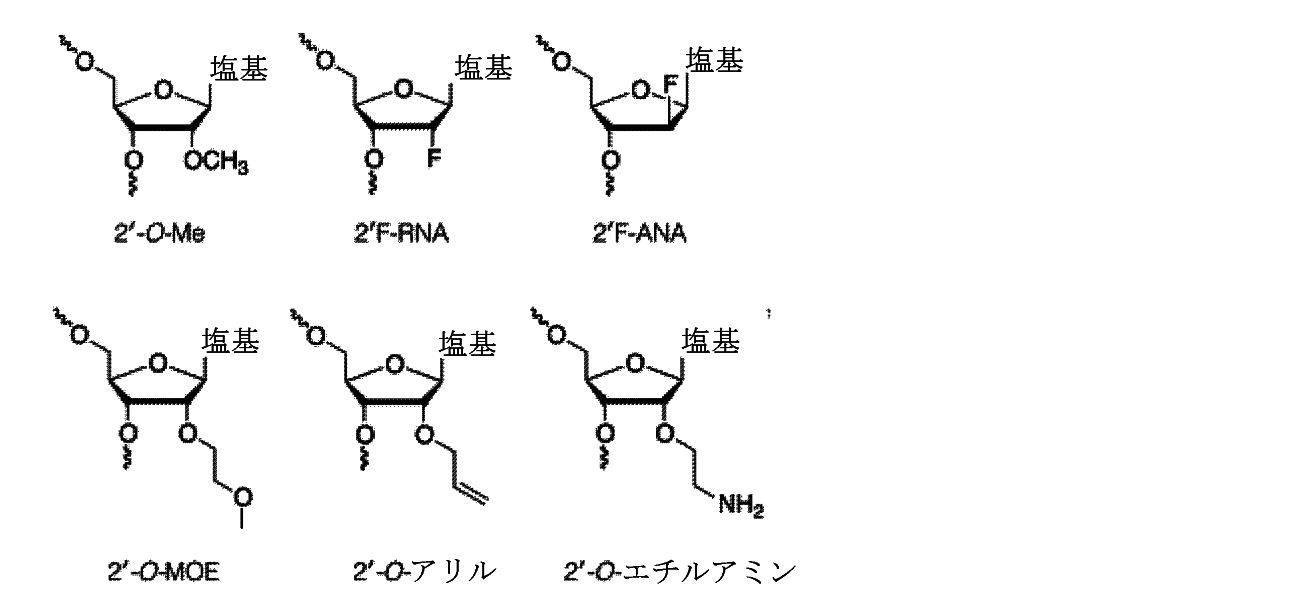
II.D.2.b. ロックド核酸ヌクレオシド(LNA)
LNAヌクレオシドは、ヌクレオシドのリボース糖環(すなわち、2’-4’架橋)のC2’とC4’の間にリンカー基(ビラジカルまたは架橋と呼ばれる)を含む修飾ヌクレオシドであり、リボース環の立体配座を制限する。これらのヌクレオシドは、文献では架橋核酸または二環式核酸(BNA)とも呼ばれる。リボースのコンフォメーションのロックは、LNAが相補的なRNAまたはDNA分子のオリゴヌクレオチドに組み込まれる場合のハイブリダイゼーションの親和性の向上(二重鎖の安定化)に関連している。これは、オリゴヌクレオチド/相補体の二本鎖の融解温度を測定することによって日常的に決定することができる。
II. D. 2. b. Locked nucleic acid nucleoside (LNA)
LNA nucleosides are modified nucleosides that contain a linker group (called a biradical or bridge) between C2' and C4' of the nucleoside's ribose sugar ring (i.e., a 2'-4' bridge), which alters the conformation of the ribose ring. limit. These nucleosides are also referred to in the literature as bridged nucleic acids or bicyclic nucleic acids (BNA). Ribose conformational locking is associated with increased hybridization affinity (duplex stabilization) when LNA is incorporated into oligonucleotides of complementary RNA or DNA molecules. This can be routinely determined by measuring the melting temperature of the oligonucleotide/complementary duplex.
非限定的な例示的なLNAヌクレオシドは、WO99/014226,WO00/66604,WO98/039352,WO2004/046160,WO00/047599,WO2007/134181,WO2010/077578,WO2010/036698,WO2007/090071,WO2009/006478,WO2011/156202,WO2008/154401,WO2009/067647,WO2008/150729,Morita et al.,Bioorganic & Med.Chem.Lett.12,73-76,Seth et al.,J.Org.Chem.2010,Vol 75(5) pp.1569-81,及びMitsuoka et al.,Nucleic Acids Research 2009,37(4),1225-1238に開示されている。 Non-limiting exemplary LNA nucleosides include WO99/014226, WO00/66604, WO98/039352, WO2004/046160, WO00/047599, WO2007/134181, WO2010/077578, WO2010/036698, WO2007/07109, WO2007/09 , WO2011/156202, WO2008/154401, WO2009/067647, WO2008/150729, Morita et al. , Bioorganic & Med. Chem. Lett. 12, 73-76, Seth et al. , J. Org. Chem. 2010, Vol 75(5) pp. 1569-81, and Mitsuoka et al. , Nucleic Acids Research 2009, 37(4), 1225-1238.
いくつかの態様では、本開示のASOの修飾ヌクレオシドまたはLNAヌクレオシドは、式IまたはIIの一般的な構造を有する:

式中、
Wは、-O-、-S-、-N(Ra)-、-C(RaRb)-から選択され、特に-O-であり;
Bは、核酸塩基または修飾核酸塩基部分であり;
Zは、隣接するヌクレオシドまたは5’末端基へのヌクレオシド間結合であり;
Z*は、隣接するヌクレオシドまたは3’末端基へのヌクレオシド間結合であり;
R1、R2、R3、R5及びR5*は、水素、ハロゲン、アルキル、アルケニル、アルキニル、ヒドロキシ、アルコキシ、アルコキシアルキル、アルケニルオキシ、カルボキシル、アルコキシカルボニル、アルキルカルボニル、ホルミル、アジド、複素環及びアリールから独立して選択され;ならびに
X、Y、Ra及びRbは、本明細書で定義されている通りである。
In some aspects, the ASO modified nucleosides or LNA nucleosides of the present disclosure have the general structure of Formula I or II:
During the ceremony,
W is selected from -O-, -S-, -N(R a )-, -C(R a R b )-, especially -O-;
B is a nucleobase or modified nucleobase moiety;
Z is an internucleoside linkage to an adjacent nucleoside or 5' terminal group;
Z* is an internucleoside linkage to an adjacent nucleoside or 3' end group;
R 1 , R 2 , R 3 , R 5 and R 5 * are hydrogen, halogen, alkyl, alkenyl, alkynyl, hydroxy, alkoxy, alkoxyalkyl, alkenyloxy, carboxyl, alkoxycarbonyl, alkylcarbonyl, formyl, azide, hetero independently selected from ring and aryl; and X, Y, R a and R b are as defined herein.
いくつかの態様では、-X-Y-、Raは、水素またはアルキル、特に水素またはメチルである。いくつかの態様では、-X-Y-、Rbは、水素またはアルキル、特に水素またはメチルである。-X-Y-の他の態様では、RaとRbの一方または両方が水素である。-X-Y-のさらなる態様では、RaとRbの一方のみが水素である。-X-Y-のいくつか態様では、RaとRbの一方がメチルであり、他方が水素である。-X-Y-の特定の態様では、RaとRbは、両方とも同時にメチルである。 In some embodiments -XY-, R a is hydrogen or alkyl, especially hydrogen or methyl. In some embodiments -XY-, Rb is hydrogen or alkyl, especially hydrogen or methyl. In another embodiment of -XY-, one or both of R a and R b are hydrogen. In a further embodiment of -XY-, only one of R a and R b is hydrogen. In some embodiments of -XY-, one of R a and R b is methyl and the other is hydrogen. In a particular embodiment of -XY-, both R a and R b are simultaneously methyl.
いくつかの態様では、-X-、Raは、水素またはアルキル、特に水素またはメチルである。いくつかの態様では、-X-、Rbは、水素またはアルキル、特に水素またはメチルである。-X-の他の態様では、RaとRbの一方または両方が水素である。-X-の特定の態様では、RaとRbの一方のみが水素である。-X-の特定の態様では、RaとRbの一方がメチルであり、他方が水素である。-X-の他の態様では、RaとRbは、両方とも同時にメチルである。 In some embodiments -X-, R a is hydrogen or alkyl, especially hydrogen or methyl. In some embodiments -X-, Rb is hydrogen or alkyl, especially hydrogen or methyl. In another embodiment of -X-, one or both of R a and R b are hydrogen. In certain embodiments of -X-, only one of R a and R b is hydrogen. In a particular embodiment of -X-, one of R a and R b is methyl and the other is hydrogen. In another embodiment of -X-, both R a and R b are simultaneously methyl.
いくつかの態様では、-Y-、Raは、水素またはアルキル、特に水素またはメチルである。特定の態様では、-Y-、Rbは、水素またはアルキル、特に水素またはメチルである。-Y-の他の態様では、RaとRbの一方または両方が水素である。-Y-のいくつかの態様では、RaとRbの一方のみが水素である。-Y-の他の態様では、RaとRbの一方がメチルであり、他方が水素である。-Y-のいくつかの態様では、RaとRbは、両方とも同時にメチルである。 In some embodiments -Y-, R a is hydrogen or alkyl, especially hydrogen or methyl. In a particular aspect -Y-, R b is hydrogen or alkyl, especially hydrogen or methyl. In another embodiment of -Y-, one or both of R a and R b are hydrogen. In some embodiments of -Y-, only one of R a and R b is hydrogen. In another embodiment of -Y-, one of R a and R b is methyl and the other is hydrogen. In some aspects of -Y-, both R a and R b are simultaneously methyl.
いくつかの態様では、R1、R2、R3、R5及びR5*は、水素及びアルキル、特に水素及びメチルから独立して選択される。 In some aspects, R 1 , R 2 , R 3 , R 5 and R 5 * are independently selected from hydrogen and alkyl, especially hydrogen and methyl.
いくつかの態様では、R1、R2、R3、R5及びR5*は、すべて同時に水素である。 In some embodiments, R 1 , R 2 , R 3 , R 5 and R 5* are all hydrogen simultaneously.
いくつかの態様では、R1、R2、R3はすべて同時に水素であり、R5及びR5*の一方は水素であり、他方は上記で定義された通りであり、特にアルキル、より具体的にはメチルである。 In some embodiments, R 1 , R 2 , R 3 are all simultaneously hydrogen and one of R 5 and R 5* is hydrogen and the other is as defined above, particularly alkyl, more particularly is typically methyl.
いくつかの態様では、R1、R2、R3は、すべて同時に水素であり、R5及びR5*の一方は水素であり、他方はアジドである。 In some embodiments, R 1 , R 2 , R 3 are all simultaneously hydrogen and one of R 5 and R 5* is hydrogen and the other is azide.
いくつかの態様では、-X-Y-は-O-CH2-であり、Wは酸素であり、R1、R2、R3、R5及びR5*は、すべて同時に水素である。そのようなLNAヌクレオシドは、WO99/014226、WO00/66604、WO98/039352及びWO2004/046160に開示されており、これらはすべて参照により本明細書に援用され、当技術分野でβ-D-オキシLNA及びα-L-オキシLNAヌクレオシドとして一般的に知られているものを含む。 In some embodiments, -XY- is -O-CH 2 -, W is oxygen, and R 1 , R 2 , R 3 , R 5 and R 5* are all simultaneously hydrogen. Such LNA nucleosides are disclosed in WO99/014226, WO00/66604, WO98/039352 and WO2004/046160, all of which are incorporated herein by reference, and β-D-oxy LNAs are known in the art. and those commonly known as α-L-oxy LNA nucleosides.
いくつかの態様では、-X-Y-は-S-CH2-であり、Wは酸素であり、R1、R2、R3、R5及びR5*は、すべて同時に水素である。そのようなチオLNAヌクレオシドは、参照により本明細書に援用されるWO99/014226及びWO2004/046160に開示されている。 In some embodiments, -XY- is -S-CH 2 -, W is oxygen, and R 1 , R 2 , R 3 , R 5 and R 5* are all simultaneously hydrogen. Such thio LNA nucleosides are disclosed in WO99/014226 and WO2004/046160, incorporated herein by reference.
いくつかの態様では、-X-Y-は-NH-CH2-であり、Wは酸素であり、R1、R2、R3、R5及びR5*は、すべて同時に水素である。そのようなチオLNAヌクレオシドは、参照により本明細書に援用されるWO99/014226及びWO2004/046160に開示されている。 In some embodiments, -XY- is -NH-CH 2 -, W is oxygen, and R 1 , R 2 , R 3 , R 5 and R 5* are all simultaneously hydrogen. Such thio LNA nucleosides are disclosed in WO99/014226 and WO2004/046160, incorporated herein by reference.
いくつかの態様では、-X-Y-は、-O-CH2CH2-または-OCH2CH2CH2-であり、Wは酸素であり、R1、R2、R3、R5及びR5*は、すべて同時に水素である。そのようなLNAヌクレオシドは、WO00/047599及びMorita et al.,Bioorganic & Med.Chem.Lett.12,73-76に開示されており、これらは参照により本明細書に援用され、2’-O-4’C-エチレン架橋核酸(ENA)として当技術分野で一般的に知られているものを含む。 In some aspects, -XY- is -O-CH 2 CH 2 - or -OCH 2 CH 2 CH 2 -, W is oxygen, and R 1 , R 2 , R 3 , R 5 and R5 * are all simultaneously hydrogen. Such LNA nucleosides are described in WO00/047599 and Morita et al. , Bioorganic & Med. Chem. Lett. 12, 73-76, which are incorporated herein by reference and commonly known in the art as 2'-O-4'C-ethylene bridged nucleic acids (ENAs). including.
いくつかの態様では、-X-Y-は-O-CH2-であり、Wは酸素であり、R1、R2、R3は、すべて同時に水素であり、R5及びR5*の一方は水素であり、他方は水素ではなく、例えば、アルキル、例えば、メチルである。そのような5’置換LNAヌクレオシドは、WO2007/134181に開示されており、これは参照により本明細書に援用される。 In some embodiments, -XY- is -O-CH 2 -, W is oxygen, R 1 , R 2 , R 3 are all simultaneously hydrogen, and R 5 and R 5* One is hydrogen and the other is not hydrogen, eg alkyl, eg methyl. Such 5'-substituted LNA nucleosides are disclosed in WO2007/134181, which is incorporated herein by reference.
いくつかの態様では、-X-Y-は-O-CRaRb-であり、Ra及びRbの一方または両方が水素ではなく、特にメチルなどのアルキルであり、Wは酸素であり、R1、R2、R3は、すべて同時に水素であり、R5及びR5*の一方は水素であり、他方は水素ではなく、特にアルキル、例えば、メチルである。そのようなビス修飾LNAヌクレオシドは、WO2010/077578に開示されており、これは参照により本明細書に援用される。 In some embodiments, -X-Y- is -O-CR a R b -, one or both of R a and R b is not hydrogen, in particular alkyl such as methyl, and W is oxygen. , R 1 , R 2 , R 3 are all simultaneously hydrogen and one of R 5 and R 5* is hydrogen and the other is not hydrogen, especially alkyl, eg methyl. Such bis-modified LNA nucleosides are disclosed in WO2010/077578, which is incorporated herein by reference.
いくつかの態様では、-X-Y-は-O-CH(CH2-O-CH3)-である(「2’O-メトキシエチル二環式核酸」、Seth et al.,J.Org.Chem.2010,Vol 75(5)pp.1569-81)。 In some embodiments, -XY- is -O-CH(CH 2 -O-CH 3 )- (“2′O-methoxyethyl bicyclic nucleic acids,” Seth et al., J. Org. Chem.2010, Vol 75(5) pp.1569-81).
いくつかの態様では、-X-Y-は-O-CHRa-であり、Wは酸素であり、R1、R2、R3、R5及びR5*は、すべて同時に水素である。そのような6’置換LNAヌクレオシドは、WO2010/036698及びWO2007/090071に開示されており、これらはいずれも参照により本明細書に援用される。そのような6’置換LNAヌクレオシドにおいて、Raは、特にC1-C6アルキルであり、例えば、メチルである。 In some embodiments, -XY- is -O-CHR a -, W is oxygen, and R 1 , R 2 , R 3 , R 5 and R 5* are all simultaneously hydrogen. Such 6'-substituted LNA nucleosides are disclosed in WO2010/036698 and WO2007/090071, both of which are incorporated herein by reference. In such 6′-substituted LNA nucleosides, R a is in particular C1-C6 alkyl, eg methyl.
いくつかの態様では、-X-Y-は-O-CH(CH2-O-CH3)-であり、Wは酸素であり、R1、R2、R3、R5及びR5*は、すべて同時に水素である。そのようなLNAヌクレオシドは、環状MOE(cMOE)としても当技術分野では知られており、WO2007/090071に開示されている。 In some embodiments, -XY- is -O-CH(CH 2 -O-CH 3 )-, W is oxygen, and R 1 , R 2 , R 3 , R 5 and R 5 * are all hydrogen at the same time. Such LNA nucleosides are also known in the art as cyclic MOEs (cMOEs) and are disclosed in WO2007/090071.
いくつかの態様では、-X-Y-は-O-CH(CH3)-である。 In some aspects, -XY- is -O-CH(CH 3 )-.
いくつかの態様では、-X-Y-は-O-CH2-O-CH2-である(Seth et al.,J.Org.Chem 2010 op.cit.)。 In some aspects, -XY- is -O-CH 2 -O-CH 2 - (Seth et al., J. Org. Chem 2010 op. cit.).
いくつかの態様では、-X-Y-は-O-CH(CH3)-であり、Wは酸素であり、R1、R2、R3、R5及びR5*は、すべて同時に水素である。そのような6’-メチルLNAヌクレオシドは、cETヌクレオシドとしても当技術分野で知られており、いずれも参照により本明細書に援用されるWO2007/090071(β-D)及びWO2010/036698(α-L)に開示されているように、(S)-cETまたは(R)-cETジアステレオ異性体のいずれかであり得る。 In some embodiments, -XY- is -O-CH(CH 3 )-, W is oxygen, and R 1 , R 2 , R 3 , R 5 and R 5* are all simultaneously hydrogen is. Such 6′-methyl LNA nucleosides are also known in the art as cET nucleosides and are both of WO2007/090071 (β-D) and WO2010/036698 (α- L) can be either the (S)-cET or (R)-cET diastereoisomers.
いくつかの態様では、-X-Y-は-O-CRaRb-であり、R3もR4も水素ではなく、Wは酸素であり、R1、R2、R3、R5及びR5*は、すべて同時に水素である。特定の態様では、Ra及びRbは両方とも同時にアルキルであり、特に両方とも同時にメチルである。そのような6’ジ置換LNAヌクレオシドは、参照により本明細書に援用されるWO2009/006478に開示されている。 In some embodiments, -XY- is -O-CR a R b -, neither R 3 nor R 4 is hydrogen, W is oxygen, R 1 , R 2 , R 3 , R 5 and R5 * are all simultaneously hydrogen. In a particular embodiment, R a and R b are both simultaneously alkyl, particularly both simultaneously methyl. Such 6' disubstituted LNA nucleosides are disclosed in WO2009/006478, which is incorporated herein by reference.
いくつかの態様では、-X-Y-は-S-CHRa-であり、Wは酸素であり、R1、R2、R3、R5及びR5*は、すべて同時に水素である。そのような6’置換チオLNAヌクレオシドは、WO2011/156202に開示されており、これは参照により本明細書に援用される。そのような6’置換チオLNAの特定の態様では、Raはアルキル、特にメチルである。 In some embodiments, -XY- is -S-CHR a -, W is oxygen, and R 1 , R 2 , R 3 , R 5 and R 5* are all simultaneously hydrogen. Such 6'-substituted thio-LNA nucleosides are disclosed in WO2011/156202, which is incorporated herein by reference. In a particular embodiment of such 6'-substituted thio LNAs, R a is alkyl, especially methyl.
いくつかの態様では、-X-Y-は-C(=CH2)C(RaRb)-であり、Wは酸素であり、R1、R2、R3、R5及びR5*は、すべて同時に水素である。そのようなビニルカルボLNAヌクレオシドは、WO2008/154401及びWO2009/067647に開示されており、これらはいずれも参照により本明細書に援用される。 In some embodiments, -XY- is -C(=CH 2 )C(R a R b )-, W is oxygen, and R 1 , R 2 , R 3 , R 5 and R 5 * are all hydrogen at the same time. Such vinylcarbo LNA nucleosides are disclosed in WO2008/154401 and WO2009/067647, both of which are incorporated herein by reference.
いくつかの態様では、-X-Y-は-N(ORa)-CH2-であり、Wは酸素であり、R1、R2、R3、R5及びR5*は、すべて同時に水素である。いくつかの態様では、Raは、メチルなどのアルキルである。そのようなLNAヌクレオシドは、N置換LNAとしても知られており、WO2008/150729に開示されており、これは参照により本明細書に援用される。 In some embodiments, -XY- is -N(OR a )-CH 2 -, W is oxygen, and R 1 , R 2 , R 3 , R5 and R 5* are all simultaneously hydrogen is. In some aspects, R a is alkyl, such as methyl. Such LNA nucleosides, also known as N-substituted LNAs, are disclosed in WO2008/150729, which is incorporated herein by reference.
いくつかの態様では、-X-Y-は-O-NCH3-である(Seth et al.,J.Org.Chem 2010 op.cit.)。 In some aspects, -XY- is -O-NCH 3 - (Seth et al., J. Org. Chem 2010 op. cit.).
いくつかの態様では、-X-Y-はON(Ra)- -N(Ra)-O-、-NRa-CRaRb-CRaRb-、または-NRa-CRaRb-であり、Wは酸素であり、R1、R2、R3、R5及びR5*は、すべて同時に水素である。いくつかの態様では、Raはアルキル、例えばメチルである。(Seth et al.,J.Org.Chem 2010 op.cit.)。 In some embodiments, -XY- is ON(R a )- -N(R a )-O-, -NR a -CR a R b -CR a R b -, or -NR a -CR a R b —, W is oxygen, and R 1 , R 2 , R 3 , R 5 and R 5* are all simultaneously hydrogen. In some aspects, R a is alkyl, for example methyl. (Seth et al., J. Org. Chem 2010 op. cit.).
いくつかの態様では、R5及びR5*は、両方とも同時に水素である。他の態様では、R5とR5*の一方が水素であり、他方がアルキル、例えば、メチルである。そのような態様では、R1、R2及びR3は、特に水素であり得、-X-Y-は、特に-O-CH2-または-O-CHC(Ra)3-、例えば-O-CH(CH3)-であり得る。 In some aspects, R5 and R5 * are both hydrogen at the same time. In another aspect, one of R5 and R5 * is hydrogen and the other is alkyl, eg, methyl. In such embodiments, R 1 , R 2 and R 3 may in particular be hydrogen, and —X—Y— may in particular be —O—CH 2 — or —O—CHC(R a ) 3 —, such as — It can be O--CH(CH 3 )--.
いくつかの態様では、-X-Y-は--CRaRb-O-CRaRb-、例えば、-CH2-O-CH2-であり、Wは酸素であり、R1、R2、R3、R5及びR5*は、すべて同時に水素である。そのような態様では、Raは、特にメチルなどのアルキルであり得る。そのようなLNAヌクレオシドは、立体配座制限ヌクレオチド(CRN)としても知られており、WO2013/036868に開示されており、これは参照により本明細書に援用される。 In some embodiments, -XY- is -CR a R b -O-CR a R b -, for example -CH 2 -O-CH 2 -, W is oxygen, R 1 , R 2 , R 3 , R 5 and R 5* are all simultaneously hydrogen. In such embodiments, R a can be alkyl, especially methyl. Such LNA nucleosides, also known as conformationally restricted nucleotides (CRN), are disclosed in WO2013/036868, which is incorporated herein by reference.
いくつかの態様では、-X-Y-は-O-CRaRb-O-CRaRb-、例えば、-O-CH2-O-CH2-であり、Wは酸素であり、R1、R2、R3、R5及びR5*は、すべて同時に水素である。特定の態様では、Raは、特にメチルなどのアルキルであり得る。そのようなLNAヌクレオシドは、COCヌクレオチドとしても知られており、Mitsuoka et al.,Nucleic Acids Research 2009,37(4),1225-1238に開示されており、これは参照により本明細書に援用される。 In some embodiments, -XY- is -O-CR a R b -O-CR a R b -, for example, -O-CH 2 -O-CH 2 -, W is oxygen, R 1 , R 2 , R 3 , R 5 and R 5* are all simultaneously hydrogen. In certain aspects, R a can be alkyl, especially methyl. Such LNA nucleosides are also known as COC nucleotides and are described in Mitsuoka et al. , Nucleic Acids Research 2009, 37(4), 1225-1238, which is incorporated herein by reference.
特に明記されていない限り、LNAヌクレオシドはβ-Dまたはα-Lステレオアイソフォームであってもよいと認識される。 Unless otherwise specified, it is recognized that LNA nucleosides may be the β-D or α-L stereoisoforms.
LNAヌクレオシドの特定の例をスキーム1に示す。
スキーム1

他の箇所に記載されているように、本開示のいくつかの態様では、オリゴヌクレオチド中のLNAヌクレオシドは、β-D-オキシ-LNAヌクレオシドである。 As noted elsewhere, in some aspects of the disclosure, the LNA nucleosides in the oligonucleotides are β-D-oxy-LNA nucleosides.
II.E. ヌクレアーゼ媒介分解
ヌクレアーゼ媒介分解とは、そのような配列と二重鎖を形成する場合に相補的ヌクレオチド配列の分解を媒介することができるオリゴヌクレオチドを指す。
II. E. Nuclease-Mediated Degradation Nuclease-mediated degradation refers to oligonucleotides that are capable of mediating the degradation of complementary nucleotide sequences when duplexed with such sequences.
いくつかの態様では、オリゴヌクレオチドは、標的核酸のヌクレアーゼ媒介分解を介して機能し得、本開示のオリゴヌクレオチドは、ヌクレアーゼ、特にエンドヌクレアーゼ、好ましくは、RNaseHなどのエンドリボヌクレアーゼ(RNase)を動員することができる。ヌクレアーゼ媒介メカニズムを介して作動するオリゴヌクレオチド設計の例は、通常、少なくとも5または6個のDNAヌクレオシドの領域を含み、親和性増強ヌクレオシド、例えばギャップマーが片側または両側に隣接しているオリゴヌクレオチドである。 In some aspects, oligonucleotides may function via nuclease-mediated degradation of a target nucleic acid, wherein the oligonucleotides of the present disclosure recruit nucleases, particularly endonucleases, preferably endoribonucleases (RNases) such as RNaseH. be able to. An example of an oligonucleotide design that operates via a nuclease-mediated mechanism is an oligonucleotide that typically comprises a region of at least 5 or 6 DNA nucleosides and is flanked on one or both sides by affinity-enhancing nucleosides, such as gapmers. be.
II.F. RNaseH活性及び動員
アンチセンスオリゴヌクレオチドのRNaseH活性とは、相補的RNA分子と二重鎖を形成する場合にRNaseHを動員し、相補的RNA分子の分解を誘導する能力を指す。WO01/23613は、RNaseH活性を決定するためのin vitroでの方法を提供し、これを使用して、RNaseHを動員する能力を判定してもよい。通常、オリゴヌクレオチドは、相補的な標的核酸配列が提供される場合、試験対象の修飾オリゴヌクレオチドと同じ塩基配列を有するが、DNA単量体のみを含み、オリゴヌクレオチド内のすべての単量体間にホスホロチオエート結合を有するオリゴヌクレオチドを使用し、pmol/l/分による測定で、WO01/23613の実施例91~95によって提供される方法論を使用する場合に測定される初期速度の少なくとも5%、例えば少なくとも10%または20%超の初期速度を有する場合、RNaseHを動員できると見なされる。
II. F. RNase H Activity and Recruitment RNase H activity of an antisense oligonucleotide refers to its ability to recruit RNase H when forming a duplex with a complementary RNA molecule and induce degradation of the complementary RNA molecule. WO01/23613 provides in vitro methods for determining RNaseH activity, which may be used to determine the ability to recruit RNaseH. Typically, the oligonucleotide will have the same base sequence as the modified oligonucleotide to be tested, but will contain only DNA monomers, if a complementary target nucleic acid sequence is provided, and all inter-monomer sequences within the oligonucleotide will be at least 5% of the initial rate measured when using the methodology provided by Examples 91-95 of WO 01/23613, measured in pmol/l/min, using oligonucleotides with phosphorothioate linkages in RNase H is considered capable of recruiting if it has an initial rate of at least 10% or greater than 20%.
いくつかの態様では、オリゴヌクレオチドは、相補的標的核酸が提供される場合に、pmol/l/分で測定されるRNaseH初期速度が、例えば、試験対象のオリゴヌクレオチドと同じ塩基配列を有するが、2’置換を含まないDNA単量体のみを含み、オリゴヌクレオチド中のすべての単量体間にホスホロチオエート結合を有するオリゴヌクレオチドを使用し、WO01/23613の実施例91~95によって提供される方法論を使用する場合に測定される初期速度の20%未満、例えば10%未満、例えば5%未満である場合、RNaseHを動員することが本質的に不可能であると見なされる。 In some aspects, the oligonucleotide has an initial RNase H rate measured in pmol/l/min when provided with a complementary target nucleic acid, e.g., has the same base sequence as the oligonucleotide being tested, but The methodology provided by Examples 91-95 of WO01/23613 was used using oligonucleotides containing only DNA monomers with no 2' substitutions and having phosphorothioate linkages between all monomers in the oligonucleotide. If less than 20%, such as less than 10%, such as less than 5% of the initial rate measured in use, it is considered essentially incapable of recruiting RNase H.
II.G. ASO設計
本開示のASOは、ヌクレオシド及びヌクレオシド類似体の両方を含むヌクレオチド配列を含み得、ギャップマーの形態であり得る。いくつかの態様では、ASOは、ギャップマーである。いくつかの態様では、ASOは、ミックスマーである。いくつかの態様では、ASOは、トータルマーである。本開示のASOと共に使用することができるギャップマーの構成の例は、米国特許出願公開第2012/0322851号に記載されており、その全体が参照により本明細書に援用される。
II. G. ASO Design ASOs of the present disclosure can comprise nucleotide sequences that include both nucleosides and nucleoside analogs, and can be in the form of gapmers. In some aspects, the ASO is a gapmer. In some aspects, the ASO is a mixmer. In some aspects, the ASO is a totalmer. Examples of gapmer configurations that can be used with the ASOs of the present disclosure are described in US Patent Application Publication No. 2012/0322851, which is incorporated herein by reference in its entirety.
本明細書中で使用する用語「ギャップマー」とは、1つ以上の親和性増強修飾ヌクレオシド(フランク)が5’及び3’に隣接するRNaseH動員オリゴヌクレオチド(ギャップ)の領域を含むアンチセンスオリゴヌクレオチドを指す。用語「LNAギャップマー」とは、親和性増強修飾ヌクレオシドの少なくとも1つがLNAヌクレオシドであるギャップマーオリゴヌクレオチドである。用語「混合ウィングギャップマー」とは、フランク領域が少なくとも1つのLNAヌクレオシド及び少なくとも1つのDNAヌクレオシドまたは非LNA修飾ヌクレオシド、例えば、2’-O-アルキル-RNA、2’-O-メチル-RNA、2’-アルコキシ-RNA、2’-O-メトキシエチル-RNA(MOE)、2’-アミノ-DNA、2’-フルオロ-RNA、2’-フルオロ-DNA、アラビノ核酸(ANA)、及び2’-フルオロ-ANAヌクレオシド(複数可)などの少なくとも1つの2’置換修飾ヌクレオシドを含むLNAギャップマーを指す。 As used herein, the term "gapmer" refers to an antisense oligo comprising a region of an RNaseH-recruiting oligonucleotide (gap) flanked 5' and 3' by one or more affinity-enhancing modified nucleosides (flanks). refers to nucleotides. The term "LNA gapmer" is a gapmer oligonucleotide in which at least one of the affinity-enhancing modified nucleosides is an LNA nucleoside. The term "mixed wing gapmer" means that the flanking regions are composed of at least one LNA nucleoside and at least one DNA nucleoside or non-LNA modified nucleosides such as 2'-O-alkyl-RNA, 2'-O-methyl-RNA, 2'-alkoxy-RNA, 2'-O-methoxyethyl-RNA (MOE), 2'-amino-DNA, 2'-fluoro-RNA, 2'-fluoro-DNA, arabinonucleic acid (ANA), and 2' Refers to LNA gapmers containing at least one 2'-substituted modified nucleoside, such as -fluoro-ANA nucleoside(s).
いくつかの態様では、標的領域に対するASOの親和性を増強することに加えて、いくつかのヌクレオシド類似体はまた、RNase(例えば、RNaseH)の結合及び切断を媒介する。α-L-LNA単量体はある程度RNaseH活性を動員するため、いくつかの態様では、α-L-LNA単量体を含むASOのギャップ領域(例えば、本明細書で言及される領域B)は、RNaseHによって認識及び切断可能な少数の単量体からなり、ミックスマー構造により高い柔軟性が導入される。 In some aspects, in addition to enhancing the affinity of ASOs for target regions, some nucleoside analogues also mediate RNase (eg, RNase H) binding and cleavage. Since α-L-LNA monomers recruit RNase H activity to some extent, in some embodiments the gap region of an ASO comprising α-L-LNA monomers (eg, region B referred to herein) consists of a small number of monomers that can be recognized and cleaved by RNase H, and the mixmer structure introduces greater flexibility.
II.H. ギャプマー設計
いくつかの態様では、本開示のASOはギャップマーであり、本明細書において領域B(B)と呼ばれるRNaseHなどのRNaseを動員することができるヌクレオチド(例えば、1つ以上のDNA)の連続したストレッチを含み、領域Bは、5’及び3’の両方において、領域Bの連続するヌクレオチドのストレッチに対してヌクレオシド類似体の領域が5’及び3’側から隣接し、これらの領域は、それぞれ領域A(A)及びC(C)と呼ばれる。いくつかの態様では、ヌクレオシド類似体は、糖修飾ヌクレオシド(例えば、高親和性糖修飾ヌクレオシド)である。特定の態様では、領域A及びCの糖修飾ヌクレオシドは、標的核酸に対するASOの親和性を増強する(すなわち、親和性増強2’糖修飾ヌクレオシド)。いくつかの態様では、糖修飾ヌクレオシドは、LNA及び/または2’-MOEなどの高親和性2’糖修飾などの2’糖修飾ヌクレオシドである。
II. H. Gapmer Design In some aspects, the ASOs of the present disclosure are gapmers, which are composed of nucleotides (e.g., one or more DNA) capable of recruiting an RNase, such as RNaseH, referred to herein as region B (B). comprising a contiguous stretch, region B being flanked both 5' and 3' by regions of nucleoside analogues 5' and 3' to the stretch of contiguous nucleotides of region B; , respectively called regions A(A) and C(C). In some aspects, the nucleoside analogue is a sugar-modified nucleoside (eg, a high-affinity sugar-modified nucleoside). In certain aspects, the sugar-modified nucleosides of regions A and C enhance the affinity of the ASO for a target nucleic acid (ie, affinity-enhanced 2' sugar-modified nucleosides). In some aspects, the sugar modified nucleosides are 2' sugar modified nucleosides, such as LNA and/or high affinity 2' sugar modifications such as 2'-MOE.
ギャップマーでは、領域Bの5’及び3’のほとんどのヌクレオシドはDNAヌクレオシドであり、それぞれ領域A及びCのヌクレオシド類似体(例えば、高親和性糖修飾ヌクレオシド)に隣接して配置される。いくつかの態様では、領域A及びCは、領域Bから最も離れた末端(すなわち、領域Aの5’末端及び領域Cの3’末端)にヌクレオシド類似体を有することによってさらに定義され得る。 In gapmers, the 5' and 3' most nucleosides of region B are DNA nucleosides, which are flanked by nucleoside analogues (e.g., high affinity sugar modified nucleosides) of regions A and C, respectively. In some aspects, regions A and C may be further defined by having nucleoside analogues at the ends furthest from region B (i.e., the 5' end of region A and the 3' end of region C).
いくつかの態様では、本開示のASOは、式(5’から3’方向に)A-B-Cのヌクレオチド配列を含み、式中:(A)(5’領域または第1のウィング配列)は、少なくとも1つのヌクレオシド類似体(例えば、3~5個のLNAユニット)を含み;(B)は、少なくとも4つの連続ヌクレオシド(例えば、4-24 DNAユニット)を含み、RNaseを動員することができ(プレmRNAまたはmRNA標的などの相補的RNA分子と二重鎖形成する場合);そして(C)(3’領域または第2のウィング配列)は、少なくとも1つのヌクレオシド類似体(例えば、3~5個のLNAユニット)を含む。 In some aspects, an ASO of the present disclosure comprises a nucleotide sequence of the formula (5' to 3' direction) ABC, where: (A) (5' region or first wing sequence) contains at least one nucleoside analogue (eg, 3-5 LNA units); (B) contains at least 4 consecutive nucleosides (eg, 4-24 DNA units) and is capable of recruiting RNases. (when duplexed with a complementary RNA molecule such as a pre-mRNA or mRNA target); 5 LNA units).
いくつかの態様では、領域Aは、LNAなどの3~5個のヌクレオシド類似体を含み、領域Bは、6~24個(例えば、6、7、8、9、10、11、12、13、または14個)のDNAユニットからなり、領域Cは、LNAなどの3つまたは4つのヌクレオシド類似体からなる。そのような設計は、(A-B-C)3-14-3、3-11-3、3-12-3、3-13-3、4-9-4、4-10-4、4-11-4、4-12-4、及び5-10-5を含む。いくつかの態様では、ASOは、LLLDnLLL、LLLLDnLLLL、またはLLLLLDnLLLLLの設計を有し、Lはヌクレオシド類似体であり、DはDNAであり、nは4~24の任意の整数であり得る。いくつかの態様では、nは、6~14の間の任意の整数であり得る。いくつかの態様では、nは、8~12の間の任意の整数であり得る。いくつかの態様では、nは、6~14の間の任意の整数であり得る。いくつかの態様では、nは、8~12の間の任意の整数であり得る。いくつかの態様では、ASOは、LLLMMDnMMLLL、LLLMDnMLLL、LLLLMMDnMMLLLL、LLLLMDnMLLLL、LLLLLLMMDnMMLLLLL、またはLLLLLLMDnMLLLLLの設計を有し、式中、DはDNAであり、nは3~15の間の任意の整数であり得、LはLNAであり、Mは2’MOEである。 In some aspects, region A comprises 3-5 nucleoside analogues, such as LNA, and region B comprises 6-24 (eg, 6, 7, 8, 9, 10, 11, 12, 13 , or 14) DNA units, and region C consists of 3 or 4 nucleoside analogues such as LNA. Such designs are (ABC) 3-14-3, 3-11-3, 3-12-3, 3-13-3, 4-9-4, 4-10-4, 4 -11-4, 4-12-4, and 5-10-5. In some aspects, the ASO has a design LLLD n LLL, LLLLD n LLLL, or LLLLLD n LLLLLL, where L is a nucleoside analogue, D is DNA, and n is any integer from 4 to 24 can be In some aspects, n can be any integer between 6-14. In some aspects, n can be any integer between 8-12. In some aspects, n can be any integer between 6-14. In some aspects, n can be any integer between 8-12. In some aspects, the ASO has a design of LLLMMDnMMLLL, LLLMDnMLLL, LLLLMMMDnMMLLLL, LLLLMDnMLLLL, LLLLLLMMDnMMLLLLLL, or LLLLLLMDnMLLLLL, where D is DNA and n can be any integer between 3 and 15 , L is LNA and M is 2′MOE.
さらなるギャップマーの設計は、WO2004/046160、WO2007/146511、及びWO2008/113832に開示されており、これらのそれぞれは、その全体が参照により本明細書に援用される。 Additional gapmer designs are disclosed in WO2004/046160, WO2007/146511, and WO2008/113832, each of which is incorporated herein by reference in its entirety.
II.I. ヌクレオチド間結合
本明細書に記載のASOの単量体は、結合基を介して一緒に結合する。好適には、各単量体は、結合基を介して3’隣接単量体に結合する。
II. I. Internucleotide Linkages The monomers of the ASOs described herein are linked together through linking groups. Suitably each monomer is attached to the 3' adjacent monomer via a linking group.
当業者は、本開示に関して、ASOの末端の5’単量体は、5’末端基を含む場合も含まない場合もあるが、5’結合基を含まないことを理解するであろう。 Those of ordinary skill in the art will understand, with respect to this disclosure, that the terminal 5' monomer of an ASO may or may not include a 5' terminal group, but does not include a 5' linking group.
いくつかの態様では、連続ヌクレオチド配列は、1つ以上の修飾されたヌクレオシド間結合を含む。用語「結合基」または「ヌクレオシド間結合」とは、2つのヌクレオシドを共有結合することができる基を意味することを意図している。非限定的な例として、リン酸基及びホスホロチオエート基が挙げられる。 In some aspects, the contiguous nucleotide sequence comprises one or more modified internucleoside linkages. The term "linking group" or "internucleoside linkage" is intended to mean a group capable of covalently linking two nucleosides. Non-limiting examples include phosphate groups and phosphorothioate groups.
本開示のASOのヌクレオシドまたはその連続ヌクレオシド配列は、結合基を介して一緒に結合する。好適には、各ヌクレオシドは、結合基を介して3’隣接ヌクレオシドに結合する。 Nucleosides or contiguous nucleoside sequences thereof of ASOs of the present disclosure are linked together via linking groups. Suitably each nucleoside is linked to the 3' adjacent nucleoside via a linking group.
いくつかの態様では、ヌクレオシド間結合を、その通常のホスホジエステルから、RNaseHによって切断可能なホスホロチオエートなどのヌクレアーゼ攻撃に対してより耐性のあるものに改変し、標的遺伝子の発現を減少させる際のアンチセンス阻害の経路も可能にする。いくつかの態様では、ヌクレオシド間結合の少なくとも75%、少なくとも80%、少なくとも85%、少なくとも90%、少なくとも91%、少なくとも92%、少なくとも93%、少なくとも94%、少なくとも95%、少なくとも96%、少なくとも97%、少なくとも98%、少なくとも99%、または100%が修飾される。 In some aspects, the internucleoside linkage is modified from its normal phosphodiester to one more resistant to nuclease attack, such as a phosphorothioate cleavable by RNase H, to reduce expression of the target gene. It also enables a pathway of sense inhibition. In some aspects, at least 75%, at least 80%, at least 85%, at least 90%, at least 91%, at least 92%, at least 93%, at least 94%, at least 95%, at least 96% of the internucleoside linkages, At least 97%, at least 98%, at least 99%, or 100% are modified.
III. 細胞外小胞、例えば、エキソソーム
本明細書において、STAT3アンタゴニストを含むEV(例えばエキソソーム)を開示する。いくつかの態様では、STAT3アンタゴニストは、アンチセンスオリゴヌクレオチド(ASO)である。ASOは、本明細書に記載の任意のASOまたはその機能的断片であり得る。特定の態様では、ASOは、標的細胞におけるSTAT3 mRNAまたはSTAT3タンパク質のレベルを低下させる。
III. Extracellular Vesicles, eg, Exosomes Disclosed herein are EVs (eg, exosomes) comprising STAT3 antagonists. In some aspects, the STAT3 antagonist is an antisense oligonucleotide (ASO). The ASO can be any ASO or functional fragment thereof described herein. In certain aspects, the ASO reduces STAT3 mRNA or STAT3 protein levels in the target cell.
いくつかの態様では、EV(例えばエキソソーム)は、免疫細胞を標的とする。いくつかの態様では、免疫細胞は、マクロファージ、樹状細胞、B細胞、T細胞、及びそれらの任意の組み合わせから選択される。特定の態様では、本開示のEVは、腫瘍細胞を標的とする。特定の態様では、EV(例えばエキソソーム)は、マクロファージを標的とする。特定の態様では、EV(例えばエキソソーム)は、樹状細胞を標的とする。特定の態様では、EV(例えばエキソソーム)は、B細胞を標的とする。特定の態様では、EV(例えばエキソソーム)は、T細胞を標的とする。 In some aspects, the EVs (eg, exosomes) target immune cells. In some aspects, the immune cells are selected from macrophages, dendritic cells, B cells, T cells, and any combination thereof. In certain aspects, the EVs of the present disclosure target tumor cells. In certain aspects, EVs (eg, exosomes) target macrophages. In certain aspects, the EVs (eg, exosomes) target dendritic cells. In certain aspects, the EVs (eg, exosomes) target B cells. In certain aspects, the EVs (eg, exosomes) target T cells.
いくつかの態様では、EV(例えばエキソソーム)は、がんの治療を必要とする対象のがんを治療する。いくつかの態様では、がんは、線維肉腫、粘液肉腫、脂肪肉腫、軟骨肉腫、骨原性肉腫、脊索腫、血管肉腫、内皮肉腫、リンパ管肉腫、リンパ管内皮肉腫、滑膜癌、中皮腫、ユーイング腫瘍、平滑筋肉腫、横紋筋肉腫、結腸癌、膵癌、乳癌、卵巣癌、前立腺癌、扁平上皮癌、頭頸部扁平上皮癌、結腸直腸癌、リンパ腫、白血病、肝癌、神経膠芽細胞腫、メラノーマ、骨髄腫基底細胞癌、腺癌、汗腺癌、脂腺癌、乳頭癌、乳頭腺癌、嚢胞腺癌、髄質癌、気管支原性癌、腎細胞癌、肝細胞癌、胆管癌、絨毛癌、セミノーマ、胚性癌、ウィルムス腫瘍、子宮頸癌、精巣癌、肺癌、小細胞肺癌、膀胱癌、上皮癌、神経膠腫、神経膠芽細胞腫、星状細胞腫、髄芽細胞腫、頭蓋咽頭腫、上衣腫、松果体腫、血管芽細胞腫、聴神経腫、乏突起膠腫、髄膜腫、メラノーマ、神経芽細胞腫、網膜芽細胞腫、急性骨髄性白血病、胃癌、肝細胞癌、及びそれらの任意の組み合わせから選択される。 In some aspects, the EVs (eg, exosomes) treat cancer in subjects in need of cancer treatment. In some aspects, the cancer is fibrosarcoma, myxosarcoma, liposarcoma, chondrosarcoma, osteogenic sarcoma, chordoma, angiosarcoma, endothelial sarcoma, lymphangiosarcoma, lymphangioendothelioma, synovial carcinoma, medium Dermoma, Ewing tumor, Leiomyosarcoma, Rhabdomyosarcoma, Colon cancer, Pancreatic cancer, Breast cancer, Ovarian cancer, Prostate cancer, Squamous cell carcinoma, Head and neck squamous cell carcinoma, Colorectal cancer, Lymphoma, Leukemia, Liver cancer, Glia Blastoma, melanoma, myeloma basal cell carcinoma, adenocarcinoma, sweat gland carcinoma, sebaceous carcinoma, papillary carcinoma, papillary adenocarcinoma, cystadenocarcinoma, medullary carcinoma, bronchogenic carcinoma, renal cell carcinoma, hepatocellular carcinoma, bile duct Cancer, choriocarcinoma, seminoma, embryonic carcinoma, Wilms tumor, cervical cancer, testicular cancer, lung cancer, small cell lung cancer, bladder cancer, epithelial cancer, glioma, glioblastoma, astrocytoma, medulla Cell tumor, craniopharyngioma, ependymoma, pineocytoma, hemangioblastoma, acoustic neuroma, oligodendroglioma, meningioma, melanoma, neuroblastoma, retinoblastoma, acute myeloid leukemia, gastric cancer , hepatocellular carcinoma, and any combination thereof.
上記に記載されるように、EV、例えば、エキソソームは、本明細書に記載される、直径が約20~300nmの間の細胞外小胞である。特定の態様では、本開示のEV、例えば、エキソソームは、約20~290nm、20~280nm、20~270nm、20~260nm、20~250nm、20~240nm、20~230nm、20~220nm、20~210nm、20~200nm、20~190nm、20~180nm、20~170nm、20~160nm、20~150nm、20~140nm、20~130nm、20~120nm、20~110nm、20~100nm、20~90nm、20~80nm、20~70nm、20~60nm、20~50nm、20~40nm、20~30nm、30~300nm、30~290nm、30~280nm、30~270nm、30~260nm、30~250nm、30~240nm、30~230nm、30~220nm、30~210nm、30~200nm、30~190nm、30~180nm、30~170nm、30~160nm、30~150nm、30~140nm、30~130nm、30~120nm、30~110nm、30~100nm、30~90nm、30~80nm、30~70nm、30~60nm、30~50nm、30~40nm、40~300nm、40~290nm、40~280nm、40~270nm、40~260nm、40~250nm、40~240nm、40~230nm、40~220nm、40~210nm、40~200nm、40~190nm、40~180nm、40~170nm、40~160nm、40~150nm、40~140nm、40~130nm、40~120nm、40~110nm、40~100nm、40~90nm、40~80nm、40~70nm、40~60nm、40~50nm、50~300nm、50~290nm、50~280nm、50~270nm、50~260nm、50~250nm、50~240nm、50~230nm、50~220nm、50~210nm、50~200nm、50~190nm、50~180nm、50~170nm、50~160nm、50~150nm、50~140nm、50~130nm、50~120nm、50~110nm、50~100nm、50~90nm、50~80nm、50~70nm、50~60nm、60~300nm、60~290nm、60~280nm、60~270nm、60~260nm、60~250nm、60~240nm、60~230nm、60~220nm、60~210nm、60~200nm、60~190nm、60~180nm、60~170nm、60~160nm、60~150nm、60~140nm、60~130nm、60~120nm、60~110nm、60~100nm、60~90nm、60~80nm、60~70nm、70~300nm、70~290nm、70~280nm、70~270nm、70~260nm、70~250nm、70~240nm、70~230nm、70~220nm、70~210nm、70~200nm、70~190nm、70~180nm、70~170nm、70~160nm、70~150nm、70~140nm、70~130nm、70~120nm、70~110nm、70~100nm、70~90nm、70~80nm、80~300nm、80~290nm、80~280nm、80~270nm、80~260nm、80~250nm、80~240nm、80~230nm、80~220nm、80~210nm、80~200nm、80~190nm、80~180nm、80~170nm、80~160nm、80~150nm、80~140nm、80~130nm、80~120nm、80~110nm、80~100nm、80~90nm、90~300nm、90~290nm、90~280nm、90~270nm、90~260nm、90~250nm、90~240nm、90~230nm、90~220nm、90~210nm、90~200nm、90~190nm、90~180nm、90~170nm、90~160nm、90~150nm、90~140nm、90~130nm、90~120nm、90~110nm、90~100nm、100~300nm、110~290nm、120~280nm、130~270nm、140~260nm、150~250nm、160~240nm、170~230nm、180~220nm、または190~210nmの直径を有する。本明細書に記載のEV(例えばエキソソーム)のサイズは、以下に記載する方法に従って測定することができる。 As described above, EVs, eg, exosomes, as described herein, are extracellular vesicles between about 20-300 nm in diameter. In certain aspects, the EVs, eg, exosomes, of the present disclosure are about 210 nm, 20-200 nm, 20-190 nm, 20-180 nm, 20-170 nm, 20-160 nm, 20-150 nm, 20-140 nm, 20-130 nm, 20-120 nm, 20-110 nm, 20-100 nm, 20-90 nm, 20-80 nm, 20-70 nm, 20-60 nm, 20-50 nm, 20-40 nm, 20-30 nm, 30-300 nm, 30-290 nm, 30-280 nm, 30-270 nm, 30-260 nm, 30-250 nm, 30- 240 nm, 30-230 nm, 30-220 nm, 30-210 nm, 30-200 nm, 30-190 nm, 30-180 nm, 30-170 nm, 30-160 nm, 30-150 nm, 30-140 nm, 30-130 nm, 30-120 nm, 30-110 nm, 30-100 nm, 30-90 nm, 30-80 nm, 30-70 nm, 30-60 nm, 30-50 nm, 30-40 nm, 40-300 nm, 40-290 nm, 40-280 nm, 40-270 nm, 40- 260 nm, 40-250 nm, 40-240 nm, 40-230 nm, 40-220 nm, 40-210 nm, 40-200 nm, 40-190 nm, 40-180 nm, 40-170 nm, 40-160 nm, 40-150 nm, 40-140 nm, 40-130 nm, 40-120 nm, 40-110 nm, 40-100 nm, 40-90 nm, 40-80 nm, 40-70 nm, 40-60 nm, 40-50 nm, 50-300 nm, 50-290 nm, 50-280 nm, 50- 270 nm, 50-260 nm, 50-250 nm, 50-240 nm, 50-230 nm, 50-220 nm, 50-210 nm, 50-200 nm, 50-190 nm, 50-180 nm, 50-170 nm, 50-160 nm, 50-150 nm, 50-140 nm, 50-130 nm, 50-120 nm, 50-110 nm, 50-100 nm, 50-90 nm, 50-80 nm, 50-70 nm, 50-60 nm, 60-300 nm, 60-290 nm, 60-280 nm, 60- 270 nm, 60-260 nm, 60-2 50 nm, 60-240 nm, 60-230 nm, 60-220 nm, 60-210 nm, 60-200 nm, 60-190 nm, 60-180 nm, 60-170 nm, 60-160 nm, 60-150 nm, 60-140 nm, 60-130 nm, 60-120 nm, 60-110 nm, 60-100 nm, 60-90 nm, 60-80 nm, 60-70 nm, 70-300 nm, 70-290 nm, 70-280 nm, 70-270 nm, 70-260 nm, 70-250 nm, 70- 240 nm, 70-230 nm, 70-220 nm, 70-210 nm, 70-200 nm, 70-190 nm, 70-180 nm, 70-170 nm, 70-160 nm, 70-150 nm, 70-140 nm, 70-130 nm, 70-120 nm, 70-110 nm, 70-100 nm, 70-90 nm, 70-80 nm, 80-300 nm, 80-290 nm, 80-280 nm, 80-270 nm, 80-260 nm, 80-250 nm, 80-240 nm, 80-230 nm, 80- 220 nm, 80-210 nm, 80-200 nm, 80-190 nm, 80-180 nm, 80-170 nm, 80-160 nm, 80-150 nm, 80-140 nm, 80-130 nm, 80-120 nm, 80-110 nm, 80-100 nm, 80-90 nm, 90-300 nm, 90-290 nm, 90-280 nm, 90-270 nm, 90-260 nm, 90-250 nm, 90-240 nm, 90-230 nm, 90-220 nm, 90-210 nm, 90-200 nm, 90- 190 nm, 90-180 nm, 90-170 nm, 90-160 nm, 90-150 nm, 90-140 nm, 90-130 nm, 90-120 nm, 90-110 nm, 90-100 nm, 100-300 nm, 110-290 nm, 120-280 nm, It has a diameter of 130-270 nm, 140-260 nm, 150-250 nm, 160-240 nm, 170-230 nm, 180-220 nm, or 190-210 nm. The size of EVs (eg, exosomes) described herein can be measured according to the methods described below.
いくつかの態様では、本開示のEV(例えばエキソソーム)は、内(内腔)表面及び外面を含む二脂質膜(「EV(例えばエキソソーム)膜」)を含む。特定の態様では、内(内腔)表面は、EV(例えばエキソソーム)の内部コアに面する。特定の態様では、外面は、プロデューサー細胞または標的細胞のエンドソーム、多小胞体、または膜/細胞質と接触し得る。 In some aspects, an EV (eg, exosome) of the present disclosure comprises a bilipid membrane (“EV (eg, exosome) membrane”) that includes an inner (luminal) surface and an outer surface. In certain aspects, the inner (luminal) surface faces the inner core of the EV (eg, exosome). In certain aspects, the outer surface may contact the endosomes, multivesicles, or membrane/cytoplasm of the producer or target cell.
いくつかの態様では、EV(例えばエキソソーム)膜は、脂質及び脂肪酸を含む。いくつかの態様では、EV(例えばエキソソーム)膜は、リン脂質、糖脂質、脂肪酸、スフィンゴ脂質、ホスホグリセリド、ステロール、コレステロール、及びホスファチジルセリンを含む。 In some aspects, the EV (eg, exosome) membrane comprises lipids and fatty acids. In some aspects, EV (eg, exosome) membranes comprise phospholipids, glycolipids, fatty acids, sphingolipids, phosphoglycerides, sterols, cholesterol, and phosphatidylserine.
いくつかの態様では、EV(例えばエキソソーム)膜は、内部リーフレット及び外部リーフレットを含む。内部及び外部リーフレットの組成物は、当技術分野で公知のトランスバイレイヤー(transbilayer)分布アッセイによって決定することができ、例えば、Kuypers et al. Biohim Biophys Acta 1985 819:170を参照されたい。いくつかの態様では、外部リーフレットの組成物は、およそ70~90%のコリンリン脂質、およそ0~15%の酸性リン脂質、及びおよそ5~30%のホスファチジルエタノールアミンである。いくつかの態様では、内部リーフレットの組成物は、およそ15~40%のコリンリン脂質、およそ10~50%の酸性リン脂質、及びおよそ30~60%のホスファチジルエタノールアミンである。 In some aspects, an EV (eg, exosome) membrane comprises an inner leaflet and an outer leaflet. The composition of the inner and outer leaflets can be determined by transbilayer distribution assays known in the art, eg, Kuypers et al. See Biohim Biophys Acta 1985 819:170. In some aspects, the composition of the outer leaflet is approximately 70-90% choline phospholipids, approximately 0-15% acid phospholipids, and approximately 5-30% phosphatidylethanolamine. In some aspects, the composition of the inner leaflet is approximately 15-40% choline phospholipids, approximately 10-50% acid phospholipids, and approximately 30-60% phosphatidylethanolamine.
いくつかの態様では、EV(例えばエキソソーム)膜は、グリカンなどの1つ以上の多糖類を含む。 In some aspects, EV (eg, exosome) membranes comprise one or more polysaccharides, such as glycans.
いくつかの態様では、本開示のEV(例えばエキソソーム)は、ASOを含み、ASOは、EVの外面またはEVの内腔表面のいずれかで、足場部分を介してEVに連結する。 In some aspects, an EV (eg, an exosome) of the present disclosure comprises an ASO, which is linked to the EV via a scaffolding moiety on either the EV's external surface or the EV's luminal surface.
いくつかの態様では、ASOを含むEV(例えばエキソソーム)は、ASOとエキソソーム膜との間に固定部分(任意選択でリンカーを含む)を含む。いくつかの態様では、ASOは、外来である。いくつかの態様では、ASOは、プロデューサー細胞によって産生されるエキソソームの一部ではない。 In some aspects, an EV (eg, exosome) comprising an ASO comprises an anchoring moiety (optionally comprising a linker) between the ASO and the exosome membrane. In some aspects, the ASO is exogenous. In some aspects, the ASO is not part of the exosome produced by the producer cell.
いくつかの態様では、EV(例えばエキソソーム)は、少なくとも1つのASOを含む。いくつかの態様では、EV(例えばエキソソーム)は、少なくとも2つのASO、例えば、第1のヌクレオチド配列を含む第1のASO及び第2のヌクレオチド配列を含む第2のASOを含む。いくつかの態様では、EV(例えばエキソソーム)は、少なくとも3つのASO、少なくとも4つのASO、少なくとも5つのASO、少なくとも6つのASO、または6つを超えるASOを含む。いくつかの態様では、第1のASO、第2のASO、第3のASO、第4のASO、第5のASO、第6のASO、及び/または第NのASOのそれぞれが異なる。 In some aspects, the EV (eg, exosome) comprises at least one ASO. In some aspects, the EV (eg, exosome) comprises at least two ASOs, eg, a first ASO comprising a first nucleotide sequence and a second ASO comprising a second nucleotide sequence. In some aspects, the EV (eg, exosome) comprises at least 3 ASOs, at least 4 ASOs, at least 5 ASOs, at least 6 ASOs, or more than 6 ASOs. In some aspects, each of the first ASO, second ASO, third ASO, fourth ASO, fifth ASO, sixth ASO, and/or Nth ASO is different.
いくつかの態様では、EV(例えばエキソソーム)は、第1のASO及び第2のASOを含み、第1のASOは、第1の転写産物中の第1の標的配列に相補的である第1のヌクレオチド配列を含み、第2のASOは、第1の転写産物の第2の標的配列に相補的な第2のヌクレオチド配列を含む。いくつかの態様では、第1の標的配列は、第2の標的配列と重複しない。いくつかの態様では、第1の標的配列は、転写産物の5’UTR内にある少なくとも1つのヌクレオチドを含み、第2の標的配列は、5’UTR内にあるヌクレオチドを含まない。いくつかの態様では、第1の標的配列は、転写産物の3’UTR内にある少なくとも1つのヌクレオチドを含み、第2の標的配列は、3’UTR内にあるヌクレオチドを含まない。いくつかの態様では、第1の標的配列は、転写産物の5’UTR内にある少なくとも1つのヌクレオチドを含み、第2の標的配列は、3’UTR内にある少なくとも1つのヌクレオチドを含む。 In some aspects, the EV (e.g., exosome) comprises a first ASO and a second ASO, wherein the first ASO is complementary to a first target sequence in a first transcript. and the second ASO comprises a second nucleotide sequence complementary to a second target sequence of the first transcript. In some aspects, the first target sequence does not overlap with the second target sequence. In some aspects, the first target sequence includes at least one nucleotide within the 5'UTR of the transcript and the second target sequence does not include nucleotides within the 5'UTR. In some aspects, the first target sequence includes at least one nucleotide within the 3'UTR of the transcript and the second target sequence does not include nucleotides within the 3'UTR. In some aspects, the first target sequence comprises at least one nucleotide within the 5'UTR of the transcript and the second target sequence comprises at least one nucleotide within the 3'UTR.
いくつかの態様では、第1のASOは、エキソン-イントロン接合部内の配列を標的とし、第2のASOは、エキソン-イントロン接合部内の配列を標的とする。いくつかの態様では、第1のASOは、エキソン-イントロン接合部内の配列を標的とし、第2のASOは、エキソン内の配列を標的とする。いくつかの態様では、第1のASOは、エキソン-イントロン接合部内の配列を標的とし、第2のASOは、イントロン内の配列を標的とする。いくつかの態様では、第1のASOは、エキソン内の配列を標的とし、第2のASOは、エキソン内の配列を標的とする。いくつかの態様では、第1のASOは、イントロン内の配列を標的とし、第2のASOは、エキソン内の配列を標的とする。いくつかの態様では、第1のASOは、イントロン内の配列を標的とし、第2のASOは、イントロン内の配列を標的とする。 In some aspects, the first ASO targets sequences within exon-intron junctions and the second ASO targets sequences within exon-intron junctions. In some aspects, the first ASO targets a sequence within an exon-intron junction and the second ASO targets a sequence within an exon. In some aspects, the first ASO targets sequences within exon-intron junctions and the second ASO targets sequences within introns. In some aspects, the first ASO targets a sequence within an exon and the second ASO targets a sequence within an exon. In some aspects, the first ASO targets a sequence within an intron and the second ASO targets a sequence within an exon. In some aspects, the first ASO targets a sequence within the intron and the second ASO targets a sequence within the intron.
いくつかの態様では、EV(例えばエキソソーム)は、第1のASO及び第2のASOを含み、第1のASOは、第1の転写産物中の第1の標的配列に相補的である第1のヌクレオチド配列を含み、第2のASOは、第2の転写産物の第2の標的配列に相補的な第2のヌクレオチド配列を含み、第1の転写産物は、第2の転写産物と同じ遺伝子の産物ではない。 In some aspects, the EV (e.g., exosome) comprises a first ASO and a second ASO, wherein the first ASO is complementary to a first target sequence in a first transcript. and the second ASO comprises a second nucleotide sequence complementary to a second target sequence of a second transcript, wherein the first transcript is the same gene as the second transcript is not a product of
いくつかの態様では、本開示のASOは、ホスホロジアミデートモルフォリノオリゴマー(PMO)またはペプチド結合ホスホロジアミデートモルフォリノオリゴマー(PPMO)を含む。 In some aspects, the ASOs of the present disclosure comprise phosphorodiamidate morpholino oligomers (PMOs) or peptide-linked phosphorodiamidate morpholino oligomers (PPMOs).
リンカーの非限定的な例は、本明細書中の他の箇所に開示されている。 Non-limiting examples of linkers are disclosed elsewhere herein.
III.A. 固定部分(AM)
1つ以上の固定部分(AM)を使用して、ASOを本開示のEVに固定することができる。いくつかの態様では、ASOは、固定部分に直接またはリンカーを介して連結される。いくつかの態様では、ASOを、「反応性基」(RG;例えば、アミン、チオール、ヒドロキシ、カルボン酸、またはアジド)と「反応性部分」(RM;例えば、マレイミド、コハク酸塩、NHS)との間の反応を介して、固定部分またはリンカーの組み合わせに結合させることができる。例えば以下のようないくつかの潜在的な合成ルートが想定される:
[AM]-/反応性部分/ + /反応性基/-[ASO]
[AM]-[リンカー]n-/反応性部分/ + /反応性基/-[ASO]
[AM]-/反応性部分/ + /反応性基/-[リンカー]n-[ASO]
[AM]-[リンカー]n-/反応性部分/ + /反応性基/-[リンカー]n-[ASO]
III. A. Fixed part (AM)
One or more anchoring moieties (AMs) can be used to anchor the ASO to the EVs of the present disclosure. In some aspects, the ASO is linked directly or via a linker to the anchoring moiety. In some embodiments, ASO is combined with a "reactive group"(RG; e.g., amine, thiol, hydroxy, carboxylic acid, or azide) and a "reactive moiety"(RM; e.g., maleimide, succinate, NHS). can be attached to a combination of anchoring moieties or linkers via a reaction between Several potential synthetic routes are envisioned, for example:
[AM]-/reactive moiety/+/reactive group/-[ASO]
[AM]-[linker]n-/reactive moiety/+/reactive group/-[ASO]
[AM]-/reactive moiety/+/reactive group/-[linker]n-[ASO]
[AM]-[linker]n-/reactive moiety/+/reactive group/-[linker]n-[ASO]
固定部分は、EV(例えばエキソソーム)の脂質二重層に挿入することができ、エキソソームへのASOの充填が可能になる。現在、極性ASOの送達媒体としてのエキソソームの商業化に対する主な障害は、充填の効率が非常に低いことである。この障害は、極性ASOを、エキソソームに充填する前に修飾することで克服することができる。したがって、本明細書に記載するように、ASOの修飾は、それらのエキソソームへの充填を促進する。 Anchoring moieties can be inserted into the lipid bilayer of EVs (eg, exosomes), allowing loading of ASOs into the exosomes. Currently, the major obstacle to the commercialization of exosomes as delivery vehicles for polar ASOs is the very low efficiency of loading. This obstacle can be overcome by modifying polar ASOs prior to loading into exosomes. Thus, modification of ASOs facilitates their loading into exosomes, as described herein.
本明細書に記載の修飾極性ASOをエキソソームに充填する方法は、例えば、エレクトロポレーションまたはカチオン性脂質トランスフェクションによって非修飾ASOをエキソソームに導入する方法について、以前に報告された充填効率と比較して、充填効率を有意に向上させる。 The method of loading modified polar ASOs into exosomes described herein compares with previously reported loading efficiencies for methods that introduce unmodified ASOs into exosomes, e.g., by electroporation or cationic lipid transfection. to significantly improve filling efficiency.
いくつかの態様では、修飾は、ASOの疎水性を、天然(非修飾)ASOと比較して、少なくとも約1倍、少なくとも約2倍、少なくとも約3倍、少なくとも約4倍、少なくとも約5倍、少なくとも約6倍、少なくとも約7倍、少なくとも約8倍、少なくとも約9倍、または少なくとも約10倍だけ増加させる。いくつかの態様では、修飾は、ASOの疎水性を、天然(非修飾)ASOと比較して、少なくとも約1桁、少なくとも約2桁、少なくとも約3桁、少なくとも約4桁、少なくとも約5桁、少なくとも約6桁、少なくとも約7桁、少なくとも約8桁、少なくとも約9桁、または少なくとも約10桁だけ増加させる。 In some aspects, the modification increases the hydrophobicity of the ASO by at least about 1-fold, at least about 2-fold, at least about 3-fold, at least about 4-fold, at least about 5-fold compared to native (unmodified) ASO. , at least about 6-fold, at least about 7-fold, at least about 8-fold, at least about 9-fold, or at least about 10-fold. In some aspects, the modification increases the hydrophobicity of the ASO by at least about 1 order of magnitude, at least about 2 orders of magnitude, at least about 3 orders of magnitude, at least about 4 orders of magnitude, at least about 5 orders of magnitude compared to native (unmodified) ASO. , by at least about 6 orders of magnitude, at least about 7 orders of magnitude, at least about 8 orders of magnitude, at least about 9 orders of magnitude, or at least about 10 orders of magnitude.
いくつかの態様では、修飾は、天然(非修飾)ASO、例えば、対応する非修飾ASOと比較して、ASOの疎水性を、少なくとも約10%、少なくとも約20%、少なくとも約30%、少なくとも約40%、少なくとも約50%、少なくとも約60%、少なくとも約70%、少なくとも約80%、少なくとも約90%、少なくとも約100%、少なくとも約125%、少なくとも約150%、少なくとも約175%、少なくとも約200%、少なくとも約250%、少なくとも約300%、少なくとも約350%、少なくとも約400%、少なくとも約450%、少なくとも約500%、少なくとも約600%、少なくとも約700%、少なくとも約800%、少なくとも約900%、または少なくとも約1000%増加させる。疎水性の増加は、任意の好適な方法を使用して評価することができる。例えば、疎水性は、水などの水性溶媒への溶解度と比較した、オクタノールなどの有機溶媒への溶解度の割合を測定することによって決定することができる。 In some aspects, the modification reduces the hydrophobicity of the ASO by at least about 10%, at least about 20%, at least about 30%, at least about 40%, at least about 50%, at least about 60%, at least about 70%, at least about 80%, at least about 90%, at least about 100%, at least about 125%, at least about 150%, at least about 175%, at least about 200%, at least about 250%, at least about 300%, at least about 350%, at least about 400%, at least about 450%, at least about 500%, at least about 600%, at least about 700%, at least about 800%, at least Increase about 900%, or at least about 1000%. Increased hydrophobicity can be assessed using any suitable method. For example, hydrophobicity can be determined by measuring the percent solubility in organic solvents such as octanol compared to the solubility in aqueous solvents such as water.
いくつかの態様では、固定部分をASOに化学的に結合させ、その疎水性特性を増強することができる。例示的な態様では、固定部分は、ステロール(例えばコレステロール)、GM1、脂質、ビタミン、小分子、ペプチド、またはそれらの組み合わせを含む。いくつかの態様では、部分は脂質である。いくつかの態様では、固定部分は、ステロール、例えば、コレステロールを含む。追加の疎水性部分は、例えば、リン脂質、リゾリン脂質、脂肪酸、またはビタミン(例えば、ビタミンDまたはビタミンE)を含む。 In some aspects, an anchoring moiety can be chemically attached to the ASO to enhance its hydrophobic character. In exemplary aspects, the anchoring moiety comprises a sterol (eg, cholesterol), GM1, lipid, vitamin, small molecule, peptide, or combinations thereof. In some embodiments, moieties are lipids. In some aspects, the anchoring moiety comprises a sterol, eg, cholesterol. Additional hydrophobic moieties include, for example, phospholipids, lysophospholipids, fatty acids, or vitamins (eg, vitamin D or vitamin E).
いくつかの態様では、固定部分は、直接または1つ以上のリンカーを介して、ASOの末端で複合体化される(すなわち、「末端修飾」)。他の態様では、固定部分を、ASOの他の部分と複合体化する。 In some aspects, anchoring moieties are conjugated at the ends of ASOs (ie, "terminal modifications"), either directly or via one or more linkers. In other aspects, the anchoring moiety is conjugated to other moieties of the ASO.
いくつかの態様では、ASOは、検出可能な標識を含み得る。例示的な標識には、蛍光標識及び/または放射性標識が含まれる。ASOが蛍光標識されているいくつかの態様では、検出可能な標識は、例えば、Cy3であり得る。検出可能な標識をASOに追加することは、エキソソームを標識化し、それらの生体内分布を追跡する方法として使用することができる。他の態様では、例えば、エキソソーム脂質及び/またはエキソソームペプチドを標識することによって、検出可能な標識をエキソソームに直接結合させることができる。 In some aspects, an ASO can include a detectable label. Exemplary labels include fluorescent labels and/or radioactive labels. In some aspects where the ASO is fluorescently labeled, the detectable label can be, for example, Cy3. Adding detectable labels to ASOs can be used as a method to label exosomes and track their biodistribution. In other embodiments, detectable labels can be directly attached to exosomes, eg, by labeling exosomal lipids and/or exosomal peptides.
ASOの様々な成分(すなわち、固定部分、リンカーとリンカーの組み合わせ、及びASO)は、アミド、エステル、エーテル、チオエーテル、ジスルフィド、ホスホルアミデート、ホスホトリエステル、ホスホロジチオエート、メチルホスホネート、ホスホジエステル、またはホスホロチオエート結合、あるいは任意のまたは他の結合によって連結することができる。 The various components of ASOs (i.e., anchoring moieties, linker-linker combinations, and ASOs) can be amides, esters, ethers, thioethers, disulfides, phosphoramidates, phosphotriesters, phosphorodithioates, methylphosphonates, phospho Linking can be by diester, or phosphorothioate linkages, or any or other linkages.
いくつかの態様では、ASOの異なる成分は、N-スクシンイミジル-3-(2-ピリジルジチオ)プロピオネート、N-4-マレイミド酪酸、S-(2-ピリジルジチオ)システアミン、ヨードアセトキシスクシンイミド、N-(4-マレイミドブチルオキシ)スクシンイミド、N-[5-(3’-マレイミドプロピルアミド)-1-カルボキシペンチル]イミノ二酢酸、N-(5-アミノペンチル)-イミノ二酢酸などの二官能性リンカー(すなわち、2つの官能基を含むリンカー)を使用するリンカーであり得る。 In some aspects, the different components of the ASO are N-succinimidyl-3-(2-pyridyldithio)propionate, N-4-maleimidobutyric acid, S-(2-pyridyldithio)cysteamine, iodoacetoxysuccinimide, N-( 4-maleimidobutyloxy)succinimide, N-[5-(3′-maleimidopropylamido)-1-carboxypentyl]iminodiacetic acid, N-(5-aminopentyl)-iminodiacetic acid and other bifunctional linkers ( That is, it may be a linker that uses a linker that contains two functional groups.
III.B.1. 固定部分
EV(例えばエキソソーム)の表面にASOを固定することができる好適な固定部分は、以下で詳細に記載するように、例えば、ステロール(例えば、コレステロール)、脂質、リゾリン脂質、脂肪酸、または脂溶性ビタミンを含む。
III. B. 1. Anchoring moieties Suitable anchoring moieties capable of anchoring ASOs to the surface of EVs (e.g. exosomes) are, for example, sterols (e.g. cholesterol), lipids, lysophospholipids, fatty acids, or lipids, as described in detail below. Contains soluble vitamins.
いくつかの態様では、固定部分は脂質であり得る。脂質固定部分は、当技術分野で公知の任意の脂質、例えば、パルミチン酸またはグリコシルホスファチジルイノシトールであり得る。いくつかの態様では、脂質は、脂肪酸、ホスファチド、リン脂質(例えば、ホスファチジルコリン、ホスファチジルセリン、またはホスファチジルエタノールアミン)、またはその類似体(例えば、ホスファチジルコリン、レシチン、ホスファチジルエタノールアミン、セファリン、もしくはホスファチジルセリンまたはその類似体もしくはその部分、例えば、その部分的に加水分解された部分)である。いくつかの態様では、固定部分はコレステロールである。 In some aspects, the anchoring moiety can be a lipid. The lipid anchoring moiety can be any lipid known in the art, such as palmitic acid or glycosylphosphatidylinositol. In some embodiments, the lipid is a fatty acid, a phosphatide, a phospholipid (e.g., phosphatidylcholine, phosphatidylserine, or phosphatidylethanolamine), or an analogue thereof (e.g., phosphatidylcholine, lecithin, phosphatidylethanolamine, cephalin, or phosphatidylserine or analogues thereof or portions thereof, such as partially hydrolyzed portions thereof). In some embodiments, the anchoring moiety is cholesterol.
一般的に、固定部分は、化学的に結合させる。しかしながら、固定部分を、酵素的にASOに結合させることができる。いくつかの態様では、細胞培養条件の改変を介して固定部分をASOに結合させることができる。例えば、ミリスチン酸が制限されている培地を使用することにより、短鎖及び不飽和を含む他のいくつかの脂肪酸をN末端グリシンに結合させることができる。例えば、BKチャネルでは、ミリスチン酸は、ヒドロキシエステル結合を介して、翻訳後に内部のセリン/トレオニンまたはチロシン残基に結合することが報告されている。 Generally, the anchoring moieties are chemically attached. However, the anchoring moiety can be enzymatically attached to the ASO. In some aspects, anchoring moieties can be attached to ASOs through modification of cell culture conditions. For example, several other fatty acids, including short chains and unsaturations, can be attached to the N-terminal glycine by using media in which myristic acid is limited. For example, in BK channels, myristic acid has been reported to bind post-translationally to internal serine/threonine or tyrosine residues via hydroxyester bonds.
固定部分は、化学的に実行可能な任意の位置、例えば、ASOの5’及び/または3’末端で、リンカーの組み合わせを介して直接的または間接的にASOと複合体化することができる。一態様では、固定部分を、ASOの3’末端にのみ複合体化させる。一態様では、固定部分を、ASOの5’末端にのみ複合体化させる。一態様では、固定部分を、ASOの3’末端でも5’末端でもない位置で複合体化させる。 The anchoring moiety can be conjugated to the ASO directly or indirectly via linker combinations at any chemically viable position, e.g., at the 5' and/or 3' terminus of the ASO. In one aspect, the anchoring moiety is conjugated only to the 3' end of the ASO. In one aspect, the anchoring moiety is conjugated only to the 5' end of the ASO. In one aspect, the anchoring moiety is conjugated at a position that is neither the 3' end nor the 5' end of the ASO.
以下の表に示す本開示の方法を実施するために使用することができるいくつかのタイプの膜アンカー:

いくつかの態様では、本開示の固定部分は、本明細書に開示する2つ以上のタイプの固定部分を含み得る。例えば、いくつかの態様では、固定部分には、2つの脂質、例えば、リン脂質と脂肪酸、または2つのリン脂質、または2つの脂肪酸、または脂質とビタミン、またはコレステロールとビタミンなどを含ませることができ、これらはまとめて6~80の炭素原子(すなわち、6~80の同等の炭素数(ECN))を有する。 In some aspects, fixation portions of the present disclosure may include more than one type of fixation portion disclosed herein. For example, in some embodiments, the anchoring moiety can include two lipids, such as a phospholipid and a fatty acid, or two phospholipids, or two fatty acids, or a lipid and a vitamin, or cholesterol and a vitamin. can and collectively have from 6 to 80 carbon atoms (ie equivalent carbon number (ECN) from 6 to 80).
いくつかの態様では、固定部分の組み合わせ、例えば、脂質(例えば、脂肪酸)の組み合わせは、6~80、8~80、10~80、12~80、14~80、16~80、18~80、20~80、22~80、24~80、26~80、28~80、30~80、4~76、6~76、8~76、10~76、12~76、14~76、16~76、18~76、20~76、22~76、24~76、26~76、28~76、30~76、6~72、8~72、10~72、12~72、14~72、16~72、18~72、20~72、22~72、24~72、26~72、28~72、30~72、6~68、8~68、10~68、12~68、14~68、16~68、18~68、20~68、22~68、24~68、26~68、28~68、30~68、6~64、8~64、10~64、12~64、14~64、16~64、18~64、20~64、22~64、24~64、26~64、28~64、30~64、6~60、8~60、10~60、12~56、14~56、16~56、18~56、20~56、22~56、24~56、26~56、28~56、30~56、6~52、8~52、10~52、12~52、14~52、16~52、18~52、20~52、22~52、24~52、26~52、28~52、30~52、6~48、8~48、10~48、12~48、14~48、16~48、18~48、20~48、22~48、24~48、26~48、28~48、30~48、6~44、8~44、10~44、12~44、14~44、16~44、18~44、20~44、22~44、24~44、26~44、28~44、30~44、6~40、8~40、10~40、12~40、14~40、16~40、18~40、20~40、22~40、24~40、26~40、28~40、30~40、6~36、8~36、10~36、12~36、14~36、16~36、18~36、20~36、22~36、24~36、26~36、28~36、30~36、6~32、8~32、10~32、12~32、14~32、16~32、18~32、20~32、22~32、24~32、26~32、28~32、または30~32のECNを有する。 In some aspects, the combination of anchoring moieties, eg, lipid (eg, fatty acid) combinations, is 6-80, 8-80, 10-80, 12-80, 14-80, 16-80, 18-80 , 20-80, 22-80, 24-80, 26-80, 28-80, 30-80, 4-76, 6-76, 8-76, 10-76, 12-76, 14-76, 16 ~76, 18~76, 20~76, 22~76, 24~76, 26~76, 28~76, 30~76, 6~72, 8~72, 10~72, 12~72, 14~72 , 16-72, 18-72, 20-72, 22-72, 24-72, 26-72, 28-72, 30-72, 6-68, 8-68, 10-68, 12-68, 14 ~68, 16~68, 18~68, 20~68, 22~68, 24~68, 26~68, 28~68, 30~68, 6~64, 8~64, 10~64, 12~64 , 14-64, 16-64, 18-64, 20-64, 22-64, 24-64, 26-64, 28-64, 30-64, 6-60, 8-60, 10-60, 12 ~56, 14~56, 16~56, 18~56, 20~56, 22~56, 24~56, 26~56, 28~56, 30~56, 6~52, 8~52, 10~52 , 12-52, 14-52, 16-52, 18-52, 20-52, 22-52, 24-52, 26-52, 28-52, 30-52, 6-48, 8-48, 10 ~48, 12~48, 14~48, 16~48, 18~48, 20~48, 22~48, 24~48, 26~48, 28~48, 30~48, 6~44, 8~44 , 10-44, 12-44, 14-44, 16-44, 18-44, 20-44, 22-44, 24-44, 26-44, 28-44, 30-44, 6-40, 8 ~40, 10~40, 12~40, 14~40, 16~40, 18~40, 20~40, 22~40, 24~40, 26~40, 28~40, 30~40, 6~36 , 8-36, 10-36, 12-36, 14-36, 16-36, 18-36, 20-36, 22-36, 24-36, 26-36, 28-36, 30-36, 6 ~32, 8~32, 10~32, 12~32, 14~32, 16~32, 18~32, 20~32, 22~32, 24~32, 26~32, 28~32, or 30~ It has 32 ECNs.
III.B.1.a. コレステロール及び他のステロール
いくつかの態様では、固定部分は、ステロール、ステロイド、ホパノイド、ヒドロキシステロイド、セコステロイド、または親油性を有するその類似体を含む。いくつかの態様では、固定部分は、植物ステロール、マイコステロール、または動物ステロールなどのステロールを含む。例示的な動物ステロールとして、コレステロール及び24S-ヒドロキシコレステロールが挙げられ;例示的な植物ステロールとして、エルゴステロール(マイコステロール)、カンペステロール、シトステロール、及びスチグマステロールが挙げられる。いくつかの態様では、ステロールは、エルゴステロール、7-デヒドロコレステロール、コレステロール、24S-ヒドロキシコレステロール、ラノステロール、シクロアルテノール、フコステロール、サリンゴステロール、カンペステロール、β-シトステロール、シトスタノール、コプロスタノール、アベナステロール、またはスチグマステロールから選択される。ステロールは、遊離ステロール、アシル化(ステロールエステル)、アルキル化(ステリルアルキルエーテル)、硫酸化(ステロール硫酸塩)、またはそれ自体がアシル化可能なグリコシド部分(ステリルグリコシド)に結合している(アシル化ステロールグリコシド)として見出され得る。
III. B. 1. a. Cholesterol and Other Sterols In some embodiments, the anchoring moiety comprises a sterol, steroid, hopanoid, hydroxysteroid, secosteroid, or analog thereof with lipophilic properties. In some aspects, the anchoring moiety comprises a sterol, such as a plant sterol, mycosterol, or animal sterol. Exemplary animal sterols include cholesterol and 24S-hydroxycholesterol; exemplary plant sterols include ergosterol (mycosterol), campesterol, sitosterol, and stigmasterol. In some aspects, the sterol is ergosterol, 7-dehydrocholesterol, cholesterol, 24S-hydroxycholesterol, lanosterol, cycloartenol, fucosterol, salingosterol, campesterol, beta-sitosterol, sitostanol, coprostanol, selected from avenasterol or stigmasterol; Sterols are free sterols, acylated (sterol esters), alkylated (steryl alkyl ethers), sulfated (sterol sulfates), or attached to glycoside moieties that can themselves be acylated (steryl glycosides). (acylated sterol glycosides).
いくつかの態様では、固定部分は、ステロイドを含む。いくつかの態様では、ステロイドは、ジヒドロテストステロン、ウバオール、ヘシゲニン、ジオスゲニン、プロゲステロン、またはコルチゾールから選択される。 In some aspects, the anchoring moiety comprises a steroid. In some aspects, the steroid is selected from dihydrotestosterone, uvaol, hesigenin, diosgenin, progesterone, or cortisol.
例えば、ステロールは、ステロールの利用可能な-OH基において、直接またはリンカーの組み合わせを介してASOに複合体化させてもよい。例示的なステロールは、以下に示す一般的な骨格を有する:

さらなる例として、エルゴステロールは以下の構造を有する:

コレステロールは、以下の構造を有する:

したがって、いくつかの実施形態では、ステロールまたはステロイドの遊離-OH基を使用して、ASOを直接またはリンカーの組み合わせを介して、ステロール(例えば、コレステロール)またはステロイドに複合体化する。 Thus, in some embodiments, the free —OH group of the sterol or steroid is used to conjugate the ASO to the sterol (eg, cholesterol) or steroid, either directly or via a combination of linkers.
III.B.1.b. 脂肪酸
いくつかの態様では、固定部分は脂肪酸である。いくつかの態様では、脂肪酸は、短鎖、中鎖、または長鎖脂肪酸である。いくつかの態様では、脂肪酸は飽和脂肪酸である。いくつかの態様では、脂肪酸は不飽和脂肪酸である。いくつかの態様では、脂肪酸はモノ不飽和脂肪酸である。いくつかの態様では、脂肪酸は、ω-3(オメガ-3)またはω-6(オメガ-6)脂肪酸などの多価不飽和脂肪酸である。
III. B. 1. b. Fatty Acids In some embodiments, the anchoring moiety is a fatty acid. In some aspects, the fatty acid is a short, medium, or long chain fatty acid. In some aspects the fatty acid is a saturated fatty acid. In some aspects, the fatty acid is an unsaturated fatty acid. In some aspects, the fatty acid is a monounsaturated fatty acid. In some aspects, the fatty acid is a polyunsaturated fatty acid, such as an omega-3 (omega-3) or omega-6 (omega-6) fatty acid.
いくつかの態様では、脂質、例えば、脂肪酸は、C2-C60鎖を有する。いくつかの実施形態では、脂質、例えば、脂肪酸は、C2-C28鎖を有する。いくつかの態様では、脂質は、C2-C40鎖を有する。いくつかの態様では、脂質は、C2-C12またはC4-C12鎖を有する。いくつかの態様では、脂質は、C4-C40鎖を有する。いくつかの態様では、脂肪酸は、C4-C40、C2-C38、C2-C36、C2-C34、C2-C32、C2-C30、C4-C30、C2-C28、C4-C28、C2-C26、C4-C26、C2-C24、C4-C24、C6-C24、C8-C24、C10-C24、C2-C22、C4-C22、C6-C22、C8-C22、C10-C22、C2-C20、C4-C20、C6-C20、C8-C20、C10-C20、C2-C18、C4-C18、C6-C18、C8-C18、C10-C18、C12-C18、C14-C18、C16-C18、C2-C16、C4-C16、C6-C16、C8-C16、C10-C16、C12-C16、C14-C16、C2-C15、C4-C15、C6-C15、C8-C15、C9-C15、C10-C15、C11-C15、C12-C15、C13-C15、C2-C14、C4-C14、C6-C14、C8-C14、C9-C14、C10-C14、C11-C14、C12-C14、C2-C13、C4-C13、C6-C13、C7-C13、C8-C13、C9-C13、C10-C13、C10-C13、C11-C13、C2-C12、C4-C12、C6-C12、C7-C12、C8-C12、C9-C12、C10-C12、C2-C11、C4-C11、C6-C11、C7-C11、C8-C11、C9-C11、C2-C10、C4-C10、C2-C9、C4-C9、C2-C8、C2-C7、C4-C7、C2-C6、またはC4-C6鎖を有する。いくつかの態様では、脂肪酸は、C2、C3、C4、C5、C6、C7、C8、C9、C10、C11、C12、C13、C14、C15、C16、C17、C18、C19、C20、C21、C22、C23、C24、C25、C26、C27、C28、C29、C30、C31、C32、C33、C34、C35、C36、C37、C38、C39、C40、C41、C42、C43、C44、C45、C46、C47、C48、C49、C50、C51、C52、C53、C54、C55、C56、C57、C58、C59、またはC60を有する。 In some aspects, the lipid, eg, fatty acid, has a C 2 -C 60 chain. In some embodiments, the lipid, eg, fatty acid, has a C2 - C28 chain. In some aspects, the lipid has a C2 - C40 chain. In some aspects, the lipid has a C 2 -C 12 or C 4 -C 12 chain. In some aspects, the lipid has a C4 -C40 chain. In some aspects, the fatty acid is C4 -C40, C2 - C38 , C2 - C36 , C2 - C34 , C2 - C32 , C2 - C30 , C4 - C30 , C 2 -C 28 , C 4 -C 28 , C 2 -C 26 , C 4 -C 26 , C 2 -C 24 , C 4 -C 24 , C 6 -C 24 , C 8 -C 24 , C 10 - C24 , C2 - C22, C4 - C22 , C6 - C22 , C8 - C22 , C10- C22 , C2 - C20 , C4 - C20 , C6- C20 , C8 - C20 , C10- C20 , C2 - C18 , C4 - C18 , C6 - C18 , C8 - C18 , C10- C18 , C12 - C18 , C 14 -C 18 , C 16 -C 18 , C 2 -C 16 , C 4 -C 16 , C 6 -C 16 , C 8 -C 16 , C 10 -C 16 , C 12 -C 16 , C 14 -C16, C2 - C15 , C4 - C15 , C6 - C15 , C8 - C15 , C9 - C15 , C10- C15 , C11 - C15 , C12- C15 , C13 - C15 , C2 - C14 , C4 - C14 , C6 - C14 , C8 - C14 , C9 -C14, C10-C14, C11 - C14 , C 12 -C 14 , C 2 -C 13 , C 4 -C 13 , C 6 -C 13 , C 7 -C 13 , C 8 -C 13 , C 9 -C 13 , C 10 -C 13 , C 10 - C13 , C11 - C13 , C2-C12, C4 - C12, C6 - C12 , C7 - C12 , C8 - C12 , C9 - C12 , C10- C 12 , C 2 -C 11 , C 4 -C 11 , C 6 -C 11 , C 7 -C 11 , C 8 -C 11 , C 9 -C 11 , C 2 -C 10 , C 4 -C 10 , C 2 -C 9 , C 4 -C 9 , C 2 -C 8 , C 2 -C 7 , C 4 -C 7 , C 2 -C 6 , or has a C4 - C6 chain. In some aspects, the fatty acid is C2 , C3, C4 , C5, C6 , C7 , C8 , C9 , C10 , C11 , C12 , C13 , C14 , C15 , C16 , C17 , C18 , C19 , C20 , C21 , C22 , C23 , C24 , C25 , C26 , C27 , C28 , C29 , C30 , C31 , C 32 , C33 , C34 , C35 , C36 , C37 , C38 , C39 , C40 , C41 , C42 , C43 , C44 , C45 , C46 , C47 , C48 , C49 , C50 , C51 , C52 , C53 , C54 , C55 , C56 , C57 , C58 , C59 , or C60 .
いくつかの態様では、固定部分は2つの脂肪酸を含み、それらのそれぞれは、独立して、前述の範囲または数の炭素原子のいずれか1つを有する鎖を有する脂肪酸から選択される。いくつかの態様では、脂肪酸の1つは、独立して、C6-C21鎖を有する脂肪酸であり、そして1つは、独立して、C12-C36鎖を有する脂肪酸である。いくつかの実施形態では、各脂肪酸は、独立して、11、12、13、14、15、16、または17個の炭素原子の鎖を有する。 In some embodiments, the anchoring moiety comprises two fatty acids, each of which is independently selected from fatty acids having chains having any one of the aforementioned ranges or numbers of carbon atoms. In some aspects, one of the fatty acids is independently a fatty acid having a C6-C21 chain and one is independently a fatty acid having a C12-C36 chain. In some embodiments, each fatty acid independently has a chain of 11, 12, 13, 14, 15, 16, or 17 carbon atoms.
好適な脂肪酸として、飽和直鎖脂肪酸、飽和分岐脂肪酸、不飽和脂肪酸、ヒドロキシ脂肪酸、及びポリカルボン酸が挙げられる。いくつかの態様では、そのような脂肪酸は、最大32個の炭素原子を有する。 Suitable fatty acids include saturated straight chain fatty acids, saturated branched fatty acids, unsaturated fatty acids, hydroxy fatty acids, and polycarboxylic acids. In some aspects, such fatty acids have up to 32 carbon atoms.
有用な飽和直鎖脂肪酸の例として、酪酸、カプロン酸、カプリル酸、カプリン酸、ラウリン酸、ミリスチン酸、パルミチン酸、ステアリン酸、アラキン酸、ベヘン酸、リグノセリン酸、ヘキサコサン酸、オクタコサン酸、トリアコンタン酸及びn-ドトリアコンタン酸などの偶数の炭素原子を有するもの、ならびにプロピオン酸、n-吉草酸、エナント酸、ペラルゴン酸、ヘンデカン酸、トリデカン酸、ペンタデカン酸、ヘプタデカン酸、ノナデカン酸、ヘネイコサン酸、トリコサン酸、ペンタコサン酸、及びヘプタコサン酸などの奇数の炭素原子を有するものが挙げられる。 Examples of useful saturated straight chain fatty acids include butyric acid, caproic acid, caprylic acid, capric acid, lauric acid, myristic acid, palmitic acid, stearic acid, arachidic acid, behenic acid, lignoceric acid, hexacosanoic acid, octacosanoic acid, triacontane. acids and those with an even number of carbon atoms such as n-dotriacontanoic acid and propionic acid, n-valeric acid, enanthic acid, pelargonic acid, hendecanoic acid, tridecanoic acid, pentadecanoic acid, heptadecanoic acid, nonadecanic acid, heneicosanoic acid , tricosanoic acid, pentacosanoic acid, and heptacosanoic acid with an odd number of carbon atoms.
好適な飽和分岐脂肪酸の例として、イソ酪酸、イソカプロン酸、イソカプリル酸、イソカプリン酸、イソラウリン酸、11-メチルドデカン酸、イソミリスチン酸、13-メチル-テトラデカン酸、イソパルミチン酸、15-メチル-ヘキサデカン酸、イソステアリン酸、17-メチルオクタデカン酸、イソアラシン酸、19-メチル-エイコサン酸、α-エチル-ヘキサン酸、α-ヘキシルデカン酸、α-ヘプチルウンデカン酸、2-デシルテトラデカン酸、2-ウンデシルテトラデカン酸、2-デシルペンタデカン酸、2-ウンデシルペンタデカン酸、及びFineオキソコール1800酸(Nissan Chemical Industries, Ltd.製)が挙げられる。好適な飽和奇数炭素分岐脂肪酸として、イソブチル基で終結するアンテイソ脂肪酸、例えば、6-メチル-オクタン酸、8-メチル-デカン酸、10-メチル-ドデカン酸、12-メチル-テトラデカン酸、14-メチルヘキサデカン酸、16-メチルオクタデカン酸、18-メチル-エイコサン酸、20-メチル-ドコサン酸、22-メチル-テトラコサン酸、24-メチル-ヘキサコサン酸、及び26-メチルオクタコサン酸が挙げられる。
Examples of suitable saturated branched fatty acids are isobutyric acid, isocaproic acid, isocaprylic acid, isocapriic acid, isolauric acid, 11-methyldodecanoic acid, isomyristic acid, 13-methyl-tetradecanoic acid, isopalmitic acid, 15-methyl-hexadecane. acid, isostearic acid, 17-methyloctadecanoic acid, isoaracinic acid, 19-methyl-eicosanoic acid, α-ethyl-hexanoic acid, α-hexyldecanoic acid, α-heptylundecanoic acid, 2-decyltetradecanoic acid, 2-undecyltetradecane acids, 2-decylpentadecanoic acid, 2-undecylpentadecanoic acid, and
好適な不飽和脂肪酸の例として、4-デセン酸、カプロレイン酸、4-ドデセン酸、5-ドデセン酸、ラウロレイン酸、4-テトラデセン酸、5-テトラデセン酸、9-テトラデセン酸、パルミトレイン酸、6-オクタデセン酸、オレイン酸、9-オクタデセン酸、11-オクタデセン酸、9-エイコセン酸、シス-11-エイコセン酸、セトレイン酸、13-ドコセン酸、15-テトラコセン酸、17-ヘキサコセン酸、6,9,12,15-ヘキサデカテトラエン酸、リノール酸、リノレン酸、α-エレオステアリン酸、β-エレオステアリン酸、プニカ酸、6,9,12,15-オクタデカテトラエン酸、パリナリン酸、5,8,11,14-エイコサテトラエン酸、5,8,11,14,17-エイコサペンタエン酸、7,10,13,16,19-ドコサペンタエン酸、4,7,10,13,16,19-ドコサヘキサエン酸などが挙げられる。 Examples of suitable unsaturated fatty acids include 4-decenoic acid, caproleic acid, 4-dodecenoic acid, 5-dodecenoic acid, lauroleic acid, 4-tetradecenoic acid, 5-tetradecenoic acid, 9-tetradecenoic acid, palmitoleic acid, 6- octadecenoic acid, oleic acid, 9-octadecenoic acid, 11-octadecenoic acid, 9-eicosenoic acid, cis-11-eicosenoic acid, cetoleic acid, 13-docosenoic acid, 15-tetracosenoic acid, 17-hexacosenoic acid, 6,9, 12,15-hexadecatetraenoic acid, linoleic acid, linolenic acid, α-eleostearic acid, β-eleostearic acid, punicic acid, 6,9,12,15-octadecatetraenoic acid, parinaric acid, 5,8,11,14-eicosatetraenoic acid, 5,8,11,14,17-eicosapentaenoic acid, 7,10,13,16,19-docosapentaenoic acid, 4,7,10,13 , 16,19-docosahexaenoic acid and the like.
好適なヒドロキシ脂肪酸の例として、α-ヒドロキシラウリン酸、α-ヒドロキシミリスチン酸、α-ヒドロキシパルミチン酸、α-ヒドロキシステアリン酸、ω-ヒドロキシラウリン酸、α-ヒドロキシアラキン酸、9-ヒドロキシ-12-オクタデセン酸、リシノール酸、α-ヒドロキシベヘン酸、9-ヒドロキシ-トランス-10,12-オクタデカジエン酸、カモレン酸(kamolenic acid)、イプロリン酸、9,10-ジヒドロキシステアリン酸、12-ヒドロキシステアリン酸などが挙げられる。 Examples of suitable hydroxy fatty acids include α-hydroxylauric acid, α-hydroxymyristic acid, α-hydroxypalmitic acid, α-hydroxystearic acid, ω-hydroxylauric acid, α-hydroxyarachidic acid, 9-hydroxy-12- Octadecenoic acid, ricinoleic acid, α-hydroxybehenic acid, 9-hydroxy-trans-10,12-octadecadienoic acid, kamolenic acid, iprolinic acid, 9,10-dihydroxystearic acid, 12-hydroxystearic acid etc.
好適なポリカルボン酸の例として、シュウ酸、マロン酸、コハク酸、グルタル酸、アジピン酸、ピメリン酸、スベリン酸、アゼライン酸、セバシン酸、D,L-リンゴ酸などが挙げられる。 Examples of suitable polycarboxylic acids include oxalic acid, malonic acid, succinic acid, glutaric acid, adipic acid, pimelic acid, suberic acid, azelaic acid, sebacic acid, D,L-malic acid, and the like.
いくつかの態様では、各脂肪酸は、プロピオン酸、酪酸、吉草酸、カプロン酸、エナント酸、カプリル酸、ペラルゴン酸、カプリン酸、ウンデシル酸、ラウリン酸、トリデシル酸、ミリスチン酸、ペンタデシル酸、パルミチン酸、マルガリン酸、ステアリン酸、ノナデシル酸、アラキジン酸、ヘンイコシル酸、ベヘン酸、トリコシル酸、リグノセリン酸、ペンタコシル酸、セロチン酸、ヘプタコシル酸、モンタン酸、ノナコシル酸、メリシン酸、ヘナトリアコンチル酸、ラッセル酸、プシル酸、ゲジン酸、セロプラスチック酸、ヘキサトリアコンチル酸、ヘプタトリアコンタン酸、またはオクタトリアコンタン酸から独立して選択される。 In some embodiments, each fatty acid is propionic acid, butyric acid, valeric acid, caproic acid, enanthic acid, caprylic acid, pelargonic acid, capric acid, undecylic acid, lauric acid, tridecylic acid, myristic acid, pentadecylic acid, palmitic acid. , margaric acid, stearic acid, nonadecylic acid, arachidic acid, henicosyl acid, behenic acid, tricosylic acid, lignoceric acid, pentacosyl acid, cerotic acid, heptacosyl acid, montanic acid, nonacosyl acid, melisic acid, henatriacontylic acid, Russell independently selected from acid, psylic acid, gedic acid, seroplastic acid, hexatriacontanoic acid, heptatriacontanoic acid, or octatriacontanoic acid.
いくつかの態様では、各脂肪酸は、α-リノレン酸、ステアリドン酸、エイコサペンタエン酸、ドコサヘキサエン酸、リノール酸、γ-リノール酸、ジホモ-γ-リノール酸、アラキドン酸、ドコサテトラエン酸、パルミトレイン酸、バクセン酸、パウリン酸、オレイン酸、エライジン酸、ゴンドイン酸、エルカ酸(eurcic acid)、ネルボン酸、ミード酸、アドレン酸、ボセオペンタエン酸、オズボンド酸、サルジン酸、ニシン酸、ドコサヘキサエン酸、またはテトラコサノールペンタエン酸、または別のモノ不飽和または多価不飽和脂肪酸から独立して選択される。 In some aspects, each fatty acid is α-linolenic acid, stearidonic acid, eicosapentaenoic acid, docosahexaenoic acid, linoleic acid, gamma-linoleic acid, dihomo-gamma-linoleic acid, arachidonic acid, docosatetraenoic acid, palmitoleic acid , vaccenic acid, pauric acid, oleic acid, elaidic acid, gondoid acid, eurcic acid, nervonic acid, mead acid, adrenic acid, boseopentaenoic acid, ospondonic acid, sardic acid, nisic acid, docosahexaenoic acid, or tetracosa independently selected from norpentaenoic acid, or another monounsaturated or polyunsaturated fatty acid.
いくつかの態様では、脂肪酸の一方または両方が、必須脂肪酸である。特定の必須脂肪酸の有益な健康効果を考慮すると、開示する治療的に充填されたエキソソームの治療効果は、そのような脂肪酸を治療薬に含めることによって増加され得る。いくつかの態様では、必須脂肪酸は、リノレン酸、γ-リノレン酸、ジホモ-γ-リノレン酸、アラキドン酸、アドレン酸、ドコサペンタエンn-6酸、α-リノレン酸、ステアリドン酸、20:4n-3酸、エイコサペンタエン酸、ドコサペンタエンn-3酸、またはドコサヘキサエン酸からなる群から選択されるn-6またはn-3必須脂肪酸である。 In some aspects, one or both of the fatty acids are essential fatty acids. Given the beneficial health effects of certain essential fatty acids, the therapeutic efficacy of the disclosed therapeutically loaded exosomes can be increased by including such fatty acids in the therapeutic. In some aspects, the essential fatty acid is linolenic acid, gamma-linolenic acid, dihomo-gamma-linolenic acid, arachidonic acid, adrenic acid, docosapentaenoic n-6 acid, alpha-linolenic acid, stearidonic acid, 20:4n n-6 or n-3 essential fatty acids selected from the group consisting of -3 acids, eicosapentaenoic acid, docosapentaenoic n-3 acid, or docosahexaenoic acid.
いくつかの態様では、各脂肪酸は、独立して、all-cis-7,10,13-ヘキサデカトリエン酸、α-リノレン酸、ステアリドン酸、エイコサトリエン酸、エイコサテトラエン酸、エイコサペンタエン酸(EPA)、ドコサペンタエン酸、ドコサヘキサエン酸(DHA)、テトラコサペンタエン酸、テトラコサヘキサエン酸、またはリポ酸から選択される。他の態様では、脂肪酸は、エイコサペンタエン酸、ドコサヘキサエン酸、またはリポ酸から選択される。脂肪酸の他の例として、all-cis-7,10,13-ヘキサデカトリエン酸、α-リノレン酸(ALAまたはall-cis-9,12,15-オクタデカトリエン酸)、ステアリドン酸(STDまたはall-cis-6,9,12,15-オクタデカテトラエン酸)、エイコサトリエン酸(ETEまたはall-cis-11,14,17-エイコサトリエン酸)、エイコサテトラエン酸(ETAまたはall-cis-8,11,14,17-エイコサテトラエン酸)、エイコサテトラエン酸(EPA)、ドコサペンタエン酸(DPA、クルパノドン酸またはall-cis-7,10,13,16,19-ドコサペンタエン酸)、ドコサヘキサエン酸(DHAまたはオールシス-4,7,10,13、16,19-ドコサヘキサエン酸)、テトラコサペンタエン酸(all-cis-9,12,15,18,21-ドコサヘキサエン酸)、またはテトラコサヘキサエン酸(ニシン酸またはall-cis-6,9,12,15,18,21-テトラコセン酸)が挙げられる。いくつかの態様では、脂肪酸は、リポ酸などの中鎖脂肪酸である。 In some aspects, each fatty acid is independently all-cis-7,10,13-hexadecatrienoic acid, α-linolenic acid, stearidonic acid, eicosatrienoic acid, eicosatetraenoic acid, eicosapentaene acid (EPA), docosapentaenoic acid, docosahexaenoic acid (DHA), tetracosapentaenoic acid, tetracosahexaenoic acid, or lipoic acid. In another aspect, the fatty acid is selected from eicosapentaenoic acid, docosahexaenoic acid, or lipoic acid. Other examples of fatty acids include all-cis-7,10,13-hexadecatrienoic acid, α-linolenic acid (ALA or all-cis-9,12,15-octadecatrienoic acid), stearidonic acid (STD or all-cis-6,9,12,15-octadecatetraenoic acid), eicosatrienoic acid (ETE or all-cis-11,14,17-eicosatrienoic acid), eicosatetraenoic acid (ETA or all-cis-8,11,14,17-eicosatetraenoic acid), eicosatetraenoic acid (EPA), docosapentaenoic acid (DPA, culpanodonic acid or all-cis-7,10,13,16, 19-docosapentaenoic acid), docosahexaenoic acid (DHA or all-cis-4,7,10,13,16,19-docosahexaenoic acid), tetracosapentaenoic acid (all-cis-9,12,15,18,21 -docosahexaenoic acid), or tetracosahexaenoic acid (nisinic acid or all-cis-6,9,12,15,18,21-tetracosenoic acid). In some aspects, the fatty acid is a medium chain fatty acid such as lipoic acid.
脂肪酸鎖は鎖の長さが大きく異なり、例えば、短いものから非常に長いものまで、鎖の長さによって分類され得る。短鎖脂肪酸(SCFA)は、炭素数が約5以下の脂肪酸(例えば、酪酸)である。いくつかの態様では、脂肪酸はSCFAである。中鎖脂肪酸(MCFA)は、約6~12個の炭素の鎖を有する脂肪酸を含み、中鎖トリグリセリドを形成することができる。いくつかの態様では、脂肪酸はMCFAである。長鎖脂肪酸(LCFA)は、炭素数13~21の脂肪酸を含む。いくつかの態様では、脂肪酸はLCFAである。いくつかの態様では、脂肪酸はLCFAである。超長鎖脂肪酸(VLCFA)は、22個以上の炭素、例えば、22~60、22~50、または22~40個の炭素の鎖を有する脂肪酸を含む。いくつかの態様では、脂肪酸はVLCFAである。 Fatty acid chains vary widely in chain length and can be classified by chain length, eg, from short to very long. Short chain fatty acids (SCFAs) are fatty acids with about 5 carbon atoms or less (eg, butyric acid). In some aspects, the fatty acid is SCFA. Medium chain fatty acids (MCFA) include fatty acids with chains of about 6-12 carbons and can form medium chain triglycerides. In some aspects, the fatty acid is MCFA. Long chain fatty acids (LCFA) include fatty acids with 13-21 carbon atoms. In some aspects, the fatty acid is LCFA. In some aspects, the fatty acid is LCFA. Very long chain fatty acids (VLCFA) include fatty acids with chains of 22 carbons or more, eg, 22-60, 22-50, or 22-40 carbons. In some aspects, the fatty acid is VLCFA.
III.B.1.c. リン脂質
いくつかの態様では、固定部分は、リン脂質を含む。リン脂質は、すべての細胞膜の主成分である脂質のクラスである。それらは両親媒性の特徴のために脂質二重層を形成することができる。リン脂質分子の構造は、一般的に、2つの疎水性脂肪酸「テール」とリン酸基からなる親水性「ヘッド」からなる。例えば、リン脂質は、次式に記載の脂質であり得る:

式中、Rpはリン脂質部分を表し、R1とR2は、不飽和の有無にかかわらず、同じかまたは異なり得る脂肪酸部分を表す。
III. B. 1. c. Phospholipids In some embodiments, the anchoring moiety comprises a phospholipid. Phospholipids are a class of lipids that are the major components of all cell membranes. They are capable of forming lipid bilayers due to their amphiphilic character. The structure of phospholipid molecules generally consists of two hydrophobic fatty acid "tails" and a hydrophilic "head" consisting of a phosphate group. For example, the phospholipid can be a lipid according to the formula:
wherein R p represents a phospholipid moiety and R 1 and R 2 represent fatty acid moieties, which may be the same or different, with or without unsaturation.
リン脂質部分は、例えば、ホスファチジルコリン、ホスファチジルエタノールアミン、ホスファチジルグリセロール、ホスファチジルセリン、ホスファチジン酸、2 リゾホスファチジルコリン、及びスフィンゴミエリンからなる非限定的基から選択され得る。 The phospholipid moiety may be selected, for example, from the non-limiting group consisting of phosphatidylcholine, phosphatidylethanolamine, phosphatidylglycerol, phosphatidylserine, phosphatidic acid, 2-lysophosphatidylcholine, and sphingomyelin.
特定のリン脂質は、脂質二重層、例えば、エキソソーム膜の脂質二重層への融合を促進し得る。例えば、カチオン性リン脂質は、膜の1つ以上の負に荷電したリン脂質と相互作用し得る。リン脂質の膜への融合は、脂質含有組成物の1つ以上の要素が膜に結合するか、または膜を通過することを可能にし得る。 Certain phospholipids can facilitate the fusion of lipid bilayers, eg, exosomal membranes to the lipid bilayer. For example, a cationic phospholipid can interact with one or more negatively charged phospholipids of the membrane. Fusion of phospholipids to membranes can allow one or more components of the lipid-containing composition to bind to or cross the membrane.
脂肪酸部分は、例えば、ラウリン酸、ミリスチン酸、ミリストレイン酸、パルミチン酸、パルミトレイン酸、ステアリン酸、オレイン酸、リノール酸、α-リノレン酸、エルカ酸、フィタン酸、アラキジン酸、アラキドン酸、エイコサペンタエン酸、ベヘン酸、ドコサペンタエン酸、及びドコサヘキサエン酸からなる非限定的基から選択され得る。 Fatty acid moieties include, for example, lauric acid, myristic acid, myristoleic acid, palmitic acid, palmitoleic acid, stearic acid, oleic acid, linoleic acid, α-linolenic acid, erucic acid, phytanic acid, arachidic acid, arachidonic acid, eicosapentaene It may be selected from the non-limiting group consisting of acid, behenic acid, docosapentaenoic acid, and docosahexaenoic acid.
本開示において固定部分として使用するリン脂質は、天然または非天然のリン脂質であり得る。分岐、酸化、環化、及びアルキンを含む修飾及び置換を有する天然種を含む非天然リン脂質種もまた企図される。例えば、リン脂質は、1つ以上のアルキン(例えば、1つ以上の二重結合が三重結合で置き換えられているアルケニル基)で官能化または架橋され得る。適切な反応条件下で、アルキン基は、アジドへの曝露時に銅触媒による付加環化反応を受け得る。 Phospholipids used as anchoring moieties in this disclosure can be natural or non-natural phospholipids. Non-natural phospholipid species are also contemplated, including natural species with modifications and substitutions, including branching, oxidation, cyclization, and alkynes. For example, phospholipids can be functionalized or crosslinked with one or more alkynes (eg, alkenyl groups in which one or more double bonds have been replaced with triple bonds). Under appropriate reaction conditions, the alkyne group can undergo a copper-catalyzed cycloaddition reaction upon exposure to an azide.
リン脂質には、グリセロリン脂質、例えば、ホスファチジルコリン、ホスファチジルエタノールアミン、ホスファチジルセリン、ホスファチジルイノシトール、ホスファチジルグリセロール、及びホスファチジン酸が含まれるが、これらに限定されない。 Phospholipids include, but are not limited to, glycerophospholipids such as phosphatidylcholine, phosphatidylethanolamine, phosphatidylserine, phosphatidylinositol, phosphatidylglycerol, and phosphatidic acid.
本明細書に開示する固定部分で使用することができるリン脂質の例には、以下が含まれる。
・ ホスファチジルエタノールアミン:例えば、ジラウロイルホスファチジルエタノールアミン、ジミリストイルホスファチジルエタノールアミン、ジパルミトイルホスファチジルエタノールアミン、ジステアロイルホスファチジルエタノールアミン、ジオレオイルホスファチジルエタノールアミン、1-パルミトイル-2-オレイルホスファチジルエタノールアミン、1-オレイル-2-パルミトイルホスファチジルエタノールアミン、及びジエルコイルホスファチジルエタノールアミン;
・ ホスファチジルグリセロール:例えば、ジラウロイルホスファチジルグリセロール、ジミリストイルホスファチジルグリセロール、ジパルミトイルホスファチジルグリセロール、ジステアロイルホスファチジルグリセロール、ジオレオイルホスファチジルグリセロール、1-パルミトイル-2-オレイル-ホスファチジルグリセロール、1-オレイル-2-パルミトイルホスファチジルグリセロール、及びジエルコイルホスファチジルグリセロール;
・ ホスファチジルセリン:例えば、ジラウロイルホスファチジルセリン、ジミリストイルホスファチジルセリン、ジパルミトイルホスファチジルセリン、ジステアロイルホスファチジルセリン、ジオレオイルホスファチジルセリン、1-パルミトイル-2-オレイル-ホスファチジルセリン、1-オレイル-2-パルミトイル-ホスファチジルセリン、及びジエルコイルホスファチジルセリン;
・ ホスファチジン酸:例えば、ジラウロイルホスファチジン酸、ジミリストイルホスファチジン酸、ジパルミトイルホスファチジン酸、ジステアロイルホスファチジン酸、ジオレオイルホスファチジン酸、1-パルミトイル-2-オレイルホスファチジン酸、1-オレイル-2-パルミトイル-ホスファチジン酸、及びジエルコイルホスファチジン酸;ならびに、
・ ホスファチジルイノシトール:例えば、ジラウロイルホスファチジルイノシトール、ジミリストイルホスファチジルイノシトール、ジパルミトイルホスファチジルイノシトール、ジステアロイルホスファチジルイノシトール、ジオレオイルホスファチジルイノシトール、1-パルミトイル-2-オレイル-ホスファチジルイノシトール、1-オレイル-2-パルミトイルホスファチジルイノシトール、及びジエルコイルホスファチジルイノシトール。
Examples of phospholipids that can be used in the anchoring moieties disclosed herein include:
Phosphatidylethanolamines: for example dilauroylphosphatidylethanolamine, dimyristoylphosphatidylethanolamine, dipalmitoylphosphatidylethanolamine, distearoylphosphatidylethanolamine, dioleoylphosphatidylethanolamine, 1-palmitoyl-2-oleylphosphatidylethanolamine, 1 - oleyl-2-palmitoyl phosphatidylethanolamine and dierucoyl phosphatidylethanolamine;
Phosphatidylglycerols: for example dilauroylphosphatidylglycerol, dimyristoylphosphatidylglycerol, dipalmitoylphosphatidylglycerol, distearoylphosphatidylglycerol, dioleoylphosphatidylglycerol, 1-palmitoyl-2-oleyl-phosphatidylglycerol, 1-oleyl-2-palmitoyl Phosphatidylglycerol and dierucoylphosphatidylglycerol;
Phosphatidylserine: for example, dilauroylphosphatidylserine, dimyristoylphosphatidylserine, dipalmitoylphosphatidylserine, distearoylphosphatidylserine, dioleoylphosphatidylserine, 1-palmitoyl-2-oleyl-phosphatidylserine, 1-oleyl-2-palmitoyl - phosphatidylserine and dierucoyl phosphatidylserine;
Phosphatidic acids: for example dilauroylphosphatidic acid, dimyristoylphosphatidic acid, dipalmitoylphosphatidic acid, distearoylphosphatidic acid, dioleoylphosphatidic acid, 1-palmitoyl-2-oleylphosphatidic acid, 1-oleyl-2-palmitoyl- phosphatidic acid and dierucoylphosphatidic acid; and
Phosphatidylinositols: for example dilauroylphosphatidylinositol, dimyristoylphosphatidylinositol, dipalmitoylphosphatidylinositol, distearoylphosphatidylinositol, dioleoylphosphatidylinositol, 1-palmitoyl-2-oleyl-phosphatidylinositol, 1-oleyl-2-palmitoyl Phosphatidylinositol and dierucoylphosphatidylinositol.
リン脂質は、対称型または非対称型であり得る。本明細書中で使用する場合、用語「対称リン脂質」は、一致する脂肪酸部分を有するグリセロリン脂質、及び可変脂肪酸部分及びスフィンゴシン骨格の炭化水素鎖が同等の数の炭素原子を含むスフィンゴ脂質を含む。本明細書中で使用する場合、用語「非対称リン脂質」は、リゾ脂質、異なる脂肪酸部分(例えば、異なる数の炭素原子及び/または不飽和(例えば、二重結合)を有する脂肪酸部分)を有するグリセロリン脂質、ならびにスフィンゴシン骨格の可変脂肪酸部分及び炭化水素鎖が異なる数の炭素原子を含むスフィンゴ脂質を含む(例えば、可変脂肪酸部分は、炭化水素鎖よりも少なくとも2つ多い炭素原子を含むか、または炭化水素鎖よりも少なくとも2つ少ない炭素原子を含む)。 Phospholipids can be symmetrical or asymmetrical. As used herein, the term "symmetrical phospholipids" includes glycerophospholipids with matching fatty acid moieties and sphingolipids in which the hydrocarbon chains of the variable fatty acid moieties and the sphingosine backbone contain an equivalent number of carbon atoms. . As used herein, the term "unsymmetrical phospholipids" refers to lysolipids, having different fatty acid moieties (e.g., fatty acid moieties having different numbers of carbon atoms and/or unsaturation (e.g., double bonds)). glycerophospholipids, and sphingolipids in which the variable fatty acid moieties of the sphingosine backbone and the hydrocarbon chains contain different numbers of carbon atoms (e.g., the variable fatty acid moieties contain at least 2 more carbon atoms than the hydrocarbon chains, or containing at least 2 fewer carbon atoms than the hydrocarbon chain).
いくつかの態様では、固定部分は、少なくとも1つの対称リン脂質を含む。対称リン脂質は、以下からなる非限定的な群から選択され得る。
1,2-ジプロピオニル-sn-グリセロ-3-ホスホコリン(03:0 PC)、
1,2-ジブチリル-sn-グリセロ-3-ホスホコリン(04:0 PC)、
1,2-ジペンタノイル-sn-グリセロ-3-ホスホコリン(05:0 PC)、
1,2-ジヘキサノイル-sn-グリセロ-3-ホスホコリン(06:0 PC)、
1,2-ジヘプタノイル-sn-グリセロ-3-ホスホコリン(07:0 PC)、
1,2-ジオクタノイル-sn-グリセロ-3-ホスホコリン(08:0 PC)、
1,2-ジノナノイル-sn-グリセロ-3-ホスホコリン(09:0 PC)、
1,2-ジデカノイル-sn-グリセロ-3-ホスホコリン(10:0 PC)、
1,2-ジウンデカノイル-sn-グリセロ-3-ホスホコリン(11:0 PC、DUPC)、
1,2-ジラウロイル-sn-グリセロ-3-ホスホコリン(12:0 PC)、
1,2-ジトリデカノイル-sn-グリセロ-3-ホスホコリン(13:0 PC)、
1,2-ジミリストイル-sn-グリセロ-3-ホスホコリン(14:0 PC、DMPC)、
1,2-ジペンタデカノイル-sn-グリセロ-3-ホスホコリン(15:0 PC)、
1,2-ジパルミトイル-sn-グリセロ-3-ホスホコリン(16:0 PC、DPPC)、
1,2-ジフィタノイル-sn-グリセロ-3-ホスホコリン(4ME 16:0 PC)、
1,2-ジヘプタデカノイル-sn-グリセロ-3-ホスホコリン(17:0 PC)、
1,2-ジステアロイル-sn-グリセロ-3-ホスホコリン(18:0 PC、DSPC)、
1,2-ジノナデカノイル-sn-グリセロ-3-ホスホコリン(19:0 PC)、
1,2-ジアラキドイル-sn-グリセロ-3-ホスホコリン(20:0 PC)、
1,2-ジヘンアラキドイル-sn-グリセロ-3-ホスホコリン(21:0 PC)、
1,2-ベヘノイル-sn-グリセロ-3-ホスホコリン(22:0 PC)、
1,2-ジトリコサノイル-sn-グリセロ-3-ホスホコリン(23:0 PC)、
1,2-ジリグノセロイル-sn-グリセロ-3-ホスホコリン(24:0 PC)、
1,2-ジミリストレオイル-sn-グリセロ-3-ホスホコリン(14:1 (Δ9-Cis) PC)、
1,2-ジミリステライドイル-sn-グリセロ-3-ホスホコリン(14:1 (Δ9-Trans) PC)、
1,2-ジパルミトレオイル-sn-グリセロ-3-ホスホコリン(16:1 (Δ9-Cis) PC)、
1,2-ジパルミテライドイル-sn-グリセロ-3-ホスホコリン(16:1 (Δ9-Trans) PC)、
1,2-ジペトロセレノイル-sn-グリセロ-3-ホスホコリン(18:1 (Δ6-Cis) PC)、
1,2-ジオレオイル-sn-グリセロ-3-ホスホコリン(18:1 (Δ9-Cis) PC、DOPC)、
1,2-ジエライドイル-sn-グリセロ-3-ホスホコリン(18:1 (Δ9-Trans) PC)、
1,2-ジリノレオイル-sn-グリセロ-3-ホスホコリン(18:2 (Cis) PC、DLPC)、
1,2-ジリノレノイル-sn-グリセロ-3-ホスホコリン(18:3 (Cis) PC、DLnPC)、
1,2-ジエイコセノイル-sn-グリセロ-3-ホスホコリン(20:1 (Cis) PC)、
1,2-ジアラキドノイル-sn-グリセロ-3-ホスホコリン(20:4 (Cis) PC、DAPC)、
1,2-ジエルコイル-sn-グリセロ-3-ホスホコリン(22:1 (Cis) PC)、
1,2-ジドコサヘキサノイル-sn-グリセロ-3-ホスホコリン(22:6 (Cis) PC、DHAPC)、
1,2-ジネルボノイル-sn-グリセロ-3-ホスホコリン(24:1 (Cis) PC)、
1,2-ジヘキサノイル-sn-グリセロ-3-ホスホエタノールアミン(06:0 PE)、
1,2-ジオクタノイル-sn-グリセロ-3-ホスホエタノールアミン(08:0 PE)、
1,2-ジデカノイル-sn-グリセロ-3-ホスホエタノールアミン(10:0 PE)、
1,2-ジラウロイル-sn-グリセロ-3-ホスホエタノールアミン(12:0 PE)、
1,2-ジミリストイル-sn-グリセロ-3-ホスホエタノールアミン(14:0 PE)、
1,2-ジペンタデカノイル-sn-グリセロ-3-ホスホエタノールアミン(15:0 PE)、
1,2-ジパルミトイル-sn-グリセロ-3-ホスホエタノールアミン(16:0 PE)、
1,2-ジフィタノイル-sn-グリセロ-3-ホスホエタノールアミン(4ME 16:0 PE)、
1,2-ジヘプタデカノイル-sn-グリセロ-3-ホスホエタノールアミン(17:0 PE)、
1,2-ジステアロイル-sn-グリセロ-3-ホスホエタノールアミン(18:0 PE、DSPE)、
1,2-ジパルミトレオイル-sn-グリセロ-3-ホスホエタノールアミン(16:1 PE)、
1,2-ジオレオイル-sn-グリセロ-3-ホスホエタノールアミン(18:1 (Δ9-Cis) PE、DOPE)、
1,2-ジエライドイル-sn-グリセロ-3-ホスホエタノールアミン(18:1 (Δ9-Trans) PE)、
1,2-ジリノレオイル-sn-グリセロ-3-ホスホエタノールアミン(18:2 PE、DLPE)、
1,2-ジリノレノイル-sn-グリセロ-3-ホスホエタノールアミン(18:3 PE、DLnPE)、
1,2-ジアラキドノイル-sn-グリセロ-3-ホスホエタノールアミン(20:4 PE、DAPE)、
1,2-ジドコサヘキサエノイル-sn-グリセロ-3-ホスホエタノールアミン(22:6 PE、DHAPE)、
1,2-ジ-O-オクタデセニル-sn-グリセロ-3-ホスホコリン(18:0 ジエーテル PC)、
1,2-ジオレオイル-sn-グリセロ-3-ホスホ-rac-(1-グリセロール)ナトリウム塩(DOPG)、及びそれらの任意の組み合わせ。
In some aspects, the anchoring moiety comprises at least one symmetrical phospholipid. Symmetrical phospholipids may be selected from the non-limiting group consisting of:
1,2-dipropionyl-sn-glycero-3-phosphocholine (03:0 PC),
1,2-dibutyryl-sn-glycero-3-phosphocholine (04:0 PC),
1,2-dipentanoyl-sn-glycero-3-phosphocholine (05:0 PC),
1,2-dihexanoyl-sn-glycero-3-phosphocholine (06:0 PC),
1,2-diheptanoyl-sn-glycero-3-phosphocholine (07:0 PC),
1,2-dioctanoyl-sn-glycero-3-phosphocholine (08:0 PC),
1,2-dinonanoyl-sn-glycero-3-phosphocholine (09:0 PC),
1,2-didecanoyl-sn-glycero-3-phosphocholine (10:0 PC),
1,2-diundecanoyl-sn-glycero-3-phosphocholine (11:0 PC, DUPC),
1,2-dilauroyl-sn-glycero-3-phosphocholine (12:0 PC),
1,2-ditridecanoyl-sn-glycero-3-phosphocholine (13:0 PC),
1,2-dimyristoyl-sn-glycero-3-phosphocholine (14:0 PC, DMPC),
1,2-dipentadecanoyl-sn-glycero-3-phosphocholine (15:0 PC),
1,2-dipalmitoyl-sn-glycero-3-phosphocholine (16:0 PC, DPPC),
1,2-diphytanoyl-sn-glycero-3-phosphocholine (4ME 16:0 PC),
1,2-diheptadecanoyl-sn-glycero-3-phosphocholine (17:0 PC),
1,2-distearoyl-sn-glycero-3-phosphocholine (18:0 PC, DSPC),
1,2-dinonadecanoyl-sn-glycero-3-phosphocholine (19:0 PC),
1,2-diarachidoyl-sn-glycero-3-phosphocholine (20:0 PC),
1,2-dihenarachidoyl-sn-glycero-3-phosphocholine (21:0 PC),
1,2-behenoyl-sn-glycero-3-phosphocholine (22:0 PC),
1,2-ditricosanoyl-sn-glycero-3-phosphocholine (23:0 PC),
1,2-dilignoceroyl-sn-glycero-3-phosphocholine (24:0 PC),
1,2-dimyristoreoyl-sn-glycero-3-phosphocholine (14:1 (Δ9-Cis) PC),
1,2-dimyisteridoyl-sn-glycero-3-phosphocholine (14:1 (Δ9-Trans) PC),
1,2-dipalmitreoyl-sn-glycero-3-phosphocholine (16:1 (Δ9-Cis) PC),
1,2-dipalmiteridoyl-sn-glycero-3-phosphocholine (16:1 (Δ9-Trans) PC),
1,2-dipetroselenoyl-sn-glycero-3-phosphocholine (18:1 (Δ6-Cis) PC),
1,2-dioleoyl-sn-glycero-3-phosphocholine (18:1 (Δ9-Cis) PC, DOPC),
1,2-Dieridoyl-sn-glycero-3-phosphocholine (18:1 (Δ9-Trans) PC),
1,2-dilinoleoyl-sn-glycero-3-phosphocholine (18:2 (Cis) PC, DLPC),
1,2-dilinolenoyl-sn-glycero-3-phosphocholine (18:3 (Cis) PC, DLnPC),
1,2-dieicosenoyl-sn-glycero-3-phosphocholine (20:1 (Cis) PC),
1,2-diarachidonoyl-sn-glycero-3-phosphocholine (20:4 (Cis) PC, DAPC),
1,2-dierucyl-sn-glycero-3-phosphocholine (22:1 (Cis) PC),
1,2-didocosahexanoyl-sn-glycero-3-phosphocholine (22:6 (Cis) PC, DHAPC),
1,2-dinervonoyl-sn-glycero-3-phosphocholine (24:1 (Cis) PC),
1,2-dihexanoyl-sn-glycero-3-phosphoethanolamine (06:0 PE),
1,2-dioctanoyl-sn-glycero-3-phosphoethanolamine (08:0 PE),
1,2-didecanoyl-sn-glycero-3-phosphoethanolamine (10:0 PE),
1,2-dilauroyl-sn-glycero-3-phosphoethanolamine (12:0 PE),
1,2-dimyristoyl-sn-glycero-3-phosphoethanolamine (14:0 PE),
1,2-dipentadecanoyl-sn-glycero-3-phosphoethanolamine (15:0 PE),
1,2-dipalmitoyl-sn-glycero-3-phosphoethanolamine (16:0 PE),
1,2-diphytanoyl-sn-glycero-3-phosphoethanolamine (4ME 16:0 PE),
1,2-diheptadecanoyl-sn-glycero-3-phosphoethanolamine (17:0 PE),
1,2-distearoyl-sn-glycero-3-phosphoethanolamine (18:0 PE, DSPE),
1,2-dipalmitreoyl-sn-glycero-3-phosphoethanolamine (16:1 PE),
1,2-dioleoyl-sn-glycero-3-phosphoethanolamine (18:1 (Δ9-Cis) PE, DOPE),
1,2-Dieridoyl-sn-glycero-3-phosphoethanolamine (18:1 (Δ9-Trans) PE),
1,2-dilinoleoyl-sn-glycero-3-phosphoethanolamine (18:2 PE, DLPE),
1,2-dilinolenoyl-sn-glycero-3-phosphoethanolamine (18:3 PE, DLnPE),
1,2-diarachidonoyl-sn-glycero-3-phosphoethanolamine (20:4 PE, DAPE),
1,2-didocosahexaenoyl-sn-glycero-3-phosphoethanolamine (22:6 PE, DHAPE),
1,2-di-O-octadecenyl-sn-glycero-3-phosphocholine (18:0 diether PC),
1,2-dioleoyl-sn-glycero-3-phospho-rac-(1-glycerol) sodium salt (DOPG), and any combination thereof.
いくつかの態様では、固定部分は、DLPC、DMPC、DOPC、DPPC、DSPC、DUPC、18:0 ジエーテル PC、DLnPC、DAPC、DHAPC、DOPE、4ME 16:0 PE、DSPE、DLPE、DLnPE、DAPE、DHAPE、DOPG、及びそれらの任意の組み合わせからなる非限定的な基から選択される少なくとも1つの対称リン脂質を含む。 In some aspects, the anchoring moiety is DLPC, DMPC, DOPC, DPPC, DSPC, DUPC, 18:0 diether PC, DLnPC, DAPC, DHAPC, DOPE, 4ME 16:0 PE, DSPE, DLPE, DLnPE, DAPE, At least one symmetrical phospholipid selected from the non-limiting group consisting of DHAPE, DOPG, and any combination thereof.
いくつかの態様では、固定部分は、少なくとも1つの非対称リン脂質を含む。非対称リン脂質は、以下からなる非限定的な群から選択され得る。
1-ミリストイル-2-パルミトイル-sn-グリセロ-3-ホスホコリン(14:0-16:0 PC、MPPC)、
1-ミリストイル-2-ステアロイル-sn-グリセロ-3-ホスホコリン(14:0-18:0 PC、MSPC)、
1-パルミトイル-2-アセチル-sn-グリセロ-3-ホスホコリン(16:0-02:0 PC)、
1-パルミトイル-2-ミリストイル-sn-グリセロ-3-ホスホコリン(16:0-14:0 PC、PMPC)、
1-パルミトイル-2-ステアロイル-sn-グリセロ-3-ホスホコリン(16:0-18:0 PC、PSPC)、
1-パルミトイル-2-オレオイル-sn-グリセロ-3-ホスホコリン(16:0-18:1 PC、POPC)、
1-パルミトイル-2-リノレオイル-sn-グリセロ-3-ホスホコリン(16:0-18:2 PC、PLPC)、
1-パルミトイル-2-アラキドノイル-sn-グリセロ-3-ホスホコリン(16:0-20:4 PC)、
1-パルミトイル-2-ドコサヘサエノイル-sn-グリセロ-3-ホスホコリン(14:0-22:6 PC)、
1-ステアロイル-2-ミリストイル-sn-グリセロ-3-ホスホコリン(18:0-14:0 PC、SMPC)、
1-ステアロイル-2-パルミトイル-sn-グリセロ-3-ホスホコリン(18:0-16:0 PC、SPPC)、
1-ステアロイル-2-オレオイル-sn-グリセロ-3-ホスホコリン(18:0-18:1 PC、SOPC)、
1-ステアロイル-2-リノレオイル-sn-グリセロ-3-ホスホコリン(18:0-18:2 PC)、
1-ステアロイル-2-アラキドノイル-sn-グリセロ-3-ホスホコリン(18:0-20:4 PC)、
1-ステアロイル-2-ドコサヘサエノイル-sn-グリセロ-3-ホスホコリン(18:0-22:6 PC)、
1-オレオイル-2-ミリストイル-sn-グリセロ-3-ホスホコリン(18:1-14:0 PC、OMPC)、
1-オレオイル-2-パルミトイル-sn-グリセロ-3-ホスホコリン(18:1-16:0 PC、OPPC)、
1-オレオイル-2-ステアロイル-sn-グリセロ-3-ホスホコリン(18:1-18:0 PC、OSPC)、
1-パルミトイル-2-オレオイル-sn-グリセロ-3-ホスホエタノールアミン(16:0-18:1 PE、POPE)、
1-パルミトイル-2-リノレオイル-sn-グリセロ-3-ホスホエタノールアミン(16:0-18:2 PE)、
1-パルミトイル-2-アラキドノイル-sn-グリセロ-3-ホスホエタノールアミン(16:0-20:4 PE)、
1-パルミトイル-2-ドコサヘキサエノイル-sn-グリセロ-3-ホスホエタノールアミン(16:0-22:6 PE)、
1-ステアロイル-2-オレオイル-sn-グリセロ-3-ホスホエタノールアミン(18:0-18:1 PE)、
1-ステアロイル-2-リノレオイル-sn-グリセロ-3-ホスホエタノールアミン(18:0-18:2 PE)、
1-ステアロイル-2-アラキドノイル-sn-グリセロ-3-ホスホエタノールアミン(18:0-20:4 PE)、
1-ステアロイル-2-ドコサヘキサエノイル-sn-グリセロ-3-ホスホエタノールアミン(18:0-22:6 PE)、
1-オレオイル-2-コレステリルヘミスクシノイル-sn-グリセロ-3-ホスホコリン(OChemsPC)、及び
それらの任意の組み合わせ。
In some aspects, the anchoring moiety comprises at least one asymmetric phospholipid. Asymmetric phospholipids may be selected from the non-limiting group consisting of:
1-myristoyl-2-palmitoyl-sn-glycero-3-phosphocholine (14:0-16:0 PC, MPPC),
1-myristoyl-2-stearoyl-sn-glycero-3-phosphocholine (14:0-18:0 PC, MSPC),
1-palmitoyl-2-acetyl-sn-glycero-3-phosphocholine (16:0-02:0 PC),
1-palmitoyl-2-myristoyl-sn-glycero-3-phosphocholine (16:0-14:0 PC, PMPC),
1-palmitoyl-2-stearoyl-sn-glycero-3-phosphocholine (16:0-18:0 PC, PSPC),
1-palmitoyl-2-oleoyl-sn-glycero-3-phosphocholine (16:0-18:1 PC, POPC),
1-palmitoyl-2-linoleoyl-sn-glycero-3-phosphocholine (16:0-18:2 PC, PLPC),
1-palmitoyl-2-arachidonoyl-sn-glycero-3-phosphocholine (16:0-20:4 PC),
1-palmitoyl-2-docosahexaenoyl-sn-glycero-3-phosphocholine (14:0-22:6 PC),
1-stearoyl-2-myristoyl-sn-glycero-3-phosphocholine (18:0-14:0 PC, SMPC),
1-stearoyl-2-palmitoyl-sn-glycero-3-phosphocholine (18:0-16:0 PC, SPPC),
1-stearoyl-2-oleoyl-sn-glycero-3-phosphocholine (18:0-18:1 PC, SOPC),
1-stearoyl-2-linoleoyl-sn-glycero-3-phosphocholine (18:0-18:2 PC),
1-stearoyl-2-arachidonoyl-sn-glycero-3-phosphocholine (18:0-20:4 PC),
1-stearoyl-2-docosahexaenoyl-sn-glycero-3-phosphocholine (18:0-22:6 PC),
1-oleoyl-2-myristoyl-sn-glycero-3-phosphocholine (18:1-14:0 PC, OMPC),
1-oleoyl-2-palmitoyl-sn-glycero-3-phosphocholine (18:1-16:0 PC, OPPC),
1-oleoyl-2-stearoyl-sn-glycero-3-phosphocholine (18:1-18:0 PC, OSPC),
1-palmitoyl-2-oleoyl-sn-glycero-3-phosphoethanolamine (16:0-18:1 PE, POPE),
1-palmitoyl-2-linoleoyl-sn-glycero-3-phosphoethanolamine (16:0-18:2 PE),
1-palmitoyl-2-arachidonoyl-sn-glycero-3-phosphoethanolamine (16:0-20:4 PE),
1-palmitoyl-2-docosahexaenoyl-sn-glycero-3-phosphoethanolamine (16:0-22:6 PE),
1-stearoyl-2-oleoyl-sn-glycero-3-phosphoethanolamine (18:0-18:1 PE),
1-stearoyl-2-linoleoyl-sn-glycero-3-phosphoethanolamine (18:0-18:2 PE),
1-stearoyl-2-arachidonoyl-sn-glycero-3-phosphoethanolamine (18:0-20:4 PE),
1-stearoyl-2-docosahexaenoyl-sn-glycero-3-phosphoethanolamine (18:0-22:6 PE),
1-oleoyl-2-cholesterylhemisuccinoyl-sn-glycero-3-phosphocholine (OChemsPC), and any combination thereof.
より顕著なヌクレアーゼ耐性、細胞取り込み効率、及びより顕著なRNA干渉効果を提供するために、ホスファチジルエタノールアミン、例えば、ジミリストイルホスファチジルエタノールアミン、ジパルミトイルホスファチジルエタノールアミン、1-パルミトイル-2-オレイル-ホスファチジルエタノールアミン、及びジオレオイルホスファチジルエタノールアミンを固定部分として使用してもよい。 Phosphatidylethanolamines, such as dimyristoylphosphatidylethanolamine, dipalmitoylphosphatidylethanolamine, 1-palmitoyl-2-oleyl-phosphatidyl, to provide greater nuclease resistance, cellular uptake efficiency, and greater RNA interference effect. Ethanolamine and dioleoylphosphatidylethanolamine may be used as anchoring moieties.
脂質(例えば、リン脂質)及びリンカーの組み合わせまたはBAM、例えば、ASOの結合部位は、脂質及びリンカーまたはASOのタイプに従って好適に選択され得る。脂質の疎水性基以外の任意の位置は、化学結合によってリンカーまたはASOに連結され得る。例えば、ホスファチジルエタノールアミンを使用する場合、ホスファチジルエタノールアミンのアミノ基とリンカーまたはASOとの間にアミド結合などを形成することにより連結を行ってもよい。ホスファチジルグリセロールを使用する場合、グリセロール残基のヒドロキシル基とリンカーまたはASOとの間にエステル結合、エーテル結合などを形成することによって連結を行ってもよい。ホスファチジルセリンを使用する場合、セリン残基のアミノ基またはヒドロキシル基とリンカーまたはASOとの間にエステル結合、アミド結合またはエステル結合などを形成することによって連結を行ってもよい。ホスファチジン酸を使用する場合、リン酸残基とリンカーまたはASOとの間にリン酸エステル結合などを形成することによって連結を行ってもよい。ホスファチジルイノシトールを使用する場合、イノシトール残基のヒドロキシル基とリンカーまたはASOとの間にエステル結合、エーテル結合などを形成することによって連結を行ってもよい。 The combination of lipid (eg, phospholipid) and linker or binding site of BAM, eg, ASO, can be suitably selected according to the type of lipid and linker or ASO. Any position other than the hydrophobic group of the lipid can be linked to the linker or ASO by a chemical bond. For example, when phosphatidylethanolamine is used, linkage may be achieved by forming an amide bond or the like between the amino group of the phosphatidylethanolamine and the linker or ASO. When phosphatidylglycerol is used, the linkage may be accomplished by forming an ester bond, ether bond, etc. between the hydroxyl group of the glycerol residue and the linker or ASO. When phosphatidylserine is used, the linkage may be accomplished by forming an ester, amide or ester bond or the like between the amino or hydroxyl group of the serine residue and the linker or ASO. When phosphatidic acid is used, linkage may be achieved by forming a phosphate ester bond or the like between the phosphate residue and the linker or ASO. When phosphatidylinositol is used, the linkage may be achieved by forming an ester bond, ether bond, etc. between the hydroxyl group of the inositol residue and the linker or ASO.
III.B.1.d. リゾ脂質(例えば、リゾリン脂質)
いくつかの態様では、固定部分は、リン脂質、例えば、リゾリン脂質を含む。リゾ脂質は、一般的に加水分解によって一方または両方の脂肪アシル鎖が除去された脂質の誘導体である。リゾリン脂質は、一方または両方の脂肪アシル鎖が加水分解によって除去された脂質の誘導体である。
III. B. 1. d. Lysolipids (e.g. Lysophospholipids)
In some aspects, the anchoring moiety comprises a phospholipid, eg, a lysophospholipid. Lysolipids are derivatives of lipids in which one or both fatty acyl chains have been removed, generally by hydrolysis. Lysophospholipids are derivatives of lipids in which one or both fatty acyl chains have been removed by hydrolysis.
いくつかの態様では、固定部分は、一方または両方のアシル鎖が加水分解によって除去された上記のリン脂質のいずれかを含み、したがって、得られるリゾリン脂質は、一方の脂肪酸アシル鎖を含むか、またはまったく含まない。 In some embodiments, the anchoring moiety comprises any of the phospholipids described above with one or both acyl chains removed by hydrolysis, thus the resulting lysophospholipid comprises one fatty acyl chain, or not at all.
いくつかの態様では、固定部分は、リゾグリセロリン脂質、リゾグリコスフィンゴ脂質、リゾホスファチジルコリン、リゾホスファチジルエタノールアミン、リゾホスファチジルイノシトール、またはリゾホスファチジルセリンを含む。 In some embodiments, the anchoring moiety comprises lysoglycerophospholipid, lysoglycosphingolipid, lysophosphatidylcholine, lysophosphatidylethanolamine, lysophosphatidylinositol, or lysophosphatidylserine.
いくつかの態様では、固定部分は、以下からなる非限定的な基から選択されるリゾ脂質を含む。
1-ヘキサノイル-2-ヒドロキシ-sn-グリセロ-3-ホスホコリン(06:0 Lyso PC)、
1-ヘプタノイル-2-ヒドロキシ-sn-グリセロ-3-ホスホコリン(07:0 Lyso PC)、
1-オクタノイル-2-ヒドロキシ-sn-グリセロ-3-ホスホコリン(08:0 Lyso PC)、
1-ノナノイル-2-ヒドロキシ-sn-グリセロ-3-ホスホコリン(09:0 Lyso PC)、
1-デカノイル-2-ヒドロキシ-sn-グリセロ-3-ホスホコリン(10:0 Lyso PC)、
1-ウンデカノイル-2-ヒドロキシ-sn-グリセロ-3-ホスホコリン(11:0 Lyso PC)、
1-ラウロイル-2-ヒドロキシ-sn-グリセロ-3-ホスホコリン(12:0 Lyso PC)、
1-トリデカノイル-2-ヒドロキシ-sn-グリセロ-3-ホスホコリン(13:0 Lyso PC)、
1-ミリストイル-2-ヒドロキシ-sn-グリセロ-3-ホスホコリン(14:0 Lyso PC)、
1-ペンタデカノイル-2-ヒドロキシ-sn-グリセロ-3-ホスホコリン(15:0 Lyso PC)、
1-パルミトイル-2-ヒドロキシ-sn-グリセロ-3-ホスホコリン(16:0 Lyso PC)、
1-ヘプタデカノイル-2-ヒドロキシ-sn-グリセロ-3-ホスホコリン(17:0 Lyso PC)、
1-ステアロイル-2-ヒドロキシ-sn-グリセロ-3-ホスホコリン(18:0 Lyso PC)、
1-オレオイル-2-ヒドロキシ-sn-グリセロ-3-ホスホコリン(18:1 Lyso PC)、
1-ノナデカノイル-2-ヒドロキシ-sn-グリセロ-3-ホスホコリン(19:0 Lyso PC)、
1-アラキドイル-2-ヒドロキシ-sn-グリセロ-3-ホスホコリン(20:0 Lyso PC)、
1-ベヘノイル-2-ヒドロキシ-sn-グリセロ-3-ホスホコリン(22:0 Lyso PC)、
1-リグノセロイル-2-ヒドロキシ-sn-グリセロ-3-ホスホコリン(24:0 Lyso PC)、
1-ヘキサコサノイル-2-ヒドロキシ-sn-グリセロ-3-ホスホコリン(26:0 Lyso PC)、
1-ミリストイル-2-ヒドロキシ-sn-グリセロ-3-ホスホエタノールアミン(14:0 Lyso PE)、
1-パルミトイル-2-ヒドロキシ-sn-グリセロ-3-ホスホエタノールアミン(16:0 Lyso PE)、
1-ステアロイル-2-ヒドロキシ-sn-グリセロ-3-ホスホエタノールアミン(18:0 Lyso PE)、
1-オレオイル-2-ヒドロキシ-sn-グリセロ-3-ホスホエタノールアミン(18:1 Lyso PE)、
1-ヘキサデシル-sn-グリセロ-3-ホスホコリン(C16 Lyso PC)、及び
それらの任意の組み合わせ。
In some aspects, the anchoring moiety comprises a lysolipid selected from the non-limiting group consisting of:
1-hexanoyl-2-hydroxy-sn-glycero-3-phosphocholine (06:0 Lyso PC),
1-heptanoyl-2-hydroxy-sn-glycero-3-phosphocholine (07:0 Lyso PC),
1-octanoyl-2-hydroxy-sn-glycero-3-phosphocholine (08:0 Lyso PC),
1-nonanoyl-2-hydroxy-sn-glycero-3-phosphocholine (09:0 Lyso PC),
1-decanoyl-2-hydroxy-sn-glycero-3-phosphocholine (10:0 Lyso PC),
1-undecanoyl-2-hydroxy-sn-glycero-3-phosphocholine (11:0 Lyso PC),
1-lauroyl-2-hydroxy-sn-glycero-3-phosphocholine (12:0 Lyso PC),
1-tridecanoyl-2-hydroxy-sn-glycero-3-phosphocholine (13:0 Lyso PC),
1-myristoyl-2-hydroxy-sn-glycero-3-phosphocholine (14:0 Lyso PC),
1-pentadecanoyl-2-hydroxy-sn-glycero-3-phosphocholine (15:0 Lyso PC),
1-palmitoyl-2-hydroxy-sn-glycero-3-phosphocholine (16:0 Lyso PC),
1-heptadecanoyl-2-hydroxy-sn-glycero-3-phosphocholine (17:0 Lyso PC),
1-stearoyl-2-hydroxy-sn-glycero-3-phosphocholine (18:0 Lyso PC),
1-oleoyl-2-hydroxy-sn-glycero-3-phosphocholine (18:1 Lyso PC),
1-nonadecanoyl-2-hydroxy-sn-glycero-3-phosphocholine (19:0 Lyso PC),
1-arachidoyl-2-hydroxy-sn-glycero-3-phosphocholine (20:0 Lyso PC),
1-behenoyl-2-hydroxy-sn-glycero-3-phosphocholine (22:0 Lyso PC),
1-Lignoceroyl-2-hydroxy-sn-glycero-3-phosphocholine (24:0 Lyso PC),
1-hexacosanoyl-2-hydroxy-sn-glycero-3-phosphocholine (26:0 Lyso PC),
1-myristoyl-2-hydroxy-sn-glycero-3-phosphoethanolamine (14:0 Lyso PE),
1-palmitoyl-2-hydroxy-sn-glycero-3-phosphoethanolamine (16:0 Lyso PE),
1-stearoyl-2-hydroxy-sn-glycero-3-phosphoethanolamine (18:0 Lyso PE),
1-oleoyl-2-hydroxy-sn-glycero-3-phosphoethanolamine (18:1 Lyso PE),
1-hexadecyl-sn-glycero-3-phosphocholine (C16 Lyso PC), and any combination thereof.
III.A.1.e. ビタミン
いくつかの態様では、固定部分は、親油性ビタミン、例えば、葉酸、ビタミンA、ビタミンE、またはビタミンKを含む。
III. A. 1. e. Vitamins In some aspects, the anchoring moiety comprises a lipophilic vitamin, such as folic acid, vitamin A, vitamin E, or vitamin K.
いくつかの態様では、固定部分はビタミンAを含む。ビタミンAは、レチノール、レチナール、レチノイン酸、及びいくつかのプロビタミンAカロテノイド(特にβカロチン)を含む不飽和栄養有機化合物の群である。いくつかの態様では、固定部分は、レチノールを含む。いくつかの態様では、固定部分は、レチノイドを含む。レチノイドは、ビタミンAのビタミン剤であるか、または化学的に関連している化合物の一種である。いくつかの態様では、固定部分は、第1世代レチノイド(例えば、レチノール、トレチノイン、イソトレチノイン、またはアリトレチノイン)、第2世代レチノイド(例えば、エトレチナートまたはアシトレチン)、第3世代レチノイド(例えば、アダパレン、ベキサロテン、またはタザロテン)、またはそれらの任意の組み合わせを含む。

いくつかの態様では、固定部分はビタミンEを含む。トコフェロールはメチル化フェノールのクラスであり、その多くはビタミンE活性を有する。したがって、いくつかの態様では、固定部分は、α-トコフェロール、β-トコフェロール、γ-トコフェロール、δ-トコフェロール、またはそれらの組み合わせを含む。




トコトリエノールは、ビタミンE活性も有する。トコトリエノールとトコフェロールの重要な化学的構造の違いは、トコトリエノールは、トコフェロールの飽和側鎖に対して、3つの炭素-炭素二重結合を有する不飽和イソプレノイド側鎖を有することである。いくつかの態様では、固定部分は、α-トコトリエノール、β-トコトリエノール、γ-トコトリエノール、δ-トコトリエノール、またはそれらの組み合わせを含む。トコトリエノールは以下の式で表すことができる。

アルファ(α)-トコトリエノール:R1=Me、R2=Me、R3=Me;
ベータ(β)-トコトリエノール:R1=Me、R2=H、R3=Me;
ガンマ(γ)-トコトリエノール:R1=H、R2=Me、R3=Me;
デルタ(δ)-トコトリエノール:R1=H、R2=H、R3=Me。
Tocotrienols also have vitamin E activity. An important chemical structural difference between tocotrienols and tocopherols is that tocotrienols have an unsaturated isoprenoid side chain with three carbon-carbon double bonds to the saturated side chain of tocopherol. In some aspects, the anchoring moiety comprises α-tocotrienol, β-tocotrienol, γ-tocotrienol, δ-tocotrienol, or a combination thereof. Tocotrienols can be represented by the formula below.
alpha (α)-tocotrienol: R1 = Me, R2 = Me, R3 = Me;
beta(β)-tocotrienol: R1=Me, R2=H, R3=Me;
gamma (γ)-tocotrienol: R1 = H, R2 = Me, R3 = Me;
Delta (δ)-tocotrienol: R1=H, R2=H, R3=Me.
いくつかの態様では、固定部分はビタミンKを含む。化学的に、ビタミンKファミリーは、2-メチル-1.4-ナフトキノン(3-)誘導体を含む。ビタミンKは、2つの天然ビタミン:ビタミンK1とビタミンK2を含む。ビタミンK1(フィトナジオン、フィロキノン、または(E)-フィトナジオンとしても知られる)の構造は、フィチル基の存在によって特徴づけられる。ビタミンK2(メナキノン)の構造は、6~13個のイソプレニル単位を含み得る分子内に存在するポリイソプレニル側鎖によって特徴づけられる。したがって、ビタミンK2は、イソプレノイド原子群でできた炭素側鎖の長さが異なる、いくつかの関連する化学サブタイプからなる。MK-4は、ビタミンK2の最も一般的な形態である。MK-7、MK-8、MK-9などの長鎖型は、発酵食品で主流である。MK-10~MK-13などの長鎖型のビタミンK2は、細菌によって合成されるが、それらは十分に吸収されず、生物学的機能がほとんどない。天然型のビタミンKに加えて、ビタミンK3(メナジオン;2-メチルナフタレン-1,4-ジオン)、ビタミンK4、ビタミンK5などのいくつかの合成型のビタミンKが存在する。 In some aspects, the anchoring moiety comprises vitamin K. Chemically, the vitamin K family includes 2-methyl-1,4-naphthoquinone (3-) derivatives. Vitamin K includes two natural vitamins: vitamin K1 and vitamin K2. The structure of vitamin K 1 (also known as phytonadione, phylloquinone, or (E)-phytonadione) is characterized by the presence of a phytyl group. The structure of vitamin K 2 (menaquinone) is characterized by polyisoprenyl side chains present in the molecule that can contain 6-13 isoprenyl units. Vitamin K2 thus consists of several related chemical subtypes that differ in the length of the carbon side chains made up of isoprenoid atoms. MK- 4 is the most common form of vitamin K2. Longer chain forms such as MK-7, MK-8 and MK-9 predominate in fermented foods. Long-chain forms of vitamin K2, such as MK-10 to MK-13, are synthesized by bacteria, but they are poorly absorbed and have little biological function. In addition to the natural form of vitamin K, there are several synthetic forms of vitamin K such as vitamin K 3 (menadione; 2-methylnaphthalene-1,4-dione), vitamin K 4 and vitamin K 5 .
したがって、いくつかの態様では、固定部分は、ビタミンK1、K2(例えば、MK-4、MK-5、MK-6、MK-7、MK-8、MK-9、MK-10、MK-11、MK-12、またはMK-13)、K3、K4、K5、またはそれらの任意の組み合わせを含む。

III.A.2. リンカーの組み合わせ
いくつかの態様では、ASOは、リンカーの組み合わせ(開裂性及び/または非開裂性リンカーの任意の組み合わせを含み得る)を介して、本明細書に開示する疎水性膜固定部分に連結される。リンカーの組み合わせの主な機能は、固定部分とBAM標的との間に最適な間隔を提供することである。例えば、ASOの場合、リンカーの組み合わせにより、立体障害を減らし、ASOを配置して、mRNAやmiRNAなどの標的核酸と相互作用できるようにされるべきである。
III. A. 2. Linker Combinations In some aspects, an ASO is linked to a hydrophobic membrane anchoring moiety disclosed herein via a linker combination (which can include any combination of cleavable and/or non-cleavable linkers). be done. The main function of the linker combination is to provide optimal spacing between the anchoring moiety and the BAM target. For example, in the case of ASOs, the linker combination should reduce steric hindrance and position the ASO to allow it to interact with target nucleic acids such as mRNAs and miRNAs.
リンカーは開裂しやすい場合があり(「開裂性リンカー」)、それにより、生体活性分子の遊離を促進する。したがって、いくつかの態様では、本明細書に開示するリンカーの組み合わせは、開裂性リンカーを含み得る。そのような開裂性リンカーは、例えば、生体活性分子が活性状態を維持する条件下で、酸誘導性の開裂、光誘導性の開裂、ペプチダーゼ誘導性の開裂、エステラーゼ誘導性の開裂、及びジスルフィド結合の開裂をしやすい。代替的に、リンカーは、実質的に開裂に対して耐性がある(「非開裂性リンカー」)場合がある。いくつかの態様では、開裂性リンカーは、スペーサーを含む。いくつかの態様では、スペーサーはPEGである。 A linker may be susceptible to cleavage (a "cleavable linker"), thereby facilitating release of the bioactive molecule. Thus, in some aspects, the linker combinations disclosed herein can include a cleavable linker. Such cleavable linkers include, for example, acid-induced cleavage, light-induced cleavage, peptidase-induced cleavage, esterase-induced cleavage, and disulfide bonds under conditions that maintain the active state of the bioactive molecule. prone to cleavage. Alternatively, the linker may be substantially resistant to cleavage (“non-cleavable linker”). In some aspects, the cleavable linker comprises a spacer. In some aspects, the spacer is PEG.
いくつかの態様では、リンカーの組み合わせは、本明細書に開示する少なくとも2つ、少なくとも3つ、少なくとも4つ、少なくとも5つ、または少なくとも6つ以上の異なるリンカーを含む。いくつかの態様では、リンカーの組み合わせにおけるリンカーは、エステル結合(例えば、ホスホジエステルまたはホスホロチオエートエステル)によって連結され得る。 In some aspects, the linker combination comprises at least 2, at least 3, at least 4, at least 5, or at least 6 or more different linkers disclosed herein. In some aspects, the linkers in a linker combination can be linked by an ester bond (eg, a phosphodiester or phosphorothioate ester).
いくつかの態様では、リンカーは、固定部分とBAM、例えば、ASOとの間の直接結合である。 In some aspects, the linker is a direct bond between the anchoring moiety and the BAM, eg, ASO.
III.B.2.a. 非開裂性リンカー
いくつかの態様では、リンカーの組み合わせは、「非開裂性リンカー」を含む。非開裂性リンカーは、本開示の修飾された生体活性分子の2つ以上の成分(例えば、生体活性分子及び固定部分;生体活性分子及び開裂性リンカー;固定部分及び開裂性リンカー)を安定した共有結合方式で連結することができる任意の化学部分であり、開裂性リンカーについての上記のカテゴリーには分類されない。したがって、非開裂性リンカーは、実質的に、酸誘導性の開裂、光誘導性の開裂、ペプチダーゼ誘導性の開裂、エステラーゼ誘導性の開裂、及びジスルフィド結合の開裂に対して耐性である。
III. B. 2. a. Non-cleavable Linkers In some aspects, the linker combination comprises a "non-cleavable linker." A non-cleavable linker stably shares two or more components (e.g., bioactive molecule and anchoring moiety; bioactive molecule and cleavable linker; anchoring moiety and cleavable linker) of the modified bioactive molecules of the present disclosure. Any chemical moiety that can be joined in a cohesive fashion and does not fall into the above categories for cleavable linkers. Thus, non-cleavable linkers are substantially resistant to acid-induced cleavage, light-induced cleavage, peptidase-induced cleavage, esterase-induced cleavage, and disulfide bond cleavage.
さらに、非開裂性とは、リンカー中またはリンカーに隣接する化学結合の、酸、光解離性開裂剤、ペプチダーゼ、エステラーゼ、またはジスルフィド結合を開裂する化学的もしくは生理学的化合物に誘導される開裂に耐える能力を指す。いくつかの態様では、生体活性分子を、別のリンカー、例えば、自壊牲リンカーを介してリンカーに結合させる。 Additionally, non-cleavable refers to resisting cleavage of a chemical bond in or adjacent to the linker induced by acids, photolabile cleaving agents, peptidases, esterases, or chemical or physiological compounds that cleave disulfide bonds. refers to ability. In some embodiments, the bioactive molecule is attached to the linker via another linker, eg, a self-immolative linker.
いくつかの態様では、リンカーの組み合わせは、例えば、テトラエチレングリコール(TEG)、ヘキサエチレングリコール(HEG)、ポリエチレングリコール(PEG)、スクシンイミド、またはそれらの任意の組み合わせを含む非開裂性リンカーを含む。いくつかの態様では、非開裂性リンカーは、生体活性分子を非開裂性リンカーに連結するためのスペーサーユニットを含む。 In some aspects, the linker combination comprises a non-cleavable linker including, for example, tetraethylene glycol (TEG), hexaethylene glycol (HEG), polyethylene glycol (PEG), succinimide, or any combination thereof. In some embodiments, the non-cleavable linker comprises a Spacer unit for linking the bioactive molecule to the non-cleavable linker.
いくつかの態様では、1つ以上の非開裂性リンカーは、一緒に連結されるより小さなユニット(例えば、HEG、TEG、グリセロール、C2~C12アルキルなど)を含む。一態様では、結合は、エステル結合(例えば、ホスホジエステルまたはホスホロチオエートエステル)または他の結合である。
III.B.2.b. エチレングリコール(HEG、TEG、PEG)
In some aspects, one or more non-cleavable linkers comprise smaller units (eg, HEG, TEG, glycerol, C2-C12 alkyl, etc.) linked together. In one aspect, the linkage is an ester linkage (eg, a phosphodiester or phosphorothioate ester) or other linkage.
III. B. 2. b. Ethylene glycol (HEG, TEG, PEG)
いくつかの態様では、リンカーの組み合わせは、非開裂性リンカーを含み、非開裂性リンカーは、式R3-(O-CH2-CH2)n-またはR3-(0-CH2-CH2)n-O-(式中、R9は、水素、メチルまたはエチルであり、nは、2~200の値を有する)によって特徴づけられるポリエチレングリコール(PEG)を含む。いくつかの態様では、リンカーはスペーサーを含み、スペーサーはPEGである。 In some aspects, the linker combination comprises a non-cleavable linker, wherein the non-cleavable linker is of the formula R 3 —(O—CH 2 —CH 2 ) n — or R 3 —(0—CH 2 —CH 2 ) including polyethylene glycols (PEG) characterized by n -O-, where R 9 is hydrogen, methyl or ethyl and n has a value of 2-200. In some aspects, the linker comprises a spacer and the spacer is PEG.
いくつかの態様では、PEGリンカーは、オリゴエチレングリコール、例えば、ジエチレングリコール、トリエチレングリコール、テトラエチレングリコール(TEG)、ペンタエチレングリコール、またはヘキサエチレングリコール(HEG)リンカーである。 In some aspects, the PEG linker is an oligoethylene glycol, such as a diethylene glycol, triethylene glycol, tetraethylene glycol (TEG), pentaethylene glycol, or hexaethylene glycol (HEG) linker.
いくつかの態様では、nは、2、3、4、5、6、7、8、9、10、11、12、13、14、15、16、17、18、19、20、21、22、23、24、25、26、27、28、29、30、31、32、33、34、35、36、37、38、39、40、41、42、43、44、45、46、47、48、49、50、51、52、53、54、55、56、57、58、59、60、61、62、63、64、65、66、67、68、69、70、71、72、73、74、75、76、77、78、79、80、81、82、83、84、85、86、87、88、89、90、91、92、93、94、95、96、97、98、99、100、101、102、103、104、105、106、107、108、109、110、111、112、113、114、115、116、117、118、119、120、121、122、123、124、125、126、127、128、129、130、131、132、133、134、135、136、137、138、139、140、141、142、143、144、145、146、147、148、149、150、151、152、153、154、155、156、157、158、159、160、161、162、163、164、165、166、167、168、169、170、171、172、173、174、175、176、177、178、179、189、181、182、183、184、185、186、187、188、189、190、191、192、193、194、195、196、197、198、199、または200の値を有する。 In some aspects, n is 2, 3, 4, 5, 6, 7, 8, 9, 10, 11, 12, 13, 14, 15, 16, 17, 18, 19, 20, 21, 22 , 23, 24, 25, 26, 27, 28, 29, 30, 31, 32, 33, 34, 35, 36, 37, 38, 39, 40, 41, 42, 43, 44, 45, 46, 47 , 48, 49, 50, 51, 52, 53, 54, 55, 56, 57, 58, 59, 60, 61, 62, 63, 64, 65, 66, 67, 68, 69, 70, 71, 72 , 73, 74, 75, 76, 77, 78, 79, 80, 81, 82, 83, 84, 85, 86, 87, 88, 89, 90, 91, 92, 93, 94, 95, 96, 97 , 98, 99, 100, 101, 102, 103, 104, 105, 106, 107, 108, 109, 110, 111, 112, 113, 114, 115, 116, 117, 118, 119, 120, 121, 122 , 123, 124, 125, 126, 127, 128, 129, 130, 131, 132, 133, 134, 135, 136, 137, 138, 139, 140, 141, 142, 143, 144, 145, 146, 147 , 148, 149, 150, 151, 152, 153, 154, 155, 156, 157, 158, 159, 160, 161, 162, 163, 164, 165, 166, 167, 168, 169, 170, 171, 172 , 173, 174, 175, 176, 177, 178, 179, 189, 181, 182, 183, 184, 185, 186, 187, 188, 189, 190, 191, 192, 193, 194, 195, 196, 197 , 198, 199, or 200.
いくつかの態様では、nは、2~10、10~20、20~30、30~40、40~50、50~60、60~70、70~80、80~90、90~100、100~110、110~120、120~130、130~140、140~150、150~160、160~170、170~180、180~190、または190~200の間である。 In some aspects, n is 2-10, 10-20, 20-30, 30-40, 40-50, 50-60, 60-70, 70-80, 80-90, 90-100, 100 -110, 110-120, 120-130, 130-140, 140-150, 150-160, 160-170, 170-180, 180-190, or 190-200.
いくつかの特定の態様では、nは、3~200、3~20、10~30、または9~45の値を有する。 In some particular aspects, n has a value of 3-200, 3-20, 10-30, or 9-45.
いくつかの態様では、PEGは、分岐PEGである。分岐PEGは、中央コア群から発出する3~10個のPEG鎖を有する。 In some aspects, the PEG is a branched PEG. Branched PEGs have 3-10 PEG chains emanating from a central core group.
特定の実施形態では、PEG部分は、単分散ポリエチレングリコールである。本開示に関して、単分散ポリエチレングリコール(mdPEG)は、単一の、定義された鎖長及び分子量を有するPEGである。mdPEGは通常、クロマトグラフィーによる重合混合物からの分離によって生成される。特定の式では、単分散PEG部分に略語mdPEGが割り当てられる。 In certain embodiments, the PEG moiety is monodisperse polyethylene glycol. For purposes of this disclosure, a monodisperse polyethylene glycol (mdPEG) is a PEG with a single, defined chain length and molecular weight. mdPEG is usually produced by separation from the polymerization mixture by chromatography. In certain formulas, monodisperse PEG moieties are assigned the abbreviation mdPEG.
いくつかの態様では、PEGは、Star PEGである。Star PEGは、中央コア群から発出する10~100個のPEG鎖を有する。 In some aspects, the PEG is Star PEG. Star PEG has 10-100 PEG chains emanating from a central core group.
いくつかの態様では、PEGは、Comb PEGである。Comb PEGは、通常、ポリマー主鎖にグラフトされた複数のPEG鎖を有する。 In some aspects, the PEG is Comb PEG. Comb PEG typically has multiple PEG chains grafted onto the polymer backbone.
特定の態様では、PEGは、100g/mol~3000g/mol、特に100g/mol~2500g/mol、より具体的にはおよそ100g/mol~2000g/molのモル質量を有する。特定の態様では、PEGは、200g/mol~3000g/mol、特に300g/mol~2500g/mol、より具体的にはおよそ400g/mol~2000g/molのモル質量を有する。 In a particular aspect, PEG has a molar mass between 100 g/mol and 3000 g/mol, particularly between 100 g/mol and 2500 g/mol, more particularly between approximately 100 g/mol and 2000 g/mol. In a particular aspect, PEG has a molar mass of from 200 g/mol to 3000 g/mol, particularly from 300 g/mol to 2500 g/mol, more particularly from approximately 400 g/mol to 2000 g/mol.
いくつかの態様では、PEGは、PEG100、PEG200、PEG300、PEG400、PEG500、PEG600、PEG700、PEG800、PEG900、PEG1000、PEG1100、PEG1200、PEG1300、PEG1400、PEG1500、PEG1600、PEG1700、PEG1800、PEG1900、PEG2000、PEG2100、PEG2200、PEG2300、PEG2400、PEG2500、PEG1600、PEG1700、PEG1800、PEG1900、PEG2000、PEG2100、PEG2200、PEG2300、PEG2400、PEG2500、PEG2600、PEG2700、PEG2800、PEG2900、またはPEG3000である。特定の一態様では、PEGはPEG400である。別の特定の態様では、PEGはPEG2000である。 In some aspects, PEG is PEGioo , PEG2oo , PEG3oo , PEG4oo , PEG500 , PEG600 , PEG700 , PEG800 , PEG900 , PEG1000 , PEG1100 , PEG1200 , PEG1300 , PEG1400 , PEG 1500 , PEG 1600 , PEG 1700 , PEG 1800 , PEG 1900 , PEG 2000 , PEG 2100 , PEG 2200 , PEG 2300 , PEG 2400 , PEG 2500 , PEG 1600 , PEG 1700 , PEG 1800 , PEG 1900 , PEG 200 2100 , PEG2200 , PEG2300 , PEG2400 , PEG2500 , PEG2600 , PEG2700 , PEG2800 , PEG2900 , or PEG3000 . In one particular aspect, the PEG is PEG 400 . In another particular aspect, the PEG is PEG 2000 .
いくつかの態様では、本開示のリンカーの組み合わせは、いくつかのPEGリンカー、例えば、PEG、HEG、またはTEGリンカーに隣接する開裂性リンカーを含み得る。 In some aspects, the linker combinations of the present disclosure may include a cleavable linker flanked by several PEG linkers, eg, PEG, HEG, or TEG linkers.
いくつかの態様では、リンカーの組み合わせは、(HEG)n及び/または(TEG)nを含み、式中、nは、1~50の整数であり、各ユニットは、例えば、リン酸エステルリンカー、ホスホロチオエートエステル結合、またはそれらの組み合わせを介して接続される。 In some aspects, the linker combination comprises (HEG)n and/or (TEG)n, where n is an integer from 1 to 50 and each unit is, for example, a phosphate ester linker, Connected via phosphorothioate ester linkages, or a combination thereof.
III.B.2.c. グリセロール及びポリグリセロール(PG)
いくつかの態様では、リンカーの組み合わせは、式((R3-O-(CH2-CHOH-CH2O)n-)(式中、R3は、水素、メチルまたはエチルであり、nは、3~200の値を有する)で記述されるグリセロール単位またはポリグリセロール(PG)を含む開裂性リンカーを含む。いくつかの態様では、nは、3~20の値を有する。いくつかの態様では、nは、10~30の値を有する。
III. B. 2. c. Glycerol and Polyglycerol (PG)
In some aspects, the linker combination has the formula ((R 3 —O—(CH 2 —CHOH—CH 2 O) n —), where R3 is hydrogen, methyl or ethyl, and n is having a value of 3 to 200. In some aspects, n has a value of 3 to 20. In some aspects, n has a value of 3 to 20. In some aspects, n has a value of 3 to 20. , n have values of 10-30.
いくつかの態様では、PGリンカーは、ジグリセロール、トリグリセロール、テトラグリセロール(TG)、ペンタグリセロール、またはヘキサグリセロール(HG)リンカーである。 In some aspects, the PG linker is a diglycerol, triglycerol, tetraglycerol (TG), pentaglycerol, or hexaglycerol (HG) linker.
いくつかの態様では、nは、2、3、4、5、6、7、8、9、10、11、12、13、14、15、16、17、18、19、20、21、22、23、24、25、26、27、28、29、30、31、32、33、34、35、36、37、38、39、40、41、42、43、44、45、46、47、48、49、50、51、52、53、54、55、56、57、58、59、60、61、62、63、64、65、66、67、68、69、70、71、72、73、74、75、76、77、78、79、80、81、82、83、84、85、86、87、88、89、90、91、92、93、94、95、96、97、98、99、100、101、102、103、104、105、106、107、108、109、110、111、112、113、114、115、116、117、118、119、120、121、122、123、124、125、126、127、128、129、130、131、132、133、134、135、136、137、138、139、140、141、142、143、144、145、146、147、148、149、150、151、152、153、154、155、156、157、158、159、160、161、162、163、164、165、166、167、168、169、170、171、172、173、174、175、176、177、178、179、189、181、182、183、184、185、186、187、188、189、190、191、192、193、194、195、196、197、198、199、または200の値を有する。 In some aspects, n is 2, 3, 4, 5, 6, 7, 8, 9, 10, 11, 12, 13, 14, 15, 16, 17, 18, 19, 20, 21, 22 , 23, 24, 25, 26, 27, 28, 29, 30, 31, 32, 33, 34, 35, 36, 37, 38, 39, 40, 41, 42, 43, 44, 45, 46, 47 , 48, 49, 50, 51, 52, 53, 54, 55, 56, 57, 58, 59, 60, 61, 62, 63, 64, 65, 66, 67, 68, 69, 70, 71, 72 , 73, 74, 75, 76, 77, 78, 79, 80, 81, 82, 83, 84, 85, 86, 87, 88, 89, 90, 91, 92, 93, 94, 95, 96, 97 , 98, 99, 100, 101, 102, 103, 104, 105, 106, 107, 108, 109, 110, 111, 112, 113, 114, 115, 116, 117, 118, 119, 120, 121, 122 , 123, 124, 125, 126, 127, 128, 129, 130, 131, 132, 133, 134, 135, 136, 137, 138, 139, 140, 141, 142, 143, 144, 145, 146, 147 , 148, 149, 150, 151, 152, 153, 154, 155, 156, 157, 158, 159, 160, 161, 162, 163, 164, 165, 166, 167, 168, 169, 170, 171, 172 , 173, 174, 175, 176, 177, 178, 179, 189, 181, 182, 183, 184, 185, 186, 187, 188, 189, 190, 191, 192, 193, 194, 195, 196, 197 , 198, 199, or 200.
いくつかの態様では、nは、2~10、10~20、20~30、30~40、40~50、50~60、60~70、70~80、80~90、90~100、100~110、110~120、120~130、130~140、140~150、150~160、160~170、170~180、180~190、または190~200の間である。 In some aspects, n is 2-10, 10-20, 20-30, 30-40, 40-50, 50-60, 60-70, 70-80, 80-90, 90-100, 100 -110, 110-120, 120-130, 130-140, 140-150, 150-160, 160-170, 170-180, 180-190, or 190-200.
これらの実施形態のいくつかの代替では、nは、9~45の値を有する。いくつかの態様では、異種部分は、式(R3-O-(CH2-CHOR5-CH2-O)n-)によって記述される分岐ポリグリセロールであり、式中、R5は、式(R3-O-(CH2-CHOH-CH2-O)n-)によって記述される水素または直鎖状グリセロール鎖であり、R3は、水素、メチルまたはエチルである。いくつかの態様では、異種部分は、式(R3-O-(CH2-CHOR5-CH2-O)n-)によって記述される超分岐ポリグリセロールであり、式中、R5は、式(R3-O-(CH2-CHOR6-CH2-O)n-)によって記述される水素またはグリセロール鎖であり、R6は、水素または式(R3-O-(CH2-CHOR7-CH2-O)n-)で記述されるグリセロール鎖であり、R7は、水素または式(R3-O-(CH2-CHOH-CH2-O)n-)で記述される直鎖状グリセロール鎖であり、R3は、水素、メチル、またはエチルである。超分岐グリセロール及びその合成方法は、Oudshorn et al.(2006)Biomaterials 27:5471-5479;Wilms et al.(20100 Acc.Chem.Res.43,129-41、及びそこに引用される参考文献に記載されている。 In some alternatives of these embodiments, n has a value of 9-45. In some embodiments, the heterologous moiety is a branched polyglycerol described by the formula (R 3 —O—(CH 2 —CHOR 5 —CH 2 —O) n —), wherein R 5 is the formula Hydrogen or a linear glycerol chain described by (R 3 —O—(CH 2 —CHOH—CH 2 —O) n —) where R 3 is hydrogen, methyl or ethyl. In some embodiments, the heterologous moiety is a hyperbranched polyglycerol described by the formula (R 3 —O—(CH 2 —CHOR 5 —CH 2 —O) n —), wherein R 5 is is hydrogen or a glycerol chain described by the formula (R 3 —O—(CH 2 —CHOR 6 —CH 2 —O) n —), where R 6 is hydrogen or the formula (R 3 —O—(CH 2 — CHOR 7 —CH 2 —O) n —) and R 7 is hydrogen or a glycerol chain described by the formula (R 3 —O—(CH 2 —CHOH—CH 2 —O) n —). is a linear glycerol chain and R3 is hydrogen , methyl, or ethyl. Hyperbranched glycerols and methods for their synthesis are described in Oudshorn et al. (2006) Biomaterials 27:5471-5479; Wilms et al. (20100 Acc. Chem. Res. 43, 129-41, and references cited therein.
特定の態様では、PGは、100g/mol~3000g/mol、特に100g/mol~2500g/mol、より具体的にはおよそ100g/mol~2000g/molのモル質量を有する。特定の態様では、PGは、200g/mol~3000g/mol、特に300g/mol~2500g/mol、より具体的にはおよそ400g/mol~2000g/molのモル質量を有する。 In a particular aspect, PG has a molar mass between 100 g/mol and 3000 g/mol, especially between 100 g/mol and 2500 g/mol, more particularly between approximately 100 g/mol and 2000 g/mol. In a particular aspect, PG has a molar mass between 200 g/mol and 3000 g/mol, in particular between 300 g/mol and 2500 g/mol, more particularly between approximately 400 g/mol and 2000 g/mol.
いくつかの態様では、PGは、PG100、PG200、PG300、PG400、PG500、PG600、PG700、PG800、PG900、PG1000、PG1100、PG1200、PG1300、PG1400、PG1500、PG1600、PG1700、PG1800、PG1900、PG2000、PG2100、PG2200、PG2300、PG2400、PG2500、PG1600、PG1700、PG1800、PG1900、PG2000、PG2100、PG2200、PG2300、PG2400、PG2500、PG2600、PG2700、PG2800、PG2900、またはPG3000である。特定の一態様では、PGはPG400である。別の特定の態様では、PGはPG2000である。 In some aspects, PG is PG100 , PG200 , PG300 , PG400 , PG500 , PG600 , PG700 , PG800 , PG900 , PG1000 , PG1100 , PG1200 , PG1300 , PG1400 , PG1500 , PG1600 , PG1700 , PG1800 , PG1900 , PG2000 , PG2100 , PG2200 , PG2300, PG2400 , PG2500 , PG1600 , PG1700 , PG0G0 , PG0G2 , PG18009 2100 , PG2200 , PG2300 , PG2400 , PG2500 , PG2600 , PG2700 , PG2800 , PG2900 , or PG3000 . In one particular aspect, the PG is PG 400 . In another particular aspect, the PG is PG 2000 .
いくつかの態様では、リンカーの組み合わせは、(グリセロール)n、及び/または(HG)n及び/または(TG)nを含み、式中、nは、1~50の整数であり、各ユニットは、例えば、リン酸エステルリンカー、ホスホロチオエートエステル結合、またはそれらの組み合わせを介して接続される。 In some aspects, the linker combination comprises (glycerol)n, and/or (HG)n and/or (TG)n, where n is an integer from 1 to 50 and each unit is , for example, via a phosphate linker, a phosphorothioate ester bond, or a combination thereof.
III.B.2.d. 脂肪族(アルキル)リンカー
いくつかの態様では、リンカーの組み合わせは、少なくとも1つの脂肪族(アルキル)リンカー、例えば、プロピル、ブチル、ヘキシル、またはC2-C10アルキルまたはC2-C6アルキルなどのC2-C12アルキルを含む。
III. B. 2. d. Aliphatic (alkyl) Linkers In some aspects, the linker combination includes at least one aliphatic (alkyl) linker, for example, propyl, butyl, hexyl, or C2-C12 such as C2-C10 alkyl or C2-C6 alkyl. Contains alkyl.
いくつかの態様では、リンカーの組み合わせは、アルキル鎖、例えば、非置換アルキルを含む。いくつかの態様では、リンカーの組み合わせは、置換または非置換アルケニル、置換または非置換アルキニル、アリールアルキル、アリールアルケニル、アリールアルキニル、ヘテロアリールアルキル、ヘテロアリールアルケニル、ヘテロアリールアルキニル、ヘテロシクリルアルキル、ヘテロシクリルアルケニル、ヘテロシクリルアルキニル、アリール、ヘテロアリール、ヘテロシクリル、シクロアルキル、シクロアルケニル、アルキルアリールアルキル、アルキルアリールアルケニル、アルキルアリールアルキニル、アルケニルアリールアルキル、アルケニルレイルアルケニル、アルケニルアリールアルキニル、アルキニルアリールアルキル、アルキニルアリールアルケニル、アルキニルアリールアルキニル、アルキルヘテロアリールアルキル、アルキルヘテロアリールアルキル、アルキルヘテロアリールアルケニル、アルキルヘテロアリールアルキニル、アルケニルヘテロアリールアルキル、アルケニルヘテロアリールアルケニル、アルケニルヘテロアリールアルキニル、アルキニルヘテロアリールアルキル、アルキニルヘテロアリールアルケニル、アルキニルヘテロアリールアルキニル、アルキルヘテロシクリルアルキル、アルキルヘテロシクリルアルケニル、アルキルヘテロシクリルアルキニル、アルケニルヘテロシクリルアルキル、アルケニルヘテロシクリルアルケニル、またはアルケニルヘテロシクリルアルキニルを含む。 In some aspects, the linker combination comprises an alkyl chain, eg, an unsubstituted alkyl. In some aspects, the linker combination is substituted or unsubstituted alkenyl, substituted or unsubstituted alkynyl, arylalkyl, arylalkenyl, arylalkynyl, heteroarylalkyl, heteroarylalkenyl, heteroarylalkynyl, heterocyclylalkyl, heterocyclylalkenyl, heterocyclylalkynyl, aryl, heteroaryl, heterocyclyl, cycloalkyl, cycloalkenyl, alkylarylalkyl, alkylarylalkenyl, alkylarylalkynyl, alkenylarylalkyl, alkenylleylalkenyl, alkenylarylalkynyl, alkynylarylalkyl, alkynylarylalkenyl, alkynylaryl alkynyl, alkylheteroarylalkyl, alkylheteroarylalkyl, alkylheteroarylalkenyl, alkylheteroarylalkynyl, alkenylheteroarylalkyl, alkenylheteroarylalkenyl, alkenylheteroarylalkynyl, alkynylheteroarylalkyl, alkynylheteroarylalkenyl, alkynylheteroaryl Includes alkynyl, alkylheterocyclylalkyl, alkylheterocyclylalkenyl, alkylheterocyclylalkynyl, alkenylheterocyclylalkyl, alkenylheterocyclylalkenyl, or alkenylheterocyclylalkynyl.
任意選択で、これらの成分を置換する。置換基には、アルコール、アルコキシ(メトキシ、エトキシ、及びプロポキシなど)、直鎖または分岐鎖アルキル(C1-C12アルキルなど)、アミン、アミノアルキル(アミノC1-C12アルキルなど)、ホスホルアミダイト、ホスフェート、ホスホルアミデート、ホスホロジチオエート、チオホスフェート、ヒドラジド、ヒドラジン、ハロゲン(F、Cl、Br、またはIなど)、アミド、アルキルアミド(アミドC1-C12アルキルなど)、カルボン酸、カルボン酸エステル、カルボン酸無水物、カルボン酸ハロゲン化物、エーテル、ハロゲン化スルホニル、イミデートエステル、イソシアネート、イソチオシアネート、ハロホルメート、カルボジイミド付加物、アルデヒド、ケトン、スルフヒドリル、ハロアセチル、アルキルハライド、アルキルスルホネート、C(=O)CH=CHC(=O)(マレイミド)、チオエーテル、シアノ、糖(マンノース、ガラクトース、及びグルコースなど)、α,β-不飽和カルボニル、アルキル水銀、またはα,β-不飽和スルホンが含まれる。 Optionally, these components are replaced. Substituents include alcohols, alkoxy (such as methoxy, ethoxy, and propoxy), straight or branched chain alkyls (such as C1-C12 alkyl), amines, aminoalkyls (such as amino C1-C12 alkyl), phosphoramidites, phosphates. , phosphoramidate, phosphorodithioate, thiophosphate, hydrazide, hydrazine, halogen (such as F, Cl, Br, or I), amide, alkylamide (such as amide C1-C12 alkyl), carboxylic acid, carboxylic acid ester , carboxylic acid anhydrides, carboxylic acid halides, ethers, sulfonyl halides, imidate esters, isocyanates, isothiocyanates, haloformates, carbodiimide adducts, aldehydes, ketones, sulfhydryls, haloacetyls, alkyl halides, alkyl sulfonates, C(=O ) CH═CHC(═O) (maleimide), thioethers, cyanos, sugars (such as mannose, galactose, and glucose), α,β-unsaturated carbonyls, alkylmercury, or α,β-unsaturated sulfones.
それ自体でまたは別の置換基の一部としての用語「アルキル」とは、別途指示のない限り、表記される炭素原子の数(例えば、C1-10は、1~10個の炭素を意味する)を有する直鎖または分岐鎖炭化水素を意味する。通常、アルキル基は、1~24個の炭素原子を有し、例えば、1~10個の炭素原子、1~8個の炭素原子、または1~6個の炭素原子を有する。「低級アルキル」基とは、1~4個の炭素原子を有するアルキル基である。用語「アルキル」には、二価及び多価ラジカルが含まれる。例えば、用語「アルキル」には、例えば、アルキル基が二価であることを式が示す場合、または置換基が結合して環を形成する場合など、適切な場合には常に「アルキレン」が含まれる。アルキルラジカルの例として、メチル、エチル、n-プロピル、イソ-プロピル、n-ブチル、tert-ブチル、イソ-ブチル、sec-ブチル、ならびに同族体及び異性体、例えば、n-ペンチル、n-ヘキシル、n-ヘプチル及びn-オクチルが挙げられるが、これらに限定されない。 The term “alkyl,” by itself or as part of another substituent, unless otherwise indicated, refers to the number of carbon atoms indicated (eg, C 1-10 means 1-10 carbon means a straight or branched chain hydrocarbon having a Typically, alkyl groups have 1 to 24 carbon atoms, for example, 1 to 10 carbon atoms, 1 to 8 carbon atoms, or 1 to 6 carbon atoms. A "lower alkyl" group is an alkyl group having from 1 to 4 carbon atoms. The term "alkyl" includes divalent and multivalent radicals. For example, the term "alkyl" includes "alkylene" wherever appropriate, e.g., when the formula indicates that the alkyl group is divalent, or when the substituents are joined to form a ring. be Examples of alkyl radicals are methyl, ethyl, n-propyl, iso-propyl, n-butyl, tert-butyl, iso-butyl, sec-butyl and homologs and isomers such as n-pentyl, n-hexyl , n-heptyl and n-octyl.
それ自体で、または別の置換基の一部としての用語「アルキレン」は、二価(ジラジカル)アルキル基を意味し、アルキルは本明細書中で定義される。「アルキル」は、-CH2CH2CH2CH2-によって例示されるが、これに限定されない。通常、アルキル基は、1~24個の炭素原子を有し、例えば、10個以下の炭素原子(例えば、1~8個または1~6個の炭素原子)を有する。「低級アルキレン」基とは、1~4個の炭素原子を有するアルキレン基である。 The term "alkylene" by itself or as part of another substituent means a divalent (diradical) alkyl group, where alkyl is defined herein. "Alkyl" is exemplified by, but not limited to, -CH 2 CH 2 CH 2 CH 2 -. Typically, alkyl groups have 1 to 24 carbon atoms, such as 10 or fewer carbon atoms (eg, 1 to 8 or 1 to 6 carbon atoms). A "lower alkylene" group is an alkylene group having from 1 to 4 carbon atoms.
それ自体で、または別の置換基の一部としての用語「アルケニル」とは、2~24個の炭素原子及び少なくとも1つの二重結合を有する直鎖または分枝鎖炭化水素ラジカルを指す。一般的なアルケニル基は、2~10個の炭素原子と少なくとも1つの二重結合を有する。一実施形態では、アルケニル基は、2~8個の炭素原子または2~6個の炭素原子と、1~3個の二重結合を有する。例示的なアルケニル基として、ビニル、2-プロペニル、1-ブタ-3-エニル、クロチル、2-(ブタジエニル)、2,4-ペンタジエニル、3-(1,4-ペンタジエニル)、2-イソペンテニル、1-ペント-3-エニル、1-ヘキサ-5-エニルなどが挙げられる。 The term "alkenyl" by itself or as part of another substituent refers to straight or branched chain hydrocarbon radicals having from 2 to 24 carbon atoms and at least one double bond. Typical alkenyl groups have 2 to 10 carbon atoms and at least one double bond. In one embodiment, the alkenyl group has 2-8 carbon atoms or 2-6 carbon atoms and 1-3 double bonds. Exemplary alkenyl groups include vinyl, 2-propenyl, 1-but-3-enyl, crotyl, 2-(butadienyl), 2,4-pentadienyl, 3-(1,4-pentadienyl), 2-isopentenyl, 1-pent-3-enyl, 1-hex-5-enyl and the like.
それ自体で、または別の置換基の一部としての用語「アルキニル」とは、2~24個の炭素原子及び少なくとも1つの三重結合を有する直鎖または分枝鎖の不飽和または多価不飽和炭化水素ラジカルを指す。一般的なアルキニル基は、2~10個の炭素原子と少なくとも1つの三重結合を有する。本開示の一態様では、アルキニル基は、2~6個の炭素原子及び少なくとも1つの三重結合を有する。例示的なアルキニル基として、プロプ-1-イニル、プロプ-2-イニル(すなわち、プロパルギル)、エチニル及び3-ブチニルが挙げられる。 The term "alkynyl" by itself or as part of another substituent means a straight or branched, unsaturated or polyunsaturated phenyl group having from 2 to 24 carbon atoms and at least one triple bond. Refers to hydrocarbon radicals. Typical alkynyl groups have 2 to 10 carbon atoms and at least one triple bond. In one aspect of the disclosure, alkynyl groups have from 2 to 6 carbon atoms and at least one triple bond. Exemplary alkynyl groups include prop-1-ynyl, prop-2-ynyl (ie, propargyl), ethynyl and 3-butynyl.
用語「アルコキシ」、「アルキルアミノ」及び「アルキルチオ」(またはチオアルコキシ)は、それらの従来の意味において使用され、それぞれ、酸素原子、アミノ基、または硫黄原子を介して分子の残部に付加されるアルキル基を指す。 The terms "alkoxy", "alkylamino" and "alkylthio" (or thioalkoxy) are used in their conventional sense and are attached to the remainder of the molecule through an oxygen atom, an amino group or a sulfur atom respectively. Refers to an alkyl group.
それ自体で、または別の用語との組み合わせでの用語「ヘテロアルキル」は、指定される数の炭素原子(例えば、C2-C10、またはC2-C8)、ならびに例えば、N、O、S、Si、B及びP(一実施形態では、N、O及びS)から選択される少なくとも1つのヘテロ原子からなる、安定した直鎖もしくは分岐鎖炭化水素ラジカルを意味し、窒素、硫黄及びリン原子は、任意選択で酸化されていてもよく、窒素原子(複数可)は、任意選択で四級化されていてもよい。ヘテロ原子(複数可)は、ヘテロアルキル基の任意の内部位置に配置される。ヘテロアルキル基の例として、-CH2-CH2-O-CH3、-CH2-CH2-NH-CH3、-CH2-CH2-N(CH3)-CH3、-CH2-S-CH2-CH3、-CH2-CH2-S(O)-CH3、-CH2-CH2-S(O)2-CH3、-CH=CH-O-CH3、-CH2-Si(CH3)3、-CH2-CH=N-OCH3、及び-CH=CH-N(CH3)-CH3が挙げられるが、これらに限定されない。例えば、-CH2-NH-OCH3及び-CH2-O-Si(CH3)3など、最大2個のヘテロ原子が連続し得る。 The term “heteroalkyl” by itself or in combination with another term includes the specified number of carbon atoms (eg, C 2 -C 10 , or C 2 -C 8 ) and, for example, N, O , S, Si, B and P (in one embodiment N, O and S), means a stable straight or branched hydrocarbon radical consisting of at least one heteroatom selected from nitrogen, sulfur and The phosphorus atoms can be optionally oxidized and the nitrogen atom(s) can be optionally quaternerized. The heteroatom(s) may be placed at any interior position of the heteroalkyl group. Examples of heteroalkyl groups are -CH 2 -CH 2 -O-CH 3 , -CH 2 -CH 2 -NH-CH 3 , -CH 2 -CH 2 -N(CH 3 )-CH 3 , -CH 2 -S- CH2 - CH3 , -CH2 - CH2 -S(O) -CH3 , -CH2 - CH2 -S(O) 2 - CH3 , -CH=CH-O- CH3 , Examples include, but are not limited to, -CH 2 -Si(CH 3 ) 3 , -CH 2 -CH=N-OCH 3 , and -CH=CH-N(CH 3 )-CH 3 . Up to two heteroatoms can be consecutive, eg, -CH 2 -NH-OCH 3 and -CH 2 -O-Si(CH 3 ) 3 .
同様に、それ自体で、または別の置換基の一部としての用語「ヘテロアルキレン」とは、ヘテロアルキルに由来する二価のラジカルを意味し、-CH2-CH2-S-CH2-CH2-及び-CH2-S-CH2-CH2-NH-CH2-が例として挙げられるが、これらに限定されない。通常、ヘテロアルキル基は3~24個の原子(水素を除く炭素及びヘテロ原子)を有する(3~24員のヘテロアルキル)。別の例では、ヘテロアルキル基は、合計で3~10個の原子(3~10員のヘテロアルキル)または3~8個の原子(3~8員のヘテロアルキル)を有する。用語「ヘテロアルキル」には、例えば、ヘテロアルキル基が二価であることを式が示す場合、または置換基が結合して環を形成する場合など、適切な場合には常に「ヘテロアルキレン」が含まれる。 Similarly, the term “heteroalkylene,” by itself or as part of another substituent, means a divalent radical derived from heteroalkyl, —CH 2 —CH 2 —S—CH 2 — Examples include, but are not limited to, CH 2 - and -CH 2 -S-CH 2 -CH 2 -NH-CH 2 -. Typically, heteroalkyl groups have from 3 to 24 atoms (carbons and heteroatoms excluding hydrogen) (3- to 24-membered heteroalkyl). In another example, a heteroalkyl group has a total of 3-10 atoms (3-10 membered heteroalkyl) or 3-8 atoms (3-8 membered heteroalkyl). The term "heteroalkyl" includes "heteroalkylene" wherever appropriate, e.g., when the formula indicates that the heteroalkyl group is divalent, or when the substituents are joined to form a ring. included.
それ自体で、または他の用語と組み合わせての用語「シクロアルキル」とは、3~24個の炭素原子を有する、例えば、3~12個の炭素原子を有する飽和または不飽和の非芳香族炭素環式ラジカルを表す(例えば、C3-C8シクロアルキルまたはC3-C6シクロアルキル)。シクロアルキルの例として、シクロプロピル、シクロブチル、シクロペンチル、シクロヘキシル、シクロヘプチル、1-シクロヘキセニル、3-シクロヘキセニル、シクロヘプチルなどが挙げられるが、これらに限定されない。用語「シクロアルキル」は、ノルボルニル、アダマンチル及びビシクロ[2.2.1]ヘプチルなどの架橋された多環式(例えば、二環式)構造も含む。「シクロアルキル」基は、アリール(例えば、フェニル)、ヘテロアリール(例えば、ピリジル)及び非芳香族(例えば、炭素環式または複素環式)環から選択される少なくとも1つ(例えば、1~3)の他の環に融合させることができる。「シクロアルキル」基が縮合アリール、ヘテロアリールまたは複素環を含む場合、「シクロアルキル」基は、炭素環を介して分子の残りの部分に結合する。 The term “cycloalkyl” by itself or in combination with other terms means a saturated or unsaturated non-aromatic carbon atom having 3 to 24 carbon atoms, such as having 3 to 12 carbon atoms. It represents a cyclic radical (eg C 3 -C 8 cycloalkyl or C 3 -C 6 cycloalkyl). Examples of cycloalkyl include, but are not limited to, cyclopropyl, cyclobutyl, cyclopentyl, cyclohexyl, cycloheptyl, 1-cyclohexenyl, 3-cyclohexenyl, cycloheptyl, and the like. The term "cycloalkyl" also includes bridged polycyclic (eg, bicyclic) structures such as norbornyl, adamantyl and bicyclo[2.2.1]heptyl. A "cycloalkyl" group includes at least one (eg, 1-3) selected from aryl (eg, phenyl), heteroaryl (eg, pyridyl) and non-aromatic (eg, carbocyclic or heterocyclic) rings. ) to other rings. When a "cycloalkyl" group contains a fused aryl, heteroaryl or heterocycle, the "cycloalkyl" group is attached to the rest of the molecule through the carbocyclic ring.
それ自体で、または他の用語と組み合わせての用語「ヘテロシクロアルキル」、「複素環式」、「複素環」、または「ヘテロシクリル」とは、例えば、N、O、S、Si、B及びP(例えば、N、O及びS)から選択される(その場合、窒素、硫黄及びリン原子は、任意選択で酸化され、窒素原子(複数可)は、任意選択で四級化される)少なくとも1つ及び最大5つのヘテロ原子(例えば、窒素、酸素及び硫黄から選択される1~4個のヘテロ原子)を含む炭素環式の非芳香族環(例えば、3~8員環及び例えば、4、5、6または7員環)、または当業者に公知の安定した組み合わせで、少なくとも1つ及び最大10個のヘテロ原子(例えば、N、O及びSから選択される1~5個のヘテロ原子)を含む4~8員環の縮合環系を表す。例示的なヘテロシクロアルキル基として、縮合フェニル環が挙げられる。「複素環」基が、縮合アリール、ヘテロアリールまたはシクロアルキル環を含む場合、「複素環」基は、複素環を介して分子の残りの部分に結合する。ヘテロ原子は、複素環が分子の残りの部分に結合する位置を占め得る。 The terms "heterocycloalkyl", "heterocyclic", "heterocycle" or "heterocyclyl" by themselves or in combination with other terms are, for example, N, O, S, Si, B and P (e.g., N, O and S), where the nitrogen, sulfur and phosphorus atoms are optionally oxidized and the nitrogen atom(s) are optionally quaternized carbocyclic non-aromatic rings containing 1 and up to 5 heteroatoms (e.g. 1-4 heteroatoms selected from nitrogen, oxygen and sulfur) (e.g. 3-8 membered rings and e.g. 4, 5-, 6- or 7-membered ring), or at least 1 and up to 10 heteroatoms (e.g., 1-5 heteroatoms selected from N, O and S) in stable combinations known to those skilled in the art represents a 4- to 8-membered fused ring system containing Exemplary heterocycloalkyl groups include fused phenyl rings. When a "heterocycle" group contains a fused aryl, heteroaryl or cycloalkyl ring, the "heterocycle" group is attached to the rest of the molecule through the heterocycle. A heteroatom can occupy the position at which the heterocycle is attached to the remainder of the molecule.
本開示の例示的なヘテロシクロアルキルまたは複素環式基として、モルホリニル、チオモルホリニル、チオモルホリニルS-オキシド、チオモルホリニルS,S-ジオキシド、ピペラジニル、ホモピペラジニル、ピロリジニル、ピロリニル、イミダゾリジニル、テトラヒドロピラニル、ピペリジニル、テトラヒドロフラニル、テトラヒドロチエニル、ピペリジニル、ホモピペリジニル、ホモモルホリニル、ホモチオモルホリニル、ホモチオモルホリニルS,S-ジオキシド、オキサゾリジノニル、ジヒドロピラゾリル、ジヒドロピロリル、ジヒドロピラゾリル、ジヒドロピリジル、ジヒドロピリミジニル、ジヒドロフリル、ジヒドロピラニル、テトラヒドロチエニルS-オキシド、テトラヒドロチエニルS,S-ジオキシド、ホモチオモルホリニルS-オキシド、1-(1,2,5,6-テトラヒドロピリジル)、1-ピペリジニル、2-ピペリジニル、3-ピペリジニル、4-モルホリニル、3-モルホリニル、テトラヒドロフラン-2-イル、テトラヒドロフラン-3-イル、テトラヒドロチエン-2-イル、テトラヒドロチエン-3-イル、1-ピペラジニル、2-ピペラジニルなどが挙げられる。 Exemplary heterocycloalkyl or heterocyclic groups of the present disclosure include morpholinyl, thiomorpholinyl, thiomorpholinyl S-oxide, thiomorpholinyl S,S-dioxide, piperazinyl, homopiperazinyl, pyrrolidinyl, pyrrolinyl, imidazolidinyl, tetrahydropyranyl, piperidinyl, tetrahydrofuranyl , tetrahydrothienyl, piperidinyl, homopiperidinyl, homomorpholinyl, homothiomorpholinyl, homothiomorpholinyl S,S-dioxide, oxazolidinonyl, dihydropyrazolyl, dihydropyrrolyl, dihydropyrazolyl, dihydropyridyl, dihydropyrimidinyl, dihydrofuryl , dihydropyranyl, tetrahydrothienyl S-oxide, tetrahydrothienyl S,S-dioxide, homothiomorpholinyl S-oxide, 1-(1,2,5,6-tetrahydropyridyl), 1-piperidinyl, 2-piperidinyl , 3-piperidinyl, 4-morpholinyl, 3-morpholinyl, tetrahydrofuran-2-yl, tetrahydrofuran-3-yl, tetrahydrothien-2-yl, tetrahydrothien-3-yl, 1-piperazinyl, 2-piperazinyl and the like. .
「アリール」とは、単一の環(例えば、フェニル)を有するか、または他の芳香族もしくは非芳香族環(例えば、1~3個の他の環)に融合している5、6または7員の芳香族炭素環基を意味する。「アリール」基が非芳香族環(1,2,3,4-テトラヒドロナフチルなど)またはヘテロアリール基を含む場合、「アリール」基は、アリール環(例えば、フェニル環)を介して分子の残りの部分に結合する。アリール基は、任意選択で置換される(例えば、本明細書に記載の1~5個の置換基で)。一例では、アリール基は、6~10個の炭素原子を有する。アリール基の非限定的な例として、フェニル、1-ナフチル、2-ナフチル、キノリン、インダニル、インデニル、ジヒドロナフチル、フルオレニル、テトラリニル、ベンゾ[d][1,3]ジオキソリルまたは6,7,8,9-テトラヒドロ-5H-ベンゾ[a]シクロヘプテニルが挙げられる。一実施形態では、アリール基は、フェニル、ベンゾ[d][1,3]ジオキソリル及びナフチルから選択される。さらに別の実施形態では、アリール基はフェニルである。 "Aryl" means a 5, 6 or 5, 6 or 5, 6 or It means a 7-membered aromatic carbocyclic group. When an "aryl" group contains a non-aromatic ring (such as 1,2,3,4-tetrahydronaphthyl) or a heteroaryl group, the "aryl" group extends through the aryl ring (eg, phenyl ring) to the remainder of the molecule. join to the part of Aryl groups are optionally substituted (eg, with 1-5 substituents as described herein). In one example, an aryl group has 6-10 carbon atoms. Non-limiting examples of aryl groups include phenyl, 1-naphthyl, 2-naphthyl, quinoline, indanyl, indenyl, dihydronaphthyl, fluorenyl, tetralinyl, benzo[d][1,3]dioxolyl or 6,7,8, and 9-tetrahydro-5H-benzo[a]cycloheptenyl. In one embodiment, aryl groups are selected from phenyl, benzo[d][1,3]dioxolyl and naphthyl. In yet another embodiment, an aryl group is phenyl.
用語「アリールアルキル」または「アラルキル」とは、アリール基またはヘテロアリール基がアルキル基に結合して-アルキル-アリール及び-アルキル-ヘテロアリールのラジカルを生成する、そのようなラジカルを含むことを意味し、アルキル、アリール及びヘテロアリールは、本明細書中で定義される。例示的な「アリールアルキル」または「アラルキル」基として、ベンジル、フェネチル、ピリジルメチルなどが挙げられる。 The terms "arylalkyl" or "aralkyl" are meant to include such radicals where an aryl or heteroaryl group is attached to an alkyl group to form -alkyl-aryl and -alkyl-heteroaryl radicals. where alkyl, aryl and heteroaryl are defined herein. Exemplary "arylalkyl" or "aralkyl" groups include benzyl, phenethyl, pyridylmethyl, and the like.
「アリールオキシ」とは、-O-アリール基を意味し、アリールは、本明細書中で定義されるとおりである。一例では、アリールオキシ基のアリール部分は、フェニルまたはナフチルである。一実施形態では、アリールオキシ基のアリール部分はフェニルである。 "Aryloxy" means an -O-aryl group, where aryl is as defined herein. In one example, the aryl portion of the aryloxy group is phenyl or naphthyl. In one embodiment, the aryl portion of the aryloxy group is phenyl.
用語「ヘテロアリール」または「ヘテロ芳香族」とは、N、O、S、Si及びB(例えば、N、O及びS)から選択される少なくとも1つのヘテロ原子(例えば、1~5個のヘテロ原子、例えば、1~3個のヘテロ原子)を含む多不飽和の5、6または7員の芳香族部分を指し、窒素及び硫黄原子は任意選択で酸化され、窒素原子(複数可)は任意選択で四級化される。「ヘテロアリール」基は、単一の環であり得るか、または他のアリール、ヘテロアリール、シクロアルキルまたはヘテロシクロアルキル環(例えば、1~3個の他の環)に融合され得る。「ヘテロアリール」基が縮合アリール、シクロアルキルまたはヘテロシクロアルキル環を含む場合、「ヘテロアリール」基は、ヘテロアリール環を介して分子の残りの部分に結合する。ヘテロアリール基は、炭素またはヘテロ原子を通して、分子の残りの部分に結合し得る。 The term “heteroaryl” or “heteroaromatic” means at least one heteroatom (eg, 1-5 heteroatoms) selected from N, O, S, Si and B (eg, N, O and S). It refers to a polyunsaturated 5-, 6- or 7-membered aromatic moiety containing atoms, e.g., 1-3 heteroatoms, wherein the nitrogen and sulfur atoms are optionally oxidized and the nitrogen atom(s) are optionally Quaternized in selection. A “heteroaryl” group can be a single ring or can be fused to other aryl, heteroaryl, cycloalkyl or heterocycloalkyl rings (eg, 1-3 other rings). When a "heteroaryl" group contains a fused aryl, cycloalkyl or heterocycloalkyl ring, the "heteroaryl" group is attached to the rest of the molecule through the heteroaryl ring. A heteroaryl group can be attached to the remainder of the molecule through a carbon or heteroatom.
一例では、ヘテロアリール基は、4~10個の炭素原子と、O、S及びNから選択される1~5個のヘテロ原子を有する。ヘテロアリール基の非限定的な例として、ピリジル、ピリミジニル、キノリニル、ベンゾチエニル、インドリル、インドリニル、ピリダジニル、ピラジニル、イソインドリル、イソキノリル、キナゾリニル、キノキサリニル、フタラジニル、イミダゾリル、イソキサゾリル、ピラゾリル、オキサゾリル、チアゾリル、インドリジニル、インダゾリル、ベンゾチアゾリル、ベンズイミダゾリル、ベンゾフラニル、フラニル、チエニル、ピロリル、オキサジアゾリル、チアジアゾリル、トリアゾリル、テトラゾリル、イソチアゾリル、ナフチリジニル、イソクロマニル、クロマニル、テトラヒドロイソキノリニル、イソインドリニル、イソベンゾテトラヒドロフラニル、イソベンゾテトラヒドロチエニル、イソベンゾチエニル、ベンゾオキサゾリル、ピリドピリジル、ベンゾテトラヒドロフラニル、ベンゾテトラヒドロチエニル、プリニル、ベンゾジオキソリル、トリアジニル、プテリジニル、ベンゾチアゾリル、イミダゾピリジル、イミダゾチアゾリル、ジヒドロベンジソキサジニル、ベンジソキサジニル、ベンゾキサジニル、ジヒドロベンズイソチアジニル、ベンゾピラニル、ベンゾチオピラニル、クロモニル、クロマノニル、ピリジル-N-オキシド、テトラヒドロキノリニル、ジヒドロキノリニル、ジヒドロキノリノニル、ジヒドロイソキノリノニル、ジヒドロクマリニル、ジヒドロイソクマリニル、イソインドリノニル、ベンゾジオキサニル、ベンゾキサゾリノニル、ピロリルN-オキシド、ピリミジニルN-オキシド、ピリダジニルN-オキシド、インドリルN-オキシド、ピラジニルN-オキシド、キノリニルN-オキシド、インドリルN-オキシド、インドリニルN-オキシド、イソキノリルN-オキシド、キナゾリニルN-オキシド、キノキサリニルN-オキシド、フタラジニルN-オキシド、イミダゾリルN-オキシド、イソキサゾリルN-オキシド、オキサゾリルN-オキシド、チアゾリルN-オキシド、インドリジニルN-オキシド、インダゾリルN-オキシド、ベンゾチアゾリルN-オキシド、ベンズイミダゾリルN-オキシド、ピロリルN-オキシド、オキサジアゾリルN-オキシド、チアジアゾリルN-オキシド、トリアゾリルN-オキシド、テトラゾリルN-オキシド、ベンゾチオピラニルS-オキシド、ベンゾチオピラニルS,S-ジオキシドが挙げられる。例示的なヘテロアリール基として、イミダゾリル、ピラゾリル、チアジアゾリル、トリアゾリル、イソキサゾリル、イソチアゾリル、イミダゾリル、チアゾリル、オキサジアゾリル、及びピリジルが挙げられる。他の例示的なヘテロアリール基として、1‐ピロリル、2‐ピロリル、3‐ピロリル、3‐ピラゾリル、2‐イミダゾリル、4‐イミダゾリル、ピラジニル、2‐オキサゾリル、4‐オキサゾリル、2‐フェニル‐4‐オキサゾリル、5‐オキサゾリル、3‐イソオキサゾリル、4‐イソオキサゾリル、5‐イソオキサゾリル、2‐チアゾリル、4‐チアゾリル、5‐チアゾリル、2‐フリル、3‐フリル、2‐チエニル、3‐チエニル、2‐ピリジル、3‐ピリジル、ピリジン-4-イル、2‐ピリミジル、4‐ピリミジル、5‐ベンゾチアゾリル、プリニル、2‐ベンズイミダゾリル、5‐インドリル、1‐イソキノリル、5‐イソキノリル、2‐キノキサリニル、5‐キノキサリニル、3‐キノリル、及び6‐キノリルが挙げられる。上記のアリール及びヘテロアリール環系の各々に関する置換基は、下記の許容されるアリール基の置換基の群から選択される。 In one example, the heteroaryl group has 4-10 carbon atoms and 1-5 heteroatoms selected from O, S and N. Non-limiting examples of heteroaryl groups include pyridyl, pyrimidinyl, quinolinyl, benzothienyl, indolyl, indolinyl, pyridazinyl, pyrazinyl, isoindolyl, isoquinolyl, quinazolinyl, quinoxalinyl, phthalazinyl, imidazolyl, isoxazolyl, pyrazolyl, oxazolyl, thiazolyl, indolizinyl, indazolyl, benzothiazolyl, benzimidazolyl, benzofuranyl, furanyl, thienyl, pyrrolyl, oxadiazolyl, thiadiazolyl, triazolyl, tetrazolyl, isothiazolyl, napthyridinyl, isochromanyl, chromanyl, tetrahydroisoquinolinyl, isoindolinyl, isobenzotetrahydrofuranyl, isobenzotetrahydrothienyl, iso benzothienyl, benzoxazolyl, pyridopyridyl, benzotetrahydrofuranyl, benzotetrahydrothienyl, purinyl, benzodioxolyl, triazinyl, pteridinyl, benzothiazolyl, imidazopyridyl, imidazothiazolyl, dihydrobenzisoxazinyl, benzisoxazinyl, Benzoxazinyl, dihydrobenzisothiazinyl, benzopyranyl, benzothiopyranyl, chromonyl, chromanonyl, pyridyl-N-oxide, tetrahydroquinolinyl, dihydroquinolinyl, dihydroquinolinyl, dihydroisoquinolinonyl, dihydrocoumarinyl, dihydro isocumarinyl, isoindolinonyl, benzodioxanyl, benzoxazolinonyl, pyrrolyl N-oxide, pyrimidinyl N-oxide, pyridazinyl N-oxide, indolyl N-oxide, pyrazinyl N-oxide, quinolinyl N-oxide, indolyl N -oxide, indolinyl N-oxide, isoquinolyl N-oxide, quinazolinyl N-oxide, quinoxalinyl N-oxide, phthalazinyl N-oxide, imidazolyl N-oxide, isoxazolyl N-oxide, oxazolyl N-oxide, thiazolyl N-oxide, indolizinyl N-oxide -oxide, indazolyl N-oxide, benzothiazolyl N-oxide, benzimidazolyl N-oxide, pyrrolyl N-oxide, oxadiazolyl N-oxide, thiadiazolyl N-oxide, triazolyl N-oxide, tetrazolyl N-oxide, benzothiopyranyl S- oxide, benzothiopyranyl S,S-dioxide. Exemplary heteroaryl groups include imidazolyl, pyrazolyl, thiadiazolyl, triazolyl, isoxazolyl, isothiazolyl, imidazolyl, thiazolyl, oxadiazolyl, and pyridyl. Other exemplary heteroaryl groups include 1-pyrrolyl, 2-pyrrolyl, 3-pyrrolyl, 3-pyrazolyl, 2-imidazolyl, 4-imidazolyl, pyrazinyl, 2-oxazolyl, 4-oxazolyl, 2-phenyl-4- oxazolyl, 5-oxazolyl, 3-isoxazolyl, 4-isoxazolyl, 5-isoxazolyl, 2-thiazolyl, 4-thiazolyl, 5-thiazolyl, 2-furyl, 3-furyl, 2-thienyl, 3-thienyl, 2-pyridyl, 3-pyridyl, pyridin-4-yl, 2-pyrimidyl, 4-pyrimidyl, 5-benzothiazolyl, purinyl, 2-benzimidazolyl, 5-indolyl, 1-isoquinolyl, 5-isoquinolyl, 2-quinoxalinyl, 5-quinoxalinyl, 3 -quinolyl, and 6-quinolyl. Substituents for each of the above noted aryl and heteroaryl ring systems are selected from the group of acceptable aryl group substituents described below.
脂肪族リンカーの例として、以下の構造が挙げられる:
-O-CO-O-
-NH-CO-O-
-NH-CO-NH-
-NH-(CH2)n1-
-S-(CH2)n1-
-CO-(CH2)n1-CO-
-CO-(CH2)n1-NH-
-NH-(CH2)n1-NH-
-CO-NH-(CH2)n1-NH-CO-
-C(=S)-NH-(CH2)n1-NH-CO-
-C(=S)-NH-(CH2)n1-NH-C-(=S)-
-CO-O-(CH2)n1-O-CO-
-C(=S)-O-(CH2)n1-O-CO-
-C(=S)-O-(CH2)n1-O-C-(=S)-
-CO-NH-(CH2)n1-O-CO-
-C(=S)-NH-(CH2)n1-O-CO-
-C(=S)-NH-(CH2)n1-O-C-(=S)-
-CO-NH-(CH2)n1-O-CO-
-C(=S)-NH-(CH2)n1-CO-
-C(=S)-O-(CH2)n1-NH-CO-
-C(=S)-NH-(CH2)n1-O-C-(=S)-
-NH-(CH2CH2O)n2-CH(CH2OH)-
-NH-(CH2CH2O)n2-CH2-
-NH-(CH2CH2O)n2-CH2-CO-
-O-(CH2)n3-S-S-(CH2)n4-O-P(=O)2-
-CO-(CH2)n3-O-CO-NH-(CH2)n4-
-CO-(CH2)n3-CO-NH-(CH2)n4-
-(CH2)n1NH-
-C(O)(CH2)n1NH-
-C(O)-(CH2)n1-C(O)-
-C(O)-(CH2)n1-C(O)O-
-C(O)-O-
-C(O)-(CH2)n1-NH-C(O)-
-C(O)-(CH2)n1-
-C(O)-NH-
-C(O)-
-(CH2)n1-C(O)-
-(CH2)n1-C(O)O-
-(CH2)n1-
-(CH2)n1-NH-C(O)-
n1は、1~40の整数である(例えば、2~20、または2~12);n2は、1~20の整数である(例えば、1~10、または1~6);n3とn4は、同じでも異なっていてもよく、1~20の整数である(例えば、1~10、または1~6)。
Examples of aliphatic linkers include the following structures:
-O-CO-O-
-NH-CO-O-
-NH-CO-NH-
—NH—(CH 2 ) n1 —
-S-(CH 2 ) n1 -
-CO-(CH 2 ) n1 -CO-
—CO—(CH 2 ) n1 —NH—
—NH—(CH 2 ) n1 —NH—
—CO—NH—(CH 2 ) n1 —NH—CO—
-C(=S)-NH-(CH 2 ) n1 -NH-CO-
-C(=S)-NH-(CH 2 ) n1 -NH-C-(=S)-
—CO—O—(CH 2 ) n1 —O—CO—
-C(=S)-O-(CH 2 ) n1 -O-CO-
-C(=S)-O-(CH 2 ) n1 -O-C-(=S)-
—CO—NH—(CH 2 ) n1 —O—CO—
—C(=S)—NH—(CH 2 ) n1 —O—CO—
-C(=S)-NH-(CH 2 ) n1 -OC-(=S)-
—CO—NH—(CH 2 ) n1 —O—CO—
—C(=S)—NH—(CH 2 ) n1 —CO—
—C(=S)—O—(CH 2 ) n1 —NH—CO—
-C(=S)-NH-(CH 2 ) n1 -OC-(=S)-
-NH-(CH 2 CH 2 O) n2 -CH(CH 2 OH)-
-NH-(CH 2 CH 2 O) n2 -CH 2 -
-NH-(CH 2 CH 2 O) n2 -CH 2 -CO-
—O—(CH 2 ) n3 —S—S—(CH 2 ) n4 —OP(=O) 2 —
—CO—(CH 2 ) n3 —O—CO—NH—(CH 2 ) n4 —
—CO—(CH 2 ) n3 —CO—NH—(CH 2 ) n4 —
-(CH2) n1 NH-
—C(O)(CH2) n1 NH—
-C(O)-(CH2) n1 -C(O)-
-C(O)-(CH2) n1 -C(O)O-
-C(O)-O-
-C(O)-(CH2) n1 -NH-C(O)-
-C(O)-(CH2) n1 -
-C(O)-NH-
-C(O)-
-(CH2) n1 -C(O)-
-(CH2) n1 -C(O)O-
-(CH2) n1 -
-(CH2) n1 -NH-C(O)-
n1 is an integer from 1 to 40 (eg, 2 to 20, or 2 to 12); n2 is an integer from 1 to 20 (eg, 1 to 10, or 1 to 6); n3 and n4 are , which may be the same or different, and are integers from 1 to 20 (eg, 1 to 10, or 1 to 6).
いくつかの態様では、リンカーの組み合わせは、(C3)n、(C4)n、(C5)n、(C6)n、(C7)n、もしくは(C8)n、またはそれらの組み合わせを含み、式中、nは、1~50の整数であり、各ユニットは、例えば、リン酸エステルリンカー、ホスホロチオエートエステル結合、またはそれらの組み合わせを介して接続される。 In some aspects, the linker combination comprises (C3)n, (C4)n, (C5)n, (C6)n, (C7)n, or (C8)n, or combinations thereof, wherein the formula wherein n is an integer from 1 to 50, and each unit is connected via, for example, a phosphate ester linker, a phosphorothioate ester bond, or a combination thereof.
III.B.3. 開裂性リンカー
いくつかの態様では、本明細書に開示するASOの異なる成分は、開裂性リンカーによるリンカーであり得る。開裂性リンカーという用語は、切断または開裂し得る少なくとも1つの結合または化学結合を含むリンカーを指す。本明細書中で使用する場合、開裂という用語は、2つ以上の比較的小さい分子を生成する方法で、比較的大きい分子内の1つ以上の化学結合を切断することを指す。開裂は、例えば、ヌクレアーゼ、ペプチダーゼ、プロテアーゼ、ホスファターゼ、オキシダーゼ、またはレダクターゼによって、または特定の物理化学的条件、例えば、酸化還元環境、pH、活性酸素種の存在、または特定の波長の光によって媒介され得る。
III. B. 3. Cleavable Linkers In some aspects, different components of the ASOs disclosed herein can be linked by cleavable linkers. The term cleavable linker refers to a linker that contains at least one bond or chemical bond that can be cleaved or cleaved. As used herein, the term cleavage refers to breaking one or more chemical bonds within a larger molecule in a manner that produces two or more smaller molecules. Cleavage is mediated by, for example, nucleases, peptidases, proteases, phosphatases, oxidases, or reductases, or by specific physicochemical conditions, such as the redox environment, pH, the presence of reactive oxygen species, or specific wavelengths of light. obtain.
いくつかの態様では、本明細書中で使用する用語「開裂性」とは、例えば、ホスホジエステル及びジスルフィドなどの急速に分解可能なリンカーを指し、一方、用語「非開裂性」とは、例えば、より安定の結合、例えば、ヌクレアーゼ耐性ホスホロチオエートを指す。 In some aspects, the term "cleavable" as used herein refers to rapidly degradable linkers such as, for example, phosphodiesters and disulfides, while the term "non-cleavable" refers to, for example, , refers to more stable linkages, eg, nuclease-resistant phosphorothioates.
いくつかの態様では、開裂性リンカーは、ジヌクレオチドまたはトリヌクレオチドリンカー、ジスルフィド、イミン、チオケタール、val-citジペプチド、またはそれらの任意の組み合わせである。 In some aspects, the cleavable linker is a dinucleotide or trinucleotide linker, disulfide, imine, thioketal, val-cit dipeptide, or any combination thereof.
いくつかの態様では、開裂性リンカーは、バリン-アラニン-p-アミノベンジルカルバメートまたはバリン-シトルリン-p-アミノベンジルカルバメートを含む。 In some aspects, the cleavable linker comprises valine-alanine-p-aminobenzylcarbamate or valine-citrulline-p-aminobenzylcarbamate.
III.B.3.a. 酸化還元開裂性リンカー
いくつかの態様では、リンカーの組み合わせは、酸化還元開裂性リンカーを含む。非限定的な例として、開裂性リンカーの1つのタイプは、還元または酸化の際に開裂する酸化還元開裂性結合基である。
III. B. 3. a. Redox Cleavable Linkers In some aspects, the linker combination comprises a redox cleavable linker. As a non-limiting example, one type of cleavable linker is a redox cleavable linking group that cleaves upon reduction or oxidation.
いくつかの態様では、酸化還元開裂性リンカーは、ジスルフィド結合を含み、すなわち、それは、ジスルフィド開裂性リンカーである。 In some aspects, the redox cleavable linker comprises a disulfide bond, ie, it is a disulfide cleavable linker.
酸化還元開裂性リンカーは、例えば、細胞内メルカプタン、オキシダーゼ、またはレダクターゼによって還元することができる。 Redox-cleavable linkers can be reduced by, for example, intracellular mercaptans, oxidases, or reductases.
III.B.3.b. 活性酸素種(ROS)開裂性リンカー
いくつかの態様では、リンカーの組み合わせは、例えば、活性化好中球などの炎症過程によって生成される、スーパーオキシド(Of)または過酸化水素(H2O2)などの活性酸素種(ROS)によって切断され得る開裂性リンカーを含み得る。いくつかの態様では、ROS開裂性リンカーは、チオケタール開裂性リンカーである。例えば、米国特許8,354,455B2を参照されたい(その全体が参照により本明細書に援用される)。
III. B. 3. b. Reactive Oxygen Species (ROS) Cleavable Linkers In some aspects, the linker combination includes superoxide (Of) or hydrogen peroxide (H2O2), which is produced by inflammatory processes, e.g., activated neutrophils. It may contain a cleavable linker that can be cleaved by reactive oxygen species (ROS). In some aspects, the ROS cleavable linker is a thioketal cleavable linker. See, eg, US Pat. No. 8,354,455 B2, which is hereby incorporated by reference in its entirety.
III.B.3.c. pH依存性の開裂性リンカー
いくつかの態様では、リンカーは、酸性条件下(pH<7)で選択的に開裂する結合基である酸開裂性結合基を含む「酸不安定性リンカー」である。
III. B. 3. c. pH-Dependent Cleavable Linkers In some aspects, the linker is an "acid-labile linker" that includes an acid-cleavable linking group, which is a linking group that is selectively cleaved under acidic conditions (pH<7).
非限定的な例として、酸開裂性結合基は、酸性環境、例えば、約6.0、5.5、5.0以下で開裂する。いくつかの態様では、pHは約6.5以下である。いくつかの態様では、リンカーは、一般的な酸、例えば、ペプチダーゼ(基質特異的であり得る)またはホスファターゼとして作用することができる酵素などの薬剤によって開裂する。細胞内では、エンドソームやリソソームなどの特定の低pHオルガネラが、酸開裂性結合基に開裂環境を提供することができる。ヒト血清のpHは7.4であるが、細胞の平均pHはわずかに低く、約7.1~7.3の範囲である。エンドソームも5.5~6.0の範囲の酸性pHを有し、リソソームはさらに酸性のpHで約5.0である。したがって、pH依存性の開裂性リンカーは、当技術分野では、エンドソーム的に不安定なリンカーと呼ばれることがある。 As a non-limiting example, an acid cleavable linking group cleaves in an acidic environment, eg, about 6.0, 5.5, 5.0 or less. In some aspects, the pH is about 6.5 or less. In some embodiments, the linker is cleaved by agents such as common acids, eg, peptidases (which can be substrate-specific) or enzymes that can act as phosphatases. Within the cell, certain low pH organelles such as endosomes and lysosomes can provide the cleavage environment for acid-cleavable linking groups. The pH of human serum is 7.4, while the average pH of cells is slightly lower, ranging from about 7.1 to 7.3. Endosomes also have an acidic pH in the range of 5.5-6.0, and lysosomes have a more acidic pH of about 5.0. Therefore, pH-dependent cleavable linkers are sometimes referred to in the art as endosomal labile linkers.
酸開裂性基は、一般式-C=NN-、C(O)O、または-OC(O)を有し得る。別の非限定的な例では、エステル酸素(アルコキシ基)に結合した炭素が、例えば、アリール基、置換アルキル基、または第三級アルキル基、例えば、ジメチルペンチルまたはt-ブチルに結合している場合。酸開裂性結合基の例として、アミン、イミン、アミノエステル、安息香酸イミン、ジオルトエステル、ポリホスホエステル、ポリホスファゼン、アセタール、ビニルエーテル、ヒドラゾン、シス-アコニテート、ヒドラジド、チオカルバモイル、イミジン、アジドメチル-メチルマレイン無水物、チオプロピオネート、マスク化エンドソーム溶解剤、シトラコニル基、またはそれらの任意の組み合わせが挙げられるが、これらに限定されない。ジスルフィド結合もpHの影響を受ける。 Acid-cleavable groups can have the general formula -C=NN-, C(O)O, or -OC(O). In another non-limiting example, the carbon attached to the ester oxygen (alkoxy group) is attached, for example, to an aryl group, substituted alkyl group, or tertiary alkyl group, such as dimethylpentyl or t-butyl. case. Examples of acid-cleavable linking groups include amines, imines, aminoesters, imine benzoates, diorthoesters, polyphosphoesters, polyphosphazenes, acetals, vinyl ethers, hydrazones, cis-aconitates, hydrazides, thiocarbamoyls, imidines, azidomethyl- Examples include, but are not limited to, methylmaleic anhydride, thiopropionate, masked endosomolytic agents, citraconyl groups, or any combination thereof. Disulfide bonds are also affected by pH.
いくつかの態様では、リンカーは、低pH不安定性ヒドラゾン結合を含む。そのような酸不安定性結合は、複合体、例えば抗体薬物複合体の分野で広く使用されてきた。例えば、Zhou et al,Biomacromolecules 2011,12,1460-7;Yuan et al,Acta Biomater.2008,4,1024-37;Zhang et al,Acta Biomater.2007,6,838-50;Yang et al,J.Pharmacol. Exp. Ther.2007,321,462-8;Reddy et al,Cancer Chemother. Pharmacol.2006,58,229-36;Doronina et al,Nature Biotechnol.2003,21,778-84を参照のこと。
In some aspects, the linker comprises a low pH labile hydrazone bond. Such acid-labile linkages have been widely used in the field of conjugates, such as antibody-drug conjugates. See, eg, Zhou et al,
特定の実施形態では、リンカーは、以下から選択される低pH不安定性結合を含む:酸性環境(例えば、pHが7未満、約4を超える)で不安定であり、ジオール及びケトンを形成するケタール;酸性環境(例えば、pHが7未満、約4を超える)で不安定であり、ジオールとアルデヒドを形成するアセタール;酸性環境(例えば、pHが7未満、約4を超える)で不安定であり、アミン及びアルデヒドまたはケトンを形成するイミンまたはイミニウム;酸性条件下で不安定なシリコン-酸素-炭素結合;シリコン-窒素(シラザン)結合;シリコン-炭素結合(例えば、アリールシラン、ビニルシラン、及びアリルシラン);マレアメート(無水マレイン酸誘導体とアミンから合成されるアミド結合);オルトエステル;ヒドラゾン;酸触媒による加水分解を受けるように設計された活性化カルボン酸誘導体(例えば、エステル、アミド);またはビニルエーテル。 In certain embodiments, the linker comprises a low pH-labile bond selected from: ketals that are labile in acidic environments (e.g., pH less than 7, greater than about 4) and form diols and ketones acetals that are unstable in acidic environments (e.g., pH less than 7, greater than about 4) and form aldehydes with diols; unstable in acidic environments (e.g., pH less than 7, greater than about 4); , imines or iminiums forming amines and aldehydes or ketones; silicon-oxygen-carbon bonds labile under acidic conditions; silicon-nitrogen (silazane) bonds; silicon-carbon bonds (e.g., arylsilanes, vinylsilanes, and allylsilanes) maleamates (amide bonds synthesized from maleic anhydride derivatives and amines); orthoesters; hydrazones; activated carboxylic acid derivatives (eg, esters, amides) designed to undergo acid-catalyzed hydrolysis; or vinyl ethers.
さらなる例は、米国特許第9,790,494B2号及び第8,137,695B2号に見出すことができ、これらの内容は、その全体が参照により本明細書に援用される。 Further examples can be found in US Pat. Nos. 9,790,494B2 and 8,137,695B2, the contents of which are hereby incorporated by reference in their entireties.
III.B.3.d. 酵素的開裂性リンカー
いくつかの態様では、リンカーの組み合わせは、細胞内または細胞外酵素、例えば、プロテアーゼ、エステラーゼ、ヌクレアーゼ、アミダーゼによって開裂され得るリンカーを含み得る。リンカーの組み合わせのうちの特定のリンカーを開裂させることができる酵素の範囲は、リンカーの特定の結合及び化学構造に依存する。したがって、ペプチドリンカーは、例えば、ペプチダーゼによって開裂させることができ、エステル結合を含むリンカーは、例えば、エステラーゼによって切断することができ;アミド結合を含むリンカーは、例えば、アミダーゼによって開裂させることができる;などである。
III. B. 3. d. Enzymatically Cleavable Linkers In some embodiments, linker combinations can include linkers that can be cleaved by intracellular or extracellular enzymes, such as proteases, esterases, nucleases, amidases. The range of enzymes that can cleave a particular linker in a linker combination depends on the specific bond and chemical structure of the linker. Thus, peptide linkers can be cleaved, for example, by peptidases; linkers containing ester bonds, for example, can be cleaved by esterases; linkers containing amide bonds, for example, can be cleaved by amidases; and so on.
III.B.3.e. プロテアーゼ開裂性リンカー
いくつかの態様では、リンカーの組み合わせは、プロテアーゼ開裂性リンカー、すなわち、内在性プロテアーゼによって開裂され得るリンカーを含む。特定のペプチドのみが細胞の内側または外側で容易に開裂される。例えば、Trout et al.,79 Proc.Natl.Acad.Sci.USA,626-629(1982)及びUmemoto et al.43 Int.J.Cancer,677-684(1989)を参照されたい。開裂性リンカーは、α-アミノ酸単位、及び化学的には、1つのアミノ酸のカルボキシレートと第二のアミノ酸のアミノ基の間のアミド結合であるペプチド結合からなる開裂部位を含み得る。他のアミド結合、例えば、カルボキシレートとリジンのα-アミノ酸基の間の結合は、ペプチド結合ではないと理解され、非開裂性であると見なされる。
III. B. 3. e. Protease Cleavable Linkers In some aspects, the linker combination comprises a protease cleavable linker, ie, a linker that can be cleaved by an endogenous protease. Only certain peptides are readily cleaved inside or outside the cell. For example, Trout et al. , 79 Proc. Natl. Acad. Sci. USA, 626-629 (1982) and Umemoto et al. 43 Int. J. See Cancer, 677-684 (1989). A cleavable linker may comprise a cleavage site consisting of α-amino acid units and, chemically, a peptide bond that is an amide bond between the carboxylate of one amino acid and the amino group of a second amino acid. Other amide bonds, such as the bond between the carboxylate and lysine α-amino acid groups, are understood not to be peptide bonds and are considered non-cleavable.
いくつかの態様では、プロテアーゼ開裂性リンカーは、プロテアーゼ、例えば、ネプリライシン(CALLAまたはCDlO)、チメットオリゴペプチダーゼ(TOP)、ロイコトリエンA4ヒドロラーゼ、エンドテリン変換酵素、ste24プロテアーゼ、ニューロライシン、ミトコンドリア中間ペプチダーゼ、間質性コラゲナーゼ、コラゲナーゼ、ストロメリシン、マクロファージエラスターゼ、マトリライシン、ゲラチナーゼ、メプリン、プロコラーゲンC-エンドペプチダーゼ、プロコラーゲンN-エンドペプチダーゼ、ADAM及びADAMTメタロプロテイナーゼ、ミエリン関連メタロプロテイナーゼ、エナメリシン、腫瘍壊死因子α変換酵素、インスリジン、ナルディライジン、ミトコンドリアプロセシングペプチダーゼ、マグノリシン、ダクチリシン様メタロプロテアーゼ、好中球コラゲナーゼ、マトリックスメタロペプチダーゼ、膜型マトリックスメタロプロテイナーゼ、SP2エンドペプチダーゼ、前立腺特異的抗原(PSA)、プラスミン、ウロキナーゼ、ヒト線維芽細胞活性化タンパク質(FAPα)、トリプシン、キモトリプシン、カルデクリン、膵臓エラスターゼ、膵臓エンドペプチダーゼ、エンテロペプチダーゼ、白血球エラスターゼ、骨髄芽球、キマーゼ、トリプターゼ、グランザイム、角質層キモトリプシン酵素、アクロシン、カリクレイン、補体成分及び因子、補体第二経路c3/c5コンバターゼ、マンノース結合タンパク質関連セリンプロテアーゼ、凝固因子、トロンビン、プロテインc,u及びt型プラスミノーゲンアクチベーター、カテプシンG、ヘプシン、プロスタシン、肝細胞増殖因子活性化エンドペプチダーゼ、サブチリシン/ケキシン型プロタンパク質コンバターゼ、フューリン、プロタンパク質コンバターゼ、プロリルペプチダーゼ、アシルアミノアシルペプチダーゼ、ペプチジルグリカミナーゼ、シグナルペプチダーゼ、n末端求核性アミノヒドロラーゼ、20sプロテアソーム、γ-グルタミルトランスペプチダーゼ、ミトコンドリアエンドペプチダーゼ、ミトコンドリアエンドペプチダーゼIa、htra2ペプチダーゼ、マトリプターゼ、サイト1プロテアーゼ、レグマイン、カテプシン、システインカテプシン、カルパイン、ユビキチンイソペプチダーゼT、カスパーゼ、グリコシルホスファチジルイノシトールタンパク質トランスアミダーゼ、腫瘍凝固促進因子、プロホルモンチオールプロテアーゼ、γ-グルタミルヒドロラーゼ、ブレオマイシンヒドロラーゼ、セプラーゼ、カテプシンB、カテプシンD、カテプシンL、カテプシンM、プロテイナーゼK、ペプシン、キモシン、ガストリクシン、レニン、ヤプシン及び/またはマプシン、前立腺特異抗原(PSA)、または任意の一般的なAsp-N、Glu-C、Lys-CもしくはArg-Cプロテアーゼの切断部位を含む。例えば、Cancer Res.77(24):7027-7037(2017)を参照されたい(その全体が参照により本明細書に援用される)。 In some aspects, the protease cleavable linker is a protease such as neprilysin (CALLA or CDlO), thymet oligopeptidase (TOP), leukotriene A4 hydrolase, endothelin converting enzyme, ste24 protease, neurolysin, mitochondrial intermediate peptidase, Qualitative collagenase, collagenase, stromelysin, macrophage elastase, matrilysin, gelatinase, meprin, procollagen C-endopeptidase, procollagen N-endopeptidase, ADAM and ADMT metalloproteinases, myelin-associated metalloproteinases, enamelysin, tumor necrosis factor alpha converting enzyme , insulin, naldirizin, mitochondrial processing peptidase, magnolysin, dactilisin-like metalloprotease, neutrophil collagenase, matrix metallopeptidase, membrane-type matrix metalloproteinase, SP2 endopeptidase, prostate-specific antigen (PSA), plasmin, urokinase, human fibrils Blast activation protein (FAPα), trypsin, chymotrypsin, caldecrin, pancreatic elastase, pancreatic endopeptidase, enteropeptidase, leukocyte elastase, myeloblast, chymase, tryptase, granzyme, stratum corneum chymotrypsin enzyme, acrosin, kallikrein, complement component and factor, alternative complement pathway c3/c5 convertase, mannose-binding protein-related serine protease, clotting factors, thrombin, proteins c, u and t-type plasminogen activator, cathepsin G, hepsin, prostasin, hepatocyte growth factor activated endopeptidase, subtilisin/kexin-type proprotein convertase, furin, proprotein convertase, prolyl peptidase, acyl aminoacyl peptidase, peptidyl glycaminase, signal peptidase, n-terminal nucleophilic aminohydrolase, 20s proteasome, γ-glutamyl transpeptidase , mitochondrial endopeptidase, mitochondrial endopeptidase Ia, htra2 peptidase, matriptase, site 1 protease, legumain, cathepsin, cysteine cathepsin, calpain, ubiquitin isopeptidase T, caspase, glycosylphosphatidylinositol protein transamidase, tumor coagulation Prohormone thiol protease, γ-glutamyl hydrolase, bleomycin hydrolase, seprase, cathepsin B, cathepsin D, cathepsin L, cathepsin M, proteinase K, pepsin, chymosin, gastricsin, renin, japsin and/or mappsin, prostate specific antigen (PSA), or any common Asp-N, Glu-C, Lys-C or Arg-C protease cleavage site. For example, Cancer Res. 77(24):7027-7037 (2017) (incorporated herein by reference in its entirety).
いくつかの態様では、開裂性リンカー成分は、1~10個のアミノ酸残基を含むペプチドを含む。これらの態様では、ペプチドは、プロテアーゼによるリンカーの開裂を可能にし、それによって、リソソーム酵素などの細胞内プロテアーゼへの曝露時に生体活性分子の放出を促進する(Doronina et al.(2003)Nat.Biotechnol.21:778-784)。例示的なペプチドとして、ジペプチド、トリペプチド、テトラペプチド、ペンタペプチド、及びヘキサペプチドが挙げられるが、これらに限定されない。 In some aspects, the cleavable linker moiety comprises a peptide comprising 1-10 amino acid residues. In these aspects, the peptide allows protease cleavage of the linker, thereby facilitating release of the bioactive molecule upon exposure to intracellular proteases such as lysosomal enzymes (Doronina et al. (2003) Nat. Biotechnol. .21:778-784). Exemplary peptides include, but are not limited to, dipeptides, tripeptides, tetrapeptides, pentapeptides, and hexapeptides.
ペプチドは、天然型及び/または非天然型アミノ酸残基を含み得る。用語「天然型アミノ酸」とは、Ala、Asp、Cys、Glu、Phe、Gly、His、He、Lys、Leu、Met、Asn、Pro、Gin、Arg、Ser、Thr、Val、Trp、及びTyrを指す。「非天然型アミノ酸」(すなわち、アミノ酸が天然に存在しない)としては、非限定的な例として、ホモセリン、ホモアルギニン、シトルリン、フェニルグリシン、タウリン、ヨードチロシン、セレノ―システイン、ノルロイシン(「Nle」)、ノルバリン(「Nva」)、β-アラニン、L-またはD-ナフタレン、オルニチン(「Orn」)などが挙げられる。ペプチドは、特定の酵素、例えば、腫瘍関連プロテアーゼ、カテプシンB、C、及びD、またはプラスミンプロテアーゼによる酵素的開裂のために設計及び最適化され得る。 A peptide may comprise naturally occurring and/or non-naturally occurring amino acid residues. The term "natural amino acid" includes Ala, Asp, Cys, Glu, Phe, Gly, His, He, Lys, Leu, Met, Asn, Pro, Gin, Arg, Ser, Thr, Val, Trp, and Tyr. Point. Non-limiting examples of "unnatural amino acids" (i.e., amino acids not occurring in nature) include homoserine, homoarginine, citrulline, phenylglycine, taurine, iodotyrosine, seleno-cysteine, norleucine ("Nle" ), norvaline (“Nva”), β-alanine, L- or D-naphthalene, ornithine (“Orn”), and the like. Peptides can be designed and optimized for enzymatic cleavage by specific enzymes, such as tumor-associated proteases, cathepsins B, C, and D, or plasmin proteases.
アミノ酸には、天然及び非天然アミノ酸のD型も含まれる。「D-」は、天然型(「L-」)アミノ酸における配置に対立するものとして、「D」(右旋性の)配置を有するアミノ酸を示す。天然及び非天然アミノ酸は、商業的に入手(Sigma Chemical Co.,Advanced Chemtech)してもよいし、当技術分野で公知の方法を用いて合成してもよい。 Amino acids also include D-forms of natural and unnatural amino acids. "D-" indicates an amino acid having the "D" (dextrorotatory) configuration, as opposed to the configuration in the naturally occurring ("L-") amino acid. Natural and unnatural amino acids may be obtained commercially (Sigma Chemical Co., Advanced Chemtech) or synthesized using methods known in the art.
例となるジペプチドとして、バリン-アラニン、バリン-シトルリン、フェニルアラニン-リジン、N-メチル-バリン-シトルリン、シクロヘキシルアラニン-リジン、及びβ-アラニン-リジンが挙げられるが、これらに限定されない。例となるトリペプチドとして、グリシン-バリン-シトルリン(gly-val-cit)及びグリシン-グリシン-グリシン(gly-gly-gly)が挙げられるが、これらに限定されない。 Exemplary dipeptides include, but are not limited to, valine-alanine, valine-citrulline, phenylalanine-lysine, N-methyl-valine-citrulline, cyclohexylalanine-lysine, and beta-alanine-lysine. Exemplary tripeptides include, but are not limited to, glycine-valine-citrulline (gly-val-cit) and glycine-glycine-glycine (gly-gly-gly).
III.B.3.f. エステラーゼ開裂性リンカー
いくつかのリンカーは、エステラーゼによって開裂される(「エステラーゼ開裂性リンカー」)。特定のエステルだけが細胞内または細胞外に存在するエステラーゼ及びアミダーゼによって開裂され得る。エステルは、カルボン酸及びアルコールの縮合によって形成される。単純エステルは、単純アルコール、例えば、脂肪族アルコール、ならびに小環状及び小芳香族アルコールで生成されるエステルである。エステル系開裂性結合基の例として、アルキレン、アルケニレン、及びアルキニレン基のエステルが挙げられるが、これらに限定されない。エステル開裂性結合基は、一般式-C(O)O-または-OC(O)-を有する。
III. B. 3. f. Esterase Cleavable Linkers Some linkers are cleaved by esterases (“esterase cleavable linkers”). Only certain esters can be cleaved by intracellular or extracellular esterases and amidases. Esters are formed by condensation of carboxylic acids and alcohols. Simple esters are esters produced with simple alcohols, such as aliphatic alcohols, and small cyclic and small aromatic alcohols. Examples of ester-based cleavable linking groups include, but are not limited to, esters of alkylene, alkenylene, and alkynylene groups. Ester cleavable linking groups have the general formula -C(O)O- or -OC(O)-.
III.B.3.g. ホスファターゼ開裂性リンカー
いくつかの態様では、リンカーの組み合わせは、リン酸基を分解または加水分解する薬剤によって開裂されるリン酸系開裂性結合基を含み得る。細胞内リン酸基を開裂させる薬剤の例は、細胞内ホスファターゼなどの酵素である。リン酸系結合基の例は、-O-P(O)(ORk)-O-、-O-P(S)(ORk)-O-、-O-P(S)(SRk)-O-、-S-P(O)(ORk)-O-、-O-P(O)(ORk)-S-、-S-P(O)(ORk)-S-、-O-P(S)(ORk)-S-、-SP(S)(ORk)-O-、-OP(O)(Rk)-O-、-OP(S)(Rk)-O-、-SP(O)(Rk)-O-、-SP(S)(Rk)-O-、-SP(O)(Rk)-S-、または-OP(S)(Rk)-S-である。
III. B. 3. g. Phosphatase Cleavable Linkers In some embodiments, the linker combination can comprise a phosphate-cleavable linking group that is cleaved by an agent that degrades or hydrolyzes the phosphate group. Examples of agents that cleave intracellular phosphate groups are enzymes such as intracellular phosphatases. Examples of phosphate-based linking groups are -OP(O)(OR k )-O-, -OP(S)(OR k )-O-, -OP(S)(SR k ) -O-, -SP (O) (OR k ) -O-, -OP (O) (OR k ) -S-, -SP (O) (OR k ) -S-, - OP (S) (OR k )-S-, -SP (S) (OR k )-O-, -OP (O) (R k )-O-, -OP (S) (R k )- O—, —SP(O)(R k )—O—, —SP(S)(R k )—O—, —SP(O)(R k )—S—, or —OP(S)(R k ) -S-.
様々な態様において、Rkは、以下のいずれかである:NH2、BH3、CH3、C1-6アルキル、C6-10アリール、C1-6アルコキシ及びC6-10アリール-オキシ。いくつかの態様では、C1-6アルキル及びC6-10アリールは非置換である。さらなる非限定的な例は、-O-P(O)(OH)-O-、-O-P(S)(OH)-O-、-O-P(S)(SH)-O-、-S-P(O)(OH)-O-、-O-P(O)(OH)-S-、-S-P(O)(OH)-S-、-O-P(S)(OH)-S-、-S-P(S)(OH)-O-、-O-P(O)(H)-O-、-O-P(S)(H)-O-、-S-P(O)(H)-O-、-SP(S)(H)-O-、-SP(O)(H)-S-、-OP(S)(H)-S-、または-O-P(O)(OH)-O-である。 In various embodiments, R k is any of the following: NH 2 , BH 3 , CH 3 , C 1-6 alkyl, C 6-10 aryl, C 1-6 alkoxy and C 6-10 aryl-oxy. . In some aspects, the C 1-6 alkyl and C 6-10 aryl are unsubstituted. Further non-limiting examples are -O-P(O)(OH)-O-, -O-P(S)(OH)-O-, -O-P(S)(SH)-O-, -SP (O) (OH) -O-, -OP (O) (OH) -S-, -SP (O) (OH) -S-, -OP (S) ( OH)-S-, -SP(S)(OH)-O-, -OP(O)(H)-O-, -OP(S)(H)-O-, -S -P (O) (H) -O-, -SP (S) (H) -O-, -SP (O) (H) -S-, -OP (S) (H) -S-, or - OP(O)(OH)-O-.
III.B.3.h. 光活性化開裂性リンカー
いくつかの態様では、組み合わせリンカーは、光活性化開裂性リンカー、例えば、ニトロベンジルリンカーまたはニトロベンジル反応性基を含むリンカーを含む。
III. B. 3. h. Photoactivatable Cleavable Linkers In some embodiments, the combinatorial linker comprises a photoactivatable cleavable linker, eg, a nitrobenzyl linker or a linker comprising a nitrobenzyl reactive group.
III.B.3.i. 自壊牲リンカー
いくつかの態様では、リンカーの組み合わせは、自壊牲リンカーを含む。いくつかの態様では、本開示のEV(例えばエキソソーム)における自壊牲リンカーは、プロテアーゼ開裂性リンカーの酵素的切断後に1,4除去を受ける。いくつかの態様では、本開示のEV(例えばエキソソーム)における自壊牲リンカーは、プロテアーゼ開裂性リンカーの酵素的切断後に1,6除去を受ける。いくつかの態様では、自壊牲リンカーは、例えば、p-アミノベンジル(pAB)誘導体、例えば、p-アミノベンジルカルバメート(pABC)、p-アミノベンジルエーテル(PABE)、p-アミノベンジルカーボネート、またはそれらの組み合わせである。
III. B. 3. i. Self-immolative Linkers In some aspects, the linker combination comprises a self-immolative linker. In some aspects, self-immolative linkers in EVs (eg, exosomes) of the present disclosure undergo 1,4 removal following enzymatic cleavage of the protease-cleavable linker. In some aspects, self-immolative linkers in EVs (eg, exosomes) of the present disclosure undergo 1,6 removal following enzymatic cleavage of the protease-cleavable linker. In some aspects, the self-immolative linker is, for example, a p-aminobenzyl (pAB) derivative, such as p-aminobenzyl carbamate (pABC), p-aminobenzyl ether (PABE), p-aminobenzyl carbonate, or is a combination of
特定の態様では、自壊牲リンカーは、芳香族基を含む。いくつかの態様では、芳香族基は、ベンジル、シンナミル、ナフチル、及びビフェニルからなる群から選択される。いくつかの態様では、芳香族基は複素環式である。他の態様では、芳香族基は、少なくとも1つの置換基を含む。いくつかの態様では、少なくとも1つの置換基は、F、Cl、I、Br、OH、メチル、メトキシ、NO2、NH2、NO3+、NHCOCH3、N(CH3)2、NHCOCF3、アルキル、ハロアルキル、C1-C8アルキルハライド、カルボキシレート、サルフェート、スルファメート、及びスルホネートからなる群から選択される。他の態様では、芳香族基内の少なくとも1つのCは、N、O、またはC-R*で置換され、式中、R*は、独立して、F、Cl、I、Br、OH、メチル、メトキシ、NO2、NH2、NO3+、NHCOCH3、N(CH3)2、NHCOCF3、アルキル、ハロアルキル、C1-C8アルキルハライド、カルボキシレート、サルフェート、スルファメート、及びスルホネートから選択される。 In certain aspects, the self-immolative linker comprises an aromatic group. In some aspects, the aromatic group is selected from the group consisting of benzyl, cinnamyl, naphthyl, and biphenyl. In some aspects, the aromatic group is heterocyclic. In another aspect, the aromatic group includes at least one substituent. In some aspects, the at least one substituent group is F, Cl, I, Br, OH, methyl, methoxy, NO2, NH2 , NO3 + , NHCOCH3, N( CH3 ) 2 , NHCOCF3 , alkyl , haloalkyl, C 1 -C 8 alkyl halides, carboxylates, sulfates, sulfamates, and sulfonates. In another aspect, at least one C in the aromatic group is substituted with N, O, or C—R*, wherein R* is independently F, Cl, I, Br, OH, selected from methyl, methoxy, NO 2 , NH 2 , NO 3+ , NHCOCH 3 , N(CH 3 ) 2 , NHCOCF 3 , alkyl, haloalkyl, C 1 -C 8 alkyl halides, carboxylates, sulfates, sulfamates and sulfonates; be.
いくつかの態様では、自壊牲リンカーは、アミノベンジルカルバメート基(例えば、パラアミノベンジルカルバメート)、アミノベンジルエーテル基、またはアミノベンジルカーボネート基を含む。一態様では、自壊牲リンカーは、p-アミノベンジルカルバメート(pABC)である。 In some aspects, the self-immolative linker comprises an aminobenzyl carbamate group (eg, para-aminobenzyl carbamate), an aminobenzyl ether group, or an aminobenzyl carbonate group. In one aspect, the self-immolative linker is p-aminobenzylcarbamate (pABC).
pABCは、自壊牲部位特異的プロドラッグ活性化のための最も効率的で最も普及しているコネクター結合である(例えば、Carl et al. J.Med.Chem.24:479-480(1981);WO1981/001145;Rautio et la,Nature Reviews Drug Discovery 7:255-270(2008);Simplicio et al.,Molecules 13:519-547(2008)を参照のこと)。 pABC is the most efficient and most prevalent connector attachment for self-immolative site-specific prodrug activation (see, eg, Carl et al. J. Med. Chem. 24:479-480 (1981); WO 1981/001145; Rautio et al., Nature Reviews Drug Discovery 7:255-270 (2008); Simplicio et al., Molecules 13:519-547 (2008)).
いくつかの態様では、自壊牲リンカーは、生体活性分子(例えば、ASO)をプロテアーゼ切断可能な基質(例えば、Val-Cit)に接続する。特定の態様では、pABC自壊牲リンカーのカルバメート基を、生体活性分子(例えば、ASO)のアミノ基に接続し、pABC自壊牲リンカーのアミノ基を、プロテアーゼ切断可能な基質に接続する。 In some aspects, a self-immolative linker connects a bioactive molecule (eg, ASO) to a protease-cleavable substrate (eg, Val-Cit). In certain aspects, the carbamate group of the pABC self-immolative linker is connected to an amino group of a bioactive molecule (eg, ASO) and the amino group of the pABC self-immolative linker is connected to a protease-cleavable substrate.
アミノベンジル基の芳香環は、任意選択で、芳香環上の1つ以上の(例えば、R1及び/またはR2)置換基で置換することができ、これにより、さもなければ環を形成する4つの非置換炭素のうちの1つに結合している水素が置換される。本明細書中で使用する場合、記号「Rx」(例えば、R1、R2、R3、R4)は、本明細書中に記載するような置換基を表す一般的な略語である。 The aromatic ring of the aminobenzyl group can be optionally substituted with one or more (e.g., R 1 and/or R 2 ) substituents on the aromatic ring, thereby forming an otherwise ring A hydrogen attached to one of the four unsubstituted carbons is replaced. As used herein, the symbols "R x " (e.g., R 1 , R 2 , R 3 , R 4 ) are common abbreviations representing substituents as described herein. .
置換基は、p-アミノベンジル基の自壊牲能力を向上させることができる(Hay et al.,J.Chem Soc.,Perkin Trans.1:2759-2770(1999);Sykes et al. J.Chem.Soc.,Perkin Trans.1:1601-1608(2000)も参照のこと)。 Substituents can improve the self-immolative ability of the p-aminobenzyl group (Hay et al., J. Chem Soc., Perkin Trans. 1:2759-2770 (1999); Sykes et al. J. Chem. .Soc., Perkin Trans. 1:1601-1608 (2000)).
自壊性除去は、例えば、1,4除去、1,6除去(例えば、pABC)、1,8除去(例えば、p-アミノ-シンナミルアルコール)、β-除去、環化除去(例えば、4-アミノブタノールエステル及びエチレンジアミン)、環化/ラクトン化、環化/ラクトール化などを介して起こり得る。例えば、Singh et al. Curr.Med.Chem.15:1802-1826(2008);Greenwald et al. J.Med.Chem.43:475-487(2000)を参照のこと。 Self-immolative eliminations include, for example, 1,4-elimination, 1,6-elimination (eg, pABC), 1,8-elimination (eg, p-amino-cinnamyl alcohol), β-elimination, cyclization-elimination (eg, 4- aminobutanol esters and ethylenediamine), cyclization/lactonization, cyclization/lactolization, and the like. For example, Singh et al. Curr. Med. Chem. 15:1802-1826 (2008); Greenwald et al. J. Med. Chem. 43:475-487 (2000).
いくつかの態様では、自壊牲リンカーは、例えば、シンナミル、ナフチル、またはビフェニル基を含み得る(例えば、Blencowe et al. Polym.Chem.2:773-790(2011)を参照のこと)。いくつかの態様では、自壊牲リンカーは、複素環を含む(例えば、米国特許第7,375,078号;第7,754,681号を参照のこと)。多数のホモ芳香族(例えば、Carl et al. J.Med.Chem.24:479(1981);Senter et al. J.Org.Chem.55:2975(1990);Taylor et al. J.Org.Chem.43:1197(1978);Andrianomenjanahary et al. Bioorg.Med.Chem.Lett.2:1903(1992)を参照のこと)、及びクマリン(例えば、Weinstein et al. Chem.Commun.46:553(2010)を参照のこと)、フラン、チオフェン、チアゾール、オキサゾール、イソキサゾール、ピロール、ピラゾール(例えば、Hay et al. J.Med.Chem.46:5533(2003)を参照のこと)、ピリジン(例えば、Perry-Feigenbaum et al. Org.Biomol.Chem.7:4825(2009)を参照のこと)、イミダゾン(例えば、Nailor et al. Bioorg.Med.Chem.Lett. Z:1267(1999);Hay and Denny,Tetrahedron Lett.38:8425(1997)を参照のこと)、及びトリアゾール(例えば、Bertrand and Gesson,J.Org.Chem.72:3596(2007)を参照のこと)に基づく、水性及び生理学的条件下の両方で自壊性であるヘテロ芳香族基は、当技術分野で公知である。米国特許第7,691,962号;第7,091,186号;米国特許公開第US2006/0269480号;US2010/0092496;US2010/0145036;US2003/0130189;US2005/0256030)も参照のこと。 In some aspects, self-immolative linkers can include, for example, cinnamyl, naphthyl, or biphenyl groups (see, eg, Blencowe et al. Polym. Chem. 2:773-790 (2011)). In some aspects, the self-immolative linker comprises a heterocycle (see, eg, US Pat. Nos. 7,375,078; 7,754,681). Many homoaromatics (eg, Carl et al. J. Med. Chem. 24:479 (1981); Senter et al. J. Org. Chem. 55:2975 (1990); Taylor et al. J. Org. Chem., 43:1197 (1978); Andrianomenjanahary et al., Bioorg. Med. Chem. Lett. 2010)), furan, thiophene, thiazole, oxazole, isoxazole, pyrrole, pyrazole (see e.g. Hay et al. J. Med. Chem. 46:5533 (2003)), pyridine (e.g. Perry-Feigenbaum et al. Org. Biomol. Chem. 7:4825 (2009)), imidazones (eg Nailor et al. Bioorg. Med. , Tetrahedron Lett. 38:8425 (1997)), and triazoles (see, e.g., Bertrand and Gesson, J. Org. Chem. 72:3596 (2007)). Heteroaromatic groups that are both self-immolative are known in the art. 7,091,186; US Patent Publication Nos. US2006/0269480; US2010/0092496; US2010/0145036; US2003/0130189; US2005/0256030).
いくつかの態様では、本明細書に開示するリンカーの組み合わせは、タンデムに複数の自壊牲リンカー、例えば、2つ以上のpABCユニットを含む。例えば、de Groot et al. J.Org.Chem.66:8815-8830(2001)を参照のこと。いくつかの態様では、本明細書に開示するリンカーの組み合わせは、蛍光発生プローブに連結された自壊牲リンカー(例えば、p-アミノベンジルアルコールまたはp-カルボキシベンズアルデヒドもしくはグリオキシル酸のヘミチオアミナール誘導体)を含み得る(例えば、Meyer et al. Org.Biomol.Chem.8:1777-1780(2010)を参照のこと)。 In some aspects, the linker combinations disclosed herein comprise multiple self-immolative linkers, eg, two or more pABC units, in tandem. For example, de Groot et al. J. Org. Chem. 66:8815-8830 (2001). In some aspects, the linker combinations disclosed herein include a self-immolative linker (eg, p-aminobenzyl alcohol or p-carboxybenzaldehyde or a hemithioaminal derivative of glyoxylic acid) linked to a fluorogenic probe. (see, eg, Meyer et al. Org. Biomol. Chem. 8:1777-1780 (2010)).
自壊性リンカー中の置換基が、左から右へ記述されるそれらの従来の化学式によって指定される場合、それらは、構造を右から左へ記述することによって得られるであろう化学的に同一な置換基を等しく包括する。例えば、「-CH2O-」は、「-OCH2-」も指定することを意図する。 Where substituents in a self-immolative linker are designated by their conventional chemical formulas written from left to right, they are chemically identical as would be obtained by writing the structure from right to left. Substituents are equally inclusive. For example, "--CH 2 O--" is also meant to specify "--OCH 2-- ".
自壊性の置換基、例えば、上述のp-アミノベンジル自壊牲リンカー内のR1及び/またはR2置換基は、例えば、アルキル、アルキレン、アルケニル、アルキニル、アルコキシ、アルキルアミノ、アルキルチオ、ヘテロアルキル、シクロアルキル、ヘテロシクロアルキル、アリール、アリールアルキル、アリールオキシ、ヘテロアリールなどを含み得る。本開示の化合物が複数の置換基を含む場合、各置換基は、独立して選択される。 Self-immolative substituents, such as the R 1 and/or R 2 substituents in the p-aminobenzyl self-immolative linkers described above, are, for example, alkyl, alkylene, alkenyl, alkynyl, alkoxy, alkylamino, alkylthio, heteroalkyl, It can include cycloalkyl, heterocycloalkyl, aryl, arylalkyl, aryloxy, heteroaryl, and the like. When a compound of the disclosure contains multiple substituents, each substituent is independently selected.
いくつかの特定の態様では、自壊牲リンカーを、以下の式を有する開裂性ペプチドリンカーに結合し、その組み合わせは、以下の式を有し:
-Aa-Yy-
式中、各-A-は、独立してアミノ酸単位であり、aは、独立して1~12の整数であり;-Y-は自壊牲スペーサーであり、yは、1または2である。いくつかの態様では、-Aa-は、ジペプチド、トリペプチド、テトラペプチド、ペンタペプチド、またはヘキサペプチドである。いくつかの態様では、-Aa-は、バリン-アラニン、バリン-シトルリン、フェニルアラニン-リジン、N-メチルバリン-シトルリン、シクロヘキシルアラニン-リジン、及びβ-アラニン-リジンからなる群から選択される。いくつかの態様では、-Aa-は、バリン-アラニンまたはバリン-シトルリンである。
In certain embodiments, a self-immolative linker is attached to a cleavable peptide linker having the formula: wherein the combination has the formula:
-A a -Y y -
wherein each -A- is independently an amino acid unit, a is independently an integer from 1 to 12; -Y- is a self-immolative spacer and y is 1 or 2. In some aspects, -A a - is a dipeptide, tripeptide, tetrapeptide, pentapeptide, or hexapeptide. In some aspects, -A a - is selected from the group consisting of valine-alanine, valine-citrulline, phenylalanine-lysine, N-methylvaline-citrulline, cyclohexylalanine-lysine, and β-alanine-lysine. In some aspects, -A a - is valine-alanine or valine-citrulline.
いくつかの態様では、自壊牲リンカー-Yy-は、以下の式を有し:

式中、各R2は、独立して、C1-8アルキル、-O-(C1-8アルキル)、ハロゲン、ニトロ、またはシアノであり;mは、0~4の整数である。いくつかの態様では、mは、0、1、または2である。いくつかの態様では、mは0である。
In some aspects, the self-immolative linker -Y y - has the formula:
wherein each R 2 is independently C 1-8 alkyl, —O—(C 1-8 alkyl), halogen, nitro, or cyano; m is an integer from 0-4. In some aspects, m is 0, 1, or 2. In some aspects, m is 0.
いくつかの態様では、開裂性リンカーは、バリン-アラニン-p-アミノベンジルカルバメートまたはバリン-シトルリン-p-アミノベンジルカルバメートである。 In some aspects, the cleavable linker is valine-alanine-p-aminobenzylcarbamate or valine-citrulline-p-aminobenzylcarbamate.
III.B.4. 反応性部分(RM)
本開示のASOは、それらの成分間の化学合成または化学反応のいずれかを介して生成される。例えば、いくつかの態様では、反応性基(例えば、マレイミド)を含む固定部分は、マレイミド反応基を含むASOと反応して、本開示の疎水的に修飾されたASOを生成し得、固定部分を、エキソソームの膜の脂質二重層に挿入し、それによってASOをエキソソームの表面に結合させてもよい。
III. B. 4. Reactive Moiety (RM)
The ASOs of this disclosure are produced either through chemical synthesis or chemical reactions between their components. For example, in some aspects, an anchoring moiety that includes a reactive group (e.g., maleimide) can be reacted with an ASO that includes a maleimide-reactive group to produce a hydrophobically modified ASO of the present disclosure, wherein the anchoring moiety may insert into the lipid bilayer of the exosome membrane, thereby binding the ASO to the surface of the exosome.
本開示の疎水的に修飾されたASOの任意の成分または成分の群には、少なくとも1つのRG及び/またはRMを含ませることができ、これにより、1つの反応または一連の反応によって成分を結合させて、本開示の疎水的に修飾されたASOを得ることができる。疎水的に修飾されたASOを生成するための例示的な合成スキームは、以下を含む:
[AM]-/RG/ + /RM/-[ASO] → [AM]-[ASO]
[AM]-/RM/ + /RG/-[ASO] → [AM]-[ASO]
[AM]-[L]-/RM/ + /RG/-[ASO] → [AM]-[L]-[ASO]
[AM]-[L]-/RG/ + /RM/-[ASO] → [AM]-[L]-[ASO]
[AM]-/RM/ + /RG/-[L]-[ASO] → [AM]-[L]-[ASO]
[AM]-/RG/ + /RM/-[L]-[ASO] → [AM]-[L]-[ASO]
[AM]-[L]-/RM/ + /RG/-[L]-[ASO] → [AM]-[L]-[L]-[ASO]
[AM]-[L]-/RG/ + /RM/-[L]-[ASO] → [AM]-[L]-[L]-[ASO]
式中、[AM]は固定部分、[ASO]はアンチセンスオリゴヌクレオチド、[L]はリンカーまたはリンカーの組み合わせ、/RM/は反応性部分、/RG/は反応性基である。示した概略図のいずれにおいても、ASOを、例えば、その5’端または3’端を介して結合させることができる。
Any component or group of components of the hydrophobically modified ASOs of the present disclosure can include at least one RG and/or RM, thereby binding the components by one reaction or series of reactions. to obtain the hydrophobically modified ASOs of the present disclosure. Exemplary synthetic schemes for producing hydrophobically modified ASOs include:
[AM]-/RG/+/RM/-[ASO] → [AM]-[ASO]
[AM]-/RM/+/RG/-[ASO] → [AM]-[ASO]
[AM]-[L]-/RM/+/RG/-[ASO] → [AM]-[L]-[ASO]
[AM]-[L]-/RG/+/RM/-[ASO] → [AM]-[L]-[ASO]
[AM]-/RM/ + /RG/-[L]-[ASO] → [AM]-[L]-[ASO]
[AM]-/RG/+/RM/-[L]-[ASO] → [AM]-[L]-[ASO]
[AM]-[L]-/RM/ + /RG/- [L]-[ASO] → [AM]-[L]-[L]-[ASO]
[AM]-[L]-/RG/ + /RM/- [L]-[ASO] → [AM]-[L]-[L]-[ASO]
where [AM] is the anchoring moiety, [ASO] is the antisense oligonucleotide, [L] is the linker or combination of linkers, /RM/ is the reactive moiety, and /RG/ is the reactive group. In any of the schematics shown, the ASO can be attached, for example, via its 5' or 3' end.
ASOの合成における中間体の生成のための例示的な合成スキームは、以下を含む:
[AM]-/RM/ + /RG/-[L] → [AM]-[L]
[AM]-/RG/ + /RM/-[L] → [AM]-[L]
[L]-/RM/ + /RG/-[L] → [L]-[L]
[L]-/RG/ + /RM/-[L] → [L]-[L]
[L]-/RM/ + /RG/-[ASO] → [L]-[ASO]
[L]-/RG/ + /RM/-[ASO] → [L]-[ASO]
式中、[AM]は固定部分、[ASO]はアンチセンスオリゴヌクレオチド、[L]はリンカーまたはリンカーの組み合わせ、/RM/は反応性部分、/RG/は反応性基である。示した概略図のいずれにおいても、ASOを、例えば、その5’端または3’端を介して結合させることができる。
Exemplary synthetic schemes for the production of intermediates in the synthesis of ASO include:
[AM]-/RM/+/RG/-[L] → [AM]-[L]
[AM]-/RG/+/RM/-[L] → [AM]-[L]
[L]-/RM/ + /RG/-[L] → [L]-[L]
[L]-/RG/ + /RM/-[L] → [L]-[L]
[L]-/RM/ + /RG/-[ASO] → [L]-[ASO]
[L]-/RG/ + /RM/- [ASO] → [L]-[ASO]
where [AM] is the anchoring moiety, [ASO] is the antisense oligonucleotide, [L] is the linker or combination of linkers, /RM/ is the reactive moiety, and /RG/ is the reactive group. In any of the schematics shown, the ASO can be attached, for example, via its 5' or 3' end.
いくつかの態様では、反応性基「/RG/」は、例えば、アミノ基、チオール基、ヒドロキシル基、カルボン酸基、またはアジド基であり得る。これらの反応性基と反応することができる特定の反応性部分「/RM/」を、以下により詳細に記載する。 In some aspects, the reactive group "/RG/" can be, for example, an amino group, a thiol group, a hydroxyl group, a carboxylic acid group, or an azide group. Specific reactive moieties "/RM/" that can react with these reactive groups are described in more detail below.
[AM]-(/RM/)n + (/RG/-[L]-[ASO])n → [AM]-[L]-[ASO] [AM]-(/RM/)n + (/RG/-[L]-[ASO])n → [AM]-[L]-[ASO]
本明細書に開示する固定部分、リンカーもしくはリンカーの組み合わせ、またはASOのいずれかを、反応性部分、例えば、アミノ反応性部分(例えば、NHS-エステル、p-ニトロフェノール、イソチオシアネート、イソシアネート、またはアルデヒド)、チオール反応性部分(例えば、アクリレート、マレイミド、またはピリジルジスルフィド)、ヒドロキシ反応性部分(例えば、イソチオシアネートまたはイソシアネート)、カルボン酸反応性部分(例えば、エポキシド)、またはアジド反応性部分(例えば、アルキン)と複合体化することができる。 Any of the anchoring moieties, linkers or linker combinations, or ASOs disclosed herein can be combined with reactive moieties, such as amino-reactive moieties (e.g., NHS-esters, p-nitrophenols, isothiocyanates, isocyanates, or aldehyde), thiol-reactive moieties (e.g. acrylates, maleimides, or pyridyl disulfides), hydroxy-reactive moieties (e.g. isothiocyanates or isocyanates), carboxylic acid-reactive moieties (e.g. epoxides), or azide-reactive moieties (e.g. , alkynes).
本明細書に開示する2つの成分(例えば、固定部分とASO、または固定部分とリンカー、または固定部分とリンカー、または2つのリンカー、またはリンカーとASO、または2つの固定部分)を共有結合するために使用できる例示的な反応性部分として、例えば、N-スクシンイミジル-3-(2-ピリジルジチオ)プロピオネート、N-4-マレイミド酪酸、S-(2-ピリジルジチオ)システアミン、ヨードアセトキシスクシンイミド、N-(4-マレイミドブチリルオキシ)スクシンイミド、N-[5-(3’-マレイミドプロピルアミド)-1-カルボキシペンチル]イミノ二酢酸、N-(5-アミノペンチル)イミノ二酢酸、及び1’-[(2-シアノエチル)-(N,N-ジイソプロピル)]-ホスホルアミダイト)が挙げられる。二官能性リンカー(2つの官能基を含むリンカー)も使用することができる。 To covalently link two components disclosed herein (e.g., an anchor moiety and an ASO, or an anchor moiety and a linker, or an anchor moiety and a linker, or two linkers, or a linker and an ASO, or two anchor moieties) Exemplary reactive moieties that can be used for e.g. (4-maleimidobutyryloxy)succinimide, N-[5-(3′-maleimidopropylamido)-1-carboxypentyl]iminodiacetic acid, N-(5-aminopentyl)iminodiacetic acid, and 1′-[ (2-cyanoethyl)-(N,N-diisopropyl)]-phosphoramidite). Bifunctional linkers (linkers containing two functional groups) can also be used.
いくつかの態様では、固定部分、リンカー、またはASOは、末端オキシアミノ基、例えば、-ONH2、ヒドラジノ基、-NHNH2、メルカプト基(すなわち、SHまたはチオール)、またはオレフィン(例えば、CH=CH2)を含み得る。いくつかの態様では、固定部分、リンカー、またはASOは、例えば、末端位置に、求電子性部分、例えば、アルデヒド、ハロゲン化アルキル、メシレート、トシレート、ノシレート、もしくはブロシレートを、または活性化カルボン酸エステル、例えば、NHSエステル、ホスホルアミダイト、もしくはペンタフルオロフェニルエステルを含み得る。いくつかの態様では、共有結合は、リガンドの求核性基、例えば、ヒドロキシル、チオールまたはアミノ基を求電子性基とカップリングすることによって形成することができる。 In some aspects, the anchoring moiety, linker, or ASO includes a terminal oxyamino group such as —ONH2, a hydrazino group, —NHNH2, a mercapto group (ie, SH or thiol), or an olefin (eg, CH=CH2). can include In some aspects, anchoring moieties, linkers, or ASOs include, e.g., at terminal positions, electrophilic moieties such as aldehydes, alkyl halides, mesylates, tosylates, nosylates, or brosylates, or activated carboxylic acid esters. , for example, NHS esters, phosphoramidites, or pentafluorophenyl esters. In some embodiments, a covalent bond can be formed by coupling a nucleophilic group, such as a hydroxyl, thiol or amino group, of the ligand with an electrophilic group.
本発明は、当技術分野で公知のものを含むがこれらに限定されない、あらゆる種類の反応性基及び反応性部分に適している。 The present invention is suitable for all types of reactive groups and moieties, including but not limited to those known in the art.
本明細書中で使用する用語「保護基」とは、ヒドロキシル、アミノ及びチオール基を含むがこれらに限定されない反応性基を、合成手順中の望ましくない反応から保護することが当技術分野で公知である、不安定な化学部分を指す。保護基は、通常、他の反応部位での反応中に部位を保護するために選択的及び/または直交して使用され、その後、除去して、保護されていない基を残すか、またはさらなる反応に利用できるようにすることができる。当技術分野で公知の保護基は、一般的に、Greene and Wuts,Protective Groups in Organic Synthesis,3rd edition,John Wiley & Sons,New York(1999)に記載されている。 As used herein, the term "protecting group" is known in the art to protect reactive groups, including but not limited to hydroxyl, amino and thiol groups, from undesirable reactions during synthetic procedures. , refers to an unstable chemical moiety. Protecting groups are typically used selectively and/or orthogonally to protect sites during reactions at other reactive sites and are then removed to leave unprotected groups or further reactions. can be made available to Protecting groups known in the art are generally described in Greene and Wuts, Protective Groups in Organic Synthesis, 3rd edition, John Wiley & Sons, New York (1999).
さらに、様々な合成ステップを代替の順番または順序で実行して、所望の化合物を取得してもよい。本明細書に記載の化合物を合成するのに有用な合成化学変換及び保護基の方法論(保護及び脱保護)は当技術分野で公知であり、例えば、R.Larock,Comprehensive Organic Transformations,VCH Publishers(1989);T.W.Greene and P.G.M.Wuts,Protective Groups in Organic Synthesis,2d. Ed.,John Wiley and Sons(1991);L.Fieser and M.Fieser,Fieser and Fieser’s Reagents for Organic Synthesis,John Wiley and Sons(1994);ならびにL.Paquette,ed.,Encyclopedia of Reagents for Organic Synthesis,John Wiley and Sons(1995)、及びその後続の版に記載されている方法が挙げられる。 In addition, various synthetic steps may be performed in an alternate sequence or order to give the desired compounds. Synthetic chemical transformations and protecting group methodologies (protection and deprotection) useful in synthesizing the compounds described herein are known in the art and can be found, for example, in R.J. Larock, Comprehensive Organic Transformations, VCH Publishers (1989); W. Greene andP. G. M. Wuts, Protective Groups in Organic Synthesis, 2d. Ed. , John Wiley and Sons (1991); Fieser and M. Fieser, Fieser and Fieser's Reagents for Organic Synthesis, John Wiley and Sons (1994); Paquette, ed. , Encyclopedia of Reagents for Organic Synthesis, John Wiley and Sons (1995), and subsequent editions.
当技術分野で公知の固相合成を追加的または代替的に使用してもよい。自動合成技術を含む適切な固相技術は、F.Eckstein(ed.),Oligonucleotides and Analogues,a Practical Approach,Oxford University Press,New York(1991)及びToy,P.H.;Lam,Y(ed.),Solid-Phase Organic synthesis,concepts,Strategies,and Applications,John Wiley & Sons,Inc.New Jersey(2012)に記載されている。 Solid phase synthesis known in the art may additionally or alternatively be used. Suitable solid-phase techniques, including automated synthesis techniques, are described by F. Eckstein (ed.), Oligonucleotides and Analogues, a Practical Approach, Oxford University Press, New York (1991); H. Lam, Y (ed.), Solid-Phase Organic synthesis, concepts, Strategies, and Applications, John Wiley & Sons, Inc.; New Jersey (2012).
いくつかの態様では、反応性基は、以下に記載する複数の反応性部分と代替的に反応することができる。 In some aspects, a reactive group can alternatively react with multiple reactive moieties described below.
III.B.4.a. アミン反応性部分
いくつかの態様では、反応性部分はアミン反応性部分である。本明細書中で使用する場合、用語「アミン反応性部分」とは、アミノ部分を有する反応性基、例えば、第一級アミンと反応することができる化学基を指す。例示的なアミン反応性部分は、N-ヒドロキシスクシンイミドエステル(NHS-エステル)、p-ニトロフェノール、イソチオシアネート、イソシアネート、及びアルデヒドである。第一級アミンと反応する代替の反応性部分もまた、当技術分野で周知である。いくつかの態様では、アミン反応性部分を、本開示の固定部分、リンカーの組み合わせ、またはASOの末端位置に結合させることができる。
III. B. 4. a. Amine-Reactive Moiety In some embodiments, the reactive moiety is an amine-reactive moiety. As used herein, the term "amine-reactive moiety" refers to a chemical group capable of reacting with a reactive group having an amino moiety, such as a primary amine. Exemplary amine-reactive moieties are N-hydroxysuccinimide esters (NHS-esters), p-nitrophenols, isothiocyanates, isocyanates, and aldehydes. Alternative reactive moieties that react with primary amines are also well known in the art. In some aspects, an amine-reactive moiety can be attached to a terminal position of an anchoring moiety, linker combination, or ASO of the present disclosure.
いくつかの態様では、アミン反応性部分はNHS-エステルである。通常、NHS-エステル反応性部分は、反応性基の第一級アミンと反応して、安定したアミド結合とN-ヒドロキシスクシンイミド(NHS)を生成する。 In some aspects, the amine-reactive moiety is an NHS-ester. Typically, the NHS-ester reactive moiety reacts with the primary amine of the reactive group to generate a stable amide bond and N-hydroxysuccinimide (NHS).
いくつかの態様では、アミン反応性部分はp-ニトロフェノール基である。通常、p-ニトロフェノール反応性部分は、反応性基の第一級アミンと反応して、安定なカルバメート部分とp-ニトロフェノールを生成する活性化カルバメートである。 In some aspects, the amine-reactive moiety is a p-nitrophenol group. Typically, the p-nitrophenol reactive moiety is an activated carbamate that reacts with the primary amine of the reactive group to produce a stable carbamate moiety and p-nitrophenol.
いくつかの態様では、アミン反応性部分はイソチオシアネートである。通常、イソチオシアネートは、反応性基の第一級アミンと反応して、安定したチオ尿素部分を生成する。 In some aspects, the amine-reactive moiety is an isothiocyanate. Isothiocyanates typically react with primary amines on reactive groups to produce stable thiourea moieties.
いくつかの態様では、アミン反応性部分はイソシアネートである。通常、イソシアネートは、反応性基の第一級アミンと反応して、安定した尿素部分を生成する。 In some aspects, the amine-reactive moiety is an isocyanate. Isocyanates typically react with primary amines on reactive groups to produce stable urea moieties.
いくつかの態様では、アミン反応性部分はアルデヒドである。通常、アルデヒドは第一級アミンと反応してシッフ塩基を形成し、これをさらに還元して還元的アミノ化により共有結合を形成することができる。 In some aspects, the amine-reactive moiety is an aldehyde. Aldehydes typically react with primary amines to form Schiff bases, which can be further reduced to form covalent bonds by reductive amination.
III.B.4.b. チオール反応性部分
いくつかの態様では、反応性部分はチオール反応性部分である。本明細書中で使用する場合、用語「チオール反応性部分」とは、チオール部分(またはメルカプト基)を有する反応性基と反応することができる化学基を指す。例示的なチオール反応性部分は、アクリレート、マレイミド、及びピリジルジスルフィドである。チオールと反応する代替の反応性部分もまた、当技術分野で周知である。いくつかの態様では、チオール反応性部分を、本開示の固定部分、リンカーの組み合わせ、またはASOの末端位置に結合させることができる。
III. B. 4. b. Thiol-reactive moieties In some embodiments, the reactive moieties are thiol-reactive moieties. As used herein, the term "thiol-reactive moiety" refers to a chemical group capable of reacting with a reactive group bearing a thiol moiety (or mercapto group). Exemplary thiol-reactive moieties are acrylates, maleimides, and pyridyl disulfides. Alternative reactive moieties that react with thiols are also well known in the art. In some aspects, a thiol-reactive moiety can be attached to a terminal position of a fixed moiety, linker combination, or ASO of the present disclosure.
いくつかの態様では、チオール反応性部分はアクリレートである。通常、アクリレートは、アクリレートのカルボニルの炭素βにおいてチオールと反応して、安定した硫化物結合を形成する。 In some aspects, the thiol-reactive moiety is an acrylate. Usually, acrylates react with thiols at the carbon β of the carbonyl of the acrylate to form a stable sulfide bond.
いくつかの態様では、チオール反応性部分はマレイミドである。通常、マレイミドは、アクリレートのカルボニルの炭素βのいずれかにおいてチオールと反応して、安定した硫化物結合を形成する。 In some aspects, the thiol-reactive moiety is maleimide. Maleimides typically react with thiols at either carbon β of the acrylate carbonyl to form a stable sulfide bond.
いくつかの態様では、チオール反応性部分はピリジルジスルフィドである。通常、ピリジルジスルフィドは、ピリジルの硫黄原子βにおいてチオールと反応して、安定したジスルフィド結合及びピリジン-2-チオンを形成する。 In some aspects, the thiol-reactive moiety is a pyridyl disulfide. Pyridyl disulfides typically react with thiols at the pyridyl sulfur atom β to form a stable disulfide bond and pyridine-2-thione.
III.B.4.c. ヒドロキシ反応性部分
いくつかの態様では、反応性部分はヒドロキシル反応性部分である。本明細書中で使用する場合、用語「ヒドロキシル反応性部分」とは、ヒドロキシル部分を有する反応性基と反応することができる化学基を指す。例示的なヒドロキシル反応性部分は、イソチオシアネート及びイソシアネートである。ヒドロキシル部分と反応する代替の反応性部分もまた、当技術分野で周知である。いくつかの態様では、ヒドロキシル反応性部分を、本開示の固定部分、リンカーの組み合わせ、またはASOの末端位置に結合させることができる。
III. B. 4. c. Hydroxy Reactive Moieties In some embodiments, the reactive moieties are hydroxyl reactive moieties. As used herein, the term "hydroxyl-reactive moiety" refers to a chemical group capable of reacting with a reactive group having a hydroxyl moiety. Exemplary hydroxyl-reactive moieties are isothiocyanates and isocyanates. Alternative reactive moieties that react with hydroxyl moieties are also well known in the art. In some aspects, hydroxyl-reactive moieties can be attached to terminal positions of anchor moieties, linker combinations, or ASOs of the present disclosure.
いくつかの態様では、ヒドロキシル反応性部分はイソチオシアネートである。通常、イソチオシアネートは、反応性基のヒドロキシルと反応して、安定したカルバモチオエート部分を生成する。 In some aspects, the hydroxyl-reactive moiety is an isothiocyanate. Isothiocyanates typically react with the hydroxyl of the reactive group to produce a stable carbamothioate moiety.
いくつかの態様では、アミン反応性部分はイソシアネートである。通常、イソシアネートは、反応性基のヒドロキシルと反応して、安定したカルバメート部分を生成する。 In some aspects, the amine-reactive moiety is an isocyanate. Isocyanates typically react with the hydroxyl of the reactive group to produce a stable carbamate moiety.
III.B.4.d. カルボン酸反応性部分
いくつかの態様では、反応性部分はカルボン酸反応性部分である。本明細書中で使用する場合、用語「カルボン酸反応性部分」とは、カルボン酸部分を有する反応性基と反応することができる化学基を指す。例示的なカルボン酸反応性部分はエポキシドである。カルボン酸部分と反応する代替の反応性部分もまた、当技術分野で周知である。いくつかの態様では、カルボン酸反応性部分を、本開示の固定部分、リンカーの組み合わせ、またはASOの末端位置に結合させることができる。
III. B. 4. d. Carboxylic Acid Reactive Moiety In some embodiments, the reactive moiety is a carboxylic acid reactive moiety. As used herein, the term "carboxylic acid reactive moiety" refers to a chemical group capable of reacting with a reactive group having a carboxylic acid moiety. An exemplary carboxylic acid reactive moiety is an epoxide. Alternative reactive moieties that react with carboxylic acid moieties are also well known in the art. In some aspects, a carboxylic acid-reactive moiety can be attached to a terminal position of a fixed moiety, linker combination, or ASO of the present disclosure.
いくつかの態様では、カルボン酸反応性部分はエポキシドである。通常、エポキシドは、エポキシドの炭素原子のいずれかにおいて反応性基のカルボン酸と反応して、2-ヒドロキシエチルアセテート部分を形成する。 In some aspects, the carboxylic acid reactive moiety is an epoxide. Generally, the epoxide reacts with a carboxylic acid reactive group at any of the carbon atoms of the epoxide to form a 2-hydroxyethyl acetate moiety.
III.B.4.e. アジド反応性部分
いくつかの態様では、反応性部分はアジド反応性部分である。本明細書中で使用する場合、用語「アジド反応性部分」とは、アジド部分を有する反応性基と反応することができる化学基を指す。例示的なアジド反応性部分はアルキンである。アジド部分と反応する代替の反応性部分もまた、当技術分野で周知である。いくつかの態様では、カルボン酸反応性部分を、本開示の固定部分、リンカーの組み合わせ、またはASOの末端位置に結合させることができる。
III. B. 4. e. Azide Reactive Moieties In some embodiments, the reactive moieties are azide reactive moieties. As used herein, the term "azido-reactive moiety" refers to a chemical group capable of reacting with a reactive group bearing an azide moiety. An exemplary azide-reactive moiety is an alkyne. Alternative reactive moieties that react with azide moieties are also well known in the art. In some aspects, a carboxylic acid-reactive moiety can be attached to a terminal position of a fixed moiety, linker combination, or ASO of the present disclosure.
いくつかの態様では、アジド反応性部分はアルキンである。通常、アルキンは、「クリックケミストリー」とも呼ばれる1,3-双極子付加環化反応を介して反応基のアジドと反応し、1,2,3-トリアゾール部分を形成する。 In some aspects, the azide-reactive moiety is an alkyne. Typically, alkynes react with the reactive group azide via a 1,3-dipolar cycloaddition reaction, also called "click chemistry", to form a 1,2,3-triazole moiety.
III.B.5. 具体的な実施例及びトポロジー
本開示の特定の態様では、リンカーの組み合わせは、次式のリンカーからなる。
[アルキルリンカー]m-[PEG1]n-[PEG2]o
式中、m、n、及びoは、0または1であり、m、n、またはoの少なくとも1つはゼロではない。そのような式による例示的なリンカーの組み合わせは、C6-TEG-HEG、C6-HEG、C6-TEG、C6、TEG-HEG、TEG、C8-TEG-HEG、C8-HEG、C8-TEG、及びC8である。
III. B. 5. Specific Examples and Topologies In certain aspects of the disclosure, the linker combination consists of a linker of the formula:
[alkyl linker] m-[PEG1]n-[PEG2]o
wherein m, n, and o are 0 or 1 and at least one of m, n, or o is not zero. Exemplary linker combinations according to such formulas are C6-TEG-HEG, C6-HEG, C6-TEG, C6, TEG-HEG, TEG, C8-TEG-HEG, C8-HEG, C8-TEG, and It is C8.
いくつかの態様では、リンカーの組み合わせは、1つ以上の開裂性リンカー、例えば、酵素開裂性リンカー及び自壊牲リンカーと組み合わせた、非開裂性リンカー(例えば、TEGまたはHEG)を含む。 In some aspects, the linker combination comprises a non-cleavable linker (eg, TEG or HEG) in combination with one or more cleavable linkers, eg, enzyme-cleavable linkers and self-immolative linkers.
特定の態様では、リンカーの組み合わせは、以下に示すように、TEG(非開裂性リンカー)-Val-Cit(開裂性リンカー)-pAB(自壊牲リンカー)のリンカーの組み合わせを含む。

固定部分とリンカーの組み合わせの特定の組み合わせを以下の表に示す。
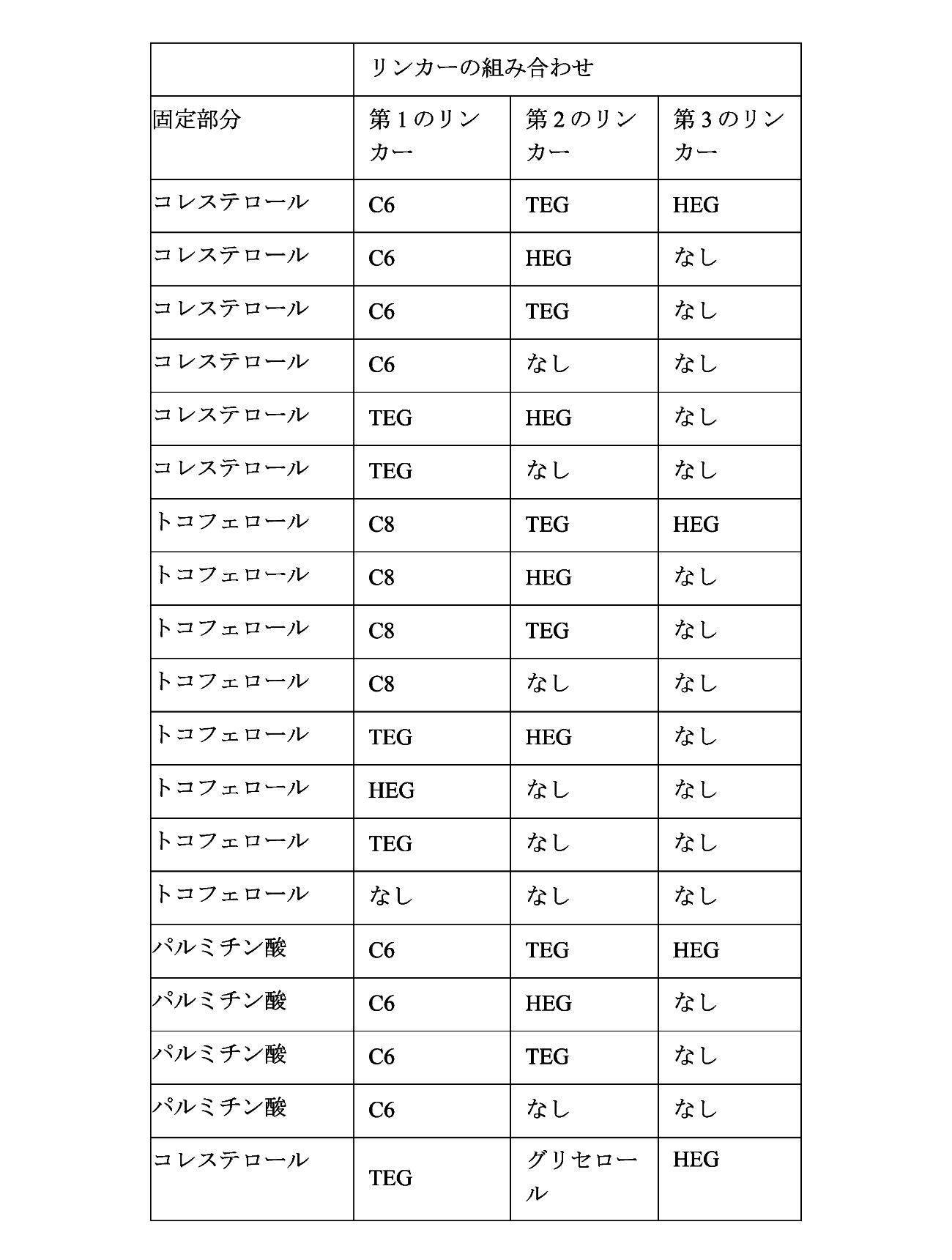

本開示のASOなどの特定のオリゴヌクレオチドを、以下に例示する。
[コレステロール]-[TEG]-[HEG]-[ASO]

[コレステロール]-[SMal]-[Val-Cit]-[pAB]-[ASO]

[コレステロール]-[TEG]-[Val-Cit]-[C6]-[ASO]

[コレステロール]-[TEG]-[SS]-[C6]-[ASO]

式中、[コレステロール]はコレステロール固定部分、[TEG]はTEG非開裂性リンカー、[HEG]はHEG非開裂性リンカー、[SS]はジスルフィド酸化還元開裂性リンカー、[C6]はアルキル非開裂性リンカー、[SMal]はS-マレイミド、[Val-Cit]はバリン-シトルリン開裂性リンカー、[pAB]はpAB自壊牲リンカーである。いくつかの態様では、本開示のASOは、上記に示す例示的な構造に記載の構造を有し、1つ以上の成分が、実施例に示すものと同じクラスの成分によって置き換えられている。例えば、[コレステロール]固定部分を、本明細書に開示する別の固定部分に置換することができ、[TEG]を、本明細書に開示する別の高分子非開裂性リンカー(例えば、HEG、PEG、PG)に置換することができ、[Val-Cit]を、別のペプチダーゼ開裂性リンカーに置き換えることができ、または[pAB]を別の自壊牲リンカーに置き換えることができる。
Specific oligonucleotides such as ASOs of the present disclosure are exemplified below.
[Cholesterol]-[TEG]-[HEG]-[ASO]
[Cholesterol]-[SMal]-[Val-Cit]-[pAB]-[ASO]
[Cholesterol]-[TEG]-[Val-Cit]-[C6]-[ASO]
[Cholesterol]-[TEG]-[SS]-[C6]-[ASO]
where [cholesterol] is cholesterol anchoring moiety, [TEG] is TEG non-cleavable linker, [HEG] is HEG non-cleavable linker, [SS] is disulfide redox cleavable linker, [C6] is alkyl non-cleavable Linker, [SMal] is S-maleimide, [Val-Cit] is valine-citrulline cleavable linker, [pAB] is pAB self-immolative linker. In some aspects, the ASOs of the present disclosure have the structures set forth in the Exemplary Structures shown above, with one or more components replaced by components of the same class shown in the Examples. For example, a [cholesterol] anchoring moiety can be replaced with another anchoring moiety disclosed herein, and [TEG] can be replaced with another polymeric non-cleavable linker disclosed herein (e.g., HEG, PEG, PG), [Val-Cit] can be replaced with another peptidase cleavable linker, or [pAB] can be replaced with another self-immolative linker.
III.B.6. 足場部分
1つ以上の足場部分をEVに発現させることができる。いくつかの態様では、1つ以上の足場部分を使用して、ASOを本開示のEVに固定する。他の態様では、1つ以上の足場部分を使用して、ASOに加えて、タンパク質または分子をEVに固定する。したがって、本開示のEVは、ASOを連結する固定部分、及びタンパク質または分子を連結する足場部分、例えば、標的化部分を含む。いくつかの態様では、ASOを、足場部分に連結する。いくつかの態様では、EVは、複数の足場部分を含む。いくつかの態様では、第1のASOを第1の足場部分に連結し、第2のASOを第2の足場部分に連結する。いくつかの態様では、第1の足場部分と第2の足場部分は同じタイプの足場部分であり、例えば、第1及び第2の足場部分は、いずれもScaffoldXタンパク質である。いくつかの態様では、第1の足場部分と第2の足場部分は異なるタイプの足場部分であり、例えば、第1の足場部分はScaffoldYタンパク質、第2の足場部分はScaffoldXタンパク質である。いくつかの態様では、第1の足場部分は、本明細書に開示するScaffoldYである。いくつかの態様では、第1の足場部分は、本明細書に開示するScaffoldXである。いくつかの態様では、第2の足場部分は、本明細書に開示するScaffoldYである。いくつかの態様では、第2の足場部分は、本明細書に開示するScaffoldXである。
III. B. 6. Scaffolding Moieties One or more scaffolding moieties can be expressed in an EV. In some aspects, one or more scaffold moieties are used to anchor ASOs to EVs of the present disclosure. In other aspects, one or more scaffolding moieties are used to anchor proteins or molecules to EVs in addition to ASOs. Thus, the EVs of the present disclosure include anchoring moieties that link ASOs and scaffolding moieties that link proteins or molecules, eg, targeting moieties. In some aspects, ASOs are linked to scaffold moieties. In some aspects, the EV comprises multiple scaffold moieties. In some aspects, a first ASO is linked to a first scaffold portion and a second ASO is linked to a second scaffold portion. In some aspects, the first scaffolding portion and the second scaffolding portion are the same type of scaffolding portion, eg, the first and second scaffolding portions are both ScaffoldX proteins. In some aspects, the first scaffolding portion and the second scaffolding portion are different types of scaffolding portions, eg, the first scaffolding portion is a ScaffoldY protein and the second scaffolding portion is a ScaffoldX protein. In some aspects, the first scaffolding moiety is ScaffoldY disclosed herein. In some aspects, the first scaffolding moiety is ScaffoldX disclosed herein. In some aspects, the second scaffolding moiety is ScaffoldY disclosed herein. In some aspects, the second scaffolding moiety is ScaffoldX disclosed herein.
いくつかの態様では、EVは、1つ以上の足場部分を含み、これは、ASOをEV(例えばエキソソーム)に(例えば、内腔表面または外面のいずれかに)固定することができる。特定の態様では、足場部分はポリペプチド(「足場タンパク質」)である。特定の態様では、足場タンパク質は、エキソソームタンパク質またはその断片を含む。他の態様では、足場部分は非ポリペプチド部分である。いくつかの態様では、足場タンパク質は、膜貫通タンパク質、内在性タンパク質及び末梢タンパク質などの、エキソソーム膜上で濃縮された様々な膜タンパク質を含む。それらには、様々なCDタンパク質、トランスポーター、インテグリン、レクチン、及びカドヘリンが含まれる。特定の態様では、足場部分(例えば、足場タンパク質)は、ScaffoldXを含む。他の態様では、足場部分(例えば、エキソソームタンパク質)は、ScaffoldYを含む。さらなる態様では、足場部分(例えば、エキソソームタンパク質)は、ScaffoldXとScaffoldYの両方を含む。 In some aspects, the EV comprises one or more scaffolding moieties, which are capable of anchoring the ASO (eg, either to the luminal or external surface) to the EV (eg, exosomes). In certain aspects, the scaffolding moiety is a polypeptide (“scaffolding protein”). In certain aspects, scaffold proteins comprise exosomal proteins or fragments thereof. In other aspects, the scaffolding moiety is a non-polypeptide moiety. In some aspects, the scaffold proteins comprise various membrane proteins enriched on the exosomal membrane, such as transmembrane proteins, endogenous proteins and peripheral proteins. They include various CD proteins, transporters, integrins, lectins, and cadherins. In certain aspects, a scaffolding moiety (eg, a scaffolding protein) comprises ScaffoldX. In other aspects, the scaffolding moiety (eg, exosomal protein) comprises ScaffoldY. In a further aspect, the scaffolding moiety (eg, exosomal protein) comprises both ScaffoldX and ScaffoldY.
III.C.1. ScaffoldX改変EV(例えばエキソソーム)
いくつかの態様では、本開示のEV(例えばエキソソーム)は、その組成が改変された膜を含む。例えば、それらの膜組成は、膜のタンパク質、脂質、またはグリカン含有量を変更することによって改変することができる。
III. C. 1. ScaffoldX modified EVs (e.g. exosomes)
In some aspects, an EV (eg, exosome) of the present disclosure comprises a membrane whose composition has been altered. For example, their membrane composition can be altered by altering the protein, lipid, or glycan content of the membrane.
いくつかの態様では、表面改変EV(例えばエキソソーム)は、PEG誘発融合及び/または超音波融合などの化学的及び/または物理的方法によって生成される。他の態様では、表面改変EV(例えばエキソソーム)を、遺伝子改変によって生成する。遺伝子改変されたプロデューサー細胞または遺伝子改変された細胞の子孫から産生されるEV(例えばエキソソーム)は、改変された膜組成物を含み得る。いくつかの態様では、表面改変EV(例えばエキソソーム)は、より高いもしくはより低い密度(例えば、より高い数)で足場部分(例えば、エキソソームタンパク質、例えば、ScaffoldX)を有するか、または足場部分のバリアントもしくは断片を含む。 In some aspects, surface-modified EVs (eg, exosomes) are produced by chemical and/or physical methods such as PEG-induced fusion and/or ultrasonic fusion. In other aspects, surface-modified EVs (eg, exosomes) are produced by genetic modification. EVs (eg, exosomes) produced from genetically modified producer cells or progeny of genetically modified cells may contain modified membrane compositions. In some aspects, the surface-modified EVs (e.g., exosomes) have scaffolding moieties (e.g., exosomal proteins, e.g., ScaffoldX) at higher or lower densities (e.g., higher numbers) or variants of scaffolding moieties or contain fragments.
例えば、表面(例えば、ScaffoldX)改変EVは、足場部分(例えば、エキソソームタンパク質、例えば、ScaffoldX)またはそのバリアントもしくは断片をコードする外来性配列で形質転換された細胞(例えば、HEK293細胞)から作成することができる。外来性配列から発現する足場部分を含むEVは、改変された膜組成物を含み得る。 For example, surface (e.g., ScaffoldX) modified EVs are generated from cells (e.g., HEK293 cells) transformed with exogenous sequences encoding scaffold moieties (e.g., exosomal proteins, e.g., ScaffoldX) or variants or fragments thereof. be able to. EVs containing scaffolding portions expressed from foreign sequences may contain altered membrane compositions.
足場部分の様々な修飾または断片を、本開示の態様に使用することができる。例えば、結合剤への親和性が増強されるように修飾された足場部分は、結合剤を使用して精製することができる表面改変EVを生成するために使用することができる。EV及び/または膜に、より効果的に標的化するように修飾された足場部分を使用することができる。エキソソーム膜への特異的かつ効果的な標的化に必要な最小限の断片を含むように修飾された足場部分も使用することができる。 Various modifications or fragments of scaffolding moieties can be used in aspects of the present disclosure. For example, scaffold moieties modified to have enhanced affinity for a binding agent can be used to generate surface-modified EVs that can be purified using the binding agent. Scaffold moieties that are modified to more effectively target EVs and/or membranes can be used. Scaffold moieties modified to contain the minimal fragments necessary for specific and effective targeting to exosome membranes can also be used.
足場部分は、融合分子、例えば、ScaffoldXとASOとの融合分子として発現するように改変することができる。例えば、融合分子は、ASOに連結された、本明細書に開示する足場部分(例えば、ScaffoldX、例えば、PTGFRN、BSG、IGSF2、IGSF3、IGSF8、ITGB1、ITGA4、SLC3A2、ATPトランスポーター、またはその断片もしくはバリアント)を含み得る。 A scaffold portion can be modified to be expressed as a fusion molecule, eg, a fusion molecule of ScaffoldX and ASO. For example, the fusion molecule may comprise a scaffold moiety disclosed herein (e.g., ScaffoldX, e.g., PTGFRN, BSG, IGSF2, IGSF3, IGSF8, ITGB1, ITGA4, SLC3A2, ATP transporter, or fragment thereof) linked to an ASO. or variants).
いくつかの態様では、本明細書に記載の表面(例えば、ScaffoldX)改変EVは、当技術分野で公知のEVと比較して優れた特性を示す。例えば、表面(例えば、ScaffoldX)改変されたEVは、天然のEVまたは従来のエキソソームタンパク質を使用して生産されるEVに比べて、表面上により高度に濃縮された修飾タンパク質を含む。さらに、本開示の表面(例えば、ScaffoldX)改変EVは、天然のEVまたは従来のエキソソームタンパク質を使用して生産されるEVに比べて、より大きい、より特異的な、またはより制御された生物活性を有し得る。 In some aspects, the surface (eg, ScaffoldX) modified EVs described herein exhibit superior properties compared to EVs known in the art. For example, surface (eg, ScaffoldX) modified EVs contain modified proteins more highly concentrated on the surface than native EVs or EVs produced using conventional exosomal proteins. Moreover, the surface (e.g., ScaffoldX)-modified EVs of the present disclosure exhibit greater, more specific, or more regulated biological activity compared to native EVs or EVs produced using conventional exosomal proteins. can have
いくつかの態様では、ScaffoldXは、プロスタグランジンF2受容体負レギュレーター(PTGFRNポリペプチド)を含む。PTGFRNタンパク質は、CD9パートナー1(CD9P-1)、Glu-Trp-Ile EWIモチーフ含有タンパク質F(EWI-F)、プロスタグランジンF2α受容体調節タンパク質、プロスタグランジンF2α受容体関連タンパク質、またはCD315とも呼ばれ得る。ヒトPTGFRNタンパク質(Uniprot登録番号Q9P2B2)の全長アミノ酸配列を、配列番号301として表2に示す。PTGFRNポリペプチドは、シグナルペプチド(配列番号301のアミノ酸1~25)、細胞外ドメイン(配列番号301のアミノ酸26~832)、膜貫通ドメイン(配列番号301のアミノ酸833~853)、及び細胞質ドメイン(配列番号301のアミノ酸854~879)を含む。成熟PTGFRNポリペプチドは、シグナルペプチドを含まない配列番号301、すなわち、配列番号301のアミノ酸26~879からなる。いくつかの態様では、本開示に有用なPTGFRNポリペプチド断片は、PTGFRNポリペプチドの膜貫通ドメインを含む。他の態様では、本開示に有用なPTGFRNポリペプチド断片は、PTGFRNポリペプチドの膜貫通ドメイン、及び(i)膜貫通ドメインのN末端の少なくとも5、少なくとも10、少なくとも15、少なくとも20、少なくとも25、少なくとも30、少なくとも40、少なくとも50、少なくとも70、少なくとも80、少なくとも90、少なくとも100、少なくとも110、少なくとも120、少なくとも130、少なくとも140、少なくとも150アミノ酸、(ii)膜貫通ドメインのC末端の少なくとも5、少なくとも10、少なくとも15、少なくとも20、または少なくとも25アミノ酸、または(i)と(ii)の両方を含む。 In some aspects, ScaffoldX comprises a prostaglandin F2 receptor negative regulator (PTGFRN polypeptide). PTGFRN protein is also known as CD9 partner 1 (CD9P-1), Glu-Trp-Ile EWI motif-containing protein F (EWI-F), prostaglandin F2α receptor regulatory protein, prostaglandin F2α receptor associated protein, or CD315. can be called The full-length amino acid sequence of human PTGFRN protein (Uniprot accession number Q9P2B2) is shown in Table 2 as SEQ ID NO:301. The PTGFRN polypeptide comprises a signal peptide (amino acids 1-25 of SEQ ID NO:301), an extracellular domain (amino acids 26-832 of SEQ ID NO:301), a transmembrane domain (amino acids 833-853 of SEQ ID NO:301), and a cytoplasmic domain ( amino acids 854-879 of SEQ ID NO:301). The mature PTGFRN polypeptide consists of SEQ ID NO:301 without the signal peptide, ie, amino acids 26-879 of SEQ ID NO:301. In some aspects, a PTGFRN polypeptide fragment useful for this disclosure comprises a transmembrane domain of a PTGFRN polypeptide. In other aspects, a PTGFRN polypeptide fragment useful for the present disclosure comprises a transmembrane domain of a PTGFRN polypeptide and (i) at least 5, at least 10, at least 15, at least 20, at least 25 N-terminal to the transmembrane domain, at least 30, at least 40, at least 50, at least 70, at least 80, at least 90, at least 100, at least 110, at least 120, at least 130, at least 140, at least 150 amino acids; comprising at least 10, at least 15, at least 20, or at least 25 amino acids, or both (i) and (ii).
いくつかの態様では、PTGFRNポリペプチドの断片は、IgVなどの1つ以上の機能的または構造的ドメインを欠いている。 In some aspects, the PTGFRN polypeptide fragment lacks one or more functional or structural domains, such as IgV.
他の態様では、ScaffoldXは、配列番号301のアミノ酸26~879と、少なくとも約70%、少なくとも約75%、少なくとも約80%、少なくとも約85%、少なくとも約90%、少なくとも約95%、少なくとも約96%、少なくとも約97%、少なくとも約98%、少なくとも約99%、または約100%同一であるアミノ酸配列を含む。他の態様では、ScaffoldXは、配列番号302と、少なくとも約70%、少なくとも約75%、少なくとも約80%、少なくとも約85%、少なくとも約90%、少なくとも約95%、少なくとも約96%、少なくとも約97%、少なくとも約98%、少なくとも約99%、または約100%同一であるアミノ酸配列を含む。他の態様では、ScaffoldXは、1つのアミノ酸変異、2つのアミノ酸変異、3つのアミノ酸変異、4つのアミノ酸変異、5つのアミノ酸変異、6つのアミノ酸変異、または7つのアミノ酸変異を除いて、配列番号302のアミノ酸配列を含む。変異は、置換、挿入、欠失、またはそれらの任意の組み合わせであり得る。いくつかの態様では、ScaffoldXは、配列番号302のアミノ酸配列、及び配列番号302のN末端及び/またはC末端の1アミノ酸、2アミノ酸、3アミノ酸、4アミノ酸、5アミノ酸、6アミノ酸、7アミノ酸、8アミノ酸、9アミノ酸、10アミノ酸、11アミノ酸、12アミノ酸、13アミノ酸、14アミノ酸、15アミノ酸、16アミノ酸、17アミノ酸、18アミノ酸、19アミノ酸、もしくは20アミノ酸またはそれ以上を含む。
In other aspects, ScaffoldX is at least about 70%, at least about 75%, at least about 80%, at least about 85%, at least about 90%, at least about 95%, at least about It includes amino acid sequences that are 96%, at least about 97%, at least about 98%, at least about 99%, or about 100% identical. In other aspects, ScaffoldX is at least about 70%, at least about 75%, at least about 80%, at least about 85%, at least about 90%, at least about 95%, at least about 96%, at least about It includes amino acid sequences that are 97%, at least about 98%, at least about 99%, or about 100% identical. In other aspects, ScaffoldX is SEQ ID NO: 302, except for 1 amino acid mutation, 2 amino acid mutations, 3 amino acid mutations, 4 amino acid mutations, 5 amino acid mutations, 6 amino acid mutations, or 7 amino acid mutations. containing the amino acid sequence of Mutations can be substitutions, insertions, deletions, or any combination thereof. In some aspects, ScaffoldX is the amino acid sequence of SEQ ID NO:302 and the N-terminal and/or C-
他の態様では、ScaffoldXは、配列番号301、302、303、304、305、306、307、308、309、310、311、312、313、314、315、316、317、または318と、少なくとも約70%、少なくとも約75%、少なくとも約80%、少なくとも約85%、少なくとも約90%、少なくとも約95%、少なくとも約96%、少なくとも約97%、少なくとも約98%、少なくとも約99%、または約100%同一であるアミノ酸配列を含む。他の態様では、ScaffoldXは、1つのアミノ酸変異、2つのアミノ酸変異、3つのアミノ酸変異、4つのアミノ酸変異、5つのアミノ酸変異、6つのアミノ酸変異、または7つのアミノ酸変異を除いて、配列番号301、302、303、304、305、306、307、308、309、310、311、312、313、314、315、316、317、または318のアミノ酸配列を含む。変異は、置換、挿入、欠失、またはそれらの任意の組み合わせであり得る。いくつかの態様では、ScaffoldXは、配列番号301、302、303、304、305、306、307、308、309、310、311、312、313、314、315、316、317、または318のアミノ酸配列、及び配列番号301、302、303、304、305、306、307、308、309、310、311、312、313、314、315、316、317、または318のN末端及び/またはC末端の1アミノ酸、2アミノ酸、3アミノ酸、4アミノ酸、5アミノ酸、6アミノ酸、7アミノ酸、8アミノ酸を含む。、9アミノ酸、10アミノ酸、11アミノ酸、12アミノ酸、13アミノ酸、14アミノ酸、15アミノ酸、16アミノ酸、17アミノ酸、18アミノ酸、19アミノ酸、もしくは20アミノ酸またはそれ以上を含む。
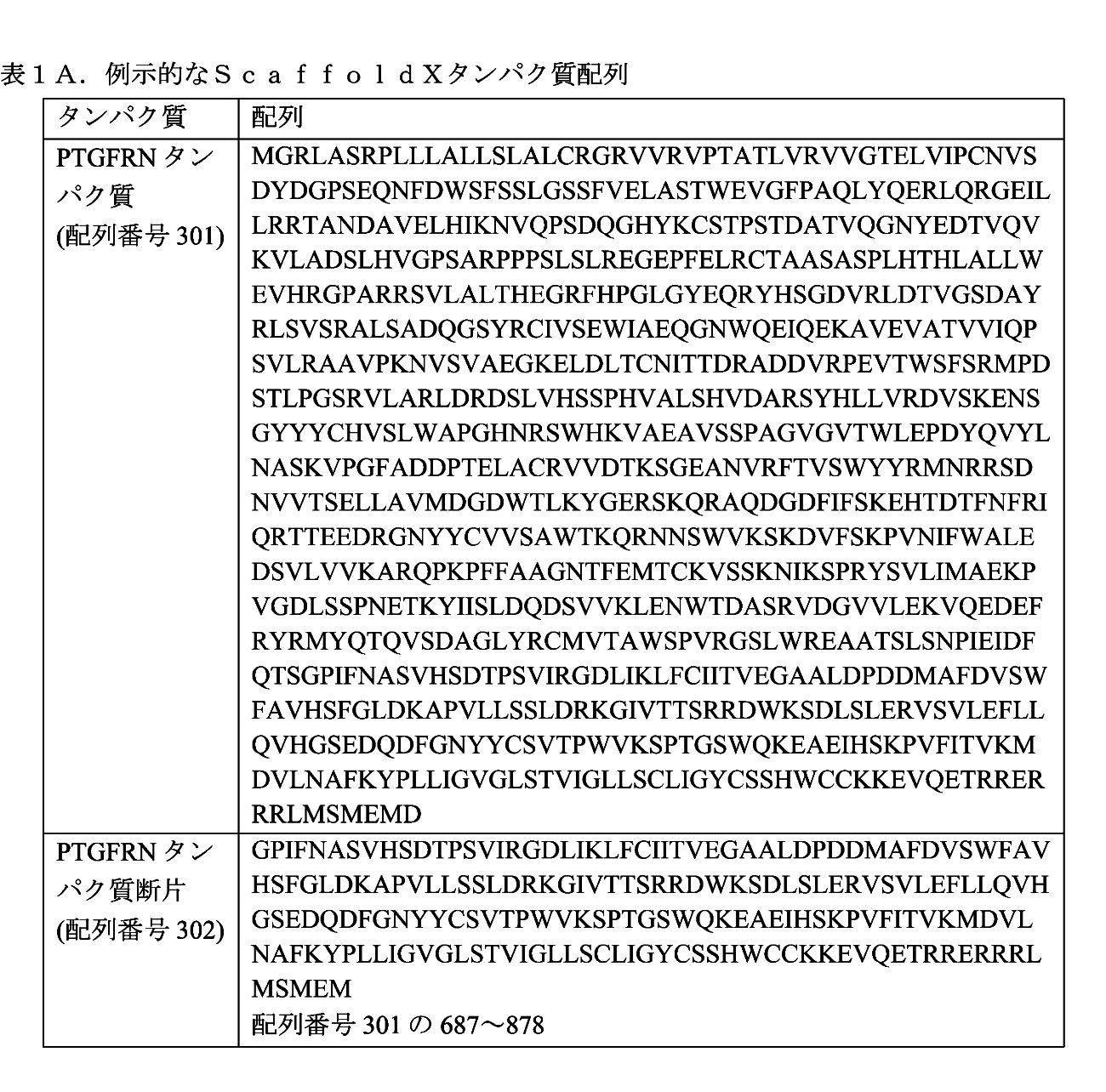
他の態様では、ScaffoldXは、配列番号319、320、321、322、323、323、または325と、少なくとも約70%、少なくとも約75%、少なくとも約80%、少なくとも約85%、少なくとも約90%、少なくとも約95%、少なくとも約96%、少なくとも約97%、少なくとも約98%、少なくとも約99%、または約100%同一であるアミノ酸配列を含む。他の態様では、ScaffoldXは、1つのアミノ酸変異、2つのアミノ酸変異、3つのアミノ酸変異、4つのアミノ酸変異、5つのアミノ酸変異、6つのアミノ酸変異、または7つのアミノ酸変異を除いて、配列番号319、320、321、322、323、323、または325のアミノ酸配列を含む。変異は、置換、挿入、欠失、またはそれらの任意の組み合わせであり得る。いくつかの態様では、ScaffoldXは、配列番号319、320、321、322、323、323、または325のアミノ酸配列、及び配列番号319、320、321、322、323、323、または325のN末端及び/またはC末端の1アミノ酸、2アミノ酸、3アミノ酸、4アミノ酸、5アミノ酸、6アミノ酸、7アミノ酸、8アミノ酸を含む。、9アミノ酸、10アミノ酸、11アミノ酸、12アミノ酸、13アミノ酸、14アミノ酸、15アミノ酸、16アミノ酸、17アミノ酸、18アミノ酸、19アミノ酸、もしくは20アミノ酸またはそれ以上を含む。

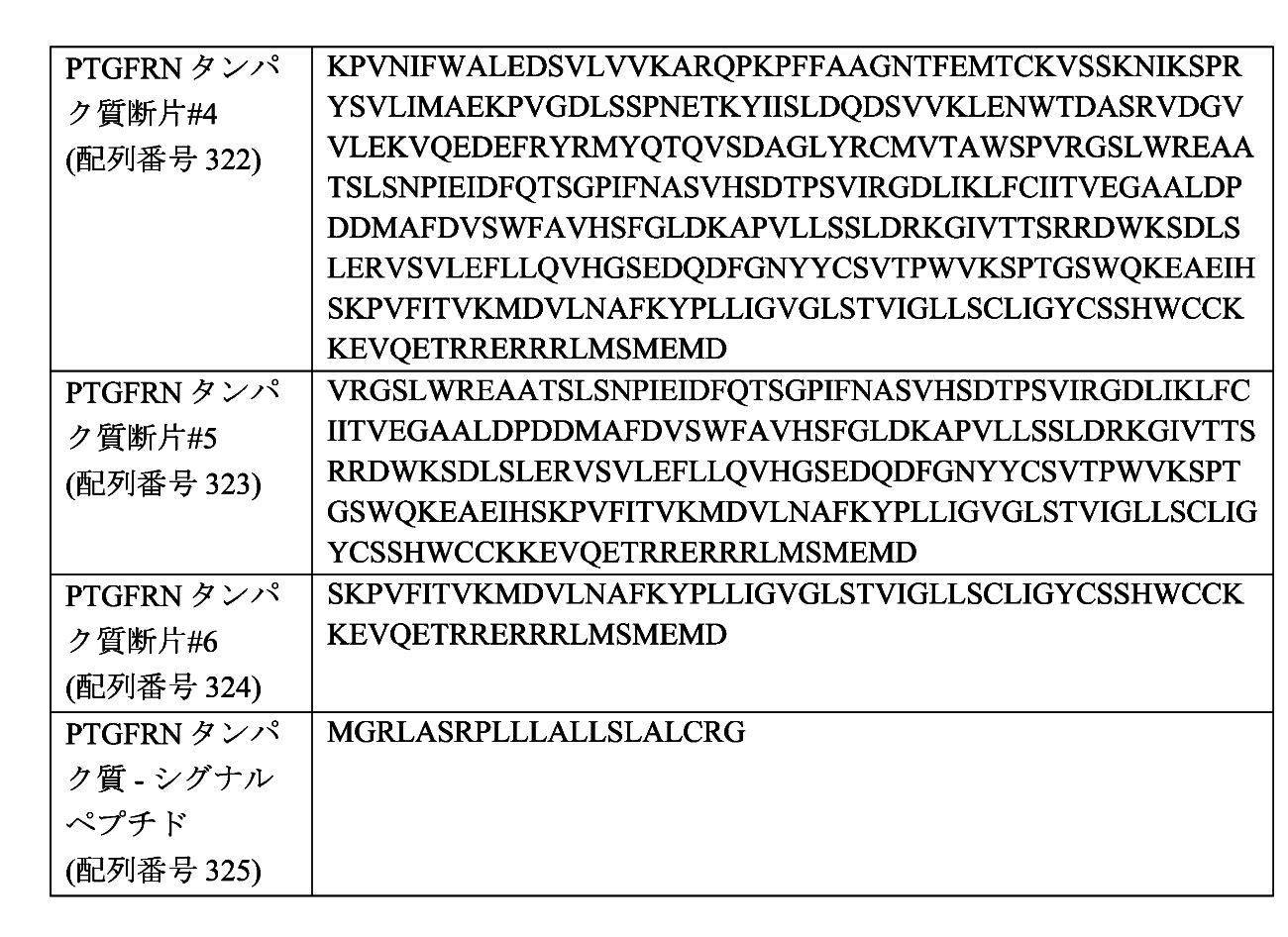
いくつかの態様では、ScaffoldXは、配列番号303によって表されるベイシジン(BSGタンパク質)を含む。BSGタンパク質は、5F7、コラゲナーゼ刺激因子、細胞外マトリックスメタロプロテイナーゼインデューサー(EMMPRIN)、白血球活性化抗原M6、OK血液型抗原、腫瘍細胞由来コラゲナーゼ刺激因子(TCSF)、またはCD147としても知られる。ヒトBSGタンパク質のUniprot番号はP35613である。BSGタンパク質のシグナルペプチドは、配列番号303のアミノ酸1~21である。配列番号303のアミノ酸138~323は細胞外ドメインであり、アミノ酸324~344は膜貫通ドメインであり、配列番号303のアミノ酸345~385は細胞質ドメインである。 In some aspects, ScaffoldX comprises Basidin (BSG protein) represented by SEQ ID NO:303. The BSG protein is also known as 5F7, collagenase stimulating factor, extracellular matrix metalloproteinase inducer (EMMPRIN), leukocyte activation antigen M6, OK blood group antigen, tumor cell derived collagenase stimulating factor (TCSF), or CD147. The Uniprot number for the human BSG protein is P35613. The signal peptide of the BSG protein is amino acids 1-21 of SEQ ID NO:303. Amino acids 138-323 of SEQ ID NO:303 are the extracellular domain, amino acids 324-344 are the transmembrane domain, and amino acids 345-385 of SEQ ID NO:303 are the cytoplasmic domain.
他の態様では、ScaffoldXは、配列番号303のアミノ酸22~385と、少なくとも約70%、少なくとも約75%、少なくとも約80%、少なくとも約85%、少なくとも約90%、少なくとも約95%、少なくとも約96%、少なくとも約97%、少なくとも約98%、少なくとも約99%、または約100%同一であるアミノ酸配列を含む。いくつかの態様では、BSGポリペプチドの断片は、IgV、例えば、配列番号303のアミノ酸221~315などの1つ以上の機能的または構造的ドメインを欠いている。他の態様では、ScaffoldXは、配列番号326、327、または328と、少なくとも約70%、少なくとも約75%、少なくとも約80%、少なくとも約85%、少なくとも約90%、少なくとも約95%、少なくとも約96%、少なくとも約97%、少なくとも約98%、少なくとも約99%、または約100%同一であるアミノ酸配列を含む。他の態様では、ScaffoldXは、1つのアミノ酸変異、2つのアミノ酸変異、3つのアミノ酸変異、4つのアミノ酸変異、5つのアミノ酸変異、6つのアミノ酸変異、または7つのアミノ酸変異を除いて、配列番号326、327、または328のアミノ酸配列を含む。変異は、置換、挿入、欠失、またはそれらの任意の組み合わせであり得る。いくつかの態様では、ScaffoldXは、配列番号326、327、または328のアミノ酸配列、及び配列番号326、327、または328のN末端及び/またはC末端の1アミノ酸、2アミノ酸、3アミノ酸、4アミノ酸、5アミノ酸、6アミノ酸、7アミノ酸、8アミノ酸を含む。、9アミノ酸、10アミノ酸、11アミノ酸、12アミノ酸、13アミノ酸、14アミノ酸、15アミノ酸、16アミノ酸、17アミノ酸、18アミノ酸、19アミノ酸、もしくは20アミノ酸またはそれ以上を含む。
In other aspects, ScaffoldX is at least about 70%, at least about 75%, at least about 80%, at least about 85%, at least about 90%, at least about 95%, at least about It includes amino acid sequences that are 96%, at least about 97%, at least about 98%, at least about 99%, or about 100% identical. In some aspects, the BSG polypeptide fragment lacks one or more functional or structural domains such as IgV, eg, amino acids 221-315 of SEQ ID NO:303. In other aspects, ScaffoldX is at least about 70%, at least about 75%, at least about 80%, at least about 85%, at least about 90%, at least about 95%, at least about It includes amino acid sequences that are 96%, at least about 97%, at least about 98%, at least about 99%, or about 100% identical. In other aspects, ScaffoldX is SEQ ID NO: 326, except for 1 amino acid mutation, 2 amino acid mutations, 3 amino acid mutations, 4 amino acid mutations, 5 amino acid mutations, 6 amino acid mutations, or 7 amino acid mutations. , 327, or 328 amino acid sequences. Mutations can be substitutions, insertions, deletions, or any combination thereof. In some aspects, ScaffoldX is the amino acid sequence of SEQ ID NO: 326, 327, or 328, and the N-terminal and/or C-
いくつかの態様では、ScaffoldXは、免疫グロブリンスーパーファミリーメンバー8(IgSF8またはIGSF8タンパク質)を含み、これは、CD81パートナー3、Glu-Trp-Ile EWIモチーフ含有タンパク質2(EWI-2)、ケラチノサイト関連膜貫通タンパク質4(KCT-4)、LIR-D1、プロスタグランジン調節様タンパク質(PGRL)またはCD316としても知られる。全長のヒトIGSF8タンパク質は、Uniprotの登録番号Q969P0であり、本明細書中では配列番号304として示す。ヒトIGSF8タンパク質は、シグナルペプチド(配列番号304のアミノ酸1~27)、細胞外ドメイン(配列番号304のアミノ酸28~579)、膜貫通ドメイン(配列番号304のアミノ酸580~600)、及び細胞質ドメイン(配列番号304のアミノ酸601~613)を有する。
In some aspects, ScaffoldX comprises immunoglobulin superfamily member 8 (IgSF8 or IGSF8 protein), which includes
他の態様では、ScaffoldXは、配列番号304のアミノ酸28~613と、少なくとも約70%、少なくとも約75%、少なくとも約80%、少なくとも約85%、少なくとも約90%、少なくとも約95%、少なくとも約96%、少なくとも約97%、少なくとも約98%、少なくとも約99%、または約100%同一であるアミノ酸配列を含む。いくつかの態様では、IGSF8タンパク質は、IgVなどの1つ以上の機能的または構造的ドメインを欠いている。他の態様では、ScaffoldXは、配列番号330、331、332、または333と、少なくとも約70%、少なくとも約75%、少なくとも約80%、少なくとも約85%、少なくとも約90%、少なくとも約95%、少なくとも約96%、少なくとも約97%、少なくとも約98%、少なくとも約99%、または約100%同一であるアミノ酸配列を含む。他の態様では、ScaffoldXは、1つのアミノ酸変異、2つのアミノ酸変異、3つのアミノ酸変異、4つのアミノ酸変異、5つのアミノ酸変異、6つのアミノ酸変異、または7つのアミノ酸変異を除いて、配列番号330、331、332、または333のアミノ酸配列を含む。変異は、置換、挿入、欠失、またはそれらの任意の組み合わせであり得る。いくつかの態様では、ScaffoldXは、配列番号330、331、332、または333のアミノ酸配列、及び配列番号330、331、332、または333のN末端及び/またはC末端の1アミノ酸、2アミノ酸、3アミノ酸、4アミノ酸、5アミノ酸、6アミノ酸、7アミノ酸、8アミノ酸を含む。、9アミノ酸、10アミノ酸、11アミノ酸、12アミノ酸、13アミノ酸、14アミノ酸、15アミノ酸、16アミノ酸、17アミノ酸、18アミノ酸、19アミノ酸、もしくは20アミノ酸またはそれ以上を含む。
In other aspects, ScaffoldX is at least about 70%, at least about 75%, at least about 80%, at least about 85%, at least about 90%, at least about 95%, at least about It includes amino acid sequences that are 96%, at least about 97%, at least about 98%, at least about 99%, or about 100% identical. In some aspects, the IGSF8 protein lacks one or more functional or structural domains, such as IgV. In other aspects, ScaffoldX is at least about 70%, at least about 75%, at least about 80%, at least about 85%, at least about 90%, at least about 95% with SEQ ID NO: 330, 331, 332, or 333, It includes amino acid sequences that are at least about 96%, at least about 97%, at least about 98%, at least about 99%, or about 100% identical. In other aspects, ScaffoldX is SEQ ID NO: 330, excluding 1 amino acid mutation, 2 amino acid mutations, 3 amino acid mutations, 4 amino acid mutations, 5 amino acid mutations, 6 amino acid mutations, or 7 amino acid mutations. , 331, 332, or 333 amino acid sequences. Mutations can be substitutions, insertions, deletions, or any combination thereof. In some aspects, ScaffoldX is the amino acid sequence of SEQ ID NO: 330, 331, 332, or 333, and the N-terminal and/or C-
いくつかの態様では、本開示のScaffoldXは、Glu-Trp-Ile EWIモチーフ含有タンパク質3(EWI-3)としても知られる免疫グロブリンスーパーファミリーメンバー3(IgSF3またはIGSF3タンパク質)を含み、配列番号309のアミノ酸配列として示される。ヒトIGSF3タンパク質は、シグナルペプチド(配列番号309のアミノ酸1~19)、細胞外ドメイン(配列番号309のアミノ酸20~1124)、膜貫通ドメイン(配列番号309のアミノ酸1125~1145)、及び細胞質ドメイン(配列番号309のアミノ酸1146~1194)を有する。 In some aspects, the ScaffoldX of the present disclosure comprises Immunoglobulin superfamily member 3 (IgSF3 or IGSF3 protein), also known as Glu-Trp-Ile EWI motif-containing protein 3 (EWI-3), comprising SEQ ID NO:309 It is shown as an amino acid sequence. The human IGSF3 protein comprises a signal peptide (amino acids 1-19 of SEQ ID NO:309), an extracellular domain (amino acids 20-1124 of SEQ ID NO:309), a transmembrane domain (amino acids 1125-1145 of SEQ ID NO:309), and a cytoplasmic domain ( amino acids 1146-1194 of SEQ ID NO:309).
他の態様では、ScaffoldXは、配列番号309のアミノ酸28~613と、少なくとも約70%、少なくとも約75%、少なくとも約80%、少なくとも約85%、少なくとも約90%、少なくとも約95%、少なくとも約96%、少なくとも約97%、少なくとも約98%、少なくとも約99%、または約100%同一であるアミノ酸配列を含む。いくつかの態様では、IGSF3タンパク質は、1つ以上の機能ドメインまたは構造ドメイン、例えば、IgVを欠失している。 In other aspects, ScaffoldX is at least about 70%, at least about 75%, at least about 80%, at least about 85%, at least about 90%, at least about 95%, at least about It includes amino acid sequences that are 96%, at least about 97%, at least about 98%, at least about 99%, or about 100% identical. In some aspects, the IGSF3 protein lacks one or more functional or structural domains, eg, IgV.
いくつかの態様では、本開示のためのScaffoldXは、インテグリンβ1(ITGB1タンパク質)(フィブロネクチン受容体サブユニットβ、糖タンパク質IIa(GPIIA)、VLA-4サブユニットβ、またはCD29としても知られ、配列番号305のアミノ酸配列として示される)を含む。ヒトITGB1タンパク質は、シグナルペプチド(配列番号305のアミノ酸1~20)、細胞外ドメイン(配列番号305のアミノ酸21~728)、膜貫通ドメイン(配列番号305のアミノ酸729~751)、及び細胞質ドメイン(配列番号305のアミノ酸752~798)を有する。 In some aspects, ScaffoldX for the purposes of this disclosure is integrin β1 (ITGB1 protein) (also known as fibronectin receptor subunit β, glycoprotein IIa (GPIIA), VLA-4 subunit β, or CD29, having the sequence shown as the amino acid sequence numbered 305). The human ITGB1 protein comprises a signal peptide (amino acids 1-20 of SEQ ID NO:305), an extracellular domain (amino acids 21-728 of SEQ ID NO:305), a transmembrane domain (amino acids 729-751 of SEQ ID NO:305), and a cytoplasmic domain ( amino acids 752-798 of SEQ ID NO:305).
他の態様では、ScaffoldXは、配列番号305のアミノ酸21~798と、少なくとも約70%、少なくとも約75%、少なくとも約80%、少なくとも約85%、少なくとも約90%、少なくとも約95%、少なくとも約96%、少なくとも約97%、少なくとも約98%、少なくとも約99%、または約100%同一であるアミノ酸配列を含む。いくつかの態様では、ITGB1タンパク質は、1つ以上の機能ドメインまたは構造ドメイン、例えば、IgVを欠失している。 In other aspects, ScaffoldX is at least about 70%, at least about 75%, at least about 80%, at least about 85%, at least about 90%, at least about 95%, at least about It includes amino acid sequences that are 96%, at least about 97%, at least about 98%, at least about 99%, or about 100% identical. In some aspects, the ITGB1 protein lacks one or more functional or structural domains, eg, IgV.
他の態様では、ScaffoldXは、シグナルペプチド(配列番号306のアミノ酸1~33)を含まない配列番号306と、少なくとも約70%、少なくとも約75%、少なくとも約80%、少なくとも約85%、少なくとも約90%、少なくとも約95%、少なくとも約96%、少なくとも約97%、少なくとも約98%、少なくとも約99%、または約100%同一であるアミノ酸配列を有するITGA4タンパク質を含む。いくつかの態様では、ITGA4タンパク質は、1つ以上の機能的または構造的ドメイン、例えば、IgVを欠失している。 In other aspects, ScaffoldX is at least about 70%, at least about 75%, at least about 80%, at least about 85%, at least about ITGA4 proteins having amino acid sequences that are 90%, at least about 95%, at least about 96%, at least about 97%, at least about 98%, at least about 99%, or about 100% identical. In some aspects, the ITGA4 protein lacks one or more functional or structural domains, eg, IgV.
他の態様では、ScaffoldXは、シグナルペプチドを含まない配列番号307と、少なくとも約70%、少なくとも約75%、少なくとも約80%、少なくとも約85%、少なくとも約90%、少なくとも約95%、少なくとも約96%、少なくとも約97%、少なくとも約98%、少なくとも約99%、または約100%同一であるアミノ酸配列を有するSLC3A2タンパク質を含む。いくつかの態様では、SLC3A2タンパク質は、1つ以上の機能的または構造的ドメイン、例えば、IgVを欠失している。 In other aspects, ScaffoldX is at least about 70%, at least about 75%, at least about 80%, at least about 85%, at least about 90%, at least about 95%, at least about SLC3A2 proteins having amino acid sequences that are 96%, at least about 97%, at least about 98%, at least about 99%, or about 100% identical. In some aspects, the SLC3A2 protein lacks one or more functional or structural domains, eg, IgV.
他の態様では、ScaffoldXは、シグナルペプチドを含まない配列番号310と、少なくとも約70%、少なくとも約75%、少なくとも約80%、少なくとも約85%、少なくとも約90%、少なくとも約95%、少なくとも約96%、少なくとも約97%、少なくとも約98%、少なくとも約99%、または約100%同一であるアミノ酸配列を有するATP1A1タンパク質を含む。いくつかの態様では、ATP1A1タンパク質は、1つ以上の機能的または構造的ドメイン、例えば、IgVを欠失している。 In other aspects, ScaffoldX is at least about 70%, at least about 75%, at least about 80%, at least about 85%, at least about 90%, at least about 95%, at least about ATP1A1 proteins having amino acid sequences that are 96%, at least about 97%, at least about 98%, at least about 99%, or about 100% identical. In some aspects, the ATP1A1 protein lacks one or more functional or structural domains, eg, IgV.
他の態様では、ScaffoldXは、シグナルペプチドを含まない配列番号311と、少なくとも約70%、少なくとも約75%、少なくとも約80%、少なくとも約85%、少なくとも約90%、少なくとも約95%、少なくとも約96%、少なくとも約97%、少なくとも約98%、少なくとも約99%、または約100%同一であるアミノ酸配列を有するATP1A2タンパク質を含む。いくつかの態様では、ATP1A2タンパク質は、1つ以上の機能的または構造的ドメイン、例えば、IgVを欠失している。 In other aspects, ScaffoldX is at least about 70%, at least about 75%, at least about 80%, at least about 85%, at least about 90%, at least about 95%, at least about ATP1A2 proteins having amino acid sequences that are 96%, at least about 97%, at least about 98%, at least about 99%, or about 100% identical. In some aspects, the ATP1A2 protein lacks one or more functional or structural domains, eg, IgV.
他の態様では、ScaffoldXは、シグナルペプチドを含まない配列番号312と、少なくとも約70%、少なくとも約75%、少なくとも約80%、少なくとも約85%、少なくとも約90%、少なくとも約95%、少なくとも約96%、少なくとも約97%、少なくとも約98%、少なくとも約99%、または約100%同一であるアミノ酸配列を有するATP1A3タンパク質を含む。いくつかの態様では、ATP1A3タンパク質は、1つ以上の機能的または構造的ドメイン、例えば、IgVを欠失している。 In other aspects, ScaffoldX is at least about 70%, at least about 75%, at least about 80%, at least about 85%, at least about 90%, at least about 95%, at least about ATP1A3 proteins having amino acid sequences that are 96%, at least about 97%, at least about 98%, at least about 99%, or about 100% identical. In some aspects, the ATP1A3 protein lacks one or more functional or structural domains, eg, IgV.
他の態様では、ScaffoldXは、シグナルペプチドを含まない配列番号313と、少なくとも約70%、少なくとも約75%、少なくとも約80%、少なくとも約85%、少なくとも約90%、少なくとも約95%、少なくとも約96%、少なくとも約97%、少なくとも約98%、少なくとも約99%、または約100%同一であるアミノ酸配列を有するATP1A4タンパク質を含む。いくつかの態様では、ATP1A4タンパク質は、1つ以上の機能的または構造的ドメイン、例えば、IgVを欠失している。 In other aspects, ScaffoldX is combined with SEQ ID NO:313 without a signal peptide at least about 70%, at least about 75%, at least about 80%, at least about 85%, at least about 90%, at least about 95%, at least about ATP1A4 proteins having amino acid sequences that are 96%, at least about 97%, at least about 98%, at least about 99%, or about 100% identical. In some aspects, the ATP1A4 protein lacks one or more functional or structural domains, eg, IgV.
他の態様では、ScaffoldXは、シグナルペプチドを含まない配列番号314と、少なくとも約70%、少なくとも約75%、少なくとも約80%、少なくとも約85%、少なくとも約90%、少なくとも約95%、少なくとも約96%、少なくとも約97%、少なくとも約98%、少なくとも約99%、または約100%同一であるアミノ酸配列を有するATP2B1タンパク質を含む。いくつかの態様では、ATP2B1タンパク質は、1つ以上の機能的または構造的ドメイン、例えば、IgVを欠失している。 In other aspects, ScaffoldX is at least about 70%, at least about 75%, at least about 80%, at least about 85%, at least about 90%, at least about 95%, at least about ATP2B1 proteins having amino acid sequences that are 96%, at least about 97%, at least about 98%, at least about 99%, or about 100% identical. In some aspects, the ATP2B1 protein lacks one or more functional or structural domains, eg, IgV.
他の態様では、ScaffoldXは、シグナルペプチドを含まない配列番号315と、少なくとも約70%、少なくとも約75%、少なくとも約80%、少なくとも約85%、少なくとも約90%、少なくとも約95%、少なくとも約96%、少なくとも約97%、少なくとも約98%、少なくとも約99%、または約100%同一であるアミノ酸配列を有するATP2B2タンパク質を含む。いくつかの態様では、ATP2B2タンパク質は、1つ以上の機能的または構造的ドメイン、例えば、IgVを欠失している。 In other aspects, ScaffoldX is at least about 70%, at least about 75%, at least about 80%, at least about 85%, at least about 90%, at least about 95%, at least about ATP2B2 proteins having amino acid sequences that are 96%, at least about 97%, at least about 98%, at least about 99%, or about 100% identical. In some aspects, the ATP2B2 protein lacks one or more functional or structural domains, eg, IgV.
他の態様では、ScaffoldXは、シグナルペプチドを含まない配列番号316と、少なくとも約70%、少なくとも約75%、少なくとも約80%、少なくとも約85%、少なくとも約90%、少なくとも約95%、少なくとも約96%、少なくとも約97%、少なくとも約98%、少なくとも約99%、または約100%同一であるアミノ酸配列を有するATP2B3タンパク質を含む。いくつかの態様では、ATP2B3タンパク質は、1つ以上の機能的または構造的ドメイン、例えば、IgVを欠失している。 In other aspects, ScaffoldX is at least about 70%, at least about 75%, at least about 80%, at least about 85%, at least about 90%, at least about 95%, at least about ATP2B3 proteins having amino acid sequences that are 96%, at least about 97%, at least about 98%, at least about 99%, or about 100% identical. In some aspects, the ATP2B3 protein lacks one or more functional or structural domains, eg, IgV.
他の態様では、ScaffoldXは、シグナルペプチドを含まない配列番号317と、少なくとも約70%、少なくとも約75%、少なくとも約80%、少なくとも約85%、少なくとも約90%、少なくとも約95%、少なくとも約96%、少なくとも約97%、少なくとも約98%、少なくとも約99%、または約100%同一であるアミノ酸配列を有するATP2B4タンパク質を含む。いくつかの態様では、ATP2B4タンパク質は、1つ以上の機能的または構造的ドメイン、例えば、IgVを欠失している。 In other aspects, ScaffoldX is combined with SEQ ID NO: 317 without a signal peptide at least about 70%, at least about 75%, at least about 80%, at least about 85%, at least about 90%, at least about 95%, at least about ATP2B4 proteins having amino acid sequences that are 96%, at least about 97%, at least about 98%, at least about 99%, or about 100% identical. In some aspects, the ATP2B4 protein lacks one or more functional or structural domains, eg, IgV.
他の態様では、ScaffoldXは、シグナルペプチドを含まない配列番号318と、少なくとも約70%、少なくとも約75%、少なくとも約80%、少なくとも約85%、少なくとも約90%、少なくとも約95%、少なくとも約96%、少なくとも約97%、少なくとも約98%、少なくとも約99%、または約100%同一であるアミノ酸配列を有するIGSF2タンパク質を含む。いくつかの態様では、IGSF2タンパク質は、1つ以上の機能的または構造的ドメイン、例えば、IgVを欠失している。 In other aspects, ScaffoldX is at least about 70%, at least about 75%, at least about 80%, at least about 85%, at least about 90%, at least about 95%, at least about IGSF2 proteins having amino acid sequences that are 96%, at least about 97%, at least about 98%, at least about 99%, or about 100% identical. In some aspects, the IGSF2 protein lacks one or more functional or structural domains, eg, IgV.
他のScaffoldXタンパク質の非限定的な例は、2019年2月5日に発行された米国特許第US10195290B1号に記載されており、その全体が参照により援用される。 Other non-limiting examples of ScaffoldX proteins are described in US Pat. No. US10195290B1, issued Feb. 5, 2019, which is incorporated by reference in its entirety.
いくつかの態様では、配列は、天然タンパク質のN末端から少なくとも5、10、50、100、200、300、400、500、600、700、または800アミノ酸を欠く足場部分の断片をコードする。いくつかの態様では、配列は、天然タンパク質のC末端から少なくとも5、10、50、100、200、300、400、500、600、700、または800アミノ酸を欠く足場部分の断片をコードする。いくつかの態様では、配列は、天然タンパク質のN末端とC末端の両方から少なくとも5、10、50、100、200、300、400、500、600、700、または800アミノ酸を欠く足場部分の断片をコードする。いくつかの態様では、配列は、天然タンパク質の1つ以上の機能的または構造的ドメインを欠く足場部分の断片をコードする。 In some aspects, the sequence encodes a fragment of the scaffold portion that lacks at least 5, 10, 50, 100, 200, 300, 400, 500, 600, 700, or 800 amino acids from the N-terminus of the native protein. In some aspects, the sequence encodes a fragment of the scaffold portion that lacks at least 5, 10, 50, 100, 200, 300, 400, 500, 600, 700, or 800 amino acids from the C-terminus of the native protein. In some aspects, the sequence is a fragment of the scaffold portion lacking at least 5, 10, 50, 100, 200, 300, 400, 500, 600, 700, or 800 amino acids from both the N-terminus and the C-terminus of the native protein. code the In some aspects, the sequences encode fragments of the scaffold portion that lack one or more functional or structural domains of the native protein.
いくつかの態様では、足場部分、例えば、ScaffoldX、例えば、PTGFRNタンパク質を、1つ以上の異種タンパク質に連結する。1つ以上の異種タンパク質を、足場部分のN末端に連結することができる。1つ以上の異種タンパク質を、足場部分のC末端に連結することができる。いくつかの態様では、1つ以上の異種タンパク質を、足場部分のN末端とC末端の両方に連結する。いくつかの態様では、異種タンパク質は哺乳類タンパク質である。いくつかの態様では、異種タンパク質はヒトタンパク質である。 In some aspects, a scaffolding moiety, eg, ScaffoldX, eg, a PTGFRN protein, is linked to one or more heterologous proteins. One or more heterologous proteins can be linked to the N-terminus of the scaffold portion. One or more heterologous proteins can be attached to the C-terminus of the scaffold portion. In some aspects, one or more heterologous proteins are linked to both the N-terminus and the C-terminus of the scaffold portion. In some aspects, the heterologous protein is a mammalian protein. In some aspects, the heterologous protein is a human protein.
いくつかの態様では、ScaffoldXを使用して、任意の部分、例えば、ASOを、内腔表面及びEV(例えばエキソソーム)の外面に同時に連結することができる。例えば、PTGFRNポリペプチドを使用して、EV(例えば、エキソソーム)の外面に加えて、内腔内部(例えば、内腔表面)のASOを連結することができる。したがって、特定の態様では、ScaffoldXは、例えば、内腔表面上のASO及びEV(例えばエキソソーム)の外面上のASOの二重の目的に使用することができる。いくつかの態様では、ScaffoldXは、EVの内腔表面上及び/またはEVの外面上にASOを固定することができる足場タンパク質である。 In some aspects, ScaffoldX can be used to simultaneously link any moiety, eg, an ASO, to the luminal surface and the outer surface of an EV (eg, exosome). For example, PTGFRN polypeptides can be used to link ASOs inside the lumen (eg, the luminal surface) in addition to the outer surface of an EV (eg, exosomes). Thus, in certain aspects, ScaffoldX can be used for dual purposes, eg, ASO on the luminal surface and ASO on the outer surface of EVs (eg, exosomes). In some aspects, ScaffoldX is a scaffolding protein capable of anchoring ASOs on the luminal surface of an EV and/or on the outer surface of an EV.
III.C.2. ScaffoldY改変EV(例えばエキソソーム)
いくつかの態様では、本開示のEV(例えばエキソソーム)は、天然のEV(例えばエキソソーム)とは異なる内部空間(すなわち、内腔)を含む。例えば、EV(例えばエキソソーム)の内腔表面の組成が、天然のエキソソームの組成とは異なるタンパク質、脂質、またはグリカン含有量を有するように、EVを変化させることができる。
III. C. 2. ScaffoldY modified EVs (e.g. exosomes)
In some aspects, the EVs (eg, exosomes) of the present disclosure comprise an internal space (ie, lumen) that differs from native EVs (eg, exosomes). For example, an EV can be altered such that the luminal surface composition of an EV (eg, an exosome) has a different protein, lipid, or glycan content than the composition of native exosomes.
いくつかの態様では、改変EV(例えばエキソソーム)は、足場部分(例えば、エキソソームタンパク質、例えば、ScaffoldY)をコードする外来性配列、またはEV(例えばエキソソーム)の内腔表面の組成または内容を変化させる足場部分の修飾もしくは断片で形質転換された細胞から生成され得る。EV(例えばエキソソーム)の内腔表面で発現させることができるエキソソームタンパク質の様々な修飾または断片を、本開示の態様に使用することができる。 In some aspects, the modified EV (e.g., exosome) alters the composition or content of a foreign sequence encoding a scaffolding moiety (e.g., exosomal protein, e.g., ScaffoldY) or the luminal surface of the EV (e.g., exosome). Modifications or fragments of scaffold moieties can be generated from transformed cells. Various modifications or fragments of exosomal proteins that can be expressed on the luminal surface of an EV (eg, exosomes) can be used in aspects of the present disclosure.
いくつかの態様では、EV(例えばエキソソーム)の内腔表面を変化させることができるエキソソームタンパク質として、ミリストイル化アラニンリッチプロテインキナーゼC基質(MARCKS)タンパク質、ミリストイル化アラニンリッチプロテインキナーゼC基質様1(MARCKSL1)タンパク質、脳酸可溶性タンパク質1(BASP1)タンパク質、またはそれらの任意の組み合わせが挙げられるが、これらに限定されない。 In some aspects, exosomal proteins capable of altering the luminal surface of an EV (e.g., exosomes) include myristoylated alanine-rich protein kinase C substrate (MARCKS) protein, myristoylated alanine-rich protein kinase C substrate-like 1 (MARCKSL1 ) protein, brain acid soluble protein 1 (BASP1) protein, or any combination thereof.
いくつかの態様では、ScaffoldYは、MARCKSタンパク質(Uniprot登録番号P29966)を含む。MARCKSタンパク質は、プロテインキナーゼC基質(80kDaタンパク質、軽鎖)としても知られる。全長のヒトMARCKSタンパク質は、332アミノ酸の長さであり、アミノ酸残基152~176にカルモジュリン結合ドメインを含む。いくつかの態様では、ScaffoldYは、MARCKSL1タンパク質(Uniprot登録番号P49006)を含む。MARCKSL1タンパク質は、MARCKS様タンパク質1、及びマクロファージのミリストイル化アラニンリッチCキナーゼ基質としても知られる。全長のヒトMARCKSL1タンパク質は、195アミノ酸の長さである。MARCKSL1タンパク質は、脂質結合及びカルモジュリン結合に関与するエフェクタードメインを、アミノ酸残基87~110に有する。いくつかの態様では、ScaffoldYは、BASP1タンパク質(Uniprot登録番号P80723)を含む。BASP1タンパク質は、22kDa神経組織富化酸性タンパク質または神経軸索膜タンパク質NAP-22としても知られる。全長のヒトBASP1タンパク質配列(異性体1)は、227アミノ酸の長さである。選択的スプライシングによって生成される異性体は、配列番号403のアミノ酸88~141を欠失している(異性体1)。

成熟BASP1タンパク質配列は、配列番号403の最初のMetを欠失しており、したがって配列番号403のアミノ酸2~227を含む。同様に、成熟MARCKS及びMARCKSL1タンパク質も、それぞれ配列番号401及び402の最初のMetを欠失している。したがって、成熟MARCKSタンパク質は、配列番号401のアミノ酸2~332を含む。成熟MARCKSL1タンパク質は、配列番号402のアミノ酸2~227を含む。 The mature BASP1 protein sequence lacks the first Met of SEQ ID NO:403 and thus includes amino acids 2-227 of SEQ ID NO:403. Similarly, the mature MARCKS and MARCKSL1 proteins also lack the first Met of SEQ ID NOs:401 and 402, respectively. Thus, the mature MARCKS protein includes amino acids 2-332 of SEQ ID NO:401. The mature MARCKSL1 protein comprises amino acids 2-227 of SEQ ID NO:402.
他の態様では、本開示に有用なScaffoldYは、配列番号403のアミノ酸2~227と、少なくとも約70%、少なくとも約75%、少なくとも約80%、少なくとも約85%、少なくとも約90%、少なくとも約95%、少なくとも約96%、少なくとも約97%、少なくとも約98%、少なくとも約99%、または約100%同一であるアミノ酸配列を含む。他の態様では、ScaffoldYは、配列番号404~567のいずれか1つと、少なくとも約70%、少なくとも約75%、少なくとも約80%、少なくとも約85%、少なくとも約90%、少なくとも約95%、少なくとも約96%、少なくとも約97%、少なくとも約98%、少なくとも約99%、または約100%同一であるアミノ酸配列を含む。他の態様では、本開示に有用なScaffoldYは、1つのアミノ酸変異、2つのアミノ酸変異、3つのアミノ酸変異、4つのアミノ酸変異、5つのアミノ酸変異、6つのアミノ酸変異、または7つのアミノ酸変異を除いて、配列番号403のアミノ酸配列を含む。他の態様では、本開示に有用なScaffoldYは、1つのアミノ酸変異、2つのアミノ酸変異、3つのアミノ酸変異、4つのアミノ酸変異、5つのアミノ酸変異、6つのアミノ酸変異、または7つのアミノ酸変異を除いて、配列番号403のアミノ酸残基1のMet以外の配列番号403のアミノ酸配列を含む。変異は、置換、挿入、欠失、またはそれらの任意の組み合わせであり得る。いくつかの態様では、本開示に有用なScaffoldYは、配列番号404~567のいずれか1つのアミノ酸配列、及び配列番号404~567のN末端及び/またはC末端の1アミノ酸、2アミノ酸、3アミノ酸、4アミノ酸、5アミノ酸、6アミノ酸、7アミノ酸、8アミノ酸、9アミノ酸、10アミノ酸、11アミノ酸、12アミノ酸、13アミノ酸、14アミノ酸、15アミノ酸、16アミノ酸、17アミノ酸、18アミノ酸、19アミノ酸、もしくは20アミノ酸またはそれ以上を含む。
In other aspects, ScaffoldY useful for this disclosure is at least about 70%, at least about 75%, at least about 80%, at least about 85%, at least about 90%, at least about It includes amino acid sequences that are 95%, at least about 96%, at least about 97%, at least about 98%, at least about 99%, or about 100% identical. In other aspects, ScaffoldY is at least about 70%, at least about 75%, at least about 80%, at least about 85%, at least about 90%, at least about 95%, at least It includes amino acid sequences that are about 96%, at least about 97%, at least about 98%, at least about 99%, or about 100% identical. In other aspects, ScaffoldY useful for the present disclosure excludes 1 amino acid mutation, 2 amino acid mutations, 3 amino acid mutations, 4 amino acid mutations, 5 amino acid mutations, 6 amino acid mutations, or 7 amino acid mutations. contains the amino acid sequence of SEQ ID NO:403. In other aspects, ScaffoldY useful for the present disclosure excludes 1 amino acid mutation, 2 amino acid mutations, 3 amino acid mutations, 4 amino acid mutations, 5 amino acid mutations, 6 amino acid mutations, or 7 amino acid mutations. contains the amino acid sequence of SEQ ID NO:403 except Met at
いくつかの態様では、配列番号404~567のいずれかのタンパク質配列は、本開示のためのScaffoldY(例えば、ASOに連結された足場部分)であるのに十分である。 In some aspects, the protein sequence of any of SEQ ID NOs:404-567 is sufficient to be ScaffoldY (eg, a scaffold moiety linked to an ASO) for the purposes of this disclosure.
いくつかの態様では、本開示に有用なScaffoldYは、GXKLSKKKを有するペプチドを含み、配列中、Xはアラニンまたは任意の他のアミノ酸(配列番号404)である。いくつかの態様では、EV(例えばエキソソーム)は、(G)(π)(ξ)(Φ/π)(S/A/G/N)(+)(+)の配列を有するペプチドを含み、配列中、各括弧内の位置はアミノ酸を表し、πは(Pro、Gly、Ala、Ser)からなる群から選択される任意のアミノ酸、ξは(Asn、Gln、Ser、Thr、Asp、Glu、Lys、His、Arg)からなる群から選択される任意のアミノ酸、Φは、(Val、Ile、Leu、Phe、Trp、Tyr、Met)からなる群から選択される任意のアミノ酸、(+)は、(Lys、Arg、His)からなる群から選択される任意のアミノ酸であり;そして、5位は(+)ではなく、そして6位は(+)でも(AspまたはGlu)でもない。さらなる態様では、本明細書に記載のEV(例えば改変エキソソーム)は、(G)(π)(X)(Φ/π)(+)(+)の配列を有するペプチドを含み、配列中、各括弧内の位置はアミノ酸を表し、πは(Pro、Gly、Ala、Ser)からなる群から選択される任意のアミノ酸、Xは、任意のアミノ酸、Φは、(Val、Ile、Leu、Phe、Trp、Tyr、Met)からなる群から選択される任意のアミノ酸、(+)は、(Lys、Arg、His)からなる群から選択される任意のアミノ酸であり;そして、5位は(+)ではなく、そして6位は(+)でも(AspまたはGlu)でもない。アミノ酸の命名法については、Aasland et al.,FEBS Letters 513(2002)141-144を参照されたい。
In some aspects, ScaffoldY useful for this disclosure includes peptides having GXKLSKKK, where X is alanine or any other amino acid (SEQ ID NO:404). In some aspects, the EV (e.g., exosome) comprises a peptide having the sequence (G)(π)(ξ)(Φ/π)(S/A/G/N)(+)(+); In the sequence, each bracketed position represents an amino acid, π is any amino acid selected from the group consisting of (Pro, Gly, Ala, Ser), ξ is (Asn, Gln, Ser, Thr, Asp, Glu, Lys, His, Arg), Φ is any amino acid selected from the group consisting of (Val, Ile, Leu, Phe, Trp, Tyr, Met), (+) is , (Lys, Arg, His); and
他の態様では、ScaffoldXは、配列番号404~567のいずれか1つと、少なくとも約70%、少なくとも約75%、少なくとも約80%、少なくとも約85%、少なくとも約90%、少なくとも約95%、少なくとも約96%、少なくとも約97%、少なくとも約98%、少なくとも約99%、または約100%同一であるアミノ酸配列を含む。 In other aspects, ScaffoldX is at least about 70%, at least about 75%, at least about 80%, at least about 85%, at least about 90%, at least about 95%, at least It includes amino acid sequences that are about 96%, at least about 97%, at least about 98%, at least about 99%, or about 100% identical.
本明細書に記載のScaffoldY改変EV(例えばエキソソーム)は、配列番号404~567に記載の配列で形質転換された細胞から生成することができる。 ScaffoldY-modified EVs (eg, exosomes) described herein can be generated from cells transformed with the sequences set forth in SEQ ID NOs:404-567.
いくつかの態様では、本開示に有用なScaffoldYタンパク質は、「N末端ドメイン」(ND)及び「エフェクタードメイン」(ED)を含み、ND及び/またはEDは、EV(例えばエキソソーム)の内腔表面に会合する。いくつかの態様では、本開示に有用なScaffoldYタンパク質は、細胞内ドメイン、膜貫通ドメイン、及び細胞外ドメインを含み;細胞内ドメインは、「N末端ドメイン」(ND)及び「エフェクタードメイン」(ED)を含み、ND及び/またはEDは、EV(例えばエキソソーム)の内腔表面に結合する。本明細書中で使用する場合、用語「会合する」とは、膜成分への共有結合を含まない、足場タンパク質とEV(例えばエキソソーム)の内腔表面との間の相互作用を指す。例えば、本開示に有用な足場は、例えば、脂質アンカー(例えば、ミリスチン酸)を介して、EVの内腔表面、及び/または負に荷電した膜リン脂質の頭部と静電的に相互作用する多塩基性ドメインと会合することができる。他の態様では、ScaffoldYタンパク質は、N末端ドメイン(ND)及びエフェクタードメイン(ED)を含み、NDは、EVの内腔表面に会合し、EDは、イオン性相互作用によりEVの内腔表面に会合し、EDは、少なくとも2つ、少なくとも3つ、少なくとも4つ、少なくとも5つ、少なくとも6つ、または少なくとも7つの連続塩基性アミノ酸、例えば、リジン(Lys)を順番に含む。 In some aspects, a ScaffoldY protein useful for the present disclosure comprises an "N-terminal domain" (ND) and an "effector domain" (ED), wherein the ND and/or ED are the luminal surface of an EV (e.g., exosome). to meet. In some aspects, a ScaffoldY protein useful for the present disclosure comprises an intracellular domain, a transmembrane domain, and an extracellular domain; ), where the ND and/or ED bind to the luminal surface of EVs (eg, exosomes). As used herein, the term "associate" refers to interactions between scaffold proteins and the luminal surface of an EV (eg, exosome) that do not involve covalent bonding to membrane components. For example, scaffolds useful in the present disclosure can interact electrostatically with the luminal surface of EVs and/or negatively charged membrane phospholipid head groups, e.g., via lipid anchors (e.g., myristic acid). can associate with polybasic domains that In other aspects, the ScaffoldY protein comprises an N-terminal domain (ND) and an effector domain (ED), wherein the ND associates with the luminal surface of the EV and the ED binds to the luminal surface of the EV through ionic interactions. Associated, the ED contains, in order, at least 2, at least 3, at least 4, at least 5, at least 6, or at least 7 consecutive basic amino acids, such as lysine (Lys).
他の態様では、ScaffoldYタンパク質は、N末端ドメイン(ND)及びエフェクタードメイン(ED)を含み、NDは、EV(例えばエキソソーム)の内腔表面に会合し、EDは、イオン性相互作用によりEVの内腔表面に会合し、EDは、少なくとも2つ、少なくとも3つ、少なくとも4つ、少なくとも5つ、少なくとも6つ、または少なくとも7つの連続塩基性アミノ酸、例えば、リジン(Lys)を順番に含む。 In other aspects, the ScaffoldY protein comprises an N-terminal domain (ND) and an effector domain (ED), wherein the ND associates with the luminal surface of EVs (e.g., exosomes) and the ED binds to EVs through ionic interactions. Associated with the luminal surface, the ED sequentially comprises at least 2, at least 3, at least 4, at least 5, at least 6, or at least 7 consecutive basic amino acids, such as lysine (Lys).
いくつかの態様では、NDは、脂質化を介して、例えばミリストイル化を介して、EV(例えばエキソソーム)の内腔表面に会合する。いくつかの態様では、NDは、N末端にGlyを有する。いくつかの態様では、N末端Glyはミリストイル化されている。 In some aspects, NDs associate with the luminal surface of EVs (eg, exosomes) via lipidation, eg, via myristoylation. In some aspects, the ND has a Gly at the N-terminus. In some aspects, the N-terminal Gly is myristoylated.
いくつかの態様では、EDは、イオン性相互作用を介して、EV(例えばエキソソーム)の内腔表面に会合する。いくつかの態様では、EDは、静電相互作用を介して、特に引力静電相互作用を介して、EV(例えばエキソソーム)の内腔表面に会合する。 In some aspects, the ED associates with the luminal surface of the EV (eg, exosomes) via ionic interactions. In some aspects, an ED associates with the luminal surface of an EV (eg, an exosome) via electrostatic interactions, particularly via attractive electrostatic interactions.
いくつかの態様では、EDは、(i)塩基性アミノ酸(例えば、リジン)、または(ii)ポリペプチド配列において互いに隣接する2つ以上の塩基性アミノ酸(例えば、リジン)を含む。いくつかの態様では、塩基性アミノ酸は、リジン(Lys;K)、アルギニン(Arg、R)、またはヒスチジン(His、H)である。いくつかの態様では、塩基性アミノ酸は(Lys)nであり、nは、1~10の整数である。 In some aspects, the ED comprises (i) a basic amino acid (eg, lysine), or (ii) two or more basic amino acids (eg, lysine) that are adjacent to each other in the polypeptide sequence. In some aspects, the basic amino acid is lysine (Lys; K), arginine (Arg, R), or histidine (His, H). In some aspects, the basic amino acid is (Lys)n, where n is an integer from 1-10.
他の態様では、EDのN末端がNDのC末端でリジンに直接連結している場合、すなわち、リジンがEDのN末端にあり、NDのC末端のリジンに融合している場合、EDは少なくともリジンを含み、NDはC末端にリジンを含む。他の態様では、EDのN末端が、リンカー、例えば、1つ以上のアミノ酸によってNDのC末端に連結している場合、EDは、少なくとも2つのリジン、少なくとも3つのリジン、少なくとも4つのリジン、少なくとも5つのリジン、少なくとも6つのリジン、または少なくとも7つのリジンを含む。 In another aspect, the ED is It contains at least lysine and ND contains lysine at the C-terminus. In other aspects, when the N-terminus of the ED is linked to the C-terminus of the ND by a linker, e.g., one or more amino acids, the ED is at least 2 lysines, at least 3 lysines, at least 4 lysines, comprising at least 5 lysines, at least 6 lysines, or at least 7 lysines.
いくつかの態様では、EDは、K、KK、KKK、KKKK(配列番号405)、KKKKK(配列番号406)、R、RR、RRR、RRRR(配列番号407);RRRRR(配列番号408)、KR、RK、KKR、KRK、RKK、KRR、RRK、(K/R)(K/R)(K/R)(K/R)(配列番号409)、(K/R)(K/R)(K/R)(K/R)(K/R)(配列番号410)、またはそれらの任意の組み合わせを含む。いくつかの態様では、EDは、KK、KKK、KKKK(配列番号405)、KKKKK(配列番号406)、またはそれらの任意の組み合わせを含む。いくつかの態様では、NDは、G:X2:X3:X4:X5:X6に記載のアミノ酸配列を含み、GはGlyを表し;「:」はペプチド結合を表し;X2~X6のそれぞれは、独立してアミノ酸を表し、X6は、塩基性アミノ酸を表す。いくつかの態様では、X6アミノ酸は、Lys、Arg、及びHisからなる群から選択される。いくつかの態様では、X5アミノ酸は、Pro、Gly、Ala、及びSerからなる群から選択される。いくつかの態様では、X2アミノ酸は、Pro、Gly、Ala、及びSerからなる群から選択される。いくつかの態様では、X4は、Pro、Gly、Ala、Ser、Val、Ile、Leu、Phe、Trp、Tyr、Gln、及びMetからなる群から選択される。 In some aspects, ED is K, KK, KKK, KKKK (SEQ ID NO:405), KKKKK (SEQ ID NO:406), R, RR, RRR, RRRR (SEQ ID NO:407); RRRRR (SEQ ID NO:408), KR , RK, KKR, KRK, RKK, KRR, RRK, (K/R) (K/R) (K/R) (K/R) (SEQ ID NO: 409), (K/R) (K/R) ( K/R) (K/R) (K/R) (SEQ ID NO: 410), or any combination thereof. In some aspects, the ED comprises KK, KKK, KKKK (SEQ ID NO:405), KKKKK (SEQ ID NO:406), or any combination thereof. In some aspects, ND comprises the amino acid sequence set forth in G:X2:X3:X4:X5:X6, wherein G represents Gly; ":" represents a peptide bond; each of X2-X6 is Each independently represents an amino acid, and X6 represents a basic amino acid. In some aspects, the X6 amino acid is selected from the group consisting of Lys, Arg, and His. In some aspects, the X5 amino acid is selected from the group consisting of Pro, GIy, Ala, and Ser. In some aspects, the X2 amino acid is selected from the group consisting of Pro, GIy, Ala, and Ser. In some aspects, X4 is selected from the group consisting of Pro, Gly, Ala, Ser, Val, Ile, Leu, Phe, Trp, Tyr, Gln, and Met.
いくつかの態様では、ScaffoldYタンパク質は、N末端ドメイン(ND)及びエフェクタードメイン(ED)を含み、NDは、G:X2:X3:X4:X5:X6に記載のアミノ酸配列を含み、GはGlyを表し;「:」はペプチド結合を表し;X2~X6のそれぞれは、独立してアミノ酸であり;X6は塩基性アミノ酸を含み、EDはペプチド結合によってX6に連結し、EDのN末端に少なくとも1つのリジンを含む。 In some aspects, the ScaffoldY protein comprises an N-terminal domain (ND) and an effector domain (ED), wherein ND comprises the amino acid sequence set forth in G:X2:X3:X4:X5:X6 and G is Gly ":" represents a peptide bond; each of X2-X6 is independently an amino acid; X6 comprises a basic amino acid, ED is linked to X6 by a peptide bond, and at least Contains one lysine.
いくつかの態様では、ScaffoldYタンパク質のNDは、G:X2:X3:X4:X5:X6のアミノ酸配列を含み、GはGlyを表し;「:」はペプチド結合を表し;X2は、Pro、Gly、Ala、及びSerからなる群から選択されるアミノ酸を表し;X3は任意のアミノ酸を表し;X4は、Pro、Gly、Ala、Ser、Val、Ile、Leu、Phe、Trp、Tyr、Gln、及びMetからなる群から選択されるアミノ酸を表し;X5は、Pro、Gly、Ala、及びSerからなる群から選択されるアミノ酸を表し;X6は、Lys、Arg、及びHisからなる群から選択されるアミノ酸を表す。 In some aspects, the ND of the ScaffoldY protein comprises an amino acid sequence of G:X2:X3:X4:X5:X6, where G represents GIy; ":" represents a peptide bond; X2 is Pro, GIy , Ala, and Ser; X3 represents any amino acid; X4 represents Pro, Gly, Ala, Ser, Val, Ile, Leu, Phe, Trp, Tyr, Gln, and X5 represents an amino acid selected from the group consisting of Pro, Gly, Ala, and Ser; X6 represents an amino acid selected from the group consisting of Lys, Arg, and His. represents an amino acid.
いくつかの態様では、X3アミノ酸は、Asn、Gln、Ser、Thr、Asp、Glu、Lys、His、及びArgからなる群から選択される。 In some aspects, the X3 amino acid is selected from the group consisting of Asn, Gln, Ser, Thr, Asp, Glu, Lys, His, and Arg.
いくつかの態様では、NDとEDを、リンカーによって結合する。いくつかの態様では、リンカーは、1つ以上のアミノ酸を含む。いくつかの態様では、用語「リンカー」とは、ペプチドまたはポリペプチド配列(例えば、合成ペプチドまたはポリペプチド配列)または非ポリペプチド、例えば、アルキル鎖を指す。いくつかの態様では、2つ以上のリンカーをタンデムに連結することができる。一般的に、リンカーは柔軟性を提供するか、または立体障害を防止/改善する。リンカーは通常、開裂せず;しかしながら、特定の態様では、そのような開裂が望ましい場合がある。したがって、いくつかの態様では、リンカーは、リンカーの配列内に位置するか、またはリンカー配列のいずれかの末端でリンカーに隣接し得る、1つ以上のプロテアーゼ開裂性部位を含み得る。NDとEDをリンカーで結合する場合、EDは、少なくとも2つのリジン、少なくとも3つのリジン、少なくとも4つのリジン、少なくとも5つのリジン、少なくとも6つのリジン、または少なくとも7つのリジンを含む。 In some aspects, the ND and ED are joined by a linker. In some aspects, the linker comprises one or more amino acids. In some aspects, the term "linker" refers to a peptide or polypeptide sequence (eg, a synthetic peptide or polypeptide sequence) or a non-polypeptide, eg, an alkyl chain. In some aspects, two or more linkers can be linked in tandem. Generally, the linker provides flexibility or prevents/ameliorate steric hindrance. Linkers are generally not cleaved; however, such cleavage may be desirable in certain embodiments. Thus, in some aspects, a linker can include one or more protease cleavable sites that can be located within the sequence of the linker or can flank the linker at either end of the linker sequence. When ND and ED are joined by a linker, ED contains at least 2 lysines, at least 3 lysines, at least 4 lysines, at least 5 lysines, at least 6 lysines, or at least 7 lysines.
いくつかの態様では、リンカーは、ペプチドリンカーである。いくつかの態様では、ペプチドリンカーは、少なくとも約2、少なくとも約3、少なくとも約4、少なくとも約5、少なくとも約10、少なくとも約15、少なくとも約20、少なくとも約25、少なくとも約30、少なくとも約35、少なくとも約40、少なくとも約45、少なくとも約50、少なくとも約55、少なくとも約60、少なくとも約65、少なくとも約70、少なくとも約75、少なくとも約80、少なくとも約85、少なくとも約90、少なくとも約95、または少なくとも約100アミノ酸を含み得る。 In some aspects, the linker is a peptide linker. In some aspects, the peptide linker is at least about 2, at least about 3, at least about 4, at least about 5, at least about 10, at least about 15, at least about 20, at least about 25, at least about 30, at least about 35, at least about 40, at least about 45, at least about 50, at least about 55, at least about 60, at least about 65, at least about 70, at least about 75, at least about 80, at least about 85, at least about 90, at least about 95, or at least It can contain about 100 amino acids.
いくつかの態様では、リンカーは、グリシン/セリンリンカーである。いくつかの態様では、ペプチドリンカーは、式[(Gly)n-Ser]mによるグリシン/セリンリンカーであり、nは、1~100の任意の整数であり、mは、1~100の任意の整数である。いくつかの態様では、グリシン/セリンリンカーは、式[(Gly)x-Sery]zで記載され、xは、1~4の整数であり、yは0または1であり、zは、1~50の整数である。いくつかの態様では、ペプチドリンカーは、配列Gnを含み、nは、1~100の整数であり得る。いくつかの態様では、ペプチドリンカーは、配列(GlyAla)nを含み得、nは、1~100の整数である。他の態様では、ペプチドリンカーは、配列(GlyGlySer)nを含み得、nは、1~100の整数である。 In some aspects, the linker is a glycine/serine linker. In some aspects, the peptide linker is a glycine/serine linker according to the formula [(Gly)n-Ser]m, where n is any integer from 1-100 and m is any integer from 1-100. is an integer. In some aspects, the glycine/serine linker is described by the formula [(Gly)x-Sery]z, where x is an integer from 1 to 4, y is 0 or 1, and z is from 1 to 50 integers. In some aspects, the peptide linker comprises the sequence Gn, where n can be an integer from 1-100. In some aspects, the peptide linker can comprise the sequence (GlyAla)n, where n is an integer from 1-100. In other aspects, the peptide linker may comprise the sequence (GlyGlySer)n, where n is an integer from 1-100.
いくつかの態様では、ペプチドリンカーは、合成、すなわち非天然である。一態様では、ペプチドリンカーは、アミノ酸の第1の直鎖配列を、天然には連結していないか、または天然には遺伝的に融合していないアミノ酸の第2の直鎖配列に、連結または遺伝的に融合するアミノ酸配列を含むペプチド(またはポリペプチド)(例えば、天然または非天然ペプチド)を含む。例えば、一態様では、ペプチドリンカーは、天然ポリペプチドの修飾形態である非天然ポリペプチド(例えば、付加、置換または欠失などの変異を含む)を含み得る。 In some aspects, the peptide linker is synthetic, ie, non-natural. In one aspect, a peptide linker joins a first linear sequence of amino acids to a second linear sequence of amino acids that is not naturally linked or genetically fused in nature. Peptides (or polypeptides) (eg, natural or non-natural peptides) comprising the genetically fused amino acid sequences are included. For example, in one aspect, a peptide linker can comprise a non-natural polypeptide that is a modified form of a naturally occurring polypeptide (eg, including mutations such as additions, substitutions or deletions).
他の態様では、ペプチドリンカーは、非天然アミノ酸を含み得る。さらに他の態様では、ペプチドリンカーは、天然には存在しない直鎖配列中に存在する天然アミノ酸を含み得る。さらに他の態様では、ペプチドリンカーは、天然のポリペプチド配列を含み得る。 In other aspects, the peptide linker may comprise unnatural amino acids. In still other aspects, the peptide linker can comprise natural amino acids present in a non-naturally occurring linear sequence. In still other aspects, a peptide linker can comprise a naturally occurring polypeptide sequence.
本開示はまた、ScaffoldYタンパク質に連結されたASOを含む単離された細胞外小胞(EV)(例えばエキソソーム)を提供し、ScaffoldYタンパク質は、ND-EDを含み:NDは、G:X2:X3:X4:X5:X6を含み;Gは、Glyを表し;「:」は、ペプチド結合を表し;X2は、Pro、Gly、Ala、及びSerからなる群から選択されるアミノ酸を表し;X3は、任意のアミノ酸を表し;X4は、Pro、Gly、Ala、Ser、Val、Ile、Leu、Phe、Trp、Tyr、Glu、及びMetからなる群から選択されるアミノ酸を表し;X5は、Pro、Gly、Ala、及びSerからなる群から選択されるアミノ酸を表し;X6は、Lys、Arg、及びHisからなる群から選択されるアミノ酸を表し;「-」は、任意選択のリンカーを表し;EDは、(i)ペプチド結合または1つ以上のアミノ酸によってX6に連結されている少なくとも2つの連続リジン(Lys)、または(ii)ペプチド結合によりX6に直接連結する少なくとも1つのリジンを含むエフェクタードメインである。 The disclosure also provides an isolated extracellular vesicle (EV) (eg, exosome) comprising an ASO linked to a ScaffoldY protein, wherein the ScaffoldY protein comprises ND-ED:ND is G:X2: X3: X4: X5: X6, including; G represents GIy; ":" represents a peptide bond; X2 represents an amino acid selected from the group consisting of Pro, GIy, Ala, and Ser; represents any amino acid; X4 represents an amino acid selected from the group consisting of Pro, Gly, Ala, Ser, Val, Ile, Leu, Phe, Trp, Tyr, Glu, and Met; X5 represents Pro , Gly, Ala, and Ser; X6 represents an amino acid selected from the group consisting of Lys, Arg, and His; "-" represents an optional linker; The ED is an effector domain comprising (i) at least two consecutive lysines (Lys) linked to X6 by a peptide bond or one or more amino acids, or (ii) at least one lysine directly linked to X6 by a peptide bond. is.
いくつかの態様では、X2アミノ酸は、Gly及びAlaからなる群から選択される。いくつかの態様では、X3アミノ酸はLysである。いくつかの態様では、X4アミノ酸は、LeuまたはGluである。いくつかの態様では、X5アミノ酸は、Ser及びAlaからなる群から選択される。いくつかの態様では、X6アミノ酸はLysである。いくつかの態様では、X2アミノ酸は、Gly、Ala、またはSerであり;X3アミノ酸は、LysまたはGluであり;X4アミノ酸は、Leu、Phe、Ser、またはGluであり;X5アミノ酸は、SerまたはAlaであり;X6アミノ酸はLysである。いくつかの態様では、「-」リンカーは、ペプチド結合または1つ以上のアミノ酸を含む。 In some aspects, the X2 amino acid is selected from the group consisting of Gly and Ala. In some aspects, the X3 amino acid is Lys. In some aspects, the X4 amino acid is Leu or GIu. In some aspects, the X5 amino acid is selected from the group consisting of Ser and Ala. In some aspects, the X6 amino acid is Lys. In some aspects, the X2 amino acid is GIy, Ala, or Ser; the X3 amino acid is Lys or GIu; the X4 amino acid is Leu, Phe, Ser, or GIu; Ala; X6 amino acid is Lys. In some aspects, the "-" linker comprises a peptide bond or one or more amino acids.
いくつかの態様では、足場タンパク質中のEDは、Lys(K)、KK、KKK、KKKK(配列番号405)、KKKKK(配列番号406)、Arg(R)、RR、RRR、RRRR(配列番号407);RRRRR(配列番号408)、KR、RK、KKR、KRK、RKK、KRR、RRK、(K/R)(K/R)(K/R)(K/R)(配列番号409)、(K/R)(K/R)(K/R)(K/R)(K/R)(配列番号410)、またはそれらの任意の組み合わせを含む。 In some aspects, the ED in the scaffold protein is Lys(K), KK, KKK, KKKK (SEQ ID NO: 405), KKKKK (SEQ ID NO: 406), Arg(R), RR, RRR, RRRR (SEQ ID NO: 407 ); RRRRR (SEQ ID NO: 408), KR, RK, KKR, KRK, RKK, KRR, RRK, (K/R) (K/R) (K/R) (K/R) (SEQ ID NO: 409), ( K/R) (K/R) (K/R) (K/R) (K/R) (SEQ ID NO: 410), or any combination thereof.
いくつかの態様では、ScaffoldYタンパク質は、(i)GGKLSKK(配列番号411)、(ii)GAKLSKK(配列番号412)、(iii)GGKQSKK(配列番号413)、(iv)GGKLAKK(配列番号414)、または(v)それらの任意の組み合わせからなる群から選択されるアミノ酸配列を含む。 In some aspects, the ScaffoldY protein is (i) GGKLSKK (SEQ ID NO:411), (ii) GAKLSKK (SEQ ID NO:412), (iii) GGKQSKK (SEQ ID NO:413), (iv) GGKLAKK (SEQ ID NO:414), or (v) an amino acid sequence selected from the group consisting of any combination thereof.
いくつかの態様では、ScaffoldYタンパク質のNDは、(i)GGKLSK(配列番号415)、(ii)GAKLSK(配列番号416)、(iii)GGKQSK(配列番号417)、(iv)GGKLAK(配列番号418)、または(v)それらの任意の組み合わせからなる群から選択されるアミノ酸配列を含み、足場タンパク質中のEDは、K、KK、KKK、KKKG(配列番号419)、KKKGY(配列番号420)、KKKGYN(配列番号421)、KKKGYNV(配列番号422)、KKKGYNVN(配列番号423)、KKKGYS(配列番号424)、KKKGYG(配列番号425)、KKKGYGG(配列番号426)、KKKGS(配列番号427)、KKKGSG(配列番号428)、KKKGSGS(配列番号429)、KKKS(配列番号430)、KKKSG(配列番号431)、KKKSGG(配列番号432)、KKKSGGS(配列番号433)、KKKSGGSG(配列番号434)、KKSGGSGG(配列番号435)、KKKSGGSGGS(配列番号436)、KRFSFKKS(配列番号437)からなる群から選択されるアミノ酸配列を含む。 In some aspects, the NDs of the ScaffoldY protein are (i) GGKLSK (SEQ ID NO:415), (ii) GAKLSK (SEQ ID NO:416), (iii) GGKQSK (SEQ ID NO:417), (iv) GGKLAK (SEQ ID NO:418) ), or (v) an amino acid sequence selected from the group consisting of any combination thereof, wherein the ED in the scaffold protein is K, KK, KKK, KKKG (SEQ ID NO: 419), KKKGY (SEQ ID NO: 420), KKKGYN (SEQ ID NO: 421), KKKGYNV (SEQ ID NO: 422), KKKGYNVN (SEQ ID NO: 423), KKKGYS (SEQ ID NO: 424), KKKGYG (SEQ ID NO: 425), KKKGYGG (SEQ ID NO: 426), KKKGS (SEQ ID NO: 427), KKKGSG (SEQ ID NO: 428), KKKGSGS (SEQ ID NO: 429), KKKS (SEQ ID NO: 430), KKKSG (SEQ ID NO: 431), KKKSGG (SEQ ID NO: 432), KKKSGGS (SEQ ID NO: 433), KKKSGGSG (SEQ ID NO: 434), KKSGGSG ( SEQ ID NO:435), KKKSGGSGGS (SEQ ID NO:436), KRFSFKKS (SEQ ID NO:437).
いくつかの態様では、本開示に有用なScaffoldYタンパク質のポリペプチド配列は、(i)GGKLSKK(配列番号411)、(ii)GAKLSKK(配列番号412)、(iii)GGKQSKK(配列番号413)、(iv)GGKLAKK(配列番号414)、または(v)それらの任意の組み合わせからなる群から選択されるアミノ酸配列からなる。 In some aspects, the polypeptide sequences of ScaffoldY proteins useful in the present disclosure are (i) GGKLSKK (SEQ ID NO:411), (ii) GAKLSKK (SEQ ID NO:412), (iii) GGKQSKK (SEQ ID NO:413), ( iv) GGKLAK (SEQ ID NO:414), or (v) an amino acid sequence selected from the group consisting of any combination thereof.
いくつかの態様では、ScaffoldYタンパク質は、(i)GGKLSKKK(配列番号438)、(ii)GGKLSKKS(配列番号439)、(iii)GAKLSKKK(配列番号440)、(iv)GAKLSKKS(配列番号441)、(v)GGKQSKKK(配列番号442)、(vi)GGKQSKKS(配列番号443)、(vii)GGKLAKKK(配列番号444)、(viii)GGKLAKKS(配列番号445)、及び(ix)それらの任意の組み合わせからなる群から選択されるアミノ酸配列を含む。 In some aspects, the ScaffoldY protein is (i) GGKLSKKK (SEQ ID NO:438), (ii) GGKLSKKS (SEQ ID NO:439), (iii) GAKLSKKK (SEQ ID NO:440), (iv) GAKLSKKS (SEQ ID NO:441), from (v) GGKQSKKK (SEQ ID NO: 442), (vi) GGKQSKKS (SEQ ID NO: 443), (vii) GGKLAKKK (SEQ ID NO: 444), (viii) GGKLAKKS (SEQ ID NO: 445), and (ix) any combination thereof Amino acid sequences selected from the group consisting of
いくつかの態様では、本開示に有用なScaffoldYタンパク質のポリペプチド配列は、(i)GGKLSKKK(配列番号438)、(ii)GGKLSKKS(配列番号439)、(iii)GAKLSKKK(配列番号440)、(iv)GAKLSKKS(配列番号441)、(v)GGKQSKKK(配列番号442)、(vi)GGKQSKKS(配列番号443)、(vii)GGKLAKKK(配列番号444)、(viii)GGKLAKKS(配列番号445)、及び(ix)それらの任意の組み合わせからなる群から選択されるアミノ酸配列からなる。 In some aspects, the polypeptide sequences of ScaffoldY proteins useful in the present disclosure are (i) GGKLSKKK (SEQ ID NO: 438), (ii) GGKLSKKS (SEQ ID NO: 439), (iii) GAKLSKKK (SEQ ID NO: 440), ( iv) GAKLSKKS (SEQ ID NO: 441), (v) GGKQSKKK (SEQ ID NO: 442), (vi) GGKQSKKS (SEQ ID NO: 443), (vii) GGKLAKKK (SEQ ID NO: 444), (viii) GGKLAKKS (SEQ ID NO: 445), and (ix) consisting of an amino acid sequence selected from the group consisting of any combination thereof;
いくつかの態様では、ScaffoldYタンパク質は、少なくとも約8、少なくとも約9、少なくとも約10、少なくとも約11、少なくとも約12、少なくとも約13、少なくとも約14、少なくとも約15、少なくとも約16、少なくとも約17、少なくとも約18、少なくとも約19、少なくとも約20、少なくとも約21、少なくとも約22、少なくとも約23、少なくとも約24、少なくとも約25、少なくとも約26、少なくとも約27、少なくとも約28、少なくとも約29、少なくとも約30、少なくとも31、少なくとも約32、少なくとも約33、少なくとも約34、少なくとも約35、少なくとも約36、少なくとも約37、少なくとも約38、少なくとも約39、少なくとも約39、少なくとも約40、少なくとも約41、少なくとも約42、少なくとも約43、少なくとも約44、少なくとも約50、少なくとも約46、少なくとも約47、少なくとも約48、少なくとも約49、少なくとも約50、少なくとも約55、少なくとも約60、少なくとも約65、少なくとも約70、少なくとも約75、少なくとも約80、少なくとも85、少なくとも約90、少なくとも約95、少なくとも約100、少なくとも約105、少なくとも約110、少なくとも約115、少なくとも約120、少なくとも約125、少なくとも約130、少なくとも約135、少なくとも約140、少なくとも約145、少なくとも約150、少なくとも約155、少なくとも約160、少なくとも約165、少なくとも約170、少なくとも約175、少なくとも約180、少なくとも約185、少なくとも約190、少なくとも約195、少なくとも約200、少なくとも約205、少なくとも約210、少なくとも約215、少なくとも約220、少なくとも約225、少なくとも約230、少なくとも約235、少なくとも約240、少なくとも約245、少なくとも約250、少なくとも約255、少なくとも約260、少なくとも約265、少なくとも約270、少なくとも約275、少なくとも約280、少なくとも約285、少なくとも約290、少なくとも約295、少なくとも約300、少なくとも約305、少なくとも約310、少なくとも約315、少なくとも約320、少なくとも約325、少なくとも約330、少なくとも約335、少なくとも約340、少なくとも約345、または少なくとも約350アミノ酸の長さである。 In some aspects, the ScaffoldY protein has a at least about 18, at least about 19, at least about 20, at least about 21, at least about 22, at least about 23, at least about 24, at least about 25, at least about 26, at least about 27, at least about 28, at least about 29, at least about 30, at least 31, at least about 32, at least about 33, at least about 34, at least about 35, at least about 36, at least about 37, at least about 38, at least about 39, at least about 39, at least about 40, at least about 41, at least about 42, at least about 43, at least about 44, at least about 50, at least about 46, at least about 47, at least about 48, at least about 49, at least about 50, at least about 55, at least about 60, at least about 65, at least about 70 , at least about 75, at least about 80, at least about 85, at least about 90, at least about 95, at least about 100, at least about 105, at least about 110, at least about 115, at least about 120, at least about 125, at least about 130, at least about 135, at least about 140, at least about 145, at least about 150, at least about 155, at least about 160, at least about 165, at least about 170, at least about 175, at least about 180, at least about 185, at least about 190, at least about 195, at least about 200, at least about 205, at least about 210, at least about 215, at least about 220, at least about 225, at least about 230, at least about 235, at least about 240, at least about 245, at least about 250, at least about 255, at least about 260, at least about 265, at least about 270, at least about 275, at least about 280, at least about 285, at least about 290, at least about 295, at least about 300, at least about 305, at least about 310, at least about 315, at least about 320, at least about 325, at least about 330, at least about 335, at least about 340, at least about 345, or or at least about 350 amino acids in length.
いくつかの態様では、ScaffoldYタンパク質は、約5~約10、約10~約20、約20~約30、約30~約40、約40~約50、約50~約60、約60~約70、約70~約80、約80~約90、約90~約100、約100~約110、約110~約120、約120~約130、約130~約140、約140~約150、約150~約160、約160~約170、約170~約180、約180~約190、約190~約200、約200~約210、約210~約220、約220~約230、約230~約240、約240~約250、約250~約260、約260~約270、約270~約280、約280~約290、約290~約300、約300~約310、約310~約320、約320~約330、約330~約340、または約340~約350アミノ酸の長さである。 In some aspects, the ScaffoldY protein is about 5 to about 10, about 10 to about 20, about 20 to about 30, about 30 to about 40, about 40 to about 50, about 50 to about 60, about 70, about 70 to about 80, about 80 to about 90, about 90 to about 100, about 100 to about 110, about 110 to about 120, about 120 to about 130, about 130 to about 140, about 140 to about 150, about 150 to about 160, about 160 to about 170, about 170 to about 180, about 180 to about 190, about 190 to about 200, about 200 to about 210, about 210 to about 220, about 220 to about 230, about 230 to about 240, about 240 to about 250, about 250 to about 260, about 260 to about 270, about 270 to about 280, about 280 to about 290, about 290 to about 300, about 300 to about 310, about 310 to about 320, about 320 to about 330, about 330 to about 340, or about 340 to about 350 amino acids in length.
いくつかの態様では、ScaffoldYタンパク質は、(i)GGKLSKKKKGYNVN(配列番号446)、(ii)GAKLSKKKKGYNVN(配列番号447)、(iii)GGKQSKKKKGYNVN(配列番号448)、(iv)GGKLAKKKKGYNVN(配列番号449)、(v)GGKLSKKKKGYSGG(配列番号450)、(vi)GGKLSKKKKGSGGS(配列番号451)、(vii)GGKLSKKKKSGGSG(配列番号452)、(viii)GGKLSKKKSGGSGG(配列番号453)、(ix)GGKLSKKSGGSGGS(配列番号484)、(x)GGKLSKSGGSGGSV(配列番号455)、または(xi)GAKKSKKRFSFKKS(配列番号456)を含む。 In some aspects, the ScaffoldY protein is (i) GGKLSKKKKGYNVN (SEQ ID NO: 446), (ii) GAKLSKKKKGYNVN (SEQ ID NO: 447), (iii) GGKQSKKKKGYNVN (SEQ ID NO: 448), (iv) GGKLAKKKKGYNVN (SEQ ID NO: 449), (v) GGKLSKKKKGYSGG (SEQ ID NO: 450), (vi) GGKLSKKKKGSGGS (SEQ ID NO: 451), (vii) GGKLSKKKKSGGSG (SEQ ID NO: 452), (viii) GGKLSKKKSGGSGG (SEQ ID NO: 453), (ix) GGKLSKKSGGSG48G4S) (SEQ ID NO: 451) (x) GGKLSKSGGSGGSV (SEQ ID NO: 455), or (xi) GAKKSKRFSFKKS (SEQ ID NO: 456).
いくつかの態様では、本開示に有用なScaffoldYタンパク質のポリペプチド配列は、(i)GGKLSKKKKGYNVN(配列番号446)、(ii)GAKLSKKKKGYNVN(配列番号447)、(iii)GGKQSKKKKGYNVN(配列番号448)、(iv)GGKLAKKKKGYNVN(配列番号449)、(v)GGKLSKKKKGYSGG(配列番号450)、(vi)GGKLSKKKKGSGGS(配列番号451)、(vii)GGKLSKKKKSGGSG(配列番号452)、(viii)GGKLSKKKSGGSGG(配列番号853)、(ix)GGKLSKKSGGSGGS(配列番号484)、(x)GGKLSKSGGSGGSV(配列番号855)、または(xi)GAKKSKKRFSFKKS(配列番号456)からなる。 In some aspects, the polypeptide sequences of ScaffoldY proteins useful in the present disclosure are (i) GGKLSKKKKGYNVN (SEQ ID NO: 446), (ii) GAKLSKKKKGYNVN (SEQ ID NO: 447), (iii) GGKQSKKKKGYNVN (SEQ ID NO: 448), ( iv) GGKLAKKKKGYNVN (SEQ ID NO: 449), (v) GGKLSKKKKGYSGG (SEQ ID NO: 450), (vi) GGKLSKKKKGSGGS (SEQ ID NO: 451), (vii) GGKLSKKKKSGGSG (SEQ ID NO: 452), (viii) GGKLSKKKSGGSGSG3), (SEQ ID NO: ix) GGKLSKKSGGSGGS (SEQ ID NO:484), (x) GGKLSKSGGSGGSV (SEQ ID NO:855), or (xi) GAKKSKRFSFKKS (SEQ ID NO:456).
本開示に有用なScaffoldYタンパク質の非限定的な例を以下に記載する。いくつかの態様では、ScaffoldYタンパク質は、配列番号411、438、446~567のいずれか1つのアミノ酸配列を含む。いくつかの態様では、ScaffoldYタンパク質は、配列番号411、438、446~567のいずれか1つのアミノ酸配列からなる。 Non-limiting examples of ScaffoldY proteins useful in the present disclosure are described below. In some aspects, the ScaffoldY protein comprises the amino acid sequence of any one of SEQ ID NOs:411, 438, 446-567. In some aspects, the ScaffoldY protein consists of the amino acid sequence of any one of SEQ ID NOS:411, 438, 446-567.
いくつかの態様では、本開示に有用なScaffoldYタンパク質は、N末端Metを含まない。いくつかの態様では、ScaffoldYタンパク質は、脂質アンカーとして機能する足場タンパク質のN末端に、脂質化アミノ酸、例えば、ミリストイル化アミノ酸を含む。いくつかの態様では、足場タンパク質のN末端のアミノ酸残基はGlyである。N末端Glyの存在は、N-ミリストイル化の絶対的な要件である。いくつかの態様では、足場タンパク質のN末端のアミノ酸残基は合成である。いくつかの態様では、足場タンパク質のN末端のアミノ酸残基は、グリシン類似体、例えば、アリルグリシン、ブチルグリシン、またはプロパルギルグリシンである。 In some aspects, a ScaffoldY protein useful for the present disclosure does not contain an N-terminal Met. In some aspects, the ScaffoldY protein comprises a lipidated amino acid, eg, a myristoylated amino acid, at the N-terminus of the scaffold protein that functions as a lipid anchor. In some aspects, the N-terminal amino acid residue of the scaffold protein is Gly. The presence of an N-terminal Gly is an absolute requirement for N-myristoylation. In some aspects, the N-terminal amino acid residue of the scaffold protein is synthetic. In some aspects, the N-terminal amino acid residue of the scaffold protein is a glycine analogue, eg, allylglycine, butylglycine, or propargylglycine.
足場タンパク質の非限定的な例は、2019年5月23日に公開されたWO/2019/099942及び2020年5月22日に公開されたWO/2020/101740に見出すことができ、これらはその全体が参照により援用される。 Non-limiting examples of scaffold proteins can be found in WO/2019/099942 published May 23, 2019 and WO/2020/101740 published May 22, 2020, which incorporated by reference in its entirety.
III.D. 標的化部分
いくつかの態様では、EV(例えばエキソソーム)は、標的化部分、例えば、外来性標的化部分を含む。いくつかの態様では、標的化部分は、ペプチド、抗体もしくはその抗原結合断片、化合物、またはそれらの任意の組み合わせを含む。いくつかの態様では、標的化部分は、マイクロタンパク質、設計されたアンキリンリピートタンパク質(ダーピン)、アンチカリン、アドネクチン、アプタマー、ペプチド模倣分子、受容体の天然リガンド、ラクダナノボディ、またはそれらの任意の組み合わせを含む。いくつかの態様では、標的化部分は、全長抗体、単一ドメイン抗体、重鎖のみ抗体(VHH)、単鎖抗体、サメ重鎖のみ抗体(VNAR)、scFv、Fv、Fab、Fab’、F(ab’)2、またはそれらの任意の組み合わせを含む外来性標的化部分を含む。いくつかの態様では、抗体は単鎖抗体である。
III. D. Targeting Moieties In some aspects, the EV (eg, exosome) comprises a targeting moiety, eg, an exogenous targeting moiety. In some aspects, the targeting moiety comprises a peptide, antibody or antigen-binding fragment thereof, compound, or any combination thereof. In some embodiments, the targeting moiety is a microprotein, engineered ankyrin repeat protein (darpin), anticalin, adnectin, aptamer, peptidomimetic molecule, natural ligand of a receptor, camelid nanobody, or any of these Including combinations. In some aspects, the targeting moiety is a full length antibody, single domain antibody, heavy chain only antibody (VHH), single chain antibody, shark heavy chain only antibody (VNAR), scFv, Fv, Fab, Fab', F (ab')2, or any combination thereof. In some aspects, the antibody is a single chain antibody.
いくつかの態様では、標的化部分は、エキソソームを、肝臓、心臓、肺、脳、腎臓、中枢神経系、末梢神経系、筋肉、骨、関節、皮膚、腸、膀胱、膵臓、リンパ節、脾臓、またはそれらの任意の組み合わせに標的化する。いくつかの態様では、標的化部分は、エキソソームを、腫瘍細胞、樹状細胞、T細胞、B細胞、マクロファージ、ニューロン、肝細胞、クッパー細胞、骨髄系細胞(例えば、好中球、単球、またはマクロファージ)、造血幹細胞、またはそれらの任意の組み合わせに標的化する。 In some embodiments, the targeting moiety targets an exosome to the liver, heart, lung, brain, kidney, central nervous system, peripheral nervous system, muscle, bone, joint, skin, intestine, bladder, pancreas, lymph node, spleen. , or any combination thereof. In some aspects, the targeting moiety targets exosomes to tumor cells, dendritic cells, T cells, B cells, macrophages, neurons, hepatocytes, Kupffer cells, myeloid cells (e.g., neutrophils, monocytes, or macrophages), hematopoietic stem cells, or any combination thereof.
いくつかの態様では、標的化部分を、足場タンパク質によってEV(例えばエキソソーム)に連結する。いくつかの態様では、足場部分は、本明細書に開示する任意の足場タンパク質である。いくつかの態様では、足場タンパク質はScaffoldXである。いくつかの態様では、足場タンパク質はScaffoldYである。 In some aspects, targeting moieties are linked to EVs (eg, exosomes) by scaffolding proteins. In some aspects, the scaffolding moiety is any scaffolding protein disclosed herein. In some aspects, the scaffold protein is ScaffoldX. In some aspects, the scaffold protein is ScaffoldY.
III.E. リンカー
上記のように、本開示の細胞外小胞(EV)(例えば、エキソソーム及びナノ小胞)は、目的の分子(例えば、ASO)をEVに連結する(例えば、外面または内腔表面上に)1つ以上のリンカーを含み得る。いくつかの態様では、ASOを、直接または足場部分(例えば、ScaffoldXまたはScaffoldY)を介してEVに連結する。特定の態様では、ASOを、リンカーにより、足場部分に連結する。特定の態様では、ASOを、リンカーにより、第2の足場部分に連結する。
III. E. Linkers As noted above, extracellular vesicles (EVs) (e.g., exosomes and nanovesicles) of the present disclosure link molecules of interest (e.g., ASOs) to EVs (e.g., ) may include one or more linkers. In some aspects, the ASO is linked to the EV directly or via a scaffolding moiety (eg, ScaffoldX or ScaffoldY). In certain aspects, ASOs are linked to scaffold moieties by linkers. In certain aspects, the ASO is linked to the second scaffold moiety by a linker.
特定の態様では、ASOを、ScaffoldXを介してエキソソームの外面に連結する。さらなる態様では、ASOを、ScaffoldXまたはScaffoldYを介してエキソソームの内腔表面に連結する。リンカーは当技術分野で公知の任意の化学部分であり得る。 In certain aspects, the ASO is linked to the exterior surface of the exosome via ScaffoldX. In a further aspect, the ASO is linked to the luminal surface of the exosome via ScaffoldX or ScaffoldY. A linker can be any chemical moiety known in the art.
本明細書中で使用する場合、用語「リンカー」とは、ペプチドまたはポリペプチド配列(例えば、合成ペプチドまたはポリペプチド配列)または非ポリペプチド、例えば、アルキル鎖を指す。いくつかの態様では、2つ以上のリンカーをタンデムに連結することができる。複数のリンカーが存在する場合、各リンカーは同じでも異なっていてもよい。一般的に、リンカーは柔軟性を提供するか、または立体障害を防止/改善する。リンカーは通常、開裂せず;しかしながら、特定の態様では、そのような開裂が望ましい場合がある。したがって、いくつかの態様では、リンカーは、リンカーの配列内に位置するか、またはリンカー配列のいずれかの末端でリンカーに隣接し得る、1つ以上のプロテアーゼ開裂性部位を含み得る。 As used herein, the term "linker" refers to peptide or polypeptide sequences (eg, synthetic peptide or polypeptide sequences) or non-polypeptide, eg, alkyl chains. In some aspects, two or more linkers can be linked in tandem. When multiple linkers are present, each linker may be the same or different. Generally, the linker provides flexibility or prevents/ameliorate steric hindrance. Linkers are generally not cleaved; however, such cleavage may be desirable in certain embodiments. Thus, in some aspects, a linker can include one or more protease cleavable sites that can be located within the sequence of the linker or can flank the linker at either end of the linker sequence.
いくつかの態様では、リンカーは、ペプチドリンカーである。いくつかの態様では、ペプチドリンカーは、少なくとも約2、少なくとも約3、少なくとも約4、少なくとも約5、少なくとも約10、少なくとも約15、少なくとも約20、少なくとも約25、少なくとも約30、少なくとも約35、少なくとも約40、少なくとも約45、少なくとも約50、少なくとも約55、少なくとも約60、少なくとも約65、少なくとも約70、少なくとも約75、少なくとも約80、少なくとも約85、少なくとも約90、少なくとも約95、または少なくとも約100アミノ酸を含み得る。 In some aspects, the linker is a peptide linker. In some aspects, the peptide linker is at least about 2, at least about 3, at least about 4, at least about 5, at least about 10, at least about 15, at least about 20, at least about 25, at least about 30, at least about 35, at least about 40, at least about 45, at least about 50, at least about 55, at least about 60, at least about 65, at least about 70, at least about 75, at least about 80, at least about 85, at least about 90, at least about 95, or at least It can contain about 100 amino acids.
いくつかの態様では、ペプチドリンカーは、合成、すなわち非天然である。一態様では、ペプチドリンカーは、アミノ酸の第1の直鎖配列を、天然には連結していないか、または天然には遺伝的に融合していないアミノ酸の第2の直鎖配列に、連結または遺伝的に融合するアミノ酸配列を含むペプチド(またはポリペプチド)(例えば、天然または非天然ペプチド)を含む。例えば、一態様では、ペプチドリンカーは、天然ポリペプチドの修飾形態である非天然ポリペプチド(例えば、付加、置換または欠失などの変異を含む)を含み得る。 In some aspects, the peptide linker is synthetic, ie, non-natural. In one aspect, a peptide linker joins a first linear sequence of amino acids to a second linear sequence of amino acids that is not naturally linked or genetically fused in nature. Peptides (or polypeptides) (eg, natural or non-natural peptides) comprising the genetically fused amino acid sequences are included. For example, in one aspect, a peptide linker can comprise a non-natural polypeptide that is a modified form of a naturally occurring polypeptide (eg, including mutations such as additions, substitutions or deletions).
リンカーは開裂しやすい場合があり(「開裂性リンカー」)、それにより、生体活性分子(例えば、ASO)の遊離を促進する。 A linker may be susceptible to cleavage (a "cleavable linker"), thereby facilitating release of a bioactive molecule (eg, ASO).
いくつかの態様では、リンカーは「還元感受性リンカー」である。いくつかの態様では、還元感受性リンカーは、ジスルフィド結合を含む。いくつかの態様では、リンカーは、「酸不安定性リンカー」である。いくつかの態様では、酸不安定性リンカーは、ヒドラゾンを含む。好適な酸不安定性リンカーはまた、例えば、cis-アコニット酸リンカー、ヒドラジドリンカー、チオカルバモイルリンカー、またはそれらの任意の組み合わせを含む。 In some aspects, the linker is a "reduction sensitive linker." In some aspects, the reduction sensitive linker comprises a disulfide bond. In some aspects, the linker is an "acid-labile linker." In some aspects, the acid-labile linker comprises a hydrazone. Suitable acid-labile linkers also include, for example, cis-aconitic acid linkers, hydrazide linkers, thiocarbamoyl linkers, or any combination thereof.
いくつかの態様では、リンカーは、非開裂性リンカーを含む。 In some aspects, the linker comprises a non-cleavable linker.
いくつかの態様では、リンカーは、アクリルホスホルアミダイト(例えば、Acrydite(商標))、アデニル化、アジド(NHSエステル)、ジゴキシゲニン(NHSエステル)、コレステロール-TEG、I-LINKER(商標)、アミノ修飾因子(例えば、アミノ修飾因子C6、アミノ修飾因子C12、アミノ修飾因子C6 dT、またはUni-Link(商標)アミノ修飾剤)、アルキン、5’ヘキシニル、5-オクタジエニルdU、ビオチン化(例えば、ビオチン、ビオチン(アジド)、ビオチンdT、ビオチン-TEG、デュアルビオチン、PCビオチン、またはデスチオビオチン)、チオール修飾(チオール修飾剤C3 S-S、ジチオールまたはチオール修飾剤C6 S-S)、またはそれらの任意の組み合わせを含む。 In some aspects, the linker is an acrylic phosphoramidite (eg, Acrydite™), adenylation, azide (NHS ester), digoxigenin (NHS ester), cholesterol-TEG, I-LINKER™, amino-modified Factors (eg, amino modifier C6, amino modifier C12, amino modifier C6 dT, or Uni-Link™ amino modifiers), alkynes, 5'hexynyl, 5-octadienyl dU, biotinylated (eg, biotin, biotin (azido), biotin dT, biotin-TEG, dual biotin, PC biotin, or desthiobiotin), thiol modification (thiol modifier C3 SS, dithiol or thiol modifier C6 SS), or any thereof including combinations of
いくつかの態様では、リンカーは、ネロリドール、ファルネソール、リモネン、リナロール、ゲラニオール、カルボン、フェンコン、またはメントールなどのテルペン;パルミチン酸やミリスチン酸などの脂質;コレステロール;オレイル;レチニル;コレステリル残基;コール酸;アダマンタン酢酸;1-ピレン酪酸;ジヒドロテストステロン;1,3-ビス-O(ヘキサデシル)グリセロール;ゲラニルオキシヘキシル基;ヘキサデシルグリセロール;ボルネオール;1,3-プロパンジオール;ヘプタデシル基;O3-(オレオイル)リトコール酸;O3-(オレオイル)コレン酸;ジメトキシトリチル;フェノキサジン、マレイミド部分、グルコリニダーゼタイプ、CL2A-SN38タイプ、葉酸;炭水化物;ビタミンA;ビタミンE;ビタミンK、またはそれらの任意の組み合わせを含む。 In some embodiments, the linker is a terpene such as nerolidol, farnesol, limonene, linalool, geraniol, carvone, fenchone, or menthol; a lipid such as palmitic acid or myristic acid; cholesterol; Acid; adamantaneacetic acid; 1-pyrenebutyric acid; dihydrotestosterone; 1,3-bis-O (hexadecyl) glycerol; geranyloxyhexyl group; dimethoxytrityl; phenoxazine, maleimide moiety, glucorinidase type, CL2A-SN38 type, folic acid; carbohydrate; vitamin A; vitamin E; vitamin K, or any thereof. including combinations of
III.F. 屈性部分を含む改変EV
いくつかの態様では、本明細書に開示するEV(例えばエキソソーム)を表面改変して、例えば、免疫親和性リガンドまたは同族受容体リガンドの組み込みを介して、その特性、例えば、生体内分布を調整することができる。例えば、本明細書に開示するEV(例えば、エキソソーム)は、それらを特定の細胞型、例えば、シュワン細胞、感覚ニューロン、運動ニューロン、髄膜マクロファージ、もしくは腫瘍細胞に向かわせるように表面改変することができ、または特定の区画、例えば、CNS(髄腔内区画の保持を向上させるために)または腫瘍微小環境へのそれらの移行を増強するように表面改変することができる。
III. F. Modified EVs containing tropism moieties
In some aspects, the EVs (e.g., exosomes) disclosed herein are surface modified to modulate their properties, e.g., biodistribution, e.g., through the incorporation of immunoaffinity ligands or cognate receptor ligands. can do. For example, the EVs (e.g., exosomes) disclosed herein can be surface modified to target them to specific cell types, e.g., Schwann cells, sensory neurons, motor neurons, meningeal macrophages, or tumor cells. or can be surface modified to enhance their translocation into specific compartments, eg, the CNS (to improve retention of intrathecal compartments) or the tumor microenvironment.
いくつかの態様では、EV(例えばエキソソーム)は、(i)本明細書に開示するASO、及び(ii)生体内分布修飾剤または標的化部分を含む。いくつかの態様では、生体内分布修飾剤または標的化部分は、単一ドメイン抗原結合部分、例えば、VHH及び/またはvNARを含む。本明細書中で使用する場合、用語「生体内分布修飾剤」及び「標的化部分」は、同じ意味で使用され、in vivoまたはin vitroでの(例えば、異なる品種の細胞の混合培養物中での)細胞外小胞(例えば、エキソソーム、ナノ小胞)の分布を改変することができる薬剤を指す。いくつかの態様では、標的化部分は、EV(例えばエキソソーム)の向性を変化させる、すなわち、標的部分は「向性部分」である。本明細書中で使用する場合、用語「向性部分」とは、EV(例えばエキソソーム)上で発現すると、EV天然の挙動を変更及び/または増強する標的化部分を指す。例えば、いくつかの態様では、向性部分は、特定の細胞、組織、または器官へのEV(例えばエキソソーム)の取り込みを促進することができる。 In some aspects, the EV (eg, exosome) comprises (i) an ASO disclosed herein and (ii) a biodistribution modifier or targeting moiety. In some aspects, the biodistribution modifying agent or targeting moiety comprises a single domain antigen binding moiety, eg, VHH and/or vNAR. As used herein, the terms "biodistribution modifier" and "targeting moiety" are used interchangeably and are used in vivo or in vitro (e.g., in mixed cultures of different cell types). ) refers to agents that can alter the distribution of extracellular vesicles (eg, exosomes, nanovesicles). In some aspects, the targeting moiety alters the tropism of an EV (eg, exosome), ie, the targeting moiety is a "tropic moiety." As used herein, the term "tropic moiety" refers to a targeting moiety that alters and/or enhances EV native behavior when expressed on an EV (eg, an exosome). For example, in some aspects, a tropic moiety can facilitate uptake of an EV (eg, an exosome) into a particular cell, tissue, or organ.
EV(例えばエキソソーム)は、個別の細胞型及び組織への優先的な取り込みを示し、それらの向性は、標的細胞の表面の受容体と相互作用するタンパク質をそれらの表面に加えることによって指示することができる。向性部分は、タンパク質、ペプチド、脂質、もしくは炭水化物などの生体分子、または合成分子を含み得る。例えば、いくつかの態様では、向性部分は、親和性リガンド、例えば、抗体(抗CD19ナノボディ、抗CD22ナノボディ、抗CLEC9Aナノボディ、または抗CD3ナノボディなど)、VHHドメイン、ファージディスプレイペプチド、フィブロネクチンドメイン、ラクダ科ナノボディ、及び/またはvNARを含み得る。いくつかの態様では、向性部分は、例えば、合成ポリマー(例えば、PEG)、天然のリガンド/分子(例えば、CD40L、アルブミン、CD47、CD24、CD55、CD59)、及び/または組換えタンパク質(例えば、XTEN)を含み得る。 EVs (e.g., exosomes) exhibit preferential uptake into distinct cell types and tissues, and their tropism is dictated by the addition of proteins to their surface that interact with receptors on the surface of target cells. be able to. Tropic moieties may include biomolecules such as proteins, peptides, lipids, or carbohydrates, or synthetic molecules. For example, in some aspects, the tropic moiety is an affinity ligand such as an antibody (such as an anti-CD19 nanobody, an anti-CD22 nanobody, an anti-CLEC9A nanobody, or an anti-CD3 nanobody), a VHH domain, a phage display peptide, a fibronectin domain, It may comprise Camelidae Nanobodies, and/or vNARs. In some aspects, the tropic moiety is, for example, a synthetic polymer (e.g., PEG), a natural ligand/molecule (e.g., CD40L, albumin, CD47, CD24, CD55, CD59), and/or a recombinant protein (e.g., , XTEN).
いくつかの態様では、向性部分は、細胞によるEV(例えばエキソソーム)の取り込みを増加させることができる。いくつかの態様では、細胞によるEV(例えばエキソソーム)の取り込みを増加させることができる向性部分として、リンパ球抗原75(DEC205またはCD205としても知られる)、C型レクチンドメインファミリー9メンバーA(CLEC9A)、C型レクチンドメインファミリー6(CLEC6)、C型レクチンドメインファミリー4メンバーA(DCIRまたはCLEC4Aとしても知られる)、樹状細胞特異的細胞間接着分子-3-グラビング非インテグリン(DC-SIGNまたはCD209としても知られる)、レクチン型酸化LDL受容体1(LOX-1)、コラーゲン構造を有するマクロファージ受容体(MARCO)、C型レクチンドメインファミリー12メンバーA(CLEC12A)、C型レクチンドメインファミリー10メンバーA(CLEC10A)、DC-アシアロ糖タンパク質受容体(DC-ASGPR)、DC免疫受容体2(DCIR2)、Dectin-1、マクロファージマンノース受容体(MMR)、BDCA-2(CD303、CLEC4C)、Dectin-2、BST-2(CD317)、ランゲリン、CD206、CD11b、CD11c、CD123、CD304、XCR1、AXL、SIGLEC6、CD209、SIRPA、CX3CR1、GPR182、CD14、CD16、CD32、CD34、CD38、CD10、抗CD3抗体、またはそれらの任意の組み合わせが挙げられる。
In some aspects, the tropic moiety can increase uptake of EVs (eg, exosomes) by cells. In some embodiments, the tropic moiety capable of increasing uptake of EVs (e.g., exosomes) by cells includes lymphocyte antigen 75 (also known as DEC205 or CD205), C-type lectin domain family 9 member A (CLEC9A). ), C-type lectin domain family 6 (CLEC6), C-type lectin domain family 4 member A (also known as DCIR or CLEC4A), dendritic cell-specific intercellular adhesion molecule-3-grabbing non-integrin (DC-SIGN or CD209), lectin-type oxidized LDL receptor 1 (LOX-1), macrophage receptor with collagen structure (MARCO), C-type
いくつかの態様では、中枢神経系への向性が望まれる場合、本開示のEV(例えばエキソソーム)は、特定の中枢神経系組織または細胞へのEV(例えばエキソソーム)の向性を増加させる組織または細胞特異的標的リガンドを含み得る。いくつかの態様では、細胞はグリア細胞である。いくつかの態様では、グリア細胞は、オリゴデンドロサイト、星状細胞、上衣細胞、ミクログリア細胞、シュワン細胞、サテライトグリア細胞、嗅覚鞘細胞、またはそれらの組み合わせである。いくつかの態様では、細胞は神経幹細胞である。いくつかの態様では、シュワン細胞へのEV(例えばエキソソーム)の向性を増加させる細胞特異的標的リガンドは、シュワン細胞表面マーカー、例えば、ミエリン塩基性タンパク質(MBP)、ミエリンタンパク質ゼロ(P0)、P75NTR、NCAM、PMP22、またはそれらの任意の組み合わせに結合する。いくつかの態様では、細胞特異的向性部分は、抗体またはその抗原結合部分、アプタマー、またはシュワン細胞の表面に発現する受容体のアゴニストもしくはアンタゴニストを含む。 In some aspects, where central nervous system tropism is desired, the EVs (e.g., exosomes) of the present disclosure can be used to increase the tropism of the EVs (e.g., exosomes) to specific central nervous system tissues or cells. or may contain a cell-specific targeting ligand. In some embodiments, the cells are glial cells. In some aspects, the glial cells are oligodendrocytes, astrocytes, ependymal cells, microglial cells, Schwann cells, satellite glial cells, olfactory sheath cells, or combinations thereof. In some aspects, the cells are neural stem cells. In some aspects, the cell-specific targeting ligand that increases the tropism of EVs (e.g., exosomes) to Schwann cells is a Schwann cell surface marker, e.g., myelin basic protein (MBP), myelin protein zero (P0), Binds P75NTR, NCAM, PMP22, or any combination thereof. In some embodiments, the cell-specific tropic moiety comprises an antibody or antigen-binding portion thereof, an aptamer, or an agonist or antagonist of a receptor expressed on the surface of Schwann cells.
いくつかの態様では、生体内分布修飾剤または標的化部分は、腫瘍細胞上に発現する抗原に結合する抗原結合部分を含む。いくつかの態様では、生体内分布修飾剤または標的化部分は、腫瘍微小環境内に発現する抗原に結合する抗原結合部分を含む。いくつかの態様では、生体内分布修飾剤または標的化部分は、メソセリンまたはその断片に結合する抗原結合部分を含む。メソセリンまたはその断片に結合することができる当技術分野で公知の任意の抗原結合部分を、本明細書に開示するEVにおいて使用することができる。いくつかの態様では、生体内分布修飾剤または標的化部分は、CD33またはその断片に結合する抗原結合部分を含む。CD33またはその断片に結合することができる当技術分野で公知の任意の抗原結合部分を、本明細書に開示するEVにおいて使用することができる。特定の態様では、CD33またはその断片に結合する抗原結合部分は、その全体が参照により本明細書に援用される米国特許第5,877,296号に開示されている抗CD33結合部分から選択される。CD33は、骨髄細胞とリンパ系細胞の両方で発現する膜貫通型受容体である。CD33は、シアル酸に結合し、したがってシアル酸結合免疫グロブリン型レクチン(SIGLEC)ファミリーのメンバーである。CD33は、細胞間相互作用を媒介し、免疫細胞を休止状態に維持する役割を果たす。結合すると、タンパク質の細胞質ゾル部分に存在するCD33の免疫受容抑制性チロシンモチーフ(ITIM)がリン酸化され、SHPホスファターゼなどのSrc相同性2(SH2)ドメイン含有タンパク質のドッキングサイトとして機能する。これは、細胞内の食作用を阻害するカスケードをもたらし得る。構造的には、CD33の細胞外部分には2つの免疫グロブリンドメインが含まれ、細胞外部分にはITIMが含まれる。CD33の同義語として、シアル酸結合Ig様レクチン3、SIGLEC3、SIGLEC-3、gp67、及びp67が挙げられるが、これらに限定されない。
In some aspects, the biodistribution modifying agent or targeting moiety comprises an antigen binding moiety that binds to an antigen expressed on tumor cells. In some aspects, the biodistribution modifying agent or targeting moiety comprises an antigen binding moiety that binds to an antigen expressed within the tumor microenvironment. In some embodiments, the biodistribution modifying agent or targeting moiety comprises an antigen binding moiety that binds mesothelin or a fragment thereof. Any antigen binding moiety known in the art capable of binding mesothelin or fragments thereof can be used in the EVs disclosed herein. In some aspects, the biodistribution modifying agent or targeting moiety comprises an antigen binding moiety that binds CD33 or a fragment thereof. Any antigen binding moiety known in the art that is capable of binding CD33 or a fragment thereof can be used in the EVs disclosed herein. In certain aspects, the antigen binding portion that binds CD33 or a fragment thereof is selected from the anti-CD33 binding portions disclosed in U.S. Pat. No. 5,877,296, which is incorporated herein by reference in its entirety. be. CD33 is a transmembrane receptor expressed on both myeloid and lymphoid cells. CD33 binds sialic acid and is thus a member of the sialic acid-binding immunoglobulin-type lectin (SIGLEC) family. CD33 mediates cell-to-cell interactions and plays a role in keeping immune cells quiescent. Upon binding, the immunoreceptive inhibitory tyrosine motif (ITIM) of CD33, located in the cytosolic portion of the protein, is phosphorylated and serves as a docking site for Src homology 2 (SH2) domain-containing proteins such as the SHP phosphatase. This may result in a cascade that inhibits intracellular phagocytosis. Structurally, the extracellular portion of CD33 contains two immunoglobulin domains and the extracellular portion contains the ITIM. Synonyms for CD33 include, but are not limited to, sialic acid-binding Ig-
CD33の配列も当技術分野で公知である。ヒトCD33の標準的なアミノ酸配列は、配列番号900(UniProt識別子:P20138-1)に記載されている。選択的スプライシングから生じるヒトCD33のアイソフォーム:(i)アイソフォーム2(UniProt識別子:P20138-3;配列番号901);(ii)アイソフォーム3(UniProt識別子:P20138-2;配列番号902);(iii)アイソフォームX1(GenBank登録番号XP_011525833.1;配列番号903);(iv)アイソフォームX2(GenBank登録番号XP_016882998.1;配列番号904);及び(v)アイソフォームX4(GenBank登録番号XP_016882999.1;配列番号905)が知られている。いくつかの態様では、本明細書に開示する標的化部分は、本明細書に開示するヒトCD33タンパク質の1つ以上に結合することができる。 The sequence of CD33 is also known in the art. The canonical amino acid sequence of human CD33 is set forth in SEQ ID NO:900 (UniProt Identifier: P20138-1). Isoforms of human CD33 resulting from alternative splicing: (i) isoform 2 (UniProt identifier: P20138-3; SEQ ID NO:901); (ii) isoform 3 (UniProt identifier: P20138-2; SEQ ID NO:902); iii) isoform X1 (GenBank Accession No. XP_011525833.1; SEQ ID NO:903); (iv) isoform X2 (GenBank Accession No. XP_016882998.1; SEQ ID NO:904); and (v) isoform X4 (GenBank Accession No. XP_016882999. 1; SEQ ID NO: 905) are known. In some aspects, the targeting moieties disclosed herein can bind to one or more of the human CD33 proteins disclosed herein.
向性部分が存在することにより(単独で、またはCD47などの抗食作用シグナルの存在及び特定の投与経路の使用と組み合わせて)、所望の標的細胞または組織へのEV(例えばエキソソーム)の向性が誘発されることから、原則として、本開示のEV(例えばエキソソーム)を特定の標的細胞または組織(例えば、CNSの細胞または末梢神経のシュワン細胞)に向かわせることができる少なくとも1つの向性部分を含む本開示のEV(例えばエキソソーム)を、当技術分野で公知の任意の好適な投与方法(例えば、静脈内注射または注入)を用いて投与することができる。 Tropism of EVs (e.g. exosomes) to desired target cells or tissues by the presence of a tropism moiety (either alone or in combination with the presence of an antiphagocytic signal such as CD47 and the use of a particular route of administration) at least one tropic moiety that can, in principle, direct the EVs (e.g. exosomes) of the present disclosure to specific target cells or tissues (e.g. cells of the CNS or Schwann cells of the peripheral nerves) because EVs (eg, exosomes) of the present disclosure, including , can be administered using any suitable method of administration known in the art (eg, intravenous injection or infusion).
特定の態様では、例えば、EV(例えばエキソソーム)の外面上の足場部分、例えば、ScaffoldXタンパク質またはその断片に、向性部分を連結、例えば、マレイミド部分を介して化学的に連結する。抗食作用シグナル(例えば、CD47及び/またはCD24)、半減期延長部分(例えば、アルブミンまたはPEG)、またはそれらの任意の組み合わせを、本開示のEV(例えばエキソソーム)の外面に結合させることによって、向性をさらに向上させることができる。特定の態様では、例えば、EV(例えばエキソソーム)の外面上の足場部分、例えば、ScaffoldXタンパク質またはその断片に、抗食作用シグナルを連結、例えば、マレイミド部分を介して化学的に連結する。 In certain aspects, for example, the tropism moiety is linked, eg, chemically linked via a maleimide moiety, to a scaffolding moiety, eg, a ScaffoldX protein or fragment thereof, on the exterior surface of an EV (eg, an exosome). By attaching an antiphagocytic signal (e.g., CD47 and/or CD24), a half-life extending moiety (e.g., albumin or PEG), or any combination thereof to the exterior surface of an EV (e.g., an exosome) of the present disclosure, Tropism can be further improved. In certain aspects, for example, the antiphagocytic signal is linked, eg, chemically linked via a maleimide moiety, to a scaffolding moiety, eg, a ScaffoldX protein or fragment thereof, on the exterior surface of an EV (eg, an exosome).
薬物動態、生体内分布、特に所望の組織または解剖学的位置における向性及び保持は、適切な投与経路(例えば、中枢神経系への向性を向上させるための髄腔内投与または眼内投与)を選択することによっても達成することができる。 Pharmacokinetics, biodistribution, particularly tropism and retention in desired tissues or anatomical locations are determined by appropriate routes of administration (e.g., intrathecal or intraocular administration for enhanced tropism to the central nervous system). ) can also be achieved by selecting
いくつかの態様では、EV(例えばエキソソーム)は、少なくとも2つの異なる向性部分を含む。いくつかの態様では、EV(例えばエキソソーム)は、3つの異なる向性部分を含む。いくつかの態様では、EV(例えばエキソソーム)は、4つの異なる向性部分を含む。いくつかの態様では、EV(例えばエキソソーム)は、5つ以上の異なる向性部分を含む。いくつかの態様では、向性部分の1つ以上は、細胞によるEV(例えばエキソソーム)の取り込みを増加させる。いくつかの態様では、各向性部分を、足場部分、例えば、ScaffoldXタンパク質またはその断片に結合させる。いくつかの態様では、複数の向性部分を、同じ足場部分、例えば、ScaffoldXタンパク質またはその断片に結合させることができる。いくつかの態様では、いくつかの向性部分を、足場部分、例えば、ScaffoldXタンパク質またはその断片にタンデムに結合させることができる。いくつかの態様では、本明細書に開示する向性部分またはその組み合わせを、足場部分、例えば、ScaffoldXタンパク質またはその断片に、リンカーまたはスペーサーを介して結合させる。いくつかの態様では、リンカーもしくはスペーサーまたはそれらの組み合わせを、本明細書に開示する2つの向性部分の間に挿入する。 In some aspects, the EV (eg, exosome) comprises at least two different tropic portions. In some aspects, the EV (eg, exosome) comprises three different tropic portions. In some aspects, the EV (eg, exosome) comprises four different tropic portions. In some aspects, the EV (eg, exosome) comprises 5 or more different tropic moieties. In some aspects, one or more of the tropic moieties increase uptake of EVs (eg, exosomes) by cells. In some aspects, each tropic moiety is attached to a scaffolding moiety, eg, a ScaffoldX protein or fragment thereof. In some aspects, multiple tropic moieties can be attached to the same scaffolding moiety, eg, a ScaffoldX protein or fragment thereof. In some aspects, several tropic moieties can be attached in tandem to a scaffolding moiety, eg, a ScaffoldX protein or fragment thereof. In some aspects, a tropic moiety or combination thereof disclosed herein is attached to a scaffolding moiety, eg, a ScaffoldX protein or fragment thereof, via a linker or spacer. In some aspects, a linker or spacer or a combination thereof is inserted between two tropic moieties disclosed herein.
本開示のEV(例えばエキソソーム)を異なる神経系細胞型に向かわせることができる向性部分の非限定的な例を以下に開示する。 Non-limiting examples of tropic moieties that can direct the EVs (eg, exosomes) of the present disclosure to different neural cell types are disclosed below.
III.F.1. シュワン細胞を標的とする向性部分
いくつかの態様では、向性部分は、シュワン細胞を標的とすることができる。いくつかの態様では、本明細書に開示するEV(例えばエキソソーム)を、シュワン細胞標的に向かわせる向性部分は、例えば、トランスフェリン受容体(TfR)、アポリポプロテインD(ApoD)、ガレクチン1(LGALS1)、ミエリンプロテオリピドタンパク質(PLP)、グリピカン1、またはシンデカン3を標的とする。いくつかの態様では、本開示のEV(例えばエキソソーム)をシュワン細胞に向かわせる向性部分は、トランスフェリン、またはその断片、バリアントもしくは誘導体である。
III. F. 1. Tropic Moieties Targeting Schwann Cells In some embodiments, tropic moieties can target Schwann cells. In some aspects, the tropic moiety that directs the EVs (e.g., exosomes) disclosed herein to Schwann cell targets is, for example, transferrin receptor (TfR), apolipoprotein D (ApoD), galectin 1 (LGALS1 ), myelin proteolipid protein (PLP),
いくつかの態様では、本開示の向性部分は、トランスフェリン受容体(TfR)を標的とする。トランスフェリン受容体、例えば、TfR1またはTfR2は、トランスフェリンの担体タンパク質である。トランスフェリン受容体は、受容体を介したエンドサイトーシスにより、トランスフェリン-イオン錯体を内在化することにより、鉄分を移入する。 In some aspects, the tropic moiety of the disclosure targets the transferrin receptor (TfR). Transferrin receptors, such as TfR1 or TfR2, are carrier proteins for transferrin. The transferrin receptor imports iron by internalizing a transferrin-ion complex by receptor-mediated endocytosis.
TfR1(例えば、UniProt P02786 TFR1_Humanを参照のこと)またはトランスフェリン受容体1(表面抗原分類71すなわちCD71としても知られる)は、血液脳関門(BBB)の内皮細胞に発現する。TfR1は、赤血球、単球、肝細胞、腸細胞、及び赤血球などの様々な細胞で発現することが知られており、腫瘍細胞(非小細胞肺癌、結腸癌、及び白血病)などの急速に分裂する細胞において、ならびに急性呼吸困難症候群(ARDS)などの障害の影響を受けた組織において上方制御される。TfR2は、主に肝臓と赤血球の細胞で発現し、肺、脾臓、筋肉ではあまり認められず、TfR1と45%の同一性及び66%の類似性を有する。TfR1は、膜貫通型受容体であり、ジスルフィド結合を有する分子量90kDaの760残基のホモ二量体を形成する。トランスフェリンに対する親和性は、2つの受容体型間で異なり、TfR1に対する親和性は、TfR2の親和性に比べて少なくとも25~30倍高い。
TfR1 (see, eg, UniProt P02786 TFR1_Human) or transferrin receptor 1 (also known as surface antigen class 71 or CD71) is expressed on endothelial cells of the blood-brain barrier (BBB). TfR1 is known to be expressed in a variety of cells, including erythrocytes, monocytes, hepatocytes, enterocytes, and erythrocytes, and rapidly dividing tumor cells (non-small cell lung cancer, colon cancer, and leukemia). It is upregulated in cells that do and in tissues affected by disorders such as acute respiratory distress syndrome (ARDS). TfR2 is expressed primarily in liver and erythroid cells, and to a lesser extent in lung, spleen, and muscle, and
TfR1に結合すると、大きな分子、例えば、抗体が脳内に移動する。いくつかのTfR1標的抗体は、鉄分の取り込みを妨げることなく、血液脳関門を通過することが示されている。それらの中には、マウス抗ラットTfR抗体OX26及びラット抗マウスTfR抗体8D3がある。抗体-TfR相互作用の親和性は、BBBの内皮細胞を介したトランスサイトーシス輸送の成功を決定するために重要である。一価のTfR相互作用は、細胞内ソーティング経路の変化によりBBB輸送に有利に働く。リソソームへの輸送をリダイレクトする二価相互作用の結合力効果。また、TfR結合親和性を低下させると、TfRからの解離が直接促進され、TfR結合抗体の脳実質への曝露が増加する。例えば、その全体が参照により本明細書に援用される米国特許第8,821,943号を参照されたい。したがって、いくつかの態様では、本開示の向性部分は、TfRを標的とする、例えば、標的TfR1を標的とすることができるリガンド、例えば、トランスフェリン、またはTfRに特異的に結合することができる抗体もしくは他の結合分子を含み得る。いくつかの態様では、トランスフェリン受容体を標的とする抗体は、低親和性抗トランスフェリン受容体抗体である(例えば、その全体が参照により本明細書に援用されるUS20190202936A1を参照のこと)。 Binding to TfR1 moves large molecules, such as antibodies, into the brain. Several TfR1-targeted antibodies have been shown to cross the blood-brain barrier without interfering with iron uptake. Among them are mouse anti-rat TfR antibody OX26 and rat anti-mouse TfR antibody 8D3. The affinity of the antibody-TfR interaction is important for determining successful transcytotic transport through endothelial cells of the BBB. Monovalent TfR interactions favor BBB trafficking by altering intracellular sorting pathways. Avidity effects of bivalent interactions that redirect traffic to lysosomes. Decreasing TfR binding affinity also directly promotes dissociation from TfR, increasing exposure of TfR-binding antibodies to the brain parenchyma. See, for example, US Pat. No. 8,821,943, which is hereby incorporated by reference in its entirety. Thus, in some aspects, a tropic moiety of the present disclosure can specifically bind to a ligand, e.g., transferrin, or TfR, which can target TfR, e.g., target TfR1 It may contain antibodies or other binding molecules. In some aspects, the antibody targeting the transferrin receptor is a low affinity anti-transferrin receptor antibody (see, eg, US20190202936A1, which is herein incorporated by reference in its entirety).
いくつかの態様では、向性部分は、トランスフェリン受容体のリガンド、例えば、登録番号NM001063、XM002793、XM039847、NM002343またはNM013900などとしてGenBankで入手可能なヒトトランスフェリン、またはそのバリアント、断片、もしくは誘導体の全部または一部(例えば、結合部分)を含む。 In some aspects, the tropic moiety is a ligand for the transferrin receptor, e.g., all of human transferrin available in GenBank as Accession Nos. or includes a portion (eg, a binding portion).
いくつかの態様では、向性部分は、トランスフェリン受容体標的化部分、すなわち、トランスフェリン受容体に向けられた標的化部分を含む。好適なトランスフェリン受容体標的化部分として、血清トランスフェリン、ラクトトランスフェリン(ラクトフェリン)オボトランスフェリン、またはメラノトランスフェリンなどのトランスフェリンまたはトランスフェリンバリアントが挙げられるが、これらに限定されない。トランスフェリンは、血清トランスフェリン、ラクトトランスフェリン(ラクトフェリン)、オボトランスフェリン、及びメラノトランスフェリンなど、脊椎動物に認められる非ヘム鉄結合タンパク質のファミリーである。血清トランスフェリンは、分子量が約80kDaの糖タンパク質であり、分岐して複数のアンテナで終端し、それぞれが末端シアル酸残基を有する2つのN結合型多糖鎖を有する単一のポリペプチド鎖を含む。2つの主要なドメイン、すなわち約330アミノ酸のNドメインと約340アミノ酸のCドメインがあり、それぞれが2つのサブドメイン、N1とN2、及びC1とC2に分けられる。トランスフェリンの受容体結合は、グリコシル化に関係なく、Cドメインを介して起こる。 In some embodiments, the tropic moiety comprises a transferrin receptor targeting moiety, ie, a targeting moiety directed to the transferrin receptor. Suitable transferrin receptor targeting moieties include, but are not limited to, transferrin or transferrin variants such as serum transferrin, lactotransferrin (lactoferrin) ovotransferrin, or melanotransferrin. Transferrins are a family of nonheme iron-binding proteins found in vertebrates, including serum transferrin, lactotransferrin (lactoferrin), ovotransferrin, and melanotransferrin. Serum transferrin is a glycoprotein with a molecular weight of approximately 80 kDa and contains a single polypeptide chain with two N-linked polysaccharide chains that are branched and terminated with multiple antennas, each with a terminal sialic acid residue. . There are two major domains, an N domain of approximately 330 amino acids and a C domain of approximately 340 amino acids, each divided into two subdomains, N1 and N2, and C1 and C2. Receptor binding of transferrin occurs through the C domain, regardless of glycosylation.
いくつかの態様では、向性部分は、血清トランスフェリンまたはトランスフェリンバリアント、例えば、ヘキサシアロトランスフェリン、ペンタシアロトランスフェリン、テトラシアロトランスフェリン、トリシアロトランスフェリン、ジシアロトランスフェリン、モノシアロトランスフェリン、もしくはアシアロトランスフェリン、または糖鎖欠損トランスフェリン(CDT)、例えば、アシアロ、モノシアロもしくはジシアロトランスフェリン、または糖鎖フリートランスフェリン(CFT)、例えば、アシアロトランスフェリンであるが、これらに限定されない。いくつかの態様では、向性部分は、トランスフェリンのN末端ドメイン、トランスフェリンのC末端ドメイン、天然のトランスフェリンのグリコシル化、天然(野生型)のトランスフェリンに比べて低いグリコシル化を有するトランスフェリンバリアント、グリコシル化なし、トランスフェリンの少なくとも2つのN末端ローブ、トランスフェリンの少なくとも2つのC末端ローブ、Nドメインの少なくとも1つの変異、Cドメインの少なくとも1つの変異、変異体が天然のトランスフェリンよりもトランスフェリン受容体に対してより弱い結合能力を有する変異、及び/または変異体が天然のトランスフェリンよりもトランスフェリン受容体に対してより強い結合能力を有する変異、または前述の任意の組み合わせである。 In some embodiments, the tropic moiety is serum transferrin or a transferrin variant such as hexasialotransferrin, pentasialotransferrin, tetrasialotransferrin, trisialotransferrin, disialotransferrin, monosialotransferrin, or asialotransferrin, or a carbohydrate Defective transferrin (CDT), such as asialo, monosialo or disialotransferrin, or carbohydrate free transferrin (CFT), such as asialotransferrin, but is not limited thereto. In some aspects, the tropic moiety is an N-terminal domain of transferrin, a C-terminal domain of transferrin, a glycosylation of native transferrin, a transferrin variant having reduced glycosylation relative to native (wild-type) transferrin, a glycosylation none, at least 2 N-terminal lobes of transferrin, at least 2 C-terminal lobes of transferrin, at least 1 mutation in the N domain, at least 1 mutation in the C domain, the variant being more to the transferrin receptor than native transferrin A mutation with a weaker binding capacity, and/or a mutation in which the mutant has a stronger binding capacity for the transferrin receptor than native transferrin, or any combination of the foregoing.
いくつかの態様では、トランスフェリン受容体を標的とする向性部分は、抗トラスフェリン受容体可変新規抗原受容体(vNAR)、例えば、一般的なモチーフ構造(FW1-CDR1-FW2-3-CDR3-FW4)を有する結合ドメインを含む。例えば、US2017-0348416を参照されたい(その全体が参照により本明細書に援用される)。vNARは、サメの適応免疫系の重要な成分である。わずか11kDaのこれらの単一ドメイン構造は、動物界で最小のIgG様タンパク質であり、分子工学及び生物製剤の創薬のための優れたプラットフォームを提供する。vNARの属性には、標的に対する高い親和性、発現の容易さ、安定性、溶解性、多重特異性、及び固形組織への浸透能力の増加が含まれる。Ubah et al. Biochem.Soc.Trans.(2018)46(6):1559-1565を参照のこと。 In some aspects, the transferrin receptor-targeting tropic moiety is an anti-transferrin receptor variable novel antigen receptor (vNAR), such as the general motif structure (FW1-CDR1-FW2-3-CDR3- FW4). See, eg, US2017-0348416, which is hereby incorporated by reference in its entirety. vNAR is an important component of the shark's adaptive immune system. At only 11 kDa, these single-domain structures are the smallest IgG-like proteins in the animal kingdom and provide an excellent platform for molecular engineering and biologic drug discovery. Attributes of vNARs include high affinity for the target, ease of expression, stability, solubility, multispecificity, and increased ability to penetrate solid tissues. Ubah et al. Biochem. Soc. Trans. (2018) 46(6):1559-1565.
いくつかの態様では、向性部分は、TfR1に特異的に結合することができるvNARドメインを含み、vNARドメインは、US2017-0348416の表1の任意の1つのCDR3ペプチドと組み合わせたUS2017-0348416の表1の任意の1つのCDR1ペプチドを有するvNAR足場を含むか、または本質的にそれからなる。 In some aspects, the tropic moiety comprises a vNAR domain capable of specifically binding TfR1, the vNAR domain of US2017-0348416 in combination with any one CDR3 peptide of Table 1 of US2017-0348416. A vNAR scaffold comprising or consisting essentially of any one CDR1 peptide of Table 1.
いくつかの態様では、本開示の向性部分は、ApoDを標的とする。主に肝臓で産生される他のリポタンパク質とは異なり、アポリポタンパク質Dは、主に脳、小脳、及び末梢神経で産生される。ApoDは169アミノ酸の長さで、20アミノ酸の分泌ペプチドシグナルを含む。ApoDは、2つのグリコシル化部位(アスパラギン45及び78)を含み、成熟タンパク質の分子量は20~32kDaである。ApoDは、プロゲステロン及びプレグネノロンなどのステロイドホルモンに比較的強い親和性で結合し、エストロゲンに弱い親和性で結合する。アラキドン酸(AA)は、プロゲステロンやプレグネノロンよりもはるかに優れた親和性を有するApoDリガンドである。他のApoDリガンドとして、E-3-メチル-2-ヘキセン酸、レチノイン酸、スフィンゴミエリン及びスフィンゴ脂質が挙げられる。したがって、いくつかの態様では、本開示の向性部分は、ApoDを標的とすることができるリガンド、例えば、ApoDに特異的に結合することができる抗体または他の結合分子を含む。 In some aspects, the tropic moiety of the present disclosure targets ApoD. Unlike other lipoproteins that are produced primarily in the liver, apolipoprotein D is produced primarily in the brain, cerebellum, and peripheral nerves. ApoD is 169 amino acids long and contains a secretory peptide signal of 20 amino acids. ApoD contains two glycosylation sites (asparagines 45 and 78) and the mature protein has a molecular weight of 20-32 kDa. ApoD binds steroid hormones such as progesterone and pregnenolone with relatively strong affinity, and estrogen with weaker affinity. Arachidonic acid (AA) is an ApoD ligand with much better affinity than progesterone and pregnenolone. Other ApoD ligands include E-3-methyl-2-hexenoic acid, retinoic acid, sphingomyelin and sphingolipids. Thus, in some aspects, a tropic moiety of the present disclosure comprises a ligand capable of targeting ApoD, eg, an antibody or other binding molecule capable of specifically binding ApoD.
いくつかの態様では、本開示の向性部分は、ガレクチン1を標的とする。ガレクチン-1タンパク質は、135アミノ酸の長さである。したがって、いくつかの態様では、本開示の向性部分は、ガレクチン1を標的とすることができるリガンド、例えば、ガレクチン1に特異的に結合することができる抗体または他の結合分子を含む。 In some aspects, the tropic moiety of the present disclosure targets galectin-1. The galectin-1 protein is 135 amino acids long. Thus, in some aspects, a tropic moiety of the present disclosure comprises a ligand capable of targeting galectin-1, eg, an antibody or other binding molecule capable of specifically binding galectin-1.
いくつかの態様では、本開示の向性部分は、PLPを標的とする。PLPは、CNS由来の主要なミエリンタンパク質である。PLPは、ミエリンの多層構造の形成または維持において重要な役割を果たす。ミエリン鞘は多層膜であり、軸索インパルス伝導の効率を大幅に高める絶縁体として機能する神経系に特有のものである。PLPは、276~280アミノ酸の高度に保存された疎水性タンパク質であり、4つの膜貫通セグメント、2つのジスルフィド結合を含み、脂質(哺乳類では少なくとも6つのパルミチン酸基)に共有結合する。したがって、いくつかの態様では、本開示の向性部分は、PLPを標的とすることができるリガンド、例えば、PLPに特異的に結合することができる抗体または他の結合分子を含む。 In some aspects, the tropic moiety of the present disclosure targets PLP. PLP is the major myelin protein from the CNS. PLP plays an important role in the formation or maintenance of the multilayered structure of myelin. The myelin sheath is a multi-layered membrane unique to the nervous system that acts as an insulator that greatly enhances the efficiency of axonal impulse conduction. PLP is a highly conserved hydrophobic protein of 276-280 amino acids, contains four transmembrane segments, two disulfide bonds, and covalently binds lipids (at least six palmitate groups in mammals). Thus, in some aspects, a tropic moiety of the present disclosure comprises a ligand capable of targeting PLP, eg, an antibody or other binding molecule capable of specifically binding PLP.
いくつかの態様では、本開示の向性部分は、グリピカン1を標的とする。したがって、いくつかの態様では、本開示の向性部分は、グリピカン1を標的とすることができるリガンド、例えば、グリピカン1に特異的に結合することができる抗体または他の結合分子を含む。いくつかの態様では、本開示の向性部分は、シンデカン3を標的とする。したがって、いくつかの態様では、本開示の向性部分は、シンデカン3を標的とすることができるリガンド、例えば、シンデカン3に特異的に結合する抗体または他の結合分子を含む。 In some aspects, the tropic moiety of the present disclosure targets glypican-1. Thus, in some aspects, a tropic moiety of the present disclosure comprises a ligand capable of targeting glypican-1, eg, an antibody or other binding molecule capable of specifically binding glypican-1. In some aspects, the tropic moiety of the present disclosure targets syndecan-3. Thus, in some aspects, a tropic moiety of the present disclosure comprises a ligand capable of targeting syndecan-3, eg, an antibody or other binding molecule that specifically binds to syndecan-3.
III.F.2. 感覚ニューロンを標的とする向性部分
いくつかの態様では、本明細書に開示する向性部分は、本明細書に開示するEV(例えばエキソソーム)を感覚ニューロンに向かわせることができる。いくつかの態様では、本明細書に開示するEV(例えばエキソソーム)を感覚ニューロンに向かわせる向性部分は、Trk受容体、例えば、TrkA、TrkB、TrkC、またはそれらの組み合わせを標的とする。
III. F. 2. Tropic Moieties Targeting Sensory Neurons In some aspects, tropic moieties disclosed herein can target EVs (eg, exosomes) disclosed herein to sensory neurons. In some aspects, the tropic moieties that direct EVs (eg, exosomes) disclosed herein to sensory neurons target Trk receptors, eg, TrkA, TrkB, TrkC, or combinations thereof.
Trk(トロポミオシン受容体キナーゼ)受容体は、哺乳類の神経系のシナプス強度と可塑性を調節するチロシンキナーゼのファミリーである。Trk受容体の一般的なリガンドは、神経系の機能に重要な成長因子のファミリーであるニューロトロフィンである。これらの分子の結合は、非常に特異的である。ニューロトロフィンの各タイプは、対応するTrk受容体に対して異なる結合親和性を有する。したがって、いくつかの態様では、本明細書に開示するEV(例えばエキソソーム)を感覚ニューロンに向かわせる向性部分は、ニューロトロフィンを含む。 Trk (tropomyosin receptor kinase) receptors are a family of tyrosine kinases that regulate synaptic strength and plasticity in the mammalian nervous system. Common ligands for Trk receptors are neurotrophins, a family of growth factors important for nervous system function. The binding of these molecules is highly specific. Each type of neurotrophin has different binding affinities for the corresponding Trk receptors. Thus, in some aspects, the tropic moieties that direct the EVs (eg, exosomes) disclosed herein to sensory neurons comprise neurotrophins.
ニューロトロフィンは、ホモ二量体としてTrk受容体に結合する。したがって、いくつかの態様では、向性部分は、本明細書に開示する少なくとも2つのニューロトロフィンを、例えば、タンデムに含む。いくつかの態様では、向性部分は、本明細書に開示する少なくとも2つのニューロトロフィンを、例えば、タンデムに含み、それらは、足場タンパク質、例えば、プロテインXにリンカーを介して結合している。いくつかの態様では、足場タンパク質、例えば、プロテインXをニューロトロフィン(例えば、ニューロトロフィンホモ二量体)に接続するリンカーは、少なくとも10アミノ酸の長さを有する。いくつかの態様では、足場タンパク質、例えば、プロテインXをニューロトロフィン(例えば、ニューロトロフィンホモ二量体)に接続するリンカーは、少なくとも25アミノ酸、少なくとも30アミノ酸、少なくとも35アミノ酸、少なくとも40アミノ酸、少なくとも45アミノ酸、または少なくとも50アミノ酸の長さを有する。 Neurotrophins bind to Trk receptors as homodimers. Thus, in some aspects, the tropic moiety comprises at least two neurotrophins disclosed herein, eg, in tandem. In some aspects, the tropic moiety comprises at least two neurotrophins disclosed herein, e.g., in tandem, which are attached to a scaffolding protein, e.g., protein X, via a linker . In some aspects, the linker that connects the scaffold protein, eg, protein X, to the neurotrophin (eg, neurotrophin homodimer) has a length of at least 10 amino acids. In some aspects, the linker that connects the scaffold protein, e.g., protein X, to the neurotrophin (e.g., neurotrophin homodimer) is at least 25 amino acids, at least 30 amino acids, at least 35 amino acids, at least 40 amino acids, It has a length of at least 45 amino acids, or at least 50 amino acids.
いくつかの態様では、ニューロトロフィンは、ニューロトロフィン前駆体、すなわち、プロニューロトロフィンであり、これは、後で切断されて、成熟タンパク質を生成する。 In some aspects, the neurotrophin is a neurotrophin precursor, ie pro-neurotrophin, which is later cleaved to produce the mature protein.
神経成長因子(NGF)は、最初に同定され、おそらく最も良好に特徴決定されたニューロトロフィンファミリーのメンバーである。NGFは、末梢神経系の感覚及び交感神経ニューロンの発達に顕著な影響を及ぼす。脳由来神経栄養因子(BDNF)は、NGFと同様の神経栄養活性を有し、主にCNSで発現し、心臓、肺、骨格筋、末梢の坐骨神経で検出されている(Leibrock,J.et al.,Nature,341:149-152(1989))。ニューロトロフィン-3(NT-3)は、NGFファミリーの第3のメンバーであり、主に海馬の錐体ニューロンと顆粒ニューロンのサブセットで発現し、小脳、大脳皮質、ならびに肝臓及び骨格筋などの末梢組織で検出されている(Ernfors,P.et al.,Neuron 1: 983-996(1990))。ニューロトロフィン-4(NT-415とも呼ばれる)は、ニューロトロフィンファミリーの中で最も多様なメンバーである。ニューロトロフィン-6(NT-5)は硬骨魚に認められ、p75受容体に結合する。 Nerve growth factor (NGF) is the first identified and perhaps the best characterized member of the neurotrophin family. NGF has significant effects on the development of sensory and sympathetic neurons in the peripheral nervous system. Brain-derived neurotrophic factor (BDNF) has neurotrophic activity similar to NGF and is primarily expressed in the CNS and has been detected in heart, lung, skeletal muscle, and peripheral sciatic nerve (Leibrock, J. et al. al., Nature, 341:149-152 (1989)). Neurotrophin-3 (NT-3) is the third member of the NGF family and is expressed primarily in a subset of pyramidal and granule neurons in the hippocampus, cerebellum, cerebral cortex, and liver and skeletal muscle. It has been detected in peripheral tissues (Ernfors, P. et al., Neuron 1: 983-996 (1990)). Neurotrophin-4 (also called NT-415) is the most diverse member of the neurotrophin family. Neurotrophin-6 (NT-5) is found in teleost fish and binds to the p75 receptor.
いくつかの態様では、TrkBを標的とするニューロトロフィンは、例えば、NT-4もしくはBDNF、またはその断片、バリアント、または誘導体を含む。いくつかの態様では、TrkAを標的とするニューロトロフィンは、例えば、NGF、またはその断片、バリアント、または誘導体を含む。いくつかの態様では、TrkCを標的とするニューロトロフィンは、例えば、NT-3、またはその断片、バリアント、または誘導体を含む。 In some aspects, the TrkB-targeting neurotrophin comprises, for example, NT-4 or BDNF, or a fragment, variant, or derivative thereof. In some aspects, the TrkA-targeting neurotrophin includes, for example, NGF, or a fragment, variant, or derivative thereof. In some aspects, the TrkC-targeted neurotrophin comprises, for example, NT-3, or a fragment, variant, or derivative thereof.
いくつかの態様では、向性部分は、脳由来神経栄養因子(BDNF)を含む。いくつかの態様では、BDNFは、天然のBDNFのバリアント、例えば、2アミノ酸のカルボキシル短縮型バリアントである。いくつかの態様では、向性部分は、BDNFの全長119アミノ酸配列を含む(HSDPARRGELSVCDSISEWVTAADKKTAVDMSGGTVTVLEKVPVSKGQLKQYFYETKCNPMGYTKEGCRGIDKRHWNSQCRTTQSYVRALTMDSKKRIGWRFIRIDTSCVCTLTIKRGR;配列番号711)。いくつかの態様では、BDNFの1アミノ酸カルボキシ短縮型バリアントを利用する(配列番号711のアミノ酸1~118)。
In some aspects, the tropic moiety comprises brain-derived neurotrophic factor (BDNF). In some aspects, the BDNF is a variant of naturally occurring BDNF, eg, a two amino acid carboxyl truncated variant. In some aspects, the tropic portion comprises the
いくつかの態様では、向性部分は、天然のBDNFのカルボキシ短縮型バリアント、例えば、1、2、3、4、5、6、7、8、9、10、または10超のアミノ酸がBDNFのカルボキシ末端に存在しないバリアントを含む。BDNFバリアントには、完全な119アミノ酸のBDNF、短縮されたカルボキシル末端を有する117もしくは118アミノ酸のバリアント、短縮されたアミノ末端を有するバリアント、またはタンパク質バリアントが依然として高い親和性でTrkB受容体に結合する限りにおいて、最大約20%、約30、もしくは約40%のアミノ酸組成の変化を有するバリアントが含まれる。 In some aspects, the tropic moiety is a carboxy truncated variant of naturally occurring BDNF, e.g., 1, 2, 3, 4, 5, 6, 7, 8, 9, 10, or more than 10 Includes variants not present at the carboxy terminus. BDNF variants include the complete 119 amino acid BDNF, 117 or 118 amino acid variants with a truncated carboxyl terminus, variants with a truncated amino terminus, or protein variants that still bind to the TrkB receptor with high affinity. To the extent, variants with changes in amino acid composition of up to about 20%, about 30, or about 40% are included.
いくつかの態様では、向性部分は、BDNFの2アミノ酸カルボキシ短縮型バリアント(配列番号711のアミノ酸1~117)を含む。いくつかの態様では、向性部分は、BDNFの3アミノ酸カルボキシ短縮型バリアント(配列番号711のアミノ酸1~116)を含む。いくつかの態様では、向性部分は、BDNFの4アミノ酸カルボキシ短縮型バリアント(配列番号711のアミノ酸1~115)を含む。いくつかの態様では、向性部分は、BDNFの5アミノ酸カルボキシ短縮型バリアント(配列番号711のアミノ酸1~114)を含む。いくつかの態様では、向性部分は、配列番号711の配列、またはその短縮バージョン、例えば、1アミノ酸もしくは2アミノ酸短縮型カルボキシル末端を有する117もしくは118アミノ酸のバリアント、または短縮型アミノ末端を有するバリアントと、少なくとも約60%、少なくとも約65%、少なくとも約70%、少なくとも約75%、少なくとも約80%、少なくとも約85%、少なくとも約90%、少なくとも約95%、少なくとも約99%、または約100%同一であるBDNFを含む。例えば、米国特許第8,053,569B2号を参照されたい(その全体が参照により本明細書に援用される)。 In some aspects, the tropic moiety comprises a 2 amino acid carboxy truncated variant of BDNF (amino acids 1-117 of SEQ ID NO:711). In some aspects, the tropic moiety comprises a 3 amino acid carboxy truncated variant of BDNF (amino acids 1-116 of SEQ ID NO:711). In some aspects, the tropic moiety comprises a 4 amino acid carboxy truncated variant of BDNF (amino acids 1-115 of SEQ ID NO:711). In some aspects, the tropic moiety comprises a 5 amino acid carboxy truncated variant of BDNF (amino acids 1-114 of SEQ ID NO:711). In some aspects, the tropic moiety is the sequence of SEQ ID NO: 711, or a truncated version thereof, e.g., a 117 or 118 amino acid variant with a 1 or 2 amino acid truncated carboxyl terminus, or a variant with a truncated amino terminus and at least about 60%, at least about 65%, at least about 70%, at least about 75%, at least about 80%, at least about 85%, at least about 90%, at least about 95%, at least about 99%, or about 100 BDNF with % identity. See, eg, US Pat. No. 8,053,569 B2, which is hereby incorporated by reference in its entirety.
いくつかの態様では、向性部分は、神経成長因子(NGF)を含む。いくつかの態様では、NGFは、天然のNGFのバリアント、例えば、短縮型バリアントである。いくつかの態様では、向性部分は、タンパク質の26kDaのβサブユニットを含み、これは、生物学的に活性である7S NGF複合体の唯一の成分である。いくつかの態様では、向性部分は、βNGFの全長120アミノ酸配列(SSSHPIFHRGEFSVCDSVSVWVGDKTTATDIKGKEVMVLGEVNINNSVFKQYFFETKCRDPNPVDSGCRGIDSKHWNSYCTTTHTFVKALTMDGKQAAWRFIRIDTACVCVLSRKAVRRA;配列番号712)を含む。いくつかの態様では、向性部分は、天然のNGFのカルボキシ短縮型バリアント、例えば、1、2、3、4、5、6、7、8、9、10、または10超のアミノ酸がNGFのカルボキシ末端に存在しないバリアントを含む。NGFバリアントには、完全な120アミノ酸のNGF、短縮されたカルボキシル末端を有する、より短いアミノ酸のバリアント、短縮されたアミノ末端を有するバリアント、または向性部分が依然として高い親和性でTrkB受容体に結合する限りにおいて、最大約20%、約30%、もしくは約40%のアミノ酸組成の変化を有するバリアントが含まれる。いくつかの態様では、向性部分は、配列番号712の配列、またはその短縮バージョンと、少なくとも約60%、少なくとも約65%、少なくとも約70%、少なくとも約75%、少なくとも約80%、少なくとも約85%、少なくとも約90%、少なくとも約95%、少なくとも約99%、または約100%同一であるNGFを含む。
In some aspects, the tropic moiety comprises nerve growth factor (NGF). In some aspects, the NGF is a variant of naturally occurring NGF, eg, a truncated variant. In some aspects, the tropic portion comprises the 26 kDa β subunit of the protein, which is the only component of the 7S NGF complex that is biologically active. In some aspects, the tropic portion comprises the
いくつかの態様では、向性部分は、ニューロトロフィン-3(NT-3)を含む。いくつかの態様では、NT-3は、天然のNT-3のバリアント、例えば、短縮型バリアントである。いくつかの態様では、向性部分は、NT-3の全長119アミノ酸配列(YAEHKSHRGEYSVCDSESLWVTDKSSAIDIRGHQVTVLGEIKTGNSPVKQYFYETRCKEARPVKNGCRGIDDKHWNSQCKTSQTYVRALTSENNKLVGWRWIRIDTSCVCALSRKIGRT;配列番号713)を含む。いくつかの態様では、向性部分は、天然のNT-3のカルボキシ短縮型バリアント、例えば、1、2、3、4、5、6、7、8、9、10、または10超のアミノ酸がNT-3のカルボキシ末端に存在しないバリアントを含む。NT-3バリアントには、完全な119アミノ酸のNT-3、短縮されたカルボキシル末端を有する、より短いアミノ酸のバリアント、短縮されたアミノ末端を有するバリアント、または向性部分が依然として高い親和性でTrkC受容体に結合する限りにおいて、最大約20%、約30%、もしくは約40%のアミノ酸組成の変化を有するバリアントが含まれる。いくつかの態様では、向性部分は、配列番号713の配列、またはその短縮バージョンと、少なくとも約60%、少なくとも約65%、少なくとも約70%、少なくとも約75%、少なくとも約80%、少なくとも約85%、少なくとも約90%、少なくとも約95%、少なくとも約99%、または約100%同一であるNT-3を含む。
In some aspects, the tropic moiety comprises neurotrophin-3 (NT-3). In some aspects, NT-3 is a variant of native NT-3, eg, a truncated variant. In some aspects, the tropic portion comprises the full-
いくつかの態様では、向性部分は、ニューロトロフィン-4(NT-4)を含む。いくつかの態様では、NT-4は、天然のNT-4のバリアント、例えば、短縮型バリアントである。いくつかの態様では、向性部分は、NT-4の全長130アミノ酸配列(GVSETAPASRRGELAVCDAVSGWVTDRRTAVDLRGREVEVLGEVPAAGGSPLRQYFFETRCKADNAEEGGPGAGGGGCRGVDRRHWVSECKAKQSYVRALTADAQGRVGWRWIRIDTACVCTLLSRTGRA;配列番号714)を含む。いくつかの態様では、向性部分は、天然のNT-4のカルボキシ短縮型バリアント、例えば、1、2、3、4、5、6、7、8、9、10、または10超のアミノ酸がNT-4のカルボキシ末端に存在しないバリアントを含む。NT-4バリアントには、完全な130アミノ酸のNT-4、短縮されたカルボキシル末端を有する、より短いアミノ酸のバリアント、短縮されたアミノ末端を有するバリアント、または向性部分が依然として高い親和性でTrkB受容体に結合する限りにおいて、最大約20%、約30%、もしくは約40%のアミノ酸組成の変化を有するバリアントが含まれる。いくつかの態様では、向性部分は、配列番号714の配列、またはその短縮バージョンと、少なくとも約60%、少なくとも約65%、少なくとも約70%、少なくとも約75%、少なくとも約80%、少なくとも約85%、少なくとも約90%、少なくとも約95%、少なくとも約99%、または約100%同一であるNT-4を含む。
In some aspects, the tropic moiety comprises neurotrophin-4 (NT-4). In some aspects, NT-4 is a variant of native NT-4, eg, a truncated variant. In some embodiments, the tropic portion comprises the
NGF及びNGF関連組換え分子の構造/機能関係研究により、NGF領域25~36の変異が、他のβヘアピンループ及び非ループ領域とともに、NGF/NGF受容体相互作用に有意に影響を及ぼすことが示された(Ibanez et al.,EMBO J.,10,2105-2110,(1991))。この領域に由来する小さなペプチドが、モック受容体への結合及び生物学的応答に影響を与えることにおいてNGFを模倣することが示されている(LeSauteur et al. J.Biol.Chem.270,6564-6569,1995)。NGFのβループ領域に対応する環化ペプチドの二量体は、生存促進及びNGF阻害活性の両方を有するという点で部分的NGFアゴニストとして作用し、一方、単量体及び直鎖状ペプチドは不活性であったことが見出された(Longo et al.,J.Neurosci. Res.,48,1-17,1997)。したがって、いくつかの態様では、本開示の向性部分は、そのようなペプチドを含む。 Structure/function relationship studies of NGF and NGF-related recombinant molecules indicate that mutations in NGF regions 25-36, along with other β-hairpin loop and non-loop regions, significantly affect NGF/NGF receptor interactions. (Ibanez et al., EMBO J., 10, 2105-2110, (1991)). Small peptides derived from this region have been shown to mimic NGF in binding to mock receptors and affecting biological responses (LeSauteur et al. J. Biol. Chem. 270, 6564 -6569, 1995). A dimer of the cyclized peptide corresponding to the β-loop region of NGF acts as a partial NGF agonist in that it has both pro-survival and NGF-inhibitory activity, whereas the monomer and linear peptide are inactive. was found to be active (Longo et al., J. Neurosci. Res., 48, 1-17, 1997). Thus, in some aspects, tropic moieties of the present disclosure include such peptides.
環状ペプチドも、NGF、BDNF、NT3及びNT-4/5のβループ領域を模倣するように設計及び合成されている。これらの環状ペプチドの特定の単量体、二量体、またはポリマーは、生理学的条件下でニューロトロフィン受容体に結合する三次元構造を有し得る。神経細胞表面受容体に結合し、内在化されるニューロトロフィンのこれらの構造類似体のすべては、本開示による化合物の結合剤Bとして機能して、複合体化した治療部分TMを神経系に送達することができる。したがって、いくつかの態様では、本開示の向性部分は、そのような環状ペプチドまたはその組み合わせを含む。 Cyclic peptides have also been designed and synthesized to mimic the β-loop regions of NGF, BDNF, NT3 and NT-4/5. Certain monomers, dimers, or polymers of these cyclic peptides may have three-dimensional structures that bind to neurotrophin receptors under physiological conditions. All of these structural analogs of neurotrophins that bind to and are internalized by neuronal surface receptors function as binding agent B in compounds according to the present disclosure to deliver the conjugated therapeutic moiety TM to the nervous system. can be delivered. Thus, in some aspects, tropic moieties of the present disclosure comprise such cyclic peptides or combinations thereof.
いくつかの態様では、神経細胞表面受容体に結合して内在化し得る、神経細胞表面受容体に対する抗体はまた、Trk受容体に結合する向性部分として機能し得る。例えば、モノクローナル抗体(MAb)5C3は、ヒトp140 TrkA受容体のNGFドッキング部位に特異的であり、ヒトTrkB受容体との交差反応性はない。MAb 5C3とそのFabは、in vitroでNGFの効果を模倣し、in vivoでヒトTrk-A陽性腫瘍を画像化する(Kramer et al.,Eur. J.Cancer,33,2090-2091,(1997))。Mab 5C3可変領域の分子クローニング、組換え、変異誘発、及びモデリング研究により、その相補性決定領域(CDR)の3つ以下がTrkAへの結合に関連していることが示された。組換えCDR及びCDR様合成ポリペプチドを用いたアッセイにより、それらがインタクトなMab5C3と同様のアゴニスト生物活性を有することが示された。p75受容体に対するモノクローナル抗体MC192も神経栄養効果があることが示されている。したがって、これらの抗体及びその機能的に同等の断片はまた、本開示の向性部分として機能し得る。 In some aspects, an antibody to a neural cell surface receptor that can bind to and internalize a neural cell surface receptor can also serve as a tropic moiety that binds to a Trk receptor. For example, monoclonal antibody (MAb) 5C3 is specific for the NGF docking site of the human p140 TrkA receptor and has no cross-reactivity with the human TrkB receptor. MAb 5C3 and its Fab mimic the effects of NGF in vitro and image human Trk-A positive tumors in vivo (Kramer et al., Eur. J. Cancer, 33, 2090-2091, (1997 )). Molecular cloning, recombination, mutagenesis, and modeling studies of the Mab 5C3 variable region have shown that no more than three of its complementarity determining regions (CDRs) are involved in binding to TrkA. Assays with recombinant CDRs and CDR-like synthetic polypeptides showed that they had agonistic biological activity similar to intact Mab5C3. The monoclonal antibody MC192 against the p75 receptor has also been shown to have neurotrophic effects. Accordingly, these antibodies and functionally equivalent fragments thereof can also serve as tropic moieties of the present disclosure.
いくつかの態様では、非天然アミノ酸または他の有機分子を組み込むことによって合成されるペプチド模倣物もまた、本開示の向性部分として機能し得る。 In some aspects, peptidomimetics synthesized by incorporating unnatural amino acids or other organic molecules can also function as tropic moieties of the present disclosure.
他のニューロトロフィンは当技術分野で公知である。したがって、いくつかの態様では、標的部分は、線維芽細胞成長因子(FGF)-2及び他のFGF、エリスロポエチン(EPO)、肝細胞成長因子(HGF)、表皮成長因子(EGF)、トランスフォーミング成長因子(TGF)-a、TGF-(3、血管内皮成長因子(VEGF)、インターロイキン-1受容体アンタゴニスト(IL-lra)、繊毛神経栄養因子 (CNTF)、グリア由来神経栄養因子(GDNF)、ニュールツリン、血小板由来成長因子(PDGF)、ヘレグリン、ニューレグリン、アルテミン、ペルセフィン、インターロイキン、顆粒球-コロニー刺激因子(CSF)、顆粒球-マクロファージ-CSF、ネトリン、カルジオトロフィン-1、ヘッジホッグ、白血病抑制因子(LIF)、ミッドシン、プレイオトロフィン、骨形態形成タンパク質(BMP)、ネトリン、サポシン、セマホリン、及び幹細胞因子(SCF)からなる群から選択されるニューロトロフィンを含む。 Other neurotrophins are known in the art. Thus, in some aspects, the targeting moiety is fibroblast growth factor (FGF)-2 and other FGFs, erythropoietin (EPO), hepatocyte growth factor (HGF), epidermal growth factor (EGF), transforming growth factor (EGF). factor (TGF)-a, TGF-(3, vascular endothelial growth factor (VEGF), interleukin-1 receptor antagonist (IL-lra), ciliary neurotrophic factor (CNTF), glial-derived neurotrophic factor (GDNF), Neurturin, Platelet-Derived Growth Factor (PDGF), Heregulin, Neuregulin, Artemin, Persephin, Interleukin, Granulocyte-Colony Stimulating Factor (CSF), Granulocyte-Macrophage-CSF, Netrin, Cardiotrophin-1, Hedgehog , leukemia inhibitory factor (LIF), midcin, pleiotrophin, bone morphogenic protein (BMP), netrin, saposin, semaphorin, and stem cell factor (SCF).
いくつかの態様では、本明細書に開示するEV(例えばエキソソーム)を感覚ニューロンに向かわせる向性部分は、水痘帯状疱疹ウイルス(VZV)ペプチドを含む。 In some aspects, the tropic moiety that directs the EVs (eg, exosomes) disclosed herein to sensory neurons comprises a varicella zoster virus (VZV) peptide.
III.F.3. 運動ニューロンを標的とする向性部分
いくつかの態様では、本明細書に開示する向性部分は、本明細書に開示するEV(例えばエキソソーム)を運動ニューロンに向かわせることができる。いくつかの態様では、EV(例えばエキソソーム)を本明細書に開示するモーターに向かわせる向性部分は、狂犬病ウイルス糖タンパク質(RVG)ペプチド、標的軸索移入(TAxI)ペプチド、P75Rペプチド、またはTet-Cペプチドを含む。
III. F. 3. Tropic Moieties Targeting Motor Neurons In some aspects, tropic moieties disclosed herein can target EVs (eg, exosomes) disclosed herein to motor neurons. In some aspects, the tropic moiety that directs an EV (e.g., an exosome) to a motor disclosed herein is a rabies virus glycoprotein (RVG) peptide, a targeted axonal import (TAxI) peptide, a P75R peptide, or a Tet - containing the C peptide.
いくつかの態様では、向性部分は、狂犬病ウイルス糖タンパク質(RVG)ペプチドを含む。例えば、米国特許出願公開2014-00294727を参照されたい(その全体が参照により本明細書に援用される)。いくつかの態様では、RVGペプチドは、RVGのアミノ酸残基173~202(YTIWMPENPRPGTPCDIFTNSRGKRASNG;配列番号601)またはそのバリアント、断片、もしくは誘導体を含む。いくつかの態様では、向性部分は、配列番号601の断片である。そのような配列番号601の断片は、例えば、配列番号601のN末端及び/またはC末端から欠失させた1、2、3、4、5、6、7、8、9、または10個のアミノ酸を有し得る。配列番号601に由来する機能的断片は、配列番号601からN末端及び/またはC末端アミノ酸を連続的に欠失させ、得られたペプチド断片の機能、例えば、アセチルコリン受容体への結合能力及び/または血液脳関門を介して伝達する能力を評価することによって同定することができる。いくつかの態様では、向性部分は、配列番号601、28、27、26、25、24、23、22、21、20、19、18、17、16または15アミノ酸の長さの断片を含む。いくつかの態様では、向性部分は、長さが15ペプチド未満の、配列番号601の断片を含む。 In some aspects, the tropic moiety comprises a rabies virus glycoprotein (RVG) peptide. See, eg, US Patent Application Publication 2014-00294727, which is hereby incorporated by reference in its entirety. In some aspects, the RVG peptide comprises amino acid residues 173-202 of RVG (YTIWMPENPRPGTPCDIFTNSRGKRASNG; SEQ ID NO: 601) or a variant, fragment, or derivative thereof. In some aspects, the tropic moiety is a fragment of SEQ ID NO:601. Such fragments of SEQ ID NO:601 are, for example, 1, 2, 3, 4, 5, 6, 7, 8, 9, or 10 deleted from the N-terminus and/or C-terminus of SEQ ID NO:601. can have amino acids. A functional fragment derived from SEQ ID NO: 601 is obtained by sequentially deleting the N-terminal and/or C-terminal amino acids from SEQ ID NO: 601, and functionalizing the resulting peptide fragment, e.g., its ability to bind to the acetylcholine receptor and/or or by assessing their ability to communicate across the blood-brain barrier. In some aspects, the tropic portion comprises a fragment of SEQ ID NO: 601, 28, 27, 26, 25, 24, 23, 22, 21, 20, 19, 18, 17, 16 or 15 amino acids in length . In some aspects, the tropic portion comprises a fragment of SEQ ID NO:601 that is less than 15 peptides in length.
RGVペプチドの「バリアント」、例えば配列番号601は、構造及び機能において、分子全体、またはその断片のいずれかに実質的に類似している分子を指すことを意味する(すなわち、機能は、BBBを通過または移行する能力である)。RVGペプチドのバリアントは、配列番号601の参照アミノ酸とは異なる変異または修飾を含み得る。いくつかの態様では、配列番号601のバリアントは、本明細書に開示するような配列番号601の断片である。いくつかの態様では、RVGバリアントは、配列番号601の異なるアイソフォームであり得るか、または異なる異性体アミノ酸を含み得る。バリアントは、当技術分野で周知の方法を使用して単離または生成された、天然の、合成の、組換えの、または化学的に修飾されたポリヌクレオチドまたはポリペプチドであり得る。RVGバリアントは、保存的または非保存的なアミノ酸変化を含み得る。例えば、米国特許第9,757,470号を参照されたい(その全体が参照により本明細書に援用される)。 A "variant" of an RGV peptide, e.g., SEQ ID NO: 601, is meant to refer to a molecule that is substantially similar in structure and function to either the whole molecule, or a fragment thereof (i.e., the function is similar to the BBB). ability to pass or migrate). Variants of RVG peptides may contain mutations or modifications that differ from the reference amino acids of SEQ ID NO:601. In some aspects, variants of SEQ ID NO:601 are fragments of SEQ ID NO:601 as disclosed herein. In some aspects, RVG variants may be different isoforms of SEQ ID NO:601 or may contain different isomeric amino acids. Variants can be natural, synthetic, recombinant, or chemically modified polynucleotides or polypeptides isolated or produced using methods well known in the art. RVG variants may contain conservative or non-conservative amino acid changes. See, eg, US Pat. No. 9,757,470, which is hereby incorporated by reference in its entirety.
いくつか態様では、向性部分は、標的軸索移入(TAxI)ペプチドを含む。いくつかの態様では、TAxIペプチドは、配列SACQSQSQMRCGGG(配列番号602)の環化TAxIペプチドである。例えば、Sellers et al.(2016)Proc.Natl.Acad.Sci.USA 113:2514-2519、及び米国特許第9,056,892号を参照のこと(その全体が参照により本明細書に援用される)。本明細書に記載のTAxI輸送ペプチドは、任意の長さであってよい。一般的に、輸送ペプチドは長さが6~50アミノ酸であり、より一般的には、長さが10~20アミノ酸である。いくつかの態様では、TAxI輸送ペプチドは、アミノ酸配列QSQSQMR(配列番号603)、ASGAQAR(配列番号604)、PF、またはTSTAPHLRLRLTSR(配列番号605)を含む。任意選択で、TAxI輸送ペプチドは、送達構築物または担体への組み込みを容易にするための隣接配列、例えばリンカーをさらに含む。一態様では、ペプチドはシステインに隣接している。いくつかの態様では、TAxI輸送ペプチドは、核への送達を容易にするために選択された追加の配列をさらに含む。例えば、核への送達を促進するペプチドは核局在化シグナル(NLS)である。通常、このシグナルは、PPKKRKV(配列番号606)などの正に荷電したリジンまたはアルギニンのいくつかの短い配列からなる。一態様では、NLSは、アミノ酸配列PKKRKV(配列番号607)を有する。 In some aspects, the tropic moiety comprises a targeted axonal import (TAxI) peptide. In some aspects, the TAxI peptide is a cyclized TAxI peptide of sequence SACQSQSQMRCGGG (SEQ ID NO:602). For example, Sellers et al. (2016) Proc. Natl. Acad. Sci. USA 113:2514-2519, and US Pat. No. 9,056,892, which are hereby incorporated by reference in their entireties. The TAxI transit peptides described herein can be of any length. Generally, transit peptides are 6-50 amino acids in length, more typically 10-20 amino acids in length. In some aspects, the TAxI transit peptide comprises the amino acid sequence QSQSQMR (SEQ ID NO:603), ASGAQAR (SEQ ID NO:604), PF, or TSTAPHLRLRLTSR (SEQ ID NO:605). Optionally, the TAxI transit peptide further comprises flanking sequences, such as a linker, to facilitate incorporation into a delivery construct or carrier. In one aspect, the peptide is flanked by cysteines. In some aspects, the TAxI transit peptide further comprises additional sequences selected to facilitate delivery to the nucleus. For example, a peptide that facilitates delivery to the nucleus is a nuclear localization signal (NLS). Usually this signal consists of several short sequences of positively charged lysines or arginines such as PPKKRKV (SEQ ID NO: 606). In one aspect, the NLS has the amino acid sequence PKKRKV (SEQ ID NO: 607).
いくつかの態様では、本開示の向性部分は、以下の表に開示するペプチドBBBシャトルを含む。例えば、Oller-Salvia et al.(2016)Chem.Soc.Rev.45,4690-4707、及びJafari et al.(2019)Expert Opinion on Drug Delivery 16:583-605を参照されたい(その全体が参照により本明細書に援用される)。

III.G. 抗食作用シグナル
体の免疫系による、投与されたEV(例えばエキソソーム)のクリアランスは、投与されたEV(例えばエキソソーム)治療の有効性を低下させ得る。いくつかの態様では、EV(例えばエキソソーム)の表面を改変して、免疫系の細胞、例えば、マクロファージによるEV(例えばエキソソーム)の取り込みを制限または遮断する。いくつかの態様では、EV(例えばエキソソーム)の表面を改変して、マクロファージによるEV(例えばエキソソーム)の取り込みを阻害する1つ以上の表面抗原を発現させる。いくつかの態様では、表面抗原を、EV(例えばエキソソーム)の外面と会合させる。
III. G. Antiphagocytic Signals Clearance of administered EVs (eg exosomes) by the body's immune system can reduce the effectiveness of administered EVs (eg exosomes) therapy. In some aspects, the surface of EVs (eg, exosomes) is modified to limit or block uptake of EVs (eg, exosomes) by cells of the immune system, eg, macrophages. In some aspects, the surface of EVs (eg, exosomes) is modified to express one or more surface antigens that inhibit uptake of EVs (eg, exosomes) by macrophages. In some aspects, surface antigens are associated with the outer surface of the EV (eg, exosomes).
本開示において有用な表面抗原には、細胞を「自己」細胞として標識する抗原が含まれるが、これらに限定されない。いくつかの態様では、表面抗原は、抗食作用シグナルを含む。いくつかの態様では、抗食作用シグナルは、CD47、CD24、その断片、及びそれらの任意の組み合わせから選択される。特定の態様では、抗食作用シグナルは、CD24、例えば、ヒトCD24を含む。いくつかの態様では、抗食作用シグナルは、CD24(例えば、ヒトCD24)の断片を含む。特定の態様では、EV(例えばエキソソーム)を改変して、EV(例えばエキソソーム)の外面上でCD47またはその断片を発現させる。 Surface antigens useful in this disclosure include, but are not limited to, antigens that label cells as "self" cells. In some aspects, the surface antigen comprises an antiphagocytic signal. In some aspects, the antiphagocytic signal is selected from CD47, CD24, fragments thereof, and any combination thereof. In certain aspects, the antiphagocytic signal comprises CD24, eg, human CD24. In some aspects, the antiphagocytic signal comprises a fragment of CD24 (eg, human CD24). In certain aspects, the EV (eg, exosome) is engineered to express CD47 or a fragment thereof on the exterior surface of the EV (eg, exosome).
本明細書中で使用する場合、CD47(白血球表面抗原CD47及びインテグリン関連タンパク質(IAP)とも呼ばれる)は、体内の多くの細胞に認められる膜貫通タンパク質である。CD47は、CD47を発現する特定の細胞が外来細胞ではないことを知らせるシグナルを免疫細胞、特に骨髄細胞に伝達することから、しばしば「don’t eat me」シグナルと呼ばれる。CD47はSIRPAの受容体であり、未成熟樹状細胞の成熟を防ぎ、成熟樹状細胞によるサイトカイン産生を阻害する。CD47とSIRPGの相互作用は、細胞間接着を媒介し、スーパー抗原依存性のT細胞を介した増殖を促進し、T細胞の活性化を共刺激する。CD47は、血小板上のTHBS1の接着受容体として作用することによる細胞接着と、インテグリンの調節の両方に役割を果たすことも知られている。CD47は、海馬の記憶形成とシナプス可塑性にも重要な役割を果たす(類似性による)。さらに、CD47は、膜輸送及び/またはインテグリン依存性シグナル伝達において役割を果たし、赤血球の早期除去を防ぎ、ウイルス感染後に誘発される膜透過性の変化に関与し得る。 As used herein, CD47 (also called leukocyte surface antigen CD47 and integrin-associated protein (IAP)) is a transmembrane protein found on many cells in the body. CD47 is often referred to as a "don't eat me" signal because it conveys a signal to immune cells, especially myeloid cells, that the particular cell expressing CD47 is not a foreign cell. CD47 is the receptor for SIRPA, prevents maturation of immature dendritic cells, and inhibits cytokine production by mature dendritic cells. The interaction of CD47 and SIRPG mediates cell-cell adhesion, promotes proliferation through superantigen-dependent T cells, and co-stimulates T cell activation. CD47 is also known to play a role in both cell adhesion and regulation of integrins by acting as an adhesion receptor for THBS1 on platelets. CD47 also plays an important role in hippocampal memory formation and synaptic plasticity (by analogy). In addition, CD47 plays a role in membrane trafficking and/or integrin-dependent signaling, prevents premature elimination of erythrocytes, and may be involved in membrane permeability changes induced after viral infection.
いくつかの態様では、本明細書に開示するEV(例えばエキソソーム)を改変して、EV(例えばエキソソーム)の表面上でヒトCD47を発現させる。ヒトCD47及び様々な既知のアイソフォームの標準的なアミノ酸配列は、表3に示されている(UniProtKB-Q08722;配列番号629~632)。いくつかの態様では、EV(例えばエキソソーム)を改変して、配列番号629に記載のアミノ酸配列またはその断片を含むポリペプチドを発現させる。いくつかの態様では、EV(例えばエキソソーム)を改変して、配列番号630に記載のアミノ酸配列またはその断片を含むポリペプチドを発現させる。いくつかの態様では、EV(例えばエキソソーム)を改変して、配列番号631に記載のアミノ酸配列またはその断片を含むポリペプチドを発現させる。いくつかの態様では、EV(例えばエキソソーム)を改変して、配列番号632に記載のアミノ酸配列またはその断片を含むポリペプチドを発現させる。

いくつかの態様では、EV(例えばエキソソーム)を改変して、EV(例えばエキソソーム)の表面上で全長CD47を発現させる。いくつかの態様では、EV(例えばエキソソーム)を改変して、EV(例えばエキソソーム)の表面上にCD47の断片を発現させ、その場合、断片は、CD47、例えば、ヒトCD47の細胞外ドメインを含む。マクロファージによる食作用を遮断及び/または阻害する能力を保持するCD47の任意の断片を、本明細書に開示するEV(例えばエキソソーム)に使用することができる。いくつかの態様では、断片は、標準的なヒトCD47配列のアミノ酸19~約141(例えば、配列番号629のアミノ酸19~141)を含む。いくつかの態様では、断片は、標準的なヒトCD47配列のアミノ酸19~約135(例えば、配列番号629のアミノ酸19~135)を含む。いくつかの態様では、断片は、標準的なヒトCD47配列のアミノ酸19~約130(例えば、配列番号629のアミノ酸19~130)を含む。いくつかの態様では、断片は、標準的なヒトCD47配列のアミノ酸19~約125(例えば、配列番号629のアミノ酸19~125)を含む。 In some aspects, the EV (eg, exosome) is engineered to express full-length CD47 on the surface of the EV (eg, exosome). In some aspects, the EV (e.g., exosome) is engineered to express a fragment of CD47 on the surface of the EV (e.g., exosome), wherein the fragment comprises the extracellular domain of CD47, e.g., human CD47 . Any fragment of CD47 that retains the ability to block and/or inhibit phagocytosis by macrophages can be used in the EVs (eg, exosomes) disclosed herein. In some aspects, the fragment comprises amino acids 19 to about 141 of the canonical human CD47 sequence (eg, amino acids 19 to 141 of SEQ ID NO:629). In some aspects, the fragment comprises amino acids 19 to about 135 of the canonical human CD47 sequence (eg, amino acids 19 to 135 of SEQ ID NO:629). In some aspects, the fragment comprises amino acids 19 to about 130 of the canonical human CD47 sequence (eg, amino acids 19 to 130 of SEQ ID NO:629). In some aspects, the fragment comprises amino acids 19 to about 125 of the canonical human CD47 sequence (eg, amino acids 19 to 125 of SEQ ID NO:629).
いくつかの態様では、EV(例えばエキソソーム)を改変して、標準的なヒトCD47配列(例えば、配列番号629のアミノ酸19~141)のアミノ酸19~約141に対して、少なくとも約70%、少なくとも約75%、少なくとも約80%、少なくとも約85%、少なくとも約90%、少なくとも約95%、少なくとも約96%、少なくとも約97%、少なくとも約98%、または少なくとも約99%の配列同一性を有するポリペプチドを発現させる。いくつかの態様では、EV(例えばエキソソーム)を改変して、標準的なヒトCD47配列(例えば、配列番号629のアミノ酸19~135)のアミノ酸19~約135に対して、少なくとも約70%、少なくとも約75%、少なくとも約80%、少なくとも約85%、少なくとも約90%、少なくとも約95%、少なくとも約96%、少なくとも約97%、少なくとも約98%、または少なくとも約99%の配列同一性を有するポリペプチドを発現させる。いくつかの態様では、EV(例えばエキソソーム)を改変して、標準的なヒトCD47配列(例えば、配列番号629のアミノ酸19~130)のアミノ酸19~約130に対して、少なくとも約70%、少なくとも約75%、少なくとも約80%、少なくとも約85%、少なくとも約90%、少なくとも約95%、少なくとも約96%、少なくとも約97%、少なくとも約98%、または少なくとも約99%の配列同一性を有するポリペプチドを発現させる。いくつかの態様では、EV(例えばエキソソーム)を改変して、標準的なヒトCD47配列(例えば、配列番号629のアミノ酸19~125)のアミノ酸19~約125に対して、少なくとも約70%、少なくとも約75%、少なくとも約80%、少なくとも約85%、少なくとも約90%、少なくとも約95%、少なくとも約96%、少なくとも約97%、少なくとも約98%、または少なくとも約99%の配列同一性を有するポリペプチドを発現させる。 In some embodiments, the EV (eg, exosome) is engineered to have at least about 70%, at least have about 75%, at least about 80%, at least about 85%, at least about 90%, at least about 95%, at least about 96%, at least about 97%, at least about 98%, or at least about 99% sequence identity Express the polypeptide. In some embodiments, the EV (eg, exosome) is engineered to have at least about 70%, at least have about 75%, at least about 80%, at least about 85%, at least about 90%, at least about 95%, at least about 96%, at least about 97%, at least about 98%, or at least about 99% sequence identity Express the polypeptide. In some embodiments, the EVs (eg, exosomes) are engineered to have at least about 70%, at least have about 75%, at least about 80%, at least about 85%, at least about 90%, at least about 95%, at least about 96%, at least about 97%, at least about 98%, or at least about 99% sequence identity Express the polypeptide. In some aspects, the EV (eg, exosome) is engineered to have at least about 70%, at least have about 75%, at least about 80%, at least about 85%, at least about 90%, at least about 95%, at least about 96%, at least about 97%, at least about 98%, or at least about 99% sequence identity Express the polypeptide.
いくつかの態様では、CD47またはその断片を改変して、CD47及びそのリガンドSIRPαの親和性を増加させる。いくつかの態様では、CD47の断片は、ベルクロ(登録商標)-CD47を含む(例えば、その全体が参照により本明細書に援用されるHo et al.,JBC 290:12650-63(2015)を参照されたい)。いくつかの態様では、ベルクロ(登録商標)-CD47は、野生型ヒトCD47配列(配列番号629)と比較してC15S置換を含む。 In some aspects, CD47 or a fragment thereof is modified to increase the affinity of CD47 and its ligand SIRPα. In some aspects, the fragment of CD47 comprises Velcro®-CD47 (see, eg, Ho et al., JBC 290:12650-63 (2015), which is incorporated herein by reference in its entirety). see). In some aspects, Velcro®-CD47 comprises a C15S substitution compared to the wild-type human CD47 sequence (SEQ ID NO:629).
いくつかの態様では、EV(例えばエキソソーム)は、EV(例えばエキソソーム)の表面上に、未修飾のEV(例えばエキソソーム)よりも高いレベルで発現するCD47またはその断片を含む。いくつかの態様では、CD47またはその断片を、足場タンパク質と融合させる。本明細書に開示する任意の足場タンパク質を使用して、EV(例えばエキソソーム)の表面上にCD47またはその断片を発現させることができる。いくつかの態様では、EV(例えばエキソソーム)を改変して、ScaffoldXタンパク質のN末端に融合したCD47の断片を発現させる。いくつかの態様では、EV(例えばエキソソーム)を改変して、PTGFRNのN末端に融合したCD47の断片を発現させる。 In some aspects, the EV (eg, exosome) comprises CD47 or a fragment thereof that is expressed on the surface of the EV (eg, exosome) at higher levels than unmodified EV (eg, exosome). In some aspects, CD47 or a fragment thereof is fused to a scaffold protein. Any of the scaffold proteins disclosed herein can be used to express CD47 or fragments thereof on the surface of EVs (eg, exosomes). In some aspects, the EV (eg, exosome) is engineered to express a fragment of CD47 fused to the N-terminus of the ScaffoldX protein. In some aspects, the EV (eg, exosome) is engineered to express a fragment of CD47 fused to the N-terminus of PTGFRN.
いくつかの態様では、EV(例えばエキソソーム)は、EV(例えばエキソソーム)の表面上に、少なくとも約20分子、少なくとも約30分子、少なくとも約40、少なくとも約50、少なくとも約75、少なくとも約100、少なくとも約125、少なくとも約150、少なくとも約200、少なくとも約250、少なくとも約300、少なくとも約350、少なくとも約400、少なくとも約450、少なくとも約500、少なくとも約750、または少なくとも約1000分子のCD47を含む。いくつかの態様では、EV(例えばエキソソーム)は、EV(例えばエキソソーム)の表面上に、少なくとも約20分子のCD47を含む。いくつかの態様では、EV(例えばエキソソーム)は、EV(例えばエキソソーム)の表面上に、少なくとも約30分子のCD47を含む。いくつかの態様では、EV(例えばエキソソーム)は、EV(例えばエキソソーム)の表面上に、少なくとも約40分子のCD47を含む。いくつかの態様では、EV(例えばエキソソーム)は、EV(例えばエキソソーム)の表面上に、少なくとも約50分子のCD47を含む。いくつかの態様では、EV(例えばエキソソーム)は、EV(例えばエキソソーム)の表面上に、少なくとも約100分子のCD47を含む。いくつかの態様では、EV(例えばエキソソーム)は、EV(例えばエキソソーム)の表面上に、少なくとも約200分子のCD47を含む。いくつかの態様では、EV(例えばエキソソーム)は、EV(例えばエキソソーム)の表面上に、少なくとも約300分子のCD47を含む。いくつかの態様では、EV(例えばエキソソーム)は、EV(例えばエキソソーム)の表面上に、少なくとも約400分子のCD47を含む。いくつかの態様では、EV(例えばエキソソーム)は、EV(例えばエキソソーム)の表面上に、少なくとも約500分子のCD47を含む。いくつかの態様では、EV(例えばエキソソーム)は、EV(例えばエキソソーム)の表面上に、少なくとも約1000分子のCD47を含む。 In some aspects, the EV (eg, exosome) has at least about 20 molecules, at least about 30 molecules, at least about 40, at least about 50, at least about 75, at least about 100, at least about comprising about 125, at least about 150, at least about 200, at least about 250, at least about 300, at least about 350, at least about 400, at least about 450, at least about 500, at least about 750, or at least about 1000 molecules of CD47. In some aspects, the EV (eg, exosome) comprises at least about 20 molecules of CD47 on the surface of the EV (eg, exosome). In some aspects, the EV (eg, exosome) comprises at least about 30 molecules of CD47 on the surface of the EV (eg, exosome). In some aspects, the EV (eg, exosome) comprises at least about 40 molecules of CD47 on the surface of the EV (eg, exosome). In some aspects, the EV (eg, exosome) comprises at least about 50 molecules of CD47 on the surface of the EV (eg, exosome). In some aspects, the EV (eg, exosome) comprises at least about 100 molecules of CD47 on the surface of the EV (eg, exosome). In some aspects, the EV (eg, exosome) comprises at least about 200 molecules of CD47 on the surface of the EV (eg, exosome). In some aspects, the EV (eg, exosome) comprises at least about 300 molecules of CD47 on the surface of the EV (eg, exosome). In some aspects, the EV (eg, exosome) comprises at least about 400 molecules of CD47 on the surface of the EV (eg, exosome). In some aspects, the EV (eg, exosome) comprises at least about 500 molecules of CD47 on the surface of the EV (eg, exosome). In some aspects, the EV (eg, exosome) comprises at least about 1000 molecules of CD47 on the surface of the EV (eg, exosome).
いくつかの態様では、EV(例えばエキソソーム)は、EV(例えばエキソソーム)の表面上に、少なくとも約20分子、少なくとも約30分子、少なくとも約40、少なくとも約50、少なくとも約75、少なくとも約100、少なくとも約125、少なくとも約150、少なくとも約200、少なくとも約250、少なくとも約300、少なくとも約350、少なくとも約400、少なくとも約450、少なくとも約500、少なくとも約750、または少なくとも約1000分子のCD47を含む。いくつかの態様では、EV(例えばエキソソーム)は、EV(例えばエキソソーム)の表面上に少なくとも約20分子のCD47を含む。いくつかの態様では、EV(例えばエキソソーム)は、EV(例えばエキソソーム)の表面上に少なくとも約30分子のCD47を含む。いくつかの態様では、EV(例えばエキソソーム)は、EV(例えばエキソソーム)の表面上に少なくとも約40分子のCD47を含む。いくつかの態様では、EV(例えばエキソソーム)は、EV(例えばエキソソーム)の表面上に少なくとも約50分子のCD47を含む。いくつかの態様では、EV(例えばエキソソーム)は、EV(例えばエキソソーム)の表面上に少なくとも約100分子のCD47を含む。いくつかの態様では、EV(例えばエキソソーム)は、EV(例えばエキソソーム)の表面上に少なくとも約200分子のCD47を含む。いくつかの態様では、EV(例えばエキソソーム)は、EV(例えばエキソソーム)の表面上に少なくとも約300分子のCD47を含む。いくつかの態様では、EV(例えばエキソソーム)は、EV(例えばエキソソーム)の表面上に少なくとも約400分子のCD47を含む。いくつかの態様では、EV(例えばエキソソーム)は、EV(例えばエキソソーム)の表面上に少なくとも約500分子のCD47を含む。いくつかの態様では、EV(例えばエキソソーム)は、EV(例えばエキソソーム)の表面上に少なくとも約1000分子のCD47を含む。 In some aspects, the EV (eg, exosome) has at least about 20 molecules, at least about 30 molecules, at least about 40, at least about 50, at least about 75, at least about 100, at least about comprising about 125, at least about 150, at least about 200, at least about 250, at least about 300, at least about 350, at least about 400, at least about 450, at least about 500, at least about 750, or at least about 1000 molecules of CD47. In some aspects, the EV (eg, exosome) comprises at least about 20 molecules of CD47 on the surface of the EV (eg, exosome). In some aspects, the EV (eg, exosome) comprises at least about 30 molecules of CD47 on the surface of the EV (eg, exosome). In some aspects, the EV (eg, exosome) comprises at least about 40 molecules of CD47 on the surface of the EV (eg, exosome). In some aspects, the EV (eg, exosome) comprises at least about 50 molecules of CD47 on the surface of the EV (eg, exosome). In some aspects, the EV (eg, exosome) comprises at least about 100 molecules of CD47 on the surface of the EV (eg, exosome). In some aspects, the EV (eg, exosome) comprises at least about 200 molecules of CD47 on the surface of the EV (eg, exosome). In some aspects, the EV (eg, exosome) comprises at least about 300 molecules of CD47 on the surface of the EV (eg, exosome). In some aspects, the EV (eg, exosome) comprises at least about 400 molecules of CD47 on the surface of the EV (eg, exosome). In some aspects, the EV (eg, exosome) comprises at least about 500 molecules of CD47 on the surface of the EV (eg, exosome). In some aspects, the EV (eg, exosome) comprises at least about 1000 molecules of CD47 on the surface of the EV (eg, exosome).
いくつかの態様では、EV(例えばエキソソーム)の表面上でCD47またはその断片を発現させることにより、CD47またはその断片を発現しないEV(例えばエキソソーム)と比較して、骨髄細胞によるEV(例えばエキソソーム)の取り込みを低下させる。いくつかの態様では、CD47またはその断片を発現するEV(例えばエキソソーム)の、骨髄細胞による取り込みは、CD47またはその断片を発現しないEV(例えばエキソソーム)の、骨髄細胞による取り込みと比較して、少なくとも約5%、少なくとも約10%、少なくとも約15%、少なくとも約20%、少なくとも約25%、少なくとも約30%、少なくとも約35%、少なくとも約40%、少なくとも約45%、少なくとも約50%、少なくとも約60%、少なくとも約70%、少なくとも約80%、少なくとも約90%、または少なくとも約95%低下する。 In some aspects, expressing CD47 or a fragment thereof on the surface of an EV (e.g., an exosome) results in a greater number of EVs (e.g., exosomes) by myeloid cells compared to EVs (e.g., exosomes) that do not express CD47 or a fragment thereof. reduce the uptake of In some aspects, uptake by myeloid cells of EVs (e.g., exosomes) that express CD47 or a fragment thereof is at least about 5%, at least about 10%, at least about 15%, at least about 20%, at least about 25%, at least about 30%, at least about 35%, at least about 40%, at least about 45%, at least about 50%, at least about 60%, at least about 70%, at least about 80%, at least about 90%, or at least about 95%.
いくつかの態様では、EV(例えばエキソソーム)の表面上でCD47またはその断片を発現させることにより、CD47またはその断片を発現しないEV(例えばエキソソーム)と比較して、骨髄細胞によるEV(例えばエキソソーム)の取り込みを低下させる。いくつかの態様では、CD47またはその断片を発現するEV(例えばエキソソーム)の、骨髄細胞による取り込みは、CD47またはその断片を発現しないEV(例えばエキソソーム)の、骨髄細胞による取り込みに比べて、少なくとも約5%、少なくとも約10%、少なくとも約15%、少なくとも約20%、少なくとも約25%、少なくとも約30%、少なくとも約35%、少なくとも約40%、少なくとも約45%、少なくとも約50%、少なくとも約60%、少なくとも約70%、少なくとも約80%、少なくとも約90%、または少なくとも約95%低下する。 In some aspects, expressing CD47 or a fragment thereof on the surface of an EV (e.g., an exosome) results in a greater number of EVs (e.g., exosomes) by myeloid cells compared to EVs (e.g., exosomes) that do not express CD47 or a fragment thereof. reduce the uptake of In some aspects, uptake by myeloid cells of EVs (e.g., exosomes) expressing CD47 or a fragment thereof is at least about 5%, at least about 10%, at least about 15%, at least about 20%, at least about 25%, at least about 30%, at least about 35%, at least about 40%, at least about 45%, at least about 50%, at least about 60%, at least about 70%, at least about 80%, at least about 90%, or at least about 95%.
いくつかの態様では、CD47またはその断片を発現するEV(例えばエキソソーム)のin vivo半減期は、CD47またはその断片を発現しないEV(例えばエキソソーム)のin vivo半減期に比べて増加する。いくつかの態様では、CD47またはその断片を発現するEV(例えばエキソソーム)のin vivo半減期は、CD47またはその断片を発現しないEV(例えばエキソソーム)のin vivo半減期に比べて、少なくとも約1.5倍、少なくとも約2倍、少なくとも約2.5倍、少なくとも約3倍、少なくとも約3.5倍、少なくとも約4倍、少なくとも約4.5倍、少なくとも約5倍、少なくとも約6倍、少なくとも約7倍、少なくとも約8倍、少なくとも約9倍、または少なくとも約10倍増加する。 In some aspects, the in vivo half-life of EVs (eg, exosomes) expressing CD47 or fragments thereof is increased relative to the in vivo half-life of EVs (eg, exosomes) that do not express CD47 or fragments thereof. In some aspects, the in vivo half-life of an EV (eg, an exosome) expressing CD47 or a fragment thereof is at least about 1.5 times greater than the in vivo half-life of an EV (eg, an exosome) that does not express CD47 or a fragment thereof. 5-fold, at least about 2-fold, at least about 2.5-fold, at least about 3-fold, at least about 3.5-fold, at least about 4-fold, at least about 4.5-fold, at least about 5-fold, at least about 6-fold, at least An increase of about 7-fold, at least about 8-fold, at least about 9-fold, or at least about 10-fold.
いくつかの態様では、循環、例えば、血漿中のCD47またはその断片を発現するEV(例えばエキソソーム)は、循環、例えば、血漿中でCD47またはその断片を発現しないEV(例えばエキソソーム)に比べて増加する。いくつかの態様では、CD47またはその断片を発現するEV(例えばエキソソーム)の循環、例えば、血漿中の保持は、CD47またはその断片を発現しないEV(例えばエキソソーム)の循環、例えば、血漿中の保持に比べて、少なくとも約1.5倍、少なくとも約2倍、少なくとも約2.5倍、少なくとも約3倍、少なくとも約3.5倍、少なくとも約4倍、少なくとも約4.5倍、少なくとも約5倍、少なくとも約6倍、少なくとも約7倍、少なくとも約8倍、少なくとも約9倍、または少なくとも約10倍増加する。 In some aspects, EVs (e.g., exosomes) expressing CD47 or fragments thereof in circulation, e.g., plasma, are increased compared to EVs (e.g., exosomes) that do not express CD47 or fragments thereof in circulation, e.g., plasma. do. In some aspects, circulating, e.g., retention in plasma, EVs (e.g., exosomes) expressing CD47 or fragments thereof are circulating, e.g., retention in plasma, EVs (e.g., exosomes) that do not express CD47 or fragments thereof at least about 1.5 times, at least about 2 times, at least about 2.5 times, at least about 3 times, at least about 3.5 times, at least about 4 times, at least about 4.5 times, at least about 5 times fold, at least about 6-fold, at least about 7-fold, at least about 8-fold, at least about 9-fold, or at least about 10-fold increase.
いくつかの態様では、CD47またはその断片を発現するEV(例えばエキソソーム)は、CD47または断片を発現しないエキソソームと比較した場合、変化した生体内分布を有する。いくつかの態様では、変化した生体内分布は、内皮細胞、T細胞への取り込みの増加、または骨格筋、心筋、横隔膜、腎臓、骨髄、中枢神経系、肺、脳脊髄液(CSF)、またはそれらの任意の組み合わせを含むがこれらに限定されない様々な組織における蓄積の増加をもたらす。 In some aspects, EVs (eg, exosomes) that express CD47 or fragments thereof have altered biodistribution when compared to exosomes that do not express CD47 or fragments thereof. In some aspects, the altered biodistribution is increased uptake into endothelial cells, T cells, or skeletal muscle, cardiac muscle, diaphragm, kidney, bone marrow, central nervous system, lung, cerebrospinal fluid (CSF), or Resulting in increased accumulation in various tissues, including but not limited to any combination thereof.
IV. 改変エキソソームの生産のためのプロデューサー細胞
EV(例えばエキソソーム)は、in vitroで増殖させた細胞または対象の体液から産生することができる。EV(例えばエキソソーム)をin vitro細胞培養物から産生する場合、様々なプロデューサー細胞、例えば、HEK293細胞、CHO細胞、及びMSCを使用することができる。特定の態様では、プロデューサー細胞は、樹状細胞、マクロファージ、B細胞、マスト細胞、好中球、クッパー-ブロウィッツ細胞、これらの細胞のいずれかに由来する細胞、またはそれらの任意の組み合わせではない。
IV. Producer Cells for Production of Modified Exosomes EVs (eg, exosomes) can be produced from cells grown in vitro or from bodily fluids of a subject. When producing EVs (eg, exosomes) from in vitro cell culture, various producer cells can be used, such as HEK293 cells, CHO cells, and MSCs. In certain aspects, the producer cells are not dendritic cells, macrophages, B cells, mast cells, neutrophils, Kupffer-Browitz cells, cells derived from any of these cells, or any combination thereof.
ヒト胎児腎臓293細胞は、HEK293、HEK-293、293細胞、またはより正確にはHEK細胞とも呼ばれ、組織培養で増殖させたヒト胎児腎臓細胞に由来する特定の細胞株である。HEK293細胞は、オランダのライデンにあるAlex van der Ebの研究室で、正常ヒト胎児腎臓細胞の培養物にせん断アデノウイルス5DNAをトランスフェクトすることによって1973年に生成された。細胞を培養し、アデノウイルスでトランスフェクトした。その後の分析では、ウイルスゲノムの左側アームから約4.5キロベースを挿入することで形質転換がもたらされ、それにより、ヒト19番染色体に組み込まれることが示された。HEK293及び5つの誘導細胞株のゲノムとトランスクリプトームの包括的な研究では、HEK293トランスクリプトームをヒトの腎臓、副腎、下垂体、及び中枢神経組織のトランスクリプトームと比較した。HEK293パターンは、多くのニューロン特性を有する副腎細胞のパターンに最もよく似ていた。HEK293細胞は複雑な核型を有し、各染色体の2つ以上のコピーを示し、様式上の染色体数は64である。それらは、一倍体のヒト配偶子の染色体数の3倍未満を含む低三倍体として説明される。染色体異常には、X染色体の合計3つのコピーと、17番染色体と22番染色体の4つのコピーが含まれる。EVの生産に有用なHEK293細胞のバリアントには、HEK293F、HEK293FT、及びHEK293Tが含まれるが、これらに限定されない。
Human embryonic kidney 293 cells, also called HEK293, HEK-293, 293 cells, or more precisely HEK cells, are a specific cell line derived from human embryonic kidney cells grown in tissue culture. HEK293 cells were generated in 1973 in Alex van der Eb's laboratory in Leiden, The Netherlands, by transfecting normal human embryonic kidney cell cultures with sheared
プロデューサー細胞は、本明細書に記載のEVを産生するためにASOをコードする外来性配列を含むように遺伝子改変することができる。遺伝子改変されたプロデューサー細胞は、一過性または安定的な形質転換によって外来性配列を含み得る。外来性配列は、プラスミドとして形質転換することができる。いくつかの態様では、外来性配列はベクターである。外来性配列は、標的部位またはランダム部位で、プロデューサー細胞のゲノム配列に安定的に組み込むことができる。いくつかの態様では、安定した細胞株を、内腔改変エキソソームの産生のために生成する。 Producer cells can be genetically modified to contain exogenous sequences encoding ASOs to produce the EVs described herein. Genetically modified producer cells may contain exogenous sequences through transient or stable transformation. A foreign sequence can be transformed as a plasmid. In some aspects, the exogenous sequence is a vector. The exogenous sequence can be stably integrated into the genomic sequence of the producer cell at a targeted or random site. In some embodiments, stable cell lines are generated for production of lumen-modified exosomes.
外来性配列は、エキソソームタンパク質をコードする内在性配列の上流(5’末端)または下流(3’末端)内にあるプロデューサー細胞のゲノム配列に挿入することができる。当技術分野で公知の様々な方法を、外来性配列をプロデューサー細胞に導入するために使用することができる。例えば、様々な遺伝子編集方法(例えば、相同組換え、トランスポゾン媒介系、loxP-Cre系、CRISPR/Cas9またはTALENを使用する方法)を使用して改変する細胞は、本開示の範囲内にある。 The exogenous sequences can be inserted into the producer cell's genomic sequences within the upstream (5' end) or downstream (3' end) of the endogenous sequences encoding the exosomal proteins. Various methods known in the art can be used to introduce exogenous sequences into producer cells. For example, cells that are modified using various gene editing methods (eg, methods using homologous recombination, transposon-mediated systems, loxP-Cre systems, CRISPR/Cas9 or TALENs) are within the scope of this disclosure.
外来性配列は、本明細書に開示する足場部分またはその断片またはバリアントをコードする配列を含み得る。足場部分をコードする配列の追加のコピーを導入して、本明細書に記載のエキソソーム(例えば、EV(例えばエキソソーム)の表面または内腔表面上に、より高密度の足場部分を有する)を生成することができる。足場部分の改変または断片をコードする外来性配列を導入して、足場部分の改変または断片を含む内腔改変型及び/または表面改変型のエキソソームを生成することができる。 Foreign sequences can include sequences encoding scaffolding portions disclosed herein or fragments or variants thereof. Additional copies of sequences encoding scaffolding moieties are introduced to generate exosomes described herein (e.g., having a higher density of scaffolding moieties on the surface or luminal surface of an EV (e.g., exosome)) can do. An exogenous sequence encoding a scaffold portion modification or fragment can be introduced to generate lumen-modified and/or surface-modified exosomes comprising a scaffold portion modification or fragment.
いくつかの態様では、プロデューサー細胞を、ASOに連結された足場部分をコードする1つ以上のベクターで改変、例えば、トランスフェクトすることができる。 In some aspects, a producer cell can be modified, eg, transfected, with one or more vectors encoding scaffold moieties linked to ASOs.
いくつかの態様では、本開示のEV(例えばエキソソーム)(例えば、表面改変型及び/または内腔改変型エキソソーム)を、本明細書に開示する全長の成熟足場部分またはASOに連結された足場部分をコードする配列で形質転換した細胞から産生することができる。本明細書に記載の1つ以上のエキソソームタンパク質のいずれも、プラスミド、ゲノムに挿入された外来性配列、または合成メッセンジャーRNA(mRNA)などの他の外来性核酸から発現させることができる。 In some aspects, EVs (e.g., exosomes) of the disclosure (e.g., surface-modified and/or lumen-modified exosomes) are combined with scaffold moieties linked to full-length mature scaffold moieties or ASOs disclosed herein. can be produced from cells transformed with sequences encoding Any one or more of the exosomal proteins described herein can be expressed from a plasmid, an exogenous sequence inserted into the genome, or other exogenous nucleic acid such as synthetic messenger RNA (mRNA).
V.医薬組成物
本明細書において、所望の程度の純度を有する本開示のEV(例えばエキソソーム)、及び薬学的に許容される担体または賦形剤を、対象への投与に適した形態で含む医薬組成物を提供する。薬学的に許容される賦形剤または担体は、部分的には、投与する特定の化合物によって、及び組成物を投与するために使用する特定の方法によって決定することができる。したがって、複数の細胞外小胞を含む医薬組成物の多種多様な好適な製剤が存在する。(例えば、Remington’s Pharmaceutical Sciences,Mack Publishing Co.,Easton,Pa.21st ed.(2005)を参照されたい)。医薬組成物は一般的に滅菌して製剤化され、米国食品医薬品局のすべての適正製造基準(GMP)規制に完全に準拠する。
V. Pharmaceutical Compositions As used herein, a pharmaceutical composition comprising EVs (e.g., exosomes) of the present disclosure having a desired degree of purity, and a pharmaceutically acceptable carrier or excipient, in a form suitable for administration to a subject. offer things. Pharmaceutically acceptable excipients or carriers can be determined, in part, by the particular compound being administered and by the particular method used to administer the composition. Accordingly, there is a wide variety of suitable formulations of pharmaceutical compositions comprising multiple extracellular vesicles. (See, eg, Remington's Pharmaceutical Sciences, Mack Publishing Co., Easton, Pa. 21st ed. (2005)). Pharmaceutical compositions are generally formulated as sterile and in full compliance with all Good Manufacturing Practice (GMP) regulations of the US Food and Drug Administration.
いくつかの態様では、医薬組成物は、本明細書に記載の1つ以上の治療薬及びエキソソームを含む。特定の態様では、EV(例えばエキソソーム)を、薬学的に許容される担体中で1つ以上の追加の治療薬と共投与する。いくつかの態様では、本開示のためのASOと1つ以上の追加の治療薬を、同じEVで投与することができる。他の態様では、本開示のためのASOと1つ以上の追加の治療薬を、異なるEVで投与する。例えば、本開示は、ASOを含むEV及び追加の治療薬を含むEVを含む医薬組成物を含む。いくつかの態様では、EV(例えばエキソソーム)を含む医薬組成物を、追加の治療薬(複数可)の投与の前に投与する。他の態様では、EV(例えばエキソソーム)を含む医薬組成物を、追加の治療薬(複数可)の投与の後に投与する。さらなる態様では、EV(例えばエキソソーム)を含む医薬組成物を、追加の治療薬(複数可)と同時に投与する。 In some aspects, pharmaceutical compositions comprise one or more therapeutic agents described herein and exosomes. In certain aspects, the EVs (eg, exosomes) are co-administered with one or more additional therapeutic agents in a pharmaceutically acceptable carrier. In some aspects, an ASO for purposes of this disclosure and one or more additional therapeutic agents can be administered in the same EV. In other aspects, the ASO and one or more additional therapeutic agents for purposes of this disclosure are administered in different EVs. For example, the present disclosure includes EVs comprising ASOs and pharmaceutical compositions comprising EVs comprising additional therapeutic agents. In some aspects, a pharmaceutical composition comprising EVs (eg, exosomes) is administered prior to administration of the additional therapeutic agent(s). In other aspects, pharmaceutical compositions comprising EVs (eg, exosomes) are administered after administration of the additional therapeutic agent(s). In a further aspect, pharmaceutical compositions comprising EVs (eg, exosomes) are administered concurrently with additional therapeutic agent(s).
許容される担体、賦形剤、または安定剤は、レシピエント(例えば、動物またはヒト)に対し、用いる用量及び濃度で非毒性であり、リン酸塩、クエン酸塩、及び他の有機酸などの緩衝剤;アスコルビン酸及びメチオニンを含む抗酸化剤;防腐剤(オクタデシルジメチルベンジル塩化アンモニウム;塩化ヘキサメトニウム;塩化ベンザルコニウム;塩化ベンゼトニウム;フェノール、ブチル、またはベンジルアルコール;メチルまたはプロピルパラベンなどのアルキルパラベン;カテコール;レゾルシノール;シクロヘキサノール;3-ペンタノール;及びm-クレゾールなど);低分子量(約10残基未満)ポリペプチド;血清アルブミン、ゼラチン、または免疫グロブリンなどのタンパク質;ポリビニルピロリドンなどの親水性ポリマー;グリシン、グルタミン、アスパラギン、ヒスチジン、アルギニン、またはリジンなどのアミノ酸;単糖類、二糖類、及びグルコース、マンノース、またはデキストリンを含む他の炭水化物;EDTAなどのキレート剤;ショ糖、マンニトール、トレハロース、またはソルビトールなどの糖;ナトリウムなどの塩形成対イオン;金属錯体(例えば、Zn-タンパク質錯体);及び/またはTWEEN(登録商標)、PLURONICS(登録商標)、またはポリエチレングリコール(PEG)などの非イオン性界面活性剤を含む。 Acceptable carriers, excipients, or stabilizers are nontoxic to recipients (e.g., animals or humans) at the dosages and concentrations employed and include phosphates, citrates, and other organic acids. antioxidants, including ascorbic acid and methionine; preservatives (octadecyldimethylbenzyl ammonium chloride; hexamethonium chloride; benzalkonium chloride; benzethonium chloride; phenol, butyl, or benzyl alcohol; catechol; resorcinol; cyclohexanol; 3-pentanol; and m-cresol); low molecular weight (less than about 10 residues) polypeptides; proteins such as serum albumin, gelatin, or immunoglobulins; hydrophilic polymers; amino acids such as glycine, glutamine, asparagine, histidine, arginine, or lysine; monosaccharides, disaccharides, and other carbohydrates including glucose, mannose, or dextrin; chelating agents such as EDTA; sugars such as trehalose, or sorbitol; salt-forming counterions such as sodium; metal complexes (eg, Zn-protein complexes); Contains nonionic surfactants.
担体または希釈剤の例として、水、生理食塩水、リンガー溶液、デキストロース溶液、及び5%ヒト血清アルブミンが挙げられるが、これらに限定されない。薬学的活性物質のためのそのような媒体及び化合物の使用は、当技術分野で公知である。任意の従来の培地または化合物が本明細書に記載の細胞外小胞と不適合でない限り、組成物におけるその使用が企図される。補助的な治療薬もまた、組成物中に組み込むことができる。一般的には、医薬組成物を、その意図する投与経路に適合するように製剤化する。EV(例えばエキソソーム)を、非経口、局所、静脈内、経口、皮下、動脈内、皮内、経皮、直腸内、頭蓋内、腹腔内、鼻腔内、腫瘍内、筋肉内経路または吸入剤によって投与することができる。特定の態様では、エキソソームを含む医薬組成物を、例えば、注射によって静脈内投与する。EV(例えばエキソソーム)を、任意選択で、EV(例えばエキソソーム)が意図される疾患、障害または病態の治療に少なくとも部分的に有効である他の治療薬と組み合わせて投与することができる。 Examples of carriers or diluents include, but are not limited to, water, saline, Ringer's solutions, dextrose solution, and 5% human serum albumin. The use of such media and compounds for pharmaceutical active substances is known in the art. So long as any conventional media or compound is incompatible with the extracellular vesicles described herein, use thereof in the compositions is contemplated. Supplementary therapeutic agents can also be incorporated into the compositions. Generally, a pharmaceutical composition is formulated to be compatible with its intended route of administration. EVs (e.g., exosomes) by parenteral, topical, intravenous, oral, subcutaneous, intraarterial, intradermal, transdermal, intrarectal, intracranial, intraperitoneal, intranasal, intratumoral, intramuscular route or by inhalation. can be administered. In certain embodiments, pharmaceutical compositions comprising exosomes are administered intravenously, eg, by injection. EVs (eg, exosomes) can optionally be administered in combination with other therapeutic agents that are at least partially effective in treating the disease, disorder, or condition for which the EVs (eg, exosomes) are intended.
溶液または懸濁液は、以下の成分を含み得る:水、生理食塩水、不揮発性油、ポリエチレングリコール、グリセリン、プロピレングリコールまたは他の合成溶媒などの滅菌希釈剤;ベンジルアルコールまたはメチルパラベンなどの抗微生物化合物;アスコルビン酸または亜硫酸水素ナトリウムなどの抗酸化剤;エチレンジアミン四酢酸(EDTA)などのキレート剤;酢酸塩、クエン酸塩、またはリン酸塩などの緩衝液、及び塩化ナトリウムまたはデキストロースなどの浸透圧の調整のための化合物。塩酸や水酸化ナトリウムなどの酸または塩基でpHを調整することができる。製剤は、アンプル、使い捨てシリンジ、またはガラス製もしくはプラスチック製の複数回投与バイアルに入れることができる。 Solutions or suspensions may contain the following components: sterile diluents such as water, saline, fixed oils, polyethylene glycols, glycerine, propylene glycol or other synthetic solvents; antimicrobials such as benzyl alcohol or methylparaben. compounds; antioxidants such as ascorbic acid or sodium bisulfite; chelating agents such as ethylenediaminetetraacetic acid (EDTA); buffers such as acetate, citrate, or phosphate; and osmotic agents such as sodium chloride or dextrose. compounds for the adjustment of pH can be adjusted with acids or bases, such as hydrochloric acid or sodium hydroxide. The formulation can be enclosed in ampoules, disposable syringes or multiple dose vials made of glass or plastic.
注射可能な使用に適した医薬組成物として、滅菌水溶液(水溶性の場合)または分散液及び滅菌粉末が挙げられる。静脈内投与の場合、好適な担体として、生理食塩水、静菌水、Cremophor EL(商標)(BASF,Parsippany,N.J.)またはリン酸緩衝生理食塩水(PBS)が挙げられる。組成物は、一般的に、容易に注射可能である程度まで、無菌かつ流動性である。担体は、例えば、水、エタノール、ポリオール(例えば、グリセロール、プロピレングリコール、及び液体ポリエチレングリコールなど)、及びそれらの好適な混合物を含有する、溶媒または分散媒であり得る。適切な流動性は、例えば、レシチンなどのコーティングの使用によって、分散液の場合には必要とされる粒径を維持することによって、及び界面活性剤の使用によって、維持することができる。微生物の作用の防止は、様々な抗菌化合物及び抗真菌化合物、例えば、パラベン、クロロブタノール、フェノール、アスコルビン酸、チメロサールなどによって達成され得る。所望される場合、等張化合物、例えば、糖、マンニトール、ソルビトールなどのポリアルコール、及び塩化ナトリウムを、組成物に添加することができる。注射可能な組成物の長期吸収は、吸収を遅延させる化合物、例えば、モノステアリン酸アルミニウム及びゼラチンを組成物中に含めることによってもたらされ得る。 Pharmaceutical compositions suitable for injectable use include sterile aqueous solutions (where water soluble) or dispersions and sterile powders. For intravenous administration, suitable carriers include physiological saline, bacteriostatic water, Cremophor EL™ (BASF, Parsippany, N.J.) or phosphate buffered saline (PBS). The composition is generally sterile and fluid to the extent that easy syringability exists. The carrier can be a solvent or dispersion medium containing, for example, water, ethanol, polyols such as glycerol, propylene glycol, and liquid polyethylene glycols, and suitable mixtures thereof. Proper fluidity can be maintained, for example, by the use of a coating such as lecithin, by maintaining the required particle size in the case of dispersions, and by the use of surfactants. Prevention of the action of microorganisms can be achieved by various antibacterial and antifungal compounds such as parabens, chlorobutanol, phenol, ascorbic acid, thimerosal, and the like. If desired, isotonic compounds can be added to the composition, for example, sugars, polyalcohols such as mannitol, sorbitol, and sodium chloride. Prolonged absorption of the injectable compositions can be brought about by including in the composition compounds that delay absorption, such as aluminum monostearate and gelatin.
滅菌注射溶液は、所望により、EV(例えばエキソソーム)を、有効量で、かつ本明細書中に列挙されるか、または当技術分野で公知の1つ以上の成分を含む適切な溶媒中に、組み込むことによって調製することができる。一般的に、分散液は、EV(例えばエキソソーム)を、塩基性の分散媒と任意の所望の他の成分とを含有する滅菌ビヒクル中に組み込むことによって調製される。滅菌注射溶液の調製のための滅菌粉末の場合、調製方法は、真空乾燥及び凍結乾燥であり、活性成分と任意の追加の所望の成分を事前に滅菌濾過した溶液から、粉末が得られる。EV(例えばエキソソーム)は、EV(例えばエキソソーム)の持続性または拍動性放出を可能にするような様式で製剤化され得るデポー注射またはインプラント製剤の形態で投与することができる。 Sterile injectable solutions optionally contain EVs (e.g. exosomes) in an effective amount and in a suitable solvent containing one or more of the ingredients listed herein or known in the art. can be prepared by incorporating Generally, dispersions are prepared by incorporating the EVs (eg, exosomes) into a sterile vehicle that contains a basic dispersion medium and any other desired ingredients. In the case of sterile powders for the preparation of sterile injectable solutions, the methods of preparation are vacuum drying and lyophilization, and the powder is obtained from a previously sterile-filtered solution of the active ingredient plus any additional desired ingredient. EVs (eg, exosomes) can be administered in the form of depot injection or implant formulations, which can be formulated in such a manner as to allow sustained or pulsatile release of EVs (eg, exosomes).
エキソソームを含む組成物の全身投与は、経粘膜手段によることもできる。経粘膜投与のために、浸透すべき障壁に適切な浸透剤を製剤に使用する。そのような浸透剤は、一般的に当技術分野で公知であり、例えば、経粘膜投与のための、界面活性剤、胆汁酸塩、及びフシジン酸誘導体を含む。経粘膜投与は、例えば、点鼻薬の使用を通じて達成され得る。 Systemic administration of compositions containing exosomes can also be by transmucosal means. For transmucosal administration, penetrants appropriate to the barrier to be permeated are used in the formulation. Such penetrants are generally known in the art, and include, for example, for transmucosal administration, detergents, bile salts, and fusidic acid derivatives. Transmucosal administration can be accomplished, for example, through the use of nasal sprays.
特定の態様では、EV(例えばエキソソーム)を含む医薬組成物を、医薬組成物の恩恵を受けるであろう対象に静脈内投与する。特定の他の態様では、組成物を、リンパ系に、例えば、リンパ内注射によってまたは結節内注射によって(例えば、Senti et al.,PNAS 105(46):17908(2008)を参照されたい)、または筋肉内注射によって、皮下注射によって、腫瘍内注射によって、胸腺もしくは肝臓への直接注射による皮下投与によって投与する。 In certain aspects, a pharmaceutical composition comprising EVs (eg, exosomes) is administered intravenously to a subject who would benefit from the pharmaceutical composition. In certain other aspects, the composition is administered to the lymphatic system, e.g., by intralymphatic injection or by intranodal injection (see, e.g., Senti et al., PNAS 105(46):17908 (2008)), Or by intramuscular injection, by subcutaneous injection, by intratumoral injection, by subcutaneous administration by direct injection into the thymus or liver.
特定の態様では、エキソソームを含む医薬組成物を、液体懸濁液として投与する。特定の態様では、医薬組成物を、投与に続いてデポーを形成できる製剤として投与する。特定の好ましい態様では、デポーは、EV(例えばエキソソーム)を循環中に徐放するか、またはデポー形態のままである。 In certain aspects, pharmaceutical compositions comprising exosomes are administered as liquid suspensions. In certain aspects, the pharmaceutical composition is administered in a formulation capable of forming a depot following administration. In certain preferred aspects, the depot slowly releases EVs (eg, exosomes) into circulation or remains in depot form.
通常、薬学的に許容される組成物は、汚染物質を含まないように高度に精製され、生体適合性があり、毒性がなく、対象への投与に適している。水が担体の成分である場合、水は高度に精製され、エンドトキシンなどの汚染物質を含まないように処理される。 Generally, pharmaceutically acceptable compositions are highly purified to be free of contaminants, biocompatible, non-toxic, and suitable for administration to a subject. When water is a component of the carrier, the water is highly purified and treated to be free of contaminants such as endotoxins.
薬学的に許容される担体は、ラクトース、デキストロース、スクロース、ソルビトール、マンニトール、デンプン、アカシアガム、リン酸カルシウム、アルギン酸塩、ゼラチン、ケイ酸カルシウム、微結晶性セルロース、ポリビニルピロリドン、セルロース、水、シロップ、メチルセルロース、メチルヒドロキシ安息香酸塩、プロピルヒドロキシ安息香酸塩、タルク、ステアリン酸マグネシウム、及び/または鉱油であり得るが、これらに限定されない。医薬組成物は、潤滑剤、湿潤剤、甘味料、風味増強剤、乳化剤、懸濁剤、及び/または防腐剤をさらに含み得る。 Pharmaceutically acceptable carriers include lactose, dextrose, sucrose, sorbitol, mannitol, starch, gum acacia, calcium phosphate, alginate, gelatin, calcium silicate, microcrystalline cellulose, polyvinylpyrrolidone, cellulose, water, syrups, methylcellulose. , methyl hydroxybenzoate, propyl hydroxybenzoate, talc, magnesium stearate, and/or mineral oil. Pharmaceutical compositions can further include lubricating agents, wetting agents, sweetening agents, flavor enhancers, emulsifying agents, suspending agents and/or preservatives.
本明細書に記載の医薬組成物は、本明細書に記載のEV(例えばエキソソーム)、及び任意選択で、薬学的に活性な薬剤または治療薬を含む。治療薬は、生物学的薬剤、小分子薬剤、または核酸薬剤であり得る。いくつかの態様では、追加の治療薬は、追加のSTAT3アンタゴニストである。いくつかの態様では、STAT3アンタゴニストは、本明細書に開示する任意のSTAT3アンタゴニストである。いくつかの態様では、追加のSTAT3アンタゴニストは、抗STAT3抗体である。いくつかの態様では、追加のSTAT3アンタゴニストは、小分子である。特定の態様では、追加の治療薬は、抗がん療法である。そのような抗がん療法の非限定的な例として、外科的療法、化学療法、放射線療法、凍結療法、ホルモン療法、免疫療法、またはそれらの組み合わせが挙げられる。 Pharmaceutical compositions described herein comprise EVs (eg, exosomes) described herein and, optionally, a pharmaceutically active agent or therapeutic agent. A therapeutic agent can be a biological agent, a small molecule agent, or a nucleic acid agent. In some aspects, the additional therapeutic agent is an additional STAT3 antagonist. In some aspects, the STAT3 antagonist is any STAT3 antagonist disclosed herein. In some aspects, the additional STAT3 antagonist is an anti-STAT3 antibody. In some aspects, the additional STAT3 antagonist is a small molecule. In certain aspects, the additional therapeutic agent is an anti-cancer therapy. Non-limiting examples of such anti-cancer therapies include surgical therapy, chemotherapy, radiation therapy, cryotherapy, hormone therapy, immunotherapy, or combinations thereof.
いくつかの態様では、追加のSTAT3アンタゴニストは、ASOを含む。いくつかの態様では、追加のSTAT3アンタゴニストは、本明細書に記載の任意のASOを含む。 In some aspects, the additional STAT3 antagonist comprises an ASO. In some aspects, the additional STAT3 antagonist comprises any ASO described herein.
本明細書に記載のEV(例えばエキソソーム)を含む医薬組成物を含む剤形を提供する。いくつかの態様では、剤形は、静脈内注射用の液体懸濁液として製剤化される。いくつかの態様では、剤形は、腫瘍内注射用の液体懸濁液として製剤化される。 A dosage form is provided that includes a pharmaceutical composition comprising an EV (eg, an exosome) described herein. In some embodiments, dosage forms are formulated as liquid suspensions for intravenous injection. In some aspects, the dosage form is formulated as a liquid suspension for intratumoral injection.
特定の態様では、エキソソームの製剤を、残留複製能のある(residual replication-competent)核酸を損傷するために、放射線、例えば、X線、γ線、β粒子、α粒子、中性子、陽子、元素核、紫外線に曝露させる。 In certain aspects, preparations of exosomes are exposed to radiation, e.g., X-rays, gamma rays, beta-particles, alpha-particles, neutrons, protons, elemental nuclei, to damage residual replication-competent nucleic acids. , exposure to UV light.
特定の態様では、エキソソームの製剤を、1、5、10、15、20、25、30、35、40、50、60、70、80、90、100、または100kGy超の照射線量を使用するγ照射に曝露させる。 In certain aspects, formulations of exosomes are γ Exposure to irradiation.
特定の態様では、エキソソームの製剤を、0.1、0.5、1、5、10、15、20、25、30、35、40、50、60、70、80、90、100、200、300、400、500、600、700、800、900、1000、2000、3000、4000、5000、6000、7000、8000、9000、10000、または10000mSv超の照射線量を使用するX線照射に曝露させる。 In certain aspects, the formulation of exosomes is Exposing to X-ray radiation using a radiation dose greater than 300, 400, 500, 600, 700, 800, 900, 1000, 2000, 3000, 4000, 5000, 6000, 7000, 8000, 9000, 10000, or 10000 mSv.
VI. キット
本明細書に記載の1つ以上のエキソソームを含むキットも本明細書に提供する。いくつかの態様では、本明細書において、本明細書に記載の医薬組成物の1つ以上の成分、例えば、本明細書中に提供する1つ以上のエキソソームで満たされた1つ以上の容器と、任意選択で使用説明書を含む医薬パックまたはキットを提供する。いくつかの態様では、キットは、本明細書に記載の医薬組成物、及び任意の予防薬または治療薬、例えば、本明細書に記載の予防薬または治療薬を含む。いくつかの態様では、キットは、本明細書に開示する任意の方法に従ってEVを投与するための説明書をさらに含む。いくつかの態様では、キットは、造血に関連する疾患または病態の治療に使用するためのキットである。
VI. Kits Also provided herein are kits comprising one or more exosomes described herein. In some aspects, herein, one or more containers filled with one or more components of the pharmaceutical compositions described herein, e.g., one or more exosomes provided herein and, optionally, a pharmaceutical pack or kit containing instructions for use. In some aspects, the kit includes a pharmaceutical composition described herein and any prophylactic or therapeutic agent, eg, a prophylactic or therapeutic agent described herein. In some aspects, the kit further comprises instructions for administering EVs according to any method disclosed herein. In some aspects, the kit is for use in treating a disease or condition associated with hematopoiesis.
VII. EVの製造方法
いくつかの態様では、本開示はまた、本明細書に記載のEVの製造方法に関する。いくつかの態様では、方法は:プロデューサー細胞からEV(例えばエキソソーム)を取得し(プロデューサー細胞は、EV(例えばエキソソーム)の1つ以上の成分(例えば、ASO)を含む);そして、任意選択で、得られたEV(例えばエキソソーム)を単離することを含む。いくつかの態様では、方法は:本明細書に開示するEVの1つ以上の成分(例えば、ASO)を導入することによってプロデューサー細胞を改変し;改変したプロデューサー細胞から、EV(例えばエキソソーム)を取得し;そして、任意選択で、取得したEV(例えばエキソソーム)を単離することを含む。さらなる態様では、方法は:プロデューサー細胞からEVを取得し;取得したEVを単離し;単離したEVを改変することを含む。特定の態様では、方法は、単離したEVを医薬組成物に製剤化することをさらに含む。
VII. Methods of Making EVs In some aspects, the present disclosure also relates to methods of making the EVs described herein. In some aspects, the method includes: obtaining an EV (e.g., exosome) from a producer cell (wherein the producer cell contains one or more components (e.g., ASO) of the EV (e.g., exosome)); , including isolating the resulting EVs (eg, exosomes). In some aspects, the methods include: modifying producer cells by introducing one or more components of an EV disclosed herein (e.g., ASO); producing EVs (e.g., exosomes) from modified producer cells; obtaining; and optionally isolating the obtained EVs (eg, exosomes). In a further aspect, the method comprises: obtaining EVs from the producer cell; isolating the obtained EVs; modifying the isolated EVs. In certain aspects, the method further comprises formulating the isolated EV into a pharmaceutical composition.
VII.A. プロデューサー細胞を改変する方法
上記のように、いくつかの態様では、EVの産生方法は、1つ以上の部分(例えば、ASO)で産生細胞を改変することを含む。特定の態様では、1つ以上の部分は、ASOを含む。いくつかの態様では、1つ以上の部分は、本明細書に開示する足場部分(例えば、ScaffoldXまたはScaffoldY)をさらに含む。
VII. A. Methods of Modifying Producer Cells As noted above, in some aspects, methods of producing EVs include modifying the producer cells with one or more moieties (eg, ASOs). In certain aspects, one or more moieties comprise an ASO. In some aspects, the one or more moieties further comprise a scaffolding moiety disclosed herein (eg, ScaffoldX or ScaffoldY).
いくつかの態様では、プロデューサー細胞は、哺乳類細胞株、植物細胞株、昆虫細胞株、真菌細胞株、または原核細胞株であり得る。特定の態様では、プロデューサー細胞は、哺乳類細胞株である。哺乳類細胞株の非限定的な例として:ヒト胎児腎(HEK)細胞株、チャイニーズハムスター卵巣(CHO)細胞株、HT-1080細胞株、HeLa細胞株、PERC-6細胞株、CEVEC細胞株、線維芽細胞株、羊膜細胞株、上皮細胞株、間葉系幹細胞(MSC)細胞株、及びそれらの組み合わせが挙げられる。特定の態様では、哺乳類細胞株は、HEK-293細胞、BJヒト包皮繊維芽細胞、fHDF線維芽細胞、AGE.HN(登録商標)神経前駆細胞、CAP(登録商標)羊膜細胞、脂肪性間葉系幹細胞、RPTEC/TERT1細胞、またはそれらの組み合わせを含む。いくつかの態様では、プロデューサー細胞は初代細胞である。特定の態様では、初代細胞は、初代哺乳類細胞、初代植物細胞、初代昆虫細胞、初代真菌細胞、または初代原核細胞であり得る。 In some aspects, a producer cell can be a mammalian, plant, insect, fungal, or prokaryotic cell line. In certain aspects, the producer cell is a mammalian cell line. Non-limiting examples of mammalian cell lines: Human Embryonic Kidney (HEK) Cell Line, Chinese Hamster Ovary (CHO) Cell Line, HT-1080 Cell Line, HeLa Cell Line, PERC-6 Cell Line, CEVEC Cell Line, Fibril Included are blast cell lines, amniotic cell lines, epithelial cell lines, mesenchymal stem cell (MSC) cell lines, and combinations thereof. In particular aspects, the mammalian cell line is HEK-293 cells, BJ human foreskin fibroblasts, fHDF fibroblasts, AGE. HN® neural progenitor cells, CAP® amniotic cells, adipose mesenchymal stem cells, RPTEC/TERT1 cells, or combinations thereof. In some embodiments, producer cells are primary cells. In certain aspects, primary cells can be primary mammalian cells, primary plant cells, primary insect cells, primary fungal cells, or primary prokaryotic cells.
いくつかの態様では、プロデューサー細胞は、抗原提示細胞、T細胞、B細胞、ナチュラルキラー細胞(NK細胞)、マクロファージ、Tヘルパー細胞、または制御性T細胞(Treg細胞)などの免疫細胞ではない。他の態様では、プロデューサー細胞は、抗原提示細胞(例えば、樹状細胞、マクロファージ、B細胞、マスト細胞、好中球、クッパー-ブロウィッツ細胞、またはそのような細胞のいずれかに由来する細胞)ではない。 In some aspects, the producer cells are not immune cells such as antigen presenting cells, T cells, B cells, natural killer cells (NK cells), macrophages, T helper cells, or regulatory T cells (Treg cells). In other aspects, the producer cells are antigen presenting cells (e.g., dendritic cells, macrophages, B cells, mast cells, neutrophils, Kupffer-Browitz cells, or cells derived from any of such cells). do not have.
いくつかの態様では、1つ以上の部分は、導入遺伝子またはmRNAであり得、トランスフェクション、ウイルス形質導入、エレクトロポレーション、押し出し、超音波処理、細胞融合、または当技術分野で公知の他の方法によってプロデューサー細胞に導入することができる。 In some aspects, one or more moieties can be transgenes or mRNAs and can be transfected, virally transduced, electroporated, extruded, sonicated, cell-fused, or otherwise known in the art. It can be introduced into producer cells by methods.
いくつかの態様では、1つ以上の部分を、トランスフェクションによってプロデューサー細胞に導入する。いくつかの態様では、1つ以上の部分を、カチオン性脂質及びポリマーなどの合成高分子を使用して好適なプロデューサー細胞中に導入することができる(Papapetrou et al.,Gene Therapy 12:S118-S130(2005))。いくつかの態様では、カチオン性脂質は、電荷相互作用を通じて1つ以上の部分と複合体を形成する。これらの態様のいくつかでは、正に荷電した複合体は、負に荷電した細胞表面に結合し、エンドサイトーシスによって細胞に取り込まれる。いくつかの他の態様では、カチオン性ポリマーを用いて、プロデューサー細胞をトランスフェクトすることができる。これらの態様のいくつかでは、カチオン性ポリマーは、ポリエチレンイミン(PEI)である。特定の態様では、リン酸カルシウム、シクロデキストリン、またはポリブレンなどの化学物質を使用して、1つ以上の部分をプロデューサー細胞に導入することができる。1つ以上の部分はまた、粒子媒介性トランスフェクション、「遺伝子銃」、微粒子銃(biolistic)、または粒子衝撃技術などの物理的方法を使用してプロデューサー細胞中に導入することができる(Papapetrou et al.,Gene Therapy 12:S118-S130(2005))。例えば、βガラクトシダーゼ、クロラムフェニコールアセチルトランスフェラーゼ、ルシフェラーゼ、または緑色蛍光タンパク質などのレポーター遺伝子を使用して、プロデューサー細胞のトランスフェクション効率を評価することができる。 In some aspects, one or more moieties are introduced into producer cells by transfection. In some aspects, one or more moieties can be introduced into suitable producer cells using synthetic macromolecules such as cationic lipids and polymers (Papapetrou et al., Gene Therapy 12:S118- S130 (2005)). In some aspects, the cationic lipid forms a complex with one or more moieties through charge interactions. In some of these embodiments, the positively charged complex binds to the negatively charged cell surface and is taken up by the cell by endocytosis. In some other embodiments, cationic polymers can be used to transfect producer cells. In some of these aspects, the cationic polymer is polyethyleneimine (PEI). In certain aspects, chemicals such as calcium phosphate, cyclodextrins, or polybrene can be used to introduce one or more moieties into producer cells. One or more moieties can also be introduced into producer cells using physical methods such as particle-mediated transfection, "gene guns," biolistic, or particle bombardment techniques (Papapetrou et al. al., Gene Therapy 12:S118-S130 (2005)). For example, reporter genes such as β-galactosidase, chloramphenicol acetyltransferase, luciferase, or green fluorescent protein can be used to assess transfection efficiency of producer cells.
特定の態様では、1つ以上の部分を、ウイルス形質導入によってプロデューサー細胞に導入する。モロニーマウス白血病ウイルス(MMLV)、アデノウイルス、アデノ随伴ウイルス(AAV)、単純ヘルペスウイルス(HSV)、レンチウイルス、及びスプマウイルスを含む多くのウイルスを、遺伝子導入ビヒクルとして使用することができる。ウイルス媒介性遺伝子導入ビヒクルは、レトロウイルス系ベクターと同様に、アデノウイルス、アデノ随伴ウイルス及びヘルペスウイルスなどのDNAウイルスに基づくベクターを含む。 In certain aspects, one or more moieties are introduced into the producer cell by viral transduction. Many viruses can be used as gene transfer vehicles, including Moloney murine leukemia virus (MMLV), adenovirus, adeno-associated virus (AAV), herpes simplex virus (HSV), lentivirus, and spumavirus. Viral-mediated gene transfer vehicles include DNA virus-based vectors such as adenovirus, adeno-associated virus and herpes virus, as well as retroviral-based vectors.
特定の態様では、1つ以上の部分を、エレクトロポレーションによってプロデューサー細胞に導入する。エレクトロポレーションは、細胞膜に一時的な孔を作成し、細胞内に様々な分子を導入することを可能にする。いくつかの態様では、DNA及びRNAならびにポリペプチド及び非ポリペプチド治療薬を、エレクトロポレーションによってプロデューサー細胞内に導入することができる。 In certain aspects, one or more moieties are introduced into producer cells by electroporation. Electroporation creates temporary pores in the cell membrane, allowing the introduction of various molecules into the cell. In some aspects, DNA and RNA and polypeptide and non-polypeptide therapeutics can be introduced into producer cells by electroporation.
特定の態様では、1つ以上の部分を、マイクロインジェクションによってプロデューサー細胞に導入する。いくつかの態様では、ガラス製マイクロピペットを使用して、顕微鏡レベルで、1つ以上の部分をプロデューサー細胞内に注射することができる。 In certain aspects, one or more moieties are introduced into producer cells by microinjection. In some aspects, one or more portions can be injected into producer cells at a microscopic level using a glass micropipette.
特定の態様では、1つ以上の部分を、押し出しによってプロデューサー細胞に導入する。 In certain aspects, one or more moieties are introduced into producer cells by extrusion.
特定の態様では、1つ以上の部分を、超音波処理によってプロデューサー細胞に導入する。いくつかの態様では、プロデューサー細胞を、高強度音波に曝露し、細胞膜の一時的な破壊を引き起こして、1つ以上の部分を充填することができる。 In certain aspects, one or more moieties are introduced into producer cells by sonication. In some embodiments, producer cells can be exposed to high intensity acoustic waves to cause temporary disruption of cell membranes to fill one or more portions.
特定の態様では、1つ以上の部分を、細胞融合によってプロデューサー細胞に導入する。いくつかの態様では、1つ以上の部分を、電気的細胞融合によって導入する。他の態様では、ポリエチレングリコール(PEG)を使用して、プロデューサー細胞を融合させる。さらなる態様では、センダイウイルスを使用して、プロデューサー細胞を融合させる。 In certain aspects, one or more moieties are introduced into the producer cell by cell fusion. In some aspects, one or more moieties are introduced by electrical cell fusion. In other aspects, polyethylene glycol (PEG) is used to fuse the producer cells. In a further aspect, Sendai virus is used to fuse the producer cells.
いくつかの態様では、1つ以上の部分を、低張溶解によってプロデューサー細胞に導入する。そのような態様では、プロデューサー細胞を、低イオン強度緩衝液に曝露し、それらを破裂させて1つ以上の部分を充填することができる。他の態様では、低張溶液に対する制御された透析を使用して、プロデューサー細胞を膨潤させ、プロデューサー細胞膜に孔を作成することができる。プロデューサー細胞を、その後、膜のリシーリング(resealing)を可能にする条件に曝露する。 In some aspects, one or more moieties are introduced into producer cells by hypotonic lysis. In such embodiments, the producer cells can be exposed to a low ionic strength buffer to rupture them and fill one or more portions. In other embodiments, controlled dialysis against a hypotonic solution can be used to swell the producer cells and create pores in the producer cell membrane. The producer cells are then exposed to conditions that allow membrane resealing.
いくつかの態様では、1つ以上の部分を、界面活性剤処理によってプロデューサー細胞に導入する。特定の態様では、1つ以上の部分の充填を可能にする孔を作成することによってプロデューサー細胞膜を一時的に損わせる穏やかな界面活性剤で、プロデューサー細胞を処理する。プロデューサー細胞に充填した後、界面活性剤を洗い流し、それによって膜をリシールする。 In some aspects, one or more moieties are introduced into producer cells by detergent treatment. In certain aspects, the producer cells are treated with a mild detergent that temporarily compromises the producer cell membrane by creating pores that allow filling of one or more moieties. After loading the producer cells, the detergent is washed away, thereby resealing the membrane.
いくつかの態様では、1つ以上の部分を、受容体媒介性エンドサイトーシスによってプロデューサー細胞に導入する。特定の態様では、プロデューサー細胞は、1つ以上の部分の結合時に受容体及び関連する部分の内部移行を誘導する表面受容体を有する。 In some aspects, one or more moieties are introduced into producer cells by receptor-mediated endocytosis. In certain aspects, the producer cell has a surface receptor that induces internalization of the receptor and associated moieties upon binding of one or more moieties.
いくつかの態様では、1つ以上の部分を、濾過によってプロデューサー細胞に導入する。特定の態様では、プロデューサー細胞及び1つ以上の部分に、プロデューサー細胞より小さい孔径のフィルターを強制的に通過させ、プロデューサー細胞膜の一時的な破壊を引き起こし、1つ以上の部分がプロデューサー細胞に入ることを可能にする。 In some aspects, one or more moieties are introduced into producer cells by filtration. In certain embodiments, the producer cell and one or more moieties are forced through a filter with a pore size smaller than the producer cell, causing a temporary disruption of the producer cell membrane and allowing the one or more moieties to enter the producer cell. enable
いくつかの態様では、プロデューサー細胞を、いくつかの凍結融解サイクルに供し、細胞膜破壊を生じさせ、1つ以上の部分の充填を可能にする。 In some aspects, the producer cells are subjected to several freeze-thaw cycles to cause cell membrane disruption and allow filling of one or more portions.
VII.B. EV(例えばエキソソーム)の改変方法
いくつかの態様では、EV(例えばエキソソーム)の生成方法は、1つ以上の部分をEVに直接導入することによって、単離されたEVを改変することを含む。特定の態様では、1つ以上の部分は、ASOを含む。いくつかの態様では、1つ以上の部分は、本明細書に開示する足場部分(例えば、ScaffoldXまたはScaffoldY)を含む。
VII. B. Methods of Modifying EVs (e.g., Exosomes) In some aspects, methods of generating EVs (e.g., exosomes) comprise modifying an isolated EV by directly introducing one or more moieties into the EV. In certain aspects, one or more moieties comprise an ASO. In some aspects, one or more moieties comprise a scaffolding moiety disclosed herein (eg, ScaffoldX or ScaffoldY).
特定の態様では、1つ以上の部分を、トランスフェクションによってプロデューサー細胞に導入する。いくつかの態様では、1つ以上の部分を、カチオン性脂質及びポリマーなどの合成高分子を使用してEV中に導入することができる(Papapetrou et al.,Gene Therapy 12:S118-S130(2005))。特定の態様では、リン酸カルシウム、シクロデキストリン、またはポリブレンなどの化学物質を使用して、1つ以上の部分をEVに導入することができる。 In certain aspects, one or more moieties are introduced into producer cells by transfection. In some aspects, one or more moieties can be introduced into EVs using synthetic macromolecules such as cationic lipids and polymers (Papapetrou et al., Gene Therapy 12:S118-S130 (2005). )). In certain aspects, one or more moieties can be introduced into the EV using chemicals such as calcium phosphate, cyclodextrin, or polybrene.
特定の態様では、1つ以上の部分を、エレクトロポレーションによってEVに導入する。いくつかの態様では、EV膜に一時的な孔を生じさせ、1つ以上の部分の充填を可能にする電界に、EVを曝露する。 In certain aspects, one or more moieties are introduced into the EV by electroporation. In some aspects, the EV is exposed to an electric field that causes temporary pores in the EV membrane, allowing filling of one or more portions.
特定の態様では、1つ以上の部分を、マイクロインジェクションによってEVに導入する。いくつかの態様では、ガラス製マイクロピペットを使用して、顕微鏡レベルで、1つ以上の部分を直接、EV内に注射することができる。 In certain aspects, one or more moieties are introduced into the EV by microinjection. In some aspects, one or more portions can be injected directly into the EV at a microscopic level using a glass micropipette.
特定の態様では、1つ以上の部分を、押し出しによってEVに導入する。 In certain aspects, one or more moieties are introduced into the EV by extrusion.
特定の態様では、1つ以上の部分を、超音波処理によってEVに導入する。いくつかの態様では、EVを、高強度音波に曝露し、EV膜の一時的な破壊を引き起こして、1つ以上の部分を充填することができる。 In certain aspects, one or more moieties are introduced into the EV by sonication. In some aspects, the EV can be exposed to high intensity acoustic waves, causing temporary disruption of the EV membrane to fill one or more portions.
いくつかの態様では、1つ以上の部分を、EVの表面と複合体化することができる。複合体化は、当技術分野で公知の方法により、化学的または酵素的に達成することができる。 In some aspects, one or more moieties can be complexed to the surface of an EV. Conjugation can be accomplished chemically or enzymatically by methods known in the art.
いくつかの態様では、EVは、化学的に複合体化された1つ以上の部分を含む。化学的複合体化は、リンカーを使用するか使用しないかに関わらず、1つ以上の部分を別の分子に共有結合させることによって達成することができる。そのような複合体の形成は、当技術分野の範囲内であり、複合体化を達成するための様々な技法が知られており、特定の技法の選択は複合体化させる物質によって導かれる。特定の態様では、ポリペプチドをEVと複合体化させる。いくつかの態様では、脂質、炭水化物、核酸、及び小分子のような非ポリペプチドを、EVと複合体化させる。 In some aspects, the EV comprises one or more moieties that are chemically conjugated. Chemical conjugation can be achieved by covalently attaching one or more moieties to another molecule, with or without the use of linkers. The formation of such complexes is within the skill in the art and various techniques are known for achieving conjugation, the choice of particular technique being guided by the substance to be complexed. In certain aspects, the polypeptide is complexed with an EV. In some aspects, non-polypeptides such as lipids, carbohydrates, nucleic acids, and small molecules are complexed with EVs.
いくつかの態様では、1つ以上の部分を、低張溶解によってEVに導入する。そのような態様では、EVを、低イオン強度緩衝液に曝露し、それらを破裂させて1つ以上の部分を充填することができる。他の態様では、低張溶液に対する制御された透析を使用して、EVを膨潤させ、EV膜に孔を作成することができる。EVを、その後、膜のリシーリング(resealing)を可能にする条件に曝露する。 In some aspects, one or more moieties are introduced into the EV by hypotonic lysis. In such embodiments, the EVs can be exposed to a low ionic strength buffer to rupture them and fill one or more portions. In other aspects, controlled dialysis against a hypotonic solution can be used to swell the EVs and create pores in the EV membrane. The EVs are then exposed to conditions that allow resealing of the membrane.
いくつかの態様では、1つ以上の部分を、界面活性剤処理によってEVに導入する。特定の態様では、1つ以上の部分の充填を可能にする孔を作成することによってEV膜を一時的に損わせる穏やかな界面活性剤で、細胞外小胞を処理する。EVに充填した後、界面活性剤を洗い流し、それによって膜をリシールする。 In some aspects, one or more moieties are introduced into the EV by detergent treatment. In certain aspects, extracellular vesicles are treated with a mild detergent that temporarily compromises the EV membrane by creating pores that allow filling of one or more moieties. After filling the EV, the surfactant is washed away, thereby resealing the membrane.
いくつかの態様では、1つ以上の部分を、受容体媒介性エンドサイトーシスによってEVに導入する。特定の態様では、EVは、1つ以上の部分の結合時に受容体及び関連する部分の内部移行を誘導する表面受容体を有する。 In some aspects, one or more moieties are introduced into the EV by receptor-mediated endocytosis. In certain aspects, the EV has surface receptors that induce internalization of the receptor and associated moieties upon binding of one or more moieties.
いくつかの態様では、1つ以上の部分を、機械焚きによってEVに導入する。特定の態様では、細胞外小胞は、金マイクロキャリアなどの重い粒子または荷電粒子に結合させた1つ以上の部分を用いて衝撃され得る。これらの態様のいくつかでは、粒子は、粒子がEV膜を横断するように機械的または電気的に加速され得る。 In some aspects, one or more portions are introduced into the EV by mechanical firing. In certain aspects, extracellular vesicles can be bombarded with one or more moieties attached to heavy or charged particles, such as gold microcarriers. In some of these aspects, the particles can be mechanically or electrically accelerated so that they traverse the EV membrane.
いくつかの態様では、細胞外小胞を、いくつかの凍結融解サイクルに供し、EV膜破壊を生じさせ、1つ以上の部分の充填を可能にする。 In some aspects, the extracellular vesicles are subjected to several freeze-thaw cycles to cause EV membrane disruption and allow filling of one or more portions.
VII.C. EV(例えばエキソソーム)の単離方法
いくつかの態様では、本明細書に開示するEVの生成方法は、プロデューサー細胞からEVを単離することを含む。特定の態様では、EVは、プロデューサー細胞から細胞培地中に放出される。EVの単離のすべての既知の様式は、本明細書での使用に適すると思われることが企図される。例えば、電荷(例えば、電気泳動分離)、サイズ(例えば、濾過、分子ふるいなど)、密度(例えば、通常の遠心分離または勾配遠心分離)、Svedberg定数(例えば、外力を伴うまたは伴わない沈降など)に基づく分離を含め、EVの物理的特性を用いて、EVを培地または他の供給源材料から分離することができる。代替的にまたは追加的に、単離は、1つ以上の生物学的特性に基づくことができ、表面マーカーを使用し得る方法(例えば、沈殿、固相への可逆的結合、FACS分離、特異的リガンド結合、非特異的リガンド結合、アフィニティ精製など)を含む。
VII. C. Methods of Isolating EVs (eg, Exosomes) In some aspects, methods of generating EVs disclosed herein include isolating EVs from producer cells. In certain aspects, EVs are released from producer cells into the cell culture medium. It is contemplated that all known modes of EV isolation are deemed suitable for use herein. For example, charge (e.g., electrophoretic separation), size (e.g., filtration, molecular sieving, etc.), density (e.g., conventional or gradient centrifugation), Svedberg constant (e.g., sedimentation, etc., with or without external force). Physical properties of EVs can be used to separate EVs from culture medium or other source material, including separation based on. Alternatively or additionally, isolation can be based on one or more biological properties and methods that can use surface markers (e.g., precipitation, reversible binding to a solid phase, FACS separation, specific specific ligand binding, non-specific ligand binding, affinity purification, etc.).
単離及び濃縮は、一般的に連続遠心分離を含む、一般的かつ非選択的様式で行うことができる。あるいは、単離及び濃縮は、EVまたはプロデューサー細胞特異的表面マーカーを使用するような、より特異的かつ選択的な様式で行うことができる。例えば、特異的表面マーカーは、免疫沈降、FACSソーティング、アフィニティ精製、及びビーズ結合リガンドを用いた磁気分離において使用され得る。 Isolation and concentration can be performed in a conventional and non-selective manner, generally involving continuous centrifugation. Alternatively, isolation and enrichment can be performed in a more specific and selective fashion, such as using EV or producer cell specific surface markers. For example, specific surface markers can be used in immunoprecipitation, FACS sorting, affinity purification, and magnetic separation using bead-bound ligands.
いくつかの態様では、サイズ排除クロマトグラフィーを利用して、EVを単離することができる。サイズ排除クロマトグラフィー技法は、当技術分野で公知である。例示的で非限定的な技法を、本明細書に提供する。いくつかの態様では、ボイド容積画分は単離され、目的のEVを含む。さらに、いくつかの態様では、当技術分野で一般に公知のように、(1つ以上のクロマトグラフィー画分の)遠心分離技法によるクロマトグラフィー分離後にEVをさらに単離することができる。いくつかの態様では、例えば、密度勾配遠心分離を利用して、細胞外小胞をさらに単離することができる。特定の態様では、プロデューサー細胞由来のEVを他の起源のEVからさらに分離することが望ましい場合がある。例えば、プロデューサー細胞に特異的な抗原抗体を使用する免疫吸着剤捕捉により、プロデューサー細胞由来のEVを非プロデューサー細胞由来のEVから分離することができる。 In some embodiments, size exclusion chromatography can be used to isolate EVs. Size exclusion chromatography techniques are known in the art. Exemplary, non-limiting techniques are provided herein. In some aspects, the void volume fraction is isolated and contains the EVs of interest. Additionally, in some embodiments, EVs can be further isolated after chromatographic separation (of one or more chromatographic fractions) by centrifugation techniques, as is generally known in the art. In some embodiments, extracellular vesicles can be further isolated using, for example, density gradient centrifugation. In certain aspects, it may be desirable to further separate EVs derived from producer cells from EVs of other origins. For example, producer-cell-derived EVs can be separated from non-producer-cell-derived EVs by immunoadsorbent capture using producer cell-specific antigen antibodies.
いくつかの態様では、EVの単離は、示差遠心分離、サイズに基づく膜濾過、免疫沈降、FACSソーティング、及び磁気分離を含むがこれらに限定されない方法の組み合わせを含み得る。 In some aspects, isolation of EVs may involve a combination of methods including, but not limited to, differential centrifugation, size-based membrane filtration, immunoprecipitation, FACS sorting, and magnetic separation.
VII.D. 使用方法
本開示はまた、本明細書中に開示するEV(例えばエキソソーム)(例えば、本開示のASOを含む)を、対象に投与することを含む、疾患または障害を予防及び/または治療することを必要とする対象における疾患または障害を予防及び/または治療する方法を提供する。本開示はさらに、細胞(例えば、腫瘍細胞)におけるSTAT3タンパク質発現を低減及び/または阻害する方法(in vitroまたはin vivoでの)を提供する。特定の態様では、STAT3タンパク質発現を低減及び/または阻害するin vitroでの方法は、本明細書中に開示するEV、ASO、複合体、または医薬組成物を、STAT3タンパク質を発現する細胞に接触させることを含む。特定の態様では、STAT3タンパク質発現を低減及び/または阻害するin vivoでの方法は、本開示のEV、ASO、複合体、または医薬組成物を、それを必要とする対象に投与することを含む。
VII. D. Methods of Use The present disclosure also relates to preventing and/or treating a disease or disorder comprising administering to a subject the EVs (e.g., exosomes) disclosed herein (e.g., including the ASOs of the present disclosure). Methods of preventing and/or treating a disease or disorder in a subject in need thereof are provided. The disclosure further provides methods (in vitro or in vivo) of reducing and/or inhibiting STAT3 protein expression in cells (eg, tumor cells). In certain aspects, an in vitro method of reducing and/or inhibiting STAT3 protein expression comprises contacting a cell expressing a STAT3 protein with an EV, ASO, conjugate, or pharmaceutical composition disclosed herein. including letting In certain aspects, an in vivo method of reducing and/or inhibiting STAT3 protein expression comprises administering an EV, ASO, conjugate, or pharmaceutical composition of the disclosure to a subject in need thereof. .
いくつかの態様では、細胞との接触、または対象への投与は、STAT3 mRNA及び/またはSTAT3タンパク質の発現を低減及び/または阻害する。特定の態様では、STAT3 mRNAは、投与後に、ASOに曝露されていない細胞におけるSTAT3 mRNA発現と比較して、少なくとも約20%、少なくとも約30%、少なくとも約40%、少なくとも約50%、少なくとも約60%、少なくとも約70%、少なくとも約80%、少なくとも約90%、または約100%減少する。いくつかの態様では、STAT3タンパク質は、投与後に、ASOに曝露されていない細胞におけるSTAT3タンパク質の発現と比較して、少なくとも約60%、少なくとも約70%、少なくとも約75%、少なくとも約80%、少なくとも約85%、少なくとも約90%、少なくとも約95%、少なくとも約96%、少なくとも約97%、少なくとも約98%、少なくとも約99%、または約100%減少する。本明細書に記載されるように、STAT3 mRNA及び/またはSTAT3タンパク質は、野生型またはそのバリアントであり得る。 In some aspects, contacting the cell or administering to the subject reduces and/or inhibits STAT3 mRNA and/or STAT3 protein expression. In particular aspects, STAT3 mRNA is at least about 20%, at least about 30%, at least about 40%, at least about 50%, at least about 60%, at least about 70%, at least about 80%, at least about 90%, or about 100%. In some aspects, the STAT3 protein is at least about 60%, at least about 70%, at least about 75%, at least about 80% compared to expression of the STAT3 protein in cells not exposed to ASO after administration, at least about 85%, at least about 90%, at least about 95%, at least about 96%, at least about 97%, at least about 98%, at least about 99%, or at least about 100%. As described herein, STAT3 mRNA and/or STAT3 protein can be wild-type or variants thereof.
本開示に有用なASOは、STAT3転写産物の1つ以上の領域(例えば、プレmRNAまたはmRNA)に特異的にハイブリダイズし、細胞内のSTAT3タンパク質発現を低下及び/または阻害することができる。したがって、そのようなASO(例えば、本明細書に開示するEV)を含むEV(例えばエキソソーム)は、STAT3タンパク質の発現の増加に関連する任意の疾患または障害の予防及び/または治療に有用であり得る。 ASOs useful for the present disclosure can specifically hybridize to one or more regions of the STAT3 transcript (eg, pre-mRNA or mRNA) and reduce and/or inhibit STAT3 protein expression in the cell. Accordingly, EVs (e.g., exosomes) comprising such ASOs (e.g., EVs disclosed herein) are useful for the prevention and/or treatment of any disease or disorder associated with increased expression of STAT3 protein. obtain.
いくつかの態様では、本発明の方法で治療することができる疾患または障害には、がんが含まれる。特定の態様では、がんは、STAT3タンパク質の発現の増加に関連している。本開示で治療することができるがんの非限定的な例として、結腸直腸癌、肺癌(例えば、非小細胞肺癌(NSCLC))、膵臓癌、白血病、子宮癌、卵巣癌、膀胱癌、胆管癌、胃癌、またはそれらの任意の組み合わせが挙げられる。他の例として、線維肉腫、粘液肉腫、脂肪肉腫、軟骨肉腫、骨原性肉腫、脊索腫、血管肉腫、内皮肉腫、リンパ管肉腫、リンパ管内皮細胞肉腫、滑膜腫、中皮癌、ユーイング腫瘍、平滑筋肉腫、横紋筋肉腫、結腸癌、膵癌、乳癌、卵巣癌、前立腺癌、扁平上皮癌、頭頸部扁平上皮癌、結腸直腸癌、リンパ腫、白血病、肝癌、神経膠芽細胞腫、メラノーマ、骨髄腫基底細胞癌、腺癌、汗腺癌、脂腺癌、乳頭癌、乳頭腺癌、嚢胞腺癌、髄質癌、気管支原性癌、腎細胞癌、肝細胞腫、胆管癌、絨毛癌、セミノーマ、胚性癌、ウィルムス腫瘍、子宮頸癌、精巣癌、肺癌、小細胞肺癌、膀胱癌、上皮癌、神経膠腫、神経膠芽細胞腫、星状細胞腫、髄芽細胞腫、頭蓋咽頭腫、上衣腫、松果体腫、血管芽細胞腫、聴神経腫、乏突起膠腫、髄膜腫、メラノーマ、神経芽細胞腫、網膜芽細胞腫、急性骨髄性白血病、肝細胞癌、及びそれらの任意の組み合わせが挙げられる。 In some embodiments, diseases or disorders that can be treated with the methods of the present invention include cancer. In certain aspects, the cancer is associated with increased expression of STAT3 protein. Non-limiting examples of cancers that can be treated with the present disclosure include colorectal cancer, lung cancer (e.g., non-small cell lung cancer (NSCLC)), pancreatic cancer, leukemia, uterine cancer, ovarian cancer, bladder cancer, bile duct cancer. cancer, gastric cancer, or any combination thereof. Other examples include fibrosarcoma, myxosarcoma, liposarcoma, chondrosarcoma, osteogenic sarcoma, chordoma, angiosarcoma, endothelial sarcoma, lymphangiosarcoma, lymphatic endothelial cell sarcoma, synovioma, mesothelial carcinoma, Ewing Tumor, leiomyosarcoma, rhabdomyosarcoma, colon cancer, pancreatic cancer, breast cancer, ovarian cancer, prostate cancer, squamous cell carcinoma, head and neck squamous cell carcinoma, colorectal cancer, lymphoma, leukemia, liver cancer, glioblastoma, Melanoma, myeloma basal cell carcinoma, adenocarcinoma, sweat adenocarcinoma, sebaceous adenocarcinoma, papillary carcinoma, papillary adenocarcinoma, cystadenocarcinoma, medullary carcinoma, bronchogenic carcinoma, renal cell carcinoma, hepatocellular carcinoma, cholangiocarcinoma, choriocarcinoma , seminoma, embryonic carcinoma, Wilms tumor, cervical cancer, testicular cancer, lung cancer, small cell lung cancer, bladder cancer, epithelial carcinoma, glioma, glioblastoma, astrocytoma, medulloblastoma, cranial pharyngoma, ependymoma, pineocytoma, hemangioblastoma, acoustic neuroma, oligodendroglioma, meningioma, melanoma, neuroblastoma, retinoblastoma, acute myelogenous leukemia, hepatocellular carcinoma, and Any combination thereof is included.
がんを有する対象に投与する場合、特定の態様では、本開示のEV(例えばエキソソーム)は、免疫応答を上方制御し、対象の免疫系の腫瘍標的化を増強することができる。いくつかの態様では、治療しようとするがんは、白血球(T細胞、B細胞、マクロファージ、樹状細胞、単球)の腫瘍微小環境への浸潤、すなわち、いわゆる「hot tumor」または「炎症性腫瘍」により特徴付けられる。いくつかの態様では、治療しようとするがんは、腫瘍微小環境への低レベルもしくは検出不可能なレベルの白血球浸潤、すなわち、いわゆる「cold tumor」または「非炎症性腫瘍」により特徴付けられる。いくつかの態様では、組成物を、「cold tumor」を「hot tumor」に変換するのに十分な量及び時間投与し、すなわち、前記投与により、腫瘍微小環境への白血球(T細胞など)の浸潤が生じる。特定の態様では、がんは、膀胱癌、子宮頸癌、腎細胞癌、精巣癌、結腸直腸癌、肺癌、頭頸部癌、及び卵巣癌、リンパ腫、肝臓癌、神経膠芽細胞腫、メラノーマ、骨髄腫、白血病、膵臓癌、またはそれらの組み合わせを含む。他の用語「遠位腫瘍」または「遠隔腫瘍」とは、元の(すなわち原発性)腫瘍から遠隔にある臓器または遠隔にある組織、例えばリンパ節に広がった腫瘍を指す。いくつかの態様では、本開示のEVは、転移性の広がりの後に腫瘍を治療する。 When administered to a subject with cancer, in certain aspects, EVs (eg, exosomes) of the present disclosure can upregulate immune responses and enhance tumor targeting of the subject's immune system. In some aspects, the cancer to be treated is characterized by the infiltration of leukocytes (T cells, B cells, macrophages, dendritic cells, monocytes) into the tumor microenvironment, i.e. the so-called "hot tumor" or "inflammatory characterized by a tumor". In some aspects, the cancer to be treated is characterized by low or undetectable levels of leukocyte infiltration into the tumor microenvironment, ie, so-called "cold tumors" or "non-inflammatory tumors." In some aspects, the composition is administered in an amount and for a time sufficient to convert a "cold tumor" to a "hot tumor," i. Infiltration occurs. In particular aspects, the cancer is bladder cancer, cervical cancer, renal cell cancer, testicular cancer, colorectal cancer, lung cancer, head and neck cancer, and ovarian cancer, lymphoma, liver cancer, glioblastoma, melanoma, Including myeloma, leukemia, pancreatic cancer, or a combination thereof. Other terms "distant tumor" or "distant tumor" refer to tumors that have spread to distant organs or distant tissues, such as lymph nodes, from the original (ie, primary) tumor. In some aspects, the EVs of the present disclosure treat tumors after metastatic spread.
いくつかの態様では、EV(例えばエキソソーム)を、対象の循環系に静脈内投与する。いくつかの態様では、EVを、好適な液体に注入し、対象の静脈中に投与する。 In some aspects, EVs (eg, exosomes) are administered intravenously to the subject's circulatory system. In some aspects, the EVs are injected into a suitable liquid and administered intravenously to the subject.
いくつかの態様では、EV(例えばエキソソーム)を、対象の循環系に動脈内投与する。いくつかの態様では、EVを、好適な液体に注入し、対象の動脈中に投与する。 In some aspects, EVs (eg, exosomes) are administered intra-arterially into the subject's circulatory system. In some aspects, the EVs are injected into a suitable fluid and administered into the subject's artery.
いくつかの態様では、EV(例えばエキソソーム)を、髄腔内投与によって対象に投与する。いくつかの態様では、EV(例えばエキソソーム)を、髄腔内投与によって投与し、その後、機械的対流力を胴体に加える。例えば、Verma et al.,Alzheimer’s Dement.12:e12030(2020)を参照のこと(その全体が参照により本明細書に援用される)。したがって、本開示の特定の態様は、EV(例えばエキソソーム)を髄腔内注射によって対象に投与し、続いて、対象の胴体に機械的対流力を適用することを含む、EV(例えばエキソソーム)を、それを必要とする対象に投与する方法に関する。いくつかの態様では、機械的対流力は、高頻度胸壁または胸腰部振動呼吸クリアランス装置(例えば、Smart VestまたはSmart Wrap,ELECTROMED INC,New Prague,MN,USA)を使用して達成される。いくつかの態様では、機械的対流力、例えば、振動ベストは、髄腔内に投与したEV(例えばエキソソーム)が神経のさらに下へ広がることを促進し、したがって、EV(例えばエキソソーム)をより良好に神経へ送達することができる。 In some aspects, the EVs (eg, exosomes) are administered to the subject by intrathecal administration. In some aspects, EVs (eg, exosomes) are administered by intrathecal administration, followed by mechanical convective force on the torso. For example, Verma et al. , Alzheimer's Dement. 12: e12030 (2020), which is incorporated herein by reference in its entirety. Accordingly, certain aspects of the disclosure include administering EVs (e.g., exosomes) to a subject by intrathecal injection followed by applying mechanical convective forces to the subject's torso. , to a method of administration to a subject in need thereof. In some aspects, mechanical convective force is achieved using a high frequency chest wall or thoracolumbar vibration respiratory clearance device (eg, Smart Vest or Smart Wrap, ELECTROMED INC, New Prague, Minn., USA). In some aspects, mechanical convective forces, e.g., vibrating vests, promote the spread of intrathecally administered EVs (e.g., exosomes) further down the nerve, thus allowing the EVs (e.g., exosomes) to spread better. can be delivered to the nerve at
いくつかの態様では、エキソソームの区画内及び区画間生体内分布を、エキソソームの区画送達後に対象に作用する外来性の体外力によって操作することができる。これには、例えば、体の区画または全身の打診、振動、振盪、またはマッサージを適用することによる機械的対流の適用が含まれる。例えば、髄腔内投与に続いて、振動する機械的ジャケットを含むいくつかの手段による胸壁振動の適用は、神経軸に沿って、または脳神経及び脊髄神経に沿ってエキソソームの生体内分布を広げることができ、これは、薬物運搬エキソソームによる神経障害の治療に役立ち得る。 In some aspects, the intracompartmental and intercompartmental biodistribution of exosomes can be manipulated by exogenous external forces acting on the subject following compartmental delivery of exosomes. This includes, for example, the application of mechanical convection by applying percussion, vibration, shaking, or massage to a body segment or whole body. For example, following intrathecal administration, the application of chest wall vibrations by several means, including vibrating mechanical jackets, broadens the biodistribution of exosomes along the nerve axis or along cranial and spinal nerves. , which may be useful in treating neurological disorders with drug-carrying exosomes.
いくつかの態様では、振動ジャケットまたは他の同様の手段を介した外部の機械的対流力の適用を使用して、髄腔内空間の脳脊髄液から末梢循環へとエキソソーム及び他の物質を除去することができる。この態様は、除去するために、内在性の有毒なエキソソーム、ならびに他の有害な高分子、例えば、βアミロイド、タウ、α-シヌクレイン、TDP43、ニューロフィラメント、及び過剰な脳脊髄液を、髄腔内から末梢に除去するのに役立つ。 In some embodiments, the application of external mechanical convective forces via a vibrating jacket or other similar means is used to remove exosomes and other substances from the cerebrospinal fluid in the intrathecal space into the peripheral circulation. can do. This embodiment allows the removal of endogenous toxic exosomes, as well as other harmful macromolecules such as β-amyloid, tau, α-synuclein, TDP43, neurofilaments, and excess cerebrospinal fluid into the spinal cord. Helps clear from the inside to the periphery.
いくつかの態様では、脳室内経路を介して送達されるエキソソームを、同時に腰椎穿刺を組み込み、脳室-腰椎灌流を可能にすることによって、神経軸全体に移行させることができ、その場合、腰椎穿刺でCSFの既存の脊髄軸柱を抜き去ることを可能にする一方で、エキソソーム投与後に追加の流体を脳室に注入する。脳室-腰部灌流は、軟髄膜癌及び他の疾患を治療するために、ICV投与したエキソソームが神経軸全体に沿って広がり、くも膜下腔を完全にカバーすることを可能にすることができる。 In some aspects, exosomes delivered via the intraventricular route can be translocated across the neural axis by simultaneously incorporating a lumbar puncture to allow ventricular-lumbar perfusion, where the lumbar spine Additional fluid is injected into the ventricles after exosome administration while allowing the puncture to withdraw the existing spinal column of the CSF. Ventricular-lumbar perfusion can allow ICV-administered exosomes to spread along the entire neural axis and completely cover the subarachnoid space to treat leptomeningeal carcinoma and other diseases. .
いくつかの態様では、外部の体外集束超音波、熱エネルギー(熱)または低温の適用を用いて、これらの現象に高感受性であるように設計されたエキソソームの区画の薬物動態及び薬物放出特性を操作してもよい。 In some embodiments, the application of external, extracorporeal focused ultrasound, thermal energy (heat), or cryogenics is used to characterize the pharmacokinetics and drug release properties of exosome compartments designed to be hypersensitive to these phenomena. You can operate.
いくつかの態様では、常磁性材料を含むように設計されたエキソソームの区画内挙動及び生体内分布を、磁石または磁場の外部印加によって操作することができる。 In some aspects, the intracompartmental behavior and biodistribution of exosomes designed to contain paramagnetic materials can be manipulated by the external application of a magnet or magnetic field.
いくつかの態様では、EVが脳脊髄液(CSF)に到達するように、脊柱管またはくも膜下腔への注射を介してEVを投与する。 In some aspects, the EVs are administered via injection into the spinal canal or subarachnoid space so that the EVs reach the cerebrospinal fluid (CSF).
いくつかの態様では、EV(例えばエキソソーム)を、対象の1つ以上の腫瘍内に腫瘍内投与する。 In some aspects, the EVs (eg, exosomes) are administered intratumorally into one or more tumors of the subject.
いくつかの態様では、EV(例えばエキソソーム)を、鼻腔内投与によって対象に投与する。いくつかの態様では、EVを、局所投与または全身投与のいずれかの形態で、鼻を通して吹き込むことができる。特定の態様では、EVを鼻スプレーとして投与する。 In some aspects, the EVs (eg, exosomes) are administered to the subject by intranasal administration. In some aspects, EVs can be inhaled through the nose, either in the form of topical or systemic administration. In certain aspects, EVs are administered as a nasal spray.
いくつかの態様では、EV(例えばエキソソーム)を、腹腔内投与によって対象に投与する。いくつかの態様では、EVを、好適な液体に注入し、対象の腹膜中に投与する。いくつかの態様では、腹腔内投与は、リンパ管へのEVの分布をもたらす。いくつかの態様では、腹腔内投与は、胸腺、脾臓、及び/または骨髄へのEVの分布をもたらす。いくつかの態様では、腹腔内投与は、1つ以上のリンパ節へのEVの分布をもたらす。いくつかの態様では、腹腔内投与は、頸部リンパ節、鼠径部リンパ節、縦隔リンパ節、または胸骨リンパ節のうちの1つ以上へのEVの分布を生じる。いくつかの態様では、腹腔内投与は、膵臓へのEVの分布をもたらす。 In some aspects, the EVs (eg, exosomes) are administered to the subject by intraperitoneal administration. In some aspects, the EVs are injected into a suitable liquid and administered into the subject's peritoneum. In some aspects, intraperitoneal administration results in distribution of EVs to lymphatics. In some aspects, intraperitoneal administration results in distribution of EVs to the thymus, spleen, and/or bone marrow. In some aspects, intraperitoneal administration results in distribution of EVs to one or more lymph nodes. In some aspects, intraperitoneal administration results in distribution of EVs to one or more of cervical, inguinal, mediastinal, or sternal lymph nodes. In some aspects, intraperitoneal administration results in distribution of EVs to the pancreas.
いくつかの態様では、EV(例えばエキソソーム)を、眼球周囲投与によって対象に投与する。いくつかの態様では、sを、眼球周囲組織に注射する。眼球周囲薬物投与は、結膜下、前テノン嚢下、後テノン嚢下、及び眼球後投与の経路を含む。 In some aspects, the EVs (eg, exosomes) are administered to the subject by periocular administration. In some aspects, s is injected into the periocular tissue. Periocular drug administration includes subconjunctival, anterior subtenon, posterior subtenon, and retrobulbar routes of administration.
VIII.A. 脳腫瘍の治療方法
本開示の特定の態様は、脳腫瘍の治療を必要とする対象における脳腫瘍の治療方法に関する。いくつかの態様では、方法は、本明細書に開示するように、治療有効量のEV(例えばASO)を含むエキソソームを対象に投与することを含む。いくつかの態様では、本明細書に開示するように、EV(例えばエキソソーム)により、治療薬(例えば、ASO)をCNSに標的化送達して脳腫瘍を治療することができる。いくつかの態様では、EV(例えばエキソソーム)により、対象における免疫応答を上方制御し、それにより、神経免疫学的障害に対する対象の免疫応答を増強することができる。いくつかの態様では、組成物を、対象に、腫瘍内投与または髄腔内投与する。
VIII. A. Methods of Treating Brain Tumors Certain aspects of the present disclosure relate to methods of treating brain tumors in a subject in need thereof. In some aspects, the method comprises administering to the subject a therapeutically effective amount of an exosome comprising an EV (eg, ASO), as disclosed herein. In some aspects, EVs (eg, exosomes) can provide targeted delivery of therapeutic agents (eg, ASOs) to the CNS to treat brain tumors, as disclosed herein. In some aspects, EVs (eg, exosomes) can upregulate an immune response in a subject, thereby enhancing the subject's immune response to a neuroimmunological disorder. In some embodiments, the composition is administered intratumorally or intrathecally to the subject.
また、本明細書において、対象における脳腫瘍の転移の予防方法を提供する。方法は、本明細書に開示する治療有効量の組成物を対象に投与することを含み、組成物は、対象の1つの場所にある脳腫瘍が、対象の別の場所にある1つ以上の腫瘍の成長を促進するのを予防することができる。いくつかの態様では、組成物を、1つの場所の第1の腫瘍に腫瘍内投与または髄腔内投与し、第1の腫瘍に投与した組成物が、第2の場所での1つ以上の腫瘍の転移を予防する。 Also provided herein are methods of preventing metastasis of brain tumors in a subject. The method comprises administering to a subject a therapeutically effective amount of a composition disclosed herein, wherein a brain tumor in one location in the subject reduces one or more tumors in another location in the subject. can be prevented from promoting the growth of In some aspects, the composition is administered intratumorally or intrathecally to a first tumor at one location, and the composition administered to the first tumor is administered to one or more tumors at a second location. Prevent metastasis of tumors.
いくつかの態様では、本明細書に開示するEV(例えばエキソソーム)を投与することにより、対象の腫瘍の成長が抑制及び/または低減される。いくつかの態様では、脳腫瘍の成長(例えば、腫瘍の体積または重量)は、参照(例えば、ASOを含まないEV(例えばエキソソーム)投与後の対応する対象における腫瘍体積)と比較して、少なくとも約5%、少なくとも約10%、少なくとも約20%、少なくとも約30%、少なくとも約40%、少なくとも約50%、少なくとも約60%、少なくとも約70%、少なくとも約80%、少なくとも約90%、または約100%低下する。 In some aspects, administration of the EVs (eg, exosomes) disclosed herein inhibits and/or reduces tumor growth in a subject. In some aspects, brain tumor growth (e.g., tumor volume or weight) is at least about 5%, at least about 10%, at least about 20%, at least about 30%, at least about 40%, at least about 50%, at least about 60%, at least about 70%, at least about 80%, at least about 90%, or about 100% lower.
本明細書中で使用する場合、用語「脳腫瘍」とは、脳内(例えば、髄膜内)の細胞の異常な成長を指す。脳腫瘍は、原発性または続発性脳腫瘍に分類され得る。「原発性脳腫瘍」とは、脳内で発生する脳腫瘍を指す。「続発性脳腫瘍」とは、脳外の原発部位で発生したがん細胞が脳に転移した(すなわち、広がった)結果である脳腫瘍を指す。特に明記されていない限り、脳腫瘍という用語は、原発性脳腫瘍と続発性脳腫瘍の両方を指し得る。 As used herein, the term "brain tumor" refers to an abnormal growth of cells within the brain (eg, within the meninges). Brain tumors can be classified as primary or secondary brain tumors. "Primary brain tumor" refers to a brain tumor that begins in the brain. "Secondary brain tumor" refers to a brain tumor that is the result of cancer cells that originate outside the brain at a primary site and metastasize (ie, spread) to the brain. Unless otherwise specified, the term brain tumor can refer to both primary and secondary brain tumors.
いくつかの態様では、本開示で治療することができる脳腫瘍は、聴神経腫瘍、脈絡叢腫瘍、頭蓋咽頭腫、胚芽腫、神経膠腫、髄芽腫、髄膜腫、小児脳腫瘍、松果体芽細胞腫、下垂体腫瘍、またはそれらの組み合わせを含む。 In some embodiments, brain tumors that can be treated with the present disclosure include acoustic neuroma, choroid plexus tumor, craniopharyngioma, embryonal tumor, glioma, medulloblastoma, meningioma, childhood brain tumor, pineoblast Including cell tumors, pituitary tumors, or a combination thereof.
特定の態様では、本開示で治療することができる脳腫瘍は、神経膠腫を含む。本明細書中で使用する場合、用語「神経膠腫」とは、脳または脊椎のグリア細胞で始まる腫瘍のタイプを指す。いくつかの態様では、神経膠腫は、それらが組織学的特徴を共有する特定のタイプの細胞によって分類され得る。したがって、本明細書に開示するEV(例えばエキソソーム)で治療することができる神経膠腫は、上衣腫(上衣細胞)、星状細胞腫(星状細胞)、乏突起神経膠腫(オリゴデンドロサイト)、脳幹神経膠腫(例えば、びまん性内在性橋神経膠腫)、視神経膠腫、混合神経膠腫、乏突起星細胞腫、またはそれらの任意の組み合わせとして分類され得る。特定の態様では、星状細胞腫は、多形性膠芽腫(GBM)を含む。 In certain aspects, brain tumors that can be treated with the present disclosure include gliomas. As used herein, the term "glioma" refers to a type of tumor that begins in glial cells of the brain or spine. In some aspects, gliomas can be classified by specific types of cells with which they share histological features. Thus, gliomas that can be treated with the EVs (e.g., exosomes) disclosed herein include ependymoma (ependymal cells), astrocytomas (astrocytes), oligodendrogliomas (oligodendrocytes). ), brain stem glioma (eg, diffuse intrinsic pontine glioma), optic glioma, mixed glioma, oligoastrocytoma, or any combination thereof. In certain aspects, the astrocytoma comprises glioblastoma multiforme (GBM).
本明細書に開示する神経膠腫は、腫瘍の病理学的評価によって決定されるそれらの悪性度に従ってさらに分類され得る。いくつかの態様では、脳腫瘍標本の神経病理学的評価及び診断を、中枢神経系の腫瘍のWHO分類に従って行う。いくつかの態様では、本開示で治療することができる神経膠腫は、低悪性度神経膠腫を含む。「低悪性度神経膠腫」[WHOグレードII]は、高分化型(未分化ではない)であり、良性の傾向を示し、患者の予後を改善する傾向がある。しかしながら、いくつかの態様では、低悪性度神経膠腫は、均一な再発率を有し、時間の経過とともに悪性度が上昇し得るため、悪性として分類すべきである。いくつかの態様では、治療することができる神経膠腫は、高悪性度神経膠腫を含む。「高悪性度神経膠腫」[WHOグレードIII~IV]神経膠腫は、未分化または退形成性であり、悪性であり、予後が不良である。使用されている多数の評価システムの中で、星状細胞腫の世界保健機関(WHO)の評価システムが最も一般的であり、腫瘍は、I(最も進行の遅い疾患-最良の予後)~IV(最も進行した疾患-最も悪い予後)に評価される。高悪性度神経膠腫の非限定的な例には、未分化星状細胞腫及び多形性膠芽腫が含まれる。 The gliomas disclosed herein can be further classified according to their malignancy as determined by pathological evaluation of the tumor. In some embodiments, neuropathological evaluation and diagnosis of brain tumor specimens are performed according to the WHO classification of tumors of the central nervous system. In some aspects, gliomas that can be treated with the present disclosure include low grade gliomas. "Low-grade glioma" [WHO grade II] is well-differentiated (not undifferentiated), exhibits a benign tendency, and tends to improve patient prognosis. However, in some aspects, low-grade gliomas should be classified as malignant because they have a uniform rate of recurrence and can increase in grade over time. In some embodiments, gliomas that can be treated include high-grade gliomas. "High-grade glioma" [WHO grade III-IV] gliomas are undifferentiated or anaplastic, malignant, and have a poor prognosis. Of the many rating systems in use, the World Health Organization (WHO) rating system for astrocytoma is the most common, with tumors ranging from I (least progressive disease - best prognosis) to IV (most advanced disease-worst prognosis). Non-limiting examples of high-grade glioma include anaplastic astrocytoma and glioblastoma multiforme.
いくつかの態様では、本明細書に開示するEV(例えばエキソソーム)を使用して、WHO評価システムの下で決定される、神経膠腫グレードI、グレードII、グレードIII、グレードIV、またはそれらの組み合わせを治療することができる。特定の態様では、本明細書に開示するEV(例えばエキソソーム)を使用して、任意のタイプの神経膠腫を治療することができる。 In some aspects, glioma grade I, grade II, grade III, grade IV, or those determined under the WHO rating system using the EVs (e.g., exosomes) disclosed herein Combinations can be treated. In certain aspects, the EVs (eg, exosomes) disclosed herein can be used to treat any type of glioma.
いくつかの態様では、本方法によって治療可能な神経膠腫は、脳幹神経膠腫の一種であるびまん性内在性橋神経膠腫(DIPG)である。びまん性内在性橋神経膠腫は、主に5歳~7歳の子供に発症する。DIPGの生存期間中央値は12か月未満である。腫瘍の除去を試みる手術は、通常、DIPGでは不可能であるか、または推奨されない。その性質上、これらの腫瘍は脳幹全体に拡散して侵入し、正常な神経細胞間で成長する。 In some aspects, the glioma treatable by the methods is diffuse intrinsic pontine glioma (DIPG), a type of brain stem glioma. Diffuse intrinsic pontine glioma primarily affects children between the ages of 5 and 7 years. Median survival for DIPG is less than 12 months. Surgery that attempts to remove the tumor is usually not possible or recommended with DIPG. By their very nature, these tumors spread and invade the entire brainstem and grow between normal nerve cells.
他の態様では、本方法によって治療可能な神経膠腫は、IDH1及びIDH2変異型神経膠腫である。IDH1またはIDH2のいずれかに変異を有する神経膠腫の患者は、野生型IDH1/2遺伝子を有する神経膠腫の患者と比較して、比較的良好な生存率を有する。WHOグレードIIIの神経膠腫では、IDH1/2変異型神経膠腫は、約3.5年の予後中央値を有し、一方、IDH1/2野生型神経膠腫は、1.5年の全生存期間中央値しか有さない。神経膠芽細胞腫では、差異がより大きくなる。 In another aspect, the glioma treatable by this method is an IDH1 and IDH2 mutant glioma. Glioma patients with mutations in either IDH1 or IDH2 have relatively better survival rates compared to glioma patients with wild-type IDH1/2 genes. Among WHO grade III gliomas, IDH1/2 mutant gliomas have a median prognosis of approximately 3.5 years, whereas IDH1/2 wild-type gliomas have a median prognosis of 1.5 years. It has only a median survival time. The difference is even greater in glioblastoma.
いくつかの態様では、本開示で治療することができる神経免疫学的障害は、腫瘍性髄膜炎を含む。本明細書中で使用する場合、「腫瘍性髄膜炎」とは、元の腫瘍部位から、脳及び脊髄を覆う薄い組織膜である硬膜及び軟膜に広がった腫瘍を指す。いくつかの態様では、髄膜から神経に、そして神経内に延びる結合組織神経鞘もまた関与するようになり得る。腫瘍性髄膜炎は、がん性髄膜炎、軟膜癌腫、軟膜癌腫症、軟膜転移、軟膜疾患(LMD)、軟膜癌、髄膜癌腫症、及び髄膜転移としても知られる。特定の態様では、腫瘍性髄膜炎は、白血病によって引き起こされる。いくつかの態様では、腫瘍性髄膜炎は、メラノーマ、乳癌、肺癌、胃腸癌、またはそれらの組み合わせによって引き起こされる。特定の態様では、腫瘍性髄膜炎は、神経膠腫によって引き起こされる。 In some aspects, neuroimmunological disorders that can be treated with the present disclosure include neoplastic meningitis. As used herein, "neoplastic meningitis" refers to tumors that have spread from the original tumor site to the dura and pia mater, the thin tissue membranes that cover the brain and spinal cord. In some embodiments, the connective tissue nerve sheath extending from the meninges to and into the nerve may also become involved. Neoplastic meningitis is also known as carcinomatous meningitis, leptomeningeal carcinoma, leptomeningeal carcinomatosis, leptomeningeal metastasis, leptomeningeal disease (LMD), leptomeningeal carcinoma, meningeal carcinomatosis, and meningeal metastasis. In certain aspects, the neoplastic meningitis is caused by leukemia. In some aspects, the neoplastic meningitis is caused by melanoma, breast cancer, lung cancer, gastrointestinal cancer, or a combination thereof. In certain aspects, the neoplastic meningitis is caused by a glioma.
本開示を実施する際には、別段に示されていない限り、細胞生物学、分子生物学、遺伝子導入生物学、微生物学、組換えDNA、及び免疫学の、当技術分野の範囲内にある従来の技法を用いることになる。そのような技法は、文献で十分に説明されている。例えば、Sambrook et al.,ed.(1989)Molecular Cloning A Laboratory Manual(2nd ed.;Cold Spring Harbor Laboratory Press);Sambrook et al.,ed.(1992)Molecular Cloning:A Laboratory Manual,(Cold Springs Harbor Laboratory,NY);D.N.Glover ed.,(1985)DNA Cloning,Volumes I and II;Gait,ed.(1984)Oligonucleotide Synthesis;Mullis et al. 米国特許第4,683,195号;Hames and Higgins, eds.(1984)Nucleic Acid Hybridization;Hames and Higgins,eds.(1984)Transcription And Translation;Freshney(1987)Culture Of Animal Cells(Alan R. Liss,Inc.);Immobilized Cells And Enzymes(IRL Press)(1986);Perbal(1984)A Practical Guide To Molecular Cloning;the treatise,Methods In Enzymology(Academic Press,Inc.,N.Y.);Miller and Calos eds.(1987)Gene Transfer Vectors For Mammalian Cells,(Cold Spring Harbor Laboratory);Wu et al.,eds.,Methods In Enzymology,Vols.154 and 155;Mayer and Walker,eds.(1987)Immunochemical Methods In Cell And Molecular Biology(Academic Press,London);Weir and Blackwell,eds.,(1986)Handbook Of Experimental Immunology,Volumes I-IV;Manipulating the Mouse Embryo,Cold Spring Harbor Laboratory Press,Cold Spring Harbor,N.Y.,(1986););Crooke,Antisense drug Technology:Principles,Strategies and Applications,2nd Ed.CRC Press(2007)及びAusubel et al.(1989)Current Protocols in Molecular Biology(John Wiley and Sons,Baltimore,Md.)を参照されたい。 Unless otherwise indicated, the practice of the present disclosure is within the skill in the art of cell biology, molecular biology, transgene biology, microbiology, recombinant DNA, and immunology. Conventional techniques will be used. Such techniques are explained fully in the literature. For example, Sambrook et al. , ed. (1989) Molecular Cloning A Laboratory Manual (2nd ed.; Cold Spring Harbor Laboratory Press); Sambrook et al. , ed. (1992) Molecular Cloning: A Laboratory Manual, (Cold Springs Harbor Laboratory, NY); N. Glover ed. , (1985) DNA Cloning, Volumes I and II; Gait, ed. (1984) Oligonucleotide Synthesis; Mullis et al. U.S. Pat. No. 4,683,195; Hames and Higgins, eds. (1984) Nucleic Acid Hybridization; Hames and Higgins, eds. (1984)Transcription And Translation;Freshney(1987)Culture Of Animal Cells(Alan R. Liss,Inc.);Immobilized Cells And Enzymes(IRL Press)(1986);Perbal(1984)A Practical Guide To Molecular Cloning;the treatise , Methods In Enzymology (Academic Press, Inc., N.Y.); Miller and Calos eds. (1987) Gene Transfer Vectors For Mammalian Cells, (Cold Spring Harbor Laboratory); Wu et al. , eds. , Methods In Enzymology, Vols. 154 and 155; Mayer and Walker, eds. (1987) Immunochemical Methods In Cell And Molecular Biology (Academic Press, London); Weir and Blackwell, eds. , (1986) Handbook Of Experimental Immunology, Volumes I-IV; Manipulating the Mouse Embryo, Cold Spring Harbor Laboratory Press, Cold Spring Harbor, N.J. Y. , (1986);); Crooke, Antisense Drug Technology: Principles, Strategies and Applications, 2nd Ed . CRC Press (2007) and Ausubel et al. (1989) Current Protocols in Molecular Biology (John Wiley and Sons, Baltimore, Md.).
上記で引用したすべての参考文献、及び本明細書中で引用するすべての参考文献は、その全体が参照により本明細書に援用される。 All references cited above, and all references cited herein, are hereby incorporated by reference in their entirety.
下記の実施例は、例示として示されており、限定するために示されているものではない。 The following examples are given by way of illustration and not by way of limitation.
実施例1:STAT3 mRNA発現の分析
本明細書に開示する例示的なASOは、STAT3タンパク質をコードするSTAT3転写産物を特異的に標的とするように設計された。図1を参照されたい。本開示のASOを、IL-6で刺激されたPANC-1細胞においてSTAT3 mRNA発現を低下させるそれらの能力について試験した。PANC-1細胞を細胞培養培地中で増殖させ、20,000細胞/ウェルの密度で96ウェルプレートに播種した。ASOを、2つの別々のコホートで試験した:2回の投与または5回の投与を、それぞれ最終濃度20nM及び2nMでPANC-1細胞(表4を参照のこと)に行った。このアッセイでは、Lipofectamine2000トランスフェクションと48時間の処理サイクルを使用し、37℃及び5%CO2でインキュベートした。次いで、分岐DNAアッセイを使用してmRNA発現の分析を行った。
Example 1 Analysis of STAT3 mRNA Expression Exemplary ASOs disclosed herein were designed to specifically target STAT3 transcripts encoding STAT3 protein. See FIG. ASOs of the present disclosure were tested for their ability to reduce STAT3 mRNA expression in IL-6 stimulated PANC-1 cells. PANC-1 cells were grown in cell culture medium and seeded in 96-well plates at a density of 20,000 cells/well. ASOs were tested in two separate cohorts: 2 doses or 5 doses were given to PANC-1 cells (see Table 4) at final concentrations of 20 nM and 2 nM, respectively. The assay used Lipofectamine2000 transfection and a 48 hour treatment cycle, incubated at 37° C. and 5% CO 2 . Analysis of mRNA expression was then performed using a branched DNA assay.
概して、試験した各ASOは、GADPH mRNA発現への影響を最小限としながら、PANC-1細胞におけるSTAT3 mRNA発現を低下させることができた(表4、図2A~2N、及び図3を参照のこと)。

実施例2:エキソソームの構築
本明細書に記載のエキソソームを生成するために、ヒト胎児腎臓(HEK)細胞株(例えば、HEK293SF)を使用する。ScaffoldX、ScaffoldY、及び/または目的の薬剤に結合した固定部分で安定的に細胞をトランスフェクトする。
Example 2: Construction of Exosomes To generate the exosomes described herein, a human embryonic kidney (HEK) cell line (eg, HEK293SF) is used. Cells are stably transfected with ScaffoldX, ScaffoldY, and/or anchoring moieties conjugated to the agent of interest.
トランスフェクション時に、HEK細胞を、化学的に定義された培地で7日間、高密度に増殖させる。次いで、調整された細胞培養液を回収し、300~800×gで5分間、室温で遠心分離して、細胞と大きな破片を除去する。培地上清に1000U/LのBENZONASE(登録商標)を添加し、水浴中で37℃、1時間インキュベートする。上清を回収し、16,000×gで4℃、30分間遠心分離して、残存する細胞破片及び他の大きな汚染物質を除去する。次いで、上清を133,900×gで4℃、3時間超遠心分離し、エキソソームをペレット化する。上清を廃棄し、残留培地をチューブの底から吸引する。ペレットを200~1000μLのPBS(-Ca -Mg)に再懸濁する。 Upon transfection, HEK cells are grown to high density in chemically defined medium for 7 days. The conditioned cell culture medium is then harvested and centrifuged at 300-800×g for 5 minutes at room temperature to remove cells and large debris. 1000 U/L BENZONASE® is added to the medium supernatant and incubated in a water bath at 37° C. for 1 hour. The supernatant is collected and centrifuged at 16,000 xg for 30 minutes at 4°C to remove residual cell debris and other large contaminants. The supernatant is then ultracentrifuged at 133,900 xg for 3 hours at 4°C to pellet the exosomes. Discard the supernatant and aspirate residual medium from the bottom of the tube. Resuspend the pellet in 200-1000 μL of PBS (-Ca-Mg).
エキソソーム集団をさらに濃縮するために、ペレットを密度勾配精製(スクロースまたはOPTIPREP(商標))で処理する。 To further enrich the exosome population, the pellet is treated with density gradient purification (sucrose or OPTIPREP™).
SW41Tiローターに配置された12mL Ultra-Clear(344059)チューブ内で、勾配を200,000×gで4℃、16時間スピンして、エキソソーム画分を分離する。 Gradients are spun at 200,000×g for 16 hours at 4° C. in 12 mL Ultra-Clear (344059) tubes placed in SW41Ti rotors to separate the exosome fraction.
次いで、エキソソーム層を最上層から緩やかに取り除き、38.5mL Ultra-Clear(344058)チューブ内の約32.5mL PBS中で希釈し、133,900×gで4℃、3時間、再度超遠心分離して、精製されたエキソソームをペレット化する。得られたペレットを、最小量のPBS(約200μL)に再懸濁し、4℃で保存する。 The exosome layer was then gently removed from the top layer, diluted in approximately 32.5 mL PBS in a 38.5 mL Ultra-Clear (344058) tube, and ultracentrifuged again at 133,900 xg for 3 hours at 4°C. to pellet the purified exosomes. The resulting pellet is resuspended in a minimal volume of PBS (approximately 200 μL) and stored at 4°C.
OPTIPREP(商標)グラジエントの場合、SW41Tiローター用の12mL Ultra-Clear(344059)チューブ内の等量の10%、30%、45% OPTIPREP(商標)を用いて、3層無菌勾配を調製する。ペレットをOPTIPREP(商標)グラジエントに加えて、200,000×gで4℃、16時間超遠心分離して、エキソソーム画分を分離する。次いで、エキソソーム層を、チューブの上層約3mLから穏やかに回収する。 For OPTIPREP™ gradients, prepare a 3-layer sterile gradient using equal volumes of 10%, 30%, 45% OPTIPREP™ in 12 mL Ultra-Clear (344059) tubes for SW41Ti rotors. The pellet is added to an OPTIPREP™ gradient and ultracentrifuged at 200,000×g for 16 hours at 4° C. to separate the exosome fraction. The exosome layer is then gently collected from the top approximately 3 mL of the tube.
エキソソーム画分を、38.5mLのUltra-Clear(344058)チューブ中の約32mLのPBSに希釈し、133,900×gで4℃、3時間超遠心分離して、精製されたエキソソームをペレット化する。次いで、ペレット化したエキソソームを、最小量のPBS(約200μL)に再懸濁し、使用する準備ができるまで4℃で保存する。 The exosome fraction is diluted into approximately 32 mL of PBS in a 38.5 mL Ultra-Clear (344058) tube and ultracentrifuged at 133,900 xg for 3 hours at 4°C to pellet the purified exosomes. do. Pelleted exosomes are then resuspended in a minimal volume of PBS (approximately 200 μL) and stored at 4° C. until ready to use.
実施例3:Exo-STAT3-ASOを使用した腫瘍モデルの治療
腫瘍細胞をBALB/cマウスの脇腹に皮下移植した。移植の6日後、マウスをExo-STAT3-ASO(すなわち、遊離STAT3-ASO(すなわち、EVに関連付けられていない)またはPBSで腫瘍内処置した。マウスに対し、6日間連続して処置の単回投与を行った(すなわち、腫瘍接種後6~12日目から処置した)。次いで、様々な時点で動物内の腫瘍体積を評価した。
Example 3 Treatment of Tumor Models Using Exo-STAT3-ASO Tumor cells were implanted subcutaneously into the flanks of BALB/c mice. Six days after transplantation, mice were treated intratumorally with Exo-STAT3-ASO (ie, free STAT3-ASO (ie, not associated with EVs) or PBS. Mice received a single dose of treatment for 6 consecutive days. Dosing was performed (ie, treatment began 6-12 days after tumor inoculation), and tumor volume within the animals was then assessed at various time points.
図4A~4Cに示すように、Exo-STAT3-ASO-MOE及び遊離STAT3 ASO MOEで処置したマウスは、PBS対照で処置したマウスと比較して、移植後13日にわたって腫瘍増殖が減少した。これらの結果は、本明細書に開示するEV(例えばエキソソーム)が、STAT3特異的ASOを腫瘍細胞に効果的に送達し、それによって腫瘍増殖を減少させることができることを示唆している。 As shown in Figures 4A-4C, mice treated with Exo-STAT3-ASO-MOE and free STAT3 ASO MOE had reduced tumor growth over 13 days post-implantation compared to mice treated with PBS control. These results suggest that the EVs (eg, exosomes) disclosed herein can effectively deliver STAT3-specific ASOs to tumor cells, thereby reducing tumor growth.
実施例4:Exo-STAT3-ASO処置マウスにおけるSTAT3遺伝子発現の分析
本明細書に記載の(すなわち、STAT3特異的ASOを含む)EV(例えばエキソソーム)のノックダウン効率をさらに特徴づけるために、細胞を以下のうちの1つで処置した:(1)PBS;(2)野生型EV(「HEK Exo」);(3)スクランブル対照ASO(「スクランブルExo ASO」)を含むEV;(4)C188-9(100mg/kg);(5)STAT3特異的ASO(「Stat3 Exo ASO」)を含むEV;(6)4μgの用量のSTAT3特異的ASOのみ(すなわち、EVに連結されていない)(「Stat 3遊離ASO」);及び(7)8μgの用量のSTAT3特異的ASOのみ(「Stat 3遊離ASO2×」)。
Example 4 Analysis of STAT3 Gene Expression in Exo-STAT3-ASO-Treated Mice were treated with one of the following: (1) PBS; (2) wild-type EVs (“HEK Exo”); (3) EVs with scrambled control ASO (“scrambled Exo ASO”); (4) C188 (5) EVs containing STAT3-specific ASOs (“Stat3 Exo ASOs”); (6) 4 μg dose of STAT3-specific ASOs alone (i.e., not linked to EVs) (“ and (7) STAT3-specific ASO alone at a dose of 8 μg (“
図5に示すように、STAT3-Exo-ASO処置細胞では、PBS処置対照と比較してSTAT3 mRNA発現におよそ40%のノックダウンがあった。対照的に、より高い用量(すなわち、8μg)でも、STAT3特異的ASOのみで処置した細胞におけるSTAT3 mRNA発現は、PBS対照と比較して最大で約25%減少していた。これらの結果は、本明細書に開示するEVが、標的細胞におけるSTAT3 mRNA発現を低減及び/または阻害するSTAT3特異的ASOの能力を向上させ得ることを示唆している。 As shown in Figure 5, there was approximately a 40% knockdown in STAT3 mRNA expression in STAT3-Exo-ASO treated cells compared to PBS treated controls. In contrast, even at higher doses (ie, 8 μg), STAT3 mRNA expression in cells treated with STAT3-specific ASO alone was reduced by up to approximately 25% compared to PBS controls. These results suggest that the EVs disclosed herein may enhance the ability of STAT3-specific ASOs to reduce and/or inhibit STAT3 mRNA expression in target cells.
次に、本明細書に開示するEV(すなわち、STAT3特異的ASOを含む)の抗腫瘍効果をさらに理解するために、実施例3の動物を殺処分し、以下の細胞集団の浸潤を腫瘍中で評価した:i)全CD45+細胞;(ii)CD45+マクロファージ(CD11b高F40/80高/CD45)、及び(iii)骨髄由来サプレッサー細胞(MDSC)(Ly6G高CD11b高/IA/IE低)。図6A~6Cに示すように、浸潤性CD45+細胞及びMDSC/CD45+細胞の両方の割合の有意な増加が、PBS及びExo-STAT3-ASO-MOE処置の間で観察された。観察された増加は、CD45+細胞の集団内のマクロファージの割合の対応する減少と関連していた(図6Bを参照のこと)。対照的に、腫瘍マウスをSTAT3特異的ASOのみ(すなわち、EVに連結していない)で処置しても、評価した様々な細胞集団の浸潤に対して最小限の影響しか及ぼさなかった。 Next, to further understand the anti-tumor effects of the EVs (i.e., containing STAT3-specific ASOs) disclosed herein, the animals of Example 3 were sacrificed and the infiltration of the following cell populations into the tumor: (ii) CD45+ macrophages (CD11b high F40/80 high /CD45), and (iii) myeloid-derived suppressor cells (MDSC) (Ly6G high CD11b high /IA/IE low ). As shown in Figures 6A-6C, significant increases in the percentages of both infiltrating CD45+ cells and MDSC/CD45+ cells were observed between PBS and Exo-STAT3-ASO-MOE treatments. The observed increase was associated with a corresponding decrease in the percentage of macrophages within the population of CD45+ cells (see Figure 6B). In contrast, treatment of tumor mice with STAT3-specific ASOs alone (ie, not linked to EVs) had minimal effect on invasion of the various cell populations evaluated.
さらに、図7A及び7Bに示すように、MDSCの浸潤の増加は、主に、顆粒球(gMDSC)の集団の増加によるものであった。実際、STAT3特異的ASO(すなわち、Exo-STAT3-ASO-MOE)を含むEVで処置したマウス由来の腫瘍は、単球MDSCの集団が減少していた(図7Bを参照)。 Furthermore, as shown in Figures 7A and 7B, the increased infiltration of MDSCs was primarily due to an increased population of granulocytes (gMDSCs). Indeed, tumors from mice treated with EVs containing a STAT3-specific ASO (ie, Exo-STAT3-ASO-MOE) had a reduced population of monocytic MDSCs (see Figure 7B).
最後に、上記の結果が本明細書に開示するEV(すなわち、STAT3特異的ASOを含む)に関連することを確認するために、STAT3 mRNA発現を、異なる処置群由来の動物の腫瘍において評価した。図8に示すように、STAT3 mRNAは、PBS及びスクランブルされたExo-ASO対照の両方と比較して、Exo-STAT-3ASO処置マウスにおいて有意に減少していた(図8)。 Finally, to confirm that the above results are relevant to the EVs disclosed herein (i.e., containing STAT3-specific ASOs), STAT3 mRNA expression was assessed in tumors of animals from different treatment groups. . As shown in Figure 8, STAT3 mRNA was significantly decreased in Exo-STAT-3ASO treated mice compared to both PBS and scrambled Exo-ASO controls (Figure 8).
まとめると、上記の結果は、本明細書に記載のEV(例えばエキソソーム)が、in vivoで標的細胞にSTAT3特異的ASOを効果的に送達し、標的細胞においてSTAT3転写産物を成功裏にノックダウンさせることができることを示している。データはさらに、STAT3発現の減少が抗腫瘍免疫応答の増加(例えば、腫瘍体積の減少、顆粒球MDSCを含むCD45+細胞の浸潤の増加、及びマクロファージ及び単球MDSCの浸潤の減少)に関連していることを示している。 Taken together, the above results demonstrate that the EVs (e.g., exosomes) described herein effectively deliver STAT3-specific ASOs to target cells in vivo and successfully knock down STAT3 transcripts in target cells. It shows that you can The data further suggest that decreased STAT3 expression is associated with increased anti-tumor immune responses (e.g., decreased tumor volume, increased infiltration of CD45+ cells, including granulocytic MDSCs, and decreased infiltration of macrophages and monocyte MDSCs). indicates that there is
実施例5:Exo-STAT3はM2マクロファージを再分極化することができる
PBMCから単離した単球を培養し、M2マクロファージに分化させ、そしてExo-STAT3-ASOの濃度を増加させて48時間処置した:(i)スクランブル対照ASO(「スクランブル」)を含むEV(例えばエキソソーム)または(ii)STAT3特異的ASOのみ(すなわち、EVに会合していない)(「遊離ASO」)で処置した細胞を、対照として使用した。「遊離ASO」群では、ASOはEVに存在するSTAT3特異的ASOの最高濃度(つまり、1.25×10⁵nM)で使用した。
Example 5: Exo-STAT3 can repolarize M2 macrophages Monocytes isolated from PBMC were cultured, differentiated into M2 macrophages and treated with increasing concentrations of Exo-STAT3-ASO for 48 hours. Cells treated with (i) EVs (e.g., exosomes) containing a scrambled control ASO (“scrambled”) or (ii) STAT3-specific ASOs alone (i.e., not associated with EVs) (“free ASO”) were treated with , was used as a control. In the "free ASO" group, ASO was used at the highest concentration of STAT3-specific ASO present in EVs ( ie, 1.25 x 10⁵ nM).
Exo-STAT3-ASOによるこれらの初代ヒトM2マクロファージのin vitro処置は、qPCRによって測定されるSTAT3 mRNAの用量依存的ノックダウンを誘導した(図12A)。Exo-STAT3-ASO処置は、初代ヒトマクロファージにおける同等用量の遊離ASOよりも高いレベルのノックダウンをもたらした。 In vitro treatment of these primary human M2 macrophages with Exo-STAT3-ASO induced a dose-dependent knockdown of STAT3 mRNA as measured by qPCR (Fig. 12A). Exo-STAT3-ASO treatment resulted in higher levels of knockdown than equivalent doses of free ASO in primary human macrophages.
次に、減少したSTAT3 mRNA発現がマクロファージの分極化に何らかの影響を及ぼしたかどうかを評価するために、本明細書に開示するEV(すなわち、STAT3特異的ASOを含む)またはSTAT3特異的ASOのみで処置した後のLPS刺激ヒト初代マクロファージで、炎症性サイトカイン応答を測定した。マクロファージを培養して48時間処置し、培地からサイトカインを検出した。図12B~12Dに示すように、Exo-STAT3処置は、対照群(すなわち、未処置及びスクランブル対照ASOを含むEVで処置した)と比較して、TNF-α(2×)、IL-23(5×)、及びIL-12p40(37×)の用量依存的な増加をもたらした。 Next, to assess whether decreased STAT3 mRNA expression had any effect on macrophage polarization, EVs disclosed herein (i.e., containing STAT3-specific ASOs) or STAT3-specific ASOs alone Inflammatory cytokine responses were measured in LPS-stimulated primary human macrophages after treatment. Macrophages were cultured and treated for 48 hours and cytokines were detected from the medium. As shown in Figures 12B-12D, Exo-STAT3 treatment increased TNF-α (2x), IL-23 ( 5×), and IL-12p40 (37×) resulted in dose-dependent increases.
まとめると、上記の結果は、本明細書に記載のEV(例えばエキソソーム)がSTAT3特異的ASOをマクロファージに効果的に送達し、STAT3転写産物のノックダウンを成功させ、M2マクロファージをより炎症誘発性の表現型に再分極させることができることを示している。 Taken together, the above results demonstrate that the EVs (e.g., exosomes) described herein effectively deliver STAT3-specific ASOs to macrophages, successfully knocking down STAT3 transcripts, and making M2 macrophages more proinflammatory. phenotype can be repolarized.
実施例6:Hep3B肝細胞におけるExo-STAT3-ASOノックダウン
本明細書に開示するEV(すなわち、STAT3特異的ASOを含む)が肝癌の治療に有用であるかどうかを評価するために、Hep3B肝細胞を、高濃度のExo-STAT3-ASO(すなわち、EVの外面に連結されたSTAT3特異的ASOを含む)で処置した。処置の約48時間後、STAT3及びmcl1(STAT3下流の標的遺伝子)のmRNA発現をqPCRで測定した。STAT3タンパク質の発現も、AlphaLISA surefire Ultraキットを使用して評価した。
Example 6 Exo-STAT3-ASO Knockdown in Hep3B Hepatocytes To assess whether the EVs disclosed herein (i.e., containing STAT3-specific ASOs) are useful for treating liver cancer, Hep3B liver Cells were treated with high concentrations of Exo-STAT3-ASOs (ie, containing STAT3-specific ASOs tethered to the outer surface of EVs). Approximately 48 hours after treatment, mRNA expression of STAT3 and mcl1 (target genes downstream of STAT3) was measured by qPCR. STAT3 protein expression was also assessed using the AlphaLISA surefire Ultra kit.
図13Aに示すように、Exo-STAT3-ASOで処置したすべての細胞について、対照細胞と比較して、STAT3 mRNA発現の有意な減少(およそ60%のノックダウン)があった。減少したSTAT3 mRNA発現は、mcl1 mRNA(35~65%阻害)(図13B)及びSTAT3タンパク質(35%阻害)(図13C)の両方の減少した発現と関連していた。 As shown in FIG. 13A, there was a significant decrease in STAT3 mRNA expression (approximately 60% knockdown) for all cells treated with Exo-STAT3-ASO compared to control cells. Decreased STAT3 mRNA expression was associated with decreased expression of both mcl1 mRNA (35-65% inhibition) (Fig. 13B) and STAT3 protein (35% inhibition) (Fig. 13C).
これらの結果から、本明細書に開示するEV(すなわち、STAT3特異的ASOを含む)が、肝細胞を含む様々な細胞型におけるSTAT3発現を低減するのに有効であり得ることが確認される。 These results confirm that the EVs disclosed herein (ie, containing STAT3-specific ASOs) can be effective in reducing STAT3 expression in various cell types, including hepatocytes.
実施例7:Exo-STAT3-ASOを使用した肝癌マウスモデルの処置
上記の実施例6で提供されたin vitroデータに加えて、本明細書に開示するEVの抗腫瘍効果を、ヒト肝癌の動物モデルにおいて評価した。簡潔に述べると、Hep3Bヒト肝癌細胞をマウスの脇腹に皮下移植した。移植後、マウスを腫瘍内でExo-STAT3-ASO(すなわち、外面に連結したScaffoldX(PTGFRN)に融合したSTAT3特異的ASOを含む)を2日ごとに3回処置した。対照動物には、以下のいずれかを処置した:(i)天然EV;(ii)STAT3特異的ASOのみ(すなわち、EVに連結していない);及び(iii)STAT3特異的ASOのみを含む(すなわち、ScaffoldXに融合していない)天然EV。次いで、STAT3 mRNAの発現を動物の腫瘍溶解物中で評価した。
Example 7 Treatment of Liver Cancer Mouse Model Using Exo-STAT3-ASO In addition to the in vitro data provided in Example 6 above, the anti-tumor effects of EVs disclosed herein were tested in animals with human liver cancer. evaluated in the model. Briefly, Hep3B human hepatoma cells were implanted subcutaneously into the flank of mice. After implantation, mice were treated intratumorally with Exo-STAT3-ASO (ie, containing a STAT3-specific ASO fused to an externally linked ScaffoldX (PTGFRN)) three times every two days. Control animals were treated with either: (i) native EV; (ii) STAT3-specific ASOs only (i.e. not linked to EVs); and (iii) containing STAT3-specific ASOs only ( ie, native EV not fused to ScaffoldX). STAT3 mRNA expression was then assessed in animal tumor lysates.
図14に示すように、最大のノックダウンは、EVを使用してSTAT3特異的ASOを送達した動物において観察された。Exo-STAT3-ASO処置の結果、腫瘍溶解物内で3μgのSTAT3 ASOの3回処置後にヒトSTAT3が35%ノックダウンされた(図14)。 As shown in Figure 14, the greatest knockdown was observed in animals using EV to deliver STAT3-specific ASOs. Exo-STAT3-ASO treatment resulted in 35% knockdown of human STAT3 after 3 treatments of 3 μg STAT3 ASO in tumor lysates (FIG. 14).
上記の結果は、本明細書に記載のEV(例えばエキソソーム)が、in vivoで標的細胞にSTAT3特異的ASOを効果的に送達し、標的細胞におけるSTAT3転写産物のノックダウンの成功をもたらすことができ、がん、特に肝癌などの異常なSTAT3活性に関連する疾患において効果的な治療を提供することができることを示している。 The above results demonstrate that the EVs (e.g., exosomes) described herein effectively deliver STAT3-specific ASOs to target cells in vivo, resulting in successful knockdown of STAT3 transcripts in target cells. This indicates that it can provide effective therapy in diseases associated with aberrant STAT3 activity, such as cancer, especially liver cancer.
実施例8:Exo-STAT3-ASOを使用した肝細胞癌マウスモデルの処置
Hepa1-6マウスを使用して、腫瘍を治療するためのExo-STAT3-ASOのin vivo有効性を試験する。Hepa1-6系統は、肝細胞癌の同所性マウスモデルである。Hepa1-6マウス肝癌モデルを使用して、肝腫瘍の増殖速度を低下させるためのExo-STAT3-ASO投与の静脈内送達を評価する。
Example 8 Treatment of Hepatocellular Carcinoma Mouse Model Using Exo-STAT3-ASO Hepa1-6 mice are used to test the in vivo efficacy of Exo-STAT3-ASO for treating tumors. The Hepa1-6 strain is an orthotopic mouse model of hepatocellular carcinoma. A Hepa1-6 mouse liver cancer model is used to evaluate intravenous delivery of Exo-STAT3-ASO administration to reduce the growth rate of liver tumors.
実施例9:Exo-STAT3-ASOを使用した結腸癌マウスモデルの処置
IL-6駆動でマクロファージリッチな皮下CT26マウス結腸直腸癌モデルを使用して、マクロファージにおけるSTAT3ノックダウンが抗腫瘍効果を駆動することを示す。CT26腫瘍細胞は、BALB/cマウスの脇腹に皮下移植する。移植の8日後、マウスを、腫瘍内にてexo-STAT3-ASOもしくは遊離STAT3 ASOで、または腹腔内にて抗PD1抗体もしくは抗CSF1R抗体で処置する(群あたりn=10マウス)。対照として、2つの群のマウスをexoASOスクランブルまたはPBSで処置する。腫瘍体積の幾何平均を分析する。
Example 9: Treatment of a Colon Cancer Mouse Model Using Exo-STAT3-ASO STAT3 knockdown in macrophages drives anti-tumor effects using an IL-6-driven, macrophage-rich subcutaneous CT26 mouse colorectal cancer model. indicates that CT26 tumor cells are implanted subcutaneously into the flanks of BALB/c mice. Eight days after transplantation, mice are treated intratumorally with exo-STAT3-ASO or free STAT3 ASO, or intraperitoneally with anti-PD1 or anti-CSF1R antibodies (n=10 mice per group). As controls, two groups of mice are treated with exoASO scramble or PBS. Geometric mean tumor volumes are analyzed.
実施例10:AML細胞におけるCD33標的化エキソソームの取り込みの増加
本明細書に記載するように、EV(例えばエキソソーム)を、特定の細胞に対するEVの親和性を改変及び/または増強することができる標的化部分を含むように改変することができる。CD33+細胞を標的化するようにEV(例えばエキソソーム)を改変することができるかどうかを評価するために、ScaffoldX(PTGFRN)に融合した抗CD33標的化部分をEVの外面に連結させ、様々なAML細胞による取り込みを評価した。
Example 10: Increased Uptake of CD33-Targeted Exosomes in AML Cells As described herein, targeting EVs (e.g., exosomes) can alter and/or enhance the affinity of EVs for specific cells. can be modified to include a modification moiety. To assess whether EVs (e.g., exosomes) can be engineered to target CD33+ cells, an anti-CD33 targeting moiety fused to ScaffoldX (PTGFRN) was attached to the outer surface of EVs and exposed to various AMLs. Uptake by cells was assessed.
最初に、ALFA Nb-抗CD33抗体(例えば、hP67.6-AF568)(その全体が参照により本明細書に援用される米国特許第5,877,296号を参照のこと)を使用して、AML細胞上のCD33発現を測定した。MV4-11及びKG1細胞は、細胞あたりそれぞれ204,000及び76,000のCD33を含むと測定された。 First, using an ALFA Nb-anti-CD33 antibody (eg, hP67.6-AF568) (see US Pat. No. 5,877,296, which is incorporated herein by reference in its entirety), CD33 expression on AML cells was measured. MV4-11 and KG1 cells were determined to contain 204,000 and 76,000 CD33 per cell, respectively.
次に、Octetを使用して、抗CD33標的化部分を含むEV(例えばエキソソーム)がCD33に結合する能力を確認した。図15に示すように、試験した様々なEV(例えばエキソソーム)の中で、ScaffoldXに融合され、EVの外面に連結された抗CD33標的化部分を含むEVは、最大の結合を示した(図15の「PrX」及び「PrX-AF568」を参照のこと)。 Octet was then used to confirm the ability of EVs (eg, exosomes) containing anti-CD33 targeting moieties to bind CD33. As shown in Figure 15, among the various EVs (e.g., exosomes) tested, EVs containing an anti-CD33 targeting moiety fused to ScaffoldX and linked to the outer surface of the EV showed the greatest binding (Figure 15). 15 “PrX” and “PrX-AF568”).
次いで、AML細胞における抗CD33標的化部分を含むEVの取り込みを評価するために、ALFAプラグアンドプレイシステムを使用して、抗CD33 ALFAタグ付き抗体をALFA Nbエキソソームに外部から充填した。フローサイトメトリーの読み取りの前に、100k細胞/ウェルをNHS-Alexa Fluor 568標識エキソソームとともに、1.0e6~1.56e4の範囲のMOIで、2つ組でインキュベートした。低レベルのCD33を発現するKG1細胞(図16B)と比較して、CD33高発現MV4-11 AML細胞(図16A)における抗CD33抗体結合ALFA Nbエキソソームの取り込みの増加が観察された。RAW264.7細胞を陽性対照として使用した(図16C)。CD33を標的とするエキソソームでは取り込みの増加が観察され、MOIが低いほど倍率変化が大きかった(図16E~16G)。 Anti-CD33 ALFA-tagged antibodies were then externally loaded into ALFA Nb exosomes using the ALFA plug-and-play system to assess the uptake of EVs containing anti-CD33 targeting moieties in AML cells. 100k cells/well were incubated in duplicate with NHS-Alexa Fluor 568-labeled exosomes at MOIs ranging from 1.0e6 to 1.56e4 prior to flow cytometry reading. Increased uptake of anti-CD33 antibody-conjugated ALFA Nb exosomes in CD33-high expressing MV4-11 AML cells (FIG. 16A) was observed compared to KG1 cells expressing low levels of CD33 (FIG. 16B). RAW264.7 cells were used as a positive control (Fig. 16C). Increased uptake was observed with exosomes targeting CD33, with higher fold changes at lower MOIs (FIGS. 16E-16G).
上記の結果からは、抗CD33抗体をEV(例えばエキソソーム)の外面に連結することにより、AML細胞などのCD33+細胞に対するEVの向性を増強することができることが確認される。 The above results confirm that the tropism of EVs to CD33+ cells, such as AML cells, can be enhanced by linking anti-CD33 antibodies to the outer surface of EVs (eg, exosomes).
本出願を通して、様々な刊行物が、著者名及び日付によって、または特許番号もしくは特許公開番号によって括弧内に参照される。これらの刊行物の開示は、本明細書に記載され、請求される開示の日付の時点で、当業者に公知の最新技術をより完全に記載するために、参照によりその全体が本出願に援用される。しかしながら、本明細書における参考文献の引用は、そのような参考文献が本開示の先行技術であることを承認するものとして解釈されるべきではない。 Throughout this application, various publications are referenced in parentheses by author name and date or by patent or patent publication number. The disclosures of these publications are hereby incorporated by reference into this application in their entireties to more fully describe the state of the art known to those of ordinary skill in the art as of the date of the disclosure described and claimed herein. be done. However, citation of references herein shall not be construed as an admission that such references are prior art to the present disclosure.
Claims (131)
(ii)前記X4が、Pro、Gly、Ala、Ser、Val、Ile、Leu、Phe、Trp、Tyr、Gln及びMetからなる群から選択されるか;
(iii)前記X5が、Pro、Gly、Ala、及びSerからなる群から選択されるか;
(iv)前記X6が、Lys、Arg、及びHisからなる群から選択されるか;または
(v)(i)~(iv)の任意の組み合わせである、請求項59に記載の細胞外小胞。 (i) said X2 is selected from the group consisting of Pro, Gly, Ala, and Ser;
(ii) said X4 is selected from the group consisting of Pro, Gly, Ala, Ser, Val, Ile, Leu, Phe, Trp, Tyr, Gln and Met;
(iii) said X5 is selected from the group consisting of Pro, Gly, Ala, and Ser;
(iv) said X6 is selected from the group consisting of Lys, Arg, and His; or (v) any combination of (i)-(iv). .
(i)Gが、Glyを表し;
(ii)「:」が、ペプチド結合を表し;
(iii)前記X2が、Pro、Gly、Ala、及びSerからなる群から選択されるアミノ酸であり;
(iv)前記X3がアミノ酸であり;
(v)前記X4が、Pro、Gly、Ala、Ser、Val、Ile、Leu、Phe、Trp、Tyr、Gln及びMetからなる群から選択されるアミノ酸であり;
(vi)前記X5が、Pro、Gly、Ala、及びSerからなる群から選択されるアミノ酸であり;
(vii)前記X6が、Lys、Arg、及びHisからなる群から選択されるアミノ酸である、請求項53~60のいずれか一項に記載の細胞外小胞。 said ND comprises an amino acid sequence of G:X2:X3:X4:X5:X6;
(i) G represents Gly;
(ii) ":" represents a peptide bond;
(iii) X2 is an amino acid selected from the group consisting of Pro, Gly, Ala, and Ser;
(iv) said X3 is an amino acid;
(v) X4 is an amino acid selected from the group consisting of Pro, Gly, Ala, Ser, Val, Ile, Leu, Phe, Trp, Tyr, Gln and Met;
(vi) X5 is an amino acid selected from the group consisting of Pro, Gly, Ala, and Ser;
(vii) The extracellular vesicle according to any one of claims 53-60, wherein said X6 is an amino acid selected from the group consisting of Lys, Arg and His.
Applications Claiming Priority (9)
| Application Number | Priority Date | Filing Date | Title |
|---|---|---|---|
| US201962886901P | 2019-08-14 | 2019-08-14 | |
| US201962886904P | 2019-08-14 | 2019-08-14 | |
| US62/886,901 | 2019-08-14 | ||
| US62/886,904 | 2019-08-14 | ||
| US201962900371P | 2019-09-13 | 2019-09-13 | |
| US201962900376P | 2019-09-13 | 2019-09-13 | |
| US62/900,371 | 2019-09-13 | ||
| US62/900,376 | 2019-09-13 | ||
| PCT/US2020/046549 WO2021030768A1 (en) | 2019-08-14 | 2020-08-14 | Extracellular vesicles with stat3-antisense oligonucleotides |
Publications (2)
| Publication Number | Publication Date |
|---|---|
| JP2022544934A true JP2022544934A (en) | 2022-10-24 |
| JPWO2021030768A5 JPWO2021030768A5 (en) | 2023-08-21 |
Family
ID=72243265
Family Applications (1)
| Application Number | Title | Priority Date | Filing Date |
|---|---|---|---|
| JP2022508816A Pending JP2022544934A (en) | 2019-08-14 | 2020-08-14 | Extracellular vesicles containing STAT3-antisense oligonucleotides |
Country Status (6)
| Country | Link |
|---|---|
| US (1) | US20230193274A1 (en) |
| EP (1) | EP4013875A1 (en) |
| JP (1) | JP2022544934A (en) |
| CN (1) | CN114729327A (en) |
| CA (1) | CA3147366A1 (en) |
| WO (2) | WO2021030769A1 (en) |
Families Citing this family (5)
| Publication number | Priority date | Publication date | Assignee | Title |
|---|---|---|---|---|
| WO2021237100A1 (en) | 2020-05-21 | 2021-11-25 | Codiak Biosciences, Inc. | Methods of targeting extracellular vesicles to lung |
| KR20240082391A (en) | 2021-10-14 | 2024-06-10 | 론자 세일즈 아게 | Modified producer cells for extracellular vesicle production |
| CN115463220A (en) * | 2022-07-27 | 2022-12-13 | 江苏医药职业学院 | Application of Langerhans cell-derived exosome as transdermal immune antigen presentation vector |
| WO2024103051A2 (en) * | 2022-11-11 | 2024-05-16 | The United States Government As Represented By The Department Of Veterans Affairs | Hiv specific exosomes and uses thereof |
| CN116240161B (en) * | 2023-02-27 | 2024-05-10 | 四川大学华西医院 | Preparation method and application of extracellular vesicles with kidney damage repair effect |
Citations (6)
| Publication number | Priority date | Publication date | Assignee | Title |
|---|---|---|---|---|
| JP2002541784A (en) * | 1999-04-08 | 2002-12-10 | アイシス・ファーマシューティカルス・インコーポレーテッド | Antisense oligonucleotide regulation of STAT3 expression |
| JP2010538660A (en) * | 2007-09-17 | 2010-12-16 | イントラドイグム コーポレーション | STAT3 siRNA-containing compositions and methods for their use |
| WO2018102397A1 (en) * | 2016-11-29 | 2018-06-07 | PureTech Health LLC | Exosomes for delivery of therapeutic agents |
| JP2018525001A (en) * | 2015-08-06 | 2018-09-06 | シティ・オブ・ホープCity of Hope | Therapeutic cell internalization conjugates |
| WO2019157535A1 (en) * | 2018-02-12 | 2019-08-15 | Codiak Biosciences, Inc. | Methods and compositions for macrophage polarization |
| WO2020101740A1 (en) * | 2018-11-16 | 2020-05-22 | Codiak Biosciences, Inc. | Engineered extracellular vesicles and uses thereof |
Family Cites Families (54)
| Publication number | Priority date | Publication date | Assignee | Title |
|---|---|---|---|---|
| WO1981001145A1 (en) | 1979-10-18 | 1981-04-30 | Univ Illinois | Hydrolytic enzyme-activatible pro-drugs |
| US4683195A (en) | 1986-01-30 | 1987-07-28 | Cetus Corporation | Process for amplifying, detecting, and/or-cloning nucleic acid sequences |
| US5872242A (en) * | 1992-10-05 | 1999-02-16 | Isis Pharmaceuticals, Inc. | Antisense oligonucleotide inhibition of ras |
| US5773001A (en) | 1994-06-03 | 1998-06-30 | American Cyanamid Company | Conjugates of methyltrithio antitumor agents and intermediates for their synthesis |
| JP3756313B2 (en) | 1997-03-07 | 2006-03-15 | 武 今西 | Novel bicyclonucleosides and oligonucleotide analogues |
| NZ503765A (en) | 1997-09-12 | 2002-04-26 | Exiqon As | Bi-cyclic and tri-cyclic nucleotide analogues |
| EP1152009B2 (en) | 1999-02-12 | 2017-09-06 | Daiichi Sankyo Company, Limited | Novel nucleosides and oligonucleotide analogues |
| US7098192B2 (en) * | 1999-04-08 | 2006-08-29 | Isis Pharmaceuticals, Inc. | Antisense oligonucleotide modulation of STAT3 expression |
| JP2002543214A (en) | 1999-05-04 | 2002-12-17 | エクシコン エ/エス | L-ribo-LNA analog |
| US8137695B2 (en) | 2006-08-18 | 2012-03-20 | Arrowhead Madison Inc. | Polyconjugates for in vivo delivery of polynucleotides |
| US6617442B1 (en) | 1999-09-30 | 2003-09-09 | Isis Pharmaceuticals, Inc. | Human Rnase H1 and oligonucleotide compositions thereof |
| US7091186B2 (en) | 2001-09-24 | 2006-08-15 | Seattle Genetics, Inc. | p-Amidobenzylethers in drug delivery agents |
| AU2003281969B2 (en) | 2002-11-18 | 2011-01-27 | Roche Innovation Center Copenhagen A/S | Amino-LNA, thio-LNA and alpha-L-oxy-LN |
| CA2556752C (en) | 2004-02-23 | 2016-02-02 | Genentech, Inc. | Heterocyclic self-immolative linkers and conjugates |
| US7691962B2 (en) | 2004-05-19 | 2010-04-06 | Medarex, Inc. | Chemical linkers and conjugates thereof |
| TW200616604A (en) | 2004-08-26 | 2006-06-01 | Nicholas Piramal India Ltd | Nitric oxide releasing prodrugs containing bio-cleavable linker |
| US20060269480A1 (en) | 2005-05-31 | 2006-11-30 | Ramot At Tel Aviv University Ltd. | Multi-triggered self-immolative dendritic compounds |
| US8133692B2 (en) * | 2005-07-20 | 2012-03-13 | University Of South Florida | Methods of predicting responsiveness to chemotherapeutic agents and selecting treatments |
| US8053569B2 (en) | 2005-10-07 | 2011-11-08 | Armagen Technologies, Inc. | Nucleic acids encoding and methods of producing fusion proteins |
| CN102908630B (en) | 2006-01-27 | 2014-11-19 | Isis制药公司 | 6-modified bicyclic nucleic acid analogs |
| ES2386578T3 (en) | 2006-05-05 | 2012-08-23 | Isis Pharmaceuticals, Inc. | Compounds and procedures to modulate PCSK9 expression |
| US7547684B2 (en) | 2006-05-11 | 2009-06-16 | Isis Pharmaceuticals, Inc. | 5′-modified bicyclic nucleic acid analogs |
| US7666854B2 (en) | 2006-05-11 | 2010-02-23 | Isis Pharmaceuticals, Inc. | Bis-modified bicyclic nucleic acid analogs |
| US8748567B2 (en) | 2006-05-22 | 2014-06-10 | Children's Medical Center Corporation | Method for delivery across the blood brain barrier |
| US8821943B2 (en) | 2006-09-12 | 2014-09-02 | Board Of Regents Of The University Of Nebraska | Methods and compositions for targeted delivery of therapeutic agents |
| TWI412367B (en) | 2006-12-28 | 2013-10-21 | Medarex Llc | Chemical linkers and cleavable substrates and conjugates thereof |
| WO2008109494A1 (en) * | 2007-03-02 | 2008-09-12 | Mdrna, Inc. | Nucleic acid compounds for inhibiting stat3 gene expression and uses thereof |
| WO2008113832A2 (en) | 2007-03-22 | 2008-09-25 | Santaris Pharma A/S | SHORT RNA ANTAGONIST COMPOUNDS FOR THE MODULATION OF TARGET mRNA |
| WO2008150729A2 (en) | 2007-05-30 | 2008-12-11 | Isis Pharmaceuticals, Inc. | N-substituted-aminomethylene bridged bicyclic nucleic acid analogs |
| ES2386492T3 (en) | 2007-06-08 | 2012-08-21 | Isis Pharmaceuticals, Inc. | Carbocyclic bicyclic nucleic acid analogs |
| ATE538127T1 (en) | 2007-07-05 | 2012-01-15 | Isis Pharmaceuticals Inc | 6-DISUBSTITUTED BICYCLIC NUCLEIC ACID ANALOGUES |
| US8546556B2 (en) | 2007-11-21 | 2013-10-01 | Isis Pharmaceuticals, Inc | Carbocyclic alpha-L-bicyclic nucleic acid analogs |
| WO2010036698A1 (en) | 2008-09-24 | 2010-04-01 | Isis Pharmaceuticals, Inc. | Substituted alpha-l-bicyclic nucleosides |
| EP2462153B1 (en) | 2009-08-06 | 2015-07-29 | Isis Pharmaceuticals, Inc. | Bicyclic cyclohexose nucleic acid analogs |
| US9364495B2 (en) | 2009-10-20 | 2016-06-14 | Roche Innovation Center Copenhagen A/S | Oral delivery of therapeutically effective LNA oligonucleotides |
| WO2011097480A1 (en) * | 2010-02-05 | 2011-08-11 | University Of Louisville Research Foundation, Inc. | Exosomal compositions and methods for the treatment of disease |
| WO2011156202A1 (en) | 2010-06-08 | 2011-12-15 | Isis Pharmaceuticals, Inc. | Substituted 2 '-amino and 2 '-thio-bicyclic nucleosides and oligomeric compounds prepared therefrom |
| EA034333B1 (en) | 2010-11-30 | 2020-01-29 | Дженентек, Инк. | Variants of an antibody for transporting a compound across the blood-brain barrier |
| CA2831915C (en) * | 2011-04-01 | 2021-01-12 | Isis Pharmaceuticals, Inc. | Modulation of signal transducer and activator of transcription 3 (stat3) expression |
| US9751909B2 (en) | 2011-09-07 | 2017-09-05 | Marina Biotech, Inc. | Synthesis and uses of nucleic acid compounds with conformationally restricted monomers |
| US9056892B2 (en) | 2011-09-09 | 2015-06-16 | University Of Washington | Retrograde transport peptide and use of same for delivery to central nervous system |
| EP2850092B1 (en) | 2012-04-09 | 2017-03-01 | Ionis Pharmaceuticals, Inc. | Tricyclic nucleic acid analogs |
| AU2013315225B2 (en) | 2012-09-14 | 2018-11-08 | Translate Bio Ma, Inc. | Multimeric oligonucleotide compounds |
| CN105051192B (en) * | 2012-11-13 | 2020-04-17 | 科迪艾克生物科学公司 | Delivery of therapeutic agents |
| WO2016077840A2 (en) | 2014-11-14 | 2016-05-19 | Ossianix, Inc. | TfR SELECTIVE BINDING COMPOUNDS AND RELATED METHODS |
| RU2018136151A (en) * | 2016-03-15 | 2020-04-15 | Кодиак Байосайнсиз, Инк. | THERAPEUTIC MEMBRANE VESICULES |
| WO2019031486A1 (en) * | 2017-08-07 | 2019-02-14 | 日東電工株式会社 | Pressure-sensitive adhesive layer, optical film provided with pressure-sensitive layer, optical laminate, and image display device |
| US10709797B2 (en) * | 2017-08-16 | 2020-07-14 | City University Of Hong Kong | Isolation of extracellular vesicles (EVs) from red blood cells for gene therapy |
| CN111212632B (en) | 2017-08-25 | 2024-04-16 | 隆萨销售股份公司 | Using membrane proteins to generate therapeutic exosomes |
| US20190175506A1 (en) * | 2017-11-17 | 2019-06-13 | Codiak Biosciences, Inc. | Loading of Extracellular Vesicles through Imparting of Mechanical Shear |
| WO2019099942A1 (en) | 2017-11-17 | 2019-05-23 | Codiak Biosciences, Inc. | Compositions of engineered exosomes and methods of loading luminal exosomes payloads |
| JP7476101B2 (en) * | 2017-12-22 | 2024-04-30 | ロシュ イノベーション センター コペンハーゲン エーエス | Gapmer oligonucleotides containing phosphorodithioate internucleoside linkages |
| US12472209B2 (en) * | 2019-08-21 | 2025-11-18 | City Of Hope | Neural stem cell delivery of therapeutic agents |
| CA3164248A1 (en) * | 2019-12-05 | 2021-06-10 | Board Of Regents, The University Of Texas System | Exosomes-based therapy for liver fibrosis and other diseases associated with fibrosis |
-
2020
- 2020-08-14 WO PCT/US2020/046550 patent/WO2021030769A1/en not_active Ceased
- 2020-08-14 US US17/635,315 patent/US20230193274A1/en active Pending
- 2020-08-14 CN CN202080071979.5A patent/CN114729327A/en active Pending
- 2020-08-14 EP EP20765124.1A patent/EP4013875A1/en active Pending
- 2020-08-14 JP JP2022508816A patent/JP2022544934A/en active Pending
- 2020-08-14 CA CA3147366A patent/CA3147366A1/en active Pending
- 2020-08-14 WO PCT/US2020/046549 patent/WO2021030768A1/en not_active Ceased
Patent Citations (6)
| Publication number | Priority date | Publication date | Assignee | Title |
|---|---|---|---|---|
| JP2002541784A (en) * | 1999-04-08 | 2002-12-10 | アイシス・ファーマシューティカルス・インコーポレーテッド | Antisense oligonucleotide regulation of STAT3 expression |
| JP2010538660A (en) * | 2007-09-17 | 2010-12-16 | イントラドイグム コーポレーション | STAT3 siRNA-containing compositions and methods for their use |
| JP2018525001A (en) * | 2015-08-06 | 2018-09-06 | シティ・オブ・ホープCity of Hope | Therapeutic cell internalization conjugates |
| WO2018102397A1 (en) * | 2016-11-29 | 2018-06-07 | PureTech Health LLC | Exosomes for delivery of therapeutic agents |
| WO2019157535A1 (en) * | 2018-02-12 | 2019-08-15 | Codiak Biosciences, Inc. | Methods and compositions for macrophage polarization |
| WO2020101740A1 (en) * | 2018-11-16 | 2020-05-22 | Codiak Biosciences, Inc. | Engineered extracellular vesicles and uses thereof |
Also Published As
| Publication number | Publication date |
|---|---|
| CN114729327A (en) | 2022-07-08 |
| US20230193274A1 (en) | 2023-06-22 |
| WO2021030769A1 (en) | 2021-02-18 |
| WO2021030768A1 (en) | 2021-02-18 |
| CA3147366A1 (en) | 2021-02-18 |
| EP4013875A1 (en) | 2022-06-22 |
Similar Documents
| Publication | Publication Date | Title |
|---|---|---|
| CN114728078B (en) | Extracellular vesicles connected to molecules and their uses | |
| US20240254481A1 (en) | Extracellular vesicle-aso constructs targeting stat6 | |
| US20230018254A1 (en) | Extracellular vesicles with antisense oligonucleotides targeting kras | |
| JP2022544934A (en) | Extracellular vesicles containing STAT3-antisense oligonucleotides | |
| JP2022544288A (en) | Extracellular vesicle-ASO constructs targeting CEBP/β | |
| JP2022544935A (en) | Extracellular vesicles - NLRP3 antagonists | |
| US20260027147A1 (en) | Extracellular vesicle-aso constructs targeting cebp/beta | |
| HK40119027A (en) | Extracellular vesicle-aso constructs targeting cebp/beta |
Legal Events
| Date | Code | Title | Description |
|---|---|---|---|
| A521 | Request for written amendment filed |
Free format text: JAPANESE INTERMEDIATE CODE: A523 Effective date: 20230810 |
|
| A621 | Written request for application examination |
Free format text: JAPANESE INTERMEDIATE CODE: A621 Effective date: 20230810 |
|
| A711 | Notification of change in applicant |
Free format text: JAPANESE INTERMEDIATE CODE: A711 Effective date: 20240311 |
|
| A131 | Notification of reasons for refusal |
Free format text: JAPANESE INTERMEDIATE CODE: A131 Effective date: 20240910 |
|
| A601 | Written request for extension of time |
Free format text: JAPANESE INTERMEDIATE CODE: A601 Effective date: 20241209 |
|
| A02 | Decision of refusal |
Free format text: JAPANESE INTERMEDIATE CODE: A02 Effective date: 20250328 |