JP2022514837A - Inversion binders for anti-XI / XIa antibody and their use - Google Patents
Inversion binders for anti-XI / XIa antibody and their use Download PDFInfo
- Publication number
- JP2022514837A JP2022514837A JP2021534624A JP2021534624A JP2022514837A JP 2022514837 A JP2022514837 A JP 2022514837A JP 2021534624 A JP2021534624 A JP 2021534624A JP 2021534624 A JP2021534624 A JP 2021534624A JP 2022514837 A JP2022514837 A JP 2022514837A
- Authority
- JP
- Japan
- Prior art keywords
- amino acid
- seq
- acid sequence
- nos
- antibody
- Prior art date
- Legal status (The legal status is an assumption and is not a legal conclusion. Google has not performed a legal analysis and makes no representation as to the accuracy of the status listed.)
- Pending
Links
Images


Classifications
-
- C—CHEMISTRY; METALLURGY
- C07—ORGANIC CHEMISTRY
- C07K—PEPTIDES
- C07K16/00—Immunoglobulins [IGs], e.g. monoclonal or polyclonal antibodies
- C07K16/42—Immunoglobulins [IGs], e.g. monoclonal or polyclonal antibodies against immunoglobulins
- C07K16/4208—Immunoglobulins [IGs], e.g. monoclonal or polyclonal antibodies against immunoglobulins against an idiotypic determinant on Ig
- C07K16/4241—Immunoglobulins [IGs], e.g. monoclonal or polyclonal antibodies against immunoglobulins against an idiotypic determinant on Ig against anti-human or anti-animal Ig
-
- A—HUMAN NECESSITIES
- A61—MEDICAL OR VETERINARY SCIENCE; HYGIENE
- A61P—SPECIFIC THERAPEUTIC ACTIVITY OF CHEMICAL COMPOUNDS OR MEDICINAL PREPARATIONS
- A61P39/00—General protective or antinoxious agents
- A61P39/02—Antidotes
-
- C—CHEMISTRY; METALLURGY
- C07—ORGANIC CHEMISTRY
- C07K—PEPTIDES
- C07K2317/00—Immunoglobulins specific features
- C07K2317/20—Immunoglobulins specific features characterized by taxonomic origin
- C07K2317/21—Immunoglobulins specific features characterized by taxonomic origin from primates, e.g. man
-
- C—CHEMISTRY; METALLURGY
- C07—ORGANIC CHEMISTRY
- C07K—PEPTIDES
- C07K2317/00—Immunoglobulins specific features
- C07K2317/50—Immunoglobulins specific features characterized by immunoglobulin fragments
- C07K2317/55—Fab or Fab'
-
- C—CHEMISTRY; METALLURGY
- C07—ORGANIC CHEMISTRY
- C07K—PEPTIDES
- C07K2317/00—Immunoglobulins specific features
- C07K2317/70—Immunoglobulins specific features characterized by effect upon binding to a cell or to an antigen
- C07K2317/76—Antagonist effect on antigen, e.g. neutralization or inhibition of binding
-
- C—CHEMISTRY; METALLURGY
- C07—ORGANIC CHEMISTRY
- C07K—PEPTIDES
- C07K2317/00—Immunoglobulins specific features
- C07K2317/90—Immunoglobulins specific features characterized by (pharmaco)kinetic aspects or by stability of the immunoglobulin
- C07K2317/92—Affinity (KD), association rate (Ka), dissociation rate (Kd) or EC50 value
Landscapes
- Health & Medical Sciences (AREA)
- Chemical & Material Sciences (AREA)
- Organic Chemistry (AREA)
- Immunology (AREA)
- Life Sciences & Earth Sciences (AREA)
- General Health & Medical Sciences (AREA)
- Medicinal Chemistry (AREA)
- Biochemistry (AREA)
- Biophysics (AREA)
- Genetics & Genomics (AREA)
- Molecular Biology (AREA)
- Proteomics, Peptides & Aminoacids (AREA)
- Toxicology (AREA)
- Veterinary Medicine (AREA)
- General Chemical & Material Sciences (AREA)
- Nuclear Medicine, Radiotherapy & Molecular Imaging (AREA)
- Pharmacology & Pharmacy (AREA)
- Animal Behavior & Ethology (AREA)
- Public Health (AREA)
- Chemical Kinetics & Catalysis (AREA)
- Medicines Containing Antibodies Or Antigens For Use As Internal Diagnostic Agents (AREA)
- Peptides Or Proteins (AREA)
- Medicines That Contain Protein Lipid Enzymes And Other Medicines (AREA)
- Micro-Organisms Or Cultivation Processes Thereof (AREA)
- Medicines Containing Material From Animals Or Micro-Organisms (AREA)
- Preparation Of Compounds By Using Micro-Organisms (AREA)
Abstract
本開示は、抗第XI因子及び/又は抗第XIa因子抗体(例えば、NOV1401)に特異的に結合し、抗第XI因子及び/又は抗第XIa因子抗体(例えば、NOV1401)の1つ以上の抗凝固効果を反転させる反転剤、並びにこのような抗第XI因子及び/又は抗第XIa因子抗体(例えば、NOV1401)の抗凝固効果を反転させるための方法など、それらの使用方法、及び出血若しくは出血危険性を管理するための関連方法に関する。 The present disclosure specifically binds to anti-factor XI and / or anti-factor XIa antibodies (eg, NOV1401) and is one or more of anti-factor XI and / or anti-factor XIa antibodies (eg, NOV1401). Reversing agents that reverse the anticoagulant effect, and their use, such as methods for reversing the anticoagulant effect of such anti-Factor XI and / or anti-Factor XIa antibodies (eg, NOV1401), and bleeding or Related methods for managing bleeding risk.
Description
関連出願の相互参照
本出願は、2018年12月18日に出願された米国仮特許出願第62/781,236号の利益及び優先権を主張するものであり、その開示全体があらゆる目的のために本明細書に参照として組み込まれる。
Cross-reference to related applications This application claims the interests and priorities of US Provisional Patent Application No. 62 / 781,236 filed on December 18, 2018, the entire disclosure of which is for all purposes. Is incorporated herein by reference.
配列表
本出願は、ASCII形式で電子的手段により提出された配列表を含み、その全体が参照により本明細書に組み込まれる。2019年12月12日に作成された上記ASCIIの複製は、14452_6015-00304_SL.txtと命名され、サイズが159,560バイトである。
Sequence Listing This application contains a sequence listing submitted by electronic means in ASCII format, which is incorporated herein by reference in its entirety. A copy of the above ASCII made on 12 December 2019 is available at 14452_6015-00304_SL. It is named txt and has a size of 159,560 bytes.
本開示は、抗第XI因子及び/又は抗第XIa因子(「抗FXI/FXIa」)抗体(例えば、NOV1401)に特異的に結合し、抗第XI因子及び/又は抗第XIa因子抗体(例えば、NOV1401)の1つ以上の抗凝固効果を反転させる結合剤(例えば、抗体又はFabを含む抗原結合断片)、加えてそれらの医薬組成物、並びにこのような抗第XI因子及び/又は抗第XIa因子抗体(例えば、NOV1401)の抗凝固効果を反転させるための方法など、それらの使用方法に関する。 The present disclosure specifically binds to anti-factor XI and / or anti-factor XIa (“anti-FXI / FXIa”) antibodies (eg, NOV1401) and anti-factor XI and / or anti-factor XIa antibodies (eg, for example. , NOV1401), binding agents that reverse one or more anticoagulant effects (eg, antibodies or antigen-binding fragments containing Fabs), plus their pharmaceutical compositions, and such anti-Factor XI and / or anti-th. It relates to methods of their use, such as methods for reversing the anticoagulant effects of Factor XIa antibodies (eg, NOV1401).
血栓症とは、血栓性素因又は凝固亢進状態として公知の遺伝性危険因子と、後天性危険因子との組み合わせに後続する、血管内部の血栓形成を指す。血管壁の損傷、うっ血、血小板の反応性の増大、及び凝血因子の活性化は、血栓症の根源的な特色のうちの一部である。血栓症は、静脈循環及び動脈循環のいずれにおいても生じる可能性があり、深部静脈血栓症(DVT)、肺塞栓症、及び脳卒中の発症を結果としてもたらし得る。動脈系内で血栓が生じると、下流で虚血症が生じることから、急性冠動脈症候群(ACS)、虚血性脳卒中、及び急性下肢虚血症がもたらされ得る。静脈系内の血栓形成は、深部静脈血栓症、肺塞栓症、及び慢性血栓塞栓性肺高血圧症をもたらすことが典型的である。凝血はまた、心房細動(AF)を伴う患者の左心耳内でも形成される可能性があり、脱離した血栓は、重篤となる可能性のある合併症、すなわち、血栓塞栓性脳卒中及び全身性塞栓症を結果としてもたらし得る。低分子量ヘパリン(LMWH)、トロンビンインヒビター、及び第Xa因子(FXa)インヒビターを含む、現在利用可能な抗血栓薬は全て、著明な出血の危険性と関連する(Weitz J.I.(2010)Thromb.Haemost.103,62)。止血に影響を及ぼさず、したがって、出血合併症を結果としてもたらさない抗血栓剤、並びに特異的反転剤の開発が、高度に所望されるであろう。 Thrombosis refers to the formation of thrombi inside blood vessels following a combination of a hereditary risk factor known as a thrombophilia or hypercoagulant state and an acquired risk factor. Damage to the walls of blood vessels, congestion, increased responsiveness of platelets, and activation of clotting factors are some of the fundamental features of thrombosis. Thrombosis can occur in both venous and arterial circulation and can result in the development of deep vein thrombosis (DVT), pulmonary embolism, and stroke. Thrombi formation in the arterial system can lead to acute coronary syndrome (ACS), ischemic stroke, and acute lower limb ischemia, as ischemia occurs downstream. Thrombosis within the venous system typically results in deep vein thrombosis, pulmonary embolism, and chronic thromboembolic pulmonary hypertension. Clots can also form in the left atrial appendage of patients with atrial fibrillation (AF), and detached thrombosis can be a serious complication, ie thromboembolic stroke and It can result in systemic embolism. All currently available antithrombotic agents, including low molecular weight heparin (LMWH), thrombin inhibitors, and factor Xa (FXa) inhibitors, are associated with a marked bleeding risk (Weitz JI (2010)). Thromb. Haemost. 103, 62). The development of antithrombotic agents, as well as specific reversing agents, that do not affect hemostasis and therefore do not result in bleeding complications would be highly desired.
現行の抗凝固剤は、注射されるか、又は経口服用されるかのいずれかである。注射用の抗凝固性LMWHは、広く使用されており、かつて適用された未分画ヘパリンを上回る治療プロファイルの改善をもたらしている。過去数十年間にわたり、最も一般に使用された経口抗凝固剤は、ワルファリンであった。ワルファリンは、治療ウィンドウが狭く、このため、凝固状態についての頻繁なモニタリングを要求し、様々な薬物間相互作用を示す。より近年では、経口で利用可能な直接的FXa及びトロンビンインヒビターが、抗凝固剤市場に参入し、適用を増大させている。 Current anticoagulants are either injected or taken orally. Anticoagulant LMWH for injection is widely used and results in improved treatment profile over previously applied unfractionated heparin. Over the last few decades, the most commonly used oral anticoagulant has been warfarin. Warfarin has a narrow treatment window, which requires frequent monitoring of coagulation status and exhibits a variety of drug-drug interactions. More recently, orally available direct FXa and thrombin inhibitors have entered the anticoagulant market and are increasing their application.
LMWH、FXaインヒビター、及びトロンビンインヒビターは全て、手術後の静脈血栓塞栓性疾患の防止、自発的なDVT及び肺塞栓症の処置、並びに心房細動における脳卒中の防止に効果的である。しかし、これらの抗凝固剤はまた、旧来の薬物であるワルファリン及び未分画ヘパリンについて観察される出血合併症と一般に同等な出血合併症とも関連する。ADVANCE-2臨床試験では、FXaインヒビターアピキサバン(ELIQUIS(登録商標))が、人工膝関節置換術後の患者において、LMWHであるエノキサパリンと比較された。急性アピキサバン療法は、静脈血栓塞栓性疾患を防止するのに、エノキサパリンより効果的であったが、いずれの薬剤も、出血の著明な危険性と関連した。臨床的に関与性の出血は、アピキサバンを施される患者のうちの4%、及びエノキサパリンで処置された患者のうちの5%において生じた(Lassen,M.R.,et al.(2009)N.Engl.J.Med.361,594)。 LMWH, FXa inhibitors, and thromboin inhibitors are all effective in preventing postoperative venous thromboembolic disease, treating spontaneous DVT and pulmonary embolism, and preventing stroke in atrial fibrillation. However, these anticoagulants are also associated with bleeding complications that are generally equivalent to those observed for the traditional drugs warfarin and unfractionated heparin. In the ADVANCE-2 clinical trial, the FXa inhibitor apixaban (ELIQUIS®) was compared to the LMWH enoxaparin in patients after total knee arthroplasty. Acute apixaban therapy was more effective than enoxaparin in preventing venous thromboembolic disease, but both drugs were associated with a marked risk of bleeding. Clinically involved bleeding occurred in 4% of patients treated with apixaban and 5% of patients treated with enoxaparin (Lassen, MR, et al. (2009). N. Engl. J. Med. 361, 594).
RE-LY試験では、直接的トロンビンインヒビターであるダビガトラン(Pradaxa)が、心房細動及び脳卒中の危険性を伴う患者において、ワルファリンと比較された(Connolly,S.J.,et al.(2009)N.Engl.J.Med.361,1139)。慢性ダビガトラン療法は、脳卒中又は全身性塞栓症の危険性の有意な低下と関連した。しかし、大量出血の合併症が、毎日150mgのダビガトランを施される患者のうちの3.1%、及びワルファリンを施される患者のうちの3.4%において生じた(p=0.31)。 In the RE-LY trial, the direct thrombin inhibitor dabigatran (Pradaxa) was compared to warfarin in patients with atrial fibrillation and stroke risk (Connolly, SJ, et al. (2009). N. Engl. J. Med. 361, 1139). Chronic Dabigatran therapy has been associated with a significant reduction in the risk of stroke or systemic embolism. However, complications of massive bleeding occurred in 3.1% of patients receiving 150 mg of dabigatran daily and 3.4% of patients receiving warfarin (p = 0.31). ..
心房細動(AF)は依然として、臨床診療において、最も一般的な心不整脈であり、心調律異常のための入院のうちの約3分の1を占める。現在、AFは、欧州において、600万を超える患者に、及び米国において、約230万に影響を及ぼすと推定されており、老化人口の比率の増大のため、この数は、急速に増大し続けている。65歳を超える人口のうちの約5%、及び80歳を超える人々のうちの10%が、AFを発症すると推定されているが、AFの有病数は、年齢だけで説明される有病数を超えて増大しつつある。高血圧症、うっ血性心不全、左室肥大、冠動脈疾患、及び糖尿病、並びに閉塞性睡眠時無呼吸症などのAF危険因子もまた、増加しつつある。そのようなものであるから、AFに罹患する個体の数は、欧米人において、今後30年間で、2~3倍に増大することが見込まれる(Kannel and Benjamin(2008)Med Clin North Am.2008;92:17-40;Bunch,et al.(2012)J Innovations of Card Rhythm Manag 2012;3:855-63)。 Atrial fibrillation (AF) remains the most common cardiac arrhythmia in clinical practice and accounts for about one-third of hospitalizations for abnormal cardiac rhythm. AF is currently estimated to affect more than 6 million patients in Europe and about 2.3 million in the United States, and this number continues to grow rapidly due to the growing proportion of the aging population. ing. It is estimated that about 5% of the population over 65 and 10% of people over 80 will develop AF, but the prevalence of AF is explained by age alone. It is increasing beyond the number. AF risk factors such as hypertension, congestive heart failure, left ventricular hypertrophy, coronary artery disease, and diabetes, as well as obstructive sleep apnea are also increasing. As such, the number of individuals affected with AF is expected to increase 2-3-fold in Westerners over the next 30 years (Kannel and Benjamin (2008) Med Clin North Am. 2008). 92: 17-40; Bunch, et al. (2012) J Innovations of Card Rhythm Manag 2012; 3: 855-63).
AFの主要な危険性は、塞栓性脳卒中の4~5倍の増大である。AFとの関連に帰着し得る脳卒中の危険性は、年齢と共に急激に増大し、80~89歳では、23.5%へと増大する。AFは、いずれの性別においても、死亡率の倍増と関連する(Kannel and Benjamin 2008)。AFはまた、認知機能の低下及び認知症の全ての形態とも非依存的に関連する(Marzona,et al.(2012)CMAJ 2012;184:329-36;Geita et al 2013;Bunch et al 2012)。 The major risk of AF is a 4- to 5-fold increase in embolic stroke. The risk of stroke that can result in an association with AF increases sharply with age, increasing to 23.5% between the ages of 80 and 89. AF is associated with doubling mortality in all genders (Kannel and Benjamin 2008). AF is also independently associated with cognitive decline and all forms of dementia (Marzona, et al. (2012) CMAJ 2012; 184: 329-36; Geita et al 2013; Bunch et al 2012). ..
AFを伴う大半の患者は、心塞栓性脳卒中及び全身性塞栓症を防止するのに、生涯にわたる抗凝固療法を必要とする。CHA2DS2-VASc危険性スコアは、妥当性が確認され、心房細動患者における血栓塞栓性の危険性を予測し、抗凝固療法から利益を得るべき患者を同定するのに広く使用されている層別化ツールであり(LIP 2011;Camm,et al.(2012)Eur Heart J 2012;33:2719-2747);証拠の蓄積は、CHA2DS2-VAScが、脳卒中及び血栓塞栓症を発症する患者を同定するのに、CHADS2などのスコアと少なくとも同程度に正確であるか、又は、おそらく、これらより優れており、AFを伴う患者であって、「真に危険性の小さな」患者を同定するのには、決定的に優れていることを示す。AF患者のうちの85~90%は、抗凝固療法を必要とすることが推定される。 Most patients with AF require lifelong anticoagulant therapy to prevent cardiac embolic stroke and systemic embolism. The CHA 2 DS 2 -VASc risk score has been validated and widely used to predict the risk of thromboembolic in patients with atrial fibrillation and to identify patients who should benefit from anticoagulant therapy. It is a stratification tool (LIP 2011; Camm, et al. (2012) Eur Heart J 2012; 33: 2719-2747); the accumulation of evidence is that CHA 2 DS 2 -VASc causes stroke and thromboembolism. Patients with AF that are at least as accurate as, or perhaps better than, scores such as CHADS 2 to identify patients who develop the disease, and are "really less dangerous". Shows decisive superiority in identifying patients. It is estimated that 85-90% of AF patients require anticoagulant therapy.
脳卒中及び全身性塞栓症の低減における、ビタミンKアンタゴニスト(VKA)の効果について査定する、6つの試験を含むメタアナリシスでは、脳卒中発症率の危険性の、高度に有意な低減が観察された(脳卒中の危険性の相対的低減は67%であった)。全死因死亡率は、用量を調整したVKAにより、対照と対比して有意に低減された(26%)(Hart,Pearce,and Aguilar(2007)Ann Intern Med 2007;146:857-867)。2~3の間の国際標準比(INR)の目標値が、最良の利益-危険比と関連し(Hylek et al(2003)N Engl J Med;349:1019-1026)、国際ガイドライン及び国内ガイドラインで広く採択されている。 A meta-analysis involving six trials assessing the effects of vitamin K antagonists (VKAs) on reducing stroke and systemic embolism observed a highly significant reduction in the risk of stroke incidence (stroke). The relative reduction in risk was 67%). All-cause mortality was significantly reduced (26%) by dose-adjusted VKA compared to controls (Hart, Peace, and Aguilar (2007) Ann Intern Med 2007; 146: 857-867). International standard ratio (INR) targets between 2-3 are associated with the best profit-risk ratio (Hylek et al (2003) N Engl J Med; 349: 1019-1026), international and national guidelines. Widely adopted in.
近年では、直接的経口抗凝固剤(DOAC)とも称する、新たな経口抗凝固剤(NOAC)が、承認され、臨床診療へと導入されている。これらの薬物は、血栓塞栓性疾患の低減において、ワルファリンと、少なくとも同程度に効果的であるか、又は更には優れている(Connolly,et al.(2009)N Engl J Med;361:1139-51;Connolly,et al.(2011)N Engl J Med;364:806-17;Patel,et al.(2011)N Engl J Med 2011;365:883-91)。NOACはまた、ワルファリンの最も重篤な合併症、すなわち、出血性脳卒中及び頭蓋内出血の大幅な低減とも関連した。大量出血事象は、良好に施されたワルファリン療法と同等であるか、又はわずかに少なかった。加えて、NOACは、ワルファリンより小さな薬物間相互作用の可能性と関連し、ルーチンのモニタリングを伴わずに使用することができ、これは、日常的な医療業務におけるそれらの使用を容易とすることが期待される。 In recent years, a new oral anticoagulant (NOAC), also referred to as a direct oral anticoagulant (DOAC), has been approved and introduced into clinical practice. These drugs are at least as effective as, or even better than, warfarin in reducing thromboembolic disease (Connolly, et al. (2009) N Engl J Med; 361: 1139- 51; Connolly, et al. (2011) N Engl J Med; 364: 806-17; Patel, et al. (2011) N Engl J Med 2011; 365: 883-91). NOAC was also associated with the most serious complications of warfarin: hemorrhagic stroke and significant reduction in intracranial hemorrhage. Massive bleeding events were comparable or slightly less than well-received warfarin therapy. In addition, NOACs are associated with the potential for smaller drug-drug interactions than warfarin and can be used without routine monitoring, which facilitates their use in routine medical practice. There is expected.
近年の改善にもかかわらず、抗凝固剤の使用に伴う出血の危険性は、依然として高いままである。例えば、大量出血及び臨床的に関与性の非大量出血の年間発症率は、14.9%であり、ROCKET研究で、リバーロキサバンにより処置された患者における、大量出血事象の年間発症率は、3.6%であった(Patel et al 2011)。出血の危険性が高く、HAS Bled危険性スコアが≧3であると規定された患者における、大量出血の年間発症率は>5%であった(Gallego,et al.(2012)Carc Arrhythm Electrophysiol.;5:312-318)。大量出血は、特に関与性の大きな臨床転帰であり、例えば、ROCKET研究では、大量出血が生じた場合、全死因死亡率は、リバーロキサバン群において20.4%及びワルファリン群において26.1%であった。大量出血事象が生じた場合、リバーロキサバン群及びワルファリン群、それぞれの患者のうちの4.7%及び5.4%で、脳卒中及び全身性塞栓症が生じた(Piccini,et al.(2014)Eur Heart J;35:1873-80)。入院、血液製剤の輸液、及び血液供給源の活用もまた、大量出血の発生から重大な影響を受けた。出血の危険性はまた、適格性患者において抗凝固剤を施さない、主要な理由でもある。35カ国の182の病院並びに5333人の外来AF患者及び入院AF患者からのデータを含む、心房細動に関するユーロ心臓調査(Euro Heart Survey on Atrial Fibrillation)では、適格性患者のうちの67%が、退院時に経口抗凝固剤を施されるに過ぎなかった(Nieuwlaat,et al(2005)Eur Heart J;26,2422-2434)。したがって、既存の治療と同等な有効性を伴うが、易出血性を低下させた、脳卒中、全身性塞栓症、認知機能の低下、及び死亡率など、AFの血栓塞栓性合併症を低減し得る、より安全な治療に対する満たされていない大きな医療上の必要性が存在する。 Despite recent improvements, the risk of bleeding associated with the use of anticoagulants remains high. For example, the annual incidence of massive bleeding and clinically involved non-massive bleeding is 14.9%, and in the ROCKET study, the annual incidence of massive bleeding events in patients treated with rivaroxaban was It was 3.6% (Patient et al 2011). The annual incidence of massive bleeding was> 5% in patients with a high risk of bleeding and a HAS Blood risk score of ≧ 3 (Gallego, et al. (2012) Carc Archhythm Electrophysiol. 5: 312-318). Massive bleeding is a particularly relevant clinical outcome, for example, in the ROCKET study, all-cause mortality was 20.4% in the rivaroxaban group and 26.1% in the warfarin group when massive bleeding occurred. Met. In the event of massive bleeding, stroke and systemic embolism occurred in 4.7% and 5.4% of patients in the rivaroxaban and warfarin groups, respectively (Piccini, et al. (2014). ) Eur Heart J; 35: 1873-80). Hospitalization, infusion of blood products, and utilization of blood sources were also significantly affected by the occurrence of massive bleeding. The risk of bleeding is also a major reason for not taking anticoagulants in eligible patients. In the Euro Heart Survey on Atrial Fibrillation, which includes data from 182 hospitals in 35 countries and 5333 outpatient and inpatient AF patients, 67% of eligible patients Only oral anticoagulants were given at discharge (Nieuwat, et al (2005) Eur Heart J; 26, 2422-2434). Therefore, it may reduce AF thromboembolic complications such as reduced bleeding, stroke, systemic embolism, cognitive decline, and mortality, with the same efficacy as existing treatments. There is an unfulfilled medical need for safer treatment.
第XI因子(FXI)は、内因系凝固経路及び外因系凝固経路の両方において、並びに血漿による止血の開始期及び増幅期の橋渡しにおいて重要な役割を果たす(Gailani and Renne(2007)Arterioscler Thromb Vasc Biol;27(12):2507-13)。第XII因子及びトロンビンのいずれも、FXIを活性化させる結果として、持続的なトロンビンの生成及び線溶の阻害をもたらし得る。FXIは、「血管損傷後」に、高組織因子環境下にある、正常な止血で果たす役割は小さいが、血栓症では、鍵となる役割を果たすと考えられる。重度のFXI欠損症は、虚血性脳卒中及び静脈の血栓塞栓性事象の発症率の低下と関連する(Salomon et al(2008)Blood;111(8):4113-7;Salomon et al(2011)Thromb Haemost;105(2):269-73)。更に、集団ベースの研究では、血栓塞栓性事象の発症率の低下の結果として、重度のFXI欠損症の、生存への利点が想起された(Duga and Salomon,(2013)Semin Thromb Hemost;39(6):621-31)。重度のFXI欠損症を伴う対象における出血症状は、低頻度であり、通例、軽度で、損傷に関連し、好ましくは、口腔粘膜、鼻腔粘膜、及び尿路など、線溶活性が増大した組織に影響する(Bolton-Maggs,(2000)Haemophilia;6 Suppl 1:100-9)。致命的な臓器における出血は、極めてまれであるか、又は認められていない。 Factor XI (FXI) plays an important role in both the intrinsic and extrinsic coagulation pathways and in bridging the onset and amplification phases of plasma hemostasis (Gailani and Renne (2007) Arteroscler Thromb Vasc Biol). 27 (12): 2507-13). Both Factor XII and thrombin can result in sustained inhibition of thrombin production and fibrinolysis as a result of activating FXI. FXI plays a small role in normal hemostasis in a hypertissue factor environment "after vascular injury", but is thought to play a key role in thrombosis. Severe FXI deficiency is associated with a reduced incidence of ischemic stroke and venous thromboembolic events (Salomon et al (2008) Blood; 111 (8): 4113-7; Salomon et al (2011) Thromb. Haemost; 105 (2): 269-73). In addition, a population-based study recalled the survival benefits of severe FXI deficiency as a result of a reduced incidence of thromboembolic events (Duga and Salomon, (2013) Semin Thromb Hemost; 39 (2013). 6): 621-31). Bleeding symptoms in subjects with severe FXI deficiency are infrequent, usually mild, associated with injury, preferably in tissues with increased fibrinolytic activity, such as the oral mucosa, nasal mucosa, and urinary tract. Affects (Bolton-Maggs, (2000) Haemophilia; 6 Suppl 1: 100-9). Bleeding in deadly organs is extremely rare or absent.
NOACと比較して、抗FXI/FXIa抗体を含む抗凝固療法では出血リスクが低いと予想される。例えば、抗第XI因子/FXIa抗体であるNOV1401は、FXIの触媒ドメインに結合するヒト抗体である。NOV1401は、チモーゲン(FXI)及び活性化型第XI因子(FXIa)の両方を、高効力で阻害する。抗FXI/FXIa抗体であるNOV1401は、活性化部分トロンボプラスチン時間(aPTT)を、in vitro研究及びin vivo研究において、用量依存的に延長した。3mg/kgの用量における、NOV1401の単回皮下(s.c.)投与の後で、1カ月間を超えて残存する、持続的な抗凝固活性が、カニクイザルにおいて観察された。更に、抗FXI/FXIa抗体であるNOV1401は、ヒトFXIにより再構成されたFXI-/-マウスにおいて、FeCl3により誘導された、実験による頸動脈血栓症を防止し、aPTTの延長を誘導した。NOV1401は、カニクイザルにおいて行われた、13週間にわたる、優良試験所基準(GLP)適合性の毒性研究において、良好に忍容された。 Anticoagulant therapy with anti-FXI / FXIa antibodies is expected to have a lower risk of bleeding compared to NOAC. For example, NOV1401, an anti-Factor XI / FXIa antibody, is a human antibody that binds to the catalytic domain of FXI. NOV1401 inhibits both Timogen (FXI) and activated factor XI (FXIa) with high potency. The anti-FXI / FXIa antibody NOV1401 prolongs the activated partial thromboplastin time (aPTT) in a dose-dependent manner in in vitro and in vivo studies. Persistent anticoagulant activity was observed in cynomolgus monkeys that remained for more than 1 month after a single subcutaneous (s.c.) administration of NOV1401 at a dose of 3 mg / kg. In addition, the anti-FXI / FXIa antibody NOV1401 prevented experimental carotid thrombosis induced by FeCl3 and induced prolongation of aPTT in FXI-/-mice reconstituted with human FXI. NOV1401 was well tolerated in a 13-week good laboratory practice (GLP) compliant toxicity study conducted in cynomolgus monkeys.
NOACと比較して、例えばNOV1401などの抗FXI/FXIa抗体と関連する予想される出血危険性が低下するにもかかわらず、特定の状況では、外傷、手術、手順、併用投薬、及び高血圧症、心不全、腎機能障害、肝機能障害、老齢、既往の出血事象、転倒の危険性、抗血小板剤又は非ステロイド系抗炎症薬の使用など、出血危険性を増大させる併存疾患の高罹患率のために、出血事象は、依然として起こり得る。 In certain situations, trauma, surgery, procedures, concomitant medications, and hypertension, although the expected bleeding risk associated with anti-FXI / FXIa antibodies, such as NOV1401, is reduced compared to NOAC. Due to the high prevalence of comorbidities that increase the risk of bleeding, such as heart failure, renal dysfunction, hepatic dysfunction, old age, previous bleeding events, risk of falls, use of antiplatelet agents or nonsteroidal anti-inflammatory drugs In addition, bleeding events can still occur.
したがって、易出血性に対処する試みの一部として、例えば、治療の抗凝固効果の反転が、救急手術/緊急手順のために必要とされ、致死性であるか、又はコントロール不能の出血において必要とされる状況における、抗FXI/FXIa抗体(例えば、FXI/FXIa、例えば、NOV1401の触媒ドメインに特異的に結合する抗FXI/FXIa抗体)による抗凝固療法に対する、特異的反転剤に対する、多大な医学的要求は満たされていない。 Therefore, as part of an attempt to deal with easy bleeding, for example, reversal of the anticoagulant effect of treatment is needed for emergency surgery / emergency procedures and is necessary for fatal or uncontrollable bleeding. Great for anticoagulant therapy with anticoagulant therapy with anticoagulant / FXIa antibodies (eg, FXI / FXIa, eg, anticoagulant / FXIa antibodies that specifically bind to the catalytic domain of NOV1401) in alleged situations. Medical requirements are not met.
易出血性を低下させる試みの一部として、本開示は、抗第XI/XIa因子抗体(例えば、FXI/FXIaの触媒ドメインに特異的に結合する抗FXI/FXIa抗体)、例えば、抗FXI/FXIa抗体NOV1401である抗凝固療法に対する、特異的反転剤に対する、満たされていない多大な医学的必要性に対処する戦略について記載する。具体的な態様では、出血又は出血危険性を管理することは、治療の抗凝固効果の反転が、例えば、救急手術/緊急手順のために必要とされる状況、及び致死性であるか、又はコントロール不能の出血の症例において有益である。具体的な態様では、出血又は出血危険性を管理することは、高出血危険性(例えば、出血の既往歴)を有すると同定された患者において有益である。 As part of an attempt to reduce bleeding susceptibility, the present disclosure discloses anti-XI / XIa antibodies (eg, anti-FXI / FXIa antibodies that specifically bind to the catalytic domain of FXI / FXIa), such as anti-FXI /. Described are strategies for addressing the tremendous unmet medical need for specific reversors for anticoagulant therapy, which is the FXIa antibody NOV1401. In a specific embodiment, managing bleeding or bleeding risk is a situation in which reversal of the anticoagulant effect of treatment is required, for example, for emergency surgery / emergency procedures, and is fatal. It is beneficial in cases of uncontrolled bleeding. In a specific embodiment, managing bleeding or bleeding risk is beneficial in patients identified as having a high bleeding risk (eg, a history of bleeding).
NOV1401抗体に特異的に結合する抗イディオタイプ抗体反転剤(例えば、全抗体、IgG、Fab断片)は、近年では、国際公開第2017/203450号パンフレットに記載されている(例えば、国際公開第2017/203450号パンフレットでは、IDT1~IDT10と呼ばれる)。aPTTアッセイにより示されるように、抗凝固効果の38%~64%の最大反転は、抗NOV1401FabであるIDT1~IDT10のNOV1401に対する10倍モル過剰量で観察され、25%~45%の最大反転は、3倍モル過剰量で観察された(国際公開第2017/203450号パンフレット中の表8)。国際公開第2017/203450号パンフレットに記載されている抗NOV1401抗体は、NOV1401の抗凝固効果を反転させることができ、本発明者らは、改善された反転剤、例えば、より低いモル過剰量で、NOV1401などの抗FXI/FXIa抗体の抗凝固効果を反転させることができる反転剤を探索し続けた。 Anti-idiotype antibody reversing agents that specifically bind to NOV1401 antibodies (eg, all antibodies, IgG, Fab fragments) have recently been described in WO 2017/203450 (eg, WO 2017). In the / 203450 pamphlet, they are called IDT1 to IDT10). As shown by the aPTT assay, a maximum reversal of 38% -64% of anticoagulant effect was observed with a 10-fold molar excess of the anti-NOV1401Fab IDT1-IDT10 relative to NOV1401 and a maximum reversal of 25% -45%. Observed in triple molar excess (Table 8 in WO 2017/203450). The anti-NOV1401 antibody described in WO 2017/203450 can reverse the anticoagulant effect of NOV1401 and we have improved reversing agents, eg, lower molar excesses. , NOV1401 and the like, continued to search for reversing agents capable of reversing the anticoagulant effect of anti-FXI / FXIa antibodies.
そこで、本発明者らは、国際公開第2017/203450号パンフレットで開示されている抗イディオタイプ抗体であるIDT1の新規の高親和性バリアントを創出した。新規の高親和性バージョンは、第1世代の抗NOV1401抗体であるIDT1よりも、NOV1401に対する親和性が高く、より高い程度まで及び/又はより低い過剰モル比で、抗FXI/FXIa抗体であるNOV1401の抗凝固効果を反転させることが可能(例えば、aPTT又は出血時間を低減することが可能)である。例えば、以下の実施例3で記載されるin vitroでのaPTTアッセイでは、FabであるIDT1CのNOV1401に対する3倍モル過剰量が、79%の最大反転を必要とする達成するのに十分であるが、およそ73%の最大反転効果を達成するためには、少なくとも30倍モル過剰量が、第1世代の抗NOV1401FabであるIDT3(国際公開第2017/203450号パンフレットで開示されている)に必要であった(以下の実施例3、表5を参照されたい)。親和性のレベル、特にオフレートレベルと抗NOV1401抗体の反転能力との間に明確な相関関係が見られた。特定の理論に束縛されるものではないが、例えば、より遅いオフレートの結果としてのより高い親和性は、最大の抗凝固反転効果を達成するために必要なNOV1401に対する抗NOV1401抗体の必要なモル過剰量を有意に減少させることができる。これらの特徴は、本開示で提供される高親和性反転剤を、抗FXI/FXIa抗体療法の出血危険性を管理及び/又は低減するための望ましい反転剤にする。 Therefore, the present inventors have created a novel high-affinity variant of IDT1 which is an anti-idiotype antibody disclosed in International Publication No. 2017/203450. The new high affinity version has higher affinity for NOV1401 than IDT1 which is the first generation anti-NOV1401 antibody, and to a higher degree and / or with a lower excess molar ratio, the NOV1401 anti-FXI / FXIa antibody. It is possible to reverse the anticoagulant effect of (eg, aPTT or reduce bleeding time). For example, in the in vitro aPTT assay described in Example 3 below, a 3-fold molar excess of the Fab IDT1C relative to NOV1401 is sufficient to achieve a maximum reversal of 79%. In order to achieve a maximum reversal effect of approximately 73%, at least a 30-fold molar excess is required for the first generation anti-NOV1401Fab IDT3 (disclosed in WO 2017/203450). There was (see Example 3 and Table 5 below). A clear correlation was found between the level of affinity, especially the off-rate level, and the reversal ability of the anti-NOV1401 antibody. Although not bound by any particular theory, for example, higher affinity as a result of slower offrates is the required mole of anti-NOV1401 antibody against NOV1401 required to achieve maximum anticoagulant reversal effect. The excess amount can be significantly reduced. These features make the high affinity reversing agent provided in the present disclosure a desirable reversing agent for controlling and / or reducing the bleeding risk of anti-FXI / FXIa antibody therapy.
したがって、本開示は、第XI凝固因子及び第XIa凝固因子(活性化型第XI因子)、例えば、NOV1401に特異的に結合する抗体に特異的に結合し、このような抗FXI/FXIa抗体の、1つ以上の抗凝固効果を反転させることが可能(例えば、aPTT又は出血時間を低減することが可能)である更に改善された結合剤に関する。特に、本開示は、第XI凝固因子及び第XIa凝固因子(活性化型第XI因子)、例えば、NOV1401に特異的に結合する抗体に特異的に結合し、このような抗FXI/FXIa抗体の、1つ以上の抗凝固効果を反転させることが可能である、高親和性抗体(例えば、抗イディオタイプ抗体、例えば、全長IgG、及びFabなどのその断片)に関する。特定の態様では、本明細書で記載されるNOV1401についての反転剤は、同じモル過剰量の先に記載された反転剤と比較してより高い最大高凝固反転活性を与える、先に記載された反転剤(例えば、IDT1又はIDT3)よりも高い親和性、例えば、よりゆっくりなオフレートを有する。 Accordingly, the present disclosure specifically binds to factors XI and factor XIa (activated factor XI), eg, antibodies that specifically bind to NOV1401, and such anti-FXI / FXIa antibodies. With respect to a further improved binding agent capable of reversing one or more anticoagulant effects (eg, aPTT or capable of reducing bleeding time). In particular, the present disclosure specifically binds to antibodies that specifically bind to factor XI and factor XIa (activated factor XI), eg, NOV1401, and such anti-FXI / FXIa antibodies. With respect to one or more high affinity antibodies capable of reversing the anticoagulant effect (eg, anti-idiotype antibodies such as full length IgG, and fragments thereof such as Fab). In certain embodiments, the reversing agent for NOV1401 described herein is previously described, which provides a higher maximum coagulation reversing activity as compared to the previously described reversing agent in the same molar excess. It has a higher affinity than a reversing agent (eg, IDT1 or IDT3), eg, a slower offrate.
特に、本開示はまた、このような結合剤を含む医薬組成物、及び抗FXI/FXIa抗体(例えば、NOV1401)により処置されている患者(例えば、ヒト患者)における、抗FXI/FXIa抗体の、1つ以上の抗凝固効果を反転させる方法であって、結合剤を投与することを含む方法にも関する。抗FXI/FXIa抗体(例えば、NOV1401)の、1つ以上の抗凝固効果を反転させることが可能な、このような結合剤は、救急手術/緊急手順のために必要とされ、致死性であるか、又はコントロール不能の出血において、抗FXI/XIa抗体などの治療の抗凝固効果の反転が必要とされる状況において、満たされていない必要を満たす。具体的な実施形態では、このような患者(例えば、ヒト患者)は、血栓症又は血栓塞栓性疾患/障害(例えば、血栓性脳卒中、心房細動、心房細動における脳卒中の防止(SPAF)、深部静脈血栓症、静脈血栓塞栓症、肺塞栓症、急性冠動脈症候群(ACS)、虚血性脳卒中、急性下肢虚血症、慢性血栓塞栓性肺高血圧症、全身性塞栓症)の防止及び/又は処置のために、抗FXI/FXIa抗体により処置されている。 In particular, the present disclosure also relates to pharmaceutical compositions containing such binders, and of anti-FXI / FXIa antibodies in patients (eg, human patients) treated with anti-FXI / FXIa antibodies (eg, NOV1401). A method of reversing one or more anticoagulant effects, including the administration of a binder. Such binders capable of reversing one or more anticoagulant effects of anti-FXI / FXIa antibodies (eg, NOV1401) are required for emergency surgery / emergency procedures and are lethal. Or, in uncontrolled bleeding, meet unmet needs in situations where reversal of the anticoagulant effect of treatments such as anti-FXI / XIa antibodies is required. In a specific embodiment, such a patient (eg, a human patient) is a thrombosis or thromboembolic disease / disorder (eg, thrombotic stroke, atrial fibrillation, prevention of stroke in atrial fibrillation (SPAF),. Prevention and / or treatment of deep venous thrombosis, venous thromboembolism, pulmonary embolism, acute coronary syndrome (ACS), ischemic stroke, acute lower limb ischemia, chronic thromboembolic pulmonary hypertension, systemic embolism) Is being treated with an anti-FXI / FXIa antibody.
具体的な実施形態では、本明細書で提供される、抗FXI/FXIa抗体の1つ以上の抗凝固効果を反転(例えば、少なくとも40%、少なくとも50%、少なくとも60%、少なくとも70%、少なくとも75%、少なくとも80%、又は少なくとも85%を例えば、部分的に反転)させる結合剤は、抗イディオタイプ抗体であり、更なる具体的な実施形態では、このような抗イディオタイプ抗体は、Fabの全長IgGである。更なる具体的な実施形態では、このような抗イディオタイプ抗体は、ヒトモノクローナル抗体、例えば、組換えヒトモノクローナル抗体などのモノクローナル抗体である。 In a specific embodiment, the anticoagulant effect of one or more of the anti-FXI / FXIa antibodies provided herein is reversed (eg, at least 40%, at least 50%, at least 60%, at least 70%, at least. The binding agent that reverses 75%, at least 80%, or at least 85%, eg, partially inverts) is an anti-idiotype antibody, and in a more specific embodiment such an anti-idiotype antibody is a Fab. Full length IgG. In a more specific embodiment, such an anti-idiotype antibody is a human monoclonal antibody, eg, a monoclonal antibody such as a recombinant human monoclonal antibody.
特定の態様では、本開示はまた、本明細書で提供される結合剤をコードする配列を含む、単離ポリヌクレオチド及び単離核酸、本明細書で提供されるポリヌクレオチド又は核酸のうちの1つ以上を含むベクター、このようなベクター又はポリヌクレオチド又は核酸を含む宿主細胞にも関する。具体的な態様では、宿主細胞は、チャイニーズハムスター卵巣(CHO)細胞などの非ヒト哺乳動物細胞である。 In certain embodiments, the disclosure also includes an isolated polynucleotide and an isolated nucleic acid, comprising a sequence encoding a binding agent provided herein, one of the polynucleotides or nucleic acids provided herein. Also relevant are vectors containing one or more, such vectors or polynucleotides or nucleic acids containing host cells. In a specific embodiment, the host cell is a non-human mammalian cell such as a Chinese hamster ovary (CHO) cell.
特定の態様では、本開示はまた、本明細書で提供される結合剤又は抗体と、任意選択的に使用のための使用説明書を含むキットに関する。 In certain embodiments, the present disclosure also relates to a kit comprising a binder or antibody provided herein and instructions for use optionally.
本開示の非限定的実施形態は、以下の実施形態において記載される。
1.ヒト抗第XI因子(「FXI」)及び/若しくは第XIa因子(「FXIa」)標的抗体又はそれらの抗原結合断片に結合する結合剤であって、結合剤が、標的抗体の抗凝固活性を阻害し、結合剤が、20pM以下、15pM以下、好ましくは10pM以下の解離定数(KD)で標的抗体と結合する、結合剤。
2.ヒト抗第XI因子(「FXI」)及び/若しくは第XIa因子(「FXIa」)抗体又はそれらの抗原結合断片に結合する結合剤であって、結合剤が、配列番号121、122、123、105、106、107、75、76、77、52、56、58、75、76、77、105、106、及び107からなる群から選択される相補性決定領域HCDR2を含む重鎖可変領域(VH)と、配列番号125、126、66、69、94、及び95からなる群から選択される相補性決定領域LCDR3を含む軽鎖可変領域(VL)と、を含む抗体又はそれらの抗原結合断片であり、ヒト抗FXI及び/若しくはFXIa抗体又はそれらの抗原結合断片が、(i)配列番号3のアミノ酸配列を含む重鎖可変領域(VH)と、配列番号7のアミノ酸配列を含む軽鎖可変領域(VL)と、を含むか、又は(ii)配列番号5のアミノ酸配列を含む重鎖と、配列番号9のアミノ酸配列を含む軽鎖と、を含む、結合剤。
3.ヒト第XI因子(「FXI」)及び/又は第XIa因子(「FXIa」)の触媒ドメイン内に結合する標的抗体に特異的に結合する結合剤であって、結合剤が、標的抗体の抗凝固活性を阻害し、結合剤が、参照抗体のKDよりも少なくとも5倍低い、好ましくは少なくとも10倍低い解離定数(KD)で標的抗体に結合し、参照抗体が、配列番号60のアミノ酸配列を含む重鎖可変領域(VH)と、配列番号71のアミノ酸配列を含む軽鎖可変領域(VL)と、を含む、結合剤。
4.KDが、溶液平衡滴定により測定され、特にKDが、25℃での溶液平衡滴定により測定され、より特にKDが、Fabフォーマットの結合剤について25℃での溶液平衡滴定によって測定される、実施形態1又は実施形態3に記載の結合剤。
5.結合剤が、少なくとも1E+05M-1s-1の会合速度(kon)で、好ましくは25℃での表面プラズモン共鳴により測定される1E+05M-1s-1~1E+06M-1s-1の会合速度(kon)で、標的抗体と結合する、実施形態1又は3~4のいずれか1つに記載の結合剤。
6.結合剤が、標的抗体の抗凝固活性を反転させることができる、実施形態1又は3~5のいずれか1つに記載の結合剤。
7.結合剤が、標的抗体と比較して3倍モル過剰量で存在する場合、標的抗体と比較して3倍モル過剰量で存在する参照抗体と比較して、標的抗体の抗凝固活性を反転させるのに少なくとも1.5倍より効率的であり、参照抗体が、配列番号60のアミノ酸配列を含む重鎖可変領域(VH)と、配列番号71のアミノ酸配列を含む軽鎖可変領域(VL)と、を含み、特に抗凝固活性が、37℃でのaPTTアッセイで測定される、実施形態6に記載の結合剤。
8.結合剤が:
(i)標的抗体と比較して3倍モル過剰量で存在する場合、活性化部分トロンボプラスチン時間(aPTT)アッセイで測定した際に、特に37℃でのaPTTアッセイで測定した際に、標的抗体の抗凝固活性の60%以上、特に63%以上の最大反転が可能であり、及び/又は
(ii)標的抗体と比較して9倍モル過剰量で存在する場合、活性化部分トロンボプラスチン時間(aPTT)アッセイで測定した際に、特に37℃でのaPTTアッセイで測定した際に標的抗体の抗凝固活性の70%以上、特に72%以上の最大反転が可能であり、及び/又は
(iii)標的抗体と比較して30倍モル過剰量で存在する場合、活性化部分トロンボプラスチン時間(aPTT)アッセイで測定した際に、特に37℃でのaPTTアッセイで測定した際に、標的抗体の抗凝固活性の75%以上、特に78%以上の最大反転が可能である、実施形態6又は7に記載の結合剤。
9.標的抗体が、(i)配列番号3のアミノ酸配列を含む重鎖可変領域(VH)と配列番号7のアミノ酸配列を含む軽鎖可変領域(VL)、又は(ii)配列番号5のアミノ酸配列を含む重鎖と配列番号9のアミノ酸配列を含む軽鎖を含む、実施形態1又は3~7のいずれか1つに記載の結合剤。
10.結合剤が、相補性決定領域HCDR1、HCDR2、及びHCDR3を含む重鎖可変領域(VH)と、相補性決定領域LCDR1、LCDR2、及びLCDR3を含む軽鎖可変領域(VL)と、を含む抗体又はそれらの抗原結合断片であり、
a)HCDR1が、配列番号51、54、55、及び57からなる群から選択されるアミノ酸配列を含み、HCDR2が、配列番号52、56、58、75、76、77、105、106 107、121、122、及び123からなる群から選択されるアミノ酸配列を含み、HCDR3が、配列番号53及び59からなる群から選択されるアミノ酸配列を含み、LCDR1が、配列番号64、67、及び70からなる群から選択されるアミノ酸配列を含み、LCDR2が、配列番号65及び68からなる群から選択されるアミノ酸配列を含み、LCDR3が、配列番号94、95、125、及び126からなる群から選択されるアミノ酸配列を含むか、又は
b)HCDR1が、配列番号51、54、55、及び57からなる群から選択されるアミノ酸配列を含み、HCDR2が、配列番号75、76、77、105、106、107、121、122、及び123からなる群から選択されるアミノ酸配列を含み、HCDR3が、配列番号53及び59からなる群から選択されるアミノ酸配列を含み、LCDR1が、配列番号64、67、及び70からなる群から選択されるアミノ酸配列を含み、LCDR2が、配列番号65及び68からなる群から選択されるアミノ酸配列を含み、LCDR3が、配列番号66、69、125、及び126からなる群から選択されるアミノ酸配列を含む、実施形態1~9のいずれか1つに記載の結合剤。
11.
a)HCDR1が、配列番号51、54、55、及び57からなる群から選択されるアミノ酸配列を含み、HCDR2が、配列番号121、122、及び123からなる群から選択されるアミノ酸配列を含み、HCDR3が、配列番号53及び59からなる群から選択されるアミノ酸配列を含み、LCDR1が、配列番号64、67、及び70からなる群から選択されるアミノ酸配列を含み、LCDR2が、配列番号65及び68からなる群から選択されるアミノ酸配列を含み、LCDR3が、配列番号125及び126からなる群から選択されるアミノ酸配列を含むか、
b)HCDR1が、配列番号51、54、55、及び57からなる群から選択されるアミノ酸配列を含み、HCDR2が、配列番号105、106、及び107からなる群から選択されるアミノ酸配列を含み、HCDR3が、配列番号53及び59からなる群から選択されるアミノ酸配列を含み、LCDR1が、配列番号64、67、及び70からなる群から選択されるアミノ酸配列を含み、LCDR2が、配列番号65及び68からなる群から選択されるアミノ酸配列を含み、LCDR3が、配列番号66及び69からなる群から選択されるアミノ酸配列を含むか、
c)HCDR1が、配列番号51、54、55、及び57からなる群から選択されるアミノ酸配列を含み、HCDR2が、配列番号75、76、及び77からなる群から選択されるアミノ酸配列を含み、HCDR3が、配列番号53及び59からなる群から選択されるアミノ酸配列を含み、LCDR1が、配列番号64、67、及び70からなる群から選択されるアミノ酸配列を含み、LCDR2が、配列番号65及び68からなる群から選択されるアミノ酸配列を含み、LCDR3が、配列番号94及び95からなる群から選択されるアミノ酸配列を含むか、
d)HCDR1が、配列番号51、54、55、及び57からなる群から選択されるアミノ酸配列を含み、HCDR2が、配列番号52、56、及び58からなる群から選択されるアミノ酸配列を含み、HCDR3が、配列番号53及び59からなる群から選択されるアミノ酸配列を含み、LCDR1が、配列番号64、67、及び70からなる群から選択されるアミノ酸配列を含み、LCDR2が、配列番号65及び68からなる群から選択されるアミノ酸配列を含み、LCDR3が、配列番号94及び95からなる群から選択されるアミノ酸配列を含むか、
e)HCDR1が、配列番号51、54、55、及び57からなる群から選択されるアミノ酸配列を含み、HCDR2が、配列番号105、106、及び107からなる群から選択されるアミノ酸配列を含み、HCDR3が、配列番号53及び59からなる群から選択されるアミノ酸配列を含み、LCDR1が、配列番号64、67、及び70からなる群から選択されるアミノ酸配列を含み、LCDR2が、配列番号65及び68からなる群から選択されるアミノ酸配列を含み、LCDR3が、配列番号94及び95からなる群から選択されるアミノ酸配列を含むか、又は
f)HCDR1が、配列番号51、54、55、及び57からなる群から選択されるアミノ酸配列を含み、HCDR2が、配列番号75、76、及び77からなる群から選択されるアミノ酸配列を含み、HCDR3が、配列番号53及び59からなる群から選択されるアミノ酸配列を含み、LCDR1が、配列番号64、67、及び70からなる群から選択されるアミノ酸配列を含み、LCDR2が、配列番号65及び68からなる群から選択されるアミノ酸配列を含み、LCDR3が、配列番号66及び69からなる群から選択されるアミノ酸配列を含む、実施形態10に記載の結合剤。
12.
a.HCDR1が配列番号51のアミノ酸配列を含み、HCDR2が配列番号52若しくは75若しくは105のアミノ酸配列を含み、HCDR3が配列番号53のアミノ酸配列を含み、LCDR1が配列番号64のアミノ酸配列を含み、LCDR2が配列番号65のアミノ酸配列を含み、LCDR3が配列番号94のアミノ酸配列を含むか、又は
b.HCDR1が配列番号51のアミノ酸配列を含み、HCDR2が配列番号75若しくは105のアミノ酸配列を含み、HCDR3が配列番号53のアミノ酸配列を含み、LCDR1が配列番号64のアミノ酸配列を含み、LCDR2が配列番号65のアミノ酸配列を含み、LCDR3が配列番号66のアミノ酸配列を含む、実施形態9に記載の結合剤。
13.
a)HCDR1が配列番号51のアミノ酸配列を含み、HCDR2が配列番号52のアミノ酸配列を含み、HCDR3が配列番号53のアミノ酸配列を含み、LCDR1が配列番号64のアミノ酸配列を含み、LCDR2が配列番号65のアミノ酸配列を含み、LCDR3が配列番号94のアミノ酸配列を含むか、
b)HCDR1が配列番号51のアミノ酸配列を含み、HCDR2が配列番号75のアミノ酸配列を含み、HCDR3が配列番号53のアミノ酸配列を含み、LCDR1が配列番号64のアミノ酸配列を含み、LCDR2が配列番号65のアミノ酸配列を含み、LCDR3が配列番号94のアミノ酸配列を含むか、
c)HCDR1が配列番号51のアミノ酸配列を含み、HCDR2が配列番号105のアミノ酸配列を含み、HCDR3が配列番号53のアミノ酸配列を含み、LCDR1が配列番号64のアミノ酸配列を含み、LCDR2が配列番号65のアミノ酸配列を含み、LCDR3が配列番号94のアミノ酸配列を含むか、
d)HCDR1が配列番号51のアミノ酸配列を含み、HCDR2が配列番号75のアミノ酸配列を含み、HCDR3が配列番号53のアミノ酸配列を含み、LCDR1が配列番号64のアミノ酸配列を含み、LCDR2が配列番号65のアミノ酸配列を含み、LCDR3が配列番号66のアミノ酸配列を含むか、又は
e)HCDR1が配列番号51のアミノ酸配列を含み、HCDR2が配列番号105のアミノ酸配列を含み、HCDR3が配列番号53のアミノ酸配列を含み、LCDR1が配列番号64のアミノ酸配列を含み、LCDR2が配列番号65のアミノ酸配列を含み、LCDR3が配列番号66のアミノ酸配列を含む、実施形態12に記載の結合剤。
14.
a.HCDR1、HCDR2、及びHCDR3が、それぞれ、配列番号51、52、及び53に記述され、LCDR1、LCDR2、及びLCDR3が、それぞれ、配列番号64、65、及び94に記述されているか、
b.HCDR1、HCDR2、及びHCDR3が、それぞれ、配列番号51、75、及び53に記述され、LCDR1、LCDR2、及びLCDR3が、それぞれ、配列番号64、65、及び66に記述されているか、
c.HCDR1、HCDR2、及びHCDR3が、それぞれ、配列番号51、105、及び53に記述され、LCDR1、LCDR2、及びLCDR3が、それぞれ、配列番号64、65、及び66に記述されているか、
d.HCDR1、HCDR2、及びHCDR3が、それぞれ、配列番号51、75、及び53に記述され、LCDR1、LCDR2、及びLCDR3が、それぞれ、配列番号64、65、及び94に記述されているか、又は
e.HCDR1、HCDR2、及びHCDR3が、それぞれ、配列番号51、105、及び53に記述され、LCDR1、LCDR2、及びLCDR3が、それぞれ、配列番号64、65、及び94に記述されている、実施形態13に記載の結合剤。
15.結合剤が、重鎖可変領域(VH)と、軽鎖可変領域(VL)と、を含む抗体又はそれらの抗原結合断片であり、
a)VHが、配列番号124のアミノ酸配列と少なくとも90%、若しくは少なくとも95%同一であるアミノ酸配列を含み、VLが、配列番号127のアミノ酸配列と少なくとも90%、若しくは少なくとも95%同一であるアミノ酸配列を含むか、
b)VHが、配列番号78若しくは85、好ましくは配列番号85のアミノ酸配列と少なくとも90%、若しくは少なくとも95%同一であるアミノ酸配列を含み、VLが、配列番号71のアミノ酸配列と少なくとも90%、若しくは少なくとも95%同一であるアミノ酸配列を含むか、
c)VHが、配列番号90若しくは60、好ましくは配列番号60のアミノ酸配列と少なくとも90%、若しくは少なくとも95%同一であるアミノ酸配列を含み、VLが、配列番号96のアミノ酸配列と少なくとも90%、若しくは少なくとも95%同一であるアミノ酸配列を含むか、
d)VHが、配列番号108若しくは112、好ましくは配列番号112のアミノ酸配列と少なくとも90%、若しくは少なくとも95%同一であるアミノ酸配列を含み、VLが、配列番号71のアミノ酸配列と少なくとも90%、若しくは少なくとも95%同一であるアミノ酸配列を含むか、
e)VHが、配列番号112のアミノ酸配列と少なくとも90%、若しくは少なくとも95%同一であるアミノ酸配列を含み、VLが、配列番号96のアミノ酸配列と少なくとも90%、若しくは少なくとも95%同一であるアミノ酸配列を含むか、又は
f)VHが、配列番号85のアミノ酸配列と少なくとも90%、若しくは少なくとも95%同一であるアミノ酸配列を含み、VLが、配列番号96のアミノ酸配列と少なくとも90%、若しくは少なくとも95%同一であるアミノ酸配列を含む、実施形態1~14のいずれか1つに記載の結合剤。
16.アミノ酸配列の違いが、相補性決定領域内にない、実施形態15に記載の結合剤。
17.結合剤が、相補性決定領域HCDR1、HCDR2、及びHCDR3を含む重鎖可変領域(VH)と、相補性決定領域LCDR1、LCDR2、及びLCDR3を含む軽鎖可変領域(VL)と、を含む抗体又はそれらの抗原結合断片であり、
(i)VHが、配列番号60のアミノ酸配列と90%~99%同一、例えば、90%~98%同一、95%~97%同一、96%若しくは97%同一であるアミノ酸配列を含み、結合剤のHCDR1及びHCDR3が、それぞれ、配列番号60のHCDR1及びHCDR3と同じであり、結合剤のHCDR2が、配列番号60のHCDR2と同じではない;並びに/又は
(ii)VLが、配列番号71のアミノ酸配列と90%~99%、例えば、95%~98%同一、98%同一であるアミノ酸配列を含み、結合剤のLCDR1及びLCDR2が、それぞれ、配列番号71のLCDR1及びLCDR2と同じであり、結合剤のLCDR3が、配列番号71のLCDR3と同じではない、実施形態1~16のいずれか1つに記載の結合剤。
18.アミノ酸配列の違いが、保存的置換である、実施形態15~17のいずれか1つに記載の結合剤。
19.結合剤が、重鎖可変領域(VH)と、軽鎖可変領域(VL)と、を含む抗体又はそれらの抗原結合断片であり、
a)VHが、配列番号124のアミノ酸配列を含み、VLが、配列番号127のアミノ酸配列を含むか、
b)VHが、配列番号78若しくは85、好ましくは配列番号85のアミノ酸配列を含み、VLが、配列番号71のアミノ酸配列を含むか、
c)VHが、配列番号90若しくは60、好ましくは配列番号60のアミノ酸配列を含み、VLが、配列番号96のアミノ酸配列を含むか、
d)VHが、配列番号108若しくは112、好ましくは配列番号112のアミノ酸配列を含み、VLが、配列番号71のアミノ酸配列を含むか、
e)VHが、配列番号112のアミノ酸配列を含み、VLが、配列番号96のアミノ酸配列を含むか、又は
f)VHが、配列番号85のアミノ酸配列を含み、VLが、配列番号96のアミノ酸配列を含む、実施形態1~18のいずれか1つに記載の結合剤。
20.結合剤が、Fab、Fab’、F(ab’)2、Fv、及びscFvからなるリストから選択されるフォーマットの抗体又はそれらの抗原結合断片である、実施形態1~19のいずれか1つに記載の結合剤。
21.結合剤が、Fab断片である、実施形態20に記載の結合剤。
22.結合剤が、Fc領域を含む抗体である、実施形態1~21のいずれか1つに記載の結合剤。
23.Fc領域が、IgG1、IgG2、IgG3、IgG4、IgA、IgM、IgE、及びIgD由来のFc領域からなる群から選択される、実施形態22に記載の結合剤。
24.結合剤が、IgG1、IgG2、IgG3、又はIgG4アイソタイプ抗体である、実施形態22又は23に記載の結合剤。
25.結合剤が、単離抗体である、実施形態1~24のいずれか1つに記載の結合剤。
26.結合剤が、ヒトモノクローナル抗体である、実施形態1~25のいずれか1つに記載の結合剤。
27.抗FXI/FXIa抗体、特にNOV1401に特異的に結合する抗体であって、抗体が、相補性決定領域HCDR1、HCDR2、及びHCDR3を含む重鎖可変領域(VH)と、相補性決定領域LCDR1、LCDR2、及びLCDR3を含む軽鎖可変領域(VL)と、を含み、ここで、
a.HCDR1が、配列番号51、54、55、及び57からなる群から選択されるアミノ酸配列を含み、HCDR2が、配列番号52、56、58、75、76、77、105、106、107、121、122、及び123からなる群から選択されるアミノ酸配列を含み、HCDR3が、配列番号53及び59からなる群から選択されるアミノ酸配列を含み、LCDR1が、配列番号64、67、及び70からなる群から選択されるアミノ酸配列を含み、LCDR2が、配列番号65及び68からなる群から選択されるアミノ酸配列を含み、LCDR3が、配列番号94、95、125、及び126からなる群から選択されるアミノ酸配列を含むか、又は
b.HCDR1が、配列番号51、54、55、及び57からなる群から選択されるアミノ酸配列を含み、HCDR2が、配列番号75、76、77、105、106、107、121、122、及び123からなる群から選択されるアミノ酸配列を含み、HCDR3が、配列番号53及び59からなる群から選択されるアミノ酸配列を含み、LCDR1が、配列番号64、67、及び70からなる群から選択されるアミノ酸配列を含み、LCDR2が、配列番号65及び68からなる群から選択されるアミノ酸配列を含み、LCDR3が、配列番号66、69、125、及び126からなる群から選択されるアミノ酸配列を含む、抗体。
28.
a)HCDR1が、配列番号51、54、55、及び57からなる群から選択されるアミノ酸配列を含み、HCDR2が、配列番号121、122、及び123からなる群から選択されるアミノ酸配列を含み、HCDR3が、配列番号53及び59からなる群から選択されるアミノ酸配列を含み、LCDR1が、配列番号64、67、及び70からなる群から選択されるアミノ酸配列を含み、LCDR2が、配列番号65及び68からなる群から選択されるアミノ酸配列を含み、LCDR3が、配列番号125及び126からなる群から選択されるアミノ酸配列を含むか、
b)HCDR1が、配列番号51、54、55、及び57からなる群から選択されるアミノ酸配列を含み、HCDR2が、配列番号105、106、及び107からなる群から選択されるアミノ酸配列を含み、HCDR3が、配列番号53及び59からなる群から選択されるアミノ酸配列を含み、LCDR1が、配列番号64、67、及び70からなる群から選択されるアミノ酸配列を含み、LCDR2が、配列番号65及び68からなる群から選択されるアミノ酸配列を含み、LCDR3が、配列番号66及び69からなる群から選択されるアミノ酸配列を含むか、
c)HCDR1が、配列番号51、54、55、及び57からなる群から選択されるアミノ酸配列を含み、HCDR2が、配列番号75、76、及び77からなる群から選択されるアミノ酸配列を含み、HCDR3が、配列番号53及び59からなる群から選択されるアミノ酸配列を含み、LCDR1が、配列番号64、67、及び70からなる群から選択されるアミノ酸配列を含み、LCDR2が、配列番号65及び68からなる群から選択されるアミノ酸配列を含み、LCDR3が、配列番号94及び95からなる群から選択されるアミノ酸配列を含むか、
d)HCDR1が、配列番号51、54、55、及び57からなる群から選択されるアミノ酸配列を含み、HCDR2が、配列番号52、56、及び58からなる群から選択されるアミノ酸配列を含み、HCDR3が、配列番号53及び59からなる群から選択されるアミノ酸配列を含み、LCDR1が、配列番号64、67、及び70からなる群から選択されるアミノ酸配列を含み、LCDR2が、配列番号65及び68からなる群から選択されるアミノ酸配列を含み、LCDR3が、配列番号94及び95からなる群から選択されるアミノ酸配列を含むか、
e)HCDR1が、配列番号51、54、55、及び57からなる群から選択されるアミノ酸配列を含み、HCDR2が、配列番号105、106、及び107からなる群から選択されるアミノ酸配列を含み、HCDR3が、配列番号53及び59からなる群から選択されるアミノ酸配列を含み、LCDR1が、配列番号64、67、及び70からなる群から選択されるアミノ酸配列を含み、LCDR2が、配列番号65及び68からなる群から選択されるアミノ酸配列を含み、LCDR3が、配列番号94及び95からなる群から選択されるアミノ酸配列を含むか、又は
f)HCDR1が、配列番号51、54、55、及び57からなる群から選択されるアミノ酸配列を含み、HCDR2が、配列番号75、76、及び77からなる群から選択されるアミノ酸配列を含み、HCDR3が、配列番号53及び59からなる群から選択されるアミノ酸配列を含み、LCDR1が、配列番号64、67、及び70からなる群から選択されるアミノ酸配列を含み、LCDR2が、配列番号65及び68からなる群から選択されるアミノ酸配列を含み、LCDR3が、配列番号66及び69からなる群から選択されるアミノ酸配列を含む、実施形態27に記載の抗体。
29.
a.HCDR1が配列番号51のアミノ酸配列を含み、HCDR2が配列番号52若しくは75若しくは105のアミノ酸配列を含み、HCDR3が配列番号53のアミノ酸配列を含み、LCDR1が配列番号64のアミノ酸配列を含み、LCDR2が配列番号65のアミノ酸配列を含み、LCDR3が配列番号94のアミノ酸配列を含むか、又は
b.HCDR1が配列番号51のアミノ酸配列を含み、HCDR2が配列番号75若しくは105のアミノ酸配列を含み、HCDR3が配列番号53のアミノ酸配列を含み、LCDR1が配列番号64のアミノ酸配列を含み、LCDR2が配列番号65のアミノ酸配列を含み、LCDR3が配列番号66のアミノ酸配列を含む、実施形態27に記載の抗体。
30.
a)HCDR1が配列番号51のアミノ酸配列を含み、HCDR2が配列番号52のアミノ酸配列を含み、HCDR3が配列番号53のアミノ酸配列を含み、LCDR1が配列番号64のアミノ酸配列を含み、LCDR2が配列番号65のアミノ酸配列を含み、LCDR3が配列番号94のアミノ酸配列を含むか、
b)HCDR1が配列番号51のアミノ酸配列を含み、HCDR2が配列番号75のアミノ酸配列を含み、HCDR3が配列番号53のアミノ酸配列を含み、LCDR1が配列番号64のアミノ酸配列を含み、LCDR2が配列番号65のアミノ酸配列を含み、LCDR3が配列番号94のアミノ酸配列を含むか、
c)HCDR1が配列番号51のアミノ酸配列を含み、HCDR2が配列番号105のアミノ酸配列を含み、HCDR3が配列番号53のアミノ酸配列を含み、LCDR1が配列番号64のアミノ酸配列を含み、LCDR2が配列番号65のアミノ酸配列を含み、LCDR3が配列番号94のアミノ酸配列を含むか、
d)HCDR1が配列番号51のアミノ酸配列を含み、HCDR2が配列番号75のアミノ酸配列を含み、HCDR3が配列番号53のアミノ酸配列を含み、LCDR1が配列番号64のアミノ酸配列を含み、LCDR2が配列番号65のアミノ酸配列を含み、LCDR3が配列番号66のアミノ酸配列を含むか、又は
e)HCDR1が配列番号51のアミノ酸配列を含み、HCDR2が配列番号105のアミノ酸配列を含み、HCDR3が配列番号53のアミノ酸配列を含み、LCDR1が配列番号64のアミノ酸配列を含み、LCDR2が配列番号65のアミノ酸配列を含み、LCDR3が配列番号66のアミノ酸配列を含む、実施形態29に記載の抗体。
31.
a.HCDR1、HCDR2、及びHCDR3が、それぞれ、配列番号51、52、及び53に記述され、LCDR1、LCDR2、及びLCDR3が、それぞれ、配列番号64、65、及び94に記述されているか、
b.HCDR1、HCDR2、及びHCDR3が、それぞれ、配列番号51、75、及び53に記述され、LCDR1、LCDR2、及びLCDR3が、それぞれ、配列番号64、65、及び66に記述されているか、
c.HCDR1、HCDR2、及びHCDR3が、それぞれ、配列番号51、105、及び53に記述され、LCDR1、LCDR2、及びLCDR3が、それぞれ、配列番号64、65、及び66に記述されているか、
d.HCDR1、HCDR2、及びHCDR3が、それぞれ、配列番号51、75、及び53に記述され、LCDR1、LCDR2、及びLCDR3が、それぞれ、配列番号64、65、及び94に記述されているか、又は
e.HCDR1、HCDR2、及びHCDR3が、それぞれ、配列番号51、105、及び53に記述され、LCDR1、LCDR2、及びLCDR3が、それぞれ、配列番号64、65、及び94に記述されている、実施形態30に記載の抗体。
32.抗体が、重鎖可変領域(VH)と、軽鎖可変領域(VL)と、を含み、
a)VHが、配列番号124のアミノ酸配列と少なくとも90%、若しくは少なくとも95%同一であるアミノ酸配列を含み、VLが、配列番号127のアミノ酸配列と少なくとも90%、若しくは少なくとも95%同一であるアミノ酸配列を含むか、
b)VHが、配列番号78若しくは85、好ましくは配列番号85のアミノ酸配列と少なくとも90%若しくは少なくとも95%同一であるアミノ酸配列を含み、VLが、配列番号71のアミノ酸配列と少なくとも90%若しくは少なくとも95%同一であるアミノ酸配列を含むか、
c)VHが、配列番号90若しくは60、好ましくは配列番号60のアミノ酸配列と少なくとも90%若しくは少なくとも95%同一であるアミノ酸配列を含み、VLが、配列番号96のアミノ酸配列と少なくとも90%若しくは少なくとも95%同一であるアミノ酸配列を含むか、
d)VHが、配列番号108若しくは112、好ましくは配列番号112のアミノ酸配列と少なくとも90%若しくは少なくとも95%同一であるアミノ酸配列を含み、VLが、配列番号71のアミノ酸配列と少なくとも90%若しくは少なくとも95%同一であるアミノ酸配列を含むか、
e)VHが、配列番号112のアミノ酸配列と少なくとも90%若しくは少なくとも95%同一であるアミノ酸配列を含み、VLが、配列番号96のアミノ酸配列と少なくとも90%若しくは少なくとも95%同一であるアミノ酸配列を含むか、又は
f)VHが、配列番号85のアミノ酸配列と少なくとも90%若しくは少なくとも95%同一であるアミノ酸配列を含み、VLが、配列番号96のアミノ酸配列と少なくとも90%若しくは少なくとも95%同一であるアミノ酸配列を含む、実施形態27~31のいずれか1つに記載の抗体。
33.アミノ酸配列の違いが、相補性決定領域内にない、実施形態32に記載の抗体。
34.アミノ酸配列の違いが、保存的置換である、実施形態32又は実施形態33に記載の抗体。
35.抗体が、重鎖可変領域(VH)と、軽鎖可変領域(VL)と、を含み、
a)VHが、配列番号124のアミノ酸配列を含み、VLが、配列番号127のアミノ酸配列を含むか、
b)VHが、配列番号78若しくは85、好ましくは配列番号85のアミノ酸配列を含み、VLが、配列番号71のアミノ酸配列を含むか、
c)VHが、配列番号90若しくは60、好ましくは配列番号60のアミノ酸配列を含み、VLが、配列番号96のアミノ酸配列を含むか、
d)VHが、配列番号108若しくは112、好ましくは配列番号112のアミノ酸配列を含み、VLが、配列番号71のアミノ酸配列を含むか、
e)VHが、配列番号112のアミノ酸配列を含み、VLが、配列番号96のアミノ酸配列を含むか、又は
f)VHが、配列番号85のアミノ酸配列を含み、VLが、配列番号96のアミノ酸配列を含む、実施形態27~34のいずれか1つに記載の抗体。
36.抗体が、Fab、Fab’、F(ab’)2、Fv、及びscFvからなるリストから選択されるフォーマットである、実施形態27~35のいずれか1つに記載の抗体。
37.抗体が、Fab断片である、実施形態36に記載の抗体。
38.抗体が、Fc領域を含む、実施形態27~35のいずれか1つに記載の抗体。
39.Fc領域が、IgGl、IgG2、IgG3、IgG4、IgA、IgM、IgE、及びIgD由来のFc領域からなる群から選択される、実施形態38に記載の抗体。
40.結合剤が、IgG1、IgG2、IgG3、又はIgG4アイソタイプ抗体である、実施形態38又は39に記載の抗体。
41.抗体が、単離抗体である、実施形態27~40のいずれか1つに記載の抗体。
42.抗体が、ヒトモノクローナル抗体である、実施形態27~41のいずれか1つに記載の抗体。
43.実施形態1~26のいずれか1つに記載の結合剤又は実施形態27~42のいずれか1つに記載の抗体をコードするヌクレオチド配列を含む、ポリヌクレオチド。
44.実施形態43に記載のポリヌクレオチドを含むベクター。
45.実施形態43に記載のポリヌクレオチド又は実施形態44に記載のベクターを含む、宿主細胞。
46.結合剤又は抗体を作製する方法であって、上記方法が、結合剤若しくはその一部分又は抗体の発現に好適な条件下で、実施形態45に記載の宿主細胞を培養することを含み、方法が、任意選択的に、結合剤又は抗体を精製することを含む、方法。
47.実施形態1~26のいずれか1つに記載の結合剤又は実施形態27~42のいずれか1つに記載の抗体を含む、医薬組成物。
48.抗FXI/FXIa抗体の、抗第XI因子/第XIa因子抗体により処置されている患者における抗凝固効果を反転させるための医薬としての使用のための医薬組成物であって、有効量の、実施形態1~26のいずれか1つに記載の結合剤、又は実施形態27~42のいずれか1つに記載の抗体を含む医薬組成物。
49.抗FXI/FXIa抗体が、(i)配列番号3のアミノ酸配列を含む重鎖可変領域(VH)と配列番号7のアミノ酸配列を含む軽鎖可変領域(VL)、又は(ii)配列番号5のアミノ酸配列を含む重鎖と配列番号9のアミノ酸配列を含む軽鎖を含む、実施形態48に記載の医薬組成物。
50.医薬としての使用のための、実施形態1~26のいずれか1つに記載の結合剤、又は実施形態27~42のいずれか1つに記載の抗体、又は実施形態47~49のいずれか1つに記載の医薬組成物。
51.抗FXI/FXIa抗体の抗凝固効果を反転させるための医薬の製造における使用のための、実施形態1~26のいずれか1つに記載の結合剤、又は実施形態26~41のいずれか1つに記載の抗体、又は実施形態47~49のいずれか1つに記載の医薬組成物。
52.患者の処置で使用するためであって、上記患者が抗FXI/FXIa抗体により処置されており、上記患者が、上記抗FXI/FXIa抗体の抗凝固効果の反転を必要とする、実施形態1~26のいずれか1つに記載の結合剤、又は実施形態26~41のいずれか1つに記載の抗体、又は実施形態47~49のいずれか1つに記載の医薬組成物。
53.抗FXI/FXIa抗体の、抗FXI/FXIa抗体により処置されている患者における抗凝固効果を反転させるための方法であって、それを必要とする患者へと、有効量の、実施形態1~25のいずれか1つに記載の結合剤、又は実施形態27~42のいずれか1つに記載の抗体、又は実施形態47~49のいずれか1つに記載の医薬組成物を投与することを含む方法。
54.方法が、以下:(i)コロイド、晶質、ヒト血漿、若しくはアルブミンなどの血漿タンパク質を使用する体液の置きかえ;(ii)濃厚赤血球若しくは全血液による輸血;又は(iii)新鮮凍結血漿(FFP)、プロトロンビン複合体濃縮物(PCC)、第VIII因子インヒビターなどの活性化PCC(APCC)、及び/若しくは組換え活性化型第VII因子の投与のうちの1つを患者に適用することを更に含む、実施形態53に記載の方法。
55.抗FXI/FXIa抗体が、(i)配列番号3のアミノ酸配列を含む重鎖可変領域(VH)と配列番号7のアミノ酸配列を含む軽鎖可変領域(VL)、又は(ii)配列番号5のアミノ酸配列を含む重鎖と配列番号9のアミノ酸配列を含む軽鎖を含む、実施形態51若しくは52に記載の結合剤若しくは抗体若しくは組成物、又は実施形態53若しくは実施形態54に記載の方法。
56.患者が、血栓症を有するか、又はこれを発症する危険性がある、実施形態51若しくは52若しくは55のいずれか1つに記載の結合剤若しくは抗体若しくは組成物、又は実施形態53~55のいずれか1つに記載の方法。
57.患者が、
a.心房細動;
b.発作性、遷延性、若しくは永続性の心房細動若しくは心房粗動など、疑われるか、若しくは確認された心不整脈;
c.慢性血栓塞栓性肺高血圧症(CTEPH);
d.心房細動を伴うか、若しくは伴わない弁膜性心疾患;
e.肺高血圧症;
f.第V因子ライデン変異、プロトロンビンの突然変異、抗トロンビンIII、プロテインC及びプロテインSの欠損、第XIII因子突然変異、家族性異常フィブリノゲン血症、先天性プラスミノゲン欠損、第XI因子レベルの上昇、鎌状赤血球病、抗リン脂質症候群、自己免疫疾患、慢性腸疾患、ネフローゼ症候群、溶血性尿毒症、骨髄増殖性疾患、播種性血管内凝固、発作性夜間ヘモグロビン尿症、及びヘパリン誘導性血小板減少症を含むがこれらに限定されない、先天性若しくは後天性の血栓性素因;又は
g.慢性腎疾患を有する、実施形態51、52、55~56のいずれか1つに記載の結合剤若しくは抗体若しくは組成物、又は実施形態53~56のいずれか1つに記載の方法。
58.患者が、非弁膜症性心房細動を有する、実施形態51、52、53~57のいずれか1つに記載の結合剤若しくは抗体若しくは組成物、又は実施形態53~57のいずれか1つに記載の方法。
59.患者が、裏付けられた、出血の高危険性を有する、実施形態51、52、55~58のいずれか1つに記載の結合剤若しくは抗体若しくは組成物、又は実施形態53~58のいずれか1つに記載の方法。
60.患者が、慢性腎疾患を有する、実施形態51、52、55~59のいずれか1つに記載の結合剤若しくは抗体若しくは組成物、又は実施形態53~59のいずれか1つに記載の方法。
61.患者が、末期腎疾患(ESRD)を有する、実施形態60に記載の結合剤又は抗体又は組成物又は方法。
62.患者が、ESRDを有し、透析を受けている、実施形態61に記載の結合剤又は抗体又は組成物又は方法。
63.患者が、非弁膜症性心房細動を有する、実施形態62に記載の結合剤又は抗体又は組成物又は方法。
64.患者が、脳卒中及び/又は全身性塞栓症の危険性を低減するように、抗FXI/FXIa抗体を投与されている、実施形態51、52、55~63のいずれか1つに記載の結合剤若しくは抗体若しくは組成物、又は実施形態53~63のいずれか1つに記載の方法。
65.抗FXI/FXIa抗体の抗凝固効果の反転が、救急手術/緊急手順のために必要とされ、致死性であるか、又はコントロール不能の出血において必要とされる、実施形態51、52、55~64のいずれか1つに記載の結合剤若しくは抗体若しくは組成物、又は実施形態53~64のいずれか1つに記載の方法。
66.実施形態1~26のいずれか1つに記載の結合剤又は実施形態27~42のいずれか1つに記載の抗体と、任意選択的に使用のための使用説明書を含む、キット。
Non-limiting embodiments of the present disclosure are described in the following embodiments.
1. 1. A binding agent that binds to a human anti-Factor XI (“FXI”) and / or factor XIa (“FXIa”) target antibody or antigen-binding fragment thereof, wherein the binding agent inhibits the anticoagulant activity of the target antibody. A binder that binds to the target antibody with a dissociation constant (KD) of 20 pM or less, 15 pM or less, preferably 10 pM or less.
2. 2. Binding agents that bind to human anti-factor XI (“FXI”) and / or factor XIa (“FXIa”) antibodies or antigen-binding fragments thereof, wherein the binding agents are SEQ ID NOs: 121, 122, 123, 105. Heavy chain variable region (VH) containing complementarity determining regions HCDR2 selected from the group consisting of 106, 107, 75, 76, 77, 52, 56, 58, 75, 76, 77, 105, 106, and 107. And an antibody or antigen binding fragment thereof comprising a light chain variable region (VL) comprising complementarity determining regions LCDR3 selected from the group consisting of SEQ ID NOs: 125, 126, 66, 69, 94, and 95. , Human anti-FXI and / or FXIa antibodies or antigen-binding fragments thereof have (i) heavy chain variable regions (VHs) comprising the amino acid sequences of SEQ ID NO: 3 and light chain variable regions (i) comprising the amino acid sequences of SEQ ID NO: 7. A binding agent comprising VL), or (ii) a heavy chain comprising the amino acid sequence of SEQ ID NO: 5, and a light chain comprising the amino acid sequence of SEQ ID NO: 9.
3. 3. A binding agent that specifically binds to a target antibody that binds within the catalytic domain of human Factor XI (“FXI”) and / or Factor XIa (“FXIa”), wherein the binding agent is the anticoagulant of the target antibody. Inhibiting activity, the binding agent binds to the target antibody with a dissociation constant ( KD ) that is at least 5-fold lower, preferably at least 10-fold lower than the KD of the reference antibody, and the reference antibody has the amino acid sequence of SEQ ID NO: 60. A binding agent comprising a heavy chain variable region (VH) comprising, and a light chain variable region (VL) comprising the amino acid sequence of SEQ ID NO: 71.
4. KD is measured by solution equilibrium titration, in particular KD is measured by solution equilibrium titration at 25 ° C , and more particularly KD is measured by solution equilibrium titration at 25 ° C for Fab format binders. , The binder according to the first embodiment or the third embodiment.
5. The binding rate is at least 1E + 05M -1 s -1 association rate (kon), preferably 1E + 05M -1 s -1 to 1E + 06M -1 s -1 association rate measured by surface plasmon resonance at 25 ° C. The binder according to any one of Embodiments 1 or 3 to 4, which binds to the target antibody in resonance ).
6. The binder according to any one of Embodiments 1 or 3 to 5, wherein the binder can reverse the anticoagulant activity of the target antibody.
7. When the binding agent is present in a 3-fold molar excess compared to the target antibody, it reverses the anticoagulant activity of the target antibody compared to the reference antibody present in a 3-fold molar excess compared to the target antibody. The reference antibody is at least 1.5 times more efficient than the heavy chain variable region (VH) containing the amino acid sequence of SEQ ID NO: 60 and the light chain variable region (VL) containing the amino acid sequence of SEQ ID NO: 71. The binding agent according to
8. The binder is:
(I) When present in a 3-fold molar excess compared to the target antibody, the target antibody is measured by the activated partial thromboplastin time (aPTT) assay, especially when measured by the aPTT assay at 37 ° C. Maximum reversal of 60% or more of anticoagulant activity, especially 63% or more is possible, and / or (ii) when present in 9-fold molar excess compared to the target antibody, activated partial thromboplastin time (aPTT). Maximum reversal of 70% or more, especially 72% or more of the anticoagulant activity of the target antibody is possible when measured in the assay, especially when measured by the aPTT assay at 37 ° C., and / or (iii) the target antibody. When present in a 30-fold molar excess compared to, 75 of the anticoagulant activity of the target antibody when measured by the activated partial thromboplastin time (aPTT) assay, especially when measured by the aPTT assay at 37 ° C. The binder according to
9. The target antibody has (i) a heavy chain variable region (VH) containing the amino acid sequence of SEQ ID NO: 3 and a light chain variable region (VL) containing the amino acid sequence of SEQ ID NO: 7, or (ii) the amino acid sequence of SEQ ID NO: 5. The binder according to any one of embodiments 1 or 3-7, comprising a heavy chain comprising and a light chain comprising the amino acid sequence of SEQ ID NO: 9.
10. An antibody or antibody comprising a binder comprising a heavy chain variable region (VH) comprising complementarity determining regions HCDR1, HCDR2, and HCDR3 and a light chain variable region (VL) comprising complementarity determining regions LCDR1, LCDR2, and LCDR3. These antigen binding fragments
a) HCDR1 comprises an amino acid sequence selected from the group consisting of SEQ ID NOs: 51, 54, 55, and 57, and HCDR2 comprises SEQ ID NOs: 52, 56, 58, 75, 76, 77, 105, 106 107, 121. , 122, and 123 comprises an amino acid sequence selected from the group consisting of SEQ ID NOs: 53 and 59, HCDR3 comprises an amino acid sequence selected from the group consisting of SEQ ID NOs: 53 and 59, and LCDR1 comprises SEQ ID NOs: 64, 67, and 70. Contains an amino acid sequence selected from the group, LCDR2 contains an amino acid sequence selected from the group consisting of SEQ ID NOs: 65 and 68, and LCDR3 is selected from the group consisting of SEQ ID NOs: 94, 95, 125, and 126. It comprises an amino acid sequence or b) HCDR1 comprises an amino acid sequence selected from the group consisting of SEQ ID NOs: 51, 54, 55 and 57, and HCDR2 comprises SEQ ID NOs: 75, 76, 77, 105, 106, 107. , 121, 122, and 123 containing an amino acid sequence selected from the group consisting of SEQ ID NOs: 53 and 59, HCDR3 containing an amino acid sequence selected from the group consisting of SEQ ID NOs: 53 and 59, and LCDR1 containing SEQ ID NOs: 64, 67, and 70. Contains an amino acid sequence selected from the group consisting of SEQ ID NOs: 65 and 68, LCDR2 contains an amino acid sequence selected from the group consisting of SEQ ID NOs: 65 and 68, and LCDR3 is selected from the group consisting of SEQ ID NOs: 66, 69, 125, and 126. The binding agent according to any one of embodiments 1 to 9, which comprises the amino acid sequence to be used.
11.
a) HCDR1 comprises an amino acid sequence selected from the group consisting of SEQ ID NOs: 51, 54, 55, and 57, and HCDR2 comprises an amino acid sequence selected from the group consisting of SEQ ID NOs: 121, 122, and 123. HCDR3 contains an amino acid sequence selected from the group consisting of SEQ ID NOs: 53 and 59, LCDR1 contains an amino acid sequence selected from the group consisting of SEQ ID NOs: 64, 67, and 70, and LCDR2 contains SEQ ID NOs: 65 and Whether the LCDR3 contains an amino acid sequence selected from the group consisting of 68 and the LCDR3 contains an amino acid sequence selected from the group consisting of SEQ ID NOs: 125 and 126.
b) HCDR1 comprises an amino acid sequence selected from the group consisting of SEQ ID NOs: 51, 54, 55, and 57, and HCDR2 comprises an amino acid sequence selected from the group consisting of SEQ ID NOs: 105, 106, and 107. HCDR3 contains an amino acid sequence selected from the group consisting of SEQ ID NOs: 53 and 59, LCDR1 contains an amino acid sequence selected from the group consisting of SEQ ID NOs: 64, 67, and 70, and LCDR2 contains SEQ ID NOs: 65 and Whether the LCDR3 contains an amino acid sequence selected from the group consisting of 68 and the LCDR3 contains an amino acid sequence selected from the group consisting of SEQ ID NOs: 66 and 69.
c) HCDR1 comprises an amino acid sequence selected from the group consisting of SEQ ID NOs: 51, 54, 55, and 57, and HCDR2 comprises an amino acid sequence selected from the group consisting of SEQ ID NOs: 75, 76, and 77. HCDR3 contains an amino acid sequence selected from the group consisting of SEQ ID NOs: 53 and 59, LCDR1 contains an amino acid sequence selected from the group consisting of SEQ ID NOs: 64, 67, and 70, and LCDR2 contains SEQ ID NOs: 65 and Whether the LCDR3 contains an amino acid sequence selected from the group consisting of 68 and the LCDR3 contains an amino acid sequence selected from the group consisting of SEQ ID NOs: 94 and 95.
d) HCDR1 comprises an amino acid sequence selected from the group consisting of SEQ ID NOs: 51, 54, 55, and 57, and HCDR2 comprises an amino acid sequence selected from the group consisting of SEQ ID NOs: 52, 56, and 58. HCDR3 contains an amino acid sequence selected from the group consisting of SEQ ID NOs: 53 and 59, LCDR1 contains an amino acid sequence selected from the group consisting of SEQ ID NOs: 64, 67, and 70, and LCDR2 contains SEQ ID NOs: 65 and Whether the LCDR3 contains an amino acid sequence selected from the group consisting of 68 and the LCDR3 contains an amino acid sequence selected from the group consisting of SEQ ID NOs: 94 and 95.
e) HCDR1 comprises an amino acid sequence selected from the group consisting of SEQ ID NOs: 51, 54, 55, and 57, and HCDR2 comprises an amino acid sequence selected from the group consisting of SEQ ID NOs: 105, 106, and 107. HCDR3 contains an amino acid sequence selected from the group consisting of SEQ ID NOs: 53 and 59, LCDR1 contains an amino acid sequence selected from the group consisting of SEQ ID NOs: 64, 67, and 70, and LCDR2 contains SEQ ID NOs: 65 and Contains an amino acid sequence selected from the group consisting of 68, LCDR3 contains an amino acid sequence selected from the group consisting of SEQ ID NOs: 94 and 95, or f) HCDR1 contains SEQ ID NOs: 51, 54, 55, and 57. Contains an amino acid sequence selected from the group consisting of, HCDR2 contains an amino acid sequence selected from the group consisting of SEQ ID NOs: 75, 76, and 77, and HCDR3 is selected from the group consisting of SEQ ID NOs: 53 and 59. LCDR1 contains an amino acid sequence selected from the group consisting of SEQ ID NOs: 64, 67, and 70, LCDR2 contains an amino acid sequence selected from the group consisting of SEQ ID NOs: 65 and 68, and LCDR3 contains an amino acid sequence. , The binding agent according to
12.
a. HCDR1 contains the amino acid sequence of SEQ ID NO: 51, HCDR2 contains the amino acid sequence of SEQ ID NO: 52 or 75 or 105, HCDR3 contains the amino acid sequence of SEQ ID NO: 53, LCDR1 contains the amino acid sequence of SEQ ID NO: 64, and LCDR2 contains the amino acid sequence of SEQ ID NO: 64. Contains the amino acid sequence of SEQ ID NO: 65 and LCDR3 contains the amino acid sequence of SEQ ID NO: 94, or b. HCDR1 contains the amino acid sequence of SEQ ID NO: 51, HCDR2 contains the amino acid sequence of SEQ ID NO: 75 or 105, HCDR3 contains the amino acid sequence of SEQ ID NO: 53, LCDR1 contains the amino acid sequence of SEQ ID NO: 64, and LCDR2 contains the amino acid sequence of SEQ ID NO: 53. The binding agent according to embodiment 9, comprising 65 amino acid sequences and LCDR3 comprising the amino acid sequence of SEQ ID NO: 66.
13.
a) HCDR1 contains the amino acid sequence of SEQ ID NO: 51, HCDR2 contains the amino acid sequence of SEQ ID NO: 52, HCDR3 contains the amino acid sequence of SEQ ID NO: 53, LCDR1 contains the amino acid sequence of SEQ ID NO: 64, and LCDR2 contains the amino acid sequence of SEQ ID NO: 53. Whether it contains the amino acid sequence of 65 and LCDR3 contains the amino acid sequence of SEQ ID NO: 94.
b) HCDR1 contains the amino acid sequence of SEQ ID NO: 51, HCDR2 contains the amino acid sequence of SEQ ID NO: 75, HCDR3 contains the amino acid sequence of SEQ ID NO: 53, LCDR1 contains the amino acid sequence of SEQ ID NO: 64, and LCDR2 contains the amino acid sequence of SEQ ID NO: 53. Whether it contains the amino acid sequence of 65 and LCDR3 contains the amino acid sequence of SEQ ID NO: 94.
c) HCDR1 contains the amino acid sequence of SEQ ID NO: 51, HCDR2 contains the amino acid sequence of SEQ ID NO: 105, HCDR3 contains the amino acid sequence of SEQ ID NO: 53, LCDR1 contains the amino acid sequence of SEQ ID NO: 64, and LCDR2 contains the amino acid sequence of SEQ ID NO: 53. Whether it contains the amino acid sequence of 65 and LCDR3 contains the amino acid sequence of SEQ ID NO: 94.
d) HCDR1 contains the amino acid sequence of SEQ ID NO: 51, HCDR2 contains the amino acid sequence of SEQ ID NO: 75, HCDR3 contains the amino acid sequence of SEQ ID NO: 53, LCDR1 contains the amino acid sequence of SEQ ID NO: 64, and LCDR2 contains the amino acid sequence of SEQ ID NO: 53. LCDR3 contains the amino acid sequence of SEQ ID NO: 66, or e) HCDR1 contains the amino acid sequence of SEQ ID NO: 51, HCDR2 contains the amino acid sequence of SEQ ID NO: 105, and HCDR3 contains the amino acid sequence of SEQ ID NO: 53. 12. The binding agent according to
14.
a. Whether HCDR1, HCDR2, and HCDR3 are described in SEQ ID NOs: 51, 52, and 53, respectively, and LCDR1, LCDR2, and LCDR3 are described in SEQ ID NOs: 64, 65, and 94, respectively.
b. Whether HCDR1, HCDR2, and HCDR3 are described in SEQ ID NOs: 51, 75, and 53, respectively, and LCDR1, LCDR2, and LCDR3 are described in SEQ ID NOs: 64, 65, and 66, respectively.
c. Whether HCDR1, HCDR2, and HCDR3 are described in SEQ ID NOs: 51, 105, and 53, respectively, and LCDR1, LCDR2, and LCDR3 are described in SEQ ID NOs: 64, 65, and 66, respectively.
d. HCDR1, HCDR2, and HCDR3 are described in SEQ ID NOs: 51, 75, and 53, respectively, and LCDR1, LCDR2, and LCDR3 are described in SEQ ID NOs: 64, 65, and 94, respectively, or e. HCDR1, HCDR2, and HCDR3 are described in SEQ ID NOs: 51, 105, and 53, respectively, and LCDR1, LCDR2, and LCDR3 are described in SEQ ID NOs: 64, 65, and 94, respectively, in embodiment 13. The binder described.
15. The binder is an antibody or an antigen-binding fragment thereof containing a heavy chain variable region (VH) and a light chain variable region (VL).
a) Amino acids in which VH comprises an amino acid sequence that is at least 90% or at least 95% identical to the amino acid sequence of SEQ ID NO: 124 and VL is at least 90% or at least 95% identical to the amino acid sequence of SEQ ID NO: 127. Contains an array or
b) VH comprises an amino acid sequence that is at least 90% or at least 95% identical to the amino acid sequence of SEQ ID NO: 78 or 85, preferably SEQ ID NO: 85, and VL is at least 90% identical to the amino acid sequence of SEQ ID NO: 71. Or it contains an amino acid sequence that is at least 95% identical
c) VH comprises an amino acid sequence that is at least 90% or at least 95% identical to the amino acid sequence of SEQ ID NO: 90 or 60, preferably SEQ ID NO: 60, and VL is at least 90% identical to the amino acid sequence of SEQ ID NO: 96. Or it contains an amino acid sequence that is at least 95% identical
d) VH comprises an amino acid sequence that is at least 90% or at least 95% identical to the amino acid sequence of SEQ ID NO: 108 or 112, preferably SEQ ID NO: 112, and VL is at least 90% identical to the amino acid sequence of SEQ ID NO: 71. Or it contains an amino acid sequence that is at least 95% identical
e) Amino acids in which VH comprises an amino acid sequence that is at least 90% or at least 95% identical to the amino acid sequence of SEQ ID NO: 112 and VL is at least 90% or at least 95% identical to the amino acid sequence of SEQ ID NO: 96. The sequence comprises or f) contains an amino acid sequence in which VH is at least 90% or at least 95% identical to the amino acid sequence of SEQ ID NO: 85, and VL is at least 90%, or at least 90%, or at least the amino acid sequence of SEQ ID NO: 96. The binding agent according to any one of embodiments 1 to 14, comprising an amino acid sequence that is 95% identical.
16. The binder according to embodiment 15, wherein the difference in amino acid sequence is not within the complementarity determining regions.
17. An antibody or antibody comprising a binder comprising a heavy chain variable region (VH) comprising complementarity determining regions HCDR1, HCDR2, and HCDR3 and a light chain variable region (VL) comprising complementarity determining regions LCDR1, LCDR2, and LCDR3. These antigen binding fragments
(I) VH comprises and binds an amino acid sequence that is 90% to 99% identical, eg, 90% to 98% identical, 95% to 97% identical, 96% or 97% identical to the amino acid sequence of SEQ ID NO: 60. The agents HCDR1 and HCDR3 are the same as HCDR1 and HCDR3 of SEQ ID NO: 60, respectively, and the binding agent HCDR2 is not the same as HCDR2 of SEQ ID NO: 60; and / or (ii) VL is of SEQ ID NO: 71. The binding agents LCDR1 and LCDR2 are the same as LCDR1 and LCDR2 of SEQ ID NO: 71, respectively, comprising an amino acid sequence that is 90% to 99% identical, eg, 95% to 98% identical, 98% identical to the amino acid sequence. The binder according to any one of embodiments 1 to 16, wherein the binding agent LCDR3 is not the same as LCDR3 of SEQ ID NO: 71.
18. The binder according to any one of embodiments 15 to 17, wherein the difference in amino acid sequence is a conservative substitution.
19. The binder is an antibody or an antigen-binding fragment thereof containing a heavy chain variable region (VH) and a light chain variable region (VL).
a) Whether VH comprises the amino acid sequence of SEQ ID NO: 124 and VL comprises the amino acid sequence of SEQ ID NO: 127.
b) Whether VH comprises the amino acid sequence of SEQ ID NO: 78 or 85, preferably SEQ ID NO: 85, and VL comprises the amino acid sequence of SEQ ID NO: 71.
c) Whether VH comprises the amino acid sequence of SEQ ID NO: 90 or 60, preferably SEQ ID NO: 60 and VL comprises the amino acid sequence of SEQ ID NO: 96.
d) Whether VH comprises the amino acid sequence of SEQ ID NO: 108 or 112, preferably SEQ ID NO: 112 and VL comprises the amino acid sequence of SEQ ID NO: 71.
e) VH comprises the amino acid sequence of SEQ ID NO: 112 and VL comprises the amino acid sequence of SEQ ID NO: 96, or f) VH comprises the amino acid sequence of SEQ ID NO: 85 and VL comprises the amino acid of SEQ ID NO: 96. The binder according to any one of embodiments 1 to 18, comprising a sequence.
20. To any one of embodiments 1-19, wherein the binder is an antibody in a format selected from the list consisting of Fab, Fab', F (ab') 2 , Fv, and scFv or an antigen-binding fragment thereof. The binder described.
21. The binder according to
22. The binder according to any one of embodiments 1 to 21, wherein the binder is an antibody containing an Fc region.
23. 22. The binder according to embodiment 22, wherein the Fc region is selected from the group consisting of an Fc region derived from IgG1, IgG2, IgG3, IgG4, IgA, IgM, IgE, and IgD.
24. 23. The binder according to embodiment 22 or 23, wherein the binder is an IgG1, IgG2, IgG3, or IgG4 isotype antibody.
25. The binder according to any one of embodiments 1 to 24, wherein the binder is an isolated antibody.
26. The binder according to any one of embodiments 1 to 25, wherein the binder is a human monoclonal antibody.
27. An anti-FXI / FXIa antibody, particularly an antibody that specifically binds to NOV1401, in which the antibodies have heavy chain variable regions (VHs) containing complementarity determining regions HCDR1, HCDR2, and HCDR3, and complementarity determining regions LCDR1, LCDR2. , And the light chain variable regions (VL), including LCDR3, and here.
a. HCDR1 comprises an amino acid sequence selected from the group consisting of SEQ ID NOs: 51, 54, 55, and 57, and HCDR2 comprises SEQ ID NOs: 52, 56, 58, 75, 76, 77, 105, 106, 107, 121, Contains an amino acid sequence selected from the group consisting of 122 and 123, HCDR3 contains an amino acid sequence selected from the group consisting of SEQ ID NOs: 53 and 59, and LCDR1 contains an amino acid sequence consisting of SEQ ID NOs: 64, 67, and 70. Contains an amino acid sequence selected from, LCDR2 contains an amino acid sequence selected from the group consisting of SEQ ID NOs: 65 and 68, and LCDR3 contains an amino acid selected from the group consisting of SEQ ID NOs: 94, 95, 125, and 126. Contains an array or b. HCDR1 comprises an amino acid sequence selected from the group consisting of SEQ ID NOs: 51, 54, 55, and 57, and HCDR2 consists of SEQ ID NOs: 75, 76, 77, 105, 106, 107, 121, 122, and 123. Contains an amino acid sequence selected from the group, HCDR3 contains an amino acid sequence selected from the group consisting of SEQ ID NOs: 53 and 59, and LCDR1 contains an amino acid sequence selected from the group consisting of SEQ ID NOs: 64, 67, and 70. An antibody comprising, LCDR2 comprising an amino acid sequence selected from the group consisting of SEQ ID NOs: 65 and 68, and LCDR3 comprising an amino acid sequence selected from the group consisting of SEQ ID NOs: 66, 69, 125, and 126.
28.
a) HCDR1 comprises an amino acid sequence selected from the group consisting of SEQ ID NOs: 51, 54, 55, and 57, and HCDR2 comprises an amino acid sequence selected from the group consisting of SEQ ID NOs: 121, 122, and 123. HCDR3 contains an amino acid sequence selected from the group consisting of SEQ ID NOs: 53 and 59, LCDR1 contains an amino acid sequence selected from the group consisting of SEQ ID NOs: 64, 67, and 70, and LCDR2 contains SEQ ID NOs: 65 and Whether the LCDR3 contains an amino acid sequence selected from the group consisting of 68 and the LCDR3 contains an amino acid sequence selected from the group consisting of SEQ ID NOs: 125 and 126.
b) HCDR1 comprises an amino acid sequence selected from the group consisting of SEQ ID NOs: 51, 54, 55, and 57, and HCDR2 comprises an amino acid sequence selected from the group consisting of SEQ ID NOs: 105, 106, and 107. HCDR3 contains an amino acid sequence selected from the group consisting of SEQ ID NOs: 53 and 59, LCDR1 contains an amino acid sequence selected from the group consisting of SEQ ID NOs: 64, 67, and 70, and LCDR2 contains SEQ ID NOs: 65 and Whether the LCDR3 contains an amino acid sequence selected from the group consisting of 68 and the LCDR3 contains an amino acid sequence selected from the group consisting of SEQ ID NOs: 66 and 69.
c) HCDR1 comprises an amino acid sequence selected from the group consisting of SEQ ID NOs: 51, 54, 55, and 57, and HCDR2 comprises an amino acid sequence selected from the group consisting of SEQ ID NOs: 75, 76, and 77. HCDR3 contains an amino acid sequence selected from the group consisting of SEQ ID NOs: 53 and 59, LCDR1 contains an amino acid sequence selected from the group consisting of SEQ ID NOs: 64, 67, and 70, and LCDR2 contains SEQ ID NOs: 65 and Whether the LCDR3 contains an amino acid sequence selected from the group consisting of 68 and the LCDR3 contains an amino acid sequence selected from the group consisting of SEQ ID NOs: 94 and 95.
d) HCDR1 comprises an amino acid sequence selected from the group consisting of SEQ ID NOs: 51, 54, 55, and 57, and HCDR2 comprises an amino acid sequence selected from the group consisting of SEQ ID NOs: 52, 56, and 58. HCDR3 contains an amino acid sequence selected from the group consisting of SEQ ID NOs: 53 and 59, LCDR1 contains an amino acid sequence selected from the group consisting of SEQ ID NOs: 64, 67, and 70, and LCDR2 contains SEQ ID NOs: 65 and Whether the LCDR3 contains an amino acid sequence selected from the group consisting of 68 and the LCDR3 contains an amino acid sequence selected from the group consisting of SEQ ID NOs: 94 and 95.
e) HCDR1 comprises an amino acid sequence selected from the group consisting of SEQ ID NOs: 51, 54, 55, and 57, and HCDR2 comprises an amino acid sequence selected from the group consisting of SEQ ID NOs: 105, 106, and 107. HCDR3 contains an amino acid sequence selected from the group consisting of SEQ ID NOs: 53 and 59, LCDR1 contains an amino acid sequence selected from the group consisting of SEQ ID NOs: 64, 67, and 70, and LCDR2 contains SEQ ID NOs: 65 and Contains an amino acid sequence selected from the group consisting of 68, LCDR3 contains an amino acid sequence selected from the group consisting of SEQ ID NOs: 94 and 95, or f) HCDR1 contains SEQ ID NOs: 51, 54, 55, and 57. Contains an amino acid sequence selected from the group consisting of, HCDR2 contains an amino acid sequence selected from the group consisting of SEQ ID NOs: 75, 76, and 77, and HCDR3 is selected from the group consisting of SEQ ID NOs: 53 and 59. LCDR1 contains an amino acid sequence selected from the group consisting of SEQ ID NOs: 64, 67, and 70, LCDR2 contains an amino acid sequence selected from the group consisting of SEQ ID NOs: 65 and 68, and LCDR3 contains an amino acid sequence. , The antibody of
29.
a. HCDR1 contains the amino acid sequence of SEQ ID NO: 51, HCDR2 contains the amino acid sequence of SEQ ID NO: 52 or 75 or 105, HCDR3 contains the amino acid sequence of SEQ ID NO: 53, LCDR1 contains the amino acid sequence of SEQ ID NO: 64, and LCDR2 contains the amino acid sequence of SEQ ID NO: 64. Contains the amino acid sequence of SEQ ID NO: 65 and LCDR3 contains the amino acid sequence of SEQ ID NO: 94, or b. HCDR1 contains the amino acid sequence of SEQ ID NO: 51, HCDR2 contains the amino acid sequence of SEQ ID NO: 75 or 105, HCDR3 contains the amino acid sequence of SEQ ID NO: 53, LCDR1 contains the amino acid sequence of SEQ ID NO: 64, and LCDR2 contains the amino acid sequence of SEQ ID NO: 53. 23. The antibody of
30.
a) HCDR1 contains the amino acid sequence of SEQ ID NO: 51, HCDR2 contains the amino acid sequence of SEQ ID NO: 52, HCDR3 contains the amino acid sequence of SEQ ID NO: 53, LCDR1 contains the amino acid sequence of SEQ ID NO: 64, and LCDR2 contains the amino acid sequence of SEQ ID NO: 53. Whether it contains the amino acid sequence of 65 and LCDR3 contains the amino acid sequence of SEQ ID NO: 94.
b) HCDR1 contains the amino acid sequence of SEQ ID NO: 51, HCDR2 contains the amino acid sequence of SEQ ID NO: 75, HCDR3 contains the amino acid sequence of SEQ ID NO: 53, LCDR1 contains the amino acid sequence of SEQ ID NO: 64, and LCDR2 contains the amino acid sequence of SEQ ID NO: 53. Whether it contains the amino acid sequence of 65 and LCDR3 contains the amino acid sequence of SEQ ID NO: 94.
c) HCDR1 contains the amino acid sequence of SEQ ID NO: 51, HCDR2 contains the amino acid sequence of SEQ ID NO: 105, HCDR3 contains the amino acid sequence of SEQ ID NO: 53, LCDR1 contains the amino acid sequence of SEQ ID NO: 64, and LCDR2 contains the amino acid sequence of SEQ ID NO: 53. Whether it contains the amino acid sequence of 65 and LCDR3 contains the amino acid sequence of SEQ ID NO: 94.
d) HCDR1 contains the amino acid sequence of SEQ ID NO: 51, HCDR2 contains the amino acid sequence of SEQ ID NO: 75, HCDR3 contains the amino acid sequence of SEQ ID NO: 53, LCDR1 contains the amino acid sequence of SEQ ID NO: 64, and LCDR2 contains the amino acid sequence of SEQ ID NO: 53. LCDR3 contains the amino acid sequence of SEQ ID NO: 66, or e) HCDR1 contains the amino acid sequence of SEQ ID NO: 51, HCDR2 contains the amino acid sequence of SEQ ID NO: 105, and HCDR3 contains the amino acid sequence of SEQ ID NO: 53. 29. The antibody of embodiment 29, comprising the amino acid sequence, LCDR1 comprising the amino acid sequence of SEQ ID NO: 64, LCDR2 comprising the amino acid sequence of SEQ ID NO: 65, and LCDR3 comprising the amino acid sequence of SEQ ID NO: 66.
31.
a. Whether HCDR1, HCDR2, and HCDR3 are described in SEQ ID NOs: 51, 52, and 53, respectively, and LCDR1, LCDR2, and LCDR3 are described in SEQ ID NOs: 64, 65, and 94, respectively.
b. Whether HCDR1, HCDR2, and HCDR3 are described in SEQ ID NOs: 51, 75, and 53, respectively, and LCDR1, LCDR2, and LCDR3 are described in SEQ ID NOs: 64, 65, and 66, respectively.
c. Whether HCDR1, HCDR2, and HCDR3 are described in SEQ ID NOs: 51, 105, and 53, respectively, and LCDR1, LCDR2, and LCDR3 are described in SEQ ID NOs: 64, 65, and 66, respectively.
d. HCDR1, HCDR2, and HCDR3 are described in SEQ ID NOs: 51, 75, and 53, respectively, and LCDR1, LCDR2, and LCDR3 are described in SEQ ID NOs: 64, 65, and 94, respectively, or e. HCDR1, HCDR2, and HCDR3 are described in SEQ ID NOs: 51, 105, and 53, respectively, and LCDR1, LCDR2, and LCDR3 are described in SEQ ID NOs: 64, 65, and 94, respectively, in embodiment 30. The antibody described.
32. The antibody comprises a heavy chain variable region (VH) and a light chain variable region (VL).
a) Amino acids in which VH comprises an amino acid sequence that is at least 90% or at least 95% identical to the amino acid sequence of SEQ ID NO: 124 and VL is at least 90% or at least 95% identical to the amino acid sequence of SEQ ID NO: 127. Contains an array or
b) VH comprises an amino acid sequence that is at least 90% or at least 95% identical to the amino acid sequence of SEQ ID NO: 78 or 85, preferably SEQ ID NO: 85, and VL is at least 90% or at least the amino acid sequence of SEQ ID NO: 71. Contains or contains an amino acid sequence that is 95% identical
c) VH comprises an amino acid sequence that is at least 90% or at least 95% identical to the amino acid sequence of SEQ ID NO: 90 or 60, preferably SEQ ID NO: 60, and VL is at least 90% or at least the amino acid sequence of SEQ ID NO: 96. Contains or contains an amino acid sequence that is 95% identical
d) VH comprises an amino acid sequence that is at least 90% or at least 95% identical to the amino acid sequence of SEQ ID NO: 108 or 112, preferably SEQ ID NO: 112, and VL is at least 90% or at least the amino acid sequence of SEQ ID NO: 71. Contains or contains an amino acid sequence that is 95% identical
e) An amino acid sequence in which VH comprises an amino acid sequence that is at least 90% or at least 95% identical to the amino acid sequence of SEQ ID NO: 112 and VL is at least 90% or at least 95% identical to the amino acid sequence of SEQ ID NO: 96. Containing or f) VH comprises an amino acid sequence that is at least 90% or at least 95% identical to the amino acid sequence of SEQ ID NO: 85, and VL is at least 90% or at least 95% identical to the amino acid sequence of SEQ ID NO: 96. The antibody according to any one of
33. The antibody according to embodiment 32, wherein the difference in amino acid sequence is not within the complementarity determining regions.
34. The antibody according to embodiment 32 or 33, wherein the difference in amino acid sequence is a conservative substitution.
35. The antibody comprises a heavy chain variable region (VH) and a light chain variable region (VL).
a) Whether VH comprises the amino acid sequence of SEQ ID NO: 124 and VL comprises the amino acid sequence of SEQ ID NO: 127.
b) Whether VH comprises the amino acid sequence of SEQ ID NO: 78 or 85, preferably SEQ ID NO: 85, and VL comprises the amino acid sequence of SEQ ID NO: 71.
c) Whether VH comprises the amino acid sequence of SEQ ID NO: 90 or 60, preferably SEQ ID NO: 60 and VL comprises the amino acid sequence of SEQ ID NO: 96.
d) Whether VH comprises the amino acid sequence of SEQ ID NO: 108 or 112, preferably SEQ ID NO: 112 and VL comprises the amino acid sequence of SEQ ID NO: 71.
e) VH comprises the amino acid sequence of SEQ ID NO: 112 and VL comprises the amino acid sequence of SEQ ID NO: 96, or f) VH comprises the amino acid sequence of SEQ ID NO: 85 and VL comprises the amino acid of SEQ ID NO: 96. The antibody according to any one of
36. The antibody according to any one of embodiments 27-35, wherein the antibody is a format selected from the list consisting of Fab, Fab', F (ab') 2 , Fv, and scFv.
37. The antibody according to embodiment 36, wherein the antibody is a Fab fragment.
38. The antibody according to any one of
39. The antibody according to embodiment 38, wherein the Fc region is selected from the group consisting of an Fc region derived from IgGl, IgG2, IgG3, IgG4, IgA, IgM, IgE, and IgD.
40. The antibody according to embodiment 38 or 39, wherein the binder is an IgG1, IgG2, IgG3, or IgG4 isotype antibody.
41. The antibody according to any one of
42. The antibody according to any one of
43. A polynucleotide comprising a nucleotide sequence encoding a binder according to any one of embodiments 1-26 or an antibody according to any one of embodiments 27-42.
44. The vector containing the polynucleotide according to embodiment 43.
45. A host cell comprising the polynucleotide according to embodiment 43 or the vector according to embodiment 44.
46. A method of making a binder or antibody, wherein the method comprises culturing the host cell according to embodiment 45 under conditions suitable for expression of the binder or a portion thereof or an antibody. A method comprising, optionally, purifying a binder or antibody.
47. A pharmaceutical composition comprising the binder according to any one of embodiments 1-26 or the antibody according to any one of embodiments 27-42.
48. A pharmaceutical composition for use as a pharmaceutical for reversing the anticoagulant effect of an anti-FXI / FXIa antibody in a patient treated with an anti-Factor / Factor XIa antibody, in an effective amount, performed. A pharmaceutical composition comprising the binder according to any one of embodiments 1-26 or the antibody according to any one of embodiments 27-42.
49. The anti-FXI / FXIa antibody comprises (i) a heavy chain variable region (VH) comprising the amino acid sequence of SEQ ID NO: 3 and a light chain variable region (VL) comprising the amino acid sequence of SEQ ID NO: 7 or (ii) SEQ ID NO: 5. The pharmaceutical composition according to embodiment 48, comprising a heavy chain comprising an amino acid sequence and a light chain comprising the amino acid sequence of SEQ ID NO: 9.
50. The binder according to any one of embodiments 1-26, the antibody according to any one of embodiments 27-42, or any one of embodiments 47-49 for use as a pharmaceutical. The pharmaceutical composition according to one.
51. One of the binders according to any one of embodiments 1-26, or any one of embodiments 26-41, for use in the manufacture of a pharmaceutical to reverse the anticoagulant effect of an anti-FXI / FXIa antibody. , Or the pharmaceutical composition according to any one of embodiments 47-49.
52. For use in the treatment of a patient, wherein the patient has been treated with an anti-FXI / FXIa antibody, and the patient requires reversal of the anticoagulant effect of the anti-FXI / FXIa antibody, embodiments 1- The binder according to any one of 26, the antibody according to any one of embodiments 26 to 41, or the pharmaceutical composition according to any one of embodiments 47 to 49.
53. A method for reversing the anticoagulant effect of an anti-FXI / FXIa antibody in a patient treated with the anti-FXI / FXIa antibody, in an effective amount for patients in need thereof, embodiments 1-25. The binding agent according to any one of the above, the antibody according to any one of
54. Methods include: (i) replacement of body fluids using plasma proteins such as colloid, crystalline, human plasma, or albumin; (ii) transfusion with packed red blood cells or whole blood; or (iii) fresh frozen plasma (FFP). , Prothrombin Complex Concentrate (PCC), Activated PCC (APCC) such as Factor VIII Inhibitor, and / or Recombinant Activated Factor VIII Administration further comprises applying to the patient. , The method according to embodiment 53.
55. The anti-FXI / FXIa antibody comprises (i) a heavy chain variable region (VH) comprising the amino acid sequence of SEQ ID NO: 3 and a light chain variable region (VL) comprising the amino acid sequence of SEQ ID NO: 7, or (ii) SEQ ID NO: 5. The binding agent or antibody or composition according to embodiment 51 or 52, or the method according to embodiment 53 or 54, comprising a heavy chain comprising an amino acid sequence and a light chain comprising the amino acid sequence of SEQ ID NO: 9.
56. The binder or antibody or composition according to any one of embodiments 51, 52 or 55, or any of embodiments 53-55, wherein the patient has or is at risk of developing thrombosis. The method described in one.
57. The patient
a. Atrial fibrillation;
b. Suspected or confirmed cardiac arrhythmias, such as paroxysmal, protracted, or permanent atrial fibrillation or atrial flutter;
c. Chronic thromboembolic pulmonary hypertension (CTEPH);
d. Valvular heart disease with or without atrial fibrillation;
e. Pulmonary hypertension;
f. Factor V Leiden mutation, prothrombin mutation, antithrombin III, protein C and protein S deficiency, factor XIII mutation, familial abnormal fibrinogenemia, congenital plasminogen deficiency, elevated factor XI level, sickle Erythrocytosis, antiphospholipid syndrome, autoimmune disease, chronic intestinal disease, nephrosis syndrome, hemolytic urinary toxicosis, myeloproliferative disease, disseminated intravascular coagulation, paroxysmal nocturnal hemoglobinuria, and heparin-induced thrombocytopenia Congenital or acquired thrombophilia; or g. The binder or antibody or composition according to any one of embodiments 51, 52, 55-56, or the method according to any one of embodiments 53-56, having chronic kidney disease.
58. The binder or antibody or composition according to any one of embodiments 51, 52, 53-57, wherein the patient has non-valvular atrial fibrillation, or any one of embodiments 53-57. The method described.
59. One of the binders or antibodies or compositions according to any one of embodiments 51, 52, 55-58, or any one of embodiments 53-58, wherein the patient is backed up and has a high risk of bleeding. The method described in one.
60. The binder or antibody or composition according to any one of embodiments 51, 52, 55-59, or the method according to any one of embodiments 53-59, wherein the patient has chronic kidney disease.
61. The binder or antibody or composition or method according to
62. The binder or antibody or composition or method according to embodiment 61, wherein the patient has ESRD and is undergoing dialysis.
63. 62. The binder or antibody or composition or method of embodiment 62, wherein the patient has non-valvular atrial fibrillation.
64. The binder according to any one of embodiments 51, 52, 55-63, wherein the patient has been administered an anti-FXI / FXIa antibody to reduce the risk of stroke and / or systemic embolism. Alternatively, the method according to any one of the antibody or composition, or embodiments 53 to 63.
65. Reversal of the anticoagulant effect of anti-FXI / FXIa antibodies is required for emergency surgery / emergency procedures and is required for lethal or uncontrolled bleeding, embodiments 51, 52, 55-. The binder or antibody or composition according to any one of 64, or the method according to any one of embodiments 53 to 64.
66. A kit comprising the binder according to any one of embodiments 1-26 or the antibody according to any one of embodiments 27-42 and instructions for optional use.
用語
別段に定義されない限り、本明細書で使用される全ての技術的及び科学的用語は、本開示が関する技術分野の当業者により一般的に理解される意味と同じ意味を有する。
Terms Unless otherwise defined, all technical and scientific terms used herein have the same meaning as commonly understood by one of ordinary skill in the art with respect to this disclosure.
本明細書及び特許請求の範囲で使用される単数形の「ある(a)」、「ある(an)」、及び「その(the)」とは、文脈によりそうでないことが明らかに指示されない限りにおいて、複数の指示対象を含む。例えば、「細胞」という用語は、それらの混合物を含む、複数の細胞を含む。 As used herein and in the claims, the singular forms "a", "an", and "the" are unless the context clearly indicates otherwise. Including a plurality of referents. For example, the term "cell" includes multiple cells, including a mixture thereof.
範囲を含む、全ての数値表示、例えば、pH、温度、時間、濃度、及び分子量は、(+)又は(-)0.1の増分で変動する概数である。常に明示的に言明されているわけではないが、全ての数値表示には、「約」という用語を前置することを理解されたい。また、常に明示的に言明されているわけではないが、本明細書で記載される試薬は、単に例示的なものであり、当該技術分野では、このような試薬の同等物が公知であることも理解されたい。 All numerical indications, including ranges, such as pH, temperature, time, concentration, and molecular weight, are approximate numbers that vary in increments of (+) or (−) 0.1. It should be understood that all numerical representations are prefixed with the term "about", although not always explicitly stated. Also, although not always explicitly stated, the reagents described herein are merely exemplary and equivalents of such reagents are known in the art. Please also understand.
「結合剤」、「反転剤」、及び「解毒剤」という用語は、互換的に使用され、第XI因子及び/又は第XIa因子に特異的に結合する抗体(「抗FXI/FXIa抗体」)の文脈では、抗FXI/FXIa抗体の抗原結合領域又は可変領域など、抗FXI/FXIa抗体に特異的に結合する、抗イディオタイプ抗体(例えば、全抗体、IgG、Fab断片)など、又は不活性型FXI/FXIaに由来するポリペプチド若しくはタンパク質断片など、タンパク質、ポリペプチド、又はこれらの複合体を指す。本明細書で提供される具体的な態様では、結合剤は、抗FXI/FXIa抗体(例えば、抗体であるNOV1401)の、1つ以上の抗凝固効果を反転させること(例えば、少なくとも10%、少なくとも20%、少なくとも30%、少なくとも40%、少なくとも50%、少なくとも60%、少なくとも70%、部分的に反転させること)が可能である。本明細書で提供される更なる具体的な態様では、結合剤は、抗FXI/FXIa抗体の、その抗原、例えば、FXI/FXIaへの結合を遮断することが可能である。具体的な実施形態では、本明細書で使用される、「抗NOV1401」、「抗NOV1401抗体」、「抗NOV1401 Fab」、「抗NOV1401 IgG」、「NOV1401結合剤」、「NOV1401解毒剤」などの用語は、互換的に使用され、抗第XI因子抗体であるNOV1401(表1を参照されたい)に特異的に結合する、抗イディオタイプ抗体(例えば、全抗体、IgG、Fab断片)などの結合剤又は反転剤を指す。NOV1401結合/反転剤の非限定的例は、本明細書の、例えば、表2に記載されている。 The terms "binding agent", "reversing agent", and "antibody" are used interchangeably and are antibodies that specifically bind to Factor XI and / or Factor XIa ("anti-FXI / FXIa antibody"). In the context of, anti-idiotype antibodies (eg, total antibodies, IgG, Fab fragments) that specifically bind to anti-FXI / FXIa antibodies, such as antigen-binding or variable regions of anti-FXIa / FXIa antibodies, or inactive. Refers to a protein, polypeptide, or complex thereof, such as a polypeptide or protein fragment derived from type FXI / FXIa. In a specific embodiment provided herein, the binder reverses one or more anticoagulant effects of an anti-FXI / FXIa antibody (eg, the antibody NOV1401) (eg, at least 10%, At least 20%, at least 30%, at least 40%, at least 50%, at least 60%, at least 70%, partially inverted) is possible. In a further specific embodiment provided herein, the binder is capable of blocking the binding of an anti-FXI / FXIa antibody to its antigen, eg, FXI / FXIa. In specific embodiments, as used herein, "anti-NOV1401", "anti-NOV1401 antibody", "anti-NOV1401 Fab", "anti-NOV1401 IgG", "NOV1401 binding agent", "NOV1401 antidote" and the like. The term is used interchangeably, such as an anti-idiotype antibody (eg, total antibody, IgG, Fab fragment) that specifically binds to the anti-factor XI antibody NOV1401 (see Table 1). Refers to a binder or antidote. Non-limiting examples of NOV1401 binding / reversing agents are set forth herein, eg, Table 2.
「FXIタンパク質」、「FXI抗原」、及び「FXI」という用語は、互換的に使用され、異なる種における第XI因子タンパク質を指す。第XI因子とは、限定的なタンパク質分解により、活性のセリンプロテアーゼへと転換されると、血液凝固の内因系経路に参与するチモーゲンとして、ヒト血漿中に、25~30nMの濃度で存在する糖タンパク質である、哺乳動物の第XI血漿凝固因子である。 The terms "FXI protein", "FXI antigen", and "FXI" are used interchangeably and refer to factor XI proteins in different species. Factor XI is a sugar present in human plasma at concentrations of 25-30 nM as a thymogen that participates in the endogenous pathway of blood coagulation when converted to active serine proteases by limited proteolysis. It is a protein, Factor XI plasma coagulation in mammals.
「FXIaタンパク質」、「FXIa抗原」、及び「FXIa」という用語は、互換的に使用され、異なる種における活性化型FXIタンパク質を指す。チモーゲンである第XI因子は、血液凝固の接触相を介して、又は血小板表面上の、トロンビンを媒介する活性化を介してのいずれかで、その活性形態である第Xla凝固因子(FXIa)へと転換される。第XI因子のこの活性化時に、内部のペプチド結合は、2つの鎖の各々に切断され、ジスルフィド結合により共に保持された、2つの重鎖及び2つの軽鎖から構成されるセリンプロテアーゼである、活性化型第Xla因子を結果としてもたらす。このセリンプロテアーゼであるFXIaは、第IX凝固因子を、IXaへと転換し、続いて、IXaは、第X凝固因子を活性化させる(Xa)。次いで、Xaは、第ll凝固因子/トロンビンの活性化を媒介し得る。例えば、ヒトFXIは、表1(配列番号1)に示される配列を有し、先行の報告及び文献(Mandle RJ Jr,et al.(1979)Blood;54(4):850;NCBI Reference Sequence:AAA51985)において記載されている。 The terms "FXIa protein", "FXIa antigen", and "FXIa" are used interchangeably and refer to activated FXI proteins in different species. Factor XI, which is a thymogen, to its active form, factor XI (FXIa), either through the contact phase of blood coagulation or through thrombin-mediated activation on the surface of platelets. Is converted to. Upon this activation of Factor XI, the internal peptide bond is a serine protease composed of two heavy chains and two light chains that are cleaved into each of the two chains and held together by disulfide bonds. It results in activated factor Xla. This serine protease, FXIa, converts Factor IX to IXa, which in turn activates Factor X (Xa). Xa can then mediate the activation of ll coagulation factor / thrombin. For example, human FXI has the sequences shown in Table 1 (SEQ ID NO: 1) and has been previously reported and documented (Mandle RJ Jr., et al. (1979) Blood; 54 (4): 850; NCBI Reference Sequence: It is described in AAA51985).
本開示の文脈では、「FXI」及び「FXIa」(など)という用語は、天然のFXIタンパク質及びFXIaタンパク質のそれぞれの突然変異体及びバリアントであって、上述の報告において記載されている、天然の一次構造(アミノ酸配列)のアミノ酸配列と実質的に同じアミノ酸配列を有する突然変異体及びバリアントを含む。 In the context of the present disclosure, the terms "FXI" and "FXIa" (etc.) are variants and variants of the native FXI protein and the FXIa protein, respectively, and are described in the reports above. Includes mutants and variants having substantially the same amino acid sequence as the amino acid sequence of the primary structure (amino acid sequence).
本明細書で使用される「抗体」という用語は、全抗体及び任意の抗原結合断片(すなわち、「抗原結合部分」)又はそれらの単鎖体を意味し、抗原に特異的に結合する、免疫グロブリン(「Ig」)分子に由来する。全抗体は、ジスルフィド結合により相互接続される少なくとも2つの重(H)鎖及び2つの軽(L)鎖を含む糖タンパク質である。各重鎖は、重鎖可変領域(本明細書では、VHと略記する)及び重鎖定常領域で構成されている。重鎖定常領域は、3つのドメインであるCH1、CH2、及びCH3で構成されている。各軽鎖は、軽鎖可変領域(本明細書では、VLと略記する)及び軽鎖定常領域で構成されている。軽鎖定常領域は1つのドメインであるCLで構成されている。VH領域及びVL領域は、相補性決定領域(CDR)と呼ばれる超可変性の領域に更に細分化することができ、フレームワーク領域(FR)と呼ばれる、より保存されている領域が点在している。各VH及び各VLは、アミノ末端からカルボキシ末端へと、以下の順序:FR1、CDR1、FR2、CDR2、FR3、CDR3、FR4で配置される3つのCDR及び4つのFR:で構成されている。重鎖及び軽鎖の可変領域は、抗原と相互作用する結合ドメインを含有する。抗体の定常領域は、免疫グロブリンの、宿主組織又は免疫系の多様な細胞(例えば、エフェクタ細胞)及び古典的補体系の第1の成分(Clq)を含む因子への結合を媒介し得る。 As used herein, the term "antibody" means an entire antibody and any antigen-binding fragment (ie, "antigen-binding portion") or a single chain thereof, which is an immunity that specifically binds to an antigen. Derived from globulin (“Ig”) molecule. All antibodies are glycoproteins containing at least two heavy (H) chains and two light (L) chains interconnected by disulfide bonds. Each heavy chain is composed of a heavy chain variable region (abbreviated as VH in the present specification) and a heavy chain constant region. The heavy chain constant region is composed of three domains, CH1, CH2, and CH3. Each light chain is composed of a light chain variable region (abbreviated as VL in the present specification) and a light chain constant region. The light chain constant region is composed of one domain, CL. The VH and VL regions can be further subdivided into hypervariable regions called complementarity determining regions (CDRs), interspersed with more conserved regions called framework regions (FRs). There are. Each VH and each VL is composed of three CDRs and four FRs arranged in the following order: FR1, CDR1, FR2, CDR2, FR3, CDR3, FR4, from the amino terminus to the carboxy terminus. The variable regions of the heavy and light chains contain binding domains that interact with the antigen. The constant region of the antibody can mediate the binding of immunoglobulins to factors including various cells of the host tissue or immune system (eg, effector cells) and the first component of the classical complement system (Clq).
用語「アイソタイプ」は、重鎖定常領域遺伝子により提供される抗体クラス(例えば、IgM、IgE、IgG、例えばIgG1又はIgG4)を指す。アイソタイプはまた、これらのクラスのうちの1つの修飾バージョンも含み、その修飾は、Fc機能を変える、例えば、エフェクター機能又はFc受容体への結合を増強又は低減するように施されている。抗体は、任意のアイソタイプ(例えば、免疫グロブリンG(IgG)、免疫グロブリンE(IgE)、免疫グロブリンM(IgM)、免疫グロブリンD(IgD)、免疫グロブリンA(IgA)、及び免疫グロブリンY(IgY))、クラス(例えば、IgG1、IgG2、IgG3、IgG4、IgA1、及びIgA2)、又はサブクラスの抗体であり得る。本明細書で使用される場合における、且つ、そうでないことが指定されない限りにおける「IgG」又は「IgG抗体」という用語は、G型全抗体又はIgを意味する。 The term "isotype" refers to an antibody class provided by a heavy chain constant region gene (eg, IgM, IgE, IgG, eg IgG1 or IgG4). Isotypes also include a modified version of one of these classes, the modification being made to alter Fc function, eg, enhance or reduce effector function or binding to Fc receptors. Antibodies can be of any isotype (eg, immunoglobulin G (IgG), immunoglobulin E (IgE), immunoglobulin M (IgM), immunoglobulin D (IgD), immunoglobulin A (IgA), and immunoglobulin Y (IgY). )), A class (eg, IgG1, IgG2, IgG3, IgG4, IgA1, and IgA2), or a subclass of antibody. As used herein, and unless otherwise specified, the term "IgG" or "IgG antibody" means total G-type antibody or Ig.
本明細書で使用される「相補性決定領域」及び「CDR」という用語は、抗原特異性及び結合親和性を付与する、抗体可変領域内のアミノ酸の配列を指す。一般に、各重鎖可変領域(HCDR1、HCDR2、HCDR3)内には、3つのCDRがあり、各軽鎖可変領域(LCDR1、LCDR2、LCDR3)内には、3つのCDRがある。 As used herein, the terms "complementarity determining regions" and "CDRs" refer to sequences of amino acids within antibody variable regions that confer antigen specificity and binding affinity. Generally, there are three CDRs in each heavy chain variable region (HCDR1, HCDR2, HCDR3) and three CDRs in each light chain variable region (LCDR1, LCDR2, LCDR3).
所与のCDRの正確なアミノ酸配列の境界は、Kabat et al.(1991),“Sequences of Proteins of Immunological Interest”,5th Ed.Public Health Service,National Institutes of Health,Bethesda,MD(「Kabat」番号付けスキーム)、Al-Lazikani et al.,(1997)JMB 273,927-948(「Chothia」番号付けスキーム)、又はLefranc et al.,(2003)Dev.Comp.Immunol.,27,55-77(「IMGT」番号付けスキーム)により記載されている、周知の多数のスキームのうちのいずれかを使用して、容易に決定することができる。或いは、CDR領域を画定するための、他の方法も使用することができる。例えば、Kabat及びChothiaの両方のCDR定義を、組み合わせることができる(「組み合わせ」システム)。 The boundaries of the exact amino acid sequence for a given CDR are described in Kabat et al. (1991), "Sequences of Proteins of Immunological Interest", 5th Ed. Public Health Service, National Institutes of Health, Bethesda, MD (“Kabat” numbering scheme), Al-Lazikani et al. , (1997) JMB 273,927-948 (“Chothia” numbering scheme), or Lefranc et al. , (2003) Dev. Comp. Immunol. , 27, 55-77 (“IMGT” numbering scheme), can be readily determined using any of the many well-known schemes. Alternatively, other methods for defining the CDR regions can be used. For example, both Kabat and Chothia CDR definitions can be combined (“combination” system).
例えば、Kabatによれば、重鎖可変ドメイン(VH)内の抗体のCDRアミノ酸残基は、31~35(HCDR1)、50~66(HCDR2)、及び99~111(HCDR3)と番号付けされており、軽鎖可変ドメイン(VL)内のCDRアミノ酸残基は、22~35(LCDR1)、51~57(LCDR2)、及び90~100(LCDR3)と番号付けされている。Chothiaによれば、VH内のCDRアミノ酸は、26~32(HCDR1)、52~57(HCDR2)、及び99~111(HCDR3)と番号付けされており、VL内のアミノ酸残基は、25~33(LCDR1)、51~53(LCDR2)、及び92~99(LCDR3)と番号付けされている。Kabat及びChothiaの両方のCDR定義を組み合わせることにより、「組み合わせ」CDRは、ヒトVH内のアミノ酸残基26~35(HCDR1)、50~66(HCDR2)、及び99~108(HCDR3)、並びにヒトVL内のアミノ酸残基24~38(LCDR1)、54~60(LCDR2)、及び93~101(LCDR3)からなる。別の例として、IMGTによれば、重鎖可変ドメイン(VH)内のCDRアミノ酸残基は、26~33(HCDR1)、51~58(HCDR2)、及び97~108(HCDR3)と番号付けされており、軽鎖可変ドメイン(VL)内のCDRアミノ酸残基は、27~36(LCDR1)、54~56(LCDR2)、及び93~101(LCDR3)と番号付けされている。 For example, according to Kabat, the CDR amino acid residues of an antibody within a heavy chain variable domain (VH) are numbered 31-35 (HCDR1), 50-66 (HCDR2), and 99-111 (HCDR3). The CDR amino acid residues within the light chain variable domain (VL) are numbered 22-35 (LCDR1), 51-57 (LCDR2), and 90-100 (LCDR3). According to Chothia, the CDR amino acids in VH are numbered 26-32 (HCDR1), 52-57 (HCDR2), and 99-111 (HCDR3), and the amino acid residues in VL are 25- They are numbered 33 (LCDR1), 51-53 (LCDR2), and 92-99 (LCDR3). By combining the CDR definitions of both Kabat and Chothia, the "combination" CDRs are amino acid residues 26-35 (HCDR1), 50-66 (HCDR2), and 99-108 (HCDR3) in human VH, as well as human. It consists of amino acid residues 24-38 (LCDR1), 54-60 (LCDR2), and 93-101 (LCDR3) in the VL. As another example, according to IMGT, CDR amino acid residues within the heavy chain variable domain (VH) are numbered 26-33 (HCDR1), 51-58 (HCDR2), and 97-108 (HCDR3). The CDR amino acid residues within the light chain variable domain (VL) are numbered 27-36 (LCDR1), 54-56 (LCDR2), and 93-101 (LCDR3).
本明細書で使用される、抗体の「抗原結合部分」又は「抗原結合断片」という用語は、所与の抗原(例えば、NOV1401などの抗FXI/FXIa抗体)に特異的に結合する能力を保持する、インタクトな抗体の1つ以上の断片を指す。抗体の抗原結合機能は、インタクトな抗体の断片により実施することができる。抗体の抗原結合性部分又は抗原結合性断片という用語内に包含される結合性断片の例は、Fab断片、VLドメイン、VHドメイン、CLドメイン、及びCH1ドメインからなる一価断片;ヒンジ領域においてジスルフィド架橋により連結された2つのFab断片を含む二価断片であるF(ab’)2断片;Fab’断片、F(ab’)2断片を2つのFab’断片に分割することにより誘導される一価断片;抗体の単一のアームのVLドメイン及びVHドメインからなるFv断片;単一のタンパク質鎖のVLドメイン及びVHドメインからなるscFv断片を含む。 As used herein, the term "antigen binding portion" or "antigen binding fragment" of an antibody retains the ability to specifically bind to a given antigen (eg, an anti-FXI / FXIa antibody such as NOV1401). Refers to one or more fragments of an antigenic antibody. The antigen-binding function of an antibody can be performed by an intact antibody fragment. Examples of binding fragments included within the term antigen-binding portion or antigen-binding fragment of an antibody are monovalent fragments consisting of a Fab fragment, VL domain, VH domain, CL domain, and CH1 domain; disulfide in the hinge region. F (ab') 2 fragment, which is a divalent fragment containing two Fab fragments linked by cross-linking; Fab'fragment, one derived by dividing the F (ab') 2 fragment into two Fab'fragments. Valuable fragment; Fv fragment consisting of VL domain and VH domain of a single arm of antibody; scFv fragment consisting of VL domain and VH domain of a single protein chain.
Fv断片の2つのドメインであるVLドメイン及びVHドメインは、個別の遺伝子によりコードされるが、組換え法を使用して、それらを単一のタンパク質鎖として作製することを可能とする人工のペプチドリンカーにより付着することができ、この場合、VL領域及びVH領域は、対合して一価分子(一本鎖Fv(scFV)として公知であり、例えば、Bird et al.,(1988)Science 242:423-426;及びHuston et al.,(1988)Proc.Natl.Acad.Sci.85:5879-5883を参照されたい)を形成する。このような単鎖抗体は、抗体の1つ以上の抗原結合性部分又は抗原結合性断片を含む。これらの抗体断片は、当業者に公知の従来の技法を使用して得られ、断片も、インタクトな抗体と同じ形で有用性についてスクリーニングされる。 The two domains of the Fv fragment, the VL domain and the VH domain, are encoded by individual genes, but are artificial peptides that allow them to be made as a single protein chain using recombinant methods. It can be attached by a linker, in which case the VL and VH regions are paired and known as a monovalent molecule (single chain Fv (scFV), eg, Bird et al., (1988) Science 242. : 423-426; and Huston et al., (1988) Proc. Natl. Acad. Sci. 85: 5879-5883). Such single chain antibodies include one or more antigen-binding moieties or fragments of the antibody. These antibody fragments are obtained using conventional techniques known to those of skill in the art, and the fragments are also screened for usefulness in the same manner as intact antibodies.
抗原結合断片はまた、マキシボディ、ミニボディ、細胞内抗体、二重特異性抗体、三重特異性抗体、四重特異性抗体、v-NAR及びビス-scFvにも組み込まれ得る(例えば、Hollinger and Hudson,2005,Nature Biotechnology,23,9,1126-1136を参照されたい)。抗体の抗原結合性部分は、III型フィブロネクチン(Fn3)などのポリペプチド(フィブロネクチンポリペプチドモノボディについて記載する米国特許第6,703,199号明細書を参照されたい)に基づく足場へとグラフトすることができる。 Antigen-binding fragments can also be integrated into maxibodies, minibodies, intracellular antibodies, bispecific antibodies, trispecific antibodies, tetraspecific antibodies, v-NARs and bis-scFv (eg, Hollinger and). See Hudson, 2005, Nature Biotechnology, 23, 9, 1126-1136). The antigen-binding portion of the antibody is grafted onto a scaffold based on a polypeptide such as type III fibronectin (Fn3) (see US Pat. No. 6,703,199 describing the fibronectin polypeptide monobody). be able to.
抗原結合断片は、相補的な軽鎖ポリペプチドと併せて抗原結合領域の対を形成する、タンデムFvセグメント(VH-CH1-VH-CH1)の対を含む単鎖分子へと組み込むことができる(Zapata et al.,1995 Protein Eng.8(10):1057-1062;及び米国特許第5,641,870号明細書)。 The antigen binding fragment can be integrated into a single chain molecule containing a pair of tandem Fv segments (VH-CH1-VH-CH1) that forms a pair of antigen binding regions with a complementary light chain polypeptide (VH-CH1-VH-CH1). Zapata et al., 1995 Protein Eng. 8 (10): 1057-1062; and US Pat. No. 5,641,870).
いくつかの具体的な実施形態では、抗体は、モノクローナル抗体、ヒト抗体、ヒト化抗体、又はキメラ抗体であり得る。 In some specific embodiments, the antibody can be a monoclonal antibody, a human antibody, a humanized antibody, or a chimeric antibody.
本明細書で使用される「ヒト抗体」という用語は、フレームワーク領域及びCDR領域のいずれもが、ヒト由来の配列に由来する可変領域を有する抗体を含むことを意図する。更に、抗体が定常領域を含有する場合、定常領域もまた、このようなヒト配列、例えば、ヒト生殖細胞系列配列又はヒト生殖細胞系列配列の突然変異させたバージョンに由来する。本開示のヒト抗体は、ヒト配列によりコードされないアミノ酸残基(例えば、in vitroにおけるランダム突然変異誘発若しくは部位特異的突然変異誘発により導入された突然変異、又はin vivoにおける体細胞突然変異により導入された突然変異)を含み得る。 As used herein, the term "human antibody" is intended to include antibodies in which both framework and CDR regions have variable regions derived from human-derived sequences. Further, if the antibody contains a constant region, the constant region is also derived from such a human sequence, eg, a human germline sequence or a mutated version of a human germline sequence. The human antibodies of the present disclosure are introduced by amino acid residues not encoded by the human sequence (eg, by mutations introduced by random or site-specific mutagenesis in vitro, or by somatic mutations in vivo. Mutations) can be included.
本明細書で使用される「モノクローナル抗体」又は「モノクローナル抗体組成物」という用語は、単一の分子組成の抗体分子の調製物を指す。モノクローナル抗体組成物は、特定エピトープの単一の結合特異性及び親和性を示す。 As used herein, the term "monoclonal antibody" or "monoclonal antibody composition" refers to the preparation of antibody molecules of a single molecular composition. Monoclonal antibody compositions exhibit a single binding specificity and affinity for a particular epitope.
「ヒトモノクローナル抗体」という用語は、単一の結合特異性を提示する抗体であって、フレームワーク領域及びCDR領域のいずれもが、ヒト配列に由来する可変領域を有する抗体を指す。一実施形態では、ヒトモノクローナル抗体は、ヒト免疫グロブリン遺伝子のライブラリをスクリーニングするためのファージディスプレイ法を使用して調製する。 The term "human monoclonal antibody" refers to an antibody that exhibits a single binding specificity in which both framework and CDR regions have variable regions derived from human sequences. In one embodiment, human monoclonal antibodies are prepared using a phage display method for screening a library of human immunoglobulin genes.
用語「組換えヒト抗体」は、本明細書で使用する場合、組換え手段によって調製、発現、生成、又は分離される全てのヒト抗体、例えば、ヒト免疫グロブリン遺伝子について遺伝子導入若しくは染色体導入された動物(例えばマウス)又はそれから調製されたハイブリドーマから単離される抗体、ヒト抗体を発現するように形質転換された宿主細胞、例えば、トランスフェクトーマ(transfectoma)から単離される抗体、組換え体から単離される抗体、組み合わせヒト抗体ライブラリ、及び全て又は一部のヒト免疫グロブリン遺伝子配列の、他のDNA配列へのスプライジングを伴う他のあらゆる手段によって調製、発現、生成、又は分離される抗体を含む。このような組換えヒト抗体は、フレームワーク領域及びCDR領域がヒト生殖細胞系列免疫グロブリン配列に由来する可変領域を有する。しかし、特定の実施形態において、このような組換えヒト抗体は、in vitro突然変異誘発(又は、ヒトIg配列について遺伝子導入した動物が用いられる場合、in vivo体細胞突然変異誘発)を受けてよいので、組換え抗体のVH領域及びVL領域のアミノ酸配列は、ヒト生殖細胞系列VH及びVL配列に由来し、これに関連する一方で、生殖細胞系列ヒト抗体レパートリ内にin vitroで本来存在し得ない配列である。 The term "recombinant human antibody", as used herein, has been gene-introduced or chromosome-introduced into any human antibody prepared, expressed, produced or isolated by recombinant means, eg, a human immunoglobulin gene. Antibodies isolated from animals (eg, mice) or hybridomas prepared from them, from host cells transformed to express human antibodies, such as antibodies isolated from transfectoma, recombinants. Antibodies to be prepared, expressed, produced, or isolated by isolated antibodies, combined human antibody libraries, and any other means of splicing all or part of the human immunoglobulin gene sequence to other DNA sequences. include. Such recombinant human antibodies have variable regions in which the framework and CDR regions are derived from human germline immunoglobulin sequences. However, in certain embodiments, such recombinant human antibodies may be subject to in vitro mutagenesis (or in vitro somatic cell mutagenesis if animals introduced with a human Ig sequence are used). Thus, the amino acid sequences of the VH and VL regions of the recombinant antibody are derived from and related to the human germline VH and VL sequences, while being inherently present in vitro within the germline human antibody repertoire. Not an array.
「単離抗体」という用語は、異なる抗原特異性を有する他の抗体を実質的に含まない抗体を指す(例えば、FXI及び/若しくはFXIaに特異的に結合する単離抗体は、FXI及び/若しくはFXIa以外の抗原に特異的に結合する抗体を実質的に含まないか、又は抗FXI/FXIa抗体に特異的に結合する、単離抗イディオタイプ抗体は、抗FXI/FXIa抗体以外の抗原に特異的に結合する抗体を実質的に含まない)。しかし、FXI及び/若しくはFXIaに特異的に結合する単離抗体は、他の抗原に対する交差反応性を有し得る。更に、単離抗体は、他の細胞内物質及び/若しくは化学物質を実質的に含まない場合もある。 The term "isolated antibody" refers to an antibody that is substantially free of other antibodies with different antigen specificities (eg, isolated antibodies that specifically bind to FXI and / or FXIa are FXI and / or Isolated anti-idiotype antibodies that are substantially free of antibodies that specifically bind to antigens other than FXIa or that specifically bind to anti-FXI / FXIa antibodies are specific to antigens other than anti-FXI / FXIa antibodies. Substantially free of antibodies that bind specifically). However, isolated antibodies that specifically bind to FXI and / or FXIa may have cross-reactivity to other antigens. In addition, the isolated antibody may be substantially free of other intracellular substances and / or chemicals.
本開示の抗体は、抗イディオタイプ抗体である。「抗イディオタイプ抗体」、「抗Id抗体」、及び「抗イディオタイプ性抗体」という用語は、互換的に使用され、別の抗体の抗原結合性領域に特異的に結合する、抗体(例えば、全抗体、IgG、Fab断片)を指す。抗イディオタイプ抗体は、典型的には、標的抗体の、抗原結合性領域又は相補性決定領域(CDR)(イディオタイプ)に対して惹起される。抗イディオタイプ抗体は、既に記載されている多様な方法により作製することができ、例えば、Pan et al.,1995,FASEB J.9:43-49を参照されたい。 The antibodies of the present disclosure are anti-idiotype antibodies. The terms "anti-idiotype antibody," "anti-Idiotypic antibody," and "anti-idiotype antibody" are used interchangeably and are antibodies that specifically bind to the antigen-binding region of another antibody (eg, an antibody (eg,). Refers to all antibodies, IgG, Fab fragments). Anti-idiotype antibodies are typically elicited against the antigen-binding or complementarity determining regions (CDRs) (idiotypes) of the target antibody. Anti-idiotype antibodies can be made by a variety of methods already described, eg, Pan et al. , 1995, FASEB J. et al. See 9: 43-49.
本明細書で使用する場合、「親和性」という用語は、単一の抗原性部位における抗体と抗原との間の相互作用の強度を指す。各抗原性部位内では、抗体「アーム」の可変領域は、多数の部位において、弱い非共有結合的力を介して抗原と相互作用し、相互作用が大きいほど、親和性は強くなる。本明細書で使用する場合、抗体(例えば、IgG、Fab断片)について「高親和性」という用語は一般に、5x10-11M以下のKD(例えば、4x10-11M以下のKD、3x10-11M以下のKD、2x10-11M以下のKD、10-11M以下のKDなど)を有する抗体を指す。 As used herein, the term "affinity" refers to the intensity of the interaction between an antibody and an antigen at a single antigenic site. Within each antigenic site, the variable region of the antibody "arm" interacts with the antigen at multiple sites via weak non-covalent forces, the greater the interaction, the stronger the affinity. As used herein, the term "high affinity" for an antibody (eg, IgG, Fab fragment) generally refers to a KD of 5x10-11 M or less (eg, a KD of 4x10-11 M or less, 3x10- . An antibody having a CD of 11 M or less, a CD of 2x10-11 M or less, a CD of 10-11 M or less, etc.).
本明細書で使用される「kassoc」又は「ka」又は「kon」という用語が、特定の抗体-抗原間相互作用の会合速度を指すことを意図するのに対し、本明細書で使用される「kdis」又は「kd」又は「koff」という用語は、特定の抗体-抗原間相互作用の解離速度を指すことを意図する。本明細書で使用される「KD」という用語は、kdのkaに対する比(すなわち、kd/ka)から得られる解離定数を指すことを意図し、モル濃度(M)として表す。抗体のKD値は、当該技術分野で十分に確立された方法を使用して決定することができる。抗体のKDを決定するための方法は、Biacore(商標)システムなどのバイオセンサーシステムを使用して表面プラズモン共鳴を測定するか、又は溶液平衡滴定(SET)により溶液中の親和性を測定することを含む。 The terms " cassoc " or "ka" or "kon" as used herein are intended to refer to the association rate of a particular antibody-antigen interaction, whereas they are used herein. The term " kdis " or "kd" or "koff" is intended to refer to the rate of dissociation of a particular antibody-antigen interaction. As used herein, the term "KD" is intended to refer to the dissociation constant obtained from the ratio of kd to ka (ie, kd / ka) and is expressed as molar concentration (M). The KD value of an antibody can be determined using a method well established in the art. Methods for determining antibody KD are to measure surface plasmon resonance using a biosensor system such as the Biacore ™ system, or to measure in-solution affinity by solution equilibrium titration (SET). including.
本明細書で使用される「結合特異性」という用語は、1つの抗原決定基のみと反応する個別の抗体結合部位の能力を指す。 As used herein, the term "binding specificity" refers to the ability of an individual antibody binding site to react with only one antigenic determinant.
本明細書で使用する場合、「~に免疫特異的に結合する」、「~を免疫特異的に認識する」、「~に特異的に結合する」、及び「~を特異的に認識する」という用語は、抗体の文脈では、類義用語であり、そのような結合が、当業者により理解されるとおりに、抗原(例えば、エピトープ又は免疫複合体)に結合する分子を指す。例えば、抗原に特異的に結合する分子は、他のペプチド又はポリペプチドに、一般に、例えば、イムノアッセイ、Biacore(商標)、KinExA 3000測定器(Sapidyne Instruments,Boise,ID)、又は当該技術分野で公知の他のアッセイにより決定されるとおり、低親和性で結合し得る。具体的な実施形態では、抗原に免疫特異的に結合する分子は、抗原に、分子が、別の抗原に結合する場合のKaの、少なくとも2log、2.5log、3log、4log、又はこれを超えるKaで結合する。別の具体的実施形態では、抗原に免疫特異的に結合する分子は、他のタンパク質と交差反応しない。
As used herein, "immune-specifically binds to", "immune-specifically recognizes", "specifically binds to", and "specifically recognizes". The term is a synonym in the context of an antibody and refers to a molecule in which such binding binds to an antigen (eg, an epitope or immune complex), as understood by those of skill in the art. For example, molecules that specifically bind to an antigen are generally known in the art, for example, in immunoassays, Biacore ™,
用語「アミノ酸」は、天然に存在するアミノ酸及び合成アミノ酸、並びに天然に存在するアミノ酸と同様に機能するアミノ酸類似体及びアミノ酸ミメティック(模倣物質)を指す。天然に存在するアミノ酸は、遺伝暗号によりコードされたもの、並びに後に修飾されたアミノ酸、例えばヒドロキシプロリン、γ-カルボキシグルタメート、及びO-ホスホセリンである。アミノ酸類似体は、天然に存在するアミノ酸と同一の基本化学構造、すなわち、水素、カルボキシル基、アミノ基、及びR基に結合したα炭素を有する化合物、例えばホモセリン、ノルロイシン、メチオニンスルホキシド、メチオニンメチルスルホニウムを指す。このような類似体は、修飾R基(例えば、ノルロイシン)又は修飾ペプチド骨格を有するが、天然に存在するアミノ酸と同一の基本化学構造を保持する。アミノ酸ミメティック(模倣物質)は、アミノ酸の一般的化学構造とは異なる構造を有するが、天然に存在するアミノ酸と同様に機能する化学的化合物を指す。 The term "amino acid" refers to naturally occurring and synthetic amino acids, as well as amino acid analogs and amino acid mimetics that function similarly to naturally occurring amino acids. Naturally occurring amino acids are those encoded by the genetic code, as well as later modified amino acids such as hydroxyproline, γ-carboxyglutamic acid, and O-phosphoserine. Amino acid analogs are compounds with the same basic chemical structure as naturally occurring amino acids, namely hydrogen, carboxyl groups, amino groups, and α-carbons attached to R groups, such as homoserine, norleucine, methionine sulfoxide, methionine methyl sulfonium. Point to. Such analogs have a modified R group (eg, norleucine) or a modified peptide backbone, but retain the same basic chemical structure as naturally occurring amino acids. Amino acid mimetics refer to chemical compounds that have a structure different from the general chemical structure of amino acids but that function similarly to naturally occurring amino acids.
「保存的に改変されたバリアント」という用語は、アミノ酸配列及び核酸配列のいずれにも適用される。特定の核酸配列に関して、保存的に改変されたバリアントとは、同一なアミノ酸配列若しくは本質的に同一なアミノ酸配列をコードする核酸、又は核酸がアミノ酸配列をコードしない場合は、本質的に同一な配列を指す。遺伝子コードの縮重性のために、多数の機能的に同一な核酸が、所与の任意のタンパク質をコードする。例えば、コドンであるGCA、GCC、GCG、及びGCUのいずれも、アミノ酸であるアラニンをコードする。したがって、アラニンがコドンにより指定されるあらゆる位置で、コードされるポリペプチドを改変することなく、コドンを、記載された対応するコドンのうちのいずれかへと改変することができる。このような核酸バリエーションは、保存的に改変されたバリアントのうちの1種である「サイレントバリエーション」である。ポリペプチドをコードする、本明細書のあらゆる核酸配列はまた、核酸のあらゆる可能なサイレントバリエーションについても記載する。当業者は、核酸内の各コドン(通常メチオニンだけのコドンであるAUG、及び通常トリプトファンだけのコドンであるTGGを除く)を改変して、機能的に同一な分子をもたらし得ることを認識するであろう。したがって、記載される各配列内では、ポリペプチドをコードする核酸の各サイレントバリエーションが含意されている。 The term "conservatively modified variant" applies to both amino acid and nucleic acid sequences. For a particular nucleic acid sequence, a conservatively modified variant is a nucleic acid that encodes the same amino acid sequence or an essentially identical amino acid sequence, or if the nucleic acid does not encode an amino acid sequence, it is essentially the same sequence. Point to. Due to the degeneracy of the genetic code, a large number of functionally identical nucleic acids encode any given protein. For example, the codons GCA, GCC, GCG, and GCU all encode the amino acid alanine. Thus, alanine can be modified to any of the corresponding codons described without modifying the encoded polypeptide at any position specified by the codon. Such nucleic acid variations are "silent variations," which are one of the conservatively modified variants. All nucleic acid sequences herein that encode a polypeptide also describe all possible silent variations of nucleic acids. Those skilled in the art will recognize that each codon in a nucleic acid (except AUG, which is usually a methionine-only codon, and TGG, which is usually a tryptophan-only codon) can be modified to result in a functionally identical molecule. There will be. Thus, within each of the described sequences, each silent variation of nucleic acid encoding the polypeptide is implied.
ポリペプチド配列では、「保存的に改変されたバリアント」は、アミノ酸の、化学的に類似するアミノ酸による置換を結果としてもたらす、ポリペプチド配列への個別の置換、欠失、又は付加を含む。機能的に類似するアミノ酸を提供する保存的置換表は、当該技術分野では周知である。このような保存的に改変されたバリアントは、本開示の多型バリアント、種間相同体、及び対立遺伝子に追加されるものであり、これらを除外するものではない。以下の8つの群:1)アラニン(A)、グリシン(G);2)アスパラギン酸(D)、グルタミン酸(E);3)アスパラギン(N)、グルタミン(Q);4)アルギニン(R)、リシン(K);5)イソロイシン(I)、ロイシン(L)、メチオニン(M)、バリン(V);6)フェニルアラニン(F)、チロシン(Y)、トリプトファン(W);7)セリン(S)、トレオニン(T);及び8)システイン(C)、メチオニン(M)は、互いに対して保存的置換であるアミノ酸を含有する(例えば、Creighton,Proteins(1984)を参照されたい)。いくつかの実施形態では、用語「保存的配列改変」は、アミノ酸配列を含有する抗体の結合特性に有意に影響しないか又はそれを変化させないアミノ酸修飾を指すのに使用される。 For polypeptide sequences, "conservatively modified variants" include individual substitutions, deletions, or additions to the polypeptide sequence that result in the substitution of amino acids with chemically similar amino acids. Conservative substitution tables that provide functionally similar amino acids are well known in the art. Such conservatively modified variants add to, and do not exclude, the polymorphic variants, interspecific homologues, and alleles of the present disclosure. The following eight groups: 1) alanine (A), glycine (G); 2) aspartic acid (D), glutamic acid (E); 3) asparagine (N), glutamine (Q); 4) arginine (R), Lysine (K); 5) isoleucine (I), leucine (L), methionine (M), valine (V); 6) phenylalanine (F), tyrosine (Y), tryptophan (W); 7) serine (S) , Threonine (T); and 8) cysteine (C), methionine (M) contain amino acids that are conservative substitutions for each other (see, eg, Creighton, Proteins (1984)). In some embodiments, the term "conservative sequence modification" is used to refer to an amino acid modification that does not significantly affect or alter the binding properties of an antibody containing an amino acid sequence.
用語「ポリペプチド」及び「タンパク質」は、本明細書では同じ意味で用いられ、アミノ酸残基のポリマーを指す。この用語は、1つ以上のアミノ酸残基が、対応する、天然に存在するアミノ酸の人工化学的ミメティック(模倣物質)をであるアミノ酸ポリマー、並びに、天然に存在するアミノ酸ポリマー及び天然に存在しないアミノ酸ポリマーであるアミノ酸ポリマーに適用される。特に指示がない限り、特定のポリペプチド配列は、その保存的に修飾されたバリアントも暗に包含する。 The terms "polypeptide" and "protein" are used interchangeably herein to refer to a polymer of amino acid residues. The term refers to amino acid polymers in which one or more amino acid residues are the artificial chemical mimetics of the corresponding naturally occurring amino acids, as well as naturally occurring and non-naturally occurring amino acids. Applies to amino acid polymers that are polymers. Unless otherwise indicated, certain polypeptide sequences also implicitly include their conservatively modified variants.
2つ以上の核酸又はポリペプチド配列の文脈における用語「同一の」又はパーセント「同一性」は、同じである2つ以上の配列又は部分配列を指す。配列比較の場合、典型的には、1つの配列が参照配列としての役割を果たし、それが試験配列と比較される。配列比較アルゴリズムを使用する場合、試験配列及び参照配列をコンピュータに入力し、必要に応じて部分配列座標を指定し、配列アルゴリズムプログラムパラメータを指定する。初期設定のプログラムパラメータを使用してもよく、又は代替的パラメータを指定してもよい。次いで、配列比較アルゴリズムは、プログラムパラメータに基づいて、参照配列に対する試験配列のパーセント配列同一性を算出する。 The term "identical" or percent "identity" in the context of two or more nucleic acid or polypeptide sequences refers to two or more sequences or partial sequences that are the same. In the case of sequence comparison, one sequence typically serves as a reference sequence, which is compared to the test sequence. When using the sequence comparison algorithm, the test sequence and reference sequence are input to the computer, the partial sequence coordinates are specified as necessary, and the sequence algorithm program parameters are specified. The default program parameters may be used, or alternative parameters may be specified. The sequence comparison algorithm then calculates the percent sequence identity of the test sequence to the reference sequence based on the program parameters.
本明細書で使用される「比較ウィンドウ」は、2つの配列を最適に配列決定した後で、配列を、同じ数の連続的な位置による参照配列と比較し得る、20~600、通例約50~約200、より通例では、約100~約150からなる群から選択される連続的な位置の数のうちのいずれか1つによるセグメントに対する言及を含む。比較のために配列のアライメント法は当該技術分野において周知である。比較のための最適な配列アライメントは、例えば、Smith and Waterman(1970)Adv.Appl.Math.2:482cによる局所相同性アルゴリズムにより、Needleman and Wunsch,J.Mol.Biol.48:443,1970による相同性アライメントアルゴリズムにより、Pearson and Lipman,Proc.Nat’l.Acad.Sci.USA 85:2444,1988による類似性検索法により、これらアルゴリズムのコンピュータ化された実装(Wisconsin Genetics Software Package,Genetics Computer Group,575 Science Dr.,Madison,WIにおけるGAP、BESTFIT、FASTA、及びTFASTA)により、又は手作業のアライメント及び目視(例えば、Brent et al.,Current Protocols in Molecular Biology,John Wiley & Sons,Inc.(Ringbou ed.,2003)を参照されたい)により行うこともできる。 As used herein, a "comparison window" may be used to optimally sequence two sequences and then compare the sequence to a reference sequence of the same number of consecutive positions, 20-600, typically about 50. Includes references to segments by any one of the number of contiguous positions selected from the group consisting of ~ about 200, more typically about 100 ~ about 150. Sequence alignment methods for comparison are well known in the art. Optimal sequence alignment for comparison is described, for example, in Smith and Waterman (1970) Adv. Apple. Math. According to the local homology algorithm according to 2: 482c, Needleman and Wunsch, J. Mol. Mol. Biol. According to the homology alignment algorithm according to 48: 443, 1970, Pearson and Lipman, Proc. Nat'l. Acad. Sci. Computerized implementations of these algorithms by the similarity search method according to USA 85: 2444, 1988 (GAP, FASTA in Wisconsin Computers Software Package, Genetics Computer Group, 575 Science Dr., Madison, WI). , Or by manual alignment and visual inspection (see, eg, Brent et al., Current Protocols in Molecular Biology, John Wiscons, Sons, Inc. (see Ringbou ed., 2003)).
配列同一性パーセント及び配列類似性パーセントを決定するのに適するアルゴリズムの2つの例は、それぞれ、Altschul et al.,(1977)Nuc.Acids Res.25:3389-3402;及びAltschul et al.,(1990)J.Mol.Biol.215:403-410において記載されている、BLASTアルゴリズム及びBLAST 2.0アルゴリズムである。BLAST解析を行うためのソフトウェアは、米国立生物工学情報センター(National Center for Biotechnology Information)より公的に入手可能である。このアルゴリズムは、データベース配列内の同じ長さのワードで配列決定したときに、ある正の値の閾値スコアTにマッチするか又はこれを満たす、クエリー配列内の短いワード長Wを同定することにより、高スコア配列対(HSP)をまず同定することを伴う。Tを、隣接ワードスコア閾値(Altschul et al.、前出)と称する。これらの初期の隣接ワードヒットが、これらを含有するより長いHSPを見出す検索を開始するためのシードとして働く。累積アライメントスコアが増大し得る限りにおいて、ワードヒットを、各配列に沿っていずれの方向にも拡張する。累積スコアは、ヌクレオチド配列では、パラメータM(マッチする残基の対についてのリウォードスコア;常に>0)及びN(ミスマッチ残基についてのペナルティースコア;常に<0)を使用して計算する。アミノ酸配列では、スコアリングマトリックスを使用して、累積スコアを計算する。累積アライメントスコアが、達成されたその最大値から量Xだけ低下した場合;1つ以上の負スコア残基のアライメントの累積のために、累積スコアが、ゼロ以下に低下した場合;又は配列のいずれかの末端に達した場合は、各方向へのワードヒットの拡張を停止させる。BLASTアルゴリズムパラメータであるW、T、及びXにより、アライメントの感度及び速度が決定される。BLASTNプログラム(ヌクレオチド配列の場合)では、11のワード長(W)、10の期待値(E)、M=5、N=-4をデフォルトとして使用し、両方の鎖の比較を行う。アミノ酸配列のためのBLASTPプログラムでは、3のワード長、及び10の期待値(E)、及び50のBLOSUM62スコアリングマトリックス(Henikoff and Henikoff,Proc.Natl.Acad.Sci.USA 89:10915,1989を参照されたい)アライメント(B)、10の期待値(E)、M=5、N=-4をデフォルトとして使用し、両方の鎖の比較を行う。 Two examples of algorithms suitable for determining percent sequence identity and percent sequence similarity are described in Altschul et al., Respectively. , (1977) Nuc. Acids Res. 25: 3389-3402; and Altschul et al. , (1990) J.M. Mol. Biol. 215: The BLAST algorithm and the BLAST 2.0 algorithm described in 403-410. Software for performing BLAST analysis is publicly available from the National Center for Biotechnology Information. This algorithm identifies a short word length W in a query sequence that matches or satisfies a positive threshold score T when sequenced with words of the same length in the database array. , Accompanied by first identifying a high score sequence pair (HSP). T is referred to as an adjacent word score threshold (Altschul et al., Supra). These early adjacent word hits serve as a seed to initiate a search to find longer HSPs containing them. Word hits are extended in either direction along each sequence as long as the cumulative alignment score can be increased. Cumulative scores are calculated using the parameters M (reward score for a pair of matching residues; always> 0) and N (penalty score for mismatched residues; always <0) in the nucleotide sequence. For amino acid sequences, the scoring matrix is used to calculate the cumulative score. If the cumulative alignment score drops by an amount X from its maximum achieved; if the cumulative score drops below zero due to the cumulative alignment of one or more negative score residues; or either of the sequences. When the end is reached, the word hit expansion in each direction is stopped. The BLAST algorithm parameters W, T, and X determine the sensitivity and speed of the alignment. The BLASTN program (in the case of nucleotide sequences) uses 11 word lengths (W), 10 expected values (E), M = 5, N = -4 as defaults and compares both strands. In the BLASTP program for amino acid sequences, a word length of 3 and an expected value (E) of 10 and a BLASTUM62 scoring matrix of 50 (Henikoff and Henikoff, Proc. Natl. Acad. Sci. USA 89: 10915, 1989). (See) Alignment (B), 10 expected values (E), M = 5, N = -4 are used as defaults and both chains are compared.
2つのアミノ酸配列の間の同一性パーセントはまた、PAM120重み付け残基表、12のギャップ長ペナルティー、及び4のギャップペナルティーを使用するALIGNプログラム(バージョン2.0)へと組み込まれた、E.Meyers及びW.Miller(Comput.Appl.Biosci.,4:11-17,1988)によるアルゴリズムを使用しても決定することができる。加えて、2つのアミノ酸配列の間の同一性パーセントは、Blossom 62マトリックス又はPAM250マトリックス、及び16、14、12、10、8、6、又は4のギャップ重み付け、及び1、2、3、4、5、又は6の長さ重み付けを使用する、GCGソフトウェアパッケージ(インターネット上のgcg.comで入手可能である)内のGAPプログラムへと組み込まれた、Needleman及びWunsch(J.Mol,Biol.48:444-453,1970)によるアルゴリズムを使用しても決定することができる。 The percent identity between the two amino acid sequences was also incorporated into the ALIGN program (version 2.0) using the PAM120 weighted residue table, 12 gap length penalties, and 4 gap penalties. Meyers and W.M. It can also be determined using an algorithm by Miller (Comput.Appl.Biosci., 4:11-17, 1988). In addition, the percent identity between the two amino acid sequences is the Blossom 62 matrix or PAM250 matrix, and the gap weighting of 16, 14, 12, 10, 8, 6, or 4, and 1, 2, 3, 4, ,. Needleman and Wunsch (J. Mol, Biol. 48:) incorporated into the GAP program within the GCG software package (available at gcg.com on the Internet) using a length weight of 5 or 6. It can also be determined using the algorithm according to 444-453, 1970).
上記で言及した配列同一性百分率以外の、2つの核酸配列又はポリペプチドが実質的に同一であることの別の指標は、下記で記載される通り、第1の核酸によりコードされるポリペプチドが、第2の核酸によりコードされるポリペプチドに対する抗体と免疫学的に交差反応性であることである。したがって、例えば、2つのペプチドが保存的置換だけによって異なる場合、ポリペプチドは、第2のポリペプチドと実質的に同一なことが典型的である。2つの核酸配列が実質的に同一であることの別の指標は、下記で記載される通り、2つの分子又はそれらの相補体が、厳密な条件下で、互いとハイブリダイズすることである。2つの核酸配列が実質的に同一であることの更に別の指標は、同じプライマーを使用して配列を増幅し得ることである。 Other than the sequence identity percentage mentioned above, another indicator that the two nucleic acid sequences or polypeptides are substantially identical is that the polypeptide encoded by the first nucleic acid, as described below. , Is immunologically cross-reactive with the antibody to the polypeptide encoded by the second nucleic acid. Thus, for example, if the two peptides differ only by conservative substitution, the polypeptide is typically substantially identical to the second polypeptide. Another indicator that two nucleic acid sequences are substantially identical is that the two molecules or their complements hybridize to each other under strict conditions, as described below. Yet another indicator that the two nucleic acid sequences are substantially identical is the ability to amplify the sequences using the same primers.
本明細書において用語「核酸」は、用語「ポリヌクレオチド」と同じ意味で用いられ、一本鎖形態又は二本鎖形態のいずれかにおけるデオキシリボヌクレオチド又はリボヌクレオチド及びそのポリマーを指す。この用語は、公知のヌクレオチド類似体又は修飾された主鎖残基又は結合を含有する核酸であって、参照核酸と同様の結合特性を有し、参照ヌクレオチドと同様の様式で代謝される合成、天然及び非天然の核酸を包含する。このような類似体の例としては、ホスホロチオエート、ホスホロアミデート、メチルホスホネート、キラルメチルホスホネート、2-O-メチルリボヌクレオチド、ペプチド核酸(PNA)が挙げられるが、これらに限定されない。 As used herein, the term "nucleic acid" is used interchangeably with the term "polynucleotide" and refers to deoxyribonucleotides or ribonucleotides and polymers thereof in either single-stranded or double-stranded form. The term is a synthesis of a nucleic acid containing a known nucleotide analog or modified backbone residue or binding, which has the same binding properties as a reference nucleic acid and is metabolized in a manner similar to a reference nucleotide. Includes natural and non-natural nucleic acids. Examples of such analogs include, but are not limited to, phosphorothioates, phosphoramidates, methylphosphonates, chiral methylphosphonates, 2-O-methylribonucleotides, peptide nucleic acids (PNAs).
特に指示がない限り、特定の核酸配列は、保存的に修飾されたそのバリアント(例えば、縮重コドン置換物)及び相補的配列、並びに明白に指示された配列も暗に包含する。とりわけ、以下に詳述されるように、縮重コドン置換は、1つ以上の選択された(又は全ての)コドンの第3位が、混合塩基及び/又はデオキシイノシン残基で置換された配列を作製することによって実現し得る(Batzer et al.,Nucleic Acid Res.19:5081,1991;Ohtsuka et al.,J.Biol.Chem.260:2605-2608,1985;及びRossolini et al.,Mol.Cell.Probes 8:91-98,1994)。 Unless otherwise indicated, a particular nucleic acid sequence also implicitly includes its conservatively modified variants (eg, degenerate codon substitutions) and complementary sequences, as well as the explicitly indicated sequences. In particular, as detailed below, degenerate codon substitution is a sequence in which the third position of one or more selected (or all) codons is replaced with a mixed base and / or deoxyinosine residue. (Batzer et al., Nucleic Acid Res. 19: 5081, 1991; Ohtsuka et al., J. Biol. Chem. 260: 2605-2608, 1985; and Rossolini et al., Mol. Cell. Probes 8: 91-98, 1994).
「作動可能に連結された」という用語は、2つ以上のポリヌクレオチド(例えば、DNA)セグメントの間の機能的関係を指す。典型的には、この用語は、転写調節配列の、転写される配列に対する機能的関係を指す。例えば、プロモーター配列又はエンハンサー配列は、それが、適切な宿主細胞内又は他の発現系内のコード配列の転写を刺激又はモジュレートするとき、コード配列に作動可能に連結されている。一般に、転写される配列に作動可能に連結されたプロモーター転写調節配列は、転写される配列と物理的に隣接する、すなわち、シス作用型である。しかし、エンハンサーなど、一部の転写調節配列は、その転写をそれらが増強するコード配列に物理的に隣接する必要も、近接して配置される必要もない。 The term "operably linked" refers to a functional relationship between two or more polynucleotide (eg, DNA) segments. Typically, the term refers to the functional relationship of transcriptional regulatory sequences to the sequences to be transcribed. For example, the promoter or enhancer sequence is operably linked to the coding sequence when it stimulates or modulates the transcription of the coding sequence in the appropriate host cell or other expression system. In general, a promoter transcriptional regulatory sequence operably linked to a transcribed sequence is physically adjacent to the transcribed sequence, i.e., cis-acting. However, some transcriptional regulatory sequences, such as enhancers, do not need to be physically adjacent or placed in close proximity to the coding sequences that enhance their transcription.
本明細書で使用される「最適化された」という用語は、ヌクレオチド配列を、産生細胞又は産生生物、一般に、真核細胞、例えば、ピキア(Pichia)属細胞、チャイニーズハムスター卵巣細胞(CHO)、又はヒト細胞において好ましいコドンを使用してアミノ酸配列をコードするように改変されていることを意味する。最適化されたヌクレオチド配列は、「親」配列としてもまた公知の出発ヌクレオチド配列により本来コードされるアミノ酸配列を、完全に、又は可能な限り多く保持するように操作する。本明細書の最適化された配列は、哺乳動物細胞において好ましいコドンを有するように操作されている。しかし、本明細書ではまた、他の真核細胞又は原核細胞におけるこれらの配列の最適化された発現も企図される。最適化されたヌクレオチド配列によりコードされるアミノ酸配列もまた、最適化されていると称する。 As used herein, the term "optimized" refers to a nucleotide sequence as a producing cell or organism, generally eukaryotic cells, such as Pichia cells, Chinese hamster ovary cells (CHO), and the like. Alternatively, it means that it has been modified to encode an amino acid sequence using a preferred codon in human cells. The optimized nucleotide sequence is engineered to retain the amino acid sequence originally encoded by the starting nucleotide sequence, also known as the "parent" sequence, completely or as much as possible. The optimized sequences herein have been engineered to have the preferred codons in mammalian cells. However, it is also contemplated herein for optimized expression of these sequences in other eukaryotic or prokaryotic cells. The amino acid sequence encoded by the optimized nucleotide sequence is also referred to as optimized.
用語「ベクター」は、ポリヌクレオチド分子において、このポリヌクレオチド分子が連結されている別のポリヌクレオチドの輸送が可能なポリヌクレオチド分子を指すことを意図する。ベクターの一種である「プラスミド」は、環状2本鎖DNAループを指し、追加のDNAセグメントがこれに連結され得る。ベクターの別の種類は、更なるDNAセグメントを、ウイルスゲノムへとライゲーションし得る、アデノ随伴ウイルスベクター(AAV又はAAV2)などのウイルスベクターである。特定のベクター(例えば、細菌の複製起点を有する細菌ベクター及び哺乳動物のエピソームベクター)は、それらが導入された宿主細胞における自己複製が可能である。他のベクター(例えば、非エピソーム哺乳動物ベクター)は、宿主細胞へと導入すると、宿主細胞のゲノムへと組み込むことができ、これにより、宿主ゲノムと共に複製する。更に、特定のベクターは、それらが作動可能に連結された遺伝子の発現を方向付けることが可能である。このようなベクターは、本明細書においては、「組換え発現ベクター」(又は単に「発現ベクター」)と称する。一般に、組換えDNA技術において有用な発現ベクターは、プラスミドの形態であることが多い。本明細書では、「プラスミド」及び「ベクター」は、プラスミドが最も一般的に使用されるベクターの形態である場合に、同じ意味で用いられ得る。しかし、本開示は、同等の機能を果たすウイルスベクター(例えば、複製欠損レトロウイルス、アデノウイルス及びアデノ随伴ウイルス)などの発現ベクターの他の形態を含むことを意図している。 The term "vector" is intended to refer to a polynucleotide molecule in which it is capable of transporting another polynucleotide to which this polynucleotide molecule is linked. A type of vector, a "plasmid", refers to a circular double-stranded DNA loop to which additional DNA segments can be ligated. Another type of vector is a viral vector, such as an adeno-associated virus vector (AAV or AAV2), which can ligate additional DNA segments into the viral genome. Certain vectors (eg, bacterial vectors with a bacterial origin of replication and mammalian episomal vectors) are capable of self-renewal in the host cell into which they are introduced. Other vectors (eg, non-episome mammalian vectors) can be integrated into the host cell's genome upon introduction into the host cell, thereby replicating with the host genome. In addition, certain vectors are capable of directing the expression of genes to which they are operably linked. Such vectors are referred to herein as "recombinant expression vectors" (or simply "expression vectors"). In general, expression vectors useful in recombinant DNA technology are often in the form of plasmids. As used herein, "plasmid" and "vector" may be used interchangeably when plasmid is the most commonly used form of vector. However, the present disclosure is intended to include other forms of expression vectors such as viral vectors that perform equivalent functions (eg, replication-deficient retroviruses, adenoviruses and adeno-associated viruses).
用語「組換え宿主細胞」(又は単に「宿主細胞」)は、組換え発現ベクターが導入されている細胞を指す。このような用語は、特定の対象細胞だけでなく、このような細胞の子孫も指すことが意図されていることを理解すべきである。変異又は環境の影響のどちらかにより、特定の修飾は後の世代に起こり得るため、このような後代は事実上親細胞と同一ではない可能性があるが、本明細書で使用するときの用語「宿主細胞」の範囲内に依然として含まれる。 The term "recombinant host cell" (or simply "host cell") refers to a cell into which a recombinant expression vector has been introduced. It should be understood that such terms are intended to refer not only to specific target cells, but also to the progeny of such cells. Such progeny may not be substantially identical to the parent cell, as certain modifications may occur in later generations, either due to mutations or environmental influences, but as used herein. It is still included within the scope of "host cells".
「FXI及び/又はFXIaを媒介する」という用語は、FXI及び/又はFXIaが、第IX因子(また、FIXとしても公知である)、第X因子(FX)、及び/若しくはトロンビンを、直接的若しくは間接的に活性化させることにより、且つ/又は血小板受容体に結合することにより、内因系凝固経路及び/又は共通凝固経路を媒介するという事実を指す。 The term "mediates FXI and / or FXIa" means that FXI and / or FXIa directly directs Factor IX (also known as FIX), Factor X (FX), and / or thrombin. Alternatively, it refers to the fact that it mediates the endogenous coagulation pathway and / or the common coagulation pathway by indirect activation and / or by binding to platelet receptors.
「止血」という用語は、損傷部位における血流を止めるための主要な機構、及び創傷治癒時に血管の開存を回復するための主要な機構のそれぞれを表す。正常な止血及び病理学的血栓症では、3つの機構:活性化血小板の、血管壁との相互作用を意味する一次止血、フィブリンの形成、及び線溶と称する過程が同時に活性化する。 The term "hemostatic" refers to each of the major mechanisms for stopping blood flow at the site of injury and for restoring patency of blood vessels during wound healing. In normal hemostasis and pathological thrombosis, three mechanisms are simultaneously activated: primary hemostasis, which means the interaction of activated platelets with the vessel wall, fibrin formation, and fibrinolysis.
「凝固及び凝固カスケード」、「凝固のカスケードモデル」などという用語は、創傷を密封するように形成される凝血を安定化させるのに用いられる、タンパク質ベースの系を指す。凝固経路とは、タンパク質分解性カスケードである。経路の各酵素は、血漿中に、活性化すると、タンパク質分解性切断を受けて、前駆体分子から活性の因子を放出する、チモーゲン(不活性形態にある)として存在する。凝固カスケードは、活性化過程を制御する一連の正及び負のフィードバックループとして機能する。経路の最終目標は、次いで、可溶性フィブリノゲンを、凝血を形成するフィブリンへと転換し得る、トロンビンを産生することである。 Terms such as "coagulation and coagulation cascade" and "coagulation cascade model" refer to protein-based systems used to stabilize blood clots that form to seal wounds. The coagulation pathway is a proteolytic cascade. Each enzyme of the pathway is present in plasma as a thymogen (in an inactive form) that, when activated, undergoes proteolytic cleavage and releases the active factor from the precursor molecule. The coagulation cascade functions as a series of positive and negative feedback loops that control the activation process. The ultimate goal of the pathway is then to produce thrombin, which can convert soluble fibrinogen into fibrin, which forms blood clots.
トロンビンの生成過程は、3つの相:内因系経路、及び活性の凝血因子:FXa(活性化型第X因子)を生成させるための代替的な経路である外因系経路、及びトロンビンの形成を結果としてもたらす、最終的な共通経路に分けることができる(Hoffman M.M.and Monroe D.M.(2005)Curr Hematol Rep.4:391-396;Johne J,et al.(2006)Biol Chem.387:173-178)。 The process of thrombin formation results in three phases: the endogenous pathway, and the active blood clotting factor: the extrinsic pathway, which is an alternative pathway for producing FXa (activated factor X), and the formation of thrombin. (Hoffman M. M. and Monroe DM (2005) Curr Hematol Rep. 4: 391-396; John J, et al. (2006) Biol Chem. 387: 173-178).
「血小板の凝集」とは、血管の破断が生じたら、正常では血流と直接接触しない物質が曝露される過程を指す。これらの物質(主に、コラーゲン及びフォンヴィレブランド因子)は、血小板が、破断した表面に接着することを可能とする。血小板は、表面に付着すると、更なる血小板を損傷領域へと誘引する化学物質を放出するが、これを血小板の凝集と称する。これらの2つの過程が、出血を止める最初の応答である。 "Platelet aggregation" refers to the process of exposure to substances that normally do not come into direct contact with the bloodstream when a blood vessel breaks. These substances (mainly collagen and von Willebrand factor) allow platelets to adhere to the fractured surface. When platelets adhere to the surface, they release chemicals that attract more platelets to the damaged area, which is called platelet aggregation. These two processes are the first response to stop bleeding.
本明細書で使用される「血栓塞栓性障害」という用語又は類似の用語は、内因系凝固経路及び/若しくは共通凝固経路が、異常に活性化しているか、又は自然に不活化しない(例えば、治療手段を伴わずに)、任意の数の病態又は疾患を指す。これらの病態は、血栓性脳卒中、心房細動、心房細動における脳卒中の防止(SPAF)、深部静脈血栓症、静脈血栓塞栓症、及び肺塞栓症を含むがこれらに限定されない。これらはまた、カテーテルが血栓性となるカテーテル関連状態(例えば、がん患者におけるヒックマンカテーテル)、及びチュービングが凝血を発症させる体外式膜型人工肺(ECMO)も含み得る。 As used herein, the term "thromboembolic disorder" or similar term refers to an endogenous coagulation pathway and / or a common coagulation pathway that is abnormally activated or does not spontaneously inactivate (eg, treatment). Refers to any number of pathologies or diseases (without means). These conditions include, but are not limited to, thrombotic stroke, atrial fibrillation, prevention of stroke in atrial fibrillation (SPAF), deep vein thrombosis, venous thromboembolism, and pulmonary embolism. These can also include catheter-related conditions in which the catheter becomes thrombotic (eg, Hickman catheter in a cancer patient), and extracorporeal membrane oxygenation (ECMO) where tubing causes blood clots.
本明細書で使用される「血栓塞栓性」という用語又は類似の用語はまた、抗FXI Ab及び/又は抗FXIa Ab、例えばNOV1401を使用して以下の危険性を防止若しくは処置し、又は低減し得る:
-発作性心房細動若しくは発作性心房粗動、遷延性心房細動若しくは遷延性心房粗動、又は永続性心房細動若しくは永続性心房粗動などの心不整脈を疑われるか、又は確認されている対象における血栓塞栓症;
-心房細動における脳卒中の防止(SPAF)を伴う対象であって、その亜集団が、経皮冠動脈インターベンション(PCI)を受けるAF患者である対象;
-出血の危険性が大きな患者における、急性静脈血栓塞栓性事象(VTE)の処置、及び長期的な続発性VTEの防止;
-一過性虚血性発作(TIA)又は非機能障害誘発性脳卒中の後の二次防止における大脳及び心血管事象、並びに洞調律を伴う心不全における、血栓塞栓性事象の防止における大脳及び心血管事象;
-心不整脈のための心除細動を受ける対象における、左心房内の凝血形成及び血栓塞栓症;
-心不整脈のためのアブレーション手順の前、その間、及びその後における血栓症;
-静脈血栓症であり、これは、下肢又は上肢における、深部静脈血栓症又は表在静脈血栓症、腹部静脈及び胸部静脈における血栓症、静脈洞血栓症及び頸静脈血栓症の処置及び二次防止を含むがこれらに限定されない;
-カテーテル又はペースメーカーの導線など、静脈内の任意の人工表面上の血栓症;
-静脈血栓症を伴うか又は伴わない患者における肺塞栓症;
-慢性血栓塞栓性肺高血圧症(CTEPH);
-破裂したアテローム性プラーク上の動脈血栓症、動脈内の人工装具上又はカテーテル上の血栓症、及び見かけ上正常な動脈内の血栓症であり、これらは、急性冠動脈症候群、ST上昇型心筋梗塞、非ST上昇型心筋梗塞、不安定狭心症、ステント血栓症、動脈系内の任意の人工表面の血栓症、及び肺高血圧症を伴うか又は伴わない対象における肺動脈血栓症を含むがこれらに限定されない;
-経皮冠動脈インターベンション(PCI)を受ける患者における、血栓症及び血栓塞栓症;
-心塞栓性脳卒中及び潜因性脳卒中;
-侵襲性及び非侵襲性のがん性悪性腫瘍を伴う患者における血栓症;
-留置カテーテルにわたる血栓症;
-重病患者における血栓症及び血栓塞栓症;
-心血栓症及び血栓塞栓症であり、これらは、心筋梗塞後における心血栓症、心動脈瘤、心筋線維症、心肥大及び心機能不全、心筋炎、並びに心臓内の人工表面などの病態と関連する心血栓症を含むがこれらに限定されない;
-心房細動を伴うか又は伴わない、心弁性心疾患を伴う患者における血栓塞栓症;
-心弁用の機械的又は生物学的人工装具にわたる血栓塞栓症;
-単純型心奇形又は複合型心奇形の心臓修復術後において、天然又は人工の心パッチ、動脈又は静脈の導管を有した患者における血栓塞栓症;
-人工膝関節置換術、人工股関節置換術、及び整形外科術、胸部手術又は腹部手術の後における、静脈血栓症及び血栓塞栓症;
-頭蓋内インターベンション及び脊髄インターベンションを含む神経外科術の後における、動脈血栓症又は静脈血栓症;
-第V因子ライデン変異、プロトロンビンの突然変異、抗トロンビンIII、プロテインC及びプロテインSの欠損、第XIII因子突然変異、家族性異常フィブリノゲン血症、先天性プラスミノゲン欠損、第XI因子レベルの上昇、鎌状赤血球病、抗リン脂質症候群、自己免疫疾患、慢性腸疾患、ネフローゼ症候群、溶血性尿毒症、骨髄増殖性疾患、播種性血管内凝固、発作性夜間ヘモグロビン尿症、及びヘパリン誘導性血小板減少症を含むがこれらに限定されない、先天性又は後天性の血栓性素因;
-慢性腎疾患における血栓症及び血栓塞栓症;並びに
-血液透析を受ける患者、及び体外式膜型人工肺を受ける患者における、血栓症及び血栓塞栓症
のうちの任意の数も指す場合がある。
The term "thrombogenic" or similar term as used herein also uses anti-FXI Ab and / or anti-FXIa Ab, such as NOV1401, to prevent, treat, or reduce the following hazards: obtain:
-Suspected or confirmed cardiac arrhythmias such as paroxysmal atrial fibrillation or paroxysmal atrial fibrillation, protracted atrial fibrillation or protracted atrial fibrillation, or persistent atrial fibrillation or persistent atrial flutter Thromboembolism in a subject;
-Subjects with stroke prevention (SPAF) in atrial fibrillation whose subpopulation is AF patients undergoing percutaneous coronary intervention (PCI);
-Treatment of acute venous thromboembolic events (VTE) and prevention of long-term secondary VTE in patients at high risk of bleeding;
-Cerebral and cardiovascular events in secondary prevention after transient ischemic attack (TIA) or non-dysfunction-induced stroke, and cerebral and cardiovascular events in the prevention of thromboembolic events in heart failure with sinus rhythm ;
-Cagulation and thromboembolism in the left atrium in subjects undergoing cardioversion for cardiac arrhythmias;
-Thrombosis before, during, and after the ablation procedure for cardiac arrhythmia;
-Venous thrombosis, which is the treatment and secondary prevention of deep vein thrombosis or superficial venous thrombosis in the lower or upper limbs, thrombosis in the abdominal and thoracic veins, venous sinus thrombosis and jugular vein thrombosis. , But not limited to these;
-Thrombosis on any artificial surface in a vein, such as a catheter or pacemaker lead;
-Pulmonary embolism in patients with or without venous thrombosis;
-Chronic thromboembolic pulmonary hypertension (CTEPH);
-Arterial thrombosis on a ruptured atherosclerotic plaque, thrombosis on an intraarterial prosthesis or catheter, and apparently normal intra-arterial thrombosis, these are acute coronary syndrome, ST-elevated myocardial infarction. , Non-ST elevated myocardial infarction, unstable angina, stent thrombosis, thrombosis of any artificial surface in the arterial system, and pulmonary arterial thrombosis in subjects with or without pulmonary hypertension. Not limited;
-Thrombosis and thromboembolism in patients undergoing percutaneous coronary intervention (PCI);
-Embolic and latent strokes;
-Thrombosis in patients with invasive and non-invasive cancerous malignancies;
-Thrombosis over indwelling catheters;
-Thrombosis and thromboembolism in critically ill patients;
-Cardiac thrombosis and thromboembolism, which include pathological conditions such as cardiac thrombosis, cardiac aneurysms, myocardial fibrosis, cardiac hypertrophy and dysfunction, myocarditis, and artificial surfaces in the heart after myocardial infarction. Includes, but is not limited to, related cardiothrombosis;
-Thromboembolism in patients with atrial heart disease with or without atrial fibrillation;
-Thromboembolism across mechanical or biological prostheses for heart valves;
-Thrombosis in patients with natural or artificial cardiac patches, arterial or venous conduits after cardiac repair of simple or complex cardiac malformations;
-Venous thrombosis and thromboembolism after total knee arthroplasty, total hip arthroplasty, and orthopedics, chest or abdominal surgery;
-Arterial or venous thrombosis after neurosurgery, including intracranial and spinal interventions;
-Factor V Leiden mutation, prothrombin mutation, antithrombin III, protein C and protein S deficiency, factor XIII mutation, familial abnormal fibrinogenemia, congenital plasminogen deficiency, elevated factor XI level, sickle Erythrocytosis, antiphospholipid syndrome, autoimmune disease, chronic intestinal disease, nephrosis syndrome, hemolytic urinary toxicosis, myeloproliferative disease, disseminated intravascular coagulation, paroxysmal nocturnal hemoglobinuria, and heparin-induced thrombocytopenia Congenital or acquired thrombophilia, including but not limited to these;
-Thrombosis and thromboembolism in chronic renal disease; and-Any number of thrombosis and thromboembolism in patients undergoing hemodialysis and extracorporeal membrane oxygenation may also be referred to.
「対象」という用語は、ヒト及び非ヒト動物を含む。非ヒト動物は、非ヒト霊長動物(例えば、カニクイザル)、ヒツジ、ウサギ、イヌ、ウシ、ニワトリ、両生類、及び爬虫類など、全ての脊椎動物(例えば、哺乳動物及び非哺乳動物)を含む。特記される場合を除き、本明細書では、「患者」又は「対象」という用語が互換的に使用される。本明細書で使用される「カニクイザル(cyno)」又は「カニクイザル(cynomolgus)」という用語は、カニクイザル(cynomolgus monkey)(マカカ・ファシキュラリス(Macaca fascicularis))を指す。本明細書で提供される一部の具体的な態様では、患者又は対象は、ヒトである。 The term "subject" includes humans and non-human animals. Non-human animals include all vertebrates (eg mammals and non-mammals) such as non-human primates (eg, crab monkeys), sheep, rabbits, dogs, cows, chickens, amphibians, and reptiles. Unless otherwise noted, the terms "patient" or "subject" are used interchangeably herein. As used herein, the term "cyno" or "cynomolgus" refers to cynomolgus monkey (Maca fasculus). In some specific embodiments provided herein, the patient or subject is a human.
本明細書で使用する場合、「~を管理する」、「~を管理すること」、及び「管理」という用語は、対象が、疾患、障害、又は病態(例えば、血栓症又は血栓塞栓性障害)の治癒を結果としてもたらさない治療(例えば、予防剤又は治療剤)に由来する、有益な効果を指す。特定の実施形態では、病態又は障害の進行又は増悪を防止するように、対象に、1つ以上の治療(例えば、NOV1401)を投与して、血栓症又は血栓塞栓性障害、1つ以上のそれらの症状「を管理する」。 As used herein, the terms "managing", "managing", and "managing" are used by the subject to be a disease, disorder, or condition (eg, thrombosis or thromboembolic disorder). ) Refers to a beneficial effect derived from a treatment that does not result in a cure (eg, a prophylactic or therapeutic agent). In certain embodiments, the subject is administered one or more treatments (eg, NOV1401) to prevent the progression or exacerbation of the condition or disorder, and thrombosis or thromboembolic disorders, one or more of them. Symptoms "manage".
本明細書で使用する場合、任意の疾患又は障害又は病態(例えば、血栓塞栓性障害、抗FXI/FXIa抗体で処置される患者の出血の高危険性)「~を処置すること」又はこれらの「処置」という用語は、一実施形態では、疾患又は障害を改善すること(すなわち、疾患又はその臨床症状のうちの少なくとも1つの発症を緩徐化するか、又は停止させるか、又は軽減すること)を指す。別の実施形態では、「~を処置すること」又はこれらの「処置」とは、別の処置の効果を反転させる、例えば、そのような反転が必要な患者の抗FXI/FXIa抗体、例えば、NOV1401の抗凝固効果を反転させることを指す。 As used herein, any disease or disorder or condition (eg, thromboembolic disorder, high risk of bleeding in patients treated with anti-FXI / FXIa antibodies) "to treat" or these. The term "treatment", in one embodiment, ameliorate a disease or disorder (ie, slow, stop, or alleviate the onset of at least one of the disease or its clinical manifestations). Point to. In another embodiment, "treating" or these "treatments" reverses the effect of another treatment, eg, an anticoagulant / FXIa antibody in a patient in need of such reversal, eg, It refers to reversing the anticoagulant effect of NOV1401.
別の実施形態では、「~を処置すること」又は「処置」は、例えば、患者により識別可能でない可能性のあるものを含む少なくとも1つの身体的パラメータを軽減又は改善することを指す。更に別の実施形態では、「処置すること」又は「処置」は、物理的に(例えば、識別可能ではない症状の安定化)、生理学的に(例えば、身体的パラメータの安定化)、又はその両方のいずれかで疾患又は障害を調節することを指す。更に別の実施形態では、「処置すること」又は「処置」は、疾患若しくは障害の発症又は発達又は進行を予防するか又は遅らせることを指す。 In another embodiment, "treating" or "treatment" refers to reducing or ameliorating at least one physical parameter, including, for example, one that may not be identifiable by the patient. In yet another embodiment, "treating" or "treatment" is physically (eg, stabilizing non-identifiable symptoms), physiologically (eg, stabilizing physical parameters), or the like thereof. Refers to regulating a disease or disorder in either of the two. In yet another embodiment, "treating" or "treatment" refers to preventing or delaying the onset, development or progression of a disease or disorder.
例えば、血栓塞栓性障害を含む、本明細書で記載される適応に関する場合の「防止」とは、例えば、下記で記載される、血栓塞栓性疾患パラメータの悪化を、血栓塞栓性障害に罹患する危険性があるか、又は上記悪化の危険性がある患者において、防止又は緩徐化する、任意の作用を意味する。 For example, "prevention" in the context of the indications described herein, including thromboembolic disorders, refers to, for example, exacerbation of thromboembolic disease parameters described below, suffering from thromboembolic disorders. It means any action to prevent or slow down in patients who are at risk or at risk of exacerbation.
第XI/XIa因子及び抗第XI因子/FXIa抗体
本節は、本明細書で提供される反転結合剤(例えば、抗イディオタイプ抗体)が特異的に結合する、例示的な抗FXI/FXIa抗体(例えば、表1に記載された抗体)について記載し、反転結合剤は、このような抗FXI/FXIa抗体の、1つ以上の抗凝固効果を反転(例えば、少なくとも40%、少なくとも50%、少なくとも60%、少なくとも70%、少なくとも75%、少なくとも80%、又は少なくとも85%を例えば、部分的に反転)させ、且つ/又はこのような抗FXI/FXIa抗体の、FXI及び/若しくはFXIaへの結合を阻害することが可能である。
Factor XI / Factor XIa and Anti-Factor XI / FXIa Antibodies This section is an exemplary anti-FXI / FXIa antibody to which the reversal binding agents provided herein (eg, anti-idiotype antibodies) specifically bind. For example, the antibodies listed in Table 1), the reversing binding agent reverses one or more anticoagulant effects of such anti-FXI / FXIa antibodies (eg, at least 40%, at least 50%, at least. 60%, at least 70%, at least 75%, at least 80%, or at least 85%, eg, partially inverted) and / or binding of such anti-FXI / FXIa antibodies to FXI and / or FXIa. It is possible to inhibit.
FXIは、内因系凝固経路及び外因系凝固経路の両方において、並びに血漿による止血の開始期及び増幅期の橋渡しにおいて重要な役割を果たす。第XIIa因子及びトロンビンのいずれも、FXIを活性化させる結果として、持続的なトロンビンの生成及び線溶の阻害をもたらし得る。FXIは、「血管損傷後」に、高組織因子環境下にある、正常な止血で果たす役割は小さいが、血栓症では、鍵となる役割を果たすと考えられる。重度の第XI因子欠損症は、虚血性脳卒中及び静脈の血栓塞栓性事象の発症率の低下と関連する(Salomon et al 2008;Salomon,et al.(2011)Thromb Haemost.;105:269-73)。重度の第XI因子欠損症を伴う対象における出血症状は、低頻度であり、軽度で、損傷誘導性であることが多く、口腔粘膜、鼻腔粘膜、及び尿路など、線溶活性が増大した組織に影響することが好ましい(Salomon et al 2011)。致命的な臓器における出血は、極めてまれであるか、又は認められていない。 FXI plays an important role in both the intrinsic and extrinsic coagulation pathways and in bridging the initiation and amplification phases of plasma hemostasis. Both Factor XIIa and thrombin can result in sustained inhibition of thrombin production and fibrinolysis as a result of activating FXI. FXI plays a small role in normal hemostasis in a hypertissue factor environment "after vascular injury", but is thought to play a key role in thrombosis. Severe factor XI deficiency is associated with a reduced incidence of ischemic stroke and venous thromboembolic events (Salomon et al 2008; Salomon, et al. (2011) Tromb Haemost .; 105: 269-73. ). Bleeding symptoms in subjects with severe factor XI deficiency are infrequent, mild, often injury-inducible, and tissues with increased fibrinolytic activity, such as the oral mucosa, nasal mucosa, and urinary tract. It is preferable to affect (Salomon et al 2011). Bleeding in deadly organs is extremely rare or absent.
表1は、ヒトFXI及び抗FXI/FXIa抗体、例えば、抗体であるNOV1401について、例示的なアミノ酸配列、及び対応するコードヌクレオチド配列を提供する。特に、表1は、抗体である、NOV1401、NOV1090、AM1、AM2、AM3、及びAM4についての、以下のアミノ酸配列、並びに対応するコードヌクレオチド配列:重鎖可変領域(VH)、軽鎖可変領域(VL)、重鎖、軽鎖を提供する。具体的な実施形態では、本明細書で提供される反転結合剤は、表1に記載された抗FXI/FXIa抗体に特異的に結合し、抗FXI/FXIa抗体の、ヒトFXI/FXIaへの結合を阻害し(例えば、用量依存的に)、且つ/又は抗FXI/FXIa抗体の、1つ以上の抗凝固活性を反転させることが可能である。具体的な実施形態では、本明細書で提供される反転結合剤(例えば、抗イディオタイプ抗体)は、抗FXI/FXIa抗体である、NOV1401、NOV1090、AM1、AM2、AM3、及び/又はAM4に特異的に結合し、抗FXI/FXIa抗体の、ヒトFXI/FXIaへの結合を阻害することが可能であり、且つ/又は抗FXI/FXIa抗体の抗凝固効果を反転させることが可能である。 Table 1 provides exemplary amino acid sequences and corresponding coding nucleotide sequences for human FXI and anti-FXI / FXIa antibodies, such as the antibody NOV1401. In particular, Table 1 shows the following amino acid sequences for the antibodies NOV1401, NOV1090, AM1, AM2, AM3, and AM4, as well as the corresponding coding nucleotide sequences: heavy chain variable region (VH), light chain variable region (VH), light chain variable region ( VL), heavy chain, light chain are provided. In a specific embodiment, the reversal binder provided herein specifically binds to the anti-FXI / FXIa antibodies set forth in Table 1 and the anti-FXI / FXIa antibodies to human FXI / FXIa. It is possible to inhibit binding (eg, dose-dependently) and / or reverse the anticoagulant activity of one or more of the anti-FXI / FXIa antibodies. In a specific embodiment, the reversal binding agents provided herein (eg, anti-idiotype antibodies) are the anti-FXI / FXIa antibodies, NOV1401, NOV1090, AM1, AM2, AM3, and / or AM4. It is possible to specifically bind and inhibit the binding of the anti-FXI / FXIa antibody to human FXI / FXIa and / or to reverse the anticoagulant effect of the anti-FXI / FXIa antibody.
本明細書の表1に記載された、他の抗FXI/FXIa抗体としては、NOV1090、AM1、AM2、AM3、及びAM4が挙げられる。抗体であるNOV1401と、NOV1090とは、同じCDRを共有する。抗体である、AM1、AM2、AM3、及びAM4は、抗体NOV1090の、例示的な親和性成熟バリアントである。 Other anti-FXI / FXIa antibodies listed in Table 1 herein include NOV1090, AM1, AM2, AM3, and AM4. The antibody NOV1401 and NOV1090 share the same CDR. The antibodies AM1, AM2, AM3, and AM4 are exemplary affinity maturation variants of antibody NOV1090.
特定の実施形態では、抗FXI/FXIa抗体は、本明細書で提供される反転結合剤(例えば、抗イディオタイプ抗体)により反転(例えば、少なくとも40%、少なくとも50%、少なくとも60%、少なくとも70%、少なくとも75%、少なくとも80%、又は少なくとも85%を例えば、部分的に反転)させられ得る、以下の抗凝固活性:(i)aPTTアッセイにより決定される、aPTTの延長、及び(ii)第XI因子活性の阻害のうちの1つ以上を有する。これらの活性は、当該技術分野で記載され、本明細書で提供されるアッセイにより、容易に測定され得る。例えば、aPTTアッセイについては、当該技術分野で記載されており、本明細書(例えば、実施例セクション)でも記載する。更なる実施形態では、抗凝固活性を決定するのに、外因系凝固経路の他のバイオマーカーも測定することができ、例えば、プロトロンビン時間(PT)アッセイ及びトロンビン時間(TT)アッセイである。抗凝固/凝固活性についてのアッセイの、他の非限定例は、TGAアッセイ、エカリン発色アッセイ(ECA)などの発色アッセイ、エカリン凝血時間(ECT)アッセイ、及び抗第Xa因子活性アッセイを含む。具体的な実施形態では、本明細書で提供される反転結合剤(例えば、抗イディオタイプ抗体)は、これらの抗凝固活性のうちの1つ以上を反転(例えば、少なくとも40%、少なくとも50%、少なくとも60%、少なくとも70%、少なくとも75%、少なくとも80%、又は少なくとも85%を例えば、部分的に反転)させることが可能である。特定の実施形態では、本明細書で提供される反転結合剤は、抗FXI/FXIa抗体を投与された患者における出血時間を短縮することが可能である。 In certain embodiments, the anti-FXI / FXIa antibody is inverted (eg, at least 40%, at least 50%, at least 60%, at least 70) by a reversal binding agent provided herein (eg, an anti-idiotype antibody). %, At least 75%, at least 80%, or at least 85%, eg, partially inverted), the following anticoagulant activity: (i) prolongation of aPTT, as determined by the aPTT assay, and (ii). Has one or more of the inhibitions of Factor XI activity. These activities are described in the art and can be readily measured by the assays provided herein. For example, aPTT assays have been described in the art and are also described herein (eg, in the Examples section). In a further embodiment, other biomarkers of the extrinsic coagulation pathway can also be measured to determine anticoagulant activity, such as the prothrombin time (PT) assay and the thrombin time (TT) assay. Other non-limiting examples of assays for anticoagulant / coagulation activity include TGA assays, color development assays such as Ecarin Color Development Assay (ECA), Ecarin Blood Coagulation Time (ECT) Assays, and Anti-Factor Xa Activity Assays. In a specific embodiment, the reversal binder provided herein (eg, an anti-idiotype antibody) reverses one or more of these anticoagulant activities (eg, at least 40%, at least 50%). , At least 60%, at least 70%, at least 75%, at least 80%, or at least 85%, eg, partially inverted). In certain embodiments, the reversing binders provided herein are capable of reducing bleeding time in patients receiving anti-FXI / FXIa antibodies.


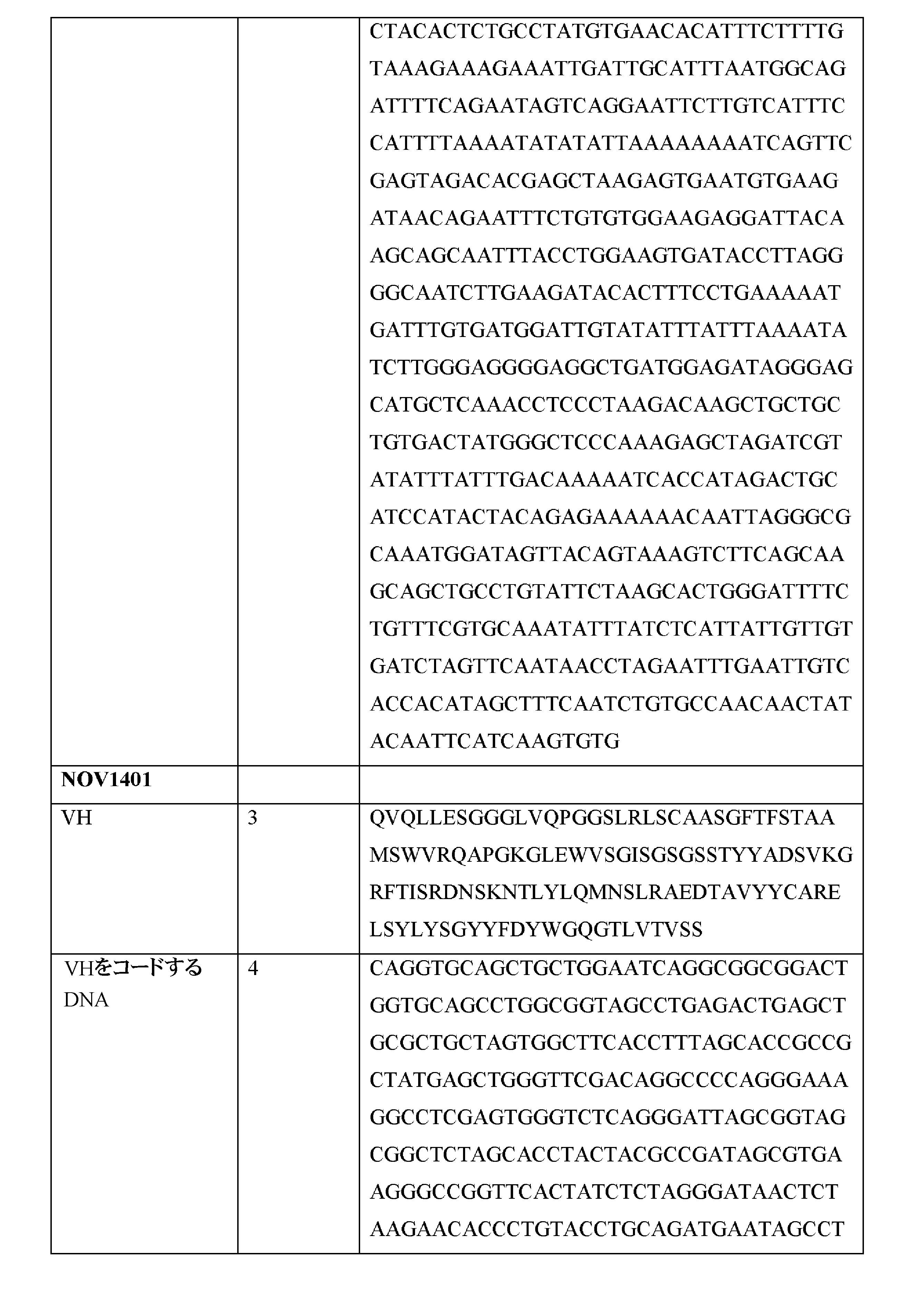


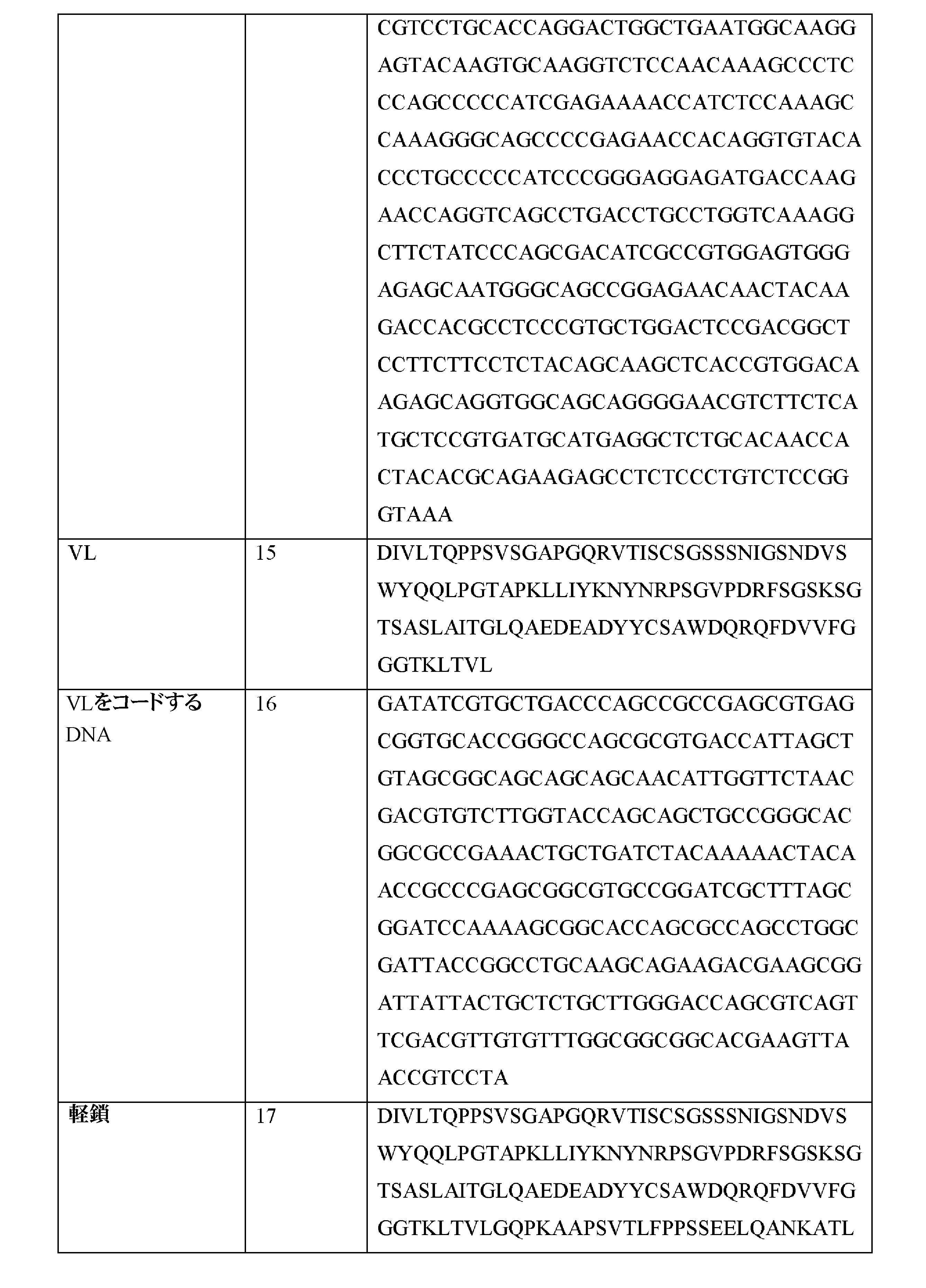
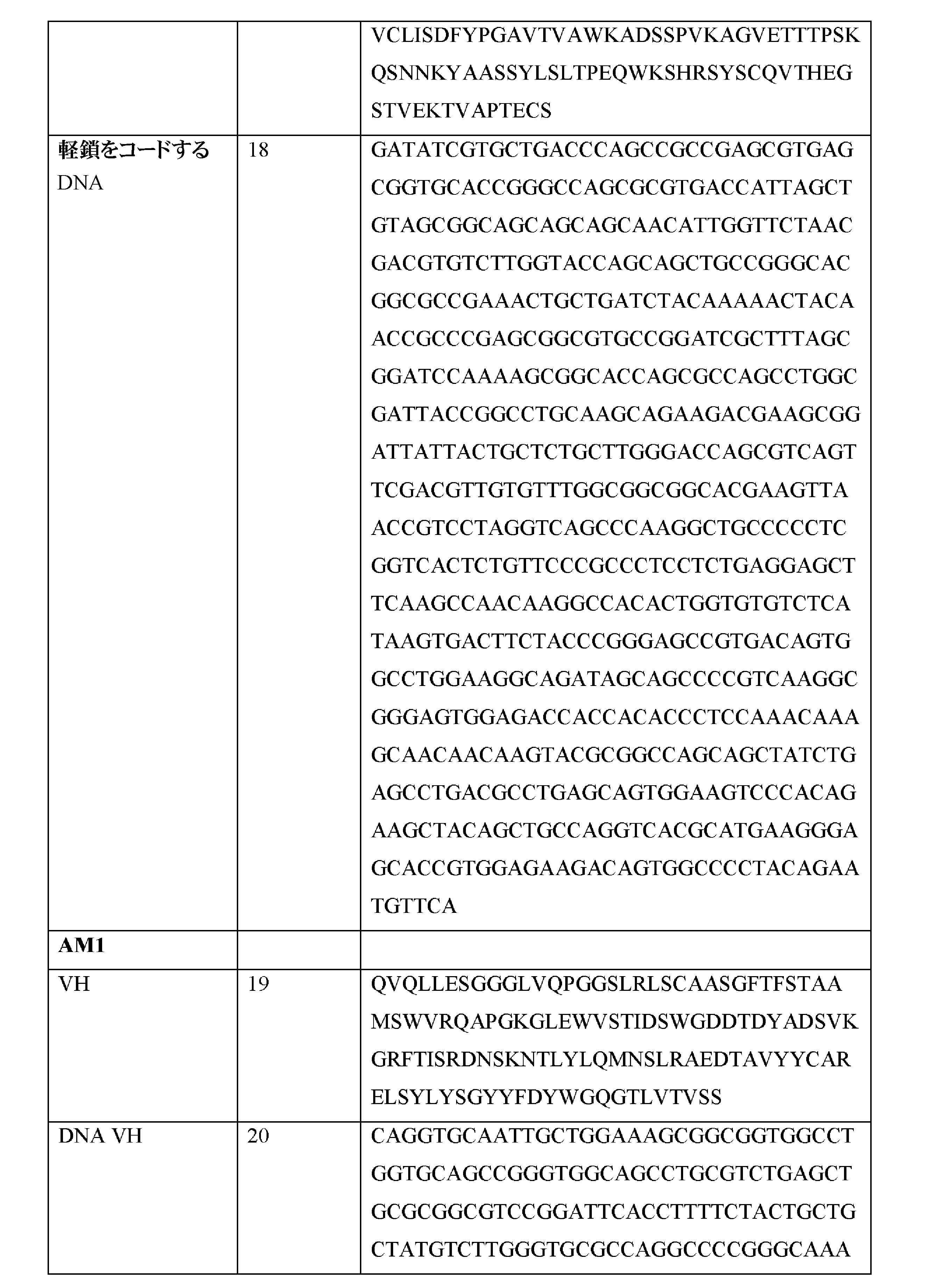


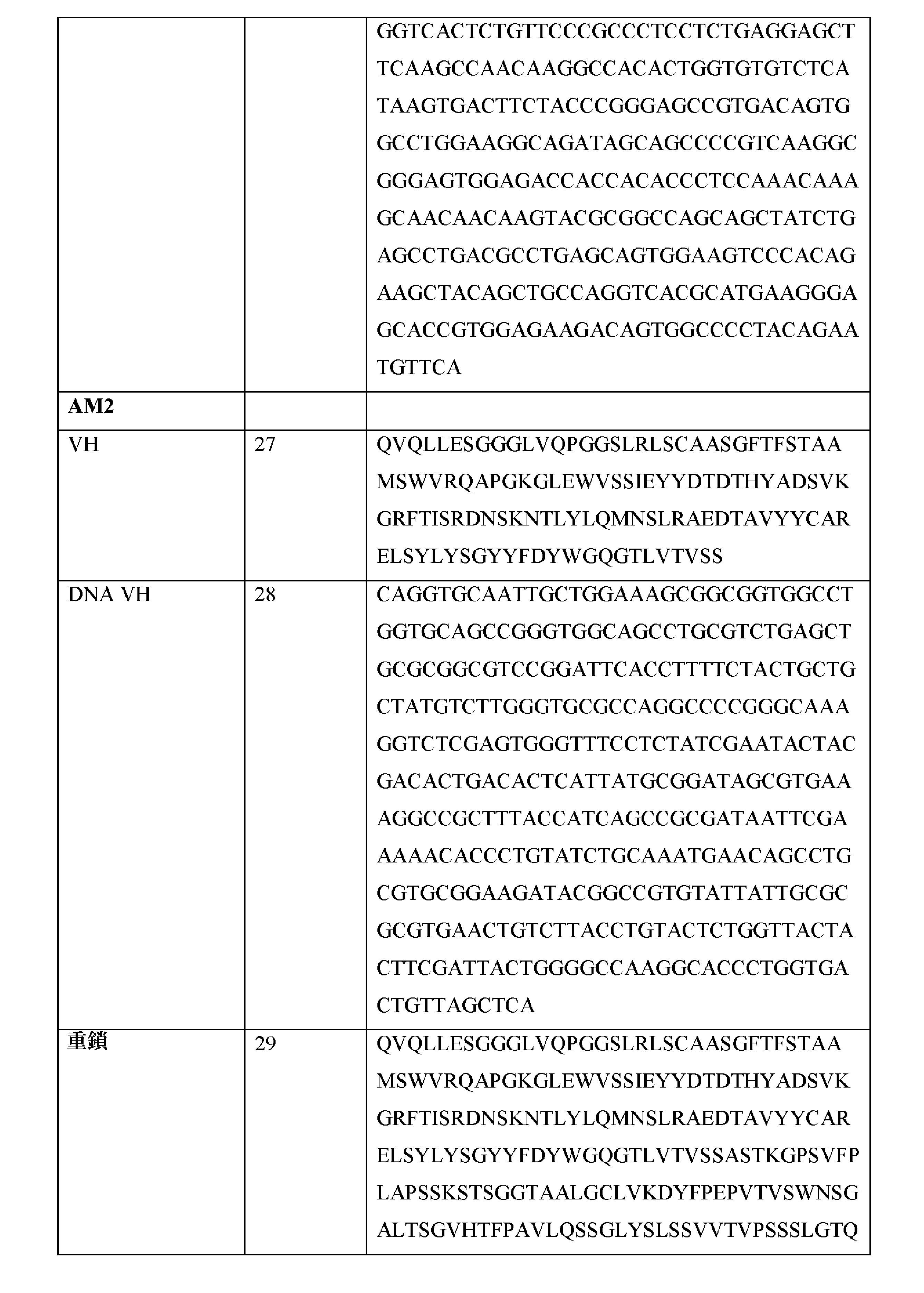


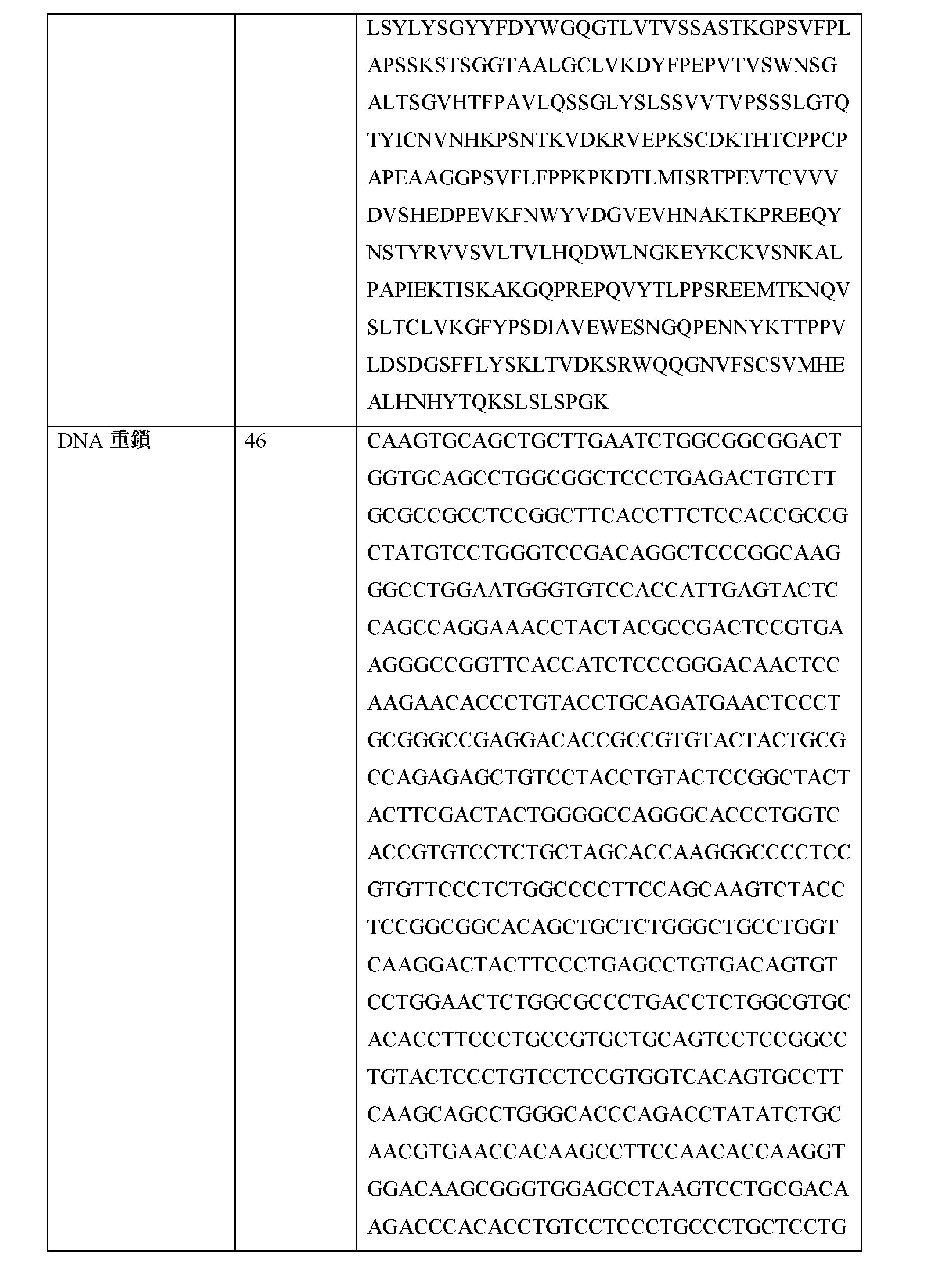


結合/反転剤
一態様では、本開示は、結合剤、並びに結合剤を含む医薬組成物に関し、結合剤は、ヒト第XI因子(「FXI」)及び/又は第XIa因子(「FXIa」)の触媒ドメイン内に結合する標的抗体(「抗FXI/FXIa抗体」)、例えば、抗体であるNOV1401など、表1に記載された抗FXI/FXIa抗体、又は抗体である、AM1、AM2、AM3、若しくはAM4など、それらの親和性成熟バリアントに特異的に結合し、結合剤は、標的抗体の抗凝固活性を阻害する。好適には、本開示の結合剤は、抗体又は抗原結合断片(例えば、全抗体、IgG、Fab断片)であり、特に、本開示の結合剤は、抗イディオタイプ抗体である。
Binding / Reversing Agent In one aspect, the present disclosure relates to a binding agent as well as a pharmaceutical composition comprising a binding agent, wherein the binding agent is a human Factor XI (“FXI”) and / or Factor XIa (“FXIa”). Target antibodies (“anti-FXI / FXIa antibodies”) that bind within the catalytic domain, eg, anti-FXI / FXIa antibodies listed in Table 1, such as the antibody NOV1401, or antibodies, AM1, AM2, AM3, or It specifically binds to those affinity maturation variants, such as AM4, and the binding agent inhibits the anticoagulant activity of the target antibody. Preferably, the binder of the present disclosure is an antibody or antigen binding fragment (eg, a total antibody, IgG, Fab fragment), and in particular, the binder of the present disclosure is an anti-idiotype antibody.
一実施形態では、本発明は、結合剤、並びに結合剤を含む医薬組成物に関し、結合剤は、ヒト第XI因子(「FXI」)及び/又は第XIa因子(「FXIa」)の触媒ドメイン内に結合する標的抗体に特異的に結合し、結合剤は、標的抗体の抗凝固活性を阻害し、結合剤は、50pM以下、40pM以下、30pM以下、20pM以下、15pM以下、好ましくは10pM以下の解離定数(KD)で標的抗体と結合する。具体的な実施形態では、本発明は、結合剤、並びに結合剤を含む医薬組成物に関し、結合剤は、50pM~0.01pM、40pM~0.01pM、30pM~0.01pM、20pM~0.01pM、15pM~0.01pM、好ましくは10pM~0.1pMの解離定数(KD)でヒト第XI因子(「FXI」)及び/又は第XIa因子(「FXIa」)と結合する標的抗体と特異的に結合する。具体的な実施形態では、KDは、溶液平衡滴定により測定され、特にKDは、25℃での溶液平衡滴定により測定され、より特にKDは、Fabフォーマットの結合剤について25℃での溶液平衡滴定によって測定される。更なる実施形態では、本開示の結合剤は、少なくとも1E+05M-1s-1の会合速度(kon)で、好ましくは25℃での表面プラズモン共鳴により測定される1E+05M-1s-1~1E+06M-1s-1の会合速度(kon)で、標的抗体と結合する。 In one embodiment, the present invention relates to a binder and a pharmaceutical composition comprising the binder, wherein the binder is within the catalytic domain of human Factor XI (“FXI”) and / or Factor XIa (“FXIa”). The binder specifically binds to the target antibody that binds to, the binder inhibits the anticoagulant activity of the target antibody, and the binder is 50 pM or less, 40 pM or less, 30 pM or less, 20 pM or less, 15 pM or less, preferably 10 pM or less. It binds to the target antibody with a dissociation constant ( KD ). In a specific embodiment, the present invention relates to a binder and a pharmaceutical composition comprising the binder, wherein the binder is 50 pM to 0.01 pM, 40 pM to 0.01 pM, 30 pM to 0.01 pM, 20 pM to 0. Specific to a target antibody that binds to human Factor XI (“FXI”) and / or Factor XIa (“ FXIa ”) with a dissociation constant (KD) of 01 pM, 15 pM to 0.01 pM, preferably 10 pM to 0.1 pM. Combine. In a specific embodiment, KD is measured by solution equilibrium titration, in particular KD is measured by solution equilibrium titration at 25 ° C., and more particularly KD is measured at 25 ° C. for Fab format binders. Measured by solution equilibrium titration. In a further embodiment, the binders of the present disclosure are at least 1E + 05M -1 s -1 association rate (kon), preferably 1E + 05M -1 s -1 to 1E + 06M measured by surface plasmon resonance at 25 ° C. It binds to the target antibody at a -1 s -1 association rate ( kon ).
別の実施形態では、本開示は、結合剤、並びに結合剤を含む医薬組成物に関し、結合剤は、ヒト第XI因子(「FXI」)及び/又は第XIa因子(「FXIa」)の触媒ドメイン内に結合する標的抗体に特異的に結合し、結合剤は、標的抗体の抗凝固活性を阻害し、結合剤は、参照抗体の解離定数(KD)よりも少なくとも5倍低い、好ましくは少なくとも10倍低いKDで標的抗体に結合し、参照抗体は、配列番号60のアミノ酸配列を含む重鎖可変領域(VH)と、配列番号71のアミノ酸配列を含む軽鎖可変領域(VL)と、を含む。具体的な実施形態では、KDは、溶液平衡滴定により測定され、特にKDは、25℃での溶液平衡滴定により測定され、より特にKDは、Fabフォーマットの結合剤について25℃での溶液平衡滴定によって測定される。更なる実施形態では、本開示の結合剤は、少なくとも1E+05M-1s-1の会合速度(kon)で、好ましくは25℃での表面プラズモン共鳴により測定される1E+05M-1s-1~1E+06M-1s-1の会合速度(kon)で、標的抗体と結合する。 In another embodiment, the present disclosure relates to a binding agent, as well as a pharmaceutical composition comprising the binding agent, wherein the binding agent is a catalytic domain of human Factor XI (“FXI”) and / or Factor XIa (“FXIa”). It specifically binds to the target antibody that binds within, the binding agent inhibits the anticoagulant activity of the target antibody, and the binding agent is at least 5-fold lower than the dissociation constant ( KD ) of the reference antibody, preferably at least. It binds to the target antibody at 10-fold lower KD , and the reference antibody includes a heavy chain variable region (VH) containing the amino acid sequence of SEQ ID NO: 60 and a light chain variable region (VL) containing the amino acid sequence of SEQ ID NO: 71. including. In a specific embodiment, KD is measured by solution equilibrium titration, in particular KD is measured by solution equilibrium titration at 25 ° C., and more particularly KD is measured at 25 ° C. for Fab format binders. Measured by solution equilibrium titration. In a further embodiment, the binders of the present disclosure are at least 1E + 05M -1 s -1 association rate (kon), preferably 1E + 05M -1 s -1 to 1E + 06M measured by surface plasmon resonance at 25 ° C. It binds to the target antibody at a -1 s -1 association rate ( kon ).
好適には、本開示は、反転結合剤、並びに結合剤を含む医薬組成物に関し、結合剤は、ヒト第XI因子(「FXI」)及び/又は第XIa因子(「FXIa」)に結合する標的抗体(「抗FXI/FXIa抗体」)、例えば、抗体であるNOV1401など、表1に記載された抗FXI/FXIa抗体、又は抗体である、AM1、AM2、AM3、若しくはAM4など、それらの親和性成熟バリアントに特異的に結合する、抗イディオタイプ抗体又は抗原結合断片(例えば、全抗体、IgG、Fab断片)である。特定の実施形態では、ヒト第XI因子(「FXI」)及び/又は第XIa因子(「FXIa」)の触媒ドメイン内に結合する標的抗体(抗体であるNOV1401などの「抗FXI/FXIa抗体」)に特異的に結合する結合剤、並びにこのような結合剤を含む医薬組成物が提供され、結合剤は、標的抗FXI/FXIa抗体(例えば、NOV1401)の抗凝固活性を低減するか、阻害するか、又はこれを反転(例えば、少なくとも40%、少なくとも50%、少なくとも60%、少なくとも70%、少なくとも75%、少なくとも80%、又は少なくとも85%を例えば、部分的に反転)させる。これらの抗凝固活性を測定するためのプロトコール及びアッセイについては記載されており、例示的なアッセイについては、本明細書の、例えば、実施例セクションで記載されている。 Preferably, the present disclosure relates to a reversal binding agent, as well as a pharmaceutical composition comprising the binding agent, wherein the binding agent is a target that binds to human factor XI (“FXI”) and / or factor XIa (“FXIa”). Affinities of antibodies (“anti-FXI / FXIa antibodies”), such as the antibody NOV1401, the anti-FXI / FXIa antibodies listed in Table 1, or the antibodies AM1, AM2, AM3, or AM4. An anti-idiotype antibody or antigen-binding fragment that specifically binds to a mature variant (eg, total antibody, IgG, Fab fragment). In certain embodiments, a target antibody that binds within the catalytic domain of human Factor XI (“FXI”) and / or Factor XIa (“FXIa”) (“anti-FXI / FXIa antibody” such as the antibody NOV1401). Binders that specifically bind to, as well as pharmaceutical compositions containing such binders are provided, the binder reducing or inhibiting the anticoagulant activity of a targeted anti-FXI / FXIa antibody (eg, NOV1401). Or invert it (eg, at least 40%, at least 50%, at least 60%, at least 70%, at least 75%, at least 80%, or at least 85%, eg, partially inverted). Protocols and assays for measuring these anticoagulant activities are described, and exemplary assays are described herein, eg, in the Examples section.
好適には、本開示は、結合剤、並びに結合剤を含む医薬組成物に関し、結合剤は、ヒト第XI因子(「FXI」)及び/又は第XIa因子(「FXIa」)の触媒ドメイン内に結合する標的抗体に特異的に結合し、結合剤は、標的抗体と比較して3倍モル過剰量で存在する場合、標的抗体と比較して3倍モル過剰量で存在する参照抗体と比較して、標的抗体の抗凝固活性を反転させるのに少なくとも1.5倍より効率的であり、参照抗体は、配列番号60のアミノ酸配列を含む重鎖可変領域(VH)と、配列番号71のアミノ酸配列を含む軽鎖可変領域(VL)と、を含み、特に、抗凝固活性は、活性化部分トロンボプラスチン時間(aPTT)アッセイで測定され、特に、抗凝固活性は、37℃でのaPTTアッセイで測定される。 Preferably, the present disclosure relates to a binding agent, as well as a pharmaceutical composition comprising the binding agent, wherein the binding agent is within the catalytic domain of human Factor XI (“FXI”) and / or Factor XIa (“FXIa”). It specifically binds to the target antibody to which it binds, and the binding agent is compared to the reference antibody which is present in a 3-fold molar excess compared to the target antibody when it is present in a 3-fold molar excess compared to the target antibody. It is at least 1.5 times more efficient in reversing the anticoagulant activity of the target antibody, and the reference antibody is a heavy chain variable region (VH) containing the amino acid sequence of SEQ ID NO: 60 and the amino acid of SEQ ID NO: 71. It comprises a light chain variable region (VL) containing a sequence, and in particular, anticoagulant activity is measured by an activated partial thromboplastin time (aPTT) assay, and in particular, anticoagulant activity is measured by an aPTT assay at 37 ° C. Will be done.
好適には、本開示は、結合剤、並びに結合剤を含む医薬組成物に関し、結合剤は、ヒト第XI因子(「FXI」)及び/又は第XIa因子(「FXIa」)の触媒ドメイン内に結合する標的抗体に特異的に結合し、結合剤は、(i)標的抗体と比較して3倍モル過剰量で存在する場合、活性化部分トロンボプラスチン時間(aPTT)アッセイで測定した際に、特に37℃でのaPTTアッセイで測定した際に、標的抗体の抗凝固活性の60%以上、特に63%以上の最大反転が可能であり、及び/又は(ii)標的抗体と比較して9倍モル過剰量で存在する場合、活性化部分トロンボプラスチン時間(aPTT)アッセイで測定した際に、特に37℃でのaPTTアッセイで測定した際に標的抗体の抗凝固活性の70%以上、特に72%以上の最大反転が可能であり、及び/又は(iii)標的抗体と比較して30倍モル過剰量で存在する場合、活性化部分トロンボプラスチン時間(aPTT)アッセイで測定した際に、特に37℃でのaPTTアッセイで測定した際に、標的抗体の抗凝固活性の75%以上、特に78%以上の最大反転が可能である。 Preferably, the present disclosure relates to a binding agent as well as a pharmaceutical composition comprising the binding agent, wherein the binding agent is within the catalytic domain of human Factor XI (“FXI”) and / or Factor XIa (“FXIa”). It specifically binds to the target antibody to which it binds, and the binding agent is (i) especially when measured in an activated partial thromboplastin time (aPTT) assay when present in a 3-fold molar excess compared to the target antibody. Maximum reversal of 60% or more, especially 63% or more of the anticoagulant activity of the target antibody is possible when measured by aPTT assay at 37 ° C. and / or (ii) 9-fold molar compared to the target antibody. When present in excess, 70% or more, especially 72% or more of the anticoagulant activity of the target antibody when measured by the activated partial thromboplastin time (aPTT) assay, especially when measured by the aPTT assay at 37 ° C. Maximum reversal is possible and / or aPTT at 37 ° C. as measured by the activated partial thromboplastin time (aPTT) assay when present in 30-fold molar excess compared to the (iii) target antibody. Maximum reversal of 75% or more, especially 78% or more, of the anticoagulant activity of the target antibody is possible as measured by the assay.
当該技術分野では、aPTT及びaPTTに対する遅延を決定するための方法が記載されており、本明細書の、例えば、実施例セクションでもまた記載される。 Methods for determining aPTT and delays for aPTT are described in the art and are also described herein, eg, in the Examples section.
更に具体的な実施形態では、本明細書において、標的抗FXI/FXIa抗体(例えば、NOV1401)に特異的に結合する結合剤(例えば、抗イディオタイプ抗体)、並びにこのような結合剤を含む医薬組成物が提供され、結合剤は、標的抗FXI/FXIa抗体の抗凝固活性を阻害し、標的抗FXI/FXIa抗体は、(i)配列番号3のアミノ酸配列を含む重鎖可変領域(VH)と配列番号7のアミノ酸配列を含む軽鎖可変領域(VL)、又は(ii)配列番号5のアミノ酸配列を含む重鎖と配列番号9のアミノ酸配列を含む軽鎖を含む。 In a more specific embodiment, herein, a binding agent (eg, an anti-idiotype antibody) that specifically binds to a target anti-FXI / FXIa antibody (eg, NOV1401), and a pharmaceutically comprising such binding agent. Compositions are provided, the binding agent inhibits the anticoagulant activity of the target anti-FXI / FXIa antibody, and the target anti-FXI / FXIa antibody is (i) a heavy chain variable region (VH) comprising the amino acid sequence of SEQ ID NO: 3. And a light chain variable region (VL) comprising the amino acid sequence of SEQ ID NO: 7, or (ii) a heavy chain comprising the amino acid sequence of SEQ ID NO: 5 and a light chain comprising the amino acid sequence of SEQ ID NO: 9.
好適には、標的抗FXI/FXIa抗体(例えば、NOV1401)の抗凝固活性を阻害又は反転させる、本開示の結合剤は、抗体、特に、単離抗体である。好適には、結合剤は、ヒトモノクローナル抗体である。 Preferably, the binder of the present disclosure, which inhibits or reverses the anticoagulant activity of a targeted anti-FXI / FXIa antibody (eg, NOV1401), is an antibody, in particular an isolated antibody. Preferably, the binder is a human monoclonal antibody.
具体的な実施形態では、本開示の結合剤は、Fab、Fab’、F(ab’)2、Fv、及びscFvからなるリストから選択されるフォーマットの抗体又は抗原結合断片である。具体的な実施形態では、本開示の結合剤は、Fab断片である。具体的な実施形態では、本明細書において、標的抗FXI/FXIa抗体(例えば、NOV1401)の抗凝固活性を阻害又は反転させる結合剤、並びにこのような結合剤を含む医薬組成物が提供され、結合剤は、ヒトFabなどの抗原結合ヒト抗体である。特定の実施形態では、本明細書において、標的抗FXI/FXIa抗体(例えば、NOV1401)の抗凝固活性を阻害又は反転させる結合剤、並びにこのような結合剤を含む医薬組成物が提供され、結合剤は、ヒト抗イディオタイプFabである。 In a specific embodiment, the binder of the present disclosure is an antibody or antigen binding fragment in a format selected from the list consisting of Fab, Fab', F (ab') 2 , Fv, and scFv. In a specific embodiment, the binder of the present disclosure is a Fab fragment. In specific embodiments, there are provided herein with a binder that inhibits or reverses the anticoagulant activity of a targeted anti-FXI / FXIa antibody (eg, NOV1401), as well as a pharmaceutical composition comprising such a binder. The binder is an antigen-binding human antibody such as human Fab. In certain embodiments, there are provided and are provided herein with a binder that inhibits or reverses the anticoagulant activity of a targeted anti-FXI / FXIa antibody (eg, NOV1401), as well as a pharmaceutical composition comprising such a binder. The agent is a human anti-idiotype Fab.
別の実施形態では、本開示の結合剤は、Fc領域を含む抗体である。具体的には、本開示の結合剤は、IgG1、IgG2、IgG3、IgG4、IgA、IgM、IgE、及びIgD由来のFc領域からなる群から選択されるFc領域を含む抗体である。具体的な実施形態では、本開示の結合剤は、IgG1、IgG2、IgG3、又はIgG4アイソタイプ抗体、特にIgG1である。具体的な実施形態では、本明細書において、標的抗FXI/FXIa抗体(例えば、NOV1401)の抗凝固活性を阻害又は反転させる結合剤、並びにこのような結合剤を含む医薬組成物が提供され、結合剤は、ヒトIgG1、IgG2、若しくはIgG4抗体、又はこれらのバリアントである。 In another embodiment, the binder of the present disclosure is an antibody comprising an Fc region. Specifically, the binder of the present disclosure is an antibody containing an Fc region selected from the group consisting of Fc regions derived from IgG1, IgG2, IgG3, IgG4, IgA, IgM, IgE, and IgD. In a specific embodiment, the binder of the present disclosure is an IgG1, IgG2, IgG3, or IgG4 isotype antibody, in particular IgG1. In specific embodiments, there are provided herein with a binder that inhibits or reverses the anticoagulant activity of a targeted anti-FXI / FXIa antibody (eg, NOV1401), as well as a pharmaceutical composition comprising such a binder. The binder is a human IgG1, IgG2, or IgG4 antibody, or a variant thereof.
具体的な実施形態では、本明細書において、標的抗FXI/FXIa抗体に特異的に結合する結合剤(例えば、抗イディオタイプ抗体)、並びにこのような結合剤を含む医薬組成物が提供され、結合剤は、標的抗FXI/FXIa抗体の抗凝固活性を低減又は阻害又は反転(例えば、少なくとも40%、少なくとも50%、少なくとも60%、少なくとも70%、少なくとも75%、少なくとも80%、又は少なくとも85%を例えば、部分的に反転)させ、結合剤は、(1)表2に記述されたものから選択される相補性決定領域である、HCDR1、HCDR2、及びHCDR3を含むVHと、(2)表2に記述されたものから選択される相補性決定領域である、LCDR1、LCDR2、及びLCDR3を含むVLと、を含む抗体である。更に具体的な実施形態では、本明細書において、標的抗FXI/FXIa抗体に特異的に結合する結合剤(例えば、抗イディオタイプ抗体)、並びにこのような結合剤を含む医薬組成物が提供され、結合剤は、標的抗FXI/FXIa抗体の抗凝固活性を低減又は阻害又は反転させ、標的抗FXI/FXIa抗体は、(i)配列番号3のアミノ酸配列を含む重鎖可変領域(VH)と配列番号7のアミノ酸配列を含む軽鎖可変領域(VL)、又は(ii)配列番号5のアミノ酸配列を含む重鎖と配列番号9のアミノ酸配列を含む軽鎖を含み、結合剤は、(1)表2に記述されたものから選択される相補性決定領域HCDR1、HCDR2、及びHCDR3を含むVHと、(2)表2に記述されたものから選択される相補性決定領域LCDR1、LCDR2、及びLCDR3を含むVLと、を含む抗体である。特定の実施形態では、結合剤(例えば、抗イディオタイプ抗体)は、表2に記述されたものから選択される、組み合わせHCDR1、HCDR2、及びHCDR3と、表2に記述されたものから選択される、組み合わせLCDR1、LCDR2、及びLCDR3と、を含む。特定の実施形態では、結合剤(例えば、抗イディオタイプ抗体)は、表2に記述されたものから選択される、Kabat HCDR1、HCDR2、及びHCDR3と、表2に記述されたものから選択される、Kabat LCDR1、LCDR2、及びLCDR3と、を含む。特定の実施形態では、結合剤(例えば、抗イディオタイプ抗体)は、表2に記述されたものから選択される、Chothia HCDR1、HCDR2、及びHCDR3と、表2に記述されたものから選択される、Chothia LCDR1、LCDR2、及びLCDR3と、を含む。特定の実施形態では、結合剤(例えば、抗イディオタイプ抗体)は、表2に記述されたものから選択される、IMGT HCDR1、HCDR2、及びHCDR3と、表2に記述されたものから選択される、IMGT LCDR1、LCDR2、及びLCDR3と、を含む。表2は、抗FXI/FXIa抗体(例えば、NOV1401)結合剤(例えば、抗体)、例えば、IDT1、IDT1A、IDT1B、IDT1C、IDT1D、IDT1Eについて、Kabat、Chothia、組み合わせ、及びIMGTによる例示的なHCDR1、HCDR2、HCDR3、LCDR1、LCDR2、及びLCDR3を提供する。 In a specific embodiment, there are provided binding agents (eg, anti-idiotype antibodies) that specifically bind to a target anti-FXI / FXIa antibody, as well as pharmaceutical compositions comprising such binding agents. Binders reduce or inhibit or invert (eg, at least 40%, at least 50%, at least 60%, at least 70%, at least 75%, at least 80%, or at least 85) the anticoagulant activity of the target anti-FXI / FXIa antibody. % Is partially inverted, eg) and the binder is (1) a VH comprising HCDR1, HCDR2, and HCDR3, which are complementarity determining regions selected from those described in Table 2, and (2). An antibody comprising VLs comprising LCDR1, LCDR2, and LCDR3, which are complementarity determining regions selected from those described in Table 2. In a more specific embodiment, the present specification provides a binding agent (eg, an anti-idiotype antibody) that specifically binds to a target anti-FXI / FXIa antibody, and a pharmaceutical composition comprising such a binding agent. , The binding agent reduces, inhibits or reverses the anticoagulant activity of the target anti-FXI / FXIa antibody, and the target anti-FXI / FXIa antibody is (i) with the heavy chain variable region (VH) comprising the amino acid sequence of SEQ ID NO: 3. The light chain variable region (VL) comprising the amino acid sequences of SEQ ID NO: 7, or (ii) a heavy chain comprising the amino acid sequence of SEQ ID NO: 5 and a light chain comprising the amino acid sequence of SEQ ID NO: 9, and the binding agent is (1). ) Complementarity determining regions HCDR1, HCDR2, and VHs containing HCDR3 selected from those described in Table 2 and (2) Complementarity determining regions LCDR1, LCDR2, and selected from those described in Table 2. An antibody comprising VL comprising LCDR3 and an antibody comprising. In certain embodiments, the binder (eg, anti-idiotype antibody) is selected from the combinations HCDR1, HCDR2, and HCDR3, which are selected from those described in Table 2, and those described in Table 2. , Combining LCDR1, LCDR2, and LCDR3. In certain embodiments, the binder (eg, anti-idiotype antibody) is selected from those described in Table 2, Kabat HCDR1, HCDR2, and HCDR3, which are selected from those described in Table 2. , Kabat LCDR1, LCDR2, and LCDR3. In certain embodiments, the binder (eg, anti-idiotype antibody) is selected from Chothia HCDR1, HCDR2, and HCDR3, which are selected from those described in Table 2, and those described in Table 2. , Chothia LCDR1, LCDR2, and LCDR3. In certain embodiments, the binder (eg, anti-idiotype antibody) is selected from those described in Table 2, IMGT HCDR1, HCDR2, and HCDR3, which are selected from those described in Table 2. , IMGT LCDR1, LCDR2, and LCDR3. Table 2 shows Kabat, Chothia, combinations, and exemplary HCDR1 by IMGT for anti-FXI / FXIa antibody (eg, NOV1401) binders (eg, antibodies), such as IDT1, IDT1A, IDT1B, IDT1C, IDT1D, IDT1E. , HCDR2, HCDR3, LCDR1, LCDR2, and LCDR3.


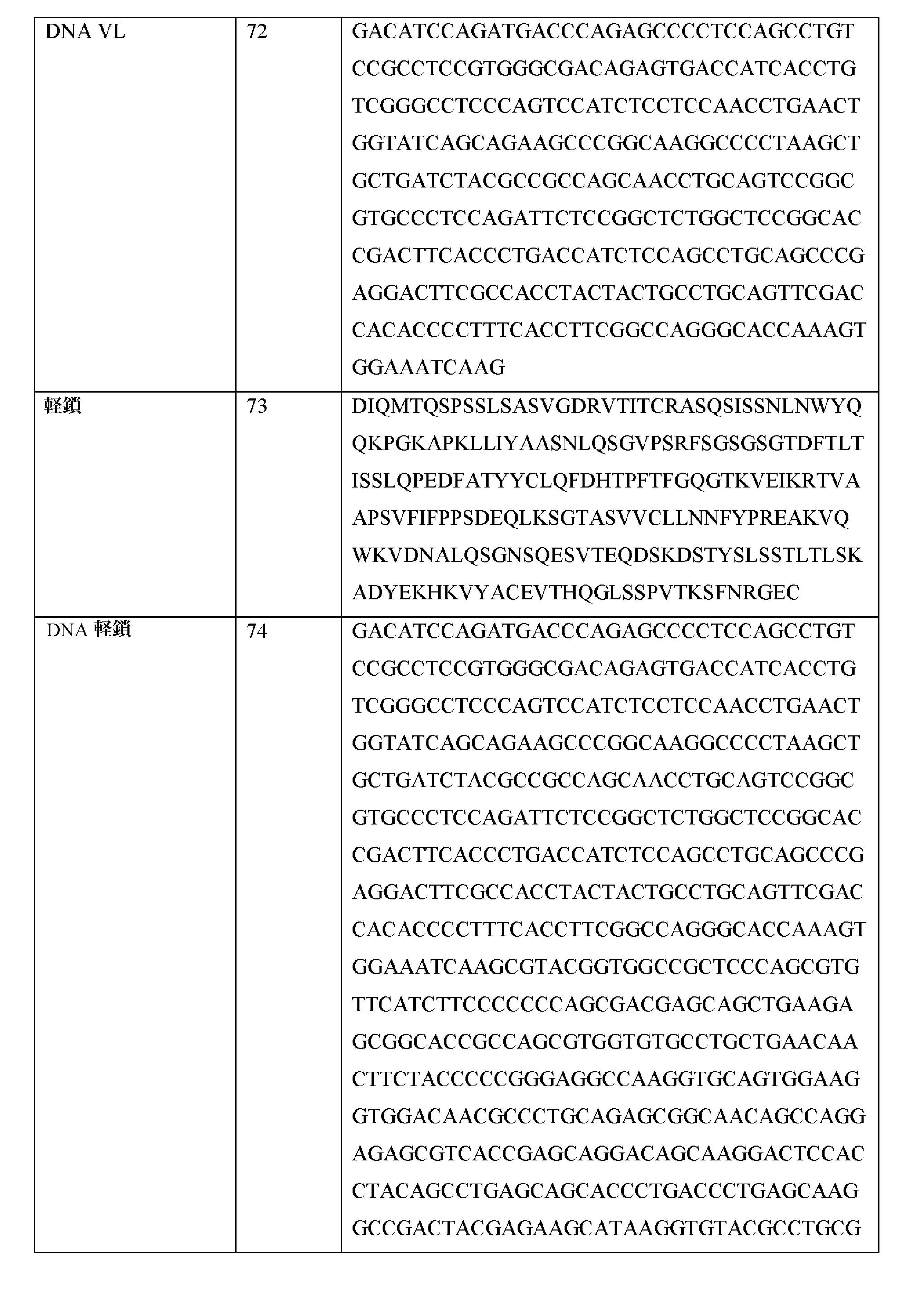


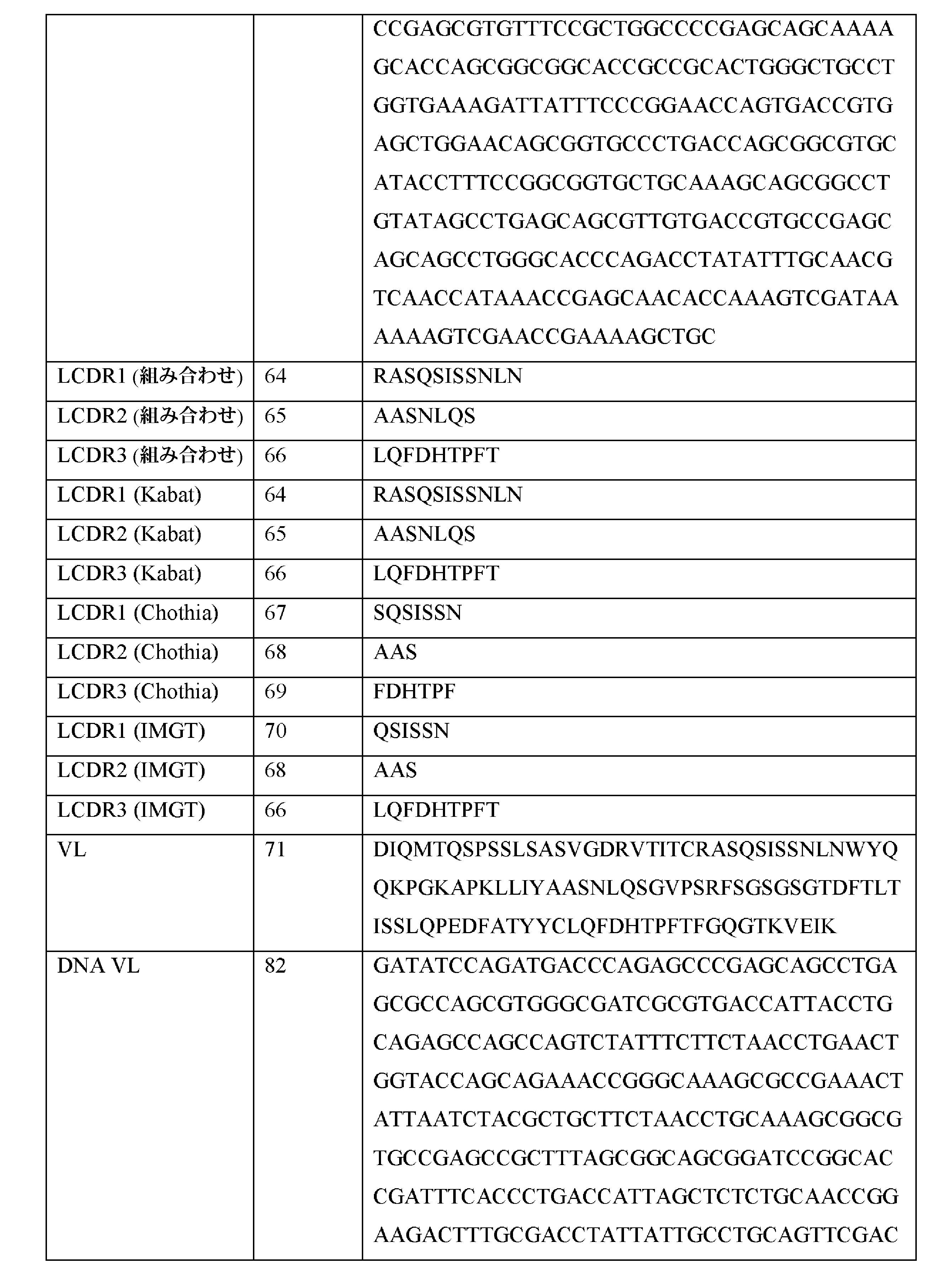
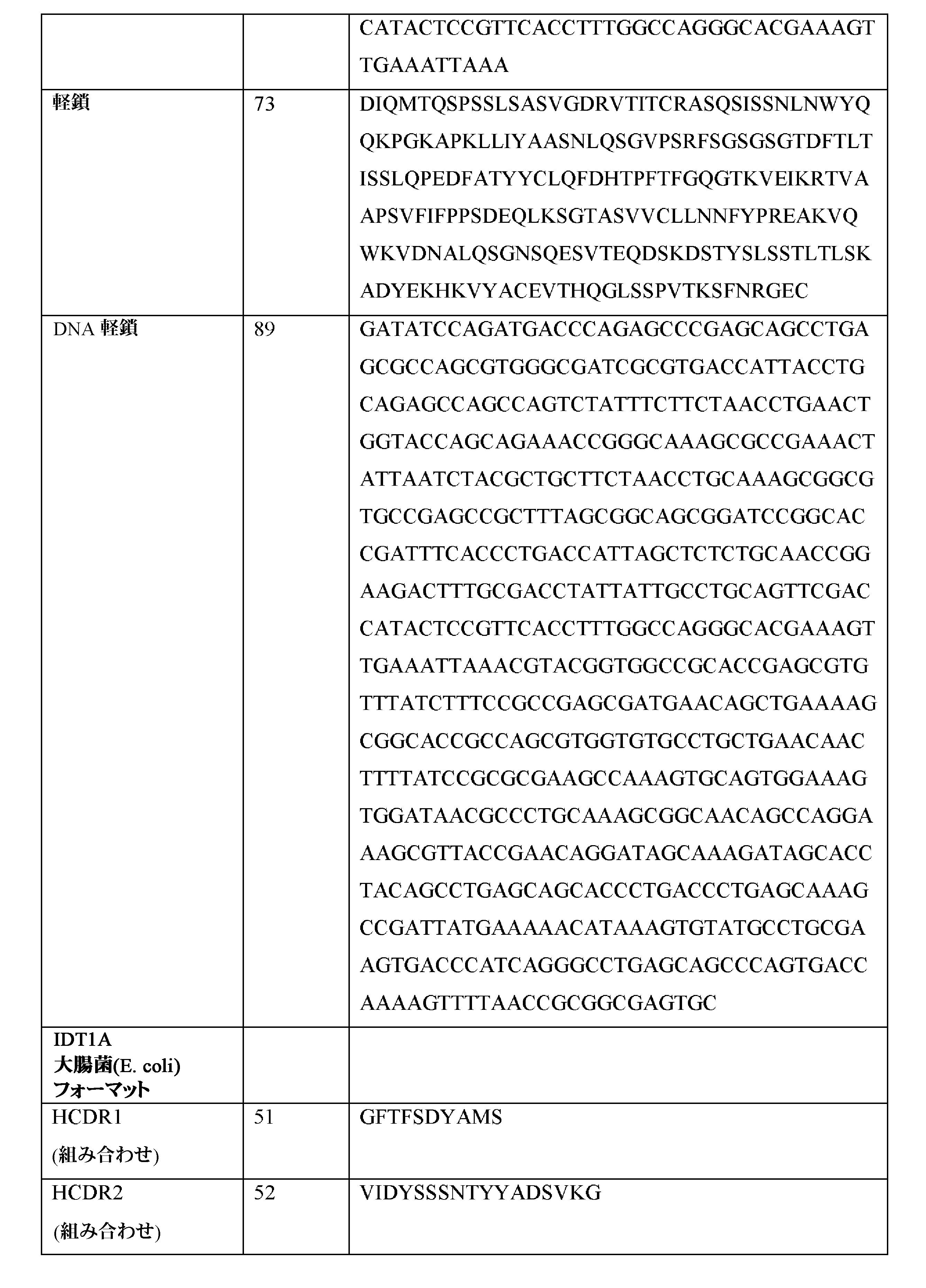


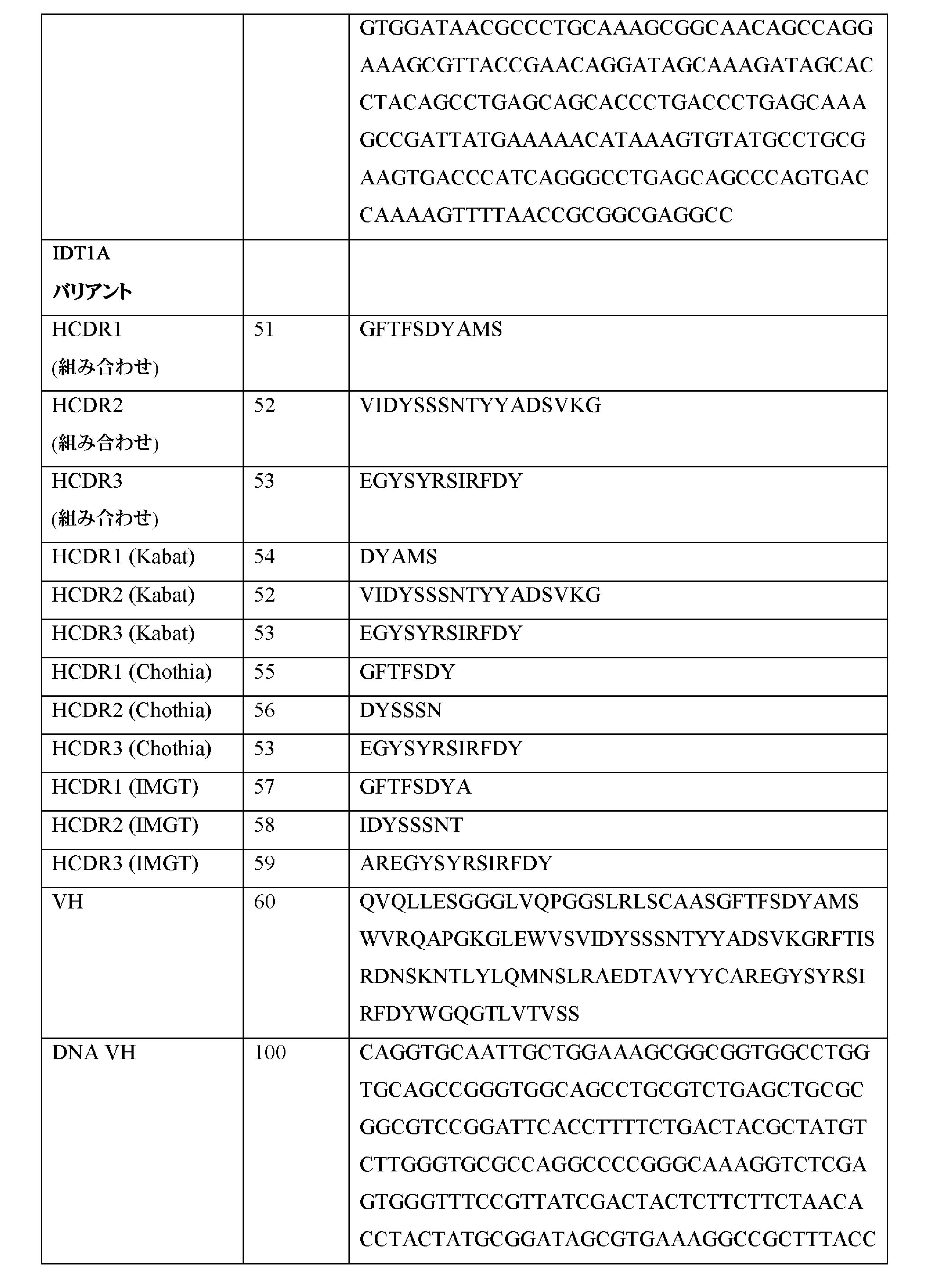


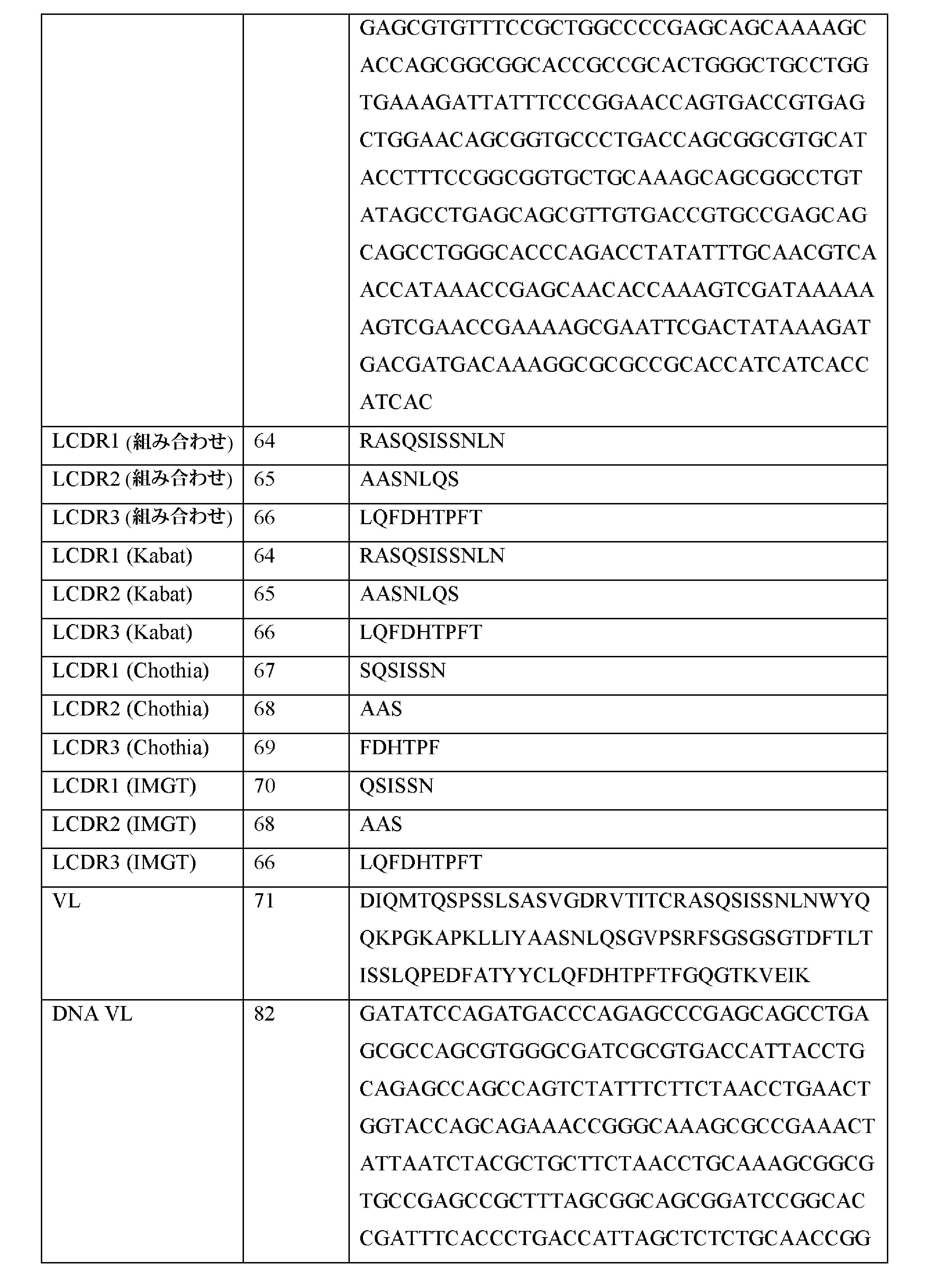


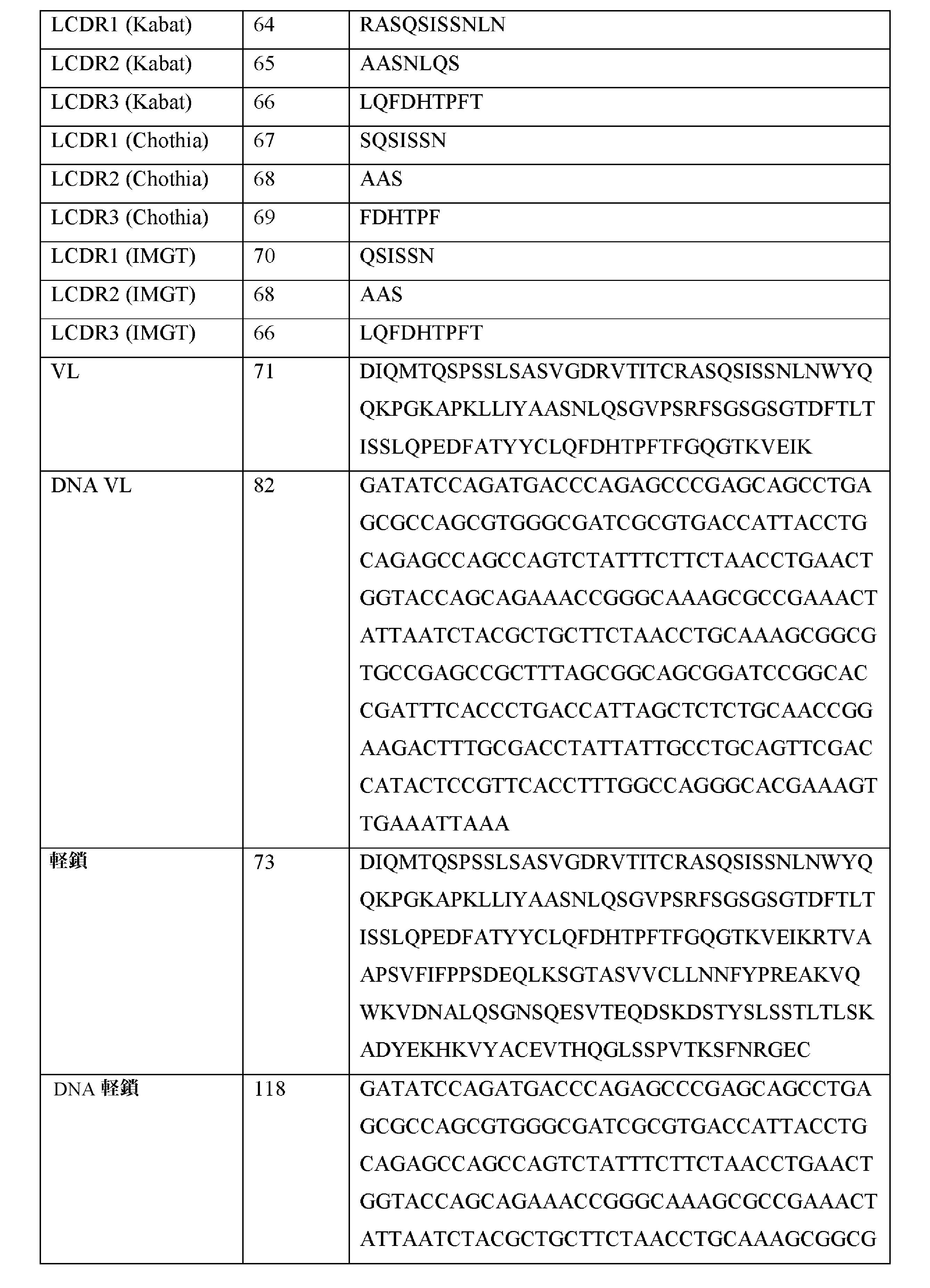


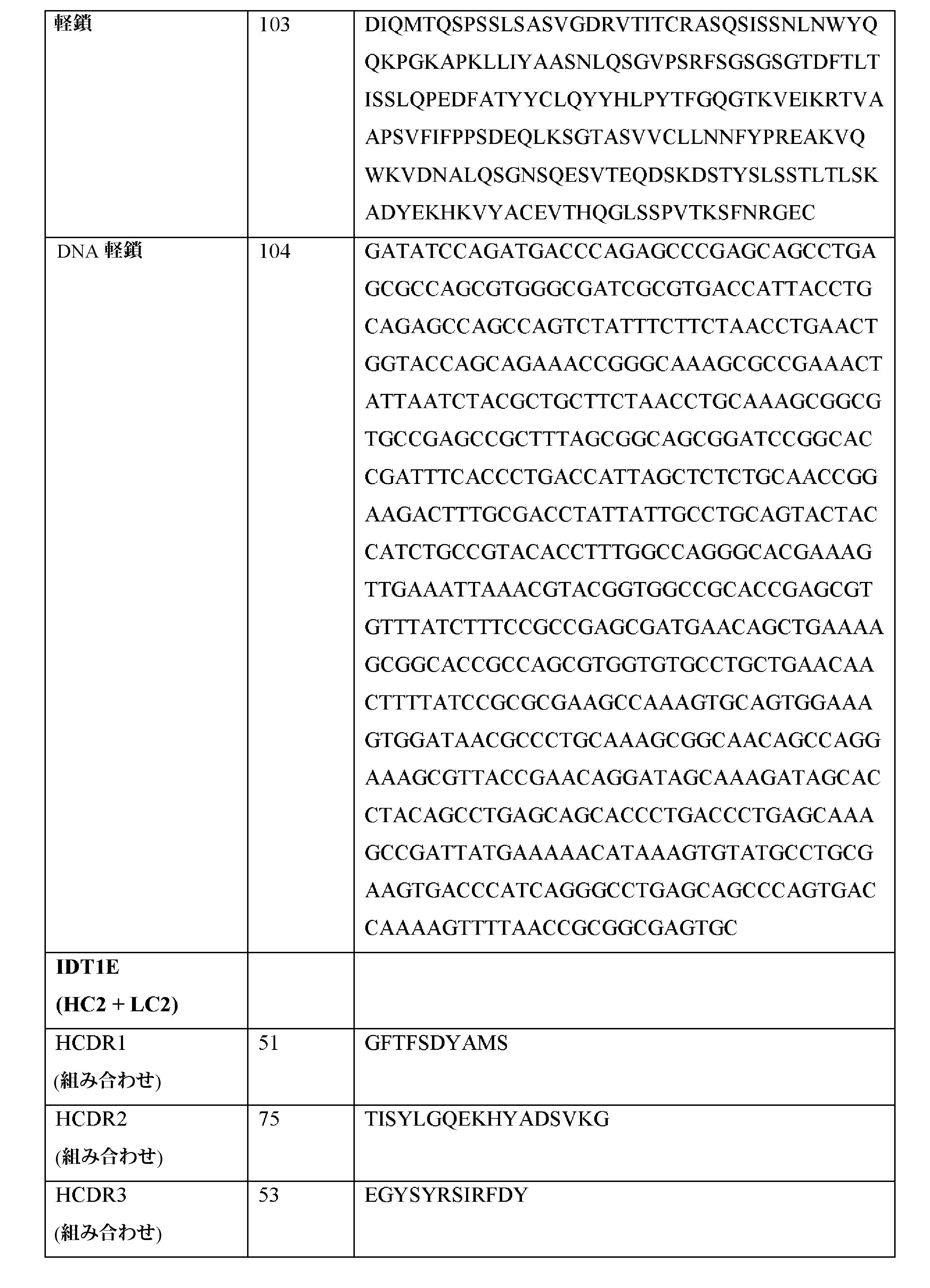
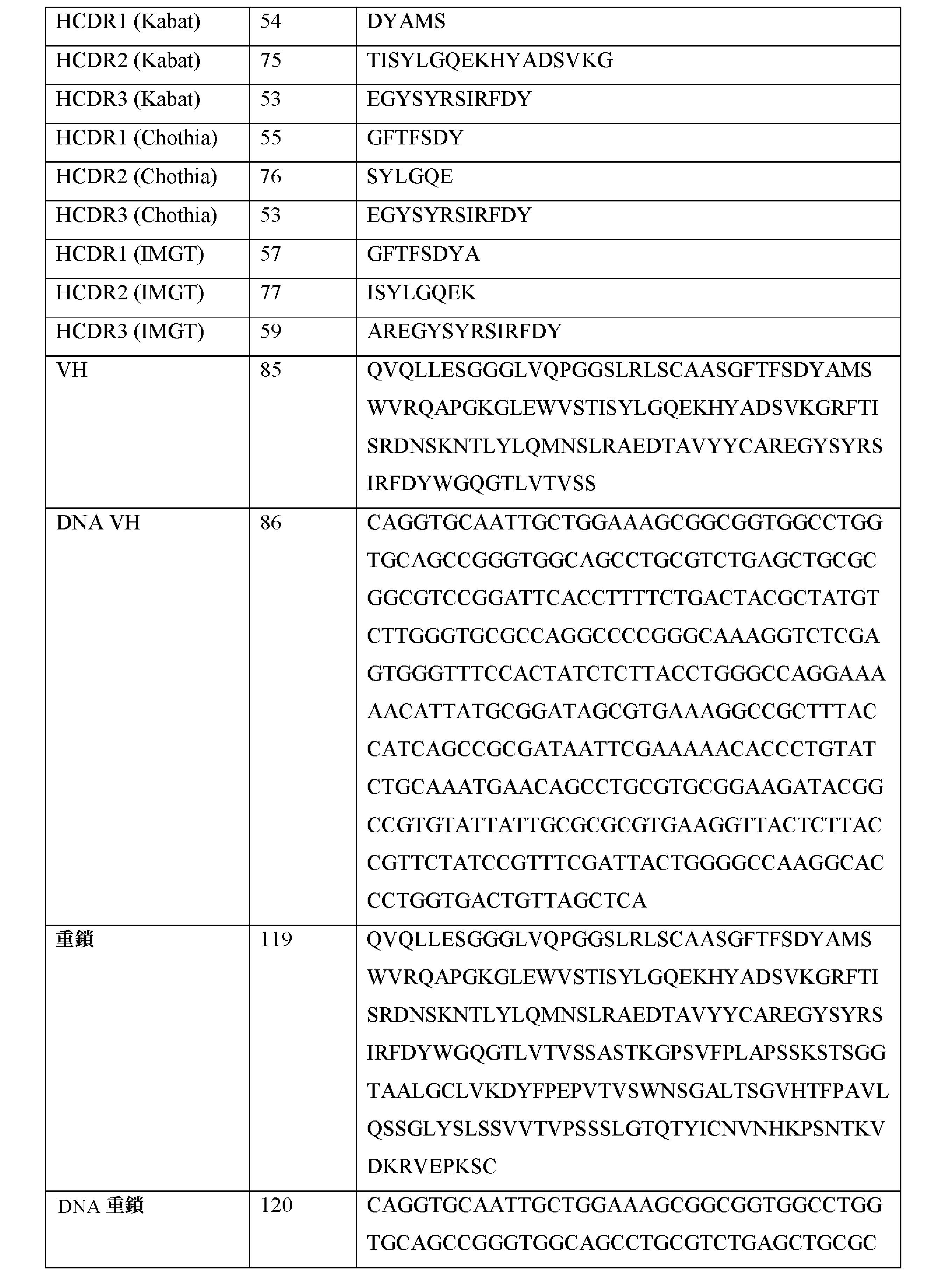
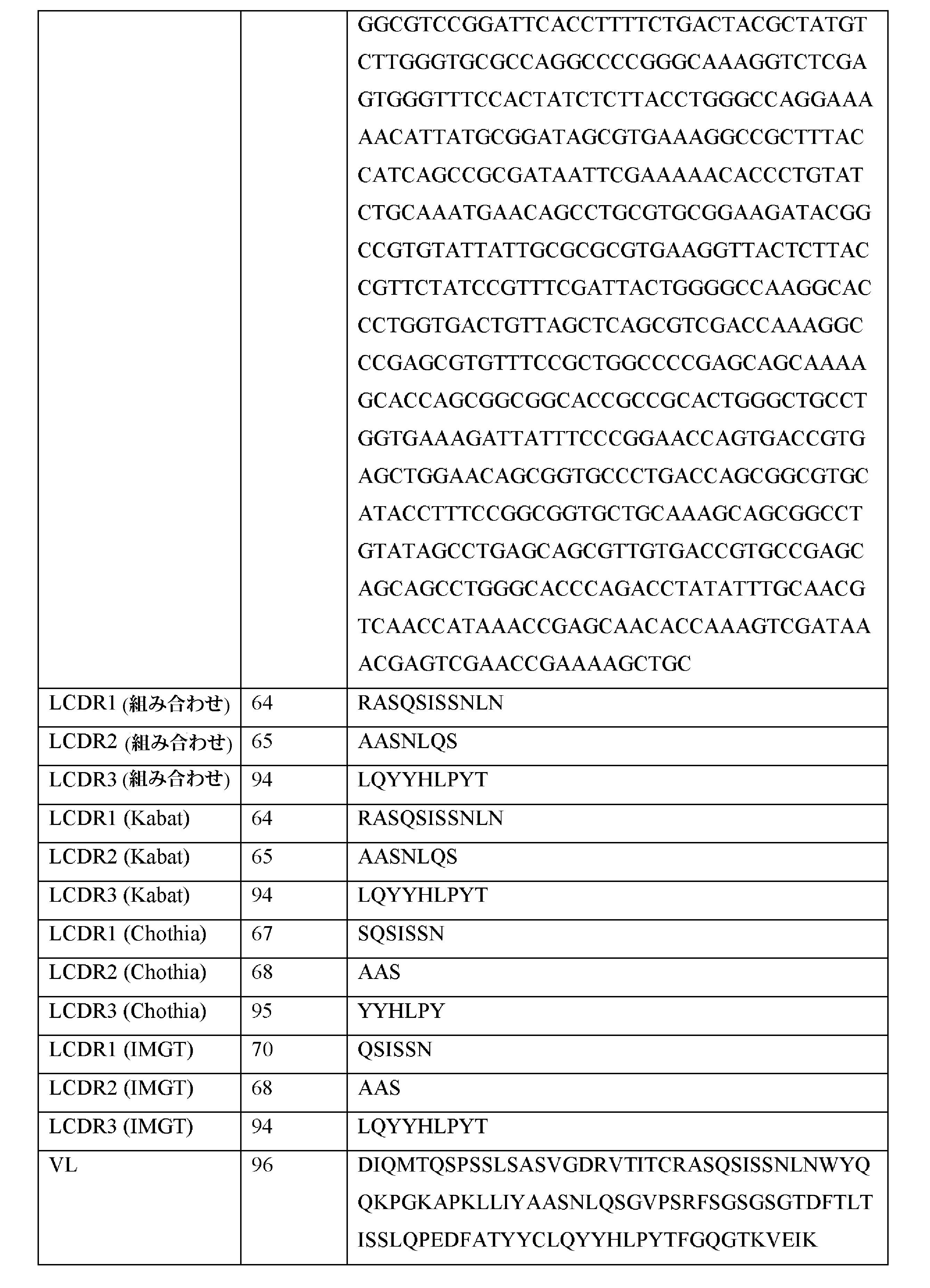

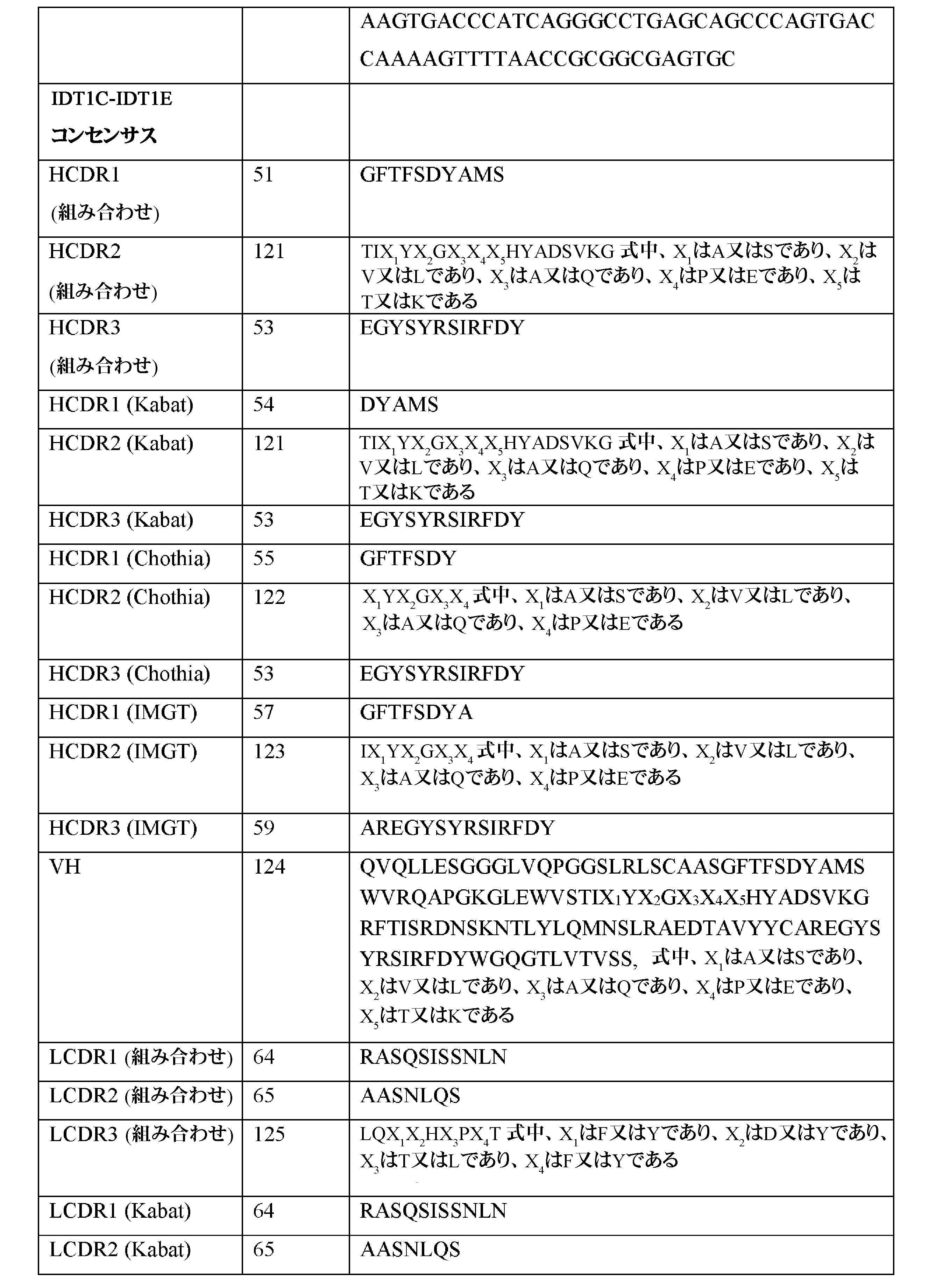

表2に開示された抗体の各々は、抗FXI/FXIa抗体であるNOV1401に結合することが可能であり、抗原結合特異性は、主に、CDR1領域、CDR2領域、及びCDR3領域によりもたらされるので、各抗体は、VH CDR1、VH CDR2、及びVH CDR3配列、並びにVL CDR1、VL CDR2、及びVL CDR3を含有することが好ましいが、VH CDR1配列、VH CDR2配列、及びVH CDR3配列と、VL CDR1配列、VL CDR2配列、及びVL CDR3配列と、を「混合し、マッチさせて」(即ち、異なる抗体に由来するCDRを混合し、マッチさせて)、他の、本明細書で提供される、FXI及び/又はFXIaに結合する分子を創出することができる。このような「混合し、マッチさせた」抗FXI/FXIa抗体に結合する薬剤は、当該技術分野で公知の結合アッセイ及び実施例で記載される結合アッセイ(例えば、ELISA、SETアッセイ、BIACORE(商標)アッセイ)を使用して調べることができる。VH CDR配列を混合し、マッチさせる場合は、特定のVH配列に由来するCDR1配列、CDR2配列、及び/又はCDR3配列を、構造的に類似するCDR配列で置きかえるものとする。同様に、VL CDR配列を混合し、マッチさせる場合は、特定のVL配列に由来するCDR1配列、CDR2配列、及び/又はCDR3配列を、構造的に類似するCDR配列で置きかえるものとする。当業者には、1つ以上のVH CDR領域配列及び/又はVL CDR領域配列を、本明細書で提供される抗体のための、本明細書で示されるCDR配列に由来する、構造的に類似する配列で置換することにより、新規のVH配列及びVL配列を創出し得ることが容易に明らかであろう。前出に加えて、一実施形態では、本明細書で提供される結合剤は、抗原結合性断片であることが可能であり、VH CDR1、VH CDR2、及びVH CDR3、又はVL CDR1、VL CDR2、及びVL CDR3を含むことができ、断片は、NOV1401などの抗FXI/FXIa抗体に、単一の可変ドメインとして結合する。 Since each of the antibodies disclosed in Table 2 is capable of binding to the anti-FXI / FXIa antibody NOV1401, antigen binding specificity is primarily provided by the CDR1 region, CDR2 region, and CDR3 region. , Each antibody preferably contains VH CDR1, VH CDR2, and VH CDR3 sequences, as well as VL CDR1, VL CDR2, and VL CDR3, but VH CDR1, VH CDR2, and VH CDR3 sequences, and VL CDR1. The sequences, VL CDR2 sequences, and VL CDR3 sequences are "mixed and matched" (ie, mixed and matched with CDRs from different antibodies) and are provided elsewhere herein. It is possible to create molecules that bind to FXI and / or FXIa. Agents that bind to such "mixed and matched" anti-FXI / FXIa antibodies are binding assays known in the art and binding assays described in Examples (eg, ELISA, SET, BIACORE ™. ) Assay) can be used for examination. When mixing and matching VH CDR sequences, the CDR1 sequence, CDR2 sequence, and / or CDR3 sequence derived from a particular VH sequence shall be replaced with structurally similar CDR sequences. Similarly, when mixing and matching VL CDR sequences, the CDR1 sequence, CDR2 sequence, and / or CDR3 sequence derived from a particular VL sequence shall be replaced with structurally similar CDR sequences. To those skilled in the art, one or more VH CDR region sequences and / or VL CDR region sequences are structurally similar, derived from the CDR sequences shown herein for the antibodies provided herein. It will be readily apparent that new VH and VL sequences can be created by substituting with the appropriate sequences. In addition to the above, in one embodiment, the binder provided herein can be an antigen binding fragment, VH CDR1, VH CDR2, and VH CDR3, or VL CDR1, VL CDR2. , And VL CDR3, and the fragment binds to an anti-FXI / FXIa antibody such as NOV1401 as a single variable domain.
特定の実施形態では、本明細書において、標的抗FXI/FXIa抗体に特異的に結合する結合剤(例えば、抗イディオタイプ抗体、例えば、Fab)、並びにこのような結合剤を含む医薬組成物が提供され、結合剤は、標的抗FXI/FXIa抗体の抗凝固活性を阻害又は反転(例えば、少なくとも40%、少なくとも50%、少なくとも60%、少なくとも70%、少なくとも75%、少なくとも80%、又は少なくとも85%を例えば、部分的に反転)させ、特に標的抗FXI/FXIa抗体は、抗体であるNOV1401(例えば、配列番号3のアミノ酸配列を含むVHと、配列番号7のアミノ酸配列を含むVLと、を含む)であり、結合剤は、(1)相補性決定領域である、HCDR1、HCDR2、及びHCDR3を含むVHと、(2)相補性決定領域である、LCDR1、LCDR2、及びLCDR3を含むVLと、を含む抗体(例えば、全長IgG、Fab断片)であり、ここで、
a)HCDR1は、配列番号51、54、55、及び57からなる群から選択されるアミノ酸配列を含み、HCDR2は、配列番号52、56、58、75、76、77、105、106 及び107からなる群から選択されるアミノ酸配列を含み、HCDR3は、配列番号53及び59からなる群から選択されるアミノ酸配列を含み、LCDR1は、配列番号64、67、及び70からなる群から選択されるアミノ酸配列を含み、LCDR2は、配列番号65及び68からなる群から選択されるアミノ酸配列を含み、LCDR3は、配列番号94及び95からなる群から選択されるアミノ酸配列を含むか、又は
b)HCDR1は、配列番号51、54、55、及び57からなる群から選択されるアミノ酸配列を含み、HCDR2は、配列番号75、76、77、105、106、及び107からなる群から選択されるアミノ酸配列を含み、HCDR3は、配列番号53及び59からなる群から選択されるアミノ酸配列を含み、LCDR1は、配列番号64、67、及び70からなる群から選択されるアミノ酸配列を含み、LCDR2は、配列番号65及び68からなる群から選択されるアミノ酸配列を含み、LCDR3は、配列番号66及び69からなる群から選択されるアミノ酸配列を含む。
In certain embodiments, herein, a binding agent that specifically binds to a target anti-FXI / FXIa antibody (eg, an anti-idiotype antibody, such as Fab), and a pharmaceutical composition comprising such binding agent. Provided, the binding agent inhibits or reverses the anticoagulant activity of the target anti-FXI / FXIa antibody (eg, at least 40%, at least 50%, at least 60%, at least 70%, at least 75%, at least 80%, or at least. Eighty-five percent are inverted, eg, partially inverted), in particular the target anti-FXI / FXIa antibody is NOV1401 (eg, VH comprising the amino acid sequence of SEQ ID NO: 3 and VL comprising the amino acid sequence of SEQ ID NO: 7). The binding agent comprises (1) VHs comprising the complementarity determining regions HCDR1, HCDR2, and HCDR3, and (2) VL comprising the complementarity determining regions LCDR1, LCDR2, and LCDR3. And an antibody comprising (eg, full length IgG, Fab fragment), where.
a) HCDR1 comprises an amino acid sequence selected from the group consisting of SEQ ID NOs: 51, 54, 55, and 57, and HCDR2 is from SEQ ID NOs: 52, 56, 58, 75, 76, 77, 105, 106 and 107. Contains an amino acid sequence selected from the group consisting of, HCDR3 contains an amino acid sequence selected from the group consisting of SEQ ID NOs: 53 and 59, and LCDR1 contains an amino acid selected from the group consisting of SEQ ID NOs: 64, 67, and 70. Containing the sequence, LCDR2 comprises an amino acid sequence selected from the group consisting of SEQ ID NOs: 65 and 68, LCDR3 contains an amino acid sequence selected from the group consisting of SEQ ID NOs: 94 and 95, or b) HCDR1. , Containing an amino acid sequence selected from the group consisting of SEQ ID NOs: 51, 54, 55, and 57, HCDR2 comprises an amino acid sequence selected from the group consisting of SEQ ID NOs: 75, 76, 77, 105, 106, and 107. HCDR3 comprises an amino acid sequence selected from the group consisting of SEQ ID NOs: 53 and 59, LCDR1 comprises an amino acid sequence selected from the group consisting of SEQ ID NOs: 64, 67, and 70, and LCDR2 comprises an amino acid sequence. It comprises an amino acid sequence selected from the group consisting of 65 and 68, and LCDR3 comprises an amino acid sequence selected from the group consisting of SEQ ID NOs: 66 and 69.
特定の実施形態では、本明細書において、標的抗FXI/FXIa抗体に特異的に結合する結合剤(例えば、抗イディオタイプ抗体、例えば、Fab)、並びにこのような結合剤を含む医薬組成物が提供され、結合剤は、標的抗FXI/FXIa抗体の抗凝固活性を阻害又は反転(例えば、少なくとも40%、少なくとも50%、少なくとも60%、少なくとも70%、少なくとも75%、少なくとも80%、又は少なくとも85%を例えば、部分的に反転)させ、特に標的抗FXI/FXIa抗体は、抗体であるNOV1401(例えば、配列番号3のアミノ酸配列を含むVHと、配列番号7のアミノ酸配列を含むVLと、を含む)であり、結合剤は、(1)相補性決定領域である、HCDR1、HCDR2、及びHCDR3を含むVHと、(2)相補性決定領域である、LCDR1、LCDR2、及びLCDR3を含むVLと、を含む抗体(例えば、全長IgG、Fab断片)であり、ここで、
a)HCDR1は、配列番号51、54、55、及び57からなる群から選択されるアミノ酸配列を含み、HCDR2は、配列番号52、56、及び58からなる群から選択されるアミノ酸配列を含み、HCDR3は、配列番号53及び59からなる群から選択されるアミノ酸配列を含み、LCDR1は、配列番号64、67、及び70からなる群から選択されるアミノ酸配列を含み、LCDR2は、配列番号65及び68からなる群から選択されるアミノ酸配列を含み、LCDR3は、配列番号94及び95からなる群から選択されるアミノ酸配列を含むか、
b)HCDR1は、配列番号51、54、55、及び57からなる群から選択されるアミノ酸配列を含み、HCDR2は、配列番号75、76、及び77からなる群から選択されるアミノ酸配列を含み、HCDR3は、配列番号53及び59からなる群から選択されるアミノ酸配列を含み、LCDR1は、配列番号64、67、及び70からなる群から選択されるアミノ酸配列を含み、LCDR2は、配列番号65及び68からなる群から選択されるアミノ酸配列を含み、LCDR3は、配列番号94及び95からなる群から選択されるアミノ酸配列を含むか、
c)HCDR1は、配列番号51、54、55、及び57からなる群から選択されるアミノ酸配列を含み、HCDR2は、配列番号105、106、及び107からなる群から選択されるアミノ酸配列を含み、HCDR3は、配列番号53及び59からなる群から選択されるアミノ酸配列を含み、LCDR1は、配列番号64、67、及び70からなる群から選択されるアミノ酸配列を含み、LCDR2は、配列番号65及び68からなる群から選択されるアミノ酸配列を含み、LCDR3は、配列番号94及び95からなる群から選択されるアミノ酸配列を含むか、
d)HCDR1は、配列番号51、54、55、及び57からなる群から選択されるアミノ酸配列を含み、HCDR2は、配列番号75、76、及び77からなる群から選択されるアミノ酸配列を含み、HCDR3は、配列番号53及び59からなる群から選択されるアミノ酸配列を含み、LCDR1は、配列番号64、67、及び70からなる群から選択されるアミノ酸配列を含み、LCDR2は、配列番号65及び68からなる群から選択されるアミノ酸配列を含み、LCDR3は、配列番号66及び69からなる群から選択されるアミノ酸配列を含むか、又は
e)HCDR1は、配列番号51、54、55、及び57からなる群から選択されるアミノ酸配列を含み、HCDR2は、配列番号105、106、及び107からなる群から選択されるアミノ酸配列を含み、HCDR3は、配列番号53及び59からなる群から選択されるアミノ酸配列を含み、LCDR1は、配列番号64、67、及び70からなる群から選択されるアミノ酸配列を含み、LCDR2は、配列番号65及び68からなる群から選択されるアミノ酸配列を含み、LCDR3は、配列番号66及び69からなる群から選択されるアミノ酸配列を含む。
In certain embodiments, herein, a binding agent that specifically binds to a target anti-FXI / FXIa antibody (eg, an anti-idiotype antibody, such as Fab), and a pharmaceutical composition comprising such binding agent. Provided, the binding agent inhibits or reverses the anticoagulant activity of the target anti-FXI / FXIa antibody (eg, at least 40%, at least 50%, at least 60%, at least 70%, at least 75%, at least 80%, or at least. Eighty-five percent are inverted, eg, partially inverted), and in particular the target anti-FXI / FXIa antibody is NOV1401 (eg, VH comprising the amino acid sequence of SEQ ID NO: 3 and VL comprising the amino acid sequence of SEQ ID NO: 7). The binding agent comprises (1) VHs comprising the complementarity determining regions HCDR1, HCDR2, and HCDR3, and (2) VL comprising the complementarity determining regions LCDR1, LCDR2, and LCDR3. And an antibody comprising (eg, full length IgG, Fab fragment), where.
a) HCDR1 comprises an amino acid sequence selected from the group consisting of SEQ ID NOs: 51, 54, 55, and 57, and HCDR2 comprises an amino acid sequence selected from the group consisting of SEQ ID NOs: 52, 56, and 58. HCDR3 contains an amino acid sequence selected from the group consisting of SEQ ID NOs: 53 and 59, LCDR1 contains an amino acid sequence selected from the group consisting of SEQ ID NOs: 64, 67, and 70, and LCDR2 contains SEQ ID NOs: 65 and Containing an amino acid sequence selected from the group consisting of 68, LCDR3 comprises an amino acid sequence selected from the group consisting of SEQ ID NOs: 94 and 95.
b) HCDR1 comprises an amino acid sequence selected from the group consisting of SEQ ID NOs: 51, 54, 55, and 57, and HCDR2 comprises an amino acid sequence selected from the group consisting of SEQ ID NOs: 75, 76, and 77. HCDR3 contains an amino acid sequence selected from the group consisting of SEQ ID NOs: 53 and 59, LCDR1 contains an amino acid sequence selected from the group consisting of SEQ ID NOs: 64, 67, and 70, and LCDR2 contains amino acid sequences consisting of SEQ ID NOs: 65 and Containing an amino acid sequence selected from the group consisting of 68, LCDR3 comprises an amino acid sequence selected from the group consisting of SEQ ID NOs: 94 and 95.
c) HCDR1 comprises an amino acid sequence selected from the group consisting of SEQ ID NOs: 51, 54, 55, and 57, and HCDR2 comprises an amino acid sequence selected from the group consisting of SEQ ID NOs: 105, 106, and 107. HCDR3 contains an amino acid sequence selected from the group consisting of SEQ ID NOs: 53 and 59, LCDR1 contains an amino acid sequence selected from the group consisting of SEQ ID NOs: 64, 67, and 70, and LCDR2 contains amino acid sequences consisting of SEQ ID NOs: 65 and Containing an amino acid sequence selected from the group consisting of 68, LCDR3 comprises an amino acid sequence selected from the group consisting of SEQ ID NOs: 94 and 95.
d) HCDR1 comprises an amino acid sequence selected from the group consisting of SEQ ID NOs: 51, 54, 55, and 57, and HCDR2 comprises an amino acid sequence selected from the group consisting of SEQ ID NOs: 75, 76, and 77. HCDR3 contains an amino acid sequence selected from the group consisting of SEQ ID NOs: 53 and 59, LCDR1 contains an amino acid sequence selected from the group consisting of SEQ ID NOs: 64, 67, and 70, and LCDR2 contains amino acid sequences consisting of SEQ ID NOs: 65 and Contains an amino acid sequence selected from the group consisting of 68, LCDR3 contains an amino acid sequence selected from the group consisting of SEQ ID NOs: 66 and 69, or e) HCDR1 contains SEQ ID NOs: 51, 54, 55, and 57. Contains an amino acid sequence selected from the group consisting of, HCDR2 contains an amino acid sequence selected from the group consisting of SEQ ID NOs: 105, 106, and 107, and HCDR3 is selected from the group consisting of SEQ ID NOs: 53 and 59. Contains an amino acid sequence, LCDR1 contains an amino acid sequence selected from the group consisting of SEQ ID NOs: 64, 67, and 70, LCDR2 contains an amino acid sequence selected from the group consisting of SEQ ID NOs: 65 and 68, and LCDR3 contains an amino acid sequence. , Includes an amino acid sequence selected from the group consisting of SEQ ID NOs: 66 and 69.
特定の実施形態では、本明細書において、標的抗FXI/FXIa抗体に特異的に結合する結合剤(例えば、抗イディオタイプ抗体、例えば、Fab)、並びにこのような結合剤を含む医薬組成物が提供され、結合剤は、標的抗FXI/FXIa抗体の抗凝固活性を阻害又は反転(例えば、少なくとも40%、少なくとも50%、少なくとも60%、少なくとも70%、少なくとも75%、少なくとも80%、又は少なくとも85%を例えば、部分的に反転)させ、特に標的抗FXI/FXIa抗体は、抗体であるNOV1401(配列番号3のアミノ酸配列を含むVHと、配列番号7のアミノ酸配列を含むVLと、を含む)であり、結合剤は、(1)相補性決定領域である、HCDR1、HCDR2、及びHCDR3を含むVHと、(2)相補性決定領域である、LCDR1、LCDR2、及びLCDR3を含むVLと、を含む抗体であり、ここで、
a)HCDR1は配列番号51のアミノ酸配列を含み、HCDR2は配列番号52若しくは75若しくは105のアミノ酸配列を含み、HCDR3は配列番号53のアミノ酸配列を含み、LCDR1は配列番号64のアミノ酸配列を含み、LCDR2は配列番号65のアミノ酸配列を含み、LCDR3は配列番号94のアミノ酸配列を含むか、又は
b)HCDR1は配列番号51のアミノ酸配列を含み、HCDR2は配列番号75若しくは105のアミノ酸配列を含み、HCDR3は配列番号53のアミノ酸配列を含み、LCDR1は配列番号64のアミノ酸配列を含み、LCDR2は配列番号65のアミノ酸配列を含み、LCDR3は配列番号66のアミノ酸配列を含む。
In certain embodiments, herein, a binding agent that specifically binds to a target anti-FXI / FXIa antibody (eg, an anti-idiotype antibody, such as Fab), and a pharmaceutical composition comprising such binding agent. Provided, the binding agent inhibits or reverses the anticoagulant activity of the target anti-FXI / FXIa antibody (eg, at least 40%, at least 50%, at least 60%, at least 70%, at least 75%, at least 80%, or at least. Eighty-five percent of which are, for example, partially inverted), in particular the target anti-FXI / FXIa antibody comprises the antibody NOV1401 (VH comprising the amino acid sequence of SEQ ID NO: 3 and VL comprising the amino acid sequence of SEQ ID NO: 7). ), And the binding agent is (1) a VH containing HCDR1, HCDR2, and HCDR3, which are complementarity determining regions, and (2) a VL containing LCDR1, LCDR2, and LCDR3, which are complementarity determining regions. Antibodies, including here,
a) HCDR1 contains the amino acid sequence of SEQ ID NO: 51, HCDR2 contains the amino acid sequence of SEQ ID NO: 52 or 75 or 105, HCDR3 contains the amino acid sequence of SEQ ID NO: 53, and LCDR1 contains the amino acid sequence of SEQ ID NO: 64. LCDR2 contains the amino acid sequence of SEQ ID NO: 65, LCDR3 contains the amino acid sequence of SEQ ID NO: 94, or b) HCDR1 contains the amino acid sequence of SEQ ID NO: 51 and HCDR2 contains the amino acid sequence of SEQ ID NO: 75 or 105. HCDR3 contains the amino acid sequence of SEQ ID NO: 53, LCDR1 contains the amino acid sequence of SEQ ID NO: 64, LCDR2 contains the amino acid sequence of SEQ ID NO: 65, and LCDR3 contains the amino acid sequence of SEQ ID NO: 66.
更に具体的な実施形態では、本明細書において、標的抗FXI/FXIa抗体に特異的に結合する結合剤(例えば、抗イディオタイプ抗体、例えば、Fab)、並びにこのような結合剤を含む医薬組成物が提供され、結合剤は、標的抗FXI/FXIa抗体の抗凝固活性を阻害又は反転(例えば、少なくとも40%、少なくとも50%、少なくとも60%、少なくとも70%、少なくとも75%、少なくとも80%、又は少なくとも85%を例えば、部分的に反転)させ、特に標的抗FXI/FXIa抗体は、抗体であるNOV1401(配列番号3のアミノ酸配列を含むVHと、配列番号7のアミノ酸配列を含むVLと、を含む)であり、結合剤は、(1)相補性決定領域である、HCDR1、HCDR2、及びHCDR3を含むVHと、(2)相補性決定領域である、LCDR1、LCDR2、及びLCDR3を含むVLと、を含む抗体であり、ここで、
a)HCDR1は配列番号51のアミノ酸配列を含み、HCDR2は配列番号52のアミノ酸配列を含み、HCDR3は配列番号53のアミノ酸配列を含み、LCDR1は配列番号64のアミノ酸配列を含み、LCDR2は配列番号65のアミノ酸配列を含み、LCDR3は配列番号94のアミノ酸配列を含むか、
b)HCDR1は配列番号51のアミノ酸配列を含み、HCDR2は配列番号75のアミノ酸配列を含み、HCDR3は配列番号53のアミノ酸配列を含み、LCDR1は配列番号64のアミノ酸配列を含み、LCDR2は配列番号65のアミノ酸配列を含み、LCDR3は配列番号94のアミノ酸配列を含むか、
c)HCDR1は配列番号51のアミノ酸配列を含み、HCDR2は配列番号105のアミノ酸配列を含み、HCDR3は配列番号53のアミノ酸配列を含み、LCDR1は配列番号64のアミノ酸配列を含み、LCDR2は配列番号65のアミノ酸配列を含み、LCDR3は配列番号94のアミノ酸配列を含むか、
d)HCDR1は配列番号51のアミノ酸配列を含み、HCDR2は配列番号75のアミノ酸配列を含み、HCDR3は配列番号53のアミノ酸配列を含み、LCDR1は配列番号64のアミノ酸配列を含み、LCDR2は配列番号65のアミノ酸配列を含み、LCDR3は配列番号66のアミノ酸配列を含むか、又は
e)HCDR1は配列番号51のアミノ酸配列を含み、HCDR2は配列番号105のアミノ酸配列を含み、HCDR3は配列番号53のアミノ酸配列を含み、LCDR1は配列番号64のアミノ酸配列を含み、LCDR2は配列番号65のアミノ酸配列を含み、LCDR3は配列番号66のアミノ酸配列を含む。
In a more specific embodiment, herein, a binding agent that specifically binds to a target anti-FXI / FXIa antibody (eg, an anti-idiotype antibody, such as Fab), and a pharmaceutical composition comprising such binding agent. The binding agent inhibits or reverses the anticoagulant activity of the target anti-FXI / FXIa antibody (eg, at least 40%, at least 50%, at least 60%, at least 70%, at least 75%, at least 80%, Or at least 85%, eg, partially inverted), in particular the target anti-FXI / FXIa antibody is NOV1401 (VH comprising the amino acid sequence of SEQ ID NO: 3 and VL comprising the amino acid sequence of SEQ ID NO: 7). The binding agent comprises (1) VHs comprising the complementarity determining regions HCDR1, HCDR2, and HCDR3, and (2) VL comprising the complementarity determining regions LCDR1, LCDR2, and LCDR3. And, including antibodies, here,
a) HCDR1 contains the amino acid sequence of SEQ ID NO: 51, HCDR2 contains the amino acid sequence of SEQ ID NO: 52, HCDR3 contains the amino acid sequence of SEQ ID NO: 53, LCDR1 contains the amino acid sequence of SEQ ID NO: 64, and LCDR2 contains the amino acid sequence of SEQ ID NO: 53. Contains 65 amino acid sequences and LCDR3 contains the amino acid sequence of SEQ ID NO: 94.
b) HCDR1 contains the amino acid sequence of SEQ ID NO: 51, HCDR2 contains the amino acid sequence of SEQ ID NO: 75, HCDR3 contains the amino acid sequence of SEQ ID NO: 53, LCDR1 contains the amino acid sequence of SEQ ID NO: 64, and LCDR2 contains the amino acid sequence of SEQ ID NO: 53. Contains 65 amino acid sequences and LCDR3 contains the amino acid sequence of SEQ ID NO: 94.
c) HCDR1 contains the amino acid sequence of SEQ ID NO: 51, HCDR2 contains the amino acid sequence of SEQ ID NO: 105, HCDR3 contains the amino acid sequence of SEQ ID NO: 53, LCDR1 contains the amino acid sequence of SEQ ID NO: 64, and LCDR2 contains the amino acid sequence of SEQ ID NO: 53. Contains 65 amino acid sequences and LCDR3 contains the amino acid sequence of SEQ ID NO: 94.
d) HCDR1 contains the amino acid sequence of SEQ ID NO: 51, HCDR2 contains the amino acid sequence of SEQ ID NO: 75, HCDR3 contains the amino acid sequence of SEQ ID NO: 53, LCDR1 contains the amino acid sequence of SEQ ID NO: 64, and LCDR2 contains the amino acid sequence of SEQ ID NO: 53. Contains 65 amino acid sequences, LCDR3 contains the amino acid sequence of SEQ ID NO: 66, or e) HCDR1 contains the amino acid sequence of SEQ ID NO: 51, HCDR2 contains the amino acid sequence of SEQ ID NO: 105, and HCDR3 contains the amino acid sequence of SEQ ID NO: 53. Contains the amino acid sequence, LCDR1 contains the amino acid sequence of SEQ ID NO: 64, LCDR2 contains the amino acid sequence of SEQ ID NO: 65, and LCDR3 contains the amino acid sequence of SEQ ID NO: 66.
好適には、本開示の結合剤は、(1)相補性決定領域である、HCDR1、HCDR2、及びHCDR3を含むVHと、(2)相補性決定領域である、LCDR1、LCDR2、及びLCDR3を含むVLと、を含む抗体又は抗原結合断片(例えば、Fab)であり、ここで、
a)HCDR1、HCDR2、及びHCDR3は、それぞれ、配列番号51、52、及び53に記述され、LCDR1、LCDR2、及びLCDR3は、それぞれ、配列番号64、65、及び94に記述されており、
b)HCDR1、HCDR2、及びHCDR3は、それぞれ、配列番号51、75、及び53に記述され、LCDR1、LCDR2、及びLCDR3は、それぞれ、配列番号64、65、及び66に記述されており、
c)HCDR1、HCDR2、及びHCDR3は、それぞれ、配列番号51、105、及び53に記述され、LCDR1、LCDR2、及びLCDR3は、それぞれ、配列番号64、65、及び66に記述されており、
d)HCDR1、HCDR2、及びHCDR3は、それぞれ、配列番号51、75、及び53に記述され、LCDR1、LCDR2、及びLCDR3は、それぞれ、配列番号64、65、及び94に記述されており、又は
e)HCDR1、HCDR2、及びHCDR3は、それぞれ、配列番号51、105、及び53に記述され、LCDR1、LCDR2、及びLCDR3は、それぞれ、配列番号64、65、及び94に記述されている。
Preferably, the binder of the present disclosure comprises (1) complementarity determining regions, VH containing HCDR1, HCDR2, and HCDR3, and (2) complementarity determining regions, LCDR1, LCDR2, and LCDR3. An antibody or antigen binding fragment (eg, Fab) comprising VL and, where these are.
a) HCDR1, HCDR2, and HCDR3 are described in SEQ ID NOs: 51, 52, and 53, respectively, and LCDR1, LCDR2, and LCDR3 are described in SEQ ID NOs: 64, 65, and 94, respectively.
b) HCDR1, HCDR2, and HCDR3 are described in SEQ ID NOs: 51, 75, and 53, respectively, and LCDR1, LCDR2, and LCDR3 are described in SEQ ID NOs: 64, 65, and 66, respectively.
c) HCDR1, HCDR2, and HCDR3 are described in SEQ ID NOs: 51, 105, and 53, respectively, and LCDR1, LCDR2, and LCDR3 are described in SEQ ID NOs: 64, 65, and 66, respectively.
d) HCDR1, HCDR2, and HCDR3 are described in SEQ ID NOs: 51, 75, and 53, respectively, and LCDR1, LCDR2, and LCDR3 are described in SEQ ID NOs: 64, 65, and 94, respectively, or e. HCDR1, HCDR2, and HCDR3 are described in SEQ ID NOs: 51, 105, and 53, respectively, and LCDR1, LCDR2, and LCDR3 are described in SEQ ID NOs: 64, 65, and 94, respectively.
表2に開示された結合剤(例えば、抗体)の各々は、抗FXI/FXIa抗体であるNOV1401に結合することが可能であるので、VH配列、VL配列、全長軽鎖配列、及び全長重鎖配列(アミノ酸配列と、アミノ酸配列をコードするヌクレオチド配列と)を「混合し、マッチさせて」、他の抗FXI/FXIa抗体に結合する薬剤を創出することができる。このような「混合し、マッチさせた」抗FXI/FXIa抗体に結合する薬剤は、当該技術分野で公知の結合アッセイ(例えば、ELISA、及び実施例セクションで記載される他のアッセイ)を使用して調べることができる。これらの鎖を混合し、マッチさせる場合は、特定のVH/VL対に由来するVH配列を、構造的に類似するVH配列で置きかえるものとする。同様に、特定の全長重鎖/全長軽鎖対に由来する全長重鎖配列を、構造的に類似する全長重鎖配列で置きかえるものとする。同様に、特定のVH/VL対に由来するVL配列を、構造的に類似するVL配列で置きかえるものとする。同様に、特定の全長重鎖/全長軽鎖対に由来する全長軽鎖配列を、構造的に類似する全長軽鎖配列で置きかえるものとする。 Each of the binding agents (eg, antibodies) disclosed in Table 2 is capable of binding NOV1401 which is an anti-FXI / FXIa antibody, so that it has a VH sequence, a VL sequence, a full-length light chain sequence, and a full-length heavy chain. Sequences (amino acid sequences and nucleotide sequences encoding amino acid sequences) can be "mixed and matched" to create agents that bind to other anti-FXI / FXIa antibodies. Agents that bind to such "mixed and matched" anti-FXI / FXIa antibodies use binding assays known in the art (eg, ELISA, and other assays described in the Examples section). Can be investigated. When these chains are mixed and matched, the VH sequences from a particular VH / VL pair shall be replaced with structurally similar VH sequences. Similarly, a full-length heavy chain sequence derived from a particular full-length heavy chain / full-length light chain pair shall be replaced with a structurally similar full-length heavy chain sequence. Similarly, a VL sequence derived from a particular VH / VL pair shall be replaced with a structurally similar VL sequence. Similarly, a full-length light chain sequence derived from a particular full-length heavy chain / full-length light chain pair shall be replaced with a structurally similar full-length light chain sequence.
特定の実施形態では、本明細書において、標的抗FXI/FXIa抗体に特異的に結合する結合剤(例えば、抗イディオタイプ抗体、例えば、Fab)、並びにこのような結合剤を含む医薬組成物が提供され、結合剤は、標的抗FXI/FXIa抗体の抗凝固活性を阻害又は反転(例えば、少なくとも40%、少なくとも50%、少なくとも60%、少なくとも70%、少なくとも75%、少なくとも80%、又は少なくとも85%を例えば、部分的に反転)させ、特に標的抗FXI/FXIa抗体は、抗体であるNOV1401(配列番号3のアミノ酸配列を含むVHと、配列番号7のアミノ酸配列を含むVLと、を含む)であり、結合剤は、重鎖可変領域(VH)と、軽鎖可変領域(VL)と、を含む抗体であり、ここで、
(i)VHは、配列番号78、85、108、若しくは112のアミノ酸配列と少なくとも90%若しくは少なくとも95%同一であるアミノ酸配列を、含み、VLは、配列番号71のアミノ酸配列と少なくとも90%若しくは少なくとも95%同一であるアミノ酸配列を含むか、又は
(ii)VHは、配列番号60、78、85、90、108、若しくは112のアミノ酸配列と少なくとも90%若しくは少なくとも95%同一であるアミノ酸配列を、含み、VLは、配列番号96のアミノ酸配列と少なくとも90%若しくは少なくとも95%同一であるアミノ酸配列を含む。
In certain embodiments, herein, a binding agent that specifically binds to a target anti-FXI / FXIa antibody (eg, an anti-idiotype antibody, eg, Fab), and a pharmaceutical composition comprising such a binding agent. Provided, the binding agent inhibits or reverses the anticoagulant activity of the target anti-FXI / FXIa antibody (eg, at least 40%, at least 50%, at least 60%, at least 70%, at least 75%, at least 80%, or at least. Eighty-five percent are inverted, eg, partially inverted), and in particular the targeted anti-FXI / FXIa antibody comprises the antibody NOV1401 (VH comprising the amino acid sequence of SEQ ID NO: 3 and VL comprising the amino acid sequence of SEQ ID NO: 7). ), And the binding agent is an antibody comprising a heavy chain variable region (VH) and a light chain variable region (VL), where.
(I) VH comprises an amino acid sequence that is at least 90% or at least 95% identical to the amino acid sequence of SEQ ID NO: 78, 85, 108, or 112, and VL is at least 90% or at least 90% identical to the amino acid sequence of SEQ ID NO: 71. Contains an amino acid sequence that is at least 95% identical, or (ii) VH has an amino acid sequence that is at least 90% or at least 95% identical to the amino acid sequence of SEQ ID NO: 60, 78, 85, 90, 108, or 112. , Containing, VL comprises an amino acid sequence that is at least 90% or at least 95% identical to the amino acid sequence of SEQ ID NO: 96.
特定の実施形態では、本明細書において、標的抗FXI/FXIa抗体に特異的に結合する結合剤(例えば、抗イディオタイプ抗体、例えば、Fab)、並びにこのような結合剤を含む医薬組成物が提供され、結合剤は、標的抗FXI/FXIa抗体の抗凝固活性を阻害又は反転(例えば、少なくとも40%、少なくとも50%、少なくとも60%、少なくとも70%、少なくとも75%、少なくとも80%、又は少なくとも85%を例えば、部分的に反転)させ、特に標的抗FXI/FXIa抗体は、抗体であるNOV1401(配列番号3のアミノ酸配列を含むVHと、配列番号7のアミノ酸配列を含むVLと、を含む)であり、結合剤は、重鎖可変領域(VH)と、軽鎖可変領域(VL)と、を含む抗体であり、ここで、
a)VHは、配列番号78若しくは85、好ましくは配列番号85のアミノ酸配列と少なくとも90%若しくは少なくとも95%同一であるアミノ酸配列を含み、VLは、配列番号71のアミノ酸配列と少なくとも90%若しくは少なくとも95%同一であるアミノ酸配列を含むか、
b)VHは、配列番号90若しくは60、好ましくは配列番号60のアミノ酸配列と少なくとも90%若しくは少なくとも95%同一であるアミノ酸配列を含み、VLは、配列番号96のアミノ酸配列と少なくとも90%若しくは少なくとも95%同一であるアミノ酸配列を含むか、
c)VHは、配列番号108若しくは112、好ましくは配列番号112のアミノ酸配列と少なくとも90%若しくは少なくとも95%同一であるアミノ酸配列を含み、VLは、配列番号71のアミノ酸配列と少なくとも90%若しくは少なくとも95%同一であるアミノ酸配列を含むか、
d)VHは、配列番号112のアミノ酸配列と少なくとも90%若しくは少なくとも95%同一であるアミノ酸配列を含み、VLは、配列番号96のアミノ酸配列と少なくとも90%若しくは少なくとも95%同一であるアミノ酸配列を含むか、又は
e)VHは、配列番号85のアミノ酸配列と少なくとも90%若しくは少なくとも95%同一であるアミノ酸配列を含み、VLは、配列番号96のアミノ酸配列と少なくとも90%若しくは少なくとも95%同一であるアミノ酸配列を含む。
In certain embodiments, herein, a binding agent that specifically binds to a target anti-FXI / FXIa antibody (eg, an anti-idiotype antibody, eg, Fab), and a pharmaceutical composition comprising such a binding agent. Provided, the binding agent inhibits or reverses the anticoagulant activity of the target anti-FXI / FXIa antibody (eg, at least 40%, at least 50%, at least 60%, at least 70%, at least 75%, at least 80%, or at least. Eighty-five percent are inverted, eg, partially inverted), and in particular the targeted anti-FXI / FXIa antibody comprises the antibody NOV1401 (VH comprising the amino acid sequence of SEQ ID NO: 3 and VL comprising the amino acid sequence of SEQ ID NO: 7). ), And the binding agent is an antibody comprising a heavy chain variable region (VH) and a light chain variable region (VL), where.
a) VH comprises an amino acid sequence that is at least 90% or at least 95% identical to the amino acid sequence of SEQ ID NO: 78 or 85, preferably SEQ ID NO: 85, and VL is at least 90% or at least the amino acid sequence of SEQ ID NO: 71. Contains or contains an amino acid sequence that is 95% identical
b) VH comprises an amino acid sequence that is at least 90% or at least 95% identical to the amino acid sequence of SEQ ID NO: 90 or 60, preferably SEQ ID NO: 60, and VL is at least 90% or at least the amino acid sequence of SEQ ID NO: 96. Contains or contains an amino acid sequence that is 95% identical
c) VH comprises an amino acid sequence that is at least 90% or at least 95% identical to the amino acid sequence of SEQ ID NO: 108 or 112, preferably SEQ ID NO: 112, and VL is at least 90% or at least the amino acid sequence of SEQ ID NO: 71. Contains or contains an amino acid sequence that is 95% identical
d) VH comprises an amino acid sequence that is at least 90% or at least 95% identical to the amino acid sequence of SEQ ID NO: 112, and VL has an amino acid sequence that is at least 90% or at least 95% identical to the amino acid sequence of SEQ ID NO: 96. Containing or e) VH comprises an amino acid sequence that is at least 90% or at least 95% identical to the amino acid sequence of SEQ ID NO: 85, and VL is at least 90% or at least 95% identical to the amino acid sequence of SEQ ID NO: 96. Contains an amino acid sequence.
好ましい実施形態では、アミノ酸配列の違いは、相補性決定領域内にない。したがって、具体的な実施形態では、本明細書において、標的抗FXI/FXIa抗体に特異的に結合する結合剤(例えば、抗イディオタイプ抗体、例えば、Fab)、並びにこのような結合剤を含む医薬組成物が提供され、結合剤は、標的抗FXI/FXIa抗体の抗凝固活性を阻害又は反転(例えば、少なくとも40%、少なくとも50%、少なくとも60%、少なくとも70%、少なくとも75%、少なくとも80%、又は少なくとも85%を例えば、部分的に反転)させ、特に標的抗FXI/FXIa抗体は、抗体であるNOV1401(配列番号3のアミノ酸配列を含むVHと、配列番号7のアミノ酸配列を含むVLと、を含む)であり、結合剤は、(1)相補性決定領域である、HCDR1、HCDR2、及びHCDR3を含むVHと、(2)相補性決定領域である、LCDR1、LCDR2、及びLCDR3を含むVLと、を含む抗体であり、ここで、
a)VHは、配列番号78若しくは85、好ましくは配列番号85のアミノ酸配列と少なくとも90%若しくは少なくとも95%同一であるアミノ酸配列を含み、VLは、配列番号71のアミノ酸配列と少なくとも90%若しくは少なくとも95%同一であるアミノ酸配列を含み、且つHCDR1、HCDR2、及びHCDR3は、それぞれ、配列番号51、75、及び53に記述され、LCDR1、LCDR2、及びLCDR3は、それぞれ、配列番号64、65、及び66に記述されているか、
b)VHは、配列番号90若しくは60、好ましくは配列番号60のアミノ酸配列と少なくとも90%若しくは少なくとも95%同一であるアミノ酸配列を含み、VLは、配列番号96のアミノ酸配列と少なくとも90%若しくは少なくとも95%同一であるアミノ酸配列を含み、且つHCDR1、HCDR2、及びHCDR3は、それぞれ、配列番号51、52、及び53に記述され、LCDR1、LCDR2、及びLCDR3は、それぞれ、配列番号64、65、及び94に記述されているか、
c)VHは、配列番号108若しくは112、好ましくは配列番号112のアミノ酸配列と少なくとも90%若しくは少なくとも95%同一であるアミノ酸配列を含み、VLは、配列番号71のアミノ酸配列と少なくとも90%若しくは少なくとも95%同一であるアミノ酸配列を含み、且つHCDR1、HCDR2、及びHCDR3は、それぞれ、配列番号51、105、及び53に記述され、LCDR1、LCDR2、及びLCDR3は、それぞれ、配列番号64、65、及び66に記述されているか、
d)VHは、配列番号112のアミノ酸配列と少なくとも90%若しくは少なくとも95%同一であるアミノ酸配列を含み、VLは、配列番号96のアミノ酸配列と少なくとも90%若しくは少なくとも95%同一であるアミノ酸配列を含み、且つHCDR1、HCDR2、及びHCDR3は、それぞれ、配列番号51、105、及び53に記述され、LCDR1、LCDR2、及びLCDR3は、それぞれ、配列番号64、65、及び94に記述されているか、
e)VHは、配列番号85のアミノ酸配列と少なくとも90%若しくは少なくとも95%同一であるアミノ酸配列を含み、VLは、配列番号96のアミノ酸配列と少なくとも90%若しくは少なくとも95%同一であるアミノ酸配列を含み、且つHCDR1、HCDR2、及びHCDR3は、それぞれ、配列番号51、75、及び53に記述され、LCDR1、LCDR2、及びLCDR3は、それぞれ、配列番号64、65、及び94に記述されているか、又は
f)VHは、配列番号124のアミノ酸配列と少なくとも90%若しくは少なくとも95%同一であるアミノ酸配列を含み、VLは、配列番号127のアミノ酸配列と少なくとも90%若しくは少なくとも95%同一であるアミノ酸配列を含み、且つHCDR1、HCDR2、及びHCDR3は、それぞれ、配列番号51、121、及び53に記述され、LCDR1、LCDR2、及びLCDR3は、それぞれ、配列番号64、65、及び125に記述されている。
更なる特定の実施形態では、アミノ酸配列の違いは、保存的置換である。
In a preferred embodiment, the amino acid sequence differences are not within the complementarity determining regions. Accordingly, in a specific embodiment, herein, a binding agent that specifically binds to a target anti-FXI / FXIa antibody (eg, an anti-idiotype antibody, such as Fab), and a pharmaceutical comprising such binding agent. Compositions are provided and the binding agent inhibits or reverses the anticoagulant activity of the target anti-FXI / FXIa antibody (eg, at least 40%, at least 50%, at least 60%, at least 70%, at least 75%, at least 80%. , Or at least 85%, eg, partially inverted), in particular the target anti-FXI / FXIa antibody is the antibody NOV1401 (VH comprising the amino acid sequence of SEQ ID NO: 3 and VL comprising the amino acid sequence of SEQ ID NO: 7). , And the binding agent comprises (1) VHs comprising the complementarity determining regions HCDR1, HCDR2, and HCDR3, and (2) complementarity determining regions LCDR1, LCDR2, and LCDR3. An antibody that contains VL, and here,
a) VH comprises an amino acid sequence that is at least 90% or at least 95% identical to the amino acid sequence of SEQ ID NO: 78 or 85, preferably SEQ ID NO: 85, and VL is at least 90% or at least the amino acid sequence of SEQ ID NO: 71. The amino acid sequences that are 95% identical and HCDR1, HCDR2, and HCDR3 are described in SEQ ID NOs: 51, 75, and 53, respectively, and LCDR1, LCDR2, and LCDR3 are SEQ ID NOs: 64, 65, and, respectively. Is it described in 66?
b) VH comprises an amino acid sequence that is at least 90% or at least 95% identical to the amino acid sequence of SEQ ID NO: 90 or 60, preferably SEQ ID NO: 60, and VL is at least 90% or at least the amino acid sequence of SEQ ID NO: 96. The amino acid sequences that are 95% identical and HCDR1, HCDR2, and HCDR3 are described in SEQ ID NOs: 51, 52, and 53, respectively, and LCDR1, LCDR2, and LCDR3 are SEQ ID NOs: 64, 65, and, respectively. Is it described in 94?
c) VH comprises an amino acid sequence that is at least 90% or at least 95% identical to the amino acid sequence of SEQ ID NO: 108 or 112, preferably SEQ ID NO: 112, and VL is at least 90% or at least the amino acid sequence of SEQ ID NO: 71. The amino acid sequences that are 95% identical and HCDR1, HCDR2, and HCDR3 are described in SEQ ID NOs: 51, 105, and 53, respectively, and LCDR1, LCDR2, and LCDR3 are SEQ ID NOs: 64, 65, and, respectively. Is it described in 66?
d) VH comprises an amino acid sequence that is at least 90% or at least 95% identical to the amino acid sequence of SEQ ID NO: 112, and VL has an amino acid sequence that is at least 90% or at least 95% identical to the amino acid sequence of SEQ ID NO: 96. Also included, HCDR1, HCDR2, and HCDR3 are described in SEQ ID NOs: 51, 105, and 53, respectively, and LCDR1, LCDR2, and LCDR3 are described in SEQ ID NOs: 64, 65, and 94, respectively.
e) VH comprises an amino acid sequence that is at least 90% or at least 95% identical to the amino acid sequence of SEQ ID NO: 85, and VL has an amino acid sequence that is at least 90% or at least 95% identical to the amino acid sequence of SEQ ID NO: 96. Also included, HCDR1, HCDR2, and HCDR3 are described in SEQ ID NOs: 51, 75, and 53, respectively, and LCDR1, LCDR2, and LCDR3 are described in SEQ ID NOs: 64, 65, and 94, respectively, or f) VH comprises an amino acid sequence that is at least 90% or at least 95% identical to the amino acid sequence of SEQ ID NO: 124, and VL has an amino acid sequence that is at least 90% or at least 95% identical to the amino acid sequence of SEQ ID NO: 127. Also included, HCDR1, HCDR2, and HCDR3 are described in SEQ ID NOs: 51, 121, and 53, respectively, and LCDR1, LCDR2, and LCDR3 are described in SEQ ID NOs: 64, 65, and 125, respectively.
In a further specific embodiment, the difference in amino acid sequence is a conservative substitution.
特定の実施形態では、本明細書において、標的抗FXI/FXIa抗体に特異的に結合する結合剤(例えば、抗イディオタイプ抗体、例えば、Fab)、並びにこのような結合剤を含む医薬組成物が提供され、結合剤は、標的抗FXI/FXIa抗体の抗凝固活性を阻害又は反転(例えば、少なくとも40%、少なくとも50%、少なくとも60%、少なくとも70%、少なくとも75%、少なくとも80%、又は少なくとも85%を例えば、部分的に反転)させ、特に標的抗FXI/FXIa抗体は、抗体であるNOV1401(配列番号3のアミノ酸配列を含むVHと、配列番号7のアミノ酸配列を含むVLと、を含む)であり、結合剤は、相補性決定領域である、HCDR1、HCDR2、及びHCDR3を含む重鎖可変領域(VH)と、相補性決定領域である、LCDR1、LCDR2、及びLCDR3を含む軽鎖可変領域(VL)と、を含む抗体であり、ここで、
f)VHは、配列番号60のアミノ酸配列と90%~99%同一、例えば、90%~98%同一、95%~97%同一、96%若しくは97%同一であるアミノ酸配列を含み、結合剤のHCDR1及びHCDR3は、それぞれ、配列番号60のHCDR1及びHCDR3と同じであり、結合剤のHCDR2は、配列番号60のHCDR2と同じではない;並びに/又は
g)VLは、配列番号71のアミノ酸配列と90%~99%、例えば、95%~98%同一、98%同一であるアミノ酸配列を含み、結合剤のLCDR1及びLCDR2は、それぞれ、配列番号71のLCDR1及びLCDR2と同じであり、結合剤のLCDR3は、配列番号71のLCDR3と同じではない。
更なる特定の実施形態では、アミノ酸配列の違いは、保存的置換である。
In certain embodiments, herein, a binding agent that specifically binds to a target anti-FXI / FXIa antibody (eg, an anti-idiotype antibody, such as Fab), and a pharmaceutical composition comprising such binding agent. Provided, the binding agent inhibits or reverses the anticoagulant activity of the target anti-FXI / FXIa antibody (eg, at least 40%, at least 50%, at least 60%, at least 70%, at least 75%, at least 80%, or at least. Eighty-five percent of which are, for example, partially inverted), in particular the target anti-FXI / FXIa antibody comprises the antibody NOV1401 (VH comprising the amino acid sequence of SEQ ID NO: 3 and VL comprising the amino acid sequence of SEQ ID NO: 7). ), The binding agent is a heavy chain variable region (VH) containing the complementarity determining regions HCDR1, HCDR2, and HCDR3, and a light chain variable including the complementarity determining regions LCDR1, LCDR2, and LCDR3. An antibody comprising regions (VL), where the region (VL) is contained.
f) VH comprises an amino acid sequence that is 90% to 99% identical, eg, 90% to 98% identical, 95% to 97% identical, 96% or 97% identical to the amino acid sequence of SEQ ID NO: 60. HCDR1 and HCDR3 are the same as HCDR1 and HCDR3 of SEQ ID NO: 60, respectively, and the binding agent HCDR2 is not the same as HCDR2 of SEQ ID NO: 60; and / or g) VL is the amino acid sequence of SEQ ID NO: 71. And 90% to 99%, eg, 95% to 98% identical, 98% identical, the binding agents LCDR1 and LCDR2 are the same as LCDR1 and LCDR2 of SEQ ID NO: 71, respectively, and the binding agent. LCDR3 is not the same as LCDR3 of SEQ ID NO: 71.
In a further specific embodiment, the difference in amino acid sequence is a conservative substitution.
具体的な実施形態では、本明細書において、標的抗FXI/FXIa抗体に特異的に結合する結合剤(例えば、抗イディオタイプ抗体、例えば、IgG、Fab)、並びにこのような結合剤を含む医薬組成物が提供され、結合剤は、標的抗FXI/FXIa抗体の抗凝固活性を阻害又は反転(例えば、部分的に反転)させ、特に標的抗FXI/FXIa抗体は、抗体であるNOV1401(配列番号3のアミノ酸配列を含むVHと、配列番号7のアミノ酸配列を含むVLと、を含む)であり、結合剤は、重鎖可変領域(VH)と、軽鎖可変領域(VL)と、を含む抗体であり、ここで、
a)VHは、配列番号78若しくは85、好ましくは配列番号85のアミノ酸配列を含み、VLは、配列番号71のアミノ酸配列を含むか、
b)VHは、配列番号90若しくは60、好ましくは配列番号60のアミノ酸配列を含み、VLは、配列番号96のアミノ酸配列を含むか、
c)VHは、配列番号108若しくは112、好ましくは配列番号112のアミノ酸配列を含み、VLは、配列番号71のアミノ酸配列を含むか、
d)VHは、配列番号112のアミノ酸配列を含み、VLは、配列番号96のアミノ酸配列を含むか、
e)VHは、配列番号85のアミノ酸配列を含み、VLは、配列番号96のアミノ酸配列を含むか、又は
f)VHは、配列番号124のアミノ酸配列を含み、VLは、配列番号127のアミノ酸配列を含む。
In a specific embodiment, herein, a binding agent that specifically binds to a target anti-FXI / FXIa antibody (eg, an anti-idiotype antibody, such as IgG, Fab), and a pharmaceutical comprising such a binding agent. A composition is provided in which the binding agent inhibits or reverses (eg, partially reverses) the anticoagulant activity of the target anti-FXI / FXIa antibody, in particular the target anti-FXI / FXIa antibody is the antibody NOV1401 (SEQ ID NO: A VH comprising the amino acid sequence of 3 and a VL comprising the amino acid sequence of SEQ ID NO: 7), wherein the binding agent comprises a heavy chain variable region (VH) and a light chain variable region (VL). It is an antibody, and here,
a) VH comprises the amino acid sequence of SEQ ID NO: 78 or 85, preferably SEQ ID NO: 85, and VL comprises the amino acid sequence of SEQ ID NO: 71.
b) VH comprises the amino acid sequence of SEQ ID NO: 90 or 60, preferably SEQ ID NO: 60, and VL comprises the amino acid sequence of SEQ ID NO: 96.
c) VH comprises the amino acid sequence of SEQ ID NO: 108 or 112, preferably SEQ ID NO: 112, and VL comprises the amino acid sequence of SEQ ID NO: 71.
d) VH comprises the amino acid sequence of SEQ ID NO: 112 and VL comprises the amino acid sequence of SEQ ID NO: 96.
e) VH comprises the amino acid sequence of SEQ ID NO: 85, VL comprises the amino acid sequence of SEQ ID NO: 96, or f) VH comprises the amino acid sequence of SEQ ID NO: 124 and VL comprises the amino acid sequence of SEQ ID NO: 127. Contains an array.
一実施形態では、本明細書において、結合剤が提供され、結合剤は、重鎖可変領域(VH)と、軽鎖可変領域(VL)と、を含む抗体であり、ここで、VHは、配列番号78のアミノ酸配列を含み、VLは、配列番号71のアミノ酸配列を含む。一実施形態では、本明細書において、結合剤が提供され、結合剤は、重鎖可変領域(VH)と、軽鎖可変領域(VL)と、を含む抗体であり、ここで、VHは、配列番号85のアミノ酸配列を含み、VLは、配列番号71のアミノ酸配列を含む。別の実施形態では、本明細書において、結合剤が提供され、結合剤は、重鎖可変領域(VH)と、軽鎖可変領域(VL)と、を含む抗体であり、ここで、VHは、配列番号90のアミノ酸配列を含み、VLは、配列番号96のアミノ酸配列を含む。更なる実施形態では、本明細書において、結合剤が提供され、結合剤は、重鎖可変領域(VH)と、軽鎖可変領域(VL)と、を含む抗体であり、ここで、VHは、配列番号60のアミノ酸配列を含み、VLは、配列番号96のアミノ酸配列を含む。一実施形態では、本明細書において、結合剤が提供され、結合剤は、重鎖可変領域(VH)と、軽鎖可変領域(VL)と、を含む抗体であり、ここで、VHは、配列番号108のアミノ酸配列を含み、VLは、配列番号71のアミノ酸配列を含む。一実施形態では、本明細書において、結合剤が提供され、結合剤は、重鎖可変領域(VH)と、軽鎖可変領域(VL)と、を含む抗体であり、ここで、VHは、配列番号112のアミノ酸配列を含み、VLは、配列番号71のアミノ酸配列を含む。一実施形態では、本明細書において、結合剤が提供され、結合剤は、重鎖可変領域(VH)と、軽鎖可変領域(VL)と、を含む抗体であり、ここで、VHは、配列番号112のアミノ酸配列を含み、VLは、配列番号96のアミノ酸配列を含む。一実施形態では、本明細書において、結合剤が提供され、結合剤は、重鎖可変領域(VH)と、軽鎖可変領域(VL)と、を含む抗体であり、ここで、VHは、配列番号85のアミノ酸配列を含み、VLは、配列番号96のアミノ酸配列を含む。一実施形態では、本明細書において、結合剤が提供され、結合剤は、重鎖可変領域(VH)と、軽鎖可変領域(VL)と、を含む抗体であり、ここで、VHは、配列番号124のアミノ酸配列を含み、VLは、配列番号127のアミノ酸配列を含む。 In one embodiment, a binding agent is provided herein, wherein the binding agent is an antibody comprising a heavy chain variable region (VH) and a light chain variable region (VL), wherein VH. Includes the amino acid sequence of SEQ ID NO: 78, and VL comprises the amino acid sequence of SEQ ID NO: 71. In one embodiment, a binding agent is provided herein, wherein the binding agent is an antibody comprising a heavy chain variable region (VH) and a light chain variable region (VL), wherein VH. Includes the amino acid sequence of SEQ ID NO: 85, and VL comprises the amino acid sequence of SEQ ID NO: 71. In another embodiment, the binding agent is provided herein and the binding agent is an antibody comprising a heavy chain variable region (VH) and a light chain variable region (VL), where VH is. , Includes the amino acid sequence of SEQ ID NO: 90, and VL comprises the amino acid sequence of SEQ ID NO: 96. In a further embodiment, the binding agent is provided herein, wherein the binding agent is an antibody comprising a heavy chain variable region (VH) and a light chain variable region (VL), wherein the VH is. , Includes the amino acid sequence of SEQ ID NO: 60, and VL comprises the amino acid sequence of SEQ ID NO: 96. In one embodiment, a binding agent is provided herein, wherein the binding agent is an antibody comprising a heavy chain variable region (VH) and a light chain variable region (VL), wherein VH. Includes the amino acid sequence of SEQ ID NO: 108, and VL comprises the amino acid sequence of SEQ ID NO: 71. In one embodiment, a binding agent is provided herein, wherein the binding agent is an antibody comprising a heavy chain variable region (VH) and a light chain variable region (VL), wherein VH. Includes the amino acid sequence of SEQ ID NO: 112, and VL comprises the amino acid sequence of SEQ ID NO: 71. In one embodiment, a binding agent is provided herein, wherein the binding agent is an antibody comprising a heavy chain variable region (VH) and a light chain variable region (VL), wherein VH. Includes the amino acid sequence of SEQ ID NO: 112, and VL comprises the amino acid sequence of SEQ ID NO: 96. In one embodiment, a binding agent is provided herein, wherein the binding agent is an antibody comprising a heavy chain variable region (VH) and a light chain variable region (VL), wherein VH. Includes the amino acid sequence of SEQ ID NO: 85, and VL comprises the amino acid sequence of SEQ ID NO: 96. In one embodiment, a binding agent is provided herein, wherein the binding agent is an antibody comprising a heavy chain variable region (VH) and a light chain variable region (VL), wherein VH. Includes the amino acid sequence of SEQ ID NO: 124, and VL comprises the amino acid sequence of SEQ ID NO: 127.
特定の態様では、本明細書において、標的抗FXI/FXIa抗体(配列番号3のアミノ酸配列を含むVHと、配列番号7のアミノ酸配列を含むVLと、を含むNOV1401)に特異的に結合する結合剤(例えば、抗イディオタイプ抗体、例えば、IgG、Fab)、並びに標的抗FXI/FXIa抗体に特異的に結合する結合剤を含む医薬組成物が提供され、結合剤は、標的抗FXI/FXIa抗体の抗凝固活性を阻害又は反転(例えば、少なくとも40%、少なくとも50%、少なくとも60%、少なくとも70%、少なくとも75%、少なくとも80%、又は少なくとも85%を例えば、部分的に反転)させ、特に標的抗FXI/FXIa抗体は、抗体であるNOV1401(配列番号3のアミノ酸配列を含むVHと、配列番号7のアミノ酸配列を含むVLと、を含む)であり、結合剤は、VHと、VLと、を含む抗体であり、ここで、
a)VHは、配列番号78、85、108、若しくは112のVHアミノ酸配列の3つのVH CDRを含み、VLは、配列番号71のVLアミノ酸配列の3つのVL CDRを含むか、又は
b)VHは、配列番号60、78、85、90、108、若しくは112のVHアミノ酸配列の3つのVH CDRを含み、VLは、配列番号96のVLアミノ酸配列の3つのVL CDRを含む。
In certain embodiments, as used herein, a binding that specifically binds to a targeted anti-FXI / FXIa antibody (NOV1401 comprising VH comprising the amino acid sequence of SEQ ID NO: 3 and VL comprising the amino acid sequence of SEQ ID NO: 7). A pharmaceutical composition comprising an agent (eg, an anti-idiotype antibody such as IgG, Fab) and a binding agent that specifically binds to the target anti-FXI / FXIa antibody is provided, wherein the binding agent is a target anti-FXI / FXIa antibody. Inhibits or reverses the anticoagulant activity of (eg, at least 40%, at least 50%, at least 60%, at least 70%, at least 75%, at least 80%, or at least 85%, eg, partially reverses), in particular. The target anti-FXI / FXIa antibody is NOV1401 (including VH comprising the amino acid sequence of SEQ ID NO: 3 and VL comprising the amino acid sequence of SEQ ID NO: 7) which is an antibody, and the binding agents are VH and VL. , Which is an antibody containing, here,
a) VH comprises three VH CDRs of the VH amino acid sequence of SEQ ID NO: 78, 85, 108, or 112 and VL comprises three VL CDRs of the VL amino acid sequence of SEQ ID NO: 71, or b) VH. Includes three VH CDRs of the VH amino acid sequence of SEQ ID NO: 60, 78, 85, 90, 108, or 112, and VL comprises three VL CDRs of the VL amino acid sequence of SEQ ID NO: 96.
特定の態様では、本明細書において、標的抗FXI/FXIa抗体(配列番号3のアミノ酸配列を含むVHと、配列番号7のアミノ酸配列を含むVLと、を含むNOV1401)に特異的に結合する結合剤(例えば、抗イディオタイプ抗体、例えば、IgG、Fab)、並びに標的抗FXI/FXIa抗体に特異的に結合する結合剤を含む医薬組成物が提供され、結合剤は、標的抗FXI/FXIa抗体の抗凝固活性を阻害又は反転(例えば、少なくとも40%、少なくとも50%、少なくとも60%、少なくとも70%、少なくとも75%、少なくとも80%、又は少なくとも85%を例えば、部分的に反転)させ、特に標的抗FXI/FXIa抗体は、抗体であるNOV1401(配列番号3のアミノ酸配列を含むVHと、配列番号7のアミノ酸配列を含むVLと、を含む)であり、結合剤は、VHと、VLと、を含む抗体であり、ここで、
a)VHは、配列番号78のVHアミノ酸配列の3つのVH CDRを含み、VLは、配列番号71のVLアミノ酸配列の3つのVL CDRを含むか、又は
b)VHは、配列番号85のVHアミノ酸配列の3つのVH CDRを含み、VLは、配列番号71のVLアミノ酸配列の3つのVL CDRを含むか、又は
c)VHは、配列番号108のVHアミノ酸配列の3つのVH CDRを含み、VLは、配列番号71のVLアミノ酸配列の3つのVL CDRを含むか、又は
d)VHは、配列番号112のVHアミノ酸配列の3つのVH CDRを含み、VLは、配列番号71のVLアミノ酸配列の3つのVL CDRを含むか、又は
e)VHは、配列番号60のVHアミノ酸配列の3つのVH CDRを含み、VLは、配列番号96のVLアミノ酸配列の3つのVL CDRを含むか、又は
f)VHは、配列番号78のVHアミノ酸配列の3つのVH CDRを含み、VLは、配列番号96のVLアミノ酸配列の3つのVL CDRを含むか、又は
g)VHは、配列番号85のVHアミノ酸配列の3つのVH CDRを含み、VLは、配列番号96のVLアミノ酸配列の3つのVL CDRを含むか、又は
h)VHは、配列番号90のVHアミノ酸配列の3つのVH CDRを含み、VLは、配列番号96のVLアミノ酸配列の3つのVL CDRを含むか、又は
i)VHは、配列番号108のVHアミノ酸配列の3つのVH CDRを含み、VLは、配列番号96のVLアミノ酸配列の3つのVL CDRを含むか、又は
j)VHは、配列番号112のVHアミノ酸配列の3つのVH CDRを含み、VLは、配列番号96のVLアミノ酸配列の3つのVL CDRを含むか、又は
k)VHは、配列番号124のVHアミノ酸配列の3つのVH CDRを含み、VLは、配列番号127のVLアミノ酸配列の3つのVL CDRを含む。
In certain embodiments, as used herein, a binding that specifically binds to a targeted anti-FXI / FXIa antibody (NOV1401 comprising VH comprising the amino acid sequence of SEQ ID NO: 3 and VL comprising the amino acid sequence of SEQ ID NO: 7). A pharmaceutical composition comprising an agent (eg, an anti-idiotype antibody such as IgG, Fab) and a binding agent that specifically binds to the target anti-FXI / FXIa antibody is provided, wherein the binding agent is a target anti-FXI / FXIa antibody. Inhibits or reverses the anticoagulant activity of (eg, at least 40%, at least 50%, at least 60%, at least 70%, at least 75%, at least 80%, or at least 85%, eg, partially reverses), in particular. The target anti-FXI / FXIa antibody is the antibody NOV1401 (including VH comprising the amino acid sequence of SEQ ID NO: 3 and VL comprising the amino acid sequence of SEQ ID NO: 7), and the binding agents are VH and VL. , Which is an antibody containing, here,
a) VH comprises 3 VH CDRs of the VH amino acid sequence of SEQ ID NO: 78, VL comprises 3 VL CDRs of the VL amino acid sequence of SEQ ID NO: 71, or b) VH comprises VH of SEQ ID NO: 85. Includes 3 VH CDRs of the amino acid sequence, VL comprises 3 VL CDRs of the VL amino acid sequence of SEQ ID NO: 71, or c) VH comprises 3 VH CDRs of the VH amino acid sequence of SEQ ID NO: 108. VL comprises three VL CDRs of the VL amino acid sequence of SEQ ID NO: 71, or d) VH comprises three VH CDRs of the VH amino acid sequence of SEQ ID NO: 112 and VL comprises the VL amino acid sequence of SEQ ID NO: 71. Includes 3 VL CDRs of, or e) VH comprises 3 VH CDRs of the VH amino acid sequence of SEQ ID NO: 60, and VL comprises 3 VL CDRs of the VL amino acid sequence of SEQ ID NO: 96. f) VH comprises 3 VH CDRs of the VH amino acid sequence of SEQ ID NO: 78, VL comprises 3 VL CDRs of the VL amino acid sequence of SEQ ID NO: 96, or g) VH comprises VH of SEQ ID NO: 85. Includes 3 VH CDRs of the amino acid sequence, VL comprises 3 VL CDRs of the VL amino acid sequence of SEQ ID NO: 96, or h) VH comprises 3 VH CDRs of the VH amino acid sequence of SEQ ID NO: 90. VL comprises three VL CDRs of the VL amino acid sequence of SEQ ID NO: 96, or i) VH comprises three VH CDRs of the VH amino acid sequence of SEQ ID NO: 108 and VL comprises the VL amino acid sequence of SEQ ID NO: 96. Includes 3 VL CDRs of, or j) VH comprises 3 VH CDRs of the VH amino acid sequence of SEQ ID NO: 112, and VL comprises 3 VL CDRs of the VL amino acid sequence of SEQ ID NO: 96. k) VH comprises 3 VH CDRs of the VH amino acid sequence of SEQ ID NO: 124 and VL comprises 3 VL CDRs of the VL amino acid sequence of SEQ ID NO: 127.
具体的な実施形態では、本明細書において、標的抗FXI/FXIa抗体に特異的に結合する結合剤(例えば、抗イディオタイプ抗体)、並びにこのような結合剤を含む医薬組成物が提供され、結合剤は、標的抗FXI/FXIa抗体の抗凝固活性を阻害又は反転(例えば、少なくとも40%、少なくとも50%、少なくとも60%、少なくとも70%、少なくとも75%、少なくとも80%、又は少なくとも85%を例えば、部分的に反転)させ、特に標的抗FXI/FXIa抗体は、抗体であるNOV1401(配列番号3のアミノ酸配列を含むVHと、配列番号7のアミノ酸配列を含むVLと、を含む)であり、結合剤は、重鎖と、軽鎖と、を含む抗体であり、ここで、
a)重鎖は、配列番号80、87、110、114、116、若しくは119のアミノ酸配列と少なくとも90%若しくは少なくとも95%同一であるアミノ酸配列を、含み、軽鎖は、配列番号73若しくは83のアミノ酸配列と少なくとも90%若しくは少なくとも95%同一であるアミノ酸配列を含むか、又は
b)重鎖は、配列番号62、80、87、92、101、110、114、116、若しくは119のアミノ酸配列と少なくとも90%若しくは少なくとも95%同一であるアミノ酸配列を、含み、軽鎖は、配列番号98若しくは103のアミノ酸配列と少なくとも90%若しくは少なくとも95%同一であるアミノ酸配列を含む。
In a specific embodiment, there is provided herein a binding agent that specifically binds to a target anti-FXI / FXIa antibody (eg, an anti-idiotype antibody), as well as a pharmaceutical composition comprising such a binding agent. The binding agent inhibits or reverses the anticoagulant activity of the target anti-FXI / FXIa antibody (eg, at least 40%, at least 50%, at least 60%, at least 70%, at least 75%, at least 80%, or at least 85%. For example, the partially inverted) and particularly targeted anti-FXI / FXIa antibody is the antibody NOV1401 (including VH comprising the amino acid sequence of SEQ ID NO: 3 and VL comprising the amino acid sequence of SEQ ID NO: 7). , The binding agent is an antibody comprising a heavy chain and a light chain, where
a) The heavy chain comprises an amino acid sequence that is at least 90% or at least 95% identical to the amino acid sequence of SEQ ID NO: 80, 87, 110, 114, 116, or 119, and the light chain is of SEQ ID NO: 73 or 83. Contains an amino acid sequence that is at least 90% or at least 95% identical to the amino acid sequence, or b) the heavy chain with the amino acid sequence of SEQ ID NO: 62, 80, 87, 92, 101, 110, 114, 116, or 119. It comprises an amino acid sequence that is at least 90% or at least 95% identical, and the light chain comprises an amino acid sequence that is at least 90% or at least 95% identical to the amino acid sequence of SEQ ID NO: 98 or 103.
特定の実施形態では、本明細書において、標的抗FXI/FXIa抗体に特異的に結合する結合剤(例えば、抗イディオタイプ抗体)、並びにこのような結合剤を含む医薬組成物が提供され、結合剤は、標的抗FXI/FXIa抗体の抗凝固活性を阻害又は反転(例えば、少なくとも40%、少なくとも50%、少なくとも60%、少なくとも70%、少なくとも75%、少なくとも80%、又は少なくとも85%を例えば、部分的に反転)させ、特に標的抗FXI/FXIa抗体は、抗体であるNOV1401(配列番号3のアミノ酸配列を含むVHと、配列番号7のアミノ酸配列を含むVLと、を含む)であり、結合剤は、重鎖と、軽鎖と、を含む抗体であり、ここで、
a)重鎖は、配列番号92、若しくは101、好ましくは配列番号101のアミノ酸配列と少なくとも90%若しくは少なくとも95%同一であるアミノ酸配列を含み、軽鎖は、配列番号98若しくは103、好ましくは配列番号103のアミノ酸配列と少なくとも90%若しくは少なくとも95%同一であるアミノ酸配列を含むか、
b)重鎖は、配列番号80若しくは87、好ましくは配列番号87のアミノ酸配列と少なくとも90%若しくは少なくとも95%同一であるアミノ酸配列を含み、軽鎖は、配列番号83若しくは73、好ましくは配列番号73のアミノ酸配列と少なくとも90%若しくは少なくとも95%同一であるアミノ酸配列を含むか、
c)重鎖は、配列番号110、114、若しくは116、好ましくは配列番号116のアミノ酸配列と少なくとも90%若しくは少なくとも95%同一であるアミノ酸配列を含み、軽鎖は、配列番号83若しくは73、好ましくは配列番号73のアミノ酸配列と少なくとも90%若しくは少なくとも95%同一であるアミノ酸配列を含むか、
d)重鎖は、配列番号116のアミノ酸配列と少なくとも90%若しくは少なくとも95%同一であるアミノ酸配列を含み、軽鎖は、配列番号103のアミノ酸配列と少なくとも90%若しくは少なくとも95%同一であるアミノ酸配列を含むか、又は
e)重鎖は、配列番号119のアミノ酸配列と少なくとも90%若しくは少なくとも95%同一であるアミノ酸配列を含み、軽鎖は、配列番号103のアミノ酸配列と少なくとも90%若しくは少なくとも95%同一であるアミノ酸配列を含む。
In certain embodiments, the present specification provides a binding agent (eg, an anti-idiotype antibody) that specifically binds to a target anti-FXI / FXIa antibody, as well as a pharmaceutical composition comprising such a binding agent. The agent inhibits or reverses the anticoagulant activity of the target anti-FXI / FXIa antibody (eg, at least 40%, at least 50%, at least 60%, at least 70%, at least 75%, at least 80%, or at least 85%, for example. , Partially inverted), and in particular the target anti-FXI / FXIa antibody is the antibody NOV1401 (including VH comprising the amino acid sequence of SEQ ID NO: 3 and VL comprising the amino acid sequence of SEQ ID NO: 7). The binding agent is an antibody comprising a heavy chain and a light chain, wherein the binding agent is a heavy chain and a light chain.
a) The heavy chain comprises an amino acid sequence that is at least 90% or at least 95% identical to the amino acid sequence of SEQ ID NO: 92, or 101, preferably SEQ ID NO: 101, and the light chain is SEQ ID NO: 98 or 103, preferably sequence. Contains or contains an amino acid sequence that is at least 90% or at least 95% identical to the amino acid sequence of number 103
b) The heavy chain comprises an amino acid sequence that is at least 90% or at least 95% identical to the amino acid sequence of SEQ ID NO: 80 or 87, preferably SEQ ID NO: 87, and the light chain is SEQ ID NO: 83 or 73, preferably SEQ ID NO. Contains or contains an amino acid sequence that is at least 90% or at least 95% identical to the amino acid sequence of 73
c) The heavy chain comprises an amino acid sequence that is at least 90% or at least 95% identical to the amino acid sequence of SEQ ID NO: 110, 114, or 116, preferably SEQ ID NO: 116, and the light chain is preferably SEQ ID NO: 83 or 73. Contains an amino acid sequence that is at least 90% or at least 95% identical to the amino acid sequence of SEQ ID NO: 73.
d) The heavy chain comprises an amino acid sequence that is at least 90% or at least 95% identical to the amino acid sequence of SEQ ID NO: 116, and the light chain is an amino acid that is at least 90% or at least 95% identical to the amino acid sequence of SEQ ID NO: 103. The sequence comprises or e) the heavy chain comprises an amino acid sequence that is at least 90% or at least 95% identical to the amino acid sequence of SEQ ID NO: 119, and the light chain is at least 90% or at least 90% or at least the amino acid sequence of SEQ ID NO: 103. Contains amino acid sequences that are 95% identical.
特定の実施形態では、本明細書において、標的抗FXI/FXIa抗体に特異的に結合する結合剤(例えば、抗イディオタイプ抗体)、並びにこのような結合剤を含む医薬組成物が提供され、結合剤は、標的抗FXI/FXIa抗体の抗凝固活性を阻害又は反転(例えば、少なくとも40%、少なくとも50%、少なくとも60%、少なくとも70%、少なくとも75%、少なくとも80%、又は少なくとも85%を例えば、部分的に反転)させ、特に標的抗FXI/FXIa抗体は、抗体であるNOV1401(配列番号3のアミノ酸配列を含むVHと、配列番号7のアミノ酸配列を含むVLと、を含む)であり、結合剤は、重鎖と、軽鎖と、を含む抗体であり、ここで、
a)重鎖は、配列番号92のアミノ酸配列と少なくとも90%若しくは少なくとも95%同一であるアミノ酸配列を含み、軽鎖は、配列番号98のアミノ酸配列と少なくとも90%若しくは少なくとも95%同一であるアミノ酸配列を含むか、
b)重鎖は、配列番号101のアミノ酸配列と少なくとも90%若しくは少なくとも95%同一であるアミノ酸配列を含み、軽鎖は、配列番号103のアミノ酸配列と少なくとも90%若しくは少なくとも95%同一であるアミノ酸配列を含むか、
c)重鎖は、配列番号80のアミノ酸配列と少なくとも90%若しくは少なくとも95%同一であるアミノ酸配列を含み、軽鎖は、配列番号83のアミノ酸配列と少なくとも90%若しくは少なくとも95%同一であるアミノ酸配列を含むか、
d)重鎖は、配列番号87のアミノ酸配列と少なくとも90%若しくは少なくとも95%同一であるアミノ酸配列を含み、軽鎖は、配列番号73のアミノ酸配列と少なくとも90%若しくは少なくとも95%同一であるアミノ酸配列を含むか、
e)重鎖は、配列番号110のアミノ酸配列と少なくとも90%若しくは少なくとも95%同一であるアミノ酸配列を含み、軽鎖は、配列番号83のアミノ酸配列と少なくとも90%若しくは少なくとも95%同一であるアミノ酸配列を含むか、
f)重鎖は、配列番号114のアミノ酸配列と少なくとも90%若しくは少なくとも95%同一であるアミノ酸配列を含み、軽鎖は、配列番号73のアミノ酸配列と少なくとも90%若しくは少なくとも95%同一であるアミノ酸配列を含むか、
g)重鎖は、配列番号116のアミノ酸配列と少なくとも90%若しくは少なくとも95%同一であるアミノ酸配列を含み、軽鎖は、配列番号73のアミノ酸配列と少なくとも90%若しくは少なくとも95%同一であるアミノ酸配列を含むか、
h)重鎖は、配列番号116のアミノ酸配列と少なくとも90%若しくは少なくとも95%同一であるアミノ酸配列を含み、軽鎖は、配列番号103のアミノ酸配列と少なくとも90%若しくは少なくとも95%同一であるアミノ酸配列を含むか、又は
i)重鎖は、配列番号119のアミノ酸配列と少なくとも90%若しくは少なくとも95%同一であるアミノ酸配列を含み、軽鎖は、配列番号103のアミノ酸配列と少なくとも90%若しくは少なくとも95%同一であるアミノ酸配列を含む。
In certain embodiments, a binding agent (eg, an anti-idiotype antibody) that specifically binds to a target anti-FXI / FXIa antibody, as well as a pharmaceutical composition comprising such a binding agent, is provided and bound herein. The agent inhibits or reverses the anticoagulant activity of the target anti-FXI / FXIa antibody (eg, at least 40%, at least 50%, at least 60%, at least 70%, at least 75%, at least 80%, or at least 85%, for example. , Partially inverted), and in particular the target anti-FXI / FXIa antibody is the antibody NOV1401 (including VH comprising the amino acid sequence of SEQ ID NO: 3 and VL comprising the amino acid sequence of SEQ ID NO: 7). The binding agent is an antibody comprising a heavy chain and a light chain, wherein the binding agent is a heavy chain and a light chain.
a) The heavy chain comprises an amino acid sequence that is at least 90% or at least 95% identical to the amino acid sequence of SEQ ID NO: 92, and the light chain is an amino acid that is at least 90% or at least 95% identical to the amino acid sequence of SEQ ID NO: 98. Contains an array or
b) The heavy chain comprises an amino acid sequence that is at least 90% or at least 95% identical to the amino acid sequence of SEQ ID NO: 101, and the light chain is an amino acid that is at least 90% or at least 95% identical to the amino acid sequence of SEQ ID NO: 103. Contains an array or
c) The heavy chain comprises an amino acid sequence that is at least 90% or at least 95% identical to the amino acid sequence of SEQ ID NO: 80, and the light chain is an amino acid that is at least 90% or at least 95% identical to the amino acid sequence of SEQ ID NO: 83. Contains an array or
d) The heavy chain comprises an amino acid sequence that is at least 90% or at least 95% identical to the amino acid sequence of SEQ ID NO: 87, and the light chain is an amino acid that is at least 90% or at least 95% identical to the amino acid sequence of SEQ ID NO: 73. Contains an array or
e) The heavy chain comprises an amino acid sequence that is at least 90% or at least 95% identical to the amino acid sequence of SEQ ID NO: 110, and the light chain is an amino acid that is at least 90% or at least 95% identical to the amino acid sequence of SEQ ID NO: 83. Contains an array or
f) The heavy chain comprises an amino acid sequence that is at least 90% or at least 95% identical to the amino acid sequence of SEQ ID NO: 114, and the light chain is an amino acid that is at least 90% or at least 95% identical to the amino acid sequence of SEQ ID NO: 73. Contains an array or
g) The heavy chain comprises an amino acid sequence that is at least 90% or at least 95% identical to the amino acid sequence of SEQ ID NO: 116, and the light chain is an amino acid that is at least 90% or at least 95% identical to the amino acid sequence of SEQ ID NO: 73. Contains an array or
h) The heavy chain comprises an amino acid sequence that is at least 90% or at least 95% identical to the amino acid sequence of SEQ ID NO: 116, and the light chain is an amino acid that is at least 90% or at least 95% identical to the amino acid sequence of SEQ ID NO: 103. The sequence comprises or i) the heavy chain comprises an amino acid sequence that is at least 90% or at least 95% identical to the amino acid sequence of SEQ ID NO: 119, and the light chain is at least 90% or at least 90% or at least the amino acid sequence of SEQ ID NO: 103. Contains amino acid sequences that are 95% identical.
好ましい実施形態では、アミノ酸配列の違いは、相補性決定領域内にない。したがって、具体的な実施形態では、本明細書において、標的抗FXI/FXIa抗体に特異的に結合する結合剤(例えば、抗イディオタイプ抗体)、並びにこのような結合剤を含む医薬組成物が提供され、結合剤は、標的抗FXI/FXIa抗体の抗凝固活性を阻害又は反転(例えば、少なくとも50%、少なくとも60%、少なくとも70%、少なくとも75%、又は少なくとも80%を例えば、部分的に反転)させ、特に標的抗FXI/FXIa抗体は、抗体であるNOV1401(配列番号3のアミノ酸配列を含むVHと、配列番号7のアミノ酸配列を含むVLと、を含む)であり、結合剤は、(1)相補性決定領域である、HCDR1、HCDR2、及びHCDR3を含む重鎖と、(2)相補性決定領域である、LCDR1、LCDR2、及びLCDR3を含む軽鎖と、を含む抗体であり、ここで、
a)重鎖は、配列番号80若しくは87、好ましくは配列番号87のアミノ酸配列と少なくとも90%若しくは少なくとも95%同一であるアミノ酸配列を含み、軽鎖は、配列番号83若しくは73、好ましくは配列番号73のアミノ酸配列と少なくとも90%若しくは少なくとも95%同一であるアミノ酸配列を含み、且つHCDR1、HCDR2、及びHCDR3は、それぞれ、配列番号51、75、及び53に記述され、LCDR1、LCDR2、及びLCDR3は、それぞれ、配列番号64、65、及び66に記述されているか、
b)重鎖は、配列番号92若しくは101、好ましくは配列番号101のアミノ酸配列と少なくとも90%若しくは少なくとも95%同一であるアミノ酸配列を含み、軽鎖は、配列番号98若しくは103、好ましくは配列番号103のアミノ酸配列と少なくとも90%若しくは少なくとも95%同一であるアミノ酸配列を含み、且つHCDR1、HCDR2、及びHCDR3は、それぞれ、配列番号51、52、及び53に記述され、LCDR1、LCDR2、及びLCDR3は、それぞれ、配列番号64、65、及び94に記述されているか、
c)重鎖は、配列番号110若しくは114若しくは116、好ましくは配列番号116のアミノ酸配列と少なくとも90%若しくは少なくとも95%同一であるアミノ酸配列を含み、軽鎖は、配列番号83若しくは73、好ましくは配列番号73のアミノ酸配列と少なくとも90%若しくは少なくとも95%同一であるアミノ酸配列を含み、且つHCDR1、HCDR2、及びHCDR3は、それぞれ、配列番号51、105、及び53に記述され、LCDR1、LCDR2、及びLCDR3は、それぞれ、配列番号64、65、及び66に記述されているか、
d)重鎖は、配列番号116のアミノ酸配列と少なくとも90%若しくは少なくとも95%同一であるアミノ酸配列を含み、軽鎖は、配列番号103のアミノ酸配列と少なくとも90%若しくは少なくとも95%同一であるアミノ酸配列を含み、且つHCDR1、HCDR2、及びHCDR3は、それぞれ、配列番号51、105、及び53に記述され、LCDR1、LCDR2、及びLCDR3は、それぞれ、配列番号64、65、及び94に記述されているか、又は
e)重鎖は、配列番号119のアミノ酸配列と少なくとも90%若しくは少なくとも95%同一であるアミノ酸配列を含み、軽鎖は、配列番号103のアミノ酸配列と少なくとも90%若しくは少なくとも95%同一であるアミノ酸配列を含み、且つHCDR1、HCDR2、及びHCDR3は、それぞれ、配列番号51、75、及び53に記述され、LCDR1、LCDR2、及びLCDR3は、それぞれ、配列番号64、65、及び94に記述されている。
In a preferred embodiment, the amino acid sequence differences are not within the complementarity determining regions. Accordingly, in a specific embodiment, the present specification provides a binding agent that specifically binds to a target anti-FXI / FXIa antibody (eg, an anti-idiotype antibody), as well as a pharmaceutical composition comprising such binding agent. The binding agent inhibits or reverses the anticoagulant activity of the target anti-FXI / FXIa antibody (eg, at least 50%, at least 60%, at least 70%, at least 75%, or at least 80%, eg, partially reverses. In particular, the target anti-FXI / FXIa antibody is NOV1401 (including VH containing the amino acid sequence of SEQ ID NO: 3 and VL containing the amino acid sequence of SEQ ID NO: 7), and the binding agent is ( An antibody comprising 1) a heavy chain comprising HCDR1, HCDR2, and HCDR3 which are complementarity determining regions, and (2) a light chain comprising LCDR1, LCDR2, and LCDR3 which are complementarity determining regions. and,
a) The heavy chain comprises an amino acid sequence that is at least 90% or at least 95% identical to the amino acid sequence of SEQ ID NO: 80 or 87, preferably SEQ ID NO: 87, and the light chain is SEQ ID NO: 83 or 73, preferably SEQ ID NO. HCDR1, HCDR2, and HCDR3 are described in SEQ ID NOs: 51, 75, and 53, respectively, comprising an amino acid sequence that is at least 90% or at least 95% identical to the amino acid sequence of 73, wherein LCDR1, LCDR2, and LCDR3 , Are described in SEQ ID NOs: 64, 65, and 66, respectively.
b) The heavy chain comprises an amino acid sequence that is at least 90% or at least 95% identical to the amino acid sequence of SEQ ID NO: 92 or 101, preferably SEQ ID NO: 101, and the light chain is SEQ ID NO: 98 or 103, preferably SEQ ID NO. HCDR1, HCDR2, and HCDR3 are described in SEQ ID NOs: 51, 52, and 53, respectively, comprising an amino acid sequence that is at least 90% or at least 95% identical to the amino acid sequence of 103, wherein LCDR1, LCDR2, and LCDR3 , Are described in SEQ ID NOs: 64, 65, and 94, respectively.
c) The heavy chain comprises an amino acid sequence that is at least 90% or at least 95% identical to the amino acid sequence of SEQ ID NO: 110 or 114 or 116, preferably SEQ ID NO: 116, and the light chain is SEQ ID NO: 83 or 73, preferably. The amino acid sequences that are at least 90% or at least 95% identical to the amino acid sequence of SEQ ID NO: 73, and HCDR1, HCDR2, and HCDR3 are described in SEQ ID NOs: 51, 105, and 53, respectively, are described in SEQ ID NOs: 51, 105, and 53, respectively. Is LCDR3 described in SEQ ID NOs: 64, 65, and 66, respectively?
d) The heavy chain comprises an amino acid sequence that is at least 90% or at least 95% identical to the amino acid sequence of SEQ ID NO: 116, and the light chain is an amino acid that is at least 90% or at least 95% identical to the amino acid sequence of SEQ ID NO: 103. Are the sequences contained and HCDR1, HCDR2, and HCDR3 described in SEQ ID NOs: 51, 105, and 53, respectively, and LCDR1, LCDR2, and LCDR3 described in SEQ ID NOs: 64, 65, and 94, respectively. , Or e) The heavy chain comprises an amino acid sequence that is at least 90% or at least 95% identical to the amino acid sequence of SEQ ID NO: 119, and the light chain is at least 90% or at least 95% identical to the amino acid sequence of SEQ ID NO: 103. Contains certain amino acid sequences, HCDR1, HCDR2, and HCDR3 are described in SEQ ID NOs: 51, 75, and 53, respectively, and LCDR1, LCDR2, and LCDR3 are described in SEQ ID NOs: 64, 65, and 94, respectively. ing.
具体的な実施形態では、アミノ酸配列の違いは、相補性決定領域内にない。したがって、具体的な実施形態では、本明細書において、標的抗FXI/FXIa抗体に特異的に結合する結合剤(例えば、抗イディオタイプ抗体)、並びにこのような結合剤を含む医薬組成物が提供され、結合剤は、標的抗FXI/FXIa抗体の抗凝固活性を阻害又は反転(例えば、少なくとも50%、少なくとも60%、少なくとも70%、少なくとも75%、又は少なくとも80%を例えば、部分的に反転)させ、特に標的抗FXI/FXIa抗体は、抗体であるNOV1401(配列番号3のアミノ酸配列を含むVHと、配列番号7のアミノ酸配列を含むVLと、を含む)であり、結合剤は、(1)相補性決定領域である、HCDR1、HCDR2、及びHCDR3を含む重鎖と、(2)相補性決定領域である、LCDR1、LCDR2、及びLCDR3を含む軽鎖と、を含む抗体であり、ここで、
a)重鎖は、配列番号80のアミノ酸配列と少なくとも90%若しくは少なくとも95%同一であるアミノ酸配列を含み、軽鎖は、配列番号83のアミノ酸配列と少なくとも90%若しくは少なくとも95%同一であるアミノ酸配列を含み、且つHCDR1、HCDR2、及びHCDR3は、それぞれ、配列番号51、75、及び53に記述され、LCDR1、LCDR2、及びLCDR3は、それぞれ、配列番号64、65、及び66に記述されているか、
b)重鎖は、配列番号87のアミノ酸配列と少なくとも90%若しくは少なくとも95%同一であるアミノ酸配列を含み、軽鎖は、配列番号73のアミノ酸配列と少なくとも90%若しくは少なくとも95%同一であるアミノ酸配列を含み、且つHCDR1、HCDR2、及びHCDR3は、それぞれ、配列番号51、75、及び53に記述され、LCDR1、LCDR2、及びLCDR3は、それぞれ、配列番号64、65、及び66に記述されているか、
c)重鎖は、配列番号92のアミノ酸配列と少なくとも90%若しくは少なくとも95%同一であるアミノ酸配列を含み、軽鎖は、配列番号98のアミノ酸配列と少なくとも90%若しくは少なくとも95%同一であるアミノ酸配列を含み、且つHCDR1、HCDR2、及びHCDR3は、それぞれ、配列番号51、52、及び53に記述され、LCDR1、LCDR2、及びLCDR3は、それぞれ、配列番号64、65、及び94に記述されているか、
d)重鎖は、配列番号101のアミノ酸配列と少なくとも90%若しくは少なくとも95%同一であるアミノ酸配列を含み、軽鎖は、配列番号103のアミノ酸配列と少なくとも90%若しくは少なくとも95%同一であるアミノ酸配列を含み、且つHCDR1、HCDR2、及びHCDR3は、それぞれ、配列番号51、52、及び53に記述され、LCDR1、LCDR2、及びLCDR3は、それぞれ、配列番号64、65、及び94に記述されているか、
e)重鎖は、配列番号110のアミノ酸配列と少なくとも90%若しくは少なくとも95%同一であるアミノ酸配列を含み、軽鎖は、配列番号83のアミノ酸配列と少なくとも90%若しくは少なくとも95%同一であるアミノ酸配列を含み、且つHCDR1、HCDR2、及びHCDR3は、それぞれ、配列番号51、105、及び53に記述され、LCDR1、LCDR2、及びLCDR3は、それぞれ、配列番号64、65、及び66に記述されているか、
f)重鎖は、配列番号114のアミノ酸配列と少なくとも90%若しくは少なくとも95%同一であるアミノ酸配列を含み、軽鎖は、配列番号73のアミノ酸配列と少なくとも90%若しくは少なくとも95%同一であるアミノ酸配列を含み、且つHCDR1、HCDR2、及びHCDR3は、それぞれ、配列番号51、105、及び53に記述され、LCDR1、LCDR2、及びLCDR3は、それぞれ、配列番号64、65、及び66に記述されているか、
g)重鎖は、配列番号116のアミノ酸配列と少なくとも90%若しくは少なくとも95%同一であるアミノ酸配列を含み、軽鎖は、配列番号73のアミノ酸配列と少なくとも90%若しくは少なくとも95%同一であるアミノ酸配列を含み、且つHCDR1、HCDR2、及びHCDR3は、それぞれ、配列番号51、105、及び53に記述され、LCDR1、LCDR2、及びLCDR3は、それぞれ、配列番号64、65、及び66に記述されているか、
h)重鎖は、配列番号116のアミノ酸配列と少なくとも90%若しくは少なくとも95%同一であるアミノ酸配列を含み、軽鎖は、配列番号103のアミノ酸配列と少なくとも90%若しくは少なくとも95%同一であるアミノ酸配列を含み、且つHCDR1、HCDR2、及びHCDR3は、それぞれ、配列番号51、105、及び53に記述され、LCDR1、LCDR2、及びLCDR3は、それぞれ、配列番号64、65、及び94に記述されているか、又は
i)重鎖は、配列番号119のアミノ酸配列と少なくとも90%若しくは少なくとも95%同一であるアミノ酸配列を含み、軽鎖は、配列番号103のアミノ酸配列と少なくとも90%若しくは少なくとも95%同一であるアミノ酸配列を含み、且つHCDR1、HCDR2、及びHCDR3は、それぞれ、配列番号51、75、及び53に記述され、LCDR1、LCDR2、及びLCDR3は、それぞれ、配列番号64、65、及び94に記述されている。
更なる特定の実施形態では、アミノ酸配列の違いは、保存的置換である。
In a specific embodiment, the amino acid sequence differences are not within the complementarity determining regions. Accordingly, in a specific embodiment, the present specification provides a binding agent that specifically binds to a target anti-FXI / FXIa antibody (eg, an anti-idiotype antibody), as well as a pharmaceutical composition comprising such binding agent. The binding agent inhibits or reverses the anticoagulant activity of the target anti-FXI / FXIa antibody (eg, at least 50%, at least 60%, at least 70%, at least 75%, or at least 80%, eg, partially reverses. In particular, the target anti-FXI / FXIa antibody is NOV1401 (including VH containing the amino acid sequence of SEQ ID NO: 3 and VL containing the amino acid sequence of SEQ ID NO: 7), and the binding agent is ( An antibody comprising 1) a heavy chain comprising HCDR1, HCDR2, and HCDR3 which are complementarity determining regions, and (2) a light chain comprising LCDR1, LCDR2, and LCDR3 which are complementarity determining regions. and,
a) The heavy chain comprises an amino acid sequence that is at least 90% or at least 95% identical to the amino acid sequence of SEQ ID NO: 80, and the light chain is an amino acid that is at least 90% or at least 95% identical to the amino acid sequence of SEQ ID NO: 83. Are the sequences contained and HCDR1, HCDR2, and HCDR3 described in SEQ ID NOs: 51, 75, and 53, respectively, and LCDR1, LCDR2, and LCDR3 described in SEQ ID NOs: 64, 65, and 66, respectively. ,
b) The heavy chain comprises an amino acid sequence that is at least 90% or at least 95% identical to the amino acid sequence of SEQ ID NO: 87, and the light chain is an amino acid that is at least 90% or at least 95% identical to the amino acid sequence of SEQ ID NO: 73. Are the sequences contained and HCDR1, HCDR2, and HCDR3 described in SEQ ID NOs: 51, 75, and 53, respectively, and LCDR1, LCDR2, and LCDR3 described in SEQ ID NOs: 64, 65, and 66, respectively. ,
c) The heavy chain comprises an amino acid sequence that is at least 90% or at least 95% identical to the amino acid sequence of SEQ ID NO: 92, and the light chain is an amino acid that is at least 90% or at least 95% identical to the amino acid sequence of SEQ ID NO: 98. Are the sequences contained and HCDR1, HCDR2, and HCDR3 described in SEQ ID NOs: 51, 52, and 53, respectively, and LCDR1, LCDR2, and LCDR3 described in SEQ ID NOs: 64, 65, and 94, respectively. ,
d) The heavy chain comprises an amino acid sequence that is at least 90% or at least 95% identical to the amino acid sequence of SEQ ID NO: 101, and the light chain is an amino acid that is at least 90% or at least 95% identical to the amino acid sequence of SEQ ID NO: 103. Are the sequences contained and HCDR1, HCDR2, and HCDR3 described in SEQ ID NOs: 51, 52, and 53, respectively, and LCDR1, LCDR2, and LCDR3 described in SEQ ID NOs: 64, 65, and 94, respectively. ,
e) The heavy chain comprises an amino acid sequence that is at least 90% or at least 95% identical to the amino acid sequence of SEQ ID NO: 110, and the light chain is an amino acid that is at least 90% or at least 95% identical to the amino acid sequence of SEQ ID NO: 83. Are the sequences contained and HCDR1, HCDR2, and HCDR3 described in SEQ ID NOs: 51, 105, and 53, respectively, and LCDR1, LCDR2, and LCDR3 described in SEQ ID NOs: 64, 65, and 66, respectively. ,
f) The heavy chain comprises an amino acid sequence that is at least 90% or at least 95% identical to the amino acid sequence of SEQ ID NO: 114, and the light chain is an amino acid that is at least 90% or at least 95% identical to the amino acid sequence of SEQ ID NO: 73. Are the sequences contained and HCDR1, HCDR2, and HCDR3 described in SEQ ID NOs: 51, 105, and 53, respectively, and LCDR1, LCDR2, and LCDR3 described in SEQ ID NOs: 64, 65, and 66, respectively. ,
g) The heavy chain comprises an amino acid sequence that is at least 90% or at least 95% identical to the amino acid sequence of SEQ ID NO: 116, and the light chain is an amino acid that is at least 90% or at least 95% identical to the amino acid sequence of SEQ ID NO: 73. Are the sequences contained and HCDR1, HCDR2, and HCDR3 described in SEQ ID NOs: 51, 105, and 53, respectively, and LCDR1, LCDR2, and LCDR3 described in SEQ ID NOs: 64, 65, and 66, respectively. ,
h) The heavy chain comprises an amino acid sequence that is at least 90% or at least 95% identical to the amino acid sequence of SEQ ID NO: 116, and the light chain is an amino acid that is at least 90% or at least 95% identical to the amino acid sequence of SEQ ID NO: 103. Are the sequences contained and HCDR1, HCDR2, and HCDR3 described in SEQ ID NOs: 51, 105, and 53, respectively, and LCDR1, LCDR2, and LCDR3 described in SEQ ID NOs: 64, 65, and 94, respectively. , Or i) the heavy chain comprises an amino acid sequence that is at least 90% or at least 95% identical to the amino acid sequence of SEQ ID NO: 119, and the light chain is at least 90% or at least 95% identical to the amino acid sequence of SEQ ID NO: 103. Contains certain amino acid sequences, HCDR1, HCDR2, and HCDR3 are described in SEQ ID NOs: 51, 75, and 53, respectively, and LCDR1, LCDR2, and LCDR3 are described in SEQ ID NOs: 64, 65, and 94, respectively. ing.
In a further specific embodiment, the difference in amino acid sequence is a conservative substitution.
具体的な実施形態では、本明細書において、標的抗FXI/FXIa抗体に特異的に結合する結合剤(例えば、抗イディオタイプ抗体、例えば、IgG、Fab)、並びにこのような結合剤を含む医薬組成物が提供され、結合剤は、標的抗FXI/FXIa抗体の抗凝固活性を阻害又は反転(例えば、部分的に反転)させ、特に標的抗FXI/FXIa抗体は、抗体であるNOV1401(配列番号3のアミノ酸配列を含むVHと、配列番号7のアミノ酸配列を含むVLと、を含む)であり、結合剤は、重鎖と、軽鎖と、を含む抗体であり、ここで、
a)重鎖は、配列番号92若しくは101、好ましくは配列番号101のアミノ酸配列を含み、軽鎖は、配列番号98若しくは103、好ましくは配列番号103のアミノ酸配列を含むか、
b)重鎖は、配列番号80若しくは87、好ましくは配列番号87のアミノ酸配列を含み、軽鎖は、配列番号83若しくは73、好ましくは配列番号73のアミノ酸配列を含むか、
c)重鎖は、配列番号110若しくは114若しくは116、好ましくは配列番号116のアミノ酸配列を含み、軽鎖は、配列番号83若しくは73、好ましくは配列番号73のアミノ酸配列を含むか、
d)重鎖は、配列番号116のアミノ酸配列を含み、軽鎖は、配列番号103のアミノ酸を含むか、又は
e)重鎖は、配列番号119のアミノ酸配列を含み、軽鎖は、配列番号103のアミノ酸配列を含む。
In a specific embodiment, herein, a binding agent that specifically binds to a target anti-FXI / FXIa antibody (eg, an anti-idiotype antibody, such as IgG, Fab), and a pharmaceutical comprising such a binding agent. A composition is provided in which the binding agent inhibits or reverses (eg, partially reverses) the anticoagulant activity of the target anti-FXI / FXIa antibody, in particular the target anti-FXI / FXIa antibody is the antibody NOV1401 (SEQ ID NO: A VH comprising the amino acid sequence of 3 and an VL comprising the amino acid sequence of SEQ ID NO: 7), wherein the binding agent is an antibody comprising a heavy chain and a light chain, wherein the binding agent is an antibody comprising a heavy chain and a light chain.
a) The heavy chain comprises the amino acid sequence of SEQ ID NO: 92 or 101, preferably SEQ ID NO: 101, and the light chain comprises the amino acid sequence of SEQ ID NO: 98 or 103, preferably SEQ ID NO: 103.
b) The heavy chain comprises the amino acid sequence of SEQ ID NO: 80 or 87, preferably SEQ ID NO: 87, and the light chain comprises the amino acid sequence of SEQ ID NO: 83 or 73, preferably SEQ ID NO: 73.
c) The heavy chain comprises the amino acid sequence of SEQ ID NO: 110 or 114 or 116, preferably SEQ ID NO: 116, and the light chain comprises the amino acid sequence of SEQ ID NO: 83 or 73, preferably SEQ ID NO: 73.
d) The heavy chain comprises the amino acid sequence of SEQ ID NO: 116 and the light chain comprises the amino acid of SEQ ID NO: 103, or e) the heavy chain comprises the amino acid sequence of SEQ ID NO: 119 and the light chain comprises the amino acid sequence of SEQ ID NO: 119. Contains 103 amino acid sequences.
更に具体的な実施形態では、本明細書において、標的抗FXI/FXIa抗体に特異的に結合する結合剤(例えば、抗イディオタイプ抗体、例えば、IgG、Fab)、並びにこのような結合剤を含む医薬組成物が提供され、結合剤は、標的抗FXI/FXIa抗体の抗凝固活性を阻害又は反転(例えば、部分的に反転)させ、特に標的抗FXI/FXIa抗体は、抗体であるNOV1401(配列番号3のアミノ酸配列を含むVHと、配列番号7のアミノ酸配列を含むVLと、を含む)であり、結合剤は、重鎖と、軽鎖と、を含む抗体であり、ここで、
a)重鎖は、配列番号92のアミノ酸配列を含み、軽鎖は、配列番号98のアミノ酸配列を含むか、
b)重鎖は、配列番号101のアミノ酸配列を含み、軽鎖は、配列番号103のアミノ酸配列を含むか、
c)重鎖は、配列番号80のアミノ酸配列を含み、軽鎖は、配列番号83のアミノ酸配列を含むか、
d)重鎖は、配列番号87のアミノ酸配列を含み、軽鎖は、配列番号73のアミノ酸配列を含むか、
e)重鎖は、配列番号110のアミノ酸配列を含み、軽鎖は、配列番号83のアミノ酸配列を含むか、
f)重鎖は、配列番号114のアミノ酸配列を含み、軽鎖は、配列番号73のアミノ酸配列を含むか、
g)重鎖は、配列番号116のアミノ酸配列を含み、軽鎖は、配列番号73のアミノ酸配列を含むか、
h)重鎖は、配列番号116のアミノ酸配列を含み、軽鎖は、配列番号103のアミノ酸を含むか、又は
i)重鎖は、配列番号119のアミノ酸配列を含み、軽鎖は、配列番号103のアミノ酸配列を含む。
In a more specific embodiment, the present specification comprises a binding agent (eg, an anti-idiotype antibody such as IgG, Fab) that specifically binds to a target anti-FXI / FXIa antibody, as well as such a binding agent. Pharmaceutical compositions are provided in which the binding agent inhibits or reverses (eg, partially reverses) the anticoagulant activity of the target anti-FXI / FXIa antibody, in particular the target anti-FXI / FXIa antibody is the antibody NOV1401 (sequence). VH comprising the amino acid sequence of SEQ ID NO: 3 and VL comprising the amino acid sequence of SEQ ID NO: 7), wherein the binding agent is an antibody comprising a heavy chain and a light chain, wherein the binding agent is an antibody comprising a heavy chain and a light chain.
a) The heavy chain comprises the amino acid sequence of SEQ ID NO: 92 and the light chain comprises the amino acid sequence of SEQ ID NO: 98.
b) The heavy chain comprises the amino acid sequence of SEQ ID NO: 101 and the light chain comprises the amino acid sequence of SEQ ID NO: 103.
c) The heavy chain comprises the amino acid sequence of SEQ ID NO: 80 and the light chain comprises the amino acid sequence of SEQ ID NO: 83.
d) The heavy chain comprises the amino acid sequence of SEQ ID NO: 87 and the light chain comprises the amino acid sequence of SEQ ID NO: 73.
e) The heavy chain comprises the amino acid sequence of SEQ ID NO: 110 and the light chain comprises the amino acid sequence of SEQ ID NO: 83.
f) The heavy chain comprises the amino acid sequence of SEQ ID NO: 114 and the light chain comprises the amino acid sequence of SEQ ID NO: 73.
g) The heavy chain comprises the amino acid sequence of SEQ ID NO: 116 and the light chain comprises the amino acid sequence of SEQ ID NO: 73.
h) The heavy chain comprises the amino acid sequence of SEQ ID NO: 116 and the light chain comprises the amino acid of SEQ ID NO: 103, or i) the heavy chain comprises the amino acid sequence of SEQ ID NO: 119 and the light chain comprises the amino acid sequence of SEQ ID NO: 119. Contains 103 amino acid sequences.
具体的な実施形態では、本明細書において、標的抗FXI/FXIa抗体に特異的に結合する結合剤(例えば、抗イディオタイプ抗体)、並びにこのような結合剤を含む医薬組成物が提供され、結合剤は、標的抗FXI/FXIa抗体の抗凝固活性を阻害又は反転(例えば、部分的に反転)させ、特に標的抗FXI/FXIa抗体は、抗体であるNOV1401(配列番号3のアミノ酸配列を含むVHと、配列番号7のアミノ酸配列を含むVLと、を含む)であり、結合剤は、例えば、表2で記述された抗体であるIDT1A、IDT1B、IDT1C、IDT1D、又はIDT1Eであり、ここで上記抗体は、Fab断片を含むか、又はIgG抗体である。 In a specific embodiment, there is provided herein a binding agent that specifically binds to a target anti-FXI / FXIa antibody (eg, an anti-idiotype antibody), as well as a pharmaceutical composition comprising such a binding agent. The binding agent inhibits or inverts (eg, partially inverts) the anticoagulant activity of the target anti-FXI / FXIa antibody, and in particular the target anti-FXI / FXIa antibody comprises the antibody NOV1401 (the amino acid sequence of SEQ ID NO: 3). VH and VL comprising the amino acid sequence of SEQ ID NO: 7), wherein the binding agent is, for example, the antibodies described in Table 2, IDT1A, IDT1B, IDT1C, IDT1D, or IDT1E. The antibody contains a Fab fragment or is an IgG antibody.
具体的な実施形態では、本明細書において、標的抗FXI/FXIa抗体に特異的に結合する結合剤(例えば、抗イディオタイプ抗体)、並びにこのような結合剤を含む医薬組成物が提供され、結合剤は、標的抗FXI/FXIa抗体の抗凝固活性を阻害又は反転(例えば、少なくとも40%、少なくとも50%、少なくとも60%、少なくとも70%、少なくとも75%、少なくとも80%、又は少なくとも85%を例えば、部分的に反転)させ、特に標的抗FXI/FXIa抗体は、抗体であるNOV1401(配列番号3のアミノ酸配列を含むVHと、配列番号7のアミノ酸配列を含むVLと、を含む)であり、結合剤は、例えば、表2で記述された抗体であるIDT1A、IDT1B、IDT1C、IDT1D、又はIDT1Eであり、且つ組換えヒトモノクローナル抗体であり、ここで上記抗体は、Fab断片を含むか、又はIgG抗体である。 In a specific embodiment, there is provided herein a binding agent that specifically binds to a target anti-FXI / FXIa antibody (eg, an anti-idiotype antibody), as well as a pharmaceutical composition comprising such a binding agent. The binding agent inhibits or reverses the anticoagulant activity of the target anti-FXI / FXIa antibody (eg, at least 40%, at least 50%, at least 60%, at least 70%, at least 75%, at least 80%, or at least 85%. For example, the partially inverted), particularly targeted anti-FXI / FXIa antibody, is the antibody NOV1401 (including VH comprising the amino acid sequence of SEQ ID NO: 3 and VL comprising the amino acid sequence of SEQ ID NO: 7). The binding agent is, for example, the antibodies described in Table 2, IDT1A, IDT1B, IDT1C, IDT1D, or IDT1E, and is a recombinant human monoclonal antibody, wherein the antibody comprises a Fab fragment. Or it is an IgG antibody.
抗体の可変領域又は全長鎖が、ヒト生殖細胞系列の免疫グロブリン遺伝子を使用する系から得られる場合、本明細書で使用されるヒト抗体は、特定の生殖細胞系列配列「の産物」であるか又はこれ「に由来する」、重鎖若しくは軽鎖可変領域又は全長重鎖若しくは軽鎖を含む。このような系は、ヒト免疫グロブリン遺伝子を保有するトランスジェニックマウスを、対象の抗原で免疫化するか、又は対象の抗原を伴うファージ上で示されるヒト免疫グロブリン遺伝子ライブラリをスクリーニングすることを含む。ヒト生殖細胞系列の免疫グロブリン配列「の産物」であるか又はこれ「に由来する」ヒト抗体は、ヒト抗体のアミノ酸配列を、ヒト生殖細胞系列免疫グロブリンのアミノ酸配列と比較し、配列がヒト抗体の配列と最も近似する(すなわち、同一性%が最大である)ヒト生殖細胞系列の免疫グロブリン配列を選択することにより、それ自体として同定することができる。 If the variable region or full-length chain of the antibody is obtained from a system that uses an immunoglobulin gene of the human germ cell lineage, is the human antibody used herein a "product" of a particular germ cell lineage sequence? Or includes "derived from" heavy or light chain variable regions or full length heavy or light chains. Such a system comprises immunizing transgenic mice carrying the human immunoglobulin gene with the antigen of interest or screening the human immunoglobulin gene library shown on phage with the antigen of interest. A human antibody that is, or is derived from, a human germline immunoglobulin sequence "product" compares the amino acid sequence of the human antibody with the amino acid sequence of the human germline immunoglobulin and the sequence is the human antibody. It can be identified as itself by selecting the immunoglobulin sequence of the human germ cell lineage that most closely matches (ie, has the greatest% identity) of the sequence of.
特定のヒト生殖細胞系列の免疫グロブリン配列「の産物」であるか又はこれ「に由来する」ヒト抗体は、例えば、自然発生の体細胞突然変異又は部位特異的突然変異の意図的な導入に起因して、生殖細胞系列配列と比較したアミノ酸の差異を含有し得る。しかし、具体的な実施形態では、VHフレームワーク領域又はVLフレームワーク領域では、選択されたヒト抗体は、アミノ酸配列が、ヒト生殖細胞系列の免疫グロブリン遺伝子によりコードされるアミノ酸配列と少なくとも90%の同一であり、ヒト抗体を、他の種の生殖細胞系列免疫グロブリンアミノ酸配列(例えば、マウス生殖細胞系列配列)と比較した場合に、ヒトとして同定するアミノ酸残基を含有することが典型的である。特定の場合では、ヒト抗体は、アミノ酸配列が、生殖細胞系列の免疫グロブリン遺伝子によりコードされるアミノ酸配列と、少なくとも60%、70%、80%、90%、若しくは少なくとも95%、又は更には、少なくとも96%、97%、98%、若しくは99%同一であり得る。 Human antibodies that are or are "derived from" an immunoglobulin sequence of a particular human germline are, for example, due to the deliberate introduction of spontaneous somatic or site-specific mutations. And may contain differences in amino acids compared to germline sequences. However, in a specific embodiment, in the VH framework region or VL framework region, the selected human antibody has an amino acid sequence of at least 90% of the amino acid sequence encoded by the immunoglobulin gene of the human germ cell lineage. They are identical and typically contain amino acid residues that identify as human when the human antibody is compared to the germline immunoglobulin amino acid sequence of another species (eg, mouse germline sequence). .. In certain cases, human antibodies have an amino acid sequence that is at least 60%, 70%, 80%, 90%, or at least 95%, or even more, an amino acid sequence encoded by a germline immunoglobulin gene. It can be at least 96%, 97%, 98%, or 99% identical.
具体的な実施形態では、典型的には、組換えヒト抗体は、VHフレームワーク領域内又はVLフレームワーク領域内のヒト生殖細胞系列の免疫グロブリン遺伝子によりコードされるアミノ酸配列との、10アミノ酸以下の差異を提示することである。特定の場合では、ヒト抗体は、生殖細胞系列の免疫グロブリン遺伝子によりコードされるアミノ酸配列との、5アミノ酸以下、又は更には、4、3、2、若しくは1アミノ酸以下の差異を提示し得る。ヒト生殖細胞系列の免疫グロブリン遺伝子の例としては、本明細書で記載される生殖細胞系列の可変ドメイン断片、並びにDP47及びDPK9も挙げられるがこれらに限定されない。 In a specific embodiment, the recombinant human antibody is typically 10 amino acids or less with an amino acid sequence encoded by a human germline immunoglobulin gene within the VH framework region or VL framework region. Is to present the difference between. In certain cases, human antibodies may present a difference of 5 amino acids or less, or even 4, 3, 2, or 1 amino acid or less from the amino acid sequence encoded by the germline immunoglobulin gene. Examples of germline immunoglobulin genes include, but are not limited to, germline variable domain fragments described herein, as well as DP47 and DPK9.
相同抗体
別の実施形態では、本開示は、表2に記載された配列と相同であるアミノ酸配列を含む結合剤、並びにこのような結合剤を含む医薬組成物を提供し、結合剤は、抗FXI/FXIa抗体に結合し、(i)例えば、抗体であるIDT1A~IDT1Eのいずれか1つなど、表2に記載された抗体の所望の機能的特性(例えば、1つ以上の抗凝固効果の反転又は部分的反転)を保持し、且つ/又は(ii)抗体であるIDT1A~IDT1Eのいずれか1つなど、表2に記載された抗体と機能的に類似する。特定の実施形態では、本明細書で開示される相同抗体は、PCT国際公開第2017/203450号パンフレットで記載される抗体であるIDT1~IDT10のいずれでもない。
Homogeneous Antibodies In another embodiment, the present disclosure provides a binder comprising an amino acid sequence homologous to the sequence set forth in Table 2, as well as a pharmaceutical composition comprising such a binder, wherein the binder is anti-antibody. It binds to FXI / FXIa antibodies and (i) the desired functional properties of the antibodies listed in Table 2, such as (i) any one of the antibodies IDT1A to IDT1E (eg, for one or more anticoagulant effects). It is functionally similar to the antibodies listed in Table 2, such as retaining (reversal or partial reversal) and / or any one of the (ii) antibodies IDT1A to IDT1E. In certain embodiments, the homologous antibody disclosed herein is neither IDT1 to IDT10, the antibodies described in PCT International Publication No. 2017/203450.
用語「機能的に類似する」とは、観察される効果が、本発明の文脈で言及された結合剤、例えば、抗体であるIDT1A~IDT1Eのいずれか1つなど、表2に記載された抗体によって観察された効果に匹敵することを意味する。例えば、機能的に類似する結合剤は、(i)標的抗体NOV1401と比較して3倍モル過剰量で存在する場合、37℃での活性化部分トロンボプラスチン時間(aPTT)アッセイで測定した際に、標的抗体NOV1401の抗凝固活性の60%以上の最大反転が可能であり、及び/又は(ii)標的抗体と比較して9倍モル過剰量で存在する場合、活性化部分トロンボプラスチン時間(aPTT)アッセイで測定した際に、特に37℃でのaPTTアッセイで測定した際に標的抗体の抗凝固活性の70%以上の最大反転が可能であり、及び/又は(iii)標的抗体NOV1401と比較して30倍モル過剰量で存在する場合、37℃での活性化部分トロンボプラスチン時間(aPTT)アッセイで測定した際に、標的抗体の抗凝固活性の75%以上の最大反転が可能である。これらの機能的に類似する結合剤は、具体的に、言及された結合剤と置きかえることができる。 The term "functionally similar" is used as an antibody described in Table 2, wherein the observed effect is a binder referred to in the context of the invention, eg, any one of the antibodies IDT1A to IDT1E. Means comparable to the effects observed by. For example, functionally similar binding agents are (i) present in 3-fold molar excess compared to the target antibody NOV1401, as measured by an activated partial thromboplastin time (aPTT) assay at 37 ° C. Maximum reversal of 60% or more of the anticoagulant activity of target antibody NOV1401 is possible and / or (ii) activated partial thromboplastin time (aPTT) assay when present in 9-fold molar excess compared to target antibody. A maximum reversal of 70% or more of the anticoagulant activity of the target antibody is possible, especially when measured in the aPTT assay at 37 ° C., and / or (iii) compared to the target antibody NOV1401. When present in double molar excess, a maximum reversal of 75% or more of the anticoagulant activity of the target antibody is possible as measured by the activated partial thromboplastin time (aPTT) assay at 37 ° C. These functionally similar binders can specifically replace the mentioned binders.
具体的な実施形態では、このような相同抗体は、表2に記載されたCDR(例えば、Kabat CDR、Chothia CDR、IMGT CDR、又は組み合わせCDR)アミノ酸配列を保持する。具体的な実施形態では、このような相同な抗体は、ヒト全長IgGである。 In a specific embodiment, such homologous antibodies retain the CDR (eg, Kabat CDR, Chothia CDR, IMGT CDR, or combination CDR) amino acid sequences listed in Table 2. In a specific embodiment, such a homologous antibody is a human full length IgG.
特定の実施形態では、本明細書において、標的抗FXI/FXIa抗体(配列番号3のアミノ酸配列を含むVHと、配列番号7のアミノ酸配列を含むVLと、を含むNOV1401)に特異的に結合する結合剤(例えば、抗イディオタイプ抗体、例えば、IgG、断片)、並びに結合剤を含む医薬組成物が提供され、結合剤は、標的抗FXI/FXIa抗体の抗凝固活性を阻害又は反転(例えば、少なくとも40%、少なくとも50%、少なくとも60%、少なくとも70%、少なくとも75%、少なくとも80%、又は少なくとも85%を例えば、部分的に反転)させ、結合剤は、VHと、VLと、を含む抗体であり、VH及びVLは、表2から選択されるVH及びVL配列と少なくとも80%、少なくとも85%、少なくとも90%、少なくとも91%、少なくとも92%、少なくとも93%、少なくとも94%、少なくとも95%、少なくとも96%、少なくとも97%、少なくとも98%、又は少なくとも99%同一であるアミノ酸配列を含む。更に具体的な実施形態では、結合剤のVL内及び/又はVH内のアミノ酸配列の違いは、相補性決定領域内の違いではない。 In certain embodiments, it specifically binds herein to a targeted anti-FXI / FXIa antibody (NOV1401 comprising VH comprising the amino acid sequence of SEQ ID NO: 3 and VL comprising the amino acid sequence of SEQ ID NO: 7). A pharmaceutical composition comprising a binding agent (eg, an anti-idiotype antibody such as IgG, fragment), as well as the binding agent is provided, the binding agent inhibiting or reversing (eg, eg) the anticoagulant activity of the target anti-FXI / FXIa antibody. At least 40%, at least 50%, at least 60%, at least 70%, at least 75%, at least 80%, or at least 85% (eg, partially inverted), the binder comprises VH and VL. Antibodies, VH and VL are at least 80%, at least 85%, at least 90%, at least 91%, at least 92%, at least 93%, at least 94%, at least 95 with the VH and VL sequences selected from Table 2. Includes amino acid sequences that are at least 96%, at least 97%, at least 98%, or at least 99% identical. In a more specific embodiment, the difference in amino acid sequences within the VL and / or VH of the binder is not within the complementarity determining regions.
本開示はまた、標的抗FXI/FXIa抗体(例えば、NOV1401)に特異的に結合する結合剤(例えば、抗イディオタイプ抗体、例えば、IgG、Fab断片)を提供し、結合剤は、表2に列挙されたVHアミノ酸配列を含む抗体であり、フレームワーク配列(例えば、CDRではない配列)内の、約1、2、3、4、5、6、7、8、9、10、11、12、13、14、15、16、17、18、19、又は20アミノ酸以下は、変異させられている(ここで、変異は、多様な非限定例として述べると、付加、置換、又は欠失である)。 The present disclosure also provides a binding agent (eg, an anti-idiotype antibody, eg, IgG, Fab fragment) that specifically binds to a target anti-FXI / FXIa antibody (eg, NOV1401), the binding agents are listed in Table 2. Antibodies containing the listed VH amino acid sequences, approximately 1, 2, 3, 4, 5, 6, 7, 8, 9, 10, 11, 12 within the framework sequence (eg, non-CDR sequences). , 13, 14, 15, 16, 17, 18, 19, or 20 amino acids or less are mutated (where the variability is described as a variety of non-limiting examples, with additions, substitutions, or deletions. be).
本開示はまた、標的抗FXI/FXIa抗体(例えば、NOV1401)に特異的に結合する結合剤(例えば、抗イディオタイプ抗体、例えば、IgG、Fab断片)を提供し、結合剤は、表2に列挙されたVLアミノ酸配列を含む抗体であり、フレームワーク配列(例えば、CDRではない配列)内の、約1、2、3、4、5、6、7、8、9、10、11、12、13、14、15、16、17、18、19、又は20アミノ酸以下は、変異させられている(ここで、変異は、多様な非限定例として述べると、付加、置換、又は欠失である)。 The present disclosure also provides a binding agent (eg, an anti-idiotype antibody, eg, IgG, Fab fragment) that specifically binds to a target anti-FXI / FXIa antibody (eg, NOV1401), the binding agents are listed in Table 2. Antibodies containing the listed VL amino acid sequences, approximately 1, 2, 3, 4, 5, 6, 7, 8, 9, 10, 11, 12 within the framework sequence (eg, non-CDR sequence). , 13, 14, 15, 16, 17, 18, 19, or 20 amino acids or less are mutated (where the variability is described as a variety of non-limiting examples, with additions, substitutions, or deletions. be).
保存的修飾を伴う抗体
特定の実施形態では、本開示は、NOV1401などの抗FXI/FXIa抗体に特異的に結合する、抗体(例えば、IgG、Fab断片)である結合剤、並びにこのような結合剤を含む医薬組成物に関し、結合剤は、CDR1配列、CDR2配列、及びCDR3配列を含むVHと、CDR1配列、CDR2配列、及びCDR3配列を含むVLとを含み、これらのCDR配列のうちの1つ以上は、表2に記載された抗体など、本明細書で記載される抗体、又はそれらの保存的修飾に基づき指定されたアミノ酸配列を有し、結合剤は、(i)本明細書で記載される結合剤、例えば、結合剤であるIDT1A、IDT1B、IDT1C、IDT1D、若しくはIDT1Eの、所望の機能的特性(例えば、抗FXI/FXIa抗体の、1つ以上の抗凝固効果を反転させること)を保持し、且つ/又は(ii)抗体であるIDT1A~IDT1Eのいずれか1つなど、表2に記載された抗体と機能的に類似する。
Antibodies with Conservative Modifications In certain embodiments, the present disclosure is an antibody (eg, IgG, Fab fragment) binding agent that specifically binds to an anti-FXI / FXIa antibody such as NOV1401, as well as such binding. With respect to the pharmaceutical composition comprising the agent, the binding agent comprises a VH comprising a CDR1 sequence, a CDR2 sequence and a CDR3 sequence and a VL comprising a CDR1 sequence, a CDR2 sequence and a CDR3 sequence and one of these CDR sequences. One or more have the antibodies described herein, such as the antibodies listed in Table 2, or the amino acid sequences specified based on their conservative modifications, and the binding agent is (i) herein. Reversing one or more anticoagulant effects of the described binding agent, eg, the binding agent IDT1A, IDT1B, IDT1C, IDT1D, or IDT1E, with the desired functional properties (eg, anti-FXI / FXIa antibody). ) And / or any one of the antibodies IDT1A to IDT1E (ii), which are functionally similar to the antibodies listed in Table 2.
用語「機能的に類似する」とは、観察される効果が、本発明の文脈で言及された結合剤、例えば、抗体であるIDT1A~IDT1Eのいずれか1つなど、表2に記載された抗体によって観察された効果に匹敵することを意味する。例えば、機能的に類似する結合剤は、(i)標的抗体NOV1401と比較して3倍モル過剰量で存在する場合、37℃での活性化部分トロンボプラスチン時間(aPTT)アッセイで測定した際に、標的抗体NOV1401の抗凝固活性の60%以上の最大反転が可能であり、及び/又は(ii)標的抗体と比較して9倍モル過剰量で存在する場合、活性化部分トロンボプラスチン時間(aPTT)アッセイで測定した際に、特に37℃でのaPTTアッセイで測定した際に標的抗体の抗凝固活性の70%以上の最大反転が可能であり、及び/又は(iii)標的抗体NOV1401と比較して30倍モル過剰量で存在する場合、37℃での活性化部分トロンボプラスチン時間(aPTT)アッセイで測定した際に、標的抗体の抗凝固活性の75%以上の最大反転が可能である。これらの機能的に類似する結合剤は、具体的に、言及された結合剤と置きかえることができる。 The term "functionally similar" is used as an antibody described in Table 2, wherein the observed effect is a binder referred to in the context of the invention, eg, any one of the antibodies IDT1A to IDT1E. Means comparable to the effects observed by. For example, functionally similar binding agents are (i) present in 3-fold molar excess compared to the target antibody NOV1401, as measured by an activated partial thromboplastin time (aPTT) assay at 37 ° C. Maximum reversal of 60% or more of the anticoagulant activity of target antibody NOV1401 is possible and / or (ii) activated partial thromboplastin time (aPTT) assay when present in 9-fold molar excess compared to target antibody. A maximum reversal of 70% or more of the anticoagulant activity of the target antibody is possible, especially when measured in the aPTT assay at 37 ° C., and / or (iii) compared to the target antibody NOV1401. When present in double molar excess, a maximum reversal of 75% or more of the anticoagulant activity of the target antibody is possible as measured by the activated partial thromboplastin time (aPTT) assay at 37 ° C. These functionally similar binders can specifically replace the mentioned binders.
具体的な実施形態では、NOV1401などの抗FXI/FXIa抗体に特異的に結合する、抗体(例えば、全長IgG、Fab断片)である、本明細書で記載される結合剤は、1つ以上のCDR内に、1、2、3カ所、又はこれを超える保存的修飾を伴う、表2に記述された、CDR1配列、CDR2配列、及びCDR3配列を含むVHと、CDR1配列、CDR2配列、及びCDR3配列を含むVLとを含み、結合剤は、(i)本明細書で記載される結合剤、例えば、結合剤であるIDT1A、IDT1B、IDT1C、IDT1D、若しくはIDT1Eの、所望の機能的特性(例えば、抗FXI/FXIa抗体に結合すること、及び/又は抗FXI/FXIa抗体の、1つ以上の抗凝固効果を反転させること(例えば、少なくとも40%、少なくとも50%、少なくとも60%、少なくとも70%、少なくとも75%、少なくとも80%、又は少なくとも85%を例えば、部分的に反転させること))を保持し、且つ/又は(ii)例えば、抗体であるIDT1A、IDT1B、IDT1C、IDT1D、又はIDT1Eのいずれか1つなど、表2に記載された抗体と機能的に類似する。 In a specific embodiment, the binding agent described herein is one or more binding agents that are antibodies (eg, full length IgG, Fab fragments) that specifically bind to an anti-FXI / FXIa antibody such as NOV1401. VHs containing CDR1 sequences, CDR2 sequences, and CDR3 sequences described in Table 2, with 1, 2, 3 or more conservative modifications in the CDR, and CDR1 sequences, CDR2 sequences, and CDR3. The binding agent comprises (i) the binding agent described herein, eg, the binding agent IDT1A, IDT1B, IDT1C, IDT1D, or IDT1E, which comprises a VL comprising a sequence. , Binding to an anti-FXI / FXIa antibody, and / or reversing one or more anticoagulant effects of an anti-FXI / FXIa antibody (eg, at least 40%, at least 50%, at least 60%, at least 70%). , At least 75%, at least 80%, or at least 85%, eg, partially inverted)) and / or (ii), for example, of the antibodies IDT1A, IDT1B, IDT1C, IDT1D, or IDT1E. It is functionally similar to the antibodies listed in Table 2, such as any one.
更に具体的な実施形態では、本明細書において、NOV1401など、標的抗FXI/FXIa抗体に特異的に結合する結合剤(例えば、抗イディオタイプ抗体、例えば、IgG、Fab断片)、並びにこのような結合剤を含む医薬組成物が提供され、結合剤は、標的抗FXI/FXIa抗体の抗凝固活性を阻害又は反転(例えば、少なくとも40%、少なくとも50%、少なくとも60%、少なくとも70%、少なくとも75%、少なくとも80%、又は少なくとも85%を例えば、部分的に反転)させ、結合剤は、(1)表2に記述されたVHから選択される相補性決定領域である、HCDR1、HCDR2、及びHCDR3を含むVH、並びにそれらの保存的修飾と、(2)表2に記述されたVLから選択される相補性決定領域である、LCDR1、LCDR2、及びLCDR3を含むVL、並びにそれらの保存的修飾とを含む、抗体である。特定の実施形態では、結合剤(例えば、抗イディオタイプ抗体)は、表2に記述されたものから選択される、組み合わせHCDR1、HCDR2、及びHCDR3、並びにそれらの保存的修飾と、表2に記述されたものから選択される、組み合わせLCDR1、LCDR2、及びLCDR3、並びにそれらの保存的修飾と、を含む。特定の実施形態では、結合剤(例えば、抗イディオタイプ抗体)は、表2に記述されたものから選択される、Kabat HCDR1、HCDR2、及びHCDR3、並びにそれらの保存的修飾と、表2に記述されたものから選択される、Kabat LCDR1、LCDR2、及びLCDR3、並びにそれらの保存的修飾と、を含む。特定の実施形態では、結合剤(例えば、抗イディオタイプ抗体)は、表2に記述されたものから選択される、Chothia HCDR1、HCDR2、及びHCDR3、並びにそれらの保存的修飾と、表2に記述されたものから選択される、Chothia LCDR1、LCDR2、及びLCDR3、並びにそれらの保存的修飾と、を含む。特定の実施形態では、結合剤(例えば、抗イディオタイプ抗体)は、表2に記述されたものから選択される、IMGT HCDR1、HCDR2、及びHCDR3、並びにそれらの保存的修飾と、表2に記述されたものから選択される、IMGT LCDR1、LCDR2、及びLCDR3、並びにそれらの保存的修飾と、を含む。具体的な実施形態では、結合剤は、Fab断片である。別の具体的な実施形態では、結合剤は、全長IgGである。 In a more specific embodiment, herein, a binder that specifically binds to a target anti-FXI / FXIa antibody, such as NOV1401 (eg, an anti-idiotype antibody, eg, IgG, Fab fragment), as well as such. Pharmaceutical compositions comprising a binding agent are provided in which the binding agent inhibits or reverses the anticoagulant activity of the target anti-FXI / FXIa antibody (eg, at least 40%, at least 50%, at least 60%, at least 70%, at least 75). %, At least 80%, or at least 85%, eg, partially inverted) and the binder is (1) complementarity determining regions selected from the VHs described in Table 2, HCDR1, HCDR2, and. VHs containing HCDR3, and their conservative modifications, and (2) VLs containing LCDR1, LCDR2, and LCDR3, which are complementarity determining regions selected from the VLs described in Table 2, and their conservative modifications. And, including antibodies. In certain embodiments, the binder (eg, anti-idiotype antibody) is selected from those described in Table 2, with combinations HCDR1, HCDR2, and HCDR3, and their conservative modifications, as described in Table 2. Includes combinations of LCDR1, LCDR2, and LCDR3, and conservative modifications thereof, selected from those that have been made. In certain embodiments, the binder (eg, anti-idiotype antibody) is selected from those described in Table 2, Kabat HCDR1, HCDR2, and HCDR3, as well as their conservative modifications and described in Table 2. Includes Kabat LCDR1, LCDR2, and LCDR3, and conservative modifications thereof, selected from the above. In certain embodiments, the binder (eg, anti-idiotype antibody) is selected from those described in Table 2, Chothia HCDR1, HCDR2, and HCDR3, as well as their conservative modifications and described in Table 2. Includes Chothia LCDR1, LCDR2, and LCDR3, as well as their conservative modifications, selected from those that have been. In certain embodiments, the binder (eg, anti-idiotype antibody) is selected from those described in Table 2, IMGT HCDR1, HCDR2, and HCDR3, as well as their conservative modifications and described in Table 2. Includes IMGT LCDR1, LCDR2, and LCDR3, and conservative modifications thereof, selected from those that have been made. In a specific embodiment, the binder is a Fab fragment. In another specific embodiment, the binder is a full length IgG.
特定の実施形態では、本明細書において、NOV1401など、標的抗FXI/FXIa抗体に特異的に結合する結合剤(例えば、抗イディオタイプ抗体、例えば、IgG、Fab断片)、並びにこのような結合剤を含む医薬組成物が提供され、結合剤は、標的抗FXI/FXIa抗体の抗凝固活性を阻害又は反転(例えば、少なくとも40%、少なくとも50%、少なくとも60%、少なくとも70%、少なくとも75%、少なくとも80%、又は少なくとも85%を例えば、部分的に反転)させ、結合剤は、(1)相補性決定領域である、HCDR1、HCDR2、及びHCDR3を含むVHと、(2)相補性決定領域である、LCDR1、LCDR2、及びLCDR3を含むVLとを含む抗体であり、ここで、
a)HCDR1は、配列番号51、54、55、57、及びそれらの保存的修飾からなる群から選択されるアミノ酸配列を含み、HCDR2は、配列番号52、56、58、及びそれらの保存的修飾からなる群から選択されるアミノ酸配列を含み、HCDR3は、配列番号53、59、及びそれらの保存的修飾からなる群から選択されるアミノ酸配列を含み、LCDR1は、配列番号64、67、70、及びそれらの保存的修飾からなる群から選択されるアミノ酸配列を含み、LCDR2は、配列番号65、68、及びそれらの保存的修飾からなる群から選択されるアミノ酸配列を含み、LCDR3は、配列番号94、95、及びそれらの保存的修飾からなる群から選択されるアミノ酸配列を含むか、
b)HCDR1は、配列番号51、54、55、57,及びそれらの保存的修飾からなる群から選択されるアミノ酸配列を含み、HCDR2は、配列番号75、76、77、及びそれらの保存的修飾からなる群から選択されるアミノ酸配列を含み、HCDR3は、配列番号53、59、及びそれらの保存的修飾からなる群から選択されるアミノ酸配列を含み、LCDR1は、配列番号64、67、70、及びそれらの保存的修飾らなる群から選択されるアミノ酸配列を含み、LCDR2は、配列番号65、68、及びそれらの保存的修飾からなる群から選択されるアミノ酸配列を含み、LCDR3は、配列番号94、95、及びそれらの保存的修飾からなる群から選択されるアミノ酸配列を含むか、
c)HCDR1は、配列番号51、54、55、57、及びそれらの保存的修飾からなる群から選択されるアミノ酸配列を含み、HCDR2は、配列番号105、106、107、及びそれらの保存的修飾からなる群から選択されるアミノ酸配列を含み、HCDR3は、配列番号53、59、及びそれらの保存的修飾からなる群から選択されるアミノ酸配列を含み、LCDR1は、配列番号64、67、70、及びそれらの保存的修飾からなる群から選択されるアミノ酸配列を含み、LCDR2は、配列番号65、68、及びそれらの保存的修飾からなる群から選択されるアミノ酸配列を含み、LCDR3は、配列番号94、95、及びそれらの保存的修飾からなる群から選択されるアミノ酸配列を含むか、
d)HCDR1は、配列番号51、54、55、57、及びそれらの保存的修飾からなる群から選択されるアミノ酸配列を含み、HCDR2は、配列番号75、76、77、及びそれらの保存的修飾からなる群から選択されるアミノ酸配列を含み、HCDR3は、配列番号53、59、及びそれらの保存的修飾からなる群から選択されるアミノ酸配列を含み、LCDR1は、配列番号64、67、70、及びそれらの保存的修飾からなる群から選択されるアミノ酸配列を含み、LCDR2は、配列番号65、68、及びそれらの保存的修飾からなる群から選択されるアミノ酸配列を含み、LCDR3は、配列番号66、69、及びそれらの保存的修飾からなる群から選択されるアミノ酸配列を含むか、又は
e)HCDR1は、配列番号51、54、55、57,及びそれらの保存的修飾からなる群から選択されるアミノ酸配列を含み、HCDR2は、配列番号105、106、107、及びそれらの保存的修飾からなる群から選択されるアミノ酸配列を含み、HCDR3は、配列番号53、59、及びそれらの保存的修飾からなる群から選択されるアミノ酸配列を含み、LCDR1は、配列番号64、67、70、及びそれらの保存的修飾らなる群から選択されるアミノ酸配列を含み、LCDR2は、配列番号65、68、及びそれらの保存的修飾からなる群から選択されるアミノ酸配列を含み、LCDR3は、配列番号66、69、及びそれらの保存的修飾からなる群から選択されるアミノ酸配列を含む。
In certain embodiments, binders (eg, anti-idiotype antibodies such as IgG, Fab fragments) that specifically bind to targeted anti-FXI / FXIa antibodies, such as NOV1401, as well as such binders, as used herein. The binding agent inhibits or reverses the anticoagulant activity of the target anti-FXI / FXIa antibody (eg, at least 40%, at least 50%, at least 60%, at least 70%, at least 75%, At least 80%, or at least 85%, is inverted, eg, partially), and the binder is (1) a VH comprising the complementarity determining regions HCDR1, HCDR2, and HCDR3, and (2) complementarity determining regions. An antibody comprising VL comprising LCDR1, LCDR2, and LCDR3, which is here.
a) HCDR1 comprises an amino acid sequence selected from the group consisting of SEQ ID NOs: 51, 54, 55, 57 and their conservative modifications, HCDR2 contains SEQ ID NOs: 52, 56, 58 and their conservative modifications. Contains an amino acid sequence selected from the group consisting of SEQ ID NOs: 53, 59, and an amino acid sequence selected from the group consisting of conservative modifications thereof, LCDR1 contains SEQ ID NOs: 64, 67, 70, And an amino acid sequence selected from the group consisting of conservative modifications thereof, LCDR2 comprises amino acid sequences selected from the group consisting of SEQ ID NOs: 65, 68, and their conservative modifications, and LCDR3 is SEQ ID NO: Contains or contains an amino acid sequence selected from the group consisting of 94, 95, and their conservative modifications.
b) HCDR1 comprises an amino acid sequence selected from the group consisting of SEQ ID NOs: 51, 54, 55, 57 and their conservative modifications, and HCDR2 contains SEQ ID NOs: 75, 76, 77 and their conservative modifications. Contains an amino acid sequence selected from the group consisting of SEQ ID NOs: 53, 59, and an amino acid sequence selected from the group consisting of conservative modifications thereof, LCDR1 contains SEQ ID NOs: 64, 67, 70, And an amino acid sequence selected from the group consisting of conservative modifications thereof, LCDR2 comprises amino acid sequences selected from the group consisting of SEQ ID NOs: 65, 68, and their conservative modifications, and LCDR3 is SEQ ID NO: Contains or contains an amino acid sequence selected from the group consisting of 94, 95, and their conservative modifications.
c) HCDR1 comprises an amino acid sequence selected from the group consisting of SEQ ID NOs: 51, 54, 55, 57 and their conservative modifications, and HCDR2 contains SEQ ID NOs: 105, 106, 107 and their conservative modifications. Contains an amino acid sequence selected from the group consisting of SEQ ID NOs: 53, 59, and an amino acid sequence selected from the group consisting of conservative modifications thereof, LCDR1 contains SEQ ID NOs: 64, 67, 70, And an amino acid sequence selected from the group consisting of conservative modifications thereof, LCDR2 comprises amino acid sequences selected from the group consisting of SEQ ID NOs: 65, 68, and their conservative modifications, and LCDR3 is SEQ ID NO: Contains or contains an amino acid sequence selected from the group consisting of 94, 95, and their conservative modifications.
d) HCDR1 comprises an amino acid sequence selected from the group consisting of SEQ ID NOs: 51, 54, 55, 57 and their conservative modifications, and HCDR2 contains SEQ ID NOs: 75, 76, 77 and their conservative modifications. Contains an amino acid sequence selected from the group consisting of SEQ ID NOs: 53, 59, and an amino acid sequence selected from the group consisting of conservative modifications thereof, LCDR1 contains SEQ ID NOs: 64, 67, 70, And an amino acid sequence selected from the group consisting of conservative modifications thereof, LCDR2 comprises amino acid sequences selected from the group consisting of SEQ ID NOs: 65, 68, and their conservative modifications, and LCDR3 is SEQ ID NO: Contains an amino acid sequence selected from the group consisting of 66, 69, and their conservative modifications, or e) HCDR1 is selected from the group consisting of SEQ ID NOs: 51, 54, 55, 57, and their conservative modifications. HCDR2 comprises amino acid sequences selected from the group consisting of SEQ ID NOs: 105, 106, 107 and their conservative modifications, HCDR3 comprises SEQ ID NOs: 53, 59 and their conservative modifications. Contains an amino acid sequence selected from the group consisting of modifications, LCDR1 contains amino acid sequences selected from the group consisting of SEQ ID NOs: 64, 67, 70, and their conservative modifications, LCDR2 contains SEQ ID NOs: 65, 68. , And an amino acid sequence selected from the group consisting of conservative modifications thereof, LCDR3 comprises amino acid sequences selected from the group consisting of SEQ ID NOs: 66, 69, and their conservative modifications.
特定の実施形態では、本明細書において、NOV1401など、標的抗FXI/FXIa抗体に特異的に結合する結合剤(例えば、抗イディオタイプ抗体、例えば、IgG、Fab断片)、並びにこのような結合剤を含む医薬組成物が提供され、結合剤は、標的抗FXI/FXIa抗体の抗凝固活性を阻害又は反転(例えば、少なくとも40%、少なくとも50%、少なくとも60%、少なくとも70%、少なくとも75%、少なくとも80%、又は少なくとも85%を例えば、部分的に反転)させ、結合剤は、(1)相補性決定領域である、HCDR1、HCDR2、及びHCDR3を含むVHと、(2)相補性決定領域である、LCDR1、LCDR2、及びLCDR3を含むVLとを含む抗体であり、ここで、
a)HCDR1は配列番号51若しくはそれらの保存的修飾のアミノ酸配列を含み、HCDR2は配列番号52若しくはそれらの保存的修飾のアミノ酸配列を含み、HCDR3は配列番号53若しくはそれらの保存的修飾のアミノ酸配列を含み、LCDR1は配列番号64若しくはそれらの保存的修飾のアミノ酸配列を含み、LCDR2は配列番号65若しくはそれらの保存的修飾のアミノ酸配列を含み、LCDR3は配列番号94若しくはそれらの保存的修飾のアミノ酸配列を含むか、又は
b)HCDR1は配列番号51若しくはそれらの保存的修飾のアミノ酸配列を含み、HCDR2は配列番号75若しくはそれらの保存的修飾アミノ酸配列を含み、HCDR3は配列番号53若しくはそれらの保存的修飾のアミノ酸配列を含み、LCDR1は配列番号64若しくはそれらの保存的修飾のアミノ酸配列を含み、LCDR2は配列番号65若しくはそれらの保存的修飾のアミノ酸配列を含み、LCDR3は配列番号94若しくはそれらの保存的修飾のアミノ酸配列を含むか、
c)HCDR1は配列番号51若しくはそれらの保存的修飾のアミノ酸配列を含み、HCDR2は配列番号105若しくはそれらの保存的修飾のアミノ酸配列を含み、HCDR3は配列番号53若しくはそれらの保存的修飾のアミノ酸配列を含み、LCDR1は配列番号64若しくはそれらの保存的修飾のアミノ酸配列を含み、LCDR2は配列番号65若しくはそれらの保存的修飾のアミノ酸配列を含み、LCDR3は配列番号94若しくはそれらの保存的修飾のアミノ酸配列を含むか、
d)HCDR1は配列番号51若しくはそれらの保存的修飾のアミノ酸配列を含み、HCDR2は配列番号75若しくはそれらの保存的修飾のアミノ酸配列を含み、HCDR3は配列番号53若しくはそれらの保存的修飾のアミノ酸配列を含み、LCDR1は配列番号64若しくはそれらの保存的修飾のアミノ酸配列を含み、LCDR2は配列番号65若しくはそれらの保存的修飾のアミノ酸配列を含み、LCDR3は配列番号66若しくはそれらの保存的修飾のアミノ酸配列を含むか、又は
e)HCDR1は配列番号51若しくはそれらの保存的修飾のアミノ酸配列を含み、HCDR2は配列番号105若しくはそれらの保存的修飾アミノ酸配列を含み、HCDR3は配列番号53若しくはそれらの保存的修飾のアミノ酸配列を含み、LCDR1は配列番号64若しくはそれらの保存的修飾のアミノ酸配列を含み、LCDR2は配列番号65若しくはそれらの保存的修飾のアミノ酸配列を含み、LCDR3は配列番号66若しくはそれらの保存的修飾のアミノ酸配列を含む。
In certain embodiments, binders (eg, anti-idiotype antibodies such as IgG, Fab fragments) that specifically bind to targeted anti-FXI / FXIa antibodies, such as NOV1401, as well as such binders, as used herein. The binding agent inhibits or reverses the anticoagulant activity of the target anti-FXI / FXIa antibody (eg, at least 40%, at least 50%, at least 60%, at least 70%, at least 75%, At least 80%, or at least 85%, is inverted, eg, partially), and the binder is (1) a VH comprising the complementarity determining regions HCDR1, HCDR2, and HCDR3, and (2) complementarity determining regions. An antibody comprising VL comprising LCDR1, LCDR2, and LCDR3, which is here.
a) HCDR1 comprises the amino acid sequence of SEQ ID NO: 51 or their conservative modifications, HCDR2 comprises the amino acid sequence of SEQ ID NO: 52 or their conservative modifications, and HCDR3 contains the amino acid sequence of SEQ ID NO: 53 or their conservative modifications. LCDR1 comprises the amino acid sequence of SEQ ID NO: 64 or their conservative modifications, LCDR2 comprises the amino acid sequence of SEQ ID NO: 65 or their conservative modifications, and LCDR3 comprises the amino acid of SEQ ID NO: 94 or their conservative modifications. Contains the sequence, or b) HCDR1 comprises the amino acid sequence of SEQ ID NO: 51 or their conservative modifications, HCDR2 comprises SEQ ID NO: 75 or their conservative modified amino acid sequence, and HCDR3 contains SEQ ID NO: 53 or their conservative modifications. Contains the amino acid sequence of the modification, LCDR1 contains the amino acid sequence of SEQ ID NO: 64 or their conservative modification, LCDR2 contains the amino acid sequence of SEQ ID NO: 65 or their conservative modification, LCDR3 contains the amino acid sequence of SEQ ID NO: 94 or theirs. Contains or conservatively modified amino acid sequences
c) HCDR1 comprises the amino acid sequence of SEQ ID NO: 51 or their conservative modifications, HCDR2 comprises the amino acid sequence of SEQ ID NO: 105 or their conservative modifications, and HCDR3 contains the amino acid sequence of SEQ ID NO: 53 or their conservative modifications. LCDR1 comprises the amino acid sequence of SEQ ID NO: 64 or their conservative modifications, LCDR2 comprises the amino acid sequence of SEQ ID NO: 65 or their conservative modifications, and LCDR3 comprises the amino acid of SEQ ID NO: 94 or their conservative modifications. Contains an array or
d) HCDR1 comprises the amino acid sequence of SEQ ID NO: 51 or their conservative modifications, HCDR2 comprises the amino acid sequence of SEQ ID NO: 75 or their conservative modifications, and HCDR3 contains the amino acid sequence of SEQ ID NO: 53 or their conservative modifications. LCDR1 comprises the amino acid sequence of SEQ ID NO: 64 or their conservative modifications, LCDR2 comprises the amino acid sequence of SEQ ID NO: 65 or their conservative modifications, and LCDR3 comprises the amino acid of SEQ ID NO: 66 or their conservative modifications. Contains a sequence, or e) HCDR1 comprises the amino acid sequence of SEQ ID NO: 51 or their conservative modifications, HCDR2 comprises SEQ ID NO: 105 or their conservative modified amino acid sequence, and HCDR3 contains SEQ ID NO: 53 or their conservative modifications. Contains the amino acid sequence of the modification, LCDR1 contains the amino acid sequence of SEQ ID NO: 64 or their conservative modification, LCDR2 contains the amino acid sequence of SEQ ID NO: 65 or their conservative modification, LCDR3 contains SEQ ID NO: 66 or their conservative modification. Contains a conservatively modified amino acid sequence.
本開示はまた、標的抗FXI/FXIa抗体(例えば、NOV1401)に特異的に結合する結合剤(例えば、抗イディオタイプ抗体、例えば、IgG、Fab断片)、並びにこのような結合剤を含む医薬組成物を提供し、結合剤は、表2に列挙されたVHアミノ酸配列を含む抗体であり、フレームワーク配列(例えば、CDRではない配列)内の、約1、2、3、4、5、6、7、8、9、10、11、12、13、14、15、16、17、18、19、又は20アミノ酸以下は、保存的修飾を有する。 The present disclosure also comprises a binding agent (eg, an anti-idiotype antibody such as IgG, Fab fragment) that specifically binds to a target anti-FXI / FXIa antibody (eg, NOV1401), as well as a pharmaceutical composition comprising such binding agent. The binding agent is an antibody comprising the VH amino acid sequences listed in Table 2 and is within the framework sequence (eg, a non-CDR sequence) of about 1, 2, 3, 4, 5, 6 , 7, 8, 9, 10, 11, 12, 13, 14, 15, 16, 17, 18, 19, or 20 amino acids or less have conservative modifications.
本開示はまた、標的抗FXI/FXIa抗体(例えば、NOV1401)に特異的に結合する結合剤(例えば、抗イディオタイプ抗体、例えば、IgG、Fab断片)を提供し、結合剤は、表2に列挙されたVLアミノ酸配列を含む抗体であり、フレームワーク配列(例えば、CDRではない配列)内の、約1、2、3、4、5、6、7、8、9、10、11、12、13、14、15、16、17、18、19、又は20アミノ酸以下は、保存的修飾を有する。 The present disclosure also provides a binding agent (eg, an anti-idiotype antibody, eg, IgG, Fab fragment) that specifically binds to a targeted anti-FXI / FXIa antibody (eg, NOV1401), the binding agents are listed in Table 2. Antibodies containing the listed VL amino acid sequences, approximately 1, 2, 3, 4, 5, 6, 7, 8, 9, 10, 11, 12 within the framework sequence (eg, non-CDR sequence). , 13, 14, 15, 16, 17, 18, 19, or 20 amino acids or less have conservative modifications.
特定の実施形態では、本明細書において、NOV1401など、標的抗FXI/FXIa抗体に特異的に結合する結合剤(例えば、抗イディオタイプ抗体、例えば、IgG、Fab断片)、並びにこのような結合剤を含む医薬組成物が提供され、結合剤は、標的抗FXI/FXIa抗体の抗凝固活性を阻害又は反転(例えば、部分的に反転)させ、結合剤は、VHと、VLとを含む抗体であり、ここで、
a)VHは、活性に実質的に影響を及ぼさない、保存的アミノ酸変異など、1、2、3、4、5、6、7、8、9、10、11、12、13、14、15、16、17、18、19、若しくは20カ所の変異を有する、配列番号78若しくは85、好ましくは配列番号85のアミノ酸配列を含み、VLは、活性に実質的に影響を及ぼさない、保存的アミノ酸変異など、1、2、3、4、5、6、7、8、9、10、11、12、13、14、15、16、17、18、19、若しくは20カ所の変異を有する、配列番号71のアミノ酸配列を含むか、
b)VHは、活性に実質的に影響を及ぼさない、保存的アミノ酸変異など、1、2、3、4、5、6、7、8、9、10、11、12、13、14、15、16、17、18、19、若しくは20カ所の変異を有する、配列番号90若しくは60、好ましくは配列番号60のアミノ酸配列を含み、VLは、活性に実質的に影響を及ぼさない、保存的アミノ酸変異など、1、2、3、4、5、6、7、8、9、10、11、12、13、14、15、16、17、18、19、若しくは20カ所の変異を有する、配列番号96のアミノ酸配列を含むか、
c)VHは、活性に実質的に影響を及ぼさない、保存的アミノ酸変異など、1、2、3、4、5、6、7、8、9、10、11、12、13、14、15、16、17、18、19、若しくは20カ所の変異を有する、配列番号108若しくは112、好ましくは配列番号112のアミノ酸配列を含み、VLは、活性に実質的に影響を及ぼさない、保存的アミノ酸変異など、1、2、3、4、5、6、7、8、9、10、11、12、13、14、15、16、17、18、19、若しくは20カ所の変異を有する、配列番号71のアミノ酸配列を含むか、
d)VHは、活性に実質的に影響を及ぼさない、保存的アミノ酸変異など、1、2、3、4、5、6、7、8、9、10、11、12、13、14、15、16、17、18、19、若しくは20カ所の変異を有する、配列番号112のアミノ酸配列を含み、VLは、活性に実質的に影響を及ぼさない、保存的アミノ酸変異など、1、2、3、4、5、6、7、8、9、10、11、12、13、14、15、16、17、18、19、若しくは20カ所の変異を有する、配列番号96のアミノ酸配列を含むか、又は
e)VHは、活性に実質的に影響を及ぼさない、保存的アミノ酸変異など、1、2、3、4、5、6、7、8、9、10、11、12、13、14、15、16、17、18、19、若しくは20カ所の変異を有する、配列番号85のアミノ酸配列を含み、VLは、活性に実質的に影響を及ぼさない、保存的アミノ酸変異など、1、2、3、4、5、6、7、8、9、10、11、12、13、14、15、16、17、18、19、若しくは20カ所の変異を有する、配列番号96のアミノ酸配列を含む。
更に具体的な実施形態では、変異は、相補性決定領域内の変異ではない。
In certain embodiments, as used herein, a binder that specifically binds to a target anti-FXI / FXIa antibody, such as NOV1401 (eg, an anti-idiotype antibody, eg, IgG, Fab fragment), as well as such a binder. A pharmaceutical composition comprising, the binder inhibits or reverses (eg, partially inverts) the anticoagulant activity of the target anti-FXI / FXIa antibody, and the binder is an antibody comprising VH and VL. Yes, here,
a) VH has 1, 2, 3, 4, 5, 6, 7, 8, 9, 10, 11, 12, 13, 14, 15 such as conservative amino acid mutations that have no substantial effect on activity. , 16, 17, 18, 19, or contains the amino acid sequence of SEQ ID NO: 78 or 85, preferably SEQ ID NO: 85, with 20 mutations, VL is a conservative amino acid that has no substantial effect on activity. Sequences having 1, 2, 3, 4, 5, 6, 7, 8, 9, 10, 11, 12, 13, 14, 15, 16, 17, 18, 19, or 20 mutations, such as mutations. Contains the amino acid sequence of number 71 or
b) VH has 1, 2, 3, 4, 5, 6, 7, 8, 9, 10, 11, 12, 13, 14, 15 such as conservative amino acid mutations that have no substantial effect on activity. , 16, 17, 18, 19, or 20 mutations, comprising the amino acid sequence of SEQ ID NO: 90 or 60, preferably SEQ ID NO: 60, where VL is a conservative amino acid that has no substantial effect on activity. Sequences having 1, 2, 3, 4, 5, 6, 7, 8, 9, 10, 11, 12, 13, 14, 15, 16, 17, 18, 19, or 20 mutations, such as mutations. Contains the amino acid sequence of number 96 or
c) VH has 1, 2, 3, 4, 5, 6, 7, 8, 9, 10, 11, 12, 13, 14, 15 such as conservative amino acid mutations that have no substantial effect on activity. , 16, 17, 18, 19, or contains the amino acid sequence of SEQ ID NO: 108 or 112, preferably SEQ ID NO: 112, with 20 mutations, VL is a conservative amino acid that has no substantial effect on activity. Sequences having 1, 2, 3, 4, 5, 6, 7, 8, 9, 10, 11, 12, 13, 14, 15, 16, 17, 18, 19, or 20 mutations, such as mutations. Contains the amino acid sequence of number 71 or
d) VH has 1, 2, 3, 4, 5, 6, 7, 8, 9, 10, 11, 12, 13, 14, 15 such as conservative amino acid mutations that have no substantial effect on activity. , 16, 17, 18, 19, or contains the amino acid sequence of SEQ ID NO: 112 with 20 mutations, VL has no substantial effect on activity, conservative amino acid mutations, etc. 1, 2, 3 Does it contain the amino acid sequence of SEQ ID NO: 96 with 4, 5, 6, 7, 8, 9, 10, 11, 12, 13, 14, 15, 16, 17, 18, 19, or 20 mutations? , Or e) VH has no substantial effect on activity, such as conservative amino acid mutations, 1, 2, 3, 4, 5, 6, 7, 8, 9, 10, 11, 12, 13, 14 , 15, 16, 17, 18, 19, or contains the amino acid sequence of SEQ ID NO: 85 with 20 mutations, VL has no substantial effect on activity, conservative amino acid mutations, etc. 1, 2 Amino acid sequence of SEQ ID NO: 96 having 3, 4, 5, 6, 7, 8, 9, 10, 11, 12, 13, 14, 15, 16, 17, 18, 19, or 20 mutations. include.
In a more specific embodiment, the mutation is not a mutation within the complementarity determining regions.
特定の実施形態では、本明細書において、NOV1401など、標的抗FXI/FXIa抗体に特異的に結合する結合剤(例えば、抗イディオタイプ抗体、例えば、IgG、Fab断片)、並びにこのような結合剤を含む医薬組成物が提供され、結合剤は、標的抗FXI/FXIa抗体の抗凝固活性を阻害又は反転(例えば、少なくとも40%、少なくとも50%、少なくとも60%、少なくとも70%、少なくとも75%、少なくとも80%、又は少なくとも85%を例えば、部分的に反転)させ、結合剤は、重鎖と、軽鎖とを含む抗体であり、ここで、
a)重鎖は、活性に実質的に影響を及ぼさない、保存的アミノ酸変異など、1、2、3、4、5、6、7、8、9、10、11、12、13、14、15、16、17、18、19、若しくは20カ所の変異を有する、配列番号92若しくは101、好ましくは配列番号101のアミノ酸配列を含み、軽鎖は、活性に実質的に影響を及ぼさない、保存的アミノ酸変異など、1、2、3、4、5、6、7、8、9、10、11、12、13、14、15、16、17、18、19、若しくは20カ所の変異を有する、配列番号98若しくは103、好ましくは配列番号103のアミノ酸配列を含むか、
b)重鎖は、活性に実質的に影響を及ぼさない、保存的アミノ酸変異など、1、2、3、4、5、6、7、8、9、10、11、12、13、14、15、16、17、18、19、若しくは20カ所の変異を有する、配列番号80若しくは87、好ましくは配列番号87のアミノ酸配列を含み、軽鎖は、活性に実質的に影響を及ぼさない、保存的アミノ酸変異など、1、2、3、4、5、6、7、8、9、10、11、12、13、14、15、16、17、18、19、若しくは20カ所の変異を有する、配列番号83若しくは73、好ましくは配列番号73のアミノ酸配列を含むか、
c)重鎖は、活性に実質的に影響を及ぼさない、保存的アミノ酸変異など、1、2、3、4、5、6、7、8、9、10、11、12、13、14、15、16、17、18、19、若しくは20カ所の変異を有する、配列番号110若しくは114若しくは116、好ましくは配列番号116のアミノ酸配列を含み、軽鎖は、活性に実質的に影響を及ぼさない、保存的アミノ酸変異など、1、2、3、4、5、6、7、8、9、10、11、12、13、14、15、16、17、18、19、若しくは20カ所の変異を有する、配列番号83若しくは73、好ましくは配列番号73のアミノ酸配列を含むか、
d)重鎖は、活性に実質的に影響を及ぼさない、保存的アミノ酸変異など、1、2、3、4、5、6、7、8、9、10、11、12、13、14、15、16、17、18、19、若しくは20カ所の変異を有する、配列番号116のアミノ酸配列を含み、軽鎖は、活性に実質的に影響を及ぼさない、保存的アミノ酸変異など、1、2、3、4、5、6、7、8、9、10、11、12、13、14、15、16、17、18、19、若しくは20カ所の変異を有する、配列番号103のアミノ酸を含むか、又は
e)重鎖は、活性に実質的に影響を及ぼさない、保存的アミノ酸変異など、1、2、3、4、5、6、7、8、9、10、11、12、13、14、15、16、17、18、19、若しくは20カ所の変異を有する、配列番号119のアミノ酸配列を含み、軽鎖は、活性に実質的に影響を及ぼさない、保存的アミノ酸変異など、1、2、3、4、5、6、7、8、9、10、11、12、13、14、15、16、17、18、19、若しくは20カ所の変異を有する、配列番号103のアミノ酸配列を含む。
更に具体的な実施形態では、変異は、相補性決定領域内の変異ではない。
In certain embodiments, as used herein, a binding agent (eg, an anti-idiotype antibody, eg, IgG, Fab fragment) that specifically binds to a target anti-FXI / FXIa antibody, such as NOV1401, as well as such binding agents. Provided are pharmaceutical compositions comprising, the binder inhibits or reverses the anticoagulant activity of the target anti-FXI / FXIa antibody (eg, at least 40%, at least 50%, at least 60%, at least 70%, at least 75%, The binding agent is an antibody comprising a heavy chain and a light chain, wherein at least 80%, or at least 85%, is, for example, partially inverted).
a) Heavy chains have no substantial effect on activity, such as conservative amino acid mutations, 1, 2, 3, 4, 5, 6, 7, 8, 9, 10, 11, 12, 13, 14, Containing the amino acid sequence of SEQ ID NO: 92 or 101, preferably SEQ ID NO: 101, with 15, 16, 17, 18, 19, or 20 mutations, the light chain has no substantial effect on activity and is conserved. Has 1,2,3,4,5,6,7,8,9,10,11,12,13,14,15,16,17,18,19, or 20 mutations such as amino acid mutations. , Includes the amino acid sequence of SEQ ID NO: 98 or 103, preferably SEQ ID NO: 103,
b) Heavy chains have no substantial effect on activity, such as conservative amino acid mutations, 1, 2, 3, 4, 5, 6, 7, 8, 9, 10, 11, 12, 13, 14, Containing the amino acid sequence of SEQ ID NO: 80 or 87, preferably SEQ ID NO: 87, with 15, 16, 17, 18, 19, or 20 mutations, the light chain has no substantial effect on activity and is conserved. Has 1,2,3,4,5,6,7,8,9,10,11,12,13,14,15,16,17,18,19, or 20 mutations such as amino acid mutations. , Containing, preferably the amino acid sequence of SEQ ID NO: 83 or 73, preferably SEQ ID NO: 73.
c) Heavy chains have no substantial effect on activity, such as conservative amino acid mutations, 1, 2, 3, 4, 5, 6, 7, 8, 9, 10, 11, 12, 13, 14, It comprises the amino acid sequence of SEQ ID NO: 110 or 114 or 116, preferably SEQ ID NO: 116, with 15, 16, 17, 18, 19, or 20 mutations, and the light chain has substantially no effect on activity. , Conservative amino acid mutations, etc. 1, 2, 3, 4, 5, 6, 7, 8, 9, 10, 11, 12, 13, 14, 15, 16, 17, 18, 19, or 20 mutations Contains or contains the amino acid sequence of SEQ ID NO: 83 or 73, preferably SEQ ID NO: 73.
d) Heavy chains have no substantial effect on activity, such as conservative amino acid mutations, 1, 2, 3, 4, 5, 6, 7, 8, 9, 10, 11, 12, 13, 14, 1,2, such as conservative amino acid mutations, comprising the amino acid sequence of SEQ ID NO: 116 with 15, 16, 17, 18, 19, or 20 mutations, the light chain having no substantial effect on activity. Includes the amino acid of SEQ ID NO: 103 with 3, 4, 5, 6, 7, 8, 9, 10, 11, 12, 13, 14, 15, 16, 17, 18, 19, or 20 mutations. Or e) heavy chains have no substantial effect on activity, such as conservative amino acid mutations, 1, 2, 3, 4, 5, 6, 7, 8, 9, 10, 11, 12, 13 , 14, 15, 16, 17, 18, 19, or contains the amino acid sequence of SEQ ID NO: 119 with 20 mutations, the light chain has no substantial effect on activity, conservative amino acid mutations, etc. 1,2,3,4,5,6,7,8,9,10,11,12,13,14,15,16,17,18,19, or 20 mutations of SEQ ID NO: 103. Includes amino acid sequence.
In a more specific embodiment, the mutation is not a mutation within the complementarity determining regions.
特定の実施形態では、本明細書において、NOV1401など、標的抗FXI/FXIa抗体に特異的に結合する結合剤(例えば、抗イディオタイプ抗体、例えば、IgG、Fab断片)、並びにこのような結合剤を含む医薬組成物が提供され、結合剤は、標的抗FXI/FXIa抗体の抗凝固活性を阻害又は反転(例えば、少なくとも40%、少なくとも50%、少なくとも60%、少なくとも70%、少なくとも75%、少なくとも80%、又は少なくとも85%を例えば、部分的に反転)させ、結合剤は、重鎖と、軽鎖とを含む抗体であり、ここで、
a)重鎖は、活性に実質的に影響を及ぼさない、保存的アミノ酸変異など、1、2、3、4、5、6、7、8、9、10、11、12、13、14、15、16、17、18、19、若しくは20カ所の変異を有する、配列番号92のアミノ酸配列を含み、軽鎖は、活性に実質的に影響を及ぼさない、保存的アミノ酸変異など、1、2、3、4、5、6、7、8、9、10、11、12、13、14、15、16、17、18、19、若しくは20カ所の変異を有する、配列番号98のアミノ酸配列を含むか、
b)重鎖は、活性に実質的に影響を及ぼさない、保存的アミノ酸変異など、1、2、3、4、5、6、7、8、9、10、11、12、13、14、15、16、17、18、19、若しくは20カ所の変異を有する、配列番号101のアミノ酸配列を含み、軽鎖は、活性に実質的に影響を及ぼさない、保存的アミノ酸変異など、1、2、3、4、5、6、7、8、9、10、11、12、13、14、15、16、17、18、19、若しくは20カ所の変異を有する、配列番号103のアミノ酸配列を含むか、
c)重鎖は、活性に実質的に影響を及ぼさない、保存的アミノ酸変異など、1、2、3、4、5、6、7、8、9、10、11、12、13、14、15、16、17、18、19、若しくは20カ所の変異を有する、配列番号80のアミノ酸配列を含み、軽鎖は、活性に実質的に影響を及ぼさない、保存的アミノ酸変異など、1、2、3、4、5、6、7、8、9、10、11、12、13、14、15、16、17、18、19、若しくは20カ所の変異を有する、配列番号83のアミノ酸配列を含むか、
d)重鎖は、活性に実質的に影響を及ぼさない、保存的アミノ酸変異など、1、2、3、4、5、6、7、8、9、10、11、12、13、14、15、16、17、18、19、若しくは20カ所の変異を有する、配列番号87のアミノ酸配列を含み、軽鎖は、活性に実質的に影響を及ぼさない、保存的アミノ酸変異など、1、2、3、4、5、6、7、8、9、10、11、12、13、14、15、16、17、18、19、若しくは20カ所の変異を有する、配列番号73のアミノ酸配列を含むか、
e)重鎖は、活性に実質的に影響を及ぼさない、保存的アミノ酸変異など、1、2、3、4、5、6、7、8、9、10、11、12、13、14、15、16、17、18、19、若しくは20カ所の変異を有する、配列番号110のアミノ酸配列を含み、軽鎖は、活性に実質的に影響を及ぼさない、保存的アミノ酸変異など、1、2、3、4、5、6、7、8、9、10、11、12、13、14、15、16、17、18、19、若しくは20カ所の変異を有する、配列番号83のアミノ酸配列を含むか、
f)重鎖は、活性に実質的に影響を及ぼさない、保存的アミノ酸変異など、1、2、3、4、5、6、7、8、9、10、11、12、13、14、15、16、17、18、19、若しくは20カ所の変異を有する、配列番号114のアミノ酸配列を含み、軽鎖は、活性に実質的に影響を及ぼさない、保存的アミノ酸変異など、1、2、3、4、5、6、7、8、9、10、11、12、13、14、15、16、17、18、19、若しくは20カ所の変異を有する、配列番号73のアミノ酸配列を含むか、
g)重鎖は、活性に実質的に影響を及ぼさない、保存的アミノ酸変異など、1、2、3、4、5、6、7、8、9、10、11、12、13、14、15、16、17、18、19、若しくは20カ所の変異を有する、配列番号116のアミノ酸配列を含み、軽鎖は、活性に実質的に影響を及ぼさない、保存的アミノ酸変異など、1、2、3、4、5、6、7、8、9、10、11、12、13、14、15、16、17、18、19、若しくは20カ所の変異を有する、配列番号73のアミノ酸配列を含むか、
h)重鎖は、活性に実質的に影響を及ぼさない、保存的アミノ酸変異など、1、2、3、4、5、6、7、8、9、10、11、12、13、14、15、16、17、18、19、若しくは20カ所の変異を有する、配列番号116のアミノ酸配列を含み、軽鎖は、活性に実質的に影響を及ぼさない、保存的アミノ酸変異など、1、2、3、4、5、6、7、8、9、10、11、12、13、14、15、16、17、18、19、若しくは20カ所の変異を有する、配列番号103のアミノ酸を含むか、又は
i)重鎖は、活性に実質的に影響を及ぼさない、保存的アミノ酸変異など、1、2、3、4、5、6、7、8、9、10、11、12、13、14、15、16、17、18、19、若しくは20カ所の変異を有する、配列番号119のアミノ酸配列を含み、軽鎖は、活性に実質的に影響を及ぼさない、保存的アミノ酸変異など、1、2、3、4、5、6、7、8、9、10、11、12、13、14、15、16、17、18、19、若しくは20カ所の変異を有する、配列番号103のアミノ酸配列を含む。
更に具体的な実施形態では、変異は、相補性決定領域内の変異ではない。
In certain embodiments, as used herein, a binding agent (eg, an anti-idiotype antibody, eg, IgG, Fab fragment) that specifically binds to a target anti-FXI / FXIa antibody, such as NOV1401, as well as such binding agents. Provided are pharmaceutical compositions comprising, the binder inhibits or reverses the anticoagulant activity of the target anti-FXI / FXIa antibody (eg, at least 40%, at least 50%, at least 60%, at least 70%, at least 75%, The binding agent is an antibody comprising a heavy chain and a light chain, wherein at least 80%, or at least 85%, is, for example, partially inverted).
a) Heavy chains have no substantial effect on activity, such as conservative amino acid mutations, 1, 2, 3, 4, 5, 6, 7, 8, 9, 10, 11, 12, 13, 14, 1,2, such as conservative amino acid mutations, which comprises the amino acid sequence of SEQ ID NO: 92 with 15, 16, 17, 18, 19, or 20 mutations and the light chain has no substantial effect on activity. , 3, 4, 5, 6, 7, 8, 9, 10, 11, 12, 13, 14, 15, 16, 17, 18, 19, or the amino acid sequence of SEQ ID NO: 98 with 20 mutations. Including or
b) Heavy chains have no substantial effect on activity, such as conservative amino acid mutations, 1, 2, 3, 4, 5, 6, 7, 8, 9, 10, 11, 12, 13, 14, 1, 2, such as conservative amino acid mutations, which include the amino acid sequence of SEQ ID NO: 101 with 15, 16, 17, 18, 19, or 20 mutations and the light chain has no substantial effect on activity. , 3, 4, 5, 6, 7, 8, 9, 10, 11, 12, 13, 14, 15, 16, 17, 18, 19, or the amino acid sequence of SEQ ID NO: 103 with 20 mutations. Including or
c) Heavy chains have no substantial effect on activity, such as conservative amino acid mutations, 1, 2, 3, 4, 5, 6, 7, 8, 9, 10, 11, 12, 13, 14, 1,2, such as conservative amino acid mutations, which comprises the amino acid sequence of SEQ ID NO: 80 with 15, 16, 17, 18, 19, or 20 mutations and the light chain has no substantial effect on activity. , 3, 4, 5, 6, 7, 8, 9, 10, 11, 12, 13, 14, 15, 16, 17, 18, 19, or the amino acid sequence of SEQ ID NO: 83 having 20 mutations. Including or
d) Heavy chains include 1, 2, 3, 4, 5, 6, 7, 8, 9, 10, 11, 12, 13, 14, such as conservative amino acid mutations that have no substantial effect on activity. 1,2, such as conservative amino acid mutations, which comprises the amino acid sequence of SEQ ID NO: 87 with 15, 16, 17, 18, 19, or 20 mutations and the light chain has no substantial effect on activity. , 3, 4, 5, 6, 7, 8, 9, 10, 11, 12, 13, 14, 15, 16, 17, 18, 19, or the amino acid sequence of SEQ ID NO: 73 with 20 mutations. Including or
e) Heavy chains have no significant effect on activity, such as conservative amino acid mutations, 1, 2, 3, 4, 5, 6, 7, 8, 9, 10, 11, 12, 13, 14, 1,2, such as conservative amino acid mutations, which comprises the amino acid sequence of SEQ ID NO: 110 with 15, 16, 17, 18, 19, or 20 mutations and the light chain has no substantial effect on activity. , 3, 4, 5, 6, 7, 8, 9, 10, 11, 12, 13, 14, 15, 16, 17, 18, 19, or the amino acid sequence of SEQ ID NO: 83 having 20 mutations. Including or
f) Heavy chains have no substantial effect on activity, such as conservative amino acid mutations, 1, 2, 3, 4, 5, 6, 7, 8, 9, 10, 11, 12, 13, 14, 1,2, such as conservative amino acid mutations, which comprises the amino acid sequence of SEQ ID NO: 114 with 15, 16, 17, 18, 19, or 20 mutations and the light chain has no substantial effect on activity. , 3, 4, 5, 6, 7, 8, 9, 10, 11, 12, 13, 14, 15, 16, 17, 18, 19, or the amino acid sequence of SEQ ID NO: 73 with 20 mutations. Including or
g) Heavy chains have no significant effect on activity, such as conservative amino acid mutations, 1, 2, 3, 4, 5, 6, 7, 8, 9, 10, 11, 12, 13, 14, 1,2, such as conservative amino acid mutations, comprising the amino acid sequence of SEQ ID NO: 116 with 15, 16, 17, 18, 19, or 20 mutations, the light chain having no substantial effect on activity. , 3, 4, 5, 6, 7, 8, 9, 10, 11, 12, 13, 14, 15, 16, 17, 18, 19, or the amino acid sequence of SEQ ID NO: 73 with 20 mutations. Including or
h) Heavy chains have no substantial effect on activity, such as conservative amino acid mutations, 1, 2, 3, 4, 5, 6, 7, 8, 9, 10, 11, 12, 13, 14, 1,2, such as conservative amino acid mutations, comprising the amino acid sequence of SEQ ID NO: 116 with 15, 16, 17, 18, 19, or 20 mutations, the light chain having no substantial effect on activity. Includes the amino acid of SEQ ID NO: 103 with 3, 4, 5, 6, 7, 8, 9, 10, 11, 12, 13, 14, 15, 16, 17, 18, 19, or 20 mutations. Or i) heavy chains have no substantial effect on activity, such as conservative amino acid mutations, 1, 2, 3, 4, 5, 6, 7, 8, 9, 10, 11, 12, 13 , 14, 15, 16, 17, 18, 19, or contains the amino acid sequence of SEQ ID NO: 119 with 20 mutations, the light chain has no substantial effect on activity, conservative amino acid mutations, etc. 1,2,3,4,5,6,7,8,9,10,11,12,13,14,15,16,17,18,19, or 20 mutations of SEQ ID NO: 103. Includes amino acid sequence.
In a more specific embodiment, the mutation is not a mutation within the complementarity determining regions.
操作抗体及び修飾抗体
出発抗体から特性を改変した修飾抗体を操作する出発材料として、本明細書で示されるVH配列及び/又はVL配列のうちの1つ以上を有する抗体を使用して、全長IgG又はFab断片などの抗体である、本明細書で提供される結合剤(例えば、抗FXI/FXIa抗体に結合する薬剤)を調製することができる。抗体は、一方又は両方の可変領域(すなわち、VH及び/又はVL)内、例えば、1つ以上のCDR領域内、及び/又は1つ以上のフレームワーク領域内の1つ以上の残基を修飾することにより操作することができる。加えて、又はあるいは、抗体は、定常領域内の残基を修飾して、例えば、抗体のエフェクター機能を改変することによっても操作することができる。
Manipulating Antibodies and Modified Antibodies Full-length IgG is used as a starting material for manipulating modified antibodies whose properties have been modified from the starting antibodies, using antibodies having one or more of the VH and / or VL sequences shown herein. Alternatively, a binding agent provided herein (eg, an agent that binds to an anti-FXI / FXIa antibody), which is an antibody such as a Fab fragment, can be prepared. Antibodies modify one or more residues within one or both variable regions (ie, VHs and / or VLs), eg, within one or more CDR regions, and / or within one or more framework regions. It can be operated by doing. In addition, or / or, the antibody can also be engineered by modifying residues in the constant region, eg, modifying the effector function of the antibody.
実施し得る可変領域操作のうちの1つの種類は、CDRグラフティングである。抗体は、主に6つの重鎖及び軽鎖相補性決定領域(CDR)内に位置するアミノ酸残基を介して、標的抗原と相互作用する。この理由で、CDR内のアミノ酸配列は、個別の抗体の間の多様性が、CDRの外部の配列より大きい。CDR配列は、大半の抗体-抗原間相互作用の一因となるため、異なる特性を伴う異なる抗体に由来するフレームワーク配列へとグラフトされた特異的自然発生抗体に由来するCDR配列を含む発現ベクターを構築することにより、特異的自然発生抗体の特性を模倣する組換え抗体を発現させることが可能である(例えば、Riechmann,L.et al.,1998 Nature 332:323-327;Jones,P.et al.,1986 Nature 321:522-525;Queen,C.et al.,1989 Proc.Natl.Acad.,U.S.A.86:10029-10033;Winterによる米国特許第5,225,539号明細書、並びにQueen et al.による米国特許第5,530,101号明細書;同第5,585,089号明細書;同第5,693,762号明細書、及び同第6,180,370号明細書を参照されたい)。 One type of variable domain operation that can be performed is CDR graphing. Antibodies interact with target antigens primarily via amino acid residues located within the six heavy and light chain complementarity determining regions (CDRs). For this reason, the amino acid sequence within the CDR has greater diversity among the individual antibodies than the sequence outside the CDR. Since CDR sequences contribute to most antibody-antigen interactions, expression vectors containing CDR sequences from specific naturally occurring antibodies grafted onto framework sequences from different antibodies with different properties. By constructing, it is possible to express recombinant antibodies that mimic the properties of specific naturally occurring antibodies (eg, Richmann, L. et al., 1998 Nature 332: 323-327; Jones, P. et al. et al., 1986 Nature 321: 522-525; Queen, C. et al., 1989 Proc. Natl. Acad., USA 86: 12002-10033; US Pat. No. 5,225,539 by Winter. No. 5,530,101 U.S. Pat. No. 5,530,101; No. 5,585,089; No. 5,693,762, and No. 6,180. , See specification 370).
フレームワーク配列は、生殖細胞系列の抗体遺伝子配列を含む公表されたDNAデータベース又は公表された参考文献から得ることができる。例えば、ヒト重鎖及び軽鎖可変領域遺伝子の生殖細胞系列DNA配列は、ヒト生殖細胞系列の配列データベースである「VBase」(インターネットのmrc-cpe.cam.ac.uk/vbaseで入手可能である)、並びにそれらの各々の内容が、参照により本明細書に明示的に組み込まれる、Kabat,E.A.,et al.,1991 Sequences of Proteins of Immunological Interest,Fifth Edition,U.S.Department of Health and Human Services,NIH Publication No.91-3242;Tomlinson,I.M.,et al.,1992 J.Mol.Biol.227:776-798;及びCox,J.P.L.et al.,1994 Eur.J.Immunol.24:827-836においても見出すことができる。 Framework sequences can be obtained from published DNA databases or published references containing germline antibody gene sequences. For example, germline DNA sequences for human heavy and light chain variable region genes are available in the human germline sequence database "VBase" (internet mrc-cpe.cam.ac.uk/vbase). ), And the contents of each of them are expressly incorporated herein by reference, Kabat, E. et al. A. , Et al. , 1991 Sections of Products of Imperial Interest, Fifth Edition, U.S.A. S. Department of Health and Human Services, NIH Publication No. 91-3242; Tomlinson, I. et al. M. , Et al. , 1992 J. Mol. Biol. 227: 776-798; and Cox, J. et al. P. L. et al. , 1994 Euro. J. Immunol. It can also be found at 24: 827-836.
本開示の抗体における使用のためのフレームワーク配列の例は、本明細書で記載される選択された抗体により使用されるフレームワーク配列、例えば、本発明のモノクローナル抗体により使用されるコンセンサス配列及び/又はフレームワーク配列と構造的に類似するフレームワーク配列である。VH CDR1配列、VH CDR2配列、及びVH CDR3配列、並びにVL CDR1配列、VL CDR2配列、及びVL CDR3配列は、フレームワーク配列が由来する生殖細胞系列の免疫グロブリン遺伝子内で見出される配列と同一の配列を有するフレームワーク領域へとグラフトすることができるか、又はCDR配列は、生殖細胞系列配列と比較して、1つ以上の変異を含有するフレームワーク領域へとグラフトすることもできる。例えば、特定の場合には、フレームワーク領域内の残基を突然変異させて、抗体の抗原結合能力を維持又は増強することが有益であると見出されている(例えば、Queen et alによる米国特許第5,530,101号明細書;同第5,585,089号明細書;同第5,693,762号明細書;及び同第6,180,370号明細書を参照されたい)。本明細書で記載される抗体をその上に構築する足場として用いられ得るフレームワークとしては、VH1A、VH1B、VH3、Vk1、Vl2、及びVk2が挙げられるがこれらに限定されない。当該技術分野では、更なるフレームワークが知られており、例えば、インターネットのvbase.mrc-cpe.cam.ac.uk/index.php?&MMN_position=1:1上のvBaseデータベースにおいて見出すことができる。 Examples of framework sequences for use in the antibodies of the present disclosure are framework sequences used by the selected antibodies described herein, eg, consensus sequences and / or consensus sequences used by the monoclonal antibodies of the invention. Alternatively, it is a framework array that is structurally similar to the framework array. The VH CDR1 sequence, VH CDR2 sequence, and VH CDR3 sequence, as well as the VL CDR1 sequence, VL CDR2 sequence, and VL CDR3 sequence are the same sequences found within the immunoglobulin gene of the germ cell lineage from which the framework sequence is derived. Can be grafted into a framework region having, or the CDR sequence can also be grafted to a framework region containing one or more variants as compared to the germline sequence. For example, in certain cases, it has been found beneficial to mutate residues within the framework region to maintain or enhance the antigen-binding ability of an antibody (eg, the United States by Queen et al). See Patent Nos. 5,530,101; 5,585,089; 5,693,762; and 6,180,370). Frameworks that can be used as scaffolds to build the antibodies described herein include, but are not limited to, VH1A, VH1B, VH3, Vk1, Vl2, and Vk2. Further frameworks are known in the art, for example, vbase. mrc-cpe. cam. ac. uk / index. php? & MMN_position = 1: 1 can be found in the vBase database.
したがって、具体的な実施形態では、本開示は、
(ii)配列番号78、85、108、及び112からなる群から選択されるアミノ酸配列、並びにこのような配列のフレームワーク領域内の、1、2、3、4、若しくは5カ所の、アミノ酸の置換、欠失、若しくは付加を有するアミノ酸配列を含むVHと、配列番号71のアミノ酸配列、並びにこのような配列のフレームワーク領域内の、1、2、3、4、若しくは5カ所の、アミノ酸の置換、欠失、若しくは付加を有するアミノ酸配列を含むVLと、を含むか、又は
(iii)配列番号60、78、85、90、108、及び112からなる群から選択されるアミノ酸配列、並びにこのような配列のフレームワーク領域内の、1、2、3、4、若しくは5カ所の、アミノ酸の置換、欠失、若しくは付加を有するアミノ酸配列を含むVHと、配列番号96のアミノ酸配列、並びにこのような配列のフレームワーク領域内の、1、2、3、4、若しくは5カ所の、アミノ酸の置換、欠失、若しくは付加を有するアミノ酸配列を含むVLと、を含む、NOV1401などの抗FXI/FXIa抗体に結合する単離抗体などの結合剤、並びにこのような結合剤を含む医薬組成物に関する。
Therefore, in a specific embodiment, the present disclosure is:
(Ii) Amino acid sequences selected from the group consisting of SEQ ID NOs: 78, 85, 108, and 112, as well as 1, 2, 3, 4, or 5 amino acids within the framework region of such sequences. VHs containing amino acid sequences with substitutions, deletions, or additions, the amino acid sequence of SEQ ID NO: 71, and 1, 2, 3, 4, or 5 amino acids within the framework region of such sequences. An amino acid sequence comprising a VL comprising an amino acid sequence having a substitution, deletion, or addition, or selected from the group consisting of (iii) SEQ ID NOs: 60, 78, 85, 90, 108, and 112, and this. A VH containing an amino acid sequence having 1, 2, 3, 4, or 5 amino acid substitutions, deletions, or additions within the framework region of such a sequence, the amino acid sequence of SEQ ID NO: 96, and this. Anti-FXI / such as NOV1401, including VL containing amino acid sequences with 1, 2, 3, 4, or 5 amino acid substitutions, deletions, or additions within the framework region of such sequences. It relates to a binding agent such as an isolated antibody that binds to an FXIa antibody, and a pharmaceutical composition containing such a binding agent.
具体的な実施形態では、本明細書において、標的抗FXI/FXIa抗体に特異的に結合する結合剤(例えば、抗イディオタイプ抗体)、並びにこのような結合剤を含む医薬組成物が提供され、結合剤は、標的抗FXI/FXIa抗体の抗凝固活性を阻害又は反転(例えば、少なくとも40%、少なくとも50%、少なくとも60%、少なくとも70%、少なくとも75%、少なくとも80%、又は少なくとも85%を例えば、部分的に反転)させ、特に標的抗FXI/FXIa抗体は、抗体であるNOV1401(配列番号3のアミノ酸配列を含むVHと、配列番号7のアミノ酸配列を含むVLと、を含む)であり、結合剤は、重鎖と、軽鎖と、を含む抗体であり、ここで、
a)重鎖は、配列番号80、87、110、114、116、119からなる群から選択されるアミノ酸配列、並びにこのような配列のフレームワーク領域内の、1、2、3、4、若しくは5カ所の、アミノ酸の置換、欠失、若しくは付加を有するアミノ酸配列を含み、軽鎖は、配列番号73、83からなる群から選択されるアミノ酸配列、並びにこのような配列のフレームワーク領域内の、1、2、3、4、若しくは5カ所の、アミノ酸の置換、欠失、若しくは付加を有するアミノ酸配列を含むか、又は
b)重鎖は、配列番号62、80、87、92、101、110、114、116、119からなる群から選択されるアミノ酸配列、並びにこのような配列のフレームワーク領域内の、1、2、3、4、若しくは5カ所の、アミノ酸の置換、欠失、若しくは付加を有するアミノ酸配列を含み、軽鎖は、配列番号98、103からなる群から選択されるアミノ酸配列、並びにこのような配列のフレームワーク領域内の、1、2、3、4、若しくは5カ所の、アミノ酸の置換、欠失、若しくは付加を有するアミノ酸配列を含む。
In a specific embodiment, there is provided herein a binding agent that specifically binds to a target anti-FXI / FXIa antibody (eg, an anti-idiotype antibody), as well as a pharmaceutical composition comprising such a binding agent. The binding agent inhibits or reverses the anticoagulant activity of the target anti-FXI / FXIa antibody (eg, at least 40%, at least 50%, at least 60%, at least 70%, at least 75%, at least 80%, or at least 85%. For example, the partially inverted) and particularly targeted anti-FXI / FXIa antibody is the antibody NOV1401 (including VH comprising the amino acid sequence of SEQ ID NO: 3 and VL comprising the amino acid sequence of SEQ ID NO: 7). , The binding agent is an antibody comprising a heavy chain and a light chain, where
a) The heavy chain is an amino acid sequence selected from the group consisting of SEQ ID NOs: 80, 87, 110, 114, 116, 119, as well as 1, 2, 3, 4, or within the framework region of such a sequence. It comprises an amino acid sequence with 5 amino acid substitutions, deletions or additions, and the light chain is an amino acid sequence selected from the group consisting of SEQ ID NOs: 73, 83, as well as within the framework region of such sequences. Contains, 1, 2, 3, 4, or 5 amino acid sequences with amino acid substitutions, deletions, or additions, or b) heavy chains are SEQ ID NOs: 62, 80, 87, 92, 101, Amino acid sequences selected from the group consisting of 110, 114, 116, 119, as well as 1, 2, 3, 4, or 5 amino acid substitutions, deletions, or in the framework region of such sequences. Containing an amino acid sequence with an addition, the light chain is an amino acid sequence selected from the group consisting of SEQ ID NOs: 98, 103, as well as 1, 2, 3, 4, or 5 locations within the framework region of such a sequence. Includes an amino acid sequence with amino acid substitutions, deletions, or additions.
可変領域修飾の別の種類は、「親和性成熟」として公知の、VH CDR1領域内、VH CDR2領域内、及び/若しくはVH CDR3領域内、並びに/又はVL CDR1領域内、VL CDR2領域内、及び/若しくはVL CDR3領域内のアミノ酸残基を変異させて、これにより、対象の抗体の1つ以上の結合特性(例えば、親和性)を改善することである。部位特異的突然変異誘発又はPCR媒介突然変異誘発を実施して、変異を導入することができ、本明細書で記載され、実施例の節でも提示される、in vitroアッセイ又はin vivoアッセイにおいて、抗体結合性又は他の対象の機能的特性に対する効果を査定することができる。保存的修飾(上記で論じた)を導入することができる。変異は、アミノ酸の置換の場合もあり、付加の場合もあり、欠失の場合もある。更に、CDR領域内の、典型的には1つ、2つ、3つ、4つ、又は5つ以下の残基も改変される。 Another type of variable region modification is known as "affinity maturation", within the VH CDR1 region, within the VH CDR2 region, and / or within the VH CDR3 region, and / or within the VL CDR1 region, VL CDR2 region, and. / Or mutating amino acid residues within the VL CDR3 region, thereby improving the binding properties (eg, affinity) of one or more of the antibodies of interest. In vitro or in vivo assays where site-specific mutagenesis or PCR-mediated mutagenesis can be performed to introduce mutations, described herein and also presented in the Examples section. Effects on antibody binding or the functional properties of other subjects can be assessed. Conservative modifications (discussed above) can be introduced. Mutations can be amino acid substitutions, additions, or deletions. Further, typically one, two, three, four, or five or less residues in the CDR regions are also modified.
したがって、具体的な実施形態では、本明細書において、抗体であるIDT1A、IDT1B、IDT1C、IDT1D、又はIDT1Eの更なる親和性成熟バリアントである結合剤、並びにこのような結合剤を含む医薬組成物が提供され、更なる親和性成熟バリアントは、抗FXI/FXIa抗体であるNOV1401に対して、親であるIDT1A、IDT1B、IDT1C、IDT1D、又はIDT1Eよりも高い親和性を有し、NOV1401の、1つ以上の抗凝固効果を反転させることができる。特定の実施形態では、本明細書において、標的抗FXI/FXIa抗体に特異的に結合する結合剤(例えば、抗イディオタイプ抗体)、並びにこのような結合剤を含む医薬組成物が提供され、結合剤は、標的抗FXI/FXIa抗体の抗凝固活性を阻害又は反転(例えば、少なくとも40%、少なくとも50%、少なくとも60%、少なくとも70%、少なくとも75%、少なくとも80%、又は少なくとも85%を例えば、部分的に反転)させ、特に標的抗FXI/FXIa抗体は、抗体であるNOV1401(配列番号3のアミノ酸配列を含むVHと、配列番号7のアミノ酸配列を含むVLと、を含む)であり、結合剤は、(1)相補性決定領域である、HCDR1、HCDR2、及びHCDR3を含むVHと、(2)相補性決定領域である、LCDR1、LCDR2、及びLCDR3を含むVLと、を含む抗体であり、ここで、
a)HCDR1は、配列番号51、54、55、57からなる群から選択されるアミノ酸配列、並びに1、2、3、4、若しくは5カ所の、アミノ酸の置換、欠失、若しくは付加を有するこれらのアミノ酸配列を含み、HCDR2は、配列番号52、56、58からなる群から選択されるアミノ酸配列、並びに1、2、3、4、若しくは5カ所の、アミノ酸の置換、欠失、若しくは付加を有するこれらのアミノ酸配列を含み、HCDR3は、配列番号53、59からなる群から選択されるアミノ酸配列、並びに1、2、3、4、若しくは5カ所の、アミノ酸の置換、欠失、若しくは付加を有するこれらのアミノ酸配列を含み、LCDR1は、配列番号64、67、70からなる群から選択されるアミノ酸配列、並びに1、2、3、4、若しくは5カ所の、アミノ酸の置換、欠失、若しくは付加を有するこれらのアミノ酸配列を含み、LCDR2は、配列番号65、68からなる群から選択されるアミノ酸配列、並びに1、2、3、4、若しくは5カ所の、アミノ酸の置換、欠失、若しくは付加を有するこれらのアミノ酸配列を含み、LCDR3は、配列番号94、95からなる群から選択されるアミノ酸配列、並びに1、2、3、4、若しくは5カ所の、アミノ酸の置換、欠失、若しくは付加を有するこれらのアミノ酸配列を含むか、
b)HCDR1は、配列番号51、54、55、57からなる群から選択されるアミノ酸配列、並びに1、2、3、4、若しくは5カ所の、アミノ酸の置換、欠失、若しくは付加を有するこれらのアミノ酸配列を含み、HCDR2は、配列番号75、76、77からなる群から選択されるアミノ酸配列、並びに1、2、3、4、若しくは5カ所の、アミノ酸の置換、欠失、若しくは付加を有するこれらのアミノ酸配列を含み、HCDR3は、配列番号53、59からなる群から選択されるアミノ酸配列、並びに1、2、3、4、若しくは5カ所の、アミノ酸の置換、欠失、若しくは付加を有するこれらのアミノ酸配列を含み、LCDR1は、配列番号64、67、70からなる群から選択されるアミノ酸配列、並びに1、2、3、4、若しくは5カ所の、アミノ酸の置換、欠失、若しくは付加を有するこれらのアミノ酸配列を含み、LCDR2は、配列番号65、68からなる群から選択されるアミノ酸配列、並びに1、2、3、4、若しくは5カ所の、アミノ酸の置換、欠失、若しくは付加を有するこれらのアミノ酸配列を含み、LCDR3は、配列番号94、95からなる群から選択されるアミノ酸配列、並びに1、2、3、4、若しくは5カ所の、アミノ酸の置換、欠失、若しくは付加を有するこれらのアミノ酸配列を含むか、
c)HCDR1は、配列番号51、54、55、57からなる群から選択されるアミノ酸配列、並びに1、2、3、4、若しくは5カ所の、アミノ酸の置換、欠失、若しくは付加を有するこれらのアミノ酸配列を含み、HCDR2は、配列番号105、106、107からなる群から選択されるアミノ酸配列、並びに1、2、3、4、若しくは5カ所の、アミノ酸の置換、欠失、若しくは付加を有するこれらのアミノ酸配列を含み、HCDR3は、配列番号53、59からなる群から選択されるアミノ酸配列、並びに1、2、3、4、若しくは5カ所の、アミノ酸の置換、欠失、若しくは付加を有するこれらのアミノ酸配列を含み、LCDR1は、配列番号64、67、70からなる群から選択されるアミノ酸配列、並びに1、2、3、4、若しくは5カ所の、アミノ酸の置換、欠失、若しくは付加を有するこれらのアミノ酸配列を含み、LCDR2は、配列番号65、68からなる群から選択されるアミノ酸配列、並びに1、2、3、4、若しくは5カ所の、アミノ酸の置換、欠失、若しくは付加を有するこれらのアミノ酸配列を含み、LCDR3は、配列番号94、95からなる群から選択されるアミノ酸配列、並びに1、2、3、4、若しくは5カ所の、アミノ酸の置換、欠失、若しくは付加を有するこれらのアミノ酸配列を含むか、
d)HCDR1は、配列番号51、54、55、57からなる群から選択されるアミノ酸配列、並びに1、2、3、4、若しくは5カ所の、アミノ酸の置換、欠失、若しくは付加を有するこれらのアミノ酸配列を含み、HCDR2は、配列番号75、76、77からなる群から選択されるアミノ酸配列、並びに1、2、3、4、若しくは5カ所の、アミノ酸の置換、欠失、若しくは付加を有するこれらのアミノ酸配列を含み、HCDR3は、配列番号53、59からなる群から選択されるアミノ酸配列、並びに1、2、3、4、若しくは5カ所の、アミノ酸の置換、欠失、若しくは付加を有するこれらのアミノ酸配列を含み、LCDR1は、配列番号64、67、70からなる群から選択されるアミノ酸配列、並びに1、2、3、4、若しくは5カ所の、アミノ酸の置換、欠失、若しくは付加を有するこれらのアミノ酸配列を含み、LCDR2は、配列番号65、68からなる群から選択されるアミノ酸配列、並びに1、2、3、4、若しくは5カ所の、アミノ酸の置換、欠失、若しくは付加を有するこれらのアミノ酸配列を含み、LCDR3は、配列番号66、69からなる群から選択されるアミノ酸配列、並びに1、2、3、4、若しくは5カ所の、アミノ酸の置換、欠失、若しくは付加を有するこれらのアミノ酸配列を含むか、又は
e)HCDR1は、配列番号51、54、55、57からなる群から選択されるアミノ酸配列、並びに1、2、3、4、若しくは5カ所の、アミノ酸の置換、欠失、若しくは付加を有するこれらのアミノ酸配列を含み、HCDR2は、配列番号105、106、107からなる群から選択されるアミノ酸配列、並びに1、2、3、4、若しくは5カ所の、アミノ酸の置換、欠失、若しくは付加を有するこれらのアミノ酸配列を含み、HCDR3は、配列番号53、59からなる群から選択されるアミノ酸配列、並びに1、2、3、4、若しくは5カ所の、アミノ酸の置換、欠失、若しくは付加を有するこれらのアミノ酸配列を含み、LCDR1は、配列番号64、67、70からなる群から選択されるアミノ酸配列、並びに1、2、3、4、若しくは5カ所の、アミノ酸の置換、欠失、若しくは付加を有するこれらのアミノ酸配列を含み、LCDR2は、配列番号65、68からなる群から選択されるアミノ酸配列、並びに1、2、3、4、若しくは5カ所の、アミノ酸の置換、欠失、若しくは付加を有するこれらのアミノ酸配列を含み、LCDR3は、配列番号66、69からなる群から選択されるアミノ酸配列、並びに1、2、3、4、若しくは5カ所の、アミノ酸の置換、欠失、若しくは付加を有するこれらのアミノ酸配列を含む。
Accordingly, in a specific embodiment, herein, a binder comprising a further affinity maturation variant of the antibodies IDT1A, IDT1B, IDT1C, IDT1D, or IDT1E, and a pharmaceutical composition comprising such a binder. And a further affinity maturation variant has a higher affinity for the anti-FXI / FXIa antibody NOV1401 than the parent IDT1A, IDT1B, IDT1C, IDT1D, or IDT1E, and is one of NOV1401. One or more anticoagulant effects can be reversed. In certain embodiments, the present specification provides a binding agent that specifically binds to a target anti-FXI / FXIa antibody (eg, an anti-idiotype antibody), as well as a pharmaceutical composition comprising such binding agent. The agent inhibits or reverses the anticoagulant activity of the target anti-FXI / FXIa antibody (eg, at least 40%, at least 50%, at least 60%, at least 70%, at least 75%, at least 80%, or at least 85%, for example. , Partially inverted), and in particular the target anti-FXI / FXIa antibody is the antibody NOV1401 (including VH comprising the amino acid sequence of SEQ ID NO: 3 and VL comprising the amino acid sequence of SEQ ID NO: 7). The binding agent is an antibody containing (1) complementarity determining regions, VH containing HCDR1, HCDR2, and HCDR3, and (2) complementarity determining regions, VL containing LCDR1, LCDR2, and LCDR3. Yes, here,
a) HCDR1 has an amino acid sequence selected from the group consisting of SEQ ID NOs: 51, 54, 55, 57, as well as 1, 2, 3, 4, or 5 amino acid substitutions, deletions, or additions. HCDR2 comprises an amino acid sequence selected from the group consisting of SEQ ID NOs: 52, 56, 58, as well as 1, 2, 3, 4, or 5 amino acid substitutions, deletions, or additions. HCDR3 comprises an amino acid sequence selected from the group consisting of SEQ ID NOs: 53, 59, as well as 1, 2, 3, 4, or 5 amino acid substitutions, deletions, or additions. Including these amino acid sequences having, LCDR1 comprises an amino acid sequence selected from the group consisting of SEQ ID NOs: 64, 67, 70, as well as 1, 2, 3, 4, or 5 amino acid substitutions, deletions, or Containing these amino acid sequences with additions, LCDR2 comprises an amino acid sequence selected from the group consisting of SEQ ID NOs: 65, 68, as well as 1, 2, 3, 4, or 5 amino acid substitutions, deletions, or. Containing these amino acid sequences with additions, LCDR3 contains an amino acid sequence selected from the group consisting of SEQ ID NOs: 94, 95, as well as 1, 2, 3, 4, or 5 amino acid substitutions, deletions, or. Contains or contains these amino acid sequences with additions
b) HCDR1 has an amino acid sequence selected from the group consisting of SEQ ID NOs: 51, 54, 55, 57, as well as 1, 2, 3, 4, or 5 amino acid substitutions, deletions, or additions. HCDR2 comprises an amino acid sequence selected from the group consisting of SEQ ID NOs: 75, 76, 77, as well as 1, 2, 3, 4, or 5 amino acid substitutions, deletions, or additions. HCDR3 comprises an amino acid sequence selected from the group consisting of SEQ ID NOs: 53, 59, as well as 1, 2, 3, 4, or 5 amino acid substitutions, deletions, or additions. Including these amino acid sequences having, LCDR1 comprises an amino acid sequence selected from the group consisting of SEQ ID NOs: 64, 67, 70, as well as 1, 2, 3, 4, or 5 amino acid substitutions, deletions, or Containing these amino acid sequences with additions, LCDR2 comprises an amino acid sequence selected from the group consisting of SEQ ID NOs: 65, 68, as well as 1, 2, 3, 4, or 5 amino acid substitutions, deletions, or. Containing these amino acid sequences with additions, LCDR3 contains an amino acid sequence selected from the group consisting of SEQ ID NOs: 94, 95, as well as 1, 2, 3, 4, or 5 amino acid substitutions, deletions, or. Contains or contains these amino acid sequences with additions
c) HCDR1 has an amino acid sequence selected from the group consisting of SEQ ID NOs: 51, 54, 55, 57, as well as 1, 2, 3, 4, or 5 amino acid substitutions, deletions, or additions. HCDR2 comprises an amino acid sequence selected from the group consisting of SEQ ID NOs: 105, 106, 107, as well as 1, 2, 3, 4, or 5 amino acid substitutions, deletions, or additions. HCDR3 comprises an amino acid sequence selected from the group consisting of SEQ ID NOs: 53, 59, as well as 1, 2, 3, 4, or 5 amino acid substitutions, deletions, or additions. Including these amino acid sequences having, LCDR1 comprises an amino acid sequence selected from the group consisting of SEQ ID NOs: 64, 67, 70, as well as 1, 2, 3, 4, or 5 amino acid substitutions, deletions, or Containing these amino acid sequences with additions, LCDR2 comprises an amino acid sequence selected from the group consisting of SEQ ID NOs: 65, 68, as well as 1, 2, 3, 4, or 5 amino acid substitutions, deletions, or. Containing these amino acid sequences with additions, LCDR3 contains an amino acid sequence selected from the group consisting of SEQ ID NOs: 94, 95, as well as 1, 2, 3, 4, or 5 amino acid substitutions, deletions, or. Contains or contains these amino acid sequences with additions
d) HCDR1 has an amino acid sequence selected from the group consisting of SEQ ID NOs: 51, 54, 55, 57, as well as 1, 2, 3, 4, or 5 amino acid substitutions, deletions, or additions. HCDR2 comprises an amino acid sequence selected from the group consisting of SEQ ID NOs: 75, 76, 77, as well as 1, 2, 3, 4, or 5 amino acid substitutions, deletions, or additions. HCDR3 comprises an amino acid sequence selected from the group consisting of SEQ ID NOs: 53, 59, as well as 1, 2, 3, 4, or 5 amino acid substitutions, deletions, or additions. Including these amino acid sequences having, LCDR1 comprises an amino acid sequence selected from the group consisting of SEQ ID NOs: 64, 67, 70, as well as 1, 2, 3, 4, or 5 amino acid substitutions, deletions, or Containing these amino acid sequences with additions, LCDR2 comprises an amino acid sequence selected from the group consisting of SEQ ID NOs: 65, 68, as well as 1, 2, 3, 4, or 5 amino acid substitutions, deletions, or. Containing these amino acid sequences with additions, LCDR3 contains an amino acid sequence selected from the group consisting of SEQ ID NOs: 66, 69, as well as 1, 2, 3, 4, or 5 amino acid substitutions, deletions, or. These amino acid sequences with additions are included, or e) HCDR1 is an amino acid sequence selected from the group consisting of SEQ ID NOs: 51, 54, 55, 57, as well as 1, 2, 3, 4, or 5 locations. Containing these amino acid sequences with amino acid substitutions, deletions, or additions, HCDR2 is an amino acid sequence selected from the group consisting of SEQ ID NOs: 105, 106, 107, as well as 1, 2, 3, 4, or 5 locations. Containing these amino acid sequences with amino acid substitutions, deletions, or additions, HCDR3 is an amino acid sequence selected from the group consisting of SEQ ID NOs: 53, 59, as well as 1, 2, 3, 4, or 5 locations. Containing these amino acid sequences with amino acid substitutions, deletions, or additions, LCDR1 is an amino acid sequence selected from the group consisting of SEQ ID NOs: 64, 67, 70, as well as 1, 2, 3, 4, or. Containing these amino acid sequences with five amino acid substitutions, deletions, or additions, LCDR2 is an amino acid sequence selected from the group consisting of SEQ ID NOs: 65, 68, as well as 1, 2, 3, 4, or. Amino acid substitutions, deletions, in 5 places Alternatively, including these amino acid sequences having additions, LCDR3 comprises an amino acid sequence selected from the group consisting of SEQ ID NOs: 66, 69, as well as 1, 2, 3, 4, or 5 amino acid substitutions, deletions, etc. Alternatively, these amino acid sequences having an addition are included.
特定の実施形態では、本明細書において、標的抗FXI/FXIa抗体に特異的に結合する結合剤(例えば、抗イディオタイプ抗体)、並びにこのような結合剤を含む医薬組成物が提供され、結合剤は、標的抗FXI/FXIa抗体の抗凝固活性を阻害又は反転(例えば、少なくとも40%、少なくとも50%、少なくとも60%、少なくとも70%、少なくとも75%、少なくとも80%、又は少なくとも85%を例えば、部分的に反転)させ、特に標的抗FXI/FXIa抗体は、抗体であるNOV1401(配列番号3のアミノ酸配列を含むVHと、配列番号7のアミノ酸配列を含むVLと、を含む)であり、結合剤は、(1)相補性決定領域である、HCDR1、HCDR2、及びHCDR3を含むVHと、(2)相補性決定領域である、LCDR1、LCDR2、及びLCDR3を含むVLと、を含む抗体であり、ここで、
a)HCDR1は、配列番号51のアミノ酸配列、若しくは1、2、3、4、若しくは5カ所の、アミノ酸の置換、欠失、若しくは付加を有するそのアミノ酸配列を含み、HCDR2は、配列番号52若しくは75若しくは105のアミノ酸配列、若しくは1、2、3、4、若しくは5カ所の、アミノ酸の置換、欠失、若しくは付加を有するそのアミノ酸配列を含み、HCDR3は、配列番号53のアミノ酸配列、若しくは1、2、3、4、若しくは5カ所の、アミノ酸の置換、欠失、若しくは付加を有するそのアミノ酸配列を含み、LCDR1は、配列番号64のアミノ酸配列、若しくは1、2、3、4、若しくは5カ所の、アミノ酸の置換、欠失、若しくは付加を有するそのアミノ酸配列を含み、LCDR2は、配列番号65のアミノ酸配列、若しくは1、2、3、4、若しくは5カ所の、アミノ酸の置換、欠失、若しくは付加を有するそのアミノ酸配列を含み、LCDR3は、配列番号94のアミノ酸配列、若しくは1、2、3、4、若しくは5カ所の、アミノ酸の置換、欠失、若しくは付加を有するこれらのアミノ酸配列を含むか、又は
b)HCDR1は、配列番号51のアミノ酸配列、若しくは1、2、3、4、若しくは5カ所の、アミノ酸の置換、欠失、若しくは付加を有するそのアミノ酸配列を含み、HCDR2は、配列番号75若しくは105のアミノ酸配列、若しくは1、2、3、4、若しくは5カ所の、アミノ酸の置換、欠失、若しくは付加を有するそのアミノ酸配列を含み、HCDR3は、配列番号53のアミノ酸配列、若しくは1、2、3、4、若しくは5カ所の、アミノ酸の置換、欠失、若しくは付加を有するそのアミノ酸配列を含み、LCDR1は、配列番号64のアミノ酸配列、若しくは1、2、3、4、若しくは5カ所の、アミノ酸の置換、欠失、若しくは付加を有するそのアミノ酸配列を含み、LCDR2は、配列番号65のアミノ酸配列、若しくは1、2、3、4、若しくは5カ所の、アミノ酸の置換、欠失、若しくは付加を有するそのアミノ酸配列を含み、LCDR3は、配列番号66のアミノ酸配列、若しくは1、2、3、4、若しくは5カ所の、アミノ酸の置換、欠失、若しくは付加を有するこれらのアミノ酸配列を含む。
In certain embodiments, the present specification provides a binding agent that specifically binds to a target anti-FXI / FXIa antibody (eg, an anti-idiotype antibody), as well as a pharmaceutical composition comprising such binding agent. The agent inhibits or reverses the anticoagulant activity of the target anti-FXI / FXIa antibody (eg, at least 40%, at least 50%, at least 60%, at least 70%, at least 75%, at least 80%, or at least 85%, for example. , Partially inverted), and in particular the target anti-FXI / FXIa antibody is the antibody NOV1401 (including VH comprising the amino acid sequence of SEQ ID NO: 3 and VL comprising the amino acid sequence of SEQ ID NO: 7). The binding agent is an antibody containing (1) complementarity determining regions, VH containing HCDR1, HCDR2, and HCDR3, and (2) complementarity determining regions, VL containing LCDR1, LCDR2, and LCDR3. Yes, here,
a) HCDR1 comprises the amino acid sequence of SEQ ID NO: 51, or its amino acid sequence having 1, 2, 3, 4, or 5 amino acid substitutions, deletions, or additions, and HCDR2 is SEQ ID NO: 52 or It comprises an amino acid sequence of 75 or 105, or an amino acid sequence having 1, 2, 3, 4, or 5 amino acid substitutions, deletions, or additions, wherein HCDR3 is the amino acid sequence of SEQ ID NO: 53, or 1. Containing 2, 3, 4, or 5 amino acid sequences with amino acid substitutions, deletions, or additions, LCDR1 comprises the amino acid sequence of SEQ ID NO: 64, or 1, 2, 3, 4, or 5. The LCDR2 comprises the amino acid sequence having amino acid substitutions, deletions, or additions at one location, or the amino acid sequence of SEQ ID NO: 65, or 1, 2, 3, 4, or 5 amino acid substitutions, deletions. , Or an amino acid sequence having an addition, LCDR3 comprises the amino acid sequence of SEQ ID NO: 94, or these amino acid sequences having 1, 2, 3, 4, or 5 amino acid substitutions, deletions, or additions. Or b) HCDR1 comprises the amino acid sequence of SEQ ID NO: 51, or its amino acid sequence with 1, 2, 3, 4, or 5 amino acid substitutions, deletions, or additions. , The amino acid sequence of SEQ ID NO: 75 or 105, or its amino acid sequence with 1, 2, 3, 4, or 5 amino acid substitutions, deletions, or additions, HCDR3 is the amino acid sequence of SEQ ID NO: 53. , Or its amino acid sequence with 1, 2, 3, 4, or 5 amino acid substitutions, deletions, or additions, the LCDR1 is the amino acid sequence of SEQ ID NO: 64, or 1, 2, 3, 4, , Or the amino acid sequence having 5 amino acid substitutions, deletions, or additions, LCDR2 comprises the amino acid sequence of SEQ ID NO: 65, or 1, 2, 3, 4, or 5 amino acid substitutions. , The amino acid sequence having a deletion, or an addition, LCDR3 has the amino acid sequence of SEQ ID NO: 66, or 1, 2, 3, 4, or 5 amino acid substitutions, deletions, or additions thereof. Contains the amino acid sequence of.
更に具体的な実施形態では、本明細書において、標的抗FXI/FXIa抗体に特異的に結合する結合剤(例えば、抗イディオタイプ抗体)、並びにこのような結合剤を含む医薬組成物が提供され、結合剤は、標的抗FXI/FXIa抗体の抗凝固活性を阻害又は反転(例えば、少なくとも40%、少なくとも50%、少なくとも60%、少なくとも70%、少なくとも75%、少なくとも80%、又は少なくとも85%を例えば、部分的に反転)させ、特に標的抗FXI/FXIa抗体は、抗体であるNOV1401(配列番号3のアミノ酸配列を含むVHと、配列番号7のアミノ酸配列を含むVLと、を含む)であり、結合剤は、(1)相補性決定領域である、HCDR1、HCDR2、及びHCDR3を含むVHと、(2)相補性決定領域である、LCDR1、LCDR2、及びLCDR3を含むVLと、を含む抗体であり、ここで、
a)HCDR1は、配列番号51のアミノ酸配列、若しくは1、2、3、4、若しくは5カ所の、アミノ酸の置換、欠失、若しくは付加を有するそのアミノ酸配列を含み、HCDR2は、配列番号52のアミノ酸配列、若しくは1、2、3、4、若しくは5カ所の、アミノ酸の置換、欠失、若しくは付加を有するそのアミノ酸配列を含み、HCDR3は、配列番号53のアミノ酸配列、若しくは1、2、3、4、若しくは5カ所の、アミノ酸の置換、欠失、若しくは付加を有するそのアミノ酸配列を含み、LCDR1は、配列番号64のアミノ酸配列、若しくは1、2、3、4、若しくは5カ所の、アミノ酸の置換、欠失、若しくは付加を有するそのアミノ酸配列を含み、LCDR2は、配列番号65のアミノ酸配列、若しくは1、2、3、4、若しくは5カ所の、アミノ酸の置換、欠失、若しくは付加を有するそのアミノ酸配列を含み、LCDR3は、配列番号94のアミノ酸配列、若しくは1、2、3、4、若しくは5カ所の、アミノ酸の置換、欠失、若しくは付加を有するこれらのアミノ酸配列を含むか、
b)HCDR1は、配列番号51のアミノ酸配列、若しくは1、2、3、4、若しくは5カ所の、アミノ酸の置換、欠失、若しくは付加を有するそのアミノ酸配列を含み、HCDR2は、配列番号75のアミノ酸配列、若しくは1、2、3、4、若しくは5カ所の、アミノ酸の置換、欠失、若しくは付加を有するそのアミノ酸配列を含み、HCDR3は、配列番号53のアミノ酸配列、若しくは1、2、3、4、若しくは5カ所の、アミノ酸の置換、欠失、若しくは付加を有するそのアミノ酸配列を含み、LCDR1は、配列番号64のアミノ酸配列、若しくは1、2、3、4、若しくは5カ所の、アミノ酸の置換、欠失、若しくは付加を有するそのアミノ酸配列を含み、LCDR2は、配列番号65のアミノ酸配列、若しくは1、2、3、4、若しくは5カ所の、アミノ酸の置換、欠失、若しくは付加を有するそのアミノ酸配列を含み、LCDR3は、配列番号94のアミノ酸配列、若しくは1、2、3、4、若しくは5カ所の、アミノ酸の置換、欠失、若しくは付加を有するこれらのアミノ酸配列を含むか、
c)HCDR1は、配列番号51のアミノ酸配列、若しくは1、2、3、4、若しくは5カ所の、アミノ酸の置換、欠失、若しくは付加を有するそのアミノ酸配列を含み、HCDR2は、配列番号105のアミノ酸配列、若しくは1、2、3、4、若しくは5カ所の、アミノ酸の置換、欠失、若しくは付加を有するそのアミノ酸配列を含み、HCDR3は、配列番号53のアミノ酸配列、若しくは1、2、3、4、若しくは5カ所の、アミノ酸の置換、欠失、若しくは付加を有するそのアミノ酸配列を含み、LCDR1は、配列番号64のアミノ酸配列、若しくは1、2、3、4、若しくは5カ所の、アミノ酸の置換、欠失、若しくは付加を有するそのアミノ酸配列を含み、LCDR2は、配列番号65のアミノ酸配列、若しくは1、2、3、4、若しくは5カ所の、アミノ酸の置換、欠失、若しくは付加を有するそのアミノ酸配列を含み、LCDR3は、配列番号94のアミノ酸配列、若しくは1、2、3、4、若しくは5カ所の、アミノ酸の置換、欠失、若しくは付加を有するそのアミノ酸配列を含むか、
d)HCDR1は、配列番号51のアミノ酸配列、若しくは1、2、3、4、若しくは5カ所の、アミノ酸の置換、欠失、若しくは付加を有するそのアミノ酸配列を含み、HCDR2は、配列番号75のアミノ酸配列、若しくは1、2、3、4、若しくは5カ所の、アミノ酸の置換、欠失、若しくは付加を有するそのアミノ酸配列を含み、HCDR3は、配列番号53のアミノ酸配列、若しくは1、2、3、4、若しくは5カ所の、アミノ酸の置換、欠失、若しくは付加を有するそのアミノ酸配列を含み、LCDR1は、配列番号64のアミノ酸配列、若しくは1、2、3、4、若しくは5カ所の、アミノ酸の置換、欠失、若しくは付加を有するそのアミノ酸配列を含み、LCDR2は、配列番号65のアミノ酸配列、若しくは1、2、3、4、若しくは5カ所の、アミノ酸の置換、欠失、若しくは付加を有するそのアミノ酸配列を含み、LCDR3は、配列番号66のアミノ酸配列、若しくは1、2、3、4、若しくは5カ所の、アミノ酸の置換、欠失、若しくは付加を有するそのアミノ酸配列を含むか、又は
e)HCDR1は、配列番号51のアミノ酸配列、若しくは1、2、3、4、若しくは5カ所の、アミノ酸の置換、欠失、若しくは付加を有するそのアミノ酸配列を含み、HCDR2は、配列番号105のアミノ酸配列、若しくは1、2、3、4、若しくは5カ所の、アミノ酸の置換、欠失、若しくは付加を有するそのアミノ酸配列を含み、HCDR3は、配列番号53のアミノ酸配列、若しくは1、2、3、4、若しくは5カ所の、アミノ酸の置換、欠失、若しくは付加を有するそのアミノ酸配列を含み、LCDR1は、配列番号64のアミノ酸配列、若しくは1、2、3、4、若しくは5カ所の、アミノ酸の置換、欠失、若しくは付加を有するそのアミノ酸配列を含み、LCDR2は、配列番号65のアミノ酸配列、若しくは1、2、3、4、若しくは5カ所の、アミノ酸の置換、欠失、若しくは付加を有するそのアミノ酸配列を含み、LCDR3は、配列番号66のアミノ酸配列、若しくは1、2、3、4、若しくは5カ所の、アミノ酸の置換、欠失、若しくは付加を有するそのアミノ酸配列を含む。
In a more specific embodiment, the present specification provides a binding agent (eg, an anti-idiotype antibody) that specifically binds to a target anti-FXI / FXIa antibody, and a pharmaceutical composition comprising such a binding agent. , The binding agent inhibits or reverses the anticoagulant activity of the target anti-FXI / FXIa antibody (eg, at least 40%, at least 50%, at least 60%, at least 70%, at least 75%, at least 80%, or at least 85%. In particular, the target anti-FXI / FXIa antibody comprises the antibody NOV1401 (including VH comprising the amino acid sequence of SEQ ID NO: 3 and VL comprising the amino acid sequence of SEQ ID NO: 7). Yes, the binding agent comprises (1) complementarity determining regions, VH containing HCDR1, HCDR2, and HCDR3, and (2) complementarity determining regions, VL containing LCDR1, LCDR2, and LCDR3. It is an antibody, and here,
a) HCDR1 comprises the amino acid sequence of SEQ ID NO: 51, or its amino acid sequence with 1, 2, 3, 4, or 5 amino acid substitutions, deletions, or additions, and HCDR2 is of SEQ ID NO: 52. The amino acid sequence, or the amino acid sequence having 1, 2, 3, 4, or 5 amino acid substitutions, deletions, or additions, HCDR3 comprises the amino acid sequence of SEQ ID NO: 53, or 1, 2, 3. The LCDR1 comprises the amino acid sequence having 4, or 5 amino acid substitutions, deletions or additions, and LCDR1 is the amino acid sequence of SEQ ID NO: 64, or 1, 2, 3, 4, or 5 amino acids. Containing the amino acid sequence having the substitution, deletion, or addition of, LCDR2 comprises the amino acid sequence of SEQ ID NO: 65, or 1, 2, 3, 4, or 5 amino acid substitutions, deletions, or additions. Contains the amino acid sequence having, LCDR3 contains the amino acid sequence of SEQ ID NO: 94, or these amino acid sequences with 1, 2, 3, 4, or 5 amino acid substitutions, deletions, or additions.
b) HCDR1 comprises the amino acid sequence of SEQ ID NO: 51, or its amino acid sequence with 1, 2, 3, 4, or 5 amino acid substitutions, deletions, or additions, and HCDR2 is of SEQ ID NO: 75. The amino acid sequence, or the amino acid sequence having 1, 2, 3, 4, or 5 amino acid substitutions, deletions, or additions, HCDR3 comprises the amino acid sequence of SEQ ID NO: 53, or 1, 2, 3. The LCDR1 comprises the amino acid sequence having 4, or 5 amino acid substitutions, deletions or additions, and LCDR1 is the amino acid sequence of SEQ ID NO: 64, or 1, 2, 3, 4, or 5 amino acids. Containing the amino acid sequence having the substitution, deletion, or addition of, LCDR2 comprises the amino acid sequence of SEQ ID NO: 65, or 1, 2, 3, 4, or 5 amino acid substitutions, deletions, or additions. Contains the amino acid sequence having, LCDR3 contains the amino acid sequence of SEQ ID NO: 94, or these amino acid sequences with 1, 2, 3, 4, or 5 amino acid substitutions, deletions, or additions.
c) HCDR1 comprises the amino acid sequence of SEQ ID NO: 51, or its amino acid sequence with 1, 2, 3, 4, or 5 amino acid substitutions, deletions, or additions, and HCDR2 is of SEQ ID NO: 105. The amino acid sequence, or the amino acid sequence having 1, 2, 3, 4, or 5 amino acid substitutions, deletions, or additions, HCDR3 comprises the amino acid sequence of SEQ ID NO: 53, or 1, 2, 3. The LCDR1 comprises the amino acid sequence having 4, or 5 amino acid substitutions, deletions or additions, and LCDR1 is the amino acid sequence of SEQ ID NO: 64, or 1, 2, 3, 4, or 5 amino acids. Containing the amino acid sequence having the substitution, deletion, or addition of, LCDR2 comprises the amino acid sequence of SEQ ID NO: 65, or 1, 2, 3, 4, or 5 amino acid substitutions, deletions, or additions. Contains the amino acid sequence having, LCDR3 contains the amino acid sequence of SEQ ID NO: 94, or the amino acid sequence having 1, 2, 3, 4, or 5 amino acid substitutions, deletions, or additions.
d) HCDR1 comprises the amino acid sequence of SEQ ID NO: 51, or its amino acid sequence with 1, 2, 3, 4, or 5 amino acid substitutions, deletions, or additions, and HCDR2 is of SEQ ID NO: 75. The amino acid sequence, or the amino acid sequence having 1, 2, 3, 4, or 5 amino acid substitutions, deletions, or additions, HCDR3 comprises the amino acid sequence of SEQ ID NO: 53, or 1, 2, 3. The LCDR1 comprises the amino acid sequence having 4, or 5 amino acid substitutions, deletions or additions, and LCDR1 is the amino acid sequence of SEQ ID NO: 64, or 1, 2, 3, 4, or 5 amino acids. Containing the amino acid sequence having the substitution, deletion, or addition of, LCDR2 comprises the amino acid sequence of SEQ ID NO: 65, or 1, 2, 3, 4, or 5 amino acid substitutions, deletions, or additions. The LCDR3 comprises or contains the amino acid sequence of SEQ ID NO: 66, or the amino acid sequence having 1, 2, 3, 4, or 5 amino acid substitutions, deletions, or additions. e) HCDR1 comprises the amino acid sequence of SEQ ID NO: 51, or its amino acid sequence with 1, 2, 3, 4, or 5 amino acid substitutions, deletions, or additions, and HCDR2 is of SEQ ID NO: 105. The amino acid sequence, or the amino acid sequence having 1, 2, 3, 4, or 5 amino acid substitutions, deletions, or additions, HCDR3 comprises the amino acid sequence of SEQ ID NO: 53, or 1, 2, 3. The LCDR1 comprises the amino acid sequence having 4, or 5 amino acid substitutions, deletions or additions, and LCDR1 is the amino acid sequence of SEQ ID NO: 64, or 1, 2, 3, 4, or 5 amino acids. Containing the amino acid sequence having the substitution, deletion, or addition of, LCDR2 comprises the amino acid sequence of SEQ ID NO: 65, or 1, 2, 3, 4, or 5 amino acid substitutions, deletions, or additions. Including the amino acid sequence having, LCDR3 comprises the amino acid sequence of SEQ ID NO: 66, or the amino acid sequence having 1, 2, 3, 4, or 5 amino acid substitutions, deletions, or additions.
抗原結合性ドメインの、代替的なフレームワーク又は足場へのグラフティング
抗体である、本明細書で提供される抗FXI/FXIa抗体に結合する薬剤に関して、結果として得られるポリペプチドが、標的抗FXI/FXIa抗体に特異的に結合する、少なくとも1つの結合性領域を含む限りにおいて、多種多様な抗体/免疫グロブリンのフレームワーク又は足場を利用することができる。このようなフレームワーク又は足場は、ヒト免疫グロブリン又はそれらの断片の5つの主要なイディオタイプを含み、好ましくはヒト化側面を有する他の動物種の免疫グロブリンを含む。この点で、ラクダ科動物において同定される単一重鎖抗体などの単一重鎖抗体は、特に対象である。
For agents that bind to the anti-FXI / FXIa antibodies provided herein, which are grafting antibodies to alternative frameworks or scaffolds of the antigen-binding domain, the resulting polypeptide is the targeted anti-FXI. A wide variety of antibody / immunoglobulin frameworks or scaffolds can be utilized as long as they contain at least one binding region that specifically binds to the / FXIa antibody. Such frameworks or scaffolds include five major idiotypes of human immunoglobulins or fragments thereof, preferably immunoglobulins of other animal species with a humanized aspect. In this regard, single heavy chain antibodies, such as single heavy chain antibodies identified in Camelids, are of particular interest.
一実施形態では、本開示は、表2に記載された抗体などのCDRをグラフトし得る非免疫グロブリン足場を使用して、非免疫グロブリンベースの抗体を生成することに関する。それらが、NOV1401など、標的抗FXI/FXIa抗体に特異的な結合性領域を含む限りにおいて、公知又は将来の非免疫グロブリンフレームワーク及び非免疫グロブリン足場を利用することができる。公知の非免疫グロブリンフレームワーク及び非免疫グロブリン足場としては、フィブロネクチン(Compound Therapeutics,Inc.,Waltham,MA)、アンキリン(Molecular Partners AG,Zurich,Switzerland)、ドメイン抗体(Domantis,Ltd.,Cambridge,MA,及びAblynx nv,Zwijnaarde,Belgium)、リポカリン(Pieris Proteolab AG,Freising,Germany)、低分子モジュラー免疫医薬(Trubion Pharmaceuticals Inc.,Seattle,WA)、マキシボディ(Avidia,Inc.,Mountain View,CA)、プロテインA(Affibody AG,Sweden)、及びアフィリン(ガンマ-クリスタリン又はユビキチン)(Scil Proteins GmbH,Halle,Germany)が挙げられるが、これらに限定されない。 In one embodiment, the present disclosure relates to producing a non-immunoglobulin-based antibody using a non-immunoglobulin scaffold capable of grafting a CDR, such as the antibodies listed in Table 2. Known or future non-immunoglobulin frameworks and non-immunoglobulin scaffolds can be utilized as long as they contain binding regions specific for the targeted anti-FXI / FXIa antibody, such as NOV1401. Known non-immunoglobulin frameworks and non-immunoglobulin scaffolds include Fibronectin (Compound Proteins, Inc., Seattle, MA), Ankyrin (Molecular Partners AG, Zurich, Switzerland), Domain Antibodies (DomantisMA). , And Ablynx nv, Zwijnaarde, Belgium), Lipocalin (Pieris Protein AG, Friising, Germany), Small Molecular Immunopharmaceuticals (Trubion Pharmaceuticals Inc., Seattle, Inc. , Protein A (Affibody AG, Seattle), and Aphyllin (gamma-crystalin or ubiquitin) (Scil Proteins GmbH, Halle, Germany), but are not limited thereto.
フィブロネクチン足場は、III型フィブロネクチンドメイン(例えば、III型フィブロネクチンの第10モジュール(10 Fn3ドメイン))に基づく。III型フィブロネクチンドメインは、それら自体が互いに対してパックされてタンパク質のコアを形成し、ベータ鎖を互いへと接続し、溶媒へと露出されるループも更に含有する(CDRと類似する)、2つのベータシートの間に分配された、7つ又は8つのベータ鎖を有する。ベータシートサンドイッチの各エッジには、少なくとも3つのこのようなループがあり、エッジは、ベータ鎖の方向に対して垂直なタンパク質の境界である(米国特許第6,818,418号明細書を参照されたい)。全体的なフォールドは、ラクダ及びラマIgG内の抗原認識単位全体を含む最小の機能的抗体断片である重鎖可変領域のフォールドと密接に関連するが、これらのフィブロネクチンベースの足場は、免疫グロブリンではない。この構造のために、非免疫グロブリン抗体は、性質及び親和性が抗体の性質及び親和性と類似する抗原結合特性を模倣する。これらの足場は、in vivoにおける抗体の親和性成熟のプロセスと類似する、in vitroにおけるループのランダム化戦略及びシャフリング戦略において使用することができる。これらのフィブロネクチンベースの分子は、標準的なクローニング法を使用して、分子のループ領域を本発明開示のCDRで置きかえ得る、足場として使用することができる。 The fibronectin scaffold is based on a type III fibronectin domain (eg, the 10th module of type III fibronectin (10 Fn3 domain)). Type III fibronectin domains themselves pack against each other to form the core of the protein, connect beta chains to each other, and also contain loops exposed to the solvent (similar to CDRs), 2. It has 7 or 8 beta chains distributed between one beta sheet. Each edge of the beta sheet sandwich has at least three such loops, the edges of which are the boundaries of the protein perpendicular to the direction of the beta chain (see U.S. Pat. No. 6,818,418. I want to be). Although the overall fold is closely associated with the fold of the heavy chain variable region, which is the smallest functional antibody fragment containing the entire antigen recognition unit within camel and llama IgG, these fibronectin-based scaffolds are in immunoglobulins. do not have. Due to this structure, non-immunoglobulin antibodies mimic antigen-binding properties whose properties and affinities are similar to those of the antibody. These scaffolds can be used in loop randomization and shuffling strategies in vitro, similar to the process of antibody affinity maturation in vivo. These fibronectin-based molecules can be used as scaffolds to replace the loop region of the molecule with the CDRs disclosed in the present invention using standard cloning methods.
アンキリン技術は、アンキリンに由来するリピートモジュールを伴うタンパク質を、異なる標的への結合に使用し得る可変領域を保有する足場として使用することに基づく。アンキリンリピートモジュールとは、2つのアンチパラレルのα-ヘリックス及びβ-ターンからなる、33アミノ酸のポリペプチドである。可変領域の結合は、リボソームディスプレイを使用することにより大部分が最適化される。 Ankyrin technology is based on the use of proteins with repeat modules derived from ankyrin as scaffolds with variable regions that can be used to bind to different targets. Ankyrin repeat module is a 33 amino acid polypeptide consisting of two antiparallel α-helices and β-turns. Binding of variable regions is largely optimized by using a ribosome display.
アビマーは、LRP-1など、天然のAドメイン含有タンパク質に由来する。これらのドメインは、本来、タンパク質間相互作用に使用され、ヒトでは、250を超えるタンパク質が、構造的にAドメインに基づく。アビマーは、アミノ酸リンカーを介して連結された多数の(2~10の)異なる「Aドメイン」単量体からなる。標的抗原に結合し得るアビマーは、例えば、米国特許出願公開第20040175756号明細書;同第20050053973号明細書;同第20050048512号明細書;及び同第20060008844号明細書において記載されている方法を使用して作成することができる。 Abimmer is derived from natural A-domain-containing proteins such as LRP-1. These domains are primarily used for protein-protein interactions, and in humans, over 250 proteins are structurally based on the A domain. The avimer consists of a number of different (2-10) "A domain" monomers linked via an amino acid linker. Avimers capable of binding to the target antigen use, for example, the methods described in U.S. Patent Application Publication No. 20040175756; No. 20050053973; No. 20050048512; and No. 2006008844. Can be created.
親和性リガンドであるアフィボディとは、プロテインAのIgG結合性ドメインのうちの1つの足場に基づく3ヘリックスバンドルからなる、低分子の単純なタンパク質である。プロテインAとは、細菌であるスタフィロコッカス・アウレウス(Staphylococcus aureus)に由来する表面タンパク質である。この足場ドメインは、それらのうちの13が、多数のリガンドバリアントを伴うアフィボディライブラリを作り出す、ランダム化されている58アミノ酸からなる(例えば、米国特許第5,831,012号明細書を参照されたい)。アフィボディ分子は、抗体を模倣し、150kDaである抗体の分子量と比較して、分子量が6kDaである。その小サイズにもかかわらず、アフィボディ分子の結合部位は、抗体の結合部位と同様である。 Affibody, an affinity ligand, is a small small molecule simple protein consisting of a three-helix bundle based on a scaffold in one of the IgG binding domains of protein A. Protein A is a surface protein derived from the bacterium Staphylococcus aureus. This scaffold domain consists of 58 randomized amino acids, 13 of which produce an affibody library with numerous ligand variants (see, eg, US Pat. No. 5,831,012). sea bream). The affibody molecule mimics the antibody and has a molecular weight of 6 kDa as compared to the molecular weight of the antibody, which is 150 kDa. Despite its small size, the binding site of the affibody molecule is similar to that of the antibody.
アンチカリンとは、Pieris ProteoLab AG社により開発された生成物である。アンチカリンは、通例、化学的に感受性の化合物又は不溶性の化合物の生理学的輸送又は貯蔵に関与する、広範にわたる低分子の頑健なタンパク質群であるリポカリンに由来する。いくつかの天然リポカリンは、ヒト組織内又はヒト体液中で生じる。タンパク質のアーキテクチャーは、リジッドフレームワークの上部の超可変ループを伴う免疫グロブリンを連想させる。しかし、抗体又はそれらの組換え断片とは対照的に、リポカリンは、単一の免疫グロブリンドメインよりかろうじて大きい、160~180アミノ酸残基を伴う単一のポリペプチド鎖からなる。結合性ポケットを構成する4つのループのセットは、顕著な構造可塑性を示し、様々な側鎖を許容する。したがって、異なる形状の規定の標的分子を、高度な親和性及び特異性で認識するために、結合性部位を独自のプロセスで再形成することができる。4つのループのセットを突然変異誘発することによりアンチカリンを開発するには、リポカリンファミリーの1つのタンパク質である、オオモンシロチョウ(Pieris Brassicae)のビリン結合性タンパク質(BBP)が使用されている。アンチカリンについて記載する特許出願の1つの例は、PCT国際公開第199916873号パンフレットである。 Anticarin is a product developed by Pieris ProteoLab AG. Anticarin is usually derived from lipocalin, a broad group of small, robust proteins involved in the physiological transport or storage of chemically sensitive or insoluble compounds. Some natural lipocalins occur in human tissues or in human body fluids. The protein architecture is reminiscent of immunoglobulins with hypervariable loops at the top of the rigid framework. However, in contrast to antibodies or recombinant fragments thereof, lipocalin consists of a single polypeptide chain with 160-180 amino acid residues, barely larger than a single immunoglobulin domain. The set of four loops that make up the binding pocket exhibits remarkable structural plasticity and allows for various side chains. Therefore, the binding site can be reshaped by a unique process in order to recognize the defined target molecule of different shape with high affinity and specificity. To develop anticarin by mutagenizing a set of four loops, a bilin-binding protein (BBP) from the large white butterfly (Pieris Brassicae), a protein in the lipocalin family, is used. One example of a patent application describing anticarin is PCT International Publication No. 199916873.
アフィリン分子とは、タンパク質及び低分子に対する特異的な親和性のためにデザインされた低分子非免疫グロブリンタンパク質である。新たなアフィリン分子は、それらの各々が、異なるヒト由来の足場タンパク質に基づく2つのライブラリから非常に迅速に選択することができる。アフィリン分子は、免疫グロブリンタンパク質に対するいかなる構造相同性も示さない。現在、2つのアフィリン足場が利用されており、それらのうちの一方は、ヒト水晶体の構造タンパク質であるガンマクリスタリンであり、他方は、「ユビキチン」スーパーファミリータンパク質である。いずれのヒト足場も非常に小型で、高度な熱安定性を示し、pH変化及び変性剤に対してほぼ耐性である。この高度な安定性は主に、タンパク質のベータシート構造の展開に起因する。ガンマクリスタリンに由来するタンパク質の例は、国際公開第2001/04144号パンフレットにおいて記載されており、「ユビキチン様」タンパク質の例は、国際公開第2004/106368号パンフレットにおいて記載されている。 Aphylline molecules are small molecule non-immunoglobulin proteins designed for specific affinity for proteins and small molecules. The new aphyllin molecules can be selected very quickly from two libraries, each of which is based on a different human-derived scaffold protein. The affylline molecule does not show any structural homology to immunoglobulin proteins. Currently, two aphyllin scaffolds are utilized, one of which is the structural protein of the human lens, gamma crystallin, and the other is the "ubiquitin" superfamily protein. Both human scaffolds are very small, exhibit a high degree of thermal stability, and are nearly resistant to pH changes and denaturants. This high degree of stability is mainly due to the development of the beta sheet structure of the protein. Examples of proteins derived from gamma crystallin are described in WO 2001/04144 and examples of "ubiquitin-like" proteins are described in WO 2004/106368.
タンパク質エピトープ模倣体(PEM)とは、タンパク質間相互作用に関与する主要な二次構造である、タンパク質のベータ-ヘアピン二次構造を模倣する、中程度のサイズの環状ペプチド様分子(分子量:1~2kDa)である。 A protein epitope mimetic (PEM) is a medium-sized cyclic peptide-like molecule (molecular weight: 1) that mimics the beta-hairpin secondary structure of a protein, which is the major secondary structure involved in protein-protein interactions. ~ 2 kDa).
具体的な実施形態では、本開示は、NOV1401など、標的抗FXI/FXIa抗体に特異的に結合する、完全ヒト抗体を提供する。キメラ抗体又はヒト化抗体と比較して、ヒト抗体は、ヒト対象へと投与された場合の抗原性が更に低減されている。 In specific embodiments, the present disclosure provides fully human antibodies, such as NOV1401, that specifically bind to a targeted anti-FXI / FXIa antibody. Compared to chimeric or humanized antibodies, human antibodies are further reduced in antigenicity when administered to human subjects.
抗体を作製する方法
本明細書では、表2に記述されたIDT1A、IDT1B、IDT1C、IDT1D、又はIDT1Eなど、本明細書に記載される結合剤のポリペプチドをコードする核酸分子(例えば、実質的に精製された核酸分子)、これらを含むベクター(例えば、発現ベクター)、このようなベクター又は核酸分子を含む宿主細胞、及び本明細書で記載される結合剤、例えば、抗FXI/FXIa抗体、例えば、NOV1401に特異的に結合する、抗体を作製する方法が提供される。
Methods for Producing Nucleic Acids In the present specification, nucleic acid molecules encoding the polypeptides of the binding agents described herein, such as IDT1A, IDT1B, IDT1C, IDT1D, or IDT1E described in Table 2, (eg, substantially). (Nucleic acid molecules purified in), vectors containing them (eg, expression vectors), host cells containing such vectors or nucleic acid molecules, and binding agents described herein, such as anti-FXI / FXIa antibodies. For example, a method of making an antibody that specifically binds to NOV1401 is provided.
具体的な態様では、本明細書において、本明細書(例えば、表2)で記載されたポリヌクレオチド、例えば、IDT1A、IDT1B、IDT1C、IDT1D、若しくはIDT1Eの重鎖及び/又はIDT1A、IDT1B、IDT1C、IDT1D、若しくはIDT1Eの軽鎖をコードするポリヌクレオチドを含むベクター(例えば、発現ベクター)が提供される。 In a specific embodiment, herein, the heavy chains of the polynucleotides described herein (eg, Table 2), such as IDT1A, IDT1B, IDT1C, IDT1D, or IDT1E and / or IDT1A, IDT1B, IDT1C. , IDT1D, or a vector comprising a polynucleotide encoding the light chain of IDT1E (eg, an expression vector).
特定の態様では、本明細書において、本明細書で記載されたベクター、又は本明細書で記載されたポリヌクレオチド、例えば、IDT1A、IDT1B、IDT1C、IDT1D、若しくはIDT1Eの重鎖及び/又はIDT1A、IDT1B、IDT1C、IDT1D、若しくはIDT1Eの軽鎖をコードするポリヌクレオチドを含む宿主細胞が提供される。具体的な実施形態では、宿主細胞は、真核細胞である。特定の実施形態では、宿主細胞は、哺乳動物細胞(例えば、CHO細胞などの非ヒト哺乳動物細胞)である。特定の実施形態では、宿主細胞は、(i)IDT1A、IDT1B、IDT1C、IDT1D、又はIDT1EのVH又は重鎖をコードするヌクレオチド配列を含む、ベクター又はポリヌクレオチドと、(ii)IDT1A、IDT1B、IDT1C、IDT1D、又はIDT1EのVL又は軽鎖をコードするヌクレオチド配列を含む、ベクター又はポリヌクレオチドと、を含む。具体的な実施形態では、第1の宿主細胞は、IDT1A、IDT1B、IDT1C、IDT1D、又はIDT1EのVH又は重鎖をコードするヌクレオチド配列を含む、ベクター又はポリヌクレオチドを含み、第2の宿主細胞は、IDT1A、IDT1B、IDT1C、IDT1D、又はIDT1EのVL又は軽鎖をコードするヌクレオチド配列を含む、ベクター又はポリヌクレオチドを含む。 In certain embodiments, the vectors described herein, or the heavy chains and / or IDT1A of IDT1E, such as IDT1A, IDT1B, IDT1C, IDT1D, or IDT1E, are defined herein. Host cells comprising a polynucleotide encoding a light chain of IDT1B, IDT1C, IDT1D, or IDT1E are provided. In a specific embodiment, the host cell is a eukaryotic cell. In certain embodiments, the host cell is a mammalian cell (eg, a non-human mammalian cell such as a CHO cell). In certain embodiments, the host cell comprises a vector or polynucleotide comprising (i) a nucleotide sequence encoding a VH or heavy chain of IDT1A, IDT1B, IDT1C, IDT1D, or IDT1E, and (ii) IDT1A, IDT1B, IDT1C. , IDT1D, or a vector or polynucleotide comprising a nucleotide sequence encoding the VL or light chain of IDT1E. In a specific embodiment, the first host cell comprises a vector or polynucleotide comprising a nucleotide sequence encoding a VH or heavy chain of IDT1A, IDT1B, IDT1C, IDT1D, or IDT1E, and the second host cell. , IDT1A, IDT1B, IDT1C, IDT1D, or a vector or polynucleotide comprising a nucleotide sequence encoding the VL or light chain of IDT1E.
特定の態様では、本明細書において、結合剤、例えば、NOV1401などの抗FXI/FXIa抗体に結合する、抗体を作製する方法であって、本明細書で記載される宿主細胞を、結合剤の発現に適する条件下で培養するステップを含む方法が提供される。特定の実施形態では、本明細書で提供される結合剤(例えば、IDT1A、IDT1B、IDT1C、IDT1D、又はIDT1E)を作製する方法は、結合剤又はそれらの断片を精製することを更に含む。 In certain embodiments, a method of making an antibody herein that binds to a binder, eg, an anti-FXI / FXIa antibody such as NOV1401, wherein the host cell described herein is the binder of the binder. A method comprising culturing under conditions suitable for expression is provided. In certain embodiments, the method of making the binder provided herein (eg, IDT1A, IDT1B, IDT1C, IDT1D, or IDT1E) further comprises purifying the binder or fragments thereof.
結合剤をコードする核酸
本開示は、本明細書で記載される結合剤をコードするヌクレオチド配列を含むポリヌクレオチドを提供する。具体的な実施形態では、本開示は、標的抗FXI/FXIa抗体に特異的に結合する、本明細書で記載される抗体、例えば、抗体であるIDT1A、IDT1B、IDT1C、IDT1D、又はIDT1Eの、VH、VL、全長重鎖、及び/又は全長軽鎖をコードする核酸配列を含むポリヌクレオチドを提供する。このような核酸配列は、哺乳動物細胞内の発現に最適化され得る(例えば、表2を参照されたい)。
Binder Encoding Nucleic Acids The present disclosure provides polynucleotides comprising the nucleotide sequences encoding the binders described herein. In a specific embodiment, the present disclosure relates to an antibody described herein that specifically binds to a targeted anti-FXI / FXIa antibody, eg, an antibody IDT1A, IDT1B, IDT1C, IDT1D, or IDT1E. Provided are polynucleotides comprising nucleic acid sequences encoding VHs, VLs, full length heavy chains, and / or full length light chains. Such nucleic acid sequences can be optimized for expression in mammalian cells (see, eg, Table 2).
結合剤が抗体である具体的な実施形態では、本明細書において、本明細書で記載される、抗FXI/FXIa抗体に結合する薬剤、例えば、抗体である、IDT1A、IDT1B、IDT1C、IDT1D、又はIDT1Eの重鎖、軽鎖、又は重鎖及び軽鎖をコードするヌクレオチド配列を含むポリヌクレオチドが提供される。一実施形態では、本明細書で提供されるポリヌクレオチドは、本明細書で記載される、抗FXI/FXIa抗体に結合する薬剤、例えば、抗体である、IDT1A、IDT1B、IDT1C、IDT1D、又はIDT1Eの重鎖をコードするヌクレオチド配列を含む。一実施形態では、本明細書で提供されるポリヌクレオチドは、本明細書で記載される、抗FXI/FXIa抗体に結合する薬剤、例えば、抗体である、IDT1A、IDT1B、IDT1C、IDT1D、又はIDT1Eの軽鎖をコードするヌクレオチド配列を含む。一実施形態では、本明細書で提供されるポリヌクレオチドは、本明細書で記載される、抗FXI/FXIa抗体に結合する薬剤、例えば、抗体である、IDT1A、IDT1B、IDT1C、IDT1D、又はIDT1Eの重鎖及び軽鎖をコードするヌクレオチド配列を含む。 In a specific embodiment in which the binding agent is an antibody, the agents described herein that bind to an anti-FXI / FXIa antibody, eg, antibodies, IDT1A, IDT1B, IDT1C, IDT1D, Alternatively, a polynucleotide comprising a heavy chain, a light chain, or a nucleotide sequence encoding a heavy chain and a light chain of IDT1E is provided. In one embodiment, the polynucleotide provided herein is an agent that binds to an anti-FXI / FXIa antibody described herein, eg, an antibody, IDT1A, IDT1B, IDT1C, IDT1D, or IDT1E. Contains the nucleotide sequence encoding the heavy chain of. In one embodiment, the polynucleotide provided herein is an agent that binds to an anti-FXI / FXIa antibody described herein, eg, an antibody, IDT1A, IDT1B, IDT1C, IDT1D, or IDT1E. Contains the nucleotide sequence encoding the light chain of. In one embodiment, the polynucleotide provided herein is an agent that binds to an anti-FXI / FXIa antibody described herein, eg, an antibody, IDT1A, IDT1B, IDT1C, IDT1D, or IDT1E. Contains nucleotide sequences encoding heavy and light chains of.
特定の実施形態では、本明細書において、表2に記述された、1つ以上のヌクレオチド配列を含むポリヌクレオチド、例えば、
l)重鎖をコードする、配列番号81、88、93、102、111、115、117、若しくは120のヌクレオチド配列を含み;及び/若しくは軽鎖をコードする、配列番号84、89、99、104、若しくは118のヌクレオチド配列を含むポリヌクレオチド、又は
m)VHをコードする、配列番号79、86、91、100、109、若しくは113のヌクレオチド配列を含み;及び/若しくはVLをコードする配列番号82若しくは97VLのヌクレオチド配列を含むポリヌクレオチド
が提供される。
In certain embodiments, as used herein, polynucleotides comprising one or more nucleotide sequences, such as those described in Table 2, eg,
l) Containing the nucleotide sequence of SEQ ID NO: 81, 88, 93, 102, 111, 115, 117, or 120 encoding the heavy chain; and / or encoding the light chain, SEQ ID NO: 84, 89, 99, 104. , Or a polynucleotide comprising the nucleotide sequence of 118, or m) comprising the nucleotide sequence of SEQ ID NO: 79, 86, 91, 100, 109, or 113 encoding VH; and / or SEQ ID NO: 82 or encoding VL. Polynucleotides containing 97 VL nucleotide sequences are provided.
特定の実施形態では、本明細書で提供されるポリヌクレオチドは、表2で同定されたポリヌクレオチド、例えば、IDT1C又はIDT1D又はDT1Eの重鎖をコードする、配列番号117又は120;及びIDT1C又はIDT1D又はDT1Eの軽鎖をコードする、配列番号118又は104のヌクレオチド配列と実質的に(例えば、少なくとも65%、80%、90%、95%、98%、又は99%)同一であるヌクレオチド配列を含む。適切な発現ベクターから発現させられる場合、これらのポリヌクレオチドによりコードされるポリペプチドは、抗体であるNOV1401などの抗FXI/FXIa抗体に結合することができる。 In certain embodiments, the polynucleotides provided herein encode the heavy chains of the polynucleotides identified in Table 2, eg, IDT1C or IDT1D or DT1E; and IDT1C or IDT1D. Or a nucleotide sequence that is substantially (eg, at least 65%, 80%, 90%, 95%, 98%, or 99%) identical to the nucleotide sequence of SEQ ID NO: 118 or 104 that encodes the light chain of DT1E. include. When expressed from a suitable expression vector, the polypeptide encoded by these polynucleotides can bind to an anti-FXI / FXIa antibody such as the antibody NOV1401.
コードの縮重性のために、様々な核酸配列は、免疫グロブリンアミノ酸配列の各々をコードするであろう。 Due to the degeneracy of the code, various nucleic acid sequences will encode each of the immunoglobulin amino acid sequences.
ポリヌクレオチド配列は、デノボの固相DNA合成により作製することができるか、又は結合剤、例えば、抗FXI/FXIa抗体に結合する、抗体(例えば、IgG、Fab断片)である結合剤をコードする、既存の配列(例えば、本明細書で記載される配列)のPCR突然変異誘発により作製することができる。核酸の直接的な化学合成は、Narang et al.,1979,Meth.Enzymol.68:90のホスホトリエステル法;Brown et al.,Meth.Enzymol.68:109,1979のホスホジエステル法;Beaucage et al.,Tetra.Lett.,22:1859,1981のジエチルホスホルアミダイト法;及び米国特許第4,458,066号明細書の固体支持体法など、当該技術分野で公知の方法により達成することができる。PCRによる変異のポリヌクレオチド配列への導入は、例えば、PCR Technology:Principles and Applications for DNA Amplification,H.A.Erlich(Ed.),Freeman Press,NY,NY,1992;PCR Protocols:A Guide to Methods and Applications,Innis et al.(Ed.),Academic Press,San Diego,CA,1990;Mattila et al.,Nucleic Acids Res.19:967,1991;及びEckert et al.,PCR Methods and Applications 1:17,1991において記載されているとおりに実施することができる。 The polynucleotide sequence can be made by solid phase DNA synthesis of Denovo or encodes a binding agent, eg, an antibody (eg, IgG, Fab fragment) that binds to an anti-FXI / FXIa antibody. , Can be made by PCR mutagenesis of existing sequences (eg, sequences described herein). For direct chemical synthesis of nucleic acids, see Narang et al. , 1979, Meth. Enzymol. 68:90 phosphotriester method; Brown et al. , Meth. Enzymol. 68: 109, 1979 phosphodiester method; Beaucage et al. , Tetra. Let. , 22: 1859, 1981, diethyl phosphoramidite method; and solid support method, US Pat. No. 4,458,066, which can be achieved by methods known in the art. Introducing mutations by PCR into polynucleotide sequences can be described, for example, in PCR Technologies: Principles and Applications for DNA Amplification, H. et al. A. Erlich (Ed.), Freeman Press, NY, NY, 1992; PCR Protocols: A Guide to Methods and Applications, Innis et al. (Ed.), Academic Press, San Diego, CA, 1990; Mattila et al. , Nucleic Acids Res. 19: 967, 1991; and Eckert et al. , PCR Methods and Applications 1:17, 1991.
本開示ではまた、本明細書で記載される結合剤、例えば、抗FXI/FXIa抗体に結合する、抗体である結合剤を作製するための発現ベクター及び宿主細胞も提供される。様々な発現ベクターを利用して、FXIa結合性抗体鎖又は結合性断片をコードするポリヌクレオチドを発現させることができる。ウイルスベースの発現ベクター及び非ウイルス発現ベクターのいずれを使用しても、哺乳動物宿主細胞内で抗体を作製することができる。非ウイルスベクター及び非ウイルス系は、プラスミド、典型的には、タンパク質又はRNAを発現させるための発現カセットを伴うエピソームベクター、及びヒト人工染色体を含む(例えば、Harrington et al.,Nat Genet 15:345,1997を参照されたい)。例えば、哺乳動物(例えば、ヒト)細胞内のポリヌクレオチド及びポリペプチドの発現に有用な非ウイルスベクターとしては、pThioHis A、pThioHis B、及びpThioHis C、pcDNA3.1/His、pEBVHis A、pEBVHis B、及びpEBVHis C(Invitrogen,San Diego,CA)、MPSVベクター、並びに他のタンパク質を発現させるための、当該技術分野で公知の他の多数のベクターが挙げられる。有用なウイルスベクターとしては、レトロウイルス、アデノウイルス、アデノ随伴ウイルス、ヘルペスウイルスに基づくベクター、SV40に基づくベクター、パピローマウイルス、HBP エプスタインバーウイルス、ワクシニアウイルスベクター、及びセムリキ森林熱ウイルス(SFV)が挙げられる。Brent et al.,supra;Smith,Annu.Rev.Microbiol.49:807,1995;及びRosenfeld et al.,Cell 68:143,1992を参照されたい。 Also provided herein are expression vectors and host cells for making the binders described herein, eg, binding agents that are antibodies that bind to anti-FXI / FXIa antibodies. Various expression vectors can be utilized to express polynucleotides encoding FXIa-binding antibody chains or binding fragments. Both virus-based and non-viral expression vectors can be used to generate antibodies in mammalian host cells. Non-viral and non-viral systems include plasmids, typically episomal vectors with expression cassettes for expressing proteins or RNA, and human artificial chromosomes (eg, Harlington et al., Nat Genet 15: 345). , 1997). For example, non-viral vectors useful for the expression of polynucleotides and polypeptides in mammalian (eg, human) cells include pTioHis A, pThioHis B, and pThioHis C, pcDNA3.1 / His, pEBVHis A, pEBVHis B, And pEBVHis C (Invitrogen, San Diego, CA), MPSV vectors, and numerous other vectors known in the art for expressing other proteins. Useful viral vectors include retrovirus, adenovirus, adeno-associated virus, herpesvirus-based vector, SV40-based vector, papillomavirus, HBP Epsteiner virus, vaccinia virus vector, and semuliki forest fever virus (SFV). Be done. Brent et al. , Supra; Smith, Annu. Rev. Microbiol. 49: 807, 1995; and Rosenfeld et al. , Cell 68: 143, 1992.
発現ベクターの選択は、その中でベクターを発現させる、意図される宿主細胞に依存する。典型的には、発現ベクターは、本明細書で記載される結合剤、例えば、NOV1401などの抗FXI/FXIa抗体に結合する抗体である結合剤をコードするポリヌクレオチドに作動可能に連結された、プロモーター、及び他の調節配列(例えば、エンハンサー)を含有する。いくつかの実施形態では、誘導条件下を除き、挿入された配列の発現を防止するのに、誘導的プロモーターを利用する。誘導的プロモーターとしては、例えば、アラビノース、lacZ、メタロチオネインプロモーター、又は熱ショックプロモーターが挙げられる。形質転換された生物の培養物は、それらの発現産物が宿主細胞により良好に許容されるコード配列の集団にバイアスをかけずに、非誘導条件下で増殖させることができる。プロモーターに加えて、他の調節エレメントもまた、結合剤、例えば、NOV1401などの抗FXI/FXIa抗体に結合する抗体である結合剤の効率的な発現に要請又は所望され得る。これらのエレメントは、ATG開始コドン及び隣接のリボソーム結合性部位又は他の配列を典型的に含む。加えて、発現の効率は、使用される細胞系に適するエンハンサーを組み入れることにより増強することもできる(例えば、Scharf et al.,Results Probl.Cell Differ.20:125,1994;及びBittner et al.,Meth.Enzymol.,153:516,1987を参照されたい)。例えば、SV40エンハンサー又はCMVエンハンサーを使用して、哺乳動物宿主細胞内の発現を増大させることができる。 The choice of expression vector depends on the intended host cell in which the vector is expressed. Typically, the expression vector is operably linked to a binder as described herein, eg, a polynucleotide encoding a binder that is an antibody that binds to an anti-FXI / FXIa antibody such as NOV1401. It contains a promoter and other regulatory sequences (eg, enhancers). In some embodiments, an inducible promoter is utilized to prevent the expression of the inserted sequence, except under inducing conditions. Inducible promoters include, for example, arabinose, lacZ, metallothionein promoters, or heat shock promoters. Cultures of transformed organisms can be grown under non-inducible conditions without biasing the population of coding sequences to which their expression products are well tolerated by the host cell. In addition to the promoter, other regulatory elements may also be desired or desired for efficient expression of the binder, eg, a binder that is an antibody that binds to an anti-FXI / FXIa antibody such as NOV1401. These elements typically include the ATG start codon and adjacent ribosome-binding sites or other sequences. In addition, the efficiency of expression can be enhanced by incorporating enhancers suitable for the cell line used (eg, Schaff et al., Results Probe. Cell Differ. 20: 125, 1994; and Bittner et al. , Meth. Enzymol., 153: 516, 1987). For example, an SV40 enhancer or CMV enhancer can be used to increase expression in mammalian host cells.
発現ベクターはまた、挿入された抗FXI/FXIa抗体に結合する薬剤配列によりコードされるポリペプチドとの融合タンパク質を形成するように、分泌シグナル配列の位置ももたらし得る。具体的な実施形態では、挿入された抗FXI/FXIa抗体に結合する薬剤配列は、ベクター内に組み入れる前に、シグナル配列へと連結される。特定の実施形態では、抗FXI/FXIa抗体に結合する薬剤(例えば、抗体であるNOV1401の結合剤)の軽鎖可変ドメイン及び重鎖可変ドメインをコードする配列を受容するのに使用されるベクターはまた、定常領域又はそれらの一部もコードする。このようなベクターは、定常領域との融合タンパク質としての可変領域の発現を可能とし、これにより、インタクトな抗体又はそれらの断片の作製をもたらす。典型的には、このような定常領域は、ヒト定常領域である。 The expression vector can also provide the position of the secretory signal sequence to form a fusion protein with the polypeptide encoded by the drug sequence that binds to the inserted anti-FXI / FXIa antibody. In a specific embodiment, the drug sequence that binds to the inserted anti-FXI / FXIa antibody is linked to the signal sequence prior to incorporation into the vector. In certain embodiments, the vector used to receive a sequence encoding a light chain variable domain and a heavy chain variable domain of an agent that binds to an anti-FXI / FXIa antibody (eg, a binder of the antibody NOV1401) It also encodes constant regions or parts thereof. Such vectors allow the expression of variable regions as fusion proteins with constant regions, thereby resulting in the production of intact antibodies or fragments thereof. Typically, such a constant region is a human constant region.
抗FXI/FXIa抗体に結合する薬剤(例えば、抗体であるNOV1401の結合剤)を保有し、これを発現させるための宿主細胞は、原核細胞又は真核細胞のいずれかであり得る。大腸菌(E.coli)は、本開示のポリヌクレオチドをクローニングし、発現させるのに有用な1つの原核生物宿主である。使用に適する他の微生物宿主は、バチルス・サブチリス(Bacillus subtilis)などの桿菌、及びサルモネラ(Salmonella)属種、セラチア(Serratia)属種、及び様々なシュードモナス(Pseudomonas)属種など、他の腸内細菌科を含む。これらの原核生物宿主内ではまた、典型的には、宿主細胞と適合性の発現制御配列(例えば、複製起点)を含有する発現ベクターも作製することができる。加えて、ラクトースプロモーター系、トリプトファン(trp)プロモーター系、ベータ-ラクタマーゼプロモーター系、又はファージラムダに由来するプロモーター系など、任意の数の、様々な周知のプロモーターも存在する。プロモーターは、典型的には、任意選択的に、オペレーター配列により発現を制御し、転写及び翻訳を開始して終結させるためのリボソーム結合性部位配列なども有する。本開示のFXIa結合性ポリペプチドを発現させるのに、酵母など、他の微生物もまた利用することができる。また、バキュロウイルスベクターと組み合わせた昆虫細胞も使用することができる。 The host cell carrying the agent that binds to the anti-FXI / FXIa antibody (eg, the binder of the antibody NOV1401) and for expressing it can be either a prokaryotic cell or an eukaryotic cell. E. coli is a prokaryotic host useful for cloning and expressing the polynucleotides of the present disclosure. Other suitable microbial hosts for use include bacilli such as Bacillus subtilis, and other enterobacteriaceae such as Salmonella, Serratia, and various Pseudomonas species. Includes Bacillus. Within these prokaryotic hosts, expression vectors can also be made that typically contain expression control sequences compatible with the host cell (eg, the origin of replication). In addition, there are any number of well-known promoters, such as lactose promoters, tryptophan (trp) promoters, beta-lactamase promoters, or phage lambda-derived promoters. The promoter also typically optionally also has a ribosome-binding site sequence for controlling expression by an operator sequence to initiate and terminate transcription and translation. Other microorganisms, such as yeast, can also be utilized to express the FXIa-binding polypeptide of the present disclosure. Insect cells combined with a baculovirus vector can also be used.
いくつかの具体的な実施形態では、哺乳動物の宿主細胞を使用して、本開示の、抗FXI/FXIa抗体に結合する薬剤(例えば、抗体であるNOV1401の結合剤)ポリペプチドを発現させ、作製する。これらは、任意の正常非不死化動物細胞又は正常不死化動物細胞若しくは非正常不死化動物細胞又はヒト細胞を含む。例えば、CHO細胞系、多様なCos細胞系、HeLa細胞、骨髄腫細胞系、及び形質転換B細胞を含む、インタクトな免疫グロブリンを分泌することが可能な多数の適切な宿主細胞系が開発されている。ポリペプチドを発現させるための、哺乳動物組織細胞培養物の使用については、例えば、Winnacker,FROM GENES TO CLONES,VCH Publishers,N.Y.,N.Y.,1987において一般に論じられている。哺乳動物宿主細胞のための発現ベクターは、複製起点、プロモーター、及びエンハンサーなどの発現制御配列(例えば、Queen,et al.,Immunol.Rev.89:49-68,1986を参照されたい)、並びにリボソーム結合性部位、RNAスプライス部位、ポリアデニル化部位、及び転写ターミネーター配列などの、必要なプロセシング情報部位を含み得る。 In some specific embodiments, mammalian host cells are used to express an agent (eg, a binder of the antibody NOV1401) polypeptide of the present disclosure that binds to an anti-FXI / FXIa antibody. To make. These include any normal non-immortalized animal cell or normal immortalized animal cell or abnormal immortalized animal cell or human cell. Numerous suitable host cell lines capable of secreting intact immunoglobulins have been developed, including, for example, CHO cell lines, diverse Cos cell lines, HeLa cells, myeloma cell lines, and transformed B cells. There is. For the use of mammalian tissue cell cultures to express polypeptides, see, eg, Winnacker, FROM GENES TO CLONES, VCH Publishers, N. et al. Y. , N. Y. , 1987, generally discussed. Expression vectors for mammalian host cells include expression control sequences such as replication origins, promoters, and enhancers (see, eg, Queen, et al., Immunol. Rev. 89: 49-68, 1986), as well. It may contain the required processing information sites such as ribosome binding sites, RNA splice sites, polyadenylation sites, and transcription terminator sequences.
これらの発現ベクターは、通常、哺乳動物遺伝子に由来するプロモーター又は哺乳動物ウイルスに由来するプロモーターを含有する。好適なプロモーターは、構成的プロモーター、細胞型特異的プロモーター、段階特異的プロモーター、及び/又はモジュレート可能プロモーター若しくは調節可能プロモーターであり得る。有用なプロモーターとしては、メタロチオネインプロモーター、構成的アデノウイルス主要後期プロモーター、デキサメタゾン誘導性MMTVプロモーター、SV40プロモーター、MRP polIIIプロモーター、構成的MPSVプロモーター、テトラサイクリン誘導性CMVプロモーター(ヒト即初期CMVプロモーターなど)、構成的CMVプロモーター、及び当該技術分野で公知のプロモーター-エンハンサーの組み合わせが挙げられるがこれらに限定されない。 These expression vectors usually contain a promoter derived from a mammalian gene or a promoter derived from a mammalian virus. Suitable promoters can be constitutive promoters, cell type-specific promoters, stage-specific promoters, and / or modifiable or regulatory promoters. Useful promoters include metallothioneine promoter, constitutive adenovirus major late promoter, dexamethasone-inducible MMTV promoter, SV40 promoter, MRP polIII promoter, constitutive MPSV promoter, tetracycline-inducible CMV promoter (such as human immediate early CMV promoter). Examples include, but are not limited to, CMV promoters and promoter-enhancer combinations known in the art.
対象のポリヌクレオチド配列を含有する発現ベクターを導入する方法は、細胞宿主の種類に応じて変化する。例えば、塩化カルシウムトランスフェクションが一般に原核細胞に用いられるのに対し、リン酸カルシウム処理又はエレクトロポレーションは、他の細胞宿主に使用することができる。(一般に、Sambrook,et al.,前出を参照されたい)。他の方法は、例えば、エレクトロポレーション、リン酸カルシウム処理、リポソーム媒介型形質転換、注射及びマイクロインジェクション、遺伝子銃法、ウィロソーム、イムノリポソーム、ポリカチオン-核酸コンジュゲート、ネイキッドDNA、人工ビリオン、ヘルペスウイルス構造タンパク質であるVP22との融合体(Elliot and O’Hare,Cell 88:223,1997)、DNAの薬剤増強型取込み、及びex vivoにおける形質導入を含む。組換えタンパク質の長期にわたる高収率作製のためには、安定的発現が所望されることが多い。例えば、FXIa結合性抗体鎖を安定的に発現させる細胞株は、ウイルス複製起点又は内因性発現エレメント、及び選択マーカー遺伝子を含有する、本開示の発現ベクターを使用して調製することができる。ベクターを導入した後、細胞は、強化培地中で1~2日間にわたり成長させてから、選択培地へと切り替えることができる。選択マーカーの目的は、選択に対する耐性を付与し、その存在により細胞の成長を可能とし、これにより、導入された配列を選択培地中で発現させることに成功することである。耐性で安定的にトランスフェクトされた細胞は、細胞型に適する組織培養法を使用して増殖させることができる。 The method of introducing an expression vector containing a polynucleotide sequence of interest varies depending on the type of cell host. For example, calcium chloride transfection is commonly used for prokaryotic cells, whereas calcium phosphate treatment or electroporation can be used for other cell hosts. (In general, see Sambrook, et al., Supra). Other methods include, for example, electroporation, calcium phosphate treatment, liposome-mediated transformation, injection and microinjection, gene gun method, willosome, immunoliposomes, polycation-nucleic acid conjugates, naked DNA, artificial virions, herpesvirus structures. Includes fusion with the protein VP22 (Elliposomal and O'Hare, Cell 88: 223, 1997), drug-enhanced uptake of DNA, and transduction in ex vivo. Stable expression is often desired for long-term high yield production of recombinant proteins. For example, a cell line that stably expresses an FXIa-binding antibody chain can be prepared using an expression vector of the present disclosure containing a virus origin of replication or an endogenous expression element and a selectable marker gene. After introducing the vector, the cells can be grown in fortified medium for 1-2 days before switching to selective medium. The purpose of the selectable marker is to confer resistance to selection and allow cell growth in its presence, thereby successfully expressing the introduced sequence in selective medium. Resistant and stably transfected cells can be grown using tissue culture methods suitable for the cell type.
したがって、別の態様では、本開示は、表2に示された配列から選択される配列を有する、全長抗体の重鎖配列と;表2に示された配列から選択される配列を有する、全長抗体の軽鎖配列とからなる、哺乳動物細胞内の発現に最適化された抗FXI/FXIa抗体に結合する薬剤(例えば、抗体であるNOV1401の結合剤)を調製し;全長抗体の重鎖配列内及び/又は全長抗体の軽鎖配列内の、少なくとも1つのアミノ酸残基を改変して、少なくとも1つの、改変された抗体配列を創出し;改変された抗体配列を、タンパク質として発現させるための方法を提供する。一実施形態では、重鎖又は軽鎖の改変は、重鎖又は軽鎖のフレームワーク領域内である。 Thus, in another aspect, the present disclosure comprises a heavy chain sequence of a full-length antibody having a sequence selected from the sequences shown in Table 2; a full-length antibody having a sequence selected from the sequences shown in Table 2. Prepare an agent that binds to an anti-FXI / FXIa antibody optimized for expression in mammalian cells (eg, a binding agent for the antibody NOV1401) consisting of a light chain sequence of the antibody; a heavy chain sequence of a full-length antibody. By modifying at least one amino acid residue in the light chain sequence of the internal and / or full length antibody to create at least one modified antibody sequence; for expressing the modified antibody sequence as a protein. Provide a method. In one embodiment, the modification of the heavy or light chain is within the framework region of the heavy or light chain.
改変抗体配列はまた、CDR3配列、又は米国特許出願公開第2005/0255552号明細書において記載されている、最小限の不可欠な結合決定基を固定し、CDR1配列及びCDR2配列には多様性を持たせた抗体ライブラリをスクリーニングすることによっても調製することができる。スクリーニングは、ファージディスプレイ技術など、抗体を、抗体ライブラリからスクリーニングするのに適切な任意のスクリーニング技術に従い実施することができる。 The modified antibody sequence also immobilizes the CDR3 sequence, or the minimal essential binding determinants described in US Patent Application Publication No. 2005/02555552, with diversity in the CDR1 and CDR2 sequences. It can also be prepared by screening the antibody library. Screening can be performed according to any screening technique suitable for screening antibodies from the antibody library, such as phage display techniques.
標準的な分子生物学の技法を使用して、改変抗体配列を調製し、発現させることができる。改変された抗体配列によりコードされる抗体は、本明細書で記載される、抗FXI/FXIa抗体に結合する薬剤(例えば、抗体であるNOV1401の結合剤)の機能的特性であって、例えば、抗FXI/FXIa抗体(例えば、NOV1401)に特異的に結合し、抗FXI/FXIaの、1つ以上のCDRアミノ酸残基に接触することと;標的抗FXI/FXIa抗体(例えば、NOV1401)の、ヒトFXI及び/又はFXIaへの結合を阻害することと;標的抗FXI/FXIa抗体(例えば、NOV1401)が、FXIaの活性を遮断する能力を阻害することと;標的抗FXI/FXIa抗体(例えば、NOV1401)の、1つ以上の抗凝固効果を阻害又は反転(例えば、少なくとも40%、少なくとも50%、少なくとも60%、少なくとも70%、少なくとも75%、少なくとも80%、又は少なくとも85%を例えば、部分的に反転)させることと、を含むがこれらに限定されない機能的特性のうちの1つ、一部、又は全部を保持する抗体である。 Modified antibody sequences can be prepared and expressed using standard molecular biology techniques. The antibody encoded by the modified antibody sequence is a functional property of an agent that binds to an anti-FXI / FXIa antibody described herein (eg, a binding agent for the antibody NOV1401), eg, To specifically bind to an anti-FXI / FXIa antibody (eg, NOV1401) and contact one or more CDR amino acid residues of the anti-FXI / FXIa; Inhibiting binding to human FXI and / or FXIa; inhibiting the ability of a targeted anti-FXI / FXIa antibody (eg, NOV1401) to block the activity of FXIa; and targeting anti-FXI / FXIa antibody (eg, eg, NOV1401). NOV1401) inhibits or reverses one or more anticoagulant effects (eg, at least 40%, at least 50%, at least 60%, at least 70%, at least 75%, at least 80%, or at least 85%, eg, moieties. An antibody that retains one, part, or all of its functional properties, including, but not limited to, inversion.
本開示の抗体を操作する方法の特定の実施形態では、抗FXI/FXIa抗体に結合する薬剤のコード配列の全部又は一部に沿って、ランダムに、又は選択的に、変異を導入することができ、結果として得られる、修飾された抗FXI/FXIa抗体に結合する薬剤を、本明細書で記載される結合活性及び/又は他の機能的特性についてスクリーニングすることができる。変異法は、当該技術分野において説明されている。例えば、ShortによるPCT国際公開第02/092780号パンフレットは、飽和突然変異誘発、合成ライゲーションアセンブリー、又はこれらの組み合わせを使用して、抗体の突然変異を創出し、スクリーニングするための方法について記載している。あるいは、Lazar et al.によるPCT国際公開第03/074679号パンフレットは、コンピュータによるスクリーニング法を使用して、抗体の生理化学的特性を最適化する方法について記載している。 In certain embodiments of the methods of manipulating the antibodies of the present disclosure, mutations can be introduced randomly or selectively along all or part of the coding sequence of the agent that binds to the anti-FXI / FXIa antibody. The resulting agent that binds to the modified anti-FXI / FXIa antibody can be screened for the binding activity and / or other functional properties described herein. Mutation methods are described in the art. For example, Short's PCT International Publication No. 02/092780 describes methods for creating and screening antibody mutations using saturated mutagenesis, synthetic ligation assemblies, or combinations thereof. ing. Alternatively, Lazar et al. PCT International Publication No. 03/0746979, by PCT, describes how to optimize the physiochemical properties of antibodies using computer screening methods.
本開示の特定の実施形態では、抗FXI/FXIa抗体に結合する薬剤(例えば、抗体であるNOV1401の結合剤)は、脱アミド化部位を除去するように操作されている。脱アミド化は、ペプチド内又はタンパク質内の構造的変化及び機能的変化を引き起こすことが公知である。脱アミドは、生物学的活性の低下のほか、タンパク質医薬品の薬物動態及び抗原性の改変も結果としてもたらし得る。(Anal Chem.2005 Mar 1;77(5):1432-9)。 In certain embodiments of the present disclosure, an agent that binds to an anti-FXI / FXIa antibody (eg, a binder of the antibody NOV1401) is engineered to remove the deamidation site. Deamidation is known to cause structural and functional changes within peptides or proteins. Deamidation can result in diminished biological activity as well as altered pharmacokinetics and antigenicity of protein drugs. (Anal Chem. 2005 Mar 1; 77 (5): 1432-9).
改変抗体の機能的特性は、実施例において示されるアッセイ(例えば、ELISA、aPTTアッセイ、TGAアッセイ)など、当該技術分野において利用可能であり、且つ/又は本明細書で記載される標準的なアッセイを使用して評価することができる。 The functional properties of the modified antibody are available in the art and / or standard assays described herein, such as the assays shown in the examples (eg, ELISA, aPTT assay, TGA assay). Can be evaluated using.
予防的使用及び治療的使用
一態様では、本開示は、標的抗FXI/FXIa抗体(例えば、NOV1401)に特異的に結合する結合剤(例えば、抗イディオタイプ抗体、例えば、Fab)、並びにこのような結合剤を含む医薬組成物を提供し、結合剤は、医薬としての使用のために、標的抗FXI/FXIa抗体(例えば、NOV1401)の抗凝固活性を阻害又は反転(例えば、少なくとも40%、少なくとも50%、少なくとも60%、少なくとも70%、少なくとも75%、少なくとも80%、又は少なくとも85%を例えば、部分的に反転)させる。
Prophylactic and Therapeutic Use In one aspect, the present disclosure relates to a binder (eg, an anti-idiotype antibody, eg, Fab) that specifically binds to a targeted anti-FXI / FXIa antibody (eg, NOV1401), as well as such. To provide a pharmaceutical composition comprising a suitable binder, the binder inhibits or reverses (eg, at least 40%,) the anticoagulant activity of a targeted anti-FXI / FXIa antibody (eg, NOV1401) for use as a pharmaceutical. At least 50%, at least 60%, at least 70%, at least 75%, at least 80%, or at least 85%, eg, partially inverted).
一態様では、本開示は、標的抗FXI/FXIa抗体(例えば、NOV1401)に特異的に結合する結合剤(例えば、抗イディオタイプ抗体)、並びにこのような結合剤を含む医薬組成物を提供し、結合剤は、抗FXI/FXIa抗体の抗凝固効果を反転させるための医薬の製造における使用のために、標的抗FXI/FXIa抗体(例えば、NOV1401)の抗凝固活性を阻害又は反転(例えば、少なくとも40%、少なくとも50%、少なくとも60%、少なくとも70%、少なくとも75%、少なくとも80%、又は少なくとも85%を例えば、部分的に反転)させる。 In one aspect, the present disclosure provides a binding agent (eg, an anti-idiotype antibody) that specifically binds to a target anti-FXI / FXIa antibody (eg, NOV1401), as well as a pharmaceutical composition comprising such a binding agent. , Binders inhibit or reverse (eg, NOV1401) the anticoagulant activity of a targeted anti-FXI / FXIa antibody (eg, NOV1401) for use in the manufacture of a pharmaceutical to reverse the anticoagulant effect of the anti-FXI / FXIa antibody. At least 40%, at least 50%, at least 60%, at least 70%, at least 75%, at least 80%, or at least 85%, eg, partially inverted).
本開示は、標的抗FXI/FXIa抗体(例えば、NOV1401)に特異的に結合する結合剤(例えば、抗イディオタイプ抗体、例えば、Fab)、並びにこのような結合剤を含む医薬組成物を提供し、結合剤は、患者の処置で使用するためであって、標的抗FXI/FXIa抗体(例えば、NOV1401)の抗凝固活性を阻害又は反転(例えば、少なくとも40%、少なくとも50%、少なくとも60%、少なくとも70%、少なくとも75%、少なくとも80%、又は少なくとも85%を例えば、部分的に反転)させ、上記患者は抗FXI/FXIa抗体(例えば、NOV1401)により処置されており、上記患者は、上記抗FXI/FXIa抗体の抗凝固効果の反転を必要とする。 The present disclosure provides a binding agent (eg, an anti-idiotype antibody, eg, Fab) that specifically binds to a target anti-FXI / FXIa antibody (eg, NOV1401), as well as a pharmaceutical composition comprising such a binding agent. , The binding agent is intended for use in the treatment of a patient and inhibits or reverses the anticoagulant activity of a targeted anti-FXI / FXIa antibody (eg, NOV1401) (eg, at least 40%, at least 50%, at least 60%, At least 70%, at least 75%, at least 80%, or at least 85%, eg, partially inverted), the patient being treated with an anti-FXI / FXIa antibody (eg, NOV1401), the patient said. It requires reversal of the anticoagulant effect of the anti-FXI / FXIa antibody.
本開示は、更に、抗FXI/FXIa抗体(例えば、NOV1401)の、抗FXI/FXIa抗体により処置されている患者における抗凝固効果を反転(例えば、少なくとも50%、少なくとも60%、少なくとも70%、少なくとも75%、又は少なくとも80%を例えば、部分的に反転)させるか、又はこれを低減するための方法であって、有効量の、本明細書で提供される結合剤、例えば、抗FXI/FXIa抗体に結合し、1つ以上の抗凝固効果を反転させることができる結合剤(例えば、抗体である、IDT1A、IDT1B、IDT1C、IDT1D、又はIDT1E)を投与することを含む方法に関する。特定の態様では、本開示は、抗FXI/FXIa抗体(例えば、NOV1401)の、抗FXI/FXIa抗体により処置されている患者における抗凝固効果を反転(例えば、少なくとも40%、少なくとも50%、少なくとも60%、少なくとも70%、少なくとも75%、少なくとも80%、又は少なくとも85%を例えば、部分的に反転)させるか、又はこれを低減するための方法であって、有効量の、本明細書で提供される結合剤、例えば、抗FXI/FXIa抗体に結合し、1つ以上の抗凝固効果を反転させることができる結合剤(例えば、抗体である、IDT1A、IDT1B、IDT1C、IDT1D、又はIDT1E)を含む医薬組成物を投与することを含む方法に関する。 The present disclosure further reverses the anticoagulant effect of an anti-FXI / FXIa antibody (eg, NOV1401) in patients treated with the anti-FXI / FXIa antibody (eg, at least 50%, at least 60%, at least 70%, A method for reversing or reducing at least 75%, or at least 80%, eg, partially) and in an effective amount of a binder provided herein, eg, anti-FXI /. The present invention relates to a method comprising administering a binder capable of binding to an FXIa antibody and reversing one or more anticoagulant effects (eg, an antibody, IDT1A, IDT1B, IDT1C, IDT1D, or IDT1E). In certain embodiments, the present disclosure reverses the anticoagulant effect of an anti-FXI / FXIa antibody (eg, NOV1401) in a patient treated with the anti-FXI / FXIa antibody (eg, at least 40%, at least 50%, at least). 60%, at least 70%, at least 75%, at least 80%, or at least 85%, eg, partially inverted), or a method for reducing this, in an effective amount, herein. Binders provided, such as those capable of binding to an anti-FXI / FXIa antibody and reversing one or more anticoagulant effects (eg, antibodies, IDT1A, IDT1B, IDT1C, IDT1D, or IDT1E). The present invention relates to a method comprising administering a pharmaceutical composition comprising.
具体的な実施形態では、抗FXI/FXIa抗体の抗凝固効果の反転は、患者により、救急手術/緊急手順のために必要とされる場合があり、致死性であるか、又はコントロール不能の出血において必要とされ得る。特定の実施形態では、抗FXI/FXIa抗体の抗凝固効果の反転(例えば、部分的な反転)は、患者により、消化管(GI)出血、頭蓋内(IC)出血、又は出血性脳卒中など、コントロール不能の出血において必要とされ得る。特定の実施形態では、患者は、血栓塞栓性疾患又は血栓塞栓性障害の危険性を管理、処置、防止、又は低減する、例えば、心房細動(例えば、非弁膜症性心房細動)、末期腎不全(ESRD)などの慢性腎疾患を伴い、血液透析を受ける患者における、脳卒中又は血栓症(例えば、全身性塞栓症)の危険性を低減するように、抗FXI/FXIa抗体により処置されている。更なる具体的な実施形態では、患者は、裏付けられた、出血の高危険性を有する。具体的な実施形態では、これらの方法における使用のための、抗FXI/FXIa抗体に結合する薬剤の非限定例は、本明細書、例えば、表2で記載される抗体(例えば、抗イディオタイプ抗体)、例えば、抗体であるIDT1A、IDT1B、IDT1C、IDT1D、及びIDT1Eを含む。 In a specific embodiment, reversal of the anticoagulant effect of the anti-FXI / FXIa antibody may be required by the patient for emergency surgery / emergency procedures, resulting in lethal or uncontrollable bleeding. May be needed in. In certain embodiments, reversal of the anticoagulant effect of the anti-FXI / FXIa antibody (eg, partial reversal) may include gastrointestinal (GI) hemorrhage, intracranial (IC) hemorrhage, or hemorrhagic stroke, depending on the patient. May be needed in uncontrolled bleeding. In certain embodiments, the patient manages, treats, prevents, or reduces the risk of thromboembolic disease or thromboembolic disorder, eg, atrial fibrillation (eg, non-valvular atrial fibrillation), end-stage. Treated with anti-FXI / FXIa antibodies to reduce the risk of stroke or thrombosis (eg, systemic embolism) in patients undergoing hemodialysis with chronic renal disease such as renal failure (ESRD). There is. In a more specific embodiment, the patient has a supported, high risk of bleeding. In specific embodiments, non-limiting examples of agents that bind to anti-FXI / FXIa antibodies for use in these methods are those described herein, eg, Table 2 (eg, anti-idiotypes). Antibodies), such as the antibodies IDT1A, IDT1B, IDT1C, IDT1D, and IDT1E.
特定の実施形態では、本開示は、抗FXI/FXIa抗体(例えば、抗体であるNOV1401など、表1に記載された抗体)を投与された対象における凝血時間を短縮するための方法であって、有効量の、本明細書で提供される結合剤、例えば、抗FXI/FXIa抗体に結合し、抗FXI/FXIa抗体の、ヒトFXI/FXIaへの結合を阻害することが可能である結合剤(例えば、表2に記述された抗イディオタイプ抗体)を投与することを含む方法に関する。特定の実施形態では、本開示は、抗FXI/FXIa抗体(例えば、抗体であるNOV1401など、表1に記載された抗体)を投与された対象における凝血時間を短縮するための方法であって、有効量の、本明細書で提供される結合剤を含む医薬組成物、例えば、抗FXI/FXIa抗体に結合し、抗FXI/FXIa抗体の、ヒトFXI/FXIaへの結合を阻害することが可能である結合剤(例えば、表2に記述された抗イディオタイプ抗体(特に、IDT1A、IDT1B、IDT1C、IDT1D、又はIDT1E))を投与することを含む方法に関する。 In certain embodiments, the present disclosure is a method for reducing blood clotting time in a subject to which an anti-FXI / FXIa antibody (eg, an antibody listed in Table 1, such as the antibody NOV1401) has been administered. An effective amount of a binder provided herein, eg, a binder capable of binding to an anti-FXI / FXIa antibody and inhibiting the binding of the anti-FXI / FXIa antibody to human FXI / FXIa ( For example, it relates to a method comprising administering (the anti-idiotype antibody) described in Table 2. In certain embodiments, the present disclosure is a method for reducing blood clotting time in a subject to which an anti-FXI / FXIa antibody (eg, an antibody listed in Table 1, such as the antibody NOV1401) has been administered. It is possible to bind an effective amount of a pharmaceutical composition comprising a binder provided herein, eg, an anti-FXI / FXIa antibody, to inhibit the binding of the anti-FXI / FXIa antibody to human FXI / FXIa. It relates to a method comprising administering a binder (eg, an anti-idiotype antibody described in Table 2 (particularly IDT1A, IDT1B, IDT1C, IDT1D, or IDT1E)).
具体的な実施形態では、本開示は、抗FXI/FXIa抗体(例えば、抗体であるNOV1401など、表1に記載された抗体)により処置されている患者における、出血若しくは出血危険性を管理するか、又は出血若しくは出血危険性を低減するための方法であって、有効量の、本明細書で提供される結合剤、例えば、抗FXI/FXIa抗体に結合し、1つ以上の抗凝固効果を反転させることが可能である結合剤(例えば、表2に記載された抗体(特に、IDT1A、IDT1B、IDT1C、IDT1D、又はIDT1E))を投与するか、又は有効量の、本明細書で提供される、このような結合剤を含む医薬組成物を投与することを含む方法に関する。具体的な実施形態では、抗FXI/FXIa抗体の抗凝固効果の反転は、患者により、救急手術/緊急手順のために必要とされる場合があり、致死性であるか、又はコントロール不能の出血(例えば、GI出血、IC出血、又は出血性脳卒中)において必要とされ得る。特定の実施形態では、患者は、血栓塞栓性疾患又は血栓塞栓性障害の危険性を管理、処置、防止、又は低減する、例えば、心房細動(例えば、非弁膜症性心房細動)、末期腎不全(ESRD)などの慢性腎疾患を伴い、血液透析を受ける患者における、脳卒中又は血栓症(例えば、全身性塞栓症)の危険性を低減するように、抗FXI/FXIa抗体により処置されている。更なる具体的な実施形態では、患者は、裏付けられた、出血の高危険性を有する。具体的な実施形態では、これらの方法における使用のための、抗FXI/FXIa抗体に結合する薬剤の非限定例は、本明細書、例えば、表2で記載される抗体(例えば、抗イディオタイプ抗体)、例えば、抗体であるIDT1A、IDT1B、IDT1C、IDT1D、及びIDT1E;このような抗体のVH CDR及びVL CDRを含む抗体;標的抗体であるNOV1401内の、このような抗体と同じエピトープに結合する抗体を含む。 In a specific embodiment, does the disclosure manage bleeding or bleeding risk in patients treated with anti-FXI / FXIa antibodies (eg, antibodies listed in Table 1, such as the antibody NOV1401)? , Or a method for reducing bleeding or bleeding risk, which binds to an effective amount of a binding agent provided herein, eg, an anti-FXI / FXIa antibody, to provide one or more anticoagulant effects. Bundling agents that can be reversed (eg, antibodies set forth in Table 2 (particularly IDT1A, IDT1B, IDT1C, IDT1D, or IDT1E)) are administered or provided herein in effective amounts. The present invention relates to a method comprising administering a pharmaceutical composition containing such a binder. In a specific embodiment, reversal of the anticoagulant effect of the anti-FXI / FXIa antibody may be required by the patient for emergency surgery / emergency procedures, fatal or uncontrollable bleeding. It may be required in (eg, GI hemorrhage, IC hemorrhage, or hemorrhagic stroke). In certain embodiments, the patient manages, treats, prevents, or reduces the risk of thromboembolic disease or thromboembolic disorder, eg, atrial fibrillation (eg, non-valvular atrial fibrillation), end-stage. Treated with anti-FXI / FXIa antibodies to reduce the risk of stroke or thrombosis (eg, systemic embolism) in patients undergoing hemodialysis with chronic renal disease such as renal failure (ESRD). There is. In a more specific embodiment, the patient has a supported, high risk of bleeding. In specific embodiments, non-limiting examples of agents that bind to anti-FXI / FXIa antibodies for use in these methods are those described herein, eg, Table 2, (eg, anti-idiotypes). Antibodies), such as the antibodies IDT1A, IDT1B, IDT1C, IDT1D, and IDT1E; antibodies containing VH CDR and VL CDR of such antibodies; binding to the same epitopes as such antibodies in the target antibody NOV1401. Contains antibodies to.
特定の実施形態では、本明細書において、本明細書で記載される抗FXI抗体(例えば、NOV1401又はNOV1401のHCDR及びLCDRを含む抗FXI抗体など、表1に記載された抗体)により処置されるか、又はこれを投与される患者における、出血又は出血危険性を管理する方法であって、それを必要とする患者へと、抗FXI抗体の、抗イディオタイプ抗体を投与するステップを含み、抗イディオタイプ抗体が、抗FXI抗体に特異的に結合し、抗FXI抗体が、FXIに結合することを遮断する、方法が提供される。具体的な実施形態では、抗イディオタイプ抗体(例えば、IDT1A、IDT1B、IDT1C、IDT1D、又はIDT1E)は、例えば、緊急の大手術時又は外傷時において、本明細書で記載される抗FXI抗体の効果を反転させて、出血危険性を緩和する。 In certain embodiments, it is treated herein with an anti-FXI antibody described herein (eg, an antibody described in Table 1, such as an anti-FXI antibody comprising HCDR and LCDR of NOV1401 or NOV1401). A method of controlling bleeding or risk of bleeding in a patient receiving or receiving it, comprising the step of administering an anti-FXI antibody, an anti-idiotype antibody, to a patient in need thereof. A method is provided in which an idiotype antibody specifically binds to an anti-FXI antibody and blocks the anti-FXI antibody from binding to FXI. In a specific embodiment, the anti-idiotype antibody (eg, IDT1A, IDT1B, IDT1C, IDT1D, or IDT1E) is an anti-FXI antibody described herein, eg, during emergency major surgery or trauma. Invert the effect and reduce the risk of bleeding.
具体的な実施形態では、抗イディオタイプ抗体は、抗FXI抗体の抗凝固効果を反転させる(例えば、少なくとも40%、少なくとも50%、少なくとも60%、少なくとも70%、少なくとも75%、少なくとも80%、又は少なくとも85%を例えば、部分的に反転させる)か、又はこれを阻害する。特定の実施形態では、それを必要とする患者へと、抗イディオタイプ抗体を投与して、本明細書で記載される抗FXI抗体(例えば、NOV1401又はNOV1401のHCDR及びLCDRを含む抗FXI抗体など、表1に記載された抗体)の抗凝固効果を一時的に反転させる。 In a specific embodiment, the anti-idiotype antibody reverses the anticoagulant effect of the anti-FXI antibody (eg, at least 40%, at least 50%, at least 60%, at least 70%, at least 75%, at least 80%, Or at least 85% (eg, partially invert) or inhibit it. In certain embodiments, an anti-idiotype antibody is administered to a patient in need thereof, such as an anti-FXI antibody described herein, such as an anti-FXI antibody comprising HCDR and LCDR of NOV1401 or NOV1401. , The anticoagulant effect of the antibodies listed in Table 1) is temporarily reversed.
特定の実施形態では、本明細書において、NOV1401(例えば、配列番号3及び7、配列番号5及び9)などの抗FXI抗体により処置されるか、又はこれを投与される患者における、出血又は出血危険性を管理する方法であって、それを必要とする患者へと、NOV1401(例えば、配列番号3及び7、配列番号5及び9)などの抗FXI抗体の、抗イディオタイプ抗体(例えば、IDT1A、IDT1B、IDT1C、IDT1D、又はIDT1E)を投与するステップを含み、抗イディオタイプが、NOV1401(例えば、配列番号3及び7、配列番号5及び9)などの抗FXI抗体の抗原結合性領域に特異的に結合し、抗FXI抗体が、FXI及び/又はFXIaに結合することを遮断する、方法が提供される。具体的な実施形態では、NOV1401(例えば、配列番号3及び7、配列番号5及び9)などの抗FXI抗体の、抗イディオタイプ抗体(例えば、IDT1A、IDT1B、IDT1C、IDT1D、又はIDT1E)は、抗FXI抗体(例えば、NOV1401)の抗凝固効果のうちの1つ以上を反転させるか、又はこれを阻害する。特定の実施形態では、抗FXI抗体(例えば、NOV1401)の抗凝固効果のうちの1つ以上の、一時的な反転又は阻害を達成する。具体的な実施形態では、抗FXI抗体(例えば、NOV1401)の、一時的な反転又は阻害の後、抗FXI抗体(例えば、NOV1401)を、再度、患者へと投与する In certain embodiments, bleeding or bleeding in a patient treated or administered with an anti-FXI antibody such as NOV1401 (eg, SEQ ID NOs: 3 and 7, SEQ ID NOs: 5 and 9) herein. An anti-idiotype antibody (eg, IDT1A) of an anti-FXI antibody, such as NOV1401 (eg, SEQ ID NOs: 3 and 7, SEQ ID NOs: 5 and 9), to patients in need of it, which is a method of controlling the risk. , IDT1B, IDT1C, IDT1D, or IDT1E), the anti-idiotype specific to the antigen binding region of an anti-FXI antibody such as NOV1401 (eg, SEQ ID NOs: 3 and 7, SEQ ID NOs: 5 and 9). A method is provided that specifically binds and blocks the anti-FXI antibody from binding to FXI and / or FXIa. In a specific embodiment, the anti-idiotype antibody (eg, IDT1A, IDT1B, IDT1C, IDT1D, or IDT1E) of an anti-FXI antibody such as NOV1401 (eg, SEQ ID NOs: 3 and 7, SEQ ID NOs: 5 and 9) is It reverses or inhibits one or more of the anticoagulant effects of an anti-FXI antibody (eg, NOV1401). In certain embodiments, transient reversal or inhibition of one or more of the anticoagulant effects of an anti-FXI antibody (eg, NOV1401) is achieved. In a specific embodiment, the anti-FXI antibody (eg, NOV1401) is administered to the patient again after a temporary reversal or inhibition of the anti-FXI antibody (eg, NOV1401).
本明細書で使用する場合、「有効量」又は「治療有効量」という用語は、所与の病態、障害、若しくは疾患、及び/又はこれらと関連する症状の重症度及び/又は持続期間を軽減及び/又は改善するのに十分な量の治療(例えば、本明細書で提供される抗FXI/FXIa抗体(例えば、NOV1401)に結合する抗イディオタイプ抗体など、本明細書で提供される結合剤又は医薬組成物)を指す。これらの用語はまた、所与の病態、障害、若しくは疾患の進行(advancement又はprogression)の軽減、緩徐化、若しくは改善、所与の病態、障害、若しくは疾患の、再発、発症、若しくは発生の軽減、緩徐化、若しくは改善に必要な量、及び/又は別の治療(例えば、本明細書で提供される抗FXI/FXIa抗体に結合する薬剤以外の治療)の予防効果若しくは治療効果を、改善若しくは増強するのに必要な量も包摂する。いくつかの実施形態では、本明細書で使用される「有効量」はまた、指定された結果、例えば、標的抗FXI/FXIa抗体の、1つ以上の抗凝固効果(例えば、aPTTの延長)の低減又は反転;及び標的抗FXI/FXIa抗体の、FXI/FXIaへの結合の低減又は遮断を達成する、本明細書で記載される抗体の量を指す。いくつかの実施形態では、本明細書で使用される「有効量」は、標的抗FXI/FXIa抗体の、1つ以上の抗凝固効果(例えば、本明細書の実施例セクションで記載されているような、例えば、aPTTの延長)の、少なくとも40%、少なくとも50%、又は少なくとも60%の低減若しくは反転;及び/又は標的抗FXI/FXIa抗体の、FXI/FXIaへの結合の低減若しくは遮断を達成する、本明細書で記載される反転剤の量を指す。いくつかの実施形態では、本明細書で使用される「有効量」は、標的抗FXI/FXIa抗体の、1つ以上の抗凝固効果(例えば、本明細書の実施例セクションで記載されているような、例えば、aPTTの延長)の、少なくとも60%、少なくとも70%、又は少なくとも75%の低減若しくは反転;及び/又は標的抗FXI/FXIa抗体の、FXI/FXIaへの結合の低減若しくは遮断を達成する、本明細書で記載される反転剤の量を指す。いくつかの実施形態では、本明細書で使用される「有効量」は、標的抗FXI/FXIa抗体の、1つ以上の抗凝固効果(例えば、本明細書の実施例セクションで記載されているような、例えば、aPTTの延長)の、少なくとも75%、80%、又は少なくとも85%の低減若しくは反転;及び/又は標的抗FXI/FXIa抗体の、FXI/FXIaへの結合の低減若しくは遮断を達成する、本明細書で記載される反転剤の量を指す。 As used herein, the term "effective amount" or "therapeutically effective amount" reduces the severity and / or duration of a given condition, disorder, or disease, and / or symptoms associated thereto. And / or a binding agent provided herein, such as an anti-idiotype antibody that binds to an anti-FXI / FXIa antibody (eg, NOV1401) provided herein in an amount sufficient to ameliorate. Or a pharmaceutical composition). These terms also reduce, slow, or ameliorate, slow, or ameliorate a given condition, disorder, or disease progression, or reduce the recurrence, onset, or occurrence of a given condition, disorder, or disease. , The amount required for slowing or amelioration, and / or the prophylactic or therapeutic effect of another treatment (eg, treatment other than the agents that bind to the anti-FXI / FXIa antibody provided herein). Also include the amount needed to enhance. In some embodiments, the "effective amount" as used herein is also the specified result, eg, one or more anticoagulant effects of a targeted anti-FXI / FXIa antibody (eg, extension of aPTT). Reducing or reversing; and the amount of antibody described herein that achieves reduction or blockade of binding of the target anti-FXI / FXIa antibody to FXI / FXIa. In some embodiments, the "effective amount" used herein is described in one or more anticoagulant effects of the targeted anti-FXI / FXIa antibody (eg, in the Examples section herein). Such as, eg, extension of aPTT), at least 40%, at least 50%, or at least 60% reduction or inversion; and / or reduction or blockade of binding of the target anti-FXI / FXIa antibody to FXI / FXIa. Refers to the amount of reversing agent described herein to be achieved. In some embodiments, the "effective amount" used herein is described in one or more anticoagulant effects of the targeted anti-FXI / FXIa antibody (eg, in the Examples section herein). Such as, eg, extension of aPTT), at least 60%, at least 70%, or at least 75% reduction or inversion; and / or reduction or blockade of binding of the target anti-FXI / FXIa antibody to FXI / FXIa. Refers to the amount of reversing agent described herein to be achieved. In some embodiments, the "effective amount" used herein is described in one or more anticoagulant effects of the targeted anti-FXI / FXIa antibody (eg, in the Examples section herein). Achieve reduction or reversal of at least 75%, 80%, or at least 85% of such, eg, extension of aPTT; and / or reduction or blockade of binding of the target anti-FXI / FXIa antibody to FXI / FXIa. Refers to the amount of reversing agent described herein.
具体的な実施形態では、本明細書で記載される方法(例えば、抗FXI/FXIa抗体に結合する薬剤により、抗凝固効果を反転させるための方法)を必要とし得るか、又はこれから利益を獲得し得る患者は、血栓塞栓性疾患又は血栓塞栓性障害、例えば、血栓性脳卒中、心房細動、心房細動における脳卒中の防止(SPAF)、深部静脈血栓症、静脈血栓塞栓症、肺塞栓症、急性冠動脈症候群(ACS)、虚血性脳卒中、急性下肢虚血症、又は慢性血栓塞栓性肺高血圧症、全身性塞栓症の危険性を管理、処置、防止、又は低減するように、抗FXI/FXIa抗体(例えば、抗体であるNOV1401など、表1に記載された抗体)により処置されている。更なる具体的な実施形態では、患者は、裏付けられた、出血の高危険性を有する。 Specific embodiments may require or benefit from the methods described herein (eg, methods for reversing the anticoagulant effect with an agent that binds to an anti-FXI / FXIa antibody). Possible patients include thromboembolic disease or thromboembolic disorders, such as thrombotic stroke, atrial fibrillation, stroke prevention in atrial fibrillation (SPAF), deep venous thrombosis, venous thromboembolism, pulmonary embolism, Anti-FXI / FXIa to manage, treat, prevent, or reduce the risk of acute coronary syndrome (ACS), ischemic stroke, acute lower limb ischemia, or chronic thromboembolic pulmonary hypertension, systemic embolism. It has been treated with an antibody (eg, an antibody listed in Table 1, such as the antibody NOV1401). In a more specific embodiment, the patient has a supported, high risk of bleeding.
他の実施形態では、本明細書で記載される方法(例えば、抗FXI/FXIa抗体に結合する薬剤により、抗凝固効果を反転させるための方法)を必要とし得るか、又はこれから利益を獲得し得る患者は、急性VTEの処置、VTEの一次予防及び長期二次予防、透析を受ける患者(AFを伴うか、又は伴わない)における、主要血栓塞栓性有害事象の予防、PCIを受け、単剤又は二剤の抗血小板療法を施される、CADを伴う患者における、主要心血管/脳事象(MACCE)の予防、急性冠症候群(ACS)後患者、ヘパリン誘導性血小板減少症(HIT)、心不全患者における、血栓塞栓性事象の予防、及び脳卒中の二次予防のために、抗FXI/FXIa抗体(例えば、抗体であるNOV1401など、表1に記載された抗体)により処置されている。 In other embodiments, the methods described herein (eg, methods for reversing the anticoagulant effect with an agent that binds to an anti-FXI / FXIa antibody) may be required or benefit from it. Patients who receive acute VTE treatment, primary and long-term secondary prevention of VTE, prevention of major thromboembolic adverse events in patients undergoing dialysis (with or without AF), PCI, single agent Prevention of major cardiovascular / cerebral events (MACCE), post-acute coronary syndrome (ACS) patients, heparin-induced thrombocytopenia (HIT), heart failure in patients with CAD who receive two-drug antiplatelet therapy Patients have been treated with anticoagulant / FXIa antibodies (eg, antibodies listed in Table 1, such as the antibody NOV1401) for the prevention of thromboembolic events and the secondary prevention of stroke.
具体的な実施形態では、以下の対象群のうちの1つは、抗FXI/FXIa抗体(例えば、抗体であるNOV1401など、表1に記載された抗体)により処置されており、本明細書で記載される方法(例えば、抗FXI/FXIa抗体に結合する薬剤により、抗凝固効果を反転させるための方法)を必要とし得るか、又はこれから利益を獲得し得る:
・慢性の抗凝固療法の適応(例えば、AF、左室性血栓、既往の心塞栓性脳卒中)を伴う対象;
・大量出血の危険性が中等度~高度である対象;
・ステント血栓症を防止するように、二重の抗血小板療法(アスピリン及びP2Y12受容体アンタゴニスト)を施すことを要求し得るステント留置を伴う、待機的経皮冠動脈インターベンション(PCI)又は直接的PCIを受ける対象。
In a specific embodiment, one of the following subject groups is treated with an anti-FXI / FXIa antibody (eg, an antibody listed in Table 1, such as the antibody NOV1401), which is described herein. A method described (eg, a method for reversing the anticoagulant effect by a drug that binds to an anti-FXI / FXIa antibody) may be required or may benefit from it:
-Subjects with chronic anticoagulant indications (eg AF, left ventricular thrombosis, previous cardioembolic stroke);
-Subjects with moderate to high risk of massive bleeding;
Stand-by percutaneous coronary intervention (PCI) or direct PCI with stent placement that may require double antiplatelet therapy (aspirin and P2Y12 receptor antagonists) to prevent stent thrombosis. Target to receive.
具体的な実施形態では、本明細書で記載される方法(例えば、抗FXI/FXIa抗体に結合する薬剤により、抗凝固効果を反転させるための方法)を必要とし得るか、又はこれから利益を獲得し得る対象は、以下の病態のうちの1つの危険性を管理、処置、防止、又は低減するように、抗FXI/FXIa抗体(例えば、抗体であるNOV1401など、表1に記載された抗体)により処置されている:
・発作性心房細動若しくは発作性心房粗動、遷延性心房細動若しくは遷延性心房粗動、又は永続性心房細動若しくは永続性心房粗動などの心不整脈を疑われるか、又は確認されている対象における血栓塞栓症;
・心房細動における脳卒中の防止(SPAF)を伴う対象であって、その亜集団が、経皮冠動脈インターベンション(PCI)を受けるAF患者である対象;
・出血の危険性が大きな患者における急性静脈血栓塞栓性事象(VTE)の処置、及び長期的な続発性VTEの防止;
・一過性虚血性発作(TIA)又は非機能障害誘発性脳卒中の後の二次防止における大脳及び心血管事象、並びに洞調律を伴う心不全における、血栓塞栓性事象の防止における大脳及び心血管事象;
・心不整脈のための心除細動を受ける対象における、左心房内の凝血形成及び血栓塞栓症;
・心不整脈のためのアブレーション手順の前、その間、及びその後における血栓症;
・静脈血栓症であり、これは、下肢又は上肢における、深部静脈血栓症又は表在静脈血栓症、腹部静脈及び胸部静脈における血栓症、静脈洞血栓症及び頸静脈血栓症の処置及び二次防止を含むがこれらに限定されない;
・カテーテル又はペースメーカーの導線など、静脈内の任意の人工表面上の血栓症;
・静脈血栓症を伴うか又は伴わない患者における肺塞栓症;
・慢性血栓塞栓性肺高血圧症(CTEPH);
・破裂したアテローム性プラーク上の動脈血栓症、動脈内の人工装具上又はカテーテル上の血栓症、及び見かけ上正常な動脈内の血栓症であり、これらは、急性冠動脈症候群、ST上昇型心筋梗塞、非ST上昇型心筋梗塞、不安定狭心症、ステント血栓症、動脈系内の任意の人工表面の血栓症、及び肺高血圧症を伴うか又は伴わない対象における肺動脈血栓症を含むがこれらに限定されない;
・経皮冠動脈インターベンション(PCI)を受ける患者における血栓症及び血栓塞栓症;
・心塞栓性脳卒中及び潜因性脳卒中;
・侵襲性及び非侵襲性のがん性悪性腫瘍を伴う患者における血栓症;
・留置カテーテルにわたる血栓症;
・重病患者における血栓症及び血栓塞栓症;
・心血栓症及び血栓塞栓症であり、これらは、心筋梗塞後における心血栓症、心動脈瘤、心筋線維症、心肥大及び心機能不全、心筋炎、並びに心臓内の人工表面などの病態と関連する心血栓症を含むがこれらに限定されない;
・心房細動を伴うか又は伴わない、心弁性心疾患を伴う患者における血栓塞栓症;
・心弁用の機械的又は生物学的人工装具にわたる血栓塞栓症;
・単純型心奇形又は複合型心奇形の心臓修復術後において、天然又は人工の心パッチ、動脈又は静脈の導管を有した患者における傷害又は外傷;
・人工膝関節置換術、人工股関節置換術、及び整形外科術、胸部手術又は腹部手術の後における、静脈血栓症及び血栓塞栓症;
・頭蓋内インターベンション及び脊髄インターベンションを含む神経外科術の後における動脈血栓症又は静脈血栓症;
・第V因子ライデン変異、プロトロンビンの突然変異、抗トロンビンIII、プロテインC及びプロテインSの欠損、第XIII因子突然変異、家族性異常フィブリノゲン血症、先天性プラスミノゲン欠損、第XI因子レベルの上昇、鎌状赤血球病、抗リン脂質症候群、自己免疫疾患、慢性腸疾患、ネフローゼ症候群、溶血性尿毒症、骨髄増殖性疾患、播種性血管内凝固、発作性夜間ヘモグロビン尿症、及びヘパリン誘導性血小板減少症を含むがこれらに限定されない先天性又は後天性の血栓性素因;
・慢性腎疾患における血栓症及び血栓塞栓症;
・末期腎疾患(ESRD)における血栓症及び血栓塞栓症;
・慢性腎疾患又はESRDを伴い、血液透析を受ける患者における血栓症及び血栓塞栓症;並びに
・血液透析を受ける患者、及び/又は体外式膜型人工肺を受ける患者における、血栓症及び血栓塞栓症。
Specific embodiments may require or benefit from the methods described herein (eg, methods for reversing the anticoagulant effect with a drug that binds to an anti-FXI / FXIa antibody). Possible subjects are anti-FXI / FXIa antibodies (eg, antibodies listed in Table 1, such as the antibody NOV1401) to control, treat, prevent, or reduce the risk of one of the following pathologies: Being treated by:
Suspected or confirmed atrial arrhythmia such as paroxysmal atrial fibrillation or paroxysmal atrial fibrillation, protracted atrial fibrillation or protracted atrial fibrillation, or persistent atrial fibrillation or persistent atrial flutter Thromboembolism in a subject;
Subjects with stroke prevention (SPAF) in atrial fibrillation and whose subpopulation is AF patients undergoing percutaneous coronary intervention (PCI);
Treatment of acute venous thromboembolic events (VTEs) in patients at high risk of bleeding, and prevention of long-term secondary VTEs;
Cerebral and cardiovascular events in secondary prevention after transient ischemic attack (TIA) or non-dysfunction-induced stroke, and cerebral and cardiovascular events in the prevention of thromboembolic events in heart failure with sinus rhythm ;
Clot formation and thromboembolism in the left atrium in subjects undergoing cardioversion for cardiac arrhythmias;
Thrombosis before, during, and after the ablation procedure for cardiac arrhythmia;
• Venous thrombosis, which is the treatment and secondary prevention of deep vein thrombosis or superficial venous thrombosis in the lower or upper limbs, thrombosis in the abdominal and thoracic veins, venous sinus thrombosis and jugular vein thrombosis. , But not limited to these;
Thrombosis on any artificial surface in a vein, such as a catheter or pacemaker lead;
Pulmonary embolism in patients with or without venous thrombosis;
Chronic thromboembolic pulmonary hypertension (CTEPH);
Arterial thrombosis on a ruptured atherosclerotic plaque, thrombosis on an intraarterial prosthesis or catheter, and apparently normal intra-arterial thrombosis, these are acute coronary syndrome, ST-elevated myocardial infarction. , Non-ST elevated myocardial infarction, unstable angina, stent thrombosis, thrombosis of any artificial surface in the arterial system, and pulmonary arterial thrombosis in subjects with or without pulmonary hypertension. Not limited;
Thrombosis and thromboembolism in patients undergoing percutaneous coronary intervention (PCI);
・ Cardiac embolic stroke and latent stroke;
Thrombosis in patients with invasive and non-invasive cancerous malignancies;
・ Thrombosis over indwelling catheters;
-Thrombosis and thromboembolism in critically ill patients;
• Cardiac thrombosis and thromboembolism, which include post-myocardial infarction cardiovascular disease, cardiac aneurysms, myocardial fibrosis, cardiac hypertrophy and dysfunction, myocarditis, and artificial surfaces in the heart. Includes, but is not limited to, related cardiothrombosis;
Thromboembolism in patients with atrial heart disease with or without atrial fibrillation;
Thromboembolism across mechanical or biological prostheses for heart valves;
Injury or trauma in patients with natural or artificial cardiac patches, arterial or venous conduits after cardiac repair of simple or complex cardiac malformations;
Venous thrombosis and thromboembolism after total knee arthroplasty, total hip arthroplasty, and orthopedics, chest or abdominal surgery;
Arterial or venous thrombosis after neurosurgery, including intracranial and spinal interventions;
Factor V Leiden mutation, prothrombin mutation, antithrombin III, protein C and protein S deficiency, factor XIII mutation, familial abnormal fibrinogenemia, congenital plasminogen deficiency, elevated factor XI level, sickle Erythrocytosis, antiphospholipid syndrome, autoimmune disease, chronic intestinal disease, nephrosis syndrome, hemolytic urinary toxicosis, myeloproliferative disease, disseminated intravascular coagulation, paroxysmal nocturnal hemoglobinuria, and heparin-induced thrombocytopenia Congenital or acquired thrombophilia, including but not limited to these;
-Thrombosis and thromboembolism in chronic kidney disease;
Thrombosis and thromboembolism in end-stage renal disease (ESRD);
Thrombosis and thromboembolism in patients undergoing hemodialysis with chronic renal disease or ESRD; and / or thrombosis and thromboembolism in patients undergoing hemodialysis and / or extracorporeal membrane oxygenation ..
具体的な実施形態では、抗FXI/FXIa抗体に結合する薬剤(例えば、IDT1A、IDT1B、IDT1C、IDT1D、又はIDT1E)、又はこのような結合剤を含む医薬組成物は、脳卒中及び/又は全身性塞栓症の危険性を低減するように、抗FXI/FXIa抗体(例えば、抗体であるNOV1401など、表1に記載された抗体)により処置されているか、又はこれを投与されている患者であって、非弁膜症性心房細動を有する患者における、出血若しくは出血危険性を低減するか、又は出血若しくは出血危険性を管理する方法における使用のためのものである。 In a specific embodiment, an agent that binds to an anti-FXI / FXIa antibody (eg, IDT1A, IDT1B, IDT1C, IDT1D, or IDT1E), or a pharmaceutical composition comprising such a binding agent, is a stroke and / or systemic. Patients who have been or have been treated with anti-FXI / FXIa antibodies (eg, antibodies listed in Table 1, such as the antibody NOV1401) to reduce the risk of embolism. , For use in methods of reducing bleeding or bleeding risk, or managing bleeding or bleeding risk in patients with non-valvular atrial fibrillation.
具体的な実施形態では、抗FXI/FXIa抗体に結合する薬剤(例えば、IDT1A、IDT1B、IDT1C、IDT1D、又はIDT1E)、又はこのような結合剤を含む医薬組成物は、脳卒中及び/又は全身性塞栓症の危険性を低減するように、抗FXI/FXIa抗体(例えば、抗体であるNOV1401など、表1に記載された抗体)により処置されているか、又はこれを投与されている患者であって、裏付けられた、出血の高危険性を伴う、非弁膜症性心房細動を有する患者における、出血若しくは出血危険性を低減するか、又は出血若しくは出血危険性を管理する方法における使用のためのものである。 In a specific embodiment, an agent that binds to an anti-FXI / FXIa antibody (eg, IDT1A, IDT1B, IDT1C, IDT1D, or IDT1E), or a pharmaceutical composition comprising such a binding agent, is a stroke and / or systemic. Patients who have been or have been treated with anti-FXI / FXIa antibodies (eg, antibodies listed in Table 1, such as the antibody NOV1401) to reduce the risk of embolism. For use in methods of reducing or managing bleeding or bleeding risk in patients with non-valvular atrial fibrillation, supported by high risk of bleeding. It is a thing.
具体的な実施形態では、抗FXI/FXIa抗体に結合する薬剤(例えば、IDT1A、IDT1B、IDT1C、IDT1D、又はIDT1E)、又はこのような結合剤を含む医薬組成物は、脳卒中及び/又は全身性塞栓症の危険性を低減するように、抗FXI/FXIa抗体(例えば、抗体であるNOV1401など、表1に記載された抗体)により処置されているか、又はこれを投与されている患者であって、ESRDを有し、透析を受けている患者における、出血若しくは出血危険性を低減するか、又は出血若しくは出血危険性を管理する方法における使用のためのものである。 In a specific embodiment, an agent that binds to an anti-FXI / FXIa antibody (eg, IDT1A, IDT1B, IDT1C, IDT1D, or IDT1E), or a pharmaceutical composition comprising such a binding agent, is a stroke and / or systemic. Patients who have been or have been treated with anti-FXI / FXIa antibodies (eg, antibodies listed in Table 1, such as the antibody NOV1401) to reduce the risk of embolism. , For use in methods of reducing bleeding or bleeding risk, or managing bleeding or bleeding risk in patients with ESRD and undergoing dialysis.
具体的な実施形態では、抗FXI/FXIa抗体に結合する薬剤(例えば、IDT1A、IDT1B、IDT1C、IDT1D、又はIDT1E)、又はこのような結合剤を含む医薬組成物は、脳卒中及び/又は全身性塞栓症の危険性を低減するように、抗FXI/FXIa抗体(例えば、抗体であるNOV1401など、表1に記載された抗体)により処置されているか、又はこれを投与されている患者であって、非弁膜症性心房細動及びESRDを有し、透析を受けている患者における、出血若しくは出血危険性を低減するか、又は出血若しくは出血危険性を管理する方法における使用のためのものである。 In a specific embodiment, an agent that binds to an anti-FXI / FXIa antibody (eg, IDT1A, IDT1B, IDT1C, IDT1D, or IDT1E), or a pharmaceutical composition comprising such a binding agent, is a stroke and / or systemic. Patients who have been or have been treated with anti-FXI / FXIa antibodies (eg, antibodies listed in Table 1, such as the antibody NOV1401) to reduce the risk of embolism. For use in methods of reducing or controlling bleeding or bleeding risk in patients with non-valvular atrial fibrillation and ESRD who are undergoing dialysis. ..
具体的な実施形態では、本明細書で記載される方法(例えば、抗FXI/FXIa抗体に結合する薬剤により、抗凝固効果を反転させるための方法)を必要とし得るか、又はこれから利益を獲得し得る対象は、血栓塞栓性障害を、防止、処置、又は改善するための他の薬剤と組み合わせた、抗FXI/FXIa抗体(例えば、抗体であるNOV1401など、表1に記載された抗体)により処置されている。例えば、スタチン療法は、血栓性障害及び/又は血栓塞栓性障害を伴う患者を処置するために、本開示のFXIa抗体と組み合わせて使用することができる。組み合わせ療法を受ける、このような対象は、本明細書で記載される方法(例えば、抗FXI/FXIa抗体に結合する薬剤により、抗凝固効果を反転させるための方法)を必要とし得るか、又はこれから利益を獲得し得る。 Specific embodiments may require or benefit from the methods described herein (eg, methods for reversing the anticoagulant effect with an agent that binds to an anti-FXI / FXIa antibody). Possible subjects are with anti-FXI / FXIa antibodies (eg, antibodies listed in Table 1, such as the antibody NOV1401) in combination with other agents to prevent, treat, or ameliorate thromboembolic disorders. Being treated. For example, statin therapy can be used in combination with the FXIa antibodies of the present disclosure to treat patients with thrombotic and / or thromboembolic disorders. Such subjects receiving combination therapy may require the methods described herein (eg, methods for reversing the anticoagulant effect with a drug that binds to an anti-FXI / FXIa antibody) or You can make a profit from now on.
具体的な実施形態では、本明細書において、抗FXI/FXIa抗体(例えば、抗体であるNOV1401など、表1に記載された抗体)により処置されているか、又はこれを投与されている患者における、出血若しくは出血危険性を低減するか、又は出血若しくは出血危険性を管理する方法が提供され、上記方法は、抗FXI/FXIa抗体(例えば、抗体であるNOV1401)に特異的に結合し、抗FXI/FXIa抗体の抗凝固効果を反転させる結合剤を投与することを含む。特定の実施形態では、出血又は出血危険性は、外傷、手術、又は産後と関連する。別の特定の実施形態では、出血又は出血危険性は、救急手術又は緊急手順と関連する。他の特定の実施形態では、出血は、GI出血又はIC出血など、致死性であるか、又はコントロール不能である。具体的な実施形態では、結合剤は、抗FXI/FXIa抗体(例えば、NOV1401)に特異的に結合する、抗イディオタイプ抗体(例えば、IDT1A、IDT1B、IDT1C、IDT1D、又はIDT1E)などの抗体である。更に具体的な実施形態では、結合剤は、抗FXI/FXIa抗体(例えば、NOV1401)の可変領域内の、1つ以上のエピトープに特異的に結合する、抗イディオタイプ抗体である。更に具体的な実施形態では、結合剤は、抗FXI/FXIa抗体(例えば、NOV1401)に特異的に結合する全長IgGである、抗イディオタイプ抗体である。特定の実施形態では、結合剤は、表2から選択されるアミノ酸配列を含む、抗イディオタイプ抗体である。特定の実施形態では、結合剤は、表2に記述された抗体である、IDT1A、IDT1B、IDT1C、IDT1D、又はIDT1Eなどの、抗イディオタイプ抗体である。特定の実施形態では、結合剤は、表2に記述されたIDT1Cなどの、抗イディオタイプ抗体である。特定の実施形態では、結合剤は、表2に記述されたIDT1Dなどの、抗イディオタイプ抗体である。特定の実施形態では、結合剤は、表2に記述されたIDT1Eなどの、抗イディオタイプ抗体である。 In a specific embodiment, in a patient treated or administered with an anti-FXI / FXIa antibody (eg, an antibody listed in Table 1, such as the antibody NOV1401) herein. A method of reducing bleeding or bleeding risk or managing bleeding or bleeding risk is provided, wherein the method specifically binds to an anti-FXI / FXIa antibody (eg, the antibody NOV1401) and is anti-FXI. / Includes administration of a binding agent that reverses the anticoagulant effect of the FXIa antibody. In certain embodiments, bleeding or bleeding risk is associated with trauma, surgery, or postpartum. In another particular embodiment, bleeding or bleeding risk is associated with emergency surgery or emergency procedures. In other specific embodiments, the bleeding is lethal or uncontrollable, such as GI bleeding or IC bleeding. In a specific embodiment, the binder is an antibody such as an anti-idiotype antibody (eg, IDT1A, IDT1B, IDT1C, IDT1D, or IDT1E) that specifically binds to an anti-FXI / FXIa antibody (eg, NOV1401). be. In a more specific embodiment, the binder is an anti-idiotype antibody that specifically binds to one or more epitopes within the variable region of an anti-FXI / FXIa antibody (eg, NOV1401). In a more specific embodiment, the binder is an anti-idiotype antibody, which is a full-length IgG that specifically binds to an anti-FXI / FXIa antibody (eg, NOV1401). In certain embodiments, the binder is an anti-idiotype antibody comprising the amino acid sequence selected from Table 2. In certain embodiments, the binder is an anti-idiotype antibody, such as the antibodies described in Table 2, IDT1A, IDT1B, IDT1C, IDT1D, or IDT1E. In certain embodiments, the binder is an anti-idiotype antibody, such as IDT1C described in Table 2. In certain embodiments, the binder is an anti-idiotype antibody, such as IDT1D as described in Table 2. In certain embodiments, the binder is an anti-idiotype antibody, such as IDT1E as described in Table 2.
具体的な実施形態では、出血は、典型的には、外傷、手術、月経、又は産後と関連するがこれらに限定されない。したがって、これらの状況下では、抗FXI/FXIa抗体(例えば、NOV1401など、表1に記載された抗体)により処置されている対象は、出血を低減するか、又は出血危険性を低減するように、本明細書で記載される、抗FXI/FXIa抗体に結合する薬剤など、迅速且つ効果的な治療を必要とし得る。具体的な実施形態では、出血の遷延は、大きな外傷の後、又は口腔粘膜、鼻腔粘膜、生殖器粘膜、若しくは泌尿器粘膜などの高線溶領域を伴う臓器に関与する手術などの手術の後で生じ得る。抜歯、扁桃摘出術、及び子宮又は前立腺のアブレーションは、出血の大きな危険性を伴う手術の非限定例である。具体的な実施形態では、抗血小板剤、他の抗凝固剤、及び線溶剤の併用は、出血の危険性を増大させ得る。 In specific embodiments, bleeding is typically associated with, but not limited to, trauma, surgery, menstruation, or postpartum. Therefore, under these circumstances, subjects treated with anti-FXI / FXIa antibodies (eg, antibodies listed in Table 1, such as NOV1401) should reduce bleeding or reduce the risk of bleeding. , Such as agents that bind to anti-FXI / FXIa antibodies described herein, may require rapid and effective treatment. In a specific embodiment, prolonged bleeding occurs after major trauma or after surgery such as surgery involving organs with high fibrinolytic regions such as oral mucosa, nasal mucosa, genital mucosa, or urinary mucosa. obtain. Extraction, tonsillectomy, and uterine or prostate ablation are non-limiting examples of surgery with a great risk of bleeding. In specific embodiments, the combination of antiplatelet agents, other anticoagulants, and fibrinosolves can increase the risk of bleeding.
特定の実施形態では、抗FXI抗体(例えば、抗体であるNOV1401など、表1に記載された抗体)の、抗凝固効果のうちの1つ以上の、一時的な反転又は阻害が所望される。特定の実施形態では、本明細書において、抗体であるNOV1401などの抗FXI/FXIa抗体により処置されるか、又はこれを投与される患者における、出血又は出血危険性を低減又は管理する方法であって、抗FXI/FXIa抗体を投与した後、それを必要とする患者へと、抗体である、IDT1A、IDT1B、IDT1C、IDT1D、又はIDT1Eなど、本明細書で記載される結合剤を含む医薬組成物を、ある時間経過(例えば、1時間~24時間、又は1時間~48時間)にわたり、1回又は2回投与するステップを含み、抗FXI抗体の、抗凝固効果のうちの1つ以上の、一時的な反転又は阻害が達成される、方法が提供される。特定の実施形態では、本明細書において、抗体であるNOV1401などの抗FXI/FXIa抗体により処置されるか、又はこれを投与される患者における、出血又は出血危険性を低減又は管理する方法であって、抗FXI/FXIa抗体を投与した後、それを必要とする患者へと、IDT1A、IDT1B、IDT1C、IDT1D、若しくはIDT1E、又はIDT1A、IDT1B、IDT1C、IDT1D、若しくはIDT1Eを含む医薬組成物を、ある時間経過(例えば、1時間~24時間、又は1時間~48時間)にわたり、1回若しくは2回、又はこれを超えて投与するステップを含み、抗FXI抗体の、抗凝固効果のうちの1つ以上の、一時的な反転又は阻害が達成される、方法が提供される。 In certain embodiments, temporary reversal or inhibition of one or more of the anticoagulant effects of an anti-FXI antibody (eg, antibodies listed in Table 1, such as the antibody NOV1401) is desired. In certain embodiments, there is a method herein to reduce or control bleeding or bleeding risk in a patient treated or administered with an anti-FXI / FXIa antibody such as the antibody NOV1401. The pharmaceutical composition comprising the binding agents described herein, such as IDT1A, IDT1B, IDT1C, IDT1D, or IDT1E, which are antibodies to the patient in need thereof after administration of the anti-FXI / FXIa antibody. One or more of the anticoagulant effects of an anti-FXI antibody comprising the step of administering the object once or twice over a period of time (eg, 1 hour to 24 hours, or 1 hour to 48 hours). , A method is provided in which a temporary reversal or inhibition is achieved. In certain embodiments, there is a method herein to reduce or control bleeding or bleeding risk in a patient treated or administered with an anti-FXI / FXIa antibody such as the antibody NOV1401. A pharmaceutical composition comprising IDT1A, IDT1B, IDT1C, IDT1D, or IDT1E, or IDT1A, IDT1B, IDT1C, IDT1D, or IDT1E, after administration of the anti-FXI / FXIa antibody, to patients in need thereof. One of the anticoagulant effects of an anti-FXI antibody, comprising the step of administering once, twice, or more over a period of time (eg, 1 hour to 24 hours, or 1 hour to 48 hours). A method is provided in which one or more temporary reversals or inhibitions are achieved.
特定の実施形態では、本明細書で記載される、抗FXI/FXIa抗体に結合する薬剤(例えば、IDT1A、IDT1B、IDT1C、IDT1D、又はIDT1E)は、別の抗凝固反転治療と組み合わせて投与することができる。抗凝固効果を反転させるための、従来の戦略の非限定的な例としては、(i)コロイド、晶質、ヒト血漿、若しくはアルブミンなどの血漿タンパク質を使用する体液の置きかえ;又は(ii)濃厚赤血球若しくは全血液による輸血、又は(iii)新鮮凍結血漿(FFP)、プロトロンビン複合体濃縮物(PCC)、第VIII因子インヒビターなどの活性化PCC(APCC)、及び/若しくは組換え活性化型第VII因子が挙げられる。 In certain embodiments, agents that bind to anti-FXI / FXIa antibodies described herein (eg, IDT1A, IDT1B, IDT1C, IDT1D, or IDT1E) are administered in combination with another anticoagulant reversal therapy. be able to. Non-limiting examples of conventional strategies for reversing the anticoagulant effect are (i) replacement of body fluids using plasma proteins such as colloid, crystalline, human plasma, or albumen; or (ii) enrichment. Transfusion with packed red blood cells or whole blood, or (iii) activated PCC (APCC) such as fresh frozen plasma (FFP), prothrombin complex concentrate (PCC), factor VIII inhibitor, and / or recombinant activated II Factors can be mentioned.
具体的な実施形態では、本開示は、抗FXI/FXIa抗体により処置されている患者における、抗FXI/FXIa抗体(例えば、抗体であるNOV1401など、表1に記載された抗体)の抗凝固効果を反転させるための方法であって、(i)患者へと、有効量の、本明細書で提供される結合剤、例えば、抗FXI/FXIa抗体に結合し、1つ以上の抗凝固効果を反転させることができる結合剤(例えば、IDT1A、IDT1B、IDT1C、IDT1D、又はIDT1E)を投与することと;(ii)患者へと、新鮮凍結血漿(FFP)、プロトロンビン複合体濃縮物(PCC)、活性化PCC、又は組換え活性化型第VII因子(rFVIIa)など、別の抗凝固反転療法を投与することと、を含む方法に関する。具体的な実施形態では、本開示は、抗FXI/FXIa抗体により処置されている患者における、抗FXI/FXIa抗体(例えば、抗体であるNOV1401)の抗凝固効果を反転させるための方法であって、(i)患者へと、有効量の、本明細書で提供される結合剤、例えば、抗FXI/FXIa抗体に結合し、1つ以上の抗凝固効果を反転させることができる結合剤(例えば、IDT1A、IDT1B、IDT1C、IDT1D、又はIDT1E)を投与することと;(ii)患者へと、新鮮凍結血漿(FFP)を投与することと、を含む方法に関する。具体的な実施形態では、このような方法は、止血を達成する。 In a specific embodiment, the present disclosure shows the anticoagulant effect of an anticoagulant / FXIa antibody (eg, an antibody listed in Table 1, such as the antibody NOV1401) in a patient treated with an antiFXI / FXIa antibody. A method for reversing (i) an effective amount of a binding agent provided herein, eg, an anti-FXI / FXIa antibody, which binds to one or more anticoagulant effects. Administering a binding agent that can be reversed (eg, IDT1A, IDT1B, IDT1C, IDT1D, or IDT1E); (ii) to the patient, fresh frozen plasma (FFP), prothrombin complex concentrate (PCC),. Concerning methods comprising administering another anticoagulant reversal therapy, such as activated PCC, or recombinant activated Factor VII (rFVIIa). In a specific embodiment, the present disclosure is a method for reversing the anticoagulant effect of an anti-FXI / FXIa antibody (eg, the antibody NOV1401) in a patient treated with an anti-FXI / FXIa antibody. , (I) An effective amount of a binding agent provided herein, eg, a binding agent capable of binding to an anti-FXI / FXIa antibody and reversing one or more anticoagulant effects (eg,). , IDT1A, IDT1B, IDT1C, IDT1D, or IDT1E); (ii) Administering fresh frozen plasma (FFP) to a patient. In a specific embodiment, such a method achieves hemostasis.
特定の実施形態では、本明細書において、本明細書で提供される抗FXI抗体(例えば、NOV1401のVL CDR及びVH CDRを含む抗FXI抗体など、表1に記載された抗体)により処置されている患者における、出血を管理する方法が提供され、上記方法は、血を管理するのに十分な時間にわたり、抗凝固効果を、一時的に反転させることを含む方法。 In certain embodiments, it is treated herein with an anti-FXI antibody provided herein (eg, an antibody listed in Table 1, such as an anti-FXI antibody comprising VL CDR and VH CDR of NOV1401). A method of controlling bleeding in a patient is provided, wherein the method comprises temporarily reversing the anticoagulant effect for a time sufficient to control the blood.
特定の実施形態では、本明細書において、本明細書で提供される抗FXI/FXIa抗体(例えば、NOV1401、又はNOV1401のVL CDR及びVH CDRを含む抗FXI/FXIa抗体など、表1に記載された抗体)により処置されている患者における、出血又は出血危険性を管理する方法が提供され、上記方法は、患者へと、抗FXI/FXIa抗体の抗凝固効果を反転させる(例えば、少なくとも40%、少なくとも50%、少なくとも60%、少なくとも70%、少なくとも75%、少なくとも80%、又は少なくとも85%を例えば、部分的に反転させる)ことが可能な、抗凝固反転療法を投与することを含む方。具体的な実施形態では、抗FXI/FXIa抗体の抗凝固効果を反転させることが可能な、抗凝固反転療法は、rFVIIa(組換え第VIIa因子)、エミシズマブ(ACE910)、トラネキサム酸、新鮮凍結血漿(FFP)、Hemoeleven、プロトロンビン複合体濃縮物(PCC)、活性化PCC、又はFEIBA(FVIIIインヒビター複合体)である。具体的な実施形態では、抗凝固反転療法を、単独で、又は本明細書で提供される結合剤(例えば、IDT1A、IDT1B、IDT1C、IDT1D、又はIDT1Eなど、表2に記載された結合剤)、若しくはこのような結合剤を含む医薬組成物と組み合わせて投与する。 In certain embodiments, are described herein in Table 1, such as the anti-FXI / FXIa antibodies provided herein, such as NOV1401, or anti-FXI / FXIa antibodies comprising VL CDR and VH CDR of NOV1401. A method of managing bleeding or bleeding risk in a patient treated with (eg, at least 40%) is provided, the method of which reverses the anticoagulant effect of the anti-FXI / FXIa antibody on the patient. , At least 50%, at least 60%, at least 70%, at least 75%, at least 80%, or at least 85% (eg, partially reversing), comprising administering anticoagulant reversal therapy. .. In a specific embodiment, the anticoagulant reversal therapy capable of reversing the anticoagulant effect of the anticoagulant / FXIa antibody is rFVIIa (recombinant factor VIIa), emicizumab (ACE910), tranexamic acid, fresh frozen plasma. (FFP), Hemoeleven, Prothrombin Complex Concentrate (PCC), Activated PCC, or FEIBA (FVIII Inhibitor Complex). In a specific embodiment, the anticoagulant reversal therapy is used alone or as a binder provided herein (eg, a binder listed in Table 2, such as IDT1A, IDT1B, IDT1C, IDT1D, or IDT1E). , Or in combination with a pharmaceutical composition comprising such a binder.
具体的な実施形態では、本開示は、抗FXI/FXIa抗体により処置されている患者における、抗FXI/FXIa抗体(例えば、抗体であるNOV1401、又はNOV1401のVH CDR及びVL CDRを含む抗FXI/FXIa抗体など、表1に記載された抗FXI/FXIa抗体)の抗凝固効果を反転させるための方法であって、(i)患者へと、有効量の、本明細書で提供される結合剤、例えば、抗FXI/FXIa抗体に結合し、1つ以上の抗凝固効果を反転させることが可能である結合剤(例えば、IDT1A、IDT1B、IDT1C、IDT1D、又はIDT1Eなど、表2に記述された結合剤)、又はこのような結合剤を含む医薬組成物を投与することと;(ii)患者へと、rFVIIa(組換え第VIIa因子)、エミシズマブ(ACE910)、トラネキサム酸、新鮮凍結血漿(FFP)、Hemoeleven、プロトロンビン複合体濃縮物(PCC)、活性化PCC、又はFEIBA(FVIIIインヒビター複合体)など、別の抗凝固反転療法を投与することと、を含む方法に関する。 In a specific embodiment, the present disclosure discloses an anticoagulant / FXI / comprising an anticoagulant / FXIa antibody (eg, the antibody NOV1401 or NOV1401 VH CDR and VL CDR) in a patient treated with an anticoagulant / FXIa antibody. A method for reversing the anticoagulant effect of an anticoagulant (Anti-FXI / FXIa antibody) listed in Table 1, such as an FXIa antibody, wherein (i) an effective amount of a binding agent provided herein to the patient. , For example, binding agents capable of binding to an anti-FXI / FXIa antibody and reversing one or more anticoagulant effects (eg, IDT1A, IDT1B, IDT1C, IDT1D, or IDT1E, etc., are described in Table 2. (Binding agent), or a pharmaceutical composition containing such a binding agent; (ii) to the patient, rFVIIa (recombinant factor VIIa), emicizumab (ACE910), tranexamic acid, fresh frozen plasma (FFP). ), Hemoeleven, Prothrombin Complex Concentrate (PCC), Activated PCC, or FEIBA (FVIII Inhibitor Complex), which comprises administering another anticoagulant reversal therapy.
具体的な実施形態では、脳卒中、全身性塞栓症、冠動脈血栓症又は末梢動脈血栓症、静脈血栓症、及び肺塞栓症を含む血栓塞栓性事象の危険性は、血栓形成傾向、血管壁の損傷、及びうっ血など、素因となる因子の存在と共に増大する。医学的既往歴、家族的先行例、及び関連する併存疾患についての評価は、患者を、それらの血栓塞栓性の危険性に従い層別化する一助となる。心房細動を伴う患者では、いくつかの評定システム、例えば、CHADS2及びCHA2DS2-VAScが、脳卒中の危険性を評価するために開発されている。各評定システムは、無作為化試験、並びに臨床研究及び病因論的コホート研究、並びに簡略化され、使いやすく覚えやすいデバイス、アルゴリズム、計算機、又はオンラインツールへと、変換され、重み付けされた、脳卒中危険性因子についての多変量公式によるデータに基づき開発された。CHADS2危険性スコアは、心房細動患者における血栓塞栓性危険性を予測する層別化ツールとして使用された(Lip(2011)Am J Med;124(2):111-4;Camm et al(2012)Eur Heart J;33:2719-2747)が、蓄積された証拠は、CHA2DS2-VAScは、脳卒中及び血栓塞栓症を発症する患者の同定において、CHADS2などのスコアと、少なくとも同程度に良好であるか、又は、おそらく、これより良好であり、「真に低危険性の」、心房細動を伴う患者の同定では、決定的に良好であることを示す。CHA2DS2-VAScスコアは、現在、ガイドラインにより、抗凝固治療から利益を得るはずの患者に関する決定を導き、また、抗凝固治療が正当ではない、低危険性の患者を同定するのにも、推奨されている(Camm et al(2012)Eur Heart J 33,2719-2747;January et al,AHA/ACC/HRS Atrial Fibrillation Guideline; J Am Coll Cardiol 2014;64:2246-80)。 In specific embodiments, the risk of thromboembolic events, including stroke, systemic embolism, coronary thrombosis or peripheral arterial thrombosis, venous thrombosis, and pulmonary embolism, is a tendency for thrombosis, damage to the vessel wall. , And with the presence of predisposing factors such as thrombosis. Assessment of medical history, family precedents, and associated comorbidities helps to stratify patients according to their thromboembolic risk. In patients with atrial fibrillation, several rating systems, such as CHADS 2 and CHA 2 DS 2 -VASc, have been developed to assess the risk of stroke. Each rating system has been transformed and weighted into stroke risk, with randomized trials, as well as clinical and etiological cohort studies, as well as simplified, easy-to-use, easy-to-use devices, algorithms, computers, or online tools. It was developed based on data from a multivariate formula for sex factors. The CHADS 2 risk score was used as a stratification tool to predict thromboembolic risk in patients with atrial fibrillation (Lip (2011) Am J Med; 124 (2): 111-4; Camm et al ( 2012) Eur Heart J; 33: 2719-2747) has accumulated evidence that CHA 2 DS 2 -VASc is at least as good as scores such as CHADS 2 in identifying patients who develop stroke and thromboembolism. The identification of patients with "true low risk", atrial fibrillation, who are moderately good, or perhaps better than this, show decisive goodness. The CHA 2 DS 2 -VASc score now guides the guidelines for decisions regarding patients who should benefit from anticoagulant therapy, and is also used to identify low-risk patients for whom anticoagulant therapy is not justified. , Recommended (Cam et al (2012) Eur Heart J 33, 2719-2747; Journal et al, AHA / ACC / HRS Trial Fibrillation Guideline; J Am Coll Cardiol 2014; 64: 2246-80).
心房細動患者に特異的な、出血危険性の評価ツール、例えば、HAS-BLED、ATRIA、HEMORR2HAGES、ORBIT、及びABC危険性スコアは、心房細動を伴う患者における出血危険性を予測するために開発された。残念なことに、出血危険性は、脳卒中の危険性と緊密に相関するので、ワルファリン又はNOACSなどのビタミンKアンタゴニストを使用するように治療的決定を導く、これらの危険性スコアの価値は、限定されたものであった。しかし、出血危険性スコアは、出血危険性を低減した新たな治療、例えば、抗FXI/FXIa抗体(例えば、抗体であるNOV1401)から利益を得ることができる患者を同定するのに、大いに役立ち得る。 Bleeding risk assessment tools specific to patients with atrial fibrillation, such as HAS-BLED, ATRIA, HEMORR2HAGES, ORBIT, and ABC risk scores, are used to predict bleeding risk in patients with atrial fibrillation. It has been developed. Unfortunately, the risk of bleeding correlates closely with the risk of stroke, so the value of these risk scores to guide therapeutic decisions to use vitamin K antagonists such as warfarin or NOACS is limited. It was done. However, the bleeding risk score can be of great help in identifying patients who can benefit from new treatments that reduce the risk of bleeding, such as anti-FXI / FXIa antibodies (eg, the antibody NOV1401). ..
特定の実施形態では、例えば、出血の高危険性が裏付けられた、出血危険性を伴う対象は、出血、例えば、手術中の出血若しくは手術後における出血、又は抗凝固剤(例えば、ワルファリン)により処置された場合の出血の医学的既往歴により同定することができる。加えて、例えば、出血の高危険性が裏付けられた、出血危険性を伴う対象は、当該技術分野で公知のin vitro/ex vivoアッセイ、例えば、対象の血漿に関するアッセイであって、aPTT、並びにプロトロンビン時間(PT)及びトロンビン時間(TT)など、外因系凝固経路についての、他のバイオマーカーを測定するアッセイにより同定することができる。 In certain embodiments, for example, a subject with a bleeding risk, supported by a high risk of bleeding, is due to bleeding, such as intraoperative or postoperative bleeding, or an anticoagulant (eg, warfarin). It can be identified by the medical history of bleeding when treated. In addition, for example, subjects with a bleeding risk that are backed by a high risk of bleeding are in vitro / ex vivo assays known in the art, such as assays for subject plasma, such as aPTT, as well. It can be identified by assays that measure other biomarkers for extrinsic coagulation pathways, such as prothrombin time (PT) and thrombin time (TT).
特定の実施形態では、脳卒中及び全身性塞栓症についての危険性が中等度~高度である対象は、≧2のCHA2DS2VASc危険性スコアを有する。更なる特定の態様では、HAS BLED危険性スコアが≧3である対象は、出血の高危険性を有するものとして特徴づけられる(Gallego,et al.,(2012)Carc Arrhythm Electrophysiol.;5:312-318、及びFriberg et al.,(2012)Circulation.;125:2298-2307を参照されたい)。特定の実施形態では、本明細書で提示される方法により処置されている対象は、≧2のCHA2DS2VASc危険性スコアを有する。 In certain embodiments, subjects at moderate to high risk for stroke and systemic embolism have a CHA 2 DS 2 VASc risk score of ≧ 2. In a further specific embodiment, subjects with a HAS BLED risk score of ≧ 3 are characterized as having a high risk of bleeding (Gallego, et al., (2012) Carc Archhythm Electrophysiol .; 5: 312). -318, and Friberg et al., (2012) characterization .; 125: 2298-2307). In certain embodiments, subjects treated by the methods presented herein have a CHA 2 DS 2 VASc risk score of ≧ 2.
具体的な実施形態では、本明細書で提供される方法により処置されている対象は、少なくとも18歳のヒト対象である。別の実施形態では、本明細書で提供される方法により処置されている対象は、少なくとも50歳のヒト対象である。別の実施形態では、本明細書で提供される方法により処置されている対象は、少なくとも55歳のヒト対象である。別の実施形態では、本明細書で提供される方法により処置されている対象は、少なくとも60歳のヒト対象である。別の実施形態では、本明細書で提供される方法により処置されている対象は、少なくとも65歳のヒト対象である。 In a specific embodiment, the subject being treated by the methods provided herein is a human subject at least 18 years of age. In another embodiment, the subject being treated by the methods provided herein is a human subject at least 50 years old. In another embodiment, the subject being treated by the methods provided herein is a human subject at least 55 years of age. In another embodiment, the subject being treated by the methods provided herein is a human subject at least 60 years of age. In another embodiment, the subject being treated by the methods provided herein is a human subject at least 65 years of age.
特定の実施形態では、本明細書で提供される方法(例えば、VTEを処置するための方法、又はVTEの二次予防のための方法)により処置されている対象は、2~18歳の間の年齢である。特定の実施形態では、本明細書で提供される方法(例えば、VTEを処置するための方法、又はVTEの二次予防のための方法)により処置されている対象は、12~18歳の間の年齢である。特定の実施形態では、本明細書で提供される方法(例えば、VTEを処置するための方法、又はVTEの二次予防のための方法)により処置されている対象は、少なくとも2歳であり、且つ、18歳未満である小児である。特定の実施形態では、本明細書で提供される方法(例えば、VTEを処置するための方法、又はVTEの二次予防のための方法)により処置されている対象は、少なくとも12歳であり、且つ、18歳未満である小児である。 In certain embodiments, subjects treated by the methods provided herein (eg, methods for treating VTE, or methods for secondary prevention of VTE) are between the ages of 2 and 18 years. Age. In certain embodiments, subjects treated by the methods provided herein (eg, methods for treating VTE, or methods for secondary prevention of VTE) are between the ages of 12 and 18 years. Is the age of. In certain embodiments, the subject being treated by the methods provided herein (eg, methods for treating VTE, or methods for secondary prevention of VTE) is at least 2 years old. Moreover, it is a child under the age of 18. In certain embodiments, the subject being treated by the methods provided herein (eg, methods for treating VTE, or methods for secondary prevention of VTE) is at least 12 years old. Moreover, it is a child under the age of 18.
具体的な実施形態では、本明細書で提供される方法により処置されている対象(例えば、ヒト対象)は、18kg/m2以上のボディマス指数(BMI)を有する。別の実施形態では、本明細書で提供される方法により処置されている対象は、30kg/m2以上のBMIを有する。別の実施形態では、本明細書で提供される方法により処置されている対象は、35kg/m2以上のBMIを有する。別の実施形態では、本明細書で提供される方法により処置されている対象は、40kg/m2以上のBMIを有する。 In a specific embodiment, a subject treated by the methods provided herein (eg, a human subject) has a body mass index (BMI) of 18 kg / m 2 or greater. In another embodiment, the subject being treated by the methods provided herein has a BMI of 30 kg / m 2 or greater. In another embodiment, the subject being treated by the methods provided herein has a BMI of 35 kg / m 2 or greater. In another embodiment, the subject being treated by the methods provided herein has a BMI of 40 kg / m 2 or greater.
特定の実施形態では、本明細書で記載される、抗FXI/FXIa抗体に結合する薬剤(例えば、IDT1A、IDT1B、IDT1C、IDT1D、又はIDT1E)、又はこのような抗FXI/FXIa抗体に結合する薬剤を含む医薬組成物により、抗FXI/FXIa抗体(例えば、抗体であるNOV1401など、表1に記載された抗体)の抗凝固効果を反転させるための方法は、(i)ヒト血漿によるaPTTアッセイにより決定される、aPTTの延長の低減若しくは反転;(ii)ヒト血漿中のトロンビン生成アッセイ(TGA)におけるトロンビン量の低減;及び/又は(iii)出血若しくは出血危険性の低減若しくは反転を結果としてもたらす。具体的な実施形態では、抗凝固効果の反転は、100%未満であるが、臨床的に有益な転帰、例えば、出血の低減又は停止を達成するのに十分である。 In certain embodiments, agents that bind to anti-FXI / FXIa antibodies described herein (eg, IDT1A, IDT1B, IDT1C, IDT1D, or IDT1E), or such anti-FXI / FXIa antibodies. Methods for reversing the anticoagulant effect of anti-FXI / FXIa antibodies (eg, antibodies listed in Table 1, such as the antibody NOV1401) with a pharmaceutical composition comprising a drug include (i) aPTT assay with human plasma. Reducing or reversing the prolongation of aPTT as determined by; (ii) reducing thrombin levels in human plasma thrombin production assay (TGA); and / or (iii) reducing or reversing bleeding or risk of bleeding. Bring. In a specific embodiment, the reversal of anticoagulant effect is less than 100%, but is sufficient to achieve clinically beneficial outcomes such as reduction or arrest of bleeding.
特定の実施形態では、本明細書で記載される、抗FXI/FXIa抗体に結合する薬剤(例えば、IDT1A、IDT1B、IDT1C、IDT1D、又はIDT1E)、又はこのような抗FXI/FXIa抗体に結合する薬剤を含む医薬組成物により、抗FXI/FXIa抗体(例えば、抗体であるNOV1401など、表1に記載された抗体)の抗凝固効果を反転させるための方法は、ヒト血漿によるaPTTアッセイにより決定される、aPTTの延長の、少なくとも10%、少なくとも20%、少なくとも30%、少なくとも40%、少なくとも50%、少なくとも60%、少なくとも70%、少なくとも80%、又は少なくとも90%の低減又は反転を結果としてもたらす。特定の実施形態では、本明細書で記載される、抗FXI/FXIa抗体に結合する薬剤(例えば、IDT1A、IDT1B、IDT1C、IDT1D、又はIDT1E)、又はこのような抗FXI/FXIa抗体に結合する薬剤を含む医薬組成物により、抗FXI/FXIa抗体(例えば、抗体であるNOV1401など、表1に記載された抗体)の抗凝固効果を反転させるための方法は、ヒト血漿によるaPTTアッセイにより決定される、aPTTの延長の、少なくとも40%、少なくとも50%、少なくとも60%、又は少なくとも70%の低減又は反転を結果としてもたらす。好ましい実施形態では、本明細書で記載される、抗FXI/FXIa抗体に結合する薬剤(例えば、IDT1A、IDT1B、IDT1C、IDT1D、又はIDT1E)、又はこのような抗FXI/FXIa抗体に結合する薬剤を含む医薬組成物により、抗FXI/FXIa抗体(例えば、抗体であるNOV1401など、表1に記載された抗体)の抗凝固効果を反転させるための方法は、ヒト血漿によるaPTTアッセイにより決定される、aPTTの延長の少なくとも60%の低減又は反転を結果としてもたらす。 In certain embodiments, agents that bind to anti-FXI / FXIa antibodies described herein (eg, IDT1A, IDT1B, IDT1C, IDT1D, or IDT1E), or such anti-FXI / FXIa antibodies. A method for reversing the anticoagulant effect of an anti-FXI / FXIa antibody (eg, an antibody listed in Table 1, such as the antibody NOV1401) with a pharmaceutical composition comprising a drug is determined by aPTT assay with human plasma. As a result, at least 10%, at least 20%, at least 30%, at least 40%, at least 50%, at least 60%, at least 70%, at least 80%, or at least 90% reduction or reversal of aPTT prolongation. Bring. In certain embodiments, agents that bind to anti-FXI / FXIa antibodies described herein (eg, IDT1A, IDT1B, IDT1C, IDT1D, or IDT1E), or such anti-FXI / FXIa antibodies. A method for reversing the anticoagulant effect of an anti-FXI / FXIa antibody (eg, an antibody listed in Table 1, such as the antibody NOV1401) with a pharmaceutical composition comprising a drug is determined by aPTT assay with human plasma. The result is a reduction or reversal of at least 40%, at least 50%, at least 60%, or at least 70% of the prolongation of aPTT. In a preferred embodiment, agents that bind to anti-FXI / FXIa antibodies described herein (eg, IDT1A, IDT1B, IDT1C, IDT1D, or IDT1E), or agents that bind to such anti-FXI / FXIa antibodies. The method for reversing the anticoagulant effect of an anti-FXI / FXIa antibody (eg, an antibody listed in Table 1, such as the antibody NOV1401) with a pharmaceutical composition comprising, is determined by aPTT assay with human plasma. The result is a reduction or inversion of at least 60% of the prolongation of aPTT.
特定の実施形態では、本明細書で記載される、抗FXI/FXIa抗体に結合する薬剤(例えば、IDT1A、IDT1B、IDT1C、IDT1D、又はIDT1E)、又はこのような抗FXI/FXIa抗体に結合する薬剤を含む医薬組成物により、抗FXI/FXIa抗体(例えば、抗体であるNOV1401など、表1に記載された抗体)の抗凝固効果を反転させるための方法は、ヒト血漿によるaPTTアッセイにより決定される、aPTTの延長の少なくとも10%、少なくとも20%、少なくとも30%、少なくとも40%、少なくとも50%、少なくとも60%、少なくとも70%、少なくとも80%、又は少なくとも90%の低減又は反転を結果としてもたらし、この場合、本明細書で記載される抗FXI/FXIa抗体に結合する薬剤は、抗FXI/FXIa抗体と比較して、少なくとも3倍モル過剰量、例えば、少なくとも5倍モル過剰量、少なくとも9倍モル過剰量、少なくとも10倍モル過剰量、少なくとも15倍モル過剰量、少なくとも20倍モル過剰量、少なくとも30倍モル過剰量、好ましくは3倍モル過剰量で存在する。特定の実施形態では、本明細書で記載される、抗FXI/FXIa抗体に結合する薬剤(例えば、IDT1A、IDT1B、IDT1C、IDT1D、又はIDT1E)、又はこのような抗FXI/FXIa抗体に結合する薬剤を含む医薬組成物により、抗FXI/FXIa抗体(例えば、抗体であるNOV1401など、表1に記載された抗体)の抗凝固効果を反転させるための方法は、ヒト血漿によるaPTTアッセイにより決定される、aPTTの延長の少なくとも40%、少なくとも50%、少なくとも60%、又は少なくとも70%の低減又は反転を結果としてもたらし、この場合、本明細書で記載される抗FXI/FXIa抗体に結合する薬剤は、抗FXI/FXIa抗体と比較して、少なくとも3倍モル過剰量、例えば、少なくとも5倍モル過剰量、少なくとも9倍モル過剰量、少なくとも10倍モル過剰量、少なくとも15倍モル過剰量、少なくとも20倍モル過剰量、少なくとも30倍モル過剰量、好ましくは3倍モル過剰量で存在する。好ましい実施形態では、本明細書で記載される、抗FXI/FXIa抗体に結合する薬剤(例えば、IDT1A、IDT1B、IDT1C、IDT1D、又はIDT1E)、又はこのような抗FXI/FXIa抗体に結合する薬剤を含む医薬組成物により、抗FXI/FXIa抗体(例えば、抗体であるNOV1401など、表1に記載された抗体)の抗凝固効果を反転させるための方法は、ヒト血漿によるaPTTアッセイにより決定される、aPTTの延長の少なくとも60%の低減又は反転を結果としてもたらし、この場合、本明細書で記載される抗FXI/FXIa抗体に結合する薬剤は、抗FXI/FXIa抗体と比較して、少なくとも3倍モル過剰量、例えば、少なくとも5倍モル過剰量、少なくとも9倍モル過剰量、少なくとも10倍モル過剰量、少なくとも15倍モル過剰量、少なくとも20倍モル過剰量、少なくとも30倍モル過剰量、好ましくは3倍モル過剰量で存在する。 In certain embodiments, agents that bind to anti-FXI / FXIa antibodies described herein (eg, IDT1A, IDT1B, IDT1C, IDT1D, or IDT1E), or such anti-FXI / FXIa antibodies. A method for reversing the anticoagulant effect of an anti-FXI / FXIa antibody (eg, an antibody listed in Table 1, such as the antibody NOV1401) with a pharmaceutical composition comprising a drug is determined by aPTT assay with human plasma. As a result, a reduction or reversal of at least 10%, at least 20%, at least 30%, at least 40%, at least 50%, at least 60%, at least 70%, at least 80%, or at least 90% of the extension of aPTT. In this case, the agent that binds to the anti-FXI / FXIa antibody described herein is at least 3-fold molar excess, eg, at least 5-fold molar excess, at least 9 as compared to the anti-FXI / FXIa antibody. It is present in a double molar excess, at least a 10-fold molar excess, at least a 15-fold molar excess, at least a 20-fold molar excess, at least a 30-fold molar excess, preferably a 3-fold molar excess. In certain embodiments, agents that bind to anti-FXI / FXIa antibodies described herein (eg, IDT1A, IDT1B, IDT1C, IDT1D, or IDT1E), or such anti-FXI / FXIa antibodies. A method for reversing the anticoagulant effect of an anti-FXI / FXIa antibody (eg, an antibody listed in Table 1, such as the antibody NOV1401) with a pharmaceutical composition comprising a drug is determined by aPTT assay with human plasma. A drug that results in a reduction or inversion of at least 40%, at least 50%, at least 60%, or at least 70% of aPTT prolongation, in which case it binds to the anti-FXI / FXIa antibody described herein. Is at least 3-fold molar excess, eg, at least 5-fold molar excess, at least 9-fold molar excess, at least 10-fold molar excess, at least 15-fold molar excess, at least It is present in a 20-fold molar excess, at least a 30-fold molar excess, preferably a 3-fold molar excess. In a preferred embodiment, agents that bind to anti-FXI / FXIa antibodies described herein (eg, IDT1A, IDT1B, IDT1C, IDT1D, or IDT1E), or agents that bind to such anti-FXI / FXIa antibodies. The method for reversing the anticoagulant effect of an anti-FXI / FXIa antibody (eg, an antibody listed in Table 1, such as the antibody NOV1401) with a pharmaceutical composition comprising, is determined by aPTT assay with human plasma. The result is a reduction or inversion of at least 60% of the prolongation of aPTT, in which case the agent binding to the anti-FXI / FXIa antibody described herein is at least 3 compared to the anti-FXI / FXIa antibody. Double molar excess, eg, at least 5-fold molar excess, at least 9-fold molar excess, at least 10-fold molar excess, at least 15-fold molar excess, at least 20-fold molar excess, at least 30-fold molar excess, preferably. Is present in 3-fold molar excess.
特定の実施形態では、本明細書で記載される、抗FXI/FXIa抗体に結合する薬剤(例えば、IDT1A、IDT1B、IDT1C、IDT1D、又はIDT1Eなど、表2に記述された抗体)、又はこのような抗FXI/FXIa抗体に結合する薬剤を含む医薬組成物により、抗FXI/FXIa抗体(例えば、抗体であるNOV1401など、表1に記載された抗体)の抗凝固効果を反転させるための方法は、遊離FXI/FXIaの血清レベルの、抗FXI/FXIa抗体に結合する薬剤を投与する前におけるレベルと比較して、上昇を結果としてもたらす。特定の実施形態では、本明細書で記載される、抗FXI/FXIa抗体に結合する薬剤(例えば、IDT1A、IDT1B、IDT1C、IDT1D、又はIDT1Eなど、表2に記述された抗体)、又はこのような抗FXI/FXIa抗体に結合する薬剤を含む医薬組成物により、抗FXI/FXIa抗体(例えば、抗体であるNOV1401など、表1に記載された抗体)の抗凝固効果を反転させるための方法は、遊離FXI/FXIaの血清レベルの、抗FXI/FXIa抗体に結合する薬剤を投与する前におけるレベルと比較して、少なくとも10%、少なくとも20%、少なくとも30%、少なくとも40%、少なくとも50%、少なくとも60%、少なくとも70%、少なくとも80%、又は少なくとも90%の上昇を結果としてもたらす。特定の実施形態では、本明細書で記載される、抗FXI/FXIa抗体に結合する薬剤(例えば、IDT1A、IDT1B、IDT1C、IDT1D、又はIDT1Eなど、表2に記述された抗体)、又はこのような抗FXI/FXIa抗体に結合する薬剤を含む医薬組成物により、抗FXI/FXIa抗体(例えば、抗体であるNOV1401など、表1に記載された抗体)の抗凝固効果を反転させるための方法は、遊離FXI/FXIaの血清レベルの、抗FXI/FXIa抗体に結合する薬剤を投与する前におけるレベルと比較して、少なくとも40%、少なくとも50%、少なくとも60%、又は少なくとも70%の上昇を結果としてもたらす。遊離FXI/FXIaの血清レベルは、既に記載された任意の方法、例えば、ELISAにより決定することができる。 In certain embodiments, agents that bind to anti-FXI / FXIa antibodies described herein (eg, antibodies described in Table 2, such as IDT1A, IDT1B, IDT1C, IDT1D, or IDT1E), or as such. A method for reversing the anticoagulant effect of an anti-FXI / FXIa antibody (eg, an antibody listed in Table 1, such as the antibody NOV1401) by means of a pharmaceutical composition comprising a drug that binds to the anti-FXI / FXIa antibody. As a result, serum levels of free FXI / FXIa are elevated compared to levels prior to administration of the agent that binds to the anti-FXI / FXIa antibody. In certain embodiments, agents that bind to anti-FXI / FXIa antibodies described herein (eg, antibodies described in Table 2, such as IDT1A, IDT1B, IDT1C, IDT1D, or IDT1E), or as such. A method for reversing the anticoagulant effect of an anti-FXI / FXIa antibody (eg, an antibody listed in Table 1, such as the antibody NOV1401) by means of a pharmaceutical composition comprising a drug that binds to the anti-FXI / FXIa antibody. , At least 10%, at least 20%, at least 30%, at least 40%, at least 50%, compared to the serum levels of free FXI / FXIa before administration of the drug that binds to the anti-FXI / FXIa antibody. The result is an increase of at least 60%, at least 70%, at least 80%, or at least 90%. In certain embodiments, agents that bind to anti-FXI / FXIa antibodies described herein (eg, antibodies described in Table 2, such as IDT1A, IDT1B, IDT1C, IDT1D, or IDT1E), or as such. A method for reversing the anticoagulant effect of an anti-FXI / FXIa antibody (eg, an antibody listed in Table 1, such as the antibody NOV1401) by means of a pharmaceutical composition comprising a drug that binds to the anti-FXI / FXIa antibody. The result is an increase in serum levels of free FXI / FXIa by at least 40%, at least 50%, at least 60%, or at least 70% compared to levels prior to administration of the drug that binds to the anti-FXI / FXIa antibody. Bring as. Serum levels of free FXI / FXIa can be determined by any of the methods already described, eg, ELISA.
医薬組成物及びキット
本開示は、薬学的に許容される担体と併せて製剤化された、本明細書で記載される抗FXI/FXIa抗体に結合する薬剤(例えば、IDT1A、IDT1B、IDT1C、IDT1D、又はIDT1Eなど、表2に記述された抗体)を含む医薬組成物を提供する。組成物は加えて、例えば、血栓塞栓性障害(例えば、血栓性障害)の処置又は防止に適する1つ以上の他の治療剤も含有し得る。薬学的に許容される担体は、組成物を増強するか若しくは安定化させるか、又は組成物の調製を容易とするのに使用することもできる。薬学的に許容される担体は、生理学的に適合性の溶媒、分散媒、コーティング、抗菌剤及び抗真菌剤、等張剤及び吸収遅延剤などを含む。
Pharmaceutical Compositions and Kits The present disclosure relates to agents (eg, IDT1A, IDT1B, IDT1C, IDT1D) that bind to the anti-FXI / FXIa antibodies described herein, formulated with a pharmaceutically acceptable carrier. , Or the antibodies described in Table 2, such as IDT1E). The composition may also contain, for example, one or more other therapeutic agents suitable for the treatment or prevention of thromboembolic disorders (eg, thrombotic disorders). Pharmaceutically acceptable carriers can also be used to enhance or stabilize the composition or facilitate the preparation of the composition. Pharmaceutically acceptable carriers include physiologically compatible solvents, dispersion media, coatings, antibacterial and antifungal agents, isotonic and absorption retarders, and the like.
本開示の医薬組成物は、当該技術分野で公知の様々な方法により投与することができる。投与経路及び/又は投与方式は、所望される結果に応じて変化する。投与は、静脈内投与、筋内投与、腹腔内投与、若しくは皮下投与であるか、又は標的部位に近接して投与することが好ましい。薬学的に許容される担体は、静脈内投与、筋内投与、皮下投与、非経口投与、脊髄投与、又は表皮投与(例えば、注射又は注入による)に適するものとする。投与経路に応じて、活性化合物、すなわち、二特異性分子及び多特異性分子である抗体は、化合物を、化合物を不活化し得る酸及び他の天然の状態の作用から保護する材料でコーティングすることができる。 The pharmaceutical compositions of the present disclosure can be administered by various methods known in the art. The route of administration and / or the method of administration will vary depending on the desired outcome. The administration is preferably intravenous administration, intramuscular administration, intraperitoneal administration, subcutaneous administration, or administration in close proximity to the target site. A pharmaceutically acceptable carrier shall be suitable for intravenous administration, intramuscular administration, subcutaneous administration, parenteral administration, spinal cord administration, or epidermal administration (eg, by injection or infusion). Depending on the route of administration, the active compound, i.e., an antibody that is a bispecific molecule and a multispecific molecule, coats the compound with an acid that can inactivate the compound and a material that protects it from the action of other natural conditions. be able to.
具体的な実施形態では、組成物は、滅菌であり、且つ、流体でなければならない。適正な流体性は、例えば、レシチンなどのコーティングを使用することにより維持することができ、分散液の場合には、要求される粒子サイズを維持し、界面活性剤を使用することにより維持することができる。多くの場合、組成物中に等張剤、例えば、糖、マンニトール又はソルビトールなどの多価アルコール、及び塩化ナトリウムを含むことが好ましい。注射用組成物の長時間吸収は、組成物中に、吸収を遅延させる薬剤、例えば、モノステアリン酸アルミニウム又はゼラチンを組み入れることによりもたらすことができる。 In a specific embodiment, the composition must be sterile and fluid. Proper fluidity can be maintained, for example, by using a coating such as lecithin, and in the case of dispersions, maintaining the required particle size and by using a surfactant. Can be done. In many cases, it is preferable to include an isotonic agent, for example, a sugar, a polyhydric alcohol such as mannitol or sorbitol, and sodium chloride in the composition. Long-term absorption of the injectable composition can be achieved by incorporating into the composition an agent that delays absorption, such as aluminum monostearate or gelatin.
本開示の医薬組成物は、当該技術分野において周知であり、日常的に実施されている方法に従い調製することができる。例えば、Remington:The Science and Practice of Pharmacy,Mack Publishing Co.,20th ed.,2000;及びSustained and Controlled Release Drug Delivery Systems,J.R.Robinson,ed.,Marcel Dekker,Inc.,New York,1978を参照されたい。医薬組成物は、GMP条件下で製造することが好ましい。典型的には、本開示の医薬組成物中では、FXIa結合性抗体の治療的に有効な用量又は治療的に効果的な用量が利用される。FXIa結合性抗体は、当業者に公知の従来の方法により、薬学的に許容される剤形へと製剤化する。投与レジメンは、所望される最適応答(例えば、治療的応答)をもたらすように調整する。例えば、単一のボーラスを投与することもでき、複数に分割された用量をある期間にわたり投与することもでき、治療状況の要件により指し示されるのに応じて、用量を比例的に低減するか又は増大させることもできる。投与の容易さ及び投与量の均一性のために、非経口組成物を、投与量単位形態で製剤化することが特に有利である。本明細書で使用される投与量単位形態とは、処置される対象のための単位投与量として適する、物理的に個別の単位を指す。各単位は、要求される医薬担体との関連で、所望の治療効果をもたらすように計算された、所定量の活性化合物を含有する。 The pharmaceutical compositions of the present disclosure are well known in the art and can be prepared according to routinely practiced methods. For example, Remington: The Science and Practice of Pharmacy, Mac Publishing Co., Ltd. , 20th ed. , 2000; and Sustained and Controlled Release Drug Delivery Systems, J. Mol. R. Robinson, ed. , Marcel Dekker, Inc. , New York, 1978. The pharmaceutical composition is preferably produced under GMP conditions. Typically, in the pharmaceutical compositions of the present disclosure, a therapeutically effective or therapeutically effective dose of the FXIa-binding antibody is utilized. The FXIa-binding antibody is formulated into a pharmaceutically acceptable dosage form by a conventional method known to those skilled in the art. The dosing regimen is adjusted to provide the desired optimal response (eg, therapeutic response). For example, a single bolus may be administered, multiple divided doses may be administered over a period of time, and the dose may be reduced proportionally as indicated by the requirements of the treatment situation. Or it can be increased. For ease of administration and dosage uniformity, it is particularly advantageous to formulate the parenteral composition in dosage unit form. As used herein, a dosage unit form refers to a physically individual unit suitable as a unit dose for a subject to be treated. Each unit contains a predetermined amount of active compound calculated to provide the desired therapeutic effect in the context of the required pharmaceutical carrier.
本開示の医薬組成物中の有効成分の実際の投与量レベルは、患者に毒性とならずに、特定の患者、組成物、及び投与方式に所望される治療的応答を達成するのに有効な量の有効成分を得るように変化させることができる。選択される投与量レベルは、利用される本開示の特定の組成物、それらの活性、投与経路、投与時期、利用される特定の化合物の排出速度、処置の持続期間、利用される特定の組成物と組み合わせて使用される他の薬物、化合物、及び/又は材料、処置される患者の年齢、性別、体重、状態、全般的健康、及び医療既往歴などの因子を含む様々な薬物動態因子に依存する。 The actual dose level of the active ingredient in the pharmaceutical compositions of the present disclosure is effective in achieving the desired therapeutic response to a particular patient, composition, and dosage regimen without being toxic to the patient. It can be varied to obtain an amount of active ingredient. The dose level selected is the particular composition of the present disclosure utilized, their activity, route of administration, timing of administration, rate of excretion of the particular compound utilized, duration of treatment, specific composition utilized. For various pharmacokinetic factors including other drugs, compounds and / or materials used in combination with the substance, factors such as age, sex, weight, condition, general health, and medical history of the patient being treated. Dependent.
医師は、医薬組成物中で利用される本開示の抗体の投与を、所望の治療効果を達成するのに要求されるレベル未満のレベルで開始し、所望の効果が達成されるまで、投与量を漸増させることができる。一般に、本明細書で記載される血栓性及び/又は血栓塞栓性障害を処置するのに有効な、本開示の組成物の用量は、投与手段、標的部位、患者の生理学的状態、投与される他の薬物、及び処置が予防的であるのか治療的であるのかを含む、多くの異なる因子に応じて変化する。処置投与量は、安全性及び有効性を最適化するように滴定することが必要である。抗体の全身投与では、特定の態様では、投与量は、宿主の体重1kg当たり約0.01~15mgの範囲であり得る。抗体の投与では、投与量は、0.1mg~500mgの範囲であり得る。 The physician initiates administration of the antibodies of the present disclosure utilized in the pharmaceutical composition at levels below the levels required to achieve the desired therapeutic effect and doses until the desired effect is achieved. Can be gradually increased. Generally, the doses of the compositions of the present disclosure that are effective in treating thrombotic and / or thromboembolic disorders described herein are administered by means of administration, target site, patient's physiological condition, administration. It varies depending on other drugs and many different factors, including whether the treatment is prophylactic or therapeutic. Treatment doses need to be titrated to optimize safety and efficacy. For systemic administration of the antibody, in certain embodiments, the dose may range from about 0.01 to 15 mg / kg body weight of the host. For administration of the antibody, the dose can range from 0.1 mg to 500 mg.
特定の実施形態では、本明細書で記載される抗FXI/FXIa抗体は、例えば、i.v.又はs.c.経路により、5mg~600mgの範囲の用量で投与される。 In certain embodiments, the anti-FXI / FXIa antibodies described herein are described, for example, in i. v. Or s. c. Depending on the route, it is administered at a dose in the range of 5 mg to 600 mg.
具体的な実施形態では、本明細書で記載される抗FXI/FXIa抗体に結合する薬剤(例えば、IDT1A、IDT1B、IDT1C、IDT1D、又はIDT1Eなど、表2に明示された抗体)を、一時的な持続期間、又は抗FXI/FXIa抗体(例えば、NOV1401など、表1に記載された抗体)の抗凝固効果の反転が所望される期間にわたり投与する。具体的な実施形態では、本明細書で記載される抗FXI/FXIa抗体に結合する薬剤(例えば、IDT1A、IDT1B、IDT1C、IDT1D、又はIDT1Eなど、表2に記述された抗体)を、一時的な持続期間、又は止血を達成するのに、抗FXI/FXIa抗体(例えば、NOV1401など、表1に記載された抗体)の抗凝固効果の反転が所望される期間にわたり、1回又は数回投与する。 In a specific embodiment, an agent that binds to the anti-FXI / FXIa antibody described herein (eg, an antibody specified in Table 2, such as IDT1A, IDT1B, IDT1C, IDT1D, or IDT1E) is transient. The administration is carried out for a long period of time, or for a period in which the reversal of the anticoagulant effect of an anti-FXI / FXIa antibody (for example, an antibody shown in Table 1 such as NOV1401) is desired. In a specific embodiment, an agent that binds to the anti-FXI / FXIa antibody described herein (eg, an antibody described in Table 2, such as IDT1A, IDT1B, IDT1C, IDT1D, or IDT1E) is transient. Once or several doses over a period of time in which the anticoagulant effect of an anti-FXI / FXIa antibody (eg, an antibody listed in Table 1, such as NOV1401) is desired to be reversed to achieve a good duration or hemostasis. do.
特定の実施形態では、比較的高投与量が、出血又は出血危険性の進行が軽減されるか、又は終結するまで、比較的短い間隔で要請され、特定の場合では、患者が、出血又は出血危険性の部分的又は完全な改善を示すまで要請される。 In certain embodiments, relatively high doses are requested at relatively short intervals until the progression of bleeding or bleeding risk is reduced or terminated, and in certain cases the patient is bleeding or bleeding. Requested until a partial or complete improvement in risk is shown.
一態様では、本開示は、本明細書で提供される結合剤又は抗体と、任意選択的に使用のための使用説明書を含むキットを提供する。 In one aspect, the disclosure provides a kit comprising a binder or antibody provided herein and an instruction manual for optional use.
以下の実施例は、本開示を更に例示するために提供されるものであり、その範囲を限定するために提供されるものではない。当業者には、本開示の他の変形が容易に明らかであろうし、添付の特許請求の範囲によっても包含される。 The following examples are provided to further illustrate the present disclosure and are not provided to limit its scope. Other variations of the present disclosure will be readily apparent to those of skill in the art and are also included in the appended claims.
実施例1
NOV1401抗体であるIDT1の親和性成熟バージョンの発見
IDT1抗体
抗第XI因子(FXI)抗体であるNOV1401に対するIDT1抗体は、市販のファージディスプレイライブラリである、Morphosys HuCAL PLATINUM(登録商標)ライブラリを使用して、NOV1401特異的に結合したクローンを選択することにより同定され(Knappik et al.,2000,J Mol Biol 296:57-86)、国際公開第2017/203450号パンフレットに記載されている。IDT1抗体の配列は、表2に含まれる。
Example 1
Discovery of Affinity Maturation Version of IDT1 antibody NOV1401 IDT1 antibody against NOV1401 anti-Factor XI (FXI) antibody using the commercially available phage display library Morphosys HuCAL PLATINUM® library. , NOV1401 specifically bound by selection (Knappik et al., 2000, J Mol Biol 296: 57-86) and described in WO 2017/203450. The sequences of the IDT1 antibody are included in Table 2.
親和性成熟
IDT1の親和性及び潜在的な生物活性を高めるために、LCDR3及びHCDR2領域を、トリヌクレオチド特異的変異導入を使用したカセット変異導入によって並行して最適化する(Virnekas et al.,1994,Nucleic Acids Res.22(25):5600-7)と共に、フレームワーク領域は一定に保たれた。親和性成熟のためにクローニングする前に、親Fab断片を対応する発現ベクターpMORPH11からXbaI/EcoRIを介してCysDisplay(商標)ベクターpMORPH30にサブクローニングした。
Affinity maturation To enhance the affinity and potential biological activity of IDT1, the LCDR3 and HCDR2 regions are optimized in parallel by cassette mutagenesis using trinucleotide-specific mutagenesis (Virnekas et al., 1994). , Nucleic Acids Res. 22 (25): 5600-7), and the framework area was kept constant. Prior to cloning for affinity maturation, the parent Fab fragment was subcloned from the corresponding expression vector pMORPH11 into the CysDisplay ™ vector pMORPH30 via XbaI / EcoRI.
Fab断片のLCDR3を最適化するために、隣接フレームワーク及び軽鎖の定常領域(405bp)を含む親LCDR3をBbsI/SphIによって親FabエンコードCysDisplay(商標)ベクターから切り出し、多様なLCDR3カセットに置き換えた(フレームワーク4及び軽鎖定常ドメインと一緒に)。2番目のライブラリセットでは、HCDR2(XhoI/BssHII)が多様化され、接続フレームワーク領域は一定に保たれた。クローニング効率を監視するために、多様化したLCDR3及びHCDR2成熟カセットがクローン化される前に、親のLCDR3及びHCDR2は587bpのダミーに置き換えられた。
To optimize the LCDR3 of the Fab fragment, the parent LCDR3 containing the constant region of the adjacent framework and light chain (405bp) was excised from the parent Fab-encoded CysDisplay ™ vector by BbsI / SphI and replaced with a variety of LCDR3 cassettes. (Along with
成熟ライブラリは全て、1μgの親FabをコードするCysDisplay(商標)ベクター断片を、多様化したCDRを保持する5倍モル過剰量のインサート断片とライゲーションすることによって調製した。ライゲーション混合物を大腸菌(E.coli)Top10F+にエレクトロポレーションし、LCDR3ライブラリでは7.5E+08の独立したコロニー、HCDR2ライブラリでは7.49E+08の独立したコロニーを生成した。ライブラリの増幅は、先に、例えば、Rauchenberger et al.,2003(J Biol Chem.278(40):38194-205)に記載されているように実施した。品質管理のために、最大36個の単一クローンをランダムに選択して配列決定した。 All mature libraries were prepared by ligating a CysDisplay ™ vector fragment encoding 1 μg of the parent Fab with a 5-fold molar excess of insert fragment carrying a diversified CDR. The ligation mixture was electroporated into E. coli Top10F + to produce 7.5E + 08 independent colonies in the LCDR3 library and 7.49E + 08 independent colonies in the HCDR2 library. The library amplification was first described, for example, by Rauchenberger et al. , 2003 (J Biol Chem. 278 (40): 38194-205). For quality control, up to 36 single clones were randomly selected and sequenced.
親和性が改善された結合剤の選択のために、NOV1401のMaxisorp(商標)(Nunc)96ウェルプレートへの直接的コーティングに続く洗浄厳密性を増大させる、3ラウンドのパニングを伴う、パニング戦略を援用した。このプロセスから、FabであるIDT1A、IDT1B、及びIDT1Cを、NOV1401に対する高親和性結合剤であると同定した。IDT1A、IDT1B、及びIDT1C Fabの配列は、表2に含まれる。 For the selection of binders with improved affinity, a panning strategy with three rounds of panning to increase wash rigor following direct coating of NOV1401 on Maxisorp ™ (Nunc) 96-well plates. I used it. From this process, the Fabs IDT1A, IDT1B, and IDT1C were identified as high affinity binders for NOV1401. The sequences of IDT1A, IDT1B, and IDT1C Fab are included in Table 2.
選択されたFab断片のサブクローニング
可溶性Fab断片の迅速な発現を容易とするため、選択されたHuCAL(登録商標)PLATINUMファージ粒子のインサートをコードするFabを、pMORPH(登録商標)30ディスプレイベクターから、pMORPH(登録商標)×11_FH発現ベクターへとサブクローニングした。
Subcloning of Selected Fab Fragments To facilitate rapid expression of soluble Fab fragments, Fabs encoding the inserts of selected HuCAL® PLATINUM phage particles were provided from the pMORPH® 30 display vector with pMORPH. Subcloned into a® 11_FH expression vector.
個々のFab発現大腸菌(E.coli)クローンの一晩培養物を、BEL溶解物バッファー(2.5mg/mLのリゾチーム(Roche,型番10837059001)、4mMのEDTA、10U/μlのベンゾナーゼ(Merck,型番1.01654.0001))を使用して溶解した。得られたFab溶解物を、1ウェル当たりPBST中の12.5%ミルク10μLを添加することによりブロックした。Fabを含有する大腸菌(E.coli)溶解物を、ELISAスクリーニングのために使用した。 Overnight cultures of individual Fab-expressing E. coli clones were cultivated in BEL lysate buffer (2.5 mg / mL lysozyme (Roche, model number 10837059001), 4 mM EDTA, 10 U / μl benzoase (Merck, model number). It was dissolved using 1.01654.001)). The resulting Fab lysate was blocked by adding 10 μL of 12.5% milk in PBST per well. E. coli lysates containing Fab were used for ELISA screening.
ELISAスクリーニング
ELISAスクリーニングを使用して、単一のFabクローンを、NOV1401への結合について、パニングアウトプットから同定した。Fabを含有する粗大腸菌(E.coli)溶解物を使用して、Fab断片について調べた。
ELISA Screening Using ELISA screening, a single Fab clone was identified from the panning output for binding to NOV1401. A Fab-containing crude E. coli lysate was used to examine Fab fragments.
PBSpH7.4中5μg/mlのNOV1401で4℃にて一晩コーティングされたMaxisorp(商標)(Nunc)384ウェルプレートを使用して、二次スクリーニングを実施した。洗浄後、PBS中5%のスキムミルクで2時間ブロックした。Fab含有大腸菌(E.coli)溶解物を添加し、結合はRTで90分間可能にした。結合したFab断片を検出するために、プレートをTBSTで5回洗浄し、AP-ヤギ-抗ヒトIgG F(ab’)2Ab(Jackson-Immunoresearch,型番109-055-097)を1:5000希釈で添加した。RTにて30分間インキュベートした後、TBSTでプレートを5回洗浄し、製造業者の仕様書に従って、1ウェル当たり40μLのAttophos(商標)蛍光基質(Roche、型番11681982001)を添加した。プレートは、ELISAプレートリーダーで430nmの励起波長と535nmの発光波長を使用して10分間のインキュベーション後に分析した。 Secondary screening was performed using Maxisorp ™ (Nunc) 384-well plates coated overnight at 4 ° C. with NOV1401 at 5 μg / ml in PBS pH 7.4. After washing, the cells were blocked with 5% skim milk in PBS for 2 hours. A Fab-containing E. coli lysate was added and binding was allowed at RT for 90 minutes. Plates were washed 5 times with TBST to detect bound Fab fragments and diluted 1: 5000 with AP-goat-anti-human IgG F (ab') 2 Ab (Jackson-Immunoreseearch, model number 109-055-097). Was added in. After incubating at RT for 30 minutes, the plates were washed 5 times with TBST and 40 μL of Attophos ™ fluorescent substrate (Roche, model number 11681982001) was added per well according to the manufacturer's specifications. Plates were analyzed after 10 minutes of incubation with an ELISA plate reader using an excitation wavelength of 430 nm and an emission wavelength of 535 nm.
大腸菌(E.coli)での発現及び抗体クローンの精製
Fab断片の発現は、大腸菌(E.coli)TG1F-細胞で実施した。34μg/mLのCam及び0.1%グルコースを補充した2xYT培地を含む培養物を、OD600が0.6の値に達するまで30℃でインキュベートした。Fabの発現は、IPTGを、0.75mMの最終濃度まで添加することにより誘導し、培養物を、30℃及び180rpmで、一晩にわたり、更にインキュベートした。細胞を採取し、20mLの細胞溶解バッファー(25mMのトリス/pH8、500mMのNaCl、2mMのMgCl2、10Uμlのベンゾナーゼ(Merck,型番1.01654.0001)、0.1%のリゾチーム(Roche,型番10837059001)、プロテアーゼインヒビターEDTAなしで1錠/50mLのバッファー(Roche,型番11873580001)をロッキングテーブル上でRTで1時間競合)中で破砕した。溶解物は、15000gで30分間の遠心分離によって清澄化された。
Expression in E. coli and purification of antibody clones Fab fragments were expressed in E. coli TG1F - cells. Cultures containing 2xYT medium supplemented with 34 μg / mL Cam and 0.1% glucose were incubated at 30 ° C. until OD 600 reached a value of 0.6. Fab expression was induced by adding IPTG to a final concentration of 0.75 mM and the cultures were further incubated overnight at 30 ° C. and 180 rpm. Cells were harvested and 20 mL of cell lysis buffer (25 mM Tris /
清澄化された上清を、親和性クロマトグラフィーによるFab-His6(「His6」、配列番号128として開示)精製、及びその後のAKTAデバイスを使用したゲル濾過に使用した。UV分光光度法により、最終溶出液中のFab濃度を決定した。試料の純度は、15%SDS-PAGEの変性、還元で分析された。試料の同一性は、質量分析によって確認した。 The clarified supernatant was used for Fab-His 6 ("His 6 ", disclosed as SEQ ID NO: 128) purification by affinity chromatography and subsequent gel filtration using the AKTA device. The Fab concentration in the final eluate was determined by UV spectrophotometry. Sample purity was analyzed by denaturation and reduction of 15% SDS-PAGE. Sample identity was confirmed by mass spectrometry.
親和性測定:Octet(ForteBio)動態測定
親和性評価は、バイオレイヤー干渉法を介して実施した。抗ヒトIgG Fcキャプチャー(AHC)バイオセンサー(Fortebio,型番18-5060)を使用して、NOV1401を捕捉した。評価は、2μg/mLのNOV1401を入れたウェルにセンサーを配置することによって開始し、次いで25、50、100、200、400nMの濃度で、IDT1B若しくはIDT1C(HCDR2親和性成熟)又はIDT1A(LCDR3親和性成熟)の精製されたFab断片を入れたウェルに移動させた。バックグラウンド(0nM)の測定には、バッファー(Fortebio,型番18-5032)のみを使用した。Fabの会合及び解離は、全てコンピュータ制御下で、層の厚さ(ナノメートル、nm)の変化を各々800秒間の時間で測定することによって各々記録した。
Affinity measurement: Octet (ForteBio) dynamic measurement Affinity evaluation was performed via biolayer interferometry. An anti-human IgG Fc capture (AHC) biosensor (Fortebio, model number 18-5060) was used to capture NOV1401. Evaluation is initiated by placing the sensor in a well containing 2 μg / mL NOV1401 followed by IDT1B or IDT1C (HCDR2 affinity maturation) or IDT1A (LCDR3 affinity) at concentrations of 25, 50, 100, 200, 400 nM. (Sexual maturation) was transferred to wells containing purified Fab fragments. Only the buffer (Fortebio, model number 18-5032) was used for background (0 nM) measurements. Fab associations and dissociations were all recorded under computer control by measuring changes in layer thickness (nanometers, nm) over a time of 800 seconds each.
データは、Octetユーザーソフトウェアバージョン3.0を使用して処理及び分析した。親抗体であるIDT1と比較して、IDT1B(HCDR2親和性成熟)、IDT1C(HCDR2親和性成熟)、及びIDT1A(LCDR3親和性成熟)のFab断片は、オフレートが改善されていることが実証された。親抗体であるIDT1のOctet測定を、図1Aに示した;親和性成熟Fab断片であるIDT1B、IDT1C、及びIDT1DのOcte測定を、それぞれ図1B、図1C、及び図1Dに示した。カセット置換ファージディスプレイによるIDT1の親和性成熟により、標的NOV1401への親和性が増加した3つのクローン(IDT1A、IDT1B、及びIDT1C)が生成された。 Data were processed and analyzed using Octet user software version 3.0. Fab fragments of IDT1B (HCDR2 affinity maturation), IDT1C (HCDR2 affinity maturation), and IDT1A (LCDR3 affinity maturation) have been demonstrated to have improved offrates compared to the parent antibody IDT1. rice field. Octet measurements of the parent antibody IDT1 are shown in FIG. 1A; Octe measurements of the affinity mature Fab fragments IDT1B, IDT1C, and IDT1D are shown in FIGS. 1B, 1C, and 1D, respectively. Affinity maturation of IDT1 by cassette-substituted phage display produced three clones (IDT1A, IDT1B, and IDT1C) with increased affinity for target NOV1401.
実施例2
IDT1A、IDT1B、及びIDT1Cに基づく抗NOV1401抗体であるIDT1の更なる親和性成熟バージョンの精製
更なる高親和性抗NOV1401Fabの生成
IDT1のランダム化されたHCDR2又はLCDR3ライブラリのいずれかを使用した親和性成熟パニングによって生成された3つの最高親和性FabであるIDT1A、IDT1B、及びIDT1Cが、更なる特性評価及び2つの個別に改良されたCDR(HCDR2及びLCDR3)を組み合わせるためのクロスクローニングのために選択された。FabであるIDT1Cは、HCDR2ライブラリ及びLCDR3ライブラリの両方を使用した成熟パニングからの全てのクローンの中で最も高い親和性を示し、以下で更に特性評価された。新規のFabであるIDT1Dは、IDT1Cの親和性成熟重鎖(HCDR2ライブラリ)をIDT1Aの親和性成熟軽鎖(LCDR3ライブラリ)と組み合わせることにより生成し、したがって、2つの成熟ライブラリからの2つの候補間のクロスクローンである。更なる新規のFabであるIDT1Eは、IDT1Bの親和性成熟重鎖(HCDR2ライブラリ)をIDT1Aの親和性成熟軽鎖(LCDR3ライブラリ)と組み合わせることにより生成し、したがって、2つの成熟ライブラリからの2つの候補間のクロスクローンである。5つ全てのFab(IDT1A、IDT1B、IDT1C、IDT1D、及びIDT1E)のアミノ酸配列は、表2並びに図2及び図3に見出すことができる。図2及び図3は、新たに生成された高親和性FabであるIDT1A、IDT1B、IDT1C、IDT1D、IDT1E及び第1世代のFabであるIDT1の複数配列アライメントを表す。
Example 2
Purification of a further affinity matured version of IDT1 which is an anti-NOV1401 antibody based on IDT1A, IDT1B, and IDT1C Generation of a higher affinity anti-NOV1401Fab Affinity using either the randomized HCDR2 or LCDR3 library of IDT1. The three highest affinity Fabs generated by maturation panning, IDT1A, IDT1B, and IDT1C, were selected for further characterization and cross-cloning to combine two individually modified CDRs (HCDR2 and LCDR3). Was done. The Fab IDT1C showed the highest affinity of all clones from mature panning using both the HCDR2 and LCDR3 libraries and was further characterized below. The novel Fab, IDT1D, is generated by combining the IDT1C affinity mature heavy chain (HCDR2 library) with the IDT1A affinity mature light chain (LCDR3 library), and thus between the two candidates from the two mature libraries. Is a cross-clone of. A further novel Fab, IDT1E, is generated by combining IDT1B's affinity mature heavy chain (HCDR2 library) with IDT1A's affinity matured light chain (LCDR3 library), thus two from two mature libraries. It is a cross-clone between candidates. The amino acid sequences of all five Fabs (IDT1A, IDT1B, IDT1C, IDT1D, and IDT1E) can be found in Table 2 and FIGS. 2 and 3. 2 and 3 show the multi-sequence alignments of the newly generated high affinity Fabs IDT1A, IDT1B, IDT1C, IDT1D, IDT1E and the first generation Fab IDT1.
Fabの発現及び精製
IDT1C、IDT1D、及びIDT1E Fabの軽鎖及び重鎖のシグナル配列を含むヌクレオチド配列は、ヒト発現用にコドン最適化され、遺伝子はgBlocks遺伝子断片(Integrated DNA Technologies)として合成された。ヌクレオチド配列は、HiFi DNA Assembly Master Mix(NEB,型番E2621L)使用して、CMVプロモーターの下流にある哺乳類発現ベクターpPL1146(pcDNA3.1修飾)にクローニングされた。
Fab Expression and Purification Nucleotide sequences containing the light and heavy signal sequences of IDT1C, IDT1D, and IDT1E Fabs were codon-optimized for human expression and the genes were synthesized as gBlocks gene fragments (Integrated DNA Technologies). .. The nucleotide sequence was cloned into the mammalian expression vector pPL1146 (pcDNA3.1 modification) downstream of the CMV promoter using the HiFi DNA Assembury Master Mix (NEB, model number E2621L).
重鎖及び軽鎖ベクターを293HEK細胞にコトランスフェクトした。細胞を37℃で増殖させ、トランスフェクションの72時間後、条件培地を使用してFabを精製した。カッパセレクト親和性クロマトグラフィーを使用して、条件細胞培養培地からFabを精製した。 Heavy and light chain vectors were cotransfected into 293HEK cells. Cells were grown at 37 ° C. and 72 hours after transfection, Fab was purified using conditioned medium. Fabs were purified from conditioned cell culture medium using Kappa Select Affinity Chromatography.
Fab濃度は、理論的な吸光係数及びNano dropUV280装置を使用して280nmでのUV/VIS吸光度によって決定した。精製されたFabは、5μg(典型的には25μLの0.2mg/ml試料)を分析サイズ排除カラム(Superdex200 5/150 GL)に注入することによって特性評価した。Fab純度はまた、SDS-PAGEで分析し、分子量はLC-MS/MSで確認した。エンドトキシンレベルは、米国標準エンドトキシン(Endosafe-PTS、製品コードPTS20F)で標準化されたLimulus Amebocyte LysateAssayを使用して測定した。 Fab concentration was determined by the theoretical extinction coefficient and UV / VIS absorbance at 280 nm using the Nano drop UV280 appliance. The purified Fab was characterized by injecting 5 μg (typically 25 μL of 0.2 mg / ml sample) into an analytical size exclusion column (Superdex200 5/150 GL). Fab purity was also analyzed by SDS-PAGE and molecular weight was confirmed by LC-MS / MS. Endotoxin levels were measured using Limulus Amebosite Lysate Assay standardized with US standard endotoxin (Endosafe-PTS, product code PTS20F).
SDS-PAGE及び分析サイズ排除クロマトグラフィーで判断した場合、すべてのFabは純度>95%で均質であり、凝集体は1%未満であった。典型的な収量は、1Lの細胞培養培地当たり15~20mgであった。全てのFabのエンドトキシン量が少なかった(<0.5EU/mg)。図4は、IDT1C精製結果を示す。 All Fabs were homogeneous with a purity of> 95% and aggregates were less than 1%, as judged by SDS-PAGE and analytical size exclusion chromatography. Typical yields were 15-20 mg per 1 L of cell culture medium. The amount of endotoxin in all Fabs was low (<0.5EU / mg). FIG. 4 shows the results of IDT1C purification.
SETによるKDの決定
NOV1401の14の連続2倍希釈液(0.1pM~1nM)をアッセイバッファー(0.5%BSA及び0.02%Tween-20を含むDPBS(Life Technologies))で調製し、一定濃度の抗NOV1401Fabを添加した(10pM、20pM、又は40pM)。ウェル1つ当たり60μlずつの各NOV1401-抗NOV1401混合物を、三連で、384ウェルのポリプロピレンマイクロタイタープレート(ポリプロピレンMTP:Greiner,カタログ番号781280)へと分配した。アッセイバッファーは陰性対照としての役割を果たし、抗NOV1401のみを含有する試料は、陽性対照(Bmax)としての役割を果たした。プレートを密閉して、シェーカー上で室温(RT)にて、一晩(o/n、少なくとも20時間)インキュベートした。Life Technologiesから384ウェルのストレプトアビジン(SA)プレート(カタログ番号15505)を、アッセイバッファー中で希釈されたビオチン-NOV1401をウェル1つ当たり30μlで、シェーカー上で室温にて2時間コーティングし、次いで洗浄バッファー(0.05%のTween20を含有するPBS)で3回洗浄した。その後、ウェル1つ当たり30μlの平衡化したNOV1401-抗-NOV1401混合物をポリプロピレンMTP(Greiner)からコーティングされたSAプレートに移し、シェーカー上で室温で30分間インキュベートした。更なる洗浄ステップの後、ウェル1つ当たり30μlの抗ヒトカッパLC-HRP検出抗体(BETHYL、カタログ番号A80-115P;アッセイバッファー中で希釈された0.05μg/ml)を、各ウェルへと添加し、シェーカー上でRTにて60分間インキュベートした。SAプレートを洗浄し、ウェル1つ当たり30μlのLumiGLO読み込みバッファー(KPL、カタログ番号54-61-01;LumiGLOペルオキシダーゼ化学発光基質)を添加し、RTで1分間インキュベートした。RLUシグナルは、SPECTRAMAXM5(Molecular Devices,Sunnyvale,California USA)によって測定した。
Determination of KD by
全ての測定は三回実施し、平均RLUシグナルを計算した。データは、全てのデータ点から最低濃度についての値を控除することにより、ベースライン補正し、対応するNOV1401濃度に対してプロットした。KDは、等式(Haenel et al.,2005,Anal Biochem.339(1):182-4に従う):

[式中、yは、ブランクを控除したRLUシグナルであり、[Fab]は、適用されたFab濃度であり、xは、適用された全抗原濃度であり、Bmaxは、抗原がない場合の最大シグナルであり、KDは、解離定数である]に示された適合モデルに1:1で当てはめる非線形曲線フィッテングにより決定した。
All measurements were performed 3 times and the average RLU signal was calculated. The data were baseline corrected by subtracting the value for the lowest concentration from all data points and plotted against the corresponding NOV1401 concentration. KD is based on the equation (according to Heanel et al., 2005, Anal Biochem. 339 (1): 182-4):
[In the formula, y is the RLU signal minus the blank, [Fab] is the applied Fab concentration, x is the applied total antigen concentration, and B max is the case where there is no antigen. The maximum signal, KD is the dissociation constant] was determined by a non-linear curve fitting that fits 1: 1 into the fitted model.
KD及びBmaxは、GraphPad Prism 7.03により当てはめられる変数として設定された。9.6、7、及び2.5pMというKD値は、それぞれ、IDT1C、IDT1E、及びIDT1Dについて決定されたものである(表3)。代表的なSET結合曲線は、図5A~図5Cで示される:図5Aは、IDT1CのSET結合を示し、図5Bは、IDT1EのSET結合を示し、図5Cは、IDT1DのSET結合を示す。比較すると、第1世代の抗NOV1401FabであるIDT1及びIDT3のKD値(国際公開第2017/203450号パンフレットで記載されている)は、それぞれ、110pM及び100pMであると決定された。 KD and B max were set as variables fitted by GraphPad Prism 7.03. The KD values of 9.6, 7, and 2.5 pM were determined for IDT1C, IDT1E, and IDT1D , respectively (Table 3). Representative SET binding curves are shown in FIGS. 5A-5C: FIG. 5A shows the SET binding of IDT1C, FIG. 5B shows the SET binding of IDT1E, and FIG. 5C shows the SET binding of IDT1D. By comparison, the KD values of IDT1 and IDT3, the first generation anti- NOV1401Fab (described in International Publication No. 2017/203450), were determined to be 110 pM and 100 pM, respectively.

表面プラズモン共鳴(SPR)によるKD決定
SPR結合実験は、ProteOn XPR36測定器(Bio-Rad Laboratories,Inc.)上のPBS/Tバッファー(50mMのリン酸塩、150mMのNaCl、pH7.4、0.05%v/vのTween-20)中、25℃で実施した。製造元により記載される、標準的なアミンカップリング手順を使用して、NOV1401(「リガンド」)を、活性化ProteOn GLCセンサーチップ(Bio-Rad Laboratories,Inc.)へと固定化させた。要約すると、NOV1401を、20mMの酢酸ナトリウム、pH5.0中に、10μg/mlの濃度、及び30μl/分の流量で、10分間にわたり注入した。非反応基は、1Mのエタノールアミンを注入することによりブロッキングした。
KD determination by surface plasmon resonance (SPR) The SPR binding experiment was performed on a PBS / T buffer (50 mM phosphate, 150 mM NaCl, pH 7.4, 0) on a ProteOn XPR36 instrument (Bio-Rad Laboratories, Inc.). It was carried out at 25 ° C. in Tween-20) at 0.05% v / v. NOV1401 (“ligand”) was immobilized on an activated ProteOn GLC sensor chip (Bio-Rad Laboratories, Inc.) using standard amine coupling procedures described by the manufacturer. In summary, NOV1401 was injected into 20 mM sodium acetate, pH 5.0 at a concentration of 10 μg / ml and a flow rate of 30 μl / min for 10 minutes. Non-reactive groups were blocked by injecting 1M ethanolamine.
動態研究のために、抗NOV1401 Fab(「解析物」)を、PBS/Tバッファー中で希釈して、濃度を0.125~4nMの範囲とする希釈系列を作り出した。Fabを、NOV1401を固定化させた表面へと、100μL/分の流量で注入し、それぞれ、220秒間及び1800秒間の会合時間及び解離時間にわたり、センサーグラムを記録した。バックグラウンド補正のために、ブランク表面を使用した。ProteOnタンパク質相互作用アレイシステムは、同一の表面上で、並列的に、最大で6回の結合実験を可能とするので、表面を再生する必要は生じなかった。 For kinetic studies, anti-NOV1401 Fab (“analyst”) was diluted in PBS / T buffer to create a dilution series with concentrations in the range of 0.125-4 nM. Fabs were injected onto the surface on which NOV1401 was immobilized at a flow rate of 100 μL / min and sensorgrams were recorded over a meeting time and dissociation time of 220 seconds and 1800 seconds, respectively. A blank surface was used for background correction. The ProteinOn protein interaction array system allowed up to 6 binding experiments in parallel on the same surface, eliminating the need to regenerate the surface.
kon、koff、及びKDの決定を含む、データの加工及び解析は、ProteOn Manager(商標)ソフトウェア バージョン3.1.0.6により実施した。センサーグラムは、ラングミュア1:1結合モデル(Rmaxをグローバルに設定した)を適用することにより当てはめ、解離定数は、kon及びkoffから計算した。 Data processing and analysis, including k- on , k- off , and KD decisions, was performed with ProteOn Manager ™ software version 3.1.0.6. Sensorgrams were fitted by applying the Langmuir 1: 1 binding model (Rmax was set globally) and the dissociation constants were calculated from kon and koff .
親和性成熟抗NOV1401Fabは、親Fabよりも有意に高い親和性を示した。これらの高親和性FabのKDは、解離速度(koff)が遅すぎるため、SPRでは決定できなかったが、SPRデータは、会合速度(kon)が有意に変化しなかったため、観察された有意な親和性の改善は、解離速度(koff)が遅いためであるように見えることを示した。表4は、SPRにより決定された解離定数を示す。代表的なSPR応答曲線は、図6A~図6Cで示される:図6Aは、IDT1DのSPR応答を示し、図6Bは、IDT1EのSPR応答を示し、図6Cは、IDT1CのSPR応答を示す。 Affinity maturation anti-NOV1401Fab showed significantly higher affinity than parent Fab. The KD of these high-affinity Fabs could not be determined by SPR because the dissociation rate ( koff ) was too slow, but SPR data were observed because the association rate ( kon ) did not change significantly. It was shown that the significant improvement in affinity appeared to be due to the slow dissociation rate ( koff ). Table 4 shows the dissociation constants determined by SPR. Representative SPR response curves are shown in FIGS. 6A-6C: FIG. 6A shows the SPR response of IDT1D, FIG. 6B shows the SPR response of IDT1E, and FIG. 6C shows the SPR response of IDT1C.

実施例3
NOV1401の抗凝固活性の反転
活性化部分トロンボプラスチン時間(aPTT)アッセイを使用することにより、抗NOV1401Fabの、NOV1401の抗凝固活性に対する効果を調べた。
Example 3
Reversal of NOV1401 anticoagulant activity The effect of antiNOV1401Fab on the anticoagulant activity of NOV1401 was investigated by using the activated partial thromboplastin time (aPTT) assay.
aPTTアッセイにおけるNOV1401との競合実験
健康なドナーからのプールされたクエン酸血漿サンプルを含む、凍結乾燥正常ヒト血漿「凝固対照N」(カタログ番号5020050)は、Technoclone GmbH(Vienna、Austria)から購入した。その使用前に、血漿を、1mLの蒸留水中に再懸濁させた。凝血時間の測定は、ステンレス鋼製のボールを分配した特製のキュベット(Merlin medical;カタログ番号Z05100)を用いて、ボール凝固計(ball coagulometer)モデルMC10(Merlin medical,Germany)により実施した。キュベットを、ボール凝固計の測定ウェルに入れる。試料、血漿、及びトリガーを、キュベットへと添加した後、測定ウェルは、ゆっくりと回転し、キュベットにその長軸の周りを回転させる。キュベットは、やや傾いて置かれるため、重力及び慣性力は、ボールを、常にキュベットの最も低い位置に置く。ボール位置の正反対の位置に、磁気センサーがある。適切なインキュベーション時間の後、塩化カルシウム溶液を添加することにより凝固を開始させ、タイマーを始動する。凝固が生じると、フィブリンは、ボールを、その慣性位置から引き離すストランドを形成する。これにより、磁気センサー内に、インパルスを誘発し、タイマーを電気的に停止させる。
Competitive Experiments with NOV1401 in the aPTT Assay A lyophilized normal human plasma "coagulation control N" (Cat. No. 5020050) containing pooled citrate plasma samples from healthy donors was purchased from Technoclone GmbH (Vienna, Australia). .. Prior to its use, plasma was resuspended in 1 mL of distilled water. The blood clot time was measured by a ball coagulation model MC10 (Merlin medical, Germany) using a special cuvette (Merlin medical; catalog number Z05100) in which stainless steel balls were distributed. Place the cuvette in the measuring well of the ball coagulator. After adding the sample, plasma, and trigger to the cuvette, the measuring wells rotate slowly and rotate the cuvette around its long axis. Since the cuvette is placed at a slight tilt, gravity and inertia forces always place the ball in the lowest position of the cuvette. There is a magnetic sensor at the opposite position of the ball position. After an appropriate incubation time, coagulation is initiated by adding a calcium chloride solution and the timer is started. When solidification occurs, fibrin forms strands that pull the ball away from its inertial position. This induces an impulse in the magnetic sensor and electrically stops the timer.
すべての試薬は37℃で予熱されている。50μlのヒト血漿を、25μlのPBS(Life Technologies、カタログ番号10010-023)又はNOV1401を0.408μM(最終濃度0.051μMの8倍)で含むキュベット内で37℃にて5分間インキュベートした。FXI/NOV1401複合体が形成された後、25μlのPBS、対照IgG、又は抗NOV1401FabをNOV1401の3倍、9倍、又は30倍の濃度で添加し、37℃で10分間インキュベートした。次いで、50μlのaPTTトリガー試薬(aPTT-s,SYCOmed,Germany TE0350)を添加し、回転させながら37℃で3分間インキュベートした。最後に、凝固計に付属の自動ハンディステップピペットで50μlの25mM塩化カルシウム(Fluka、カタログ番号21115)を添加し、これにより機器タイマーが開始された。凝固時間は、フィブリンストランドがボールを引き離し、タイマーが停止した時間として記録された。 All reagents are preheated at 37 ° C. 50 μl of human plasma was incubated at 37 ° C. for 5 minutes in a cuvette containing 25 μl of PBS (Life Technologies, Catalog No. 10010-023) or NOV1401 at 0.408 μM (8 times the final concentration of 0.051 μM). After the FXI / NOV1401 complex was formed, 25 μl PBS, control IgG, or anti-NOV1401Fab was added at 3-fold, 9-fold, or 30-fold concentrations of NOV1401 and incubated at 37 ° C. for 10 minutes. Then, 50 μl of aPTT trigger reagent (aPTT-s, SYCOMed, Germany TE0350) was added, and the mixture was incubated at 37 ° C. for 3 minutes while rotating. Finally, 50 μl of 25 mM calcium chloride (Fluka, Catalog No. 21115) was added with an automatic handy step pipette attached to the coagulator, which started the instrument timer. The clotting time was recorded as the time when the fibrin strand pulled the ball apart and the timer stopped.
aPTT反転アッセイでは、抗NOV1401Fabを添加して凝固を誘発する前に、NOV1401をヒト血漿試料に添加した。NOV1401はチモーゲンFXIにも高い親和性で結合するため、抗NOV1401Fabの効果は、複合体由来のFXIをNOV1401に置き換えることによる可能性が高く、真の反転効果を反映している可能性がある。 In the aPTT reversal assay, NOV1401 was added to human plasma samples prior to adding anti-NOV1401Fab to induce coagulation. Since NOV1401 also binds to Timogen FXI with high affinity, the effect of anti-NOV1401Fab is likely to be due to the replacement of complex-derived FXI with NOV1401 and may reflect a true reversal effect.
図7及び表5にて示すように、3つの試験された抗NOV1401 Fab(IDT1C、IDT1D、及びIDT1E)は全て、ヒト血漿aPTTアッセイでNOV1401の抗凝固活性を反転させる。Fab IDT1CのNOV1401に対する3倍モル過剰量は、およそ80%(例えば、少なくとも79%)の最大反転を達成するのに十分であるが、およそ73%の最大反転効果を達成するためには、少なくとも30倍モル過剰量が、第1世代の抗NOV1401FabであるIDT3(国際公開第2017/203450号パンフレットに記載されている)に必要であった。同様に、Fab IDT1EのNOV1401に対する3倍モル過剰量は、70%超(例えば、少なくとも72%)の最大反転を達成するのに十分であるが、およそ73%の同等な最大反転効果を達成するためには、少なくとも30倍モル過剰量が、Fab IDT3に必要であった。Fab 1DT1Dは、第1世代のFab IDT3と比較して、NOV1401の抗凝固活性の反転においてもより効率的であるように思われた:Fab IDT1DのNOV1401に対する3倍モル過剰量は、60%超(例えば、少なくとも63%)の最大反転を達成するのに十分であるが、およそ64%の同等な最大反転効果を達成するためには、少なくとも9倍モル過剰量が、Fab IDT3に必要であった。NOV1401に対して約30倍モル過剰量のFabで、3つの抗NOV1401 Fabである、IDT1C、IDT1D、及びIDT1Eは全て、第1世代の抗NOV1401Fab IDT3(およそ73%の最大反転効果)よりも高い最大反転効果(例えば、少なくとも78%及び少なくとも83%)を達成した。これらの結果は、より高い親和性の抗NOV1401 Fabが、NOV1401へのより低い結合親和性を有する第1世代の抗NOV1401よりも強力な反転効果を示したことを示している。 As shown in FIGS. 7 and 5, all three tested anti-NOV1401 Fabs (IDT1C, IDT1D, and IDT1E) reverse the anticoagulant activity of NOV1401 in the human plasma aPTT assay. A triple molar excess of Fab IDT1C relative to NOV1401 is sufficient to achieve a maximum reversal of approximately 80% (eg, at least 79%), but at least to achieve a maximum reversal effect of approximately 73%. A 30-fold molar excess was required for IDT3, a first-generation anti-NOV1401Fab (described in International Publication No. 2017/203450). Similarly, a 3-fold molar excess of Fab IDT1E relative to NOV1401 is sufficient to achieve a maximum reversal of more than 70% (eg, at least 72%), but achieves an equivalent maximum reversal effect of approximately 73%. To do this, a at least 30-fold molar excess was required for Fab IDT3. Fab 1DT1D also appeared to be more efficient in reversing the anticoagulant activity of NOV1401 compared to first generation Fab IDT3: the 3-fold molar excess of Fab IDT1D with respect to NOV1401 was over 60%. Sufficient to achieve a maximum reversal (eg, at least 63%), but at least a 9-fold molar excess is required for Fab IDT3 to achieve an equivalent maximum reversal effect of approximately 64%. rice field. With about 30-fold molar excess of Fab relative to NOV1401, the three anti-NOV1401 Fabs, IDT1C, IDT1D, and IDT1E, are all higher than the first-generation anti-NOV1401Fab IDT3 (approximately 73% maximum reversal effect). A maximum reversal effect (eg, at least 78% and at least 83%) was achieved. These results indicate that the higher affinity anti-NOV1401 Fab showed a stronger reversal effect than the first generation anti-NOV1401 with lower binding affinity for NOV1401.

参照による組み込み
特許、特許出願、論文、刊行物、教科書などを含む、本明細書で引用される全ての参考文献、及びこれらにおいて引用された参考文献は、それらがいまだ組み込まれていない範囲まで、参照によりそれらの全体において本明細書に組み込まれる。
Incorporation by Reference All references cited herein, including patents, patent applications, articles, publications, textbooks, etc., and references cited therein, to the extent they have not yet been incorporated. By reference, they are incorporated herein by reference in their entirety.
等価物
前述の書面による明細書は、当業者が本開示を実施することを可能にするのに十分であると考えられる。前述の説明及び実施例は、本開示の特定の好ましい実施形態を詳述し、本発明者によって企図される最良の形態を説明する。しかしながら、上記が本文中にどれほど詳細に現れても、本開示は多くの方法で実施することができ、本開示は、添付の特許請求の範囲及びその任意の等価物に従って解釈されるべきであることが理解されよう。
Equivalents The aforementioned written specification is believed to be sufficient to allow one of ordinary skill in the art to carry out the present disclosure. The above description and examples detail certain preferred embodiments of the present disclosure and illustrate the best embodiments contemplated by the inventor. However, no matter how detailed the above may appear in the text, the present disclosure may be practiced in many ways and the present disclosure should be construed in accordance with the appended claims and any equivalent thereof. Will be understood.
Claims (66)
(i)前記標的抗体と比較して3倍モル過剰量で存在する場合、活性化部分トロンボプラスチン時間(aPTT)アッセイで測定した際に、特に37℃でのaPTTアッセイで測定した際に、前記標的抗体の前記抗凝固活性の60%以上、特に63%以上の最大反転が可能であり、及び/又は
(ii)前記標的抗体と比較して9倍モル過剰量で存在する場合、活性化部分トロンボプラスチン時間(aPTT)アッセイで測定した際に、特に37℃でのaPTTアッセイで測定した際に前記標的抗体の前記抗凝固活性の70%以上、特に72%以上の最大反転が可能であり、及び/又は
(iii)前記標的抗体と比較して30倍モル過剰量で存在する場合、活性化部分トロンボプラスチン時間(aPTT)アッセイで測定した際に、特に37℃でのaPTTアッセイで測定した際に、前記標的抗体の前記抗凝固活性の75%以上、特に78%以上の最大反転が可能である、請求項6又は7に記載の結合剤。 The binder is:
(I) The target when present in a 3-fold molar excess compared to the target antibody, when measured by the activated partial thromboplastin time (aPTT) assay, especially when measured by the aPTT assay at 37 ° C. Maximum reversal of 60% or more, especially 63% or more of the anticoagulant activity of the antibody is possible and / or (ii) activated partial thromboplastin when present in 9-fold molar excess compared to the target antibody. A maximum reversal of 70% or more, especially 72% or more of the anticoagulant activity of the target antibody is possible and / Or (iii) when present in a 30-fold molar excess compared to the target antibody, the above-mentioned when measured by the activated partial thromboplastin time (aPTT) assay, especially when measured by the aPTT assay at 37 ° C. The binding agent according to claim 6 or 7, wherein a maximum reversal of 75% or more, particularly 78% or more of the anticoagulant activity of the target antibody is possible.
a)前記HCDR1が、配列番号51、54、55、及び57からなる群から選択されるアミノ酸配列を含み、前記HCDR2が、配列番号52、56、58、75、76、77、105、106 107、121、122、及び123からなる群から選択されるアミノ酸配列を含み、前記HCDR3が、配列番号53及び59からなる群から選択されるアミノ酸配列を含み、前記LCDR1が、配列番号64、67、及び70からなる群から選択されるアミノ酸配列を含み、前記LCDR2が、配列番号65及び68からなる群から選択されるアミノ酸配列を含み、前記LCDR3が、配列番号94、95、125、及び126からなる群から選択されるアミノ酸配列を含むか、又は
b)前記HCDR1が、配列番号51、54、55、及び57からなる群から選択されるアミノ酸配列を含み、前記HCDR2が、配列番号75、76、77、105、106、107、121、122、及び123からなる群から選択されるアミノ酸配列を含み、前記HCDR3が、配列番号53及び59からなる群から選択されるアミノ酸配列を含み、前記LCDR1が、配列番号64、67、及び70からなる群から選択されるアミノ酸配列を含み、前記LCDR2が、配列番号65及び68からなる群から選択されるアミノ酸配列を含み、前記LCDR3が、配列番号66、69、125、及び126からなる群から選択されるアミノ酸配列を含む、請求項1~9のいずれか一項に記載の結合剤。 An antibody in which the binder comprises heavy chain variable regions (VHs) comprising complementarity determining regions HCDR1, HCDR2, and HCDR3, and light chain variable regions (VL) comprising complementarity determining regions LCDR1, LCDR2, and LCDR3. Or their antigen-binding fragments,
a) The HCDR1 comprises an amino acid sequence selected from the group consisting of SEQ ID NOs: 51, 54, 55, and 57, and the HCDR2 comprises SEQ ID NOs: 52, 56, 58, 75, 76, 77, 105, 106 107. , 121, 122, and 123, the HCDR3 comprises an amino acid sequence selected from the group consisting of SEQ ID NOs: 53 and 59, and the LCDR1 comprises the amino acid sequences selected from the group consisting of SEQ ID NOs: 64, 67. And 70 comprises an amino acid sequence selected from the group consisting of SEQ ID NOs: 65 and 68, said LCDR2 comprising an amino acid sequence selected from the group consisting of SEQ ID NOs: 65 and 68, and LCDR3 from SEQ ID NOs: 94, 95, 125, and 126. Contains an amino acid sequence selected from the group consisting of, or b) said HCDR1 comprises an amino acid sequence selected from the group consisting of SEQ ID NOs: 51, 54, 55, and 57, and HCDR2 comprises SEQ ID NOs: 75, 76. , 77, 105, 106, 107, 121, 122, and 123, wherein the HCDR3 comprises an amino acid sequence selected from the group consisting of SEQ ID NOs: 53 and 59, said LCDR1. Contains an amino acid sequence selected from the group consisting of SEQ ID NOs: 64, 67, and 70, LCDR2 comprises an amino acid sequence selected from the group consisting of SEQ ID NOs: 65 and 68, and LCDR3 comprises SEQ ID NO: 66. , 69, 125, and 126. The binding agent according to any one of claims 1 to 9, comprising an amino acid sequence selected from the group consisting of, 69, 125, and 126.
b)前記HCDR1が、配列番号51、54、55、及び57からなる群から選択されるアミノ酸配列を含み、前記HCDR2が、配列番号105、106、及び107からなる群から選択されるアミノ酸配列を含み、前記HCDR3が、配列番号53及び59からなる群から選択されるアミノ酸配列を含み、前記LCDR1が、配列番号64、67、及び70からなる群から選択されるアミノ酸配列を含み、前記LCDR2が、配列番号65及び68からなる群から選択されるアミノ酸配列を含み、前記LCDR3が、配列番号66及び69からなる群から選択されるアミノ酸配列を含むか、
c)前記HCDR1が、配列番号51、54、55、及び57からなる群から選択されるアミノ酸配列を含み、前記HCDR2が、配列番号75、76、及び77からなる群から選択されるアミノ酸配列を含み、前記HCDR3が、配列番号53及び59からなる群から選択されるアミノ酸配列を含み、前記LCDR1が、配列番号64、67、及び70からなる群から選択されるアミノ酸配列を含み、前記LCDR2が、配列番号65及び68からなる群から選択されるアミノ酸配列を含み、前記LCDR3が、配列番号94及び95からなる群から選択されるアミノ酸配列を含むか、
d)前記HCDR1が、配列番号51、54、55、及び57からなる群から選択されるアミノ酸配列を含み、前記HCDR2が、配列番号52、56、及び58からなる群から選択されるアミノ酸配列を含み、前記HCDR3が、配列番号53及び59からなる群から選択されるアミノ酸配列を含み、前記LCDR1が、配列番号64、67、及び70からなる群から選択されるアミノ酸配列を含み、前記LCDR2が、配列番号65及び68からなる群から選択されるアミノ酸配列を含み、前記LCDR3が、配列番号94及び95からなる群から選択されるアミノ酸配列を含むか、
e)前記HCDR1が、配列番号51、54、55、及び57からなる群から選択されるアミノ酸配列を含み、前記HCDR2が、配列番号105、106、及び107からなる群から選択されるアミノ酸配列を含み、前記HCDR3が、配列番号53及び59からなる群から選択されるアミノ酸配列を含み、前記LCDR1が、配列番号64、67、及び70からなる群から選択されるアミノ酸配列を含み、前記LCDR2が、配列番号65及び68からなる群から選択されるアミノ酸配列を含み、前記LCDR3が、配列番号94及び95からなる群から選択されるアミノ酸配列を含むか、又は
f)前記HCDR1が、配列番号51、54、55、及び57からなる群から選択されるアミノ酸配列を含み、前記HCDR2が、配列番号75、76、及び77からなる群から選択されるアミノ酸配列を含み、前記HCDR3が、配列番号53及び59からなる群から選択されるアミノ酸配列を含み、前記LCDR1が、配列番号64、67、及び70からなる群から選択されるアミノ酸配列を含み、前記LCDR2が、配列番号65及び68からなる群から選択されるアミノ酸配列を含み、前記LCDR3が、配列番号66及び69からなる群から選択されるアミノ酸配列を含む、請求項10に記載の結合剤。 a) The HCDR1 comprises an amino acid sequence selected from the group consisting of SEQ ID NOs: 51, 54, 55 and 57, and the HCDR2 contains an amino acid sequence selected from the group consisting of SEQ ID NOs: 121, 122 and 123. The HCDR3 comprises an amino acid sequence selected from the group consisting of SEQ ID NOs: 53 and 59, the LCDR1 comprises an amino acid sequence selected from the group consisting of SEQ ID NOs: 64, 67, and 70, and the LCDR2 comprises. , Containing an amino acid sequence selected from the group consisting of SEQ ID NOs: 65 and 68, wherein the LCDR3 contains an amino acid sequence selected from the group consisting of SEQ ID NOs: 125 and 126.
b) The HCDR1 comprises an amino acid sequence selected from the group consisting of SEQ ID NOs: 51, 54, 55, and 57, and the HCDR2 contains an amino acid sequence selected from the group consisting of SEQ ID NOs: 105, 106, and 107. The HCDR3 comprises an amino acid sequence selected from the group consisting of SEQ ID NOs: 53 and 59, the LCDR1 comprises an amino acid sequence selected from the group consisting of SEQ ID NOs: 64, 67, and 70, and the LCDR2 comprises. , Containing an amino acid sequence selected from the group consisting of SEQ ID NOs: 65 and 68, and whether the LCDR3 contains an amino acid sequence selected from the group consisting of SEQ ID NOs: 66 and 69.
c) The HCDR1 comprises an amino acid sequence selected from the group consisting of SEQ ID NOs: 51, 54, 55, and 57, and the HCDR2 contains an amino acid sequence selected from the group consisting of SEQ ID NOs: 75, 76, and 77. The HCDR3 comprises an amino acid sequence selected from the group consisting of SEQ ID NOs: 53 and 59, the LCDR1 comprises an amino acid sequence selected from the group consisting of SEQ ID NOs: 64, 67, and 70, and the LCDR2 comprises. , Containing an amino acid sequence selected from the group consisting of SEQ ID NOs: 65 and 68, and whether the LCDR3 contains an amino acid sequence selected from the group consisting of SEQ ID NOs: 94 and 95.
d) The HCDR1 comprises an amino acid sequence selected from the group consisting of SEQ ID NOs: 51, 54, 55, and 57, and the HCDR2 contains an amino acid sequence selected from the group consisting of SEQ ID NOs: 52, 56, and 58. The HCDR3 comprises an amino acid sequence selected from the group consisting of SEQ ID NOs: 53 and 59, the LCDR1 comprises an amino acid sequence selected from the group consisting of SEQ ID NOs: 64, 67, and 70, and the LCDR2 comprises. , Containing an amino acid sequence selected from the group consisting of SEQ ID NOs: 65 and 68, and whether the LCDR3 contains an amino acid sequence selected from the group consisting of SEQ ID NOs: 94 and 95.
e) The HCDR1 comprises an amino acid sequence selected from the group consisting of SEQ ID NOs: 51, 54, 55, and 57, and the HCDR2 contains an amino acid sequence selected from the group consisting of SEQ ID NOs: 105, 106, and 107. The HCDR3 comprises an amino acid sequence selected from the group consisting of SEQ ID NOs: 53 and 59, the LCDR1 comprises an amino acid sequence selected from the group consisting of SEQ ID NOs: 64, 67, and 70, and the LCDR2 comprises. , The amino acid sequence selected from the group consisting of SEQ ID NOs: 65 and 68, and the LCDR3 contains the amino acid sequence selected from the group consisting of SEQ ID NOs: 94 and 95, or f) the HCDR1 is SEQ ID NO: 51. , 54, 55, and 57 comprising an amino acid sequence selected from the group consisting of SEQ ID NOs: 75, 76, and 77, said HCDR3 comprising an amino acid sequence selected from the group consisting of SEQ ID NOs: 75, 76, and 77. And 59, the LCDR1 comprises an amino acid sequence selected from the group consisting of SEQ ID NOs: 64, 67, and 70, and the LCDR2 comprises an amino acid sequence selected from the group consisting of SEQ ID NOs: 65 and 68. 10. The binding agent of claim 10, wherein the LCDR3 comprises an amino acid sequence selected from, wherein the LCDR3 comprises an amino acid sequence selected from the group consisting of SEQ ID NOs: 66 and 69.
b.前記HCDR1が配列番号51のアミノ酸配列を含み、前記HCDR2が配列番号75若しくは105のアミノ酸配列を含み、前記HCDR3が配列番号53のアミノ酸配列を含み、前記LCDR1が配列番号64のアミノ酸配列を含み、前記LCDR2が配列番号65のアミノ酸配列を含み、前記LCDR3が配列番号66のアミノ酸配列を含む、請求項9に記載の結合剤。 a. The HCDR1 contains the amino acid sequence of SEQ ID NO: 51, the HCDR2 contains the amino acid sequence of SEQ ID NO: 52 or 75 or 105, the HCDR3 contains the amino acid sequence of SEQ ID NO: 53, and the LCDR1 contains the amino acid sequence of SEQ ID NO: 64. The LCDR2 comprises the amino acid sequence of SEQ ID NO: 65 and the LCDR3 comprises the amino acid sequence of SEQ ID NO: 94, or b. The HCDR1 comprises the amino acid sequence of SEQ ID NO: 51, the HCDR2 comprises the amino acid sequence of SEQ ID NO: 75 or 105, the HCDR3 comprises the amino acid sequence of SEQ ID NO: 53, and the LCDR1 comprises the amino acid sequence of SEQ ID NO: 64. The binding agent according to claim 9, wherein the LCDR2 comprises the amino acid sequence of SEQ ID NO: 65 and the LCDR3 comprises the amino acid sequence of SEQ ID NO: 66.
b)前記HCDR1が配列番号51のアミノ酸配列を含み、前記HCDR2が配列番号75のアミノ酸配列を含み、前記HCDR3が配列番号53のアミノ酸配列を含み、前記LCDR1が配列番号64のアミノ酸配列を含み、前記LCDR2が配列番号65のアミノ酸配列を含み、前記LCDR3が配列番号94のアミノ酸配列を含むか、
c)前記HCDR1が配列番号51のアミノ酸配列を含み、前記HCDR2が配列番号105のアミノ酸配列を含み、前記HCDR3が配列番号53のアミノ酸配列を含み、前記LCDR1が配列番号64のアミノ酸配列を含み、前記LCDR2が配列番号65のアミノ酸配列を含み、前記LCDR3が配列番号94のアミノ酸配列を含むか、
d)前記HCDR1が配列番号51のアミノ酸配列を含み、前記HCDR2が配列番号75のアミノ酸配列を含み、前記HCDR3が配列番号53のアミノ酸配列を含み、前記LCDR1が配列番号64のアミノ酸配列を含み、前記LCDR2が配列番号65のアミノ酸配列を含み、前記LCDR3が配列番号66のアミノ酸配列を含むか;又は
e)前記HCDR1が配列番号51のアミノ酸配列を含み、前記HCDR2が配列番号105のアミノ酸配列を含み、前記HCDR3が配列番号53のアミノ酸配列を含み、前記LCDR1が配列番号64のアミノ酸配列を含み、前記LCDR2が配列番号65のアミノ酸配列を含み、前記LCDR3が配列番号66のアミノ酸配列を含む、請求項12に記載の結合剤。 a) The HCDR1 comprises the amino acid sequence of SEQ ID NO: 51, the HCDR2 comprises the amino acid sequence of SEQ ID NO: 52, the HCDR3 comprises the amino acid sequence of SEQ ID NO: 53, and the LCDR1 comprises the amino acid sequence of SEQ ID NO: 64. Whether the LCDR2 contains the amino acid sequence of SEQ ID NO: 65 and the LCDR3 contains the amino acid sequence of SEQ ID NO: 94.
b) The HCDR1 comprises the amino acid sequence of SEQ ID NO: 51, the HCDR2 comprises the amino acid sequence of SEQ ID NO: 75, the HCDR3 comprises the amino acid sequence of SEQ ID NO: 53, and the LCDR1 comprises the amino acid sequence of SEQ ID NO: 64. Whether the LCDR2 contains the amino acid sequence of SEQ ID NO: 65 and the LCDR3 contains the amino acid sequence of SEQ ID NO: 94.
c) The HCDR1 comprises the amino acid sequence of SEQ ID NO: 51, the HCDR2 comprises the amino acid sequence of SEQ ID NO: 105, the HCDR3 comprises the amino acid sequence of SEQ ID NO: 53, and the LCDR1 comprises the amino acid sequence of SEQ ID NO: 64. Whether the LCDR2 contains the amino acid sequence of SEQ ID NO: 65 and the LCDR3 contains the amino acid sequence of SEQ ID NO: 94.
d) The HCDR1 comprises the amino acid sequence of SEQ ID NO: 51, the HCDR2 comprises the amino acid sequence of SEQ ID NO: 75, the HCDR3 comprises the amino acid sequence of SEQ ID NO: 53, and the LCDR1 comprises the amino acid sequence of SEQ ID NO: 64. Whether the LCDR2 contains the amino acid sequence of SEQ ID NO: 65 and the LCDR3 contains the amino acid sequence of SEQ ID NO: 66; or e) the HCDR1 contains the amino acid sequence of SEQ ID NO: 51 and the HCDR2 contains the amino acid sequence of SEQ ID NO: 105. The HCDR3 comprises the amino acid sequence of SEQ ID NO: 53, the LCDR1 comprises the amino acid sequence of SEQ ID NO: 64, the LCDR2 comprises the amino acid sequence of SEQ ID NO: 65, and the LCDR3 comprises the amino acid sequence of SEQ ID NO: 66. The binder according to claim 12.
b.前記HCDR1、HCDR2、及びHCDR3が、それぞれ、配列番号51、75、及び53に記述され、前記LCDR1、LCDR2、及びLCDR3が、それぞれ、配列番号64、65、及び66に記述されているか、
c.前記HCDR1、HCDR2、及びHCDR3が、それぞれ、配列番号51、105、及び53に記述され、前記LCDR1、LCDR2、及びLCDR3が、それぞれ、配列番号64、65、及び66に記述されているか、
d.前記HCDR1、HCDR2、及びHCDR3が、それぞれ、配列番号51、75、及び53に記述され、前記LCDR1、LCDR2、及びLCDR3が、それぞれ、配列番号64、65、及び94に記述されているか、又は、
e.前記HCDR1、HCDR2、及びHCDR3が、それぞれ、配列番号51、105、及び53に記述され、前記LCDR1、LCDR2、及びLCDR3が、それぞれ、配列番号64、65、及び94に記述されている、請求項13に記載の結合剤。 a. Whether the HCDR1, HCDR2, and HCDR3 are described in SEQ ID NOs: 51, 52, and 53, respectively, and the LCDR1, LCDR2, and LCDR3 are described in SEQ ID NOs: 64, 65, and 94, respectively.
b. Whether the HCDR1, HCDR2, and HCDR3 are described in SEQ ID NOs: 51, 75, and 53, respectively, and the LCDR1, LCDR2, and LCDR3 are described in SEQ ID NOs: 64, 65, and 66, respectively.
c. Whether the HCDR1, HCDR2, and HCDR3 are described in SEQ ID NOs: 51, 105, and 53, respectively, and the LCDR1, LCDR2, and LCDR3 are described in SEQ ID NOs: 64, 65, and 66, respectively.
d. The HCDR1, HCDR2, and HCDR3 are described in SEQ ID NOs: 51, 75, and 53, respectively, and the LCDR1, LCDR2, and LCDR3 are described in SEQ ID NOs: 64, 65, and 94, respectively, or
e. Claim that the HCDR1, HCDR2, and HCDR3 are described in SEQ ID NOs: 51, 105, and 53, respectively, and the LCDR1, LCDR2, and LCDR3 are described in SEQ ID NOs: 64, 65, and 94, respectively. 13. The binder according to 13.
a)前記VHが、配列番号124のアミノ酸配列と少なくとも90%、若しくは少なくとも95%同一であるアミノ酸配列を含み、前記VLが、配列番号127のアミノ酸配列と少なくとも90%、若しくは少なくとも95%同一であるアミノ酸配列を含むか、
b)前記VHが、配列番号78若しくは85、好ましくは配列番号85のアミノ酸配列と少なくとも90%、若しくは少なくとも95%同一であるアミノ酸配列を含み、前記VLが、配列番号71のアミノ酸配列と少なくとも90%、若しくは少なくとも95%同一であるアミノ酸配列を含むか、
c)前記VHが、配列番号90若しくは60、好ましくは配列番号60のアミノ酸配列と少なくとも90%、若しくは少なくとも95%同一であるアミノ酸配列を含み、前記VLが、配列番号96のアミノ酸配列と少なくとも90%、若しくは少なくとも95%同一であるアミノ酸配列を含むか、
d)前記VHが、配列番号108若しくは112、好ましくは配列番号112のアミノ酸配列と少なくとも90%、若しくは少なくとも95%同一であるアミノ酸配列を含み、前記VLが、配列番号71のアミノ酸配列と少なくとも90%、若しくは少なくとも95%同一であるアミノ酸配列を含むか、
e)前記VHが、配列番号112のアミノ酸配列と少なくとも90%、若しくは少なくとも95%同一であるアミノ酸配列を含み、前記VLが、配列番号96のアミノ酸配列と少なくとも90%、若しくは少なくとも95%同一であるアミノ酸配列を含むか、又は
f)前記VHが、配列番号85のアミノ酸配列と少なくとも90%、若しくは少なくとも95%同一であるアミノ酸配列を含み、前記VLが、配列番号96のアミノ酸配列と少なくとも90%、若しくは少なくとも95%同一であるアミノ酸配列を含む、請求項1~14のいずれか一項に記載の結合剤。 The binder is an antibody or an antigen-binding fragment thereof containing a heavy chain variable region (VH) and a light chain variable region (VL).
a) The VH comprises an amino acid sequence that is at least 90% or at least 95% identical to the amino acid sequence of SEQ ID NO: 124, and the VL is at least 90% or at least 95% identical to the amino acid sequence of SEQ ID NO: 127. Contains an amino acid sequence or
b) The VH comprises an amino acid sequence that is at least 90% or at least 95% identical to the amino acid sequence of SEQ ID NO: 78 or 85, preferably SEQ ID NO: 85, and the VL is at least 90 with the amino acid sequence of SEQ ID NO: 71. %, Or at least 95% identical amino acid sequences.
c) The VH comprises an amino acid sequence that is at least 90% or at least 95% identical to the amino acid sequence of SEQ ID NO: 90 or 60, preferably SEQ ID NO: 60, and the VL is at least 90 with the amino acid sequence of SEQ ID NO: 96. %, Or at least 95% identical amino acid sequences.
d) The VH comprises an amino acid sequence that is at least 90% or at least 95% identical to the amino acid sequence of SEQ ID NO: 108 or 112, preferably SEQ ID NO: 112, and the VL is at least 90 with the amino acid sequence of SEQ ID NO: 71. %, Or at least 95% identical amino acid sequences.
e) The VH comprises an amino acid sequence that is at least 90% or at least 95% identical to the amino acid sequence of SEQ ID NO: 112, and the VL is at least 90% or at least 95% identical to the amino acid sequence of SEQ ID NO: 96. It comprises an amino acid sequence or f) the VH comprises an amino acid sequence that is at least 90% or at least 95% identical to the amino acid sequence of SEQ ID NO: 85, and the VL is at least 90 with the amino acid sequence of SEQ ID NO: 96. The binding agent according to any one of claims 1 to 14, which comprises an amino acid sequence which is%, or at least 95% identical.
(i)前記VHが、配列番号60のアミノ酸配列と90%~99%同一、例えば、90%~98%同一、95%~97%同一、96%若しくは97%同一であるアミノ酸配列を含み、前記結合剤のHCDR1及びHCDR3が、それぞれ、配列番号60のHCDR1及びHCDR3と同じであり、前記結合剤のHCDR2が、配列番号60のHCDR2と同じではない;並びに/又は
(ii)前記VLが、配列番号71のアミノ酸配列と90%~99%、例えば、95%~98%同一、98%同一であるアミノ酸配列を含み、前記結合剤のLCDR1及びLCDR2が、それぞれ、配列番号71のLCDR1及びLCDR2と同じであり、前記結合剤のLCDR3が、配列番号71のLCDR3と同じではない、請求項1~16のいずれか一項に記載の結合剤。 An antibody in which the binder comprises heavy chain variable regions (VHs) comprising complementarity determining regions HCDR1, HCDR2, and HCDR3, and light chain variable regions (VL) comprising complementarity determining regions LCDR1, LCDR2, and LCDR3. Or their antigen-binding fragments,
(I) The VH comprises an amino acid sequence that is 90% to 99% identical, eg, 90% to 98% identical, 95% to 97% identical, 96% or 97% identical to the amino acid sequence of SEQ ID NO: 60. The binding agents HCDR1 and HCDR3 are the same as HCDR1 and HCDR3 of SEQ ID NO: 60, respectively, and the binding agent HCDR2 is not the same as HCDR2 of SEQ ID NO: 60; and / or (ii) said VL. LCDR1 and LCDR2 of the binding agent contain 90% to 99%, for example, 95% to 98% identical and 98% identical to the amino acid sequence of SEQ ID NO: 71, respectively. The binder according to any one of claims 1 to 16, which is the same as the LCDR3 of the above-mentioned binding agent and is not the same as the LCDR3 of SEQ ID NO: 71.
a)前記VHが、配列番号124のアミノ酸配列を含み、前記VLが、配列番号127のアミノ酸配列を含むか、
b)前記VHが、配列番号78若しくは85、好ましくは配列番号85のアミノ酸配列を含み、前記VLが、配列番号71のアミノ酸配列を含むか、
c)前記VHが、配列番号90若しくは60、好ましくは配列番号60のアミノ酸配列を含み、前記VLが、配列番号96のアミノ酸配列を含むか、
d)前記VHが、配列番号108若しくは112、好ましくは配列番号112のアミノ酸配列を含み、前記VLが、配列番号71のアミノ酸配列を含むか、
e)前記VHが、配列番号112のアミノ酸配列を含み、前記VLが、配列番号96のアミノ酸配列を含むか、又は
f)前記VHが、配列番号85のアミノ酸配列を含み、前記VLが、配列番号96のアミノ酸配列を含む、請求項1~18のいずれか一項に記載の結合剤。 The binder is an antibody or an antigen-binding fragment thereof containing a heavy chain variable region (VH) and a light chain variable region (VL).
a) Whether the VH comprises the amino acid sequence of SEQ ID NO: 124 and the VL comprises the amino acid sequence of SEQ ID NO: 127.
b) Whether the VH comprises the amino acid sequence of SEQ ID NO: 78 or 85, preferably SEQ ID NO: 85, and the VL comprises the amino acid sequence of SEQ ID NO: 71.
c) Whether the VH comprises the amino acid sequence of SEQ ID NO: 90 or 60, preferably SEQ ID NO: 60 and the VL comprises the amino acid sequence of SEQ ID NO: 96.
d) Whether the VH comprises the amino acid sequence of SEQ ID NO: 108 or 112, preferably SEQ ID NO: 112, and the VL comprises the amino acid sequence of SEQ ID NO: 71.
e) The VH comprises the amino acid sequence of SEQ ID NO: 112 and the VL comprises the amino acid sequence of SEQ ID NO: 96, or f) the VH comprises the amino acid sequence of SEQ ID NO: 85 and the VL comprises the sequence. The binder according to any one of claims 1 to 18, which comprises the amino acid sequence of No. 96.
a.前記HCDR1が、配列番号51、54、55、及び57からなる群から選択されるアミノ酸配列を含み、前記HCDR2が、配列番号52、56、58、75、76、77、105、106、107、121、122、及び123からなる群から選択されるアミノ酸配列を含み、前記HCDR3が、配列番号53及び59からなる群から選択されるアミノ酸配列を含み、前記LCDR1が、配列番号64、67、及び70からなる群から選択されるアミノ酸配列を含み、前記LCDR2が、配列番号65及び68からなる群から選択されるアミノ酸配列を含み、前記LCDR3が、配列番号94、95、125、及び126からなる群から選択されるアミノ酸配列を含むか、又は
b.前記HCDR1が、配列番号51、54、55、及び57からなる群から選択されるアミノ酸配列を含み、前記HCDR2が、配列番号75、76、77、105、106、107、121、122、及び123からなる群から選択されるアミノ酸配列を含み、前記HCDR3が、配列番号53及び59からなる群から選択されるアミノ酸配列を含み、前記LCDR1が、配列番号64、67、及び70からなる群から選択されるアミノ酸配列を含み、前記LCDR2が、配列番号65及び68からなる群から選択されるアミノ酸配列を含み、前記LCDR3が、配列番号66、69、125、及び126からなる群から選択されるアミノ酸配列を含む、抗体。 An anti-FXI / FXIa antibody, particularly an antibody that specifically binds to NOV1401, said antibody has a heavy chain variable region (VH) comprising complementarity determining regions HCDR1, HCDR2, and HCDR3 and complementarity determining regions LCDR1, A light chain variable region (VL) comprising LCDR2, and LCDR3, comprising, where.
a. The HCDR1 comprises an amino acid sequence selected from the group consisting of SEQ ID NOs: 51, 54, 55, and 57, and the HCDR2 comprises SEQ ID NOs: 52, 56, 58, 75, 76, 77, 105, 106, 107, The HCDR3 comprises an amino acid sequence selected from the group consisting of 121, 122, and 123, the HCDR3 comprises an amino acid sequence selected from the group consisting of SEQ ID NOs: 53 and 59, and the LCDR1 comprises SEQ ID NOs: 64, 67, and. The LCDR2 comprises an amino acid sequence selected from the group consisting of 70, the LCDR2 comprises an amino acid sequence selected from the group consisting of SEQ ID NOs: 65 and 68, and the LCDR3 comprises the amino acid sequences 94, 95, 125, and 126. Contains or b. Amino acid sequences selected from the group. The HCDR1 comprises an amino acid sequence selected from the group consisting of SEQ ID NOs: 51, 54, 55, and 57, and the HCDR2 comprises SEQ ID NOs: 75, 76, 77, 105, 106, 107, 121, 122, and 123. The HCDR3 comprises an amino acid sequence selected from the group consisting of SEQ ID NOs: 53 and 59, and the LCDR1 comprises an amino acid sequence selected from the group consisting of SEQ ID NOs: 64, 67, and 70. LCDR2 comprises an amino acid sequence selected from the group consisting of SEQ ID NOs: 65 and 68, and LCDR3 comprises an amino acid selected from the group consisting of SEQ ID NOs: 66, 69, 125, and 126. An antibody, including a sequence.
b)前記HCDR1が、配列番号51、54、55、及び57からなる群から選択されるアミノ酸配列を含み、前記HCDR2が、配列番号105、106、及び107からなる群から選択されるアミノ酸配列を含み、前記HCDR3が、配列番号53及び59からなる群から選択されるアミノ酸配列を含み、前記LCDR1が、配列番号64、67、及び70からなる群から選択されるアミノ酸配列を含み、前記LCDR2が、配列番号65及び68からなる群から選択されるアミノ酸配列を含み、前記LCDR3が、配列番号66及び69からなる群から選択されるアミノ酸配列を含むか、
c)前記HCDR1が、配列番号51、54、55、及び57からなる群から選択されるアミノ酸配列を含み、前記HCDR2が、配列番号75、76、及び77からなる群から選択されるアミノ酸配列を含み、前記HCDR3が、配列番号53及び59からなる群から選択されるアミノ酸配列を含み、前記LCDR1が、配列番号64、67、及び70からなる群から選択されるアミノ酸配列を含み、前記LCDR2が、配列番号65及び68からなる群から選択されるアミノ酸配列を含み、前記LCDR3が、配列番号94及び95からなる群から選択されるアミノ酸配列を含むか、
d)前記HCDR1が、配列番号51、54、55、及び57からなる群から選択されるアミノ酸配列を含み、前記HCDR2が、配列番号52、56、及び58からなる群から選択されるアミノ酸配列を含み、前記HCDR3が、配列番号53及び59からなる群から選択されるアミノ酸配列を含み、前記LCDR1が、配列番号64、67、及び70からなる群から選択されるアミノ酸配列を含み、前記LCDR2が、配列番号65及び68からなる群から選択されるアミノ酸配列を含み、前記LCDR3が、配列番号94及び95からなる群から選択されるアミノ酸配列を含むか、
e)前記HCDR1が、配列番号51、54、55、及び57からなる群から選択されるアミノ酸配列を含み、前記HCDR2が、配列番号105、106、及び107からなる群から選択されるアミノ酸配列を含み、前記HCDR3が、配列番号53及び59からなる群から選択されるアミノ酸配列を含み、前記LCDR1が、配列番号64、67、及び70からなる群から選択されるアミノ酸配列を含み、前記LCDR2が、配列番号65及び68からなる群から選択されるアミノ酸配列を含み、前記LCDR3が、配列番号94及び95からなる群から選択されるアミノ酸配列を含むか、又は
f)前記HCDR1が、配列番号51、54、55、及び57からなる群から選択されるアミノ酸配列を含み、前記HCDR2が、配列番号75、76、及び77からなる群から選択されるアミノ酸配列を含み、前記HCDR3が、配列番号53及び59からなる群から選択されるアミノ酸配列を含み、前記LCDR1が、配列番号64、67、及び70からなる群から選択されるアミノ酸配列を含み、前記LCDR2が、配列番号65及び68からなる群から選択されるアミノ酸配列を含み、前記LCDR3が、配列番号66及び69からなる群から選択されるアミノ酸配列を含む、請求項27に記載の抗体。 a) The HCDR1 comprises an amino acid sequence selected from the group consisting of SEQ ID NOs: 51, 54, 55 and 57, and the HCDR2 contains an amino acid sequence selected from the group consisting of SEQ ID NOs: 121, 122 and 123. The HCDR3 comprises an amino acid sequence selected from the group consisting of SEQ ID NOs: 53 and 59, the LCDR1 comprises an amino acid sequence selected from the group consisting of SEQ ID NOs: 64, 67, and 70, and the LCDR2 comprises. , Containing an amino acid sequence selected from the group consisting of SEQ ID NOs: 65 and 68, wherein the LCDR3 contains an amino acid sequence selected from the group consisting of SEQ ID NOs: 125 and 126.
b) The HCDR1 comprises an amino acid sequence selected from the group consisting of SEQ ID NOs: 51, 54, 55, and 57, and the HCDR2 contains an amino acid sequence selected from the group consisting of SEQ ID NOs: 105, 106, and 107. The HCDR3 comprises an amino acid sequence selected from the group consisting of SEQ ID NOs: 53 and 59, the LCDR1 comprises an amino acid sequence selected from the group consisting of SEQ ID NOs: 64, 67, and 70, and the LCDR2 comprises. , Containing an amino acid sequence selected from the group consisting of SEQ ID NOs: 65 and 68, and whether the LCDR3 contains an amino acid sequence selected from the group consisting of SEQ ID NOs: 66 and 69.
c) The HCDR1 comprises an amino acid sequence selected from the group consisting of SEQ ID NOs: 51, 54, 55, and 57, and the HCDR2 contains an amino acid sequence selected from the group consisting of SEQ ID NOs: 75, 76, and 77. The HCDR3 comprises an amino acid sequence selected from the group consisting of SEQ ID NOs: 53 and 59, the LCDR1 comprises an amino acid sequence selected from the group consisting of SEQ ID NOs: 64, 67, and 70, and the LCDR2 comprises. , Containing an amino acid sequence selected from the group consisting of SEQ ID NOs: 65 and 68, and whether the LCDR3 contains an amino acid sequence selected from the group consisting of SEQ ID NOs: 94 and 95.
d) The HCDR1 comprises an amino acid sequence selected from the group consisting of SEQ ID NOs: 51, 54, 55, and 57, and the HCDR2 contains an amino acid sequence selected from the group consisting of SEQ ID NOs: 52, 56, and 58. The HCDR3 comprises an amino acid sequence selected from the group consisting of SEQ ID NOs: 53 and 59, the LCDR1 comprises an amino acid sequence selected from the group consisting of SEQ ID NOs: 64, 67, and 70, and the LCDR2 comprises. , Containing an amino acid sequence selected from the group consisting of SEQ ID NOs: 65 and 68, and whether the LCDR3 contains an amino acid sequence selected from the group consisting of SEQ ID NOs: 94 and 95.
e) The HCDR1 comprises an amino acid sequence selected from the group consisting of SEQ ID NOs: 51, 54, 55, and 57, and the HCDR2 contains an amino acid sequence selected from the group consisting of SEQ ID NOs: 105, 106, and 107. The HCDR3 comprises an amino acid sequence selected from the group consisting of SEQ ID NOs: 53 and 59, the LCDR1 comprises an amino acid sequence selected from the group consisting of SEQ ID NOs: 64, 67, and 70, and the LCDR2 comprises. , The amino acid sequence selected from the group consisting of SEQ ID NOs: 65 and 68, and the LCDR3 contains the amino acid sequence selected from the group consisting of SEQ ID NOs: 94 and 95, or f) the HCDR1 is SEQ ID NO: 51. , 54, 55, and 57 comprising an amino acid sequence selected from the group consisting of SEQ ID NOs: 75, 76, and 77, said HCDR3 comprising an amino acid sequence selected from the group consisting of SEQ ID NOs: 75, 76, and 77. And 59, the LCDR1 comprises an amino acid sequence selected from the group consisting of SEQ ID NOs: 64, 67, and 70, and the LCDR2 comprises an amino acid sequence selected from the group consisting of SEQ ID NOs: 65 and 68. 27. The antibody of claim 27, comprising an amino acid sequence selected from, wherein the LCDR3 comprises an amino acid sequence selected from the group consisting of SEQ ID NOs: 66 and 69.
b.前記HCDR1が配列番号51のアミノ酸配列を含み、前記HCDR2が配列番号75若しくは105のアミノ酸配列を含み、前記HCDR3が配列番号53のアミノ酸配列を含み、前記LCDR1が配列番号64のアミノ酸配列を含み、前記LCDR2が配列番号65のアミノ酸配列を含み、前記LCDR3が配列番号66のアミノ酸配列を含む、請求項27に記載の抗体。 a. The HCDR1 contains the amino acid sequence of SEQ ID NO: 51, the HCDR2 contains the amino acid sequence of SEQ ID NO: 52 or 75 or 105, the HCDR3 contains the amino acid sequence of SEQ ID NO: 53, and the LCDR1 contains the amino acid sequence of SEQ ID NO: 64. The LCDR2 comprises the amino acid sequence of SEQ ID NO: 65 and the LCDR3 comprises the amino acid sequence of SEQ ID NO: 94, or b. The HCDR1 comprises the amino acid sequence of SEQ ID NO: 51, the HCDR2 comprises the amino acid sequence of SEQ ID NO: 75 or 105, the HCDR3 comprises the amino acid sequence of SEQ ID NO: 53, and the LCDR1 comprises the amino acid sequence of SEQ ID NO: 64. 27. The antibody of claim 27, wherein the LCDR2 comprises the amino acid sequence of SEQ ID NO: 65 and the LCDR3 comprises the amino acid sequence of SEQ ID NO: 66.
b)前記HCDR1が配列番号51のアミノ酸配列を含み、前記HCDR2が配列番号75のアミノ酸配列を含み、前記HCDR3が配列番号53のアミノ酸配列を含み、前記LCDR1が配列番号64のアミノ酸配列を含み、前記LCDR2が配列番号65のアミノ酸配列を含み、前記LCDR3が配列番号94のアミノ酸配列を含むか、
c)前記HCDR1が配列番号51のアミノ酸配列を含み、前記HCDR2が配列番号105のアミノ酸配列を含み、前記HCDR3が配列番号53のアミノ酸配列を含み、前記LCDR1が配列番号64のアミノ酸配列を含み、前記LCDR2が配列番号65のアミノ酸配列を含み、前記LCDR3が配列番号94のアミノ酸配列を含むか、
d)前記HCDR1が配列番号51のアミノ酸配列を含み、前記HCDR2が配列番号75のアミノ酸配列を含み、前記HCDR3が配列番号53のアミノ酸配列を含み、前記LCDR1が配列番号64のアミノ酸配列を含み、前記LCDR2が配列番号65のアミノ酸配列を含み、前記LCDR3が配列番号66のアミノ酸配列を含むか、又は
e)前記HCDR1が配列番号51のアミノ酸配列を含み、前記HCDR2が配列番号105のアミノ酸配列を含み、前記HCDR3が配列番号53のアミノ酸配列を含み、前記LCDR1が配列番号64のアミノ酸配列を含み、前記LCDR2が配列番号65のアミノ酸配列を含み、前記LCDR3が配列番号66のアミノ酸配列を含む、請求項29に記載の抗体。 a) The HCDR1 comprises the amino acid sequence of SEQ ID NO: 51, the HCDR2 comprises the amino acid sequence of SEQ ID NO: 52, the HCDR3 comprises the amino acid sequence of SEQ ID NO: 53, and the LCDR1 comprises the amino acid sequence of SEQ ID NO: 64. Whether the LCDR2 contains the amino acid sequence of SEQ ID NO: 65 and the LCDR3 contains the amino acid sequence of SEQ ID NO: 94.
b) The HCDR1 comprises the amino acid sequence of SEQ ID NO: 51, the HCDR2 comprises the amino acid sequence of SEQ ID NO: 75, the HCDR3 comprises the amino acid sequence of SEQ ID NO: 53, and the LCDR1 comprises the amino acid sequence of SEQ ID NO: 64. Whether the LCDR2 contains the amino acid sequence of SEQ ID NO: 65 and the LCDR3 contains the amino acid sequence of SEQ ID NO: 94.
c) The HCDR1 comprises the amino acid sequence of SEQ ID NO: 51, the HCDR2 comprises the amino acid sequence of SEQ ID NO: 105, the HCDR3 comprises the amino acid sequence of SEQ ID NO: 53, and the LCDR1 comprises the amino acid sequence of SEQ ID NO: 64. Whether the LCDR2 contains the amino acid sequence of SEQ ID NO: 65 and the LCDR3 contains the amino acid sequence of SEQ ID NO: 94.
d) The HCDR1 comprises the amino acid sequence of SEQ ID NO: 51, the HCDR2 comprises the amino acid sequence of SEQ ID NO: 75, the HCDR3 comprises the amino acid sequence of SEQ ID NO: 53, and the LCDR1 comprises the amino acid sequence of SEQ ID NO: 64. The LCDR2 contains the amino acid sequence of SEQ ID NO: 65 and the LCDR3 contains the amino acid sequence of SEQ ID NO: 66, or e) the HCDR1 contains the amino acid sequence of SEQ ID NO: 51 and the HCDR2 contains the amino acid sequence of SEQ ID NO: 105. The HCDR3 comprises the amino acid sequence of SEQ ID NO: 53, the LCDR1 comprises the amino acid sequence of SEQ ID NO: 64, the LCDR2 comprises the amino acid sequence of SEQ ID NO: 65, and the LCDR3 comprises the amino acid sequence of SEQ ID NO: 66. The antibody according to claim 29.
b.前記HCDR1、HCDR2、及びHCDR3が、それぞれ、配列番号51、75、及び53に記述され、前記LCDR1、LCDR2、及びLCDR3が、それぞれ、配列番号64、65、及び66に記述されているか、
c.前記HCDR1、HCDR2、及びHCDR3が、それぞれ、配列番号51、105、及び53に記述され、前記LCDR1、LCDR2、及びLCDR3が、それぞれ、配列番号64、65、及び66に記述されているか、
d.前記HCDR1、HCDR2、及びHCDR3が、それぞれ、配列番号51、75、及び53に記述され、前記LCDR1、LCDR2、及びLCDR3が、それぞれ、配列番号64、65、及び94に記述されているか、又は
e.前記HCDR1、HCDR2、及びHCDR3が、それぞれ、配列番号51、105、及び53に記述され、前記LCDR1、LCDR2、及びLCDR3が、それぞれ、配列番号64、65、及び94に記述されている、請求項30に記載の抗体。 a. Whether the HCDR1, HCDR2, and HCDR3 are described in SEQ ID NOs: 51, 52, and 53, respectively, and the LCDR1, LCDR2, and LCDR3 are described in SEQ ID NOs: 64, 65, and 94, respectively.
b. Whether the HCDR1, HCDR2, and HCDR3 are described in SEQ ID NOs: 51, 75, and 53, respectively, and the LCDR1, LCDR2, and LCDR3 are described in SEQ ID NOs: 64, 65, and 66, respectively.
c. Whether the HCDR1, HCDR2, and HCDR3 are described in SEQ ID NOs: 51, 105, and 53, respectively, and the LCDR1, LCDR2, and LCDR3 are described in SEQ ID NOs: 64, 65, and 66, respectively.
d. The HCDR1, HCDR2, and HCDR3 are described in SEQ ID NOs: 51, 75, and 53, respectively, and the LCDR1, LCDR2, and LCDR3 are described in SEQ ID NOs: 64, 65, and 94, respectively, or e. .. Claim that the HCDR1, HCDR2, and HCDR3 are described in SEQ ID NOs: 51, 105, and 53, respectively, and the LCDR1, LCDR2, and LCDR3 are described in SEQ ID NOs: 64, 65, and 94, respectively. 30. The antibody according to 30.
a)前記VHが、配列番号124のアミノ酸配列と少なくとも90%、若しくは少なくとも95%同一であるアミノ酸配列を含み、前記VLが、配列番号127のアミノ酸配列と少なくとも90%、若しくは少なくとも95%同一であるアミノ酸配列を含むか、
b)前記VHが、配列番号78若しくは85、好ましくは配列番号85のアミノ酸配列と少なくとも90%若しくは少なくとも95%同一であるアミノ酸配列を含み、前記VLが、配列番号71のアミノ酸配列と少なくとも90%若しくは少なくとも95%同一であるアミノ酸配列を含むか、
c)前記VHが、配列番号90若しくは60、好ましくは配列番号60のアミノ酸配列と少なくとも90%若しくは少なくとも95%同一であるアミノ酸配列を含み、前記VLが、配列番号96のアミノ酸配列と少なくとも90%若しくは少なくとも95%同一であるアミノ酸配列を含むか、
d)前記VHが、配列番号108若しくは112、好ましくは配列番号112のアミノ酸配列と少なくとも90%若しくは少なくとも95%同一であるアミノ酸配列を含み、前記VLが、配列番号71のアミノ酸配列と少なくとも90%若しくは少なくとも95%同一であるアミノ酸配列を含むか、
e)前記VHが、配列番号112のアミノ酸配列と少なくとも90%若しくは少なくとも95%同一であるアミノ酸配列を含み、前記VLが、配列番号96のアミノ酸配列と少なくとも90%若しくは少なくとも95%同一であるアミノ酸配列を含むか、又は
f)前記VHが、配列番号85のアミノ酸配列と少なくとも90%若しくは少なくとも95%同一であるアミノ酸配列を含み、前記VLが、配列番号96のアミノ酸配列と少なくとも90%若しくは少なくとも95%同一であるアミノ酸配列を含む、請求項27~31のいずれか一項に記載の抗体。 The antibody comprises a heavy chain variable region (VH) and a light chain variable region (VL).
a) The VH comprises an amino acid sequence that is at least 90% or at least 95% identical to the amino acid sequence of SEQ ID NO: 124, and the VL is at least 90% or at least 95% identical to the amino acid sequence of SEQ ID NO: 127. Contains an amino acid sequence or
b) The VH comprises an amino acid sequence that is at least 90% or at least 95% identical to the amino acid sequence of SEQ ID NO: 78 or 85, preferably SEQ ID NO: 85, and the VL is at least 90% identical to the amino acid sequence of SEQ ID NO: 71. Or it contains an amino acid sequence that is at least 95% identical
c) The VH comprises an amino acid sequence that is at least 90% or at least 95% identical to the amino acid sequence of SEQ ID NO: 90 or 60, preferably SEQ ID NO: 60, and the VL is at least 90% identical to the amino acid sequence of SEQ ID NO: 96. Or it contains an amino acid sequence that is at least 95% identical
d) The VH comprises an amino acid sequence that is at least 90% or at least 95% identical to the amino acid sequence of SEQ ID NO: 108 or 112, preferably SEQ ID NO: 112, and the VL is at least 90% identical to the amino acid sequence of SEQ ID NO: 71. Or it contains an amino acid sequence that is at least 95% identical
e) An amino acid in which the VH comprises an amino acid sequence that is at least 90% or at least 95% identical to the amino acid sequence of SEQ ID NO: 112 and the VL is at least 90% or at least 95% identical to the amino acid sequence of SEQ ID NO: 96. The sequence comprises or f) the VH comprises an amino acid sequence that is at least 90% or at least 95% identical to the amino acid sequence of SEQ ID NO: 85, and the VL is at least 90% or at least the amino acid sequence of SEQ ID NO: 96. The antibody according to any one of claims 27 to 31, which comprises an amino acid sequence that is 95% identical.
a)前記VHが、配列番号124のアミノ酸配列を含み、前記VLが、配列番号127のアミノ酸配列を含むか、
b)前記VHが、配列番号78若しくは85、好ましくは配列番号85のアミノ酸配列を含み、前記VLが、配列番号71のアミノ酸配列を含むか、
c)前記VHが、配列番号90若しくは60、好ましくは配列番号60のアミノ酸配列を含み、前記VLが、配列番号96のアミノ酸配列を含むか、
d)前記VHが、配列番号108若しくは112、好ましくは配列番号112のアミノ酸配列を含み、前記VLが、配列番号71のアミノ酸配列を含むか、
e)前記VHが、配列番号112のアミノ酸配列を含み、前記VLが、配列番号96のアミノ酸配列を含むか、又は
f)前記VHが、配列番号85のアミノ酸配列を含み、前記VLが、配列番号96のアミノ酸配列を含む、請求項27~34のいずれか一項に記載の抗体。 The antibody comprises a heavy chain variable region (VH) and a light chain variable region (VL).
a) Whether the VH comprises the amino acid sequence of SEQ ID NO: 124 and the VL comprises the amino acid sequence of SEQ ID NO: 127.
b) Whether the VH comprises the amino acid sequence of SEQ ID NO: 78 or 85, preferably SEQ ID NO: 85, and the VL comprises the amino acid sequence of SEQ ID NO: 71.
c) Whether the VH comprises the amino acid sequence of SEQ ID NO: 90 or 60, preferably SEQ ID NO: 60 and the VL comprises the amino acid sequence of SEQ ID NO: 96.
d) Whether the VH comprises the amino acid sequence of SEQ ID NO: 108 or 112, preferably SEQ ID NO: 112, and the VL comprises the amino acid sequence of SEQ ID NO: 71.
e) The VH comprises the amino acid sequence of SEQ ID NO: 112 and the VL comprises the amino acid sequence of SEQ ID NO: 96, or f) the VH comprises the amino acid sequence of SEQ ID NO: 85 and the VL comprises the sequence. The antibody according to any one of claims 27 to 34, which comprises the amino acid sequence of No. 96.
a.心房細動;
b.発作性、遷延性、若しくは永続性の心房細動若しくは心房粗動など、疑われるか、若しくは確認された心不整脈;
c.慢性血栓塞栓性肺高血圧症(CTEPH);
d.心房細動を伴うか、若しくは伴わない弁膜性心疾患;
e.肺高血圧症;
f.第V因子ライデン変異、プロトロンビンの突然変異、抗トロンビンIII、プロテインC及びプロテインSの欠損、第XIII因子突然変異、家族性異常フィブリノゲン血症、先天性プラスミノゲン欠損、第XI因子レベルの上昇、鎌状赤血球病、抗リン脂質症候群、自己免疫疾患、慢性腸疾患、ネフローゼ症候群、溶血性尿毒症、骨髄増殖性疾患、播種性血管内凝固、発作性夜間ヘモグロビン尿症、及びヘパリン誘導性血小板減少症を含むがこれらに限定されない、先天性若しくは後天性の血栓性素因;又は
g.慢性腎疾患
を有する、請求項51、52、55~56のいずれか一項に記載の結合剤若しくは抗体若しくは組成物、又は請求項53~56のいずれか一項に記載の方法。 The patient
a. Atrial fibrillation;
b. Suspected or confirmed cardiac arrhythmias, such as paroxysmal, protracted, or permanent atrial fibrillation or atrial flutter;
c. Chronic thromboembolic pulmonary hypertension (CTEPH);
d. Valvular heart disease with or without atrial fibrillation;
e. Pulmonary hypertension;
f. Factor V Leiden mutation, prothrombin mutation, antithrombin III, protein C and protein S deficiency, factor XIII mutation, familial abnormal fibrinogenemia, congenital plasminogen deficiency, elevated factor XI level, sickle Erythrocytosis, antiphospholipid syndrome, autoimmune disease, chronic intestinal disease, nephrosis syndrome, hemolytic urinary toxicosis, myeloproliferative disease, disseminated intravascular coagulation, paroxysmal nocturnal hemoglobinuria, and heparin-induced thrombocytopenia Congenital or acquired thrombophilia; or g. The binder or antibody or composition according to any one of claims 51, 52, 55 to 56, or the method according to any one of claims 53 to 56, which has chronic renal disease.
A kit comprising the binder according to any one of claims 1 to 26 or the antibody according to any one of claims 27 to 42, and an instruction manual for optional use.
Applications Claiming Priority (3)
| Application Number | Priority Date | Filing Date | Title |
|---|---|---|---|
| US201862781236P | 2018-12-18 | 2018-12-18 | |
| US62/781,236 | 2018-12-18 | ||
| PCT/US2019/066949 WO2020131935A1 (en) | 2018-12-18 | 2019-12-17 | Reversal binding agents for anti-factor xi/xia antibodies and uses thereof |
Publications (1)
| Publication Number | Publication Date |
|---|---|
| JP2022514837A true JP2022514837A (en) | 2022-02-16 |
Family
ID=69177205
Family Applications (1)
| Application Number | Title | Priority Date | Filing Date |
|---|---|---|---|
| JP2021534624A Pending JP2022514837A (en) | 2018-12-18 | 2019-12-17 | Inversion binders for anti-XI / XIa antibody and their use |
Country Status (6)
| Country | Link |
|---|---|
| US (1) | US20220025070A1 (en) |
| EP (1) | EP3898700A1 (en) |
| JP (1) | JP2022514837A (en) |
| AR (1) | AR117343A1 (en) |
| TW (1) | TW202039586A (en) |
| WO (1) | WO2020131935A1 (en) |
Families Citing this family (4)
| Publication number | Priority date | Publication date | Assignee | Title |
|---|---|---|---|---|
| CN110325550B (en) | 2016-12-23 | 2024-03-08 | 诺华股份有限公司 | Factor XI Antibodies and How to Use |
| AU2019368196A1 (en) | 2018-10-23 | 2021-03-18 | Regeneron Pharmaceuticals, Inc. | Anti-NPR1 antibodies and uses thereof |
| US12325752B2 (en) | 2020-12-18 | 2025-06-10 | Regeneron Pharmaceuticals, Inc. | Immunoglobulin proteins that bind to NPR1 agonists |
| CN118382643A (en) * | 2022-01-05 | 2024-07-23 | 上海迈晋生物医药科技有限公司 | A pharmaceutical composition comprising anti-FXI/FXIa antibodies and its use |
Family Cites Families (19)
| Publication number | Priority date | Publication date | Assignee | Title |
|---|---|---|---|---|
| US4458066A (en) | 1980-02-29 | 1984-07-03 | University Patents, Inc. | Process for preparing polynucleotides |
| US5225539A (en) | 1986-03-27 | 1993-07-06 | Medical Research Council | Recombinant altered antibodies and methods of making altered antibodies |
| US5530101A (en) | 1988-12-28 | 1996-06-25 | Protein Design Labs, Inc. | Humanized immunoglobulins |
| SE9400088D0 (en) | 1994-01-14 | 1994-01-14 | Kabi Pharmacia Ab | Bacterial receptor structures |
| US5641870A (en) | 1995-04-20 | 1997-06-24 | Genentech, Inc. | Low pH hydrophobic interaction chromatography for antibody purification |
| DE69839147T2 (en) | 1997-06-12 | 2009-02-19 | Novartis International Pharmaceutical Ltd. | ARTIFICIAL ANTIBODY POLYPEPTIDE |
| DE19742706B4 (en) | 1997-09-26 | 2013-07-25 | Pieris Proteolab Ag | lipocalin muteins |
| US6818418B1 (en) | 1998-12-10 | 2004-11-16 | Compound Therapeutics, Inc. | Protein scaffolds for antibody mimics and other binding proteins |
| DE19932688B4 (en) | 1999-07-13 | 2009-10-08 | Scil Proteins Gmbh | Design of beta-sheet proteins of gamma-II-crystalline antibody-like |
| US20050053973A1 (en) | 2001-04-26 | 2005-03-10 | Avidia Research Institute | Novel proteins with targeted binding |
| US20050048512A1 (en) | 2001-04-26 | 2005-03-03 | Avidia Research Institute | Combinatorial libraries of monomer domains |
| US20040175756A1 (en) | 2001-04-26 | 2004-09-09 | Avidia Research Institute | Methods for using combinatorial libraries of monomer domains |
| EP1421203A4 (en) | 2001-05-17 | 2005-06-01 | Diversa Corp | Novel antigen binding molecules for therapeutic, diagnostic, prophylactic, enzymatic, industrial, and agricultural applications, and methods for generating and screening thereof |
| AU2003217912A1 (en) | 2002-03-01 | 2003-09-16 | Xencor | Antibody optimization |
| DE10324447A1 (en) | 2003-05-28 | 2004-12-30 | Scil Proteins Gmbh | Generation of artificial binding proteins based on ubiquitin |
| JP4782700B2 (en) | 2004-01-20 | 2011-09-28 | カロバイオス ファーマシューティカルズ インコーポレイティッド | Transfer of antibody specificity using minimally required binding determinants |
| US20060008844A1 (en) | 2004-06-17 | 2006-01-12 | Avidia Research Institute | c-Met kinase binding proteins |
| TW201802121A (en) | 2016-05-25 | 2018-01-16 | 諾華公司 | Reversal binding agent against factor XI/XIa antibody and use thereof |
| WO2019102353A1 (en) * | 2017-11-22 | 2019-05-31 | Novartis Ag | Reversal binding agents for anti-factor xi/xia antibodies and uses thereof |
-
2019
- 2019-12-17 US US17/309,713 patent/US20220025070A1/en active Pending
- 2019-12-17 TW TW108146276A patent/TW202039586A/en unknown
- 2019-12-17 JP JP2021534624A patent/JP2022514837A/en active Pending
- 2019-12-17 AR ARP190103697A patent/AR117343A1/en unknown
- 2019-12-17 WO PCT/US2019/066949 patent/WO2020131935A1/en not_active Ceased
- 2019-12-17 EP EP19839304.3A patent/EP3898700A1/en not_active Withdrawn
Also Published As
| Publication number | Publication date |
|---|---|
| EP3898700A1 (en) | 2021-10-27 |
| WO2020131935A1 (en) | 2020-06-25 |
| AR117343A1 (en) | 2021-07-28 |
| US20220025070A1 (en) | 2022-01-27 |
| TW202039586A (en) | 2020-11-01 |
Similar Documents
| Publication | Publication Date | Title |
|---|---|---|
| TWI820482B (en) | Factor xi antibodies and methods of use | |
| US10647780B2 (en) | Reversal binding agents for anti-factor XI/XIa antibodies and uses thereof | |
| US12012464B2 (en) | Factor XI antibodies and methods of use | |
| JP2021503891A (en) | Reversal binders for anti-factor XI / XIa antibodies and their use | |
| JP2020504110A (en) | Treatment with anti-factor XI / XIa antibodies | |
| JP2022514837A (en) | Inversion binders for anti-XI / XIa antibody and their use | |
| CA3048156C (en) | Factor xi antibodies and methods of use | |
| HK40117191A (en) | Reversal binding agents for anti-factor xi/xia antibodies and uses thereof |