JP2022512958A - Anti-GPC3 chimeric antigen receptor (CAR) combined with trans-co-stimulatory molecule and its therapeutic uses - Google Patents
Anti-GPC3 chimeric antigen receptor (CAR) combined with trans-co-stimulatory molecule and its therapeutic uses Download PDFInfo
- Publication number
- JP2022512958A JP2022512958A JP2021524959A JP2021524959A JP2022512958A JP 2022512958 A JP2022512958 A JP 2022512958A JP 2021524959 A JP2021524959 A JP 2021524959A JP 2021524959 A JP2021524959 A JP 2021524959A JP 2022512958 A JP2022512958 A JP 2022512958A
- Authority
- JP
- Japan
- Prior art keywords
- cells
- car
- polypeptide
- domain
- gpc3
- Prior art date
- Legal status (The legal status is an assumption and is not a legal conclusion. Google has not performed a legal analysis and makes no representation as to the accuracy of the status listed.)
- Pending
Links
Images


Classifications
-
- C—CHEMISTRY; METALLURGY
- C07—ORGANIC CHEMISTRY
- C07K—PEPTIDES
- C07K14/00—Peptides having more than 20 amino acids; Gastrins; Somatostatins; Melanotropins; Derivatives thereof
- C07K14/435—Peptides having more than 20 amino acids; Gastrins; Somatostatins; Melanotropins; Derivatives thereof from animals; from humans
- C07K14/705—Receptors; Cell surface antigens; Cell surface determinants
- C07K14/70503—Immunoglobulin superfamily
- C07K14/7051—T-cell receptor (TcR)-CD3 complex
-
- C—CHEMISTRY; METALLURGY
- C07—ORGANIC CHEMISTRY
- C07K—PEPTIDES
- C07K14/00—Peptides having more than 20 amino acids; Gastrins; Somatostatins; Melanotropins; Derivatives thereof
- C07K14/435—Peptides having more than 20 amino acids; Gastrins; Somatostatins; Melanotropins; Derivatives thereof from animals; from humans
- C07K14/46—Peptides having more than 20 amino acids; Gastrins; Somatostatins; Melanotropins; Derivatives thereof from animals; from humans from vertebrates
- C07K14/47—Peptides having more than 20 amino acids; Gastrins; Somatostatins; Melanotropins; Derivatives thereof from animals; from humans from vertebrates from mammals
- C07K14/4701—Peptides having more than 20 amino acids; Gastrins; Somatostatins; Melanotropins; Derivatives thereof from animals; from humans from vertebrates from mammals not used
- C07K14/4725—Proteoglycans, e.g. aggreccan
-
- A—HUMAN NECESSITIES
- A61—MEDICAL OR VETERINARY SCIENCE; HYGIENE
- A61K—PREPARATIONS FOR MEDICAL, DENTAL OR TOILETRY PURPOSES
- A61K35/00—Medicinal preparations containing materials or reaction products thereof with undetermined constitution
- A61K35/12—Materials from mammals; Compositions comprising non-specified tissues or cells; Compositions comprising non-embryonic stem cells; Genetically modified cells
- A61K35/28—Bone marrow; Haematopoietic stem cells; Mesenchymal stem cells of any origin, e.g. adipose-derived stem cells
-
- A—HUMAN NECESSITIES
- A61—MEDICAL OR VETERINARY SCIENCE; HYGIENE
- A61K—PREPARATIONS FOR MEDICAL, DENTAL OR TOILETRY PURPOSES
- A61K40/00—Cellular immunotherapy
- A61K40/10—Cellular immunotherapy characterised by the cell type used
- A61K40/11—T-cells, e.g. tumour infiltrating lymphocytes [TIL] or regulatory T [Treg] cells; Lymphokine-activated killer [LAK] cells
-
- A—HUMAN NECESSITIES
- A61—MEDICAL OR VETERINARY SCIENCE; HYGIENE
- A61K—PREPARATIONS FOR MEDICAL, DENTAL OR TOILETRY PURPOSES
- A61K40/00—Cellular immunotherapy
- A61K40/30—Cellular immunotherapy characterised by the recombinant expression of specific molecules in the cells of the immune system
- A61K40/31—Chimeric antigen receptors [CAR]
-
- A—HUMAN NECESSITIES
- A61—MEDICAL OR VETERINARY SCIENCE; HYGIENE
- A61K—PREPARATIONS FOR MEDICAL, DENTAL OR TOILETRY PURPOSES
- A61K40/00—Cellular immunotherapy
- A61K40/40—Cellular immunotherapy characterised by antigens that are targeted or presented by cells of the immune system
- A61K40/41—Vertebrate antigens
- A61K40/42—Cancer antigens
- A61K40/4261—Proteoglycans, e.g. glypican, brevican or CSPG4
-
- A—HUMAN NECESSITIES
- A61—MEDICAL OR VETERINARY SCIENCE; HYGIENE
- A61P—SPECIFIC THERAPEUTIC ACTIVITY OF CHEMICAL COMPOUNDS OR MEDICINAL PREPARATIONS
- A61P35/00—Antineoplastic agents
-
- C—CHEMISTRY; METALLURGY
- C07—ORGANIC CHEMISTRY
- C07K—PEPTIDES
- C07K14/00—Peptides having more than 20 amino acids; Gastrins; Somatostatins; Melanotropins; Derivatives thereof
- C07K14/435—Peptides having more than 20 amino acids; Gastrins; Somatostatins; Melanotropins; Derivatives thereof from animals; from humans
- C07K14/705—Receptors; Cell surface antigens; Cell surface determinants
- C07K14/70503—Immunoglobulin superfamily
- C07K14/70521—CD28, CD152
-
- C—CHEMISTRY; METALLURGY
- C07—ORGANIC CHEMISTRY
- C07K—PEPTIDES
- C07K14/00—Peptides having more than 20 amino acids; Gastrins; Somatostatins; Melanotropins; Derivatives thereof
- C07K14/435—Peptides having more than 20 amino acids; Gastrins; Somatostatins; Melanotropins; Derivatives thereof from animals; from humans
- C07K14/705—Receptors; Cell surface antigens; Cell surface determinants
- C07K14/70575—NGF/TNF-superfamily, e.g. CD70, CD95L, CD153, CD154
-
- C—CHEMISTRY; METALLURGY
- C12—BIOCHEMISTRY; BEER; SPIRITS; WINE; VINEGAR; MICROBIOLOGY; ENZYMOLOGY; MUTATION OR GENETIC ENGINEERING
- C12N—MICROORGANISMS OR ENZYMES; COMPOSITIONS THEREOF; PROPAGATING, PRESERVING, OR MAINTAINING MICROORGANISMS; MUTATION OR GENETIC ENGINEERING; CULTURE MEDIA
- C12N5/00—Undifferentiated human, animal or plant cells, e.g. cell lines; Tissues; Cultivation or maintenance thereof; Culture media therefor
- C12N5/06—Animal cells or tissues; Human cells or tissues
- C12N5/0602—Vertebrate cells
- C12N5/0634—Cells from the blood or the immune system
- C12N5/0636—T lymphocytes
-
- A—HUMAN NECESSITIES
- A61—MEDICAL OR VETERINARY SCIENCE; HYGIENE
- A61K—PREPARATIONS FOR MEDICAL, DENTAL OR TOILETRY PURPOSES
- A61K2239/00—Indexing codes associated with cellular immunotherapy of group A61K40/00
- A61K2239/31—Indexing codes associated with cellular immunotherapy of group A61K40/00 characterized by the route of administration
-
- A—HUMAN NECESSITIES
- A61—MEDICAL OR VETERINARY SCIENCE; HYGIENE
- A61K—PREPARATIONS FOR MEDICAL, DENTAL OR TOILETRY PURPOSES
- A61K2239/00—Indexing codes associated with cellular immunotherapy of group A61K40/00
- A61K2239/38—Indexing codes associated with cellular immunotherapy of group A61K40/00 characterised by the dose, timing or administration schedule
-
- A—HUMAN NECESSITIES
- A61—MEDICAL OR VETERINARY SCIENCE; HYGIENE
- A61K—PREPARATIONS FOR MEDICAL, DENTAL OR TOILETRY PURPOSES
- A61K2239/00—Indexing codes associated with cellular immunotherapy of group A61K40/00
- A61K2239/46—Indexing codes associated with cellular immunotherapy of group A61K40/00 characterised by the cancer treated
- A61K2239/53—Liver
-
- C—CHEMISTRY; METALLURGY
- C07—ORGANIC CHEMISTRY
- C07K—PEPTIDES
- C07K2319/00—Fusion polypeptide
- C07K2319/01—Fusion polypeptide containing a localisation/targetting motif
- C07K2319/03—Fusion polypeptide containing a localisation/targetting motif containing a transmembrane segment
-
- C—CHEMISTRY; METALLURGY
- C12—BIOCHEMISTRY; BEER; SPIRITS; WINE; VINEGAR; MICROBIOLOGY; ENZYMOLOGY; MUTATION OR GENETIC ENGINEERING
- C12N—MICROORGANISMS OR ENZYMES; COMPOSITIONS THEREOF; PROPAGATING, PRESERVING, OR MAINTAINING MICROORGANISMS; MUTATION OR GENETIC ENGINEERING; CULTURE MEDIA
- C12N2510/00—Genetically modified cells
Landscapes
- Health & Medical Sciences (AREA)
- Life Sciences & Earth Sciences (AREA)
- Chemical & Material Sciences (AREA)
- Organic Chemistry (AREA)
- General Health & Medical Sciences (AREA)
- Immunology (AREA)
- Zoology (AREA)
- Genetics & Genomics (AREA)
- Medicinal Chemistry (AREA)
- Cell Biology (AREA)
- Biochemistry (AREA)
- Animal Behavior & Ethology (AREA)
- Veterinary Medicine (AREA)
- Public Health (AREA)
- Engineering & Computer Science (AREA)
- Gastroenterology & Hepatology (AREA)
- Molecular Biology (AREA)
- Biophysics (AREA)
- Proteomics, Peptides & Aminoacids (AREA)
- Toxicology (AREA)
- Epidemiology (AREA)
- Biomedical Technology (AREA)
- Biotechnology (AREA)
- Wood Science & Technology (AREA)
- Bioinformatics & Cheminformatics (AREA)
- Pharmacology & Pharmacy (AREA)
- Hematology (AREA)
- Nuclear Medicine, Radiotherapy & Molecular Imaging (AREA)
- Developmental Biology & Embryology (AREA)
- Chemical Kinetics & Catalysis (AREA)
- General Chemical & Material Sciences (AREA)
- General Engineering & Computer Science (AREA)
- Microbiology (AREA)
- Virology (AREA)
- Micro-Organisms Or Cultivation Processes Thereof (AREA)
- Medicines Containing Material From Animals Or Micro-Organisms (AREA)
- Medicines That Contain Protein Lipid Enzymes And Other Medicines (AREA)
- Peptides Or Proteins (AREA)
Abstract

1つ以上の共刺激ポリペプチドと抗GPC3キメラ抗原受容体(CAR)とが共発現する遺伝子操作型造血細胞(例えば遺伝子操作型造血幹細胞または遺伝子操作型免疫細胞)、及び治療を必要とする対象においてT細胞の抗腫瘍活性を増強するためのその使用を本明細書に開示する。
【選択図】図1
Genetically engineered hematopoietic cells (eg, genetically engineered hematopoietic stem cells or genetically engineered immune cells) co-expressing one or more costimulatory polypeptides and an anti-GPC3 chimeric antigen receptor (CAR), and subjects in need of treatment. The use thereof for enhancing the antitumor activity of T cells is disclosed herein.
[Selection diagram] Fig. 1
Description
関連出願
本出願は、2018年11月7日に出願された米国仮出願第62/756,683号の出願日の利益を主張するものである。参照により、先の出願の内容全体を本明細書に援用する。
Related Applications This application claims the benefit of the filing date of US Provisional Application No. 62 / 756,683 filed on November 7, 2018. By reference, the entire contents of the previous application are incorporated herein by reference.
細胞療法を含めてがん免疫療法は、正常組織を温存しつつも腫瘍細胞を攻撃する免疫応答を惹起するために用いられる。それは、遺伝子関連及び細胞関連の薬物耐性機序を回避する、ならびに正常組織を温存しつつも腫瘍細胞を標的とするその潜在能力ゆえに、様々な種類のがんを治療するための有望な選択肢である。 Cancer immunotherapy, including cell therapy, is used to elicit an immune response that attacks tumor cells while preserving normal tissue. It is a promising option for treating various types of cancer because of its potential to avoid gene- and cell-related drug resistance mechanisms and to target tumor cells while preserving normal tissue. be.
細胞療法は、がん細胞の方へ偏った反応性を有する細胞傷害性T細胞を必要とし得る。Eshhar et al.,Proc.Natl.Acad.Sci.U.S.A.;1993;90(2):720-724、Geiger et al.,J Immunol.1999;162(10):5931-5939、Brentjens et al.,Nat.Med.2003;9(3):279-286、Cooper et al.,Blood.2003;101(4):1637-1644、及びImai et al.,Leukemia.2004;18:676-684。1つの手法は、1つ以上のT細胞活性化シグナル伝達ドメインと融合した抗原結合ドメインを有するキメラ受容体を発現させることである。抗原結合ドメインを介したがん抗原の結合は、T細胞活性化をもたらし、細胞傷害を誘発する。前駆B細胞急性リンパ芽球性白血病(ALL)の治療において、キメラ受容体が発現している自家Tリンパ球の有効性が臨床試験で実証された。Pule et al.,Nat.Med.2008;14(11):1264-1270、Porter et al.,N Engl J Med;2011;25;365(8):725-733、Brentjens et al.,Blood.2011;118(18):4817-4828、Till et al.,Blood.2012;119(17):3940-3950、Kochenderfer et al.,Blood.2012;119(12):2709-2720、及びBrentjens et al.,Sci Transl Med.2013;5(177):177ra138。 Cell therapy may require cytotoxic T cells that have a biased reactivity towards cancer cells. Eshhar et al. , Proc. Natl. Acad. Sci. U. S. A. 1993; 90 (2): 720-724, Geiger et al. , J Immunol. 1999; 162 (10): 5931-5939, Brentgens et al. , Nat. Med. 2003; 9 (3): 279-286, Cooper et al. , Blood. 2003; 101 (4): 1637-1644, and Imai et al. , Leukemia. 2004; 18: 676-684. One approach is to express a chimeric receptor having an antigen binding domain fused to one or more T cell activation signaling domains. Binding of cancer antigens via the antigen-binding domain results in T cell activation and induces cytotoxicity. Clinical trials have demonstrated the efficacy of autologous T lymphocytes expressing chimeric receptors in the treatment of prodromal B-cell acute lymphoblastic leukemia (ALL). Pule et al. , Nat. Med. 2008; 14 (11): 1264-1270, Porter et al. , N Engl J Med; 2011; 25; 365 (8): 725-733, Brentjens et al. , Blood. 2011; 118 (18): 4817-4828, Till et al. , Blood. 2012; 119 (17): 3940-3950, Kochenderfer et al. , Blood. 2012; 119 (12): 2709-2720, and Brentjens et al. , Sci Transfer Med. 2013; 5 (177): 177ra138.
細胞免疫療法の有効性を増強する新たな方策を開発することは、非常に興味深いことである。 It is very interesting to develop new measures to enhance the effectiveness of cell immunotherapy.
本開示は、細胞免疫療法に用いるための、共刺激ポリペプチドと抗GPC3キメラ抗原受容体(CAR)とを共発現させる(つまり2つの別個のポリペプチドを発現させる)方策の開発に基づく。共刺激経路の調節は、造血細胞(例えば、造血幹細胞、免疫細胞、例えばT細胞またはナチュラルキラー細胞)において1つ以上の共刺激ポリペプチド、例えば本明細書に記載のものを発現(例えば過剰発現)させることによって成し遂げられ得る。ある場合には、1つ以上の共刺激ポリペプチドと、抗GPC3 CARとが共発現する造血細胞は、優れた生物活性、例えば、細胞増殖、活性化(例えば、サイトカイン産生、例えばIL-2またはIFN-γ産生の増加)、細胞傷害、及び/またはインビボでの抗腫瘍活性を発揮すると期待されよう。 The present disclosure is based on the development of measures for co-expressing (ie, expressing two distinct polypeptides) a co-stimulating polypeptide and an anti-GPC3 chimeric antigen receptor (CAR) for use in cell immunotherapy. Modulation of the co-stimulation pathway expresses one or more co-stimulatory polypeptides, eg, those described herein, in hematopoietic cells (eg, hematopoietic stem cells, immune cells, eg T cells or natural killer cells). ) Can be achieved. In some cases, hematopoietic cells co-expressing one or more costimulatory polypeptides and anti-GPC3 CAR have excellent biological activity, such as cell proliferation, activation (eg, cytokine production, eg IL-2 or). Increased IFN-γ production), cell injury, and / or expected to exert antitumor activity in vivo.
したがって、同じ種類の野生型造血細胞と比較して共刺激経路の調節のための能力を有している改変型(例えば遺伝子改変型)造血細胞(例えば、造血幹細胞、免疫細胞、例えばT細胞またはナチュラルキラー細胞)を本明細書に提供する。ある場合には、改変型造血細胞は、共刺激ポリペプチドを発現または過剰発現するものであり得る。共刺激ポリペプチドは、B7/CD28スーパーファミリーのメンバー、腫瘍壊死因子(TNF)スーパーファミリーのメンバー、またはそのリガンドであり得る。B7/CD28スーパーファミリーのメンバーまたはそのリガンドの例としては、CD28、CD80、CD86、ICOS、ICOSL、B7-H3、B7-H4、VISTA、TMIGD2、B7-H6、B7-H7、及びそれらの変異体が挙げられるが、これらに限定されない。TNFスーパーファミリーのメンバーまたはそのリガンドの例としては、4-1BB、4-1BBL、BAFF、BAFFR、CD27、CD70、CD30、CD30L、CD40、CD40L、DR3、GITR、GITRL、HVEM、LIGHT、TNFベータ、OX40、OX40L、RELT、TACI、TL1A、TNFアルファ、及びTNFRIIが挙げられるが、これらに限定されない。さらなる例としては、BCMA、EDAR2、TROY、LTBR、EDAR、NGFR、OPG、RANK、DCR3、TNFR1、FN14(TweakR)、APRIL、EDA-A2、TWEAK、LTb(TNF-C)、NGF、EDA-A1、アミロイド前駆体タンパク質(APP)、TRAILが挙げられる。 Thus, modified (eg, genetically modified) hematopoietic cells (eg, hematopoietic stem cells, immune cells, such as T cells or) that have the ability to regulate co-stimulation pathways compared to wild-type hematopoietic cells of the same type. Natural killer cells) are provided herein. In some cases, the modified hematopoietic cells can be those that express or overexpress the co-stimulating polypeptide. The co-stimulating polypeptide can be a member of the B7 / CD28 superfamily, a member of the tumor necrosis factor (TNF) superfamily, or a ligand thereof. Examples of members of the B7 / CD28 superfamily or their ligands include CD28, CD80, CD86, ICOS, ICOSL, B7-H3, B7-H4, VISTA, TMIGD2, B7-H6, B7-H7, and variants thereof. However, it is not limited to these. Examples of members of the TNF superfamily or their ligands include 4-1BB, 4-1BBL, BAFF, BAFFR, CD27, CD70, CD30, CD30L, CD40, CD40L, DR3, GITR, GITRL, HVEM, LIGHT, TNF beta, Examples include, but are not limited to, OX40, OX40L, RELT, TACI, TL1A, TNFalpha, and TNFRII. Further examples include BCMA, EDAR2, TROY, LTBR, EDR, NGFR, OPG, RANK, DCR3, TNFR1, FN14 (TweakR), APRIL, EDA-A2, TWEAK, LTb (TNF-C), NGF, EDA-A1. , Amyloid precursor protein (APP), TRAIL.
いくつかの実施形態では、B7/CD28スーパーファミリーのメンバー、腫瘍壊死因子(TNF)スーパーファミリーのメンバー、またはそのリガンドは、野生型配列である。いくつかの実施形態では、B7/CD28スーパーファミリーのメンバー、腫瘍壊死因子(TNF)スーパーファミリーのメンバー、またはそのリガンドは、変異体配列である(つまり、野生型配列と比較して1つ以上の挿入、欠失または突然変異を含む)。例えば4-1BBLは、4-1BBL Q89A、4-1BBL L115A、4-1BBL K127A、または4-1BBL Q227Aであり得る。いくつかの実施形態では、B7/CD28スーパーファミリーのメンバー、腫瘍壊死因子(TNF)スーパーファミリーのメンバー、またはそのリガンドは、細胞質側ドメインが欠損したものであり得る。例示的実施形態において、4-1BBLは細胞質側ドメインが欠損している。いくつかの実施形態では、TNFスーパーファミリーのメンバーまたはそのリガンドは4-1BBLでない。 In some embodiments, the member of the B7 / CD28 superfamily, the member of the tumor necrosis factor (TNF) superfamily, or a ligand thereof is a wild-type sequence. In some embodiments, a member of the B7 / CD28 superfamily, a member of the tumor necrosis factor (TNF) superfamily, or a ligand thereof is a mutant sequence (ie, one or more compared to a wild-type sequence). Includes insertions, deletions or mutations). For example, 4-1BBL can be 4-1BBL Q89A, 4-1BBL L115A, 4-1BBL K127A, or 4-1BBL Q227A. In some embodiments, the member of the B7 / CD28 superfamily, the member of the tumor necrosis factor (TNF) superfamily, or a ligand thereof, may be deficient in the cytoplasmic domain. In an exemplary embodiment, 4-1BBL lacks the cytoplasmic domain. In some embodiments, the member of the TNF superfamily or its ligand is not 4-1BBL.
いくつかの実施形態では、本明細書に記載の抗GPC3 CARのいずれかと一緒に共発現する共刺激ポリペプチドはFKBPv36などのF506結合タンパク質(FKBP)を何ら含まない。いくつかの例では、共刺激ポリペプチドは、MyD88に由来するシグナル伝達ドメインを含まない。 In some embodiments, the co-stimulatory polypeptide co-expressed with any of the anti-GPC3 CARs described herein does not contain any F506 binding protein (FKBP) such as FKBPv36. In some examples, the co-stimulating polypeptide does not contain a signaling domain derived from MyD88.
改変型造血細胞はさらに抗GPC3 CARを発現し得、当該CARは、(a)細胞外抗原結合ドメインであってGPC3に結合する当該細胞外結合ドメイン、(b)膜貫通ドメイン、及び(c)細胞質側シグナル伝達ドメインを含むものであり得る。いくつかの例では、(c)は、抗GPC3 CARのC末端に位置している。ある場合には、抗GPC3 CARは、少なくとも1つの共刺激シグナル伝達ドメインをさらに含み得る。他の例では、抗GPC3 CARは、共刺激シグナル伝達ドメインを含まないものであり得る。 Modified hematopoietic cells can further express anti-GPC3 CARs, which are (a) the extracellular antigen-binding domain that binds to GPC3, (b) the transmembrane domain, and (c). It may contain a cytoplasmic signaling domain. In some examples, (c) is located at the C-terminus of the anti-GPC3 CAR. In some cases, the anti-GPC3 CAR may further comprise at least one co-stimulation signaling domain. In another example, the anti-GPC3 CAR may be free of co-stimulation signaling domains.
いくつかの例では、(a)の細胞外抗原結合ドメインは、GPC3に対して特異的な(つまりそれに結合する)一本鎖抗体断片である。 In some examples, the extracellular antigen binding domain (a) is a single-chain antibody fragment specific for (ie, binding to) GPC3.
いくつかの実施形態では、CARポリペプチドのいずれかの中の(b)の膜貫通ドメインは、1回貫通型膜タンパク質のもの、例えば、CD8α、CD8β、4-1BB、CD28、CD34、CD4、FcεRIγ、CD16A、OX40、CD3ζ、CD3ε、CD3γ、CD3δ、TCRα、CD32、CD64、VEGFR2、FAS及びFGFR2Bのものであり得る。あるいは、(b)の膜貫通ドメインは、天然に存在しない疎水性タンパク質セグメントであり得る。 In some embodiments, the transmembrane domain (b) in any of the CAR polypeptides is that of a transmembrane protein, eg, CD8α, CD8β, 4-1BB, CD28, CD34, CD4, It can be of FcεRIγ, CD16A, OX40, CD3ζ, CD3ε, CD3γ, CD3δ, TCRα, CD32, CD64, VEGFR2, FAS and FGFR2B. Alternatively, the transmembrane domain of (b) can be a non-naturally occurring hydrophobic protein segment.
いくつかの実施形態では、本明細書に記載のCARポリペプチドの少なくとも1つの共刺激シグナル伝達ドメインは、妥当な場合には共刺激分子のものであり得、当該共刺激分子は、4-1BB、CD28、CD28LL→GG変異体、OX40、ICOS、CD27、GITR、ICOS、HVEM、TIM1、LFA1及びCD2であり得る。いくつかの例では、少なくとも1つの共刺激シグナル伝達ドメインは、CD28共刺激シグナル伝達ドメインまたは4-1BB共刺激シグナル伝達ドメインである。ある場合には、CARポリペプチドは2つの共刺激シグナル伝達ドメインを含み得る。ある場合には、一方の共刺激シグナル伝達ドメインはCD28共刺激シグナル伝達ドメインであり、もう一方の共刺激ドメインは、4-1BB共刺激シグナル伝達ドメイン、OX40共刺激シグナル伝達ドメイン、CD27共刺激シグナル伝達ドメインまたはICOS共刺激シグナル伝達ドメインであり得る。具体例としては、CD28と4-1BB;またはCD28LL→GG変異体と4-1BBが挙げられるが、これらに限定されない。 In some embodiments, at least one co-stimulating signaling domain of the CAR polypeptide described herein can be that of a co-stimulating molecule, where the co-stimulating molecule is 4-1BB. , CD28, CD28 LL → GG variant, OX40, ICOS, CD27, GITR, ICOS, HVEM, TIM1, LFA1 and CD2. In some examples, the at least one co-stimulation signaling domain is the CD28 co-stimulating signaling domain or the 4-1BB co-stimulating signaling domain. In some cases, the CAR polypeptide may contain two co-stimulation signaling domains. In some cases, one co-stimulation signaling domain is the CD28 co-stimulation signaling domain and the other co-stimulating domain is the 4-1BB co-stimulating signaling domain, the OX40 co-stimulating signaling domain, the CD27 co-stimulating signaling. It can be a transduction domain or an ICOS co-stimulation signaling domain. Specific examples include, but are not limited to, CD28 and 4-1BB; or CD28 LL → GG mutants and 4-1BB.
いくつかの実施形態では、本明細書に記載のCARポリペプチドのいずれかの中の(c)の細胞質側シグナル伝達ドメインは、CD3ζまたはFcεR1γの細胞質側ドメインであり得る。 In some embodiments, the cytoplasmic signaling domain of (c) in any of the CAR polypeptides described herein can be the cytoplasmic domain of CD3ζ or FcεR1γ.
いくつかの実施形態では、本明細書に記載のCARポリペプチドのいずれかのヒンジドメインは、妥当な場合、CD28、CD16A、CD8αまたはIgGのものであり得る。他の例では、ヒンジドメインは、天然に存在しないペプチドである。例えば、天然に存在しないペプチドは延長組換えポリペプチド(XTEN)または(Gly4Ser)nポリペプチドであってもよく、式中のnは、端点を含む3~12の整数である。いくつかの例では、ヒンジドメインは、60個以下のアミノ酸残基を含有し得る短いセグメントである。 In some embodiments, the hinge domain of any of the CAR polypeptides described herein can be that of CD28, CD16A, CD8α or IgG, where appropriate. In another example, the hinge domain is a non-naturally occurring peptide. For example, the non-naturally occurring peptide may be an extended recombinant polypeptide (XTEN) or (Gly 4 Ser) n polypeptide, where n in the formula is an integer of 3-12 including endpoints. In some examples, the hinge domain is a short segment that can contain up to 60 amino acid residues.
具体例において、CARポリペプチドは、(i)CD28共刺激ドメインまたは4-1BB共刺激ドメイン、及び(ii)CD28膜貫通ドメイン、CD28ヒンジドメインまたはその組合せを含む。いくつかの実施形態では、CARポリペプチドは、(i)CD28共刺激ドメインまたは4-1BB共刺激ドメイン、及び(ii)CD8膜貫通ドメイン、CD8ヒンジドメインまたはその組合せを含む。例えば、CARポリペプチドは、配列番号1または配列番号2のアミノ酸配列を含んでいてもよい。 In a specific example, the CAR polypeptide comprises (i) a CD28 co-stimulating domain or a 4-1BB co-stimulating domain, and (ii) a CD28 transmembrane domain, a CD28 hinge domain or a combination thereof. In some embodiments, the CAR polypeptide comprises (i) a CD28 co-stimulating domain or a 4-1BB co-stimulating domain, and (ii) a CD8 transmembrane domain, a CD8 hinge domain or a combination thereof. For example, the CAR polypeptide may contain the amino acid sequence of SEQ ID NO: 1 or SEQ ID NO: 2.
いくつかの実施形態では、遺伝子操作型造血細胞はCARポリペプチドと共刺激ポリペプチドを共発現する。いくつかの実施形態では、CARポリペプチドはCD28共刺激分子の共刺激ドメインを含み、共刺激ポリペプチドはBAFFRまたはCD27である。いくつかの実施形態では、CARポリペプチドはCD28共刺激分子の共刺激ドメインを含み、共刺激ポリペプチドはBAFFRである。いくつかの実施形態では、CARポリペプチドはCD28共刺激分子の共刺激ドメインを含み、共刺激ポリペプチドはCD27である。CD28共刺激分子は配列番号12のアミノ酸配列を含み得る。BAFFRは配列番号62のアミノ酸配列を含み得、CD27は配列番号33のアミノ酸配列を含み得る。他の実施形態では、CARポリペプチドは4-1BB共刺激分子の共刺激ドメインを含み、共刺激ポリペプチドはCD70、LIGHTまたはOX40Lである。4-1BB共刺激分子は配列番号22のアミノ酸配列を含み得る。CD70は配列番号34のアミノ酸配列を含み得、LIGHTは配列番号43のアミノ酸配列を含み得、OX40Lは配列番号47のアミノ酸配列を含み得る。 In some embodiments, the genetically engineered hematopoietic cells co-express the CAR polypeptide and the co-stimulating polypeptide. In some embodiments, the CAR polypeptide comprises the co-stimulating domain of the CD28 co-stimulating molecule and the co-stimulating polypeptide is BAFFR or CD27. In some embodiments, the CAR polypeptide comprises the co-stimulatory domain of the CD28 co-stimulatory molecule and the co-stimulatory polypeptide is BAFFR. In some embodiments, the CAR polypeptide comprises the co-stimulating domain of the CD28 co-stimulating molecule and the co-stimulating polypeptide is CD27. The CD28 co-stimulatory molecule may comprise the amino acid sequence of SEQ ID NO: 12. BAFFR may comprise the amino acid sequence of SEQ ID NO: 62 and CD27 may comprise the amino acid sequence of SEQ ID NO: 33. In another embodiment, the CAR polypeptide comprises a co-stimulatory domain of a 4-1BB co-stimulator molecule and the co-stimulatory polypeptide is CD70, LIGHT or OX40L. The 4-1BB co-stimulatory molecule may comprise the amino acid sequence of SEQ ID NO: 22. CD70 may contain the amino acid sequence of SEQ ID NO: 34, LIGHT may contain the amino acid sequence of SEQ ID NO: 43, and OX40L may contain the amino acid sequence of SEQ ID NO: 47.
共刺激ポリペプチド及び抗GPC3 CARが発現している本明細書に記載の造血細胞は、造血幹細胞またはその子孫であり得る。いくつかの実施形態では、造血細胞は、免疫細胞、例えば、ナチュラルキラー細胞、単球/マクロファージ、好中球、好酸球またはT細胞であり得る。免疫細胞は、末梢血単核細胞(PBMC)、造血幹細胞(HSC)または人工多能性幹細胞(iPSC)に由来し得る。いくつかの例では、免疫細胞は、内在性T細胞受容体、内在性主要組織適合性複合体、内在性ベータ-2-ミクログロブリンまたはその組合せの発現が阻害または排除されたT細胞である。 The hematopoietic cells described herein expressing the co-stimulating polypeptide and anti-GPC3 CAR can be hematopoietic stem cells or their progeny. In some embodiments, the hematopoietic cells can be immune cells, such as natural killer cells, monocytes / macrophages, neutrophils, eosinophils or T cells. Immune cells can be derived from peripheral blood mononuclear cells (PBMC), hematopoietic stem cells (HSC) or induced pluripotent stem cells (iPSC). In some examples, the immune cell is a T cell in which expression of an endogenous T cell receptor, an endogenous major histocompatibility complex, an endogenous beta-2-microglobulin or a combination thereof has been inhibited or eliminated.
本明細書に記載の造血細胞のいずれかは、(a)共刺激ポリペプチドをコードする第1ヌクレオチド配列、及び(b)CARポリペプチドをコードする第2ヌクレオチド配列を全体として含んだ核酸または核酸セットを含み得る。いくつかの実施形態では、核酸または核酸セットはRNA分子またはRNA分子のセットである。ある場合には、免疫細胞は、第1ヌクレオチド配列と第2ヌクレオチド配列とを両方含んだ核酸を含む。いくつかの実施形態では、共刺激ポリペプチドのコード配列は、CARポリペプチドのそれの上流にある。いくつかの実施形態では、CARポリペプチドのコード配列は、共刺激ポリペプチドのそれの上流にある。そのような核酸は、第1ヌクレオチド配列と第2ヌクレオチド配列との間に位置する第3ヌクレオチド配列をさらに含み得、第3ヌクレオチド配列はリボソームスキッピング部位(例えばP2Aペプチド)、配列内リボソーム進入部位(IRES)または第2プロモーターをコードする。 Any of the hematopoietic cells described herein is a nucleic acid or nucleic acid containing (a) a first nucleotide sequence encoding a co-stimulating polypeptide and (b) a second nucleotide sequence encoding a CAR polypeptide as a whole. May include a set. In some embodiments, the nucleic acid or nucleic acid set is an RNA molecule or a set of RNA molecules. In some cases, the immunocyte contains a nucleic acid containing both a first nucleotide sequence and a second nucleotide sequence. In some embodiments, the coding sequence of the co-stimulating polypeptide is upstream of that of the CAR polypeptide. In some embodiments, the coding sequence of the CAR polypeptide is upstream of that of the co-stimulating polypeptide. Such nucleic acids may further comprise a third nucleotide sequence located between the first and second nucleotide sequences, where the third nucleotide sequence is a ribosome skipping site (eg, P2A peptide), an intrasequence ribosome entry site (eg, P2A peptide). IRES) or second promoter.
いくつかの例では、核酸または核酸セットは、発現ベクターまたは発現ベクターのセットであってもよいベクターまたはベクターのセット(例えばウイルスベクター、例えば、レトロウイルスベクターであって任意選択的にレンチウイルスベクターまたはガンマレトロウイルスベクターである当該レトロウイルスベクター)の中に含まれている。核酸セットまたはベクターセットは、関心対象のポリペプチド(すなわち共刺激ポリペプチド及びCARポリペプチド)の1つを各々がコードしたものである2つ以上の核酸分子または2つ以上のベクターの群を指す。本明細書に記載の核酸はどれも本開示の範囲に含まれる。 In some examples, the nucleic acid or nucleic acid set may be an expression vector or a set of expression vectors or a set of vectors (eg, a viral vector, eg, a retroviral vector, optionally a lentiviral vector or It is contained in the retrovirus vector), which is a gamma retrovirus vector. A nucleic acid set or vector set refers to a group of two or more nucleic acid molecules or two or more vectors, each encoding one of the polypeptides of interest (ie, a costimulatory polypeptide and a CAR polypeptide). .. All nucleic acids described herein are within the scope of the present disclosure.
別の態様では、本開示は、本明細書に記載の造血細胞及び薬学的に許容される担体を含む医薬組成物を提供する。 In another aspect, the disclosure provides a pharmaceutical composition comprising the hematopoietic cells described herein and a pharmaceutically acceptable carrier.
本明細書ではさらに、対象においてGPC3が発現している細胞を阻害する(例えば、そのような細胞の数を減らす、細胞増殖を阻止する、及び/または細胞活性を抑制する)方法であって、それを必要とする対象に、共刺激ポリペプチドとCARポリペプチドとが共発現し得る本明細書に記載の造血細胞の集団、及び/または本明細書に記載の医薬組成物を投与することを含む、当該方法を提供する。 Further herein are methods of inhibiting cells expressing GPC3 in a subject (eg, reducing the number of such cells, inhibiting cell proliferation, and / or suppressing cell activity). Administering to subjects in need thereof a population of hematopoietic cells described herein in which the co-stimulating polypeptide and the CAR polypeptide can co-express, and / or the pharmaceutical composition described herein. Provide such methods, including.
いくつかの例では、造血細胞は自家性である。他の例では、造血細胞は同種異系である。本明細書に記載の方法のいずれかでは、エクスビボで造血細胞を活性化させる、増殖させる、またはその両方を行う。ある場合には、造血細胞は、抗CD3抗体、抗CD28抗体、IL-2、フィトヘマグルチニン、及び操作型人工刺激細胞または粒子のうちの1つ以上の存在下で活性化されたT細胞を含む免疫細胞を含む。他の例では、免疫細胞は、4-1BBリガンド、抗4-1BB抗体、IL-15、抗IL-15受容体抗体、IL-2、IL-12、IL-18、IL-21、K562細胞、及び操作型人工刺激細胞または粒子のうちの1つ以上の存在下で活性化されたナチュラルキラー細胞を含む。 In some cases, hematopoietic cells are autologous. In another example, hematopoietic cells are allogeneic. In any of the methods described herein, hematopoietic cells are activated, proliferated, or both in Exvivo. In some cases, hematopoietic cells include anti-CD3 antibody, anti-CD28 antibody, IL-2, phytohaemagglutinine, and T cells activated in the presence of one or more of the manipulated artificial stimulators or particles. Contains immune cells. In another example, the immune cells are 4-1BB ligand, anti-4-1BB antibody, IL-15, anti-IL-15 receptor antibody, IL-2, IL-12, IL-18, IL-21, K562 cells. , And natural killer cells activated in the presence of one or more of the manipulated artificial stimulating cells or particles.
いくつかの例では、本明細書に記載の方法によって治療される対象は、がんを患っているヒト患者であり得る。本開示の方法によって治療され得るがんの非限定的な具体例としては、例えば、乳癌、胃癌、神経芽腫、骨肉腫、肺癌、皮膚癌、前立腺癌、大腸癌、腎細胞癌腫、卵巣癌、横紋筋肉腫、白血病、中皮腫、膵臓癌、頭頸部癌、網膜芽細胞腫、神経膠腫、神経膠芽腫、甲状腺癌、肝細胞癌、食道癌及び子宮頸癌が挙げられる。特定の実施形態では、がんは固形腫瘍であり得る。 In some examples, the subject treated by the methods described herein may be a human patient suffering from cancer. Non-limiting examples of cancers that can be treated by the methods of the present disclosure include, for example, breast cancer, gastric cancer, neuroblastoma, osteosarcoma, lung cancer, skin cancer, prostate cancer, colon cancer, renal cell carcinoma, ovarian cancer. , Lies, leukemia, mesogyma, pancreatic cancer, head and neck cancer, retinal blastoma, glioma, glioblastoma, thyroid cancer, hepatocellular carcinoma, esophageal cancer and cervical cancer. In certain embodiments, the cancer can be a solid tumor.
本開示の1つ以上の実施形態の詳細を以下の説明に示す。本開示の他の特徴または利点は、いくつかの実施形態の詳細な説明及び別記の特許請求の範囲から明らかとなろう。 Details of one or more embodiments of the present disclosure are given in the following description. Other features or advantages of the present disclosure will become apparent from the detailed description of some embodiments and the claims.
以下の図面は本明細書の一部をなし、本開示の特定の態様をさらに示すために含まれており、本開示は、本明細書に示される具体的な実施形態の詳細な説明と組み合わせてこれらの図面の1つ以上を参照することによってよりよく理解され得る。 The following drawings form part of this specification and are included to further illustrate certain aspects of this disclosure, which disclosure is combined with a detailed description of the specific embodiments presented herein. Can be better understood by reference to one or more of these drawings.
キメラ抗原受容体(CAR)は、そのようなものを発現している免疫細胞(例えばT細胞)の結合特異性をがん細胞などの疾患細胞へと向け変える人工の細胞表面受容体であり、それによって標的疾患細胞は例えば免疫細胞のエフェクター活性によって排除される。CAR構築物は、少なくとも細胞内シグナル伝達ドメインと融合した細胞外抗原結合ドメインを含むことが多い。細胞外抗原結合ドメイン(例えば一本鎖抗体断片)は、関心対象の抗原(例えば腫瘍抗原)に対して特異的であり、細胞内シグナル伝達ドメインは、免疫細胞の活性化につながる細胞シグナル伝達を媒介することができる。かくして、CAR構築物が発現している免疫細胞は、標的抗原が発現している疾患細胞(例えば腫瘍細胞)に結合して免疫細胞の活性化及び疾患細胞の排除をもたらすことができる。 Chimeric antigen receptors (CARs) are artificial cell surface receptors that divert the binding specificity of immune cells expressing such (eg, T cells) to diseased cells such as cancer cells. Thereby, the target diseased cells are eliminated, for example, by the effector activity of immune cells. CAR constructs often contain at least an extracellular antigen binding domain fused to an intracellular signaling domain. The extracellular antigen-binding domain (eg, a single-chain antibody fragment) is specific for the antigen of interest (eg, a tumor antigen), and the intracellular signaling domain carries out cell signaling that leads to the activation of immune cells. Can be an intermediary. Thus, the immune cells expressing the CAR construct can bind to diseased cells expressing the target antigen (eg, tumor cells), resulting in activation of the immune cells and elimination of the diseased cells.
本開示は、抗グリピカン-3(GPC3)キメラ抗原受容体(CAR)ポリペプチドを共発現するエフェクター免疫細胞の活性を増強する方策の開発に少なくとも部分的に基づく。詳しくは、本開示は、好適な共刺激経路をエフェクター免疫細胞によって調節する能力を付与してそれによってそれらの成長及び生物活性を増強する方法を特徴とする。例えば、4-1BB共刺激ドメインを含む抗GPC3 CARと、特定の共刺激分子(例えば、CD70、LIGHT及びOX40L)を共発現しているT細胞、ならびにCD28共刺激ドメインを含む抗GPC3 CARと、特定の共刺激分子(例えばCD27)を共発現しているT細胞は、増強された細胞増殖及びサイトカイン産生を示した。固形腫瘍内での免疫抑制的特徴は操作型T細胞療法の成功を制限する可能性がある。抗GPC3 CARと、(トランスで共刺激シグナルを提供する)共刺激ポリペプチドとの共発現を伴う本明細書に開示される手法は、腫瘍治療、特に固形腫瘍治療におけるこの肝要な難題を少なくとも部分的に克服することを目標とする。 The present disclosure is at least partially based on the development of measures to enhance the activity of effector immunocytes that co-express the anti-glypican-3 (GPC3) chimeric antigen receptor (CAR) polypeptide. In particular, the present disclosure features a method of imparting the ability of effector immune cells to regulate suitable co-stimulation pathways, thereby enhancing their growth and biological activity. For example, anti-GPC3 CARs containing a 4-1BB co-stimulating domain, T cells co-expressing specific co-stimulating molecules (eg, CD70, LIGHT and OX40L), and anti-GPC3 CARs containing a CD28 co-stimulating domain. T cells co-expressing a particular co-stimulator (eg, CD27) showed enhanced cell proliferation and cytokine production. Immunosuppressive features within solid tumors may limit the success of manipulative T cell therapy. The techniques disclosed herein with co-expression of anti-GPC3 CAR and a co-stimulating polypeptide (which provides a co-stimulating signal in trans) at least partially address this critical challenge in tumor treatment, especially solid tumor treatment. The goal is to overcome the problem.
ある場合には、共刺激経路を調節するエフェクター免疫細胞の能力は正常な細胞環境に認められ得る。他の例では、エフェクター免疫細胞の共刺激経路調節能力は、腫瘍微小環境にみられ得る条件の下で認められることがある。本開示は、共刺激経路を調節(例えば刺激)するための、例えば共刺激ポリペプチドを発現または過剰発現させることによるものを含めた様々な手法を提供する。本開示に用いられる共刺激ポリペプチドは、1種類以上の免疫細胞において共刺激因子として機能するB7/CD28スーパーファミリーのメンバー、腫瘍壊死因子(TNF)スーパーファミリーのメンバー、またはそのリガンドであり得る。共刺激因子は、抗原特異的な主シグナルを増強して免疫細胞を完全に活性化させる受容体またはそのリガンドを指す。 In some cases, the ability of effector immune cells to regulate co-stimulation pathways may be found in the normal cellular environment. In other examples, the ability of effector immune cells to regulate co-stimulatory pathways may be observed under conditions that may be found in the tumor microenvironment. The present disclosure provides a variety of techniques for regulating (eg, stimulating) the co-stimulation pathway, including, for example, by expressing or overexpressing a co-stimulation polypeptide. The co-stimulatory polypeptide used in the present disclosure can be a member of the B7 / CD28 superfamily, a member of the tumor necrosis factor (TNF) superfamily, or a ligand thereof, which functions as a co-stimulator in one or more immune cells. A co-stimulator refers to a receptor or ligand thereof that enhances an antigen-specific main signal and completely activates immune cells.
かくして、本開示は、調節(例えば増進)された共刺激経路を有する能力がある、改変型(例えば遺伝子操作型)造血細胞(例えば、造血幹細胞、免疫細胞、例えばT細胞またはナチュラルキラー細胞)を提供する。いくつかの実施形態では、改変されていない造血細胞と比較してそのような改変型造血細胞には、共刺激経路を調節する能力を付与する1つ以上の共刺激ポリペプチド、例えば本明細書に記載されているものを発現し得る。そのような遺伝子操作型造血細胞にはさらに、CARポリペプチド(共刺激ポリペプチドとは別のポリペプチド)が発現し得る。遺伝子操作型造血細胞に発現するCARポリペプチド及び共刺激ポリペプチドは両方とも、免疫細胞に対して外来性である(つまり組換え技術によって免疫細胞に導入された)核酸にコードされる。それらは、遺伝子操作の関与がない造血細胞の内在性遺伝子にはコードされていない。本開示はまた、記載される遺伝子操作型造血細胞を含んだ医薬組成物及びキットも提供する。 Thus, the present disclosure presents modified (eg, genetically engineered) hematopoietic cells (eg, hematopoietic stem cells, immune cells, such as T cells or natural killer cells) that are capable of having a regulated (eg, enhanced) co-stimulation pathway. offer. In some embodiments, such modified hematopoietic cells as compared to unmodified hematopoietic cells are one or more co-stimulating polypeptides that impart the ability to regulate the co-stimulating pathway, eg, herein. Can express what is described in. Such genetically engineered hematopoietic cells can also be further expressed with a CAR polypeptide (a polypeptide separate from the co-stimulating polypeptide). Both CAR and co-stimulatory polypeptides expressed on genetically engineered hematopoietic cells are encoded by nucleic acids that are exogenous to immune cells (ie, introduced into immune cells by recombinant techniques). They are not encoded by the endogenous genes of hematopoietic cells without the involvement of genetic manipulation. The disclosure also provides pharmaceutical compositions and kits comprising the genetically engineered hematopoietic cells described.
共刺激ペプチドを発現する(例えば過剰発現する)本明細書に記載の遺伝子操作型造血細胞は、少なくとも、以下の利点をもたらし得る。共刺激ポリペプチドの発現は、共刺激経路を調節する能力を有するであろう。そのため、遺伝子操作型造血細胞は、共刺激ポリペプチドを発現しない(または過剰発現しない)造血細胞に比べてより良好に増殖し得、より多くのサイトカインを産生し得、より強い抗腫瘍細胞傷害を呈し得、及び/またはより多くのT細胞生存を呈し得、結果としてサイトカイン産生、生存率、細胞傷害及び/または抗腫瘍活性が増強され得る。 The genetically engineered hematopoietic cells described herein that express (eg, overexpress) a co-stimulating peptide can provide at least the following advantages: Expression of the co-stimulating polypeptide will have the ability to regulate the co-stimulating pathway. Therefore, genetically engineered hematopoietic cells can proliferate better, produce more cytokines, and cause stronger antitumor cell injury than hematopoietic cells that do not express (or overexpress) costimulatory polypeptides. It can exhibit and / or exhibit more T cell survival, resulting in enhanced cytokine production, viability, cytotoxicity and / or antitumor activity.
I.共刺激ポリペプチド
本明細書中で使用する場合、共刺激ポリペプチドは、共刺激経路を調節(例えば刺激)する能力を有するポリペプチドを指す。そのようなポリペプチドは、共刺激経路を任意の機序によって調節(例えば増進)し得る。いくつかの例では、共刺激ポリペプチドは、共刺激受容体またはその共刺激シグナル伝達ドメインを含み得る。他の例では、共刺激ポリペプチドは、妥当な場合には共刺激受容体またはそのシグナル伝達ドメインのリガンドを含み得る。そのようなリガンドは、同属の共刺激受容体に結合すると共刺激シグナル伝達経路を誘発し得る。あるいは、共刺激ポリペプチドは、本明細書に開示される共刺激受容体のいずれかに対する天然に存在するリガンドの活性を模倣した天然に存在しないポリペプチドであり得る。そのような天然に存在しないポリペプチドは、共刺激受容体に対して特異的な一本鎖作動性抗体、例えば、4-1BBに対して特異的であり4-1BBLの活性を模倣したscFvであり得る。
I. Co-stimulatory polypeptide As used herein, a co-stimulatory polypeptide refers to a polypeptide that has the ability to regulate (eg, stimulate) the co-stimulatory pathway. Such polypeptides may regulate (eg, enhance) the co-stimulation pathway by any mechanism. In some examples, the co-stimulating polypeptide may comprise a co-stimulating receptor or a co-stimulating signaling domain thereof. In another example, the co-stimulatory polypeptide may comprise a co-stimulatory receptor or a ligand for its signaling domain, where appropriate. Such ligands can induce co-stimulation signaling pathways when bound to co-stimulatory receptors of the same genus. Alternatively, the co-stimulating polypeptide can be a non-naturally occurring polypeptide that mimics the activity of a naturally occurring ligand for any of the co-stimulating receptors disclosed herein. Such non-naturally occurring polypeptides are specific for single-chain agonist antibodies specific for co-stimulatory receptors, such as scFv, which is specific for 4-1BB and mimics the activity of 4-1BBL. possible.
例示的な共刺激ポリペプチドには、B7/CD28スーパーファミリーのメンバー、腫瘍壊死因子(TNF)スーパーファミリーのメンバー、またはそのリガンド(例えば、CD28、CD80、CD86、ICOS、ICOSL、B7-H3、B7-H4、VISTA、TMIGD2、B7-H6、B7-H7、4-1BB、4-1BBL、BAFF、BAFFR、CD27、CD70、CD30、CD30L、CD40、CD40L、DR3、GITR、GITRL、HVEM、LIGHT、TNFベータ、OX40、OX40L、RELT、TACI、TL1A、TNFアルファ、またはTNFRII)が含まれ得るが、これらに限定されない。別の例としては、BCMA、EDAR2、TROY、LTBR、EDAR、NGFR、OPG、RANK、DCR3、TNFR1、FN14(TweakR)、APRIL、EDA-A2、TWEAK、LTb(TNF-C)、NGF、EDA-A1、アミロイド前駆体タンパク質(APP)、TRAILが挙げられる。任意の好適な種(例えば哺乳動物、例えばヒト)からの任意のそのようなポリペプチドが、本明細書に記載の組成物及び方法に関して用いるために企図され得る。いくつかの実施形態では、共刺激ポリペプチドはCD40及びMyD88を含まない。 Exemplary costimulatory polypeptides include members of the B7 / CD28 superfamily, members of the tumor necrosis factor (TNF) superfamily, or their ligands (eg, CD28, CD80, CD86, ICOS, ICOSL, B7-H3, B7). -H4, VISTA, TMIGD2, B7-H6, B7-H7, 4-1BB, 4-1BBL, BAFF, BAFFR, CD27, CD70, CD30, CD30L, CD40, CD40L, DR3, GITR, GITRL, HVEM, LIGHT, TNF Beta, OX40, OX40L, RELT, TACI, TL1A, TNFalpha, or TNFRII) can be included, but not limited to. As another example, BCMA, EDAR2, TROY, LTBR, EDR, NGFR, OPG, RANK, DCR3, TNFR1, FN14 (TweakR), APRIL, EDA-A2, TWEAK, LTb (TNF-C), NGF, EDA- A1, amyloid precursor protein (APP), TRAIL can be mentioned. Any such polypeptide from any suitable species (eg, mammal, eg, human) can be contemplated for use with respect to the compositions and methods described herein. In some embodiments, the co-stimulating polypeptide is free of CD40 and MyD88.
本明細書中で使用する場合、B7/CD28スーパーファミリーのメンバーまたはTNFスーパーファミリーのメンバーである共刺激ポリペプチドは、任意の種類の免疫細胞の活性化において共刺激の役割を果たすどちらかのスーパーファミリーのメンバーを指す。そのようなメンバーは、どちらかのスーパーファミリーの天然に存在する受容体またはリガンドであり得る。あるいは、そのようなメンバーは、天然に存在する受容体またはリガンドの変異体であり得る。変異体は、天然の対応物に比べて上昇または低下した活性を有し得る。いくつかの例では、変異体は天然の対応物と比較して細胞質側ドメインまたはその一部が欠損している。以下に、本開示において使用され得る例示的な共刺激ポリペプチドについて説明する。 As used herein, a co-stimulating polypeptide that is a member of the B7 / CD28 superfamily or a member of the TNF superfamily is either super that plays a co-stimulating role in the activation of any type of immune cell. Refers to a member of the family. Such members can be naturally occurring receptors or ligands of either superfamily. Alternatively, such members can be variants of naturally occurring receptors or ligands. The mutant may have increased or decreased activity compared to the natural counterpart. In some examples, the mutant is deficient in the cytoplasmic domain or part thereof compared to its natural counterpart. Hereinafter, exemplary co-stimulating polypeptides that may be used in the present disclosure will be described.
CD28(分化抗原28)は、T細胞の活性化及び生存に必要とされる共刺激シグナルを提供する、T細胞上に発現するタンパク質である。それはCD80及びCD86タンパク質の受容体であり、ナイーブT細胞上に恒常的に発現する唯一のB7受容体である。例示的なヒトCD28のアミノ酸配列を以下に示す:
CD28(配列番号12)
MLRLLLALNLFPSIQVTGNKILVKQSPMLVAYDNAVNLSCKYSYNLFSREFRASLHKGLDSAVEVCVVYGNYSQQLQVYSKTGFNCDGKLGNESVTFYLQNLYVNQTDIYFCKIEVMYPPPYLDNEKSNGTIIHVKGKHLCPSPLFPGPSKPFWVLVVVGGVLACYSLLVTVAFIIFWVRSKRSRLLHSDYMNMTPRRPGPTRKHYQPYAPPRDFAAYRS
CD28 (differentiation antigen 28) is a protein expressed on T cells that provides the co-stimulation signals required for T cell activation and survival. It is a receptor for the CD80 and CD86 proteins and is the only B7 receptor constitutively expressed on naive T cells. An exemplary human CD28 amino acid sequence is shown below:
CD28 (SEQ ID NO: 12)
MLRLLLALNLFPSIQVTGNKILVKQSPMLVAYDNAVNLSCKYSYNLFSREFRASLHKGLDSAVEVCVVYGNYSQQLQVYSKTGFNCDGKLGNESVTFYLQNLYVNQTDIYFCKIEVMYPPPYLDNEKSNGTIIHVKGKHLCPSPLFPGPSKPFWVLVVVGGVLACYSLLVTVAFIIFWVRSKRSRLLHSDYMNMTPRRPGPTRKHYQPYAPPRDFAAYRS
CD80(分化抗原80、B7-1)は、樹状細胞上、活性化B細胞上、及び単球上にみられるタンパク質である。それは、T細胞の活性化及び生存に必要とされる共刺激シグナルを提供する。CD80はCD28とCTLA-4との両方のリガンドである。例示的なヒトCD80のアミノ酸配列を以下に示す:
CD80(配列番号13)
MGHTRRQGTSPSKCPYLNFFQLLVLAGLSHFCSGVIHVTKEVKEVATLSCGHNVSVEELAQTRIYWQKEKKMVLTMMSGDMNIWPEYKNRTIFDITNNLSIVILALRPSDEGTYECVVLKYEKDAFKREHLAEVTLSVKADFPTPSISDFEIPTSNIRRIICSTSGGFPEPHLSWLENGEELNAINTTVSQDPETELYAVSSKLDFNMTTNHSFMCLIKYGHLRVNQTFNWNTTKQEHFPDNLLPSWAITLISVNGIFVICCLTYCFAPRCRERRRNERLRRESVRPV
CD80 (
CD80 (SEQ ID NO: 13)
MGHTRRQGTSPSKCPYLNFFQLLVLAGLSHFCSGVIHVTKEVKEVATLSCGHNVSVEELAQTRIYWQKEKKMVLTMMSGDMNIWPEYKNRTIFDITNNLSIVILALRPSDEGTYECVVLKYEKDAFKREHLAEVTLSVKADFPTPSISDFEIPTSNIRRIICSTSGGFPEPHLSWLENGEELNAINTTVSQDPETELYAVSSKLDFNMTTNHSFMCLIKYGHLRVNQTFNWNTTKQEHFPDNLLPSWAITLISVNGIFVICCLTYCFAPRCRERRRNERLRRESVRPV
CD86(分化抗原86、B7-2)は、免疫グロブリンスーパーファミリーのメンバーであるI型膜タンパク質である。CD86は、T細胞の活性化及び生存に必要とされる共刺激シグナルを提供する抗原提示細胞上に発現する。CD86はCD28とCTLA-4との両方のリガンドである。例示的なヒトCD86のアミノ酸配列を以下に示す:
CD86(配列番号14)
MDPQCTMGLSNILFVMAFLLSGAAPLKIQAYFNETADLPCQFANSQNQSLSELVVFWQDQENLVLNEVYLGKEKFDSVHSKYMGRTSFDSDSWTLRLHNLQIKDKGLYQCIIHHKKPTGMIRIHQMNSELSVLANFSQPEIVPISNITENVYINLTCSSIHGYPEPKKMSVLLRTKNSTIEYDGVMQKSQDNVTELYDVSISLSVSFPDVTSNMTIFCILETDKTRLLSSPFSIELEDPQPPPDHIPWITAVLPTVIICVMVFCLILWKWKKKKRPRNSYKCGTNTMEREESEQTKKREKIHIPERSDEAQRVFKSSKTSSCDKSDTCF
CD86 (differentiation antigen 86, B7-2) is a type I membrane protein that is a member of the immunoglobulin superfamily. CD86 is expressed on antigen-presenting cells that provide the co-stimulation signals required for T cell activation and survival. CD86 is a ligand for both CD28 and CTLA-4. An exemplary human CD86 amino acid sequence is shown below:
CD86 (SEQ ID NO: 14)
MDPQCTMGLSNILFVMAFLLSGAAPLKIQAYFNETADLPCQFANSQNQSLSELVVFWQDQENLVLNEVYLGKEKFDSVHSKYMGRTSFDSDSWTLRLHNLQIKDKGLYQCIIHHKKPTGMIRIHQMNSELSVLANFSQPEIVPISNITENVYINLTCSSIHGYPEPKKMSVLLRTKNSTIEYDGVMQKSQDNVTELYDVSISLSVSFPDVTSNMTIFCILETDKTRLLSSPFSIELEDPQPPPDHIPWITAVLPTVIICVMVFCLILWKWKKKKRPRNSYKCGTNTMEREESEQTKKREKIHIPERSDEAQRVFKSSKTSSCDKSDTCF
ICOS(CD278、誘導性T細胞共刺激因子、またはCVID1)は、CD28スーパーファミリーのメンバーである。ICOSは活性化T細胞上に発現する。例示的なヒトICOSのアミノ酸配列を以下に示す:
ICOS(配列番号15)
MKSGLWYFFLFCLRIKVLTGEINGSANYEMFIFHNGGVQILCKYPDIVQQFKMQLLKGGQILCDLTKTKGSGNTVSIKSLKFCHSQLSNNSVSFFLYNLDHSHANYYFCNLSIFDPPPFKVTLTGGYLHIYESQLCCQLKFWLPIGCAAFVVVCILGCILICWLTKKKYSSSVHDPNGEYMFMRAVNTAKKSRLTDVTL
ICOS (CD278, inducible T cell co-stimulator, or CVID1) is a member of the CD28 superfamily. ICOS is expressed on activated T cells. An exemplary human ICOS amino acid sequence is shown below:
ICOS (SEQ ID NO: 15)
MKSGLWYFFLFCLRIKVLTGEINGSANYEMFIFHNGGVQILCKYPDIVQQFKMQLLKGGQILCDLTKTKGSGNTVSIKSLKFCHSQLSNNSVSFFLYNLDHSHANYYFCNLSIFDPPPFKVTLTGGYLHIYESQLCCQLKFWLPIGCAAFVVVCILGCILICWLTKKKYSSSVHDPNGEYMFMRAVNTAKKSRLTDVTL
ICOSL(ICOSLG、B7-H2、CD275)は、T細胞特異的タンパク質ICOSのリガンドであるタンパク質である。ICOSLはT細胞増殖及びサイトカイン分泌の共刺激シグナルとして作用する。例示的なヒトICOSLのアミノ酸配列を以下に示す:
ICOSL(配列番号16)
MRLGSPGLLFLLFSSLRADTQEKEVRAMVGSDVELSCACPEGSRFDLNDVYVYWQTSESKTVVTYHIPQNSSLENVDSRYRNRALMSPAGMLRGDFSLRLFNVTPQDEQKFHCLVLSQSLGFQEVLSVEVTLHVAANFSVPVVSAPHSPSQDELTFTCTSINGYPRPNVYWINKTDNSLLDQALQNDTVFLNMRGLYDVVSVLRIARTPSVNIGCCIENVLLQQNLTVGSQTGNDIGERDKITENPVSTGEKNAATWSILAVLCLLVVVAVAIGWVCRDRCLQHSYAGAWAVSPETELTGHV
ICOSL (ICOSLG, B7-H2, CD275) is a protein that is a ligand for the T cell-specific protein ICOS. ICOSL acts as a co-stimulatory signal for T cell proliferation and cytokine secretion. An exemplary human ICOSL amino acid sequence is shown below:
ICOSL (SEQ ID NO: 16)
MRLGSPGLLFLLFSSLRADTQEKEVRAMVGSDVELSCACPEGSRFDLNDVYVYWQTSESKTVVTYHIPQNSSLENVDSRYRNRALMSPAGMLRGDFSLRLFNVTPQDEQKFHCLVLSQSLGFQEVLSVEVTLHVAANFSVPVVSAPHSPSQDELTFTCTSINGYPRPNVYWINKTDNSLLDQALQNDTVFLNMRGLYDVVSVLRIARTPSVNIGCCIENVLLQQNLTVGSQTGNDIGERDKITENPVSTGEKNAATWSILAVLCLLVVVAVAIGWVCRDRCLQHSYAGAWAVSPETELTGHV
B7-H3(CD276、分化抗原276)は、T細胞媒介免疫応答の調節に関与すると考えられている免疫グロブリンスーパーファミリーのメンバーである。例示的なヒトB7-H3のアミノ酸配列を以下に示す:
B7-H3(配列番号17)
MLRRRGSPGMGVHVGAALGALWFCLTGALEVQVPEDPVVALVGTDATLCCSFSPEPGFSLAQLNLIWQLTDTKQLVHSFAEGQDQGSAYANRTALFPDLLAQGNASLRLQRVRVADEGSFTCFVSIRDFGSAAVSLQVAAPYSKPSMTLEPNKDLRPGDTVTITCSSYQGYPEAEVFWQDGQGVPLTGNVTTSQMANEQGLFDVHSILRVVLGANGTYSCLVRNPVLQQDAHSSVTITPQRSPTGAVEVQVPEDPVVALVGTDATLRCSFSPEPGFSLAQLNLIWQLTDTKQLVHSFTEGRDQGSAYANRTALFPDLLAQGNASLRLQRVRVADEGSFTCFVSIRDFGSAAVSLQVAAPYSKPSMTLEPNKDLRPGDTVTITCSSYRGYPEAEVFWQDGQGVPLTGNVTTSQMANEQGLFDVHSVLRVVLGANGTYSCLVRNPVLQQDAHGSVTITGQPMTFPPEALWVTVGLSVCLIALLVALAFVCWRKIKQSCEEENAGAEDQDGEGEGSKTALQPLKHSDSKEDDGQEIA
B7-H3 (CD276, Differentiation Antigen 276) is a member of the immunoglobulin superfamily believed to be involved in the regulation of T cell-mediated immune responses. An exemplary human B7-H3 amino acid sequence is shown below:
B7-H3 (SEQ ID NO: 17)
MLRRRGSPGMGVHVGAALGALWFCLTGALEVQVPEDPVVALVGTDATLCCSFSPEPGFSLAQLNLIWQLTDTKQLVHSFAEGQDQGSAYANRTALFPDLLAQGNASLRLQRVRVADEGSFTCFVSIRDFGSAAVSLQVAAPYSKPSMTLEPNKDLRPGDTVTITCSSYQGYPEAEVFWQDGQGVPLTGNVTTSQMANEQGLFDVHSILRVVLGANGTYSCLVRNPVLQQDAHSSVTITPQRSPTGAVEVQVPEDPVVALVGTDATLRCSFSPEPGFSLAQLNLIWQLTDTKQLVHSFTEGRDQGSAYANRTALFPDLLAQGNASLRLQRVRVADEGSFTCFVSIRDFGSAAVSLQVAAPYSKPSMTLEPNKDLRPGDTVTITCSSYRGYPEAEVFWQDGQGVPLTGNVTTSQMANEQGLFDVHSVLRVVLGANGTYSCLVRNPVLQQDAHGSVTITGQPMTFPPEALWVTVGLSVCLIALLVALAFVCWRKIKQSCEEENAGAEDQDGEGEGSKTALQPLKHSDSKEDDGQEIA
VISTA(T細胞活性化のVドメインIg抑制因子、B7-H5、PD-1H)は、免疫チェックポイントとして機能するI型膜貫通タンパク質である。VISTAはTMIGD2(CD28H)を介してT細胞を共刺激する。例示的なヒトVISTAのアミノ酸配列を以下に示す:
VISTA(配列番号18)
MGVPTALEAGSWRWGSLLFALFLAASLGPVAAFKVATPYSLYVCPEGQNVTLTCRLLGPVDKGHDVTFYKTWYRSSRGEVQTCSERRPIRNLTFQDLHLHHGGHQAANTSHDLAQRHGLESASDHHGNFSITMRNLTLLDSGLYCCLVVEIRHHHSEHRVHGAMELQVQTGKDAPSNCVVYPSSSQDSENITAAALATGACIVGILCLPLILLLVYKQRQAASNRRAQELVRMDSNIQGIENPGFEASPPAQGIPEAKVRHPLSYVAQRQPSESGRHLLSEPSTPLSPPGPGDVFFPSLDPVPDSPNFEVI
VISTA (V-domain Ig inhibitor for T cell activation, B7-H5, PD-1H) is a type I transmembrane protein that functions as an immune checkpoint. VISTA co-stimulates T cells via TMIGD2 (CD28H). An exemplary human VISTA amino acid sequence is shown below:
VISTA (SEQ ID NO: 18)
MGVPTALEAGSWRWGSLLFALFLAASLGPVAAFKVATPYSLYVCPEGQNVTLTCRLLGPVDKGHDVTFYKTWYRSSRGEVQTCSERRPIRNLTFQDLHLHHGGHQAANTSHDLAQRHGLESASDHHGNFSITMRNLTLLDSGLYCCLVVEIRHHHSEHRVHGAMELQVQTGKDAPSNCVVYPSSSQDSENITAAALATGACIVGILCLPLILLLVYKQRQAASNRRAQELVRMDSNIQGIENPGFEASPPAQGIPEAKVRHPLSYVAQRQPSESGRHLLSEPSTPLSPPGPGDVFFPSLDPVPDSPNFEVI
TMIGD2(膜貫通及び免疫グロブリンドメイン含有2;CD28H)は、TMIGD2であり、AKT依存性シグナル伝達カスケードによってT細胞増殖及びサイトカイン産生を増強すると考えられている。例示的なヒトTMIGD2のアミノ酸配列を以下に示す:
TMIGD2(配列番号19)
MGSPGMVLGLLVQIWALQEASSLSVQQGPNLLQVRQGSQATLVCQVDQATAWERLRVKWTKDGAILCQPYITNGSLSLGVCGPQGRLSWQAPSHLTLQLDPVSLNHSGAYVCWAAVEIPELEEAEGNITRLFVDPDDPTQNRNRIASFPGFLFVLLGVGSMGVAAIVWGAWFWGRRSCQQRDSGNSPGNAFYSNVLYRPRGAPKKSEDCSGEGKDQRGQSIYSTSFPQPAPRQPHLASRPCPSPRPCPSPRPGHPVSMVRVSPRPSPTQQPRPKGFPKVGEE
TMIGD2 (transmembrane and immunoglobulin domain-containing 2; CD28H) is TMIGD2 and is believed to enhance T cell proliferation and cytokine production by an AKT-dependent signaling cascade. An exemplary human TMIGD2 amino acid sequence is shown below:
TMIGD2 (SEQ ID NO: 19)
MGSPGMVLGLLVQIWALQEASSLSVQQGPNLLQVRQGSQATLVCQVDQATAWERLRVKWTKDGAILCQPYITNGSLSLGVCGPQGRLSWQAPSHLTLQLDPVSLNHSGAYVCWAAVEIPELEEAEGNITRLFVDPDDPTQNRNRIASFPGFLFVLLGVGSMGVAAIVWGAWFWGRRSCQQRDSGNSPGNAFYSNVLYRPRGAPKKSEDCSGEGKDQRGQSIYSTSFPQPAPRQPHLASRPCPSPRPCPSPRPGHPVSMVRVSPRPSPTQQPRPKGFPKVGEE
B7-H6(NCR3LG1、ナチュラルキラー細胞細胞傷害受容体3リガンド1)は、腫瘍細胞上に選択的に発現するB7ファミリーのメンバーである。B7-H6はNKp30と相互作用してナチュラルキラー(NK)細胞活性化及び細胞傷害をもたらす。例示的なヒトB7-H6のアミノ酸配列を以下に示す:
B7-H6(配列番号20)
MTWRAAASTCAALLILLWALTTEGDLKVEMMAGGTQITPLNDNVTIFCNIFYSQPLNITSMGITWFWKSLTFDKEVKVFEFFGDHQEAFRPGAIVSPWRLKSGDASLRLPGIQLEEAGEYRCEVVVTPLKAQGTVQLEVVASPASRLLLDQVGMKENEDKYMCESSGFYPEAINITWEKQTQKFPHPIEISEDVITGPTIKNMDGTFNVTSCLKLNSSQEDPGTVYQCVVRHASLHTPLRSNFTLTAARHSLSETEKTDNFSIHWWPISFIGVGLVLLIVLIPWKKICNKSSSAYTPLKCILKHWNSFDTQTLKKEHLIFFCTRAWPSYQLQDGEAWPPEGSVNINTIQQLDVFCRQEGKWSEVPYVQAFFALRDNPDLCQCCRIDPALLTVTSGKSIDDNSTKSEKQTPREHSDAVPDAPILPVSPIWEPPPATTSTTPVLSSQPPTLLLPLQ
B7-H6 (NCR3LG1, natural killer cell
B7-H6 (SEQ ID NO: 20)
MTWRAAASTCAALLILLWALTTEGDLKVEMMAGGTQITPLNDNVTIFCNIFYSQPLNITSMGITWFWKSLTFDKEVKVFEFFGDHQEAFRPGAIVSPWRLKSGDASLRLPGIQLEEAGEYRCEVVVTPLKAQGTVQLEVVASPASRLLLDQVGMKENEDKYMCESSGFYPEAINITWEKQTQKFPHPIEISEDVITGPTIKNMDGTFNVTSCLKLNSSQEDPGTVYQCVVRHASLHTPLRSNFTLTAARHSLSETEKTDNFSIHWWPISFIGVGLVLLIVLIPWKKICNKSSSAYTPLKCILKHWNSFDTQTLKKEHLIFFCTRAWPSYQLQDGEAWPPEGSVNINTIQQLDVFCRQEGKWSEVPYVQAFFALRDNPDLCQCCRIDPALLTVTSGKSIDDNSTKSEKQTPREHSDAVPDAPILPVSPIWEPPPATTSTTPVLSSQPPTLLLPLQ
B7-H7(HHLA2、HERV-H LTR関連2)は、単球の表面にみられるタンパク質リガンドである。B7-H7は、Tリンパ球上の受容体と結合すること及びその増殖を阻害することによって細胞媒介免疫性を調節すると考えられている。例示的なヒトB7-H7のアミノ酸配列を以下に示す:
B7-H7(配列番号21)
MKAQTALSFFLILITSLSGSQGIFPLAFFIYVPMNEQIVIGRLDEDIILPSSFERGSEVVIHWKYQDSYKVHSYYKGSDHLESQDPRYANRTSLFYNEIQNGNASLFFRRVSLLDEGIYTCYVGTAIQVITNKVVLKVGVFLTPVMKYEKRNTNSFLICSVLSVYPRPIITWKMDNTPISENNMEETGSLDSFSINSPLNITGSNSSYECTIENSLLKQTWTGRWTMKDGLHKMQSEHVSLSCQPVNDYFSPNQDFKVTWSRMKSGTFSVLAYYLSSSQNTIINESRFSWNKELINQSDFSMNLMDLNLSDSGEYLCNISSDEYTLLTIHTVHVEPSQETASHNKGLWILVPSAILAAFLLIWSVKCCRAQLEARRSRHPADGAQQERCCVPPGERCPSAPDNGEENVPLSGKV
B7-H7 (HHLA2, HERV-H LTR-related 2) is a protein ligand found on the surface of monocytes. B7-H7 is thought to regulate cell-mediated immunity by binding to receptors on T lymphocytes and inhibiting their proliferation. An exemplary human B7-H7 amino acid sequence is shown below:
B7-H7 (SEQ ID NO: 21)
MKAQTALSFFLILITSLSGSQGIFPLAFFIYVPMNEQIVIGRLDEDIILPSSFERGSEVVIHWKYQDSYKVHSYYKGSDHLESQDPRYANRTSLFYNEIQNGNASLFFRRVSLLDEGIYTCYVGTAIQVITNKVVLKVGVFLTPVMKYEKRNTNSFLICSVLSVYPRPIITWKMDNTPISENNMEETGSLDSFSINSPLNITGSNSSYECTIENSLLKQTWTGRWTMKDGLHKMQSEHVSLSCQPVNDYFSPNQDFKVTWSRMKSGTFSVLAYYLSSSQNTIINESRFSWNKELINQSDFSMNLMDLNLSDSGEYLCNISSDEYTLLTIHTVHVEPSQETASHNKGLWILVPSAILAAFLLIWSVKCCRAQLEARRSRHPADGAQQERCCVPPGERCPSAPDNGEENVPLSGKV
4-1BB(CD137;TNFRSF9)は、活性化T細胞によって発現する腫瘍壊死因子(TNF)スーパーファミリーメンバーである。4-1BBの架橋は、T細胞増殖、IL-2分泌、生存及び細胞溶解活性を増強する。例示的なヒト4-1BBのアミノ酸配列を以下に示す:
4-1BB(配列番号22)
MGNSCYNIVATLLLVLNFERTRSLQDPCSNCPAGTFCDNNRNQICSPCPPNSFSSAGGQRTCDICRQCKGVFRTRKECSSTSNAECDCTPGFHCLGAGCSMCEQDCKQGQELTKKGCKDCCFGTFNDQKRGICRPWTNCSLDGKSVLVNGTKERDVVCGPSPADLSPGASSVTPPAPAREPGHSPQIISFFLALTSTALLFLLFFLTLRFSVVKRGRKKLLYIFKQPFMRPVQTTQEEDGCSCRFPEEEEGGCEL
4-1BB (CD137; TNFRSF9) is a member of the Tumor Necrosis Factor (TNF) superfamily expressed by activated T cells. Cross-linking of 4-1BB enhances T cell proliferation, IL-2 secretion, survival and cytolytic activity. An exemplary human 4-1BB amino acid sequence is shown below:
4-1BB (SEQ ID NO: 22)
MGNSCYNIVATLLLVLNFERTRSLQDPCSNCPAGTFCDNNRNQICSPCPPNSFSSAGGQRTCDICRQCKGVFRTRKECSSTSNAECDCTPGFHCLGAGCSMCEQDCKQGQELTKKGCKDCCFGTFNDQKRGICRPWTNCSLDGKSVLVNGTKERDVVCGPSPADLSPGASSVTPPAPAREPGHSPQIISFFLALTSTALLFLLFFLTLRFSVVKRGRKKLLYIFKQPFMRPVQTTQEEDGCSCRFPEEEEGGCEL
4-1BBL(TNFSF9、4-1BBリガンド)は、TNFスーパーファミリーに属する2型膜貫通糖タンパク質受容体である。4-1BBLは、活性化Tリンパ球上に発現し、4-1BBに結合する。特定の(天然のもの及び変異体を含めた)例示的なヒト4-1BBLポリペプチドのアミノ酸配列を以下に示す:
4-1BBL(配列番号23)
MEYASDASLDPEAPWPPAPRARACRVLPWALVAGLLLLLLLAAACAVFLACPWAVSGARASPGSAASPRLREGPELSPDDPAGLLDLRQGMFAQLVAQNVLLIDGPLSWYSDPGLAGVSLTGGLSYKEDTKELVVAKAGVYYVFFQLELRRVVAGEGSGSVSLALHLQPLRSAAGAAALALTVDLPPASSEARNSAFGFQGRLLHLSAGQRLGVHLHTEARARHAWQLTQGATVLGLFRVTPEIPAGLPSPRSE
4-1BBL-CD(細胞質側ドメインが欠損したもの、配列番号24)
MRVLPWALVAGLLLLLLLAAACAVFLACPWAVSGARASPGSAASPRLREGPELSPDDPAGLLDLRQGMFAQLVAQNVLLIDGPLSWYSDPGLAGVSLTGGLSYKEDTKELVVAKAGVYYVFFQLELRRVVAGEGSGSVSLALHLQPLRSAAGAAALALTVDLPPASSEARNSAFGFQGRLLHLSAGQRLGVHLHTEARARHAWQLTQGATVLGLFRVTPEIPAGLPSPRSE
4-1BBL Q89A(配列番号25)
MEYASDASLDPEAPWPPAPRARACRVLPWALVAGLLLLLLLAAACAVFLACPWAVSGARASPGSAASPRLREGPELSPDDPAGLLDLRAGMFAQLVAQNVLLIDGPLSWYSDPGLAGVSLTGGLSYKEDTKELVVAKAGVYYVFFQLELRRVVAGEGSGSVSLALHLQPLRSAAGAAALALTVDLPPASSEARNSAFGFQGRLLHLSAGQRLGVHLHTEARARHAWQLTQGATVLGLFRVTPEIPAGLPSPRSE
4-1BBL Q89A/CD(細胞質側ドメインが欠損したもの)(配列番号26)
MRVLPWALVAGLLLLLLLAAACAVFLACPWAVSGARASPGSAASPRLREGPELSPDDPAGLLDLRAGMFAQLVAQNVLLIDGPLSWYSDPGLAGVSLTGGLSYKEDTKELVVAKAGVYYVFFQLELRRVVAGEGSGSVSLALHLQPLRSAAGAAALALTVDLPPASSEARNSAFGFQGRLLHLSAGQRLGVHLHTEARARHAWQLTQGATVLGLFRVTPEIPAGLPSPRSE
4-1BBL L115A(配列番号27)
MEYASDASLDPEAPWPPAPRARACRVLPWALVAGLLLLLLLAAACAVFLACPWAVSGARASPGSAASPRLREGPELSPDDPAGLLDLRQGMFAQLVAQNVLLIDGPLSWYSDPGAAGVSLTGGLSYKEDTKELVVAKAGVYYVFFQLELRRVVAGEGSGSVSLALHLQPLRSAAGAAALALTVDLPPASSEARNSAFGFQGRLLHLSAGQRLGVHLHTEARARHAWQLTQGATVLGLFRVTPEIPAGLPSPRSE
4-1BBL L115A/CD(配列番号28)
MRVLPWALVAGLLLLLLLAAACAVFLACPWAVSGARASPGSAASPRLREGPELSPDDPAGLLDLRQGMFAQLVAQNVLLIDGPLSWYSDPGAAGVSLTGGLSYKEDTKELVVAKAGVYYVFFQLELRRVVAGEGSGSVSLALHLQPLRSAAGAAALALTVDLPPASSEARNSAFGFQGRLLHLSAGQRLGVHLHTEARARHAWQLTQGATVLGLFRVTPEIPAGLPSPRSE
4-1BBL K127A(配列番号29)
MEYASDASLDPEAPWPPAPRARACRVLPWALVAGLLLLLLLAAACAVFLACPWAVSGARASPGSAASPRLREGPELSPDDPAGLLDLRQGMFAQLVAQNVLLIDGPLSWYSDPGLAGVSLTGGLSYAEDTKELVVAKAGVYYVFFQLELRRVVAGEGSGSVSLALHLQPLRSAAGAAALALTVDLPPASSEARNSAFGFQGRLLHLSAGQRLGVHLHTEARARHAWQLTQGATVLGLFRVTPEIPAGLPSPRSE
4-1BBL Q227A(配列番号30)
MEYASDASLDPEAPWPPAPRARACRVLPWALVAGLLLLLLLAAACAVFLACPWAVSGARASPGSAASPRLREGPELSPDDPAGLLDLRQGMFAQLVAQNVLLIDGPLSWYSDPGLAGVSLTGGLSYKEDTKELVVAKAGVYYVFFQLELRRVVAGEGSGSVSLALHLQPLRSAAGAAALALTVDLPPASSEARNSAFGFQGRLLHLSAGQRLGVHLHTEARARHAWALTQGATVLGLFRVTPEIPAGLPSPRSE
4-1BBL (TNFSF9, 4-1BB ligand) is a
4-1BBL (SEQ ID NO: 23)
MEYASDASLDPEAPWPPAPRARACRVLPWALVAGLLLLLLLAAACAVFLACPWAVSGARASPGSAASPRLREGPELSPDDPAGLLDLRQGMFAQLVAQNVLLIDGPLSWYSDPGLAGVSLTGGLSYKEDTKELVVAKAGVYYVFFQLELRRVVAGEGSGSVSLALHLQPLRSAAGAAALALTVDLPPASSEARNSAFGFQGRLLHLSAGQRLGVHLHTEARARHAWQLTQGATVLGLFRVTPEIPAGLPSPRSE
4-1BBL-CD (cytoplasmic domain deleted, SEQ ID NO: 24)
MRVLPWALVAGLLLLLLLAAACAVFLACPWAVSGARASPGSAASPRLREGPELSPDDPAGLLDLRQGMFAQLVAQNVLLIDGPLSWYSDPGLAGVSLTGGLSYKEDTKELVVAKAGVYYVFFQLELRRVVAGEGSGSVSLALHLQPLRSAAGAAALALTVDLPPASSEARNSAFGFQGRLLHLSAGQRLGVHLHTEARARHAWQLTQGATVLGLFRVTPEIPAGLPSPRSE
4-1BBL Q89A (SEQ ID NO: 25)
MEYASDASLDPEAPWPPAPRARACRVLPWALVAGLLLLLLLAAACAVFLACPWAVSGARASPGSAASPRLREGPELSPDDPAGLLDLRAGMFAQLVAQNVLLIDGPLSWYSDPGLAGVSLTGGLSYKEDTKELVVAKAGVYYVFFQLELRRVVAGEGSGSVSLALHLQPLRSAAGAAALALTVDLPPASSEARNSAFGFQGRLLHLSAGQRLGVHLHTEARARHAWQLTQGATVLGLFRVTPEIPAGLPSPRSE
4-1BBL Q89A / CD (deficient cytoplasmic domain) (SEQ ID NO: 26)
MRVLPWALVAGLLLLLLLAAACAVFLACPWAVSGARASPGSAASPRLREGPELSPDDPAGLLDLRAGMFAQLVAQNVLLIDGPLSWYSDPGLAGVSLTGGLSYKEDTKELVVAKAGVYYVFFQLELRRVVAGEGSGSVSLALHLQPLRSAAGAAALALTVDLPPASSEARNSAFGFQGRLLHLSAGQRLGVHLHTEARARHAWQLTQGATVLGLFRVTPEIPAGLPSPRSE
4-1BBL L115A (SEQ ID NO: 27)
MEYASDASLDPEAPWPPAPRARACRVLPWALVAGLLLLLLLAAACAVFLACPWAVSGARASPGSAASPRLREGPELSPDDPAGLLDLRQGMFAQLVAQNVLLIDGPLSWYSDPGAAGVSLTGGLSYKEDTKELVVAKAGVYYVFFQLELRRVVAGEGSGSVSLALHLQPLRSAAGAAALALTVDLPPASSEARNSAFGFQGRLLHLSAGQRLGVHLHTEARARHAWQLTQGATVLGLFRVTPEIPAGLPSPRSE
4-1BBL L115A / CD (SEQ ID NO: 28)
MRVLPWALVAGLLLLLLLAAACAVFLACPWAVSGARASPGSAASPRLREGPELSPDDPAGLLDLRQGMFAQLVAQNVLLIDGPLSWYSDPGAAGVSLTGGLSYKEDTKELVVAKAGVYYVFFQLELRRVVAGEGSGSVSLALHLQPLRSAAGAAALALTVDLPPASSEARNSAFGFQGRLLHLSAGQRLGVHLHTEARARHAWQLTQGATVLGLFRVTPEIPAGLPSPRSE
4-1BBL K127A (SEQ ID NO: 29)
MEYASDASLDPEAPWPPAPRARACRVLPWALVAGLLLLLLLAAACAVFLACPWAVSGARASPGSAASPRLREGPELSPDDPAGLLDLRQGMFAQLVAQNVLLIDGPLSWYSDPGLAGVSLTGGLSYAEDTKELVVAKAGVYYVFFQLELRRVVAGEGSGSVSLALHLQPLRSAAGAAALALTVDLPPASSEARNSAFGFQGRLLHLSAGQRLGVHLHTEARARHAWQLTQGATVLGLFRVTPEIPAGLPSPRSE
4-1BBL Q227A (SEQ ID NO: 30)
MEYASDASLDPEAPWPPAPRARACRVLPWALVAGLLLLLLLAAACAVFLACPWAVSGARASPGSAASPRLREGPELSPDDPAGLLDLRQGMFAQLVAQNVLLIDGPLSWYSDPGLAGVSLTGGLSYKEDTKELVVAKAGVYYVFFQLELRRVVAGEGSGSVSLALHLQPLRSAAGAAALALTVDLPPASSEARNSAFGFQGRLLHLSAGQRLGVHLHTEARARHAWALTQGATVLGLFRVTPEIPAGLPSPRSE
BAFF(B細胞活性化因子、TNFSF13B)は、TNFリガンドファミリーのメンバーであり、受容体TNFRSF13B/TACI、TNFRSF17/BCMA、及びTNFRSF13C/BAFF-Rのリガンドとしての役割を果たす。BAFFは、強力なB細胞活性化因子であり、B細胞の増殖及び分化において重要な役割を果たす。例示的なヒトBAFFのアミノ酸配列を以下に示す:
BAFF(配列番号31)
MDDSTEREQSRLTSCLKKREEMKLKECVSILPRKESPSVRSSKDGKLLAATLLLALLSCCLTVVSFYQVAALQGDLASLRAELQGHHAEKLPAGAGAPKAGLEEAPAVTAGLKIFEPPAPGEGNSSQNSRNKRAVQGPEETVTQDCLQLIADSETPTIQKGSYTFVPWLLSFKRGSALEEKENKILVKETGYFFIYGQVLYTDKTYAMGHLIQRKKVHVFGDELSLVTLFRCIQNMPETLPNNSCYSAGIAKLEEGDELQLAIPRENAQISLDGDVTFFGALKLL
BAFF (B cell activating factor, TNFSF13B) is a member of the TNF ligand family and serves as a ligand for the receptors TNFRSF13B / TACI, TNFRSF17 / BCMA, and TNFRSF13C / BAFF-R. BAFF is a potent B cell activating factor and plays an important role in B cell proliferation and differentiation. An exemplary human BAFF amino acid sequence is shown below:
BAFF (SEQ ID NO: 31)
MDDSTEREQSRLTSCLKKREEMKLKECVSILPRKESPSVRSSKDGKLLAATLLLALLSCCLTVVSFYQVAALQGDLASLRAELQGHHAEKLPAGAGAPKAGLEEAPAVTAGLKIFEPPAPGEGNSSQNSRNKRAVQGPEETVTQDCLQLIADSETPTIQKGSYTFVPWLLSFKRGSALEEKENKILVKETGYFFIYGQVLYTDKTYAMGHLIQRKKVHVFGDELSLVTLFRCIQNMPETLPNNSCYSAGIAKLEEGDELQLAIPRENAQISLDGDVTFFGALKLL
BAFFR(B細胞活性化因子受容体、TNFRSF13C)は、TNF受容体スーパーファミリーの膜タンパク質であり、BAFFの受容体として作用する。BAFFRは、B細胞生存を増強するものであり、末梢B細胞集団の調節因子である。例示的なヒトBAFFRのアミノ酸配列を以下に示す:
BAFFR(配列番号32)
MRRGPRSLRGRDAPAPTPCVPAECFDLLVRHCVACGLLRTPRPKPAGASSPAPRTALQPQESVGAGAGEAALPLPGLLFGAPALLGLALVLALVLVGLVSWRRRQRRLRGASSAEAPDGDKDAPEPLDKVIILSPGISDATAPAWPPPGEDPGTTPPGHSVPVPATELGSTELVTTKTAGPEQQ
BAFFR (B cell activating factor receptor, TNFRSF13C) is a membrane protein of the TNF receptor superfamily and acts as a receptor for BAFF. BAFFR enhances B cell survival and is a regulator of peripheral B cell populations. An exemplary human BAFFR amino acid sequence is shown below:
BAFFR (SEQ ID NO: 32)
MRRGPRSLRGRDAPAPTPCVPAECFDLLVRHCVACGLLLRTPRPPKPAGASSPAPPRTALQPQESVGGAGAGEAALPLPGLLLFGAPALLGLALLVALVLLVLVGLVSWRRRQRRLRGASSSAEAPDGDKDPPARPTPASS
CD27(TNFRSF7)は、TNF受容体スーパーファミリーのメンバーであり、T細胞免疫性の発生及び長期的維持のために必要とされる。CD27はCD70に結合し、また、B細胞活性化及び免疫グロブリン合成の調節において役割を果たす。例示的なヒトCD27のアミノ酸配列を以下に示す:
CD27(配列番号33)
MARPHPWWLCVLGTLVGLSATPAPKSCPERHYWAQGKLCCQMCEPGTFLVKDCDQHRKAAQCDPCIPGVSFSPDHHTRPHCESCRHCNSGLLVRNCTITANAECACRNGWQCRDKECTECDPLPNPSLTARSSQALSPHPQPTHLPYVSEMLEARTAGHMQTLADFRQLPARTLSTHWPPQRSLCSSDFIRILVIFSGMFLVFTLAGALFLHQRRKYRSNKGESPVEPAEPCHYSCPREEEGSTIPIQEDYRKPEPACSP
CD27 (TNFRSF7) is a member of the TNF receptor superfamily and is required for the development and long-term maintenance of T cell immunity. CD27 binds to CD70 and also plays a role in B cell activation and regulation of immunoglobulin synthesis. An exemplary human CD27 amino acid sequence is shown below:
CD27 (SEQ ID NO: 33)
MARPHPWWLCVLGTLVGLSATPAPKSCPERHYWAQGKLCCQMCEPGTFLVKDCDQHRKAAQCDPCIPGVSFSPDHHTRPHCESCRHCNSGLLVRNCTITANAECACRNGWQCRDKECTECDPLPNPSLTARSSQALSPHPQPTHLPYVSEMLEARTAGHMQTLADFRQLPARTLSTHWPPQRSLCSSDFIRILVIFSGMFLVFTLAGALFLHQRRKYRSNKGESPVEPAEPCHYSCPREEEGSTIPIQEDYRKPEPACSP
CD70(CD27LG、TNFSF7)は、高度に活性化されたリンパ球に発現するタンパク質である。CD70はCD27のリガンドとして作用する。例示的なヒトCD70のアミノ酸配列を以下に示す:
CD70(配列番号34)
MPEEGSGCSVRRRPYGCVLRAALVPLVAGLVICLVVCIQRFAQAQQQLPLESLGWDVAELQLNHTGPQQDPRLYWQGGPALGRSFLHGPELDKGQLRIHRDGIYMVHIQVTLAICSSTTASRHHPTTLAVGICSPASRSISLLRLSFHQGCTIVSQRLTPLARGDTLCTNLTGTLLPSRNTDETFFGVQWVRP
CD70 (CD27LG, TNFSF7) is a protein expressed on highly activated lymphocytes. CD70 acts as a ligand for CD27. An exemplary human CD70 amino acid sequence is shown below:
CD70 (SEQ ID NO: 34)
MPEEGSGCSVRRRPYGCVLRAALVPLVAGLVICLVVCIQRFAQAQQQLPLESLGWDVAELQLNHTGPQQDPRLYWQGGPALGRSFLHGPELDKGQLRIHRDGIYMVHIQVTLAICSSTTASRHHPTTLAVGICSPASRSISLLRLSFHQGCTIVSQRLTPLARGDTLCTNLTGTLLPSRNTDETFFGVQWVRP
CD30(TNFRSF8)は、活性化T細胞及びB細胞によって発現するTNF受容体スーパーファミリーのメンバーである。CD30は、CD30L、TRAF1、TRAF2、TRAF3及びTRAF5と相互作用することが示されている細胞膜タンパク質である。例示的なヒトCD30のアミノ酸配列を以下に示す:
CD30(配列番号35)
MRVLLAALGLLFLGALRAFPQDRPFEDTCHGNPSHYYDKAVRRCCYRCPMGLFPTQQCPQRPTDCRKQCEPDYYLDEADRCTACVTCSRDDLVEKTPCAWNSSRVCECRPGMFCSTSAVNSCARCFFHSVCPAGMIVKFPGTAQKNTVCEPASPGVSPACASPENCKEPSSGTIPQAKPTPVSPATSSASTMPVRGGTRLAQEAASKLTRAPDSPSSVGRPSSDPGLSPTQPCPEGSGDCRKQCEPDYYLDEAGRCTACVSCSRDDLVEKTPCAWNSSRTCECRPGMICATSATNSCARCVPYPICAAETVTKPQDMAEKDTTFEAPPLGTQPDCNPTPENGEAPASTSPTQSLLVDSQASKTLPIPTSAPVALSSTGKPVLDAGPVLFWVILVLVVVVGSSAFLLCHRRACRKRIRQKLHLCYPVQTSQPKLELVDSRPRRSSTQLRSGASVTEPVAEERGLMSQPLMETCHSVGAAYLESLPLQDASPAGGPSSPRDLPEPRVSTEHTNNKIEKIYIMKADTVIVGTVKAELPEGRGLAGPAEPELEEELEADHTPHYPEQETEPPLGSCSDVMLSVEEEGKEDPLPTAASGK
CD30 (TNFRSF8) is a member of the TNF receptor superfamily expressed by activated T cells and B cells. CD30 is a cell membrane protein that has been shown to interact with CD30L, TRAF1, TRAF2, TRAF3 and TRAF5. An exemplary human CD30 amino acid sequence is shown below:
CD30 (SEQ ID NO: 35)
MRVLLAALGLLFLGALRAFPQDRPFEDTCHGNPSHYYDKAVRRCCYRCPMGLFPTQQCPQRPTDCRKQCEPDYYLDEADRCTACVTCSRDDLVEKTPCAWNSSRVCECRPGMFCSTSAVNSCARCFFHSVCPAGMIVKFPGTAQKNTVCEPASPGVSPACASPENCKEPSSGTIPQAKPTPVSPATSSASTMPVRGGTRLAQEAASKLTRAPDSPSSVGRPSSDPGLSPTQPCPEGSGDCRKQCEPDYYLDEAGRCTACVSCSRDDLVEKTPCAWNSSRTCECRPGMICATSATNSCARCVPYPICAAETVTKPQDMAEKDTTFEAPPLGTQPDCNPTPENGEAPASTSPTQSLLVDSQASKTLPIPTSAPVALSSTGKPVLDAGPVLFWVILVLVVVVGSSAFLLCHRRACRKRIRQKLHLCYPVQTSQPKLELVDSRPRRSSTQLRSGASVTEPVAEERGLMSQPLMETCHSVGAAYLESLPLQDASPAGGPSSPRDLPEPRVSTEHTNNKIEKIYIMKADTVIVGTVKAELPEGRGLAGPAEPELEEELEADHTPHYPEQETEPPLGSCSDVMLSVEEEGKEDPLPTAASGK
CD30L(CD30LG、TNFSF8)は、TNF受容体スーパーファミリーのメンバーである。CD30Lは、CD30のリガンドとして作用するものであり、誘導性T細胞及び単球/マクロファージに発現する。例示的なヒトCD30Lのアミノ酸配列を以下に示す:
CD30L(配列番号36)
MDPGLQQALNGMAPPGDTAMHVPAGSVASHLGTTSRSYFYLTTATLALCLVFTVATIMVLVVQRTDSIPNSPDNVPLKGGNCSEDLLCILKRAPFKKSWAYLQVAKHLNKTKLSWNKDGILHGVRYQDGNLVIQFPGLYFIICQLQFLVQCPNNSVDLKLELLINKHIKKQALVTVCESGMQTKHVYQNLSQFLLDYLQVNTTISVNVDTFQYIDTSTFPLENVLSIFLYSNSD
CD30L (CD30LG, TNFSF8) is a member of the TNF receptor superfamily. CD30L acts as a ligand for CD30 and is expressed on inducible T cells and monocytes / macrophages. An exemplary human CD30L amino acid sequence is shown below:
CD30L (SEQ ID NO: 36)
MDPGLQQALNGMAPPGDTAMHVPAGSVASHLGTTSRSYFYLTTATLALCLVFTVATIMVLVVQRTDSIPNSPDNVPLKGGNCSEDLLCILKRAPFKKSWAYLQVAKHLNKTKLSWNKDGILHGVRYQDGNLVIQFPGLYFIICQLQFLVQCPNNSVDLKLELLINKHIKKQALVTVCESGMQTKHVYQNLSQFLLDYLQVNTTISVNVDTFQYIDTSTFPLENVLSIFLYSNSD
CD40(TNFRSF5)は、B細胞、単球、樹状細胞、内皮細胞及び上皮細胞の表面に発現する細胞表面受容体である。CD40は、T細胞依存性免疫グロブリンクラススイッチ、メモリーB細胞の発達及び胚中心形成に関与することが示されている。例示的なヒトCD40のアミノ酸配列を以下に示す:
CD40(配列番号37)
MVRLPLQCVLWGCLLTAVHPEPPTACREKQYLINSQCCSLCQPGQKLVSDCTEFTETECLPCGESEFLDTWNRETHCHQHKYCDPNLGLRVQQKGTSETDTICTCEEGWHCTSEACESCVLHRSCSPGFGVKQIATGVSDTICEPCPVGFFSNVSSAFEKCHPWTSCETKDLVVQQAGTNKTDVVCGPQDRLRALVVIPIIFGILFAILLVLVFIKKVAKKPTNKAPHPKQEPQEINFPDDLPGSNTAAPVQETLHGCQPVTQEDGKESRISVQERQ
CD40 (TNFRSF5) is a cell surface receptor expressed on the surface of B cells, monocytes, dendritic cells, endothelial cells and epithelial cells. CD40 has been shown to be involved in T cell-dependent immunoglobulin class switching, memory B cell development and germinal center formation. An exemplary human CD40 amino acid sequence is shown below:
CD40 (SEQ ID NO: 37)
MVRLPLQCVLWGCLLTAVHPEPPTACREKQYLINSQCCSLCQPGQKLVSDCTEFTETECLPCGESEFLDTWNRETHCHQHKYCDPNLGLRVQQKGTSETDTICTCEEGWHCTSEACESCVLHRSCSPGFGVKQIATGVSDTICEPCPVGFFSNVSSAFEKCHPWTSCETKDLVVQQAGTNKTDVVCGPQDRLRALVVIPIIFGILFAILLVLVFIKKVAKKPTNKAPHPKQEPQEINFPDDLPGSNTAAPVQETLHGCQPVTQEDGKESRISVQERQ
CD40L(CD40LG、TRAP、TNFSF5)は、Bリンパ球、上皮細胞及びいくつかの癌腫細胞に発現するTNFスーパーファミリーのメンバーである。CD40Lは、B細胞増殖、接着及び分化を媒介するためにCD40と相互作用することが知られている膜貫通タンパク質である。例示的なヒトCD40Lのアミノ酸配列を以下に示す:
CD40L(配列番号38)
MIETYNQTSPRSAATGLPISMKIFMYLLTVFLITQMIGSALFAVYLHRRLDKIEDERNLHEDFVFMKTIQRCNTGERSLSLLNCEEIKSQFEGFVKDIMLNKEETKKENSFEMQKGDQNPQIAAHVISEASSKTTSVLQWAEKGYYTMSNNLVTLENGKQLTVKRQGLYYIYAQVTFCSNREASSQAPFIASLCLKSPGRFERILLRAANTHSSAKPCGQQSIHLGGVFELQPGASVFVNVTDPSQVSHGTGFTSFGLLKL
CD40L (CD40LG, TRAP, TNFSF5) is a member of the TNF superfamily expressed on B lymphocytes, epithelial cells and some carcinoma cells. CD40L is a transmembrane protein known to interact with CD40 to mediate B cell proliferation, adhesion and differentiation. An exemplary human CD40L amino acid sequence is shown below:
CD40L (SEQ ID NO: 38)
MIETYNQTSPRSAATGLPISMKIFMYLLTVFLITQMIGSALFAVYLHRRLDKIEDERNLHEDFVFMKTIQRCNTGERSLSLLNCEEIKSQFEGFVKDIMLNKEETKKENSFEMQKGDQNPQIAAHVISEASSKTTSVLQWAEKGYYTMSNNLVTLENGKQLTVKRQGLYYIYAQVTFCSNREASSQAPFIASLCLKSPGRFERILLRAANTHSSAKPCGQQSIHLGGVFELQPGASVFVNVTDPSQVSHGTGFTSFGLLKL
DR3(TNFR25、APO3、TRAMP、LARD、WSL-1,)は、リンパ球に発現するTNF受容体スーパーファミリーメンバーである。DR3は、TL1A誘導性T細胞共刺激を担う受容体であると考えられている。例示的なヒトDR3のアミノ酸配列を以下に示す:
DR3(配列番号39)
MEQRPRGCAAVAAALLLVLLGARAQGGTRSPRCDCAGDFHKKIGLFCCRGCPAGHYLKAPCTEPCGNSTCLVCPQDTFLAWENHHNSECARCQACDEQASQVALENCSAVADTRCGCKPGWFVECQVSQCVSSSPFYCQPCLDCGALHRHTRLLCSRRDTDCGTCLPGFYEHGDGCVSCPTSTLGSCPERCAAVCGWRQMFWVQVLLAGLVVPLLLGATLTYTYRHCWPHKPLVTADEAGMEALTPPPATHLSPLDSAHTLLAPPDSSEKICTVQLVGNSWTPGYPETQEALCPQVTWSWDQLPSRALGPAAAPTLSPESPAGSPAMMLQPGPQLYDVMDAVPARRWKEFVRTLGLREAEIEAVEVEIGRFRDQQYEMLKRWRQQQPAGLGAVYAALERMGLDGCVEDLRSRLQRGP
DR3 (TNFR25, APO3, TRAMP, LARD, WSL-1,) is a TNF receptor superfamily member expressed on lymphocytes. DR3 is believed to be a receptor responsible for TL1A-induced T cell co-stimulation. An exemplary human DR3 amino acid sequence is shown below:
DR3 (SEQ ID NO: 39)
MEQRPRGCAAVAAALLLVLLGARAQGGTRSPRCDCAGDFHKKIGLFCCRGCPAGHYLKAPCTEPCGNSTCLVCPQDTFLAWENHHNSECARCQACDEQASQVALENCSAVADTRCGCKPGWFVECQVSQCVSSSPFYCQPCLDCGALHRHTRLLCSRRDTDCGTCLPGFYEHGDGCVSCPTSTLGSCPERCAAVCGWRQMFWVQVLLAGLVVPLLLGATLTYTYRHCWPHKPLVTADEAGMEALTPPPATHLSPLDSAHTLLAPPDSSEKICTVQLVGNSWTPGYPETQEALCPQVTWSWDQLPSRALGPAAAPTLSPESPAGSPAMMLQPGPQLYDVMDAVPARRWKEFVRTLGLREAEIEAVEVEIGRFRDQQYEMLKRWRQQQPAGLGAVYAALERMGLDGCVEDLRSRLQRGP
GITR(グルココルチコイド誘導TNFR関連タンパク質、AITR、TNFRSF18)は、TNF受容体スーパーファミリーのメンバーであり、Tリンパ球、NK細胞及び抗原提示細胞を含めたいくつかの細胞及び組織に発現する。GITRとそのリガンド(GITRL)との相互作用は共活性化シグナルを誘発する。例示的なヒトGITRのアミノ酸配列を以下に示す:
GITR(配列番号40)
MAQHGAMGAFRALCGLALLCALSLGQRPTGGPGCGPGRLLLGTGTDARCCRVHTTRCCRDYPGEECCSEWDCMCVQPEFHCGDPCCTTCRHHPCPPGQGVQSQGKFSFGFQCIDCASGTFSGGHEGHCKPWTDCTQFGFLTVFPGNKTHNAVCVPGSPPAEPLGWLTVVLLAVAACVLLLTSAQLGLHIWQLRSQCMWPRETQLLLEVPPSTEDARSCQFPEEERGERSAEEKGRLGDLW
GITR (glucocorticoid-induced TNFR-related protein, AITR, TNFRSF18) is a member of the TNF receptor superfamily and is expressed on several cells and tissues, including T lymphocytes, NK cells and antigen-presenting cells. Interactions between GITR and its ligand (GITRL) elicit a co-activation signal. An exemplary human GITR amino acid sequence is shown below:
GITR (SEQ ID NO: 40)
MAQHGAMGAFRALCGLALLCALSLGQRPTGGPGCGPGRLLLGTGTDARCCRVHTTRCCRDYPGEECCSEWDCMCVQPEFHCGDPCCTTCRHHPCPPGQGVQSQGKFSFGFQCIDCASGTFSGGHEGHCKPWTDCTQFGFLTVFPGNKTHNAVCVPGSPPAEPLGWLTVVLLAVAACVLLLTSAQLGLHIWQLRSQCMWPRETQLLLEVPPSTEDARSCQFPEEERGERSAEEKGRLGDLW
GITRL(TNFSF18)は、TNFリガンドファミリーに属するサイトカインであり、GITRの受容体として作用する。GITRとそのリガンド(GITRL)との相互作用は、共活性化シグナルを誘発し、末梢組織におけるTリンパ球生存を調節することが示されている。例示的なヒトGITRLのアミノ酸配列を以下に示す:
GITRL(配列番号41)
MTLHPSPITCEFLFSTALISPKMCLSHLENMPLSHSRTQGAQRSSWKLWLFCSIVMLLFLCSFSWLIFIFLQLETAKEPCMAKFGPLPSKWQMASSEPPCVNKVSDWKLEILQNGLYLIYGQVAPNANYNDVAPFEVRLYKNKDMIQTLTNKSKIQNVGGTYELHVGDTIDLIFNSEHQVLKNNTYWGIILLANPQFIS
GITRL (TNFSF18) is a cytokine belonging to the TNF ligand family and acts as a receptor for GITR. Interactions between GITR and its ligand (GITRL) have been shown to elicit co-activation signals and regulate T lymphocyte survival in peripheral tissues. An exemplary human GITRL amino acid sequence is shown below:
GITRL (SEQ ID NO: 41)
MTLHPSPITCEFLFSTALISPKMCLSHLENMPLSHSRTQGAQRSSWKLWLFCSIVMLLFLCSFSWLIFIFLQLETAKEPCMAKFGPLPSKWQMASSEPPCVNKVSDWKLEILQNGLYLIYGQVAPNANYNDVAPFEVRLYKNKDMIQTLTNKSKIQNVGGTYELHVGDTIDLIFNSEHQVLKNNTYWGIILLANPQFIS
HVEM(ヘルペスウイルス侵入メディエーター、TNFRSF14、CD270)は、細胞表面受容体であり、TNF受容体スーパーファミリーのメンバーである。HVEMは、LIGHT(TNFSF14)と係合した後にT細胞に刺激シグナルを提供するか、または免疫グロブリン(Ig)スーパーファミリーのリガンドメンバーであるB及びTリンパ球アテニュエーター(BTLA)に結合した場合にT細胞に抑制シグナルを提供する。例示的なヒトHVEMのアミノ酸配列を以下に示す:
HVEM(配列番号42)
MEPPGDWGPPPWRSTPKTDVLRLVLYLTFLGAPCYAPALPSCKEDEYPVGSECCPKCSPGYRVKEACGELTGTVCEPCPPGTYIAHLNGLSKCLQCQMCDPAMGLRASRNCSRTENAVCGCSPGHFCIVQDGDHCAACRAYATSSPGQRVQKGGTESQDTLCQNCPPGTFSPNGTLEECQHQTKCSWLVTKAGAGTSSSHWVWWFLSGSLVIVIVCSTVGLIICVKRRKPRGDVVKVIVSVQRKRQEAEGEATVIEALQAPPDVTTVAVEETIPSFTGRSPNH
HVEM (herpes virus entry mediator, TNFRSF14, CD270) is a cell surface receptor and a member of the TNF receptor superfamily. When HVEM provides a stimulating signal to T cells after engaging with LIGHT (TNFSF14) or binds to B and T lymphocyte attenuators (BTLA), which are ligand members of the immunoglobulin (Ig) superfamily. Provides an inhibitory signal to T cells. An exemplary human HVEM amino acid sequence is shown below:
HVEM (SEQ ID NO: 42)
MEPPGDWGPPPWRSTPKTDVLRLVLYLTFLGAPCYAPALPSCKEDEYPVGSECCPKCSPGYRVKEACGELTGTVCEPCPPGTYIAHLNGLSKCLQCQMCDPAMGLRASRNCSRTENAVCGCSPGHFCIVQDGDHCAACRAYATSSPGQRVQKGGTESQDTLCQNCPPGTFSPNGTLEECQHQTKCSWLVTKAGAGTSSSHWVWWFLSGSLVIVIVCSTVGLIICVKRRKPRGDVVKVIVSVQRKRQEAEGEATVIEALQAPPDVTTVAVEETIPSFTGRSPNH
LIGHT(TNFSF14、CD258、HVEML)は、HVEMと一緒に共刺激因子として機能するTNFリガンドファミリーのメンバーである。LIGHTは、T細胞の増殖を刺激して様々な腫瘍細胞のアポトーシスを誘発することが示されている。例示的なヒトLIGHTのアミノ酸配列を以下に示す:
LIGHT(配列番号43)
MEESVVRPSVFVVDGQTDIPFTRLGRSHRRQSCSVARVGLGLLLLLMGAGLAVQGWFLLQLHWRLGEMVTRLPDGPAGSWEQLIQERRSHEVNPAAHLTGANSSLTGSGGPLLWETQLGLAFLRGLSYHDGALVVTKAGYYYIYSKVQLGGVGCPLGLASTITHGLYKRTPRYPEELELLVSQQSPCGRATSSSRVWWDSSFLGGVVHLEAGEEVVVRVLDERLVRLRDGTRSYFGAFMV
LIGHT (TNFSF14, CD258, HVEML) is a member of the TNF ligand family that functions as a co-stimulator with HVEM. LIGHT has been shown to stimulate T cell proliferation to induce apoptosis in various tumor cells. An exemplary human LIGHT amino acid sequence is shown below:
LIGHT (SEQ ID NO: 43)
MEESVVRPSVFVVDGQTDIPFTRLGRSHRRQSCSVARVGLGLLLLLMGAGLAVQGWFLLQLHWRLGEMVTRLPDGPAGSWEQLIQERRSHEVNPAAHLTGANSSLTGSGGPLLWETQLGLAFLRGLSYHDGALVVTKAGYYYIYSKVQLGGVGCPLGLASTITHGLYKRTPRYPEELELLVSQQSPCGRATSSSRVWWDSSFLGGVVHLEAGEEVVVRVLDERLVRLRDGTRSYFGAFMV
TNFアルファ(TNFSF2)は、例えばマクロファージ及び活性化CD4陽性T細胞によって分泌されることが知られているTNFリガンドスーパーファミリーのメンバーである。TNFアルファは、特定の共刺激分子、例えばB7h及びTNFRIIを誘導することが知られている。例示的なヒトTNFアルファのアミノ酸配列を以下に示す:
TNFアルファ(配列番号44)
MSTESMIRDVELAEEALPKKTGGPQGSRRCLFLSLFSFLIVAGATTLFCLLHFGVIGPQREEFPRDLSLISPLAQAVRSSSRTPSDKPVAHVVANPQAEGQLQWLNRRANALLANGVELRDNQLVVPSEGLYLIYSQVLFKGQGCPSTHVLLTHTISRIAVSYQTKVNLLSAIKSPCQRETPEGAEAKPWYEPIYLGGVFQLEKGDRLSAEINRPDYLDFAESGQVYFGIIAL
TNFalpha (TNFSF2) is a member of the TNF ligand superfamily known to be secreted, for example, by macrophages and activated CD4-positive T cells. TNFalpha is known to induce specific co-stimulatory molecules such as B7h and TNFRII. An exemplary human TNF alpha amino acid sequence is shown below:
TNF alpha (SEQ ID NO: 44)
MSTESMIRDVELAEEALPKKTGGPQGSRRCLFLSLFSFLIVAGATTLFCLLHFGVIGPQREEFPRDLSLISPLAQAVRSSSRTPSDKPVAHVVANPQAEGQLQWLNRRANALLANGVELRDNQLVVPSEGLYLIYSQVLFKGQGCPSTHVLLTHTISRIAVSYQTKVNLLSAIKSPCQRETPEGAEAKPWYEPIYLGGVFQLEKGDRLSAEINRPDYLDFAESGQVYFGIIAL
TNFベータ(TNFSF1、リンホトキシンアルファ)は、細胞の生存、増殖、分化及びアポトーシスの調節に関与するTNFスーパーファミリーのメンバーである。例示的なヒトTNFベータのアミノ酸配列を以下に示す:
TNFベータ(配列番号45)
MTPPERLFLPRVCGTTLHLLLLGLLLVLLPGAQGLPGVGLTPSAAQTARQHPKMHLAHSTLKPAAHLIGDPSKQNSLLWRANTDRAFLQDGFSLSNNSLLVPTSGIYFVYSQVVFSGKAYSPKATSSPLYLAHEVQLFSSQYPFHVPLLSSQKMVYPGLQEPWLHSMYHGAAFQLTQGDQLSTHTDGIPHLVLSPSTVFFGAFAL
TNF beta (TNFSF1, lymphotoxin alpha) is a member of the TNF superfamily involved in the regulation of cell survival, proliferation, differentiation and apoptosis. An exemplary human TNF beta amino acid sequence is shown below:
TNF beta (SEQ ID NO: 45)
MTPPERLFLPRVCGTTLHLLLLGLLLVLLPGAQGLPGVGLTPSAAQTARQHPKMHLAHSTLKPAAHLIGDPSKQNSLLWRANTDRAFLQDGFSLSNNSLLVPTSGIYFVYSQVVFSGKAYSPKATSSPLYLAHEVQLFSSQYPFHVPLLSSQKMVYPGLQEPWLHSMYHGAAFQLTQGDQLSTHTDGIPHLVLSPSTVFFGAFAL
OX40(TNFRSF4、CD134)は、TNF受容体スーパーファミリーのメンバーである。OX40は、OX40Lに結合し、T細胞の増殖、生存及びサイトカイン産生に寄与する。例示的なヒトOX40のアミノ酸配列を以下に示す:
OX40(配列番号46)
MCVGARRLGRGPCAALLLLGLGLSTVTGLHCVGDTYPSNDRCCHECRPGNGMVSRCSRSQNTVCRPCGPGFYNDVVSSKPCKPCTWCNLRSGSERKQLCTATQDTVCRCRAGTQPLDSYKPGVDCAPCPPGHFSPGDNQACKPWTNCTLAGKHTLQPASNSSDAICEDRDPPATQPQETQGPPARPITVQPTEAWPRTSQGPSTRPVEVPGGRAVAAILGLGLVLGLLGPLAILLALYLLRRDQRLPPDAHKPPGGGSFRTPIQEEQADAHSTLAKI
OX40 (TNFRSF4, CD134) is a member of the TNF receptor superfamily. OX40 binds to OX40L and contributes to T cell proliferation, survival and cytokine production. An exemplary human OX40 amino acid sequence is shown below:
OX40 (SEQ ID NO: 46)
MCVGARRLGRGPCAALLLLGLGLSTVTGLHCVGDTYPSNDRCCHECRPGNGMVSRCSRSQNTVCRPCGPGFYNDVVSSKPCKPCTWCNLRSGSERKQLCTATQDTVCRCRAGTQPLDSYKPGVDCAPCPPGHFSPGDNQACKPWTNCTLAGKHTLQPASNSSDAICEDRDPPATQPQETQGPPARPITVQPTEAWPRTSQGPSTRPVEVPGGRAVAAILGLGLVLGLLGPLAILLALYLLRRDQRLPPDAHKPPGGGSFRTPIQEEQADAHSTLAKI
OX40L(TNFSF4、CD252)は、TNFリガンドスーパーファミリーのメンバーであり、例えば、活性化されたCD4 T細胞及びCD8 T細胞、ならびに他のいくつかのリンパ系細胞及び非リンパ系細胞に発現する。OX40Lは、例えばT細胞の増殖、生存及びサイトカイン産生を調節するためにOX40と相互作用する。例示的なヒトOX40Lのアミノ酸配列を以下に示す:
OX40L(配列番号47)
MERVQPLEENVGNAARPRFERNKLLLVASVIQGLGLLLCFTYICLHFSALQVSHRYPRIQSIKVQFTEYKKEKGFILTSQKEDEIMKVQNNSVIINCDGFYLISLKGYFSQEVNISLHYQKDEEPLFQLKKVRSVNSLMVASLTYKDKVYLNVTTDNTSLDDFHVNGGELILIHQNPGEFCVL
OX40L (TNFSF4, CD252) is a member of the TNF ligand superfamily and is expressed, for example, on activated CD4 T cells and CD8 T cells, as well as several other lymphoid and non-lymphoid cells. OX40L interacts with OX40, for example to regulate T cell proliferation, survival and cytokine production. An exemplary human OX40L amino acid sequence is shown below:
OX40L (SEQ ID NO: 47)
MERVQPLEENVGNAARPRFERNKLLLVASVIQGLGLLLCFTYICLHFSALQVSHRYPRIQSIKVQFTEYKKEKGFILTSQKEDEIMKVQNNSVIINCDGFYLISLKGYFSQEVNISLHYQKDEEPLFQLKKVRSVNSLMVASLTYKDKVYLNVTTDNTSLDDFHVNGGELILIHQNPGEFCVL
RELT(TNFRSF19L)は、TNF受容体スーパーファミリーのメンバーである。RELTは、I型膜貫通糖タンパク質であり、CD3シグナル伝達の存在下でT細胞増殖を共刺激できると考えられている。例示的なヒトRELTのアミノ酸配列を以下に示す:
RELT(配列番号48)
MKPSLLCRPLSCFLMLLPWPLATLTSTTLWQCPPGEEPDLDPGQGTLCRPCPPGTFSAAWGSSPCQPHARCSLWRRLEAQVGMATRDTLCGDCWPGWFGPWGVPRVPCQPCSWAPLGTHGCDEWGRRARRGVEVAAGASSGGETRQPGNGTRAGGPEETAAQYAVIAIVPVFCLMGLLGILVCNLLKRKGYHCTAHKEVGPGPGGGGSGINPAYRTEDANEDTIGVLVRLITEKKENAAALEELLKEYHSKQLVQTSHRPVSKLPPAPPNVPHICPHRHHLHTVQGLASLSGPCCSRCSQKKWPEVLLSPEAVAATTPVPSLLPNPTRVPKAGAKAGRQGEITILSVGRFRVARIPEQRTSSMVSEVKTITEAGPSWGDLPDSPQPGLPPEQQALLGSGGSRTKWLKPPAENKAEENRYVVRLSESNLVI
RELT (TNFRSF19L) is a member of the TNF Receptor Superfamily. RELT is a type I transmembrane glycoprotein and is believed to be able to co-stimulate T cell proliferation in the presence of CD3 signaling. An exemplary human RELT amino acid sequence is shown below:
RELT (SEQ ID NO: 48)
MKPSLLCRPLSCFLMLLPWPLATLTSTTLWQCPPGEEPDLDPGQGTLCRPCPPGTFSAAWGSSPCQPHARCSLWRRLEAQVGMATRDTLCGDCWPGWFGPWGVPRVPCQPCSWAPLGTHGCDEWGRRARRGVEVAAGASSGGETRQPGNGTRAGGPEETAAQYAVIAIVPVFCLMGLLGILVCNLLKRKGYHCTAHKEVGPGPGGGGSGINPAYRTEDANEDTIGVLVRLITEKKENAAALEELLKEYHSKQLVQTSHRPVSKLPPAPPNVPHICPHRHHLHTVQGLASLSGPCCSRCSQKKWPEVLLSPEAVAATTPVPSLLPNPTRVPKAGAKAGRQGEITILSVGRFRVARIPEQRTSSMVSEVKTITEAGPSWGDLPDSPQPGLPPEQQALLGSGGSRTKWLKPPAENKAEENRYVVRLSESNLVI
TACI(膜貫通型活性化因子及びCAML相互作用因子、TNFRSF13B、CD267)は、例えばB細胞の表面にみられるTNF受容体スーパーファミリーメンバーである。TACIは、リガンドであるBAFF及びAPRILと相互作用することが知られている。例示的なヒトTACIのアミノ酸配列を以下に示す:
TACI(配列番号49)
MSGLGRSRRGGRSRVDQEERFPQGLWTGVAMRSCPEEQYWDPLLGTCMSCKTICNHQSQRTCAAFCRSLSCRKEQGKFYDHLLRDCISCASICGQHPKQCAYFCENKLRSPVNLPPELRRQRSGEVENNSDNSGRYQGLEHRGSEASPALPGLKLSADQVALVYSTLGLCLCAVLCCFLVAVACFLKKRGDPCSCQPRSRPRQSPAKSSQDHAMEAGSPVSTSPEPVETCSFCFPECRAPTQESAVTPGTPDPTCAGRWGCHTRTTVLQPCPHIPDSGLGIVCVPAQEGGPGA
TACI (Transmembrane Activater and CAML Interaction Factor, TNFRSF13B, CD267) is a TNF receptor superfamily member found, for example, on the surface of B cells. TACI is known to interact with the ligands BAFF and APRIL. An exemplary human TACI amino acid sequence is shown below:
TACI (SEQ ID NO: 49)
MSGLGRSRRGGRSRVDQEERFPQGLWTGVAMRSCPEEQYWDPLLGTCMSCKTICNHQSQRTCAAFCRSLSCRKEQGKFYDHLLRDCISCASICGQHPKQCAYFCENKLRSPVNLPPELRRQRSGEVENNSDNSGRYQGLEHRGSEASPALPGLKLSADQVALVYSTLGLCLCAVLCCFLVAVACFLKKRGDPCSCQPRSRPRQSPAKSSQDHAMEAGSPVSTSPEPVETCSFCFPECRAPTQESAVTPGTPDPTCAGRWGCHTRTTVLQPCPHIPDSGLGIVCVPAQEGGPGA
TL1A(TNFSF15)は、DR3に結合することが知られているTNFリガンドスーパーファミリーのメンバーである。TL1Aは、T細胞増殖及びT細胞のサイトカイン産生を増強するように作用し得る。例示的なヒトTL1Aのアミノ酸配列を以下に示す:
TL1A(配列番号50)
MAEDLGLSFGETASVEMLPEHGSCRPKARSSSARWALTCCLVLLPFLAGLTTYLLVSQLRAQGEACVQFQALKGQEFAPSHQQVYAPLRADGDKPRAHLTVVRQTPTQHFKNQFPALHWEHELGLAFTKNRMNYTNKFLLIPESGDYFIYSQVTFRGMTSECSEIRQAGRPNKPDSITVVITKVTDSYPEPTQLLMGTKSVCEVGSNWFQPIYLGAMFSLQEGDKLMVNVSDISLVDYTKEDKTFFGAFLL
TL1A (TNFSF15) is a member of the TNF ligand superfamily known to bind DR3. TL1A can act to enhance T cell proliferation and T cell cytokine production. An exemplary human TL1A amino acid sequence is shown below:
TL1A (SEQ ID NO: 50)
MAEDLGLSFGETASVEMLPEHGSCRPKARSSSARWALTCCLVLLPFLAGLTTYLLVSQLRAQGEACVQFQALKGQEFAPSHQQVYAPLRADGDKPRAHLTVVRQTPTQHFKNQFPALHWEHELGLAFTKNRMNYTNKFLLIPESGDYFIYSQVTFRGMTSECSEIRQAGRPNKPDSITVVITKVTDSYPEPTQLLMGTKSVCEVGSNWFQPIYLGAMFSLQEGDKLMVNVSDISLVDYTKEDKTFFGAFLL
TNFRII(TNFRSF1B)は、TNFアルファに結合するTNF受容体スーパーファミリーメンバーである。TNFRIIは、T細胞に対する共刺激受容体として、ならびに制御性T細胞(Treg)及び骨髄系抑制細胞の発達における決定的因子として作用することが示されている。例示的なヒトTNFRIIのアミノ酸配列を以下に示す:
TNFRII(配列番号51)
MAPVAVWAALAVGLELWAAAHALPAQVAFTPYAPEPGSTCRLREYYDQTAQMCCSKCSPGQHAKVFCTKTSDTVCDSCEDSTYTQLWNWVPECLSCGSRCSSDQVETQACTREQNRICTCRPGWYCALSKQEGCRLCAPLRKCRPGFGVARPGTETSDVVCKPCAPGTFSNTTSSTDICRPHQICNVVAIPGNASMDAVCTSTSPTRSMAPGAVHLPQPVSTRSQHTQPTPEPSTAPSTSFLLPMGPSPPAEGSTGDFALPVGLIVGVTALGLLIIGVVNCVIMTQVKKKPLCLQREAKVPHLPADKARGTQGPEQQHLLITAPSSSSSSLESSASALDRRAPTRNQPQAPGVEASGAGEARASTGSSDSSPGGHGTQVNVTCIVNVCSSSDHSSQCSSQASSTMGDTDSSPSESPKDEQVPFSKEECAFRSQLETPETLLGSTEEKPLPLGVPDAGMKPS
TNFRII (TNFRSF1B) is a TNF receptor superfamily member that binds to TNF alpha. TNFRII has been shown to act as a co-stimulatory receptor for T cells and as a decisive factor in the development of regulatory T cells (Tregs) and myeloid suppressors. An exemplary human TNFRII amino acid sequence is shown below:
TNFRII (SEQ ID NO: 51)
MAPVAVWAALAVGLELWAAAHALPAQVAFTPYAPEPGSTCRLREYYDQTAQMCCSKCSPGQHAKVFCTKTSDTVCDSCEDSTYTQLWNWVPECLSCGSRCSSDQVETQACTREQNRICTCRPGWYCALSKQEGCRLCAPLRKCRPGFGVARPGTETSDVVCKPCAPGTFSNTTSSTDICRPHQICNVVAIPGNASMDAVCTSTSPTRSMAPGAVHLPQPVSTRSQHTQPTPEPSTAPSTSFLLPMGPSPPAEGSTGDFALPVGLIVGVTALGLLIIGVVNCVIMTQVKKKPLCLQREAKVPHLPADKARGTQGPEQQHLLITAPSSSSSSLESSASALDRRAPTRNQPQAPGVEASGAGEARASTGSSDSSPGGHGTQVNVTCIVNVCSSSDHSSQCSSQASSTMGDTDSSPSESPKDEQVPFSKEECAFRSQLETPETLLGSTEEKPLPLGVPDAGMKPS
BCMAは、TNF受容体スーパーファミリーの細胞表面受容体であり、腫瘍壊死因子スーパーファミリーのメンバー13b(TNFSF13B)に結合してNFカッパB及びMAPK8/JNKの活性化をもたらす。それは成熟Bリンパ球上に優先的に発現し、B細胞の発達、機能及び調節において枢軸的な役割を果たす。例示的なヒトBCMAのアミノ酸配列を以下に示す:
BCMA(配列番号52)
MLQMAGQCSQNEYFDSLLHACIPCQLRCSSNTPPLTCQRYCNASVTNSVKGTNAILWTCLGLSLIISLAVFVLMFLLRKINSEPLKDEFKNTGSGLLGMANIDLEKSRTGDEIILPRGLEYTVEECTCEDCIKSKPKVDSDHCFPLPAMEEGATILVTTKTNDYCKSLPAALSATEIEKSISAR
BCMA is a cell surface receptor of the TNF receptor superfamily that binds to member 13b (TNFSF13B) of the tumor necrosis factor superfamily and results in activation of NF Kappa B and MAPK8 / JNK. It is preferentially expressed on mature B lymphocytes and plays an pivotal role in B cell development, function and regulation. An exemplary human BCMA amino acid sequence is shown below:
BCMA (SEQ ID NO: 52)
MLQMAGQCSQNEYFDSLLLHACIPCQLRCSSSNTPPLTCQRYCNASVTNSVKGTNAILWTCLGLSLIISLAVFVLMFLLRKINSEPLKDEFKNTGSGLLGMANIDLEKSRTGDEIILKSRATIONSLEDPRATION
EDA2Rは、TNFR(腫瘍壊死因子受容体)スーパーファミリーのIII型膜貫通タンパク質であり、3つのシステインリッチリピート及び1つの膜貫通ドメインを含有する。それはエクトジスプラシンのEDA-A2アイソフォームに結合して毛髪及び歯の維持に重要な役割を果たす。例示的なヒトEDA2Rのアミノ酸配列を以下に示す:
EDA2R(配列番号53)
MDCQENEYWDQWGRCVTCQRCGPGQELSKDCGYGEGGDAYCTACPPRRYKSSWGHHRCQSCITCAVINRVQKVNCTATSNAVCGDCLPRFYRKTRIGGLQDQECIPCTKQTPTSEVQCAFQLSLVEADTPTVPPQEATLVALVSSLLVVFTLAFLGLFFLYCKQFFNRHCQRGGLLQFEADKTAKEESLFPVPPSKETSAESQVSENIFQTQPLNPILEDDCSSTSGFPTQESFTMASCTSESHSHWVHSPIECTELDLQKFSSSASYTGAETLGGNTVESTGDRLELNVPFEVPSP
EDA2R is a type III transmembrane protein of the TNFR (tumor necrosis factor receptor) superfamily and contains three cysteine-rich repeats and one transmembrane domain. It binds to the EDA-A2 isoform of ectodisplacin and plays an important role in hair and tooth maintenance. An exemplary human EDA2R amino acid sequence is shown below:
EDA2R (SEQ ID NO: 53)
MDCQENEYWDQWGRCVTCQRCGPGQELSKDCGYGEGGDAYCTACPPRRYKSSWGHHRCQSCITCAVINRVQKVNCTATSNAVCGDCLPRFYRKTRIGGLQDQECIPCTKQTPTSEVQCAFQLSLVEADTPTVPPQEATLVALVSSLLVVFTLAFLGLFFLYCKQFFNRHCQRGGLLQFEADKTAKEESLFPVPPSKETSAESQVSENIFQTQPLNPILEDDCSSTSGFPTQESFTMASCTSESHSHWVHSPIECTELDLQKFSSSASYTGAETLGGNTVESTGDRLELNVPFEVPSP
TROYまたはTNFR(腫瘍壊死因子受容体)スーパーファミリーメンバー19は、胎児及び成人のCNSならびに発達中の毛包に高発現するI型細胞表面受容体である。それは、細胞に過剰発現した場合にJNKシグナル伝達経路を活性化させ、TRAFファミリーメンバーと相互作用し、カスパーゼ非依存的な機序によってアポトーシスを誘発し得る。例示的なヒトTROYのアミノ酸配列を以下に示す:
TROY(配列番号54)
MALKVLLEQEKTFFTLLVLLGYLSCKVTCESGDCRQQEFRDRSGNCVPCNQCGPGMELSKECGFGYGEDAQCVTCRLHRFKEDWGFQKCKPCLDCAVVNRFQKANCSATSDAICGDCLPGFYRKTKLVGFQDMECVPCGDPPPPYEPHCASKVNLVKIASTASSPRDTALAAVICSALATVLLALLILCVIYCKRQFMEKKPSWSLRSQDIQYNGSELSCFDRPQLHEYAHRACCQCRRDSVQTCGPVRLLPSMCCEEACSPNPATLGCGVHSAASLQARNAGPAGEMVPTFFGSLTQSICGEFSDAWPLMQNPMGGDNISFCDSYPELTGEDIHSLNPELESSTSLDSNSSQDLVGGAVPVQSHSENFTAATDLSRYNNTLVESASTQDALTMRSQLDQESGAVIHPATQTSLQVRQRLGSL
TROY or TNFR (tumor necrosis factor receptor) superfamily member 19 is a type I cell surface receptor that is highly expressed in fetal and adult CNS and developing hair follicles. It can activate the JNK signaling pathway when overexpressed in cells, interact with TRAF family members, and induce apoptosis by a caspase-independent mechanism. An exemplary human TROY amino acid sequence is shown below:
TROY (SEQ ID NO: 54)
MALKVLLEQEKTFFTLLVLLGYLSCKVTCESGDCRQQEFRDRSGNCVPCNQCGPGMELSKECGFGYGEDAQCVTCRLHRFKEDWGFQKCKPCLDCAVVNRFQKANCSATSDAICGDCLPGFYRKTKLVGFQDMECVPCGDPPPPYEPHCASKVNLVKIASTASSPRDTALAAVICSALATVLLALLILCVIYCKRQFMEKKPSWSLRSQDIQYNGSELSCFDRPQLHEYAHRACCQCRRDSVQTCGPVRLLPSMCCEEACSPNPATLGCGVHSAASLQARNAGPAGEMVPTFFGSLTQSICGEFSDAWPLMQNPMGGDNISFCDSYPELTGEDIHSLNPELESSTSLDSNSSQDLVGGAVPVQSHSENFTAATDLSRYNNTLVESASTQDALTMRSQLDQESGAVIHPATQTSLQVRQRLGSL
LTBRまたは腫瘍壊死因子受容体スーパーファミリーメンバー3(TNFRSF3)は、リンホトキシン膜形態(リンホトキシンアルファとリンホトキシンベータとの複合体)に結合する細胞表面受容体である。それは、アポトーシス、脂質代謝、ならびにリンパ組織及び形質転換細胞の発達及び組織化において役割を果たす。例示的なヒトLTBRのアミノ酸配列を以下に示す:
LTBR(配列番号55)
MLLPWATSAPGLAWGPLVLGLFGLLAASQPQAVPPYASENQTCRDQEKEYYEPQHRICCSRCPPGTYVSAKCSRIRDTVCATCAENSYNEHWNYLTICQLCRPCDPVMGLEEIAPCTSKRKTQCRCQPGMFCAAWALECTHCELLSDCPPGTEAELKDEVGKGNNHCVPCKAGHFQNTSSPSARCQPHTRCENQGLVEAAPGTAQSDTTCKNPLEPLPPEMSGTMLMLAVLLPLAFFLLLATVFSCIWKSHPSLCRKLGSLLKRRPQGEGPNPVAGSWEPPKAHPYFPDLVQPLLPISGDVSPVSTGLPAAPVLEAGVPQQQSPLDLTREPQLEPGEQSQVAHGTNGIHVTGGSMTITGNIYIYNGPVLGGPPGPGDLPATPEPPYPIPEEGDPGPPGLSTPHQEDGKAWHLAETEHCGATPSNRGPRNQFITHD
The LTBR or tumor necrosis factor receptor superfamily member 3 (TNFRSF3) is a cell surface receptor that binds to the lymphotoxin membrane morphology (a complex of lymphotoxin alpha and lymphotoxin beta). It plays a role in apoptosis, lipid metabolism, and the development and organization of lymphoid and transformed cells. An exemplary human LTBR amino acid sequence is shown below:
LTDR (SEQ ID NO: 55)
MLLPWATSAPGLAWGPLVLGLFGLLAASQPQAVPPYASENQTCRDQEKEYYEPQHRICCSRCPPGTYVSAKCSRIRDTVCATCAENSYNEHWNYLTICQLCRPCDPVMGLEEIAPCTSKRKTQCRCQPGMFCAAWALECTHCELLSDCPPGTEAELKDEVGKGNNHCVPCKAGHFQNTSSPSARCQPHTRCENQGLVEAAPGTAQSDTTCKNPLEPLPPEMSGTMLMLAVLLPLAFFLLLATVFSCIWKSHPSLCRKLGSLLKRRPQGEGPNPVAGSWEPPKAHPYFPDLVQPLLPISGDVSPVSTGLPAAPVLEAGVPQQQSPLDLTREPQLEPGEQSQVAHGTNGIHVTGGSMTITGNIYIYNGPVLGGPPGPGDLPATPEPPYPIPEEGDPGPPGLSTPHQEDGKAWHLAETEHCGATPSNRGPRNQFITHD
EDAR(エクトジスプラシンA受容体)は、エクトジスプラシンAに対する細胞表面受容体であり、胎児発達、ならびに毛髪、歯及び他の外胚葉派生物の発達において枢軸的な役割を果たす。それは、核因子カッパB、JNK、及びカスパーゼ非依存的細胞死経路を活性化させ得る。例示的なヒトEDARのアミノ酸配列を以下に示す:
EDAR(配列番号56)
MAHVGDCTQTPWLPVLVVSLMCSARAEYSNCGENEYYNQTTGLCQECPPCGPGEEPYLSCGYGTKDEDYGCVPCPAEKFSKGGYQICRRHKDCEGFFRATVLTPGDMENDAECGPCLPGYYMLENRPRNIYGMVCYSCLLAPPNTKECVGATSGASANFPGTSGSSTLSPFQHAHKELSGQGHLATALIIAMSTIFIMAIAIVLIIMFYILKTKPSAPACCTSHPGKSVEAQVSKDEEKKEAPDNVVMFSEKDEFEKLTATPAKPTKSENDASSENEQLLSRSVDSDEEPAPDKQGSPELCLLSLVHLAREKSATSNKSAGIQSRRKKILDVYANVCGVVEGLSPTELPFDCLEKTSRMLSSTYNSEKAVVKTWRHLAESFGLKRDEIGGMTDGMQLFDRISTAGYSIPELLTKLVQIERLDAVESLCADILEWAGVVPPASQPHAAS
EDAR (Ectodysplasin A Receptor) is a cell surface receptor for ectodysplasin A and plays a pivotal role in fetal development as well as in the development of hair, teeth and other ectoderm derivatives. It can activate nuclear factors Kappa B, JNK, and caspase-independent cell death pathways. An exemplary human EDR amino acid sequence is shown below:
EDAR (SEQ ID NO: 56)
MAHVGDCTQTPWLPVLVVSLMCSARAEYSNCGENEYYNQTTGLCQECPPCGPGEEPYLSCGYGTKDEDYGCVPCPAEKFSKGGYQICRRHKDCEGFFRATVLTPGDMENDAECGPCLPGYYMLENRPRNIYGMVCYSCLLAPPNTKECVGATSGASANFPGTSGSSTLSPFQHAHKELSGQGHLATALIIAMSTIFIMAIAIVLIIMFYILKTKPSAPACCTSHPGKSVEAQVSKDEEKKEAPDNVVMFSEKDEFEKLTATPAKPTKSENDASSENEQLLSRSVDSDEEPAPDKQGSPELCLLSLVHLAREKSATSNKSAGIQSRRKKILDVYANVCGVVEGLSPTELPFDCLEKTSRMLSSTYNSEKAVVKTWRHLAESFGLKRDEIGGMTDGMQLFDRISTAGYSIPELLTKLVQIERLDAVESLCADILEWAGVVPPASQPHAAS
NGFR(神経成長因子受容体)は、神経細胞の生存及び分化を刺激するタンパク質成長因子であるニューロトロフィンに対する低親和性の細胞表面受容体である。NGFRはプロニューロトロフィンにも結合し、SORT1(ソルチリン)、LINGO1及びRTN4Rを含めた他の受容体パートナーとの共受容体として機能する。それは、数ある組織の中でも脾臓、副腎及び脳において広範に発現する。例示的なヒトNGFRのアミノ酸配列を以下に示す:
NGFR(配列番号57)
MGAGATGRAMDGPRLLLLLLLGVSLGGAKEACPTGLYTHSGECCKACNLGEGVAQPCGANQTVCEPCLDSVTFSDVVSATEPCKPCTECVGLQSMSAPCVEADDAVCRCAYGYYQDETTGRCEACRVCEAGSGLVFSCQDKQNTVCEECPDGTYSDEANHVDPCLPCTVCEDTERQLRECTRWADAECEEIPGRWITRSTPPEGSDSTAPSTQEPEAPPEQDLIASTVAGVVTTVMGSSQPVVTRGTTDNLIPVYCSILAAVVVGLVAYIAFKRWNSCKQNKQGANSRPVNQTPPPEGEKLHSDSGISVDSQSLHDQQPHTQTASGQALKGDGGLYSSLPPAKREEVEKLLNGSAGDTWRHLAGELGYQPEHIDSFTHEACPVRALLASWATQDSATLDALLAALRRIQRADLVESLCSESTATSPV
NGFR (Nerve Growth Factor Receptor) is a cell surface receptor with low affinity for neurotrophin, a protein growth factor that stimulates the survival and differentiation of nerve cells. NGFR also binds to proneurotrophin and functions as a co-receptor with other receptor partners including SORT1 (sortilin), LINGO1 and RTN4R. It is widely expressed in the spleen, adrenal glands and brain, among other tissues. An exemplary human NGFR amino acid sequence is shown below:
NGFR (SEQ ID NO: 57)
MGAGATGRAMDGPRLLLLLLLGVSLGGAKEACPTGLYTHSGECCKACNLGEGVAQPCGANQTVCEPCLDSVTFSDVVSATEPCKPCTECVGLQSMSAPCVEADDAVCRCAYGYYQDETTGRCEACRVCEAGSGLVFSCQDKQNTVCEECPDGTYSDEANHVDPCLPCTVCEDTERQLRECTRWADAECEEIPGRWITRSTPPEGSDSTAPSTQEPEAPPEQDLIASTVAGVVTTVMGSSQPVVTRGTTDNLIPVYCSILAAVVVGLVAYIAFKRWNSCKQNKQGANSRPVNQTPPPEGEKLHSDSGISVDSQSLHDQQPHTQTASGQALKGDGGLYSSLPPAKREEVEKLLNGSAGDTWRHLAGELGYQPEHIDSFTHEACPVRALLASWATQDSATLDALLAALRRIQRADLVESLCSESTATSPV
OPG(オステオプロテゲリン)は、TNF関連アポトーシス誘導リガンド(TRAIL)に結合して腫瘍細胞を含めた特定の細胞のTRAIL誘導性アポトーシスを阻害するTNFRSF11B遺伝子にコードされる腫瘍壊死因子(TNF)受容体スーパーファミリーのサイトカイン受容体である。それは骨再吸収の負の調節因子として機能し、破骨細胞発達、腫瘍成長及び転移、心疾患、免疫系発達及びシグナル伝達、精神衛生、糖尿病、ならびに妊娠中の子癇前症及び骨粗鬆症に重要な役割を果たす。例示的なヒトOPGのアミノ酸配列を以下に示す:
OPG(配列番号58)
MNNLLCCALVFLDISIKWTTQETFPPKYLHYDEETSHQLLCDKCPPGTYLKQHCTAKWKTVCAPCPDHYYTDSWHTSDECLYCSPVCKELQYVKQECNRTHNRVCECKEGRYLEIEFCLKHRSCPPGFGVVQAGTPERNTVCKRCPDGFFSNETSSKAPCRKHTNCSVFGLLLTQKGNATHDNICSGNSESTQKCGIDVTLCEEAFFRFAVPTKFTPNWLSVLVDNLPGTKVNAESVERIKRQHSSQEQTFQLLKLWKHQNKDQDIVKKIIQDIDLCENSVQRHIGHANLTFEQLRSLMESLPGKKVGAEDIEKTIKACKPSDQILKLLSLWRIKNGDQDTLKGLMHALKHSKTYHFPKTVTQSLKKTIRFLHSFTMYKLYQKLFLEMIGNQVQSVKISCL
OPG (osteoprotegerin) is a tumor necrosis factor (TNF) receptor encoded by the TNFRSF11B gene that binds to a TNF-associated apoptosis-inducing ligand (TRAIL) and inhibits TRAIL-induced apoptosis in certain cells, including tumor cells. It is a superfamily cytokine receptor. It functions as a negative regulator of bone resorption and is important for osteoclast development, tumor growth and metastasis, heart disease, immune system development and signaling, mental health, diabetes, and preeclampsia and osteoporosis during pregnancy. Play a role. An exemplary human OPG amino acid sequence is shown below:
OPG (SEQ ID NO: 58)
MNNLLCCALVFLDISIKWTTQETFPPKYLHYDEETSHQLLCDKCPPGTYLKQHCTAKWKTVCAPCPDHYYTDSWHTSDECLYCSPVCKELQYVKQECNRTHNRVCECKEGRYLEIEFCLKHRSCPPGFGVVQAGTPERNTVCKRCPDGFFSNETSSKAPCRKHTNCSVFGLLLTQKGNATHDNICSGNSESTQKCGIDVTLCEEAFFRFAVPTKFTPNWLSVLVDNLPGTKVNAESVERIKRQHSSQEQTFQLLKLWKHQNKDQDIVKKIIQDIDLCENSVQRHIGHANLTFEQLRSLMESLPGKKVGAEDIEKTIKACKPSDQILKLLSLWRIKNGDQDTLKGLMHALKHSKTYHFPKTVTQSLKKTIRFLHSFTMYKLYQKLFLEMIGNQVQSVKISCL
RANK(核因子κBの受容体活性化因子)はRANKリガンド(RANKL)の受容体であり、破骨細胞の分化及び活性化を調節するRANK/RANKL/OPGシグナル伝達経路の一部である。それは、T細胞と樹状細胞との相互作用の重要な調節因子であり、それは骨の再構築及び修復、免疫細胞機能、リンパ節発達、体温調節、ならびに乳腺発達において重要な役割を果たす。例示的なヒトRANKのアミノ酸配列を以下に示す:
RANK(配列番号59)
MAPRARRRRPLFALLLLCALLARLQVALQIAPPCTSEKHYEHLGRCCNKCEPGKYMSSKCTTTSDSVCLPCGPDEYLDSWNEEDKCLLHKVCDTGKALVAVVAGNSTTPRRCACTAGYHWSQDCECCRRNTECAPGLGAQHPLQLNKDTVCKPCLAGYFSDAFSSTDKCRPWTNCTFLGKRVEHHGTEKSDAVCSSSLPARKPPNEPHVYLPGLIILLLFASVALVAAIIFGVCYRKKGKALTANLWHWINEACGRLSGDKESSGDSCVSTHTANFGQQGACEGVLLLTLEEKTFPEDMCYPDQGGVCQGTCVGGGPYAQGEDARMLSLVSKTEIEEDSFRQMPTEDEYMDRPSQPTDQLLFLTEPGSKSTPPFSEPLEVGENDSLSQCFTGTQSTVGSESCNCTEPLCRTDWTPMSSENYLQKEVDSGHCPHWAASPSPNWADVCTGCRNPPGEDCEPLVGSPKRGPLPQCAYGMGLPPEEEASRTEARDQPEDGADGRLPSSARAGAGSGSSPGGQSPASGNVTGNSNSTFISSGQVMNFKGDIIVVYVSQTSQEGAAAAAEPMGRPVQEETLARRDSFAGNGPRFPDPCGGPEGLREPEKASRPVQEQGGAKA
RANK (Receptor Activator of Nuclear Factor κB) is a receptor for RANK ligand (RANKL) and is part of the RANK / RANKL / OPG signaling pathway that regulates osteoclast differentiation and activation. It is an important regulator of T cell-dendritic interaction, which plays an important role in bone remodeling and repair, immunocyte function, lymph node development, thermoregulation, and mammary gland development. An exemplary human RANK amino acid sequence is shown below:
RANK (SEQ ID NO: 59)
MAPRARRRRPLFALLLLCALLARLQVALQIAPPCTSEKHYEHLGRCCNKCEPGKYMSSKCTTTSDSVCLPCGPDEYLDSWNEEDKCLLHKVCDTGKALVAVVAGNSTTPRRCACTAGYHWSQDCECCRRNTECAPGLGAQHPLQLNKDTVCKPCLAGYFSDAFSSTDKCRPWTNCTFLGKRVEHHGTEKSDAVCSSSLPARKPPNEPHVYLPGLIILLLFASVALVAAIIFGVCYRKKGKALTANLWHWINEACGRLSGDKESSGDSCVSTHTANFGQQGACEGVLLLTLEEKTFPEDMCYPDQGGVCQGTCVGGGPYAQGEDARMLSLVSKTEIEEDSFRQMPTEDEYMDRPSQPTDQLLFLTEPGSKSTPPFSEPLEVGENDSLSQCFTGTQSTVGSESCNCTEPLCRTDWTPMSSENYLQKEVDSGHCPHWAASPSPNWADVCTGCRNPPGEDCEPLVGSPKRGPLPQCAYGMGLPPEEEASRTEARDQPEDGADGRLPSSARAGAGSGSSPGGQSPASGNVTGNSNSTFISSGQVMNFKGDIIVVYVSQTSQEGAAAAAEPMGRPVQEETLARRDSFAGNGPRFPDPCGGPEGLREPEKASRPVQEQGGAKA
DCR3(デコイ受容体3)は、FasL及びLIGHTに媒介される細胞死を抑制することにおいて調節的な役割を果たす腫瘍壊死因子受容体スーパーファミリーの可溶性タンパク質であり、リガンド結合において細胞死受容体と競合するデコイ受容体である。それは消化管腫瘍に過剰発現する。例示的なヒトDCR3のアミノ酸配列を以下に示す:
DCR3(配列番号60)
MRALEGPGLSLLCLVLALPALLPVPAVRGVAETPTYPWRDAETGERLVCAQCPPGTFVQRPCRRDSPTTCGPCPPRHYTQFWNYLERCRYCNVLCGEREEEARACHATHNRACRCRTGFFAHAGFCLEHASCPPGAGVIAPGTPSQNTQCQPCPPGTFSASSSSSEQCQPHRNCTALGLALNVPGSSSHDTLCTSCTGFPLSTRVPGAEECERAVIDFVAFQDISIKRLQRLLQALEAPEGWGPTPRAGRAALQLKLRRRLTELLGAQDGALLVRLLQALRVARMPGLERSVRERFLPVH
DCR3 (decoy receptor 3) is a soluble protein of the tumor necrosis factor receptor superfamily that plays a regulatory role in suppressing FasL and LIGHT-mediated cell death, with cell death receptor in ligand binding. It is a competing decoy receptor. It is overexpressed in gastrointestinal tumors. An exemplary human DCR3 amino acid sequence is shown below:
DCR3 (SEQ ID NO: 60)
MRALEGPGLSLLCLVLALPALLPVPAVRGVAETPTYPWRDAETGERLVCAQCPPGTFVQRPCRRDSPTTCGPCPPRHYTQFWNYLERCRYCNVLCGEREEEARACHATHNRACRCRTGFFAHAGFCLEHASCPPGAGVIAPGTPSQNTQCQPCPPGTFSASSSSSEQCQPHRNCTALGLALNVPGSSSHDTLCTSCTGFPLSTRVPGAEECERAVIDFVAFQDISIKRLQRLLQALEAPEGWGPTPRAGRAALQLKLRRRLTELLGAQDGALLVRLLQALRVARMPGLERSVRERFLPVH
TNFR1(腫瘍壊死因子受容体1)は、転写因子NF-κBを活性化させること、アポトーシスを媒介すること及び炎症の調節因子として機能することができるものである腫瘍壊死因子アルファ(TNFα)に結合する、遍在する膜受容体である。例示的なヒトTNFR1のアミノ酸配列を以下に示す:
TNFR1(配列番号61)
MGLSTVPDLLLPLVLLELLVGIYPSGVIGLVPHLGDREKRDSVCPQGKYIHPQNNSICCTKCHKGTYLYNDCPGPGQDTDCRECESGSFTASENHLRHCLSCSKCRKEMGQVEISSCTVDRDTVCGCRKNQYRHYWSENLFQCFNCSLCLNGTVHLSCQEKQNTVCTCHAGFFLRENECVSCSNCKKSLECTKLCLPQIENVKGTEDSGTTVLLPLVIFFGLCLLSLLFIGLMYRYQRWKSKLYSIVCGKSTPEKEGELEGTTTKPLAPNPSFSPTPGFTPTLGFSPVPSSTFTSSSTYTPGDCPNFAAPRREVAPPYQGADPILATALASDPIPNPLQKWEDSAHKPQSLDTDDPATLYAVVENVPPLRWKEFVRRLGLSDHEIDRLELQNGRCLREAQYSMLATWRRRTPRREATLELLGRVLRDMDLLGCLEDIEEALCGPAALPPAPSLLR
TNFR1 (tumor necrosis factor receptor 1) binds to tumor necrosis factor alpha (TNFα), which can activate transcription factor NF-κB, mediate apoptosis and function as a regulator of inflammation. It is an ubiquitous membrane receptor. An exemplary human TNFR1 amino acid sequence is shown below:
TNFR1 (SEQ ID NO: 61)
MGLSTVPDLLLPLVLLELLVGIYPSGVIGLVPHLGDREKRDSVCPQGKYIHPQNNSICCTKCHKGTYLYNDCPGPGQDTDCRECESGSFTASENHLRHCLSCSKCRKEMGQVEISSCTVDRDTVCGCRKNQYRHYWSENLFQCFNCSLCLNGTVHLSCQEKQNTVCTCHAGFFLRENECVSCSNCKKSLECTKLCLPQIENVKGTEDSGTTVLLPLVIFFGLCLLSLLFIGLMYRYQRWKSKLYSIVCGKSTPEKEGELEGTTTKPLAPNPSFSPTPGFTPTLGFSPVPSSTFTSSSTYTPGDCPNFAAPRREVAPPYQGADPILATALASDPIPNPLQKWEDSAHKPQSLDTDDPATLYAVVENVPPLRWKEFVRRLGLSDHEIDRLELQNGRCLREAQYSMLATWRRRTPRREATLELLGRVLRDMDLLGCLEDIEEALCGPAALPPAPSLLR
FN14(線維芽細胞成長因子誘導性14)は、様々な細胞種において組織損傷の状況下で誘導されるものであり、増殖、遊走、分化、アポトーシス、血管新生及び炎症を含めた多くの細胞活動を制御するTNFリガンドファミリーのメンバーであるTNF様アポトーシス弱誘導因子(TWEAK)によって活性化される。NFAT1はリポカリン2によってFN14及びそのリガンドTWEAKの発現を調節して、乳癌細胞浸潤を増進する。例示的なヒトFN14のアミノ酸配列を以下に示す:
FN14(配列番号62)
MARGSLRRLLRLLVLGLWLALLRSVAGEQAPGTAPCSRGSSWSADLDKCMDCASCRARPHSDFCLGCAAAPPAPFRLLWPILGGALSLTFVLGLLSGFLVWRRCRRREKFTTPIEETGGEGCPAVALIQ
FN14 (Fibroblast Growth Factor Inducible 14) is induced in various cell types under the condition of tissue damage and has many cellular activities including proliferation, migration, differentiation, apoptosis, angiogenesis and inflammation. Is activated by a TNF-like weakly apoptotic factor (TWEAK) that is a member of the TNF ligand family that regulates. NFAT1 regulates the expression of FN14 and its ligand TWEAK by
FN14 (SEQ ID NO: 62)
MARGSLRRLLLRLVLLGLWLALLRSVAGEQAPGTAPCSRGSSWSADLDKCMDCASCRRAPHSDFCLGCAAAPPAPFRLLWPILGGGALSLTFVLGLLSGFLVWRRRCRRREKFTTPIEETGGEGCAPAVALIQ
APRIL(増殖誘導性リガンド)は、TNF受容体ファミリーのメンバーであるTNFRSF17/BCMAに対するリガンドである。APRIL及びその受容体は両方ともB細胞発達に重要である。それはリンパ組織に低レベルで発現し、いくつかの腫瘍によって過剰発現する。例示的なヒトAPRILのアミノ酸配列を以下に示す:
APRIL(配列番号63)
MPASSPFLLAPKGPPGNMGGPVREPALSVALWLSWGAALGAVACAMALLTQQTELQSLRREVSRLQGTGGPSQNGEGYPWQSLPEQSSDALEAWENGERSRKRRAVLTQKQKKQHSVLHLVPINATSKDDSDVTEVMWQPALRRGRGLQAQGYGVRIQDAGVYLLYSQVLFQDVTFTMGQVVSREGQGRQETLFRCIRSMPSHPDRAYNSCYSAGVFHLHQGDILSVIIPRARAKLNLSPHGTFLGFVKL
APLIL (Proliferation Inducible Ligand) is a ligand for TNFRSF17 / BCMA, a member of the TNF receptor family. Both APRIL and its receptors are important for B cell development. It is expressed at low levels in lymphoid tissue and is overexpressed by some tumors. An exemplary human APRIL amino acid sequence is shown below:
APRIL (SEQ ID NO: 63)
MPASSPFLLAPKGPPGNMGGPVREPALSVALWLSWGAALGAVACAMALLTQQTELQSLRREVSRLQGTGGPSQNGEGYPWQSLPEQSSDALEAWENGERSRKRRAVLTQKQKKQHSVLHLVPINATSKDDSDVTEVMWQPALRRGRGLQAQGYGVRIQDAGVYLLYSQVLFQDVTFTMGQVVSREGQGRQETLFRCIRSMPSHPDRAYNSCYSAGVFHLHQGDILSVIIPRARAKLNLSPHGTFLGFVKL
EDA-A2は、TNFスーパーファミリー(TNFSF)のメンバーであり、外胚葉性器官の発達中に細胞間シグナル伝達に関与し得るホモ三量体として作用する、II型膜貫通タンパク質である。この遺伝子の欠陥は、X連鎖性低汗性外胚葉形成不全症としても知られる無汗性外胚葉形成不全症の原因である。例示的なヒトEDA-A2のアミノ酸配列を以下に示す:
EDA-A2(配列番号64)
MGYPEVERRELLPAAAPRERGSQGCGCGGAPARAGEGNSCLLFLGFFGLSLALHLLTLCCYLELRSELRRERGAESRLGGSGTPGTSGTLSSLGGLDPDSPITSHLGQPSPKQQPLEPGEAALHSDSQDGHQMALLNFFFPDEKPYSEEESRRVRRNKRSKSNEGADGPVKNKKKGKKAGPPGPNGPPGPPGPPGPQGPPGIPGIPGIPGTTVMGPPGPPGPPGPQGPPGLQGPSGAADKAGTRENQPAVVHLQGQGSAIQVKNDLSGGVLNDWSRITMNPKVFKLHPRSGELEVLVDGTYFIYSQVYYINFTDFASYEVVVDEKPFLQCTRSIETGKTNYNTCYTAGVCLLKARQKIAVKMVHADISINMSKHTTFFGAIRLGEAPAS
EDA-A2 is a type II transmembrane protein that is a member of the TNF superfamily (TNFSF) and acts as a homotrimer capable of engaging in intercellular signaling during the development of ectodermal organs. Defects in this gene are responsible for non-sweat ectoderm dysplasia, also known as X-linked hypohidrotic ectoderm dysplasia. An exemplary human EDA-A2 amino acid sequence is shown below:
EDA-A2 (SEQ ID NO: 64)
MGYPEVERRELLPAAAPRERGSQGCGCGGAPARAGEGNSCLLFLGFFGLSLALHLLTLCCYLELRSELRRERGAESRLGGSGTPGTSGTLSSLGGLDPDSPITSHLGQPSPKQQPLEPGEAALHSDSQDGHQMALLNFFFPDEKPYSEEESRRVRRNKRSKSNEGADGPVKNKKKGKKAGPPGPNGPPGPPGPPGPQGPPGIPGIPGIPGTTVMGPPGPPGPPGPQGPPGLQGPSGAADKAGTRENQPAVVHLQGQGSAIQVKNDLSGGVLNDWSRITMNPKVFKLHPRSGELEVLVDGTYFIYSQVYYINFTDFASYEVVVDEKPFLQCTRSIETGKTNYNTCYTAGVCLLKARQKIAVKMVHADISINMSKHTTFFGAIRLGEAPAS
TWEAK(TNF関連アポトーシス弱誘導因子)は、腫瘍壊死因子(TNF)リガンドファミリーに属するサイトカインであり、FN14/TWEAKR受容体のリガンドである。それはTNFと重複したシグナル伝達機能を有するが、はるかに広範な組織分布を呈する。それは、内皮細胞のアポトーシス、増殖及び遊走、ならびに血管新生において重要な役割を果たす。例示的なヒトTWEAKのアミノ酸配列を以下に示す:
TWEAK(配列番号65)
MAARRSQRRRGRRGEPGTALLVPLALGLGLALACLGLLLAVVSLGSRASLSAQEPAQEELVAEEDQDPSELNPQTEESQDPAPFLNRLVRPRRSAPKGRKTRARRAIAAHYEVHPRPGQDGAQAGVDGTVSGWEEARINSSSPLRYNRQIGEFIVTRAGLYYLYCQVHFDEGKAVYLKLDLLVDGVLALRCLEEFSATAASSLGPQLRLCQVSGLLALRPGSSLRIRTLPWAHLKAAPFLTYFGLFQVH
TWEAK (TNF-related weak inducer of apoptosis) is a cytokine belonging to the tumor necrosis factor (TNF) ligand family and is a ligand for the FN14 / TWEAKR receptor. It has a signaling function that overlaps with TNF, but exhibits a much broader tissue distribution. It plays an important role in endothelial cell apoptosis, proliferation and migration, as well as angiogenesis. An exemplary human TWEAK amino acid sequence is shown below:
TWEAK (SEQ ID NO: 65)
MAARRSQRRRGRRGEPGTALLVPLALGLGLALACLGLLLAVVSLGSRASLSAQEPAQEELVAEEDQDPSELNPQTEESQDPAPFLNRLVRPRRSAPKGRKTRARRAIAAHYEVHPRPGQDGAQAGVDGTVSGWEEARINSSSPLRYNRQIGEFIVTRAGLYYLYCQVHFDEGKAVYLKLDLLVDGVLALRCLEEFSATAASSLGPQLRLCQVSGLLALRPGSSLRIRTLPWAHLKAAPFLTYFGLFQVH
LTA(リンホトキシンアルファ)は、リンパ球によって産生されるサイトカインであり、膜結合状態と可溶性状態との両方で存在する。それは、リンホトキシンアルファを細胞表面に繋ぎ止めるリンホトキシンベータとのヘテロ三量体を形成し、二次リンパ器官の形成に関与し、多種多様な炎症性、免疫刺激性及び抗ウイルス性の応答を媒介する。例示的なヒトLTAのアミノ酸配列を以下に示す:
LTB(配列番号66)
MGALGLEGRGGRLQGRGSLLLAVAGATSLVTLLLAVPITVLAVLALVPQDQGGLVTETADPGAQAQQGLGFQKLPEEEPETDLSPGLPAAHLIGAPLKGQGLGWETTKEQAFLTSGTQFSDAEGLALPQDGLYYLYCLVGYRGRAPPGGGDPQGRSVTLRSSLYRAGGAYGPGTPELLLEGAETVTPVLDPARRQGYGPLWYTSVGFGGLVQLRRGERVYVNISHPDMVDFARGKTFFGAVMVG
LTA (lymphotoxin alpha) is a cytokine produced by lymphocytes and is present in both membrane-bound and soluble states. It forms a heterotrimer with lymphotoxin beta that anchors lymphotoxin alpha to the cell surface, is involved in the formation of secondary lymphoid organs, and has a wide variety of inflammatory, immunostimulatory and antiviral properties. Mediate the response. An exemplary human LTA amino acid sequence is shown below:
LTD (SEQ ID NO: 66)
MGALGLEGRGGRLQGRGSLLLAVAGATSLVTLLLAVPITVLAVLALVPQDQGGLVTETADPGAQAQQGLGFQKLPEEEPETDLSPGLPAAHLIGAPLKGQGLGWETTKEQAFLTSGTQFSDAEGLALPQDGLYYLYCLVGYRGRAPPGGGDPQGRSVTLRSSLYRAGGAYGPGTPELLLEGAETVTPVLDPARRQGYGPLWYTSVGFGGLVQLRRGERVYVNISHPDMVDFARGKTFFGAVMVG
NGF(神経成長因子)は神経栄養因子であり、主として特定の標的ニューロンの成長の調節、維持、増殖及び生存に関与する神経ペプチドである。より具体的には、NGFは、交感神経及び感覚ニューロンの生存のためになくてはならないものである。例示的なヒトNGFのアミノ酸配列を以下に示す:
NGF(配列番号67)
MSMLFYTLITAFLIGIQAEPHSESNVPAGHTIPQAHWTKLQHSLDTALRRARSAPAAAIAARVAGQTRNITVDPRLFKKRRLRSPRVLFSTQPPREAADTQDLDFEVGGAAPFNRTHRSKRSSSHPIFHRGEFSVCDSVSVWVGDKTTATDIKGKEVMVLGEVNINNSVFKQYFFETKCRDPNPVDSGCRGIDSKHWNSYCTTTHTFVKALTMDGKQAAWRFIRIDTACVCVLSRKAVRRA
NGF (nerve growth factor) is a neurotrophic factor, a neuropeptide primarily involved in the regulation, maintenance, proliferation and survival of specific target neurons. More specifically, NGF is essential for the survival of sympathetic and sensory neurons. An exemplary human NGF amino acid sequence is shown below:
NGF (SEQ ID NO: 67)
MSMLFYTLITAFLIGIQAEPHSESNVPAGHTIPQAHWTKLQHSLDTALRRARSAPAAAIAARVAGQTRNITVDPRLFKKRRLRSPRVLFSTQPPREAADTQDLDFEVGGAAPFNRTHRSKRSSSHPIFHRGEFSVCDSVSVWVGDKTTATDIKGKEVMVLGEVNINNSVFKQYFFETKCRDPNPVDSGCRGIDSKHWNSYCTTTHTFVKALTMDGKQAAWRFIRIDTACVCVLSRKAVRRA
EDA-A1は、ホモ三量体として作用し、外胚葉性器官の発達中に細胞間シグナル伝達に関与し得る、TNFスーパーファミリーに属するII型膜貫通タンパク質である。EDA-A1とエクトジスプラシンA受容体との結合は、分裂、成長及び成熟などの細胞活動に影響を及ぼす一連の化学的シグナルを誘発する。例示的なヒトEDA-A1のアミノ酸配列を以下に示す:
EDA-A1(配列番号68)
MGYPEVERRELLPAAAPRERGSQGCGCGGAPARAGEGNSCLLFLGFFGLSLALHLLTLCCYLELRSELRRERGAESRLGGSGTPGTSGTLSSLGGLDPDSPITSHLGQPSPKQQPLEPGEAALHSDSQDGHQMALLNFFFPDEKPYSEEESRRVRRNKRSKSNEGADGPVKNKKKGKKAGPPGPNGPPGPPGPPGPQGPPGIPGIPGIPGTTVMGPPGPPGPPGPQGPPGLQGPSGAADKAGTRENQPAVVHLQGQGSAIQVKNDLSGGVLNDWSRITMNPKVFKLHPRSGELEVLVDGTYFIYSQVEVYYINFTDFASYEVVVDEKPFLQCTRSIETGKTNYNTCYTAGVCLLKARQKIAVKMVHADISINMSKHTTFFGAIRLGEAPAS
EDA-A1 is a type II transmembrane protein belonging to the TNF superfamily that acts as a homotrimer and may be involved in intercellular signaling during the development of ectodermal organs. Binding of EDA-A1 to the ectodysplasin A receptor elicits a series of chemical signals that affect cellular activity such as division, growth and maturation. An exemplary human EDA-A1 amino acid sequence is shown below:
EDA-A1 (SEQ ID NO: 68)
MGYPEVERRELLPAAAPRERGSQGCGCGGAPARAGEGNSCLLFLGFFGLSLALHLLTLCCYLELRSELRRERGAESRLGGSGTPGTSGTLSSLGGLDPDSPITSHLGQPSPKQQPLEPGEAALHSDSQDGHQMALLNFFFPDEKPYSEEESRRVRRNKRSKSNEGADGPVKNKKKGKKAGPPGPNGPPGPPGPPGPQGPPGIPGIPGIPGTTVMGPPGPPGPPGPQGPPGLQGPSGAADKAGTRENQPAVVHLQGQGSAIQVKNDLSGGVLNDWSRITMNPKVFKLHPRSGELEVLVDGTYFIYSQVEVYYINFTDFASYEVVVDEKPFLQCTRSIETGKTNYNTCYTAGVCLLKARQKIAVKMVHADISINMSKHTTFFGAIRLGEAPAS
APP(アミロイド前駆体タンパク質)は、多くの組織に発現し、ニューロンのシナプスに集中している、内在性膜タンパク質である。それは、脳及び脊髄を含めた多くの組織に発現し、膜中のγ-セレクターゼ複合体を含めた一連の連続的なプロテアーゼによって非常に複雑な方法で速やかに代謝されるが、当該プロテアーゼは他の肝要な調節分子のプロセシングも行うものである。例示的なヒトAPPのアミノ酸配列を以下に示す:
APP(配列番号69)
MLPGLALLLLAAWTARALEVPTDGNAGLLAEPQIAMFCGRLNMHMNVQNGKWDSDPSGTKTCIDTKEGILQYCQEVYPELQITNVVEANQPVTIQNWCKRGRKQCKTHPHFVIPYRCLVGEFVSDALLVPDKCKFLHQERMDVCETHLHWHTVAKETCSEKSTNLHDYGMLLPCGIDKFRGVEFVCCPLAEESDNVDSADAEEDDSDVWWGGADTDYADGSEDKVVEVAEEEEVAEVEEEEADDDEDDEDGDEVEEEAEEPYEEATERTTSIATTTTTTTESVEEVVREVCSEQAETGPCRAMISRWYFDVTEGKCAPFFYGGCGGNRNNFDTEEYCMAVCGSAMSQSLLKTTQEPLARDPVKLPTTAASTPDAVDKYLETPGDENEHAHFQKAKERLEAKHRERMSQVMREWEEAERQAKNLPKADKKAVIQHFQEKVESLEQEAANERQQLVETHMARVEAMLNDRRRLALENYITALQAVPPRPRHVFNMLKKYVRAEQKDRQHTLKHFEHVRMVDPKKAAQIRSQVMTHLRVIYERMNQSLSLLYNVPAVAEEIQDEVDELLQKEQNYSDDVLANMISEPRISYGNDALMPSLTETKTTVELLPVNGEFSLDDLQPWHSFGADSVPANTENEVEPVDARPAADRGLTTRPGSGLTNIKTEEISEVKMDAEFRHDSGYEVHHQKLVFFAEDVGSNKGAIIGLMVGGVVIATVIVITLVMLKKKQYTSIHHGVVEVDAAVTPEERHLSKMQQNGYENPTYKFFEQMQN
APP (Amyloid Precursor Protein) is an integral membrane protein that is expressed in many tissues and is concentrated at neuronal synapses. It is expressed in many tissues, including the brain and spinal cord, and is rapidly metabolized in a very complex manner by a series of successive proteases, including the γ-selectase complex in the membrane. It also processes other essential regulatory molecules. An exemplary human APP amino acid sequence is shown below:
APP (SEQ ID NO: 69)
MLPGLALLLLAAWTARALEVPTDGNAGLLAEPQIAMFCGRLNMHMNVQNGKWDSDPSGTKTCIDTKEGILQYCQEVYPELQITNVVEANQPVTIQNWCKRGRKQCKTHPHFVIPYRCLVGEFVSDALLVPDKCKFLHQERMDVCETHLHWHTVAKETCSEKSTNLHDYGMLLPCGIDKFRGVEFVCCPLAEESDNVDSADAEEDDSDVWWGGADTDYADGSEDKVVEVAEEEEVAEVEEEEADDDEDDEDGDEVEEEAEEPYEEATERTTSIATTTTTTTESVEEVVREVCSEQAETGPCRAMISRWYFDVTEGKCAPFFYGGCGGNRNNFDTEEYCMAVCGSAMSQSLLKTTQEPLARDPVKLPTTAASTPDAVDKYLETPGDENEHAHFQKAKERLEAKHRERMSQVMREWEEAERQAKNLPKADKKAVIQHFQEKVESLEQEAANERQQLVETHMARVEAMLNDRRRLALENYITALQAVPPRPRHVFNMLKKYVRAEQKDRQHTLKHFEHVRMVDPKKAAQIRSQVMTHLRVIYERMNQSLSLLYNVPAVAEEIQDEVDELLQKEQNYSDDVLANMISEPRISYGNDALMPSLTETKTTVELLPVNGEFSLDDLQPWHSFGADSVPANTENEVEPVDARPAADRGLTTRPGSGLTNIKTEEISEVKMDAEFRHDSGYEVHHQKLVFFAEDVGSNKGAIIGLMVGGVVIATVIVITLVMLKKKQYTSIHHGVVEVDAAVTPEERHLSKMQQNGYENPTYKFFEQMQN
TRAIL(TNF関連アポトーシス誘導リガンド)は、アポトーシスを誘発するサイトカインである。それは、2つの細胞死受容体DR4(TRAIL-RI)及びDR5(TRAIL-RII)、ならびに2つのデコイ受容体DcR1及びDcR2に結合する。TRAILは、細胞死受容体に結合すること、FAS関連細胞死ドメインを動員すること、及びカスパーゼ8及び10を活性化させることによって機能し、この結果としてアポトーシスが起こる。例示的なヒトTRAILのアミノ酸配列を以下に示す:
TRAIL(配列番号70)
MAMMEVQGGPSLGQTCVLIVIFTVLLQSLCVAVTYVYFTNELKQMQDKYSKSGIACFLKEDDSYWDPNDEESMNSPCWQVKWQLRQLVRKMILRTSEETISTVQEKQQNISPLVRERGPQRVAAHITGTRGRSNTLSSPNSKNEKALGRKINSWESSRSGHSFLSNLHLRNGELVIHEKGFYYIYSQTYFRFQEEIKENTKNDKQMVQYIYKYTSYPDPILLMKSARNSCWSKDAEYGLYSIYQGGIFELKENDRIFVSVTNEHLIDMDHEASFFGAFLVG
TRAIL (TNF-related apoptosis-inducing ligand) is a cytokine that induces apoptosis. It binds to two cell death receptors DR4 (TRAIL-RI) and DR5 (TRAIL-RII), as well as two decoy receptors DcR1 and DcR2. TRAIL functions by binding to cell death receptors, recruiting FAS-related cell death domains, and activating
TRAIL (SEQ ID NO: 70)
MAMMEVQGGPSLGQTCVLIVIFTVLLQSLCVAVTYVYFTNELKQMQDKYSKSGIACFLKEDDSYWDPNDEESMNSPCWQVKWQLRQLVRKMILRTSEETISTVQEKQQNISPLVRERGPQRVAAHITGTRGRSNTLSSPNSKNEKALGRKINSWESSRSGHSFLSNLHLRNGELVIHEKGFYYIYSQTYFRFQEEIKENTKNDKQMVQYIYKYTSYPDPILLMKSARNSCWSKDAEYGLYSIYQGGIFELKENDRIFVSVTNEHLIDMDHEASFFGAFLVG
B7-H4は、Vセットドメイン含有T細胞活性化阻害因子1(VTCN1)としても知られ、B7ファミリーのメンバーである。このタンパク質は、抗原提示細胞の表面に発現すること、及びT細胞上のCD28またはMIM186760などのリガンドと相互作用することが分かっている。例示的なヒトB7-H4のアミノ酸配列を以下に示す:
B7-H4(配列番号71)
MASLGQILFWSIISIIIILAGAIALIIGFGISGRHSITVTTVASAGNIGEDGILSCTFEPDIKLSDIVIQWLKEGVLGLVHEFKEGKDELSEQDEMFRGRTAVFADQVIVGNASLRLKNVQLTDAGTYKCYIITSKGKGNANLEYKTGAFSMPEVNVDYNASSETLRCEAPRWFPQPTVVWASQVDQGANFSEVSNTSFELNSENVTMKVVSVLYNVTINNTYSCMIENDIAKATGDIKVTESEIKRRSHLQLLNSKASLCVSSFFAISWALLPLSPYLMLK
B7-H4, also known as V-set domain-containing T cell activation inhibitor 1 (VTCN1), is a member of the B7 family. This protein has been shown to be expressed on the surface of antigen presenting cells and interact with ligands such as CD28 or MIM186760 on T cells. An exemplary human B7-H4 amino acid sequence is shown below:
B7-H4 (SEQ ID NO: 71)
MASLGQILFWSIISIIIILAGAIALIIGFGISGRHSITVTTVASAGNIGEDGILSCTFEPDIKLSDIVIQWLKEGVLGLVHEFKEGKDELSEQDEMFRGRTAVFADQVIVGNASLRLKNVQLTDAGTYKCYIITSKGKGNANLEYKTGAFSMPEVNVDYNASSETLRCEAPRWFPQPTVVWASQVDQGANFSEVSNTSFELNSENVTMKVVSVLYNVTINNTYSCMIENDIAKATGDIKVTESEIKRRSHLQLLNSKASLCVSSFFAISWALLPLSPYLMLK
具体例において、本開示に使用するための共刺激ポリペプチドとしては、CD30L、CD40、CD40L、CD27、CD70、GITRL、ICOS、ICOSL、LIGHT、OX40、OX40L、TL1A、BAFFR、4-1BB、または4-1BBLが挙げられる。ある場合には、本開示に使用するための共刺激ポリペプチドはCD80でもCD86でもない。 In a specific example, the co-stimulating polypeptides to be used in the present disclosure include CD30L, CD40, CD40L, CD27, CD70, GITRL, ICOS, ICOSL, LIGHT, OX40, OX40L, TL1A, BAFFR, 4-1BB, or 4 -1 BBL can be mentioned. In some cases, the co-stimulating polypeptide for use in the present disclosure is neither CD80 nor CD86.
共刺激ポリペプチドは、好適な種からの天然に存在するポリペプチド、例えば哺乳動物共刺激ポリペプチド、例えばヒトまたは非ヒト霊長類に由来するものであり得る。そのような天然に存在するポリペプチドは当技術分野で知られており、例えば、公的に利用できる遺伝子データベース、例えばGenBankを検索するためのクエリーとして上記アミノ酸配列のいずれかを使用して得ることができる。本開示に使用するための共刺激ポリペプチドは、上記の例示的タンパク質のいずれかとの少なくとも85%の(例えば、90%、95%、97%、98%、99%の、またはそれを上回る)配列同一性を共有し得る。いくつかの実施形態では、B7/CD28スーパーファミリーのメンバー、腫瘍壊死因子(TNF)スーパーファミリーのメンバー、またはそのリガンドは、細胞質側ドメインが欠損したものであり得る。例示的な実施形態において、4-1BBLは細胞質側ドメインが欠損している。いくつかの実施形態では、TNFスーパーファミリーのメンバーまたはそのリガンドは4-1BBLでない。 The co-stimulating polypeptide can be derived from a naturally occurring polypeptide from a suitable species, such as a mammalian co-stimulating polypeptide, such as a human or non-human primate. Such naturally occurring polypeptides are known in the art and can be obtained, for example, by using any of the above amino acid sequences as a query to search for publicly available genetic databases such as GenBank. Can be done. The co-stimulating polypeptide for use in the present disclosure is at least 85% (eg, 90%, 95%, 97%, 98%, 99%, or greater) with any of the above exemplary proteins. Can share sequence identity. In some embodiments, the member of the B7 / CD28 superfamily, the member of the tumor necrosis factor (TNF) superfamily, or a ligand thereof, may be deficient in the cytoplasmic domain. In an exemplary embodiment, 4-1BBL lacks the cytoplasmic domain. In some embodiments, the member of the TNF superfamily or its ligand is not 4-1BBL.
2つのアミノ酸配列の「同一性パーセント」は、Karlin and Altschul Proc.Natl.Acad.Sci.USA 87:2264-68,1990のアルゴリズムをKarlin and Altschul Proc.Natl.Acad.Sci.USA 90:5873-77,1993に記されているように改造したものを使用して決定される。そのようなアルゴリズムは、Altschul,et al.J.Mol.Biol.215:403-10,1990のNBLAST及びXBLASTプログラム(バージョン2.0)の中に組み込まれている。本発明のタンパク質分子と相同であるアミノ酸配列を得るためにBLASTタンパク質検索をXBLASTプログラムでスコア=50、ワード長さ=3で実施することができる。2つの配列の間にギャップが存在する場合、Altschul et al.,Nucleic Acids Res.25(17):3389-3402,1997に記載されているようにGapped BLASTを利用することができる。BLAST及びGapped BLASTプログラムを利用する場合、それぞれのプログラム(例えばXBLAST及びNBLAST)の初期設定パラメータが使用され得る。 The "percent identity" of the two amino acid sequences is described in Karlin and Altschul Proc. Natl. Acad. Sci. The algorithm of USA 87: 2264-68, 1990 was described in Karlin and Altschul Proc. Natl. Acad. Sci. Determined using a modification as described in USA 90: 5873-77, 1993. Such algorithms are described in Altschul, et al. J. Mol. Biol. 215: 403-10, 1990 incorporated into the NBLAST and XBLAST programs (version 2.0). A BLAST protein search can be performed in the XBLAST program with a score of 50 and a word length of 3 to obtain an amino acid sequence that is homologous to the protein molecule of the invention. If there is a gap between the two sequences, then Altschul et al. , Nucleic Acids Res. 25 (17): Gapped BLAST can be utilized as described in 3389-3402, 1997. When using BLAST and Gapped BLAST programs, the initialization parameters of the respective programs (eg XBLAST and NBLAST) may be used.
あるいは、共刺激ポリペプチドは天然の対応物の機能性変異体であり得る。そのような機能性変異体は、天然の対応物の機能性ドメイン(複数可)の中に(例えば酵素の活性部位の中に)1つ以上の突然変異を含有し得る。そのような機能性変異体は、1つ以上の突然変異を天然の対応物の機能性ドメイン(複数可)の外側に含有し得る。天然の共刺激ポリペプチドの機能性ドメインは、当技術分野で知られている場合があり、またはそのアミノ酸配列に基づいて予測することができる。機能性ドメイン(複数可)の外側の突然変異は、タンパク質の生物学的活性に実質的に影響を及ぼすとは予想されないであろう。ある場合には、機能性変異体は、天然の対応物と比較して、共刺激経路を調節(つまり刺激)する能力を有し得る。 Alternatively, the co-stimulating polypeptide can be a functional variant of a natural counterpart. Such functional variants may contain one or more mutations (eg, in the active site of the enzyme) within the functional domain (s) of the natural counterpart. Such functional variants may contain one or more mutations outside the functional domain (s) of the natural counterpart. The functional domain of a naturally occurring co-stimulating polypeptide may be known in the art or can be predicted based on its amino acid sequence. Mutations outside the functional domain (s) would not be expected to substantially affect the biological activity of the protein. In some cases, functional variants may have the ability to regulate (ie, stimulate) co-stimulation pathways as compared to their natural counterparts.
あるいは、またはさらに、機能性変異体は、天然の対応物の中の1つ以上の位置(例えば、20個以下の位置、15個以下の位置、10個以下の位置、5個以下、4個、3個、2個、1個の位置(複数可))に保存的突然変異(複数可)を含有し得る。本明細書中で使用する場合、「保存的アミノ酸置換」は、アミノ酸置換がなされるタンパク質の相対的な電荷または大きさの特徴を変化させないアミノ酸置換を意味する。変異体は、ポリペプチド配列を変化させるための当業者に知られている方法、例えば、そのような方法をまとめた参考文献、例えば、Molecular Cloning:A Laboratory Manual,J.Sambrook,et al.,eds.,Second Edition,Cold Spring Harbor Laboratory Press,Cold Spring Harbor,New York,1989、またはCurrent Protocols in Molecular Biology,F.M.Ausubel,et al.,eds.,John Wiley & Sons,Inc.,New Yorkの中に見つかるような方法に従って調製され得る。アミノ酸の保存的置換としては、以下の群の中のアミノ酸の間でなされる置換が挙げられる:(a)M、I、L、V;(b)F、Y、W;(c)K、R、H;(d)A、G;(e)S、T;(f)Q、N;及び(g)E、D。 Alternatively, or in addition, the functional variant is one or more positions in the natural counterpart (eg, 20 or less positions, 15 or less positions, 10 or less positions, 5 or less, 4 positions). 3, 2, 1 position (s)) may contain conservative mutations (s). As used herein, "conservative amino acid substitution" means an amino acid substitution that does not alter the relative charge or magnitude characteristics of the protein to which the amino acid substitution is made. Variants are known to those of skill in the art for altering polypeptide sequences, such as references summarizing such methods, such as Molecular Cloning: A Laboratory Manual, J. Mol. Sambrook, et al. , Eds. , Second Edition, Cold Spring Harbor Laboratory Press, Cold Spring Harbor, New York, 1989, or Cold Spring Harbor Laboratory, F.C. M. Ausubel, et al. , Eds. , John Wiley & Sons, Inc. , New York can be prepared according to the method found in New York. Conservative substitutions of amino acids include substitutions made between amino acids in the following groups: (a) M, I, L, V; (b) F, Y, W; (c) K, R, H; (d) A, G; (e) S, T; (f) Q, N; and (g) E, D.
本明細書に記載の共刺激ポリペプチドは、そのようなものが発現している免疫細胞の活性を調節する上で、化学物質で誘導される(例えばリミドゥシドによって誘導される)二量体化が必要とならないものであり得る。例えば、共刺激ポリペプチドは、リミドゥシドによって誘導される二量体化を可能にするF506結合タンパク質(FKBP)またはその断片(例えばFKBPv36ドメイン)を含まないものであり得る。 The co-stimulatory polypeptides described herein have chemical-induced (eg, limiducid-induced) dimerization in regulating the activity of immune cells in which they are expressed. It can be something you don't need. For example, the co-stimulating polypeptide may be free of F506 binding protein (FKBP) or fragments thereof (eg, FKBPv36 domain) that allow dimerization induced by limiducid.
II.抗GPC3 CARポリペプチド
本明細書中で使用する場合、CARポリペプチド(CAR構築物としても知られる)は、宿主細胞の表面に発現し得る、細胞外抗原結合ドメイン、膜貫通ドメイン及び細胞質側シグナル伝達ドメインを含む天然に存在しない分子を指す。細胞外抗原結合ドメインは、医学的状態(例えば疾患)に関連する天然に存在する抗原を含めた標的抗原との、または疾患関連抗原を標的とした治療剤に複合している抗原部分との特異的な結合をする(つまりそれに対して特異的である)任意のペプチドまたはポリペプチドであり得る。
II. Anti-GPC3 CAR Polypeptides When used herein, CAR polypeptides (also known as CAR constructs) are extracellular antigen-binding domains, transmembrane domains and cytoplasmic signaling that can be expressed on the surface of host cells. Refers to a non-naturally occurring molecule that contains a domain. The extracellular antigen-binding domain is specific to a target antigen, including naturally occurring antigens associated with a medical condition (eg, disease), or to an antigenic moiety that is complexed to a therapeutic agent that targets the disease-related antigen. It can be any peptide or polypeptide that has a specific binding (ie, specific to it).
いくつかの実施形態では、本明細書に記載のCARポリペプチドは、少なくとも1つの共刺激シグナル伝達ドメインをさらに含み得る。CARポリペプチドは、宿主細胞上に発現したときに細胞外抗原結合ドメインが標的分子及び細胞質側シグナル伝達ドメインとの結合のために細胞外に位置するように構成される。任意選択の共刺激シグナル伝達ドメインは、活性化及び/またはエフェクターシグナル伝達を誘発すべく細胞質中に位置し得る。 In some embodiments, the CAR polypeptides described herein may further comprise at least one co-stimulating signaling domain. CAR polypeptides are configured such that when expressed on a host cell, the extracellular antigen-binding domain is located extracellularly for binding to the target molecule and cytoplasmic signaling domain. Optional co-stimulation signaling domains can be located in the cytoplasm to induce activation and / or effector signaling.
いくつかの実施形態では、本明細書に記載のCARポリペプチドは、N末端からC末端に向かって、細胞外抗原結合ドメイン、膜貫通ドメイン及び細胞質側シグナル伝達ドメインを含み得る。いくつかの実施形態では、本明細書に記載のCARポリペプチドは、N末端からC末端に向かって、細胞外抗原結合ドメイン、膜貫通ドメイン、少なくとも1つの共刺激シグナル伝達ドメイン、及び細胞質側シグナル伝達ドメインを含む。他の実施形態では、本明細書に記載のCARポリペプチドは、N末端からC末端に向かって、細胞外抗原結合ドメイン、膜貫通ドメイン、細胞質側シグナル伝達ドメイン、及び少なくとも1つの共刺激シグナル伝達ドメインを含む。 In some embodiments, the CAR polypeptides described herein may comprise an extracellular antigen binding domain, a transmembrane domain and a cytoplasmic signaling domain from the N-terminus to the C-terminus. In some embodiments, the CAR polypeptides described herein are extracellular antigen binding domains, transmembrane domains, at least one co-stimulating signaling domain, and cytoplasmic signaling from the N-terminus to the C-terminus. Includes transmission domain. In other embodiments, the CAR polypeptides described herein are extracellular antigen binding domains, transmembrane domains, cytoplasmic signaling domains, and at least one co-stimulating signaling from the N-terminus to the C-terminus. Includes domain.
本明細書中で使用する場合、「タンパク質X膜貫通ドメイン」(例えば、CD8膜貫通ドメイン)という語句は、所与のタンパク質の、つまり膜を横切って延在しているタンパク質Xの、膜中で熱力学的に安定な任意の部分を指す。 As used herein, the phrase "protein X transmembrane domain" (eg, CD8 transmembrane domain) is used in the membrane of a given protein, i.e., a protein X extending across the membrane. Refers to any part that is thermodynamically stable.
本明細書中で使用する場合、「タンパク質X細胞質側シグナル伝達ドメイン」、例えばCD3ζ細胞質側シグナル伝達ドメインという語句は、細胞または細胞小器官の内部と相互作用し、免疫細胞の増殖及び/または活性化につながる主シグナルを伝え送ることができる、当技術分野で知られているタンパク質(タンパク質X)の任意の部分を指す。本明細書に記載の細胞質側シグナル伝達ドメインは、免疫細胞を完全に活性化させるための副シグナルを伝え送る共刺激シグナル伝達ドメインとは異なる。 As used herein, the phrase "protein X cytoplasmic signaling domain," eg, CD3ζ cytoplasmic signaling domain, interacts with the interior of a cell or organelle to proliferate and / or activate immune cells. Refers to any portion of a protein known in the art (protein X) capable of transmitting the main signal leading to the formation. The cytoplasmic signaling domains described herein differ from the co-stimulating signaling domains that carry sub-signals to fully activate immune cells.
本明細書中で使用する場合、「タンパク質X共刺激シグナル伝達ドメイン」、例えばCD28共刺激シグナル伝達ドメインという語句は、共刺激シグナル(副シグナル)を免疫細胞(例えばT細胞)内に送り込んで免疫細胞の完全な活性化をもたらすことができる、所与の共刺激タンパク質(タンパク質X、例えば、CD28、4-1BB、OX40、CD27またはICOS)の部分を指す。 As used herein, the phrase "protein X co-stimulation signaling domain," eg, the CD28 co-stimulating signaling domain, sends co-stimulating signals (secondary signals) into immune cells (eg, T cells) for immunity. Refers to a portion of a given co-stimulating protein (protein X, eg, CD28, 4-1BB, OX40, CD27 or ICOS) that can result in complete activation of the cell.
いくつかの実施形態では、本明細書に記載のCARポリペプチドは、抗原結合ドメインのC末端及び膜貫通ドメインのN末端に位置し得るヒンジドメインをさらに含み得る。ヒンジは、任意の好適な長さのものであり得る。他の実施形態では、本明細書に記載のCARポリペプチドは、ヒンジドメインを全く有さないものであり得る。さらに他の実施形態では、本明細書に記載のCARポリペプチドは、短くした(例えば25個以下のアミノ酸残基を含む)ヒンジドメインを有し得る。 In some embodiments, the CAR polypeptides described herein may further comprise a hinge domain that may be located at the C-terminus of the antigen binding domain and the N-terminus of the transmembrane domain. The hinge can be of any suitable length. In other embodiments, the CAR polypeptides described herein can be completely free of hinge domains. In yet another embodiment, the CAR polypeptide described herein may have a shortened hinge domain (eg, containing 25 or less amino acid residues).
本明細書及び別記の特許請求の範囲の中で使用する場合、単数形「a」、「an」及び「the」は複数形の意味を含むが、但し、そうでないことが文脈から明らかである場合を除く。 As used herein and elsewhere, the singular forms "a", "an" and "the" include the plural meaning, but it is clear from the context that this is not the case. Except for cases.
A.細胞外抗原結合ドメイン
本明細書に記載のCARポリペプチドは細胞外抗原結合ドメインを含むが、このドメインは、CARポリペプチドが発現している免疫細胞の特異性を向け変えるものである。本明細書中で使用する場合、「細胞外抗原結合ドメイン」は、関心対象の標的抗原(例えばGPC3)に対する結合特異性を有するペプチドまたはポリペプチドを指す。本明細書に記載の細胞外抗原結合ドメインは、Fc受容体の細胞外ドメインを含まないものであり、また、免疫グロブリンのFc部分に結合しないものであり得る。Fc断片に結合しない細胞外ドメインは、2つのもの同士の結合活性が、従来のアッセイを用いて検出できないか、または従来のアッセイを用いてバックグラインドのもしくは生物学的に重要でない結合活性しか検出されないことを意味する。
A. Extracellular antigen-binding domain The CAR polypeptide described herein comprises an extracellular antigen-binding domain, which redirects the specificity of the immunocyte in which the CAR polypeptide is expressed. As used herein, "extracellular antigen binding domain" refers to a peptide or polypeptide that has binding specificity for a target antigen of interest (eg, GPC3). The extracellular antigen-binding domain described herein does not include the extracellular domain of the Fc receptor and may not bind to the Fc portion of the immunoglobulin. For extracellular domains that do not bind to Fc fragments, the binding activity between the two cannot be detected using conventional assays, or only background or biologically non-biologically significant binding activity can be detected using conventional assays. It means that it will not be done.
ある場合には、細胞外抗原結合ドメインは一本鎖抗体断片(scFv)であり得るが、これは、標的細胞表面抗原に高い結合親和性で結合する抗体に由来するものであり得る。細胞外抗原結合ドメインは、既知の抗GPC3抗体(例えばコドリツズマブ)に由来する抗原結合断片(例えばscFv)を含んでいてもよい。 In some cases, the extracellular antigen-binding domain can be a single-chain antibody fragment (scFv), which can be derived from an antibody that binds to the target cell surface antigen with high binding affinity. The extracellular antigen-binding domain may contain an antigen-binding fragment (eg, scFv) derived from a known anti-GPC3 antibody (eg, kodrituzumab).
いくつかの実施形態では、scFvは、
QVQLVQSGAEVKKPGASVKVSCKASGYTFTDYEMHWVRQAPGQGLEWMGALDPKTGDTAYSQKFKGRVTLTADKSTSTAYMELSSLTSEDTAVYYCTRFYSYTYWGQGTLV(配列番号74)
のアミノ酸配列を含んだ重鎖可変領域を含む。
In some embodiments, the scFv is
QVQLVQSGAEVKKPGASVKVSCKASGYTFTDYEMHWVRQAPGQGLEWMGALDPKTGDTAYSQKFKGRVTLTADKSSTAYMELSSLTSEDTAVYYCTRFYTYPE (SEQ ID NO: 74)
Contains a heavy chain variable region containing the amino acid sequence of.
いくつかの実施形態では、scFvは、
DVVMTQSPLSLPVTPGEPASISCRSSQSLVHSNRNTYLHWYLQKPGQSPQLLIYKVSNRFSGVPDRFSGSGSGTDFTLKISRVEAEDVGVYYCSQNTHVPPTFGQGTKLEI (配列番号75)
のアミノ酸配列を含んだ軽鎖可変領域を含む。
In some embodiments, the scFv is
DVMTQSPLSLPVTPGEPASISCRSSQSSLVHSNRNTYLHWYLQKPGQSPPQLLIYKVSNRFSGVPDRFSGSGSGTDFTLKISRVEAEDVGVYYCSQNTHVPPTFGQGTKLEI (SEQ ID NO: 75)
Contains a light chain variable region containing the amino acid sequence of.
本明細書に記載のCARポリペプチドのいずれかの細胞外抗原結合ドメインは、GPC3に適した結合親和性を有し得る。本明細書中で使用する場合、「結合親和性」は、見掛けの会合定数またはKAを指す。KAは解離定数(KD)の逆数である。本明細書に記載のCARポリペプチドに使用するための細胞外抗原結合ドメインは、標的抗原または抗原エピトープに対する少なくとも10-5、10-6、10-7、10-8、10-9、10-10M以下の結合親和性(KD)を有し得る。結合親和性の上昇はKDの低下に対応する。細胞外抗原結合ドメインが第1抗原に第2抗原よりも高い親和性で結合することは、第2抗原との結合のKA(または数値KD)と比較して第1抗原との結合のKAがより高い(またはKDの数値がより小さい)ことによって表され得る。そのような場合、細胞外抗原結合ドメインは第1抗原(例えば、第1配座を有する第1タンパク質またはその模倣体)に対する特異性を、第2抗原(例えば、第2配座を有する同じ第1タンパク質もしくはその模倣体、または第2タンパク質)に比べて有している。(例えば特異性または他の比較に関して)結合親和性の差は、少なくとも1.5、2、3、4、5、10、15、20、37.5、50、70、80、91、100、500、1000、10,000または105倍であり得る。 The extracellular antigen binding domain of any of the CAR polypeptides described herein may have a binding affinity suitable for GPC3. As used herein, "binding affinity" refers to the apparent association constant or KA. KA is the reciprocal of the dissociation constant ( KD ). The extracellular antigen-binding domain for use in the CAR polypeptides described herein is at least 10 -5 , 10 -6 , 10 -7 , 10 -8 , 10 -9 , 10 - to the target antigen or antigen epitope. It can have a binding affinity (KD) of 10 M or less. An increase in binding affinity corresponds to a decrease in KD . The binding of the extracellular antigen-binding domain to the first antigen with a higher affinity than the second antigen means that the binding to the first antigen is compared with the KA (or numerical value KD ) of the binding to the second antigen. It can be represented by a higher K A (or a lower K D number). In such cases, the extracellular antigen-binding domain provides specificity for the first antigen (eg, a first protein with a first conformation or a mimic thereof) and a second antigen (eg, the same second with a second conformation). It has one protein or a mimic thereof, or a second protein). Differences in binding affinity (eg with respect to specificity or other comparisons) are at least 1.5, 2, 3, 4, 5, 10, 15, 20, 37.5, 50, 70, 80, 91, 100, It can be 500 , 1000, 10,000 or 105 times.
結合親和性(または結合特異性)は、平衡透析、平衡結合、ゲル濾過、ELISA、表面プラズモン共鳴、または(例えば蛍光アッセイを用いる)分光法を含めた様々な方法によって決定され得る。結合親和性を評価するための例示的な条件は、HBS-P緩衝液中(10mMのHEPES pH7.4、150mMのNaCl、0.005%(v/v)の界面活性剤P20)である。これらの技術を用いて、結合した結合タンパク質の濃度を標的タンパク質濃度の関数として測定することができる。結合した結合タンパク質の濃度([結合])は、以下の等式によって遊離標的タンパク質([遊離])に概して関係付けられる:
[結合]=[遊離]/(Kd+[遊離])
Binding affinity (or binding specificity) can be determined by a variety of methods including equilibrium dialysis, equilibrium binding, gel filtration, ELISA, surface plasmon resonance, or spectroscopy (eg, using a fluorescence assay). An exemplary condition for assessing binding affinity is in HBS-P buffer (10 mM HEPES pH 7.4, 150 mM NaCl, 0.005% (v / v) detergent P20). Using these techniques, the concentration of bound bound protein can be measured as a function of the target protein concentration. The concentration of bound bound protein ([binding]) is generally related to the free target protein ([free]) by the following equation:
[Binding] = [Free] / (Kd + [Free])
しかしながら、必ずしもKAの正確な決定を行う必要はない、というのも、例えばELISAもしくはFACS分析などの方法を用いて決定され、KAに比例し、それゆえ比較、例えばより高い親和性が例えば2倍高いか否かについての判定に用いることができる親和性の定量的測定結果を得ること、親和性の定性的測定結果を得ること、または親和性の推定を例えば機能性アッセイ、例えば試験管内もしくはインビボアッセイにおける活性によって得ることで事足りる場合があるからである。 However, it is not always necessary to make an accurate determination of KA because it is determined using a method such as ELISA or FACS analysis and is proportional to KA and therefore a comparison, eg, a higher affinity, for example. Obtaining quantitative measurement results of affinity that can be used to determine whether or not it is twice as high, obtaining qualitative measurement results of affinity, or estimating affinity, for example, in a functional assay, eg, in vitro. Alternatively, it may be sufficient to obtain it by activity in an in vivo assay.
B.膜貫通ドメイン
本明細書に記載のCARポリペプチドの膜貫通ドメインは、当技術分野で知られている任意の形態であり得る。本明細書中で使用する場合、「膜貫通ドメイン」は、細胞膜中、好ましくは真核生物細胞膜中で熱力学的に安定な任意のタンパク質構造を指す。本明細書において使用されるCARポリペプチドにおける使用に適合する膜貫通ドメインは、天然に存在するタンパク質から得られ得る。あるいはそれは、合成の天然に存在しないタンパク質セグメント、例えば、細胞膜中で熱力学的に安定な疎水性タンパク質セグメントであってもよい。
B. Transmembrane Domain The transmembrane domain of the CAR polypeptide described herein can be any form known in the art. As used herein, "transmembrane domain" refers to any protein structure that is thermodynamically stable in the cell membrane, preferably in the eukaryotic cell membrane. Transmembrane domains suitable for use in the CAR polypeptides used herein can be obtained from naturally occurring proteins. Alternatively, it may be a synthetic non-naturally occurring protein segment, eg, a thermodynamically stable hydrophobic protein segment in the cell membrane.
膜貫通ドメインは、膜貫通ドメインの三次元構造に基づいて分類される。例えば、膜貫通ドメインは、アルファヘリックス、1つより多いアルファヘリックスの複合体、ベータバレル、または細胞のリン脂質二重層を横切って延在することができる他の任意の安定な構造を形成し得る。さらに、膜貫通ドメインは、さらに、または代わりに、膜貫通ドメインが膜を横切って行う貫通の回数及びタンパク質の配向を含めた膜貫通ドメインのトポロジーに基づいて分類されることもある。例えば、1回貫通型膜タンパク質は細胞膜を1回横切り、多回貫通型膜タンパク質は細胞膜を少なくとも2回(例えば、2、3、4、5、6、7回、またはそれを上回る回数で)横切る。 Transmembrane domains are classified based on the three-dimensional structure of the transmembrane domain. For example, the transmembrane domain may form an alpha helix, a complex of more than one alpha helix, a beta barrel, or any other stable structure that can extend across the phospholipid bilayer of the cell. .. Further, the transmembrane domain may be further or instead classified based on the topology of the transmembrane domain, including the number of penetrations the transmembrane domain makes across the membrane and the orientation of the protein. For example, a single-penetrating membrane protein crosses the cell membrane once, and a multi-penetrating membrane protein crosses the cell membrane at least twice (eg, 2, 3, 4, 5, 6, 7 times, or more). Cross.
膜タンパク質は、細胞の内側及び外側に対するその末端及び膜貫通セグメント(複数可)のトポロジーに応じてI型、II型またはIII型と定義され得る。I型膜タンパク質は単一の膜貫通領域を有し、タンパク質のN末端が細胞の脂質二重層の細胞外側に存在するように及びタンパク質のC末端が細胞質側に存在するように配向している。II型膜タンパク質も単一の膜貫通領域を有するが、タンパク質のC末端が細胞の脂質二重層の細胞外側に存在するように及びタンパク質のN末端が細胞質側に存在するように配向している。III型膜タンパク質は複数の膜貫通セグメントを有し、膜貫通セグメントの数ならびにN末端及びC末端の位置に基づいてさらに下位分類され得る。 Membrane proteins can be defined as type I, type II or type III, depending on the topology of their ends and transmembrane segments (s) relative to the inside and outside of the cell. Type I membrane proteins have a single transmembrane region and are oriented so that the N-terminus of the protein is on the outside of the lipid bilayer of the cell and the C-terminus of the protein is on the cytoplasmic side. .. Type II membrane proteins also have a single transmembrane region, but are oriented so that the C-terminus of the protein is on the outside of the lipid bilayer of the cell and the N-terminus of the protein is on the cytoplasmic side. .. Type III membrane proteins have multiple transmembrane segments and can be further subdivided based on the number of transmembrane segments and the location of the N-terminus and C-terminus.
いくつかの実施形態では、本明細書に記載のCARポリペプチドの膜貫通ドメインは、I型1回貫通型膜タンパク質に由来する。1回貫通型膜タンパク質としては、CD8α、CD8β、4-1BB/CD137、CD27、CD28、CD34、CD4、FcεRIγ、CD16、OX40/CD134、CD3ζ、CD3ε、CD3γ、CD3δ、TCRα、TCRβ、TCRζ、CD32、CD64、CD64、CD45、CD5、CD9、CD22、CD37、CD80、CD86、CD40、CD40L/CD154、VEGFR2、FAS及びFGFR2Bが挙げられるが、これらに限定されない。いくつかの実施形態では、膜貫通ドメインは、以下から選択される膜タンパク質からのものである:CD8α、CD8β、4-1BB/CD137、CD28、CD34、CD4、FcεRIγ、CD16、OX40/CD134、CD3ζ、CD3ε、CD3γ、CD3δ、TCRα、CD32、CD64、VEGFR2、FAS及びFGFR2B。いくつかの例では、膜貫通ドメインはCD8のもの(例えばCD8αの膜貫通ドメイン)である。いくつかの例では、膜貫通ドメインは、4-1BB/CD137のものである。他の例では、膜貫通ドメインはCD28のものである。ある場合には、そのようなCARポリペプチドはヒンジドメインを何ら含まないものであり得る。あるいは、またはさらに、そのようなCARポリペプチドは、本明細書に記載の共刺激領域を2つ以上含み得る。他の例では、膜貫通ドメインはCD34のものである。さらに他の例では、膜貫通ドメインは、ヒトCD8αに由来するものではない。いくつかの実施形態では、CARポリペプチドの膜貫通ドメインは1回貫通型アルファヘリックスである。 In some embodiments, the transmembrane domain of the CAR polypeptide described herein is derived from a type I single transmembrane protein. The single-penetrating membrane proteins include CD8α, CD8β, 4-1BB / CD137, CD27, CD28, CD34, CD4, FcεRIγ, CD16, OX40 / CD134, CD3ζ, CD3ε, CD3γ, CD3δ, TCRα, TCRβ, TCRζ, CD32. , CD64, CD64, CD45, CD5, CD9, CD22, CD37, CD80, CD86, CD40, CD40L / CD154, VEGFR2, FAS and FGFR2B. In some embodiments, the transmembrane domain is from a membrane protein selected from: CD8α, CD8β, 4-1BB / CD137, CD28, CD34, CD4, FcεRIγ, CD16, OX40 / CD134, CD3ζ. , CD3ε, CD3γ, CD3δ, TCRα, CD32, CD64, VEGFR2, FAS and FGFR2B. In some examples, the transmembrane domain is that of CD8 (eg, the transmembrane domain of CD8α). In some examples, the transmembrane domain is that of 4-1BB / CD137. In another example, the transmembrane domain is that of CD28. In some cases, such CAR polypeptides may be free of any hinge domain. Alternatively, or in addition, such CAR polypeptides may contain more than one of the co-stimulatory regions described herein. In another example, the transmembrane domain is that of CD34. In yet another example, the transmembrane domain is not derived from human CD8α. In some embodiments, the transmembrane domain of the CAR polypeptide is a single-penetration alpha helix.
多回貫通型膜タンパク質からの膜貫通ドメインも、本明細書に記載のCARポリペプチドにおける使用に適合し得る。多回貫通型膜タンパク質は、複雑なアルファヘリックス構造(例えば、少なくとも2、3、4、5、6、7個の、またはそれより多いアルファヘリックス)またはベータシート構造を含み得る。好ましくは、多回貫通型膜タンパク質のN末端及びC末端は脂質二重層の対向側面上に存在し、例えば、タンパク質のN末端は脂質二重層の細胞質側に存在し、タンパク質のC末端は細胞外側に存在する。本明細書に記載のCARポリペプチドを構築するために多回貫通型膜タンパク質からの1回か複数回かのどちらかのヘリックス貫通が用いられ得る。 Transmembrane domains from multi-transmembrane proteins may also be suitable for use in the CAR polypeptides described herein. Multi-penetration membrane proteins can include complex alpha helix structures (eg, at least 2, 3, 4, 5, 6, 7 or more alpha helices) or beta sheet structures. Preferably, the N-terminus and C-terminus of the multi-transmembrane membrane protein are on the opposite side of the lipid bilayer, for example, the N-terminus of the protein is on the cytoplasmic side of the lipid bilayer and the C-terminus of the protein is cellular. It exists on the outside. Either one or more helix penetrations from a multi-penetrating membrane protein can be used to construct the CAR polypeptides described herein.
本明細書に記載のCARポリペプチドに使用するための膜貫通ドメインは、合成の天然に存在しないタンパク質セグメントの少なくとも一部を含んでいてもよい。いくつかの実施形態では、膜貫通ドメインは、合成の天然に存在しないアルファヘリックスまたはベータシートである。いくつかの実施形態では、タンパク質セグメントは少なくともおよそ20アミノ酸、例えば、少なくとも18、19、20、21、22、23、24、25、26、27、28、29、30アミノ酸であるかまたはそれを上回る。合成の膜貫通ドメインの例は、当技術分野、例えば米国特許第7,052,906B1号及びPCT公開第WO2000/032776A2号において既知であり、参照によりこれらの各々の関連する開示内容を本明細書に援用する。 The transmembrane domain for use in the CAR polypeptides described herein may comprise at least a portion of a synthetic non-naturally occurring protein segment. In some embodiments, the transmembrane domain is a synthetic non-naturally occurring alpha helix or beta sheet. In some embodiments, the protein segment is at least about 20 amino acids, eg, at least 18, 19, 20, 21, 22, 23, 24, 25, 26, 27, 28, 29, 30 amino acids or it. Exceed. Examples of synthetic transmembrane domains are known in the art, such as US Pat. No. 7,052,906B1 and PCT Publication No. WO2000 / 032776A2, the relevant disclosures of each of these herein by reference. Invite to.
いくつかの実施形態では、膜貫通ドメインのアミノ酸配列はシステイン残基を含まない。いくつかの実施形態では、膜貫通ドメインのアミノ酸配列は1つのシステイン残基を含む。いくつかの実施形態では、膜貫通ドメインのアミノ酸配列は2つのシステイン残基を含む。いくつかの実施形態では、膜貫通ドメインのアミノ酸配列は2つより多い(例えば、3、4、5個またはそれより多い)システイン残基を含む。 In some embodiments, the amino acid sequence of the transmembrane domain does not include a cysteine residue. In some embodiments, the amino acid sequence of the transmembrane domain comprises one cysteine residue. In some embodiments, the amino acid sequence of the transmembrane domain comprises two cysteine residues. In some embodiments, the amino acid sequence of the transmembrane domain comprises more than two (eg, 3, 4, 5 or more) cysteine residues.
膜貫通ドメインは、膜貫通領域、及び膜貫通ドメインのC末端側に位置する細胞質側領域を含み得る。膜貫通ドメインの細胞質側領域は3つ以上のアミノ酸を含み得、いくつかの実施形態では、膜貫通ドメインを脂質二重層の中に配向させるのに役立つ。いくつかの実施形態では、1つ以上のシステイン残基が膜貫通ドメインの膜貫通領域に存在する。いくつかの実施形態では、1つ以上のシステイン残基が膜貫通ドメインの細胞質側領域に存在する。いくつかの実施形態では、膜貫通ドメインの細胞質側領域は、正に帯電したアミノ酸を含む。いくつかの実施形態では、膜貫通ドメインの細胞質側領域は、アミノ酸であるアルギニン、セリン及びリジンを含む。 The transmembrane domain may include a transmembrane domain and a cytoplasmic region located on the C-terminal side of the transmembrane domain. The cytoplasmic region of the transmembrane domain can contain more than two amino acids, and in some embodiments it helps to orient the transmembrane domain into the lipid bilayer. In some embodiments, one or more cysteine residues are present in the transmembrane domain of the transmembrane domain. In some embodiments, one or more cysteine residues are present in the cytoplasmic region of the transmembrane domain. In some embodiments, the cytoplasmic region of the transmembrane domain comprises a positively charged amino acid. In some embodiments, the cytoplasmic region of the transmembrane domain comprises the amino acids arginine, serine and lysine.
いくつかの実施形態では、膜貫通ドメインの膜貫通領域は疎水性アミノ酸残基を含む。いくつかの実施形態では、膜貫通領域は、大部分が疎水性であるアミノ酸残基、例えば、アラニン、ロイシン、イソロイシン、メチオニン、フェニルアラニン、トリプトファンまたはバリンを含む。いくつかの実施形態では、膜貫通領域は疎水性である。いくつかの実施形態では、膜貫通領域はポリ-ロイシン-アラニン配列を含む。 In some embodiments, the transmembrane domain of the transmembrane domain comprises hydrophobic amino acid residues. In some embodiments, the transmembrane region comprises amino acid residues that are largely hydrophobic, such as alanine, leucine, isoleucine, methionine, phenylalanine, tryptophan or valine. In some embodiments, the transmembrane domain is hydrophobic. In some embodiments, the transmembrane domain comprises a poly-leucine-alanine sequence.
タンパク質またはタンパク質セグメントの疎水親水度、疎水性または親水性の特徴は、当技術分野で知られている例えばKyteとDoolittleの疎水性分析を含めた任意の方法によって評価され得る。 Hydrophobicity, hydrophobicity or hydrophilicity characteristics of a protein or protein segment can be assessed by any method known in the art, including, for example, hydrophobic analysis of Kyte and Dolottle.
C.共刺激シグナル伝達ドメイン
多くの免疫細胞は、細胞の増殖、分化及び生存を促進するためならびに細胞のエフェクター機能を活性化させるために抗原特異的シグナルの刺激に加えて共刺激を必要とする。いくつかの実施形態では、本明細書に記載のCARポリペプチドは少なくとも1つの共刺激シグナル伝達ドメインを含む。特定の実施形態では、CARポリペプチドは、CD28共刺激シグナル伝達ドメイン、または4-1BB(CD137)共刺激シグナル伝達ドメインを含有し得る。本明細書中で使用される「共刺激シグナル伝達ドメイン」という用語は、エフェクター機能などの免疫応答を誘導する細胞内でのシグナル伝達(副シグナル)を媒介する共刺激シグナル伝達タンパク質の少なくとも断片を指す。当技術分野で知られているように、T細胞などの免疫細胞の活性化には2つのシグナルが必要となることが多い:(1)T細胞受容体(TCR)と抗原提示細胞によって提示される抗原ペプチド/MHC複合体との係合が典型的にはTCR複合体の構成要素としてのCD3ζに促されて起こることによって誘発される、抗原特異的なシグナル(主シグナル)、及び(ii)共刺激受容体とそのリガンドとの相互作用によって誘発される共刺激シグナル(副シグナル)。共刺激受容体は、TCRによって誘発されるシグナル伝達に対する付加として共刺激シグナル(副シグナル)を伝達し、T細胞、NK細胞、マクロファージ、好中球または好酸球などの免疫細胞によって媒介される応答を調節する。
C. Co-stimulation signaling domain Many immune cells require co-stimulation in addition to stimulating antigen-specific signals to promote cell proliferation, differentiation and survival, as well as to activate cell effector function. In some embodiments, the CAR polypeptides described herein comprise at least one co-stimulating signaling domain. In certain embodiments, the CAR polypeptide may contain a CD28 co-stimulating signaling domain, or a 4-1BB (CD137) co-stimulating signaling domain. As used herein, the term "co-stimulation signaling domain" refers to at least a fragment of a co-stimulating signaling protein that mediates intracellular signaling (secondary signaling) that induces immune responses such as effector function. Point to. As is known in the art, activation of immune cells such as T cells often requires two signals: (1) presented by the T cell receptor (TCR) and antigen presenting cells. Antigen-specific signals (main signals), which are induced by engagement with the antigen peptide / MHC complex, typically driven by CD3ζ as a component of the TCR complex, and (ii). A co-stimulation signal (secondary signal) evoked by the interaction of a co-stimulation receptor with its ligand. Co-stimulatory receptors transmit co-stimulation signals (secondary signals) as an addition to TCR-induced signaling and are mediated by immune cells such as T cells, NK cells, macrophages, neutrophils or eosinophils. Adjust the response.
宿主細胞(例えば免疫細胞)における共刺激シグナル伝達ドメインの活性化は、細胞がサイトカインの産生及び分泌、食細胞特性、増殖、分化、生存及び/または細胞傷害を増進または減退させることを引き起こし得る。任意の共刺激分子の共刺激シグナル伝達ドメインが、本明細書に記載のCARポリペプチドにおける使用に適合し得る。共刺激シグナル伝達ドメインの種類(複数可)は、CARポリペプチドを発現させることになる免疫細胞の種類(例えば、T細胞、NK細胞、マクロファージ、好中球または好酸球)、及び望まれる免疫エフェクター機能などの因子に基づいて選択される。CARポリペプチドに使用される共刺激シグナル伝達ドメインの例は、B7/CD28ファミリーのメンバー(例えば、B7-1/CD80、B7-2/CD86、B7-H1/PD-L1、B7-H2、B7-H3、B7-H4、B7-H6、B7-H7、BTLA/CD272、CD28、CTLA-4、Gi24/VISTA/B7-H5、ICOS/CD278、PD-1、PD-L2/B7-DC、及びPDCD6);TNFスーパーファミリーのメンバー(例えば、4-1BB/TNFSF9/CD137、4-1BBリガンド/TNFSF9、BAFF/BLyS/TNFSF13B、BAFF R/TNFRSF13C、CD27/TNFRSF7、CD27リガンド/TNFSF7、CD30/TNFRSF8、CD30リガンド/TNFSF8、CD40/TNFRSF5、CD40/TNFSF5、CD40リガンド/TNFSF5、DR3/TNFRSF25、GITR/TNFRSF18、GITRリガンド/TNFSF18、HVEM/TNFRSF14、LIGHT/TNFSF14、リンホトキシンアルファ/TNFベータ、OX40/TNFRSF4、OX40リガンド/TNFSF4、RELT/TNFRSF19L、TACI/TNFRSF13B、TL1A/TNFSF15、TNFアルファ、及びTNF RII/TNFRSF1B);SLAMファミリーのメンバー(例えば、2B4/CD244/SLAMF4、BLAME/SLAMF8、CD2、CD2F-10/SLAMF9、CD48/SLAMF2、CD58/LFA-3、CD84/SLAMF5、CD229/SLAMF3、CRACC/SLAMF7、NTB-A/SLAMF6、及びSLAM/CD150);及び他の任意の共刺激分子、例えば、CD2、CD7、CD53、CD82/Kai-1、CD90/Thy1、CD96、CD160、CD200、CD300a/LMIR1、HLAクラスI、HLA-DR、Ikaros、インテグリンアルファ4/CD49d、インテグリンアルファ4ベータ1、インテグリンアルファ4ベータ7/LPAM-1、LAG-3、TCL1A、TCL1B、CRTAM、DAP12、デクチン1/CLEC7A、DPPIV/CD26、EphB6、TIM-1/KIM-1/HAVCR、TIM-4、TSLP、TSLP R、リンパ球機能関連抗原-1(LFA-1)、及びNKG2Cを含むがこれらに限定されない共刺激タンパク質の細胞質側シグナル伝達ドメインであり得る。いくつかの実施形態では、共刺激シグナル伝達ドメインは、4-1BB、CD28、OX40、ICOS、CD27、GITR、HVEM、TIM1、LFA1(CD11a)もしくはCD2、またはその任意の変異体のものである。
Activation of a co-stimulatory signaling domain in a host cell (eg, an immune cell) can cause the cell to enhance or diminish cytokine production and secretion, phagocytic properties, proliferation, differentiation, survival and / or cytotoxicity. The co-stimulation signaling domain of any co-stimulator molecule may be suitable for use in the CAR polypeptides described herein. The type of co-stimulation signaling domain (s) is the type of immune cell that will express the CAR polypeptide (eg, T cells, NK cells, macrophages, neutrophils or eosinophils), and the desired immunity. It is selected based on factors such as effector function. Examples of costimulatory signaling domains used for CAR polypeptides are members of the B7 / CD28 family (eg, B7-1 / CD80, B7-2 / CD86, B7-H1 / PD-L1, B7-H2, B7). -H3, B7-H4, B7-H6, B7-H7, BTLA / CD272, CD28, CTLA-4, Gi24 / VISTA / B7-H5, ICOS / CD278, PD-1, PD-L2 / B7-DC, and PDCD6); members of the TNF superfamily (eg, 4-1BB / TNFSF9 / CD137, 4-1BB ligand / TNFSF9, BAFF / BLyS / TNFSF13B, BAFF R / TNFRSF13C, CD27 / TNFRSF7, CD27 ligand / TNFSF7, CD30 / TNFRSF8, CD30 ligand / TNFSF8, CD40 / TNFSF5, CD40 / TNFSF5, CD40 ligand / TNFSF5, DR3 / TNFRSF25, GITR / TNFSF18, GITR ligand / TNFSF18, HVEM / TNFRSF14, LIGHT / TNFSF14, phosphotxin alpha / , OX40 ligand / TNFSF4, RELT / TNFRSF19L, TACI / TNFRSF13B, TL1A / TNFSF15, TNFalpha, and TNF RII / TNFRSF1B); members of the SLAM family (eg, 2B4 / CD244 / SLAMF4, BLAME / SLAMF8, CD2). / SLAMF9, CD48 / SLAMF2, CD58 / LFA-3, CD84 / SLAMF5, CD229 / SLAMF3, CRACC / SLAMF7, NTB-A / SLAMF6, and SLAM / CD150); and any other costimulatory molecule such as CD2, CD7, CD53, CD82 / Kai-1, CD90 / Thy1, CD96, CD160, CD200, CD300a / LMIR1, HLA Class I, HLA-DR, Ikaras,
共刺激シグナル伝達ドメインによって免疫細胞の免疫応答を調節することができるような、本明細書に記載の共刺激シグナル伝達ドメインのいずれかの変異体も、本開示の範囲に含まれる。いくつかの実施形態では、共刺激シグナル伝達ドメインは、野生型対応物と比較して10個以下(例えば、1、2、3、4、5または8個)のアミノ酸残基突然変異、例えば、アミノ酸置換、欠失または付加を含む。1つ以上のアミノ酸変異(例えば、アミノ酸置換、欠失または付加)を含むそのような共刺激シグナル伝達ドメインは変異体と呼称され得る。 Also included within the scope of the present disclosure are variants of any of the co-stimulatory signaling domains described herein such that the immune response of immune cells can be regulated by the co-stimulatory signaling domain. In some embodiments, the co-stimulation signaling domain has 10 or less (eg, 1, 2, 3, 4, 5 or 8) amino acid residue mutations compared to the wild-type counterpart, eg, Includes amino acid substitutions, deletions or additions. Such co-stimulating signaling domains containing one or more amino acid mutations (eg, amino acid substitutions, deletions or additions) may be referred to as variants.
共刺激シグナル伝達ドメインのアミノ酸残基の突然変異は、突然変異を含まない共刺激シグナル伝達ドメインと比較してシグナル伝達の増進及び免疫応答の刺激の増強をもたらすことがある。共刺激シグナル伝達ドメインのアミノ酸残基の突然変異は、突然変異を含まない共刺激シグナル伝達ドメインと比較してシグナル伝達の減退及び免疫応答の刺激の減弱をもたらすことがある。例えば、天然CD28アミノ酸配列の残基186及び187の突然変異は、CARポリペプチドの共刺激ドメインによる共刺激活性の上昇及び免疫応答の誘導をもたらし得る。いくつかの実施形態では、突然変異は、CD28共刺激ドメインのグリシン残基による位置186及び187の各々におけるリジンの置換であり、これはCD28LL→GG変異体と呼称される。共刺激シグナル伝達ドメインになされ得る、ドメインの共刺激活性を増強または低減し得るさらなる突然変異は当業者にとって明白であろう。いくつかの実施形態では、共刺激シグナル伝達ドメインは、4-1BB、CD28、OX40、またはCD28LL→GG変異体のものである。 Mutations in amino acid residues in the co-stimulation signaling domain may result in enhanced signaling and enhanced immune response stimulation compared to mutation-free co-stimulation signaling domains. Mutations in amino acid residues in the co-stimulation signaling domain can result in diminished signaling and diminished stimulation of the immune response compared to mutation-free co-stimulation signaling domains. For example, mutations in residues 186 and 187 of the native CD28 amino acid sequence can result in increased co-stimulatory activity and induction of immune response by the co-stimulatory domain of the CAR polypeptide. In some embodiments, the mutation is a substitution of lysine at each of positions 186 and 187 by the glycine residue of the CD28 co-stimulating domain, which is referred to as the CD28 LL → GG variant. Further mutations that can enhance or reduce the co-stimulatory activity of the domain, which can be made to the co-stimulatory signaling domain, will be apparent to those of skill in the art. In some embodiments, the co-stimulation signaling domain is that of a 4-1BB, CD28, OX40, or CD28 LL → GG variant.
いくつかの実施形態では、CARポリペプチドは、単一の共刺激ドメイン、例えば、CD27共刺激ドメイン、CD28共刺激ドメイン、4-1BB共刺激ドメイン、ICOS共刺激ドメインまたはOX40共刺激ドメインを含有し得る。 In some embodiments, the CAR polypeptide comprises a single co-stimulating domain, such as a CD27 co-stimulating domain, a CD28 co-stimulating domain, a 4-1BB co-stimulating domain, an ICS co-stimulating domain or an OX40 co-stimulating domain. obtain.
いくつかの実施形態では、CARポリペプチドは、1つより多い(例えば、2、3個またはそれより多い)共刺激シグナル伝達ドメインを含み得る。いくつかの実施形態では、CARポリペプチドは、2つ以上の同じ共刺激シグナル伝達ドメイン、例えば、CD28の共刺激シグナル伝達ドメインの2つのコピーを含む。いくつかの実施形態では、CARポリペプチドは、異なる共刺激タンパク質、例えば、本明細書に記載の任意の2つ以上の共刺激タンパク質からの2つ以上の共刺激シグナル伝達ドメインを含む。共刺激シグナル伝達ドメインの種類(複数可)の選択は、CARポリペプチドと共に使用されることになる宿主細胞の種類(例えばT細胞またはNK細胞)、及び望まれる免疫エフェクター機能などの因子に基づいて行われ得る。いくつかの実施形態では、CARポリペプチドは、2つの共刺激シグナル伝達ドメイン、例えば、CD28の共刺激シグナル伝達ドメインの2つのコピーを含む。いくつかの実施形態では、CARポリペプチドは、異なる共刺激受容体、例えば、本明細書に記載の任意の2つ以上の共刺激受容体、例えば、CD28と4-1BB、CD28とCD27、CD28とICOS、CD28LL→GG変異体と4-1BB、CD28とOX40、またはCD28LL→GG変異体とOX40からの、2つ以上の共刺激シグナル伝達ドメインを含み得る。いくつかの実施形態では、2つの共刺激シグナル伝達ドメインはCD28と4-1BBである。いくつかの実施形態では、2つの共刺激シグナル伝達ドメインはCD28LL→GG変異体と4-1BBである。いくつかの実施形態では、2つの共刺激シグナル伝達ドメインはCD28とOX40である。いくつかの実施形態では、2つの共刺激シグナル伝達ドメインはCD28LL→GG変異体とOX40である。いくつかの実施形態では、本明細書に記載のCAR構築物は、CD28とICOSLとの組合せを含有し得る。いくつかの実施形態では、本明細書に記載のCAR構築物は、CD28とCD27との組合せを含有し得る。特定の実施形態では、4-1BB共刺激ドメインはCD28またはCD28LL→GG変異体共刺激シグナル伝達ドメインのN末端に位置する。 In some embodiments, the CAR polypeptide may contain more than one (eg, a few or more) co-stimulation signaling domains. In some embodiments, the CAR polypeptide comprises two or more copies of the same co-stimulating signaling domain, eg, the co-stimulating signaling domain of CD28. In some embodiments, the CAR polypeptide comprises two or more co-stimulating signaling domains from different co-stimulating proteins, eg, any two or more co-stimulating proteins described herein. The choice of co-stimulation signaling domain type (s) is based on factors such as the type of host cell (eg, T or NK cells) that will be used with the CAR polypeptide, and the desired immune effector function. Can be done. In some embodiments, the CAR polypeptide comprises two copies of two co-stimulating signaling domains, eg, the co-stimulating signaling domain of CD28. In some embodiments, the CAR polypeptide is a different co-stimulatory receptor, eg, any two or more co-stimulatory receptors described herein, eg, CD28 and 4-1BB, CD28 and CD27, CD28. And ICOS, CD28 LL → GG variant and 4-1BB, CD28 and OX40, or CD28 LL → GG variant and OX40 from two or more co-stimulation signaling domains. In some embodiments, the two co-stimulation signaling domains are CD28 and 4-1BB. In some embodiments, the two co-stimulation signaling domains are the CD28 LL → GG mutant and 4-1BB. In some embodiments, the two co-stimulation signaling domains are CD28 and OX40. In some embodiments, the two co-stimulation signaling domains are CD28 LL → GG mutant and OX40. In some embodiments, the CAR constructs described herein may contain a combination of CD28 and ICOSL. In some embodiments, the CAR constructs described herein may contain a combination of CD28 and CD27. In certain embodiments, the 4-1BB co-stimulation domain is located at the N-terminus of the CD28 or CD28 LL → GG variant co-stimulation signaling domain.
いくつかの実施形態では、本明細書に記載のCARポリペプチドは共刺激シグナル伝達ドメインを含まない。 In some embodiments, the CAR polypeptides described herein do not include a co-stimulation signaling domain.
D.細胞質側シグナル伝達ドメイン
任意の細胞質側シグナル伝達ドメインを使用して本明細書に記載のCARポリペプチドを作り出すことができる。そのような細胞質側ドメインは、免疫細胞の増殖及び/または活性化につながる細胞シグナル伝達(主シグナル伝達)の誘発に関与する任意のシグナル伝達ドメインであり得る。本明細書に記載の細胞質側シグナル伝達ドメインは、当技術分野で知られているように免疫細胞を完全に活性化させるために共刺激または副シグナルを伝え送るものである共刺激シグナル伝達ドメインではない。
D. Cytoplasmic Signal Transduction Domain Any cytoplasmic signaling domain can be used to produce the CAR polypeptides described herein. Such a cytoplasmic domain can be any signaling domain involved in the induction of cellular signaling (main signaling) leading to the proliferation and / or activation of immune cells. The cytoplasmic signaling domains described herein are those that transmit co-stimulations or sub-signals to fully activate immune cells, as is known in the art. do not have.
本明細書に記載の細胞質側ドメインは、免疫受容体チロシン依存性活性化モチーフ(ITAM)ドメインを含んでいてもよいし、またはITAMを含んでいなくてもよい。本明細書中で使用する場合、「ITAM」は、多くの免疫細胞に発現したシグナル伝達分子の尾部に通常存在している保存されたタンパク質モチーフである。当該モチーフは、6~8アミノ酸によって隔てられた、アミノ酸配列YxxL/Iの2回の繰返しを含み得、式中の各xは独立して任意のアミノ酸であり、これらは、保存されたモチーフYxxL/Ix(6-8)YxxL/Iを作り出している。シグナル伝達分子中のITAMは、シグナル伝達分子が活性化された後のITAM中のチロシン残基のリン酸化によって少なくとも部分的に媒介される細胞内でのシグナル伝達において、重要なものである。ITAMは、シグナル伝達経路に関与する他のタンパク質に対するドッキング部位としても機能し得る。 The cytoplasmic domain described herein may or may not contain an immunoreceptor tyrosine-dependent activation motif (ITAM) domain. As used herein, "ITAM" is a conserved protein motif normally present in the tail of signaling molecules expressed in many immune cells. The motif may include two iterations of the amino acid sequence YxxL / I separated by 6-8 amino acids, where each x in the formula is an independently arbitrary amino acid, which is the conserved motif YxxL. / Ix (6-8) YxxL / I is produced. ITAM in signaling molecules is important in intracellular signaling that is at least partially mediated by phosphorylation of tyrosine residues in ITAM after the signaling molecule is activated. ITAM can also serve as a docking site for other proteins involved in signaling pathways.
いくつかの例では、細胞質側シグナル伝達ドメインは、CD3ζまたはFcεR1γのものである。他の例では、細胞質側シグナル伝達ドメインは、ヒトCD3ζに由来するものではない。 In some examples, the cytoplasmic signaling domain is that of CD3ζ or FcεR1γ. In another example, the cytoplasmic signaling domain is not derived from human CD3ζ.
1つの具体的な実施形態では、いくつかのシグナル伝達ドメインを相加または相乗効果のために融合させ得る。有用な付加的シグナル伝達ドメインの非限定的な例としては、TCRゼータ鎖、CD28、OX40/CD134、4-1BB/CD137、FcεRIy、ICOS/CD278、IL2R-ベータ/CD122、IL-2R-ガンマ/CD132、及びCD40のうちの1つ以上の一部または全てが挙げられる。 In one specific embodiment, several signaling domains may be fused for additive or synergistic effects. Non-limiting examples of useful additional signaling domains include TCR zeta chains, CD28, OX40 / CD134, 4-1BB / CD137, FcεRIy, ICOS / CD278, IL2R-beta / CD122, IL-2R-gamma /. Some or all of one or more of CD132 and CD40 may be mentioned.
他の実施形態では、本明細書に記載の細胞質側シグナル伝達ドメインはITAMモチーフを含まない。例としては、Jak/STAT、Toll-インターロイキン受容体(TIR)、及びチロシンキナーゼの細胞質側シグナル伝達ドメインが挙げられるが、これらに限定されない。 In other embodiments, the cytoplasmic signaling domains described herein do not contain the ITAM motif. Examples include, but are not limited to, Jak / STAT, Doll-interleukin receptor (TIR), and cytoplasmic signaling domains of tyrosine kinases.
E.ヒンジドメイン
いくつかの実施形態では、本明細書に記載のCARポリペプチドは、細胞外抗原結合ドメインと膜貫通ドメインとの間に位置するヒンジドメインをさらに含む。ヒンジドメインは、タンパク質の2つのドメインの間に通常みられるアミノ酸セグメントであり、タンパク質の柔軟性及び互いに対する片方または両方のドメインの運動を可能にし得る。CARポリペプチドの膜貫通ドメインに対する細胞外抗原結合ドメインのそのような柔軟性及び運動を提供する任意のアミノ酸配列を使用することができる。
E. Hinge Domain In some embodiments, the CAR polypeptide described herein further comprises a hinge domain located between the extracellular antigen binding domain and the transmembrane domain. Hinge domains are amino acid segments commonly found between two domains of a protein and can allow the flexibility of the protein and the movement of one or both domains with respect to each other. Any amino acid sequence that provides such flexibility and motility of the extracellular antigen binding domain to the transmembrane domain of the CAR polypeptide can be used.
ヒンジドメインを含むことが当技術分野で知られている任意のタンパク質のヒンジドメインが、本明細書に記載のCARポリペプチドにおける使用に適合している。いくつかの実施形態では、ヒンジドメインは、天然に存在するタンパク質のヒンジドメインの少なくとも一部であり、CARポリペプチドに柔軟性を付与する。いくつかの実施形態では、ヒンジドメインはCD8のものである。いくつかの実施形態では、ヒンジドメインは、CD8のヒンジドメインの一部、例えば、CD8のヒンジドメインの少なくとも15(例えば、20、25、30、35または40)連続アミノ酸を含有する断片である。いくつかの実施形態では、ヒンジドメインはCD28のものである。いくつかの実施形態では、ヒンジドメインは、CD28のヒンジドメインの一部、例えば、CD28のヒンジドメインの少なくとも15(例えば、20、25、30、35または40)連続アミノ酸を含有する断片である。 The hinge domains of any protein known in the art to include hinge domains are suitable for use in the CAR polypeptides described herein. In some embodiments, the hinge domain is at least part of the hinge domain of a naturally occurring protein, imparting flexibility to the CAR polypeptide. In some embodiments, the hinge domain is that of CD8. In some embodiments, the hinge domain is a fragment containing a portion of the hinge domain of CD8, eg, at least 15 (eg, 20, 25, 30, 35 or 40) contiguous amino acids of the hinge domain of CD8. In some embodiments, the hinge domain is that of CD28. In some embodiments, the hinge domain is a fragment containing a portion of the hinge domain of CD28, eg, at least 15 (eg, 20, 25, 30, 35 or 40) contiguous amino acids of the hinge domain of CD28.
抗体、例えば、IgG、IgA、IgM、IgEまたはIgD抗体のヒンジドメインも、本明細書に記載のCARポリペプチドにおける使用に適合している。いくつかの実施形態では、ヒンジドメインは、抗体の定常ドメインCH1及びCH2を繋ぎ合わせているヒンジドメインである。いくつかの実施形態では、ヒンジドメインは抗体のものであり、抗体のヒンジドメイン及び抗体の1つ以上の定常領域を含む。いくつかの実施形態では、ヒンジドメインは抗体のヒンジドメイン及び抗体のCH3定常領域を含む。いくつかの実施形態では、ヒンジドメインは抗体のヒンジドメイン及び抗体のCH2定常領域及びCH3定常領域を含む。いくつかの実施形態では、抗体は、IgG、IgA、IgM、IgEまたはIgD抗体である。いくつかの実施形態では、抗体はIgG抗体である。いくつかの実施形態では、抗体は、IgG1、IgG2、IgG3またはIgG4抗体である。いくつかの実施形態では、ヒンジ領域は、IgG1抗体のヒンジ領域ならびにCH2及びCH3定常領域を含む。いくつかの実施形態では、ヒンジ領域は、IgG1抗体のヒンジ領域及びCH3定常領域を含む。 The hinge domains of antibodies such as IgG, IgA, IgM, IgE or IgD antibodies are also suitable for use in the CAR polypeptides described herein. In some embodiments, the hinge domain is a hinge domain that connects the constant domains CH1 and CH2 of the antibody. In some embodiments, the hinge domain is that of an antibody and comprises the hinge domain of the antibody and one or more constant regions of the antibody. In some embodiments, the hinge domain comprises the hinge domain of the antibody and the CH3 constant region of the antibody. In some embodiments, the hinge domain comprises the hinge domain of the antibody and the CH2 constant region and the CH3 constant region of the antibody. In some embodiments, the antibody is an IgG, IgA, IgM, IgE or IgD antibody. In some embodiments, the antibody is an IgG antibody. In some embodiments, the antibody is an IgG1, IgG2, IgG3 or IgG4 antibody. In some embodiments, the hinge region comprises the hinge region of the IgG1 antibody as well as the CH2 and CH3 constant regions. In some embodiments, the hinge region comprises a hinge region of an IgG1 antibody and a CH3 constant region.
天然に存在しないペプチドを本明細書に記載のCARポリペプチドのためのヒンジドメインとして使用してもよい。いくつかの実施形態では、細胞外抗原結合ドメインのC末端と膜貫通ドメインのN末端との間のヒンジドメインはペプチドリンカー、例えば(GlyxSer)nリンカーであり、式中のx及びnは独立して3~12の、例えば、3、4、5、6、7、8、9、10、11、12の、またはそれより大きい整数であり得る。いくつかの実施形態では、ヒンジドメインは(Gly4Ser)n(配列番号3)であり、式中のnは3~60の、例えば、3、4、5、6、7、8、9、10、11、12、13、14、15、16、17、18、19、20、21、22、23、24、25、26、27、28、29、30、31、32、33、34、35、36、37、38、39、40、41、42、43、44、45、46、47、48、49、50、51、52、53、54、55、56、57、58、59または60の整数であり得る。特定の実施形態では、nは60より大きい整数であり得る。いくつかの実施形態では、ヒンジドメインは(Gly4Ser)3(配列番号4)である。いくつかの実施形態では、ヒンジドメインは(Gly4Ser)6(配列番号5)である。いくつかの実施形態では、ヒンジドメインは(Gly4Ser)9(配列番号6)である。いくつかの実施形態では、ヒンジドメインは(Gly4Ser)12(配列番号7)である。いくつかの実施形態では、ヒンジドメインは(Gly4Ser)15(配列番号8)である。いくつかの実施形態では、ヒンジドメインは(Gly4Ser)30(配列番号9)である。いくつかの実施形態では、ヒンジドメインは(Gly4Ser)45(配列番号10)である。いくつかの実施形態では、ヒンジドメインは(Gly4Ser)60(配列番号11)である。 Non-naturally occurring peptides may be used as hinge domains for the CAR polypeptides described herein. In some embodiments, the hinge domain between the C-terminus of the extracellular antigen-binding domain and the N-terminus of the transmembrane domain is a peptide linker, eg, (Gly x Ser) n -linker, where x and n in the equation are It can be an independently 3-12 integer, eg, 3, 4, 5, 6, 7, 8, 9, 10, 11, 12, or larger. In some embodiments, the hinge domain is (Gly 4 Ser) n (SEQ ID NO: 3), where n in the equation is 3-60, eg, 3, 4, 5, 6, 7, 8, 9, 10, 11, 12, 13, 14, 15, 16, 17, 18, 19, 20, 21, 22, 23, 24, 25, 26, 27, 28, 29, 30, 31, 32, 33, 34, 35, 36, 37, 38, 39, 40, 41, 42, 43, 44, 45, 46, 47, 48, 49, 50, 51, 52, 53, 54, 55, 56, 57, 58, 59 or It can be an integer of 60. In certain embodiments, n can be an integer greater than 60. In some embodiments, the hinge domain is (Gly 4 Ser) 3 (SEQ ID NO: 4). In some embodiments, the hinge domain is (Gly 4 Ser) 6 (SEQ ID NO: 5). In some embodiments, the hinge domain is (Gly 4 Ser) 9 (SEQ ID NO: 6). In some embodiments, the hinge domain is (Gly 4 Ser) 12 (SEQ ID NO: 7). In some embodiments, the hinge domain is (Gly 4 Ser) 15 (SEQ ID NO: 8). In some embodiments, the hinge domain is (Gly 4 Ser) 30 (SEQ ID NO: 9). In some embodiments, the hinge domain is (Gly 4 Ser) 45 (SEQ ID NO: 10). In some embodiments, the hinge domain is (Gly 4 Ser) 60 (SEQ ID NO: 11).
他の実施形態では、ヒンジドメインは、様々な長さ(例えば10~80アミノ酸残基)の親水性残基からなる非構造化ポリペプチドである延長組換えポリペプチド(XTEN)である。XTENペプチドのアミノ酸配列は、当業者にとって明白であろうし、例えば米国特許第8,673,860号の中に見つけることができ、参照によりその関連する開示内容を本明細書に援用する。いくつかの実施形態では、ヒンジドメインはXTENペプチドであり、60アミノ酸を含む。いくつかの実施形態では、ヒンジドメインはXTENペプチドであり、30アミノ酸を含む。いくつかの実施形態では、ヒンジドメインはXTENペプチドであり、45アミノ酸を含む。いくつかの実施形態では、ヒンジドメインはXTENペプチドであり、15アミノ酸を含む。 In another embodiment, the hinge domain is an extended recombinant polypeptide (XTEN), which is an unstructured polypeptide consisting of hydrophilic residues of various lengths (eg, 10-80 amino acid residues). The amino acid sequence of the XTEN peptide will be apparent to those of skill in the art and can be found, for example, in US Pat. No. 8,673,860, the relevant disclosure of which is incorporated herein by reference. In some embodiments, the hinge domain is an XTEN peptide and comprises 60 amino acids. In some embodiments, the hinge domain is an XTEN peptide and comprises 30 amino acids. In some embodiments, the hinge domain is an XTEN peptide and comprises 45 amino acids. In some embodiments, the hinge domain is an XTEN peptide and comprises 15 amino acids.
本明細書に記載のCARポリペプチドを作るために使用されるヒンジドメインのいずれかは、250個以下のアミノ酸残基を含有し得る。ある場合には、CARポリペプチドは、比較的長い、例えば150~250アミノ酸残基(例えば、150~180アミノ酸残基、180~200アミノ酸残基、または200~250アミノ酸残基)を含有するヒンジドメインを含有し得る。他の例では、CARポリペプチドは中くらいの大きさのヒンジドメインを含有し得、ヒンジドメインが60~150アミノ酸残基(例えば、60~80、80~100、100~120、または120~150アミノ酸残基)を含有し得る。あるいは、CARポリペプチドは短いヒンジドメインを含有し得、ヒンジドメインが60未満のアミノ酸残基(例えば、1~30アミノ酸、または31~60アミノ酸)を含有し得る。いくつかの実施形態では、本明細書に記載のCAR構築物はヒンジドメインを全く含有しない。 Any of the hinge domains used to make the CAR polypeptide described herein can contain up to 250 amino acid residues. In some cases, the CAR polypeptide is a hinge containing a relatively long, eg 150-250 amino acid residue (eg, 150-180 amino acid residue, 180-200 amino acid residue, or 200-250 amino acid residue). May contain a domain. In another example, the CAR polypeptide can contain a medium sized hinge domain, where the hinge domain has 60-150 amino acid residues (eg, 60-80, 80-100, 100-120, or 120-150). Amino acid residue) may be contained. Alternatively, the CAR polypeptide may contain a short hinge domain and may contain amino acid residues with a hinge domain less than 60 (eg, 1-30 amino acids, or 31-60 amino acids). In some embodiments, the CAR constructs described herein do not contain any hinge domains.
F.シグナルペプチド
いくつかの実施形態では、CARポリペプチドは、ポリペプチドのN末端にシグナルペプチド(シグナル配列としても知られる)も含む。一般に、シグナル配列は、ポリペプチドを細胞内の所望の部位に指向するペプチド配列である。いくつかの実施形態では、シグナル配列はCARポリペプチドを細胞の分泌経路に指向し、脂質二重層内へのCARポリペプチドの組込み及び係留を可能にすることになる。本明細書に記載のCARポリペプチドにおける使用に適合した、天然に存在するタンパク質のシグナル配列または合成の天然に存在しないシグナル配列を含むシグナル配列は、当業者にとって明白であろう。いくつかの実施形態では、CD8αからのシグナル配列である。いくつかの実施形態では、シグナル配列はCD28からのものである。いくつかの実施形態では、シグナル配列は、ネズミカッパ鎖からのものである。さらに他の実施形態では、シグナル配列はCD16からのものである。
F. Signal Peptide In some embodiments, the CAR polypeptide also comprises a signal peptide (also known as a signal sequence) at the N-terminus of the polypeptide. In general, a signal sequence is a peptide sequence that directs a polypeptide to a desired site in the cell. In some embodiments, the signal sequence directs the CAR polypeptide to the cell's secretory pathway, allowing integration and mooring of the CAR polypeptide into the lipid bilayer. A signal sequence comprising a signal sequence of a naturally occurring protein or a non-naturally occurring signal sequence of synthesis suitable for use in the CAR polypeptide described herein will be apparent to those of skill in the art. In some embodiments, it is a signal sequence from CD8α. In some embodiments, the signal sequence is from CD28. In some embodiments, the signal sequence is from a murine kappa chain. In yet another embodiment, the signal sequence is from CD16.
G.CARポリペプチドの例
表1は、本明細書に記載のCARポリペプチドの例を示す。これらの例示的な構築物は、N末端からC末端に向かって順に、シグナル配列、抗原結合ドメイン(例えば、GPC3に対して特異的であるscFv断片)、ヒンジドメイン及び膜貫通部分を有する一方で、任意選択の共刺激ドメイン及び細胞質側シグナル伝達ドメインの位置については入れ替えができる。
G. Examples of CAR Polypeptides Table 1 shows examples of CAR polypeptides described herein. These exemplary constructs, in order from the N-terminus to the C-terminus, have a signal sequence, an antigen binding domain (eg, a scFv fragment specific for GPC3), a hinge domain and a transmembrane moiety, while The positions of the optional co-stimulation domain and cytoplasmic signal transduction domain can be interchanged.

例としてのCARポリペプチドのアミノ酸配列を以下に示す(シグナル配列を斜体で示す)。
配列番号1


SEQ ID NO: 1
III.共刺激ポリペプチド及び抗GPC3 CARポリペプチドが発現している造血細胞
本明細書に記載の共刺激ポリペプチド及び同じく本明細書に記載される抗GPC3 CARポリペプチド(CAR発現細胞、例えばCAR T細胞)の1つ以上が発現している遺伝子操作型宿主細胞(造血細胞、例えば、造血幹細胞及び免疫細胞、例えばT細胞またはNK細胞)を、本明細書に提供する。いくつかの実施形態では、宿主細胞は造血細胞またはその子孫である。いくつかの実施形態では、造血細胞は造血幹細胞であり得る。他の実施形態では、宿主細胞は免疫細胞、例えばT細胞またはNK細胞である。いくつかの実施形態では、免疫細胞はT細胞である。いくつかの実施形態では、免疫細胞はNK細胞である。他の実施形態では、免疫細胞は、樹立された細胞株、例えばNK-92細胞であり得る。
III. Hematopoietic cells expressing the costimulatory polypeptide and anti-GPC3 CAR polypeptide The co-stimulated polypeptide described herein and the anti-GPC3 CAR polypeptide also described herein (CAR expressing cell, eg CAR T cell). ) Are expressed herein as genetically engineered host cells (hematopoietic cells such as hematopoietic stem cells and immune cells such as T cells or NK cells). In some embodiments, the host cell is a hematopoietic cell or a progeny thereof. In some embodiments, the hematopoietic cells can be hematopoietic stem cells. In other embodiments, the host cell is an immune cell, such as a T cell or an NK cell. In some embodiments, the immune cell is a T cell. In some embodiments, the immune cell is an NK cell. In other embodiments, the immune cell can be an established cell line, eg, NK-92 cell.
ある場合には、宿主細胞に導入される共刺激ポリペプチドは、宿主細胞の内在性タンパク質と同一である。共刺激ポリペプチドのコード配列の付加的コピーを宿主細胞に導入することで、天然の対応物と比較してポリペプチドの発現レベルが増強される(つまり過剰発現する)であろう。ある場合には、宿主細胞に導入される共刺激ポリペプチドは宿主細胞に対して異種であり、つまり、宿主細胞に存在していない、または発現しない。そのような異種共刺激ポリペプチドは、宿主細胞に発現しない天然に存在する(例えば異なる種からの)タンパク質であり得る。あるいは、異種共刺激ポリペプチドは天然のタンパク質の変異体、例えば本明細書に記載のものであり得る。いくつかの例では、外来性の(つまり、宿主細胞に元来存在していない)コード核酸コピーは染色体外に存在し得る。他の例では、外来性のコード配列コピーは宿主細胞の染色体の中に組み込まれ得、内在性遺伝子の天然の遺伝子座とは異なる部位に位置し得る、 In some cases, the co-stimulating polypeptide introduced into the host cell is identical to the endogenous protein of the host cell. Introducing an additional copy of the coding sequence of the co-stimulating polypeptide into the host cell will enhance (ie, overexpress) the expression level of the polypeptide as compared to the natural counterpart. In some cases, the co-stimulating polypeptide introduced into the host cell is heterologous to the host cell, i.e., absent or not expressed in the host cell. Such heterocostimulatory polypeptides can be naturally occurring proteins (eg, from different species) that are not expressed in the host cell. Alternatively, the heterologous co-stimulatory polypeptide can be a variant of a native protein, eg, one described herein. In some examples, exogenous (ie, non-existent) coding nucleic acid copies can be extrachromosomal. In another example, a copy of the exogenous coding sequence can be integrated into the chromosome of the host cell and can be located at a site different from the natural locus of the endogenous gene.
そのような遺伝子操作型宿主細胞には、調節された共刺激経路を有する能力がある。予想されるそれらの高い増殖速度、生物活性及び/または生存率を仮定すれば、遺伝子操作型細胞、例えばT細胞及びNK細胞は、共刺激ポリペプチドが発現しないかまたはそれがより低いレベルで発現するもしくはそのより低活性な形態が発現するCAR T細胞に比べて、より高い治療有効性を有すると予想されよう。 Such genetically engineered host cells are capable of having a regulated co-stimulation pathway. Given their expected high growth rate, biological activity and / or viability, genetically engineered cells such as T cells and NK cells do not express or express at lower levels of costimulatory polypeptides. It would be expected to have higher therapeutic efficacy compared to CAR T cells that express or express a less active form thereof.
免疫細胞の集団は、任意の供給源、例えば、末梢血単核細胞(PBMC)、骨髄または組織、例えば、脾臓、リンパ節、胸腺、幹細胞または腫瘍組織から得ることができる。あるいは、免疫細胞集団は、幹細胞、例えば造血幹細胞及び人工多能性幹細胞(iPSC)に由来するものであり得る。所望の種類の宿主細胞を得るのに適した供給源は、当業者にとって明白であろう。いくつかの実施形態では、免疫細胞の集団は、本明細書に記載の治療を必要とする患者(例えばヒト患者)から得られ得るPBMCに由来する。望ましい種類の宿主細胞(例えば、T細胞、NK細胞、またはT細胞とNK細胞)を、細胞と刺激分子との共インキュベーションによって得られた細胞集団の中で増殖させてもよい。非限定的な例を挙げると、T細胞の増殖のために抗CD3及び抗CD28抗体が使用され得る。 Populations of immune cells can be obtained from any source, such as peripheral blood mononuclear cells (PBMC), bone marrow or tissue, such as spleen, lymph nodes, thymus, stem cells or tumor tissue. Alternatively, the immune cell population can be derived from stem cells such as hematopoietic stem cells and induced pluripotent stem cells (iPSCs). Suitable sources for obtaining the desired type of host cell will be apparent to those of skill in the art. In some embodiments, the population of immune cells is derived from PBMCs that can be obtained from patients in need of the treatment described herein (eg, human patients). The desired type of host cell (eg, T cell, NK cell, or T cell and NK cell) may be grown in a cell population obtained by co-incubation of the cell with a stimulator. To give a non-limiting example, anti-CD3 and anti-CD28 antibodies can be used for T cell proliferation.
本明細書に記載の共刺激ポリペプチド及び抗GPC3ポリペプチドのいずれかが発現する免疫細胞を構築するためには、共刺激ポリペプチド及び/またはCARポリペプチドの安定的または一過的な発現のための発現ベクターが、本明細書に記載の従来の方法によって作り出され得、免疫宿主細胞に導入され得る。例えば、共刺激ポリペプチド及び/またはCARポリペプチドをコードする核酸を、1つまたは2つの好適な発現ベクター、例えば、好適なプロモーターに機能可能に繋げられたウイルスベクターまたは非ウイルスベクターにクローニングしてもよい。ある場合には、CARポリペプチド及び共刺激ポリペプチドのための各コード配列は2つの別個の核酸分子の上にあり、2つの別個のベクターにクローニングされ得、これらが同時に、または順次、好適な宿主細胞に導入され得る。あるいは、CARポリペプチド及び共刺激ポリペプチドのためのコード配列は1つの核酸分子の上にあり、1つのベクターにクローニングされ得る。CARポリペプチド及び共刺激ポリペプチドのコード配列は、2つのポリペプチドの発現が異なるプロモーターによって制御されるような2つの別個なプロモーターに機能可能に繋げられ得る。あるいは、CARポリペプチド及び共刺激ポリペプチドのコード配列は、2つのポリペプチドの発現が単一のプロモーターによって制御されるような、1つのプロモーターに機能可能に繋げられ得る。1つのmRNA分子から2つの別個のポリペプチドが翻訳され得るように、2つのポリペプチドのコード配列の間に好適な配列が挿入され得る。そのような配列、例えばIRESまたはリボソームスキッピング部位は当技術分野でよく知られている。さらなる説明を以下に提供する。 In order to construct immune cells expressing any of the co-stimulatory polypeptides and anti-GPC3 polypeptides described herein, stable or transient expression of the co-stimulatory polypeptide and / or CAR polypeptide is required. Expression vectors for this can be produced by the conventional methods described herein and introduced into immune host cells. For example, the nucleic acid encoding the co-stimulatory polypeptide and / or the CAR polypeptide is cloned into one or two suitable expression vectors, eg, a viral or non-viral vector operably linked to a suitable promoter. May be good. In some cases, each coding sequence for a CAR polypeptide and a co-stimulating polypeptide is on two distinct nucleic acid molecules and can be cloned into two separate vectors, which are suitable simultaneously or sequentially. It can be introduced into host cells. Alternatively, the coding sequences for CAR and co-stimulatory polypeptides are on one nucleic acid molecule and can be cloned into one vector. The coding sequences of the CAR and co-stimulating polypeptides can be functionally linked to two distinct promoters such that the expression of the two polypeptides is regulated by different promoters. Alternatively, the coding sequences of the CAR and co-stimulating polypeptides can be functionally linked to one promoter such that the expression of the two polypeptides is regulated by a single promoter. A suitable sequence can be inserted between the coding sequences of the two polypeptides so that two separate polypeptides can be translated from one mRNA molecule. Such sequences, such as IRES or ribosome skipping sites, are well known in the art. Further description is provided below.
好適な条件の下で核酸及びベクター(複数可)を制限酵素と接触させて各分子上に、互いに対合し得る及びリガーゼで繋ぎ合わされ得る相補的端部を作り出すことができる。あるいは、合成核酸リンカーを、共刺激ポリペプチド及び/または抗GPC3 CARポリペプチドをコードする核酸の末端にライゲートすることができる。合成リンカーは、ベクター内の特定の制限部位に対応する核酸配列を含有し得る。発現ベクター/プラスミド/ウイルスベクターの選択は共刺激ポリペプチド及び/またはCARポリペプチドの発現のための宿主細胞の種類に依拠することになるが、真核細胞内における組込み及び複製に適したものとすべきである。 Under suitable conditions, nucleic acids and vectors (s) can be contacted with restriction enzymes to create complementary ends on each molecule that can be paired with each other and ligase-attached. Alternatively, a synthetic nucleic acid linker can be ligated to the end of the nucleic acid encoding the co-stimulating polypeptide and / or the anti-GPC3 CAR polypeptide. Synthetic linkers may contain nucleic acid sequences that correspond to specific restriction sites within the vector. The choice of expression vector / plasmid / viral vector will depend on the type of host cell for expression of the co-stimulating polypeptide and / or CAR polypeptide, but will be suitable for integration and replication in eukaryotic cells. Should.
本明細書に記載の共刺激ポリペプチド及び/または抗GPC3 CARポリペプチドの発現のために、様々なプロモーター、例えば、限定されないが、サイトメガロウイルス(CMV)中間早期プロモーター(intermediate early promoter)、ウイルスLTR、例えば、ラウス肉腫ウイルスLTR、HIV-LTR、HTLV-1 LTR、サルウイルス40(SV40)早期プロモーター、ヒトEF1アルファプロモーター、または単純ヘルペスtkウイルスプロモーターを使用することができる。共刺激ポリペプチド及び/またはCARポリペプチドの発現のためのさらなるプロモーターとしては、免疫細胞において恒常的に活性である任意のプロモーターが挙げられる。あるいは、免疫細胞内で発現が調節され得るような任意の調節可能なプロモーターを使用してもよい。 For the expression of the costimulatory and / or anti-GPC3 CAR polypeptides described herein, various promoters such as, but not limited to, cytomegalovirus (CMV) intermediate early promoters, viruses. LTRs such as the Laus sarcoma virus LTR, HIV-LTR, HTLV-1 LTR, salvirus 40 (SV40) early promoter, human EF1 alpha promoter, or simple herpes tk virus promoter can be used. Additional promoters for the expression of co-stimulatory polypeptides and / or CAR polypeptides include any promoter that is constitutively active in immune cells. Alternatively, any regulatory promoter such that expression can be regulated in immune cells may be used.
加えて、ベクターは例えば以下のいくつかまたは全てを含有し得る:選択マーカー遺伝子、例えば、宿主細胞における安定的または一過的形質移入体の選択のためのネオマイシン遺伝子またはカナマイシン遺伝子;高レベルの転写のためのヒトCMVの即時早期遺伝子からのエンハンサー/プロモーター配列;ヒトEF1アルファ遺伝子のイントロン配列;mRNA安定性のためのSV40からの転写終結及びRNAプロセシングシグナル;適切なエピソーム複製のためのSV40ポリオーマウイルス複製起点及びColE1;配列内リボソーム結合部位(IRES)、多目的な複数のクローニング部位;試験管内でのセンス及びアンチセンス鎖RNAの転写のためのT7及びSP6 RNAプロモーター;誘因があるとベクターを保有する細胞の死滅を引き起こす「自殺スイッチ」または「自殺遺伝子」(例えば、HSVチミジンキナーゼまたは誘導性カスパーゼ、例えばiCasp9)、及び共刺激ポリペプチド及び/または抗GPC3 CARポリペプチドの発現を評価するためのレポーター遺伝子。 In addition, the vector may contain, for example, some or all of the following: a selection marker gene, eg, a neomycin or canamycin gene for selection of a stable or transient transfectant in a host cell; high levels of transcription. Enhancer / promoter sequence from immediate early gene of human CMV for; intron sequence of human EF1alpha gene; transcription termination and RNA processing signal from SV40 for mRNA stability; SV40 polyoma for proper episome replication Origin of viral replication and ColE1; Intrasequence ribosome binding site (IRES), multiple purposeful cloning sites; T7 and SP6 RNA promoters for in vitro sense and antisense strand RNA transcription; carry vector with trigger To assess the expression of "suicide switches" or "suicide genes" (eg, HSV thymidine kinase or inducible caspase, eg iCasp9), and costimulatory polypeptides and / or anti-GPC3 CAR polypeptides that cause cell death. Reporter gene.
1つの具体的実施形態において、そのようなベクターは自殺遺伝子も含む。本明細書中で使用する場合、「自殺遺伝子」という用語は、自殺遺伝子が発現している細胞の死滅を引き起こす遺伝子を指す。自殺遺伝子は、当該遺伝子が発現する細胞に薬剤、例えば薬物に対する感受性を付与する遺伝子であり得、細胞を薬剤と接触させるかまたはそれに曝露した場合に細胞の死滅を引き起こす。自殺遺伝子は当技術分野において既知であり(例えば、Suicide Gene Therapy:Methods and Reviews,Springer,Caroline J.(Cancer Research UK Centre for Cancer Therapeutics at the Institute of Cancer Research,Sutton,Surrey,UK),Humana Press,2004を参照されたい)、それには例えば、単純ヘルペスウイルス(HSV)チミジンキナーゼ(TK)遺伝子、シトシンデアミナーゼ、プリンヌクレオシドホスホリラーゼ、ニトロレダクターゼ、及びカスパーゼ、例えばカスパーゼ8が含まれる。
In one specific embodiment, such a vector also comprises a suicide gene. As used herein, the term "suicide gene" refers to a gene that causes the death of cells expressing the suicide gene. A suicide gene can be a gene that imparts susceptibility to a drug, eg, a drug, to a cell in which the gene is expressed, causing cell death when the cell is in contact with or exposed to the drug. Suicidal genes are known in the art (eg, Sixide Gene Therapi: Methods and Reviews, Springer, Caroline J. (Cancer Research UK Center for Cancer Research, Herpes Simplex). , 2004), which include, for example, the herpes simplex virus (HSV) thymidine kinase (TK) gene, cytosine deaminase, purine nucleoside phosphorylase, nitroreductase, and caspase, such as
導入遺伝子を含有するベクターの製造に適したベクター及び方法は当技術分野でよく知られており利用可能である。共刺激ポリペプチド及び/または抗GPC3 CARポリペプチドの発現のためのベクターの作製の例は、例えばUS2014/0106449の中に見つけることができ、参照によりこの全体を本明細書に援用する。 Suitable vectors and methods for the production of vectors containing transgenes are well known and available in the art. Examples of the preparation of vectors for the expression of co-stimulating polypeptides and / or anti-GPC3 CAR polypeptides can be found, for example, in US2014 / 0106449, which is incorporated herein by reference in its entirety.
本明細書に記載の共刺激ポリペプチド及び/または抗GPC3 CARポリペプチドをコードする核酸配列を含んでいるどのベクターも、本開示の範囲内に含まれる。そのようなベクター、またはその中に含まれている共刺激ポリペプチド及び/またはCARポリペプチドをコードする配列は、宿主細胞内、例えば宿主免疫細胞内に任意の好適な方法によって送達され得る。ベクターを免疫細胞に送達する方法は当技術分野でよく知られており、これには、DNA電気穿孔、RNA電気穿孔、リポソームなどの試薬を使用するトランスフェクション、またはウイルス形質導入(例えば、レトロウイルス形質導入、例えばレンチウイルス形質導入)が含まれ得る。 Any vector containing a nucleic acid sequence encoding a co-stimulating polypeptide and / or an anti-GPC3 CAR polypeptide described herein is included within the scope of the present disclosure. Such vectors, or sequences encoding co-stimulating polypeptides and / or CAR polypeptides contained therein, can be delivered within the host cell, eg, into the host immune cell, by any suitable method. Methods of delivering the vector to immune cells are well known in the art, including DNA electroporation, RNA electroporation, transfection using reagents such as liposomes, or viral transduction (eg, retrovirus). Transduction, eg, lentivirus transduction) can be included.
いくつかの実施形態では、共刺激ポリペプチド及び/または抗GPC3 CARポリペプチドの発現のためのベクターは、ウイルス形質導入(例えば、レトロウイルス形質導入、例えばレンチウイルスまたはガンマレトロウイルス形質導入)によって宿主細胞に送達される。ウイルスによる送達方法の例としては、組換えレトロウイルス(例えば、PCT公開第WO90/07936号、第WO94/03622号、第WO93/25698号、第WO93/25234号、第WO93/11230号、第WO93/10218号及び第WO91/02805号;米国特許第5,219,740号及び第4,777,127号;英国特許第2,200,651号;ならびに欧州特許第0 345 242号を参照されたい)、アルファウイルス系ベクター、及びアデノ随伴ウイルス(AAV)ベクター(例えば、PCT公開第WO94/12649号、第WO93/03769号、第WO93/19191号、第WO94/28938号、第WO95/11984号及び第WO95/00655号を参照されたい)が挙げられるが、これらに限定されない。いくつかの実施形態では、共刺激ポリペプチド及び/またはCARポリペプチドの発現のためのベクターはレトロウイルスである。いくつかの実施形態では、共刺激ポリペプチド及び/またはCARポリペプチドの発現のためのベクターはレンチウイルスである。 In some embodiments, the vector for expression of the costimulatory polypeptide and / or the anti-GPC3 CAR polypeptide is hosted by viral transduction (eg, retroviral transduction, eg lentivirus or gamma retroviral transduction). Delivered to cells. Examples of viral delivery methods include recombinant retroviruses (eg, PCT Publications WO90 / 07936, WO94 / 03622, WO93 / 25698, WO93 / 25234, WO93 / 11230, WO93. See / 10218 and WO91 / 02805; US Patents 5,219,740 and 4,777,127; British Patents 2,200,651; and European Patents 0345 242. ), Alpha virus-based vectors, and adeno-associated virus (AAV) vectors (eg, PCT Publications WO94 / 12649, WO93 / 03769, WO93 / 19191, WO94 / 28938, WO95 / 11984 and (See WO 95/00655), but is not limited thereto. In some embodiments, the vector for expression of the co-stimulating polypeptide and / or the CAR polypeptide is a retrovirus. In some embodiments, the vector for expression of the co-stimulating polypeptide and / or the CAR polypeptide is a lentivirus.
レトロウイルス形質導入について記載した参考文献の例としては、Anderson et al.,米国特許第5,399,346号、Mann et al.,Cell 33:153(1983)、Temin et al.,米国特許第4,650,764号、Temin et al.,米国特許第4,980,289号、Markowitz et al.,J.Virol.62:1120(1988)、Temin et al.,米国特許第5,124,263号、1995年3月16日公開のDougherty et al.による国際特許公開第WO95/07358号、及びKuo et al.,Blood 82:845(1993)が挙げられる。WO95/07358では、初代Bリンパ球の高効率の形質導入について記載されている。WO2016040441A1も参照されたく、参照によりこれを、本明細書中で言及される目的及び主題のために援用する。 Examples of references describing retrovirus transduction include Anderson et al. , U.S. Pat. No. 5,399,346, Mann et al. , Cell 33: 153 (1983), Temin et al. , U.S. Pat. No. 4,650,764, Temin et al. , U.S. Pat. No. 4,980,289, Markowitz et al. , J. Vilol. 62: 1120 (1988), Temin et al. , U.S. Pat. No. 5,124,263, published March 16, 1995, Dogherty et al. WO 95/07358, and Kuo et al. , Blood 82: 845 (1993). WO95 / 07358 describes the highly efficient transduction of primary B lymphocytes. WO 2016040441A1 is also referenced, which is incorporated by reference for the purposes and subjects referred to herein.
共刺激ポリペプチド及び/または抗GPC3 CARポリペプチドをコードするベクターを宿主細胞にウイルスベクターを使用して導入する例では、免疫細胞に感染できベクターを保有するウイルス粒子は、当技術分野で知られており例えばWO1991/002805A2、WO1998/009271A1及び米国特許第6,194,191号の中に見つかり得る任意の方法によって製造され得る。ウイルス粒子は細胞培養上清から採集され、ウイルス粒子を免疫細胞に接触させる前に単離及び/または精製され得る。 In an example of introducing a vector encoding a co-stimulating polypeptide and / or an anti-GPC3 CAR polypeptide into a host cell using a viral vector, viral particles capable of infecting immune cells and carrying the vector are known in the art. It can be manufactured by any method found in, for example, WO1991 / 00285A2, WO1998 / 009271A1 and US Pat. No. 6,194,191. Viral particles are collected from cell culture supernatants and can be isolated and / or purified prior to contacting the viral particles with immune cells.
いくつかの実施形態では、本明細書に記載の共刺激ポリペプチド及び/または抗GPC3 CARポリペプチドのいずれかをコードするRNA分子は、従来の方法(例えば試験管内での転写)によって調製され得、その後、好適な宿主細胞、例えば本明細書に記載のものの中に既知の方法、例えば、Rabinovich et al.,Human Gene Therapy 17:1027-1035によって導入され得る。 In some embodiments, RNA molecules encoding any of the costimulatory polypeptides and / or anti-GPC3 CAR polypeptides described herein can be prepared by conventional methods (eg, transcription in vitro). , Then suitable host cells, eg, methods known herein, eg, Rabinovic et al. , Human Gene Therapy 17: 1027-1035.
ある場合には、共刺激ポリペプチドをコードする核酸、及び好適な抗GPC3 CARポリペプチドをコードする核酸は別個の発現ベクターにクローニングされ得、これらが同時に、または順次、好適な宿主細胞に導入され得る。例えば、共刺激ポリペプチドを発現させるための発現ベクター(またはRNA分子)をまず宿主細胞に導入してもよく、共刺激ポリペプチドが発現しているトランスフェクトされた宿主細胞を試験管内で単離及び培養してもよい。その後、共刺激ポリペプチドが発現する宿主細胞に、好適なCARポリペプチドを発現させるための発現ベクター(またはRNA分子)が導入され得、両ポリペプチドが発現しているトランスフェクトされた細胞が単離され得る。別の例では、共刺激ポリペプチド及びCARポリペプチドを発現させるための各々の発現ベクター(例えばRNA分子)が同時に宿主細胞に導入され得、両ポリペプチドが発現しているトランスフェクトされた宿主細胞が慣例的方法論によって単離され得る。 In some cases, the nucleic acid encoding the co-stimulating polypeptide and the nucleic acid encoding the suitable anti-GPC3 CAR polypeptide can be cloned into separate expression vectors, which are simultaneously or sequentially introduced into the suitable host cell. obtain. For example, an expression vector (or RNA molecule) for expressing the co-stimulating polypeptide may be first introduced into the host cell, and the transfected host cell expressing the co-stimulating polypeptide is isolated in vitro. And may be cultured. Subsequently, an expression vector (or RNA molecule) for expressing a suitable CAR polypeptide can be introduced into a host cell expressing the co-stimulating polypeptide, and the transfected cells expressing both polypeptides can be simply introduced. Can be separated. In another example, each expression vector (eg, RNA molecule) for expressing the co-stimulatory polypeptide and the CAR polypeptide can be simultaneously introduced into the host cell and the transfected host cell expressing both polypeptides. Can be isolated by conventional methodologies.
他の例では、共刺激ポリペプチドをコードする核酸、及び抗GPC3 CARポリペプチドをコードする核酸は同じ発現ベクターにクローニングされ得る。CAR及び共刺激ポリペプチドの発現のためのポリヌクレオチドも、(中でそのようなポリヌクレオチドが少なくとも1つの調節エレメントに機能可能に繋げられているベクターを含めて)本開示の範囲内に含まれる。本開示の有用なベクターの非限定的な例としては、例えばガンマレトロウイルスベクター、アデノ随伴ウイルスベクター(AAVベクター)及びレンチウイルスベクターを含めたレトロウイルスベクターなどのウイルスベクターが挙げられる。 In another example, the nucleic acid encoding the co-stimulating polypeptide and the nucleic acid encoding the anti-GPC3 CAR polypeptide can be cloned into the same expression vector. Polynucleotides for the expression of CARs and co-stimulating polypeptides are also included within the scope of the present disclosure (including vectors in which such polynucleotides are operably linked to at least one regulatory element). .. Non-limiting examples of useful vectors of the present disclosure include viral vectors such as gamma retroviral vectors, adeno-associated virus vectors (AAV vectors) and retroviral vectors including lentiviral vectors.
ある場合には、共刺激ポリペプチド及び/または抗GPC3 CARポリペプチドをコードする核酸(複数可)は、トランスポゾンによって宿主細胞内に送達され得る。ある場合には、コード核酸(複数可)は、遺伝子編集、例えば、CRISPR、TALEN、ZFNまたはメガヌクレアーゼによって宿主細胞内に送達され得る。 In some cases, the nucleic acid encoding the costimulatory polypeptide and / or the anti-GPC3 CAR polypeptide can be delivered into the host cell by a transposon. In some cases, the coding nucleic acid (s) can be delivered into the host cell by gene editing, eg, CRISPR, TALEN, ZFN or meganuclease.
ある場合には、本明細書に記載の核酸は2つのコード配列を含み得、片方は本明細書に記載の抗GPC3 CARポリペプチドをコードしており、もう片方は、共刺激経路を調節することができるポリペプチド(すなわち共刺激ポリペプチド)をコードしている。本明細書に記載の2つのコード配列を含む核酸は、2つのコード配列にコードされるポリペプチドが、独立した(及び物理的に別個の)ポリペプチドとして発現し得るように、構成され得る。この目的を達成するために、本明細書に記載の核酸は、第1及び第2コード配列の間に位置する第3ヌクレオチド配列を含有し得る。この第3ヌクレオチド配列は例えばリボソームスキッピング部位をコードし得る。リボソームスキッピング部位は、正常なペプチド結合形成を減じる配列である。この機序の結果として、1つのメッセンジャーRNAからさらなるオープンリーディングフレームが翻訳される。この第3ヌクレオチド配列は、例えば、P2A、T2AまたはF2Aペプチドをコードし得る(例えば、Kim et al.,PLoS One.2011;6(4):e18556を参照されたい)。非限定的な例を挙げると、例示的なP2Aペプチドは、
ATNFSLLKQAGDVEENPGP 配列番号72
のアミノ酸配列を有し得る。
In some cases, the nucleic acids described herein may contain two coding sequences, one encoding the anti-GPC3 CAR polypeptide described herein and the other regulating the co-stimulation pathway. It encodes a polypeptide that can (ie, a co-stimulating polypeptide). Nucleic acids comprising the two coding sequences described herein can be configured such that the polypeptides encoded by the two coding sequences can be expressed as independent (and physically separate) polypeptides. To this end, the nucleic acids described herein may contain a third nucleotide sequence located between the first and second coding sequences. This third nucleotide sequence may encode, for example, a ribosome skipping site. Ribosome skipping sites are sequences that reduce normal peptide bond formation. As a result of this mechanism, additional open reading frames are translated from one messenger RNA. This third nucleotide sequence may encode, for example, a P2A, T2A or F2A peptide (see, eg, Kim et al., PLoS One. 2011; 6 (4): e18556). To give a non-limiting example, exemplary P2A peptides are:
ATNFSLLKQAGDVEENPGP SEQ ID NO: 72
Can have the amino acid sequence of.
別の実施形態では、第3ヌクレオチド配列は配列内リボソーム進入部位(IRES)をコードし得る。IRESは、末端依存的な方法で翻訳開始を可能にするRNAエレメントであり、同じく1つのメッセンジャーRNAからのさらなるオープンリーディングフレームの翻訳を可能にしている。あるいは、第3ヌクレオチド配列は、第2ポリペプチドの発現を制御する第2プロモーターをコードし得る。第3ヌクレオチド配列はまた、1つより多いリボソームスキッピング配列、IRES配列、付加的プロモーター配列またはその組合せをコードするものであってもよい。 In another embodiment, the third nucleotide sequence may encode an internal ribosome entry site (IRES). The IRES is an RNA element that allows translation initiation in a terminal-dependent manner, also allowing translation of additional open reading frames from a single messenger RNA. Alternatively, the third nucleotide sequence may encode a second promoter that controls the expression of the second polypeptide. The third nucleotide sequence may also encode more than one ribosome skipping sequence, IRES sequence, additional promoter sequence or a combination thereof.
核酸は、(限定されないが第4及び第5コード配列を含む)付加的コード配列も含み得、付加的コード配列にコードされるポリペプチドがさらなる独立した及び物理的に別個になったポリペプチドとして発現するように構成され得る。この目的のために、付加的コード配列は、1つ以上のリボソームスキッピング配列、IRES配列または付加的プロモーター配列をコードする1つ以上のヌクレオチド配列によって他のコード配列から隔てられ得る。 The nucleic acid may also include an additional coding sequence (including, but not limited to, 4th and 5th coding sequences), as a polypeptide in which the polypeptide encoded by the additional coding sequence is further independent and physically separate. It can be configured to be expressed. For this purpose, the additional coding sequence can be separated from the other coding sequences by one or more ribosome skipping sequences, IRES sequences or one or more nucleotide sequences encoding the additional promoter sequence.
いくつかの例では、核酸(例えば本明細書に記載の発現ベクターまたはRNA分子)は、共刺激ポリペプチド(例えば本明細書に記載のもの)と好適な抗GPC3 CARポリペプチドとの両方のためのコード配列を含み得、2つのコード配列は任意の順序で、P2Aペプチド(例えば、ATNFSLLKQAGDVEENPGP;配列番号72)をコードする第3ヌクレオチド配列によって隔てられている。結果として、2つの別個のポリペプチドである共刺激ポリペプチドとCARとがそのような核酸から生成し得、この場合、P2A部分であるATNFSLLKQAGDVEENPG(配列番号73)は(上流のコード配列にコードされる)上流のポリペプチドと繋がっており、P2Aペプチドからの残基Pは(下流のコード配列にコードされる)下流のポリペプチドと繋がっている。いくつかの例では、CARポリペプチドが上流のものであり、共刺激ポリペプチドが下流のものである。他の例では、共刺激ポリペプチドが上流のものであり、CARポリペプチドが下流のものである。 In some examples, nucleic acids (eg, expression vectors or RNA molecules described herein) are for both costimulatory polypeptides (eg, those described herein) and suitable anti-GPC3 CAR polypeptides. The two coding sequences may comprise, in any order, separated by a third nucleotide sequence encoding a P2A peptide (eg, ATNFSLLKQAGDVEENPGP; SEQ ID NO: 72). As a result, two distinct polypeptides, the co-stimulating polypeptide and CAR, can be generated from such nucleic acids, in which case the P2A portion ATNFSLLKQAGDVEENPG (SEQ ID NO: 73) is encoded by (upstream coding sequence). The residue P from the P2A peptide is linked to the downstream polypeptide (encoded by the downstream coding sequence). In some examples, the CAR polypeptide is upstream and the co-stimulatory polypeptide is downstream. In another example, the co-stimulatory polypeptide is upstream and the CAR polypeptide is downstream.
いくつかの例では、上記核酸はさらに、コード配列の2つのセグメントの間、例えば上流のポリペプチドとP2Aペプチドとの間にリンカー(例えばGSGリンカー)をコードし得る。 In some examples, the nucleic acid may further encode a linker (eg, a GSG linker) between two segments of the coding sequence, eg, between an upstream polypeptide and a P2A peptide.
具体例において、本明細書に記載の核酸は、核酸がトランスフェクトされた宿主細胞の中でそれが2つの別個のポリペプチドを発現させるように構成される:(i)N末端からC末端に向かって、好適な抗GPC3 CAR(例えば配列番号1または配列番号2)、ペプチドリンカー(例えばGSGリンカー)、及びP2Aペプチド由来のATNFSLLKQAGDVEENPG(配列番号73)セグメントを含有する、第1ポリペプチド、ならびに(ii)N末端からC末端に向かって、P2Aペプチド由来のP残基、及び共刺激ポリペプチド(例えば配列番号12~71のいずれか)を含有する、第2ポリペプチド。 In a specific example, the nucleic acid described herein is configured such that it expresses two distinct polypeptides in a host cell transfected with the nucleic acid: (i) from N-terminus to C-terminus. A first polypeptide containing a suitable anti-GPC3 CAR (eg, SEQ ID NO: 1 or SEQ ID NO: 2), a peptide linker (eg, GSG linker), and an ATNFSLLKQAGDVEENPG (SEQ ID NO: 73) segment from the P2A peptide, and ( ii) A second polypeptide containing a P residue derived from the P2A peptide and a costimulatory polypeptide (eg, any of SEQ ID NOs: 12 to 71) from the N-terminal to the C-terminal.
いくつかの例では、4-1BB、4-1BBL(例えば、天然4-1BBLの変異体、例えば本明細書に記載のもの)、ICOS、ICOSL、OX40、OX40L、CD70、LIGHT、CD30L、GITRL、CD40、CD40L、TL1A、BAFFRまたはCD27などの共刺激ポリペプチドと組み合わせて抗GPC3 CARが遺伝子操作型免疫細胞に共発現する。他の例では、4-1BBL(例えば、天然4-1BBLの変異体、例えば本明細書に記載のもの)、ICOSL、OX40L、CD70、LIGHT、GITRL、CD40LまたはTL1Aなどの共刺激ポリペプチドと組み合わせてCAR構築物が遺伝子操作型免疫細胞に共発現する。あるいは、CD28共刺激ドメインを含むCARが、同じくCD28共刺激ドメインを含む共刺激ポリペプチドと組み合わされて遺伝子操作型免疫細胞に共発現し得る。 In some examples, 4-1BB, 4-1BBL (eg, variants of native 4-1BBL, such as those described herein), ICOS, ICOSL, OX40, OX40L, CD70, LIGHT, CD30L, GITRL, Anti-GPC3 CAR is co-expressed in genetically engineered immune cells in combination with a costimulatory polypeptide such as CD40, CD40L, TL1A, BAFFR or CD27. In another example, in combination with a co-stimulating polypeptide such as 4-1BBL (eg, a variant of native 4-1BBL, eg, described herein), ICOSL, OX40L, CD70, LIGHT, GITRL, CD40L or TL1A. The CAR construct is co-expressed in genetically engineered immune cells. Alternatively, CAR containing the CD28 co-stimulating domain can be co-expressed in genetically engineered immune cells in combination with a co-stimulating polypeptide that also contains the CD28 co-stimulating domain.
いくつかの実施形態では、CARポリペプチドはCD28共刺激分子の共刺激ドメインを含み、共刺激ポリペプチドは、CD70、LIGHT、OX40L、TL1A、BAFFR、CD40、CD40L、CD27、4-1BB、またはICOSである。いくつかの実施形態では、CARポリペプチドはCD28共刺激分子の共刺激ドメインを含み、共刺激ポリペプチドはBAFFRまたはCD27である。CD28共刺激分子は配列番号12のアミノ酸配列を含み得る。BAFFRは配列番号31のアミノ酸配列を含み得、CD27は配列番号33のアミノ酸配列を含み得る。 In some embodiments, the CAR polypeptide comprises a co-stimulating domain of a CD28 co-stimulating molecule and the co-stimulating polypeptide is CD70, LIGHT, OX40L, TL1A, BAFFR, CD40, CD40L, CD27, 4-1BB, or ICOS. Is. In some embodiments, the CAR polypeptide comprises a co-stimulating domain of a CD28 co-stimulating molecule and the co-stimulating polypeptide is BAFFR or CD27. The CD28 co-stimulatory molecule may comprise the amino acid sequence of SEQ ID NO: 12. BAFFR may comprise the amino acid sequence of SEQ ID NO: 31 and CD27 may comprise the amino acid sequence of SEQ ID NO: 33.
他の実施形態では、CARポリペプチドは4-1BB共刺激分子の共刺激ドメインを含み、共刺激ポリペプチドは、CD70、LIGHT、OX40L、BAFFR、CD27またはOX40である。他の実施形態では、CARポリペプチドは4-1BB共刺激分子の共刺激ドメインを含み、共刺激ポリペプチドは、CD70、LIGHTまたはOX40Lである。4-1BB共刺激分子は配列番号22のアミノ酸配列を含み得る。CD70は配列番号34のアミノ酸配列を含み得、LIGHTは配列番号43のアミノ酸配列を含み得、OX40Lは配列番号47のアミノ酸配列を含み得る。 In other embodiments, the CAR polypeptide comprises a co-stimulating domain of a 4-1BB co-stimulating molecule and the co-stimulating polypeptide is CD70, LIGHT, OX40L, BAFFR, CD27 or OX40. In other embodiments, the CAR polypeptide comprises a co-stimulating domain of a 4-1BB co-stimulating molecule and the co-stimulating polypeptide is CD70, LIGHT or OX40L. The 4-1BB co-stimulatory molecule may comprise the amino acid sequence of SEQ ID NO: 22. CD70 may contain the amino acid sequence of SEQ ID NO: 34, LIGHT may contain the amino acid sequence of SEQ ID NO: 43, and OX40L may contain the amino acid sequence of SEQ ID NO: 47.
他の実施形態では、4-1BB、4-1BBL(例えば、天然4-1BBLの変異体、例えば本明細書に記載のもの)、ICOS、ICOSL、OX40、OX40L、CD70、LIGHT、CD30L、GITRL、CD40、CD40L、TL1A、BAFFR(例えば、天然BAFFRの変異体、例えば本明細書に記載のもの)またはCD27などの共刺激ポリペプチドと組み合わせて、4-1BB共刺激ドメインを有する抗GPC3 CAR、例えば配列番号1が遺伝子操作型免疫細胞に共発現する。いくつかの実施形態では、ICOSL、BAFFR(例えば、天然BAFFRの変異体、例えば本明細書に記載のもの)、LIGHT、CD30LまたはCD27の共刺激ポリペプチドと組み合わせて、4-1BB共刺激ドメインを有する抗GPC3 CAR、例えば配列番号1が遺伝子操作型免疫細胞に共発現する。 In other embodiments, 4-1BB, 4-1BBL (eg, variants of native 4-1BBL, eg, those described herein), ICOS, ICOSL, OX40, OX40L, CD70, LIGHT, CD30L, GITRL, An anti-GPC3 CAR with a 4-1BB costimulatory domain in combination with a costimulatory polypeptide such as CD40, CD40L, TL1A, BAFFR (eg, variants of native BAFFR, eg, those described herein) or CD27. SEQ ID NO: 1 is co-expressed in genetically engineered immune cells. In some embodiments, the 4-1BB co-stimulation domain is combined with a co-stimulatory polypeptide of ICOSL, BAFFR (eg, a variant of native BAFFR, eg, described herein), LIGHT, CD30L or CD27. The anti-GPC3 CAR, eg, SEQ ID NO: 1, is co-expressed in genetically engineered immune cells.
さらに他の実施形態では、4-1BB、4-1BBL(例えば、天然4-1BBLの変異体、例えば本明細書に記載のもの)、ICOS、ICOSL、OX40、OX40L、CD70、LIGHT、CD30L、GITRL、CD40、CD40L、TL1A、BAFFR(例えば、天然BAFFRの変異体、例えば本明細書に記載のもの)またはCD27などの共刺激ポリペプチドと組み合わされた、CD28共刺激ドメインを有する抗GPC3 CAR、例えば配列番号2が遺伝子操作型免疫細胞に共発現する。いくつかの実施形態では、ICOSL、BAFFR(例えば、天然BAFFRの変異体、例えば本明細書に記載のもの)、LIGHT、CD30LまたはCD27の共刺激ポリペプチドと組み合わせて、CD28共刺激ドメインを有する抗GPC3 CAR、例えば配列番号2が遺伝子操作型免疫細胞に共発現する。 In yet another embodiment, 4-1BB, 4-1BBL (eg, variants of native 4-1BBL, such as those described herein), ICOS, ICOSL, OX40, OX40L, CD70, LIGHT, CD30L, GITRL. , CD40, CD40L, TL1A, BAFFR (eg, variants of native BAFFR, eg, those described herein) or anti-GPC3 CAR with a CD28 co-stimulatory domain combined with a co-stimulatory polypeptide such as CD27, eg. SEQ ID NO: 2 is co-expressed in genetically engineered immune cells. In some embodiments, anti-antistimulatory domains having a CD28 co-stimulatory domain in combination with an ICOSL, BAFFR (eg, a variant of a native BAFFR, eg, those described herein), a co-stimulatory polypeptide of LIGHT, CD30L or CD27. GPC3 CAR, eg, SEQ ID NO: 2, is co-expressed in genetically engineered immune cells.
あるいは、4-1BBまたはCD28などの共刺激ドメインを含むCARが、同じく上記共刺激ドメインを含む共刺激ポリペプチドと組み合わされて遺伝子操作型免疫細胞に共発現し得る。他の実施形態では、4-1BBまたはCD28などの共刺激ドメインを含むCARが、異なる共刺激ポリペプチド、例えば、4-1BB、4-1BBL(例えば、天然4-1BBLの変異体、例えば本明細書に記載のもの)、ICOS、ICOSL、OX40、OX40L、CD70、LIGHT、CD30L、GITRL、CD40、CD40L、TL1A、BAFFRまたはCD27と組み合わされて遺伝子操作型免疫細胞に共発現し得る。 Alternatively, a CAR containing a co-stimulating domain such as 4-1BB or CD28 can be co-expressed in a genetically engineered immune cell in combination with a co-stimulating polypeptide that also contains the co-stimulating domain. In other embodiments, CAR containing a costimulatory domain such as 4-1BB or CD28 is a different costimulatory polypeptide, eg, 4-1BB, 4-1BBL (eg, a variant of native 4-1BBL, eg, herein. Can be co-expressed in genetically engineered immune cells in combination with ICOS, ICOSL, OX40, OX40L, CD70, LIGHT, CD30L, GITRL, CD40, CD40L, TL1A, BAFFR or CD27.
いくつかの実施形態では、4-1BBまたはCD28などの共刺激ドメイン及びヒンジドメインを含むCARが、同じく共刺激ドメインを含む共刺激ポリペプチドと組み合わされて遺伝子操作型免疫細胞に共発現し得る。いくつかの実施形態では、共刺激ドメイン、ヒンジドメイン及び共刺激ポリペプチドは、同じ共刺激分子、例えば4-1BBまたはCD28からのものである。いくつかの実施形態では、共刺激ドメイン、ヒンジドメイン及び共刺激ポリペプチドは、異なる共刺激分子からのものである。あるいは、またはさらに、本明細書に開示されるCAR構築物は、CD8の膜貫通ドメインまたはその一部を含み得る。 In some embodiments, CARs comprising a co-stimulating domain such as 4-1BB or CD28 and a hinge domain can be co-expressed in genetically engineered immune cells in combination with a co-stimulating polypeptide that also contains a co-stimulating domain. In some embodiments, the co-stimulating domain, hinge domain and co-stimulating polypeptide are from the same co-stimulating molecule, such as 4-1BB or CD28. In some embodiments, the co-stimulating domain, hinge domain and co-stimulating polypeptide are from different co-stimulating molecules. Alternatively, or in addition, the CAR construct disclosed herein may include a transmembrane domain of CD8 or a portion thereof.
いくつかの実施形態では、共刺激ポリペプチド、例えば、4-1BB、4-1BBL(例えば、天然4-1BBLの変異体、例えば本明細書に記載のもの)、ICOS、ICOSL、OX40、OX40L、CD70、LIGHT、CD30L、GITRL、CD40、CD40L、TL1A、BAFFR(例えば、天然BAFFRの変異体、例えば本明細書に記載のもの)またはCD27と組み合わせて、いかなるヒンジドメインも含まないCARが遺伝子操作型免疫細胞に共発現し得る。いくつかの実施形態では、ICOSL、BAFFR(例えば、天然BAFFRの変異体、例えば本明細書に記載のもの)、LIGHT、CD30LまたはCD27の共刺激ポリペプチドと組み合わせて、いかなるヒンジドメインも含まないCARが遺伝子操作型免疫細胞に共発現し得る。 In some embodiments, costimulatory polypeptides, such as 4-1BB, 4-1BBL (eg, variants of native 4-1BBL, such as those described herein), ICOS, ICOSL, OX40, OX40L,. A genetically engineered CAR that does not contain any hinge domain in combination with CD70, LIGHT, CD30L, GITRL, CD40, CD40L, TL1A, BAFFR (eg, variants of natural BAFFR, eg, those described herein) or CD27. Can be co-expressed in immune cells. In some embodiments, CAR without any hinge domain in combination with a costimulatory polypeptide of ICOSL, BAFFR (eg, variants of native BAFFR, eg, those described herein), LIGHT, CD30L or CD27. Can be co-expressed in genetically engineered immune cells.
いくつかの実施形態では、CAR(例えば本明細書に記載のもの)、及び4-1BBLである共刺激ポリペプチドが遺伝子操作型免疫細胞に共発現し得る。ある場合には、4-1BBLは、天然に存在する4-1BBL(例えばヒト4-1BBL)の機能性変異体、例えば本明細書に開示される変異体のいずれか(例えば、4-1BBL Q89A、4-1BBL L115A、4-1BBL K127A、または4-1BBL Q227A)であり得る。いくつかの例では、4-1BBLポリペプチドは、天然に存在する対応物の短縮型変異体であって細胞質側断片が欠損した当該短縮型変異体である。 In some embodiments, CAR (eg, as described herein), and a costimulatory polypeptide of 4-1BBL, can be co-expressed in genetically engineered immune cells. In certain cases, 4-1BBL is a functional variant of naturally occurring 4-1BBL (eg, human 4-1BBL), eg, any of the variants disclosed herein (eg, 4-1BBL Q89A). 4-1BBL L115A, 4-1BBL K127A, or 4-1BBL Q227A). In some examples, the 4-1BBL polypeptide is a shortened variant of a naturally occurring counterpart that lacks the cytoplasmic fragment.
いくつかの実施形態では、遺伝子操作型免疫細胞(例えばT細胞)は、(a)4-1BB共刺激ドメイン(例えば配列番号1)またはCD28共刺激ドメイン(例えば配列番号2)を含むCAR構築物、及び(b)(外来)共刺激分子、例えば本明細書に開示されるもの(例えば、CD70、LIGHT、OX40LまたはCD27)が共発現するものであり、同じCARが発現するが外来共刺激分子が発現しない免疫細胞に比べてより高い生物活性(これはより高いIL-2分泌によって証明され得る)及び/またはより高い増殖活性を発揮する。いくつかの実施形態では、遺伝子操作型免疫細胞(例えばT細胞)は、(a)4-1BB共刺激ドメインを有する抗GPC3 CARを含むCAR構築物(例えば、配列番号1を含むCAR構築物)、及び(b)CD70が共発現するものである。いくつかの実施形態では、遺伝子操作型免疫細胞(例えばT細胞)は、(a)4-1BB共刺激ドメインを有する抗GPC3 CARを含むCAR構築物(例えば、配列番号1を含むCAR構築物)、及び(b)LIGHTが共発現するものである。いくつかの実施形態では、遺伝子操作型免疫細胞(例えばT細胞)は、(a)4-1BB共刺激ドメインを有する抗GPC3 CARを含むCAR構築物(例えば、配列番号1を含むCAR構築物)、及び(b)OX40Lが共発現するものである。いくつかの実施形態では、遺伝子操作型免疫細胞(例えばT細胞)は、(a)CD28共刺激ドメインを含むCAR構築物(例えば、配列番号2を含むCAR構築物)、及び(b)CD27が共発現するものである。 In some embodiments, the genetically engineered immune cell (eg, T cell) is a CAR construct comprising (a) a 4-1BB co-stimulating domain (eg, SEQ ID NO: 1) or a CD28 co-stimulating domain (eg, SEQ ID NO: 2). And (b) (foreign) co-stimulatory molecules, such as those disclosed herein (eg, CD70, LIGHT, OX40L or CD27), which express the same CAR but the foreign co-stimulatory molecule. It exhibits higher biological activity (which can be demonstrated by higher IL-2 secretion) and / or higher proliferative activity compared to non-expressing immune cells. In some embodiments, the genetically engineered immune cells (eg, T cells) are (a) a CAR construct comprising an anti-GPC3 CAR having a 4-1BB co-stimulation domain (eg, a CAR construct comprising SEQ ID NO: 1), and (B) CD70 is co-expressed. In some embodiments, the genetically engineered immune cells (eg, T cells) are (a) a CAR construct comprising an anti-GPC3 CAR having a 4-1BB co-stimulation domain (eg, a CAR construct comprising SEQ ID NO: 1), and (B) LIGHT is co-expressed. In some embodiments, the genetically engineered immune cells (eg, T cells) are (a) a CAR construct comprising an anti-GPC3 CAR having a 4-1BB co-stimulation domain (eg, a CAR construct comprising SEQ ID NO: 1), and (B) OX40L is co-expressed. In some embodiments, the genetically engineered immune cells (eg, T cells) are co-expressed with (a) a CAR construct containing a CD28 co-stimulatory domain (eg, a CAR construct containing SEQ ID NO: 2), and (b) CD27. It is something to do.
以下の実施例が示すように、共刺激分子と共に発現する場合にそのようなCAR構築物は、そのそれぞれの親CAR構築物に比べて、改善された増殖;改善されたサイトカイン産生;インビボマウス腫瘍モデルにおける向上した有効性;高められたT細胞持続性;MDSC抑制に対する向上した耐性;及び/またはTreg抑制に対する向上した耐性を発揮する。ある場合には、関心対象の付加的ポリペプチドも宿主免疫細胞内に導入され得る。 As the following examples show, such CAR constructs, when expressed with a co-stimulator molecule, have improved proliferation; improved cytokine production; in an in vivo mouse tumor model compared to their respective parent CAR constructs. Increased efficacy; enhanced T cell persistence; improved resistance to MDSC suppression; and / or exerts improved resistance to Treg suppression. In some cases, the additional polypeptide of interest may also be introduced into the host immune cell.
本明細書に提供される共刺激ポリペプチド及び/または抗GPC3 CARポリペプチドのいずれかをコードするベクター、または抗GPC3 CARポリペプチド及び/または共刺激ポリペプチド(例えばRNA分子)をコードする核酸を宿主細胞内に導入した後、細胞は、共刺激ポリペプチド及び/またはCARポリペプチドの発現を可能にする条件の下で培養され得る。共刺激ポリペプチド及び/またはCARポリペプチドをコードする核酸が調節可能なプロモーターによって調節される例では、宿主細胞は、調節可能なプロモーターが活性化される条件の下で培養され得る。いくつかの実施形態では、プロモーターは誘導性プロモーターであり、免疫細胞は誘導性分子の存在下、または誘導性分子が生成する条件の下で培養される。共刺激ポリペプチド及び/またはCARポリペプチドが発現するか否かを判定することは、当業者にとって明白なことであろうし、既知の任意の方法、例えば、定量的逆転写酵素PCR(qRT-PCR)による共刺激ポリペプチド及び/またはCARポリペプチドをコードするmRNAの検出、またはウェスタンブロッティング、蛍光顕微鏡法及びフローサイトメトリーを含めた方法による共刺激ポリペプチド及び/またはCARポリペプチドタンパク質の検出によって評価され得る。 A vector encoding any of the costimulatory polypeptides and / or anti-GPC3 CAR polypeptides provided herein, or nucleic acids encoding anti-GPC3 CAR polypeptides and / or costimulatory polypeptides (eg, RNA molecules). After introduction into the host cell, the cell can be cultured under conditions that allow expression of the co-stimulating polypeptide and / or the CAR polypeptide. In an example in which the nucleic acid encoding the co-stimulating polypeptide and / or the CAR polypeptide is regulated by a regulatory promoter, the host cell can be cultured under conditions in which the regulatory promoter is activated. In some embodiments, the promoter is an inducible promoter and the immune cells are cultured in the presence of the inducible molecule or in the condition that the inducible molecule is produced. Determining whether a co-stimulating polypeptide and / or a CAR polypeptide is expressed will be obvious to those of skill in the art and may be any known method, eg, quantitative reverse transcriptase PCR (qRT-PCR). ) By detection of mRNA encoding the co-stimulated polypeptide and / or CAR polypeptide, or by detection of the co-stimulated polypeptide and / or CAR polypeptide protein by methods including western blotting, fluorescence microscopy and flow cytometry. Can be done.
あるいは、抗GPC3 CARポリペプチドの発現は、免疫細胞を対象に投与した後にインビボで起こり得る。本明細書中で使用する場合、「対象」という用語は、任意の哺乳動物、例えば、ヒト、サル、マウス、ウサギまたは飼育哺乳動物を指す。例えば、対象は霊長類であり得る。好ましい実施形態では、対象はヒトである。 Alternatively, expression of the anti-GPC3 CAR polypeptide can occur in vivo after administration of immune cells to the subject. As used herein, the term "subject" refers to any mammal, such as a human, monkey, mouse, rabbit or domestic mammal. For example, the subject can be a primate. In a preferred embodiment, the subject is a human.
あるいは、本明細書に開示される免疫細胞のいずれかにおける共刺激ポリペプチド及び/または抗GPC3ポリペプチドの発現は、共刺激ポリペプチド及び/またはCARポリペプチドをコードするRNA分子を導入することによって成し遂げられ得る。そのようなRNA分子は、試験管内での転写、または化学合成によって調製され得る。その後、RNA分子は好適な宿主細胞、例えば免疫細胞(例えば、T細胞、NK細胞、またはT細胞とNK細胞との両方)の中に例えば電気穿孔によって導入され得る。例えば、Rabinovich et al.,Human Gene Therapy,17:1027-1035、及びWO WO2013/040557に記載されている方法に従ってRNA分子を合成して宿主免疫細胞内に導入することができる。 Alternatively, expression of the co-stimulatory polypeptide and / or anti-GPC3 polypeptide in any of the immune cells disclosed herein is by introducing an RNA molecule encoding the co-stimulatory polypeptide and / or the CAR polypeptide. Can be accomplished. Such RNA molecules can be prepared by in vitro transcription or chemical synthesis. The RNA molecule can then be introduced into a suitable host cell, eg, an immune cell (eg, T cell, NK cell, or both T cell and NK cell), eg, by electrical perforation. For example, Rabinovich et al. , Human Gene Therapy, 17: 1027-1035, and WO WO2013 / 040557, RNA molecules can be synthesized and introduced into host immune cells.
特定の実施形態では、共刺激ポリペプチド及び/または抗GPC3 CARポリペプチドを含むベクター(複数可)またはRNA分子(複数可)はインビボで宿主細胞または免疫細胞に導入され得る。非限定的な例を挙げると、これは、本明細書に記載の1つ以上の共刺激ポリペプチド及び/または1つ以上のCARポリペプチドをコードするベクターまたはRNA分子を対象に(例えば静脈内投与によって)直接投与してインビボで共刺激ポリペプチド及び/またはCARポリペプチドを含む宿主細胞を作り出すことによって成し遂げられ得る。 In certain embodiments, a vector (s) or RNA molecule (s) containing a co-stimulating polypeptide and / or an anti-GPC3 CAR polypeptide can be introduced into a host cell or immune cell in vivo. To give a non-limiting example, it is directed to a vector or RNA molecule encoding one or more co-stimulating polypeptides and / or one or more CAR polypeptides described herein (eg, intravenously). It can be accomplished by direct administration (by administration) to produce host cells containing co-stimulating polypeptides and / or CAR polypeptides in vivo.
本明細書に記載の共刺激ポリペプチド及び/または抗GPC3 CARポリペプチドのいずれかが発現している宿主細胞を調製する方法は、宿主細胞をエクスビボで活性化させることも含み得る。宿主細胞を活性化させることは、宿主細胞を、細胞がエフェクター機能(例えば細胞傷害)を行うことができ得る活性化状態に刺激することを意味する。宿主細胞を活性化させる方法は、共刺激ポリペプチド及び/またはCARポリペプチドの発現のために使用される宿主細胞の種類によって決まるであろう。例えば、エクスビボでT細胞を、抗CD3抗体、抗CD28抗体、IL-2、フィトヘマグルチニン、操作型人工刺激細胞もしくは粒子、またはその組合せを含むがこれらに限定されない1つ以上の分子の存在下で活性化させてもよい。操作型人工刺激細胞は、当技術分野で知られている人工の抗原提示細胞であり得る。例えば、Neal et al.,J.Immunol.Res.Ther.2017,2(1):68-79、及びTurtle et al.,Cancer J.2010,16(4):374-381を参照されたく、これをもって参照によりこれらの各々の関連する開示内容を本明細書中で言及される目的及び主題のために援用する。 The method of preparing a host cell expressing any of the co-stimulating polypeptides and / or the anti-GPC3 CAR polypeptide described herein may also include activating the host cell with Exvivo. Activating a host cell means stimulating the host cell to an activated state in which the cell can perform effector functions (eg, cytotoxicity). The method of activating the host cell will depend on the type of host cell used for the expression of the co-stimulating polypeptide and / or the CAR polypeptide. For example, in Exvivo, T cells in the presence of one or more molecules including, but not limited to, anti-CD3 antibody, anti-CD28 antibody, IL-2, phytohaemagglutinin, manipulated artificial stimulator cells or particles, or combinations thereof. It may be activated. Manipulative artificial stimulating cells can be artificial antigen-presenting cells known in the art. For example, Neal et al. , J. Immunol. Res. The. 2017, 2 (1): 68-79, and Turtle et al. , Cancer J. 2010, 16 (4): 374-381 is hereby incorporated by reference the relevant disclosures of each of these for the purposes and subjects referred to herein.
他の例では、NK細胞は、エクスビボで1つ以上の分子、例えば、4-1BBリガンド、抗4-1BB抗体、IL-15、抗IL-15受容体抗体、IL-2、IL12、IL-18、IL-21、K562細胞、及び/または操作型人工刺激細胞もしくは粒子の存在下で活性化され得る。いくつかの実施形態では、本明細書に記載の共刺激ポリペプチド及び/または抗GPC3 CARポリペプチドのいずれかが発現している宿主細胞(CAR及び/または共刺激ポリペプチド発現細胞)を、対象への投与の前にエクスビボで活性化させる。宿主細胞が活性化されているか否かを判定することは、当業者にとって明白なことであろうし、細胞活性化、サイトカインの発現または分泌、及び細胞形態学に関連する1つ以上の細胞表面マーカーの発現を評価することを含み得る。 In another example, NK cells are exvivo with one or more molecules such as 4-1BB ligand, anti-4-1BB antibody, IL-15, anti-IL-15 receptor antibody, IL-2, IL12, IL-. It can be activated in the presence of 18, IL-21, K562 cells, and / or manipulated artificial stimulator cells or particles. In some embodiments, a host cell (CAR and / or a costimulatory polypeptide-expressing cell) expressing any of the costimulatory polypeptides and / or anti-GPC3 CAR polypeptides described herein is the subject. Activated with Exvivo prior to administration to. Determining whether a host cell is activated will be apparent to those of skill in the art and one or more cell surface markers associated with cell activation, cytokine expression or secretion, and cell morphology. May include assessing the expression of.
本明細書に記載の共刺激ポリペプチド及び/または抗GPC3 CARポリペプチドのいずれかが発現している宿主細胞を作製する方法は、宿主細胞をエクスビボで増殖させることを含み得る。宿主細胞を増殖させることは、共刺激ポリペプチド及び/またはCARポリペプチドが発現している細胞の数の増加をもたらす任意の方法、例えば、宿主細胞が増殖するのを可能にすること、または宿主細胞を刺激して増殖させることを伴い得る。宿主細胞の増殖を刺激する方法は、共刺激ポリペプチド及び/またはCARポリペプチドの発現のために使用される宿主細胞の種類によって決まるであろうし、当業者にとって明白であろう。いくつかの実施形態では、本明細書に記載の共刺激ポリペプチド及び/またはCARポリペプチドのいずれかが発現している宿主細胞を対象への投与の前にエクスビボで増殖させる。 The method of making a host cell expressing any of the co-stimulating polypeptides and / or the anti-GPC3 CAR polypeptide described herein can include growing the host cell in Exvivo. Proliferating a host cell can be any method that results in an increase in the number of cells expressing a co-stimulating polypeptide and / or a CAR polypeptide, eg, allowing the host cell to proliferate, or host. It can be accompanied by stimulating and proliferating cells. The method of stimulating the growth of the host cell will depend on the type of host cell used for the expression of the co-stimulatory polypeptide and / or the CAR polypeptide and will be apparent to those of skill in the art. In some embodiments, host cells expressing any of the costimulatory polypeptides and / or CAR polypeptides described herein are grown in Exvivo prior to administration to the subject.
いくつかの実施形態では、共刺激ポリペプチド及び/または抗GPC3 CARポリペプチドが発現している宿主細胞を、対象への細胞の投与の前にエクスビボで増殖及び活性化させる。宿主細胞の活性化及び増殖は、ゲノム中へのウイルスベクターの組込み、ならびに本明細書に記載の共刺激ポリペプチド及び/または抗GPC3 CARポリペプチドをコードする遺伝子の発現を可能にするために用いられ得る。mRNA電気穿孔を用いる場合は活性化及び/または増殖を必要としなくてもよいものの、活性化された細胞に電気穿孔を実施する方がより効果的であり得る。ある場合には、好適な宿主細胞において一過的に(例えば3~5日間)共刺激ポリペプチド及び/またはCARポリペプチドを発現させる。一過的発現は、毒性の可能性がある場合に有益であり得、副作用の可能性についての初期段階の臨床試験において役立つはずである。 In some embodiments, host cells expressing the co-stimulating polypeptide and / or the anti-GPC3 CAR polypeptide are proliferated and activated in Exvivo prior to administration of the cells to the subject. Host cell activation and proliferation are used to enable integration of viral vectors into the genome and expression of genes encoding the co-stimulating and / or anti-GPC3 CAR polypeptides described herein. Can be. Although activation and / or proliferation may not be required when mRNA electroporation is used, it may be more effective to perform electroporation on activated cells. In some cases, the co-stimulating polypeptide and / or the CAR polypeptide is transiently expressed (eg, for 3-5 days) in a suitable host cell. Transient expression can be beneficial when there is potential toxicity and should be useful in early-stage clinical trials for potential side effects.
共刺激ポリペプチド及び/または抗GPC3 CARポリペプチドが発現している宿主細胞のいずれかを薬学的に許容される担体と混合して医薬組成物を形成してもよく、これも本開示の範囲内に含まれる。 Any of the host cells expressing the co-stimulating polypeptide and / or the anti-GPC3 CAR polypeptide may be mixed with a pharmaceutically acceptable carrier to form a pharmaceutical composition, which is also within the scope of the present disclosure. Included in.
本開示の組成物に関連して使用する場合、「薬学的に許容される」という語句は、哺乳動物(例えばヒト)に投与した場合に生理学的に忍容され、通常は望ましくない反応を生じない、分子実体及びそのような組成物の他の成分を意味する。好ましくは、「薬学的に許容される」という用語は、本明細書中で使用される場合、連邦または州政府の規制機関によって承認されていること、または哺乳動物、より詳しくはヒトにおける使用に関して米国薬局方もしくは他の一般に認知される薬局方に載録されていることを意味する。「許容される」は、担体が組成物の活性成分(例えば、核酸、ベクター、細胞または治療抗体)に適合しており、組成物(複数可)が投与される対象に悪影響を及ぼさないことを意味する。本発明において使用される医薬組成物のいずれかは、薬学的に許容される担体、賦形剤または安定化剤を凍結乾燥製剤または水溶液の形態で含み得る。 When used in connection with the compositions of the present disclosure, the phrase "pharmaceutically acceptable" is physiologically tolerated when administered to mammals (eg, humans) and usually produces undesired reactions. No, means a molecular entity and other components of such composition. Preferably, the term "pharmaceutically acceptable" as used herein is endorsed by federal or state government regulators, or with respect to use in animals, more specifically in humans. It means that it is listed in the United States Pharmacopeia or other generally recognized pharmacopoeia. "Acceptable" means that the carrier is compatible with the active ingredient of the composition (eg, nucleic acid, vector, cell or therapeutic antibody) and does not adversely affect the subject to which the composition (s) are administered. means. Any of the pharmaceutical compositions used in the present invention may comprise a pharmaceutically acceptable carrier, excipient or stabilizer in the form of a lyophilized or aqueous solution.
薬学的に許容される担体は、緩衝剤を含めて、当技術分野でよく知られており、リン酸塩、クエン酸塩及び他の有機酸;アスコルビン酸及びメチオニンを含めた酸化防止剤;保存剤;低分子量ポリペプチド;タンパク質、例えば、血清アルブミン、ゼラチンまたは免疫グロブリン;アミノ酸;疎水性ポリマー;単糖類;二糖類;及び他の炭水化物;金属錯体;及び/または非イオン性界面活性剤を含み得る。例えば、Remington:The Science and Practice of Pharmacy 20th Ed.(2000)Lippincott Williams and Wilkins,Ed.K.E.Hooverを参照されたい。 Pharmaceutically acceptable carriers are well known in the art, including buffers, phosphates, citrates and other organic acids; antioxidants including ascorbic acid and methionine; storage. Agents; low molecular weight polypeptides; proteins such as serum albumin, gelatin or immunoglobulins; amino acids; hydrophobic polymers; monosaccharides; disaccharides; and other carbohydrates; metal complexes; and / or nonionic surfactants. obtain. For example, Remington: The Science and Practice of Pharmacy 20th Ed . (2000) Lippincot Williams and Wilkins, Ed. K. E. See Hoover.
本開示の医薬組成物は、治療する特定の適応症のために必要な1つ以上の付加的活性化合物、好ましくは、互いに対する悪影響がなく相補的な活性を有するものを含有していてもよい。考えられる付加的活性化合物の非限定的な例としては、例えば、IL-2、ならびに当技術分野で知られている及び以下の併用治療についての記述の中で列挙される様々な薬剤が挙げられる。 The pharmaceutical compositions of the present disclosure may contain one or more additional active compounds required for a particular indication to be treated, preferably those having complementary activity without adverse effects on each other. .. Non-limiting examples of possible additional active compounds include, for example, IL-2, as well as various agents known in the art and listed in the following description of combination therapies. ..
IV.本明細書に記載の遺伝子操作型造血細胞を使用する免疫療法
共刺激ポリペプチド及び抗GPC3 CARポリペプチドが共発現している遺伝子操作型宿主細胞、例えば造血細胞、例えば本明細書に記載の免疫細胞を、CARポリペプチドの標的となる抗原が発現している疾患細胞を直接的または間接的に(例えば、CARポリペプチドが結合するタグに複合した治療剤によって)阻害するための免疫療法、例えばT細胞療法またはNK細胞療法に使用することができる。免疫細胞にCARポリペプチドと共に共発現した共刺激ポリペプチドは、腫瘍微小環境において低グルコース、低アミノ酸、低pH及び/または低酸素環境下で細胞が効果的に成長及び/または機能するのを可能にすることによって細胞免疫療法を容易にするであろう。非腫瘍特異的な反応の可能性を制限するためにmRNA電気穿孔を用いて共刺激ポリペプチド及び/またはCARポリペプチドを一過的に発現させることによって、臨床上の安全性がさらに強化され得る。
IV. Immunotherapy using the genetically engineered hematopoietic cells described herein Genetically engineered host cells co-expressing co-stimulatory polypeptides and anti-GPC3 CAR polypeptides, such as hematopoietic cells, eg, the immunity described herein. Immunotherapy, eg, to directly or indirectly (eg, with a therapeutic agent compounded with a tag to which the CAR polypeptide binds) inhibits the cells from diseased cells expressing the antigen targeted by the CAR polypeptide. It can be used for T cell therapy or NK cell therapy. Co-stimulated polypeptides co-expressed with CAR polypeptides in immune cells allow cells to grow and / or function effectively in low glucose, low amino acid, low pH and / or low oxygen environments in tumor microenvironments. Will facilitate cell immunotherapy. Transient expression of co-stimulating and / or CAR polypeptides using mRNA electroporation to limit the potential for non-tumor-specific reactions may further enhance clinical safety. ..
本明細書に記載の方法は、治療的有効量の、本開示の共刺激ポリペプチド及びCARポリペプチドが共発現する遺伝子操作型宿主細胞、例えば免疫細胞(例えばTリンパ球またはNK細胞)を対象に導入することを含み得る。対象(例えば、ヒト患者、例えばヒトがん患者)は、抗がん療法剤を含むがこれに限定されない抗がん療法で付加的に治療されたことがあってもよいし、またはそれで治療されていてもよい。 The methods described herein are directed to therapeutically effective amounts of genetically engineered host cells co-expressing the co-stimulated and CAR polypeptides of the present disclosure, such as immune cells (eg, T lymphocytes or NK cells). May include introduction to. Subjects (eg, human patients, eg, human cancer patients) may have, or are treated with, additional treatment with anti-cancer therapy including, but not limited to, anti-cancer therapies. May be.
本開示に関して、それが本明細書中に挙げられた病態のいずれかに関するものである限り、「治療する」、「治療」などの用語は、そのような症状に関連する少なくとも1つの症候を軽減もしくは緩和する、またはそのような症状の進行を減速もしくは逆転させることを意味する。本開示の趣意の範囲内で、「治療する」という用語はまた、発症(すなわち疾患の臨床的出現に先立つ期間)を阻止すること、遅らせること、及び/または疾患の発展もしくは悪化のリスクを減らすことも意味する。例えば、がんとの関連において、「治療する」という用語は、患者の腫瘍負荷をなくすかもしくは軽減すること、または転移を防止するか、遅らせるか、もしくは阻害することなどを意味し得る。 With respect to this disclosure, as long as it relates to any of the conditions listed herein, terms such as "treat", "treatment" alleviate at least one symptom associated with such a condition. Alternatively, it means alleviating, or slowing or reversing the progression of such symptoms. Within the intent of this disclosure, the term "treat" also reduces the risk of blocking, delaying, and / or developing or exacerbating the onset (ie, the period prior to the clinical onset of the disease). It also means that. For example, in the context of cancer, the term "treat" can mean eliminating or reducing a patient's tumor burden, or preventing, delaying, or inhibiting metastasis.
本明細書中で使用する場合、用量または量に対して適用される「治療的に有効な」という用語は、必要とする対象に投与した時に所望の活性をもたらすのに十分な、化合物または医薬組成物のその量を意味する。活性成分の合剤(例えば、共刺激ポリペプチド及び/またはキメラ抗原受容体(CAR)構築物が発現するTリンパ球またはNK細胞の集団を含む医薬組成物と、付加的抗がん治療薬)を投与する場合に合剤の有効量が、個々に投与された場合に有効となるであろう各成分の量を含んでいてもいなくてもよいことに留意されたい。本開示との関連の中で、「治療的に有効な」という用語は、本開示の方法で治療する障害の出現を遅らせること、その進行を阻止すること、その少なくとも1つの症候を軽減または緩和することにおいて十分となる、化合物または医薬組成物のその量を意味する。 As used herein, the term "therapeutically effective" as applied to a dose or amount is a compound or pharmaceutical sufficient to provide the desired activity when administered to the subject in need. Means that amount of composition. A combination of active ingredients (eg, a pharmaceutical composition comprising a population of T lymphocytes or NK cells expressing a co-stimulating polypeptide and / or a chimeric antigen receptor (CAR) construct, and an additional anticancer drug). It should be noted that the effective amount of the mixture when administered may or may not include the amount of each component that would be effective when administered individually. In the context of the present disclosure, the term "therapeutically effective" refers to delaying the appearance of, preventing the progression of, or alleviating or alleviating at least one symptom of a disorder treated by the methods of the present disclosure. Means the amount of a compound or pharmaceutical composition that is sufficient to do so.
A.細胞免疫療法の有効性の強化
本明細書に記載の共刺激ポリペプチド及び抗GPC3 CARポリペプチドが発現している宿主細胞(例えば免疫細胞、例えばT細胞及びNK細胞)は、標的抗原が発現している細胞を阻害する及び/または例えば腫瘍微小環境において低グルコース環境、低アミノ酸環境、低pH環境及び/または低酸素環境の下で免疫細胞の成長及び/または増殖を増強するのに有用である。いくつかの実施形態では、対象は哺乳動物、例えば、ヒト、サル、マウス、ウサギまたは飼育哺乳動物である。いくつかの実施形態では、対象はヒトである。いくつかの実施形態では、対象はヒトがん患者である。いくつかの実施形態では、対象は、本明細書に記載の治療抗体のいずれかで付加的に治療されたことがある、またはそれで治療されている。
A. Enhancing the Efficacy of Cellular Immunotherapy Host cells expressing the costimulatory and anti-GPC3 CAR polypeptides described herein (eg, immune cells such as T cells and NK cells) express the target antigen. It is useful for inhibiting and / or enhancing the growth and / or proliferation of immune cells in low glucose, low amino acid, low pH and / or low oxygen environments, eg, in tumor microenvironments. .. In some embodiments, the subject is a mammal, such as a human, monkey, mouse, rabbit or domesticated mammal. In some embodiments, the subject is a human. In some embodiments, the subject is a human cancer patient. In some embodiments, the subject has been, or has been treated with, additional treatment with any of the therapeutic antibodies described herein.
本明細書に記載の方法を実施するために、有効量の、本明細書に記載の共刺激ポリペプチド及び/またはCARポリペプチドのいずれかが発現している免疫細胞(NK細胞及び/またはTリンパ球)またはその組成物は、治療を必要とする対象に好適な経路、例えば静脈内投与によって投与され得る。本明細書中で使用する場合、有効量は、投与された時に対象に治療効果を与える各薬剤(例えば、共刺激ポリペプチド、CARポリペプチドが発現しているNK細胞及び/またはTリンパ球、またはその組成物)の量を指す。本明細書に記載の細胞または組成物の量が治療効果をもたらしたか否かの判定は、当業者にとって明白であろう。有効量は、当業者によって認識されるように、治療する特定の症状、症状の重症度、個々の患者のパラメータ、例えば、年齢、身体的状態、サイズ、社会的性別、性別及び体重、治療の継続期間、(もしあれば)現行の療法の性質、具体的な投与経路、ならびに医師の知識及び見解の範囲内に含まれる同様の因子によって様々である。いくつかの実施形態では、有効量は、GPC3+細胞に関連のある対象における任意の疾患または障害の症候を、緩和する、軽減する、改善する、好転させる、減らす、またはその進行を遅らせる。いくつかの実施形態では、対象はヒトである。いくつかの実施形態では、治療を必要とする対象はヒトがん患者である。 Immune cells (NK cells and / or T) expressing an effective amount of any of the costimulatory polypeptides and / or CAR polypeptides described herein to carry out the methods described herein. Lymphocytes) or compositions thereof can be administered by a route suitable for the subject in need of treatment, eg, intravenous administration. As used herein, an effective amount is each agent that provides a therapeutic effect to the subject when administered (eg, costimulatory polypeptide, NK cells and / or T lymphocytes expressing a CAR polypeptide). Or its composition). Determining whether the amount of cells or compositions described herein provided a therapeutic effect will be apparent to those of skill in the art. Effective doses, as recognized by those skilled in the art, are the specific symptoms to be treated, the severity of the symptoms, the parameters of the individual patient, such as age, physical condition, size, social gender, gender and weight, of treatment. It depends on the duration, the nature of the current therapy (if any), the specific route of administration, and similar factors within the knowledge and views of the physician. In some embodiments, the effective amount alleviates, alleviates, improves, improves, reduces, or slows the progression of any disease or disorder in a subject associated with GPC3 + cells. In some embodiments, the subject is a human. In some embodiments, the subject in need of treatment is a human cancer patient.
本開示の方法は任意のがんまたは任意の病原体の治療のために用いられ得る。本開示の方法によって治療され得るがんの非限定的な具体例としては、例えば、乳癌、胃癌、肺癌、皮膚癌、前立腺癌、大腸癌、腎細胞癌腫、卵巣癌、横紋筋肉腫、胚細胞癌、肝芽腫、中皮腫、膵臓癌、頭頸部癌、神経膠腫、神経膠芽腫、甲状腺癌、肝細胞癌、食道癌及び子宮頸癌が挙げられる。特定の実施形態では、がんは、固形乳癌、肺癌または肝細胞癌であり得る。特定の実施形態では、がんは固形腫瘍であり得る。 The methods of the present disclosure can be used for the treatment of any cancer or any pathogen. Non-limiting examples of cancers that can be treated by the methods of the present disclosure include, for example, breast cancer, gastric cancer, lung cancer, skin cancer, prostate cancer, colon cancer, renal cell carcinoma, ovarian cancer, rhabdomyomyoma, embryo. Included are cell carcinoma, hepatoblastoma, mesotheloma, pancreatic cancer, head and neck cancer, glioma, glioma, thyroid cancer, hepatocellular carcinoma, esophageal cancer and cervical cancer. In certain embodiments, the cancer can be solid breast cancer, lung cancer or hepatocellular carcinoma. In certain embodiments, the cancer can be a solid tumor.
本開示の方法は、細菌感染、ウイルス感染または真菌感染によって引き起こされ得る感染性疾患を治療するためにも用いられ得る。そのような場合、遺伝子操作型免疫細胞は、病原性抗原(例えば、感染症を引き起こす細菌、ウイルスまたは真菌に関連する抗原)を標的とするFc含有治療剤(例えば抗体)と併用され得る。病原性抗原の非限定的な具体例としては、細菌性、ウイルス性及び真菌性の抗原が挙げられるが、これらに限定されない。いくつかの例を以下に示す:インフルエンザウイルスのノイラミニダーゼ、ヘマグルチニンもしくはM2タンパク質、ヒト呼吸器合胞体ウイルス(RSV)F糖タンパク質またはG糖タンパク質、単純ヘルペスウイルス糖タンパク質gB、gC、gDもしくはgE、クラミジアMOMPもしくはPorBタンパク質、デングウイルスコアタンパク質、マトリックスタンパク質もしくは糖タンパク質E、麻疹ウイルスヘマグルチニン、単純ヘルペスウイルス2型糖タンパク質gB、I型ポリオウイルスVP1、HIV1のエンベロープ糖タンパク質、B型肝炎コア抗原もしくは表面抗原、ジフテリア毒素、連鎖球菌24Mエピトープ、淋菌ピリン、仮性狂犬病ウイルスg50(gpD)、仮性狂犬病ウイルスII(gpB)、仮性狂犬病ウイルスIII(gpC)、仮性狂犬病ウイルス糖タンパク質H、仮性狂犬病ウイルス糖タンパク質E、伝染性胃腸炎糖タンパク質195、伝染性胃腸炎マトリックスタンパク質、またはヒトC型肝炎ウイルス糖タンパク質E1もしくはE2。
The methods of the present disclosure can also be used to treat infectious diseases that can be caused by bacterial, viral or fungal infections. In such cases, genetically engineered immune cells can be combined with Fc-containing therapeutic agents (eg, antibodies) that target pathogenic antigens (eg, antigens associated with infectious disease-causing bacteria, viruses, or fungi). Non-limiting examples of pathogenic antigens include, but are not limited to, bacterial, viral and fungal antigens. Some examples are shown below: influenza virus noiraminidase, hemagglutinin or M2 protein, human respiratory follicles virus (RSV) F or G glycoprotein, simple herpesvirus glycoprotein gB, gC, gD or gE, chlamydia. MOMP or PorB protein, dengue virus core protein, matrix protein or glycoprotein E, measles virus hemaglutinin,
いくつかの実施形態では、GPC3が発現している細胞を少なくとも20%及び/または少なくとも2倍阻害すること、例えば、標的抗原が発現している細胞を50%、80%、100%、2倍、5倍、10倍、20倍、50倍、100倍またはそれ以上阻害することに有効な量の免疫細胞を、対象に投与する。 In some embodiments, cells expressing GPC3 are inhibited by at least 20% and / or at least 2-fold, eg, cells expressing the target antigen are 50%, 80%, 100%, 2-fold. The subject is administered an amount of immune cells that is effective in inhibiting 5-fold, 10-fold, 20-fold, 50-fold, 100-fold, or more.
付加的治療剤(例えば抗体系免疫療法剤)を使用して、当該治療剤が対象に有用であると考えられる任意の疾患または障害の症候を治療、緩和または軽減してもよい。 Additional therapeutic agents (eg, antibody-based immunotherapeutic agents) may be used to treat, alleviate or alleviate the symptoms of any disease or disorder for which the therapeutic agent may be useful to the subject.
本明細書に記載の細胞免疫療法の有効性は、当技術分野で知られており技能を有する医療従事者にとって明白であろう任意の方法によって評価され得る。例えば、細胞免疫療法の有効性は、対象の生存、あるいは対象またはその組織もしくは試料における腫瘍またはがん負荷によって評価され得る。いくつかの実施形態では、共刺激ポリペプチド及び/またはCARポリペプチドが発現している免疫細胞の非存在下での有効性と比較して細胞免疫療法の有効性を少なくとも20%及び/または少なくとも2倍強化すること、例えば、細胞免疫療法の有効性を50%、80%、100%、2倍、5倍、10倍、20倍、50倍、100倍またはそれ以上強化することに有効な量の免疫細胞を、治療を必要とする対象に投与する。 The effectiveness of the cellular immunotherapies described herein can be assessed by any method known in the art and that will be apparent to skilled healthcare professionals. For example, the effectiveness of cell immunotherapy can be assessed by the survival of the subject or the tumor or cancer load in the subject or its tissues or samples. In some embodiments, the efficacy of cell immunotherapy is at least 20% and / or at least compared to the efficacy in the absence of immune cells expressing the costimulatory and / or CAR polypeptides. It is effective to enhance the efficacy of cell immunotherapy by 2 times, for example, 50%, 80%, 100%, 2 times, 5 times, 10 times, 20 times, 50 times, 100 times or more. An amount of immune cells is administered to the subject in need of treatment.
本明細書に記載の組成物または方法のいずれかにおいて、免疫細胞(例えばNK及び/またはT細胞)は、対象に対して自家性であり得、つまり、免疫細胞は、治療を必要とする対象から得られ得、共刺激ポリペプチド及び/またはCARポリペプチドの発現のために遺伝子操作され得、その後、同じ対象に投与され得る。1つの具体例では、自家免疫細胞(例えばTリンパ球またはNK細胞)を、対象に再導入する前にエクスビボで活性化及び/または増殖させる。対象への自家細胞の投与は、非自家細胞の投与と比較して宿主細胞の拒絶反応の軽減をもたらし得る。 In any of the compositions or methods described herein, the immune cells (eg, NK and / or T cells) can be autologous to the subject, i.e., the immune cells are the subject in need of treatment. Can be obtained from, genetically engineered for expression of co-stimulating polypeptides and / or CAR polypeptides, and then administered to the same subject. In one embodiment, autologous immune cells (eg, T lymphocytes or NK cells) are activated and / or proliferated in Exvivo prior to reintroduction into the subject. Administration of autologous cells to a subject may result in reduced host cell rejection compared to administration of non-autologous cells.
あるいは、宿主細胞は同種異系細胞であり、つまり、細胞は第1対象から得られ、共刺激ポリペプチド及び/またはCARポリペプチドの発現のために遺伝子操作され、種が同じであるが第1対象とは異なる第2対象に投与される。例えば、同種異系免疫細胞は、ヒトドナーに由来するものであり得、ドナーとは異なるヒトレシピエントに投与され得る。具体的な実施形態において、Tリンパ球は、内在性T細胞受容体の発現が阻害または排除された同種異系Tリンパ球である。1つの具体例では、同種異系Tリンパ球を、対象に導入する前にエクスビボで活性化及び/または増殖させる。Tリンパ球は、当技術分野で知られている任意の方法で、例えば、抗CD3/CD28、IL-2、フィトヘマグルチニン、操作型人工刺激細胞もしくは粒子、またはそれらの組合せの存在下で、活性化され得る。 Alternatively, the host cell is an allogeneic cell, i.e., the cell is obtained from a first subject, genetically engineered for expression of a co-stimulating polypeptide and / or a CAR polypeptide, and of the same species but first. It is administered to a second subject different from the subject. For example, allogeneic immune cells can be derived from a human donor and can be administered to a different human recipient than the donor. In a specific embodiment, the T lymphocyte is an allogeneic T lymphocyte in which the expression of the endogenous T cell receptor is inhibited or eliminated. In one embodiment, allogeneic T lymphocytes are activated and / or proliferated in Exvivo prior to introduction into the subject. T lymphocytes are activated by any method known in the art, eg, in the presence of anti-CD3 / CD28, IL-2, phytohaemagglutinin, manipulated artificial stimulator cells or particles, or a combination thereof. Can be transformed into.
NK細胞は、当技術分野で知られている任意の方法で、例えば、CD137リガンドタンパク質、CD137抗体、IL-15タンパク質、IL-15受容体抗体、IL-2タンパク質、IL-12タンパク質、IL-18、IL-21タンパク質、及びK562細胞株、及び/または操作型人工刺激細胞もしくは粒子からなる群から選択される1つ以上の薬剤の存在下で、活性化され得る。NK細胞を増殖させる有用な方法の説明については、例えば、米国特許第7,435,596号及び第8,026,097号を参照されたい。例えば、本開示の組成物または方法に使用するNK細胞は、好ましくは、主要組織適合性複合体I及び/またはII分子の発現が欠損しているかまたは乏しく、膜結合IL-15及び4-1BBリガンド(CDI37L)が発現するように遺伝子改変されている細胞への曝露によって増殖され得る。そのような細胞株としては、K562[ATCC、CCL243;Lozzio et al.,Blood 45(3):321-334(1975)、Klein et al.,Int.J.Cancer 18:421-431(1976)]、及びウィルムス腫瘍細胞株HFWT(Fehniger et al.,Int Rev Immunol 20(3-4):503-534(2001)、Harada H,et al.,Exp Hematol 32(7):614-621(2004))、子宮内膜癌細胞株HHUA、メラノーマ細胞株HMV-II、肝芽腫細胞株HuH-6、肺小細胞癌細胞株Lu-130及びLu-134-A、神経芽腫細胞株NB19及びN1369、精巣由来胎児性癌細胞株NEC14、子宮頸癌細胞株TCO-2、及び骨髄転移神経芽腫細胞株TNB1[Harada,et al.,Jpn.J.Cancer Res 93:313-319(2002)]が挙げられるが、必ずしもこれらに限定されない。好ましくは、使用する細胞株は、K562及びHFWT細胞株のように、MHC I及びII分子の発現が両方とも欠損しているかまたは乏しい。固体担体を細胞株の代わりに使用してもよい。好ましくは、そのような担体の表面には、NK細胞と結合することならびに一次活性化事象及び/または増殖応答を誘発することができ、またはそのような作用を有する分子と結合することができ、それによって足場の役割を果たす、少なくとも1つの分子が結合しているべきである。担体は、その表面にCD137リガンドタンパク質、CD137抗体、IL-15タンパク質またはIL-15受容体抗体が結合したものであってもよい。担体は、その表面にIL-15受容体抗体及びCD137抗体が結合したものであることが好ましかろう。 NK cells can be obtained by any method known in the art, such as CD137 ligand protein, CD137 antibody, IL-15 protein, IL-15 receptor antibody, IL-2 protein, IL-12 protein, IL-. It can be activated in the presence of one or more agents selected from the group consisting of 18, IL-21 protein, and K562 cell line, and / or manipulated artificial stimulating cells or particles. See, for example, US Pat. Nos. 7,435,596 and 8,026,097 for a description of useful methods for growing NK cells. For example, the NK cells used in the compositions or methods of the present disclosure preferably lack or poorly express major histocompatibility complex I and / or II molecules and are membrane-bound IL-15 and 4-1BB. It can be propagated by exposure to cells that have been genetically modified to express the ligand (CDI37L). Such cell lines include K562 [ATCC, CCL243; Lozzio et al. , Blood 45 (3): 321-334 (1975), Klein et al. , Int. J. Cancer 18: 421-431 (1976)], and Wilms tumor cell line HFWT (Fehniger et al., Int Rev Immunol 20 (3-4): 503-534 (2001), Harada H, et al., Exp Hematol 32). (7): 614-621 (2004)), Endometrial cancer cell line HHUA, melanoma cell line HMV-II, hepatoblastoma cell line HuH-6, lung small cell cancer cell line Lu-130 and Lu-134- A, neuroblastoma cell lines NB19 and N1369, testicular-derived fetal cancer cell line NEC14, cervical cancer cell line TCO-2, and bone marrow metastasis neuroblastoma cell line TNB1 [Harada, et al. , Jpn. J. Cancer Res 93: 313-319 (2002)], but is not necessarily limited to these. Preferably, the cell line used is either deficient or poorly expressed in both MHC I and II molecules, such as the K562 and HFWT cell lines. A solid carrier may be used in place of the cell line. Preferably, the surface of such a carrier can bind to NK cells and induce primary activation events and / or proliferative responses, or can bind to molecules with such action. At least one molecule, thereby acting as a scaffold, should be attached. The carrier may be one in which a CD137 ligand protein, a CD137 antibody, an IL-15 protein or an IL-15 receptor antibody is bound to the surface thereof. It would be preferable that the carrier has an IL-15 receptor antibody and a CD137 antibody bound to the surface thereof.
記載の組成物または方法の一実施形態では、対象へのTリンパ球、NK細胞、またはTリンパ球とNK細胞の導入(または再導入)の後に、治療的有効量のIL-2を対象に投与する。 In one embodiment of the composition or method described, T lymphocytes, NK cells, or T lymphocytes and NK cells are introduced (or reintroduced) into the subject followed by a therapeutically effective amount of IL-2. Administer.
本開示によれば、患者は、体重1キログラムあたり細胞約105~1010個またはそれ以上(細胞/Kg)の範囲の治療的有効用量の、本開示の共刺激ポリペプチド及び/またはCARポリペプチドを含む免疫細胞、例えばTリンパ球またはNK細胞を輸注することによって治療され得る。輸注は、患者が忍容できる頻度及び回数で、所望の応答が得られるまで繰り返され得る。適切な輸注用量及びスケジュールは患者によって様々であろうが、特定の患者の治療医師によって決定され得る。典型的には、およそ106細胞/Kgの初回用量を輸注して108細胞/Kg以上まで漸増させることになる。輸注された細胞を増殖させるためにIL-2が共投与され得る。IL-2の量は、体表面1平方メートルあたり約1~5×106国際単位であり得る。 According to the present disclosure, a patient is a therapeutically effective dose ranging from about 105 to 10 10 or more cells (cells / Kg) per kilogram of body weight, the co-stimulating polypeptides and / or CAR poly of the present disclosure. It can be treated by injecting immunocidal cells containing the peptide, such as T lymphocytes or NK cells. Infusions can be repeated as often and as often as the patient can tolerate until the desired response is obtained. Appropriate infusion doses and schedules will vary from patient to patient, but may be determined by the treating physician of a particular patient. Typically, an initial dose of approximately 106 cells / Kg will be infused and gradually increased to 108 cells / Kg or higher. IL-2 can be co-administered to proliferate the infused cells. The amount of IL-2 can be approximately 1-5 x 10⁶ international units per square meter of body surface.
「約」または「およそ」という用語は、当業者によって決定される特定の値の許容誤差範囲内であることを意味するが、これは部分的には値の測定または決定される方法、つまり測定システムの限界によって決まるであろう。例えば、「約」は、当技術分野の慣習によれば、許容される標準偏差の範囲内に入ることを意味し得る。あるいは、「約」は、所与の値の±20%以内、好ましくは±10%以内、より好ましくは±5%以内、さらにいっそう好ましくは±1%以内の範囲を意味し得る。あるいは、とりわけ生物学的システムまたはプロセスに関して、当該用語は値の1桁以内、好ましくは2倍以内を意味し得る。本明細書及び特許請求の範囲に特定の値を記載している場合、特に指定がない限り、「約」という用語が暗に含まれており、これに関して特定の値の許容誤差範囲内に入っていることを意味する。 The term "about" or "approximately" means within the margin of error of a particular value determined by one of ordinary skill in the art, but this is in part the measurement or method of determination of the value, i.e., measurement. It will depend on the limits of the system. For example, "about" can mean, according to convention in the art, to be within the permissible standard deviation. Alternatively, "about" can mean within ± 20%, preferably within ± 10%, more preferably within ± 5%, and even more preferably within ± 1% of a given value. Alternatively, the term can mean no more than an order of magnitude, preferably no more than twice a value, especially with respect to biological systems or processes. Unless otherwise specified, the term "about" is implied when a particular value is included in the specification and claims, which is within the margin of error for that particular value. It means that it is.
本明細書に記載の組成物または方法の有効性は、当技術分野で知られており技能を有する医療従事者にとって明白であろう任意の方法によって評価され得る。例えば、本明細書に記載の組成物または方法の有効性は、対象の生存、あるいは対象またはその組織もしくは試料におけるがんまたは病原体負荷によって評価され得る。いくつかの実施形態では、本明細書に記載の組成物及び方法は、対象における療法(例えば、共刺激ポリペプチド及びCARポリペプチドが発現している免疫細胞の投与)の安全性または毒性に基づいて、例えば対象の健康全般及び/または有害事象もしくは重度の有害事象の存在によって、評価され得る。 The effectiveness of the compositions or methods described herein can be assessed by any method known in the art and that will be apparent to skilled medical professionals. For example, the effectiveness of the compositions or methods described herein can be assessed by the survival of the subject, or by cancer or pathogen loading in the subject or its tissues or samples. In some embodiments, the compositions and methods described herein are based on the safety or toxicity of therapy in a subject (eg, administration of immune cells expressing a costimulatory polypeptide and CAR polypeptide). It can be assessed, for example, by the overall health of the subject and / or the presence of adverse or severe adverse events.
B.併用治療
本開示に記載の組成物及び方法は、がんのための他の種類の療法、例えば、化学療法、外科手術、放射線、遺伝子療法など、または抗感染症療法と併せて利用され得る。そのような療法は、本開示に係る免疫療法と同時に、または逐次的に(任意の順序で)施され得る。付加的治療剤と共投与する場合、各薬剤の好適な治療的有効投薬量は相加作用または相乗作用ゆえに低くなり得る。
B. Combination Therapies The compositions and methods described herein can be utilized in conjunction with other types of therapies for cancer, such as chemotherapy, surgery, radiation, gene therapy, or anti-infective therapy. Such therapies may be given simultaneously (in any order) at the same time as the immunotherapy according to the present disclosure. When co-administered with an additional therapeutic agent, the suitable therapeutically effective dosage of each agent may be low due to additive or synergistic effects.
ある場合には、本明細書に開示される共刺激ポリペプチド及び/または抗GPC3 CARポリペプチドのいずれかが発現している免疫細胞(例えばTリンパ球及び/またはNK細胞)は、付加的治療剤(例えば付加的抗がん療法剤)で治療されたことがあるかまたはそれで治療されている対象に投与され得る。例えば、免疫細胞を付加的治療剤と同時にヒト対象に投与してもよい。あるいは、免疫細胞を付加的治療剤の前にヒト対象に投与してもよい。あるいは、免疫細胞を付加的治療剤の後にヒト対象に投与してもよい。 In some cases, immune cells expressing any of the costimulatory polypeptides and / or anti-GPC3 CAR polypeptides disclosed herein (eg, T lymphocytes and / or NK cells) may be treated with additional treatment. It can be administered to a subject who has been or is being treated with an agent (eg, an additive anticancer agent). For example, immune cells may be administered to a human subject at the same time as an additional therapeutic agent. Alternatively, immune cells may be administered to the human subject prior to the additional therapeutic agent. Alternatively, immune cells may be administered to a human subject after an additional therapeutic agent.
共刺激ポリペプチドと、タグに対して特異的であるCARポリペプチドとが共発現する遺伝子操作型免疫細胞(例えばT細胞またはNK細胞)を、タグに複合した治療剤と併用してもよい。腫瘍細胞などの疾患細胞に関連する抗原に結合することができる治療剤によって、そのような遺伝子操作型免疫細胞は、疾患細胞に係合してその成長を阻害することができる。 Genetically engineered immune cells (eg, T cells or NK cells) in which the co-stimulating polypeptide and the CAR polypeptide that is specific for the tag co-express may be used in combination with a therapeutic agent complexed to the tag. With therapeutic agents capable of binding antigens associated with diseased cells, such as tumor cells, such genetically engineered immune cells can engage the diseased cells and inhibit their growth.
本開示の治療は、他の免疫調節治療、例えば、(GVAX、DC系ワクチンなどを含むがこれらに限定されない)治療ワクチン、(CTLA4、PD1、LAG3、TIM3などを遮断する薬剤を含むがこれらに限定されない)チェックポイント阻害剤、(例えばADCCまたはADCのための)治療抗体、または(41BB、OX40などを強化する薬剤を含むがこれらに限定されない)活性化剤と併用され得る。 The treatments of the present disclosure include, but include, other immunomodulatory therapies, such as therapeutic vaccines (including, but not limited to, GVAX, DC-based vaccines, etc.), agents that block CTLA4, PD1, LAG3, TIM3, and the like. It can be used in combination with checkpoint inhibitors (including, but not limited to,) therapeutic antibodies (eg, for ADCC or ADC), or activators (including, but not limited to, agents that enhance 41BB, OX40, etc.).
本開示の免疫療法と併用するのに有用な他の治療剤の非限定的な例としては、(i)抗血管新生剤(例えば、TNP-470、血小板第4因子、トロンボスポンジン-1、メタロプロテアーゼの組織阻害剤(TIMP1及びTIMP2)、プロラクチン(16-Kd断片)、アンジオスタチン(プラスミノーゲンの38-Kd断片)、エンドスタチン、bFGF可溶性受容体、形質転換成長因子ベータ、インターフェロンアルファ、可溶性KDR及びFLT-1受容体、胎盤プロリフェリン関連タンパク質、及びCarmeliet and Jain(2000))によって列挙されているもの;(ii)VEGF拮抗薬またはVEGF受容体拮抗薬、例えば、抗VEGF抗体、VEGF変異体、可溶性VEGF受容体断片、VEGFまたはVEGFRを遮断することができるアプタマー、抗VEGFR中和抗体、VEGFRチロシンキナーゼの阻害剤、及びその任意の組合せ;ならびに(iii)化学療法薬化合物、例えば、ピリミジン類縁体(5-フルオロウラシル、フロキシウリジン、カペシタビン、ゲムシタビン及びシタラビン)、プリン類縁体、葉酸拮抗薬及び関連する阻害剤(メルカプトプリン、チオグアニン、ペントスタチン及び2-クロロデオキシアデノシン(クラドリビン))など;抗増殖/抗有糸分裂剤、例えば、天然物、例えば、ビンカアルカロイド(ビンブラスチン、ビンクリスチン及びビノレルビン)、微小管妨害薬、例えばタキサン(パクリタキセル、ドセタキセル)、ビンクリスチン、ビンブラスチン、ノコダゾール、エポチロン及びナベルビン、エピジポドフィロトキシン(エトポシド及びテニポシド)、DNA損傷剤(アクチノマイシン、アムサクリン、アントラサイクリン、ブレオマイシン、ブスルファン、カンプトテシン、カルボプラチン、クロラムブシル、シスプラチン、シクロホスファミド、シトキサン、ダクチノマイシン、ダウノルビシン、ドキソルビシン、エピルビシン、ヘキサメチルメラミン オキサリプラチン、イホスファミド、メルファラン、メルクロレタミン、マイトマイシン、ミトキサントロン、ニトロソウレア、プリカマイシン、プロカルバジン、タキソール、タキソテール、テニポシド、トリエチレンチオホスホラミド及びエトポシド(VP16));抗生物質、例えば、ダクチノマイシン(アクチノマイシンD)、ダウノルビシン、ドキソルビシン(アドリアマイシン)、イダルビシン、アントラサイクリン、ミトキサントロン、ブレオマイシン、プリカマイシン(ミトラマイシン)及びマイトマイシン;酵素(L-アスパラギンを全身的に代謝し、自らのアスパラギンを合成する能力を有さない細胞を除去するL-アスパラギナーゼ);抗血小板剤;抗増殖/抗有糸分裂性アルキル化剤、例えば、ナイトロジェンマスタード(メクロレタミン、シクロホスファミド及び類縁体、メルファラン、クロラムブシル)、エチレンイミン及びメチルメラミン(ヘキサメチルメラミン及びチオテパ)、アルキルスルホナート-ブスルファン、ニトロソウレア(カルムスチン(BCNU)及び類縁体、ストレプトゾシン)、トラゼン-ダカルバジニン(DTIC);抗増殖/抗有糸分裂性代謝拮抗薬、例えば、葉酸類縁体(メトトレキサート);白金配位錯体(シスプラチン、カルボプラチン)、プロカルバジン、ヒドロキシ尿素、ミトタン、アミノグルテチミド;ホルモン、ホルモン類縁体(エストロゲン、タモキシフェン、ゴセレリン、ビカルタミド、ニルタミド)及びアロマターゼ阻害剤(レトロゾール、アナストロゾール);抗凝血剤(ヘパリン、合成ヘパリン塩及び他のトロンビン阻害剤);線維素溶解剤(例えば、組織プラスミノーゲン活性化剤、ストレプトキナーゼ及びウロキナーゼ)、アスピリン、ジピリダモール、チクロピジン、クロピドグレル、アブシキシマブ;抗転移剤;抗分泌剤(ブレフェルジン);免疫抑制剤(シクロスポリン、タクロリムス(FK-506)、シロリムス(ラパマイシン)、アザチオプリン、ミコフェノール酸モフェチル);抗血管新生化合物(例えば、TNP-470、ゲニステイン、ベバシズマブ)及び成長因子阻害剤(例えば線維芽細胞成長因子(FGF)阻害剤);アンジオテンシン受容体遮断薬;一酸化窒素ドナー;アンチセンスオリゴヌクレオチド;抗体(トラスツズマブ);細胞周期阻害剤及び分化誘導剤(トレチノイン);AKT阻害剤(例えば、MK-2206 2HCl、ペリフォシン(KRX-0401)、GSK690693、イパタセルチブ(GDC-0068)、AZD5363、ユプロセルチブ、アフレセルチブまたはトリシリビン);mTOR阻害剤、トポイソメラーゼ阻害剤(ドキソルビシン(アドリアマイシン)、アムサクリン、カンプトテシン、ダウノルビシン、ダクチノマイシン、エニポシド、エピルビシン、エトポシド、イダルビシン、ミトキサントロン、トポテカン及びイリノテカン)、コルチコステロイド(コルチゾン、デキサメタゾン、ヒドロコルチゾン、メチルプレドニゾロン、プレドニゾン及びプレドニゾロン);成長因子シグナル伝達キナーゼ阻害剤;ミトコンドリア機能障害誘発剤及びカスパーゼ活性化剤;ならびにクロマチン妨害剤が挙げられる。
Non-limiting examples of other therapeutic agents useful in combination with the immunotherapies of the present disclosure include: (i) anti-angiogenic agents (eg, TNP-470,
さらなる有用な薬剤の例については、Physician’s Desk Reference,59.sup.th edition,(2005),Thomson P D R,Montvale N.J.、Gennaro et al.,Eds.Remington’s The Science and Practice of Pharmacy 20th edition,(2000),Lippincott Williams and Wilkins,Baltimore Md.、Braunwald et al.,Eds.Harrison’s Principles of Internal Medicine,15.sup.th edition,(2001),McGraw Hill,NY、Berkow et al.,Eds.The Merck Manual of Diagnosis and Therapy,(1992),Merck Research Laboratories,Rahway N.J.も参照されたい。 For more useful examples of drugs, see Physician's Desk Reference, 59. sup. the edition, (2005), Thomason PDR, Montvale N. et al. J. , Gennaro et al. , Eds. Remington's The Science and Practice of Pharmacy 20th edition, (2000), Lippincot Williams and Wilkins, Baltimore Md. , Braunwald et al. , Eds. Harrison's Principles of Internal Medicine, 15. sup. the edition, (2001), McGraw Hill, NY, Berkow et al. , Eds. The Merck Manual of Diagnosis and Therapy, (1992), Merck Research Laboratories, Rahway N. et al. J. See also.
付加的治療剤の投与は、全身投与及び疾患部位(例えば腫瘍)への直接投与を含めた任意の好適な経路によって実施され得る。 Administration of the additional therapeutic agent can be performed by any suitable route, including systemic administration and direct administration to the diseased site (eg, tumor).
いくつかの実施形態では、方法は、対象に付加的治療剤を1回の用量で投与することを伴う。いくつかの実施形態では、方法は、対象に付加的治療剤を複数回の用量(例えば少なくとも2、3、4、5、6、7または8回の用量)で投与することを伴う。いくつかの実施形態では、共刺激ポリペプチド及び/またはCARポリペプチドが発現している免疫細胞の投与の約1、2、3、4、5、6または7日前に付加的治療剤の1回目の用量を対象に投与することとした複数回の用量で付加的治療剤を対象に投与する。いくつかの実施形態では、共刺激ポリペプチド及び/またはCARポリペプチドが発現している免疫細胞の投与の約24~48時間前の間に付加的治療剤の1回目の用量を対象に投与する。 In some embodiments, the method involves administering to the subject an additional therapeutic agent in a single dose. In some embodiments, the method involves administering to the subject multiple doses of the additional therapeutic agent (eg, at least 2, 3, 4, 5, 6, 7 or 8 doses). In some embodiments, a first dose of additional therapeutic agent approximately 1, 2, 3, 4, 5, 6 or 7 days prior to administration of immunocompetent cells expressing the costimulatory and / or CAR polypeptides. The additional therapeutic agent is administered to the subject in multiple doses determined to be administered to the subject. In some embodiments, a first dose of additional therapeutic agent is administered to the subject approximately 24-48 hours prior to administration of immunocompetent cells expressing the costimulatory polypeptide and / or CAR polypeptide. ..
いくつかの実施形態では、共刺激ポリペプチド及び/またはCARポリペプチドが発現している免疫細胞の投与の前、及びその後続けて約2週間ごとに、付加的治療剤を対象に投与する。いくつかの実施形態では、付加的治療剤の最初の2回の用量を約1週間(例えば、約6、7、8または9日間)空けて投与する。特定の実施形態では、3回目及びその後の用量を約2週間ごとに投与する。 In some embodiments, the additional therapeutic agent is administered to the subject prior to and thereafter approximately every two weeks prior to administration of immunocompetent cells expressing the costimulatory polypeptide and / or CAR polypeptide. In some embodiments, the first two doses of the additional therapeutic agent are administered at intervals of about 1 week (eg, about 6, 7, 8 or 9 days). In certain embodiments, the third and subsequent doses are administered approximately every two weeks.
本明細書に記載の実施形態のいずれかでは、付加的治療剤の投与のタイミングはおおよそのものであり、指定日の3日前及び3日後を含む(例えば、3週間ごとの投与は、18日目、19日目、20日目、21日目、22日目、23日目または24日目を包含する)。 In any of the embodiments described herein, the timing of administration of the additional therapeutic agent is approximate and includes 3 days before and 3 days after the designated date (eg, every 3 weeks administration is 18 days). Means, 19th, 20th, 21st, 22nd, 23rd or 24th day).
本明細書に記載の方法の有効性は、当技術分野で知られており技能を有する医療従事者にとって明白であろう任意の方法及び/または本明細書に記載のものによって評価され得る。例えば、細胞免疫療法の有効性は、対象の生存、あるいは対象またはその組織もしくは試料におけるがん負荷によって評価され得る。いくつかの実施形態では、細胞免疫療法は、対象における療法(例えば、共刺激ポリペプチド及び/またはCARポリペプチドが発現している免疫細胞の投与)の安全性または毒性に基づいて、例えば対象の健康全般及び/または有害事象もしくは重度の有害事象の存在によって、評価される。 The effectiveness of the methods described herein can be assessed by any method and / or those described herein that will be apparent to healthcare professionals known and skilled in the art. For example, the effectiveness of cell immunotherapy can be assessed by the survival of the subject or the cancer load in the subject or its tissues or samples. In some embodiments, cell immunotherapy is based, for example, on the safety or toxicity of the therapy in the subject (eg, administration of immune cells expressing a co-stimulating polypeptide and / or CAR polypeptide), eg, of the subject. Assessed by general health and / or the presence of adverse events or severe adverse events.
V.治療用途のためのキット
本開示は、本明細書に記載の組成物を使用するためのキットも提供する。例えば、本開示は、疾患細胞、例えば腫瘍細胞の成長を阻害する及び/または低グルコース環境、低アミノ酸環境、低pH環境及び/または低酸素環境で例えば腫瘍環境中で免疫細胞の成長及び/または増殖を増強するのに使用するための、共刺激ポリペプチドと抗GPC3 CARポリペプチドとが発現する共発現する免疫細胞(例えばTリンパ球またはNK細胞)の集団を含むキットも提供する。キットは、免疫細胞上に発現したCARポリペプチドに結合するものであるタグに複合した治療剤(例えば本明細書に記載のもの)をさらに含み得る。そのようなキットは、本明細書に記載されているような共刺激ポリペプチドとCARポリペプチドとが共発現するものである本明細書に記載の遺伝子操作型免疫細胞(例えばTリンパ球及び/またはNK細胞)の集団、及び任意選択のタグに複合した治療剤を含んだ、1つ以上の容器を含み得る。
V. Kits for Therapeutic Use The disclosure also provides kits for the use of the compositions described herein. For example, the present disclosure inhibits the growth of diseased cells such as tumor cells and / or the growth of immune cells and / or in a low glucose environment, low amino acid environment, low pH environment and / or low oxygen environment such as in a tumor environment. Also provided is a kit comprising a population of co-expressing immune cells (eg, T lymphocytes or NK cells) expressing a co-stimulating polypeptide and an anti-GPC3 CAR polypeptide for use in enhancing proliferation. The kit may further comprise a therapeutic agent (eg, described herein) conjugated to a tag that binds to a CAR polypeptide expressed on immune cells. Such kits are those in which a costimulatory polypeptide as described herein and a CAR polypeptide are co-expressed as described herein in a genetically engineered immune cell (eg, T lymphocyte and / /). Alternatively, it may include a population of NK cells) and one or more containers containing a therapeutic agent compounded with an optional tag.
いくつかの実施形態では、本明細書に記載のキットは、試験管内で増殖させるものである共刺激ポリペプチドが発現している及びCARが発現している免疫細胞、ならびに活性化T細胞上に存在する細胞表面抗体に対して特異的である抗体、例えば、抗CD5抗体、抗CD38抗体または抗CD7抗体を含む。共刺激ポリペプチドが発現している及びCARが発現している免疫細胞には、当技術分野で知られているまたは本明細書中に開示されているCARのいずれかが発現し得る。 In some embodiments, the kits described herein are on immunological cells expressing and CAR expressing costimulatory polypeptides that are to be propagated in vitro, as well as activated T cells. Includes antibodies that are specific for the cell surface antibodies present, such as anti-CD5, anti-CD38 or anti-CD7 antibodies. Immune cells expressing the co-stimulating polypeptide and expressing CAR can express either CAR known in the art or disclosed herein.
あるいは、本明細書に開示されるキットは、同じく本明細書に記載されるCARポリペプチドのいずれか及び共刺激ポリペプチドのいずれかを全体としてコードする本明細書に記載の核酸または核酸セットを含み得る。 Alternatively, the kit disclosed herein comprises a nucleic acid or set of nucleic acids described herein encoding any of the CAR polypeptides and any of the costimulatory polypeptides also herein as a whole. Can include.
いくつかの実施形態では、キットは、本明細書に記載の方法のいずれかにおける使用のための説明書をさらに含み得る。含まれる説明書は、意図した活性、例えば、対象における標的細胞成長の阻害、及び/または低グルコース環境、低アミノ酸環境(例えば低グルタミン環境)、低pH環境及び/または低酸素環境(例えば、低グルコース、低アミノ酸、低pHまたは低酸素腫瘍微小環境)での免疫細胞の成長及び/または増殖の増強をもたらすための、対象への第1及び第2医薬組成物の投与についての説明を含み得る。キットはさらに、対象が治療を必要とするか否かを同定することに基づいた治療に適する対象の選択についての説明を含む。いくつかの実施形態では、説明書は、遺伝子操作型免疫細胞の集団を投与することについての説明を含み、任意選択的に、タグ複合治療剤を投与することについての説明を含む。 In some embodiments, the kit may further include instructions for use in any of the methods described herein. The instructions included are intended activity, eg, inhibition of target cell growth in a subject, and / or a low glucose environment, a low amino acid environment (eg, a low glutamine environment), a low pH environment and / or a low oxygen environment (eg, low). May include description of administration of first and second pharmaceutical compositions to a subject to result in enhanced growth and / or proliferation of immune cells in (glucose, low amino acids, low pH or low oxygen tumor microenvironments). .. The kit further includes an explanation of the selection of suitable subjects for treatment based on identifying whether the subject requires treatment. In some embodiments, the instructions include a description of administering a population of genetically engineered immune cells and, optionally, a description of administering a tag combination therapy.
本明細書に記載される免疫細胞及び任意選択のタグ複合治療剤の使用に関する説明書は大抵、投薬量、投薬スケジュール及び意図した治療のための投与経路についての情報を含む。容器は、単位用量、バルク包装品(例えば複数回用量包装品)または単位未満の用量であり得る。本開示のキットの中に補充される説明書は、通常、ラベルまたは包装品添付物に記載された説明書である。ラベルまたは包装品添付物は、対象における疾患または障害を治療する、発症を遅らせる及び/または緩和するために医薬組成物が使用されることを示す。 The instructions for use of immune cells and optional tag combination therapies described herein usually include information about dosages, dosing schedules and routes of administration for the intended treatment. The container can be a unit dose, a bulk package (eg, a multi-dose package) or a dose less than a unit. The instructions supplemented within the kits of the present disclosure are usually the instructions given on the label or packaging attachment. Labels or packaging attachments indicate that a pharmaceutical composition is used to treat, delay and / or alleviate a disease or disorder in a subject.
本明細書において提供されるキットは、好適な包装材の中に入っている。好適な包装材としては、バイアル、ボトル、広口瓶、可撓性包装材などが挙げられるが、これらに限定されない。特定の装置、例えば、吸入器、鼻腔内投与装置または輸注装置と組み合わせて使用するための包装品もさらに企図される。キットは、無菌的使用ポートを有し得る(例えば、容器は、静注液剤バッグ、または皮下注射針による穿刺が可能な栓を備えたバイアルであり得る)。容器もまた、無菌的使用ポートを有し得る。第1医薬組成物中の少なくとも1つの活性剤は、本明細書に記載のCARポリペプチド及び共刺激ポリペプチドが発現する免疫細胞(例えばTリンパ球またはNK細胞)の集団である。 The kits provided herein are contained within suitable packaging materials. Suitable packaging materials include, but are not limited to, vials, bottles, wide-mouthed bottles, flexible packaging materials and the like. Packaging for use in combination with specific devices, such as inhalers, intranasal dosing devices or infusion devices, is also further contemplated. The kit may have a sterile use port (eg, the container may be an IV bag, or a vial with a stopper that can be punctured with a hypodermic needle). The container may also have an aseptic use port. At least one activator in the first pharmaceutical composition is a population of immune cells (eg, T lymphocytes or NK cells) expressing the CAR and co-stimulating polypeptides described herein.
キットは任意選択的に、付加的な構成要素、例えば、緩衝材及び解釈的情報を提供し得る。通常、キットは、容器、及び容器に付けられたかまたは関連付けられたラベルまたは包装品添付物(複数可)を含む。いくつかの実施形態では、本開示は、上記キットの内容物を含んだ製品を提供する。 The kit may optionally provide additional components such as cushioning material and interpretive information. Typically, the kit comprises a container and a label or packaging attachment (s) attached to or associated with the container. In some embodiments, the present disclosure provides a product comprising the contents of the kit.
一般的技術
本開示の実施は、特に指定されない限り、分子生物学(組換え技術を含む)、微生物学、細胞生物学、生化学及び免疫学の従来の技術を採用することになるが、これらは当業者の技量の範囲内である。そのような技術は、文献、例えば、Molecular Cloning:A Laboratory Manual,second edition(Sambrook,et al.,1989)Cold Spring Harbor Press、Oligonucleotide Synthesis(M.J.Gait,ed.1984)、Methods in Molecular Biology,Humana Press;Cell Biology:A Laboratory Notebook(J.E.Cellis,ed.,1989)Academic Press、Animal Cell Culture(R.I.Freshney,ed.1987)、Introduction to Cell and Tissue Culture(J.P.Mather and P.E.Roberts,1998)Plenum Press、Cell and Tissue Culture:Laboratory Procedures(A.Doyle,J.B.Griffiths,and D.G.Newell,eds.1993-8)J.Wiley and Sons、Methods in Enzymology(Academic Press,Inc.)、Handbook of Experimental Immunology(D.M.Weir and C.C.Blackwell,eds.):Gene Transfer Vectors for Mammalian Cells(J.M.Miller and M.P.Calos,eds.,1987)、Current Protocols in Molecular Biology(F.M.Ausubel,et al.eds.1987)、PCR:The Polymerase Chain Reaction,(Mullis,et al.,eds.1994)、Current Protocols in Immunology(J.E.Coligan et al.,eds.,1991)、Short Protocols in Molecular Biology(Wiley and Sons,1999)、Immunobiology(C.A.Janeway and P.Travers,1997)、Antibodies(P.Finch,1997)、Antibodies:a practice approach(D.Catty.,ed.,IRL Press,1988-1989)、Monoclonal antibodies:a practical approach(P.Shepherd and C.Dean,eds.,Oxford University Press,2000)、Using antibodies:a laboratory manual(E.Harlow and D.Lane(Cold Spring Harbor Laboratory Press,1999)、The Antibodies(M.Zanetti and J.D.Capra,eds.Harwood Academic Publishers,1995)、DNA Cloning:A practical Approach,Volumes I and II(D.N.Glover ed.1985)、Nucleic Acid Hybridization(B.D.Hames & S.J.Higgins eds.(1985>>;Transcription and Translation(B.D.Hames & S.J.Higgins,eds.(1984>>;Animal Cell Culture(R.I.Freshney,ed.(1986>>;Immobilized Cells and Enzymes(lRL Press,(1986>>;and B.Perbal,A practical Guide To Molecular Cloning(1984);F.M.Ausubel et al.(eds.)の中で十分に説明されている。
General Techniques The implementation of this disclosure will employ, unless otherwise specified, conventional techniques of molecular biology (including recombinant techniques), microbiology, cell biology, biochemistry and immunology. Is within the skill of the person in the art. Such techniques are described in the literature, such as Molecular Cloning: A Laboratory Manual, second edition (Sambrook, et al., 1989) Cold Spring Harbor Press, Oligonucleotide MachineSynth. Biology, Humana Press; Cell Biology: A Laboratory Notebook (J.E. P. Mother and P. E. Robots, 1998) Plenum Press, Cell and Tissue Culture: Laboratory Procedures (A. Doyle, J. B. Griffiths, and DG Newell, ed1). Willy and Sons, Methods in Electrogeny (Acadamic Press, Inc.), Handbook of Experimental Immunology (D.M. Weir and M.C. Brackwell) P. Calos, eds., 1987), Current Protocols in Molecular Biology (FM Ausube, et al. Eds. 1987), PCR: The Polymerase Chain Reaction, (Mullis, et 19), et al. Current Protocols in Immunology (J.E. Coligan et al., Eds., 1991), Short Protocols in Molecular Biology (Wiley and Sons, 1999), Immunobiology (1999), Immunobiology. P. Finch, 1997), Antibodies: a practice approach (D. Catty., Ed., IRL Press, 1988-1989), Monoclonal antibodies: a practical antibody. , 2000), Using antibody: a laboratory manual (E. Harlow and D. Lane (Cold Spring Harbor Loveratory Press, 1999), The Antibodies (M. Zanetti). DNA Cloning: A PCR, Volumes I and II (DN Grover ed. 1985), Nuclear Acid Hybridization (BD Hames & S. J. Higgins eds. (1985 >> ). anscription and Translation (B. D. Hames & S. J. Highgins, eds. (1984 >> ; Animal Cell Culture (RI Freshney, ed. (1986 >> ; Immobilized Cells and Enzymes) (lRL Press, (1986 >> ; and B. Perbal, A prioriCl)) It is fully described in FM Ausubel et al. (Eds.).
さらなる労作をせずとも、当業者であれば上記説明に基づいて本開示を最大限に利用することができるものと考えられる。したがって、以下の具体的な実施形態は、単なる例示とみなされるべきであり、決して本開示の残部を限定するものではない。本明細書中で引用される全ての刊行物を参照により本明細書中で言及される目的及び主題のために援用する。 It is believed that those skilled in the art will be able to make the most of this disclosure based on the above description without further exertion. Therefore, the following specific embodiments should be considered merely exemplary and are by no means limiting the rest of the disclosure. All publications cited herein are incorporated by reference for the purposes and subjects referred to herein.
実施例1:抗GPC3 CAR変異体が発現しているT細胞の活性は共刺激ポリペプチドが共発現することによって増強される。
この実施例は、抗GPC3 CARと組み合わせて腫瘍壊死因子(TNF)スーパーファミリー共刺激ポリペプチドまたはB7/CD28スーパーファミリーの共刺激ペプチドをT細胞に発現させることでT細胞の活性を抗GPC3 CAR単独に比べて増強できることを実証する。
Example 1: The activity of T cells expressing the anti-GPC3 CAR mutant is enhanced by co-expression of the co-stimulating polypeptide.
In this example, T cell activity is expressed by anti-GPC3 CAR alone by expressing tumor necrosis factor (TNF) superfamily co-stimulating polypeptide or B7 / CD28 superfamily co-stimulating peptide in T cells in combination with anti-GPC3 CAR. Demonstrate that it can be enhanced compared to.
これらの実験では、4-1BB共刺激ドメインを有する抗GPC3 CARポリペプチド(GPC3-CAR-4-1BB、配列番号1)のみをコードするか、CD28共刺激ドメインを有する抗GPC3 CARポリペプチド(GPC3-CAR-CD28、配列番号1)のみをコードするか、またはこれらのCAR変異体の各々を共刺激ポリペプチドCD30L、CD40L、CD70、GITRL、ICOSL、LIGHT、OX40L、TL1A、BAFFR、CD40、CD27、OX40、ICOS及び4-1BBと組み合わせてコードするウイルスをT細胞に形質導入した。形質導入されたT細胞を、増殖、サイトカイン放出、細胞傷害及び反復刺激を含む機能性アッセイのパネルで評価した(以下の実施例の中のアッセイの詳細を参照されたい)。この試験から得られた結果は、どちらかまたは両方の抗GPC3 CARと上に列挙される共刺激ポリペプチドの1つ以上との組合せによってT細胞増殖が増強され、特定のサイトカインの産生が増加し、及び/または細胞傷害が増強されたことを示した。 In these experiments, only the anti-GPC3 CAR polypeptide having a 4-1BB co-stimulation domain (GPC3-CAR-4-1BB, SEQ ID NO: 1) is encoded, or the anti-GPC3 CAR polypeptide having a CD28 co-stimulation domain (GPC3). -CAR-CD28, SEQ ID NO: 1) alone, or each of these CAR variants co-stimulated polypeptides CD30L, CD40L, CD70, GITRL, ICOSL, LIGHT, OX40L, TL1A, BAFFR, CD40, CD27, Viruses encoded in combination with OX40, ICOS and 4-1BB were transfected into T cells. Transduced T cells were evaluated in a panel of functional assays that included proliferation, cytokine release, cytotoxicity and repetitive stimulation (see Assay Details in Examples below). The results obtained from this study show that the combination of either or both anti-GPC3 CARs with one or more of the costimulatory polypeptides listed above enhances T cell proliferation and increases the production of specific cytokines. And / or showed that cytotoxicity was enhanced.
これらの実験は、抗GPC3 CARと組み合わせて腫瘍壊死因子(TNF)スーパーファミリー共刺激ポリペプチドまたはB7/CD28スーパーファミリーの共刺激ペプチドをT細胞に発現させることでT細胞の活性を抗GPC3 CAR単独に比べて増強できることを、4-1BB共刺激ドメインを有する抗GPC3 CARポリペプチド及びCD28共刺激ドメインを有する抗GPC3 CARポリペプチドのどちらに関しても実証している。向上した活性を付与する共刺激ポリペプチドは、どのCAR変異体を同じT細胞に共発現させるかによって異なる。 These experiments expressed T cell activity in anti-GPC3 CAR alone by expressing tumor necrosis factor (TNF) superfamily co-stimulating polypeptides or B7 / CD28 superfamily co-stimulating peptides in T cells in combination with anti-GPC3 CAR. It has been demonstrated for both the anti-GPC3 CAR polypeptide having a 4-1BB co-stimulation domain and the anti-GPC3 CAR polypeptide having a CD28 co-stimulation domain. The co-stimulating polypeptide that imparts increased activity depends on which CAR variant is co-expressed in the same T cell.
実施例2:反復刺激アッセイにおいて、抗GPC3 CAR及びTNF共刺激ポリペプチドが発現しているT細胞の活性の増強は、CAR中の共刺激ドメインが何であるかによって決まる。
この実施例は、抗GPC3 CARと組み合わせて腫瘍壊死因子(TNF)スーパーファミリー共刺激ポリペプチドCD70、LIGHT及びOX40LをT細胞に発現させることで、複数回の再刺激の条件下で標的細胞の存在下においてT細胞の活性が抗GPC3 CAR単独に比べて増強されること、ならびにCAR中の共刺激ドメインが何であるかによって増強のレベルが決まることを実証する。これらの実験では、4-1BB共刺激ドメインを有する抗GPC3 CARポリペプチド(GPC3-CAR-4-1BB、配列番号1)のみ、CD28共刺激ドメインを有する抗GPC3 CARポリペプチド(GPC3-CAR-CD28、配列番号2)のみ、またはこれらのCAR変異体の各々とCD70(配列番号34)、LIGHT(配列番号43)もしくはOX40L(配列番号47)とがP2Aリボソームスキッピング配列によって隔てられたものをコードするウイルスを、T細胞に形質導入した。GPC3-CAR-4-1BBが発現しているT細胞、及びGPC3-CAR-4-1BBとCD70とが共発現している細胞を、抗CD70抗体で染色することによってフローサイトメトリーでCD70の発現について評価した。GPC3-CAR-4-1BBが単独で発現しているT細胞と比較して、GPC3-CAR-4-1BBとCD70とが共発現しているT細胞は、より高い蛍光強度によって証明される、より多くのCD70発現を示した(図10、パネルA及びB)。
Example 2: In a repetitive stimulation assay, enhanced activity of T cells expressing anti-GPC3 CAR and TNF co-stimulating polypeptides depends on what the co-stimulating domain is in the CAR.
This example presents target cells under multiple restimulation conditions by expressing tumor necrosis factor (TNF) superfamily co-stimulating polypeptides CD70, LIGHT and OX40L in T cells in combination with anti-GPC3 CAR. Below we demonstrate that T cell activity is enhanced compared to anti-GPC3 CAR alone, and that the level of enhancement is determined by what the co-stimulation domain is in the CAR. In these experiments, only the anti-GPC3 CAR polypeptide (GPC3-CAR-4-1BB, SEQ ID NO: 1) with the 4-1BB co-stimulation domain is the anti-GPC3 CAR polypeptide (GPC3-CAR-CD28) with the CD28 co-stimulation domain. , Only SEQ ID NO: 2), or each of these CAR variants and CD70 (SEQ ID NO: 34), LIGHT (SEQ ID NO: 43) or OX40L (SEQ ID NO: 47) are separated by a P2A ribosome skipping sequence. The virus was transfected into T cells. Expression of CD70 by flow cytometry by staining T cells expressing GPC3-CAR-4-1BB and cells co-expressing GPC3-CAR-4-1BB and CD70 with an anti-CD70 antibody. Was evaluated. Compared to T cells expressing GPC3-CAR-4-1BB alone, T cells co-expressing GPC3-CAR-4-1BB and CD70 are evidenced by higher fluorescence intensity. It showed more CD70 expression (FIG. 10, panels A and B).
形質導入されたT細胞(エフェクター)とGPC3発現Hep3B細胞(標的)とを2:1のエフェクター対標的比(100,000個のエフェクター細胞、50,000個の標的細胞)で、10%のウシ胎仔血清が補充されたRPMI1640培地の中に含ませて200μLの反応体積でインキュベートした。反応物のインキュベーションは37℃で5%CO2のインキュベータ内で行った。3日または4日ごとに、(培地100μL中の)50,000個の新鮮な標的細胞が入った新しいプレートに半量のT細胞を移すことによってT細胞を再刺激し、終体積を200μLに調整した。細胞の再刺激は3回行った。各時間点で、残存する細胞を抗CD3抗体及び生死判定染料で染色した。T細胞増殖の尺度としてCD3陽性生細胞の数をフローサイトメトリーによって見積もった。前の時間点に対するT細胞増殖倍率を時間の関数としてプロットした(図1)。 10% bovine with transduced T cells (effectors) and GPC3-expressing Hep3B cells (targets) at a 2: 1 effector-to-target ratio (100,000 effector cells, 50,000 target cells). The cells were placed in RPMI1640 medium supplemented with fetal serum and incubated with a reaction volume of 200 μL. The reaction was incubated at 37 ° C. in a 5% CO 2 incubator. Every 3 or 4 days, T cells are re-stimulated by transferring half the amount of T cells to a new plate containing 50,000 fresh target cells (in 100 μL of medium) to adjust the final volume to 200 μL. did. The cells were restimulated three times. At each time point, the remaining cells were stained with anti-CD3 antibody and life-and-death determination dye. The number of CD3-positive living cells was estimated by flow cytometry as a measure of T cell proliferation. The T cell proliferation factor with respect to the previous time point was plotted as a function of time (Fig. 1).
GPC3 CAR-4-1BBとCD70とが共発現しているT細胞は、GPC3 CAR-4-1BBが単独で発現しているT細胞と比較して同程度のまたはより優れた増殖をどの回の刺激の後にも示した(図1、パネルA)。対照的に、GPC3 CAR-CD28とCD70とが共発現しているT細胞は、GPC3 CAR-CD28が単独で発現しているT細胞と比較して同程度の増殖をどの回の刺激の後にも示した。GPC3 CAR-4-1BBとLIGHTとが共発現しているT細胞は、GPC3 CAR-4-1BBが単独で発現しているT細胞と比較して同程度のまたはより優れた増殖をどの回の刺激の後にも示した(図1、パネルB)。対照的に、GPC3 CAR-CD28とLIGHTとが共発現しているT細胞は、GPC3 CAR-CD28が単独で発現しているT細胞と比較して同程度の増殖をほとんどの時間点で示し、3回目の刺激の後に増殖の中等度の改善を示した。GPC3 CAR-4-1BBとOX40Lとが共発現しているT細胞は、GPC3 CAR-4-1BBが単独で発現しているT細胞と比較して同程度のまたはより優れた増殖をどの回の刺激の後にも示した(図1、パネルC)。対照的に、GPC3 CAR-CD28とOX40Lとが共発現しているT細胞は、GPC3 CAR-CD28が単独で発現しているT細胞と比較して同程度のまたは劣る増殖をほとんどの時間点で示し、3回目の刺激の後に増殖の中等度の改善を示した。 T cells co-expressing GPC3 CAR-4-1BB and CD70 proliferate to the same extent or better than T cells expressing GPC3 CAR-4-1BB alone. Also shown after stimulation (FIG. 1, panel A). In contrast, T cells co-expressing GPC3 CAR-CD28 and CD70 have the same degree of proliferation after any number of stimuli as compared to T cells expressing GPC3 CAR-CD28 alone. Indicated. How many times GPC3 CAR-4-1BB and LIGHT co-expressing T cells proliferate to the same extent or better than T cells expressing GPC3 CAR-4-1BB alone. Also shown after stimulation (FIG. 1, panel B). In contrast, T cells co-expressing GPC3 CAR-CD28 and LIGHT show comparable growth at most time points compared to T cells expressing GPC3 CAR-CD28 alone. After the third stimulation, a moderate improvement in proliferation was shown. T cells co-expressing GPC3 CAR-4-1BB and OX40L proliferate to the same extent or better than T cells expressing GPC3 CAR-4-1BB alone. Also shown after stimulation (FIG. 1, panel C). In contrast, T cells co-expressing GPC3 CAR-CD28 and OX40L proliferate to the same extent or inferior to T cells expressing GPC3 CAR-CD28 alone at most time points. It showed a moderate improvement in proliferation after the third stimulation.
これらの実験は、CD70、LIGHT及びOX40LのようなTNFスーパーファミリーメンバーポリペプチドが、4-1BB共刺激ドメインを有する抗GPC3 CARも発現するT細胞に共発現することで、複数回の再刺激の後にT細胞活性を増強できることを実証している。対照的に、CD70、LIGHT及びOX40Lは、抗GPC3-CD28 CARと共発現した場合にはT細胞の活性を増強しない。 These experiments involved multiple restimulations by co-expressing TNF superfamily member polypeptides such as CD70, LIGHT and OX40L on T cells that also express anti-GPC3 CAR with a 4-1BB co-stimulation domain. It is later demonstrated that T cell activity can be enhanced. In contrast, CD70, LIGHT and OX40L do not enhance T cell activity when co-expressed with anti-GPC3-CD28 CAR.
実施例3:4-1BB共刺激ドメインを有する抗GPC3 CARとTNFスーパーファミリーメンバーポリペプチドCD70、LIGHT及びOX40Lとが共発現しているT細胞は反復刺激アッセイにおいて増殖及びサイトカイン放出の増強を示す。
この例は、4-1BB共刺激ドメインを有する抗GPC3 CARと組み合わせて腫瘍壊死因子(TNF)スーパーファミリー共刺激ポリペプチドCD70、LIGHT及びOX40LをT細胞に発現させることでT細胞の活性が抗GPC3 CAR単独に比べて増強されることを実証する。これらの実験では、4-1BB共刺激ドメインを有する抗GPC3 CARポリペプチド(GPC3-CAR-4-1BB、配列番号1)をコードするウイルス、またはP2Aリボソームスキッピング配列によって隔てられたGPC3-CAR-4-1BBとCD70(配列番号34)、LIGHT(配列番号43)もしくはOX40L(配列番号47)とをコードするウイルスを、T細胞に形質導入した。
Example 3: T cells co-expressing anti-GPC3 CAR with a 4-1BB co-stimulation domain and TNF superfamily member polypeptides CD70, LIGHT and OX40L show enhanced proliferation and cytokine release in a repeated stimulation assay.
In this example, T cell activity is anti-GPC3 by expressing tumor necrosis factor (TNF) superfamily co-stimulating polypeptides CD70, LIGHT and OX40L in T cells in combination with anti-GPC3 CAR having a 4-1BB co-stimulating domain. Demonstrate that it is enhanced compared to CAR alone. In these experiments, a virus encoding an anti-GPC3 CAR polypeptide (GPC3-CAR-4-1BB, SEQ ID NO: 1) with a 4-1BB co-stimulation domain, or GPC3-CAR-4 separated by a P2A ribosome skipping sequence. T cells were transfected with a virus encoding -1BB and CD70 (SEQ ID NO: 34), LIGHT (SEQ ID NO: 43) or OX40L (SEQ ID NO: 47).
形質導入されたT細胞(エフェクター)とGPC3発現JHH7細胞(標的)とを、2:1のエフェクター対標的比(100,000個のエフェクター細胞、50,000個の標的細胞)で、10%のウシ胎仔血清が補充されたRPMI1640培地の中に含ませて200μLの反応体積でインキュベートした。反応物のインキュベーションは37℃で5%CO2のインキュベータ内で行った。3日または6日目に、(培地100μL中の)50,000個の新鮮な標的細胞が入った新しいプレートに半量のT細胞を移すことによってT細胞を再刺激し、終体積を200μLに調整した。各時間点で、残存する細胞を抗CD3抗体及び生死判定染料で染色した。T細胞増殖の尺度としてCD3陽性生細胞数をフローサイトメトリーによって見積もった。各回の再刺激の時間点で、前の時間点に対するT細胞増殖倍率を時間の関数としてプロットした(図2、パネルA)。
Transduced T cells (effectors) and GPC3-expressing JHH7 cells (targets) at a 2: 1 effector-to-target ratio (100,000 effector cells, 50,000 target cells) at 10%. The cells were placed in RPMI1640 medium supplemented with fetal bovine serum and incubated with a reaction volume of 200 μL. The reaction was incubated at 37 ° C. in a 5% CO 2 incubator. On
2回目の刺激の24時間後である4日目に上清を反応物から取り出し、サイトカイン産生について分析した。サイトカインの測定は、U-PLEXアッセイキット(Meso Scale Discovery)を製造業者の説明書に従って使用して行った。IL-2、IFN-ガンマ、及びIL-17Aの測定結果を、3日目に測定したウェル内の細胞数を基準として正規化してpg/mL/細胞の値を得、3日目の刺激の後に6日目の測定で測定して認められた増殖倍率の関数としてプロットした(図2、パネルB、C及びD)。
On
GPC3 CAR-4-1BBが単独で発現しているT細胞と比較して、GPC3 CAR-4-1BBとCD70、LIGHTまたはOX40Lとが共発現しているT細胞は、最初の2回の刺激の後には同程度の増殖を示し、3回目の刺激の後にはより優れた増殖を示した(図2、パネルA)。GPC3 CAR-4-1BBが単独で発現しているT細胞と比較して、GPC3 CAR-4-1BBとCD70、LIGHTまたはOX40Lとが共発現しているT細胞は、より優れたIL-2(図2、パネルB)、IFN-ガンマ(図2、パネルC)及びIL17-A(図2、パネルD)を2回目の刺激の24時間後に示した。 Compared to T cells expressing GPC3 CAR-4-1BB alone, T cells co-expressing GPC3 CAR-4-1BB with CD70, LIGHT or OX40L were given the first two stimuli. Later it showed similar growth and after the third stimulation it showed better growth (FIG. 2, panel A). Compared to T cells expressing GPC3 CAR-4-1BB alone, T cells co-expressing GPC3 CAR-4-1BB with CD70, LIGHT or OX40L have better IL-2 ( FIG. 2, panel B), IFN-gamma (FIG. 2, panel C) and IL17-A (FIG. 2, panel D) are shown 24 hours after the second stimulation.
これらの実験は、CD70、LIGHT及びOX40LのようなTNFスーパーファミリーメンバーポリペプチドが、4-1BB共刺激ドメインを有する抗GPC3 CARも発現するT細胞に共発現することで、T細胞活性を増強できることを実証している。 These experiments show that TNF superfamily member polypeptides such as CD70, LIGHT and OX40L can enhance T cell activity by co-expressing in T cells that also express anti-GPC3 CAR with a 4-1BB co-stimulation domain. Is demonstrating.
実施例4:4-1BB共刺激ドメインを有する抗GPC3 CARとTNFスーパーファミリーメンバーポリペプチドCD70、LIGHT及びOX40Lとが共発現しているT細胞はサイトカイン放出及び増殖の増強を示す。 Example 4: T cells co-expressing anti-GPC3 CAR with a 4-1BB co-stimulation domain and TNF superfamily member polypeptides CD70, LIGHT and OX40L show enhanced cytokine release and proliferation.
この実施例は、4-1BB共刺激ドメインを有する抗GPC3 CARと組み合わせて腫瘍壊死因子(TNF)スーパーファミリー共刺激ポリペプチドCD70、LIGHT及びOX40LをT細胞に発現させることでT細胞の活性が抗GPC3 CAR単独に比べて増強されることを実証する。これらの実験では、4-1BB共刺激ドメインを有する抗GPC3 CARポリペプチド(GPC3-CAR-4-1BB、配列番号1)をコードするウイルス、またはP2Aリボソームスキッピング配列によって隔てられたGPC3-CAR-4-1BBとCD70(配列番号34)、LIGHT(配列番号43)もしくはOX40L(配列番号47)とをコードするウイルスを、T細胞に形質導入した。 In this example, T cell activity is counteracted by expressing tumor necrosis factor (TNF) superfamily costimulatory polypeptides CD70, LIGHT and OX40L in T cells in combination with anti-GPC3 CAR having a 4-1BB co-stimulation domain. Demonstrate that it is enhanced compared to GPC3 CAR alone. In these experiments, a virus encoding an anti-GPC3 CAR polypeptide (GPC3-CAR-4-1BB, SEQ ID NO: 1) with a 4-1BB co-stimulation domain, or GPC3-CAR-4 separated by a P2A ribosome skipping sequence. T cells were transfected with a virus encoding -1BB and CD70 (SEQ ID NO: 34), LIGHT (SEQ ID NO: 43) or OX40L (SEQ ID NO: 47).
形質導入されたT細胞(エフェクター)とGPC3発現Hep3B細胞(標的)とを2:1のエフェクター対標的比(100,000個のエフェクター細胞、50,000個の標的細胞)で播種し、37℃で5%CO2のインキュベータ内で24時間インキュベートした。上清を反応物から取り出し、ヒトIL-2アッセイキット(Cisbio)を製造業者の説明書に従って使用してIL-2について分析した。上清中のIL-2の濃度を、試験した変異体の関数としてプロットした(図3、パネルA)。GPC3-CAR-4-1BBが単独で発現しているT細胞と比較して、GPC3-CAR-4-1BBとCD70、LIGHTまたはOX40Lとが共発現しているT細胞はどれもより優れたIL-2産生を実証した。 Transduced T cells (effectors) and GPC3-expressing Hep3B cells (targets) were seeded at a 2: 1 effector-to-target ratio (100,000 effector cells, 50,000 target cells) at 37 ° C. Incubated in a 5% CO 2 incubator for 24 hours. The supernatant was removed from the reaction and analyzed for IL-2 using a human IL-2 assay kit (Cisbio) according to the manufacturer's instructions. The concentration of IL-2 in the supernatant was plotted as a function of the mutant tested (FIG. 3, panel A). All T cells co-expressing GPC3-CAR-4-1BB with CD70, LIGHT or OX40L have better IL compared to T cells expressing GPC3-CAR-4-1BB alone. -2 Production was demonstrated.
形質導入されたT細胞(エフェクター)とGPC3発現HepG2細胞(標的)とを1:1のエフェクター対標的比で混合し、37℃で5%CO2のインキュベータ内で12日間インキュベートした。6日目及び12日目に試料を採取し、生存率色素及び抗CD3抗体で染色し、フローサイトメトリーによって分析した。T細胞増殖の尺度であるCD3+生細胞の数を、試験した変異体及び時間点の関数としてプロットした(図3、パネルB)。GPC3-CAR-4-1BBが単独で発現しているT細胞と比較して、GPC3-CAR-4-1BBとCD70、LIGHTまたはOX40Lとが共発現しているT細胞は、6日目には同程度のレベルの増殖を示し、12日目にはより優れた増殖を示した。
Transduced T cells (effectors) and GPC3-expressing HepG2 cells (targets) were mixed at a 1: 1 effector-to-target ratio and incubated at 37 ° C. in a 5% CO 2 incubator for 12 days. Samples were taken on
これらの実験は、CD70、LIGHT及びOX40LのようなTNFスーパーファミリーメンバーポリペプチドが、4-1BB共刺激ドメインを有する抗GPC3 CARも発現するT細胞に共発現することで、T細胞活性を増強できることを実証している。 These experiments show that TNF superfamily member polypeptides such as CD70, LIGHT and OX40L can enhance T cell activity by co-expressing in T cells that also express anti-GPC3 CAR with a 4-1BB co-stimulation domain. Is demonstrating.
実施例5:4-1BB共刺激ドメインを有する抗GPC3 CARとCD70とが共発現しているT細胞は、4-1BB共刺激ドメインを有する抗GPC3 CARとLIGHTまたはOX40Lとが共発現しているT細胞に比べてより優れた活性を示す。
この実施例は、4-1BB主要共刺激ドメインを含有する抗GPC3 CAR(GPC3-CAR-4-1BB、配列番号1)と組み合わせた場合に共刺激ポリペプチドCD70(配列番号34)が他の腫瘍壊死因子(TNF)スーパーファミリーメンバーと比較して実質的な機能的利点をもたらすことを実証する。これらの実験では、CARポリペプチド(配列番号1)のみ、またはP2Aリボソームスキッピング配列によって隔てられたCARポリペプチドとCD70(配列番号34)、LIGHT(配列番号43)もしくはOX40L(配列番号47)とをコードするウイルスをT細胞に形質導入した。
Example 5: T cells co-expressing anti-GPC3 CAR having a 4-1BB co-stimulation domain and CD70 co-expressing anti-GPC3 CAR having a 4-1BB co-stimulation domain with LIGHT or OX40L. It exhibits better activity than T cells.
In this example, the co-stimulating polypeptide CD70 (SEQ ID NO: 34) is associated with other tumors when combined with anti-GPC3 CAR (GPC3-CAR-4-1BB, SEQ ID NO: 1) containing the 4-1BB major co-stimulating domain. Demonstrate that it provides substantial functional advantages compared to necrosis factor (TNF) superfamily members. In these experiments, only the CAR polypeptide (SEQ ID NO: 1) or the CAR polypeptide separated by the P2A ribosome skipping sequence was paired with CD70 (SEQ ID NO: 34), LIGHT (SEQ ID NO: 43) or OX40L (SEQ ID NO: 47). The encoding virus was transduced into T cells.
いくつかの実験では、形質導入されたT細胞T(エフェクター)とHep3B細胞(標的)とを、2:1のエフェクター対標的比(100,000個のエフェクター細胞、50,000個の標的細胞)で、10%の熱不活化ウシ胎仔血清(FBS)が補充されたRPMI1640培地の中に含ませて播種し、3~4日ごとに50,000個の新鮮な標的細胞で再刺激を行った。U-PLEXアッセイキット(Meso Scale Discovery)を製造業者の説明書に従って使用して培養物上清からのサイトカイン産生(IL-17A)を経時測定した。IL-17Aレベルは実験を通してpg/mLで表される(図4のパネルA)。GPC3-CAR-4-1BBとCD70とが共発現しているT細胞は、GPC3-CAR-4-1BBが単独で発現しているT細胞、及びGPC3-CAR-4-1BBとLIGHTまたはOX40Lとが共発現しているT細胞に比べてより優れたIL-17A産生を示した。 In some experiments, transfected T cells T (effectors) and Hep3B cells (targets) had a 2: 1 effector-to-target ratio (100,000 effector cells, 50,000 target cells). The cells were seeded in RPMI 1640 medium supplemented with 10% heat-inactivated fetal bovine serum (FBS) and restimulated with 50,000 fresh target cells every 3-4 days. .. Cytokine production (IL-17A) from the culture supernatant was measured over time using the U-PLEX assay kit (Meso Scale Discovery) according to the manufacturer's instructions. IL-17A levels are expressed in pg / mL throughout the experiment (panel A in FIG. 4). T cells co-expressing GPC3-CAR-4-1BB and CD70 include T cells expressing GPC3-CAR-4-1BB alone, and GPC3-CAR-4-1BB and LIGHT or OX40L. Showed better IL-17A production compared to co-expressed T cells.
他の実験では、形質導入されたT細胞T(エフェクター)とHep3B細胞(標的)とを、2:1のエフェクター対標的比(100,000個のエフェクター細胞、50,000個の標的細胞)で、10%の熱不活化ウシ胎仔血清(FBS)が補充されたRPMI1640培地の中に含ませて播種し、7日ごとに50,000個の新鮮な標的細胞で再刺激を行い、経時的なT細胞増殖の尺度としてCD3陽性細胞の数をフローサイトメトリーによって見積もった。CAR T細胞の増殖は前の時間点に対する倍率変化として表される(図4のパネルB)。GPC3-CAR-4-1BBとCD70とが共発現しているT細胞は、GPC3-CAR-4-1BBが単独で発現しているT細胞、及びGPC3-CAR-4-1BBとLIGHTまたはOX40Lとが共発現しているT細胞に比べてより優れた増殖を示した。 In another experiment, transfected T cells T (effector) and Hep3B cells (target) at a 2: 1 effector-to-target ratio (100,000 effector cells, 50,000 target cells). Seeded in RPMI1640 medium supplemented with 10% heat-inactivated fetal bovine serum (FBS) and restimulated with 50,000 fresh target cells every 7 days over time. The number of CD3-positive cells was estimated by flow cytometry as a measure of T cell proliferation. The proliferation of CAR T cells is expressed as a change in magnification with respect to the previous time point (panel B in FIG. 4). T cells co-expressing GPC3-CAR-4-1BB and CD70 include T cells expressing GPC3-CAR-4-1BB alone, and GPC3-CAR-4-1BB and LIGHT or OX40L. Showed better proliferation than T cells co-expressing.
他の実験では、形質導入されたT細胞(エフェクター)をHepG2標的細胞と共に、1:1のエフェクター対標的比(30,000個のエフェクター細胞、30,000個の標的細胞)で、10%の熱不活化ウシ胎仔血清(FBS)が補充されたRPMI1640培地の中に含ませて播種し、12日後にT細胞増殖の尺度としてCD3陽性細胞数をフローサイトメトリーによって見積もった。T細胞の増殖はCD3+T細胞総計数によって表される(図4のパネルC)。GPC3-CAR-4-1BBとCD70とが共発現しているT細胞は、GPC3-CAR-4-1BBが単独で発現しているT細胞、及びGPC3-CAR-4-1BBとLIGHTまたはOX40Lとが共発現しているT細胞に比べてより優れた増殖を示した。 In other experiments, transfected T cells (effectors) with HepG2 target cells at a 1: 1 effector-to-target ratio (30,000 effector cells, 30,000 target cells) were 10%. The cells were seeded in RPMI1640 medium supplemented with heat-inactivated bovine fetal serum (FBS), and 12 days later, the number of CD3-positive cells was estimated by flow cytometry as a measure of T cell proliferation. T cell proliferation is represented by the total CD3 + T cell count (panel C in FIG. 4). T cells co-expressing GPC3-CAR-4-1BB and CD70 include T cells expressing GPC3-CAR-4-1BB alone, and GPC3-CAR-4-1BB and LIGHT or OX40L. Showed better proliferation than T cells co-expressing.
まとめると、実験は、4-1BB主要共刺激ドメインを含有する抗GPC3 CAR(配列番号1)と組み合わせた場合に共刺激ポリペプチドCD70(配列番号34)が他の腫瘍壊死因子(TNF)スーパーファミリーメンバーと比較して実質的な機能的利点をもたらすことを実証している。 In summary, the experiments show that the co-stimulating polypeptide CD70 (SEQ ID NO: 34) is the other tumor necrosis factor (TNF) superfamily when combined with the anti-GPC3 CAR (SEQ ID NO: 1) containing the 4-1BB major co-stimulating domain. It demonstrates that it provides substantial functional advantages compared to its members.
実施例6:CD28共刺激ドメインを有する抗GPC3 CARとTNFスーパーファミリーメンバーポリペプチドCD27とが共発現しているT細胞はサイトカイン放出及び増殖の増強を示す。 Example 6: T cells co-expressing anti-GPC3 CAR with the CD28 co-stimulation domain and the TNF superfamily member polypeptide CD27 exhibit enhanced cytokine release and proliferation.
この実施例は、CD28主要共刺激ドメインを含有する抗GPC3 CAR(GPC3-CAR-CD28、配列番号2)と組み合わせた場合に共刺激ポリペプチドCD27(配列番号33)が実質的な機能的利点をT細胞にもたらすことを実証する。これらの実験では、CARポリペプチド(配列番号2)のみ、またはP2Aリボソームスキッピング配列によって隔てられたCARポリペプチドとCD27(配列番号33)とをコードするウイルスをT細胞に形質導入した。GPC3-CAR-CD28が発現しているT細胞、及びGPC3-CAR-CD28とCD27とが共発現している細胞をCD27発現についてフローサイトメトリーで抗CD27抗体による染色によって評価した。より高い平均蛍光強度によって証明されるように、GPC3-CAR-CD28とCD27とが共発現しているT細胞は、GPC3-CAR-CD28が単独で発現しているT細胞に比べてより多くのCD27表面発現を示した(図10、パネルC及びD)。 In this example, the co-stimulating polypeptide CD27 (SEQ ID NO: 33) provides substantial functional advantages when combined with anti-GPC3 CAR (GPC3-CAR-CD28, SEQ ID NO: 2) containing the CD28 major co-stimulation domain. Demonstrate what it brings to T cells. In these experiments, T cells were transduced with a virus encoding only the CAR polypeptide (SEQ ID NO: 2) or the CAR polypeptide separated by the P2A ribosome skipping sequence and CD27 (SEQ ID NO: 33). T cells expressing GPC3-CAR-CD28 and cells co-expressing GPC3-CAR-CD28 and CD27 were evaluated for CD27 expression by flow cytometry staining with anti-CD27 antibody. As evidenced by the higher average fluorescence intensity, T cells co-expressing GPC3-CAR-CD28 and CD27 have more T cells expressing GPC3-CAR-CD28 alone. CD27 surface expression was shown (FIG. 10, panels C and D).
いくつかの実験では、T細胞とHep3Bとを2:1のE:T比(60,000個のエフェクター細胞、30,000個の標的細胞)で、10%の熱不活化ウシ胎仔血清(FBS)が補充されたRPMI1640培地の中に入れて混合し、その後、7日間インキュベートした。T細胞増殖をフローサイトメトリーによって測定した。CD3陽性細胞数をT細胞変異体の関数としてプロットした(図5、パネルA)。同様に、10%の熱不活化ウシ胎仔血清(FBS)が補充されたRPMI1640培地の中に含まれたHepG2標的細胞による1:1のエフェクター対標的比(30,000個のエフェクター細胞、30,000個の標的細胞)での単回刺激の後のT細胞増殖も評価した(図5、パネルB)。これらの実験は、GPC3-CAR-4-1BBが単独で発現しているT細胞と比較してGPC3-CAR-4-1BB及びCD27配列が発現しているT細胞が増殖を改善したことを実証している。 In some experiments, T cells and Hep3B had a 2: 1 E: T ratio (60,000 effector cells, 30,000 target cells) and 10% heat-inactivated fetal bovine serum (FBS). ) Was placed in the supplemented RPMI1640 medium, mixed, and then incubated for 7 days. T cell proliferation was measured by flow cytometry. The number of CD3-positive cells was plotted as a function of T cell variants (FIG. 5, panel A). Similarly, a 1: 1 effector-to-target ratio by HepG2 target cells contained in RPMI1640 medium supplemented with 10% heat-inactivated fetal bovine serum (FBS) (30,000 effector cells, 30, T cell proliferation after a single stimulation with (000 target cells) was also evaluated (FIG. 5, panel B). These experiments demonstrated that T cells expressing GPC3-CAR-4-1BB and the CD27 sequence improved proliferation compared to T cells expressing GPC3-CAR-4-1BB alone. is doing.
いくつかの実験では、T細胞(エフェクター)とHep3B細胞またはHepG2細胞(標的)とを4:1のエフェクター対標的比(120,000個のエフェクター細胞、30,000個の標的細胞)で、10%の熱不活化ウシ胎仔血清(FBS)が補充されたRPMI1640培地の中に入れて播種し、その後、24時間インキュベートした。反応物上清からのIL-2(Hep3B、図5、パネルC)及びIFN-ガンマ(HepG2、図5、パネルD)を、それぞれヒトIL-2アッセイキット(Cisbio)またはヒトIFN-ガンマアッセイキットアッセイ(Cisbio)を製造業者の説明書に従って使用して測定した。これらの実験は、GPC3-CAR-4-1BBが単独で発現しているT細胞と比較してGPC3-CAR-4-1BB及びCD27配列が発現しているT細胞がサイトカイン産生を改善したことを実証している。 In some experiments, T cells (effectors) and Hep3B cells or HepG2 cells (targets) at a 4: 1 effector-to-target ratio (120,000 effector cells, 30,000 target cells) were 10 The cells were seeded in RPMI 1640 medium supplemented with% heat-inactivated fetal bovine serum (FBS) and then incubated for 24 hours. IL-2 (Hep3B, FIG. 5, panel C) and IFN-gamma (HepG2, FIG. 5, panel D) from the reaction supernatant were combined with the human IL-2 assay kit (Cisbio) or the human IFN-gamma assay kit, respectively. The assay (Cisbio) was measured using according to the manufacturer's instructions. These experiments showed that T cells expressing GPC3-CAR-4-1BB and the CD27 sequence improved cytokine production compared to T cells expressing GPC3-CAR-4-1BB alone. It is demonstrating.
この実施例は、CD28主要共刺激ドメインを含有する抗GPC3 CARと組み合わせた場合に共刺激ポリペプチドCD27が実質的な機能的利点をT細胞にもたらすことを実証している。 This example demonstrates that the co-stimulating polypeptide CD27 provides substantial functional benefits to T cells when combined with an anti-GPC3 CAR containing the CD28 major co-stimulating domain.
実施例7:CD28共刺激ドメインを有する抗GPC3 CARとTNFスーパーファミリーメンバーポリペプチドCD27とが共発現しているT細胞は抑制性MDSC及び制御性T細胞の存在下で活性の増強を示す。
この実施例は、CD28主要共刺激ドメインを含有する抗GPC3 CAR(GPC3-CAR-CD28、配列番号2)と組み合わせた場合に共刺激ポリペプチドCD27(配列番号33)が、抑制性骨髄由来抑制細胞(MDSC)または制御性T細胞(Treg)を含有するアッセイにおいて実質的な機能的利点をT細胞にもたらすことを実証する。これらの実験では、GPC3-CAR-CD28(配列番号2)のみ、またはP2Aリボソームスキッピング配列によって隔てられGPC3-CAR-CD28とCD27(配列番号33)とをコードするウイルスをT細胞に形質導入した。
Example 7: T cells co-expressing anti-GPC3 CAR with the CD28 co-stimulation domain and the TNF superfamily member polypeptide CD27 show enhanced activity in the presence of inhibitory MDSCs and regulatory T cells.
In this example, the co-stimulating polypeptide CD27 (SEQ ID NO: 33) is a suppressive myeloid-derived suppressor cell when combined with an anti-GPC3 CAR (GPC3-CAR-CD28, SEQ ID NO: 2) containing the CD28 major co-stimulation domain. Demonstrates that it provides substantial functional benefits to T cells in assays containing (MDSC) or regulatory T cells (Treg). In these experiments, T cells were transduced with a virus encoding GPC3-CAR-CD28 (SEQ ID NO: 2) alone or GPC3-CAR-CD28 and CD27 (SEQ ID NO: 33) separated by the P2A ribosome skipping sequence.
いくつかの実験では、ドナーが一致するPBMCからのCD14+単球からMDSCを生成させた。手短に述べると、EasySepヒトCD14陽性選択キットII(Gibco)を製造業者のプロトコールに従って使用してCD14陽性細胞を単離した。GMCSF(10ng/mL)及びPGE2(1ng/mL)の存在下、10%のウシ胎仔血清が補充されたRPMI1640培地の中でCD14+細胞を培養した。細胞のインキュベーションは37度で6日間、CO2(5%)インキュベータ内で行った。2日目に培養物にGMCSF(10ng/mL)及びPGE2(1ng/mL)を補充し、4日目に培地を除去し、10%のウシ胎仔血清が補充された新鮮なRPMI1640培地、ならびにGMCSF(10ng/mL)及びPGE2(1ng/mL)を補給した。MDSCとしてアッセイに使用するために細胞を6日目に採集した。細胞をフローサイトメトリーによって特性評価してそれがCD14low/HLA-DRlow/CD33high/PDL1highであることを確認した。T細胞(エフェクター)とHep G2細胞(標的)とを2:1のエフェクター対標的比(100,000個のエフェクター細胞、50,000個の標的細胞)で、3:1のエフェクター対MDSCの存在下で播種し、37℃+5%CO2で7日間インキュベートした。培養培地は、MDSCによる活性化T細胞の貪食を阻止するために組換えアネキシンVタンパク質(1μg/mL)を含有していた。CAR+CD3+細胞の数をフローサイトメトリーによって見積もり、結果を、MDSCなしでの最大応答に対するパーセントとして表した(図6、パネルA)。GPC3-CAR-CD28とCD27とが共発現しているT細胞は、GPC3-CAR-CD28が単独で発現しているT細胞よりも高い応答を示し、MDSC抑制に打ち勝つ能力がより高いことが実証された。
In some experiments, donors generated MDSCs from CD14 + monocytes from matching PBMCs. Briefly, CD14-positive cells were isolated using the EasySep Human CD14 Positive Selection Kit II (Gibco) according to the manufacturer's protocol. CD14 + cells were cultured in RPMI1640 medium supplemented with 10% fetal bovine serum in the presence of GMCSF (10 ng / mL) and PGE 2 (1 ng / mL). Cells were incubated at 37 ° C for 6 days in a CO 2 (5%) incubator. Cultures were supplemented with GMCSF (10 ng / mL) and PGE 2 (1 ng / mL) on
いくつかの実験では、ドナーが一致するPBMCから誘導性Tregをラパマイシン及びhTGF-bによって生成させ、Miltenyi CD4+/CD25+/CD127dim/-ヒト制御性T細胞単離キットIIを使用して単離した。T細胞(エフェクター)とHep3b細胞(標的)とを2:1のエフェクター対標的比(100,000個のエフェクター細胞、50,000個の標的細胞)で、Cell Trace Violet標識CAR-T細胞に対する様々な比率(1:1、1:2、1:4のTreg対CAR-T細胞)のTregの存在下で播種し、37℃+5%CO2で7日間インキュベートした。増殖の尺度としてCell Trace Violet標識CAR+細胞の数をフローサイトメトリーによって見積もった(図6のパネルB)。GPC3-CAR-CD28とCD27とが共発現しているT細胞は、GPC3-CAR-CD28が単独で発現しているT細胞よりも多くの増殖を示し、Treg抑制に打ち勝つ能力がより高いことが実証された。 In some experiments, donor-matched PBMCs produced inducible Tregs with rapamycin and hTGF-b and were simply used with Miltenyi CD4 + / CD25 + / CD127 dim / -human regulatory T cell isolation kit II. Released. T cells (effectors) and Hep3b cells (targets) at a 2: 1 effector-to-target ratio (100,000 effector cells, 50,000 target cells), varying against Cell Trace Violet-labeled CAR-T cells They were seeded in the presence of Treg in a moderate ratio (1: 1, 1: 2, 1: 4 Treg vs. CAR-T cells) and incubated at 37 ° C. + 5% CO 2 for 7 days. The number of Cell Trace Violet-labeled CAR + cells was estimated by flow cytometry as a measure of proliferation (panel B in FIG. 6). T cells co-expressing GPC3-CAR-CD28 and CD27 show more proliferation than T cells expressing GPC3-CAR-CD28 alone and are more capable of overcoming Treg suppression. Demonstrated.
まとめると、これらの実験は、GPC3-CAR-CD28が単独で発現しているT細胞と比較してGPC3-CAR-CD28とCD27とが共発現しているT細胞が、MDSCかTregかのどちらかによって働く免疫抑制に打ち勝つより優れた能力を示すことを実証している。 In summary, these experiments showed that T cells co-expressing GPC3-CAR-CD28 and CD27 were either MDSC or Treg compared to T cells expressing GPC3-CAR-CD28 alone. It demonstrates that it has a better ability to overcome the immunosuppression that works by.
実施例8:4-1BB共刺激ドメインを有する抗GPC3 CARとTNFスーパーファミリーメンバーポリペプチドCD70、LIGHTまたはOX40Lとが共発現しているT細胞はマウスの腫瘍異種移植モデルにおいて活性の増強を示す。
この実施例は、マウスのGPC3発現異種移植モデルにおいてGPC3-CAR-4-1BBでの腫瘍壊死因子(TNF)スーパーファミリー共刺激ペプチドCD70、LIGHT及びOX40Lの発現が、GPC3-CAR-4-1BB単独と比較して抗腫瘍活性の上昇をもたらすことを実証する。皮下ヒト肝細胞癌(HCC)異種移植モデル(Hep G2、Hep 3b、及びJHH7)をNSG(商標)(NOD scidガンマ、NOD.Cg-Prkdcscid IL2rgtm1Wjl/SzJ、005557系)マウスに樹立した。
Example 8: T cells co-expressing anti-GPC3 CAR with a 4-1BB co-stimulation domain and TNF superfamily member polypeptides CD70, LIGHT or OX40L show enhanced activity in a mouse tumor xenograft model.
In this example, the expression of tumor necrosis factor (TNF) superfamily co-stimulating peptides CD70, LIGHT and OX40L in GPC3-CAR-4-1BB in a mouse GPC3 expression xenograft model is GPC3-CAR-4-1BB alone. Demonstrate that it results in increased antitumor activity in comparison with. Subcutaneous human hepatocellular carcinoma (HCC) xenograft models (Hep G2,
Hep G2 HCC(ATCC HB-8065)異種移植片を右側腹部での5×10⁶個の細胞の皮下注射によって樹立した。腫瘍体積がおよそ100mm3に達した時(接種後19日目)にGPC3 CAR-T細胞による処置を開始した。腫瘍体積に基づいてマウスを無作為に各々マウス5匹の処置群に割り当て、GPC3-CAR-4-1BB(配列番号1)のみ、またはGPC3-CAR-4-1BBとCD70(配列番号34)、LIGHT(配列番号43)もしくはOX40L(配列番号47)とが発現しているT細胞によって静脈内への5×10⁵個のCAR+細胞の用量で1日目及び8日目に処置した。実験の継続期間にわたって毎週2~3回、腫瘍体積及び体重を測定した。
Hep G2 HCC (ATCC HB-8065) xenografts were established by subcutaneous injection of 5 × 10 6 cells in the right abdomen. Treatment with GPC3 CAR-T cells was started when the tumor volume reached approximately 100 mm 3 (19 days after inoculation). Mice were randomly assigned to each treatment group of 5 mice based on tumor volume and GPC3-CAR-4-1BB (SEQ ID NO: 1) only, or GPC3-CAR-4-1BB and CD70 (SEQ ID NO: 34), Treatment was performed on
GPC3-CAR-4-1BBが発現しているT細胞、及びGPC3-CAR-4-1BBとLIGHTとが共発現しているT細胞は、評価したCAR用量でHep G2異種移植片に対して不活性であり、腫瘍成長は未処置対照と同程度であった(図7、パネルA)。GPC3-CAR-4-1BBとOX40Lとが共発現しているT細胞は、GPC3-CAR-4-1BBが単独で発現しているT細胞よりも活性がある程度大きく、5匹の動物の間で応答にばらつきがあった。GPC3-CAR-4-1BBとCD70とが共発現しているT細胞は活性が高く、40日目までに全ての動物に完全な腫瘍退縮をもたらし、その後全ての動物で再発があった。
T cells expressing GPC3-CAR-4-1BB and T cells co-expressing GPC3-CAR-4-1BB and LIGHT were absent from Hep G2 xenografts at the assessed CAR dose. It was active and tumor growth was comparable to untreated controls (FIG. 7, panel A). T cells co-expressing GPC3-CAR-4-1BB and OX40L are somewhat more active than T cells expressing GPC3-CAR-4-1BB alone and are among the five animals. There was variation in the response. T cells co-expressing GPC3-CAR-4-1BB and CD70 were highly active, resulting in complete tumor regression in all animals by
Hep 3b HCC(ATCC、HB-8064)異種移植片を右側腹部での5×10⁶個の細胞の皮下注射によって樹立した。腫瘍体積がおよそ100mm3に達した時(接種後20日目)にGPC3 CAR-T細胞による処置を開始した。腫瘍体積に基づいてマウスを無作為に各々マウス5匹の処置群に割り当て、GPC3-CAR-4-1BBが単独で発現しているT細胞、GPC3-CAR-4-1BBとCD70とが共発現しているT細胞、またはGPC3-CAR-4-1BBとLIGHTとが共発現しているT細胞によって静脈内への1×10⁶個のCAR+細胞の用量で1日目及び8日目に処置した。実験の継続期間にわたって毎週2~3回、腫瘍体積及び体重を測定した。
GPC3-CAR-4-1BBが発現しているT細胞は、評価したCAR用量でHep 3b異種移植片に対して不活性であり、腫瘍成長は未処置対照と同程度であった(図8、パネルB)。GPC3-CAR-4-1BBとCD70とが共発現しているT細胞は活性が高く、5匹中4匹の動物に完全な腫瘍退縮があり、60日目以降に全ての腫瘍の再発があった。GPC3-CAR-4-1BBとLIGHTとが共発現しているT細胞は試験において最も活性であり、全ての動物に完全な腫瘍退縮をもたらし、70日目以降に5匹中2匹の動物に再発があった。
T cells expressing GPC3-CAR-4-1BB were inactive against
JHH7 HCC(JCRB、1031)異種移植片を右側腹部での5×10⁶個の細胞の皮下注射によって樹立した。腫瘍体積がおよそ50mm3に達した時(接種後8日目)にGPC3 CAR-T細胞による処置を開始した。腫瘍体積に基づいてマウスを無作為に各々マウス5匹の処置群に割り当て、GPC3-CAR-4-1BBが単独で発現しているT細胞、GPC3-CAR-4-1BBとCD70とが共発現しているT細胞、またはGPC3-CAR-4-1BBとLIGHTとが共発現しているT細胞によって静脈内への5×10⁶個のCAR+細胞の用量で1日目及び8日目に処置した。実験の継続期間にわたって毎週2~3回、腫瘍体積及び体重を測定した。
A JHH7 HCC (JCRB, 1031) xenograft was established by subcutaneous injection of 5 × 10 6 cells in the right abdomen. Treatment with GPC3 CAR-T cells was started when the tumor volume reached approximately 50 mm 3 (8 days after inoculation). Mice were randomly assigned to each treatment group of 5 mice based on tumor volume, and T cells expressing GPC3-CAR-4-1BB alone, GPC3-CAR-4-1BB and CD70 co-expressed. Treated intravenously with 5 × 10 6 CAR + cell doses on
GPC3-CAR-4-1BBが発現しているT細胞は、評価したCAR用量でJHH7異種移植片に対する活性が中程度であり、処置群の中で応答にばらつきがあった(図7、パネルC)。3匹の動物において腫瘍成長が未処置対照と同程度であった一方、5匹中2匹の動物は完全な腫瘍退縮を経験した。GPC3-CAR-4-1BBとLIGHTとが共発現しているT細胞は活性が高く、5匹のうち、完全奏効した2匹を含めた4匹の動物に腫瘍退縮があった。GPC3-CAR-4-1BBとCD70とが共発現しているT細胞は活性が高く、5匹中4匹の動物に完全な腫瘍退縮があった。GPC3-CAR-4-1BB処置群全体にわたって、完全な退縮があったどの動物にも腫瘍再発がなかった。 T cells expressing GPC3-CAR-4-1BB were moderately active against JHH7 xenografts at the evaluated CAR dose, and the response varied among treatment groups (FIG. 7, panel C). ). Tumor growth was comparable to untreated controls in 3 animals, while 2 of 5 animals experienced complete tumor regression. T cells co-expressing GPC3-CAR-4-1BB and LIGHT were highly active, and 4 of the 5 animals, including 2 that responded completely, had tumor regression. T cells co-expressing GPC3-CAR-4-1BB and CD70 were highly active, with 4 out of 5 animals having complete tumor regression. Throughout the GPC3-CAR-4-1BB treatment group, none of the animals with complete regression had tumor recurrence.
これらの実験は、4-1BB共刺激ドメインを有する抗GPC3 CARが単独で発現しているT細胞と比較して、4-1BB共刺激ドメインを有する抗GPC3 CARとTNFスーパーファミリーメンバーCD70、LIGHT及びOX40Lとが共発現しているT細胞がマウスの異種移植モデルにおいて抗腫瘍活性の増強を示すことを実証している。 These experiments showed anti-GPC3 CAR with a 4-1BB co-stimulation domain and TNF superfamily members CD70, LIGHT and compared to T cells expressing anti-GPC3 CAR with a 4-1BB co-stimulation domain alone. It is demonstrated that T cells co-expressed with OX40L show enhanced antitumor activity in a mouse heterologous transplant model.
実施例9:CD28共刺激ドメインを有する抗GPC3 CARとTNFスーパーファミリーメンバーポリペプチドCD27とが共発現しているT細胞はマウスの腫瘍異種移植モデルにおいて活性の増強を示す。
この実施例は、GPC3-CAR-CD28が単独で発現しているT細胞と比較して、T細胞における腫瘍壊死因子(TNF)スーパーファミリー共刺激ペプチドCD27とGPC3-CAR-CD28との共発現が、マウスのGPC3発現異種移植モデルにおいて抗腫瘍活性の上昇をもたらすことを実証する。皮下ヒト肝細胞癌(HCC)異種移植モデル(JHH7)をNSG(商標)(NOD scidガンマ、NOD.Cg-Prkdcscid IL2rgtm1Wjl/SzJ、005557系)マウスに樹立した。
Example 9: T cells co-expressing anti-GPC3 CAR with the CD28 co-stimulation domain and the TNF superfamily member polypeptide CD27 show enhanced activity in a mouse tumor xenograft model.
This example shows co-expression of the tumor necrosis factor (TNF) superfamily co-stimulating peptide CD27 and GPC3-CAR-CD28 in T cells as compared to T cells expressing GPC3-CAR-CD28 alone. , Demonstrate that it results in increased antitumor activity in a mouse GPC3 expression heterologous transplant model. A subcutaneous human hepatocellular carcinoma (HCC) xenograft model (JHH7) was established in NSG ™ (NOD scid gamma, NOD. Cg-Prkdcscid IL2rgtm1Wjl / SzJ, 005557 series) mice.
JHH7 HCC(JCRB、1031)異種移植片を右側腹部での5×10⁶個の細胞の皮下注射によって樹立した。腫瘍体積がおよそ50mm3に達した時(接種後8日目)にGPC3 CAR-T細胞による処置を開始した。腫瘍体積に基づいてマウスを無作為に各々マウス5匹の処置群に割り当て、GPC3-CAR-CD28(配列番号2)が単独で発現しているT細胞、またはGPC3-CAR-CD28とCD27(配列番号33)とが共発現しているT細胞によって静脈内への5×10⁶個のCAR+細胞の用量で1日目及び8日目に処置した。実験の継続期間にわたって毎週2~3回、腫瘍体積及び体重を測定した。
A JHH7 HCC (JCRB, 1031) xenograft was established by subcutaneous injection of 5 × 10 6 cells in the right abdomen. Treatment with GPC3 CAR-T cells was started when the tumor volume reached approximately 50 mm 3 (8 days after inoculation). Mice were randomly assigned to each treatment group of 5 mice based on tumor volume and T cells expressing GPC3-CAR-CD28 (SEQ ID NO: 2) alone, or GPC3-CAR-CD28 and CD27 (sequence). Treatment was performed on
GPC3-CAR-CD28が単独で発現しているT細胞は、評価したCAR用量でJHH7異種移植片に対して活性が高く、15日目までに5匹中4匹の動物に完全な腫瘍退縮をもたらし、その後に全ての腫瘍が再発した(図8)。GPC3-CAR-CD28とCD27とが共発現しているT細胞は活性が高く、10日目までに全ての動物に腫瘍退縮があり、実験の残り全体を通して、腫瘍再発を伴うことなく腫瘍制御が持続した。
T cells expressing GPC3-CAR-CD28 alone were highly active against JHH7 xenografts at the assessed CAR doses and had complete tumor regression in 4 of 5 animals by
これらの実験は、CD28共刺激ドメインを有する抗GPC3 CARが単独で発現しているT細胞と比較して、CD28共刺激ドメインを有する抗GPC3 CARとTNFスーパーファミリーメンバーCD27とが共発現しているT細胞が、マウスの異種移植モデルにおいて抗腫瘍活性の増強を示すことを実証している。 In these experiments, the anti-GPC3 CAR with the CD28 co-stimulation domain and the TNF superfamily member CD27 co-expressed as compared to T cells expressing the anti-GPC3 CAR with the CD28 co-stimulation domain alone. It is demonstrated that T cells show enhanced antitumor activity in a mouse xenograft model.
実施例10:抗GPC3 CARが単独でまたはTNFスーパーファミリーポリペプチドと組み合わせて発現しているT細胞の、マウスの異種移植モデルにおける増殖 Example 10: Proliferation of T cells expressing anti-GPC3 CAR alone or in combination with a TNF superfamily polypeptide in a mouse xenograft model
この実施例は、GPC3-CAR-4-1BBでの腫瘍壊死因子(TNF)スーパーファミリー共刺激ペプチドCD70、及びGPC3-CAR-CD28でのCD27の発現が、腫瘍保有NSGマウスにおけるCAR-Tのインビボでの増殖の増強をもたらすことを実証する。 In this example, expression of the tumor necrosis factor (TNF) superfamily co-stimulating peptide CD70 in GPC3-CAR-4-1BB and CD27 in GPC3-CAR-CD28 is in vivo of CAR-T in tumor-bearing NSG mice. Demonstrate that it results in enhanced proliferation in.
皮下Hep G2異種移植片を保有する動物を、腫瘍体積がおよそ100mm3に達した時(接種後19日目)にGPC3 CAR-T細胞で処置した。各々マウス5匹の群を、GPC3-CAR-4-1BB(配列番号1)が発現しているT細胞、またはGPC3-CAR-4-1BBとCD70(配列番号34)とが共発現しているT細胞によって静脈内への5×10⁵個のCAR+細胞の用量で1日目及び8日目に処置した。7、14、27、42及び56日目に全血試料(20μl)をイソフルラン麻酔下での眼窩採血によって採取し、フローサイトメトリーのために処理する時までBamBanker cryoprotectantによって冷凍した。赤血球を溶解させ、試料を生死判定染料及び抗ヒトCD3で染色し、フローサイトメトリーによって分析した。結果を血液1μLあたりのCD3+生細胞の数として表す(図9、パネルA)。各時間点は5匹の動物の平均を表し、例外は星印とそれに続く評価試料数で示されている。
Animals carrying subcutaneous Hep G2 xenografts were treated with GPC3 CAR-T cells when the tumor volume reached approximately 100 mm 3 (19 days post-inoculation). In each group of 5 mice, T cells expressing GPC3-CAR-4-1BB (SEQ ID NO: 1) or GPC3-CAR-4-1BB and CD70 (SEQ ID NO: 34) are co-expressed. Treatment was performed on
ヒトCD3+細胞は全ての時間点で末梢血試料中に検出され、計数は7日目(2回目のCAR投薬の前に)1μLあたりおよそ1個の範囲であり、GPC3-CAR-4-1BBが発現しているT細胞、及びGPC3-CAR-4-1BBとCD70とが共発現しているT細胞のどちらにおいても計数が経時的に増加した(図9、パネルA)。GPC3-CAR-4-1BBとCD70とが共発現しているT細胞についてCD3+細胞計数の増加が検出され、27日目に計数がピークに達し、56日目の測定でT細胞計数の持続性は維持されていたが、他方、GPC3-CAR-4-1BBが単独で発現しているT細胞については56日目にCD3+細胞が検出されなかった。CD70の発現はインビボでのGPC3-CAR-4-1BB CAR-Tの増殖及び持続性に益をもたらす。
Human CD3 + cells were detected in peripheral blood samples at all time points and counts were in the range of approximately 1 per μL on day 7 (before the second CAR dosing), with GPC3-CAR-4-1BB. Counts increased over time in both expressing T cells and T cells co-expressing GPC3-CAR-4-1BB and CD70 (FIG. 9, panel A). An increase in CD3 + cell count was detected for T cells co-expressing GPC3-CAR-4-1BB and CD70, the count peaked on
皮下Hep 3b異種移植片を保有する動物を、腫瘍体積がおよそ100mm3に達した時(接種後20日目)にGPC3 CAR-T細胞で処置した。各々マウス5匹の群を、GPC3-CAR-CD28(配列番号2)が発現しているT細胞、またはGPC3-CAR-CD28とCD27(配列番号33)とが共発現しているT細胞によって静脈内への1×10⁶個のCAR+細胞の用量で1日目及び8日目に処置した。15、25、40及び60日目に全血試料(20μl)をイソフルラン麻酔下での眼窩採血によって採取し、フローサイトメトリーのために処理する時までBamBanker cryoprotectantによって冷凍した。赤血球を溶解させ、試料を生死判定染料及び抗ヒトCD3で染色し、フローサイトメトリーによって分析した。図9のパネルBに結果を血液1μLあたりのCD3+生細胞の数として表す。各時間点は5匹の動物の平均を表し、例外は星印とそれに続く評価試料数で示されている。
Animals carrying
ヒトCD3+細胞は全ての時間点で末梢血試料中に検出され、計数は15日目に1μLあたりおよそ100個の範囲であり、GPC3-CAR-CD28が単独で発現しているT細胞、及びGPC3-CAR-CD28とCD27とが共発現しているT細胞のどちらにおいても計数が経時的に変動した。GPC3-CAR-CD28とCD27とが共発現しているT細胞について40日目及び60日目にCD3+細胞計数の増加が検出され、計数は40日目にピークに達し、GPC3-CAR-CD28が単独で発現しているT細胞に比べておよそ10倍高いレベルであった。CD27の発現はインビボでのGPC3-CAR-CD28 CAR-Tの増殖及び持続性に益をもたらす。
Human CD3 + cells were detected in peripheral blood samples at all time points, counts ranged from approximately 100 cells per μL on
これらの実験は、抗GPC3 CAR変異体が単独で発現しているT細胞と比較して、抗GPC3 CAR変異体とCD70及びCD27のようなTNFスーパーファミリーポリペプチドとが共発現しているT細胞がマウスの腫瘍モデルにおいてインビボでの増強されたT細胞増殖及び持続性を示し得ることを実証している。 In these experiments, T cells co-expressing the anti-GPC3 CAR variant with TNF superfamily polypeptides such as CD70 and CD27 compared to T cells expressing the anti-GPC3 CAR variant alone. Demonstrate that can exhibit enhanced T cell proliferation and persistence in vivo in a mouse tumor model.
実施例11:抗GPC3 CAR変異体が発現しているT細胞の試験管内及びインビボでの活性は共刺激ポリペプチドが共発現することによって増強される。
上記実施例は、抗GPC3 CARと組み合わせて腫瘍壊死因子(TNF)スーパーファミリー共刺激ポリペプチドまたはB7/CD28スーパーファミリー共刺激ペプチドを発現させることで試験管内及びインビボでのT細胞の活性を抗GPC3 CAR単独に比べて増強できることを実証している。上記データは以下のようにまとめることができる:
●GPC3-4-1BB CAR+CD70、GPC3-4-1BB CAR+LIGHT、及びGPC3-4-1BB CAR+OX40L
○親CAR-4-1BBに比べて改善された、親CAR-4-1BBと比較する反復刺激アッセイにおける増殖
■CAR-4-1BB+LIGHTの組合せに特異的であり、CAR-CD28+LIGHTは、親CAR-CD28を上回る改善を示さない
○親CAR-4-1BBに比べて改善された、反復刺激後のIL-2、IFN-ガンマ及びIL-17A産生
○親CAR-4-1BBに比べて改善された、単回刺激増殖アッセイにおける増殖
○親CAR-4-1BBに比べて改善された、刺激後のIL-2産生
●GPC3-4-1BB CAR+CD70、GPC3-4-1BB CAR+LIGHT
○親CAR-4-1BBに比べて向上した、マウスの腫瘍モデルにおけるインビボでの有効性
●GPC3-4-1BB CAR+CD70
○親CAR-4-1BBに比べて向上した、マウスの腫瘍モデルにおけるインビボでのT細胞持続性
●GPC3-CD28 CAR+CD27
○親CAR-CD28に比べて改善された増殖
○親CAR-CD28に比べて改善されたIL-2産生
○親CAR-CD28に比べて向上した、MDSC抑制に対する耐性
○親CAR-CD28に比べて向上した、Treg抑制に対する耐性
○親CAR-CD28に比べて向上した、マウスの腫瘍モデルにおけるインビボでの有効性
Example 11: In vitro and in vivo activity of T cells expressing the anti-GPC3 CAR variant is enhanced by co-expression of the co-stimulating polypeptide.
The above examples show anti-GPC3 in vitro and in vivo T cell activity by expressing a tumor necrosis factor (TNF) superfamily co-stimulating polypeptide or B7 / CD28 superfamily co-stimulating peptide in combination with anti-GPC3 CAR. It has been demonstrated that it can be enhanced compared to CAR alone. The above data can be summarized as follows:
● GPC3-4-1BB CAR + CD70, GPC3-4-1BB CAR + LIGHT, and GPC3-4-1BB CAR + OX40L
Proliferation in repetitive stimulation assay compared to parent CAR-4-1BB, improved compared to parent CAR-4-1BB ■ Specific to the combination of CAR-4-1BB + LIGHT, CAR-CD28 + LIGHT is parent CAR- No improvement over CD28 ○ Improved IL-2, IFN-gamma and IL-17A production after repeated stimulation, improved compared to parent CAR-4-1BB ○ Improved compared to parent CAR-4-1BB , Proliferation in single-stimulated proliferation assay ○ Improved IL-2 production after stimulation compared to parent CAR-4-1BB ● GPC3-4-1BB CAR + CD70, GPC3-4-1BB CAR + LIGHT
○ Improved in vivo efficacy in mouse tumor models compared to parent CAR-4-1BB ● GPC3-4-1BB CAR + CD70
○ Improved in vivo T cell persistence in mouse tumor models compared to parent CAR-4-1BB ● GPC3-CD28 CAR + CD27
○ Improved proliferation compared to parent CAR-CD28 ○ Improved IL-2 production compared to parent CAR-CD28 ○ Improved resistance to MDSC suppression compared to parent CAR-CD28 ○ Compared to parent CAR-CD28 Improved resistance to Treg suppression ○ Improved in vivo efficacy in mouse tumor models compared to parent CAR-CD28
実施例12:抗GPC3 CAR変異体が発現しているT細胞の活性は共刺激ポリペプチドが共発現することによって増強される。
この実施例は、抗GPC3 CARと組み合わせて腫瘍壊死因子(TNF)スーパーファミリー共刺激ポリペプチドまたはB7/CD28スーパーファミリー共刺激ペプチドをT細胞に発現させることでT細胞の活性を抗GPC3 CAR単独に比べて増強できることを実証する。
Example 12: The activity of T cells expressing the anti-GPC3 CAR mutant is enhanced by co-expression of the co-stimulating polypeptide.
In this example, T cell activity is reduced to anti-GPC3 CAR alone by expressing tumor necrosis factor (TNF) superfamily co-stimulating polypeptide or B7 / CD28 superfamily co-stimulating peptide in T cells in combination with anti-GPC3 CAR. Demonstrate that it can be enhanced in comparison.
これらの実験では、4-1BB共刺激ドメインを有する抗GPC3 CARポリペプチド(GPC3-CAR-4-1BB、配列番号1)のみ、CD28共刺激ドメインを有する抗GPC3 CARポリペプチド(GPC3-CAR-CD28、配列番号2)のみ、またはP2Aリボソームスキッピング配列によって隔てられた表2に列挙される共刺激ポリペプチドと組み合わせたこれらのCAR変異体の各々をコードするウイルスを、T細胞に形質導入した。形質導入されたT細胞を、GPC3発現Hep 3B標的細胞と共にインキュベートした時のその増殖能力及びサイトカイン(IL-2)産生能力について評価した。形質導入されたT細胞T(エフェクター)及びHep 3B細胞(標的)を2:1のエフェクター対標的比(100,000個のエフェクター細胞、50,000個の標的細胞)で、10%の熱不活化ウシ胎仔血清(FBS)が補充されたRPMI1640培地の中に含ませて播種し、14日間のアッセイを通して3~4日ごとに50,000個の新鮮な標的細胞で再刺激を行った。各再刺激の時間点で、T細胞増殖の尺度としてCD3陽性細胞の数をフローサイトメトリーによって見積もり、Mac OS X用GraphPad Prism 7 バージョン7.0a、GraphPadソフトウェア、La Jolla California USAを使用してCD3+細胞の総計数の曲線下面積(AUC)を計数対時間のプロットから算出した。24時間目に、Meso Scale Discovery V-Plex ヒトIL-2キットを製造業者のプロトコールに従って使用して培養物上清からのサイトカイン産生(IL-2)を測定した。表2に示すように、各アッセイの中での付加的共刺激ポリペプチドを含んでいない対照同属GPC3 CAR変異体(親)の値に対するパーセントとして相対IL-2濃度及び増殖AUC値を算出した。ある場合には、共刺激ポリペプチドと組み合わせてGPC3-CAR-CD28が発現しているT細胞の活性を、GPC3-CAR-4-1BBが発現しているT細胞のそれと比較した。共刺激ペプチドの共発現が機能を増強したと判定されたのは、活性がIL-2産生と増殖との両方に関してその同属親のそれの115%を上回ったかまたはこれらのアッセイの少なくとも1つにおいて140%を上回った場合であった。
In these experiments, only the anti-GPC3 CAR polypeptide with the 4-1BB co-stimulation domain (GPC3-CAR-4-1BB, SEQ ID NO: 1) has the anti-GPC3 CAR polypeptide with the CD28 co-stimulation domain (GPC3-CAR-CD28). , SEQ ID NO: 2) alone, or viruses encoding each of these CAR variants in combination with the co-stimulating polypeptides listed in Table 2 separated by the P2A ribosome skipping sequence were introduced into T cells. Transduced T cells were evaluated for their proliferative and cytokine (IL-2) producing capacity when incubated with GPC3-expressing Hep 3B target cells. Transfected T cells T (effectors) and Hep 3B cells (targets) at a 2: 1 effector-to-target ratio (100,000 effector cells, 50,000 target cells) with 10% heat failure. The cells were seeded in RPMI 1640 medium supplemented with activated fetal bovine serum (FBS) and restimulated with 50,000 fresh target cells every 3-4 days throughout the 14-day assay. At each restimulation time point, the number of CD3 positive cells was estimated by flow cytometry as a measure of T cell proliferation and CD3 + using
これらの実験は、全ての共刺激ポリペプチドが活性を増強するわけではないものの、4-1BB共刺激ドメインを有する抗GPC3 CARポリペプチドとCD28共刺激ドメインを有する抗GPC3 CARポリペプチドとの両方に関してT細胞に腫瘍壊死因子(TNF)スーパーファミリー共刺激ポリペプチドまたはB7/CD28スーパーファミリー共刺激ペプチドを抗GPC3 CARと組み合わせて発現させることでT細胞の活性を抗GPC3 CAR単独に比べて増強できることを実証している。CD27共刺激ポリペプチドを共発現させることで、GPC3-CAR-4-1BBが発現しているT細胞の活性が増強され;CD40L及びTL1A共刺激ポリペプチドを共発現させることで、GPC3-CAR-CD28が発現しているT細胞の活性が増強された。
表2.親4-1BB含有または親CD28含有CAR変異体と比較したときの、抗GPC3 CARと共刺激ポリペプチドとが共発現している変異体の試験管内での増殖及びIL-2放出の採点。
These experiments relate to both the anti-GPC3 CAR polypeptide with the 4-1BB co-stimulation domain and the anti-GPC3 CAR polypeptide with the CD28 co-stimulation domain, although not all co-stimulatory polypeptides enhance activity. By expressing T cells with a tumor necrosis factor (TNF) superfamily co-stimulating polypeptide or B7 / CD28 superfamily co-stimulating peptide in combination with anti-GPC3 CAR, the activity of T cells can be enhanced as compared with anti-GPC3 CAR alone. It is demonstrating. Co-expression of the CD27 co-stimulating polypeptide enhances the activity of T cells expressing GPC3-CAR-4-1BB; co-expression of CD40L and TL1A co-stimulating polypeptide enhances GPC3-CAR- The activity of T cells expressing CD28 was enhanced.
Table 2. In vitro growth and IL-2 release scoring of variants co-expressing anti-GPC3 CAR and co-stimulating polypeptides when compared to parent 4-1BB-containing or parent CD28-containing CAR variants.

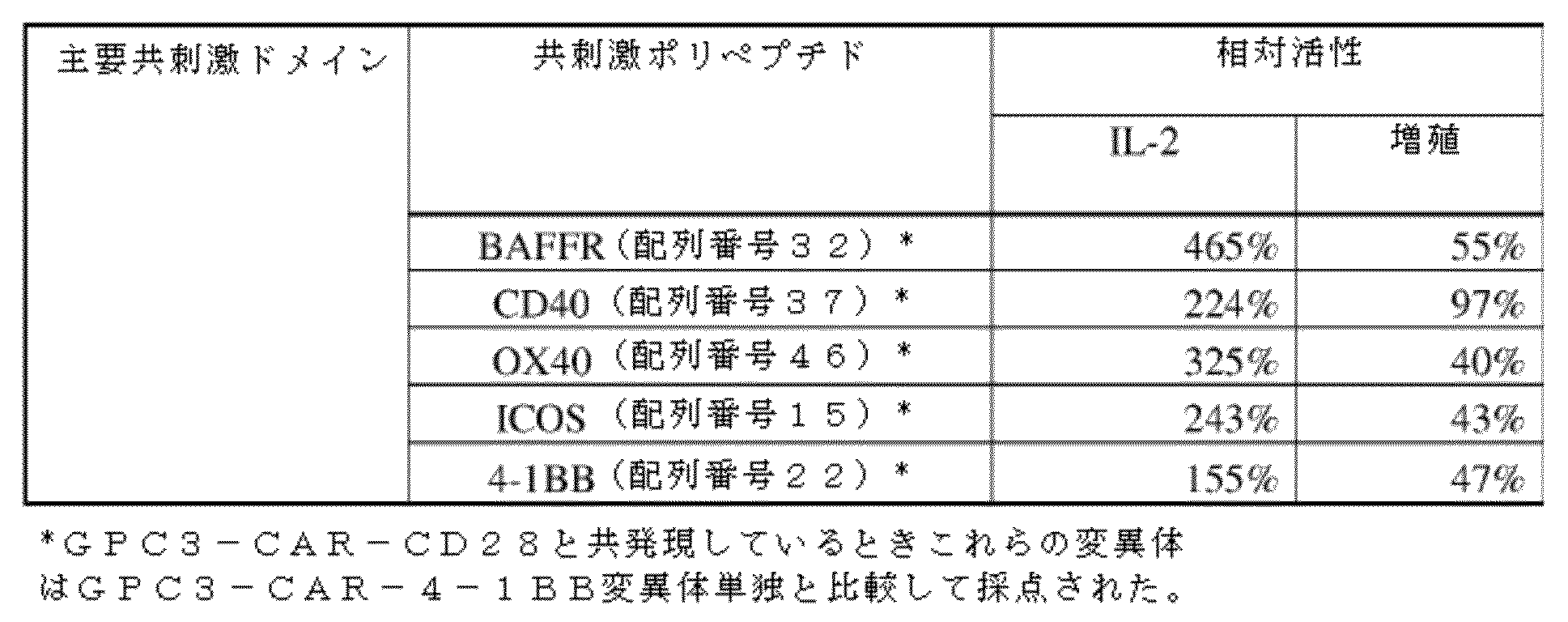
他の実施形態
本明細書中に開示される特徴は全て、任意の組合せで組み合わされ得る。本明細書中に開示される各特徴を、同じ、等価な、または類似する目的に役立つ代替特徴で置き換えてもよい。したがって、開示される各特徴は、特に明記しない限り全般的な一連の均等物または類似する特徴のほんの一例であるにすぎない。
Other Embodiments All of the features disclosed herein can be combined in any combination. Each feature disclosed herein may be replaced with an alternative feature that serves the same, equivalent, or similar purpose. Therefore, each feature disclosed is merely an example of a general set of equivalents or similar features unless otherwise stated.
当業者であれば上記説明から本開示の必須の特徴をその趣旨及び範囲から逸脱せずに簡単に確認することができ、本開示の様々な変更及び改変を行ってそれを様々な用途及び条件に適合させることができる。したがって、他の実施形態も特許請求の範囲に含まれる。 Those skilled in the art can easily confirm the essential features of the present disclosure from the above description without deviating from the purpose and scope thereof, and make various changes and modifications to the present disclosure and use them in various uses and conditions. Can be adapted to. Therefore, other embodiments are also included in the claims.
均等物
いくつかの本発明の実施形態を本明細書中で説明及び例示してきたが、当業者であれば、機能を実施するための、及び/または結果及び/または本明細書に記載の利点の1つ以上を得るための他の様々な手段及び/または構造を容易に考え付くであろうし、そのような変形形態及び/または改変形態は本明細書に記載の本発明の実施形態の範囲に入るとみなされる。より広くは、当業者であれば、本明細書に記載の全てのパラメータ、寸法、材料及び配置が例示を意図したものであり、本発明の教示内容が用いられる具体的な用途または複数の用途によって実際のパラメータ、寸法、材料及び/または配置が決まるであろうことを、容易に理解するであろう。当業者であれば、慣習的な実験しか用いずに本明細書に記載の具体的な本発明の実施形態の多くの均等物を認識するかまたは見出せるであろう。したがって、上記実施形態が例としてのみ提示されていること、ならびに本発明の実施形態の具体的に記載され特許請求されている以外の実施が別記の特許請求の範囲及びその均等物の範囲の中でなされ得ることは理解されるべきである。本開示の本発明の実施形態は、本明細書に記載の各個の特徴、システム、物品、材料、キット及び/または方法に関するものである。加えて、2つ以上のそのような特徴、システム、物品、材料、キット及び/または方法の任意の組合せは、そのような特徴、システム、物品、材料、キット及び/または方法が相互に矛盾していない場合に本開示の本発明の範囲に含まれる。
Equivalents Although some embodiments of the present invention have been described and exemplified herein, those skilled in the art can and / or results and / or the advantages described herein. Various other means and / or structures for obtaining one or more of the above will be readily conceivable, and such variants and / or variants are within the scope of the embodiments of the invention described herein. It is considered to enter. More broadly, one of ordinary skill in the art intends to illustrate all the parameters, dimensions, materials and arrangements described herein, and the specific use or plurality of uses in which the teachings of the present invention are used. It will be easily understood that will determine the actual parameters, dimensions, materials and / or arrangements. One of ordinary skill in the art will recognize or find many equivalents of the specific embodiments of the invention described herein using only conventional experimentation. Therefore, the above-described embodiment is presented only as an example, and the embodiments other than those specifically described and claimed in the embodiment of the present invention are within the scope of the claims and their equivalents. It should be understood that what can be done in. Embodiments of the invention of the present disclosure relate to the individual features, systems, articles, materials, kits and / or methods described herein. In addition, any combination of two or more such features, systems, articles, materials, kits and / or methods are mutually inconsistent with such features, systems, articles, materials, kits and / or methods. If not, it is included in the scope of the present invention of the present disclosure.
本明細書中で定義され使用される全ての定義は、定義された用語の辞書での定義、参照により援用される文書での定義、及び/または通常の意味よりも優先されると理解されるべきである。 All definitions defined and used herein are understood to supersede dictionary definitions of defined terms, in-document definitions referenced by reference, and / or their usual meanings. Should be.
本明細書中に開示される全ての参考文献、特許及び特許出願は、参照により各々の引用の目的である主題に関して援用されるが、これはある場合には文書全体を包含し得る。 All references, patents and patent applications disclosed herein are incorporated by reference with respect to the subject matter of which each citation is intended, which may in some cases include the entire document.
不定冠詞「a」及び「an」は、ここに本明細書及び特許請求の範囲の中で使用される場合、「少なくとも1つ」を意味すると理解されるべきであり、但し、そうでないと明確に示されている場合は除く。 The indefinite articles "a" and "an", as used herein and in the claims, should be understood to mean "at least one", provided that it is otherwise explicit. Except when indicated in.
「及び/または」という語句は、ここに本明細書及び特許請求の範囲の中で使用される場合、そのように繋ぎ合わされた要素の「どちらかまたは両方とも」、つまり、ある例では一緒に存在しており他の例では別個に存在している要素を意味すると理解されるべきである。「及び/または」によって連結された複数の要素は、同じように、つまり、そのように繋ぎ合わされた要素の「1つ以上」と解釈されるべきである。「及び/または」節によって具体的に特定された要素以外の他の要素が、具体的に特定された要素との関係があろうとなかろうと任意選択的に存在していてもよい。したがって、非限定的な例を挙げると、「A及び/またはB」に対する言及は、開放形式の用語、例えば「含む」と併せて使用される場合、ある実施形態ではAのみ(B以外の要素を任意選択的に含む);別の実施形態ではBのみ(A以外の要素を任意選択的に含む);さらに別の実施形態ではAとBとの両方(他の要素を任意選択的に含む);などを意味し得る。 The phrase "and / or", as used herein and within the scope of the claims, is "either or both" of such spliced elements, i.e., together in some cases. It should be understood to mean an element that exists and in other examples exists separately. Multiple elements linked by "and / or" should be construed in the same way, that is, "one or more" of such spliced elements. Other elements other than those specifically specified by the "and / or" clause may optionally be present, with or without a relationship with the specifically specified element. Thus, to give a non-limiting example, the reference to "A and / or B", when used in conjunction with an open-form term such as "contains", in some embodiments is A only (elements other than B). (Optionally include); in another embodiment only B (optionally includes elements other than A); in yet another embodiment both A and B (optionally include other elements) ); And so on.
ここに本明細書及び特許請求の範囲の中で使用する場合、「または」は、上に定義される「及び/または」と同じ意味を有すると理解されるべきである。例えば、「または」または「及び/または」は、一覧中の項目を隔てている場合、包括的である、つまり、複数または一覧の要素の少なくとも1つを包含するが1つより多くをも包含し、一覧にないさらなる項目も任意選択的に包含する、と解釈されるべきである。そうでないことを明確に示す用語、例えば、「の1つだけ」もしくは「のちょうど1つ」、または特許請求の範囲で使用される場合の「からなる」に限っては、複数または一覧の要素のちょうど1つの要素の包含を意味することになる。総じて、本明細書中で使用される「または」という用語は、「どちらか」、「の1つ」、「の1つだけ」または「のちょうど1つ」などの排他性を有する用語が後続する場合、排他的な選択肢(すなわち、「両方ではなく片方またはもう片方」)を示すものとしてのみ解釈されるべきである。「から本質的になる」は、特許請求の範囲の中で使用される場合、特許法の分野で使用されるときのその通常の意味を有すべきものである。 As used herein and within the scope of the claims, "or" should be understood to have the same meaning as "and / or" as defined above. For example, "or" or "and / or" is inclusive when separating items in the list, that is, it contains at least one of the elements of the list or more than one. However, it should be interpreted as optionally including additional items not in the list. Multiple or list elements, as long as the term clearly indicates that it is not, for example, "only one" or "exactly one", or "consisting of" as used in the claims. It means the inclusion of exactly one element of. As a whole, the term "or" as used herein is followed by a term having exclusivity such as "either", "one of", "only one" or "exactly one". If so, it should only be construed as indicating an exclusive choice (ie, "one or the other, not both"). "Being essentially from" should have its usual meaning when used in the field of patent law, when used within the claims.
ここに本明細書及び特許請求の範囲の中で使用する場合、1つ以上の要素の一覧に関して「少なくとも1つ」という語句は、要素の一覧の中の要素の任意の1つ以上から選択される少なくとも1つの要素を意味すると理解されるべきであるが、要素の一覧の中で具体的に列挙されているありとあらゆる要素の少なくとも1つを必ずしも含むわけではなく、要素の一覧の中の要素の任意の組合せを排除するわけでもない。この定義は、「少なくとも1つ」という語句が指す要素の一覧の中で具体的に特定された要素以外の要素が、具体的に特定された要素との関係があろうとなかろうと任意選択的に存在し得ることも許容する。したがって、非限定的な例を挙げると、「A及びBの少なくとも1つ」(または同義の「AまたはBの少なくとも1つ」、または同義の「A及び/またはBの少なくとも1つ」)は、ある実施形態でBが存在せず(B以外の要素を任意選択的に含んで)1つより多くを任意選択的に含んだ少なくとも1つのA;別の実施形態でAが存在せず(A以外の要素を任意選択的に含んで)1つより多くを任意選択的に含んだ少なくとも1つのB;さらに別の実施形態で、1つより多くを任意選択的に含んだ少なくとも1つのA、及び1つより多くを任意選択的に含んだ少なくとも1つのB(他の要素を任意選択的に含む);などを意味し得る。 As used herein and within the scope of the claims, the phrase "at least one" with respect to a list of one or more elements is selected from any one or more of the elements in the list of elements. It should be understood to mean at least one element, but it does not necessarily include at least one of every element specifically listed in the list of elements, but an element in the list of elements. Nor does it exclude any combination. This definition is optional, whether or not an element other than the specifically specified element in the list of elements pointed to by the phrase "at least one" has a relationship with the specifically specified element. It is also acceptable that it may exist. Thus, to give a non-limiting example, "at least one of A and B" (or synonymous "at least one of A or B" or synonymous "at least one of A and / or B") , At least one A in which B is not present in one embodiment (optionally including elements other than B) and more than one is optionally present; in another embodiment A is not present (A is not present). At least one B that optionally contains more than one (including elements other than A); and at least one A that optionally contains more than one in yet another embodiment. , And at least one B (optionally including other elements) containing more than one; and the like.
本明細書中で特許請求される、1つより多いステップまたは行為を含む任意の方法において、特段の指定が明確になされていない限り方法のステップまたは行為の順序が、必ずしも方法のステップまたは行為の列挙された順序に限定されないことも、理解されるべきである。 In any method, including one or more steps or acts claimed herein, the order of the steps or acts of the method is not necessarily the step or act of the method unless otherwise specified. It should also be understood that the order is not limited to the enumerated order.
Claims (55)
(i)キメラ抗原受容体(CAR)ポリペプチドと、
(ii)共刺激ポリペプチドと
を共発現し、
前記CARポリペプチドが、
(a)細胞外抗原結合ドメインであってグリピカン-3(GPC3)に対して特異的である前記細胞外結合ドメイン、
(b)膜貫通ドメイン、及び
(c)細胞質側シグナル伝達ドメイン
を含むものであり、
前記共刺激ポリペプチドが、B7/CD28スーパーファミリーのメンバー、腫瘍壊死因子(TNF)スーパーファミリーのメンバー、またはそのリガンドであり、前記共刺激ポリペプチドが外来核酸にコードされている、前記造血細胞。 Genetically engineered hematopoietic cells
(I) Chimeric antigen receptor (CAR) polypeptide and
(Ii) Co-expressing with a co-stimulating polypeptide,
The CAR polypeptide
(A) The extracellular binding domain, which is an extracellular antigen-binding domain and is specific for glypican-3 (GPC3).
It comprises (b) a transmembrane domain and (c) a cytoplasmic signaling domain.
The hematopoietic cell, wherein the co-stimulating polypeptide is a member of the B7 / CD28 superfamily, a member of the tumor necrosis factor (TNF) superfamily, or a ligand thereof, wherein the co-stimulating polypeptide is encoded by a foreign nucleic acid.
CD28、CD80、CD86、ICOS、ICOSL、B7-H3、B7-H4、VISTA、TMIGD2、B7-H6、及びB7-H7
からなる群から選択されるB7/CD28スーパーファミリーのメンバーまたはそのリガンドである、請求項1に記載の造血細胞。 The co-stimulating polypeptide
CD28, CD80, CD86, ICOS, ICOSL, B7-H3, B7-H4, VISTA, TMIGD2, B7-H6, and B7-H7
The hematopoietic cell according to claim 1, which is a member of the B7 / CD28 superfamily selected from the group consisting of or a ligand thereof.
4-1BB、4-1BBL、BAFF、BAFFR、CD27、CD70、CD30、CD30L、CD40、CD40L、DR3、GITR、GITRL、HVEM、LIGHT、TNFベータ、OX40、OX40L、RELT、TACI、TL1A、TNFアルファ、TNFRII、BCMA、EDAR2、TROY、LTBR、EDAR、NGFR、OPG、RANK、DCR3、TNFR1、FN14(TweakR)、APRIL、EDA-A2、TWEAK、LTb(TNF-C)、NGF、EDA-A1、APPアミロイド前駆体タンパク質(APP)、及びTRAIL
からなる群から選択されるTNFスーパーファミリーのメンバーまたはそのリガンドである、請求項1に記載の造血細胞。 The co-stimulating polypeptide
4-1BB, 4-1BBL, BAFF, BAFFR, CD27, CD70, CD30, CD30L, CD40, CD40L, DR3, GITR, GITRL, HVEM, LIGHT, TNF beta, OX40, OX40L, RELT, TACI, TL1A, TNFalpha, TNFRII, BCMA, EDAR2, TROY, LTBR, EDAR, NGFR, OPG, RANK, DCR3, TNFR1, FN14 (TweakR), APRIL, EDA-A2, TWEAK, LTb (TNF-C), NGF, EDA-A1, APP Precursor protein (APP), and TRAIL
The hematopoietic cell according to claim 1, which is a member of the TNF superfamily selected from the group consisting of or a ligand thereof.
4-1BB、CD28、CD28LL→GG変異体、OX40、ICOS、CD27、GITR、ICOS、HVEM、TIM1、LFA1及びCD2
からなる群から選択される共刺激分子のものである、請求項4に記載の造血細胞。 The at least one co-stimulation signaling domain
4-1BB, CD28, CD28 LL → GG mutant, OX40, ICOS, CD27, GITR, ICOS, HVEM, TIM1, LFA1 and CD2
The hematopoietic cell according to claim 4, which is a co-stimulatory molecule selected from the group consisting of.
(ii)前記共刺激ポリペプチドがBAFFRまたはCD27である、
請求項4に記載の造血細胞。 (I) The CAR polypeptide comprises a co-stimulatory domain of a CD28 co-stimulatory molecule, and (ii) the co-stimulatory polypeptide is BAFFR or CD27.
The hematopoietic cell according to claim 4.
(ii)前記共刺激ポリペプチドがCD70、LIGHTまたはOX40Lである、
請求項4に記載の造血細胞。 (I) The CAR polypeptide comprises a co-stimulatory domain of a 4-1BB co-stimulator molecule, and (ii) the co-stimulatory polypeptide is CD70, LIGHT or OX40L.
The hematopoietic cell according to claim 4.
内在性T細胞受容体、内在性主要組織適合性複合体、内在性ベータ-2-ミクログロブリンまたはその組合せ
の発現が阻害または排除されたT細胞である、請求項22に記載の造血細胞。 The immune cells
22. The hematopoietic cell according to claim 22, wherein the expression of an endogenous T cell receptor, an endogenous major histocompatibility complex, an endogenous beta-2-microglobulin or a combination thereof is inhibited or eliminated.
(A)前記共刺激ポリペプチドをコードする第1外来ヌクレオチド配列、及び
(B)前記CARポリペプチドをコードする第2外来ヌクレオチド配列
を全体として含んだ核酸または核酸セットを含む、請求項1~24のいずれか1項に記載の造血細胞。 The hematopoietic cells
Claims 1-24 include a nucleic acid or nucleic acid set comprising (A) a first foreign nucleotide sequence encoding the costimulatory polypeptide and (B) a second foreign nucleotide sequence encoding the CAR polypeptide as a whole. The hematopoietic cell according to any one of the above items.
レトロウイルスベクターであって、任意選択的にレンチウイルスベクターまたはガンマレトロウイルスベクターである、レトロウイルスベクター
である、請求項32に記載の造血細胞。 The one or more viral vectors mentioned above
32. The hematopoietic cell of claim 32, which is a retroviral vector, optionally a lentiviral vector or a gamma retroviral vector.
抗CD3抗体、抗CD28抗体、IL-2、フィトヘマグルチニン、及び操作型人工刺激細胞または粒子
のうちの1つ以上の存在下で活性化されたT細胞を含む免疫細胞である、請求項36~42のいずれか1項に記載の方法。 The hematopoietic cells
36-Immune cell comprising anti-CD3 antibody, anti-CD28 antibody, IL-2, phytohaemagglutinin, and T cells activated in the presence of one or more of an engineered artificial stimulator cell or particle. The method according to any one of 42.
4-1BBリガンド、抗4-1BB抗体、IL-15、抗IL-15受容体抗体、IL-2、IL-12、IL-18、IL-21及びK562細胞
のうちの1つ以上の存在下で活性化されたナチュラルキラー細胞を含む免疫細胞である、請求項36~42のいずれか1項に記載の方法。 The hematopoietic cells
In the presence of one or more of 4-1BB ligands, anti-4-1BB antibodies, IL-15, anti-IL-15 receptor antibodies, IL-2, IL-12, IL-18, IL-21 and K562 cells. The method according to any one of claims 36 to 42, which is an immune cell containing a natural killer cell activated in.
(B)請求項1~3及び請求項6~11のいずれか1項に記載の共刺激ポリペプチドをコードする第2ヌクレオチド配列
を全体として含む、核酸または核酸セット。 (A) The first nucleotide sequence encoding the CAR polypeptide according to any one of claims 1 and 4 to 22, and (B) any one of claims 1 to 3 and claims 6 to 11. A nucleic acid or set of nucleic acids comprising a second nucleotide sequence encoding the costimulatory polypeptide according to the section as a whole.
レトロウイルスベクターであって、任意選択的にレンチウイルスベクターまたはガンマレトロウイルスベクターである、レトロウイルスベクター
である、請求項53に記載の核酸または核酸セット。 The one or more viral vectors mentioned above
The nucleic acid or nucleic acid set according to claim 53, which is a retroviral vector, optionally a lentiviral vector or a gamma retroviral vector.
Applications Claiming Priority (3)
| Application Number | Priority Date | Filing Date | Title |
|---|---|---|---|
| US201862756683P | 2018-11-07 | 2018-11-07 | |
| US62/756,683 | 2018-11-07 | ||
| PCT/US2019/060287 WO2020097346A1 (en) | 2018-11-07 | 2019-11-07 | ANTI-GPC3 CHIMERIC ANTIGEN RECEPTORS (CARs) IN COMBINATION WITH TRANS CO-STIMULATORY MOLECULES AND THERAPEUTIC USES THEREOF |
Publications (2)
| Publication Number | Publication Date |
|---|---|
| JP2022512958A true JP2022512958A (en) | 2022-02-07 |
| JPWO2020097346A5 JPWO2020097346A5 (en) | 2022-11-11 |
Family
ID=70611157
Family Applications (1)
| Application Number | Title | Priority Date | Filing Date |
|---|---|---|---|
| JP2021524959A Pending JP2022512958A (en) | 2018-11-07 | 2019-11-07 | Anti-GPC3 chimeric antigen receptor (CAR) combined with trans-co-stimulatory molecule and its therapeutic uses |
Country Status (7)
| Country | Link |
|---|---|
| US (1) | US20220054545A1 (en) |
| EP (1) | EP3876950A4 (en) |
| JP (1) | JP2022512958A (en) |
| CN (1) | CN113260368B (en) |
| AU (1) | AU2019374828A1 (en) |
| CA (1) | CA3118889A1 (en) |
| WO (1) | WO2020097346A1 (en) |
Families Citing this family (22)
| Publication number | Priority date | Publication date | Assignee | Title |
|---|---|---|---|---|
| US20190336533A1 (en) | 2016-12-28 | 2019-11-07 | Green Cross Lab Cell Corporation | Chimeric antigen receptor and natural killer cells expressing same |
| US11649294B2 (en) | 2017-11-14 | 2023-05-16 | GC Cell Corporation | Anti-HER2 antibody or antigen-binding fragment thereof, and chimeric antigen receptor comprising same |
| CN110468105B (en) * | 2018-05-09 | 2024-03-22 | 恺兴生命科技(上海)有限公司 | Immune effector cells expressing IL-18R binding proteins |
| US12077785B2 (en) | 2018-08-14 | 2024-09-03 | Sotio Biotech Inc. | Chimeric antigen receptor polypeptides in combination with trans metabolism molecules modulating Krebs cycle and therapeutic uses thereof |
| CA3174779A1 (en) * | 2020-03-26 | 2021-09-30 | The United States Of America, As Represented By The Secretary, Department Of Health And Human Services | Cd28h domain-containing chimeric antigen receptors and methods of use |
| CN113754778A (en) * | 2020-06-05 | 2021-12-07 | 上海交通大学 | Chimeric antigen receptor targeting CLDN18.2 and uses thereof |
| CN114057890A (en) * | 2020-07-31 | 2022-02-18 | 南京北恒生物科技有限公司 | Novel costimulatory domains and uses thereof |
| CN112159818B (en) * | 2020-08-20 | 2023-02-21 | 山东兴瑞生物科技有限公司 | Nucleic acid for treating HCC, preparation method thereof, CAR-T cell with nucleic acid and preparation method of cell |
| CN116261596A (en) * | 2020-09-29 | 2023-06-13 | 南京传奇生物科技有限公司 | T cell and antigen presenting cell engagers and uses thereof |
| WO2022113056A1 (en) | 2020-11-30 | 2022-06-02 | Crispr Therapeutics Ag | Gene-edited natural killer cells |
| US20240277841A2 (en) * | 2020-12-11 | 2024-08-22 | Purdue Research Foundation | Human chimeric antigen receptor neutrophils, compositions, kits and methods of use |
| US11473060B2 (en) | 2020-12-30 | 2022-10-18 | Crispr Therapeutics Ag | Compositions and methods for differentiating stem cells into NK cells |
| US20240366663A1 (en) * | 2021-04-08 | 2024-11-07 | Artiva Biotherapeutics, Inc. | Chimeric antigen receptor comprising an anti-cd19 antibody or antigen-binding fragment thereof and natural killer cells comprising the same |
| CN117615786A (en) * | 2021-05-07 | 2024-02-27 | 森蒂生物科学公司 | Chimeric antigen receptors and methods of use |
| WO2023036043A1 (en) * | 2021-09-09 | 2023-03-16 | 广东东阳光药业有限公司 | Anti-cancer binding molecule and use thereof |
| US20250000906A1 (en) | 2021-11-16 | 2025-01-02 | Sotio Biotech Inc. | Treatment of myxoid/round cell liposarcoma patients |
| CN116426483B (en) * | 2021-12-30 | 2024-02-23 | 南京紫珑生物科技有限公司 | Application of CD258 protein in immunotherapy |
| CA3262237A1 (en) * | 2022-07-15 | 2024-01-18 | Albert Einstein College Of Medicine | Chimeric antigen receptors comprising a tmigd2 costimulatory domain and associated methods of using the same |
| CN117304343B (en) * | 2023-10-11 | 2024-05-07 | 北京景达生物科技有限公司 | Preparation and application of GPC3 targeted CAR-NK cells |
| CN117247466B (en) * | 2023-11-20 | 2025-01-24 | 北京艺妙神州医药科技有限公司 | Chimeric antigen receptor against glypican 3 and its use |
| WO2025144887A1 (en) * | 2023-12-27 | 2025-07-03 | Obsidian Therapeutics, Inc. | Compositions and methods for tunable regulation of il15 and light |
| WO2025191137A1 (en) * | 2024-03-15 | 2025-09-18 | Avidicure Ip B.V. | Conjugates of trop2-specific antigen binding proteins and cytokines |
Citations (2)
| Publication number | Priority date | Publication date | Assignee | Title |
|---|---|---|---|---|
| WO2015112626A1 (en) * | 2014-01-21 | 2015-07-30 | June Carl H | Enhanced antigen presenting ability of car t cells by co-introduction of costimulatory molecules |
| WO2017002934A1 (en) * | 2015-07-01 | 2017-01-05 | 中外製薬株式会社 | Gpc3-targeted therapeutic agent administered to patient in whom gpc3-targetd therapeutic ag |
Family Cites Families (4)
| Publication number | Priority date | Publication date | Assignee | Title |
|---|---|---|---|---|
| PH12013501201A1 (en) * | 2010-12-09 | 2013-07-29 | Univ Pennsylvania | Use of chimeric antigen receptor-modified t cells to treat cancer |
| US20140322216A1 (en) * | 2011-11-08 | 2014-10-30 | The Trustees Of The University Of Pennsylvania | Glypican-3-specific antibody and uses thereof |
| CN107460201A (en) * | 2013-05-08 | 2017-12-12 | 科济生物医药(上海)有限公司 | Encode the nucleic acid of the Chimeric antigen receptor albumen of GPC 3 and express the T lymphocytes of the Chimeric antigen receptor albumen of GPC 3 |
| EP3198010B1 (en) * | 2014-09-26 | 2020-11-04 | Baylor College of Medicine | Glypican-3 specific chimeric antigen receptors for adoptive immunotherapy |
-
2019
- 2019-11-07 WO PCT/US2019/060287 patent/WO2020097346A1/en not_active Ceased
- 2019-11-07 AU AU2019374828A patent/AU2019374828A1/en not_active Abandoned
- 2019-11-07 CA CA3118889A patent/CA3118889A1/en active Pending
- 2019-11-07 JP JP2021524959A patent/JP2022512958A/en active Pending
- 2019-11-07 CN CN201980087101.8A patent/CN113260368B/en not_active Expired - Fee Related
- 2019-11-07 US US17/291,963 patent/US20220054545A1/en not_active Abandoned
- 2019-11-07 EP EP19882878.2A patent/EP3876950A4/en not_active Withdrawn
Patent Citations (2)
| Publication number | Priority date | Publication date | Assignee | Title |
|---|---|---|---|---|
| WO2015112626A1 (en) * | 2014-01-21 | 2015-07-30 | June Carl H | Enhanced antigen presenting ability of car t cells by co-introduction of costimulatory molecules |
| WO2017002934A1 (en) * | 2015-07-01 | 2017-01-05 | 中外製薬株式会社 | Gpc3-targeted therapeutic agent administered to patient in whom gpc3-targetd therapeutic ag |
Non-Patent Citations (1)
| Title |
|---|
| CLINICAL CANCER RESEARCH, JPN6023045338, 2014, ISSN: 0005360463 * |
Also Published As
| Publication number | Publication date |
|---|---|
| US20220054545A1 (en) | 2022-02-24 |
| AU2019374828A1 (en) | 2021-05-27 |
| CN113260368B (en) | 2023-08-29 |
| CA3118889A1 (en) | 2020-05-14 |
| EP3876950A4 (en) | 2022-11-30 |
| WO2020097346A1 (en) | 2020-05-14 |
| EP3876950A1 (en) | 2021-09-15 |
| CN113260368A (en) | 2021-08-13 |
Similar Documents
| Publication | Publication Date | Title |
|---|---|---|
| CN113260368B (en) | Combination of anti-GPC 3 Chimeric Antigen Receptor (CAR) and trans-costimulatory molecules and therapeutic uses thereof | |
| AU2019299439C1 (en) | Chimeric receptors in combination with trans metabolism molecules enhancing glucose import and therapeutic uses thereof | |
| US20240376442A1 (en) | Chimeric antigen receptor polypeptides in combination with trans metabolism molecules modulating krebs cycle and therapeutic uses thereof | |
| US20210340219A1 (en) | Chimeric receptor polypeptides in combination with trans metabolism molecules modulating intracellular lactate concentrations and therapeutic uses thereof | |
| US20240390495A1 (en) | Chimeric receptor polypeptides in combination with trans metabolism molecules that re-direct glucose metabolites out of the glycolysis pathway and therapeutic uses thereof | |
| US20210261646A1 (en) | Chimeric receptors in combination with trans metabolism molecules enhancing glucose import and therapeutic uses thereof | |
| WO2020028572A2 (en) | ANTIBODY-COUPLED T CELL RECEPTORS (ACTRs) IN COMBINATION WITH TRANS CO-STIMULATORY MOLECULES AND THERAPEUTIC USES THEREOF | |
| US20250297022A1 (en) | Engineered switches for immune cell activity and methods of use thereof | |
| JP2024504048A (en) | Chimeric costimulatory protein containing a mutant intracellular domain with increased expression | |
| US20250073268A1 (en) | Chimeric cd40 polypeptides and methods of use in immunotherapy | |
| WO2024215989A1 (en) | ENGINEERED IMMUNE CELLS FOR TREATING CANCER IN COMBINATION WITH IL-2/IL-15 RECEPTOR βγ AGONISTS | |
| EP4572787A1 (en) | Genetically engineered immune cells with chimeric receptor polypeptides in combination with multiple trans metabolism molecules and therapeutic uses thereof | |
| WO2024040207A1 (en) | Genetically engineered natural killer (nk) cells with chimeric receptor polypeptides in combination with trans metabolism molecules and therapeutic uses thereof | |
| WO2024215987A1 (en) | IMMUNE CELLS FOR TREATING CANCER IN COMBINATION WITH IL-15/IL-15Rα CONJUGATES |
Legal Events
| Date | Code | Title | Description |
|---|---|---|---|
| A521 | Request for written amendment filed |
Free format text: JAPANESE INTERMEDIATE CODE: A523 Effective date: 20221102 |
|
| A621 | Written request for application examination |
Free format text: JAPANESE INTERMEDIATE CODE: A621 Effective date: 20221102 |
|
| A977 | Report on retrieval |
Free format text: JAPANESE INTERMEDIATE CODE: A971007 Effective date: 20231024 |
|
| A131 | Notification of reasons for refusal |
Free format text: JAPANESE INTERMEDIATE CODE: A131 Effective date: 20231107 |
|
| A601 | Written request for extension of time |
Free format text: JAPANESE INTERMEDIATE CODE: A601 Effective date: 20240206 |
|
| A02 | Decision of refusal |
Free format text: JAPANESE INTERMEDIATE CODE: A02 Effective date: 20240702 |