JP2022124401A - Polymer composition for porous film formation, method for producing porous film, porous film, flexible metal-clad laminate, and electronic board - Google Patents
Polymer composition for porous film formation, method for producing porous film, porous film, flexible metal-clad laminate, and electronic board Download PDFInfo
- Publication number
- JP2022124401A JP2022124401A JP2021022146A JP2021022146A JP2022124401A JP 2022124401 A JP2022124401 A JP 2022124401A JP 2021022146 A JP2021022146 A JP 2021022146A JP 2021022146 A JP2021022146 A JP 2021022146A JP 2022124401 A JP2022124401 A JP 2022124401A
- Authority
- JP
- Japan
- Prior art keywords
- solvent
- porous
- porous film
- polymer
- mass
- Prior art date
- Legal status (The legal status is an assumption and is not a legal conclusion. Google has not performed a legal analysis and makes no representation as to the accuracy of the status listed.)
- Granted
Links
Images


Classifications
-
- C—CHEMISTRY; METALLURGY
- C08—ORGANIC MACROMOLECULAR COMPOUNDS; THEIR PREPARATION OR CHEMICAL WORKING-UP; COMPOSITIONS BASED THEREON
- C08J—WORKING-UP; GENERAL PROCESSES OF COMPOUNDING; AFTER-TREATMENT NOT COVERED BY SUBCLASSES C08B, C08C, C08F, C08G or C08H
- C08J9/00—Working-up of macromolecular substances to porous or cellular articles or materials; After-treatment thereof
- C08J9/28—Working-up of macromolecular substances to porous or cellular articles or materials; After-treatment thereof by elimination of a liquid phase from a macromolecular composition or article, e.g. drying of coagulum
- C08J9/283—Working-up of macromolecular substances to porous or cellular articles or materials; After-treatment thereof by elimination of a liquid phase from a macromolecular composition or article, e.g. drying of coagulum a discontinuous liquid phase emulsified in a continuous macromolecular phase
-
- B—PERFORMING OPERATIONS; TRANSPORTING
- B32—LAYERED PRODUCTS
- B32B—LAYERED PRODUCTS, i.e. PRODUCTS BUILT-UP OF STRATA OF FLAT OR NON-FLAT, e.g. CELLULAR OR HONEYCOMB, FORM
- B32B15/00—Layered products comprising a layer of metal
- B32B15/04—Layered products comprising a layer of metal comprising metal as the main or only constituent of a layer, which is next to another layer of the same or of a different material
- B32B15/08—Layered products comprising a layer of metal comprising metal as the main or only constituent of a layer, which is next to another layer of the same or of a different material of synthetic resin
- B32B15/088—Layered products comprising a layer of metal comprising metal as the main or only constituent of a layer, which is next to another layer of the same or of a different material of synthetic resin comprising polyamides
-
- C—CHEMISTRY; METALLURGY
- C08—ORGANIC MACROMOLECULAR COMPOUNDS; THEIR PREPARATION OR CHEMICAL WORKING-UP; COMPOSITIONS BASED THEREON
- C08J—WORKING-UP; GENERAL PROCESSES OF COMPOUNDING; AFTER-TREATMENT NOT COVERED BY SUBCLASSES C08B, C08C, C08F, C08G or C08H
- C08J9/00—Working-up of macromolecular substances to porous or cellular articles or materials; After-treatment thereof
- C08J9/28—Working-up of macromolecular substances to porous or cellular articles or materials; After-treatment thereof by elimination of a liquid phase from a macromolecular composition or article, e.g. drying of coagulum
-
- H—ELECTRICITY
- H05—ELECTRIC TECHNIQUES NOT OTHERWISE PROVIDED FOR
- H05K—PRINTED CIRCUITS; CASINGS OR CONSTRUCTIONAL DETAILS OF ELECTRIC APPARATUS; MANUFACTURE OF ASSEMBLAGES OF ELECTRICAL COMPONENTS
- H05K1/00—Printed circuits
- H05K1/02—Details
- H05K1/03—Use of materials for the substrate
-
- B—PERFORMING OPERATIONS; TRANSPORTING
- B32—LAYERED PRODUCTS
- B32B—LAYERED PRODUCTS, i.e. PRODUCTS BUILT-UP OF STRATA OF FLAT OR NON-FLAT, e.g. CELLULAR OR HONEYCOMB, FORM
- B32B2457/00—Electrical equipment
- B32B2457/08—PCBs, i.e. printed circuit boards
-
- C—CHEMISTRY; METALLURGY
- C08—ORGANIC MACROMOLECULAR COMPOUNDS; THEIR PREPARATION OR CHEMICAL WORKING-UP; COMPOSITIONS BASED THEREON
- C08J—WORKING-UP; GENERAL PROCESSES OF COMPOUNDING; AFTER-TREATMENT NOT COVERED BY SUBCLASSES C08B, C08C, C08F, C08G or C08H
- C08J2377/00—Characterised by the use of polyamides obtained by reactions forming a carboxylic amide link in the main chain; Derivatives of such polymers
Landscapes
- Chemical & Material Sciences (AREA)
- Engineering & Computer Science (AREA)
- Materials Engineering (AREA)
- Health & Medical Sciences (AREA)
- Chemical Kinetics & Catalysis (AREA)
- Medicinal Chemistry (AREA)
- Polymers & Plastics (AREA)
- Organic Chemistry (AREA)
- Microelectronics & Electronic Packaging (AREA)
- Manufacture Of Porous Articles, And Recovery And Treatment Of Waste Products (AREA)
- Compositions Of Macromolecular Compounds (AREA)
Abstract
【課題】低誘電率及び低誘電正接を有し、液の浸透性や吸水性の問題が改善され、機械的強度の低下のおそれが抑えられた多孔質膜を形成するためのポリマー組成物を提供する。【解決手段】ポリマーと、溶剤(A)と、溶剤(B)とを含み、前記溶剤(A)は、100℃以上の沸点を有し、かつ前記ポリマーを、前記10質量%の濃度で溶解させた溶液が、25℃において150dPa・s以上の粘度を有し、前記溶剤(B)は、100℃未満の沸点を有し、かつ前記ポリマーを10質量%の濃度で溶解させた溶液が、25℃において50dPa・s未満の粘度を有する、多孔質膜形成用ポリマー組成物。【選択図】図1[Problem] To provide a polymer composition for forming a porous film having a low dielectric constant and a low dielectric loss tangent, improving the problems of liquid permeability and water absorption, and suppressing the possibility of a decrease in mechanical strength. offer. The solution comprises a polymer, a solvent (A), and a solvent (B), wherein the solvent (A) has a boiling point of 100° C. or higher, and dissolves the polymer at a concentration of 10% by mass. The resulting solution has a viscosity of 150 dPa·s or more at 25° C., the solvent (B) has a boiling point of less than 100° C., and the polymer is dissolved at a concentration of 10% by mass. A porous film forming polymer composition having a viscosity of less than 50 dPa·s at 25°C. [Selection drawing] Fig. 1
Description
本発明は、多孔質膜形成用ポリマー組成物、多孔質膜の製造方法、多孔質膜。フレキシブル金属張積層板及び電子基板に関する。 The present invention relates to a polymer composition for forming a porous membrane, a method for producing a porous membrane, and a porous membrane. The present invention relates to flexible metal-clad laminates and electronic substrates.
近年、第5世代移動通信方式(5G)に対応する移動体通信機器が出現し、さらに第6世代を見据えた開発が開始されている。移動体通信機器等においては、小型化の要請があり、省スペースを図るために、プリント配線板にはフレキシブルなポリマーフィルムに金属箔を張り合わせたフレキシブル金属張積層板が用いられることが多い。 In recent years, mobile communication devices compatible with the 5th generation mobile communication system (5G) have appeared, and furthermore, development has been started in anticipation of the 6th generation. In mobile communication devices, etc., there is a demand for miniaturization, and in order to save space, a flexible metal-clad laminate, which is a flexible polymer film laminated with a metal foil, is often used as a printed wiring board.
一方、移動体通信機器等では、大容量の情報を高速で伝送・処理するため、高周波数帯(GHzオーダー)の電気信号の使用が増えている。高周波数帯の信号は、減衰しやすく、使用される材料には伝送損失を抑制する工夫が求められている。加えて、これらの機器では発熱量が大きく、材料には耐熱性も求められている。 On the other hand, in mobile communication devices and the like, the use of electric signals in a high frequency band (GHz order) is increasing in order to transmit and process large amounts of information at high speed. Signals in a high frequency band are easily attenuated, and the materials used are required to be devised to suppress transmission loss. In addition, these devices generate a large amount of heat, and materials are required to have heat resistance.
これらを背景に、伝送損失の低減を可能とする低誘電率及び低誘電正接を有するポリマーフィルムが開発されている。ポリイミドは、耐熱性に優れた材料として知られているが、ポリイミドフィルムに関しては、フィルムの多孔質化を図り、誘電特性を改善する方法が提案されている。 Against this background, polymer films having a low dielectric constant and a low dielectric loss tangent have been developed that enable reduction of transmission loss. Polyimide is known as a material with excellent heat resistance, and with respect to polyimide films, methods have been proposed to improve the dielectric properties of polyimide films by making the films porous.
例えば、特許文献1では、低誘電率フィルムの製造方法としては、例えば、低誘電率で厚さが10μm以下のナノ孔質ポリマーフィルムの製造方法であって、最低沸点溶媒と最高沸点溶媒との沸点差が約50℃以上である少なくとも2種の溶媒を含む溶液中でポリマーを提供して、30nm未満の平均気孔サイズの気孔をフィルムに形成することを含むナノ孔質ポリマーフィルムの製造方法、及びこの方法によって製造されたナノ孔質フィルムが提案されている。
For example, in
例えば、特許文献2では、ポリイミド前駆体の均一溶液(A)と、該ポリイミド前駆体の貧溶媒(B)からなるフィルム状組成物(C)であって、上記貧溶媒はポリイミド前駆体のイミド化開始温度より高い温度あるいはそれと同等の温度に沸点または熱分解点を有し、前記フィルム状組成物を加熱処理してイミド化することを特徴とするフィルム両面に緻密層を有し、フィルム中央部は多孔質層からなる多孔質ポリイミドフィルムの製造法、及びこの方法によって製造された多孔質ポリイミドフィルムが提案されている。 For example, in Patent Document 2, a film-like composition (C) comprising a uniform solution (A) of a polyimide precursor and a poor solvent (B) of the polyimide precursor, wherein the poor solvent is an imide of the polyimide precursor A film having a boiling point or a thermal decomposition point at a temperature higher than the polymerization initiation temperature or at a temperature equivalent to it, and imidizing the film-like composition by heat treatment. Part is proposed a method for producing a porous polyimide film comprising a porous layer, and a porous polyimide film produced by this method.
さらに、特許文献3では、ポリマー材料からなるフィルムに微細な空孔が分散形成された、多孔質の低誘電性ポリマーフィルムであって、フィルムの空孔率が60%以上であり、空孔の平均孔径が10μm以下であるフィルムが提案され、特許文献4では、ポリマー材料からなるベース材料層に微細な空孔が分散形成された、多孔質の低誘電性ポリマーフィルムであって、ベース材料層の少なくとも一方の表面に、ベース材料層のポリマー材料からなる実質的に平滑なスキン層が形成されていることを特徴とするフィルムが提案されている。 Furthermore, Patent Document 3 discloses a porous low-dielectric polymer film in which fine pores are dispersed in a film made of a polymer material, and the porosity of the film is 60% or more. A film having an average pore size of 10 μm or less has been proposed, and Patent Document 4 discloses a porous low-dielectric polymer film in which fine pores are dispersed in a base material layer made of a polymer material, the base material layer A film has been proposed in which a substantially smooth skin layer of the polymeric material of the base material layer is formed on at least one surface of the base material layer.
しかしながら、特許文献1のフィルムは、基材上にポリマー塗膜を形成した後、ポリマーに対する非溶媒と接触させ、相転換をもたらすことで得られため、製造に多段階の処理を必要とし、得られたフィルムには、空孔が表面付近にも存在するため、例えばめっき処理を行った場合に液の浸透性や吸水性の問題があり、また、機械的強度が低いといった問題もある。
特許文献2では、フィルム製造工程の熱処理によって、ポリイミド前駆体からポリイミドへの転換を図るため、独立した空孔のサイズの制御が困難である。
特許文献3及び4では、実際に得られるフィルムの空孔のサイズ(平均孔径)は、4.4~9.8μmであり、上記しためっき処理における液の浸透性や吸水性の問題を避けられず、機械的強度も低いといった問題がある。
However, the film of
In Patent Document 2, since the polyimide precursor is converted to polyimide by heat treatment in the film manufacturing process, it is difficult to independently control the size of the pores.
In Patent Documents 3 and 4, the pore size (average pore diameter) of the film actually obtained is 4.4 to 9.8 μm, and the problem of liquid permeability and water absorption in the plating treatment described above can be avoided. However, there is a problem that the mechanical strength is low.
本発明は、低誘電率及び低誘電正接を有し、液の浸透性や吸水性の問題が改善され、かつ機械的強度の低下のおそれが抑えられた多孔質膜を形成するためのポリマー組成物を提供することを目的とし、また、そのような多孔質膜及び多孔質膜の製造方法を提供することを目的とする。 The present invention provides a polymer composition for forming a porous film that has a low dielectric constant and a low dielectric loss tangent, is improved in the problems of liquid permeability and water absorption, and is less likely to deteriorate in mechanical strength. An object of the present invention is to provide a product, and to provide such a porous membrane and a method for producing the porous membrane.
本発明の要旨構成は以下のとおりである。
[1]ポリマーと、溶剤(A)と、溶剤(B)とを含み、
前記溶剤(A)は、100℃以上の沸点を有し、かつ前記ポリマーを、前記10質量%の濃度で溶解させた溶液が、25℃において150dPa・s以上の粘度を有し、
前記溶剤(B)は、100℃未満の沸点を有し、かつ前記ポリマーを10質量%の濃度で溶解させた溶液が、25℃において50dPa・s未満の粘度を有する、
多孔質膜形成用ポリマー組成物。
[2]前記溶剤(A)が、アルキレングリコールモノアルキルエーテルである、[1]の多孔質膜形成用ポリマー組成物。
[3]前記溶剤(A)が、プロピレングリコール1-モノメチルエーテル及びジエチレングリコールモノエチルエーテルからなる群より選ばれる1種以上である。[1]又は[2]の多孔質膜形成用ポリマー組成物。
[4]前記溶剤(B)が、アセトン、酢酸エチル及びテトラヒドロフランからなる群より選ばれる1種以上である、[1]~[3]のいずれかの多孔質膜形成用ポリマー組成物。
[5]前記溶剤(A)の沸点と前記溶剤(B)の沸点の差が40℃以上150℃以下である。[1]~[4]のいずれか一項記載の多孔質膜形成用ポリマー組成物。
[6]前記ポリマーが、ポリイミドである、[1]~[5]のいずれかの多孔質膜形成用ポリマー組成物。
[7]前記溶剤(A)の質量と前記溶剤(B)の質量の比が8:2~2:8である、[1]~[6]のいずれかの多孔質膜形成用ポリマー組成物。
[8]前記ポリマーの質量と、前記溶剤(A)の質量と、前記溶剤(B)の質量の合計100質量部に対して、前記ポリマーの質量が5質量部以上30質量部以下である、[1]~[7]のいずれかの多孔質膜形成用ポリマー組成物。
[9][1]~[8]のいずれかの多孔質膜形成用ポリマー組成物を基材に塗布し、塗膜を形成する工程、
前記塗膜を100℃未満の温度で保持し、多孔質化する工程、及び
多孔質化した塗膜を100℃以上の温度で保持し、乾燥させる工程
を含む、多孔質膜の製造方法。
[10]前記多孔質化する工程が、前記塗膜を10℃以上80℃以下の温度で保持する工程である、[9]の多孔質膜の製造方法。
[11]前記乾燥させる工程が、多孔質化した塗膜を150℃以上350℃以下の温度で保持し、乾燥させる工程である、請求項9又は10記載の多孔質膜の製造方法。
[12]平均孔径が0.1μm以上3.0μm以下の多孔質層と、その少なくとも一方の表面に、厚み3.0μm以上のスキン層を備えた多孔質膜。
[13]前記多孔質層がポリイミドからなる、請求項12記載の多孔質膜。
[14]10GHzで測定した誘電率が2.5以下である、請求項12又は13の多孔質膜。
[15][12]~[14]のいずれかの多孔質膜上に金属箔が積層されたフレキシブル金属張積層板。
[16][12]~[14]のいずれかの多孔質膜を備えた電子基板。
The gist and configuration of the present invention are as follows.
[1] including a polymer, a solvent (A), and a solvent (B),
The solvent (A) has a boiling point of 100° C. or higher, and a solution obtained by dissolving the polymer at a concentration of 10% by mass has a viscosity of 150 dPa s or higher at 25° C.,
The solvent (B) has a boiling point of less than 100°C, and a solution in which the polymer is dissolved at a concentration of 10% by mass has a viscosity of less than 50 dPa s at 25°C.
A polymer composition for forming a porous membrane.
[2] The polymer composition for forming a porous film according to [1], wherein the solvent (A) is an alkylene glycol monoalkyl ether.
[3] The solvent (A) is one or more selected from the group consisting of propylene glycol 1-monomethyl ether and diethylene glycol monoethyl ether. The porous film-forming polymer composition of [1] or [2].
[4] The polymer composition for forming a porous film according to any one of [1] to [3], wherein the solvent (B) is one or more selected from the group consisting of acetone, ethyl acetate and tetrahydrofuran.
[5] The difference between the boiling point of the solvent (A) and the boiling point of the solvent (B) is 40°C or higher and 150°C or lower. The polymer composition for forming a porous film according to any one of [1] to [4].
[6] The polymer composition for forming a porous film according to any one of [1] to [5], wherein the polymer is polyimide.
[7] The polymer composition for forming a porous film according to any one of [1] to [6], wherein the mass ratio of the solvent (A) to the solvent (B) is 8:2 to 2:8. .
[8] The mass of the polymer is 5 parts by mass or more and 30 parts by mass or less with respect to a total of 100 parts by mass of the mass of the polymer, the mass of the solvent (A), and the mass of the solvent (B). The polymer composition for forming a porous film according to any one of [1] to [7].
[9] A step of applying the polymer composition for forming a porous film according to any one of [1] to [8] to a substrate to form a coating film;
A method for producing a porous film, comprising the steps of: holding the coating film at a temperature of less than 100°C to make it porous; and holding the porous coating film at a temperature of 100°C or higher and drying it.
[10] The method for producing a porous film according to [9], wherein the step of forming a porous film is a step of holding the coating film at a temperature of 10°C or higher and 80°C or lower.
[11] The method for producing a porous film according to Claim 9 or 10, wherein the drying step is a step of drying the porous coating film by holding it at a temperature of 150°C or higher and 350°C or lower.
[12] A porous membrane comprising a porous layer having an average pore size of 0.1 μm or more and 3.0 μm or less and a skin layer having a thickness of 3.0 μm or more on at least one surface thereof.
[13] The porous membrane according to [12], wherein the porous layer is made of polyimide.
[14] The porous membrane of Claim 12 or 13, which has a dielectric constant of 2.5 or less when measured at 10 GHz.
[15] A flexible metal-clad laminate in which a metal foil is laminated on the porous film of any one of [12] to [14].
[16] An electronic substrate comprising the porous film according to any one of [12] to [14].
本発明によれば、低誘電率及び低誘電正接を有し、液の浸透性や吸水性の問題が改善され、機械的強度の低下のおそれが抑えられた多孔質膜を形成するためのポリマー組成物が、そのような多孔質膜及び多孔質膜の製造方法とともに提供される。 INDUSTRIAL APPLICABILITY According to the present invention, a polymer for forming a porous film having a low dielectric constant and a low dielectric loss tangent, improving the problems of liquid permeability and water absorption, and suppressing the possibility of a decrease in mechanical strength. Compositions are provided along with such porous membranes and methods of making porous membranes.
<ポリマー組成物>
本発明の多孔質膜形成用ポリマー組成物は、ポリマーと、溶剤(A)と、溶剤(B)とを含む。多孔質膜形成用ポリマー組成物を用いた多孔質膜の製造は、組成物を基材に塗布し、塗膜を得た後、溶剤(A)と溶剤(B)とを除去することで行うことができるが、その際、沸点が低い溶剤(B)が先に多く揮発し、塗膜表面にスキン層を形成するとともに、沸点が高い溶剤(A)の濃度が増し、塗膜内部の粘度が上昇し、このスキン層による閉じ込め効果と塗膜内部の粘度上昇により、溶剤(A)が気化した際に小径かつ均一な状態で多孔質化が進行すると推測される。この点から、溶剤(B)はポリマーに対して良溶媒であることが好ましく、溶剤(A)はポリマーに対して難溶媒であることが好ましい。
ここで、スキン層は、多孔質膜の断面における表面側に存在する空孔が存在しない層をいう。
スキン層は、多孔質膜の機械的強度の向上、液の浸透性・吸水性の抑制に資するものである。
<Polymer composition>
The porous film-forming polymer composition of the present invention contains a polymer, a solvent (A), and a solvent (B). A porous film is produced using a porous film-forming polymer composition by applying the composition to a substrate to obtain a coating film, and then removing the solvent (A) and the solvent (B). However, at that time, the solvent (B) with a low boiling point evaporates first, forming a skin layer on the surface of the coating film, and the concentration of the solvent (A) with a high boiling point increases, and the viscosity inside the coating film It is presumed that, due to the confinement effect of the skin layer and the increase in viscosity inside the coating film, when the solvent (A) evaporates, the porous state progresses in a small diameter and uniform state. From this point of view, the solvent (B) is preferably a good solvent for the polymer, and the solvent (A) is preferably a poor solvent for the polymer.
Here, the skin layer refers to a layer having no pores present on the surface side in the cross section of the porous membrane.
The skin layer contributes to improving the mechanical strength of the porous membrane and suppressing liquid permeability and water absorption.
ポリマーとしては、ポリイミド、ポリアミド、ポリアミドイミド、ポリベンゾオキサゾール、ポリフェニレンエーテル等が挙げられるが、機械特性や耐熱性が良好である点から、ポリイミドが好ましい。 Examples of the polymer include polyimide, polyamide, polyamideimide, polybenzoxazole, polyphenylene ether, and the like. Polyimide is preferred because of its excellent mechanical properties and heat resistance.
ここで、ポリイミドは、繰り返し単位にイミド結合を含むポリマーである。ポリイミドの中でも、繰り返し単位にエーテル結合を含むポリエーテルイミド、フッ素原子を有するフッ素化ポリイミドが好ましい。 Here, polyimide is a polymer containing imide bonds in repeating units. Among polyimides, polyetherimide containing an ether bond in a repeating unit and fluorinated polyimide having a fluorine atom are preferable.
ポリマーは、機械的強度向上の点から、重量平均分子量(Mw)が10,000以上であることが好ましく、より好ましくは50,000以上である。また、塗工作業性向上の点から、Mwは1,000,000以下であることが好ましく、より好ましくは500,000以下である。
ここで、Mwは、ゲルパーミエーションクロマトグラフィー(以下、GPCともいう)を用いて、標準ポリスチレン換算値として求められる値である。
From the viewpoint of improving mechanical strength, the polymer preferably has a weight average molecular weight (Mw) of 10,000 or more, more preferably 50,000 or more. From the viewpoint of improving coating workability, Mw is preferably 1,000,000 or less, more preferably 500,000 or less.
Here, Mw is a value obtained as a standard polystyrene conversion value using gel permeation chromatography (hereinafter also referred to as GPC).
ポリイミドとしては、テトラカルボン酸二水物とジアミンとを反応させ、脱水閉環することにより得ることができる。
上記テトラカルボン酸二水物としては、ピロメリット酸二無水物、3,3’,4,4’-ビフェニルテトラカルボン酸二無水物、2,2-ビス(2,3-ジカルボキシフェニル)-1,1,1,3,3,3-ヘキサフルオロプロパン二無水物、2,2-ビス(3,4-ジカルボキシフェニル)-1,1,1,3,3,3-ヘキサフルオロプロパン二無水物、3,3’,4,4’-ベンゾフェノンテトラカルボン酸二無水物、ビス(3,4-ジカルボキシフェニル)エーテル二無水物、ビス(3,4-ジカルボキシフェニル)スルホン二無水物等が挙げられる。テトラカルボン酸二無水物は、単独で又は2種以上を併用してもよい。
上記ジアミンとしては、例えば、m-フェニレンジアミン、p-フェニレンジアミン、3,4’-ジアミノジフェニルエーテル、4,4’-ジアミノジフェニルエーテル、4,4’-ジアミノジフェニルスルホン、3,3’-ジアミノジフェニルスルホン、2,2-ビス(4-アミノフェノキシフェニル)プロパン、2,2-ビス(4-アミノフェノキシフェニル)ヘキサフルオロプロパン、1,3-ビス(4-アミノフェノキシ)ベンゼン、1,4-ビス(4-アミノフェノキシ)ベンゼン、2,4-ジアミノトルエン、2,6-ジアミノトルエン、ジアミノジフェニルメタン、4,4’-ジアミノ-2,2-ジメチルビフェニル、2,2-ビス(トリフルオロメチル)-4,4’-ジアミノビフェニル等が挙げられる。ジアミンは、単独で又は2種以上を併用してもよい。
A polyimide can be obtained by reacting a tetracarboxylic acid dihydrate and a diamine, followed by dehydration and ring closure.
Examples of the tetracarboxylic acid dianhydride include pyromellitic dianhydride, 3,3′,4,4′-biphenyltetracarboxylic dianhydride, 2,2-bis(2,3-dicarboxyphenyl)- 1,1,1,3,3,3-hexafluoropropane dianhydride, 2,2-bis(3,4-dicarboxyphenyl)-1,1,1,3,3,3-hexafluoropropane di Anhydride, 3,3′,4,4′-benzophenonetetracarboxylic dianhydride, bis(3,4-dicarboxyphenyl)ether dianhydride, bis(3,4-dicarboxyphenyl)sulfone dianhydride etc. The tetracarboxylic dianhydrides may be used alone or in combination of two or more.
Examples of the diamine include m-phenylenediamine, p-phenylenediamine, 3,4′-diaminodiphenyl ether, 4,4′-diaminodiphenyl ether, 4,4′-diaminodiphenyl sulfone, and 3,3′-diaminodiphenyl sulfone. , 2,2-bis(4-aminophenoxyphenyl)propane, 2,2-bis(4-aminophenoxyphenyl)hexafluoropropane, 1,3-bis(4-aminophenoxy)benzene, 1,4-bis( 4-aminophenoxy)benzene, 2,4-diaminotoluene, 2,6-diaminotoluene, diaminodiphenylmethane, 4,4'-diamino-2,2-dimethylbiphenyl, 2,2-bis(trifluoromethyl)-4 , 4′-diaminobiphenyl and the like. A diamine may be used alone or in combination of two or more.
溶剤(A)及び溶剤(B)は、それらに対してポリマーが溶解性を有する溶剤である。
溶剤(A)は、100℃以上の沸点を有し、かつポリマーを10質量%の濃度で溶剤(A)に溶解させた溶液が、25℃において150dPa・s以上の粘度を有するものである。粘度は、多孔質層の形成性向上の点から、170dPa・s以上であることが好ましい。また、塗工の作業性向上の点から、1,000dPa・s以下であることが好ましく、より好ましくは500dPa・s以下である。
ここで、粘度は、E型粘度計で、ローター3°×R14を用い、回転数5rpm、30秒値で測定した値とする。
Solvent (A) and solvent (B) are solvents in which the polymer is soluble.
The solvent (A) has a boiling point of 100°C or higher, and a solution obtained by dissolving a polymer in the solvent (A) at a concentration of 10% by mass has a viscosity of 150 dPa·s or higher at 25°C. The viscosity is preferably 170 dPa·s or more from the viewpoint of improving the formability of the porous layer. From the viewpoint of improving the workability of coating, it is preferably 1,000 dPa·s or less, more preferably 500 dPa·s or less.
Here, the viscosity is a value measured with an E-type viscometer using a rotor of 3°×R14 at a rotation speed of 5 rpm and a value of 30 seconds.
溶剤(B)は、100℃未満の沸点を有し、かつポリマーを10質量%の濃度で溶剤(B)に溶解させた溶液が、25℃において50dPa・s未満の粘度を有するものである。粘度は、良好な機械特性の点から、5dPa・s以上であることが好ましい。また、スキン層の形成性向上の点から、30dPa・s以下であることが好ましく、より好ましくは20dPa・s以下である。
ここで、粘度は、E型粘度計で、ローター3°×R14を用い、回転数5rpm、30秒値で測定した値とする。
Solvent (B) has a boiling point of less than 100°C, and a solution obtained by dissolving a polymer in solvent (B) at a concentration of 10% by mass has a viscosity of less than 50 dPa·s at 25°C. From the viewpoint of good mechanical properties, the viscosity is preferably 5 dPa·s or more. From the viewpoint of improving the formability of the skin layer, it is preferably 30 dPa·s or less, more preferably 20 dPa·s or less.
Here, the viscosity is a value measured with an E-type viscometer using a rotor of 3°×R14 at a rotation speed of 5 rpm and a value of 30 seconds.
溶剤(A)の沸点と溶剤(B)の沸点の差は、40℃以上であることが好ましく、より好ましくは50℃以上である。沸点の差の上限は、特に限定されないが、150℃以下とすることができる。溶剤(A)及び溶剤(B)の少なくともいずれかが2種以上からなる場合、いずれかの溶剤(A)と溶剤(B)の組み合わせが、上記の沸点の差を満たすことが好ましく、溶剤(A)と溶剤(B)の全ての組み合わせが、上記の沸点の差を満たすことがより好ましい。 The difference between the boiling point of the solvent (A) and the boiling point of the solvent (B) is preferably 40°C or higher, more preferably 50°C or higher. Although the upper limit of the boiling point difference is not particularly limited, it can be 150°C or less. When at least one of the solvent (A) and the solvent (B) is composed of two or more kinds, the combination of any of the solvents (A) and the solvent (B) preferably satisfies the above difference in boiling points, and the solvent ( More preferably, all combinations of A) and solvent (B) satisfy the above boiling point difference.
溶剤(A)と溶剤(B)は、ポリマーに応じて、適宜選択することができる。ポリマーが、例えば、ポリエーテルイミド、ポリフッ化イミドなどのポリイミドの場合、溶剤(A)としては、アルキレングリコールモノアルキルエーテルが挙げられる。アルキレングルコールモノアルキルエーテルにおけるアルキレン部分は酸素原子によって中断されていてもよい。
例えば、エチレングリコールモノメチルエーテル(沸点124℃)、エチレングリコールモノエチルエーテル(135℃)、エチレングリコールモノn-プロピルエーテル(沸点150℃)、エチレングリコールモノイソプロピルエーテル(144℃)、エチレングリコールモノn-ブチルエーテル(168℃)、ジエチレングリコールモノメチルエーテル(194℃)、ジエチレングリコールモノエチルエーテル(196℃)、プロピレングリコール1-モノメチルエーテル(1-メトキシ-2-プロパノール、沸点121℃)、プロピレングリコール2-モノメチルエーテル(2-メトキシ-1-プロパノール、沸点130℃)、1-エトキシ-2-プロパノール(沸点131℃)、2-エトキシ-1-プロパノール(沸点141℃)、1-プロポキシ-2-プロパノール(沸点148℃)等が挙げられる。中でも、1-メトキシ-2-プロパノール、ジエチレングリコールモノエチルエーテル等が好ましい。
溶剤(A)は、1種以上であっても、2種以上を併用してもよい。
Solvent (A) and solvent (B) can be appropriately selected according to the polymer. When the polymer is, for example, a polyimide such as polyetherimide or polyfluoride imide, examples of the solvent (A) include alkylene glycol monoalkyl ethers. The alkylene portion in the alkylene glycol monoalkyl ether may be interrupted by an oxygen atom.
For example, ethylene glycol monomethyl ether (boiling point 124°C), ethylene glycol monoethyl ether (135°C), ethylene glycol mono-n-propyl ether (boiling point 150°C), ethylene glycol monoisopropyl ether (144°C), ethylene glycol mono-n- Butyl ether (168°C), diethylene glycol monomethyl ether (194°C), diethylene glycol monoethyl ether (196°C), propylene glycol 1-monomethyl ether (1-methoxy-2-propanol, boiling point 121°C), propylene glycol 2-monomethyl ether ( 2-methoxy-1-propanol (boiling point 130°C), 1-ethoxy-2-propanol (boiling point 131°C), 2-ethoxy-1-propanol (boiling point 141°C), 1-propoxy-2-propanol (boiling point 148°C ) and the like. Among them, 1-methoxy-2-propanol, diethylene glycol monoethyl ether and the like are preferable.
The solvent (A) may be used alone or in combination of two or more.
ポリマーが、例えば、ポリエーテルイミド、ポリフッ化イミドなどのポリイミドの場合、溶剤(B)としては、アセトン(56.5℃)、酢酸エチル(77.1℃)及びテトラヒドロフラン(68℃)が挙げられる。ポリイミドに対する溶解性が良好である点からテトラヒドロフランが好ましい。
溶剤(B)は、1種以上であっても、2種以上を併用してもよい。
When the polymer is, for example, a polyimide such as polyetherimide or polyfluoride imide, the solvent (B) includes acetone (56.5°C), ethyl acetate (77.1°C) and tetrahydrofuran (68°C). . Tetrahydrofuran is preferred because it has good solubility in polyimide.
The solvent (B) may be used alone or in combination of two or more.
溶剤(A)の質量と溶剤(B)の質量の比(溶剤(A)の質量:溶剤(B)の質量)は、低誘電率と良好な機械特性の両立の点から、8:2~2:8であることが好ましく、より好ましくは7:3~3:7である。溶剤(A)が2種以上の場合、上記溶剤(A)の質量は合計値であり、溶剤(B)が2種以上の場合、上記溶剤(B)の質量は合計値である。以下も同様とする。 The ratio of the mass of the solvent (A) to the mass of the solvent (B) (mass of solvent (A): mass of solvent (B)) is 8:2 or more from the viewpoint of achieving both a low dielectric constant and good mechanical properties. It is preferably 2:8, more preferably 7:3 to 3:7. When two or more solvents (A) are used, the mass of the solvents (A) is the total value, and when two or more solvents (B) are used, the mass of the solvents (B) is the total value. The same shall apply hereinafter.
ポリマーの質量と、溶剤(A)の質量と、溶剤(B)の質量の合計100質量部に対して、ポリマーの質量は、塗工の作業性向上の点から、5質量部以上であることが好ましく、より好ましくは10質量部以上である。また、多孔質層の形成性向上の点から、50質量部以下であることが好ましく、より好ましくは25質量部以下である。 The mass of the polymer is 5 parts by mass or more with respect to the total 100 parts by mass of the mass of the polymer, the mass of the solvent (A), and the mass of the solvent (B), from the viewpoint of improving the workability of coating. is preferred, and more preferably 10 parts by mass or more. From the viewpoint of improving the formability of the porous layer, the amount is preferably 50 parts by mass or less, more preferably 25 parts by mass or less.
ポリマー組成物は、ポリマー、溶剤(A)及び溶剤(B)を混合することで製造することができる。 The polymer composition can be produced by mixing the polymer, solvent (A) and solvent (B).
ポリマー組成物には、本発明の効果を損なわない範囲で、任意の添加剤を配合してもよく、例えば、着色剤、増粘剤、酸素除去剤、蛍光増白剤、界面活性剤、酸化防止剤、可塑剤、架橋剤、難燃剤、耐電防止剤、レベリング剤、ガラス繊維、ケイ素系繊維、無機粉末および抗菌剤等が挙げられる。
樹脂組成物は、ポリマー、溶剤(A)及び溶剤(B)から構成されるものであってもよい。
Any additive may be added to the polymer composition as long as it does not impair the effects of the present invention. Examples include inhibitors, plasticizers, cross-linking agents, flame retardants, antistatic agents, leveling agents, glass fibers, silicon-based fibers, inorganic powders, and antibacterial agents.
The resin composition may comprise a polymer, solvent (A) and solvent (B).
<多孔質膜>
本発明の多孔質膜形成用ポリマー組成物を用いて多孔質膜を製造することができる。例えば、製造工程は、
基材に塗布し、塗膜を形成する工程、
前記塗膜を100℃未満の温度で保持し、多孔質化する工程、及び
多孔質化した塗膜を100℃以上の温度で保持し、乾燥させる工程
を含む。本発明のポリマー組成物によれば、自立性を有する多孔質膜を得ることができる。
<Porous membrane>
A porous membrane can be produced using the polymer composition for forming a porous membrane of the present invention. For example, the manufacturing process
A step of applying to a substrate to form a coating film,
A step of holding the coating film at a temperature of less than 100° C. to make it porous, and a step of holding the porous coating film at a temperature of 100° C. or higher and drying it. According to the polymer composition of the present invention, a self-supporting porous membrane can be obtained.
基材は、特に限定されず、ガラス、銅張積層板、樹脂フィルム(ポリプロピレン、ポリエチレンテレフタレート、ポリイミド)等が挙げられる。基材上に多孔質膜を形成し、基材付きフィルムとすることも、基材を剥離させてフィルムとすることもできる。フレキシブル金属張積層板の用途に使用する場合は、金属箔を基材として塗布を行い、金属箔上に多孔質膜を形成することもできる。あるいは、エンドレスベルト(例えば金属製ベルト)を基材として塗布を行い、エンドレスベルト上に多孔質膜を形成し、多孔質膜からなるフィルムを得ることもできる。 The substrate is not particularly limited, and examples thereof include glass, copper-clad laminates, resin films (polypropylene, polyethylene terephthalate, polyimide), and the like. A film with a substrate can be obtained by forming a porous membrane on a substrate, or a film can be obtained by peeling off the substrate. When used for a flexible metal-clad laminate, a metal foil can be used as a substrate for coating, and a porous film can be formed on the metal foil. Alternatively, coating may be performed using an endless belt (for example, a metal belt) as a substrate, and a porous film may be formed on the endless belt to obtain a film composed of the porous film.
基材へのポリマー組成物の塗布の方法は特に限定されず、スピンコート法、ブレードコート法、スリットコート法、スクリーン印刷、インクジェットコート法、各種アプリケーター及びディスペンサーを用いた塗布方法が挙げられる。 The method of applying the polymer composition to the substrate is not particularly limited, and includes spin coating, blade coating, slit coating, screen printing, inkjet coating, and coating methods using various applicators and dispensers.
ポリマー組成物の塗布の厚みは、特に限定されず、多孔質膜の使用目的等に応じて選択することができる。例えば、10μm以上とすることができ、低誘電特性と良好な機械特性の両立の点から25μm以上が好ましい。また、100μm以下とすることができ、50μm以下が好ましい。 The thickness of the coating of the polymer composition is not particularly limited, and can be selected according to the intended use of the porous membrane. For example, it can be 10 μm or more, and preferably 25 μm or more from the viewpoint of achieving both low dielectric properties and good mechanical properties. Moreover, it can be 100 μm or less, preferably 50 μm or less.
本発明の多孔質膜の製造方法は、塗布後の塗膜を100℃未満の温度で保持し、多孔質化する工程を含む。この工程は、大気圧又は減圧下で行うことができる。 The method for producing a porous film of the present invention includes a step of holding the coated film at a temperature of less than 100° C. to make it porous. This step can be performed under atmospheric pressure or reduced pressure.
温度は、溶剤(B)の沸点以下であることが好ましく、50℃以下がより好ましい。下限は、10℃以上が好ましい。多孔質化する工程は、室温(10℃以上30℃以下)で行うことが好ましい。 The temperature is preferably below the boiling point of the solvent (B), more preferably below 50°C. The lower limit is preferably 10°C or higher. The step of making porous is preferably performed at room temperature (10° C. or higher and 30° C. or lower).
上記温度に保持する時間は、塗膜内部に空孔が形成される時間であれば限定されないが、15分以上とすることができ、好ましくは30分以上である。上限は特に限定されないが、効率の点から1時間以下とすることが好ましい。 The time for holding at the above temperature is not limited as long as it is the time for voids to be formed inside the coating film, but it can be 15 minutes or more, preferably 30 minutes or more. Although the upper limit is not particularly limited, it is preferably 1 hour or less from the viewpoint of efficiency.
多孔質化していることは、塗膜の不透明化により、目視で確認することができる。 Porosity can be visually confirmed by the opaqueness of the coating film.
本発明の製造方法は、多孔質化した塗膜を100℃以上の温度で保持し、乾燥させる工程を含む。この工程で、塗膜に存在する溶剤(A)及び溶剤(B)を除去する。この工程は、大気圧又は減圧下で行うことができる。 The production method of the present invention includes a step of drying the porous coating film by holding it at a temperature of 100° C. or higher. This step removes the solvent (A) and solvent (B) present in the coating film. This step can be performed under atmospheric pressure or reduced pressure.
温度は、残留溶剤低減の点から、150℃以上が好ましく、より好ましくは200℃以上である。また、多孔質層の形態保持の点から、350℃以下が好ましく、より好ましくは300℃以下である。 The temperature is preferably 150° C. or higher, more preferably 200° C. or higher, from the viewpoint of reducing residual solvent. From the viewpoint of maintaining the shape of the porous layer, the temperature is preferably 350° C. or lower, more preferably 300° C. or lower.
上記温度に保持する時間は、残留溶剤低減の点から、10分以上とすることができ、好ましくは30分以上である。上限は特に限定されないが、効率の点から1時間以下とすることが好ましい。 The holding time at the above temperature can be 10 minutes or more, preferably 30 minutes or more, from the viewpoint of reducing the residual solvent. Although the upper limit is not particularly limited, it is preferably 1 hour or less from the viewpoint of efficiency.
これらの工程を経て基材上に多孔質膜を形成し、基材付きフィルムとして提供することができる。得られる多孔質膜は自立性を有しており、基材を剥離してフィルムとすることができる。 Through these steps, a porous membrane can be formed on a substrate and provided as a film with a substrate. The resulting porous membrane is self-supporting and can be made into a film by peeling off the substrate.
多孔質膜は、平均孔径が0.1μm以上3.0μm以下の空孔を有する多孔質層とその少なくとも一方の表面にスキン層を備えている。
多孔質膜の断面におけるスキン層の厚みは、低誘電特性と良好な機械特性の両立の点から、3.0μm以上とすることができ、5.0μm以上が好ましい。上限は、20μm以下とすることができ、10μm以下が好ましい。
ここで、スキン層の厚みは、多孔質膜の断面を走査型電子顕微鏡で観察し、倍率2500で観察を行い、画像(50μm×40μm)の任意の3カ所において、スキン層の厚みを測定し、平均することにより求めることができる。
このような空孔とスキン層の制御により、本発明では、機械的強度の低下のおそれが抑えられ、液の浸透性や吸水性の問題を容易に回避することができる。
The porous membrane includes a porous layer having pores with an average pore size of 0.1 μm or more and 3.0 μm or less and a skin layer on at least one surface thereof.
The thickness of the skin layer in the cross section of the porous membrane can be 3.0 μm or more, preferably 5.0 μm or more, from the viewpoint of achieving both low dielectric properties and good mechanical properties. The upper limit can be 20 μm or less, preferably 10 μm or less.
Here, the thickness of the skin layer is measured by observing the cross section of the porous membrane with a scanning electron microscope, observing at a magnification of 2500, and measuring the thickness of the skin layer at three arbitrary points in the image (50 μm × 40 μm). , can be obtained by averaging.
By controlling the pores and the skin layer in this way, the present invention can suppress the risk of deterioration in mechanical strength and easily avoid the problems of liquid permeability and water absorption.
多孔質層における空孔の平均孔径は、良好な機械特性と液浸透抑制の点から、0.1μm以上、3.0μm以下が好ましい。
ここで、平均孔径は、多孔質膜の断面を走査型電子顕微鏡で観察し、倍率5000の画像にて、一視野(25μm×20μm)に含まれる孔の内、走査型電子顕微鏡像に2値化を施し、孔を識別後、各孔の面積を画像解析して、円相当径として孔径を算出し、平均値を求めることができる。解析ソフトはImageJを用いることができ、また、孔径0.1μm未満は平均孔径の算出に加えていないこととする。
The average pore diameter of the pores in the porous layer is preferably 0.1 μm or more and 3.0 μm or less from the viewpoint of good mechanical properties and suppression of liquid permeation.
Here, the average pore size is obtained by observing the cross section of the porous membrane with a scanning electron microscope, and in an image at a magnification of 5000, among the pores included in one field of view (25 μm × 20 μm), binary values in the scanning electron microscope image After the pore is identified, the area of each pore is image-analyzed, the pore diameter is calculated as a circle-equivalent diameter, and an average value can be obtained. ImageJ can be used as analysis software, and pore sizes of less than 0.1 μm are not added to the calculation of the average pore size.
多孔質膜は、低誘電率化の点から、多孔質膜の空孔率が10%以上であることが好ましく、20%以上がより好ましい。上限は、70%以下とすることができ、60%以下が好ましい。無孔質膜の比重は、実質的に多孔質膜を構成するポリマーの比重に相当する。
ここで、空孔率は、下記式を用いて算出した。
空孔率(%)=(1-多孔質膜の比重/無孔質膜の比重)×100
The porosity of the porous film is preferably 10% or more, more preferably 20% or more, from the viewpoint of lowering the dielectric constant. The upper limit can be 70% or less, preferably 60% or less. The specific gravity of the nonporous membrane substantially corresponds to the specific gravity of the polymer that constitutes the porous membrane.
Here, the porosity was calculated using the following formula.
Porosity (%) = (1-specific gravity of porous membrane/specific gravity of non-porous membrane) x 100
多孔質膜の10GHzで測定した誘電率は2.5以下であることができ、好ましくは2.0以下である。また、多孔質膜の10GHzで測定した誘電正接は0.01以下であることが好ましい。 The dielectric constant of the porous membrane measured at 10 GHz can be 2.5 or less, preferably 2.0 or less. Also, the dielectric loss tangent of the porous film measured at 10 GHz is preferably 0.01 or less.
本発明によれば、用いるポリマーが無色透明である場合、白色度に優れた多孔質膜を得ることができる。多孔質膜のOD値は、0.2以上1以下とすることができる。 According to the present invention, when the polymer used is colorless and transparent, a porous film having excellent whiteness can be obtained. The OD value of the porous membrane can be 0.2 or more and 1 or less.
本発明の多孔質膜は、基材付きフィルム、多孔質膜を含む積層体とすることができる。積層体は、本発明の多孔質膜同士又は本発明の多孔質膜と他のフィルムを、熱ラミネート、接着剤により積層したものであることができる。例えば、本発明の多孔質膜又は他のフィルム上に配線を形成し、配線の上から本発明の多孔質膜を積層させることができる。 The porous membrane of the present invention can be a film with a substrate or a laminate containing a porous membrane. The laminate can be obtained by laminating the porous membranes of the present invention together or the porous membrane of the present invention and another film by thermal lamination or an adhesive. For example, wiring can be formed on the porous film of the present invention or another film, and the porous film of the present invention can be laminated over the wiring.
本発明の多孔質膜は、優れた誘電特性を生かし、低誘電率フィルムとして有用であり、多孔質膜に金属箔が積層されたフレキシブル金属張積層板、多孔質膜を備えた電子基板とすることができる。多孔質膜は、高周波アンテナ基板や高速伝送用のフレキシブル基板に適しており、また、用いるポリマーが無色透明である場合、白色度に優れた多孔質膜が得られる点から、LEDの反射膜等への応用も可能である。 The porous film of the present invention is useful as a low dielectric constant film by taking advantage of its excellent dielectric properties, and can be used as a flexible metal clad laminate in which a metal foil is laminated on a porous film, or an electronic substrate equipped with a porous film. be able to. Porous films are suitable for high-frequency antenna substrates and flexible substrates for high-speed transmission.In addition, when the polymer used is colorless and transparent, porous films with excellent whiteness can be obtained. It can also be applied to
本発明を、実施例を用いてより詳細に説明するが、本発明は実施例に限定されるものではない。以下において「部」および「%」は、特に断りのない限り全て質量基準である。 The present invention will be explained in more detail using examples, but the present invention is not limited to the examples. In the following, "parts" and "%" are all based on mass unless otherwise specified.
実施例における測定及び評価は、以下のようにして行った。 Measurements and evaluations in the examples were carried out as follows.
(重量平均分子量)
重量平均分子量(Mw)は、GPC(ゲル・パーミエーション・クロマトグラフィー)により測定し、ポリスチレン換算により算出した。
(Weight average molecular weight)
The weight average molecular weight (Mw) was measured by GPC (gel permeation chromatography) and calculated by polystyrene conversion.
(粘度)
ポリマーを溶剤に溶解して濃度10質量%の溶液を調製し、25℃で、E型粘度計(東洋精機社製)で、ローター3°×R14を用い、回転数5rpm、30秒値で測定し、粘度を求めた。
(viscosity)
A polymer is dissolved in a solvent to prepare a solution with a concentration of 10% by mass, and measured at 25° C. with an E-type viscometer (manufactured by Toyo Seiki Co., Ltd.) using a rotor of 3°×R14, a rotation speed of 5 rpm, and a value of 30 seconds. and the viscosity was determined.
(厚み)
多孔質膜の両面に金(Au)を蒸着した後、剃刀で切断して断面を露出させ、カーボンを蒸着した。走査型電子顕微鏡(日本電子社製)を用いて、倍率2500で観察を行い、画像の任意の3カ所において、対象となる厚みを測定し、平均することにより平均の厚みを求めた。
(thickness)
After vapor-depositing gold (Au) on both sides of the porous film, it was cut with a razor to expose the cross section, and carbon was vapor-deposited thereon. Using a scanning electron microscope (manufactured by JEOL Ltd.), observation was carried out at a magnification of 2500, and the target thickness was measured at three arbitrary locations in the image, and the average thickness was obtained by averaging.
(平均孔径)
多孔質膜を剃刀で切断し、断面を露出させ、カーボンを蒸着した。走査型電子顕微鏡(日本電子社製)を用いて、倍率5000で観察を行い、一視野に含まれる孔の内、20孔をランダムに選定し、その孔の円相当径を測長し、平均して求めた。選定した孔に、孔径0.1μm未満の孔は含まれていない。
(average pore diameter)
The porous membrane was cut with a razor blade to expose the cross section and carbon was evaporated. Using a scanning electron microscope (manufactured by JEOL Ltd.), observation is performed at a magnification of 5000, 20 holes are randomly selected from among the holes included in one field of view, and the equivalent circle diameter of the holes is measured and averaged. and asked. The selected pores do not contain pores with a pore size of less than 0.1 μm.
(空孔率)
比重は、3cm角に切断した多孔質膜の重量を電子天秤で測定し、膜厚をマイクロメーターで測定することにより、下記式を用いて算出した。
比重(g/cm3)=重量/(膜厚×面積)
空孔率は、下記式を用いて算出した。
空孔率(%)=(1-多孔質膜の比重/無孔質膜の比重)×100
(Porosity)
The specific gravity was calculated using the following formula by measuring the weight of the porous membrane cut into 3 cm squares with an electronic balance and measuring the film thickness with a micrometer.
Specific gravity (g/cm 3 ) = weight/(film thickness x area)
The porosity was calculated using the following formula.
Porosity (%) = (1-specific gravity of porous membrane/specific gravity of non-porous membrane) x 100
(誘電特性)
ENAネットワークアナライザー(アジレント・テクノロジー社製)、SPDR共振器を用いて、10GHzの比誘電率および誘電正接を測定した。
(dielectric properties)
Using an ENA network analyzer (manufactured by Agilent Technologies) and an SPDR resonator, the dielectric constant and dielectric loss tangent at 10 GHz were measured.
(OD値)
光学濃度計(361TVisual;X-Rite社製)を用いて、多孔質膜の入射光及び透過光の強度をそれぞれ測定し、以下の式より遮光性OD値を算出した。
OD値 = log10(I0/I)
I0:入射光強度
I:透過光強度
(OD value)
Using an optical densitometer (361 TV Visual; manufactured by X-Rite), the intensity of incident light and transmitted light through the porous film was measured, and the light shielding OD value was calculated from the following formula.
OD value = log10 ( I0 /I)
I 0 : incident light intensity I: transmitted light intensity
(伸び率)
多孔質膜を短冊状(50mm×5mm)に切断し、引っ張り試験機(島津製作所社製)を用いて、チャック幅30mm、引張速度30mm/minで引張した。得られた結果のうち上位3つの値を平均して伸び率を得た。
(Growth rate)
The porous membrane was cut into strips (50 mm×5 mm) and pulled using a tensile tester (manufactured by Shimadzu Corporation) at a chuck width of 30 mm and a tensile speed of 30 mm/min. The elongation percentage was obtained by averaging the top three values of the obtained results.
(液の浸透性)
多孔質膜を切断し、断面を露出させた。赤色浸透液(太洋物産製、日本レッドチェックNRC-AL2450)に5分間浸漬後、表面に付着した浸透液をふき取った。多孔質膜をさらに露出断面に対し垂直に切断し、液浸長を光学顕微鏡により評価した。
(liquid permeability)
The porous membrane was cut to expose the cross section. After being immersed in a red penetrant (Nihon Red Check NRC-AL2450, manufactured by Taiyo Bussan Co., Ltd.) for 5 minutes, the penetrant adhering to the surface was wiped off. The porous membrane was further cut perpendicular to the exposed cross section, and the liquid immersion length was evaluated with an optical microscope.
実施例で使用したポリイミドは以下のとおりである。
河村産業製 KPI-MX300F(Mw:300,000、比重1.53g/cm3)

Kawamura Sangyo KPI-MX300F (Mw: 300,000, specific gravity 1.53 g/cm 3 )
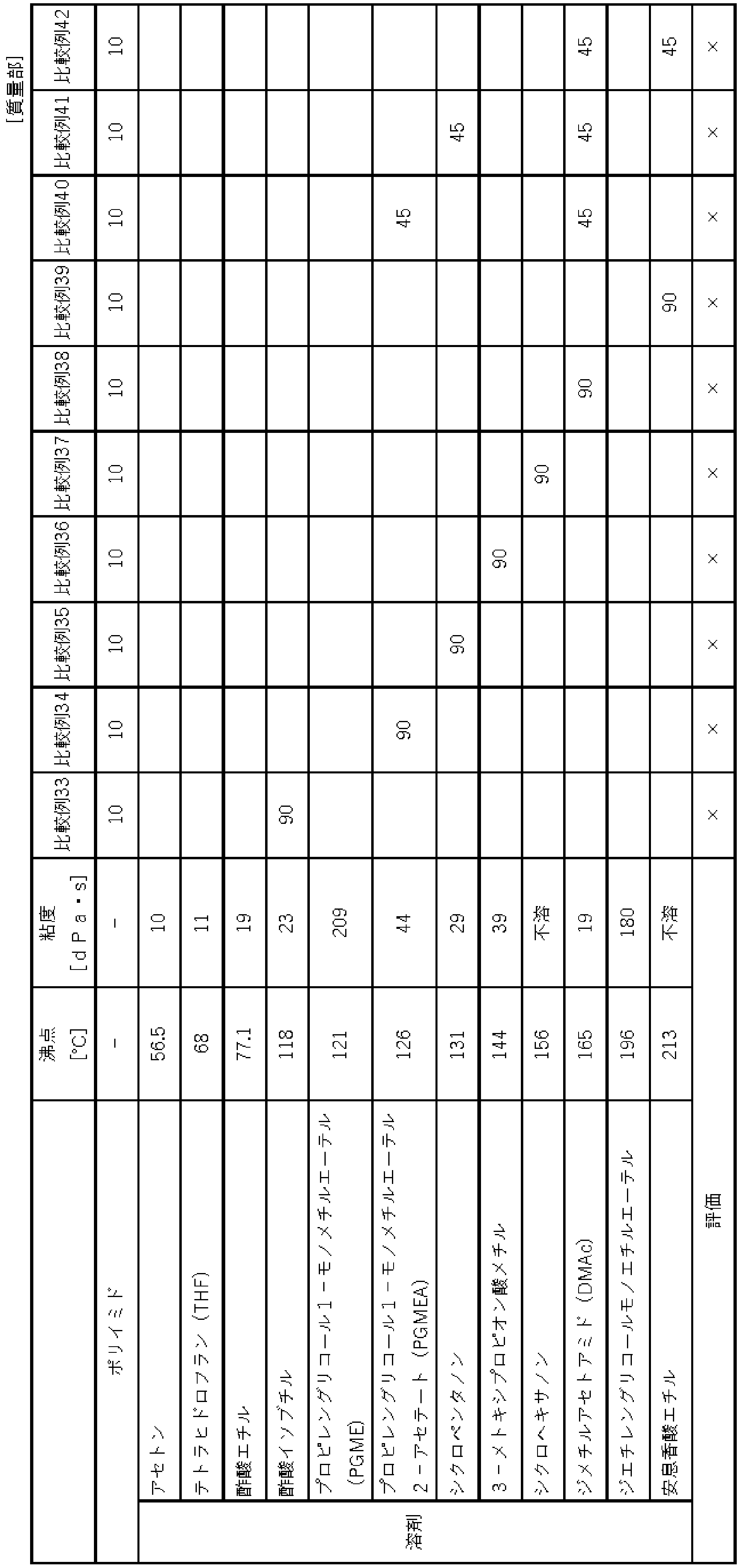
実施例で使用した溶剤及び上記粘度の測定方法で、測定したポリイミドを濃度10質量%で溶解させた溶液の粘度は、以下のとおりである。

<実施例1>
テトラヒドロフラン(THF)68g及びプロピレングリコール1-モノメチルエーテル(PGME)17gを含む混合溶媒に、ポリイミド15gを添加し、均一になるまで混合し、ポリマー溶液を得た。
得られた溶液を、ソーダガラス上に、アプリケーターを用いて、乾燥後の最終膜厚が25μmとなるような塗布厚みで塗布し、ソーダガラス上に塗膜を形成した。
25℃に設定した恒温槽に、塗膜を形成したソーダガラスを静置して、30分間保持した。保持後、目視による不透明化により、塗膜の多孔質構造の有無を確認した。
次いで、200℃の熱風オーブン中で、30分間保持し、塗膜を乾燥させた。得られた膜について各種評価を行った。
結果を表2に示す。
<Example 1>
15 g of polyimide was added to a mixed solvent containing 68 g of tetrahydrofuran (THF) and 17 g of propylene glycol 1-monomethyl ether (PGME) and mixed until uniform to obtain a polymer solution.
The resulting solution was applied on soda glass using an applicator to a coating thickness such that the final film thickness after drying was 25 μm to form a coating film on the soda glass.
The soda glass with the coating film formed thereon was allowed to stand in a constant temperature bath set at 25° C. for 30 minutes. After holding, the presence or absence of a porous structure in the coating film was confirmed by visual observation to make it opaque.
Then, it was held in a hot air oven at 200° C. for 30 minutes to dry the coating film. Various evaluations were performed on the obtained film.
Table 2 shows the results.
<実施例2~5、比較例1~2>
THFの質量とPGMEの質量の割合を表2に示すように変更したこと以外は、実施例1と同様にして膜を得て、各種評価を行った。図1及び2に、実施例3の多孔質膜の断面図の走査型電子顕微鏡(SEM)像及びImageJで2値化した結果を示す。平均孔径の算出は、図2(c)に基づき行った。図1のスキン層の上が白く見えるのは、断面観察のために膜表面に処理した金(Au)蒸着膜である。
<Examples 2-5, Comparative Examples 1-2>
A membrane was obtained in the same manner as in Example 1, except that the ratio of the mass of THF and the mass of PGME was changed as shown in Table 2, and various evaluations were performed. 1 and 2 show a scanning electron microscope (SEM) image of a cross-sectional view of the porous membrane of Example 3 and the result of binarization with ImageJ. The average pore size was calculated based on FIG. 2(c). What appears white above the skin layer in FIG. 1 is a deposited gold (Au) film treated on the film surface for cross-sectional observation.

表2より、実施例の多孔質膜は低誘電率及び低誘電正接を有しており、とりわけ溶剤(A)の質量と溶剤(B)の質量の比が、3:7~7:3の実施例2~3では、誘電特性が良好であり、かつ空孔率も制御されており、液の浸透性の問題が回避され、機械的強度が低下するおそれが抑えられていることがわかる。 From Table 2, the porous films of Examples have a low dielectric constant and a low dielectric loss tangent. In Examples 2 and 3, the dielectric properties are good, the porosity is controlled, the problem of liquid permeability is avoided, and the possibility of lowering the mechanical strength is suppressed.
<実施例6>
アセトン(THF)45g及びプロピレングリコール1-モノメチルエーテル(PGME)45gを含む混合溶媒に、ポリイミド10gを添加し、均一になるまで混合し、ポリマー溶液を得た。
得られた溶液を、ソーダガラス上に、アプリケーターを用いて、乾燥後の最終膜厚が25μmとなるような塗布厚みで塗布し、ソーダガラス上に塗膜を形成した。
25℃に設定した恒温槽に、塗膜を形成したソーダガラスを静置して、30分間保持した。保持後、目視による不透明化により、塗膜の多孔質構造の有無を確認した。
次いで、200℃の熱風オーブン中で、30分間保持し、塗膜を乾燥させた。得られた膜の断面を走査型電子顕微鏡で観察して、得られた膜が平均孔径が0.1μm以上3.0μm以下の多孔質層と表面に厚み3.0μm以上のスキン層を備えた多孔質膜が得られているかどうかを確認した。また、膜について、伸びを測定した。
◎・・・所定の多孔質膜が得られた。膜の伸び率5%以上であった。
〇・・・所定の多孔質膜が得られた。膜の伸び率は5%未満であった。
×・・・多孔質化していない膜が得られた。あるいは、自立した多孔質膜を調製することができなかった。
結果を表3に示す。
<Example 6>
10 g of polyimide was added to a mixed solvent containing 45 g of acetone (THF) and 45 g of propylene glycol 1-monomethyl ether (PGME) and mixed until uniform to obtain a polymer solution.
The resulting solution was applied on soda glass using an applicator to a coating thickness such that the final film thickness after drying was 25 μm to form a coating film on the soda glass.
The soda glass with the coating film formed thereon was allowed to stand in a constant temperature bath set at 25° C. for 30 minutes. After holding, the presence or absence of a porous structure in the coating film was confirmed by visual observation to make it opaque.
Then, it was held in a hot air oven at 200° C. for 30 minutes to dry the coating film. The cross section of the obtained membrane was observed with a scanning electron microscope, and the obtained membrane had a porous layer with an average pore size of 0.1 μm or more and 3.0 μm or less and a skin layer with a thickness of 3.0 μm or more on the surface. It was confirmed whether a porous membrane was obtained. Elongation was also measured on the membrane.
A: A predetermined porous membrane was obtained. The elongation rate of the film was 5% or more.
Good: A predetermined porous membrane was obtained. The film elongation was less than 5%.
x: A non-porous film was obtained. Alternatively, it was not possible to prepare free-standing porous membranes.
Table 3 shows the results.
表3に示す溶剤を使用したこと以外は、実施例6と同様にして膜を得て、各種評価を行った。結果を表3に示す。各実施例では、実施例2~5と同様に、所定の多孔質膜が得られた。 A film was obtained in the same manner as in Example 6 except that the solvent shown in Table 3 was used, and various evaluations were performed. Table 3 shows the results. In each example, a predetermined porous membrane was obtained in the same manner as in Examples 2-5.


本発明のポリマー組成物によれば、低誘電率及び低誘電正接を有し、液の浸透性や吸水性の問題が改善され、かつ機械的強度の低下のおそれが抑えられた多孔質膜を形成することができ、産業上の有用性が高い。 According to the polymer composition of the present invention, a porous film having a low dielectric constant and a low dielectric loss tangent is improved in the problems of liquid permeability and water absorption, and the possibility of a decrease in mechanical strength is suppressed. It can be formed and has high industrial utility.
Claims (16)
前記溶剤(A)は、100℃以上の沸点を有し、かつ前記ポリマーを、前記10質量%の濃度で溶解させた溶液が、25℃において150dPa・s以上の粘度を有し、
前記溶剤(B)は、100℃未満の沸点を有し、かつ前記ポリマーを10質量%の濃度で溶解させた溶液が、25℃において50dPa・s未満の粘度を有する、
多孔質膜形成用ポリマー組成物。 comprising a polymer, a solvent (A), and a solvent (B);
The solvent (A) has a boiling point of 100° C. or higher, and a solution obtained by dissolving the polymer at a concentration of 10% by mass has a viscosity of 150 dPa s or higher at 25° C.,
The solvent (B) has a boiling point of less than 100°C, and a solution in which the polymer is dissolved at a concentration of 10% by mass has a viscosity of less than 50 dPa s at 25°C.
A polymer composition for forming a porous membrane.
前記塗膜を100℃未満の温度で保持し、多孔質化する工程、及び
多孔質化した塗膜を100℃以上の温度で保持し、乾燥させる工程
を含む、多孔質膜の製造方法。 A step of applying the porous film-forming polymer composition according to any one of claims 1 to 8 to a substrate to form a coating film;
A method for producing a porous film, comprising the steps of: holding the coating film at a temperature of less than 100°C to make it porous; and holding the porous coating film at a temperature of 100°C or higher and drying it.
An electronic substrate comprising the porous film according to any one of claims 12-14.
Priority Applications (5)
| Application Number | Priority Date | Filing Date | Title |
|---|---|---|---|
| JP2021022146A JP7751974B2 (en) | 2021-02-15 | 2021-02-15 | Polymer composition for forming porous film, method for producing porous film, porous film, flexible metal-clad laminate and electronic substrate |
| PCT/JP2022/002277 WO2022172734A1 (en) | 2021-02-15 | 2022-01-21 | Polymer composition for porous-film formation, method for producing porous film, porous film, flexible metal-clad laminate, and electronic board |
| CN202280014860.3A CN116940624A (en) | 2021-02-15 | 2022-01-21 | Polymer composition for forming porous film, method for producing porous film, flexible metal-clad laminate, and electronic substrate |
| KR1020237027219A KR20230146021A (en) | 2021-02-15 | 2022-01-21 | Polymer composition for forming porous membrane, method for producing porous membrane, porous membrane, flexible metal laminate, and electronic substrate |
| TW111104892A TW202242008A (en) | 2021-02-15 | 2022-02-10 | Polymer composition for porous-film formation, method for producing porous film, porous film, flexible metal-clad laminate, and electronic board |
Applications Claiming Priority (1)
| Application Number | Priority Date | Filing Date | Title |
|---|---|---|---|
| JP2021022146A JP7751974B2 (en) | 2021-02-15 | 2021-02-15 | Polymer composition for forming porous film, method for producing porous film, porous film, flexible metal-clad laminate and electronic substrate |
Publications (2)
| Publication Number | Publication Date |
|---|---|
| JP2022124401A true JP2022124401A (en) | 2022-08-25 |
| JP7751974B2 JP7751974B2 (en) | 2025-10-09 |
Family
ID=82838778
Family Applications (1)
| Application Number | Title | Priority Date | Filing Date |
|---|---|---|---|
| JP2021022146A Active JP7751974B2 (en) | 2021-02-15 | 2021-02-15 | Polymer composition for forming porous film, method for producing porous film, porous film, flexible metal-clad laminate and electronic substrate |
Country Status (5)
| Country | Link |
|---|---|
| JP (1) | JP7751974B2 (en) |
| KR (1) | KR20230146021A (en) |
| CN (1) | CN116940624A (en) |
| TW (1) | TW202242008A (en) |
| WO (1) | WO2022172734A1 (en) |
Cited By (1)
| Publication number | Priority date | Publication date | Assignee | Title |
|---|---|---|---|---|
| JP2022146684A (en) * | 2021-03-22 | 2022-10-05 | 株式会社カナック | Molding method for polyimide molding |
Citations (21)
| Publication number | Priority date | Publication date | Assignee | Title |
|---|---|---|---|---|
| JPS57170936A (en) * | 1981-04-14 | 1982-10-21 | Ube Ind Ltd | Preparation of porous polyimide film |
| JPH03179354A (en) * | 1989-09-19 | 1991-08-05 | Toray Ind Inc | Chemical ray sensitive polymer composition |
| JPH061915A (en) * | 1991-08-28 | 1994-01-11 | Unitika Ltd | Solution of polyimide precursor, its production and molding article and coated material obtained from the same |
| JPH07126386A (en) * | 1993-11-08 | 1995-05-16 | Toyobo Co Ltd | Production of polyamideimide or/and polyimide solution |
| JPH09136985A (en) * | 1995-08-21 | 1997-05-27 | Korea Advanced Inst Of Sci Technol | Polymer solution for asymmetrical single film, asymmetrical single film made thereof and production thereof |
| JPH11217502A (en) * | 1998-02-04 | 1999-08-10 | Unitika Ltd | Photosensitive polyimide precursor solution, polyimide coated film obtained therefrom and production of the same |
| JP2002126479A (en) * | 2000-10-26 | 2002-05-08 | Nitto Denko Corp | Porous membrane, gas separation membrane and method for producing the same |
| JP2003026849A (en) * | 2001-07-23 | 2003-01-29 | Ube Ind Ltd | Polyimide porous membrane |
| US20070100012A1 (en) * | 2004-01-20 | 2007-05-03 | Porous Power Technologies, Llc | Production of high porosity open-cell membranes |
| JP2010229345A (en) * | 2009-03-27 | 2010-10-14 | Ube Ind Ltd | Method for producing polyimide porous body, and polyimide porous body |
| WO2014077325A1 (en) * | 2012-11-19 | 2014-05-22 | 日東電工株式会社 | Electrically insulating resin sheet for motor |
| JP2014132057A (en) * | 2013-01-07 | 2014-07-17 | Unitika Ltd | Polyimide porous film and its use |
| JP2015072899A (en) * | 2013-09-06 | 2015-04-16 | 宇部興産株式会社 | Conductive polyimide porous membrane and method for producing the same |
| WO2015156261A1 (en) * | 2014-04-07 | 2015-10-15 | ユニチカ株式会社 | Laminated porous film and production method therefor |
| JP2016522288A (en) * | 2013-05-23 | 2016-07-28 | ネクソルブ・コーポレイシヨン | Airgel synthesis method |
| WO2016143002A1 (en) * | 2015-03-06 | 2016-09-15 | 宇部興産株式会社 | Conductive aromatic polyimide porous film and method for producing same |
| US9650487B1 (en) * | 2014-06-20 | 2017-05-16 | The United States Of America As Represented By The Administrator Of National Aeronautics And Space Administration | Polyalkylene imide aerogels and processes for making the same |
| JP2017165924A (en) * | 2016-03-18 | 2017-09-21 | 宇部興産株式会社 | Polyimide precursor solution, manufacturing method of polyimide porous film and polyimide porous film |
| JP2017186506A (en) * | 2015-10-16 | 2017-10-12 | ユニチカ株式会社 | Polyimide solution for forming porous polyimide film, method for producing porous polyimide film, and porous polyimide film |
| JP2018021171A (en) * | 2016-07-25 | 2018-02-08 | 日東電工株式会社 | Film for millimeter wave antenna |
| JP2019199616A (en) * | 2017-04-06 | 2019-11-21 | 日東電工株式会社 | Film for millimetric wave antenna |
Family Cites Families (3)
| Publication number | Priority date | Publication date | Assignee | Title |
|---|---|---|---|---|
| US6187248B1 (en) | 1998-11-19 | 2001-02-13 | Air Products And Chemicals, Inc. | Nanoporous polymer films for extreme low and interlayer dielectrics |
| JP3687448B2 (en) | 1999-11-29 | 2005-08-24 | 宇部興産株式会社 | Method for producing porous polyimide film and film |
| JP6567591B2 (en) | 2016-07-25 | 2019-08-28 | 日東電工株式会社 | Film for millimeter wave antenna |
-
2021
- 2021-02-15 JP JP2021022146A patent/JP7751974B2/en active Active
-
2022
- 2022-01-21 WO PCT/JP2022/002277 patent/WO2022172734A1/en not_active Ceased
- 2022-01-21 CN CN202280014860.3A patent/CN116940624A/en active Pending
- 2022-01-21 KR KR1020237027219A patent/KR20230146021A/en active Pending
- 2022-02-10 TW TW111104892A patent/TW202242008A/en unknown
Patent Citations (21)
| Publication number | Priority date | Publication date | Assignee | Title |
|---|---|---|---|---|
| JPS57170936A (en) * | 1981-04-14 | 1982-10-21 | Ube Ind Ltd | Preparation of porous polyimide film |
| JPH03179354A (en) * | 1989-09-19 | 1991-08-05 | Toray Ind Inc | Chemical ray sensitive polymer composition |
| JPH061915A (en) * | 1991-08-28 | 1994-01-11 | Unitika Ltd | Solution of polyimide precursor, its production and molding article and coated material obtained from the same |
| JPH07126386A (en) * | 1993-11-08 | 1995-05-16 | Toyobo Co Ltd | Production of polyamideimide or/and polyimide solution |
| JPH09136985A (en) * | 1995-08-21 | 1997-05-27 | Korea Advanced Inst Of Sci Technol | Polymer solution for asymmetrical single film, asymmetrical single film made thereof and production thereof |
| JPH11217502A (en) * | 1998-02-04 | 1999-08-10 | Unitika Ltd | Photosensitive polyimide precursor solution, polyimide coated film obtained therefrom and production of the same |
| JP2002126479A (en) * | 2000-10-26 | 2002-05-08 | Nitto Denko Corp | Porous membrane, gas separation membrane and method for producing the same |
| JP2003026849A (en) * | 2001-07-23 | 2003-01-29 | Ube Ind Ltd | Polyimide porous membrane |
| US20070100012A1 (en) * | 2004-01-20 | 2007-05-03 | Porous Power Technologies, Llc | Production of high porosity open-cell membranes |
| JP2010229345A (en) * | 2009-03-27 | 2010-10-14 | Ube Ind Ltd | Method for producing polyimide porous body, and polyimide porous body |
| WO2014077325A1 (en) * | 2012-11-19 | 2014-05-22 | 日東電工株式会社 | Electrically insulating resin sheet for motor |
| JP2014132057A (en) * | 2013-01-07 | 2014-07-17 | Unitika Ltd | Polyimide porous film and its use |
| JP2016522288A (en) * | 2013-05-23 | 2016-07-28 | ネクソルブ・コーポレイシヨン | Airgel synthesis method |
| JP2015072899A (en) * | 2013-09-06 | 2015-04-16 | 宇部興産株式会社 | Conductive polyimide porous membrane and method for producing the same |
| WO2015156261A1 (en) * | 2014-04-07 | 2015-10-15 | ユニチカ株式会社 | Laminated porous film and production method therefor |
| US9650487B1 (en) * | 2014-06-20 | 2017-05-16 | The United States Of America As Represented By The Administrator Of National Aeronautics And Space Administration | Polyalkylene imide aerogels and processes for making the same |
| WO2016143002A1 (en) * | 2015-03-06 | 2016-09-15 | 宇部興産株式会社 | Conductive aromatic polyimide porous film and method for producing same |
| JP2017186506A (en) * | 2015-10-16 | 2017-10-12 | ユニチカ株式会社 | Polyimide solution for forming porous polyimide film, method for producing porous polyimide film, and porous polyimide film |
| JP2017165924A (en) * | 2016-03-18 | 2017-09-21 | 宇部興産株式会社 | Polyimide precursor solution, manufacturing method of polyimide porous film and polyimide porous film |
| JP2018021171A (en) * | 2016-07-25 | 2018-02-08 | 日東電工株式会社 | Film for millimeter wave antenna |
| JP2019199616A (en) * | 2017-04-06 | 2019-11-21 | 日東電工株式会社 | Film for millimetric wave antenna |
Cited By (1)
| Publication number | Priority date | Publication date | Assignee | Title |
|---|---|---|---|---|
| JP2022146684A (en) * | 2021-03-22 | 2022-10-05 | 株式会社カナック | Molding method for polyimide molding |
Also Published As
| Publication number | Publication date |
|---|---|
| KR20230146021A (en) | 2023-10-18 |
| CN116940624A (en) | 2023-10-24 |
| TW202242008A (en) | 2022-11-01 |
| WO2022172734A1 (en) | 2022-08-18 |
| JP7751974B2 (en) | 2025-10-09 |
Similar Documents
| Publication | Publication Date | Title |
|---|---|---|
| JP7179912B2 (en) | Film for millimeter wave antenna | |
| CN113227232B (en) | Powder dispersion, laminate, and printed board | |
| JP6567590B2 (en) | Film for millimeter wave antenna | |
| JP5944613B1 (en) | Porous polyimide film and method for producing the same | |
| JP2019199616A (en) | Film for millimetric wave antenna | |
| KR20210137426A (en) | Liquid composition, powder, and method for preparing powder | |
| TW202112912A (en) | Polyimide film, metal-clad laminate and circuit board featuring low dielectric loss tangent and excellent long-term heat-resistant adhesiveness | |
| WO2022172734A1 (en) | Polymer composition for porous-film formation, method for producing porous film, porous film, flexible metal-clad laminate, and electronic board | |
| JP6700846B2 (en) | Wiring board laminate, wiring board, and method for manufacturing wiring board laminate | |
| JP2016108360A (en) | Imide-based polymer solution, porous imide-based polymer film, and production method of the film | |
| JP6557846B1 (en) | Porous polyimide film and method for producing the same | |
| JP2017186506A (en) | Polyimide solution for forming porous polyimide film, method for producing porous polyimide film, and porous polyimide film | |
| JP6923913B2 (en) | Polyimide solution for forming a porous polyimide film, a method for producing a porous polyimide film, and a porous polyimide film | |
| KR102605943B1 (en) | Polyimide resin precursor, polyimide resin, metal laminate, laminate and flexible printed wiring board | |
| JP6858902B2 (en) | A method for manufacturing a laminated body for a wiring board, a wiring board, and a laminated body for a wiring board. | |
| JP7195585B2 (en) | laminate | |
| KR20250090314A (en) | Metallized resin film, printed wiring board, current collector film for lithium ion battery and method for producing metallized resin film | |
| JP2005146287A5 (en) |
Legal Events
| Date | Code | Title | Description |
|---|---|---|---|
| A621 | Written request for application examination |
Free format text: JAPANESE INTERMEDIATE CODE: A621 Effective date: 20231201 |
|
| A131 | Notification of reasons for refusal |
Free format text: JAPANESE INTERMEDIATE CODE: A131 Effective date: 20250212 |
|
| A521 | Request for written amendment filed |
Free format text: JAPANESE INTERMEDIATE CODE: A523 Effective date: 20250408 |
|
| A131 | Notification of reasons for refusal |
Free format text: JAPANESE INTERMEDIATE CODE: A131 Effective date: 20250722 |
|
| A521 | Request for written amendment filed |
Free format text: JAPANESE INTERMEDIATE CODE: A523 Effective date: 20250819 |
|
| TRDD | Decision of grant or rejection written | ||
| A01 | Written decision to grant a patent or to grant a registration (utility model) |
Free format text: JAPANESE INTERMEDIATE CODE: A01 Effective date: 20250909 |
|
| A61 | First payment of annual fees (during grant procedure) |
Free format text: JAPANESE INTERMEDIATE CODE: A61 Effective date: 20250929 |
|
| R150 | Certificate of patent or registration of utility model |
Ref document number: 7751974 Country of ref document: JP Free format text: JAPANESE INTERMEDIATE CODE: R150 |