JP2022079542A - Tungsten compound of visible light-responsive photocatalyst and coating - Google Patents
Tungsten compound of visible light-responsive photocatalyst and coating Download PDFInfo
- Publication number
- JP2022079542A JP2022079542A JP2022044629A JP2022044629A JP2022079542A JP 2022079542 A JP2022079542 A JP 2022079542A JP 2022044629 A JP2022044629 A JP 2022044629A JP 2022044629 A JP2022044629 A JP 2022044629A JP 2022079542 A JP2022079542 A JP 2022079542A
- Authority
- JP
- Japan
- Prior art keywords
- compound
- photocatalytic
- photocatalyst
- light
- ammonia
- Prior art date
- Legal status (The legal status is an assumption and is not a legal conclusion. Google has not performed a legal analysis and makes no representation as to the accuracy of the status listed.)
- Granted
Links
Images


Classifications
-
- Y—GENERAL TAGGING OF NEW TECHNOLOGICAL DEVELOPMENTS; GENERAL TAGGING OF CROSS-SECTIONAL TECHNOLOGIES SPANNING OVER SEVERAL SECTIONS OF THE IPC; TECHNICAL SUBJECTS COVERED BY FORMER USPC CROSS-REFERENCE ART COLLECTIONS [XRACs] AND DIGESTS
- Y02—TECHNOLOGIES OR APPLICATIONS FOR MITIGATION OR ADAPTATION AGAINST CLIMATE CHANGE
- Y02W—CLIMATE CHANGE MITIGATION TECHNOLOGIES RELATED TO WASTEWATER TREATMENT OR WASTE MANAGEMENT
- Y02W10/00—Technologies for wastewater treatment
- Y02W10/30—Wastewater or sewage treatment systems using renewable energies
- Y02W10/37—Wastewater or sewage treatment systems using renewable energies using solar energy
Landscapes
- Catalysts (AREA)
- Paints Or Removers (AREA)
Abstract
Description
本発明は、可視光応答型光触媒効果を有する材料又はそれを用いた部材に関するものである。 The present invention relates to a material having a visible light responsive photocatalytic effect or a member using the same.
光触媒は国内では酸化チタンが光触媒として今から20年ほど前に研究が活発に行われていた。酸化チタンは紫外線領域にのみに反応するために太陽光に対しては水を分解するほどに分子の分解を行うことが出来る。価電子帯の真空順位が低く、電子を取り出す際に必要とするエネルギーが大きく、しかもバンドギャップが大きいため、約3eV程度の励起エネルギーが必要とされていた。光の波長では380nm程度以下に相当する。このために人の視覚が認識できる光の波長域400~700nmでは光触媒性能を持っていなかった。 As for the photocatalyst, titanium oxide was actively studied in Japan about 20 years ago as a photocatalyst. Since titanium oxide reacts only in the ultraviolet region, it can decompose molecules to the extent that it decomposes water with respect to sunlight. Since the vacuum rank of the valence band is low, the energy required for extracting electrons is large, and the band gap is large, an excitation energy of about 3 eV is required. The wavelength of light corresponds to about 380 nm or less. For this reason, it did not have photocatalytic performance in the wavelength range of 400 to 700 nm of light that can be recognized by human vision.
昨今、室内の光源が半導体のLEDとなり、紫外線を持たない可視光のみと光源となっていることから、従来型の光触媒である酸化チタンではLEDの光源では十分な光触媒性能が得られていない。酸化チタンの改良として窒素雰囲気中で熱処理、またはプラズマ雰囲気でNドープを行う方法や、または酸化チタンを合成する際に予めNb等の元素を添加してNbドープの酸化チタンを合成する方法が検討されてきた。 In recent years, the light source in the room is a semiconductor LED, and only visible light having no ultraviolet light is used as a light source. Therefore, titanium oxide, which is a conventional photocatalyst, cannot obtain sufficient photocatalyst performance with an LED light source. As an improvement of titanium oxide, a method of heat treatment in a nitrogen atmosphere or N-doping in a plasma atmosphere, or a method of synthesizing Nb-doped titanium oxide by adding an element such as Nb in advance when synthesizing titanium oxide is studied. It has been.
酸化チタンの分子分解の酸化力は価電子帯が深い位置にあり、電子が伝導体に励起された後のホールが非常に強い電子吸引力となり、接触した分子から電子を奪う結果、分子が酸化されて分解する。したがって、一つの研究の流れとしては常に伝導体にある電子を他に移動させることや元々触媒性のあるような金属や酸化物を酸化チタン表面に部分的に形成して光触媒性能が改善される報告も多数ある。具体的にはPd、Ru、Pt、Ni等を酸化チタン表面に形成することが一般的である。 The oxidizing power of molecular decomposition of titanium oxide is in the deep position of the valence band, and the holes after the electrons are excited by the conductor become very strong electron attracting power, and as a result of depriving the contacted molecules of electrons, the molecules are oxidized. Is disassembled. Therefore, one research flow is to constantly move electrons in the conductor to another, or to partially form a metal or oxide that is originally catalytic on the surface of titanium oxide to improve the photocatalytic performance. There are also many reports. Specifically, it is common to form Pd, Ru, Pt, Ni and the like on the surface of titanium oxide.
酸化チタンは以前より毒性が心配されてきた経緯がある。そこで、酸化チタンの代替としてバンドギャップが酸化チタンよりも小さく、且つ価電子帯の位置が酸化チタンのように深い位置にあるものが探索されてきた。このような開発経緯の中で酸化タングステンが着目された。酸化タングステンは酸化チタンよりもややバンドギャップが小さめであり、2.8eV程度のものである。この結果、可視光領域の青色の波長にも吸収を持つ特性があり、可視光応答型の光触媒性能を持っている。酸化タングステンも酸化チタンと同様にPd、Ru、Pt、Ni等を酸化チタン表面に形成することにより触媒性能が改善される。 Titanium oxide has a history of concern about toxicity. Therefore, as an alternative to titanium oxide, one having a band gap smaller than that of titanium oxide and a valence band having a deep position such as titanium oxide has been sought. Tungsten trioxide has attracted attention in this development process. Tungsten oxide has a slightly smaller bandgap than titanium oxide, and is about 2.8 eV. As a result, it also has the property of absorbing blue wavelengths in the visible light region, and has visible light responsive photocatalytic performance. Similar to titanium oxide, tungsten oxide also has improved catalytic performance by forming Pd, Ru, Pt, Ni and the like on the surface of titanium oxide.
一般的に用いられる光触媒として酸化チタンが近年、強い発がん性を持つことが報告されている。したがって、例えば酸化チタンのナノ粒子を用いて家の内外の壁に塗布して成膜した場合には、スプレーによる噴霧では作業員が吸引する危険性があり、実作業では非常に大きな問題となっている。また、酸化チタンのナノ粒子を用いて分散液体を作製する場合にはサイズを5nm未満にする必要があるが、このサイズでは粉が分散液体の溶媒成分となる溶媒の気化と共に粉も飛散するという現象を示すため、作業者が粉を吸引する可能性が著しくなる。酸化チタンの粉のサイズが20~50nmでは分散液体は白濁し透明性のないものとなる。このために建物や家具、部品等に成膜した場合、着色するという問題があった。 In recent years, it has been reported that titanium oxide has strong carcinogenicity as a commonly used photocatalyst. Therefore, for example, when titanium oxide nanoparticles are applied to the inner and outer walls of a house to form a film, there is a risk that the worker will suck it by spraying with a spray, which is a very big problem in actual work. ing. In addition, when producing a dispersed liquid using titanium oxide nanoparticles, the size must be less than 5 nm, but at this size, the powder is said to scatter as the solvent, which is the solvent component of the dispersed liquid, evaporates. Since the phenomenon is shown, the possibility that the operator sucks the powder becomes remarkable. When the size of the titanium oxide powder is 20 to 50 nm, the dispersed liquid becomes cloudy and becomes opaque. For this reason, when a film is formed on a building, furniture, parts, or the like, there is a problem of coloring.
酸化タングステンの場合、光触媒の粒子サイズを小さくする方法がなく、業界での最小サイズが20~30nmのものであり、これを用いた分散液体では黄色に帯びた白濁した液体になっていた。酸化タングステンのナノ粒子を用いて分散液体を構成しても一般的に使用されている固形分濃度1%の光触媒用塗布液体では液体の色が不透明となり、塗布した面もやや黄色に帯びた白濁した面を形成するという問題が発生していた。 In the case of tungsten oxide, there is no way to reduce the particle size of the photocatalyst, and the minimum size in the industry is 20 to 30 nm, and the dispersed liquid using this is a yellowish cloudy liquid. Even if a dispersed liquid is composed of tungsten oxide nanoparticles, the color of the liquid is opaque in the commonly used photocatalyst coating liquid with a solid content concentration of 1%, and the coated surface becomes slightly yellowish and cloudy. There was a problem of forming a surface.
しかしながら酸化チタンや酸化タングステンのナノ粒子を用いた場合には粒子のサイズを小さくすることにより透明化は達成できることは従来から確認されてきたが、課題は塗布した後に粒子間の接着や被着面との接着が得られないために飛散してしまうという致命的な問題があった。 However, it has been conventionally confirmed that transparency can be achieved by reducing the size of the particles when nanoparticles of titanium oxide or tungsten oxide are used, but the problem is the adhesion between the particles and the adherend surface after application. There was a fatal problem that it was scattered because it could not be adhered to.
光触媒材料で主に分解させる目的の有機物として、接着剤から出てくるホルムアルデヒド、アセトアルデヒドがある。また、最近では体臭の一つとしてアンモニアを分解させるために光触媒を使用している。これらを光触媒で分解させて有害な有機化合物や悪臭を除去する方法が検討されているが、光を必要とするために暗闇や暗所では効果がないという致命的な問題があった。 Formaldehyde and acetaldehyde that come out of adhesives are the organic substances that are mainly intended to be decomposed by photocatalytic materials. Recently, a photocatalyst is used to decompose ammonia as one of the body odors. A method of decomposing these with a photocatalyst to remove harmful organic compounds and foul odors has been studied, but there is a fatal problem that it is ineffective in the dark or in a dark place because it requires light.
本発明のタングステン化合物として、(NH3)x-y・My・mWO3・rH2O(x-y>0、y≧0、m>0、r≧0)、My・mWO3・rH2O(y>0、m>0、r≧0)、(NH4)2(x-y)・M2y・(WO4)z・rH2O(x-y>0、y≧0、z>0、r≧0)、またはMy・(WO4)z・rH2O(y>0、z>0、r≧0)、(NH4)2(x-y)・M2y・(WO4)z・(WO3)q・rH2O(x-y>0、y≧0、z>0、q>0、r≧0)、My・(WO4)z・(WO3)q・rH2O(y>0、z>0、q>0、r≧0)(M:Li、Na、K、Cs、Rb)の中から少なくとも一種以上を含んだものからなるタングステン化合物が可視光応答型光触媒機能を持つものであり、塩に近い性質を持つために塗布面に対して粉の密着力があり、また粒子間も付着しやすい性質を有することを発見した。この化合物は粒子サイズの調節が可能であり、平均粒径が50~100nm程度でも容易に得られ、最小サイズは5~10nmのものとなり、完全な無色透明の液体を形成できた。この際に無色透明の固形分濃度は30%に到達することも分かった。本発明の化合物は付着力が高く、本発明の化合物だけを用いて付着させたものにおいて、一般的な酸化チタン粉や酸化タングステンのナノ粒子のように飛散することは抑制される。また光が無い場所においても十分な触媒性能があるために、暗所や光を照射できないようなところにおいても有機化合物を分解する触媒材料、もしくは部品、装置としても使用することが出来る。 As the tungsten compound of the present invention, (NH 3 ) xy · My · mWO 3 · rH 2 O (xy> 0, y ≧ 0, m> 0, r ≧ 0), My · mWO 3 . rH 2 O (y> 0, m> 0, r ≧ 0), (NH 4 ) 2 (xy) · M 2y · (WO 4 ) z · rH 2 O (xy> 0, y ≧ 0 , Z> 0, r ≧ 0), or My · (WO 4 ) z · rH 2 O ( y > 0, z> 0, r ≧ 0), (NH 4 ) 2 (xy) · M 2y (WO 4 ) z · (WO 3 ) q · rH 2 O (xy> 0, y ≧ 0, z > 0, q> 0, r ≧ 0), My · (WO 4 ) z · ( WO 3 ) q · rH 2 O (y> 0, z> 0, q> 0, r ≧ 0) (M: Li, Na, K, Cs, Rb) containing at least one of them. It was discovered that the tungsten compound has a visible light responsive photocatalyst function, has a property close to that of salt, has an adhesion of powder to the coated surface, and has a property of easily adhering between particles. The particle size of this compound can be adjusted, and it can be easily obtained even if the average particle size is about 50 to 100 nm, the minimum size is 5 to 10 nm, and a completely colorless and transparent liquid can be formed. At this time, it was also found that the colorless and transparent solid content concentration reached 30%. The compound of the present invention has a high adhesive force, and when it is adhered using only the compound of the present invention, it is suppressed from scattering like general titanium oxide powder or tungsten oxide nanoparticles. Further, since it has sufficient catalytic performance even in a place without light, it can be used as a catalyst material, a component, or a device for decomposing an organic compound even in a dark place or a place where light cannot be irradiated.
本発明の可視光応答型の光触媒材料のナノ粒子分散液体を用いることにより、従来で問題となっていた被着体への色デザインへの障害や被着体からの粉の飛散による環境汚染の問題が解消できる。また光がない場所においても触媒性能を有するために用途として光がない場所でも消臭効果を持ち、有害な化学物質の分解に有効である。 By using the nanoparticle dispersion liquid of the visible light responsive photocatalyst material of the present invention, obstacles to the color design on the adherend and environmental pollution due to the scattering of powder from the adherend, which have been problems in the past, are caused. The problem can be solved. In addition, since it has catalytic performance even in places without light, it has a deodorizing effect even in places without light, and is effective in decomposing harmful chemical substances.
酸化タングステンを作る過程でパラタングステン酸アンモニウムを用いて水溶液中で加熱しながら分解反応を行った際に、塩酸添加した場合において無色透明の液体が形成された。この液体は様々な試験から光触媒性能を持つことが分かった。この成分を分析した結果、タングステン酸アンモニウム化合物であることが分かり、パラタングステン酸アンモニウムに近い組成比を持つものであった。このタングステン酸アンモニウム化合物はX線結晶構造解析装置を用いて評価した結果、主に(NH4)6・H2(W3O10)4・20H2O、5(NH4)2O・12WO3・11H2O、5(NH4)2O・12WO3・7H2O、(NH4)10・W12O41・5H2O、もしくは(NH4)10・H2W12O42・4H2Oに示されるようなアンモニアを含んだ含水結晶であった。この結晶にアルカリ系の水酸化物を添加することによりアンモニウムイオンサイトは例えばナトリウムイオンのようなアルカリ金属イオンと容易に置換反応が働いて、タングステン酸アルカリ金属塩の形態を容易に合成することが可能である。また、市販されているパラタングステン酸アンモニウムも同様にアルカリ金属イオンでアンモニアイオンを置換することにより同様な効果がある。 When the decomposition reaction was carried out while heating in an aqueous solution using ammonium paratungstate in the process of producing tungsten oxide, a colorless and transparent liquid was formed when hydrochloric acid was added. Various tests have shown that this liquid has photocatalytic performance. As a result of analyzing this component, it was found that it was an ammonium paratungate compound, and it had a composition ratio close to that of ammonium paratungstate. As a result of evaluating this ammonium tungstate compound using an X-ray crystal structure analyzer, mainly (NH 4 ) 6・ H 2 (W 3 O 10 ) 4・ 20H 2 O, 5 (NH 4 ) 2 O ・ 12 WO 3・ 11H 2 O, 5 (NH 4 ) 2 O ・ 12WO 3.7H 2 O, (NH 4 ) 10・ W 12 O 41.5H 2 O, or (NH 4 ) 10・ H 2 W 12 O 42・It was a hydrous crystal containing ammonia as shown in 4H2O . By adding an alkaline hydroxide to this crystal, the ammonium ion site can easily undergo a substitution reaction with an alkali metal ion such as sodium ion, and the morphology of the tungonic acid alkali metal salt can be easily synthesized. It is possible. Further, commercially available ammonium paratungstate also has the same effect by substituting the ammonia ion with an alkali metal ion.
このように作製したアンモニア、もしくはアンモニウムイオンやアルカリ金属元素イオンを含んだタングステン化合物を100℃から400℃にて焼成することにより容易に脱水反応が進み、完全に脱水反応させる、もしくは部分的に脱水反応をさせることにより含水量を制御できる。更に雰囲気を還元雰囲気にすることによりWが6価よりも5価に近いものも作製できる。 By firing the ammonia or the tungsten compound containing ammonium ion or alkali metal element ion prepared in this manner at 100 ° C to 400 ° C, the dehydration reaction easily proceeds, and the dehydration reaction is completely or partially dehydrated. The water content can be controlled by causing the reaction. Further, by changing the atmosphere to a reducing atmosphere, it is possible to produce a product in which W is closer to pentavalent than hexavalent.
具体的には次のような化合物が一例として挙げられる。NH4W3O9,Na2WO4,Na2W2O7,Na0.74WO3,Na0.54WO3,HNa5W6O21(H2O)10,Na5W6O21(H2O)13,Na2(WO4)(H2O)2,H2K10W12O42(H2O)7.5,H2K8W12O40(H2O)14,H5K9W12O40(H2O)12,K2W2O3(O2)4(H2O)4,Na2(WO4)(H2O)2,H4Rb6W12O40(H2O)4,Li1.44W4O12,Li2W2O7,Li2(WO4)の組成、もしくは結晶構造を持つものが例として挙げられる。このような化合物においてNaを一部Liに置換したり、Kを一部Liに置換したり、RbをNaに一部置換したりすることも可能であり、置換元素や量に限定されるものではなく、主たる組成比や上記化合物を構成する結晶構造があれば良い。また少量であれば二価や三価の金属元素で置換が可能であり、本特性を維持する、または改善することも可能である。更に酸素欠損が1at%以下の少量であれば問題はない。 Specifically, the following compounds are given as an example. NH 4 W 3 O 9 , Na 2 WO 4 , Na 2 W 2 O 7 , Na 0.74 WO 3 , Na 0.54 WO 3 , HNa 5 W 6 O 21 (H 2 O) 10 , Na 5 W 6 O 21 (H 2 O) 13 , Na 2 (WO 4 ) (H 2 O) 2 , H 2 K 10 W 12 O 42 (H 2 O) 7.5 , H 2 K 8 W 12 O 40 (H 2 ) O) 14 , H 5 K 9 W 12 O 40 (H 2 O) 12 , K 2 W 2 O 3 (O 2 ) 4 (H 2 O) 4 , Na 2 (WO 4 ) (H 2 O) 2 , Examples include those having the composition or crystal structure of H 4 Rb 6 W 12 O 40 (H 2 O) 4 , Li 1.44 W 4 O 12 , Li 2 W 2 O 7 , Li 2 (WO 4 ). Be done. In such a compound, it is possible to partially replace Na with Li, partially replace K with Li, or partially replace Rb with Na, and the compound is limited to the substitution element and the amount. Instead, it suffices if there is a main composition ratio or a crystal structure constituting the above compound. Further, if the amount is small, it can be replaced with a divalent or trivalent metal element, and this property can be maintained or improved. Further, if the oxygen deficiency is a small amount of 1 at% or less, there is no problem.
具体的な本発明のタングステン化合物一般的な表現式としては、(NH3)x-y・My・mWO3・rH2O(x-y>0、y≧0、m>0,r≧0)、My・mWO3・rH2O(y>0、m>0、r≧0)、(NH4)2(x-y)・M2y・(WO4)z・rH2O(x-y>0、y≧0、z>0、r≧0)またはMy・(WO4)z・rH2O(y>0,z>0,r≧0),(NH4)2(x-y)・M2y・(WO4)z・(WO3)q・rH2O(x-y>0、y≧0、z>0、q>0、r≧0)、My・(WO4)z・(WO3)q・rH2O(y>0、z>0、q>0、r≧0)(M:Li、Na、K、Cs、Rb)が組成として表現されるものである。この表現式では基本的にはW原子にOが八面体配位した構造にアンモニウムイオンやアルカリ金属イオンを含んだ結晶構造、または非晶質の形態となっている。必ずしも全体的な平均値として数値化した場合には整数ではない。この化合物のタングステンの価数はプラス6価に近いことがXPSの結果から確認できている。一例としてLi2WO4におけるWの価数を検討するため、WO3単体を比較例として用いてWとOの結合エネルギーをX線光電子分光装置(JEOL製JPS-9200S)で測定した。この結果を図1に示した。この結果よりWO3とほぼ同一の結合エネルギーを持っていることが分かった。(NH4)0.25WO3,Na0.74WO3,Na0.54WO3のようにWの価数が6価より5価に近くなるものもある。これらの化合物も本発明のものと同等の効果をもっている。 As a specific expression of the tungsten compound of the present invention, (NH 3 ) xy , My, mWO 3 , rH 2 O (xy> 0, y ≧ 0, m> 0, r ≧) 0), My · mWO 3 · rH 2 O ( y > 0, m> 0, r ≧ 0), (NH 4 ) 2 (xy) · M 2y · (WO 4 ) z · rH 2 O ( xy> 0, y ≧ 0, z> 0, r ≧ 0) or My · (WO 4 ) z · rH 2 O ( y > 0, z> 0, r ≧ 0), (NH 4 ) 2 (X-y) · M 2y · (WO 4 ) z · (WO 3 ) q · rH 2 O (xy> 0, y ≧ 0, z> 0, q> 0, r ≧ 0), My (WO 4 ) z · (WO 3 ) q · rH 2 O (y> 0, z> 0, q> 0, r ≧ 0) (M: Li, Na, K, Cs, Rb) is expressed as a composition. Is to be done. In this expression, it is basically a crystal structure containing ammonium ions and alkali metal ions in a structure in which O is octahedrally coordinated with W atoms, or an amorphous form. It is not necessarily an integer when quantified as the overall average value. It has been confirmed from the results of XPS that the valence of tungsten of this compound is close to plus hexavalent. As an example, in order to examine the valence of W in Li 2 WO 4 , the bond energy of W and O was measured by an X-ray photoelectron spectrometer (JPS-9200S manufactured by JEOL) using WO 3 alone as a comparative example. This result is shown in FIG. From this result, it was found that the binding energy was almost the same as that of WO 3 . (NH 4 ) In some cases, such as 0.25 WO 3 , Na 0.74 WO 3 , and Na 0.54 WO 3 , the valence of W is closer to 5 than hexavalent. These compounds also have the same effect as that of the present invention.
表現した化学式の具体的な化合物を一例として示す。以下の表現式で示した化合物は単純にH2Oをないものとして表現しているが本発明では含まれているものが多い。この際、水分子として結晶中に含まれる場合とヒドロキシ基とプロトンが結晶中に含まれる場合があり、どちらも結晶構造は全く異なるが、本発明では結晶構造に限定されるものではないので、どちらか一方であるか、または非晶質でも良い。一例は非常に単純な組成比のもので記したが、本実施例で用いた化合物例として示したものでは化学式量はもっと大きいものとなっているものが多い。 The specific compound of the expressed chemical formula is shown as an example. The compounds shown in the following formulas are simply expressed as having no H2O , but many of them are contained in the present invention. At this time, there are cases where water molecules are contained in the crystal and cases where hydroxy groups and protons are contained in the crystal, both of which have completely different crystal structures, but the present invention is not limited to the crystal structure. It may be either one or amorphous. One example is described with a very simple composition ratio, but many of the compounds shown as examples of compounds used in this example have a larger chemical formula.
例えば(NH3)x-y・My・mWO3・rH2O(x-y>0、y≧0、m>0、r≧0)において、x=0.74、y=0.6、m=1、r=0とすると場合にはNa0.74WO3においてNaが一部アンモニアに置き換えられた(NH3)0.14Na0.60WO3を示す。 For example, in (NH 3 ) xy , My, mWO 3 , rH 2 O (xy> 0, y ≧ 0, m> 0, r ≧ 0), x = 0.74, y = 0.6. , M = 1, r = 0 indicates that Na was partially replaced with ammonia in Na 0.74 WO 3 (NH 3 ) 0.14 Na 0.60 WO 3 .
次にMy・mWO3・rH2O(y>0、m>0、r≧0)においてはy=0.74、m=1、r=0としてNa0.74WO3を示す。主にWO3の結晶中にNaを電気的に注入したエレクトロクロミック材料で使われるものに類似する。 Next, in My · mWO 3 · rH 2 O (y> 0, m> 0, r ≧ 0), Na 0.74 WO 3 is shown with y = 0.74, m = 1, r = 0. It is similar to that used mainly in electrochromic materials in which Na is electrically injected into the crystals of WO 3 .
また、(NH4)2(x-y)・M2y・(WO4)z・rH2O(x-y>0、y≧0、z>0、r≧0)においては、単純にy=0、x=2、r=0とすると(NH4)2WO4となり、これは(NH3)2WO3H2Oと同一である。
しかしながら、水分子として結晶中に含まれる場合とヒドロキシ基とプロトンで結晶中に含まれる場合があり、どちらも結晶構造は全く異なるが、本発明では結晶構造に限定されるものではないので、どちらか一方であるか、または非晶質でも良い。一例は非常に単純な組成比のもので記したが、本実施例で用いた化合物例として示したものでは化学式量はもっと大きいものとなっているものが多い。
Further, in (NH 4 ) 2 (xy) · M 2y · (WO 4 ) z · rH 2 O (xy> 0, y ≧ 0, z> 0, r ≧ 0), simply y. If = 0, x = 2, and r = 0, then (NH 4 ) 2 WO 4 , which is the same as (NH 3 ) 2 WO 3 H 2 O.
However, there are cases where it is contained in the crystal as a water molecule and cases where it is contained in the crystal with hydroxy groups and protons, both of which have completely different crystal structures, but the present invention is not limited to the crystal structure. It may be either one or amorphous. One example is described with a very simple composition ratio, but many of the compounds shown as examples of compounds used in this example have a larger chemical formula.
またはMy・(WO4)z・rH2O(y>0、z>0、r≧0)はy=2、z=1、r=0であればMをNaとするとNa2WO4となる。これはNa2OWO3と同様であり、Wの価数は6価になるものである。本実施例で効果を示した。 Or, if My · (WO 4 ) z · rH 2 O (y> 0, z> 0, r ≧ 0) is y = 2, z = 1, and r = 0, then M is Na and Na 2 WO 4 It becomes. This is the same as Na 2 OWO 3 , and the valence of W is hexavalent. The effect was shown in this example.
(NH4)2(x-y)・M2y・(WO4)z・(WO3)q・rH2O(x-y>0、y≧0、z>0、q>0、r≧0)において、x=1、y=0、z=1、q=1、r=0とすると場合には(NH4)2WO4WO3となり、別の表現にすると(NH4)2・0・(WO3)2となるものである。一般式ではNH4の一部をアルカリ金属イオンに置き換えたものを示した。 (NH 4 ) 2 (xy) · M 2y · (WO 4 ) z · (WO 3 ) q · rH 2 O (xy> 0, y ≧ 0, z> 0, q> 0, r ≧ In 0), if x = 1, y = 0, z = 1, q = 1, r = 0, it becomes (NH 4 ) 2 WO 4 WO 3 , and in another expression, (NH 4 ) 2 . It becomes 0 ・ (WO 3 ) 2 . In the general formula, a part of NH 4 is replaced with an alkali metal ion.
My・(WO4)z・(WO3)q・rH2O(y>0、z>0、q>0、r≧0)において、y=2、z=1、q=1、r=0としMをNaとするとNa2・(WO4)・(WO3)となり、別の表現にするとNa2・0・(WO3)2となるものである。 In My · (WO 4 ) z · (WO 3 ) q · rH 2 O ( y > 0, z> 0, q> 0, r ≧ 0), y = 2, z = 1, q = 1, r When = 0 and M is Na, it becomes Na 2 · (WO 4 ) · (WO 3 ), and in another expression, it becomes Na 2.0 · (WO 3 ) 2 .
ここではアルカリ金属イオンだけで表記しているが、他の金属イオンとして例えば20at%以下であれば置換しても良い。具体的にはNa2WO4であればNaをCa、Zn、Mg、Ni、Ag等のアルカリ金属イオン以外の他の金属イオンで置換しても量によっては光触媒効果が下がるが、金属イオンを選ぶことにより光触媒性能は改善される。前述の表現式で表される化合物において同様である。 Here, only alkali metal ions are used, but other metal ions may be substituted as long as they are, for example, 20 at% or less. Specifically, in the case of Na 2 WO 4 , even if Na is replaced with a metal ion other than an alkali metal ion such as Ca, Zn, Mg, Ni, Ag, the photocatalytic effect is reduced depending on the amount, but the metal ion is used. The choice will improve the photocatalyst performance. The same applies to the compound represented by the above-mentioned expression formula.
前述のように本発明のタングステン化合物の粒子としてはサイズが小さいことが良く、結晶または非晶質状態でも良い。形態としては溶媒に解けた状態においてスプレーで塗布した状態においても充分な効果を持っている。特に本発明のタングステン化合物においてタングステン元素を他の金属元素として10at%もしくは1%以下の少量置換でも同様な光触媒効果が得られる。また粒子表面にPt、Ru,Ag、Pdを添加することにより触媒性能を著しく改善できる。 As described above, the particles of the tungsten compound of the present invention are preferably small in size and may be in a crystalline or amorphous state. As for the form, it has a sufficient effect even when it is dissolved in a solvent and applied by a spray. In particular, in the tungsten compound of the present invention, the same photocatalytic effect can be obtained by substituting a tungsten element as another metal element in a small amount of 10 at% or 1% or less. Further, the catalytic performance can be remarkably improved by adding Pt, Ru, Ag and Pd to the particle surface.
このような化合物を含んだ液体を固形分10%以上になるように合成した場合には不定形結晶や針状結晶が数mmサイズで析出する。液に塩の性質を持つような状態で一部溶けているものが結晶の粗大化に寄与していると推察される。X線結晶構造解析では分散液体を一度乾燥状態にしているためにある程度の結晶サイズに成長していると推察されるが、特に非晶質の状態、もしくは分散液体の状態でも、例えばメチレンブルーやローダミンのような色素を分解して消色効果は確認できたため、化合物の結晶状態やサイズには光触媒性能はあまり依存していない。光触媒性能の観点からすると、サイズが小さくすることにより触媒面積が増えるために小さい方が良い。 When a liquid containing such a compound is synthesized so as to have a solid content of 10% or more, amorphous crystals and acicular crystals are precipitated in a size of several mm. It is presumed that the liquid that is partially dissolved in the state of having salt properties contributes to the coarsening of the crystals. In X-ray crystal structure analysis, it is presumed that the dispersed liquid has grown to a certain crystal size because it has been dried once, but even in the amorphous state or the dispersed liquid state, for example, methylene blue or rhodamine. Since the decolorizing effect was confirmed by decomposing the dye as described above, the photocatalytic performance does not depend much on the crystal state and size of the compound. From the viewpoint of photocatalyst performance, it is better to have a smaller size because the catalyst area increases as the size decreases.
前述のように本発明のタングステン化合物の粒子としてはサイズを小さくすることが望まれるが、化合物の結晶形態としては結晶または非晶質状態でも良い。化合物の形態が溶媒に解けた状態にしてスプレーで塗布した状態においても充分な効果を持っている。特に本発明のタングステン化合物において主成分のタングステン元素をZn、Sn、Ca,Sr,Mg、Fe、Cr、Co、Bi,Ni、Cu、Nd、La、Sm等、アルカリ金属、アルカリ土類金属元素、La系元素、遷移金属元素を上限として10at%、好ましくは1at%以下の少量置換でも同様な光触媒効果が得られる。また粒子表面にPt、Ru、Ag、Pdを被着させることにより触媒性能を著しく改善できる。量としては5000ppm程度、もしくは1000ppm程度以下でも良いが、少なくとも10ppm以上であることが望ましい。 As described above, it is desired that the size of the particles of the tungsten compound of the present invention be reduced, but the crystal form of the compound may be crystalline or amorphous. It has a sufficient effect even when the compound is in a state of being dissolved in a solvent and applied by a spray. In particular, in the tungsten compound of the present invention, the main component of the tungsten element is Zn, Sn, Ca, Sr, Mg, Fe, Cr, Co, Bi, Ni, Cu, Nd, La, Sm, etc. The same photocatalytic effect can be obtained even with a small amount of substitution of 10 at%, preferably 1 at% or less, with the upper limit of the La-based element and the transition metal element. Further, the catalyst performance can be remarkably improved by adhering Pt, Ru, Ag and Pd on the particle surface. The amount may be about 5000 ppm or about 1000 ppm or less, but is preferably at least 10 ppm or more.
本発明の光触媒化合物の結晶構造解析に株式会社リガク製 Multi Flexを使用した。タングステン化合物のXRDによる結晶構造解析で得られたデータを図2、図3、図4に示した。図2は(NH4)6・H2(W3O10)4・20H2Oのものに近い結
晶構造持つものである。図4は5(NH4)2O・12WO3・11H2Oのものと一致した。図3に関しては既存のデータにはなかったが、400℃での加熱において激しいアンモニア臭が生じるものであり、更に500℃までに昇温すると、斜方晶系の酸化タングステンのみからなるものが得られ、元素分析でも酸素とタングステンのみが検出されたことから、この化合物がアンモニアを含んだ結晶であることが分かっている。特に図2の化合物に関しては液相中で非常に小さい粒子が得られ、株式会社日立ハイテクノロジーズ社製透過電子顕微鏡(Transmission Electron Microscope:TEM)H-7560を用いてTEM観察を行った結果を図5に示した。
MultiFlex manufactured by Rigaku Co., Ltd. was used for the crystal structure analysis of the photocatalytic compound of the present invention. The data obtained by the crystal structure analysis of the tungsten compound by XRD are shown in FIGS. 2, 3 and 4. FIG. 2 has a crystal structure similar to that of (NH 4 ) 6・ H 2 (W 3 O 10 ) 4・ 20 H 2 O. FIG. 4 is consistent with that of 5 (NH 4 ) 2 O ・ 12WO 3・ 11H 2 O. Although there was no existing data regarding FIG. 3, a strong ammonia odor was generated when heated at 400 ° C., and when the temperature was further raised to 500 ° C., a product consisting only of orthocrystalline tungsten oxide was obtained. Since only oxygen and tungsten were detected by elemental analysis, it is known that this compound is a crystal containing ammonia. In particular, for the compound shown in FIG. 2, very small particles were obtained in the liquid phase, and the results of TEM observation using a transmission electron microscope (TEM) H-7560 manufactured by Hitachi High-Technologies Corporation are shown. Shown in 5.
また、アンモニウムサイトをアルカリ金属元素イオンで置換したものを用いて同様に結晶構造解析を行った。この際に用いたタングステン酸アンモニウム化合物としては図2に示した結晶構造のナノ粒子を用いた。この化合物のアンモニウムイオンサイトをNaイオンで置換した化合物のXRD結果を図6に示した。この結果からNaイオンでアンモニウムイオンを置換することにより、Na2WO4とNa2WO4・2H2Oからなる化合物になっていることが分かった。 In addition, crystal structure analysis was performed in the same manner using ammonium sites substituted with alkali metal element ions. As the ammonium tungstate compound used at this time, nanoparticles having a crystal structure shown in FIG. 2 were used. The XRD result of the compound in which the ammonium ion site of this compound was replaced with Na ion is shown in FIG. From this result, it was found that by substituting ammonium ion with Na ion, the compound was composed of Na 2 WO 4 and Na 2 WO 4.2H 2 O.
このような化合物において、化合物粉の粉砕法もしくは出発原料の液相での析出条件を変えることによりサイズを調整することが出来る。例えばこれらの材料は溶解度が低いために塩酸等により多少溶解させた後に温度を下げて析出させることでも良い。またはタングステン酸アンモニウム化合物をNa,Li、K、Cs等からなるアルカリ性溶液に入れて置換反応させるだけでも良い。この粉のサイズが1mm~100μ程度では光触媒性能は良く得られない。本発明の場合、少なくとも0.2μ以下であることが望まれる。または平均粒径が1μ以下において、50nm以下の粒子の重量が10%以上あることにより同様に光触媒性能が著しく示される。 The size of such a compound can be adjusted by changing the method of pulverizing the compound powder or the precipitation conditions in the liquid phase of the starting material. For example, since these materials have low solubility, they may be slightly dissolved with hydrochloric acid or the like and then precipitated at a lower temperature. Alternatively, the ammonium tungstate compound may be simply placed in an alkaline solution consisting of Na, Li, K, Cs and the like for a substitution reaction. If the size of this powder is about 1 mm to 100 μm, the photocatalytic performance cannot be obtained well. In the case of the present invention, it is desired that it is at least 0.2 μ or less. Alternatively, when the average particle size is 1 μm or less and the weight of the particles of 50 nm or less is 10% or more, the photocatalytic performance is similarly remarkably shown.
本発明の化合物を用いて、光触媒として用いる際にはスプレーや刷毛塗りにより被着させたいものに化合物を付ける際に本化合物を有機溶剤や水に混ぜ込み、塗料化することにより被着させやすくなる。この塗料に接着力を持たせるために有機系バインダーや無機系バインダーを添加しても良い。例えばシロキサン化合物の有機無機ハイブリッド樹脂を用いることや無機ポリマーを用いることでも良い。また、粘土系材料や石膏素材、コンクリート素材等も用いることができ、バインダーの組成や結晶系に限定されるものではない。 When using the compound of the present invention as a photocatalyst, when applying the compound to what is desired to be adhered by spraying or brushing, the compound is mixed with an organic solvent or water to make it easier to adhere. Become. An organic binder or an inorganic binder may be added to give the paint an adhesive force. For example, an organic-inorganic hybrid resin of a siloxane compound may be used, or an inorganic polymer may be used. Further, clay-based materials, gypsum materials, concrete materials and the like can also be used, and the composition of the binder and the crystalline material are not limited.
上記の塗料を形成する場合、タングステン化合物の粒子サイズが10nm程度にすることにより水に分散させた状態では固形分濃度が30%でも無色透明の水溶液を形成できるが、固形分濃度が10%以上で保存すると水溶液中に結晶粒子の析出が多く見られるようになる。したがって結晶粒子の析出を防ぐためには固形分濃度が10%より少ない方が良く、望ましくは5%以下であることが良い。 When forming the above paint, a colorless and transparent aqueous solution can be formed even if the solid content concentration is 30% in a state of being dispersed in water by setting the particle size of the tungsten compound to about 10 nm, but the solid content concentration is 10% or more. When stored in, many precipitation of crystal particles can be seen in the aqueous solution. Therefore, in order to prevent the precipitation of crystal particles, the solid content concentration is preferably less than 10%, preferably 5% or less.
光触媒塗料を用いて被着体に塗布する量としては少なくとも1cm2当たりに0.001gでも良いが、更に少なくした場合、例えば0.01μg程度以下では十分な効果は見られない。 The amount applied to the adherend using the photocatalytic paint may be at least 0.001 g per 1 cm 2 , but if it is further reduced, for example, if it is about 0.01 μg or less, a sufficient effect is not seen.
光触媒塗料として本発明のタングステン化合物を含ませることにより付着性がでる。この特性は例えば数十nmの酸化チタンや三酸化タングステンナノ粒子では得られていないが、本発明のタングステン化合物では付着性が大きいことが確認されている。したがつてバインダーを添加しなくてもある程度の付着の保持が可能である。 Adhesion is obtained by including the tungsten compound of the present invention as a photocatalytic paint. This property has not been obtained, for example, with titanium oxide or tungsten trioxide nanoparticles having a diameter of several tens of nm, but it has been confirmed that the tungsten compound of the present invention has high adhesion. Therefore, it is possible to retain the adhesion to some extent without adding a binder.
本発明のタングステン化合物からなる光触媒塗料の含有物に二酸化チタンのナノ粒子や単斜、三斜晶系三酸化タングステンのナノ粒子等の他の素材からなる光触媒を添加することにより光吸収の波長領域を広げる、もしくは光吸収率を改善して触媒性能を改善する、または光触媒により分解するものを多様化することが出来る。また、塗料中の含有物に電荷移動させられるものがあると、光励起された電子が電荷移動して触媒性能を上げられる。 The wavelength region of light absorption by adding a photocatalyst made of other materials such as nanoparticles of titanium dioxide and nanoparticles of monoclinic or triclinic tungsten trioxide to the content of the photocatalyst coating material made of the tungsten compound of the present invention. It is possible to widen the range, improve the light absorption rate to improve the catalytic performance, or diversify what is decomposed by the photocatalyst. Further, if some of the inclusions in the paint are charge-transferred, the photoexcited electrons are charge-transferred and the catalytic performance can be improved.
また、本発明の光触媒化合物は光の照射が無くても十分な触媒効果があり、光がないブラックボックスにおいても光照射時よりは触媒性能が劣るにしてもアセトアルデヒド、ホルムアルデヒドやアンモニア、ジアミン、ヒドラジン、NOx等の有機物に対して触媒による分解性能が著しくあることが確認された。分解する有機物はこれらに限定されるものではない。したがって、光触媒として使用しなくても十分にこれらの有機化合物の分解に有効なものであり、一般的な触媒化合物として用いることが出来る。 Further, the photocatalytic compound of the present invention has a sufficient catalytic effect even without light irradiation, and even in a black box without light, even if the catalytic performance is inferior to that at the time of light irradiation, acetaldehyde, formaldehyde, ammonia, diamine, and hydrazine. It was confirmed that the catalytic decomposition performance of organic substances such as NOx and NOx is remarkable. The organic substances that decompose are not limited to these. Therefore, it is sufficiently effective in decomposing these organic compounds without being used as a photocatalyst, and can be used as a general catalyst compound.
本発明のタングステン酸アンモニウム化合物として、主成分が(NH4)6・H2(W3O10)4・20H2Oを用いた。用いた粉はX線解析装置により結晶構造の解析を行った。この結果を図2に示した。この結果より主成分が(NH4)6・H2(W3O10)4・20H2Oであった。この粉を10g秤量し500CCのビーカに入れて、次に大きさ0.1mmφのジルコニアビーズを1kg入れた後に純水200gを添加してプロペラ型の攪拌機を攪拌速度300rpmで120時間処理を行って粉砕した。この時の粒度分布は図7に示すものとなった。粒度分布の測定はHORIBA製LA-950で行った。平均粒径は0.17μmとなった。このスラリーを用いて固形分濃度を1%にした液を50CC作製した。この液にメチレンブルー濃度20ppmの液を1CC添加した。その後、図8示す装置にセットして、半導体LEDを用いて12時間照射を行った。半導体のLED光源としてはOptoSupply社製 青色の波長465~475nmのものを使用した。受光側の光センサーとして浜松ホトニクス社製 Si PINフォトセンサーを用いた。受光センサーの電流値として0.2mAを基準値として用いた。12時間照射後のメチレンブルーの色を確認し結果、照射したサンプルは完全な無色透明となって光触媒効果による分子構造の変化を確認した。比較として光を照射していないものは初期として全く変わらない色であった。 As the ammonium tungstate compound of the present invention, (NH 4 ) 6・ H 2 (W 3 O 10 ) 4. 20 H 2 O was used as the main component. The crystal structure of the powder used was analyzed by an X-ray analyzer. This result is shown in FIG. From this result, the main component was (NH 4 ) 6・ H 2 (W 3 O 10 ) 4・ 20 H 2 O. Weigh 10 g of this powder, put it in a beaker of 500 CC, then put 1 kg of zirconia beads with a size of 0.1 mmφ, add 200 g of pure water, and treat the propeller type stirrer at a stirring speed of 300 rpm for 120 hours. Crushed. The particle size distribution at this time is as shown in FIG. The particle size distribution was measured with LA-950 manufactured by HORIBA. The average particle size was 0.17 μm. Using this slurry, 50 CC of a liquid having a solid content concentration of 1% was prepared. 1 CC of a solution having a methylene blue concentration of 20 ppm was added to this solution. Then, it was set in the apparatus shown in FIG. 8 and irradiated for 12 hours using a semiconductor LED. As the LED light source of the semiconductor, a blue LED light source manufactured by OptoSupply with a wavelength of 465 to 475 nm was used. A Si PIN photosensor manufactured by Hamamatsu Photonics Co., Ltd. was used as the optical sensor on the light receiving side. 0.2 mA was used as a reference value as the current value of the light receiving sensor. As a result of confirming the color of methylene blue after irradiation for 12 hours, the irradiated sample became completely colorless and transparent, and the change in the molecular structure due to the photocatalytic effect was confirmed. As a comparison, the ones that were not irradiated with light had the same color at the beginning.
次に前述の平均粒径0.17μmのタングステン酸アンモニウム化合物(NH4)6・H2(W3O10)4・20H2Oを純水に添加して固形分1%濃度にした水溶液1リットルにタングステン酸アンモニウム化合物に対して300ppmになるようにPdCl5を添加して12時間攪拌した。これを用いて厚さ0.5mm程度のポリプロピレン製透明プラスチック板 幅6cm長さ16cmに全面の裏表にスプレーで塗布した。この時の乾燥後の重量は0.3gとなっており、塗膜の単位面積当たりの重量は1.5mg/cm2となった。これを図9に示すような900mLのガラス瓶に入れて、太陽光でホルムアルデヒドの分解を調べた。この際、ガラス瓶の中がホルムアルデヒド20ppmになるように添加した。この際、同一の条件で作製した試験サンプルを21個作製した。ホルムアルデヒドの量はガステック検知器 GV-100Sを用いて、検知管は型番91Lで測定濃度範囲0.1~40ppmのものを用いた。初期の濃度から時間経過に従ってホルムアルデヒド濃度の時間的な変化を調べた。一つのサンプルは光を照射しないものとして暗所に保管した。もう一つのサンプルとして同一の透明プラスチック板に光触媒化合物を塗布しないものを用いた。これには光を照射した。この結果を表1と図10に示した。表中にはppmの単位で示している。この表と図から分かるように太陽光を浴びたものはホルムアルデヒドが急速に分解していた。また光を照射しないものでも、光照射時よりは触媒性能は劣るにしてもホルムアルデヒドの分解が非常に良いことが確認された。参考として評価した、光触媒化合物を塗布しないものは光を当てた状態でも初期値と変わらなかった。
Next, the above-mentioned
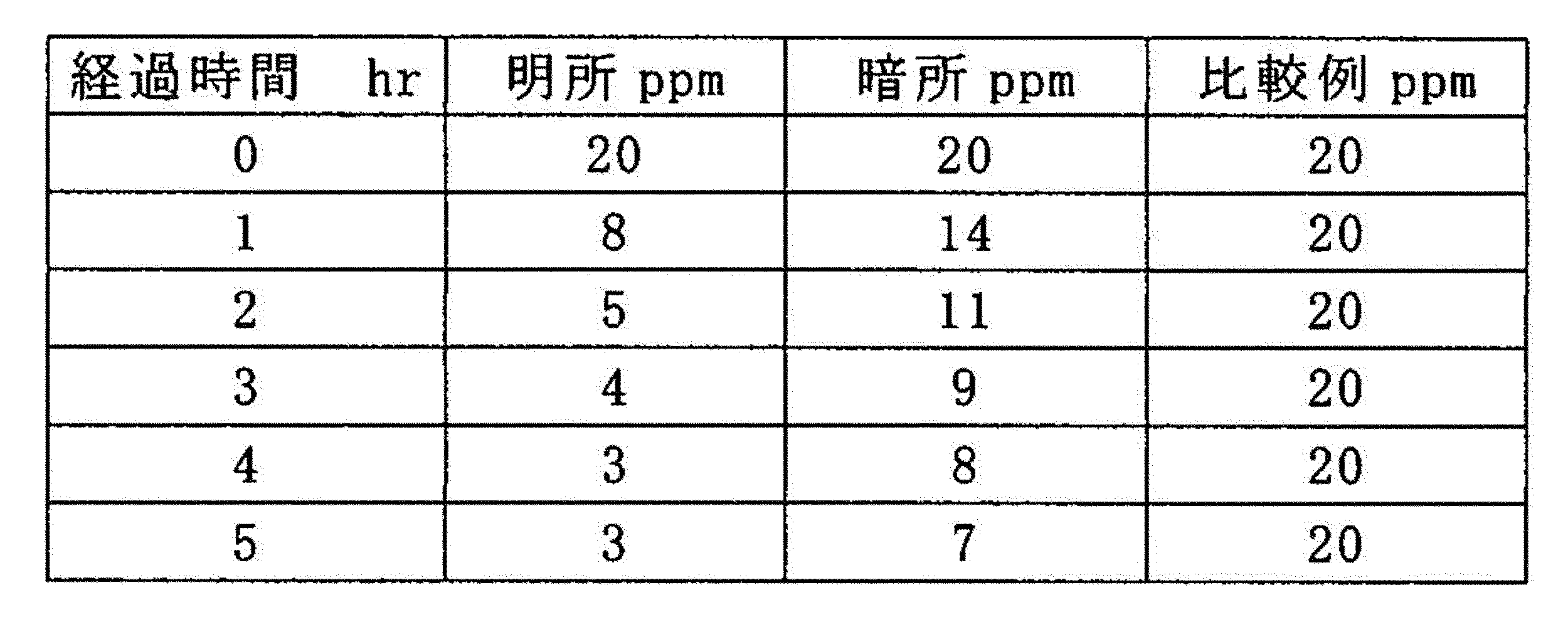
このサンプルを用いてアンモニアの分解を調べた。試験条件はLEDライト(型番ELPA 100V 4.2W)で6000lxになるように設定して照射しアンモニアの分解試験を行った。この際、ガラス瓶の中がアンモニア20ppmになるように添加した。この際、同一の条件で作製した試験サンプルを21個作製した。アンモニアの量の測定にはガステック検知器 GV-100Sを用いて、検知管は型番3Lで測定濃度範囲0.5~78ppmのものを用いた。初期の濃度から時間経過に従ってアンモニア濃度の時間的な変化を調べた。一つのサンプルは光を照射しないものとして暗所に保管した。比較例としてポリプロピレン製透明プラスチック板に塗布しないものを用いて、光照射した時のアンモニア濃度の時間的な変化を調べた。この結果を表2と図11に示した。表中にはppmの単位で示している。この表と図から分かるようにLEDライトを浴びたものはアンモニアが急速に分解していた。また、光照射をしない状態でもアンモニアを分解していることが確認された。比較例として透明プラスチック板に塗布しないものは光を照射しても初期値と変わらなかった。 The decomposition of ammonia was investigated using this sample. The test conditions were set to 6000 lpx with an LED light (model number ELPA 100V 4.2 W) and irradiated to perform an ammonia decomposition test. At this time, ammonia was added so as to be 20 ppm in the glass bottle. At this time, 21 test samples prepared under the same conditions were prepared. A gas tech detector GV-100S was used to measure the amount of ammonia, and a detector tube with a model number of 3 L and a measurement concentration range of 0.5 to 78 ppm was used. The time course of ammonia concentration was investigated from the initial concentration over time. One sample was stored in the dark as it was not exposed to light. As a comparative example, a material not applied to a transparent plastic plate made of polypropylene was used, and the change over time in the ammonia concentration when irradiated with light was investigated. The results are shown in Table 2 and FIG. In the table, it is shown in units of ppm. As can be seen from this table and figure, ammonia was rapidly decomposed in those exposed to LED light. It was also confirmed that ammonia was decomposed even when it was not irradiated with light. As a comparative example, the one not applied to the transparent plastic plate did not change from the initial value even when irradiated with light.

本発明のタングステン酸ナトリウム化合物が主成分である粉を用いた。X線解析装置により結晶構造の解析を行った。この結果を図6に示した。この結果より主成分がNa2WO4であり、副成分としてNa2WO4・2H2Oであった。また、この粉の組成を粉砕していない状態のSEM観察像を図12に示した。更にSEM-EDXにて組成分析を行ったデータを示した。図13にはEDXのピークデータを示し、図14にピーク値から算出された元素の量を示している。生データのために、試料台に使っている金属アルミ円盤からのAlのピークやサンプルを試料台に固定するために使用している導電性テープからの
炭素や酸素も検出されているので、正確な組成は定量していないが、主成分がNaとWから成り立っていることは確認された。Na量が多く見られるのは余剰のNa2OやNa2CO3が乾燥過程で粉の表面に析出されるためである。この結果とXRDの結果より化合物の主成分はNa2WO4に近いことが示された。この粉を10g秤量し500CCのビーカに入れて、次に大きさ0.05mmφのジルコニアビーズを1kg入れた後に純水200gを添加してプロペラ型の攪拌機を攪拌速度300rpmで120時間処理を行って粉砕した。この平均粒径は0.12μmとなった。このスラリーに純水を添加して固形分1%濃度にした水溶液1リットルにタングステン酸ナトリウム化合物に対して300ppmになるようにPdCl5を添加して12時間攪拌した。これを用いて厚さ0.5mm程度のポリプロピレン製透明プラスチック板幅6cm長さ16cmに全面の裏表にスプレーで塗布した。この時の乾燥後の重量は0.5gとなっており、塗膜の単位面積当たりの重量は2.6mg/cm2となった。これを図7に示すようなガラス瓶に入れて、太陽光でアンモニアの分解を調べた。この際、ガラス瓶の中のアンモニア濃度が20ppmになるように添加した。アンモニアの量はガステック検知器 GV-100Sを用いて、検知管は型番3Lで測定濃度範囲0.5~78ppmのものを用いた。この際、どうような試験サンプルを21個作製した。初期の濃度から時間経過に従ってアンモニア濃度の時間的な変化を調べた。一つのサンプルは太陽光を照射し、もう一つのサンプルは太陽光を照射しないものとして暗所に保管した。比較例として同一のポリプロピレン製透明プラスチック板に塗布しないものを用いて、太陽光照射した時のアンモニア濃度の時間的な変化を調べた。この結果を表3と図15に示した。表中にはppmの単位で示している。この表と図から分かるように太陽光を浴びたものはアンモニアが急速に分解していた。光を当てないで保存したサンプルは太陽光を照射したものに比較してアンモニアの分解性能は下がるが、充分な触媒性能を有することが分かった。比較例としてプラスチック板に塗布しないものを用いたものでは太陽光を照射しても初期値と変わらなかった。
A powder containing the sodium tungstate compound of the present invention as a main component was used. The crystal structure was analyzed by an X-ray analyzer. This result is shown in FIG. From this result, the main component was Na 2 WO 4 , and the sub-component was Na 2 WO 4.2H 2 O. Moreover, the SEM observation image in the state where the composition of this powder was not pulverized is shown in FIG. Further, the data obtained by the composition analysis by SEM-EDX are shown. FIG. 13 shows the peak data of EDX, and FIG. 14 shows the amount of the element calculated from the peak value. For raw data, the peak of Al from the metal aluminum disk used for the sample table and carbon and oxygen from the conductive tape used to fix the sample to the sample table are also detected, so it is accurate. Although the composition was not quantified, it was confirmed that the main components consisted of Na and W. The large amount of Na is observed because excess Na 2 O and Na 2 CO 3 are deposited on the surface of the powder during the drying process. From this result and the result of XRD, it was shown that the main component of the compound was close to Na 2 WO 4 . Weigh 10 g of this powder, put it in a beaker of 500 CC, then put 1 kg of zirconia beads with a size of 0.05 mmφ, add 200 g of pure water, and treat the propeller type stirrer at a stirring speed of 300 rpm for 120 hours. Crushed. This average particle size was 0.12 μm. PdCl 5 was added to 1 liter of an aqueous solution having a solid content of 1% by adding pure water to this slurry so as to be 300 ppm with respect to the sodium tungstate compound, and the mixture was stirred for 12 hours. Using this, a transparent polypropylene plate having a thickness of about 0.5 mm, a width of 6 cm and a length of 16 cm, was spray-coated on the front and back of the entire surface. The weight after drying at this time was 0.5 g, and the weight per unit area of the coating film was 2.6 mg / cm 2 . This was placed in a glass bottle as shown in FIG. 7, and the decomposition of ammonia was examined by sunlight. At this time, it was added so that the concentration of ammonia in the glass bottle was 20 ppm. As for the amount of ammonia, a gas tech detector GV-100S was used, and a detector tube having a model number of 3 L and a measurement concentration range of 0.5 to 78 ppm was used. At this time, 21 test samples of what kind were prepared. The time course of ammonia concentration was investigated from the initial concentration over time. One sample was exposed to sunlight and the other sample was stored in the dark as not exposed to sunlight. As a comparative example, the change over time in the ammonia concentration when irradiated with sunlight was investigated using a transparent plastic plate made of the same polypropylene that was not applied. The results are shown in Table 3 and FIG. In the table, it is shown in units of ppm. As can be seen from this table and figure, ammonia was rapidly decomposed in those exposed to sunlight. It was found that the sample stored without exposure to light had a lower decomposition performance of ammonia than the sample exposed to sunlight, but had sufficient catalytic performance. As a comparative example, the one not applied to the plastic plate did not change from the initial value even when irradiated with sunlight.

実施例2において、Naの代わりにアルカリ金属元素のLi、K、Csに置換した化合物としてLi2WO4,Cs2WO4,K2WO4、Li1.5K0.5WO4,Na1.7K0.3WO4,Cs1Na1WO4を用いて同様に実験を行った。この結果は実施例2と同様にアンモニアの分解が確認できた。 In Example 2, Li 2 WO 4 , Cs 2 WO 4 , K 2 WO 4 , Li 1.5 K 0.5 WO 4 , Na are used as compounds in which the alkali metal elements Li, K, and Cs are substituted for Na. The same experiment was performed using 1.7 K 0.3 WO 4 , Cs 1 Na 1 WO 4 . As a result, the decomposition of ammonia was confirmed as in Example 2.
(NH4)6・H2(W3O10)4・20H2Oを300℃1時間で焼成して(NH3)0.25WO3を作製した。この粉を10g秤量し500CCのビーカに入れて、次に大きさ0.1mmφのジルコニアビーズを1kg入れた後に純水200gを添加した。更に塩化白金酸H2(PtCl6)を(NH3)0.25WO3に対して500ppmになるように添加した後、ヒドラジンを0.1CC添加した。この後、プロペラ型の攪拌機を攪拌速度300rpmで粉砕時間を変えて平均粒径を2500nmから50nm程度まで粉砕した。これで作製した平均粒径の異なる粒子のスラリーを用いて、これを用いて厚さ0.5mm程度のポリプロピレン製透明プラスチック板 幅6cm長さ16cmに全面の裏表にスプレーで塗布した。この時の乾燥後の重量は0.8gになるように固定した。塗膜の単位面積当たりの重量は4.1mg/cm2となった。これを図7に示すようなガラス瓶に入れて、太陽光でアセトアルデヒドの分解を調べた。次にガラス瓶の中のアセトアルデヒド濃度が20ppmになるように添加した。この際、平均粒径の異なる試験サンプルを15個作製した。アセトアルデヒドの量はガステック検知器 GV-100Sを用いて、検知管は型番92Lで測定濃度範囲1~20ppmのものを用いた。初期の濃度から5時間経過した際のアセトアルデヒド濃度を調べて、粒径との相関関係を調べた。一つのサンプルは太陽光を照射し、もう一つのサンプルは光を照射しないものとして暗所に保管した。更に比較例として同一のポリプロピレン製プラスチック板に光触媒化合物を塗布しないものを用いた。この結果を表4と図16に示した。表中のアセトアルデヒド濃度の単位はppmである。この表と図から、光照射の有無に関わらず、平均粒径が小さい程、アセトアルデヒドの分解は促進された。この結果から、平均粒子サイズは0.2μmが望ましく、好ましくは0.1μm以下が良いことが分かった。比較例として用いたプラスチック板に光触媒化合物を塗布しないものでは太陽光を当てても初期値と変わらなかった。
(NH 4 ) 6・ H 2 (W 3 O 10 ) 4. 20 H 2 O was calcined at 300 ° C. for 1 hour to prepare (NH 3 ) 0.25 WO 3 . 10 g of this powder was weighed and placed in a 500 CC beaker, then 1 kg of zirconia beads having a size of 0.1 mmφ was added, and then 200 g of pure water was added. Further, platinum chloride acid H2 (PtCl 6 ) was added to (NH 3 ) 0.25 WO 3 at 500 ppm, and then hydrazine was added at 0.1 CC. After that, the propeller type stirrer was pulverized at a stirring speed of 300 rpm and the pulverization time was changed to pulverize the average particle size from 2500 nm to about 50 nm. Using the slurry of particles having different average particle sizes prepared in this manner, a transparent plastic plate made of polypropylene having a thickness of about 0.5 mm was spray-coated on the front and back of the entire surface to a width of 6 cm and a length of 16 cm. The weight after drying at this time was fixed to be 0.8 g. The weight per unit area of the coating film was 4.1 mg / cm 2 . This was placed in a glass bottle as shown in FIG. 7, and the decomposition of acetaldehyde was examined by sunlight. Next, the acetaldehyde concentration in the glass bottle was added so as to be 20 ppm. At this time, 15 test samples having different average particle sizes were prepared. As for the amount of acetaldehyde, a gas tech detector GV-100S was used, and a detector tube having a model number of 92 L and a measurement concentration range of 1 to 20 ppm was used. The
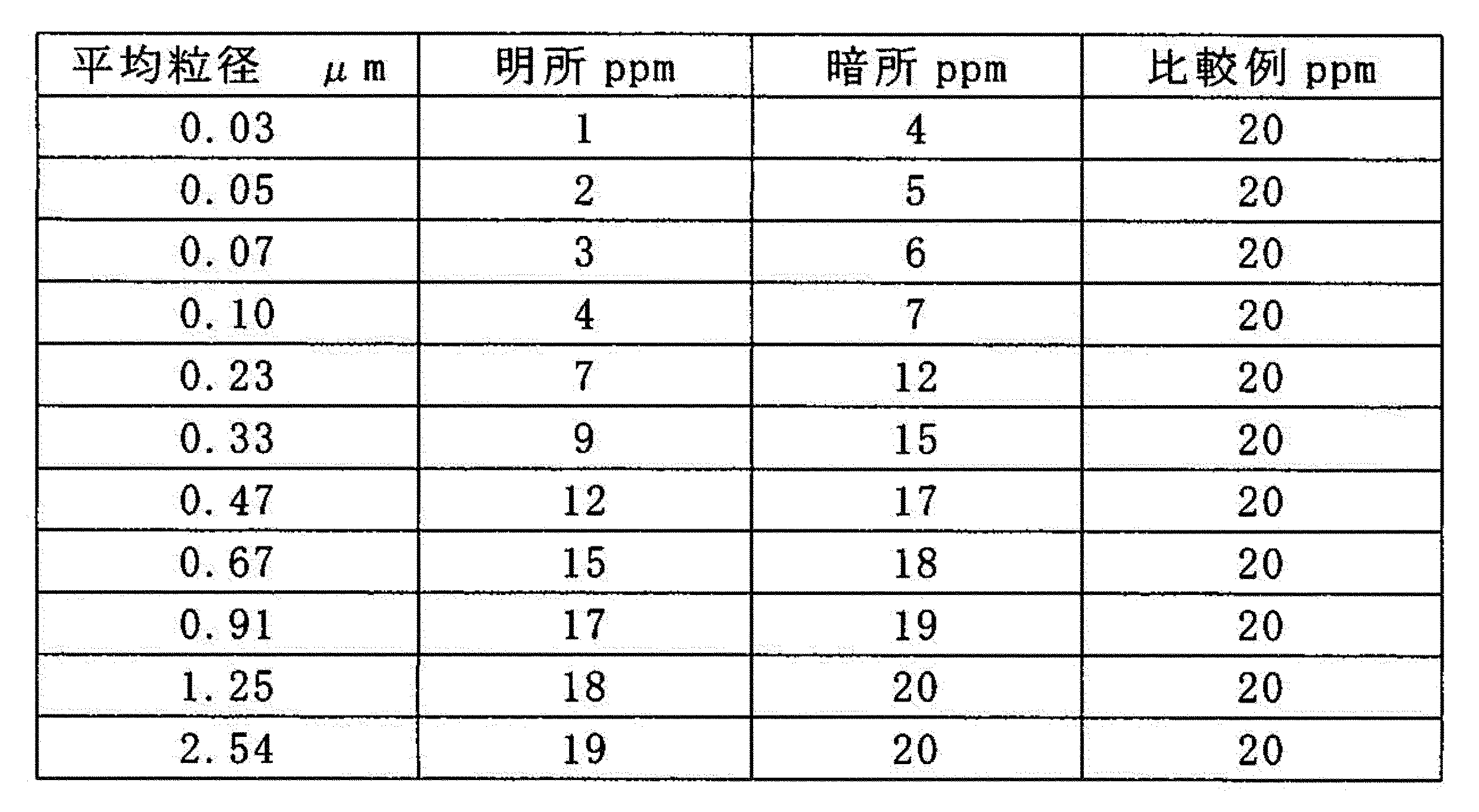
実施例4で作製した平均粒径の異なるものにおいて、平均粒径1.25μmのものと平均粒径0.1μmのものの混合比を変えて固形分濃度1%の光触媒塗料を作製し、固形分の全重量において、混ぜた平均粒径が0.05μmの重量%と光触媒性能を調べた。この際、スラリー中の固形分濃度は固定値の1%となっている。条件はガスをアンモニアに変えて、その他の条件は実施例4と同一にして行った。アンモニアの濃度はガステック検知 GV-100Sを用いて、検知管は型番3Lで測定濃度範囲0.5~78ppmのもので評価した。この結果を表5と図17に示した。この結果から、光触媒性を持たせるには平均粒径が1μm程度のものにおいて少なくとも平均粒径が0.05μmの粉が少なくとも10重量%含まれていることが好ましいことが分かった。この際、前記の二つの混合する粒子において平均粒径が1μm程度のサイズを大小に変えても平均粒径が0.05μmの重量%が10重量%含まれていると同様な効果が得られることが分かった。したがって、全体の粉の重量において平均粒径が0.05μmの重量%が10重量%以上であることが好ましい。 Among the materials having different average particle diameters produced in Example 4, a photocatalyst coating material having a solid content concentration of 1% was produced by changing the mixing ratio of those having an average particle size of 1.25 μm and those having an average particle size of 0.1 μm to produce a solid content. The average particle size of the mixture was 0.05 μm by weight, and the photocatalyst performance was examined. At this time, the solid content concentration in the slurry is 1% of the fixed value. The conditions were changed from gas to ammonia, and the other conditions were the same as in Example 4. The concentration of ammonia was evaluated using GV-100S detected by Gastec, and the detector tube had a model number of 3 L and a measurement concentration range of 0.5 to 78 ppm. The results are shown in Table 5 and FIG. From this result, it was found that it is preferable that the powder having an average particle size of about 1 μm contains at least 10% by weight of the powder having an average particle size of 0.05 μm in order to have photocatalytic property. At this time, even if the size of the two mixed particles having an average particle size of about 1 μm is changed to a large size, the same effect as that 10% by weight of the average particle size of 0.05 μm is contained can be obtained. It turned out. Therefore, it is preferable that the weight% of the average particle size of 0.05 μm is 10% by weight or more based on the weight of the whole powder.

本発明の化合物として5(NH4)2O・12WO3・11H2Oを用いて試験を行った。この粉を10g秤量し500CCのビーカに入れて、次に大きさ0.03mmφのジルコニアビーズを1kg入れた後に純水200gを添加した。この後、プロペラ型の攪拌機を攪拌速度300rpmで平均粒径を50nm程度まで粉砕した。粉砕後、塩化パラジウムを5(NH4)2O・12WO3・11H2Oに対して500ppmになるように添加した後、ヒドラジンを0.1CC添加し12時間攪拌した。作製した粒子のスラリーを用いて厚さ3mm程度の段ボール紙 幅6cm 長さ16cmに全面の裏表にスプレーで塗布した。この時の乾燥後の重量は0.6gになるように固定した。塗膜の単位面積当たりの重量は 3.1mg/cm2となった。これを図7に示すガラス瓶に入れて、アセトアルデヒド濃度が20ppmになるように添加した。試験条件はLEDライトで6000lxになるように設定して照射しアセトアルデヒの分解試験を行った。この際、同一の条件で作製した試験サンプルを14個作製した。アセトアルデヒドの量はガステック検知器 GV-100Sを用いて、検知管は型番92Lで測定濃度範囲1~20ppmのものを用いた。初期の濃度から時間経過に従ってアセトアルデヒ濃度の時間的な変化を調べた。一つのサンプルは太陽光を照射し、もう一つのサンプルは光を照射しないものとして暗所に保管した。更に比較例として段ボール紙に光触媒化合物を塗布しないものを用いた。この結果を表6と図18に示した。この表と図から分かるようにLEDライトを浴びたものはアセトアルデヒが急速に分解していた。光を当てないで保存したサンプルも同様にアセトアルデヒドが急速に分解した。比較例として用いた段ボール紙に光触媒化合物を塗布しないものでは太陽光を当てても初期値とほぼ変わらなかった。この測定データは段ボール紙へのアセトアルデヒドの吸着による影響があるため、予め吸着量の時間経緯を測定し補正している。 The test was carried out using 5 (NH 4 ) 2 O · 12 WO 3.11H 2 O as the compound of the present invention. 10 g of this powder was weighed and placed in a 500 CC beaker, then 1 kg of zirconia beads having a size of 0.03 mmφ was added, and then 200 g of pure water was added. After that, a propeller type stirrer was pulverized to an average particle size of about 50 nm at a stirring speed of 300 rpm. After pulverization, palladium chloride was added to 5 (NH 4 ) 2 O · 12 WO 3.11H 2 O so as to be 500 ppm, and then 0.1 CC of hydrazine was added and the mixture was stirred for 12 hours. Using the prepared slurry of particles, a corrugated cardboard having a thickness of about 3 mm was spray-coated on the front and back of the entire surface on a corrugated cardboard with a width of 6 cm and a length of 16 cm. The weight after drying at this time was fixed to be 0.6 g. The weight per unit area of the coating film was 3.1 mg / cm 2 . This was placed in the glass bottle shown in FIG. 7 and added so that the acetaldehyde concentration was 20 ppm. The test conditions were set to 6000 lpx with an LED light and irradiated to perform a decomposition test of acetaldehyde. At this time, 14 test samples prepared under the same conditions were prepared. As for the amount of acetaldehyde, a gas tech detector GV-100S was used, and a detector tube having a model number of 92 L and a measurement concentration range of 1 to 20 ppm was used. The time course of acetaldehyde concentration was investigated from the initial concentration over time. One sample was exposed to sunlight and the other sample was stored in the dark as not exposed to light. Further, as a comparative example, a corrugated cardboard on which the photocatalytic compound was not applied was used. The results are shown in Table 6 and FIG. As can be seen from this table and figure, acetaldehyde rapidly decomposed those exposed to LED light. Similarly, acetaldehyde rapidly decomposed in the samples stored without exposure to light. When the corrugated cardboard used as a comparative example was not coated with the photocatalytic compound, it was almost the same as the initial value even when exposed to sunlight. Since this measurement data is affected by the adsorption of acetaldehyde on corrugated cardboard, the time course of the adsorption amount is measured and corrected in advance.

実施例6で用いたタングステン酸アンモニウム化合物の粉砕後のスラリーを用いて固形分1%の純水液100CCにして、曇りガラス板 幅5cm 長さ12cm厚み1mmに塗布して120℃で2時間の大気中乾燥を行った。比較例として同じサイズの酸化チタン(アナターセ型)の粉を用いて純水に固形分1%になるように添加して超音波装置((株)日本精機製作所MODEL US-300T)で30分間分散処理を行った。また、もう一つ比較例として同じサイズの光触媒用の三酸化タングステンのナノ粒子も酸化チタンと同様にして純水に固形分1%になるように添加して超音波装置(((株))日本精機製作所MODEL US-300T)で30分間分散処理を行った。この際の単位面積当たりの塗膜量が3.5mg/cm2前後になるようにスプレーで塗布した。この三つのサンプルこのガラス板を1リットルビーカーに純水1000CCに10分間浸漬して重量減を調べた。この結果を表7に示した。この結果から、本発明のタングステン酸アンモニウム化合物は非常に付着力が高い特徴があることが分かった。
Using the slurry of the ammonium paratungate compound used in Example 6 after pulverization, a pure water solution having a solid content of 1% was prepared into 100 CC, and the mixture was applied to a frosted glass plate (
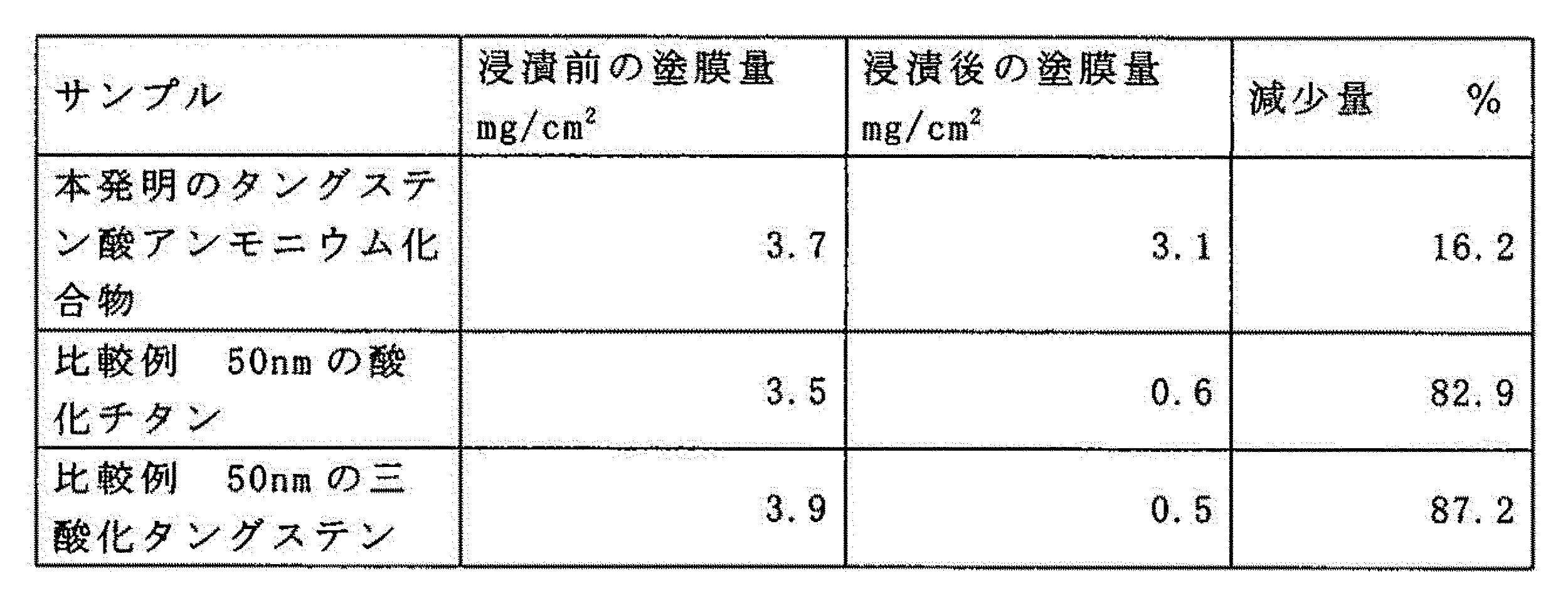
実施例7において、本発明に用いた他のタングステン酸化合物を用いても表7と同様な結果が得られた。具体的には(NH4)6・H2(W3O10)4・20H2O、5(NH4)2O・12WO3・7H2O、(NH4)10・W12O41・5H2O、もしくは(NH4)10・H2W12O42・4H2OやNa2WO4、(NH3)0.25WO3等でも同様な結果が得られた。 In Example 7, the same results as in Table 7 were obtained even when the other tungstic acid compounds used in the present invention were used. Specifically, (NH 4 ) 6・ H 2 (W 3 O 10 ) 4・ 20H 2 O, 5 (NH 4 ) 2 O ・12 WO 3.7H 2 O , (NH 4 ) 10 ・ W 12 O 41・Similar results were obtained with 5H 2 O, or (NH 4 ) 10 · H 2 W 12 O 42 · 4H 2 O, Na 2 WO 4 , (NH 3 ) 0.25 WO 3 , and the like.
本発明のタングステン酸化合物の被着体に対する隠ぺい力を調べた。隠ぺい力として光透過性で調べた。表7に示したサンプルにおいて浸漬しない状態のもの、塗膜して乾燥したサンプルを用いて実施例1に示した図8の装置を用いて各サンプルにLEDライトを用いて6000lxで照射して透過光の強度を調べた結果を表8に示した。この際、措置に装着していた半導体LEDをLEDライトに変えた。比較しやすくするために本発明のタングステン酸アンモニウム化合物の透過光で得られるセンサーの光電流値を1として規格化した。この結果から、本発明のタングステン酸アンモニウム化合物は同じサイズの酸化チタンや三酸化タングステンよりも光透過量が大きいことが分かり、本発明のものが酸化チタンや三酸化タングステン粒子よりも隠ぺい力はなく、被着体のデザインや色調を阻害するものではないことが分かった。この特性は本発明のタングステン酸化合物において共通していた。 The hiding power of the tungstic acid compound of the present invention on the adherend was investigated. It was examined by light transmission as a hiding force. In the samples shown in Table 7, the samples in a non-immersed state and the samples coated and dried were used, and each sample was irradiated with an LED light at 6000 lp using the apparatus of FIG. 8 shown in Example 1 and transmitted. The results of examining the light intensity are shown in Table 8. At this time, the semiconductor LED attached to the measure was changed to an LED light. For easy comparison, the photocurrent value of the sensor obtained by the transmitted light of the ammonium tungstate compound of the present invention was standardized as 1. From this result, it was found that the ammonium tungsten compound of the present invention has a larger light transmission amount than titanium oxide or tungsten trioxide of the same size, and that of the present invention has less hiding power than titanium oxide or tungsten trioxide particles. , It was found that it does not interfere with the design and color tone of the adherend. This property was common to the tungstic acid compounds of the present invention.

実施例6で用いたタングステン酸アンモニウム化合物の粉砕後のスラリーを用いて純水で希釈して固形分1%のスラリー100CCにした後、水酸化ナトリウム添加によりpHを調節しpHを10にした後、この中に50~100nmの酸化チタン粉を液の重量に対して5重量%で添加した。更にリチウムシリケート(日産化学工業製 リチウムシリケート35)を前記の液の重量に対して10重量%を添加した。この後、攪拌を10分間行った。この混合液を用いて実施例6と同様に試験片を作製して光触媒性能を確認した。この結果、実施例6と同様な結果が得られた。またこの際に段ボール紙表面に作製した塗膜は500CCの純水を掛けても流れることはほとんどなく、塗膜の重量変化からすると5%程度の以下の重量減は確認された。比較例として何も添加しないタングステン化合物の固形分1%のスラリー100CCを用いた場合には、重量減が10重量%になっていた。この結果から、本発明の化合物はシリケート化合物により付着力を更に改善できることが分かった。 After pulverizing the ammonium tungstate compound used in Example 6 and diluting it with pure water to make a slurry 100CC having a solid content of 1%, the pH was adjusted by adding sodium hydroxide to adjust the pH to 10. To this, titanium oxide powder having a pH of 50 to 100 nm was added in an amount of 5% by weight based on the weight of the liquid. Further, 10% by weight of lithium silicate (lithium silicate 35 manufactured by Nissan Chemical Industries, Ltd.) was added to the weight of the above liquid. After this, stirring was performed for 10 minutes. Using this mixed solution, a test piece was prepared in the same manner as in Example 6 and the photocatalytic performance was confirmed. As a result, the same result as in Example 6 was obtained. Further, at this time, the coating film formed on the surface of the corrugated cardboard hardly flowed even when 500 CC of pure water was applied, and it was confirmed that the weight was reduced by about 5% or less from the weight change of the coating film. As a comparative example, when a slurry 100CC having a solid content of 1% of the tungsten compound to which nothing was added was used, the weight loss was 10% by weight. From this result, it was found that the compound of the present invention can further improve the adhesive force by the silicate compound.
実施例2で作製したタングステン酸ナトリウムNa2WO4の固形分1%の純水液100CCに光触媒の酸化チタン50nmサイズ粉を固形分1%量で添加した。更にバインダーとしてシリカナノ粒子(日産化学工業製 スノーテックスUP)を10重量%添加して10分間混合した。この混合液を曇りガラス板 幅5cm長さ12cm 厚み1mmに塗布して120℃で2時間の大気中乾燥を行った。このガラス板を純水に浸漬して重量減を調べた。比較例としてはシリカナノ粒子を添加しないものを用いた。この結果を表9に示した。シリカナノ粒子を用いることにより付着力の改善効果が得られていることが分かった。
A

このサンプルを用いてアンモニアの分解特性を調べた。このガラス板に塗布したサンプルを図7に示すガラス瓶に入れて、アンモニア濃度が20ppmになるように添加した。試験条件はLEDライトで6000lxになるように設定して照射しアンモニアの分解試験を行った。この際、ガラス瓶の中がアンモニア20ppmになるように添加した。アンモニアの量の測定にはガステック検知器 V-100Sを用いて、検知管は型番3Lで測定濃度範囲0.5~78ppmのものを用いた。初期の濃度から5時間後のアンモニア濃度を調べた。一つのサンプルは太陽光を照射し、もう一つのサンプルは光を照射しないものとして暗所に保管した。この結果、光照射したものはアンモニアが急速に分解し、濃度が5ppmになっていた。また、光を当てない状態でブラックボックスに入れたサンプルもアンモニアが分解し濃度が10ppmなっていた。光触媒化合物を塗布していないサンプルを用いたものでは光を照射しても初期値20ppmとなり変わらなかった。
The decomposition characteristics of ammonia were investigated using this sample. The sample applied to this glass plate was placed in the glass bottle shown in FIG. 7 and added so that the ammonia concentration became 20 ppm. The test conditions were set to 6000 lpx with an LED light and irradiated to perform an ammonia decomposition test. At this time, ammonia was added so as to be 20 ppm in the glass bottle. A gas tech detector V-100S was used to measure the amount of ammonia, and a detector tube with a model number of 3 L and a measurement concentration range of 0.5 to 78 ppm was used. The
本発明のタングステン酸アンモニウム化合物として、主成分が(NH4)6・H2(W3O10)4・20H2Oを用いて、300℃1時間の大気中での焼成を行った。この粉をX線解析装置により結晶構造の解析を行った。この結果を図19に示した。この結果より主成分が(NH4)0.25WO3、WO3であった。この粉を10g秤量し500CCのビーカに入れて、次に大きさ0.05mmφのジルコニアビーズを1kg入れた後に純水200gを添加してプロペラ型の攪拌機を攪拌速度300rpmで120時間処理を行って粉砕した。この時の粒度分布は図20に示すものとなった。粒度分布の測定はHORIBA製LA-950で行った。平均粒径は0.09μmとなった。このスラリーを用いて固形分濃度を1%にした液を50CC作製した。この液にメチレンブルー濃度20ppmの液を1CC添加した。その後、図8に示す装置にセットして、半導体LEDを用いて12時間照射を行った。半導体のLED光源としてはOptoSupply社製 青色の波長465~475nmのものを使用した。受光側の光センサーとして浜松ホトニクス社製 Si PINフォトセンサーを用いた。受光センサーの電流値として0.2mAを基準値として用いた。12時間照射後のメチレンブルーの色を確認し結果、照射したサンプルは完全な無色透明となって光触媒効果による分子構造の変化を確認した。光を照射していないものは初期としてよりも色は薄くなっており触媒特性が効いていることが分かった。比較例として光触媒化合物を添加していないものでは色の変化は全くなかった。 As the ammonium tungstate compound of the present invention, the main component was (NH 4 ) 6・ H 2 (W 3 O 10 ) 4. 20 H 2 O, and the compound was calcined in the air at 300 ° C. for 1 hour. The crystal structure of this powder was analyzed by an X-ray analyzer. This result is shown in FIG. From this result, the main components were (NH 4 ) 0.25 WO 3 and WO 3 . Weigh 10 g of this powder, put it in a beaker of 500 CC, then put 1 kg of zirconia beads with a size of 0.05 mmφ, add 200 g of pure water, and treat the propeller type stirrer at a stirring speed of 300 rpm for 120 hours. Crushed. The particle size distribution at this time is as shown in FIG. The particle size distribution was measured with LA-950 manufactured by HORIBA. The average particle size was 0.09 μm. Using this slurry, 50 CC of a liquid having a solid content concentration of 1% was prepared. 1 CC of a solution having a methylene blue concentration of 20 ppm was added to this solution. Then, it was set in the apparatus shown in FIG. 8 and irradiated for 12 hours using a semiconductor LED. As the LED light source of the semiconductor, a blue LED light source manufactured by OptoSupply with a wavelength of 465 to 475 nm was used. A Si PIN photosensor manufactured by Hamamatsu Photonics Co., Ltd. was used as the optical sensor on the light receiving side. 0.2 mA was used as a reference value as the current value of the light receiving sensor. As a result of confirming the color of methylene blue after irradiation for 12 hours, the irradiated sample became completely colorless and transparent, and the change in the molecular structure due to the photocatalytic effect was confirmed. It was found that the color of the non-irradiated one was lighter than that at the initial stage and the catalytic properties were effective. As a comparative example, there was no change in color when the photocatalytic compound was not added.
本発明のタングステン酸化合物として、図6に示したNa2WO4とNa2WO4・2H2Oからなる化合物の粉を10g秤量し500CCのビーカに入れて、次に大きさ0.05mmφのジルコニアビーズを1kg入れた後に純水200gを添加してプロペラ型の攪拌機を攪拌速度300rpmで120時間処理を行って粉砕した。このスラリーを取り出し、濃縮においては加熱により水を気化させて固形分濃度を上げて、希釈において純水を加えて、固形分濃度が0.01%~10%のスラリーを50CCずつ作製した。この液5CCを用いて曇りガラス板 幅5cm 長さ12cm 厚み1mmにスプレーで全量塗布した。各スラリー液の塗布量は同じにしているため、乾燥後の塗膜量は異なる。このガラス板のサンプルを図7に示すガラス瓶に入れて、アンモニア濃度が20ppmになるように添加した。試験条件はLEDライトで6000lxになるように設定して照射しアンモニアの分解試験を行った。アンモニアの量の測定にはガステック検知器 GV-100Sを用いて、検知管は型番3Lで測定濃度範囲0.5~78ppmのものを用いた。初期の濃度から5時間後のアンモニア濃度を調べた。一つのサンプルは太陽光を照射し、もう一つのサンプルは光を照射しないものとして暗所に保管した。更に比較例として曇りガラス板に光触媒化合物を塗布しないものを用いた。この結果を表10と図21に示した。表中にはppmの単位で示している。この結果から、光触媒の濃度が薄いものではアンモニアは分解しないため、少なくとも固形分濃度としては0.1%以上、望ましくは0.5%以上であることが良いことが分かった。光触媒化合物を塗布していないものでは全くアンモニア濃度が変わらなかった。この結果から本発明の光触媒化合物は光照射がない状態でも一般的な触媒性能としてアンモニアを分解することが分かった。また固形分濃度としては0.1%以上、望ましくは0.5%以上であることが良いことが分かった。
As the tungstic acid compound of the present invention, 10 g of the powder of the compound consisting of Na 2 WO 4 and Na 2 WO 4.2 H 2 O shown in FIG. 6 was weighed and placed in a beaker of 500 CC, and then the size was 0.05 mmφ. After adding 1 kg of zirconia beads, 200 g of pure water was added, and a propeller-type stirrer was treated at a stirring speed of 300 rpm for 120 hours to be pulverized. This slurry was taken out, water was vaporized by heating in concentration to increase the solid content concentration, and pure water was added in dilution to prepare 50 CC of slurry having a solid content concentration of 0.01% to 10%. Using this liquid 5CC, the entire amount was sprayed onto a frosted glass plate with a width of 5 cm, a length of 12 cm, and a thickness of 1 mm. Since the coating amount of each slurry liquid is the same, the coating film amount after drying is different. A sample of this glass plate was placed in the glass bottle shown in FIG. 7 and added so that the ammonia concentration became 20 ppm. The test conditions were set to 6000 lpx with an LED light and irradiated to perform an ammonia decomposition test. A gas tech detector GV-100S was used to measure the amount of ammonia, and a detector tube with a model number of 3 L and a measurement concentration range of 0.5 to 78 ppm was used. The

家庭のトイレや台所、飲食店等の小規模空間から食品工場、医薬品工場、食品倉庫、船舶、化学薬品工場等の大規模な空間において、悪臭や有害な化学物質が空気中に飛散する場所において有機化合物やウィルス、菌により衛生環境が著しく低下するという問題がある。このような場所において、本発明のタングステン化合物は光触媒性能より臭い分子を分解する性能が高く、且つ付着力があり、安全性が比較的に高く、効果の持続性は長期間に保つことが出来るためにこのような用途において非常に有効である。また、本発明の化合物は光がない条件においても優れた触媒性能を有している。一例としてホルムアルデヒドやアセトアルデヒド、アンモニア等の分解能力が光の無い状況でも高いために通常の触媒材料や触媒機能を有する部品や製品として用いることが出来る。 From small spaces such as home toilets, kitchens and restaurants to large spaces such as food factories, pharmaceutical factories, food warehouses, ships and chemical factories, where malodors and harmful chemical substances are scattered in the air. There is a problem that the sanitary environment is significantly deteriorated by organic compounds, viruses, and bacteria. In such a place, the tungsten compound of the present invention has higher ability to decompose odorous molecules than photocatalytic performance, has adhesive force, has relatively high safety, and can maintain the sustainability of the effect for a long period of time. Therefore, it is very effective in such applications. In addition, the compound of the present invention has excellent catalytic performance even in the absence of light. As an example, since the decomposition ability of formaldehyde, acetaldehyde, ammonia and the like is high even in the absence of light, it can be used as a normal catalytic material or a part or product having a catalytic function.
1 半導体のLED光源
2 半導体のLED光源の照射用電源
3 Si PINフォトセンサー
4 Si PINフォトセンサーからの光電流測定措置
5 サンプルを入れるガラス瓶(ガラス瓶の蓋の内側にPEフィルムで封止)
6 光触媒を担持したプラスチック板
1 Semiconductor LED
6 Plastic plate carrying a photocatalyst
Claims (6)
(NH3)x-y・My・mWO3・rH2O(x-y>0、y≧0、m>0、r≧0)、及び
(NH4)2(x-y)・M2y・(WO4)z・(WO3)q・rH2O(x-y>0、y≧0、z>0、q>0、r≧0)
の中から少なくとも一種以上を含んだものからなるタングステン化合物である光触媒化合物を含む分散液であり(M:Li、Na、K、Cs、Rb)、
光のない場所においても触媒性能を有する、光触媒化合物を含む分散液。 In a photocatalyst with a visible light responsive photocatalyst function,
(NH 3 ) xy , My, mWO 3 , rH 2 O (xy> 0, y ≧ 0, m> 0, r ≧ 0) , and
(NH 4 ) 2 (xy) · M 2y · (WO 4 ) z · (WO 3 ) q · rH 2 O (xy> 0, y ≧ 0, z> 0, q> 0, r ≧ 0)
It is a dispersion liquid containing a photocatalytic compound which is a tungsten compound containing at least one of them (M: Li, Na, K, Cs, Rb).
A dispersion containing a photocatalytic compound that has catalytic performance even in a place without light.
Priority Applications (1)
| Application Number | Priority Date | Filing Date | Title |
|---|---|---|---|
| JP2022044629A JP7288709B2 (en) | 2017-05-19 | 2022-03-18 | Visible light responsive photocatalyst tungsten compound and paint |
Applications Claiming Priority (2)
| Application Number | Priority Date | Filing Date | Title |
|---|---|---|---|
| JP2017112058A JP2018192466A (en) | 2017-05-19 | 2017-05-19 | Tungsten compound of visible light-responsive photocatalyst, and coating |
| JP2022044629A JP7288709B2 (en) | 2017-05-19 | 2022-03-18 | Visible light responsive photocatalyst tungsten compound and paint |
Related Parent Applications (1)
| Application Number | Title | Priority Date | Filing Date |
|---|---|---|---|
| JP2017112058A Division JP2018192466A (en) | 2017-05-19 | 2017-05-19 | Tungsten compound of visible light-responsive photocatalyst, and coating |
Publications (2)
| Publication Number | Publication Date |
|---|---|
| JP2022079542A true JP2022079542A (en) | 2022-05-26 |
| JP7288709B2 JP7288709B2 (en) | 2023-06-08 |
Family
ID=87761014
Family Applications (1)
| Application Number | Title | Priority Date | Filing Date |
|---|---|---|---|
| JP2022044629A Active JP7288709B2 (en) | 2017-05-19 | 2022-03-18 | Visible light responsive photocatalyst tungsten compound and paint |
Country Status (1)
| Country | Link |
|---|---|
| JP (1) | JP7288709B2 (en) |
Citations (5)
| Publication number | Priority date | Publication date | Assignee | Title |
|---|---|---|---|---|
| JP2000051708A (en) * | 1998-08-10 | 2000-02-22 | Showa Alum Corp | Photocatalytic film and method for forming the same |
| JP2002234105A (en) * | 2000-03-13 | 2002-08-20 | Toto Ltd | Hydrophilic member and method for manufacturing the same |
| JP2008260684A (en) * | 2008-05-28 | 2008-10-30 | Taki Chem Co Ltd | Photocatalytic titanium oxide sol and coating composition using the same |
| JP2010069456A (en) * | 2008-09-22 | 2010-04-02 | Hokkaido Univ | Method of oxidizing organic compound and method of reactivating catalyst |
| JP2015120162A (en) * | 2008-03-04 | 2015-07-02 | 株式会社東芝 | Antibacterial material, antibacterial film and antibacterial member using the same |
-
2022
- 2022-03-18 JP JP2022044629A patent/JP7288709B2/en active Active
Patent Citations (5)
| Publication number | Priority date | Publication date | Assignee | Title |
|---|---|---|---|---|
| JP2000051708A (en) * | 1998-08-10 | 2000-02-22 | Showa Alum Corp | Photocatalytic film and method for forming the same |
| JP2002234105A (en) * | 2000-03-13 | 2002-08-20 | Toto Ltd | Hydrophilic member and method for manufacturing the same |
| JP2015120162A (en) * | 2008-03-04 | 2015-07-02 | 株式会社東芝 | Antibacterial material, antibacterial film and antibacterial member using the same |
| JP2008260684A (en) * | 2008-05-28 | 2008-10-30 | Taki Chem Co Ltd | Photocatalytic titanium oxide sol and coating composition using the same |
| JP2010069456A (en) * | 2008-09-22 | 2010-04-02 | Hokkaido Univ | Method of oxidizing organic compound and method of reactivating catalyst |
Also Published As
| Publication number | Publication date |
|---|---|
| JP7288709B2 (en) | 2023-06-08 |
Similar Documents
| Publication | Publication Date | Title |
|---|---|---|
| US8791044B2 (en) | Doped titanium dioxide as a visible and sun light photo catalyst | |
| TWI534217B (en) | Antimicrobial and antiviral composition, and method of producing the same | |
| US8298979B2 (en) | Zirconium oxalate sol | |
| WO2016042913A1 (en) | Antibacterial/antiviral composition, antibacterial/antiviral agent, photocatalyst, and bacteria/virus inactivation method | |
| WO2013094573A1 (en) | Copper-and-titanium-containing composition and production method therefor | |
| CN101898129A (en) | Photocatalyst dispersion liquid and photocatalytic functional products using the same | |
| AU2016237640A1 (en) | Visible-light-responsive photocatalytic-titanium-oxide-particulate dispersion liquid, manufacturing method therefor, and member having thin photocatalytic film on surface thereof | |
| US20190217282A1 (en) | Mixture of visible light-responsive photocatalytic titanium oxide fine particles, dispersion liquid thereof, method for producing dispersion liquid, photocatalyst thin film, and member having photocatalyst thin film on surface | |
| Chin et al. | Preparation of Nb2O5-decorated hierarchical porous ZnO microspheres with enhanced photocatalytic degradation of palm oil mill effluent | |
| Adenuga et al. | Synthesis of a plasmonic AgCl and oxygen-rich Bi 24 O 31 Cl 10 composite heterogeneous catalyst for enhanced degradation of tetracycline and 2, 4-dichlorophenoxy acetic acid | |
| Rocha et al. | Enhanced photocatalytic performance of TiO2@ Er-hydroxyapatite composite for cationic dye and drug removal | |
| TW201632071A (en) | Antiviral composition, antiviral agent, photo-catalyst, and virus inactivation process | |
| CN103079703B (en) | The manufacture method of photochemical catalyst tunicle and photochemical catalyst tunicle | |
| JP4849778B2 (en) | Antibacterial deodorant and method for producing the same | |
| JP5090787B2 (en) | Titanium oxide composite particle aqueous dispersion and production method thereof | |
| JP2022079542A (en) | Tungsten compound of visible light-responsive photocatalyst and coating | |
| JP4964331B2 (en) | Method for producing antibacterial deodorant | |
| JP2018192466A (en) | Tungsten compound of visible light-responsive photocatalyst, and coating | |
| WO2004069946A1 (en) | Coating material for forming photocatalyst/titanium oxide composite film | |
| KR20140104471A (en) | Photocatalysts and process for preparing photocatalysts | |
| Suwanboon et al. | Effect of pH on formation of Ti-O-based photocatalysts prepared by green chemistry and their photocatalytic activities | |
| JP2006297350A (en) | Photocatalyst film and manufacturing method | |
| JP5113723B2 (en) | Photocatalyst dispersion | |
| JP2010214309A (en) | Photocatalytic body-dispersed liquid and application thereof | |
| JP2022134668A (en) | Photocatalyst coating agent and method for producing photocatalyst coating agent |
Legal Events
| Date | Code | Title | Description |
|---|---|---|---|
| A521 | Request for written amendment filed |
Free format text: JAPANESE INTERMEDIATE CODE: A821 Effective date: 20220322 |
|
| A621 | Written request for application examination |
Free format text: JAPANESE INTERMEDIATE CODE: A621 Effective date: 20220413 |
|
| A521 | Request for written amendment filed |
Free format text: JAPANESE INTERMEDIATE CODE: A821 Effective date: 20220415 |
|
| TRDD | Decision of grant or rejection written | ||
| A01 | Written decision to grant a patent or to grant a registration (utility model) |
Free format text: JAPANESE INTERMEDIATE CODE: A01 Effective date: 20230516 |
|
| A61 | First payment of annual fees (during grant procedure) |
Free format text: JAPANESE INTERMEDIATE CODE: A61 Effective date: 20230522 |
|
| R150 | Certificate of patent or registration of utility model |
Ref document number: 7288709 Country of ref document: JP Free format text: JAPANESE INTERMEDIATE CODE: R150 |