JP2020525794A - Polysorbate quantitative assay - Google Patents
Polysorbate quantitative assay Download PDFInfo
- Publication number
- JP2020525794A JP2020525794A JP2019572526A JP2019572526A JP2020525794A JP 2020525794 A JP2020525794 A JP 2020525794A JP 2019572526 A JP2019572526 A JP 2019572526A JP 2019572526 A JP2019572526 A JP 2019572526A JP 2020525794 A JP2020525794 A JP 2020525794A
- Authority
- JP
- Japan
- Prior art keywords
- polysorbate
- sample
- dii
- well plate
- fluorescence
- Prior art date
- Legal status (The legal status is an assumption and is not a legal conclusion. Google has not performed a legal analysis and makes no representation as to the accuracy of the status listed.)
- Granted
Links
Images




Classifications
-
- G—PHYSICS
- G01—MEASURING; TESTING
- G01N—INVESTIGATING OR ANALYSING MATERIALS BY DETERMINING THEIR CHEMICAL OR PHYSICAL PROPERTIES
- G01N21/00—Investigating or analysing materials by the use of optical means, i.e. using sub-millimetre waves, infrared, visible or ultraviolet light
- G01N21/62—Systems in which the material investigated is excited whereby it emits light or causes a change in wavelength of the incident light
- G01N21/63—Systems in which the material investigated is excited whereby it emits light or causes a change in wavelength of the incident light optically excited
- G01N21/64—Fluorescence; Phosphorescence
- G01N21/6428—Measuring fluorescence of fluorescent products of reactions or of fluorochrome labelled reactive substances, e.g. measuring quenching effects, using measuring "optrodes"
- G01N21/643—Measuring fluorescence of fluorescent products of reactions or of fluorochrome labelled reactive substances, e.g. measuring quenching effects, using measuring "optrodes" non-biological material
-
- G—PHYSICS
- G01—MEASURING; TESTING
- G01N—INVESTIGATING OR ANALYSING MATERIALS BY DETERMINING THEIR CHEMICAL OR PHYSICAL PROPERTIES
- G01N33/00—Investigating or analysing materials by specific methods not covered by groups G01N1/00 - G01N31/00
- G01N33/48—Biological material, e.g. blood, urine; Haemocytometers
- G01N33/50—Chemical analysis of biological material, e.g. blood, urine; Testing involving biospecific ligand binding methods; Immunological testing
- G01N33/58—Chemical analysis of biological material, e.g. blood, urine; Testing involving biospecific ligand binding methods; Immunological testing involving labelled substances
- G01N33/582—Chemical analysis of biological material, e.g. blood, urine; Testing involving biospecific ligand binding methods; Immunological testing involving labelled substances with fluorescent label
-
- B—PERFORMING OPERATIONS; TRANSPORTING
- B01—PHYSICAL OR CHEMICAL PROCESSES OR APPARATUS IN GENERAL
- B01L—CHEMICAL OR PHYSICAL LABORATORY APPARATUS FOR GENERAL USE
- B01L3/00—Containers or dishes for laboratory use, e.g. laboratory glassware; Droppers
- B01L3/50—Containers for the purpose of retaining a material to be analysed, e.g. test tubes
- B01L3/502—Containers for the purpose of retaining a material to be analysed, e.g. test tubes with fluid transport, e.g. in multi-compartment structures
- B01L3/5025—Containers for the purpose of retaining a material to be analysed, e.g. test tubes with fluid transport, e.g. in multi-compartment structures for parallel transport of multiple samples
-
- B—PERFORMING OPERATIONS; TRANSPORTING
- B01—PHYSICAL OR CHEMICAL PROCESSES OR APPARATUS IN GENERAL
- B01L—CHEMICAL OR PHYSICAL LABORATORY APPARATUS FOR GENERAL USE
- B01L3/00—Containers or dishes for laboratory use, e.g. laboratory glassware; Droppers
- B01L3/50—Containers for the purpose of retaining a material to be analysed, e.g. test tubes
- B01L3/508—Containers for the purpose of retaining a material to be analysed, e.g. test tubes rigid containers not provided for above
- B01L3/5085—Containers for the purpose of retaining a material to be analysed, e.g. test tubes rigid containers not provided for above for multiple samples, e.g. microtitration plates
-
- G—PHYSICS
- G01—MEASURING; TESTING
- G01N—INVESTIGATING OR ANALYSING MATERIALS BY DETERMINING THEIR CHEMICAL OR PHYSICAL PROPERTIES
- G01N33/00—Investigating or analysing materials by specific methods not covered by groups G01N1/00 - G01N31/00
- G01N33/15—Medicinal preparations ; Physical properties thereof, e.g. dissolubility
-
- G—PHYSICS
- G01—MEASURING; TESTING
- G01N—INVESTIGATING OR ANALYSING MATERIALS BY DETERMINING THEIR CHEMICAL OR PHYSICAL PROPERTIES
- G01N21/00—Investigating or analysing materials by the use of optical means, i.e. using sub-millimetre waves, infrared, visible or ultraviolet light
- G01N21/62—Systems in which the material investigated is excited whereby it emits light or causes a change in wavelength of the incident light
- G01N21/63—Systems in which the material investigated is excited whereby it emits light or causes a change in wavelength of the incident light optically excited
- G01N21/64—Fluorescence; Phosphorescence
- G01N21/6428—Measuring fluorescence of fluorescent products of reactions or of fluorochrome labelled reactive substances, e.g. measuring quenching effects, using measuring "optrodes"
- G01N2021/6439—Measuring fluorescence of fluorescent products of reactions or of fluorochrome labelled reactive substances, e.g. measuring quenching effects, using measuring "optrodes" with indicators, stains, dyes, tags, labels, marks
Landscapes
- Health & Medical Sciences (AREA)
- Chemical & Material Sciences (AREA)
- Life Sciences & Earth Sciences (AREA)
- Analytical Chemistry (AREA)
- General Health & Medical Sciences (AREA)
- Engineering & Computer Science (AREA)
- Hematology (AREA)
- Immunology (AREA)
- Molecular Biology (AREA)
- Physics & Mathematics (AREA)
- Chemical Kinetics & Catalysis (AREA)
- Pathology (AREA)
- General Physics & Mathematics (AREA)
- Biochemistry (AREA)
- Clinical Laboratory Science (AREA)
- Biomedical Technology (AREA)
- Urology & Nephrology (AREA)
- Food Science & Technology (AREA)
- Medicinal Chemistry (AREA)
- Microbiology (AREA)
- Cell Biology (AREA)
- Biotechnology (AREA)
- Pharmacology & Pharmacy (AREA)
- Biophysics (AREA)
- Bioinformatics & Cheminformatics (AREA)
- Optics & Photonics (AREA)
- Nuclear Medicine, Radiotherapy & Molecular Imaging (AREA)
- Investigating Or Analysing Materials By The Use Of Chemical Reactions (AREA)
- Investigating, Analyzing Materials By Fluorescence Or Luminescence (AREA)
- Medicines That Contain Protein Lipid Enzymes And Other Medicines (AREA)
- Investigating Or Analyzing Non-Biological Materials By The Use Of Chemical Means (AREA)
- Medicinal Preparation (AREA)
- Cosmetics (AREA)
Abstract
本発明は、a)少なくとも1種類のポリソルベートを含む、試料を提供する工程と、b)試料とカルボシアニン色素とを混合させる工程と、c)混合物の蛍光を測定する工程と、d)当該蛍光とポリソルベートの量とを相関させる工程と、を含む、試料中のポリソルベートを定量するための方法に関する。The present invention includes a) a step of providing a sample containing at least one type of polysorbate, b) a step of mixing the sample with a carbocyanine dye, c) a step of measuring the fluorescence of the mixture, and d) the fluorescence. It relates to a method for quantifying polysolvate in a sample, which comprises a step of correlating with and the amount of polysolvate.
Description
ポリソルベートは、医薬製品においておよび食品業界において賦形剤として広く使用されている、非イオン界面活性剤の系統である。ポリソルベート20(PS20)およびポリソルベート80(PS80)は、Tween(登録商標)20およびTween(登録商標)80としても知られている。これは、界面への吸着および関連の不安定性に対して治療用タンパク質を保護するのに使用される、最も一般的な界面活性剤である。バイオ医薬製品のタンパク質の安定化に対する、PS20およびPS80の貢献は十分に受け入れられており、双方ともが、規制機関により承認されている非経口投与のための賦形剤である。ペプチド、タンパク質、抗体およびワクチンを含有するバイオ医薬製品の大部分は、ポリソルベートで製剤化される。例えば、約80%の市販のモノクローナル抗体(MAb)は、PS20またはPS80を含有する。モノクローナル抗体の高い親水性−親油性バランス(HLB)値および低い臨界ミセル濃度(CMC)は、たとえ低濃度であっても、高い界面活性の原因となる。バイオ医薬品において、ポリソルベートの通常濃度は、0.001〜0.1%(w/v)の間であり、これは0.01〜1mg/mlに相当する。 Polysorbates are a family of nonionic surfactants that are widely used as excipients in pharmaceutical products and in the food industry. Polysorbate 20 (PS20) and Polysorbate 80 (PS80) are also known as Tween® 20 and Tween® 80. It is the most common detergent used to protect therapeutic proteins against surface adsorption and related instability. The contribution of PS20 and PS80 to protein stabilization in biopharmaceutical products is well accepted and both are excipients for parenteral administration that have been approved by regulatory agencies. Most biopharmaceutical products containing peptides, proteins, antibodies and vaccines are formulated with polysorbate. For example, about 80% of commercially available monoclonal antibodies (MAbs) contain PS20 or PS80. The high hydrophilic-lipophilic balance (HLB) value and low critical micelle concentration (CMC) of monoclonal antibodies cause high surface activity, even at low concentrations. In biopharmaceuticals, the usual concentration of polysorbate is between 0.001 and 0.1% (w/v), which corresponds to 0.01 to 1 mg/ml.
安定化に関する分子の詳細は未だ完全には理解されていないが、ポリソルベートは2つの異なるメカニズムによってタンパク質の安定性に貢献することが知られている。このメカニズムはすなわち、(i)疎水性界面への競合吸着、および/または(ii)タンパク質への直接結合によるものである。第1の場合では、ポリソルベートは、タンパク質に比べ単位面積あたりでより高い吸着エネルギーを示し、そのため、タンパク質と効果的に競合し、疎水性界面への吸着に対しタンパク質を保護する。更に、ポリソルベートは、タンパク質と直接相互作用することができ、結果、タンパク質と結合することにより溶液中での安定性を増強させ、かつ露出している疎水性領域を保護する。これは、タンパク質間の相互作用を低減させることで凝集を防止するものである。これら2つのメカニズムのうち、特定のタンパク質の安定化においてどちらの方が効果があるかはタンパク質およびポリソルベートに依存する。 Although the molecular details of stabilization are not yet fully understood, polysorbates are known to contribute to protein stability by two different mechanisms. This mechanism is due to (i) competitive adsorption to hydrophobic interfaces and/or (ii) direct binding to proteins. In the first case, polysorbate exhibits a higher adsorption energy per unit area than protein and therefore competes effectively with protein, protecting it against adsorption at the hydrophobic interface. In addition, polysorbates can interact directly with proteins, resulting in enhanced stability in solution by binding to proteins and protecting exposed hydrophobic regions. This prevents aggregation by reducing the interaction between proteins. Which of these two mechanisms is more effective at stabilizing a particular protein depends on the protein and polysorbate.
ポリソルベートは両親媒性構造である。ポリソルベートの親水性部分は、ポリエチレングリコール鎖(PEG/ポリエチレンオキシド鎖/POE)に結合している各ヒドロキシル基を有する、ソルビタン頭基を含む。疎水性部分は、ヒドロキシル基でエステル化されている脂肪酸(FA)によって特徴づけられている。理論上では、各種ポリソルベートは、ポリソルベートの脂肪酸により識別され得る。実際には、市販されているポリソルベートは構造的に関連する分子を含有し、そして全ポリソルベート物質のうち約20%(w/w)のみが、理論的な分子構造に適合する。 Polysorbate is an amphipathic structure. The hydrophilic portion of the polysorbate contains a sorbitan head group with each hydroxyl group attached to a polyethylene glycol chain (PEG/polyethylene oxide chain/POE). The hydrophobic portion is characterized by fatty acids (FA) that are esterified with hydroxyl groups. In theory, various polysorbates can be distinguished by the fatty acid of the polysorbate. In fact, commercially available polysorbates contain structurally related molecules, and only about 20% (w/w) of the total polysorbate material is compatible with the theoretical molecular structure.
合成中形成される副生成物の他、分解反応(酸化および加水分解)も、ポリソルベート溶液が不均質となる一因となり得る。ポリソルベート分解生成物の形成により、製剤化中に界面活性剤濃度の低下が生じる可能性がある。それとは別として、上記のような界面活性剤の特性は失われ得る。特性が失われることで、潜在的にタンパク質の安定性に悪影響を与える可能性があり、更には、タンパク質の凝集体や粒子の形成を引き起こす可能性もある。こういったことから、分解反応は防止される必要がある。ポリソルベートの分解に関する一般的な概要およびそれらの分解の分析は、Martos,A.et.al.,Journal of Pharmaceutical Sciences,2017,doi:10.1016/j.xphs.2017.03.001に見出すことができる。 Besides by-products formed during the synthesis, decomposition reactions (oxidation and hydrolysis) can also contribute to the heterogeneity of the polysorbate solution. The formation of polysorbate degradation products can result in reduced surfactant concentrations during formulation. Apart from that, the properties of surfactants as described above may be lost. The loss of properties can potentially adversely affect the stability of the protein and can even lead to the formation of protein aggregates and particles. Therefore, the decomposition reaction needs to be prevented. A general overview of the degradation of polysorbates and an analysis of their degradation is given in Martos, A.; et. al. , Journal of Pharmaceutical Sciences, 2017, doi: 10.1016/j. xphs. It can be found in 2017.03.001.
治療用タンパク質の製剤化中だけでなくポリソルベートの分解中に、ポリソルベート濃度を測定することは極めて難しいため、試料のポリソルベート含有量はもとより、ポリソルベート分解生成物の含有量も分析するために何点かの技術がこれまでに開発されてきた。一般には、タンパク質を除去するための試料調製(例えば、有機溶媒または固相抽出によるタンパク質析出)後、試料成分(ポリソルベート種)を分離し、かつ更なる分析(質量分析、ELSDまたはCAD検出を適用することによる)を目的としてこの成分を調製するため、試料を逆相液体クロマトグラフィー(RP−HPLC)にかける。更には、ポリソルベート80に対する加水分解およびオレイン酸の放出後、UV/Vis検出が適用され得る。こうした方法の大半は複雑で時間を消費するものであり、そしてタンパク質による妨害に弱いものである。次に、定量目的でこの蛍光色素アプローチを適用する。最も一般的なアッセイは、N−フェニル−1−ナフチルアミン(NPN)に基づく、蛍光ミセルアッセイ(FMA)である。これは、蛍光色素と、詳細にはCMC超のミセルが存在する疎水性環境との相互作用に基づくものである。このアッセイの欠点は、PSに対する特異性が欠如していること(すなわち、NPNはタンパク質、シリコーンオイルと相互作用し得、溶液粘度に影響され得る)、およびPSの定量はCMC超の濃度でのみ実施可能であることである。
Since it is extremely difficult to measure the polysorbate concentration not only during the formulation of the therapeutic protein but also during the degradation of polysorbate, there are several points to analyze the polysorbate content of the sample as well as the polysorbate degradation product content. Have been developed so far. Generally, after sample preparation to remove proteins (eg, protein precipitation by organic solvent or solid phase extraction), sample components (polysorbate species) are separated and further analysis (mass spectrometry, ELSD or CAD detection applied). The sample is subjected to reverse phase liquid chromatography (RP-HPLC) to prepare this component for Furthermore, UV/Vis detection can be applied after hydrolysis to
こういった理由から、迅速かつ理想的に、自動化または半自動化された、ポリソルベートの検出および定量を可能とするような新規方法を提供することが、本発明の目的である。 For these reasons, it is an object of the present invention to provide a novel method that allows rapid and ideally automated or semi-automated detection and quantification of polysorbates.
本発明者らは驚くべきことに、カルボシアニン色素を用いることにより、試料中のポリソルベートの量が正確に定量され得ることを見出した。カルボシアニン色素は、詳細には、1,1’−ジオクタデシル−3,3,3’,3’−テトラメチル−インドカルボシアニンペルクロラート(DiI)またはその誘導体であるDiD(1,1’−ジオクタデシル−3,3,3’,3’−テトラメチルインドジカルボシアニン4−クロロベンゼンスルホナート)およびDiO(3,3′−ジオクタデシルオキサカルボシアニンペルクロラート)から選択されるカルボシアニン色素である。 The inventors have surprisingly found that by using a carbocyanine dye, the amount of polysorbate in a sample can be accurately quantified. The carbocyanine dye is specifically 1,1′-dioctadecyl-3,3,3′,3′-tetramethyl-indocarbocyanine perchlorate (DiI) or its derivative DiD(1,1′). -Dioctadecyl-3,3,3',3'-tetramethylindodicarbocyanine 4-chlorobenzenesulfonate) and DiO (3,3'-dioctadecyloxacarbocyanine perchlorate) a carbocyanine dye selected Is.
したがって第1の態様では、本発明は、
a)少なくとも1種のポリソルベートを含む、試料を提供する工程と、
b)試料とカルボシアニン色素とを混合させる工程と、
c)混合物の蛍光を測定する工程と、
d)当該蛍光と、ポリソルベートの量とを相関させる工程と、を含む、試料中のポリソルベートを定量するための方法に関する。
Therefore, in a first aspect, the invention provides
a) providing a sample comprising at least one polysorbate,
b) mixing the sample with the carbocyanine dye,
c) measuring the fluorescence of the mixture,
d) A method for quantifying polysorbate in a sample, which comprises the step of correlating the fluorescence with the amount of polysorbate.
更なる態様では、本発明は、試料中のポリソルベートを定量するためのカルボシアニン色素の使用に関する。 In a further aspect, the invention relates to the use of carbocyanine dyes to quantify polysorbates in a sample.
本発明はまた、96ウェルプレートなどのウェルプレートに関する。このウェルプレートは、少なくともいくつかのウェルまたは均一な各ウェルが規定量のカルボシアニン色素を含む。 The invention also relates to well plates such as 96 well plates. The well plate contains a defined amount of carbocyanine dye in at least some wells or in each uniform well.
更なる態様では、本発明は、
a)カルボシアニン色素と、
b)希釈緩衝液と、
c)任意では、校正試料と、を含む試料中のポリソルベートを定量するためのキットに関する。
In a further aspect, the invention provides
a) a carbocyanine dye,
b) a dilution buffer,
c) optionally, a calibration sample and a kit for quantifying polysorbate in a sample comprising.
特定の実施形態では、キットは、各ウェル中に規定量のカルボシアニン色素を含む、ウェルプレートを含む。 In certain embodiments, the kit comprises a well plate containing a defined amount of carbocyanine dye in each well.
本発明は、蛍光カルボシアニン色素を使用して試料中のポリソルベートを定量するための新規方法に関する。 The present invention relates to a novel method for quantifying polysorbate in a sample using a fluorescent carbocyanine dye.
こういった理由から、第1の態様では、本発明は、
a)少なくとも1種のポリソルベートを含む、試料を提供する工程と、
b)試料とカルボシアニン色素とを混合させる工程と、
c)混合物の蛍光を測定する工程と、
d)当該蛍光と、ポリソルベートの量とを相関させる工程と、を含む、試料中のポリソルベートを定量するための方法に関する。
For these reasons, in the first aspect, the present invention provides
a) providing a sample comprising at least one polysorbate,
b) mixing the sample with the carbocyanine dye,
c) measuring the fluorescence of the mixture,
d) A method for quantifying polysorbate in a sample, which comprises the step of correlating the fluorescence with the amount of polysorbate.
任意には、試料は液状の試料であり、そのままの状態でまたは適切に希釈した後で、この方法で使用され得る。代替的には、試料は凍結乾燥組成物などの固体材料を表していてもよい。この場合、試料を工程c)を実施する前、または工程b)を実施する前であったとしても、液状に戻す。好ましくは、少なくとも1種のポリソルベートを含む試料を、水性試料であるか、または仮に固体材料として提供された場合には、工程c)またはb)の前に、水性液体溶媒で水性試料へと戻す。しかしながら、蛍光測定が可能である任意の試料が好適である。いくつかの実施形態では、試料は非水性溶媒中の液状の試料である。 Optionally, the sample is a liquid sample and may be used in this manner neat or after suitable dilution. Alternatively, the sample may represent a solid material such as a lyophilized composition. In this case, the sample is returned to the liquid state before performing step c) or even before performing step b). Preferably, the sample containing at least one polysorbate is an aqueous sample or, if provided as a solid material, is returned to the aqueous sample with an aqueous liquid solvent prior to step c) or b). .. However, any sample capable of measuring fluorescence is suitable. In some embodiments, the sample is a liquid sample in a non-aqueous solvent.
多くの場合、試料は更に、1つ以上のタンパク質、ペプチド、小分子および/または他の化合物を含む。好ましくは、試料は水性緩衝液を含む。したがって、好ましい実施形態では、試料は緩衝剤を含む。 Often, the sample further comprises one or more proteins, peptides, small molecules and/or other compounds. Preferably the sample comprises an aqueous buffer. Therefore, in a preferred embodiment, the sample comprises a buffer.
好適な緩衝剤は、当業者に既知である。タンパク質またはペプチドを含む試料に使用される、いくつかの一般的な緩衝剤は、TRIS、HEPES、酢酸塩、ヒスチジン、クエン酸塩、コハク酸塩、グリシンおよびリン酸塩を含む。 Suitable buffers are known to those skilled in the art. Some common buffers used for samples containing proteins or peptides include TRIS, HEPES, acetate, histidine, citrate, succinate, glycine and phosphate.
最も好ましい実施形態では、試料は、少なくとも1種のポリソルベートを含む水性緩衝溶液である。 In the most preferred embodiment, the sample is an aqueous buffer solution containing at least one polysorbate.
代替的には、試料は液状の非水性試料である。試料の溶媒は、任意の好適な溶媒であってもよい。好適な溶媒には、メタノール、エタノールまたはDMSOが挙げられるが、これに限定されない。任意には、試料は水およびメタノール、エタノールまたはDMSOなどの有機溶媒の両者を含有してもよい。 Alternatively, the sample is a liquid, non-aqueous sample. The sample solvent may be any suitable solvent. Suitable solvents include, but are not limited to, methanol, ethanol or DMSO. Optionally, the sample may contain both water and an organic solvent such as methanol, ethanol or DMSO.
試料は、任意には1つ以上の更なる化合物を含み得る。好ましい実施形態では、試料は、更に1つ以上の薬学的にまたは化粧用として活性である化合物を含む。 The sample may optionally include one or more additional compounds. In a preferred embodiment, the sample further comprises one or more pharmaceutically or cosmetically active compounds.
好ましい実施形態では、試料は薬学的に活性である化合物を含む。より好ましくは、試料はタンパク質、抗体、ペプチド、核酸、ウイルス様粒子、細胞、バクテリア、ウイルスおよび小分子を含む群から選択される、薬学的に活性である化合物を含む。特定の好ましい実施形態では、試料はタンパク質を含む。 In a preferred embodiment, the sample contains a pharmaceutically active compound. More preferably, the sample comprises a pharmaceutically active compound selected from the group comprising proteins, antibodies, peptides, nucleic acids, virus like particles, cells, bacteria, viruses and small molecules. In certain preferred embodiments, the sample comprises proteins.
この方法は、ポリソルベート20またはポリソルベート80を定量するのに特に好適であるが、これらのポリソルベートに限定されない。この方法は、他のポリソルベートにも好適であり、他の界面活性剤にも好適となり得る。好ましい実施形態では、ポリソルベートはポリソルベート80またはポリソルベート20である。
This method is particularly suitable for quantifying
カルボシアニン色素は、好ましくは親油性カルボシアニン色素である。現在、最も好ましいカルボシアニン色素はDiIファミリーと呼ばれる色素である。詳細には、DiI(1,1’−ジオクタデシル−3,3,3’,3’−テトラメチルインドカルボシアニンペルクロラート)、DiO(3,3’−ジオクタデシルオキサカルボシアニンペルクロラート)およびDiD(1,1’−ジオクタデシル−3,3,3’,3’−テトラメチルインドジカルボシアニン4−クロロベンゼンスルホナート塩)である。上記色素の構造を、図1のA、B、Cに示す。更に好適なカルボシアニン色素は、CM−DiIである。 The carbocyanine dye is preferably a lipophilic carbocyanine dye. Currently, the most preferred carbocyanine dyes are those called the DiI family. Specifically, DiI (1,1′-dioctadecyl-3,3,3′,3′-tetramethylindocarbocyanine perchlorate), DiO (3,3′-dioctadecyloxacarbocyanine perchlorate) And DiD (1,1′-dioctadecyl-3,3,3′,3′-tetramethylindodicarbocyanine 4-chlorobenzenesulfonate salt). The structures of the above dyes are shown in A, B and C of FIG. A more preferred carbocyanine dye is CM-DiI.
したがって、本発明の好ましい実施形態では、カルボシアニン色素はDiI、DiO、DiDおよびCM−DiIを含む群から選択される色素である。別の好ましい実施形態では、カルボシアニン色素はDiIである。 Therefore, in a preferred embodiment of the present invention the carbocyanine dye is a dye selected from the group comprising DiI, DiO, DiD and CM-DiI. In another preferred embodiment, the carbocyanine dye is DiI.
本発明の方法は、蛍光検出が先行技術の方法よりも速く安価であり、また容易に自動化もしくは半自動化可能であるといった利点を有する。本発明の方法はまた、一般的なNPMアッセイよりも特異的である。 The method of the invention has the advantage that fluorescence detection is faster and cheaper than prior art methods and can be easily automated or semi-automated. The method of the invention is also more specific than the general NPM assay.
この方法は、任意の好適な蛍光検出器を用いることにより実施されてもよい。好ましくは、蛍光光度計である。いくつかの実施形態では、この蛍光光度計は、キュベットベースの蛍光光度計であり得る。代替的な実施形態では、この方法は、プレートリーダベースの蛍光分光計で実施される。代替的には、蛍光検出器は使用され得、そして試料は、カラムの有無に関わらずHPLC/UPLCシステムにより検出器へと導入され得る。 This method may be performed by using any suitable fluorescence detector. Preferred is a fluorometer. In some embodiments, the fluorometer can be a cuvette-based fluorometer. In an alternative embodiment, the method is performed on a plate reader based fluorescence spectrometer. Alternatively, a fluorescence detector can be used and the sample can be introduced to the detector by an HPLC/UPLC system with or without a column.
一般的には、規定の波長の蛍光強度が測定されることが好ましい。本発明者らは、ポリソルベートの定量を可能にする異なるカルボシアニン色素に対し、好適な波長を識別することが可能であった。 Generally, it is preferable to measure the fluorescence intensity at a specified wavelength. The inventors were able to discriminate the preferred wavelengths for the different carbocyanine dyes, which allows the quantification of polysorbates.
カルボシアニン色素およびポリソルベートによっては、励起波長のみならず検出される発光波長は適合される必要がある。例えば、本発明者らは、DiIの蛍光はポリソルベート20の存在下での青方偏移を示す一方で、蛍光スペクトルはポリソルベート80の存在下で安定することを表すことを見出した。
Depending on the carbocyanine dye and polysorbate, the emission wavelength to be detected as well as the excitation wavelength needs to be adapted. For example, the inventors have found that the fluorescence of DiI shows a blue shift in the presence of
本発明の好ましい実施形態では、カルボシアニン色素はDiIであり、ポリソルベートはPS20またはPS80であり、励起波長は約550nmであり、また検出波長は約615nmまたは代替的には565nmである。 In a preferred embodiment of the invention, the carbocyanine dye is DiI, the polysorbate is PS20 or PS80, the excitation wavelength is about 550 nm, and the detection wavelength is about 615 nm or alternatively 565 nm.
更に好ましい実施形態では、カルボシアニン色素はDiDであり、ポリソルベートはポリソルベート20またはポリソルベート80であり、励起波長は約644nmであり、また検出波長は約665nmである。
In a more preferred embodiment, the carbocyanine dye is DiD, the polysorbate is
更に好ましい実施形態では、カルボシアニン色素はDiDであり、ポリソルベートはポリソルベート20またはポリソルベート80であり、励起波長は約490nmであり、また検出波長は約504nmである。代替的な実施形態では、カルボシアニン色素はDiDであり、ポリソルベートはポリソルベート20またはポリソルベート80であり、励起波長は約490nmであり、また検出波長は約540nmである。
In a more preferred embodiment, the carbocyanine dye is DiD, the polysorbate is
本発明者らは、カルボシアニン色素を使用したポリソルベート含有量の測定により、分解生成物の存在には関係なく、迅速かつ確実なポリソルベートの定量が可能となることを見出した。本発明者らはまた、本方法が更にタンパク質、他の賦形剤および/またはシリコーンオイルを含む試料において生じる、確実な結果を提供することも見出した。したがって、この方法により、例えば、バイアルまたは予め充填済のシリンジなどの適切な薬学的な包装材料中のバイオ医薬製剤といった、貯蔵された試料の迅速かつ急速な品質コントロールを行うことが可能となる。 The present inventors have found that measurement of polysorbate content using a carbocyanine dye enables rapid and reliable quantification of polysorbate regardless of the presence of decomposition products. The inventors have also found that the method provides reliable results, which also occur in samples containing proteins, other excipients and/or silicone oils. Thus, this method allows for rapid and rapid quality control of stored samples, eg biopharmaceutical formulations in suitable pharmaceutical packaging materials such as vials or prefilled syringes.
本発明の方法の更なる利点は、この方法が異なる温度で機能することである。しかしながら、工程c)すなわち蛍光測定を実施するために、そして実際の測定実施前に、工程b)中または工程b)後に試料を保存するため、特異的な温度範囲が選択されることが好ましい。詳細には、一連の測定中、温度は好ましくは、比較的安定状態で維持されなくてはならない。 A further advantage of the method of the invention is that it works at different temperatures. However, in order to carry out step c), ie the fluorescence measurement, and to store the sample during step b) or after step b) before the actual measurement is carried out, it is preferred that a specific temperature range is selected. In particular, the temperature should preferably remain relatively stable during the series of measurements.
工程c)に関して、蛍光測定は好ましくは約10〜約40℃の間の温度で、好ましくは約15〜約37℃の間の温度で、より好ましくは約15〜約35℃の間の、約17〜約30℃の間または約20〜約30℃の間などの温度で、詳細には、約22〜約27℃の間で、それぞれ実施される。特に好ましい実施形態では、この方法は約15、18、20、22、25、27または30℃で実施される。別の特に好ましい実施形態では、この方法は約20、25または30℃で実施される。 With regard to step c), the fluorescence measurement is preferably at a temperature between about 10 and about 40°C, preferably between about 15 and about 37°C, more preferably between about 15 and about 35°C. It is carried out at a temperature such as between 17 and about 30°C or between about 20 and about 30°C, in particular between about 22 and about 27°C, respectively. In a particularly preferred embodiment, the method is carried out at about 15, 18, 20, 22, 25, 27 or 30°C. In another particularly preferred embodiment, the method is carried out at about 20, 25 or 30°C.
本測定の前に、試料を好ましくは色素とインキュベートする。これは工程b)と工程c)の間の追加工程として理解されてもよい。測定前に試料を少なくとも約1分間インキュベートすることが好ましい。インキュベーション時間は、インキュベーションを起こす温度によって選択されなければならない。好ましくは、測定前に、試料を少なくとも約1、2、3、4、5、7、10、15、20または30分間インキュベートする。代替的な好ましい実施形態では、試料を約10〜60分間(例えば約10、20、30、40、50または60分間)インキュベートする。もちろん、より長いインキュベーション時間もまた選択されてもよい。詳細にはこれは、仮に試料が選択されたインキュベーション温度で物理的および化学的に比較的安定な場合である。 Prior to this measurement, the sample is preferably incubated with the dye. This may be understood as an additional step between steps b) and c). It is preferred to incubate the sample for at least about 1 minute before measuring. The incubation time should be chosen according to the temperature at which the incubation takes place. Preferably, the sample is incubated for at least about 1, 2, 3, 4, 5, 7, 10, 15, 20 or 30 minutes prior to measurement. In alternative preferred embodiments, the sample is incubated for about 10-60 minutes (eg, about 10, 20, 30, 40, 50 or 60 minutes). Of course, longer incubation times may also be selected. In particular this is the case if the sample is physically and chemically relatively stable at the chosen incubation temperature.
一実施形態では、インキュベーション温度は、約20〜45℃の範囲で選択される。別の好ましい実施形態では、インキュベーション温度は約25〜40℃の範囲であるか、または約30〜40℃(例えば約30、35、37もしくは40℃)の範囲である。より高いインキュベーション温度がまた選択されてもよい。これは詳細には、仮に試料が物理的および化学的に比較的安定な場合、または短いインキュベーション時間が選択される場合である。 In one embodiment, the incubation temperature is selected in the range of about 20-45°C. In another preferred embodiment, the incubation temperature is in the range of about 25-40°C, or in the range of about 30-40°C (eg, about 30, 35, 37 or 40°C). Higher incubation temperatures may also be selected. This is particularly the case if the sample is relatively physically and chemically stable, or if a short incubation time is chosen.
インキュベーション時間、インキュベーション温度および蛍光測定を実施する温度に関して上で規定された選択は、それらの組合せで解釈されなくてはならない。例えば好ましい実施形態の1つでは、本発明の方法は、約20〜45℃の範囲のインキュベーション温度、約10〜60分の範囲のインキュベーション時間および約10〜40℃の範囲の測定温度を使用して実施される。別の特定の実施形態では、インキュベーション温度は約37℃であり、インキュベーション時間は約30分であり、測定温度はおよそ室温または約23℃である。当業者は、特定の試料に対する更なる測定条件を識別することが容易に可能となるであろう。 The choices defined above with respect to the incubation time, the incubation temperature and the temperature at which the fluorescence measurement is carried out must be interpreted in their combination. For example, in one of the preferred embodiments, the method of the present invention uses an incubation temperature in the range of about 20-45°C, an incubation time in the range of about 10-60 minutes, and a measured temperature in the range of about 10-40°C. Be implemented. In another particular embodiment, the incubation temperature is about 37°C, the incubation time is about 30 minutes, and the measured temperature is about room temperature or about 23°C. One of ordinary skill in the art will readily be able to identify additional measurement conditions for a particular sample.
上記方法に加え、本発明は更に、試料中のポリソルベートの定量のためのカルボシアニン色素の使用に関する。詳細には、本発明は、試料中のポリソルベートの定量のためのDiI、DiO、DiDまたはCM−DiIの使用に関する。特定の実施形態では、本発明は試料中のポリソルベートの定量のためのカルボシアニン色素の使用に関する。別の実施形態では、本発明は好ましくはポリソルベート20または80といった試料中のポリソルベートの定量のための、DiIまたはDiDの使用に関する。
In addition to the above method, the present invention further relates to the use of a carbocyanine dye for the quantification of polysorbate in a sample. In particular, the invention relates to the use of DiI, DiO, DiD or CM-DiI for the quantification of polysorbates in a sample. In a particular embodiment, the invention relates to the use of carbocyanine dyes for the quantification of polysorbates in a sample. In another embodiment, the invention relates to the use of DiI or DiD, preferably for the quantification of polysorbate in a sample such as
更なる実施形態では、本発明は、試料中のポリソルベートの定量のためのDiIの使用に関する。最も特定の実施形態では、本発明は、試料中のポリソルベート20またはポリソルベート80の定量のためのDiIの使用に関する。
In a further embodiment, the invention relates to the use of DiI for the quantification of polysorbate in a sample. In a most particular embodiment, the invention relates to the use of DiI for the quantification of
本発明者らは、この方法は96ウェルプレートおよび蛍光分析を可能とする96ウェルプレートリーダの使用により、容易に並列化可能であることを見出した。こういった理由から、本発明は、試料中のポリソルベートを迅速かつ大量に並列定量するための方法を提供する。したがって、この方法により、例えば品質保証機関に対する、非常に大きな改善を提供する。 The inventors have found that this method can be easily parallelized by using a 96-well plate and a 96-well plate reader that allows fluorescence analysis. For these reasons, the present invention provides a method for rapid and large-scale parallel quantification of polysorbates in a sample. Thus, this method offers a tremendous improvement, for example to quality assurance agencies.
このため、本発明はまた、カルボシアニン色素を含むウェルプレートに関する。好ましい実施形態では、本発明は、ウェルプレートに関し、このウェルプレートにおいて、ウェルの少なくとも1つが規定量のカルボシアニン色素を含む。一実施形態では、本発明はウェルプレートに関し、このウェルプレートの複数のウェルが規定量のカルボシアニン色素を含み、少なくとも1つのウェルが規定量のポリソルベートを更に含む。 Therefore, the present invention also relates to well plates containing carbocyanine dye. In a preferred embodiment, the present invention relates to a well plate in which at least one of the wells contains a defined amount of carbocyanine dye. In one embodiment, the invention relates to a well plate, wherein the wells of the well plate comprise a defined amount of carbocyanine dye and at least one well further comprises a defined amount of polysorbate.
好ましい実施形態では、プレートは96ウェルプレートである。ただし、任意の他のタイプのウェルプレートも同様に好適である。ウェルプレートの少なくともいくつかのウェルは、ある量のカルボシアニン色素を含む。プレートの全てのウェルが、同じ量のカルボシアニン色素を含むこともまた好ましい。本発明のいくつかの実施形態では、プレートは、規定量のポリソルベートを更に含むいくつかのウェルを含む。この文脈において、カルボシアニン色素の選択に関する同様の選択は、本発明による方法に対して上記で説明されたものに当てはまる。 In a preferred embodiment, the plate is a 96 well plate. However, any other type of well plate is suitable as well. At least some wells of the well plate contain an amount of carbocyanine dye. It is also preferred that all wells of the plate contain the same amount of carbocyanine dye. In some embodiments of the invention, the plate comprises a number of wells further comprising a defined amount of polysorbate. In this context, similar selections regarding the selection of carbocyanine dyes apply to those described above for the method according to the invention.
好ましくは、ウェル中の色素およびポリソルベートなどの更なる任意の成分は、ウェル中に凍結乾燥形態で提供される。本発明の代替的な実施形態では、ウェルは、色素および任意にはいくつかのウェル内で、規定量のポリソルベートも含む液状の溶液を含む。凍結乾燥とは別に、乾燥のための他の方法が使用されてもよい。当業者は好適な方法を認識している。 Preferably, further optional ingredients such as dyes and polysorbates in the wells are provided in the wells in lyophilized form. In an alternative embodiment of the invention, the wells contain a liquid solution, which also contains a dye and optionally within some wells a defined amount of polysorbate. Apart from freeze-drying, other methods for drying may be used. The person skilled in the art is aware of suitable methods.
特定の好ましい実施形態では、本発明は、
a)セットの各ウェルが規定量であるカルボシアニン色素を含む、ウェルのセットと、
b)セットの各ウェルがカルボイシアニン(carboycyanine)色素および規定量のポリソルベートを含む、ウェルのセットと、を含む、ウェルプレートに関する。
In certain preferred embodiments, the present invention provides
a) a set of wells, wherein each well of the set contains a defined amount of carbocyanine dye,
b) a set of wells, each well of the set comprising a carboycyanine dye and a defined amount of polysorbate.
本明細書内で使用される場合、ウェルのセット(またはサブセット)はウェルプレートのウェルのサブセットであり、セット(またはサブセット)は少なくとも2つのウェルを含む。好ましくは、カルボシアニン色素および規定量のポリソルベートを含むウェルは、異なる量のポリソルベートを含み、より好ましくは、当該ウェルのセットによるポリソルベートの検量線生成が可能となる。 As used herein, a set (or subset) of wells is a subset of wells in a well plate, and the set (or subset) comprises at least two wells. Preferably, the wells containing the carbocyanine dye and a defined amount of polysorbate contain different amounts of polysorbate, more preferably the set of wells allows the generation of a standard curve of polysorbate.
いくつかの実施形態では、ウェルプレートは、ブランクとして機能し得る空のウェルまたはカルボシアニン色素なしのウェルを更に含む。 In some embodiments, the well plate further comprises empty wells or wells without carbocyanine dye that can serve as blanks.
好ましい実施形態では、当該プレートは、カルボシアニン色素および上で規定される規定量のポリソルベートを含む、1つ以上のウェルのセットを含む。こうした場合には、各セットのウェルは、同様のまたは異なるポリソルベートを含んでもよい。 In a preferred embodiment, the plate comprises a set of one or more wells containing a carbocyanine dye and a defined amount of polysorbate as defined above. In such cases, each set of wells may contain similar or different polysorbates.
いくつかの実施形態では、ウェルは凍結乾燥組成物を含む。こうした場合には、プレートは、ウェル内またはウェル内の組成物中の、緩衝化合物および/もしくは安定化化合物を更に含むことが好ましい。 In some embodiments, the well comprises a lyophilized composition. In such cases, the plate preferably further comprises a buffering compound and/or a stabilizing compound in the well or in the composition of the well.
本発明者らは、いくつかのウェルはポリソルベートを更に含む、カルボシアニン色素を有するウェルを含むウェルプレートを提供する組成物が、ウェルに充填され、続いて凍結乾燥できる水性組成物として調製できることを見出した。 We have found that a composition that provides a well plate containing wells with carbocyanine dye, some wells further comprising polysorbate, can be prepared as an aqueous composition that can be loaded into the wells and subsequently lyophilized. I found it.
末端消費者は、試料を規定のウェルのセットに添加し、かつ規定量の水を用いて残りのウェルを充填することのみを行う必要がある。 The end consumer need only add the sample to a defined set of wells and fill the remaining wells with a defined amount of water.
当該水性組成物は、ウェルのセットによっては、規定量のカルボシアニン色素および任意のポリソルベートのみを含んでもよい。このことにより、組成物を液状に戻した後に蛍光シグナルを十分回収することが可能である。 The aqueous composition may include only defined amounts of carbocyanine dye and optional polysorbate, depending on the set of wells. This makes it possible to sufficiently recover the fluorescent signal after returning the composition to a liquid state.
本発明者らは、仮に組成物は更に緩衝液を含み、かつ任意には、安定化剤(好ましくは糖、より好ましくはマンニトール)を含む場合、凍結乾燥組成物を液状に戻した後に蛍光シグナルの最適な回収が得られ得ることを見出した。 We have found that if the composition further comprises a buffer and, optionally, a stabilizer (preferably sugar, more preferably mannitol), the lyophilized composition is reconstituted into a liquid and then the fluorescent signal. It has been found that an optimum recovery of can be obtained.
好ましい実施形態では、当該安定化剤は最大10%(w/v)の濃度で存在する。特定の実施形態では、当該安定化剤は0.1%〜10%(w/v)の間の濃度で存在する。好ましくは、当該安定化剤は最大5%(w/v)の濃度で、とりわけ0.5〜5%(w/v)の濃度で存在する。特定の好ましい実施形態では、安定化剤は約1%(w/v)の濃度で存在する。 In a preferred embodiment, the stabilizer is present at a concentration of up to 10% (w/v). In certain embodiments, the stabilizer is present at a concentration between 0.1% and 10% (w/v). Preferably, the stabilizer is present in a concentration of up to 5% (w/v), especially 0.5-5% (w/v). In certain preferred embodiments, the stabilizing agent is present at a concentration of about 1% (w/v).
任意の緩衝液は好適であってよく、ルーティン使用のための緩衝液は当業者に既知である。好ましくは、DiIの他に、当該緩衝液は蛍光シグナルを提供しない。好適な1つの緩衝液はリン酸塩緩衝液である。 Any buffer may be suitable and buffers for routine use are known to those of skill in the art. Preferably, besides DiI, the buffer does not provide a fluorescent signal. One suitable buffer is phosphate buffer.
更なる態様では、本発明は、
a)カルボシアニン色素と、
b)希釈緩衝液と、
c)任意には、それぞれ規定量のポリソルベートを含む標準溶液のセットと、を含む試料中のポリソルベートを定量するためのキットに関する。
In a further aspect, the invention provides
a) a carbocyanine dye,
b) a dilution buffer,
c) optionally relates to a kit for quantifying polysorbate in a sample comprising a set of standard solutions each containing a defined amount of polysorbate.
本発明のいくつかの実施形態では、カルボシアニン色素はキュベット中にある。より好ましくは、当該キットは規定量のカルボシアニン色素を含む、少なくとも1つのキュベットを含む。特定の実施形態では、当該キュベットはマイクロキュベットである。 In some embodiments of the invention, the carbocyanine dye is in a cuvette. More preferably, the kit comprises at least one cuvette containing a defined amount of carbocyanine dye. In certain embodiments, the cuvette is a micro cuvette.
キットは任意には、更なる化合物、詳細には使用指示も含んでもよい。特定の実施形態では、キットはDiI、DiD、DiO、CM−DiIから選択されるカルボシアニン色素を含む。最も好ましくは、キットはDiIを含む。いくつかの実施形態では、希釈緩衝液は濃縮緩衝液である。 The kit may optionally also contain additional compounds, particularly instructions for use. In a particular embodiment, the kit comprises a carbocyanine dye selected from DiI, DiD, DiO, CM-DiI. Most preferably, the kit contains DiI. In some embodiments, the dilution buffer is a concentration buffer.
標準溶液は、溶液または希釈するための溶液を使用できる用意があり得る。好ましくは、標準溶液は濃縮溶液である。いくつかの実施形態では、キットは異なる溶媒内に異なる標準溶液を含む。 The standard solution may be ready to use a solution or a solution for diluting. Preferably, the standard solution is a concentrated solution. In some embodiments, the kit comprises different standard solutions in different solvents.
標準溶液は、異なるベース用途に適合し得る。詳細には、標準溶液は規定量である異なるポリソルベートを含む。好ましくは、標準溶液はポリソルベート20、ポリソルベート80またはこれらの混合物を含む。
The standard solution may be compatible with different base applications. In particular, the standard solution contains defined amounts of different polysorbates. Preferably, the standard solution comprises
本発明の好ましい実施形態では、当該キットは上記で定義されるウェルプレートを含む。 In a preferred embodiment of the invention said kit comprises a well plate as defined above.
方法
PS検量線の作成
PS20およびPS80の貯蔵液(水中で1.0%(w/v)に調製)を、1mLアリコットを使用し、調製かつ−20℃で貯蔵した。これらのストックは、報告された全ての実験で使用された。おおよそ0.0002〜0.007%(w/v)の範囲内で水または緩衝液で連続希釈を実施することにより、PS検量線を作成した。対照として、水または対応する緩衝液のみを含有する試料を使用した。
Method Preparation of PS calibration curve Stock solutions of PS20 and PS80 (prepared to 1.0% (w/v) in water) were prepared and stored at -20°C using a 1 mL aliquot. These stocks were used in all reported experiments. A PS calibration curve was created by performing serial dilutions with water or buffer in the range of approximately 0.0002-0.007% (w/v). As a control, a sample containing only water or the corresponding buffer was used.
蛍光アッセイ
DiI−Vybrant(商標)貯蔵液は、エタノールにDiIが溶解している1mMの溶液である。水に溶解している中間貯蔵液(20μMの濃度で)は、2μLの初期色素溶液を98μLのMilli−Q水に添加することにより調製された。試料に添加する前に、このDiI−希釈標準溶液(DiI−WS)を新たに調製した。PS検量線のため、DiIを異なる試料に添加した。分析試料中のDiIの最終濃度は357nMであった。試料への色素添加後、直ちにボルテックスし、光から保護した状態で37℃、30分インキュベートした。同様に、DiD−Vybrant(商標)(エタノールにDiDが溶解している1mMの溶液)試料を調製し、処理した。
Fluorescence Assay DiI-Vybrant™ stock solution is a 1 mM solution of DiI in ethanol. An intermediate stock solution (at a concentration of 20 μM) dissolved in water was prepared by adding 2 μL of the initial dye solution to 98 μL of Milli-Q water. This DiI-diluted standard solution (DiI-WS) was freshly prepared before adding to the sample. DiI was added to different samples for PS calibration curve. The final concentration of DiI in the analytical sample was 357 nM. Immediately after the addition of the dye to the sample, it was vortexed and incubated at 37° C. for 30 minutes while protected from light. Similarly, a DiD-Vybrant™ (1 mM solution of DiD in ethanol) sample was prepared and processed.
DiIのための蛍光測定キュベットシステム
FP−8500蛍光光度計(Jasco,Germany)および10×2mm石英キュベットを測定に使用した。励起波長を550nm(帯域幅2.5nm)に設定し、一方発光を560〜620nm(帯域幅:2.5nm、間隔:1nm、速度:低、感度:高、蓄積値:1)の範囲で記録した。水を常に基準として使用した。全ての実験を21℃(温度調節性機器)で実施した。
Fluorometric cuvette system for DiI A FP-8500 Fluorometer (Jasco, Germany) and a 10 x 2 mm quartz cuvette were used for the measurements. Set the excitation wavelength to 550 nm (bandwidth 2.5 nm), while recording the emission in the range of 560 to 620 nm (bandwidth: 2.5 nm, interval: 1 nm, speed: low, sensitivity: high, accumulated value: 1) did. Water was always used as a standard. All experiments were performed at 21°C (thermoregulatory instrument).
蛍光測定プレートリーダシステム
ウェルプレートベースの測定のため、プレートリーダ(Tecan Safire2,Tecan Group AG,Switzerland)を使用した。DiIのための励起波長を550nm(帯域幅:5nm)に固定し、発光を560〜620nm(帯域幅:5nm、発光波長工程のサイズ:1nm)の範囲で収集した。読み取り数は20回に設定した。高濃度のPSを含有するウェルに基づいた装置により、ゲインおよびz位置を測定した。最終的にはゲインを120に固定し、そしてz位置を8100μmに調整した。測定は、平らな底部を有する黒色の96ウェルプレートを使用し、2反復で実施した。ウェルあたりの最終容量は200μLであった。通常のプレートだけでなく、低結合プレートを試験した。全ての実験はおおよそ23℃(非温度調節性機器)で実行した。
Fluorescence measurement plate reader system A plate reader (Tecan Safire 2 , Tecan Group AG, Switzerland) was used for the well plate-based measurement. The excitation wavelength for DiI was fixed at 550 nm (bandwidth: 5 nm) and the emission was collected in the range of 560-620 nm (bandwidth: 5 nm, emission wavelength step size: 1 nm). The number of readings was set to 20 times. Gain and z position were measured by a well-based instrument containing high concentrations of PS. Finally the gain was fixed at 120 and the z position was adjusted to 8100 μm. The measurements were performed in duplicate using a black 96-well plate with a flat bottom. The final volume per well was 200 μL. Low binding plates were tested as well as regular plates. All experiments were performed at approximately 23°C (non-thermoregulatory instrument).
UV/Vis測定
UV/Vis測定は、Safire 2マルチモードリーダを使用して実施した。希釈系列を実施することにより得られる溶液およびブランクとして対応する溶媒(水/緩衝液)を利用して、更に試料を検査した。2回の蓄積から得られた吸収スペクトルを、270〜999nmの範囲内で記録した。この実験では、ウェルあたりの最終容量が150μLである96ウェルプレートを使用した。
UV/Vis measurements UV/Vis measurements were performed using a
DiIまたはDiDの存在下での、PS20の蛍光調査
キュベットベースの蛍光光度計を使用し、DiIの存在下でのPS20の蛍光特性を測定した。この目的のため、0.0002〜0.0025%(w/v)の濃度範囲を含む試料を調製した。結果を図2A、図2Bおよび図2Cに示す。最大蛍光強度をおおよそ590nmで得た。蛍光強度を、0.0005%(w/v)より高いPS20濃度で、より低い波長(〜565nm)に移動した。
Fluorescence studies of PS20 in the presence of DiI or DiD A cuvette-based fluorometer was used to measure the fluorescent properties of PS20 in the presence of DiI. For this purpose, samples were prepared containing a concentration range of 0.0002-0.0025% (w/v). The results are shown in FIGS. 2A, 2B and 2C. Maximum fluorescence intensity was obtained at approximately 590 nm. Fluorescence intensity was moved to lower wavelengths (˜565 nm) at PS20 concentrations higher than 0.0005% (w/v).
繰り返し測定を実施した際、615nmでの蛍光シグナルは一貫した結果を示した。この結果とは別として、上述の波長における強度は図1Cに表すような試験濃度に比例した。 The fluorescent signal at 615 nm showed consistent results when repeated measurements were performed. Apart from this result, the intensity at the above wavelengths was proportional to the test concentration as depicted in Figure 1C.
こうした結果に基づき、PS20定量のための発光波長を615nmに固定した。内部フィルタ効果に対する調査を行うため、発光波長および励起波長における吸収を更なる実験で測定した。実験に基づき、蛍光分析中の内部フィルタ効果を阻止するためにDiIおよびPSの濃度が選択された。 Based on these results, the emission wavelength for PS20 quantification was fixed at 615 nm. The absorption at emission and excitation wavelengths was measured in a further experiment to investigate the inner filter effect. Based on the experiment, the concentrations of DiI and PS were chosen to prevent the inner filter effect during the fluorescence analysis.
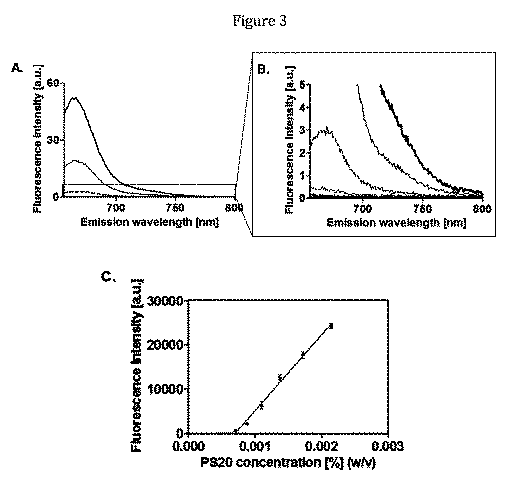
DiDおよびPS20を用いて同じ実験を実施し、同様の結果を得た。図3A、図3Bおよび図3Cを確認されたい。DiDに対する発光波長を665nmであるように選択した。 The same experiment was performed with DiD and PS20 with similar results. See FIGS. 3A, 3B and 3C. The emission wavelength for DiD was chosen to be 665 nm.
DiIおよびDiDの存在下でのPS80の蛍光調査
PS20定量のために適用可能である、示される蛍光アッセイもまた、PS80に対して試験した。最初に、対応する蛍光プロファイルを、DiIおよびDiDに対するPS20に見られるように設定されているパラメータを用いる蛍光光度計で測定した。
Fluorescence studies of PS80 in the presence of DiI and DiD The fluorescence assay shown, applicable for PS20 quantification, was also tested against PS80. First, the corresponding fluorescence profiles were measured with a fluorimeter using parameters set as found on the PS20 for DiI and DiD.
得られたデータに基づき、異なるグラフを描いた。図4A、図4B、図5Aおよび図5Bは、615nm(DiI)または665nm(DiD)で得られる、測定された試料全ての蛍光強度の一覧を表す。0.00045〜0.00114%(w/v)のPS80に対する試料の検量線は、図4Cおよび図5Cで確認可能である。 Different graphs were drawn based on the data obtained. 4A, 4B, 5A and 5B represent a list of fluorescence intensities of all measured samples obtained at 615 nm (DiI) or 665 nm (DiD). The calibration curve of the sample for PS80 from 0.00045 to 0.00114% (w/v) can be seen in Figures 4C and 5C.
DiI蛍光におけるシリコーンオイルの影響
更なる実験では、DiI蛍光における、組成物中の他の化合物の影響を測定した。蛍光光度計を使用した第1の測定では、試料中のシリコンオイルの液滴の影響を分析した。
Effect of Silicone Oil on DiI Fluorescence In a further experiment, the effect of other compounds in the composition on DiI fluorescence was measured. The first measurement, using a fluorometer, analyzed the effect of silicone oil droplets in the sample.
この実験では、水性溶液中のDiIの蛍光を測定し、0.002%(w/v)の水性溶液中のDiIの蛍光と比較した。そして0.03%(w/v)のシリコーンオイルを試験した。結果は図6で確認することができる。 In this experiment, the fluorescence of DiI in aqueous solution was measured and compared with the fluorescence of DiI in 0.002% (w/v) aqueous solution. And 0.03% (w/v) silicone oil was tested. The result can be confirmed in FIG.
結果は、シリコーンオイル液滴は大きくDiIの蛍光性を変化させないことを示す。 The results show that silicone oil droplets do not significantly change DiI fluorescence.
プレートリーダ中のDiD/DiI蛍光測定および試料分析
方法を並列化させる可能性を試験するため、DiDおよびPS20ならびにDiIおよびPS80を用いた蛍光測定をプレートリーダ(Tecan Safire2,Tecan Group AG,Switzerland)で実施した。
DiD/DiI Fluorescence Measurements in Plate Reader and Sample Analysis To test the possibility of parallelizing the method, fluorescence measurements with DiD and PS20 and DiI and PS80 were performed on a plate reader (Tecan Safire 2 , Tecan Group AG, Switzerland). It was carried out in.
PS20およびDiDに対する検量線を測定し、そして0.00175%(w/v)のPS20を含む試料をプレートリーダを使用して測定した。結果を図7に示し、表1に集計した。 A calibration curve for PS20 and DiD was measured, and a sample containing 0.00175% (w/v) PS20 was measured using a plate reader. The results are shown in FIG. 7 and tabulated in Table 1.
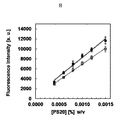
PS80およびDiIに対する更なる検量線を測定し、そして0.0007%(w/v)のPS20を含有する試料をプレートリーダを用いて計測した。結果を図8に示し、表2に集計する。 Further calibration curves for PS80 and DiI were measured and samples containing 0.0007% (w/v) PS20 were measured using a plate reader. The results are shown in FIG. 8 and tabulated in Table 2.
DiIによるPS定量におけるタンパク質の影響
更なる実験では、DiIによるPS20定量における、試料中の標本タンパク質としての2つの異なるモノクローナル抗体(IgG1およびIgG2)が存在する影響を試験した。検量線と、いくつかのPS20を含有する試料をプレートリーダで測定した。結果は図9および表3で確認可能である。
Effect of proteins on PS quantification by DiI In a further experiment, the effect of the presence of two different monoclonal antibodies (IgG1 and IgG2) as sample proteins in the sample on PS20 quantification by DiI was tested. A calibration curve and samples containing some PS20 were measured with a plate reader. The results can be confirmed in FIG. 9 and Table 3.
DiI蛍光におけるインキュベーション時間の影響
更なる実験では、PSを含有する試料でのDiI蛍光強度における、測定前のインキュベーション時間の影響がある場合、その影響を分析した。試料を上のように調製し、直接または15分間または30分間のインキュベーションの後に測定した。結果を図10に示す。図に示すように、得られたDiI蛍光およびPS20検量線におけるインキュベーション時間の影響はさほど重要ではない。
Effect of Incubation Time on DiI Fluorescence In a further experiment, the effect of incubation time before measurement, if any, on DiI fluorescence intensity in samples containing PS was analyzed. Samples were prepared as above and measured either directly or after 15 or 30 minutes of incubation. The results are shown in Fig. 10. As shown in the figure, the effect of incubation time on the resulting DiI fluorescence and PS20 calibration curves is not so important.
DiI蛍光におけるインキュベーション中のプレート振盪および温度の影響
追加の実験では、蛍光測定におけるインキュベーション温度およびインキュベーション中のプレート振盪の影響を、96ウェルプレートで実施されるアッセイに対する特定要件を決定するために分析した。
Effects of Plate Shaking and Temperature During Incubation on DiI Fluorescence In additional experiments, the effects of incubation temperature and plate shaking during incubation on fluorescence measurements were analyzed to determine specific requirements for assays performed in 96-well plates. ..
1セットの試料(PS20検量線)を調製し、このセットのアリコットを(i)37℃で振盪させながら、または(ii)37℃で振盪させることなく、および(iii)室温で振盪させることなく、15分間インキュベートした。 One set of samples (PS20 calibration curve) was prepared and an aliquot of this set was (i) shaken at 37°C or (ii) at 37°C without shaking and (iii) at room temperature without shaking. Incubated for 15 minutes.
この実験の結果を図11に示す。この結果は、振盪とインキュベーション中の温度のどちらも検量線に影響を及ぼすことがないことを明確に示す。 The results of this experiment are shown in FIG. This result clearly shows that neither shaking nor temperature during incubation has any effect on the calibration curve.
異なる色素バッチの影響
更なる実験では、DiI色素の異なるバッチを有する結果の再現性を分析した。この実験では、同じ供給元からの異なるバッチのDiIを有する3つの試料(PS20の検量線)を分析した。全ての試料を37℃で15分インキュベーションした後、分析した。
Effect of different dye batches In further experiments, the reproducibility of the results with different batches of DiI dye was analyzed. In this experiment, three samples with different batches of DiI from the same source (PS20 calibration curve) were analyzed. All samples were analyzed after a 15 minute incubation at 37°C.
結果を図12に示す。この結果は、これらの試料が類似しており、色素バッチには関係しないことを示す。 Results are shown in FIG. The results show that these samples are similar and not related to the dye batch.
異なる供給元からのPS20およびPS80に対するDiIアッセイの適用性
異なる供給元からのPS20およびPS80を用いて、同様の実験を行った。3つの異なる供給元のポリソルベートを、事前のDiIによる分析と同じ方法で分析した。結果を図13および図14に示す。結果が類似しており、PS20またはPS80の供給元には関係しないことを示すことが改めて明らかになった。こういった理由から、オリジナルの供給元には関係なく試料中のPSを定量するため、単一のPS検量線が使用されてもよい。
Applicability of DiI Assay to PS20 and PS80 from Different Sources Similar experiments were performed with PS20 and PS80 from different sources. Polysorbates from three different sources were analyzed in the same way as the previous DiI analysis. The results are shown in FIGS. 13 and 14. It was once again revealed that the results were similar, indicating that they were not related to the PS20 or PS80 supplier. For this reason, a single PS calibration curve may be used to quantify PS in a sample regardless of the original source.
DiI蛍光による異なるタンパク質の影響
更なる実験では、0.006%w/vのポリソルベート20または様々な濃度である、ポリソルベート80および異なるタンパク質(IgG1、Fc融合タンパク質またはIgG)を含む試料を測定した。結果を図15に示した。この結果は、試験されたタンパク質の存在による蛍光測定への影響がないことを示す。
Effect of different proteins by DiI fluorescence In a further experiment samples containing 0.006% w/
DiI蛍光における凍結乾燥の影響
1つの実験では、いくつかの試料を調製して96ウェルプレートへと充填し、DiI蛍光強度を測定した。その後、試料を96ウェルプレートで凍結乾燥させ、続いて液状に戻した。蛍光強度は液状に戻した後に測定した。以下の試料を調製し、測定した:
1:MilliQ水中、350nMのDiI
2:MilliQ水中、350nMのDiI+0.002%(w/v)のPS20
3:10mMリン酸塩緩衝液(pH6.0)中、350nMのDiI+1%(w/v)のマンニトール
4:10mMリン酸塩緩衝液(pH6.0)中、350nMのDiI+0.002%(w/v)のPS20+1%(w/v)のマンニトール
5:10mMリン酸塩緩衝液(pH6.0)中、350nMのDiI
6:10mMリン酸塩緩衝液(pH6.0)中、350nMのDiI+0.002%(w/v)のPS20
Effect of Freeze Drying on DiI Fluorescence In one experiment, several samples were prepared and loaded into 96 well plates and the DiI fluorescence intensity was measured. The sample was then lyophilized in a 96 well plate and subsequently reconstituted. The fluorescence intensity was measured after returning to a liquid state. The following samples were prepared and measured:
1: 350 nM DiI in MilliQ water
2: 350 nM DiI+0.002% (w/v) PS20 in MilliQ water.
350 nM DiI+1% (w/v) mannitol in 3:10 mM phosphate buffer (pH 6.0) 350 nM DiI+0.002% (w/v) in 4:10 mM phosphate buffer (pH 6.0). v)
350 nM DiI+0.002% (w/v) PS20 in 6:10 mM phosphate buffer (pH 6.0).
結果を図16に示す。この結果は、このアッセイに対し、凍結乾燥組成物を用いてプレートを調製し、凍結乾燥および液状に戻した後もDiI蛍光特性を維持することが可能であることを示す。この結果は、マンニトールなどの安定化剤を含む、緩衝組成物の使用により、結果が改善されることを示す。 The results are shown in Fig. 16. The results show that for this assay, it is possible to prepare the plates with the lyophilized composition and maintain the DiI fluorescence properties after lyophilization and reconstitution. The results show that the use of a buffer composition containing a stabilizing agent such as mannitol improves the results.
Claims (22)
a)少なくとも1種のポリソルベートを含む、試料を提供する工程と、
b)前記試料とカルボシアニン色素とを混合させる工程と、
c)前記混合物の蛍光を測定する工程と、
d)前記蛍光と、前記ポリソルベートの量とを相関させる工程と、を含む、試料中のポリソルベートを定量するための方法。 A method for quantifying polysorbate in a sample, comprising:
a) providing a sample comprising at least one polysorbate,
b) mixing the sample with a carbocyanine dye,
c) measuring the fluorescence of the mixture,
d) A method for quantifying polysorbate in a sample, comprising the step of correlating the fluorescence with the amount of the polysorbate.
a)規定量のカルボシアニン色素を含む、組成物を含み、
かつ少なくとも1つのウェルのサブセットの各ウェルが、
b)緩衝液と、
c)安定化剤と、
d)規定量のポリソルベートと、を、前記組成物中に更に含む、請求項9〜17のいずれか一項に記載のウェルプレート。 The well plate comprises at least two different subsets of wells, each well of each of the two sets
a) comprising a composition comprising a defined amount of carbocyanine dye,
And each well of the subset of at least one well is
b) a buffer,
c) a stabilizer,
The well plate according to any one of claims 9 to 17, further comprising d) a defined amount of polysorbate in the composition.
a)カルボシアニン色素と、
b)前記試料に対する標準希釈緩衝液と、
c)任意には、校正試料と、を含む、試料中のポリソルベートを定量するためのキット。 A kit for quantifying polysorbate in a sample, comprising:
a) a carbocyanine dye,
b) a standard dilution buffer for the sample,
c) A kit for quantifying polysorbate in a sample, optionally comprising a calibration sample.
Applications Claiming Priority (3)
| Application Number | Priority Date | Filing Date | Title |
|---|---|---|---|
| EP17178071 | 2017-06-27 | ||
| EP17178071.1 | 2017-06-27 | ||
| PCT/EP2018/067117 WO2019002295A1 (en) | 2017-06-27 | 2018-06-26 | Polysorbate quantification assay |
Publications (2)
| Publication Number | Publication Date |
|---|---|
| JP2020525794A true JP2020525794A (en) | 2020-08-27 |
| JP7280205B2 JP7280205B2 (en) | 2023-05-23 |
Family
ID=59284995
Family Applications (1)
| Application Number | Title | Priority Date | Filing Date |
|---|---|---|---|
| JP2019572526A Active JP7280205B2 (en) | 2017-06-27 | 2018-06-26 | Polysorbate quantitative assay |
Country Status (8)
| Country | Link |
|---|---|
| US (1) | US11662312B2 (en) |
| EP (1) | EP3646032B1 (en) |
| JP (1) | JP7280205B2 (en) |
| KR (1) | KR102587439B1 (en) |
| CN (1) | CN111033261B (en) |
| CA (1) | CA3067110A1 (en) |
| ES (1) | ES2985321T3 (en) |
| WO (1) | WO2019002295A1 (en) |
Families Citing this family (1)
| Publication number | Priority date | Publication date | Assignee | Title |
|---|---|---|---|---|
| JP7591805B2 (en) | 2020-07-01 | 2024-11-29 | 公立大学法人横浜市立大学 | Method for stabilizing SMG1 protein, method for screening SMG1 inhibitor, and SMG1 inhibitor |
Citations (11)
| Publication number | Priority date | Publication date | Assignee | Title |
|---|---|---|---|---|
| JPH05256784A (en) * | 1991-12-07 | 1993-10-05 | Hoechst Ag | Measuring system for measuring concentrations of inorganic and organic compounds existing in sample |
| JP2003075349A (en) * | 2001-09-07 | 2003-03-12 | National Institute Of Advanced Industrial & Technology | Analysis method of membrane fusion |
| WO2003091693A2 (en) * | 2002-04-23 | 2003-11-06 | Analytical Biological Services, Inc. | Method for evaluating drug candidates |
| US20050208534A1 (en) * | 2003-12-05 | 2005-09-22 | Dallwig Jason A | Methine-substituted cyanine dye compounds |
| WO2005113147A2 (en) * | 2004-04-08 | 2005-12-01 | Biomatrica, Inc. | Integration of sample storage and sample management for life science |
| JP2009510392A (en) * | 2005-07-28 | 2009-03-12 | アナリティカル バイオロジカル サービシーズ インク | How to evaluate candidate drugs |
| WO2011089062A2 (en) * | 2010-01-19 | 2011-07-28 | F. Hoffmann-La Roche Ag | Pharmaceutical formulation for proteins |
| WO2014058760A2 (en) * | 2012-10-08 | 2014-04-17 | General Electric Company | Preloaded test substrates for testing lal-reactive substances, methods of use, and methods of making |
| EP2799866A1 (en) * | 2013-05-02 | 2014-11-05 | Université Paris-Est Marne-la-Vallée | Method for determining the concentration of non-ionic surfactants in an aqueous solution by excitation-emission fluorescence spectroscopy based on the enhancement of the fluorescence of 6-p-toluidino-2-naphthalenesulfonic acid |
| EP2990778A1 (en) * | 2014-08-27 | 2016-03-02 | Sysmex Corporation | Sample analyzer and sample analyzing method |
| JP2017067605A (en) * | 2015-09-30 | 2017-04-06 | 高電工業株式会社 | Sample measuring apparatus and sample measuring method |
Family Cites Families (29)
| Publication number | Priority date | Publication date | Assignee | Title |
|---|---|---|---|---|
| FR1405599A (en) * | 1963-07-29 | 1965-07-09 | Heyden Newport Chemical Corp | Improvements to stabilizers for vinyl halide-based resins, processes for their preparation, and resinous compositions containing such stabilizers |
| US3408195A (en) * | 1964-12-28 | 1968-10-29 | Eastman Kodak Co | Silver halide emulsions containing n, alpha-alkylene bridged indocarbocyanine sensitizing dyes |
| CN1009379B (en) * | 1985-06-12 | 1990-08-29 | 中国科学院感光化学研究所 | Fluorescent Dye Brightening Serum |
| US6048982A (en) * | 1986-04-18 | 2000-04-11 | Carnegie Mellon University | Cyanine dyes as labeling reagents for detection of biological and other materials by luminescence methods |
| SU1645270A1 (en) * | 1988-04-15 | 1991-04-30 | Всесоюзный Государственный Научно-Исследовательский И Проектный Институт Химико-Фотографической Промышленности | Method for preparation of cationic-anionic cyanine dyes |
| DE3912046B4 (en) * | 1988-09-02 | 2004-03-25 | Carnegie Mellon University | Method of labeling a component of an aqueous liquid and luminescent photostable reaction product |
| US5880287A (en) * | 1990-05-15 | 1999-03-09 | Hyperion, Inc. | Polyoxyhydrocarbyl related products and methods for fluorescence assays |
| CA2189486A1 (en) * | 1996-11-04 | 1998-05-04 | Yves St-Pierre | Analysis of enzyme activity using immobilized fluorescence-labeled substrates |
| CA2281799A1 (en) * | 1997-02-20 | 1998-08-27 | Oxis International, Inc. | Methods and compositions for the protection of mitochondria |
| WO1999001737A2 (en) * | 1997-06-10 | 1999-01-14 | Calspan Corporation | Detection of chemical agent materials using a sorbent polymer and fluorescent probe |
| GB2341189B (en) * | 1998-08-31 | 2001-06-13 | Amersham Pharm Biotech Inc | Energy transfer dyes |
| AUPQ127399A0 (en) * | 1999-06-29 | 1999-07-22 | Guangzhou University Of Traditional Chinese Medicine | Compositions and methods for treating or preventing osteoporosis |
| JP2001064531A (en) * | 1999-08-26 | 2001-03-13 | Taisho Technos Co Ltd | Stabilization of anthocyanin dyestuff by surfactant |
| GB0002261D0 (en) * | 2000-02-02 | 2000-03-22 | Amersham Pharm Biotech Uk Ltd | Fluorescent detection method & reagent |
| JP4236934B2 (en) * | 2001-04-17 | 2009-03-11 | 中外製薬株式会社 | Surfactant quantification method |
| ATE409209T1 (en) * | 2003-01-24 | 2008-10-15 | Bayer Schering Pharma Ag | HYDROPHILIC, THIOLE-REACTIVE CYANINE DYES AND THEIR CONJUGATES WITH BIOMOLECULES FOR FLUORESCENCE DIAGNOSIS |
| ITSV20060002A1 (en) * | 2006-01-19 | 2007-07-20 | Ferrania Technologies Spa | FLUORESCENT DYE OF CIANIN TYPE |
| US7869030B2 (en) * | 2007-01-03 | 2011-01-11 | Research Foundation Of State University Of New York | Aggregates of plural transition metal nanoparticles and plural cyanine dye molecules |
| DE102007030403A1 (en) * | 2007-06-29 | 2009-01-08 | Universität Bielefeld | Method for improving the photostability of fluorescent dyes |
| JP5301206B2 (en) * | 2008-06-10 | 2013-09-25 | 独立行政法人科学技術振興機構 | Tissue staining method using surfactant |
| CN101639439A (en) * | 2008-07-28 | 2010-02-03 | 东莞太力生物工程有限公司 | Method for determining polysorbate content in protein solution |
| CN103585105A (en) * | 2008-11-07 | 2014-02-19 | 儿童医院医疗中心 | Sphingolipid activator protein C for transmembrane medicine delivering system as well as associated protein and peptide-promoted fusion protein |
| CN101446592A (en) * | 2008-12-31 | 2009-06-03 | 重庆医科大学附属儿童医院 | Indirect immunofluorescent detection kit for human metapneumovirus |
| EP2419478B1 (en) | 2009-04-17 | 2018-02-28 | Li-Cor, Inc. | Fluorescent imaging with substituted cyanine dyes |
| CN101852739B (en) * | 2010-05-21 | 2012-05-16 | 东北师范大学 | Method for determining polysorbate nonionic surfactant |
| ES2641618T3 (en) * | 2011-03-04 | 2017-11-10 | Baxalta GmbH | Method for the determination of polysorbate |
| US9134228B2 (en) * | 2012-05-23 | 2015-09-15 | Glaxosmithkline Biologicals, S.A. | Method for determining a concentration of a polysorbate species in a mixture |
| US10241100B2 (en) | 2014-03-27 | 2019-03-26 | Halliburton Energy Services, Inc. | Method for determining residual surfactant concentrations in produced water |
| IL296330A (en) * | 2020-03-20 | 2022-11-01 | Glaxosmithkline Ip Dev Ltd | A method for the detection of polysorbates |
-
2018
- 2018-06-26 ES ES18732369T patent/ES2985321T3/en active Active
- 2018-06-26 CA CA3067110A patent/CA3067110A1/en active Pending
- 2018-06-26 WO PCT/EP2018/067117 patent/WO2019002295A1/en not_active Ceased
- 2018-06-26 JP JP2019572526A patent/JP7280205B2/en active Active
- 2018-06-26 CN CN201880049273.1A patent/CN111033261B/en active Active
- 2018-06-26 KR KR1020207001764A patent/KR102587439B1/en active Active
- 2018-06-26 US US16/624,730 patent/US11662312B2/en active Active
- 2018-06-26 EP EP18732369.6A patent/EP3646032B1/en active Active
Patent Citations (15)
| Publication number | Priority date | Publication date | Assignee | Title |
|---|---|---|---|---|
| JPH05256784A (en) * | 1991-12-07 | 1993-10-05 | Hoechst Ag | Measuring system for measuring concentrations of inorganic and organic compounds existing in sample |
| JP2003075349A (en) * | 2001-09-07 | 2003-03-12 | National Institute Of Advanced Industrial & Technology | Analysis method of membrane fusion |
| WO2003091693A2 (en) * | 2002-04-23 | 2003-11-06 | Analytical Biological Services, Inc. | Method for evaluating drug candidates |
| US20050208534A1 (en) * | 2003-12-05 | 2005-09-22 | Dallwig Jason A | Methine-substituted cyanine dye compounds |
| WO2005113147A2 (en) * | 2004-04-08 | 2005-12-01 | Biomatrica, Inc. | Integration of sample storage and sample management for life science |
| JP2007532886A (en) * | 2004-04-08 | 2007-11-15 | バイオマトリカ, インコーポレイテッド | Integration with sample storage and sample management for life sciences |
| JP2009510392A (en) * | 2005-07-28 | 2009-03-12 | アナリティカル バイオロジカル サービシーズ インク | How to evaluate candidate drugs |
| WO2011089062A2 (en) * | 2010-01-19 | 2011-07-28 | F. Hoffmann-La Roche Ag | Pharmaceutical formulation for proteins |
| JP2013517309A (en) * | 2010-01-19 | 2013-05-16 | エフ.ホフマン−ラ ロシュ アーゲー | Pharmaceutical formulations for proteins |
| WO2014058760A2 (en) * | 2012-10-08 | 2014-04-17 | General Electric Company | Preloaded test substrates for testing lal-reactive substances, methods of use, and methods of making |
| JP2015533218A (en) * | 2012-10-08 | 2015-11-19 | ゼネラル・エレクトリック・カンパニイ | Pre-filled test substrate for testing LAL-reactive substances, method of use and preparation |
| EP2799866A1 (en) * | 2013-05-02 | 2014-11-05 | Université Paris-Est Marne-la-Vallée | Method for determining the concentration of non-ionic surfactants in an aqueous solution by excitation-emission fluorescence spectroscopy based on the enhancement of the fluorescence of 6-p-toluidino-2-naphthalenesulfonic acid |
| EP2990778A1 (en) * | 2014-08-27 | 2016-03-02 | Sysmex Corporation | Sample analyzer and sample analyzing method |
| JP2016048203A (en) * | 2014-08-27 | 2016-04-07 | シスメックス株式会社 | Specimen analyzer and specimen analysis method |
| JP2017067605A (en) * | 2015-09-30 | 2017-04-06 | 高電工業株式会社 | Sample measuring apparatus and sample measuring method |
Non-Patent Citations (3)
| Title |
|---|
| MARTOS ARIADNA、他、6名: "Trends on Analytical Characterization of Polysorbates and Their Degradation Products in Biopharmaceu", JOURNAL OF PHARMACEUTICAL SCIENCES, vol. 106, no. 7, JPN7022001931, July 2017 (2017-07-01), pages 1722 - 1735, ISSN: 0004925779 * |
| MARTOS ARIADNA、他7名: "Novel High-Throughput Assay for Polysorbate Quantification in Biopharmaceutical Products by Using th", JOURNAL OF PHARMACEUTICAL SCIENCES, vol. 109, no. 1, JPN6022015733, 2020, pages 646 - 655, ISSN: 0004925781 * |
| ZHENG SONGYAN、他3名: "Sensitive fluorescence-based method for the rapid determination of polysorbate-80 content in therape", PHARMACEUTICAL DEVELOPMENT AND TECHNOLOGY, vol. 20, no. 7, JPN7022001932, 2015, pages 872 - 876, ISSN: 0004925780 * |
Also Published As
| Publication number | Publication date |
|---|---|
| CN111033261B (en) | 2024-10-01 |
| WO2019002295A1 (en) | 2019-01-03 |
| ES2985321T3 (en) | 2024-11-05 |
| EP3646032C0 (en) | 2024-08-07 |
| CN111033261A (en) | 2020-04-17 |
| US20210156801A1 (en) | 2021-05-27 |
| CA3067110A1 (en) | 2019-01-03 |
| EP3646032A1 (en) | 2020-05-06 |
| KR102587439B1 (en) | 2023-10-10 |
| KR20200020853A (en) | 2020-02-26 |
| US11662312B2 (en) | 2023-05-30 |
| EP3646032B1 (en) | 2024-08-07 |
| JP7280205B2 (en) | 2023-05-23 |
Similar Documents
| Publication | Publication Date | Title |
|---|---|---|
| Agarkhed et al. | Effect of polysorbate 80 concentration on thermal and photostability of a monoclonal antibody | |
| EP3830547B1 (en) | Methods, kits and stain compositions for flow cytometry evaluation of unassociated virus-size particles using multiple fluorogenic dyes | |
| Solheim et al. | Stability and detectability of testosterone esters in dried blood spots after intramuscular injections | |
| Baratte et al. | Quantitation of SU11248, an oral multi-target tyrosine kinase inhibitor, and its metabolite in monkey tissues by liquid chromatograph with tandem mass spectrometry following semi-automated liquid–liquid extraction | |
| Sharma et al. | A novel and rapid validated stability-indicating UPLC method of related substances for dorzolamide hydrochloride and timolol maleate in ophthalmic dosage form | |
| Salem et al. | Application of derivative emission fluorescence spectroscopy for determination of ibuprofen and phenylephrine simultaneously in tablets and biological fluids | |
| Martos et al. | Novel high-throughput assay for polysorbate quantification in biopharmaceutical products by using the fluorescent dye DiI | |
| Rustandi | Polysorbate 80 and histidine quantitative analysis by NMR in the presence of virus‐like particles | |
| Ali et al. | Utility of surface plasmon resonance response of silver nanoparticles for assay of Teicoplanin in human plasma using spectrofluorimetric technique | |
| Silvester et al. | Overcoming non-specific adsorption issues for AZD9164 in human urine samples: consideration of bioanalytical and metabolite identification procedures | |
| JP7280205B2 (en) | Polysorbate quantitative assay | |
| Belal et al. | Spectrofluorometric determination of clonazepam in dosage forms: application to content uniformity testing and human plasma | |
| García‐Herrero et al. | Submicellar liquid chromatography with fluorescence detection improves the analysis of naproxen in plasma and brain tissue | |
| Dow et al. | High-throughput fluorometric assay for quantifying polysorbate in biopharmaceutical products using micelle activated fluorescence probe N-Phenyl-1-naphthylamine | |
| Peters et al. | Intra-micellar and extra-micellar oxidation in phosphate and histidine buffers containing polysorbate 80 | |
| JP2022521628A (en) | Method of quantifying polysorbate in samples involved in LC-MS using internal standards | |
| Pérez-Ruiz et al. | Determination of norfloxacin in real samples by different spectrofluorimetric techniques | |
| Byrne et al. | An RP-HPLC method for the stability-indicating analysis of impurities of both fusidic acid and betamethasone-17-valerate in a semi-solid pharmaceutical dosage form | |
| Tan et al. | Direct detection of Δ9-tetrahydrocannabinol in aqueous samples using a homogeneous increasing fluorescence immunoassay (HiFi) | |
| Ma et al. | Cloud‐point extraction combined with HPLC for determination of larotaxel in rat plasma: A pharmacokinetic study of liposome formulation | |
| Lima et al. | Improved quantum dots fluorescence quenching using organized medium: A study of the effect of naphthoquinones aiming the analysis of plant extracts | |
| Darwish et al. | Enhanced spectrofluorimetric determination of the multitargeted tyrosine kinase inhibitor, crizotinib, in human plasma via micelle-mediated approach. | |
| Reddy et al. | Evaluation of the pharmaceutical quality of docetaxel injection using new stability indicating chromatographic methods for assay and impurities | |
| Derayea et al. | Innovative spectrofluorometric protocol based on micro-environment improvement for determination of Quetiapine in dosage forms and rat plasma | |
| Gardner et al. | Determination of paclitaxel in human plasma following the administration of Genaxol or Genetaxyl by liquid chromatography/tandem mass spectrometry |
Legal Events
| Date | Code | Title | Description |
|---|---|---|---|
| A621 | Written request for application examination |
Free format text: JAPANESE INTERMEDIATE CODE: A621 Effective date: 20210601 |
|
| A977 | Report on retrieval |
Free format text: JAPANESE INTERMEDIATE CODE: A971007 Effective date: 20220415 |
|
| A131 | Notification of reasons for refusal |
Free format text: JAPANESE INTERMEDIATE CODE: A131 Effective date: 20220426 |
|
| A521 | Request for written amendment filed |
Free format text: JAPANESE INTERMEDIATE CODE: A523 Effective date: 20220725 |
|
| A131 | Notification of reasons for refusal |
Free format text: JAPANESE INTERMEDIATE CODE: A131 Effective date: 20221122 |
|
| A521 | Request for written amendment filed |
Free format text: JAPANESE INTERMEDIATE CODE: A523 Effective date: 20230210 |
|
| TRDD | Decision of grant or rejection written | ||
| A01 | Written decision to grant a patent or to grant a registration (utility model) |
Free format text: JAPANESE INTERMEDIATE CODE: A01 Effective date: 20230418 |
|
| A61 | First payment of annual fees (during grant procedure) |
Free format text: JAPANESE INTERMEDIATE CODE: A61 Effective date: 20230511 |
|
| R150 | Certificate of patent or registration of utility model |
Ref document number: 7280205 Country of ref document: JP Free format text: JAPANESE INTERMEDIATE CODE: R150 |