JP2018127632A - Glycoconjugation process - Google Patents
Glycoconjugation process Download PDFInfo
- Publication number
- JP2018127632A JP2018127632A JP2018044572A JP2018044572A JP2018127632A JP 2018127632 A JP2018127632 A JP 2018127632A JP 2018044572 A JP2018044572 A JP 2018044572A JP 2018044572 A JP2018044572 A JP 2018044572A JP 2018127632 A JP2018127632 A JP 2018127632A
- Authority
- JP
- Japan
- Prior art keywords
- sugar
- kda
- polysaccharide
- glycoconjugate
- immunogenic composition
- Prior art date
- Legal status (The legal status is an assumption and is not a legal conclusion. Google has not performed a legal analysis and makes no representation as to the accuracy of the status listed.)
- Granted
Links
Images


Classifications
-
- C—CHEMISTRY; METALLURGY
- C07—ORGANIC CHEMISTRY
- C07K—PEPTIDES
- C07K1/00—General methods for the preparation of peptides, i.e. processes for the organic chemical preparation of peptides or proteins of any length
- C07K1/107—General methods for the preparation of peptides, i.e. processes for the organic chemical preparation of peptides or proteins of any length by chemical modification of precursor peptides
- C07K1/1072—General methods for the preparation of peptides, i.e. processes for the organic chemical preparation of peptides or proteins of any length by chemical modification of precursor peptides by covalent attachment of residues or functional groups
- C07K1/1077—General methods for the preparation of peptides, i.e. processes for the organic chemical preparation of peptides or proteins of any length by chemical modification of precursor peptides by covalent attachment of residues or functional groups by covalent attachment of residues other than amino acids or peptide residues, e.g. sugars, polyols, fatty acids
-
- A—HUMAN NECESSITIES
- A61—MEDICAL OR VETERINARY SCIENCE; HYGIENE
- A61K—PREPARATIONS FOR MEDICAL, DENTAL OR TOILETRY PURPOSES
- A61K39/00—Medicinal preparations containing antigens or antibodies
- A61K39/02—Bacterial antigens
- A61K39/09—Lactobacillales, e.g. aerococcus, enterococcus, lactobacillus, lactococcus, streptococcus
-
- A—HUMAN NECESSITIES
- A61—MEDICAL OR VETERINARY SCIENCE; HYGIENE
- A61K—PREPARATIONS FOR MEDICAL, DENTAL OR TOILETRY PURPOSES
- A61K39/00—Medicinal preparations containing antigens or antibodies
- A61K39/02—Bacterial antigens
- A61K39/09—Lactobacillales, e.g. aerococcus, enterococcus, lactobacillus, lactococcus, streptococcus
- A61K39/092—Streptococcus
-
- A—HUMAN NECESSITIES
- A61—MEDICAL OR VETERINARY SCIENCE; HYGIENE
- A61K—PREPARATIONS FOR MEDICAL, DENTAL OR TOILETRY PURPOSES
- A61K39/00—Medicinal preparations containing antigens or antibodies
- A61K39/02—Bacterial antigens
- A61K39/095—Neisseria
-
- A—HUMAN NECESSITIES
- A61—MEDICAL OR VETERINARY SCIENCE; HYGIENE
- A61K—PREPARATIONS FOR MEDICAL, DENTAL OR TOILETRY PURPOSES
- A61K47/00—Medicinal preparations characterised by the non-active ingredients used, e.g. carriers or inert additives; Targeting or modifying agents chemically bound to the active ingredient
- A61K47/50—Medicinal preparations characterised by the non-active ingredients used, e.g. carriers or inert additives; Targeting or modifying agents chemically bound to the active ingredient the non-active ingredient being chemically bound to the active ingredient, e.g. polymer-drug conjugates
-
- A—HUMAN NECESSITIES
- A61—MEDICAL OR VETERINARY SCIENCE; HYGIENE
- A61K—PREPARATIONS FOR MEDICAL, DENTAL OR TOILETRY PURPOSES
- A61K47/00—Medicinal preparations characterised by the non-active ingredients used, e.g. carriers or inert additives; Targeting or modifying agents chemically bound to the active ingredient
- A61K47/50—Medicinal preparations characterised by the non-active ingredients used, e.g. carriers or inert additives; Targeting or modifying agents chemically bound to the active ingredient the non-active ingredient being chemically bound to the active ingredient, e.g. polymer-drug conjugates
- A61K47/51—Medicinal preparations characterised by the non-active ingredients used, e.g. carriers or inert additives; Targeting or modifying agents chemically bound to the active ingredient the non-active ingredient being chemically bound to the active ingredient, e.g. polymer-drug conjugates the non-active ingredient being a modifying agent
- A61K47/62—Medicinal preparations characterised by the non-active ingredients used, e.g. carriers or inert additives; Targeting or modifying agents chemically bound to the active ingredient the non-active ingredient being chemically bound to the active ingredient, e.g. polymer-drug conjugates the non-active ingredient being a modifying agent the modifying agent being a protein, peptide or polyamino acid
- A61K47/64—Drug-peptide, drug-protein or drug-polyamino acid conjugates, i.e. the modifying agent being a peptide, protein or polyamino acid which is covalently bonded or complexed to a therapeutically active agent
- A61K47/6415—Toxins or lectins, e.g. clostridial toxins or Pseudomonas exotoxins
-
- A—HUMAN NECESSITIES
- A61—MEDICAL OR VETERINARY SCIENCE; HYGIENE
- A61K—PREPARATIONS FOR MEDICAL, DENTAL OR TOILETRY PURPOSES
- A61K47/00—Medicinal preparations characterised by the non-active ingredients used, e.g. carriers or inert additives; Targeting or modifying agents chemically bound to the active ingredient
- A61K47/50—Medicinal preparations characterised by the non-active ingredients used, e.g. carriers or inert additives; Targeting or modifying agents chemically bound to the active ingredient the non-active ingredient being chemically bound to the active ingredient, e.g. polymer-drug conjugates
- A61K47/51—Medicinal preparations characterised by the non-active ingredients used, e.g. carriers or inert additives; Targeting or modifying agents chemically bound to the active ingredient the non-active ingredient being chemically bound to the active ingredient, e.g. polymer-drug conjugates the non-active ingredient being a modifying agent
- A61K47/62—Medicinal preparations characterised by the non-active ingredients used, e.g. carriers or inert additives; Targeting or modifying agents chemically bound to the active ingredient the non-active ingredient being chemically bound to the active ingredient, e.g. polymer-drug conjugates the non-active ingredient being a modifying agent the modifying agent being a protein, peptide or polyamino acid
- A61K47/64—Drug-peptide, drug-protein or drug-polyamino acid conjugates, i.e. the modifying agent being a peptide, protein or polyamino acid which is covalently bonded or complexed to a therapeutically active agent
- A61K47/646—Drug-peptide, drug-protein or drug-polyamino acid conjugates, i.e. the modifying agent being a peptide, protein or polyamino acid which is covalently bonded or complexed to a therapeutically active agent the entire peptide or protein drug conjugate elicits an immune response, e.g. conjugate vaccines
-
- A—HUMAN NECESSITIES
- A61—MEDICAL OR VETERINARY SCIENCE; HYGIENE
- A61P—SPECIFIC THERAPEUTIC ACTIVITY OF CHEMICAL COMPOUNDS OR MEDICINAL PREPARATIONS
- A61P31/00—Antiinfectives, i.e. antibiotics, antiseptics, chemotherapeutics
- A61P31/04—Antibacterial agents
-
- A—HUMAN NECESSITIES
- A61—MEDICAL OR VETERINARY SCIENCE; HYGIENE
- A61P—SPECIFIC THERAPEUTIC ACTIVITY OF CHEMICAL COMPOUNDS OR MEDICINAL PREPARATIONS
- A61P37/00—Drugs for immunological or allergic disorders
- A61P37/02—Immunomodulators
- A61P37/04—Immunostimulants
-
- C—CHEMISTRY; METALLURGY
- C07—ORGANIC CHEMISTRY
- C07H—SUGARS; DERIVATIVES THEREOF; NUCLEOSIDES; NUCLEOTIDES; NUCLEIC ACIDS
- C07H3/00—Compounds containing only hydrogen atoms and saccharide radicals having only carbon, hydrogen, and oxygen atoms
- C07H3/06—Oligosaccharides, i.e. having three to five saccharide radicals attached to each other by glycosidic linkages
-
- C—CHEMISTRY; METALLURGY
- C07—ORGANIC CHEMISTRY
- C07K—PEPTIDES
- C07K1/00—General methods for the preparation of peptides, i.e. processes for the organic chemical preparation of peptides or proteins of any length
- C07K1/107—General methods for the preparation of peptides, i.e. processes for the organic chemical preparation of peptides or proteins of any length by chemical modification of precursor peptides
-
- C—CHEMISTRY; METALLURGY
- C07—ORGANIC CHEMISTRY
- C07K—PEPTIDES
- C07K14/00—Peptides having more than 20 amino acids; Gastrins; Somatostatins; Melanotropins; Derivatives thereof
- C07K14/195—Peptides having more than 20 amino acids; Gastrins; Somatostatins; Melanotropins; Derivatives thereof from bacteria
-
- C—CHEMISTRY; METALLURGY
- C07—ORGANIC CHEMISTRY
- C07K—PEPTIDES
- C07K14/00—Peptides having more than 20 amino acids; Gastrins; Somatostatins; Melanotropins; Derivatives thereof
- C07K14/195—Peptides having more than 20 amino acids; Gastrins; Somatostatins; Melanotropins; Derivatives thereof from bacteria
- C07K14/22—Peptides having more than 20 amino acids; Gastrins; Somatostatins; Melanotropins; Derivatives thereof from bacteria from Neisseriaceae (F)
-
- C—CHEMISTRY; METALLURGY
- C07—ORGANIC CHEMISTRY
- C07K—PEPTIDES
- C07K14/00—Peptides having more than 20 amino acids; Gastrins; Somatostatins; Melanotropins; Derivatives thereof
- C07K14/195—Peptides having more than 20 amino acids; Gastrins; Somatostatins; Melanotropins; Derivatives thereof from bacteria
- C07K14/315—Peptides having more than 20 amino acids; Gastrins; Somatostatins; Melanotropins; Derivatives thereof from bacteria from Streptococcus (G), e.g. Enterococci
-
- C—CHEMISTRY; METALLURGY
- C07—ORGANIC CHEMISTRY
- C07K—PEPTIDES
- C07K14/00—Peptides having more than 20 amino acids; Gastrins; Somatostatins; Melanotropins; Derivatives thereof
- C07K14/195—Peptides having more than 20 amino acids; Gastrins; Somatostatins; Melanotropins; Derivatives thereof from bacteria
- C07K14/34—Peptides having more than 20 amino acids; Gastrins; Somatostatins; Melanotropins; Derivatives thereof from bacteria from Corynebacterium (G)
-
- C—CHEMISTRY; METALLURGY
- C07—ORGANIC CHEMISTRY
- C07K—PEPTIDES
- C07K19/00—Hybrid peptides, i.e. peptides covalently bound to nucleic acids, or non-covalently bound protein-protein complexes
-
- A—HUMAN NECESSITIES
- A61—MEDICAL OR VETERINARY SCIENCE; HYGIENE
- A61K—PREPARATIONS FOR MEDICAL, DENTAL OR TOILETRY PURPOSES
- A61K39/00—Medicinal preparations containing antigens or antibodies
- A61K2039/555—Medicinal preparations containing antigens or antibodies characterised by a specific combination antigen/adjuvant
- A61K2039/55505—Inorganic adjuvants
-
- A—HUMAN NECESSITIES
- A61—MEDICAL OR VETERINARY SCIENCE; HYGIENE
- A61K—PREPARATIONS FOR MEDICAL, DENTAL OR TOILETRY PURPOSES
- A61K39/00—Medicinal preparations containing antigens or antibodies
- A61K2039/60—Medicinal preparations containing antigens or antibodies characteristics by the carrier linked to the antigen
- A61K2039/6031—Proteins
- A61K2039/6037—Bacterial toxins, e.g. diphteria toxoid [DT], tetanus toxoid [TT]
-
- Y—GENERAL TAGGING OF NEW TECHNOLOGICAL DEVELOPMENTS; GENERAL TAGGING OF CROSS-SECTIONAL TECHNOLOGIES SPANNING OVER SEVERAL SECTIONS OF THE IPC; TECHNICAL SUBJECTS COVERED BY FORMER USPC CROSS-REFERENCE ART COLLECTIONS [XRACs] AND DIGESTS
- Y02—TECHNOLOGIES OR APPLICATIONS FOR MITIGATION OR ADAPTATION AGAINST CLIMATE CHANGE
- Y02A—TECHNOLOGIES FOR ADAPTATION TO CLIMATE CHANGE
- Y02A50/00—TECHNOLOGIES FOR ADAPTATION TO CLIMATE CHANGE in human health protection, e.g. against extreme weather
- Y02A50/30—Against vector-borne diseases, e.g. mosquito-borne, fly-borne, tick-borne or waterborne diseases whose impact is exacerbated by climate change
Landscapes
- Health & Medical Sciences (AREA)
- Chemical & Material Sciences (AREA)
- Life Sciences & Earth Sciences (AREA)
- Organic Chemistry (AREA)
- General Health & Medical Sciences (AREA)
- Medicinal Chemistry (AREA)
- Molecular Biology (AREA)
- Proteomics, Peptides & Aminoacids (AREA)
- Engineering & Computer Science (AREA)
- Public Health (AREA)
- Animal Behavior & Ethology (AREA)
- Pharmacology & Pharmacy (AREA)
- Veterinary Medicine (AREA)
- Bioinformatics & Cheminformatics (AREA)
- Immunology (AREA)
- Biochemistry (AREA)
- Genetics & Genomics (AREA)
- Epidemiology (AREA)
- Biophysics (AREA)
- Microbiology (AREA)
- Mycology (AREA)
- General Chemical & Material Sciences (AREA)
- Chemical Kinetics & Catalysis (AREA)
- Gastroenterology & Hepatology (AREA)
- Biotechnology (AREA)
- Analytical Chemistry (AREA)
- Virology (AREA)
- Nuclear Medicine, Radiotherapy & Molecular Imaging (AREA)
- Toxicology (AREA)
- Communicable Diseases (AREA)
- Oncology (AREA)
- Medicines Containing Antibodies Or Antigens For Use As Internal Diagnostic Agents (AREA)
- Peptides Or Proteins (AREA)
- Polysaccharides And Polysaccharide Derivatives (AREA)
- Medicines That Contain Protein Lipid Enzymes And Other Medicines (AREA)
- Medicinal Preparation (AREA)
- Saccharide Compounds (AREA)
- Preparation Of Compounds By Using Micro-Organisms (AREA)
Abstract
【課題】担体タンパク質と複合化された糖を含有する複合糖質及びその複合糖質を含む免疫原性組成物の提供。
【解決手段】肺炎連鎖球菌血清型12F莢膜多糖を、安定なニトロキシルラジカル関連剤/酸化体を酸化剤として使用し、シュードモナス属、大腸菌、ブドウ球菌属、または連鎖球菌属等の毒素を担体タンパク質として糖を複合化する調製方法によって作製される、複合糖質、及びその複合糖質を含む免疫原性組成物。
【選択図】なしThe present invention provides a complex carbohydrate containing a sugar complexed with a carrier protein and an immunogenic composition containing the complex carbohydrate.
SOLUTION: Using Streptococcus pneumoniae serotype 12F capsular polysaccharide, a stable nitroxyl radical-related agent / oxidant as an oxidizing agent, and a toxin such as Pseudomonas, Escherichia coli, Staphylococcus, or Streptococcus A glycoconjugate produced by a preparation method for conjugating a sugar as a protein, and an immunogenic composition containing the glycoconjugate.
[Selection figure] None
Description
本開示は、一般に、酸化剤としてTEMPO/NCSを使用することによる、担体タンパク質と複合化された糖を含有する複合糖質の調製方法、そのような複合糖質を含む免疫原性組成物、ならびにそのような複合糖質および免疫原性組成物の使用方法に関する。本開示はまた、担体タンパク質と複合化された糖を含有する複合糖質を、ピペリジン−N−オキシやピロリジン−N−オキシ化合物などの安定なニトロキシルラジカルまたはニトロキシドラジカルを酸化体の存在下で使用して、前記糖の第1ヒドロキシルを選択的に酸化することにより調製する方法、そのような複合糖質を含む免疫原性組成物、ならびにそのような複合糖質および免疫原性組成物の使用方法に関する。 The present disclosure generally relates to a method for preparing a complex carbohydrate containing a sugar complexed with a carrier protein by using TEMPO / NCS as an oxidizing agent, an immunogenic composition comprising such a complex carbohydrate, And methods of using such glycoconjugates and immunogenic compositions. The present disclosure also provides a glycoconjugate containing a saccharide complexed with a carrier protein in the presence of an oxidized nitroxyl radical or nitroxide radical such as piperidine-N-oxy or pyrrolidine-N-oxy compounds. A method of preparing by selectively oxidizing the primary hydroxyl of said sugar, an immunogenic composition comprising such glycoconjugate, and of such glycoconjugate and immunogenic composition Regarding usage.
多糖タンパク質結合型ワクチンは、一般には細菌の表面外皮の多糖を、タンパク質担体に連結させたものを使用して作られる。多糖とタンパク質担体の化学結合によって、ワクチン内に含まれている多糖をその表面に提示している細菌に対する免疫応答が誘発され、したがって疾患が予防される。それゆえに、病原性細菌の多糖を使用してのワクチン接種は、宿主免疫を増強するための見込みのある戦略である。細菌を覆う多糖は、細菌の単一種内でさえ、変化に富んでいる。たとえば、肺炎連鎖球菌(Streptococcus pneumoniae)(世界全域で乳幼児における髄膜炎、肺炎、および重度侵襲性疾患の主要な原因)では、細菌多糖外皮の相違により、90を超える異なる血清型が存在する。その結果、多糖ワクチンは、多くの場合、防御を高めるために、一団の多糖からなる。 A polysaccharide protein-binding vaccine is generally produced using a polysaccharide in which a bacterial surface coat is linked to a protein carrier. The chemical coupling of the polysaccharide and protein carrier induces an immune response against bacteria presenting the polysaccharide contained in the vaccine on its surface, thus preventing disease. Therefore, vaccination with pathogenic bacterial polysaccharides is a promising strategy for enhancing host immunity. The polysaccharides that cover bacteria are highly variable, even within a single species of bacteria. For example, in Streptococcus pneumoniae (a leading cause of meningitis, pneumonia, and severely invasive disease in infants worldwide), there are over 90 different serotypes due to differences in bacterial polysaccharide coat. As a result, polysaccharide vaccines often consist of a group of polysaccharides to increase protection.
多糖は、それだけで免疫原性ではあるが、免疫原性を向上させるために、多糖のタンパク質担体との複合化が使用されてきた。担体タンパク質は、その病原体に対する特異的な免疫応答を増強する、標的病原体の近縁タンパク質抗原でも、またはむしろアジュバントもしくは全般的な免疫応答刺激剤として働く、一般免疫原性タンパク質でもよい。 Although polysaccharides are immunogenic on their own, complexing polysaccharides with protein carriers has been used to improve immunogenicity. The carrier protein may be a closely related protein antigen of the target pathogen that enhances the specific immune response against that pathogen, or rather a general immunogenic protein that acts as an adjuvant or general immune response stimulator.
肺炎球菌多糖−タンパク質結合型多価ワクチンは、長年にわたり認可されており、乳児における肺炎球菌疾患の予防において有益であることがわかっており、また最近では成人に推奨されている。 Pneumococcal polysaccharide-protein conjugate multivalent vaccines have been approved for many years and have been found to be beneficial in the prevention of pneumococcal disease in infants and have recently been recommended for adults.
一態様では、本開示は、担体タンパク質と複合化された糖を含む複合糖質の作製方法であって、a)水性溶媒中で、糖を2,2,6,6−テトラメチル−1−ピペリジニルオキシ(TEMPO)およびN−クロロスクシンイミド(NCS)と反応させて、活性化した糖を生成するステップと、b)活性化した糖を、1つまたは複数のアミン基を含む担体タンパク質と反応させるステップとを含む方法を提供する。別の態様では、活性化した糖の酸化度は、1〜50、1〜40、1〜30、1〜20、1〜10、1〜5、3〜40、3〜30、3〜20、3〜10、4〜40、4〜30、4〜20、4〜10、5〜30、5〜25、5〜20、5〜10、6〜50、6〜40、6〜30、6〜20、6〜15、6〜14、6〜13、6〜12、6〜11、6〜10、7〜40、7〜30、7〜20、7〜15、7〜14、7〜13、7〜12、7〜11、7〜10、8〜40、8〜30、8〜20、8〜15、8〜14、8〜13、8〜13、8〜12、8〜11、8〜10、9〜40、9〜30、9〜20、9〜15、10〜40、10〜30、10〜20、または10〜15の範囲である。別の態様では、活性化した糖の酸化度は、1、2、3、4、5、6、7、8、9、10、11、12、13、14、15、16、17、18、19、20、21、22、23、24、25、26、27、28、29、30、31、32、33、34、35、36、37、38、39、または40である。 In one aspect, the disclosure provides a method of making a glycoconjugate comprising a saccharide complexed with a carrier protein comprising: a) converting the saccharide to 2,2,6,6-tetramethyl-1- in an aqueous solvent. Reacting with piperidinyloxy (TEMPO) and N-chlorosuccinimide (NCS) to produce an activated sugar; b) the activated sugar with a carrier protein comprising one or more amine groups; And a step of reacting. In another aspect, the activated sugar has a degree of oxidation of 1-50, 1-40, 1-30, 1-20, 1-10, 1-5, 3-40, 3-30, 3-20, 3-10, 4-40, 4-30, 4-20, 4-10, 5-30, 5-25, 5-20, 5-10, 6-50, 6-40, 6-30, 6- 20, 6-15, 6-14, 6-13, 6-12, 6-11, 6-10, 7-40, 7-30, 7-20, 7-15, 7-14, 7-13, 7-12, 7-11, 7-10, 8-40, 8-30, 8-20, 8-15, 8-14, 8-13, 8-13, 8-12, 8-11, 8- 10, 9-40, 9-30, 9-20, 9-15, 10-40, 10-30, 10-20, or 10-15. In another aspect, the activated sugar has a degree of oxidation of 1, 2, 3, 4, 5, 6, 7, 8, 9, 10, 11, 12, 13, 14, 15, 16, 17, 18, 19, 20, 21, 22, 23, 24, 25, 26, 27, 28, 29, 30, 31, 32, 33, 34, 35, 36, 37, 38, 39, or 40.
別の態様では、本開示は、担体タンパク質と複合化させた糖を含む複合糖質の作製方法であって、a)酸化体の存在下で、糖を、ピペリジン−N−オキシやピロリジン−N−オキシ化合物などの安定なニトロキシルまたはニトロキシドラジカル化合物と反応させ、前記糖の第1ヒドロキシルを選択的に酸化して、アルデヒド基を含有する活性化した糖を生成するステップと、b)活性化した糖を、1つまたは複数のアミン基を含む担体タンパク質と反応させるステップとを含む方法を提供する。 In another aspect, the present disclosure provides a method for producing a glycoconjugate comprising a sugar complexed with a carrier protein, wherein a) the sugar is converted to piperidine-N-oxy or pyrrolidine-N in the presence of an oxidant. Reacting with a stable nitroxyl or nitroxide radical compound, such as an oxy compound, to selectively oxidize the primary hydroxyl of the sugar to produce an activated sugar containing an aldehyde group; b) activated Reacting a sugar with a carrier protein comprising one or more amine groups.
前記反応では、触媒回路において、実際の酸化体は、N−オキソアンモニウム塩である。安定なニトロキシルまたはニトロキシドラジカル化合物は、酸化体の存在下で、カルボン酸へ過酸化することなく第一級アルコールを選択的にアルデヒドに酸化する能力を有することが好ましい。 In the above reaction, the actual oxidant is an N-oxoammonium salt in the catalyst circuit. Stable nitroxyl or nitroxide radical compounds preferably have the ability to selectively oxidize primary alcohols to aldehydes in the presence of oxidants without peroxidation to carboxylic acids.
一態様では、反応のステップa)は、水性溶媒中で実施する。別の態様では、ステップa)は、非プロトン性溶媒中で実施する。一態様では、ステップa)は、DMSO(ジメチルスルホキシド)、ジメチルアセトアミド(DMA)、スルホラン、N−メチル−2−ピロリドン(NMP)、ヘキサメチルホスホルアミド(HMPA)、またはDMF(ジメチルホルムアミド)溶媒中で実施する。 In one aspect, reaction step a) is carried out in an aqueous solvent. In another embodiment, step a) is performed in an aprotic solvent. In one aspect, step a) comprises DMSO (dimethylsulfoxide), dimethylacetamide (DMA), sulfolane, N-methyl-2-pyrrolidone (NMP), hexamethylphosphoramide (HMPA), or DMF (dimethylformamide) solvent. Conduct in.
一態様では、担体タンパク質との複合化後に、未反応のアルデヒド基が、キャッピングステップの際に、水素化ホウ素を使用して、第一級アルコールに元通り変換され、その結果、酸化に続く複合化を含む修飾ステップの間の糖エピトープ修飾が最小限に抑えられる。 In one aspect, after conjugation with the carrier protein, unreacted aldehyde groups are converted back to primary alcohols using borohydride during the capping step, resulting in conjugation following oxidation. Sugar epitope modification during the modification steps including crystallization is minimized.
一態様では、前記安定なニトロキシルまたはニトロキシドラジカル化合物は、ピペリジン−N−オキシまたはピロリジン−N−オキシ化合物である。前記化合物は、酸化体の存在下で、第二級ヒドロキシル基に影響を及ぼさずに第一級アルコールを選択的に酸化して、アルデヒド基を生じる能力を有することが好ましい。前記化合物は、酸化体の存在下で、カルボキシル基へ過酸化することなく第一級アルコールを選択的に酸化して、アルデヒド基を生じる能力を有することがより好ましい。 In one aspect, the stable nitroxyl or nitroxide radical compound is a piperidine-N-oxy or pyrrolidine-N-oxy compound. The compound preferably has the ability to selectively oxidize a primary alcohol to produce an aldehyde group without affecting the secondary hydroxyl group in the presence of an oxidant. More preferably, the compound has the ability to selectively oxidize a primary alcohol to form an aldehyde group without peroxidation to a carboxyl group in the presence of an oxidant.
一態様では、前記安定なニトロキシルまたはニトロキシドラジカル化合物は、TEMPOまたはPROXYL(2,2,5,5−テトラメチル−1−ピロリジニルオキシ)部分を有する。前記化合物は、酸化体の存在下で、第二級ヒドロキシル基に影響を及ぼさずに第一級アルコールを選択的に酸化して、アルデヒド基を生じる能力を有することが好ましい。前記化合物は、酸化体の存在下で、カルボキシル基へ過酸化することなく第一級アルコールを選択的に酸化して、アルデヒド基を生じる能力を有することがより好ましい。 In one aspect, the stable nitroxyl or nitroxide radical compound has a TEMPO or PROXYL (2,2,5,5-tetramethyl-1-pyrrolidinyloxy) moiety. The compound preferably has the ability to selectively oxidize a primary alcohol to produce an aldehyde group without affecting the secondary hydroxyl group in the presence of an oxidant. More preferably, the compound has the ability to selectively oxidize a primary alcohol to form an aldehyde group without peroxidation to a carboxyl group in the presence of an oxidant.
一態様では、前記安定なニトロキシルラジカル化合物は、TEMPOまたはその誘導体である。一態様では、前記安定なニトロキシルラジカル化合物は、TEMPO、2,2,6,6−テトラメチル−4−(メチルスルホニルオキシ)−1−ピペリジノオキシ、4−ホスホノオキシ−TEMPO、4−オキソ−TEMPO、4−メトキシ−TEMPO、4−イソチオシアナト−TEMPO、4−(2−ヨードアセトアミド)−TEMPOフリーラジカル、4−ヒドロキシ−TEMPO、4−シアノ−TEMPO、4−カルボキシ−TEMPO、4−(2−ブロモアセトアミド)−TEMPO、4−アミノ−TEMPO、4−アセトアミド−2,2,6,6−テトラメチルピペリジン1−オキシルからなる群から選択される。前記安定なニトロキシルラジカル化合物は、TEMPOであることが好ましい。 In one aspect, the stable nitroxyl radical compound is TEMPO or a derivative thereof. In one aspect, the stable nitroxyl radical compound is TEMPO, 2,2,6,6-tetramethyl-4- (methylsulfonyloxy) -1-piperidinooxy, 4-phosphonooxy-TEMPO, 4-oxo-TEMPO, 4-methoxy-TEMPO, 4-isothiocyanato-TEMPO, 4- (2-iodoacetamide) -TEMPO free radical, 4-hydroxy-TEMPO, 4-cyano-TEMPO, 4-carboxy-TEMPO, 4- (2-bromoacetamide ) -TEMPO, 4-amino-TEMPO, 4-acetamido-2,2,6,6-tetramethylpiperidine 1-oxyl. The stable nitroxyl radical compound is preferably TEMPO.
別の態様では、前記安定なニトロキシルラジカル化合物は、3β−DOXYL−5α−コレスタン、5−DOXYL−ステアリン酸、16−DOXYL−ステアリン酸、5−DOXYL−ステアリン酸メチル、3−(アミノメチル)−PROXYL、3−カルバモイル−PROXYL、3−カルバモイル−2,2,5,5−テトラメチル−3−ピロリン−1−オキシル、3−カルボキシ−PROXYL、3−シアノ−PROXYLからなる群から選択される。 In another embodiment, the stable nitroxyl radical compound is 3β-DOXYL-5α-cholestane, 5-DOXYL-stearic acid, 16-DOXYL-stearic acid, 5-DOXYL-methyl stearate, 3- (aminomethyl). Selected from the group consisting of -PROXYL, 3-carbamoyl-PROXYL, 3-carbamoyl-2,2,5,5-tetramethyl-3-pyrroline-1-oxyl, 3-carboxy-PROXYL, 3-cyano-PROXYL .
一態様では、前記酸化体は、N−ハロ部分を有する分子である。前記分子は、ニトロキシルラジカル化合物の存在下で第一級アルコールを選択的に酸化する能力を有することが好ましい。 In one aspect, the oxidant is a molecule having an N-halo moiety. The molecule preferably has the ability to selectively oxidize primary alcohols in the presence of nitroxyl radical compounds.
一態様では、前記酸化体は、N−クロロスクシンイミド、N−ブロモスクシンイミド、N−ヨードスクシンイミド、ジクロロイソシアヌル酸、1,3,5−トリクロロ−1,3,5−トリアジナン−2,4,6−トリオン、ジブロモイソシアヌル酸、1,3,5−トリブロモ−1,3,5−トリアジナン−2,4,6−トリオン、ジヨードイソシアヌル酸、および1,3,5−トリヨード−1,3,5−トリアジナン−2,4,6−トリオンからなる群から選択される。前記酸化体は、N−クロロスクシンイミドであることが好ましい。 In one embodiment, the oxidant is N-chlorosuccinimide, N-bromosuccinimide, N-iodosuccinimide, dichloroisocyanuric acid, 1,3,5-trichloro-1,3,5-triazinan-2,4,6- Trione, dibromoisocyanuric acid, 1,3,5-tribromo-1,3,5-triazinan-2,4,6-trione, diiodoisocyanuric acid, and 1,3,5-triiodo-1,3,5- Selected from the group consisting of triazinan-2,4,6-trione. The oxidant is preferably N-chlorosuccinimide.
一態様では、活性化した糖の酸化度は、1〜50、1〜40、1〜30、1〜20、1〜10、1〜5、3〜40、3〜30、3〜20、3〜10、4〜40、4〜30、4〜20、4〜10、5〜30、5〜25、5〜20、5〜10、6〜50、6〜40、6〜30、6〜20、6〜15、6〜14、6〜13、6〜12、6〜11、6〜10、7〜40、7〜30、7〜20、7〜15、7〜14、7〜13、7〜12、7〜11、7〜10、8〜40、8〜30、8〜20、8〜15、8〜14、8〜13、8〜13、8〜12、8〜11、8〜10、9〜40、9〜30、9〜20、9〜15、10〜40、10〜30、10〜20、または10〜15の範囲である。別の態様では、活性化した糖の酸化度は、1、2、3、4、5、6、7、8、9、10、11、12、13、14、15、16、17、18、19、20、21、22、23、24、25、26、27、28、29、30、31、32、33、34、35、36、37、38、39、または40である。 In one aspect, the activated sugar has a degree of oxidation of 1-50, 1-40, 1-30, 1-20, 1-10, 1-5, 3-40, 3-30, 3-20, 3 -10, 4-40, 4-30, 4-20, 4-10, 5-30, 5-25, 5-20, 5-10, 6-50, 6-40, 6-30, 6-20 6-15, 6-14, 6-13, 6-12, 6-11, 6-10, 7-40, 7-30, 7-20, 7-15, 7-14, 7-13, 7 -12, 7-11, 7-10, 8-40, 8-30, 8-20, 8-15, 8-14, 8-13, 8-13, 8-12, 8-11, 8-10 9-40, 9-30, 9-20, 9-15, 10-40, 10-30, 10-20, or 10-15. In another aspect, the activated sugar has a degree of oxidation of 1, 2, 3, 4, 5, 6, 7, 8, 9, 10, 11, 12, 13, 14, 15, 16, 17, 18, 19, 20, 21, 22, 23, 24, 25, 26, 27, 28, 29, 30, 31, 32, 33, 34, 35, 36, 37, 38, 39, or 40.
一態様では、糖を0.1〜10モル当量の酸化体と反応させる。糖は、0.2〜5、0.5〜2.5、または0.5〜1.5モル当量の酸化体と反応させることが好ましい。一態様では、多糖を約0.2、0.4、0.6、0.8、1、1.2、1.4、1.6、1.8、2、2.2、2.4、2.6、2.8、3、3.2、3.4、3.6、3.8、4、4.2、4.4、4.6、4.8、または5モル当量の酸化体と反応させる。 In one aspect, the sugar is reacted with 0.1 to 10 molar equivalents of oxidant. The sugar is preferably reacted with 0.2 to 5, 0.5 to 2.5, or 0.5 to 1.5 molar equivalents of oxidant. In one aspect, the polysaccharide is about 0.2, 0.4, 0.6, 0.8, 1, 1.2, 1.4, 1.6, 1.8, 2, 2.2, 2.4. 2.6, 2.8, 3, 3.2, 3.4, 3.6, 3.8, 4, 4.2, 4.4, 4.6, 4.8, or 5 molar equivalents React with oxidant.
一態様では、安定なニトロキシルまたはニトロキシドラジカル化合物は、触媒量で存在する。一態様では、糖を約0.3モル当量未満の安定なニトロキシルまたはニトロキシドラジカル化合物と反応させる。一態様では、糖を約0.005モル当量未満の安定なニトロキシルまたはニトロキシドラジカル化合物と反応させる。一態様では、糖を約0.005、0.01、0.05、または0.1モル当量の安定なニトロキシルまたはニトロキシドラジカル化合物と反応させる。 In one aspect, the stable nitroxyl or nitroxide radical compound is present in a catalytic amount. In one aspect, the sugar is reacted with less than about 0.3 molar equivalents of a stable nitroxyl or nitroxide radical compound. In one aspect, the sugar is reacted with less than about 0.005 molar equivalents of a stable nitroxyl or nitroxide radical compound. In one aspect, the sugar is reacted with about 0.005, 0.01, 0.05, or 0.1 molar equivalents of a stable nitroxyl or nitroxide radical compound.
別の態様では、糖は、細菌の莢膜多糖である。別の態様では、糖は、合成によって得られたオリゴ糖または多糖である。一態様では、莢膜多糖は、肺炎連鎖球菌(S.pneumonia)(Pn)由来である。別の態様では、莢膜多糖は、Pn−血清型10A、Pn−血清型12F、およびPn−血清型33F莢膜多糖から選択される。たとえば、一態様では、莢膜多糖は、Pn−血清型12F莢膜多糖である。 In another aspect, the sugar is a bacterial capsular polysaccharide. In another aspect, the saccharide is a synthetic oligosaccharide or polysaccharide. In one aspect, the capsular polysaccharide is derived from S. pneumonia (Pn). In another aspect, the capsular polysaccharide is selected from Pn-serotype 10A, Pn-serotype 12F, and Pn-serotype 33F capsular polysaccharide. For example, in one aspect, the capsular polysaccharide is a Pn-serotype 12F capsular polysaccharide.
別の態様では、莢膜多糖は、髄膜炎菌(N.meningitidis)由来である。一態様では、莢膜多糖は、髄膜炎菌(Mn)−血清型A、C、W135、およびY莢膜多糖から選択される。 In another aspect, the capsular polysaccharide is derived from N. meningitidis. In one aspect, the capsular polysaccharide is selected from Neisseria meningitidis (Mn) -serotypes A, C, W135, and Y capsular polysaccharide.
別の態様では、莢膜多糖は、髄膜炎菌(Mn)−血清型X莢膜多糖である。 In another aspect, the capsular polysaccharide is meningococcal (Mn) -serotype X capsular polysaccharide.
別の態様では、莢膜多糖は、B群連鎖球菌(Group B Streptococcus)(GBS)由来である。一態様では、莢膜多糖は、GBS血清型Ia、Ib、II、III、IV、V、VI、VII、およびVIIIから選択される。 In another aspect, the capsular polysaccharide is derived from Group B Streptococcus (GBS). In one aspect, the capsular polysaccharide is selected from GBS serotypes Ia, Ib, II, III, IV, V, VI, VII, and VIII.
一態様では、本開示は、担体タンパク質が、破傷風、ジフテリア、百日咳、シュードモナス属(Pseudomonas)、大腸菌(E.coli)、ブドウ球菌属(Staphylococcus)、または連鎖球菌属(Streptococcus)の毒素である、本明細書で開示する方法のいずれかを提供する。一態様では、担体タンパク質は、CRM197である。 In one aspect, the disclosure provides that the carrier protein is a tetanus, diphtheria, pertussis, Pseudomonas, E. coli, Staphylococcus, or Streptococcus toxin, Any of the methods disclosed herein are provided. In one aspect, the carrier protein is CRM 197 .
別の態様では、本開示は、ステップa)の前に、糖を加水分解して、分子量を100〜400kDaの範囲にする、本明細書に記載のとおりの方法を提供する。たとえば、一態様では、分子量は、100〜350kDa、100〜300kDa、100〜250kDa、100〜200kDa、100〜150kDa、200〜400kDa、200〜350kDa、200〜300kDa、200〜250kDa、300〜400kDa、または300〜350kDaの範囲である。 In another aspect, the present disclosure provides a method as described herein wherein the sugar is hydrolyzed to a molecular weight in the range of 100-400 kDa prior to step a). For example, in one embodiment, the molecular weight is 100-350 kDa, 100-300 kDa, 100-250 kDa, 100-200 kDa, 100-150 kDa, 200-400 kDa, 200-350 kDa, 200-300 kDa, 200-250 kDa, 300-400 kDa, or The range is 300 to 350 kDa.
別の態様では、本開示は、活性化した多糖を、ステップb)の前に精製するステップをさらに含む、本明細書で提供した方法のいずれかを提供する。別の態様では、方法は、ステップb)に続いて還元剤を加えるステップをさらに含む。一態様では、還元剤は、NaCNBH3である。別の態様では、方法は、NaCNBH3を加えた後にNaBH4を加えるステップをさらに含む。別の態様では、方法は、NaBH4を加えた後に精製ステップを含む。 In another aspect, the present disclosure provides any of the methods provided herein further comprising the step of purifying the activated polysaccharide prior to step b). In another aspect, the method further comprises adding a reducing agent following step b). In one embodiment, the reducing agent is NaCNBH 3. In another aspect, the method further comprises adding NaBH 4 after adding NaCNBH 3 . In another aspect, the method includes a purification step after adding NaBH 4 .
別の態様では、本開示は、本明細書で開示する方法のいずれかによって製造される、または取得可能な複合糖質を提供する。たとえば、一態様において、本開示は、a)水性溶媒中で糖を、2,2,6,6−テトラメチル−1−ピペリジニルオキシ(TEMPO)およびN−クロロスクシンイミド(NCS)と反応させて、活性化した糖を生成するステップと、b)活性化した糖を、1つまたは複数のアミン基を含む担体タンパク質と反応させるステップとを含む方法によって製造される、または取得可能である、担体タンパク質と複合化された糖を含む複合糖質を提供する。別の態様では、本開示は、a)糖を、安定なニトロキシルまたはニトロキシドラジカル化合物および酸化体と反応させて、アルデヒド基を含んでいる活性化した糖を生成するステップと、b)活性化した糖を、1つまたは複数のアミン基を含む担体タンパク質と反応させるステップとを含む方法によって製造される、または取得可能である、担体タンパク質と複合化された糖を含む複合糖質を提供する。安定なニトロキシルラジカル化合物および酸化体については、上の2〜4頁で定義したとおりでよい。 In another aspect, the present disclosure provides glycoconjugates produced or obtainable by any of the methods disclosed herein. For example, in one aspect, the disclosure provides: a) reacting a sugar with 2,2,6,6-tetramethyl-1-piperidinyloxy (TEMPO) and N-chlorosuccinimide (NCS) in an aqueous solvent. Produced or obtainable by a method comprising: generating an activated sugar; and b) reacting the activated sugar with a carrier protein comprising one or more amine groups. Provided is a glycoconjugate comprising a sugar complexed with a carrier protein. In another aspect, the disclosure provides: a) reacting a sugar with a stable nitroxyl or nitroxide radical compound and an oxidant to produce an activated sugar containing an aldehyde group; and b) activated. Reacting a sugar with a carrier protein comprising one or more amine groups is provided, or a complex carbohydrate comprising a sugar complexed with a carrier protein is provided or obtainable. The stable nitroxyl radical compound and oxidant may be as defined on pages 2-4 above.
別の態様では、本開示は、本明細書で開示する複合糖質のいずれかと、薬学的に許容できる賦形剤、担体、または希釈剤とを含む免疫原性組成物を提供する。別の態様では、免疫原性組成物は、追加抗原を含む。別の態様では、追加抗原は、肺炎連鎖球菌(S.pneumoniae)由来の、タンパク質抗原または莢膜多糖の複合糖質を含む。たとえば、一態様では、追加抗原は、Pn−血清型1、3、4、5、6A、6B、7F、8、9V、11A、14、15B、18C、19A、19F、22F、および23F莢膜多糖から選択される莢膜多糖の複合糖質を含む。別の態様では、追加抗原は、髄膜炎菌(N.meningitidis)由来の、タンパク質抗原または莢膜多糖の複合糖質を含む。別の態様では、追加抗原は、血清型A、C、W135、およびY莢膜多糖から選択される莢膜多糖の複合糖質を含む。別の態様では、追加抗原は、血清型X莢膜多糖からの莢膜多糖の複合糖質を含む。別の態様では、追加抗原は、B群連鎖球菌(Group B Streptococcus)(GBS)由来の莢膜多糖の複合糖質を含む。一態様では、追加抗原は、GBS血清型Ia、Ib、II、III、IV、V、VI、VII、およびVIIIから選択される莢膜多糖の複合糖質を含む。
In another aspect, the present disclosure provides an immunogenic composition comprising any of the glycoconjugates disclosed herein and a pharmaceutically acceptable excipient, carrier, or diluent. In another aspect, the immunogenic composition includes a booster antigen. In another aspect, the additional antigen comprises a protein antigen or capsular polysaccharide glycoconjugate from S. pneumoniae. For example, in one aspect, the additional antigen is Pn-
別の態様では、本開示は、アジュバントをさらに含む、本明細書で開示する免疫原性組成物のいずれかを提供する。一態様では、アジュバントは、アルミニウム系のアジュバントである。別の態様では、アルミニウム系のアジュバントは、リン酸アルミニウム、硫酸アルミニウム、および水酸化アルミニウムからなる群から選択される。 In another aspect, the present disclosure provides any of the immunogenic compositions disclosed herein further comprising an adjuvant. In one aspect, the adjuvant is an aluminum-based adjuvant. In another aspect, the aluminum-based adjuvant is selected from the group consisting of aluminum phosphate, aluminum sulfate, and aluminum hydroxide.
別の態様では、本開示は、対象において、細菌性の感染、疾患、または状態を予防、治療、または改善する方法であって、本明細書で開示する免疫原性組成物のいずれかの免疫学的有効量を対象に投与することを含む方法を提供する。一態様では、感染、疾患、または状態は、肺炎連鎖球菌(S.pneumoniae)細菌と関連する。別の態様では、感染、疾患、または状態は、髄膜炎菌(N.meningitidis)細菌と関連する。 In another aspect, the disclosure provides a method for preventing, treating, or ameliorating a bacterial infection, disease, or condition in a subject, comprising immunizing any of the immunogenic compositions disclosed herein. A method comprising administering to a subject a pharmaceutically effective amount. In one aspect, the infection, disease or condition is associated with a S. pneumoniae bacterium. In another aspect, the infection, disease or condition is associated with a N. meningitidis bacterium.
別の態様では、本開示は、対象において防御免疫応答を誘発する方法であって、本明細書で開示する免疫原性組成物のいずれかの免疫学的有効量を対象に投与することを含む方法を提供する。 In another aspect, the present disclosure is a method of eliciting a protective immune response in a subject, comprising administering to the subject an immunologically effective amount of any of the immunogenic compositions disclosed herein. Provide a method.
別の態様では、本開示は、担体タンパク質と複合化されたPn−血清型12Fを含む免疫原性組成物であって、複合物が安定である、免疫原性組成物を提供する。たとえば、一態様では、本開示は、担体タンパク質と複合化されたPn−血清型12Fを含む免疫原性組成物であって、組成物中の遊離Pn−血清型12F多糖の量が、調製されてから120日後に35%未満である、免疫原性組成物を提供する。別の態様では、遊離Pn−血清型12F多糖の量は、調製されてから120日後に、30%未満、28%未満、27%未満、26%未満、または25%未満である。別の態様では、遊離Pn−血清型12F多糖の量は、調製されてから90日後に、35%未満、30%未満、28%未満、27%未満、26%未満、または25%未満である。別の態様では、遊離Pn−血清型12F多糖の量は、調製されてから60日後に、35%未満、30%未満、28%未満、27%未満、26%未満、または25%未満である。別の態様では、遊離Pn−血清型12F多糖の量は、調製されてから30日後に、35%未満、30%未満、28%未満、27%未満、26%未満、または25%未満である。別の態様では、本開示は、担体タンパク質と複合化されたPn−血清型3、10A、または33Fを含む組成物であって、組成物中の遊離Pn−血清型3、10A、または33F多糖それぞれの量が、調製されてから120日後に35%未満である、組成物を提供する。別の態様では、遊離Pn−血清型3、10A、または33F多糖の量は、調製されてから120日後に、30%未満、28%未満、27%未満、26%未満、または25%未満である。別の態様では、遊離Pn−血清型3、10A、または33F多糖の量は、調製されてから90日後に、35%未満、30%未満、28%未満、27%未満、26%未満、または25%未満である。別の態様では、遊離Pn−血清型3、10A、または33F多糖の量は、調製されてから60日後に、35%未満、30%未満、28%未満、27%未満、26%未満、または25%未満である。別の態様では、遊離Pn−血清型3、10A、または33F多糖の量は、調製されてから30日後に、35%未満、30%未満、28%未満、27%未満、26%未満、または25%未満である。一態様では、上で論述したとおりの遊離多糖の量は、25℃で測定される。一態様では、本明細書で開示する組成物中の担体タンパク質は、破傷風、ジフテリア、百日咳、シュードモナス属(Pseudomonas)、大腸菌(E.coli)、ブドウ球菌属(Staphylococcus)、または連鎖球菌属(Streptococcus)の毒素である。別の態様では、担体タンパク質は、CRM197である。
In another aspect, the present disclosure provides an immunogenic composition comprising Pn-serotype 12F complexed with a carrier protein, wherein the complex is stable. For example, in one aspect, the disclosure provides an immunogenic composition comprising Pn-serotype 12F complexed with a carrier protein, wherein the amount of free Pn-serotype 12F polysaccharide in the composition is prepared. An immunogenic composition is provided that is less than 35% after 120 days. In another aspect, the amount of free Pn-serotype 12F polysaccharide is less than 30%, less than 28%, less than 27%, less than 26%, or less than 25% 120 days after being prepared. In another aspect, the amount of free Pn-serotype 12F polysaccharide is less than 35%, less than 30%, less than 28%, less than 27%, less than 26%, or less than 25% 90 days after being prepared. . In another aspect, the amount of free Pn-serotype 12F polysaccharide is less than 35%, less than 30%, less than 28%, less than 27%, less than 26%, or less than 25% 60 days after being prepared. . In another aspect, the amount of free Pn-serotype 12F polysaccharide is less than 35%, less than 30%, less than 28%, less than 27%, less than 26%, or less than 25% 30 days after being prepared. . In another aspect, the disclosure provides a composition comprising Pn-
本開示はさらに、上で開示したこのような複合糖質のいずれかと、薬学的に許容できる賦形剤、担体、または希釈剤とを含む免疫原性組成物を提供する。別の態様では、このような免疫原性組成物は、追加抗原を含む。たとえば、一態様では、追加抗原は、肺炎連鎖球菌(S.pneumoniae)由来の、タンパク質抗原または莢膜多糖の複合糖質を含む。別の態様では、追加抗原は、Pn−血清型1、3、4、5、6A、6B、7F、8、9V、11A、14、15B、18C、19A、19F、22F、および23F莢膜多糖から選択される莢膜多糖の複合糖質を含む。さらに別の態様では、追加抗原は、髄膜炎菌(N.meningitidis)由来の、タンパク質抗原または莢膜多糖の複合糖質を含む。さらに別の態様では、追加抗原は、血清型A、C、W135、およびY莢膜多糖から選択される莢膜多糖の複合糖質を含む。別の態様では、追加抗原は、血清型X莢膜多糖からの莢膜多糖の複合糖質を含む。別の態様では、追加抗原は、B群連鎖球菌(Group B Streptococcus)(GBS)からの莢膜多糖の複合糖質を含む。一態様では、莢膜多糖は、GBS血清型Ia、Ib、II、III、IV、V、VI、VII、およびVIIIから選択される。
The present disclosure further provides an immunogenic composition comprising any of such glycoconjugates disclosed above and a pharmaceutically acceptable excipient, carrier, or diluent. In another aspect, such immunogenic compositions include additional antigens. For example, in one aspect, the additional antigen comprises a protein antigen or capsular polysaccharide glycoconjugate from S. pneumoniae. In another aspect, the additional antigen is Pn-
さらに別の態様では、このような免疫原性組成物は、アジュバントをさらに含む。たとえば、一態様では、アジュバントは、アルミニウム系アジュバントである。別の態様では、アルミニウム系アジュバントは、リン酸アルミニウム、硫酸アルミニウム、および水酸化アルミニウムからなる群から選択される。 In yet another aspect, such immunogenic compositions further comprise an adjuvant. For example, in one aspect, the adjuvant is an aluminum-based adjuvant. In another aspect, the aluminum-based adjuvant is selected from the group consisting of aluminum phosphate, aluminum sulfate, and aluminum hydroxide.
本開示は、本開示の種々の実施形態についての以下の詳細な説明、および本明細書に含まれる実施例を参照することで、より容易に理解することができる。別段定義しない限り、本明細書で使用する技術用語および科学用語はすべて、本開示が属する技術分野の当業者に一般に理解されているのと同じ意味を有する。本開示の実施または試験において、本明細書に記載のものと同様または同等のどんな方法および材料を使用してもよいが、ある特定の好ましい方法および材料を本明細書に記載する。実施形態について述べる際、また請求項において、ある特定の術語は、以下で述べる定義に従って使用する。 The present disclosure can be understood more readily by reference to the following detailed description of various embodiments of the present disclosure and the examples included herein. Unless defined otherwise, all technical and scientific terms used herein have the same meaning as commonly understood by one of ordinary skill in the art to which this disclosure belongs. Although any methods and materials similar or equivalent to those described herein can be used in the practice or testing of the present disclosure, certain preferred methods and materials are described herein. In describing embodiments and in the claims, certain terminology is used in accordance with the definitions set out below.
本明細書で使用するとき、単数形「1つの(a)」、「1つの(an)」、および「その(the)」は、別段指摘しない限り、複数の言及を包含する。したがって、たとえば、「方法」への言及は、本明細書に記載されている、かつ/または本開示を読めば当業者に明白となる種類の、1つまたは複数の方法および/またはステップを包含する。 As used herein, the singular forms “a”, “an”, and “the” include plural references unless indicated otherwise. Thus, for example, reference to “a method” includes one or more methods and / or steps of a type described herein and / or apparent to those of ordinary skill in the art upon reading this disclosure. To do.
本明細書で使用するとき、用語「約」とは、記載された濃度範囲、時間枠、分子量、温度、pHなどの値の統計的に意味のある範囲内の意味である。このような範囲は、所与の値または範囲の、一桁分内、典型的には20%以内、より典型的には10%以内、さらに典型的には5%以内または1%以内でよい。時として、このような範囲は、所与の値または範囲の測定および/または定量に使用される標準の方法に特有である実験誤差内でよい。用語「約」によって包含される許容可能なばらつきは、研究中の特定の系次第となり、当業者なら容易に認識しうる。本出願内で範囲を列挙するときは常に、その範囲内の一つ残らずの整数を、本開示の実施形態であると考える。 As used herein, the term “about” means within a statistically meaningful range of values such as the stated concentration range, time frame, molecular weight, temperature, pH, and the like. Such a range may be within an order of magnitude, typically within 20%, more typically within 10%, even more typically within 5% or 1% of a given value or range. . Sometimes such a range may be within experimental errors that are specific to the standard method used to measure and / or quantify a given value or range. The acceptable variation encompassed by the term “about” depends on the particular system under study and can be readily recognized by one skilled in the art. Whenever a range is listed within this application, all remaining integers within the range are considered to be embodiments of the present disclosure.
本開示において、「含む(comprises)」、「含まれた(comprised)」、「含む(comprising)」、「含有する(contains)」、「含有する(containing)」などの用語は、米国特許法においてこれらにあるとされる意味を有してよく、たとえば、こうした用語は、「含む(includes)」、「含まれた(included)」、「含む(including)」などを意味しうることを、特に言及する。このような用語は、他の成分を除外することなく、特定の成分または成分一式を含むことを指す。「本質的に、〜からなる(consisting essentially of)」や「本質的に、〜からなる(consists essentially of)」などの用語は、米国特許法においてこれらにあるとされる意味を有し、たとえば、こうした用語は、本開示の新規または基本的な特徴から逸脱しない追加成分またはステップが含まれることを見込んでいる、すなわち、これらの用語によって、本開示の新規または基本的な特徴から逸脱する列挙されない追加成分またはステップは除外される。用語「〜からなる(consists of)」および「〜からなる(consisting of)」は、米国特許法においてこれらにあるとされる意味を有する、すなわち、こうした用語は、排他的(closed ended)である。したがって、こうした用語は、特定の一成分または成分一式を含み、他のすべての成分を除外することを指す。 In this disclosure, terms such as “comprises”, “comprised”, “comprising”, “contains”, “containing” and the like are Meaning that they are present in these, for example, such terms may mean “includes”, “included”, “including”, etc. Special mention. Such terms refer to including a particular component or set of components without excluding other components. Terms such as “consisting essentially of” or “consists essentially of” have the meanings ascribed to them in US patent law, for example, These terms are intended to include additional components or steps that do not depart from the new or basic features of the present disclosure, ie, these terms enumerate that depart from the new or basic features of the present disclosure. Additional components or steps that are not performed are excluded. The terms “consists of” and “consisting of” have the meanings ascribed to them in US Patent Law, that is, the terms are closed end. . Thus, these terms refer to including a particular component or set of components and excluding all other components.
本明細書で使用するとき、用語「糖」は、多糖、オリゴ糖、または単糖を指すのに使用することがある。 As used herein, the term “sugar” may be used to refer to a polysaccharide, oligosaccharide, or monosaccharide.
本明細書で使用するとき、用語「酸化度」は、糖に関して、アルデヒド1モルあたりの糖繰返し単位のモルの比を指す。糖の酸化度は、当業者に知られている型通りの方法を使用して求めることができる。 As used herein, the term “degree of oxidation” refers to the ratio of moles of sugar repeat units per mole of aldehyde with respect to sugar. The degree of sugar oxidation can be determined using routine methods known to those skilled in the art.
本明細書で使用する用語「複合物」または「複合糖質」とは、担体タンパク質と共有結合を介して複合化された糖を指す。本開示の複合糖質およびそれを含む免疫原性組成物は、多少の量の遊離糖を含有してよい。 As used herein, the term “conjugate” or “conjugate carbohydrate” refers to a saccharide complexed with a carrier protein through a covalent bond. The glycoconjugates of the present disclosure and immunogenic compositions containing them may contain some amount of free sugar.
本明細書で使用する用語「遊離糖」とは、担体タンパク質と共有結合を介して複合化されていないが、それにもかかわらず、複合糖質組成物中に存在する糖を意味する。遊離糖は、複合化された糖−担体タンパク質複合糖質と非共有結合を介して関連していてよい(すなわち、非共有結合を介して結合し、吸着され、またはそこに閉じ込められていてよい)。用語「遊離多糖」および「遊離莢膜多糖」は、本明細書では、糖がそれぞれ多糖または莢膜多糖である複合糖質に関して、同じ意味を伝えるのに使用することができる。 As used herein, the term “free sugar” means a sugar that is not complexed to a carrier protein through a covalent bond but is nevertheless present in a complex carbohydrate composition. The free sugar may be associated with the conjugated sugar-carrier protein glycoconjugate via a non-covalent bond (ie, attached via a non-covalent bond, adsorbed, or trapped therein). ). The terms “free polysaccharide” and “free capsular polysaccharide” can be used herein to convey the same meaning with respect to complex carbohydrates where the sugar is a polysaccharide or capsular polysaccharide, respectively.
本明細書で使用するとき、「複合化する(to conjugate)」、「複合化された(conjugated)」、および「複合化する(conjugating)」とは、糖、たとえば、細菌莢膜多糖を、担体分子または担体タンパク質に共有結合を介して付着させ取り付ける方法を指す。複合化は、以下で述べる方法に従って、または当技術分野で知られている他の方法によって実施することができる。複合化によって、細菌莢膜多糖の免疫原性は増強される。 As used herein, “to conjugate”, “conjugated”, and “conjugate” are used to refer to a sugar, eg, a bacterial capsular polysaccharide, It refers to a method of attaching and attaching to a carrier molecule or carrier protein via a covalent bond. The conjugation can be performed according to the methods described below or by other methods known in the art. Conjugation enhances the immunogenicity of the bacterial capsular polysaccharide.
用語「対象」とは、ヒトを含めた哺乳動物、または鳥、魚、爬虫類、両生類、もしくは他のいずれかの動物を指す。用語「対象」は、家庭用愛玩動物または研究動物も包含する。家庭用愛玩動物および研究動物の非限定的な例としては、イヌ、ネコ、ブタ、ウサギ、ラット、マウス、アレチネズミ、ハムスター、モルモット、フェレット、サル、鳥、ヘビ、トカゲ、魚、カメ、およびカエルが挙げられる。用語「対象」は、家畜動物も包含する。家畜動物の非限定的な例としては、アルパカ、バイソン、ラクダ、ウシ、シカ、ブタ、ウマ、ラマ、ラバ、ロバ、ヒツジ、ヤギ、ウサギ、トナカイ、ヤク、ニワトリ、ガチョウ、およびシチメンチョウが挙げられる。 The term “subject” refers to mammals, including humans, or birds, fish, reptiles, amphibians, or any other animal. The term “subject” also includes domestic pets or research animals. Non-limiting examples of domestic pets and research animals include dogs, cats, pigs, rabbits, rats, mice, gerbils, hamsters, guinea pigs, ferrets, monkeys, birds, snakes, lizards, fish, turtles, and frogs Is mentioned. The term “subject” also includes livestock animals. Non-limiting examples of livestock animals include alpaca, bison, camel, cow, deer, pig, horse, llama, mule, donkey, sheep, goat, rabbit, reindeer, yak, chicken, goose, and turkey .
複合糖質
本開示は、特に、安定なニトロキシルまたはニトロキシド遊離基化合物を使用し、さらに酸化体を使用して、糖の第一級アルコールを選択的にアルデヒドに酸化することによる、担体タンパク質と複合化された糖を含む複合糖質の調製方法に関する。一態様では、前記安定なニトロキシルラジカル化合物は、ピペリジン−N−オキシまたはピロリジン−N−オキシ化合物である。前記化合物は、酸化体の存在下で、カルボン酸へ過酸化することなく、また第二級ヒドロキシル基に影響を及ぼさずに、第一級アルコールを選択的にアルデヒドに酸化する能力を有することが好ましい。一態様では、前記安定なニトロキシルラジカル化合物は、TEMPOまたはPROXYL(2,2,5,5−テトラメチル−1−ピロリジニルオキシ)部分を有する分子である。前記分子は、酸化体の存在下で、第二級ヒドロキシル基に影響を及ぼさずに第一級アルコールを選択的に酸化して、アルデヒド基を生じる能力を有することが好ましい。前記分子は、酸化体の存在下で、カルボキシル基へ過酸化することなく第一級アルコールを選択的に酸化して、アルデヒド基を生じる能力を有することがより好ましい。一態様では、前記安定なニトロキシルラジカル化合物は、TEMPO、2,2,6,6−テトラメチル−4−(メチルスルホニルオキシ)−1−ピペリジノオキシ、4−ホスホノオキシ−TEMPO、4−オキソ−TEMPO、4−メトキシ−TEMPO、4−イソチオシアナト−TEMPO、4−(2−ヨードアセトアミド)−TEMPOフリーラジカル、4−ヒドロキシ−TEMPO、4−シアノ−TEMPO、4−カルボキシ−TEMPO、4−(2−ブロモアセトアミド)−TEMPO、4−アミノ−TEMPO、4−アセトアミド−2,2,6,6−テトラメチルピペリジン1−オキシルからなる群から選択される。前記安定なニトロキシルラジカル化合物は、TEMPOであることが好ましい。別の態様では、前記安定なニトロキシルラジカル化合物は、3β−DOXYL−5α−コレスタン、5−DOXYL−ステアリン酸、16−DOXYL−ステアリン酸、5−DOXYL−ステアリン酸メチル、3−(アミノメチル)−PROXYL、3−カルバモイル−PROXYL、3−カルバモイル−2,2,5,5−テトラメチル−3−ピロリン−1−オキシル、3−カルボキシ−PROXYL、3−シアノ−PROXYLからなる群から選択される。一態様では、酸化体は、N−ハロ部分を有する分子である。前記分子は、ニトロキシルラジカル化合物の存在下で第一級アルコールを選択的に酸化する能力を有することが好ましい。一態様では、前記酸化体は、N−クロロスクシンイミド、N−ブロモスクシンイミド、N−ヨードスクシンイミド、ジクロロイソシアヌル酸、1,3,5−トリクロロ−1,3,5−トリアジナン−2,4,6−トリオン、ジブロモイソシアヌル酸、1,3,5−トリブロモ−1,3,5−トリアジナン−2,4,6−トリオン、ジヨードイソシアヌル酸、および1,3,5−トリヨード−1,3,5−トリアジナン−2,4,6−トリオンからなる群から選択される。前記酸化体は、N−クロロスクシンイミドであることが好ましい。
Glycoconjugates The present disclosure specifically conjugated to carrier proteins by using a stable nitroxyl or nitroxide free radical compound and further using an oxidant to selectively oxidize the primary alcohol of the sugar to an aldehyde. The present invention relates to a method for preparing glycoconjugates containing activated sugars. In one aspect, the stable nitroxyl radical compound is a piperidine-N-oxy or pyrrolidine-N-oxy compound. The compound has the ability to selectively oxidize primary alcohols to aldehydes in the presence of oxidants without peroxidation to carboxylic acids and without affecting secondary hydroxyl groups. preferable. In one aspect, the stable nitroxyl radical compound is a molecule having a TEMPO or PROXYL (2,2,5,5-tetramethyl-1-pyrrolidinyloxy) moiety. The molecule preferably has the ability to selectively oxidize a primary alcohol to form an aldehyde group without affecting the secondary hydroxyl group in the presence of an oxidant. More preferably, the molecule has the ability to selectively oxidize a primary alcohol to form an aldehyde group without peroxidation to a carboxyl group in the presence of an oxidant. In one aspect, the stable nitroxyl radical compound is TEMPO, 2,2,6,6-tetramethyl-4- (methylsulfonyloxy) -1-piperidinooxy, 4-phosphonooxy-TEMPO, 4-oxo-TEMPO, 4-methoxy-TEMPO, 4-isothiocyanato-TEMPO, 4- (2-iodoacetamide) -TEMPO free radical, 4-hydroxy-TEMPO, 4-cyano-TEMPO, 4-carboxy-TEMPO, 4- (2-bromoacetamide ) -TEMPO, 4-amino-TEMPO, 4-acetamido-2,2,6,6-tetramethylpiperidine 1-oxyl. The stable nitroxyl radical compound is preferably TEMPO. In another embodiment, the stable nitroxyl radical compound is 3β-DOXYL-5α-cholestane, 5-DOXYL-stearic acid, 16-DOXYL-stearic acid, 5-DOXYL-methyl stearate, 3- (aminomethyl). Selected from the group consisting of -PROXYL, 3-carbamoyl-PROXYL, 3-carbamoyl-2,2,5,5-tetramethyl-3-pyrroline-1-oxyl, 3-carboxy-PROXYL, 3-cyano-PROXYL . In one aspect, the oxidant is a molecule having an N-halo moiety. The molecule preferably has the ability to selectively oxidize primary alcohols in the presence of nitroxyl radical compounds. In one embodiment, the oxidant is N-chlorosuccinimide, N-bromosuccinimide, N-iodosuccinimide, dichloroisocyanuric acid, 1,3,5-trichloro-1,3,5-triazinan-2,4,6- Trione, dibromoisocyanuric acid, 1,3,5-tribromo-1,3,5-triazinan-2,4,6-trione, diiodoisocyanuric acid, and 1,3,5-triiodo-1,3,5- Selected from the group consisting of triazinan-2,4,6-trione. The oxidant is preferably N-chlorosuccinimide.
一態様では、本開示は、特に、2,2,6,6−テトラメチル−1−ピペリジニルオキシフリーラジカル(TEMPO)を使用し、N−クロロスクシンイミド(NCS)を共酸化体として使用して、糖の第一級アルコールをアルデヒドに酸化することによる、担体タンパク質と複合化された糖を含む複合糖質の調製方法に関する。 In one aspect, the disclosure specifically uses 2,2,6,6-tetramethyl-1-piperidinyloxy free radical (TEMPO) and uses N-chlorosuccinimide (NCS) as a co-oxidant. The present invention also relates to a method for preparing a complex carbohydrate containing a sugar complexed with a carrier protein by oxidizing a primary alcohol of a sugar to an aldehyde.
本開示の複合糖質において、糖は、多糖、オリゴ糖、および単糖からなる群から選択され、担体タンパク質は、本明細書でさらに説明するまたは当業者に知られているような適切ないずれかの担体から選択される。一部の実施形態では、糖は、多糖、特に、肺炎連鎖球菌(Streptococcus pneumoniae)血清型10A(Pn−血清型10A)、Pn−血清型12F、またはPn−血清型33Fなどの、細菌莢膜多糖である。一部のこのような実施形態において、担体タンパク質は、CRM197である。 In the glycoconjugates of the present disclosure, the sugar is selected from the group consisting of polysaccharides, oligosaccharides, and monosaccharides, and the carrier protein is any suitable as further described herein or known to those skilled in the art. Selected from these carriers. In some embodiments, the sugar is a polysaccharide, particularly a bacterial capsule such as Streptococcus pneumoniae serotype 10A (Pn-serotype 10A), Pn-serotype 12F, or Pn-serotype 33F. It is a polysaccharide. In some such embodiments, the carrier protein is CRM 197 .
莢膜多糖は、当業者に知られている標準技術によって調製することができる。たとえば、莢膜多糖は、様々な血清型、たとえば、1、3、4、5、6A、6B、7F、8、9V、10A、11A、12F、14、15B、18C、19A、19F、22F、23F、および33Fの肺炎連鎖球菌(Streptococcus pneumoniae)から調製することができる。こうした肺炎球菌複合物を、別の方法で調製し、単一投与製剤に製剤する。たとえば、一実施形態では、各肺炎球菌多糖血清型をダイズ系培地で成長させる。次いで、個々の多糖を、遠心分離、沈殿、限外濾過、およびカラムクロマトグラフィーによって精製する。精製された多糖を化学的に活性化させて、担体タンパク質と反応しうる糖(すなわち、活性化した糖)を作製する。活性化させたなら、各莢膜多糖を、別々に担体タンパク質と複合化して、複合糖質を生成する。一実施形態では、各莢膜多糖を、同じ担体タンパク質と複合化する。多糖の化学的活性化、および後続の担体タンパク質との複合化は、従来の手段によって実現することができる。たとえば、米国特許第4,673,574号、第4,902,506号、第7,709,001号、および第7,955,605号を参照されたい。 The capsular polysaccharide can be prepared by standard techniques known to those skilled in the art. For example, capsular polysaccharides have various serotypes such as 1, 3, 4, 5, 6A, 6B, 7F, 8, 9V, 10A, 11A, 12F, 14, 15B, 18C, 19A, 19F, 22F, It can be prepared from 23F and 33F Streptococcus pneumoniae. Such pneumococcal conjugates are prepared by another method and formulated into a single dose formulation. For example, in one embodiment, each pneumococcal polysaccharide serotype is grown in soy-based media. Individual polysaccharides are then purified by centrifugation, precipitation, ultrafiltration, and column chromatography. The purified polysaccharide is chemically activated to produce a sugar that can react with the carrier protein (ie, an activated sugar). Once activated, each capsular polysaccharide is separately complexed with a carrier protein to produce a complex carbohydrate. In one embodiment, each capsular polysaccharide is conjugated to the same carrier protein. Chemical activation of the polysaccharide and subsequent conjugation with the carrier protein can be achieved by conventional means. See, for example, U.S. Pat. Nos. 4,673,574, 4,902,506, 7,709,001, and 7,955,605.
一実施形態では、本開示の複合糖質は、分子量が約50kDa〜約20,000kDaの間である。別の実施形態では、複合糖質は、分子量が約200kDa〜約10,000kDaの間である。別の実施形態では、複合糖質は、分子量が約500kDa〜約5,000kDaの間である。一実施形態では、複合糖質は、分子量が約1,000kDa〜約3,000kDaの間である。他の実施形態では、複合糖質は、分子量が約600kDa〜約2800kDaの間、約700kDa〜約2700kDaの間、約1000kDa〜約2000kDaの間、約1800kDa〜約2500kDaの間、約1100kDa〜約2200kDaの間、約1900kDa〜約2700kDaの間、約1200kDa〜約2400kDaの間、約1700kDa〜約2600kDaの間、約1300kDa〜約2600kDaの間、約1600kDa〜約3000kDaの間である。上記範囲のいずれかの内にあるいかなる整数も、本開示の実施形態であると考える。 In one embodiment, the glycoconjugates of the present disclosure have a molecular weight between about 50 kDa and about 20,000 kDa. In another embodiment, the glycoconjugate has a molecular weight between about 200 kDa and about 10,000 kDa. In another embodiment, the glycoconjugate has a molecular weight between about 500 kDa and about 5,000 kDa. In one embodiment, the glycoconjugate has a molecular weight between about 1,000 kDa and about 3,000 kDa. In other embodiments, the glycoconjugate has a molecular weight between about 600 kDa and about 2800 kDa, between about 700 kDa and about 2700 kDa, between about 1000 kDa and about 2000 kDa, between about 1800 kDa and about 2500 kDa, between about 1100 kDa and about 2200 kDa. Between about 1900 kDa and about 2700 kDa, between about 1200 kDa and about 2400 kDa, between about 1700 kDa and about 2600 kDa, between about 1300 kDa and about 2600 kDa, between about 1600 kDa and about 3000 kDa. Any integer that falls within any of the above ranges is considered an embodiment of the present disclosure.
本開示の複合糖質の新規な特色として、糖および得られる複合物の分子量プロファイル、担体タンパク質あたりの結合型リシンの比率および多糖に共有結合連結したリシンの数、糖の繰返し単位に応じた、担体タンパク質と糖の間の共有結合連結の数、ならびに遊離糖の全糖に対する相対量が挙げられる。 The novel features of the glycoconjugates of the present disclosure include the molecular weight profile of the saccharide and the resulting conjugate, the ratio of conjugated lysine per carrier protein and the number of lysines covalently linked to the polysaccharide, depending on the sugar repeat unit, The number of covalent linkages between the carrier protein and the sugar, as well as the relative amount of free sugar to total sugar.
別の実施形態では、多糖は、髄膜炎菌(Neisseria meningitidis)由来の莢膜多糖である。一部のこのような実施形態において、莢膜多糖は、髄膜炎菌(N.meningitidis)の血清型A、B、C、W135、X、およびY莢膜多糖からなる群から選択される。あるこのような実施形態において、莢膜多糖は、血清型C莢膜多糖である。別のこのような実施形態において、莢膜多糖は、血清型W135莢膜多糖である。別のこのような実施形態において、莢膜多糖は、血清型Y莢膜多糖である。 In another embodiment, the polysaccharide is a capsular polysaccharide from Neisseria meningitidis. In some such embodiments, the capsular polysaccharide is selected from the group consisting of N. meningitidis serotypes A, B, C, W135, X, and Y capsular polysaccharide. In certain such embodiments, the capsular polysaccharide is a serotype C capsular polysaccharide. In another such embodiment, the capsular polysaccharide is a serotype W135 capsular polysaccharide. In another such embodiment, the capsular polysaccharide is a serotype Y capsular polysaccharide.
一部の実施形態では、本開示の複合糖質は、分子量が10kDa〜2,000kDaの間または50kDa〜1,000kDaの間である細菌莢膜多糖を含む。一部のこのような実施形態において、莢膜多糖は、肺炎連鎖球菌(S.pneumoniae)または髄膜炎菌(N.meningitidis)由来である。一部のこのような実施形態において、莢膜多糖は、肺炎連鎖球菌(S.pneumoniae)由来であり、血清型1、3、4、5、6A、6B、7F、8、9V、10A、11A、12F、14、15B、18C、19A、19F、22F、23F、および33F莢膜多糖からなる群から選択される。他のこのような実施形態において、莢膜多糖は、髄膜炎菌(N.meningitidis)由来であり、血清型A、B、C、W135、X、およびY莢膜多糖からなる群から選択される。
In some embodiments, a glycoconjugate of the present disclosure comprises a bacterial capsular polysaccharide having a molecular weight between 10 kDa and 2,000 kDa or between 50 kDa and 1,000 kDa. In some such embodiments, the capsular polysaccharide is derived from S. pneumoniae or N. meningitidis. In some such embodiments, the capsular polysaccharide is from S. pneumoniae and is
一実施形態では、本開示は、担体タンパク質と共有結合を介して複合化された莢膜多糖を含み、次の特色、すなわち、多糖の分子量が50kDa〜1,000kDaの間である、複合糖質の分子量が1,000kDa〜3,000KDaの間である、および複合物が含む遊離多糖が全多糖の約45%未満である、のうちの1つまたは複数を有する複合糖質を提供する。一部の実施形態では、多糖は、分子量が10kDa〜2,000kDaの間である。一部の実施形態では、複合糖質は、分子量が50kDa〜20,000kDaの間である。他の実施形態では、複合糖質は、分子量が200kDa〜10,000kDaの間である。他の実施形態では、複合物は、全多糖の約30%、20%、15%、10%、または5%未満の遊離多糖を含む。遊離多糖の量は、時間に応じて、たとえば、複合物を調製してから10、20、30、40、50、60、70、80、90、もしくは120日後、または一層長時間後に測定することができる。 In one embodiment, the present disclosure comprises a capsular polysaccharide conjugated via a covalent bond with a carrier protein, wherein the glycoconjugate has the following characteristics: the molecular weight of the polysaccharide is between 50 kDa and 1,000 kDa. Providing a glycoconjugate having one or more of a molecular weight of between 1,000 kDa and 3,000 kDa, and wherein the conjugate comprises less than about 45% of the total polysaccharide. In some embodiments, the polysaccharide has a molecular weight between 10 kDa and 2,000 kDa. In some embodiments, the glycoconjugate has a molecular weight between 50 kDa and 20,000 kDa. In another embodiment, the glycoconjugate has a molecular weight between 200 kDa and 10,000 kDa. In other embodiments, the conjugate comprises less than about 30%, 20%, 15%, 10%, or 5% free polysaccharide of the total polysaccharide. The amount of free polysaccharide should be measured as a function of time, for example, 10, 20, 30, 40, 50, 60, 70, 80, 90, or 120 days after preparation of the complex, or longer. Can do.
糖と複合化された担体タンパク質中のリシン残基の数は、結合型リシンの範囲として特徴付けることができ、モル比として示すことができる。たとえば、CRM197の4〜15個のリシン残基が糖に共有結合連結している免疫原性組成物では、複合糖質における結合型リシンのCRM197に対するモル比は、約10:1〜約40:1の間である。CRM197の2〜20個のリシン残基が糖に共有結合連結している免疫原性組成物では、複合糖質における結合型リシンのCRM197に対するモル比は、約5:1〜約50:1の間である。 The number of lysine residues in the carrier protein complexed with the sugar can be characterized as a range of conjugated lysine and can be expressed as a molar ratio. For example, in an immunogenic composition in which 4-15 lysine residues of CRM 197 are covalently linked to a sugar, the molar ratio of conjugated lysine to CRM 197 in the glycoconjugate is about 10: 1 to about Between 40: 1. In an immunogenic composition in which 2-20 lysine residues of CRM 197 are covalently linked to a sugar, the molar ratio of conjugated lysine to CRM 197 in the glycoconjugate is from about 5: 1 to about 50: Between 1.
一実施形態では、結合型リシンの担体タンパク質に対するモル比は、約10:1〜約25:1である。一部のこのような実施形態において、担体タンパク質は、CRM197である。 In one embodiment, the molar ratio of conjugated lysine to carrier protein is about 10: 1 to about 25: 1. In some such embodiments, the carrier protein is CRM 197 .
一実施形態では、糖:担体タンパク質比(w/w)は、0.2〜4の間である。別の実施形態では、糖:担体タンパク質比(w/w)は、1.1〜1.7の間である。一部の実施形態では、糖は、細菌莢膜多糖であり、糖:担体タンパク質比(w/w)は、0.2〜4の間である。他の実施形態では、糖は、細菌莢膜多糖であり、糖:担体タンパク質比(w/w)は、1.1〜1.7の間である。一部のこのような実施形態において、担体タンパク質は、CRM197である。 In one embodiment, the sugar: carrier protein ratio (w / w) is between 0.2-4. In another embodiment, the sugar: carrier protein ratio (w / w) is between 1.1 and 1.7. In some embodiments, the sugar is a bacterial capsular polysaccharide and the sugar: carrier protein ratio (w / w) is between 0.2-4. In other embodiments, the sugar is a bacterial capsular polysaccharide and the sugar: carrier protein ratio (w / w) is between 1.1 and 1.7. In some such embodiments, the carrier protein is CRM 197 .
糖鎖が担体タンパク質上のリシンに付く頻度は、本開示の複合糖質を特徴付ける別のパラメーターである。たとえば、一実施形態では、担体タンパク質と多糖の間の共有結合連結が、多糖の100個の糖繰返し単位毎に少なくとも1つ存在する。一実施形態では、担体タンパク質と多糖の間の共有結合連結が、多糖の50個の糖繰返し単位毎に少なくとも1つ存在する。一実施形態では、担体タンパク質と多糖の間の共有結合連結が、多糖の25個の糖繰返し単位毎に少なくとも1つ存在する。別の実施形態では、担体タンパク質と多糖の間の共有結合連結は、多糖の4個の糖繰返し単位毎に少なくとも1回生じる。別の実施形態では、担体タンパク質と多糖の間の共有結合連結は、多糖の10個の糖繰返し単位毎に少なくとも1回生じる。さらなる実施形態では、担体タンパク質と多糖の間の共有結合連結は、多糖の15個の糖繰返し単位毎に少なくとも1回生じる。 The frequency with which sugar chains attach to lysine on a carrier protein is another parameter that characterizes the complex carbohydrates of the present disclosure. For example, in one embodiment, there is at least one covalent linkage between the carrier protein and the polysaccharide for every 100 sugar repeat units of the polysaccharide. In one embodiment, there is at least one covalent linkage between the carrier protein and the polysaccharide for every 50 sugar repeat units of the polysaccharide. In one embodiment, there is at least one covalent linkage between the carrier protein and the polysaccharide for every 25 sugar repeat units of the polysaccharide. In another embodiment, the covalent linkage between the carrier protein and the polysaccharide occurs at least once every 4 sugar repeat units of the polysaccharide. In another embodiment, the covalent linkage between the carrier protein and the polysaccharide occurs at least once every 10 sugar repeat units of the polysaccharide. In a further embodiment, the covalent linkage between the carrier protein and the polysaccharide occurs at least once every 15 sugar repeat units of the polysaccharide.
高頻度の実施形態では、担体タンパク質は、CRM197であり、CRM197と多糖の間の共有結合連結は、多糖の4、10、15、または25個の糖繰返し単位毎に少なくとも1回生じる。一部のこのような実施形態において、多糖は、細菌莢膜多糖、たとえば、肺炎連鎖球菌(S.pneumoniae)または髄膜炎菌(N.meningitidis)細菌由来の莢膜多糖である。 In the embodiment of the high frequency carrier protein is CRM 197, covalent connection between the CRM 197 polysaccharide occurs at least once 4,10,15, or 25 per saccharide repeat unit of the polysaccharide. In some such embodiments, the polysaccharide is a bacterial capsular polysaccharide, eg, a capsular polysaccharide from S. pneumoniae or N. meningitidis bacteria.
他の実施形態では、複合物は、担体タンパク質と糖の間の共有結合連結を、5〜10個の糖繰返し単位毎、2〜7個の糖繰返し単位毎、3〜8個の糖繰返し単位毎、4〜9個の糖繰返し単位毎、6〜11個の糖繰返し単位毎、7〜12個の糖繰返し単位毎、8〜13個の糖繰返し単位毎、9〜14個の糖繰返し単位毎、10〜15個の糖繰返し単位毎、2〜6個の糖繰返し単位毎、3〜7個の糖繰返し単位毎、4〜8個の糖繰返し単位毎、6〜10個の糖繰返し単位毎、7〜11個の糖繰返し単位毎、8〜12個の糖繰返し単位毎、9〜13個の糖繰返し単位毎、10〜14個の糖繰返し単位毎、10〜20個の糖繰返し単位毎、または4〜25個の糖繰返し単位毎に少なくとも1つ含む。 In other embodiments, the conjugate comprises a covalent linkage between the carrier protein and the sugar every 5-10 saccharide repeat units, every 2-7 saccharide repeat units, 3-8 saccharide repeat units. Every 4-9 sugar repeat units, 6-11 sugar repeat units, 7-12 sugar repeat units, 8-13 sugar repeat units, 9-14 sugar repeat units Every 10-15 sugar repeating units, 2-6 sugar repeating units, 3-7 sugar repeating units, 4-8 sugar repeating units, 6-10 sugar repeating units Every 7-11 sugar repeat units, 8-12 sugar repeat units, 9-13 sugar repeat units, 10-14 sugar repeat units, 10-20 sugar repeat units At least one per every 4-25 sugar repeat units.
別の実施形態では、担体タンパク質と糖の連結は、多糖の2、3、4、5、6、7、8、9、10、11、12、13、14、15、16、17、18、19、20、21、22、23、24、または25個の糖繰返し単位毎に、少なくとも1回生じる。 In another embodiment, the linkage between the carrier protein and the sugar is 2, 3, 4, 5, 6, 7, 8, 9, 10, 11, 12, 13, 14, 15, 16, 17, 18, of the polysaccharide. Occurs at least once every 19, 20, 21, 22, 23, 24, or 25 sugar repeat units.
一実施形態では、本開示の複合糖質は、担体タンパク質と多糖の間の共有結合連結を、多糖の25個の糖繰返し単位毎に少なくとも1つ含む。別の実施形態では、担体タンパク質と多糖の間の共有結合連結は、多糖の4個の糖繰返し単位毎に少なくとも1回生じる。別の実施形態では、担体タンパク質と多糖の間の共有結合連結は、多糖の10個の糖繰返し単位毎に少なくとも1回生じる。別の実施形態では、担体タンパク質と多糖の間の共有結合連結は、多糖の15個の糖繰返し単位毎に少なくとも1回生じる。 In one embodiment, the glycoconjugates of the present disclosure include at least one covalent linkage between a carrier protein and a polysaccharide for every 25 sugar repeat units of the polysaccharide. In another embodiment, the covalent linkage between the carrier protein and the polysaccharide occurs at least once every 4 sugar repeat units of the polysaccharide. In another embodiment, the covalent linkage between the carrier protein and the polysaccharide occurs at least once every 10 sugar repeat units of the polysaccharide. In another embodiment, the covalent linkage between the carrier protein and the polysaccharide occurs at least once every 15 sugar repeat units of the polysaccharide.
一実施形態では、複合糖質は、糖の総量に対して約45%未満の遊離糖を含む。別の実施形態では、複合糖質は、糖の総量に対して約30%未満の遊離糖を含む。別の実施形態では、複合糖質は、糖の総量に対して約20%未満の遊離糖を含む。さらなる実施形態では、複合糖質は、糖の総量に対して約10%未満の遊離糖を含む。別の実施形態では、複合糖質は、糖の総量に対して約5%未満の遊離糖を含む。 In one embodiment, the glycoconjugate comprises less than about 45% free sugar relative to the total amount of sugar. In another embodiment, the glycoconjugate comprises less than about 30% free sugars relative to the total amount of sugars. In another embodiment, the glycoconjugate comprises less than about 20% free sugar relative to the total amount of sugar. In a further embodiment, the glycoconjugate comprises less than about 10% free sugar relative to the total amount of sugar. In another embodiment, the glycoconjugate comprises less than about 5% free sugar relative to the total amount of sugar.
別の実施形態では、複合糖質は、複合糖質の総量に対して約20モル%未満の担体タンパク質残基を含む。 In another embodiment, the glycoconjugate comprises less than about 20 mol% carrier protein residues relative to the total amount of glycoconjugate.
別の態様において、本開示は、本開示の複合糖質と、アジュバント、希釈剤、または担体の少なくとも1つとを含む免疫原性組成物を提供する。 In another aspect, the present disclosure provides an immunogenic composition comprising a glycoconjugate of the present disclosure and at least one of an adjuvant, diluent, or carrier.
一実施形態では、本開示は、本開示の複合糖質と、アジュバント、希釈剤、または担体の少なくとも1つとを含む免疫原性組成物であって、複合糖質が、担体タンパク質と共有結合を介して複合化された細菌莢膜多糖を含む、免疫原性組成物を提供する。一部のこのような実施形態において、莢膜多糖は、肺炎連鎖球菌(S.pneumoniae)または髄膜炎菌(N.meningitidis)由来である。 In one embodiment, the present disclosure is an immunogenic composition comprising a glycoconjugate of the present disclosure and at least one of an adjuvant, diluent, or carrier, wherein the glycoconjugate is covalently bound to a carrier protein. Provided is an immunogenic composition comprising a bacterial capsular polysaccharide conjugated via In some such embodiments, the capsular polysaccharide is derived from S. pneumoniae or N. meningitidis.
一部の実施形態では、免疫原性組成物は、アジュバントを含む。一部のこのような実施形態において、アジュバントは、リン酸アルミニウム、硫酸アルミニウム、および水酸化アルミニウムからなる群から選択されるアルミニウム系アジュバントである。一実施形態では、免疫原性組成物は、リン酸アルミニウムアジュバントを含む。 In some embodiments, the immunogenic composition includes an adjuvant. In some such embodiments, the adjuvant is an aluminum-based adjuvant selected from the group consisting of aluminum phosphate, aluminum sulfate, and aluminum hydroxide. In one embodiment, the immunogenic composition comprises an aluminum phosphate adjuvant.
一部の実施形態では、本開示の複合糖質または免疫原性組成物は、動物有効性モデルまたはオプソニン化貪食作用死滅検定での細菌の死滅によって測定したときに機能しうる抗体の生成に使用することができる。 In some embodiments, the glycoconjugates or immunogenic compositions of the present disclosure are used to generate antibodies that can function as measured by bacterial killing in animal efficacy models or opsonized phagocytosis killing assays. can do.
一実施形態では、本開示は、対象において免疫応答を誘発する方法であって、本明細書に記載のとおりの本開示の免疫原性組成物の免疫学的有効量を対象に投与することを含む方法を提供する。別の態様において、本開示は、対象において病原性細菌に対する免疫応答を誘発する方法であって、本明細書に記載のとおりの免疫原性組成物の免疫学的有効量を対象に投与することを含む方法を提供する。別の態様では、本開示は、対象において、病原性細菌が引き起こす疾患または状態を予防、または改善する方法であって、本明細書に記載のとおりの免疫原性組成物の免疫学的有効量を対象に投与することを含む方法を提供する。別の態様では、本開示は、対象において、病原性細菌による感染によって引き起こされた疾患または状態の少なくとも1つの症状の重症度を軽減する方法であって、本明細書に記載のとおりの免疫原性組成物の免疫学的有効量を対象に投与することを含む方法を提供する。一部の実施形態では、病原性細菌は、肺炎連鎖球菌(S.pneumoniae)または髄膜炎菌(N.meningitidis)である。 In one embodiment, the present disclosure is a method of eliciting an immune response in a subject, comprising administering to the subject an immunologically effective amount of an immunogenic composition of the present disclosure as described herein. A method of including is provided. In another aspect, the disclosure is a method of inducing an immune response against a pathogenic bacterium in a subject, comprising administering to the subject an immunologically effective amount of an immunogenic composition as described herein. A method comprising: In another aspect, the disclosure provides a method for preventing or ameliorating a disease or condition caused by a pathogenic bacterium in a subject, comprising an immunologically effective amount of an immunogenic composition as described herein Is provided to a subject. In another aspect, the disclosure provides a method of reducing the severity of at least one symptom of a disease or condition caused by infection with a pathogenic bacterium in a subject, the immunogen as described herein. A method comprising administering to a subject an immunologically effective amount of the sex composition is provided. In some embodiments, the pathogenic bacterium is S. pneumoniae or N. meningitidis.
加えて、本開示は、肺炎連鎖球菌(S.pneumoniae)または髄膜炎菌(N.meningitidis)細菌に対する免疫応答を誘発する方法、肺炎連鎖球菌(S.pneumoniae)または髄膜炎菌(N.meningitidis)細菌が引き起こす疾患を予防する方法、および肺炎連鎖球菌(S.pneumoniae)または髄膜炎菌(N.meningitidis)細菌による感染によって引き起こされた疾患の少なくとも1つの症状の重症度を軽減する方法を提供する。 In addition, the present disclosure provides a method for eliciting an immune response against S. pneumoniae or N. meningitidis bacteria, S. pneumoniae or N. meningitidis (N. meningitidis). Methods for preventing diseases caused by B. meningitidis bacteria and methods for reducing the severity of at least one symptom of a disease caused by infection with S. pneumoniae or N. meningitidis bacteria I will provide a.
糖
糖には、多糖、オリゴ糖、および単糖が含まれる。一部の実施形態では、糖は、多糖、特に細菌莢膜多糖である。
Sugar Sugar includes polysaccharides, oligosaccharides, and monosaccharides. In some embodiments, the sugar is a polysaccharide, particularly a bacterial capsular polysaccharide.
莢膜多糖の分子量は、免疫原性組成物中への使用に関して考慮すべき事項である。高分子量の莢膜多糖は、抗原表面に存在するエピトープの結合価がより高いために、ある特定の抗体免疫応答を誘発しうる。高分子量莢膜多糖の単離および精製は、本開示の複合物、組成物、および方法における使用のために考慮される。 The molecular weight of the capsular polysaccharide is a consideration for use in an immunogenic composition. High molecular weight capsular polysaccharides can elicit certain antibody immune responses due to the higher valency of epitopes present on the antigen surface. Isolation and purification of high molecular weight capsular polysaccharide is contemplated for use in the disclosed composites, compositions, and methods.
一実施形態では、莢膜多糖は、分子量が10kDa〜2,000kDaの間である。一実施形態では、莢膜多糖は、分子量が50kDa〜1,000kDaの間である。別の実施形態では、莢膜多糖は、分子量が50kDa〜300kDaの間である。別の実施形態では、莢膜多糖は、分子量が70kDa〜300kDaの間である。さらなる実施形態では、莢膜多糖は、分子量が、90kDa〜250kDa、90kDa〜150kDa、90kDa〜120kDa、80kDa〜120kDa、70kDa〜100kDa、70kDa〜110kDa、70kDa〜120kDa、70kDa〜130kDa、70kDa〜140kDa、70kDa〜150kDa、70kDa〜160kDa、80kDa〜110kDa、80kDa〜120kDa、80kDa〜130kDa、80kDa〜140kDa、80kDa〜150kDa、80kDa〜160kDa、90kDa〜110kDa、90kDa〜120kDa、90kDa〜130kDa、90kDa〜140kDa、90kDa〜150kDa、90kDa〜160kDa、100kDa〜120kDa、100kDa〜130kDa、100kDa〜140kDa、100kDa〜150kDa、100kDa〜160kDaの間、および同様の所望の分子量範囲である。上記範囲のいずれかの内にあるいかなる整数も、本開示の実施形態であると考える。 In one embodiment, the capsular polysaccharide has a molecular weight between 10 kDa and 2,000 kDa. In one embodiment, the capsular polysaccharide has a molecular weight between 50 kDa and 1,000 kDa. In another embodiment, the capsular polysaccharide has a molecular weight between 50 kDa and 300 kDa. In another embodiment, the capsular polysaccharide has a molecular weight between 70 kDa and 300 kDa. In further embodiments, the capsular polysaccharide has a molecular weight of 90 kDa to 250 kDa, 90 kDa to 150 kDa, 90 kDa to 120 kDa, 80 kDa to 120 kDa, 70 kDa to 100 kDa, 70 kDa to 110 kDa, 70 kDa to 120 kDa, 70 kDa to 130 kDa 140 kDa, 70 kDa to 70 kDa 70 kDa, 70 kDa to 70 kDa 70 kDa ~ 150kDa, 70kDa ~ 160kDa, 80kDa ~ 110kDa, 80kDa ~ 120kDa, 80kDa ~ 130kDa, 80kDa ~ 140kDa, 80kDa ~ 150kDa, 80kDa ~ 160kDa, 90kDa ~ 110kDa, 90kDa ~ 120kDa, 90kDa ~ 120kDa, 90kDa ~ 120kDa, 90kDa ~ 120kDa 90 kDa to 160 kDa, 100 kDa to 120 kDa , 100kDa~130kDa, 100kDa~140kDa, 100kDa~150kDa, a desired molecular weight range between, and similar in 100KDa~160kDa. Any integer that falls within any of the above ranges is considered an embodiment of the present disclosure.
肺炎連鎖球菌(S.pneumoniae)血清型12F(Pn−血清型12F)の莢膜多糖は、図1に示す構造を有する。肺炎連鎖球菌(S.pneumoniae)血清型10A(Pn−血清型10A)の莢膜多糖は、図3に示す構造を有する。肺炎連鎖球菌(S.pneumoniae)血清型33F(Pn−血清型33F)の莢膜多糖は、図4に示す構造を有する。肺炎連鎖球菌(S.pneumoniae)血清型3(Pn−血清型3)の莢膜多糖は、図5に示す構造を有する。 The capsular polysaccharide of S. pneumoniae serotype 12F (Pn-serotype 12F) has the structure shown in FIG. The capsular polysaccharide of S. pneumoniae serotype 10A (Pn-serotype 10A) has the structure shown in FIG. The capsular polysaccharide of S. pneumoniae serotype 33F (Pn-serotype 33F) has the structure shown in FIG. The capsular polysaccharide of S. pneumoniae serotype 3 (Pn-serotype 3) has the structure shown in FIG.
一部の実施形態では、抗体による細菌の死滅を実証する動物有効性モデルまたはオプソニン化貪食作用死滅検定での細菌死滅によって測定したときに機能しうる抗体の生成に、本開示の莢膜多糖、複合糖質、または免疫原性組成物を使用する。莢膜多糖は、当業者に知られている単離手順を使用して、細菌から直接取得することができる。たとえば、それぞれ、その全体が明示されたかのごとく参照により本明細書に援用される、Fournierら(1984)、前掲;Fournierら(1987)、Ann.Inst.Pasteur/Microbiol.138:561〜567;米国特許出願公開第2007/0141077;および国際特許出願公開第WO00/56357号を参照されたい。加えて、莢膜多糖は、合成プロトコールを使用して製造することもできる。さらに、莢膜多糖は、これも当業者に知られている遺伝子工学手順を使用して、組換え産生することもできる(それぞれ、その全体が明示されたかのごとく参照により本明細書に援用される、Sauら(1997)、Microbiology 143:2395〜2405および米国特許第6,027,925号を参照されたい)。確立された培養物コレクションまたは臨床検査材料から取得した、肺炎連鎖球菌(S.pneumoniae)または髄膜炎菌(N.menigitidis)株を、それぞれの多糖の作製に使用することができる。 In some embodiments, capsular polysaccharides of the present disclosure can be used to produce antibodies that can function as measured by an animal efficacy model that demonstrates bacterial killing by antibodies or by bacterial killing in an opsonized phagocytic killing assay, Complex carbohydrates, or immunogenic compositions are used. The capsular polysaccharide can be obtained directly from bacteria using isolation procedures known to those skilled in the art. See, for example, Fournier et al. (1984), supra; Fournier et al. (1987) Ann., Each incorporated herein by reference as if set forth in its entirety. Inst. Pasteur / Microbiol. 138: 561-567; U.S. Patent Application Publication No. 2007/0141077; and International Patent Application Publication No. WO 00/56357. In addition, capsular polysaccharides can be produced using synthetic protocols. Furthermore, the capsular polysaccharide can also be produced recombinantly using genetic engineering procedures also known to those skilled in the art (each incorporated herein by reference as if set forth in its entirety). Sau et al. (1997), Microbiology 143: 2395-2405 and US Pat. No. 6,027,925). S. pneumoniae or N. meningitidis strains obtained from established culture collections or clinical laboratory materials can be used to make each polysaccharide.
担体タンパク質
本開示の複合糖質の別の構成要素は、糖が複合化される担体タンパク質である。用語「タンパク質担体」、「担体タンパク質」、または「担体」とは、免疫応答が所望される(莢膜多糖などの)抗原と複合化することのできる、いずれかのタンパク質分子を指す。
Carrier Protein Another component of the glycoconjugate of the present disclosure is a carrier protein on which a saccharide is conjugated. The term “protein carrier”, “carrier protein” or “carrier” refers to any protein molecule capable of complexing with an antigen (such as a capsular polysaccharide) for which an immune response is desired.
担体との複合化により、抗原の免疫原性を増強することができる。抗原用のタンパク質担体は、破傷風、ジフテリア、百日咳、シュードモナス属(Pseudomonas)、大腸菌(E.coli)、ブドウ球菌属(Staphylococcus)、および連鎖球菌属(Streptococcus)からの毒素、トキソイド、またはその毒素のいずれかの突然変異体交差反応性材料(CRM)でよい。一実施形態では、担体は、CRM197タンパク質を産生するジフテリア菌(C.diphtheriae)株C7(β197)由来のジフテリアトキソイドCRM197のものである。この菌株は、ATCC受入番号53281を有する。CRM197の産生方法は、その全体が明示されたかのごとく参照により本明細書に援用される、米国特許第5,614,382号に記載されている。別法として、タンパク質担体または他の免疫原性タンパク質の断片またはエピトープを使用することができる。たとえば、ヘパテン抗原は、細菌毒素、トキソイド、またはCRMのT細胞エピトープに結合させることができる。適切な他の担体タンパク質として、不活化細菌毒素、たとえば、コレラトキソイド(たとえば、国際特許出願第WO2004/083251号に記載のとおり)、大腸菌(E.coli)LT、大腸菌(E.coli)ST、および緑膿菌(Pseudomonas aeruginosa)からの外毒素Aが挙げられる。細菌外膜タンパク質、たとえば、外膜複合体c(OMPC)、ポリン、トランスフェリン結合タンパク質、ニューモリシン、肺炎球菌表面タンパク質A(PspA)、肺炎球菌接着タンパク質(PsaA)、またはインフルエンザ菌(Haemophilus influenzae)タンパク質Dを使用することもできる。卵白アルブミン、キーホールリンペットヘモシアニン(KLH)、ウシ血清アルブミン(BSA)、またはツベルクリン精製タンパク質誘導体(PPD)などの他のタンパク質も、担体タンパク質として使用できる。 By combining with a carrier, the immunogenicity of the antigen can be enhanced. Protein carriers for antigens include toxins, toxoids, or toxins from tetanus, diphtheria, pertussis, Pseudomonas, E. coli, Staphylococcus, and Streptococcus Any mutant cross-reactive material (CRM) may be used. In one embodiment, the carrier is that of diphtheria toxoid CRM 197 from C. diphtheria strain C7 (β197) that produces the CRM 197 protein. This strain has ATCC accession number 53281. A method for producing CRM 197 is described in US Pat. No. 5,614,382, incorporated herein by reference as if set forth in its entirety. Alternatively, protein carriers or other immunogenic protein fragments or epitopes can be used. For example, hepatene antigens can be conjugated to bacterial toxins, toxoids, or CRM T cell epitopes. Other suitable carrier proteins include inactivated bacterial toxins such as cholera toxoid (eg, as described in International Patent Application No. WO 2004/083251), E. coli LT, E. coli ST, And exotoxin A from Pseudomonas aeruginosa. Bacterial outer membrane proteins such as outer membrane complex c (OMPC), porin, transferrin binding protein, pneumolysin, pneumococcal surface protein A (PspA), pneumococcal adhesion protein (PsaA), or Haemophilus influenzae protein D can also be used. Other proteins such as ovalbumin, keyhole limpet hemocyanin (KLH), bovine serum albumin (BSA), or tuberculin purified protein derivative (PPD) can also be used as carrier proteins.
本明細書で予め論述したとおり、糖と複合化される担体タンパク質中のリシン残基の数は、結合型リシンの範囲として特徴付けることができる。たとえば、所与の免疫原性組成物において、CRM197は、39個のうち、糖に共有結合連結した1〜15個のリシン残基を含むことがある。このパラメーターを示す別の手段は、約2.5%〜約40%のCRM197リシンが、糖に共有結合連結しているということである。たとえば、所与の免疫原性組成物において、CRM197は、39個のうち、糖に共有結合連結した1〜20個のリシン残基を含むことがある。このパラメーターを示す別の手段は、約2.5%〜約50%のCRM197リシンが、糖に共有結合連結しているということである。 As previously discussed herein, the number of lysine residues in a carrier protein that are conjugated to a sugar can be characterized as a range of conjugated lysines. For example, in a given immunogenic composition, CRM 197 may contain 1-15 lysine residues covalently linked to sugars out of 39. Another means of indicating this parameter is that about 2.5% to about 40% of CRM 197 lysine is covalently linked to the sugar. For example, in a given immunogenic composition, CRM 197 may contain 1-20 lysine residues covalently linked to sugars out of 39. Another means of indicating this parameter is that about 2.5% to about 50% of CRM 197 lysine is covalently linked to the sugar.
複合糖質の作製方法
複合糖質を作製するために、多糖は、まず活性化(すなわち、化学修飾)しなければならず、その後、タンパク質などの担体に化学的に連結することができる。活性化ステップの前に、糖を、加水分解して、または加圧均質化によって機械的にサイズ調整して、活性化および後続の複合化に適正な分子量(たとえば、50kDa〜500kDa)にすることができる。多糖における炭水化物の部分的な酸化は、アルデヒド基の生成に有効に利用されてきており、アルデヒド基を、次いで、担体タンパク質のリシン残基などのアミン基に結合させて、免疫原性複合物が生成される。重要なのは、多糖を担体タンパク質と複合化するのに使用した方法の結果として、安定な共有結合連結が生じ、また反応条件が、個々の構成要素の構造上の完全性が保たれるほど十分に穏やかであることである。多糖を活性化させ、担体タンパク質に結合させるのに一般に使用される方法としては、還元的アミノ化化学(RAC)、シアニル化、およびカルボジイミドの使用が挙げられる。還元的アミノ化には、通常、ビシナルな−OH基を選択的に酸化して活性アルデヒド基にするために、過ヨウ素酸ナトリウムもしくはカリウムまたは過ヨウ素酸の使用が伴う。シアニル化は、−OH基を活性−CN基にランダムに変換するのに使用される。カルボジイミドは、−OH基をカルボジイミドで置き換えることによる、カルボキシル基の活性化に使用される。
Methods for making glycoconjugates To make glycoconjugates, polysaccharides must first be activated (ie, chemically modified) and then chemically linked to a carrier such as a protein. Prior to the activation step, the sugar is hydrolyzed or mechanically sized by pressure homogenization to obtain the appropriate molecular weight for activation and subsequent conjugation (eg, 50 kDa to 500 kDa). Can do. Partial oxidation of carbohydrates in polysaccharides has been used effectively to generate aldehyde groups, which can then be linked to amine groups such as lysine residues of carrier proteins to produce immunogenic conjugates. Generated. Importantly, as a result of the method used to complex the polysaccharide with the carrier protein, a stable covalent linkage occurs and the reaction conditions are sufficiently high that the structural integrity of the individual components is maintained. Be calm. Commonly used methods for activating polysaccharides and attaching them to carrier proteins include reductive amination chemistry (RAC), cyanylation, and the use of carbodiimides. Reductive amination usually involves the use of sodium or potassium periodate or periodic acid to selectively oxidize vicinal —OH groups to active aldehyde groups. Cyanylation is used to randomly convert —OH groups to active —CN groups. Carbodiimides are used to activate carboxyl groups by replacing the —OH group with carbodiimide.
還元的アミノ化化学(RAC)は、結果として生じる多糖のカルボニル基と担体タンパク質のアミノ基の反応によって、対応するシッフ塩基を生成することができ、次いでこれが、シアノ水素化ホウ素ナトリウム(NaCNBH3)の存在下で選択的に還元されて、非常に安定な飽和炭素−窒素結合となりうるので、多糖をタンパク質に結合させるのに使用される最も一般的な方法の1つである。さらに、還元的アミノ化は、糖およびタンパク質構成要素の構造上の完全性が保たれるほど十分に穏やかな条件下で、水溶液中で実施することができる。複合化の後、未反応のアルデヒドは、水素化ホウ素ナトリウム(NaBH4)還元によって、次いでキャッピングすることができる。次いで、複合物を(たとえば、限外濾過/ダイアフィルトレーションによって)精製して、コハク酸緩衝溶液中に最終バルク複合糖質を得ることができる。 Reductive amination chemistry (RAC) can generate the corresponding Schiff base by reaction of the resulting polysaccharide carbonyl group with the carrier protein amino group, which in turn is sodium cyanoborohydride (NaCNBH 3 ). Is one of the most common methods used to attach polysaccharides to proteins, since it can be selectively reduced in the presence of to a very stable saturated carbon-nitrogen bond. Furthermore, reductive amination can be performed in aqueous solution under conditions that are mild enough that the structural integrity of the sugar and protein components is maintained. After conjugation, unreacted aldehyde can be capped by sodium borohydride (NaBH 4 ) reduction. The conjugate can then be purified (eg, by ultrafiltration / diafiltration) to obtain the final bulk glycoconjugate in succinate buffer solution.
しかし、特定の多糖次第では、上記の一般的な方法を使用することで、必ずしも妥当な結果は得られない。たとえば、多糖を過ヨウ素酸ナトリウムで直接酸化すると、多糖主鎖が切断される場合がある。 However, depending on the specific polysaccharide, using the above general method does not necessarily give reasonable results. For example, when a polysaccharide is directly oxidized with sodium periodate, the polysaccharide backbone may be cleaved.
たとえば、標準の過ヨウ素酸塩酸化条件(に続く還元的アミノ化)を使用して調製された複合物について、25℃以上では、代表的なバッチで、遊離多糖の増加および分子量の低下が示されたことが観察された。本開示は、N−オキソアンモニウム塩を主体とした酸化方法の使用によって、いくつかの肺炎連鎖球菌(S.pneumoniae)多糖複合物、特に血清型12Fの安定性が向上したという知見を提供する。特に、実施例1〜7でさらに詳しく示すとおり、フリーラジカル2,2,6,6,−テトラメチル−1−ピペリジニルオキシ(TEMPO)をN−クロロスクシンイミド(NCS)と組み合わせて使用すると、血清型12F、10A、3、および33Fの第1ヒドロキシル基が有効に酸化されて、得られる複合物の安定性が向上した。TEMPO/NCSを使用して第一級アルコールを選択的にアルデヒドに酸化することは、有機溶媒中で低分子を使用する有機化学反応に関連して示されてはいるが(たとえば、Einhornら、J.Org.Chem.
61、7452〜7454頁(1996)を参照されたい)、本開示は、安定な多糖タンパク質複合物を生成するために、TEMPO/NCSを酸化剤として使用して、複雑な多糖を水溶液中で選択的に酸化できるという新規な知見を提供する。
For example, for conjugates prepared using standard periodate oxidation conditions (following reductive amination), at 25 ° C. and above, a typical batch shows increased free polysaccharide and decreased molecular weight. Was observed. The present disclosure provides the finding that the use of oxidation methods based on N-oxoammonium salts has improved the stability of some S. pneumoniae polysaccharide conjugates, particularly serotype 12F. In particular, as shown in more detail in Examples 1-7, when the free radical 2,2,6,6, -tetramethyl-1-piperidinyloxy (TEMPO) is used in combination with N-chlorosuccinimide (NCS), The primary hydroxyl groups of
61, 7452-7454 (1996)), this disclosure selects complex polysaccharides in aqueous solution using TEMPO / NCS as oxidizing agent to produce stable polysaccharide protein conjugates. Provides new knowledge that it can be oxidized.
したがって、一実施形態では、本開示は、担体タンパク質と複合化された糖を含む複合糖質の作製方法であって、a)糖を安定なニトロキシルラジカル化合物および酸化体と反応させて、活性化した糖を生成するステップと、b)活性化した糖を、1つまたは複数のアミン基を含む担体タンパク質と反応させるステップとを含む方法を提供する。 Thus, in one embodiment, the present disclosure provides a method for making a glycoconjugate comprising a sugar complexed with a carrier protein comprising: a) reacting a sugar with a stable nitroxyl radical compound and an oxidant to activate A method comprising the steps of: generating an activated sugar; and b) reacting the activated sugar with a carrier protein comprising one or more amine groups.
一態様では、担体タンパク質との複合化後に、未反応のアルデヒド基が、キャッピングステップの際に、水素化ホウ素を使用して、第一級アルコールに元通り変換され、その結果、酸化に続く複合化を含む修飾ステップの間の糖エピトープ修飾が最小限に抑えられる。 In one aspect, after conjugation with the carrier protein, unreacted aldehyde groups are converted back to primary alcohols using borohydride during the capping step, resulting in conjugation following oxidation. Sugar epitope modification during the modification steps including crystallization is minimized.
一態様では、ステップa)の反応は、水性溶媒中で実施する。別の態様では、ステップa)は、非プロトン性溶媒中で実施する。一態様では、ステップa)は、DMSO(ジメチルスルホキシド)、ジメチルアセトアミド(DMA)、スルホラン、N−メチル−2−ピロリドン(NMP)、ヘキサメチルホスホルアミド(HMPA)、またはDMF(ジメチルホルムアミド)溶媒中で実施する。 In one aspect, the reaction of step a) is carried out in an aqueous solvent. In another embodiment, step a) is performed in an aprotic solvent. In one aspect, step a) comprises DMSO (dimethylsulfoxide), dimethylacetamide (DMA), sulfolane, N-methyl-2-pyrrolidone (NMP), hexamethylphosphoramide (HMPA), or DMF (dimethylformamide) solvent. Conduct in.
一態様では、前記安定なニトロキシルラジカル化合物は、ピペリジン−N−オキシまたはピロリジン−N−オキシ化合物である。前記化合物は、酸化体の存在下で、第二級ヒドロキシル基に影響を及ぼさずに第一級アルコールを選択的に酸化して、アルデヒド基を生じる能力を有することが好ましい。前記化合物は、酸化体の存在下で、カルボキシル基へ過酸化することなく第一級アルコールを選択的に酸化して、アルデヒド基を生じる能力を有することがより好ましい。一実施形態では、前記安定なニトロキシルラジカル化合物は、TEMPOまたはPROXYL(2,2,5,5−テトラメチル−1−ピロリジニルオキシ)部分を有する分子である。前記分子は、酸化体の存在下で、第二級ヒドロキシル基に影響を及ぼさずに第一級アルコールを選択的に酸化して、アルデヒド基を生じる能力を有することが好ましい。前記分子は、酸化体の存在下で、カルボキシル基へ過酸化することなく第一級アルコールを選択的に酸化して、アルデヒド基を生じる能力を有することがより好ましい。一態様では、前記安定なニトロキシルラジカル化合物は、TEMPOまたはその誘導体である。一実施形態では、前記安定なニトロキシルラジカル化合物は、TEMPO、2,2,6,6−テトラメチル−4−(メチルスルホニルオキシ)−1−ピペリジノオキシ、4−ホスホノオキシ−TEMPO、4−オキソ−TEMPO、4−メトキシ−TEMPO、4−イソチオシアナト−TEMPO、4−(2−ヨードアセトアミド)−TEMPOフリーラジカル、4−ヒドロキシ−TEMPO、4−シアノ−TEMPO、4−カルボキシ−TEMPO、4−(2−ブロモアセトアミド)−TEMPO、4−アミノ−TEMPO、4−アセトアミド−2,2,6,6−テトラメチルピペリジン1−オキシルからなる群から選択される。前記安定なニトロキシルラジカル化合物は、TEMPOであることが好ましい。さらなる実施形態では、前記安定なニトロキシルラジカル化合物は、3β−DOXYL−5α−コレスタン、5−DOXYL−ステアリン酸、16−DOXYL−ステアリン酸、5−DOXYL−ステアリン酸メチル、3−(アミノメチル)−PROXYL、3−カルバモイル−PROXYL、3−カルバモイル−2,2,5,5−テトラメチル−3−ピロリン−1−オキシル、3−カルボキシ−PROXYL、3−シアノ−PROXYLからなる群から選択される。一実施形態では、前記酸化体は、N−ハロ部分を有する分子である。前記分子は、ニトロキシルラジカル化合物の存在下で第一級アルコールを選択的に酸化する能力を有することが好ましい。一実施形態では、前記酸化体は、N−クロロスクシンイミド、N−ブロモスクシンイミド、N−ヨードスクシンイミド、ジクロロイソシアヌル酸、1,3,5−トリクロロ−1,3,5−トリアジナン−2,4,6−トリオン、ジブロモイソシアヌル酸、1,3,5−トリブロモ−1,3,5−トリアジナン−2,4,6−トリオン、ジヨードイソシアヌル酸、および1,3,5−トリヨード−1,3,5−トリアジナン−2,4,6−トリオンからなる群から選択される。前記酸化体は、N−クロロスクシンイミドであることが好ましい。 In one aspect, the stable nitroxyl radical compound is a piperidine-N-oxy or pyrrolidine-N-oxy compound. The compound preferably has the ability to selectively oxidize a primary alcohol to produce an aldehyde group without affecting the secondary hydroxyl group in the presence of an oxidant. More preferably, the compound has the ability to selectively oxidize a primary alcohol to form an aldehyde group without peroxidation to a carboxyl group in the presence of an oxidant. In one embodiment, the stable nitroxyl radical compound is a molecule having a TEMPO or PROXYL (2,2,5,5-tetramethyl-1-pyrrolidinyloxy) moiety. The molecule preferably has the ability to selectively oxidize a primary alcohol to form an aldehyde group without affecting the secondary hydroxyl group in the presence of an oxidant. More preferably, the molecule has the ability to selectively oxidize a primary alcohol to form an aldehyde group without peroxidation to a carboxyl group in the presence of an oxidant. In one aspect, the stable nitroxyl radical compound is TEMPO or a derivative thereof. In one embodiment, the stable nitroxyl radical compound is TEMPO, 2,2,6,6-tetramethyl-4- (methylsulfonyloxy) -1-piperidinooxy, 4-phosphonooxy-TEMPO, 4-oxo-TEMPO. 4-methoxy-TEMPO, 4-isothiocyanato-TEMPO, 4- (2-iodoacetamido) -TEMPO free radical, 4-hydroxy-TEMPO, 4-cyano-TEMPO, 4-carboxy-TEMPO, 4- (2-bromo Acetamide) -TEMPO, 4-amino-TEMPO, 4-acetamido-2,2,6,6-tetramethylpiperidine 1-oxyl. The stable nitroxyl radical compound is preferably TEMPO. In a further embodiment, the stable nitroxyl radical compound is 3β-DOXYL-5α-cholestane, 5-DOXYL-stearic acid, 16-DOXYL-stearic acid, 5-DOXYL-methyl stearate, 3- (aminomethyl). Selected from the group consisting of -PROXYL, 3-carbamoyl-PROXYL, 3-carbamoyl-2,2,5,5-tetramethyl-3-pyrroline-1-oxyl, 3-carboxy-PROXYL, 3-cyano-PROXYL . In one embodiment, the oxidant is a molecule having an N-halo moiety. The molecule preferably has the ability to selectively oxidize primary alcohols in the presence of nitroxyl radical compounds. In one embodiment, the oxidant is N-chlorosuccinimide, N-bromosuccinimide, N-iodosuccinimide, dichloroisocyanuric acid, 1,3,5-trichloro-1,3,5-triazinan-2,4,6. -Trione, dibromoisocyanuric acid, 1,3,5-tribromo-1,3,5-triazinan-2,4,6-trione, diiodoisocyanuric acid, and 1,3,5-triiodo-1,3,5 -Selected from the group consisting of triazinan-2,4,6-trione. The oxidant is preferably N-chlorosuccinimide.
一態様では、糖を0.1〜10モル当量の酸化体と反応させる。糖は、0.2〜5、0.5〜2.5、または0.5〜1.5モル当量の酸化体と反応させることが好ましい。一態様では、多糖を、約0.2、0.4、0.6、0.8、1、1.2、1.4、1.6、1.8、2、2.2、2.4、2.6、2.8、3、3.2、3.4、3.6、3.8、4、4.2、4.4、4.6、4.8、または5モル当量の酸化体と反応させる。 In one aspect, the sugar is reacted with 0.1 to 10 molar equivalents of oxidant. The sugar is preferably reacted with 0.2 to 5, 0.5 to 2.5, or 0.5 to 1.5 molar equivalents of oxidant. In one aspect, the polysaccharide is about 0.2, 0.4, 0.6, 0.8, 1, 1.2, 1.4, 1.6, 1.8, 2, 2.2, 2. 4, 2.6, 2.8, 3, 3.2, 3.4, 3.6, 3.8, 4, 4.2, 4.4, 4.6, 4.8, or 5 molar equivalents React with the oxidant.
一態様では、安定なニトロキシルラジカル化合物は、触媒量で存在する。一態様では、糖を、約0.3モル当量未満の安定なニトロキシルラジカル化合物と反応させる。一態様では、糖を、約0.005モル当量未満の安定なニトロキシルラジカル化合物と反応させる。一態様では、糖を、約0.005、0.01、0.05、または0.1モル当量の安定なニトロキシルラジカル化合物と反応させる。 In one aspect, the stable nitroxyl radical compound is present in a catalytic amount. In one aspect, the sugar is reacted with less than about 0.3 molar equivalents of a stable nitroxyl radical compound. In one aspect, the sugar is reacted with less than about 0.005 molar equivalents of a stable nitroxyl radical compound. In one aspect, the sugar is reacted with about 0.005, 0.01, 0.05, or 0.1 molar equivalent of a stable nitroxyl radical compound.
一実施形態では、本開示は、担体タンパク質と複合化された糖を含む複合糖質の作製方法であって、a)水性溶媒中で、糖を2,2,6,6−テトラメチル−1−ピペリジニルオキシ(TEMPO)およびN−クロロスクシンイミド(NCS)と反応させて、活性化した糖を生成するステップと、b)活性化した糖を、1つまたは複数のアミン基を含む担体タンパク質と反応させるステップとを含む方法を提供する。 In one embodiment, the present disclosure is a method of making a glycoconjugate comprising a sugar complexed with a carrier protein comprising: a) converting the sugar to 2,2,6,6-tetramethyl-1 in an aqueous solvent. Reacting with piperidinyloxy (TEMPO) and N-chlorosuccinimide (NCS) to produce an activated sugar, b) a carrier protein comprising the activated sugar with one or more amine groups And reacting with a method.
他の実施形態では、方法は、複合糖質を、たとえばダイアフィルトレーションによって精製するステップをさらに含む。 In other embodiments, the method further comprises the step of purifying the glycoconjugate, for example by diafiltration.
各場合において、糖は、多糖、オリゴ糖、および単糖からなる群から選択される。 In each case, the sugar is selected from the group consisting of polysaccharides, oligosaccharides, and monosaccharides.
各場合において、前記糖は、発酵培地から精製しても、または合成して得てもよい。 In each case, the sugar may be purified from the fermentation medium or may be synthesized.
高頻度の実施形態において、担体タンパク質は、CRM197である。一実施形態では、細菌莢膜多糖は、肺炎連鎖球菌(S.pneumoniae)由来の莢膜多糖である。別の好ましい実施形態では、細菌莢膜多糖は、髄膜炎菌(N.meningitides)由来の莢膜多糖である。 In a frequent embodiment, the carrier protein is CRM 197 . In one embodiment, the bacterial capsular polysaccharide is a capsular polysaccharide from S. pneumoniae. In another preferred embodiment, the bacterial capsular polysaccharide is a capsular polysaccharide from N. meningitides.
一実施形態では、本開示の複合糖質の製造方法は、糖−担体タンパク質複合物を生成した後にそれを単離するステップを含む。高頻度の実施形態において、複合糖質は、限外濾過によって単離する。 In one embodiment, the method for producing a glycoconjugate of the present disclosure includes producing a sugar-carrier protein complex and then isolating it. In frequent embodiments, glycoconjugates are isolated by ultrafiltration.
一実施形態では、単離された肺炎連鎖球菌(S.pneumoniae)莢膜多糖−担体タンパク質複合物の製造方法において使用される担体タンパク質は、CRM197を含む。一実施形態では、単離された髄膜炎菌(N.meningitidis)莢膜多糖−担体タンパク質複合物の製造方法において使用される担体タンパク質は、CRM197を含む。 In one embodiment, the carrier protein used in the method of making an isolated S. pneumoniae capsular polysaccharide-carrier protein complex comprises CRM 197 . In one embodiment, the carrier protein used in the method of making an isolated N. meningitidis capsular polysaccharide-carrier protein complex comprises CRM 197 .
一実施形態では、約1:1の重量比で、CRM197を、活性化した多糖と反応させる。 In one embodiment, CRM 197 is reacted with the activated polysaccharide at a weight ratio of about 1: 1.
一実施形態では、単離された肺炎連鎖球菌(S.pneumoniae)莢膜多糖:担体タンパク質複合物の製造方法は、多糖−担体タンパク質複合物反応混合物をキャッピングして、未反応の活性化基を除去するステップを含む。 In one embodiment, a method for producing an isolated S. pneumoniae capsular polysaccharide: carrier protein complex comprises capping the polysaccharide-carrier protein complex reaction mixture to remove unreacted activating groups. Removing.
一実施形態では、莢膜多糖−CRM197複合物の製造方法におけるCRM197は、約0.4:1のCRM197:莢膜多糖分子の重量比で加える。他の実施形態では、CRM197:莢膜多糖の重量比は、約0.5:1、約0.6:1、約0.7:1、約0.8:1、約0.9:1、約1:1、約1.1:1、約1.2:1、約1.3:1、約1.4:1、または約1.5:1である。 In one embodiment, CRM 197 in the method of making a capsular polysaccharide-CRM 197 complex is added at a weight ratio of CRM 197 : capsular polysaccharide molecule of about 0.4: 1. In other embodiments, the weight ratio of CRM 197 : capsular polysaccharide is about 0.5: 1, about 0.6: 1, about 0.7: 1, about 0.8: 1, about 0.9: 1, about 1: 1, about 1.1: 1, about 1.2: 1, about 1.3: 1, about 1.4: 1, or about 1.5: 1.
一実施形態では、本開示の複合糖質の製造方法において使用する糖は、分子量が約10kDa〜約2,000kDaの間である。他の実施形態では、分子量は、約50kDa〜約1,000kDaの間、約50kDa〜約20,000kDaの間、約200kDa〜約10,000kDaの間、約1,000kDa〜約3,000kDaの間である。 In one embodiment, the sugar used in the method for producing glycoconjugates of the present disclosure has a molecular weight between about 10 kDa and about 2,000 kDa. In other embodiments, the molecular weight is between about 50 kDa and about 1,000 kDa, between about 50 kDa and about 20,000 kDa, between about 200 kDa and about 10,000 kDa, between about 1,000 kDa and about 3,000 kDa. It is.
別の態様では、本開示は、本明細書に記載の方法のいずれかによって製造された複合糖質を含む免疫原性組成物を提供する。 In another aspect, the present disclosure provides an immunogenic composition comprising a glycoconjugate produced by any of the methods described herein.
別の態様では、本開示は、本明細書に記載の方法のいずれかによって取得可能な複合糖質を含む免疫原性組成物を提供する。 In another aspect, the present disclosure provides an immunogenic composition comprising a glycoconjugate obtainable by any of the methods described herein.
免疫原性組成物
用語「免疫原性組成物」は、抗原、たとえば、微生物またはその成分を含有し、対象において免疫応答を惹起するのに使用できる、いずれかの医薬組成物に関する。
Immunogenic Composition The term “immunogenic composition” relates to any pharmaceutical composition that contains an antigen, eg, a microorganism or component thereof, and can be used to elicit an immune response in a subject.
本明細書で使用するとき、「免疫原性」とは、細菌莢膜多糖などの抗原(もしくは抗原のエピトープ)または抗原を含む複合糖質もしくは免疫原性組成物が、哺乳動物などの宿主において、免疫応答を、体液性もしくは細胞媒介性のいずれかまたは両方で惹起する能力を意味する。 As used herein, “immunogenic” refers to an antigen (or epitope of an antigen) such as a bacterial capsular polysaccharide or a complex carbohydrate or immunogenic composition comprising an antigen in a host such as a mammal. Means the ability to elicit an immune response, either humoral or cell mediated, or both.
したがって、本明細書で使用する「複合糖質」または「複合物」とは、免疫応答を惹起するのに使用できる、細菌莢膜多糖の抗原または抗原決定基(すなわち、エピトープ)が担体分子と複合化されたものを含有する、いずれかの複合糖質を意味する。 Thus, as used herein, “conjugate” or “conjugate” refers to an antigen or antigenic determinant (ie, epitope) of a bacterial capsular polysaccharide that can be used to elicit an immune response and a carrier molecule. Any glycoconjugate containing complexed is meant.
複合糖質は、細胞表面でのMHC分子と共同した抗原の提示によって、宿主を感作するように働きうる。加えて、抗原に特異的なT細胞または抗体が生成されて、免疫化された宿主の以後の防御を可能にすることができる。したがって、複合糖質は、細菌による感染と関連する1つまたは複数の症状から宿主を防御することができ、または莢膜多糖と関連付けられる細菌の感染による死亡から宿主を防御する場合もある。複合糖質を使用して、対象への受動免疫の付与に使用することのできる、ポリクローナルまたはモノクローナル抗体を生成してもよい。複合糖質はまた、動物有効性モデルまたはオプソニン化貪食作用死滅検定での細菌の死滅によって測定したときに機能しうる抗体の生成に使用してもよい。 Glycoconjugates can act to sensitize the host by presentation of antigens in conjunction with MHC molecules on the cell surface. In addition, antigen-specific T cells or antibodies can be generated to allow subsequent protection of the immunized host. Thus, glycoconjugates can protect the host from one or more symptoms associated with bacterial infection, or may protect the host from bacterial death associated with capsular polysaccharides. Glycoconjugates may be used to generate polyclonal or monoclonal antibodies that can be used to confer passive immunity to a subject. Glycoconjugates may also be used to generate antibodies that can function as measured by bacterial killing in animal efficacy models or opsonophagocytic killing assays.
「抗体」とは、炭水化物、ポリヌクレオチド、脂質、ポリペプチドなどの標的に、自身の可変領域に位置する少なくとも1つの抗原認識部位を介して特異的に結合することのできる免疫グロブリン分子である。本明細書で使用するとき、文脈によりそうでなく示唆されない限り、この用語は、無傷のポリクローナルまたはモノクローナル抗体だけでなく、改変抗体(たとえば、エフェクター機能、安定性、および他の生物学的活性を変化させるためにキメラ化、ヒト化、および/または誘導体化されたもの)およびその断片(Fab、Fab’、F(ab’)2、Fvなど)、単鎖(ScFv)および単ドメイン抗体(サメおよびラクダ科動物抗体を含める)、抗体部分を含む融合タンパク質、多価抗体、多特異性抗体(たとえば、所望の生物学的活性を示す限り、二重特異性抗体)、本明細書に記載のとおりの抗体断片、ならびに、抗原認識部位を含む他のいずれかの変更された立体配置の免疫グロブリン分子も包含するものである。抗体には、IgG、IgA、IgMなどのいずれかのクラス(またはそのサブクラス)の抗体が含まれ、抗体は、いずれかの特定のクラスのものである必要はない。免疫グロブリンは、その重鎖の定常ドメインの抗体アミノ酸配列に応じて、異なるクラスに割り振ることができる。5つの主要な免疫グロブリンクラス:IgA、IgD、IgE、IgG、およびIgMが存在し、これらのいくつかは、サブクラス(アイソタイプ)、たとえば、ヒトにおけるIgG1、IgG2、IgG3、IgG4、IgA1、およびIgA2にさらに分けることができる。異なる免疫グロブリンクラスに対応する重鎖定常ドメインを、それぞれ、α、δ、ε、γ、およびμと呼ぶ。異なる免疫グロブリンクラスのサブユニット構造および三次元配置は、よく知られている。 An “antibody” is an immunoglobulin molecule that can specifically bind to a target such as a carbohydrate, polynucleotide, lipid, polypeptide, etc. via at least one antigen recognition site located in its variable region. As used herein, unless otherwise indicated by context, the term refers not only to intact polyclonal or monoclonal antibodies, but also to modified antibodies (eg, effector function, stability, and other biological activities. Chimerized, humanized and / or derivatized to alter) and fragments thereof (Fab, Fab ′, F (ab ′) 2, Fv, etc.), single chain (ScFv) and single domain antibodies (shark And camelid antibodies), fusion proteins comprising antibody portions, multivalent antibodies, multispecific antibodies (eg, bispecific antibodies as long as they exhibit the desired biological activity), as described herein Antibody fragments as well as any other altered configuration of the immunoglobulin molecule containing the antigen recognition site. Antibodies include antibodies of any class (or subclass thereof) such as IgG, IgA, IgM, etc., and the antibodies need not be of any particular class. Immunoglobulins can be assigned to different classes depending on the antibody amino acid sequence of the constant domain of their heavy chains. There are five major immunoglobulin classes: IgA, IgD, IgE, IgG, and IgM, some of which are in subclasses (isotypes), eg, IgG1, IgG2, IgG3, IgG4, IgA1, and IgA2 in humans It can be further divided. The heavy chain constant domains that correspond to the different immunoglobulin classes are called α, δ, ε, γ, and μ, respectively. The subunit structures and three-dimensional configurations of different immunoglobulin classes are well known.
「抗体断片」は、無傷の抗体の一部分だけを含み、その部分は、無傷の抗体中に存在するときその部分と通常関連付けられる機能の少なくとも1つ、好ましくは大部分またはすべてを保持することが好ましい。 “Antibody fragments” comprise only a portion of an intact antibody, which portion retains at least one, preferably most or all, of the functions normally associated with that portion when present in an intact antibody. preferable.
用語「抗原」とは、一般に、動物に注射または吸収される組成物を含めて、動物内で抗体産生もしくはT細胞応答または両方を刺激しうる、生物学的分子、通常は、免疫原性組成物中のタンパク質、ペプチド、多糖、もしくは複合物、または免疫原性物質を指す。免疫応答は、完全な分子に対して生じても、または分子の様々な部分(たとえば、エピトープまたはハプテン)に対して生じてもよい。この用語は、個々の分子、または抗原分子の均質もしくは不均質な集団を指すのに使用することができる。抗原は、抗体、T細胞受容体、または特異的な体液性および/もしくは細胞性免疫の他の要素によって認識される。「抗原」は、関係のあるすべての抗原エピトープも包含する。所与の抗原のエピトープは、当技術分野でよく知られている、いくつものエピトープマッピング技術を使用して特定することができる。たとえば、Epitope Mapping Protocols in Methods in Molecular Biology、第66巻(Glenn E.Morris編、1996)、Humana Press(ニュージャージー州トトワ)を参照されたい。たとえば、線状エピトープは、たとえば、固体支持体上に、タンパク質分子の諸部分に対応する多数のペプチドを同時に合成し、ペプチドがなお支持体に付着している間、ペプチドを抗体と反応させることにより、突き止めることができる。このような技術は、当技術分野で知られており、たとえば、それぞれその全体が明示されたかのごとく参照により本明細書に援用される、米国特許第4,708,871号;Geysenら(1984)、Proc.Natl.Acad.Sci.USA 81:3998〜4002;Geysenら(1986)、Molec.Immunol.23:709〜715に記載されている。同様に、立体構造的なエピトープは、たとえばx線結晶学や二次元核磁気共鳴によって、アミノ酸の空間的な立体配座を求めることにより特定することができる。たとえば、Epitope Mapping Protocols、前掲を参照されたい。 The term “antigen” generally refers to a biological molecule, usually an immunogenic composition, that can stimulate antibody production or a T cell response or both in an animal, including compositions that are injected or absorbed into the animal. It refers to a protein, peptide, polysaccharide or complex in a product, or an immunogenic substance. The immune response may occur against the complete molecule or against various portions of the molecule (eg, epitopes or haptens). The term can be used to refer to an individual molecule or a homogeneous or heterogeneous population of antigen molecules. Antigens are recognized by antibodies, T cell receptors, or other elements of specific humoral and / or cellular immunity. “Antigen” also includes all relevant antigenic epitopes. The epitope for a given antigen can be identified using a number of epitope mapping techniques that are well known in the art. For example, see Epitope Mapping Protocols in Methods in Molecular Biology, Volume 66 (Edited by Glenn E. Morris, 1996), Humana Press (Totoa, NJ). For example, a linear epitope can, for example, simultaneously synthesize a number of peptides corresponding to portions of a protein molecule on a solid support and react the peptide with an antibody while the peptides are still attached to the support. Can be determined. Such techniques are known in the art, eg, US Pat. No. 4,708,871; Geysen et al. (1984), each incorporated herein by reference as if set forth in its entirety. Proc. Natl. Acad. Sci. USA 81: 3998-4002; Geysen et al. (1986), Molec. Immunol. 23: 709-715. Similarly, conformational epitopes can be identified by determining the spatial conformation of amino acids, for example by x-ray crystallography or two-dimensional nuclear magnetic resonance. See, for example, Epitope Mapping Protocols, supra.
さらに、本開示の目的では、「抗原」は、タンパク質が免疫応答を惹起する能力を維持する限り、自然配列に対する欠失、付加、置換などの修飾を含むタンパク質(一般に、保存的な性質ではあるが、保存的でないといえる)を指すのにも使用することがある。こうした修飾は、部位特異的突然変異誘発、特定の合成手順、または遺伝子工学手法を手段とするような、意図的なものでもよいし、または抗原を産生する宿主の突然変異によるなどの偶発的なものでもよい。さらに、抗原は、微生物、たとえば、細菌から引き出し、取得し、もしくは単離することもでき、または完全な生物とすることもできる。同様に、核酸免疫化適用分野におけるような、抗原を発現させるオリゴヌクレオチドまたはポリヌクレオチドも、この定義に含まれる。合成抗原、たとえば、ポリエピトープ、フランキングエピトープ、および他の組換え抗原または合成によって得られた抗原も含まれる(Bergmannら(1993)、Eur.J.Immunol.23:2777 2781;Bergmannら(1996)、J.Immunol.157:3242〜3249;Suhrbier(1997)、Immunol.Cell Biol.75:402 408;Gardnerら(1998)、第12回世界エイズ会議、スイス国ジュネーブ、1998年6月28日〜7月3日)。 Furthermore, for the purposes of this disclosure, an “antigen” is a protein (generally conservative in nature) that contains modifications such as deletions, additions, substitutions, etc. to the native sequence as long as the protein retains the ability to elicit an immune response. May also be used to refer to non-conservative). Such modifications may be intentional, such as by site-directed mutagenesis, specific synthetic procedures, or genetic engineering techniques, or by accident such as by mutation of the host producing the antigen. It may be a thing. Furthermore, the antigen can be extracted, obtained or isolated from a microorganism, eg, a bacterium, or can be a complete organism. Similarly, an oligonucleotide or polynucleotide that expresses an antigen, as in the field of nucleic acid immunization, is also included in this definition. Also included are synthetic antigens, such as polyepitopes, flanking epitopes, and other recombinant antigens or synthetically obtained antigens (Bergmann et al. (1993), Eur. J. Immunol. 23: 2777 2781; Bergmann et al. (1996). ), J. Immunol.157: 3242-3249; Suhrbier (1997), Immunol.Cell Biol.75: 402 408; Gardner et al. (1998), 12th World AIDS Conference, Geneva, Switzerland, June 28, 1998. ~ July 3).
「防御」免疫応答とは、免疫原性組成物が、対象を感染から防御する働きをする免疫応答を、体液性もしくは細胞媒介性のいずれかまたは両方で惹起する能力を指す。もたらされる防御は、絶対である必要はない、すなわち、対照対象集団、たとえば、ワクチンまたは免疫原性組成物を投与されない感染動物と比べて、統計的に有意な向上が存在するなら、感染は、完全に予防または根絶される必要はない。防御は、感染の症状の重症度または発症の速さを緩和することに限定されてもよい。一般に、「防御免疫応答」は、各抗原に対する、多少のレベルの測定可能な機能的抗体応答を含みながら、少なくとも50%の対象における、特定の抗原に特異的な抗体レベルの増大の誘発を包含することになる。特定の状況では、「防御免疫応答」は、各抗原に対する、多少のレベルの測定可能な機能的抗体応答を含みながら、少なくとも50%の対象における、特定の抗原に特異的な、抗体レベルの2倍の増大または抗体レベルの4倍の増大の誘発を包含しうることになる。ある特定の実施形態では、オプソニン化する抗体は、防御免疫応答と相互に関係がある。すなわち、防御免疫応答は、オプソニン化貪食作用検定、たとえば、以下で述べるものにおいて、細菌カウントの減少パーセントを測定して検定することができる。細菌カウントの減少が、少なくとも10%、25%、50%、65%、75%、80%、85%、90%、95%、またはそれ以上あることが好ましい。組成物中の特定の複合物の「免疫原性量」は、一般に、その複合物について複合化されたおよび複合化されていない全多糖を基準にして投薬される。たとえば、20%の遊離多糖を伴う莢膜多糖複合物は、用量100mcg中に、複合化された多糖約80mcgと、複合化されていない多糖約20mcgを有する。タンパク質の複合物への寄与は、複合物の用量を算出するとき、普通は考慮に入れない。一般に、各用量は、0.1〜100mcg、特に0.1〜10mcg、より特段には1〜10mcgの多糖を含む。 A “protective” immune response refers to the ability of an immunogenic composition to elicit an immune response, either humoral or cell mediated, or both, that serves to protect a subject from infection. The protection provided does not have to be absolute, i.e. if there is a statistically significant improvement compared to a control population, e.g. an infected animal that is not administered the vaccine or immunogenic composition, the infection is It need not be completely prevented or eradicated. Protection may be limited to mitigating the severity or speed of onset of symptoms of infection. In general, a “protective immune response” involves inducing an increase in antibody levels specific for a particular antigen in at least 50% of subjects, including some level of measurable functional antibody response against each antigen. Will do. In certain circumstances, a “protective immune response” is an antibody level specific for a particular antigen in at least 50% of subjects, including some level of measurable functional antibody response against each antigen. It could include induction of a fold increase or a 4 fold increase in antibody levels. In certain embodiments, the antibody that opsonizes is correlated with a protective immune response. That is, a protective immune response can be assayed by measuring the percent reduction in bacterial count in an opsonophagocytosis assay, eg, as described below. Preferably the reduction in bacterial count is at least 10%, 25%, 50%, 65%, 75%, 80%, 85%, 90%, 95%, or more. An “immunogenic amount” of a particular conjugate in the composition is generally dosed based on the total and unconjugated polysaccharides for that conjugate. For example, a capsular polysaccharide conjugate with 20% free polysaccharide has about 80 mcg of conjugated polysaccharide and about 20 mcg of unconjugated polysaccharide in a 100 mcg dose. The contribution of the protein to the complex is usually not taken into account when calculating the dose of the complex. In general, each dose contains 0.1 to 100 mcg, in particular 0.1 to 10 mcg, more particularly 1 to 10 mcg of polysaccharide.
本開示の一実施形態は、上述の担体タンパク質と複合化された肺炎連鎖球菌(S.pneumoniae)莢膜多糖を含む複合糖質のいずれかを含む免疫原性組成物を提供する。 One embodiment of the present disclosure provides an immunogenic composition comprising any of the glycoconjugates comprising S. pneumoniae capsular polysaccharide complexed with the carrier protein described above.
本開示の免疫原性組成物は、免疫原性組成物を全身、経皮、もしくは粘膜経路で投与することによって、たとえば肺炎連鎖球菌(S.pneumoniae)細菌または髄膜炎菌(N.meningitidis)細菌による細菌感染に罹りやすいヒトの防御もしくは治療に使用することもでき、または別の対象への受動免疫の付与に使用できることになるポリクローナルもしくはモノクローナル抗体の調製に使用することもできる。こうした投与には、筋肉内、腹腔内、皮内、もしくは皮下経路による注射、または口腔/消化、呼吸、もしくは尿生殖器路への粘膜投与を含めることができる。免疫原性組成物は、動物有効性モデルまたはオプソニン化貪食作用死滅検定での細菌の死滅によって測定したときに機能しうる抗体の生成に使用してもよい。 The immunogenic compositions of the present disclosure can be obtained by administering the immunogenic composition by systemic, transdermal, or mucosal routes, for example, S. pneumoniae bacteria or N. meningitidis. It can also be used for the protection or treatment of humans susceptible to bacterial infection by bacteria, or for the preparation of polyclonal or monoclonal antibodies that could be used to confer passive immunity to another subject. Such administration may include injection by intramuscular, intraperitoneal, intradermal, or subcutaneous routes, or mucosal administration to the oral / digestive, respiratory, or genitourinary tract. The immunogenic composition may be used to generate antibodies that can function as measured by bacterial killing in an animal efficacy model or opsonophagocytic killing assay.
特定の免疫原性組成物についての成分の最適量は、対象における妥当な免疫応答の観察を含む標準の研究によって突き止めることができる。対象は、最初のワクチン接種に続いて、十分に間隔をおいた1回または数回の追加免疫を受けることができる。 The optimal amount of ingredients for a particular immunogenic composition can be ascertained by standard studies involving observation of a reasonable immune response in the subject. Subjects can receive one or several boosted immunizations following the initial vaccination.
一実施形態では、本開示の免疫原性組成物は、アジュバント、緩衝剤、凍結保護物質、塩、二価カチオン、非イオン性界面活性剤、フリーラジカル酸化防止剤、希釈剤、または担体の少なくとも1つをさらに含む。一実施形態では、本開示の免疫原性組成物内のアジュバントは、アルミニウム系アジュバントである。一実施形態では、アジュバントは、リン酸アルミニウム、硫酸アルミニウム、および水酸化アルミニウムからなる群から選択されるアルミニウム系アジュバントである。一実施形態では、アジュバントは、リン酸アルミニウムである。 In one embodiment, the immunogenic composition of the present disclosure comprises at least an adjuvant, buffer, cryoprotectant, salt, divalent cation, nonionic surfactant, free radical antioxidant, diluent, or carrier. One further is included. In one embodiment, the adjuvant within the immunogenic composition of the present disclosure is an aluminum-based adjuvant. In one embodiment, the adjuvant is an aluminum-based adjuvant selected from the group consisting of aluminum phosphate, aluminum sulfate, and aluminum hydroxide. In one embodiment, the adjuvant is aluminum phosphate.
アジュバントは、免疫原または抗原と一緒に投与されたとき免疫応答を増強する物質である。限定はしないが、インターロイキン1−α、1−β、2、4、5、6、7、8、10、12(たとえば、米国特許第5,723,127号を参照のこと)、13、14、15、16、17、および18(およびその突然変異体型);インターフェロン−α、β、およびγ;顆粒球マクロファージコロニー刺激因子(GM−CSF)(たとえば、米国特許第5,078,996号およびATCC受入番号39900を参照のこと);マクロファージコロニー刺激因子(M−CSF);顆粒球コロニー刺激因子(G−CSF);ならびに腫瘍壊死因子αおよびβを含めて、いくつかのサイトカインまたはリンホカインは、免疫変調活性を有することが示されており、したがって、アジュバントと同じくまたは同様にして使用可能である。本明細書に記載の免疫原性組成物と共に有用である、さらに他のアジュバントとしては、限定はせず、MCP−1、MIP−1α、MIP−1β、およびRANTES;セレクチン、たとえば、L−セレクチン、P−セレクチン、およびE−セレクチンなどの接着分子;ムチン様分子、たとえば、CD34、GlyCAM−1、およびMadCAM−1;LFA−1、VLA−1、Mac−1、p150.95などの、インテグリンファミリーの構成員;PECAM、ICAM、たとえばICAM−1、ICAM−2、およびICAM−3、CD2、LFA−3などの、免疫グロブリンスーパーファミリーの構成員;B7−1、B7−2、CD40、CD40Lなどの同時刺激分子;血管成長因子、神経成長因子、線維芽細胞成長因子、上皮成長因子、PDGF、BL−1、および血管内皮成長因子を含む成長因子;Fas、TNF受容体、Flt、Apo−1、p55、WSL−1、DR3、TRAMP、Apo−3、AIR、LARD、NGRF、DR4、DR5、KILLER、TRAIL−R2、TRICK2、およびDR6を含む受容体分子;ならびにICEを含むカスパーゼを含めたケモカインが挙げられる。 An adjuvant is a substance that enhances the immune response when administered with an immunogen or antigen. Without limitation, interleukin 1-α, 1-β, 2, 4, 5, 6, 7, 8, 10, 12 (see, eg, US Pat. No. 5,723,127), 13, 14, 15, 16, 17, and 18 (and mutant forms thereof); interferon-α, β, and γ; granulocyte macrophage colony stimulating factor (GM-CSF) (eg, US Pat. No. 5,078,996) And ATCC accession number 39900); macrophage colony stimulating factor (M-CSF); granulocyte colony stimulating factor (G-CSF); and tumor necrosis factors α and β, including several cytokines or lymphokines Have been shown to have immunomodulating activity and can therefore be used in the same or similar manner as adjuvants. Still other adjuvants useful with the immunogenic compositions described herein include, but are not limited to, MCP-1, MIP-1α, MIP-1β, and RANTES; selectins such as L-selectin , P-selectin and adhesion molecules such as E-selectin; mucin-like molecules such as CD34, GlyCAM-1, and MadCAM-1; integrins such as LFA-1, VLA-1, Mac-1, p150.95 Family members; members of the immunoglobulin superfamily, such as PECAM, ICAM, eg, ICAM-1, ICAM-2, and ICAM-3, CD2, LFA-3; B7-1, B7-2, CD40, CD40L Costimulatory molecules such as: blood vessel growth factor, nerve growth factor, fibroblast growth factor, epithelial growth Growth factors including long factor, PDGF, BL-1, and vascular endothelial growth factor; Fas, TNF receptor, Flt, Apo-1, p55, WSL-1, DR3, TRAMP, Apo-3, AIR, LARD, NGRF , DR4, DR5, KILLER, TRAIL-R2, TRICK2, and DR6 receptor molecules; and chemokines including caspases including ICE.
免疫応答を増強するのに使用される適切なアジュバントとして、限定はせず、米国特許第4,912,094号に記載のMPL(商標)(3−O−脱アシル化モノホスホリルリピドA、Corixa;モンタナ州Hamilton)をさらに挙げることができる。アジュバントとしての使用には、Corixaから入手可能である、合成リピドA類似体またはアミノアルキルグルコサミンホスフェート化合物(AGP)またはその誘導体もしくは類似体、および米国特許第6,113,918号に記載のものも適する。あるそのようなAGPは、529としても知られる(以前はRC529として知られていた)、2−[(R)−3−テトラデカノイルオキシテトラデカノイルアミノ]エチル2−デオキシ−4−O−ホスホノ−3−O−[(R)−3−テトラデカノイオキシテトラデカノイル]−2−[(R)−3−テトラデカノイルオキシテトラデカノイル−アミノ]−b−D−グルコピラノシドである。この529アジュバントは、水性形態(AF)または安定なエマルション(SE)として製剤される。 Suitable adjuvants used to enhance the immune response include, but are not limited to, MPL ™ (3-O-deacylated monophosphoryl lipid A, Corixa described in US Pat. No. 4,912,094. ; Hamilton, Montana). For use as adjuvants, synthetic lipid A analogs or aminoalkyl glucosamine phosphate compounds (AGP) or derivatives or analogs thereof and those described in US Pat. No. 6,113,918 are also available from Corixa. Suitable. One such AGP, also known as 529 (formerly known as RC529), 2-[(R) -3-tetradecanoyloxytetradecanoylamino] ethyl 2-deoxy-4-O- Phosphono-3-O-[(R) -3-tetradecanoyloxytetradecanoyl] -2-[(R) -3-tetradecanoyloxytetradecanoyl-amino] -bD-glucopyranoside. The 529 adjuvant is formulated as an aqueous form (AF) or a stable emulsion (SE).
さらに他のアジュバントとして、N−アセチル−ムラミル−L−トレオニル−D−イソグルタミン(thr−MDP)、N−アセチル−ノルムラミル−L−アラニン−2−(1’−2’ジパルミトイル−sn−グリセロ−3−ヒドロキシホスホリルオキシ)−エチルアミン(MTP−PE)などのムラミルペプチド;水中油型エマルション、たとえば、MF59(米国特許第6,299,884号)(5%のスクアレン、0.5%のポリソルベート80、および0.5%のSpan85を含有(種々の量のMTP−PEを場合により含有)し、マイクロフルイダイザー、たとえば、Model 110Yマイクロフルイダイザー(Microfluidics、マサチューセッツ州ニュートン)を使用してミクロン以下の粒子に製剤されたもの)、およびSAF(10%のスクアレン、0.4%のポリソルベート80、5%のプルロニックブロックポリマー(pluronic−blocked polymer)L121、およびthr−MDPを含有し、顕微溶液化されてミクロン以下のエマルションになっているか、またはボルテックスされてより大きい粒度のエマルションが生成されている);不完全フロイントアジュバント(IFA);水酸化アルミニウム、リン酸アルミニウム、硫酸アルミニウムなどのアルミニウム塩(ミョウバン);Amphigen;アブリジン;L121/スクアレン;D−ラクチド−ポリラクチド/グリコシド;プルロニックポリオール;死滅したボルデテラ(Bordetella);サポニン、たとえば、米国特許第5,057,540号に記載のSTIMULON(商標)QS−21(Antigenics、マサチューセッツ州フレーミングハム)、米国特許第5,254,339号に記載のISCOMATRIX(商標)(CSL Limited、オーストラリア国Parkville)、および免疫賦活複合体(ISCOMS);結核菌(Mycobacterium tuberculosis);細菌リポ多糖;CpGモチーフを含有するオリゴヌクレオチド(たとえば、米国特許第6,207,646号)などの合成ポリヌクレオチド;欧州特許第1,296,713号および第1,326,634号に記載のIC−31(Intercell AG、オーストリア国ウィーン);百日咳毒素(PT)もしくはその突然変異体、コレラ毒素もしくはその突然変異体(たとえば、米国特許第7,285,281号、第7,332,174号、第7,361,355号、および第7,384,640号);または大腸菌(E.coli)易熱性毒素(LT)もしくはその突然変異体、特にLT−K63、LT−R72(たとえば、米国特許第6,149,919号、第7,115,730号、および第7,291,588号)が挙げられる。
Still other adjuvants include N-acetyl-muramyl-L-threonyl-D-isoglutamine (thr-MDP), N-acetyl-normuramyl-L-alanine-2- (1′-2′dipalmitoyl-sn-glycero Muramyl peptides such as -3-hydroxyphosphoryloxy) -ethylamine (MTP-PE); oil-in-water emulsions such as MF59 (US Pat. No. 6,299,884) (5% squalene, 0.5% Containing polysorbate 80, and 0.5% Span 85 (optionally with various amounts of MTP-PE), micron using a microfluidizer, eg, Model 110Y microfluidizer (Microfluidics, Newton, Mass.) Also formulated into the following particles ), And SAF (10% squalene, 0.4
免疫原性組成物は、薬学的に許容できる担体を場合により含んでもよい。薬学的に許容できる担体には、ヒトに加えて非ヒト動物を含めた動物における使用について、連邦の規制機関、州政府、もしくは他の規制機関によって認可され、または米国薬局方もしくは他の一般に認められている薬局方に記載されている担体が含まれる。担体という用語は、医薬組成物と一緒に投与される希釈剤、アジュバント、賦形剤、または媒体を指すのに使用することがある。水、食塩水、デキストロースおよびグリセロール水溶液を、特に注射溶液用の液体担体として用いることができる。適切な医薬担体の例は、E.W.Martinによる「Remington’s Pharmaceutical Sciences」に記載されている。製剤は、投与方式にかなっているべきである。 The immunogenic composition may optionally include a pharmaceutically acceptable carrier. Pharmaceutically acceptable carriers include those approved by federal regulatory agencies, state governments, or other regulatory agencies for use in animals, including humans as well as non-human animals, or are generally accepted by the United States Pharmacopeia or other generally accepted entities. Included in the pharmacopoeia listed. The term carrier may be used to refer to a diluent, adjuvant, excipient, or vehicle that is administered with a pharmaceutical composition. Water, saline, aqueous dextrose and glycerol can be used as liquid carriers, particularly for injectable solutions. Examples of suitable pharmaceutical carriers are E. W. As described in “Remington's Pharmaceutical Sciences” by Martin. The formulation should suit the mode of administration.
本開示の免疫原性組成物は、1種または複数の追加の免疫調節薬をさらに含んでよく、その免疫調節薬とは、体液性および/または細胞媒介性免疫の上方調節または下方調節のいずれかが認められるように、免疫系を混乱または変化させる薬剤である。一実施形態では、免疫系の体液性および/または細胞媒介性の力の上方調節がなされる。 The immunogenic compositions of the present disclosure may further comprise one or more additional immunomodulatory agents, which are either up-regulated or down-regulated of humoral and / or cell-mediated immunity It is a drug that disrupts or changes the immune system. In one embodiment, the humoral and / or cell-mediated forces of the immune system are upregulated.
ある特定の免疫調節薬の例として、たとえば、アジュバントもしくはサイトカイン、または特に、米国特許第5,254,339号に記載のISCOMATRIX(商標)(CSL Limited、オーストラリア国Parkville)が挙げられる。本開示の免疫原性組成物中に使用することのできるアジュバントの非限定的な例としては、RIBIアジュバント系(Ribi Inc.、モンタナ州Hamilton)、ミョウバン、水酸化アルミニウムゲルなどのミネラルゲル、水中油型エマルション、油中水型エマルション、たとえば、フロイント完全および不完全アジュバント、ブロックコポリマー(CytRx、ジョージア州アトランタ)、QS−21(Cambridge Biotech Inc.、マサチューセッツ州ケンブリッジ)、SAF−M(Chiron、カリフォルニア州Emeryville)、AMPHIGEN(商標)アジュバント、サポニン、Quil Aまたは他のサポニン画分、モノホスホリルリピドA、およびアブリジン(N,N−ジオクタデシル−N’,N’−ビス(2−ヒドロキシエチル)−1,3−ジアミノプロパン、N,N−ジオクタデシル−N’,N’−ビス(2−ヒドロキシエチル)プロパンジアミン)脂質−アミンアジュバントが挙げられる。本開示の免疫原性組成物中に有用な水中油型エマルションの非限定的な例としては、改変SEAM62およびSEAM1/2製剤が挙げられる。改変SEAM62は、5%(v/v)のスクアレン(Sigma)、1%(v/v)のSPAN(商標)85界面活性剤(ICI Surfactants)、0.7%(v/v)のポリソルベート80界面活性剤(ICI Surfactants)、2.5%(v/v)のエタノール、200mcg/mLのQuil A、100mcg/mlのコレステロール、および0.5%(v/v)のレシチンを含有する水中油型エマルションである。改変SEAM1/2は、5%(v/v)のスクアレン、1%(v/v)のSPAN(商標)85界面活性剤、0.7%(v/v)のポリソルベート80界面活性剤、2.5%(v/v)のエタノール、100mcg/mlのQuil A、および50mcg/mlのコレステロールを含む水中油型エマルションである。免疫原性組成物中に含めることのできる他の免疫調節薬としては、たとえば、1種または複数のインターロイキン、インターフェロン、または他の既知のサイトカインもしくはケモカインが挙げられる。一実施形態では、アジュバントは、それぞれ、米国特許第6,165,995号および第6,610,310号に記載のものなどの、シクロデキストリン誘導体またはポリアニオンポリマーでよい。使用する免疫調節薬および/またはアジュバントは、免疫原性組成物が投与される対象、注射の経路、およびなされる注射の回数に応じて決まることを理解されたい。 Examples of certain immunomodulating agents include, for example, adjuvants or cytokines, or in particular ISCOMATRIX ™ (CSL Limited, Parkville, Australia) as described in US Pat. No. 5,254,339. Non-limiting examples of adjuvants that can be used in the immunogenic compositions of the present disclosure include RIBI adjuvant system (Ribi Inc., Hamilton, MT), mineral gels such as alum, aluminum hydroxide gel, Oil-type emulsions, water-in-oil emulsions such as Freund's complete and incomplete adjuvants, block copolymers (CytRx, Atlanta, GA), QS-21 (Cambridge Biotech Inc., Cambridge, Mass.), SAF-M (Chiron, California) State Emeryville), AMPHIGEN ™ adjuvant, saponin, Quil A or other saponin fraction, monophosphoryl lipid A, and abridine (N, N-dioctadecyl) N ′, N′-bis (2-hydroxyethyl) -1,3-diaminopropane, N, N-dioctadecyl-N ′, N′-bis (2-hydroxyethyl) propanediamine) lipid-amine adjuvant. It is done. Non-limiting examples of oil-in-water emulsions useful in the immunogenic compositions of the present disclosure include modified SEAM62 and SEAM1 / 2 formulations. Modified SEAM62 is 5% (v / v) squalene (Sigma), 1% (v / v) SPAN ™ 85 surfactant (ICI Surfactants), 0.7% (v / v) polysorbate 80 Oil-in-water containing surfactant (ICI Surfactants), 2.5% (v / v) ethanol, 200 mcg / mL Quil A, 100 mcg / ml cholesterol, and 0.5% (v / v) lecithin Type emulsion. Modified SEAM1 / 2 is 5% (v / v) squalene, 1% (v / v) SPAN ™ 85 surfactant, 0.7% (v / v) polysorbate 80 surfactant, An oil-in-water emulsion containing 5% (v / v) ethanol, 100 mcg / ml Quil A, and 50 mcg / ml cholesterol. Other immunomodulating agents that can be included in the immunogenic composition include, for example, one or more interleukins, interferons, or other known cytokines or chemokines. In one embodiment, the adjuvant may be a cyclodextrin derivative or a polyanionic polymer, such as those described in US Pat. Nos. 6,165,995 and 6,610,310, respectively. It should be understood that the immunomodulator and / or adjuvant used will depend on the subject to which the immunogenic composition is administered, the route of injection, and the number of injections made.
本開示の免疫原性組成物は、複数の莢膜多糖−タンパク質複合物に加えて、1種または複数の保存剤をさらに含んでよい。FDAは、複数回用量(多用量)バイアル中の生物学的製剤は、少数だけを例外として、保存剤を含有することを義務付けている。保存剤を含有するワクチン製品としては、塩化ベンゼトニウム(炭疽)、2−フェノキシエタノール(DTaP、HepA、ライム、ポリオ(非経口))、フェノール(肺炎、腸チフス(非経口)、ワクシニア)、およびチメロサール(DTaP、DT、Td、HepB、Hib、インフルエンザ、JE、髄膜炎、肺炎、狂犬病)を含有するワクチンが挙げられる。注射用薬物における使用が認可されている保存剤としては、たとえば、クロロブタノール、m−クレゾール、メチルパラベン、プロピルパラベン、2−フェノキシエタノール、塩化ベンゼトニウム、塩化ベンザルコニウム、安息香酸、ベンジルアルコール、フェノール、チメロサール、および硝酸フェニル水銀が挙げられる。 The immunogenic composition of the present disclosure may further comprise one or more preservatives in addition to the plurality of capsular polysaccharide-protein complexes. The FDA mandates that biologics in multi-dose (multi-dose) vials contain a preservative, with the exception of a few. Vaccine products containing preservatives include benzethonium chloride (anthrax), 2-phenoxyethanol (DTaP, HepA, lime, polio (parenteral)), phenol (pneumonia, typhoid (parenteral), vaccinia), and thimerosal (DTaP). , DT, Td, HepB, Hib, influenza, JE, meningitis, pneumonia, rabies). Preservatives approved for use in injectable drugs include, for example, chlorobutanol, m-cresol, methylparaben, propylparaben, 2-phenoxyethanol, benzethonium chloride, benzalkonium chloride, benzoic acid, benzyl alcohol, phenol, thimerosal And phenylmercuric nitrate.
包装および投薬形態
本開示の製剤は、緩衝剤、塩、二価カチオン、非イオン性界面活性剤、糖などの凍結保護物質、およびフリーラジカル捕捉剤やキレート剤などの酸化防止剤の1つまたは複数、またはその多様ないずれかの組合せをさらに含んでよい。いずれか1つの成分、たとえば、キレート剤の選択によって、別の成分(たとえば、捕捉剤)が望ましいかどうかが決まる場合もある。投与に向けて製剤された最終組成物は、無菌および/または発熱性物質不使用にすべきである。当業者なら、要求された特定の貯蔵および投与条件などの様々な要素に応じて、これらおよび他の成分のどの組合せが、本開示の保存剤含有免疫原性組成物中に含めるのに最適となるか、経験的に判断することができる。
Packaging and dosage forms The formulations of the present disclosure may comprise one or more of a buffer, salt, divalent cation, nonionic surfactant, cryoprotectant such as a sugar, and an antioxidant such as a free radical scavenger or chelator. It may further include a plurality or any combination thereof. The choice of any one component, such as a chelator, may determine whether another component (eg, a scavenger) is desirable. The final composition formulated for administration should be sterile and / or pyrogen free. Those skilled in the art will recognize that any combination of these and other ingredients is optimal for inclusion in the preservative-containing immunogenic compositions of the present disclosure, depending on various factors such as the particular storage and administration conditions required. It can be judged empirically.
ある特定の実施形態では、非経口投与と適合する本開示の製剤は、限定はしないが、トリス(トリメタミン)、リン酸、酢酸、ホウ酸、クエン酸、グリシン、ヒスチジン、およびコハク酸から選択される、生理学的に許容できる1種または複数の緩衝剤を含む。ある特定の実施形態では、製剤は、約6.0〜約9.0、好ましくは約6.4〜約7.4のpH範囲内に緩衝剤処理される。 In certain embodiments, a formulation of the present disclosure that is compatible with parenteral administration is selected from, but not limited to, tris (trimethamine), phosphoric acid, acetic acid, boric acid, citric acid, glycine, histidine, and succinic acid. One or more physiologically acceptable buffers. In certain embodiments, the formulation is buffered within a pH range of about 6.0 to about 9.0, preferably about 6.4 to about 7.4.
ある特定の実施形態では、本開示の免疫原性組成物または製剤のpHを調整することが望ましい場合がある。本開示の製剤のpHは、当技術分野の標準技術を使用して調整することができる。製剤のpHは、3.0〜8.0の間に調整することができる。ある特定の実施形態では、製剤のpHは、3.0〜6.0、4.0〜6.0、もしくは5.0〜8.0の間でよい、またはこの数値の間に調整することができる。他の実施形態では、製剤のpHは、約3.0、約3.5、約4.0、約4.5、約5.0、約5.5、約5.8、約6.0、約6.5、約7.0、約7.5、または約8.0でよい、またはこの数値に調整することができる。ある特定の実施形態では、pHは、4.5〜7.5、4.5〜6.5、5.0〜5.4、5.4〜5.5、5.5〜5.6、5.6〜5.7、5.7〜5.8、5.8〜5.9、5.9〜6.0、6.0〜6.1、6.1〜6.2、6.2〜6.3、6.3〜6.5、6.5〜7.0、7.0〜7.5、または7.5〜8.0の範囲にあってよい、またはこの範囲に調整することができる。特定の実施形態では、製剤のpHは、約5.8である。 In certain embodiments, it may be desirable to adjust the pH of the immunogenic composition or formulation of the present disclosure. The pH of the formulations of the present disclosure can be adjusted using standard techniques in the art. The pH of the formulation can be adjusted between 3.0 and 8.0. In certain embodiments, the pH of the formulation may be between 3.0 and 6.0, 4.0 to 6.0, or 5.0 to 8.0, or adjusted between these values. Can do. In other embodiments, the pH of the formulation is about 3.0, about 3.5, about 4.0, about 4.5, about 5.0, about 5.5, about 5.8, about 6.0. , About 6.5, about 7.0, about 7.5, or about 8.0, or can be adjusted to this number. In certain embodiments, the pH is 4.5-7.5, 4.5-6.5, 5.0-5.4, 5.4-5.5, 5.5-5.6, 5.6-5.7, 5.7-5.8, 5.8-5.9, 5.9-6.0, 6.0-6.1, 6.1-6.2, 6. It may be in the range of 2 to 6.3, 6.3 to 6.5, 6.5 to 7.0, 7.0 to 7.5, or 7.5 to 8.0, or adjusted to this range can do. In certain embodiments, the pH of the formulation is about 5.8.
ある特定の実施形態では、非経口投与と適合する本開示の製剤は、限定はしないが、MgCl2、CaCl2、およびMnCl2を含む1種または複数の二価カチオンを、約5mMまでが好ましい、約0.1mM〜約10mMの範囲の濃度で含む。 In certain embodiments, the formulations of the present disclosure is compatible with parenteral administration, but are not limited to, MgCl 2, CaCl 2, and one containing MnCl 2 or more divalent cations, from about 5mM preferably At a concentration ranging from about 0.1 mM to about 10 mM.
ある特定の実施形態では、非経口投与と適合する本開示の製剤は、非経口投与後に対象に生理学的に許容されるイオン強度で存在し、選択されたイオン強度または容量オスモル濃度を生じる最終濃度で最終製剤中に含まれる、限定はしないが、塩化ナトリウム、塩化カリウム、硫酸ナトリウム、および硫酸カリウムを含む、1種または複数の塩を含む。製剤の最終イオン強度または重量オスモル濃度は、いくつもの成分(たとえば、緩衝化合物および他の非緩衝塩からのイオン)によって決まる。好ましい塩であるNaClは、約250mMまでの範囲から存在し、塩濃度は、他の成分(たとえば、糖)を補完するように選択され、その結果、製剤の最終総容量オスモル濃度は、非経口投与(たとえば、筋肉内または皮下注射)と適合し、免疫原性組成物製剤の免疫原性成分の長期安定性を様々な温度範囲において促進する。無塩製剤では、所望の最終容量オスモル濃度レベルを維持するのに、1種または複数の選択された凍結保護物質の範囲の増大が許容される。 In certain embodiments, a formulation of the present disclosure that is compatible with parenteral administration is present in a subject at a physiologically acceptable ionic strength after parenteral administration, resulting in a final ionic strength or osmolarity that is selected. In one or more salts, including but not limited to sodium chloride, potassium chloride, sodium sulfate, and potassium sulfate. The final ionic strength or osmolality of the formulation depends on a number of components (eg, ions from buffered compounds and other unbuffered salts). The preferred salt, NaCl, is present from the range up to about 250 mM, and the salt concentration is selected to complement other ingredients (eg, sugars) so that the final total volume osmolarity of the formulation is parenteral Compatible with administration (eg, intramuscular or subcutaneous injection) and promotes long-term stability of the immunogenic components of the immunogenic composition formulation at various temperature ranges. In salt-free formulations, an increase in the range of one or more selected cryoprotectants is allowed to maintain the desired final volume osmolarity level.
ある特定の実施形態では、非経口投与と適合する本開示の製剤は、限定はしないが、二糖(たとえば、ラクトース、マルトース、スクロース、またはトレハロース)およびポリヒドロキシ炭化水素(たとえば、ズルシトール、グリセロール、マンニトール、およびソルビトール)から選択される1種または複数の凍結保護物質を含む。 In certain embodiments, formulations of the present disclosure that are compatible with parenteral administration include, but are not limited to, disaccharides (eg, lactose, maltose, sucrose, or trehalose) and polyhydroxy hydrocarbons (eg, dulcitol, glycerol, One or more cryoprotectants selected from mannitol and sorbitol.
ある特定の実施形態では、製剤の容量オスモル濃度は、約200mOs/L〜約800mOs/Lの範囲であり、約250mOs/L〜約500mOs/L、または約300mOs/L〜約400mOs/Lが好ましい範囲である。無塩製剤は、たとえば、約5%〜約25%のスクロース、好ましくは約7%〜約15%、または約10%〜約12%のスクロースを含有してよい。別法として、無塩製剤は、たとえば、約3%〜約12%のソルビトール、好ましくは約4%〜7%、または約5%〜約6%のソルビトールを含有してもよい。塩化ナトリウムなどの塩を加える場合、スクロースまたはソルビトールの有効範囲は、相対的に低減する。これらおよび他のこのような重量オスモル濃度および容量オスモル濃度検討事項は、申し分なく当技術分野の技量の範囲内である。 In certain embodiments, the osmolarity of the formulation ranges from about 200 mOs / L to about 800 mOs / L, preferably from about 250 mOs / L to about 500 mOs / L, or from about 300 mOs / L to about 400 mOs / L. It is a range. The salt-free formulation may contain, for example, about 5% to about 25% sucrose, preferably about 7% to about 15%, or about 10% to about 12%. Alternatively, the salt-free formulation may contain, for example, about 3% to about 12% sorbitol, preferably about 4% to 7%, or about 5% to about 6% sorbitol. When adding salts such as sodium chloride, the effective range of sucrose or sorbitol is relatively reduced. These and other such osmolality and osmolarity considerations are well within the skill of the art.
ある特定の実施形態では、非経口投与と適合する本開示の製剤は、1種または複数のフリーラジカル酸化防止剤および/またはキレート剤を含む。様々なフリーラジカル捕捉剤およびキレート剤が当技術分野で知られており、本明細書に記載の製剤および使用方法に適用される。例としては、限定はしないが、エタノール、EDTA、EDTA/エタノールの組合せ、トリエタノールアミン、マンニトール、ヒスチジン、グリセロール、クエン酸ナトリウム、イノシトール六リン酸、トリポリリン酸、アスコルビン酸/アスコルベート、コハク酸/スクシネート、リンゴ酸/マレエート、desferal、EDDHA、およびDTPA、ならびに上記の2種以上の種々の組合せが挙げられる。ある特定の実施形態では、少なくとも1種の非還元性フリーラジカル捕捉剤を、製剤の長期安定性を有効に強化する濃度で加えてよい。1種または複数のフリーラジカル酸化防止剤/キレート剤は、捕捉剤と二価カチオンなどの様々な組合せにして加えてもよい。キレート剤の選択により、捕捉剤を加える必要があるかどうかが決まる。 In certain embodiments, formulations of the present disclosure that are compatible with parenteral administration include one or more free radical antioxidants and / or chelating agents. A variety of free radical scavengers and chelating agents are known in the art and apply to the formulations and methods of use described herein. Examples include, but are not limited to, ethanol, EDTA, EDTA / ethanol combinations, triethanolamine, mannitol, histidine, glycerol, sodium citrate, inositol hexaphosphate, tripolyphosphate, ascorbic acid / ascorbate, succinic acid / Succinate, malic acid / maleate, desferal, EDDHA, and DTPA, and various combinations of two or more of the above. In certain embodiments, at least one non-reducing free radical scavenger may be added at a concentration that effectively enhances the long-term stability of the formulation. One or more free radical antioxidants / chelators may be added in various combinations such as scavengers and divalent cations. The choice of chelating agent will determine whether a scavenger needs to be added.
ある特定の実施形態では、非経口投与と適合する本開示の製剤は、限定はしないが、ポリオキシエチレンソルビタン脂肪酸エステル、ポリソルベート80(TWEEN(商標)80)、ポリソルベート60(TWEEN(商標)60)、ポリソルベート40(TWEEN(商標)40)、およびポリソルベート20(TWEEN(商標)20)、限定はしないがBrij58、Brij35を含めたポリオキシエチレンアルキルエーテル、ならびに他のもの、たとえば、TRITON(商標)X−100、TRITON(商標)X−114、NP40(ノニルフェノキシポリエトキシルエタノール)、SPAN(商標)85、およびPLURONIC(商標)シリーズの非イオン性界面活性剤(たとえば、PLURONIC(商標)121)を始めとして、1種または複数の非イオン性界面活性剤を含み、好ましい成分は、約0.001%〜約2%の濃度(約0.25%までが好ましい)のポリソルベート80、または約0.001%〜1%の濃度(約0.5%までが好ましい)のポリソルベート40である。
In certain embodiments, formulations of the present disclosure that are compatible with parenteral administration include, but are not limited to, polyoxyethylene sorbitan fatty acid esters, polysorbate 80 (TWEEN ™ 80), polysorbate 60 (TWEEN ™ 60). , Polysorbate 40 (TWEEN ™ 40), and polysorbate 20 (TWEEN ™ 20), polyoxyethylene alkyl ethers including but not limited to Brij58, Brij35, and others, such as TRITON ™ X -100, TRITON ™ X-114, NP40 (nonylphenoxypolyethoxylethanol), SPAN ™ 85, and PLURONIC ™ series of nonionic surfactants (eg, PLURONIC ™ 121) Initially, one or more non-ionic surfactants and preferred ingredients are polysorbate 80 at a concentration of about 0.001% to about 2% (preferably up to about 0.25%), or about 0.0.
ある特定の実施形態では、本開示の製剤は、非経口投与用に適切な1種または複数の追加安定剤、たとえば、少なくとも1つのチオール(−SH)基を含む還元剤(たとえば、システイン、N−アセチルシステイン、還元型グルタチオン、チオグリコール酸ナトリウム、チオスルフェート、モノチオグリセロール、またはこれらの混合物)を含む。別法としてまたは場合により、本開示の保存剤含有免疫原性組成物製剤は、貯蔵容器から酸素を除去し、(たとえば、琥珀色のガラス容器を使用することにより)製剤を光から保護することによってさらに安定化することができる。 In certain embodiments, the formulations of the present disclosure can include one or more additional stabilizers suitable for parenteral administration, eg, a reducing agent that includes at least one thiol (—SH) group (eg, cysteine, N -Acetyl cysteine, reduced glutathione, sodium thioglycolate, thiosulfate, monothioglycerol, or mixtures thereof). Alternatively or optionally, the preservative-containing immunogenic composition formulation of the present disclosure removes oxygen from the storage container and protects the formulation from light (eg, by using an amber glass container) Can be further stabilized.
本開示の保存剤含有免疫原性組成物製剤は、それ自体で免疫応答を誘発しない、いかなる賦形剤も包含する、薬学的に許容できる1種または複数の担体または賦形剤を含んでよい。適切な賦形剤としては、限定はしないが、タンパク質、糖、ポリ乳酸、ポリグリコール酸、ポリマー性アミノ酸、アミノ酸コポリマー、スクロース(Paolettiら、2001、Vaccine、19:2118)、トレハロース、ラクトース、脂質凝集体(油滴やリポソームなど)などの巨大分子が挙げられる。このような担体は、当業者によく知られている。薬学的に許容できる賦形剤については、たとえば、Gennaro、2000、Remington:The Science and Practice of Pharmacy、第20版、ISBN:0683306472において論述されている。 The preservative-containing immunogenic composition formulation of the present disclosure may comprise one or more pharmaceutically acceptable carriers or excipients, including any excipient that does not elicit an immune response by itself. . Suitable excipients include, but are not limited to, proteins, sugars, polylactic acids, polyglycolic acids, polymeric amino acids, amino acid copolymers, sucrose (Paoletti et al., 2001, Vaccine, 19: 2118), trehalose, lactose, lipids Examples include macromolecules such as aggregates (such as oil droplets and liposomes). Such carriers are well known to those skilled in the art. Pharmaceutically acceptable excipients are discussed, for example, in Gennaro, 2000, Remington: The Science and Practice of Pharmacy, 20th edition, ISBN: 0683306472.
本開示の組成物は、凍結乾燥されていても、または水性形態、すなわち、溶液もしくは懸濁液でもよい。液体製剤は、有利なことに、その包装された形態から直接投与することができ、したがって、さもなければ本開示の凍結乾燥組成物に必要となるような、水性媒質中での復元の必要がなく、注射に理想的である。 The compositions of the present disclosure may be lyophilized or in aqueous form, i.e., solutions or suspensions. The liquid formulation can advantageously be administered directly from its packaged form, and therefore needs to be reconstituted in an aqueous medium as otherwise required for the lyophilized compositions of the present disclosure. Not ideal for injection.
本開示の免疫原性組成物の対象への直接の送達は、(筋肉内、腹腔内、皮内、皮下、静脈内、もしくは組織の間質腔への)非経口投与によって、または直腸、経口、膣内、局所、経皮、鼻腔内、眼内、耳内、肺内、または他の粘膜投与によって実現することができる。好ましい実施形態では、非経口投与は、たとえば、対象の大腿または上腕への筋肉内注射によるものである。注射は、針(たとえば、皮下注射針)を介してもよいが、別法として、無針注射を使用してもよい。典型的な筋肉内用量は、0.5mLである。本開示の組成物は、様々な形態で、たとえば、注射用には、液体の液剤または懸濁剤として調製することができる。ある特定の実施形態では、組成物は、肺内投与用の散剤またはスプレー剤として、たとえば、吸入器中に調製することができる。他の実施形態では、組成物は、坐剤もしくは膣坐剤として、または鼻内、耳内、もしくは眼内投与用に、たとえば、スプレー剤、滴剤、ゲル剤、もしくは散剤として調製することができる。特定の免疫原性組成物についての成分の最適量は、対象における妥当な免疫応答の観察を含む標準の研究によって突き止めることができる。対象は、最初のワクチン接種に続いて、十分に間隔をおいた1回または数回の追加免疫を受けることができる。 Direct delivery of an immunogenic composition of the present disclosure to a subject can be by parenteral administration (intramuscular, intraperitoneal, intradermal, subcutaneous, intravenous, or interstitial space in the tissue) or rectally, orally Can be achieved by intravaginal, topical, transdermal, intranasal, intraocular, otic, intrapulmonary, or other mucosal administration. In preferred embodiments, parenteral administration is, for example, by intramuscular injection into the subject's thigh or upper arm. Injection may be via a needle (eg, hypodermic needle), but alternatively, needle-free injection may be used. A typical intramuscular dose is 0.5 mL. The compositions of the present disclosure can be prepared in various forms, eg, for injection, as a liquid solution or suspension. In certain embodiments, the composition can be prepared as a powder or spray for pulmonary administration, eg, in an inhaler. In other embodiments, the composition may be prepared as a suppository or vaginal suppository, or for intranasal, otic, or intraocular administration, eg, as a spray, drop, gel, or powder. it can. The optimal amount of ingredients for a particular immunogenic composition can be ascertained by standard studies involving observation of a reasonable immune response in the subject. Subjects can receive one or several boosted immunizations following the initial vaccination.
本開示の免疫原性組成物は、単位用量または多用量形態(たとえば、2用量、4用量、またはそれ以上)で包装することができる。多用量形態については、充填済み注射器よりバイアルが通常は好まれるが、必ずしもそうでない。適切な多用量フォーマットとして、限定はしないが、1用量あたり0.1〜2mLで、1容器あたり2〜10用量が挙げられる。ある特定の実施形態では、用量は、0.5mL用量である。たとえば、参照により本明細書に援用される国際特許出願WO2007/127668を参照されたい。 The immunogenic compositions of the present disclosure can be packaged in unit dose or multi-dose forms (eg, 2 doses, 4 doses, or more). For multi-dose forms, vials are usually preferred over pre-filled syringes, but not necessarily. Suitable multi-dose formats include, but are not limited to, 0.1-2 mL per dose and 2-10 doses per container. In certain embodiments, the dose is a 0.5 mL dose. See, for example, International Patent Application WO2007 / 127668, incorporated herein by reference.
組成物は、バイアルもしくは適切な他の貯蔵容器の体裁にしてもよいし、または充填済みの送達デバイス、たとえば、有針もしくは無針で供給してよい単成分もしくは多成分注射器の体裁にしてもよい。注射器は、必ずしもそうである必要はないが、通常、単一用量の本開示の保存剤含有免疫原性組成物を収容し、とはいえ、多用量充填済み注射器も構想される。同様に、バイアルも、単一用量を含むこともあるが、別法として、複数の用量を含むこともある。 The composition may be in the form of a vial or other suitable storage container, or in the form of a filled delivery device, such as a single or multi-component syringe that may be supplied needled or needle-free. Good. Syringes do not necessarily need to be, but usually contain a single dose of the presently disclosed preservative-containing immunogenic composition, although multi-dose pre-filled syringes are also envisioned. Similarly, a vial may contain a single dose, but may alternatively contain multiple doses.
有効投与体積は、型通りに定めることができるが、注射用の組成物の典型的な用量は、0.5mLの体積を有する。ある特定の実施形態では、用量は、ヒト対象への投与用に処方される。ある特定の実施形態では、用量は、成人、13〜19才、青年、幼児、または乳児(すなわち、1才以下)のヒト対象への投与用に処方され、好ましい実施形態では、注射によって投与してよい。 Effective dosage volumes can be routinely defined, but a typical dose of an injectable composition has a volume of 0.5 mL. In certain embodiments, the dose is formulated for administration to a human subject. In certain embodiments, the dose is formulated for administration to an adult, 13-19 year old, adolescent, infant, or infant (ie, 1 year old) human subject, and in a preferred embodiment, administered by injection. It's okay.
本開示の液体免疫原性組成物は、凍結乾燥形態の体裁である他の免疫原性組成物を復元するのにも適する。免疫原性組成物をそのような即座の復元に使用する場合では、本開示は、2本以上のバイアル、2本以上の充填準備済み注射器、またはそれぞれの1つまたは複数を備え、注射器の中身は、注射前にバイアルの中身を復元するのに使用され、または逆も同様である、キットを提供する。 The liquid immunogenic compositions of the present disclosure are also suitable for restoring other immunogenic compositions that are in lyophilized form. In the case where an immunogenic composition is used for such an immediate reconstitution, the present disclosure comprises two or more vials, two or more pre-filled syringes, or one or more of each, the contents of the syringe Provides a kit that can be used to restore the contents of a vial prior to injection, or vice versa.
別法として、本開示の免疫原性組成物は、たとえば、平均直径サイズなどの粒子特性が、その調製に使用される正確な方法を多様にすることで選択および制御できる、マイクロペレットやマイクロスフェアなどの、規則的形状(たとえば、球形)の乾燥粒子の生成に、当技術分野でよく知られている多数の凍結乾燥方法の1つを使用して、凍結乾燥し、復元してもよい。免疫原性組成物は、マイクロペレットやマイクロスフェアなどの、別個の規則的形状(たとえば、球形)の乾燥粒子と場合により一緒に調製され、またはその中に含まれていてもよい、アジュバントをさらに含んでよい。このような実施形態において、本開示はさらに、安定化された乾燥免疫原性組成物を含み、本開示の1種または複数の保存剤を場合によりさらに含む、第1の構成要素と、第1の構成要素を復元するための滅菌水溶液を含む第2の構成要素とを含む免疫原性組成物キットを提供する。ある特定の実施形態では、水溶液は、1種または複数の保存剤を含み、少なくとも1種のアジュバントを場合により含んでもよい(たとえば、WO2009/109550(参照により本明細書に援用される)を参照のこと)。 Alternatively, the immunogenic compositions of the present disclosure can be used in micropellets and microspheres, for example, particle properties such as average diameter size can be selected and controlled by varying the exact method used for their preparation. For the production of regularly shaped (eg, spherical) dry particles, such as, one of a number of lyophilization methods well known in the art may be lyophilized and reconstituted. The immunogenic composition further comprises an adjuvant, which may optionally be prepared with or contained within discrete particles (eg, spherical) of dry particles, such as micropellets and microspheres. May include. In such embodiments, the present disclosure further comprises a first component comprising a stabilized dry immunogenic composition, and optionally further comprising one or more preservatives of the present disclosure; And an immunogenic composition kit comprising a second component comprising a sterile aqueous solution for restoring the component. In certain embodiments, the aqueous solution includes one or more preservatives and may optionally include at least one adjuvant (see, eg, WO 2009/109550 (incorporated herein by reference)). )
さらに別の実施形態では、多用量フォーマットの容器は、限定はしないが、一般実験用ガラス器具、フラスコ、ビーカー、メスシリンダー、発酵槽、バイオリアクター、管材料、パイプ、袋、広口瓶、バイアル、バイアルクロージャー(たとえば、ゴム栓、ねじ式キャップ)、アンプル、注射器、二重または多重チャンバー注射器、注射器ストッパー、注射器プランジャー、ゴムクロージャー、プラスチッククロージャー、ガラスクロージャー、カートリッジ、および使い捨てペンなどからなる群の1つまたは複数から選択される。本開示の容器には、製造の材料による制限はなく、ガラス、金属(たとえば、鋼、ステンレス鋼、アルミニウムなど)、ポリマー(たとえば、熱可塑性樹脂、エラストマー、熱可塑性エラストマー)などの材料が含まれる。特定の実施形態では、フォーマットの容器は、ブチル栓付きの5mLのSchott 1型ガラスバイアルである。当業者なら、上述のフォーマットは、決して網羅的なリストでなく、本開示に利用可能なフォーマットの多様性について、当業者への手引きとして役立つものに過ぎないことは理解される。本開示における使用が企図される追加のフォーマットは、United States Plastic Corp.(オハイオ州ライマ)、VWRなどの、実験器具の供給業者および製造業者の公開カタログにおいて見ることができる。
In yet another embodiment, the multi-dose format container includes, but is not limited to, general laboratory glassware, flasks, beakers, graduated cylinders, fermenters, bioreactors, tubing, pipes, bags, jars, vials, A group of vial closures (eg rubber stoppers, screw caps), ampoules, syringes, double or multi-chamber syringes, syringe stoppers, syringe plungers, rubber closures, plastic closures, glass closures, cartridges, disposable pens, etc. One or more are selected. The container of the present disclosure is not limited by the material of manufacture, and includes materials such as glass, metal (eg, steel, stainless steel, aluminum, etc.), polymer (eg, thermoplastic resin, elastomer, thermoplastic elastomer). . In certain embodiments, the format container is a 5
免疫応答を誘発し、感染を防御する方法
本開示は、本明細書に記載の免疫原性組成物の使用方法も包含する。たとえば、本開示の一実施形態は、病原性細菌、たとえば、肺炎連鎖球菌(S.pneumonia)に対する免疫応答を誘発する方法であって、病原性細菌由来の細菌莢膜多糖などの細菌抗原を含む本明細書に記載の免疫原性組成物のいずれかの免疫原性量を対象に投与することを含む方法を提供する。本開示の一実施形態は、対象の肺炎連鎖球菌(S.pneumoniae)による感染を防御する方法、または肺炎連鎖球菌(S.pneumoniae)による感染を予防する方法、または肺炎連鎖球菌(S.pneumoniae)が引き起こす感染と関連する少なくとも1つの症状の重症度を軽減もしくは発症を遅らせる方法であって、肺炎連鎖球菌(S.pneumoniae)由来の細菌莢膜多糖などの細菌抗原を含む本明細書に記載の免疫原性組成物のいずれかの免疫原性量を対象に投与することを含む方法を提供する。本開示の一実施形態は、対象において、連鎖球菌属の種(Streptococcus sp.)と関連する連鎖球菌感染、疾患、または状態を治療または予防する方法であって、本明細書に記載の免疫原性組成物の治療または予防有効量を対象に投与するステップを含む用法を提供する。一部の実施形態では、連鎖球菌感染、疾患、または状態の治療または予防方法は、ヒト、獣医学、動物、または農学の処置を含む。別の実施形態は、対象において、連鎖球菌属の種(Streptococcus sp.)と関連する連鎖球菌感染、疾患、または状態を治療または予防する方法であって、本明細書に記載の免疫原性組成物からポリクローナルまたはモノクローナル抗体調製物を生成するステップと、前記抗体調製物を使用して、対象に受動免疫を付与するステップとを含む方法を提供する。本開示の一実施形態は、外科的手順を受けている対象において連鎖球菌感染を予防する方法であって、外科的手順の前に、本明細書に記載の免疫原性組成物の予防有効量を対象に投与するステップを含む方法を提供する。
Methods of Inducing an Immune Response and Preventing Infection The present disclosure also encompasses methods of using the immunogenic compositions described herein. For example, one embodiment of the present disclosure is a method of eliciting an immune response against pathogenic bacteria, eg, S. pneumonia, comprising a bacterial antigen, such as a bacterial capsular polysaccharide from the pathogenic bacteria. A method is provided comprising administering to a subject an immunogenic amount of any of the immunogenic compositions described herein. One embodiment of the present disclosure is a method of protecting an infection by S. pneumoniae in a subject, or a method of preventing infection by S. pneumoniae, or S. pneumoniae. A method for reducing the severity of or delaying the onset of at least one symptom associated with an infection caused by the method comprising a bacterial antigen such as a bacterial capsular polysaccharide from S. pneumoniae A method is provided comprising administering to a subject an immunogenic amount of any of the immunogenic compositions. One embodiment of the present disclosure is a method of treating or preventing a streptococcal infection, disease or condition associated with a Streptococcus sp. In a subject comprising the immunogens described herein. A method is provided comprising administering to a subject a therapeutically or prophylactically effective amount of the sex composition. In some embodiments, the method of treatment or prevention of streptococcal infection, disease, or condition comprises a human, veterinary, animal, or agricultural treatment. Another embodiment is a method of treating or preventing a streptococcal infection, disease or condition associated with a Streptococcus sp. In a subject, comprising an immunogenic composition as described herein A method is provided that includes generating a polyclonal or monoclonal antibody preparation from an article and conferring passive immunity to a subject using said antibody preparation. One embodiment of the present disclosure is a method of preventing streptococcal infection in a subject undergoing a surgical procedure, wherein a prophylactically effective amount of an immunogenic composition described herein is provided prior to the surgical procedure. Is provided to a subject.
抗原または免疫原性組成物に対する「免疫応答」は、問題の抗原またはワクチン組成物中に存在する分子に対する体液性および/または細胞媒介性免疫応答の、対象における展開である。本開示の目的では、「体液性免疫応答」とは、抗体を媒介とする免疫応答であり、本開示の免疫原性組成物中の抗原を認識し、それにいくらかの親和性で結合する抗体の誘導および生成が伴うのに対し、「細胞性免疫応答」とは、T細胞および/または他の白血球を媒介とするものである。「細胞媒介性免疫応答」は、主要組織適合複合体(MHC)のクラスIもしくはクラスII分子、CD1、または他の非古典的MHC様分子と共同しての抗原エピトープの提示によって惹起される。これによって、抗原特異的CD4+Tヘルパー細胞またはCD8+細胞傷害性Tリンパ球(「CTL」)が活性化される。CTLは、古典的または非古典的MHCによってコードされ、細胞の表面に発現されたタンパク質と共同して提示されているペプチド抗原に対して特異性を有する。CTLは、細胞内微生物の細胞内での破壊、またはそのような微生物に感染した細胞の溶解の誘導および促進を助ける。細胞性免疫の別の態様は、ヘルパーT細胞による、抗原特異的な応答を伴う。ヘルパーT細胞は、古典的または非古典的MHC分子と共同してその表面にペプチドまたは他の抗原を提示している細胞に対して、非特異的エフェクター細胞の機能を刺激し、その活性を集中させるのを助ける働きをする。「細胞媒介性免疫応答」は、サイトカイン、ケモカイン、ならびに、CD4+およびCD8+T細胞から派生するものを含めて、活性化型T細胞および/または他の白血球によって産生される他のそうした分子の産生にも関連している。特定の抗原または組成物が細胞媒介性免疫応答を刺激する能力は、リンパ球増殖(リンパ球活性化)検定やCTL細胞傷害性細胞検定などによるいくつかの検定によって、感作された対象において抗原に特異的なTリンパ球について検定することによって、または抗原による再刺激に応じたT細胞によるサイトカイン産生の測定によって求めることができる。このような検定は、当技術分野でよく知られている。たとえば、Ericksonら(1993)、J.Immunol.151:4189〜4199;およびDoeら(1994)、Eur.J.Immunol.24:2369〜2376を参照されたい。 An “immune response” to an antigen or immunogenic composition is the development in a subject of a humoral and / or cell-mediated immune response to a molecule present in the antigen or vaccine composition of interest. For the purposes of this disclosure, a “humoral immune response” is an antibody-mediated immune response in which an antibody in an immunogenic composition of the present disclosure recognizes and binds with some affinity to an antigen. Whereas it involves induction and production, a “cellular immune response” is mediated by T cells and / or other leukocytes. A “cell-mediated immune response” is elicited by presentation of antigenic epitopes in conjunction with major histocompatibility complex (MHC) class I or class II molecules, CD1, or other nonclassical MHC-like molecules. This activates antigen-specific CD4 + T helper cells or CD8 + cytotoxic T lymphocytes (“CTL”). CTLs have specificity for peptide antigens that are encoded by classical or non-classical MHC and presented in conjunction with proteins expressed on the surface of cells. CTLs help induce and promote intracellular destruction of intracellular microorganisms or the lysis of cells infected with such microorganisms. Another aspect of cellular immunity involves an antigen-specific response by helper T cells. Helper T cells stimulate the function of nonspecific effector cells and concentrate their activity against cells presenting peptides or other antigens on their surface in cooperation with classical or nonclassical MHC molecules It works to help you. A “cell-mediated immune response” also refers to the production of cytokines, chemokines, and other such molecules produced by activated T cells and / or other leukocytes, including those derived from CD4 + and CD8 + T cells. Related. The ability of a particular antigen or composition to stimulate a cell-mediated immune response is determined by the ability of an antigen in a sensitized subject by several assays, such as a lymphocyte proliferation (lymphocyte activation) assay or a CTL cytotoxic cell assay. Can be determined by assaying for specific T lymphocytes, or by measuring cytokine production by T cells in response to restimulation with an antigen. Such assays are well known in the art. For example, Erickson et al. (1993), J. Am. Immunol. 151: 4189-4199; and Doe et al. (1994), Eur. J. et al. Immunol. 24: 2369-2376.
本明細書で使用するとき、「治療」(その変形語、たとえば、「治療する」または「治療される」を含める)とは、次のいずれか1つまたは複数を意味する。(i)伝統的なワクチンでのような、感染または再感染の予防、(ii)症状の重症度の軽減または除去、および(iii)問題の病原体または障害の実質的または完全な除去。したがって、治療は、(感染前に)予防的に行ってもよいし、または(感染後に)治療的に行ってもよい。本開示において、予防的治療は、好ましい方式である。本開示の特定の実施形態によれば、宿主動物を微生物感染(たとえば、連鎖球菌(Streptococcus)などの細菌)に対して予防的および/または治療的に免疫化することを含めて治療する組成物および方法が提供される。本開示の方法は、対象に予防的および/または治療的な免疫を付与するのに有用である。本開示の方法は、生物医学的研究用途のための対象において実施することもできる。 As used herein, “treatment” (including variations thereof, eg, “treat” or “treated”) means any one or more of the following. (I) prevention of infection or reinfection, as with traditional vaccines, (ii) reduction or elimination of the severity of symptoms, and (iii) substantial or complete elimination of the pathogen or disorder in question. Thus, treatment may be performed prophylactically (before infection) or therapeutically (after infection). In the present disclosure, prophylactic treatment is a preferred mode. In accordance with certain embodiments of the present disclosure, a composition for treating a host animal, including prophylactic and / or therapeutic immunization against microbial infection (eg, bacteria such as Streptococcus). And methods are provided. The methods of the present disclosure are useful for conferring prophylactic and / or therapeutic immunity to a subject. The methods of the present disclosure can also be performed on subjects for biomedical research applications.
本明細書で使用するとき、「哺乳動物」とは、ヒトまたは非ヒト動物を意味する。より詳細には、哺乳動物は、ヒト、家畜、ならびに研究、動物園、競技、および愛玩用の伴侶動物、たとえば、限定はしないが、ウシ、ヒツジ、フェレット、ブタ、ウマ、ウサギ、ヤギ、イヌ、ネコなどを含む、家庭用愛玩動物および他の家畜化された動物を含めて、哺乳動物として分類されるいかなる動物も指す。好ましい伴侶動物は、イヌおよびネコである。哺乳動物は、ヒトであることが好ましい。 As used herein, “mammal” means a human or non-human animal. More particularly, mammals include humans, farm animals, and companion animals for research, zoos, competitions, and pets, such as, but not limited to, cows, sheep, ferrets, pigs, horses, rabbits, goats, dogs, Any animal classified as a mammal, including domestic pets and other domestic animals, including cats and the like. Preferred companion animals are dogs and cats. The mammal is preferably a human.
本明細書ではどちらも区別なく使用される「免疫原性量」および「免疫学的有効量」は、当業者に知られている標準の検定によって測定したとき、細胞性(T細胞)もしくは体液性(B細胞もしくは抗体)応答のいずれかまたは両方の免疫応答を惹起するのに十分な、抗原または免疫原性組成物の量を指す。 “Immunogenic amount” and “immunologically effective amount”, both of which are used interchangeably herein, are cellular (T cells) or body fluid as measured by standard assays known to those skilled in the art. Refers to the amount of antigen or immunogenic composition sufficient to elicit an immune response of either or both sex (B cell or antibody) responses.
組成物中の特定の複合物の量は、一般に、その複合物について複合化されたおよび複合化されていない全多糖を基準にして算出される。たとえば、20%の遊離多糖を伴う複合物は、多糖用量100mcg中に、複合化された多糖約80mcgと、複合化されていない多糖約20mcgを有する。タンパク質の複合物への寄与は、複合物の用量を算出するとき、普通は考慮に入れない。複合物の量は、連鎖球菌の血清型に応じて様々となりうる。一般に、各用量は、0.1〜100mcg、特に0.1〜10mcg、より特段には1〜10mcgの多糖を含む。免疫原性組成物中の種々の多糖成分の「免疫原性量」は、相違することもあり、それぞれが、特定のいずれかの多糖抗原1mcg、2mcg、3mcg、4mcg、5mcg、6mcg、7mcg、8mcg、9mcg、10mcg、15mcg、20mcg、30mcg、40mcg、50mcg、60mcg、70mcg、80mcg、90mcg、または約100mcgを含んでよい。
The amount of a particular complex in the composition is generally calculated based on the total and unconjugated polysaccharides for that complex. For example, a complex with 20% free polysaccharide has about 80 mcg of conjugated polysaccharide and about 20 mcg of unconjugated polysaccharide in a 100 mcg polysaccharide dose. The contribution of the protein to the complex is usually not taken into account when calculating the dose of the complex. The amount of complex can vary depending on the serotype of Streptococcus. In general, each dose contains 0.1 to 100 mcg, in particular 0.1 to 10 mcg, more particularly 1 to 10 mcg of polysaccharide. The “immunogenic amount” of the various polysaccharide components in the immunogenic composition can be different, each one of any
肺炎連鎖球菌(S.pneumoniae)「侵襲性疾患」は、疾患の関連する臨床徴候/症状が存在する場合において、通常は無菌の部位から細菌が分離されることである。通常は無菌の身体部位には、血液、CSF、胸水、心膜液、腹水、関節/滑液、骨、内部身体部位(リンパ節、脳、心臓、肝臓、脾臓、硝子体液、腎臓、膵臓、卵巣)、または通常は無菌の他の部位が含まれる。侵襲性疾患を特徴付ける臨床状態には、菌血症、肺炎、蜂巣炎、骨髄炎、心内膜炎、敗血症性ショックなどが含まれる。 S. pneumoniae “invasive disease” is the separation of bacteria from a sterile site, usually in the presence of associated clinical signs / symptoms of the disease. Usually sterile body parts include blood, CSF, pleural effusion, pericardial fluid, ascites, joint / synovial fluid, bone, internal body parts (lymph node, brain, heart, liver, spleen, vitreous humor, kidney, pancreas, Ovaries), or other sites that are usually sterile. Clinical conditions that characterize invasive diseases include bacteremia, pneumonia, cellulitis, osteomyelitis, endocarditis, septic shock and the like.
免疫原としての抗原の有効性は、増殖検定、またはT細胞がその特異的な標的細胞を溶解する能力を測定する、クロム放出検定などの細胞溶解性検定、または血清中の抗原に特異的な循環抗体のレベルを測定することによる、B細胞活性のレベルの測定のいずれかによって測定することができる。免疫応答は、抗原が投与された後に誘導された、抗原に特異的な抗体の血清レベルの測定によって、より詳細には、そのように誘導された抗体が本明細書に記載のとおりの特定の白血球のオプソニン化貪食作用能を増強する能力を測定することによって検出してもよい。免疫応答の防御のレベルは、免疫化された宿主に、投与したことのある抗原を負荷することによって測定することができる。たとえば、免疫応答が所望される抗原が細菌である場合、免疫原性量の抗原によって誘発された防御のレベルは、動物に細菌細胞を負荷した後の生存パーセントまたは死亡パーセントを検出することによって測定される。一実施形態では、防御の量は、細菌感染と関連する少なくとも1つの症状、たとえば、感染と関連する発熱の計測によって測定することができる。多抗原または多成分ワクチンまたは免疫原性組成物中の抗原それぞれの量は、他の成分それぞれに対して様々となり、当業者に知られている方法によって決定することができる。そのような方法には、免疫原性および/またはin vivo効力を測定する手順が含まれるであろう。ある特定の実施形態では、用語「約」とは、示した値または範囲の20%以内、好ましくは10%以内、より好ましくは5%以内を意味する。 The effectiveness of an antigen as an immunogen is specific to a proliferation assay, or a cytolytic assay such as a chromium release assay, which measures the ability of T cells to lyse their specific target cells, or an antigen in serum. It can be measured either by measuring the level of B cell activity by measuring the level of circulating antibodies. The immune response is induced by measuring the serum level of an antibody specific for the antigen induced after the antigen is administered, and more particularly if the antibody so induced is a specific antibody as described herein. Detection may be by measuring the ability of leukocytes to enhance the ability to opsonize phagocytosis. The level of protection of the immune response can be measured by loading the immunized host with an antigen that has been administered. For example, if the antigen for which an immune response is desired is a bacterium, the level of protection elicited by an immunogenic amount of the antigen is measured by detecting the percent survival or percent death after loading the animal with bacterial cells. Is done. In one embodiment, the amount of protection can be measured by measuring at least one symptom associated with the bacterial infection, eg, fever associated with the infection. The amount of each antigen in a multi-antigen or multi-component vaccine or immunogenic composition will vary for each of the other components and can be determined by methods known to those skilled in the art. Such methods will include procedures for measuring immunogenicity and / or in vivo efficacy. In certain embodiments, the term “about” means within 20%, preferably within 10%, more preferably within 5% of the indicated value or range.
本開示はさらに、本開示の莢膜多糖または複合糖質に特異的かつ選択的に結合する抗体および抗体組成物を提供する。一部の実施形態では、抗体は、本開示の莢膜多糖または複合糖質が対象に投与されると生成される。一部の実施形態では、本開示は、本開示の莢膜多糖または複合糖質の1つまたは複数に向けられた、精製または単離された抗体を提供する。一部の実施形態では、本開示の抗体は、動物有効性モデルまたはオプソニン化貪食作用死滅検定での細菌の死滅によって測定したときに機能しうる。一部の実施形態では、本開示の抗体によって、対象に受動免疫が付与される。本開示はさらに、当業者によく知られている技術を使用して、本開示の抗体もしくは抗体断片をコードするポリヌクレオチド分子、細胞、細胞系(ハイブリドーマ細胞または抗体を組換え産生するための他の操作された細胞系など)、または本開示の抗体または抗体組成物を産生するトランスジェニック動物を提供する。 The present disclosure further provides antibodies and antibody compositions that specifically and selectively bind to the capsular polysaccharides or glycoconjugates of the present disclosure. In some embodiments, antibodies are generated when a capsular polysaccharide or glycoconjugate of the present disclosure is administered to a subject. In some embodiments, the present disclosure provides a purified or isolated antibody directed to one or more of the capsular polysaccharides or glycoconjugates of the present disclosure. In some embodiments, the antibodies of the present disclosure may function as measured by bacterial killing in an animal efficacy model or opsonophagocytic killing assay. In some embodiments, the antibodies of the present disclosure confer passive immunity to a subject. The present disclosure further uses polynucleotide molecules, cells, cell lines (hybridoma cells or other for recombinant production of antibodies) encoding the antibodies or antibody fragments of the present disclosure using techniques well known to those skilled in the art. Engineered cell lines), or transgenic animals producing an antibody or antibody composition of the present disclosure.
本開示の抗体または抗体組成物は、対象において、連鎖球菌感染、連鎖球菌属の種(Streptococcus sp.)と関連する疾患または状態を治療または予防する方法であって、ポリクローナルまたはモノクローナル抗体調製物を生成するステップと、前記抗体または抗体組成物を使用して、対象に受動免疫を付与するステップとを含む方法において使用することができる。本開示の抗体は、たとえば、莢膜多糖もしくはその複合糖質の存在を検出し、またはそのレベルを定量化する、診断方法にも有用となりうる。 An antibody or antibody composition of the present disclosure is a method of treating or preventing streptococcal infection, a disease or condition associated with Streptococcus sp. In a subject, comprising a polyclonal or monoclonal antibody preparation. It can be used in a method comprising generating and conferring passive immunity to a subject using the antibody or antibody composition. The antibodies of the present disclosure may also be useful in diagnostic methods that detect, for example, the presence of capsular polysaccharides or glycoconjugates thereof, or quantify their levels.
以下の実施例は、実例として、限定する目的でなく提供する。略語:MW=分子量、WFI=注射用水、TEMPO=2,2,6,6−テトラメチル−1−ピペリジニルオキシフリーラジカル、NCS=N−クロロスクシンイミド。 The following examples are provided by way of illustration and not limitation. Abbreviations: MW = molecular weight, WFI = water for injection, TEMPO = 2,2,6,6-tetramethyl-1-piperidinyloxy free radical, NCS = N-chlorosuccinimide.
(実施例1)
TEMPO/NCSを使用してのPn血清型−12Fの複合化
血清型12F−CRM197複合糖質の安定性を向上させるために、2,2,6,6−テトラメチル−1−ピペリジニルオキシフリーラジカル(TEMPO)および共酸化体としてのN−クロロスクシンイミド(NCS)を使用して第一級アルコールをアルデヒド基に酸化する、代替化学事象を探索した。GC/MS分析では、酸化の部位が、過ヨウ素酸塩を媒介とする酸化の部位と異なっていたことが示された。TEMPO−NCS酸化の場合では、α−D−Glcpおよび2−Glcpが酸化されたが、過ヨウ素酸塩を使用したとき、α−D−Galpが酸化の主要部位であった(図1を参照のこと)。本明細書でさらに詳述するとおり、TEMPOを触媒量(≦0.1モル当量)で使用し、NCSの使用量を様々にすることにより、所望の酸化度(DO)が実現された。引き続いて、いくつかの複合物を合成し、特徴付けた。一般に、血清型12F複合糖質の製造は、次のとおりのいくつかの段階で実施した。
1)血清型12多糖を分子量50〜500kDaにする加水分解
2)TEMPO/NCSによる血清型12F多糖の活性化
3)活性化した多糖の精製
4)活性化した血清型12FのCRM197タンパク質との複合化
5)血清型12F−CRM複合物の精製
Example 1
Conjugation of Pn serotype-12F using TEMPO / NCS To improve the stability of serotype 12F-CRM 197 glycoconjugates 2,2,6,6-tetramethyl-1-piperidinyl An alternative chemical event was explored that oxidizes primary alcohols to aldehyde groups using oxyfree radicals (TEMPO) and N-chlorosuccinimide (NCS) as a co-oxidant. GC / MS analysis indicated that the site of oxidation was different from that of periodate-mediated oxidation. In the case of TEMPO-NCS oxidation, α-D-Glcp and 2-Glcp were oxidized, but α-D-Galp was the main site of oxidation when periodate was used (see FIG. 1). ) As further detailed herein, the desired degree of oxidation (DO) was achieved by using TEMPO in a catalytic amount (≦ 0.1 molar equivalent) and varying the amount of NCS used. Subsequently, several composites were synthesized and characterized. In general, the production of serotype 12F glycoconjugates was performed in several stages as follows.
1) Hydrolysis of serotype 12 polysaccharide to molecular weight 50-500 kDa 2) Activation of serotype 12F polysaccharide by TEMPO / NCS 3) Purification of activated polysaccharide 4) Activation of serotype 12F with CRM 197 protein Conjugation 5) Purification of serotype 12F-CRM complex
(実施例2)
血清型12Fの加水分解および酸化
多糖の加水分解は、通常、酸性条件下で加熱しながら行って、100〜350kDaの所望の範囲の平均分子量を実現した。典型的な実験を以下に記載する。
(Example 2)
Hydrolysis and Oxidation of Serotype 12F Polysaccharide hydrolysis was usually performed with heating under acidic conditions to achieve an average molecular weight in the desired range of 100-350 kDa. A typical experiment is described below.
加水分解
血清型12F多糖溶液をジャケット付き反応容器に加えた。これに、必要な体積の0.30M酢酸および注射用水(WFI)を加えて、約0.1Mの酢酸濃度を維持した。1N NaOHまたは氷酢酸を使用して、溶液のpHを3.2±0.3に調整した。反応混合物の温度を70±5℃に上昇させた。反応混合物を70±5℃で90〜120分間撹拌した。反応混合物を23±2℃に冷却し、1M NaOH溶液を加えて中和した(pH7.0)。加水分解された多糖は、30K MWCO膜を使用する、WFIに対する限外濾過/ダイアフィルトレーションによって精製した。溶液を0.22μmフィルターで濾過し、酸化まで2〜8℃で貯蔵した。加水分解多糖の分子量をSEC−MALLSによって分析して、分子量が100〜350kDaの目標範囲に確実に適合するようにした。
Hydrolysis Serotype 12F polysaccharide solution was added to the jacketed reaction vessel. To this was added the required volume of 0.30M acetic acid and water for injection (WFI) to maintain an acetic acid concentration of about 0.1M. The pH of the solution was adjusted to 3.2 ± 0.3 using 1N NaOH or glacial acetic acid. The temperature of the reaction mixture was raised to 70 ± 5 ° C. The reaction mixture was stirred at 70 ± 5 ° C. for 90-120 minutes. The reaction mixture was cooled to 23 ± 2 ° C. and neutralized by adding 1M NaOH solution (pH 7.0). The hydrolyzed polysaccharide was purified by ultrafiltration / diafiltration against WFI using a 30K MWCO membrane. The solution was filtered through a 0.22 μm filter and stored at 2-8 ° C. until oxidation. The molecular weight of the hydrolyzed polysaccharide was analyzed by SEC-MALLS to ensure that the molecular weight met the target range of 100-350 kDa.
部分的酸化
ある実験では、マイクロフルイダイザーを使用する加圧均質化を使用して、血清型12F多糖を機械的にサイズ調整して、分子量をおよそ100〜500kDaに低下させた。サイズ調整された多糖を4.0mg/mLの濃度で反応容器に加え、炭酸水素塩/炭酸塩緩衝液(0.5M NaHCO3/0.05M Na2CO3緩衝液、pH8.6)と1:1v/vの比で混合した。撹拌した混合物に、0.1mol当量以下のTEMPOを加えた。0.6〜1.0mol当量のNCSを加えて、反応を開始した。反応混合物を室温で2時間撹拌し、その後、活性化した多糖を、30K限外濾過膜を使用するWFIでのダイアフィルトレーションによって精製した。精製された多糖を集め、アルデヒド(3−メチル−2−ベノチアゾリノンヒドラゾン(MBTH)検定を使用する)および多糖(アントロン検定を使用する)の定量的測定によって、酸化度(DO)を求めた。
Partial oxidation In one experiment, pressure homogenization using a microfluidizer was used to mechanically size the serotype 12F polysaccharide to reduce the molecular weight to approximately 100-500 kDa. The sized polysaccharide is added to the reaction vessel at a concentration of 4.0 mg / mL, bicarbonate / carbonate buffer (0.5 M NaHCO 3 /0.05 M Na 2 CO 3 buffer, pH 8.6) and 1 : 1 v / v ratio. To the stirred mixture, 0.1 mol equivalent or less of TEMPO was added. 0.6-1.0 mol equivalent of NCS was added to initiate the reaction. The reaction mixture was stirred at room temperature for 2 hours, after which the activated polysaccharide was purified by diafiltration with WFI using a 30K ultrafiltration membrane. Purified polysaccharides are collected and the degree of oxidation (DO) determined by quantitative measurement of aldehyde (using 3-methyl-2-benothiazolinone hydrazone (MBTH) assay) and polysaccharide (using anthrone assay). It was.
別の実験では、血清型12F多糖を加水分解して、分子量をおよそ100〜500kDaの分子量に低下させた。血清型12F多糖を反応容器に加え、0.5M NaHCO3/0.05M Na2CO3緩衝液(pH8.6)と1:1v/vの比で混合した。撹拌した混合物に、WFIに溶解した0.6〜1.0モル当量のNCSを加えた。WFIに溶解したおよそ0.1モル当量のTEMPOを加えて、活性化を開始した。反応混合物を室温で2時間撹拌し、その後、活性化した多糖を、30K限外濾過膜を使用するWFIでのダイアフィルトレーションによって精製した。精製した活性化多糖を0.2μmフィルターで濾過し、使用前に4℃で貯蔵した。 In another experiment, serotype 12F polysaccharide was hydrolyzed to reduce the molecular weight to a molecular weight of approximately 100-500 kDa. Serotype 12F polysaccharide was added to the reaction vessel and mixed with 0.5 M NaHCO 3 /0.05 M Na 2 CO 3 buffer (pH 8.6) at a ratio of 1: 1 v / v. To the stirred mixture was added 0.6-1.0 molar equivalent NCS dissolved in WFI. Activation was initiated by the addition of approximately 0.1 molar equivalents of TEMPO dissolved in WFI. The reaction mixture was stirred at room temperature for 2 hours, after which the activated polysaccharide was purified by diafiltration with WFI using a 30K ultrafiltration membrane. The purified activated polysaccharide was filtered through a 0.2 μm filter and stored at 4 ° C. before use.
TEMPO/NCSを媒介とする酸化は、pH6.5、7.0、7.5、および8.0のリン酸ナトリウム緩衝液中でも好結果に行われた。一部の活性化実験では、糖の過酸化を回避するために、n−プロパノールなどの第一級アルコールを使用して、試薬を失活させた。別の組の実験では、化学的に加水分解した多糖をそのまま酸化にかけ、限外濾過/ダイアフィルトレーション精製ステップを無しとした。 TEMPO / NCS-mediated oxidation was also successfully performed in sodium phosphate buffers at pH 6.5, 7.0, 7.5, and 8.0. In some activation experiments, primary alcohols such as n-propanol were used to deactivate the reagents in order to avoid sugar peroxidation. In another set of experiments, the chemically hydrolyzed polysaccharide was subjected directly to oxidation, eliminating the ultrafiltration / diafiltration purification step.
(実施例3)
酸化した血清型12F多糖の複合化
ある実験では、精製された酸化した血清型12F多糖を反応容器に加えた後、0.5Mリン酸ナトリウム緩衝液(pH6.5)を加えて、最終緩衝液濃度を0.1Mとした。この溶液に、予め凍結乾燥したCRM197を加え、十分に混合して、均質な溶液を得た。希HClまたは1N NaOH溶液を使用して、pHを6.8に調整した。これに続いて、1.5モル当量のNaCNBH3を加えた。反応混合物を室温(23℃)で24時間、37℃で2.5日間撹拌した。次いで、反応混合物を1×0.9%食塩水で希釈し、未反応のアルデヒド基を、2モル当量の水素化ホウ素ナトリウムで「キャッピング」した。キャッピング反応時間は、3時間とした。
(Example 3)
Conjugation of oxidized serotype 12F polysaccharide In one experiment, purified oxidized serotype 12F polysaccharide was added to a reaction vessel, and then 0.5M sodium phosphate buffer (pH 6.5) was added to form the final buffer. The concentration was 0.1M. To this solution, CRM 197 previously lyophilized was added and mixed well to obtain a homogeneous solution. The pH was adjusted to 6.8 using dilute HCl or 1N NaOH solution. This was followed by the addition of 1.5 molar equivalents of NaCNBH 3 . The reaction mixture was stirred at room temperature (23 ° C.) for 24 hours and at 37 ° C. for 2.5 days. The reaction mixture was then diluted with 1 × 0.9% brine and the unreacted aldehyde groups were “capped” with 2 molar equivalents of sodium borohydride. The capping reaction time was 3 hours.
別の実験では、精製された活性化血清型12Fを反応容器に加えた後、0.5Mリン酸ナトリウム緩衝液(pH6.5)を加えて、最終緩衝液濃度を0.1Mとした。この溶液に、予め凍結乾燥したCRM197を加え、十分に混合して、均質な溶液を得た。希HClまたは1N NaOH溶液を使用して、pHを6.8に調整した。これに続いて、3モル当量のNaCNBH3を加えた。反応混合物を23℃で24時間、37℃で48時間撹拌した。次いで、反応混合物を、撹拌しながら1×0.9%食塩水で希釈し、未反応のアルデヒド基を、1モル当量の水素化ホウ素ナトリウムNaBH4で「キャッピング」した。キャッピング反応時間は、3時間とした。 In another experiment, purified activated serotype 12F was added to the reaction vessel followed by 0.5M sodium phosphate buffer (pH 6.5) to a final buffer concentration of 0.1M. To this solution, CRM 197 previously lyophilized was added and mixed well to obtain a homogeneous solution. The pH was adjusted to 6.8 using dilute HCl or 1N NaOH solution. This was followed by the addition of 3 molar equivalents of NaCNBH 3 . The reaction mixture was stirred at 23 ° C. for 24 hours and at 37 ° C. for 48 hours. The reaction mixture was then diluted with 1 × 0.9% brine with stirring and the unreacted aldehyde groups were “capped” with 1 molar equivalent of sodium borohydride NaBH 4 . The capping reaction time was 3 hours.
別の実験では、精製された活性化血清型12Fを反応容器に加え、CRM197溶液と混合した。混合物を凍結乾燥し、粉末を0.1Mリン酸ナトリウム緩衝液(pH6.8)に溶解させて、最終糖濃度を5mg/mLとした。必要なら、希HClまたは1N NaOH溶液を使用してpHを6.8に調整した。これに続いて、3モル当量のNaCNBH3を加えた。反応混合物を23℃で24時間、37℃で48時間撹拌した。次いで、反応混合物を1×0.9%食塩水で希釈し、未反応のアルデヒド基を、1モル当量の水素化ホウ素ナトリウムNaBH4で「キャッピング」した。キャッピング反応時間は、3時間とした。 In another experiment, purified activated serotype 12F was added to the reaction vessel and mixed with the CRM 197 solution. The mixture was lyophilized and the powder was dissolved in 0.1 M sodium phosphate buffer (pH 6.8) to a final sugar concentration of 5 mg / mL. If necessary, the pH was adjusted to 6.8 using dilute HCl or 1N NaOH solution. This was followed by the addition of 3 molar equivalents of NaCNBH 3 . The reaction mixture was stirred at 23 ° C. for 24 hours and at 37 ° C. for 48 hours. The reaction mixture was then diluted with 1 × 0.9% brine and the unreacted aldehyde groups were “capped” with 1 molar equivalent of sodium borohydride NaBH 4 . The capping reaction time was 3 hours.
(実施例4)
複合物の精製
キャッピングされた反応混合物は、5μmフィルターを使用して濾過し、次いで、100K MWCO限外濾過膜を使用して精製した。複合物は、最初に、10mMコハク酸塩/0.9%食塩水(pH6.0)緩衝液を使用してダイアフィルトレーションにかけた。次いで、精製された複合物を0.45/0.22μmフィルターで濾過して、バルク複合物を得た。
Example 4
Purification of the composite The capped reaction mixture was filtered using a 5 μm filter and then purified using a 100K MWCO ultrafiltration membrane. The complex was first diafiltered using 10 mM succinate / 0.9% saline (pH 6.0) buffer. The purified composite was then filtered through a 0.45 / 0.22 μm filter to obtain a bulk composite.
(実施例5)
酸化度
血清型12F多糖における第一級アルコールの好結果の酸化を、TEMPO/NCS系を使用して実現した。NCS共酸化体の量を調整することにより、加水分解された血清型12F多糖を、様々な酸化度(DO)レベルに酸化した。異なる多糖バッチおよび分子量を使用しての、様々な量のNCSによるDOへの影響を図2に示す。通常、0.5〜2.5モル当量のNCSを使用して、目標酸化度を実現した。通常、2時間後にDOの有意な変化が認められなかったとき、酸化反応を2時間で終えた。
(Example 5)
Degree of oxidation Successful oxidation of primary alcohols in serotype 12F polysaccharide was achieved using the TEMPO / NCS system. By adjusting the amount of NCS co-oxidant, hydrolyzed serotype 12F polysaccharide was oxidized to various degrees of oxidation (DO) levels. The effect of different amounts of NCS on DO using different polysaccharide batches and molecular weights is shown in FIG. Typically, 0.5-2.5 molar equivalents of NCS were used to achieve the target degree of oxidation. Usually, when no significant change in DO was observed after 2 hours, the oxidation reaction was completed in 2 hours.
TEMPO/NCSで酸化した多糖を使用して、いくつかの血清型12F複合物を作製し、特徴付けた。結果を表1に要約する。TEMPO/NCS系で活性化させた他の肺炎球菌血清型を使用しても、いくつかの代表的な複合物が好結果に作製された。他の肺炎球菌血清型についての複合物の作製手順は、血清型12Fに使用した方法と同じであった。結果を表2〜4に記載する。 Several serotype 12F conjugates were made and characterized using polysaccharides oxidized with TEMPO / NCS. The results are summarized in Table 1. Several representative composites were successfully produced using other pneumococcal serotypes activated with the TEMPO / NCS system. The composite production procedure for the other pneumococcal serotypes was the same as that used for serotype 12F. The results are listed in Tables 2-4.
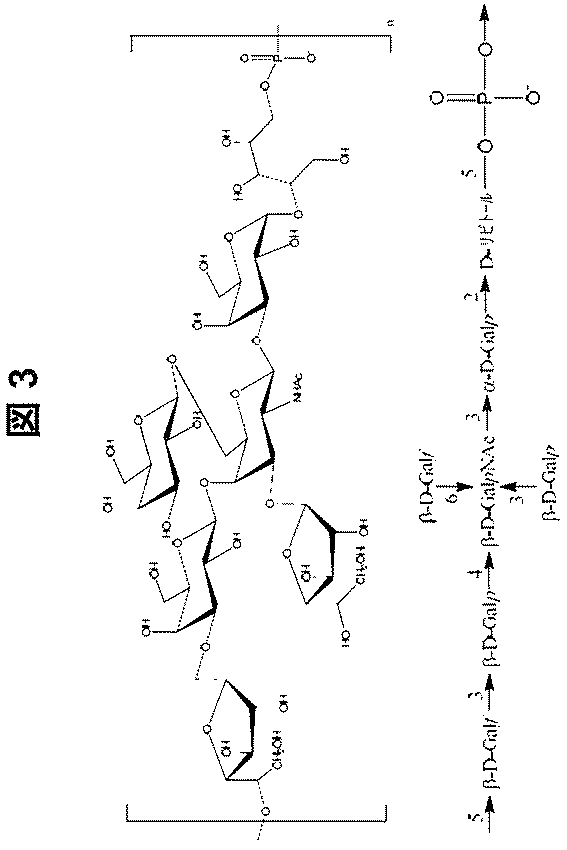
(実施例6)
TEMPO/NCS酸化方法を使用してのPn−血清型12F−CRM197複合物の免疫原性
血清型12F−CRM197複合物についてのマウスにおけるオプソニン化貪食作用活性(OPA)力価を、標準条件下のマウスにおいて求めた。4週間および7週間の時点のOPA力価(信頼区間(CI)95%の幾何平均力価(GMT))を表5に示しており、血清型12F−CRM197複合物(バッチ12F−97B、この複合物の特徴付けデータについては表1も参照のこと)が、ネズミ免疫原性モデルにおいてOPA力価を引き出したことが実証されている。TEMPO−NCSによって生成した複合物は、過ヨウ素酸塩酸化から生成された対照複合物(171B)よりも免疫原性を有していた。
(Example 6)
Immunogenicity of Pn-serotype 12F-CRM197 complex using TEMPO / NCS oxidation method Opsonized phagocytic activity (OPA) titer in mice for serotype 12F-CRM 197 complex under standard conditions Of mice. The OPA titer (confidence interval (CI) 95% geometric mean titer (GMT)) at 4 weeks and 7 weeks is shown in Table 5, and serotype 12F-CRM 197 complex (batch 12F-97B, (See also Table 1 for characterization data for this complex), which has been demonstrated to elicit OPA titers in a murine immunogenicity model. The composite produced by TEMPO-NCS was more immunogenic than the control composite (171B) produced from periodate oxidation.
(実施例7)
Pn−血清型12F複合物について、TEMPO/NCSなどの酸化体の存在下でニトロキシルラジカルを使用する推定上の機序
Pn−血清型12Fの酸化/複合化の推定上の機序を図6に示す。多糖の第1ヒドロキシル基は、化学量論的酸化体としてのNCSなどの酸化体を伴う、触媒量のTEMPOなどのニトロキシルラジカルによって酸化される。触媒回路において、実際の酸化体は、N−オキソアンモニウム塩である。C−6第1ヒドロキシル基の酸化によってアルデヒド基が生じ、これが、担体タンパク質(CRM197)のリシンの第一級アミノ基と引き続いて反応して、複合糖質が生成する。
(Example 7)
A putative mechanism using nitroxyl radicals in the presence of oxidants such as TEMPO / NCS for the Pn-serotype 12F complex The putative mechanism of oxidation / complexation of Pn-serotype 12F is shown in FIG. Shown in The primary hydroxyl group of the polysaccharide is oxidized by a catalytic amount of a nitroxyl radical such as TEMPO with an oxidant such as NCS as the stoichiometric oxidant. In the catalytic circuit, the actual oxidant is the N-oxoammonium salt. Oxidation of the C-6 primary hydroxyl group yields an aldehyde group that subsequently reacts with the primary amino group of lysine of the carrier protein (CRM 197 ) to produce a complex carbohydrate.
(実施例8)
安定性比較
過ヨウ素酸塩酸化とTEMPO/NCS酸化によって生成した複合物の(25℃での)安定性の比較(図7を参照のこと)によって、Pn−12F多糖の酸化によって生成した複合物が相対的により安定であることが実証された。図7に示されるとおり、Pn−12F多糖の過ヨウ素酸塩酸化によって生成した複合糖質では、25℃で、遊離糖の経時的な増加が認められた。対照的に、Pn−12F多糖のTEMPO/NCS酸化を使用して調製した複合糖質では、同様の条件下で、有意な遊離糖傾向は示されなかった。
(Example 8)
Stability Comparison Composites produced by oxidation of Pn-12F polysaccharide by comparison of stability (at 25 ° C.) of composites produced by periodate oxidation and TEMPO / NCS oxidation (see FIG. 7) Has been demonstrated to be relatively more stable. As shown in FIG. 7, in the glycoconjugate produced by periodate oxidation of Pn-12F polysaccharide, an increase in free sugar over time was observed at 25 ° C. In contrast, glycoconjugates prepared using TEMPO / NCS oxidation of Pn-12F polysaccharide did not show a significant free sugar tendency under similar conditions.
本開示の抗体または抗体組成物は、対象において、連鎖球菌感染、連鎖球菌属の種(Streptococcus sp.)と関連する疾患または状態を治療または予防する方法であって、ポリクローナルまたはモノクローナル抗体調製物を生成するステップと、前記抗体または抗体組成物を使用して、対象に受動免疫を付与するステップとを含む方法において使用することができる。本開示の抗体は、たとえば、莢膜多糖もしくはその複合糖質の存在を検出し、またはそのレベルを定量化する、診断方法にも有用となりうる。
非限定的に、本発明は以下の態様を含む。
[態様1]
担体タンパク質と複合化された糖を含む複合糖質の作製方法であって、
a)糖を安定なニトロキシルラジカル化合物および酸化体と反応させて、活性化した糖を生成するステップと、
b)前記活性化した糖を、1つまたは複数のアミン基を含む担体タンパク質と反応させるステップと
を含む方法。
[態様2]
前記安定なニトロキシルラジカル化合物が、酸化体の存在下で、第二級ヒドロキシル基に影響を及ぼさずに第一級アルコールを選択的に酸化してアルデヒド基を生じる能力を有するピペリジン−N−オキシまたはピロリジン−N−オキシ化合物である、態様1に記載の方法。
[態様3]
前記安定なニトロキシルラジカル化合物が、酸化体の存在下で、カルボキシル基へ過酸化することなく第一級アルコールを選択的に酸化してアルデヒド基を生じる能力を有するピペリジン−N−オキシまたはピロリジン−N−オキシ化合物である、態様1または2に記載の方法。
[態様4]
前記安定なニトロキシルラジカル化合物が、酸化体の存在下で、第二級ヒドロキシル基に影響を及ぼさずに第一級アルコールを選択的に酸化してアルデヒド基を生じる能力を有する、TEMPOまたはPROXYL(2,2,5,5−テトラメチル−1−ピロリジニルオキシ)部分を有する分子である、態様1に記載の方法。
[態様5]
前記安定なニトロキシルラジカル化合物が、酸化体の存在下で、カルボキシル基へ過酸化することなく第一級アルコールを選択的に酸化してアルデヒド基を生じる能力を有する、TEMPOまたはPROXYL(2,2,5,5−テトラメチル−1−ピロリジニルオキシ)部分を有する分子である、態様1または4に記載の方法。
[態様6]
前記ニトロキシルラジカル化合物が、TEMPO、2,2,6,6−テトラメチル−4−(メチルスルホニルオキシ)−1−ピペリジノオキシ、4−ホスホノオキシ−TEMPO、4−オキソ−TEMPO、4−メトキシ−TEMPO、4−イソチオシアナト−TEMPO、4−(2−ヨードアセトアミド)−TEMPOフリーラジカル、4−ヒドロキシ−TEMPO、4−シアノ−TEMPO、4−カルボキシ−TEMPO、4−(2−ブロモアセトアミド)−TEMPO、4−アミノ−TEMPO、4−アセトアミド−2,2,6,6−テトラメチルピペリジン1−オキシルからなる群から選択される、態様1に記載の方法。
[態様7]
前記ニトロキシルラジカル化合物が、3β−DOXYL−5α−コレスタン、5−DOXYL−ステアリン酸、16−DOXYL−ステアリン酸、5−DOXYL−ステアリン酸メチル、3−(アミノメチル)−PROXYL、3−カルバモイル−PROXYL、3−カルバモイル−2,2,5,5−テトラメチル−3−ピロリン−1−オキシル、3−カルボキシ−PROXYL、3−シアノ−PROXYLからなる群から選択される、態様1に記載の方法。
[態様8]
前記ニトロキシルラジカル化合物が、TEMPOまたはその誘導体である、態様1に記載の方法。
[態様9]
前記酸化体が、ニトロキシルラジカル化合物の存在下で第一級アルコールを選択的に酸化してアルデヒド基を生じる能力を有する、N−ハロ部分を有する分子である、態様1から8のいずれか一項に記載の方法。
[態様10]
前記酸化体が、N−クロロスクシンイミド、N−ブロモスクシンイミド、N−ヨードスクシンイミド、ジクロロイソシアヌル酸、1,3,5−トリクロロ−1,3,5−トリアジナン−2,4,6−トリオン、ジブロモイソシアヌル酸、1,3,5−トリブロモ−1,3,5−トリアジナン−2,4,6−トリオン、ジヨードイソシアヌル酸、および1,3,5−トリヨード−1,3,5−トリアジナン−2,4,6−トリオンからなる群から選択される、態様1から8のいずれか一項に記載の方法。
[態様11]
前記酸化体がN−クロロスクシンイミドである、態様1から8のいずれか一項に記載の方法。
[態様12]
前記反応ステップa)を水性溶媒中で実施する、態様1から11のいずれか一項に記載の方法。
[態様13]
前記反応ステップa)を非プロトン性溶媒中で実施する、態様1から11のいずれか一項に記載の方法。
[態様14]
前記反応ステップa)を、DMSO(ジメチルスルホキシド)溶媒中で実施する、態様1から11のいずれか一項に記載の方法。
[態様15]
前記糖を0.1〜10モル当量の酸化体と反応させる、態様1から14のいずれか一項に記載の方法。
[態様16]
前記糖を0.5〜1.5モル当量の酸化体と反応させる、態様15に記載の方法。
[態様17]
前記安定なニトロキシルラジカル化合物が、触媒量で存在する、態様1から16のいずれか一項に記載の方法。
[態様18]
前記糖を、約0.3モル当量未満の安定なニトロキシルラジカル化合物と反応させる、態様1から16のいずれか一項に記載の方法。
[態様19]
担体タンパク質と複合化された糖を含む複合糖質の作製方法であって、
a)水性溶媒中で、糖を2,2,6,6−テトラメチル−1−ピペリジニルオキシ(TEMPO)およびN−クロロスクシンイミド(NCS)と反応させて、活性化した糖を生成するステップと、
b)前記活性化した糖を、1つまたは複数のアミン基を含む担体タンパク質と反応させるステップと
を含む方法。
[態様20]
前記活性化した糖の酸化度が3〜40の範囲である、態様1から19のいずれか一項に記載の方法。
[態様21]
前記活性化した糖の酸化度が6〜14の範囲である、態様20に記載の方法。
[態様22]
前記糖が細菌莢膜多糖である、態様1から21のいずれか一項に記載の方法。
[態様23]
前記莢膜多糖が肺炎連鎖球菌(S.pneumoniae)由来である、態様22に記載の方法。
[態様24]
前記莢膜多糖が、Pn−血清型3、Pn−血清型10A、Pn−血清型12F、およびPn−血清型33F莢膜多糖から選択される、態様23に記載の方法。
[態様25]
前記莢膜多糖がPn−血清型12F莢膜多糖である、態様24に記載の方法。
[態様26]
前記莢膜多糖が髄膜炎菌(N.meningitidis)由来である、態様22に記載の方法。
[態様27]
前記莢膜多糖が、髄膜炎菌(Mn)−血清型A、C、W135、およびY莢膜多糖から選択される、態様26に記載の方法。
[態様28]
前記莢膜多糖が髄膜炎菌(Mn)−血清型X莢膜多糖である、態様26に記載の方法。
[態様29]
前記莢膜多糖がB群連鎖球菌(Group B Streptococcus)(GBS)由来である、態様22に記載の方法。
[態様30]
前記莢膜多糖が、GBS血清型Ia、Ib、II、III、IV、V、VI、VII、およびVIIIから選択される、態様29に記載の方法。
[態様31]
前記担体タンパク質が、破傷風、ジフテリア、百日咳、シュードモナス属(Pseudomonas)、大腸菌(E.coli)、ブドウ球菌属(Staphylococcus)、または連鎖球菌属(Streptococcus)の毒素である、態様1から30のいずれか一項に記載の方法。
[態様32]
前記担体タンパク質がCRM197である、態様1から30のいずれか一項に記載の方法。
[態様33]
前記糖が、合成によって得られたものである、態様1から32のいずれか一項に記載の方法。
[態様34]
ステップa)の前に、前記糖をサイズ調整する、態様1から33のいずれか一項に記載の方法。
[態様35]
前記糖を加水分解または機械的にサイズ調整する、態様34に記載の方法。
[態様36]
前記糖を、加水分解し、または加圧均質化によって機械的にサイズ調整して、50kDa〜500kDaの分子量を実現する、態様34に記載の方法。
[態様37]
ステップa)の前に、前記糖を、100〜400kDaの範囲の分子量に加水分解する、態様1から33のいずれか一項に記載の方法。
[態様38]
前記糖を、150〜350kDaの範囲の分子量に加水分解する、態様37に記載の方法。
[態様39]
ステップb)の前に、前記活性化した多糖を精製するステップをさらに含む、態様1から38のいずれかに記載の方法。
[態様40]
ステップb)の後に、還元剤を加えるステップをさらに含む、態様1から39のいずれかに記載の方法。
[態様41]
前記還元剤がNaCNBH3である、態様40に記載の方法。
[態様42]
NaCNBH3を加えた後にNaBH4を加えるステップをさらに含む、態様41に記載の方法。
[態様43]
NaBH4を加えた後に、精製ステップをさらに含む、態様42に記載の方法。
[態様44]
態様1から43のいずれか一項に記載の方法によって製造された複合糖質。
[態様45]
態様1から43のいずれか一項に記載の方法によって取得可能な複合糖質。
[態様46]
分子量が約50kDa〜約20,000kDaの間である、態様44または45に記載の複合糖質。
[態様47]
分子量が約500kDa〜約5,000kDaの間である、態様44または45に記載の複合糖質。
[態様48]
分子量が約1,000kDa〜約3,000kDaの間である、態様44または45に記載の複合糖質。
[態様49]
分子量が、約600kDa〜約2800kDaの間、約700kDa〜約2700kDaの間、約1000kDa〜約2000kDaの間、約1800kDa〜約2500kDaの間、約1100kDa〜約2200kDaの間、約1900kDa〜約2700kDaの間、約1200kDa〜約2400kDaの間、約1700kDa〜約2600kDaの間、約1300kDa〜約2600kDaの間、または約1600kDa〜約3000kDaの間である、態様44または45に記載の複合糖質
[態様50]
分子量が10kDa〜2,000kDaの間である細菌莢膜多糖を含む、態様44から49のいずれか一項に記載の複合糖質。
[態様51]
分子量が50kDa〜1,000kDaの間である細菌莢膜多糖を含む、態様44から49のいずれか一項に記載の複合糖質。
[態様52]
全多糖に対して約30%未満の遊離糖を含む、態様44から51のいずれか一項に記載の複合糖質。
[態様53]
全多糖に対して約20%、15%、10%、または5%未満の遊離多糖を含む、態様44から51のいずれか一項に記載の複合糖質。
[態様54]
前記担体タンパク質がCRM197である、態様44から53のいずれか一項に記載の複合糖質。
[態様55]
糖:担体タンパク質比(w/w)が、0.2〜4の間である、態様44から54のいずれか一項に記載の複合糖質。
[態様56]
糖:担体タンパク質比(w/w)が1.1〜1.7の間である、態様44から54のいずれか一項に記載の複合糖質。
[態様57]
前記担体タンパク質と前記多糖の間の共有結合連結が、前記多糖の100個の糖繰返し単位毎に少なくとも1つ存在する、態様44から56のいずれか一項に記載の複合糖質。
[態様58]
前記担体タンパク質と前記多糖の間の共有結合連結が、前記多糖の4個の糖繰返し単位毎に少なくとも1回生じる、態様57に記載の複合糖質。
[態様59]
前記担体タンパク質と前記多糖の間の共有結合連結が、前記多糖の10個の糖繰返し単位毎に少なくとも1回生じる、態様57に記載の複合糖質。
[態様60]
前記担体タンパク質と前記多糖の間の共有結合連結が、前記多糖の15個の糖繰返し単位毎に少なくとも1回生じる、態様57に記載の複合糖質。
[態様61]
前記担体タンパク質と前記多糖の間の共有結合連結が、前記多糖の20個の糖繰返し単位毎に少なくとも1回生じる、態様57に記載の複合糖質。
[態様62]
前記担体タンパク質と糖の間の共有結合連結を、5〜10個の糖繰返し単位毎に少なくとも1つ含む、態様57に記載の複合糖質。
[態様63]
前記担体タンパク質と糖の間の共有結合連結を、2〜7個の糖繰返し単位毎、3〜8個の糖繰返し単位毎、4〜9個の糖繰返し単位毎、6〜11個の糖繰返し単位毎、7〜12個の糖繰返し単位毎、8〜13個の糖繰返し単位毎、9〜14個の糖繰返し単位毎、10〜15個の糖繰返し単位毎、2〜6個の糖繰返し単位毎、3〜7個の糖繰返し単位毎、4〜8個の糖繰返し単位毎、6〜10個の糖繰返し単位毎、7〜11個の糖繰返し単位毎、8〜12個の糖繰返し単位毎、9〜13個の糖繰返し単位毎、10〜14個の糖繰返し単位毎、10〜20個の糖繰返し単位毎、または4〜25個の糖繰返し単位毎に少なくとも1つ含む、態様57に記載の複合糖質。
[態様64]
態様44から63のいずれか一項に記載の複合糖質と、薬学的に許容できる賦形剤、担体、または希釈剤とを含む免疫原性組成物。
[態様65]
追加抗原をさらに含む、態様64に記載の免疫原性組成物。
[態様66]
前記追加抗原が、肺炎連鎖球菌(S.pneumonia)由来の、タンパク質抗原または莢膜多糖の複合糖質を含む、態様65に記載の免疫原性組成物。
[態様67]
前記追加抗原が、Pn−血清型1、4、5、6A、6B、7F、8、9V、11A、14、15B、18C、19A、19F、22F、および23F莢膜多糖から選択される莢膜多糖の複合糖質を含む、態様66に記載の免疫原性組成物。
[態様68]
前記追加抗原が、髄膜炎菌(N.meningitidis)由来の、タンパク質抗原または莢膜多糖の複合糖質を含む、態様65に記載の免疫原性組成物。
[態様69]
前記追加抗原が、血清型A、C、W135、およびY莢膜多糖から選択される莢膜多糖の複合糖質を含む、態様68に記載の免疫原性組成物。
[態様70]
前記追加抗原が、B群連鎖球菌(Group B Streptococcus)(GBS)由来の莢膜多糖の複合糖質を含む、態様65に記載の免疫原性組成物。
[態様71]
前記追加抗原が、GBS血清型Ia、Ib、II、III、IV、V、VI、VII、およびVIIIから選択される莢膜多糖の複合糖質を含む、態様70に記載の免疫原性組成物。
[態様72]
アジュバントをさらに含む、態様64から71のいずれか一項に記載の免疫原性組成物。
[態様73]
前記アジュバントがアルミニウム系アジュバントである、態様72に記載の免疫原性組成物。
[態様74]
前記アルミニウム系アジュバントが、リン酸アルミニウム、硫酸アルミニウム、および水酸化アルミニウムからなる群から選択される、態様73に記載の免疫原性組成物。
[態様75]
担体タンパク質と複合化されたPn−血清型12Fを含む免疫原性組成物であって、前記組成物中の遊離Pn−血清型12F多糖の量が、調製されてから120日後に35%未満である、免疫原性組成物。
[態様76]
遊離Pn−血清型12F多糖の量が、調製されてから120日後に30%未満である、態様75に記載の免疫原性組成物。
[態様77]
前記担体タンパク質が、破傷風、ジフテリア、百日咳、シュードモナス属(Pseudomonas)、大腸菌(E.coli)、ブドウ球菌属(Staphylococcus)、または連鎖球菌属(Streptococcus)の毒素である、態様75または76に記載の免疫原性組成物。
[態様78]
前記担体タンパク質がCRM197である、態様75または76に記載の免疫原性組成物。
[態様79]
薬学的に許容できる賦形剤、担体、または希釈剤をさらに含む、態様75から78のいずれか一項に記載の免疫原性組成物。
[態様80]
追加抗原をさらに含む、態様75から79のいずれか一項に記載の免疫原性組成物。
[態様81]
前記追加抗原が、肺炎連鎖球菌(S.pneumonia)由来の、タンパク質抗原または莢膜多糖の複合糖質を含む、態様80に記載の免疫原性組成物。
[態様82]
前記追加抗原が、Pn−血清型1、4、5、6A、6B、7F、8、9V、11A、14、15B、18C、19A、19F、22F、および23F莢膜多糖から選択される莢膜多糖の複合糖質を含む、態様81に記載の免疫原性組成物。
[態様83]
前記追加抗原が、髄膜炎菌(N.meningitidis)由来の、タンパク質抗原または莢膜多糖の複合糖質を含む、態様82に記載の免疫原性組成物。
[態様84]
前記追加抗原が、血清型A、C、W135、およびY莢膜多糖から選択される莢膜多糖の複合糖質を含む、態様83に記載の免疫原性組成物。
[態様85]
前記追加抗原が、血清型X莢膜多糖の複合糖質を含む、態様83に記載の免疫原性組成物。
[態様86]
前記追加抗原が、B群連鎖球菌(Group B Streptococcus)(GBS)由来の莢膜多糖の複合糖質を含む、態様80に記載の免疫原性組成物。
[態様87]
前記追加抗原が、GBS血清型Ia、Ib、II、III、IV、V、VI、VII、およびVIIIから選択される莢膜多糖の複合糖質を含む、態様86に記載の免疫原性組成物。
[態様88]
アジュバントをさらに含む、態様75から87のいずれか一項に記載の免疫原性組成物。
[態様89]
前記アジュバントがアルミニウム系アジュバントである、態様88に記載の免疫原性組成物。
[態様90]
前記アルミニウム系アジュバントが、リン酸アルミニウム、硫酸アルミニウム、および水酸化アルミニウムからなる群から選択される、態様89に記載の免疫原性組成物。
[態様91]
対象において、細菌性の感染、疾患、または状態を予防、治療、または改善する方法であって、態様64から90のいずれか一項に記載の免疫原性組成物の免疫学的有効量を前記対象に投与することを含む方法。
[態様92]
前記感染、疾患、または状態が、肺炎連鎖球菌(S.pneumoniae)細菌と関連する、態様91に記載の方法。
[態様93]
前記感染、疾患、または状態が、髄膜炎菌(N.meningitidis)細菌と関連する、態様91に記載の方法。
[態様94]
前記感染、疾患、または状態が、B群連鎖球菌(Group B Streptococcus)細菌と関連する、態様91に記載の方法。
[態様95]
対象において防御免疫応答を誘発する方法であって、態様64から90のいずれか一項に記載の免疫原性組成物の免疫学的有効量を前記対象に投与することを含む方法。
[態様96]
医薬として使用するための、態様64から90のいずれか一項に記載の免疫原性組成物。
[態様97]
医薬として使用するための、態様44から63のいずれか一項に記載の複合糖質。
[態様98]
ワクチンとして使用するための、態様64から90のいずれか一項に記載の免疫原性組成物。
[態様99]
対象において、細菌性の感染、疾患、または状態を予防、治療、または改善する方法において使用するための、態様64から90のいずれか一項に記載の免疫原性組成物。
[態様100]
対象において防御免疫応答を誘発する方法において使用するための、態様64から90のいずれか一項に記載の免疫原性組成物。
An antibody or antibody composition of the present disclosure is a method of treating or preventing streptococcal infection, a disease or condition associated with Streptococcus sp. In a subject, comprising a polyclonal or monoclonal antibody preparation. It can be used in a method comprising generating and conferring passive immunity to a subject using the antibody or antibody composition. The antibodies of the present disclosure may also be useful in diagnostic methods that detect, for example, the presence of capsular polysaccharides or glycoconjugates thereof, or quantify their levels.
The present invention includes, but is not limited to, the following aspects.
[Aspect 1]
A method for producing a complex carbohydrate comprising a sugar complexed with a carrier protein,
a) reacting a sugar with a stable nitroxyl radical compound and an oxidant to produce an activated sugar;
b) reacting the activated sugar with a carrier protein comprising one or more amine groups.
[Aspect 2]
The stable nitroxyl radical compound is a piperidine-N-oxy compound having the ability to selectively oxidize a primary alcohol to produce an aldehyde group without affecting the secondary hydroxyl group in the presence of an oxidant. Or the method according to
[Aspect 3]
Piperidine-N-oxy or pyrrolidine having the ability of the stable nitroxyl radical compound to selectively oxidize a primary alcohol to form an aldehyde group without peroxidation to a carboxyl group in the presence of an oxidant. The method according to
[Aspect 4]
The stable nitroxyl radical compound has the ability to selectively oxidize a primary alcohol to produce an aldehyde group in the presence of an oxidant without affecting the secondary hydroxyl group, thereby producing an aldehyde group. A method according to
[Aspect 5]
TEMPO or PROXYL (2, 2), wherein the stable nitroxyl radical compound has the ability to selectively oxidize a primary alcohol to form an aldehyde group without peroxidation to a carboxyl group in the presence of an oxidant. , 5,5-tetramethyl-1-pyrrolidinyloxy) moiety, according to
[Aspect 6]
The nitroxyl radical compound is TEMPO, 2,2,6,6-tetramethyl-4- (methylsulfonyloxy) -1-piperidinooxy, 4-phosphonooxy-TEMPO, 4-oxo-TEMPO, 4-methoxy-TEMPO, 4-isothiocyanato-TEMPO, 4- (2-iodoacetamido) -TEMPO free radical, 4-hydroxy-TEMPO, 4-cyano-TEMPO, 4-carboxy-TEMPO, 4- (2-bromoacetamido) -TEMPO, 4- The method of
[Aspect 7]
The nitroxyl radical compound is 3β-DOXYL-5α-cholestane, 5-DOXYL-stearic acid, 16-DOXYL-stearic acid, 5-DOXYL-methyl stearate, 3- (aminomethyl) -PROXYL, 3-carbamoyl- A method according to
[Aspect 8]
The method according to
[Aspect 9]
Any one of
[Aspect 10]
The oxidant is N-chlorosuccinimide, N-bromosuccinimide, N-iodosuccinimide, dichloroisocyanuric acid, 1,3,5-trichloro-1,3,5-triazinan-2,4,6-trione, dibromoisocyanuric. Acid, 1,3,5-tribromo-1,3,5-triazinan-2,4,6-trione, diiodoisocyanuric acid, and 1,3,5-triiodo-1,3,5-triazinan-2, 9. The method according to any one of
[Aspect 11]
The method according to any one of
[Aspect 12]
A process according to any one of
[Aspect 13]
12. A process according to any one of
[Aspect 14]
A process according to any one of
[Aspect 15]
15. A process according to any one of
[Aspect 16]
Embodiment 16. The method of
[Aspect 17]
Embodiment 17. The method according to any one of
[Aspect 18]
Embodiment 17. The method of any one of
[Aspect 19]
A method for producing a complex carbohydrate comprising a sugar complexed with a carrier protein,
a) reacting a sugar with 2,2,6,6-tetramethyl-1-piperidinyloxy (TEMPO) and N-chlorosuccinimide (NCS) in an aqueous solvent to produce an activated sugar When,
b) reacting the activated sugar with a carrier protein comprising one or more amine groups.
[Aspect 20]
20. The method according to any one of
[Aspect 21]
21. The method according to
[Aspect 22]
The method according to any one of
[Aspect 23]
23. The method of aspect 22, wherein the capsular polysaccharide is derived from S. pneumoniae.
[Aspect 24]
24. The method of aspect 23, wherein the capsular polysaccharide is selected from Pn-
[Aspect 25]
25. The method of embodiment 24, wherein the capsular polysaccharide is a Pn-serotype 12F capsular polysaccharide.
[Aspect 26]
23. The method of aspect 22, wherein the capsular polysaccharide is derived from N. meningitidis.
[Aspect 27]
27. The method of aspect 26, wherein the capsular polysaccharide is selected from Neisseria meningitidis (Mn) -serotypes A, C, W135, and Y capsular polysaccharide.
[Aspect 28]
27. The method of aspect 26, wherein the capsular polysaccharide is meningococcal (Mn) -serotype X capsular polysaccharide.
[Aspect 29]
23. The method of aspect 22, wherein the capsular polysaccharide is derived from Group B Streptococcus (GBS).
[Aspect 30]
30. The method of aspect 29, wherein the capsular polysaccharide is selected from GBS serotypes Ia, Ib, II, III, IV, V, VI, VII, and VIII.
[Aspect 31]
Any of
[Aspect 32]
31. A method according to any one of
[Aspect 33]
The method according to any one of
[Aspect 34]
34. A method according to any one of aspects 1-33, wherein the sugar is sized prior to step a).
[Aspect 35]
35. A method according to aspect 34, wherein the sugar is hydrolyzed or mechanically sized.
[Aspect 36]
35. The method of aspect 34, wherein the sugar is hydrolyzed or mechanically sized by pressure homogenization to achieve a molecular weight of 50 kDa to 500 kDa.
[Aspect 37]
34. A method according to any one of
[Aspect 38]
38. The method of embodiment 37, wherein the sugar is hydrolyzed to a molecular weight in the range of 150-350 kDa.
[Aspect 39]
39. A method according to any of
[Aspect 40]
40. A method according to any of
[Aspect 41]
Wherein the reducing agent is NaCNBH 3, method according to
[Aspect 42]
Further comprising the step of adding NaBH 4 after the addition of NaCNBH 3, method according to embodiment 41.
[Aspect 43]
After addition of NaBH 4, further comprising a purification step A method according to embodiment 42.
[Aspect 44]
44. A glycoconjugate produced by the method according to any one of
[Aspect 45]
44. A glycoconjugate obtainable by the method according to any one of
[Aspect 46]
46. The glycoconjugate of
[Aspect 47]
46. The glycoconjugate of
[Aspect 48]
46. The glycoconjugate according to
[Aspect 49]
The molecular weight is between about 600 kDa and about 2800 kDa, between about 700 kDa and about 2700 kDa, between about 1000 kDa and about 2000 kDa, between about 1800 kDa and about 2500 kDa, between about 1100 kDa and about 2200 kDa, between about 1900 kDa and about 2700 kDa. A glycoconjugate according to
50. The glycoconjugate according to any one of aspects 44 to 49, comprising a bacterial capsular polysaccharide having a molecular weight between 10 kDa and 2,000 kDa.
[Aspect 51]
50. The glycoconjugate according to any one of aspects 44 to 49, comprising a bacterial capsular polysaccharide having a molecular weight between 50 kDa and 1,000 kDa.
[Aspect 52]
52. The complex carbohydrate according to any one of aspects 44 to 51, comprising less than about 30% free sugars relative to the total polysaccharide.
[Aspect 53]
52. The glycoconjugate according to any one of aspects 44 to 51, comprising less than about 20%, 15%, 10%, or 5% free polysaccharide relative to the total polysaccharide.
[Aspect 54]
54. The glycoconjugate according to any one of aspects 44 to 53, wherein the carrier protein is CRM197.
[Aspect 55]
55. A glycoconjugate according to any one of aspects 44 to 54, wherein the sugar: carrier protein ratio (w / w) is between 0.2-4.
[Aspect 56]
55. A glycoconjugate according to any one of aspects 44 to 54, wherein the sugar: carrier protein ratio (w / w) is between 1.1 and 1.7.
[Aspect 57]
57. A glycoconjugate according to any one of aspects 44 to 56, wherein there is at least one covalent linkage between the carrier protein and the polysaccharide for every 100 sugar repeat units of the polysaccharide.
[Aspect 58]
58. A glycoconjugate according to aspect 57, wherein the covalent linkage between the carrier protein and the polysaccharide occurs at least once for every four sugar repeat units of the polysaccharide.
[Aspect 59]
58. A glycoconjugate according to aspect 57, wherein the covalent linkage between the carrier protein and the polysaccharide occurs at least once for every 10 sugar repeat units of the polysaccharide.
[Aspect 60]
58. A glycoconjugate according to aspect 57, wherein the covalent linkage between the carrier protein and the polysaccharide occurs at least once for every 15 sugar repeat units of the polysaccharide.
[Aspect 61]
58. The glycoconjugate of embodiment 57, wherein the covalent linkage between the carrier protein and the polysaccharide occurs at least once for every 20 sugar repeat units of the polysaccharide.
[Aspect 62]
58. A glycoconjugate according to aspect 57, comprising at least one covalent linkage between said carrier protein and a sugar for every 5 to 10 sugar repeat units.
[Aspect 63]
The covalent linkage between the carrier protein and the sugar is made every 2 to 7 sugar repeating units, every 3 to 8 sugar repeating units, every 4 to 9 sugar repeating units, and 6 to 11 sugar repeating units. Per unit, every 7-12 sugar repeat units, every 8-13 sugar repeat units, every 9-14 sugar repeat units, every 10-15 sugar repeat units, every 2-6 sugar repeats Per unit, every 3-7 sugar repeat units, every 4-8 sugar repeat units, every 6-10 sugar repeat units, every 7-11 sugar repeat units, 8-12 sugar repeats At least one per unit, every 9-13 sugar repeat units, every 10-14 sugar repeat units, every 10-20 sugar repeat units, or every 4-25 sugar repeat units 58. A glycoconjugate according to 57.
[Aspect 64]
64. An immunogenic composition comprising a glycoconjugate according to any one of aspects 44 to 63 and a pharmaceutically acceptable excipient, carrier or diluent.
[Aspect 65]
The immunogenic composition of embodiment 64, further comprising an additional antigen.
[Aspect 66]
68. The immunogenic composition of aspect 65, wherein the additional antigen comprises a protein antigen or capsular polysaccharide glycoconjugate from S. pneumonia.
[Aspect 67]
Capsule wherein said additional antigen is selected from Pn-
[Aspect 68]
66. The immunogenic composition of aspect 65, wherein the additional antigen comprises a protein antigen or capsular polysaccharide glycoconjugate from N. meningitidis.
[Aspect 69]
69. The immunogenic composition of aspect 68, wherein said additional antigen comprises a capsular polysaccharide glycoconjugate selected from serotypes A, C, W135, and Y capsular polysaccharide.
[Aspect 70]
68. The immunogenic composition of aspect 65, wherein the additional antigen comprises a capsular polysaccharide glycoconjugate from Group B Streptococcus (GBS).
[Aspect 71]
71. The immunogenic composition of aspect 70, wherein the additional antigen comprises a capsular polysaccharide glycoconjugate selected from GBS serotypes Ia, Ib, II, III, IV, V, VI, VII, and VIII. .
[Aspect 72]
72. The immunogenic composition according to any one of aspects 64-71, further comprising an adjuvant.
[Aspect 73]
The immunogenic composition according to embodiment 72, wherein the adjuvant is an aluminum-based adjuvant.
[Aspect 74]
The immunogenic composition of embodiment 73, wherein the aluminum-based adjuvant is selected from the group consisting of aluminum phosphate, aluminum sulfate, and aluminum hydroxide.
[Aspect 75]
An immunogenic composition comprising Pn-serotype 12F complexed with a carrier protein, wherein the amount of free Pn-serotype 12F polysaccharide in the composition is less than 35% 120 days after preparation An immunogenic composition.
[Aspect 76]
The immunogenic composition of embodiment 75, wherein the amount of free Pn-serotype 12F polysaccharide is less than 30% 120 days after being prepared.
[Aspect 77]
Embodiment 75. The embodiment 75 or 76, wherein the carrier protein is a toxin of tetanus, diphtheria, pertussis, Pseudomonas, E. coli, Staphylococcus, or Streptococcus. An immunogenic composition.
[Aspect 78]
77. The immunogenic composition of embodiment 75 or 76, wherein the carrier protein is CRM 197 .
[Aspect 79]
79. The immunogenic composition according to any one of aspects 75-78, further comprising a pharmaceutically acceptable excipient, carrier, or diluent.
[Aspect 80]
80. The immunogenic composition according to any one of aspects 75 to 79, further comprising an additional antigen.
[Aspect 81]
81. The immunogenic composition of aspect 80, wherein said additional antigen comprises a protein antigen or capsular polysaccharide glycoconjugate from S. pneumonia.
[Aspect 82]
Capsule wherein said additional antigen is selected from Pn-
[Aspect 83]
83. The immunogenic composition of aspect 82, wherein said additional antigen comprises a protein antigen or capsular polysaccharide glycoconjugate from N. meningitidis.
[Aspect 84]
84. The immunogenic composition of aspect 83, wherein said additional antigen comprises a capsular polysaccharide glycoconjugate selected from serotypes A, C, W135, and Y capsular polysaccharide.
[Aspect 85]
84. The immunogenic composition of aspect 83, wherein the additional antigen comprises a serotype X capsular polysaccharide glycoconjugate.
[Aspect 86]
81. The immunogenic composition of aspect 80, wherein the additional antigen comprises a capsular polysaccharide glycoconjugate from Group B Streptococcus (GBS).
[Aspect 87]
85. The immunogenic composition of aspect 86, wherein the additional antigen comprises a capsular polysaccharide glycoconjugate selected from GBS serotypes Ia, Ib, II, III, IV, V, VI, VII, and VIII. .
[Aspect 88]
90. The immunogenic composition according to any one of aspects 75 to 87, further comprising an adjuvant.
[Aspect 89]
The immunogenic composition of embodiment 88, wherein the adjuvant is an aluminum adjuvant.
[Aspect 90]
90. The immunogenic composition of embodiment 89, wherein the aluminum-based adjuvant is selected from the group consisting of aluminum phosphate, aluminum sulfate, and aluminum hydroxide.
[Aspect 91]
91. A method for preventing, treating, or ameliorating a bacterial infection, disease, or condition in a subject, comprising an immunologically effective amount of an immunogenic composition according to any one of aspects 64-90. A method comprising administering to a subject.
[Aspect 92]
92. The method of aspect 91, wherein the infection, disease, or condition is associated with a S. pneumoniae bacterium.
[Aspect 93]
92. The method of aspect 91, wherein the infection, disease, or condition is associated with a N. meningitidis bacterium.
[Aspect 94]
92. The method of aspect 91, wherein the infection, disease, or condition is associated with a Group B Streptococcus bacterium.
[Aspect 95]
94. A method of inducing a protective immune response in a subject, comprising administering to said subject an immunologically effective amount of an immunogenic composition according to any one of aspects 64-90.
[Aspect 96]
91. An immunogenic composition according to any one of aspects 64-90 for use as a medicament.
[Aspect 97]
64. A glycoconjugate according to any one of aspects 44 to 63 for use as a medicament.
[Aspect 98]
91. An immunogenic composition according to any one of aspects 64-90 for use as a vaccine.
[Aspect 99]
91. The immunogenic composition according to any one of aspects 64-90, for use in a method for preventing, treating or ameliorating a bacterial infection, disease or condition in a subject.
[Aspect 100]
91. An immunogenic composition according to any one of aspects 64-90 for use in a method of eliciting a protective immune response in a subject.
Claims (100)
a)糖を安定なニトロキシルラジカル化合物および酸化体と反応させて、活性化した糖を生成するステップと、
b)前記活性化した糖を、1つまたは複数のアミン基を含む担体タンパク質と反応させるステップと
を含む方法。 A method for producing a complex carbohydrate comprising a sugar complexed with a carrier protein,
a) reacting a sugar with a stable nitroxyl radical compound and an oxidant to produce an activated sugar;
b) reacting the activated sugar with a carrier protein comprising one or more amine groups.
a)水性溶媒中で、糖を2,2,6,6−テトラメチル−1−ピペリジニルオキシ(TEMPO)およびN−クロロスクシンイミド(NCS)と反応させて、活性化した糖を生成するステップと、
b)前記活性化した糖を、1つまたは複数のアミン基を含む担体タンパク質と反応させるステップと
を含む方法。 A method for producing a complex carbohydrate comprising a sugar complexed with a carrier protein,
a) reacting a sugar with 2,2,6,6-tetramethyl-1-piperidinyloxy (TEMPO) and N-chlorosuccinimide (NCS) in an aqueous solvent to produce an activated sugar When,
b) reacting the activated sugar with a carrier protein comprising one or more amine groups.
91. An immunogenic composition according to any one of claims 64 to 90 for use in a method of eliciting a protective immune response in a subject.
Applications Claiming Priority (2)
| Application Number | Priority Date | Filing Date | Title |
|---|---|---|---|
| US201261740311P | 2012-12-20 | 2012-12-20 | |
| US61/740,311 | 2012-12-20 |
Related Parent Applications (1)
| Application Number | Title | Priority Date | Filing Date |
|---|---|---|---|
| JP2015548822A Division JP6502262B2 (en) | 2012-12-20 | 2013-12-13 | Sugar conjugation method |
Publications (2)
| Publication Number | Publication Date |
|---|---|
| JP2018127632A true JP2018127632A (en) | 2018-08-16 |
| JP6686057B2 JP6686057B2 (en) | 2020-04-22 |
Family
ID=50070610
Family Applications (2)
| Application Number | Title | Priority Date | Filing Date |
|---|---|---|---|
| JP2015548822A Active JP6502262B2 (en) | 2012-12-20 | 2013-12-13 | Sugar conjugation method |
| JP2018044572A Active JP6686057B2 (en) | 2012-12-20 | 2018-03-12 | Glycoconjugation method |
Family Applications Before (1)
| Application Number | Title | Priority Date | Filing Date |
|---|---|---|---|
| JP2015548822A Active JP6502262B2 (en) | 2012-12-20 | 2013-12-13 | Sugar conjugation method |
Country Status (21)
| Country | Link |
|---|---|
| US (5) | US10392420B2 (en) |
| EP (3) | EP2935299B1 (en) |
| JP (2) | JP6502262B2 (en) |
| KR (2) | KR101980989B1 (en) |
| CN (3) | CN104870463B (en) |
| AU (2) | AU2013365873B2 (en) |
| BR (2) | BR112015015031B1 (en) |
| CA (2) | CA2893343C (en) |
| DK (2) | DK3363806T3 (en) |
| ES (2) | ES2755082T3 (en) |
| FI (1) | FI3363806T3 (en) |
| FR (2) | FR22C1038I2 (en) |
| HR (1) | HRP20221438T1 (en) |
| HU (2) | HUE060718T2 (en) |
| IL (2) | IL274500B2 (en) |
| MX (2) | MX379386B (en) |
| PL (2) | PL2935299T3 (en) |
| PT (2) | PT2935299T (en) |
| RU (1) | RU2672053C2 (en) |
| SI (2) | SI3363806T1 (en) |
| WO (1) | WO2014097099A2 (en) |
Families Citing this family (58)
| Publication number | Priority date | Publication date | Assignee | Title |
|---|---|---|---|---|
| US11160855B2 (en) * | 2014-01-21 | 2021-11-02 | Pfizer Inc. | Immunogenic compositions comprising conjugated capsular saccharide antigens and uses thereof |
| EP3607966A1 (en) | 2014-01-21 | 2020-02-12 | Pfizer Inc | Immunogenic compositions comprising conjugated capsular saccharide antigens and uses thereof |
| HRP20211288T1 (en) * | 2014-01-21 | 2021-11-26 | Pfizer Inc. | Streptococcus pneumoniae capsular polysaccharides and conjugates thereof |
| BR112016015835B1 (en) * | 2014-01-21 | 2023-12-26 | Pfizer Inc | PROCESS FOR PREPARING CONJUGATES COMPRISING CAPSULAR POLYSACCHARIDES OF STREPTOCOCCUS PNEUMONIAE |
| US20170198004A1 (en) | 2014-05-24 | 2017-07-13 | Biological E Limited | Novel semi-synthetic meningococcal conjugate vaccine |
| FI3244917T3 (en) | 2015-01-15 | 2023-05-25 | Pfizer | Immunogenic compositions for use in pneumococcal vaccines |
| KR102045663B1 (en) * | 2015-05-04 | 2019-11-15 | 화이자 인코포레이티드 | Group B Streptococcus polysaccharide-protein conjugate, method of producing the conjugate, immunogenic composition comprising the conjugate, and use thereof |
| KR102225282B1 (en) * | 2015-07-21 | 2021-03-10 | 화이자 인코포레이티드 | Immunogenic composition comprising conjugated capsular saccharide antigen, kit comprising same, and use thereof |
| WO2017044932A1 (en) * | 2015-09-10 | 2017-03-16 | Inventprise, Llc | Multivalent vlp conjugates |
| WO2017085586A1 (en) | 2015-11-20 | 2017-05-26 | Pfizer Inc. | Immunogenic compositions for use in pneumococcal vaccines |
| EP3181148A1 (en) * | 2015-12-17 | 2017-06-21 | Max-Planck-Gesellschaft zur Förderung der Wissenschaften e.V. | Synthetic vaccines against streptococcus pneumoniae serotype 2 |
| WO2017103211A1 (en) * | 2015-12-17 | 2017-06-22 | MAX-PLANCK-Gesellschaft zur Förderung der Wissenschaften e.V. | Synthetic vaccines against streptococcus pneumoniae serotype 2 |
| PL3506935T3 (en) | 2016-09-02 | 2024-06-10 | Sanofi Pasteur, Inc. | Neisseria meningitidis vaccine |
| US11027005B2 (en) | 2016-10-20 | 2021-06-08 | Km Biologics Co., Ltd. | Method for producing Hib conjugate vaccine using PRP with lowered molecular weight |
| US10751402B2 (en) | 2016-11-09 | 2020-08-25 | Pfizer Inc. | Immunogenic compositions and uses thereof |
| EP3824906A1 (en) | 2016-12-21 | 2021-05-26 | Amgen Inc. | Anti-tnf alpha antibody formulations |
| SI3570879T1 (en) | 2017-01-20 | 2022-06-30 | Pfizer Inc. | Immunogenic compositions for use in pneumococcal vaccines |
| KR20190108583A (en) | 2017-01-31 | 2019-09-24 | 머크 샤프 앤드 돔 코포레이션 | Method for preparing polysaccharide-protein conjugate |
| KR102650073B1 (en) * | 2017-01-31 | 2024-03-20 | 머크 샤프 앤드 돔 엘엘씨 | Method for producing capsular polysaccharide protein conjugate derived from Streptococcus pneumoniae serotype 19F |
| EP3589314A4 (en) | 2017-02-24 | 2021-04-21 | Merck Sharp & Dohme Corp. | IMPROVED IMMUNOGENICITY OF POLYSACCHARIDE CONJUGATES OF STREPTOCOCCUS PNEUMONIAE AND PROTEIN |
| EP3634481A4 (en) | 2017-06-10 | 2021-07-21 | Inventprise, LLC. | MULTIVALENT CONJUGATE VACCINES WITH BIVALENT OR MULTIVALENT CONJUGATE POLYSACCHARIDES THAT PROVIDE IMPROVED IMMUNOGENICITY AND AVIDITY |
| US10729763B2 (en) | 2017-06-10 | 2020-08-04 | Inventprise, Llc | Mixtures of polysaccharide-protein pegylated compounds |
| BR112020004471A8 (en) | 2017-09-07 | 2022-11-01 | Merck Sharp & Dohme | PNEUMOCOCCAL POLYSACCHARIDES AND THEIR USE IN IMMUNOGENIC POLYSACCHARIDE-CARRIER PROTEIN CONJUGATES |
| CN117018172A (en) | 2017-09-07 | 2023-11-10 | 默沙东有限责任公司 | Pneumococcal polysaccharides and their use in immunogenic polysaccharide-carrier protein conjugates |
| PL3678654T3 (en) | 2017-09-07 | 2024-12-16 | Merck Sharp & Dohme Llc | Pneumococcal polysaccharides and their use in immunogenic polysaccharide-carrier protein conjugates |
| US11116828B2 (en) | 2017-12-06 | 2021-09-14 | Merck Sharp & Dohme Corp. | Compositions comprising Streptococcus pneumoniae polysaccharide-protein conjugates and methods of use thereof |
| CN109879967A (en) * | 2017-12-15 | 2019-06-14 | 苏州和锐生物科技有限公司 | A kind of preparation method and application of acetylglucosamine conjugate |
| CU20200068A7 (en) * | 2018-03-23 | 2021-04-07 | Koranex Capital | PRECISION GLYCOCONJUGATES AS THERAPEUTIC TOOLS |
| US11896656B2 (en) | 2018-04-30 | 2024-02-13 | Merck Sharp & Dohme Llc | Methods for providing a homogenous solution of lyophilized mutant diptheria toxin in dimethylsulfoxide |
| CN120661645A (en) | 2018-04-30 | 2025-09-19 | 默沙东有限责任公司 | Method for producing streptococcus pneumoniae capsular polysaccharide carrier protein conjugates |
| EP3787674A4 (en) | 2018-04-30 | 2022-01-26 | Merck Sharp & Dohme Corp. | METHODS FOR PRODUCING CAPSULAR CARRIER PROTEIN-POLYSACCHARIDE CONJUGATES OF STREPTOCOCCUS PNEUMONIAE FROM LYOSPHERES |
| US11260119B2 (en) | 2018-08-24 | 2022-03-01 | Pfizer Inc. | Escherichia coli compositions and methods thereof |
| EP3852795A4 (en) * | 2018-09-23 | 2022-11-23 | Biological E Limited | PURIFIED CAPSULAR POLYSACCHARIDES FROM STREPTOCOCCUS PNEUMONIAE |
| GEP20247633B (en) | 2018-12-19 | 2024-06-25 | Merck Sharp & Dohme Llc | Compositions comprising streptococcus pneumoniae polysaccharide-protein conjugates and methods of use thereof |
| JP7239509B6 (en) | 2019-02-22 | 2023-03-28 | ファイザー・インク | Method for purifying bacterial polysaccharides |
| CN110302375A (en) * | 2019-06-27 | 2019-10-08 | 康希诺生物股份公司 | A kind of glycoconjugate and use thereof |
| US20230085173A1 (en) | 2020-02-21 | 2023-03-16 | Pfizer Inc. | Purification of saccharides |
| WO2022035816A1 (en) | 2020-08-10 | 2022-02-17 | Inventprise, Llc | Multivalent pneumococcal glycoconjugate vaccines containing emerging serotype 24f |
| AU2021332183B2 (en) | 2020-08-26 | 2025-12-18 | Pfizer Inc. | Group B streptococcus polysaccharide-protein conjugates, methods for producing conjugates, immunogenic compositions comprising conjugates, and uses thereof |
| PH12023550020A1 (en) | 2020-09-17 | 2024-03-11 | Janssen Pharmaceuticals Inc | Multivalent vaccine compositions and uses thereof |
| JP2023546446A (en) | 2020-10-22 | 2023-11-02 | ファイザー・インク | How to purify bacterial polysaccharides |
| US12138302B2 (en) | 2020-10-27 | 2024-11-12 | Pfizer Inc. | Escherichia coli compositions and methods thereof |
| CA3200602A1 (en) | 2020-11-04 | 2022-05-12 | Pfizer Inc. | Immunogenic compositions for use in pneumococcal vaccines |
| CA3200968A1 (en) * | 2020-11-10 | 2022-05-19 | Pfizer Inc. | Immunogenic compositions comprising conjugated capsular saccharide antigens and uses thereof |
| US12357681B2 (en) | 2020-12-23 | 2025-07-15 | Pfizer Inc. | E. coli FimH mutants and uses thereof |
| WO2022234405A1 (en) | 2021-05-03 | 2022-11-10 | Pfizer Inc. | Vaccination against bacterial and betacoronavirus infections |
| WO2022234416A1 (en) | 2021-05-03 | 2022-11-10 | Pfizer Inc. | Vaccination against pneumoccocal and covid-19 infections |
| CN115721710A (en) * | 2021-08-27 | 2023-03-03 | 康希诺生物股份公司 | A pneumococcal conjugate vaccine composition |
| WO2024084397A1 (en) | 2022-10-19 | 2024-04-25 | Pfizer Inc. | Vaccination against pneumoccocal and covid-19 infections |
| WO2024110827A1 (en) * | 2022-11-21 | 2024-05-30 | Pfizer Inc. | Methods for preparing conjugated capsular saccharide antigens and uses thereof |
| KR20250107930A (en) | 2022-11-22 | 2025-07-14 | 화이자 인코포레이티드 | Immunogenic composition comprising conjugated membrane saccharide antigen and use thereof |
| WO2024201324A2 (en) | 2023-03-30 | 2024-10-03 | Pfizer Inc. | Immunogenic compositions comprising conjugated capsular saccharide antigens and uses thereof |
| KR20250169621A (en) | 2023-04-14 | 2025-12-03 | 화이자 인코포레이티드 | Immunogenic composition comprising conjugated membrane saccharide antigen and use thereof |
| WO2024224266A1 (en) | 2023-04-24 | 2024-10-31 | Pfizer Inc. | Immunogenic compositions comprising conjugated capsular saccharide antigens and uses thereof |
| WO2024241172A2 (en) | 2023-05-19 | 2024-11-28 | Glaxosmithkline Biologicals Sa | Methods for eliciting an immune response to respiratory syncycial virus and streptococcus pneumoniae infection |
| WO2025057078A1 (en) | 2023-09-14 | 2025-03-20 | Pfizer Inc. | Adjuvanted immunogenic compositions comprising conjugated pneumococcal capsular saccharide antigens and uses thereof |
| WO2025186705A2 (en) | 2024-03-06 | 2025-09-12 | Pfizer Inc. | Immunogenic compositions comprising conjugated capsular saccharide antigens and uses thereof |
| CN120682395B (en) * | 2025-08-20 | 2025-11-07 | 复星安特金(成都)生物制药有限公司 | A method for activating bacterial capsular polysaccharides |
Citations (6)
| Publication number | Priority date | Publication date | Assignee | Title |
|---|---|---|---|---|
| JP2002003503A (en) * | 2000-04-25 | 2002-01-09 | Sca Hygiene Products Zeist Bv | Oxidation of polysaccharide using nitroxyls |
| JP2002513809A (en) * | 1998-05-07 | 2002-05-14 | ネーデルランドセ・オルガニザテイエ・フール・テゲパスト−ナトウールベテンシヤツペリーク・オンデルツエク・テイエヌオー | Method for selective oxidation of primary alcohol |
| JP2005508849A (en) * | 2001-04-03 | 2005-04-07 | グラクソスミスクライン バイオロジカルズ ソシエテ アノニム | Vaccine composition |
| JP2008201793A (en) * | 1996-08-27 | 2008-09-04 | Novartis Vaccines & Diagnostics Inc | Neisseria meningitidis serotype B glycoconjugate and method of use thereof |
| WO2011069475A2 (en) * | 2009-12-11 | 2011-06-16 | Contipro C A.S. | A method of preparation of an oxidized derivative of hyaluronic acid and a method of modification thereof |
| WO2011110531A2 (en) * | 2010-03-09 | 2011-09-15 | Glaxosmithkline Biologicals S.A. | Conjugation process |
Family Cites Families (42)
| Publication number | Priority date | Publication date | Assignee | Title |
|---|---|---|---|---|
| US4673574A (en) | 1981-08-31 | 1987-06-16 | Anderson Porter W | Immunogenic conjugates |
| US4902506A (en) | 1983-07-05 | 1990-02-20 | The University Of Rochester | Immunogenic conjugates |
| EP0138854B1 (en) | 1983-03-08 | 1992-11-04 | Chiron Mimotopes Pty. Ltd. | Antigenically active amino acid sequences |
| US4761283A (en) * | 1983-07-05 | 1988-08-02 | The University Of Rochester | Immunogenic conjugates |
| SE8405493D0 (en) | 1984-11-01 | 1984-11-01 | Bror Morein | IMMUNOGENT COMPLEX AND KITCHEN FOR PREPARING IT AND USING IT AS IMMUNOSTIMENTING AGENTS |
| US5078996A (en) | 1985-08-16 | 1992-01-07 | Immunex Corporation | Activation of macrophage tumoricidal activity by granulocyte-macrophage colony stimulating factor |
| US5057540A (en) | 1987-05-29 | 1991-10-15 | Cambridge Biotech Corporation | Saponin adjuvant |
| US4912094B1 (en) | 1988-06-29 | 1994-02-15 | Ribi Immunochem Research Inc. | Modified lipopolysaccharides and process of preparation |
| HU212924B (en) | 1989-05-25 | 1996-12-30 | Chiron Corp | Adjuvant formulation comprising a submicron oil droplet emulsion |
| US5153312A (en) | 1990-09-28 | 1992-10-06 | American Cyanamid Company | Oligosaccharide conjugate vaccines |
| IT1253009B (en) | 1991-12-31 | 1995-07-10 | Sclavo Ricerca S R L | DETOXIFIED IMMUNOGENIC MUTANTS OF COLERIC TOXIN AND TOXIN LT, THEIR PREPARATION AND USE FOR THE PREPARATION OF VACCINES |
| PT616034E (en) | 1993-03-05 | 2005-02-28 | Wyeth Corp | PLASMIDEO FOR THE PRODUCTION OF PROTEIN CRM AND DIPHTHERIA TOXIN |
| US5571515A (en) | 1994-04-18 | 1996-11-05 | The Wistar Institute Of Anatomy & Biology | Compositions and methods for use of IL-12 as an adjuvant |
| US6207646B1 (en) | 1994-07-15 | 2001-03-27 | University Of Iowa Research Foundation | Immunostimulatory nucleic acid molecules |
| BE1008978A5 (en) | 1994-12-27 | 1996-10-01 | Solvay | Adjuvants for vaccines. |
| GB9622159D0 (en) | 1996-10-24 | 1996-12-18 | Solvay Sociutu Anonyme | Polyanionic polymers as adjuvants for mucosal immunization |
| GB9622660D0 (en) | 1996-10-31 | 1997-01-08 | Biocine Spa | Immunogenic detoxified mutant toxin |
| US6113918A (en) | 1997-05-08 | 2000-09-05 | Ribi Immunochem Research, Inc. | Aminoalkyl glucosamine phosphate compounds and their use as adjuvants and immunoeffectors |
| WO1998056942A1 (en) | 1997-06-12 | 1998-12-17 | Shin-Etsu Bio, Inc. | Production of non-native bacterial exopolysaccharide in a recombinant bacterial host |
| US6936258B1 (en) | 1999-03-19 | 2005-08-30 | Nabi Biopharmaceuticals | Staphylococcus antigen and vaccine |
| US7115730B1 (en) | 1999-04-27 | 2006-10-03 | Chiron Srl | Immunogenic detoxified mutant E. coli LT-A-toxin |
| US7384640B1 (en) | 1999-09-30 | 2008-06-10 | Wyeth Holdings Corporation | Mutant cholera holotoxin as an adjuvant |
| HU228264B1 (en) | 2000-06-08 | 2013-02-28 | Intercell Ag | Immunostimulatory oligodeoxynucleotides |
| AT410635B (en) | 2000-10-18 | 2003-06-25 | Cistem Biotechnologies Gmbh | VACCINE COMPOSITION |
| EP1404368B1 (en) | 2001-06-07 | 2009-12-09 | Wyeth Holdings Corporation | Mutant forms of cholera holotoxin as an adjuvant |
| CA2449670A1 (en) | 2001-06-07 | 2002-12-12 | Wyeth Holdings Corporation | Mutant forms of cholera holotoxin as an adjuvant |
| ES2504166T3 (en) * | 2002-09-13 | 2014-10-08 | Novartis Vaccines And Diagnostics, Inc. | Group B strep vaccine |
| MXPA05009351A (en) | 2003-03-07 | 2006-03-08 | Wyeth Corp | Polysaccharide - staphylococcal surface adhesin carrier protein conjugates for immunization against nosocomial infections. |
| CA2519511A1 (en) | 2003-03-17 | 2004-09-30 | Wyeth Holdings Corporation | Mutant cholera holotoxin as an adjuvant and an antigen carrier protein |
| CA2538691C (en) * | 2003-09-11 | 2014-01-14 | Nederlands Vaccininstituut | Process for producing polysaccharide for conjugate vaccine |
| US7955605B2 (en) * | 2005-04-08 | 2011-06-07 | Wyeth Llc | Multivalent pneumococcal polysaccharide-protein conjugate composition |
| US7709001B2 (en) | 2005-04-08 | 2010-05-04 | Wyeth Llc | Multivalent pneumococcal polysaccharide-protein conjugate composition |
| US20090136547A1 (en) * | 2005-08-24 | 2009-05-28 | Novartis Vaccines And Diagnostics Srl | Zwitterionization of capsular saccharides |
| PT1973564T (en) * | 2005-12-22 | 2017-01-24 | Glaxosmithkline Biologicals Sa | Vaccine comprising streptococcus pneumoniae capsular polysaccharide conjugates |
| GB0607088D0 (en) * | 2006-04-07 | 2006-05-17 | Glaxosmithkline Biolog Sa | Vaccine |
| WO2007127668A2 (en) | 2006-04-26 | 2007-11-08 | Wyeth | Novel processes for coating container means which inhibit precipitation of polysaccharide-protein conjugate formulations |
| AU2008267208B2 (en) | 2007-06-26 | 2012-01-19 | Glaxosmithkline Biologicals S.A. | Vaccine comprising streptococcus pneumoniae capsular polysaccharide conjugates |
| WO2009109550A1 (en) | 2008-03-05 | 2009-09-11 | Sanofi Pasteur | Process for stabilizing an adjuvant containing vaccine composition |
| RU2536248C2 (en) * | 2009-04-30 | 2014-12-20 | Коули Фармасьютикал Груп, Инк. | Pneumococcal vaccine and using it |
| CN101590224A (en) * | 2009-06-30 | 2009-12-02 | 广州精达医学科技有限公司 | High-efficiency 14-valent pneumococcal conjugate vaccine |
| MX373250B (en) * | 2009-09-30 | 2020-05-04 | Glaxosmithkline Biologicals S A Star | CONJUGATION OF TYPE 5 AND TYPE 8 CAPSULAR POLYSACCHARIDES OF STAPHYLOCOCCUS AUREUS. |
| US20140141032A1 (en) * | 2012-11-20 | 2014-05-22 | Patricia Guerry | TEMPO-mediated glycoconjugation of immunogenic composition against Campylobacter jejuni with improved structural integrity and immunogenicity |
-
2013
- 2013-12-13 HU HUE18156289A patent/HUE060718T2/en unknown
- 2013-12-13 MX MX2018015658A patent/MX379386B/en unknown
- 2013-12-13 ES ES13828822T patent/ES2755082T3/en active Active
- 2013-12-13 PT PT138288220T patent/PT2935299T/en unknown
- 2013-12-13 EP EP13828822.0A patent/EP2935299B1/en active Active
- 2013-12-13 DK DK18156289.3T patent/DK3363806T3/en active
- 2013-12-13 PL PL13828822T patent/PL2935299T3/en unknown
- 2013-12-13 CA CA2893343A patent/CA2893343C/en active Active
- 2013-12-13 BR BR112015015031-4A patent/BR112015015031B1/en active IP Right Grant
- 2013-12-13 PL PL18156289.3T patent/PL3363806T3/en unknown
- 2013-12-13 CN CN201380066823.8A patent/CN104870463B/en active Active
- 2013-12-13 ES ES18156289T patent/ES2933127T3/en active Active
- 2013-12-13 HR HRP20221438TT patent/HRP20221438T1/en unknown
- 2013-12-13 SI SI201332022T patent/SI3363806T1/en unknown
- 2013-12-13 SI SI201331617T patent/SI2935299T1/en unknown
- 2013-12-13 EP EP22206531.0A patent/EP4169929A1/en active Pending
- 2013-12-13 CN CN201810670091.8A patent/CN108524931B/en active Active
- 2013-12-13 KR KR1020177020385A patent/KR101980989B1/en active Active
- 2013-12-13 MX MX2015008027A patent/MX363512B/en unknown
- 2013-12-13 IL IL274500A patent/IL274500B2/en unknown
- 2013-12-13 CA CA2943263A patent/CA2943263C/en active Active
- 2013-12-13 KR KR1020157016155A patent/KR101787217B1/en active Active
- 2013-12-13 US US14/652,723 patent/US10392420B2/en active Active
- 2013-12-13 JP JP2015548822A patent/JP6502262B2/en active Active
- 2013-12-13 PT PT181562893T patent/PT3363806T/en unknown
- 2013-12-13 EP EP18156289.3A patent/EP3363806B1/en active Active
- 2013-12-13 HU HUE13828822A patent/HUE047120T2/en unknown
- 2013-12-13 BR BR122020000550-5A patent/BR122020000550B1/en active IP Right Grant
- 2013-12-13 CN CN201610519666.7A patent/CN106177933B/en active Active
- 2013-12-13 WO PCT/IB2013/060933 patent/WO2014097099A2/en not_active Ceased
- 2013-12-13 DK DK13828822T patent/DK2935299T3/en active
- 2013-12-13 AU AU2013365873A patent/AU2013365873B2/en active Active
- 2013-12-13 FI FIEP18156289.3T patent/FI3363806T3/en active
- 2013-12-13 RU RU2015121494A patent/RU2672053C2/en active
-
2015
- 2015-06-15 IL IL239430A patent/IL239430B/en active IP Right Grant
-
2018
- 2018-03-12 JP JP2018044572A patent/JP6686057B2/en active Active
- 2018-06-20 AU AU2018204421A patent/AU2018204421B2/en active Active
-
2019
- 2019-07-09 US US16/505,757 patent/US10745438B2/en active Active
-
2020
- 2020-07-08 US US16/923,154 patent/US11117928B2/en active Active
-
2021
- 2021-08-12 US US17/400,938 patent/US11603384B2/en active Active
-
2022
- 2022-07-28 FR FR22C1038C patent/FR22C1038I2/en active Active
-
2023
- 2023-03-01 US US18/176,631 patent/US12234259B2/en active Active
- 2023-05-15 FR FR23C1021C patent/FR23C1021I1/en active Active
Patent Citations (6)
| Publication number | Priority date | Publication date | Assignee | Title |
|---|---|---|---|---|
| JP2008201793A (en) * | 1996-08-27 | 2008-09-04 | Novartis Vaccines & Diagnostics Inc | Neisseria meningitidis serotype B glycoconjugate and method of use thereof |
| JP2002513809A (en) * | 1998-05-07 | 2002-05-14 | ネーデルランドセ・オルガニザテイエ・フール・テゲパスト−ナトウールベテンシヤツペリーク・オンデルツエク・テイエヌオー | Method for selective oxidation of primary alcohol |
| JP2002003503A (en) * | 2000-04-25 | 2002-01-09 | Sca Hygiene Products Zeist Bv | Oxidation of polysaccharide using nitroxyls |
| JP2005508849A (en) * | 2001-04-03 | 2005-04-07 | グラクソスミスクライン バイオロジカルズ ソシエテ アノニム | Vaccine composition |
| WO2011069475A2 (en) * | 2009-12-11 | 2011-06-16 | Contipro C A.S. | A method of preparation of an oxidized derivative of hyaluronic acid and a method of modification thereof |
| WO2011110531A2 (en) * | 2010-03-09 | 2011-09-15 | Glaxosmithkline Biologicals S.A. | Conjugation process |
Non-Patent Citations (3)
| Title |
|---|
| BOBBITT, J.M. ET AL.: "CHAPTER2 "OXOAMMONIUM- AND NITROXIDE-CATALYZED OXIDATIONS OF ALCOHOLS"", ORGANIC REACTIONS, vol. 74, JPN6017034803, 15 February 2010 (2010-02-15), pages 103 - 106, ISSN: 0004025049 * |
| EINHORN, J. ET AL.: ""Efficient and Highly Selective Oxidation of Primary Alcohols to Aldehydes by N-Chlorosuccinimide Me", J. ORG. CHEM., vol. 61, no. 21, JPN6017034801, 18 October 1996 (1996-10-18), pages 7452 - 7454, ISSN: 0004025048 * |
| MA, Z. ET AL.: ""TEMPO-mediated glycoconjugation: a sheme for the controlled synthesis of polysaccharide conjugates"", CARBOHYDRATE RES., vol. 346, no. 2, JPN6017034802, 1 February 2011 (2011-02-01), pages 343 - 347, ISSN: 0004025047 * |
Also Published As
Similar Documents
| Publication | Publication Date | Title |
|---|---|---|
| US12234259B2 (en) | Glycoconjugation process | |
| US9623100B2 (en) | Compositions and methods for preparing Staphylococcus aureus serotype 5 and 8 capsular polysaccharide conjugate immunogenic compositions | |
| HK1260206B (en) | Glycoconjugation process | |
| HK1260206A1 (en) | Glycoconjugation process | |
| HK1231412B (en) | Immunogenic composition | |
| HK1213267B (en) | Glycoconjugation process |
Legal Events
| Date | Code | Title | Description |
|---|---|---|---|
| A521 | Request for written amendment filed |
Free format text: JAPANESE INTERMEDIATE CODE: A523 Effective date: 20180411 |
|
| A621 | Written request for application examination |
Free format text: JAPANESE INTERMEDIATE CODE: A621 Effective date: 20180411 |
|
| A131 | Notification of reasons for refusal |
Free format text: JAPANESE INTERMEDIATE CODE: A131 Effective date: 20190425 |
|
| A601 | Written request for extension of time |
Free format text: JAPANESE INTERMEDIATE CODE: A601 Effective date: 20190724 |
|
| A521 | Request for written amendment filed |
Free format text: JAPANESE INTERMEDIATE CODE: A523 Effective date: 20191024 |
|
| TRDD | Decision of grant or rejection written | ||
| A01 | Written decision to grant a patent or to grant a registration (utility model) |
Free format text: JAPANESE INTERMEDIATE CODE: A01 Effective date: 20200330 |
|
| A61 | First payment of annual fees (during grant procedure) |
Free format text: JAPANESE INTERMEDIATE CODE: A61 Effective date: 20200401 |
|
| R150 | Certificate of patent or registration of utility model |
Ref document number: 6686057 Country of ref document: JP Free format text: JAPANESE INTERMEDIATE CODE: R150 |
|
| R250 | Receipt of annual fees |
Free format text: JAPANESE INTERMEDIATE CODE: R250 |
|
| R250 | Receipt of annual fees |
Free format text: JAPANESE INTERMEDIATE CODE: R250 |
|
| R250 | Receipt of annual fees |
Free format text: JAPANESE INTERMEDIATE CODE: R250 |