JP2015081339A - Resin composition for insulating sheet, insulating sheet, and semiconductor module - Google Patents
Resin composition for insulating sheet, insulating sheet, and semiconductor module Download PDFInfo
- Publication number
- JP2015081339A JP2015081339A JP2013221524A JP2013221524A JP2015081339A JP 2015081339 A JP2015081339 A JP 2015081339A JP 2013221524 A JP2013221524 A JP 2013221524A JP 2013221524 A JP2013221524 A JP 2013221524A JP 2015081339 A JP2015081339 A JP 2015081339A
- Authority
- JP
- Japan
- Prior art keywords
- insulating sheet
- mass
- epoxy resin
- parts
- resin composition
- Prior art date
- Legal status (The legal status is an assumption and is not a legal conclusion. Google has not performed a legal analysis and makes no representation as to the accuracy of the status listed.)
- Pending
Links
Landscapes
- Paints Or Removers (AREA)
- Structures Or Materials For Encapsulating Or Coating Semiconductor Devices Or Solid State Devices (AREA)
Abstract
Description
本発明は、絶縁シート用樹脂組成物および絶縁シート、ならびに半導体モジュールに関する。 The present invention relates to a resin composition for an insulating sheet, an insulating sheet, and a semiconductor module.
従来、絶縁シートは、エレクトロニクス分野において、半導体モジュール等に用いられており、この絶縁シートは、基材と、該基材に樹脂組成物を塗布し、乾燥することにより形成された被膜たる絶縁層とを備える。また、この樹脂組成物は、エポキシ樹脂と、無機充填剤と、該エポキシ樹脂を溶解可能な有機溶媒とを含有する。(例えば、特許文献1)。 Conventionally, an insulating sheet has been used for a semiconductor module or the like in the electronics field. This insulating sheet is a base material and an insulating layer which is a film formed by applying a resin composition to the base material and drying it. With. Moreover, this resin composition contains an epoxy resin, an inorganic filler, and an organic solvent capable of dissolving the epoxy resin. (For example, patent document 1).
斯かる絶縁シートは、通常、絶縁性に加え、熱伝導性が求められていることから、含有される無機充填剤には、例えば窒化ホウ素や窒化アルミニウムなどといった高い熱伝導率を有する無機窒化物等が用いられている。 Since such an insulating sheet normally requires thermal conductivity in addition to insulating properties, the inorganic filler contained therein is an inorganic nitride having a high thermal conductivity such as boron nitride or aluminum nitride. Etc. are used.
また、粒径の大きな無機充填剤を含有させる方が、熱伝達経路において無機充填剤とエポキシ樹脂との界面の形成が少なく熱伝導性に有利であり、また、無機充填剤を高充填させる方が熱伝導性に有利である。 In addition, the inclusion of an inorganic filler having a large particle size is advantageous in terms of thermal conductivity because there is less formation of an interface between the inorganic filler and the epoxy resin in the heat transfer path, and a high filling of the inorganic filler. Is advantageous for thermal conductivity.
しかしながら、絶縁シート用樹脂組成物に無機充填剤を高充填させると、エポキシ樹脂と無機充填剤との界面における無機充填剤の濡れ性が悪くなり、得られる絶縁シートにはボイドが残存しやすくなってしまう。また、たとえ無機充填剤の表面をシランカップリング剤で処理して濡れ性の向上を図っても、絶縁シート用樹脂組成物の材料を混合する際に絶縁シート用樹脂組成物中に巻き込まれた空気が充分に抜けきれず、絶縁シートにはボイドが残存してしまう。
絶縁シートにボイドが残存すると、この絶縁シートを半導体素子等に熱溶着させて絶縁性を高めようとしても、このボイドによって、絶縁されるべき媒体間に絶縁破壊が生じやすくなるという問題がある。
また、熱伝導性に有利とするために、無機充填剤を高充填させているにもかかわらず、無機充填剤を高充填させることでボイドが生じやすくなり、このボイドによって、かえって熱伝導性が不良となりうるという問題もある。
However, when the resin composition for an insulating sheet is highly filled with an inorganic filler, the wettability of the inorganic filler at the interface between the epoxy resin and the inorganic filler deteriorates, and voids tend to remain in the obtained insulating sheet. End up. Even if the surface of the inorganic filler was treated with a silane coupling agent to improve the wettability, it was caught in the insulating sheet resin composition when the insulating sheet resin composition was mixed. Air cannot fully escape and voids remain on the insulating sheet.
If voids remain in the insulating sheet, there is a problem that even if the insulating sheet is thermally welded to a semiconductor element or the like to improve insulation, the voids easily cause dielectric breakdown between the media to be insulated.
In addition, in order to be advantageous for thermal conductivity, voids are likely to be generated by high filling with an inorganic filler in spite of being highly filled with an inorganic filler. There is also the problem that it can be defective.
本発明は、上記要望点に鑑み、絶縁シートの作製時に絶縁シート内に混入するボイドや、絶縁シートが被着体に熱溶着された際に被着体と絶縁シートとの間に生じるボイドを減少させることができる絶縁シート用樹脂組成物および絶縁シート、ならびにボイドが抑制された半導体モジュールを提供することを課題とする。 In view of the above demands, the present invention provides voids that are mixed in the insulating sheet during the production of the insulating sheet, and voids that are generated between the adherend and the insulating sheet when the insulating sheet is thermally welded to the adherend. It is an object to provide a resin composition for an insulating sheet and an insulating sheet that can be reduced, and a semiconductor module in which voids are suppressed.
すなわち、本発明は、エポキシ樹脂と、無機充填剤と、前記エポキシ樹脂を溶解可能な有機溶媒とを含み、基材に塗布され、乾燥されて前記基材上に被膜を形成させるべく用いられ、前記被膜たる絶縁層を有する絶縁シートの形成に用いられる絶縁シート用樹脂組成物であって、
前記有機溶媒よりも沸点が高い高沸点有機溶媒、および、昇華性固体の少なくとも一方をさらに含み、
前記高沸点有機溶媒および前記昇華性固体の含有量の合計が、前記エポキシ樹脂と前記無機充填剤との合計100質量部に対し0.1質量部以上1.5質量部以下であることを特徴とする絶縁シート用樹脂組成物にある。
That is, the present invention includes an epoxy resin, an inorganic filler, and an organic solvent capable of dissolving the epoxy resin, applied to a base material, and dried to form a film on the base material. A resin composition for an insulating sheet used for forming an insulating sheet having an insulating layer as a coating,
A high boiling point organic solvent having a boiling point higher than that of the organic solvent, and at least one of a sublimable solid,
The total content of the high-boiling organic solvent and the sublimable solid is 0.1 to 1.5 parts by mass with respect to 100 parts by mass in total of the epoxy resin and the inorganic filler. It is in the resin composition for insulating sheets.
斯かる発明に係る絶縁シート用樹脂組成物は、エポキシ樹脂及び無機充填剤と共に、前記高沸点有機溶媒、および、前記昇華性固体の少なくとも一方(以下、「ボイド抑制成分」ともいう。)をさらに含有することにより、この絶縁シート用樹脂組成物から絶縁シートを作製する際に、絶縁シート内に生じるボイドを減少させることができると共に、該絶縁シートが被着体に熱溶着された際に被着体と絶縁シートの間に生じるボイドを減少させることができる。
この理由は、以下のメカニズムによるものと考えられる。すなわち、斯かる絶縁シート用樹脂組成物は、エポキシ樹脂及び無機充填剤と共に、前記ボイド抑制成分をさらに含有しているので、絶縁シートの作製するために絶縁シート用樹脂組成物を溶融する際に、絶縁シート内に生じ得たボイドを前記ボイド抑制成分が吸収し、絶縁シート内に生じるボイドを減少させることができる。また、絶縁シートを被着体に加熱圧着などで接着させるために、絶縁シートを溶融して流動させた際に、被着体と絶縁シートの界面に存在するボイドを前記ボイド抑制成分が吸収し、被着体と絶縁シートの間に生じるボイドを減少させることができる。
また、斯かる発明によれば、前記ボイド抑制成分の含有量が、前記エポキシ樹脂と前記無機充填剤との合計100質量部に対し0.1質量部以上であることにより、ボイドを十分に減少させることができる。
また、斯かる発明によれば、前記ボイド抑制成分の含有量が、前記エポキシ樹脂と前記無機充填剤との合計100質量部に対し1.5質量部以下であることにより、絶縁シート内に含有する前記ボイド抑制成分や、被着体に熱溶着された絶縁シート内に残存する前記ボイド抑制成分による絶縁シートの絶縁特性や放熱特性への悪影響を低減することができる。
The resin composition for an insulating sheet according to the invention further includes at least one of the high boiling point organic solvent and the sublimable solid (hereinafter also referred to as “void inhibiting component”) together with the epoxy resin and the inorganic filler. By containing, when producing an insulating sheet from this resin composition for insulating sheets, voids generated in the insulating sheet can be reduced, and when the insulating sheet is thermally welded to the adherend, Voids generated between the adherend and the insulating sheet can be reduced.
The reason is considered to be due to the following mechanism. That is, since such a resin composition for an insulating sheet further contains the void suppressing component together with an epoxy resin and an inorganic filler, when the resin composition for an insulating sheet is melted in order to produce an insulating sheet. The void suppressing component absorbs voids that may be generated in the insulating sheet, and the voids generated in the insulating sheet can be reduced. In addition, when the insulating sheet is melted and flowed to adhere the insulating sheet to the adherend by thermocompression bonding or the like, the void suppressing component absorbs the void existing at the interface between the adherend and the insulating sheet. In addition, voids generated between the adherend and the insulating sheet can be reduced.
Moreover, according to such an invention, the voids are sufficiently reduced by the content of the void suppressing component being 0.1 parts by mass or more with respect to 100 parts by mass in total of the epoxy resin and the inorganic filler. Can be made.
Moreover, according to such an invention, the content of the void suppressing component is 1.5 parts by mass or less with respect to a total of 100 parts by mass of the epoxy resin and the inorganic filler. It is possible to reduce adverse effects on the insulating characteristics and heat dissipation characteristics of the insulating sheet due to the void suppressing component and the void suppressing component remaining in the insulating sheet thermally welded to the adherend.
また、本発明は、基材と、前記絶縁シート用樹脂組成物を前記基材に塗布し、乾燥することにより形成された被膜たる絶縁層と、を備えることを特徴とする絶縁シートにある。 Moreover, this invention exists in the insulating sheet characterized by including a base material and the insulating layer which is a film formed by apply | coating the said resin composition for insulating sheets to the said base material, and drying.
さらに、本発明は、半導体素子と、前記絶縁シートの絶縁層を前記半導体素子に熱溶着させることにより形成された絶縁部と、を備えることを特徴とする半導体モジュールにある。 Furthermore, the present invention provides a semiconductor module comprising a semiconductor element and an insulating part formed by thermally welding an insulating layer of the insulating sheet to the semiconductor element.
本発明によれば、絶縁シートの作製時に絶縁シート内に混入するボイドや、絶縁シートが被着体に熱溶着された際に被着体と絶縁シートとの間に生じるボイドを減少させることができる絶縁シート用樹脂組成物および絶縁シート、ならびにボイドが抑制された半導体モジュールを提供し得る。 According to the present invention, it is possible to reduce voids mixed in an insulating sheet during the production of the insulating sheet and voids generated between the adherend and the insulating sheet when the insulating sheet is thermally welded to the adherend. A resin composition for an insulating sheet and an insulating sheet that can be produced, and a semiconductor module in which voids are suppressed can be provided.
以下、本発明の一実施形態について説明する。 Hereinafter, an embodiment of the present invention will be described.
本実施形態の絶縁シート用樹脂組成物は、エポキシ樹脂と、無機充填剤と、前記エポキシ樹脂を溶解可能な有機溶媒と、前記有機溶媒よりも沸点が高い高沸点有機溶媒、および、昇華性固体の少なくとも一方たるボイド抑制成分とを含有する。本実施形態の絶縁シート用樹脂組成物は、エポキシ樹脂と、無機充填剤と、前記エポキシ樹脂を溶解可能な有機溶媒と、前記ボイド抑制成分とを溶融混練して得られる。
また、前記樹脂組成物は、好ましくは、硬化剤を含有し、更に好ましくは、硬化剤及び硬化促進剤を含有する。
The insulating sheet resin composition of the present embodiment includes an epoxy resin, an inorganic filler, an organic solvent capable of dissolving the epoxy resin, a high-boiling organic solvent having a higher boiling point than the organic solvent, and a sublimable solid. A void suppressing component which is at least one of the above. The resin composition for insulating sheets of this embodiment is obtained by melt-kneading an epoxy resin, an inorganic filler, an organic solvent capable of dissolving the epoxy resin, and the void suppressing component.
The resin composition preferably contains a curing agent, and more preferably contains a curing agent and a curing accelerator.
前記エポキシ樹脂としては、特に限定されるものではないが、例えば、ジシクロペンタジエン型、クレゾールノボラック型、フェノールノボラック型、ビスフェノール型、ビフェニル型、トリスヒドロキシフェニルメタン型等の各種のエポキシ樹脂を用いることができる。これらエポキシ樹脂は単独で用いてもよいし2種以上併用してもよい。そして、これらエポキシ樹脂の中でも、特に融点または軟化点が室温を超えていることが好ましい。例えば、クレゾールノボラック型エポキシ樹脂としては、エポキシ当量が180〜210であり、軟化点が60〜110℃であるものが好適に用いられる。また、上記ビフェニル型エポキシ樹脂としては、エポキシ当量が180〜210であり、融点が80〜120℃であるものが好適に用いられる。 The epoxy resin is not particularly limited. For example, various epoxy resins such as dicyclopentadiene type, cresol novolac type, phenol novolac type, bisphenol type, biphenyl type, and trishydroxyphenylmethane type are used. Can do. These epoxy resins may be used alone or in combination of two or more. Among these epoxy resins, it is particularly preferable that the melting point or softening point exceeds room temperature. For example, as the cresol novolac type epoxy resin, one having an epoxy equivalent of 180 to 210 and a softening point of 60 to 110 ° C. is suitably used. Moreover, as said biphenyl type | mold epoxy resin, an epoxy equivalent is 180-210 and melting | fusing point is 80-120 degreeC, It uses suitably.
前記無機充填剤としては、特に限定するものではなく従来公知の各種無機充填剤が挙げられ、例えば、石英ガラス粉末、タルク、シリカ粉末(溶融シリカ粉末や結晶性シリカ粉末等)、アルミナ粉末、窒化アルミニウム粉末、窒化ケイ素粉末、窒化ホウ素粉末等が挙げられる。これらは単独でもしくは2種以上併せて用いられる。なかでも、窒化ホウ素粉末を用いることが好ましく、窒化ホウ素粉末及びアルミナ粉末、又は、窒化ホウ素粉末及びシリカ粉末を用いることがより好ましく、窒化ホウ素粉末、アルミナ粉末及びシリカ粉末を用いることがさらにより好ましい。 The inorganic filler is not particularly limited, and includes various conventionally known inorganic fillers, such as quartz glass powder, talc, silica powder (such as fused silica powder and crystalline silica powder), alumina powder, and nitriding Examples thereof include aluminum powder, silicon nitride powder, and boron nitride powder. These may be used alone or in combination of two or more. Of these, boron nitride powder is preferably used, boron nitride powder and alumina powder, or boron nitride powder and silica powder are more preferably used, and boron nitride powder, alumina powder and silica powder are still more preferably used. .
前記無機充填剤の配合割合については、エポキシ樹脂及び無機充填剤に占める無機充填剤の割合が、50〜95質量%であることが好ましく、70〜90質量%であることがより好ましい。この割合が50質量%以上であることにより、樹脂組成物中の有機化合物の占める割合が小さくなり、難燃効果が高まるという利点がある。また、この割合が95質量%以下であることにより、樹脂組成物の流動性が高まるという利点がある。 About the mixture ratio of the said inorganic filler, it is preferable that the ratio of the inorganic filler to an epoxy resin and an inorganic filler is 50-95 mass%, and it is more preferable that it is 70-90 mass%. When this proportion is 50% by mass or more, there is an advantage that the proportion of the organic compound in the resin composition is reduced and the flame retardancy effect is enhanced. Moreover, there exists an advantage that the fluidity | liquidity of a resin composition improves because this ratio is 95 mass% or less.
前記エポキシ樹脂を溶解可能な有機溶媒としては、メチルエチルケトン等が挙げられる。 Examples of the organic solvent capable of dissolving the epoxy resin include methyl ethyl ketone.
前記エポキシ樹脂を溶解可能な有機溶媒は、エポキシ樹脂と無機充填剤との合計100質量部に対し50〜200質量部含有されていることが好ましい。 The organic solvent capable of dissolving the epoxy resin is preferably contained in an amount of 50 to 200 parts by mass with respect to 100 parts by mass in total of the epoxy resin and the inorganic filler.
前記エポキシ樹脂を溶解可能な有機溶媒よりも沸点が高い高沸点有機溶媒としては、トルエン、n−オクタン、p−キシレン、n−ノナン、n−デカン、n−ウンデカン、1−ペンタノール、1−ヘキサノール、1−ヘプタノール、1−オクタノール、2−ペンタノン、2−ヘキサノン、4−ヘプタノン、2−オクタノン、5−ノナノン、シクロヘプタン、シクロオクタン、ペンタナール、ヘキサナール、ヘプタナール、オクタナール、ノナナール、ドデカナール、cis−2−オクテン、1−アミノペンタン、1−アミノヘキサン、1−アミノヘプタン、1−アミノオクタン、1−ペンタンチオールおよびこれらの構造異性体等があげられ、その他にもアルコール構造、ケトン構造、環状構造、アルデヒド構造、不飽和構造、アミン構造、エーテル構造、芳香族構造、チオール構造、スルフィド構造等が1分子中に混在するものでもよい。これらのなかでも、化学的安定性が高く、上記エポキシ樹脂および硬化剤との反応性が低いという観点から、トルエン、n−オクタン、p−キシレン、n−ウンデカンがさらに好ましい。
前記高沸点有機溶媒は、常圧(例えば、1気圧)における沸点が100℃以上200℃未満を示す有機化合物であることが好ましい。高沸点有機溶媒の沸点が100℃以上であることにより、高沸点有機溶媒が前記溶融混練時に揮発して樹脂組成物から抜けるのを抑制することができるという利点がある。また、高沸点有機溶媒の沸点が200℃未満であることにより、高沸点有機溶媒が含まれることによる効果が発揮されやすくなる。
また、上記高沸点有機溶媒の構造上の特徴としては、その組成式がCj Hk Ol Nm Sn (式中j、kは、いずれも正の整数であり、l、m、nはいずれも0又は正の整数である。)で表され、樹脂組成物中のエポキシ樹脂や硬化剤、硬化促進剤をはじめとする組成物の各構成物質と反応しないことが好ましい。
Examples of the high-boiling organic solvent having a boiling point higher than that of the organic solvent capable of dissolving the epoxy resin include toluene, n-octane, p-xylene, n-nonane, n-decane, n-undecane, 1-pentanol, 1-pentanol, Hexanol, 1-heptanol, 1-octanol, 2-pentanone, 2-hexanone, 4-heptanone, 2-octanone, 5-nonanone, cycloheptane, cyclooctane, pentanal, hexanal, heptanal, octanal, nonanal, dodecanal, cis- Examples include 2-octene, 1-aminopentane, 1-aminohexane, 1-aminoheptane, 1-aminooctane, 1-pentanethiol, and structural isomers thereof, as well as alcohol structures, ketone structures, and cyclic structures. Aldehyde structure, unsaturated structure, amine structure, Ether structure, an aromatic structure, thiol structure, a sulfide structure or the like may be those mixed in one molecule. Among these, toluene, n-octane, p-xylene, and n-undecane are more preferable from the viewpoint of high chemical stability and low reactivity with the epoxy resin and the curing agent.
The high-boiling organic solvent is preferably an organic compound having a boiling point of 100 ° C. or more and less than 200 ° C. at normal pressure (for example, 1 atm). When the boiling point of the high-boiling organic solvent is 100 ° C. or higher, there is an advantage that the high-boiling organic solvent can be prevented from volatilizing and escaping from the resin composition during the melt kneading. Moreover, when the boiling point of the high-boiling organic solvent is less than 200 ° C., the effect of including the high-boiling organic solvent is easily exhibited.
Moreover, as a structural feature of the high boiling point organic solvent, the composition formula is C j H k O l N m Sn (where j and k are positive integers, and l, m, n Are each 0 or a positive integer), and preferably do not react with each constituent of the composition including the epoxy resin, the curing agent, and the curing accelerator in the resin composition.
前記昇華性固体は、常圧(例えば、1気圧)において、固体から気体に相変化して昇華性を示すものであり、好ましくは、昇華性を有する有機化合物を用いる。昇華性物質の構造上の特徴としては、その組成式がCj Hk Ol Nm Sn (式中j、kは、いずれも正の整数であり、l、m、nはいずれも0又は正の整数である。)で表され、樹脂組成物中のエポキシ樹脂や硬化剤、硬化促進剤をはじめとする組成物の各構成物質と反応しないことが好ましい。 The sublimable solid exhibits sublimation by changing phase from a solid to a gas at normal pressure (for example, 1 atm), and preferably an organic compound having sublimation is used. As a structural feature of the sublimable substance, the composition formula is C j H k O l N m Sn (where j and k are all positive integers, and l, m and n are all 0) Or a positive integer), and preferably does not react with each constituent of the composition including the epoxy resin, the curing agent, and the curing accelerator in the resin composition.
前記昇華性固体としては、アリザリン、アロキサン、アマンタジン、(3α,5α)−アンドロスト−16−エン−3−オル〔(3α,5α)-Androst-16-en-3-ol〕、アントラキノン、カフェイン、クロラニル、クロロアセトアミド、p−ジクロロベンゼン、エモジン、ホモエリオジクチオール(Homoeriodictyol)、キュバン、システアミン、エスクレチン、グアニン、ヘキサクロロエタン、イサチン、ルミフラビン、無水マレイン酸、1,4−ナフトキノン、ニンビオール、フェナジン、フタルイミド、2,5−ピペラジンジオン、1H−プリン、パープリン、ピレン、モルダントバイオレット26(Quinalizarin)、p−ベンゾキノン、サッカリン、ソラソジン、無水コハク酸、テバイン、キサンチン(Xanthine)、カンフル(d-Canphor)等が挙げられる。さらに好ましくは化学的に安定であるという観点から、ナフタレン、アントラセン等の芳香族系縮合環化合物が挙げられる。 Examples of the sublimable solid include alizarin, alloxan, amantadine, (3α, 5α) -androst-16-en-3-ol [(3α, 5α) -Androst-16-en-3-ol], anthraquinone, cafe In, chloranil, chloroacetamide, p-dichlorobenzene, emodin, homoeriodictyol, cubane, cysteamine, esculetin, guanine, hexachloroethane, isatin, lumiflavin, maleic anhydride, 1,4-naphthoquinone, nimol, phenazine , Phthalimide, 2,5-piperazinedione, 1H-purine, perpurine, pyrene, mordanto violet 26 (Quinalizarin), p-benzoquinone, saccharin, solasodine, succinic anhydride, thebaine, xanthine, camphor (d-Canphor) ) And the like. More preferred are aromatic condensed ring compounds such as naphthalene and anthracene from the viewpoint of being chemically stable.
本実施形態に係る樹脂組成物では、前記ボイド抑制成分の含有量が、前記エポキシ樹脂と前記無機充填剤との合計100質量部に対し0.1質量部以上1.5質量部以下である。
本実施形態に係る樹脂組成物は、前記ボイド抑制成分の含有量が、前記エポキシ樹脂と前記無機充填剤との合計100質量部に対し0.1質量部以上であることにより、ボイドを十分に減少させることができる。また、本実施形態に係る樹脂組成物は、前記エポキシ樹脂と前記無機充填剤との合計100質量部に対し1.5質量部以下であることにより、絶縁シート内に含有する前記ボイド抑制成分や、被着体に熱溶着された絶縁シート内に残存する前記ボイド抑制成分による絶縁シートの絶縁特性や放熱特性への悪影響を低減することができる。
In the resin composition which concerns on this embodiment, content of the said void suppression component is 0.1 to 1.5 mass parts with respect to 100 mass parts in total of the said epoxy resin and the said inorganic filler.
In the resin composition according to the present embodiment, the content of the void suppressing component is 0.1 parts by mass or more with respect to 100 parts by mass in total of the epoxy resin and the inorganic filler. Can be reduced. Moreover, the resin composition which concerns on this embodiment is 1.5 mass parts or less with respect to a total of 100 mass parts of the said epoxy resin and the said inorganic filler, The said void suppression component contained in an insulating sheet, In addition, it is possible to reduce adverse effects on the insulating characteristics and heat dissipation characteristics of the insulating sheet due to the void suppressing component remaining in the insulating sheet thermally welded to the adherend.
前記硬化剤としては、上記エポキシ樹脂を硬化させるものであれば特に限定するものではないが、フェノール樹脂を用いることが好ましい。上記フェノール樹脂としては、特に限定するものではなく、ジシクロペンタジエン型フェノール樹脂、フェノールノボラック樹脂、クレゾールノボラック樹脂、フェノールアラルキル樹脂等が挙げられる。これらフェノール樹脂は単独で用いてもよいし2種以上併用してもよい。そして、これらフェノール樹脂としては、水酸基当量が70〜250であり、軟化点が50〜110℃であるものを用いることが好ましい。そして、上記エポキシ樹脂とフェノール樹脂との好適な組み合わせとしては、エポキシ樹脂としてクレゾールノボラック型エポキシ樹脂を用いる場合はフェノールノボラック樹脂を用いることが好ましく、エポキシ樹脂としてビフェニル型エポキシ樹脂を用いる場合はフェノールアラルキル樹脂、もしくはフェノールアラルキル樹脂中におけるメチレン基に挟まれた部分がビフェニル構造に置き換わったフェノール樹脂を用いることが好ましい。 The curing agent is not particularly limited as long as it cures the epoxy resin, but a phenol resin is preferably used. The phenol resin is not particularly limited, and examples thereof include dicyclopentadiene type phenol resin, phenol novolac resin, cresol novolac resin, and phenol aralkyl resin. These phenolic resins may be used alone or in combination of two or more. And as these phenol resins, it is preferable to use what has a hydroxyl equivalent of 70-250 and a softening point of 50-110 degreeC. As a suitable combination of the epoxy resin and the phenol resin, it is preferable to use a phenol novolac resin when a cresol novolac type epoxy resin is used as an epoxy resin, and a phenol aralkyl when a biphenyl type epoxy resin is used as an epoxy resin. It is preferable to use a resin or a phenol resin in which a portion between methylene groups in the phenol aralkyl resin is replaced with a biphenyl structure.
前記エポキシ樹脂と前記硬化剤との配合割合は、硬化剤としてフェノール樹脂を用いた場合には、エポキシ樹脂を硬化させるに充分な量に設定することが好ましい。一般的には、エポキシ樹脂中のエポキシ基1当量に対して、フェノール樹脂中の水酸基の合計が0.7〜1.5当量となるように配合することが好ましい。より好ましくは0.9〜1.2当量である。 The blending ratio of the epoxy resin and the curing agent is preferably set to an amount sufficient to cure the epoxy resin when a phenol resin is used as the curing agent. In general, it is preferable to blend so that the total number of hydroxyl groups in the phenol resin is 0.7 to 1.5 equivalents with respect to 1 equivalent of epoxy groups in the epoxy resin. More preferably, it is 0.9-1.2 equivalent.
前記硬化促進剤としては、従来公知のものが用いられる。具体的には、有機リン系化合物、イミダゾール系化合物、ジアザビシクロアルケン系化合物等が挙げられる。
前記有機リン系化合物としては、テトラフェニルホスホニウム・テトラフェニルボレートやトリフェニルホスフィン等が挙げられる。
前記イミダゾール系化合物としては、フェニルイミダゾール等が挙げられる。
前記ジアザビシクロアルケン系化合物としては、1,8−ジアザビシクロ(5.4.0)ウンデセン−7、1,5−ジアザビシクロ(4.3.0)ノネン−5等が挙げられる。
これらは単独でもしくは2種以上併せて用いることができる。
A conventionally well-known thing is used as said hardening accelerator. Specific examples include organic phosphorus compounds, imidazole compounds, diazabicycloalkene compounds, and the like.
Examples of the organic phosphorus compound include tetraphenylphosphonium / tetraphenylborate and triphenylphosphine.
Examples of the imidazole compound include phenylimidazole.
Examples of the diazabicycloalkene compound include 1,8-diazabicyclo (5.4.0) undecene-7, 1,5-diazabicyclo (4.3.0) nonene-5 and the like.
These may be used alone or in combination of two or more.
本実施形態に係る樹脂組成物は、前記エポキシ樹脂と前記無機充填剤との合計100質量部に対し、硬化促進剤を0.05質量部以上0.5質量部以下の割合で含有することが好ましい。 The resin composition according to the present embodiment may contain a curing accelerator in a proportion of 0.05 parts by mass or more and 0.5 parts by mass or less with respect to 100 parts by mass in total of the epoxy resin and the inorganic filler. preferable.
本実施形態に係る樹脂組成物は、必要に応じて、さらに、離型剤、低応力化剤、難燃剤、顔料、イオントラップ剤等を含有する。
前記離型剤としては、高級脂肪酸、高級脂肪酸エステル、高級脂肪酸カルシウム等の化合物が挙げられ、例えば、カルナバワックスやポリエチレン系ワックスが用いられ、これらは単独でもしくは2種以上併せて用いられる。
前記低応力化剤としては、ブタジエン系ゴム、シリコーン化合物等が挙げられる。該ブタジエン系ゴムとしては、アクリル酸メチル−ブタジエン−スチレン共重合体、メタクリル酸メチル−ブタジエン−スチレン共重合体等が挙げられる。
前記難燃剤としては、有機リン化合物、酸化アンチモン、水酸化アルミニウム、水酸化マグネシウム等が挙げられる。
前記顔料としては、カーボンブラック等が挙げられる。
前記イオントラップ剤としては、ハイドロタルサイト類、水酸化ビスマス等が挙げられる。
The resin composition according to the present embodiment further contains a release agent, a stress reducing agent, a flame retardant, a pigment, an ion trapping agent, and the like as necessary.
Examples of the releasing agent include compounds such as higher fatty acids, higher fatty acid esters, higher fatty acid calcium, and the like. For example, carnauba wax and polyethylene wax are used, and these are used alone or in combination of two or more.
Examples of the stress reducing agent include butadiene rubber and silicone compounds. Examples of the butadiene rubber include methyl acrylate-butadiene-styrene copolymer, methyl methacrylate-butadiene-styrene copolymer, and the like.
Examples of the flame retardant include organic phosphorus compounds, antimony oxide, aluminum hydroxide, magnesium hydroxide and the like.
Examples of the pigment include carbon black.
Examples of the ion trapping agent include hydrotalcites and bismuth hydroxide.
本実施形態の樹脂組成物は、前記樹脂組成物を構成する材料を常法に準じて適宜配合し、ミキシングロール機等の混練機を用いて溶融混練して得られる。 The resin composition of the present embodiment is obtained by appropriately blending materials constituting the resin composition according to a conventional method, and melt-kneading using a kneader such as a mixing roll machine.
本実施形態の絶縁シートは、上記のように構成されているので、以下の利点を有するものである。 Since the insulating sheet of the present embodiment is configured as described above, it has the following advantages.
即ち、本実施形態の樹脂組成物は、エポキシ樹脂及び無機充填剤と共に前記ボイド抑制成分を含有することにより、この絶縁シート用樹脂組成物から絶縁シートを作製する際に、絶縁シート内に生じるボイドを減少させることができると共に、該絶縁シートが被着体に熱溶着された際に被着体と絶縁シートの間に生じるボイドを減少させることができる。
また、本実施形態の樹脂組成物は、前記ボイド抑制成分の含有量が、前記エポキシ樹脂と前記無機充填剤との合計100質量部に対し0.1質量部以上であることにより、ボイドを十分に減少させることができる。
また、本実施形態の樹脂組成物は、前記ボイド抑制成分の含有量が、前記エポキシ樹脂と前記無機充填剤との合計100質量部に対し1.5質量部以下であることにより、絶縁シート内に含有する前記ボイド抑制成分や、被着体に熱溶着された絶縁シート内に残存する前記ボイド抑制成分による絶縁シートの絶縁特性や放熱特性への悪影響を低減することができる。
That is, the resin composition of this embodiment contains the void suppressing component together with the epoxy resin and the inorganic filler, so that voids generated in the insulating sheet when the insulating sheet is produced from the insulating sheet resin composition. In addition, the void generated between the adherend and the insulating sheet when the insulating sheet is thermally welded to the adherend can be reduced.
Moreover, the resin composition of this embodiment has sufficient voids because the content of the void suppressing component is 0.1 parts by mass or more with respect to 100 parts by mass in total of the epoxy resin and the inorganic filler. Can be reduced.
In addition, the resin composition of the present embodiment is such that the content of the void suppressing component is 1.5 parts by mass or less with respect to a total of 100 parts by mass of the epoxy resin and the inorganic filler. It is possible to reduce adverse effects on the insulating characteristics and heat dissipation characteristics of the insulating sheet due to the void suppressing component contained in the insulating sheet and the void suppressing component remaining in the insulating sheet thermally welded to the adherend.
次に、本実施形態の絶縁シートについて説明する。 Next, the insulating sheet of this embodiment will be described.
本実施形態の絶縁シートは、基材と、本実施形態の絶縁シート用樹脂組成物を前記基材に塗布し、乾燥することにより形成された被膜たる絶縁層と、を備える。 The insulating sheet of this embodiment is provided with a base material, and the insulating layer which is a film formed by apply | coating the resin composition for insulating sheets of this embodiment to the said base material, and drying.
前記基材の材質としては、特に限定されるものではなく、ポリエステル、ポリオレフィン、ポリイミドなどのプラスチック、銅、アルミニウム、ニッケルなどの金属等が挙げられる。なかでも、剥離性が良好で、外形加工性もよく、安価であるという点において、ポリエチレンテレフタレート(PET)が好ましい。前記基材の厚みとしては、通常、25〜188μmを例示できる。
前記基材としては、例えば、表面未処理の他、表面粗化処理、表面離型処理されたシート状のものを用いることができる。
The material of the substrate is not particularly limited, and examples thereof include plastics such as polyester, polyolefin and polyimide, metals such as copper, aluminum and nickel. Among these, polyethylene terephthalate (PET) is preferable in terms of good peelability, good external formability, and low cost. The thickness of the substrate can usually be 25 to 188 μm.
As the base material, for example, a sheet-like material subjected to surface roughening treatment and surface release treatment in addition to untreated surface can be used.
また、本実施形態の絶縁シートは、絶縁層における前記エポキシ樹脂が、未硬化の状態、完全に硬化していない半硬化の状態になっている。
半硬化の状態としては、示差走査熱量測定(DSC)において、全く硬化させていない絶縁層の発熱量を100%として、発熱量が20〜85%の範囲であることが好ましい。この発熱量が20%以上であることにより、エポキシ樹脂を含む絶縁層と被着体との熱溶着による一体化がより容易にできるという利点があり、85%以下であることにより、樹脂シートと被着体との熱溶着の際に、エポキシ樹脂の滲み出しが生じ難くなるという利点がある。なお、示差走査熱量測定において、発熱量が低い値であるほど、エポキシ樹脂の硬化が進んでいることになる。
示差走査熱量測定は、例えば、測定装置としてパーキンエルマー社製「Pyris1」を用い、測定温度範囲を30〜300℃にし、昇温速度を10℃/分にして実施することができる。
In the insulating sheet of the present embodiment, the epoxy resin in the insulating layer is in an uncured state or a semi-cured state that is not completely cured.
As the semi-cured state, in the differential scanning calorimetry (DSC), the calorific value of the insulating layer which is not cured at all is preferably 100%, and the calorific value is preferably in the range of 20 to 85%. When this calorific value is 20% or more, there is an advantage that integration by thermal welding of the insulating layer containing the epoxy resin and the adherend can be made easier, and when it is 85% or less, There is an advantage that exudation of the epoxy resin hardly occurs during the thermal welding with the adherend. In the differential scanning calorimetry, the lower the calorific value, the more the epoxy resin is cured.
The differential scanning calorimetry can be carried out, for example, using “Pyris1” manufactured by Perkin Elmer as a measuring device, setting the measurement temperature range to 30 to 300 ° C., and increasing the temperature rising rate to 10 ° C./min.
本実施形態の絶縁シートは、絶縁層が硬化することで、体積抵抗率が、好ましくは、1.0×10¹³Ωcm以上、より好ましくは1.0×10¹⁴〜1.0×10¹⁶Ωcmとなる。
なお、体積抵抗率は、JIS C 2139:2008に準じて測定した値を意味する。
The insulating sheet of the present embodiment has a volume resistivity of preferably 1.0 × 10 13 Ωcm or more, more preferably 1.0 × 10 14 to 1.0 × 10 16 Ωcm when the insulating layer is cured. It becomes.
The volume resistivity means a value measured according to JIS C 2139: 2008.
本実施形態の半導体モジュールは、半導体素子と、本実施形態の絶縁シートの絶縁層を前記半導体素子に熱溶着させることにより形成された絶縁部と、を備える。 The semiconductor module of this embodiment includes a semiconductor element and an insulating portion formed by thermally welding the insulating layer of the insulating sheet of this embodiment to the semiconductor element.
次に、実施例および比較例を挙げて本発明についてさらに具体的に説明する。 Next, the present invention will be described more specifically with reference to examples and comparative examples.
(実施例1)
下記の<樹脂組成物の配合>に示す配合にて樹脂組成物の材料をディスパーにて減圧下で混合することにより、樹脂組成物を得た。なお、下記の無機充填剤としての窒化ホウ素粉末と、カップリング剤としての3−グリシドキシプロピルトリメトキシシランとについては、他の材料と混合する前に、前もって窒化ホウ素粉末と3−グリシドキシプロピルトリメトキシシランとを混合させた。
<樹脂組成物の配合>
・エポキシ樹脂としてのトリスフェノールメタン型エポキシ樹脂(分子量:900) 100.0質量部
・硬化剤としてのキシリレンノボラック型フェノール樹脂(分子量:400〜900) 105.0質量部
・硬化促進剤としてのテトラフェニルホスホニウム・テトラフェニルボレート(平均粒子径:2μm) 2.04質量部
・無機充填剤としての窒化ホウ素粉末(平均粒子径:30μm) 360.2質量部
・無機充填剤としてのアルミナ粉末(平均粒子径:0.9μm) 279.2質量部
・無機充填剤としてのシリカ粉末 10.6質量部
・カップリング剤としての3−グリシドキシプロピルトリメトキシシラン 3.4質量部
・エポキシ樹脂を溶解可能な有機溶媒としてのメチルエチルケトン(沸点:79.5℃)275質量部
・高沸点有機溶媒としてのトルエン(沸点:110.63℃) 3質量部(エポキシ樹脂と無機充填剤との合計100質量部に対して0.40質量部)
(Example 1)
A resin composition was obtained by mixing the materials of the resin composition with a disper under reduced pressure in the following composition of <resin composition>. In addition, about the boron nitride powder as the following inorganic filler and 3-glycidoxypropyltrimethoxysilane as a coupling agent, before mixing with other materials, boron nitride powder and 3-glycidin are mixed in advance. Xylpropyltrimethoxysilane was mixed.
<Formulation of resin composition>
-Trisphenol methane type epoxy resin as epoxy resin (molecular weight: 900) 100.0 parts by mass-Xylylene novolac type phenol resin as curing agent (molecular weight: 400-900) 105.0 parts by mass-As curing accelerator Tetraphenylphosphonium tetraphenylborate (average particle size: 2 μm) 2.04 parts by mass Boron nitride powder as an inorganic filler (average particle size: 30 μm) 360.2 parts by mass Alumina powder as an inorganic filler (average (Particle size: 0.9 μm) 279.2 parts by mass Silica powder as inorganic filler 10.6 parts by mass 3-glycidoxypropyltrimethoxysilane as coupling agent 3.4 parts by mass Dissolving epoxy resin 275 parts by mass of methyl ethyl ketone (boiling point: 79.5 ° C) as a possible organic solvent Toluene (boiling point: 110.63 ° C.) as an organic solvent 3 parts by mass (0.40 parts by mass with respect to 100 parts by mass in total of epoxy resin and inorganic filler)
基材たる銅箔(面積:2500cm2)に上記樹脂組成物(厚み:約400μm)を塗工して、絶縁シートを得た。
塗工方式としては、コーター方式、ロール トゥ ロールを採用し、乾燥条件としては、120℃で5分間とした。
The said resin composition (thickness: about 400 micrometers) was applied to the copper foil (area: 2500 cm < 2 >) which is a base material, and the insulating sheet was obtained.
As the coating method, a coater method and roll-to-roll were adopted, and the drying conditions were 120 ° C. and 5 minutes.
(実施例2)
高沸点有機溶媒として、トルエンの代わりにシクロペンタノン(沸点:130.6℃)を用い、エポキシ樹脂100質量部に対してシクロペンタノンを3質量部(エポキシ樹脂と無機充填剤との合計100質量部に対する高沸点有機溶媒の量:0.40質量部)用いたこと以外は、実施例1と同様にして、樹脂組成物、及び、絶縁シートを作製した。
(Example 2)
As a high-boiling organic solvent, cyclopentanone (boiling point: 130.6 ° C.) is used instead of toluene, and 3 parts by mass of cyclopentanone (100 total of the epoxy resin and the inorganic filler) with respect to 100 parts by mass of the epoxy resin. A resin composition and an insulating sheet were produced in the same manner as in Example 1 except that the amount of the high-boiling organic solvent relative to parts by mass was 0.40 parts by mass).
(実施例3)
高沸点有機溶媒として、トルエンの代わりにキシレン(沸点:139℃)を用い、エポキシ樹脂100質量部に対してシクロペンタノンを3質量部(エポキシ樹脂と無機充填剤との合計100質量部に対する高沸点有機溶媒の量:0.40質量部)用いたこと以外は、実施例1と同様にして、樹脂組成物、及び、絶縁シートを作製した。
(Example 3)
As a high-boiling organic solvent, xylene (boiling point: 139 ° C.) was used instead of toluene, and 3 parts by mass of cyclopentanone with respect to 100 parts by mass of the epoxy resin (high relative to 100 parts by mass of the epoxy resin and the inorganic filler) Resin composition and insulating sheet were produced in the same manner as in Example 1 except that the amount of boiling point organic solvent was 0.40 parts by mass).
(実施例4)
エポキシ樹脂100質量部に対してシクロペンタノンを4質量部(エポキシ樹脂と無機充填剤との合計100質量部に対する高沸点有機溶媒の量:0.53質量部)用いたこと以外は、実施例2と同様にして、樹脂組成物、及び、絶縁シートを作製した。
Example 4
Except for using 4 parts by mass of cyclopentanone (100 parts by mass of the high-boiling organic solvent with respect to 100 parts by mass in total of the epoxy resin and the inorganic filler) with respect to 100 parts by mass of the epoxy resin. In the same manner as in No. 2, a resin composition and an insulating sheet were produced.
(実施例5)
エポキシ樹脂100質量部に対してシクロペンタノンを8質量部(エポキシ樹脂と無機充填剤との合計100質量部に対する高沸点有機溶媒の量:1.07質量部)用いたこと以外は、実施例2と同様にして、樹脂組成物、及び、絶縁シートを作製した。
(Example 5)
Except for using 8 parts by mass of cyclopentanone per 100 parts by mass of the epoxy resin (amount of high boiling point organic solvent based on 100 parts by mass of the epoxy resin and inorganic filler: 1.07 parts by mass). In the same manner as in No. 2, a resin composition and an insulating sheet were produced.
(実施例6)
高沸点有機溶媒としてのトルエンの代わりに、昇華性固体としてのナフタレンを用い、エポキシ樹脂100質量部に対してナフタレンを3質量部(エポキシ樹脂と無機充填剤との合計100質量部に対する昇華性固体の量:0.40質量部)用いたこと以外は、実施例1と同様にして、樹脂組成物、及び、絶縁シートを作製した。
(Example 6)
Instead of toluene as a high-boiling organic solvent, naphthalene as a sublimable solid is used, and 3 parts by mass of naphthalene with respect to 100 parts by mass of epoxy resin (sublimable solid with respect to a total of 100 parts by mass of epoxy resin and inorganic filler) A resin composition and an insulating sheet were produced in the same manner as in Example 1 except that the amount was 0.40 parts by mass.
(実施例7)
高沸点有機溶媒としてのトルエンの代わりに、昇華性固体としてのp−ジクロロベンゼンを用い、エポキシ樹脂100質量部に対してp−ジクロロベンゼンを3質量部(エポキシ樹脂と無機充填剤との合計100質量部に対する昇華性固体の量:0.40質量部)用いたこと以外は、実施例1と同様にして、樹脂組成物、及び、絶縁シートを作製した。
(Example 7)
Instead of toluene as a high-boiling organic solvent, p-dichlorobenzene as a sublimable solid was used, and 3 parts by mass of p-dichlorobenzene with respect to 100 parts by mass of the epoxy resin (total 100 of epoxy resin and inorganic filler) A resin composition and an insulating sheet were produced in the same manner as in Example 1 except that the amount of sublimable solid relative to parts by mass was 0.40 parts by mass.
(実施例8)
高沸点有機溶媒としてのトルエンの代わりに、昇華性固体としてのアントラセンを用い、エポキシ樹脂100質量部に対してアントラセンを3質量部(エポキシ樹脂と無機充填剤との合計100質量部に対する昇華性固体の量:0.40質量部)用いたこと以外は、実施例1と同様にして、樹脂組成物、及び、絶縁シートを作製した。
(Example 8)
Using anthracene as a sublimable solid instead of toluene as a high boiling point organic solvent, 3 parts by mass of anthracene with respect to 100 parts by mass of epoxy resin (sublimable solid with respect to 100 parts by mass of epoxy resin and inorganic filler in total) A resin composition and an insulating sheet were produced in the same manner as in Example 1 except that the amount was 0.40 parts by mass.
(比較例1)
エポキシ樹脂100質量部に対してトルエンを15質量部(エポキシ樹脂と無機充填剤との合計100質量部に対する高沸点有機溶媒の量:2.00質量部)用いたこと以外は、実施例1と同様にして、樹脂組成物、及び、絶縁シートを作製した。
(Comparative Example 1)
Example 1 with the exception of using 15 parts by mass of toluene (100 parts by mass of the high-boiling organic solvent with respect to 100 parts by mass in total of the epoxy resin and the inorganic filler) per 100 parts by mass of the epoxy resin. Similarly, a resin composition and an insulating sheet were produced.
(比較例2)
エポキシ樹脂100質量部に対してシクロペンタノンを0.5質量部(エポキシ樹脂と無機充填剤との合計100質量部に対する高沸点有機溶媒の量:0.07質量部)用いたこと以外は、実施例2と同様にして、樹脂組成物、及び、絶縁シートを作製した。
(Comparative Example 2)
Except for using 0.5 parts by mass of cyclopentanone with respect to 100 parts by mass of the epoxy resin (amount of the high-boiling organic solvent based on 100 parts by mass of the epoxy resin and the inorganic filler: 0.07 parts by mass) In the same manner as in Example 2, a resin composition and an insulating sheet were produced.
(比較例3)
エポキシ樹脂100質量部に対してシクロペンタノンを15質量部(エポキシ樹脂と無機充填剤との合計100質量部に対する高沸点有機溶媒の量:2.00質量部)用いたこと以外は、実施例2と同様にして、樹脂組成物、及び、絶縁シートを作製した。
(Comparative Example 3)
Except for using 15 parts by mass of cyclopentanone per 100 parts by mass of epoxy resin (amount of high-boiling organic solvent based on 100 parts by mass of epoxy resin and inorganic filler: 2.00 parts by mass). In the same manner as in No. 2, a resin composition and an insulating sheet were produced.
(比較例4)
エポキシ樹脂100質量部に対してナフタレンを15質量部(エポキシ樹脂と無機充填剤との合計100質量部に対する昇華性固体の量:2.00質量部)用いたこと以外は、実施例6と同様にして、樹脂組成物、及び、絶縁シートを作製した。
(Comparative Example 4)
The same as Example 6 except that 15 parts by weight of naphthalene was used for 100 parts by weight of the epoxy resin (amount of sublimable solid with respect to 100 parts by weight of the total of the epoxy resin and the inorganic filler: 2.00 parts by weight). Thus, a resin composition and an insulating sheet were produced.
(比較例5)
エポキシ樹脂100質量部に対してp−ジクロロベンゼンを20質量部(エポキシ樹脂と無機充填剤との合計100質量部に対する昇華性固体の量:2.67質量部)用いたこと以外は、実施例7と同様にして、樹脂組成物、及び、絶縁シートを作製した。
(Comparative Example 5)
Except having used 20 mass parts of p-dichlorobenzene with respect to 100 mass parts of epoxy resins (amount of sublimable solid with respect to 100 mass parts in total of epoxy resin and inorganic filler: 2.67 mass parts). In the same manner as in Example 7, a resin composition and an insulating sheet were produced.
(比較例6)
エポキシ樹脂100質量部に対してアントラセンを0.5質量部(エポキシ樹脂と無機充填剤との合計100質量部に対する昇華性固体の量:0.07質量部)用いたこと以外は、実施例8と同様にして、樹脂組成物、及び、絶縁シートを作製した。
(Comparative Example 6)
Example 8 except that 0.5 parts by mass of anthracene (100 parts by mass of the epoxy resin and the inorganic filler based on 100 parts by mass of the epoxy resin and 0.07 parts by mass of the sublimable solid) was used with respect to 100 parts by mass of the epoxy resin. In the same manner as above, a resin composition and an insulating sheet were produced.
(比較例7)
トルエンを用いなかったこと以外は、実施例1と同様にして、樹脂組成物、及び、絶縁シートを作製した。
(Comparative Example 7)
A resin composition and an insulating sheet were produced in the same manner as in Example 1 except that toluene was not used.
(評価)
各種の評価を行った事例を示す。
まず、評価方法について説明する。
(Evaluation)
Examples of various evaluations are shown.
First, the evaluation method will be described.
(比重)
絶縁シートの絶縁層側の面がアルミニウム板に接するように、絶縁シートとアルミニウム板を積層して積層体を得、その後、該積層体を熱プレスすることにより、アルミニウム板と、絶縁シートとを接着させて該絶縁シートに含有されているエポキシ樹脂を熱硬化させ、テストピースを作製した。
そして、テストピースの絶縁部を切り出し、この切り出した絶縁部(25mm×25mm×400μm)の比重を測定した。
比重は、JIS K7112:1999のA法(水中置換法)に準拠した方法により測定した。
(specific gravity)
The insulating sheet and the aluminum plate are laminated so that the surface on the insulating layer side of the insulating sheet is in contact with the aluminum plate to obtain a laminated body, and then the laminated body is hot pressed to obtain the aluminum plate and the insulating sheet. The epoxy resin contained in the insulating sheet was thermally cured to produce a test piece.
And the insulating part of the test piece was cut out, and the specific gravity of the cut out insulating part (25 mm × 25 mm × 400 μm) was measured.
The specific gravity was measured by a method based on JIS K7112: 1999, Method A (underwater substitution method).
(ボイドの個数)
絶縁シートの絶縁層側の面がアルミニウム板に接するように、絶縁シートとアルミニウム板を積層して積層体を得、その後、該積層体を熱プレスすることにより、アルミニウム板と、絶縁シートとを接着させて該絶縁シートに含有されているエポキシ樹脂を熱硬化させ、テストピースを作製した。
そして、テストピースを厚み方向にスライサーで2分割し、一の断面の絶縁部(250μm×250μm)を走査型電子顕微鏡(SEM)500倍で撮影し、一の断面の絶縁部におけるボイドの数を求めた。
なお、ボイドであるかどうかは、気泡の断面形状の中心を求め、その中心を通る直線距離で最も長い部分を計測して、この部分の実際の長さが10μm以上であるか否かで判断した。
(Number of voids)
The insulating sheet and the aluminum plate are laminated so that the surface on the insulating layer side of the insulating sheet is in contact with the aluminum plate to obtain a laminated body, and then the laminated body is hot pressed to obtain the aluminum plate and the insulating sheet. The epoxy resin contained in the insulating sheet was thermally cured to produce a test piece.
Then, the test piece is divided into two by a slicer in the thickness direction, an insulating part (250 μm × 250 μm) of one cross section is photographed with a scanning electron microscope (SEM) 500 times, and the number of voids in the insulating part of one cross section is determined. Asked.
Whether or not it is a void is determined by determining the center of the cross-sectional shape of the bubble, measuring the longest part of the straight line distance passing through the center, and whether or not the actual length of this part is 10 μm or more. did.
(絶縁破壊電圧)
絶縁シートの絶縁層側の面がアルミニウム板に接するように、絶縁シートとアルミニウム板を積層して積層体を得、その後、該積層体を熱プレスすることにより、アルミニウム板と、絶縁シートとを接着させて該絶縁シートに含有されているエポキシ樹脂を熱硬化させ、テストピースを作製した。
絶縁破壊試験機を用いて、直径20mmの電極にこのテストピースを挿み空気中で一秒あたりの昇圧速度を1000V/秒(交流)とし、絶縁破壊(カットオフ電流25mA)が生じた際の電圧値を絶縁破壊電圧(BDV)として測定した。試験条件については、温度を23±2℃とし、湿度を50±5%とした。
(Dielectric breakdown voltage)
The insulating sheet and the aluminum plate are laminated so that the surface on the insulating layer side of the insulating sheet is in contact with the aluminum plate to obtain a laminated body, and then the laminated body is hot pressed to obtain the aluminum plate and the insulating sheet. The epoxy resin contained in the insulating sheet was thermally cured to produce a test piece.
Using a dielectric breakdown tester, this test piece was inserted into an electrode with a diameter of 20 mm, the pressure increase rate per second was 1000 V / second (AC) in the air, and dielectric breakdown (cutoff current 25 mA) occurred. The voltage value was measured as a dielectric breakdown voltage (BDV). Regarding the test conditions, the temperature was 23 ± 2 ° C. and the humidity was 50 ± 5%.
(ピール強度)
絶縁シートの絶縁層側の面がアルミニウム板に接するように、絶縁シートとアルミニウム板を積層して積層体を得、その後、該積層体を熱プレスすることにより、アルミニウム板と、絶縁シートとを接着させて該絶縁シートに含有されているエポキシ樹脂を熱硬化させ、テストピースを作製した。
このテストピースを用い、JIS C 6481−1996に基づく基材たる銅箔の引き剥がし強さ(90度ピール強度)の測定を実施した。
(Peel strength)
The insulating sheet and the aluminum plate are laminated so that the surface on the insulating layer side of the insulating sheet is in contact with the aluminum plate to obtain a laminated body, and then the laminated body is hot pressed to obtain the aluminum plate and the insulating sheet. The epoxy resin contained in the insulating sheet was thermally cured to produce a test piece.
Using this test piece, the peel strength (90-degree peel strength) of the copper foil as the base material based on JIS C 6481-1996 was measured.
結果を表1、2に示す。 The results are shown in Tables 1 and 2.
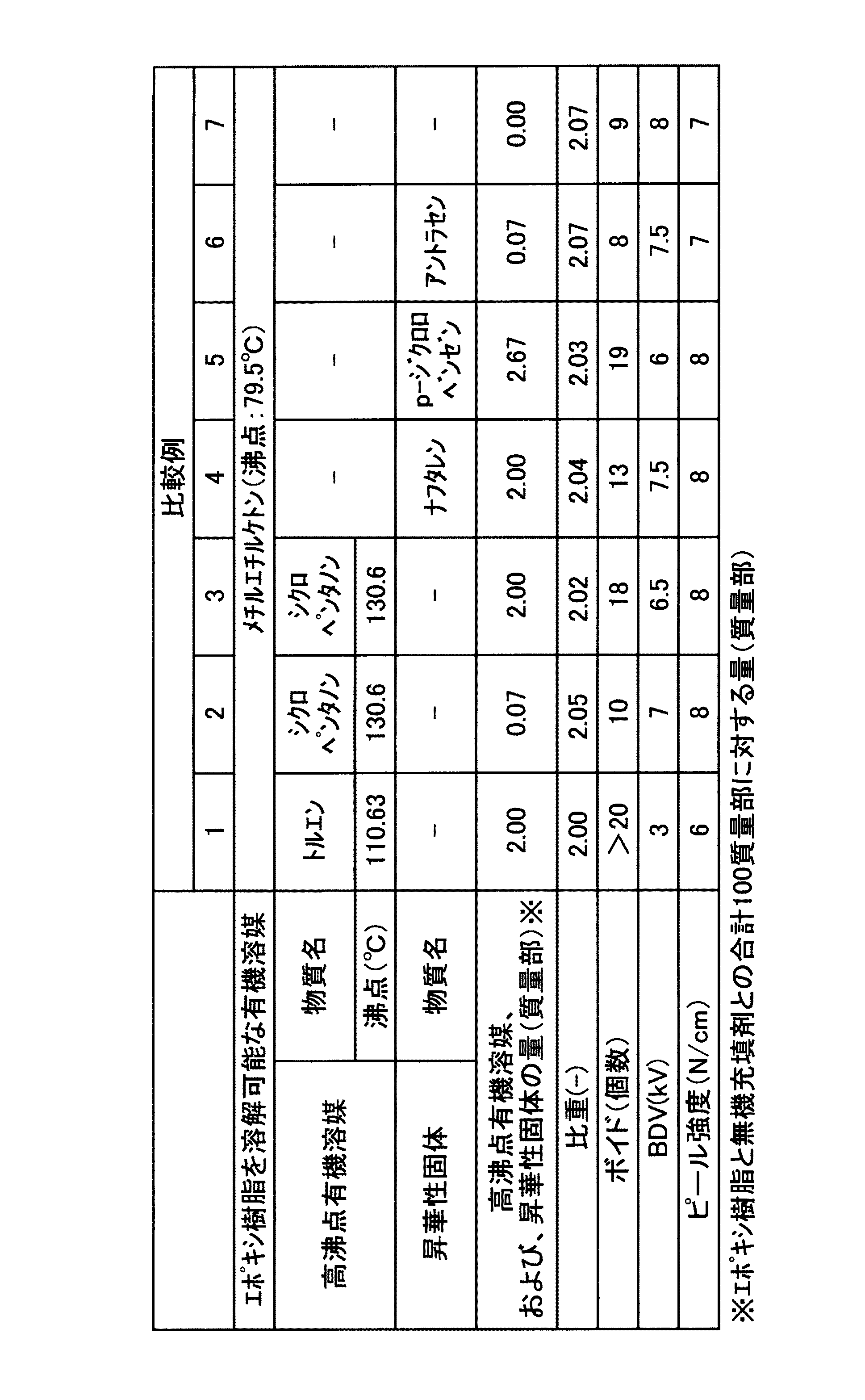
本発明の範囲内の樹脂組成物を用いて作製した実施例1〜8の絶縁シートは、比較例1〜7の絶縁シートに比べて、ボイドの個数が少なかった。
すなわち、本発明によれば、絶縁シートの作製時に絶縁シート内に混入するボイドや、被着体に熱溶着された際に被着体と絶縁シートとの間に生じるボイドを減少させることができる絶縁シート用樹脂組成物および絶縁シート、ならびにボイドが抑制された半導体モジュールを提供することができる。
また、本発明の範囲内の樹脂組成物を用いて作製した実施例1〜8の絶縁シートは、比較例1〜7の絶縁シートに比べて、BDV及びピール強度が高かった。
The insulating sheets of Examples 1-8 produced using the resin composition within the scope of the present invention had fewer voids than the insulating sheets of Comparative Examples 1-7.
That is, according to the present invention, it is possible to reduce voids mixed in the insulating sheet during the production of the insulating sheet and voids generated between the adherend and the insulating sheet when heat-welded to the adherend. It is possible to provide a resin composition for an insulating sheet, an insulating sheet, and a semiconductor module in which voids are suppressed.
Moreover, the insulating sheet of Examples 1-8 produced using the resin composition within the scope of the present invention had higher BDV and peel strength than the insulating sheets of Comparative Examples 1-7.
Claims (3)
前記有機溶媒よりも沸点が高い高沸点有機溶媒、および、昇華性固体の少なくとも一方をさらに含み、
前記高沸点有機溶媒および前記昇華性固体の含有量の合計が、前記エポキシ樹脂と前記無機充填剤との合計100質量部に対し0.1質量部以上1.5質量部以下であることを特徴とする絶縁シート用樹脂組成物。 An epoxy resin, an inorganic filler, and an organic solvent capable of dissolving the epoxy resin are applied to a substrate and dried to form a coating on the substrate. A resin composition for an insulating sheet used for forming an insulating sheet,
A high boiling point organic solvent having a boiling point higher than that of the organic solvent, and at least one of a sublimable solid,
The total content of the high-boiling organic solvent and the sublimable solid is 0.1 to 1.5 parts by mass with respect to 100 parts by mass in total of the epoxy resin and the inorganic filler. A resin composition for an insulating sheet.
請求項1に記載の絶縁シート用樹脂組成物を前記基材に塗布し、乾燥することにより形成された被膜たる絶縁層と、
を備えることを特徴とする絶縁シート。 A substrate;
An insulating layer as a coating formed by applying the resin composition for an insulating sheet according to claim 1 to the substrate and drying;
An insulating sheet comprising:
請求項2に記載の絶縁シートの絶縁層を前記半導体素子に熱溶着させることにより形成された絶縁部と、
を備えることを特徴とする半導体モジュール。 A semiconductor element;
An insulating part formed by thermally welding the insulating layer of the insulating sheet according to claim 2 to the semiconductor element;
A semiconductor module comprising:
Priority Applications (1)
| Application Number | Priority Date | Filing Date | Title |
|---|---|---|---|
| JP2013221524A JP2015081339A (en) | 2013-10-24 | 2013-10-24 | Resin composition for insulating sheet, insulating sheet, and semiconductor module |
Applications Claiming Priority (1)
| Application Number | Priority Date | Filing Date | Title |
|---|---|---|---|
| JP2013221524A JP2015081339A (en) | 2013-10-24 | 2013-10-24 | Resin composition for insulating sheet, insulating sheet, and semiconductor module |
Publications (1)
| Publication Number | Publication Date |
|---|---|
| JP2015081339A true JP2015081339A (en) | 2015-04-27 |
Family
ID=53012133
Family Applications (1)
| Application Number | Title | Priority Date | Filing Date |
|---|---|---|---|
| JP2013221524A Pending JP2015081339A (en) | 2013-10-24 | 2013-10-24 | Resin composition for insulating sheet, insulating sheet, and semiconductor module |
Country Status (1)
| Country | Link |
|---|---|
| JP (1) | JP2015081339A (en) |
Cited By (2)
| Publication number | Priority date | Publication date | Assignee | Title |
|---|---|---|---|---|
| JP2021103783A (en) * | 2016-10-19 | 2021-07-15 | 日東シンコー株式会社 | Semiconductor module and method for manufacturing semiconductor module |
| CN116574355A (en) * | 2023-04-21 | 2023-08-11 | 江苏长远电缆有限公司 | Insulating flame-retardant copper core cable and preparation method thereof |
Citations (6)
| Publication number | Priority date | Publication date | Assignee | Title |
|---|---|---|---|---|
| JPH10173097A (en) * | 1996-10-09 | 1998-06-26 | Matsushita Electric Ind Co Ltd | Sheet material for heat conductive substrate, method for manufacturing the same, and heat conductive substrate using the same and method for manufacturing the same |
| JPH11168112A (en) * | 1997-10-02 | 1999-06-22 | Matsushita Electric Ind Co Ltd | Semiconductor package and manufacturing method thereof |
| WO2013081061A1 (en) * | 2011-11-29 | 2013-06-06 | 三菱化学株式会社 | Aggregated boron nitride particles, composition containing said particles, and three-dimensional integrated circuit having layer comprising said composition |
| WO2013100502A1 (en) * | 2011-12-28 | 2013-07-04 | 주식회사 포스코 | Insulating adhesive composition for metal-based copper clad laminate (mccl), coated metal plate using same, and method for manufacturing same |
| JP2013145841A (en) * | 2012-01-16 | 2013-07-25 | Mitsubishi Chemicals Corp | Application liquid for formation of interlayer packed bed layer of three-dimensional integrated circuit and three-dimensional integrated circuit manufacturing method |
| JP2013145840A (en) * | 2012-01-16 | 2013-07-25 | Mitsubishi Chemicals Corp | Application liquid for formation of interlayer packed bed layer of three-dimensional integrated circuit and three-dimensional integrated circuit manufacturing method |
-
2013
- 2013-10-24 JP JP2013221524A patent/JP2015081339A/en active Pending
Patent Citations (6)
| Publication number | Priority date | Publication date | Assignee | Title |
|---|---|---|---|---|
| JPH10173097A (en) * | 1996-10-09 | 1998-06-26 | Matsushita Electric Ind Co Ltd | Sheet material for heat conductive substrate, method for manufacturing the same, and heat conductive substrate using the same and method for manufacturing the same |
| JPH11168112A (en) * | 1997-10-02 | 1999-06-22 | Matsushita Electric Ind Co Ltd | Semiconductor package and manufacturing method thereof |
| WO2013081061A1 (en) * | 2011-11-29 | 2013-06-06 | 三菱化学株式会社 | Aggregated boron nitride particles, composition containing said particles, and three-dimensional integrated circuit having layer comprising said composition |
| WO2013100502A1 (en) * | 2011-12-28 | 2013-07-04 | 주식회사 포스코 | Insulating adhesive composition for metal-based copper clad laminate (mccl), coated metal plate using same, and method for manufacturing same |
| JP2013145841A (en) * | 2012-01-16 | 2013-07-25 | Mitsubishi Chemicals Corp | Application liquid for formation of interlayer packed bed layer of three-dimensional integrated circuit and three-dimensional integrated circuit manufacturing method |
| JP2013145840A (en) * | 2012-01-16 | 2013-07-25 | Mitsubishi Chemicals Corp | Application liquid for formation of interlayer packed bed layer of three-dimensional integrated circuit and three-dimensional integrated circuit manufacturing method |
Cited By (3)
| Publication number | Priority date | Publication date | Assignee | Title |
|---|---|---|---|---|
| JP2021103783A (en) * | 2016-10-19 | 2021-07-15 | 日東シンコー株式会社 | Semiconductor module and method for manufacturing semiconductor module |
| JP7240432B2 (en) | 2016-10-19 | 2023-03-15 | 日東シンコー株式会社 | Semiconductor module and method for manufacturing semiconductor module |
| CN116574355A (en) * | 2023-04-21 | 2023-08-11 | 江苏长远电缆有限公司 | Insulating flame-retardant copper core cable and preparation method thereof |
Similar Documents
| Publication | Publication Date | Title |
|---|---|---|
| JP7073716B2 (en) | Thermally conductive resin compositions, thermally conductive sheets and semiconductor devices | |
| TWI548692B (en) | Resin composition, resin sheet, resin sheet with metal foil, resin cured sheet, structure, and semiconductor element for power or light source | |
| JP2013189625A (en) | High thermal conductive resin cured product, high thermal conductive semicured resin film, and high thermal conductive resin composition | |
| JP6656792B2 (en) | Liquid resin composition for electronic component and electronic component device | |
| JP2019006837A (en) | Heat-conductive sheet and semiconductor module | |
| JP2010116453A (en) | Film adhesive, semiconductor package using the same, and method for producing semiconductor package | |
| JP5681432B2 (en) | Epoxy resin composition and semiconductor device using the same | |
| CN105244334A (en) | Thermally conductive sheet, cured product thereof, and semiconductor device | |
| KR101585271B1 (en) | Epoxy resin composition for semiconductor encapsulation and semiconductor device using the same | |
| TW201320260A (en) | Method for manufacturing parts for laminated body and power semiconductor module | |
| JP2017098376A (en) | Resin composition, circuit board, exothermic body-mounted substrate and circuit board manufacturing method | |
| JP5725559B2 (en) | Liquid conductive resin composition and electronic component | |
| JP2018148124A (en) | Sealing sheet and method for manufacturing semiconductor device | |
| JP6106389B2 (en) | Pre-installed semiconductor sealing film | |
| JP2015081339A (en) | Resin composition for insulating sheet, insulating sheet, and semiconductor module | |
| JP7005906B2 (en) | Multi-layer resin sheet, manufacturing method of multi-layer resin sheet, multi-layer resin sheet cured product, multi-layer resin sheet laminate, and multi-layer resin sheet laminate cured product | |
| JPWO2013080732A1 (en) | One-part epoxy resin composition | |
| JP6536882B2 (en) | Resin composition, cured product and thermally conductive material | |
| JP2014231536A (en) | Resin composition and adhesive | |
| KR20240017803A (en) | Resin sheets, laminates, and semiconductor devices | |
| TWI797222B (en) | Sealing composition and semiconductor device | |
| JP6021150B2 (en) | Low temperature resistant resin composition and superconducting wire using the same | |
| JP2012193284A (en) | Liquid epoxy resin composition | |
| JP6540590B2 (en) | Liquid conductive resin composition and electronic component | |
| JP2009062413A (en) | Adhesive composition and die bond film |
Legal Events
| Date | Code | Title | Description |
|---|---|---|---|
| A621 | Written request for application examination |
Free format text: JAPANESE INTERMEDIATE CODE: A621 Effective date: 20161024 |
|
| A977 | Report on retrieval |
Free format text: JAPANESE INTERMEDIATE CODE: A971007 Effective date: 20170622 |
|
| A131 | Notification of reasons for refusal |
Free format text: JAPANESE INTERMEDIATE CODE: A131 Effective date: 20170728 |
|
| A02 | Decision of refusal |
Free format text: JAPANESE INTERMEDIATE CODE: A02 Effective date: 20180202 |