JP2014525499A - Heat resistant liquid crystal polymer composition with low melting temperature - Google Patents
Heat resistant liquid crystal polymer composition with low melting temperature Download PDFInfo
- Publication number
- JP2014525499A JP2014525499A JP2014528486A JP2014528486A JP2014525499A JP 2014525499 A JP2014525499 A JP 2014525499A JP 2014528486 A JP2014528486 A JP 2014528486A JP 2014528486 A JP2014528486 A JP 2014528486A JP 2014525499 A JP2014525499 A JP 2014525499A
- Authority
- JP
- Japan
- Prior art keywords
- polymer composition
- polymer
- aromatic
- liquid crystal
- temperature
- Prior art date
- Legal status (The legal status is an assumption and is not a legal conclusion. Google has not performed a legal analysis and makes no representation as to the accuracy of the status listed.)
- Pending
Links
- 239000000203 mixture Substances 0.000 title claims abstract description 160
- 238000002844 melting Methods 0.000 title claims abstract description 60
- 230000008018 melting Effects 0.000 title claims abstract description 60
- 229920000106 Liquid crystal polymer Polymers 0.000 title claims abstract description 46
- 239000004977 Liquid-crystal polymers (LCPs) Substances 0.000 title claims description 36
- 229920000642 polymer Polymers 0.000 claims abstract description 136
- 150000008430 aromatic amides Chemical class 0.000 claims abstract description 33
- 239000004974 Thermotropic liquid crystal Substances 0.000 claims abstract description 9
- 125000003118 aryl group Chemical group 0.000 claims description 81
- IJGRMHOSHXDMSA-UHFFFAOYSA-N nitrogen Substances N#N IJGRMHOSHXDMSA-UHFFFAOYSA-N 0.000 claims description 67
- 150000001875 compounds Chemical class 0.000 claims description 47
- KKEYFWRCBNTPAC-UHFFFAOYSA-N Terephthalic acid Chemical compound OC(=O)C1=CC=C(C(O)=O)C=C1 KKEYFWRCBNTPAC-UHFFFAOYSA-N 0.000 claims description 46
- 239000000835 fiber Substances 0.000 claims description 43
- 238000012360 testing method Methods 0.000 claims description 38
- FJKROLUGYXJWQN-UHFFFAOYSA-N 4-hydroxybenzoic acid Chemical compound OC(=O)C1=CC=C(O)C=C1 FJKROLUGYXJWQN-UHFFFAOYSA-N 0.000 claims description 35
- 125000000753 cycloalkyl group Chemical group 0.000 claims description 31
- 125000000623 heterocyclic group Chemical group 0.000 claims description 31
- 125000001072 heteroaryl group Chemical group 0.000 claims description 28
- 229910052757 nitrogen Inorganic materials 0.000 claims description 26
- 239000000155 melt Substances 0.000 claims description 22
- 125000000217 alkyl group Chemical group 0.000 claims description 21
- QIGBRXMKCJKVMJ-UHFFFAOYSA-N Hydroquinone Chemical compound OC1=CC=C(O)C=C1 QIGBRXMKCJKVMJ-UHFFFAOYSA-N 0.000 claims description 18
- 125000003342 alkenyl group Chemical group 0.000 claims description 16
- VCCBEIPGXKNHFW-UHFFFAOYSA-N biphenyl-4,4'-diol Chemical compound C1=CC(O)=CC=C1C1=CC=C(O)C=C1 VCCBEIPGXKNHFW-UHFFFAOYSA-N 0.000 claims description 15
- 125000004432 carbon atom Chemical group C* 0.000 claims description 15
- QQVIHTHCMHWDBS-UHFFFAOYSA-N isophthalic acid Chemical compound OC(=O)C1=CC=CC(C(O)=O)=C1 QQVIHTHCMHWDBS-UHFFFAOYSA-N 0.000 claims description 14
- 229920000728 polyester Polymers 0.000 claims description 14
- 229940090248 4-hydroxybenzoic acid Drugs 0.000 claims description 13
- 239000000945 filler Substances 0.000 claims description 13
- 125000001188 haloalkyl group Chemical group 0.000 claims description 12
- BVKZGUZCCUSVTD-UHFFFAOYSA-N carbonic acid Chemical compound OC(O)=O BVKZGUZCCUSVTD-UHFFFAOYSA-N 0.000 claims description 10
- OFOBLEOULBTSOW-UHFFFAOYSA-N Malonic acid Chemical compound OC(=O)CC(O)=O OFOBLEOULBTSOW-UHFFFAOYSA-N 0.000 claims description 9
- 150000001408 amides Chemical group 0.000 claims description 9
- 125000001997 phenyl group Chemical group [H]C1=C([H])C([H])=C(*)C([H])=C1[H] 0.000 claims description 9
- 125000000304 alkynyl group Chemical group 0.000 claims description 8
- 239000002557 mineral fiber Substances 0.000 claims description 6
- QVGXLLKOCUKJST-UHFFFAOYSA-N atomic oxygen Chemical group [O] QVGXLLKOCUKJST-UHFFFAOYSA-N 0.000 claims description 5
- 239000001301 oxygen Chemical group 0.000 claims description 5
- 229910052760 oxygen Chemical group 0.000 claims description 5
- PJVAPHXHPNGKDB-UHFFFAOYSA-N 1-n,3-n,5-n-triphenylbenzene-1,3,5-tricarboxamide Chemical compound C=1C(C(=O)NC=2C=CC=CC=2)=CC(C(=O)NC=2C=CC=CC=2)=CC=1C(=O)NC1=CC=CC=C1 PJVAPHXHPNGKDB-UHFFFAOYSA-N 0.000 claims description 3
- MXHDSBYJGVZESK-UHFFFAOYSA-N 1-n,4-n-diphenylbenzene-1,4-dicarboxamide Chemical group C=1C=C(C(=O)NC=2C=CC=CC=2)C=CC=1C(=O)NC1=CC=CC=C1 MXHDSBYJGVZESK-UHFFFAOYSA-N 0.000 claims description 3
- 150000001991 dicarboxylic acids Chemical class 0.000 claims description 3
- 125000001624 naphthyl group Chemical group 0.000 claims description 3
- QJGQUHMNIGDVPM-UHFFFAOYSA-N nitrogen group Chemical group [N] QJGQUHMNIGDVPM-UHFFFAOYSA-N 0.000 claims description 3
- QZUPTXGVPYNUIT-UHFFFAOYSA-N isophthalamide Chemical compound NC(=O)C1=CC=CC(C(N)=O)=C1 QZUPTXGVPYNUIT-UHFFFAOYSA-N 0.000 claims description 2
- MHSKRLJMQQNJNC-UHFFFAOYSA-N terephthalamide Chemical compound NC(=O)C1=CC=C(C(N)=O)C=C1 MHSKRLJMQQNJNC-UHFFFAOYSA-N 0.000 claims description 2
- 125000001475 halogen functional group Chemical group 0.000 claims 5
- HNNQYHFROJDYHQ-UHFFFAOYSA-N 3-(4-ethylcyclohexyl)propanoic acid 3-(3-ethylcyclopentyl)propanoic acid Chemical compound CCC1CCC(CCC(O)=O)C1.CCC1CCC(CCC(O)=O)CC1 HNNQYHFROJDYHQ-UHFFFAOYSA-N 0.000 abstract description 6
- 230000001747 exhibiting effect Effects 0.000 abstract 1
- -1 aromatic hydroxy acid Chemical class 0.000 description 49
- WFDIJRYMOXRFFG-UHFFFAOYSA-N Acetic anhydride Chemical compound CC(=O)OC(C)=O WFDIJRYMOXRFFG-UHFFFAOYSA-N 0.000 description 42
- QTBSBXVTEAMEQO-UHFFFAOYSA-N Acetic acid Chemical compound CC(O)=O QTBSBXVTEAMEQO-UHFFFAOYSA-N 0.000 description 39
- 238000006243 chemical reaction Methods 0.000 description 37
- 239000000523 sample Substances 0.000 description 32
- 239000011521 glass Substances 0.000 description 31
- 239000000047 product Substances 0.000 description 27
- XLYOFNOQVPJJNP-UHFFFAOYSA-N water Substances O XLYOFNOQVPJJNP-UHFFFAOYSA-N 0.000 description 27
- 230000015572 biosynthetic process Effects 0.000 description 24
- 239000000178 monomer Substances 0.000 description 22
- 239000011541 reaction mixture Substances 0.000 description 22
- 238000003786 synthesis reaction Methods 0.000 description 20
- KAUQJMHLAFIZDU-UHFFFAOYSA-N 6-Hydroxy-2-naphthoic acid Chemical compound C1=C(O)C=CC2=CC(C(=O)O)=CC=C21 KAUQJMHLAFIZDU-UHFFFAOYSA-N 0.000 description 19
- 238000002156 mixing Methods 0.000 description 19
- 238000006116 polymerization reaction Methods 0.000 description 19
- RZVAJINKPMORJF-UHFFFAOYSA-N Acetaminophen Chemical compound CC(=O)NC1=CC=C(O)C=C1 RZVAJINKPMORJF-UHFFFAOYSA-N 0.000 description 18
- 239000003365 glass fiber Substances 0.000 description 18
- 239000007787 solid Substances 0.000 description 18
- 239000008188 pellet Substances 0.000 description 17
- 229940126062 Compound A Drugs 0.000 description 16
- NLDMNSXOCDLTTB-UHFFFAOYSA-N Heterophylliin A Natural products O1C2COC(=O)C3=CC(O)=C(O)C(O)=C3C3=C(O)C(O)=C(O)C=C3C(=O)OC2C(OC(=O)C=2C=C(O)C(O)=C(O)C=2)C(O)C1OC(=O)C1=CC(O)=C(O)C(O)=C1 NLDMNSXOCDLTTB-UHFFFAOYSA-N 0.000 description 16
- 238000012512 characterization method Methods 0.000 description 16
- SCVFZCLFOSHCOH-UHFFFAOYSA-M potassium acetate Chemical compound [K+].CC([O-])=O SCVFZCLFOSHCOH-UHFFFAOYSA-M 0.000 description 16
- 238000000425 proton nuclear magnetic resonance spectrum Methods 0.000 description 16
- RXOHFPCZGPKIRD-UHFFFAOYSA-N naphthalene-2,6-dicarboxylic acid Chemical group C1=C(C(O)=O)C=CC2=CC(C(=O)O)=CC=C21 RXOHFPCZGPKIRD-UHFFFAOYSA-N 0.000 description 15
- CSCPPACGZOOCGX-UHFFFAOYSA-N Acetone Chemical compound CC(C)=O CSCPPACGZOOCGX-UHFFFAOYSA-N 0.000 description 14
- FXHOOIRPVKKKFG-UHFFFAOYSA-N N,N-Dimethylacetamide Chemical compound CN(C)C(C)=O FXHOOIRPVKKKFG-UHFFFAOYSA-N 0.000 description 14
- 125000005843 halogen group Chemical group 0.000 description 14
- 239000000463 material Substances 0.000 description 14
- 238000010438 heat treatment Methods 0.000 description 13
- 238000000034 method Methods 0.000 description 13
- 238000010992 reflux Methods 0.000 description 12
- 238000003756 stirring Methods 0.000 description 12
- 239000000314 lubricant Substances 0.000 description 11
- NGNBDVOYPDDBFK-UHFFFAOYSA-N 2-[2,4-di(pentan-2-yl)phenoxy]acetyl chloride Chemical compound CCCC(C)C1=CC=C(OCC(Cl)=O)C(C(C)CCC)=C1 NGNBDVOYPDDBFK-UHFFFAOYSA-N 0.000 description 10
- 239000006227 byproduct Substances 0.000 description 10
- 239000007789 gas Substances 0.000 description 10
- VYPSYNLAJGMNEJ-UHFFFAOYSA-N Silicium dioxide Chemical compound O=[Si]=O VYPSYNLAJGMNEJ-UHFFFAOYSA-N 0.000 description 9
- 230000021736 acetylation Effects 0.000 description 9
- 238000006640 acetylation reaction Methods 0.000 description 9
- 125000004122 cyclic group Chemical group 0.000 description 9
- 239000000243 solution Substances 0.000 description 9
- PAYRUJLWNCNPSJ-UHFFFAOYSA-N Aniline Chemical compound NC1=CC=CC=C1 PAYRUJLWNCNPSJ-UHFFFAOYSA-N 0.000 description 8
- FDQSRULYDNDXQB-UHFFFAOYSA-N benzene-1,3-dicarbonyl chloride Chemical compound ClC(=O)C1=CC=CC(C(Cl)=O)=C1 FDQSRULYDNDXQB-UHFFFAOYSA-N 0.000 description 8
- PASDCCFISLVPSO-UHFFFAOYSA-N benzoyl chloride Chemical compound ClC(=O)C1=CC=CC=C1 PASDCCFISLVPSO-UHFFFAOYSA-N 0.000 description 8
- 229910052799 carbon Inorganic materials 0.000 description 8
- 239000012043 crude product Substances 0.000 description 8
- 230000003247 decreasing effect Effects 0.000 description 8
- 239000006185 dispersion Substances 0.000 description 8
- 238000004821 distillation Methods 0.000 description 8
- FVIZARNDLVOMSU-UHFFFAOYSA-N ginsenoside K Natural products C1CC(C2(CCC3C(C)(C)C(O)CCC3(C)C2CC2O)C)(C)C2C1C(C)(CCC=C(C)C)OC1OC(CO)C(O)C(O)C1O FVIZARNDLVOMSU-UHFFFAOYSA-N 0.000 description 8
- 125000005842 heteroatom Chemical group 0.000 description 8
- 238000002347 injection Methods 0.000 description 8
- 239000007924 injection Substances 0.000 description 8
- 235000011056 potassium acetate Nutrition 0.000 description 8
- 238000010926 purge Methods 0.000 description 8
- 238000003556 assay Methods 0.000 description 7
- 208000029618 autoimmune pulmonary alveolar proteinosis Diseases 0.000 description 7
- 238000010128 melt processing Methods 0.000 description 7
- 239000000843 powder Substances 0.000 description 7
- 239000002002 slurry Substances 0.000 description 7
- LXEJRKJRKIFVNY-UHFFFAOYSA-N terephthaloyl chloride Chemical compound ClC(=O)C1=CC=C(C(Cl)=O)C=C1 LXEJRKJRKIFVNY-UHFFFAOYSA-N 0.000 description 7
- OCKWAZCWKSMKNC-UHFFFAOYSA-N [3-octadecanoyloxy-2,2-bis(octadecanoyloxymethyl)propyl] octadecanoate Chemical compound CCCCCCCCCCCCCCCCCC(=O)OCC(COC(=O)CCCCCCCCCCCCCCCCC)(COC(=O)CCCCCCCCCCCCCCCCC)COC(=O)CCCCCCCCCCCCCCCCC OCKWAZCWKSMKNC-UHFFFAOYSA-N 0.000 description 6
- 238000012863 analytical testing Methods 0.000 description 6
- UWCPYKQBIPYOLX-UHFFFAOYSA-N benzene-1,3,5-tricarbonyl chloride Chemical compound ClC(=O)C1=CC(C(Cl)=O)=CC(C(Cl)=O)=C1 UWCPYKQBIPYOLX-UHFFFAOYSA-N 0.000 description 6
- 150000004985 diamines Chemical class 0.000 description 6
- 235000014113 dietary fatty acids Nutrition 0.000 description 6
- 239000012153 distilled water Substances 0.000 description 6
- 239000000194 fatty acid Substances 0.000 description 6
- 229930195729 fatty acid Natural products 0.000 description 6
- 239000012530 fluid Substances 0.000 description 6
- 238000006068 polycondensation reaction Methods 0.000 description 6
- 239000002243 precursor Substances 0.000 description 6
- 239000004576 sand Substances 0.000 description 6
- WZCQRUWWHSTZEM-UHFFFAOYSA-N 1,3-phenylenediamine Chemical compound NC1=CC=CC(N)=C1 WZCQRUWWHSTZEM-UHFFFAOYSA-N 0.000 description 5
- XBNGYFFABRKICK-UHFFFAOYSA-N 2,3,4,5,6-pentafluorophenol Chemical compound OC1=C(F)C(F)=C(F)C(F)=C1F XBNGYFFABRKICK-UHFFFAOYSA-N 0.000 description 5
- JCJUKCIXTRWAQY-UHFFFAOYSA-N 6-hydroxynaphthalene-1-carboxylic acid Chemical compound OC1=CC=C2C(C(=O)O)=CC=CC2=C1 JCJUKCIXTRWAQY-UHFFFAOYSA-N 0.000 description 5
- SECXISVLQFMRJM-UHFFFAOYSA-N N-Methylpyrrolidone Chemical compound CN1CCCC1=O SECXISVLQFMRJM-UHFFFAOYSA-N 0.000 description 5
- 125000003545 alkoxy group Chemical group 0.000 description 5
- 125000003368 amide group Chemical group 0.000 description 5
- 238000005452 bending Methods 0.000 description 5
- 239000003054 catalyst Substances 0.000 description 5
- 230000000052 comparative effect Effects 0.000 description 5
- 238000001816 cooling Methods 0.000 description 5
- 125000000113 cyclohexyl group Chemical group [H]C1([H])C([H])([H])C([H])([H])C([H])(*)C([H])([H])C1([H])[H] 0.000 description 5
- 238000001125 extrusion Methods 0.000 description 5
- 229910052739 hydrogen Inorganic materials 0.000 description 5
- 239000001257 hydrogen Substances 0.000 description 5
- 239000007788 liquid Substances 0.000 description 5
- 239000010445 mica Substances 0.000 description 5
- 229910052618 mica group Inorganic materials 0.000 description 5
- 125000006574 non-aromatic ring group Chemical group 0.000 description 5
- 229960005489 paracetamol Drugs 0.000 description 5
- IZUPBVBPLAPZRR-UHFFFAOYSA-N pentachloro-phenol Natural products OC1=C(Cl)C(Cl)=C(Cl)C(Cl)=C1Cl IZUPBVBPLAPZRR-UHFFFAOYSA-N 0.000 description 5
- 239000002904 solvent Substances 0.000 description 5
- BYEAHWXPCBROCE-UHFFFAOYSA-N 1,1,1,3,3,3-hexafluoropropan-2-ol Chemical compound FC(F)(F)C(O)C(F)(F)F BYEAHWXPCBROCE-UHFFFAOYSA-N 0.000 description 4
- XCHARIIIZLLEBL-UHFFFAOYSA-N Medicagenic acid 3-O-beta-D-glucoside Chemical compound C12CC(C)(C)CCC2(C(O)=O)CCC(C2(CCC3C4(C)C(O)=O)C)(C)C1=CCC2C3(C)CC(O)C4OC1OC(CO)C(O)C(O)C1O XCHARIIIZLLEBL-UHFFFAOYSA-N 0.000 description 4
- 239000002253 acid Substances 0.000 description 4
- 150000001412 amines Chemical class 0.000 description 4
- 150000004982 aromatic amines Chemical class 0.000 description 4
- PAFZNILMFXTMIY-UHFFFAOYSA-N cyclohexylamine Chemical compound NC1CCCCC1 PAFZNILMFXTMIY-UHFFFAOYSA-N 0.000 description 4
- 238000009826 distribution Methods 0.000 description 4
- 230000000694 effects Effects 0.000 description 4
- 150000002148 esters Chemical class 0.000 description 4
- 150000004665 fatty acids Chemical class 0.000 description 4
- 229910052731 fluorine Inorganic materials 0.000 description 4
- 125000001183 hydrocarbyl group Chemical group 0.000 description 4
- 239000003112 inhibitor Substances 0.000 description 4
- 239000011159 matrix material Substances 0.000 description 4
- 238000005259 measurement Methods 0.000 description 4
- 239000012071 phase Substances 0.000 description 4
- 238000001556 precipitation Methods 0.000 description 4
- 229920005989 resin Polymers 0.000 description 4
- 239000011347 resin Substances 0.000 description 4
- 150000003839 salts Chemical class 0.000 description 4
- 125000000472 sulfonyl group Chemical group *S(*)(=O)=O 0.000 description 4
- 238000003828 vacuum filtration Methods 0.000 description 4
- 239000001993 wax Substances 0.000 description 4
- 125000001989 1,3-phenylene group Chemical group [H]C1=C([H])C([*:1])=C([H])C([*:2])=C1[H] 0.000 description 3
- CBCKQZAAMUWICA-UHFFFAOYSA-N 1,4-phenylenediamine Chemical compound NC1=CC=C(N)C=C1 CBCKQZAAMUWICA-UHFFFAOYSA-N 0.000 description 3
- QBEGUJJUQJROPC-UHFFFAOYSA-N 1-n,4-n-bis(2,3,4,5,6-pentafluorophenyl)benzene-1,4-dicarboxamide Chemical compound FC1=C(F)C(F)=C(F)C(F)=C1NC(=O)C1=CC=C(C(=O)NC=2C(=C(F)C(F)=C(F)C=2F)F)C=C1 QBEGUJJUQJROPC-UHFFFAOYSA-N 0.000 description 3
- 239000005711 Benzoic acid Substances 0.000 description 3
- NINIDFKCEFEMDL-UHFFFAOYSA-N Sulfur Chemical group [S] NINIDFKCEFEMDL-UHFFFAOYSA-N 0.000 description 3
- ZMANZCXQSJIPKH-UHFFFAOYSA-N Triethylamine Chemical compound CCN(CC)CC ZMANZCXQSJIPKH-UHFFFAOYSA-N 0.000 description 3
- 230000002411 adverse Effects 0.000 description 3
- 238000013019 agitation Methods 0.000 description 3
- 229910052782 aluminium Inorganic materials 0.000 description 3
- 230000008901 benefit Effects 0.000 description 3
- 125000006297 carbonyl amino group Chemical group [H]N([*:2])C([*:1])=O 0.000 description 3
- 239000002734 clay mineral Substances 0.000 description 3
- 238000002425 crystallisation Methods 0.000 description 3
- 230000008025 crystallization Effects 0.000 description 3
- 150000002430 hydrocarbons Chemical group 0.000 description 3
- 125000004435 hydrogen atom Chemical group [H]* 0.000 description 3
- 238000011068 loading method Methods 0.000 description 3
- 229920006149 polyester-amide block copolymer Polymers 0.000 description 3
- 229920000098 polyolefin Polymers 0.000 description 3
- 230000008569 process Effects 0.000 description 3
- 238000012545 processing Methods 0.000 description 3
- LVTJOONKWUXEFR-FZRMHRINSA-N protoneodioscin Natural products O(C[C@@H](CC[C@]1(O)[C@H](C)[C@@H]2[C@]3(C)[C@H]([C@H]4[C@@H]([C@]5(C)C(=CC4)C[C@@H](O[C@@H]4[C@H](O[C@H]6[C@@H](O)[C@@H](O)[C@@H](O)[C@H](C)O6)[C@@H](O)[C@H](O[C@H]6[C@@H](O)[C@@H](O)[C@@H](O)[C@H](C)O6)[C@H](CO)O4)CC5)CC3)C[C@@H]2O1)C)[C@H]1[C@H](O)[C@H](O)[C@H](O)[C@@H](CO)O1 LVTJOONKWUXEFR-FZRMHRINSA-N 0.000 description 3
- 125000004076 pyridyl group Chemical group 0.000 description 3
- 230000009257 reactivity Effects 0.000 description 3
- 229910052710 silicon Inorganic materials 0.000 description 3
- 239000007790 solid phase Substances 0.000 description 3
- 238000012546 transfer Methods 0.000 description 3
- 238000005406 washing Methods 0.000 description 3
- BBNZIYNCVZBYKF-UHFFFAOYSA-N 1-n,3-n,5-n-tris(4-benzamidophenyl)benzene-1,3,5-tricarboxamide Chemical compound C=1C=CC=CC=1C(=O)NC(C=C1)=CC=C1NC(=O)C(C=1)=CC(C(=O)NC=2C=CC(NC(=O)C=3C=CC=CC=3)=CC=2)=CC=1C(=O)NC(C=C1)=CC=C1NC(=O)C1=CC=CC=C1 BBNZIYNCVZBYKF-UHFFFAOYSA-N 0.000 description 2
- GHTLTLVBCHOKGE-UHFFFAOYSA-N 1-n,3-n-bis(3-benzamidophenyl)benzene-1,3-dicarboxamide Chemical compound C=1C=CC=CC=1C(=O)NC(C=1)=CC=CC=1NC(=O)C(C=1)=CC=CC=1C(=O)NC(C=1)=CC=CC=1NC(=O)C1=CC=CC=C1 GHTLTLVBCHOKGE-UHFFFAOYSA-N 0.000 description 2
- YCLPOBBVLABQIW-UHFFFAOYSA-N 1-n,3-n-bis(4-benzamidophenyl)benzene-1,3-dicarboxamide Chemical compound C=1C=CC=CC=1C(=O)NC(C=C1)=CC=C1NC(=O)C(C=1)=CC=CC=1C(=O)NC(C=C1)=CC=C1NC(=O)C1=CC=CC=C1 YCLPOBBVLABQIW-UHFFFAOYSA-N 0.000 description 2
- 238000005160 1H NMR spectroscopy Methods 0.000 description 2
- NOXLGCOSAFGMDV-UHFFFAOYSA-N 2,3,4,5,6-pentafluoroaniline Chemical compound NC1=C(F)C(F)=C(F)C(F)=C1F NOXLGCOSAFGMDV-UHFFFAOYSA-N 0.000 description 2
- WVDRSXGPQWNUBN-UHFFFAOYSA-N 4-(4-carboxyphenoxy)benzoic acid Chemical compound C1=CC(C(=O)O)=CC=C1OC1=CC=C(C(O)=O)C=C1 WVDRSXGPQWNUBN-UHFFFAOYSA-N 0.000 description 2
- QHWDUJPWCGEBTH-UHFFFAOYSA-N 4-amino-n-phenylbenzamide Chemical compound C1=CC(N)=CC=C1C(=O)NC1=CC=CC=C1 QHWDUJPWCGEBTH-UHFFFAOYSA-N 0.000 description 2
- 239000004215 Carbon black (E152) Substances 0.000 description 2
- PXGOKWXKJXAPGV-UHFFFAOYSA-N Fluorine Chemical compound FF PXGOKWXKJXAPGV-UHFFFAOYSA-N 0.000 description 2
- 235000021355 Stearic acid Nutrition 0.000 description 2
- 239000012345 acetylating agent Substances 0.000 description 2
- 239000000654 additive Substances 0.000 description 2
- 239000004760 aramid Substances 0.000 description 2
- 229920003235 aromatic polyamide Polymers 0.000 description 2
- 125000004429 atom Chemical group 0.000 description 2
- 229910052626 biotite Inorganic materials 0.000 description 2
- CJZGTCYPCWQAJB-UHFFFAOYSA-L calcium stearate Chemical compound [Ca+2].CCCCCCCCCCCCCCCCCC([O-])=O.CCCCCCCCCCCCCCCCCC([O-])=O CJZGTCYPCWQAJB-UHFFFAOYSA-L 0.000 description 2
- 239000008116 calcium stearate Substances 0.000 description 2
- 235000013539 calcium stearate Nutrition 0.000 description 2
- JNGZXGGOCLZBFB-IVCQMTBJSA-N compound E Chemical compound N([C@@H](C)C(=O)N[C@@H]1C(N(C)C2=CC=CC=C2C(C=2C=CC=CC=2)=N1)=O)C(=O)CC1=CC(F)=CC(F)=C1 JNGZXGGOCLZBFB-IVCQMTBJSA-N 0.000 description 2
- 239000013068 control sample Substances 0.000 description 2
- 125000000392 cycloalkenyl group Chemical group 0.000 description 2
- 238000013461 design Methods 0.000 description 2
- ANCLJVISBRWUTR-UHFFFAOYSA-N diaminophosphinic acid Chemical compound NP(N)(O)=O ANCLJVISBRWUTR-UHFFFAOYSA-N 0.000 description 2
- 238000001914 filtration Methods 0.000 description 2
- 239000011737 fluorine Substances 0.000 description 2
- 230000005484 gravity Effects 0.000 description 2
- 229910052621 halloysite Inorganic materials 0.000 description 2
- 125000000592 heterocycloalkyl group Chemical group 0.000 description 2
- IPCSVZSSVZVIGE-UHFFFAOYSA-N hexadecanoic acid Chemical compound CCCCCCCCCCCCCCCC(O)=O IPCSVZSSVZVIGE-UHFFFAOYSA-N 0.000 description 2
- 229930195733 hydrocarbon Natural products 0.000 description 2
- 125000002887 hydroxy group Chemical group [H]O* 0.000 description 2
- VKOBVWXKNCXXDE-UHFFFAOYSA-N icosanoic acid Chemical compound CCCCCCCCCCCCCCCCCCCC(O)=O VKOBVWXKNCXXDE-UHFFFAOYSA-N 0.000 description 2
- 229910052900 illite Inorganic materials 0.000 description 2
- 125000002883 imidazolyl group Chemical group 0.000 description 2
- 125000005956 isoquinolyl group Chemical group 0.000 description 2
- 229910052622 kaolinite Inorganic materials 0.000 description 2
- 239000004973 liquid crystal related substance Substances 0.000 description 2
- HQKMJHAJHXVSDF-UHFFFAOYSA-L magnesium stearate Chemical compound [Mg+2].CCCCCCCCCCCCCCCCCC([O-])=O.CCCCCCCCCCCCCCCCCC([O-])=O HQKMJHAJHXVSDF-UHFFFAOYSA-L 0.000 description 2
- 238000010309 melting process Methods 0.000 description 2
- 229910052751 metal Inorganic materials 0.000 description 2
- 239000002184 metal Substances 0.000 description 2
- 229910052627 muscovite Inorganic materials 0.000 description 2
- RKISUIUJZGSLEV-UHFFFAOYSA-N n-[2-(octadecanoylamino)ethyl]octadecanamide Chemical compound CCCCCCCCCCCCCCCCCC(=O)NCCNC(=O)CCCCCCCCCCCCCCCCC RKISUIUJZGSLEV-UHFFFAOYSA-N 0.000 description 2
- 125000005608 naphthenic acid group Chemical group 0.000 description 2
- UTOPWMOLSKOLTQ-UHFFFAOYSA-N octacosanoic acid Chemical compound CCCCCCCCCCCCCCCCCCCCCCCCCCCC(O)=O UTOPWMOLSKOLTQ-UHFFFAOYSA-N 0.000 description 2
- QIQXTHQIDYTFRH-UHFFFAOYSA-N octadecanoic acid Chemical compound CCCCCCCCCCCCCCCCCC(O)=O QIQXTHQIDYTFRH-UHFFFAOYSA-N 0.000 description 2
- OQCDKBAXFALNLD-UHFFFAOYSA-N octadecanoic acid Natural products CCCCCCCC(C)CCCCCCCCC(O)=O OQCDKBAXFALNLD-UHFFFAOYSA-N 0.000 description 2
- ISWSIDIOOBJBQZ-UHFFFAOYSA-N phenol group Chemical group C1(=CC=CC=C1)O ISWSIDIOOBJBQZ-UHFFFAOYSA-N 0.000 description 2
- 229910052628 phlogopite Inorganic materials 0.000 description 2
- PTMHPRAIXMAOOB-UHFFFAOYSA-L phosphoramidate Chemical compound NP([O-])([O-])=O PTMHPRAIXMAOOB-UHFFFAOYSA-L 0.000 description 2
- XNGIFLGASWRNHJ-UHFFFAOYSA-N phthalic acid Chemical compound OC(=O)C1=CC=CC=C1C(O)=O XNGIFLGASWRNHJ-UHFFFAOYSA-N 0.000 description 2
- 229920001279 poly(ester amides) Polymers 0.000 description 2
- 229920002959 polymer blend Polymers 0.000 description 2
- 230000000379 polymerizing effect Effects 0.000 description 2
- 125000002924 primary amino group Chemical group [H]N([H])* 0.000 description 2
- 125000001042 pteridinyl group Chemical group N1=C(N=CC2=NC=CN=C12)* 0.000 description 2
- 229910052903 pyrophyllite Inorganic materials 0.000 description 2
- 239000000376 reactant Substances 0.000 description 2
- GHMLBKRAJCXXBS-UHFFFAOYSA-N resorcinol Chemical compound OC1=CC=CC(O)=C1 GHMLBKRAJCXXBS-UHFFFAOYSA-N 0.000 description 2
- 229920006395 saturated elastomer Polymers 0.000 description 2
- 229920002545 silicone oil Polymers 0.000 description 2
- 241000894007 species Species 0.000 description 2
- 239000008117 stearic acid Substances 0.000 description 2
- 239000012258 stirred mixture Substances 0.000 description 2
- 230000035882 stress Effects 0.000 description 2
- 125000000475 sulfinyl group Chemical group [*:2]S([*:1])=O 0.000 description 2
- 229910052717 sulfur Chemical group 0.000 description 2
- 239000011593 sulfur Chemical group 0.000 description 2
- 229910052623 talc Inorganic materials 0.000 description 2
- 229920001169 thermoplastic Polymers 0.000 description 2
- 239000004416 thermosoftening plastic Substances 0.000 description 2
- 125000000391 vinyl group Chemical group [H]C([*])=C([H])[H] 0.000 description 2
- 229910019487 (Mg, Al)2Si4O10 Inorganic materials 0.000 description 1
- 229910019868 (Na,Ca)0.33(Al,Mg)2Si4O10 Inorganic materials 0.000 description 1
- HCNHNBLSNVSJTJ-UHFFFAOYSA-N 1,1-Bis(4-hydroxyphenyl)ethane Chemical compound C=1C=C(O)C=CC=1C(C)C1=CC=C(O)C=C1 HCNHNBLSNVSJTJ-UHFFFAOYSA-N 0.000 description 1
- URFNSYWAGGETFK-UHFFFAOYSA-N 1,2-bis(4-hydroxyphenyl)ethane Natural products C1=CC(O)=CC=C1CCC1=CC=C(O)C=C1 URFNSYWAGGETFK-UHFFFAOYSA-N 0.000 description 1
- MCTWTZJPVLRJOU-UHFFFAOYSA-N 1-methyl-1H-imidazole Chemical compound CN1C=CN=C1 MCTWTZJPVLRJOU-UHFFFAOYSA-N 0.000 description 1
- LFYWAVPNWUDOEV-UHFFFAOYSA-N 1-n,3-n,5-n-tris(3-benzamidophenyl)benzene-1,3,5-tricarboxamide Chemical compound C=1C=CC=CC=1C(=O)NC(C=1)=CC=CC=1NC(=O)C(C=1)=CC(C(=O)NC=2C=C(NC(=O)C=3C=CC=CC=3)C=CC=2)=CC=1C(=O)NC(C=1)=CC=CC=1NC(=O)C1=CC=CC=C1 LFYWAVPNWUDOEV-UHFFFAOYSA-N 0.000 description 1
- GVNVAWHJIKLAGL-UHFFFAOYSA-N 2-(cyclohexen-1-yl)cyclohexan-1-one Chemical compound O=C1CCCCC1C1=CCCCC1 GVNVAWHJIKLAGL-UHFFFAOYSA-N 0.000 description 1
- FDPVTENMNDHFNK-UHFFFAOYSA-N 2-amino-n-phenylbenzamide Chemical compound NC1=CC=CC=C1C(=O)NC1=CC=CC=C1 FDPVTENMNDHFNK-UHFFFAOYSA-N 0.000 description 1
- 125000004174 2-benzimidazolyl group Chemical group [H]N1C(*)=NC2=C([H])C([H])=C([H])C([H])=C12 0.000 description 1
- ZFCNECLRCWFTLI-UHFFFAOYSA-N 3-(3-carboxyphenoxy)benzoic acid Chemical compound OC(=O)C1=CC=CC(OC=2C=C(C=CC=2)C(O)=O)=C1 ZFCNECLRCWFTLI-UHFFFAOYSA-N 0.000 description 1
- VZQSBJKDSWXLKX-UHFFFAOYSA-N 3-(3-hydroxyphenyl)phenol Chemical group OC1=CC=CC(C=2C=C(O)C=CC=2)=C1 VZQSBJKDSWXLKX-UHFFFAOYSA-N 0.000 description 1
- BWBGEYQWIHXDKY-UHFFFAOYSA-N 3-(4-hydroxyphenyl)phenol Chemical group C1=CC(O)=CC=C1C1=CC=CC(O)=C1 BWBGEYQWIHXDKY-UHFFFAOYSA-N 0.000 description 1
- ALKYHXVLJMQRLQ-UHFFFAOYSA-N 3-Hydroxy-2-naphthoate Chemical compound C1=CC=C2C=C(O)C(C(=O)O)=CC2=C1 ALKYHXVLJMQRLQ-UHFFFAOYSA-N 0.000 description 1
- XINVQTBVVRMNHZ-UHFFFAOYSA-N 3-[1-(3-carboxyphenyl)ethyl]benzoic acid Chemical compound C=1C=CC(C(O)=O)=CC=1C(C)C1=CC=CC(C(O)=O)=C1 XINVQTBVVRMNHZ-UHFFFAOYSA-N 0.000 description 1
- ZORMWTDEFZLFJA-UHFFFAOYSA-N 3-aminophenol;4-aminophenol Chemical compound NC1=CC=C(O)C=C1.NC1=CC=CC(O)=C1 ZORMWTDEFZLFJA-UHFFFAOYSA-N 0.000 description 1
- 125000004575 3-pyrrolidinyl group Chemical group [H]N1C([H])([H])C([H])([H])C([H])(*)C1([H])[H] 0.000 description 1
- JTGCXYYDAVPSFD-UHFFFAOYSA-N 4-(4-hydroxyphenyl)benzoic acid Chemical compound C1=CC(C(=O)O)=CC=C1C1=CC=C(O)C=C1 JTGCXYYDAVPSFD-UHFFFAOYSA-N 0.000 description 1
- OLZBOWFKDWDPKA-UHFFFAOYSA-N 4-[1-(4-carboxyphenyl)ethyl]benzoic acid Chemical compound C=1C=C(C(O)=O)C=CC=1C(C)C1=CC=C(C(O)=O)C=C1 OLZBOWFKDWDPKA-UHFFFAOYSA-N 0.000 description 1
- UUPGLWTYQNYPJP-UHFFFAOYSA-N 4-n,4-n-diphenylbenzene-1,4-dicarboxamide Chemical compound C1=CC(C(=O)N)=CC=C1C(=O)N(C=1C=CC=CC=1)C1=CC=CC=C1 UUPGLWTYQNYPJP-UHFFFAOYSA-N 0.000 description 1
- XOCLMFGITXPIEJ-UHFFFAOYSA-N C(=O)(O)C1=CC=C(C=C1)C(C(C)C1=CC=C(C=C1)C(=O)O)C Chemical compound C(=O)(O)C1=CC=C(C=C1)C(C(C)C1=CC=C(C=C1)C(=O)O)C XOCLMFGITXPIEJ-UHFFFAOYSA-N 0.000 description 1
- KUVMMOWGVOVAQG-UHFFFAOYSA-N C1(=CC=C(C=C1)C(=O)O)C1=CC=C(C=C1)C(=O)O.C1=C(C=CC2=CC=C(C=C12)C(=O)O)C(=O)O Chemical group C1(=CC=C(C=C1)C(=O)O)C1=CC=C(C=C1)C(=O)O.C1=C(C=CC2=CC=C(C=C12)C(=O)O)C(=O)O KUVMMOWGVOVAQG-UHFFFAOYSA-N 0.000 description 1
- KXDHJXZQYSOELW-UHFFFAOYSA-N Carbamic acid Chemical compound NC(O)=O KXDHJXZQYSOELW-UHFFFAOYSA-N 0.000 description 1
- OKTJSMMVPCPJKN-UHFFFAOYSA-N Carbon Chemical group [C] OKTJSMMVPCPJKN-UHFFFAOYSA-N 0.000 description 1
- 101150065749 Churc1 gene Proteins 0.000 description 1
- IAZDPXIOMUYVGZ-UHFFFAOYSA-N DMSO Substances CS(C)=O IAZDPXIOMUYVGZ-UHFFFAOYSA-N 0.000 description 1
- IAZDPXIOMUYVGZ-WFGJKAKNSA-N Dimethyl sulfoxide Chemical compound [2H]C([2H])([2H])S(=O)C([2H])([2H])[2H] IAZDPXIOMUYVGZ-WFGJKAKNSA-N 0.000 description 1
- VGGSQFUCUMXWEO-UHFFFAOYSA-N Ethene Chemical compound C=C VGGSQFUCUMXWEO-UHFFFAOYSA-N 0.000 description 1
- 239000005977 Ethylene Substances 0.000 description 1
- OAKJQQAXSVQMHS-UHFFFAOYSA-N Hydrazine Chemical group NN OAKJQQAXSVQMHS-UHFFFAOYSA-N 0.000 description 1
- 229920000271 Kevlar® Polymers 0.000 description 1
- 239000005909 Kieselgur Substances 0.000 description 1
- BPQQTUXANYXVAA-UHFFFAOYSA-N Orthosilicate Chemical compound [O-][Si]([O-])([O-])[O-] BPQQTUXANYXVAA-UHFFFAOYSA-N 0.000 description 1
- 229910019142 PO4 Inorganic materials 0.000 description 1
- 235000021314 Palmitic acid Nutrition 0.000 description 1
- 102100038239 Protein Churchill Human genes 0.000 description 1
- XUIMIQQOPSSXEZ-UHFFFAOYSA-N Silicon Chemical compound [Si] XUIMIQQOPSSXEZ-UHFFFAOYSA-N 0.000 description 1
- VMHLLURERBWHNL-UHFFFAOYSA-M Sodium acetate Chemical compound [Na+].CC([O-])=O VMHLLURERBWHNL-UHFFFAOYSA-M 0.000 description 1
- QAOWNCQODCNURD-UHFFFAOYSA-L Sulfate Chemical compound [O-]S([O-])(=O)=O QAOWNCQODCNURD-UHFFFAOYSA-L 0.000 description 1
- ZMZDMBWJUHKJPS-UHFFFAOYSA-M Thiocyanate anion Chemical compound [S-]C#N ZMZDMBWJUHKJPS-UHFFFAOYSA-M 0.000 description 1
- 241001061127 Thione Species 0.000 description 1
- 239000004164 Wax ester Substances 0.000 description 1
- WAIPAZQMEIHHTJ-UHFFFAOYSA-N [Cr].[Co] Chemical compound [Cr].[Co] WAIPAZQMEIHHTJ-UHFFFAOYSA-N 0.000 description 1
- YKTSYUJCYHOUJP-UHFFFAOYSA-N [O--].[Al+3].[Al+3].[O-][Si]([O-])([O-])[O-] Chemical compound [O--].[Al+3].[Al+3].[O-][Si]([O-])([O-])[O-] YKTSYUJCYHOUJP-UHFFFAOYSA-N 0.000 description 1
- 125000003668 acetyloxy group Chemical group [H]C([H])([H])C(=O)O[*] 0.000 description 1
- FKZAZQFXMYCYHE-UHFFFAOYSA-M acetyloxytin Chemical compound [Sn+].CC([O-])=O FKZAZQFXMYCYHE-UHFFFAOYSA-M 0.000 description 1
- 150000007513 acids Chemical class 0.000 description 1
- 125000000641 acridinyl group Chemical group C1(=CC=CC2=NC3=CC=CC=C3C=C12)* 0.000 description 1
- 125000002252 acyl group Chemical group 0.000 description 1
- 125000004442 acylamino group Chemical group 0.000 description 1
- 125000004423 acyloxy group Chemical group 0.000 description 1
- 125000005073 adamantyl group Chemical group C12(CC3CC(CC(C1)C3)C2)* 0.000 description 1
- 230000032683 aging Effects 0.000 description 1
- 125000002723 alicyclic group Chemical group 0.000 description 1
- 125000001931 aliphatic group Chemical group 0.000 description 1
- 125000000033 alkoxyamino group Chemical group 0.000 description 1
- 125000004414 alkyl thio group Chemical group 0.000 description 1
- PNEYBMLMFCGWSK-UHFFFAOYSA-N aluminium oxide Inorganic materials [O-2].[O-2].[O-2].[Al+3].[Al+3] PNEYBMLMFCGWSK-UHFFFAOYSA-N 0.000 description 1
- HPTYUNKZVDYXLP-UHFFFAOYSA-N aluminum;trihydroxy(trihydroxysilyloxy)silane;hydrate Chemical compound O.[Al].[Al].O[Si](O)(O)O[Si](O)(O)O HPTYUNKZVDYXLP-UHFFFAOYSA-N 0.000 description 1
- 150000008064 anhydrides Chemical class 0.000 description 1
- 125000005428 anthryl group Chemical group [H]C1=C([H])C([H])=C2C([H])=C3C(*)=C([H])C([H])=C([H])C3=C([H])C2=C1[H] 0.000 description 1
- 239000004599 antimicrobial Substances 0.000 description 1
- 239000003963 antioxidant agent Substances 0.000 description 1
- 150000004984 aromatic diamines Chemical class 0.000 description 1
- 125000005110 aryl thio group Chemical group 0.000 description 1
- 125000004104 aryloxy group Chemical group 0.000 description 1
- 239000012298 atmosphere Substances 0.000 description 1
- 125000002393 azetidinyl group Chemical group 0.000 description 1
- 150000001540 azides Chemical group 0.000 description 1
- 229920005601 base polymer Polymers 0.000 description 1
- 230000009286 beneficial effect Effects 0.000 description 1
- 125000003785 benzimidazolyl group Chemical group N1=C(NC2=C1C=CC=C2)* 0.000 description 1
- 125000004603 benzisoxazolyl group Chemical group O1N=C(C2=C1C=CC=C2)* 0.000 description 1
- 125000000499 benzofuranyl group Chemical group O1C(=CC2=C1C=CC=C2)* 0.000 description 1
- 125000001164 benzothiazolyl group Chemical group S1C(=NC2=C1C=CC=C2)* 0.000 description 1
- 125000003354 benzotriazolyl group Chemical group N1N=NC2=C1C=CC=C2* 0.000 description 1
- 125000004541 benzoxazolyl group Chemical group O1C(=NC2=C1C=CC=C2)* 0.000 description 1
- 125000003236 benzoyl group Chemical group [H]C1=C([H])C([H])=C(C([H])=C1[H])C(*)=O 0.000 description 1
- 230000001588 bifunctional effect Effects 0.000 description 1
- 238000009835 boiling Methods 0.000 description 1
- 125000001246 bromo group Chemical group Br* 0.000 description 1
- YHWCPXVTRSHPNY-UHFFFAOYSA-N butan-1-olate;titanium(4+) Chemical compound [Ti+4].CCCC[O-].CCCC[O-].CCCC[O-].CCCC[O-] YHWCPXVTRSHPNY-UHFFFAOYSA-N 0.000 description 1
- 239000000378 calcium silicate Substances 0.000 description 1
- 229910052918 calcium silicate Inorganic materials 0.000 description 1
- OYACROKNLOSFPA-UHFFFAOYSA-N calcium;dioxido(oxo)silane Chemical compound [Ca+2].[O-][Si]([O-])=O OYACROKNLOSFPA-UHFFFAOYSA-N 0.000 description 1
- 125000000609 carbazolyl group Chemical group C1(=CC=CC=2C3=CC=CC=C3NC12)* 0.000 description 1
- 125000004623 carbolinyl group Chemical group 0.000 description 1
- 239000006229 carbon black Substances 0.000 description 1
- 125000003178 carboxy group Chemical group [H]OC(*)=O 0.000 description 1
- 150000001735 carboxylic acids Chemical class 0.000 description 1
- 239000000919 ceramic Substances 0.000 description 1
- 125000001309 chloro group Chemical group Cl* 0.000 description 1
- 238000013329 compounding Methods 0.000 description 1
- 238000009833 condensation Methods 0.000 description 1
- 230000005494 condensation Effects 0.000 description 1
- 239000013078 crystal Substances 0.000 description 1
- 125000004093 cyano group Chemical group *C#N 0.000 description 1
- 125000000000 cycloalkoxy group Chemical group 0.000 description 1
- 125000005366 cycloalkylthio group Chemical group 0.000 description 1
- 125000001995 cyclobutyl group Chemical group [H]C1([H])C([H])([H])C([H])(*)C1([H])[H] 0.000 description 1
- 125000000596 cyclohexenyl group Chemical group C1(=CCCCC1)* 0.000 description 1
- 125000000640 cyclooctyl group Chemical group [H]C1([H])C([H])([H])C([H])([H])C([H])([H])C([H])(*)C([H])([H])C([H])([H])C1([H])[H] 0.000 description 1
- 125000001511 cyclopentyl group Chemical group [H]C1([H])C([H])([H])C([H])([H])C([H])(*)C1([H])[H] 0.000 description 1
- 125000001559 cyclopropyl group Chemical group [H]C1([H])C([H])([H])C1([H])* 0.000 description 1
- 238000000354 decomposition reaction Methods 0.000 description 1
- 238000011161 development Methods 0.000 description 1
- 230000018109 developmental process Effects 0.000 description 1
- GUJOJGAPFQRJSV-UHFFFAOYSA-N dialuminum;dioxosilane;oxygen(2-);hydrate Chemical compound O.[O-2].[O-2].[O-2].[Al+3].[Al+3].O=[Si]=O.O=[Si]=O.O=[Si]=O.O=[Si]=O GUJOJGAPFQRJSV-UHFFFAOYSA-N 0.000 description 1
- 229910001649 dickite Inorganic materials 0.000 description 1
- 125000001070 dihydroindolyl group Chemical group N1(CCC2=CC=CC=C12)* 0.000 description 1
- 150000002009 diols Chemical class 0.000 description 1
- YGANSGVIUGARFR-UHFFFAOYSA-N dipotassium dioxosilane oxo(oxoalumanyloxy)alumane oxygen(2-) Chemical compound [O--].[K+].[K+].O=[Si]=O.O=[Al]O[Al]=O YGANSGVIUGARFR-UHFFFAOYSA-N 0.000 description 1
- 229920006351 engineering plastic Polymers 0.000 description 1
- RTZKZFJDLAIYFH-UHFFFAOYSA-N ether Substances CCOCC RTZKZFJDLAIYFH-UHFFFAOYSA-N 0.000 description 1
- 125000001495 ethyl group Chemical group [H]C([H])([H])C([H])([H])* 0.000 description 1
- 239000012467 final product Substances 0.000 description 1
- 125000001153 fluoro group Chemical group F* 0.000 description 1
- 238000009472 formulation Methods 0.000 description 1
- 125000000524 functional group Chemical group 0.000 description 1
- 125000002541 furyl group Chemical group 0.000 description 1
- 230000004927 fusion Effects 0.000 description 1
- 150000002314 glycerols Chemical class 0.000 description 1
- 150000002334 glycols Chemical class 0.000 description 1
- 239000008187 granular material Substances 0.000 description 1
- 125000002795 guanidino group Chemical group C(N)(=N)N* 0.000 description 1
- 229910052736 halogen Inorganic materials 0.000 description 1
- 150000002367 halogens Chemical class 0.000 description 1
- 125000005553 heteroaryloxy group Chemical group 0.000 description 1
- 125000005368 heteroarylthio group Chemical group 0.000 description 1
- 125000005844 heterocyclyloxy group Chemical group 0.000 description 1
- 125000004468 heterocyclylthio group Chemical group 0.000 description 1
- HSEMFIZWXHQJAE-UHFFFAOYSA-N hexadecanamide Chemical compound CCCCCCCCCCCCCCCC(N)=O HSEMFIZWXHQJAE-UHFFFAOYSA-N 0.000 description 1
- 125000000717 hydrazino group Chemical group [H]N([*])N([H])[H] 0.000 description 1
- ZMZDMBWJUHKJPS-UHFFFAOYSA-N hydrogen thiocyanate Natural products SC#N ZMZDMBWJUHKJPS-UHFFFAOYSA-N 0.000 description 1
- 125000002632 imidazolidinyl group Chemical group 0.000 description 1
- 125000002636 imidazolinyl group Chemical group 0.000 description 1
- 238000011065 in-situ storage Methods 0.000 description 1
- 125000003453 indazolyl group Chemical group N1N=C(C2=C1C=CC=C2)* 0.000 description 1
- 125000003387 indolinyl group Chemical group N1(CCC2=CC=CC=C12)* 0.000 description 1
- 125000003406 indolizinyl group Chemical group C=1(C=CN2C=CC=CC12)* 0.000 description 1
- 125000001041 indolyl group Chemical group 0.000 description 1
- 239000004615 ingredient Substances 0.000 description 1
- 230000003993 interaction Effects 0.000 description 1
- 125000002346 iodo group Chemical group I* 0.000 description 1
- 229910052742 iron Inorganic materials 0.000 description 1
- 125000001977 isobenzofuranyl group Chemical group C=1(OC=C2C=CC=CC12)* 0.000 description 1
- 125000000959 isobutyl group Chemical group [H]C([H])([H])C([H])(C([H])([H])[H])C([H])([H])* 0.000 description 1
- 125000000904 isoindolyl group Chemical group C=1(NC=C2C=CC=CC12)* 0.000 description 1
- 125000001449 isopropyl group Chemical group [H]C([H])([H])C([H])(*)C([H])([H])[H] 0.000 description 1
- 125000001786 isothiazolyl group Chemical group 0.000 description 1
- 125000000842 isoxazolyl group Chemical group 0.000 description 1
- NLYAJNPCOHFWQQ-UHFFFAOYSA-N kaolin Chemical compound O.O.O=[Al]O[Si](=O)O[Si](=O)O[Al]=O NLYAJNPCOHFWQQ-UHFFFAOYSA-N 0.000 description 1
- 238000004898 kneading Methods 0.000 description 1
- 229940046892 lead acetate Drugs 0.000 description 1
- 229910052629 lepidolite Inorganic materials 0.000 description 1
- 239000011777 magnesium Substances 0.000 description 1
- 229910052749 magnesium Inorganic materials 0.000 description 1
- UEGPKNKPLBYCNK-UHFFFAOYSA-L magnesium acetate Chemical compound [Mg+2].CC([O-])=O.CC([O-])=O UEGPKNKPLBYCNK-UHFFFAOYSA-L 0.000 description 1
- 239000011654 magnesium acetate Substances 0.000 description 1
- 229940069446 magnesium acetate Drugs 0.000 description 1
- 235000011285 magnesium acetate Nutrition 0.000 description 1
- 235000019359 magnesium stearate Nutrition 0.000 description 1
- 239000012803 melt mixture Substances 0.000 description 1
- 125000002496 methyl group Chemical group [H]C([H])([H])* 0.000 description 1
- 125000000325 methylidene group Chemical group [H]C([H])=* 0.000 description 1
- 239000004200 microcrystalline wax Substances 0.000 description 1
- 235000019808 microcrystalline wax Nutrition 0.000 description 1
- 238000003801 milling Methods 0.000 description 1
- 239000012764 mineral filler Substances 0.000 description 1
- 230000004048 modification Effects 0.000 description 1
- 238000012986 modification Methods 0.000 description 1
- 229910052901 montmorillonite Inorganic materials 0.000 description 1
- 125000002757 morpholinyl group Chemical group 0.000 description 1
- 238000000465 moulding Methods 0.000 description 1
- WQEPLUUGTLDZJY-UHFFFAOYSA-N n-Pentadecanoic acid Natural products CCCCCCCCCCCCCCC(O)=O WQEPLUUGTLDZJY-UHFFFAOYSA-N 0.000 description 1
- 125000004123 n-propyl group Chemical group [H]C([H])([H])C([H])([H])C([H])([H])* 0.000 description 1
- VAWFFNJAPKXVPH-UHFFFAOYSA-N naphthalene-1,6-dicarboxylic acid Chemical compound OC(=O)C1=CC=CC2=CC(C(=O)O)=CC=C21 VAWFFNJAPKXVPH-UHFFFAOYSA-N 0.000 description 1
- FZZQNEVOYIYFPF-UHFFFAOYSA-N naphthalene-1,6-diol Chemical compound OC1=CC=CC2=CC(O)=CC=C21 FZZQNEVOYIYFPF-UHFFFAOYSA-N 0.000 description 1
- MNZMMCVIXORAQL-UHFFFAOYSA-N naphthalene-2,6-diol Chemical compound C1=C(O)C=CC2=CC(O)=CC=C21 MNZMMCVIXORAQL-UHFFFAOYSA-N 0.000 description 1
- DFQICHCWIIJABH-UHFFFAOYSA-N naphthalene-2,7-diol Chemical compound C1=CC(O)=CC2=CC(O)=CC=C21 DFQICHCWIIJABH-UHFFFAOYSA-N 0.000 description 1
- 125000001971 neopentyl group Chemical group [H]C([*])([H])C(C([H])([H])[H])(C([H])([H])[H])C([H])([H])[H] 0.000 description 1
- 125000000449 nitro group Chemical group [O-][N+](*)=O 0.000 description 1
- VGIBGUSAECPPNB-UHFFFAOYSA-L nonaaluminum;magnesium;tripotassium;1,3-dioxido-2,4,5-trioxa-1,3-disilabicyclo[1.1.1]pentane;iron(2+);oxygen(2-);fluoride;hydroxide Chemical compound [OH-].[O-2].[O-2].[O-2].[O-2].[O-2].[F-].[Mg+2].[Al+3].[Al+3].[Al+3].[Al+3].[Al+3].[Al+3].[Al+3].[Al+3].[Al+3].[K+].[K+].[K+].[Fe+2].O1[Si]2([O-])O[Si]1([O-])O2.O1[Si]2([O-])O[Si]1([O-])O2.O1[Si]2([O-])O[Si]1([O-])O2.O1[Si]2([O-])O[Si]1([O-])O2.O1[Si]2([O-])O[Si]1([O-])O2.O1[Si]2([O-])O[Si]1([O-])O2.O1[Si]2([O-])O[Si]1([O-])O2 VGIBGUSAECPPNB-UHFFFAOYSA-L 0.000 description 1
- LYRFLYHAGKPMFH-UHFFFAOYSA-N octadecanamide Chemical compound CCCCCCCCCCCCCCCCCC(N)=O LYRFLYHAGKPMFH-UHFFFAOYSA-N 0.000 description 1
- FATBGEAMYMYZAF-KTKRTIGZSA-N oleamide Chemical compound CCCCCCCC\C=C/CCCCCCCC(N)=O FATBGEAMYMYZAF-KTKRTIGZSA-N 0.000 description 1
- 150000002894 organic compounds Chemical class 0.000 description 1
- 125000004043 oxo group Chemical group O=* 0.000 description 1
- 125000001820 oxy group Chemical group [*:1]O[*:2] 0.000 description 1
- 229910052625 palygorskite Inorganic materials 0.000 description 1
- 239000012188 paraffin wax Substances 0.000 description 1
- 125000004934 phenanthridinyl group Chemical group C1(=CC=CC2=NC=C3C=CC=CC3=C12)* 0.000 description 1
- 125000004625 phenanthrolinyl group Chemical group N1=C(C=CC2=CC=C3C=CC=NC3=C12)* 0.000 description 1
- 125000001791 phenazinyl group Chemical group C1(=CC=CC2=NC3=CC=CC=C3N=C12)* 0.000 description 1
- 125000001484 phenothiazinyl group Chemical group C1(=CC=CC=2SC3=CC=CC=C3NC12)* 0.000 description 1
- 125000001644 phenoxazinyl group Chemical group C1(=CC=CC=2OC3=CC=CC=C3NC12)* 0.000 description 1
- 239000010452 phosphate Substances 0.000 description 1
- NBIIXXVUZAFLBC-UHFFFAOYSA-K phosphate Chemical compound [O-]P([O-])([O-])=O NBIIXXVUZAFLBC-UHFFFAOYSA-K 0.000 description 1
- ACVYVLVWPXVTIT-UHFFFAOYSA-M phosphinate Chemical compound [O-][PH2]=O ACVYVLVWPXVTIT-UHFFFAOYSA-M 0.000 description 1
- UEZVMMHDMIWARA-UHFFFAOYSA-M phosphonate Chemical compound [O-]P(=O)=O UEZVMMHDMIWARA-UHFFFAOYSA-M 0.000 description 1
- 125000005542 phthalazyl group Chemical group 0.000 description 1
- 125000005545 phthalimidyl group Chemical group 0.000 description 1
- 230000000704 physical effect Effects 0.000 description 1
- 239000000049 pigment Substances 0.000 description 1
- 125000004193 piperazinyl group Chemical group 0.000 description 1
- 125000003386 piperidinyl group Chemical group 0.000 description 1
- 238000013001 point bending Methods 0.000 description 1
- 125000003367 polycyclic group Chemical group 0.000 description 1
- 239000002952 polymeric resin Substances 0.000 description 1
- 229910052700 potassium Inorganic materials 0.000 description 1
- 150000003140 primary amides Chemical class 0.000 description 1
- 125000004368 propenyl group Chemical group C(=CC)* 0.000 description 1
- 125000000561 purinyl group Chemical group N1=C(N=C2N=CNC2=C1)* 0.000 description 1
- 125000003226 pyrazolyl group Chemical group 0.000 description 1
- 125000002098 pyridazinyl group Chemical group 0.000 description 1
- 125000000714 pyrimidinyl group Chemical group 0.000 description 1
- 125000000719 pyrrolidinyl group Chemical group 0.000 description 1
- 125000000168 pyrrolyl group Chemical group 0.000 description 1
- 125000002294 quinazolinyl group Chemical group N1=C(N=CC2=CC=CC=C12)* 0.000 description 1
- 125000005493 quinolyl group Chemical group 0.000 description 1
- 125000001567 quinoxalinyl group Chemical group N1=C(C=NC2=CC=CC=C12)* 0.000 description 1
- 239000002994 raw material Substances 0.000 description 1
- 125000002914 sec-butyl group Chemical group [H]C([H])([H])C([H])([H])C([H])(*)C([H])([H])[H] 0.000 description 1
- 150000003334 secondary amides Chemical class 0.000 description 1
- 239000010703 silicon Substances 0.000 description 1
- 239000000377 silicon dioxide Substances 0.000 description 1
- 239000011734 sodium Substances 0.000 description 1
- 229910052708 sodium Inorganic materials 0.000 description 1
- 239000001632 sodium acetate Substances 0.000 description 1
- 235000017281 sodium acetate Nutrition 0.000 description 1
- 239000003381 stabilizer Substances 0.000 description 1
- 229910001220 stainless steel Inorganic materials 0.000 description 1
- 239000010935 stainless steel Substances 0.000 description 1
- 239000004575 stone Substances 0.000 description 1
- 239000000126 substance Substances 0.000 description 1
- 125000001424 substituent group Chemical group 0.000 description 1
- 238000006467 substitution reaction Methods 0.000 description 1
- BDHFUVZGWQCTTF-UHFFFAOYSA-M sulfonate Chemical compound [O-]S(=O)=O BDHFUVZGWQCTTF-UHFFFAOYSA-M 0.000 description 1
- 125000004434 sulfur atom Chemical group 0.000 description 1
- 239000004094 surface-active agent Substances 0.000 description 1
- 239000000725 suspension Substances 0.000 description 1
- 229920003002 synthetic resin Polymers 0.000 description 1
- 239000000454 talc Substances 0.000 description 1
- 238000010998 test method Methods 0.000 description 1
- TUNFSRHWOTWDNC-HKGQFRNVSA-N tetradecanoic acid Chemical compound CCCCCCCCCCCCC[14C](O)=O TUNFSRHWOTWDNC-HKGQFRNVSA-N 0.000 description 1
- 125000005887 tetrahydrobenzofuranyl group Chemical group 0.000 description 1
- 125000001412 tetrahydropyranyl group Chemical group 0.000 description 1
- 125000000147 tetrahydroquinolinyl group Chemical group N1(CCCC2=CC=CC=C12)* 0.000 description 1
- 125000000335 thiazolyl group Chemical group 0.000 description 1
- 125000001544 thienyl group Chemical group 0.000 description 1
- 125000003441 thioacyl group Chemical group 0.000 description 1
- 150000003573 thiols Chemical class 0.000 description 1
- 125000004568 thiomorpholinyl group Chemical group 0.000 description 1
- 230000007704 transition Effects 0.000 description 1
- 125000001425 triazolyl group Chemical group 0.000 description 1
- 229910052902 vermiculite Inorganic materials 0.000 description 1
- 239000010455 vermiculite Substances 0.000 description 1
- 235000019354 vermiculite Nutrition 0.000 description 1
- 229920002554 vinyl polymer Polymers 0.000 description 1
- 235000019386 wax ester Nutrition 0.000 description 1
- 238000005303 weighing Methods 0.000 description 1
- 239000010456 wollastonite Substances 0.000 description 1
- 229910052882 wollastonite Inorganic materials 0.000 description 1
- XOOUIPVCVHRTMJ-UHFFFAOYSA-L zinc stearate Chemical compound [Zn+2].CCCCCCCCCCCCCCCCCC([O-])=O.CCCCCCCCCCCCCCCCCC([O-])=O XOOUIPVCVHRTMJ-UHFFFAOYSA-L 0.000 description 1
Images


Classifications
-
- C—CHEMISTRY; METALLURGY
- C09—DYES; PAINTS; POLISHES; NATURAL RESINS; ADHESIVES; COMPOSITIONS NOT OTHERWISE PROVIDED FOR; APPLICATIONS OF MATERIALS NOT OTHERWISE PROVIDED FOR
- C09K—MATERIALS FOR MISCELLANEOUS APPLICATIONS, NOT PROVIDED FOR ELSEWHERE
- C09K19/00—Liquid crystal materials
- C09K19/04—Liquid crystal materials characterised by the chemical structure of the liquid crystal components, e.g. by a specific unit
- C09K19/06—Non-steroidal liquid crystal compounds
- C09K19/08—Non-steroidal liquid crystal compounds containing at least two non-condensed rings
- C09K19/10—Non-steroidal liquid crystal compounds containing at least two non-condensed rings containing at least two benzene rings
- C09K19/22—Non-steroidal liquid crystal compounds containing at least two non-condensed rings containing at least two benzene rings linked by a chain containing carbon and nitrogen atoms as chain links, e.g. Schiff bases
-
- C—CHEMISTRY; METALLURGY
- C09—DYES; PAINTS; POLISHES; NATURAL RESINS; ADHESIVES; COMPOSITIONS NOT OTHERWISE PROVIDED FOR; APPLICATIONS OF MATERIALS NOT OTHERWISE PROVIDED FOR
- C09K—MATERIALS FOR MISCELLANEOUS APPLICATIONS, NOT PROVIDED FOR ELSEWHERE
- C09K19/00—Liquid crystal materials
- C09K19/04—Liquid crystal materials characterised by the chemical structure of the liquid crystal components, e.g. by a specific unit
- C09K19/06—Non-steroidal liquid crystal compounds
- C09K19/08—Non-steroidal liquid crystal compounds containing at least two non-condensed rings
- C09K19/30—Non-steroidal liquid crystal compounds containing at least two non-condensed rings containing saturated or unsaturated non-aromatic rings, e.g. cyclohexane rings
- C09K19/3001—Cyclohexane rings
- C09K19/3086—Cyclohexane rings in which at least two rings are linked by a chain containing nitrogen atoms
-
- C—CHEMISTRY; METALLURGY
- C09—DYES; PAINTS; POLISHES; NATURAL RESINS; ADHESIVES; COMPOSITIONS NOT OTHERWISE PROVIDED FOR; APPLICATIONS OF MATERIALS NOT OTHERWISE PROVIDED FOR
- C09K—MATERIALS FOR MISCELLANEOUS APPLICATIONS, NOT PROVIDED FOR ELSEWHERE
- C09K19/00—Liquid crystal materials
- C09K19/04—Liquid crystal materials characterised by the chemical structure of the liquid crystal components, e.g. by a specific unit
- C09K19/06—Non-steroidal liquid crystal compounds
- C09K19/32—Non-steroidal liquid crystal compounds containing condensed ring systems, i.e. fused, bridged or spiro ring systems
- C09K19/322—Compounds containing a naphthalene ring or a completely or partially hydrogenated naphthalene ring
-
- C—CHEMISTRY; METALLURGY
- C09—DYES; PAINTS; POLISHES; NATURAL RESINS; ADHESIVES; COMPOSITIONS NOT OTHERWISE PROVIDED FOR; APPLICATIONS OF MATERIALS NOT OTHERWISE PROVIDED FOR
- C09K—MATERIALS FOR MISCELLANEOUS APPLICATIONS, NOT PROVIDED FOR ELSEWHERE
- C09K19/00—Liquid crystal materials
- C09K19/04—Liquid crystal materials characterised by the chemical structure of the liquid crystal components, e.g. by a specific unit
- C09K19/06—Non-steroidal liquid crystal compounds
- C09K19/34—Non-steroidal liquid crystal compounds containing at least one heterocyclic ring
- C09K19/3441—Non-steroidal liquid crystal compounds containing at least one heterocyclic ring having nitrogen as hetero atom
- C09K19/3444—Non-steroidal liquid crystal compounds containing at least one heterocyclic ring having nitrogen as hetero atom the heterocyclic ring being a six-membered aromatic ring containing one nitrogen atom, e.g. pyridine
-
- C—CHEMISTRY; METALLURGY
- C09—DYES; PAINTS; POLISHES; NATURAL RESINS; ADHESIVES; COMPOSITIONS NOT OTHERWISE PROVIDED FOR; APPLICATIONS OF MATERIALS NOT OTHERWISE PROVIDED FOR
- C09K—MATERIALS FOR MISCELLANEOUS APPLICATIONS, NOT PROVIDED FOR ELSEWHERE
- C09K19/00—Liquid crystal materials
- C09K19/04—Liquid crystal materials characterised by the chemical structure of the liquid crystal components, e.g. by a specific unit
- C09K19/42—Mixtures of liquid crystal compounds covered by two or more of the preceding groups C09K19/06 - C09K19/40
- C09K19/48—Mixtures of liquid crystal compounds covered by two or more of the preceding groups C09K19/06 - C09K19/40 containing Schiff bases
-
- C—CHEMISTRY; METALLURGY
- C09—DYES; PAINTS; POLISHES; NATURAL RESINS; ADHESIVES; COMPOSITIONS NOT OTHERWISE PROVIDED FOR; APPLICATIONS OF MATERIALS NOT OTHERWISE PROVIDED FOR
- C09K—MATERIALS FOR MISCELLANEOUS APPLICATIONS, NOT PROVIDED FOR ELSEWHERE
- C09K19/00—Liquid crystal materials
- C09K19/04—Liquid crystal materials characterised by the chemical structure of the liquid crystal components, e.g. by a specific unit
- C09K2019/0477—Liquid crystal materials characterised by the chemical structure of the liquid crystal components, e.g. by a specific unit characterized by the positioning of substituents on phenylene
- C09K2019/0481—Phenylene substituted in meta position
Landscapes
- Chemical & Material Sciences (AREA)
- Crystallography & Structural Chemistry (AREA)
- Engineering & Computer Science (AREA)
- Materials Engineering (AREA)
- Organic Chemistry (AREA)
- Compositions Of Macromolecular Compounds (AREA)
- Polyesters Or Polycarbonates (AREA)
Abstract
慣用のナフテン酸を使用することなく、低い融解温度と良好な耐熱性の両方を示すことができるサーモトロピック液晶ポリマー組成物を提供する。たとえば融解温度は、約250℃〜400℃を変動しえる。そのような低い融解温度でさえも、本発明者らは、意外にも、短期耐熱性の尺度である、荷重撓み温度(DTUL)対融解温度の比が比較的高いままであることを知見した。具体的なDTUL値は、約200℃〜約300℃を変動しえる。上記特性を持つポリマー組成物を形成する能力は、少なくとも一部、芳香族アミドオリゴマーを使用することによって達成することができる。
【選択図】なしA thermotropic liquid crystal polymer composition capable of exhibiting both a low melting temperature and good heat resistance without using conventional naphthenic acid is provided. For example, the melting temperature can vary from about 250 ° C to 400 ° C. Even at such low melting temperatures, the inventors have surprisingly found that the ratio of load deflection temperature (DTUL) to melting temperature, which is a measure of short-term heat resistance, remains relatively high. . The specific DTUL value can vary from about 200 ° C to about 300 ° C. The ability to form a polymer composition with the above properties can be achieved, at least in part, by using aromatic amide oligomers.
[Selection figure] None
Description
[0001]サーモトロピック液晶ポリマーは、比較的剛直で且つ線状のポリマー鎖をもつ縮合ポリマーであるので、融解して液晶相を形成する。この配合組成(formulation)は通常、芳香族ヒドロキシ酸(aromatic hydroxy acid)(たとえばヒドロキシ安息香酸(HBA)または6-ヒドロキシ-2-ナフトエ酸(HNA)から、単独でまたは二酸(例えばテレフタル酸(TA)、またはイソフタル酸(IA)及び/またはジオール(例えばヒドロキノン(HQ)、アセトアミノフェン(APAP)、及び4,4'-ビフェノール(BP))と共に誘導される。意外にも、慣用のポリマーは、非常に高い固体−液体転移温度(融解温度:melting temperature)を示す傾向があるので、これにより分解温度よりも下の温度で溶融加工する能力を妨げる。 [0001] Thermotropic liquid crystal polymers are condensation polymers that are relatively rigid and have linear polymer chains, and therefore melt to form a liquid crystal phase. This formulation is usually from an aromatic hydroxy acid (e.g., hydroxybenzoic acid (HBA) or 6-hydroxy-2-naphthoic acid (HNA), alone or a diacid (e.g., terephthalic acid (e.g. TA), or with isophthalic acid (IA) and / or diols such as hydroquinone (HQ), acetaminophen (APAP), and 4,4′-biphenol (BP). Tends to exhibit a very high solid-liquid transition temperature (melting temperature), thereby hindering the ability to melt process at temperatures below the decomposition temperature.
[0002]融点を抑制し、且つ溶融加工できる材料を生成するために、繰り返し単位としてポリマー主鎖に追加のモノマーを含めることが多い。融点抑制剤として通常使用される一つにはナフタレン-2,6-ジカルボン酸(NDA)があり、これは一般に、ポリマー主鎖の線状の性質を中断して、これにより融解温度を下げている。液晶ポリエステルの融点は、テレフタル酸、ヒドロキノン及びp-ヒドロキシ安息香酸のポリエステルのテレフタル酸の一部をNDAで置換することにより下げることができる。別の融点抑制剤は、テレフタル酸とイソフタル酸と組み合わせてNDAから形成される。NDAは、テレフタル酸、ヒドロキノン及び、場合により4,4'-ビフェノールから形成したポリエステルの融解温度を下げやすくするためにも使用されてきた。NDAに加えて、他のナフテン酸も融点抑制剤として使用されてきた。たとえば、6-ヒドロキシ-2-ナフトエ酸(HNA)は、芳香族ジオールと芳香族ジカルボン酸から形成したポリエステルの融点抑制剤として使用されてきた。 [0002] Additional monomers are often included in the polymer backbone as repeat units to reduce melting point and produce materials that can be melt processed. One commonly used melting point inhibitor is naphthalene-2,6-dicarboxylic acid (NDA), which generally interrupts the linear nature of the polymer backbone, thereby lowering the melting temperature. Yes. The melting point of the liquid crystalline polyester can be lowered by substituting part of the terephthalic acid of the polyester of terephthalic acid, hydroquinone and p-hydroxybenzoic acid with NDA. Another melting point inhibitor is formed from NDA in combination with terephthalic acid and isophthalic acid. NDA has also been used to help lower the melting temperature of polyesters formed from terephthalic acid, hydroquinone and optionally 4,4′-biphenol. In addition to NDA, other naphthenic acids have also been used as melting point inhibitors. For example, 6-hydroxy-2-naphthoic acid (HNA) has been used as a melting point inhibitor for polyesters formed from aromatic diols and aromatic dicarboxylic acids.
[0003]達成された有利な点にもかかわらず、上記ポリマーには様々な欠点がある。たとえば、荷重撓み温度(deflection temperature under load:DTUL)対融解温度(melting temperature:Tm)の比較的高い比からも明らかなように、かかるナフテン酸組成物の耐熱性は比較的悪いことが知見された。高温における耐熱性に対する要求は、成形、繊維及びフィルム用途で絶えず高まっているため、これは特に問題である。 [0003] Despite the advantages achieved, the polymers have various drawbacks. For example, it is found that such naphthenic acid compositions have relatively poor heat resistance, as is evident from the relatively high ratio of deflection temperature under load (DTUL) to melting temperature (Tm). It was. This is particularly a problem because the demand for heat resistance at high temperatures is constantly increasing in molding, fiber and film applications.
[0004]より低い融解温度においてこの比(DTUL/Tm)を高めるために様々な試みがなされてきた。たとえば、ヒドロキシ安息香酸(たとえば、4-ヒドロキシ安息香酸)、HNA、ヒドロキノン及びNDAを含むポリマーの固相熱処理により、液晶ポリエステルが形成されてきた。伝えられるところでは、これはナフテン酸の使用に関連する問題の一つ(DTUL/Tm)に対処するものであるが、まだ多くが残っている。たとえば、特定のナフテン系の濃度(たとえば40モル%を超える)に到達すると、幾つかの液晶ポリマーの融解温度が実際に上昇することが知見された。このことは、融解温度がNDAまたはHNAで抑制できる範囲を制限する。ナフテン酸と他のモノマー成分との反応性は、多くの場合に望ましくないので、ポリマー組成物の最終の機械的及び熱的特性に予期せぬ結果をもたらすかもしれない。機能的な懸案事項に加えて、ナフテン酸単独でも高価であるので、記載の問題点に対する他の解決策が必要である。 [0004] Various attempts have been made to increase this ratio (DTUL / Tm) at lower melting temperatures. For example, liquid crystalline polyesters have been formed by solid phase heat treatment of polymers containing hydroxybenzoic acid (eg, 4-hydroxybenzoic acid), HNA, hydroquinone and NDA. Allegedly, this addresses one of the problems associated with the use of naphthenic acid (DTUL / Tm), but much remains. For example, it has been found that the melting temperature of some liquid crystal polymers actually increases when a certain naphthenic concentration (eg, greater than 40 mol%) is reached. This limits the extent to which the melting temperature can be suppressed with NDA or HNA. The reactivity of naphthenic acid with other monomer components is often undesirable and may lead to unexpected results in the final mechanical and thermal properties of the polymer composition. In addition to functional concerns, naphthenic acid alone is also expensive and other solutions to the described problems are needed.
[0005]それ故に、比較的低い融解温度と優れた耐熱性とを示すサーモトロピック液晶ポリマーに対する必要性が今なお存在する。 [0005] Therefore, a need still exists for a thermotropic liquid crystal polymer that exhibits a relatively low melting temperature and excellent heat resistance.
[0006]本発明の一態様に従って、溶融重合した液晶ポリマーを含む、サーモトロピック液晶ポリマー組成物を開示する。ナフテン系ヒドロキシカルボン酸(naphthenic hydroxcarboxylic acid)またはナフテン系ジカルボン酸から誘導したポリマー中に誘導された繰り返し単位の総量は、繰り返し単位のわずか約5モル%である。ポリマー組成物は、約250〜400℃の融解温度をもち、荷重撓み温度対融解温度の比が約0.5〜約1であるような荷重撓み温度を示し、前記荷重撓み温度は、1.8メガパスカルの荷重で、ISO試験No.72-2に従って測定される。 [0006] In accordance with one aspect of the present invention, a thermotropic liquid crystal polymer composition comprising a melt polymerized liquid crystal polymer is disclosed. The total amount of repeating units derived in the polymer derived from naphthenic hydroxcarboxylic acid or naphthenic dicarboxylic acid is only about 5 mol% of the repeating units. The polymer composition has a melting temperature of about 250-400 ° C. and exhibits a load deflection temperature such that the ratio of load deflection temperature to melting temperature is about 0.5 to about 1, wherein the load deflection temperature is 1.8 megapascals. At load, measured according to ISO test No. 72-2.
[0007]本発明の別の態様に従って、液晶ポリマーと、前記ポリマー100重量部に対して約0.1〜約5重量部の量で芳香族アミドオリゴマーとを含むサーモトロピック液晶ポリマー組成物を開示する。ポリマー組成物は約250℃〜約400℃の融解温度をもち、荷重撓み温度対融解温度の比が約0.5〜約1であるような荷重撓み温度を示し、前記荷重撓み温度は、1.8メガパスカルの荷重でISO試験No.72-2に従って測定される。 [0007] According to another aspect of the present invention, a thermotropic liquid crystal polymer composition comprising a liquid crystal polymer and an aromatic amide oligomer in an amount of about 0.1 to about 5 parts by weight with respect to 100 parts by weight of the polymer is disclosed. The polymer composition has a melting temperature of about 250 ° C. to about 400 ° C. and exhibits a load deflection temperature such that the ratio of load deflection temperature to melting temperature is about 0.5 to about 1, the load deflection temperature being 1.8 megapascals. Measured according to ISO test No. 72-2 with a load of.
[0008]本発明の他の特徴及び側面は、以下詳細に記載する。 [0008] Other features and aspects of the present invention are described in detail below.
[0009]当業者に対する最良の態様を含む、本発明の完全且つ実施可能な開示は、付記図面を参照して、本明細書の残りの部分に特に明記される。 [0009] The complete and operable disclosure of the invention, including the best mode for those skilled in the art, is specifically set forth in the remaining portions of the specification with reference to the accompanying drawings.
定義
[0017]本明細書中で使用される専門用語は、特定の態様を説明する目的のためだけであって、本発明の範囲を限定するものではないと理解すべきである。
Definition
[0017] It is to be understood that the terminology used herein is for the purpose of describing particular embodiments only and is not intended to limit the scope of the invention.
[0018]「アルキル」とは、1〜10個の炭素原子、態様によっては1〜6個の炭素原子をもつ一価の飽和脂肪族ヒドロカルビル基をさす。「Cx-yアルキル」とは、x〜y個の炭素原子をもつアルキル基をさす。この用語は、たとえば線状及び分岐ヒドロカルビル基、たとえばメチル(CH3)、エチル(CH3CH2)、n-プロピル(CH3CH2CH2)、イソプロピル((CH3)2CH)、n-ブチル(CH3CH2CH2CH2)、イソブチル((CH3)2CHCH2)、sec-ブチル((CH3)(CH3CH2)CH)、t-ブチル((CH3)3C)、n-ペンチル(CH3CH2CH2CH2CH2)、及びネオペンチル((CH3)3CCH2)などが挙げられる。 [0018] "Alkyl" refers to a monovalent saturated aliphatic hydrocarbyl group having from 1 to 10 carbon atoms, and in some embodiments from 1 to 6 carbon atoms. “C xy alkyl” refers to an alkyl group having x to y carbon atoms. The term includes, for example, linear and branched hydrocarbyl groups such as methyl (CH 3 ), ethyl (CH 3 CH 2 ), n-propyl (CH 3 CH 2 CH 2 ), isopropyl ((CH 3 ) 2 CH), n - butyl (CH 3 CH 2 CH2CH 2) , isobutyl ((CH 3) 2 CHCH 2 ), sec- butyl ((CH 3) (CH 3 CH 2) CH), t- butyl ((CH 3) 3 C) N-pentyl (CH 3 CH 2 CH 2 CH 2 CH 2 ), neopentyl ((CH 3 ) 3 CCH 2 ), and the like.
[0019]「アルケニル」とは、2〜10個の炭素原子、態様によっては2〜6個の炭素原子または2〜4個の炭素原子をもち、且つ少なくとも一つのビニル不飽和部位(>C=C<)をもつ線状または分岐ヒドロカルビル基をさす。たとえば、(Cx-Cy)アルケニルは、x〜y個の炭素原子をもつアルケニル基をさし、エテニル、プロペニル、1,3-ブタンジエニルなどを包含するものとする。
[0019] "Alkenyl" has 2 to 10 carbon atoms, in some
[0020]「アルキニル」とは、少なくとも一つの三重結合を含む線状または分岐の一価の炭化水素基をさす。「アルキニル」なる用語は、二重結合及び三重結合などの他の種類の結合をもつヒドロカルビル基も包含することができる。 [0020] "Alkynyl" refers to a linear or branched monovalent hydrocarbon group containing at least one triple bond. The term “alkynyl” can also include hydrocarbyl groups having other types of bonds, such as double and triple bonds.
[0021]「アリール」とは、環ヘテロ原子のない、3〜14個の炭素原子の、単環(たとえばフェニル)または複数の縮合(融合)環(例えばナフチルまたはアントリル)をもつ芳香族基をさす。融合、架橋を含む多環系及び全く環ヘテロ原子をもたない芳香族及び非芳香族環をもつスピロ環系に関しては、「アリール」なる用語は、結合点が芳香族炭素原子であるときに適用する(即ち、5,6,7,8テトラヒドロナフタレン-2-イルは、その結合点が芳香族フェニル環の2-位置であるので、アリール基である)。 [0021] "Aryl" refers to an aromatic group of 3 to 14 carbon atoms, with no ring heteroatoms, having a single ring (eg, phenyl) or multiple fused (fused) rings (eg, naphthyl or anthryl). Sure. With respect to polycyclic systems including fusions, bridges, and spiro ring systems having aromatic and non-aromatic rings with no ring heteroatoms, the term “aryl” is used when the point of attachment is an aromatic carbon atom. Applies (ie, 5,6,7,8 tetrahydronaphthalen-2-yl is an aryl group because its point of attachment is the 2-position of the aromatic phenyl ring).
[0022]「シクロアルキル」は、環ヘテロ原子のない、3〜14個の炭素原子の、単環または縮合、架橋及びスピロ環系を含む複数の環をもつ飽和または部分飽和の環式基をさす。環ヘテロ原子をもたない芳香族及び非芳香族環をもつ複数の環系に関しては、「シクロアルキル」なる用語は、結合点が非芳香族炭素原子であるときに適用する(たとえば、5,6,7,8,-テトラヒドロナフタレン-5-イル)。「シクロアルキル」なる用語としては、シクロアルケニル基、たとえばアダマンチル、シクロプロピル、シクロブチル、シクロペンチル、シクロオクチル、及びシクロヘキセニルが挙げられる。「シクロアルケニル」なる用語は、少なくとも一つの部位の>C=C<環不飽和をもつ部分飽和シクロアルキル環をさすために使用されることもある。 [0022] "Cycloalkyl" refers to a saturated or partially saturated cyclic group of 3 to 14 carbon atoms, without ring heteroatoms, having a single ring or multiple rings including fused, bridged and spiro ring systems. Sure. For ring systems having aromatic and non-aromatic rings with no ring heteroatoms, the term “cycloalkyl” applies when the point of attachment is a non-aromatic carbon atom (eg, 5, 6,7,8, -Tetrahydronaphthalen-5-yl). The term “cycloalkyl” includes cycloalkenyl groups such as adamantyl, cyclopropyl, cyclobutyl, cyclopentyl, cyclooctyl, and cyclohexenyl. The term “cycloalkenyl” may also be used to refer to a partially saturated cycloalkyl ring having> C═C <ring unsaturation in at least one site.
[0023]「ハロ」または「ハロゲン」は、フルオロ、クロロ、ブロモ及びヨードをさす。 [0023] "Halo" or "halogen" refers to fluoro, chloro, bromo and iodo.
[0024]「ハロアルキル」は、1〜5個、態様によっては1〜3個のハロ基でアルキル基を置換することをさす。 [0024] "Haloalkyl" refers to substitution of an alkyl group with 1 to 5, and in some embodiments, 1 to 3 halo groups.
[0025]「ヘテロアリール」は、1〜14個の炭素原子と、酸素、窒素及び硫黄から選択される1〜6個のヘテロ原子の芳香族基をさし、単環(例えばイミダゾリル)及び複数の環系(たとえばベンズイミダゾール-2-イル及びベンズイミダゾール-6-イル)が挙げられる。芳香族及び非芳香族環をもつ融合、架橋及びスピロ環系を含む複数の環系に関しては、少なくとも一つの環ヘテロ原子があり、結合点が芳香族環の一原子にある場合に「ヘテロアリール」なる用語を適用する(たとえば、1,2,3,4-テトラヒドロキノリン-6-イル及び5,6,7,8-テトラヒドロキノリン-3-イル)。態様によっては、ヘテロアリール基の(単数または複数種類の)窒素及び/または硫黄環原子は、場合により酸化されて、Nオキシド(N−>O)、スルフィニル、またはスルホニル部分を提供する。ヘテロアリール基の例としては、これらに限定されないが、ピリジル、フラニル、チエニル、チアゾリル、イソチアゾリル、トリアゾリル、イミダゾリル、イミダゾリニル、イソキサゾリル、ピロリル、ピラゾリル、ピリダジニル、ピリミジニル、プリニル、フタラジル、ナフチルピリジル、ベンゾフラニル、テトラヒドロベンゾフラニル、イソベンゾフラニル、ベンゾチアゾリル、ベンゾイソチアゾリル、ベンゾトリアゾリル、インドリル、イソインドリル、インドリジニル、ジヒドロインドリル、インダゾリル、インドリニル、ベンゾオキサゾリル、キノリル、イソキノリル、キノリジル、キナゾリル、キノキサリル、テトラヒドロキノリニル、イソキノリル、キナゾリノニル、ベンゾイミダゾリル、ベンゾイソキサゾリル、ベンゾチエニル、ベンゾピリダジニル、プテリジニル(pteridinyl)、カルバゾリル、カルボリニル、フェナントリジニル、アクリジニル、フェナントロリニル、フェナジニル、フェノキサジニル、フェノチアジニル、及びフタルイミジルが挙げられる。 [0025] "Heteroaryl" refers to an aromatic group of 1 to 14 carbon atoms and 1 to 6 heteroatoms selected from oxygen, nitrogen and sulfur, and includes a single ring (eg, imidazolyl) and multiple Ring systems such as benzimidazol-2-yl and benzimidazol-6-yl. For multiple ring systems, including fused, bridged and spiro ring systems with aromatic and non-aromatic rings, there is “heteroaryl” when there is at least one ring heteroatom and the point of attachment is on one atom of the aromatic ring. "Is applied (eg, 1,2,3,4-tetrahydroquinolin-6-yl and 5,6,7,8-tetrahydroquinolin-3-yl). In some embodiments, the nitrogen (s) and / or sulfur ring atoms of the heteroaryl group are optionally oxidized to provide an N oxide (N-> O), sulfinyl, or sulfonyl moiety. Examples of heteroaryl groups include, but are not limited to, pyridyl, furanyl, thienyl, thiazolyl, isothiazolyl, triazolyl, imidazolyl, imidazolinyl, isoxazolyl, pyrrolyl, pyrazolyl, pyridazinyl, pyrimidinyl, purinyl, phthalazyl, naphthylpyridyl, benzofuranyl, tetrahydro Benzofuranyl, isobenzofuranyl, benzothiazolyl, benzoisothiazolyl, benzotriazolyl, indolyl, isoindolyl, indolizinyl, dihydroindolyl, indazolyl, indolinyl, benzoxazolyl, quinolyl, isoquinolyl, quinolidyl, quinazolyl, quinoxalyl, Tetrahydroquinolinyl, isoquinolyl, quinazolinonyl, benzimidazolyl, benzisoxazolyl, benzothie Le, benzo pyridazinyl, pteridinyl (pteridinyl), carbazolyl, carbolinyl, phenanthridinyl, acridinyl, phenanthrolinyl, phenazinyl, phenoxazinyl, phenothiazinyl, and phthalimidyl like.
[0026]「複素環式」または「複素環」または「ヘテロシクロアルキル」または「ヘテロサイクリル」は、1〜14個の炭素原子と、窒素、硫黄または酸素から選択された1〜6個のヘテロ原子ともつ、飽和または部分飽和の環式基をさし、融合、架橋またはスピロ環系を含む単環及び複数の環系を包含する。芳香族及び/または非芳香族環をもつ複数の環系に関しては、「複素環式」、「複素環」、「ヘテロシクロアルキル」、または「ヘテロサイクリル」は、少なくとも一つの環ヘテロ原子があり、結合点が非芳香族環の一原子にあるときに適用する(たとえば、デカヒドロキノリン-6-イル)。態様によっては、複素環式基の(単数または複数種類の)窒素及び/または硫黄原子は、場合により酸化されて、Nオキシド、スルフィニル、スルホニル部分を提供する。ヘテロサイクリル基の例としては、これらに限定されないが、アゼチジニル、テトラヒドロピラニル、ピペリジニル、N-メチルピペリジン-3-イル、ピペラジニル、N-メチルピロリジン-3-イル、3-ピロリジニル、2-ピロリドン-1-イル、モルホリニル、チオモルホリニル、イミダゾリジニル、及びピロリジニルが挙げられる。 [0026] "Heterocyclic" or "heterocyclic" or "heterocycloalkyl" or "heterocyclyl" is 1 to 14 carbon atoms and 1 to 6 selected from nitrogen, sulfur or oxygen Refers to a saturated or partially saturated cyclic group with a heteroatom, and includes single and multiple ring systems including fused, bridged or spiro ring systems. With respect to multiple ring systems having aromatic and / or non-aromatic rings, “heterocyclic”, “heterocycle”, “heterocycloalkyl”, or “heterocyclyl” means that at least one ring heteroatom is Yes, and applies when the point of attachment is at one atom of a non-aromatic ring (eg, decahydroquinolin-6-yl). In some embodiments, the nitrogen (s) and / or sulfur atoms of the heterocyclic group are optionally oxidized to provide N oxide, sulfinyl, sulfonyl moieties. Examples of heterocyclyl groups include, but are not limited to, azetidinyl, tetrahydropyranyl, piperidinyl, N-methylpiperidin-3-yl, piperazinyl, N-methylpyrrolidin-3-yl, 3-pyrrolidinyl, 2-pyrrolidone 1-yl, morpholinyl, thiomorpholinyl, imidazolidinyl, and pyrrolidinyl.
[0027]当業界で公知のように、上記定義は、非置換基並びに、一つ以上の他の官能基で置換された基を包含するものと理解すべきである。たとえば、アリール、ヘテロアリール、シクロアルキル、またはヘテロサイクリル基は、アルキル、アルケニル、アルキニル、アルコキシ、アシル、アシルアミノ、アシルオキシ、アミノ、四級アミノ、アミド、イミノ、アミジノ、アミノカルボニルアミノ、アミジノカルボニルアミノ、アミノチオカルボニル、アミノカルボニルアミノ、アミノチオカルボニルアミノ、アミノカルボニルオキシ、アミノスルホニル、アミノスルホニルオキシ、アミノスルホニルアミノ、アリール、アリールオキシ、アリールチオ、アジド、カルボキシル、カルボキシエステル、(カルボキシルエステル)アミノ、(カルボキシルエステル)オキシ、シアノ、シクロアルキル、シクロアルキルオキシ、シクロアルキルチオ、グアニジノ、ハロ、ハロアルキル、ハロアルコキシ、ヒドロキシ、ヒドロキシアミノ、アルコキシアミノ、ヒドラジノ、ヘテロアリール、ヘテロアリールオキシ、ヘテロアリールチオ、ヘテロサイクリル、ヘテロサイクリルオキシ、ヘテロサイクリルチオ、ニトロ、オキソ、チオン、ホスフェート、ホスホネート、ホスフィネート、ホスホンアミデート、ホスホロジアミデート、ホスホルアミデートモノエステル、環式ホスホルアミデート、環式ホスホロジアミデート、ホスホルアミデートジエステル、サルフェート、スルホネート、スルホニル、置換スルホニル、スルホニルオキシ、チオアシル、チオシアネート、チオール、アルキルチオなど、並びにかかる置換基の組み合わせから選択される1〜8個、態様によっては1〜5個、態様によっては1〜3個、及び態様によっては1〜2個の置換基で置換されえる。 [0027] As is known in the art, the above definitions should be understood to include unsubstituted groups as well as groups substituted with one or more other functional groups. For example, an aryl, heteroaryl, cycloalkyl, or heterocyclyl group can be an alkyl, alkenyl, alkynyl, alkoxy, acyl, acylamino, acyloxy, amino, quaternary amino, amide, imino, amidino, aminocarbonylamino, amidinocarbonylamino , Aminothiocarbonyl, aminocarbonylamino, aminothiocarbonylamino, aminocarbonyloxy, aminosulfonyl, aminosulfonyloxy, aminosulfonylamino, aryl, aryloxy, arylthio, azide, carboxyl, carboxyester, (carboxylester) amino, Carboxyl ester) oxy, cyano, cycloalkyl, cycloalkyloxy, cycloalkylthio, guanidino, halo, haloalkyl, haloa Lucoxy, hydroxy, hydroxyamino, alkoxyamino, hydrazino, heteroaryl, heteroaryloxy, heteroarylthio, heterocyclyl, heterocyclyloxy, heterocyclylthio, nitro, oxo, thione, phosphate, phosphonate, phosphinate, phosphonami Dating, phosphorodiamidate, phosphoramidate monoester, cyclic phosphoramidate, cyclic phosphorodiamidate, phosphoramidate diester, sulfate, sulfonate, sulfonyl, substituted sulfonyl, sulfonyloxy, thioacyl, thiocyanate, 1-8 selected from thiol, alkylthio, etc., and combinations of such substituents, in some embodiments 1-5, in some embodiments 1-3, and in some embodiments 1-2 positions. It may be substituted with a group.
[0028]「液晶ポリマー(liquid crystalline polymer)」または「液晶ポリマー(liquid crystal polymer)」は、その溶融状態で液晶挙動(たとえば、サーモトロピックネマチック状態)を示すことができる棒状構造をもつことができるポリマーをさす。ポリマーは、芳香族ユニット(たとえば芳香族ポリエステル、芳香族ポリエステルアミドなど)を含むことができるので、ポリマーは、全芳香族(たとえば、芳香族ユニットのみを含む)または部分芳香族(脂環式ユニットなど、たとえば芳香族ユニットと他のユニットとを含む)である。ポリマーは、事実上、完全結晶質であるか、半結晶質でもありえる。 [0028] A "liquid crystalline polymer" or "liquid crystal polymer" can have a rod-like structure that can exhibit liquid crystal behavior (eg, a thermotropic nematic state) in its molten state. Point to polymer. Since the polymer can include aromatic units (e.g., aromatic polyesters, aromatic polyester amides, etc.), the polymer can be fully aromatic (e.g., containing only aromatic units) or partially aromatic (e.g., alicyclic units). Etc., including, for example, aromatic units and other units). The polymer can be virtually crystalline or semi-crystalline in nature.
詳細な説明
[0029]当業者には、本議論は、例示的な態様のみの説明であって、本発明のより広い側面を限定するものではないことを理解すべきである。
Detailed description
[0029] It should be understood by one of ordinary skill in the art that this discussion is a description of exemplary embodiments only and is not intended to limit the broader aspects of the present invention.
[0030]一般に、本発明は、慣用のナフテン酸を使用することなく、低い融解温度と良好な耐熱性の両方を示すことができるサーモトロピック液晶ポリマー組成物に関する。融解温度は、たとえば約250℃〜約400℃、態様によっては約270℃〜約380℃、態様によっては約300℃〜約360℃を変動しえる。そのような低い融解温度であっても、本発明者らは意外にも、短期耐熱性の尺度である、荷重撓み温度(DTUL)対融解温度の比が比較的高いままになりうることを知見した。たとえば、この比は約0.5〜約1、態様によっては約0.6〜約0.9、態様によっては約0.7〜約0.8を変動しえる。実際、DTUL対融解温度の比は、同一方法であるが、芳香族アミドオリゴマーを使用せずに形成したポリマー組成物よりも、オリゴマーを含有するポリマー組成物の特定の態様に関しては実際はより高くなりうる。具体的なDTUL値は約200℃〜約300℃、態様によっては約210℃〜約280℃、態様によっては約215℃〜約260℃を変動しえる。 [0030] In general, the present invention relates to a thermotropic liquid crystal polymer composition that can exhibit both a low melting temperature and good heat resistance without the use of conventional naphthenic acids. The melting temperature can vary, for example, from about 250 ° C to about 400 ° C, in some embodiments from about 270 ° C to about 380 ° C, and in some embodiments from about 300 ° C to about 360 ° C. Even at such low melting temperatures, the inventors have surprisingly found that the ratio of load deflection temperature (DTUL) to melting temperature, which is a measure of short-term heat resistance, can remain relatively high. did. For example, the ratio can vary from about 0.5 to about 1, in some embodiments from about 0.6 to about 0.9, and in some embodiments from about 0.7 to about 0.8. In fact, the ratio of DTUL to melting temperature is the same method but is actually higher for certain embodiments of polymer compositions containing oligomers than polymer compositions formed without the use of aromatic amide oligomers. sell. Specific DTUL values can vary from about 200 ° C to about 300 ° C, in some embodiments from about 210 ° C to about 280 ° C, and in some embodiments from about 215 ° C to about 260 ° C.
[0031]上記特性を備えたポリマー組成物を形成する能力は、特徴的な(unique)融点抑制剤−芳香族アミドオリゴマーを使用することにより達成することができる。芳香族アミドオリゴマーは、比較的低分子量であるので、ポリマー組成物の流動助剤として効果的に役に立ちうる。たとえば、オリゴマーは通常、約3,000グラム/モル(gram per mole)以下、態様によっては約50〜約2,000グラム/モル、態様によっては約100〜約1,500グラム/モル、態様によっては約200〜約1,200グラム/モルの分子量を有する。 [0031] The ability to form a polymer composition with the above properties can be achieved by using a unique melting point inhibitor-aromatic amide oligomer. Aromatic amide oligomers can be useful effectively as flow aids in polymer compositions because of their relatively low molecular weight. For example, the oligomer is typically about 3,000 grams / mole or less, in some embodiments from about 50 to about 2,000 grams / mole, in some embodiments from about 100 to about 1,500 grams / mole, in some embodiments from about 200 to about 1,200. Has a molecular weight of grams / mole.
[0032]融点抑制剤(melting point suppressant)の一つの利益は、容易に揮発も分解もしないという点であり、これにより重合反応の間に比較的高温でオリゴマーを処理することができる。理論に限定されるつもりはないが、アミド官能基の活性水素原子は、液晶ポリエステルまたはポリエステルアミドの主鎖と水素結合を形成することができると考えられる。かかる水素結合は、液晶ポリマーマトリックスへのオリゴマーの結合を強化するので、形成する間に揮発する可能性を最小化する。この点において、オリゴマーは一般に、高いアミド官能性(amide functionality)を有するので、液晶ポリマーと十分な程度の水素結合を受けることができる。所与の分子のアミド官能性の程度は、その「アミド当量(amide equivalent weight)」により特徴付けることができ、これは、アミド官能基の一つの分子を含む化合物の量を反映し、化合物の分子量を分子中のアミド基の数で割ることにより計算できる。たとえば、芳香族アミドオリゴマーは、1〜15個/分子、態様によっては2〜10個/分子、態様によっては2〜8個/分子のアミド官能基を含むことができる。アミド当量は、同様に約10〜約1,000グラム/モル以下、態様によっては約50〜約500グラム/モル、態様によっては約100〜約300グラム/モルでありえる。 [0032] One benefit of a melting point suppressant is that it does not readily volatilize or decompose, thereby allowing the oligomer to be processed at relatively high temperatures during the polymerization reaction. While not intending to be bound by theory, it is believed that the active hydrogen atom of the amide functional group can form a hydrogen bond with the main chain of the liquid crystalline polyester or polyester amide. Such hydrogen bonding enhances the bonding of the oligomer to the liquid crystal polymer matrix, thus minimizing the possibility of volatilization during formation. In this regard, oligomers generally have a high amide functionality and can undergo a sufficient degree of hydrogen bonding with the liquid crystal polymer. The degree of amide functionality of a given molecule can be characterized by its “amide equivalent weight”, which reflects the amount of the compound containing one molecule of amide functionality, and the molecular weight of the compound Is divided by the number of amide groups in the molecule. For example, an aromatic amide oligomer can comprise 1-15 molecules / molecule, in some embodiments 2-10 molecules / molecule, in some embodiments 2-8 molecules / molecule. The amide equivalent may also be from about 10 to about 1,000 grams / mole or less, in some embodiments from about 50 to about 500 grams / mole, and in some embodiments from about 100 to about 300 grams / mole.
[0033]上記の利益を提供するが、芳香族アミドオリゴマーは一般に、液晶ポリマーのポリマーの主鎖と通常、相当程度反応しないので、ポリマーの機械的特性は悪影響を受けない。反応性をより最小化し易くするために、オリゴマーは典型的には、一つ以上の芳香環(複素環を含む)から形成されたコアを含む。オリゴマーは、一つ以上の芳香環及び/またはシクロアルキル基から形成された末端基も含むことができる。かかる「芳香族」オリゴマーは、もしあったとしても、ベース液晶ポリマーとの反応性を殆どもたない。たとえば、かかる芳香族アミドオリゴマーの一態様は、式(I): [0033] While providing the above benefits, aromatic amide oligomers generally do not react appreciably with the polymer backbone of the liquid crystal polymer, so the mechanical properties of the polymer are not adversely affected. In order to make the reactivity easier to minimize, oligomers typically include a core formed from one or more aromatic rings (including heterocycles). The oligomer can also include end groups formed from one or more aromatic rings and / or cycloalkyl groups. Such “aromatic” oligomers have little, if any, reactivity with the base liquid crystal polymer. For example, one embodiment of such an aromatic amide oligomer is represented by formula (I):
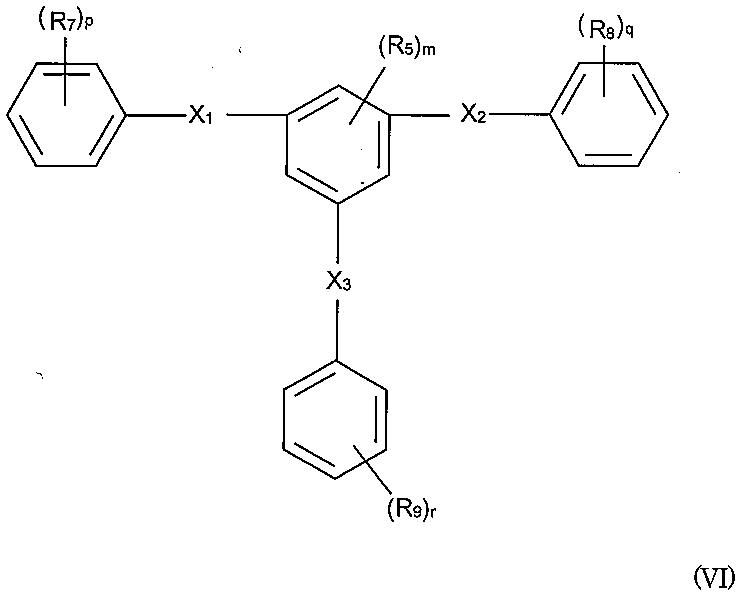
{式中、環Bは、6-員の芳香環であり、ここで1〜3個の環炭素原子は場合により窒素または酸素で置換され、ここでそれぞれの窒素は場合により酸化され、環Bは、5-または6-員のアリール、ヘテロアリール、シクロアルキル、またはヘテロサイクリルに場合により融合または結合することができる;
R5は、ハロ、ハロアルキル、アルキル、アルケニル、アリール、ヘテロアリール、シクロアルキル、またはヘテロサイクリルであり;
mは0から4である;
X1及びX2は独立してC(O)HNまたはNHC(O)であり;及び
R1及びR2は独立してアリール、ヘテロアリール、シクロアルキル、及びヘテロサイクリルから選択される}に提供される。
{Wherein ring B is a 6-membered aromatic ring, wherein 1 to 3 ring carbon atoms are optionally substituted with nitrogen or oxygen, wherein each nitrogen is optionally oxidized and ring B Can be optionally fused or linked to 5- or 6-membered aryl, heteroaryl, cycloalkyl, or heterocyclyl;
R 5 is halo, haloalkyl, alkyl, alkenyl, aryl, heteroaryl, cycloalkyl, or heterocyclyl;
m is 0 to 4;
X 1 and X 2 are independently C (O) HN or NHC (O); and
R 1 and R 2 are independently selected from aryl, heteroaryl, cycloalkyl, and heterocyclyl}.
[0034]特定の態様では、環Bは、以下のものから選択することができる: [0034] In certain embodiments, ring B can be selected from:
{式中、mは、0、1、2、3、または4であり、態様によっては、mは0、1、または2であり、態様によっては、mは0または1であり、態様によってはmは0である;及び
R5は、ハロ、ハロアルキル、アルキル、アルケニル、アリール、ヘテロアリール、シクロアルキル、またはヘテロサイクリルである}。
{Wherein m is 0, 1, 2, 3 or 4; in some embodiments, m is 0, 1 or 2; in some embodiments, m is 0 or 1; m is 0; and
R 5 is halo, haloalkyl, alkyl, alkenyl, aryl, heteroaryl, cycloalkyl, or heterocyclyl}.
[0035]特定の態様では、オリゴマーは、環Bがたった二つ(2)のアミド基(たとえばC(O)HNまたはNHC(O))に直接結合している二官能性化合物である。そのような態様では、式(I)のmは0でありえる。もちろん特定の態様では、環Bは、三つ(3)以上のアミド基に直接結合することもできる。たとえば、そのような化合物の一態様は、一般式(II): [0035] In certain embodiments, the oligomer is a bifunctional compound in which Ring B is directly attached to only two (2) amide groups (eg, C (O) HN or NHC (O)). In such embodiments, m in formula (I) can be 0. Of course, in certain embodiments, ring B can be directly attached to three (3) or more amide groups. For example, one embodiment of such a compound is represented by the general formula (II):
{式中、環B、R5、X1、X2、R1及びR2は上記定義の通りである;
mは0〜3であり;
X3はC(O)HNまたはNHC(O)であり;及び
R3は、アリール、ヘテロアリール、シクロアルキル、及びヘテロサイクリルから選択される}により提供される。
{Wherein the rings B, R 5 , X 1 , X 2 , R 1 and R 2 are as defined above;
m is 0-3;
X 3 is C (O) HN or NHC (O); and
R 3 is selected from aryl, heteroaryl, cycloalkyl, and heterocyclyl.
[0036]かかる化合物の別の態様は、一般式(III): [0036] Another embodiment of such compounds is the general formula (III):
{式中、環B、R5、X1、X2、X3、R1、R2及びR3は上記定義の通りである;
X4はC(O)HNまたはNHC(O)であり;及び
R4は、アリール、ヘテロアリール、シクロアルキル、及びヘテロサイクリルから選択される}により提供される。
{Wherein the rings B, R 5 , X 1 , X 2 , X 3 , R 1 , R 2 and R 3 are as defined above;
X 4 is C (O) HN or NHC (O); and
R 4 is selected from aryl, heteroaryl, cycloalkyl, and heterocyclyl.
[0037]態様によっては、上記構造中のR1、R2、R3及び/またはR4は、以下のものから選択することができる: [0037] In some embodiments, R 1 , R 2 , R 3 and / or R 4 in the above structure can be selected from:
{式中、nは0、1、2、3、4または5であり、態様によっては、nは0、1または2であり;態様によっては、nは0または1であり;及び
R6は、ハロ、ハロアルキル、アルキル、アルケニル、アルキニル、アリール、ヘテロアリール、シクロアルキル、またはヘテロサイクリルである}。
{Wherein n is 0, 1, 2, 3, 4 or 5; in some embodiments, n is 0, 1 or 2; in some embodiments, n is 0 or 1; and
R 6 is halo, haloalkyl, alkyl, alkenyl, alkynyl, aryl, heteroaryl, cycloalkyl, or heterocyclyl}.
[0038]一態様において、芳香族アミドオリゴマーは、以下の一般式(IV): [0038] In one embodiment, the aromatic amide oligomer has the following general formula (IV):
{式中、X1及びX2は、独立してC(O)HNまたはNHC(O)であり;
R5、R7、及びR8は、独立してハロ、ハロアルキル、アルキル、アルケニル、アルキニル、アリール、ヘテロアリール、シクロアルキル、及びヘテロサイクリルから選択され;
mは0〜4であり;及び
p及びqは独立して0〜5である}を有する。
{Wherein X 1 and X 2 are independently C (O) HN or NHC (O);
R 5 , R 7 , and R 8 are independently selected from halo, haloalkyl, alkyl, alkenyl, alkynyl, aryl, heteroaryl, cycloalkyl, and heterocyclyl;
m is 0-4; and
p and q are independently 0 to 5}.
[0039]別の態様では、芳香族アミドオリゴマーは、以下の一般式(V): [0039] In another embodiment, the aromatic amide oligomer has the general formula (V):
{式中、X1、X2、R5、R7、R8、m、p及びqは上記定義の通りである}を有する。 Wherein X 1 , X 2 , R 5 , R 7 , R 8 , m, p and q are as defined above.
[0040]たとえば特定の態様では、式(IV)及び式(V)中のm、q及びrは、0に等しいので、コア及び末端基は置換されていない。他の態様では、mは0であり、p及びqは、1〜5でありえる。そのような態様では、たとえばR7及び/またはR8はハロ(たとえば、フッ素)でありえる。他の態様では、R7及び/またはR8は、アリール(たとえば、フェニル)、シクロアルキル(たとえば、シクロヘキシル)、または構造:-C(O)R12N-または-NR13C(O)-{式中、R12及びR13は独立して、水素、アルキル、アルケニル、アルキニル、アリール、ヘテロアリール、シクロアルキル、及びヘテロサイクリルから選択される}を有するアミド基で置換されたアリール及び/またはシクロアルキルでありえる。特別な一態様では、たとえばR7及び/またはR8は、-C(O)HN-または-NHC(O)-で置換されたフェニルである。さらに別の態様では、R7及び/またはR8は、ヘテロアリール(たとえば、ピリジニル)でありえる。 [0040] For example, in certain embodiments, m, q, and r in Formula (IV) and Formula (V) are equal to 0, so that the core and end groups are not substituted. In other embodiments, m can be 0 and p and q can be 1-5. In such embodiments, for example, R 7 and / or R 8 can be halo (eg, fluorine). In other embodiments, R 7 and / or R 8 are aryl (eg, phenyl), cycloalkyl (eg, cyclohexyl), or the structure: —C (O) R 12 N— or —NR 13 C (O) — {Wherein R 12 and R 13 are independently selected from hydrogen, alkyl, alkenyl, alkynyl, aryl, heteroaryl, cycloalkyl, and heterocyclyl} substituted with an amide group and / Or it can be cycloalkyl. In one particular embodiment, for example, R 7 and / or R 8 is phenyl substituted with —C (O) HN— or —NHC (O) —. In yet another embodiment, R 7 and / or R 8 can be heteroaryl (eg, pyridinyl).
[0041]さらに別の態様では、芳香族アミドオリゴマーは、以下の一般式(VI): [0041] In yet another embodiment, the aromatic amide oligomer is represented by the following general formula (VI):
{式中、X1、X2及びX3は、独立してC(O)HNまたはNHC(O)であり;
R5、R7、R8、及びR9は、独立してハロ、ハロアルキル、アルキル、アルケニル、アリール、ヘテロアリール、シクロアルキル、及びヘテロサイクリルから選択され;
mは0〜3であり;及び
p、q及びrは独立して0〜5である}を有する。
{Wherein X 1 , X 2 and X 3 are independently C (O) HN or NHC (O);
R 5 , R 7 , R 8 , and R 9 are independently selected from halo, haloalkyl, alkyl, alkenyl, aryl, heteroaryl, cycloalkyl, and heterocyclyl;
m is 0-3; and
p, q and r are independently 0 to 5.
[0042]さらに別の態様では、芳香族アミドオリゴマーは以下の一般式(VII): [0042] In yet another embodiment, the aromatic amide oligomer is represented by the following general formula (VII):
{式中、X1、X2、X3、R5、R7、R8、R9、m、p、q及びrは上記定義の通りである}を有する。 Wherein X 1 , X 2 , X 3 , R 5 , R 7 , R 8 , R 9 , m, p, q and r are as defined above.
[0043]たとえば特定の態様では、式(VI)及び式(VII)中のm、p、q及びrは0に等しいので、コア及び末端基は置換されていない。他の態様では、mは0でありえ、p、q及びrは、1〜5でありえる。そのような態様では、たとえばR7、R8及び/またはR9はハロ(たとえば、フッ素)でありえる。他の態様では、R7、R8及び/またはR9は、アリール(たとえば、フェニル)、シクロアルキル(たとえば、シクロヘキシル)、または構造:-C(O)R12N-または-NR13C(O)-{式中、R12及びR13は独立して、水素、アルキル、アルケニル、アリール、ヘテロアリール、シクロアルキル、及びヘテロサイクリルから選択される}を有するアミド基で置換されたアリール及び/またはシクロアルキルでありえる。特別な一態様では、たとえばR7、R8及び/またはR9は、-C(O)HN-または-NHC(O)-で置換されたフェニルである。さらに別の態様では、R7、R8及び/またはR9は、ヘテロアリール(たとえば、ピリジニル)でありえる。 [0043] For example, in certain embodiments, m, p, q and r in formula (VI) and formula (VII) are equal to 0, so that the core and end groups are not substituted. In other embodiments, m can be 0 and p, q, and r can be 1-5. In such embodiments, for example, R 7 , R 8 and / or R 9 can be halo (eg, fluorine). In other embodiments, R 7 , R 8 and / or R 9 are aryl (eg, phenyl), cycloalkyl (eg, cyclohexyl), or the structure: —C (O) R 12 N— or —NR 13 C ( O)-{wherein R 12 and R 13 are independently selected from hydrogen, alkyl, alkenyl, aryl, heteroaryl, cycloalkyl, and heterocyclyl} substituted with an amide group and Can be cycloalkyl. In one particular embodiment, for example, R 7 , R 8 and / or R 9 is phenyl substituted with —C (O) HN— or —NHC (O) —. In yet another embodiment, R 7 , R 8 and / or R 9 can be heteroaryl (eg, pyridinyl).
[0044]本発明の芳香族アミドオリゴマーの具体的な態様は、以下の表にも記載される。 [0044] Specific embodiments of the aromatic amide oligomers of the present invention are also described in the following table.
[0045]液晶ポリマーを形成する間に使用される前駆体モノマーは、一般に、当業界で公知のように変動しえる。たとえば、好適なサーモトロピック液晶ポリマーは、芳香族ポリエステル、芳香族ポリ(エステルアミド)、芳香族ポリ(エステルカーボネート)、芳香族ポリアミドなどが挙げることができ、一つ以上の芳香族または脂肪族ヒドロキシカルボン酸、芳香族または脂肪族ジカルボン酸、芳香族または脂肪族ジオール、芳香族または脂肪族アミノカルボン酸、芳香族または脂肪族アミン、芳香族または脂肪族ジアミン、並びにこれらの組み合わせから形成される繰り返し単位を含むことができる。 [0045] The precursor monomers used during the formation of the liquid crystal polymer may generally vary as is known in the art. For example, suitable thermotropic liquid crystal polymers can include aromatic polyesters, aromatic poly (ester amides), aromatic poly (ester carbonates), aromatic polyamides, and the like, including one or more aromatic or aliphatic hydroxy polymers. Repeats formed from carboxylic acids, aromatic or aliphatic dicarboxylic acids, aromatic or aliphatic diols, aromatic or aliphatic aminocarboxylic acids, aromatic or aliphatic amines, aromatic or aliphatic diamines, and combinations thereof Units can be included.
[0046]たとえば芳香族ポリエステルは、(1)二つ以上の芳香族ヒドロキシカルボン酸;(2)少なくとも一つの芳香族ヒドロキシカルボン酸、少なくとも一つの芳香族ジカルボン酸、及び少なくとも一つの芳香族ジオール;及び/または(3)少なくとも一つの芳香族ジカルボン酸と少なくとも一つの芳香族ジオールを重合することにより得ることができる。好適な芳香族ヒドロキシカルボン酸の例としては、4-ヒドロキシ安息香酸;4-ヒドロキシ-4'-ビフェニルカルボン酸;2-ヒドロキシ-6-ナフトエ酸;2-ヒドロキシ-5-ナフトエ酸;3-ヒドロキシ-2-ナフトエ酸;2-ヒドロキシ-3-ナフトエ酸;4'-ヒドロキシフェニル-4-安息香酸;3'-ヒドロキシフェニル-4-安息香酸;4'-ヒドロキシフェニル-3-安息香酸、並びにこれらのアルキル、アルコキシ、アリール及びハロゲン置換体が挙げられる。好適な芳香族ジカルボン酸の例としては、テレフタル酸;イソフタル酸;2,6-ナフタレンジカルボン酸;ジフェニルエーテル-4,4'-ジカルボン酸;1,6-ナフタレンジカルボン酸;2,7-ナフタレンジカルボン酸;4,4'-ジカルボキシビフェニル;ビス(4-カルボキシフェニル)エーテル;ビス(4-カルボキシフェニル)ブタン;ビス(4-カルボキシフェニル)エタン;ビス(3-カルボキシフェニル)エーテル;ビス(3-カルボキシフェニル)エタン、並びにこれらのアルキル、アルコキシ、アリール及びハロゲン置換体が挙げられる。好適な芳香族ジオールの例としては、ハイドロキノン;レゾルシノール;2,6-ジヒドロキシナフタレン;2,7-ジヒドロキシナフタレン;1,6-ジヒドロキシナフタレン;4,4'-ジヒドロキシビフェニル;3,3'-ジヒドロキシビフェニル;3,4'-ジヒドロキシビフェニル;4,4'-ジヒドロキシビフェニルエーテル;ビス(4-ヒドロキシフェニル)エタン、並びにこれらのアルキル、アルコキシ、アリール及びハロゲン置換体が挙げられる。様々な芳香族ポリエステルの合成及び構造は、米国特許第4,161,470号;同第4,473,682号;同第4,522,974号;同第4,375,530号;同第4,318,841号;同第4,256,624号;同第4,219,461号;同第4,083,829号;同第4,184,996号;同第4,279,803号;同第4,337,190号;同第4,355,134号;同第4,429,105号;同第4,393,191号;同第4,421,908号;同第4,434,262号;及び同第5,541,240号により詳細が記載されているだろう。
[0046] For example, the aromatic polyester includes (1) two or more aromatic hydroxycarboxylic acids; (2) at least one aromatic hydroxycarboxylic acid, at least one aromatic dicarboxylic acid, and at least one aromatic diol; And / or (3) can be obtained by polymerizing at least one aromatic dicarboxylic acid and at least one aromatic diol. Examples of suitable aromatic hydroxycarboxylic acids include: 4-hydroxybenzoic acid; 4-hydroxy-4'-biphenylcarboxylic acid; 2-hydroxy-6-naphthoic acid; 2-hydroxy-5-naphthoic acid; -2-naphthoic acid; 2-hydroxy-3-naphthoic acid; 4'-hydroxyphenyl-4-benzoic acid; 3'-hydroxyphenyl-4-benzoic acid; 4'-hydroxyphenyl-3-benzoic acid, and these And alkyl, alkoxy, aryl, and halogen substituents. Examples of suitable aromatic dicarboxylic acids include: terephthalic acid; isophthalic acid; 2,6-naphthalenedicarboxylic acid; diphenyl ether-4,4′-dicarboxylic acid; 1,6-naphthalenedicarboxylic acid; 2,7-
[0047]液晶ポリエステルアミドは、同様に(1)少なくとも一つの芳香族ヒドロキシカルボン酸及び少なくとも一つの芳香族アミノカルボン酸;(2)少なくとも一つの芳香族ヒドロキシカルボン酸、少なくとも一つの芳香族ジカルボン酸、及び場合によりフェノール性ヒドロキシ基をもつ少なくとも一つの芳香族アミン及び/またはジアミン;及び(3)少なくとも一つの芳香族ジカルボン酸及び場合によりフェノール性ヒドロキシ基をもつ少なくとも一つの芳香族アミン及び/またはジアミンを重合することにより得られるものも挙げられえる。好適な芳香族アミン及びジアミンとしては、たとえば3-アミノフェノール;4-アミノフェノール;1,4-フェニレンジアミン;1,3-フェニレンジアミン、並びにこれらのアルキル、アルコキシ、アリール及びハロゲン置換体を挙げることができる。様々な芳香族ポリ(エステルアミド)の合成及び構造は、米国特許第4,339,375号;同第4,355,132号;同第4,351,917号;同第4,330,457号;同第4,351,918号;及び同第5,204,443号により詳細が記載されているだろう。 [0047] The liquid crystalline polyester amide is similarly (1) at least one aromatic hydroxycarboxylic acid and at least one aromatic aminocarboxylic acid; (2) at least one aromatic hydroxycarboxylic acid, at least one aromatic dicarboxylic acid And, optionally, at least one aromatic amine and / or diamine having a phenolic hydroxy group; and (3) at least one aromatic dicarboxylic acid and optionally at least one aromatic amine having a phenolic hydroxy group and / or Mention may also be made of those obtained by polymerizing diamines. Suitable aromatic amines and diamines include, for example, 3-aminophenol; 4-aminophenol; 1,4-phenylenediamine; 1,3-phenylenediamine, and their alkyl, alkoxy, aryl and halogen substituents. Can do. The synthesis and structure of various aromatic poly (ester amides) are described in more detail in US Pat. Nos. 4,339,375; 4,355,132; 4,351,917; 4,330,457; 4,351,918; and 5,204,443. Would have been.
[0048]すべての態様において必ずしも必要であるとは限らないが、一般に、ナフテン系ヒドロキシカルボン酸とナフテン系ジカルボン酸、たとえばナフタレン-2,6-ジカルボン酸(NDA)、6-ヒドロキシ-2-ナフトエ酸(HNA)またはその組み合わせから誘導した繰り返し単位の含有量を最小化するのが望ましい。すなわち、ナフテン系ヒドロキシカルボン酸及び/またはジカルボン酸(たとえば、NDA、HNA、またはHNAとNDAの組み合わせ)から誘導される繰り返し単位の総量は、典型的にはポリマーのわずか約5モル%、態様によってはわずか約3モル%、態様によっては0モル%〜2モル%(例えば、0モル%)である。同様に、溶融重合の間に使用した(単数または複数種類の)前駆体のうちわずか約5モル%、態様によってはわずか約3モル%、態様によっては0モル%〜約2モル%(例えば0モル%)は、ナフテン系ヒドロキシカルボン酸及び/またはジカルボン酸(たとえばNDA、HNA、またはHNAとNDAの組み合わせ)である。 [0048] Although not necessarily required in all embodiments, in general, naphthenic hydroxycarboxylic acids and naphthenic dicarboxylic acids such as naphthalene-2,6-dicarboxylic acid (NDA), 6-hydroxy-2-naphthoic It is desirable to minimize the content of repeat units derived from acids (HNA) or combinations thereof. That is, the total amount of repeating units derived from naphthenic hydroxycarboxylic acids and / or dicarboxylic acids (e.g., NDA, HNA, or a combination of HNA and NDA) is typically only about 5 mol% of the polymer, depending on the embodiment. Is only about 3 mol%, and in some embodiments 0 mol% to 2 mol% (e.g., 0 mol%). Similarly, only about 5 mol%, in some embodiments only about 3 mol%, in some embodiments from 0 mol% to about 2 mol% (e.g., 0) of the precursor (s) used during melt polymerization. Mol%) is a naphthenic hydroxycarboxylic acid and / or dicarboxylic acid (eg NDA, HNA or a combination of HNA and NDA).
[0049]高レベルの慣用のナフテン酸が存在しないもかかわらず、得られた「低ナフテン系(low naphthenic)」ポリマーは、上記のように、低い融解温度で良好な耐熱性をいまだ示すことができると考えられる。特別な一態様において、たとえば、4-ヒドロキシ安息香酸とテレフタル酸から誘導したモノマー繰り返し単位を含む「低ナフテン系」芳香族ポリエステルを形成することができる。4-ヒドロキシ安息香酸から誘導したモノマー単位は、ポリマーの約50モル%〜約95モル%、態様によっては約55モル%〜約90モル%、態様によっては約60モル%〜約80モル%を構成することができ、テレフタル酸から誘導されたモノマー単位は、ポリマーの約1モル%〜約25モル%、態様によっては約2モル%〜約20モル%、態様によっては約5モル%〜約15モル%を構成することができる。他のモノマー単位、たとえば他の芳香族ヒドロキシカルボン酸(例えばイソフタル酸)及び/または芳香族ジオール(たとえば4,4'-ビフェノール、ヒドロキノンなど)を場合により使用することができる。たとえばイソフタル酸は、ポリマーの約1モル%〜約25モル%、態様によっては約2モル%〜約20モル%、態様によっては約5モル%〜約15モル%を構成することができる。ヒドロキノン及び/または4,4'-ビフェノールは同様に、使用するときには約1モル%〜約15モル%を構成することができる。
[0049] The resulting “low naphthenic” polymer, despite the absence of high levels of conventional naphthenic acid, still exhibits good heat resistance at low melting temperatures, as described above. It is considered possible. In one particular embodiment, “low naphthenic” aromatic polyesters can be formed that include, for example, monomer repeat units derived from 4-hydroxybenzoic acid and terephthalic acid. Monomer units derived from 4-hydroxybenzoic acid comprise from about 50 mol% to about 95 mol% of the polymer, in some embodiments from about 55 mol% to about 90 mol%, and in some embodiments from about 60 mol% to about 80 mol%. The monomer units derived from terephthalic acid can comprise from about 1 mol% to about 25 mol% of the polymer, in some embodiments from about 2 mol% to about 20 mol%, in some embodiments from about 5 mol% to about It can constitute 15 mol%. Other monomer units, such as other aromatic hydroxycarboxylic acids (eg isophthalic acid) and / or aromatic diols (
[0050]特定の構成成分にかかわらず、液晶ポリマーは、適切な(単数または複数種類の)モノマー(たとえば芳香族ヒドロキシカルボン酸、芳香族ジカルボン酸、芳香族ジオール、芳香族アミン、芳香族ジアミンなど)を反応器に導入して、重縮合反応を開始することにより製造できる。かかる反応で使用される特定の条件及び段階は公知である。高粘度流体反応で通常使用されるものを通常使用するのが望ましいが、反応に使用される容器は特に限定されない。そのような反応容器の例としては、様々な形状の攪拌ブレード、たとえばアンカー型、多段型、螺旋-リボン型、スクリューシャフト型など、またはそれらの修正形をもつ攪拌装置をもつ攪拌タンク型反応容器を挙げることができる。そのような反応容器のさらなる例としては、樹脂混練で通常、使用される混合装置、たとえば混練機、ロールミル、バンバリーミキサーなどが挙げられる。 [0050] Regardless of the particular component, the liquid crystal polymer may be a suitable monomer or monomers (eg, aromatic hydroxycarboxylic acid, aromatic dicarboxylic acid, aromatic diol, aromatic amine, aromatic diamine, etc. ) Is introduced into the reactor to initiate the polycondensation reaction. The specific conditions and steps used in such reactions are known. Although it is desirable to use what is normally used by high viscosity fluid reaction, the container used for reaction is not specifically limited. Examples of such reaction vessels include agitation tank type reaction vessels with agitation blades of various shapes such as anchor type, multistage type, spiral-ribbon type, screw shaft type, etc., or modified versions thereof. Can be mentioned. Further examples of such reaction vessels include mixing devices commonly used in resin kneading, such as kneaders, roll mills, Banbury mixers and the like.
[0051]所望により、反応は、上記参照及び当業界で公知のモノマーのアセチル化により行うこともできる。これは、モノマーにアセチル化剤(たとえば無水酢酸)を添加することにより達成できる。一般にアセチル化は、約90℃の温度で開始する。アセチル化の初期段階の間、酢酸副生成物と無水物とが蒸留し始める点より下の気相温度を維持するのに還流を使用することができる。アセチル化の間の温度は典型的には、90℃〜150℃、態様によっては約110℃〜約150℃を変動する。還流を使用する場合には、気相温度は典型的には酢酸の沸点を超えるが、残存する無水酢酸を保持するのに十分に低いままである。たとえば、無水酢酸は約140℃の温度で蒸発する。従って、約110℃〜約130℃の温度で反応器に気相還流を提供するのが特に望ましい。反応を実質的に完了させるためには、過剰量の無水酢酸を使用することができる。過剰量の無水酢酸は、還流の存在または非存在などの、使用する特定のアセチル化条件に依存して変動しえる。存在する反応体ヒドロキシル基の総モルをベースとして、無水酢酸約1〜約10モルパーセントの過剰量を使用するのは珍しいことではない。 [0051] If desired, the reaction can also be carried out by acetylation of monomers as described above and known in the art. This can be achieved by adding an acetylating agent (eg acetic anhydride) to the monomer. In general, acetylation begins at a temperature of about 90 ° C. During the initial stages of acetylation, reflux can be used to maintain a gas phase temperature below the point where acetic acid by-products and anhydrides begin to distill. The temperature during acetylation typically varies from 90 ° C to 150 ° C, and in some embodiments from about 110 ° C to about 150 ° C. When using reflux, the gas phase temperature typically exceeds the boiling point of acetic acid but remains low enough to retain the remaining acetic anhydride. For example, acetic anhydride evaporates at a temperature of about 140 ° C. Thus, it is particularly desirable to provide gas phase reflux to the reactor at a temperature of about 110 ° C to about 130 ° C. An excess amount of acetic anhydride can be used to substantially complete the reaction. The excess amount of acetic anhydride can vary depending on the particular acetylation conditions used, such as the presence or absence of reflux. It is not uncommon to use an excess of about 1 to about 10 mole percent acetic anhydride, based on the total moles of reactant hydroxyl groups present.
[0052]アセチル化は別の反応容器で実施することができるか、または重合反応容器でin-situで実施することができる。別の反応容器を使用する場合には、モノマーの一つ以上をアセチル化反応器に導入し、続いて重合反応器に移すことができる。同様に、モノマーの一つ以上を、前アセチル化(pre-acetylation)を実施することなく反応容器に直接導入することもできる。モノマー及び任意選択のアセチル化剤に加えて、他の成分も反応混合物に配合して、重合を促進し易くすることができる。触媒、たとえば金属塩触媒(たとえば、酢酸マグネシウム、酢酸スズ(I)、テトラブチルチタネート、酢酸鉛、酢酸ナトリウム、酢酸カリウムなど)及び有機化合物触媒(たとえば、N-メチルイミダゾール)を場合により使用することができる。そのような触媒は、典型的には、繰り返し単位前駆体の総重量をベースとして約50〜約500ppm(parts per million)の量で使用する。別の反応器を使用する場合、典型的には、重合反応器ではなくアセチル化反応器に触媒を適用するのが望ましいが、これは決して必要要件ではない。 [0052] Acetylation can be carried out in a separate reaction vessel or can be carried out in-situ in a polymerization reaction vessel. If a separate reaction vessel is used, one or more of the monomers can be introduced into the acetylation reactor and subsequently transferred to the polymerization reactor. Similarly, one or more of the monomers can be introduced directly into the reaction vessel without performing pre-acetylation. In addition to the monomer and optional acetylating agent, other components can also be incorporated into the reaction mixture to facilitate polymerization. Optionally use catalysts such as metal salt catalysts (e.g. magnesium acetate, tin (I) acetate, tetrabutyl titanate, lead acetate, sodium acetate, potassium acetate, etc.) and organic compound catalysts (e.g. N-methylimidazole) Can do. Such catalysts are typically used in an amount of about 50 to about 500 ppm (parts per million) based on the total weight of the repeat unit precursor. If another reactor is used, it is typically desirable to apply the catalyst to an acetylation reactor rather than a polymerization reactor, but this is by no means a requirement.
[0053]一般に、反応混合物は、重合反応容器内で高温に加熱して、反応体の溶融重縮合を開始する。たとえば重縮合は、約210℃〜約400℃、態様によっては約250℃〜約350℃の温度範囲内で実施することができる。たとえば、芳香族ポリエステルを形成するための好適な一方法としては、前駆体モノマー(たとえば、4-ヒドロキシ安息香酸とフタル酸)、芳香族アミドオリゴマー、及び無水酢酸を反応器に充填し、この混合物を約90℃〜約150℃の温度に加熱してモノマーのヒドロキシル基をアセチル化(たとえば、アセトキシを形成する)し、次いで温度を約210℃〜約400℃に上昇させて、溶融重縮合を実施する。最終重合温度に到達するにつれて、所望の分子量が容易に達成できるように、反応の揮発性副生成物(たとえば酢酸)を除去することもできる。反応混合物は一般に、良好な加熱及び物質移動、続いて良好な材料均質性を確保にするために、重合の間に攪拌にかける。攪拌機の回転速度は、反応の経過の間に変動しえるが、典型的には、約10〜約100回/分(rpm)を変動し、態様によっては約20〜約80rpmを変動する。溶融物中の分子量を高めるために、重合反応を真空下で実施することもでき、真空を適用することにより、重縮合の最終段階の間に形成した揮発成分を除去し易くなる。真空は、約5〜約30ポンド/平方インチ(psi)、態様によっては約10〜約20psiの範囲内で、吸引圧力を適用することにより作り出すことができる。 [0053] Generally, the reaction mixture is heated to a high temperature in a polymerization reaction vessel to initiate melt polycondensation of the reactants. For example, the polycondensation can be carried out within a temperature range of from about 210 ° C to about 400 ° C, and in some embodiments from about 250 ° C to about 350 ° C. For example, one suitable method for forming an aromatic polyester includes charging a reactor with precursor monomers (e.g., 4-hydroxybenzoic acid and phthalic acid), an aromatic amide oligomer, and acetic anhydride and mixing the mixture. Is heated to a temperature of about 90 ° C. to about 150 ° C. to acetylate the hydroxyl group of the monomer (eg, to form acetoxy), then the temperature is increased to about 210 ° C. to about 400 ° C. to effect melt polycondensation. carry out. As the final polymerization temperature is reached, the volatile byproducts of the reaction (eg, acetic acid) can also be removed so that the desired molecular weight can be easily achieved. The reaction mixture is generally subjected to agitation during polymerization to ensure good heating and mass transfer followed by good material homogeneity. The rotational speed of the stirrer can vary during the course of the reaction, but typically varies from about 10 to about 100 times per minute (rpm), and in some embodiments varies from about 20 to about 80 rpm. In order to increase the molecular weight in the melt, the polymerization reaction can also be carried out under vacuum, and application of vacuum facilitates removal of volatile components formed during the final stage of polycondensation. A vacuum can be created by applying a suction pressure in the range of about 5 to about 30 pounds per square inch (psi), and in some embodiments about 10 to about 20 psi.
[0054]溶融重合後、溶融ポリマーは、典型的には所望の形状のダイを備えた押出しオリフィスを通して反応器から排出し、冷却し、集めることができる。通常、溶融物は、水浴中で取り出し、ペレット化し、乾燥されるストランドを形成するために穿孔ダイを通して排出される。樹脂はストランド、小粒、または粉末の形状でもありえる。不必要ではあるが、続く固相重合は、さらに分子量を増加させるために実施することができると理解すべきである。溶融重合で得られたポリマーで固相重合を実施するときには、典型的には、溶融重合により得られたポリマーを固化し、粉砕して、粉末またはフレーク様ポリマーを形成し、続いて不活性雰囲気(例えば窒素)下、200℃〜350℃の温度範囲で熱処理など、固相重合を実施する方法を選択するのが望ましい。 [0054] After melt polymerization, the molten polymer can be discharged from the reactor, cooled and collected, typically through an extrusion orifice with a die of the desired shape. Usually, the melt is removed in a water bath, pelletized and discharged through a perforating die to form a dried strand. The resin can also be in the form of strands, granules or powders. Although not necessary, it should be understood that subsequent solid state polymerization can be carried out to further increase the molecular weight. When performing solid state polymerization with a polymer obtained by melt polymerization, the polymer obtained by melt polymerization is typically solidified and ground to form a powder or flake-like polymer, followed by an inert atmosphere. It is desirable to select a method for performing solid phase polymerization such as heat treatment in a temperature range of 200 ° C. to 350 ° C. (for example, nitrogen).
[0055]それが形成される方法にかかわらず、得られた液晶ポリマーは、典型的には約2,000グラム/モル以上、態様によっては約4,000グラム/モル以上、態様によっては約5,000〜約30,000グラム/モルの数平均分子量(Mn)を有する。もちろん、本発明の方法を使用して、約2,000グラム/モル未満などの、より低い分子量をもつポリマーを形成することも可能である。一般に分子量に比例する、ポリマーの固有粘度は同様に、約2デシリットル/グラム(dL/g)以上、態様によっては約3dL/g以上、態様によっては約4〜約20dL/g、態様によっては約5〜約15dL/gでありえる。固有粘度は、以下、より詳細に記載されるように、ペンタフルオロフェノールとヘキサフルオロイソプロパノールの50/50(v/v)混合物を使用してISO-1628-5に従って測定することができる。 [0055] Regardless of the method by which it is formed, the resulting liquid crystal polymer is typically about 2,000 grams / mole or more, in some embodiments about 4,000 grams / mole or more, and in some embodiments about 5,000 to about 30,000 grams. / Mole number average molecular weight (M n ). Of course, it is also possible to form a polymer with a lower molecular weight, such as less than about 2,000 grams / mole, using the method of the present invention. The inherent viscosity of the polymer, generally proportional to molecular weight, is also about 2 deciliters per gram (dL / g) or more, in some embodiments about 3 dL / g or more, in some embodiments from about 4 to about 20 dL / g, in some embodiments about It can be from 5 to about 15 dL / g. Intrinsic viscosity can be measured according to ISO-1628-5 using a 50/50 (v / v) mixture of pentafluorophenol and hexafluoroisopropanol, as described in more detail below.
[0056]オリゴマーと液晶ポリマー(またはその前駆体モノマー)とを混和するために、様々な公知方法を使用することができる。たとえば、分散的に材料をブレンドする溶融加工装置に原材料を同時にまたは順に供給することができる。バッチ及び/または連続溶融加工方法を使用することができる。たとえばミキサー/ニーダー、バンバリーミキサー、Farrel連続ミキサー、一軸押出機、二軸押出機、ロールミルなどを使用して、材料をブレンド及び溶融加工することができる。特に好適な一溶融加工装置は、共回転、二軸押出機(たとえば、Leistritz共回転完全噛み合い二軸押出機(co-rotating fully intermeshing twin screw extruder))である。そのような押出機としては、供給及び排出口を含み、高度離散性及び分散性混合(high intensity distributive and dispersive mixing)を提供することができる。たとえば、液晶ポリマー及びオリゴマーは、二軸押出機の同一または異なる供給ポート(口)に供給されて、溶融ブレンドされて実質的に均質溶融混合物を形成することができる。溶融ブレンドは、高剪断/圧力下で行うことができ、十分な分散となるように加熱することができる。たとえば溶融処理は、約50℃〜約500℃、態様によっては約100℃〜約250℃の温度で行うことができる。同様に、溶融処理の間の見かけの剪断速度は、約100秒-1〜約10,000秒-1、態様によっては約500秒-1〜約1,500秒-1を変動しえる。もちろん、他の変数、たとえば押出し量に反比例する、溶融処理の間の滞留時間は、所望の均質度を達成するために制御することもできる。 [0056] Various known methods can be used to mix the oligomer and the liquid crystal polymer (or precursor monomer thereof). For example, the raw materials can be fed simultaneously or sequentially to a melt processing apparatus that blends the materials in a dispersive manner. Batch and / or continuous melt processing methods can be used. For example, the materials can be blended and melt processed using a mixer / kneader, Banbury mixer, Farrel continuous mixer, single screw extruder, twin screw extruder, roll mill, and the like. One particularly suitable melt processing apparatus is a co-rotating, twin-screw extruder (eg, a Leistritz co-rotating fully intermeshing twin screw extruder). Such extruders can include feed and discharge ports and provide high intensity distributive and dispersive mixing. For example, the liquid crystal polymer and oligomer can be fed to the same or different feed ports (mouths) of a twin screw extruder and melt blended to form a substantially homogeneous melt mixture. The melt blending can be done under high shear / pressure and can be heated to achieve sufficient dispersion. For example, the melting process can be performed at a temperature of about 50 ° C. to about 500 ° C., and in some embodiments about 100 ° C. to about 250 ° C. Similarly, the apparent shear rate during the melting process can vary from about 100 sec- 1 to about 10,000 sec- 1 , and in some embodiments from about 500 sec- 1 to about 1,500 sec- 1 . Of course, other variables, such as residence time during the melt process, which is inversely proportional to the amount of extrusion, can also be controlled to achieve the desired homogeneity.
[0057]溶融ブレンドに加えて、本発明の芳香族アミドオリゴマーは、ポリマーを形成する間にモノマーと混和することもできる。一般に任意の時に導入することができるが、典型的には溶融重合が開始する前に、液晶ポリマー用の前駆体モノマーと併せて重合装置にオリゴマーを適用するのが望ましい。 [0057] In addition to melt blending, the aromatic amide oligomers of the present invention can also be admixed with monomers during the formation of the polymer. Generally, it can be introduced at any time, but it is typically desirable to apply the oligomer to the polymerization apparatus in conjunction with the precursor monomer for the liquid crystal polymer before the melt polymerization begins.
[0058]それを配合する方法にかかわらず、組成物中の液晶ポリマーと芳香族アミドオリゴマーの相対的比率を選択して、熱的及び機械的特性の間のバランスを達成し易くすることができる。特に、オリゴマー含有量が高いと低融解温度となりうるが、含有量が高すぎると、オリゴマーがポリマーの溶融強度に悪影響を与える程度まで粘度を下げてしまうだろう。殆どの態様では、たとえば芳香族アミドオリゴマーまたはその混合物は、液晶ポリマー100重量部に対して約0.1〜約5重量部、態様によっては約0.2〜約4重量部、態様によっては約0.5〜約3重量部で使用することができる。芳香族アミドオリゴマーは、たとえばポリマー混合物の約0.1wt%〜約5wt%、態様によっては約0.2wt%〜約4wt%、態様によっては約0.5wt%〜約3wt%を構成しえる。同様に液晶ポリマーは、ポリマー混合物の約95wt%〜約99.9wt%、態様によっては約96wt%〜約98.8wt%、態様によっては約97wt%〜約99.5wt%を構成しえる。 [0058] Regardless of how it is formulated, the relative proportions of liquid crystal polymer and aromatic amide oligomer in the composition can be selected to help achieve a balance between thermal and mechanical properties. . In particular, high oligomer content can result in low melting temperatures, but too high content will reduce the viscosity to such an extent that the oligomer adversely affects the melt strength of the polymer. In most embodiments, for example, the aromatic amide oligomer or mixture thereof is about 0.1 to about 5 parts by weight, in some embodiments about 0.2 to about 4 parts by weight, and in some embodiments about 0.5 to about 3 parts per 100 parts by weight of the liquid crystal polymer. Can be used in parts by weight. The aromatic amide oligomer may comprise, for example, from about 0.1 wt% to about 5 wt% of the polymer mixture, in some embodiments from about 0.2 wt% to about 4 wt%, and in some embodiments from about 0.5 wt% to about 3 wt%. Similarly, the liquid crystal polymer may comprise from about 95 wt% to about 99.9 wt%, in some embodiments from about 96 wt% to about 98.8 wt%, in some embodiments from about 97 wt% to about 99.5 wt% of the polymer mixture.
[0059]いずれにしろ、得られたポリマー組成物は、上記のように比較的低い融解温度をもち、且つ良好な耐熱性を示す。さらに上記芳香族アミドオリゴマーは、分子間ポリマー鎖相互作用を変えることによって流動助剤としても役立つことができ、これにより剪断下でポリマーマトリックスの全体の粘度を下げることができる。従って、得られたポリマー組成物は、比較的低い溶融粘度ももつことができ、これはプロセス加工性(processability)を改善することができる。さらに、ポリマー組成物は、1000秒-1の剪断速度で測定して、約100Pa-s未満、態様によっては約50Pa-s未満、態様によっては約1〜約40Pa-s、態様によっては約5〜約25Pa-sの溶融粘度を有しえる。溶融粘度は、350℃の温度で、ISO試験No.11443(ASTM試験No.1238-70と同等)に従って測定することができる。 [0059] In any case, the resulting polymer composition has a relatively low melting temperature as described above and exhibits good heat resistance. Furthermore, the aromatic amide oligomers can also serve as flow aids by altering intermolecular polymer chain interactions, which can reduce the overall viscosity of the polymer matrix under shear. Thus, the resulting polymer composition can also have a relatively low melt viscosity, which can improve processability. Further, the polymer composition is less than about 100 Pa-s, in some embodiments less than about 50 Pa-s, in some embodiments from about 1 to about 40 Pa-s, in some embodiments, measured at a shear rate of 1000 s -1. It can have a melt viscosity of ~ 25 Pa-s. The melt viscosity can be measured according to ISO test No. 11443 (equivalent to ASTM test No. 1238-70) at a temperature of 350 ° C.
[0060]所望により、得られるポリマー組成物は、広範な種類の他の成分と混和することもできる。たとえば、充填剤をポリマー組成物に導入して、充填剤入り組成物を形成し、強度を高めることができる。充填剤入りポリマー組成物は、たとえば、当業界で一般に公知のように、場合により一つ以上の他の添加剤と併せて鉱物繊維及び/または繊維充填剤を含むことができる。 [0060] If desired, the resulting polymer composition may be miscible with a wide variety of other ingredients. For example, a filler can be introduced into the polymer composition to form a filled composition and increase strength. Filled polymer compositions can include mineral fibers and / or fiber fillers, optionally in combination with one or more other additives, for example, as is generally known in the art.
[0061]繊維は、機械的特性を改善するための充填剤として使用することができる。そのような繊維は、一般に、その質量に対して引張強さが高い。たとえば、(ASTM D2101に従って測定した)繊維の極限引張り強さは、典型的には約1,000〜約15,000メガパスカル(MPa)、態様によっては約2,000MPa〜約10,000MPa、態様によっては約3,000MPa〜約6,000MPaである。電子部品で使用するのに望ましいことが多い、絶縁特性(insulative property)を維持し易くするために、高強度繊維は、ガラス、セラミック(たとえば、アルミナまたシリカ)、アラミド(たとえば、Kevlar(登録商標)、E.I.duPont de Nemours、Wilmington、Del.)、ポリオレフィン、ポリエステルなど並びにそれらの混合物など、本来、絶縁性でもある材料から形成しえる。ガラス繊維、たとえばE-ガラス、A-ガラス、C-ガラス、D-ガラス、AR-ガラス、R-ガラス、S1-ガラス、S2-ガラス及びそれらの混合物は特に好適である。 [0061] Fibers can be used as fillers to improve mechanical properties. Such fibers generally have a high tensile strength relative to their mass. For example, the ultimate tensile strength of the fiber (measured according to ASTM D2101) is typically about 1,000 to about 15,000 megapascals (MPa), in some embodiments from about 2,000 MPa to about 10,000 MPa, and in some embodiments from about 3,000 MPa to About 6,000MPa. To help maintain the insulating properties that are often desirable for use in electronic components, high strength fibers are made of glass, ceramic (e.g., alumina or silica), aramid (e.g., Kevlar®). ), EIduPont de Nemours, Wilmington, Del.), Polyolefins, polyesters, and the like, as well as mixtures thereof, may be formed from materials that are also inherently insulating. Glass fibers such as E-glass, A-glass, C-glass, D-glass, AR-glass, R-glass, S1-glass, S2-glass and mixtures thereof are particularly suitable.
[0062]繊維の体積平均長さ(volume average length)は、約50〜約400マイクロメートル、態様によっては約80〜約250マイクロメートル、態様によっては約100〜約200マイクロメートル、態様によっては、約110〜約180マイクロメートルでありえる。繊維は、狭い長さ分布(length distribution)をも有しえる。すなわち、繊維の少なくとも約70体積%、態様によっては繊維の少なくとも約80体積%、態様によっては繊維の少なくとも約90体積%は、約50〜約400マイクロメートル、態様によっては約80〜約250マイクロメートル、態様によっては約100〜約200マイクロメートル、態様によっては約110〜約180マイクロメートルの範囲の長さを有する。繊維は、比較的高いアスペクト比(公称直径で割った平均長さ)をもち、得られたポリマー組成物の機械的特性を改善し易くもできる。たとえば繊維は、約2〜約50のアスペクト比を有しえ、態様によっては約4〜約40、態様によっては約5〜約20が特に有益である。繊維は、たとえば約10〜約35マイクロメートル、態様によっては約15〜約30マイクロメートルの公称直径を有しえる。 [0062] The volume average length of the fiber is from about 50 to about 400 micrometers, in some embodiments from about 80 to about 250 micrometers, in some embodiments from about 100 to about 200 micrometers, in some embodiments, It can be about 110 to about 180 micrometers. The fibers can also have a narrow length distribution. That is, at least about 70% by volume of the fiber, in some embodiments at least about 80% by volume of the fiber, in some embodiments at least about 90% by volume of the fiber is from about 50 to about 400 micrometers, and in some embodiments from about 80 to about 250 micron. Meters, in some embodiments from about 100 to about 200 micrometers, and in some embodiments from about 110 to about 180 micrometers in length. The fibers can have a relatively high aspect ratio (average length divided by the nominal diameter) and can easily improve the mechanical properties of the resulting polymer composition. For example, the fibers can have an aspect ratio of about 2 to about 50, with about 4 to about 40 in some embodiments, and about 5 to about 20 in some embodiments being particularly beneficial. The fibers can have a nominal diameter of, for example, from about 10 to about 35 micrometers, and in some embodiments from about 15 to about 30 micrometers.
[0063]充填剤入りポリマー組成物中の繊維の相対量は、その流動性などの、組成物の他の特性に悪影響を与えずに、所望の機械的特性を達成し易くするために選択的に制御することもできる。たとえば、繊維は、充填剤入りポリマー組成物の約2wt%〜約40wt%、態様によっては約5wt%〜約35wt%、態様によっては約6wt%〜約30wt%を構成しえる。繊維は上記範囲内で使用しえるが、所望の機械的特性を達成しつつ、少量の繊維含有量を使用することができる。たとえば、繊維は、約2wt%〜約20wt%、態様によっては約5wt%〜約16wt%、態様によっては約6wt%〜約12wt%などの少量で使用することができる。 [0063] The relative amount of fibers in the filled polymer composition is selective to facilitate achieving the desired mechanical properties without adversely affecting other properties of the composition, such as its flowability. It can also be controlled. For example, the fibers may comprise from about 2 wt% to about 40 wt% of the filled polymer composition, in some embodiments from about 5 wt% to about 35 wt%, and in some embodiments from about 6 wt% to about 30 wt%. Although the fibers can be used within the above ranges, a small amount of fiber content can be used while achieving the desired mechanical properties. For example, the fibers can be used in small amounts, such as from about 2 wt% to about 20 wt%, in some embodiments from about 5 wt% to about 16 wt%, in some embodiments from about 6 wt% to about 12 wt%.
[0064]繊維充填剤を組成物に配合するとき、繊維はどの時点でも組成物に導入しえるが、典型的には繊維が組成物の中にくまなく分散且つ分配できるように、繊維を導入するのが望ましい。任意の特別な理論に束縛されるつもりはないが、ポリマー溶融粘度が比較的高いと、組成物の中にくまなく繊維を分散及び離散を促進できると考えられる。従って一態様において、繊維を組成物に添加してから、芳香族アミドオリゴマーを添加する。たとえば、組成物の配合プロセスは、液晶ポリマーを溶融処理ユニット、たとえば押出機に供給することを含むことができる。繊維充填剤は、芳香族アミドオリゴマーを添加する前に、ポリマーと混和してブレンドを形成することができ、ブレンドは、当業界で公知のように高剪断下で混合して、溶融ポリマーの中に繊維をくまなく分散及び分配させることができる。 [0064] When a fiber filler is incorporated into the composition, the fibers can be introduced into the composition at any point, but typically the fibers are introduced so that the fibers can be dispersed and distributed throughout the composition. It is desirable to do. While not intending to be bound by any particular theory, it is believed that a relatively high polymer melt viscosity can promote fiber dispersion and dispersion throughout the composition. Thus, in one embodiment, the fiber is added to the composition before the aromatic amide oligomer is added. For example, the compounding process of the composition can include feeding the liquid crystal polymer to a melt processing unit, such as an extruder. The fiber filler can be blended with the polymer to form a blend before the aromatic amide oligomer is added, and the blend is mixed under high shear as is known in the art so The fiber can be dispersed and distributed throughout.
[0065]繊維は、一般に、溶融処理ユニットの任意の位置で添加することができる。一態様において、繊維は、液晶ポリマーが供給されるが、溶融区分の前の地点より下流の位置で添加することができる。別の態様では、繊維は、液晶ポリマーが溶融する地点より下流の位置で添加することができる。 [0065] The fibers can generally be added at any location in the melt processing unit. In one embodiment, the fibers are fed with liquid crystal polymer but can be added at a location downstream from the point before the melt section. In another aspect, the fibers can be added at a location downstream from the point where the liquid crystal polymer melts.
[0066]溶融物の中にくまなく繊維を分散且つ分配し易くするために、様々なパラメーターを選択的に制御することができる。たとえば、溶融処理装置のスクリューの長さ(L)対直径(D)の比は、処理量と繊維の分散及び分配との間の最適バランスを達成するために選択することができる。たとえば、繊維が供給された地点の後のL/D値は、繊維の分散及び分配を助長するために制御することができる。特に、スクリューは、装置に繊維が供給される地点からスクリューの端部まで画定されるブレンド長さ(blending length:LB)を有することができ、一般にブレンド長さはスクリューの全長よりも短い。一態様において、液晶ポリマーが溶融する前に繊維を添加するのが望ましく、これはLB/D比が比較的高いことを意味する。しかしながら、LB/D比が高すぎると、ポリマーが劣化しかねない。従って、繊維が供給される地点の後のスクリューのLB/D比は、典型的には約3〜約20、態様によっては約4〜約18、態様によっては約5〜約16である。 [0066] Various parameters can be selectively controlled to facilitate dispersion and distribution of the fiber throughout the melt. For example, the ratio of the screw length (L) to the diameter (D) of the melt processor can be selected to achieve an optimal balance between throughput and fiber dispersion and distribution. For example, the L / D value after the point at which the fiber is fed can be controlled to facilitate fiber dispersion and distribution. In particular, the screw can have a blending length (L B ) defined from the point at which the fiber is fed to the device to the end of the screw, where the blending length is generally shorter than the total length of the screw. In one embodiment, it is desirable to add the fibers before the liquid crystal polymer melts, which means that the L B / D ratio is relatively high. However, if the L B / D ratio is too high, the polymer can degrade. Thus, the L B / D ratio of the screw after the point at which the fiber is fed is typically about 3 to about 20, in some embodiments about 4 to about 18, and in some embodiments about 5 to about 16.
[0067]所望により、一つ以上の分配的及び/または分散的混合部材を溶融処理装置の混合セクション内で使用することができる。一軸スクリュー押出機の好適な分配的ミキサーとしては、たとえばサクソン(Saxon)、ダルメージ(Dulmage)、キャビティトランスファーミキサー(Cavity Transfer mixer)などを挙げられえる。同様に、好適な分散的ミキサーとしては、ブリスターリング(Blister ring)、リーロイ/マドック(Leroy/Maddock)、CRDミキサーなどが挙げられえる。当業界では公知のように、バス混練押出機(Buss Kneader extruder)、キャビティトランスファーミキサー、及びボルテックスインターメッシング・ピンミキサー(Vortex Intermeshing Pin mixer)などで使用されているものなど、ポリマー溶融物の折り畳み及び再配向をつくりだすバレルでピンを使用することにより、さらに混合を改善することができる。 [0067] If desired, one or more distributive and / or dispersive mixing members can be used in the mixing section of the melt processing apparatus. Suitable distributive mixers for single screw extruders may include, for example, Saxon, Dulmage, Cavity Transfer mixer, and the like. Similarly, suitable dispersive mixers may include blister rings, Leroy / Maddock, CRD mixers and the like. As is known in the art, polymer melt folding and such as those used in bus kneader extruders, cavity transfer mixers, and vortex intermeshing pin mixers, etc. Mixing can be further improved by using a pin in the barrel that creates the reorientation.
[0068]ポリマーと繊維を十分に混合した後、芳香族アミドオリゴマーを溶融処理ユニットに添加することができ、組成物を再び十分に混合して、組成物の中にくまなく芳香族アミドオリゴマーを分配することができる。たとえば、芳香族アミドオリゴマーは繊維を添加した後に、約5〜約25、または約8〜約20のLB/D比で添加することができる。 [0068] After thorough mixing of the polymer and fiber, the aromatic amide oligomer can be added to the melt processing unit, and the composition is thoroughly mixed again to bring the aromatic amide oligomer throughout the composition. Can be distributed. For example, the aromatic amide oligomer can be added at an L B / D ratio of about 5 to about 25, or about 8 to about 20, after the fiber is added.
[0069]芳香族アミドオリゴマーを添加した後、充填剤入り組成物を混合して、組成物の中にくまなく芳香族アミドオリゴマーを分配することができる。次いで組成物を真空下、たとえば約30〜約40のLB/D比で通過させることができ、真空を適用することにより、重縮合の最終段階の間及び/または組成物のブレンドの間に形成した揮発性物質を除去し易くなる。真空は、約5〜約30ポンド/平方インチ(psi)、態様によっては約10〜約20psiの範囲で、吸引圧力を適用することによって作り出すことができる。 [0069] After the aromatic amide oligomer is added, the filled composition can be mixed to distribute the aromatic amide oligomer throughout the composition. The composition can then be passed under vacuum, for example at an L B / D ratio of about 30 to about 40, and by applying a vacuum, during the final stage of polycondensation and / or during blending of the composition It becomes easy to remove the formed volatile substances. A vacuum can be created by applying a suction pressure in the range of about 5 to about 30 pounds per square inch (psi), and in some embodiments about 10 to about 20 psi.
[0070]鉱物繊維は、機械的特性を改善するための充填剤として使用することができる。たとえば鉱物繊維は、充填剤入りポリマー組成物中で使用して、所望の機械的特性及び/または外観を達成し易くできる。そのような充填剤は、熱成形した製品を形成するときに特に望ましい。使用するとき、鉱物繊維は典型的には、ポリマー組成物の約5wt%〜約60wt%、態様によっては約10wt%〜約55wt%、態様によっては約20wt%〜約50wt%を構成する。粘土鉱物は、本発明で使用するのに特に好適である。そのような粘土鉱物の例としては、たとえばタルク(Mg3Si4O10(OH)2)、ハロイサイト(Al2Si2O5(OH)4)、カオリナイト(Al2Si2O5(OH)4)、イライト((K,H3O)(Al,Mg,Fe)2(Si,Al)4O10[(OH)2,(H2O)])、モンモリロナイト(Na,Ca)0.33(Al,Mg)2Si4O10(OH)2・nH2O)、バーミキュライト((MgFe,Al)3(Al,Si)4O10(OH)2・4H2O)、パリゴルスカイト((Mg,Al)2Si4O10(OH)・4(H2O))、ピロフィライト(Al2Si4O10(OH)2)、並びにそれらの組み合わせが挙げられる。粘土鉱物の代わりに、または粘土鉱物に加えて、他の好適な鉱物充填剤も使用することができる。たとえば、他の好適なケイ酸塩充填剤、たとえばケイ酸カルシウム、ケイ酸アルミニウム、マイカ、珪藻土、珪灰石なども使用することができる。たとえばマイカは特に好適である。地質学的発生において、かなりのばらつきのある幾つかの化学的に異なるマイカ種があるが、すべてが本質的に同じ結晶構造を有している。本明細書中、「マイカ」なる用語は、一般的にたとえば白雲母(KAl2(AlSi3)O10(OH)2)、黒雲母(K(Mg,Fe)3(AlSi3)O10(OH)2)、金雲母(KMg3(AlSi3)O10(OH)2)、鱗雲母(K(Li,Al)2-3(AlSi3)O10(OH)2)、海緑石(K,Na)(Al,Mg,Fe)2(Si,Al)4O10(OH)2)など、並びにこれらの組み合わせなどのこれらの種の任意のものを包含するものとする。 [0070] Mineral fibers can be used as fillers to improve mechanical properties. For example, mineral fibers can be used in filled polymer compositions to help achieve the desired mechanical properties and / or appearance. Such fillers are particularly desirable when forming thermoformed products. When used, mineral fibers typically comprise from about 5 wt% to about 60 wt%, in some embodiments from about 10 wt% to about 55 wt%, in some embodiments from about 20 wt% to about 50 wt% of the polymer composition. Clay minerals are particularly suitable for use in the present invention. Examples of such clay minerals include talc (Mg 3 Si 4 O 10 (OH) 2 ), halloysite (Al 2 Si 2 O 5 (OH) 4 ), kaolinite (Al 2 Si 2 O 5 (OH 4 ), illite ((K, H 3 O) (Al, Mg, Fe) 2 (Si, Al) 4 O 10 [(OH) 2 , (H 2 O)]), montmorillonite (Na, Ca) 0.33 (Al, Mg) 2 Si 4 O 10 (OH) 2・ nH 2 O), vermiculite ((MgFe, Al) 3 (Al, Si) 4 O 10 (OH) 2・ 4H 2 O), palygorskite ((Mg , Al) 2 Si 4 O 10 (OH) · 4 (H 2 O)), pyrophyllite (Al 2 Si 4 O 10 (OH) 2 ), and combinations thereof. Other suitable mineral fillers can be used in place of or in addition to the clay mineral. For example, other suitable silicate fillers such as calcium silicate, aluminum silicate, mica, diatomaceous earth, wollastonite and the like can be used. For example, mica is particularly suitable. There are several chemically different mica species that vary considerably in geological development, but all have essentially the same crystal structure. In the present specification, the term “mica” generally refers to, for example, muscovite (KAl 2 (AlSi 3 ) O 10 (OH) 2 ), biotite (K (Mg, Fe) 3 (AlSi 3 ) O 10 ( OH) 2 ), phlogopite (KMg 3 (AlSi 3 ) O 10 (OH) 2 ), scale mica (K (Li, Al) 2-3 (AlSi 3 ) O 10 (OH) 2 ), sea green stone ( Any of these species, such as K, Na) (Al, Mg, Fe) 2 (Si, Al) 4 O 10 (OH) 2 ), and combinations thereof, are intended to be included.
[0071]充填剤入りポリマー組成物に含めることができるさらに他の添加剤としては、たとえば抗菌剤、顔料(たとえば、カーボンブラック)、酸化防止剤、安定剤、界面活性剤、蝋、固体溶媒、及び特性及び処理加工性を促進するために添加される他の材料を挙げることができる。たとえば滑剤は、ポリマー組成物中で使用することができる。そのような滑剤の例としては、脂肪酸エステル、その塩、エステル、脂肪酸アミド、有機リン酸エステル、及びエンジニアリングプラスチック材料の処理で滑剤として通常、使用されるタイプの炭化水素蝋、それらの混合物が挙げられる。好適な脂肪酸は、典型的には、約12〜約60個の炭素原子をもつ炭素骨格鎖をもち、たとえばミリスチン酸、パルミチン酸、ステアリン酸、アラキン酸、モンタン酸、オクタデシン酸(octadecinic acid)、パリンリック酸(parinric acid)などがある。好適なエステルとしては、脂肪酸エステル、脂肪アルコールエステル、ワックスエステル、グリセロールエステル、グリコールエステル及び複合エステルが挙げられる。脂肪酸アミドとしては、脂肪第一級アミド、脂肪第二級アミド、メチレン及びエチレンビスアミド及びアルカノールアミド、たとえばパルミチン酸アミド、ステアリン酸アミド、オレイン酸アミド、N,N'-エチレンビスステアラミドなどが挙げられる。ステアリン酸カルシウム、ステアリン酸亜鉛、ステアリン酸マグネシウムなどの脂肪酸の金属塩;炭化水素蝋、たとえばパラフィン蝋、ポリオレフィン及び酸化ポリオレフィン蝋、並びに微結晶質蝋が挙げられる。特に好適な滑剤は、ステアリン酸の酸、塩またはアミド、たとえばペンタエリスリトールテトラステアレート、ステアリン酸カルシウム、またはN,N'-エチレンビスステアラミドが挙げられる。使用するときには、典型的には(単数または複数種類の)滑剤は、ポリマー組成物の約0.05wt%〜約1.5wt%、態様によっては約0.1wt%〜約0.5wt%(重量)を構成する。 [0071] Still other additives that can be included in the filled polymer composition include, for example, antimicrobial agents, pigments (eg, carbon black), antioxidants, stabilizers, surfactants, waxes, solid solvents, And other materials added to promote properties and processability. For example, a lubricant can be used in the polymer composition. Examples of such lubricants include fatty acid esters, their salts, esters, fatty acid amides, organophosphate esters, and hydrocarbon waxes of the type commonly used as lubricants in the processing of engineering plastic materials, and mixtures thereof. It is done. Suitable fatty acids typically have a carbon backbone chain having from about 12 to about 60 carbon atoms, such as myristic acid, palmitic acid, stearic acid, arachidic acid, montanic acid, octadecinic acid, For example, parinric acid. Suitable esters include fatty acid esters, fatty alcohol esters, wax esters, glycerol esters, glycol esters and complex esters. Fatty acid amides include fatty primary amides, fatty secondary amides, methylene and ethylene bisamides and alkanol amides such as palmitic acid amide, stearic acid amide, oleic acid amide, N, N′-ethylene bis-stearamide and the like. It is done. Metal salts of fatty acids such as calcium stearate, zinc stearate, magnesium stearate; hydrocarbon waxes such as paraffin wax, polyolefin and oxidized polyolefin wax, and microcrystalline wax. Particularly suitable lubricants include stearic acid, salts or amides such as pentaerythritol tetrastearate, calcium stearate, or N, N′-ethylenebisstearamide. When used, typically the lubricant (s) comprise from about 0.05 wt% to about 1.5 wt%, in some embodiments from about 0.1 wt% to about 0.5 wt% (by weight) of the polymer composition. .
[0072]充填剤入りポリマー組成物は低い溶融粘度を示すことができ、これにより加工特性を改善し、優れた製品特徴を導くことができ、組成物中にくまなく充填剤が存在し、且つ高度に分散しているため、優れた機械的特性も示すことができる。たとえば、充填剤入り組成物は、1000秒-1の剪断速度で測定して約0.5〜約25Pa-s、態様によっては約2〜約20Pa-sの溶融粘度を有することができ、優れた強度特性も示すことができる。たとえば、充填剤入り組成物は、約150MPaを超える、または約160MPaを超える引張強度;約1.75%を超える、約1.80%を超える、または約2.00%を超える引張伸び;及び/または約15,000MPaを超える、または約16,000を越える引張弾性率を有することができる。引張特性は、温度23℃及び試験速度5mm/分で、ISO試験No.527(ASTM D638と技術的に同等)に従って測定することができる。充填剤入り組成物は、温度23℃で、ISO試験No.178(ASTM D790と技術的に同等)に従って測定して、約225MPaを超える、または約230MPaを超える曲げ強さ、及び/または約16,000MPaを超える、または約16,500MPaを超える曲げ弾性率を有することができる。充填剤入り組成物は、23℃において、ASTM D256、方法B(ISO179-1と技術的に同等)に従って測定するように、約30kJ/m2を越える、または約35kJ/m2を越えるノッチ付きシャルピー衝撃強さを有することができる。充填剤入り組成物は、指定荷重1.8MPaで、ASTM D648-07(ISO試験No.75-2と技術的に同等)に従って測定するように、約260℃を超える、または約265℃超える荷重撓み温度(DTUL)を有することができる。 [0072] Filled polymer compositions can exhibit low melt viscosity, which can improve processing characteristics, lead to superior product characteristics, and there are fillers throughout the composition, and Due to the high dispersion, excellent mechanical properties can also be exhibited. For example, the filled composition can have a melt viscosity of about 0.5 to about 25 Pa-s, and in some embodiments about 2 to about 20 Pa-s, measured at a shear rate of 1000 s −1 , with excellent strength Characteristics can also be shown. For example, the filled composition may have a tensile strength greater than about 150 MPa, or greater than about 160 MPa; a tensile elongation greater than about 1.75%, greater than about 1.80%, or greater than about 2.00%; and / or about 15,000 MPa. It can have a tensile modulus greater than or greater than about 16,000. Tensile properties can be measured according to ISO test No. 527 (technically equivalent to ASTM D638) at a temperature of 23 ° C. and a test speed of 5 mm / min. Filled compositions have a bending strength of greater than about 225 MPa or greater than about 230 MPa and / or about 16,000 measured at 23 ° C. according to ISO test No. 178 (technically equivalent to ASTM D790). It can have a flexural modulus greater than MPa, or greater than about 16,500 MPa. Filled compositions, at 23 ° C., ASTM D256, as measured according to the method B (ISO 179-1 and technically equivalent), notched greater than about 30 kJ / m 2 or exceeds about 35 kJ / m 2, Can have Charpy impact strength. Filled compositions have load deflections above about 260 ° C or above about 265 ° C as measured according to ASTM D648-07 (technically equivalent to ISO test No. 75-2) at a specified load of 1.8 MPa. Can have temperature (DTUL).
[0073]本発明は、以下の実施例を参照してよりよく理解することができる。 [0073] The present invention may be better understood with reference to the following examples.
試験法
[0074]溶融粘度:溶融粘度(Pa-s)は、Dynisco7001キャピラリーレオメーターを使用して、350℃及び剪断速度400s-1及び1000s-1で、ISO試験No.11443に従って測定した。レオメーターオリフィス(ダイ)は、直径1mm、長さ20mm、L/D比20.1、及び入口角180°を有していた。バレルの直径は9.55mm±0.005mmで、ロッド長さは233.4mmであった。
Test method
[0074] Melt viscosity: Melt viscosity (Pa-s) was measured according to ISO test No. 11443 using a Dynisco 7001 capillary rheometer at 350 ° C. and shear rates of 400 s −1 and 1000 s −1 . The rheometer orifice (die) had a diameter of 1 mm, a length of 20 mm, an L / D ratio of 20.1, and an inlet angle of 180 °. The barrel diameter was 9.55mm ± 0.005mm and the rod length was 233.4mm.
[0075]固有粘度:固有粘度(intrinsic viscosity:IV)は、ペンタフルオロフェノールとヘキサフルオロイソプロパノールとの50/50(v/v)混合物を使用して、ISO-1628-5に従って測定することができる。それぞれのサンプルは、22mLバイアル中に約0.02グラムを秤量して、複製した。ペンタフルオロフェノール(PFP)10mLをそれぞれのバイアルと溶媒に添加した。バイアルを80℃に設定した加熱ブロック中に、一晩80℃に設置した。翌日、ヘキサフルオロイソプロパノール(HFIP)10mLをそれぞれのバイアルに添加した。各サンプルの最終ポリマー濃度は、約0.1%であった。サンプルを室温に放冷して、PolyVisc自動粘度計を使用して分析した。 [0075] Intrinsic viscosity (IV) can be measured according to ISO-1628-5 using a 50/50 (v / v) mixture of pentafluorophenol and hexafluoroisopropanol. . Each sample was replicated by weighing approximately 0.02 grams in a 22 mL vial. Ten mL of pentafluorophenol (PFP) was added to each vial and solvent. The vial was placed at 80 ° C. overnight in a heating block set at 80 ° C. The next day, 10 mL of hexafluoroisopropanol (HFIP) was added to each vial. The final polymer concentration for each sample was about 0.1%. Samples were allowed to cool to room temperature and analyzed using a PolyVisc automatic viscometer.
[0076]融解温度及び結晶化温度:融解温度(Tm)及び結晶化温度(Tc)は、当業界で公知のように示差走査熱量計(DSC)により測定した。融解温度は、ISO試験No.11357により測定するように、示差走査熱量計(DSC)のピーク溶解温度である。結晶化温度は、冷却サイクルで冷却発熱から決定する。DSC手順のもとでは、サンプルは、TA Q2000装置上で実施したDSC測定を利用して、ISO標準10350に述べられているように、20℃/分で加熱及び冷却した。 [0076] Melting temperature and crystallization temperature: Melting temperature (Tm) and crystallization temperature (Tc) were measured by a differential scanning calorimeter (DSC) as is known in the art. Melting temperature is the peak melting temperature of a differential scanning calorimeter (DSC) as measured by ISO test No. 11357. The crystallization temperature is determined from the cooling exotherm in the cooling cycle. Under the DSC procedure, the sample was heated and cooled at 20 ° C./min as described in ISO standard 10350 using DSC measurements performed on a TA Q2000 instrument.
[0077]荷重撓み温度(Deflection Under Load Temperature:DTUL):荷重撓み温度は、ISO試験No.75-2(ASTM D648-07と技術的に同等)に従って測定した。より具体的には、長さ80mm、厚さ10mm、幅4mmの試験ストリップサンプルを、指定荷重(最大外部繊維応力(maximum outer fibers stress))が1.8メガパスカルであるエッジワイズ三点曲げ試験(edgewise three-point bending test)にかけた。試験片をシリコン湯浴中に下げ、試験片が0.25mm(ISO試験No.75-2に関しては0.32mm)に撓むまで、温度を2℃/分で上昇させる。 [0077] Deflection Under Load Temperature (DTUL): The load deflection temperature was measured according to ISO test No. 75-2 (technically equivalent to ASTM D648-07). More specifically, a 80 mm long, 10 mm thick, 4 mm wide test strip sample is edgewise with a specified load (maximum outer fibers stress) of 1.8 megapascals (edgewise Three-point bending test). The specimen is lowered into a silicon bath and the temperature is increased at 2 ° C./min until the specimen is bent to 0.25 mm (0.32 mm for ISO test No. 75-2).
[0078]引張特性:引張特性は、ISO試験No.527(ASTM D638と技術的に同等)に従って試験する。弾性率及び強さの測定は、長さ80mm、厚さ10mm、及び幅4mmの同一試験ストリップサンプルで実施する。試験温度は23℃であり、試験速度は1または5mm/分である。
[0078] Tensile properties: Tensile properties are tested according to ISO test No. 527 (technically equivalent to ASTM D638). Elastic modulus and strength measurements are performed on the same test strip sample of length 80 mm,
[0079]曲げ特性:曲げ特性は、ISO試験No.178(ASTM D790と技術的に同等)に従って試験する。この試験は、64mmのサポートスパンで実施する。試験は、切断していないISO3167マルチパーパスバー(multi-purpose bar)の中心部分で実施する。試験温度は23℃であり、試験速度は2mm/分である。 [0079] Bending properties: The bending properties are tested according to ISO test No. 178 (technically equivalent to ASTM D790). This test is carried out with a support span of 64 mm. The test is performed at the center of an uncut ISO 3167 multi-purpose bar. The test temperature is 23 ° C. and the test speed is 2 mm / min.
[0080]ノッチ付きシャルピー衝撃強さ:ノッチ付きシャルピー特性は、ISO試験No.ISO179-1(ASTM D256、方法Bと技術的に同等)に従って試験する。この試験は、タイプAノッチ(0.25mmベース半径)及びタイプ1試験片サイズ(長さ80mm、幅10mm、及び厚さ4mm)を使用して実施する。試験片は、一本歯フライス盤を使用してマルチパーパスバーの中心から切り出す。試験温度は23℃である。
[0080] Notched Charpy impact strength: Notched Charpy properties are tested according to ISO test No. ISO179-1 (technically equivalent to ASTM D256, Method B). This test is performed using a Type A notch (0.25 mm base radius) and a Type 1 specimen size (length 80 mm,
[0081]密度:密度は、ISO試験No.1183(ASTM D792と技術的に同等)に従って測定した。試験片は、空気中で秤量し、次いで必要により試験片を完全に沈めて保持するためにシンカーとワイヤを使用して23℃で蒸留水に浸漬して秤量した。 [0081] Density: Density was measured according to ISO test No. 1183 (technically equivalent to ASTM D792). The test specimens were weighed in air and then soaked in distilled water at 23 ° C. using a sinker and wire to completely submerge and hold the test specimen if necessary.
[0082]ウエルドライン強度(Weldline Strength)-LGA:ウエルドライン強度は、当業界で公知のように熱可塑性組成物サンプルから射出成形したライングリッドアレイ(line grid array:LGA)コネクタ(サイズ49mm×39mm×1mm)を最初に形成することにより測定する。一度形成したら、LGAコネクタをサンプルホルダーに置く。次いでコネクタの中心を、5.08ミリメートル/分の速度でロッドを動かすことにより、引張力にかける。ピーク応力をウエルドライン強度の推定(estimate)として記録する。 [0082] Weldline Strength-LGA: Weldline Strength is a line grid array (LGA) connector (size 49mm x 39mm) injection molded from a thermoplastic composition sample as known in the art. × 1mm) is measured by first forming. Once formed, place the LGA connector on the sample holder. The center of the connector is then subjected to a tensile force by moving the rod at a speed of 5.08 millimeters / minute. Peak stress is recorded as an estimate of weld line strength.
[0083]反り(狂い:warpage)-LGA:反りは、当業界で公知のように、熱可塑性組成物サンプルから、射出成形ライングリッドアレイ(LGA)コネクタ(サイズ49mm×39mm×1mm)を最初に形成することにより測定する。コア平面性測定モジュール(cores coplanarity measuring module)、モデルコア9037aを使用して、成形部分の反りの程度を測定する。試験を実施する;射出成形したまま(エージングなし)、周囲温度から270℃に傾斜する20分の温度サイクルで調整したコネクタを3分間保持し、室温に傾斜して戻す(エージングあり(aged))。 [0083] Warpage-LGA: Warpage is first performed with an injection molded line grid array (LGA) connector (size 49mm x 39mm x 1mm) from a thermoplastic composition sample as known in the art. Measure by forming. The degree of warpage of the molded part is measured using a cores coplanarity measuring module, model core 9037a. Perform the test; keep injection molded (no aging), connector adjusted for 20 minutes temperature cycle from ambient temperature to 270 ° C, hold for 3 minutes, tilt back to room temperature (aged) .
[0084]ブリスターフリー温度(Blister Free Temperature):ブリスター耐性を試験するために、127×12.7×0.8mm試験バーを、DSCで測定するようにポリマー樹脂の溶融温度を5℃〜10℃超えて成形する。十(10)個のバーを所定の温度で3分間シリコン油に浸漬し、続いて取り出し、周囲条件に冷却し、次いで形成したかもしれないブリスター(即ち、表面変形)について検査する。シリコン油の試験温度は250℃で開始し、一つ以上の試験バーの上でブリスターが知見されるまで、10℃の増加量で上昇させる。試験した材料の「ブリスターフリー温度」は、十(10)個すべての試験したバーが全くブリスターを示さない最高温度として定義される。ブリスターフリー温度がより高いということは、より高度な耐熱性を示唆する。 [0084] Blister Free Temperature: To test blister resistance, a 127 × 12.7 × 0.8 mm test bar was molded above the melting temperature of the polymer resin by 5-10 ° C. as measured by DSC To do. Ten (10) bars are immersed in silicone oil for 3 minutes at a given temperature, then removed, cooled to ambient conditions, and then inspected for blisters (ie, surface deformations) that may have formed. The silicone oil test temperature starts at 250 ° C and is increased in increments of 10 ° C until blisters are found on one or more test bars. The “blister free temperature” of the tested material is defined as the highest temperature at which all ten (10) tested bars show no blisters at all. The higher blister free temperature suggests a higher degree of heat resistance.
N1,N4-ジフェニルテレフタルアミドの合成
化合物A
[0085]テレフタロイルクロリドとアニリンからの化合物Aの合成は、以下のスキームに従って実施することができる。:
Synthesis of N1, N4-diphenylterephthalamide
Compound A
[0085] Synthesis of Compound A from terephthaloyl chloride and aniline can be carried out according to the following scheme. :
[0086]実験のセットアップ(装備)は、オーバーヘッドメカニカルスターラーを連結したガラス棒攪拌機を備えた2Lガラスビーカーからなっていた。ジメチルアセトアミド(DMAc)(3L)をビーカーに添加し、ビーカーを氷浴中に浸漬して、系を10〜15℃に冷却した。次いでアニリン(481.6g)を、一定に攪拌しながら溶媒に添加し、得られた混合物を10〜15℃に冷却した。反応物の温度が30℃未満に保持されるように、冷却した攪拌混合物にテレフタロイルクロリド(300g)を徐々に添加した。酸クロリドは、1〜2時間かけて添加し、この後、混合物を10〜15℃でさらに3時間、次いで室温で一晩攪拌した。反応混合物は乳白色(生成物の溶媒中の微細懸濁液)であり、ろ紙とブフナー漏斗を使用して真空濾過した。粗な生成物をアセトン(2L)で、次いで温水(2L)で洗浄した。次いで生成物を室温で一晩風乾し、真空オーブン中、150℃で4〜6時間乾燥した。生成物(464.2g)は非常に結晶質の白色固体であった。融点は、示差走査熱量計(DSC)により測定するように346〜348℃であった。化合物のプロトンNMRキャラクタリゼーションを図1に示す。 [0086] The experimental setup (equipment) consisted of a 2L glass beaker equipped with a glass bar stirrer coupled with an overhead mechanical stirrer. Dimethylacetamide (DMAc) (3 L) was added to the beaker, the beaker was immersed in an ice bath and the system was cooled to 10-15 ° C. Aniline (481.6 g) was then added to the solvent with constant stirring and the resulting mixture was cooled to 10-15 ° C. To the cooled stirred mixture was slowly added terephthaloyl chloride (300 g) so that the temperature of the reaction mass was kept below 30 ° C. The acid chloride was added over 1-2 hours, after which the mixture was stirred at 10-15 ° C. for an additional 3 hours and then overnight at room temperature. The reaction mixture was milky white (fine suspension of the product in solvent) and was vacuum filtered using filter paper and a Buchner funnel. The crude product was washed with acetone (2 L) and then with warm water (2 L). The product was then air dried overnight at room temperature and dried in a vacuum oven at 150 ° C. for 4-6 hours. The product (464.2 g) was a very crystalline white solid. The melting point was 346-348 ° C. as measured by a differential scanning calorimeter (DSC). The proton NMR characterization of the compound is shown in FIG.
N1,N4-ジフェニルイソテレフタナリドの合成
化合物B
[0087]イソフタロイルクロリドとアニリンからの化合物Bの合成は、以下のスキームに従って実施することができる。
Synthesis of N1, N4-diphenylisoterephthalalide
Compound B
[0087] Synthesis of Compound B from isophthaloyl chloride and aniline can be performed according to the following scheme.
[0088]実験のセットアップは、オーバーヘッドメカニカルスターラーを連結したガラス棒攪拌機を備えた2Lガラスビーカーからなっていた。DMAc(1.5L)をビーカーに添加し、ビーカーを氷浴中に浸漬して、系を10〜15℃に冷却した。次いでアニリン(561.9g)を、一定に攪拌しながら溶媒に添加し、得られた混合物を10〜15℃に冷却した。イソフタロイルクロリド(DMAc200g中に溶解した350g)を、反応物の温度が30℃未満に保持されるように、冷却した攪拌混合物に徐々に添加した。酸クロリドは、1時間かけて添加し、この後、混合物を10〜15℃でさらに3時間、次いで室温で一晩攪拌した。反応混合物は乳白色の外観であった。生成物は、蒸留水1.5Lを添加して沈殿させ、続いてろ紙とブフナー漏斗を使用して真空濾過することにより回収した。次いで粗な生成物をアセトン(2L)で、次いで再び温水(2L)で洗浄した。次いで生成物を室温で一晩風乾し、真空オーブン中、150℃で4〜6時間乾燥した。生成物(522g)は白色固体であった。融点は、DSCにより測定するように290℃であった。化合物のプロトンNMRキャラクタリゼーションを図2に示す。 [0088] The experimental setup consisted of a 2L glass beaker equipped with a glass bar stirrer connected to an overhead mechanical stirrer. DMAc (1.5 L) was added to the beaker, the beaker was immersed in an ice bath and the system was cooled to 10-15 ° C. Aniline (561.9 g) was then added to the solvent with constant stirring and the resulting mixture was cooled to 10-15 ° C. Isophthaloyl chloride (350 g dissolved in 200 g DMAc) was slowly added to the cooled stirred mixture so that the temperature of the reaction was kept below 30 ° C. The acid chloride was added over 1 hour, after which the mixture was stirred at 10-15 ° C. for an additional 3 hours and then overnight at room temperature. The reaction mixture had a milky white appearance. The product was precipitated by adding 1.5 L of distilled water followed by vacuum filtration using filter paper and Buchner funnel. The crude product was then washed with acetone (2 L) and then again with warm water (2 L). The product was then air dried overnight at room temperature and dried in a vacuum oven at 150 ° C. for 4-6 hours. The product (522g) was a white solid. The melting point was 290 ° C. as measured by DSC. The proton NMR characterization of the compound is shown in FIG.
N1,N4-ビス(2,3,4,5,6-ペンタフルオロフェニル)テレフタルアミドの合成
化合物C
[0089]ペンタフルオロフェノールとテレフタロイルクロリドからの化合物Cの合成は、以下のスキームに従って実施することができる。
Synthesis of N1, N4-bis (2,3,4,5,6-pentafluorophenyl) terephthalamide
Compound C
[0089] Synthesis of Compound C from pentafluorophenol and terephthaloyl chloride can be carried out according to the following scheme.
[0090]ペンタフルオロアニリン(10g)をジメチルアセトアミド(DMAc)(50mL)に溶解し、テレフタロイルクロリド(3.7g)を一度に添加した。反応混合物を攪拌し、次いで120℃で六(6)時間還流した。次いで反応混合物を冷却し、水200mLを混合物に添加して、粗な生成物を沈殿させた。次いで生成物を濾過し、乾燥した。次いで粗な生成物をアセトン(100mL)で洗浄し、乾燥すると、最終生成物として白色粉末(6.8g)が得られた。DSCによる融点は、331.6℃であった。化合物のプロトンNMRキャラクタリゼーションを図3に示す。 [0090] Pentafluoroaniline (10 g) was dissolved in dimethylacetamide (DMAc) (50 mL) and terephthaloyl chloride (3.7 g) was added in one portion. The reaction mixture was stirred and then refluxed at 120 ° C. for 6 (6) hours. The reaction mixture was then cooled and 200 mL of water was added to the mixture to precipitate the crude product. The product was then filtered and dried. The crude product was then washed with acetone (100 mL) and dried to give a white powder (6.8 g) as the final product. The melting point by DSC was 331.6 ° C. The proton NMR characterization of the compound is shown in FIG.
N4-フェニル-N1-[4-[[4-フェニルカルバモイル]ベンゾイル]アミノ]フェニル]テレフタルアミドの合成
化合物E
[0091]4-アミノベンズアニリド及びテレフタロイルクロリドから化合物Eの合成は、以下のスキームに従って実施することができる。
Synthesis of N4-phenyl-N1- [4-[[4-phenylcarbamoyl] benzoyl] amino] phenyl] terephthalamide
Compound E
[0091] Synthesis of Compound E from 4-aminobenzanilide and terephthaloyl chloride can be carried out according to the following scheme.
[0092]実験のセットアップは、オーバーヘッドメカニカルスターラーを連結したガラス棒攪拌機を備えた1Lガラスビーカーからなっていた。アミノベンゼンアニリド(20.9g)を温DMAc(250mL)(あるいはN-メチルピロリドンも使用することができる)に溶解した。テレフタロイルクロリド(10g)を、40〜50℃に保持されたジアミンの攪拌溶液に添加し、酸クロリドを添加する際に、反応温度は50℃から80℃に上昇した。酸クロリドの添加完了後、反応混合物を70〜80℃に温め、その温度で約3時間保持し、室温で一晩休ませた。次いで、水(500mL)を添加し、続いて真空濾過し、続いて温水(1L)で洗浄することにより生成物を単離した。次いで生成物を真空オーブン中、150℃で6〜8時間乾燥すると、薄黄色に着色した固体が得られた(収率約90%)。DSCによる融点は462℃であった。 [0092] The experimental setup consisted of a 1 L glass beaker equipped with a glass bar stirrer connected to an overhead mechanical stirrer. Aminobenzeneanilide (20.9 g) was dissolved in warm DMAc (250 mL) (or N-methylpyrrolidone can also be used). Terephthaloyl chloride (10 g) was added to a stirred solution of diamine held at 40-50 ° C., and the reaction temperature rose from 50 ° C. to 80 ° C. as the acid chloride was added. After complete addition of the acid chloride, the reaction mixture was warmed to 70-80 ° C., held at that temperature for about 3 hours, and rested overnight at room temperature. The product was then isolated by adding water (500 mL) followed by vacuum filtration followed by washing with warm water (1 L). The product was then dried in a vacuum oven at 150 ° C. for 6-8 hours to give a pale yellow colored solid (yield about 90%). The melting point by DSC was 462 ° C.
N1,N3-ビス(4-ベンズアミドフェニル)ベンゼン-1,3-ジカルボキサミドの合成
化合物F2
[0093]1,4-フェニレンジアミン、テレフタロイルクロリド及びベンゾイルクロリドから化合物F2の合成は、以下のスキームに従って実施することができる。
Synthesis of N1, N3-bis (4-benzamidophenyl) benzene-1,3-dicarboxamide
Compound F2
[0093] Synthesis of compound F2 from 1,4-phenylenediamine, terephthaloyl chloride and benzoyl chloride can be carried out according to the following scheme.
[0094]実験のセットアップは、マグネチックスターラーを備えた500mLガラスビーカーからなっていた。1,4フェニレンジアミン(20g)を温NMP(200mL)に40℃で溶解した。ベンゾイルクロリド(26.51g)を、ジアミンの攪拌溶液に30分かけて滴下添加した。ベンゾイルクロリドの添加が完了した後、反応混合物を70〜80℃に温め、次いで50℃に放冷した。所望の温度に冷却した後、イソフタロイルクロリド(18.39g)を、反応混合物の温度が70℃を超えて上昇しないように、少量ずつ添加した。次いで混合物を70℃でさらに一(1)時間攪拌し、室温で一晩休ませた。生成物は、水(200mL)を反応混合物に添加し、続いて濾過し、温水(500mL)で洗浄することにより回収した。次いで生成物を、真空オーブン中、150℃で約6〜8時間乾燥すると、薄黄色に着色した固体が得られた(収率約90%)。DSCによる融点は329℃であった。化合物のプロトンNMRキャラクタリゼーションを図4に示す。 [0094] The experimental setup consisted of a 500 mL glass beaker equipped with a magnetic stirrer. 1,4 phenylenediamine (20 g) was dissolved in warm NMP (200 mL) at 40 ° C. Benzoyl chloride (26.51 g) was added dropwise to the stirred solution of diamine over 30 minutes. After the benzoyl chloride addition was complete, the reaction mixture was warmed to 70-80 ° C and then allowed to cool to 50 ° C. After cooling to the desired temperature, isophthaloyl chloride (18.39 g) was added in small portions so that the temperature of the reaction mixture did not rise above 70 ° C. The mixture was then stirred at 70 ° C. for an additional (1) hour and allowed to rest overnight at room temperature. The product was recovered by adding water (200 mL) to the reaction mixture followed by filtration and washing with warm water (500 mL). The product was then dried in a vacuum oven at 150 ° C. for about 6-8 hours to give a light yellow colored solid (yield about 90%). The melting point by DSC was 329 ° C. The proton NMR characterization of the compound is shown in FIG.
N1,N3-ビス(3-ベンズアミドフェニル)ベンゼン-1,3-ジカルボキサミドの合成
化合物G2
[0095]1,3-フェニレンジアミン、イソフタロイルクロリド、及びベンゾイルクロリドから化合物G2の合成は、以下のスキームに従って実施することができる。
Synthesis of N1, N3-bis (3-benzamidophenyl) benzene-1,3-dicarboxamide
Compound G2
[0095] Synthesis of compound G2 from 1,3-phenylenediamine, isophthaloyl chloride, and benzoyl chloride can be carried out according to the following scheme.
[0096]実験のセットアップは、マグネチックスターラーを備えた500mLガラスビーカーからなっていた。1,3フェニレンジアミン(20g)を温DMAc(200mL)に40℃で溶解した。ベンゾイルクロリド(26.51g)を、ジアミンの攪拌溶液に30分かけて滴下添加した。ベンゾイルクロリドの添加が完了した後、反応混合物を70〜80℃に温め、次いで50℃に放冷した。所望の温度に冷却した後、イソフタロイルクロリド(18.39g)を、反応混合物の温度が70℃を超えて上昇しないように、少量ずつ添加した。次いで混合物を70℃でさらに1時間攪拌し、室温で一晩休ませた。水(200mL)を反応混合物に添加し、続いて濾過し、温水(500mL)で洗浄することにより生成物を回収した。次いで生成物を、真空オーブン中、150℃で約6〜8時間乾燥すると、薄黄色に着色した固体が得られた(収率約90%)。化合物のプロトンNMRキャラクタリゼーションを図5に示す。 [0096] The experimental setup consisted of a 500 mL glass beaker equipped with a magnetic stirrer. 1,3 phenylenediamine (20 g) was dissolved in warm DMAc (200 mL) at 40 ° C. Benzoyl chloride (26.51 g) was added dropwise to the stirred solution of diamine over 30 minutes. After the benzoyl chloride addition was complete, the reaction mixture was warmed to 70-80 ° C and then allowed to cool to 50 ° C. After cooling to the desired temperature, isophthaloyl chloride (18.39 g) was added in small portions so that the temperature of the reaction mixture did not rise above 70 ° C. The mixture was then stirred at 70 ° C. for an additional hour and allowed to rest overnight at room temperature. The product was recovered by adding water (200 mL) to the reaction mixture followed by filtration and washing with warm water (500 mL). The product was then dried in a vacuum oven at 150 ° C. for about 6-8 hours to give a light yellow colored solid (yield about 90%). The proton NMR characterization of the compound is shown in FIG.
N1,N3,N5-トリフェニルベンゼン-1,3,5-トリカルボキサミドの合成
化合物J
[0097]化合物Jは、以下のスキームに従って、トリメソイルクロリド(trimesoyl chloride)とアニリンから合成した。
Synthesis of N1, N3, N5-triphenylbenzene-1,3,5-tricarboxamide
Compound J
[0097] Compound J was synthesized from trimesoyl chloride and aniline according to the following scheme.
[0098]実験のセットアップは、オーバーヘッドメカニカルスターラーを連結したガラスロッドスターラーを備えた2Lガラスビーカーからなっていた。トリメソイルクロリド(200g)をジメチルアセトアミド(DMAc)(1L)に溶解し、氷浴で10〜20℃に冷却した。アニリン(421g)を酸クロリドの攪拌溶液に、1.5〜2時間かけて滴下添加した。アミン添加が完了した後、反応混合物をさらに45分間攪拌し、その後、温度は約1時間の間に90℃に上昇した。混合物を室温で一晩休ませた。生成物は、蒸留水1.5Lを添加して沈殿させることにより回収し、これを続いてろ紙とブフナー漏斗を使用して真空濾過した。粗な生成物をアセトン(2L)で洗浄し、続いて温水(2L)で洗浄した。次いで生成物を室温で一晩風乾し、次いで150℃の真空オーブン中4〜6時間乾燥した。生成物(250g)は白色固体であり、示差走査熱量計(DSC)で測定すると融点319.6℃であった。化合物のプロトンNMRキャラクタリゼーションも図6に示す。 [0098] The experimental setup consisted of a 2L glass beaker equipped with a glass rod stirrer coupled with an overhead mechanical stirrer. Trimesoyl chloride (200 g) was dissolved in dimethylacetamide (DMAc) (1 L) and cooled to 10-20 ° C. in an ice bath. Aniline (421 g) was added dropwise to the stirred solution of acid chloride over 1.5-2 hours. After the amine addition was complete, the reaction mixture was stirred for an additional 45 minutes, after which the temperature rose to 90 ° C. during about 1 hour. The mixture was rested overnight at room temperature. The product was collected by precipitation by adding 1.5 L of distilled water, which was subsequently vacuum filtered using filter paper and a Buchner funnel. The crude product was washed with acetone (2 L) followed by hot water (2 L). The product was then air dried overnight at room temperature and then dried in a vacuum oven at 150 ° C. for 4-6 hours. The product (250 g) was a white solid and had a melting point of 319.6 ° C. as measured with a differential scanning calorimeter (DSC). The proton NMR characterization of the compound is also shown in FIG.
N1,N3,N5-トリス(4-ベンズアミドフェニル)ベンゼン-1,3,5-トリカルボキサミドの合成
化合物K
[0099]化合物Kは、以下のスキームに従って、トリメソイルクロリドと4-ベンゾアニリド(benzoanilide)から合成した。
Synthesis of N1, N3, N5-tris (4-benzamidophenyl) benzene-1,3,5-tricarboxamide
Compound K
[0099] Compound K was synthesized from trimesoyl chloride and 4-benzoanilide according to the following scheme.
[00100]実験のセットアップは、オーバーヘッドメカニカルスターラーを連結したガラスロッドスターラーを備えた2Lガラスビーカーからなっていた。トリメソイルクロリド(83.37g)を室温でDMAc(1L)に溶解した。4-アミノベンズアニリド(200g)をDMAc(1L)に溶解した。酸クロリドの攪拌溶液に、アミン溶液を15分かけて徐々に添加し、次いで反応混合物を攪拌し、約2〜3時間、温度を90℃に上昇させた。混合物を室温で一晩休ませた。生成物は、蒸留水1.5Lを添加して沈殿させることにより回収し、これを続いてろ紙とブフナー漏斗を使用して真空濾過した。粗な生成物をアセトン(2L)で洗浄し、続いて温水(2L)で洗浄した。次いで生成物を室温で一晩風乾し、次いで150℃の真空オーブン中4〜6時間乾燥した。生成物(291g)は明るい黄色固体であった。融点は測定しなかった。化合物のプロトンNMRキャラクタリゼーションを図7に示す。 [00100] The experimental setup consisted of a 2L glass beaker equipped with a glass rod stirrer connected to an overhead mechanical stirrer. Trimesoyl chloride (83.37 g) was dissolved in DMAc (1 L) at room temperature. 4-Aminobenzanilide (200 g) was dissolved in DMAc (1 L). To the stirred solution of acid chloride, the amine solution was added slowly over 15 minutes, then the reaction mixture was stirred and the temperature was raised to 90 ° C. for about 2-3 hours. The mixture was rested overnight at room temperature. The product was collected by precipitation by adding 1.5 L of distilled water, which was subsequently vacuum filtered using filter paper and a Buchner funnel. The crude product was washed with acetone (2 L) followed by hot water (2 L). The product was then air dried overnight at room temperature and then dried in a vacuum oven at 150 ° C. for 4-6 hours. The product (291 g) was a bright yellow solid. The melting point was not measured. The proton NMR characterization of the compound is shown in FIG.
N1,N3,N5-トリス(3-ベンズアミドフェニル)ベンゼン-1,3,5-トリカルボキサミドの合成
化合物N
[00101]イソフタロイルクロリド、ベンゾイルクロリドと1,3-フェニレンジアミンからの化合物Nの合成は、以下のスキームに従って実施することができる。
Synthesis of N1, N3, N5-tris (3-benzamidophenyl) benzene-1,3,5-tricarboxamide
Compound N
[00101] Synthesis of Compound N from isophthaloyl chloride, benzoyl chloride and 1,3-phenylenediamine can be performed according to the following scheme.
[00102]実験のセットアップは、オーバーヘッドメカニカルスターラーを連結したガラスロッドスターラーを備えた1Lガラスビーカーからなっていた。1,3-フェニレンジアミン(20g)を温ジメチルアセトアミド(200mL)(あるいはN-メチルピロリドンも使用することができる)に溶解し、45℃に保持した。次に一定に攪拌しながらベンゾイルクロリド(26.51g)を、アミン溶液に1.5〜2時間かけてゆっくりと添加した。酸クロリドの添加速度は、反応温度が60℃未満に保持されるように保持した。酸クロリドの添加完了後、反応混合物を徐々に85〜90℃に温め、次いで約45〜50℃に放冷した。この時点で、発熱が反応温度を60℃を超えて上昇させないように、トリメソイルクロリド(16.03g)を反応混合物に徐々に添加した。トリメソイルクロリド添加完了後、反応混合物をさらに45分間攪拌しておいた。この後、反応温度は約30分で90℃に上昇し、次いでこれを室温に冷却した。混合物を一晩、室温で放置して休ませた。生成物は、蒸留水1.5Lを添加して沈殿させて回収し、続いてこれをろ紙とブフナー漏斗を使用して真空濾過した。次いで粗な生成物をアセトン(250mL)で洗浄し、温水(500mL)で再び洗浄した。生成物(収率約90%)を室温で一晩風乾し、次いで真空オーブン中、150℃で4〜6時間乾燥した。生成物は淡い黄褐色固体であった。 [00102] The experimental setup consisted of a 1 L glass beaker equipped with a glass rod stirrer coupled with an overhead mechanical stirrer. 1,3-phenylenediamine (20 g) was dissolved in warm dimethylacetamide (200 mL) (or N-methylpyrrolidone could be used) and kept at 45 ° C. Then benzoyl chloride (26.51 g) was slowly added to the amine solution over 1.5-2 hours with constant stirring. The acid chloride addition rate was maintained such that the reaction temperature was kept below 60 ° C. After complete addition of the acid chloride, the reaction mixture was gradually warmed to 85-90 ° C and then allowed to cool to about 45-50 ° C. At this point, trimesoyl chloride (16.03 g) was added slowly to the reaction mixture so that the exotherm did not raise the reaction temperature above 60 ° C. After completion of the trimesoyl chloride addition, the reaction mixture was allowed to stir for an additional 45 minutes. After this, the reaction temperature rose to 90 ° C. in about 30 minutes and then it was cooled to room temperature. The mixture was allowed to rest overnight at room temperature. The product was recovered by precipitation by adding 1.5 L of distilled water, followed by vacuum filtration using filter paper and Buchner funnel. The crude product was then washed with acetone (250 mL) and washed again with warm water (500 mL). The product (yield about 90%) was air dried overnight at room temperature and then dried in a vacuum oven at 150 ° C. for 4-6 hours. The product was a light tan solid.
[00103]プロトンNMRキャラクタリゼーションは以下の通りであった:1H-NMR(400MHz d6-DMSO):10.68(s,3H,CONH),10.3(s,3H,CONH),8.74(s,3H,中心Ar),8.1(d,3H,m-フェニレンAr),7.9(d,6H,オルト-ArH),7.51(m,15H,メタ-パラ-ArH及び6H,m-フェニレンAr)及び7.36(m,3H,m-フェニレンAr)。 [00103] Proton NMR characterization was as follows: 1 H-NMR (400 MHz d 6 -DMSO): 10.68 (s, 3H, CONH), 10.3 (s, 3H, CONH), 8.74 (s, 3H , Center Ar), 8.1 (d, 3H, m-phenylene Ar), 7.9 (d, 6H, ortho-ArH), 7.51 (m, 15H, meta-para-ArH and 6H, m-phenylene Ar) and 7.36 ( m, 3H, m-phenylene Ar).
1,3-ベンゼンジカルボキサミド、N1,N3-ジシクロヘキシルの合成
化合物O1
[00104]イソフタロイルクロリド及びシクロヘキシルアミンからの化合物O1の合成は、以下のスキームに従って実施することができる。
Synthesis of 1,3-benzenedicarboxamide, N1, N3-dicyclohexyl
Compound O1
[00104] Synthesis of compound O1 from isophthaloyl chloride and cyclohexylamine can be carried out according to the following scheme.
実験のセットアップは、オーバーヘッドメカニカルスターラーを連結したガラスロッドスターラーを備えた1Lガラスビーカーからなっていた。シクロヘキシルアミン(306g)をジメチルアセトアミド(1L)(あるいはN-メチルピロリドンも使用することができる)とトリエチルアミン(250g)に室温で混合した。次に一定に攪拌しながらイソフタロイルクロリド(250g)を、アミン溶液に1.5〜2時間かけてゆっくりと添加した。酸クロリドの添加速度は、反応温度が60℃未満に保持されるように保持した。酸クロリドの添加完了後、反応混合物を徐々に85〜90℃に温め、次いで約45〜50℃に放冷した。混合物を一晩(少なくとも3時間)、室温で放置して休ませた。生成物は、蒸留水1.5Lを添加して沈殿させて回収し、続いてこれをろ紙とブフナー漏斗を使用して真空濾過した。次いで粗な生成物をアセトン(250mL)で洗浄し、温水(500mL)で再び洗浄した。生成物(収率約90%)を室温で一晩風乾し、次いで真空オーブン中、150℃で4〜6時間乾燥した。生成物は白色固体であった。プロトンNMRキャラクタリゼーションは以下の通りである。1H-NMR(400MHz d6-DMSO):8.3(s,2H,CONH),8.22(s,1H,Ar),7.9(d,2H,Ar),7.5(s,1H,Ar),3.7(ブロードs,2H,シクロヘキシル),1.95-1.74 ブロードs,4H,シクロヘキシル)及び1.34-1.14(m,6H,シクロヘキシル)。 The experimental setup consisted of a 1 L glass beaker equipped with a glass rod stirrer connected to an overhead mechanical stirrer. Cyclohexylamine (306 g) was mixed with dimethylacetamide (1 L) (or N-methylpyrrolidone can also be used) and triethylamine (250 g) at room temperature. Then isophthaloyl chloride (250 g) was slowly added to the amine solution over 1.5-2 hours with constant stirring. The acid chloride addition rate was maintained such that the reaction temperature was kept below 60 ° C. After complete addition of the acid chloride, the reaction mixture was gradually warmed to 85-90 ° C and then allowed to cool to about 45-50 ° C. The mixture was allowed to rest overnight (at least 3 hours) at room temperature. The product was recovered by precipitation by adding 1.5 L of distilled water, followed by vacuum filtration using filter paper and Buchner funnel. The crude product was then washed with acetone (250 mL) and washed again with warm water (500 mL). The product (yield about 90%) was air dried overnight at room temperature and then dried in a vacuum oven at 150 ° C. for 4-6 hours. The product was a white solid. Proton NMR characterization is as follows. 1H-NMR (400 MHz d6-DMSO): 8.3 (s, 2H, CONH), 8.22 (s, 1H, Ar), 7.9 (d, 2H, Ar), 7.5 (s, 1H, Ar), 3.7 (broad s , 2H, cyclohexyl), 1.95-1.74 broad s, 4H, cyclohexyl) and 1.34-1.14 (m, 6H, cyclohexyl).
実施例1〜4
[00105]実施例1〜4を合成し、Ticona,LLCから市販されているポリマーの溶融粘度におけるこれらの影響について試験した。ポリマーは以下のモノマー含有量である:4-ヒドロキシ安息香酸(HBA)63%;2,6-ヒドロキシナフトエ酸(HNA)5%;テレフタル酸(TA)16%;4,4'-ビフェノール(BP)11%及びアセトアミノフェン(APAP)5%。ポリマーは120℃で乾燥し、ポリマーの重量をベースとして0.3wt%の充填量でペンタエリスリトールテトラステアレート(PETS、市販グレードLonza Glycolube P)でパウダーコーティングした(powder coating)。熱いペレットを様々なレベルの化合物B、F、G及びJでコーティングした。次いで混合物は、6つの温度制御ゾーン(押出しダイを含む)及び全L/Dが30のLeistritz 18mm共回転の十分に噛み合った二軸押出機を使用して溶融混合した。汎用スクリュー設計を使用して、オリゴマーを樹脂マトリックスにコンパウンディングした。すべての材料は、定量供給機により第一のバレルの供給口に供給した。材料を融解し、次いで単一孔ストランドダイを通して押し出した。次いで材料を温浴中でクエンチして固化させ、ペレタイザーで造粒した。次いで得られたペレットを120℃で3時間乾燥し、走査剪断キャピラリー溶融粘度測定(scanning shear capillary melt viscosity measurement)を350℃で実施した。結果を以下に明記する。
Examples 1-4
[00105] Examples 1-4 were synthesized and tested for these effects on the melt viscosity of polymers commercially available from Ticona, LLC. The polymer has the following monomer content: 4-hydroxybenzoic acid (HBA) 63%; 2,6-hydroxynaphthoic acid (HNA) 5%; terephthalic acid (TA) 16%; 4,4'-biphenol (BP ) 11% and acetaminophen (APAP) 5%. The polymer was dried at 120 ° C. and powder coated with pentaerythritol tetrastearate (PETS, commercial grade Lonza Glycolube P) at a loading of 0.3 wt% based on the weight of the polymer. Hot pellets were coated with various levels of compounds B, F, G and J. The mixture was then melt mixed using 6 temperature control zones (including extrusion dies) and a fully intermeshing twin screw extruder with a total L / D of 30 Leistritz 18 mm co-rotation. A universal screw design was used to compound the oligomer into the resin matrix. All materials were fed to the feed port of the first barrel by a metering feeder. The material was melted and then extruded through a single hole strand die. The material was then quenched and solidified in a warm bath and granulated with a pelletizer. The resulting pellet was then dried at 120 ° C. for 3 hours and a scanning shear capillary melt viscosity measurement was performed at 350 ° C. The results are specified below.
[00106]示されているように、化合物B、F、G及びJを2.0wt%でコンパウンディングしたサンプルは、対照サンプルと比較して5℃〜20℃、融解温度が低下した。DTULがやや減少したが、DTUL/Tm比は意外にも悪くならず、実施例1及び4ではむしろ改善した。 [00106] As shown, samples compounded with compounds B, F, G, and J at 2.0 wt% had a reduced melting temperature of 5-20 ° C compared to the control sample. Although the DTUL decreased slightly, the DTUL / Tm ratio was not surprisingly worse and rather improved in Examples 1 and 4.
実施例5〜6
[00107]オリゴマー(化合物B)を0.5wt%〜1.0wt%の濃度で使用した以外には、実施例1〜4の記載の通りにサンプルを製造した。結果を以下に示す。
Examples 5-6
[00107] Samples were prepared as described in Examples 1-4 except that the oligomer (Compound B) was used at a concentration of 0.5 wt% to 1.0 wt%. The results are shown below.
[00108]示されているように、DTUL/Tm比は実質的に変化しないままであったが、融解温度の低下は、実施例5〜6の耐熱性を不相応に下げなかった。 [00108] As shown, the DTUL / Tm ratio remained substantially unchanged, but a decrease in melting temperature did not disproportionately reduce the heat resistance of Examples 5-6.
実施例7
[00109]組成物の物理的特性におけるベースポリマーの影響を証明した。特に対照サンプル(対照1)は、実施例1の市販ポリマーから製造し、別の対称サンプル(対照2)は、Ticona,LLCより市販されているポリマーから製造し、以下のモノマー含有量を有する:61%HBA、3%HNA、18%TA、13%BP及び5%APAP。サンプルは、上記のように(実施例7)、化合物Jと組み合わせて対照2から製造した。結果を以下に示す。
Example 7
[00109] The effect of the base polymer on the physical properties of the composition was demonstrated. In particular, a control sample (Control 1) was made from the commercial polymer of Example 1 and another symmetrical sample (Control 2) was made from a polymer available from Ticona, LLC and has the following monomer content: 61% HBA, 3% HNA, 18% TA, 13% BP and 5% APAP. Samples were prepared from
[00110]示されているように、化合物Jを添加すると、融点はかなり低下した。実際、2.0wt%の化合物Jは、融点を対照1に非常に近いレベルまで低下させた。しかしながら、対照1と同じような融点を有しているにもかかわらず、実施例7のDTULはかなり高く、対照2と同レベルのままであった。
[00110] As indicated, the addition of Compound J significantly reduced the melting point. In fact, 2.0 wt% Compound J lowered the melting point to a level very close to Control 1. However, despite having a melting point similar to Control 1, the DTUL of Example 7 was quite high and remained at the same level as
実施例8
[00111]2Lフラスコに、HBA(439.4g)、HNA(49.9g)、TA(154.1g)、BP(123.4g)、APAP(40.1g)及び酢酸カリウム35mgを充填した。フラスコにC-型スターラー、熱電対、ガス入口及び蒸留塔を備えた。フラスコを低窒素パージ下に置き、無水酢酸(99.7%アッセイ、531.3g)を添加した。乳白色スラリーを75rpmで攪拌し、流動砂浴を使用して95分間にわたって、140℃に加熱した。この時間の後、混合物を290分間にわたって徐々に350℃に加熱した。反応物が140℃を超えると還流が見られ、酢酸副生成物が系から除去されるにつれて、塔頂部の温度が約115℃に上昇した。加熱の間に、混合物は黄色に、ややより粘稠になり、蒸気の温度は徐々に90℃に低下した。混合物が350℃に到達したら、窒素流を停止した。フラスコを20psi未満で排出し、攪拌を45分間にわたって30rpmに落とした。真空下での時間が進むにつれて、混合物は粘稠になった。81分後、攪拌モーターの力により測るように(30ユニットのトルク値)、最終粘度ターゲットに到達した。次いで真空を開放し、反応器への熱流を停止することにより、反応を停止した。フラスコを冷却し、次いでポリマーを固体の、濃い黄色-茶色塊として回収した。分析試験用のサンプルは、機械的にサイズを小さくすることにより得た(収量=658g)。
Example 8
[00111] A 2 L flask was charged with HBA (439.4 g), HNA (49.9 g), TA (154.1 g), BP (123.4 g), APAP (40.1 g) and potassium acetate 35 mg. The flask was equipped with a C-type stirrer, thermocouple, gas inlet and distillation column. The flask was placed under a low nitrogen purge and acetic anhydride (99.7% assay, 531.3 g) was added. The milky white slurry was stirred at 75 rpm and heated to 140 ° C. for 95 minutes using a fluid sand bath. After this time, the mixture was gradually heated to 350 ° C. over 290 minutes. Reflux was seen when the reaction was above 140 ° C, and the temperature at the top of the column rose to about 115 ° C as the acetic acid byproduct was removed from the system. During heating, the mixture became yellow and somewhat more viscous and the temperature of the steam gradually decreased to 90 ° C. When the mixture reached 350 ° C., the nitrogen flow was stopped. The flask was evacuated at less than 20 psi and stirring was reduced to 30 rpm over 45 minutes. As time under vacuum progressed, the mixture became viscous. After 81 minutes, the final viscosity target was reached, as measured by the power of the stirring motor (30 unit torque value). The reaction was then stopped by releasing the vacuum and stopping the heat flow to the reactor. The flask was cooled and the polymer was then recovered as a solid, dark yellow-brown mass. Samples for analytical testing were obtained by mechanically reducing the size (yield = 658 g).
実施例9
[00112]2Lフラスコに、HBA(413.7g)、HNA(9.4g)、TA(161.7g)、BP(134.8g)、APAP(37.7g)、化合物B(43.4g)及び酢酸カリウム33mgを充填した。フラスコにC-型スターラー、熱電対、ガス入口及び蒸留塔を備えた。フラスコを低窒素パージ下に置き、無水酢酸(99.7%アッセイ、500g)を添加した。乳白色スラリーを75rpmで攪拌し、流動砂浴を使用して95分間にわたって、140℃に加熱した。この時間の後、混合物を290分間にわたって徐々に350℃に加熱した。反応物が140℃を超えると還流が見られ、酢酸副生成物が系から除去されるにつれて、塔頂部の温度が約115℃に上昇した。加熱の間に、混合物は黄色に、ややより粘稠になり、蒸気の温度は徐々に90℃に低下した。混合物が350℃に到達したら、窒素流を停止した。フラスコを20psi未満で排出し、攪拌を45分間にわたって30rpmに落とした。真空下での時間が進むにつれて、混合物は粘稠になった。79分後、反応を停止し、トルクは観察されなかった。次いで真空を開放し、反応器への熱流を停止することにより、反応を停止した。フラスコを冷却し、ポリマーを固体の、濃い黄色-茶色塊として回収した。分析試験用のサンプルは、機械的にサイズを小さくすることにより得た(収量=665g)。
Example 9
[00112] A 2 L flask was charged with HBA (413.7 g), HNA (9.4 g), TA (161.7 g), BP (134.8 g), APAP (37.7 g), compound B (43.4 g) and potassium acetate 33 mg. . The flask was equipped with a C-type stirrer, thermocouple, gas inlet and distillation column. The flask was placed under a low nitrogen purge and acetic anhydride (99.7% assay, 500 g) was added. The milky white slurry was stirred at 75 rpm and heated to 140 ° C. for 95 minutes using a fluid sand bath. After this time, the mixture was gradually heated to 350 ° C. over 290 minutes. Reflux was seen when the reaction was above 140 ° C, and the temperature at the top of the column rose to about 115 ° C as the acetic acid byproduct was removed from the system. During heating, the mixture became yellow and somewhat more viscous and the temperature of the steam gradually decreased to 90 ° C. When the mixture reached 350 ° C., the nitrogen flow was stopped. The flask was evacuated at less than 20 psi and stirring was reduced to 30 rpm over 45 minutes. As time under vacuum progressed, the mixture became viscous. After 79 minutes, the reaction stopped and no torque was observed. The reaction was then stopped by releasing the vacuum and stopping the heat flow to the reactor. The flask was cooled and the polymer was recovered as a solid, dark yellow-brown mass. Samples for analytical testing were obtained by mechanically reducing the size (yield = 665 g).
実施例10
[00113]2Lフラスコに、HBA(424.6g)、HNA(24.1g)、TA(159.6g)、BP(131.2g)、APAP(38.7g)、化合物B(25.2g)及び酢酸カリウム34mgを充填した。フラスコにC-型スターラー、熱電対、ガス入口及び蒸留塔を備えた。フラスコを低窒素パージ下に置き、無水酢酸(99.7%アッセイ、513.3g)を添加した。乳白色スラリーを75rpmで攪拌し、流動砂浴を使用して95分間にわたって、140℃に加熱した。この時間の後、混合物を290分間にわたって徐々に350℃に加熱した。反応物が140℃を超えると還流が見られ、酢酸副生成物が系から除去されるにつれて、塔頂部の温度が約115℃に上昇した。加熱の間に、混合物は黄色に、ややより粘稠になり、蒸気の温度は徐々に90℃に低下した。混合物が350℃に到達したら、窒素流を停止した。フラスコを20psi未満で排出し、攪拌を45分間にわたって30rpmに落とした。真空下での時間が進むにつれて、混合物は粘稠になった。88分後、反応を停止し、トルクは観察されなかった。次いで真空を開放し、反応器への熱流を停止することにより、反応を停止した。フラスコを冷却し、ポリマーを固体の、濃い黄色-茶色塊として回収した。分析試験用のサンプルは、機械的にサイズを小さくすることにより得た(収量=645g)。
Example 10
[00113] A 2 L flask was charged with HBA (424.6 g), HNA (24.1 g), TA (159.6 g), BP (131.2 g), APAP (38.7 g), compound B (25.2 g) and potassium acetate 34 mg. . The flask was equipped with a C-type stirrer, thermocouple, gas inlet and distillation column. The flask was placed under a low nitrogen purge and acetic anhydride (99.7% assay, 513.3 g) was added. The milky white slurry was stirred at 75 rpm and heated to 140 ° C. for 95 minutes using a fluid sand bath. After this time, the mixture was gradually heated to 350 ° C. over 290 minutes. Reflux was seen when the reaction was above 140 ° C, and the temperature at the top of the column rose to about 115 ° C as the acetic acid byproduct was removed from the system. During heating, the mixture became yellow and somewhat more viscous and the temperature of the steam gradually decreased to 90 ° C. When the mixture reached 350 ° C., the nitrogen flow was stopped. The flask was evacuated at less than 20 psi and stirring was reduced to 30 rpm over 45 minutes. As time under vacuum progressed, the mixture became viscous. After 88 minutes, the reaction was stopped and no torque was observed. The reaction was then stopped by releasing the vacuum and stopping the heat flow to the reactor. The flask was cooled and the polymer was recovered as a solid, dark yellow-brown mass. Samples for analytical testing were obtained by mechanically reducing the size (yield = 645 g).
[00114]実施例8〜10の熱的特性について試験し、その結果を以下に示す。 [00114] The thermal characteristics of Examples 8-10 were tested and the results are shown below.
示されているように、化合物Bを添加すると、融点はかなり低下した。 As shown, the addition of compound B significantly reduced the melting point.
実施例11
[00115]2リットルフラスコに、4-ヒドロキシ安息香酸(562.0g)、2,6-ヒドロキシナフトエ酸(61.2g)、テレフタル酸(174.9)、4,4’-ビフェノール(135.6g)、アセトアミノフェン(49.1g)及び酢酸カリウム(43mg)を充填した。次にフラスコに、C-型のスターラー、熱電対、ガス入口及び蒸留塔を備えた。フラスコを低窒素パージ下に置き、無水酢酸(99.7%アッセイ、651.9g)を添加した。乳白色スラリーを75rpmで攪拌し、流動砂浴を使用して95分間にわたって、140℃に加熱した。この時間の後、混合物を290分間にわたって徐々に350℃に加熱した。反応物が140℃を超えると還流が見られ、酢酸副生成物(754g)が系から除去されるにつれて、塔頂部の温度が約115℃に上昇した。加熱の間に、混合物は黄色に、ややより粘稠になり、蒸気の温度は徐々に90℃に低下した。混合物が350℃に到達したら、窒素流を停止した。フラスコを20psi未満で排出し、攪拌を45分間にわたって30rpmに落とした。99分後、攪拌機モーターの力によって測定されるように(30ユニットのトルク値)、最終粘度ターゲットに到達した。フラスコを冷却し、次いでポリマーを固体の、濃い黄色-茶色塊として回収した。分析試験用のサンプルは、機械的にサイズを小さくすることにより得た(収量=796.56g)。
Example 11
[00115] In a 2-liter flask, 4-hydroxybenzoic acid (562.0 g), 2,6-hydroxynaphthoic acid (61.2 g), terephthalic acid (174.9), 4,4'-biphenol (135.6 g), acetaminophen (49.1 g) and potassium acetate (43 mg) were charged. The flask was then equipped with a C-type stirrer, thermocouple, gas inlet and distillation column. The flask was placed under a low nitrogen purge and acetic anhydride (99.7% assay, 651.9 g) was added. The milky white slurry was stirred at 75 rpm and heated to 140 ° C. for 95 minutes using a fluid sand bath. After this time, the mixture was gradually heated to 350 ° C. over 290 minutes. Reflux was seen when the reaction was above 140 ° C., and the temperature at the top of the column rose to about 115 ° C. as the acetic acid byproduct (754 g) was removed from the system. During heating, the mixture became yellow and somewhat more viscous and the temperature of the steam gradually decreased to 90 ° C. When the mixture reached 350 ° C., the nitrogen flow was stopped. The flask was evacuated at less than 20 psi and stirring was reduced to 30 rpm over 45 minutes. After 99 minutes, the final viscosity target was reached, as measured by the power of the stirrer motor (torque value of 30 units). The flask was cooled and the polymer was then recovered as a solid, dark yellow-brown mass. Samples for analytical testing were obtained by mechanically reducing the size (yield = 796.56 g).
実施例12
[00116]2リットル、三つ首フラスコに、4-ヒドロキシ安息香酸(562.0g)、2,6-ヒドロキシナフトエ酸(61.2g)、テレフタル酸(174.9)、4,4’-ビフェノール(135.6g)、アセトアミノフェン(49.1g)、酢酸カリウム(43mg)、及び化合物A(17g)を充填した。次にフラスコに、C-型のスターラー、熱電対、ガス入口及び蒸留塔を備えた。フラスコを低窒素パージ下に置き、無水酢酸(99.7%アッセイ、651.9g)を添加した。乳白色スラリーを75rpmで攪拌し、流動砂浴を使用して95分間にわたって、140℃に加熱した。この時間の後、混合物を290分間にわたって徐々に350℃に加熱した。反応物が140℃を超えると還流が見られ、酢酸副生成物(760g)が系から除去されるにつれて、塔頂部の温度が約115℃に上昇した。加熱の間に、混合物は黄色に、ややより粘稠になり、蒸気の温度は徐々に90℃に低下した。混合物が350℃に到達したら、窒素流を停止した。フラスコを20psi未満で排出し、攪拌を45分間にわたって30rpmに落とした。102分後、真空を開放し、反応器への熱流を停止することによって反応を停止した。トルクの読み取りは記録しなかった。実施例11と比較して、反応混合物は非常に低い粘度であった。フラスコを冷却し、次いでポリマーを固体の、濃い黄色-茶色塊として回収した。分析試験用のサンプルは、機械的にサイズを小さくすることにより得た(収量=821.39g)。
Example 12
[00116] In a 2-liter, three-necked flask, 4-hydroxybenzoic acid (562.0 g), 2,6-hydroxynaphthoic acid (61.2 g), terephthalic acid (174.9), 4,4'-biphenol (135.6 g) , Acetaminophen (49.1 g), potassium acetate (43 mg), and compound A (17 g) were charged. The flask was then equipped with a C-type stirrer, thermocouple, gas inlet and distillation column. The flask was placed under a low nitrogen purge and acetic anhydride (99.7% assay, 651.9 g) was added. The milky white slurry was stirred at 75 rpm and heated to 140 ° C. for 95 minutes using a fluid sand bath. After this time, the mixture was gradually heated to 350 ° C. over 290 minutes. Reflux was seen when the reaction was above 140 ° C., and the temperature at the top of the column rose to about 115 ° C. as acetic acid byproduct (760 g) was removed from the system. During heating, the mixture became yellow and somewhat more viscous and the temperature of the steam gradually decreased to 90 ° C. When the mixture reached 350 ° C., the nitrogen flow was stopped. The flask was evacuated at less than 20 psi and stirring was reduced to 30 rpm over 45 minutes. After 102 minutes, the reaction was stopped by releasing the vacuum and stopping the heat flow to the reactor. Torque readings were not recorded. Compared to Example 11, the reaction mixture had a very low viscosity. The flask was cooled and the polymer was then recovered as a solid, dark yellow-brown mass. Samples for analytical testing were obtained by mechanically reducing the size (yield = 821.39 g).
[00117]部品の熱的及び機械的特性における化合物Aの影響を評価するために、実施例11及び12に記載の通りにポリマーを製造し、次いで試験用の試験片を得るために射出成形した。結果を以下に示す。 [00117] In order to evaluate the effect of Compound A on the thermal and mechanical properties of parts, a polymer was prepared as described in Examples 11 and 12 and then injection molded to obtain test specimens. . The results are shown below.
示されているように、DTUL/Tm比が実質的に上昇したので、融解温度における低下は不均衡に実施例12の耐熱性を弱めなかった。 As shown, since the DTUL / Tm ratio was substantially increased, the decrease in melting temperature did not disproportionately reduce the heat resistance of Example 12.
実施例13
[00118]第一のサンプル(サンプル1)を形成した。2Lのフラスコに、4-ヒドロキシ安息香酸(415.7g)、2,6-ヒドロキシナフトエ酸(32g)、テレフタル酸(151.2g)、4,4’-ビフェノール(122.9g)、アセトアミノフェン(37.8g)、及び酢酸カリウム50mgを充填した。フラスコにC-型スターラー、熱電対、ガス入口及び蒸留塔を備えた。フラスコを低窒素パージ下に置き、無水酢酸(99.7%アッセイ、497.6g)を添加した。乳白色スラリーを75rpmで攪拌し、流動砂浴を使用して95分間、140℃に加熱した。この時間の後、混合物を300分間にわたって徐々に360℃に加熱した。反応物が140℃を超えると還流が見られ、酢酸副生成物が系から除去されるにつれて、塔頂部の温度が約115℃に上昇した。加熱の間に、混合物は黄色に、ややより粘稠になり、蒸気の温度は徐々に90℃に低下した。混合物が360℃に到達したら、窒素流を停止した。フラスコを20psi未満で排出し、攪拌を45分間にわたって30rpmに落とした。真空下での時間が経過するにつれて、混合物は粘稠になった。72分後、攪拌機モーターの力(strain)(トルク値30ユニット)により測るように、最終粘度目標に到達した。真空を開放し、反応器への熱流を停止することにより、反応を停止した。フラスコを冷却し、次いでポリマーを固体の、濃い黄色-茶色塊として回収した。分析試験用のサンプルは、機械的にサイズを小さくすることにより得た。
Example 13
[00118] A first sample (Sample 1) was formed. In a 2 L flask, 4-hydroxybenzoic acid (415.7 g), 2,6-hydroxynaphthoic acid (32 g), terephthalic acid (151.2 g), 4,4′-biphenol (122.9 g), acetaminophen (37.8 g) ), And 50 mg of potassium acetate. The flask was equipped with a C-type stirrer, thermocouple, gas inlet and distillation column. The flask was placed under a low nitrogen purge and acetic anhydride (99.7% assay, 497.6 g) was added. The milky white slurry was stirred at 75 rpm and heated to 140 ° C. for 95 minutes using a fluidized sand bath. After this time, the mixture was gradually heated to 360 ° C. over 300 minutes. Reflux was seen when the reaction was above 140 ° C, and the temperature at the top of the column rose to about 115 ° C as the acetic acid byproduct was removed from the system. During heating, the mixture became yellow and somewhat more viscous and the temperature of the steam gradually decreased to 90 ° C. When the mixture reached 360 ° C, the nitrogen flow was stopped. The flask was evacuated at less than 20 psi and stirring was reduced to 30 rpm over 45 minutes. As time under vacuum passed, the mixture became viscous. After 72 minutes, the final viscosity target was reached, as measured by the stirrer motor strain (torque value 30 units). The reaction was stopped by releasing the vacuum and stopping the heat flow to the reactor. The flask was cooled and the polymer was then recovered as a solid, dark yellow-brown mass. Samples for analytical testing were obtained by mechanically reducing the size.
[00119]第二のサンプル(サンプル2)は、19.65グラムの化合物Dも反応器に導入した以外には、サンプル1に関して記載のように形成した。サンプル1と比較して、蒸留物中には残渣は僅かであったことが知見された。反応は72分後に停止した。攪拌機モーターのトルクは観察されなかった。 [00119] A second sample (Sample 2) was formed as described for Sample 1, except that 19.65 grams of Compound D was also introduced into the reactor. Compared to sample 1, it was found that there was little residue in the distillate. The reaction was stopped after 72 minutes. No agitator motor torque was observed.
[00120]第三のサンプル(サンプル3)は、化合物J19.76グラムを反応器に導入した以外には、サンプル1に関して記載のように形成した。サンプル1と比較して、蒸留物中には残渣は僅かであったことが知見された。反応は72分後に停止した。攪拌機モーターのトルクは観察されなかった。 [00120] A third sample (Sample 3) was formed as described for Sample 1, except that 19.76 grams of compound J was introduced into the reactor. Compared to sample 1, it was found that there was little residue in the distillate. The reaction was stopped after 72 minutes. No agitator motor torque was observed.
[00121]第四のサンプル(サンプル4)は、化合物K18.7グラムを反応器に導入した以外には、サンプル1に関して記載のように形成した。サンプル1と比較して、蒸留物中には残渣は僅かであったことが知見された。反応は72分後に停止した。攪拌機モーターのトルク50ユニットが観察された。 [00121] A fourth sample (Sample 4) was formed as described for Sample 1, except that 18.7 grams of Compound K was introduced into the reactor. Compared to sample 1, it was found that there was little residue in the distillate. The reaction was stopped after 72 minutes. A stirrer motor torque of 50 units was observed.
[00122]サンプル1〜4の溶融重合したポリマーの熱的特性は上記のようにして試験した。結果を以下の表に明記する。 [00122] The thermal properties of the melt polymerized samples of Samples 1-4 were tested as described above. The results are specified in the table below.
実施例14
[00123]ペレットサンプルは、Tocona,LLCより市販されている固相重合液晶ポリマーで形成されており、以下のモノマー含有量を有する:61%HBA、3%HNA、18%TA、13%BP、及び5%APAP。サンプルは最初に120℃に加熱し、次いでペンタエリスリトールテトラステアレート(PETS,市販品Lonza Glycolube P)でポリマーをベースとして0.3wt%の充填量でパウダーコーティングした。熱いペレットを、化合物A、E、J及びKの微粉末で、ポリマーの重量をベースとして2wt%の充填量でコーティングした。PETSだけのサンプルも、ベースラインの目的として同様にして製造した。サンプルは、粉末化合物でペレットを均一にコーティングするためによく混合した。次いで混合物を、6つの温度制御ゾーン(押出しダイを含む)及び全L/Dが30のLeistritz 18mm共回転の十分に噛み合った二軸押出機を使用して溶融混合した。汎用スクリュー設計を使用して、オリゴマーを樹脂マトリックスにコンパウンディングした。すべての材料は、定量供給機により第一のバレルの供給口に供給した。材料を融解し、次いで単一孔ストランドダイを通して押し出した。次いで材料を浴中で水クエンチして固化させ、ペレタイザーで造粒した。すべての組成物は11ポンド/時間の速度、バレル温度360〜370℃、スクリュー速度約300rpmでコンパウンディングした。溶融混合パラメーター及び得られたスクリュートルクは以下の表に提供する。
Example 14
[00123] The pellet sample is formed of a solid phase polymerized liquid crystal polymer commercially available from Tocona, LLC and has the following monomer content: 61% HBA, 3% HNA, 18% TA, 13% BP, And 5% APAP. The sample was first heated to 120 ° C. and then powder coated with pentaerythritol tetrastearate (PETS, commercial Lonza Glycolube P) at a loading of 0.3 wt% based on polymer. Hot pellets were coated with fine powders of compounds A, E, J and K at a loading of 2 wt% based on the weight of the polymer. A PETS-only sample was produced in the same way for baseline purposes. The sample was mixed well to uniformly coat the pellet with the powdered compound. The mixture was then melt mixed using 6 temperature control zones (including extrusion die) and a fully meshed twin screw extruder with a total L / D of 30 Leistritz 18 mm co-rotation. A universal screw design was used to compound the oligomer into the resin matrix. All materials were fed to the feed port of the first barrel by a metering feeder. The material was melted and then extruded through a single hole strand die. The material was then water quenched in a bath to solidify and granulated with a pelletizer. All compositions were compounded at a speed of 11 pounds / hour, a barrel temperature of 360-370 ° C., and a screw speed of about 300 rpm. The melt mixing parameters and the resulting screw torque are provided in the table below.
[00124]対照と比較して、すべての組成物で押出機トルクが低下した。このことは、これらの組成物が高い剪断速度で低い粘度を示したことを示唆している。次いで得られたペレットを120℃で3時間乾燥し、溶融粘度測定は370℃で実施した。 [00124] Extruder torque was reduced for all compositions compared to the control. This suggests that these compositions exhibited low viscosity at high shear rates. Next, the obtained pellets were dried at 120 ° C. for 3 hours, and the melt viscosity was measured at 370 ° C.
[00125]次いでペレットを射出成形して、引張、衝撃、曲げ及び荷重撓み温度(DTUL)測定用の試験片サンプルを得た。すべての組成物は、ISO 294条件で射出成形した。ペレットを120℃で3時間乾燥した。特性を以下に示す。 [00125] The pellets were then injection molded to obtain specimen samples for tensile, impact, bending and load deflection temperature (DTUL) measurements. All compositions were injection molded under ISO 294 conditions. The pellet was dried at 120 ° C. for 3 hours. The characteristics are shown below.
[00126]上記表に示されているように、低レベルでの化合物A、E、J及びKでDTUL対Tmの比の増加が観察された。これは特に機械的特性の実質的な変化をもたらさなかった。 [00126] As shown in the table above, an increase in the ratio of DTUL to Tm was observed with compounds A, E, J and K at low levels. This did not lead to substantial changes in mechanical properties in particular.
実施例15
[00127]全芳香族液晶ポリマー(Ticona,LLCより市販)を最初に120℃に加熱し、次いでペンタエリスリトールテトラステアレート滑剤(Glycolube(登録商標)Lonza,Incより市販)でパウダーコーティングした。化合物A及びガラス繊維をポリマーに溶融ブレンドすると、最終組成物は、液晶ポリマー68.3wt%、滑剤0.3wt%、ガラス繊維30wt%、及び化合物A1.4wt%である。ガラス繊維は、10ミクロン直径の3mmのチョップドストランドEガラス(Nippon Electric Glass Co Ltd製)であった。サンプルは、押出しダイに一つ含む、十一(11)個の温度制御ゾーンをもつCoperion 32mm共回転完全噛み合い二軸押出機を使用して溶融ブレンドした。押し出し機は全L/Dが40であり、潜在的供給ゾーンはL/Dが1、16、及び24であり;剪断ゾーンL/D、12、20、28、及び32であり;脱気/真空ゾーンL/D36である。ポリマーペレットはL/D1で供給し、ガラス繊維はL/D16で、重力式フィーダーで供給される。化合物Aは、ポリマーペレットL/D1で併せて供給される。溶融ブレンド後、サンプルを水浴でクエンチして、固化し、ペレタイザーで造粒する。すべての組成物は140ポンド/時間の速度でコンパウンドし、ガラス繊維混合ゾーンではバレル温度は290℃であり、スクリュー速度は450RPMである。
Example 15
[00127] A fully aromatic liquid crystal polymer (commercially available from Ticona, LLC) was first heated to 120 ° C. and then powder coated with pentaerythritol tetrastearate lubricant (commercially available from Glycolube® Lonza, Inc). When compound A and glass fiber are melt blended into the polymer, the final composition is 68.3 wt% liquid crystal polymer, 0.3 wt% lubricant, 30 wt% glass fiber, and 1.4 wt% compound A. The glass fiber was 10 mm diameter 3 mm chopped strand E glass (Nippon Electric Glass Co Ltd). Samples were melt blended using a Coperion 32mm co-rotating fully meshed twin screw extruder with eleven (11) temperature control zones, one in the extrusion die. Extruder has a total L / D of 40, potential feed zones are L / D of 1, 16, and 24; shear zones L / D, 12, 20, 28, and 32; deaeration / Vacuum zone L / D36. The polymer pellets are supplied at L / D1, and the glass fibers are supplied at L / D16 with a gravity feeder. Compound A is supplied together in polymer pellets L / D1. After melt blending, the sample is quenched with a water bath, solidified, and granulated with a pelletizer. All compositions compound at a rate of 140 pounds / hour, barrel temperature is 290 ° C. and screw speed is 450 RPM in the glass fiber mixing zone.
実施例16
[00128]全芳香族液晶ポリマー(Ticona、LLCより市販)は、最初に120℃に加熱し、次いでペンタエリスリトールテトラステアレート滑剤(Glycolube(登録商標)P、Lonza、Inc.より入手可能)でパウダーコーティングした。その後、化合物A及びガラス繊維をポリマーに溶融ブレンドすると、最終組成物は、液晶ポリマー68.3wt%、滑剤0.3wt%、ガラス繊維30wt%、及び化合物A1.4wt%である。ガラス繊維は、10ミクロン直径の3mmのチョップドストランドEガラス(Nippon Electric Glass Co Ltd製)であった。サンプルは、実施例15で使用したのと同一押出機を使用して溶融ブレンドした。ポリマーペレットはL/D1で供給し、ガラス繊維はL/D16で、重力式フィーダーで供給される。化合物Aは、L/D24で供給される。溶融ブレンド後、サンプルを温浴でクエンチして、固化し、ペレタイザーで造粒する。すべての組成物は140ポンド/時間の速度でコンパウンドし、ガラス繊維混合ゾーンではバレル温度は290℃であり、スクリュー速度は450RPMである。
Example 16
[00128] Fully aromatic liquid crystal polymer (commercially available from Ticona, LLC) is first heated to 120 ° C. and then powdered with pentaerythritol tetrastearate lubricant (available from Glycolube® P, Lonza, Inc.) Coated. Thereafter, when compound A and glass fibers are melt blended into the polymer, the final composition is 68.3 wt% liquid crystal polymer, 0.3 wt% lubricant, 30 wt% glass fibers, and 1.4 wt% compound A. The glass fiber was 10 mm diameter 3 mm chopped strand E glass (Nippon Electric Glass Co Ltd). The sample was melt blended using the same extruder used in Example 15. The polymer pellets are supplied at L / D1, and the glass fibers are supplied at L / D16 with a gravity feeder. Compound A is supplied at L / D24. After melt blending, the sample is quenched in a warm bath, solidified and granulated with a pelletizer. All compositions compound at a rate of 140 pounds / hour, barrel temperature is 290 ° C. and screw speed is 450 RPM in the glass fiber mixing zone.
実施例17
[00129]全芳香族液晶ポリマー(Ticona、LLCより市販)は、最初に120℃に加熱し、次いでペンタエリスリトールテトラステアレート滑剤(Glycolube(登録商標)P、Lonza、Inc.より入手可能)でパウダーコーティングした。その後、化合物K及びガラス繊維をポリマーに溶融ブレンドすると、最終組成物は、液晶ポリマー68.95wt%、滑剤0.3wt%、ガラス繊維30wt%、及び化合物K0.75wt%である。ガラス繊維は、10ミクロン直径の3mmのチョップドストランドEガラス(Nippon Electric Glass Co Ltd製)であった。サンプルは、実施例15で使用したのと同一押出機を使用して溶融ブレンドした。ポリマーペレットはL/D1で供給し、ガラス繊維はL/D16で、化合物KはL/D24で供給される。溶融ブレンド後、サンプルを水浴でクエンチして、固化し、ペレタイザーで造粒する。すべての組成物は140ポンド/時間の速度でコンパウンドし、ガラス繊維混合ゾーンではバレル温度は290℃であり、スクリュー速度は450RPMである。
Example 17
[00129] Fully aromatic liquid crystal polymer (commercially available from Ticona, LLC) is first heated to 120 ° C and then powdered with pentaerythritol tetrastearate lubricant (available from Glycolube® P, Lonza, Inc.) Coated. Thereafter, when compound K and glass fiber are melt blended into the polymer, the final composition is 68.95 wt% liquid crystal polymer, 0.3 wt% lubricant, 30 wt% glass fiber, and 0.75 wt% compound K. The glass fiber was 10 mm diameter 3 mm chopped strand E glass (Nippon Electric Glass Co Ltd). The sample was melt blended using the same extruder used in Example 15. Polymer pellets are supplied at L / D1, glass fibers are supplied at L / D16, and compound K is supplied at L / D24. After melt blending, the sample is quenched with a water bath, solidified, and granulated with a pelletizer. All compositions compound at a rate of 140 pounds / hour, barrel temperature is 290 ° C. and screw speed is 450 RPM in the glass fiber mixing zone.
比較例1〜3
[00130]化合物Aを使用しなかった(比較例1)以外には、実施例15に記載の通りにサンプルを形成した。化合物Aではなく4,4’-ビフェノールを使用した以外には、実施例1に記載の通りにサンプルを形成した。特に、比較例2は、ポリマーペレット(L/D 1)と併せて4,4’-ビフェノールを供給することを含み、比較例3は、ガラス繊維とポリマーペレット(L/D 24)の下流に4,4'-ビフェノールを供給することを含む。実施例すべての処理条件を以下の表に要約する。
Comparative Examples 1-3
[00130] Samples were formed as described in Example 15 except that Compound A was not used (Comparative Example 1). Samples were formed as described in Example 1 except that 4,4′-biphenol was used instead of Compound A. In particular, Comparative Example 2 involves feeding 4,4′-biphenol in combination with polymer pellets (L / D 1), and Comparative Example 3 is downstream of the glass fibers and polymer pellets (L / D 24). Including feeding 4,4'-biphenol. The processing conditions for all examples are summarized in the following table.
[00131]形成後、組成物を120℃で3時間乾燥し、350℃で溶融粘度に関して試験した。これは以下の表に収録する。その後、ペレットを射出成形して、引張、衝撃、曲げ及び荷重撓み温度並びにブリスター性能用の試験片を得た。すべての組成物は、ISO294条件で射出成形する。ペレットは、120℃で3時間、最初に乾燥した。以下の条件を使用して試験片を成形した:バレル温度−315℃;型温度−100℃;背圧−50psi;保持圧−10,000psi;保持圧時間−5秒;冷却時間−25秒;及びサイクル時間−40秒。以下の表は、得られた熱的及び機械的特性を示す。 [00131] After formation, the composition was dried at 120 ° C for 3 hours and tested for melt viscosity at 350 ° C. This is recorded in the table below. The pellets were then injection molded to obtain test pieces for tensile, impact, bending and load deflection temperatures and blister performance. All compositions are injection molded under ISO 294 conditions. The pellets were first dried at 120 ° C. for 3 hours. Specimens were molded using the following conditions: barrel temperature −315 ° C .; mold temperature −100 ° C .; back pressure −50 psi; holding pressure −10,000 psi; holding pressure time −5 seconds; cooling time −25 seconds; Cycle time-40 seconds. The following table shows the thermal and mechanical properties obtained.
[00132]示されているように、化合物Aを1L/Dで供給すると、溶融粘度はほぼ80%だけ減少することができる。化合物A及びKを24L/Dで供給しても(実施例16及び17)、溶融粘度で実質的な減少が知見される。さらにガラス繊維を分散させた後に化合物AまたはKを添加することにより、実施例16及び17も優れた機械的及び熱的特性(たとえば、BFT)を示した。対照的に、繊維分散後に添加しても、4,4’-ビフェノールを使用すると、機械的特性が実質的に低下した(比較例3)。 [00132] As shown, when Compound A is fed at 1 L / D, the melt viscosity can be reduced by almost 80%. Even if compounds A and K are fed at 24 L / D (Examples 16 and 17), a substantial decrease in melt viscosity is found. Furthermore, by adding compound A or K after dispersing the glass fibers, Examples 16 and 17 also showed excellent mechanical and thermal properties (eg BFT). In contrast, even when added after fiber dispersion, the mechanical properties were substantially reduced when 4,4'-biphenol was used (Comparative Example 3).
実施例18
[00133]300リットル−ハステロイC反応器に、4-ヒドロキシ安息香酸(65.9lb)、6-ヒドロキシ-2-ナフトエ酸(7.2lb)、テレフタル酸(2.8lb)、4,4’-ビフェノール(18.8lb)、4-ヒドロキシアセトアニリド(5.8lb)、N,N-ジフェニルテレフタルアミド(化合物A)(2.8lb)、及び酢酸カリウム3.4gを充填した。
Example 18
[00133] A 300 liter Hastelloy C reactor was charged with 4-hydroxybenzoic acid (65.9 lb), 6-hydroxy-2-naphthoic acid (7.2 lb), terephthalic acid (2.8 lb), 4,4'-biphenol (18.8 lb), 4-hydroxyacetanilide (5.8 lb), N, N-diphenylterephthalamide (Compound A) (2.8 lb), and 3.4 g of potassium acetate were charged.
[00134]反応器に、パドル形メカニカルスターラー、熱電対、気体入口及び蒸留塔を備え付けた。ゆっくりとした窒素パージの下、無水酢酸(99.7%アッセイ、76.1lb)を添加した。乳白状スラリーを120rpmで攪拌し、130分かけて190℃に加熱した。この間に、約42ポンドの酢酸が反応容器から留去した。次いで混合物を190リットルステンレススチール製重合容器に移し、1℃/分で245℃に加熱した。この時点で、副生成物の酢酸の安定した還流が確立され、これにより加熱速度が〜0.5℃/分に減少した。反応混合物が305℃に到達したら、還流を止め、バッチを約1℃/分の速度で加熱した。加熱の間、混合物は黄色になり、やや粘稠になり、酢酸副生成物の蒸留が終わりに近づくにつれて蒸気温度は100℃未満に徐々に低下した。バッチが標的温度350℃に到達するまで、加熱を継続した。窒素パージを停止し、真空を適用して45分間かけてゆっくりと圧力を5mm未満にした。真空下での時間の経過とともに、最終痕跡量の酢酸を除去すると、バッチはより粘稠になった。完全真空下(5mm未満)で30分後、窒素を系に通して、溶融ポリマーを、3孔ダイプレートを通して3PSIG圧力で反応器から押出した。ポリマーストランドは、水浴を通すことにより冷却且つ固化させ、次いでペレットに切断した。 [00134] The reactor was equipped with a paddle-type mechanical stirrer, thermocouple, gas inlet, and distillation column. Acetic anhydride (99.7% assay, 76.1 lb) was added under a slow nitrogen purge. The milky slurry was stirred at 120 rpm and heated to 190 ° C. over 130 minutes. During this time, about 42 pounds of acetic acid was distilled from the reaction vessel. The mixture was then transferred to a 190 liter stainless steel polymerization vessel and heated to 245 ° C. at 1 ° C./min. At this point, a stable reflux of the by-product acetic acid was established, which reduced the heating rate to ˜0.5 ° C./min. When the reaction mixture reached 305 ° C, the reflux was stopped and the batch was heated at a rate of about 1 ° C / min. During heating, the mixture became yellow and slightly viscous and the vapor temperature gradually decreased below 100 ° C. as the distillation of the acetic acid byproduct was nearing the end. Heating was continued until the batch reached a target temperature of 350 ° C. The nitrogen purge was stopped and a vacuum was applied to slowly reduce the pressure to less than 5 mm over 45 minutes. The batch became more viscous as the final traces of acetic acid were removed over time under vacuum. After 30 minutes under full vacuum (less than 5 mm), nitrogen was passed through the system and the molten polymer was extruded from the reactor at 3 PSIG pressure through a three-hole die plate. The polymer strands were cooled and solidified by passing through a water bath and then cut into pellets.
[00135]ポリマーは融点(Tm)325.6℃及び、温度350℃においてキャピラリーレオメーターにより測定して、1000秒-1の剪断速度で、溶融粘度5.0Pa-sを有していた。 [00135] The polymer had a melt viscosity of 5.0 Pa-s at a shear rate of 1000 s- 1 as measured by a capillary rheometer at a melting point ( Tm ) of 325.6 ° C and a temperature of 350 ° C.
[00136]本発明の趣旨及び範囲を逸脱することなく、当業者には本発明のこれら及び他の変形及び変更が明らかであろう。様々な態様の側面は全体または一部を交換できると理解すべきである。さらに、当業者は、上記記載は単なる例示であって、付記請求の範囲に記載される本発明を限定するものではないと理解するだろう。 [00136] These and other variations and modifications of this invention will be apparent to those skilled in the art without departing from the spirit and scope of this invention. It should be understood that aspects of the various embodiments may be interchanged in whole or in part. Further, those skilled in the art will appreciate that the above description is illustrative only and is not intended to limit the invention described in the appended claims.
Claims (39)
R5は、ハロ、ハロアルキル、アルキル、アルケニル、アリール、ヘテロアリール、シクロアルキル、またはヘテロサイクリルであり;
mは0から4である;
X1及びX2は独立してC(O)HNまたはNHC(O)であり;及び
R1及びR2は独立してアリール、ヘテロアリール、シクロアルキル、及びヘテロサイクリルから選択される}を有する芳香族アミドオリゴマーをさらに含む、請求項1に記載のポリマー組成物。 The following general formula (I):
R 5 is halo, haloalkyl, alkyl, alkenyl, aryl, heteroaryl, cycloalkyl, or heterocyclyl;
m is 0 to 4;
X 1 and X 2 are independently C (O) HN or NHC (O); and
The polymer composition of claim 1, further comprising an aromatic amide oligomer having R 1 and R 2 independently selected from aryl, heteroaryl, cycloalkyl, and heterocyclyl.
R5、R7、及びR8は独立してハロ、ハロアルキル、アルキル、アルケニル、アリール、ヘテロアリール、シクロアルキル、及びヘテロサイクリルから選択され;
mは0から4である;及び
p及びqは独立して0から5である}を有する、請求項1に記載のポリマー組成物。 The aromatic amide oligomer has the following general formula (IV):
R 5 , R 7 , and R 8 are independently selected from halo, haloalkyl, alkyl, alkenyl, aryl, heteroaryl, cycloalkyl, and heterocyclyl;
m is 0 to 4; and
The polymer composition of claim 1, wherein p and q are independently 0 to 5.
R5、R7、及びR8は独立してハロ、ハロアルキル、アルキル、アルケニル、アルキニル、アリール、ヘテロアリール、シクロアルキル、及びヘテロサイクリルから選択され;
mは0から4である;及び
p及びqは独立して0から5である}を有する、請求項1に記載のポリマー組成物。 The aromatic amide oligomer is represented by the following general formula (V):
R 5 , R 7 , and R 8 are independently selected from halo, haloalkyl, alkyl, alkenyl, alkynyl, aryl, heteroaryl, cycloalkyl, and heterocyclyl;
m is 0 to 4; and
The polymer composition of claim 1, wherein p and q are independently 0 to 5.
R5、R7、R8及びR9は独立してハロ、ハロアルキル、アルキル、アルケニル、アルキニル、アリール、ヘテロアリール、シクロアルキル、及びヘテロサイクリルから選択され;
mは0から3である;及び
p、q及びrは独立して0から5である}を有する、請求項1に記載のポリマー組成物。 The aromatic amide oligomer is represented by the following general formula (VI):
R 5 , R 7 , R 8 and R 9 are independently selected from halo, haloalkyl, alkyl, alkenyl, alkynyl, aryl, heteroaryl, cycloalkyl, and heterocyclyl;
m is 0 to 3; and
The polymer composition of claim 1, wherein p, q and r are independently 0 to 5.
R5は、ハロ、ハロアルキル、アルキル、アルケニル、アリール、ヘテロアリール、シクロアルキル、またはヘテロサイクリルであり;
mは0から4である;
X1及びX2は独立してC(O)HNまたはNHC(O)であり;及び
R1及びR2は独立してアリール、ヘテロアリール、シクロアルキル、及びヘテロサイクリルから選択される}を有する、請求項25に記載のポリマー組成物。 The aromatic amide oligomer is represented by the following general formula (I):
R 5 is halo, haloalkyl, alkyl, alkenyl, aryl, heteroaryl, cycloalkyl, or heterocyclyl;
m is 0 to 4;
X 1 and X 2 are independently C (O) HN or NHC (O); and
R 1 and R 2 are independently aryl, heteroaryl, cycloalkyl, and an} is selected from heterocyclyl, the polymer composition according to claim 25.
Applications Claiming Priority (5)
| Application Number | Priority Date | Filing Date | Title |
|---|---|---|---|
| US201161528396P | 2011-08-29 | 2011-08-29 | |
| US61/528,396 | 2011-08-29 | ||
| US201261664839P | 2012-06-27 | 2012-06-27 | |
| US61/664,839 | 2012-06-27 | ||
| PCT/US2012/052442 WO2013032977A1 (en) | 2011-08-29 | 2012-08-27 | Heat-resistant liquid crystalline polymer composition having a low melting temperature |
Publications (1)
| Publication Number | Publication Date |
|---|---|
| JP2014525499A true JP2014525499A (en) | 2014-09-29 |
Family
ID=46801645
Family Applications (1)
| Application Number | Title | Priority Date | Filing Date |
|---|---|---|---|
| JP2014528486A Pending JP2014525499A (en) | 2011-08-29 | 2012-08-27 | Heat resistant liquid crystal polymer composition with low melting temperature |
Country Status (3)
| Country | Link |
|---|---|
| US (1) | US8906258B2 (en) |
| JP (1) | JP2014525499A (en) |
| WO (1) | WO2013032977A1 (en) |
Cited By (2)
| Publication number | Priority date | Publication date | Assignee | Title |
|---|---|---|---|---|
| JP2014525501A (en) * | 2011-08-29 | 2014-09-29 | ティコナ・エルエルシー | High fluidity liquid crystal polymer composition |
| WO2018097011A1 (en) * | 2016-11-24 | 2018-05-31 | ポリプラスチックス株式会社 | Fully aromatic polyesteramide and method for producing same |
Families Citing this family (15)
| Publication number | Priority date | Publication date | Assignee | Title |
|---|---|---|---|---|
| TW201319118A (en) | 2011-08-29 | 2013-05-16 | Ticona Llc | Melt polymerization of low melt viscosity liquid crystalline polymers |
| US9074133B2 (en) | 2011-08-29 | 2015-07-07 | Ticona Llc | Thermotropic liquid crystalline polymer with improved low shear viscosity |
| WO2013032967A1 (en) | 2011-08-29 | 2013-03-07 | Ticona Llc | Cast molded parts formed form a liquid crystalline polymer |
| US8852730B2 (en) * | 2011-08-29 | 2014-10-07 | Ticona Llc | Melt-extruded substrate for use in thermoformed articles |
| WO2013032974A1 (en) | 2011-08-29 | 2013-03-07 | Ticona Llc | Solid-state polymerization of a liquid crystalline polymer |
| WO2013032973A1 (en) | 2011-08-29 | 2013-03-07 | Ticona Llc | Aromatic amide compound |
| KR20140059825A (en) * | 2011-08-29 | 2014-05-16 | 티코나 엘엘씨 | High flow liquid crystalline polymer composition |
| WO2014130275A2 (en) | 2013-02-22 | 2014-08-28 | Ticona Llc | High performance polymer composition with improved flow properties |
| KR102155924B1 (en) * | 2013-03-13 | 2020-09-14 | 티코나 엘엘씨 | Antistatic liquid crystalline polymer composition |
| CN113912988A (en) | 2013-06-07 | 2022-01-11 | 提克纳有限责任公司 | High strength thermotropic liquid crystalline polymers |
| US20150274965A1 (en) * | 2014-03-26 | 2015-10-01 | Ticona Llc | Laminate for a Printed Circuit Board |
| CN110181829B (en) * | 2019-05-27 | 2021-04-02 | 陈祚 | Industrial production process of liquid crystal polyester film |
| US11661521B2 (en) | 2019-12-17 | 2023-05-30 | Ticona Llc | Three-dimensional printing system employing a thermotropic liquid crystalline polymer |
| WO2022169579A1 (en) | 2021-02-04 | 2022-08-11 | Ticona Llc | Polymer composition for an electric circuit protection device |
| CN116675836B (en) * | 2023-08-02 | 2023-10-20 | 宁波聚嘉新材料科技有限公司 | Liquid crystal polymer, film, preparation method of liquid crystal polymer and film, and solar cell backboard |
Family Cites Families (135)
| Publication number | Priority date | Publication date | Assignee | Title |
|---|---|---|---|---|
| US4002600A (en) | 1973-03-27 | 1977-01-11 | Ciba-Geigy Corporation | Linear copolyesters based on terephthalic acid and/or isophthalic acid, a process for their manufacture and their use |
| DE2530809C2 (en) | 1975-07-10 | 1983-08-11 | Bayer Ag, 5090 Leverkusen | Process for the production of colored, optionally foamed polyurethane plastics |
| US4038416A (en) | 1975-09-11 | 1977-07-26 | Chugai Seiyaku Kabushiki Kaisha | Pharmaceutical composition and method of the use thereof |
| US4083829A (en) | 1976-05-13 | 1978-04-11 | Celanese Corporation | Melt processable thermotropic wholly aromatic polyester |
| US4184996A (en) | 1977-09-12 | 1980-01-22 | Celanese Corporation | Melt processable thermotropic wholly aromatic polyester |
| US4163099A (en) | 1977-09-27 | 1979-07-31 | Ciba-Geigy Corporation | Polyesters prepared from NH containing carboxylic acids |
| US4161470A (en) | 1977-10-20 | 1979-07-17 | Celanese Corporation | Polyester of 6-hydroxy-2-naphthoic acid and para-hydroxy benzoic acid capable of readily undergoing melt processing |
| US4219461A (en) | 1979-04-23 | 1980-08-26 | Celanese Corporation | Polyester of 6-hydroxy-2-naphthoic acid, para-hydroxy benzoic acid, aromatic diol, and aromatic diacid capable of readily undergoing melt processing |
| US4256624A (en) | 1979-07-02 | 1981-03-17 | Celanese Corporation | Polyester of 6-hydroxy-2-naphthoic acid, aromatic diol, and aromatic diacid capable of undergoing melt processing |
| US4279803A (en) | 1980-03-10 | 1981-07-21 | Celanese Corporation | Polyester of phenyl-4-hydroxybenzoic acid and 4-hydroxybenzoic acid and/or 6-hydroxy-2-naphthoic acid capable of forming an anisotropic melt |
| US4330668A (en) | 1980-05-16 | 1982-05-18 | Asahi Kasei Kogyo Kabushiki Kaisha | Process for producing aromatic polyester with transition metal salt of naphthenic acid |
| US4337190A (en) | 1980-07-15 | 1982-06-29 | Celanese Corporation | Polyester of 6-hydroxy-2-naphthoic acid and meta-hydroxy benzoic acid capable of readily undergoing melt processing |
| US4318841A (en) | 1980-10-06 | 1982-03-09 | Celanese Corporation | Polyester of 6-hydroxy-2-naphthoic acid, para-hydroxy benzoic acid, terephthalic acid, and resorcinol capable of readily undergoing melt processing to form shaped articles having increased impact strength |
| US4330457A (en) | 1980-12-09 | 1982-05-18 | Celanese Corporation | Poly(ester-amide) capable of forming an anisotropic melt phase derived from 6-hydroxy-2-naphthoic acid, dicarboxylic acid, and aromatic monomer capable of forming an amide linkage |
| US4387210A (en) | 1980-12-24 | 1983-06-07 | Mitsui Toatsu Chemical, Inc. | Process for producing aromatic polyester amide |
| US4351917A (en) | 1981-04-06 | 1982-09-28 | Celanese Corporation | Poly(ester-amide) capable of forming an anisotropic melt phase derived from 6-hydroxy-2-naphthoic acid, aromatic monomer capable of forming an amide linkage, and other aromatic hydroxyacid |
| US4351918A (en) | 1981-04-06 | 1982-09-28 | Celanese Corporation | Poly(ester-amide) capable of forming an anisotropic melt phase derived from 6-hydroxy-2-naphthoic acid, other aromatic hydroxyacid, carbocyclic dicarboxylic acid, and aromatic monomer capable of forming an amide linkage |
| US4355132A (en) | 1981-04-07 | 1982-10-19 | Celanese Corporation | Anisotropic melt phase forming poly(ester-amide) derived from p-hydroxybenzoic acid, 2,6-naphthalenedicarboxylic acid, aromatic monomer capable of forming an amide linkage, and, optionally, hydroquinone and additional carbocyclic dicarboxylic acid |
| US4355134A (en) | 1981-06-04 | 1982-10-19 | Celanese Corporation | Wholly aromatic polyester capable of forming an anisotropic melt phase at an advantageously reduced temperature |
| US4339375A (en) | 1981-06-04 | 1982-07-13 | Celanese Corporation | Poly(ester-amide) capable of forming an anisotropic melt phase derived from p-hydroxybenzoic acid, 2,6-dihydroxynaphthalene, carbocyclic dicarboxylic acid, aromatic monomer capable of forming an amide linkage, and, optionally, additional aromatic diol |
| JPS5832652A (en) | 1981-08-03 | 1983-02-25 | アライド・コ−ポレ−シヨン | Oligomer-containing thermoplastic composition |
| US4511709A (en) | 1981-10-20 | 1985-04-16 | Korea Advanced Institute Of Science And Technology | Wholly aromatic or aliphatic aromatic block copolyamides and process therefor |
| US4421908A (en) | 1982-03-08 | 1983-12-20 | Celanese Corporation | Preparation of polyesters by direct condensation of hydroxynaphthoic acids, aromatic diacids and aromatic diols |
| US4393191A (en) | 1982-03-08 | 1983-07-12 | Celanese Corporation | Preparation of aromatic polyesters by direct self-condensation of aromatic hydroxy acids |
| US4375530A (en) | 1982-07-06 | 1983-03-01 | Celanese Corporation | Polyester of 2,6-naphthalene dicarboxylic acid, 2,6-dihydroxy naphthalene, terephthalic acid, and hydroquinone capable of forming an anisotropic melt |
| US4473682A (en) | 1982-07-26 | 1984-09-25 | Celanese Corporation | Melt processable polyester capable of forming an anisotropic melt comprising a relatively low concentration of 6-oxy-2-naphthoyl moiety, 4-oxybenzoyl moiety, 4,4'-dioxybiphenyl moiety, and terephthaloyl moiety |
| US4522974A (en) | 1982-07-26 | 1985-06-11 | Celanese Corporation | Melt processable polyester capable of forming an anisotropic melt comprising a relatively low concentration of 6-oxy-2-naphthoyl moiety-4-benzoyl moiety, 1,4-dioxyphenylene moiety, isophthaloyl moiety and terephthaloyl moiety |
| US4434262A (en) | 1982-09-01 | 1984-02-28 | Celanese Corporation | Melt processable blend of a low molecular weight liquid crystalline compound and a polyolefin or polyester |
| US4581399A (en) | 1982-09-30 | 1986-04-08 | Celanese Corporation | Method for the melt processing of thermotropic liquid crystal polymers |
| US4429105A (en) | 1983-02-22 | 1984-01-31 | Celanese Corporation | Process for preparing a polyester of hydroxy naphthoic acid and hydroxy benzoic acid |
| US4563508A (en) | 1984-05-18 | 1986-01-07 | Dart Industries, Inc. | Injection moldable aromatic polyesters compositions and method of preparation |
| JPS61195127A (en) | 1985-02-25 | 1986-08-29 | Toray Ind Inc | Tehrmoplastic aromatic polyamide imide copolymer |
| US4650836A (en) | 1985-04-04 | 1987-03-17 | George Eric R | Liquid crystal polymer method and composition |
| US4611025A (en) | 1985-04-04 | 1986-09-09 | Akkapeddi Murali K | Process for the production of thermoplastic compositions containing thermotropic oligomers and compositions produced by such process |
| JP2517568B2 (en) | 1986-11-13 | 1996-07-24 | ポリプラスチックス株式会社 | Liquid crystalline copolyester with molecular chain ends blocked |
| US4851562A (en) | 1986-12-03 | 1989-07-25 | Akzo N.V. | Aromatic amide groups-containing diamines and polymers in which these diamines are incorporated |
| US4778858A (en) | 1987-03-05 | 1988-10-18 | The Goodyear Tire & Rubber Company | Preparation of thermoplastic resin composition by solid state polymerization |
| DE3804401A1 (en) | 1988-02-12 | 1989-08-24 | Huels Chemische Werke Ag | MOLDING COMPOSITIONS MADE FROM A THERMOPLASTICALLY PROCESSABLE, AROMATIC POLYAMIDE |
| DE3806836A1 (en) | 1988-03-03 | 1989-09-14 | Huels Chemische Werke Ag | MOLDING COMPOSITIONS MADE FROM A THERMOPLASTICALLY PROCESSABLE, AROMATIC POLYAMIDE |
| EP0357106A1 (en) | 1988-08-01 | 1990-03-07 | Akzo N.V. | Aromatic amide groups-containing diamines and polymers prepared therefrom |
| US5162489A (en) | 1988-08-01 | 1992-11-10 | Akzo N.V. | Polyamide from aromatic amide groups-containing diamine |
| DE3914048A1 (en) | 1988-09-13 | 1990-03-22 | Bayer Ag | EASY-FLOWING POLYAMIDE MOLDS AND ALLOYS |
| JPH02147631A (en) | 1988-11-30 | 1990-06-06 | Idemitsu Petrochem Co Ltd | Thermoplastic, liquid-crystal wholly, aromatic polyimide ester and preparation thereof |
| US5093464A (en) | 1988-12-01 | 1992-03-03 | Korea Institute Of Science And Technology | Wholly aromatic polyamide from N,N'-bis (4-amino phenyl)-isophthalamide |
| JP2823873B2 (en) | 1988-12-27 | 1998-11-11 | ポリプラスチックス株式会社 | Liquid crystalline polyester resin composition with improved fluidity |
| JP2830279B2 (en) | 1989-05-11 | 1998-12-02 | 住友化学工業株式会社 | Liquid crystal polyester resin composition with improved fluidity |
| CA2014770A1 (en) | 1989-05-11 | 1990-11-11 | Sumitomo Chemical Co., Ltd. | Liquid crystal polyester resin composition improved in fluidity |
| EP0413375A1 (en) | 1989-07-21 | 1991-02-20 | Stamicarbon B.V. | Thermotropic polyesters |
| JP2862303B2 (en) | 1990-01-19 | 1999-03-03 | ユニチカ株式会社 | Polymer blend molding method |
| US5271865A (en) | 1990-02-13 | 1993-12-21 | Merck Patent Gesellschaft Mit Beschrankter Haftung | Liquid-crystalline mixture of low viscosity |
| EP0594845A1 (en) | 1990-02-19 | 1994-05-04 | Sumitomo Chemical Company, Limited | Aromatic oligomer and production thereof |
| US5310859A (en) | 1990-04-06 | 1994-05-10 | Mitsubishi Kasei Corporation | Liquid crystalline polyesters and methods for their production |
| DE4017685A1 (en) * | 1990-06-01 | 1991-12-05 | Bayer Ag | EASY-FLOWING POLYCARBONATE, POLYESTER CARBONATE AND POLYESTER MOLDS |
| US5221730A (en) | 1990-11-16 | 1993-06-22 | Eastman Kodak Company | Polyesters from terephthalic acid, 2,6-naphthalenedicarboxylic acid and hydroquinone |
| US5237038A (en) | 1990-11-16 | 1993-08-17 | Eastman Kodak Company | Polyesters from terephthalic acid, 2,6-naphthalenedicarboxylic acid, hydroquinone and 4,4'-biphenol |
| IT1245348B (en) | 1991-03-18 | 1994-09-20 | Donegani Guido Ist | QUICK SPEED CRYSTALLIZATION POLYESTER COMPOSITIONS |
| US5204443A (en) | 1991-04-19 | 1993-04-20 | Hoechst Celanese Corp. | Melt processable poly(ester-amide) capable of forming an anisotropic melt containing an aromatic moiety capable of forming an amide linkage |
| US5480907A (en) | 1991-05-16 | 1996-01-02 | Takeda Chemical Industries, Ltd. | Aromatic amide compounds and their production and use |
| DE4119301A1 (en) | 1991-06-12 | 1992-12-17 | Huels Chemische Werke Ag | MOLDS BASED ON AROMATIC POLYAMIDES |
| US5563216A (en) | 1991-06-19 | 1996-10-08 | Sumitomo Chemical Company, Limited | Thermoplastic resin composition and preparation thereof |
| US5298593A (en) | 1991-06-25 | 1994-03-29 | Mitsubishi Petrochemical Company, Ltd. | Method of producing thermotropic liquid crystalline polyester |
| US5869592A (en) | 1991-08-19 | 1999-02-09 | Maxdem Incorporated | Macromonomers having reactive side groups |
| US5171823A (en) | 1991-12-27 | 1992-12-15 | Hoechst Celanese Corp. | Melt processable thermotropic wholly aromatic polyester containing 6-hydroxy-2-naphthoic acid moieties |
| US5310776A (en) | 1992-05-13 | 1994-05-10 | Mitsubishi Petrochemical Co., Ltd. | Process for preparing thermoplastic resin composition |
| JP2732020B2 (en) | 1993-10-22 | 1998-03-25 | 株式会社巴川製紙所 | Adhesive tape and liquid adhesive for electronic parts |
| JP2732021B2 (en) | 1993-10-22 | 1998-03-25 | 株式会社巴川製紙所 | Adhesive tape and liquid adhesive for electronic parts |
| KR960705884A (en) | 1993-11-19 | 1996-11-08 | 로저 에이취. 크리스 | Polyamide composition comprising aliphatic polyamide and aromatic polyamide oligomer with enhanced water resistance |
| JPH1135500A (en) | 1994-01-25 | 1999-02-09 | Chisso Corp | Liquid crystalline compound and liquid crystal composition containing the same |
| US5541240A (en) | 1994-03-15 | 1996-07-30 | Hoechst Celanese Corp. | Method for making blends of liquid crystalline and isotropic polymers |
| US5534187A (en) | 1994-03-29 | 1996-07-09 | Chisso Corporation | Liquid crystalline compound and liquid crystal composition |
| JP3878208B2 (en) | 1994-04-08 | 2007-02-07 | ブラッコ インターナショナル ベスローテン フェンノートシャップ | Aromatic amide compounds and their chelates |
| WO1995033803A1 (en) | 1994-06-06 | 1995-12-14 | Hoechst Celanese Corporation | Thermotropic liquid crystalline poly(esteramides) |
| US5616680A (en) | 1994-10-04 | 1997-04-01 | Hoechst Celanese Corporation | Process for producing liquid crystal polymer |
| JP2896751B2 (en) | 1995-03-30 | 1999-05-31 | 株式会社巴川製紙所 | Adhesive tape for electronic components |
| JP2896754B2 (en) | 1995-06-08 | 1999-05-31 | 株式会社巴川製紙所 | Adhesive tape for electronic components |
| EP0790279B2 (en) | 1996-02-19 | 2007-07-18 | Sumitomo Chemical Company, Limited | Liquid crystal polyester resin composition |
| WO1998003590A1 (en) | 1996-07-22 | 1998-01-29 | Toray Industries, Inc. | Polyphenylene sulfide resin composition |
| GB9623833D0 (en) | 1996-11-16 | 1997-01-08 | Zeneca Ltd | Chemical compound |
| JP3387766B2 (en) | 1997-02-03 | 2003-03-17 | 住友化学工業株式会社 | Liquid crystal polyester resin composition |
| JP2001517620A (en) | 1997-09-23 | 2001-10-09 | ゼネカ・リミテッド | Amide derivatives for the treatment of diseases mediated by cytokines |
| US6312772B1 (en) | 1997-10-20 | 2001-11-06 | Hoechst Celanese Corporation | Multilayer laminate formed from a substantially stretched non-molten wholly aromatic liquid crystalline polymer and non-polyester thermoplastic polymer |
| US6294618B1 (en) | 1998-04-09 | 2001-09-25 | E. I. Du Pont De Nemours And Company | Low viscosity liquid crystalline polymer compositions |
| WO2000068178A1 (en) | 1999-05-07 | 2000-11-16 | Kabushiki Kaisha Ueno Seiyaku Oyo Kenkyujo | Novel compounds |
| US6376076B1 (en) | 1999-06-08 | 2002-04-23 | Sumitomo Chemical Company, Limited | Aromatic liquid crystalline polyester resin and resin composition thereof |
| US6114492A (en) | 2000-01-14 | 2000-09-05 | Ticona Llc | Process for producing liquid crystal polymer |
| US6939940B2 (en) | 2000-09-13 | 2005-09-06 | The United States Of America As Represented By The Administrator Of The National Aeronautics And Space Administration | Liquid crystalline thermosets from ester, ester-imide, and ester-amide oligomers |
| JP4798856B2 (en) | 2001-02-23 | 2011-10-19 | 上野製薬株式会社 | Totally aromatic heat-resistant liquid crystal polyester resin composition with improved fluidity |
| JP5036106B2 (en) | 2001-06-15 | 2012-09-26 | 上野製薬株式会社 | Thermotropic liquid crystal polymer |
| TWI242027B (en) | 2001-06-28 | 2005-10-21 | Sumitomo Chemical Co | Liquid crystal polyester resin mixture |
| US6514611B1 (en) | 2001-08-21 | 2003-02-04 | Ticona Llc | Anisotropic melt-forming polymers having a high degree of stretchability |
| JP2003105082A (en) | 2001-09-27 | 2003-04-09 | Sumitomo Chem Co Ltd | Aromatic polyester amide |
| JP3969171B2 (en) | 2001-11-12 | 2007-09-05 | 住友化学株式会社 | Liquid crystalline polyester and method for producing the same |
| JP4019731B2 (en) | 2002-02-25 | 2007-12-12 | 住友化学株式会社 | Liquid crystalline polyester resin composition for connectors |
| US6740728B2 (en) | 2002-05-24 | 2004-05-25 | Praxair Technology, Inc. | Methods for the preparation of polyesters, poly(ester amide)s and poly(ester imide)s and uses of the materials obtained therefrom |
| US20040135118A1 (en) | 2002-12-18 | 2004-07-15 | Waggoner Marion G. | Process for producing a liquid crystalline polymer |
| CN1320059C (en) | 2002-12-27 | 2007-06-06 | 汎塑料株式会社 | Amorphous wholly aromatic polyester amide composition |
| RU2358990C2 (en) | 2003-02-14 | 2009-06-20 | Циба Спешиалти Кемикэлз Холдинг Инк. | Polymer compositions |
| WO2005021508A1 (en) | 2003-09-03 | 2005-03-10 | Pfizer Inc. | Phenyl or pyridyl amide compounds as prostaglandin e2 antagonists |
| US8697817B2 (en) | 2003-09-04 | 2014-04-15 | Ticona Llc | Manufacturing process for liquid crystalline polymer |
| BRPI0508080A (en) | 2004-02-27 | 2007-07-17 | Applied Research Systems | use of methylene amide derivatives in cardiovascular disorders |
| JP2006076990A (en) | 2004-03-12 | 2006-03-23 | Bayer Cropscience Ag | Insecticidal benzenedicarboxamide compounds |
| AP2006003785A0 (en) | 2004-05-04 | 2006-10-31 | Pfizer | Substituted methylaryl or heteroaryl amide compounds |
| US7803307B2 (en) | 2004-06-07 | 2010-09-28 | Interplex Qlp, Inc. | Ultra high-temperature plastic package and method of manufacture |
| US20060019110A1 (en) | 2004-06-30 | 2006-01-26 | Sumitomo Chemical Company, Limited | Films |
| TW200615367A (en) * | 2004-08-31 | 2006-05-16 | Polyplastics Co | Thermoplastic resin composition and injection moulding material therefrom |
| JP4665475B2 (en) | 2004-09-30 | 2011-04-06 | 住友化学株式会社 | Aromatic liquid crystal polyester film |
| JP4681268B2 (en) | 2004-10-07 | 2011-05-11 | 上野製薬株式会社 | Method for producing wholly aromatic liquid crystal polyester resin |
| US7343675B2 (en) | 2004-11-12 | 2008-03-18 | Harris Corporation | Method of constructing a structural circuit |
| JP4943858B2 (en) | 2004-11-17 | 2012-05-30 | キッセイ薬品工業株式会社 | Aromatic amide derivative, pharmaceutical composition containing the same and pharmaceutical use thereof |
| JP4625340B2 (en) | 2005-01-31 | 2011-02-02 | 上野製薬株式会社 | Liquid crystal polyester resin and method for producing the same |
| WO2006113410A2 (en) * | 2005-04-19 | 2006-10-26 | E. I. Du Pont De Nemours And Company | Liquid crystalline polymer composition |
| JP2006336132A (en) | 2005-05-31 | 2006-12-14 | Asahi Kasei Fibers Corp | Polyester high-strength fiber |
| US7754717B2 (en) | 2005-08-15 | 2010-07-13 | Amgen Inc. | Bis-aryl amide compounds and methods of use |
| US7825176B2 (en) | 2005-08-31 | 2010-11-02 | Sabic Innovative Plastics Ip B.V. | High flow polyester composition |
| US7592413B2 (en) | 2005-09-22 | 2009-09-22 | E. I. Du Pont De Nemours And Company | Manufacture of aromatic polyester |
| CN1948393B (en) | 2005-10-13 | 2011-12-21 | 宝理塑料株式会社 | liquid crystalline resin composition for blow molding |
| US20070106035A1 (en) | 2005-10-26 | 2007-05-10 | Medivas, Llc | Aromatic di-acid-containing poly (ester amide) polymers and methods of use |
| EP2118069B1 (en) | 2007-01-09 | 2014-01-01 | Amgen Inc. | Bis-aryl amide derivatives useful for the treatment of cancer |
| JP2009030015A (en) | 2007-06-27 | 2009-02-12 | Sumitomo Chemical Co Ltd | Liquid crystalline polyester composition |
| EP2238103A1 (en) | 2008-01-29 | 2010-10-13 | F. Hoffmann-La Roche AG | Novel n-(2-amino-phenyl)-amide derivatives |
| JP5484316B2 (en) | 2008-02-28 | 2014-05-07 | 財団法人乙卯研究所 | Aromatic amide derivatives |
| JP5325442B2 (en) | 2008-03-28 | 2013-10-23 | Jx日鉱日石エネルギー株式会社 | Liquid crystalline polyester resin composition for camera modules |
| JP5165492B2 (en) * | 2008-05-23 | 2013-03-21 | ポリプラスチックス株式会社 | Planar connector |
| JP2010030970A (en) | 2008-07-31 | 2010-02-12 | Bayer Cropscience Ag | Insecticidal benzenedicarboxamide derivative |
| RU2533887C2 (en) | 2008-10-29 | 2014-11-27 | Ф.Хоффманн-Ля Рош Аг | New phenylamide or pyridylamide derivatives and using them as gpbar1 agonists |
| CN101831306A (en) * | 2009-03-13 | 2010-09-15 | 上海普利特复合材料股份有限公司 | Thermotropic liquid crystal high polymer material |
| KR101621451B1 (en) | 2009-04-06 | 2016-05-16 | 심천 워트 어드밴스드 머티리얼즈 주식회사 | Wholly aromatic liquid crystalline polyester resin compound with enhanced fluidity and method for preparing the same |
| US8034255B2 (en) | 2009-06-08 | 2011-10-11 | E. I. Du Pont De Nemours And Company | Liquid crystal compositions |
| US8084637B2 (en) | 2010-04-22 | 2011-12-27 | Xerox Corporation | Amide gellant compounds with aromatic end groups |
| TW201319118A (en) | 2011-08-29 | 2013-05-16 | Ticona Llc | Melt polymerization of low melt viscosity liquid crystalline polymers |
| US20130053531A1 (en) | 2011-08-29 | 2013-02-28 | Ticona Llc | Method for Minimizing Process Disruptions During Formation of a Liquid Crystalline Polymer |
| WO2013032973A1 (en) | 2011-08-29 | 2013-03-07 | Ticona Llc | Aromatic amide compound |
| WO2013032974A1 (en) | 2011-08-29 | 2013-03-07 | Ticona Llc | Solid-state polymerization of a liquid crystalline polymer |
| US9074133B2 (en) | 2011-08-29 | 2015-07-07 | Ticona Llc | Thermotropic liquid crystalline polymer with improved low shear viscosity |
| KR20140059825A (en) | 2011-08-29 | 2014-05-16 | 티코나 엘엘씨 | High flow liquid crystalline polymer composition |
-
2012
- 2012-08-27 JP JP2014528486A patent/JP2014525499A/en active Pending
- 2012-08-27 US US13/594,904 patent/US8906258B2/en active Active
- 2012-08-27 WO PCT/US2012/052442 patent/WO2013032977A1/en not_active Ceased
Cited By (3)
| Publication number | Priority date | Publication date | Assignee | Title |
|---|---|---|---|---|
| JP2014525501A (en) * | 2011-08-29 | 2014-09-29 | ティコナ・エルエルシー | High fluidity liquid crystal polymer composition |
| WO2018097011A1 (en) * | 2016-11-24 | 2018-05-31 | ポリプラスチックス株式会社 | Fully aromatic polyesteramide and method for producing same |
| JP6388749B1 (en) * | 2016-11-24 | 2018-09-12 | ポリプラスチックス株式会社 | Totally aromatic polyester amide and method for producing the same |
Also Published As
| Publication number | Publication date |
|---|---|
| WO2013032977A1 (en) | 2013-03-07 |
| US20130048908A1 (en) | 2013-02-28 |
| US8906258B2 (en) | 2014-12-09 |
Similar Documents
| Publication | Publication Date | Title |
|---|---|---|
| US9096794B2 (en) | High flow liquid crystalline polymer composition | |
| US9051514B2 (en) | High flow liquid crystalline polymer composition | |
| US8906258B2 (en) | Heat-resistant liquid crystalline polymer composition having a low melting temperature | |
| US9045685B2 (en) | Cast molded parts formed from a liquid crystalline polymer | |
| US8932483B2 (en) | Low naphthenic liquid crystalline polymer composition | |
| US9005475B2 (en) | Aromatic amide compound | |
| US9074133B2 (en) | Thermotropic liquid crystalline polymer with improved low shear viscosity | |
| US9057016B2 (en) | Melt polymerization of low melt viscosity liquid crystalline polymers | |
| US8822628B2 (en) | Crosslinkable liquid crystalline polymer | |
| US20130052447A1 (en) | Liquid Crystalline Polymer Composition Containing a Fibrous Filler | |
| US20130053531A1 (en) | Method for Minimizing Process Disruptions During Formation of a Liquid Crystalline Polymer |