JP2007217353A - 1,2,3,4-tetrahydroquinoline compound - Google Patents
1,2,3,4-tetrahydroquinoline compound Download PDFInfo
- Publication number
- JP2007217353A JP2007217353A JP2006040318A JP2006040318A JP2007217353A JP 2007217353 A JP2007217353 A JP 2007217353A JP 2006040318 A JP2006040318 A JP 2006040318A JP 2006040318 A JP2006040318 A JP 2006040318A JP 2007217353 A JP2007217353 A JP 2007217353A
- Authority
- JP
- Japan
- Prior art keywords
- group
- compound
- atom
- alkyl
- substituted
- Prior art date
- Legal status (The legal status is an assumption and is not a legal conclusion. Google has not performed a legal analysis and makes no representation as to the accuracy of the status listed.)
- Withdrawn
Links
Landscapes
- Agricultural Chemicals And Associated Chemicals (AREA)
- Plural Heterocyclic Compounds (AREA)
Abstract
【課題】種々の植物病害に対し優れた殺菌活性を有し、イネいもち病などに対して低薬量で防除が可能な農薬の有効成分として有用な化合物を提供する。
【解決手段】下記一般式:
(式中、点線の結合:単結合、二重結合;R1、R2:ハロゲン置換可C1〜C6アルキル、アリール、ヘテロアリール、Cと一緒になってC3〜C10シクロアルキル;R3、R4:H、C1〜C6アルキル、ハロゲン原子、Cと一緒になってC3〜C10シクロアルキル;R5:H、アシル、O、C1〜C6アルキル、アリール置換C1〜C6アルキル、R6:H、アシル、ハロゲン置換可C1〜C6アルキル、アリール置換C1〜C6アルキル;X:ハロゲン、C1〜C6アルキル;Y:ハロゲン、C1〜C6アルキル、C1〜C6アルコキシ、OH;p:0、1;n:0〜4;m:0〜4)
で表される化合物又はその塩。
【選択図】なしDisclosed is a compound useful as an active ingredient of an agricultural chemical having excellent bactericidal activity against various plant diseases and capable of controlling rice blast disease at a low dose.
The following general formula:
(In the formula, dotted bond: single bond, double bond; R 1 , R 2 : halogen-substituted C 1 -C 6 alkyl, aryl, heteroaryl, C 3 -C 10 cycloalkyl together with C; R 3, R 4: H, C 1 ~C 6 alkyl, halogen atom, taken together with C C 3 -C 10 cycloalkyl; R 5: H, acyl, O, C 1 -C 6 alkyl, aryl-substituted C 1 -C 6 alkyl, R 6 : H, acyl, halogen-substituted C 1 -C 6 alkyl, aryl-substituted C 1 -C 6 alkyl; X: halogen, C 1 -C 6 alkyl; Y: halogen, C 1 -C 6 alkyl, C 1 -C 6 alkoxy, OH; p: 0,1; n : 0~4; m: 0~4)
Or a salt thereof.
[Selection figure] None
Description
本発明は、1,2,3,4−テトラヒドロキノリン化合物又はその塩、及びそれを有効成分として含有する農薬に関する。 The present invention relates to a 1,2,3,4-tetrahydroquinoline compound or a salt thereof, and an agricultural chemical containing it as an active ingredient.
国際公開第05/70917号パンフレット(特許文献1)には、3−(ジヒドロ(テトラヒドロ)イソキノリン−1−イル)キノリン化合物が農園芸用殺菌剤として記載されているが、1,2,3,4−テトラヒドロキノリン化合物は記載されておらず、また、Indian Journal of Chemistry 1969, 7(10), 1010-1016(非特許文献1)、同文献1970, 8(6), 505-508(非特許文献2)、同文献1985, 24B(7), 737-746(非特許文献3)及び同文献1986, 25B(10), 1072-1078(非特許文献4)にも、3−(ジヒドロ(テトラヒドロ)イソキノリン−1−イル)キノリン化合物の合成の記載があるが、1,2,3,4−テトラヒドロキノリン化合物は記載されておらず、更に、農園芸用殺菌剤に関する記載もない。 International Publication No. 05/70917 (Patent Document 1) describes 3- (dihydro (tetrahydro) isoquinolin-1-yl) quinoline compounds as agricultural and horticultural fungicides. A 4-tetrahydroquinoline compound is not described, and the Indian Journal of Chemistry 1969, 7 (10), 1010-1016 (Non-patent document 1), the same document 1970, 8 (6), 505-508 (non-patent document) Document 2), 1985, 24B (7), 737-746 (Non-patent document 3) and 1986, 25B (10), 1072-1078 (Non-patent document 4) also describe 3- (dihydro (tetrahydro). Although there is a description of the synthesis of) isoquinolin-1-yl) quinoline compounds, there is no description of 1,2,3,4-tetrahydroquinoline compounds, and there is no description of agricultural and horticultural fungicides.
このように、1,2,3,4−テトラヒドロキノリンを部分構造として有する化合物が農園芸用殺菌剤として使用できることは従来知られていない。 Thus, it is not conventionally known that a compound having 1,2,3,4-tetrahydroquinoline as a partial structure can be used as an agricultural and horticultural fungicide.
本発明は、種々の植物病害に対し、優れた殺菌活性を有する新規な化合物を提供することを目的とする。 An object of this invention is to provide the novel compound which has the outstanding bactericidal activity with respect to various plant diseases.
本発明者らは、1,2,3,4−テトラヒドロキノリン化合物について鋭意研究を重ねた結果、1,2,3,4−テトラヒドロキノリン環の3位に3,4−ジヒドロイソキノリン環又は1,2,3,4−テトラヒドロイソキノリン環が結合している1,2,3,4−テトラヒドロキノリン化合物が、種々の植物病害に対し優れた殺菌活性を有し、農薬の有効成分として有用であり、特に、植物のかび病のなかでも農園芸用作物に対してしばしば重篤な被害を与えるイネいもち病(Pyricularia oryzae)並びにトマト、キュウリ及びインゲンの灰色かび病(Botrytis cinerea)に対して低薬量で防除が可能であることを見出し、本発明を完成させた。 As a result of extensive research on the 1,2,3,4-tetrahydroquinoline compound, the present inventors have found that a 3,4-dihydroisoquinoline ring or 1, A 1,2,3,4-tetrahydroquinoline compound to which a 2,3,4-tetrahydroisoquinoline ring is bonded has excellent bactericidal activity against various plant diseases, and is useful as an active ingredient of agricultural chemicals. Low dose especially against rice blast (Pyricularia oryzae) and plant tomato, cucumber and green beans (Botrytis cinerea), which often cause severe damage to agricultural and horticultural crops. Thus, the present invention was completed.
本発明は、一般式(I):
(式中、
点線の結合は、単結合又は二重結合を表し、
R1及びR2は、同一若しくは異なっていてもよく、同一若しくは異なった1〜3個のハロゲン原子で置換されてよいC1〜C6アルキル基、アリール基又はヘテロアリール基を表すか、或いは、
R1及びR2は、それらが結合している炭素原子と一緒になって、C3〜C10シクロアルキル環を形成し、
R3及びR4は、同一若しくは異なっていてもよく、水素原子、C1〜C6アルキル基又はハロゲン原子を表すか、或いは、
R3及びR4は、それらが結合している炭素原子と一緒になって、C3〜C10シクロアルキル環を形成し、
R5は、水素原子、アシル基、酸素原子、C1〜C6アルキル基又はアリール基で置換されたC1〜C6アルキル基を表し、
R6は、水素原子、アシル基、同一若しくは異なった1〜3個のハロゲン原子で置換されてよいC1〜C6アルキル基又はアリール基で置換されたC1〜C6アルキル基を表し、
Xは、ハロゲン原子又はC1〜C6アルキル基を表し、
Yは、ハロゲン原子、C1〜C6アルキル基、C1〜C6アルコキシ基又は水酸基を表し、
pは、0又は1を表し、
nは、0〜4の整数を表し、
mは、0〜4の整数を表し、
但し、点線の結合が単結合の場合、pは1を表し、かつR5基は、水素原子、アシル基、C1〜C6アルキル基又はアリール基で置換されたC1〜C6アルキル基を表し、
点線の結合が二重結合の場合、pは0を表すか、或いは、pは1を表し、かつR5基は、酸素原子を表す。)
で表される化合物又はその塩である。
The present invention is directed to general formula (I):
(Where
The dotted bond represents a single bond or a double bond,
R 1 and R 2 may be the same or different and each represents a C 1 -C 6 alkyl group, an aryl group or a heteroaryl group which may be substituted with the same or different 1 to 3 halogen atoms, or ,
R 1 and R 2 together with the carbon atom to which they are attached form a C 3 -C 10 cycloalkyl ring;
R 3 and R 4 may be the same or different and each represents a hydrogen atom, a C 1 -C 6 alkyl group or a halogen atom, or
R 3 and R 4 together with the carbon atom to which they are attached form a C 3 -C 10 cycloalkyl ring;
R 5 represents a hydrogen atom, an acyl group, an oxygen atom, a C 1 -C 6 alkyl group or a C 1 -C 6 alkyl group substituted with an aryl group,
R 6 represents a hydrogen atom, an acyl group, a C 1 -C 6 alkyl group which may be substituted with the same or different 1 to 3 halogen atoms, or a C 1 -C 6 alkyl group substituted with an aryl group,
X represents a halogen atom or a C 1 -C 6 alkyl group,
Y represents a halogen atom, C 1 -C 6 alkyl group, a C 1 -C 6 alkoxy group or a hydroxyl group,
p represents 0 or 1,
n represents an integer of 0 to 4,
m represents an integer of 0 to 4,
However, when the dotted bond is a single bond, p represents an 1, and R 5 groups represents a hydrogen atom, an acyl group, C 1 -C 6 alkyl group substituted by C 1 -C 6 alkyl group or an aryl group Represents
When the dotted bond is a double bond, p represents 0, or p represents 1 and the R 5 group represents an oxygen atom. )
Or a salt thereof.
なお、上記式において、pが0を表す場合は、式「−N(R5)p・・・」基は、式「−N=」基を意味し、nが0を表す場合は、式「−Xn」基は、水素原子を意味し、mが0を表す場合は、式「−Ym」基は、水素原子を意味する。 In the above formula, when p represents 0, the formula “—N (R5) p...” Group represents the formula “—N =” group, and when n represents 0, The group “—Xn” means a hydrogen atom, and when m represents 0, the group “—Ym” means a hydrogen atom.
本発明の1,2,3,4−テトラヒドロキノリン化合物は、農園芸用殺菌剤として用いることができ、宿主植物に被害を与えることなく、種々の植物病原菌、例えば、イネいもち病(Pyricularia oryzae)並びにキュウリ、トマト及びインゲンの灰色かび病(特に、イネいもち病)に対して卓効を示し、農園芸用殺菌剤として優れたものである。 The 1,2,3,4-tetrahydroquinoline compound of the present invention can be used as an agricultural and horticultural fungicide, and without causing damage to the host plant, various phytopathogenic fungi such as rice blast (Pyricularia oryzae). In addition, it exhibits excellent effects on gray mold disease (especially rice blast) of cucumber, tomato and kidney beans, and is excellent as an agricultural and horticultural fungicide.
以下、本発明を詳細に説明する。
本発明において、「C1〜C6アルキル基」は、炭素数1乃至6個の直鎖又は分枝鎖アルキル基であり、例えば、メチル基、エチル基、プロピル基、イソプロピル基、ブチル基、イソブチル基、s−ブチル基、t−ブチル基、ペンチル基、イソペンチル基、2−メチルブチル基、ネオペンチル基、1−エチルプロピル基、へキシル基、4−メチルペンチル基、3−メチルペンチル基、2−メチルペンチル基、1−メチルペンチル基、3,3−ジメチルブチル基、2,2−ジメチルブチル基、1,1−ジメチルブチル基、1,2−ジメチルブチル基、1,3−ジメチルブチル基、2,3−ジメチルブチル基又は2−エチルブチル基であり得、好適には、炭素数1乃至5個の直鎖又は分枝鎖アルキル基(C1〜C5アルキル基)であり、より好適には、炭素数1乃至4個の直鎖又は分枝鎖アルキル基(C1〜C4アルキル基)であり、更により好適には、炭素数1乃至3個の直鎖又は分枝鎖アルキル基(C1〜C3アルキル基)であり、特に好適には、メチル基、エチル基又はプロピル基であり、最も好適には、メチル基又はエチル基である。
Hereinafter, the present invention will be described in detail.
In the present invention, the “C 1 -C 6 alkyl group” is a linear or branched alkyl group having 1 to 6 carbon atoms, such as a methyl group, an ethyl group, a propyl group, an isopropyl group, a butyl group, Isobutyl group, s-butyl group, t-butyl group, pentyl group, isopentyl group, 2-methylbutyl group, neopentyl group, 1-ethylpropyl group, hexyl group, 4-methylpentyl group, 3-methylpentyl group, 2 -Methylpentyl group, 1-methylpentyl group, 3,3-dimethylbutyl group, 2,2-dimethylbutyl group, 1,1-dimethylbutyl group, 1,2-dimethylbutyl group, 1,3-dimethylbutyl group 2,3-dimethylbutyl group or 2-ethylbutyl group, preferably a linear or branched alkyl group having 1 to 5 carbon atoms (C 1 -C 5 alkyl group), more preferably In Is a linear or branched alkyl group having 1 to 4 carbon atoms (C 1 -C 4 alkyl group), and more preferably a linear or branched alkyl group having 1 to 3 carbon atoms. (C 1 -C 3 alkyl group), particularly preferably a methyl group, an ethyl group or a propyl group, and most preferably a methyl group or an ethyl group.
本発明において、「アリール基」は、炭素数6乃至14個の芳香族炭化水素基であり、例えば、フェニル基、1−若しくは2−ナフチル基、アントラセニル基、フェナントレニル基又はアセナフチレニル基であり得、好適には、フェニル基又は1−若しくは2−ナフチル基であり、より好適には、フェニル基である。 In the present invention, the “aryl group” is an aromatic hydrocarbon group having 6 to 14 carbon atoms, and may be, for example, a phenyl group, 1- or 2-naphthyl group, anthracenyl group, phenanthrenyl group, or acenaphthylenyl group, Preferred is a phenyl group or 1- or 2-naphthyl group, and more preferred is a phenyl group.
上記「アリール基」は、置換基を有してもよく、その置換基は、例えば、C1〜C6アルキル基、C1〜C6アルコキシ基又はハロゲン原子であり得、好適には、C1〜C4アルキル基、C1〜C4アルコキシ基又はハロゲン原子であり、より好適には、C1〜C2アルキル基、C1〜C2アルコキシ基、フッ素原子又は塩素原子であり、特に好適には、メチル基、メトキシ基、フッ素原子又は塩素原子である。 The “aryl group” may have a substituent, and the substituent may be, for example, a C 1 -C 6 alkyl group, a C 1 -C 6 alkoxy group, or a halogen atom, 1 -C 4 alkyl group, a C 1 -C 4 alkoxy group or a halogen atom, more preferably a C 1 -C 2 alkyl group, C 1 -C 2 alkoxy group, a fluorine atom or a chlorine atom, especially A methyl group, a methoxy group, a fluorine atom or a chlorine atom is preferred.
本発明において、「ヘテロアリール基」は、単環性(例えば、3乃至8員、好適には5乃至7員)又は多環性(例えば、8乃至20員、好適には、8乃至14員)のいずれであってもよく、1個又は2個以上の同一又は異なる環構成ヘテロ原子を含むヘテロアリール基である。ヘテロ原子の種類は特に限定されないが、例えば、窒素原子、酸素原子、硫黄原子、リン原子又はケイ素原子であり得、好適には、窒素原子、酸素原子又は硫黄原子である。 In the present invention, the “heteroaryl group” is monocyclic (eg, 3 to 8 members, preferably 5 to 7 members) or polycyclic (eg, 8 to 20 members, preferably 8 to 14 members). And a heteroaryl group containing one or two or more of the same or different ring-constituting heteroatoms. Although the kind of hetero atom is not specifically limited, For example, a nitrogen atom, an oxygen atom, a sulfur atom, a phosphorus atom, or a silicon atom may be sufficient, Preferably it is a nitrogen atom, an oxygen atom, or a sulfur atom.
ヘテロアリール基は、例えば、フリル基、チエニル基、ピロリル基、オキサゾリル基、イソオキサゾリル基、ジヒドロイソオキサゾリル基、チアゾリル基、イソチアゾリル基、イミダゾリル基、ピラゾリル基、オキサジアゾリル基、チアジアゾリル基、トリアゾリル基、テトラゾリル基、ピリジル基、アゼピニル基又はオキサゼピニル基のような5乃至7員の単環式ヘテロアリール基であり得、または、例えば、ベンゾフラニル基、イソベンゾフラニル基、ベンゾチエニル基、インドリル基、イソインドリル基、インダゾリル基、ベンゾオキサゾリル基、ベンゾイソオキサゾリル基、ベンゾチアゾリル基、ベンゾイソチアゾリル基、ベンゾオキサジアゾリル基、ベンゾチアジアゾリル基、ベンゾトリアゾリル基、キノリル基、イソキノリル基、シンノリニル基、キナゾリニル基、キノキサリニル基、フタラジニル基、ナフチリジニル基、プリニル基、プテリジニル基、カルバゾリル基、カルボリニル基、アクリジニル基、2−アクリジニル、3−アクリジニル、4−アクリジニル、9−アクリジニル、フェノキサジニル基、フェノチアジニル基又はフェナジニル基のような8乃至14員の多環性ヘテロアリール基であり得、好適には、チエニル基、オキサゾリル基、イソオキサゾリル基、チアゾリル基、イソチアゾリル基、ピリジル基又はベンゾチエニル基であり、より好適には、チエニル基又はピリジル基である。 Heteroaryl group is, for example, furyl group, thienyl group, pyrrolyl group, oxazolyl group, isoxazolyl group, dihydroisoxazolyl group, thiazolyl group, isothiazolyl group, imidazolyl group, pyrazolyl group, oxadiazolyl group, thiadiazolyl group, triazolyl group, It may be a 5- to 7-membered monocyclic heteroaryl group such as a tetrazolyl group, a pyridyl group, an azepinyl group or an oxazepinyl group or, for example, a benzofuranyl group, an isobenzofuranyl group, a benzothienyl group, an indolyl group, an isoindolyl group Group, indazolyl group, benzoxazolyl group, benzoisoxazolyl group, benzothiazolyl group, benzoisothiazolyl group, benzoxiadiazolyl group, benzothiadiazolyl group, benzotriazolyl group, quinolyl group, isoquinolyl group Cinnolinyl group, quinazolinyl group, quinoxalinyl group, phthalazinyl group, naphthyridinyl group, purinyl group, pteridinyl group, carbazolyl group, carbolinyl group, acridinyl group, 2-acridinyl, 3-acridinyl, 4-acridinyl, 9-acridinyl, phenoxazinyl group, phenoxazinyl group It can be an 8- to 14-membered polycyclic heteroaryl group such as a thiazinyl group or a phenazinyl group, preferably a thienyl group, an oxazolyl group, an isoxazolyl group, a thiazolyl group, an isothiazolyl group, a pyridyl group or a benzothienyl group And more preferably a thienyl group or a pyridyl group.
上記「ヘテロアリール基」は、置換基を有してもよく、その置換基は、例えば、C1〜C6アルキル基、C1〜C6アルコキシ基又はハロゲン原子であり得、好適には、C1〜C4アルキル基、C1〜C4アルコキシ基又はハロゲン原子であり、より好適には、C1〜C2アルキル基、C1〜C2アルコキシ基、フッ素原子又は塩素原子であり、特に好適には、メチル基、メトキシ基、フッ素原子又は塩素原子である。 The “heteroaryl group” may have a substituent, and the substituent may be, for example, a C 1 -C 6 alkyl group, a C 1 -C 6 alkoxy group, or a halogen atom, C 1 -C 4 alkyl group, a C 1 -C 4 alkoxy group or a halogen atom, more preferably a C 1 -C 2 alkyl group, C 1 -C 2 alkoxy group, a fluorine atom or a chlorine atom, Particularly preferred are a methyl group, a methoxy group, a fluorine atom or a chlorine atom.
本発明において、「C3〜C10シクロアルキル基」は、炭素数3〜10個の単環又は複環シクロアルキル基であり、例えば、シクロプロピル基、シクロブチル基、シクロペンチル基、シクロヘキシル基、シクロヘプチル基又はノルボルニル基であり得、好適には、シクロペンチル基、シクロヘキシル基又はシクロヘプチル基であり、より好適には、シクロペンチル基又はシクロヘキシル基であり、特に好適には、シクロペンチル基である。 In the present invention, the “C 3 -C 10 cycloalkyl group” is a monocyclic or multicyclic cycloalkyl group having 3 to 10 carbon atoms, such as a cyclopropyl group, a cyclobutyl group, a cyclopentyl group, a cyclohexyl group, a cyclo It may be a heptyl group or a norbornyl group, preferably a cyclopentyl group, a cyclohexyl group or a cycloheptyl group, more preferably a cyclopentyl group or a cyclohexyl group, and particularly preferably a cyclopentyl group.
本発明において、「ハロゲン原子」は、フッ素原子、塩素原子、臭素原子又はヨウ素原子であり、好適には、フッ素原子、塩素原子又は臭素原子であり、より好適には、フッ素原子又は塩素原子であり、最も好適には、フッ素原子である。 In the present invention, the “halogen atom” is a fluorine atom, chlorine atom, bromine atom or iodine atom, preferably a fluorine atom, chlorine atom or bromine atom, more preferably a fluorine atom or chlorine atom. And most preferably a fluorine atom.
本発明において、「C1〜C6アルコキシ基」は、炭素数1乃至6個の直鎖又は分枝鎖アルコキシ基であり、例えば、メトキシ基、エトキシ基、プロポキシ基、イソプロポキシ基、ブトキシ基、イソブトキシ基、s−ブトキシ基、t−ブトキシ基、ペンチルオキシ基、イソペンチルオキシ基、2−メチルブトキシ基、ネオペンチルオキシ基、1−エチルプロポキシ基、へキシルオキシ基、(4−メチルペンチル)オキシ基、(3−メチルペンチル)オキシ基、(2−メチルペンチル)オキシ基、(1−メチルペンチル)オキシ基、3,3−ジメチルブトキシ基、2,2−ジメチルブトキシ基、1,1−ジメチルブトキシ基、1,2−ジメチルブトキシ基、1,3−ジメチルブトキシ基、2,3−ジメチルブトキシ基又は2−エチルブトキシ基であり得、好適には、炭素数1乃至4個の直鎖又は分枝鎖アルコキシ基(C1〜C4アルコキシ基)であり、より好適には、メトキシ基、エトキシ基又はイソプロポキシ基であり、更により好適には、メトキシ基又はエトキシ基であり、最も好適には、メトキシ基である。 In the present invention, the “C 1 -C 6 alkoxy group” is a linear or branched alkoxy group having 1 to 6 carbon atoms, such as a methoxy group, an ethoxy group, a propoxy group, an isopropoxy group, or a butoxy group. , Isobutoxy group, s-butoxy group, t-butoxy group, pentyloxy group, isopentyloxy group, 2-methylbutoxy group, neopentyloxy group, 1-ethylpropoxy group, hexyloxy group, (4-methylpentyl) Oxy group, (3-methylpentyl) oxy group, (2-methylpentyl) oxy group, (1-methylpentyl) oxy group, 3,3-dimethylbutoxy group, 2,2-dimethylbutoxy group, 1,1- Dimethylbutoxy group, 1,2-dimethylbutoxy group, 1,3-dimethylbutoxy group, 2,3-dimethylbutoxy group or 2-ethylbutoxy group There resulting, preferably, a linear or branched alkoxy group having 1 to 4 carbon atoms (C 1 -C 4 alkoxy group), more preferably, methoxy group, ethoxy group or isopropoxy group Even more preferred is a methoxy group or an ethoxy group, and most preferred is a methoxy group.
本発明において、「アシル基」は、例えば、ホルミル基、前記「C1〜C6アルキル基」が結合したカルボニル基(C2〜C7アルキルカルボニル基)、「C2〜C6アルケニル基」(例えば、ビニル基、1−メチルビニル基、1−プロペニル基、2−プロペニル基、1−ブテニル基、2−ブテニル基、1−ペンテニル基又は1−ヘキセニル基であり得、好適には、ビニル基、1−メチルビニル基又は1−プロペニル基であり、より好適には、ビニル基である)が結合したカルボニル基(C3〜C7アルケニルカルボニル基)、前記「アリール基」が結合したカルボニル基(「アリールカルボニル基」)、前記「C1〜C6アルコキシ基」が結合したカルボニル基(C2〜C7アルコキシカルボニル基)又は前記「同一若しくは異なった1〜2個のC1〜C6アルキル基で置換されてよいアミノ基」が結合したカルボニル基(C2〜C7アルキルアミノカルボニル基)であり得、好適には、ホルミル基、炭素数2〜5個の直鎖又は分枝鎖アルキルカルボニル基(C2〜C5アルキルカルボニル基)、アクロイル基、ベンゾイル基、ナフトイル基、メトキシカルボニル基、エメトキシカルボニル基、t−ブトシキカルボニル基又は炭素数2〜5個のアルキルアミノカルボニル基(C2〜C5アルキルアミノカルボニル基)であり、より好適には、アセチル基、プロピオニル基、ベンゾイル基、メトキシカルボニル基、t−ブトシキカルボニル基、メチルアミノカルボニル基又はエチルアミノカルボニル基であり、更により好適には、アセチル基、ベンゾイル基又はメチルアミノカルボニル基である。 In the present invention, the “acyl group” is, for example, a formyl group, a carbonyl group (C 2 -C 7 alkylcarbonyl group) to which the “C 1 -C 6 alkyl group” is bonded, or a “C 2 -C 6 alkenyl group”. (For example, it may be a vinyl group, 1-methylvinyl group, 1-propenyl group, 2-propenyl group, 1-butenyl group, 2-butenyl group, 1-pentenyl group or 1-hexenyl group, preferably vinyl A carbonyl group (C 3 -C 7 alkenylcarbonyl group) to which a group, 1-methylvinyl group or 1-propenyl group, more preferably a vinyl group is bonded, or a carbonyl group to which the above “aryl group” is bonded group ( "arylcarbonyl group"), the "C 1 -C 6 alkoxy group" is bonded to carbonyl group (C 2 -C 7 alkoxycarbonyl group) or the "same or different 1 to 2 C 1 -C 6 alkyl amino group which may be substituted "is bonded to carbonyl group with a group (C 2 -C 7 alkylaminocarbonyl group) obtained, preferably a formyl group, having 2 to 5 carbon straight Chain or branched chain alkylcarbonyl group (C 2 -C 5 alkylcarbonyl group), acroyl group, benzoyl group, naphthoyl group, methoxycarbonyl group, emethoxycarbonyl group, t-butoxycarbonyl group or 2 to 5 carbon atoms the alkylamino group (C 2 -C 5 alkylaminocarbonyl group), more preferably, an acetyl group, a propionyl group, a benzoyl group, a methoxycarbonyl group, t-butoxycarbonyl group, methylaminocarbonyl group or ethyl An aminocarbonyl group, even more preferably an acetyl group, a benzoyl group or a methylaminocarbonyl group. A.
本発明において、「同一若しくは異なった1〜3個のハロゲン原子で置換されてよいC1〜C6アルキル基」の「同一若しくは異なった1〜3個のハロゲン原子で置換されたC1〜C6アルキル基」は、同一若しくは異なった1〜3個の前記「ハロゲン原子」により置換された前記「C1〜C6アルキル基」であり、例えば、トリフルオロメチル基、トリクロロメチル基、ジフルオロメチル基、ジクロロメチル基、ジブロモメチル基、フルオロメチル基、クロロメチル基、ブロモメチル基、ヨ−ドメチル基、2,2,2−トリクロロエチル基、2,2,2−トリフルオロエチル基、2−ブロモエチル基、2−クロロエチル基、2−フルオロエチル基、3−クロロプロピル基、3,3,3−トリフルオロプロピル基、4−フルオロブチル基、3−フルオロ−2−メチルプロピル基、3,3,3−トリフルオロ−2−メチルプロピル基又は6,6,6−トリクロロヘキシル基であり得、好適には、同一若しくは異なった1〜3個の前記「ハロゲン原子」により置換された前記「C1〜C4アルキル基」であり、より好適には、同一若しくは異なった1〜3個の「フッ素原子又は塩素原子」により置換された前記「C1〜C3アルキル基」であり、更により好適には、クロロメチル基又はトリフルオロメチル基であり、特に好適には、トリフルオロメチル基である。 In the present invention, C 1 -C where "substituted with same or different 1 to 3 halogen atoms of the" same or different 1 to 3 halogen atoms in which may be substituted C 1 -C 6 alkyl group " “ 6 alkyl group” means the above “C 1 -C 6 alkyl group” substituted with 1 to 3 of the same or different “halogen atoms”, for example, trifluoromethyl group, trichloromethyl group, difluoromethyl Group, dichloromethyl group, dibromomethyl group, fluoromethyl group, chloromethyl group, bromomethyl group, iodomethyl group, 2,2,2-trichloroethyl group, 2,2,2-trifluoroethyl group, 2-bromoethyl Group, 2-chloroethyl group, 2-fluoroethyl group, 3-chloropropyl group, 3,3,3-trifluoropropyl group, 4-fluorobutyl group, 3- It may be a uro-2-methylpropyl group, a 3,3,3-trifluoro-2-methylpropyl group, or a 6,6,6-trichlorohexyl group, preferably 1 to 3 of the same or different the substituted by the "halogen atom" is "C 1 -C 4 alkyl group", more preferably, the substituted same or different 1-3 by 'a fluorine atom or a chlorine atom, "" C 1 a -C 3 alkyl group ", further preferably more, a chloromethyl group or trifluoromethyl group, particularly preferably a trifluoromethyl group.
本発明において、「アリール基で置換されたC1〜C6アルキル基」は、同一若しくは異なった1又は2個の前記「アリール基」により置換された前記「C1〜C6アルキル基」であり、例えば、ベンジル基、ナフチルメチル基、ジフェニルメチル、2−フェニルエチル基、2−ナフチルエチル基、3−フェニルプロピル基、4−フェニルブチル基、5−フェニルペンチル基又は6−フェニルへキシル基であり得、好適には、ベンジル基、ナフチルメチル基、2−フェニルエチル基又は3−フェニルプロピル基であり、より好適には、ベンジル基である。 In the present invention, the “C 1 -C 6 alkyl group substituted by an aryl group” is the above “C 1 -C 6 alkyl group” substituted by the same or different one or two “aryl groups”. Yes, for example, benzyl group, naphthylmethyl group, diphenylmethyl, 2-phenylethyl group, 2-naphthylethyl group, 3-phenylpropyl group, 4-phenylbutyl group, 5-phenylpentyl group or 6-phenylhexyl group And is preferably a benzyl group, a naphthylmethyl group, a 2-phenylethyl group, or a 3-phenylpropyl group, and more preferably a benzyl group.
Xは、イソキノリン環上の置換可能な任意の位置に1個ないし4個置換することができ、Xが2個以上存在する場合には、それらは同一でも異なっていてもよい。 X can be substituted at 1 to 4 substitutable positions on the isoquinoline ring, and when two or more X are present, they may be the same or different.
Yは、キノリン環上の置換可能な任意の位置に1個ないし4個置換することができ、Yが2個以上存在する場合には、それらは同一でも異なっていてもよい。 Y can be substituted at 1 to 4 substitutable positions on the quinoline ring, and when two or more Y are present, they may be the same or different.
本発明の化合物(I)において、
(1)R1及びR2は、
(a)好適には、同一若しくは異なった1〜3個のハロゲン原子で置換されてよいC1〜C4アルキル基、フェニル基、ナフチル基、フリル基、チエニル基又はピリジル基であるか、或いは、それらが結合している炭素原子と一緒になって、シクロペンチル環、シクロへキシル環又はシクロへプチル環を形成し、
(b)より好適には、同一若しくは異なった1〜3個のフッ素原子又は塩素原子で置換されてよいC1〜C4アルキル基、フェニル基基又はピリジル基であるか、或いは、それらが結合している炭素原子と一緒になって、シクロペンチル環又はシクロへキシル環を形成し、
(c)更により好適には、メチル基、エチル基、プロピル基、トリフルオロメチル基又はクロロメチル基であり、
(d)特に好適には、メチル基であり、
(2)R3及びR4は、
(a)好適には、水素原子、C1〜C4アルキル基又はハロゲン原子であるか、或いは、それらが結合している炭素原子と一緒になって、シクロペンチル環又はシクロへキシル環を形成し、
(b)より好適には、水素原子、メチル基、エチル基、フッ素原子又は塩素原子であり、
(c)更により好適には、水素原子、メチル基又はフッ素原子であり、
(3)p及びR5(すなわち、式(R5)p基)は、
(a)好適には、pが0である(すなわち、式「−N(R5)p・・・」基が、式「−N=」基である)か、又はpが1であり、かつR5が、水素原子、アセチル基、プロピオニル基、ベンゾイル基、メチルアミノカルボニル基、酸素原子、C1〜C4アルキル基又はベンジル基であり、
(b)より好適には、pが0である(すなわち、式「−N(R5)p・・・」基が、式「−N=」基である)か、又はpが1であり、かつR5が、水素原子、アセチル基、ベンゾイル基、酸素原子、メチル基、エチル基又はベンジル基であり、
(c)更により好適には、pが0である(すなわち、式「−N(R5)p・・・」基が、式「−N=」基である)か、又はpが1であり、かつR5が、水素原子又は酸素原子であり、
(4)R6は、
(a)好適には、水素原子、ホルミ基、C2〜C5アルキルカルボニル基、アクロイル基、ベンゾイル基、ナフトイル基、メトキシカルボニル基、エメトキシカルボニル基、t−ブトキシカルボニル基、C2〜C5アルキルアミノカルボニル基、フッ素原子及び塩素原子から選ばれる同一又は異なった1〜3個のハロゲン原子で置換されてよいC1〜C6アルキル基、ベンジル基、ナフチルメチル基又は2−フェニルエチル基であり、
(b)より好適には、水素原子、アセチル基、プロピオニル基、ベンゾイル基、メトキシカルボニル基、t−ブトキシカルボニル基、メチルアミノカルボニル基、エチルアミノカルボニル基、フッ素原子及び塩素原子から選ばれる同一又は異なった1〜3個のハロゲン原子で置換されてC1〜C4アルキル基又はベンジル基であり、
(c)更により好適には、水素原子、アセチル基、t−ブトキシカルボニル基ベンゾイル基、メチルアミノカルボニル基、メチル基、エチル基、2,2,2−トリフルオロエチル基又はベンジル基であり、
(d)特に好適には、水素原子、メチル基又はエチル基であり、
(5)n及びX(すなわち、式(X)n基)は、
(a)好適には、nが0乃至3であり、Xが、フッ素原子、塩素原子、臭素原子又はC1〜C4アルキル基であり、
(b)より好適には、nが0乃至2であり、Xが、フッ素原子、塩素原子、メチル基又はエチル基であり、
(c)更により好適には、nが0である(すなわち、Xが水素原子である)か、又はnが1であり、Xが、フッ素原子、塩素原子又はメチル基であり、
(6)m及びY(すなわち、式(Y)m基)は、
(a)好適には、mが0乃至3であり、Yが、フッ素原子、塩素原子、臭素原子、C1〜C4アルキル基、C1〜C4アルコキシ基又は水酸基であり、
(b)より好適には、mが0乃至2であり、Yが、フッ素原子、塩素原子、メチル基、エチル基、メトキシ基、エトキシ基又は水酸基であり、
(c)更により好適には、mが0である(すなわち、Yが水素原子である)か、又はmが1であり、Yが、フッ素原子、塩素原子、メチル基又はメトキシ基でああり、
(d)特に好適には、mが0である(すなわち、Yが水素原子である)か、又はmが1であり、Yが、フッ素原子又はメチル基である。
In the compound (I) of the present invention,
(1) R 1 and R 2 are
Or preferably (a) is the same or different 1 to 3 halogen atoms optionally substituted by C 1 to -C 4 alkyl group, a phenyl group, a naphthyl group, a furyl group, a thienyl group or a pyridyl group, or Together with the carbon atom to which they are attached to form a cyclopentyl, cyclohexyl or cycloheptyl ring;
More preferably (b), the same or different one to three fluorine atoms or which may be substituted C 1 -C 4 alkyl group with a chlorine atom, a phenyl originally or pyridyl group, or they are attached Together with the carbon atom which forms a cyclopentyl ring or a cyclohexyl ring,
(C) is still more preferably a methyl group, an ethyl group, a propyl group, a trifluoromethyl group or a chloromethyl group,
(D) is particularly preferably a methyl group,
(2) R 3 and R 4 are
(A) preferably, a hydrogen atom, a C 1 -C 4 alkyl group or a halogen atom, or together with the carbon atoms to which they are attached, a cyclohexyl ring to form the cyclopentyl ring or cyclo ,
(B) More preferably, it is a hydrogen atom, a methyl group, an ethyl group, a fluorine atom or a chlorine atom,
(C) is still more preferably a hydrogen atom, a methyl group or a fluorine atom,
(3) p and R 5 (ie, the formula (R 5 ) p group) are
(A) Preferably, p is 0 (ie, a group of formula “—N (R5) p... Is a group of formula“ —N═ ”), or p is 1, and R 5 is a hydrogen atom, an acetyl group, a propionyl group, a benzoyl group, a methylaminocarbonyl group, an oxygen atom, C 1 -C 4 alkyl group or a benzyl group,
(B) More preferably, p is 0 (ie, the group of formula “—N (R5) p... Is a group of formula“ —N═ ”), or p is 1. R 5 is a hydrogen atom, acetyl group, benzoyl group, oxygen atom, methyl group, ethyl group or benzyl group,
(C) Even more preferably, p is 0 (ie, the group of formula “—N (R5) p... Is a group of formula“ —N = ”) or p is 1. And R 5 is a hydrogen atom or an oxygen atom,
(4) R 6 is
(A) preferably, a hydrogen atom, formyl group, C 2 -C 5 alkylcarbonyl group, acryloyl group, benzoyl group, naphthoyl group, a methoxycarbonyl group, e methoxycarbonyl group, t-butoxycarbonyl group, C 2 -C C 1 -C 6 alkyl group, benzyl group, naphthylmethyl group or 2-phenylethyl group which may be substituted with the same or different 1 to 3 halogen atoms selected from 5 alkylaminocarbonyl group, fluorine atom and chlorine atom And
(B) More preferably, the same or selected from hydrogen atom, acetyl group, propionyl group, benzoyl group, methoxycarbonyl group, t-butoxycarbonyl group, methylaminocarbonyl group, ethylaminocarbonyl group, fluorine atom and chlorine atom substituted with a different 1 to 3 halogen atoms are C 1 -C 4 alkyl group or a benzyl group,
(C) Even more preferably, a hydrogen atom, an acetyl group, a t-butoxycarbonyl group benzoyl group, a methylaminocarbonyl group, a methyl group, an ethyl group, a 2,2,2-trifluoroethyl group or a benzyl group,
(D) Particularly preferred is a hydrogen atom, a methyl group or an ethyl group,
(5) n and X (ie, the formula (X) n group) are
The (a) preferably, n is 0 to 3, X is a fluorine atom, a chlorine atom, a bromine atom or a C 1 -C 4 alkyl group,
(B) More preferably, n is 0 to 2, X is a fluorine atom, a chlorine atom, a methyl group or an ethyl group,
(C) Even more preferably, n is 0 (ie, X is a hydrogen atom), or n is 1, and X is a fluorine atom, a chlorine atom, or a methyl group,
(6) m and Y (ie, the formula (Y) m group) are
The (a) preferably, m is 0 to 3, Y is a fluorine atom, a chlorine atom, a bromine atom, C 1 -C 4 alkyl group, a C 1 -C 4 alkoxy group or a hydroxyl group,
(B) More preferably, m is 0 to 2, Y is a fluorine atom, a chlorine atom, a methyl group, an ethyl group, a methoxy group, an ethoxy group, or a hydroxyl group,
(C) Even more preferably, m is 0 (ie, Y is a hydrogen atom), or m is 1, and Y is a fluorine atom, a chlorine atom, a methyl group or a methoxy group. ,
(D) Particularly preferably, m is 0 (that is, Y is a hydrogen atom), or m is 1, and Y is a fluorine atom or a methyl group.
また、R1及びR2を(1)(a)〜(d)から選択し、R3及びR4を(2)(a)〜(c)から選択し、p及びR5(すなわち、式(R5)p基)を(3)(a)〜(c)から選択し、R6を(4)(a)〜(d)から選択し、n及びX(すなわち、式(X)n基)を(5)(a)〜(c)から選択し、更にm及びY(すなわち、式(Y)m基)を(6)(a)〜(d)から選択し、それぞれを組合せて得られる化合物(I)も、好適であり、例えば、
(1c)R1及びR2が、メチル基、エチル基、プロピル基、トリフルオロメチル基又はクロロメチル基であり、
(2c)R3及びR4が、水素原子、メチル基又はフッ素原子であり、
(3c)pが0であるか、又はpが1であり、かつR5が、水素原子又は酸素原子であり、
(4d)R6が、水素原子、メチル基又はエチル基であり、
(5c)n及びX(すなわち、式(X)n基)が、nが0である(すなわち、Xが水素原子である)か、又はnが1であり、Xが、フッ素原子、塩素原子又はメチル基であり、
(6d)m及びY(すなわち、式(Y)m基)が、mが0である(すなわち、Yが水素原子である)か、又はmが1であり、Yが、フッ素原子又はメチル基である化合物(I)も好適である。
R 1 and R 2 are selected from (1) (a) to (d), R 3 and R 4 are selected from (2) (a) to (c), and p and R 5 (ie, the formula (R 5 ) p group) is selected from (3) (a)-(c), R 6 is selected from (4) (a)-(d), and n and X (ie, formula (X) n Group) is selected from (5) (a) to (c), and m and Y (that is, formula (Y) m group) are selected from (6) (a) to (d), The resulting compound (I) is also suitable, for example
(1c) R 1 and R 2 are a methyl group, an ethyl group, a propyl group, a trifluoromethyl group or a chloromethyl group,
(2c) R 3 and R 4 are a hydrogen atom, a methyl group or a fluorine atom,
(3c) p is 0, or p is 1, and R 5 is a hydrogen atom or an oxygen atom,
(4d) R 6 is a hydrogen atom, a methyl group or an ethyl group,
(5c) n and X (i.e., the formula (X) n group), n is 0 (i.e., X is a hydrogen atom), or n is 1, and X is a fluorine atom or a chlorine atom Or a methyl group,
(6d) m and Y (that is, the formula (Y) m group), m is 0 (that is, Y is a hydrogen atom), or m is 1, and Y is a fluorine atom or a methyl group Also preferred is compound (I).
また、最も好適には、化合物(I)は、
3−(5−フルオロ−3,3,4,4−テトラメチル−3,4−ジヒドロイソキノリン−1−イル)−1,2,3,4−テロラヒドロキノリン(化合物番号1−113)又は
3−(4,4−ジフルオロ−3,3−ジメチル−1,2,3,4−テトラヒドロイソキノリン−1−イル)−1,2,3,4−テトラヒドロキノリン(化合物番号2−185)である。
Most preferably, the compound (I) is
3- (5-Fluoro-3,3,4,4-tetramethyl-3,4-dihydroisoquinolin-1-yl) -1,2,3,4-terolahydroquinoline (Compound No. 1-113) or 3 -(4,4-difluoro-3,3-dimethyl-1,2,3,4-tetrahydroisoquinolin-1-yl) -1,2,3,4-tetrahydroquinoline (Compound No. 2-185).
本発明の化合物(I)は、例えば、硫酸塩、塩酸塩、硝酸塩又はリン酸塩のような塩にすることができる。それらの塩は、農園芸用の殺菌剤として使用できる限り、本発明に包含される。 The compound (I) of the present invention can be converted to a salt such as sulfate, hydrochloride, nitrate or phosphate. Those salts are included in the present invention as long as they can be used as agricultural and horticultural fungicides.
本発明の化合物(I)及びそれらの塩は溶媒和物にすることができ、それら溶媒和物も、本発明に包含される。そのような溶媒和物は、好適には、水和物である。 Compound (I) and salts thereof of the present invention can be solvated, and these solvates are also encompassed in the present invention. Such solvates are preferably hydrates.
本発明の化合物(I)中には、不斉炭素を有する化合物が存在し、その場合には、本願発明は、一種の光学活性体及び数種の光学活性体の任意の割合の混合物をも包含する。 In the compound (I) of the present invention, a compound having an asymmetric carbon exists, and in this case, the present invention includes a mixture of one kind of optically active substance and several kinds of optically active substances in an arbitrary ratio. Include.
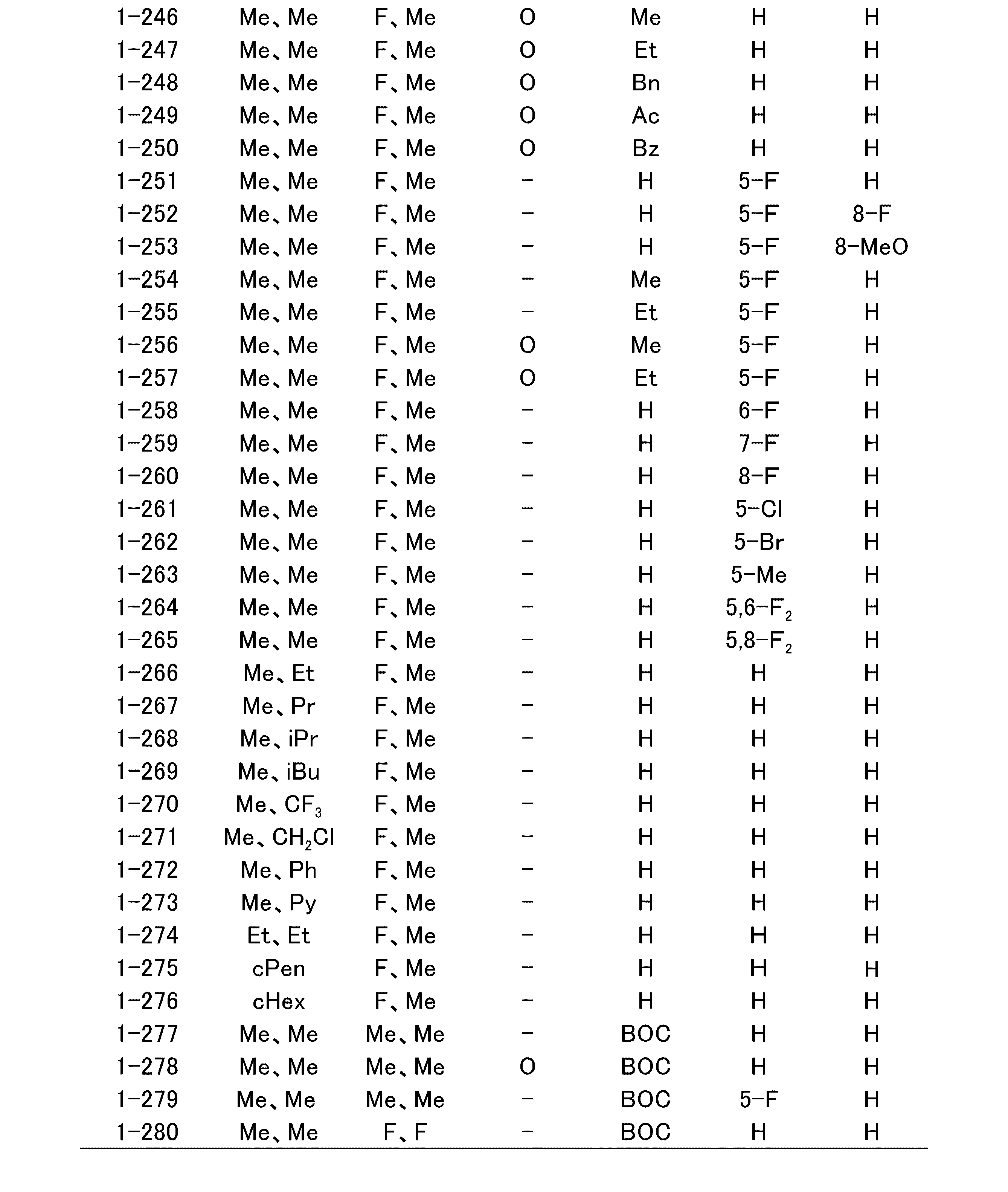
本発明の代表化合物を下記の表1及び表2に例示するが、本発明はこれらの化合物に限定されるものではない。 The representative compounds of the present invention are exemplified in the following Tables 1 and 2, but the present invention is not limited to these compounds.
以下、「Me」はメチル基を、「Et」はエチル基を、「Pr」はプロピル基を、「iPr」はイソプロピル基を、「iBu」はイソブチル基を、「Ph」はフェニル基を、「Py」はピリジル基を、「Ac」はアセチル基を、「Bn」はベンジル基を、「cPen」はR1とR2または、R3とR4とで環を形成してシクロペンチル基を、「Bz」はベンゾイル基を、「BOC」はt−ブトキシカルボニル基を、「cHex」は、R1とR2または、R3とR4とで環を形成してシクロヘキシル基を、「(R5)p」における「−」は、「(R5)p」基が存在しないことを、「Xn」および「Ym」における「H」は、nが0であり、mが0であることを、それぞれ示す。 Hereinafter, “Me” represents a methyl group, “Et” represents an ethyl group, “Pr” represents a propyl group, “iPr” represents an isopropyl group, “iBu” represents an isobutyl group, “Ph” represents a phenyl group, “Py” represents a pyridyl group, “Ac” represents an acetyl group, “Bn” represents a benzyl group, and “cPen” represents a cyclopentyl group by forming a ring with R 1 and R 2 or R 3 and R 4. , “Bz” represents a benzoyl group, “BOC” represents a t-butoxycarbonyl group, “cHex” represents a cyclohexyl group formed by R 1 and R 2 or R 3 and R 4 to form a ring, “( R 5) p '' in - "is" H "in" (R 5) that p "group is not present," Xn "and" Ym "is, n is 0, that m is 0 Are shown respectively.
上記の例示化合物中、
好適には、
化合物番号1−093の化合物:3−(3,3,4,4−テトラメチル−3,4−ジヒドロイソキノリン−1−イル)−1,2,3,4−テトラヒドロキノリン、
化合物番号1−107の化合物:3−(3,3,4,4−テトラメチル−2−オキシド−3,4−ジヒドロイソキノリン−1−イル)−1,2,3,4−テトラヒドロキノリン、
化合物番号1−113の化合物:3−(5−フルオロ−3,3,4,4−テトラメチル−3,4−ジヒドロイソキノリン−1−イル)−1,2,3,4−テトラヒドロキノリン、
化合物番号1−117の化合物:3−(5−フルオロ−3,3,4,4−テトラメチル−3,4−ジヒドロイソキノリン−1−イル)−1−エチル−1,2,3,4−テトラヒドロキノリン、
化合物番号1−118の化合物:3−(5−フルオロ−3,3,4,4−テトラメチル−2−オキシド−3,4−ジヒドロイソキノリン−1−イル)−1,2,3,4−テトラヒドロキノリン、
化合物番号1−185の化合物:3−(4,4−ジフルオロ−3,3−ジメチル−3,4−ジヒドロイソキノリン−1−イル)−1,2,3,4−テトラヒドロキノリン、
化合物番号1−199の化合物:3−(4,4−ジフルオロ−3,3−ジメチル−2−オキシド−3,4−ジヒドロイソキノリン−1−イル)−1,2,3,4−テトラヒドロキノリン、
化合物番号2−011の化合物:3−(3,3−ジメチル−1,2,3,4−テトラヒドロイソキノリン−1−イル)−1−エチル−1,2,3,4−テトラヒドロキノリン、
化合物番号2−093の化合物:3−(3,3,4,4−テトラメチル−1,2,3,4−テトラヒドロイソキノリン−1−イル)−1,2,3,4−テトラヒドロキノリン、
化合物番号2−113の化合物:3−(5−フルオロ−3,3,4,4−テトラメチル−1,2,3,4−テトラヒドロイソキノリン−1−イル)−1,2,3,4−テトラヒドロキノリン、
化合物番号2−185の化合物:3−(4,4−ジフルオロ−3,3−ジメチル−1,2,3,4−テトラヒドロイソキノリン−1−イル)−1,2,3,4−テトラヒドロキノリン又は
化合物番号2−205の化合物:3−(4,4,5−トリフルオロ−3,3−ジメチル−1,2,3,4−テトラヒドロイソキノリン−1−イル)−1,2,3,4−テトラヒドロキノリン
であり、
より好適には、化合物番号1−113、1−118、1−185、1−199又は2−185の化合物であり、
更により好適には、化合物番号1−113又は2−185の化合物である。
本発明の一般式(I)の化合物は、以下に記載するA法、B法、C法又はD法により製造することができる。
Among the above exemplified compounds,
Preferably,
Compound No. 1-093: 3- (3,3,4,4-tetramethyl-3,4-dihydroisoquinolin-1-yl) -1,2,3,4-tetrahydroquinoline,
Compound No. 1-107: 3- (3,3,4,4-tetramethyl-2-oxide-3,4-dihydroisoquinolin-1-yl) -1,2,3,4-tetrahydroquinoline,
Compound No. 1-113: 3- (5-Fluoro-3,3,4,4-tetramethyl-3,4-dihydroisoquinolin-1-yl) -1,2,3,4-tetrahydroquinoline,
Compound No. 1-117: 3- (5-Fluoro-3,3,4,4-tetramethyl-3,4-dihydroisoquinolin-1-yl) -1-ethyl-1,2,3,4- Tetrahydroquinoline,
Compound No. 1-118: 3- (5-Fluoro-3,3,4,4-tetramethyl-2-oxide-3,4-dihydroisoquinolin-1-yl) -1,2,3,4- Tetrahydroquinoline,
Compound No. 1-185: 3- (4,4-Difluoro-3,3-dimethyl-3,4-dihydroisoquinolin-1-yl) -1,2,3,4-tetrahydroquinoline,
Compound No. 1-199: 3- (4,4-difluoro-3,3-dimethyl-2-oxide-3,4-dihydroisoquinolin-1-yl) -1,2,3,4-tetrahydroquinoline,
Compound No. 2-011: 3- (3,3-dimethyl-1,2,3,4-tetrahydroisoquinolin-1-yl) -1-ethyl-1,2,3,4-tetrahydroquinoline,
Compound No. 2-093: 3- (3,3,4,4-tetramethyl-1,2,3,4-tetrahydroisoquinolin-1-yl) -1,2,3,4-tetrahydroquinoline,
Compound No. 2-113: 3- (5-Fluoro-3,3,4,4-tetramethyl-1,2,3,4-tetrahydroisoquinolin-1-yl) -1,2,3,4- Tetrahydroquinoline,
Compound No. 2-185: 3- (4,4-difluoro-3,3-dimethyl-1,2,3,4-tetrahydroisoquinolin-1-yl) -1,2,3,4-tetrahydroquinoline or Compound No. 2-205: 3- (4,4,5-trifluoro-3,3-dimethyl-1,2,3,4-tetrahydroisoquinolin-1-yl) -1,2,3,4- Tetrahydroquinoline,
More preferably, it is a compound of compound number 1-113, 1-118, 1-185, 1-199 or 2-185,
Even more preferred is the compound of Compound No. 1-113 or 2-185.
The compound of the general formula (I) of the present invention can be produced by Method A, Method B, Method C or Method D described below.
(A法)
上記式中、R1、R2、R3、R4、R6、X、n、Y及びmは、前記と同意義を示す。
A法は、式(II)を有するアルコール化合物と、式(III)を有するニトリル化合物を反応させて、本発明の化合物(I)において、点線の結合が二重結合であり、pが0である化合物(Ia)を製造する方法である。
(Method A)
In the above formula, R 1 , R 2 , R 3 , R 4 , R 6 , X, n, Y and m are as defined above.
In Method A, an alcohol compound having the formula (II) is reacted with a nitrile compound having the formula (III), and in the compound (I) of the present invention, the dotted bond is a double bond, and p is 0. This is a method for producing a certain compound (Ia).
(A工程)
A工程は、アルコール化合物(II)を、溶媒中あるいは非溶媒中(好適には、溶媒中)、酸の存在下、ニトリル化合物(III)と反応することにより、化合物(Ia)を製造する工程である。
用いられるニトリル化合物(III)の量は、アルコール化合物(II)1モルに対し、通常、1〜6モルであり、好適には、1.0〜3.0モルである。
本工程で用いられる溶媒は、反応を阻害しないものであれば特に限定はないが、例えば、ヘキサン、シクロヘキサン、ベンゼン、トルエン及びキシレンのような炭化水素類;ジクロロメタン、ジクロロエタン、クロロホルム及び四塩化炭素のようなハロゲン化炭化水素類;又は、ジオキサン、ジエチルエーテル、テトラヒドロフラン(THF)及びジブチルエーテルのようなエーテル類であり得、好適には、炭化水素類又はハロゲン化炭化水素類であり、より好適には、ベンゼン又はジクロロエタンである。
本工程で用いられる酸は、通常のリッター反応において酸として使用されるものであれば特に限定はないが、例えば、硫酸、蟻酸、リン酸及び過塩素酸のような無機酸;ベンゼンスルホン酸、トルエンスルホン酸及びトリフルオロメタンスルホン酸のようなスルホン酸;又は、四塩化錫及びトリフルオロホウ素のようなルイス酸であり得、好適には、無機酸又はスルホン酸であり、より好適には、硫酸又はトリフルオロメタンスルホン酸である。
用いられる酸の量は、アルコール化合物(II)1モルに対し、通常、1〜20モルであり、好適には、1.1〜15モルである。
反応温度は、原料化合物、反応試薬及び溶媒などにより異なるが、通常、−20℃〜100℃であり、好適には、0℃〜80℃である。
反応時間は、原料化合物、反応試薬、溶媒及び反応温度などにより異なるが、通常、15分間〜120時間であり、好適には、30分間〜72時間である。
本工程に使用されるアルコール化合物(II)は公知化合物であるか、又は公知の方法{例えば、テトラヘドロン(Tetrahedron),55巻4595頁(1999年)に記載された方法}に準じて製造することができる。
本工程に使用されるニトリル化合物(III)は公知の3−シアノキノリン化合物を通常の方法で還元して製造することができる。
(Process A)
Step A is a step of producing compound (Ia) by reacting alcohol compound (II) with nitrile compound (III) in the presence of an acid in a solvent or in a non-solvent (preferably in a solvent). It is.
The amount of the nitrile compound (III) to be used is usually 1 to 6 mol, preferably 1.0 to 3.0 mol, per 1 mol of the alcohol compound (II).
The solvent used in this step is not particularly limited as long as it does not inhibit the reaction. For example, hydrocarbons such as hexane, cyclohexane, benzene, toluene and xylene; dichloromethane, dichloroethane, chloroform and carbon tetrachloride. Or halogenated hydrocarbons; or ethers such as dioxane, diethyl ether, tetrahydrofuran (THF) and dibutyl ether, preferably hydrocarbons or halogenated hydrocarbons, more preferably Is benzene or dichloroethane.
The acid used in this step is not particularly limited as long as it is used as an acid in a normal liter reaction. For example, inorganic acids such as sulfuric acid, formic acid, phosphoric acid and perchloric acid; benzenesulfonic acid, Sulfonic acids such as toluene sulfonic acid and trifluoromethane sulfonic acid; or Lewis acids such as tin tetrachloride and trifluoroboron, preferably inorganic acids or sulfonic acids, more preferably sulfuric acid. Or trifluoromethanesulfonic acid.
The amount of the acid used is usually 1 to 20 mol, preferably 1.1 to 15 mol, per 1 mol of alcohol compound (II).
While the reaction temperature varies depending on the raw material compound, reaction reagent, solvent and the like, it is generally −20 ° C. to 100 ° C., preferably 0 ° C. to 80 ° C.
While the reaction time varies depending on the raw material compound, reaction reagent, solvent, reaction temperature and the like, it is usually 15 minutes to 120 hours, preferably 30 minutes to 72 hours.
The alcohol compound (II) used in this step is a known compound, or is produced according to a known method {for example, the method described in Tetrahedron, 55, 4595 (1999)}. be able to.
The nitrile compound (III) used in this step can be produced by reducing a known 3-cyanoquinoline compound by a conventional method.
(B法)
上記式中、点線の結合、R1、R2、R3、R4、R5、p、X、n、Y及びmは、前記と同意義を示し、R6aは、アシル基を除く他、R6と同意義を示す。
B法は、式(IV)を有する化合物を還元することにより、本発明の化合物(I)において、R6がR6a(水素原子又は置換されてよいC1−C6アルキル基)である化合物(Ib)を製造する方法である。
(Method B)
In the above formula, dotted bond, R 1 , R 2 , R 3 , R 4 , R 5 , p, X, n, Y and m are as defined above, and R 6a is other than an acyl group , R 6 has the same significance.
Method B is a compound in which R 6 is R 6a (hydrogen atom or optionally substituted C 1 -C 6 alkyl group) in compound (I) of the present invention by reducing a compound having the formula (IV) This is a method for producing (Ib).
(B工程)
B工程は、化合物(IV)を、溶媒中、還元して、本発明の化合物(Ib)を製造する工程である。
本工程で用いられる還元反応は、例えば、パラジウム炭素、酸化白金及びラネーニッケルのような接触還元触媒を用いる水素添加反応;亜鉛−酢酸及び錫−塩酸のような金属−酸の組合せを用いる還元反応;水素化リチウムアルミニウム、水素化ホウ素ナトリウム及び水素化シアノホウ素ナトリウムのような金属水素化物を用いる還元反応であり得、好適には、金属水素化物を用いる還元反応であり、より好適には、水素化ホウ素ナトリウムを用いる還元反応である。
用いられる還元剤(金属−酸の組合せ又は金属水素化物を用いる場合)の量は、化合物(IV)1モルに対し、通常、0.5〜20モルであり、好適には、0.5〜10モルである。
また、接触還元触媒を用いる水素添加反応は、1〜10気圧の水素下、好適には、1〜5気圧の水素下で行われる。
本工程で用いられる溶媒は、反応を阻害しないものであれば特に限定はないが、例えば、ヘキサン、シクロヘキサン、ベンゼン、トルエン及びキシレンのような炭化水素類;ジクロロメタン、クロロホルム及び四塩化炭素のようなハロゲン化炭化水素類;メタノール、エタノール及び2−プロパノールのようなアルコール類;酢酸、プロピオン酸、塩酸及び硫酸のような酸類;又は、ジオキサン、ジエチルエーテル、テトラヒドロフラン(THF)及びジブチルエーテルのようなエーテル類であり得、好適には、酸類又はアルコール類であり、より好適には、酢酸又はエタノールである。
また、溶媒を兼るか又は兼ねないで、過剰のギ酸又は式R6a−1CO2H(式中、R6a−1は置換されてよいC1−C5アルキル基を表す)を有するカルボン酸(好適には、ギ酸又はハロゲンで置換されてよい酢酸)を用いて、本反応を行うと、芳香環の還元と共に、−N(H)−基がアシル化され、更に、−N(アシル)−基が還元され、−N(置換されてよいC1−C6アルキル)−体が得られる。
反応温度は、原料化合物、反応試薬及び溶媒などにより異なるが、通常、0℃〜200℃であり、好適には、20℃〜150℃である。
反応時間は、原料化合物、反応試薬、溶媒及び反応温度などにより異なるが、通常、1時間〜120時間であり、好適には、3時間〜72時間である。
化合物(IV)は、A法に準じて製造するか、WO2005/70917に記載の方法に準じて製造することができる。
(Process B)
Step B is a step for producing compound (Ib) of the present invention by reducing compound (IV) in a solvent.
The reduction reaction used in this step is, for example, a hydrogenation reaction using a catalytic reduction catalyst such as palladium carbon, platinum oxide and Raney nickel; a reduction reaction using a metal-acid combination such as zinc-acetic acid and tin-hydrochloric acid; It can be a reduction reaction using a metal hydride such as lithium aluminum hydride, sodium borohydride and sodium cyanoborohydride, preferably a reduction reaction using a metal hydride, more preferably a hydrogenation. This is a reduction reaction using sodium boron.
The amount of the reducing agent used (when a metal-acid combination or a metal hydride is used) is usually 0.5 to 20 mol, preferably 0.5 to 0.1 mol per 1 mol of compound (IV). 10 moles.
Moreover, the hydrogenation reaction using a catalytic reduction catalyst is performed under 1 to 10 atmospheres of hydrogen, preferably 1 to 5 atmospheres of hydrogen.
The solvent used in this step is not particularly limited as long as it does not inhibit the reaction. For example, hydrocarbons such as hexane, cyclohexane, benzene, toluene and xylene; such as dichloromethane, chloroform and carbon tetrachloride. Halogenated hydrocarbons; alcohols such as methanol, ethanol and 2-propanol; acids such as acetic acid, propionic acid, hydrochloric acid and sulfuric acid; or ethers such as dioxane, diethyl ether, tetrahydrofuran (THF) and dibutyl ether It is preferably an acid or an alcohol, more preferably acetic acid or ethanol.
Carboxyl having excess formic acid or formula R 6a-1 CO 2 H (wherein R 6a-1 represents an optionally substituted C 1 -C 5 alkyl group) may or may not serve as a solvent. When this reaction is carried out using an acid (preferably formic acid or acetic acid which may be substituted with halogen), the —N (H) — group is acylated together with reduction of the aromatic ring, and further —N (acyl ) - group is reduced, -N (which may be substituted C 1 -C 6 alkyl) - the body is obtained.
The reaction temperature varies depending on the raw material compound, the reaction reagent, the solvent, and the like, but is usually 0 ° C to 200 ° C, and preferably 20 ° C to 150 ° C.
While the reaction time varies depending on the raw material compound, reaction reagent, solvent, reaction temperature and the like, it is generally 1 hour to 120 hours, preferably 3 hours to 72 hours.
Compound (IV) can be produced according to the method A or can be produced according to the method described in WO2005 / 70917.
(C法)
上式中、点線の結合、R1、R2、R3、R4、R5、p、X、n、Y及びmは、前記と同意義を示し、R6bは、水素原子を除く他、R6と同意義を示す。
C法は、本発明の化合物(I)において、R6が水素原子である化合物(Ic)をアルキル化またはアシル化することにより、本発明の化合物(I)において、R6がR6b(アシル基又は置換されてよいC1−C6アルキル基)である化合物(Id)を製造する方法である。
(Method C)
In the above formula, dotted bond, R 1 , R 2 , R 3 , R 4 , R 5 , p, X, n, Y and m are as defined above, and R 6b is other than a hydrogen atom. , R 6 has the same significance.
In the method C, compound (Ic) in which R 6 is a hydrogen atom in compound (I) of the present invention is alkylated or acylated, whereby in compound (I) of the present invention, R 6 is R 6b (acyl). Group (C 1 -C 6 alkyl group which may be substituted or substituted).
(C工程)
C工程は、化合物(Ic)を、溶媒中、塩基の存在下、ハロゲン化(置換されてよい)アルキル化合物またはハロゲン化アシル化合物と反応させ、本発明の化合物(Id)を製造する工程である。
本工程で用いられるハロゲン化(置換されてよい)アルキル化合物又はハロゲン化アシル化合物(好適には、相当するクロル若しくはブロムアルキル又はクロル若しくはブロムアシルである)の量は、化合物(Ic)1モルに対し、通常、1〜130モルであり、好適には、1.1〜10モルである。
本工程で用いられる塩基は、通常の反応において塩基として使用されるものであれば特に限定はないが、例えば、炭酸ナトリウム及び炭酸カリウムのようなアルカリ金属炭酸塩;炭酸水素ナトリウム及び炭酸水素カリウムのようなアルカリ金属炭酸水素塩;水素化ナトリウム、水素化リチウム及び水素化カリウムのようなアルカリ金属水素化物;水酸化ナトリウム及び水酸化カリウムのようなアルカリ金属水酸化物;水酸化カルシウム、水酸化バリウムのようなアルカリ土類金属水酸化物;ナトリウムメトキシド、ナトリウムエトキシド及びカリウムt−ブトキシドのようなアルカリ金属アルコキシド類;トリエチルアミン、トリブチルアミン、ジイソプロピルエチルアミン、N−メチルモルホリン、ピリジン、4−(N,N−ジメチルアミノ)ピリジン、N,N−ジメチルアニリン、N,N−ジエチルアニリン、1,5−ジアザビシクロ[4.3.0]ノナ−5−エン、1,4−ジアザビシクロ[2.2.2]オクタン(DABCO)及び1,8−ジアザビシクロ[5.4.0]−7−ウンデセン(DBU)のような有機塩基類;又は、ブチルリチウム及びリチウムジイソプロピルアミドのような有機金属類であり得、好適には、アルカリ金属炭酸塩であり、より好適には、炭酸カリウムである。
用いられる塩基の量は、化合物(Ic)1モルに対し、通常、1〜30モルであり、好適には、1.1〜10モルである。
本工程で用いられる溶媒は、反応を阻害しないものであれば特に限定はないが、例えば、ヘキサン、シクロヘキサン、ベンゼン及びトルエンのような炭化水素類;ジクロロメタン、ジクロロエタン、クロロホルム及びテトラクロロエタンのようなハロゲン化炭化水素類;ジオキサン、ジエチルエーテル、テトラヒドロフラン(THF)及びエチレングリコールジメチルエーテルのようなエーテル類;ジメチルホルムアミド、ジメチルアセトアミド及びヘキサメチルリン酸トリアミド(HMPA)のようなアミド類;アセトン、メチルエチルケトン、メチルイソブチルケトン及びシクロヘキサノンのようなケトン類;アセトニトリル及びイソブチロニトリルのようなニトリル類;又は、酢酸メチル、酢酸エチル及び酢酸プロピルのようなエステル類であり得、好適には、ケトン類であり、より好適には、アセトンである。
反応温度は、原料化合物、反応試薬及び溶媒などにより異なるが、通常、−20℃〜150℃であり、好適には、0℃〜50℃である。
反応時間は、原料化合物、反応試薬、溶媒及び反応温度などにより異なるが、通常、10分間〜120時間であり、好適には、30分間〜72時間である。
(Process C)
Step C is a step for producing compound (Id) of the present invention by reacting compound (Ic) with a halogenated (optionally substituted) alkyl compound or acyl halide compound in a solvent in the presence of a base. .
The amount of the halogenated (optionally substituted) alkyl compound or acyl halide compound (preferably the corresponding chloro or bromoalkyl or chloro or bromoacyl) used in this step is relative to 1 mol of compound (Ic). The amount is usually 1 to 130 mol, and preferably 1.1 to 10 mol.
The base used in this step is not particularly limited as long as it is used as a base in a normal reaction. For example, alkali metal carbonates such as sodium carbonate and potassium carbonate; sodium bicarbonate and potassium bicarbonate Alkali metal hydrogen carbonates such as sodium hydride, lithium hydride and potassium hydride; alkali metal hydroxides such as sodium hydroxide and potassium hydroxide; calcium hydroxide, barium hydroxide Alkaline earth metal hydroxides such as; alkali metal alkoxides such as sodium methoxide, sodium ethoxide and potassium t-butoxide; triethylamine, tributylamine, diisopropylethylamine, N-methylmorpholine, pyridine, 4- (N , N-dimethylami ) Pyridine, N, N-dimethylaniline, N, N-diethylaniline, 1,5-diazabicyclo [4.3.0] non-5-ene, 1,4-diazabicyclo [2.2.2] octane (DABCO ) And 1,8-diazabicyclo [5.4.0] -7-undecene (DBU); or organometallics such as butyl lithium and lithium diisopropylamide, preferably An alkali metal carbonate, more preferably potassium carbonate.
The amount of the base used is usually 1 to 30 mol, and preferably 1.1 to 10 mol, per 1 mol of compound (Ic).
The solvent used in this step is not particularly limited as long as it does not inhibit the reaction. For example, hydrocarbons such as hexane, cyclohexane, benzene and toluene; halogens such as dichloromethane, dichloroethane, chloroform and tetrachloroethane. Hydrocarbons; ethers such as dioxane, diethyl ether, tetrahydrofuran (THF) and ethylene glycol dimethyl ether; amides such as dimethylformamide, dimethylacetamide and hexamethylphosphoric triamide (HMPA); acetone, methyl ethyl ketone, methyl isobutyl Ketones such as ketones and cyclohexanone; nitriles such as acetonitrile and isobutyronitrile; or esters such as methyl acetate, ethyl acetate and propyl acetate It is a kind, preferably a ketone, more preferably acetone.
The reaction temperature varies depending on the raw material compound, the reaction reagent, the solvent and the like, but is usually −20 ° C. to 150 ° C., and preferably 0 ° C. to 50 ° C.
While the reaction time varies depending on the raw material compound, reaction reagent, solvent, reaction temperature and the like, it is usually 10 minutes to 120 hours, preferably 30 minutes to 72 hours.
(D法)
上記式中、R1、R2、R3、R4、R6、X、n、Y及びmは、前記と同意義を示す。
D法は、本発明の化合物(I)において、点線の結合が二重結合であり、pが0である化合物(Ia)を酸化して、式(V)を有するアジリジン化合物を製造し、次いで、化合物(V)を酸で処理することにより、本発明の化合物(I)において、点線の結合が二重結合であり、pが1であり、R5が酸素原子である化合物(Ie)を製造する方法である。
(Method D)
In the above formula, R 1 , R 2 , R 3 , R 4 , R 6 , X, n, Y and m have the same meaning as described above.
In the method D, a compound (Ia) in which the dotted bond is a double bond and p is 0 in the compound (I) of the present invention is oxidized to produce an aziridine compound having the formula (V), and then By treating compound (V) with an acid, compound (Ie) in the compound (I) of the present invention, wherein the dotted bond is a double bond, p is 1, and R 5 is an oxygen atom, It is a manufacturing method.
(D−1工程)
D−1工程は、化合物(Ia)を、溶媒中又は非溶媒中(好適には、溶媒中)、酸化剤と反応することにより、中間体であるアジリジン化合物(V)を製造する工程である。
本工程で用いられる溶媒は、反応を阻害しないものであれば特に限定はないが、例えば、蟻酸及び酢酸のような有機酸類;ヘキサン、シクロヘキサン、ベンゼン、トルエン及びキシレンのような炭化水素類;ジクロロメタン、ジクロロエタン、クロロホルム及び四塩化炭素のようなハロゲン化炭化水素類;メタノール、エタノール及び2−プロパノールのようなアルコール類;又は、ジオキサン、ジエチルエーテル、テトラヒドロフラン(THF)及びジブチルエーテルのようなエーテル類であり得、好適には、アルコール類又は炭化水素類であり、より好適には、メタノールである。
本工程で用いられる酸化剤は、通常のイミン基(−N=基)をオキサゾリジンに酸化する反応において使用されるものであれば特に限定はないが、例えば、メタクロロ過安息香酸、パラニトロ過安息香酸及びモノペルオキシフタル酸のような過安息香酸類;トリフルオロ過酢酸、過酢酸及び過蟻酸のような過酸類;ジメチルジオキソランのような過酸化物類;金属化合物触媒(例えば、塩化モリブデン、タングステン酸ナトリウム又は酸化バナジウム)下のt−ブチルヒドロペルオキシド、t−アミルヒドロペルオキシド及び過酸化水素のような、金属化合物触媒下のヒドロペルオキシド類であり得、好適には、過安息香酸類、過酸類又はタングステン酸ナトリウム触媒下のヒドロペルオキシド類であり、より好適には、メタクロロ過安息香酸又は過酢酸である。
用いられる酸化剤の量は、化合物(Ia)1モルに対し、通常、1〜20モルであり、好適には、1.1〜15モルである。
反応温度は、原料化合物、反応試薬及び溶媒などにより異なるが、通常、0℃〜200℃であり、好適には、10℃〜150℃である。
反応時間は、原料化合物、反応試薬、溶媒及び反応温度などにより異なるが、通常、15分間〜120時間であり、好適には、30分間〜72時間である。
出発原料(Ia)は上記A法で製造される。
(Process D-1)
Step D-1 is a step of producing an aziridine compound (V) as an intermediate by reacting compound (Ia) with an oxidizing agent in a solvent or in a non-solvent (preferably in a solvent). .
The solvent used in this step is not particularly limited as long as it does not inhibit the reaction. For example, organic acids such as formic acid and acetic acid; hydrocarbons such as hexane, cyclohexane, benzene, toluene and xylene; dichloromethane Halogenated hydrocarbons such as dichloroethane, chloroform and carbon tetrachloride; alcohols such as methanol, ethanol and 2-propanol; or ethers such as dioxane, diethyl ether, tetrahydrofuran (THF) and dibutyl ether It can be, preferably an alcohol or a hydrocarbon, more preferably methanol.
The oxidizing agent used in this step is not particularly limited as long as it is used in a reaction for oxidizing a normal imine group (—N = group) to oxazolidine. For example, metachloroperbenzoic acid, paranitroperbenzoic acid And perbenzoic acids such as monoperoxyphthalic acid; peracids such as trifluoroperacetic acid, peracetic acid and formic acid; peroxides such as dimethyldioxolane; metal compound catalysts (eg, molybdenum chloride, sodium tungstate) Or hydroperoxides catalyzed by metal compounds, such as t-butyl hydroperoxide, t-amyl hydroperoxide and hydrogen peroxide under vanadium oxide), preferably perbenzoic acids, peracids or tungstic acid Sodium peroxide hydroperoxides, more preferably metachloroperbenzoic acid Or peracetic acid.
The amount of the oxidizing agent to be used is generally 1 to 20 mol, preferably 1.1 to 15 mol, per 1 mol of compound (Ia).
While the reaction temperature varies depending on the raw material compound, reaction reagent, solvent and the like, it is generally 0 ° C. to 200 ° C., preferably 10 ° C. to 150 ° C.
While the reaction time varies depending on the raw material compound, reaction reagent, solvent, reaction temperature and the like, it is usually 15 minutes to 120 hours, preferably 30 minutes to 72 hours.
The starting material (Ia) is produced by the above method A.
(D−2工程)
D−2工程は、化合物(V)を、溶媒中あるいは非溶媒中(好適には、溶媒中)、酸で処理することにより、本発明の化合物(Ie)を製造する工程である。
本工程で用いられる溶媒は、反応を阻害しないものであれば特に限定はないが、例えば、ヘキサン、シクロヘキサン、ベンゼン、トルエン及びキシレンのような炭化水素類;ジクロロメタン、ジクロロエタン、クロロホルム及び四塩化炭素のようなハロゲン化炭化水素類;又は、ジオキサン、ジエチルエーテル、テトラヒドロフラン(THF)及びジブチルエーテルのようなエーテル類であり得、好適には、ハロゲン化炭化水素類であり、より好適には、クロロホルムである。
本工程で用いられる酸は、特に限定はないが、例えば、硫酸、蟻酸、リン酸及び過塩素酸のような無機酸;ベンゼンスルホン酸、トルエンスルホン酸及びトリフルオロメタンスルホン酸のようなスルホン酸;又は、四塩化錫及びトリフルオロホウ素のようなルイス酸であり得、好適には、無機酸又はスルホン酸であり、より好適には、硫酸又はメタンスルホン酸である。
用いられる酸の量は、化合物(Ia)1モルに対し、通常、1〜20モルであり、好適には、1.1〜15モルである。
反応温度は、原料化合物、反応試薬及び溶媒などにより異なるが、通常、−20℃〜100℃であり、好適には、0℃〜80℃である。
反応時間は、原料化合物、反応試薬、溶媒及び反応温度などにより異なるが、通常、15分間〜120時間であり、好適には、30分間〜72時間である。
(Step D-2)
Step D-2 is a step for producing compound (Ie) of the present invention by treating compound (V) with an acid in a solvent or in a non-solvent (preferably in a solvent).
The solvent used in this step is not particularly limited as long as it does not inhibit the reaction. For example, hydrocarbons such as hexane, cyclohexane, benzene, toluene and xylene; dichloromethane, dichloroethane, chloroform and carbon tetrachloride. Halogenated hydrocarbons such as; or ethers such as dioxane, diethyl ether, tetrahydrofuran (THF) and dibutyl ether, preferably halogenated hydrocarbons, more preferably chloroform. is there.
The acid used in this step is not particularly limited. For example, inorganic acids such as sulfuric acid, formic acid, phosphoric acid and perchloric acid; sulfonic acids such as benzenesulfonic acid, toluenesulfonic acid and trifluoromethanesulfonic acid; Alternatively, Lewis acids such as tin tetrachloride and trifluoroboron can be used, preferably inorganic acids or sulfonic acids, and more preferably sulfuric acid or methanesulfonic acid.
The amount of the acid to be used is usually 1 to 20 mol, preferably 1.1 to 15 mol, per 1 mol of compound (Ia).
While the reaction temperature varies depending on the raw material compound, reaction reagent, solvent and the like, it is generally −20 ° C. to 100 ° C., preferably 0 ° C. to 80 ° C.
While the reaction time varies depending on the raw material compound, reaction reagent, solvent, reaction temperature and the like, it is usually 15 minutes to 120 hours, preferably 30 minutes to 72 hours.
上記各反応終了後、各反応の目的化合物は、常法に従って反応混合物から採取することができる。例えば、反応混合物を適宜中和し、又、不溶物が存在する場合には濾過により除去した後、酢酸エチルのような水不混和性有機溶媒を加え、水洗した後、目的化合物を含む有機層を分離し、無水硫酸マグネシウムのような乾燥剤で乾燥した後、溶剤を留去することによって得られる。 After completion of each of the above reactions, the target compound of each reaction can be collected from the reaction mixture according to a conventional method. For example, the reaction mixture is appropriately neutralized, and if insoluble matter is present, it is removed by filtration, followed by adding a water-immiscible organic solvent such as ethyl acetate, washing with water, and then containing the target compound. Is separated and dried with a desiccant such as anhydrous magnesium sulfate, and then the solvent is distilled off.
得られた目的化合物は、必要ならば、常法、例えば再結晶、再沈殿又はクロマトグラフィー等によって更に精製できる。 If necessary, the obtained target compound can be further purified by a conventional method such as recrystallization, reprecipitation or chromatography.
本発明の化合物(I)の塩を製造する工程は、各工程で製造した化合物(I)を含む反応混合物の抽出濃縮物又は化合物(I)を適当な溶媒に溶解させた液に酸を加えることによって行われる。 In the step of producing the salt of the compound (I) of the present invention, an acid is added to an extract concentrate of the reaction mixture containing the compound (I) produced in each step or a solution obtained by dissolving the compound (I) in an appropriate solvent. Is done by.
反応に使用される酸は、フッ化水素酸、塩酸、臭化水素酸及びヨウ化水素酸のようなハロゲン化水素酸;硝酸、過塩素酸、硫酸及びリン酸のような無機酸;メタンスルホン酸、トリフルオロメタンスルホン酸及びエタンスルホン酸のような低級アルキルスルホン酸;ベンゼンスルホン酸及びp−トルエンスルホン酸のようなアリールスルホン酸;コハク酸及びシュウ酸のようなの有機カルボン酸;又はサッカリンのような有機酸アミド化合物であり得る。 Acids used in the reaction are hydrohalic acids such as hydrofluoric acid, hydrochloric acid, hydrobromic acid and hydroiodic acid; inorganic acids such as nitric acid, perchloric acid, sulfuric acid and phosphoric acid; methanesulfone Acids, lower alkyl sulfonic acids such as trifluoromethane sulfonic acid and ethane sulfonic acid; aryl sulfonic acids such as benzene sulfonic acid and p-toluene sulfonic acid; organic carboxylic acids such as succinic acid and oxalic acid; or saccharin Organic acid amide compounds can be used.
使用される酸は、通常1当量〜10当量用いられ、好適には1当量〜5当量である。 The acid used is usually used in an amount of 1 equivalent to 10 equivalents, preferably 1 equivalent to 5 equivalents.
反応に使用される溶媒は、本反応を阻害しない限り特に限定はないが、例えば、エーテル、ジイソプロピルエーテル、テトラヒドロフラン(THF)及び、ジオキサンのようなエーテル類、メタノール及びエタノールのようなアルコール類であり得、好適には、エーテル類であり、より好適には、ジエチルエーテルである。
反応温度は、通常−20℃〜50℃であり、好適には、−10℃〜30℃である。
The solvent used in the reaction is not particularly limited as long as it does not inhibit this reaction, and examples thereof include ethers, diisopropyl ether, tetrahydrofuran (THF) and ethers such as dioxane, alcohols such as methanol and ethanol. Obtained, preferably ethers, and more preferably diethyl ether.
The reaction temperature is usually −20 ° C. to 50 ° C., and preferably −10 ° C. to 30 ° C.
反応時間は、用いられる溶媒の種類及び温度などにより異なるが、通常10分間〜1時間である。 The reaction time varies depending on the type of solvent used and the temperature, but is usually 10 minutes to 1 hour.
生成した塩は、常法によって、反応混合物から単離される。即ち、結晶として析出する場合は濾取によって、水溶性の場合には、有機溶媒と水との分液によって水溶液として単離される。 The resulting salt is isolated from the reaction mixture by conventional methods. That is, when it precipitates as a crystal, it is isolated by filtration, and when it is water-soluble, it is isolated as an aqueous solution by separation of an organic solvent and water.
本発明化合物は、有害生物防除剤の有効成分として有用である。例えば、農園芸用殺菌剤としては各種の植物病原菌によって引き起こされる病害に対し優れた防除効果を示す。特に、イネいもち病、穂枯病、アズキ、トマト、キュウリ及びインゲンの灰色かび病、菌核病、タマネギ白斑葉枯病、コムギの雪腐病、うどんこ病、リンゴのモニリア病、斑点落葉病、茶のたんそ病、ナシの赤星病、黒斑病、ブドウの黒とう病、カンキツの黒点病等の各種病害などに対して優れた防除効果を示す。本発明化合物は優れた治療効果を有することから感染後の処理による病害防除が可能である。 The compound of the present invention is useful as an active ingredient of a pest control agent. For example, as an agricultural and horticultural fungicide, it shows an excellent control effect against diseases caused by various plant pathogens. In particular, rice blast, head blight, azuki bean, tomato, cucumber and kidney beans gray mold, mycorrhizal disease, onion white leaf blight, wheat snow rot, powdery mildew, apple moniliosis, spotted leaf It exhibits excellent control effects against various diseases such as tea anthracnose, pear scab, black spot, grape black rot, and citrus black spot. Since the compound of the present invention has an excellent therapeutic effect, disease control by treatment after infection is possible.
本発明化合物の使用に際しては、従来の農薬製剤の場合と同様に、補助剤と共に、乳剤、粉剤、水和剤、液剤、粒剤及び懸濁製剤のような種々の形態に製剤することができる。これらの製剤の実際の使用に際しては、そのまま使用するか、又は水などの希釈剤で所定濃度に希釈して使用することができる。 When using the compound of the present invention, it can be formulated into various forms such as emulsions, powders, wettable powders, liquids, granules and suspensions, together with adjuvants, as in the case of conventional agricultural chemical formulations. . In actual use of these preparations, they can be used as they are or diluted to a predetermined concentration with a diluent such as water.
用いられる補助剤は、担体、乳化剤、懸濁剤、分散剤、展着剤、浸透剤、湿潤剤、増粘剤及び安定剤であり得、必要に応じ適宜添加することができる。 The adjuvant used can be a carrier, an emulsifier, a suspending agent, a dispersing agent, a spreading agent, a penetrating agent, a wetting agent, a thickening agent, and a stabilizer, and can be appropriately added as necessary.
用いられる担体は、固体担体と液体担体に分けられる。固体担体は、澱粉、砂糖、セルロース粉、シクロデキストリン、活性炭、大豆粉、小麦粉、もみがら粉、木粉、魚粉及び粉乳のような動植物性粉末;又は、タルク、カオリン、ベントナイト、有機ベントナイト、炭酸カルシウム、硫酸カルシウム、重炭酸ナトリウム、ゼオライト、珪藻土、ホワイトカーボン、クレー、アルミナ、シリカ及び硫黄粉末のような鉱物性粉末であり得る。液体担体は、水;大豆油、棉実油及びトウモロコシ油のような動植物油;エチルアルコール及びエチレングリコールのようなアルコール類;アセトン及びメチルエチルケトンのようなケトン類;ジオキサン及びテトラヒドロフランのようなエーテル類;ケロシン、灯油、流動パラフィン、キシレン、トリメチルベンゼン、テトラメチルベンゼン、シクロヘキサン及びソルベントナフサのような脂肪族/芳香族炭化水素類;クロロホルム及びクロロベンゼンなどのハロゲン化炭化水素類;ジメチルホルムアミドのような酸アミド類;酢酸エチルエステル及び脂肪酸のグリセリンエステルのようなエステル類;アセトニトリルのようなニトリル類;ジメチルスルホキシドのような含硫化合物類;又は、N−メチルピロリドンのようなピリドンであり得る。 The carrier used is divided into a solid carrier and a liquid carrier. Solid carriers are starch, sugar, cellulose powder, cyclodextrin, activated carbon, soy flour, wheat flour, rice bran flour, animal and vegetable powders such as wood flour, fish flour and milk powder; or talc, kaolin, bentonite, organic bentonite, carbonic acid It can be mineral powders such as calcium, calcium sulfate, sodium bicarbonate, zeolite, diatomaceous earth, white carbon, clay, alumina, silica and sulfur powder. Liquid carriers are water; animal and vegetable oils such as soybean oil, nut oil and corn oil; alcohols such as ethyl alcohol and ethylene glycol; ketones such as acetone and methyl ethyl ketone; ethers such as dioxane and tetrahydrofuran; Aliphatic / aromatic hydrocarbons such as kerosene, kerosene, liquid paraffin, xylene, trimethylbenzene, tetramethylbenzene, cyclohexane and solvent naphtha; halogenated hydrocarbons such as chloroform and chlorobenzene; acid amides such as dimethylformamide Esters such as ethyl acetate and glycerin esters of fatty acids; nitriles such as acetonitrile; sulfur-containing compounds such as dimethyl sulfoxide; or pyridones such as N-methylpyrrolidone Get.
本発明化合物と補助剤との配合質量比は、通常0.05:99.95〜90:10であり、好適には、0.2:99.8〜80:20である。 The compounding mass ratio of the compound of the present invention and the adjuvant is usually 0.05: 99.95 to 90:10, and preferably 0.2: 99.8 to 80:20.
本発明化合物の使用濃度又は使用量は、対象作物、使用方法、製剤形態、施用量などの違いによって異なるが、茎葉処理の場合、有効成分当たり普通0.1〜10000ppmであり、好適には、1〜1000ppmであり、土壌処理の場合には、通常10〜100000g/haであり、好適には、100〜10000g/haである。 The concentration or amount used of the compound of the present invention varies depending on the target crop, method of use, formulation form, application rate, etc., but in the case of foliage treatment, it is usually 0.1 to 10,000 ppm per active ingredient, In the case of soil treatment, it is usually 10 to 100,000 g / ha, and preferably 100 to 10,000 g / ha.
本発明化合物は必要に応じて他の農薬、例えば、殺虫剤、殺ダニ剤、誘引剤、殺線虫剤、殺菌剤、抗ウイルス剤、除草剤及び/又は植物生長調整剤と混用又は併用することができ、他の農薬は、好適には、殺虫剤、殺ダニ剤、殺線虫剤又は殺菌剤である。 The compound of the present invention is mixed or used in combination with other agricultural chemicals such as insecticides, acaricides, attractants, nematicides, fungicides, antiviral agents, herbicides and / or plant growth regulators as necessary. Other pesticides are preferably insecticides, acaricides, nematicides or fungicides.
用いられる殺虫剤は、例えば、O,O−ジエチル O−(5−フェニル−3−イソキサゾリル)ホスホロチオエート(一般名:イソキサチオン)、O,O−ジメチル−O−(3−メチル−4−ニトロフェニル)チオホスフェート(一般名:フェニトロチオン)、O,O−ジエチル O−(2−イソプロピル−4−メチルピリミジン−6−イル)チオホスフェート(一般名:ダイアジノン)、O,S−ジメチル N−アセチルホスホロアミドチオエート(一般名:アセフェート)及びO,O−ジメチル S−1,2−ジエトキシカルボニルエチル ジチオホスフェート(一般名:マラチオン)のような有機リン酸エステル系化合物;
2−tert−ブチルイミノ−3−イソプロピル−5−フェニル−3,4,5,6−テトラヒドロ−2H−1,3,5−チアジアジン−4−オン(一般名:ブプロフェジン)、1−ナフチル N−メチルカーバメート(一般名:カルバリル)、2−イソプロポキシフェニル N−メチルカーバメート(一般名:プロポキスル)、S−メチル N−(メチルカルバモイルオキシ)チオアセトイミデート(一般名:メソミル)及びN,N−ジメチル−2−メチルカルバモイルオキシイミノ−2−(メチルチオ)アセトアミド(一般名:オキサミル)のようなカーバメート系化合物;
(RS)−α−シアノ−3−フェノキシベンジル=(RS)−2−(4−クロロフェニル)−3−メチルブチレート(一般名:フェンバレレート)、3−フェノキシベンジル=(1RS,3RS)−(1RS,3SR)−3−(2,2−ジクロロビニル)−2,2−ジメチルシクロプロパンカルボキシレート(一般名:パーメスリン)及び2−(4−エトキシフェニル)−2−メチルプロピル 3−フェノキシベンジル エーテル(一般名:エトフェンプロックス)のようなピレスロイド系化合物;
1−〔3,5−ジクロロ−4−(3−クロロ−5−トリフルオロメチル−2−ピリジルオキシ)フェニル〕−3−(2,6−ジフルオロベンゾイル)ウレア(一般名:クロルフルアズロン)及び1−(3,5−ジクロロ−2,4−ジフルオロフェニル)−3−(2,6−ジフルオロベンゾイル)ウレア(一般名:テフルベンズロン)のようなベンゾイルウレア系化合物;
1−(6−クロロ−3−ピリジルメチル)−N−ニトロ−イミダゾリジン−2−イリデンアミン(一般名:イミダクロプリド)及び[C(E)]−N−[(2−クロロ−5−チアジニル)メチル]−N‘−メチル−ニトログアニジン(一般名:クロチアニジン)のようなネオニコチノイド系化合物;
5−アミノ−1−[2,6−ジクロロ−4−(トリフルオロメチル)フェニル]−4−[(トリフルオロメチル)スルフィニル]−1−1H−ピラゾール−3−カルボニトリル(一般名:フィプロニル)のようなピラゾール系化合物であり得る。
The insecticide used is, for example, O, O-diethyl O- (5-phenyl-3-isoxazolyl) phosphorothioate (generic name: isoxathione), O, O-dimethyl-O- (3-methyl-4-nitrophenyl) Thiophosphate (generic name: fenitrothion), O, O-diethyl O- (2-isopropyl-4-methylpyrimidin-6-yl) thiophosphate (generic name: diazinon), O, S-dimethyl N-acetyl phosphoramide Organophosphate compounds such as thioate (generic name: acephate) and O, O-dimethyl S-1,2-diethoxycarbonylethyl dithiophosphate (generic name: malathion);
2-tert-Butylimino-3-isopropyl-5-phenyl-3,4,5,6-tetrahydro-2H-1,3,5-thiadiazin-4-one (generic name: buprofezin), 1-naphthyl N-methyl Carbamate (generic name: carbaryl), 2-isopropoxyphenyl N-methylcarbamate (generic name: propoxyl), S-methyl N- (methylcarbamoyloxy) thioacetimidate (generic name: mesomil) and N, N-dimethyl Carbamate compounds such as 2-methylcarbamoyloxyimino-2- (methylthio) acetamide (generic name: oxamyl);
(RS) -α-cyano-3-phenoxybenzyl = (RS) -2- (4-chlorophenyl) -3-methylbutyrate (generic name: fenvalerate), 3-phenoxybenzyl = (1RS, 3RS)-( 1RS, 3SR) -3- (2,2-dichlorovinyl) -2,2-dimethylcyclopropanecarboxylate (generic name: permethrin) and 2- (4-ethoxyphenyl) -2-methylpropyl 3-phenoxybenzyl ether Pyrethroid compounds such as (generic name: etofenprox);
1- [3,5-dichloro-4- (3-chloro-5-trifluoromethyl-2-pyridyloxy) phenyl] -3- (2,6-difluorobenzoyl) urea (generic name: chlorfluazuron) And benzoylurea compounds such as 1- (3,5-dichloro-2,4-difluorophenyl) -3- (2,6-difluorobenzoyl) urea (generic name: teflubenzuron);
1- (6-Chloro-3-pyridylmethyl) -N-nitro-imidazolidin-2-ylideneamine (generic name: imidacloprid) and [C (E)]-N-[(2-chloro-5-thiazinyl) methyl ] Neonicotinoid compounds such as —N′-methyl-nitroguanidine (generic name: clothianidin);
5-Amino-1- [2,6-dichloro-4- (trifluoromethyl) phenyl] -4-[(trifluoromethyl) sulfinyl] -l lH-pyrazole-3-carbonitrile (generic name: fipronil) Or a pyrazole-based compound such as
用いられる殺菌剤は、例えば、マンガニーズ エチレンビス(ジチオカーバメート)(一般名:マンネブ)、ジンクアンドマンガニーズ エチレンビス(ジチオカーバメート)(一般名:マンゼブ)及び3,3−エチレンビス(テトラヒドロ−4,6−ジメチル−2H−1,3,5−チアジアジン−2−チオン(一般名:ミルネブ)のようなジチオカーバメート系化合物;
N−(トリクロロメチルチオ)シクロヘキシ−4−エン−1,2−ジカルボキシミド(一般名:キャプタン)及びN−(1,1,2,2−テトラクロロエチルチオ)シクロヘキシ−4−エン−1,2−ジカルボキシミド(一般名:キャプタホル)のようなN−ハロゲノアルキルチオイミド系化合物;
4,5,6,7−テトラクロロフタリド(一般名:フサライド)、テトラクロロイソフタロニトリル(一般名:クロロタロニル)のようなハロゲノ芳香族系化合物;
メチル 1−(ブチルカルバモイル)−2−ベンズイミダゾールカーバメート(一般名:ベノミル)のようなベンズイミダゾール系化合物;
(E)−4−クロロ−α,α,α−トリフルオロ−N−(1−イミダゾール−1−イル−2−プロポキシエチルデン)−o−トルイジン(一般名:トリフルミゾール)、2−(4−クロロフェニル)−2−(1H−1,2,4−トリアゾール−1−イルメチル)ヘキサンニトリル(一般名:マイクロブタニル)、N−プロピル−N−{2−(2,4,6−トリクロロフェノキシ)エチル}イミダゾール−1−カルボキサミド(一般名:プロクロラズ)及び2−(4−フルオロフェニル)−1−(1H−1,2,4トリアゾール−1−イル)−3−トリメチルシリルプロパン−2−オール(一般名:シメコナゾール)のようなアゾール系化合物;
3−クロロ−N−(3−クロロ−2,6−ジニトロ−4−α,α,α−トリフルオロトリル)−5−トリフルオロメチル−2−ピリジナミン(一般名:フルアジナム)のようなピリジンアミン系化合物;
1−(2−シアノ−2−メトキシイミノアセチル)−3−エチル尿素(一般名:シモキサニル)のようなシアノアセトアミド系化合物;
メチル N−(2−メトキシアセチル)−N−(2,6−キシリル)−DL−アラニネート(一般名:メタラキシル)、2−メトキシ−N−(2−オキソ−1,3−オキサゾリジン−3−イル)アセト−2′,6′−キシリジド(一般名:オキサジキシル)及びメチル N−フェニルアセチル−N−(2,6−キシリル)−DL−アラニネート(一般名:ベナラキシル)のようなフェニルアミド系化合物;
N−(3,5−ジクロロフェニル)−1,2−ジメチルシクロプロパン−1,2−ジカルボキシミド(一般名:プロシミドン)、3−(3,5−ジクロロフェニル)−N−イソプロピル−2,4−ジオキソイミダゾリジン−1−カルボキサミド(一般名:イプロジオン)及び3−(3,5−ジクロロフェニル)−5−メチル−5−ビニル−2,4−オキサゾリジノン(一般名:ビンクロゾリン)のようなジカルボキシイミド系化合物;
水酸化第二銅(一般名:水酸化第二銅)及びカッパー 8−キノリノレート(一般名:キノリン銅)のような銅系化合物;
3−ヒドロキシ−5−メチルイソオキサゾール(一般名:ヒメキサゾール)のようなイソキサゾール系化合物;
アルミニウムトリス(エチルホスホネート)(一般名:ホセチルアルミニウム)、O−2,6−ジクロロ−p−トリル=O,O−ジメチルホスホロチオエート(一般名:トルクロホスメチル)、S−ベンジル O,O−ジイソプロピルホスホロチオエート及びO−エチル S,S−ジフェニルホスホロジチオエート、アルミニウムエチルハイドロゲンホスホネートのような有機リン系化合物;
α,α,α−トリフルオロ−3′−イソプロポキシ−o−トルアニリド(一般名:フルトラニル)及び3′−イソプロポキシ−o−トルアニリド(一般名:メプロニル)のようなベンズアニリド系化合物;
(E,Z)4−{3−(4−クロロフェニル)−3−(3,4−ジメトキシフェニル)アクリロイル}モリフォリン(一般名:ジメトモルフ)、(±)−シス−4−{3−(4−t−ブチルフェニル)−2−メチルプロピル}−2,6−ジメチルモルフォリン(一般名:フェンプロピモルフ)及び(±)−シス−4−{3−(4−t−ブチルフェニル)−2−メチルプロピル}−2,6−ジメチルモルフォリン(一般名:フェンプロピモルフ)のようなモルフォリン系化合物;
1,1−イミノジ(オクタメチレン)ジグアニジニウム トリアセテート(一般名:イミノクタジン)のようなイミノクタジン系化合物;
1,2,5,6−テトラヒドロ−4H−ピロロ[3,2,1−ij]キノリン−4−オン(一般名:ピロキロン)、4,5,6,7−テトラクロロフサライド(一般名:フサライド)及び2,2−ジクロロ−N−[1−(4−クロロフェニル)エチル]−1−エチル−3−メチルシクロプロパンカルボキサミド(一般名:カルプロパミド)のようなメラニン生合成阻害剤;
1,2,5,6−テトラヒドロ−3−アリルオキシ−1,2−ベンズイソチアゾール−1,1−ジオキサイド(一般名:プロベナゾール)のような抵抗性誘導剤;
銅剤;硫黄剤及び/又は錫剤であり得る。
The fungicides used are, for example, Manganese ethylene bis (dithiocarbamate) (generic name: mannebu), Zinc and Manganese ethylene bis (dithiocarbamate) (generic name: manzeb) and 3,3-ethylenebis (tetrahydro-4). Dithiocarbamate compounds such as 1,6-dimethyl-2H-1,3,5-thiadiazine-2-thione (generic name: mirneb);
N- (trichloromethylthio) cyclohexyl-4-ene-1,2-dicarboximide (generic name: captan) and N- (1,1,2,2-tetrachloroethylthio) cyclohexyl-4-ene-1,2- N-halogenoalkylthioimide compounds such as dicarboximide (generic name: Captafor);
Halogenoaromatic compounds such as 4,5,6,7-tetrachlorophthalide (generic name: fusalide), tetrachloroisophthalonitrile (generic name: chlorothalonil);
Benzimidazole compounds such as methyl 1- (butylcarbamoyl) -2-benzimidazole carbamate (generic name: benomyl);
(E) -4-chloro-α, α, α-trifluoro-N- (1-imidazol-1-yl-2-propoxyethylden) -o-toluidine (generic name: triflumizole), 2- ( 4-chlorophenyl) -2- (1H-1,2,4-triazol-1-ylmethyl) hexanenitrile (generic name: microbutanyl), N-propyl-N- {2- (2,4,6-trichloro Phenoxy) ethyl} imidazole-1-carboxamide (generic name: prochloraz) and 2- (4-fluorophenyl) -1- (1H-1,2,4triazol-1-yl) -3-trimethylsilylpropan-2-ol Azole compounds such as (generic name: cimeconazole);
Pyridamines such as 3-chloro-N- (3-chloro-2,6-dinitro-4-α, α, α-trifluorotolyl) -5-trifluoromethyl-2-pyridinamine (generic name: fluazinam) Compounds;
Cyanoacetamide compounds such as 1- (2-cyano-2-methoxyiminoacetyl) -3-ethylurea (generic name: simoxanyl);
Methyl N- (2-methoxyacetyl) -N- (2,6-xylyl) -DL-alaninate (generic name: metalaxyl), 2-methoxy-N- (2-oxo-1,3-oxazolidine-3-yl ) Phenylamide compounds such as aceto-2 ', 6'-xylidide (generic name: oxadixyl) and methyl N-phenylacetyl-N- (2,6-xylyl) -DL-alaninate (generic name: benalaxyl);
N- (3,5-dichlorophenyl) -1,2-dimethylcyclopropane-1,2-dicarboximide (generic name: procymidone), 3- (3,5-dichlorophenyl) -N-isopropyl-2,4- Dicarboximides such as dioxoimidazolidine-1-carboxamide (generic name: iprodione) and 3- (3,5-dichlorophenyl) -5-methyl-5-vinyl-2,4-oxazolidinone (generic name: vinclozoline) Compounds;
Copper-based compounds such as cupric hydroxide (generic name: cupric hydroxide) and copper 8-quinolinolate (generic name: quinoline copper);
Isoxazole compounds such as 3-hydroxy-5-methylisoxazole (generic name: hymexazole);
Aluminum tris (ethylphosphonate) (generic name: fosetylaluminum), O-2,6-dichloro-p-tolyl = O, O-dimethylphosphorothioate (generic name: tolcrophosmethyl), S-benzyl O, O-diisopropylphosphorothioate and Organophosphorus compounds such as O-ethyl S, S-diphenyl phosphorodithioate, aluminum ethyl hydrogen phosphonate;
benzanilide compounds such as α, α, α-trifluoro-3′-isopropoxy-o-toluanilide (generic name: flutolanil) and 3′-isopropoxy-o-toluanilide (generic name: mepronil);
(E, Z) 4- {3- (4-Chlorophenyl) -3- (3,4-dimethoxyphenyl) acryloyl} morpholine (generic name: dimethomorph), (±) -cis-4- {3- (4- t-butylphenyl) -2-methylpropyl} -2,6-dimethylmorpholine (generic name: phenpropimorph) and (±) -cis-4- {3- (4-t-butylphenyl) -2- Morpholine compounds such as methylpropyl} -2,6-dimethylmorpholine (generic name: phenpropimorph);
Iminotazine-based compounds such as 1,1-iminodi (octamethylene) diguanidinium triacetate (generic name: iminoctadine);
1,2,5,6-tetrahydro-4H-pyrrolo [3,2,1-ij] quinolin-4-one (generic name: pyroxylone), 4,5,6,7-tetrachlorofusalide (generic name: fusalide) ) And 2,2-dichloro-N- [1- (4-chlorophenyl) ethyl] -1-ethyl-3-methylcyclopropanecarboxamide (generic name: carpropamide);
A resistance inducer such as 1,2,5,6-tetrahydro-3-allyloxy-1,2-benzisothiazole-1,1-dioxide (generic name: probenazole);
Copper agent; may be a sulfur agent and / or a tin agent.
以下に、実施例、製剤例及び試験例を挙げて本発明化合物を具体的に説明するが、本発明はこれらに限定されるものではない。 Hereinafter, the compound of the present invention will be specifically described with reference to Examples, Formulation Examples and Test Examples, but the present invention is not limited thereto.
実施例1
3−(3,3−ジメチル−3,4−ジヒドロイソキノリン−1−イル)−1−エチル−1,2,3,4−テトラヒドロキノリン(化合物番号1−11)(A工程)
硫酸(1.5mL)に、氷冷下、1−エチル−1,2,3,4−テトラヒドロキノリン−3−カルボニトリル(253mg、1.4ミリモル)および2−メチル−1−フェニル−2−プロパノール(242mg、1.6ミリモル)のジクロロエタン(1.5mL)溶液を加え、1時間撹拌した後、室温で2時間撹拌した。反応液を水に注加し、アンモニア水でアルカリ性とし、酢酸エチルで抽出し、溶媒を減圧で留去して、得られた残渣をシリカゲルカラムクロマトグラフィー(溶出溶媒:ヘキサン/酢酸エチル=1/1)に付し、目的物262mg(収率60%)を得た。
物性:ガム状。
1H-NMR (500MHz, CDCl3)δppm : 1.14-1.17 (6H,m), 1.19 (3H, s), 2.66 (2H, t, J=16.5Hz), 2.89-2.90 (1H, m), 3.00 (1H, dd, J=11.6,15.9Hz), 3.25-3.34 (2H, m), 3.40-3.57 (3H, m), 6.57 (1H, t, J=7.3Hz), 6.66 (1H, d, J=8.6Hz), 6.99 (1H, d, J=7.3Hz), 7.08 (1H, t, J=7.6Hz), 7.16 (1H, d, J=6.7Hz), 7.27 (1H, td, J=1.2,7.6Hz), 7.34 (1H, td, J=1.2,7.3Hz), 7.53 (1H, d, J=7.3Hz).
MS m/z : 318(M+), 303, 289, 261, 186。
Example 1
3- (3,3-Dimethyl-3,4-dihydroisoquinolin-1-yl) -1-ethyl-1,2,3,4-tetrahydroquinoline (Compound No. 1-11) (Step A)
To sulfuric acid (1.5 mL) was added 1-ethyl-1,2,3,4-tetrahydroquinoline-3-carbonitrile (253 mg, 1.4 mmol) and 2-methyl-1-phenyl-2-l under ice cooling. A solution of propanol (242 mg, 1.6 mmol) in dichloroethane (1.5 mL) was added, stirred for 1 hour, and then stirred at room temperature for 2 hours. The reaction solution was poured into water, made alkaline with aqueous ammonia, extracted with ethyl acetate, the solvent was distilled off under reduced pressure, and the resulting residue was subjected to silica gel column chromatography (elution solvent: hexane / ethyl acetate = 1 / 1) to obtain 262 mg (yield 60%) of the target compound.
Physical properties: Gummy.
1 H-NMR (500MHz, CDCl 3 ) δppm: 1.14-1.17 (6H, m), 1.19 (3H, s), 2.66 (2H, t, J = 16.5Hz), 2.89-2.90 (1H, m), 3.00 (1H, dd, J = 11.6, 15.9Hz), 3.25-3.34 (2H, m), 3.40-3.57 (3H, m), 6.57 (1H, t, J = 7.3Hz), 6.66 (1H, d, J = 8.6Hz), 6.99 (1H, d, J = 7.3Hz), 7.08 (1H, t, J = 7.6Hz), 7.16 (1H, d, J = 6.7Hz), 7.27 (1H, td, J = 1.2 , 7.6Hz), 7.34 (1H, td, J = 1.2, 7.3Hz), 7.53 (1H, d, J = 7.3Hz).
MS m / z: 318 (M + ), 303, 289, 261, 186.
実施例2
3−(5−フルオロ−3,3−ジメチル−1,2,3,4−テトラヒドロイソキノリン−1−イル)−1,2,3,4−テトラヒドロキノリン(化合物番号2−21)及び3−(5−フルオロ−3,3−ジメチル−1,2,3,4−テトラヒドロイソキノリン−1−イル)−1−エチル−1,2,3,4−テトラヒドロキノリン(化合物番号2−25、異性体A及びB)(B工程)
3−(5−フルオロ−3,3−ジメチル−3,4−ジヒドロイソキノリン−1−イル)キノリン(102mg、0.3ミリモル)の酢酸(1mL)溶液に、水素化ホウ素ナトリウム(37mg、1.0ミリモル)を加え、室温で16時間撹拌した。その後、この反応溶液を氷水中に注ぎ、アンモニア水でアルカリ性にし、酢酸エチルで抽出し、溶媒を減圧で留去して、得られた残渣をシリカゲルカラムクロマトグラフィー(溶出溶媒:ヘキサン/酢酸エチル=1/1)に付し、化合物番号2−21の化合物32mg(収率30%)を得た。
また、より極性の低いフラクションから、N−エチル体(化合物番号2−25の化合物)を、2つの立体異性体として、それぞれ、8mg(異性体A、収率7%)及び5mg(異性体B、収率5%)を得た。
Example 2
3- (5-Fluoro-3,3-dimethyl-1,2,3,4-tetrahydroisoquinolin-1-yl) -1,2,3,4-tetrahydroquinoline (Compound No. 2-21) and 3- ( 5-Fluoro-3,3-dimethyl-1,2,3,4-tetrahydroisoquinolin-1-yl) -1-ethyl-1,2,3,4-tetrahydroquinoline (Compound No. 2-25, Isomer A) And B) (Process B)
To a solution of 3- (5-fluoro-3,3-dimethyl-3,4-dihydroisoquinolin-1-yl) quinoline (102 mg, 0.3 mmol) in acetic acid (1 mL) was added sodium borohydride (37 mg, 1.. 0 mmol) was added and stirred at room temperature for 16 hours. Then, this reaction solution was poured into ice water, made alkaline with aqueous ammonia, extracted with ethyl acetate, the solvent was distilled off under reduced pressure, and the resulting residue was subjected to silica gel column chromatography (elution solvent: hexane / ethyl acetate = 1/1) to obtain 32 mg (yield 30%) of Compound No. 2-21.
Further, from the fraction of lower polarity, N-ethyl compound (compound No. 2-25) was converted into two stereoisomers, 8 mg (isomer A, yield 7%) and 5 mg (isomer B), respectively. Yield 5%).
化合物番号2−21の化合物
物性:アモルファス。
1H-NMR (500MHz, CDCl3)δppm : 1.04 (3H, s), 1.27 (3H, s), 2.43 (1H, d, J=15.9Hz), 2.59 (1H, dq, J=3.9, 15.0Hz), 2.70-2.76 (2H, m), 2.84-2.87 (1H, m), 2.98 (1H, dd, J=12.2, 15.3Hz), 3.20 (1H, t, J=11.0Hz), 4.30 (1H, d, J=3.1Hz), 6.46 (1H, d, J=7.3Hz), 6.61 (1H, td, J=1.2, 7.3Hz), 6.88 (1H, t, J=8.6Hz), 6.94-7.03 (3H, m), 7.13 (1H, q, J=7.1Hz).
MS m/z : 310(M+), 204, 178, 162, 146.
Compound No. 2-21 Compound Properties: Amorphous.
1 H-NMR (500MHz, CDCl 3 ) δppm: 1.04 (3H, s), 1.27 (3H, s), 2.43 (1H, d, J = 15.9Hz), 2.59 (1H, dq, J = 3.9, 15.0Hz ), 2.70-2.76 (2H, m), 2.84-2.87 (1H, m), 2.98 (1H, dd, J = 12.2, 15.3Hz), 3.20 (1H, t, J = 11.0Hz), 4.30 (1H, d, J = 3.1Hz), 6.46 (1H, d, J = 7.3Hz), 6.61 (1H, td, J = 1.2, 7.3Hz), 6.88 (1H, t, J = 8.6Hz), 6.94-7.03 ( 3H, m), 7.13 (1H, q, J = 7.1Hz).
MS m / z: 310 (M + ), 204, 178, 162, 146.
化合物番号2−25の化合物(異性体A)
物性:アモルファス。
1H-NMR (500MHz, CDCl3)δppm : 1.02 (3H, t, J=7.3Hz), 1.04 (3H, s), 1.25 (3H, s), 2.46 (1H, d, J=15.9Hz), 2.59-2.64 (1H, m), 2.69-2.73 (3H, m), 2.93 (1H, t, J=13.8Hz), 3.09 (1H, td, J=7.5, 14.4Hz), 3.24 (1H, t, J=10.7Hz), 3.35 (1H, td, J=7.5,14.4Hz), 4.29 (1H, d, J=3.1Hz), 6.55-6.58 (2H, m), 6.89 (1H, t, J=8.6Hz), 6.98-7.06 (3H, m), 7.14 (1H, q, J=7.3Hz).
MS m/z : 338(M+), 321, 204, 178, 160.
Compound No. 2-25 (Isomer A)
Physical properties: amorphous.
1 H-NMR (500MHz, CDCl 3 ) δppm: 1.02 (3H, t, J = 7.3Hz), 1.04 (3H, s), 1.25 (3H, s), 2.46 (1H, d, J = 15.9Hz), 2.59-2.64 (1H, m), 2.69-2.73 (3H, m), 2.93 (1H, t, J = 13.8Hz), 3.09 (1H, td, J = 7.5, 14.4Hz), 3.24 (1H, t, J = 10.7Hz), 3.35 (1H, td, J = 7.5, 14.4Hz), 4.29 (1H, d, J = 3.1Hz), 6.55-6.58 (2H, m), 6.89 (1H, t, J = 8.6 Hz), 6.98-7.06 (3H, m), 7.14 (1H, q, J = 7.3Hz).
MS m / z: 338 (M + ), 321, 204, 178, 160.
化合物番号2−25の化合物(異性体B)
物性:ガム状。
1H-NMR (500MHz, CDCl3)δppm : 1.05 (3H, s), 1.16 (3H, t, J=7.0Hz), 1.28 (3H, s), 2.17 (1H, d, J=15.3Hz), 2.45 (1H, d, J=16.5Hz), 2.67-2.76 (3H, m), 3.22-3.29 (2H, m), 3.36 (1H, t, J=10.7Hz), 3.53 (1H, td, J=7.5, 14.4Hz), 4.34 (1H, s), 6.52 (1H, t, J=7.0Hz), 6.62 (1H, d, J=7.9Hz), 6.82 (1H, d, J=7.3Hz), 6.89 (1H, t, J=8.6Hz), 6.98-7.04 (2H, m), 7.11 (1H, q, J=7.3Hz).
MS m/z : 338(M+), 204, 178, 160, 146。
実施例1又は2と同様の反応を用いて、以下の実施例3〜24の化合物を製造した。
Compound No. 2-25 (Isomer B)
Physical properties: Gummy.
1 H-NMR (500MHz, CDCl 3 ) δppm: 1.05 (3H, s), 1.16 (3H, t, J = 7.0Hz), 1.28 (3H, s), 2.17 (1H, d, J = 15.3Hz), 2.45 (1H, d, J = 16.5Hz), 2.67-2.76 (3H, m), 3.22-3.29 (2H, m), 3.36 (1H, t, J = 10.7Hz), 3.53 (1H, td, J = 7.5, 14.4Hz), 4.34 (1H, s), 6.52 (1H, t, J = 7.0Hz), 6.62 (1H, d, J = 7.9Hz), 6.82 (1H, d, J = 7.3Hz), 6.89 (1H, t, J = 8.6Hz), 6.98-7.04 (2H, m), 7.11 (1H, q, J = 7.3Hz).
MS m / z: 338 (M + ), 204, 178, 160, 146.
Using the same reaction as in Example 1 or 2, the following compounds of Examples 3 to 24 were produced.
実施例3
3−(3,3−ジメチル−3,4−ジヒドロイソキノリン−1−イル)−1,2,3,4−テトラヒドロキノリン(化合物番号1−1)
物性:油状物。
1H-NMR (500MHz, CDCl3)δppm : 1.14 (3H,s), 1.19 (3H, s), 2.65 (2H, dd, J=15.9, 17.7Hz), 2.87-2.92 (1H, m), 3.04 (1H, dd, J=11.6, 15.9Hz), 3.34 (1H, dd, J=6.4, 16.8Hz), 3.42-3.50 (2H, m), 3.99 (1H, br.s), 6.55-6.56 (1H, m), 6.63 (1H, t, J=7.3Hz), 6.98-7.01 (2H, m), 7.16 (1H, d, J=7.3Hz), 7.26-7.29 (1H, m), 7.33-7.35 (1H, m), 7.54 (1H, d, J=7.9Hz).
MS m/z : 290(M+), 275, 258, 232, 184。
Example 3
3- (3,3-Dimethyl-3,4-dihydroisoquinolin-1-yl) -1,2,3,4-tetrahydroquinoline (Compound No. 1-1)
Physical property: Oily substance.
1 H-NMR (500MHz, CDCl 3 ) δppm: 1.14 (3H, s), 1.19 (3H, s), 2.65 (2H, dd, J = 15.9, 17.7Hz), 2.87-2.92 (1H, m), 3.04 (1H, dd, J = 11.6, 15.9Hz), 3.34 (1H, dd, J = 6.4, 16.8Hz), 3.42-3.50 (2H, m), 3.99 (1H, br.s), 6.55-6.56 (1H , m), 6.63 (1H, t, J = 7.3Hz), 6.98-7.01 (2H, m), 7.16 (1H, d, J = 7.3Hz), 7.26-7.29 (1H, m), 7.33-7.35 ( 1H, m), 7.54 (1H, d, J = 7.9Hz).
MS m / z: 290 (M + ), 275, 258, 232, 184.
実施例4
3−(3,3,4,4−テトラメチル−3,4−ジヒドロイソキノリン−1−イル)−1,2,3,4−テトラヒドロキノリン(化合物番号1−93)
物性:ガム状。
1H-NMR (500MHz, CDCl3)δppm : 1.08-1.27 (12H, m), 2.88-2.93 (1H, m), 3.04-3.09 (1H, m), 3.35-3.40 (1H, m), 3.45-3.50 (2H, m), 3.98 (1H, br.s), 6.55(1H, d, J=8.6Hz), 6.62 (1H, t, J=7.3Hz), 6.98-7.00 (2H, m), 7.24-7.27 (1H, m), 7.38-7.42 (2H, m), 7.52(1H, d, J=7.9Hz).
MS m/z : 318(M+), 303, 275, 261, 246。
Example 4
3- (3,3,4,4-tetramethyl-3,4-dihydroisoquinolin-1-yl) -1,2,3,4-tetrahydroquinoline (Compound No. 1-93)
Physical properties: Gummy.
1 H-NMR (500MHz, CDCl 3 ) δppm: 1.08-1.27 (12H, m), 2.88-2.93 (1H, m), 3.04-3.09 (1H, m), 3.35-3.40 (1H, m), 3.45- 3.50 (2H, m), 3.98 (1H, br.s), 6.55 (1H, d, J = 8.6Hz), 6.62 (1H, t, J = 7.3Hz), 6.98-7.00 (2H, m), 7.24 -7.27 (1H, m), 7.38-7.42 (2H, m), 7.52 (1H, d, J = 7.9Hz).
MS m / z: 318 (M + ), 303, 275, 261, 246.
実施例5
3−(3,3,4,4−テトラメチル−3,4−ジヒドロイソキノリン−1−イル)−1−エチル−1,2,3,4−テトラヒドロキノリン(化合物番号1−103)
物性:ガム状。
1H-NMR (500MHz, CDCl3)δppm : 1.10-1.27 (15H, m), 2.89 (1H, dd, J=3.7, 15.3Hz), 3.03 (1H, t, J=13.4Hz), 3.26-3.35 (2H, m), 3.44-3.57 (3H, m), 6.57 (1H, t, J=7.3Hz), 6.66 (1H, d, J=8.6Hz), 6.99 (1H, d, J=6.7Hz), 7.08 (1H, t, J=7.9Hz), 7.24-7.27 (1H, m), 7.41 (2H, dd, J=6.1, 10.4Hz), 7.51 (1H, d, J=7.9Hz).
MS m/z : 346(M+), 331, 317, 303, 214。
Example 5
3- (3,3,4,4-Tetramethyl-3,4-dihydroisoquinolin-1-yl) -1-ethyl-1,2,3,4-tetrahydroquinoline (Compound No. 1-103)
Physical properties: Gummy.
1 H-NMR (500MHz, CDCl 3 ) δppm: 1.10-1.27 (15H, m), 2.89 (1H, dd, J = 3.7, 15.3Hz), 3.03 (1H, t, J = 13.4Hz), 3.26-3.35 (2H, m), 3.44-3.57 (3H, m), 6.57 (1H, t, J = 7.3Hz), 6.66 (1H, d, J = 8.6Hz), 6.99 (1H, d, J = 6.7Hz) , 7.08 (1H, t, J = 7.9Hz), 7.24-7.27 (1H, m), 7.41 (2H, dd, J = 6.1, 10.4Hz), 7.51 (1H, d, J = 7.9Hz).
MS m / z: 346 (M + ), 331, 317, 303, 214.
実施例6
3−(5−フルオロ−3,3,4,4−テトラメチル−3,4−ジヒドロイソキノリン−1−イル)−1,2,3,4−テトラヒドロキノリン(化合物番号1−113)
物性:ガム状。
1H-NMR (500MHz, CDCl3)δppm : 1.11 (3H, s), 1.17 (3H, s), 1.28 (3H, s), 1.32 (3H, s), 2.85-2.89 (1H, m), 3.01-3.06 (1H, m), 3.34-3.46 (3H, m), 3.97 (1H, br.s), 6.54 (1H, d, J=7.3Hz), 6.62 (1H, t, J=7.3Hz), 6.97-7.01 (2H, m), 7.05-7.10 (1H, m),. 7.21-7.25 (1H, m), 7.33(1H, d, J=6.7Hz).
MS m/z : 336(M+), 321, 293, 279, 264。
Example 6
3- (5-Fluoro-3,3,4,4-tetramethyl-3,4-dihydroisoquinolin-1-yl) -1,2,3,4-tetrahydroquinoline (Compound No. 1-113)
Physical properties: Gummy.
1 H-NMR (500MHz, CDCl 3 ) δppm: 1.11 (3H, s), 1.17 (3H, s), 1.28 (3H, s), 1.32 (3H, s), 2.85-2.89 (1H, m), 3.01 -3.06 (1H, m), 3.34-3.46 (3H, m), 3.97 (1H, br.s), 6.54 (1H, d, J = 7.3Hz), 6.62 (1H, t, J = 7.3Hz), 6.97-7.01 (2H, m), 7.05-7.10 (1H, m) ,. 7.21-7.25 (1H, m), 7.33 (1H, d, J = 6.7Hz).
MS m / z: 336 (M + ), 321, 293, 279, 264.
実施例7
3−(5−フルオロ−3,3,4,4−テトラメチル−3,4−ジヒドロイソキノリン−1−イル)−1−エチル−1,2,3,4−テトラヒドロキノリン(化合物番号1−117)
物性:ガム状。
1H-NMR (500MHz, CDCl3)δppm : 1.13-1.32 (15H, m), 2.84 (1H, d, J=14.7Hz), 2.99 (1H, t, J=10.7Hz), 3.26 (2H, dd, J=9.5, 16.8Hz), 3.43 (2H, d, J=4.3Hz), 3.53 (1H, dt, J=5.8, 13.4Hz), 6.57 (1H, t, J=5.5Hz), 6.65 (1H, t, J=4.0Hz), 6.97 (1H, s), 7.08 (2H, d, J=7.9Hz), 7.22-7.25 (1H, m), 7.32 (1H, d, J=7.9Hz).
MS m/z : 364(M+), 349, 335, 321, 232。
Example 7
3- (5-Fluoro-3,3,4,4-tetramethyl-3,4-dihydroisoquinolin-1-yl) -1-ethyl-1,2,3,4-tetrahydroquinoline (Compound No. 1-117) )
Physical properties: Gummy.
1 H-NMR (500MHz, CDCl 3 ) δppm: 1.13-1.32 (15H, m), 2.84 (1H, d, J = 14.7Hz), 2.99 (1H, t, J = 10.7Hz), 3.26 (2H, dd , J = 9.5, 16.8Hz), 3.43 (2H, d, J = 4.3Hz), 3.53 (1H, dt, J = 5.8, 13.4Hz), 6.57 (1H, t, J = 5.5Hz), 6.65 (1H , t, J = 4.0Hz), 6.97 (1H, s), 7.08 (2H, d, J = 7.9Hz), 7.22-7.25 (1H, m), 7.32 (1H, d, J = 7.9Hz).
MS m / z: 364 (M + ), 349, 335, 321, 232.
実施例8
3−(3,3−ジメチル−1,2,3,4−テトラヒドロイソキノリン−1−イル)−1,2,3,4−テトラヒドロキノリン(化合物番号2−1、異性体A)
物性:アモルファス。
1H-NMR (500MHz, CDCl3)δppm : 1.02 (3H, s), 1.24 (3H, s), 2.49 (1H, d, J=15.9Hz), 2.54-2.60 (1H, m), 2.70-2.75 (2H, m), 2.95 (2H, m), 3.21 (1H, t, J=11.0Hz), 4.27 (1H, d, J=3.7Hz), 6.46 (1H, d, J=7.9Hz), 6.61 (1H, t, J=7.3Hz), 6.94-7.00 (2H, m), 7.06 (1H, d, J=7.3Hz), 7.13-7.21 (3H, m).
MS m/z : 292(M+), 160, 144, 130, 118。
Example 8
3- (3,3-Dimethyl-1,2,3,4-tetrahydroisoquinolin-1-yl) -1,2,3,4-tetrahydroquinoline (Compound No. 2-1, Isomer A)
Physical properties: amorphous.
1 H-NMR (500MHz, CDCl 3 ) δppm: 1.02 (3H, s), 1.24 (3H, s), 2.49 (1H, d, J = 15.9Hz), 2.54-2.60 (1H, m), 2.70-2.75 (2H, m), 2.95 (2H, m), 3.21 (1H, t, J = 11.0Hz), 4.27 (1H, d, J = 3.7Hz), 6.46 (1H, d, J = 7.9Hz), 6.61 (1H, t, J = 7.3Hz), 6.94-7.00 (2H, m), 7.06 (1H, d, J = 7.3Hz), 7.13-7.21 (3H, m).
MS m / z: 292 (M + ), 160, 144, 130, 118.
実施例9
3−(3,3−ジメチル−1,2,3,4−テトラヒドロイソキノリン−1−イル)−1,2,3,4−テトラヒドロキノリン(化合物番号2−1、異性体B)
物性:アモルファス。
1H-NMR (500MHz, CDCl3)δppm : 1.03 (3H, s), 1.23 (3H, s), 2.25 (1H, dt, J=2.4, 14.3Hz), 2.50 (1H, d, J=15.3Hz), 2.61-2.66 (1H, m), 2.78 (2H, m), 3.27-3.37 (2H, m), 4.31 (1H, d, J=3.1Hz), 6.51 (1H, d, J=7.9Hz), 6.57 (1H, td, J=1.2, 7.3Hz), 6.84 (1H, d, J=7.3Hz), 6.93 (1H, t, J=7.6Hz), 7.05-7.07 (1H, m), 7.13-7.21 (3H, m).
MS m/z : 292(M+), 275, 232, 186, 160。
Example 9
3- (3,3-Dimethyl-1,2,3,4-tetrahydroisoquinolin-1-yl) -1,2,3,4-tetrahydroquinoline (Compound No. 2-1, Isomer B)
Physical properties: amorphous.
1 H-NMR (500MHz, CDCl 3 ) δppm: 1.03 (3H, s), 1.23 (3H, s), 2.25 (1H, dt, J = 2.4, 14.3Hz), 2.50 (1H, d, J = 15.3Hz ), 2.61-2.66 (1H, m), 2.78 (2H, m), 3.27-3.37 (2H, m), 4.31 (1H, d, J = 3.1Hz), 6.51 (1H, d, J = 7.9Hz) , 6.57 (1H, td, J = 1.2, 7.3Hz), 6.84 (1H, d, J = 7.3Hz), 6.93 (1H, t, J = 7.6Hz), 7.05-7.07 (1H, m), 7.13- 7.21 (3H, m).
MS m / z: 292 (M + ), 275, 232, 186, 160.
実施例10
3−(3,3−ジメチル−1,2,3,4−テトラヒドロイソキノリン−1−イル)−1−エチル−1,2,3,4−テトラヒドロキノリン(化合物番号2−11、異性体A)
融点:91℃。
1H-NMR (500MHz, CDCl3)δppm : 1.04 (3H,s), 1.16 (3H, t, J=7.0Hz), 1.25 (3H, s), 2.23 (1H, dt, J=3.1, 15.1Hz), 2.51 (1H, d, J=15.3Hz), 2.64-2.79 (3H, m), 3.22-3.30 (2H, m), 3.36 (1H, t, J=11.0Hz), 3.53 (1H, td, J=6.9, 14.4Hz), 4.31 (1H, d, J=3.1Hz), 6.51 (1H, t, J=7.3Hz), 6.62 (1H, d, J=8.6Hz), 6.82 (1H, d, J=7.3Hz), 7.02 (1H, t, J=7.3Hz), 7.05-7.07 (1H, m), 7.13-7.19 (3H, m).
MS m/z : 320(M+), 303, 260, 186, 160。
Example 10
3- (3,3-Dimethyl-1,2,3,4-tetrahydroisoquinolin-1-yl) -1-ethyl-1,2,3,4-tetrahydroquinoline (Compound No. 2-11, Isomer A)
Melting point: 91 ° C.
1 H-NMR (500MHz, CDCl 3 ) δppm: 1.04 (3H, s), 1.16 (3H, t, J = 7.0Hz), 1.25 (3H, s), 2.23 (1H, dt, J = 3.1, 15.1Hz ), 2.51 (1H, d, J = 15.3Hz), 2.64-2.79 (3H, m), 3.22-3.30 (2H, m), 3.36 (1H, t, J = 11.0Hz), 3.53 (1H, td, J = 6.9, 14.4Hz), 4.31 (1H, d, J = 3.1Hz), 6.51 (1H, t, J = 7.3Hz), 6.62 (1H, d, J = 8.6Hz), 6.82 (1H, d, J = 7.3Hz), 7.02 (1H, t, J = 7.3Hz), 7.05-7.07 (1H, m), 7.13-7.19 (3H, m).
MS m / z: 320 (M + ), 303, 260, 186, 160.
実施例11
3−(3,3−ジメチル−1,2,3,4−テトラヒドロイソキノリン−1−イル)−1−エチル−1,2,3,4−テトラヒドロキノリン(化合物番号2−11、異性体B)
物性:ガム状。
1H-NMR (500MHz, CDCl3)δppm : 1.01-1.04 (6H,m), 1.25 (3H, s), 2.50 (1H, d, J=15.3Hz), 2.58-2.64 (1H, m), 2.68-2.81 (3H, m), 2.92 (1H, dd, J=12.5, 15.0Hz), 3.10 (1H, td, J=7.1, 14.5Hz), 3.25 (1H, t, J=11.0Hz), 3.35 (1H, td, J=7.1, 14.5Hz), 4.25 (1H, d, J=4.3Hz), 6.54-6.58 (2H, m), 6.98 (1H, d, J=7.3Hz), 7.03-7.07 (2H, m), 7.14-7.21 (3H, m).
MS m/z : 320(M+), 265, 186, 160, 144。
Example 11
3- (3,3-Dimethyl-1,2,3,4-tetrahydroisoquinolin-1-yl) -1-ethyl-1,2,3,4-tetrahydroquinoline (Compound No. 2-11, Isomer B)
Physical properties: Gummy.
1 H-NMR (500MHz, CDCl 3 ) δppm: 1.01-1.04 (6H, m), 1.25 (3H, s), 2.50 (1H, d, J = 15.3Hz), 2.58-2.64 (1H, m), 2.68 -2.81 (3H, m), 2.92 (1H, dd, J = 12.5, 15.0Hz), 3.10 (1H, td, J = 7.1, 14.5Hz), 3.25 (1H, t, J = 11.0Hz), 3.35 ( 1H, td, J = 7.1, 14.5Hz), 4.25 (1H, d, J = 4.3Hz), 6.54-6.58 (2H, m), 6.98 (1H, d, J = 7.3Hz), 7.03-7.07 (2H , m), 7.14-7.21 (3H, m).
MS m / z: 320 (M + ), 265, 186, 160, 144.
実施例12
3−(5−クロロ−3,3−ジメチル−1,2,3,4−テトラヒドロイソキノリン−1−イル)−1,2,3,4−テトラヒドロキノリン(化合物番号2−31)
物性:アモルファス。
1H-NMR (500MHz, CDCl3)δppm : 1.03 (3H, s), 1.28 (3H, s), 2.49 (1H, d, J=16.5Hz), 2.50-2.57 (1H, m), 2.72-2.84 (3H, m), 2.97 (1H, dd, J=11.9, 15.6Hz), 3.18 (1H, t, J=11.0Hz), 4.29 (1H, d, J=3.1Hz), 6.45 (1H, d, J=7.9Hz), 6.61 (1H, t, J=7.0Hz), 6.97 (2H, dd, J=7.3, 18.3Hz), 7.10-7.16 (2H, m), 7.24 (1H, d, J=7.3Hz).
MS m/z : 326(M+), 194, 178, 142, 132。
Example 12
3- (5-Chloro-3,3-dimethyl-1,2,3,4-tetrahydroisoquinolin-1-yl) -1,2,3,4-tetrahydroquinoline (Compound No. 2-31)
Physical properties: amorphous.
1 H-NMR (500MHz, CDCl 3 ) δppm: 1.03 (3H, s), 1.28 (3H, s), 2.49 (1H, d, J = 16.5Hz), 2.50-2.57 (1H, m), 2.72-2.84 (3H, m), 2.97 (1H, dd, J = 11.9, 15.6Hz), 3.18 (1H, t, J = 11.0Hz), 4.29 (1H, d, J = 3.1Hz), 6.45 (1H, d, J = 7.9Hz), 6.61 (1H, t, J = 7.0Hz), 6.97 (2H, dd, J = 7.3, 18.3Hz), 7.10-7.16 (2H, m), 7.24 (1H, d, J = 7.3 Hz).
MS m / z: 326 (M + ), 194, 178, 142, 132.
実施例13
3−(5−クロロ−3,3−ジメチル−1,2,3,4−テトラヒドロイソキノリン−1−イル)−1−エチル−1,2,3,4−テトラヒドロキノリン(化合物番号2−32、異性体A)
物性:ガム状。
1H-NMR (500MHz, CDCl3)δppm : 1.02 (3H, t, J=7.3Hz), 1.03 (3H, s), 1.29 (3H, s), 2.51 (1H, d, J=15.9Hz), 2.57-2.62 (1H, m), 2.71 (2H, m), 2.80 (1H, d, J=16.5Hz), 2.92 (1H, t, J=13.4Hz), 3.06-3.11 (1H, m), 3.22 (1H, t, J=10.7Hz), 3.31-3.37 (1H, m), 4.28 (1H, d, J=3.1Hz), 6.57 (2H, d, J=7.9Hz), 6.99 (1H, d, J=7.3Hz), 7.05 (1H, t, J=7.6Hz), 7.10-7.16 (2H, m), 7.25 (1H, d, J=4.3Hz).
MS m/z : 354(M+), 194, 178, 160, 143。
Example 13
3- (5-Chloro-3,3-dimethyl-1,2,3,4-tetrahydroisoquinolin-1-yl) -1-ethyl-1,2,3,4-tetrahydroquinoline (Compound No. 2-32, Isomer A)
Physical properties: Gummy.
1 H-NMR (500MHz, CDCl 3 ) δppm: 1.02 (3H, t, J = 7.3Hz), 1.03 (3H, s), 1.29 (3H, s), 2.51 (1H, d, J = 15.9Hz), 2.57-2.62 (1H, m), 2.71 (2H, m), 2.80 (1H, d, J = 16.5Hz), 2.92 (1H, t, J = 13.4Hz), 3.06-3.11 (1H, m), 3.22 (1H, t, J = 10.7Hz), 3.31-3.37 (1H, m), 4.28 (1H, d, J = 3.1Hz), 6.57 (2H, d, J = 7.9Hz), 6.99 (1H, d, J = 7.3Hz), 7.05 (1H, t, J = 7.6Hz), 7.10-7.16 (2H, m), 7.25 (1H, d, J = 4.3Hz).
MS m / z: 354 (M + ), 194, 178, 160, 143.
実施例14
3−(5−クロロ−3,3−ジメチル−1,2,3,4−テトラヒドロイソキノリン−1−イル)−1−エチル−1,2,3,4−テトラヒドロキノリン(化合物番号2−32、異性体B)
物性:ガム状。
1H-NMR (500MHz, CDCl3)δppm : 1.04 (3H, s), 1.16 (3H, t, J=7.0Hz), 1.29 (3H, s), 2.13 (1H, d, J=14.7Hz), 2.50 (1H, d, J=16.5Hz), 2.66-2.77 (2H, m), 2.82 (1H, d, J=16.5Hz), 3.22-3.29 (2H, m), 3.35 (1H, t, J=11.0Hz), 3.51-3.55 (1H, m), 4.33 (1H, s), 6.52 (1H, t, J=7.3Hz), 6.62 (1H, d, J=8.6Hz), 6.82 (1H, d, J=7.3Hz), 7.02 (1H, t, J=7.6Hz), 7.08-7.14 (2H, m), 7.25 (1H, d, J=8.6Hz).
MS m/z : 354(M+), 220, 194, 178, 160。
Example 14
3- (5-Chloro-3,3-dimethyl-1,2,3,4-tetrahydroisoquinolin-1-yl) -1-ethyl-1,2,3,4-tetrahydroquinoline (Compound No. 2-32, Isomer B)
Physical properties: Gummy.
1 H-NMR (500MHz, CDCl 3 ) δppm: 1.04 (3H, s), 1.16 (3H, t, J = 7.0Hz), 1.29 (3H, s), 2.13 (1H, d, J = 14.7Hz), 2.50 (1H, d, J = 16.5Hz), 2.66-2.77 (2H, m), 2.82 (1H, d, J = 16.5Hz), 3.22-3.29 (2H, m), 3.35 (1H, t, J = 11.0Hz), 3.51-3.55 (1H, m), 4.33 (1H, s), 6.52 (1H, t, J = 7.3Hz), 6.62 (1H, d, J = 8.6Hz), 6.82 (1H, d, J = 7.3Hz), 7.02 (1H, t, J = 7.6Hz), 7.08-7.14 (2H, m), 7.25 (1H, d, J = 8.6Hz).
MS m / z: 354 (M + ), 220, 194, 178, 160.
実施例15
3−(3,3,4,4−テトラメチル−1,2,3,4−テトラヒドロイソキノリン−1−イル)−1,2,3,4−テトラヒドロキノリン(化合物番号2−93、異性体A)
物性:ガム状。
1H-NMR (500MHz, CDCl3)δppm : 1.06 (3H, s), 1.13 (3H, s), 1.25 (3H, s), 1.27 (3H, s), 2.62-2.67 (1H, m), 2.73-2.78 (2H, m), 3.02 (1H, t, J=14.7Hz), 3.27 (1H, t, J=11.0Hz), 4.40 (1H, br.s), 6.45 (1H, d, J=7.9Hz), 6.61 (1H, t, J=7.3Hz), 6.96 (1H, t, J=7.3Hz), 7.01 (1H, d, J=7.3Hz), 7.12-7.15 (1H, m), 7.18-7.22 (2H, m), 7.36 (1H, d, J=7.9Hz).
MS m/z : 320(M+), 262, 220, 188, 157。
Example 15
3- (3,3,4,4-Tetramethyl-1,2,3,4-tetrahydroisoquinolin-1-yl) -1,2,3,4-tetrahydroquinoline (Compound No. 2-93, Isomer A )
Physical properties: Gummy.
1 H-NMR (500MHz, CDCl 3 ) δppm: 1.06 (3H, s), 1.13 (3H, s), 1.25 (3H, s), 1.27 (3H, s), 2.62-2.67 (1H, m), 2.73 -2.78 (2H, m), 3.02 (1H, t, J = 14.7Hz), 3.27 (1H, t, J = 11.0Hz), 4.40 (1H, br.s), 6.45 (1H, d, J = 7.9 Hz), 6.61 (1H, t, J = 7.3Hz), 6.96 (1H, t, J = 7.3Hz), 7.01 (1H, d, J = 7.3Hz), 7.12-7.15 (1H, m), 7.18- 7.22 (2H, m), 7.36 (1H, d, J = 7.9Hz).
MS m / z: 320 (M + ), 262, 220, 188, 157.
実施例16
3−(3,3,4,4−テトラメチル−1,2,3,4−テトラヒドロイソキノリン−1−イル)−1,2,3,4−テトラヒドロキノリン(化合物番号2−93、異性体B)
融点:125-126℃。
1H-NMR (500MHz, CDCl3)δppm : 1.07 (3H, s), 1.12 (3H, s), 1.28 (3H, s), 1.31 (3H, s), 2.17 (1H, dd, J=3.7, 15.9Hz), 2.68-2.75 (1H, m), 2.90 (1H, dd, J=11.9, 16.2Hz), 3.32-3.37 (2H, m), 4.40 (1H, d, J=3.1Hz), 6.52 (1H, d, J=7.9Hz), 6.56 (1H, t, J=7.3Hz), 6.82 (1H, d, J=7.3Hz), 6.93 (1H, t, J=7.3Hz), 7.12 (1H, dd, J=4.6, 11.3Hz), 7.18-7.22 (2H, m), 7.39 (1H, d, J=7.3Hz).
MS m/z : 320(M+), 262, 248, 220, 188。
Example 16
3- (3,3,4,4-Tetramethyl-1,2,3,4-tetrahydroisoquinolin-1-yl) -1,2,3,4-tetrahydroquinoline (Compound No. 2-93, Isomer B )
Melting point: 125-126 ° C.
1 H-NMR (500MHz, CDCl 3 ) δppm: 1.07 (3H, s), 1.12 (3H, s), 1.28 (3H, s), 1.31 (3H, s), 2.17 (1H, dd, J = 3.7, 15.9Hz), 2.68-2.75 (1H, m), 2.90 (1H, dd, J = 11.9, 16.2Hz), 3.32-3.37 (2H, m), 4.40 (1H, d, J = 3.1Hz), 6.52 ( 1H, d, J = 7.9Hz), 6.56 (1H, t, J = 7.3Hz), 6.82 (1H, d, J = 7.3Hz), 6.93 (1H, t, J = 7.3Hz), 7.12 (1H, dd, J = 4.6, 11.3Hz), 7.18-7.22 (2H, m), 7.39 (1H, d, J = 7.3Hz).
MS m / z: 320 (M + ), 262, 248, 220, 188.
実施例17
3−(3,3,4,4−テトラメチル−1,2,3,4−テトラヒドロイソキノリン−1−イル)−1−エチル−1,2,3,4−テトラヒドロキノリン(化合物番号2−103、異性体A)
物性:アモルファス。
1H-NMR (500MHz, CDCl3)δppm : 0.99 (3H, t, J=7.0Hz), 1.06 (3H, s), 1.14 (3H, s), 1.28 (6H, s), 2.59-2.72 (3H, m), 2.96 (1H, t, J=13.8Hz), 3.06 (1H, td, J=7.5, 14.4Hz), 3.30-3.36 (2H, m), 4.38 (1H, d, J=2.4Hz), 6.56 (2H, t, J=7.0Hz), 7.00-7.06 (2H, m), 7.14 (1H, t, J=7.3Hz), 7.19-7.22 (2H, m), 7.38 (1H, d, J=7.3Hz).
MS m/z : 348(M+), 290, 214, 188, 174。
Example 17
3- (3,3,4,4-tetramethyl-1,2,3,4-tetrahydroisoquinolin-1-yl) -1-ethyl-1,2,3,4-tetrahydroquinoline (Compound No. 2-103 Isomer A)
Physical properties: amorphous.
1 H-NMR (500MHz, CDCl 3 ) δppm: 0.99 (3H, t, J = 7.0Hz), 1.06 (3H, s), 1.14 (3H, s), 1.28 (6H, s), 2.59-2.72 (3H , m), 2.96 (1H, t, J = 13.8Hz), 3.06 (1H, td, J = 7.5, 14.4Hz), 3.30-3.36 (2H, m), 4.38 (1H, d, J = 2.4Hz) , 6.56 (2H, t, J = 7.0Hz), 7.00-7.06 (2H, m), 7.14 (1H, t, J = 7.3Hz), 7.19-7.22 (2H, m), 7.38 (1H, d, J = 7.3Hz).
MS m / z: 348 (M <+> ), 290, 214, 188, 174.
実施例18
3−(3,3,4,4−テトラメチル−1,2,3,4−テトラヒドロイソキノリン−1−イル)−1−エチル−1,2,3,4−テトラヒドロキノリン(化合物番号2−103、異性体B)
融点:124℃。
1H-NMR (270MHz, CDCl3)δppm : 1.07 (3H, s), 1.13 (3H, s), 1.18 (3H, t, J=7.0Hz), 1.29 (3H, s), 1.30 (3H, s), 2.14 (1H, d, J=15.3Hz), 2.71-2.76 (1H, m), 2.86 (1H, t, J=14.1Hz), 3.22-3.31 (2H, m), 3.40 (1H, t, J=10.4Hz), 3.55 (1H, td, J=6.9, 14.4Hz), 4.41 (1H, d, J=2.4Hz), 6.50 (1H, t, J=7.3Hz), 6.62 (1H, d, J=8.6Hz), 6.80 (1H, d, J=7.3Hz), 7.01 (1H, t, J=7.6Hz), 7.11 (1H, t, J=7.3Hz), 7.16-7.22 (2H, m), 7.39 (1H, d, J=7.9Hz).
MS m/z : 348(M+), 290, 214, 201, 188。
Example 18
3- (3,3,4,4-tetramethyl-1,2,3,4-tetrahydroisoquinolin-1-yl) -1-ethyl-1,2,3,4-tetrahydroquinoline (Compound No. 2-103 Isomer B)
Melting point: 124 ° C.
1 H-NMR (270MHz, CDCl 3 ) δppm: 1.07 (3H, s), 1.13 (3H, s), 1.18 (3H, t, J = 7.0Hz), 1.29 (3H, s), 1.30 (3H, s ), 2.14 (1H, d, J = 15.3Hz), 2.71-2.76 (1H, m), 2.86 (1H, t, J = 14.1Hz), 3.22-3.31 (2H, m), 3.40 (1H, t, J = 10.4Hz), 3.55 (1H, td, J = 6.9, 14.4Hz), 4.41 (1H, d, J = 2.4Hz), 6.50 (1H, t, J = 7.3Hz), 6.62 (1H, d, J = 8.6Hz), 6.80 (1H, d, J = 7.3Hz), 7.01 (1H, t, J = 7.6Hz), 7.11 (1H, t, J = 7.3Hz), 7.16-7.22 (2H, m) , 7.39 (1H, d, J = 7.9Hz).
MS m / z: 348 (M <+> ), 290, 214, 201, 188.
実施例19
3−(5−フルオロ−3,3,4,4−テトラメチル−1,2,3,4−テトラヒドロイソキノリン−1−イル)−1,2,3,4−テトラヒドロキノリン(化合物番号2−113)
物性:アモルファス。
1H-NMR (500MHz, CDCl3)δppm : 1.09 (3H, s), 1.12 (3H, s), 1.32 (3H, s), 1.35 (3H, d, J=4.9Hz), 2.53-2.62 (2H, m), 2.72-2.75 (1H, m), 2.99 (1H, t, J=13.8Hz), 3.21 (1H, t, J=10.7Hz), 4.41 (1H, d, J=2.4Hz), 6.44 (1H, d, J=7.3Hz), 6.61 (1H, dd, J=4.3, 11.6Hz), 6.86 (1H, dd, J=7.9, 12.8Hz), 6.95 (1H, t, J=7.6Hz), 6.99-7.09 (2H, m), 7.11 (1H, td, J=5.1, 7.8Hz).
MS m/z : 338(M+), 295, 281, 238, 206.
Example 19
3- (5-Fluoro-3,3,4,4-tetramethyl-1,2,3,4-tetrahydroisoquinolin-1-yl) -1,2,3,4-tetrahydroquinoline (Compound No. 2-113) )
Physical properties: amorphous.
1 H-NMR (500MHz, CDCl 3 ) δppm: 1.09 (3H, s), 1.12 (3H, s), 1.32 (3H, s), 1.35 (3H, d, J = 4.9Hz), 2.53-2.62 (2H , m), 2.72-2.75 (1H, m), 2.99 (1H, t, J = 13.8Hz), 3.21 (1H, t, J = 10.7Hz), 4.41 (1H, d, J = 2.4Hz), 6.44 (1H, d, J = 7.3Hz), 6.61 (1H, dd, J = 4.3, 11.6Hz), 6.86 (1H, dd, J = 7.9, 12.8Hz), 6.95 (1H, t, J = 7.6Hz) , 6.99-7.09 (2H, m), 7.11 (1H, td, J = 5.1, 7.8Hz).
MS m / z: 338 (M + ), 295, 281, 238, 206.
実施例20
3−(5−フルオロ−3,3,4,4−テトラメチル−1,2,3,4−テトラヒドロイソキノリン−1−イル)−1−エチル−1,2,3,4−テトラヒドロキノリン(化合物番号2−117、異性体A)
物性:アモルファス。
1H-NMR (500MHz, CDCl3)δppm : 0.98 (3H, t, J=7.0Hz), 1.10 (3H, s), 1.13 (3H, s), 1.34 (3H, s), 1.35 (3H, d, J=5.5Hz), 2.42-2.45 (1H, m), 2.58 (1H, dq, J=4.3, 15.3Hz), 2.70 (1H, dt, J=3.1, 14.9Hz), 2.93 (1H, t, J=13.8Hz), 3.04 (1H, td, J=7.5, 14.4Hz), 3.24-3.32 (2H, m), 4.40 (1H, d, J=2.4Hz), 6.55-6.57 (2H, m), 6.87 (1H, dd, J=7.9, 12.8Hz), 7.00 (2H, d, J=7.3Hz), 7.04 (1H, t, J=7.9Hz), 7.09-7.13 (1H, m).
MS m/z : 366(M+), 309, 265, 232, 206。
Example 20
3- (5-Fluoro-3,3,4,4-tetramethyl-1,2,3,4-tetrahydroisoquinolin-1-yl) -1-ethyl-1,2,3,4-tetrahydroquinoline (compound No. 2-117, Isomer A)
Physical properties: amorphous.
1 H-NMR (500MHz, CDCl 3 ) δppm: 0.98 (3H, t, J = 7.0Hz), 1.10 (3H, s), 1.13 (3H, s), 1.34 (3H, s), 1.35 (3H, d , J = 5.5Hz), 2.42-2.45 (1H, m), 2.58 (1H, dq, J = 4.3, 15.3Hz), 2.70 (1H, dt, J = 3.1, 14.9Hz), 2.93 (1H, t, J = 13.8Hz), 3.04 (1H, td, J = 7.5, 14.4Hz), 3.24-3.32 (2H, m), 4.40 (1H, d, J = 2.4Hz), 6.55-6.57 (2H, m), 6.87 (1H, dd, J = 7.9, 12.8Hz), 7.00 (2H, d, J = 7.3Hz), 7.04 (1H, t, J = 7.9Hz), 7.09-7.13 (1H, m).
MS m / z: 366 (M + ), 309, 265, 232, 206.
実施例21
3−(5−フルオロ−3,3,4,4−テトラメチル−1,2,3,4−テトラヒドロイソキノリン−1−イル)−1−エチル−1,2,3,4−テトラヒドロキノリン(化合物番号2−117、異性体B)
物性:アモルファス。
1H-NMR (500MHz, CDCl3)δppm : 1.10 (3H, s), 1.12 (3H, s), 1.17 (3H, t, J=7.0Hz), 1.36 (6H, s), 1.95-1.98 (1H, m), 2.64 (1H, dq, J=4.0, 15.4Hz), 2.79 (1H, dd, J=12.8, 15.3Hz), 3.22-3.29 (2H, m), 3.36 (1H, t, J=11.0Hz), 3.52-3.56 (1H, m), 4.41 (1H, d, J=3.1Hz), 6.50 (1H, t, J=7.0Hz), 6.62 (1H, d, J=7.9Hz), 6.79 (1H, d, J=7.3Hz), 6.86 (1H, dd, J=7.6, 12.5Hz), 6.97 (1H, d, J=7.3Hz), 7.01 (1H, t, J=7.6Hz), 7.06-7.10 (1H, m).
MS m/z : 366(M+), 323, 308, 232, 206。
Example 21
3- (5-Fluoro-3,3,4,4-tetramethyl-1,2,3,4-tetrahydroisoquinolin-1-yl) -1-ethyl-1,2,3,4-tetrahydroquinoline (compound No. 2-117, isomer B)
Physical properties: amorphous.
1 H-NMR (500MHz, CDCl 3 ) δppm: 1.10 (3H, s), 1.12 (3H, s), 1.17 (3H, t, J = 7.0Hz), 1.36 (6H, s), 1.95-1.98 (1H , m), 2.64 (1H, dq, J = 4.0, 15.4Hz), 2.79 (1H, dd, J = 12.8, 15.3Hz), 3.22-3.29 (2H, m), 3.36 (1H, t, J = 11.0 Hz), 3.52-3.56 (1H, m), 4.41 (1H, d, J = 3.1Hz), 6.50 (1H, t, J = 7.0Hz), 6.62 (1H, d, J = 7.9Hz), 6.79 ( 1H, d, J = 7.3Hz), 6.86 (1H, dd, J = 7.6, 12.5Hz), 6.97 (1H, d, J = 7.3Hz), 7.01 (1H, t, J = 7.6Hz), 7.06- 7.10 (1H, m).
MS m / z: 366 (M + ), 323, 308, 232, 206.
実施例22
3−(4,4−ジフルオロ−3,3−ジメチル−1,2,3,4−テトラヒドロイソキノリン−1−イル)−1,2,3,4−テトラヒドロキノリン(化合物番号2−185、異性体A)
融点:77-78℃。
1H-NMR (270MHz, CDCl3)δppm : 1.09 (3H, s), 1.32 (3H, s), 2.68-2.93 (3H, m), 3.04-3.20 (2H, m), 4.39 (1H, br.s), 6.46 (1H, d, J=7.9Hz), 6.64 (1H, t, J=7.4Hz), 6.94-7.03 (2H, m), 7.25-7.45 (3H, m), 7.71 (1H, d, J=7.4Hz).
MS m/z : 328(M+), 293, 196, 177, 162。
Example 22
3- (4,4-Difluoro-3,3-dimethyl-1,2,3,4-tetrahydroisoquinolin-1-yl) -1,2,3,4-tetrahydroquinoline (Compound No. 2-185, isomer) A)
Melting point: 77-78 ° C.
1 H-NMR (270MHz, CDCl 3 ) δppm: 1.09 (3H, s), 1.32 (3H, s), 2.68-2.93 (3H, m), 3.04-3.20 (2H, m), 4.39 (1H, br. s), 6.46 (1H, d, J = 7.9Hz), 6.64 (1H, t, J = 7.4Hz), 6.94-7.03 (2H, m), 7.25-7.45 (3H, m), 7.71 (1H, d , J = 7.4Hz).
MS m / z: 328 (M + ), 293, 196, 177, 162.
実施例23
3−(4,4−ジフルオロ−3,3−ジメチル−1,2,3,4−テトラヒドロイソキノリン−1−イル)−1−エチル−1,2,3,4−テトラヒドロキノリン(化合物番号2−195)
物性:アモルファス。
1H-NMR (500MHz, CDCl3)δppm : 1.01 (3H, t, J=7.0Hz), 1.10 (3H, s), 1.32 (3H, s), 2.67-2.82 (3H, m), 3.05-3.12 (3H, m), 3.33 (1H, td, J=6.9, 14.4Hz), 4.39 (1H, br.s), 6.58-6.61 (2H, m), 7.04 (2H, td, J=6.1, 11.3Hz), 7.27 (1H, d, J=10.4Hz), 7.40 (2H, m), 7.73 (1H, d, J=7.3Hz).
MS m/z : 356(M+), 321, 222, 196, 160。
Example 23
3- (4,4-Difluoro-3,3-dimethyl-1,2,3,4-tetrahydroisoquinolin-1-yl) -1-ethyl-1,2,3,4-tetrahydroquinoline (Compound No. 2- 195)
Physical properties: amorphous.
1 H-NMR (500MHz, CDCl 3 ) δppm: 1.01 (3H, t, J = 7.0Hz), 1.10 (3H, s), 1.32 (3H, s), 2.67-2.82 (3H, m), 3.05-3.12 (3H, m), 3.33 (1H, td, J = 6.9, 14.4Hz), 4.39 (1H, br.s), 6.58-6.61 (2H, m), 7.04 (2H, td, J = 6.1, 11.3Hz ), 7.27 (1H, d, J = 10.4Hz), 7.40 (2H, m), 7.73 (1H, d, J = 7.3Hz).
MS m / z: 356 (M + ), 321, 222, 196, 160.
実施例24
3−(4,4,5−トリフルオロ−3,3−ジメチル−1,2,3,4−テトラヒドロイソキノリン−1−イル)−1,2,3,4−テトラヒドロキノリン(化合物番号2−205)
物性:アモルファス。
1H-NMR (500MHz, CDCl3) δppm : 1.17 (3H, d, J=1.4Hz), 1.32 (3H, d, J=1.4Hz), 2.67-2.77 (2H, m), 2.79-2.84 (1H, m), 3.05 (1H, t, J=11.0Hz), 3.14 (1H, dd, J=11.7, 15.8Hz), 4.39 (1H, s), 6.47 (1H, d, J=7.6Hz), 6.65 (1H, t, J=7.6Hz), 6.97 (1H, t, J=7.6Hz), 7.01-7.05 (2H, m), 7.09 (1H, d, J=8.2Hz), 7.38-7.42 (1H, m).
MS m/z : 346(M+), 311, 214, 195, 180, 132。
Example 24
3- (4,4,5-trifluoro-3,3-dimethyl-1,2,3,4-tetrahydroisoquinolin-1-yl) -1,2,3,4-tetrahydroquinoline (Compound No. 2-205) )
Physical properties: amorphous.
1 H-NMR (500MHz, CDCl 3 ) δppm: 1.17 (3H, d, J = 1.4Hz), 1.32 (3H, d, J = 1.4Hz), 2.67-2.77 (2H, m), 2.79-2.84 (1H , m), 3.05 (1H, t, J = 11.0Hz), 3.14 (1H, dd, J = 11.7, 15.8Hz), 4.39 (1H, s), 6.47 (1H, d, J = 7.6Hz), 6.65 (1H, t, J = 7.6Hz), 6.97 (1H, t, J = 7.6Hz), 7.01-7.05 (2H, m), 7.09 (1H, d, J = 8.2Hz), 7.38-7.42 (1H, m).
MS m / z: 346 (M + ), 311, 214, 195, 180, 132.
実施例25
3−(3,3,4,4−テトラメチル−3,4−ジヒドロイソキノリン−1−イル)−1−アセチル−1,2,3,4−テトラヒドロキノリン(化合物番号1−105、C工程)
3−(3,3,4,4−テトラメチル−3,4−ジヒドロイソキノリン−1−イル)−1,2,3,4−テトラヒドロキノリン(250mg、0.79ミリモル)の塩化メチレン(3mL)溶液に、氷冷下、トリエチルアミン(0.16mL、1.18ミリモル)および、塩化アセチル(0.08mL、1.18ミリモル)を加え、室温で2時間撹拌した。反応液を水に注加し、酢酸エチルで抽出し、溶媒を減圧で留去して、得られた残渣をシリカゲルカラムクロマトグラフィー(溶出溶媒:ヘキサン/酢酸エチル:1/1)に付し、目的物243mg(収率86%)を得た。
物性:アモルファス。
1H-NMR (500MHz, CDCl3)δppm: 1.06 (3H, bs), 1.14 (6H, bs), 1.21 (3H, bs), 2.30(3H, s), 3.01-3.12 (2H, m), 3.54-3.55 (2H, m), 4.53 (1H, bs), 7.10-7.12 (1H, m), 7.17-7.21 (2H, m), 7.26-7.30 (1H, m), 7.39-7.43 (3H, m), 7.50 (1H, d, J=7.6Hz).
MS m/z : 360(M+), 345, 317, 301, 212, 200, 130。
Example 25
3- (3,3,4,4-Tetramethyl-3,4-dihydroisoquinolin-1-yl) -1-acetyl-1,2,3,4-tetrahydroquinoline (Compound No. 1-105, Step C)
3- (3,3,4,4-Tetramethyl-3,4-dihydroisoquinolin-1-yl) -1,2,3,4-tetrahydroquinoline (250 mg, 0.79 mmol) in methylene chloride (3 mL) To the solution were added triethylamine (0.16 mL, 1.18 mmol) and acetyl chloride (0.08 mL, 1.18 mmol) under ice-cooling, and the mixture was stirred at room temperature for 2 hours. The reaction solution was poured into water, extracted with ethyl acetate, the solvent was distilled off under reduced pressure, and the resulting residue was subjected to silica gel column chromatography (elution solvent: hexane / ethyl acetate: 1/1), 243 mg (yield 86%) of the target product was obtained.
Physical properties: amorphous.
1 H-NMR (500MHz, CDCl 3 ) δppm: 1.06 (3H, bs), 1.14 (6H, bs), 1.21 (3H, bs), 2.30 (3H, s), 3.01-3.12 (2H, m), 3.54 -3.55 (2H, m), 4.53 (1H, bs), 7.10-7.12 (1H, m), 7.17-7.21 (2H, m), 7.26-7.30 (1H, m), 7.39-7.43 (3H, m) , 7.50 (1H, d, J = 7.6Hz).
MS m / z: 360 (M + ), 345, 317, 301, 212, 200, 130.
実施例26
3−(3,3,4,4−テトラメチル−2−オキシド−3,4−ジヒドロイソキノリン−1−イル)−1−アセチル−1,2,3,4−テトラヒドロキノリン(化合物番号1−111)
(1)8b−(1−アセチル−キノリン−3−イル)−3,3,4,4−テトラメチル−4,8b−ジヒドロ−3H−オキサジレノ[3,2−a]イソキノリン(D−1工程)
3−(3,3,4,4−テトラメチル−3,4−ジヒドロイソキノリン−1−イル)−1−アセチル−1,2,3,4−テトラヒドロキノリン(161mg、0.45ミリモル)のメタノール(2mL)溶液に、氷冷下、メタクロロ過安息香酸(178mg、0.67ミリモル)を加え、室温で3時間撹拌した。反応液を亜硫酸ナトリウム水に注加し、酢酸エチルで抽出し、溶媒を減圧で留去して、得られた残渣をシリカゲルカラムクロマトグラフィー(溶出溶媒:ヘキサン/酢酸エチル:1/1)に付し、目的物165mg(収率98%)を得た。
(2)3−(3,3,4,4−テトラメチル−2−オキシド−3,4−ジヒドロイソキノリン−1−イル)−1−アセチル−1,2,3,4−テトラヒドロキノリン(化合物番号1−111、D−2工程)
8b−(1−アセチル−キノリン−3−イル)−3,3,4,4−テトラメチル−4,8b−ジヒドロ−3H−オキサジレノ[3,2−a]イソキノリン(157mg、0.42ミリモル)のクロロホルム(2mL)溶液に、氷冷下、メタンスルホン酸(0.13mL、2.08ミリモル)を加え、氷冷下で0.5時間撹拌した。反応液を炭酸ナトリウム水に注加し、酢酸エチルで抽出し、溶媒を減圧で留去して、得られた残渣をシリカゲルカラムクロマトグラフィー(溶出溶媒:ヘキサン/酢酸エチル:1/1)に付し、目的物123mg(収率79%)を得た。
物性:ガム状。
1H-NMR (500MHz, CDCl3)δppm: 1.01-1.65 (12H, m), 2.28 (3H, s), 2.86 (1H, bs), 3.72 (2H, bs), 4.34 (2H, bs), 7.14-7.37 (8H, m).
MS m/z : 376(M+), 359, 347, 317, 259, 200, 130。
実施例1、2、25又は26と同様の反応を用いて、以下の実施例27〜36の化合物を製造した。
Example 26
3- (3,3,4,4-tetramethyl-2-oxide-3,4-dihydroisoquinolin-1-yl) -1-acetyl-1,2,3,4-tetrahydroquinoline (Compound No. 1-111) )
(1) 8b- (1-acetyl-quinolin-3-yl) -3,3,4,4-tetramethyl-4,8b-dihydro-3H-oxazileno [3,2-a] isoquinoline (step D-1) )
3- (3,3,4,4-Tetramethyl-3,4-dihydroisoquinolin-1-yl) -1-acetyl-1,2,3,4-tetrahydroquinoline (161 mg, 0.45 mmol) in methanol (2 mL) To the solution was added metachloroperbenzoic acid (178 mg, 0.67 mmol) under ice cooling, and the mixture was stirred at room temperature for 3 hours. The reaction solution was poured into aqueous sodium sulfite, extracted with ethyl acetate, the solvent was distilled off under reduced pressure, and the resulting residue was subjected to silica gel column chromatography (elution solvent: hexane / ethyl acetate: 1/1). As a result, 165 mg (yield 98%) of the desired product was obtained.
(2) 3- (3,3,4,4-tetramethyl-2-oxide-3,4-dihydroisoquinolin-1-yl) -1-acetyl-1,2,3,4-tetrahydroquinoline (compound number) 1-111, D-2 process)
8b- (1-Acetyl-quinolin-3-yl) -3,3,4,4-tetramethyl-4,8b-dihydro-3H-oxazileno [3,2-a] isoquinoline (157 mg, 0.42 mmol) To a chloroform (2 mL) solution was added methanesulfonic acid (0.13 mL, 2.08 mmol) under ice cooling, and the mixture was stirred under ice cooling for 0.5 hour. The reaction mixture was poured into aqueous sodium carbonate, extracted with ethyl acetate, the solvent was distilled off under reduced pressure, and the resulting residue was subjected to silica gel column chromatography (elution solvent: hexane / ethyl acetate: 1/1). As a result, 123 mg (yield 79%) of the desired product was obtained.
Physical properties: Gummy.
1 H-NMR (500MHz, CDCl 3 ) δppm: 1.01-1.65 (12H, m), 2.28 (3H, s), 2.86 (1H, bs), 3.72 (2H, bs), 4.34 (2H, bs), 7.14 -7.37 (8H, m).
MS m / z: 376 (M + ), 359, 347, 317, 259, 200, 130.
The following compounds of Examples 27 to 36 were produced using the same reaction as in Example 1, 2, 25 or 26.
実施例27
3−(3,3,4,4−テトラメチル−2−オキシド−3,4−ジヒドロイソキノリン−1−イル)−1,2,3,4−テトラヒドロキノリン(化合物番号1−107)
物性:ガム状。
1H-NMR (500MHz, CDCl3)δppm: 1.12 (3H, bs), 1.21 (3H, bs), 1.46 (3H, bs), 1.57 (3H, bs), 2.71 (1H, bd, J=12.4Hz), 3.32 (1H, bd, J=10.3Hz), 3.74-4.10 (3H, m), 4.32 (1H, bs), 6.57 (1H, d, J=8.2Hz), 6.66 (1H, t, J=7.2Hz), 6.97-7.02 (2H, m), 7.24-7.27 (1H, m), 7.30-7.36 (2H, m), 7.42 (1H, bs).
MS m/z : 333(M+-1), 317, 130。
Example 27
3- (3,3,4,4-tetramethyl-2-oxide-3,4-dihydroisoquinolin-1-yl) -1,2,3,4-tetrahydroquinoline (Compound No. 1-107)
Physical properties: Gummy.
1 H-NMR (500MHz, CDCl 3 ) δppm: 1.12 (3H, bs), 1.21 (3H, bs), 1.46 (3H, bs), 1.57 (3H, bs), 2.71 (1H, bd, J = 12.4Hz ), 3.32 (1H, bd, J = 10.3Hz), 3.74-4.10 (3H, m), 4.32 (1H, bs), 6.57 (1H, d, J = 8.2Hz), 6.66 (1H, t, J = 7.2Hz), 6.97-7.02 (2H, m), 7.24-7.27 (1H, m), 7.30-7.36 (2H, m), 7.42 (1H, bs).
MS m / z: 333 (M + -1), 317, 130.
実施例28
3−(5−フルオロ−3,3,4,4−テトラメチル−2−オキシド−3,4−ジヒドロイソキノリン−1−イル)−1,2,3,4−テトラヒドロキノリン(化合物番号1−118)
融点:178℃。
1H-NMR (500MHz, CDCl3)δppm: 1.25-1.66 (12H, m), 2.69 (1H, d, J=14.4Hz), 3.29 (1H, d, J=11.0Hz), 3.65-3.71 (1H, m), 3.90 (2H, bs), 4.30 (1H, bs), 6.56 (1H, d, J=7.6Hz), 6.66 (1H, t, J=7.2Hz), 6.97-7.01 (3H, m), 7.18-7.21 (2H, m).
MS m/z : 351(M+-1), 335, 305, 278, 148, 130。
Example 28
3- (5-Fluoro-3,3,4,4-tetramethyl-2-oxide-3,4-dihydroisoquinolin-1-yl) -1,2,3,4-tetrahydroquinoline (Compound No. 1-118) )
Melting point: 178 ° C.
1 H-NMR (500MHz, CDCl 3 ) δppm: 1.25-1.66 (12H, m), 2.69 (1H, d, J = 14.4Hz), 3.29 (1H, d, J = 11.0Hz), 3.65-3.71 (1H , m), 3.90 (2H, bs), 4.30 (1H, bs), 6.56 (1H, d, J = 7.6Hz), 6.66 (1H, t, J = 7.2Hz), 6.97-7.01 (3H, m) , 7.18-7.21 (2H, m).
MS m / z: 351 (M + -1), 335, 305, 278, 148, 130.
実施例29
3−(4,4−ジフルオロ−3,3−ジメチル−3,4−ジヒドロイソキノリン−1−イル)−1,2,3,4−テトラヒドロキノリン(化合物番号1−185)
物性:ガム状。
1H-NMR (500MHz, CDCl3)δppm: 1.28 (3H, s), 1.31 (3H, s), 2.91 (1H, d, J=15.8Hz), 3.06 (1H, dd, J=11.7, 15.8Hz), 3.36 (1H, t, J=11.0Hz), 3.50 (2H, dd, J=7.6, 15.8Hz), 3.99 (1H, s), 6.56 (1H, d, J=7.6Hz), 6.64 (1H, t, J=7.2Hz), 7.01 (2H, t, J=7.9Hz), 7.57-7.59 (2H, m), 7.63 (1H, d, J=3.4Hz), 7.78 (1H, t, J=4.1Hz).
MS m/z : 326(M+), 311, 291, 268, 220, 194, 130。
Example 29
3- (4,4-Difluoro-3,3-dimethyl-3,4-dihydroisoquinolin-1-yl) -1,2,3,4-tetrahydroquinoline (Compound No. 1-185)
Physical properties: Gummy.
1 H-NMR (500MHz, CDCl 3 ) δppm: 1.28 (3H, s), 1.31 (3H, s), 2.91 (1H, d, J = 15.8Hz), 3.06 (1H, dd, J = 11.7, 15.8Hz ), 3.36 (1H, t, J = 11.0Hz), 3.50 (2H, dd, J = 7.6, 15.8Hz), 3.99 (1H, s), 6.56 (1H, d, J = 7.6Hz), 6.64 (1H , t, J = 7.2Hz), 7.01 (2H, t, J = 7.9Hz), 7.57-7.59 (2H, m), 7.63 (1H, d, J = 3.4Hz), 7.78 (1H, t, J = 4.1Hz).
MS m / z: 326 (M + ), 311, 291, 268, 220, 194, 130.
実施例30
3−(4,4−ジフルオロ−3,3−ジメチル−2−オキシド−3,4−ジヒドロイソキノリン−1−イル)−1,2,3,4−テトラヒドロキノリン(化合物番号1−199)
物性:アモルファス。
1H-NMR (500MHz, CDCl3)δppm: 1.49 (3H, s), 1.55 (3H, s), 2.73 (1H, d, J=13.7Hz), 3.30-3.33 (1H, m), 3.76-3.86 (2H, m), 3.92 (1H, s), 4.25 (1H, t, J=10.7Hz), 6.58 (1H, d, J=7.6Hz), 6.67 (1H, t, J=7.6Hz), 6.98-7.03 (2H, m), 7.46-7.57 (3H, m), 7.73 (1H, d, J=7.6Hz).
MS m/z : 342(M+), 325, 285, 270, 196, 130, 77。
Example 30
3- (4,4-Difluoro-3,3-dimethyl-2-oxide-3,4-dihydroisoquinolin-1-yl) -1,2,3,4-tetrahydroquinoline (Compound No. 1-199)
Physical properties: amorphous.
1 H-NMR (500MHz, CDCl 3 ) δppm: 1.49 (3H, s), 1.55 (3H, s), 2.73 (1H, d, J = 13.7Hz), 3.30-3.33 (1H, m), 3.76-3.86 (2H, m), 3.92 (1H, s), 4.25 (1H, t, J = 10.7Hz), 6.58 (1H, d, J = 7.6Hz), 6.67 (1H, t, J = 7.6Hz), 6.98 -7.03 (2H, m), 7.46-7.57 (3H, m), 7.73 (1H, d, J = 7.6Hz).
MS m / z: 342 (M + ), 325, 285, 270, 196, 130, 77.
実施例31
3−(3,3,4,4−テトラメチル−3,4−ジヒドロイソキノリン−1−イル)−1−t−ブトキシカルボニル−1,2,3,4−テトラヒドロキノリン(化合物番号1−277)
物性:油状物。
1H-NMR (500MHz, CDCl3)δppm: 1.08 (3H, bs), 1.14 (3H, bs), 1.18 (3H, bs), 1.21 (3H, bs), 1.54 (9H, s), 3.00 (1H, dd, J=5.2, 16.8Hz), 3.21-3.31 (2H, m), 3.47-3.49 (1H, m), 4.49 (1H, bd, J=10.3Hz), 7.00 (1H, t, J=7.2Hz), 7.12-7.16 (2H, m), 7.26-7.30 (1H, m), 7.39-7.42 (2H, m), 7.54 (1H, d, J=7.6Hz), 7.68 (1H, d, J=8.2Hz).
MS m/z : 418(M+), 361, 345, 318, 303, 251, 130。
Example 31
3- (3,3,4,4-Tetramethyl-3,4-dihydroisoquinolin-1-yl) -1-t-butoxycarbonyl-1,2,3,4-tetrahydroquinoline (Compound No. 1-277)
Physical property: Oily substance.
1 H-NMR (500MHz, CDCl 3 ) δppm: 1.08 (3H, bs), 1.14 (3H, bs), 1.18 (3H, bs), 1.21 (3H, bs), 1.54 (9H, s), 3.00 (1H , dd, J = 5.2, 16.8Hz), 3.21-3.31 (2H, m), 3.47-3.49 (1H, m), 4.49 (1H, bd, J = 10.3Hz), 7.00 (1H, t, J = 7.2 Hz), 7.12-7.16 (2H, m), 7.26-7.30 (1H, m), 7.39-7.42 (2H, m), 7.54 (1H, d, J = 7.6Hz), 7.68 (1H, d, J = 8.2Hz).
MS m / z: 418 (M + ), 361, 345, 318, 303, 251, 130.
実施例32
3−(3,3,4,4−テトラメチル−2−オキシド−3,4−ジヒドロイソキノリン−1−イル)−1−t−ブトキシカルボニル−1,2,3,4−テトラヒドロキノリン(化合物番号1−278)
物性:油状物。
1H-NMR (500MHz, CDCl3)δppm: 1.01-1.70 (12H, m), 1.51 (9H, bs), 2.87 (1H, bs), 3.65 (2H, bs), 4.25 (2H, bs), 7.02 (1H, t, J=7.2Hz), 7.11-7.17 (2H, m), 7.24-7.37 (4H, m), 7.60 (1H, d, J=8.2Hz).
MS m/z : 434(M+), 417, 361, 317, 265, 222, 130。
Example 32
3- (3,3,4,4-Tetramethyl-2-oxide-3,4-dihydroisoquinolin-1-yl) -1-t-butoxycarbonyl-1,2,3,4-tetrahydroquinoline (Compound No. 1-278)
Physical property: Oily substance.
1 H-NMR (500MHz, CDCl 3 ) δppm: 1.01-1.70 (12H, m), 1.51 (9H, bs), 2.87 (1H, bs), 3.65 (2H, bs), 4.25 (2H, bs), 7.02 (1H, t, J = 7.2Hz), 7.11-7.17 (2H, m), 7.24-7.37 (4H, m), 7.60 (1H, d, J = 8.2Hz).
MS m / z: 434 (M + ), 417, 361, 317, 265, 222, 130.
実施例33
3−(5−フルオロ−3,3,4,4−テトラメチル−3,4−ジヒドロイソキノリン−1−イル)−1−t−ブトキシカルボニル−1,2,3,4−テトラヒドロキノリン(化合物番号1−279)
物性:油状物。
1H-NMR (270MHz, CDCl3)δppm: 1.11 (3H, bs), 1.17 (3H, bs), 1.28-1.38 (6H, m), 1.53 (9H, s), 2.90-3.00 (1H, m), 3.13-3.40 (3H, m), 4.46 (1H, dd, J=2.1, 12.7Hz), 6.99-7.38 (6H, m), 7.67 (1H, d, J=8.2Hz).
MS m/z : 436(M+), 379, 363, 335, 321, 230, 130。
Example 33
3- (5-Fluoro-3,3,4,4-tetramethyl-3,4-dihydroisoquinolin-1-yl) -1-t-butoxycarbonyl-1,2,3,4-tetrahydroquinoline (Compound No. 1-279)
Physical property: Oily substance.
1 H-NMR (270MHz, CDCl 3 ) δppm: 1.11 (3H, bs), 1.17 (3H, bs), 1.28-1.38 (6H, m), 1.53 (9H, s), 2.90-3.00 (1H, m) , 3.13-3.40 (3H, m), 4.46 (1H, dd, J = 2.1, 12.7Hz), 6.99-7.38 (6H, m), 7.67 (1H, d, J = 8.2Hz).
MS m / z: 436 (M + ), 379, 363, 335, 321, 230, 130.
実施例34
3−(4,4−ジフルオロ−3,3−ジメチル−3,4−ジヒドロイソキノリン−1−イル)−1−t−ブトキシカルボニル−1,2,3,4−テトラヒドロキノリン(化合物番号1−280)
融点:104℃。
1H-NMR (500MHz, CDCl3)δppm: 1.24 (3H, s), 1.33 (3H, s), 1.54 (9H, s), 3.01 (1H, dd, J=5.5, 16.5Hz), 3.18-3.29 (2H, m), 3.48-3.53 (1H, m), 4.52 (1H, dt, J=1.7, 13.1Hz), 7.01 (1H, q, J=5.0Hz), 7.15 (2H, dd, J=7.6, 17.9Hz), 7.58-7.62 (2H, m), 7.68 (2H, d, J=6.9Hz), 7.78-7.79 (1H, m).
MS m/z : 426(M+), 369, 353, 326, 309, 291, 130。
Example 34
3- (4,4-Difluoro-3,3-dimethyl-3,4-dihydroisoquinolin-1-yl) -1-t-butoxycarbonyl-1,2,3,4-tetrahydroquinoline (Compound No. 1-280) )
Melting point: 104 ° C.
1 H-NMR (500MHz, CDCl 3 ) δppm: 1.24 (3H, s), 1.33 (3H, s), 1.54 (9H, s), 3.01 (1H, dd, J = 5.5, 16.5Hz), 3.18-3.29 (2H, m), 3.48-3.53 (1H, m), 4.52 (1H, dt, J = 1.7, 13.1Hz), 7.01 (1H, q, J = 5.0Hz), 7.15 (2H, dd, J = 7.6 , 17.9Hz), 7.58-7.62 (2H, m), 7.68 (2H, d, J = 6.9Hz), 7.78-7.79 (1H, m).
MS m / z: 426 (M + ), 369, 353, 326, 309, 291, 130.
実施例35
3−(4,4−ジフルオロ−3,3−ジメチル−1,2,3,4−テトラヒドロイソキノリン−1−イル)−1,2,3,4−テトラヒドロキノリン(化合物番号2−185、異性体B)
物性:アモルファス。
1H-NMR (500MHz, CDCl3)δppm: 1.10 (3H, s), 1.32 (3H, s), 2.20 (1H, dd, J=4.1, 16.5Hz), 2.64 (1H, dd, J=12.4, 15.8Hz), 2.76-2.81 (1H, m), 3.37-3.41 (2H, m), 4.42 (1H, bs), 6.53 (1H, d, J=8.2Hz), 6.58 (1H, t, J=7.6Hz), 6.83 (1H, d, J=7.6Hz), 6.96 (1H, t, J=7.6Hz), 7.27 (1H, d, J=6.9Hz), 7.39 (2H, d, J=7.6Hz), 7.73 (1H, d, J=7.6Hz).
MS m/z : 328(M+), 308, 293, 222, 196, 162, 132。
Example 35
3- (4,4-Difluoro-3,3-dimethyl-1,2,3,4-tetrahydroisoquinolin-1-yl) -1,2,3,4-tetrahydroquinoline (Compound No. 2-185, isomer) B)
Physical properties: amorphous.
1 H-NMR (500MHz, CDCl 3 ) δppm: 1.10 (3H, s), 1.32 (3H, s), 2.20 (1H, dd, J = 4.1, 16.5Hz), 2.64 (1H, dd, J = 12.4, 15.8Hz), 2.76-2.81 (1H, m), 3.37-3.41 (2H, m), 4.42 (1H, bs), 6.53 (1H, d, J = 8.2Hz), 6.58 (1H, t, J = 7.6 Hz), 6.83 (1H, d, J = 7.6Hz), 6.96 (1H, t, J = 7.6Hz), 7.27 (1H, d, J = 6.9Hz), 7.39 (2H, d, J = 7.6Hz) , 7.73 (1H, d, J = 7.6Hz).
MS m / z: 328 (M + ), 308, 293, 222, 196, 162, 132.
実施例36
3−(4,4−ジフルオロ−3,3−ジメチル−1,2,3,4−テトラヒドロイソキノリン−1−イル)−1−t−ブトキシカルボニル−1,2,3,4−テトラヒドロキノリン(化合物番号2−277)
物性:アモルファス。
1H-NMR (500MHz, CDCl3)δppm: 1.10 (3H, s), 1.33 (3H, s), 1.38 (9H, s), 2.67-2.72 (1H, m), 2.87 (1H, dd, J=5.5, 15.8Hz), 3.06-3.16 (2H, m), 3.64 (1H, dd, J=3.8, 12.7Hz), 4.34 (1H, bs), 7.02 (1H, t, J=7.6Hz), 7.15 (2H, t, J=6.9Hz), 7.25 (1H, d, J=6.2Hz), 7.36 (1H, t, J=7.6Hz), 7.43 (1H, t, J=7.6Hz), 7.60 (1H, d, J=8.2Hz), 7.73 (1H, d, J=7.6Hz).
MS m/z : 428(M+), 371, 355, 196, 176, 162, 132。
Example 36
3- (4,4-Difluoro-3,3-dimethyl-1,2,3,4-tetrahydroisoquinolin-1-yl) -1-t-butoxycarbonyl-1,2,3,4-tetrahydroquinoline (compound Number 2-277)
Physical properties: amorphous.
1 H-NMR (500MHz, CDCl 3 ) δppm: 1.10 (3H, s), 1.33 (3H, s), 1.38 (9H, s), 2.67-2.72 (1H, m), 2.87 (1H, dd, J = 5.5, 15.8Hz), 3.06-3.16 (2H, m), 3.64 (1H, dd, J = 3.8, 12.7Hz), 4.34 (1H, bs), 7.02 (1H, t, J = 7.6Hz), 7.15 ( 2H, t, J = 6.9Hz), 7.25 (1H, d, J = 6.2Hz), 7.36 (1H, t, J = 7.6Hz), 7.43 (1H, t, J = 7.6Hz), 7.60 (1H, d, J = 8.2Hz), 7.73 (1H, d, J = 7.6Hz).
MS m / z: 428 (M + ), 371, 355, 196, 176, 162, 132.
製剤例1
粉剤
実施例1の化合物(1.0質量部)、ドリレスA(アルキルエーテルリン酸エステル、日本化薬株式会社製、0.4質量部)、カープレックス#80−D(ホワイトカーボン、塩野義製薬株式会社製、1.5質量部)、炭酸カルシウム(足立石灰株式会社製、0.5質量部)及び啓和クレー風ヒ(啓和炉材株式会社製、32.1質量部)を混合した後、エックサンプルKII−1型(ハンマーミル)、不二パウダル株式会社製)で粉砕し、得られた粉砕物の質量に対して1.5倍量のDLクレー啓和(啓和炉材株式会社製)を加え、混合して、粉剤DLを得た。
Formulation Example 1
Powder: Compound of Example 1 (1.0 part by mass), Doreless A (alkyl ether phosphate ester, Nippon Kayaku Co., Ltd., 0.4 part by mass), Carplex # 80-D (white carbon, Shionogi Pharmaceutical) Co., Ltd., 1.5 parts by mass), calcium carbonate (manufactured by Adachi Lime Co., Ltd., 0.5 parts by mass) and Keiwa clay-style HI (Keiwa Furnace Co., Ltd., 32.1 parts by mass) After that, crushed with Ek sample KII-1 type (hammer mill), manufactured by Fuji Paudal Co., Ltd., and 1.5 times the amount of DL clay Keiwa (Keiwa Furnace Co., Ltd. stock) (Made by company) was added and mixed to obtain a powder DL.
製剤例2
乳剤
実施例2の化合物(10質量部)をキシレン(和光純薬株式会社製、40質量部)とDMSO(和光純薬株式会社製、35質量部)の混合溶液に溶解し、この溶液にParakolKPS(アニオン界面活性剤とノニオン界面活性剤の混合物、日本乳化剤株式会社製、25質量部)を添加し、混合して、乳剤を得た。
Formulation Example 2
Emulsion The compound of Example 2 (10 parts by mass) was dissolved in a mixed solution of xylene (manufactured by Wako Pure Chemical Industries, Ltd., 40 parts by mass) and DMSO (manufactured by Wako Pure Chemical Industries, Ltd., 35 parts by mass), and Paracol KPS was dissolved in this solution. (A mixture of an anionic surfactant and a nonionic surfactant, Nippon Emulsifier Co., Ltd., 25 parts by mass) was added and mixed to obtain an emulsion.
製剤例3
水和剤
実施例3の化合物(1質量部)、カープレックス#80−D(10質量部)、ゴーセノールGL05(ポリビニルアルコール、日本合成化学株式会社製、2質量部)、ニューコール291PG(ジオクチルスルホコハク酸ナトリウム塩、日本乳化剤株式会社製、0.5質量部)、ネオゲンパウダー(直鎖アルキルベンゼンスルホン酸ナトリウム塩)、第一工業製薬株式会社製、5質量部)、ラジオライト#200(焼成珪藻土)、昭和化学工業株式会社製、10質量部)及びH微分(カオリナイトクレー)、啓和炉材株式会社製、71.5質量部)を充分に混合し、エックサンプルKII−1型で粉砕し、水和剤を得た。
Formulation Example 3
Wettable Compound of Example 3 (1 part by mass), Carplex # 80-D (10 parts by mass), Gohsenol GL05 (polyvinyl alcohol, manufactured by Nippon Synthetic Chemical Co., Ltd., 2 parts by mass), New Coal 291PG (Dioctylsulfosucci) Sodium salt, Nippon Emulsifier Co., Ltd., 0.5 parts by mass), Neogen Powder (linear alkylbenzene sulfonic acid sodium salt), Daiichi Kogyo Seiyaku Co., Ltd., 5 parts by mass), Radiolite # 200 (calcined diatomaceous earth) ), Showa Kagaku Kogyo Co., Ltd., 10 parts by mass) and H derivative (Kaolinite clay), Keiwa Furnace Co., Ltd., 71.5 parts by mass) are thoroughly mixed, and crushed with Ek sample KII-1 type To obtain a wettable powder.
製剤例4
粒剤
実施例4の化合物(2質量部)、トリポリリン酸ナトリウム(三井化学株式会社製、2質量部)、アミコールNO.1(デキストリン、日本澱粉化学株式会社製、1.5質量部)、ベントナイト(豊順鉱業株式会社製、25質量部)及びカルヒン600(炭酸カルシウム、足立石灰株式会社製、69.5質量部)を混合し、ドームグラン(不二パウダル株式会社製、スクリーン0.9mmψ)を用いて、押し出し造粒した。得られた造粒物を棚型乾燥機(タバイ株式会社製、PERFECT OVEN PS-222型、60℃)にて乾燥した後、600〜1180μmに篩分して、粒剤を得た。
Formulation Example 4
Granule The compound of Example 4 (2 parts by mass), sodium tripolyphosphate (manufactured by Mitsui Chemicals, 2 parts by mass), Amicolic NO. 1 (dextrin, manufactured by Nippon Starch Chemical Co., Ltd., 1.5 parts by mass), bentonite (produced by Toyshun Mining Co., Ltd., 25 parts by mass) and Calhin 600 (calcium carbonate, manufactured by Adachi Lime Co., Ltd., 69.5 parts by mass) Were extruded and granulated by extrusion using Dome Gran (Fuji Paudal Co., Ltd., screen 0.9 mmφ). The obtained granulated material was dried with a shelf dryer (manufactured by Tabai Co., Ltd., PERFECT OVEN PS-222 type, 60 ° C.) and then sieved to 600 to 1180 μm to obtain granules.
試験例1
イネいもち病防除試験(治療効果)
第3〜4葉期のポット栽培供試植物(イネ:幸風)に病原菌胞子懸濁液を噴霧接種し、室温が20〜23℃の接種室に当該ポットを入れ発病を促した。本発明化合物をジメチルスルホキシド−メタノール混合溶液(容積比:7/3)に溶解せしめ、本発明化合物を300ppm含有する散布液を調製し、当該ポットに均一に散布した。接種7日後の発病程度を調査した。試験は2連で行った。
なお、発病程度は、試験植物の発病程度を肉眼観察し、下記の基準で判定し、0〜3の4段階で表した。
発病程度が0:発病が全く無い。
1:発病程度が無処理区の40%未満である。
2:発病程度が40%以上80%未満である。
3:発病程度が80%以上である。
本試験の結果、実施例4(化合物番号1−93)、実施例6(化合物番号1−113)、実施例7(化合物番号1−117)、実施例10(化合物番号2−11)、実施例15(化合物番号2−93)、実施例16(化合物番号2−93)、実施例19(化合物番号2−113)、実施例22(化合物番号2−185)、実施例27(化合物番号1−107)、実施例28(化合物番号1−118)、実施例29(化合物番号1−185)、実施例30(化合物番号1−199)及び実施例35(化合物番号2−185)の化合物は、発病程度が0であった。
Test example 1
Rice blast control trial (therapeutic effect)
The plant cultivation test plant (rice: Kofu) at the 3rd to 4th leaf stage was spray-inoculated with the pathogen spore suspension, and the pot was placed in an inoculation room having a room temperature of 20 to 23 ° C. to promote disease. The compound of the present invention was dissolved in a dimethyl sulfoxide-methanol mixed solution (volume ratio: 7/3) to prepare a spray solution containing 300 ppm of the compound of the present invention and sprayed uniformly in the pot. The severity of the disease 7 days after the inoculation was investigated. The test was performed in duplicate.
In addition, the disease severity was determined by the following criteria by visually observing the disease severity of the test plant, and expressed in 4 stages of 0 to 3.
The degree of disease is 0: There is no disease.
1: The degree of disease is less than 40% of the untreated area.
2: The onset degree is 40% or more and less than 80%.
3: The onset degree is 80% or more.
As a result of this test, Example 4 (Compound No. 1-93), Example 6 (Compound No. 1-113), Example 7 (Compound No. 1-117), Example 10 (Compound No. 2-11), Implementation Example 15 (Compound number 2-93), Example 16 (Compound number 2-93), Example 19 (Compound number 2-113), Example 22 (Compound number 2-185), Example 27 (Compound number 1) -107), Example 28 (Compound No. 1-118), Example 29 (Compound No. 1-185), Example 30 (Compound No. 1-199) and Example 35 (Compound No. 2-185) are The disease severity was 0.
試験例2
トマト灰色かび病防除試験(予防効果)
第2〜3葉期のポット栽培供試植物(トマト:大型福寿)に、原体をジメチルスルホキサイドとメタノール(容積比7:3)に溶解せしめ、本発明化合物を300ppm含有する散布液を均一に散布した。1日栽培した後、当該ポットに病原菌胞子懸濁液を噴霧接種し、室温が20〜23度の接種室に当該ポットを入れ発病を促した。接種2日後の発病程度を調査した。試験は2連で行った。
なお、発病程度は、試験植物の発病程度を肉眼観察し、下記の基準で判定し、0〜3の4段階で表した。
発病程度が0:発病が全く無い。
1:発病程度が無処理区の40%未満である。
2:発病程度が40%以上80%未満である。
3:発病程度が80%以上である。
本試験の結果、実施例6(化合物番号1−113)、実施例22(化合物番号2−185)、実施例24(化合物番号2−205)、実施例28(化合物番号1−118)、実施例29(化合物番号1−185)、実施例30(化合物番号1−199)及び実施例35(化合物番号2−185)の化合物は、発病程度が0であった。
Test example 2
Tomato gray mold control test (preventive effect)
In the second to third leaf stage pot cultivation test plant (tomato: large Fushou), the active ingredient is dissolved in dimethyl sulfoxide and methanol (volume ratio 7: 3), and a spray liquid containing 300 ppm of the compound of the present invention is prepared. Evenly sprayed. After cultivating for 1 day, the pot was spray-inoculated with the pathogen spore suspension, and the pot was placed in an inoculation room having a room temperature of 20 to 23 degrees to promote disease. The degree of disease onset 2 days after the inoculation was investigated. The test was performed in duplicate.
In addition, the disease severity was determined by the following criteria by visually observing the disease severity of the test plant, and expressed in 4 stages of 0 to 3.
The degree of disease is 0: There is no disease.
1: The degree of disease is less than 40% of the untreated area.
2: The onset degree is 40% or more and less than 80%.
3: The onset degree is 80% or more.
As a result of this test, Example 6 (Compound No. 1-113), Example 22 (Compound No. 2-185), Example 24 (Compound No. 2-205), Example 28 (Compound No. 1-118), Implementation The compound of Example 29 (Compound No. 1-185), Example 30 (Compound No. 1-199) and Example 35 (Compound No. 2-185) had a disease severity of 0.
本発明化合物は、農園芸用殺菌剤として用いることができ、宿主植物に被害を与えることなく、種々の植物病原菌、特にイネいもち病に対して卓効を示すことから、農園芸用殺菌剤として優れたものである。 The compound of the present invention can be used as an agricultural and horticultural fungicide, and is effective against various phytopathogenic fungi, particularly rice blast, without causing damage to the host plant. It is excellent.
本発明化合物が優れた効力を発揮する植物病害としては、例えばイネいもち病(Pyricularia oryzae)並びにキュウリ、トマト及びインゲンの灰色かび病(Botrytis cinerea)が挙げられるが、本発明化合物の殺菌スペクトラムは、これらに限定されない。 Examples of plant diseases in which the compound of the present invention exerts excellent efficacy include rice blast (Pyricularia oryzae) and gray mold of cucumber, tomato and kidney beans (Botrytis cinerea). It is not limited to these.
Claims (9)
(式中、
点線の結合は、単結合又は二重結合を表し、
R1及びR2は、同一若しくは異なっていてもよく、同一若しくは異なった1〜3個のハロゲン原子で置換されてよいC1〜C6アルキル基、アリール基又はヘテロアリール基を表すか、或いは、
R1及びR2は、それらが結合している炭素原子と一緒になって、C3〜C10シクロアルキル環を形成し、
R3及びR4は、同一若しくは異なっていてもよく、水素原子、C1〜C6アルキル基又はハロゲン原子を表すか、或いは、
R3及びR4は、それらが結合している炭素原子と一緒になって、C3〜C10シクロアルキル環を形成し、
R5は、水素原子、アシル基、酸素原子、C1〜C6アルキル基又はアリール基で置換されたC1〜C6アルキル基を表し、
R6は、水素原子、アシル基、同一若しくは異なった1〜3個のハロゲン原子で置換されてよいC1〜C6アルキル基又はアリール基で置換されたC1〜C6アルキル基を表し、
Xは、ハロゲン原子又はC1〜C6アルキル基を表し、
Yは、ハロゲン原子、C1〜C6アルキル基、C1〜C6アルコキシ基又は水酸基を表し、
pは、0又は1を表し、
nは、0〜4の整数を表し、
mは、0〜4の整数を表し、
但し、点線の結合が単結合の場合、pは1を表し、かつR5は、水素原子、アシル基、C1〜C6アルキル基又はアリール基で置換されたC1〜C6アルキル基を表し、
点線の結合が二重結合の場合、pは0を表すか、或いは、pは1を表し、かつR5は、酸素原子を表す。)
で表される化合物又はその塩。 Formula (I)
(Where
The dotted bond represents a single bond or a double bond,
R 1 and R 2 may be the same or different and each represents a C 1 -C 6 alkyl group, an aryl group or a heteroaryl group which may be substituted with the same or different 1 to 3 halogen atoms, or ,
R 1 and R 2 together with the carbon atom to which they are attached form a C 3 -C 10 cycloalkyl ring;
R 3 and R 4 may be the same or different and each represents a hydrogen atom, a C 1 -C 6 alkyl group or a halogen atom, or
R 3 and R 4 together with the carbon atom to which they are attached form a C 3 -C 10 cycloalkyl ring;
R 5 represents a hydrogen atom, an acyl group, an oxygen atom, a C 1 -C 6 alkyl group or a C 1 -C 6 alkyl group substituted with an aryl group,
R 6 represents a hydrogen atom, an acyl group, a C 1 -C 6 alkyl group which may be substituted with the same or different 1 to 3 halogen atoms, or a C 1 -C 6 alkyl group substituted with an aryl group,
X represents a halogen atom or a C 1 -C 6 alkyl group,
Y represents a halogen atom, C 1 -C 6 alkyl group, a C 1 -C 6 alkoxy group or a hydroxyl group,
p represents 0 or 1,
n represents an integer of 0 to 4,
m represents an integer of 0 to 4,
However, when the dotted bond is a single bond, p represents an 1, and R 5 is a hydrogen atom, an acyl group, a C 1 -C 6 alkyl group substituted by C 1 -C 6 alkyl group or an aryl group Represent,
When the dotted bond is a double bond, p represents 0, or p represents 1, and R 5 represents an oxygen atom. )
Or a salt thereof.
3−(5−フルオロ−3,3,4,4−テトラメチル−3,4−ジヒドロイソキノリン−1−イル)−1,2,3,4−テロラヒドロキノリン又は
3−(4,4−ジフルオロ−3,3−ジメチル−1,2,3,4−テトラヒドロイソキノリン−1−イル)−1,2,3,4−テトラヒドロキノリンである、請求項1記載の化合物又はその塩。 The compound represented by the general formula (I) is:
3- (5-Fluoro-3,3,4,4-tetramethyl-3,4-dihydroisoquinolin-1-yl) -1,2,3,4-terolahydroquinoline or 3- (4,4-difluoro The compound or a salt thereof according to claim 1, which is -3,3-dimethyl-1,2,3,4-tetrahydroisoquinolin-1-yl) -1,2,3,4-tetrahydroquinoline.
Priority Applications (1)
| Application Number | Priority Date | Filing Date | Title |
|---|---|---|---|
| JP2006040318A JP2007217353A (en) | 2006-02-17 | 2006-02-17 | 1,2,3,4-tetrahydroquinoline compound |
Applications Claiming Priority (1)
| Application Number | Priority Date | Filing Date | Title |
|---|---|---|---|
| JP2006040318A JP2007217353A (en) | 2006-02-17 | 2006-02-17 | 1,2,3,4-tetrahydroquinoline compound |
Publications (1)
| Publication Number | Publication Date |
|---|---|
| JP2007217353A true JP2007217353A (en) | 2007-08-30 |
Family
ID=38495020
Family Applications (1)
| Application Number | Title | Priority Date | Filing Date |
|---|---|---|---|
| JP2006040318A Withdrawn JP2007217353A (en) | 2006-02-17 | 2006-02-17 | 1,2,3,4-tetrahydroquinoline compound |
Country Status (1)
| Country | Link |
|---|---|
| JP (1) | JP2007217353A (en) |
Cited By (9)
| Publication number | Priority date | Publication date | Assignee | Title |
|---|---|---|---|---|
| WO2009081579A1 (en) * | 2007-12-26 | 2009-07-02 | Nippon Soda Co., Ltd. | Nitrogen-containing heterocyclic compound and bactericide for agricultural and horticultural use |
| WO2011077514A1 (en) | 2009-12-22 | 2011-06-30 | 三井化学アグロ株式会社 | Plant disease control composition and method for controlling plant diseases by applying the composition |
| WO2015132133A1 (en) * | 2014-03-04 | 2015-09-11 | Syngenta Participations Ag | Microbiocidal heterobicyclic derivatives |
| WO2015141867A1 (en) | 2014-03-20 | 2015-09-24 | Mitsui Chemicals Agro, Inc. | Plant disease control composition and method for controlling plant disease by application of same |
| JP2015534551A (en) * | 2012-09-14 | 2015-12-03 | スパーナス ファーマシューティカルズ インコーポレイテッド | Method for producing moringdon and its salt |
| CN105325435A (en) * | 2009-12-22 | 2016-02-17 | 三井化学Agro株式会社 | Composition for controlling plant diseases and method for controlling plant diseases through composition |
| US9795135B2 (en) | 2013-07-24 | 2017-10-24 | Bayer Cropscience Aktiengesellschaft | Binary fungicidal composition |
| JP2018513136A (en) * | 2015-03-27 | 2018-05-24 | シンジェンタ パーティシペーションズ アーゲー | Microbicidal bicyclic heterocyclic derivatives |
| WO2018116072A1 (en) | 2016-12-20 | 2018-06-28 | Pi Industries Ltd. | Heterocyclic compounds |
-
2006
- 2006-02-17 JP JP2006040318A patent/JP2007217353A/en not_active Withdrawn
Cited By (26)
| Publication number | Priority date | Publication date | Assignee | Title |
|---|---|---|---|---|
| WO2009081579A1 (en) * | 2007-12-26 | 2009-07-02 | Nippon Soda Co., Ltd. | Nitrogen-containing heterocyclic compound and bactericide for agricultural and horticultural use |
| US10091996B2 (en) | 2009-12-22 | 2018-10-09 | Mitsui Chemicals Agro, Inc. | Plant disease control composition and method for controlling plant disease by applying the same |
| EP3150069A1 (en) | 2009-12-22 | 2017-04-05 | Mitsui Chemicals Agro, Inc. | Plant disease control composition and method for controlling plant disease by applying the same |
| US12310365B2 (en) | 2009-12-22 | 2025-05-27 | Mitsui Chemicals Crop & Life Solutions, Inc. | Plant disease control composition and method for controlling plant disease by applying the same |
| CN102665414B (en) * | 2009-12-22 | 2015-11-25 | 三井化学Agro株式会社 | Composition for controlling plant disease and method for controlling plant disease using same |
| WO2011077514A1 (en) | 2009-12-22 | 2011-06-30 | 三井化学アグロ株式会社 | Plant disease control composition and method for controlling plant diseases by applying the composition |
| CN105325435A (en) * | 2009-12-22 | 2016-02-17 | 三井化学Agro株式会社 | Composition for controlling plant diseases and method for controlling plant diseases through composition |
| US9288986B2 (en) | 2009-12-22 | 2016-03-22 | Mitsui Chemicals Agro, Inc. | Plant disease control composition and method for controlling plant disease by applying the same |
| US11805779B2 (en) | 2009-12-22 | 2023-11-07 | Mitsui Chemicals Crop & Life Solutions, Inc. | Plant disease control composition and method for controlling plant disease by applying the same |
| US10806141B2 (en) | 2009-12-22 | 2020-10-20 | Mitsui Chemicals Agro, Inc. | Plant disease control composition and method for controlling plant disease by applying the same |
| US9562011B2 (en) | 2012-09-14 | 2017-02-07 | Supernus Pharmaceuticals, Inc. | Methods of producing molindone and its salts |
| US10081595B2 (en) | 2012-09-14 | 2018-09-25 | Supernus Pharmaceuticals, Inc. | Methods of producing molindone and its salts |
| US10676432B2 (en) | 2012-09-14 | 2020-06-09 | Supernus Pharmaceuticals, Inc. | Methods of producing molindone and its salts |
| US11117862B2 (en) | 2012-09-14 | 2021-09-14 | Supernus Pharmaceuticals, Inc. | Methods of producing molindone and its salts |
| US9802893B2 (en) | 2012-09-14 | 2017-10-31 | Supernus Pharmaceuticals, Inc. | Methods of producing molindone and its salts |
| JP2015534551A (en) * | 2012-09-14 | 2015-12-03 | スパーナス ファーマシューティカルズ インコーポレイテッド | Method for producing moringdon and its salt |
| US9795135B2 (en) | 2013-07-24 | 2017-10-24 | Bayer Cropscience Aktiengesellschaft | Binary fungicidal composition |
| CN106103444A (en) * | 2014-03-04 | 2016-11-09 | 先正达参股股份有限公司 | Microbicidal heterobicyclic derivatives |
| CN106103444B (en) * | 2014-03-04 | 2019-03-12 | 先正达参股股份有限公司 | Microbicidal Heterobicyclic Derivatives |
| WO2015132133A1 (en) * | 2014-03-04 | 2015-09-11 | Syngenta Participations Ag | Microbiocidal heterobicyclic derivatives |
| US9896454B2 (en) | 2014-03-04 | 2018-02-20 | Syngenta Participations Ag | Microbiocidal heterobicyclic derivatives |
| US10201158B2 (en) | 2014-03-20 | 2019-02-12 | Mitsui Chemicals Agro, Inc. | Plant disease control composition and method for controlling plant disease by application of same |
| KR20160134727A (en) | 2014-03-20 | 2016-11-23 | 미쓰이가가쿠 아그로 가부시키가이샤 | Plant disease control composition and method for controlling plant disease by application of same |
| WO2015141867A1 (en) | 2014-03-20 | 2015-09-24 | Mitsui Chemicals Agro, Inc. | Plant disease control composition and method for controlling plant disease by application of same |
| JP2018513136A (en) * | 2015-03-27 | 2018-05-24 | シンジェンタ パーティシペーションズ アーゲー | Microbicidal bicyclic heterocyclic derivatives |
| WO2018116072A1 (en) | 2016-12-20 | 2018-06-28 | Pi Industries Ltd. | Heterocyclic compounds |
Similar Documents
| Publication | Publication Date | Title |
|---|---|---|
| JP4939057B2 (en) | 3- (Dihydro (tetrahydro) isoquinolin-1-yl) quinoline compounds | |
| KR101259191B1 (en) | Quinoline derivative and insecticide containing same as active constituent | |
| AU1076800A (en) | Picolinamide derivatives and pest controllers containing the same as the active ingredient | |
| AU598883B2 (en) | Novel pyridinylpyrimidine derivatives, method for production thereof and a fungicide containing them as the active ingredient | |
| JPH04356462A (en) | Piperidine ether derivative as psychotropic agent or fungicidal for plant | |
| JP7550786B2 (en) | Novel oxadiazole compounds, compositions, and methods for controlling or preventing plant pathogenic fungi | |
| WO2004039783A1 (en) | Quinoline-3-carboxamide compound | |
| TW202218546A (en) | Novel picolinamide compounds for combating phytopathogenic fungi | |
| KR20060006065A (en) | Phenyl substituted cyclic derivatives | |
| JP2022504040A (en) | New oxadiazole | |
| JP2007217353A (en) | 1,2,3,4-tetrahydroquinoline compound | |
| AU2017298644B2 (en) | Novel benzylamide compound, method for producing the same, and miticide | |
| KR20170095873A (en) | Thiazolopyridinones as herbicides | |
| WO2018051252A2 (en) | Novel amide compound, method for producing the same, and miticide | |
| TW202227423A (en) | Novel picolinamide compounds for combating phytopathogenic fungi | |
| WO1999002518A1 (en) | Pyridyltriazole compounds, processes for producing the same and agricultural and horticultural germicides | |
| JPH10500984A (en) | Novel pyrrolidine-2-thione derivatives as herbicides | |
| JP2007001944A (en) | 3,4-dihydro-1,3'-biquinolin-2-one derivatives | |
| TW202012390A (en) | Novel substituted pyrazole derivatives | |
| JP4511201B2 (en) | 1-Aralkylcyclohexane compounds | |
| CN109627232B (en) | Quinoline compound and preparation method and application thereof | |
| IL150293A (en) | Agricultural or horticultural fungicidal compositions containing cyanomethylene compounds, some such novel compounds and process for preparing them | |
| JP2022527836A (en) | A novel oxadiazole compound for controlling or preventing phytopathogenic fungi | |
| TW202340186A (en) | Novel substituted fused bicyclic pyridine carboxamide compounds for combating phytopathogenic fungi | |
| CN109384766B (en) | Quinoline compound and preparation method and application thereof |
Legal Events
| Date | Code | Title | Description |
|---|---|---|---|
| A621 | Written request for application examination |
Free format text: JAPANESE INTERMEDIATE CODE: A621 Effective date: 20090129 |
|
| A761 | Written withdrawal of application |
Free format text: JAPANESE INTERMEDIATE CODE: A761 Effective date: 20110928 |
|
| A977 | Report on retrieval |
Free format text: JAPANESE INTERMEDIATE CODE: A971007 Effective date: 20111012 |