JP2006249599A - Fiber deodorant, fiber deodorant composition, and fiber deodorant method - Google Patents
Fiber deodorant, fiber deodorant composition, and fiber deodorant method Download PDFInfo
- Publication number
- JP2006249599A JP2006249599A JP2005065903A JP2005065903A JP2006249599A JP 2006249599 A JP2006249599 A JP 2006249599A JP 2005065903 A JP2005065903 A JP 2005065903A JP 2005065903 A JP2005065903 A JP 2005065903A JP 2006249599 A JP2006249599 A JP 2006249599A
- Authority
- JP
- Japan
- Prior art keywords
- fiber
- fiber deodorant
- plant extract
- lower fatty
- extract
- Prior art date
- Legal status (The legal status is an assumption and is not a legal conclusion. Google has not performed a legal analysis and makes no representation as to the accuracy of the status listed.)
- Pending
Links
Landscapes
- Treatments For Attaching Organic Compounds To Fibrous Goods (AREA)
Abstract
【課題】イソ吉草酸やカプロン酸等のヒトの不快な体臭成分の生成を抑制し、その効果を持続的に示す繊維防臭剤を提供する。
【解決手段】皮膚常在菌による低級脂肪酸の生成を抑制する効果を有する植物抽出物を有効成分として含ませて繊維防臭剤を構成する。前記植物抽出物の供給源である植物が、カキ葉、セイヨウオトギリソウ、セイヨウサンザシ、ボダイジュ、ローズマリー、スイカズラ、スギナから選ばれる少なくとも1種類の植物であることが好ましい。
【選択図】 なし
Disclosed is a fiber deodorant which suppresses the production of unpleasant human body odor components such as isovaleric acid and caproic acid and continuously exhibits the effect.
A fiber deodorant is constituted by containing, as an active ingredient, a plant extract having an effect of suppressing the production of lower fatty acids by skin resident bacteria. The plant that is the source of the plant extract is preferably at least one plant selected from oyster leaves, Hypericum perforatum, Hawthorn, Bodaige, Rosemary, Honeysuckle and Horsetail.
[Selection figure] None
Description
本発明は、イソ吉草酸やカプロン酸等のヒトの不快な体臭成分の生成を抑制する植物抽出物を有効成分として含む繊維防臭剤、繊維防臭組成物、および繊維防臭方法に関し、より詳しくは、皮膚常在菌の体臭発生経路を阻害する植物抽出物を含むことで体臭抑制効果を持続的に示す繊維防臭剤、この繊維防臭剤を含有する繊維防臭組成物、および皮膚常在菌による低級脂肪酸の生成を抑制する効果を有する植物抽出物を用いた繊維防臭方法に関するものである。 The present invention relates to a fiber deodorant, a fiber deodorant composition, and a fiber deodorization method comprising as an active ingredient a plant extract that suppresses the production of human unpleasant body odor components such as isovaleric acid and caproic acid. A fiber deodorant that exhibits a body odor control effect by containing a plant extract that inhibits the body odor generation pathway of skin resident bacteria, a fiber deodorant composition containing this fiber deodorant, and a lower fatty acid produced by skin resident bacteria It is related with the fiber deodorizing method using the plant extract which has the effect which suppresses the production | generation of odor.
従来、汗臭などの体臭を防止する方法としては、消臭技術やマスキング技術が主流である(例えば、特許文献1参照)。また、近年では、体臭の原因物質を作り出す原因菌を殺菌する殺菌技術により、体臭の発生を抑制する方法が実用化されてきている。しかしながら、前記消臭技術やマスキング技術は効果の程度や持続性の点において満足のいくレベルではない。また、殺菌を行っても臭気発生に関与する酵素が皮膚上に残存するため、殺菌によるデオドラント技術も前記殺菌技術と同様に満足のいく防臭効果が得られているとは言いがたい。さらに、前記殺菌技術は、臭い発生菌以外の皮膚常在菌をも殺菌するため、皮膚のバリア機能を低下させる懸念がある(例えば、非特許文献1参照)。 Conventionally, as a method for preventing body odor such as sweat odor, a deodorizing technique and a masking technique have been mainstream (see, for example, Patent Document 1). In recent years, a method for suppressing the generation of body odor has been put into practical use by a sterilization technique for sterilizing causative bacteria that produce a substance causing body odor. However, the deodorizing technique and the masking technique are not satisfactory in terms of the degree of effect and sustainability. Moreover, even if sterilization is performed, an enzyme involved in the generation of odor remains on the skin, so that it is difficult to say that the deodorant technique by sterilization has a satisfactory deodorizing effect as well as the sterilization technique. Furthermore, since the said sterilization technique also sterilizes skin resident bacteria other than odor-producing bacteria, there is a concern that the barrier function of the skin is lowered (for example, see Non-Patent Document 1).
そこで、近年明らかとなった、皮膚常在菌の代謝により低級脂肪酸などの体臭の原因物質が生成するという知見から、その皮膚常在菌の代謝経路に関与する酵素を阻害することによって、体臭の原因物質の生成を抑制し、体臭の発生を抑制することが検討されている。 Therefore, based on the finding that the causative substances of body odors such as lower fatty acids are generated by metabolism of skin resident bacteria, which has recently been clarified, by inhibiting enzymes involved in the metabolic pathway of skin resident bacteria, It has been studied to suppress the generation of causative substances and suppress the generation of body odor.
具体的には、皮膚常在菌の一種であるコリネバクテリア等による身体の悪臭を発生させる微生物に対する不活性化剤として、例えば、(Z)−3,4,5,6,6−ペンタメチルヘプタ−3−エン−2−オン、 ジエチル−シクロヘキサ−2−エン−1−オンとジメチル−シクロヘキサ−2−エン−1−オンの混合物、シトロネロールなどの香料成分の使用が検討され、臭気生成菌を殺菌することなく低級脂肪酸の生成を抑制できることが報告されている(例えば、特許文献2参照)。 Specifically, for example, (Z) -3,4,5,6,6-pentamethylhepta can be used as an inactivating agent for microorganisms that cause malodor due to corynebacteria that are a kind of skin resident bacteria. The use of fragrance ingredients such as -3-en-2-one, diethyl-cyclohex-2-en-1-one and dimethyl-cyclohex-2-en-1-one, citronellol, etc. was studied, It has been reported that the production of lower fatty acids can be suppressed without sterilization (see, for example, Patent Document 2).
また、ヒトの体臭の原因臭といわれる低級脂肪酸の皮膚常在菌による生成を抑制するエステル分解抑制剤として、例えば、ベンズアルデヒド、ベンジルベンゾエート、シンナミックアルデヒド、エチルバニリンなどの香気成分の使用が検討され、皮膚常在菌を殺菌することなく不快な体臭の発生を抑制できることが報告されている(例えば、特許文献3参照)。 In addition, the use of aromatic components such as benzaldehyde, benzyl benzoate, cinnamic aldehyde, and ethyl vanillin has been studied as an ester degradation inhibitor that suppresses the production of lower fatty acids, which are said to be the cause of human body odor, by resident skin bacterium. It has been reported that the generation of unpleasant body odor can be suppressed without sterilizing skin resident bacteria (for example, see Patent Document 3).
さらに、体臭の原因物質である低級脂肪酸の一つであり、汗臭の主たる臭気物質(例えば、非特許文献2参照)と考えられているイソ吉草酸の生成経路に関与するロイシン脱水素酵素の阻害剤として、例えば、ミズキ、ハコネウツギ、シシアクチ、アデク、カンレンボク、エゾミソハギなどの植物抽出物やオイゲノールの使用が検討され、これらのロイシン脱水素酵素阻害剤の消臭効果と高い安全性が報告されている(例えば、特許文献4参照)。 Furthermore, leucine dehydrogenase involved in the isovaleric acid production pathway, which is one of the lower fatty acids that cause body odor and is considered to be the main odor substance of sweat odor (see Non-Patent Document 2, for example). For example, the use of plant extracts and eugenol, such as Mizuki, Hakunetsugi, Shishiakuchi, Adek, Kanrenboku, Ezomisohagi, has been studied, and the deodorizing effect and high safety of these leucine dehydrogenase inhibitors have been reported. (For example, see Patent Document 4).
以上のように、皮膚常在菌を殺菌することなく体臭の発生を抑制する安全性の高い香気成分や香料成分、低級脂肪酸の生成経路を阻害することにより消臭作用を示す安全性の高い植物抽出物の使用が提案されている。 As described above, highly safe plants that have a deodorizing effect by inhibiting the production pathway of highly safe aroma components, fragrance components, and lower fatty acids that suppress the generation of body odor without sterilizing skin resident bacteria. The use of extracts has been proposed.
一方、低級脂肪酸の生成経路を阻害することによって体臭の発生を抑制する効果を繊維に対して付与することができる繊維防臭剤というものはほとんど認められない。 On the other hand, there are hardly any fiber deodorants that can impart to the fiber the effect of suppressing the generation of body odor by inhibiting the production pathway of lower fatty acids.
しかしながら、前記コリネバクテリアを含む悪臭を発生させる微生物に対する不活性化剤は、香料成分であることから、揮発性が高く、滞留性が低いため、体臭抑制の点、持続性の点で満足できる効果が得られていない。従って、この不活性剤を繊維防臭剤として利用しても優れた効果を発揮できるとは考えられない。 However, since the inactivating agent for microorganisms that generate malodors including corynebacteria is a fragrance component, it has high volatility and low retention, so that it is satisfactory in terms of body odor suppression and sustainability. Is not obtained. Therefore, it is not considered that an excellent effect can be exhibited even if this inactive agent is used as a fiber deodorant.
また、前記エステル分解抑制剤では、体臭の主たる臭気物質である低級脂肪酸の生成抑制が不十分であるため、体臭の抑制の点で満足できる効果が得られていない。従って、このエステル分解抑制剤を繊維防臭剤として利用しても優れた効果を発揮できるとは考えられない。 Moreover, in the said ester degradation inhibitor, since the production | generation suppression of the lower fatty acid which is a main odor substance of body odor is inadequate, the effect which can be satisfied in terms of suppression of body odor is not acquired. Therefore, even if this ester decomposition inhibitor is used as a fiber deodorant, it cannot be considered that an excellent effect can be exhibited.
さらに、前記ロイシン脱水素酵素の阻害剤では、イソ吉草酸の生成抑制が不十分であるため、体臭の抑制の点で満足できる効果が得られていない。従って、このロイシン脱水素酵素の阻害剤を繊維防臭剤として利用しても優れた効果を発揮できるとは考えられない。 Furthermore, since the inhibitor of leucine dehydrogenase is insufficient in suppressing the production of isovaleric acid, a satisfactory effect in terms of suppressing body odor has not been obtained. Therefore, even if this leucine dehydrogenase inhibitor is used as a fiber deodorant, it is not considered that an excellent effect can be exhibited.
本発明は、前記に鑑みてなされたものであって、本発明の目的は、イソ吉草酸やカプロン酸等のヒトの不快な体臭成分の生成を抑制し、その効果を持続的に示す繊維防臭剤を提供することである。 The present invention has been made in view of the above, and an object of the present invention is to suppress the generation of unpleasant human body odor components such as isovaleric acid and caproic acid, and to continuously demonstrate the effects thereof. Is to provide an agent.
本発明者らは、前記課題を解決するために、様々な植物抽出物の低級脂肪酸生成抑制作用について鋭意研究を進めた結果、特定の植物抽出物に、主な体臭の原因物質である低級脂肪酸の生成自体を高度に、また、持続的に抑制する効果があることを見出し、本発明を完成するに至った。 In order to solve the above problems, the present inventors have conducted extensive research on the lower fatty acid production-inhibiting action of various plant extracts. As a result, lower fatty acids that are the main causative substances of body odor are added to specific plant extracts. As a result, the present invention has been completed.
すなわち、本発明の繊維防臭剤は、低級脂肪酸の生成を抑制する効果を有する植物抽出物を有効成分として含む繊維防臭剤である。前記植物抽出物として、カキ、セイヨウオトギリソウ、セイヨウサンザシ、ボダイジュ、ローズマリー、スイカズラ、スギナから選ばれる少なくとも1種類の植物抽出物を配合することで、低級脂肪酸の生成を抑制し、不快な体臭の発生を抑制できる繊維防臭剤を提供することを特徴とする。また、本発明の繊維防臭剤は、皮膚常在菌に対して殺菌作用を示さないことが好ましい。 That is, the fiber deodorant of the present invention is a fiber deodorant containing a plant extract having an effect of suppressing the production of lower fatty acids as an active ingredient. By blending at least one kind of plant extract selected from oysters, hypericum perforatum, hawthorn, bodaige, rosemary, honeysuckle and horsetail, the plant extract suppresses the production of lower fatty acids and has an unpleasant body odor. It is characterized by providing a fiber deodorant capable of suppressing generation. Moreover, it is preferable that the fiber deodorizer of this invention does not show a bactericidal action with respect to skin resident bacteria.
なお、本発明でいう「繊維防臭剤」とは、皮膚常在菌による低級脂肪酸の生成を抑制する効果を有し、目的組成物に添加することにより、体臭を抑制する効果を付与した繊維防臭組成物を調整するための薬剤をいう。本発明の繊維防臭剤を含有する繊維防臭組成物を用いて繊維、衣料等を処理することによって、持続的に体臭を抑制することができる繊維、衣料等を得ることができる。 The “fiber deodorant” as used in the present invention has an effect of suppressing the production of lower fatty acids by skin resident bacteria, and is added to the target composition to give an effect of suppressing body odor. It refers to an agent for adjusting the composition. By treating a fiber, clothing, etc. using the fiber deodorant composition containing the fiber deodorant of this invention, the fiber, clothing, etc. which can suppress body odor continuously can be obtained.
また、本発明は、以上のような植物または植物由来物の抽出物を用いた繊維処理方法に関する。 Moreover, this invention relates to the fiber processing method using the extract of the above plants or plant origin.
本発明により、イソ吉草酸やカプロン酸等のヒトの不快な体臭成分の生成を効果的に抑制できる有効成分を含有する、安全性の高い繊維防臭剤および繊維防臭組成物を提供することができる。 INDUSTRIAL APPLICABILITY According to the present invention, it is possible to provide a highly safe fiber deodorant and fiber deodorant composition containing an active ingredient that can effectively suppress the production of unpleasant body odor components such as isovaleric acid and caproic acid. .
さらに、本発明により、ヒトの不快な体臭成分の生成を効果的に抑制できる繊維防臭処理方法を提供することができる。 Furthermore, according to the present invention, it is possible to provide a fiber deodorization treatment method that can effectively suppress generation of an unpleasant body odor component of human.
以下に、本発明の実施形態について説明する。
本発明の繊維防臭剤は、皮膚常在菌による低級脂肪酸の生成を抑制する効果を有する植物抽出物を有効成分として含むことを特徴とする。
Hereinafter, embodiments of the present invention will be described.
The fiber deodorant of the present invention is characterized by containing, as an active ingredient, a plant extract having an effect of suppressing the production of lower fatty acids by skin resident bacteria.
前記低級脂肪酸は体臭の主たる原因物質であり、皮膚常在菌の代謝により生成することが知られている。したがって、皮膚常在菌の代謝による低級脂肪酸の生成を抑制できる植物抽出物を有効成分として含有する本発明の繊維防臭剤は、繊維から発せられる体臭由来の不快な臭気を効果的に抑制することができる。 The lower fatty acids are the main causative substances of body odor and are known to be produced by metabolism of skin resident bacteria. Therefore, the fiber deodorant of the present invention containing a plant extract capable of suppressing the production of lower fatty acids due to metabolism of skin resident bacteria as an active ingredient effectively suppresses unpleasant odor derived from body odor emitted from the fiber. Can do.
皮膚常在菌における低級脂肪酸生成に係わる代謝経路としては、エステル分解による代謝経路やロイシン脱水素の代謝経路が知られているが、その他の代謝経路については未知である。不快な体臭を効果的に抑制できる繊維防臭剤としては、このような既知の代謝経路に対する阻害作用の有無に拘わらず、体臭の主たる原因物質である低級脂肪酸生成抑制効果を有することが重要である。 As metabolic pathways related to lower fatty acid production in skin resident bacteria, metabolic pathways by ester decomposition and metabolic pathways of leucine dehydrogenation are known, but other metabolic pathways are unknown. As a fiber deodorant that can effectively suppress unpleasant body odor, it is important to have the effect of suppressing the production of lower fatty acids, which are the main causative substances of body odor, regardless of the presence or absence of such an inhibitory action on metabolic pathway .
本発明の繊維防臭剤に含有される植物抽出物の低級脂肪酸生成抑制率は、プロピオニバクテリウム アクネス(Propionibacterium acnes)を用いた低級脂肪酸生成系で75〜100%であること、またはコリネバクテリウム キセロシス(Corynebacterium xerosis)を用いたイソ吉草酸生成系において90〜100%であることが好ましい。本発明の繊維防臭剤に含有される植物抽出物がいかなる代謝経路を遮断するのか、あるいは、いかなる作用機序によるのかは明確ではないが、体臭の主たる原因物質である低級脂肪酸自体の高度な生成抑制効果を有する。 The lower fatty acid production inhibition rate of the plant extract contained in the fiber deodorant of the present invention is 75 to 100% in the lower fatty acid production system using Propionibacterium acnes, or Corynebacterium It is preferable that it is 90 to 100% in the isovaleric acid production system using xylosis (Corynebacterium xerosis). Although it is not clear what metabolic pathway the plant extract contained in the fiber deodorant of the present invention blocks, or what mechanism of action it is, it is a high-level production of lower fatty acids themselves that are the main cause of body odor. Has a suppressive effect.
前記プロピオニバクテリウム アクネス(Propionibacterium acnes)を用いた低級脂肪酸生成系とは、後述の実施例1〜5において示すように、トリカプロインに、プロピオニバクテリウム アクネス(Propionibacterium acnes)を1×10⁸個/mL接種し、37℃で6時間培養して低級脂肪酸を生成させる反応系のことをいう。本発明の繊維防臭剤に含有される植物抽出物は、この系で75〜100%という高度の低級脂肪酸生成抑制効果を示すことが好ましい。 The lower fatty acid production system using Propionibacterium acnes is 1 × 10 8 Propionibacterium acnes in Tricaproin as shown in Examples 1 to 5 described later. / ML refers to a reaction system that produces lower fatty acids by incubating at 37 ° C. for 6 hours. It is preferable that the plant extract contained in the fiber deodorant of the present invention exhibits a high lower fatty acid production inhibitory effect of 75 to 100% in this system.
前記コリネバクテリウム キセロシス(Corynebacterium xerosis)を用いたイソ吉草酸生成系とは、後述の実施例6〜8において示すように、健常男子より採取し、直ちにフィルター滅菌を行った汗5mlに、コリネバクテリウム キセロシス(Corynebacterium xerosis)を約8LOG CFU/ml接種し、37℃で6時間培養してイソ吉草酸を生成させる反応系のことをいう。本発明の繊維防臭剤に含有される植物抽出物は、この系で90〜100%という高度のイソ吉草酸生成抑制効果を示すことが好ましい。 The isovaleric acid production system using Corynebacterium xerosis is, as shown in Examples 6 to 8 described later, collected from healthy males and immediately subjected to filter sterilization to 5 ml of sweat. This refers to a reaction system in which about 8 LOG CFU / ml of um xerolysis is inoculated and cultured at 37 ° C. for 6 hours to produce isovaleric acid. It is preferable that the plant extract contained in the fiber deodorant of the present invention exhibits a high isovaleric acid production inhibitory effect of 90 to 100% in this system.
本発明の繊維防臭剤に含有される植物抽出物のうち、上述したプロピオニバクテリウム アクネス(Propionibacterium acnes)を用いた低級脂肪酸生成系において75〜100%の低級脂肪酸生成抑制率を示すものとして、好ましくはカキ、セイヨウオトギリソウ、セイヨウサンザシ、ボダイジュ、ローズマリーから選ばれる少なくとも1種類の植物抽出物が挙げられる。前記植物抽出物の抽出に用いられる植物はその用部に特に限定はないが、有効性を発揮させる点から、カキは葉、セイヨウオトギリソウは地上部、セイヨウサンザシは花、葉又は果実、ボダイジュは花又は葉、ローズマリーは葉又は花及び葉、スイカズラは花蕾、スギナは地上部を用いることが好適である。 Among the plant extracts contained in the fiber deodorant of the present invention, as shown in the lower fatty acid production system using the aforementioned Propionibacterium acnes (Propionibacterium acnes) 75-100% lower fatty acid production inhibition rate, Preferably, at least one kind of plant extract selected from oysters, hypericum perforatum, hawthorn, bodaiges and rosemary is used. The plant used for extraction of the plant extract is not particularly limited in its application part, but from the viewpoint of exerting its effectiveness, oysters are leaves, hypericum is above-ground parts, hawthorn is flowers, leaves or fruits, It is preferable to use flowers or leaves, rosemary leaves or flowers and leaves, honeysuckle flower buds, and horsetails using the above-ground part.
本発明の繊維防臭剤に含有される前記植物抽出物のうち、上述したコリネバクテリウム キセロシス(Corynebacterium xerosis)を用いたイソ吉草酸生成系において90〜100%の低級脂肪酸生成抑制率を示すものとして、好ましくはセイヨウオトギリソウ、スイカズラ、スギナから選ばれる少なくとも1種類の植物抽出物が挙げられる。前記植物抽出物の抽出に用いられる植物はその用部に特に限定はないが、有効性を発揮させる点から、セイヨウオトギリソウは地上部、スイカズラは花蕾、スギナは地上部を用いることが好適である。 Among the plant extracts contained in the fiber deodorant according to the present invention, the above-mentioned corynebacterium xerosis (Corynebacterium xerosis) in the isovaleric acid production system using 90-100% lower fatty acid production inhibition rate Preferably, at least one plant extract selected from hypericum perforatum, honeysuckle and horsetail is included. The plant used for the extraction of the plant extract is not particularly limited in its application part, but from the viewpoint of exerting its effectiveness, it is preferable to use the above-ground part for Hypericum perforatum, the flower part for honeysuckle, and the above-ground part for Sugiina. .
前記植物抽出物としては、前記用部を生のまま、あるいは乾燥した後に適当な大きさに切断したり、粉砕加工したりしたものを抽出して得た抽出エキス、あるいはさらに分離精製した成分を用いることができる。抽出エキスは、常法により、溶媒抽出することによって得ることができる。抽出溶媒が使用上無害なものであれば抽出液を繊維防臭剤としてそのまま用いてもよく、適宜な溶媒で希釈した希釈液にして用いてもよい。また、前記植物抽出物を濃縮エキスとしたり、凍結乾燥などにより乾燥粉末としたり、ペースト状に調製したりしてもよい。また、必要に応じてゼラチン類、寒天、アルギン酸ナトリウムなどの有機物やケイ酸ナトリウム、ケイ酸カルシウムなどの無機物で担持、抱合して用いることもできる。 As the plant extract, an extract obtained by extracting a product that has been cut or pulverized into an appropriate size after being dried or dried, or a component that has been further separated and purified. Can be used. The extract can be obtained by solvent extraction by a conventional method. If the extraction solvent is harmless in use, the extract may be used as it is as a fiber deodorant or may be used as a diluted solution diluted with an appropriate solvent. Further, the plant extract may be made into a concentrated extract, may be made into a dry powder by freeze-drying, or may be prepared in a paste form. Moreover, it can also carry | support and conjugated with organic substances, such as gelatins, agar, and sodium alginate, and inorganic substances, such as sodium silicate and calcium silicate, as needed.
前記植物抽出物を得るために用いる抽出溶媒としては、例えば、メタノール、エタノール、ブタノール、ヘキサン、ヘプタン、シクロヘキサン、酢酸エチル、アセトン、モノテルペン類などの一般に用いられる有機溶媒、グリセリン、1,3−ブチレングリコール、ジプロピレングリコール、プロピレングリコールなどのグリコール類及び水などを挙げることができ、これらの1種を単独で又は2種以上を混合して使用することができる。これらの溶媒の中では、抽出効率の点から、特にエタノール、水、1,3−ブチレングリコール、モノテルペン類及びこれらの混合溶剤が望ましい。 Examples of the extraction solvent used for obtaining the plant extract include generally used organic solvents such as methanol, ethanol, butanol, hexane, heptane, cyclohexane, ethyl acetate, acetone, monoterpenes, glycerin, 1,3- Examples include glycols such as butylene glycol, dipropylene glycol, and propylene glycol, and water. One of these may be used alone, or two or more thereof may be mixed and used. Among these solvents, ethanol, water, 1,3-butylene glycol, monoterpenes, and mixed solvents thereof are particularly desirable from the viewpoint of extraction efficiency.
なお、前記抽出処理は、冷浸、温浸、加熱環流、パーコレーション法などの常法によって行うことができる。溶媒抽出の他に、水蒸気蒸留、炭酸ガスを超臨界状態にして行う超臨界抽出によって得たエキスも同様に利用できる。超臨界抽出では、抽出助剤としてヘキサン、エタノールなどを用いることもできる。 In addition, the said extraction process can be performed by conventional methods, such as a cold immersion, digestion, a heating recirculation | reflux, and a percolation method. In addition to solvent extraction, extracts obtained by supercritical extraction performed by steam distillation or carbon dioxide gas in a supercritical state can also be used. In supercritical extraction, hexane, ethanol or the like can be used as an extraction aid.
また、前記抽出物の分離精製は、抽出物を活性炭処理、液液分配、カラムクロマトグラフィー、液体クロマトグラフィーなどで行うことができる。その他の抽出条件としては、抽出温度、抽出pHなどが挙げられるが、極端な高温または低温や極端な酸性またはアルカリ性でなければ特に制限はない。 The extract can be separated and purified by activated carbon treatment, liquid-liquid distribution, column chromatography, liquid chromatography, or the like. Other extraction conditions include extraction temperature, extraction pH, etc., but there are no particular limitations unless it is extremely high or low temperature or extremely acidic or alkaline.
本発明の繊維防臭剤に含有されるカキ、セイヨウオトギリソウ、セイヨウサンザシ、ボダイジュ、ローズマリー、スイカズラ、スギナから選ばれる少なくとも1種類の植物抽出物は、配合量を調整し、低級脂肪酸の発生経路を阻害することにより、繊維から発せられる体臭由来の不快な臭気を効果的に抑制することができる。 At least one plant extract selected from oysters, hypericum perforatum, hawthorn, boletus, rosemary, honeysuckle and horsetail contained in the fiber deodorant of the present invention adjusts the blending amount and reduces the generation pathway of lower fatty acids. By inhibiting, the unpleasant odor derived from the body odor emitted from a fiber can be suppressed effectively.
本発明の繊維防臭剤は、皮膚常在菌に対して殺菌作用を示さないことが好ましい。本発明の繊維防臭剤中の前記植物抽出物の配合率を適切に調整することにより、皮膚常在菌に対して殺菌作用を示さずに、低級脂肪酸自体の高度な生成抑制効果を有し、体臭の抑制効果を示すようにすることができる。本発明の繊維防臭剤中に前記植物抽出物を固形物換算で0.1質量%以下配合するのが好ましく、0.05質量%以下配合するのがより好ましい。 The fiber deodorant of the present invention preferably does not show bactericidal action against skin resident bacteria. By appropriately adjusting the blending ratio of the plant extract in the fiber deodorant of the present invention, without showing a bactericidal action against skin resident bacteria, has a high production inhibitory effect of lower fatty acids themselves, The effect of suppressing body odor can be exhibited. The plant extract is preferably blended in an amount of 0.1% by mass or less, more preferably 0.05% by mass or less, in terms of solid matter in the fiber deodorant of the present invention.
本発明の繊維防臭組成物は、前記繊維防臭剤を含有することを特徴とする。本発明の繊維防臭組成物における前記植物抽出物の具体的な配合量は、繊維防臭組成物の剤型などに応じて適宜選定されるが、一般的に組成物中に固形物換算で0.0001〜5.0質量%(以下、単に「%」という。)配合するのがよく、好ましくは0.0001〜0.5%配合するのがよい。配合量が0.0001%未満であると本発明の効果を発揮できず、5.0%以上であると繊維への着色等の不具合が生じる恐れがあるためである。 The fiber deodorant composition of this invention contains the said fiber deodorizer. Although the specific compounding quantity of the said plant extract in the fiber deodorant composition of this invention is suitably selected according to the dosage form etc. of a fiber deodorant composition, generally 0. 0001 to 5.0% by mass (hereinafter simply referred to as “%”) is preferably blended, and preferably 0.0001 to 0.5%. This is because if the blending amount is less than 0.0001%, the effects of the present invention cannot be exhibited, and if it is 5.0% or more, problems such as coloring of the fibers may occur.
本発明の繊維防臭組成物は、繊維の種類に応じ、公知の配合成分を添加することができる。例えば、界面活性剤、油分、アルコール類、保湿剤、増粘剤、防腐剤、キレート剤、pH調整剤、香料、色素、紫外線吸収・散乱剤、ビタミン類、水等を必要に応じて適宜配合することができる。また、本発明の繊維防臭組成物には、前記有効成分に加えて、一般に用いられている消臭剤、保存剤、酸化防止剤などをあわせて配合することができる。 In the fiber deodorant composition of the present invention, known blending components can be added according to the type of fiber. For example, surfactants, oils, alcohols, moisturizers, thickeners, preservatives, chelating agents, pH adjusters, fragrances, pigments, UV absorbers / scatterers, vitamins, water, etc. can do. In addition to the above active ingredients, the fiber deodorant composition of the present invention can be blended with commonly used deodorants, preservatives, antioxidants and the like.
本発明の繊維防臭組成物は、繊維または衣料に防臭効果を付与することができるため、繊維処理用または衣料処理用組成物として好適である。 Since the fiber deodorant composition of this invention can provide a fiber or clothing with the deodorizing effect, it is suitable as a composition for fiber processing or clothing processing.
本発明の繊維処理方法は、上述した低級脂肪酸生成抑制効果を有する、植物抽出物を用いる。前記植物抽出物を繊維に付加する方法としては、一般的に行われている方法であればいかなる方法も用いることができる。繊維処理方法としては、例えば、繊維に前記植物抽出物を含浸させ、その後乾燥させるなどして行なうことができる。また、原糸への練りこみ、紡績工程における処理、染色時や染色後の付加処理、または布帛状態となった後にアクリル、ラテックス等の有機系バインダーやシリカ、スメクタイトといった無機系バインダーを用いて繊維に付加する方法なども挙げることができる。本発明の繊維処理方法に供される繊維としては、例えば、絹、綿レーヨン、ナイロン等が挙げられる。 The fiber treatment method of the present invention uses a plant extract having the above-described lower fatty acid production inhibitory effect. As a method for adding the plant extract to the fiber, any method can be used as long as it is a commonly used method. As the fiber treatment method, for example, the fiber extract can be impregnated with the plant extract and then dried. Also, fiber using an organic binder such as acrylic or latex, or an inorganic binder such as silica or smectite after kneading into the raw yarn, treatment in the spinning process, additional treatment at the time of dyeing or after dyeing, or after entering the fabric state The method of adding to can also be mentioned. Examples of fibers used in the fiber treatment method of the present invention include silk, cotton rayon, and nylon.
以下、実施例に基づき、本発明についてさらに詳細に説明する。なお、本発明は下記実施例に限定されるものではない。 Hereinafter, the present invention will be described in more detail based on examples. In addition, this invention is not limited to the following Example.
[調製例]
抽出エキスの調製:カキは葉、セイヨウオトギリソウは地上部、セイヨウサンザシは花、葉又は果実、ボダイジュは花又は葉、ローズマリーは葉又は花及び葉、スイカズラは花蕾、スギナは地上部をそれぞれ乾燥、粉砕して粗粉末とし、各10gを100%エタノール100mLに浸漬し、室温で5日間抽出した。次いで、抽出後の粗粉末をろ別して得られた抽出液を減圧濃縮し、抽出エキスを得た。
[Preparation Example]
Preparation of extract: oysters are dried leaves, Hypericum perforatum is above ground, hawthorn is flowers, leaves or fruits, boudilla is flowers or leaves, rosemary is leaves or flowers and leaves, honeysuckle is dried on florets, sugi are dried above ground Then, it was pulverized into a coarse powder, and 10 g of each was immersed in 100 mL of 100% ethanol and extracted at room temperature for 5 days. Subsequently, the extract obtained by filtering the crude powder after extraction was concentrated under reduced pressure to obtain an extract.
[実験例1〜5:低級脂肪酸生成抑制試験]
0.2%トリカプロイン−0.05Mリン酸緩衝液pH6.0(SIGMA社製)2.5mLに、前記調製例に従って得た各種植物抽出物を最終濃度が250μg/mLとなるように添加した。その後、Propionibacterium acnes(ATCC)を約1×10⁸個/mL接種し、37℃で6時間、嫌気状態で培養した。培養終了後、生菌数を測定し、培養液に10%硫酸を0.5mL、ジエチルエーテルを3mL加え、エーテル層に抽出されたカプロン酸量をガスクロマトグラフィーにより測定した。次いで、後述する植物抽出物を含まない比較例2をコントロールとして、カプロン酸の生成抑制率(%)を算出した。その算出結果および殺菌作用を調べた結果を下記「表1」に示す。尚、ここでいう殺菌作用とは、変法GAM寒天培地に、被験物質を添加したものに皮膚常在菌(Propionibacterium acnes)を接種し、37℃、6時間嫌気状態で培養後、コントロールに対して生菌数を1/100以下に減少させる作用をいう。
[Experimental Examples 1 to 5: Lower fatty acid production inhibition test]
Various plant extracts obtained according to the above preparation examples were added to 2.5 mL of 0.2% tricaproin-0.05M phosphate buffer pH 6.0 (manufactured by SIGMA) so that the final concentration was 250 μg / mL. Thereafter, about 1 × 10 8 cells / mL of Propionibacterium acnes (ATCC) were inoculated and cultured at 37 ° C. for 6 hours in an anaerobic state. After completion of the culture, the number of viable bacteria was measured, 0.5 mL of 10% sulfuric acid and 3 mL of diethyl ether were added to the culture solution, and the amount of caproic acid extracted in the ether layer was measured by gas chromatography. Subsequently, the production | generation suppression rate (%) of the caproic acid was computed by making the comparative example 2 which does not contain the plant extract mentioned later into control. The calculation results and the results of examining the bactericidal action are shown in “Table 1” below. Note that the bactericidal action here refers to a modified GAM agar medium supplemented with a test substance, inoculated with skin resident bacteria (Propionibacterium acnes), cultured at 37 ° C. for 6 hours in an anaerobic state, and then subjected to control. This means that the number of viable bacteria is reduced to 1/100 or less.
[比較例1および2]
比較例1として、0.2%トリカプロイン−0.05Mリン酸緩衝液pH6.0(SIGMA社製)2.5mLに、前記調製例に従って得たゲンチアナ抽出物を最終濃度が250μg/mLとなるように添加し、実施例1〜5と同様にして試験した。比較例2として、植物抽出物を含まないコントロール(0.2%トリカプロイン−0.05Mリン酸緩衝液pH6.0(SIGMA社製)のみ)を実施例1〜5と同様にして試験した。これらの結果を下記「表2」に示した。
[Comparative Examples 1 and 2]
As Comparative Example 1, the final concentration of the gentian extract obtained according to the preparation example described above was adjusted to 250 μg / mL in 2.5 mL of 0.2% tricaproin-0.05M phosphate buffer pH 6.0 (manufactured by SIGMA). And tested as in Examples 1-5. As Comparative Example 2, a control containing no plant extract (0.2% tricaproin-0.05M phosphate buffer pH 6.0 (manufactured by SIGMA) only) was tested in the same manner as in Examples 1-5. The results are shown in “Table 2” below.
前記「表1」に示した結果のように、カキ葉、セイヨウオトギリソウ、セイヨウサンザシ、ボダイジュ、ローズマリー抽出物には、カプロン酸の発生を抑制する効果が認められた。また、各実施例において、殺菌作用が認められなかったことより、本作用は臭気発生経路を抑制した結果、生じたものと考えられた。 As shown in the above-mentioned “Table 1”, oyster leaves, Hypericum perforatum, Hawthorn, Bodaige, and Rosemary extract were found to have an effect of suppressing the generation of caproic acid. Moreover, in each Example, since the bactericidal action was not recognized, this action was considered to have occurred as a result of suppressing the odor generation pathway.
[実験例6〜8:イソ吉草酸の生成抑制試験]
健常男子より採取し、直ちにフィルター滅菌を行った汗5mLに、調製例1に従って得た各種植物抽出物を最終濃度が250μg/mLになるように添加した。その後、Corynebacterium xerosis(財団法人 発酵研究所)を約8Log CFU/mL接種し、37℃で6時間培養した。培養終了後、生菌数を測定し、フィルター処理により菌を除去した培養液2mLに、10%硫酸を0.5mL、ジエチルエーテルを3mL加え、エーテル層に抽出されたイソ吉草酸量をガスクロマトグラフィーにより測定した。次いで、後述する植物抽出物を含まない比較例6をコントロールとして、イソ吉草酸の生成抑制率(%)を算出した。その算出結果および殺菌作用を調べた結果を下記「表3」に示す。尚、ここでいう殺菌作用とは、Tween80を0.1%含むSCD培地に、被験物質を添加したものに皮膚常在菌(Corynebacterium xerosis)を接種し、37℃、6時間培養後に、コントロールに対して生菌数を1/100以下に減少させる作用をいう。
[Experimental examples 6 to 8: Production inhibition test of isovaleric acid]
Various plant extracts obtained according to Preparation Example 1 were added to 5 mL of sweat collected from healthy boys and immediately filter sterilized to a final concentration of 250 μg / mL. Thereafter, about 8 Log CFU / mL of Corynebacterium xerosis (Fermentation Laboratory) was inoculated and cultured at 37 ° C. for 6 hours. After completion of the culture, the number of viable cells was measured, 0.5 mL of 10% sulfuric acid and 3 mL of diethyl ether were added to 2 mL of the culture solution from which the bacteria were removed by filtration, and the amount of isovaleric acid extracted in the ether layer was gas chromatographed. Measured graphically. Subsequently, the production | generation suppression rate (%) of isovaleric acid was computed by setting the comparative example 6 which does not contain the plant extract mentioned later as control. The calculation results and the results of examining the bactericidal action are shown in “Table 3” below. The bactericidal action here refers to SCD medium containing 0.1% Tween 80, inoculated with a resident skin bacterium (Corynebacterium xerosis) in a test substance added, and cultured at 37 ° C. for 6 hours. On the other hand, it refers to the action of reducing the number of viable bacteria to 1/100 or less.
[比較例3および4]
比較例3として、ジオウ(Rehmannia glutinosa)抽出物を添加した以外は実施例6〜8と同様にして試験した。比較例4として、植物抽出物を含まないコントロール(フィルター滅菌を行った汗のみ)を実施例6〜8と同様にして試験し、その結果を下記「表3」に示した。
[Comparative Examples 3 and 4]
As Comparative Example 3, the test was conducted in the same manner as in Examples 6 to 8 except that a rehmannia glutinosa extract was added. As Comparative Example 4, a control containing no plant extract (only sweat subjected to filter sterilization) was tested in the same manner as in Examples 6 to 8, and the results are shown in Table 3 below.
前記「表3」に示した結果のように、スイカズラ、セイヨウオトギリソウ、スギナの各抽出物には、イソ吉草酸の発生を抑制する効果が認められた。また、各実施例において、殺菌作用が認められなかったことより、本作用は臭気発生経路を抑制した結果、生じたものと考えられた。 As shown in the above-mentioned “Table 3”, each of the extracts of honeysuckle, Hypericum perforatum, and Japanese horsetail was found to have an effect of suppressing the generation of isovaleric acid. Moreover, in each Example, since the bactericidal action was not recognized, this action was considered to have occurred as a result of suppressing the odor generation pathway.
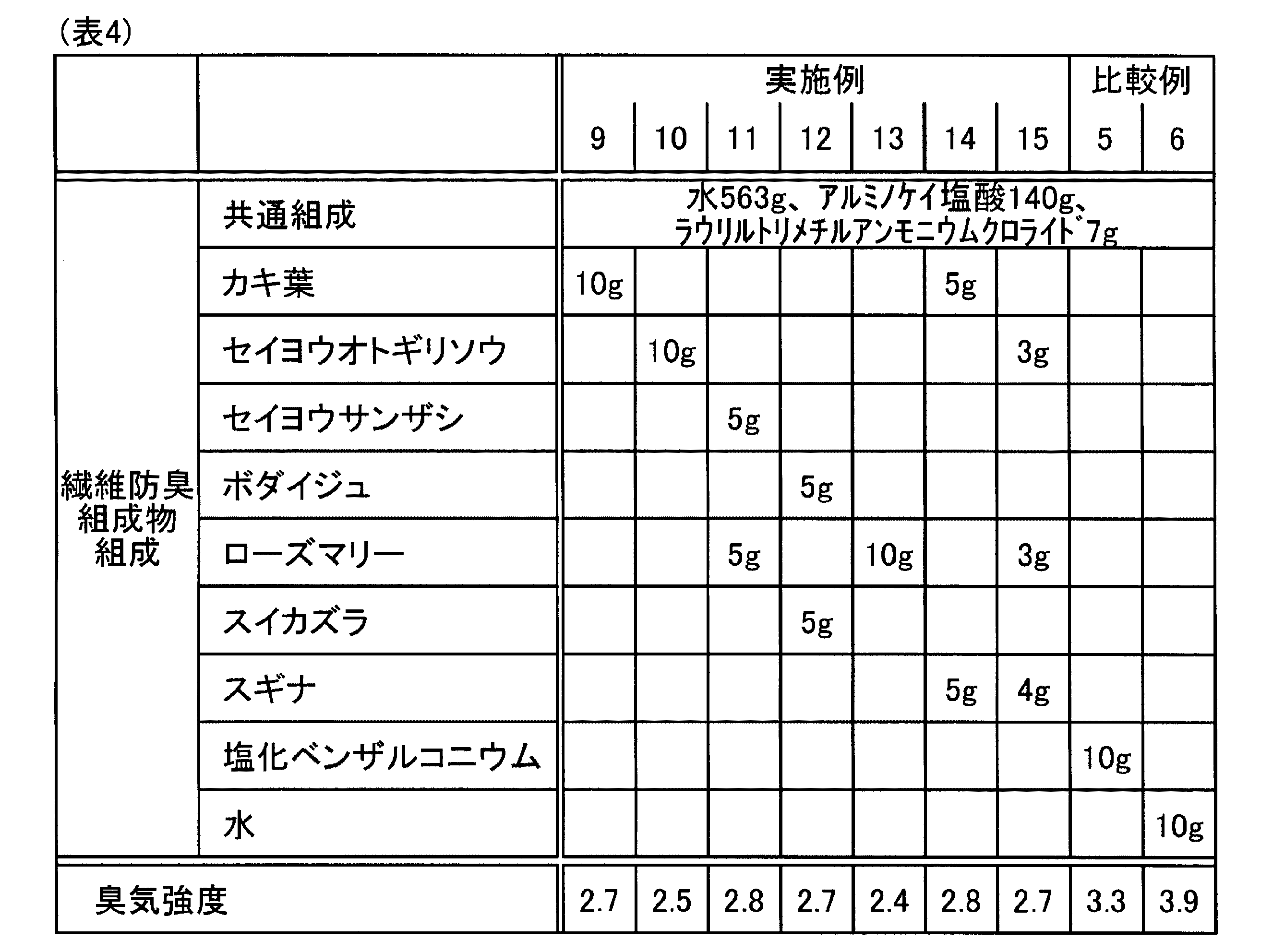
[実施例9〜15:肌シャツ防臭試験]
以下の方法にて繊維防臭組成物を調製した。水563gにアルミノケイ酸塩「ライオナイトSF」(商品名、ライオン株式会社製)140gと、カチオン界面活性剤(ラウリルトリメチルアンモニウムクロライド)7gとを添加し、室温で1時間攪拌した。その後、下記「表4」の実施例9〜15に示すように、カキ葉、セイヨウオトギリソウ、セイヨウサンザシ、ボダイジュ、ローズマリー、スイカズラ、スギナの各抽出物をそれぞれ10g、もしくは混合して10g加え、さらに1時間攪拌し、前記植物抽出物の分散液を調製した。
[Examples 9 to 15: Skin shirt deodorization test]
A fiber deodorant composition was prepared by the following method. To 563 g of water, 140 g of aluminosilicate “Lionite SF” (trade name, manufactured by Lion Corporation) and 7 g of a cationic surfactant (lauryltrimethylammonium chloride) were added and stirred at room temperature for 1 hour. Thereafter, as shown in Examples 9 to 15 of the following "Table 4", 10 g of each extract of oyster leaves, Hypericum perforatum, Hawthorn, Bodaiju, Rosemary, Honeysuckle, and Japanese horsetail was added, or 10 g mixed, The mixture was further stirred for 1 hour to prepare a dispersion of the plant extract.
次に、この分散液6%と、「ボンコートAB885」(商品名、大日本インキ(株)製アクリル樹脂)1.5%と、水92.5%とを混合し、繊維防臭組成物を調製した。この繊維防臭組成物に、市販の肌シャツを浸漬し、ローラーで脱水した後、乾燥し、評価用の肌シャツを作製した。 Next, 6% of this dispersion, 1.5% of “Boncoat AB885” (trade name, Dainippon Ink Co., Ltd. acrylic resin) and 92.5% of water are mixed to prepare a fiber deodorant composition. did. A commercially available skin shirt was immersed in the fiber deodorant composition, dehydrated with a roller, and then dried to prepare a skin shirt for evaluation.
次に、成人男子20名を5名ずつ4群に分け、それぞれの群に実施例9〜15で作製した肌シャツを午前9時に着用させた。被験者は午前と午後にそれぞれエルゴメーターにて30分間の運動負荷を与えた。同日の午後5時に各肌シャツを回収し、37℃にて1時間保温した後、肌シャツの臭気を専門判定者によって評価した。臭気の判定基準を以下に示す。評価点は各群5名の平均値で表し、その結果を下記「表4」に示した。 Next, 20 adult boys were divided into 4 groups of 5 each, and the skin shirts produced in Examples 9 to 15 were worn at 9 am in each group. The subject applied an exercise load of 30 minutes with an ergometer in the morning and afternoon. Each skin shirt was collected at 5 pm on the same day, and kept at 37 ° C. for 1 hour, and then the odor of the skin shirt was evaluated by a professional judge. Odor determination criteria are shown below. The evaluation score is expressed as an average value of five people in each group, and the result is shown in the following “Table 4”.
<臭気強度>
0:無臭
1:やっと感知できるにおい
2:何のにおいかわかる弱いにおい
3:楽に感知できるにおい
4:強いにおい
5:強烈なにおい
<Odor intensity>
0: Odorless 1: Scent that can be finally detected 2: Weak scent that understands what odor 3: Smell that can be easily detected 4: Strong odor 5: Strong odor
[比較例5および6:肌シャツ防臭試験]
比較例5として塩化ベンザルコニウム10gのみ、比較例6として水10gのみを共通組成に加えた以外は実施例9〜15と同様にして試験し、その結果を下記「表4」に示した。
[Comparative Examples 5 and 6: Skin shirt deodorization test]
The test was conducted in the same manner as in Examples 9 to 15 except that only 10 g of benzalkonium chloride as Comparative Example 5 and only 10 g of water as Comparative Example 6 were added to the common composition, and the results are shown in Table 4 below.
前記「表4」に示した結果のように、カキ葉、セイヨウオトギリソウ、セイヨウサンザシ、ボダイジュ、ローズマリー、スイカズラ、スギナの各抽出物には、肌シャツの臭気を抑制する効果が認められた。 As shown in the above-mentioned “Table 4”, oyster leaves, Hypericum perforatum, Hawthorn, Bodaige, Rosemary, Honeysuckle and Horsetail extract were found to have the effect of suppressing the odor of skin shirts.
更に、洗剤「トップ」(商品名、ライオン(株)製)を使用し、JIS L0217103法に準じ。前記評価用肌シャツを洗濯した。10回洗濯後の実施例9〜15の肌シャツに関し、上述と同様にして肌シャツ臭気判定試験を実施したところ、いずれの肌シャツの臭気強度も3.1以下であり、防臭効果が持続していた。 Furthermore, the detergent “Top” (trade name, manufactured by Lion Co., Ltd.) is used and conforms to the method of JIS L0217103. The evaluation skin shirt was washed. Regarding the skin shirts of Examples 9 to 15 after washing 10 times, when the skin shirt odor determination test was performed in the same manner as described above, the odor intensity of any skin shirt was 3.1 or less, and the deodorizing effect was sustained. It was.
[実施例16]
実施例9〜15で調製した方法に準じ、セイヨウオトギリソウ抽出物、ローズマリー抽出物、カキ葉抽出物をそれぞれ3gずつ添加した繊維防臭組成物を調製した。調整した繊維防臭組成物にレーヨン不織布を浸漬した後、脱水乾燥し、防臭繊維を調製した。この防臭繊維を用いて肌シャツを作製し、実施例9〜15と同様にして臭気強度を評価した結果、臭気強度は3.1以下であった。
[Example 16]
According to the methods prepared in Examples 9 to 15, fiber deodorant compositions were prepared by adding 3 g each of Hypericum perforatum extract, rosemary extract, and oyster leaf extract. After the rayon nonwoven fabric was immersed in the adjusted fiber deodorant composition, it was dehydrated and dried to prepare deodorant fibers. A skin shirt was produced using this deodorizing fiber, and as a result of evaluating the odor intensity in the same manner as in Examples 9 to 15, the odor intensity was 3.1 or less.
[実施例17]
前記実施例9〜15で調製した方法に準じ、セイヨウオトギリソウ抽出物、セイヨウサンザシ抽出物、ボダイジュ抽出物、スイカズラ抽出物、スギナ抽出物を各2gずつ添加した繊維防臭組成物を調製した。本繊維防臭組成物にナイロン繊維布を浸漬した後、脱水乾燥し、防臭繊維を調製した。この防臭繊維を用いて肌シャツを作製し、実施例9〜15と同様にして臭気強度を評価した結果、臭気強度は3.1以下であった。
[Example 17]
In accordance with the methods prepared in Examples 9 to 15, fiber deodorant compositions were prepared by adding 2 g each of Hypericum perforatum extract, Hawthorn extract, Bodaiju extract, Honeysuckle extract, and Japanese horsetail extract. A nylon fiber cloth was dipped in the fiber deodorant composition, and then dehydrated and dried to prepare a deodorant fiber. A skin shirt was produced using this deodorizing fiber, and as a result of evaluating the odor intensity in the same manner as in Examples 9 to 15, the odor intensity was 3.1 or less.
[実施例18:製品処方例]
[処方例1]
下記の方法にて、繊維防臭効果を有する衣料用柔軟仕上げ剤を調製した。アーカード2HT−75(ライオンアクゾ社製)15部、ポリエーテル変性シリコーンKF6016(信越化学工業社製)5部、塩化カルシウム(トクヤマ社製)0.3部、エチレングリコール(三菱化学社製)1部、C.I.Direct Blue 86(住友化学工業社製)0.001部、イソチアゾロン(ローム・アンド・ハース社製)0.0001部、特開2003−105668号公報記載の表8〜17記載の香料組成物C 0.5部、セイヨウオトギリソウ抽出物0.1部、セイヨウサンザシ抽出物0.1部、ローズマリー抽出物0.1部、スイカズラ抽出物0.1部、水残部からなる組成を特許第2628512号公報に記載されている方法に準じて調製した。このようにして調整した衣料用柔軟仕上げ剤を用い、衣料に対して繊維防臭処理を行なったところ、その衣料において防臭効果が認められた。
[Example 18: Product formulation example]
[Prescription Example 1]
A softener for clothing having a fiber deodorizing effect was prepared by the following method. ARCARD 2HT-75 (manufactured by Lion Akzo) 15 parts, polyether-modified silicone KF6016 (manufactured by Shin-Etsu Chemical Co., Ltd.), calcium chloride (manufactured by Tokuyama Corporation) 0.3 part, ethylene glycol (manufactured by Mitsubishi Chemical Corporation) 1 part , C.I. I. 0.001 part of Direct Blue 86 (manufactured by Sumitomo Chemical Co., Ltd.), 0.0001 part of isothiazolone (manufactured by Rohm and Haas), and perfume composition C 0 described in Tables 8 to 17 described in JP-A No. 2003-105668 Japanese Patent No. 2628512 has a composition comprising 5 parts, 0.1 part of Hypericum perforatum extract, 0.1 part of hawthorn extract, 0.1 part of rosemary extract, 0.1 part of honeysuckle extract, and the remainder of water. It was prepared according to the method described in 1. When the fabric softening finish thus prepared was subjected to a fiber deodorization treatment, clothing was found to have a deodorizing effect.
[処方例2]
下記の方法にての繊維防臭効果を有する衣料用柔軟仕上げ剤を調製した。カチオン性界面活性剤(特開2003−12471号公報実施例1に記載のカチオン性界面活性剤)15部、ジメチルシリコーンBY22−050A(東レ・ダウコーニング社製)3部、塩化カルシウム(トクヤマ社製)0.3部、エチレングリコール(三菱化学社製)1部、C.I.Acid Red 138(日本化薬社製)0.001部、イソチアゾロン(ローム・アンド・ハース社製)0.0001部、特開2003−105668号公報記載の表8〜17記載の香料組成物A 0.5部、セイヨウオトギリソウ抽出物0.2部、セイヨウサンザシ抽出物0.1部、スイカズラ抽出物0.1部、水残部からなる組成を特許第2628512号公報に記載されている方法に準じて調製した。このようにして調整した衣料用柔軟仕上げ剤を用い、衣料に対して繊維防臭処理を行なったところ、その衣料において防臭効果が認められた。
[Prescription Example 2]
A softener for clothing having a fiber deodorizing effect by the following method was prepared. 15 parts of cationic surfactant (cationic surfactant described in JP-A-2003-12471, Example 1), 3 parts of dimethyl silicone BY22-050A (manufactured by Toray Dow Corning), calcium chloride (manufactured by Tokuyama Corporation) ) 0.3 parts, ethylene glycol (Mitsubishi Chemical Corporation) 1 part, C.I. I. Acid Red 138 (Nippon Kayaku Co., Ltd.) 0.001 part, Isothiazolone (Rohm and Haas Co., Ltd.) 0.0001 part, Perfume Composition A 0 described in Tables 8 to 17 described in JP-A No. 2003-105668 A composition comprising 5 parts, 0.2 parts of Hypericum perforatum extract, 0.1 part of hawthorn extract, 0.1 part of honeysuckle extract, and the remainder of water is applied according to the method described in Japanese Patent No. 2628512. Prepared. When the fabric softening finish thus prepared was subjected to a fiber deodorization treatment, clothing was found to have a deodorizing effect.
以上のように、本発明の繊維防臭剤は、ヒトの不快な体臭の有力成分である低級脂肪酸を抑制する、植物の抽出物を有効成分として含有する。従って、ヒトの不快な体臭を持続的に抑制する繊維防臭組成物の製造に適し、さらに防臭効果が付与された繊維または衣料の製造に適している。 As described above, the fiber deodorant of the present invention contains, as an active ingredient, a plant extract that suppresses lower fatty acids, which are the major components of human unpleasant body odor. Therefore, it is suitable for the production of a fiber deodorant composition that continuously suppresses an unpleasant body odor of human beings, and further suitable for the production of a fiber or clothing imparted with a deodorizing effect.
Claims (8)
Priority Applications (1)
| Application Number | Priority Date | Filing Date | Title |
|---|---|---|---|
| JP2005065903A JP2006249599A (en) | 2005-03-09 | 2005-03-09 | Fiber deodorant, fiber deodorant composition, and fiber deodorant method |
Applications Claiming Priority (1)
| Application Number | Priority Date | Filing Date | Title |
|---|---|---|---|
| JP2005065903A JP2006249599A (en) | 2005-03-09 | 2005-03-09 | Fiber deodorant, fiber deodorant composition, and fiber deodorant method |
Publications (1)
| Publication Number | Publication Date |
|---|---|
| JP2006249599A true JP2006249599A (en) | 2006-09-21 |
Family
ID=37090384
Family Applications (1)
| Application Number | Title | Priority Date | Filing Date |
|---|---|---|---|
| JP2005065903A Pending JP2006249599A (en) | 2005-03-09 | 2005-03-09 | Fiber deodorant, fiber deodorant composition, and fiber deodorant method |
Country Status (1)
| Country | Link |
|---|---|
| JP (1) | JP2006249599A (en) |
Cited By (10)
| Publication number | Priority date | Publication date | Assignee | Title |
|---|---|---|---|---|
| KR101103005B1 (en) | 2008-12-17 | 2012-01-05 | 코오롱글로텍주식회사 | Functional polyolefin-based short fibers containing green mussels and preparation method thereof and thermal bond nonwoven fabric using the same |
| JP2013542216A (en) * | 2010-10-29 | 2013-11-21 | シュバイツァー モウドゥイ インターナショナル インコーポレイテッド | Method for producing plant-derived products impregnated with liquid plant material |
| JP2017043568A (en) * | 2015-08-27 | 2017-03-02 | ロート製薬株式会社 | Isovaleric aldehyde formation inhibitor and formation inhibiting method |
| US10729662B2 (en) | 2013-08-20 | 2020-08-04 | Schweitzer-Mauduit International, Inc. | Product comprising a plant for medicinal, cosmetic, coloring or dermatologic use |
| US10751282B2 (en) | 2013-08-02 | 2020-08-25 | Schweitzer-Mauduit International, Inc. | Edible product comprising reconstituted plant material |
| CN112811753A (en) * | 2021-03-12 | 2021-05-18 | 青海师范大学 | Inhibitor and method for inhibiting escape of cow dung ammonia in cowshed |
| US11035079B2 (en) | 2016-04-05 | 2021-06-15 | Schweitzer-Mauduit International, Inc. | Vegetable paper comprising fibres of a plant |
| US11419347B2 (en) | 2013-02-28 | 2022-08-23 | Schweitzer-Mauduit International, Inc. | Composition for making a tea beverage or herbal and vegetable broths |
| US11484497B2 (en) | 2013-02-28 | 2022-11-01 | Schweitzer-Mauduit International, Inc. | Composition for making a tea beverage or herbal and vegetable broths |
| US11737472B2 (en) | 2015-03-02 | 2023-08-29 | Mativ Holdings, Inc. | Low bulk density composition for making a tea beverage having reduced dust or fines |
-
2005
- 2005-03-09 JP JP2005065903A patent/JP2006249599A/en active Pending
Cited By (15)
| Publication number | Priority date | Publication date | Assignee | Title |
|---|---|---|---|---|
| KR101103005B1 (en) | 2008-12-17 | 2012-01-05 | 코오롱글로텍주식회사 | Functional polyolefin-based short fibers containing green mussels and preparation method thereof and thermal bond nonwoven fabric using the same |
| JP2013542216A (en) * | 2010-10-29 | 2013-11-21 | シュバイツァー モウドゥイ インターナショナル インコーポレイテッド | Method for producing plant-derived products impregnated with liquid plant material |
| JP2017031187A (en) * | 2010-10-29 | 2017-02-09 | シュバイツァー モウドゥイ インターナショナル インコーポレイテッド | Method for producing plant-derived products impregnated with liquid plant material |
| US10178872B2 (en) | 2010-10-29 | 2019-01-15 | Schweitzer-Manduit International, Inc. | Method for producing articles of plant origin impregnated with a liquid plant substance |
| US11484497B2 (en) | 2013-02-28 | 2022-11-01 | Schweitzer-Mauduit International, Inc. | Composition for making a tea beverage or herbal and vegetable broths |
| US11419347B2 (en) | 2013-02-28 | 2022-08-23 | Schweitzer-Mauduit International, Inc. | Composition for making a tea beverage or herbal and vegetable broths |
| US11207268B2 (en) | 2013-08-02 | 2021-12-28 | Schweitzer-Mauduit International, Inc. | Edible product comprising reconstituted plant material |
| US10751282B2 (en) | 2013-08-02 | 2020-08-25 | Schweitzer-Mauduit International, Inc. | Edible product comprising reconstituted plant material |
| US11666530B2 (en) | 2013-08-02 | 2023-06-06 | Schweitzer-Mauduit International, Inc. | Edible product comprising reconstituted plant material |
| US10729662B2 (en) | 2013-08-20 | 2020-08-04 | Schweitzer-Mauduit International, Inc. | Product comprising a plant for medicinal, cosmetic, coloring or dermatologic use |
| US11737472B2 (en) | 2015-03-02 | 2023-08-29 | Mativ Holdings, Inc. | Low bulk density composition for making a tea beverage having reduced dust or fines |
| JP2017043568A (en) * | 2015-08-27 | 2017-03-02 | ロート製薬株式会社 | Isovaleric aldehyde formation inhibitor and formation inhibiting method |
| US11035079B2 (en) | 2016-04-05 | 2021-06-15 | Schweitzer-Mauduit International, Inc. | Vegetable paper comprising fibres of a plant |
| US11619007B2 (en) | 2016-04-05 | 2023-04-04 | Mativ Holdings, Inc. | Vegetable paper comprising fibres of a plant |
| CN112811753A (en) * | 2021-03-12 | 2021-05-18 | 青海师范大学 | Inhibitor and method for inhibiting escape of cow dung ammonia in cowshed |
Similar Documents
| Publication | Publication Date | Title |
|---|---|---|
| JP5719951B2 (en) | Method for suppressing generation of volatile urine odor components | |
| Kanlayavattanakul et al. | Body malodours and their topical treatment agents | |
| CN103230354B (en) | Sweating suppression deodorant composition | |
| JP4723738B2 (en) | Deodorant | |
| JP4532706B2 (en) | Cosmetics | |
| JP2006249599A (en) | Fiber deodorant, fiber deodorant composition, and fiber deodorant method | |
| CN109497094A (en) | A kind of footgear deodorizing antibiotic composition and preparation method thereof containing zinc ricinate | |
| JP5619484B2 (en) | Composition for suppressing urine odor production | |
| JP4546790B2 (en) | Lower fatty acid production inhibitor that does not sterilize skin resident bacteria | |
| JP4918225B2 (en) | Deodorant for suppressing volatile steroid formation, deodorant preparation for suppressing volatile steroid formation, fiber deodorant, and fiber deodorant treatment method | |
| CN112807237A (en) | Cosmetic containing natural bacteriostatic agent | |
| JP5806716B2 (en) | β-glucuronidase inhibitor | |
| GB2422780A (en) | Deodorant compositions | |
| KR101914500B1 (en) | Cosmetic composition for inhibiting body odor | |
| KR100797974B1 (en) | Deodorant composition for body odor reduction | |
| JP2006052198A5 (en) | ||
| CN109394597A (en) | A kind of dedicated natural deodorant of antibacterial pet and preparation method thereof extracted from Chinese juniper wood | |
| JP5674283B2 (en) | β-glucuronidase inhibitor | |
| WO2008029822A1 (en) | Deodorant comprising deodorizing substance originating in sugarcane distillate as the active ingredient and method of improving odor originating in sugarcane | |
| JP2010220641A (en) | β-glucuronidase inhibitor | |
| WO2004009750A1 (en) | Improvements in or relating to perfume compositions | |
| JP5744988B2 (en) | β-glucuronidase inhibitor | |
| JP4284305B2 (en) | Deodorant active agent and composition for external application for deodorizing skin | |
| JP6923619B2 (en) | Deodorants | |
| JP2007290983A (en) | Deodorant composition and deodorant agent |