JP2004514996A - Secure session management and authentication for websites - Google Patents
Secure session management and authentication for websites Download PDFInfo
- Publication number
- JP2004514996A JP2004514996A JP2002546382A JP2002546382A JP2004514996A JP 2004514996 A JP2004514996 A JP 2004514996A JP 2002546382 A JP2002546382 A JP 2002546382A JP 2002546382 A JP2002546382 A JP 2002546382A JP 2004514996 A JP2004514996 A JP 2004514996A
- Authority
- JP
- Japan
- Prior art keywords
- web
- cookie
- client
- session
- computer program
- Prior art date
- Legal status (The legal status is an assumption and is not a legal conclusion. Google has not performed a legal analysis and makes no representation as to the accuracy of the status listed.)
- Granted
Links
- 235000014510 cooky Nutrition 0.000 claims abstract description 265
- 238000000034 method Methods 0.000 claims abstract description 89
- 238000004891 communication Methods 0.000 claims abstract description 76
- 238000004590 computer program Methods 0.000 claims description 38
- 238000007726 management method Methods 0.000 claims description 20
- 238000012795 verification Methods 0.000 claims description 10
- 230000005540 biological transmission Effects 0.000 claims description 2
- 238000013500 data storage Methods 0.000 claims 1
- 238000010586 diagram Methods 0.000 abstract description 4
- 230000008569 process Effects 0.000 description 50
- 230000006870 function Effects 0.000 description 18
- 238000013507 mapping Methods 0.000 description 5
- 238000012546 transfer Methods 0.000 description 4
- 230000004048 modification Effects 0.000 description 2
- 238000012986 modification Methods 0.000 description 2
- 230000004044 response Effects 0.000 description 2
- 230000003068 static effect Effects 0.000 description 2
- 230000009471 action Effects 0.000 description 1
- 238000013475 authorization Methods 0.000 description 1
- 230000008859 change Effects 0.000 description 1
- 238000005516 engineering process Methods 0.000 description 1
- 230000007246 mechanism Effects 0.000 description 1
- 238000012545 processing Methods 0.000 description 1
- 230000001737 promoting effect Effects 0.000 description 1
- 238000010200 validation analysis Methods 0.000 description 1
Images


Classifications
-
- H—ELECTRICITY
- H04—ELECTRIC COMMUNICATION TECHNIQUE
- H04L—TRANSMISSION OF DIGITAL INFORMATION, e.g. TELEGRAPHIC COMMUNICATION
- H04L63/00—Network architectures or network communication protocols for network security
- H04L63/04—Network architectures or network communication protocols for network security for providing a confidential data exchange among entities communicating through data packet networks
- H04L63/0428—Network architectures or network communication protocols for network security for providing a confidential data exchange among entities communicating through data packet networks wherein the data content is protected, e.g. by encrypting or encapsulating the payload
- H04L63/0442—Network architectures or network communication protocols for network security for providing a confidential data exchange among entities communicating through data packet networks wherein the data content is protected, e.g. by encrypting or encapsulating the payload wherein the sending and receiving network entities apply asymmetric encryption, i.e. different keys for encryption and decryption
-
- H—ELECTRICITY
- H04—ELECTRIC COMMUNICATION TECHNIQUE
- H04L—TRANSMISSION OF DIGITAL INFORMATION, e.g. TELEGRAPHIC COMMUNICATION
- H04L63/00—Network architectures or network communication protocols for network security
- H04L63/08—Network architectures or network communication protocols for network security for authentication of entities
-
- H—ELECTRICITY
- H04—ELECTRIC COMMUNICATION TECHNIQUE
- H04L—TRANSMISSION OF DIGITAL INFORMATION, e.g. TELEGRAPHIC COMMUNICATION
- H04L63/00—Network architectures or network communication protocols for network security
- H04L63/08—Network architectures or network communication protocols for network security for authentication of entities
- H04L63/0807—Network architectures or network communication protocols for network security for authentication of entities using tickets, e.g. Kerberos
-
- H—ELECTRICITY
- H04—ELECTRIC COMMUNICATION TECHNIQUE
- H04L—TRANSMISSION OF DIGITAL INFORMATION, e.g. TELEGRAPHIC COMMUNICATION
- H04L63/00—Network architectures or network communication protocols for network security
- H04L63/20—Network architectures or network communication protocols for network security for managing network security; network security policies in general
-
- H—ELECTRICITY
- H04—ELECTRIC COMMUNICATION TECHNIQUE
- H04L—TRANSMISSION OF DIGITAL INFORMATION, e.g. TELEGRAPHIC COMMUNICATION
- H04L67/00—Network arrangements or protocols for supporting network services or applications
- H04L67/01—Protocols
- H04L67/02—Protocols based on web technology, e.g. hypertext transfer protocol [HTTP]
-
- H—ELECTRICITY
- H04—ELECTRIC COMMUNICATION TECHNIQUE
- H04L—TRANSMISSION OF DIGITAL INFORMATION, e.g. TELEGRAPHIC COMMUNICATION
- H04L69/00—Network arrangements, protocols or services independent of the application payload and not provided for in the other groups of this subclass
- H04L69/30—Definitions, standards or architectural aspects of layered protocol stacks
- H04L69/32—Architecture of open systems interconnection [OSI] 7-layer type protocol stacks, e.g. the interfaces between the data link level and the physical level
- H04L69/322—Intralayer communication protocols among peer entities or protocol data unit [PDU] definitions
- H04L69/329—Intralayer communication protocols among peer entities or protocol data unit [PDU] definitions in the application layer [OSI layer 7]
-
- H—ELECTRICITY
- H04—ELECTRIC COMMUNICATION TECHNIQUE
- H04L—TRANSMISSION OF DIGITAL INFORMATION, e.g. TELEGRAPHIC COMMUNICATION
- H04L63/00—Network architectures or network communication protocols for network security
- H04L63/04—Network architectures or network communication protocols for network security for providing a confidential data exchange among entities communicating through data packet networks
- H04L63/0428—Network architectures or network communication protocols for network security for providing a confidential data exchange among entities communicating through data packet networks wherein the data content is protected, e.g. by encrypting or encapsulating the payload
Landscapes
- Engineering & Computer Science (AREA)
- Computer Security & Cryptography (AREA)
- Computer Networks & Wireless Communication (AREA)
- Signal Processing (AREA)
- Computer Hardware Design (AREA)
- Computing Systems (AREA)
- General Engineering & Computer Science (AREA)
- Information Transfer Between Computers (AREA)
- Computer And Data Communications (AREA)
- Storage Device Security (AREA)
Abstract
本発明は、ウェブサイトとウェブクライアントとの間の安全なセッション管理および認証のためのシステムおよび方法を具備する。この方法は、保護された通信プロトコルおよび無保護の通信プロトコルの双方を含み、保護された通信プロトコルおよび無保護の通信プロトコルの切り替えのための手段、セッションクッキー、ならびにオースコードクッキーを含む。セッションクッキーはセッション管理のために用いられ、オースコードクッキーは認証のために用いられる。セッションクッキーは、ウェブクライアントが無保護のウェブページにアクセスする場合に無保護の通信プロトコルを用いて送信されるが、オースコードクッキーは、ウェブクライアントが保護されたウェブページにアクセスする場合に保護された通信プロトコルを用いて送信される。保護された通信プロトコルおよび無保護の通信プロトコルの双方と共に、セッション管理アーキテクチャおよび2つの別個のクッキーの使用によって、無許可のユーザが機密のウェブクライアントまたはウェブサイト情報にアクセスすることを防ぐ。
【選択図】図1The present invention comprises a system and method for secure session management and authentication between a website and a web client. The method includes both protected and unprotected communication protocols, and includes means for switching between the protected and unprotected communication protocols, session cookies, and oathcode cookies. Session cookies are used for session management, and oathcode cookies are used for authentication. Session cookies are transmitted using an unprotected communication protocol when a web client accesses an unprotected web page, whereas oathcode cookies are protected when a web client accesses a protected web page. It is transmitted using the communication protocol. The use of a session management architecture and two separate cookies, along with both secure and unsecured communication protocols, prevents unauthorized users from accessing sensitive web clients or website information.
[Selection diagram] Fig. 1
Description
【発明の属する技術分野】
【0001】
本発明は、ウェブサイトとウェブクライアントとの間の通信に関し、具体的には、ウェブサイトとウェブクライアントとの間のセッションのための、保護された通信プロトコルおよび無保護の通信プロトコルを用いたセッション管理および認証手段に関する。
【従来の技術】
【0002】
多くの企業は、費用を減らし、自社のサービスまたは製品を幅広い消費者層に宣伝するための方法として、インターネットを導入している。これらの企業(すなわちウェブ商人)は、オンラインショッピングのウェブサイトを設置して、情報またはソフトウエア等の非耐久財、および/または耐久消費財等を販売している。これは、オンラインで簡単に買い物ができるため、ますますインターネットを用いるようになっている多くの消費者(すなわちウェブクライアント)にとって利益となる。実際、ウェブ商人とウェブクライアントとの間のオンライントランザクションは、ますます多くなっている。
【0003】
電子商取引は便利であるが、ウェブクライアントのウェブブラウザと電子商取引ウェブサイトとの間の通信がHTTP(ハイパーテキスト転送プロトコル)に基づいているので、問題が無いわけではない。HTTPは、ステートレスである。これは、HTTPプロトコルが、ある訪問から次の訪問までウェブクライアントに関する情報を維持しないということを意味する。結果として、電子商取引ウェブサイトは、後日再び訪れるウェブクライアントを覚えておくための処置を取らなければならない。別の問題は、HTTPが安全でないことであり、これは厄介である。なぜなら、ウェブクライアントが製品の支払いをして受け取るためにクレジットカード番号または口座番号等の機密情報を提供しなければならないからである。無許可のユーザが、この機密情報を盗むために、HTTP通信を注視している可能性がある。そして、無許可のユーザは、ウェブクライアントのアイデンティティのもとで商品を注文し、その商品を異なる住所に送るよう要求したり、住所およびクレジットカード情報等の機密性の高いウェブクライアントのデータにアクセスしたりする恐れがある。
【0004】
これらの問題を解決するため、電子商取引ウェブサイトは、ウェブクライアントとの対話を続けつつ、認証およびセッション管理を可能としなければならない。更に、ウェブクライアントと電子商取引ウェブサイトとの間で機密情報を送信する場合、保護された通信プロトコルを用いなければならない。セッション管理によって、ウェブサイトは、異なるログインセッション間でウェブクライアントを覚えておくことができ、一方、認証は、あるウェブサイトに最初にログオンした同じウェブクライアントから要求が来たことをウェブサイトに保証するセキュリティ対策である。保護された通信プロトコルは、電子商取引ウェブサイトとウェブクライアントとの間で送信されるデータを暗号化する。認証およびセッション管理を達成するため、HTTPベーシック認証、名前−値ペア認証、またはセッションクッキーを利用することができる。
【0005】
HTTPベーシック認証では、ウェブクライアントは必ずセッション管理の前にログオンする必要がある。このため、ウェブクライアントが最初にウェブサイトにアクセスした時に、ログインウインドウがパッと開かれる。このログインウインドウは、ウェブサイト管理者によってカスタマイズすることが容易でない。このように、ウェブサーバがウェブクライアントにログオンを強制するので、保護されたウェブページへのゲストクライアントのアクセスはサポートされない。この結果、ほとんどの電子商取引ウェブサイトは、HTTPベーシック認証を用いていない。
【0006】
名前−値ペア認証は、あらゆるURL(ユニフォームリソースロケーター)内または電子商取引ウェブサイト上のあらゆるウェブページのデータ内にセキュリティ情報を埋め込むことを伴っている。
【0007】
この結果、ウェブサイト開発者は、あるウェブページから別のものへ認証データを移すことによって各ウェブページごとに認証を処理する必要がある。この認証データは、ウェブクライアントが保護されたウェブページから無保護のウェブページにジャンプする場合、簡単に喪失する恐れがある。また、名前−値ペアでは、保護されたウェブページにアクセスする場合にウェブサーバがウェブクライアントに登録またはログオンすることを強制するので、保護されたウェブページへのゲストクライアントのアクセスはサポートされない。また、認証データは、ウェブページURLの最後に追加されると、安全でない。なぜなら、これは、ウェブサーバのログであらわになったり、またはウェブクライアントのウェブブラウザ上に表示されたりする場合があるからである。更に、ウェブページデータに含まれる認証データは、ウェブブラウザのキャッシュファイルを閲覧することで見られる恐れがあるので、安全でない。
【0008】
クッキーは、ウェブサイトとウェブクライアントとの間のセッション管理および認証のための最も普及した方法である。クッキーは、ウェブクライアントのコンピュータ上に格納され、検索される。永久クッキーは、コンピュータのハードドライブ上に格納され、一方、一時クッキーは、揮発性メモリに格納され、いったんウェブセッションが終了すると消去される。Netscape Navigator(登録商標)のウェブブラウザは、永久クッキーを、テキストファイルに(すなわちcookie.txt)、各クッキーにファイルの1行を用いて格納し、一方、Microsoft Internet Explorer(登録商標)のウェブブラウザは、各永久クッキーごとに別個のテキストファイルを用いる。クッキーは、ウェブクライアントが最後にどのウェブページにアクセスしたか等、ウェブクライアントに関する有益な情報をウェブサーバに提供するように設計されている。また、クッキーを用いて、あるウェブサイトにおける何らかの所定のレベルのウェブクライアントアクセスおよびカスタマイゼーションを提供することができる。また、クッキーは、クッキーが有効であるURL集合の記述を含む。将来、ウェブクライアントによって、あるクッキーに含まれるURL集合と一致するHTTP要求が行われると、これは、ウェブクライアントからウェブサーバへのクッキーの現在値の返信を含むはずである。
【0009】
初めてウェブクライアントがウェブサーバから情報を要求し、これがクッキーを利用する時、ウェブサーバは、要求された情報をクッキーと共に送る。クッキーは、ウェブサーバからウェブクライアントへ、HTTP応答の一部としてSet−Cookieヘッダを含むことで送信される。Set−Cookieヘッダは、CGIスクリプトによって生成され、以下の属性を含む。すなわち、NAME、DATE、PATH、DOMAIN、およびSECUREである。NAME属性は、ウェブクライアントに関するデータを含み、ウェブサイトによって用いられる。1つのクッキー内に多くのNAME属性がある可能性があり、単一のウェブサーバ応答で多くのSet−Cookieヘッダを発行することができる。DATE属性は、クッキーの期限が切れる時を示す日付を規定する。PATH属性は、クッキーが有効であるドメインにおけるURLサブセットを規定する。DOMAIN属性は、ウェブサイトのインターネットドメイン名である。SECURE属性は、クッキーを送信する条件を示す。例えば、クッキーのSECURE属性に保護されていると示されていれば、これは、ウェブサーバとウェブクライアントとの間の通信チャネルが保護されている場合にのみ送信される。
【0010】
クッキーに基づくセッション管理は、無許可のユーザがクッキーに含まれる機密データを盗むのを防止するための保護された通信プロトコルを取り入れなければならない。そのようなプロトコルの1つは、HTTPS(HTTP over SSL)である。頭字語SSLは、Secure Socket Layer(セキュアソケットレイヤ)プロトコルを表し、これは、HTTPを用いつつ安全に情報を送信するための業界標準である。HTTPSは、ウェブサーバの認証(ウェブサーバのアイデンティティをウェブクライアントに対して検証する)、データ暗号化、およびウェブクライアントの認証(ウェブクライアントのアイデンティティをウェブサーバに対して検証する)のための機能を含む。HTTPSを使用可能な各ウェブサーバには、一意のキーおよびデータ暗号化を利用するコーダおよびデコーダの双方がインストールされている。単語および数字を一連の英数字に変換するデータ暗号化は、ウェブ商人に使用を許可されたウェブサーバに付属しているデコーダによってのみ解読することができる。セキュリティのレベルは、40または128ビットのキーのどちらを用いるかによって異なる。コード(またはキー)を解読する難しさは、キーに含まれるビット数と共に増大する。クッキーに基づくセッション管理および認証方式は、従来技術において説明されている。
【0011】
米国特許第5,875,296号は、ウェブサイトを介した分散ファイルシステムへの安全なアクセスを提供する方法を開示する。この方法は、分散ファイルシステムのファイルにアクセスするために、ユーザ識別子を含む単一のクッキーを利用する。このクッキーによって、ユーザは、分散ファイルシステム上の情報にアクセスするたびにユーザIDおよびパスワードを再入力する必要を回避することができる。また、この方法は、分散ファイルシステムに特化したものであり、保護された通信プロトコルを用いていない。
【0012】
米国特許第6,047,268号は、オンラインで買い物をするウェブクライアントを認証するためのシステムおよび方法を開示する。認証は、単一のクッキーによって提供される。このクッキーは、ウェブクライアントの口座番号を識別する静的部分と、ウェブクライアントによる最後のトランザクションを識別する暗号化された動的部分とを含む。このクッキーは、新たなトランザクションが各々行われた後に、新たな動的部分によって更新されるが、この特許は、クッキー内の機密情報を用いること、および、ウェブクライアントのコンピュータシステム上に永久クッキーを格納することを開示する。更に、この特許で開示された電子商取引方法は、ゲストクライアントがオンラインショッピングを行うことができるのに十分なほど柔軟ではない。ウェブクライアントは全て、オンラインで買い物をするために登録しなければならない。米国特許第6,047,268号は、HTTPSの使用を開示するが、HTTPSを排他的に用いるか否か、またはHTTPSとHTTPとの間で通信プロトコルを切り替えるのか否かについては、述べていない。
【0013】
米国特許第6,076,069号は、電子クーポンを引き換えるシステムおよび方法を開示する。ウェブクライアントが、ウェブ商人からの販売促進の物品を宣伝するウェブサイトを訪れた場合、ウェブクライアントのコンピュータシステム上に、クッキーの形態でクーポンを格納する。ウェブクライアントが後にそのウェブ商人のウェブサイトを訪れると、ウェブサイトは、クッキーに格納された電子クーポンを認識し、ウェブクライアントに割引を提供する。この特許は、保護された通信プロトコルの使用について教示していない。更に、この特許は、ウェブクライアントの口座番号等のクッキー内の機密情報の使用、および、永久クッキーの使用(すなわち、クッキーをウェブクライアントのコンピュータシステム上に永久に格納する)を開示する。これらの特徴は双方とも、セキュリティ上の問題を引き起こす。
【0014】
HTTPSだけを独占的に用いると、ウェブページにアクセスするたびに符号化および復号化を行うので、性能の低下を引き起こす。これは非効率的である。なぜなら、ウェブクライアントから偶発的に多くの訪問を受ける製品カタログのウェブページ等、多くのウェブページは、プロテクトを必要としないからである。更に、ウェブサイトのホームページURLにHTTPSを用いることは、ウェブクライアントにとって不都合となる恐れがある。なぜなら、ウェブクライアントは、ウェブサイトのURLにおいて「http」の代わりに「https」を用いることに慣れていないからである。更に、HTTPとHTTPSとの間の切り替えが厄介である場合がある。なぜなら、現在、ウェブクライアントがHTTPSを用いてウェブサイトにログオンすると、ウェブクライアントを認証するためにクッキーを発行するが、もしウェブクライアントが後にHTTPを用いてそのウェブサイトで無保護のウェブページをブラウズすると、同じクッキーがクリアなテキストでウェブクライアントに送信されるからである。この時、無許可のユーザがクッキーを盗む恐れがある。従って、こういった状況で単一のクッキーを用いると、ウェブサイトのセキュリティが脅かされる。
【発明が解決しようとする課題】
【0015】
従って、クッキーを用いて、無許可のユーザからウェブサイトおよびウェブクライアントの双方を守る、改良された安全なセッション管理および認証方法が必要とされている。本発明は、これらの必要性に対処する。
【発明を解決するための手段】
【0016】
本発明は、ウェブサイトとウェブクライアントとの間の安全なセッション管理および認証のための方法を提供する。ウェブサイトは、保護されたウェブページおよび無保護のウェブページを有する。この方法は、ウェブクライアントが無保護のウェブページに対するアクセスを要求した場合に無保護の通信プロトコルおよびセッションクッキーを利用するステップと、ウェブクライアントが保護されたウェブページに対するアクセスを要求した場合に保護された通信プロトコルおよびオースコードクッキーを利用するステップと、を有する。
【0017】
好ましくは、この方法は、更に、ウェブクライアントが無保護のウェブページに対するアクセスを要求した場合にウェブクライアントからセッションクッキーを要求し、要求したセッションクッキーを検証するステップと、ウェブクライアントが保護されたウェブページに対するアクセスを要求した場合にウェブクライアントからオースコードクッキーを要求し、要求したオースコードクッキーを検証するステップと、を含む。
【0018】
好ましくは、この方法は、更に、ウェブクライアントが保護されたウェブページおよび無保護のウェブページに対するアクセスの要求を交互に行った場合、保護された通信プロトコルおよび無保護の通信プロトコルを交互に用いるステップを含む。
【0019】
別の態様では、本発明は、ウェブサイトとウェブクライアントとの間の安全なセッション管理および認証のためのシステムである。このシステムは、ウェブサーバ、ウェブクライアント、および通信チャネルを含む。ウェブサーバは、通信チャネルを介してウェブクライアントに結合されている。ウェブサーバはウェブサイトを含み、このウェブサイトは、保護されたウェブページおよび無保護のウェブページと、ウェブクライアントが無保護のウェブページにアクセスすることを可能とする無保護の通信プロトコルおよびセッションクッキーと、ウェブクライアントが保護されたウェブページにアクセスすることを可能とする保護された通信プロトコルおよびオースコードクッキーと、を有する。
【0020】
好ましくは、ウェブサイトは、更に、ウェブクライアントから要求されたセッションクッキーを検証するための検証手段と、ウェブクライアントから要求されたオースコードクッキーを検証するための検証手段と、を含む。
【0021】
好ましくは、ウェブサーバは、更に、保護された通信プロトコルおよび無保護の通信プロトコルを交互に用いるためのセキュリティ交替手段を含む。
【0022】
記憶装置に格納可能な、またはコンピュータシステムにおいて用いる変調された搬送信号上もしくはコンピュータシステムにおいて用いるインターネット等のネットワーク上等で信号として送信可能なコンピュータプログラムにおいて、本発明を具現化することができることは、当業者に理解されよう。
【0023】
本発明をより良く理解するため、および、本発明をどのように実施可能であるかをよりいっそう明確に示すため、一例として添付図面を参照する。
【発明の実施の形態】
【0024】
図1に、本発明による保護されたセッション管理システムを、全体的に10として示す。システム10は、ウェブサーバ12、通信チャネル14、およびウェブクライアント16を備える。ウェブサーバ12は、ウェブサイト20を生成し維持するためのウェブサーバソフトウエアパッケージ18を含む。ウェブサイト20は、ウェブページ22、データベース24、およびクッキー発生器26を含む。ウェブページ22は、タイプIウェブページ28およびタイプIIウェブページ30を備える。タイプIIウェブページ30は、更に、タイプIIaウェブページ32およびタイプIIbウェブページ34に細分される。データベース24は、ウェブサイト20の適正な動作のために必要なテーブルを備えるが、本発明の対象となるテーブルは、USER_SESSIONテーブル36およびURL_REGISTRYテーブル38である。クッキー発生器26は、セッションクッキー40およびオースコードクッキー42を生成することができる。ウェブクライアント16は、ゲストクライアント44または登録クライアント46のいずれかとして考えられ、ウェブサイト20とのセッションを維持する。これより後、本明細書および特許請求の範囲において、「ウェブクライアント」という言葉は、ゲストクライアント44または登録クライアント46のいずれかを指す。複数のウェブクライアント16が同時にウェブサイト20にアクセスすることもあり得るが、簡略化のため、図1には1つのみのウェブクライアント16を示す。当業者には理解されようが、ウェブクライアント16は、更に、ウェブクライアント16がウェブサイト20のコンテンツにアクセスしこれを見ることを可能とするためのウェブブラウザ(図示せず)を備える。
【0025】
通信チャネル14は、ウェブクライアント16をウェブサーバ12に結合し、好ましくは、インターネット等の、TCP/IP(伝送通信プロトコル/インターネットプロトコル)に基づくネットワークである。TCP/IPは、協働するコンピュータがネットワークを介してリソースまたはデータを共有することを可能とするプロトコルファミリである。当業者には認められようが、ウェブクライアント16は、複数の手段のいずれかを用いて通信チャネル14に接続することができる。例えば、ウェブクライアント16は、電話、ケーブル、または無線モデムを通じて、インターネットアクセスプロバイダを介して通信チャネル14に接続することができる。あるいは、ケーブルTVネットワークまたは別のアクセス媒体を介して接続を行うことも可能である。また、通信チャネル14は、インターネットに直接接続されたイントラネット、ローカルエリアネットワーク、またはワイドエリアネットワークである場合もある。
【0026】
ウェブサーバ12は、標準的なアプリケーションプロトコルであるHTTP(ハイパーテキスト転送プロトコル)を用いて、ウェブクライアント16が、ウェブサイト20上に位置するウェブページ22、ファイル、または他のデータにアクセスすることを可能とする。ウェブページ22は、業界標準のウェブページ記述言語であるHTML(ハイパーテキストマークアップ言語)フォーマットである。HTMLは、基本的な文書フォーマッティングを提供し、これによって、ウェブサーバ12は、他のウェブサイトおよび/またはファイルへのリンクを規定することができる。あるいは、ウェブページ22に、ASP(アクティブサーバページ)またはJSP(Java(R)サーバページ)等の他のフォーマットも用いることができる。また、ウェブサーバ12は、ウェブサイト20の生成および維持に役立つウェブサーバソフトウエアパッケージ18を含む。かかるウェブサーバソフトウエアパッケージ18の1つは、IBM社が販売するWCS Version5.1(登録商標)である。
【0027】
ウェブサイト20は、タイプIウェブページ28およびタイプIIウェブページ30を含む。タイプIウェブページ28は、全てのウェブクライアント16について同一であり、静的ウェブページおよびいくつかの動的に発生したウェブページを含む。一方、タイプIIウェブページ30は、所与のウェブクライアント16に固有のものであり、ショッピングカートウェブページおよび課金情報ウェブページを含む。ショッピンカートウェブページは、ウェブクライアント16がもうすぐ行う買い物についての詳細を含み、課金情報ウエブページは、住所情報等のウェブクライアントの情報を含む。タイプIIウェブページ30は、更に、タイプIIaウェブページ32およびタイプIIbウェブページ34に細分することができる。タイプIIaウェブページ32は、保護されたウェブページであり、無許可のユーザから守る必要がある機密情報を含み、一方、タイプIIbウェブページ34は、無許可のユーザから守るほど重要ではない情報を含むので、無保護のウェブページである。タイプIIaウェブページ32とタイプIIbウェブページ34との間の境界は、明確でなく、ウェブサイト20の管理者が規定するセキュリティ方針に依存する。例示の目的のため、タイプIIaウェブページ32の一例は、クレジットカード入力ウェブページであり、タイプIIbウェブページ34の一例は、製品説明ウェブページである。
【0028】
本発明の好適な実施形態では、データベース24は、リレーショナルデータベースであり、ウェブサイト20の管理および動作に必要な複数のテーブルを含む。当業者には理解されるように、データベース24は、ウェブサイト20上に常駐している必要はなく、実際、複数のシステム上の複数のファイルから成る場合がある。更に、オブジェクト指向データベース、ネットワークデータベース、階層データベース、またはフラットファイル集合等の、多くのタイプのデータベース構造を利用可能であることを、当業者は理解するだろう。
【0029】
本発明では、データベース24は、認証およびセッション管理の目的のために、USER_SESSIONテーブル36およびURL_REGISTRYテーブル38を含む。USER_SESSIONテーブル36は、ウェブクライアント16のためのセッション情報を管理するために用いられ、一方、URL_REGISTRYテーブル38は、ウェブクライアント16がウェブサイト20上の特定のウェブページ22に対するアクセスを要求した場合に、保護された通信プロトコルまたは無保護の通信プロトコルのどちらが必要であるかを判定するために用いられる。
【0030】
USER_SESSIONテーブル36内の各レコードは、個別のウェブクライアント16に関する情報を含む。この情報は、USER_SESSIONテーブル36に含まれる複数のフィールドに格納される(参照:図2)。本発明の好適な実施形態では、これらのフィールドは、USER_ID50、SESSION_ID52、SESSION_TIMESTAMP54、AUTHCODE56、AUTHCODE_TIMESTAMP58、USER_TYPE60、LOGIN_ID62、およびPASSWORD64である。個々のウェブクライアント16について、USER_ID50は、USER_SESSIONテーブル36においてウェブクライアント16を識別するための一意のキー値を含む。SESSION_ID52は、ウェブクライアント16とウェブサイト20との間の現在のウェブセッションを識別するためのストリングを含む。SESSION_TIMESTAMP54は、セッションクッキー40が生成または変更された時を示すタイムスタンプを含む。AUTHCODE56は、ウェブクライアント16のためのオースコード(すなわち認証コード)を含む。AUTHCODE_TIMESTAMP58は、オースコードクッキー42が生成または変更された時を示すタイムスタンプを含む。USER_TYPE60は、クライアント16がゲストクライアント44または登録クライアント46のどちらであるかを示す。ウェブクライアント16がウェブサイト20に登録している場合、LOGIN_ID62はログインIDを含み、PASSWORD64はパスワードを含む。あるいは、USER_SESSIONテーブル36に他のフィールドを追加して、ウェブクライアント16に関する更に別の情報を提供したり、よりいっそうの機能性を提供したり、またはウェブサイト20にこれ以上の高レベルのセキュリティを提供したりすることも可能である。
【0031】
URL_REGISTRYテーブル38内の各レコードは、ウェブサイト20上の異なるウェブページ22に関する情報を含む。ここで図3を参照すると、URL_REGISTRYテーブル38に含まれると好ましいフィールドは、URL_ADDRESS70およびHTTPS_FLAG72である。ウェブサイト20上の個々のウェブページ22について、URL_ADDRESS70は、ウェブページ22のURLアドレスを含み、HTTPS_FLAG72は、ウェブページ22が保護された通信プロトコルを必要とする場合は1の値、またはウェブページ22が保護された通信プロトコルを必要としない場合は0の値を含む。あるいは、URL_REGISTRYテーブル38に他のフィールドを追加して、ウェブページ22に関する更に別の情報を提供したり、またはウェブサイト20のセキュリティレベルを高めたりすることも可能である。
【0032】
ウェブサーバ12によって、ウェブクライアント16は、ウェブサイト20にアクセスしながら、ゲストクライアント44または登録クライアント46のいずれかとなることができるが、ウェブクライアント16は、ウェブサイト20にアクセスするたびにデフォルトでゲストクライアント44となる。単にウェブサイト20をブラウズしたいか、または一度買い物をしてその後は二度とウェブサイト20にアクセスしないウェブクライアント16のために、ウェブサイト20は、匿名のゲストクライアントステータスを認める。ゲストクライアント44は、ウェブサイト20のためのログインIDもパスワードも必要としないが、ゲストクライアント44は、ウェブサイト20をブラウズし、保護されたウェブページおよび無保護のウェブページの双方にアクセスし、製品を注文することができる。ゲストクライアント44は、ウェブサイト20で買い物をするたびに、配達先住所およびクレジットカード番号等のクライアントに固有の情報をたびたび再入力しなければならない。更に、ゲストクライアント44は、ウェブサイト20を再び訪れることも、以前の買い物(すなわち注文履歴)に関して問い合わせることもできない。
【0033】
登録クライアント46は、ウェブサイト20に登録し、登録クライアントとしてログインしているウェブクライアント16である。登録クライアントは、カスタマイズしたオンラインショッピング経験についてカスタマイズした明細を設定することができる。ゲストクライアント44は、登録フォーム(これは、ウェブサイト20の管理者によってカスタマイズすることができる)に記入することによって登録をすることができる。登録フォームは、ウェブクライアントの名前、住所、電子メールアドレス、好ましい支払方法、ログインIDおよびパスワード、ならびに他の情報を要求する場合がある。この情報は、後に検索または変更を行うため、データベース24内の、ウェブクライアント情報を含むテーブルに格納される。また、登録クライアント46に固有のクレジットカード情報も、データベース24に格納する。この情報を格納することによって、登録クライアント46は、買い物のたびにクレジットカード番号を再入力する必要がなくなる。
【0034】
ウェブサーバ12は、ウェブサーバ12とウェブクライアント16との間で送信されるセッションクッキー40およびオースコードクッキー42を生成するクッキー発生器26を有する。セッションクッキー40を送信する場合、通信プロトコルはHTTPまたはHTTPSのいずれかとすることができるが、オースコードクッキー42を送信する場合、通信プロトコルはHTTPSでなければならない。好適な実施形態では、ウェブサイト20は、保護された通信プロトコルとして、40または128ビットのキーのいずれかによってHTTPSを利用する。ウェブサイト20の管理者は、どちらのキーサイズを用いるかを決定する。好ましくは、128ビットのキーを用いるものとする。キーサイズを40または128ビットに制限することは発明者の意図ではなく、発明の時点で用いられている一般的な技術に基づいた提案である。HTTPSは、Netscape Navigator(登録商標)、Secure Mosaic(登録商標)、およびMicrosoft Internet Explorer(登録商標)等、多くのウェブブラウザ上で実現される。また、HTTPSは、Netscape、Microsoft、およびIBM Quarterdeckによって製造されるウェブサーバ上で実現される。
【0035】
セッションクッキー40はセッション管理を担い、一方、オースコードクッキー42は認証を担う。好適な実施形態では、セッションクッキー40およびオースコードクッキー42は一時的なクッキーであり、ウェブクライアント16がウェブブラウザを閉じた場合に消去される。あるいは、セッションクッキー40を、ウェブクライアント16のコンピュータシステム上に永久に格納するように規定することも可能であるが、オースコードクッキー42は、セキュリティ上の理由のため、必ず一時的なものとする。
【0036】
先に説明したように、クッキーは以下の属性を備える。すなわち、NAME、DATE、PATH、DOMAIN、およびSECUREである。セッションクッキー40のNAME属性で用いられるデータは、好ましくは、USER_ID50、SESSION_ID52、およびSESSION_TIMESTAMP54に含まれるデータから成る。所望の場合は、他の任意選択的な情報(図示せず)をセッションクッキー40のNAME属性に含ませることも可能である。USER_ID50からのデータは、USER_SESSIONテーブル36に格納されたウェブクライアント16のためのデータにアクセスするのに用いられる一意のキーである。SESSION_ID52は、暗号乱数発生器によってランダムに発生されるストリングである。暗号乱数発生器は、発生する数の値を誰も予測することができないという極めて重要な特性を有する。本発明の好適な実施形態では、暗号乱数発生器は、あらゆる市販のCコンパイラにおいて利用可能なC標準ライブラリにおけるrand()関数である。rand()関数は数を発生するだけであるが、ランダムに発生した数を26で除算し、この除算動作の余りをアルファベットの文字にマッピングし、これによって、余り0が文字Aにマッピングされ、余り1が文字Bにマッピングされ、余り2が文字Cにマッピングされる等とすることで、ランダムに発生した数をアルファベットの文字にマッピングすることによって、ランダムなストリングも発生することができる。例示の目的のためであるが、10文字を有するストリングが望ましい場合、26で除算してその余りを文字にマッピングするというこの数発生プロセスを10回繰り返す。SESSION_TIMESTAMP54からのデータは、セッションクッキー40を生成または変更した時を示すタイムスタンプであり、これは、ウェブクライアント16がゲストクライアント44としてログオンし、登録して登録クライアント46になるか、または登録クライアント46としてログオンする場合に発生する。SESSION_TIMESTAMP54からのデータをセッションクッキー40に含めて、時間によって変化する情報を提供し、これによって、セッションクッキー40を更に固有のものとし、このため複製しにくくすることで、ウェブサイト20のセキュリティを高める。
【0037】
セッションクッキー40のNAME属性に含まれるデータを発生するには、SESSION_TIMESTAMP54からのデータをSESSION_ID52の最後に追加し、一方向MD5ハッシュ関数を適用し、MD5ハッシュ関数の結果をUSER_ID50からのデータの最後に追加する。MD5一方向ハッシュ関数は、様々な長さの入力ストリングを取り、それを128ビットの二進シーケンスに変換する。MD5一方向ハッシュ関数は、ハッシュプロセスを逆転させてハッシュされた入力ストリングを得ることが難しいように設計されている。好適な実施形態では、RSA Laboratoriesが開発したBSAFE(登録商標)ツールキットからのMD5一方向ハッシュ関数を用いる。セッションクッキー40のPATH属性は、「/」として規定される。これは、ウェブクライアント16がウェブサイト20上のいずれかのURLパスへのアクセスを要求した場合に、ウェブクライアント16のウェブブラウザがウェブサーバ12にセッションクッキー40を送り返さなければならないことを意味する。セッションクッキー40は一時的なものであるので、EXPIRES属性は規定されない。ウェブクライアント16のウェブブラウザはウェブサーバ12のドメイン名を用いるので、DOMAIN属性は規定されない。ウェブクライアント16のウェブブラウザとウェブサイト12との間でセッションクッキー40を送信する場合に保護された通信プロトコルは必要でないので、SECURE属性は規定されないままである。ウェブクライアント16が登録クライアント46である場合は、次回ウェブクライアント16がウェブサイト20にアクセスする時、SESSION_ID52に含まれるデータを用いてセッションクッキー40を発生するが、ウェブクライアント16が単にゲストクライアント44であるならば、セッションクッキー40を発生する場合、SESSION_ID52に格納された新たなデータを用いる。
【0038】
オースコードクッキー42のNAME属性に用いられるデータは、好ましくは、AUTHCODE56およびAUTHCODE_TIMESTAMP58に格納されたデータから成る。所望の場合は、他の任意選択的な情報(図示せず)をオースコードクッキー42のNAME属性に含ませることも可能である。AUTHCODE56におけるデータは、好ましくは、セッションクッキー40についてSESSION_ID52に含まれるデータを発生するために用いられる同じ暗号乱数発生器によって発生した、ランダムに発生したストリングまたは整数である。あるいは、異なる暗号乱数発生器を用いることも可能である。AUTHCODE_TIMESTAMP58に含まれるデータは、オースコードクッキー42を生成または変更した時を示すタイムスタンプである。これは、ウェブクライアント16が最初にゲストクライアントとして保護されたウェブページ32にアクセスし、登録クライアント46になったか、または登録クライアント46としてウェブサイト20にログオンする場合に発生する。AUTHCODE_TIMESTAMP58に含まれるデータは、セッションクッキー40について上述した同じセキュリティ上の目的で、オースコードクッキー42に含まれる。
【0039】
オースコード42のNAME属性におけるデータを発生するには、AUTHCODE_TIMESTAMP58に格納されたデータをAUTHCODE56の最後に追加し、一方向MD5ハッシュ関数を適用する。オースコードクッキー42が一時的なものであるため、EXPIRES属性は規定されない。ウェブクライアント16のウェブブラウザがウェブサーバ12のドメイン名を用いるので、DOMAIN属性は規定されない。ウェブクライアント16のウェブブラウザとウェブサーバ12との間でオースコードクッキー42を送信する場合に保護された通信プロトコルが必要であるので、SECURE属性は規定される。オースコードクッキー42のPATH属性は、「/」として規定され、これは、ウェブクライアント16がウェブサイト20上のいずれかのURLパスに対するアクセスを要求する場合はいつでも、ウェブクライアント16のウェブブラウザがオースコードクッキー42をウェブサーバ12に送信しなければならないことを意味する。しかしながら、SECURE属性が設定されるので、オースコードクッキー42は、ウェブクライアント16のウェブブラウザが用いる通信プロトコルが保護されている場合にのみ送信される。
【0040】
ウェブクライアント16は、ウェブサイト20にアクセスする場合、ゲストクライアント44または登録クライアント46のいずれかであり得る。デフォルトで、ウェブクライアント16がウェブサイト20にアクセスするたびに、ウェブクライアント16はゲストクライアント44として見なされる。そして、ウェブクライアント16は、ゲストクライアント44のままであるか、または登録して登録クライアント46になるか、またはウェブクライアント16が以前にウェブサイト20に登録していた場合には登録クライアント46としてログオンすることができる。あらゆる場合において、ウェブクライアント16は、ウェブブラウザを用いてウェブサイト20上のウェブページ22を見る。ウェブブラウザは、Netscape Navigator(登録商標)、Microsoft Internet Explorer(登録商標)、または他のいずれかの適切なウェブブラウザとすることができる。ウェブクライアント16は、ネットワークアドレスを規定する特別な構文であるウェブサイト20のURLを要求することで、ウェブサイト20に接続する。ウェブクライアント16がURLを要求すると、ウェブクライアント16のウェブブラウザは、要求されたURLを、ウェブクライアント16のコンピュータシステム上に格納された全てのクッキーと比較し、ウェブサイト20に対する要求には、全ての合致するクッキーの名前/値の対を含む行が含まれる。ウェブクライアント16がウェブブラウザにおいてクッキーの使用をディゼーブルしていると、ウェブクライアント16はウェブサイト20にアクセスすることができない。この場合、ウェブサーバ12は、ウェブクライアント16に、ウェブブラウザ上でクッキー使用をイネーブルしなければならないことを知らせる。
【0041】
本発明の方法は、いくつかのコンポーネントプロセスおよび基本的な定義に基づいている。第1に、ウェブサイト20は、ウェブクライアント16が保護されたウェブページ32へのアクセスを要求した場合、HTTPSの使用を強制する。第2に、ウェブサイト20上のログインおよび登録ウェブページは、保護されたウェブページ32として規定される。ここで、コンポーネントプロセスを、擬似コードフォーマットで示し、検討する。
【0042】
ウェブクライアント16とウェブサイト20との間で保護された通信プロトコルまたは無保護の通信プロトコルのどちらが必要であるかをウェブサイト20が判定するプロセスのための擬似コードを、プロセスAとして以下に示す。
【0043】
【表1】
プロセスAは、ウェブクライアント16がウェブサイト20上のウェブページ22に対するアクセスを要求すると開始する。次いで、ウェブサーバ12は、ウェブページ22のURLを判定し、これを、URL_REGISTRYテーブル38のキーとして用いて、ウェブページ22に対応したHTTPS_FLAG72に含まれる値を取得する。HTTPS_FLAG72に含まれる値がゼロである場合、HTTPSは必要でなく、ウェブクライアント16がHTTPまたはHTTPSのどちらを用いているかに関わらず、ウェブクライアント16の要求を処理する。または、HTTPS_FLAG72が1の値を含む場合、ウェブサーバ12は、ウェブクライアント16のウェブブラウザに、ウェブページ22に対応する保護されたウェブサイトURLに行くように指示する。これを行うには、ウェブサーバ12がウェブクライアント16のウェブブラウザに送信するHTTPヘッダ内に、保護されたウェブサイトURLを提供する。ウェブクライアント16のウェブブラウザは、送信されたURL内に「https」が含まれているので、HTTPSを用いることを知る。次いで、ウェブクライアント16のウェブブラウザは、HTTPSを用いてウェブページ22へのアクセスを要求し、その後、要求が処理される。好適な実施形態では、ウェブクライアント16がHTTPを用いている間に保護されたウェブページ32へのアクセスが要求されると、通信プロトコルをHTTPからHTTPSに切り替えなければならないが、ウェブクライアント16がHTTPSを用いていて無保護のウェブページ34へのアクセスを要求している場合、通信プロトコルはそのままにされる。あるいは、ウェブサイト20の管理者は、ウェブサーバソフトウエア18を用いてこの機構を変更して、HTTPSが用いられていてウェブクライアント16が無保護のウェブページ34にアクセスを要求した場合に通信プロトコルをHTTPに切り替えるようにすることができる。
【0045】
ウェブクライアント16が初めてウェブサイト20にアクセスするか、またはウェブサイト20を再び訪れ、セッションクッキー40を有しておらず、登録クライアント46ではない場合に、ゲストクライアントアカウントまたはセッションクッキーを生成するために用いられる別のプロセス。このプロセスのための擬似コードをプロセスBとして示す。
【0046】
【表2】
プロセスBは、ウェブサーバ12が、新たなレコードを追加することでUSER_SESSIONテーブル36においてゲストクライアントエントリを生成する場合に開始する。USER_SESSIONテーブル36における新たなレコードの生成は、新たなキー値を発生し、これをUSER_SESSIONテーブル36に新たに生成したレコードのUSER_ID50に格納することを含む。次に、新たに形成したゲストクライアントエントリのため、USER_TYPE60に、「ゲスト」または別の適切な識別子を格納する。次いで、SESSION_ID52のため、先に説明した暗号乱数発生器によって、好ましくはストリングであるデータをランダムに発生し、SESSION_ID52に格納する。次に、SESSION_TIMESTAMP54についてのデータを計算し、SESSION_TIMESTAMP54に格納する。次いで、好ましくは一方向のMD5ハッシュ関数を適用して、SESSION_ID52およびSESSION_TIMESTAMP54に含まれるデータを連結する(SESSION_TIMESTAMP54に含まれるデータを、SESSION_ID52に含まれるデータの最後に追加する)。あるいは、異なるハッシュ関数を用いることも可能である。当技術分野において、多くのハッシュ関数が周知であり、基本的な参考文献は、Donald E.Knuthによる「The Art of Computer Programming,Volume 3: Searching and Sorting」である。この中で、Knuth教授は、ハッシュ関数を生成する数学的処理に関して独創的な考察を行っている。MD5ハッシュ関数の結果を、USER_ID50に含まれるデータと連結し、セッションクッキー40のNAME属性に格納する。次いで、ウェブサーバ12は、セッションクッキー40の他の属性を指定し、セッションクッキー40をウェブクライアント16のウェブブラウザに送信する。
【0048】
オースコードクッキー42の生成のため、別のコンポーネントプロセスを用いる。これは、通常、ゲストクライアント44が保護されたウェブページ32にアクセスを要求し、HTTPS通信プロトコルを用いているがオースコードクッキー42を有しない場合に起こる。このプロセスのための擬似コードをプロセスCとして示す。
【0049】
【表3】
プロセスCは、USER_ID50に格納されたデータに対応するセッションクッキー40のNAME属性からのデータを抽出することで開始する。次いで、このデータを、USER_SESSIONテーブル36へのキーとして用いて、ゲストクライアント44のためのAUTHCODE56に認証コードが含まれているか否かを判定する。認証コードがAUTHCODE56に含まれている場合、ウェブクライアント16は無許可ユーザである場合があるので、ウェブサーバ12は要求を拒否し、エラーウェブページを発生し、このエラーウェブページをゲストクライアント44のウェブブラウザに送信する。あるいは、AUTHCODE56が空である場合には、先に説明した暗号乱数発生器によって、好ましくはストリングまたは整数であるAUTHCODE56のためのデータをランダムに発生する。次いで、このデータをAUTHCODE56に格納する。次に、現在のタイムストランプを、AUTHCODE_TIMESTAMP58に格納する。次いで、好ましくはMD5一方向ハッシュ関数を適用して、AUTHCODE56およびAUTHCODE_TIMESTAMP58に含まれるデータを連結する(AUTHCODE_TIMESTAMP58に含まれるデータを、AUTHCODE56に含まれるデータの最後に追加する)。あるいは、上述のように、異なるハッシュ関数を用いることも可能である。次いで、MD5ハッシュ関数の結果を、オースコードクッキー42のNAME属性に格納する。オースコードクッキー42の属性の残りを指定し、次いで、ウェブサーバ12は、オースコードクッキー42をゲストクライアント44のウェブブラウザに送信する。
【0051】
別のコンポーネントプロセスは、ゲストクライアント44がウェブサイト20をブラウズしている間に登録クライアント46になることを決めた場合を扱う。擬似コードを、プロセスDとして以下に示す。
【0052】
【表4】
プロセスDは、ゲストクライアント44を登録ウェブページに誘導することで開始し、このページで彼らは機密情報を提供すると共にログインIDおよびパスワードを選択する。次いで、USER_ID50に格納されたデータに対応するセッションクッキー40のNAME属性からのデータを抽出して、これを用いて、USER_SESSIONテーブル36の正しいゲストクライアントエントリにアクセスする。次いで、USER_TYPE60の値を、ゲストクライアント44のための「登録」または別の適切な識別子に変更する。ここから、ゲストクライアント44は登録クライアント46と見なされる。SESSION_TIMESTAMP84のタイムスタンプを更新する。次いで、SESSION_TIMESTAMP54に含まれる新たなデータを用いて、セッションクッキー40を変更する。次に、オースコードクッキー42が存在しない場合にはこれを生成し、その他の場合にはこれを変更する。次いで、AUTHCODE_TIMESTAMP58に格納されたタイムスタンプを更新し、この更新したタイムスタンプを用いてオースコードクッキー42のNAME属性を変更することで、オースコードクッキー42を変更する。次いで、セッションクッキー40およびオースコードクッキー42を、登録クライアント46のウェブブラウザに送信する。次いで、登録ウェブページにおいて入力されたデータから、登録クライアント46が入力したログインID、パスワード、および他の重要な情報を取得する。ログインIDを、USER_SESSIONテーブル36のLOGIN_ID62に格納し、パスワードを、USER_SESSIONテーブル36のPASSWORD64に格納する。他に取得した情報は、データベース24の他の場所に格納する。
【0054】
別のコンポーネントプロセスは、ウェブサイト20にすでに登録したゲストクライアント44がログオンして登録クライアント46として認識される状況を扱う。擬似コードを、プロセスEとして示す。
【0055】
【表5】
プロセスEは、ゲストクライアント44がウェブサイト20上のログインウェブページに誘導された場合に開始し、このページで彼らはログインIDおよびパスワードを入力する。ログインIDおよびパスワードが有効でない場合、ウェブサーバ12は、ゲストクライアント44に、無効なIDおよび/またはパスワードが入力されたこと、ならびに、ゲストクライアント44はこの情報を再入力しなければならないことを知らせる。当業者には認められようが、ログインプロセスは、ある回数の無効なログインの試みが行われた後に終了させることができる。正しいログインIDおよびパスワードが入力されると、このログインIDおよびパスワードを用いて、USER_SESSIONテーブル36において正しいゲストクライアントエントリを見つける。次に、SESSION_TIMESTAMP54のタイムスタンプを更新し、次いで、この新たなタイムスタンプ値に基づいてセッションクッキー40を更新する。次に、AUTHCODE_TIMESTAMP58のタイムスタンプを更新し、次いで、この新たなタイムスタンプ値に基づいてオースコードクッキー42を更新する。次に、セッションクッキー40およびオースコードクッキー42を、ゲストクライアント44のウェブブラウザに送信する。最後のステップは、ウェブサイト20に最初にアクセスした時にゲストクライアント44のために設置したゲストクライアントアカウントを削除する任意選択的なステップである。あるいは、ウェブサイト20の管理者は、ウェブサーバソフトウエアパッケージ18が提供する他のユーティリティを用いて、新鮮でなくなった(すなわち、2日間等、所定の時間量だけ用いられていない)ゲストクライアントアカウントを除去することも可能である。
【0057】
別のコンポーネントプロセスは、ウェブクライアント16がウェブサイト20上の無保護のウェブページ34に対するアクセスを要求した場合にセッションクッキー40を検証するために用いられる。このプロセスによって、セッションクッキー40が改ざんされていないことが保証される。擬似コードを、プロセスFとして以下に示す。
【0058】
【表6】
プロセスFは、USER_ID50に格納されたデータに対応するセッションクッキー40のNAME属性からのデータを抽出することで開始する。次いで、このデータを用いて、USER_SESSIONテーブル36においてウェブクライアント16のためのエントリを見つけて、SESSION_ID52およびSESSION_TIMESTAMP54の格納値を得る。これらの格納値を用いて、セッションクッキー40を再発生する。次いで、再発生したセッションクッキー40を、ウェブクライアント16が提供するセッションクッキー40と比較する。比較結果が等しい場合、ウェブクライアント16の要求を処理する。しかしながら、比較の結果が等しくない場合、ウェブクライアント16は無許可のユーザである場合があるので、ウェブサーバ12は、無保護のウェブページ34にアクセスするウェブクライアント16の要求を拒否し、ウェブクライアント16のウェブブラウザにエラーウェブページを送信する。
【0060】
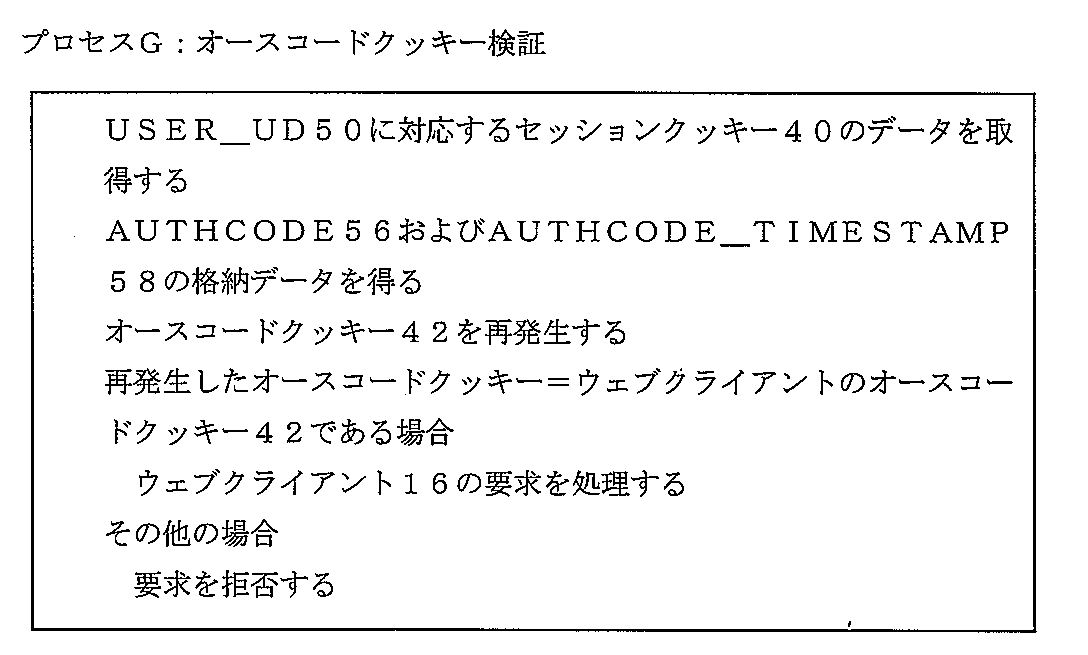
別のコンポーネントプロセスは、ウェブクライアント16がウェブサイト20上の保護されたウェブページ32に対するアクセスする要求をした場合にオースコードクッキー42を検証するために用いられる。このプロセスは、オースコードクッキー42が改ざんされていないことを保証する。このプロセスでは、ウェブクライアント16は、HTTPS通信プロトコルを用いており、セッションクッキー40およびオースコードクッキー42の双方を有する。擬似コードを、プロセスGとして以下に示す。
【0061】
【表7】
プロセスGは、USER_ID50に格納されたデータに対応するセッションクッキー40のNAME属性からのデータを抽出することで開始する。次いで、このデータを用いて、USER_SESSIONテーブル36においてウェブクライアント16のためのエントリを見つけ、AUTHCODE56およびAUTHCODE_TIMESTAMP58に含まれた格納値を得る。これらの格納値を用いて、オースコードクッキー42を再発生する。次いで、再発生したオースコードクッキー42を、ウェブクライアント16が提供するオースコードクッキー42と比較する。比較の結果が等しければ、ウェブサーバ12はウェブクライアント16の要求を処理する。比較の結果が等しくなければ、ウェブクライアント16は無許可のユーザである場合があるので、ウェブサーバ12は保護されたウェブページ32にアクセスするウェブクライアント16の要求を拒否し、ウェブクライアント16のウェブブラウザにエラーウェブページを送信する。
【0063】
別のコンポーネントプロセスは、登録クライアント46がウェブサイト20からログアウトする場合を扱うために用いられる。擬似コードを、プロセスHとして以下に示す。
【0064】
【表8】
プロセスHは、登録クライアント46がウェブサイト20からログアウトすることを選択した場合に開始する。次に、ウェブサーバ21は、全ての属性がNULL値を含むように、セッションクッキー40およびオースコードクッキー42を更新する。次いで、ウェブサーバ12は、更新したセッションクッキー40および更新したオースコードクッキー42を、登録クライアント46のウェブブラウザに送信する。あるいは、登録クライアント46は、ログアウトせず、単に別のウェブサイトを訪問する場合もある。この場合、セッションクッキー40およびオースコードクッキー42は双方とも、登録クライアント46が用いるウェブブラウザのメモリに残る。登録クライアント46がウェブサイト20を再び訪問すると、登録クライアント46のウェブブラウザは、セッションクッキー40をウェブサーバ12に送り返す。あるいは、登録クライアント46は、ウェブサイト20をログアウトすることなく彼らのウェブブラウザアプリケーションを単に終了する場合もある。この場合、セッションクッキー40およびオースコードクッキー42は、好ましくは一時的なクッキーであるので、破棄される。
【0066】
別のコンポーネントプロセスは、登録クライアント46が保護されたウェブページ32に対するアクセスを要求するがオースコードクッキー42を有しない状況を扱う。擬似コードを、プロセスIとして以下に示す。
【0067】
【表9】
プロセスIは、すでにウェブサイト20に登録したウェブクライアント16(すなわち以前に登録したウェブクライアント16)が、保護されたウェブページ32にアクセスしようとするが、まだウェブサイト20にログオンしておらず、彼らが登録クライアント46であることが示される場合に開始する。次に、以前に登録したウェブクライアント16をチェックして、彼らがオースコードクッキー42を有するか否かを調べる。以前に登録したウェブクライアント16はオースコードクッキー42を有しないので、以前に登録したウェブクライアント16は、ログインウェブページにおいて彼らのログインIDおよびパスワードを入力することでウェブサイト20にログオンするよう強制される。次に、ログインIDおよびパスワードを検証する。検証ができないと、ウェブサーバ12は保護されたウェブページ32に対する以前に登録したウェブクライアント16のアクセスの要求を拒否し、以前に登録したウェブクライアント16のウェブブラウザにエラーウェブページを送信する。しかしながら、ログインIDおよびパスワードが有効であれば、オースコードクッキー42を生成し、以前に登録したウェブクライアント16のウェブブラウザに送信する。そして、以前に登録したウェブクライアント16は、登録クライアント46として認識される。次いで、保護されたウェブページ32に対する登録クライアント46のアクセスの要求を処理する。
【0069】
実際、本発明において概説するセッション管理および認証方式に従って、ウェブサイト20には3つの一般的な使用状況がある。概して、ウェブクライアント16がウェブサイト20にアクセスし、ウェブサイト20とのセッション全体を通じてゲストクライアント44である(図4および5を参照のこと)、または、ウェブクライアント16がウェブサイト20にアクセスし、登録クライアント46になる(図6、図7、および図8を参照のこと)、または、ウェブクライアント16がウェブサイト20にアクセスし、すでに登録されていて、登録クライアント46としてログオンする(図9および10を参照のこと)。図4、5、6、7、8、9、および10は、ウェブクライアント16が最初に複数の無保護のウェブページ34にアクセスし、その後で複数の保護されたウェブページ32にアクセスすることを図示するが、その逆もまた起こり得ること、すなわち、ウェブクライアント16が最初に複数の保護されたウェブページ32にアクセスし、その後で複数の無保護のウェブページ34にアクセスすることもあり得ることに留意されたい。あるいは、ウェブクライアント16は、無保護のウェブページ34および保護されたウェブページ32に対する要求を交互に行う場合もある。実際、多くの使用例があり得るが、簡略化のため、図6ないし8には少数のみを示す。
【0070】
ここで図4および5を参照すると、この状況は、ウェブクライアント16がウェブサイト20にアクセスするステップ80において開始する。デフォルトで、ウェブクライアント16は、ゲストクライアント44と規定される。次に、ステップ82で、ゲストクライアント44のために、USER_SESSIONテーブル36におけるゲストクライアントアカウントおよびセッションクッキー40を生成する。次いで、ゲストクライアント44は先へ進み、ステップ84において、無保護のウェブページ34へのアクセスを要求する。次いで、ステップ86で、セッションクッキー40を検証する。セッションクッキー40が有効でない場合、制御はステップ88に移り、ここで、ウェブサーバ12は、ゲストクライアント44の無保護のウェブページ34に対するアクセスの要求を拒否し、ゲストクライアント44のウェブブラウザにエラーウェブページを送信する。一方、セッションクッキー40が有効である場合には、制御はステップ90に移り、ここで、ゲストクライアント44は無保護のウエウページ34にアクセスする。そして、ゲストクライアント44は、多数の無保護のウェブページ34にアクセスすることができるが、セッションクッキー40の検証は各アクセス要求ごとに行われる。いずれ、ステップ94で、ゲストクライアントは、保護されたウェブページ32に対するアクセスを要求する。次いで、ステップ95で、ウェブサーバ12は、ゲストクライアント44がHTTPSを用いているか否かを調べる。HTTPSが用いられていない場合、ステップ96で、ウェブサーバ12は、ゲストクライアント44のウェブブラウザに、HTTPSの使用を知らせる。ステップ98でHTTPS接続が検証されない場合、ステップ100で、ウェブサーバ12は、保護されたウェブページ32を見るゲストクライアント44の要求を拒否し、ゲストクライアント44のウェブブラウザにエラーウェブページを送信する。あるいは、ゲストクライアント44がHTTPSを用いている場合、ステップ102で、ウェブサーバ12は、USER_SESSIONテーブル36のAUTHCODE56に認証コードがあるか否かを調べることで、ゲストクライアント44がオースコードクッキー42を必要とするか否かを調べる。ゲストクライアント44がすでに認証コードを有する場合、制御はステップ104に移り、ここでウェブサーバ12は保護されたウェブページ32に対するゲストクライアント44のアクセスの要求を拒否する。なぜなら、ゲストクライアント44はこの時点で無許可のユーザである恐れがあるからである。そして、ゲストクライアント44のウェブブラウザにエラーウェブページを送信する。しかしながら、ゲストクライアント44が認証コードを有しない場合、制御はステップ106に移り、ここでオースコードクッキー42を生成し、ゲストクライアント44に送信する。そして、ゲストクライアント44は、保護されたウェブページ32にアクセスすることができる。次に、ステップ108において、ゲストクライアント44は、ウェブサイト20上の別の保護されたウェブページ32に対するアクセスを要求する。この時、ステップ110で、ゲストクライアント44のオースコードクッキー42を調べて、これが有効であるか否かを見る。オースコードクッキー42が有効でない場合、プロセスはステップ112に移り、ここで、ウェブサーバ12は保護されたウェブページ32に対するアクセスの要求を拒否し、ゲストクライアント44のウェブブラウザにエラーウェブページを送信する。一方、オースコードクッキー42が有効である場合、ステップ114で、ゲストクライアント44は保護されたウェブページ32にアクセスすることができる。そして、ゲストクライアント44は、多数の他の保護されたウェブページ32にアクセスすることができるが、オースコードクッキー42の検証は各アクセス要求ごとに行われる。次に、ステップ118において、ゲストクライアント44は何か買い物をし、ステップ120で、購入した品物の支払いをし、配達情報を提供する。次いでステップ122で、ゲストクライアント44は、彼らのウェブブラウザを単に閉じるか、または異なるウェブサイトにアクセスするかによって、ウェブサイト20を去る。いったんゲストクライアント44のウェブブラウザが閉じると、セッションクッキー40およびオースコードクッキー42は一時的なクッキーであるので消去される。
【0071】
ここで図6、7、および8を参照すると、この状況は、ウェブクライアント16がウェブサイト20にアクセスするステップ130で開始する。デフォルトで、ウェブクライアント16は、ゲストクライアント44として規定される。次に、ステップ132では、USER_SESSIONテーブル36においてゲストクライアントアカウントを生成し、セッションクッキー40も生成する。次いで、セッションクッキー40を、ゲストクライアント44のウェブブラウザに送信する。次いで、ステップ134において、ゲストクライアント44は、登録クライアント46になることを決める。次いで、ステップ136において、ウェブサーバ12は、ゲストクライアント44によってHTTPSが用いられているか否かを調べる。用いられていない場合、プロセスはステップ138に移り、ここで、ウェブサーバ12は、ゲストクライアント44のウェブブラウザに、HTTPSの使用を知らせる。ステップ140で、HTTPS接続の使用を調べる。HTTPSが用いられていない場合、プロセスはステップ142に移り、ここで、ウェブサーバ12は、ゲストクライアント44の登録ユーザになる要求を拒否し、ゲストクライアント44のウェブブラウザにエラーウェブページを送信する。一方、ゲストクライアント44によってHTTPSが用いられている場合、制御はステップ144に移り、ここで、ゲストクライアント44のためにオースコードクッキー42を生成する。次に、ステップ146において、ゲストクライアント44は、ウェブサイト20上の登録ウェブページに誘導され、ここでゲストクライアント44はクライアント情報を提供する。ステップ148では、登録クライアントアカウントを生成し、ゲストクライアント44は登録クライアント46になる。次いで、ステップ150に示すように、登録クライアント46は無保護のウェブページ34にアクセスすることができる。この時、ステップ152において、ウェブサーバ12は登録クライアント46のセッションクッキー40を検証する。セッションクッキー40が有効でない場合、制御はステップ154に移り、ここで、ウェブサーバ12は、無保護のウェブページ34に対する登録クライアント46のアクセスの要求を拒否し、登録クライアント46のウェブブラウザにエラーウェブページを送信する。一方、セッションクッキー40が有効である場合、ステップ156で登録クライアント46は無保護のウェブページ34にアクセスすることができる。次いで、登録クライアント46は次に進んで、他の無保護のウェブページ34にアクセスすることができるが、セッションクッキー40の検証は各アクセス要求ごとに行われる。ステップ160では、登録クライアント46は保護されたウェブページ32に対するアクセスを要求し、この後、ステップ162で、ウェブサーバ12は、登録クライアント46がHTTPSを用いているか否かを調べる。HTTPSが用いられていない場合、ステップ164において、ウェブサーバ12は、登録クライアント46のウェブブラウザに、HTTPSに切り替えることを知らせる。次いで、ステップ166で、HTTPSの使用を調べる。登録クライアント46がHTTPSを用いていない場合、プロセスはステップ168に移り、ここで、ウェブサーバ12は、保護されたウェブページ32に対する登録クライアント46のアクセスの要求を拒否し、登録クライアント46のウェブブラウザにエラーウェブページを送信する。一方、HTTPSが用いられている場合、制御はステップ170に移り、ウェブサーバ12は、オースコードクッキー42を検証する。オースコードクッキー42有効でない場合、制御はステップ172に移り、ここで、ウェブサーバ12は、保護されたウェブページ32に対する登録クライアント46のアクセスの要求を拒否し、登録クライアント46のウェブブラウザにエラーウェブページを送信する。一方、オースコードクッキー42が有効である場合、ステップ174において、登録クライアント46は保護されたウェブページ32にアクセスすることができる。次いで、登録クライアント46は、次に進んで、多数の保護されたウェブページ32にアクセスすることができるが、オースコードクッキー42の検証は各アクセス要求ごとに行われる。ステップ178に見られるように、登録クライアント46は買い物を行うこともできる。次いで、ステップ180で登録クライアント46が買い物をすると、登録クライアント46はその買い物の支払いをし、ウェブサーバ12は行われた買い物に関するデータをデータベース24に格納する。次に、ステップ182において、登録クライアント46は、ウェブサイト20からログアウトするか、別のウェブサイトにアクセスするか、または単に彼らのウェブブラウザアプリケーションを終了する。登録クライアント46が行った選択に関わらず、いったん登録クライアント46が彼らのウェブブラウザアプリケーションを終了すると、セッションクッキー40およびオースコードクッキー42は好ましくは一時的なクッキーとして規定されているので、破棄される。
【0072】
ここで図9および10を参照すると、この状況は、すでにウェブサイト20に登録しているウェブクライアント16がウェブサイト20にアクセスするステップ190で開始する。ウェブクライアント16は、デフォルトで、ゲストクライアント44として規定される。次いで、USER_SESSIONテーブル36においてゲストクライアントアカウントを生成し、セッションクッキー40を生成し、ゲストクライアント44に送信する。次いで、ステップ192において、ゲストクライアント44はログオンすることを決め、この時、ステップ194で、ウェブサーバ12は、ゲストクライアント44がHTTPSを用いているか否かを判定しなければならない。用いていない場合、ステップ196で、ウェブサーバ12は、ゲストクライアント44のウェブブラウザに、HTTPSの使用を知らせる。ステップ198で、HTTPSの使用を調べる。HTTPSが用いられていない場合、プロセスはステップ200に移り、ここで、ウェブサーバ12は、ゲストクライアント44のログオンの要求を拒否し、ゲストクライアント44のウェブブラウザにエラーウェブページを送信する。一方、ゲストクライアント44がHTTPSを用いている場合、プロセスはステップ202に移り、ここで、オースコードクッキー42を生成または更新し、ゲストクライアント44のウェブブラウザに送信する。次に、ステップ204において、ゲストクライアント44はログオンし、登録クライアント46になる。次いで、ステップ206で、登録クライアント46は、ウェブサイト20上の無保護のウェブページ34にアクセスすることができる。この時、ステップ208で、ウェブサーバ12はセッションクッキー40を検証する。検証がうまくいかないと、プロセスはステップ210に移り、ウェブサーバ12は、無保護のウェブページ34に対する登録クライアント46のアクセスの要求を拒否し、登録クライアント46のウェブブラウザにエラーウェブページを送信する。一方、セッションクッキー40が有効である場合、プロセスはステップ212に移り、ここで、登録クライアント46は、無保護のウェブページ34にアクセスする。次いで、登録クライアント46は次に進んで、多数の無保護のウェブページ34にアクセスすることができるが、セッションクッキー40の検証は各アクセス要求ごとに行われる。次に、ステップ216は、登録クライアント46は、保護されたウェブページ32に対するアクセスを要求する。次いで、ステップ218において、ウェブサーバ21は、登録クライアント46によってHTTPSが用いられているか否かを調べる。HTTPSが用いられていない場合、ステップ220で、ウェブサーバ12は、登録クライアント46のウェブブラウザにHTTPSの使用を知らせる。ステップ222で、HTTPSの使用を調べる。HTTPSが用いられていない場合、プロセスはステップ224に移り、ここで、ウェブサーバ12は、保護されたウェブページ32に対する登録クライアント46のアクセスの要求を拒否し、登録クライアント46のウェブブラウザにエラーウェブページを送信する。一方、登録クライアント46がHTTPSを用いている場合、プロセスはステップ226に進み、ここでオースコードクッキー42を検証する。検証がうまくいかないと、プロセスはステップ228に進み、ウェブサーバ12は、保護されたウェブページ32に対する登録クライアント46のアクセスの要求を拒否し、登録クライアント46のウェブブラウザにエラーウェブページを送信する。一方、検証がうまくいくと、ステップ230で、登録クライアント46は、保護されたウェブページ32にアクセスすることができる。ステップ234に示すように、登録クライアント46は、買い物をすること、および/または彼らの注文履歴をチェックすることができる。何か買い物をした場合、ステップ236で、登録クライアント46は、これらの買い物の支払いをし、ウェブサーバ12は、これらの買い物に関するデータをデータベース24に格納する。次いで、ステップ238で、登録クライアント46は、ログアウトするか、異なるウェブサイトにアクセスするか、または単に彼らのウェブブラウザアプリケーションを終了することで、ウェブサイト20を去ることができる。登録クライアント46が行った選択に関わらず、いったん登録クライアント46が彼らのウェブブラウザアプリケーションを終了すると、セッションクッキー40およびオースコードクッキー42は、好ましくは一時的なクッキーとして規定されているので、破棄される。
【0073】
本発明において実現されるシステムおよび方法は、無許可のユーザがウェブサイト20またはウェブクライアント16に関する機密情報にアクセスすることを防ぐように設計されている。例えば、ウェブクライアント16がオースコードクッキー42を有しないゲストクライアント44である場合、すなわちゲストクライアント44が保護されたウェブページ32にアクセスしたことがない場合、ゲストクライアント44に関する秘密情報は存在しない。この場合、無許可のユーザは、有害な行為を行うことはできない。別の状況は、ウェブクライアント16がオースコードクッキー42を有するゲストクライアント44である(すなわち、ウェブクライアント16がすでに保護されたウェブページ32にアクセスしたことがある)という場合であろう。この場合、無許可のユーザの試みはうまくいかないはずである。なぜなら、無許可のユーザはセッションクッキー40を使用可能なだけであり、オースコードクッキー42を有しておらず、ウェブサーバ12はすでに、(USER_SESSIONテーブル36のAUTHCODE56を調べることで)ゲストクライアント44がオースコードクッキー42を有することを知っているからである。別の代替的な状況は、ウェブクライアント16が登録クライアント46であり、無許可のユーザがセッションクッキー40を用いて保護されたウェブページ32をブラウズしようとする場合であろう。無許可のユーザはオースコードクッキー42を有しないので、ウェブサーバ12は無許可のユーザをログインウェブページに再び誘導するが、この時点で、無許可のユーザは登録クライアント46のログインIDもパスワードも持っていないので、ログオンすることができない。
【0074】
要約すると、本発明は、ウェブクライアントがウェブサイトで無保護のウェブページまたは保護されたウェブページにそれぞれアクセスする場合に、無保護の(HTTP)または保護された(HTTPS)通信プロトコルのいずれかを使用可能とする。これによって、ウェブクライアントとウェブサイトとの間の安全かつ効率的なセッションを提供する。更に、2つの別個のクッキー、すなわちセッションクッキー(セッション管理用)およびオースコードクッキー(認証用)を用いる。また、セッションクッキーは、これがウェブクライアントに関する機密情報を含まないように設計されている。最後に、ウェブサイトは、ゲストクライアントまたは登録クライアントのいずれかのアクセスを可能とし、これによってウェブサイトの柔軟性が増し、ユーザにとって魅力が大きくなる。
【0075】
本発明を電子商取引ウェブサイトの文脈で説明したが、本発明の使用を電子商取引の使用のみに制限することは発明者の意図するところではないことを注記しておく。例えば、本発明を用いて、オンライン投票、クレジットカード番号の発行、オンライン株取引等、電子商取引でない機能のためのデータ交換を保証することができる。
【0076】
また、本発明は、ウェブサーバ12にセッション名前−値ペアを発生するよう指示して、このセッション名前−値ペアをウェブサイト20上の全てのウェブページ22に渡すことによって、ウェブサイトとウェブクライアントとの間の認証およびセッション管理のために名前−値ペアを利用するように容易に適合させることができる。また、ウェブサーバ12は、オースコード名前−値ペアを発生し、これをウェブサイト20上の全ての保護されたウェブページ32に渡す。
【0077】
ここで説明したことは、本発明の好適な実施形態として理解されよう。それにもかかわらず、本発明においては、上述の本発明の精神および上記の特許請求の範囲によって完全に理解されるいずれの変更および代替的な実施形態も可能である。
【図面の簡単な説明】
【図1】
本発明の構成要素の概略図である。
【図2】
USER_SESSIONテーブルに含まれるフィールドのデータ構成図である。
【図3】
URL_REGISTRYテーブルに含まれるフィールドのデータ構成図である。
【図4】
図5と共に、本発明の第1の使用状況のフローチャートを構成する。
【図5】
図4と共に、本発明の第1の使用状況のフローチャートを構成する。
【図6】
図7および8と共に、本発明の第2の使用状況のフローチャートを構成する。
【図7】
図6および7と共に、本発明の第2の使用状況のフローチャートを構成する。
【図8】
図6および7と共に、本発明の第2の使用状況のフローチャートを構成する。
【図9】
図10と共に、本発明の第3の使用状況のフローチャートを構成する。
【図10】
図9と共に、本発明の第3の使用状況のフローチャートを構成する。TECHNICAL FIELD OF THE INVENTION
[0001]
The present invention relates to communication between a website and a web client, and in particular, a session using a secure and an unprotected communication protocol for a session between the website and the web client. Management and authentication measures.
[Prior art]
[0002]
Many companies have adopted the Internet as a way to reduce costs and promote their services or products to a wide audience. These companies (ie, web merchants) have set up online shopping websites to sell non-durable goods such as information or software, and / or durable consumer goods. This benefits many consumers (ie, web clients) that are increasingly using the Internet because they can easily shop online. In fact, online transactions between web merchants and web clients are becoming increasingly common.
[0003]
Although electronic commerce is convenient, it is not without its problems because the communication between the web browser of the web client and the electronic commerce website is based on HTTP (Hypertext Transfer Protocol). HTTP is stateless. This means that the HTTP protocol does not maintain information about the web client from one visit to the next. As a result, e-commerce websites must take action to remember web clients who return later at a later date. Another problem is that HTTP is not secure, which is cumbersome. This is because the web client must provide confidential information, such as a credit card number or account number, to pay for and receive the product. An unauthorized user may be watching HTTP communications to steal this confidential information. Unauthorized users can then order items under the identity of the web client, request that the item be sent to a different address, or access sensitive web client data such as address and credit card information. Or may be.
[0004]
To solve these problems, e-commerce websites must allow authentication and session management while continuing to interact with web clients. Further, when transmitting sensitive information between a web client and an e-commerce website, a secure communication protocol must be used. Session management allows the website to remember the web client between different login sessions, while authentication ensures that the website comes from the same web client that first logged on to the website Security measures. Secure communication protocols encrypt data transmitted between e-commerce websites and web clients. To achieve authentication and session management, HTTP basic authentication, name-value pair authentication, or session cookies can be used.
[0005]
With HTTP basic authentication, a web client must always log on before session management. Therefore, when the web client accesses the website for the first time, the login window is opened suddenly. This login window is not easy to customize by the website administrator. Thus, guest client access to protected web pages is not supported because the web server forces the web client to log on. As a result, most e-commerce websites do not use HTTP basic authentication.
[0006]
Name-value pair authentication involves embedding security information in any URL (Uniform Resource Locator) or in the data of any web page on an e-commerce website.
[0007]
As a result, website developers need to handle authentication for each web page by transferring authentication data from one web page to another. This authentication data can easily be lost if the web client jumps from a protected web page to an unprotected web page. Also, name-value pairs do not support guest client access to the protected web page because the web server forces the web client to register or log on when accessing the protected web page. Also, if the authentication data is added at the end of the web page URL, it is not secure. This is because this may be revealed in the log of the web server or displayed on the web browser of the web client. Further, the authentication data included in the web page data is not secure because it may be seen by browsing the cache file of the web browser.
[0008]
Cookies are the most popular method for session management and authentication between websites and web clients. The cookie is stored and retrieved on the web client's computer. Permanent cookies are stored on the computer's hard drive, while temporary cookies are stored in volatile memory and are erased once the web session ends. The Netscape Navigator (R) web browser stores permanent cookies in a text file (i.e., cookie.txt), with one line of the file in each cookie, while the Microsoft Internet Explorer (R) web browser. Uses a separate text file for each permanent cookie. Cookies are designed to provide useful information about the web client to the web server, such as which web page the web client last accessed. Cookies can also be used to provide some predetermined level of web client access and customization at a website. The cookie also contains a description of the URL set for which the cookie is valid. In the future, if an HTTP request is made by the web client that matches the set of URLs contained in a cookie, this should include returning the current value of the cookie from the web client to the web server.
[0009]
When a web client requests information from a web server for the first time, and this uses a cookie, the web server sends the requested information along with the cookie. The cookie is sent from the web server to the web client by including a Set-Cookie header as part of the HTTP response. The Set-Cookie header is generated by a CGI script and includes the following attributes. That is, NAME, DATE, PATH, DOMAIN, and SECURE. The NAME attribute contains data about the web client and is used by the website. There can be many NAME attributes in one cookie, and many Set-Cookie headers can be issued in a single web server response. The DATE attribute specifies a date indicating when the cookie expires. The PATH attribute defines the URL subset in the domain where the cookie is valid. The DOMAIN attribute is the Internet domain name of the website. The SECURE attribute indicates a condition for transmitting a cookie. For example, if the SECURE attribute of the cookie indicates that it is protected, this will only be sent if the communication channel between the web server and the web client is protected.
[0010]
Cookie-based session management must incorporate a secure communication protocol to prevent unauthorized users from stealing sensitive data contained in cookies. One such protocol is HTTPS (HTTP over SSL). The acronym SSL stands for Secure Socket Layer (Secure Socket Layer) protocol, which is an industry standard for securely transmitting information using HTTP. HTTPS provides functions for web server authentication (verifying the web server identity to the web client), data encryption, and web client authentication (verifying the web client identity to the web server). Including. Each web server that can use HTTPS has both a coder and decoder that utilize unique keys and data encryption installed. Data encryption, which converts words and numbers into a series of alphanumeric characters, can only be decrypted by a decoder attached to the web server authorized by the web merchant. The level of security depends on whether a 40 or 128 bit key is used. The difficulty of decrypting a code (or key) increases with the number of bits contained in the key. Cookie based session management and authentication schemes have been described in the prior art.
[0011]
U.S. Patent No. 5,875,296 discloses a method for providing secure access to a distributed file system via a website. The method utilizes a single cookie containing a user identifier to access a file in the distributed file system. This cookie allows the user to avoid having to re-enter the user ID and password each time they access information on the distributed file system. Also, this method is specialized for a distributed file system and does not use a protected communication protocol.
[0012]
U.S. Patent No. 6,047,268 discloses a system and method for authenticating web clients shopping online. Authentication is provided by a single cookie. This cookie includes a static part that identifies the web client's account number and an encrypted dynamic part that identifies the last transaction by the web client. This cookie is updated with a new dynamic part after each new transaction, but this patent uses the sensitive information in the cookie and puts a permanent cookie on the web client's computer system. Disclose storing. Furthermore, the e-commerce method disclosed in this patent is not flexible enough to allow guest clients to conduct online shopping. All web clients must register to shop online. U.S. Pat. No. 6,047,268 discloses the use of HTTPS, but does not state whether to use HTTPS exclusively or whether to switch communication protocols between HTTPS and HTTP. .
[0013]
U.S. Patent No. 6,076,069 discloses a system and method for redeeming electronic coupons. When a web client visits a website that promotes promotional items from a web merchant, it stores the coupon in the form of a cookie on the web client's computer system. When the web client later visits the web merchant's website, the website recognizes the electronic coupon stored in the cookie and provides the web client with a discount. This patent does not teach the use of a protected communication protocol. In addition, this patent discloses the use of sensitive information in cookies, such as the web client's account number, and the use of permanent cookies (ie, storing the cookies permanently on the web client's computer system). Both of these features raise security issues.
[0014]
If only HTTPS is used exclusively, encoding and decoding are performed every time a web page is accessed, which causes a decrease in performance. This is inefficient. This is because many web pages, such as product catalog web pages that are accidentally visited many times by web clients, do not require protection. Furthermore, using HTTPS for the homepage URL of a website may be inconvenient for web clients. This is because web clients are not used to using "https" instead of "http" in website URLs. Further, switching between HTTP and HTTPS may be cumbersome. Currently, when a web client logs on to a website using HTTPS, it issues a cookie to authenticate the web client, but if the web client later browses the unprotected web page on the website using HTTP. Then, the same cookie is sent to the web client in clear text. At this time, an unauthorized user may steal the cookie. Thus, the use of a single cookie in such situations compromises the security of the website.
[Problems to be solved by the invention]
[0015]
Therefore, there is a need for an improved secure session management and authentication method that uses cookies to protect both websites and web clients from unauthorized users. The present invention addresses these needs.
[Means for Solving the Invention]
[0016]
The present invention provides a method for secure session management and authentication between a website and a web client. The website has a protected web page and an unprotected web page. The method includes the steps of using an unprotected communication protocol and a session cookie when a web client requests access to an unprotected web page, and protecting the web client when requesting access to a protected web page. Utilizing a communication protocol and an oathcode cookie.
[0017]
Preferably, the method further includes requesting a session cookie from the web client if the web client requests access to the unprotected web page, verifying the requested session cookie, Requesting an oathcode cookie from a web client when requesting access to the page, and verifying the requested oathcode cookie.
[0018]
Preferably, the method further comprises the step of alternately using the protected communication protocol and the unprotected communication protocol when the web client alternately requests access to the protected web page and the unprotected web page. including.
[0019]
In another aspect, the invention is a system for secure session management and authentication between a website and a web client. The system includes a web server, a web client, and a communication channel. The web server is coupled to the web client via a communication channel. The web server includes a website, which includes protected and unprotected web pages, and unsecured communication protocols and session cookies that allow web clients to access the unprotected web pages. And a secure communication protocol and an oathcode cookie that allow a web client to access the protected webpage.
[0020]
Preferably, the web site further includes verification means for verifying the session cookie requested by the web client, and verification means for verifying the oath code cookie requested by the web client.
[0021]
Preferably, the web server further comprises a security alternation means for alternately using a protected communication protocol and an unprotected communication protocol.
[0022]
The present invention can be embodied in a computer program that can be stored in a storage device or transmitted as a signal on a modulated carrier signal used in a computer system or on a network such as the Internet used in a computer system. It will be understood by those skilled in the art.
[0023]
For a better understanding of the present invention and to show more clearly how the invention may be implemented, reference is made to the accompanying drawings, by way of example.
BEST MODE FOR CARRYING OUT THE INVENTION
[0024]
FIG. 1 shows a secure session management system according to the present invention generally at 10. The system 10 includes a
[0025]
[0026]
The
[0027]
[0028]
In a preferred embodiment of the present invention,
[0029]
In the present invention,
[0030]
Each record in the USER_SESSION table 36 contains information about an individual web client 16. This information is stored in a plurality of fields included in the USER_SESSION table 36 (see FIG. 2). In the preferred embodiment of the present invention, these fields are USER_ID50, SESSION_ID52, SESSION_TIMESTAMP54, AUTHCODE56, AUTHCODE_TIMESTAMP58, USER_TYPE60, LOGIN_ID62, and PASSWORD64. For each web client 16,
[0031]
Each record in the URL_REGISTRY table 38 contains information about a
[0032]
The
[0033]
The
[0034]
The
[0035]
The session cookie 40 is responsible for session management, while the oathcode cookie 42 is responsible for authentication. In a preferred embodiment, the session cookie 40 and the oathcode cookie 42 are temporary cookies and are deleted when the web client 16 closes the web browser. Alternatively, the session cookie 40 could be defined to be stored permanently on the computer system of the web client 16, but the oathcode cookie 42 should always be temporary for security reasons. .
[0036]
As described above, cookies have the following attributes. That is, NAME, DATE, PATH, DOMAIN, and SECURE. The data used in the NAME attribute of the session cookie 40 preferably includes data included in
[0037]
To generate the data included in the NAME attribute of the session cookie 40, the data from
[0038]
The data used for the NAME attribute of the oath code cookie 42 preferably comprises data stored in
[0039]
To generate data in the NAME attribute of the Auscode 42, the data stored in
[0040]
Web client 16 may be either
[0041]
The method of the present invention is based on several component processes and basic definitions. First,
[0042]
The pseudo code for the process by which
[0043]
[Table 1]
Process A begins when web client 16 requests access to
[0045]
To generate a guest client account or session cookie when the web client 16 accesses the
[0046]
[Table 2]
Process B starts when the
[0048]
Another component process is used to generate the Auscode cookie 42. This typically occurs when the
[0049]
[Table 3]
Process C begins by extracting data from the NAME attribute of session cookie 40 corresponding to the data stored in
[0051]
Another component process deals with the case where the
[0052]
[Table 4]
Process D begins by directing
[0054]
Another component process addresses the situation where a
[0055]
[Table 5]
Process E begins when
[0057]
Another component process is used to verify session cookie 40 when web client 16 requests access to
[0058]
[Table 6]
Process F begins by extracting data from the NAME attribute of session cookie 40 corresponding to the data stored in
[0060]
Another component process is used to verify the oathcode cookie 42 when the web client 16 requests access to a protected
[0061]
[Table 7]
Process G begins by extracting data from the NAME attribute of session cookie 40 corresponding to the data stored in
[0063]
Another component process is used to handle the case where the
[0064]
[Table 8]
Process H begins when registered
[0066]
Another component process handles the situation where the
[0067]
[Table 9]
Process I indicates that a web client 16 that has already registered with website 20 (ie, a previously registered web client 16) attempts to access protected
[0069]
In fact, according to the session management and authentication scheme outlined in the present invention, there are three general usages of
[0070]
Referring now to FIGS. 4 and 5, the situation begins at
[0071]
Referring now to FIGS. 6, 7, and 8, the situation begins at
[0072]
Referring now to FIGS. 9 and 10, the situation begins at
[0073]
The systems and methods implemented in the present invention are designed to prevent unauthorized users from accessing sensitive information about
[0074]
In summary, the present invention provides for either an unprotected (HTTP) or a protected (HTTPS) communication protocol when a web client accesses an unprotected or protected web page on a website, respectively. Can be used. This provides a secure and efficient session between the web client and the website. In addition, two separate cookies are used, a session cookie (for session management) and an oathcode cookie (for authentication). Also, the session cookie is designed so that it does not contain sensitive information about the web client. Finally, the website allows access for either guest clients or registered clients, which makes the website more flexible and attractive to users.
[0075]
Although the invention has been described in the context of an e-commerce website, it is noted that limiting the use of the invention to only e-commerce is not intended by the inventor. For example, the present invention can be used to guarantee data exchange for non-e-commerce functions such as online voting, issuing credit card numbers, online stock trading, and the like.
[0076]
The present invention also instructs the
[0077]
What has been described herein will be understood as a preferred embodiment of the present invention. Nevertheless, the invention is capable of any modifications and alternative embodiments fully understood by the spirit of the invention described above and the appended claims.
[Brief description of the drawings]
FIG.
FIG. 2 is a schematic diagram of components of the present invention.
FIG. 2
FIG. 4 is a data configuration diagram of a field included in a USER_SESSION table.
FIG. 3
FIG. 9 is a data configuration diagram of a field included in a URL_REGISTRY table.
FIG. 4
Together with FIG. 5, a flowchart of a first use situation of the present invention is configured.
FIG. 5
Together with FIG. 4, a flowchart of a first use situation of the present invention is configured.
FIG. 6
Together with FIGS. 7 and 8, a second use situation flowchart of the present invention is constituted.
FIG. 7
Together with FIGS. 6 and 7, a flowchart of a second use situation of the present invention is constituted.
FIG. 8
Together with FIGS. 6 and 7, a flowchart of a second use situation of the present invention is constituted.
FIG. 9
Together with FIG. 10, a flowchart of a third use situation of the present invention is configured.
FIG. 10
Together with FIG. 9, a flowchart of a third use situation of the present invention is configured.
Claims (53)
a)前記ウェブクライアントが前記無保護のウェブページに対するアクセスを要求した場合に無保護の通信プロトコルおよびセッションクッキーを利用するステップと、
b)前記ウェブクライアントが前記保護されたウェブページに対するアクセスを要求した場合に保護された通信プロトコルおよびオースコードクッキーを利用するステップと、
を具備する、方法。A method of secure session management and authentication between a website and a web client, wherein the website has a protected web page and an unprotected web page, the method comprising:
a) using an unprotected communication protocol and a session cookie when the web client requests access to the unprotected web page;
b) using a protected communication protocol and an oathcode cookie when the web client requests access to the protected web page;
A method comprising:
c)前記ウェブクライアントが前記無保護のウェブページに対するアクセスを要求した場合に前記ウェブクライアントから前記セッションクッキーを要求し、前記要求したセッションクッキーを検証するステップと、
d)前記ウェブクライアントが前記保護されたウェブページに対するアクセスを要求した場合に前記ウェブクライアントから前記オースコードクッキーを要求し、前記要求したオースコードクッキーを検証するステップと、
を具備する、請求項1の方法。The method further comprises:
c) requesting the session cookie from the web client when the web client requests access to the unprotected web page, and verifying the requested session cookie;
d) requesting the oath code cookie from the web client when the web client requests access to the protected web page, and verifying the requested oath code cookie;
The method of claim 1, comprising:
a)保護されたウェブページおよび無保護のウェブページと、
b)前記ウェブクライアントが前記無保護のウェブページにアクセスすることを可能とする無保護の通信プロトコルおよびセッションクッキーと、
c)前記ウェブクライアントが前記保護されたウェブページにアクセスすることを可能とする保護された通信プロトコルおよびオースコードクッキーと、
を具備する、システム。A system for secure session management and authentication between a website and a web client, the system comprising a web server, a web client, and a communication channel, wherein the web server communicates with the communication channel. Coupled to the web client via the web server, the web server having a website,
a) protected and unprotected web pages;
b) an unprotected communication protocol and a session cookie that allows the web client to access the unprotected web page;
c) a protected communication protocol and an oathcode cookie that allows the web client to access the protected webpage;
A system comprising:
d)前記ウェブクライアントから前記セッションクッキーが要求された場合に前記セッションクッキーを検証するための検証手段と、
d)前記ウェブクライアントから前記オースコードクッキーが要求された場合に前記オースコードクッキーを検証するための検証手段と、
を含む、請求項16のシステム。The website further comprises:
d) verification means for verifying the session cookie when the session cookie is requested by the web client;
d) verification means for verifying the oath code cookie when the web code is requested by the web client;
17. The system of claim 16, comprising:
a)前記ウェブクライアントが前記無保護のウェブページに対するアクセスを要求した場合に無保護の通信プロトコルおよびセッションクッキーを用い、
b)前記ウェブクライアントが前記保護されたウェブページに対するアクセスを要求した場合に保護された通信プロトコルおよびオースコードクッキーを用いる、
ように適合されている、コンピュータプログラム。A computer program embodied on a computer readable medium, the computer program being provided for secure session management and authentication between a website and a web client, wherein the website is a protected web. Page and an unprotected web page, said computer program comprising:
a) using an unprotected communication protocol and a session cookie when the web client requests access to the unprotected web page;
b) using a protected communication protocol and an oathcode cookie when the web client requests access to the protected web page;
A computer program that has been adapted to:
c)前記ウェブクライアントが前記無保護のウェブページに対するアクセスを要求した場合に前記ウェブクライアントから前記セッションクッキーを要求し、前記要求したセッションクッキーを検証し、
d)前記ウェブクライアントが前記保護されたウェブページに対するアクセスを要求した場合に前記ウェブクライアントから前記オースコードクッキーを要求し、前記要求したオースコードクッキーを検証する、
ように適合されている、請求項28のコンピュータプログラム。The computer program further comprises:
c) requesting the session cookie from the web client when the web client requests access to the unprotected web page, verifying the requested session cookie;
d) requesting the oathcode cookie from the web client when the web client requests access to the protected web page and verifying the requested oathcode cookie;
29. The computer program of claim 28, adapted to:
a)user_idを発生するステップと、
b)session_stringを発生するステップと、
c)session_timestampを発生するステップと、
d)前記session_timestampを前記session_stringの最後に追加して中間値を生成するステップと、
e)前記中間値に一方向ハッシュ関数を適用して最終値を生成するステップと、
f)前記最終値を前記NAME属性に格納するステップと、
を具備する、コンピュータプログラム。A computer program for generating a NAME attribute in a session cookie, the computer program comprising:
a) generating a user_id;
b) generating a session_string;
c) generating a session_timestamp;
d) adding the session_timestamp to the end of the session_string to generate an intermediate value;
e) applying a one-way hash function to the intermediate value to generate a final value;
f) storing the final value in the NAME attribute;
A computer program comprising:
a)前記PATH属性にスラッシュ
を格納するステップと、
b)前記EXPIRES属性にヌルストリング
を格納するステップと、
c)前記DOMAIN属性にヌルストリングO grave O acuteを格納するステップと、
d)前記SECURE属性にヌルストリングO grave O acuteを格納するステップと、
を具備する、請求項45のコンピュータプログラム。In the session cookie, the step of generating a PATH attribute, an EXPIRES attribute, a DOMAIN attribute, and a SECURE attribute includes:
a) A slash to the PATH attribute
Storing the
b) a null string in the EXPIRES attribute
Storing the
c) storing a null string O grab O account in the DOMAIN attribute;
d) storing a null string O grab O account in the SECURE attribute;
46. The computer program of claim 45, comprising:
a)authcodeを発生するステップと、
b)authcode_timestampを発生するステップと、
c)前記authcode_timestampを前記authcodeの最後に追加して中間値を生成するステップと、
d)前記中間値に一方向ハッシュ関数を適用して最終値を生成するステップと、
e)前記最終値を前記NAME属性に格納するステップと、
を具備する、コンピュータプログラム。A computer program for generating a NAME attribute in an oath code cookie, wherein the computer program comprises:
a) generating an authcode;
b) generating authcode_timestamp;
c) adding the authcode_timestamp to the end of the authcode to generate an intermediate value;
d) applying a one-way hash function to said intermediate value to generate a final value;
e) storing the final value in the NAME attribute;
A computer program comprising:
a)前記PATH属性にスラッシュO grave/O acuteを格納するステップと、
b)前記EXPIRES属性にヌルストリングO grave O acuteを格納するステップと、
c)前記DOMAIN属性にヌルストリングO grave O acuteを格納するステップと、
d)前記SECURE属性にストリング
を具備する、請求項47のコンピュータプログラム。In the auscode cookie, a step of generating a PATH attribute, an EXPIRES attribute, a DOMAIN attribute, and a SECURE attribute includes:
a) storing a slash O grab / O account in the PATH attribute;
b) storing a null string O grab O account in the EXPIRES attribute;
c) storing a null string O grab O account in the DOMAIN attribute;
d) a string in the SECURE attribute
48. The computer program of claim 47, comprising:
コンピュータ読み取り可能信号記録媒体と、
請求項1ないし15のいずれかの方法を達成するための前記媒体における手段と、
を具備する、コンピュータプログラムプロダクト。A computer program product,
A computer-readable signal recording medium;
Means in the medium for achieving the method of any of claims 1 to 15,
A computer program product comprising:
Applications Claiming Priority (2)
| Application Number | Priority Date | Filing Date | Title |
|---|---|---|---|
| CA002327078A CA2327078C (en) | 2000-11-30 | 2000-11-30 | Secure session management and authentication for web sites |
| PCT/EP2001/012963 WO2002045370A2 (en) | 2000-11-30 | 2001-11-09 | Secure session management and authentication for web sites |
Publications (2)
| Publication Number | Publication Date |
|---|---|
| JP2004514996A true JP2004514996A (en) | 2004-05-20 |
| JP4056390B2 JP4056390B2 (en) | 2008-03-05 |
Family
ID=4167768
Family Applications (1)
| Application Number | Title | Priority Date | Filing Date |
|---|---|---|---|
| JP2002546382A Expired - Fee Related JP4056390B2 (en) | 2000-11-30 | 2001-11-09 | Secure session management and authentication for websites |
Country Status (9)
| Country | Link |
|---|---|
| US (1) | US7216236B2 (en) |
| EP (1) | EP1346548B1 (en) |
| JP (1) | JP4056390B2 (en) |
| CN (1) | CN100486243C (en) |
| AT (1) | ATE316731T1 (en) |
| AU (1) | AU2002217011A1 (en) |
| CA (1) | CA2327078C (en) |
| DE (1) | DE60116903T2 (en) |
| WO (1) | WO2002045370A2 (en) |
Cited By (5)
| Publication number | Priority date | Publication date | Assignee | Title |
|---|---|---|---|---|
| JP2006243924A (en) * | 2005-03-01 | 2006-09-14 | Nec Corp | Secure session management program for website, session management method, and session management system |
| JP2008242684A (en) * | 2007-03-27 | 2008-10-09 | Fujitsu Ltd | Authentication processing method and system |
| JP2012068834A (en) * | 2010-09-22 | 2012-04-05 | Canon Inc | Information processing apparatus, control method of information processing apparatus, and program |
| JP2013003820A (en) * | 2011-06-16 | 2013-01-07 | Bank Of Tokyo-Mitsubishi Ufj Ltd | Information processor and information processing method |
| KR20180088895A (en) * | 2015-12-07 | 2018-08-07 | 알리바바 그룹 홀딩 리미티드 | Method and apparatus for generating random string |
Families Citing this family (166)
| Publication number | Priority date | Publication date | Assignee | Title |
|---|---|---|---|---|
| US7058817B1 (en) | 1999-07-02 | 2006-06-06 | The Chase Manhattan Bank | System and method for single sign on process for websites with multiple applications and services |
| US8571975B1 (en) | 1999-11-24 | 2013-10-29 | Jpmorgan Chase Bank, N.A. | System and method for sending money via E-mail over the internet |
| US7426530B1 (en) | 2000-06-12 | 2008-09-16 | Jpmorgan Chase Bank, N.A. | System and method for providing customers with seamless entry to a remote server |
| US10185936B2 (en) | 2000-06-22 | 2019-01-22 | Jpmorgan Chase Bank, N.A. | Method and system for processing internet payments |
| CA2342578A1 (en) * | 2001-03-29 | 2002-09-29 | Ibm Canada Limited-Ibm Canada Limitee | Method and apparatus for security of a network server |
| DE10115895C1 (en) * | 2001-03-30 | 2002-12-19 | Siemens Ag | Method for generating a representation for the retrieval of an information page that has already been called up |
| US8849716B1 (en) | 2001-04-20 | 2014-09-30 | Jpmorgan Chase Bank, N.A. | System and method for preventing identity theft or misuse by restricting access |
| US6741990B2 (en) * | 2001-05-23 | 2004-05-25 | Intel Corporation | System and method for efficient and adaptive web accesses filtering |
| AU2002312381A1 (en) | 2001-06-07 | 2002-12-16 | First Usa Bank, N.A. | System and method for rapid updating of credit information |
| US7054939B2 (en) * | 2001-06-28 | 2006-05-30 | Bellsouth Intellectual Property Corportion | Simultaneous visual and telephonic access to interactive information delivery |
| US7266839B2 (en) | 2001-07-12 | 2007-09-04 | J P Morgan Chase Bank | System and method for providing discriminated content to network users |
| US7058673B2 (en) * | 2001-08-02 | 2006-06-06 | America Online, Inc. | Method for generating positive integer number in Chinese number system |
| JP2003108520A (en) * | 2001-09-28 | 2003-04-11 | Canon Inc | Information providing server, terminal device, control method therefor, and information providing system |
| US7496751B2 (en) * | 2001-10-29 | 2009-02-24 | Sun Microsystems, Inc. | Privacy and identification in a data communications network |
| US7275260B2 (en) | 2001-10-29 | 2007-09-25 | Sun Microsystems, Inc. | Enhanced privacy protection in identification in a data communications network |
| US20030084302A1 (en) * | 2001-10-29 | 2003-05-01 | Sun Microsystems, Inc., A Delaware Corporation | Portability and privacy with data communications network browsing |
| US20030084171A1 (en) * | 2001-10-29 | 2003-05-01 | Sun Microsystems, Inc., A Delaware Corporation | User access control to distributed resources on a data communications network |
| US7689504B2 (en) | 2001-11-01 | 2010-03-30 | Jpmorgan Chase Bank, N.A. | System and method for establishing or modifying an account with user selectable terms |
| US7315944B2 (en) * | 2001-11-13 | 2008-01-01 | Ericsson Inc. | Secure handling of stored-value data objects |
| US7987501B2 (en) * | 2001-12-04 | 2011-07-26 | Jpmorgan Chase Bank, N.A. | System and method for single session sign-on |
| US20180165441A1 (en) | 2002-03-25 | 2018-06-14 | Glenn Cobourn Everhart | Systems and methods for multifactor authentication |
| US20030208594A1 (en) * | 2002-05-06 | 2003-11-06 | Urchin Software Corporation. | System and method for tracking unique visitors to a website |
| US7100049B2 (en) * | 2002-05-10 | 2006-08-29 | Rsa Security Inc. | Method and apparatus for authentication of users and web sites |
| US7143174B2 (en) * | 2002-06-12 | 2006-11-28 | The Jpmorgan Chase Bank, N.A. | Method and system for delayed cookie transmission in a client-server architecture |
| US7058660B2 (en) * | 2002-10-02 | 2006-06-06 | Bank One Corporation | System and method for network-based project management |
| US8301493B2 (en) | 2002-11-05 | 2012-10-30 | Jpmorgan Chase Bank, N.A. | System and method for providing incentives to consumers to share information |
| CN1685306A (en) * | 2002-11-06 | 2005-10-19 | 松下电器产业株式会社 | Printing system, printing device and method for giving printing command |
| US7233927B1 (en) * | 2002-11-27 | 2007-06-19 | Microsoft Corporation | Method and system for authenticating accounts on a remote server |
| JP4571509B2 (en) | 2002-12-02 | 2010-10-27 | エスアーペー アーゲー | Web application that understands the processing status that can be returned to the session |
| US20040193605A1 (en) * | 2003-03-25 | 2004-09-30 | Weisman Mitchell T. | Control of access to computers in a computer network |
| US7254542B2 (en) | 2003-03-31 | 2007-08-07 | International Business Machines Corporation | Portal data passing through non-persistent browser cookies |
| US7299492B2 (en) * | 2003-06-12 | 2007-11-20 | International Business Machines Corporation | Multi-level multi-user web services security system and method |
| CA2432483C (en) * | 2003-06-17 | 2010-04-13 | Ibm Canada Limited - Ibm Canada Limitee | Multiple identity management in an electronic commerce site |
| US7490237B1 (en) * | 2003-06-27 | 2009-02-10 | Microsoft Corporation | Systems and methods for caching in authentication systems |
| US8429249B2 (en) * | 2003-07-11 | 2013-04-23 | Ca, Inc. | System and method for configuring servlet-based components as dynamic content components |
| US20050076230A1 (en) * | 2003-10-02 | 2005-04-07 | George Redenbaugh | Fraud tracking cookie |
| DE10349015A1 (en) * | 2003-10-17 | 2005-05-19 | Siemens Ag | Operating procedure for a server and corresponding objects |
| US7886032B1 (en) * | 2003-12-23 | 2011-02-08 | Google Inc. | Content retrieval from sites that use session identifiers |
| US20050166053A1 (en) * | 2004-01-28 | 2005-07-28 | Yahoo! Inc. | Method and system for associating a signature with a mobile device |
| EP1870814B1 (en) | 2006-06-19 | 2014-08-13 | Texas Instruments France | Method and apparatus for secure demand paging for processor devices |
| US8261336B2 (en) * | 2004-06-15 | 2012-09-04 | Emc Corporation | System and method for making accessible a set of services to users |
| US8346593B2 (en) | 2004-06-30 | 2013-01-01 | Experian Marketing Solutions, Inc. | System, method, and software for prediction of attitudinal and message responsiveness |
| US7487361B2 (en) * | 2004-06-30 | 2009-02-03 | International Business Machines Corporation | Dynamic cache lookup based on dynamic data |
| JP2006023827A (en) * | 2004-07-06 | 2006-01-26 | Fujitsu Ltd | Document data management apparatus, document data management method, and document data management program |
| JP4710267B2 (en) * | 2004-07-12 | 2011-06-29 | 株式会社日立製作所 | Network system, data relay device, session monitor system, and packet monitor relay device |
| US7571322B2 (en) * | 2004-08-10 | 2009-08-04 | Microsoft Corporation | Enhanced cookie management |
| US8732004B1 (en) | 2004-09-22 | 2014-05-20 | Experian Information Solutions, Inc. | Automated analysis of data to generate prospect notifications based on trigger events |
| JP2006092116A (en) * | 2004-09-22 | 2006-04-06 | Canon Inc | Web server and control method thereof |
| US7848749B2 (en) * | 2004-11-08 | 2010-12-07 | Alcatel-Lucent Usa Inc. | Method and apparatus for activating a dormant mobile unit in a distributed network |
| US20060224518A1 (en) * | 2005-04-05 | 2006-10-05 | International Business Machines Corporation | Partial credential processing for limited commerce interactions |
| CA2648523C (en) * | 2005-04-21 | 2018-09-04 | Securedpay Solutions, Inc. | Portable handheld device for wireless order entry and real time payment authorization and related methods |
| US9692725B2 (en) | 2005-05-26 | 2017-06-27 | Citrix Systems, Inc. | Systems and methods for using an HTTP-aware client agent |
| US9407608B2 (en) | 2005-05-26 | 2016-08-02 | Citrix Systems, Inc. | Systems and methods for enhanced client side policy |
| US8943304B2 (en) | 2006-08-03 | 2015-01-27 | Citrix Systems, Inc. | Systems and methods for using an HTTP-aware client agent |
| US9621666B2 (en) | 2005-05-26 | 2017-04-11 | Citrix Systems, Inc. | Systems and methods for enhanced delta compression |
| US20070022015A1 (en) * | 2005-07-22 | 2007-01-25 | Tarinelli Gillian J | System and method for the on-line purchase of products through a guest registration |
| US8583926B1 (en) | 2005-09-19 | 2013-11-12 | Jpmorgan Chase Bank, N.A. | System and method for anti-phishing authentication |
| JP2007140901A (en) * | 2005-11-18 | 2007-06-07 | Fuji Xerox Co Ltd | Image processing system |
| US7765275B2 (en) * | 2006-01-27 | 2010-07-27 | International Business Machines Corporation | Caching of private data for a configurable time period |
| JP2007213397A (en) * | 2006-02-10 | 2007-08-23 | Fuji Xerox Co Ltd | Data management program, data management device and switching method of protocol |
| US20070204167A1 (en) * | 2006-02-28 | 2007-08-30 | Aladdin Knowledge Systems Ltd. | Method for serving a plurality of applications by a security token |
| US20070204156A1 (en) * | 2006-02-28 | 2007-08-30 | Mark Jeghers | Systems and methods for providing access to network resources based upon temporary keys |
| US20070299928A1 (en) * | 2006-06-22 | 2007-12-27 | Pooja Kohli | Maintaining sessions using cookie updation |
| EP2070297B1 (en) * | 2006-08-03 | 2019-05-22 | Citrix Systems Inc. | Systems and methods for using an http-aware client agent |
| US8561155B2 (en) | 2006-08-03 | 2013-10-15 | Citrix Systems, Inc. | Systems and methods for using a client agent to manage HTTP authentication cookies |
| US8036979B1 (en) | 2006-10-05 | 2011-10-11 | Experian Information Solutions, Inc. | System and method for generating a finance attribute from tradeline data |
| US10110687B2 (en) * | 2006-10-06 | 2018-10-23 | International Business Machines Corporation | Session based web usage reporter |
| CA2662098A1 (en) * | 2006-10-23 | 2008-05-02 | Real Enterprise Solutions Development B.V. | Methods, programs and a system of providing remote access |
| US20080141352A1 (en) * | 2006-12-11 | 2008-06-12 | Motorola, Inc. | Secure password distribution to a client device of a network |
| US8079067B2 (en) * | 2007-01-05 | 2011-12-13 | Seiko Epson Corporation | Streaming content in guest mode |
| US9912766B2 (en) * | 2007-03-23 | 2018-03-06 | Yahoo Holdings, Inc. | System and method for identifying a link and generating a link identifier for the link on a webpage |
| US8285656B1 (en) | 2007-03-30 | 2012-10-09 | Consumerinfo.Com, Inc. | Systems and methods for data verification |
| US20080262937A1 (en) * | 2007-04-18 | 2008-10-23 | Kerry Wayne Willis | Method and system for performing automated group purchasing |
| US8473735B1 (en) | 2007-05-17 | 2013-06-25 | Jpmorgan Chase | Systems and methods for managing digital certificates |
| US8489740B2 (en) * | 2007-05-18 | 2013-07-16 | Red Hat, Inc. | Method and an apparatus to generate message authentication codes at a proxy server for validating a web session |
| US8452882B2 (en) * | 2007-05-18 | 2013-05-28 | Red Hat, Inc. | Method and an apparatus to validate a web session in a proxy server |
| WO2008147918A2 (en) | 2007-05-25 | 2008-12-04 | Experian Information Solutions, Inc. | System and method for automated detection of never-pay data sets |
| US8266062B2 (en) * | 2007-06-27 | 2012-09-11 | Microsoft Corporation | Server side reversible hash for telephone-based licensing mechanism |
| CN101127603B (en) * | 2007-08-16 | 2010-08-04 | 中兴通讯股份有限公司 | A method for realizing portal website single sign-on and IMS client |
| US8543638B2 (en) * | 2007-09-24 | 2013-09-24 | Microsoft Corporation | Security system for a browser-based environment |
| US20090089311A1 (en) * | 2007-09-28 | 2009-04-02 | Yahoo! Inc. | System and method for inclusion of history in a search results page |
| US7996521B2 (en) | 2007-11-19 | 2011-08-09 | Experian Marketing Solutions, Inc. | Service for mapping IP addresses to user segments |
| US8997076B1 (en) | 2007-11-27 | 2015-03-31 | Google Inc. | Auto-updating an application without requiring repeated user authorization |
| US7970946B1 (en) * | 2007-11-27 | 2011-06-28 | Google Inc. | Recording and serializing events |
| US8621646B2 (en) * | 2007-12-19 | 2013-12-31 | The Directv Group, Inc. | Method and system for authenticating a user receiving device into a primary service provider system to communicate with a partner service provider |
| US9137018B2 (en) * | 2007-12-19 | 2015-09-15 | The Directv Group, Inc. | Method and system for providing a generic program guide data from a primary content provider to a user network device through a partner service provider |
| US8533852B2 (en) * | 2007-12-19 | 2013-09-10 | The Directv Group, Inc. | Method and system for securely communicating between a primary service provider and a partner service provider |
| US8453251B2 (en) * | 2007-12-19 | 2013-05-28 | The Directv Group, Inc. | Method and system for securely communicating between a user network device, a primary service provider and a partner service provider |
| US8321682B1 (en) | 2008-01-24 | 2012-11-27 | Jpmorgan Chase Bank, N.A. | System and method for generating and managing administrator passwords |
| US8090877B2 (en) | 2008-01-26 | 2012-01-03 | Citrix Systems, Inc. | Systems and methods for fine grain policy driven cookie proxying |
| US8229969B1 (en) * | 2008-03-04 | 2012-07-24 | Open Invention Network Llc | Maintaining web session data spanning multiple application servers in a session database |
| CN101251858B (en) * | 2008-03-12 | 2010-04-14 | 腾讯科技(深圳)有限公司 | Data managing method in multiple page browsers and browsers |
| GB2459529A (en) * | 2008-04-28 | 2009-11-04 | Ice Organisation | Online transaction authentication using two servers |
| US8103607B2 (en) * | 2008-05-29 | 2012-01-24 | Red Hat, Inc. | System comprising a proxy server including a rules engine, a remote application server, and an aspect server for executing aspect services remotely |
| US8312033B1 (en) | 2008-06-26 | 2012-11-13 | Experian Marketing Solutions, Inc. | Systems and methods for providing an integrated identifier |
| US8438622B2 (en) * | 2008-07-10 | 2013-05-07 | Honesty Online, Llc | Methods and apparatus for authorizing access to data |
| US8204180B1 (en) * | 2008-08-08 | 2012-06-19 | Intervoice Limited Partnership | Systems and methods for preventing sensitive information from being communicated into a non-secure environment |
| US9122859B1 (en) * | 2008-12-30 | 2015-09-01 | Google Inc. | Browser based event information delivery mechanism using application resident on removable storage device |
| US7941550B1 (en) * | 2009-02-12 | 2011-05-10 | Sprint Communications Company L.P. | Multiple cookie handling |
| WO2010132492A2 (en) | 2009-05-11 | 2010-11-18 | Experian Marketing Solutions, Inc. | Systems and methods for providing anonymized user profile data |
| US8195818B2 (en) * | 2009-06-22 | 2012-06-05 | Oracle International Corporation | Enforcing communication security for selected resources |
| US9608826B2 (en) | 2009-06-29 | 2017-03-28 | Jpmorgan Chase Bank, N.A. | System and method for partner key management |
| US8924553B2 (en) * | 2009-08-31 | 2014-12-30 | Red Hat, Inc. | Multifactor validation of requests to thwart cross-site attacks |
| US8775818B2 (en) * | 2009-11-30 | 2014-07-08 | Red Hat, Inc. | Multifactor validation of requests to thwart dynamic cross-site attacks |
| US8904521B2 (en) * | 2009-11-30 | 2014-12-02 | Red Hat, Inc. | Client-side prevention of cross-site request forgeries |
| US8850219B2 (en) | 2010-05-13 | 2014-09-30 | Salesforce.Com, Inc. | Secure communications |
| US9152727B1 (en) * | 2010-08-23 | 2015-10-06 | Experian Marketing Solutions, Inc. | Systems and methods for processing consumer information for targeted marketing applications |
| US9147042B1 (en) | 2010-11-22 | 2015-09-29 | Experian Information Solutions, Inc. | Systems and methods for data verification |
| US9965613B2 (en) * | 2010-12-03 | 2018-05-08 | Salesforce.Com, Inc. | Method and system for user session discovery |
| US8862870B2 (en) | 2010-12-29 | 2014-10-14 | Citrix Systems, Inc. | Systems and methods for multi-level tagging of encrypted items for additional security and efficient encrypted item determination |
| US8661519B2 (en) | 2011-06-03 | 2014-02-25 | Microsoft Corporation | Redirection using token and value |
| US8955078B2 (en) * | 2011-06-30 | 2015-02-10 | Cable Television Laboratories, Inc. | Zero sign-on authentication |
| FR2985400B1 (en) * | 2012-01-03 | 2013-12-20 | Alcatel Lucent | SECURE TRANSMISSION OF DATA |
| US8949952B2 (en) * | 2012-04-25 | 2015-02-03 | Cisco Technology, Inc. | Multi-stack subscriber sign on |
| US9705729B2 (en) | 2012-06-01 | 2017-07-11 | Dell Products L.P. | General client engine with load balancing for client-server communication |
| CN102769625A (en) * | 2012-07-25 | 2012-11-07 | 亿赞普(北京)科技有限公司 | Client-side Cookie information acquisition method and device |
| CN102970297B (en) * | 2012-11-27 | 2015-03-04 | 飞天诚信科技股份有限公司 | Travel recording method |
| US9697263B1 (en) | 2013-03-04 | 2017-07-04 | Experian Information Solutions, Inc. | Consumer data request fulfillment system |
| US9533213B2 (en) * | 2013-03-14 | 2017-01-03 | Chris M. Clark | Web-based scoring system for golf tournaments |
| US9419957B1 (en) | 2013-03-15 | 2016-08-16 | Jpmorgan Chase Bank, N.A. | Confidence-based authentication |
| JP6128958B2 (en) | 2013-05-28 | 2017-05-17 | キヤノン株式会社 | Information processing server system, control method, and program |
| US10193993B2 (en) | 2013-05-30 | 2019-01-29 | Ebay Inc. | Systems and methods of token piggybacking |
| US9300669B2 (en) | 2013-06-14 | 2016-03-29 | Dell Products L.P. | Runtime API framework for client-server communication |
| US9407725B2 (en) | 2013-06-14 | 2016-08-02 | Dell Products L.P. | Generic transcoding service for client-server communication |
| US9716740B2 (en) * | 2013-06-14 | 2017-07-25 | Dell Products L.P. | Web-based transcoding to clients for client-server communication |
| KR101492821B1 (en) | 2013-07-30 | 2015-02-12 | 캠프모바일 주식회사 | Method and system for transmitting key securely to hypertext transfer protocol page |
| EP2849110A1 (en) | 2013-09-13 | 2015-03-18 | Gemalto SA | Server using unpredictable scrambled cookie names |
| CN103577585B (en) * | 2013-11-08 | 2018-02-23 | 北京国双科技有限公司 | The identification method and device of user in internet |
| US10102536B1 (en) | 2013-11-15 | 2018-10-16 | Experian Information Solutions, Inc. | Micro-geographic aggregation system |
| US9529851B1 (en) | 2013-12-02 | 2016-12-27 | Experian Information Solutions, Inc. | Server architecture for electronic data quality processing |
| US10148726B1 (en) | 2014-01-24 | 2018-12-04 | Jpmorgan Chase Bank, N.A. | Initiating operating system commands based on browser cookies |
| US10262362B1 (en) | 2014-02-14 | 2019-04-16 | Experian Information Solutions, Inc. | Automatic generation of code for attributes |
| US9576030B1 (en) | 2014-05-07 | 2017-02-21 | Consumerinfo.Com, Inc. | Keeping up with the joneses |
| US9929995B2 (en) * | 2014-05-21 | 2018-03-27 | Go Daddy Operating Company, LLC | Third party messaging system for monitoring and managing domain names and websites |
| US10182046B1 (en) | 2015-06-23 | 2019-01-15 | Amazon Technologies, Inc. | Detecting a network crawler |
| US9712520B1 (en) * | 2015-06-23 | 2017-07-18 | Amazon Technologies, Inc. | User authentication using client-side browse history |
| US9646104B1 (en) | 2014-06-23 | 2017-05-09 | Amazon Technologies, Inc. | User tracking based on client-side browse history |
| US11257117B1 (en) | 2014-06-25 | 2022-02-22 | Experian Information Solutions, Inc. | Mobile device sighting location analytics and profiling system |
| US10242019B1 (en) | 2014-12-19 | 2019-03-26 | Experian Information Solutions, Inc. | User behavior segmentation using latent topic detection |
| US9614816B2 (en) * | 2015-03-23 | 2017-04-04 | Oracle International Corporation | Dynamic encryption for tunneled real-time communications |
| US10290022B1 (en) | 2015-06-23 | 2019-05-14 | Amazon Technologies, Inc. | Targeting content based on user characteristics |
| US10243957B1 (en) * | 2015-08-27 | 2019-03-26 | Amazon Technologies, Inc. | Preventing leakage of cookie data |
| US10218698B2 (en) * | 2015-10-29 | 2019-02-26 | Verizon Patent And Licensing Inc. | Using a mobile device number (MDN) service in multifactor authentication |
| US9767309B1 (en) | 2015-11-23 | 2017-09-19 | Experian Information Solutions, Inc. | Access control system for implementing access restrictions of regulated database records while identifying and providing indicators of regulated database records matching validation criteria |
| CN107025563A (en) * | 2016-01-29 | 2017-08-08 | 福建天晴数码有限公司 | Follow the trail of the method and system for delivering advertisement |
| US11244053B2 (en) * | 2016-03-03 | 2022-02-08 | Deviceatlas Limited | Counterfeit electronic device detection |
| CN107547468B (en) * | 2016-06-23 | 2020-03-03 | 广州市动景计算机科技有限公司 | Network protocol switching device, method and terminal |
| US20180060954A1 (en) | 2016-08-24 | 2018-03-01 | Experian Information Solutions, Inc. | Sensors and system for detection of device movement and authentication of device user based on messaging service data from service provider |
| US10600108B2 (en) * | 2016-09-26 | 2020-03-24 | Target Brands, Inc. | Web session security and computational load management |
| CN108153772A (en) * | 2016-12-05 | 2018-06-12 | 天脉聚源(北京)科技有限公司 | A kind of method and system for exempting from password login webpage |
| CN110383319B (en) | 2017-01-31 | 2023-05-26 | 益百利信息解决方案公司 | Large-Scale Heterogeneous Data Ingestion and User Analysis |
| US10348701B2 (en) * | 2017-03-02 | 2019-07-09 | Citrix Systems, Inc. | Protecting clients from open redirect security vulnerabilities in web applications |
| US10645177B2 (en) | 2017-04-19 | 2020-05-05 | International Business Machines Corporation | Cookie based session timeout detection and management |
| CN107332821B (en) * | 2017-05-27 | 2020-11-13 | 北京奇虎科技有限公司 | A method, device and server for realizing communication between client and server |
| US11263283B1 (en) * | 2018-06-22 | 2022-03-01 | Proof of Concept LLC | Method and system for asynchronous correlation of data entries in spatially separated instances of heterogeneous databases |
| CN109802925B (en) * | 2017-11-17 | 2021-10-29 | 阿里巴巴(中国)有限公司 | Authentication method and system for public WiFi access |
| US11500948B1 (en) | 2018-06-01 | 2022-11-15 | Proof of Concept, LLC | Method and system for asynchronous correlation of data entries in spatially separated instances of heterogeneous databases |
| US10963434B1 (en) | 2018-09-07 | 2021-03-30 | Experian Information Solutions, Inc. | Data architecture for supporting multiple search models |
| CN111274516B (en) * | 2018-12-04 | 2024-04-05 | 阿里巴巴新加坡控股有限公司 | Page display method, page configuration method and device |
| CN110619071B (en) * | 2019-08-06 | 2022-08-05 | 微梦创科网络科技(中国)有限公司 | An account access security monitoring and processing method and device |
| US11941065B1 (en) | 2019-09-13 | 2024-03-26 | Experian Information Solutions, Inc. | Single identifier platform for storing entity data |
| US11682041B1 (en) | 2020-01-13 | 2023-06-20 | Experian Marketing Solutions, Llc | Systems and methods of a tracking analytics platform |
| US11165586B1 (en) * | 2020-10-30 | 2021-11-02 | Capital One Services, Llc | Call center web-based authentication using a contactless card |
| US11880377B1 (en) | 2021-03-26 | 2024-01-23 | Experian Information Solutions, Inc. | Systems and methods for entity resolution |
| CN113626063B (en) * | 2021-07-24 | 2024-10-29 | 济南浪潮数据技术有限公司 | Method, device, equipment and readable medium for accessing static Demo |
| US11861023B2 (en) * | 2021-08-25 | 2024-01-02 | International Business Machines Corporation | Matching cryptographic computing resources to the predicted requirements for decrypting encrypted communications |
Family Cites Families (15)
| Publication number | Priority date | Publication date | Assignee | Title |
|---|---|---|---|---|
| US6535880B1 (en) * | 2000-05-09 | 2003-03-18 | Cnet Networks, Inc. | Automated on-line commerce method and apparatus utilizing a shopping server verifying product information on product selection |
| US5963915A (en) * | 1996-02-21 | 1999-10-05 | Infoseek Corporation | Secure, convenient and efficient system and method of performing trans-internet purchase transactions |
| US5875296A (en) * | 1997-01-28 | 1999-02-23 | International Business Machines Corporation | Distributed file system web server user authentication with cookies |
| US5966705A (en) * | 1997-06-30 | 1999-10-12 | Microsoft Corporation | Tracking a user across both secure and non-secure areas on the Internet, wherein the users is initially tracked using a globally unique identifier |
| US6049877A (en) * | 1997-07-16 | 2000-04-11 | International Business Machines Corporation | Systems, methods and computer program products for authorizing common gateway interface application requests |
| US6101482A (en) | 1997-09-15 | 2000-08-08 | International Business Machines Corporation | Universal web shopping cart and method of on-line transaction processing |
| US6490620B1 (en) * | 1997-09-26 | 2002-12-03 | Worldcom, Inc. | Integrated proxy interface for web based broadband telecommunications management |
| US6092196A (en) * | 1997-11-25 | 2000-07-18 | Nortel Networks Limited | HTTP distributed remote user authentication system |
| JP2000276444A (en) | 1999-03-19 | 2000-10-06 | Canon Inc | Communication device, communication system, and computer-readable storage medium |
| GB2349960A (en) | 1999-05-08 | 2000-11-15 | Ibm | Secure password provision |
| US6226752B1 (en) | 1999-05-11 | 2001-05-01 | Sun Microsystems, Inc. | Method and apparatus for authenticating users |
| US6701438B1 (en) * | 1999-06-14 | 2004-03-02 | Sun Microsystems, Inc. | Methods and apparatus for providing customizable security and logging protocols in a servlet engine |
| US6691232B1 (en) * | 1999-08-05 | 2004-02-10 | Sun Microsystems, Inc. | Security architecture with environment sensitive credential sufficiency evaluation |
| US6892307B1 (en) * | 1999-08-05 | 2005-05-10 | Sun Microsystems, Inc. | Single sign-on framework with trust-level mapping to authentication requirements |
| US6601169B2 (en) * | 1999-12-30 | 2003-07-29 | Clyde Riley Wallace, Jr. | Key-based secure network user states |
-
2000
- 2000-11-30 CA CA002327078A patent/CA2327078C/en not_active Expired - Fee Related
-
2001
- 2001-03-16 US US09/810,288 patent/US7216236B2/en not_active Expired - Fee Related
- 2001-11-09 AU AU2002217011A patent/AU2002217011A1/en not_active Abandoned
- 2001-11-09 AT AT01999093T patent/ATE316731T1/en not_active IP Right Cessation
- 2001-11-09 DE DE60116903T patent/DE60116903T2/en not_active Expired - Lifetime
- 2001-11-09 JP JP2002546382A patent/JP4056390B2/en not_active Expired - Fee Related
- 2001-11-09 CN CNB018197027A patent/CN100486243C/en not_active Expired - Fee Related
- 2001-11-09 EP EP01999093A patent/EP1346548B1/en not_active Expired - Lifetime
- 2001-11-09 WO PCT/EP2001/012963 patent/WO2002045370A2/en not_active Ceased
Cited By (8)
| Publication number | Priority date | Publication date | Assignee | Title |
|---|---|---|---|---|
| JP2006243924A (en) * | 2005-03-01 | 2006-09-14 | Nec Corp | Secure session management program for website, session management method, and session management system |
| JP2008242684A (en) * | 2007-03-27 | 2008-10-09 | Fujitsu Ltd | Authentication processing method and system |
| JP2012068834A (en) * | 2010-09-22 | 2012-04-05 | Canon Inc | Information processing apparatus, control method of information processing apparatus, and program |
| JP2013003820A (en) * | 2011-06-16 | 2013-01-07 | Bank Of Tokyo-Mitsubishi Ufj Ltd | Information processor and information processing method |
| KR20180088895A (en) * | 2015-12-07 | 2018-08-07 | 알리바바 그룹 홀딩 리미티드 | Method and apparatus for generating random string |
| JP2019504426A (en) * | 2015-12-07 | 2019-02-14 | アリババ・グループ・ホールディング・リミテッドAlibaba Group Holding Limited | Method and apparatus for generating random character string |
| US10489117B2 (en) | 2015-12-07 | 2019-11-26 | Alibaba Group Holding Limited | Method and apparatus for generating random character string |
| KR102111871B1 (en) | 2015-12-07 | 2020-05-18 | 알리바바 그룹 홀딩 리미티드 | Method and apparatus for generating random string |
Also Published As
| Publication number | Publication date |
|---|---|
| CA2327078A1 (en) | 2002-05-30 |
| WO2002045370A2 (en) | 2002-06-06 |
| JP4056390B2 (en) | 2008-03-05 |
| EP1346548B1 (en) | 2006-01-25 |
| DE60116903T2 (en) | 2006-08-17 |
| US7216236B2 (en) | 2007-05-08 |
| CA2327078C (en) | 2005-01-11 |
| WO2002045370A3 (en) | 2003-03-13 |
| CN100486243C (en) | 2009-05-06 |
| DE60116903D1 (en) | 2006-04-13 |
| EP1346548A2 (en) | 2003-09-24 |
| ATE316731T1 (en) | 2006-02-15 |
| US20020099936A1 (en) | 2002-07-25 |
| CN1478348A (en) | 2004-02-25 |
| AU2002217011A1 (en) | 2002-06-11 |
Similar Documents
| Publication | Publication Date | Title |
|---|---|---|
| JP4056390B2 (en) | Secure session management and authentication for websites | |
| US6601169B2 (en) | Key-based secure network user states | |
| US6957334B1 (en) | Method and system for secure guaranteed transactions over a computer network | |
| US9917827B2 (en) | Internet server access control and monitoring systems | |
| US7496751B2 (en) | Privacy and identification in a data communications network | |
| US20030163691A1 (en) | System and method for authenticating sessions and other transactions | |
| JP4864289B2 (en) | Network user authentication system and method | |
| AU694367B2 (en) | Internet server access control and monitoring systems | |
| US9355389B2 (en) | Purchase transaction system with encrypted payment card data | |
| US7275260B2 (en) | Enhanced privacy protection in identification in a data communications network | |
| US7085840B2 (en) | Enhanced quality of identification in a data communications network | |
| US20060106802A1 (en) | Stateless methods for resource hiding and access control support based on URI encryption | |
| US8661557B2 (en) | Method and system for granting access to system and content | |
| US20020112167A1 (en) | Method and apparatus for transparent encryption | |
| US20030084171A1 (en) | User access control to distributed resources on a data communications network | |
| US20030084302A1 (en) | Portability and privacy with data communications network browsing | |
| US20040059941A1 (en) | Systems and methods for identifying users and providing access to information in a network environment | |
| CN107872455A (en) | A kind of cross-domain single login system and its method | |
| WO2000079726A2 (en) | Cryptographic representation of sessions | |
| WO2003039095A2 (en) | Managing identification in a data communications network |
Legal Events
| Date | Code | Title | Description |
|---|---|---|---|
| A131 | Notification of reasons for refusal |
Free format text: JAPANESE INTERMEDIATE CODE: A131 Effective date: 20060221 |
|
| A601 | Written request for extension of time |
Free format text: JAPANESE INTERMEDIATE CODE: A601 Effective date: 20060519 |
|
| A602 | Written permission of extension of time |
Free format text: JAPANESE INTERMEDIATE CODE: A602 Effective date: 20060526 |
|
| RD12 | Notification of acceptance of power of sub attorney |
Free format text: JAPANESE INTERMEDIATE CODE: A7432 Effective date: 20060616 |
|
| A521 | Request for written amendment filed |
Free format text: JAPANESE INTERMEDIATE CODE: A821 Effective date: 20060616 |
|
| A521 | Request for written amendment filed |
Free format text: JAPANESE INTERMEDIATE CODE: A523 Effective date: 20060817 |
|
| A131 | Notification of reasons for refusal |
Free format text: JAPANESE INTERMEDIATE CODE: A131 Effective date: 20061121 |
|
| A521 | Request for written amendment filed |
Free format text: JAPANESE INTERMEDIATE CODE: A523 Effective date: 20070216 |
|
| A02 | Decision of refusal |
Free format text: JAPANESE INTERMEDIATE CODE: A02 Effective date: 20070327 |
|
| A521 | Request for written amendment filed |
Free format text: JAPANESE INTERMEDIATE CODE: A523 Effective date: 20070620 |
|
| A911 | Transfer to examiner for re-examination before appeal (zenchi) |
Free format text: JAPANESE INTERMEDIATE CODE: A911 Effective date: 20070726 |
|
| TRDD | Decision of grant or rejection written | ||
| A01 | Written decision to grant a patent or to grant a registration (utility model) |
Free format text: JAPANESE INTERMEDIATE CODE: A01 Effective date: 20071211 |
|
| RD14 | Notification of resignation of power of sub attorney |
Free format text: JAPANESE INTERMEDIATE CODE: A7434 Effective date: 20071211 |
|
| A61 | First payment of annual fees (during grant procedure) |
Free format text: JAPANESE INTERMEDIATE CODE: A61 Effective date: 20071211 |
|
| R150 | Certificate of patent or registration of utility model |
Ref document number: 4056390 Country of ref document: JP Free format text: JAPANESE INTERMEDIATE CODE: R150 Free format text: JAPANESE INTERMEDIATE CODE: R150 |
|
| FPAY | Renewal fee payment (event date is renewal date of database) |
Free format text: PAYMENT UNTIL: 20101221 Year of fee payment: 3 |
|
| FPAY | Renewal fee payment (event date is renewal date of database) |
Free format text: PAYMENT UNTIL: 20101221 Year of fee payment: 3 |
|
| FPAY | Renewal fee payment (event date is renewal date of database) |
Free format text: PAYMENT UNTIL: 20111221 Year of fee payment: 4 |
|
| FPAY | Renewal fee payment (event date is renewal date of database) |
Free format text: PAYMENT UNTIL: 20111221 Year of fee payment: 4 |
|
| FPAY | Renewal fee payment (event date is renewal date of database) |
Free format text: PAYMENT UNTIL: 20121221 Year of fee payment: 5 |
|
| FPAY | Renewal fee payment (event date is renewal date of database) |
Free format text: PAYMENT UNTIL: 20121221 Year of fee payment: 5 |
|
| FPAY | Renewal fee payment (event date is renewal date of database) |
Free format text: PAYMENT UNTIL: 20131221 Year of fee payment: 6 |
|
| LAPS | Cancellation because of no payment of annual fees |