ES2908320T3 - Medical device communication method - Google Patents
Medical device communication method Download PDFInfo
- Publication number
- ES2908320T3 ES2908320T3 ES14760652T ES14760652T ES2908320T3 ES 2908320 T3 ES2908320 T3 ES 2908320T3 ES 14760652 T ES14760652 T ES 14760652T ES 14760652 T ES14760652 T ES 14760652T ES 2908320 T3 ES2908320 T3 ES 2908320T3
- Authority
- ES
- Spain
- Prior art keywords
- data
- message
- layer
- cid
- infusion
- Prior art date
- Legal status (The legal status is an assumption and is not a legal conclusion. Google has not performed a legal analysis and makes no representation as to the accuracy of the status listed.)
- Active
Links
Classifications
-
- H—ELECTRICITY
- H04—ELECTRIC COMMUNICATION TECHNIQUE
- H04L—TRANSMISSION OF DIGITAL INFORMATION, e.g. TELEGRAPHIC COMMUNICATION
- H04L45/00—Routing or path finding of packets in data switching networks
- H04L45/74—Address processing for routing
-
- G—PHYSICS
- G16—INFORMATION AND COMMUNICATION TECHNOLOGY [ICT] SPECIALLY ADAPTED FOR SPECIFIC APPLICATION FIELDS
- G16H—HEALTHCARE INFORMATICS, i.e. INFORMATION AND COMMUNICATION TECHNOLOGY [ICT] SPECIALLY ADAPTED FOR THE HANDLING OR PROCESSING OF MEDICAL OR HEALTHCARE DATA
- G16H20/00—ICT specially adapted for therapies or health-improving plans, e.g. for handling prescriptions, for steering therapy or for monitoring patient compliance
- G16H20/10—ICT specially adapted for therapies or health-improving plans, e.g. for handling prescriptions, for steering therapy or for monitoring patient compliance relating to drugs or medications, e.g. for ensuring correct administration to patients
- G16H20/17—ICT specially adapted for therapies or health-improving plans, e.g. for handling prescriptions, for steering therapy or for monitoring patient compliance relating to drugs or medications, e.g. for ensuring correct administration to patients delivered via infusion or injection
-
- G—PHYSICS
- G16—INFORMATION AND COMMUNICATION TECHNOLOGY [ICT] SPECIALLY ADAPTED FOR SPECIFIC APPLICATION FIELDS
- G16H—HEALTHCARE INFORMATICS, i.e. INFORMATION AND COMMUNICATION TECHNOLOGY [ICT] SPECIALLY ADAPTED FOR THE HANDLING OR PROCESSING OF MEDICAL OR HEALTHCARE DATA
- G16H40/00—ICT specially adapted for the management or administration of healthcare resources or facilities; ICT specially adapted for the management or operation of medical equipment or devices
- G16H40/60—ICT specially adapted for the management or administration of healthcare resources or facilities; ICT specially adapted for the management or operation of medical equipment or devices for the operation of medical equipment or devices
- G16H40/63—ICT specially adapted for the management or administration of healthcare resources or facilities; ICT specially adapted for the management or operation of medical equipment or devices for the operation of medical equipment or devices for local operation
-
- G—PHYSICS
- G16—INFORMATION AND COMMUNICATION TECHNOLOGY [ICT] SPECIALLY ADAPTED FOR SPECIFIC APPLICATION FIELDS
- G16H—HEALTHCARE INFORMATICS, i.e. INFORMATION AND COMMUNICATION TECHNOLOGY [ICT] SPECIALLY ADAPTED FOR THE HANDLING OR PROCESSING OF MEDICAL OR HEALTHCARE DATA
- G16H40/00—ICT specially adapted for the management or administration of healthcare resources or facilities; ICT specially adapted for the management or operation of medical equipment or devices
- G16H40/60—ICT specially adapted for the management or administration of healthcare resources or facilities; ICT specially adapted for the management or operation of medical equipment or devices for the operation of medical equipment or devices
- G16H40/67—ICT specially adapted for the management or administration of healthcare resources or facilities; ICT specially adapted for the management or operation of medical equipment or devices for the operation of medical equipment or devices for remote operation
-
- H—ELECTRICITY
- H04—ELECTRIC COMMUNICATION TECHNIQUE
- H04L—TRANSMISSION OF DIGITAL INFORMATION, e.g. TELEGRAPHIC COMMUNICATION
- H04L45/00—Routing or path finding of packets in data switching networks
- H04L45/302—Route determination based on requested QoS
-
- H—ELECTRICITY
- H04—ELECTRIC COMMUNICATION TECHNIQUE
- H04L—TRANSMISSION OF DIGITAL INFORMATION, e.g. TELEGRAPHIC COMMUNICATION
- H04L69/00—Network arrangements, protocols or services independent of the application payload and not provided for in the other groups of this subclass
- H04L69/16—Implementation or adaptation of Internet protocol [IP], of transmission control protocol [TCP] or of user datagram protocol [UDP]
-
- H—ELECTRICITY
- H04—ELECTRIC COMMUNICATION TECHNIQUE
- H04L—TRANSMISSION OF DIGITAL INFORMATION, e.g. TELEGRAPHIC COMMUNICATION
- H04L69/00—Network arrangements, protocols or services independent of the application payload and not provided for in the other groups of this subclass
- H04L69/16—Implementation or adaptation of Internet protocol [IP], of transmission control protocol [TCP] or of user datagram protocol [UDP]
- H04L69/161—Implementation details of TCP/IP or UDP/IP stack architecture; Specification of modified or new header fields
- H04L69/162—Implementation details of TCP/IP or UDP/IP stack architecture; Specification of modified or new header fields involving adaptations of sockets based mechanisms
-
- H—ELECTRICITY
- H04—ELECTRIC COMMUNICATION TECHNIQUE
- H04L—TRANSMISSION OF DIGITAL INFORMATION, e.g. TELEGRAPHIC COMMUNICATION
- H04L69/00—Network arrangements, protocols or services independent of the application payload and not provided for in the other groups of this subclass
- H04L69/16—Implementation or adaptation of Internet protocol [IP], of transmission control protocol [TCP] or of user datagram protocol [UDP]
- H04L69/165—Combined use of TCP and UDP protocols; selection criteria therefor
-
- H—ELECTRICITY
- H04—ELECTRIC COMMUNICATION TECHNIQUE
- H04L—TRANSMISSION OF DIGITAL INFORMATION, e.g. TELEGRAPHIC COMMUNICATION
- H04L69/00—Network arrangements, protocols or services independent of the application payload and not provided for in the other groups of this subclass
- H04L69/30—Definitions, standards or architectural aspects of layered protocol stacks
- H04L69/32—Architecture of open systems interconnection [OSI] 7-layer type protocol stacks, e.g. the interfaces between the data link level and the physical level
Landscapes
- Engineering & Computer Science (AREA)
- Health & Medical Sciences (AREA)
- Computer Networks & Wireless Communication (AREA)
- Signal Processing (AREA)
- Computer Security & Cryptography (AREA)
- Biomedical Technology (AREA)
- Medical Informatics (AREA)
- Epidemiology (AREA)
- General Health & Medical Sciences (AREA)
- Primary Health Care (AREA)
- Public Health (AREA)
- General Business, Economics & Management (AREA)
- Business, Economics & Management (AREA)
- Chemical & Material Sciences (AREA)
- Bioinformatics & Cheminformatics (AREA)
- Medicinal Chemistry (AREA)
- Computer And Data Communications (AREA)
- Communication Control (AREA)
Abstract
Un método de comunicación de dispositivos médicos para un sistema de bomba de infusión, comprendiendo el método: un control de motor de bomba, PMC, que acepta una solicitud de conexión de un controlador de interfaz de usuario, UIC, comprendiendo la solicitud: un identificador de dispositivo del UIC, un número de dispositivo receptor del PMC al que transmitir un mensaje de datos de infusión, en donde el PMC acepta dicha solicitud y genera un identificador de comunicación, CID, introducir el CID en un mensaje de aceptación de conexión, transmitir el mensaje de aceptación de conexión al UIC, en donde el UIC extrae y almacena el CID del mensaje de aceptación de conexión, comprendiendo además el método aceptar, por el UIC, una solicitud de infusión asociada con una función médica relacionada con la infusión, introducir el CID y dicha función médica en el mensaje de datos de infusión, y transmitir el mensaje de datos de infusión al PMC.A medical device communication method for an infusion pump system, the method comprising: a pump motor control, PMC, accepting a connection request from a user interface controller, UIC, the request comprising: an identifier UIC Device ID, a PMC receiving device number to which to transmit an infusion data message, where the PMC accepts such a request and generates a communication identifier, CID, insert the CID in a connection acceptance message, transmit the connection acceptance message to the UIC, wherein the UIC extracts and stores the CID from the connection acceptance message, the method further comprising accepting, by the UIC, an infusion request associated with an infusion-related medical function, entering the CID and said medical function in the infusion data message, and transmitting the infusion data message to the PMC.
Description
DESCRIPCIÓNDESCRIPTION
Método de comunicación de dispositivos médicosMedical device communication method
Antecedentes de la invenciónBackground of the invention
Campo de la invenciónfield of invention
Una o más realizaciones de la invención están relacionadas con el campo de los protocolos de comunicación de multiplexación para dispositivos médicos tales como, pero sin limitarse a, bombas de infusión. Más particularmente, pero sin limitarse a ello, las realizaciones de la invención permiten un método de comunicación de dispositivos médicos para la comunicación entre periféricos y subsistemas conectados que incluye intercambio de datos orientados a conexión, sin conexión, de difusión y de multidifusión, con tratamiento prioritario de datos, fragmentación y reensamblaje de datos, asignación de direcciones estáticas y dinámicas únicas y capacidades de intercambio en caliente.One or more embodiments of the invention are related to the field of multiplexing communication protocols for medical devices such as, but not limited to, infusion pumps. More particularly, but not limited thereto, embodiments of the invention enable a medical device communication method for communication between peripherals and connected subsystems that includes connection-oriented, connectionless, broadcast, and multicast data exchange, with data processing. data priority, data fragmentation and reassembly, unique static and dynamic address assignment, and hot-swap capabilities.
Descripción de la técnica relacionadaDescription of Related Art
Los dispositivos que intercambian datos generalmente lo hacen mediante un protocolo de comunicación. Los protocolos de comunicación permiten que se transmitan y reciban datos de forma controlada. Los dispositivos médicos son dispositivos de ejemplo que pueden utilizar un protocolo de comunicación, por ejemplo, para intercambiar datos entre periféricos o subsistemas que generan o utilizan datos. Hay muchos tipos de protocolos de comunicación que varían en complejidad, eficiencia y utilización de hardware. Los protocolos de comunicación actuales utilizados en los dispositivos médicos utilizan el sistema operativo y la arquitectura de bus particular dentro del dispositivo médico. Un problema con este tipo de arquitectura es que algunas implementaciones pueden impedir el acceso multiplexado en el tiempo del enlace de comunicación, con ello imposibilitando o impidiendo de otro modo que múltiples aplicaciones se comuniquen simultáneamente. Además, las aplicaciones que transfieren datos utilizando el sistema operativo y llamadas de software específicas de bus tienen que ser modificadas cuando cambia el sistema operativo o la arquitectura de bus, específicamente para tener en cuenta las diferencias en las llamadas del sistema operativo o con respecto a la arquitectura de bus, diferentes formatos de datos, secuenciación y cualquier otro matiz específico del protocolo. Además, los dispositivos médicos en general deben someterse a pruebas exhaustivas para garantizar que no fallen. Por lo tanto, cambiar las arquitecturas de bus aumenta los costos asociados con las aplicaciones que hacen uso de la arquitectura de bus, ya que la aplicación debe volver a probarse si se modifica el código fuente de la aplicación.Devices that exchange data generally do so using a communication protocol. Communication protocols allow data to be transmitted and received in a controlled manner. Medical devices are exemplary devices that may use a communication protocol, for example, to exchange data between peripherals or subsystems that generate or use data. There are many types of communication protocols that vary in complexity, efficiency, and hardware utilization. Current communication protocols used in medical devices use the operating system and the particular bus architecture within the medical device. One problem with this type of architecture is that some implementations may prevent time-multiplexed access to the communication link, thereby disabling or otherwise preventing multiple applications from communicating simultaneously. In addition, applications that transfer data using operating system and bus-specific software calls have to be modified when the operating system or bus architecture changes, specifically to account for differences in operating system calls or with respect to the bus architecture, different data formats, sequencing, and any other protocol-specific nuances. Furthermore, medical devices in general must undergo extensive testing to ensure that they do not fail. Therefore, changing bus architectures increases the costs associated with applications that make use of the bus architecture, since the application must be retested if the application's source code is modified.
Los protocolos de comunicación conocidos generalmente están dirigidos a un tipo específico de arquitectura de bus de comunicación, por ejemplo, Ethernet, WiFi, Bluetooth, CAN, Serial, I2C, SPI, etc. Los protocolos de comunicación conocidos en general no se pueden usar con más de un tipo de bus de comunicación dado que intentan dar solución a un problema de comunicación concreto de forma coherente. Debido a los requisitos de baja potencia, las capacidades limitadas del procesador y la capacidad de memoria limitada de los dispositivos médicos con procesadores integrados que realizan funciones o tareas específicas, tales como bombas de infusión, los protocolos de comunicación sofisticados existentes generalmente no se utilizan en dichos dispositivos médicos.Known communication protocols are generally targeted at a specific type of communication bus architecture, for example, Ethernet, WiFi, Bluetooth, CAN, Serial, I2C, SPI, etc. Known communication protocols generally cannot be used with more than one type of communication bus since they attempt to solve a particular communication problem in a consistent manner. Due to the low power requirements, limited processor capabilities, and limited memory capacity of medical devices with embedded processors that perform specific functions or tasks, such as infusion pumps, existing sophisticated communication protocols are generally not used in these medical devices.
En resumen, las soluciones conocidas utilizan protocolos de comunicación que están vinculados a un sistema operativo y/o bus de comunicaciones específico. Desafortunadamente, estos protocolos de comunicación no son independientes de todos los tipos de bus de comunicación y no proporcionan una pila de protocolos eficiente y ligera para la comunicación dentro del dispositivo que incluye intercambio de datos orientados a conexión, sin conexión, de difusión y de multidifusión con tratamiento prioritario de datos, fragmentación y reensamblaje de datos, asignación de direcciones estáticas y dinámicas únicas para subsistemas conectados y capacidades de intercambio en caliente. La patente del estado de la técnica US 5432777 describe una transferencia de datos ATM sin conexión, la patente US 7171492 describe la asignación de múltiples direcciones de red, y la patente US 2007/258395 describe un sistema de comunicación de datos inalámbrico para una red de dispositivos médicos.In short, the known solutions use communication protocols that are tied to a specific operating system and/or communication bus. Unfortunately, these communication protocols are not independent of all communication bus types and do not provide an efficient and lightweight protocol stack for intra-device communication that includes connection-oriented, connectionless, broadcast, and multicast data exchange. with priority data handling, data fragmentation and reassembly, unique static and dynamic address assignment for connected subsystems, and hot-swap capabilities. State of the art patent US 5432777 describes connectionless ATM data transfer, US patent 7171492 describes the assignment of multiple network addresses, and US patent 2007/258395 describes a wireless data communication system for a network of medical devices.
Para al menos las limitaciones descritas anteriormente, existe la necesidad de un método de comunicación de dispositivos médicos que proporcione estas características, tal como se describe y reivindica en este documento. Breve compendio de la invención For at least the limitations described above, there is a need for a medical device communication method that provides these features, as described and claimed herein. Brief summary of the invention
La invención se lleva a cabo tal como se describe en las reivindicaciones adjuntas.The invention is carried out as described in the appended claims.
Las realizaciones de la invención permiten un método de comunicación de dispositivos médicos para comunicación entre periféricos médicos y subsistemas que incluye intercambio de datos orientados a conexión, sin conexión, de difusión y de multidifusión, con tratamiento prioritario de datos, fragmentación y reensamblaje de datos, asignación de direcciones estáticas y dinámicas únicas y capacidades de intercambio en caliente.Embodiments of the invention enable a medical device communication method for communication between medical peripherals and subsystems that includes connection-oriented, connectionless, broadcast, and multicast data exchange, with data priority handling, data fragmentation and reassembly, unique static and dynamic address assignment and hot-swap capabilities.
Las realizaciones del protocolo de comunicación proporcionan una interfaz que se separa o se abstrae del sistema operativo y la arquitectura de bus subyacente dentro del dispositivo médico, lo que hace que el comportamiento y la interfaz del protocolo de comunicación sean coherentes en las arquitecturas de bus y los sistemas operativos, lo que se desconoce en la técnica de bombas de infusión. Por lo tanto, la misma aplicación se puede utilizar en múltiples plataformas de hardware, por ejemplo, sin alterar la propia aplicación. Por lo tanto, las realizaciones permiten un código de aplicación simplificado, la portabilidad del mismo y minimizar los requisitos de mantenimiento y prueba. Las realizaciones pueden utilizar cualquier tipo de ruta de comunicación física, por ejemplo, inalámbrica o cableada, incluyendo, entre otros, un bus de datos. Las realizaciones para comunicaciones entre dispositivos sobre un bus de datos generalmente emplean controladores de bus de datos específicos para cada tipo de bus de datos para controlar la lectura y escritura de datos sobre el bus junto con una interfaz estándar para estos controladores de bus de datos.Embodiments of the communication protocol provide an interface that is separated or abstracted from the operating system and the underlying bus architecture within the medical device, making communication protocol behavior and interface consistent across bus architectures and operating systems, which unknown in the art of infusion pumps. Therefore, the same application can be used on multiple hardware platforms, for example, without altering the application itself. Thus, the embodiments allow for simplified application code, portability thereof, and minimize maintenance and testing requirements. Embodiments may use any type of physical communication path, eg, wireless or wired, including but not limited to a data bus. Embodiments for communications between devices over a data bus generally employ data bus drivers specific to each type of data bus to control the reading and writing of data over the bus along with a standard interface to these data bus drivers.
Las realizaciones pueden implementarse en capas separadas de software configuradas para ejecutarse en uno o más elementos informáticos, donde cada capa realiza operaciones para proporcionar un intercambio de datos que generalmente es independiente de las otras capas. Cada capa, por ejemplo, puede crear, leer o actualizar cabeceras asociadas con datos a intercambiar, donde las cabeceras contienen información para soportar las características mencionadas anteriormente. Las capas forman lo que se conoce como pila de protocolos. Las realizaciones de la pila de protocolos pueden incluir una capa de administrador, una capa de sesión, una capa de transporte y una capa de enlace de datos o cualquier otra arquitectura siempre que la implementación resultante proporcione la funcionalidad descrita en este documento.Embodiments may be implemented in separate layers of software configured to run on one or more computing elements, where each layer performs operations to provide data exchange that is generally independent of the other layers. Each layer, for example, can create, read or update headers associated with data to be exchanged, where the headers contain information to support the features mentioned above. The layers form what is known as a protocol stack. Implementations of the protocol stack may include a manager layer, a session layer, a transport layer, and a data link layer, or any other architecture as long as the resulting implementation provides the functionality described in this document.
Según el periférico o subsistema, el tipo de datos, la prioridad y la fiabilidad deseada de los datos que se van a intercambiar, las aplicaciones pueden transmitir datos utilizando intercambio de datos orientados a conexión, para garantizar la entrega de datos, o intercambio de datos sin conexión, para datos menos confidenciales. Las realizaciones también admiten modos de intercambio de datos de difusión y multidifusión uno a uno, así como uno a muchos y muchos a uno, entre periféricos conectados y subsistemas. Al menos una realización también admite el intercambio de datos basado en prioridad y da preferencia a los datos de alta prioridad sobre los datos de baja prioridad para garantizar que los mensajes de alta prioridad se entreguen primero. Además, al menos una realización soporta fragmentación de datos y el reensamblaje de datos para cumplir con demandas de la tecnología de comunicación física particular. Las realizaciones también proporcionan una asignación de dirección estática y dinámica única para subsistemas conectados y capacidades de intercambio en caliente, que son desconocidas, por ejemplo, en las bombas de infusión actuales.Depending on the peripheral or subsystem, the type of data, the priority, and the desired reliability of the data to be exchanged, applications can transmit data using connection-oriented data exchange, to guarantee data delivery, or data exchange. offline, for less sensitive data. The embodiments also support one-to-one broadcast and multicast modes of data exchange, as well as one-to-many and many-to-one, between connected peripherals and subsystems. At least one embodiment also supports priority-based data exchange and gives preference to high-priority data over low-priority data to ensure that high-priority messages are delivered first. In addition, at least one embodiment supports data fragmentation and data reassembly to meet the demands of the particular physical communication technology. Embodiments also provide unique static and dynamic address assignment for connected subsystems and hot-swap capabilities, which are unknown in, for example, current infusion pumps.
Específicamente, en el caso de la comunicación orientada a conexión, al menos una realización utiliza un ID de comunicación o "CID" como testigo para identificar de forma única todas las conexiones activas dentro de un subsistema y enrutar los datos entre las respectivas aplicaciones. En el caso de comunicaciones sin conexión, al menos una realización utiliza números de puerto, por ejemplo, números de puerto de origen y de destino, para identificar la aplicación de destino. Al menos una realización soporta servicios de suscripción para aplicaciones receptoras, lo que permite la multidifusión de datos a todas las aplicaciones suscritas. La multidifusión puede ser tanto orientada a conexión como sin conexión. En las sesiones de comunicación orientadas a conexión, al menos una realización garantiza la entrega de datos, por ejemplo, mediante acuses de recibo. Alternativamente, las sesiones de comunicación sin conexión no garantizan la entrega de datos, pero son muy eficientes. Al menos una realización soporta difusión de datos/mensajes, donde los mensajes de difusión se envían a todos los subsistemas conectados al subsistema de difusión.Specifically, in the case of connection-oriented communication, at least one embodiment uses a communication ID or "CID" as a token to uniquely identify all active connections within a subsystem and route data between respective applications. In the case of connectionless communications, at least one embodiment uses port numbers, eg, source and destination port numbers, to identify the destination application. At least one embodiment supports subscription services for receiving applications, allowing data to be multicast to all subscribed applications. Multicast can be both connection-oriented and connectionless. In connection-oriented communication sessions, at least one embodiment guarantees delivery of data, eg, by means of acknowledgments. Alternatively, offline communication sessions do not guarantee data delivery, but are very efficient. At least one embodiment supports data/message broadcast, where broadcast messages are sent to all subsystems connected to the broadcast subsystem.
Es posible que las aplicaciones necesiten intercambiar datos de mayor tamaño que el que puede soportar una tecnología de comunicación subyacente o un bus de datos. En tales casos, al menos una realización rompe o fragmenta los datos en un tamaño menor, por ejemplo, del que el bus de datos realmente puede transferir. Al menos una realización vuelve a ensamblar datos en el tamaño de datos original en el extremo receptor. Al menos una realización se ejecuta en sistemas integrados que pueden tener recursos limitados, incluyendo la memoria, la potencia de procesamiento, la utilización del bus y la potencia. Por lo tanto, las realizaciones utilizan eficientemente los recursos disponibles. Los intercambios de datos de ejemplo que son lo suficientemente grandes como para garantizar la fragmentación de los mensajes incluyen descargas de bibliotecas de medicamentos y actualizaciones de software inalterable.Applications may need to exchange data that is larger than an underlying communication technology or data bus can support. In such cases, at least one embodiment breaks or fragments the data into a smaller size, eg, than the data bus can actually transfer. At least one embodiment reassembles data to the original data size at the receiving end. At least one embodiment runs on embedded systems that may have limited resources, including memory, processing power, bus utilization, and power. Therefore, the embodiments efficiently use the available resources. Example data exchanges that are large enough to warrant message fragmentation include drug library downloads and unalterable software updates.
Con respecto a la fragmentación, al menos una realización utiliza una ventana que representa un cómputo de fragmentos que pueden enviarse antes de recibir un acuse de recibo del receptor. En al menos una realización, el transmisor solicita el tamaño de la ventana al receptor antes de enviar el primer fragmento. El receptor determina el espacio de memoria disponible para acomodar los paquetes recibidos y responde con el tamaño de la ventana, por ejemplo, como un múltiplo entero del tamaño máximo de tramas que cabe en la memoria disponible. El transmisor numera los fragmentos en secuencia y los envía al receptor. Después de que se hayan enviado mensajes del tamaño de una ventana, el transmisor espera un acuse de recibo del último fragmento. El receptor acumula todos los fragmentos recibidos y verifica que todos los fragmentos recibidos estén en secuencia. Si no falta ningún fragmento, el receptor envía el número de fragmento del último fragmento como acuse de recibo o, de lo contrario, envía los números de fragmento de los fragmentos faltantes como parte de un acuse de recibo negativo o NAK.With respect to fragmentation, at least one embodiment uses a window that represents a count of fragments that can be sent before receiving an acknowledgment from the receiver. In at least one embodiment, the sender requests the window size from the receiver before sending the first fragment. The receiver determines the memory space available to accommodate the received packets and responds with the size of the window, eg, as an integer multiple of the maximum size of frames that can fit in the available memory. The transmitter numbers the fragments in sequence and sends them to the receiver. After window-sized messages have been sent, the sender waits for an acknowledgment of receipt of the last fragment. The receiver accumulates all received fragments and checks that all received fragments are in sequence. If no fragments are missing, the receiver sends the fragment number of the last fragment as an acknowledgment, or else it sends the fragment numbers of the missing fragments as part of a negative acknowledgment or NAK.
Dado que los dispositivos médicos, tales como las bombas de infusión, en el futuro pueden incluir periféricos o subsistemas intercambiables en caliente, al menos una realización soporta asignaciones de direcciones únicas a dispositivos conectados para proporcionar un intercambio de datos sin conflicto, reduciendo así la complejidad en las aplicaciones. Al menos una realización soporta comunicación sobre múltiples tecnologías de transferencia de datos subyacentes, como serie, CAN, SPI, SDIO, USB o cualquier otro tipo de medio físico o bus de datos. Al menos una realización también realiza un seguimiento de los dispositivos conectados en cada bus y enruta los datos al bus respectivo.Since medical devices, such as infusion pumps, may in the future include hot-swappable peripherals or subsystems, at least one embodiment supports unique address assignments to connected devices to provide conflict-free data exchange, thereby reducing complexity. in the applications. At least one embodiment supports communication over multiple data transfer technologies such as serial, CAN, SPI, SDIO, USB, or any other type of physical media or data bus. At least one embodiment also keeps track of connected devices on each bus and routes data to the respective bus.
Breve descripción de los dibujosBrief description of the drawings
Los anteriores y otros aspectos, características y ventajas de la invención serán más evidentes a partir de la siguiente descripción más particular de la misma, presentada junto con los siguientes dibujos en los que:The foregoing and other aspects, characteristics and advantages of the invention will become more apparent from the following more particular description thereof, presented together with the following drawings in which:
La figura 1 ilustra una vista arquitectónica de un sistema que tiene un controlador de interfaz de usuario, y múltiples periféricos que se comunican entre sí usando una realización de la invención.Figure 1 illustrates an architectural view of a system having a user interface controller, and multiple peripherals that communicate with each other using one embodiment of the invention.
La figura 2 ilustra una realización en capas jerárquicas de la invención implementada como una pila de protocolos. La figura 3 ilustra una realización de un método de solicitud de dirección implementado dentro de la capa de administrador.Figure 2 illustrates a hierarchical layered embodiment of the invention implemented as a protocol stack. Figure 3 illustrates an embodiment of an address request method implemented within the manager layer.
La figura 4 ilustra una realización de una secuencia de infusión simple que utiliza varios mensajes proporcionados por las realizaciones del método.Figure 4 illustrates an embodiment of a simple infusion sequence using various messages provided by method embodiments.
La figura 5 ilustra una realización de un método de conexión implementado dentro de la capa de sesión.Figure 5 illustrates an embodiment of a connection method implemented within the session layer.
La figura 6 ilustra una realización de un método de intercambio de datos implementado dentro de la capa de sesión. La figura 7 ilustra una realización de un método de solicitud de desconexión implementado dentro de la capa de sesión.Figure 6 illustrates an embodiment of a data exchange method implemented within the session layer. Figure 7 illustrates an embodiment of a disconnect request method implemented within the session layer.
La figura 8 ilustra un diagrama de flujo de capas que muestra el flujo de datos dentro de las diversas capas implementadas en al menos una realización de la invención.Figure 8 illustrates a layer flow diagram showing data flow within the various layers implemented in at least one embodiment of the invention.
La figura 9 ilustra un diagrama de actividad que muestra el enrutamiento entre varios dispositivos.Figure 9 illustrates an activity diagram showing routing between multiple devices.
Las figuras 10A-D ilustran la estructura de los mensajes de la capa de sesión.Figures 10A-D illustrate the structure of session layer messages.
Las figuras 11A-B ilustran la estructura de los mensajes de la capa de transporte.Figures 11A-B illustrate the structure of transport layer messages.
Las figuras 12A-B ilustran la estructura de los mensajes de la capa de enlace de datos/física.Figures 12A-B illustrate the physical/data link layer message structure.
Las figuras 13A-B ilustran una transferencia de mensaje de ejemplo de una función médica utilizando valores de ejemplo dentro de los mensajes para demostrar el sistema y el método según al menos una realización de la invención.Figures 13A-B illustrate an example message transfer of a medical function using example values within messages to demonstrate the system and method according to at least one embodiment of the invention.
Descripción detallada de la invenciónDetailed description of the invention
A continuación se describirá un método de comunicación de dispositivos médicos. En la siguiente descripción ejemplar se exponen numerosos detalles específicos para proporcionar una comprensión más completa de las realizaciones de la invención. Será evidente, sin embargo, para un experto en la materia que la presente invención se puede poner en práctica sin incorporar todos los aspectos de los detalles específicos descritos en este documento. En otros casos, las características, cantidades o medidas específicas bien conocidas por los expertos en la técnica no se han descrito en detalle para no oscurecer la invención. Los lectores deben tener en cuenta que, aunque en este documento se exponen ejemplos de la invención, las reivindicaciones son las que definen las medidas y los límites de la invención.Next, a medical device communication method will be described. Numerous specific details are set forth in the following exemplary description to provide a more complete understanding of the embodiments of the invention. It will be apparent, however, to one skilled in the art that the present invention can be practiced without incorporating all aspects of the specific details described herein. In other cases, the specific characteristics, amounts or measures well known to those skilled in the art have not been described in detail so as not to obscure the invention. Readers should note that while examples of the invention are set forth herein, it is the claims that define the scope and limits of the invention.
La figura 1 ilustra una vista arquitectónica de un sistema que tiene un controlador de interfaz de usuario o "UIC" y múltiples periféricos que se comunican entre sí usando una realización de la invención. Tal como se muestra, un controlador de interfaz de usuario UIC comunica con los periféricos control de motor de bomba o "PMC", PMC 1 y PMC 2, así como con el motor de comunicación o "CE" para diversas aplicaciones, incluyendo, entre otros, la biblioteca de medicamentos, el estado y el tratamiento de mensajes de diagnóstico. A modo de ejemplo, UIC tiene un ID de dispositivo/destino, por ejemplo, una dirección de 5 y los mensajes de UIC a los otros dispositivos viajan a través de rutas definidas de forma única por las tuplas definidas en la tabla, por ejemplo, en un canal definido por ID de comunicación y dispositivo. Estos canales se muestran en la tabla anterior UIC, es decir, entre UIC y PMC 1, en los puertos 10 y 20, es decir, los puertos terapéuticos y de estado, a través del ID de comunicación o "CID" 100 y CID 250 respectivamente, seguidos de un canal utilizado entre UIC y PMC 2 en el puerto 10, el puerto terapéutico, a través del ID de comunicación 100, junto con un canal entre UIC y CE en el puerto 40, a través del ID de comunicación 175. El CE, cuya dirección es 7, muestra los canales en la tabla anterior CE a PMC 2 y el UIC, es decir, los dispositivos 2 y 5 a través de los ID de comunicación 250 y 175, respectivamente. Se ilustra que el PMC 1 tiene canales hacia el UIC, a través de los ID de comunicación 100 y 250. El PMC 2 se ilustra con canales hacia el UIC y el CE a través de los puertos 10 y 20, a través de los ID de comunicación 100 y 250. El PMC 3 y 4 se pueden intercambiar en caliente en el sistema o de otro modo ordenado o consultado sobre la marcha. Las realizaciones de la invención están configuradas, en general, para utilizar memoria y procesamiento mínimos para permitir la ejecución en dispositivos que tienen memoria limitada y potencia de procesamiento limitada, lo que generalmente se desconoce en la técnica con respecto a los protocolos de comunicaciones sofisticados, por ejemplo. En una o más realizaciones, la pila utiliza un hilo del núcleo para ejecutar la capa de enlace de datos y la capa inferior de transporte, mientras que las capas restantes son parte del proceso de aplicación y se ejecutan en el contexto de la aplicación. La implementación mínima de hilos soporta bloqueo de acceso, por ejemplo, las operaciones de lectura y escritura se bloquean hasta que se completa la operación. Las realizaciones también pueden soportar devoluciones de llamadas asíncronas y, en tales casos, la pila puede utilizar dos hilos, uno para operaciones de escritura y otro para operaciones de lectura, por lo que el número total de hilos utilizados es 2*N 1, donde N es el número de aplicaciones que utilizan la pila.Figure 1 illustrates an architectural view of a system having a user interface controller or "UIC" and multiple peripherals that communicate with each other using one embodiment of the invention. As shown, a user interface controller UIC communicates with the pump motor control or "PMC" peripherals, PMC 1 and PMC 2, as well as the communication motor or "CE" for various applications, including but not limited to others, the drug library, the status and treatment of diagnostic messages. As an example, UIC has a device/destination ID, eg, an address of 5, and messages from UIC to the other devices travel via routes uniquely defined by the tuples defined in the table, eg, on a channel defined by communication ID and device. These channels are shown in the table above UIC, i.e. between UIC and PMC 1, on ports 10 and 20, i.e. the therapeutic and status ports, via Communication ID or "CID" 100 and CID 250 respectively, followed by a channel used between UIC and PMC 2 on port 10, the therapeutic port, via communication ID 100, along with a channel between UIC and CE on port 40, via communication ID 175. The CE, whose address is 7, shows the channels in the CE table above to PMC 2 and the UIC, that is, devices 2 and 5 via communication IDs 250 and 175, respectively. PMC 1 is illustrated as having channels to the UIC, via communication IDs 100 and 250. PMC 2 is illustrated with channels to the UIC and CE via ports 10 and 20, via communication IDs Communications 100 and 250. PMC 3 and 4 can be hot swapped into the system or otherwise commanded or queried on the fly. The realizations of The invention are generally configured to use minimal memory and processing to allow execution on devices that have limited memory and limited processing power, which is generally unknown in the art with respect to sophisticated communications protocols, for example. In one or more embodiments, the stack uses a kernel thread to execute the data link layer and the lower transport layer, while the remaining layers are part of the application process and are executed in the context of the application. The minimal implementation of threads supports access blocking, ie read and write operations are blocked until the operation completes. Implementations may also support asynchronous callbacks, and in such cases the stack may use two threads, one for write operations and one for read operations, so the total number of threads used is 2*N 1, where N is the number of applications using the stack.
La figura 2 ilustra una realización en capas jerárquicas de la invención implementada como una pila de protocolos. Tal como se muestra, un mensaje de datos en la capa de aplicación tiene una longitud de N bytes. La capa de aplicación puede incluir cualquier funcionalidad independiente de la pila de protocolos que se implementa en las capas por debajo de la capa de aplicación, tal como se muestra. Cuando el mensaje se transmite de una aplicación a otra, por ejemplo, a una aplicación que se ejecuta en un periférico o subsistema, la información de control o las cabeceras se agregan al mensaje a medida que el mensaje desciende por capas. Las diversas cabeceras u otra información añadida se eliminan a medida que el mensaje sube a través de la pila de protocolos hasta la aplicación receptora respectiva.Figure 2 illustrates a hierarchical layered embodiment of the invention implemented as a protocol stack. As shown, an application layer data message is N bytes long. The application layer may include any protocol stack-independent functionality that is implemented in layers below the application layer, as shown. When the message is passed from one application to another, for example, to an application running on a peripheral or subsystem, control information or headers are added to the message as the message descends through layers. The various headers or other added information are removed as the message moves up through the protocol stack to the respective receiving application.
En una o más realizaciones, se puede utilizar una capa de administrador para implementar la primera capa en la pila de protocolos bajo de la aplicación. La capa de administrador puede proporcionar interfaces estándar para aplicaciones en cualquier sistema operativo deseado. La capa proporciona interfaces de programador de aplicaciones o API que permiten comunicaciones basadas en sockets entre aplicaciones. La capa de administrador también administra descriptores de archivo y facilita la apertura de puertos. En al menos una realización, la capa de administrador crea y si no utiliza una cabecera de mensaje que tiene un número de puerto y un descriptor de archivo.In one or more embodiments, a manager layer may be used to implement the first layer in the protocol stack under the application. The manager layer can provide standard interfaces for applications on any desired operating system. The layer provides application programming interfaces, or APIs, that enable socket-based communications between applications. The manager layer also manages file descriptors and makes it easy to open ports. In at least one embodiment, the manager layer creates and otherwise uses a message header having a port number and a file descriptor.
Una capa de sesión es otra capa en la pila de protocolos y proporciona o incluye API para intercambiar datos y controlar entre la capa de administrador y la capa de sesión. La capa de sesión puede proporcionar una entrega de datos de aplicación a aplicación garantizada y permite modos de comunicación orientados a conexión y sin conexión. Esta capa también permite un modo de comunicación de difusión y multidifusión uno a uno, uno a muchos, muchos a uno. La capa mantiene la traducción entre CID y un socket o puerto virtual asociado. Para la comunicación orientada a conexión, el protocolo utiliza el CID y, de lo contrario, genera y utiliza los CID. Como el intercambio de datos orientado a conexión utiliza un establecimiento de comunicación entre aplicaciones para intercambio de datos, la capa de sesión gestiona el establecimiento de comunicación y genera un CID para la comunicación e informa a las otras capas de sesión participantes de la aplicación o aplicaciones sobre el CID. Después del establecimiento de comunicación, los paquetes de datos utilizan el CID para la comunicación. En el caso de comunicación sin conexión, no se utiliza CID y, por lo tanto, las direcciones de los puertos de origen y de destino se intercambian en cada paquete de comunicación o carga útil. En al menos una realización, la capa de administrador crea y utiliza una cabecera de mensaje que tiene indicadores de control y un tipo de mensaje junto con un identificador de comunicación. Esta estructura junto con una tabla de conexión ejemplar se muestra en la figura 10A, junto con tipos de mensajes ejemplares en las figuras 10B-D. Los indicadores de control pueden implementarse con un indicador de capa de 1 bit, un tipo de conexión de 2 bits y una fuente CID de 1 bit, por ejemplo. La capa de sesión utiliza algunos mensajes que están asociados con las comunicaciones sesión-sesión y nunca se pasan por la pila a la capa de administrador en una o más realizaciones. Estos mensajes generalmente se usan para establecer o cerrar conexiones, acuses de recibo, etc. Si el indicador de capa está activado, por ejemplo, ajustado a verdadero o 1, el mensaje se consumirá en la capa de sesión y no se reenviará a la pila. El indicador de tipo de conexión indica el tipo de conexión, por ejemplo, si está orientado a conexión, ajustado a 01 o si no es sin conexión ajustado a 00. Un ejemplo de protocolo sin conexión es el protocolo de datagramas de usuario o UDP, mientras que un ejemplo de protocolo orientado a conexión es el protocolo de control de transmisión o TCP. El bit de origen de CID se utiliza para identificar si los datos se envían desde la entidad que generó el CID para la conexión en uso o desde submódulos que utilizan este CID para comunicación. La entidad que genera el CID para comunicación establece este bit para todos los mensajes generados por esta para la conexión activa respectiva, mientras que otras entidades involucradas en la comunicación restablecen este indicador para los mensajes mientras usan este CID. Como el CID es único dentro de la entidad que genera el CID, puede haber CID duplicados en otras entidades. Por lo tanto, esta capa ayuda a resolver la fuente de CID (local o remota) a través de este indicador. El campo de tipo de mensaje asocia mensajes con categorías y permite que la capa de sesión sepa qué esperar en los siguientes campos. El campo de tipo de mensaje es un campo de 4 bits de ancho en una o más realizaciones. El campo de tipo de mensaje se utiliza para determinar el tipo de mensaje. Los valores ejemplares incluyen 0000 para datos, 0001 para conexión, 0010 para CID, 0011 para socket, 0100 para servicio y 0101 para información del dispositivo. Cualquier módulo que proporcione un servicio genera un CID único para comunicar con los consumidores del servicio. El Id de comunicación '0' está reservado para el tipo de comunicación sin conexión en una o más realizaciones. El campo de ID de comunicación tiene 1 byte de ancho y se utiliza para los datos que se pasan a la pila de protocolos. CID puede contener cualquier número entre 0-255. Tal como se indicó anteriormente, CID '0' es para comunicación de tipo sin conexión y, por lo tanto, no es un ID válido para comunicación orientada a conexión. Las comunicaciones de tipo orientadas a conexión tendrán un CID en el intervalo de 1-255. Por lo tanto, CID '0' es una indicación implícita de comunicación sin conexión, cualquier otro número entre 1-255 sugiere orientado a conexión. Las aplicaciones pueden establecer uno o más filtros de notificación para seleccionar el mensaje a recibir y procesar utilizando una función deseada. El mecanismo de filtrado puede utilizar una o más expresiones regulares que especifican la ubicación, la longitud y el contenido de los datos correspondientes en la porción de datos del paquete. Esta funcionalidad se implementa en la capa de gestión en una realización de la invención. Antes de que la capa de gestión envíe los datos a la aplicación, puede comprobar si se han definido filtros en los datos. Según el filtro, la capa de administrador filtra los datos y los reenvía a los respectivos manejadores de devolución de llamada.A session layer is another layer in the protocol stack and provides or includes APIs to exchange data and control between the manager layer and the session layer. The session layer can provide guaranteed application-to-application data delivery and enables connection-oriented and connectionless modes of communication. This layer also allows one-to-one, one-to-many, many-to-one broadcast and multicast communication mode. The layer maintains the translation between the CID and an associated virtual socket or port. For connection-oriented communication, the protocol uses the CID and otherwise generates and uses CIDs. Since connection-oriented data exchange uses an inter-application handshake for data exchange, the session layer manages the handshake and generates a CID for the call and informs the other participating session layers of the application(s). about the CID. After communication establishment, the data packets use the CID for communication. In the case of connectionless communication, the CID is not used, and therefore the source and destination port addresses are exchanged in each communication packet or payload. In at least one embodiment, the manager layer creates and uses a message header having control flags and a message type along with a communication identifier. This structure along with an exemplary connection table is shown in Figure 10A, along with exemplary message types in Figures 10B-D. Control flags can be implemented with a 1-bit layer flag, a 2-bit connection type, and a 1-bit CID source, for example. The session layer uses some messages that are associated with session-session communications and are never passed down the stack to the manager layer in one or more embodiments. These messages are generally used to establish or close connections, acknowledgments, etc. If the layer flag is on, eg set to true or 1, the message will be consumed at the session layer and not forwarded onto the stack. The connection type flag indicates the type of connection, for example, if it is connection-oriented, set to 01, or if it is not connectionless, set to 00. An example of a connectionless protocol is User Datagram Protocol, or UDP, while an example of a connection-oriented protocol is the transmission control protocol or TCP. The CID source bit is used to identify whether data is being sent from the entity that generated the CID for the connection in use or from submodules that use this CID for communication. The entity generating the CID for communication sets this bit for all messages generated by it for the respective active connection, while other entities involved in communication reset this flag for messages while using this CID. Because the CID is unique within the entity generating the CID, there may be duplicate CIDs in other entities. Therefore, this layer helps resolve the CID source (local or remote) through this flag. The message type field associates messages with categories and lets the session layer know what to expect in the following fields. The message type field is a 4-bit wide field in one or more embodiments. The message type field is used to determine the type of message. Exemplary values include 0000 for data, 0001 for connection, 0010 for CID, 0011 for socket, 0100 for service, and 0101 for device information. Any module that provides a service generates a unique CID to communicate with consumers of the service. The communication I d '0' is reserved for connectionless communication type in one or more embodiments. The communication ID field is 1 byte wide and is used for data that is passed up the protocol stack. CID can contain any number between 0-255. As stated above, CID '0' is for connectionless type communication and is therefore not a valid ID for connection-oriented communication. Connection. Connection-oriented type communications will have a CID in the range of 1-255. Therefore, CID '0' is an implicit indication of connectionless communication, any other number between 1-255 suggests connection-oriented. Applications can set one or more notification filters to select the message to receive and process using a desired function. The filtering mechanism may use one or more regular expressions that specify the location, length, and content of the corresponding data in the data portion of the packet. This functionality is implemented in the management layer in an embodiment of the invention. Before the management layer sends the data to the application, it can check whether filters have been defined on the data. Based on the filter, the manager layer filters the data and forwards it to the respective callback handlers.
Las realizaciones de la invención permiten que una sola aplicación mantenga conexiones con más de un dispositivo sobre una o más capas de comunicación física o implementaciones de bus. Esto se logra mediante el uso de puertos virtuales. Una sola aplicación, tal como el Administrador Terapéutico (“Therapeutic Manager”) en el UIC puede, por ejemplo, mantener conexiones abiertas con más de un PMC de bomba de medicamentos u otro dispositivo, tal como sucedería durante una infusión multicanal. De manera similar, muchas aplicaciones pueden mantener una conexión con una aplicación o dispositivo, por ejemplo, UIC, CE y otras aplicaciones pueden conectarse a un PMC en particular para recopilar información sobre el estado de la infusión.Embodiments of the invention allow a single application to maintain connections to more than one device over one or more physical communication layers or bus implementations. This is achieved through the use of virtual ports. A single application, such as the Therapeutic Manager in the UIC, can, for example, maintain open connections to more than one drug pump PMC or other device, such as would occur during a multichannel infusion. Similarly, many applications may maintain a connection to an application or device, for example, UIC, CE, and other applications may connect to a particular PMC to collect infusion status information.
La relación de comunicación de uno a muchos y/o de muchos a uno se puede clasificar además en tres tipos, unidifusión, multidifusión y difusión. Por ejemplo, diferentes aplicaciones pueden recopilar el estado de infusión de un PMC mediante solicitud, por ejemplo, mediante multidifusión, o el PMC puede difundir su estado en un puerto conocido y las aplicaciones interesadas pueden escuchar el puerto. Escuchar un puerto conocido puede ser anónimo o estar basado en suscripción. En modo anónimo, la aplicación de difusión transmite continuamente en un puerto conocido y cualquier aplicación puede escuchar el puerto. En el modo basado en suscripción, la aplicación de difusión no transmitirá hasta que haya al menos un destinatario, la aplicación interesada, que tendrá que solicitar el servicio y desconectarse cuando termine de usar el servicio.One-to-many and/or many-to-one communication relationship can be further classified into three types, unicast, multicast and broadcast. For example, different applications can collect the infusion status of a PMC on request, eg, by multicast, or the PMC can broadcast its status on a known port and interested applications can listen on the port. Listening to a known port can be anonymous or subscription based. In anonymous mode, the broadcast application continuously transmits on a known port and any application can listen on the port. In subscription-based mode, the broadcast application will not broadcast until there is at least one recipient, the interested application, which will have to request the service and disconnect when finished using the service.
Los puertos virtuales se pueden implementar habilitando un establecimiento de comunicación entre los módulos/aplicaciones participantes. Las aplicaciones que proporcionan el servicio generalmente abren un puerto y se conectan al puerto. Para cada solicitud de conexión aceptada, el proveedor de servicios genera un CID y lo devuelve a la entidad solicitante en un acuse de recibo. La comunicación posterior se realiza utilizando este CID. En general, el CID es único para la entidad que lo generó. Se usa un mensaje de desconexión para detener la comunicación y a continuación el CID se devuelve al fondo, por ejemplo, para reutilizarlo más tarde. Si el proveedor de servicios se queda sin CID, puede devolver un NAK a las solicitudes de conexión entrantes con el ID de NAK adecuado. En caso de fallo de comunicación, por ejemplo, apagado del módulo, demasiado tiempo de espera, demasiados reintentos, etc., después de esperar suficientes reintentos para enviar un mensaje, una o más realizaciones pueden asumir que la comunicación se ha detenido y a continuación se devuelve CID al fondo. Como los CID son generados por el proveedor de servicios y son únicos dentro de la entidad, puede haber CID duplicados en otras subentidades. Para evitar el conflicto debido a CID duplicados, se pueden mantener dos tablas de CID, una para el CID generado por el sistema y la otra para los CID generados por otros sistemas involucrados en la comunicación. El creador de CID establece el indicador "fuente de CID", por lo que cuando otras aplicaciones involucradas consultan este indicador, realizan una búsqueda en la tabla CID adecuada. Cada entidad puede, por tanto, mantener una tabla compartida por las aplicaciones que se ejecutan en la misma. Esta tabla se mantiene en la capa de sesión y sirve como tabla de referencia para enrutar los paquetes de datos entrantes a los respectivos puertos/sockets.Virtual ports can be implemented by enabling a communication establishment between the participating modules/applications. Applications providing the service typically open a port and connect to the port. For each connection request accepted, the service provider generates a CID and returns it to the requesting entity in an acknowledgment of receipt. Subsequent communication is done using this CID. In general, the CID is unique to the entity that generated it. A disconnect message is used to stop communication, and then the CID is returned to the background, for example, to be reused later. If the service provider runs out of CID, it can return a NAK to incoming connection requests with the appropriate NAK ID. In the event of a communication failure, e.g., module power off, too long timeout, too many retries, etc., after waiting enough retries to send a message, one or more implementations may assume that communication has stopped and then retry. returns CID to background. Since CIDs are generated by the service provider and are unique within the entity, there may be duplicate CIDs in other sub-entities. To avoid conflict due to duplicate CIDs, two CID tables can be maintained, one for the system generated CID and the other for CIDs generated by other systems involved in the communication. The CID creator sets the "CID source" flag, so when other involved applications query this flag, they perform a lookup in the appropriate CID table. Each entity can therefore maintain a table shared by the applications running on it. This table is maintained at the session layer and serves as a reference table for routing incoming data packets to the respective ports/sockets.
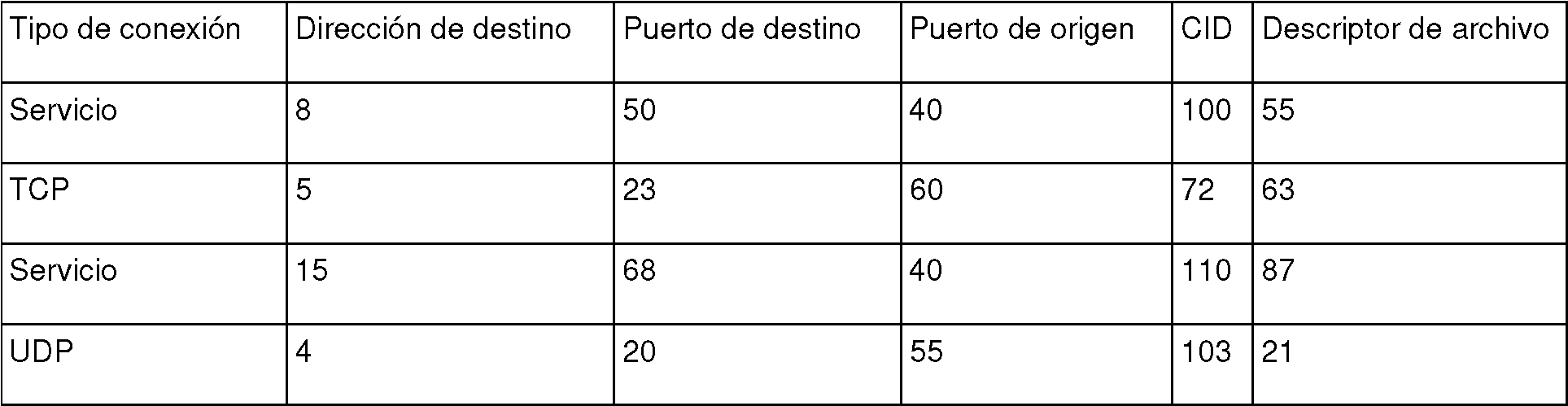
Un escenario de ejemplo se ilustra en la siguiente tabla, y también se muestra en la parte inferior de la figura 10A con fines ilustrativos y no pretende limitar la invención reivindicada. Tal como se muestra, el tipo de conexión se puede ajustar a un valor indicativo de un tipo de comunicación orientada a conexión, como TCP, tal como se muestra, o un tipo de comunicación sin conexión, como UDP, tal como se muestra, o un "servicio", por ejemplo, una aplicación que existe para registrar datos para otras aplicaciones. La dirección de destino, el puerto de destino y el ID de comunicación generalmente identifican de forma única una fila en la tabla mencionada anteriormente. La dirección de destino es la dirección lógica de un dispositivo involucrado en una comunicación. Las realizaciones pueden soportar entradas repetidas con la misma dirección de destino, lo que indica múltiples conexiones activas con el mismo dispositivo de destino. El campo de puerto de origen almacena el número de puerto local responsable de manejar la(s) comunicación/comunicaciones con el CID asociado a las mismas. En función del CID, los mensajes recibidos se enrutan al puerto respectivo. Varias entradas repetidas en la columna del puerto de origen sugieren que varias aplicaciones comunican a través del mismo puerto, lo que puede ser indicativo de una comunicación de uno a muchos, por ejemplo. En una o más realizaciones, las aplicaciones pueden registrar o proporcionar de otro modo una solicitud a un proveedor de servicios para recibir mensajes. El puerto de destino es el número de puerto en el dispositivo de destino involucrado en una comunicación. La comunicación entre un puerto de destino y el puerto local asociado al mismo tiene lugar a sobre el CID respectivo. Por lo tanto, el CID se comporta como una clave para esta comunicación. Dado que el CID es un número único asignado a distintas solicitudes de comunicación, y que puede implementarse con un tipo de datos particular de cierto tamaño, puede haber un límite superior al número de conexiones activas que puede manejar el sistema/la aplicación. El límite superior es, por lo tanto, un límite numérico superior del CID. Una vez que el cómputo de CID únicos excede el límite superior, una o más realizaciones envían un NAK a nuevas solicitudes de conexión entrantes. El descriptor de archivo (FD) funciona de manera similar al manejador de archivo o al descriptor de archivo en los sistemas operativos estándar, como reconocerá un experto en la materia. Las operaciones relacionadas con la comunicación se realizan utilizando este descriptor. La repetición de entradas de FD sugiere que múltiples conexiones están siendo servidas por una comunicación de aplicación, de tipo muchos a uno. Véanse también las figuras 10B-D para las estructuras de mensaje específicas utilizadas en una o más realizaciones de la invención.An example scenario is illustrated in the table below, and is also shown at the bottom of Figure 10A for illustrative purposes and is not intended to limit the claimed invention. As shown, the connection type can be set to a value indicative of a connection-oriented communication type, such as TCP, as shown, or a connectionless communication type, such as UDP, as shown, or a "service", for example, an application that exists to record data for other applications. The destination address, destination port, and communication ID generally uniquely identify a row in the aforementioned table. The destination address is the logical address of a device involved in a communication. Embodiments may support repeated entries with the same destination address, indicating multiple active connections to the same destination device. The source port field stores the local port number responsible for handling the communication(s) with the CID associated with them. Based on the CID, received messages are routed to the respective port. Multiple repeated entries in the source port column suggest that multiple applications are communicating over the same port, which may be indicative of one-to-many communication, for example. In one or more embodiments, applications may register or otherwise provide a request to a service provider to receive messages. The destination port is the port number on the destination device involved in a communication. Communication between a destination port and the local port associated with it takes place over the respective CID. Therefore, the CID behaves as a key for this communication. Since the CID is a unique number assigned to different communication requests, and can be implemented with a particular data type of a certain size, there may be an upper limit to the number of active connections the system/application can handle. The upper limit is therefore an upper numerical limit of the CID. Once the count of unique CIDs exceeds the upper limit, one or more realizations send a NAK to new incoming connection requests. The file descriptor (FD) works similarly to file handler or file descriptor in standard operating systems, as one skilled in the art will recognize. Communication-related operations are performed using this descriptor. The repetition of FD entries suggests that multiple connections are being served by a many-to-one application communication. See also Figures 10B-D for the specific message structures used in one or more embodiments of the invention.
La capa de transporte es otra capa en la pila de protocolos y es responsable de la entrega de datos de capa de transporte a capa de transporte. Esta capa maneja el control de flujo, los tiempos de espera, los acuses de recibo y la fragmentación y reensamblaje de datos y también resuelve la prioridad de los datos. Al menos una realización de la pila de protocolos soporta dos o más niveles de prioridad, por ejemplo, tres niveles de prioridad, prioridad alta, prioridad media y prioridad baja y, dependiendo de la prioridad de los datos, la capa de transporte coloca los datos en una cola de prioridad respectiva. La capa de transporte puede implementarse con dos subcapas, a saber, las capas superior e inferior de transporte. La capa superior de transporte, junto con las capas de administrador y de sesión, reside en el espacio de la aplicación, mientras que la capa inferior de transporte, junto con la capa de enlace de datos, reside en el espacio del núcleo. La capa superior de transporte maneja la lectura y escritura en colas de prioridad, la fragmentación y el reensamblaje de datos y los acuses de recibo de capa de transporte a transporte, mientras que la capa inferior de transporte puede implementarse como una capa muy delgada y maneja la lectura de colas de prioridad y la comunicación con otra u otras capas de pila, por ejemplo, una capa de pila inferior. Esta estructura junto con un tipo de mensaje de ejemplo en las figuras 11A-B.The transport layer is another layer in the protocol stack and is responsible for the delivery of data from transport layer to transport layer. This layer handles flow control, timeouts, acknowledgments, and data fragmentation and reassembly, and also resolves data priority. At least one implementation of the protocol stack supports two or more priority levels, for example, three priority levels, high priority, medium priority, and low priority, and depending on the priority of the data, the transport layer places the data in a respective priority queue. The transport layer can be implemented with two sublayers, namely the upper and lower transport layers. The upper transport layer, along with the manager and session layers, resides in the application space, while the lower transport layer, along with the data link layer, resides in the kernel space. The upper transport layer handles reading and writing to priority queues, data fragmentation and reassembly, and transport layer-to-transport acknowledgments, while the lower transport layer can be implemented as a very thin layer and handles reading priority queues and communicating with one or more other stack layers, eg, a lower stack layer. This structure along with an example message type in Figures 11A-B.
La capa de transporte generalmente asegura que los datagramas de tamaño manejable se envíen a través del bus subyacente. Por lo tanto, esta capa analiza los datos que proceden de las capas superiores y si el tamaño de los datos supera el tamaño de la unidad máxima de transmisión (MTU), la capa fragmenta los datos entrantes para que quepan dentro de los límites de la MTU. Por lo tanto, las realizaciones de la invención pueden utilizar cualquier tipo de bus de cualquier tamaño, por ejemplo, un bit para un bus en serie, o múltiples bits para un bus en paralelo de cualquier anchura. La capa añade información adecuada a los datos para que se puedan volver a ensamblar fielmente en el extremo receptor. Si los datos entrantes se pueden enviar en tres fragmentos, el campo 'ID de fragmento' se usa para numerar los fragmentos a partir de '1' y el bit 'indicador extendido' no se usa. Todos los ceros en el campo 'ID de fragmento' indican un mensaje no fragmentado y, por lo tanto, se trata como un mensaje independiente. Si un mensaje requiere que se transmitan más de tres fragmentos, se establece 'indicador extendido', lo que permite usar 8 bits adicionales (el campo ID de fragmento extendido es de 8 bits) para numerar los fragmentos. Con este indicador activado, hay un total de 10 bits disponibles para la numeración que pueden soportar 1023 (2A10 - 1) fragmentos. En el extremo receptor, se inspecciona el 'indicador extendido' para determinar si se usa o no el 'ID de fragmento extendido'. Si el indicador está activado, el receptor asume que los fragmentos llegan en secuencia, comenzando desde el número de secuencia 1. Pero, si el indicador no está activado, el receptor inspecciona el campo ID de fragmento'. Si el campo 'ID de fragmento' tiene cero, esto indica un mensaje independiente, pero si es un valor distinto de cero, el receptor trata el mensaje recibido como datos fragmentados (espera un máximo de tres paquetes). Una vez se reciben todos los fragmentos, el receptor volverá a ensamblar todos los fragmentos en un solo mensaje. Para ello, el receptor alinea todos los mensajes recibidos en orden ascendente de su ID de fragmento. A continuación, el receptor verifica que no se haya perdido ningún fragmento en la secuencia. Si todos los fragmentos se reciben correctamente, el receptor elimina la información de la cabecera de la "capa de transporte" de todos los fragmentos relacionados y los concatena en un solo mensaje. Si la capa de transporte tiene memoria limitada para volver a ensamblar todos los fragmentos, reenvía los fragmentos a la pila, a medida que llegan, que se vuelve a ensamblar en la memoria intermedia de aplicación.The transport layer generally ensures that datagrams of manageable size are sent over the underlying bus. Therefore, this layer analyzes the data that comes from the upper layers and if the size of the data exceeds the size of the maximum transmission unit (MTU), the layer fragments the incoming data to fit within the limits of the layer. MTU. Therefore, embodiments of the invention can use any type of bus of any size, eg, one bit for a serial bus, or multiple bits for a parallel bus of any width. The layer adds appropriate information to the data so that it can be faithfully reassembled at the receiving end. If the incoming data can be sent in three chunks, the 'chunk ID' field is used to number the chunks starting at '1' and the 'extended flag' bit is not used. All zeros in the 'Fragment ID' field indicate a non-fragmented message and is therefore treated as a separate message. If a message requires more than three fragments to be transmitted, the 'extended flag' is set, allowing an additional 8 bits (the extended fragment ID field is 8 bits) to be used to number the fragments. With this flag on, a total of 10 bits are available for numbering that can support 1023 (2A10 - 1) fragments. At the receiving end, the 'extended flag' is inspected to determine whether or not the 'extended fragment ID' is used. If the flag is set, the receiver assumes that the fragments arrive in sequence, starting from sequence number 1. But, if the flag is not set, the receiver inspects the Fragment ID' field. If the 'Fragment ID' field has zero, this indicates a separate message, but if it is a non-zero value, the receiver treats the received message as fragmented data (expects a maximum of three packets). Once all the fragments are received, the receiver will reassemble all the fragments into a single message. To do this, the receiver ranks all received messages in ascending order of their fragment ID. The receiver then checks that no fragment has been lost in the stream. If all fragments are received successfully, the receiver removes the "transport layer" header information from all related fragments and concatenates them into a single message. If the transport layer has limited memory to reassemble all the fragments, it forwards the fragments back to the stack, as they arrive, which is reassembled in the application buffer.
El control de congestión es proporcionado asimismo por la capa de transporte, que puede implementar mensajes dedicados específicamente por la capa de transporte a la capa de comunicación. Estos mensajes específicos se consumen en la capa de transporte y no se pasan a la pila. Uno de estos mensajes es el mensaje de ventana, que se intercambia para determinar el tamaño de la ventana para el intercambio de datos.Congestion control is also provided by the transport layer, which may implement dedicated messages specifically from the transport layer to the communication layer. These specific messages are consumed at the transport layer and are not passed onto the stack. One of these messages is the window message, which is exchanged to determine the size of the window for data exchange.
Antes de enviar el primer fragmento de los datos fragmentados, el transmisor solicita un tamaño de ventana del receptor. El receptor observa el espacio de memoria intermedia disponible en la memoria intermedia de aplicación y calcula la cantidad de fragmentos que puede organizar antes de quedarse sin memoria disponible. Este responde a la solicitud de los transmisores con este número calculado, como tamaño de ventana. A continuación, el transmisor envía fragmentos del tamaño de una ventana antes de esperar un acuse de recibo. Una vez que el receptor recibe todos los mensajes transmitidos en una ventana, verifica que todos los fragmentos estén en la secuencia deseada y envía un acuse de recibo por el último fragmento recibido en la secuencia. Si el receptor determina que faltan uno(s) fragmento(s), envía un NAK para el fragmento faltante y el transmisor retransmite el/los fragmento(s) respectivo(s). El transmisor puede verificar el tamaño de la ventana en medio de la comunicación para mantener optimizado el intercambio de datos; además, si al receptor le quedan pocos recursos, puede enviar explícitamente una respuesta de ventana y actualizar el transmisor acerca del tamaño de la ventana.Before sending the first chunk of the chunked data, the sender requests a window size from the receiver. The listener looks at the available buffer space in the application buffer and calculates the number of chunks it can organize before running out of available memory. It responds to the transmitters request with this calculated number, as the window size. Then the transmitter sends window-sized chunks before waiting for an acknowledgment. Once the receiver receives all the messages transmitted in a window, it checks that all the fragments are in the desired sequence and sends an acknowledgment for the last received fragment in the sequence. If the receiver determines that a fragment(s) are missing, it sends a NAK for the missing fragment and the transmitter retransmits the respective fragment(s). The transmitter can check the window size in the middle of the communication to keep the data exchange optimized; furthermore, if the receiver is low on resources, it can explicitly send a window response and update the transmitter about the size of the window.
La capa de transporte también es responsable de la entrega fiable de datos. La capa de transporte tiene la capacidad de garantizar la entrega de datos al extremo receptor. La capa de transporte tiene un campo para acuse de recibo. El receptor puede enviar un acuse de recibo para cada paquete de datos recibido con el indicador de acuse de recibo activado. En el caso de mensajes fragmentados, se envía un acuse de recibo cuando se ha recibido el último fragmento en una ventana o se ha recibido la última trama en el mensaje, o el temporizador expira antes de que se hayan recibido todos los mensajes.The transport layer is also responsible for the reliable delivery of data. The transport layer has the ability to guarantee the delivery of data to the receiving end. The transport layer has a field for acknowledgment. The receiver may send an acknowledgment for each data packet received with the acknowledgment flag on. In the case of fragmented messages, an acknowledgment is sent when the last fragment in a window has been received or the last frame in the message has been received, or the timer expires before all messages have been received.
Las realizaciones de la capa de transporte también pueden implementar un "tiempo de vida". Por ejemplo, después de transmitir un mensaje, el transmisor inicia un temporizador y espera un acuse de recibo. Si se recibe un acuse de recibo, el temporizador se restablece y se transmiten los siguientes paquetes. Pero si no se recibe un acuse de recibo, la capa de transporte vuelve a transmitir el mensaje y nuevamente espera un acuse de recibo. El transmisor volverá a intentar enviar el mensaje un cierto número de veces y, si no obtiene un acuse de recibo, asumirá que el receptor no está disponible e informará a las capas superiores. En caso de fragmentación, el transmisor envía mensajes del tamaño de una ventana y a continuación espera un acuse de recibo del último fragmento enviado. Si el temporizador expira, el transmisor reenviará de nuevo los mensajes.Transport layer implementations may also implement a "time to live". For example, after transmitting a message, the transmitter starts a timer and waits for an acknowledgment. If an acknowledgment is received, the timer is reset and the next packets are transmitted. But if an acknowledgment is not received, the transport layer retransmits the message and again waits for an acknowledgment. The sender will retry sending the message a certain number of times, and if it does not get an acknowledgment, it will assume that the receiver is unavailable and inform higher layers. In the event of fragmentation, the sender sends window-sized messages and then waits for an acknowledgment of receipt of the last fragment sent. If the timer expires, the transmitter will resend the messages again.
La capa de transporte también puede implementar detección y recuperación de fallos. Por ejemplo, la capa de transporte en el receptor puede solicitar al transmisor que retransmita tramas seleccionadas a través de mensajes de capa a capa.The transport layer can also implement failure detection and recovery. For example, the transport layer at the receiver may request the transmitter to retransmit selected frames via layer-to-layer messages.
La capa de transporte también puede implementar prioridad para los mensajes. Por ejemplo, las capas superiores pueden pasar la prioridad del mensaje a esta capa y esta capa añade la prioridad a la cabecera del mensaje. La cabecera tiene campos de dos bits para la prioridad del mensaje y, por lo tanto, hay cuatro niveles de prioridad posibles en una o más realizaciones, aunque se puede usar cualquier número de bits para la prioridad para implementar más niveles, y esto aplica a todas las particiones de mensajes y números de bits descritos en este documento. Cada nivel de prioridad tiene su propia cola y, según la prioridad del mensaje, la capa de transporte los coloca en las respectivas colas para que sean procesador por otras capas. Como hay cuatro niveles de prioridad en una realización de 2 bits, puede haber un máximo de cuatro colas de prioridad y un mínimo de una cola, pero el número de colas de prioridad depende del número de niveles de prioridad utilizados.The transport layer can also implement priority for messages. For example, higher layers can pass the message priority to this layer and this layer adds the priority to the message header. The header has two-bit fields for the priority of the message, and thus there are four possible priority levels in one or more implementations, although any number of priority bits can be used to implement more levels, and this applies to all message partitions and bit numbers described in this document. Each priority level has its own queue, and depending on the priority of the message, the transport layer places them in the respective queues to be processed by other layers. Since there are four priority levels in a 2-bit embodiment, there can be a maximum of four priority queues and a minimum of one queue, but the number of priority queues depends on the number of priority levels used.
La capa de enlace de datos es otra capa, a modo de ejemplo y no de limitación, la capa más baja, en la pila de comunicación y es responsable de la entrega de datos de subsistema a subsistema. Esta capa reside completamente en el espacio del núcleo. La capa de enlace de datos también se puede implementar con dos subcapas, por ejemplo, una capa de enlace y una capa de acceso a medios (MAC). La capa de enlace verifica la integridad de los datos calculando/verificando el CRC para cada trama de datos saliente/entrante y también maneja cualesquiera acuses de recibo de hardware, por ejemplo. La capa también maneja solicitudes de direcciones lógicas únicas y genera y asigna direcciones únicas. La capa MAC utiliza uno(s) controlador(es) que maneja(n) el/los bus(es) o los canales de comunicación físicos subyacentes. A medida que las tramas de datos llegan a los buses, la capa MAC copia los datos recibidos a un fondo de memoria y pasa el puntero a los datos copiados a la capa de enlace. Al menos una realización soporta comunicación sobre múltiples tecnologías de transferencia de datos subyacentes o implementaciones de hardware tales como serie, CAN, SPI, SDIO, USB o cualquier otro tipo de medio de comunicación o bus de datos. Esta estructura junto con un tipo de mensaje de ejemplo en las figuras 12A-B.The data link layer is another layer, by way of example and not limitation, the lowest layer, in the communication stack and is responsible for the delivery of data from subsystem to subsystem. This layer resides entirely in the core space. The data link layer can also be implemented with two sublayers, for example, a link layer and a media access (MAC) layer. The link layer verifies data integrity by calculating/verifying the CRC for each outgoing/incoming data frame and also handles any hardware acknowledgments, for example. The layer also handles unique logical address requests and generates and allocates unique addresses. The MAC layer uses a controller(s) that handle(s) the underlying physical communication bus(s) or channels. As data frames arrive on the buses, the MAC layer copies the received data to a buffer and passes the pointer to the copied data to the link layer. At least one embodiment supports communication over multiple underlying data transfer technologies or hardware implementations such as serial, CAN, SPI, SDIO, USB, or any other type of communication medium or data bus. This structure along with an example message type in Figures 12A-B.
En una o más realizaciones, la capa de enlace de datos es responsable de la integridad de los datos, por ejemplo mediante el uso de verificación CRC o cualquier otro tipo de formato o codificación de integridad de datos deseado. Las realizaciones de la capa de enlace de datos también son responsables de la asignación de direcciones lógicas. Por ejemplo, esta capa es responsable de asignar y administrar las direcciones lógicas de los módulos en un dispositivo. Todos los módulos, como el controlador del motor de la bomba, el controlador de la fuente de alimentación, el motor de comunicación, el controlador de la interfaz de usuario, etc., tienen un ID único para que puedan identificarse de manera única en una bomba. La pila de protocolos puede soportar 254 módulos, dado que el campo de dirección es de 1 byte y las direcciones lógicas 00, 01 y FF son direcciones reservadas. Si los módulos se identifican según su dirección de hardware única (direcciones MAC), y dado que las direcciones de hardware tienen más de un byte de tamaño, esto añadiría una sobrecarga al protocolo. Para evitar esto, a cada módulo se puede asignar una dirección lógica entre 1 y 255 y a continuación esta capa mantiene las direcciones asignadas. La capa de aplicación no necesita saber cuál es la dirección del hardware o cuál es la dirección lógica en general, lo que simplifica las llamadas lógicas y de API. In one or more embodiments, the data link layer is responsible for the integrity of the data, for example through the use of CRC checking or any other type of data integrity encoding or format desired. The data link layer implementations are also responsible for the assignment of logical addresses. For example, this layer is responsible for assigning and managing the logical addresses of modules in a device. All modules, such as pump motor controller, power supply controller, communication motor, user interface controller, etc., have a unique ID so that they can be uniquely identified in a database. bomb. The protocol stack can support 254 modules, since the address field is 1 byte and logical addresses 00, 01 and FF are reserved addresses. If modules are identified by their unique hardware address (MAC addresses), and since hardware addresses are more than one byte in size, this would add overhead to the protocol. To avoid this, each module can be assigned a logical address between 1 and 255 and then this layer maintains the assigned addresses. The application layer does not need to know what the hardware address is or what the logical address is in general, which simplifies API and logical calls.
A uno de los módulos generalmente se le asigna la tarea de generar direcciones lógicas únicas para otros módulos en el dispositivo, sin importar si esos módulos están conectados directamente a este módulo especial o no. Cuando el dispositivo se enciende, todos los módulos se encienden según lo programado. El módulo responsable de generar la dirección de los dispositivos se denomina dispositivo "raíz". El dispositivo raíz es consciente de su rol especial y se asigna a sí mismo una dirección lógica de 01. A medida que otros módulos se despiertan, asumen su dirección lógica como 00. Estos saben que 00 no es una dirección válida pero también saben que existe un módulo con dirección 01 que puede proporcionarles una dirección única.One of the modules is usually assigned the task of generating unique logical addresses for other modules in the device, regardless of whether those modules are directly connected to this special module or not. When the device powers up, all modules power up as programmed. The module responsible for generating the device address is called the "root" device. The root device is aware of its special role and assigns itself a logical address of 01. As other modules wake up, they assume its logical address as 00. They know that 00 is not a valid address but they also know that it exists. a module with address 01 that can provide them with a unique address.
Por lo tanto, estos módulos envían solicitudes de dirección a un destino con la dirección 01. Al recibir este mensaje, el módulo raíz verifica su tabla interna para verificar si el hardware solicitante ya tiene una dirección lógica asignada. Si se asigna una dirección lógica, el módulo raíz envía esa misma dirección lógica en respuesta; de lo contrario, genera una dirección lógica única, actualiza esta dirección en su tabla interna con la dirección MAC del solicitante y envía esta dirección en respuesta. Al recibir una respuesta de dirección, el módulo solicitante comienza a comunicar con esta dirección lógica.Therefore, these modules send address requests to a destination with address 01. Upon receiving this message, the root module checks its internal table to see if the requesting hardware already has a logical address assigned. If a logical address is assigned, the root module sends that same logical address in response; otherwise, it generates a unique logical address, updates this address in its internal table with the requester's MAC address, and sends this address in response. Upon receiving an address response, the requesting module begins communicating with this logical address.
Un módulo en una o más realizaciones puede no comunicar sin una dirección lógica válida. Si varios módulos intentan solicitar una dirección lógica, habrá colisiones. Debido a las colisiones, ninguna solicitud llega nunca al módulo raíz y, por lo tanto, ninguno de los módulos recibe una dirección lógica. En este escenario, otros módulos volverán a intentarlo después de un período de tiempo aleatorio. Dependiendo de la criticidad del dispositivo, la cantidad de tiempo aleatorio puede variar, es decir, los dispositivos críticos pueden esperar un período de tiempo menor antes de volver a intentarlo. La cantidad de tiempo de espera puede ser parte de la configuración y los dispositivos pueden esperar haciendo referencia a su reloj interno, por ejemplo.A module in one or more embodiments may not communicate without a valid logical address. If multiple modules try to request a logical address, there will be collisions. Due to collisions, no request ever reaches the root module, and therefore neither module receives a logical address. In this scenario, other modules will try again after a random amount of time. Depending on the criticality of the device, the amount of random time can vary, that is, critical devices can wait a shorter amount of time before trying again. The amount of timeout can be part of the configuration, and devices can wait by referencing their internal clock, for example.
Si un dispositivo no desea utilizar el mecanismo de direccionamiento dinámico, cada módulo puede programarse con una dirección única, por ejemplo, para implementar un esquema de asignación de direcciones estáticas versus dinámicas. Las realizaciones pueden seguir utilizando un módulo raíz que mantiene las direcciones de los módulos conectados.If a device does not wish to use the dynamic addressing mechanism, each module can be programmed with a unique address, for example to implement a static versus dynamic address allocation scheme. Embodiments may still use a root module that maintains the addresses of connected modules.
Las realizaciones de la capa de enlace de datos también pueden implementar enrutamiento. Tal como se ha mencionado, un módulo puede tener múltiples tipos de bus o topologías y puede haber diferentes tipos de dispositivos conectados en varios buses. Si una capa de enlace de datos recibe un paquete que no está dirigido a la misma, primero verifica si tiene varias arquitecturas de bus y, si es cierto, reenvía el mensaje a otros buses; de lo contrario, simplemente descarta el paquete. Este tipo de mecanismo de direccionamiento es muy adecuado para la topología en estrella, por ejemplo. Por lo tanto, si PMC1 quiere enviar datos a PMC2 pero no hay una ruta de datos directa, entonces los redirigirá a través del módulo raíz. En este caso, el módulo raíz puede difundir el mensaje en la red o realizar una búsqueda en su tabla interna y simplemente reenviar el paquete en una línea específica. Por lo tanto, en una o más realizaciones que implementan enrutamiento, cada módulo que soporta múltiples buses de comunicación puede mantener una lista de todos los dispositivos conectados directamente al módulo para que puedan enrutar los paquetes de manera eficiente. Como la pila soporta el enrutamiento de datos, une sin problemas varios buses de datos heterogéneos, lo que hace que la comunicación y la topología del bus sean independientes. Algunos ejemplos de posibles topologías de bus incluyen topologías de anillo, estrella, malla y árbol o cualquier otra topología que pueda utilizarse para transferir datos.Data link layer implementations may also implement routing. As mentioned, a module can have multiple bus types or topologies, and there can be different types of devices connected on various buses. If a data link layer receives a packet that is not addressed to itself, it first checks to see if it has multiple bus architectures and, if so, forwards the message to other buses; otherwise, it just drops the packet. This type of addressing mechanism is well suited for star topology, for example. So if PMC1 wants to send data to PMC2 but there is no direct data path, then it will redirect it through the root module. In this case, the root module can either broadcast the message on the network or perform a lookup in its internal table and simply forward the packet on a specific line. Therefore, in one or more embodiments that implement routing, each module that supports multiple communication buses can maintain a list of all devices directly connected to the module so that they can efficiently route packets. Because the stack supports data routing, it seamlessly joins together several heterogeneous data buses, making communication and bus topology independent. Some examples of possible bus topologies include ring, star, mesh, and tree topologies, or any other topology that can be used to transfer data.
La figura 3 ilustra una realización de un método de solicitud de dirección implementado dentro de la capa de administrador. Tal como se muestra, cuando se añade un dispositivo al sistema, por ejemplo, se intercambia en caliente, el dispositivo se inicia y solicita una dirección del dispositivo raíz. El nuevo dispositivo espera una respuesta y, si se agota el tiempo de espera, vuelve a solicitar una dirección. Una vez que el dispositivo raíz recibe el mensaje de solicitud de dirección, busca un número de dispositivo disponible y genera una dirección lógica para el nuevo dispositivo y actualiza la tabla. Alternativamente, si no quedan números disponibles, se puede devolver un NAK con el mensaje de error apropiado al nuevo dispositivo. El dispositivo raíz devuelve la dirección lógica del nuevo dispositivo al nuevo dispositivo en un mensaje de respuesta de dirección. Cualesquiera solicitudes adicionales de la dirección se gestionan mediante búsqueda a través del dispositivo raíz. El nuevo dispositivo almacena la dirección lógica en una tabla local para su uso posterior. Esta capacidad generalmente no existe en dispositivos médicos o bombas de infusión, dado que generalmente se supone que las configuraciones son fijas, utilizando un sistema operativo fijo y un bus fijo sin tener en cuenta potenciales nuevos dispositivos y nuevos tipos de dispositivos que puedan comunicar con un dispositivo raíz.Figure 3 illustrates an embodiment of an address request method implemented within the manager layer. As shown, when a device is added to the system, for example hot-swapped, the device boots up and requests a root device address. The new device waits for a response and, if it times out, requests an address again. Once the root device receives the address request message, it looks for an available device number and generates a logical address for the new device and updates the table. Alternatively, if there are no numbers left, a NAK with the appropriate error message can be returned to the new device. The root device returns the logical address of the new device to the new device in an address response message. Any additional requests for the address are handled by lookup through the root device. The new device stores the logical address in a local table for later use. This capability generally does not exist in medical devices or infusion pumps, since configurations are generally assumed to be fixed, using a fixed operating system and a fixed bus without taking into account potential new devices and new types of devices that can communicate with a root device.
La figura 4 ilustra una realización de una secuencia de infusión simple que utiliza varios mensajes proporcionados por realizaciones del método. Una vez que se obtiene la dirección de un nuevo dispositivo, este puede comunicar con los otros componentes dentro del sistema. La figura muestra el controlador de interfaz de usuario UIC que tiene el número de dispositivo 1, inicialmente conectado a una bomba de infusión de medicamentos que tiene el número de dispositivo 3, donde las direcciones lógicas de los dispositivos o los números de dispositivo se obtienen tal como se muestra en la figura 3. El UIC acepta la entrada de un cuidador que indica que se va a realizar una infusión. La aplicación UIC calcula los pasos necesarios para lograr la infusión y envía una cabecera de infusión y un mensaje de datos a la bomba de infusión de medicamentos, que acusa recibo del mensaje. A continuación, el UIC envía un mensaje de datos de seguridad de la infusión, que se acusa y, una vez completada la infusión, el UIC envía un mensaje de datos de parada de la infusión, que se acusa. Este escenario es un escenario típico que permite añadir cualquier tipo de bomba de infusión de medicamentos a un sistema y utilizarla, por ejemplo, en un escenario de intercambio en caliente donde una bomba de infusión puede devolver un error, o se va a añadir al sistema, y a utilizar un tipo diferente de bomba de infusión de medicamentos, por ejemplo.Figure 4 illustrates an embodiment of a simple infusion sequence using various messages provided by embodiments of the method. Once the address of a new device is obtained, it can communicate with the other components within the system. The figure shows the UIC user interface controller having device number 1, initially connected to a drug infusion pump having device number 3, where the logical addresses of the devices or device numbers are obtained as such. as shown in Figure 3. The UIC accepts input from a caregiver indicating that an infusion is to be performed. The UIC application calculates the steps required to achieve the infusion and sends an infusion header and data message to the drug infusion pump, which acknowledges receipt of the message. The UIC then sends an infusion safety data message, which is acknowledged, and after the infusion is complete, the UIC sends an infusion stop data message, which is acknowledged. This scenario is a typical scenario that allows you to add any type of drug infusion pump to a system and use it, for example, in a hot-swap scenario where an infusion pump may return an error, or is to be added to the system, and to use a different type of infusion pump drug infusion, for example.
La figura 5 ilustra una realización de un método de conexión implementado dentro de la capa de sesión. En el escenario mostrado, el UIC solicita una conexión para comunicarse con el PMC para dirigir el PMC y/o por ejemplo obtener actualizaciones de estado. En este caso, el PMC actúa como un proveedor de servicios dado que el PMC proporciona actualizaciones de estado en un puerto conocido. El UIC envía una solicitud de conexión al PMC en ese puerto, por ejemplo, el puerto 10, que se muestra como un mensaje que pasa de izquierda a derecha. Después de recibir la solicitud de conexión, el PMC acepta la solicitud, genera un CID único, por ejemplo, 26 para esta comunicación y actualiza su tabla interna. El PMC envía el CID generado de retorno al UIC como parte del mensaje de aceptación de conexión, que se muestra viajando de derecha a izquierda. Al recibir el mensaje de aceptación de conexión del PMC, el UIC extrae el CID del mensaje y actualiza su tabla CID interna tal como se muestra en la parte inferior izquierda. A continuación, el UIC envía un mensaje de acuse de recibo al PMC para confirmar la recepción satisfactoria de CID. Si el PMC no puede procesar la solicitud de UIC y, por lo tanto, no puede establecer comunicación, el PMC envía un mensaje de rechazo de conexión al UIC. Al recibir el mensaje de rechazo de conexión, el UIC puede volver a intentar obtener una conexión. Véanse también las figuras 10A-D, 11A-B y 12A-B para ver una realización de las estructuras de mensajes de ejemplo que se pueden utilizar para formar una implementación de varias capas, que se describen con más detalle a continuación.Figure 5 illustrates an embodiment of a connection method implemented within the session layer. In the scenario shown, the UIC requests a connection to communicate with the PMC to manage the PMC and/or to get status updates for example. In this case, the PMC acts as a service provider since the PMC provides status updates on a known port. The UIC sends a connection request to the PMC on that port, for example port 10, which is displayed as a scrolling message from left to right. After receiving the connection request, the PMC accepts the request, generates a unique CID, for example, 26 for this connection, and updates its internal table. The PMC sends the generated CID back to the UIC as part of the connection acceptance message, shown traveling from right to left. Upon receiving the connection accept message from the PMC, the UIC extracts the CID from the message and updates its internal CID table as shown at the bottom left. The UIC then sends an acknowledgment message to the PMC to confirm successful receipt of the CID. If the PMC cannot process the UIC request and therefore cannot establish communication, the PMC sends a connection refusal message to the UIC. Upon receipt of the connection refusal message, the UIC may retry to obtain a connection. See also Figures 10A-D, 11A-B, and 12A-B for an embodiment of example message structures that can be used to form a multi-layer implementation, which are described in more detail below.
La figura 6 ilustra una realización de un método de intercambio de datos implementado dentro de la capa de sesión. Una vez que el PMC recibe el acuse de recibo del UIC, el proceso de conexión se completa. En este momento, ambos dispositivos pueden intercambiar datos utilizando el CID acordado. Cuando la capa de sesión de PMC recibe cualesquiera datos del UIC con un CID válido, realiza una búsqueda en su tabla interna contra el 'ID de destino' y el 'CID' para resolver el número de puerto donde se reenviará el paquete.Figure 6 illustrates an embodiment of a data exchange method implemented within the session layer. Once the PMC receives the acknowledgment from the UIC, the connection process is complete. At this time, both devices can exchange data using the agreed CID. When the PMC session layer receives any data from the UIC with a valid CID, it performs a lookup in its internal table against the 'destination ID' and 'CID' to resolve the port number where the packet will be forwarded.
La figura 7 ilustra una realización de un método de solicitud de desconexión implementado dentro de la capa de sesión. Una vez completada la transmisión de datos, cualquiera de las partes comunicantes puede solicitar la finalización de la conexión. Tal como se muestra, el UIC inicia el proceso de finalización de la conexión. Este envía una solicitud de desconexión a PMC con el CID respectivo. El PMC procesa la solicitud y, si no hay comunicación activa, el PMC enviará un acuse de recibo al UIC y eliminará la entrada del CID de su tabla. Al recibir el acuse de recibo de desconexión de PMC, el UIC también elimina las entradas de CID de su tabla.Figure 7 illustrates an embodiment of a disconnect request method implemented within the session layer. Once the data transmission is complete, any of the communicating parties can request the termination of the connection. As shown, the UIC initiates the connection termination process. This sends a disconnection request to PMC with the respective CID. The PMC processes the request and if there is no active communication, the PMC will send an acknowledgment to the UIC and remove the CID entry from its table. Upon receiving the disconnect acknowledgment from the PMC, the UIC also removes the CID entries from its table.
Aunque el protocolo general de comunicación de la capa de sesión se ha descrito anteriormente, sigue una descripción más detallada de los mensajes de la capa de sesión, según una o más realizaciones de la invención. Las estructuras de mensaje utilizadas en una o más realizaciones de la invención, como se describe a continuación, se muestran en las figuras 10B-D.Although the general session layer communication protocol has been described above, a more detailed description of session layer messages follows, according to one or more embodiments of the invention. Message structures used in one or more embodiments of the invention, as described below, are shown in Figures 10B-D.
Mensaje de solicitud de conexiónConnection request message
Para una sesión de comunicación orientada a conexión, cuando una aplicación abre un socket para comunicar a través de un puerto en algún otro dispositivo, se realiza un establecimiento de comunicación antes de que comience la comunicación. El establecimiento de comunicación comienza con un mensaje de tipo solicitud de conexión al proveedor de servicios. El "indicador de capa" se activa para este tipo de mensaje. Por lo tanto, el paquete de solicitud es consumido por la capa de sesión. El tipo de conexión puede configurarse inicialmente como "desconocido", lo que sugiere que el paquete de datos no es orientado a conexión ni sin conexión. El tipo de mensaje se ajusta a "Conexión" ya que el comando se utiliza para establecer una nueva conexión. El mensaje es una solicitud para establecer una nueva conexión; por lo tanto, el campo "Comando" contiene "Solicitud de conexión". La aplicación que solicita una conexión especifica la dirección de puerto del destino y también proporciona su propia dirección de puerto, por lo tanto, el paquete de solicitud de conexión tiene una dirección de puerto de origen y una de destino.For a connection-oriented communication session, when an application opens a socket to communicate through a port on some other device, a handshake is performed before communication begins. The establishment of communication begins with a connection request type message to the service provider. The "layer indicator" is activated for this type of message. Therefore, the request packet is consumed by the session layer. The connection type may initially be set to "unknown", which suggests that the data packet is neither connection-oriented nor connectionless. The message type is set to "Connection" since the command is used to establish a new connection. The message is a request to establish a new connection; therefore, the "Command" field contains "Connection Request". The application requesting a connection specifies the port address of the destination and also provides its own port address, so the connection request packet has both a source and a destination port address.
Mensaje de aceptación de conexiónConnection acceptance message
Al recibir un mensaje de solicitud de conexión, si el proveedor de servicios tiene suficientes recursos, responde con un tipo de mensaje de aceptación de conexión. El proveedor de servicios genera un CID para la comunicación y lo envía al solicitante como parte de este mensaje. Como la entidad que solicita la conexión no tiene información del CID generado, el proveedor de servicios envía la dirección de los puertos de origen y de destino como parte de este mensaje para informar al otro extremo sobre el CID generado.Upon receipt of a connection request message, if the service provider has sufficient resources, it responds with a type of connection acceptance message. The service provider generates a CID for the communication and sends it to the requester as part of this message. Since the entity requesting the connection does not have information on the generated CID, the service provider sends the source and destination port addresses as part of this message to inform the other end about the generated CID.
Mensaje de acuse de recibo de conexiónConnection acknowledgment message
Al recibir un mensaje de aceptación de conexión, el extremo solicitante actualiza su tabla interna con el CID recibido. En respuesta al mensaje de aceptación de conexión, el extremo solicitante envía un mensaje de acuse de recibo para indicar al proveedor de servicios la recepción de CID y completar el establecimiento de comunicación. Es posible que múltiples aplicaciones en un módulo soliciten comunicar con una aplicación en otro módulo en el mismo número de puerto, por ejemplo, muchos a uno. Para informar al proveedor de servicios sobre la aplicación particular que está enviando un acuse de recibo, se añade "puerto de origen" al mensaje de acuse de recibo. Upon receiving a connection acceptance message, the requesting end updates its internal table with the received CID. In response to the connection acceptance message, the requesting end sends an acknowledgment message to indicate to the service provider the receipt of the CID and to complete the call setup. It is possible for multiple applications on one module to request to communicate with an application on another module on the same port number, eg many to one. To inform the service provider about the particular application that is sending an acknowledgment, "source port" is added to the acknowledgment message.
Mensaje de desconectar conexiónDisconnect connection message
Una vez completada la comunicación, cualquiera de las entidades participantes podrá solicitar la desconexión de la conexión para una finalización ordenada de la misma.Once the communication is completed, any of the participating entities may request the disconnection of the connection for its orderly termination.
Mensaje de acuse de recibo de desconexión de conexiónConnection Disconnect Acknowledgment Message
Este mensaje se envía como acuse de recibo al recibir un mensaje de desconexión. El mensaje está destinado a garantizar que una comunicación no finalice si todavía existe una conexión activa. Si no se recibe un acuse de recibo de desconexión dentro de un cierto período de tiempo, se puede realizar un nuevo intento de desconexión. Mensaje de rechazo de conexiónThis message is sent as an acknowledgment upon receipt of a disconnect message. The message is intended to ensure that a communication is not terminated if an active connection still exists. If a disconnect acknowledgment is not received within a certain period of time, a new disconnect attempt can be made. Connection refusal message
Si el proveedor de servicios no puede aceptar nuevas conexiones, envía un rechazo de conexión en respuesta a un mensaje de solicitud de conexión. En el mensaje de rechazo de conexión, envía el motivo del rechazo de la solicitud. Al recibir un mensaje de rechazo de conexión, el solicitante puede volver a intentarlo después de algún tiempo, por ejemplo.If the service provider cannot accept new connections, it sends a connection refusal in response to a connection request message. In the connection refusal message, send the reason for refusing the request. Upon receiving a connection refusal message, the requester can try again after some time, for example.
Mensaje de solicitud de información de CIDCID Information Request Message
Cualquier participante involucrado en la comunicación puede solicitar el estado de CID. Este mensaje actúa como un mensaje de ping para verificar si el puerto de destino está abierto y si el CID es un CID activo.Any participant involved in the communication can request CID status. This message acts as a ping message to check if the destination port is open and if the CID is an active CID.
Mensaje de respuesta de información de CIDCID Information Reply Message
Al recibir una solicitud de información de CID, se transmite una respuesta de información de CID. Este mensaje contiene las direcciones de los puertos de origen y de destino involucradas en la comunicación, el tamaño de la ventana para la transmisión, etc., y también indica si el CID está activo o no.Upon receipt of a CID information request, a CID information response is transmitted. This message contains the addresses of the source and destination ports involved in the communication, the size of the window for transmission, etc., and also indicates whether the CID is active or not.
Mensaje de solicitud de estado de socketSocket status request message
Este mensaje se utiliza para solicitar información relacionada con el socket, tal como el tipo de socket, el propósito de abrir este socket, etc.This message is used to request information related to the socket, such as the socket type, the purpose of opening this socket, etc.
Mensaje de respuesta de estado de socketSocket status response message
Este mensaje se envía en respuesta al mensaje de solicitud de estado de socket. El mensaje contiene información relacionada con el socket, tal como el tipo de socket, el propósito de abrir este socket, etc.This message is sent in response to the socket status request message. The message contains information related to the socket, such as the socket type, the purpose of opening this socket, etc.
Mensaje de suscripción al servicioService subscription message
El protocolo de comunicación permite que las aplicaciones proporcionen un servicio, por ejemplo un servicio de difusión. Por ejemplo, el PMC puede tener un servicio en ejecución que difunde periódicamente el estado del PMC en un puerto conocido. Si el UIC solicita el estado de PMC, simplemente puede suscribirse a este servicio con el PMC y recibir los mensajes. Por lo general, estos servicios son de comunicación unidireccional.The communication protocol allows applications to provide a service, for example a broadcast service. For example, the PMC may have a service running that periodically broadcasts the status of the PMC on a known port. If the UIC requests PMC status, you can simply subscribe to this service with the PMC and receive the messages. Generally, these services are one-way communication.
Mensaje de acuse de recibo de suscripción al servicioService subscription acknowledgment message
Una vez que el proveedor de servicios recibe una solicitud de suscripción, tienen que proporcionar un CID al solicitante. El CID se entrega por medio de un mensaje de acuse de recibo.Once the service provider receives a subscription request, they have to provide a CID to the requestor. The CID is delivered via an acknowledgment message.
Mensaje de cancelación de la suscripción al servicioService subscription cancellation message
Si una aplicación suscrita ya no desea estar suscrita a un servicio, puede solicitar cancelar la suscripción. Al recibir un mensaje de cancelación de suscripción al servicio, el proveedor de servicios elimina las entradas de su tabla CID interna y envía un acuse de recibo al solicitante. Si el proveedor de servicios descubre que no hay nadie suscrito a un servicio, puede decidir detener el servicio de difusión hasta que tenga al menos una aplicación suscrita.If a subscribed application no longer wishes to be subscribed to a service, it can request to unsubscribe. Upon receipt of a service unsubscribe message, the service provider removes the entries from its internal CID table and sends an acknowledgment to the requestor. If the service provider discovers that no one is subscribed to a service, it may decide to stop the broadcast service until it has at least one subscribed application.
Mensaje de acuse de recibo de cancelación de la suscripción al servicioService subscription cancellation acknowledgment message
Al recibir este mensaje, la aplicación que solicita la cancelación de la suscripción elimina las entradas de CID de su tabla interna y libera los sockets y puertos involucrados.Upon receiving this message, the application requesting the unsubscribe removes the CID entries from its internal table and releases the sockets and ports involved.
Mensaje de solicitud de dirección del dispositivoDevice address request message
Una aplicación puede solicitar una dirección lógica para un dispositivo utilizando este mensaje.An application can request a logical address for a device using this message.
Mensaje de respuesta de dirección del dispositivo Device Address Reply Message
Al recibir un mensaje de "Solicitud de dirección", un dispositivo envía su dirección como parte del mensaje de respuesta. Alternativamente, un mensaje de respuesta de dirección de dispositivo se puede enviar de forma independiente en cualquier momento y no necesariamente estar vinculado a un mensaje de solicitud.Upon receiving an "Address Request" message, a device sends its address as part of the response message. Alternatively, a device address response message can be sent independently at any time and not necessarily be linked to a request message.
Mensaje de solicitud de tipo de dispositivoDevice type request message
Este mensaje se utiliza para solicitar el nombre de un dispositivo. Cada dispositivo conectado tiene una dirección única, pero puede tener nombres no únicos o no tener nombres. Los tipos de dispositivos pueden ser PMC, CE, UIC, etc.This message is used to request a device name. Each connected device has a unique address, but may have non-unique names or no names at all. Device types can be PMC, CE, UIC, etc.
Respuesta del tipo de dispositivoDevice Type Response
Este mensaje generalmente se envía en respuesta al mensaje de "Solicitud de tipo de dispositivo" y contiene el tipo de dispositivo que envía este mensaje. Alternativamente, un mensaje de respuesta de tipo de dispositivo se puede enviar de forma independiente en cualquier momento y no necesariamente estar vinculado a un mensaje de solicitud.This message is usually sent in response to the "Device Type Request" message and contains the type of device that is sending this message. Alternatively, a device type response message can be sent independently at any time and not necessarily be linked to a request message.
Mensaje de datos orientado a conexiónconnection-oriented data message
Al menos una realización de la capa de sesión añade solo dos bytes de información de cabecera cuando se envían datos entre dispositivos. El CID se genera e intercambia durante el proceso de establecimiento de comunicación previo a la transferencia de datos.At least one embodiment of the session layer adds only two bytes of header information when data is sent between devices. The CID is generated and exchanged during the handshake process prior to data transfer.
Mensaje de datos sin conexiónOffline data message
La transferencia de datos sin conexión se usa cuando no se requiere un establecimiento de comunicación para transferir datos. Como no hay establecimiento de comunicación, no se genera un CID para la comunicación y, por lo tanto, se utilizan los números de puerto de origen y de destino para garantizar la entrega de datos.Connectionless data transfer is used when a handshake is not required to transfer data. Since there is no handshake, a CID is not generated for the communication, and therefore the source and destination port numbers are used to ensure data delivery.
Las figuras 11A-B y 12A-B ilustran estructuras de mensajes correspondientes para realizaciones ejemplares de la capa de transporte y la capa de enlace de datos respectivamente, y se describen más adelante.Figures 11A-B and 12A-B illustrate corresponding message structures for exemplary embodiments of the transport layer and data link layer, respectively, and are described below.
La figura 8 ilustra un diagrama de flujo de capas que muestra el flujo de datos dentro de las diversas capas implementadas en al menos una realización de la invención. Específicamente, se muestra el flujo de datos ascendente en la pila de protocolos para los datos entrantes. La ubicación de la memoria intermedia de aplicación de destino no se conoce hasta que la trama de datos sube a la capa de administrador. Por lo tanto, el fragmento se almacena en un fondo de memoria hasta que llega a la capa de administrador y, una vez que se resuelve la aplicación de destino, los datos se copian del fondo de memoria a la memoria intermedia de aplicación. En una o más realizaciones, la utilización de memoria puede minimizarse devolviendo una memoria intermedia a la memoria si la memoria intermedia está por encima de un umbral de antigüedad predefinido.Figure 8 illustrates a layer flow diagram showing data flow within the various layers implemented in at least one embodiment of the invention. Specifically, the data flow up the protocol stack for incoming data is shown. The destination application buffer location is not known until the data frame goes up to the manager layer. Therefore, the fragment is stored in a memory pool until it reaches the manager layer, and once the target application is resolved, the data is copied from the memory pool to the application buffer. In one or more embodiments, memory usage may be minimized by returning a buffer to memory if the buffer is above a predefined age threshold.
Capa de enlace de datosData link layer
La capa de enlace de datos controla uno o más enlaces físicos de comunicaciones, buses de datos. La capa filtra los mensajes dirigidos al dispositivo específico e ignora otros mensajes. La capa puede calcular un CRC en el paquete recibido y verificarlo con el CRC recibido. Las tramas de datos válidos se copian en un fondo de memoria y el puntero a estos mensajes se reenvía a la capa de transporte.The data link layer controls one or more physical communications links, data buses. The layer filters messages addressed to the specific device and ignores other messages. The layer can compute a CRC on the received packet and check it against the received CRC. Valid data frames are copied to a memory pool and the pointer to these messages is forwarded to the transport layer.
La capa inferior de transporte y la capa de enlace de datos se ejecutan como un servicio independiente y almacenan datos en la cola de prioridad designada, P1, P2, P3 o P4. La capa superior de transporte, y las capas de sesión y de administrador se ejecutan en el espacio de la aplicación, y la capa superior de transporte mantiene punteros a las colas de prioridad y las tablas de ID de comunicación. En una o más realizaciones, el fondo de memoria, las colas de prioridad y las tablas de CID están en el espacio de memoria compartida.The lower transport layer and the data link layer run as a separate service and store data in the designated priority queue, P1, P2, P3, or P4. The upper transport layer, and the session and manager layers run in the application space, and the upper transport layer maintains pointers to the priority queues and communication ID tables. In one or more embodiments, the memory pool, priority queues, and CID tables are in shared memory space.
En una o más realizaciones, la capa de enlace de datos se divide además en dos subcapas, una capa de enlace y una capa MAC. La capa MAC puede interactuar con los controladores de bus y tiene una memoria intermedia para cada bus subyacente. A medida que los datos llegan a estos buses, los datos se copian en estas memorias intermedias y a continuación se envían a la capa de enlace. La memoria intermedia puede implementarse como un par de memorias intermedias, mientras que una memoria intermedia se usa para recibir nuevos datos, la otra memoria intermedia se usa para transferir datos recibidos previamente.In one or more embodiments, the data link layer is further divided into two sublayers, a link layer and a MAC layer. The MAC layer can interact with bus controllers and has a buffer for each underlying bus. As data arrives on these buses, the data is copied to these buffers and then sent to the link layer. The buffer can be implemented as a pair of buffers, while one buffer is used to receive new data, the other buffer is used to transfer previously received data.
La capa de enlace copia los datos de las memorias intermedias en el fondo de memoria. El fondo de memoria es un bloque de memoria contiguo y cada bloque de memoria puede implementarse como un factor de longitud de trama. A medida que la aplicación consume datos, los datos se eliminan del fondo de memoria para dejar espacio para nuevos paquetes de datos. Como la aplicación consume datos aleatoriamente, puede haber huecos de memoria en el fondo de memoria. Por lo tanto, la capa de enlace generalmente mantiene una lista de ubicaciones de memoria disponibles en el fondo de memoria. Cuando se libera memoria del fondo de memoria, el puntero a la ubicación disponible se añade al final de esta lista. Cuando llega un nuevo paquete, se coloca en la memoria a la que apunta el primer elemento de esta lista. Si no hay ningún elemento en la lista, el fondo de memoria se considerará lleno y los paquetes se descartarán. En una o más realizaciones de la invención, se puede utilizar un administrador de memoria para controlar el acceso a la memoria desde las diversas capas, incluido el control de acceso simultáneo a la memoria desde las diversas capas. Las realizaciones de la invención pueden minimizar o evitar por completo múltiples operaciones de copia manteniendo una copia de datos en el fondo de memoria mientras se pasan punteros a la memoria a medida que los datos se mueven hacia arriba y hacia abajo en la pila. Al controlar el acceso a la memoria durante el acceso, se pueden utilizar semáforos para garantizar la integridad de los datos al tiempo que se permite que múltiples procesos utilicen eficazmente los datos de manera simultánea. Evitar múltiples operaciones de copia permite una utilización mínima de la memoria en entornos integrados y también minimiza la utilización del procesador.The link layer copies the data from the buffers to the back of memory. The memory pool is a contiguous memory block and each memory block can be implemented as a frame length factor. As the application consumes data, the data is removed from the memory pool to make room for new data packets. Since the application consumes data randomly, there may be memory holes in the memory pool. Therefore, the link layer generally maintains a list of available memory locations in the memory pool. When memory is freed from the memory pool, the pointer to the available location is added to the end of this list. When a new packet arrives, it is placed in memory pointed to by the first element of this list. If there is no element in the list, the memory pool will be considered full and packets will be dropped. In one or more embodiments of the invention, a memory manager may be used to control memory access from the various layers, including controlling simultaneous memory access from the various layers. Embodiments of the invention may minimize or completely avoid multiple copy operations by holding a copy of data in the back of memory while passing pointers to memory as data moves up and down the stack. By controlling memory access during access, semaphores can be used to ensure data integrity while allowing multiple processes to efficiently use the data simultaneously. Avoiding multiple copy operations allows for minimal memory utilization in embedded environments and also minimizes processor utilization.
Como el transmisor tiene tendencia a enviar datos a los buses, estos pueden rápidamente utilizar en exceso el bus transmitiendo demasiados datos. El controlador de bus en la capa MAC en una o más realizaciones puede implementarse para manejar tales escenarios.Since the transmitter has a tendency to send data to the buses, the buses can quickly overuse the bus by transmitting too much data. The bus controller at the MAC layer in one or more embodiments may be implemented to handle such scenarios.
Capa de transportetransport layer
En una o más realizaciones, la capa de transporte se puede dividir en dos subcapas, una capa superior de transporte y una capa inferior de transporte. La capa superior de transporte reside en el espacio de la aplicación, mientras que la capa inferior de transporte reside en el espacio del núcleo. Estas dos capas juntas manejan las funcionalidades de la capa de transporte.In one or more embodiments, the transport layer may be divided into two sublayers, an upper transport layer and a lower transport layer. The upper transport layer resides in the application space, while the lower transport layer resides in the kernel space. These two layers together handle the functionalities of the transport layer.
La capa de transporte se implementa en una o más realizaciones para volver a ensamblar datos fragmentados y también para resolver la prioridad de los datos. Cuando la capa inferior de transporte recibe un nuevo paquete de datos, se puede iniciar un temporizador para los datos. Si los datos no se consumen antes de que expire el temporizador, los datos se pueden descartar y la memoria se puede liberar del fondo de memoria. Esto evita el agotamiento de la memoria si no existe ninguna aplicación para consumir los datos recibidos. Si se activó el campo de acuse de recibo, la capa de transporte envía un NAK, código de error "tiempo agotado en la cola de prioridad", por ejemplo.The transport layer is implemented in one or more embodiments to reassemble fragmented data and also to resolve data priority. When the lower transport layer receives a new data packet, a timer for the data may be started. If the data is not consumed before the timer expires, the data can be discarded and the memory can be released from the memory pool. This prevents memory exhaustion if no application exists to consume the received data. If the acknowledgment field was activated, the transport layer sends a NAK, error code "priority queue timed out", for example.
La cabecera de la capa de transporte tiene un indicador de acuse de recibo y, si el indicador está activado, la capa de transporte receptora tendrá que enviar algún tipo de acuse de recibo para el fragmento de datos recibido. Si se reciben datos fragmentados, el acuse de recibo se envía después de recibir una cantidad de datos del tamaño de la ventana o un mensaje completo. Este indicador se activa para una transferencia de datos orientada a conexión, para garantizar la entrega de datos. Este indicador también se puede activar en una transferencia de datos sin conexión solo si se utiliza fragmentación de datos.The transport layer header has an acknowledgment flag, and if the flag is set, the receiving transport layer will have to send some form of acknowledgment for the received data chunk. If fragmented data is received, the acknowledgment is sent after a window-sized amount of data or a full message is received. This flag is set for a connection-oriented data transfer, to guarantee data delivery. This flag can also be set on an offline data transfer only if data chunking is used.
Tratamiento de paquetes de datos fragmentadosTreatment of fragmented data packets
En el caso de datos fragmentados, antes de que el transmisor comience a enviar fragmentos de datos, la capa superior de transporte en el transmisor solicita primero un tamaño de ventana al receptor. El tamaño de la ventana se puede cambiar una vez durante la primera transferencia de datos o se puede obtener antes de cada transferencia de datos. El tamaño de la ventana es la cantidad de fragmentos de datos que se pueden enviar antes de que se espere un acuse de recibo. Cuando el receptor recibe una solicitud de tamaño de ventana, la capa superior de transporte en el extremo del receptor calcula la cantidad de memoria libre en la memoria intermedia de aplicación y envía la respuesta como tamaño de ventana en el mensaje de "respuesta de tamaño de ventana".In the case of fragmented data, before the transmitter starts sending data fragments, the upper transport layer at the transmitter first requests a window size from the receiver. The window size can be changed once during the first data transfer or it can be obtained before each data transfer. The window size is the number of data chunks that can be sent before an acknowledgment is expected. When the receiver receives a window size request, the upper transport layer at the receiver end calculates the amount of free memory in the application buffer and sends the response as the window size in the "response window size" message. window".
En una o más realizaciones, la capa superior de transporte en el lado del transmisor inicializa una estructura de datos para el CID que solicitó un tamaño de ventana. En esta estructura, la capa de transporte almacena el CID, el último tamaño de ventana notificado, el último número de fragmento recibido con éxito y el período de tiempo máximo permitido entre dos fragmentos, etc. Además, la capa superior de transporte en el receptor mantiene la misma estructura. La capa de transporte espera que los fragmentos se numeren secuencialmente a partir de 1 en una o más realizaciones.In one or more embodiments, the upper transport layer on the transmitter side initializes a data structure for the CID that requested a window size. In this structure, the transport layer stores the CID, the last reported window size, the last successfully received fragment number, and the maximum time period allowed between two fragments, etc. Furthermore, the upper transport layer in the receiver maintains the same structure. The transport layer expects fragments to be sequentially numbered starting at 1 in one or more embodiments.
A medida que el transmisor recibe un mensaje de ventana, calcula el número de fragmentos que se transmitirán antes de esperar un acuse de recibo. El transmisor comienza a enviar fragmentos de datos en secuencia a partir del fragmento número 1, por ejemplo.As the sender receives a window message, it calculates the number of fragments to transmit before waiting for an acknowledgement. The sender starts sending data chunks in sequence starting at chunk number 1, for example.
Cuando el receptor recibe el primer fragmento, la capa inferior de transporte inicia un temporizador en la trama de datos recibida y coloca el fragmento en la cola de prioridad respectiva. La capa superior de transporte actualiza la estructura y almacena el número de secuencia del fragmento. Si las capas superiores entregan el fragmento a la memoria intermedia de aplicación, las capas superiores informan del éxito a la capa superior de transporte. La capa superior de transporte actualiza su estructura con el primer fragmento que se entrega. Las capas superiores no informan a la aplicación sobre el fragmento disponible hasta que se reciben todos los fragmentos que constituyen un mensaje. Se utiliza una memoria intermedia de aplicación para volver a ensamblar fragmentos para minimizar el consumo de memoria.When the receiver receives the first fragment, the lower transport layer starts a timer on the received data frame and places the fragment in the respective priority queue. The upper transport layer updates the structure and stores the sequence number of the fragment. If higher layers deliver the fragment to the application buffer, the higher layers report success to the upper transport layer. The upper transport layer updates its structure with the first fragment that is delivered. The upper layers do not inform the application about the available fragment until all the fragments that constitute a message are received. An application buffer is used to reassemble fragments to minimize memory consumption.
Si la capa superior de transporte recibe correctamente todos los fragmentos de una ventana, espera a que todos los fragmentos se entreguen correctamente a la memoria intermedia de aplicación. Una vez que todos los fragmentos se envían a la memoria intermedia de aplicación, el número de fragmento recibido y el número de fragmento entregado se corresponden y la capa superior de transporte envía un acuse de recibo para el último fragmento de la secuencia. El transmisor recibe el acuse de recibo en la capa superior de transporte.If the upper transport layer successfully receives all fragments from a window, it waits for all fragments to be successfully delivered to the application buffer. Once all the fragments are sent to the application buffer, the received fragment number and the delivered fragment number are matched, and the upper transport layer sends an acknowledgment for the last fragment in the sequence. The transmitter receives the acknowledgment at the upper transport layer.
Idealmente, la capa de transporte acumula todos los fragmentos, verifica que estén en secuencia y los fusiona en un mensaje completo antes de enviarlo a la pila. Sin embargo, en una o más realizaciones, la capa superior de transporte reenvía las tramas a la capa de sesión a medida que se reciben, pero asegura que los fragmentos se entreguen en secuencia. Esta implementación opcional se puede utilizar para reducir la utilización de la memoria. Este es el caso ya que el mensaje no tiene que ser reconstruido en su totalidad dentro de la pila hasta que se reciba el mensaje completo en la aplicación. Como el número de fragmento en la cabecera de transporte tiene 10 bits de anchura en una o más realizaciones, la capa puede soportar un máximo de 1023 fragmentos (el número de fragmento 0 está reservado y representa una trama de datos no de fragmento) antes de que se desborde la numeración de fragmentos. Como cada fragmento tiene una carga útil máxima de 248 Bytes, se requiere un total de 253.704 Bytes en el extremo del receptor para que cada conexión activa acomode todos los fragmentos. Se puede utilizar cualquier otro tamaño del campo de número de fragmentos para aumentar el tamaño total, tal como reconocerá un experto en la técnica.Ideally, the transport layer accumulates all the fragments, checks that they are in sequence, and merges them into a complete message before sending it to the stack. However, in one or more embodiments, the upper transport layer forwards frames to the session layer as they are received, but ensures that the fragments are delivered in sequence. This optional implementation can be used to reduce memory usage. This is the case since the message does not have to be fully reconstructed within the stack until the entire message is received by the application. Since the fragment number in the transport header is 10 bits wide in one or more embodiments, the layer can support a maximum of 1023 fragments (fragment number 0 is reserved and represents a non-fragment data frame) before fragment numbering overflows. Since each fragment has a maximum payload of 248 Bytes, a total of 253,704 Bytes are required at the receiving end for each active connection to accommodate all the fragments. Any other size of the fragment number field may be used to increase the total size, as will be recognized by one of skill in the art.
En el receptor, a medida que se reciben fragmentos, la capa superior de transporte actualiza el último número de fragmento en su estructura. Antes de actualizar, verifica que el fragmento recibido esté en secuencia con el fragmento recibido anteriormente. Si detecta un fragmento faltante, la capa sigue reenviando los fragmentos a la pila, pero en su testigo respectivo pone un valor de compensación. Los metadatos junto con un puntero al fragmento de datos recibido se denominan un testigo. La capa de administrador utiliza este valor de compensación para proporcionar un espacio mientras acomoda otros fragmentos alrededor del que falta, de modo que el espacio se pueda llenar una vez se reciba el fragmento faltante. Por ejemplo, para crear un espacio vacío en la memoria para que cuando finalmente se reciba la trama que falta, esta se acomode en este espacio vacío para completar el mensaje final. Mientras tanto, la capa superior de transporte espera a que lleguen los fragmentos y a continuación busca cualquier fragmento faltante en la secuencia. Una vez que la capa genera una lista de todos los fragmentos faltantes, solicita la retransmisión de fragmentos desde el transmisor. Una vez se reciben los fragmentos faltantes, estos se envían a las capas superiores para que puedan usarse para llenar los espacios vacíos en el mensaje final. At the receiver, as fragments are received, the upper transport layer updates the last fragment number in its structure. Before updating, it verifies that the received fragment is in sequence with the previously received fragment. If it detects a missing fragment, the layer still sends the fragments back onto the stack, but puts a compensation value on their respective token. The metadata together with a pointer to the received data chunk is called a token. The manager layer uses this offset value to provide a gap while wrapping other fragments around the missing one, so that the space can be filled once the missing fragment is received. For example, to create an empty space in memory so that when the missing frame is finally received, it will fit into this empty space to complete the final message. Meanwhile, the upper transport layer waits for the fragments to arrive, then looks for any missing fragments in the stream. Once the layer generates a list of all missing fragments, it requests retransmission of fragments from the transmitter. Once the missing fragments are received, they are sent to higher layers so that they can be used to fill in the gaps in the final message.
Cuando se requiere retransmisión, la capa superior de transporte en el extremo del receptor envía un mensaje de solicitud de retransmisión con el número de fragmento deseado. El extremo receptor mantiene una lista de fragmentos faltantes y, a medida que se reciben los fragmentos faltantes, su entrada se elimina de esta lista.When retransmission is required, the upper transport layer at the receiving end sends a retransmission request message with the desired fragment number. The receiving end maintains a list of missing fragments, and as missing fragments are received their entry is removed from this list.
Si el transmisor retransmite un fragmento ya transmitido, el receptor compara el número de fragmento con el último número de fragmento recibido y detectará que ha habido una retransmisión. La capa comprueba si la retransmisión fue solicitada por el receptor de forma explícita o no. Si la retransmisión fue intencional, el fragmento se consume; de lo contrario, el fragmento se descarta suponiendo una retransmisión de datos falsa.If the transmitter retransmits a fragment already transmitted, the receiver compares the fragment number with the last received fragment number and will detect that there has been a retransmission. The layer checks whether the retransmission was explicitly requested by the receiver or not. If the retransmission was intentional, the chunk is consumed; otherwise, the fragment is discarded assuming a false data retransmission.
Una vez que el transmisor envía fragmentos del tamaño de una ventana, inicia un temporizador y espera un acuse de recibo sobre el último fragmento de la secuencia. El transmisor puede enviar más fragmentos solo cuando recibe un acuse de recibo. Si el acuse de recibo se retrasa y el temporizador expira, el transmisor puede enviar un mensaje de solicitud de "tamaño de ventana" antes de retransmitir los fragmentos. Un receptor puede fallar en el envío de un acuse de recibo si el receptor está demasiado ocupado o sus memorias intermedias están llenos. Por lo tanto, se envía un mensaje de "tamaño de ventana" porque tiene dos propósitos, el primero es que una respuesta a este mensaje implica que el receptor está listo para aceptar mensajes, y el segundo es que la nueva memoria intermedia de tamaño de ventana respondida está disponible en el receptor, de modo que aumentan las posibilidades de obtener un acuse de recibo.Once the sender sends window-sized fragments, it starts a timer and waits for an acknowledgment on the last fragment in the sequence. The transmitter can send more fragments only when it receives an acknowledgment. If the acknowledgment is delayed and the timer expires, the sender may send a "window size" request message before retransmitting the fragments. A receiver may fail to send an acknowledgment if the receiver is too busy or its buffers are full. Therefore, a "window size" message is sent because it serves two purposes, the first is that a response to this message implies that the receiver is ready to accept messages, and the second is that the new window size buffer answered window is available at the receiver, so the chances of getting an acknowledgment increase.
En caso de que falten fragmentos, el receptor envía una solicitud de retransmisión en lugar de un acuse de recibo. Solo se puede enviar una solicitud de retransmisión si el último fragmento de la secuencia se recibió con éxito o se descubrió que faltaba. Por lo tanto, el transmisor considera un mensaje de solicitud de retransmisión como un acuse de recibo implícito y ya no espera un acuse de recibo explícito, sino que puede esperar el acuse de recibo del fragmento retransmitido.In case of missing fragments, the receiver sends a retransmission request instead of an acknowledgment. A retransmission request can only be sent if the last fragment of the stream was successfully received or found to be missing. Therefore, the transmitter considers a retransmission request message as an implicit acknowledgment and no longer waits for an explicit acknowledgment, but can wait for the acknowledgment of the retransmitted fragment.
Los fragmentos faltantes pueden ser de tres tipos: falta el primer fragmento, falta cualquier fragmento(s) entre el primer y el último fragmentos de un mensaje completo, y falta el último fragmento. Si falta el primer fragmento y el receptor comienza a recibir desde el fragmento número 2, acumula todos los mensajes hasta que recibe mensajes de tamaño de ventana y solicita explícitamente el 1er fragmento. Se utiliza la misma técnica para solicitar cualquier fragmento faltante entre el 1er y el último fragmento.Missing fragments can be of three types: the first fragment is missing, any fragment(s) between the first and last fragments of a complete message are missing, and the last fragment is missing. If the first fragment is missing and the receiver starts receiving from fragment number 2, it accumulates all messages until it receives messages of window size and explicitly requests the 1st fragment. The same technique is used to request any missing chunks between the 1st and last chunks.
Que falte el último fragmento de un mensaje completo puede ser un escenario complicado porque el transmisor nunca informa al receptor sobre el número total de fragmentos necesarios para enviar un mensaje y, por lo tanto, no hay forma de que el receptor sepa cuándo se completa el mensaje. Los "últimos" fragmentos faltantes pueden ser de dos tipos, que falte el último fragmento de una ventana y que falte el último fragmento de un mensaje. En el caso de que falte el último fragmento de una ventana, esto es fácil de detectar. Cada vez que se recibe un fragmento, el receptor inicia un temporizador y espera a que se reciba el siguiente fragmento antes de que expire el temporizador. Missing the last fragment of a complete message can be a tricky scenario because the sender never informs the receiver of the total number of fragments needed to send a message, and therefore there is no way for the receiver to know when the message is complete. message. Missing "last" fragments can be of two types, missing the last fragment of a window and missing the last fragment of a message. In the event that the last fragment of a window is missing, this is easy to spot. Each time a fragment is received, the receiver starts a timer and waits for the next fragment to be received before the timer expires.
El transmisor envía el último mensaje para la ventana y espera un acuse de recibo. Si este mensaje se pierde, el receptor espera a que llegue este último fragmento. El temporizador del receptor expira antes que el temporizador del transmisor. A medida que el receptor realiza un seguimiento de las secuencias de fragmentos y del tamaño de la ventana, se da cuenta de que el último fragmento no se recibió a tiempo y, por lo tanto, envía una solicitud de retransmisión del último fragmento.The transmitter sends the last message for the window and waits for an acknowledgment. If this message is lost, the receiver waits for this last fragment to arrive. The receiver's timer expires before the transmitter's timer. As the receiver keeps track of the sequences of fragments and the size of the window, it realizes that the last fragment was not received in time and therefore sends a request to retransmit the last fragment.
Un problema más difícil ocurre cuando se pierde el último fragmento de un mensaje. Como el receptor no tiene idea de cuántos fragmentos constituirán un mensaje, busca el fragmento con el indicador 'último fragmento' activado. Este fragmento indica al receptor que fue el último fragmento del mensaje. Si este fragmento se pierde, el receptor no tiene idea de cuándo dejar de volver a ensamblar fragmentos. Para asegurar la entrega de este último fragmento, el transmisor puede utilizar los siguientes dos enfoques.A more difficult problem occurs when the last fragment of a message is lost. Since the receiver has no idea how many chunks will make up a message, it looks for the chunk with the 'last chunk' flag set. This fragment indicates to the receiver that it was the last fragment of the message. If this fragment is lost, the receiver has no idea when to stop reassembling fragments. To ensure delivery of this last fragment, the sender can use the following two approaches.
En el primer enfoque, el transmisor sabe que se acerca el último fragmento. Este reduce explícitamente el tamaño de la ventana para asegurarse de que el último fragmento del mensaje también se convierta en el último fragmento de la ventana. Como el receptor puede detectar el último fragmento de una ventana, si se pierde el último fragmento de un mensaje, el receptor puede solicitar la retransmisión.In the first approach, the transmitter knows that the last fragment is coming. This explicitly reduces the size of the window to ensure that the last message fragment also becomes the last window fragment. Since the receiver can detect the last fragment of a window, if the last fragment of a message is lost, the receiver can request retransmission.
En el segundo enfoque, el transmisor enviará el último fragmento con el indicador de 'último fragmento' activado, seguido de algunos fragmentos con carga útil aleatoria pero con un número de fragmento incremental. Si falta el último fragmento del mensaje, el receptor detectará el fragmento faltante ya que habrá un vacío en los números de secuencia y solicitará una retransmisión. Cuando el receptor intenta organizar los fragmentos en secuencia, detecta el fragmento con el indicador de "último fragmento" activado y, por lo tanto, descarta todos los fragmentos que siguen a este fragmento.In the second approach, the sender will send the last chunk with the 'last chunk' flag set, followed by a few chunks with random payload but incremental chunk number. If the last fragment of the message is missing, the receiver will detect the missing fragment as there will be a gap in the sequence numbers and will request a retransmission. When the receiver tries to arrange the chunks in sequence, it detects the chunk with the "last chunk" flag set, and thus discards all chunks that follow this chunk.
Tratamiento de paquetes de datos no fragmentadosTreatment of non-fragmented data packets
Para una trama de datos no fragmentada, esta es recibida primero por la capa inferior de transporte, que inicia un temporizador de tiempo de vida en esta trama y pone la trama en la cola de prioridad adecuada. La trama es seleccionada de la cola de prioridad por la capa superior de transporte, que la reenvía a otras capas, por ejemplo, la capa de sesión.For an unfragmented data frame, this is first received by the lower transport layer, which starts a time-to-live timer on this frame and puts the frame in the appropriate priority queue. The frame is selected from the priority queue by the upper transport layer, which forwards it to other layers, eg the session layer.
Capa de sesiónsession layer
Las principales responsabilidades de la capa de sesión son garantizar la entrega de datos de aplicación a aplicación y generar CID únicos dentro de un sistema. La pila funciona según el principio de proveedor de servicios y consumidor de servicios. La aplicación que proporciona el servicio genera CID únicos para los participantes involucrados. El CID es único dentro del sistema que ejecuta la aplicación del proveedor de servicios, en una o más realizaciones. El CID puede considerarse como una clave utilizada para ocultar la información sobre los puertos de origen y de destino que participan en la comunicación.The main responsibilities of the session layer are to ensure application-to-application data delivery and to generate unique CIDs within a system. The stack works on the principle of service provider and service consumer. The application providing the service generates unique CIDs for the participants involved. The CID is unique within the system running the service provider application, in one or more embodiments. The CID can be thought of as a key used to hide information about the source and destination ports involved in the communication.
La capa de sesión se puede implementar en una capa ligera o muy delgada para comunicación sin conexión, porque un paquete de datos sin conexión contendrá las direcciones de los puertos de origen y de destino como parte de sus cabeceras y, por lo tanto, no utiliza un CID.The session layer can be implemented in a thin or thin layer for connectionless communication, because a connectionless data packet will contain the source and destination port addresses as part of its headers and therefore does not use a CID.
Los paquetes que llegan a la capa de sesión se pueden dividir en dos categorías, a saber, de datos y de control. Además, los datos entrantes pueden estar orientados a conexión o sin conexión, y fragmentados o no fragmentados. Transferencia de datos orientados a conexiónPackets arriving at the session layer can be divided into two categories, namely data and control. Also, incoming data can be connection-oriented or connectionless, and fragmented or unfragmented. Connection-oriented data transfer
La transferencia de datos orientados a conexión utiliza una conexión a través de un proceso de establecimiento de comunicación. Después de que se completa un proceso de establecimiento de comunicación inicial como se describe más adelante, se produce el intercambio de datos. En la transferencia de datos orientados a conexión, las realizaciones de la invención utilizan una cabecera de datos con un indicador de acuse de recibo activado y un tipo de conexión ajustado a 01, por ejemplo. Los datos que se intercambian pueden estar fragmentados o no fragmentados según el tamaño de los datos y el tamaño del paquete subyacente soportado por el medio físico. Datos fragmentadosConnection-oriented data transfer uses a connection through a handshake process. After an initial handshake process is completed as described below, data exchange occurs. In connection-oriented data transfer, embodiments of the invention use a data header with an acknowledgment flag set and a connection type set to 01, for example. The data being exchanged can be fragmented or unfragmented depending on the size of the data and the size of the underlying packet supported by the physical medium. Fragmented data
Cuando una aplicación escribe en un puerto virtual, la capa de sesión añade una cabecera de capa de sesión a los datos y los reenvía a la pila. En una o más realizaciones, la cabecera de la capa de sesión tiene 2 bytes de anchura. Por lo tanto, si se necesita fragmentación en la capa de transporte, el primer fragmento se configura para contener el CID de la capa de sesión, mientras que el resto de los fragmentos pueden contener solo datos de aplicación. La capa de sesión en el extremo receptor reenvía el primer fragmento que contiene la cabecera de la capa de sesión, pero no está segura de dónde reenviar otros fragmentos de la secuencia, ya que no hay información de CID en las cabeceras posteriores. Además, si dos o más aplicaciones en un dispositivo desean enviar datos a un dispositivo, no es posible sin más información en general en el extremo receptor añadir datos fragmentados porque no hay forma de identificar de manera única qué aplicación está enviando qué fragmento de datos. Para resolver este problema, la capa de transporte copia la cabecera de la capa de sesión en todos los fragmentos relacionados. Como todos los fragmentos contendrán ahora CID, estos se pueden identificar de forma única en el extremo receptor.When an application writes to a virtual port, the session layer adds a session layer header to the data and forwards it on the stack. In one or more embodiments, the session layer header is 2 bytes wide. Therefore, if fragmentation is needed at the transport layer, the first fragment is configured to contain the session layer CID, while the rest of the fragments can contain only application data. The session layer at the receiving end forwards the first fragment containing the session layer header, but is not sure where to forward other fragments in the sequence, since there is no CID information in subsequent headers. Also, if two or more applications on a device want to send data to a device, it is not possible without more information in general at the receiving end to add chunked data because there is no way to uniquely identify which app is sending which chunk of data. To solve this problem, the The transport layer copies the session layer header to all related fragments. Since all fragments will now contain CIDs, they can be uniquely identified at the receiving end.
La cabecera de la capa de sesión contiene un indicador de acuse de recibo que se utiliza en el caso de mensajes completos. Como la capa de sesión garantiza la entrega de datos de aplicación a aplicación, activa el indicador de acuse de recibo para que el receptor acuse la entrega satisfactoria de datos. Dado que la cabecera se copia en cada fragmento, la capa de sesión mirará el indicador y acusará recibo al transmisor cada vez que se entregue un fragmento, que no es para lo que generalmente son los acuses de recibo, es decir, un acuse de recibo de mensaje completo.The session layer header contains an acknowledgment indicator that is used in the case of complete messages. Since the session layer guarantees the delivery of data from application to application, it sets the acknowledgment flag so that the receiver acknowledges the successful delivery of data. Since the header is copied into each fragment, the session layer will look at the flag and acknowledge the sender each time a fragment is delivered, which is not what acknowledgments are generally for, i.e. an acknowledgment full message.
Para evitar este problema, la capa superior de transporte en el extremo del receptor añade metadatos a los paquetes a medida que se envían a la pila. Los metadatos junto con el puntero al fragmento de datos recibido se denominan testigo y, en lugar de pasar datos, la capa de transporte pasa un testigo a la capa de sesión. En el caso de excepciones en el comportamiento de la capa de sesión, los metadatos proporcionan pautas a seguir por la capa de sesión. Por ejemplo, la capa de sesión no enviará ninguna acuse de recibo de los fragmentos de datos, y cuando la capa superior de transporte recibe un fragmento con un indicador de "último fragmento" activado, actualiza los metadatos para que la capa de sesión sepa que tiene que enviar una acuse de recibo a el transmisor respecto a la recepción de un mensaje completo.To avoid this problem, the upper transport layer at the receiving end adds metadata to packets as they are sent up the stack. The metadata along with the pointer to the received piece of data is called a token, and instead of passing data, the transport layer passes a token to the session layer. For exceptions to session layer behavior, the metadata provides guidelines for the session layer to follow. For example, the session layer will not send any acknowledgments of data chunks, and when the upper transport layer receives a chunk with a "last chunk" flag set, it updates the metadata so the session layer knows that it has to send an acknowledgment to the sender that a complete message has been received.
Flujo de controlcontrol flow
A medida que los fragmentos se mueven a través de la capa de sesión, la capa de sesión extrae el CID de los fragmentos, realiza una búsqueda en la tabla de ID de comunicación según el CID y la dirección lógica de origen obtenida de los metadatos. La capa de sesión determina los puertos de origen y de destino del descriptor de archivo asociados para el CID. Una vez se conoce el descriptor de archivo, elimina todas las cabeceras y modifica los metadatos para comunicar el detalle del descriptor de archivo a la capa de administrador.As the fragments move through the session layer, the session layer extracts the CID from the fragments, performs a lookup in the communication ID table based on the CID and the source logical address obtained from the metadata. The session layer determines the associated file descriptor source and destination ports for the CID. Once the file descriptor is known, it removes all headers and modifies the metadata to communicate the file descriptor detail to the manager layer.
Una vez que el fragmento llega a la capa de administrador, la capa de administrador extrae la información del descriptor de archivo de los metadatos y reenvía el fragmento a la aplicación respectiva. Antes de que la capa de administrador reenvíe el mensaje a la aplicación, determina si el descriptor de archivo todavía está en uso y en el estado de aceptación de datos. Si las condiciones son favorables, el mensaje se copia en la memoria intermedia de aplicación y se activa un indicador de "mensaje recibido" en el descriptor de archivo. Si la operación actual en el descriptor de archivo es una lectura de bloqueo, la llamada a la función de lectura retorna con el número de bytes disponibles en la memoria intermedia de aplicación. Si la operación actual es una llamada sin bloqueo, la aplicación verifica el indicador y, si está activado, lee los datos de la memoria intermedia, o la capa de administrador puede realizar una llamada de función asíncrona al recibir los datos.Once the fragment reaches the manager layer, the manager layer extracts the file descriptor information from the metadata and forwards the fragment to the respective application. Before the manager layer forwards the message to the application, it determines whether the file descriptor is still in use and in the data accepting state. If conditions are favourable, the message is copied to the application buffer and a "message received" flag is set in the file descriptor. If the current operation on the file descriptor is a lock read, the call to the read function returns with the number of bytes available in the application buffer. If the current operation is a nonblocking call, the application checks the flag and, if set, reads the data from the buffer, or the manager layer can make an asynchronous function call on receipt of the data.
Después de entregar los datos a la aplicación, la capa de administrador devuelve el testigo a la capa de sesión. Este testigo contiene información sobre el estado del mensaje pasado anteriormente. Según el estado del testigo, la capa de sesión realiza actividades tales como enviar un acuse de recibo de capa de sesión a sesión.After delivering the data to the application, the manager layer returns the token to the session layer. This token contains information about the state of the previously passed message. Depending on the state of the token, the session layer performs activities such as sending an acknowledgment from session layer to session.
Si los datos están fragmentados, la capa de sesión modifica adicionalmente este testigo y lo envía a la capa de transporte; de lo contrario, la capa de sesión consume el testigo. La capa de transporte determina si los fragmentos se entregaron en la secuencia en que se enviaron y, en consecuencia, controla los acuses de recibo y los tamaños de ventana.If the data is fragmented, the session layer further modifies this token and sends it to the transport layer; otherwise, the session layer consumes the token. The transport layer determines whether the fragments were delivered in the sequence in which they were sent, and controls the acknowledgments and window sizes accordingly.
Datos no fragmentadosNon-fragmented data
Si el tamaño de un mensaje es menor que la unidad máxima de transmisión (MTU), no se requiere fragmentación y el mensaje completo se envía en una trama. A medida que la trama sube en la pila, la capa superior de transporte añade muy poca información a los metadatos, ya que la información completa para la capa de sesión ya está disponible en la cabecera de las tramas. La capa de sesión lee la cabecera y extrae el tipo de datos. Si el tipo de datos es de datos orientados a conexión, la capa de sesión extrae el CID y realiza una búsqueda en la tabla de CID para determinar los puertos de origen y de destino. La capa de sesión elimina todas las cabeceras del datagrama, actualiza los metadatos con el descriptor de archivo de destino y los reenvía a la capa de administrador.If the size of a message is less than the maximum transmission unit (MTU), fragmentation is not required and the entire message is sent in one frame. As the frame moves up the stack, very little information is added to the metadata by the upper transport layer, since the complete information for the session layer is already available in the frame header. The session layer reads the header and extracts the data type. If the data type is connection-oriented data, the session layer extracts the CID and performs a lookup in the CID table to determine the source and destination ports. The session layer removes all headers from the datagram, updates the metadata with the destination file descriptor, and forwards it to the manager layer.
Transferencia de datos sin conexiónOffline data transfer
Tal como se ha mencionado anteriormente, en una transferencia de datos sin conexión, la capa de sesión puede implementarse en una capa ligera o muy delgada. Como la transferencia de datos sin conexión no utiliza un establecimiento de comunicación, no se genera ningún CID. Debido a la ausencia del CID, la cabecera del protocolo utiliza direcciones de puertos de origen y de destino. La capa de sesión lee la dirección del puerto de destino y determina el descriptor de archivo asociado y reenvía el mensaje a ese puerto. Como la transmisión de datos sin conexión no garantiza la entrega de datos, el indicador de acuse de recibo de las tramas se ajusta en falso.As mentioned above, in connectionless data transfer, the session layer can be implemented in a thin layer or a thin layer. Because connectionless data transfer does not use a handshake, no CID is generated. Due to the absence of the CID, the protocol header uses source and destination port addresses. The session layer reads the destination port address and determines the associated file descriptor and forwards the message to that port. Since connectionless data transmission does not guarantee data delivery, the frame acknowledgment flag is set to false.
Si una trama de datos sin conexión es más grande que la MTU, la capa superior de transporte fragmenta los datos en tamaños manejables sin activar el indicador de acuse de recibo de la capa de transporte, tal como se haría en comunicaciones basadas en conexión. Durante el reensamblado, si la capa de transporte ve algún fragmento faltante, descarta el mensaje completo. Por medio de un testigo, la capa de transporte informa a las capas superiores que descarten los fragmentos acumulados previamente en la memoria intermedia de aplicación.If a connectionless data frame is larger than the MTU, the upper transport layer fragments the data into manageable sizes without setting the transport layer acknowledgment flag, as it would in connection-based communications. During reassembly, if the transport layer sees any fragments missing, discard the entire message. By means of a token, the transport layer informs higher layers to discard previously accumulated fragments in the application buffer.
Capa de administradoradmin layer
La capa de administrador maneja los descriptores de archivo y reenvía los paquetes desde las capas inferiores a los manejadores de archivos apropiados. La capa de administrador también realiza la copia de datos del fondo de memoria a la memoria intermedia de aplicación. La capa de administrador conoce el tamaño de la memoria intermedia de aplicación, y el tamaño de la memoria intermedia de aplicación puede ser menor que la longitud de una trama.The manager layer handles file descriptors and forwards packets from lower layers to the appropriate file handles. The manager layer also does the copying of data from the memory pool to the application buffer. The manager layer knows the size of the application buffer, and the size of the application buffer can be less than the length of a frame.
Si la memoria intermedia de aplicación es lo suficientemente grande, la capa de administrador copia el mensaje completo en la memoria intermedia de aplicación. Si la memoria intermedia de aplicación no es lo suficientemente grande, la capa de administrador copia los datos de forma secuencial. La capa de administrador llena la memoria intermedia de aplicación con datos y espera a que la aplicación lea los datos antes de copiar la siguiente porción de datos. Una vez que los datos se entregan con éxito a la aplicación, según el testigo, la capa de administrador informa del éxito a la capa de sesión.If the application buffer is large enough, the manager layer copies the entire message to the application buffer. If the application buffer is not large enough, the manager layer copies the data sequentially. The manager layer fills the application buffer with data and waits for the application to read the data before copying the next piece of data. Once the data is successfully delivered to the application, based on the token, the manager layer reports the success to the session layer.
Flujo de control hacia arriba de la pilaControl flow up the stack
A continuación se describe el flujo de control se describe a medida que los datos ascienden en la pila desde la capa más baja hasta la capa de aplicación.The flow of control is described below as the data moves up the stack from the lowest layer to the application layer.
Capa de enlace de datosData link layer
El control de la capa de enlace de datos se describe con respecto a las dos subcapas que componen la capa de enlace de datos, a saber, la capa de enlace y la capa MAC. La capa MAC controla los controladores de bus físicos. Capa MACData link layer control is described with respect to the two sublayers that make up the data link layer, namely the link layer and the MAC layer. The MAC layer controls the physical bus controllers. MAC layer
Cuando el datagrama llega al bus físico, el controlador del bus copia el datagrama en una memoria intermedia. Una vez que el datagrama completo está disponible en la memoria intermedia, la capa MAC llama a una API en la capa de enlace para copiar los datos disponibles en el fondo de memoria.When the datagram arrives on the physical bus, the bus controller copies the datagram into a buffer. Once the entire datagram is available in the buffer, the MAC layer calls an API at the link layer to copy the available data to the back of memory.
La API de la capa de enlace devuelve un valor para indicar el resultado de la operación de copia. La operación puede tener éxito o fallar. El código de error devuelto proporciona el motivo de cualquier fallo. La capa MAC espera a que la API finalice la operación antes de almacenar los nuevos datos disponibles en la memoria intermedia.The link layer API returns a value to indicate the result of the copy operation. The operation can succeed or fail. The error code returned provides the reason for any failure. The MAC layer waits for the API to complete the operation before buffering the new available data.
Capa de enlacelink layer
Tal como se ha explicado en las secciones anteriores, el fondo de memoria puede estar fragmentado debido a que las aplicaciones consumen datos a velocidades aleatorias, lo que genera agujeros en el fondo de memoria. En una o más realizaciones, la capa de enlace mantiene una lista de enlaces, o una lista de enlaces duplicada, o un mapa de bits o cualquier otra estructura de datos capaz de almacenar en el fondo de memoria ubicaciones de memoria disponibles. Cuando una ubicación de memoria está disponible, se añade un puntero a la ubicación de memoria al final de la lista. Cuando un nuevo datagrama está disponible, se copia en la memoria señalada por el puntero en el encabezado de la lista. Aunque el mensaje recibido puede ser de cualquier tamaño y existe un tamaño máximo, por ejemplo 256 bytes, el tamaño del fondo de memoria se selecciona para que sea un múltiplo entero del tamaño máximo del datagrama. Esto simplifica la gestión de la memoria, dado que la pila conoce el tamaño de la memoria asignada dado el puntero a esa memoria. Puede haber casos en que un datagrama esté disponible en el momento en que la memoria está disponible en el fondo de memoria. En este caso, tanto el proceso de copia como el de eliminación intentarán acceder a la lista simultáneamente, lo que generará problemas de concurrencia. En una o más realizaciones, el fondo de memoria puede incluir memorias intermedias de tamaño no uniforme para una implementación de memoria intermedia más flexible a costa de la complejidad de la gestión de la memoria, tal como reconocerá un experto en la materia.As explained in the previous sections, the memory pool can be fragmented due to applications consuming data at random rates, creating holes in the memory pool. In one or more embodiments, the link layer maintains a link list, or a duplicate link list, or a bitmap or any other data structure capable of backing up available memory locations. When a memory location is available, a pointer to the memory location is added to the end of the list. When a new datagram becomes available, it is copied to the memory pointed to by the pointer in the list header. Although the received message can be of any size and there is a maximum size, for example 256 bytes, the size of the buffer is selected to be an integer multiple of the maximum datagram size. This simplifies memory management, since the stack knows the size of the allocated memory given the pointer to that memory. There may be cases where a datagram is available at the time memory is available in the memory pool. In this case, both the copy and delete processes will try to access the list simultaneously, leading to concurrency issues. In one or more embodiments, the memory pool may include buffers of non-uniform size for more flexible buffer implementation at the cost of memory management complexity, as one of skill in the art will recognize.
Cuando la capa MAC llama a una API para copiar los datos de la memoria intermedia de hardware al fondo de memoria, la API primero verifica la lista en busca de cualquier ubicación de memoria disponible en el fondo. Si hay memoria disponible, la API copia el datagrama en la ubicación de memoria señalada por el encabezado de la lista y elimina el puntero de la lista. Si no hay espacio disponible, por ejemplo, la lista de enlaces está vacía o se produce un error durante la copia en el fondo de memoria, la API devuelve el código de error correspondiente.When the MAC layer calls an API to copy data from the hardware buffer to the back of memory, the API first checks the list for any available memory locations in the back. If memory is available, the API copies the datagram to the memory location pointed to by the list header and removes the pointer from the list. If there is no space available, for example, the link list is empty or an error occurs during copying to the back of memory, the API returns the corresponding error code.
Después de copiar con éxito el datagrama, la API añade el puntero al datagrama en una lista con una cantidad de ciclos del temporizador restantes antes de que los datos se entreguen a la aplicación. Esta API puede ser reentrante ya que la capa MAC puede estar viajando sobre múltiples arquitecturas de bus y los datos pueden estar disponibles en múltiples memorias intermedias al mismo tiempo, con el resultado de llamar a esta API mientras la capa aún está dando servicio a la llamada anterior. After successfully copying the datagram, the API adds the pointer to the datagram in a list with a number of timer cycles remaining before the data is delivered to the application. This API can be reentrant as the MAC layer may be traveling over multiple bus architectures and data may be available in multiple buffers at the same time, with the result of calling this API while the layer is still servicing the call. previous.
La pila de protocolos puede implementarse con un límite de tiempo dentro del cual un datagrama va a ser utilizado por una aplicación, o bien, el datagrama se elimina del fondo de memoria. Para habilitar esta función, las realizaciones pueden implementar una lista global que contiene punteros a cada datagrama con el contador del temporizador en cada puntero. A medida que llegan nuevos paquetes, una API añade el puntero a este paquete al final de esta lista. La API añade el valor de "tiempo de vida" al cómputo del temporizador actual y genera un cómputo del temporizador que representa el tiempo de caducidad de los paquetes. Cuando cambia el cómputo del temporizador, una API mira el cómputo del temporizador a partir del elemento más alto de la lista y comienza a eliminar el datagrama si sus cómputos de temporizador son menores o iguales que el cómputo del temporizador actual.The protocol stack can be implemented with a time limit within which a datagram is to be used by an application, or the datagram is removed from the memory pool. To enable this feature, implementations may implement a global list containing pointers to each datagram with the timer count in each pointer. As new packets arrive, an API adds the pointer to this packet to the end of this list. The API adds the value of "time to live" to the current timer count and generates a timer count that represents the expiration time of the packets. When the timer count changes, an API looks at the timer count starting at the top of the list and starts dropping the datagram if its timer counts are less than or equal to the current timer count.
Una vez la aplicación consume los datos o se agota el tiempo de espera de los datos, se llama a una API para eliminar del fondo de memoria el datagrama y añadir el puntero a la lista de memoria disponible. Esta API puede ser reentrante, ya que los datos pueden caducar en el mismo momento en que la aplicación los consumió. Ambos procesos pueden intentar eliminar el mismo datagrama, por lo tanto, se pueden utilizar semáforos/bloqueos para serializar el control de manera efectiva.Once the application consumes the data or the data times out, an API is called to remove the datagram from the memory pool and add the pointer to the available memory list. This API can be reentrant, as the data can expire at the same time it was consumed by the application. Both processes can attempt to delete the same datagram, therefore semaphores/locks can be used to serialize control effectively.
Cuando los datos se copian en el fondo de memoria, la capa de enlace genera un testigo para el paquete. El testigo contiene el puntero al datagrama y la longitud del datagrama. Este testigo se reenvía a la capa de transporte a través de una API de capa de transporte para su posterior procesamiento.When the data is copied to the back of memory, the link layer generates a token for the packet. The token contains the pointer to the datagram and the length of the datagram. This token is forwarded to the transport layer via a transport layer API for further processing.
Capa de transportetransport layer
Después de que la capa inferior de transporte recibe un testigo, la capa inferior de transporte determina si la trama es un mensaje de capa de transporte a capa de transporte. Si el 'indicador de capa' está activado, estos tipos de mensajes son mensajes de capa a capa y, por lo tanto, no se reenvían a capas superiores. Si el indicador no está activado, la capa inferior de transporte observa la prioridad del mensaje y coloca el testigo en la cola de prioridad adecuada.After the lower transport layer receives a token, the lower transport layer determines whether the frame is a transport layer-to-transport layer message. If the 'layer flag' is on, these types of messages are layer-to-layer messages and therefore are not forwarded to higher layers. If the flag is not set, the lower transport layer looks at the priority of the message and places the token in the appropriate priority queue.
En una o más realizaciones, la capa superior de transporte recibe el testigo de la cola de prioridad y determina si el "indicador extendido" está activado o no. Si el indicador está activado, esto indica que se espera un gran volumen de datos e informa a la API de que se ha utilizado un byte adicional en la cabecera para secuenciar un gran número de fragmentos.In one or more embodiments, the upper transport layer receives the priority queue token and determines whether or not the "extended flag" is on. If the flag is on, this indicates that a large volume of data is expected and informs the API that an extra byte in the header has been used to sequence a large number of fragments.
La capa también lee el indicador "Último fragmento". Un indicador de 'último fragmento' activado indica a la capa que el fragmento de datagrama actual es el último fragmento en la secuencia de fragmentos y, por lo tanto, el final de un mensaje. Si hay alguna fragmentación, al menos un fragmento tendrá este indicador activado.The layer also reads the "Last Fragment" indicator. An on 'last fragment' flag tells the layer that the current datagram fragment is the last fragment in the sequence of fragments, and thus the end of a message. If there is any fragmentation, at least one fragment will have this flag set.
La capa lee además el indicador de acuse de recibo. Si el transmisor solicita, o bien se le va a enviar un acuse de recibo para la entrega del datagrama a la capa de transporte del receptor, la capa activará este indicador y el receptor acusará recibo del paquete. Si los dispositivos involucrados en la comunicación acordaron un tamaño de ventana para acuses de recibo, entonces la capa de transporte acusa recibo después de recibir mensajes de tamaño de ventana; de lo contrario, la capa acusa recibo de cada datagrama.The layer further reads the acknowledgment flag. If the sender requests or is to be sent an acknowledgment for delivery of the datagram to the receiver's transport layer, the transport layer will set this flag and the receiver will acknowledge receipt of the packet. If the devices involved in the communication have agreed on a window size for acknowledgments, then the transport layer acknowledges after receiving window size messages; otherwise, the layer acknowledges each datagram.
La capa superior de transporte añade más información al testigo de datos y lo reenvía a la capa de sesión. La capa superior de transporte informa a la capa de sesión de si el mensaje es un mensaje completo o no. En el caso de un mensaje fragmentado, la capa de transporte informa a la capa de sesión sobre la recepción del último fragmento, de modo que la capa de sesión puede enviar un acuse de recibo si es necesario.The upper transport layer adds more information to the data token and forwards it to the session layer. The upper transport layer informs the session layer whether the message is a complete message or not. In the case of a fragmented message, the transport layer informs the session layer about the receipt of the last fragment, so that the session layer can send an acknowledgment if necessary.
Capa de sesiónsession layer
A partir del puntero de datos en el testigo, la capa de sesión accede a la trama y extrae la cabecera de la capa de sesión. A partir de la cabecera, la capa de sesión primero determina si el mensaje es un mensaje de capa a capa o tiene que reenviarse a la pila. Si el mensaje es un mensaje de tipo capa a capa, entonces el mensaje es consumido por la capa de sesión.Starting from the data pointer in the token, the session layer accesses the frame and extracts the session layer header. From the header, the session layer first determines whether the message is a layer-to-layer message or needs to be forwarded on the stack. If the message is a layer-to-layer message, then the message is consumed by the session layer.
Si el indicador de capa no está activado, la trama se reenvía a la pila. La capa de sesión lee el campo 'tipo de conexión' y determina si el mensaje es de un tipo de conexión desconocido, u es orientado a conexión o sin conexión. Un tipo de conexión desconocido es generalmente para los mensajes intercambiados durante el proceso de establecimiento de comunicación, mientras que un mensaje sin conexión no necesita un acuse de recibo para la entrega, y los mensajes orientados a conexión son los que utilizan un acuse de recibo en la entrega satisfactoria. La capa de sesión examina más a fondo el campo de tipo de mensaje para determinar el tipo de trama. El tipo de trama se usa para determinar el propósito de la trama, y solo las tramas de tipo 'datos' se reenvían a la pila y las tramas de tipo de control se consumen en la capa de sesión.If the layer flag is not on, the frame is forwarded onto the stack. The session layer reads the 'connection type' field and determines whether the message is of an unknown connection type, connection-oriented, or connectionless. An unknown connection type is generally for messages exchanged during the handshake process, while a connectionless message does not need an acknowledgment for delivery, and connection-oriented messages are ones that use an acknowledgment on delivery. satisfactory delivery. The session layer further examines the message type field to determine the type of frame. The frame type is used to determine the purpose of the frame, and only frames of type 'data' are forwarded onto the stack and frames of type control are consumed at the session layer.
El CID es generado por la aplicación que proporciona un servicio. Cualquier aplicación que quiera utilizar el servicio solicitará un ID de comunicación. El CID es único dentro de un módulo, por ejemplo, todos los CID generados por el UIC son únicos dentro de un UIC en particular. El CID se genera a través de un proceso de establecimiento de comunicación, donde la aplicación que utiliza el servicio envía los detalles necesarios para identificar de forma única una conexión activa y recibe el CID en respuesta.The CID is generated by the application that provides a service. Any application that wants to use the service will request a communication ID. The CID is unique within a module, ie all CIDs generated by the UIC are unique within a particular UIC. The CID is generated through a process of establishing communication, where the application using the service sends the details necessary to uniquely identify an active connection and receives the CID in response.
Los pormenores y detalles de CID pueden almacenarse en una tabla de CID ubicada en una región de memoria compartida, en una o más realizaciones, de modo que las capas de sesión de todas las aplicaciones pueden acceder al CID. En una trama de datos sin conexión, no hay información de CID ya que no se utiliza un establecimiento de comunicación para establecer una conexión. Por lo tanto, las tramas sin conexión contienen las direcciones de los puertos de origen y de destino en la cabecera.The details and CID details may be stored in a CID table located in a shared memory region, in one or more embodiments, so that the CID can be accessed by session layers of all applications. In a connectionless data frame, there is no CID information since a handshake is not used to establish a connection. Therefore, connectionless frames contain the source and destination port addresses in the header.
En una transferencia de datos orientada a conexión, existe un CID en la cabecera de la capa de sesión. Una vez que la capa de sesión determina el CID a partir de la cabecera, la capa combina la información con la dirección lógica de origen disponible en el testigo de datos para identificar de manera única una entrada en la tabla CID. A partir de esta tabla, la capa de sesión determina la dirección de los puertos de origen y de destino y los descriptores de archivo que gestionan el puerto. La dirección lógica de origen de la trama recibida es ajustada por la capa de enlace de datos junto con la información del manejador de archivos y se reenvía en el testigo de datos a la capa de administrador.In a connection-oriented data transfer, there is a CID in the session layer header. Once the session layer determines the CID from the header, the layer combines the information with the source logical address available in the data token to uniquely identify an entry in the CID table. From this table, the session layer determines the address of the source and destination ports and the file descriptors that manage the port. The logical source address of the received frame is set by the data link layer along with the file handler information and forwarded in the data token to the manager layer.
Si la trama recibida está orientada a conexión y es un mensaje completo, la capa de sesión mantiene un registro del mensaje y reenvía el testigo de datos a la capa de administrador. Una vez que la capa de administrador copia la trama del fondo de memoria en la memoria intermedia de aplicación, la capa de administrador notifica a la capa de sesión la entrega satisfactoria de datos. Al recibir la notificación, la capa de sesión envía un acuse de recibo a la capa de sesión del transmisor con respecto a la entrega satisfactoria de datos. Si la entrega no tuvo éxito, como parte del acuse de recibo, la capa de sesión reenvía el mensaje de error devuelto por la capa de administrador al transmisor.If the received frame is connection-oriented and a complete message, the session layer keeps a record of the message and forwards the data token to the manager layer. After the manager layer copies the frame from the memory pool to the application buffer, the manager layer notifies the session layer of successful delivery of data. Upon receipt of the notification, the session layer sends an acknowledgment to the transmitter's session layer regarding the successful delivery of data. If the delivery was unsuccessful, as part of the acknowledgment, the session layer forwards the error message returned by the manager layer to the sender.
Capa de administradoradmin layer
La capa de sesión llama a una API en la capa de administrador y pasa el testigo de datos a la capa de administrador. La capa de administrador copia los datos del fondo de memoria en la memoria intermedia de aplicación y notifica a la capa de sesión sobre la copia. La capa de administrador notifica a la capa inferior la entrega del mensaje modificando el testigo de datos y enviando el testigo de datos nuevamente a la capa de sesión. Una vez que los datos se copian con éxito, la capa de administrador elimina el puntero de la trama de la lista de tramas monitorizadas por el temporizador y elimina la trama del fondo de memoria para dejar espacio para nuevos paquetes.The session layer calls an API in the manager layer and passes the data token to the manager layer. The manager layer copies the data from the memory pool to the application buffer and notifies the session layer of the copy. The manager layer notifies the lower layer of message delivery by modifying the data token and sending the data token back to the session layer. Once the data is successfully copied, the manager layer removes the frame pointer from the list of frames monitored by the timer and removes the frame from the back of memory to make room for new packets.
Puede suceder que la memoria intermedia de aplicación sea más pequeña que la trama de datos recibida, en tales casos, la capa de administrador llenará la memoria intermedia de aplicación con lo que esta puede contener y esperará a que la aplicación lo consuma. Una vez la aplicación consume el mensaje, la parte restante del mensaje se copia y el proceso se repite hasta que se consume la trama completo. Antes de iniciar el progreso de la copia de mensajes en tamaños pequeños, la capa de administrador elimina el puntero a la trama de la lista supervisada por temporizador porque el temporizador puede caducar y corromper el mensaje. Además, la capa de administrador notifica a la capa inferior la entrega satisfactoria de datos solo cuando se envía un mensaje completo a la aplicación. Al final del proceso de copia secuencial, la capa de administrador elimina la trama del fondo de memoria.It may happen that the application buffer is smaller than the received data frame, in such cases the manager layer will fill the application buffer with whatever it can hold and wait for the application to consume it. Once the application consumes the message, the remaining part of the message is copied and the process repeats until the entire frame is consumed. Before starting the progress of copying messages to small sizes, the manager layer removes the pointer to the frame from the timer-monitored list because the timer may expire and corrupt the message. Also, the manager layer notifies the lower layer of successful data delivery only when a complete message is sent to the application. At the end of the sequential copy process, the manager layer removes the frame from the memory background.
En el caso de datos fragmentados, a medida que esta capa recibe los fragmentos, copia los fragmentos en la memoria intermedia de aplicación y notifica a la capa de sesión. La capa de sesión reenvía la notificación a la capa de transporte. La capa de transporte, después de recibir notificaciones para una cantidad de mensajes del tamaño de ventana, envía un acuse de recibo al transmisor sobre la recepción de los mensajes. Cuando el último fragmento se entrega con éxito a la aplicación, esto implica que se ha entregado un mensaje completo. En tales casos, la capa de administrador notifica el éxito a la capa de sesión, y la capa de sesión envía un mensaje de acuse de recibo al transmisor relativo al éxito, proporcionando así una entrega de datos garantizada.In the case of fragmented data, as this layer receives the fragments, it copies the fragments to the application buffer and notifies the session layer. The session layer forwards the notification to the transport layer. The transport layer, after receiving notifications for a window-sized number of messages, sends an acknowledgment to the sender that the messages have been received. When the last fragment is successfully delivered to the application, this implies that a complete message has been delivered. In such cases, the manager layer notifies the session layer of success, and the session layer sends an acknowledgment message to the transmitter regarding the success, thus providing guaranteed data delivery.
Flujo de datos descendente por la pilaData flow down the stack
Suponiendo que en el caso de una transferencia de datos orientados a conexión, el proceso de establecimiento de comunicación ya se realizó y ya se generó un CID válido, la aplicación copia los datos en una memoria intermedia de aplicación y pasa un puntero a la API expuesta por la capa de administrador para enviar datos a través de puertos virtuales. La aplicación también especifica el descriptor de archivo que maneja la comunicación y el tamaño de los datos que se escribirán en el puerto virtual.Assuming that in the case of a connection-oriented data transfer, the handshake process has already been performed and a valid CID has already been generated, the application copies the data to an application buffer and passes a pointer to the exposed API by the manager layer to send data through virtual ports. The application also specifies the file descriptor that handles the communication and the size of the data to be written to the virtual port.
La prioridad de un mensaje está determinada por la prioridad del puerto virtual que se esté utilizando, o la prioridad se puede establecer para el mensaje que pasa. Por lo tanto, a través de un conjunto de API, la capa de administrador informa a la capa de sesión sobre la prioridad de los datos, el tamaño de los datos, el descriptor de archivo para la comunicación, el puntero a la memoria intermedia de aplicación y si los datos son orientados a conexión o sin conexión. Si los datos son sin conexión, la capa de sesión examina la tabla de descriptores de archivo y determina el número de puerto asociado con el descriptor de archivo. A continuación, la capa de sesión añade las direcciones de los puertos de origen y de destino como cabecera a los datos. Si la transferencia va a estar orientada a conexión, la capa de sesión realiza una búsqueda en la tabla CID y determina el CID asociado con el descriptor de archivo y añade este CID como cabecera a los datos. A continuación, la capa de sesión reenvía este puntero a la capa de transporte y espera un acuse de recibo del receptor.The priority of a message is determined by the priority of the virtual port being used, or the priority can be set for the message that passes. Thus, through a set of APIs, the manager layer informs the session layer about the priority of the data, the size of the data, the file descriptor for the communication, the pointer to the memory buffer of application and whether the data is connection-oriented or connectionless. If the data is offline, the session layer examines the file descriptor table and determines the port number associated with the file descriptor. The session layer then adds the source and destination port addresses as a header to the data. If the transfer is to be connection-oriented, the session layer performs a lookup in the CID table and determines the CID associated with the transfer. file descriptor and adds this CID as a header to the data. The session layer then forwards this pointer to the transport layer and waits for an acknowledgment from the receiver.
La capa superior de transporte determina el tamaño de los datos y determina si se requiere fragmentación o no. Si se necesita fragmentación, la capa superior de transporte divide los datos en tamaños manejables y añade información a la cabecera para que los datos puedan volver a ensamblarse en la capa superior de transporte del receptor. Si no se necesita fragmentación, la capa superior de transporte sigue añadiendo alguna información, en una o más realizaciones. Por ejemplo, la capa superior de transporte copia los datos de la memoria intermedia de aplicación en el fondo de memoria del transmisor y, según la prioridad de los datos, almacena el puntero en las colas de mensajes adecuadas.The upper transport layer determines the size of the data and determines whether or not fragmentation is required. If fragmentation is needed, the upper transport layer breaks the data into manageable sizes and adds information to the header so that the data can be reassembled at the receiver's upper transport layer. If fragmentation is not needed, the upper transport layer continues to add some information, in one or more embodiments. For example, the upper transport layer copies the data from the application buffer to the back of the transmitter and, depending on the priority of the data, stores the pointer in the appropriate message queues.
La capa inferior de transporte finalmente lee el puntero de la cola de prioridad y lo reenvía a la capa de enlace. La capa de enlace determina la dirección lógica de destino y la añade a la cabecera de datos, calcula un CRC en la trama y lo añade a la trama antes de enviarlo. La capa MAC determina el bus en el que está disponible el destino y envía los datos a través de ese bus.The lower transport layer finally reads the pointer from the priority queue and forwards it to the link layer. The link layer determines the destination logical address and adds it to the data header, computes a CRC on the frame, and adds it to the frame before sending it. The MAC layer determines the bus on which the destination is available and sends the data over that bus.
Flujo de datos ascendente en la pilaData flow up the stack
A medida que la trama de datos llega al bus subyacente, la capa MAC determina si la trama es para el subsistema o para algún otro subsistema. Si es para algún otro subsistema, la capa MAC descarta la trama de datos. La capa MAC copia tramas de datos válidos en una región de memoria compartida y llama a una API en la capa de enlace para informarle sobre la llegada de nuevos datos. En toda la pila, solo se actualiza el puntero a estos datos para reducir la copia múltiple de fragmentos.As the data frame arrives on the underlying bus, the MAC layer determines whether the frame is for the subsystem or for some other subsystem. If it is for some other subsystem, the MAC layer discards the data frame. The MAC layer copies valid data frames into a shared memory region and calls an API at the link layer to inform it of the arrival of new data. In the entire stack, only the pointer to this data is updated to reduce multiple copying of fragments.
La capa de enlace calcula el CRC en la trama recibida y compara el CRC calculado con el CRC en la trama recibida. Las tramas con CRC no válidos se eliminan. Los punteros a tramas válidas se reenvían a la capa inferior de transporte.The link layer calculates the CRC in the received frame and compares the calculated CRC with the CRC in the received frame. Frames with invalid CRCs are dropped. Pointers to valid frames are forwarded to the lower transport layer.
La capa inferior de transporte lee la prioridad de la trama y añade un puntero a la trama a la cola de prioridad respectiva. El puntero a la trama permanece en la cola y espera a que la aplicación adecuada lo consuma. Finalmente, la capa superior de transporte de la aplicación de destino lee el puntero a la trama desde la cola de prioridad.The lower transport layer reads the priority of the frame and adds a pointer to the frame to the respective priority queue. The pointer to the frame remains in the queue and waits for the appropriate application to consume it. Finally, the upper transport layer of the destination application reads the pointer to the frame from the priority queue.
La capa superior de transporte examina las cabeceras para determinar si los datos están fragmentados o son un mensaje completo. Si los datos están fragmentados, la capa vuelve a ensamblar todos los mensajes de la secuencia y a continuación los reenvía a la capa de aplicación. Si los datos no están fragmentados, reenvía directamente el puntero a la trama, a la capa de sesión a través de llamadas API apropiadas.The upper transport layer examines the headers to determine if the data is fragmented or a complete message. If the data is fragmented, the layer reassembles all the messages in the stream and then forwards them to the application layer. If the data is not fragmented, it forwards the pointer to the frame directly to the session layer through appropriate API calls.
La capa de sesión examina las cabeceras de las tramas y determina si el mensaje es del tipo sin conexión u orientado a conexión. Si el mensaje es sin conexión, la capa de sesión busca el número de puerto de destino y determina el descriptor de archivo que maneja ese puerto. La capa de sesión reenvía el puntero a la capa de administrador con la información adecuada del descriptor de archivo. Si la trama es orientada a conexión, la capa de sesión lee el CID y determina el manejador de archivos que maneja esa comunicación. La capa de sesión a continuación reenvía la información del descriptor de archivo a la capa de administrador y espera un acuse de recibo de la capa de administrador. La capa de administrador envía un acuse de recibo que indica si los datos se entregaron a la aplicación o no. Esta información es utilizada por la capa de sesión para acusar recibo de los datos. La capa de administrador puede implementarse con una capa ligera o delgada y es responsable de copiar los datos del fondo de memoria en la memoria intermedia de aplicación y liberar el fondo de memoria. Una vez los datos se copian en la memoria de la aplicación, la capa de administrador informa a la aplicación sobre los datos disponibles. La capa de administrador envía un acuse de recibo a la capa de sesión. Así, a las aplicaciones, la capa de administrador ofrece métodos síncronos y asíncronos para leer y escribir en los puertos virtuales.The session layer examines the frame headers and determines whether the message is connectionless or connection-oriented. If the message is connectionless, the session layer looks up the destination port number and determines the file descriptor that handles that port. The session layer forwards the pointer to the manager layer with the appropriate file descriptor information. If the frame is connection-oriented, the session layer reads the CID and determines the file handler that handles that communication. The session layer then forwards the file descriptor information to the manager layer and waits for an acknowledgment from the manager layer. The manager layer sends an acknowledgment indicating whether or not the data was delivered to the application. This information is used by the session layer to acknowledge receipt of the data. The manager layer can be implemented with a thin or thin layer and is responsible for copying the data from the memory pool to the application buffer and freeing the memory pool. Once the data is copied to the application's memory, the manager layer informs the application about the available data. The manager layer sends an acknowledgment to the session layer. Thus, to applications, the manager layer offers synchronous and asynchronous methods to read and write to virtual ports.
La figura 9 ilustra un diagrama de actividad que muestra el enrutamiento entre varios dispositivos. Tal como se muestra, el dispositivo A está conectado directamente al dispositivo B, que está conectado directamente al dispositivo C. El dispositivo A no está conectado directamente al dispositivo C. Cuando el dispositivo A intenta enviar un mensaje al dispositivo C, envía el mensaje y el dispositivo B lee el mensaje, determina que el mensaje no es para el dispositivo y verifica si hay una ruta al dispositivo en la tabla de destino del dispositivo B. Si es así, el dispositivo B reenvía el mensaje al dispositivo C, que procesa los datos. Por lo tanto, las realizaciones de la invención permiten configuraciones de enrutamiento y cadena tipo margarita o multibus que generalmente no son tan flexibles como son posibles en dispositivos médicos tales como bombas de infusión.Figure 9 illustrates an activity diagram showing routing between multiple devices. As shown, device A is directly connected to device B, which is directly connected to device C. Device A is not directly connected to device C. When device A tries to send a message to device C, it sends the message and device B reads the message, determines that the message is not for device, and checks to see if there is a route to the device in device B's destination table. If so, device B forwards the message to device C, which processes the messages. data. Thus, embodiments of the invention allow multibus or daisy chain and routing configurations that are generally not as flexible as are possible in medical devices such as infusion pumps.
A continuación se detalla una realización de la API de la capa de administrador. La capa de administrador proporciona la API para habilitar la programación de sockets sobre la pila de protocolos. Las llamadas a la API de la capa de administrador son utilizadas por cualquier aplicación que desee transferir datos usando una realización de la invención. An implementation of the manager layer API is detailed below. The manager layer provides the API to enable socket programming on top of the protocol stack. Manager layer API calls are used by any application that wishes to transfer data using an embodiment of the invention.
pro_socket - crea un socket independiente en un dominio de comunicación y devuelve un descriptor de archivo que se puede usar en llamadas de función posteriores que operan sobre sockets. pro_socket - creates a separate socket in a communication domain and returns a file descriptor that can be used in subsequent function calls that operate on sockets.
int16 pro_socket (tipo ConnectionType, uint8 *pSocket)int16 pro_socket (type ConnectionType, uint8 *pSocket)
Argumentos:Arguments:
type: especifica el tipo de socket que se va a crear (CONNECTIONTYPE y CONNECTIONLESSTYPE para intercambio de datos orientado a conexión y sin conexión).type - Specifies the type of socket to create (CONNECTIONTYPE and CONNECTIONLESSTYPE for connection-oriented and connectionless data exchange).
pSocket: puntero entero para devolver el socket recién creado.pSocket: integer pointer to return the newly created socket.
typedef enum ConnTypetypedef enum ConnType
{{
CONNECTIONTYPE = 1,CONNECTIONTYPE = 1,
CONNECTIONLESSTYPE = 2,CONNECTIONLESSTYPE = 2,
RAWTYPE = 3RAWTYPE = 3
} ConnectionType;} ConnectionType;
Al completarse con éxito, la función devolverá un ÉXITO; de lo contrario, se devuelve el código de error apropiado. La API devuelve el socket asignado en la variable de referencia pSocket pasada como parámetro.On successful completion, the function will return a SUCCESS; otherwise, the appropriate error code is returned. The API returns the assigned socket in the pSocket reference variable passed as a parameter.
pro_bind - asigna una dirección local a un socket identificado por el socket del descriptor de archivo. pro_bind - assigns a local address to a socket identified by the file descriptor socket.
int16 pro_bind (uint8 uint8Socket, const ProSockaddr *pAddress)int16 pro_bind (uint8 uint8Socket, const ProSockaddr *pAddress)
typedef struct pro_sockaddrtypedef struct pro_sockaddr
{{
dirección uint8;address uint8;
portNo uint8;portNo uint8;
prioridad uint8;uint8 priority;
indicadores uint8;uint8 flags;
tiempo de espera uint32;timeout uint32;
*filtro datafilter;*datafilter filter;
} ProSockaddr;} ProSockaddr;
dirección: contiene la dirección lógica del dispositivoaddress: contains the logical address of the device
portNo: contiene el número de puerto para la conexiónportNo: contains the port number for the connection
prioridad: contiene la prioridad del puerto. Todos los datos que pasan por este puerto heredan la prioridad de los puertospriority: Contains the priority of the port. All data passing through this port inherits the priority of the ports
indicadores: contiene indicadores de configuración para cambiar el comportamiento del socketflags: contains configuration flags to change the behavior of the socket
TIMEOUT: el indicador está activado, espera a que se complete una operación dentro de un período de tiempo determinado, de lo contrario, regresa.TIMEOUT: Flag is on, it waits for an operation to complete within a given time period, otherwise it returns.
SOJJNGER: el indicador activado indica que una conexión se terminará solo cuando todos los datos pendientes de enviar se envíen con éxito.SOJJNGER: The on flag indicates that a connection will be terminated only when all pending data is sent successfully.
FILTERj DATA: el indicador activado indica que los datos que se corresponden con el patrón de filtro proporcionado solo se reenviarán a la función de devolución de llamada registrada para manejarlo. Si se restablece el indicador, los datos que se corresponden con el filtro se enviarán tanto al manejador de socket normal como a la función de devolución de llamada registrada.FILTERj DATA: The on flag indicates that data matching the provided filter pattern will only be forwarded to the registered callback function for handling. If the flag is reset, the data matching the filter will be sent to both the normal socket handler and the registered callback function.
timeout: si se establece el indicador TIMEOUT, el valor de tiempo de espera se especifica aquí. Un valor de tiempo de espera de 0 regresa inmediatamente. timeout: If the TIMEOUT flag is set, the timeout value is specified here. A timeout value of 0 returns immediately.
filtro: lista de enlaces de estructura de tipo filtro de datos que define el filtro que se aplicará a los datos recibidos. Más de un elemento en esta lista de enlaces tendrá una propiedad de operador lógico OR. Por ejemplo, si una aplicación desea procesar datos de PMC, UIC, CE o los tres, creará tres nodos en esta lista de enlaces, uno para cada PMC, UIC y CE.filter: list of structure links of type data filter that defines the filter that will be applied to the received data. More than one element in this link list will have an OR logical operator property. For example, if an application wants to process data from PMC, UIC, CE, or all three, it would create three nodes in this link list, one each for PMC, UIC, and CE.
La estructura de filtro de datos se utiliza para permitir que las aplicaciones seleccionen qué mensajes desean recibir y qué función debe manejar qué tipo de mensajes. Se utiliza un patrón de expresión regular para crear un filtro sobre los datos recibidos y, una vez se encuentra una correspondencia, los datos se reenvían a la función de devolución de llamada registrada.The data filter structure is used to allow applications to select which messages they want to receive and which function should handle which type of messages. A regular expression pattern is used to create a filter on the received data, and once a match is found, the data is forwarded to the registered callback function.
typedef structtypedef struct
{{
char *regEx;char *regEx;
índice uint8;index uint8;
longitud uint8;length uint8;
*devolución de llamada vacío;*empty callback;
*filtro datafilter;*datafilter filter;
}datafilter;}datafilter;
regEx: puntero a la expresión regular que se usará para la correspondencia.regEx: Pointer to the regular expression to use for the match.
índice: ubicación para comenzar a buscar correspondencias en la sección de datos del mensaje recibido. Un '0' en este campo indica que la correspondencia comenzará desde el principio.index: location to start searching for matches in the data section of the received message. A '0' in this field indicates that the match will start from the beginning.
longitud: a partir del índice proporcionado, indica la longitud de la sección de datos que se considerará para la correspondencia de expresiones regulares. Si índice contiene '0' y longitud contiene '0', la correspondencia se realizará en toda la sección de datos.length: From the given index, indicates the length of the data section to be considered for regular expression matching. If index contains '0' and length contains '0', the match will be made on the entire data section.
devolución de llamada: función que se llamará en caso de una correspondencia satisfactoria. Si este campo se ajusta a nulo, todos los paquetes de datos en correspondencia se eliminarán según el indicador FILTER_DATA. filtro: lista de enlaces de cualquier filtro adicional que se añadirá sobre el filtro existente. Si este campo contiene filtros adicionales, en una correspondencia satisfactoria, se realiza una devolución de llamada a la función especificada en la estructura que contiene esta lista de enlaces. Esta lista de enlaces de filtros tiene propiedades de operador lógico Y, es decir, una correspondencia es satisfactoria solo si todas las expresiones regEx especificadas en todos los filtros se corresponden. Como ejemplo, si una aplicación desea procesar datos que contienen expresiones PMC, UIC y CE, instanciará este filtro para PMC y tendrá una lista de enlaces que contiene filtros para UIC y CE respectivamente.callback: function to be called in case of a successful match. If this field is set to null, all matching data packets will be dropped based on the FILTER_DATA flag. filter: list of links of any additional filters to be added on top of the existing filter. If this field contains additional filters, on a successful match, a callback is made to the function specified in the structure containing this link list. This list of filter bindings has logical AND properties, that is, a match is successful only if all regEx expressions specified in all filters match. As an example, if an application wants to process data that contains PMC, UIC, and CE expressions, it will instantiate this filter for PMC and have a link list that contains filters for UIC and CE, respectively.
Una o más realizaciones soportan tres niveles de prioridad para mensajes, a saber, alta, media y baja. La enum que define la prioridad del mensaje es la siguiente.One or more embodiments support three priority levels for messages, namely high, medium and low. The enum that defines the priority of the message is as follows.
typedef enum ProPrioritytypedef enum ProPriority
{{
HIGHPRIORITYTYPE = 1,HIGHPRIORITYTYPE = 1,
MEDIUMPRIORITYTYPE = 2,MEDIUM PRIORITY TYPE = 2,
LOWPRIORITYTYPE = 3LOWPRIORITYTYPE = 3
} MessagePriority;} MessagePriority;
Argumentos:Arguments:
uint8Socket: descriptor de archivo del socket que va a vincularuint8Socket - File descriptor of the socket to bind
pAddress: puntero a la estructura ProSockaddr que contiene la dirección a vincular al socket.pAddress: pointer to the ProSockaddr structure that contains the address to bind to the socket.
Valor de retorno:Return value:
al completarse con éxito, la función devolverá ÉXITO; de lo contrario, el código de error apropiado. on successful completion, the function will return SUCCESS; otherwise, the appropriate error code.
pro_connect: intenta conectar un socket a la dirección especificada.pro_connect - Attempts to connect a socket to the specified address.
int16 pro_connect (uint8 uint8Socket, const ProSockaddr *pAddress)int16 pro_connect (uint8 uint8Socket, const ProSockaddr *pAddress)
Argumentos:Arguments:
uint8Socket: socket que se va a conectar a la dirección especificada.uint8Socket - Socket to connect to the specified address.
pAddress: puntero a la estructura pro_sockaddr que contiene la dirección del par.pAddress: pointer to the pro_sockaddr structure that contains the address of the peer.
Valor de retorno:Return value:
Al completarse con éxito, la función devolverá ÉXITO; de lo contrario, devuelve el código de error apropiado pro_listen - marca el socket al que hace referencia "socket" como un socket pasivo, es decir, como un socket que se usará para aceptar solicitudes de conexión entrantes usando accept().On successful completion, the function will return SUCCESS; otherwise, return the appropriate error code pro_listen - marks the socket referenced by "socket" as a passive socket, ie as a socket that will be used to accept incoming connection requests using accept().
int16 pro_listen (uint8 uint8Socket, uint8 uint8Backlog)int16 pro_listen (uint8 uint8Socket, uint8 uint8Backlog)
Argumentos:Arguments:
uint8Socket: descriptor de archivo de un socket que se tiene que poner en modo de aceptación de conexiones. uint8Backlog: establece un límite sobre el número de conexiones pendientes en la cola de escucha del socket. Un cero ajustaría la longitud de la cola a la longitud de cola mínima definida por el sistema.uint8Socket: File descriptor of a socket that is to be put into connection accepting mode. uint8Backlog - Sets a limit on the number of connections pending in the socket listen queue. A zero would set the queue length to the system-defined minimum queue length.
Valor de retorno:Return value:
Al completarse con éxito, la función devolverá ÉXITO; de lo contrario, se devuelve el código de error apropiado. pro_accept - extrae la primera conexión en la cola de conexiones pendientes, crea un nuevo socket conectado con el mismo protocolo de tipo de socket y familia de direcciones que el socket especificado y devuelve un nuevo descriptor de archivo para el socket.On successful completion, the function will return SUCCESS; otherwise, the appropriate error code is returned. pro_accept - Fetch the first connection in the queue of pending connections, create a new connected socket with the same socket type protocol and address family as the specified socket, and return a new file descriptor for the socket.
int16 pro_accept (uint8 uint8Socket, ProSockaddr ‘pAddress, uint8 *pClientSocket)int16 pro_accept (uint8 uint8Socket, ProSockaddr 'pAddress, uint8 *pClientSocket)
Argumentos:Arguments:
uint8Socket: descriptor de archivo asociado con socket.uint8Socket - File descriptor associated with socket.
pAddress: un puntero NULO o un puntero a la estructura ProSockaddr donde se devolverá la dirección del socket de conexión.pAddress - A NULL pointer or a pointer to the ProSockaddr structure where the connecting socket address will be returned.
pClientSocket: puntero a un entero sin signo para devolver el descriptor de archivo asociado con el socket recién creado.pClientSocket - Pointer to an unsigned integer to return the file descriptor associated with the newly created socket.
Valor de retorno:Return value:
Una vez completado con éxito, se devuelve ÉXITO junto con un descriptor de archivo asociado para el socket recién creado; en caso de fallo, devuelve el código de error apropiado.Upon successful completion, SUCCESS is returned along with an associated file descriptor for the newly created socket; on failure, it returns the appropriate error code.
pro_send - inicia la transmisión de un mensaje desde el socket especificado a su par. La función pro_send() envía un mensaje cuando el socket está conectado. pro_send - initiates transmission of a message from the specified socket to its peer. The pro_send() function sends a message when the socket is connected.
int16 pro_send (uint8 uint8Socket, const void ‘pBuffer, uint32 intLength, uint32 *pBytesSent)int16 pro_send (uint8 uint8Socket, const void 'pBuffer, uint32 intLength, uint32 *pBytesSent)
Argumentos:Arguments:
uint8Socket: descriptor de archivo del socketuint8Socket: socket file descriptor
pBuffer: apunta a la memoria intermedia que contiene el mensaje a enviar.pBuffer: points to the buffer that contains the message to send.
intLength: longitud del mensaje en bytes.intLength: length of the message in bytes.
pBytesSent: puntero a un número entero para devolver el número real de bytes enviados.pBytesSent - Pointer to an integer to return the actual number of bytes sent.
Valor de retorno:Return value:
Una vez completada con éxito, la API devuelve ÉXITO; de lo contrario, se devuelve el código de error apropiado. Upon successful completion, the API returns SUCCESS; otherwise, the appropriate error code is returned.
pro_recv - recibe un mensaje de un socket en modo conexión o modo sin conexión. Normalmente se usa con sockets conectados porque no proporciona la dirección de origen de los datos recibidos a la aplicación. pro_recv - receive a message from a socket in connection mode or connectionless mode. It is normally used with connected sockets because it does not provide the source address of the received data to the application.
int16 pro_recv (uint8 uint8Socket, void *pBuffer, uint32 uintLength, uint32 *pBytes *pBytesReceived) Argumentos:int16 pro_recv (uint8 uint8Socket, void *pBuffer, uint32 uintLength, uint32 *pBytes *pBytesReceived) Arguments:
uint8Socket: descriptor de archivo de socket.uint8Socket - socket file descriptor.
pBuffer: puntero a la memoria intermedia donde se debe almacenar el mensaje.pBuffer: pointer to the buffer where the message should be stored.
uintLength: longitud en bytes del mensaje a recibir.uintLength: length in bytes of the message to receive.
pBytesReceived: puntero a un número entero para devolver el número de bytes realmente recibidos.pBytesReceived: Pointer to an integer to return the number of bytes actually received.
Valor de retorno:Return value:
Una vez completado con éxito, se devuelve ÉXITO junto con el número de bytes en la referencia pasada como parámetro; de lo contrario, devuelve el código de error apropiado.Upon successful completion, SUCCESS is returned along with the number of bytes in the reference passed as a parameter; otherwise it returns the appropriate error code.
pro_close - desasigna el descriptor de archivo y hace que el descriptor de archivo esté disponible para funciones que asignan descriptores de archivo. Se eliminan todos los bloqueos de registro pendientes propiedad del proceso en el archivo asociado con el descriptor de archivo. Hace que el socket se destruya. Si el socket es orientado a conexión, y la opción SOJJNGER está activada para el socket con un tiempo de permanencia distinto de cero, y el socket tiene datos no transmitidos, entonces pro_closeO bloquea hasta el intervalo de permanencia actual para todos los datos pendientes para ser transmitido. pro_close - deallocates the file descriptor and makes the file descriptor available to functions that allocate file descriptors. All pending record locks owned by the process on the file associated with the file descriptor are removed. Causes the socket to be destroyed. If the socket is connection-oriented, and the SOJJNGER option is on for the socket with a nonzero dwell time, and the socket has untransmitted data, then pro_closeO blocks until the current dwell interval for all pending data to be transmitted.
int16 pro_close (uint8 uint8Socket)int16 pro_close (uint8 uint8Socket)
Argumentos:Arguments:
uint8Socket: descriptor de archivo del socket que debe cerrarse.uint8Socket - File descriptor of the socket to be closed.
Valor de retorno:Return value:
Al completarse con éxito, la función devolverá ÉXITO; de lo contrario, se devolverá el código de error apropiado. Un experto en la técnica reconocerá que, además de la API ejemplar ilustrada anteriormente para la capa de administrador, las API para las capas de sesión, de transporte y de enlace de datos pueden implementarse según se desee para comunicar los mensajes que se muestran en las figuras 10A-D, 11A-B y 12A-B dependiendo de la aplicación deseada.On successful completion, the function will return SUCCESS; otherwise the appropriate error code will be returned. One of skill in the art will recognize that, in addition to the exemplary API illustrated above for the manager layer, APIs for the session, transport, and data link layers can be implemented as desired to communicate the messages that are displayed in the figures 10A-D, 11A-B and 12A-B depending on the desired application.
Una o más realizaciones de la invención pueden implementarse como un sistema o método. Por ejemplo, al menos una realización puede incluir un método de comunicación de dispositivos médicos que incluye aceptar una solicitud de un dispositivo programable para obtener un identificador de dispositivo asociado con un dispositivo transmisor asociado con la solicitud, un tipo de conexión orientada a conexión o sin conexión y un número de dispositivo receptor asociado con un dispositivo receptor al que transmitir un mensaje. El método también puede incluir determinar un número de puerto de un puerto al que transmitir dicho mensaje, por ejemplo, a través de un dispositivo programable solicitante o del dispositivo programable que recibe la solicitud. Las realizaciones también pueden incluir la generación de un identificador de comunicación o CID para al menos las ventajas establecidas a lo largo de esta descripción. Las realizaciones también pueden incluir aceptar una solicitud asociada con una función médica, introducir el CID y la función médica en el mensaje, determinar si el tipo de conexión es orientada a conexión o sin conexión y transmitir el mensaje a un dispositivo médico. Este escenario se muestra con valores de ejemplo para demostrar el formato y la transferencia de mensajes anteriores en las figuras 13A y 13B, que están destinados a acoplarse entre sí en el lado derecho de la figura 13A y el lado izquierdo de la figura 13B.One or more embodiments of the invention may be implemented as a system or method. For example, at least one embodiment may include a method of medical device communication that includes accepting a request from a programmable device to obtain a device identifier associated with a transmitting device associated with the request, a connection-oriented connection type or not. connection and a receiving device number associated with a receiving device to transmit a message to. The method may also include determining a port number of a port to transmit said message to, eg, through a requesting programmable device or the programmable device receiving the request. Embodiments may also include generation of a communication identifier or CID for at least the benefits stated throughout this description. Embodiments may also include accepting a request associated with a medical role, inserting the CID and medical role in the message, determining whether the connection type is connection-oriented or connectionless, and transmitting the message to a medical device. This scenario is shown with example values to demonstrate the format and transfer of the above messages in Figures 13A and 13B, which are intended to be coupled together on the right side of Figure 13A and the left side of Figure 13B.
Las realizaciones también pueden incluir transmitir el mensaje al dispositivo receptor incluso si el dispositivo receptor no está directamente conectado al dispositivo transmisor. Esto permite un enrutamiento integrado que permite que los dispositivos pasen mensajes sin necesidad de un maestro para controlar todas las fases de la comunicación, por ejemplo.Embodiments may also include transmitting the message to the receiving device even if the receiving device is not directly connected to the transmitting device. This enables integrated routing that allows devices to pass messages without the need for a master to control all phases of communication, for example.
Las realizaciones también pueden incluir aceptar una solicitud de multidifusión configurada para permitir que múltiples dispositivos receptores reciban el mensaje. Las realizaciones pueden incluir además aceptar un parámetro de prioridad configurado para permitir el tratamiento priorizado del mensaje. Esto permite que los mensajes con alta prioridad se entreguen antes que otros mensajes de menor prioridad y en una o más realizaciones pueden implementarse con una pluralidad de estructuras de datos de mensajes tales como colas, listas enlazadas o cualquier otra estructura o estructuras de datos. Las realizaciones pueden incluir transmitir mensajes desde una cola de mensajes de alta prioridad antes de transmitir datos desde una cola de mensajes de baja prioridad. Otras realizaciones pueden aplicar cualquier tipo de patrón de estrategia al proceso de entrega y pueden, por ejemplo, cambiar las estrategias dependiendo del tipo de mensajes que es probable que se reciban en períodos de tiempo particulares. Esto permite el tratamiento y procesamiento predictivo de mensajes para proporcionar una entrega inteligente y robusta de funciones médicas.Embodiments may also include accepting a multicast request configured to allow multiple receiving devices to receive the message. Embodiments may further include accepting a configured priority parameter to allow prioritized handling of the message. This allows high priority messages to be delivered before other lower priority messages and in one or more embodiments may be implemented with a plurality of message data structures such as queues, linked lists, or any other data structure(s). Embodiments may include transmitting messages from a high priority message queue before transmitting data from a low priority message queue. Other embodiments may apply any type of strategy pattern to the delivery process and may, for example, change strategies depending on the type of messages that are likely to be received in particular time periods. This enables predictive message handling and processing to provide intelligent and robust delivery of medical functions.
Las realizaciones también pueden incluir determinar si el tamaño de los datos a transferir es mayor que un valor de fragmentación predeterminado y empaquetar los datos en una pluralidad de mensajes para facilitar la transferencia. Las realizaciones pueden utilizar eficientemente la memoria y, por ejemplo, reducir la latencia copiando un puntero al mensaje entre una pluralidad de capas de mensajes sin copiar el mensaje en sí. Este es el caso dado que el mensaje no tiene que ser reconstruido en su totalidad dentro de la pila hasta que se reciba el mensaje completo en la aplicación. Además, las realizaciones de la invención pueden utilizar gestión de memoria optimizada que incluye solicitar memoria de una memoria intermedia que incluye tamaños no uniformes para aumentar aún más la eficiencia de la utilización de la memoria de datos y reducir la memoria requerida en general. Cuando se envían paquetes de datos o mensajes que son más grandes que el tamaño máximo permitido por el hardware subyacente, las realizaciones pueden incluir establecer un último indicador de fragmentación en un mensaje final de mensaje fragmentado, iniciar un temporizador para un acuse de recibo y retransmitir el mensaje final si dicho temporizador expira. Se pueden conseguir aumentos adicionales en la eficiencia mediante realizaciones que incluyen recibir una solicitud para cambiar un tamaño de ventana para recibir mensajes fragmentados y ajustar el uso de la memoria en base a esto, por ejemplo, tener tamaños de ventana menores para enlaces de comunicación más fiables. Las realizaciones también pueden incluir proporcionar el identificador de dispositivo a un dispositivo médico nuevo que reemplaza el dispositivo médico después de intercambiar en caliente el dispositivo médico nuevo por el dispositivo médico original, es decir, si ocurre un fallo. Esto permite que las realizaciones de la invención proporcionen una funcionalidad robusta y una sustitución transparente del hardware sin interrumpir las funciones médicas o al menos minimizando las interrupciones. Las realizaciones también pueden incluir proporcionar un puntero a un mensaje completo después de recibir múltiples mensajes fragmentados sin copiar datos del mensaje recibido después de recibirlos. Esto permite que los datos entrantes se introduzcan en una memoria intermedia una vez, y se entreguen a la aplicación después de que se reciban los datos sin, por ejemplo, realizar copias extrañas, lo que reduce la utilización de la memoria y el procesamiento del dispositivo programable requerido. Una o más realizaciones de la invención pueden incluir aceptar una solicitud de infusión asociada con una función médica relacionada con la infusión. Cualquier otro tipo de función médica es acorde con el espíritu de la invención.Embodiments may also include determining whether the size of the data to be transferred is greater than a predetermined fragmentation value and packaging the data into a plurality of messages to facilitate transfer. Embodiments can efficiently use memory and, for example, reduce latency by copying a pointer to the message between a plurality of message layers without copying the message itself. This is the case since the message does not have to be fully reconstructed within the stack until the entire message is received by the application. In addition, embodiments of the invention may use optimized memory management including requesting memory from a buffer that includes non-uniform sizes to further increase the efficiency of data memory utilization and reduce overall required memory. When sending data packets or messages that are larger than the maximum size allowed by the underlying hardware, embodiments may include setting a last fragmentation flag on a fragmented message final message, starting a timer for an acknowledgment, and retransmitting. the final message if said timer expires. Further efficiency gains can be achieved by embodiments including receiving a request to change a window size for receiving fragmented messages and adjusting memory usage based on this, for example, having smaller window sizes for longer communication links. reliable. Embodiments may also include providing the device identifier to a new medical device that replaces the medical device after hot-swapping the new medical device with the original medical device, ie, if a failure occurs. This allows embodiments of the invention to provide robust functionality and transparent hardware replacement without interrupting medical functions or at least minimizing interruptions. Embodiments may also include providing a pointer to a full message after receiving multiple fragmented messages without copying data from the received message after receiving it. This allows incoming data to be buffered once, and delivered to the application after the data is received without, for example, making extraneous copies, reducing memory usage and device processing programmable required. One or more embodiments of the invention may include accepting an infusion request associated with an infusion-related medical function. Any other type of medical function is in accordance with the spirit of the invention.
Las realizaciones del sistema pueden incluir un dispositivo programable configurado para aceptar una solicitud para obtener un identificador de dispositivo asociado con un dispositivo transmisor asociado con la solicitud, un tipo de conexión de orientada a conexión o sin conexión, un número de dispositivo receptor asociado con un dispositivo receptor al que transmitir un mensaje. Las realizaciones del sistema pueden determinar además un número de puerto de un puerto al que transmitir dicho mensaje, generar un identificador de comunicación o CID y aceptar una solicitud asociada con una función médica. El sistema también puede introducir el CID y la función médica en el mensaje, determinar si el tipo de conexión es orientada a conexión o sin conexión y transmitir el mensaje a un dispositivo médico. Las realizaciones del sistema también pueden implementar toda la funcionalidad del método descrito anteriormente y pueden utilizar cualquiera de las estructuras de datos o API descritas aquí en combinación. Embodiments of the system may include a programmable device configured to accept a request to obtain a device identifier associated with a transmitting device associated with the request, a connection type of connection-oriented or connectionless, a receiving device number associated with a receiving device to transmit a message to. System embodiments may further determine a port number of a port to which to transmit said message, generate a communication identifier or CID, and accept a request associated with a medical function. The system can also insert the CID and medical function into the message, determine if the connection type is connection-oriented or connectionless, and transmit the message to a medical device. System embodiments may also implement all of the functionality of the method described above and may use any of the data structures or APIs described herein in combination.
Si bien la invención aquí descrita se ha dado a conocer por medio de realizaciones específicas y aplicaciones de la misma, los expertos en la materia podrían realizar numerosas modificaciones y variaciones en la medida en que estas modificaciones y variaciones estén dentro del alcance de la invención definida en las reivindicaciones. While the invention described herein has been disclosed by way of specific embodiments and applications thereof, numerous modifications and variations may be made by those skilled in the art to the extent that such modifications and variations are within the scope of the defined invention. in the claims.
Claims (14)
Applications Claiming Priority (2)
| Application Number | Priority Date | Filing Date | Title |
|---|---|---|---|
| US201361773647P | 2013-03-06 | 2013-03-06 | |
| PCT/US2014/021335 WO2014138446A1 (en) | 2013-03-06 | 2014-03-06 | Medical device communication method |
Publications (1)
| Publication Number | Publication Date |
|---|---|
| ES2908320T3 true ES2908320T3 (en) | 2022-04-28 |
Family
ID=51487752
Family Applications (1)
| Application Number | Title | Priority Date | Filing Date |
|---|---|---|---|
| ES14760652T Active ES2908320T3 (en) | 2013-03-06 | 2014-03-06 | Medical device communication method |
Country Status (6)
| Country | Link |
|---|---|
| US (6) | US9641432B2 (en) |
| EP (1) | EP2964079B1 (en) |
| AU (1) | AU2014225658B2 (en) |
| CA (1) | CA2904053C (en) |
| ES (1) | ES2908320T3 (en) |
| WO (1) | WO2014138446A1 (en) |
Families Citing this family (66)
| Publication number | Priority date | Publication date | Assignee | Title |
|---|---|---|---|---|
| US8065161B2 (en) | 2003-11-13 | 2011-11-22 | Hospira, Inc. | System for maintaining drug information and communicating with medication delivery devices |
| US9123077B2 (en) | 2003-10-07 | 2015-09-01 | Hospira, Inc. | Medication management system |
| EP2092470A2 (en) | 2006-10-16 | 2009-08-26 | Hospira, Inc. | System and method for comparing and utilizing activity information and configuration information from mulitple device management systems |
| US8271106B2 (en) | 2009-04-17 | 2012-09-18 | Hospira, Inc. | System and method for configuring a rule set for medical event management and responses |
| AU2012325937B2 (en) | 2011-10-21 | 2018-03-01 | Icu Medical, Inc. | Medical device update system |
| ES2908320T3 (en) | 2013-03-06 | 2022-04-28 | Icu Medical Inc | Medical device communication method |
| AU2014312122A1 (en) | 2013-08-30 | 2016-04-07 | Icu Medical, Inc. | System and method of monitoring and managing a remote infusion regimen |
| US10432529B2 (en) | 2013-09-19 | 2019-10-01 | Connectivity Systems Incorporated | Enhanced large data transmissions and catastrophic congestion avoidance over IPv6 TCP/IP networks |
| US9662436B2 (en) | 2013-09-20 | 2017-05-30 | Icu Medical, Inc. | Fail-safe drug infusion therapy system |
| US10311972B2 (en) | 2013-11-11 | 2019-06-04 | Icu Medical, Inc. | Medical device system performance index |
| TR201908852T4 (en) | 2013-11-19 | 2019-07-22 | Icu Medical Inc | Infusion pump automation system and method. |
| CA2945647C (en) | 2014-04-30 | 2023-08-08 | Hospira, Inc. | Patient care system with conditional alarm forwarding |
| US9724470B2 (en) | 2014-06-16 | 2017-08-08 | Icu Medical, Inc. | System for monitoring and delivering medication to a patient and method of using the same to minimize the risks associated with automated therapy |
| US9560136B2 (en) * | 2014-08-07 | 2017-01-31 | Sap Se | High speed communication protocol |
| US9539383B2 (en) | 2014-09-15 | 2017-01-10 | Hospira, Inc. | System and method that matches delayed infusion auto-programs with manually entered infusion programs and analyzes differences therein |
| US9892073B1 (en) * | 2014-10-06 | 2018-02-13 | Master Lock Company Llc | Bus addressing systems and methods using repurposed bits |
| AU2016267761B2 (en) | 2015-05-26 | 2021-02-11 | Icu Medical, Inc. | Infusion pump system and method with multiple drug library editor source capability |
| US10013453B2 (en) * | 2015-06-22 | 2018-07-03 | Vmware, Inc. | Efficient management of large number of file descriptors |
| US10243646B2 (en) | 2015-08-17 | 2019-03-26 | The Mitre Corporation | Performance-based link management communications |
| AR108456A1 (en) * | 2016-05-13 | 2018-08-22 | Ericsson Telefon Ab L M | PACKAGE RETRANSMISSION IN A WIRELESS COMMUNICATIONS SYSTEM |
| CN106021000B (en) * | 2016-06-02 | 2018-06-01 | 北京百度网讯科技有限公司 | For the shared-memory management method and apparatus of robot operating system |
| ES2960055T3 (en) | 2016-06-16 | 2024-02-29 | Smiths Medical Asd Inc | Sets and Methods for Infusion Pump System Administration Sets |
| US10430374B2 (en) * | 2016-06-29 | 2019-10-01 | Mellanox Technologies, Ltd. | Selective acknowledgement of RDMA packets |
| WO2018013842A1 (en) | 2016-07-14 | 2018-01-18 | Icu Medical, Inc. | Multi-communication path selection and security system for a medical device |
| US10621304B2 (en) * | 2017-03-07 | 2020-04-14 | Ricoh Co., Ltd. | Medical device control in telehealth systems |
| WO2019018658A2 (en) | 2017-07-19 | 2019-01-24 | Smiths Medical Asd, Inc. | Housing arrangements for infusion pumps |
| US11032257B1 (en) | 2017-12-08 | 2021-06-08 | Rankin Labs, Llc | Method for covertly delivering a packet of data over a network |
| US11916923B2 (en) * | 2017-12-22 | 2024-02-27 | Telefonaktiebolaget Lm Ericsson (Publ) | Method for restricting memory write access in IoT devices |
| US11861025B1 (en) | 2018-01-08 | 2024-01-02 | Rankin Labs, Llc | System and method for receiving and processing a signal within a TCP/IP protocol stack |
| US10725743B2 (en) | 2018-01-22 | 2020-07-28 | John Rankin | System and method for generating random numbers |
| WO2019152573A1 (en) | 2018-01-31 | 2019-08-08 | John Rankin | System and method for secure communication using random blocks or random numbers |
| WO2019168978A1 (en) | 2018-02-28 | 2019-09-06 | John Rankin | System and method for expanding a set of random values |
| WO2019183543A1 (en) | 2018-03-23 | 2019-09-26 | John Rankin | System and method for identifying a speaker's community of origin from a sound sample |
| US12299547B1 (en) * | 2018-04-30 | 2025-05-13 | Amazon Technologies, Inc. | Edge filtering of machine learning training data |
| WO2020014354A1 (en) | 2018-07-10 | 2020-01-16 | John Rankin | System and method for indexing sound fragments containing speech |
| EP3824386B1 (en) | 2018-07-17 | 2024-02-21 | ICU Medical, Inc. | Updating infusion pump drug libraries and operational software in a networked environment |
| EP4297379A3 (en) | 2018-07-17 | 2024-01-10 | ICU Medical, Inc. | Systems and methods for facilitating clinical messaging in a network environment |
| US10861592B2 (en) * | 2018-07-17 | 2020-12-08 | Icu Medical, Inc. | Reducing infusion pump network congestion by staggering updates |
| US10741280B2 (en) * | 2018-07-17 | 2020-08-11 | Icu Medical, Inc. | Tagging pump messages with identifiers that facilitate restructuring |
| US11128575B2 (en) | 2018-07-20 | 2021-09-21 | Bank Of America Corporation | System for increasing processing efficiency through automated resource field transformation |
| AU2019309766B2 (en) | 2018-07-26 | 2024-06-13 | Icu Medical, Inc. | Drug library management system |
| US10692595B2 (en) | 2018-07-26 | 2020-06-23 | Icu Medical, Inc. | Drug library dynamic version management |
| WO2020033540A1 (en) | 2018-08-10 | 2020-02-13 | John Rankin | System and method for covertly transmitting a payload of data |
| US11689543B2 (en) | 2018-08-10 | 2023-06-27 | Rankin Labs, Llc | System and method for detecting transmission of a covert payload of data |
| US11652732B2 (en) | 2018-08-21 | 2023-05-16 | Rankin Labs, Llc | System and method for scattering network traffic across a number of disparate hosts |
| US11989320B2 (en) | 2018-12-19 | 2024-05-21 | Rankin Labs, Llc | Hidden electronic file system within non-hidden electronic file system |
| US10903977B2 (en) | 2018-12-19 | 2021-01-26 | Rankin Labs, Llc | Hidden electronic file systems |
| JP7247351B2 (en) * | 2019-01-07 | 2023-03-28 | 華為技術有限公司 | Data transmission method and equipment |
| US11526357B2 (en) | 2019-01-21 | 2022-12-13 | Rankin Labs, Llc | Systems and methods for controlling machine operations within a multi-dimensional memory space |
| US10901739B2 (en) | 2019-01-21 | 2021-01-26 | Rankin Labs, Llc | Systems and methods for controlling machine operations using stack entries comprising instruction configuration parameters |
| WO2020154223A1 (en) | 2019-01-21 | 2020-07-30 | John Rankin | Systems and methods for processing network traffic using dynamic memory |
| US11487674B2 (en) | 2019-04-17 | 2022-11-01 | Rankin Labs, Llc | Virtual memory pool within a network which is accessible from multiple platforms |
| US10908133B2 (en) | 2019-04-17 | 2021-02-02 | Rankin Labs, Llc | System and method for detecting hidden chemicals within objects in a non-invasive manner |
| AU2020267477B2 (en) | 2019-05-08 | 2025-09-18 | Icu Medical, Inc. | Threshold signature based medical device management |
| US11055166B2 (en) | 2019-05-28 | 2021-07-06 | Rankin Labs, Llc | Covertly storing a payload of data within a network |
| US11729184B2 (en) | 2019-05-28 | 2023-08-15 | Rankin Labs, Llc | Detecting covertly stored payloads of data within a network |
| US11372773B2 (en) | 2019-05-28 | 2022-06-28 | Rankin Labs, Llc | Supporting a virtual memory area at a remote computing machine |
| US11430010B2 (en) | 2019-08-07 | 2022-08-30 | Rankin Labs, Llc | System and method for influencing a primary target through word-of-mouth interaction with secondary targets |
| US11105934B2 (en) | 2019-08-07 | 2021-08-31 | Rankin Labs, Llc | Determining proximity and attraction of objects within a coordinate system |
| WO2021183421A2 (en) | 2020-03-09 | 2021-09-16 | John Rankin | Systems and methods for morpheme reflective engagement response |
| CN115428418A (en) | 2020-03-24 | 2022-12-02 | 巴克斯特国际公司 | Digital communication module for transmission of data from a medical device |
| US11590057B2 (en) | 2020-04-03 | 2023-02-28 | Icu Medical, Inc. | Systems, methods, and components for transferring medical fluids |
| EP4208798A4 (en) | 2020-09-05 | 2024-10-09 | ICU Medical, Inc. | Identity-based secure medical device communications |
| CN114520711B (en) | 2020-11-19 | 2024-05-03 | 迈络思科技有限公司 | Selective retransmission of data packets |
| US20250132033A1 (en) * | 2023-10-24 | 2025-04-24 | Baxter International Inc. | Dynamic assignment of unique can (controller area network) message identifiers for devices |
| US20250294000A1 (en) * | 2024-03-18 | 2025-09-18 | Analog Devices International Unlimited Company | Data-driven networking techniques |
Family Cites Families (1202)
| Publication number | Priority date | Publication date | Assignee | Title |
|---|---|---|---|---|
| US6241704B1 (en) | 1901-11-22 | 2001-06-05 | Sims Deltec, Inc. | Drug pump systems and methods |
| US5338157B1 (en) | 1992-09-09 | 1999-11-02 | Sims Deltec Inc | Systems and methods for communicating with ambulat |
| US5935099A (en) | 1992-09-09 | 1999-08-10 | Sims Deltec, Inc. | Drug pump systems and methods |
| US5669877A (en) | 1994-03-07 | 1997-09-23 | Sims Deltec, Inc. | Systems and methods for automated testing of medical equipment |
| US4370983A (en) | 1971-01-20 | 1983-02-01 | Lichtenstein Eric Stefan | Computer-control medical care system |
| US4024864A (en) | 1975-09-05 | 1977-05-24 | Cordis Corporation | Injector with overspeed protector |
| US4055175A (en) | 1976-05-07 | 1977-10-25 | Miles Laboratories, Inc. | Blood glucose control apparatus |
| US4151845A (en) | 1977-11-25 | 1979-05-01 | Miles Laboratories, Inc. | Blood glucose control apparatus |
| US4213454A (en) | 1977-12-02 | 1980-07-22 | Baxter Travenol Laboratories, Inc. | Control system for metering apparatus for a fluid infusion system |
| US4559037A (en) | 1977-12-28 | 1985-12-17 | Siemens Aktiengesellschaft | Device for the pre-programmable infusion of liquids |
| US4240438A (en) | 1978-10-02 | 1980-12-23 | Wisconsin Alumni Research Foundation | Method for monitoring blood glucose levels and elements |
| US4308866A (en) | 1978-11-02 | 1982-01-05 | University Of Southern California | Infusion controlling apparatus and method |
| US4731051A (en) | 1979-04-27 | 1988-03-15 | The Johns Hopkins University | Programmable control means for providing safe and controlled medication infusion |
| US4373527B1 (en) | 1979-04-27 | 1995-06-27 | Univ Johns Hopkins | Implantable programmable medication infusion system |
| US4619653A (en) | 1979-04-27 | 1986-10-28 | The Johns Hopkins University | Apparatus for detecting at least one predetermined condition and providing an informational signal in response thereto in a medication infusion system |
| US4280494A (en) | 1979-06-26 | 1981-07-28 | Cosgrove Robert J Jun | System for automatic feedback-controlled administration of drugs |
| JPS5647644U (en) | 1979-09-20 | 1981-04-27 | ||
| DE3018641C2 (en) | 1980-05-16 | 1986-05-28 | Hans 8228 Freilassing Rodler | Automatic infusion pump |
| AU546785B2 (en) | 1980-07-23 | 1985-09-19 | Commonwealth Of Australia, The | Open-loop controlled infusion of diabetics |
| DE3035670A1 (en) | 1980-09-22 | 1982-04-29 | Siemens AG, 1000 Berlin und 8000 München | DEVICE FOR INFUSING LIQUIDS IN HUMAN OR ANIMAL BODIES |
| DE3112762A1 (en) | 1981-03-31 | 1983-01-13 | Jürgen Dr.med. 8700 Würzburg Schrezenmeir | Double-lumen blood sampling, single-lumen infusion, subclavian catheter set |
| JPS57211361A (en) | 1981-06-23 | 1982-12-25 | Terumo Corp | Liquid injecting apparatus |
| US4392849A (en) | 1981-07-27 | 1983-07-12 | The Cleveland Clinic Foundation | Infusion pump controller |
| US4529401A (en) | 1982-01-11 | 1985-07-16 | Cardiac Pacemakers, Inc. | Ambulatory infusion pump having programmable parameters |
| US4494950A (en) | 1982-01-19 | 1985-01-22 | The Johns Hopkins University | Plural module medication delivery system |
| US4515584A (en) | 1982-07-06 | 1985-05-07 | Fujisawa Pharmaceutical Co., Ltd. | Artificial pancreas |
| US4498843A (en) | 1982-08-02 | 1985-02-12 | Schneider Philip H | Insulin infusion pump |
| US4526568A (en) | 1982-09-29 | 1985-07-02 | Miles Laboratories, Inc. | Diagnostic method and apparatus for clamping blood glucose concentration |
| US4464170A (en) | 1982-09-29 | 1984-08-07 | Miles Laboratories, Inc. | Blood glucose control apparatus and method |
| DE3372073D1 (en) | 1982-10-18 | 1987-07-23 | Siemens Ag | Medicine-delivering apparatus |
| US4624661A (en) | 1982-11-16 | 1986-11-25 | Surgidev Corp. | Drug dispensing system |
| US4553958A (en) | 1983-02-04 | 1985-11-19 | Quest Medical, Inc. | IV Delivery controller |
| US4679562A (en) | 1983-02-16 | 1987-07-14 | Cardiac Pacemakers, Inc. | Glucose sensor |
| IT1170375B (en) | 1983-04-19 | 1987-06-03 | Giuseppe Bombardieri | APPARATUS THAT INFUSES INSULIN OR GLUCOSE IN THE DIABETIC SUBJECT ON THE BASIS OF DETERMINATIONS OF GLUCOSE CONCENTRATIONS OBTAINED WITHOUT THE NEED FOR PATIENT BLOOD COLLECTION |
| US4543955A (en) | 1983-08-01 | 1985-10-01 | Cordis Corporation | System for controlling body implantable action device |
| US4953745A (en) | 1983-09-19 | 1990-09-04 | James R. Rowlett, Jr. | Medication dispensing apparatus |
| DD230730A3 (en) | 1984-01-02 | 1985-12-11 | Zentralinstitut Fuer Diabetes | DEVICE FOR THE PROSPECTIVE AUTOMATIC DETERMINATION OF INDIVIDUAL-SPECIFIC GLUCOSE REGULATION PARAMETERS |
| US4685903A (en) | 1984-01-06 | 1987-08-11 | Pacesetter Infusion, Ltd. | External infusion pump apparatus |
| US4854324A (en) | 1984-01-31 | 1989-08-08 | Medrad, Inc. | Processor-controlled angiographic injector device |
| US5100380A (en) | 1984-02-08 | 1992-03-31 | Abbott Laboratories | Remotely programmable infusion system |
| CA1257165A (en) | 1984-02-08 | 1989-07-11 | Paul Epstein | Infusion system having plural fluid input ports and at least one patient output port |
| US4613937A (en) | 1984-02-22 | 1986-09-23 | Cordis Corporation | Method for externally programming a device implanted in a patient |
| EP0158683B1 (en) | 1984-04-14 | 1988-10-05 | Ferring Biotechnik GmbH | Device for the intermittent delivery of medicaments |
| US4551133A (en) | 1984-04-16 | 1985-11-05 | American Hospital Supply Corporation | Patient controlled medication infusion system |
| US4741732A (en) | 1984-05-10 | 1988-05-03 | The University Of Melbourne | Open-loop control of drug infusion |
| US4634427A (en) | 1984-09-04 | 1987-01-06 | American Hospital Supply Company | Implantable demand medication delivery assembly |
| US4695954A (en) | 1984-10-31 | 1987-09-22 | Rose Robert J | Modular medication dispensing system and apparatus utilizing portable memory device |
| US4885778A (en) | 1984-11-30 | 1989-12-05 | Weiss Kenneth P | Method and apparatus for synchronizing generation of separate, free running, time dependent equipment |
| US4634426A (en) | 1984-12-11 | 1987-01-06 | Baxter Travenol Laboratories | Medical infusion controller and user interface |
| US4676776A (en) | 1985-01-18 | 1987-06-30 | Intelligent Medicine, Inc. | Device and method for effecting application of a therapeutic agent |
| US5088981A (en) | 1985-01-18 | 1992-02-18 | Howson David C | Safety enhanced device and method for effecting application of a therapeutic agent |
| US4756706A (en) | 1985-01-23 | 1988-07-12 | American Hospital Supply Corporation | Centrally managed modular infusion pump system |
| US4674652A (en) | 1985-04-11 | 1987-06-23 | Aten Edward M | Controlled dispensing device |
| US4908017A (en) | 1985-05-14 | 1990-03-13 | Ivion Corporation | Failsafe apparatus and method for effecting syringe drive |
| US4838857A (en) | 1985-05-29 | 1989-06-13 | Becton, Dickinson And Company | Medical infusion device |
| US4835372A (en) | 1985-07-19 | 1989-05-30 | Clincom Incorporated | Patient care system |
| US4838275A (en) | 1985-11-29 | 1989-06-13 | Lee Arnold St J | Home medical surveillance system |
| US5364346A (en) | 1985-12-20 | 1994-11-15 | Schrezenmeir Juergen | Process for the continuous and discontinuous administration of insulin to the human body |
| US4714462A (en) | 1986-02-03 | 1987-12-22 | Intermedics Infusaid, Inc. | Positive pressure programmable infusion pump |
| US4858154A (en) | 1986-04-07 | 1989-08-15 | Coulter Electronics, Inc. | Interlaboratory quality assurance program |
| US4857716A (en) | 1986-05-12 | 1989-08-15 | Clinicom Incorporated | Patient identification and verification system and method |
| US4803625A (en) | 1986-06-30 | 1989-02-07 | Buddy Systems, Inc. | Personal health monitor |
| US4785969A (en) | 1986-11-10 | 1988-11-22 | Pyxis Corporation | Medication dispensing system |
| US4730849A (en) | 1987-02-05 | 1988-03-15 | Seigel Family Revocable Trust | Medication dispensing identifier method |
| US5216597A (en) | 1987-05-01 | 1993-06-01 | Diva Medical Systems Bv | Diabetes therapy management system, apparatus and method |
| EP0434672B1 (en) | 1987-06-19 | 1994-12-14 | The University Of Melbourne | Infusion pump |
| US4838856A (en) | 1987-07-02 | 1989-06-13 | Truckee Meadows Research & Development | Fluid infusion flow control system |
| US5014698A (en) | 1987-10-06 | 1991-05-14 | Leonard Bloom | Method of and system for monitoring and treating a malfunctioning heart |
| CA1324935C (en) | 1987-12-04 | 1993-12-07 | James L. Henke | Fluid delivery control and monitoring apparatus for a medication infusion system |
| US5041086A (en) | 1987-12-04 | 1991-08-20 | Pacesetter Infusion, Ltd. | Clinical configuration of multimode medication infusion system |
| US4898578A (en) | 1988-01-26 | 1990-02-06 | Baxter International Inc. | Drug infusion system with calculator |
| US4933873A (en) | 1988-05-12 | 1990-06-12 | Healthtech Services Corp. | Interactive patient assistance device |
| US5142484A (en) | 1988-05-12 | 1992-08-25 | Health Tech Services Corporation | An interactive patient assistance device for storing and dispensing prescribed medication and physical device |
| US5131816A (en) | 1988-07-08 | 1992-07-21 | I-Flow Corporation | Cartridge fed programmable ambulatory infusion pumps powered by DC electric motors |
| US5000739A (en) | 1988-07-12 | 1991-03-19 | Pinewood Medical, Inc. | Programmable infusion pump |
| US5249260A (en) | 1988-08-12 | 1993-09-28 | Hitachi, Ltd. | Data input system |
| US4946439A (en) | 1988-08-15 | 1990-08-07 | Critikon, Inc. | Dual source parenteral infusion system with secondary infusion module |
| US4943279A (en) | 1988-09-30 | 1990-07-24 | C. R. Bard, Inc. | Medical pump with infusion controlled by a detachable coded label |
| US5190522A (en) | 1989-01-20 | 1993-03-02 | Institute Of Biocybernetics And Biomedical Engineering P.A.S. | Device for monitoring the operation of a delivery system and the method of use thereof |
| US5193855A (en) | 1989-01-25 | 1993-03-16 | Shamos Morris H | Patient and healthcare provider identification system |
| CA2008243C (en) | 1989-01-25 | 2002-05-28 | Morris H. Shamos | Patient identification system |
| US5153827A (en) | 1989-01-30 | 1992-10-06 | Omni-Flow, Inc. | An infusion management and pumping system having an alarm handling system |
| DE3905350A1 (en) | 1989-02-22 | 1990-09-06 | Braun Melsungen Ag | MEDICAL DEVICE WITH REDUNDANTLY CONTROLLED CONTROL UNIT FOR INFUSION THERAPY OR BLOOD TREATMENT |
| JPH061152Y2 (en) | 1989-04-28 | 1994-01-12 | シャープ株式会社 | Infusion pump air detector |
| US5016172A (en) | 1989-06-14 | 1991-05-14 | Ramp Comsystems, Inc. | Patient compliance and status monitoring system |
| US5010473A (en) | 1989-08-31 | 1991-04-23 | Duke University | Method and apparatus for model-based control of an open-loop process |
| US5084828A (en) | 1989-09-29 | 1992-01-28 | Healthtech Services Corp. | Interactive medication delivery system |
| US4978335A (en) | 1989-09-29 | 1990-12-18 | Medex, Inc. | Infusion pump with bar code input to computer |
| US5097505A (en) | 1989-10-31 | 1992-03-17 | Securities Dynamics Technologies, Inc. | Method and apparatus for secure identification and verification |
| US5104374A (en) | 1990-01-16 | 1992-04-14 | Bishko Jay R | Electronic fluid flow rate controller for controlling the infusion of intravenous drugs into a patient |
| US5199439A (en) | 1990-01-16 | 1993-04-06 | Stanley Zimmerman | Medical statistical analyzing method |
| US5200891A (en) | 1990-01-17 | 1993-04-06 | Bruce A. Kehr | Electronic medication dispensing method |
| US5109850A (en) | 1990-02-09 | 1992-05-05 | Massachusetts Institute Of Technology | Automatic blood monitoring for medication delivery method and apparatus |
| WO1991016416A1 (en) | 1990-04-26 | 1991-10-31 | Markwell Medical Institute, Inc. | Wearable blood glucose monitor |
| US5078683A (en) | 1990-05-04 | 1992-01-07 | Block Medical, Inc. | Programmable infusion system |
| US5157640A (en) | 1990-07-11 | 1992-10-20 | Backner Brian P | Medication alert watch and system |
| IT1246349B (en) | 1990-07-11 | 1994-11-17 | Healtech Sa | EQUIPMENT FOR THE DISPENSING OF CONTAINERS FOR MEDICAL USE PROVIDED WITH INDICATIONS FOR THE PERMANENT COMBINATION WITH A CERTAIN PATIENT |
| AT398694B (en) | 1990-07-19 | 1995-01-25 | Avl Verbrennungskraft Messtech | DEVICE FOR DETERMINING THE CONCENTRATION OF AT LEAST ONE SUBSTANCE IN ORGANIC TISSUE |
| US6958706B2 (en) | 1990-07-27 | 2005-10-25 | Hill-Rom Services, Inc. | Patient care and communication system |
| US5465082A (en) | 1990-07-27 | 1995-11-07 | Executone Information Systems, Inc. | Apparatus for automating routine communication in a facility |
| US5822544A (en) | 1990-07-27 | 1998-10-13 | Executone Information Systems, Inc. | Patient care and communication system |
| US5455851A (en) | 1993-07-02 | 1995-10-03 | Executone Information Systems, Inc. | System for identifying object locations |
| US5594786A (en) | 1990-07-27 | 1997-01-14 | Executone Information Systems, Inc. | Patient care and communication system |
| US5161222A (en) | 1990-08-20 | 1992-11-03 | Human Microprocessing, Inc. | Software engine having an adaptable driver for interpreting variables produced by a plurality of sensors |
| US5261702A (en) | 1990-08-31 | 1993-11-16 | M M & K, Inc. | Daily medication management system |
| DE69130676T2 (en) | 1990-08-31 | 1999-07-01 | The General Hospital Corp., Charlestown, Mass. | SYSTEM FOR MANAGING SEVERAL DEVICES, FOR EXAMPLE OF PORTABLE PATIENT MONITORING DEVICES IN A NETWORK |
| US5026084A (en) | 1990-09-14 | 1991-06-25 | Gail Pasfield | Color care coded patient identification system |
| JP2520047B2 (en) | 1990-10-25 | 1996-07-31 | 康裕 福井 | Patient monitoring system |
| IT1244884B (en) | 1990-12-21 | 1994-09-13 | Healtech Sa | PROCEDURE AND EQUIPMENT FOR THE UNIQUE COMBINATION OF DRUGS CORRESPONDING TO A THERAPY PREDICTED TO A CERTAIN PATIENT |
| US5373454A (en) | 1991-01-16 | 1994-12-13 | Honda Giken Kogyo Kabushiki Kaisha | Problem diagnosis system in pressure device control apparatus |
| FR2673476B1 (en) | 1991-01-18 | 1996-04-12 | Gemplus Card Int | SECURE METHOD FOR LOADING MULTIPLE APPLICATIONS INTO A MICROPROCESSOR MEMORY CARD. |
| US5256156A (en) | 1991-01-31 | 1993-10-26 | Baxter International Inc. | Physician closed-loop neuromuscular blocking agent system |
| US5256157A (en) | 1991-01-31 | 1993-10-26 | Baxter International Inc. | Automated infusion pump with replaceable memory cartridges |
| ES2098333T3 (en) | 1991-01-31 | 1997-05-01 | Baxter Int | AUTOMATIC INSTILATION PUMP WITH SUBSTITUTE MEMORY CARTRIDGES. |
| US5181910A (en) | 1991-02-28 | 1993-01-26 | Pharmacia Deltec, Inc. | Method and apparatus for a fluid infusion system with linearized flow rate change |
| US5319355A (en) | 1991-03-06 | 1994-06-07 | Russek Linda G | Alarm for patient monitor and life support equipment system |
| US5486286A (en) | 1991-04-19 | 1996-01-23 | Althin Medical, Inc. | Apparatus for performing a self-test of kidney dialysis membrane |
| US5177993A (en) | 1991-07-22 | 1993-01-12 | Ivac Corporation | Air-in-line sensor |
| DE69132536T2 (en) * | 1991-08-21 | 2001-10-04 | International Business Machines Corp., Armonk | Connectionless ATM data services |
| GB2260966B (en) | 1991-11-04 | 1994-12-21 | Danby Medical Ltd | Improvements in or relating to electronically controlled infusion devices and arrangements |
| US5221268A (en) | 1991-12-06 | 1993-06-22 | Block Medical, Inc. | Multiple dose control apparatus |
| US5244463A (en) | 1991-12-06 | 1993-09-14 | Block Medical, Inc. | Programmable infusion pump |
| WO1993012825A1 (en) | 1991-12-20 | 1993-07-08 | Abbott Laboratories | Automated drug infusion system with autopriming |
| AU3329793A (en) | 1991-12-20 | 1993-07-28 | Abbott Laboratories | Infusion pump security system |
| US6850252B1 (en) | 1999-10-05 | 2005-02-01 | Steven M. Hoffberg | Intelligent electronic appliance system and method |
| US5230061A (en) | 1992-01-02 | 1993-07-20 | The University Of Akron | Clause counter map inference engine |
| IL104365A0 (en) | 1992-01-31 | 1993-05-13 | Gensia Pharma | Method and apparatus for closed loop drug delivery |
| JP3071929B2 (en) | 1992-02-21 | 2000-07-31 | 株式会社東芝 | Medical support system and medical support method |
| JPH0669992A (en) | 1992-03-30 | 1994-03-11 | American Teleph & Telegr Co <Att> | Housing unit capable of being discolored |
| JPH05277181A (en) | 1992-04-03 | 1993-10-26 | Sharp Corp | Infusion device |
| FR2690622B1 (en) | 1992-04-29 | 1995-01-20 | Chronotec | Programmable ambulatory infusion pump system. |
| US5554013A (en) | 1992-05-01 | 1996-09-10 | Mcgaw, Inc. | Disposable cassette with negative head height fluid supply |
| SE500122C2 (en) | 1992-08-27 | 1994-04-18 | Rudolf Valentin Sillen | Method and apparatus for individually controlled, adaptive medication |
| US5330634A (en) | 1992-08-28 | 1994-07-19 | Via Medical Corporation | Calibration solutions useful for analyses of biological fluids and methods employing same |
| US6283761B1 (en) | 1992-09-08 | 2001-09-04 | Raymond Anthony Joao | Apparatus and method for processing and/or for providing healthcare information and/or healthcare-related information |
| US5788669A (en) | 1995-11-22 | 1998-08-04 | Sims Deltec, Inc. | Pump tracking system |
| US5254096A (en) | 1992-09-23 | 1993-10-19 | Becton, Dickinson And Company | Syringe pump with graphical display or error conditions |
| US5376070A (en) | 1992-09-29 | 1994-12-27 | Minimed Inc. | Data transfer system for an infusion pump |
| WO1994008647A1 (en) | 1992-10-15 | 1994-04-28 | The General Hospital Corporation | An infusion pump with an electronically loadable drug library |
| US5832448A (en) | 1996-10-16 | 1998-11-03 | Health Hero Network | Multiple patient monitoring system for proactive health management |
| US5897493A (en) | 1997-03-28 | 1999-04-27 | Health Hero Network, Inc. | Monitoring system for remotely querying individuals |
| US20010011224A1 (en) | 1995-06-07 | 2001-08-02 | Stephen James Brown | Modular microprocessor-based health monitoring system |
| US5997476A (en) | 1997-03-28 | 1999-12-07 | Health Hero Network, Inc. | Networked system for interactive communication and remote monitoring of individuals |
| US5956501A (en) | 1997-01-10 | 1999-09-21 | Health Hero Network, Inc. | Disease simulation system and method |
| US5378231A (en) | 1992-11-25 | 1995-01-03 | Abbott Laboratories | Automated drug infusion system |
| US5341476A (en) | 1992-12-23 | 1994-08-23 | Abbott Laboratories | Dynamic data distribution network with sink and source files for particular data types |
| US5719761A (en) | 1993-01-15 | 1998-02-17 | Alaris Medical Systems, Inc. | Configuration control system for configuring multiple biomedical devices |
| US5912818A (en) | 1993-01-25 | 1999-06-15 | Diebold, Incorporated | System for tracking and dispensing medical items |
| US5910252A (en) | 1993-02-12 | 1999-06-08 | Cobe Laboratories, Inc. | Technique for extracorporeal treatment of blood |
| AU6551794A (en) | 1993-03-24 | 1994-10-11 | Universal Electronics Inc. | Infrared remote control device for a personal digital assistant |
| DE4320365C2 (en) | 1993-06-19 | 2000-07-13 | Uvo Hoelscher | Multi-channel dosing system |
| WO1995002426A1 (en) | 1993-07-13 | 1995-01-26 | Sims Deltec, Inc. | Medical pump and method of programming |
| US5368562A (en) | 1993-07-30 | 1994-11-29 | Pharmacia Deltec, Inc. | Systems and methods for operating ambulatory medical devices such as drug delivery devices |
| US5423748A (en) | 1993-08-16 | 1995-06-13 | Uhala; Dominic | Pain comforter system |
| FR2710538B1 (en) | 1993-09-30 | 1995-12-01 | Becton Dickinson Co | Method and device for detecting bubbles in an infusion line. |
| US5389078A (en) | 1993-10-06 | 1995-02-14 | Sims Deltec, Inc. | Programmable infusion pump for administering medication to patients |
| CA2131077A1 (en) | 1993-11-05 | 1995-05-06 | Syed Vickar Ahamed | Integrated medical computer system and method |
| US5447164A (en) | 1993-11-08 | 1995-09-05 | Hewlett-Packard Company | Interactive medical information display system and method for displaying user-definable patient events |
| US5431627A (en) | 1993-11-12 | 1995-07-11 | Abbott Laboratories | Cassette identification system for use with a multi-program drug infusion pump |
| JP3409399B2 (en) | 1993-11-30 | 2003-05-26 | セイコーエプソン株式会社 | Medication control device |
| DE4441907A1 (en) | 1993-12-16 | 1995-06-22 | Hewlett Packard Co | Patient emergency response system |
| US5417222A (en) | 1994-01-21 | 1995-05-23 | Hewlett-Packard Company | Patient monitoring system |
| US5867688A (en) | 1994-02-14 | 1999-02-02 | Reliable Transaction Processing, Inc. | Data acquisition and retrieval system with wireless handheld user interface |
| FR2716286A1 (en) | 1994-02-16 | 1995-08-18 | Debiotech Sa | Installation of remote monitoring of controllable equipment. |
| US5562615A (en) | 1994-02-28 | 1996-10-08 | Corpak, Inc. | Free flow detector for an enternal feeding pump |
| US5630710A (en) | 1994-03-09 | 1997-05-20 | Baxter International Inc. | Ambulatory infusion pump |
| JP2973076B2 (en) | 1994-03-16 | 1999-11-08 | 本田技研工業株式会社 | Electric pump control device |
| EP0672427A1 (en) | 1994-03-17 | 1995-09-20 | Siemens-Elema AB | System for infusion of medicine into the body of a patient |
| FR2717919B1 (en) | 1994-03-28 | 1996-06-21 | Ensyma Sa | Medical decision support system and device for administering at least one drug. |
| US5738102A (en) | 1994-03-31 | 1998-04-14 | Lemelson; Jerome H. | Patient monitoring system |
| US5507786A (en) | 1994-04-14 | 1996-04-16 | Pacesetter, Inc. | System and method for measuring and storing parametric data pertaining to operating characteristics of an implantable medical device |
| US5577169A (en) | 1994-04-29 | 1996-11-19 | International Business Machines Corporation | Fuzzy logic entity behavior profiler |
| DE4415896A1 (en) | 1994-05-05 | 1995-11-09 | Boehringer Mannheim Gmbh | Analysis system for monitoring the concentration of an analyte in the blood of a patient |
| CA2125300C (en) | 1994-05-11 | 1999-10-12 | Douglas J. Ballantyne | Method and apparatus for the electronic distribution of medical information and patient services |
| JPH07319971A (en) | 1994-05-19 | 1995-12-08 | At & T Global Inf Solutions Internatl Inc | Remotely accessible medical treatment network |
| DE69526613T2 (en) | 1994-07-12 | 2002-08-29 | Medrad, Inc. | Information path control loop for a system that delivers medical fluids |
| US5582593A (en) | 1994-07-21 | 1996-12-10 | Hultman; Barry W. | Ambulatory medication delivery system |
| US5695473A (en) | 1994-07-27 | 1997-12-09 | Sims Deltec, Inc. | Occlusion detection system for an infusion pump |
| US5708714A (en) | 1994-07-29 | 1998-01-13 | Canon Kabushiki Kaisha | Method for sharing secret information and performing certification in a communication system that has a plurality of information processing apparatuses |
| US5493430A (en) | 1994-08-03 | 1996-02-20 | Kent Display Systems, L.P. | Color, reflective liquid crystal displays |
| WO1996008755A1 (en) | 1994-09-13 | 1996-03-21 | Irmgard Rost | Personal data archive system |
| US5636044A (en) | 1994-10-14 | 1997-06-03 | Kent Displays, Inc. | Segmented polymer stabilized and polymer free cholesteric texture liquid crystal displays and driving method for same |
| US5522798A (en) | 1994-10-17 | 1996-06-04 | Abbott Laboratories | Control of a multi-channel drug infusion pump using a pharmacokinetic model |
| US5461365A (en) | 1994-10-27 | 1995-10-24 | Schlager; Dan | Multi-hazard alarm system using selectable power-level transmission and localization |
| US5598519A (en) | 1994-11-08 | 1997-01-28 | Microsoft Corporation | Method and system for direct cell formatting in a spreadsheet |
| US5582323A (en) | 1994-11-16 | 1996-12-10 | United Home Technologies, Inc. | Medication dispenser and monitor |
| US6749586B2 (en) | 1994-11-25 | 2004-06-15 | I-Flow Corporation | Remotely programmable infusion system |
| US5573506A (en) | 1994-11-25 | 1996-11-12 | Block Medical, Inc. | Remotely programmable infusion system |
| US5685844A (en) | 1995-01-06 | 1997-11-11 | Abbott Laboratories | Medicinal fluid pump having multiple stored protocols |
| US5520637A (en) | 1995-01-31 | 1996-05-28 | Pager; David | Closed-loop system for infusing oxytocin |
| WO1996025186A2 (en) | 1995-02-07 | 1996-08-22 | Gensia, Inc. | Feedback controlled drug delivery system |
| US5697899A (en) | 1995-02-07 | 1997-12-16 | Gensia | Feedback controlled drug delivery system |
| US5814015A (en) | 1995-02-24 | 1998-09-29 | Harvard Clinical Technology, Inc. | Infusion pump for at least one syringe |
| US5713856A (en) | 1995-03-13 | 1998-02-03 | Alaris Medical Systems, Inc. | Modular patient care system |
| US7074205B1 (en) | 1995-03-13 | 2006-07-11 | Cardinal Health 303, Inc. | Method and apparatus for power connection in a modular patient care system |
| US7384410B2 (en) | 1995-03-13 | 2008-06-10 | Cardinal Health 303, Inc. | System and method for managing patient care |
| US5836910A (en) | 1995-03-13 | 1998-11-17 | Alaris Medical Systems, Inc. | Method and apparatus for logical addressing in a modular patient care system |
| US5941846A (en) | 1995-03-13 | 1999-08-24 | Alaris Medical Systems, Inc. | Method and apparatus for power connection in a modular patient care system |
| US5752621A (en) | 1995-03-20 | 1998-05-19 | Eigen Technology Inc. | Smart automatic medication dispenser |
| US6223440B1 (en) | 1995-03-27 | 2001-05-01 | Richard Rashman | Autoclavable stainless steel medical instruments with polypropylene injected color handles |
| US6333690B1 (en) | 1995-03-29 | 2001-12-25 | Medical Tracking Systems | Wide area multipurpose tracking system |
| US7267666B1 (en) | 1995-04-20 | 2007-09-11 | Acist Medical Systems, Inc. | Angiographic injector system with multiple processor redundancy |
| US8082018B2 (en) | 1995-04-20 | 2011-12-20 | Acist Medical Systems, Inc. | System and method for multiple injection procedures on heart vessels |
| US5781442A (en) | 1995-05-15 | 1998-07-14 | Alaris Medical Systems, Inc. | System and method for collecting data and managing patient care |
| US5772635A (en) | 1995-05-15 | 1998-06-30 | Alaris Medical Systems, Inc. | Automated infusion system with dose rate calculator |
| US6671563B1 (en) | 1995-05-15 | 2003-12-30 | Alaris Medical Systems, Inc. | System and method for collecting data and managing patient care |
| US5665065A (en) | 1995-05-26 | 1997-09-09 | Minimed Inc. | Medication infusion device with blood glucose data input |
| AU6037796A (en) | 1995-06-02 | 1996-12-18 | Dsc Communications Corporation | Control message transmission in telecommunications systems |
| US5623925A (en) | 1995-06-05 | 1997-04-29 | Cmed, Inc. | Virtual medical instrument for performing medical diagnostic testing on patients |
| US5699509A (en) | 1995-06-07 | 1997-12-16 | Abbott Laboratories | Method and system for using inverted data to detect corrupt data |
| US5620608A (en) | 1995-06-07 | 1997-04-15 | Cobe Laboratories, Inc. | Information entry validation system and method for a dialysis machine |
| US5995860A (en) | 1995-07-06 | 1999-11-30 | Thomas Jefferson University | Implantable sensor and system for measurement and control of blood constituent levels |
| US5651775A (en) | 1995-07-12 | 1997-07-29 | Walker; Richard Bradley | Medication delivery and monitoring system and methods |
| US5850344A (en) | 1995-08-14 | 1998-12-15 | Profile Systems, Llc | Medication dispensing and timing system |
| JP3083465B2 (en) | 1995-09-06 | 2000-09-04 | フクダ電子株式会社 | Patient information analysis management system and method |
| US5754111A (en) | 1995-09-20 | 1998-05-19 | Garcia; Alfredo | Medical alerting system |
| US5797515A (en) | 1995-10-18 | 1998-08-25 | Adds, Inc. | Method for controlling a drug dispensing system |
| US5873731A (en) | 1995-10-20 | 1999-02-23 | Eagle Simulation, Inc. | Patient drug recognition system |
| US5718562A (en) | 1995-11-02 | 1998-02-17 | Abbott Laboratories | Interface module for use with an NCT-based pumping mechanism and NCT-based cassette |
| US5944659A (en) | 1995-11-13 | 1999-08-31 | Vitalcom Inc. | Architecture for TDMA medical telemetry system |
| US5836312A (en) | 1996-01-02 | 1998-11-17 | Moore; Steven Jerome | Computer-assisted system and method for adjudging the effect of consumable intakes on physiological parameters |
| US6112182A (en) | 1996-01-16 | 2000-08-29 | Healthcare Computer Corporation | Method and apparatus for integrated management of pharmaceutical and healthcare services |
| US5778345A (en) | 1996-01-16 | 1998-07-07 | Mccartney; Michael J. | Health data processing system |
| US5782805A (en) | 1996-04-10 | 1998-07-21 | Meinzer; Randolph | Medical infusion pump |
| US5764034A (en) | 1996-04-10 | 1998-06-09 | Baxter International Inc. | Battery gauge for a battery operated infusion pump |
| US5774865A (en) | 1996-04-19 | 1998-06-30 | Ideal Ideas, Inc. | Patient compliance and monitoring system for multiple regimens using a movable bar code reader |
| US6517482B1 (en) | 1996-04-23 | 2003-02-11 | Dermal Therapy (Barbados) Inc. | Method and apparatus for non-invasive determination of glucose in body fluids |
| US6151643A (en) | 1996-06-07 | 2000-11-21 | Networks Associates, Inc. | Automatic updating of diverse software products on multiple client computer systems by downloading scanning application to client computer and generating software list on client computer |
| US5990838A (en) | 1996-06-12 | 1999-11-23 | 3Com Corporation | Dual orthogonal monopole antenna system |
| US5870733A (en) | 1996-06-14 | 1999-02-09 | Electronic Data Systems Corporation | Automated system and method for providing access data concerning an item of business property |
| US5975081A (en) | 1996-06-21 | 1999-11-02 | Northrop Grumman Corporation | Self-contained transportable life support system |
| US6182667B1 (en) | 1996-06-21 | 2001-02-06 | Integrated Medical Systems, Inc. | Display for transportable life support system |
| US6234176B1 (en) | 1996-06-21 | 2001-05-22 | Integrated Medical Systems, Inc. | Data logger for transportable life support system |
| US5885245A (en) | 1996-08-02 | 1999-03-23 | Sabratek Corporation | Medical apparatus with remote virtual input device |
| US5807336A (en) | 1996-08-02 | 1998-09-15 | Sabratek Corporation | Apparatus for monitoring and/or controlling a medical device |
| US6689091B2 (en) | 1996-08-02 | 2004-02-10 | Tuan Bui | Medical apparatus with remote control |
| US5687717A (en) | 1996-08-06 | 1997-11-18 | Tremont Medical, Inc. | Patient monitoring system with chassis mounted or remotely operable modules and portable computer |
| US6308061B1 (en) | 1996-08-07 | 2001-10-23 | Telxon Corporation | Wireless software upgrades with version control |
| US6271813B1 (en) | 1996-08-30 | 2001-08-07 | Lear Automotive Dearborn, Inc. | Voltage control for adjusting the brightness of a screen display |
| CA2233942A1 (en) | 1996-09-18 | 1998-03-26 | Dew Engineering And Development Limited | Biometric identification system for providing secure access |
| US5897498A (en) | 1996-09-25 | 1999-04-27 | Atl Ultrasound, Inc. | Ultrasonic diagnostic imaging system with electronic message communications capability |
| US5924074A (en) | 1996-09-27 | 1999-07-13 | Azron Incorporated | Electronic medical records system |
| US5800387A (en) | 1996-10-04 | 1998-09-01 | Alaris Medical Systems, Inc. | Safety monitoring apparatus for a patient care system |
| IL119523A0 (en) | 1996-10-30 | 1997-01-10 | Algotec Systems Ltd | Data distribution system |
| US5957885A (en) | 1996-11-06 | 1999-09-28 | Alaris Medical Systems, Inc. | Oximetry monitored, patient controlled analgesia system |
| US6335927B1 (en) | 1996-11-18 | 2002-01-01 | Mci Communications Corporation | System and method for providing requested quality of service in a hybrid network |
| US6003006A (en) | 1996-12-09 | 1999-12-14 | Pyxis Corporation | System of drug distribution to health care providers |
| US6021392A (en) | 1996-12-09 | 2000-02-01 | Pyxis Corporation | System and method for drug management |
| US8734339B2 (en) | 1996-12-16 | 2014-05-27 | Ip Holdings, Inc. | Electronic skin patch for real time monitoring of cardiac activity and personal health management |
| US6346886B1 (en) | 1996-12-20 | 2002-02-12 | Carlos De La Huerga | Electronic identification apparatus |
| US6032155A (en) | 1997-04-14 | 2000-02-29 | De La Huerga; Carlos | System and apparatus for administering prescribed medication to a patient |
| US6330008B1 (en) | 1997-02-24 | 2001-12-11 | Torrent Systems, Inc. | Apparatuses and methods for monitoring performance of parallel computing |
| US5827179A (en) | 1997-02-28 | 1998-10-27 | Qrs Diagnostic, Llc | Personal computer card for collection for real-time biological data |
| US6159147A (en) | 1997-02-28 | 2000-12-12 | Qrs Diagnostics, Llc | Personal computer card for collection of real-time biological data |
| EP1835745A3 (en) | 1997-03-17 | 2010-09-29 | Panasonic Corporation | Receiving terminal and method to receive a sub-program relating to a program |
| US6270455B1 (en) | 1997-03-28 | 2001-08-07 | Health Hero Network, Inc. | Networked system for interactive communications and remote monitoring of drug delivery |
| US5960085A (en) | 1997-04-14 | 1999-09-28 | De La Huerga; Carlos | Security badge for automated access control and secure data gathering |
| DE69835314T2 (en) * | 1997-04-15 | 2007-05-10 | Hewlett-Packard Development Co., L.P., Houston | Method and device for format-controlled interaction between devices |
| TW357517B (en) | 1997-05-29 | 1999-05-01 | Koji Akai | Monitoring system |
| US5954643A (en) | 1997-06-09 | 1999-09-21 | Minimid Inc. | Insertion set for a transcutaneous sensor |
| US6628809B1 (en) | 1999-10-08 | 2003-09-30 | Lumidigm, Inc. | Apparatus and method for identification of individuals by near-infrared spectrum |
| US7267665B2 (en) | 1999-06-03 | 2007-09-11 | Medtronic Minimed, Inc. | Closed loop system for controlling insulin infusion |
| US6558351B1 (en) | 1999-06-03 | 2003-05-06 | Medtronic Minimed, Inc. | Closed loop system for controlling insulin infusion |
| US5915240A (en) | 1997-06-12 | 1999-06-22 | Karpf; Ronald S. | Computer system and method for accessing medical information over a network |
| JPH1110843A (en) | 1997-06-20 | 1999-01-19 | Canon Inc | Leather color processing method, color processing apparatus, and color leather manufactured by the color processing method |
| US6012034A (en) | 1997-08-18 | 2000-01-04 | Becton, Dickinson And Company | System and method for selecting an intravenous device |
| US6070761A (en) | 1997-08-22 | 2000-06-06 | Deka Products Limited Partnership | Vial loading method and apparatus for intelligent admixture and delivery of intravenous drugs |
| US6000828A (en) | 1997-08-22 | 1999-12-14 | Power Med Incorporated | Method of improving drug treatment |
| US6888322B2 (en) | 1997-08-26 | 2005-05-03 | Color Kinetics Incorporated | Systems and methods for color changing device and enclosure |
| US20050040226A1 (en) | 1997-10-01 | 2005-02-24 | Zaher Al-Sheikh | User authorization system containing a user image |
| US6469991B1 (en) | 1997-10-14 | 2002-10-22 | Lucent Technologies Inc. | Method for overload control in a multiple access system for communication networks |
| US7017293B2 (en) | 2002-09-27 | 2006-03-28 | Laser Band, Llc | Wristband/cinch with label assembly business form and method |
| US6377548B1 (en) | 1997-10-14 | 2002-04-23 | Lucent Technologies Inc. | Method for admitting new connections based on measured quantities in a multiple access system for communications networks |
| US6226277B1 (en) | 1997-10-14 | 2001-05-01 | Lucent Technologies Inc. | Method for admitting new connections based on usage priorities in a multiple access system for communications networks |
| US6285665B1 (en) | 1997-10-14 | 2001-09-04 | Lucent Technologies Inc. | Method for establishment of the power level for uplink data transmission in a multiple access system for communications networks |
| US6327254B1 (en) | 1997-10-14 | 2001-12-04 | Lucent Technologies Inc. | Method for bandwidth sharing in a multiple access system for communications networks |
| US6567416B1 (en) | 1997-10-14 | 2003-05-20 | Lucent Technologies Inc. | Method for access control in a multiple access system for communications networks |
| US6115390A (en) | 1997-10-14 | 2000-09-05 | Lucent Technologies, Inc. | Bandwidth reservation and collision resolution method for multiple access communication networks where remote hosts send reservation requests to a base station for randomly chosen minislots |
| US7216802B1 (en) | 1997-10-21 | 2007-05-15 | Carlos De La Huerga | Method and apparatus for verifying information |
| US6292860B1 (en) | 1997-12-16 | 2001-09-18 | Ncr Corporation | Method for preventing deadlock by suspending operation of processors, bridges, and devices |
| US6208974B1 (en) | 1997-12-30 | 2001-03-27 | Medical Management International, Inc. | Method and system for managing wellness plans for a medical care practice |
| US6859134B1 (en) | 1998-01-05 | 2005-02-22 | Symbol Technologies, Inc. | Data communication device |
| US20040015132A1 (en) | 1998-01-06 | 2004-01-22 | Eric Brown | Method for improving patient compliance with a medical program |
| US5967559A (en) | 1998-01-09 | 1999-10-19 | Abramowitz; Joseph M. | Rapid visual impact patient identifier and method |
| US6189105B1 (en) | 1998-02-20 | 2001-02-13 | Lucent Technologies, Inc. | Proximity detection of valid computer user |
| US20020010595A1 (en) | 1998-02-27 | 2002-01-24 | Kapp Thomas L. | Web-based medication management system |
| US6195589B1 (en) | 1998-03-09 | 2001-02-27 | 3Com Corporation | Personal data assistant with remote control capabilities |
| US6024699A (en) | 1998-03-13 | 2000-02-15 | Healthware Corporation | Systems, methods and computer program products for monitoring, diagnosing and treating medical conditions of remotely located patients |
| US5971594A (en) | 1998-03-24 | 1999-10-26 | Innovative Medical Devices, Inc. | Medication dispensing system |
| SE9801151L (en) | 1998-04-01 | 1999-10-02 | Telia Ab | Improvements to, or with regard to, electronic nameplates |
| US6083007A (en) | 1998-04-02 | 2000-07-04 | Hewlett-Packard Company | Apparatus and method for configuring training for a product and the product |
| US6721582B2 (en) | 1999-04-06 | 2004-04-13 | Argose, Inc. | Non-invasive tissue glucose level monitoring |
| US7899518B2 (en) | 1998-04-06 | 2011-03-01 | Masimo Laboratories, Inc. | Non-invasive tissue glucose level monitoring |
| US6200289B1 (en) | 1998-04-10 | 2001-03-13 | Milestone Scientific, Inc. | Pressure/force computer controlled drug delivery system and the like |
| US6126637A (en) | 1998-04-15 | 2000-10-03 | Science Incorporated | Fluid delivery device with collapsible needle cover |
| US6039251A (en) | 1998-04-16 | 2000-03-21 | Holowko; Paul L. | Method and system for secure control of a medical device |
| DE19850122A1 (en) | 1998-04-17 | 1999-10-28 | Siemens Ag | Automatic configuration arrangement for technical object testing arrangement e.g. for electric motors |
| US7647237B2 (en) | 1998-04-29 | 2010-01-12 | Minimed, Inc. | Communication station and software for interfacing with an infusion pump, analyte monitor, analyte meter, or the like |
| US6175752B1 (en) | 1998-04-30 | 2001-01-16 | Therasense, Inc. | Analyte monitoring device and methods of use |
| US6167567A (en) | 1998-05-05 | 2000-12-26 | 3Com Corporation | Technique for automatically updating software stored on a client computer in a networked client-server environment |
| US7308894B2 (en) | 1998-06-03 | 2007-12-18 | Scott Laboratories, Inc. | Apparatuses and methods for providing a conscious patient relief from pain and anxiety associated with medical or surgical procedures according to appropriate clinical heuristics |
| MXPA00011835A (en) | 1998-06-03 | 2002-10-17 | Scott Lab Inc | Apparatus and method for providing a conscious patient relief from pain and anxiety associated with medical or surgical procedures. |
| US5920263A (en) | 1998-06-11 | 1999-07-06 | Ohmeda, Inc. | De-escalation of alarm priorities in medical devices |
| US5931764A (en) | 1998-06-24 | 1999-08-03 | Viztec, Inc. | Wearable device with flexible display |
| US6112323A (en) | 1998-06-29 | 2000-08-29 | Microsoft Corporation | Method and computer program product for efficiently and reliably sending small data messages from a sending system to a large number of receiving systems |
| US5963136A (en) | 1998-07-15 | 1999-10-05 | O'brien; Charles Terrence | Interactive prescription compliance and life safety system |
| US6104295A (en) | 1998-07-20 | 2000-08-15 | Versus Technology, Inc. | Electronic band tag and method of storing ID information therein |
| US6115365A (en) | 1998-07-30 | 2000-09-05 | Motorola, Inc. | Method and apparatus for queuing and transmitting messages |
| US6558320B1 (en) | 2000-01-20 | 2003-05-06 | Medtronic Minimed, Inc. | Handheld personal data assistant (PDA) with a medical device and method of using the same |
| US6248067B1 (en) | 1999-02-05 | 2001-06-19 | Minimed Inc. | Analyte sensor and holter-type monitor system and method of using the same |
| US6554798B1 (en) | 1998-08-18 | 2003-04-29 | Medtronic Minimed, Inc. | External infusion device with remote programming, bolus estimator and/or vibration alarm capabilities |
| DE19840965A1 (en) | 1998-09-08 | 2000-03-09 | Disetronic Licensing Ag | Device for self-administration of a product fluid |
| US6753830B2 (en) | 1998-09-11 | 2004-06-22 | Visible Tech-Knowledgy, Inc. | Smart electronic label employing electronic ink |
| AU6142799A (en) | 1998-09-11 | 2000-03-27 | Amira Medical | Device for determination of an analyte in a body fluid intergrated with an insulin pump |
| US6924781B1 (en) | 1998-09-11 | 2005-08-02 | Visible Tech-Knowledgy, Inc. | Smart electronic label employing electronic ink |
| US7931642B2 (en) | 1998-09-18 | 2011-04-26 | Codman Neuro Sciences Sarl | Infusion pump comprising a computer for calculating the respective maximum permissible dosage |
| JP3729658B2 (en) | 1998-09-18 | 2005-12-21 | パイオニア株式会社 | Audio equipment |
| DE19844252A1 (en) | 1998-09-26 | 2000-03-30 | Hendrik Lehnert | Modular unit for infusing insulin and glucose uses commercially-available computing systems to control automatic analysis and dosing, with upgradability and data exchange functions |
| ATE514372T1 (en) | 1998-10-08 | 2011-07-15 | Medtronic Minimed Inc | LICENSE PLATE MONITORING SYSTEM WITH REMOTE MEASUREMENT |
| US7293107B1 (en) | 1998-10-09 | 2007-11-06 | Netmotion Wireless, Inc. | Method and apparatus for providing mobile and other intermittent connectivity in a computing environment |
| US7136645B2 (en) | 1998-10-09 | 2006-11-14 | Netmotion Wireless, Inc. | Method and apparatus for providing mobile and other intermittent connectivity in a computing environment |
| US7766873B2 (en) | 1998-10-29 | 2010-08-03 | Medtronic Minimed, Inc. | Method and apparatus for detecting occlusions in an ambulatory infusion pump |
| US6073106A (en) | 1998-10-30 | 2000-06-06 | Nehdc, Inc. | Method of managing and controlling access to personal information |
| JP2000200067A (en) | 1998-11-06 | 2000-07-18 | Matsushita Electric Ind Co Ltd | Display device driving method and display device |
| US6578002B1 (en) | 1998-11-25 | 2003-06-10 | Gregory John Derzay | Medical diagnostic system service platform |
| US6540672B1 (en) | 1998-12-09 | 2003-04-01 | Novo Nordisk A/S | Medical system and a method of controlling the system for use by a patient for medical self treatment |
| PL349441A1 (en) | 1998-11-30 | 2002-07-29 | Novo Nordisk As | A medical system and a method of controlling the system for use by a patient for medical self treatment |
| CA2352295C (en) | 1998-11-30 | 2008-07-15 | Novo Nordisk A/S | A method and a system for assisting a user in a medical self treatment, said self treatment comprising a plurality of actions |
| DE19904090C2 (en) | 1999-02-02 | 2003-06-05 | Wolf Gmbh Richard | Method and device for the automatic control and management of medical devices and systems |
| US6774786B1 (en) | 2000-11-07 | 2004-08-10 | Fisher-Rosemount Systems, Inc. | Integrated alarm display in a process control network |
| AU3520900A (en) | 1999-03-09 | 2000-09-28 | Ball Semiconductor Inc. | Implantable drug delivery system |
| TW537880B (en) | 1999-03-11 | 2003-06-21 | Remote Medical Corp | Method for improving patient compliance with a medical program |
| US20040139004A1 (en) | 1999-04-08 | 2004-07-15 | Aceinc Pty Ltd. | Secure online commerce transactions |
| US6796956B2 (en) | 1999-04-30 | 2004-09-28 | Medtronic, Inc. | Method and apparatus to control drug therapy dosages in an implantable pump |
| US6635048B1 (en) | 1999-04-30 | 2003-10-21 | Medtronic, Inc. | Implantable medical pump with multi-layer back-up memory |
| US6687823B1 (en) | 1999-05-05 | 2004-02-03 | Sun Microsystems, Inc. | Cryptographic authorization with prioritized and weighted authentication |
| IL130371A (en) | 1999-06-08 | 2004-06-01 | Oridion Medical Ltd | Capnography waveform interpreter |
| US6928490B1 (en) | 1999-05-20 | 2005-08-09 | St. Louis University | Networking infrastructure for an operating room |
| US7806886B2 (en) | 1999-06-03 | 2010-10-05 | Medtronic Minimed, Inc. | Apparatus and method for controlling insulin infusion with state variable feedback |
| US6312378B1 (en) | 1999-06-03 | 2001-11-06 | Cardiac Intelligence Corporation | System and method for automated collection and analysis of patient information retrieved from an implantable medical device for remote patient care |
| US7134996B2 (en) | 1999-06-03 | 2006-11-14 | Cardiac Intelligence Corporation | System and method for collection and analysis of patient information for automated remote patient care |
| US6752787B1 (en) | 1999-06-08 | 2004-06-22 | Medtronic Minimed, Inc., | Cost-sensitive application infusion device |
| US6631353B1 (en) | 1999-06-10 | 2003-10-07 | Hologic, Inc. | Sonometry and densitometry medical diagnostic devices enabled for per-use patient examinations charged via internet connections to financial cards |
| US6969352B2 (en) | 1999-06-22 | 2005-11-29 | Teratech Corporation | Ultrasound probe with integrated electronics |
| US7315825B2 (en) | 1999-06-23 | 2008-01-01 | Visicu, Inc. | Rules-based patient care system for use in healthcare locations |
| IL130818A (en) | 1999-07-06 | 2005-07-25 | Intercure Ltd | Interventive-diagnostic device |
| US7149773B2 (en) | 1999-07-07 | 2006-12-12 | Medtronic, Inc. | System and method of automated invoicing for communications between an implantable medical device and a remote computer system or health care provider |
| EP1194069B1 (en) | 1999-07-08 | 2006-03-22 | Steffen Dr.-Ing. Leonhardt | Device for measuring the blood-sugar level in humans |
| DE19932147A1 (en) | 1999-07-12 | 2001-01-25 | Insys Ges Fuer Microcontroller | Electronic system for detecting, monitoring patient data has transponders with stored identification codes, polling device for connection to central or non-central hospital computer |
| US6221011B1 (en) | 1999-07-26 | 2001-04-24 | Cardiac Intelligence Corporation | System and method for determining a reference baseline of individual patient status for use in an automated collection and analysis patient care system |
| US6514460B1 (en) | 1999-07-28 | 2003-02-04 | Abbott Laboratories | Luminous glucose monitoring device |
| US6339718B1 (en) | 1999-07-30 | 2002-01-15 | Medrad, Inc. | Programmable injector control |
| WO2001013317A2 (en) | 1999-08-13 | 2001-02-22 | Kocher Jean Pierre | Method and apparatus for scanning of food and medicine to provide outputs relative to a user profile |
| US20030013959A1 (en) | 1999-08-20 | 2003-01-16 | Sorin Grunwald | User interface for handheld imaging devices |
| US6923763B1 (en) | 1999-08-23 | 2005-08-02 | University Of Virginia Patent Foundation | Method and apparatus for predicting the risk of hypoglycemia |
| AU6796600A (en) | 1999-08-23 | 2001-03-19 | Presideo, Inc. | System, method, and article of manufacture for identifying an individual and managing an individual's health records |
| US6494831B1 (en) | 1999-09-03 | 2002-12-17 | Ge Medical Technology Services, Inc. | Medical diagnostic system service connectivity method and apparatus |
| US6464136B2 (en) | 1999-12-28 | 2002-10-15 | Christopher S. Walsh | Record and verification method, apparatus and system |
| US6640246B1 (en) | 1999-09-17 | 2003-10-28 | Ge Medical Systems Global Technology Company, Llc | Integrated computerized materials management system |
| US6564121B1 (en) | 1999-09-22 | 2003-05-13 | Telepharmacy Solutions, Inc. | Systems and methods for drug dispensing |
| US7006893B2 (en) | 1999-09-22 | 2006-02-28 | Telepharmacy Solutions, Inc. | Systems for dispensing medical products |
| EP1224601A1 (en) | 1999-10-01 | 2002-07-24 | Glaxo Group Limited | Remote patient assessment system |
| US6681003B2 (en) | 1999-10-05 | 2004-01-20 | Lifecor, Inc. | Data collection and system management for patient-worn medical devices |
| US7636718B1 (en) | 1999-10-07 | 2009-12-22 | B. Braun Medical Inc. | Pharmaceutical administrative system for ordering and receiving prescribed medication |
| US6816605B2 (en) | 1999-10-08 | 2004-11-09 | Lumidigm, Inc. | Methods and systems for biometric identification of individuals using linear optical spectroscopy |
| US7519905B2 (en) | 1999-10-12 | 2009-04-14 | Webmd Corp. | Automatic formatting and validating of text for a markup language graphical user interface |
| US6775707B1 (en) | 1999-10-15 | 2004-08-10 | Fisher-Rosemount Systems, Inc. | Deferred acknowledgment communications and alarm management |
| US6418334B1 (en) | 1999-10-19 | 2002-07-09 | General Electric Company | Method and apparatus for logging and dynamically configuring performance analysis of a medical diagnostic imaging system |
| US6249705B1 (en) | 1999-10-21 | 2001-06-19 | Pacesetter, Inc. | Distributed network system for use with implantable medical devices |
| US7933780B2 (en) | 1999-10-22 | 2011-04-26 | Telaric, Llc | Method and apparatus for controlling an infusion pump or the like |
| US6257265B1 (en) | 1999-10-26 | 2001-07-10 | Sims Level 1 Inc. | Apparatus for connecting a heat exchanger with a fluid temperature regulation device |
| US6363282B1 (en) | 1999-10-29 | 2002-03-26 | Medtronic, Inc. | Apparatus and method to automatic remote software updates of medical device systems |
| US20040078236A1 (en) | 1999-10-30 | 2004-04-22 | Medtamic Holdings | Storage and access of aggregate patient data for analysis |
| US6406426B1 (en) | 1999-11-03 | 2002-06-18 | Criticare Systems | Medical monitoring and alert system for use with therapeutic devices |
| CA2776989A1 (en) | 1999-11-04 | 2001-05-10 | Health Resources And Technology, Inc. | A health care management system |
| US6520930B2 (en) | 1999-11-24 | 2003-02-18 | Medrad, Inc. | Injectors, injector systems and injector control |
| US6673033B1 (en) | 1999-11-24 | 2004-01-06 | Medrad, Inc. | Injectors, injector systems and injector control |
| US20020103675A1 (en) | 1999-11-29 | 2002-08-01 | John Vanelli | Apparatus and method for providing consolidated medical information |
| US6751651B2 (en) | 1999-11-30 | 2004-06-15 | David A. Crockett | Web-site consistency administration among inconsistent software-object libraries of remote distributed health-care providers |
| US7645258B2 (en) | 1999-12-01 | 2010-01-12 | B. Braun Medical, Inc. | Patient medication IV delivery pump with wireless communication to a hospital information management system |
| US6519569B1 (en) | 1999-12-01 | 2003-02-11 | B. Braun Medical, Inc. | Security infusion pump with bar code reader |
| US6790198B1 (en) | 1999-12-01 | 2004-09-14 | B-Braun Medical, Inc. | Patient medication IV delivery pump with wireless communication to a hospital information management system |
| WO2001043334A2 (en) * | 1999-12-13 | 2001-06-14 | Broadcom Corporation | Voice gateway with downstream voice synchronization |
| US6602191B2 (en) | 1999-12-17 | 2003-08-05 | Q-Tec Systems Llp | Method and apparatus for health and disease management combining patient data monitoring with wireless internet connectivity |
| US6497680B1 (en) | 1999-12-17 | 2002-12-24 | Abbott Laboratories | Method for compensating for pressure differences across valves in cassette type IV pump |
| US7060031B2 (en) | 1999-12-17 | 2006-06-13 | Medtronic, Inc. | Method and apparatus for remotely programming implantable medical devices |
| US7016752B1 (en) | 1999-12-17 | 2006-03-21 | Rxperts, Inc. | Method of and system for labeling containers of prescribed medicine |
| US7490048B2 (en) | 1999-12-18 | 2009-02-10 | Raymond Anthony Joao | Apparatus and method for processing and/or for providing healthcare information and/or healthcare-related information |
| US7464040B2 (en) | 1999-12-18 | 2008-12-09 | Raymond Anthony Joao | Apparatus and method for processing and/or for providing healthcare information and/or healthcare-related information |
| US6442432B2 (en) | 1999-12-21 | 2002-08-27 | Medtronic, Inc. | Instrumentation and software for remote monitoring and programming of implantable medical devices (IMDs) |
| US6734886B1 (en) | 1999-12-21 | 2004-05-11 | Personalpath Systems, Inc. | Method of customizing a browsing experience on a world-wide-web site |
| DE29922736U1 (en) | 1999-12-24 | 2001-05-03 | B. Braun Melsungen Ag, 34212 Melsungen | Infusion device with several infusion pumps |
| US6961448B2 (en) | 1999-12-30 | 2005-11-01 | Medtronic, Inc. | User authentication in medical device systems |
| US6980958B1 (en) | 2000-01-11 | 2005-12-27 | Zycare, Inc. | Apparatus and methods for monitoring and modifying anticoagulation therapy of remotely located patients |
| US6371719B1 (en) | 2000-01-13 | 2002-04-16 | Leroy J. Hildebrandt | Recreation vehicle carrier for a truck |
| US6427088B1 (en) | 2000-01-21 | 2002-07-30 | Medtronic Minimed, Inc. | Ambulatory medical apparatus and method using telemetry system with predefined reception listening periods |
| JP3438693B2 (en) | 2000-02-03 | 2003-08-18 | 日本電気株式会社 | Electronic device with display |
| US20010037060A1 (en) | 2000-02-08 | 2001-11-01 | Thompson Richard P. | Web site for glucose monitoring |
| DE10006044A1 (en) | 2000-02-10 | 2001-08-16 | Roche Diagnostics Gmbh | Arrangement and method for dosing a hormone that regulates a patient's blood glucose |
| DE20003469U1 (en) | 2000-02-23 | 2000-08-17 | Medical Communications Soft- und Hardware GmbH, 76131 Karlsruhe | Hand-held computer |
| US7171492B1 (en) * | 2000-02-24 | 2007-01-30 | Utstarcom, Inc. | Method and application programming interface for assigning multiple network addresses |
| US6893396B2 (en) * | 2000-03-01 | 2005-05-17 | I-Medik, Inc. | Wireless internet bio-telemetry monitoring system and interface |
| EP1361690B1 (en) | 2000-03-02 | 2006-01-11 | Matsushita Electric Industrial Co., Ltd. | Method and apparatus for retransmitting data packets based on channel conditions |
| US6572542B1 (en) | 2000-03-03 | 2003-06-03 | Medtronic, Inc. | System and method for monitoring and controlling the glycemic state of a patient |
| JP2001258858A (en) | 2000-03-17 | 2001-09-25 | Pioneer Electronic Corp | Health monitoring system |
| US20020040282A1 (en) | 2000-03-22 | 2002-04-04 | Bailey Thomas C. | Drug monitoring and alerting system |
| US20010056358A1 (en) | 2000-03-24 | 2001-12-27 | Bridge Medical, Inc., | Method and apparatus for providing medication administration warnings |
| US6542902B2 (en) | 2000-03-24 | 2003-04-01 | Bridge Medical, Inc. | Method and apparatus for displaying medication information |
| US6871211B2 (en) | 2000-03-28 | 2005-03-22 | Ge Medical Systems Information Technologies, Inc. | Intranet-based medical data distribution system |
| US7038584B2 (en) | 2000-03-31 | 2006-05-02 | Ge Medical Systems Information Technologies, Inc. | Object location monitoring within buildings |
| US6958677B1 (en) | 2000-03-31 | 2005-10-25 | Ge Medical Systems Information Technologies, Inc. | Object location monitoring system |
| AU2001293343A1 (en) | 2000-04-06 | 2001-10-23 | Paul R. Bindler | Automated and intelligent networked-based psychological services |
| FR2807542B1 (en) | 2000-04-06 | 2006-09-29 | Capsule Technologie | METHOD AND SYSTEM FOR COLLECTING AND DISSEMINATING DATA FROM DEVICES, IN PARTICULAR MEDICAL DEVICES |
| US8510468B2 (en) | 2000-04-17 | 2013-08-13 | Ciradence Corporation | Route aware network link acceleration |
| US20030036683A1 (en) | 2000-05-01 | 2003-02-20 | Kehr Bruce A. | Method, system and computer program product for internet-enabled, patient monitoring system |
| US6599281B1 (en) | 2000-05-03 | 2003-07-29 | Aspect Medical Systems, Inc. | System and method for adaptive drug delivery |
| US7099809B2 (en) | 2000-05-04 | 2006-08-29 | Dov Dori | Modeling system |
| JP2004512058A (en) | 2000-05-05 | 2004-04-22 | ヒル−ロム サービシーズ,インコーポレイティド | Hospital bed remote control |
| EP1278456A2 (en) | 2000-05-05 | 2003-01-29 | Hill-Rom Services, Inc. | Patient point of care computer system |
| US6227371B1 (en) | 2000-05-12 | 2001-05-08 | Julie Song | Medical container and system |
| US7657887B2 (en) | 2000-05-17 | 2010-02-02 | Interwoven, Inc. | System for transactionally deploying content across multiple machines |
| US7860583B2 (en) | 2004-08-25 | 2010-12-28 | Carefusion 303, Inc. | System and method for dynamically adjusting patient therapy |
| US20040172283A1 (en) | 2003-02-09 | 2004-09-02 | Vanderveen Timothy W. | Medication management and event logger and analysis system |
| AU2001261723B2 (en) | 2000-05-18 | 2007-10-25 | Aesynt Incorporated | Distributed remote asset and medication management drug delivery system |
| US20050171815A1 (en) | 2003-12-31 | 2005-08-04 | Vanderveen Timothy W. | Centralized medication management system |
| US9069887B2 (en) | 2000-05-18 | 2015-06-30 | Carefusion 303, Inc. | Patient-specific medication management system |
| US9427520B2 (en) | 2005-02-11 | 2016-08-30 | Carefusion 303, Inc. | Management of pending medication orders |
| US6482158B2 (en) | 2000-05-19 | 2002-11-19 | Healthetech, Inc. | System and method of ultrasonic mammography |
| ATE396760T1 (en) | 2000-05-26 | 2008-06-15 | Terumo Corp | CONTROL ARRANGEMENT FOR A MEDICAL PUMP |
| WO2001097909A2 (en) | 2000-06-14 | 2001-12-27 | Medtronic, Inc. | Deep computing applications in medical device systems |
| JP2002084338A (en) | 2000-07-07 | 2002-03-22 | Matsushita Electric Ind Co Ltd | Data transmitting device, data receiving device, and data communication system |
| US6659947B1 (en) | 2000-07-13 | 2003-12-09 | Ge Medical Systems Information Technologies, Inc. | Wireless LAN architecture for integrated time-critical and non-time-critical services within medical facilities |
| WO2002005702A2 (en) | 2000-07-18 | 2002-01-24 | Healthetech, Inc. | Closed loop glycemic index system |
| EP1174817A3 (en) | 2000-07-20 | 2005-01-26 | GE Medical Technology Services | Centralized biomedical service data repository |
| JP2002044079A (en) | 2000-07-25 | 2002-02-08 | Matsushita Electric Works Ltd | Client service supporting system for service provider utilizing communication network and method for supporting provision of client service from service provider while using the same |
| JP2002047694A (en) | 2000-07-31 | 2002-02-15 | Komatsu Ltd | Display of construction machinery |
| US6589229B1 (en) | 2000-07-31 | 2003-07-08 | Becton, Dickinson And Company | Wearable, self-contained drug infusion device |
| US9135393B1 (en) | 2000-08-02 | 2015-09-15 | Smiths Medical Asd, Inc. | Processing program data for medical pumps |
| JP4055926B2 (en) | 2000-08-14 | 2008-03-05 | テルモ株式会社 | Infusion pump |
| US6948492B2 (en) | 2000-08-15 | 2005-09-27 | University Of Kentucky Research Foundation | Programmable multi-dose intranasal drug delivery device |
| JP3590949B2 (en) | 2000-08-17 | 2004-11-17 | 松下電器産業株式会社 | Data transmission device and data transmission method |
| WO2002020073A2 (en) | 2000-09-08 | 2002-03-14 | Insulet Corporation | Devices, systems and methods for patient infusion |
| US7447643B1 (en) | 2000-09-21 | 2008-11-04 | Theradoc.Com, Inc. | Systems and methods for communicating between a decision-support system and one or more mobile information devices |
| WO2002025528A1 (en) | 2000-09-21 | 2002-03-28 | Theradoc.Com, Inc. | Systems and methods for manipulating medical data via a decision support system |
| WO2002024065A1 (en) | 2000-09-22 | 2002-03-28 | Knobbe, Lim & Buckingham | Method and apparatus for real-time estimation and control of pysiological parameters |
| AU9658801A (en) | 2000-10-04 | 2002-04-15 | Insulet Corp | Data collection assembly for patient infusion system |
| DE10049393A1 (en) | 2000-10-05 | 2002-04-25 | Braun Melsungen Ag | Extracorporeal blood treatment system |
| WO2002030067A1 (en) | 2000-10-05 | 2002-04-11 | Mitsubishi Denki Kabushiki Kaisha | Packet retransmission system, packet transmission device, packet reception device, packet retransmission method, packet transmission method and packet reception method |
| DE60134706D1 (en) | 2000-10-12 | 2008-08-21 | Ge Med Sys Information Tech | Mobile Clinical Information System |
| US6636780B1 (en) | 2000-11-07 | 2003-10-21 | Mdg Medical Inc. | Medication dispensing system including medicine cabinet and tray therefor |
| US8862656B2 (en) | 2000-11-21 | 2014-10-14 | Chironet, Llc | Performance outcomes benchmarking |
| US8147419B2 (en) | 2000-12-07 | 2012-04-03 | Baruch Shlomo Krauss | Automated interpretive medical care system and methodology |
| US7028092B2 (en) | 2000-12-11 | 2006-04-11 | Acme Packet, Inc. | System and method for assisting in controlling real-time transport protocol flow through multiple networks via media flow routing |
| US6456245B1 (en) | 2000-12-13 | 2002-09-24 | Magis Networks, Inc. | Card-based diversity antenna structure for wireless communications |
| US20020123905A1 (en) | 2000-12-13 | 2002-09-05 | Joane Goodroe | Clinical operational and gainsharing information management system |
| US7788038B2 (en) | 2000-12-27 | 2010-08-31 | Koninklijke Philips Electronics N.V. | Biological information and blood treating device information control system, biological information and blood treating device information control device, and biological information and blood treating device information control method |
| US6799149B2 (en) | 2000-12-29 | 2004-09-28 | Medtronic, Inc. | Therapy management techniques for an implantable medical device |
| US7054782B2 (en) | 2000-12-29 | 2006-05-30 | Medtronic, Inc. | Non-conformance monitoring and control techniques for an implantable medical device |
| US20020087116A1 (en) | 2000-12-29 | 2002-07-04 | Medtronic, Inc. | Patient scheduling techniques for an implantable medical device |
| US7133909B2 (en) | 2001-01-12 | 2006-11-07 | Microsoft Corporation | Systems and methods for locating mobile computer users in a wireless network |
| AU2002234258A1 (en) | 2001-01-22 | 2002-07-30 | Sun Microsystems, Inc. | Peer-to-peer network computing platform |
| FR2820235B1 (en) | 2001-01-26 | 2003-06-13 | Thomson Csf | BACKLIGHT DEVICE FOR VIEWING SCREEN BY TRANSMISSION COMPATIBLE WITH NIGHT VISION |
| US7776029B2 (en) | 2001-01-30 | 2010-08-17 | The Alfred E. Mann Foundation For Scientific Research | Microminiature infusion pump |
| AU2002247151A1 (en) | 2001-02-15 | 2002-08-28 | Acist Medical Systems, Inc. | Systems and methods for detection and measurement of elements in a medium |
| WO2002068015A2 (en) | 2001-02-22 | 2002-09-06 | Insulet Corporation | Modular infusion device and method |
| DE60235964D1 (en) | 2001-02-22 | 2010-05-27 | Terumo Corp | SYRINGE PUMP |
| US6839753B2 (en) | 2001-02-23 | 2005-01-04 | Cardiopulmonary Corporation | Network monitoring systems for medical devices |
| US20030014222A1 (en) | 2001-02-28 | 2003-01-16 | Klass David B. | Method and system for monitoring patient care |
| US7072725B2 (en) | 2001-03-26 | 2006-07-04 | Medtronic, Inc. | Implantable therapeutic substance infusion device configuration system |
| GB0108213D0 (en) | 2001-04-02 | 2001-05-23 | Glaxo Group Ltd | Medicament dispenser |
| US7000008B2 (en) | 2001-04-16 | 2006-02-14 | Sun Microsystems, Inc. | Method, system, and program for providing data updates to a page including multiple regions of dynamic content |
| GR1003802B (en) | 2001-04-17 | 2002-02-08 | Micrel �.�.�. ������� ��������� ��������������� ��������� | Tele-medicine system |
| US7369897B2 (en) | 2001-04-19 | 2008-05-06 | Neuro And Cardiac Technologies, Llc | Method and system of remotely controlling electrical pulses provided to nerve tissue(s) by an implanted stimulator system for neuromodulation therapies |
| US6664893B1 (en) | 2001-04-23 | 2003-12-16 | Cardionet, Inc. | Method for controlling access to medical monitoring device service |
| US6494694B2 (en) | 2001-04-25 | 2002-12-17 | Abbott Laboratories | Disposable infusion cassette with low air bubble retention and improved valves |
| JP2005502228A (en) | 2001-04-27 | 2005-01-20 | ザ ボーイング カンパニー | Data communication processing method, computing device, and computer-readable medium |
| US20020194329A1 (en) | 2001-05-02 | 2002-12-19 | Shipley Company, L.L.C. | Method and system for facilitating multi-enterprise benchmarking activities and performance analysis |
| US7224979B2 (en) | 2001-05-03 | 2007-05-29 | Symantec Corporation | Location-aware service proxies in a short-range wireless environment |
| US8034026B2 (en) | 2001-05-18 | 2011-10-11 | Deka Products Limited Partnership | Infusion pump assembly |
| AU2002309987A1 (en) | 2001-05-25 | 2002-12-09 | Hill-Rom Services, Inc. | Modular patient room |
| US7103578B2 (en) | 2001-05-25 | 2006-09-05 | Roche Diagnostics Operations, Inc. | Remote medical device access |
| US7308300B2 (en) | 2001-05-30 | 2007-12-11 | Acist Medical Systems, Inc. | Medical injection system |
| JP2003016183A (en) | 2001-06-15 | 2003-01-17 | Ge Medical Systems Global Technology Co Llc | Medical information providing system |
| US20040243438A1 (en) | 2001-06-28 | 2004-12-02 | Ilan Mintz | Method and system for cost analysis and benchmarking in the healthcare industry |
| AUPR632301A0 (en) | 2001-07-11 | 2001-08-02 | Chee, Frederick Howe-Hui | Infusion apparatus for regulating blood glucose levels |
| US6775577B2 (en) | 2001-07-18 | 2004-08-10 | Fresenius Usa, Inc. | Method and system for controlling a medical device |
| US6998984B1 (en) | 2001-07-24 | 2006-02-14 | Jonathan Zittrain | State adaptation devices and methods for wireless communications |
| US6648823B2 (en) | 2001-07-31 | 2003-11-18 | Medtronic, Inc. | Method and system of follow-up support for a medical device |
| AU2002322761B2 (en) | 2001-07-31 | 2008-08-21 | Scott Laboratories, Inc. | Apparatuses and methods for titrating drug delivery |
| US6747556B2 (en) | 2001-07-31 | 2004-06-08 | Medtronic Physio-Control Corp. | Method and system for locating a portable medical device |
| US6544212B2 (en) | 2001-07-31 | 2003-04-08 | Roche Diagnostics Corporation | Diabetes management system |
| EP1421458B1 (en) | 2001-08-03 | 2010-04-07 | Hill-Rom Services, Inc. | Patient point-of-care computer system |
| US6928338B1 (en) | 2001-08-10 | 2005-08-09 | Medtronic, Inc. | Decision information system for drug delivery devices |
| US20040147034A1 (en) | 2001-08-14 | 2004-07-29 | Gore Jay Prabhakar | Method and apparatus for measuring a substance in a biological sample |
| JP2003052767A (en) | 2001-08-14 | 2003-02-25 | Sony Corp | Information management system, information processing apparatus and method, recording medium, and program |
| SE0102918D0 (en) | 2001-08-30 | 2001-08-30 | St Jude Medical | Method of providing software to an implantable medical device system |
| US20030115358A1 (en) * | 2001-09-04 | 2003-06-19 | Yeong-Hyun Yun | Unified interprocess communication |
| CA2459920C (en) | 2001-09-05 | 2008-12-02 | Newbury Networks, Inc. | Position detection and location tracking in a wireless network |
| US6740072B2 (en) | 2001-09-07 | 2004-05-25 | Medtronic Minimed, Inc. | System and method for providing closed loop infusion formulation delivery |
| US6827702B2 (en) | 2001-09-07 | 2004-12-07 | Medtronic Minimed, Inc. | Safety limits for closed-loop infusion pump control |
| US8152789B2 (en) | 2001-10-23 | 2012-04-10 | Medtronic Minimed, Inc. | System and method for providing closed loop infusion formulation delivery |
| WO2003022169A1 (en) | 2001-09-12 | 2003-03-20 | Scimed Life Systems, Inc. | System for identifying medical devices |
| US7310607B2 (en) | 2001-09-12 | 2007-12-18 | Siemens Medical Solutions Health Services Corporation | System for processing healthcare related event information for use in scheduling performance of tasks |
| US7158030B2 (en) | 2001-09-19 | 2007-01-02 | Avante International Technology | Medical assistance and tracking system and method employing smart tags |
| US6647299B2 (en) | 2001-09-21 | 2003-11-11 | Medtronic, Inc. | Patient programmer for implantable medical device with audio locator signal |
| US6802810B2 (en) | 2001-09-21 | 2004-10-12 | Active Health Management | Care engine |
| AU2002331894B2 (en) | 2001-09-24 | 2008-05-22 | Scott Laboratories, Inc. | Methods and apparatuses for assuring quality and safety of drug administration and medical products and kits |
| US20030069963A1 (en) | 2001-09-27 | 2003-04-10 | Nikil Jayant | System and method of quality of service signaling between client and server devices |
| US6785774B2 (en) | 2001-10-16 | 2004-08-31 | International Business Machines Corporation | High performance symmetric multiprocessing systems via super-coherent data mechanisms |
| CA2465625C (en) | 2001-11-01 | 2007-07-10 | Scott Laboratories, Inc. | User interface for sedation and analgesia delivery systems and methods |
| US7383088B2 (en) | 2001-11-07 | 2008-06-03 | Cardiac Pacemakers, Inc. | Centralized management system for programmable medical devices |
| US7430608B2 (en) | 2001-12-04 | 2008-09-30 | Siemens Medical Solutions Usa, Inc. | System for processing data acquired from multiple medical devices |
| US20050216479A1 (en) | 2001-12-05 | 2005-09-29 | Marcus Wefers | Method, software application and system for incorporating benchmark data into a business software application |
| DE60239835D1 (en) | 2001-12-06 | 2011-06-01 | Carefusion 303 Inc | Infusion device with CO2 monitoring |
| WO2003050917A1 (en) | 2001-12-07 | 2003-06-19 | Skycross, Inc. | Multiple antenna diversity for wireless lan applications |
| US7204823B2 (en) | 2001-12-19 | 2007-04-17 | Medtronic Minimed, Inc. | Medication delivery system and monitor |
| US7399277B2 (en) | 2001-12-27 | 2008-07-15 | Medtronic Minimed, Inc. | System for monitoring physiological characteristics |
| US7343224B2 (en) | 2001-12-31 | 2008-03-11 | B. Braun Medical Inc. | Pharmaceutical compounding systems and methods and information management system for same |
| US20030125662A1 (en) | 2002-01-03 | 2003-07-03 | Tuan Bui | Method and apparatus for providing medical treatment therapy based on calculated demand |
| US7289948B1 (en) | 2002-01-07 | 2007-10-30 | At&T Corp. | Systems and methods for regularly approximating context-free grammars through transformation |
| US6985870B2 (en) | 2002-01-11 | 2006-01-10 | Baxter International Inc. | Medication delivery system |
| US7698156B2 (en) | 2002-01-29 | 2010-04-13 | Baxter International Inc. | System and method for identifying data streams associated with medical equipment |
| US20030140928A1 (en) | 2002-01-29 | 2003-07-31 | Tuan Bui | Medical treatment verification system and method |
| US20030144878A1 (en) | 2002-01-29 | 2003-07-31 | Wilkes Gordon J. | System and method for providing multiple units of measure |
| US20030140929A1 (en) | 2002-01-29 | 2003-07-31 | Wilkes Gordon J. | Infusion therapy bar coding system and method |
| US10173008B2 (en) | 2002-01-29 | 2019-01-08 | Baxter International Inc. | System and method for communicating with a dialysis machine through a network |
| US20030141981A1 (en) | 2002-01-29 | 2003-07-31 | Tuan Bui | System and method for operating medical devices |
| US8489427B2 (en) | 2002-01-29 | 2013-07-16 | Baxter International Inc. | Wireless medical data communication system and method |
| US8775196B2 (en) | 2002-01-29 | 2014-07-08 | Baxter International Inc. | System and method for notification and escalation of medical data |
| US20030143746A1 (en) | 2002-01-31 | 2003-07-31 | Sage Burton H. | Self-calibrating body anayte monitoring system |
| US20060074920A1 (en) | 2002-02-13 | 2006-04-06 | Marcus Wefers | Method, software application and system for providing benchmarks |
| CA2469277A1 (en) | 2002-02-13 | 2003-08-21 | Sap Aktiengesellschaft | Methods and systems for processing electronic data structures |
| US20050216480A1 (en) | 2002-02-13 | 2005-09-29 | Marcus Wefers | Method, software application and system for providing benchmark data |
| US7024214B2 (en) | 2002-02-26 | 2006-04-04 | Microsoft Corporation | Synchronizing over a number of synchronization mechanisms using flexible rules |
| US20030212379A1 (en) | 2002-02-26 | 2003-11-13 | Bylund Adam David | Systems and methods for remotely controlling medication infusion and analyte monitoring |
| US7142190B2 (en) | 2002-02-28 | 2006-11-28 | Motorola, Inc. | Cellular communication handsets having variable appearance housings and methods therefor |
| US6852104B2 (en) | 2002-02-28 | 2005-02-08 | Smiths Medical Md, Inc. | Programmable insulin pump |
| US8504179B2 (en) | 2002-02-28 | 2013-08-06 | Smiths Medical Asd, Inc. | Programmable medical infusion pump |
| US8972589B2 (en) | 2002-03-01 | 2015-03-03 | Enterasys Networks, Inc. | Location-based access control in a data network |
| US6892278B2 (en) | 2002-03-05 | 2005-05-10 | Sun Microsystems, Inc. | Method and apparatus for efficiently implementing a last-in first-out buffer |
| US7108680B2 (en) | 2002-03-06 | 2006-09-19 | Codman & Shurtleff, Inc. | Closed-loop drug delivery system |
| GB0206792D0 (en) | 2002-03-22 | 2002-05-01 | Leuven K U Res & Dev | Normoglycemia |
| GB0207890D0 (en) | 2002-04-05 | 2002-05-15 | Ritson Peter A | Child resistant closure cap |
| US8620677B2 (en) | 2002-04-09 | 2013-12-31 | Pcrs, Inc. | Online, interactive evaluation of research performance |
| US20080041942A1 (en) | 2002-04-17 | 2008-02-21 | Aissa Nebil B | Biometric Multi-Purpose Terminal, Payroll and Work Management System and Related Methods |
| JP2003308586A (en) | 2002-04-18 | 2003-10-31 | Japan Radio Co Ltd | Telemeter system, data transmission method and data structure |
| US8239780B2 (en) | 2002-04-23 | 2012-08-07 | Draeger Medical Systems, Inc. | System and user interface supporting trend indicative display of patient medical parameters |
| US20040172301A1 (en) | 2002-04-30 | 2004-09-02 | Mihai Dan M. | Remote multi-purpose user interface for a healthcare system |
| US20040167804A1 (en) | 2002-04-30 | 2004-08-26 | Simpson Thomas L.C. | Medical data communication notification and messaging system and method |
| US20030204781A1 (en) | 2002-04-30 | 2003-10-30 | International Business Machines Corporation | Method and apparatus for displaying diagnostic recommendations for monitored processes |
| US20040167465A1 (en) | 2002-04-30 | 2004-08-26 | Mihai Dan M. | System and method for medical device authentication |
| US20030204416A1 (en) | 2002-04-30 | 2003-10-30 | Sayeh Radpay | System and method for facilitating time-based infusion orders |
| US20050065817A1 (en) | 2002-04-30 | 2005-03-24 | Mihai Dan M. | Separation of validated information and functions in a healthcare system |
| US20040176667A1 (en) | 2002-04-30 | 2004-09-09 | Mihai Dan M. | Method and system for medical device connectivity |
| US20050055242A1 (en) | 2002-04-30 | 2005-03-10 | Bryan Bello | System and method for medical data tracking, analysis and reporting for healthcare system |
| US8234128B2 (en) | 2002-04-30 | 2012-07-31 | Baxter International, Inc. | System and method for verifying medical device operational parameters |
| US7457804B2 (en) | 2002-05-10 | 2008-11-25 | Medrad, Inc. | System and method for automated benchmarking for the recognition of best medical practices and products and for establishing standards for medical procedures |
| US20030212821A1 (en) | 2002-05-13 | 2003-11-13 | Kiyon, Inc. | System and method for routing packets in a wired or wireless network |
| MXPA04011421A (en) | 2002-05-16 | 2005-02-17 | Scott Lab Inc | User authorization system and method for a sedation and analgesia system. |
| FR2839650B1 (en) | 2002-05-17 | 2005-04-01 | Ela Medical Sa | TELEASSISTANCE SYSTEM FOR PROGRAMMING ACTIVE IMPLANTABLE MEDICAL DEVICES SUCH AS CARDIAC STIMULATORS, DEFIBRILLATORS, CARDIOVERTERS OR MULTISITE DEVICES |
| US6814547B2 (en) | 2002-05-24 | 2004-11-09 | Baxter International Inc. | Medical fluid pump |
| US20040078231A1 (en) | 2002-05-31 | 2004-04-22 | Wilkes Gordon J. | System and method for facilitating and administering treatment to a patient, including clinical decision making, order workflow and integration of clinical documentation |
| US20040128163A1 (en) | 2002-06-05 | 2004-07-01 | Goodman Philip Holden | Health care information management apparatus, system and method of use and doing business |
| JP4229907B2 (en) | 2002-06-07 | 2009-02-25 | ノキア コーポレイション | Method and system for transmitting connection-oriented or connectionless data |
| US20040225252A1 (en) | 2002-06-14 | 2004-11-11 | John Gillespie | System and method for operating an infusion pump |
| US7398279B2 (en) | 2002-06-28 | 2008-07-08 | Francis J. Muno, Jr. | Method, routines and system for identification of imprints on dosage forms |
| US7327705B2 (en) | 2002-07-03 | 2008-02-05 | Massachusetts Institute Of Technology | Hybrid wireless network for data collection and distribution |
| US20040010786A1 (en) | 2002-07-11 | 2004-01-15 | Microsoft Corporation | System and method for automatically upgrading a software application |
| US20040008123A1 (en) | 2002-07-15 | 2004-01-15 | Battelle Memorial Institute | System and method for tracking medical devices |
| US7238164B2 (en) | 2002-07-19 | 2007-07-03 | Baxter International Inc. | Systems, methods and apparatuses for pumping cassette-based therapies |
| US20040068230A1 (en) | 2002-07-24 | 2004-04-08 | Medtronic Minimed, Inc. | System for providing blood glucose measurements to an infusion device |
| US7278983B2 (en) | 2002-07-24 | 2007-10-09 | Medtronic Minimed, Inc. | Physiological monitoring device for controlling a medication infusion device |
| US20040064435A1 (en) | 2002-07-26 | 2004-04-01 | Ahmad-Maher Moubayed | Clinical assessment and diagnostic tool for use with peristaltic pump |
| US7565301B2 (en) | 2002-07-26 | 2009-07-21 | Curlin Medical Inc. | System and method for remotely operating a peristaltic pump |
| US7962655B2 (en) | 2002-07-29 | 2011-06-14 | Oracle International Corporation | Using an identity-based communication layer for computing device communication |
| WO2004017569A2 (en) | 2002-08-15 | 2004-02-26 | International Business Machines Corporation | Transponder subsystem for supporting location awareness in wireless networks |
| US7275156B2 (en) | 2002-08-30 | 2007-09-25 | Xerox Corporation | Method and apparatus for establishing and using a secure credential infrastructure |
| US20040133441A1 (en) | 2002-09-04 | 2004-07-08 | Jeffrey Brady | Method and program for transferring information from an application |
| DE10242003A1 (en) | 2002-09-11 | 2004-03-25 | Siemens Ag | Medical knowledge accessibility device for giving expert knowledge to a user of examination equipment like a physician has a device to transfer a patient's case images to the user's own equipment |
| US7150741B2 (en) | 2002-09-20 | 2006-12-19 | Advanced Neuromodulation Systems, Inc. | Programmable dose control module |
| US20040064341A1 (en) | 2002-09-27 | 2004-04-01 | Langan Pete F. | Systems and methods for healthcare risk solutions |
| US20040064342A1 (en) | 2002-09-30 | 2004-04-01 | Browne David W. | Health care protocols |
| US20040122530A1 (en) | 2002-09-30 | 2004-06-24 | Steffen Hansen | Indicating device with estimating feature |
| EP1575656B1 (en) | 2002-10-11 | 2009-06-17 | Becton, Dickinson and Company | Insulin delivery system with sensor |
| WO2004034898A2 (en) | 2002-10-15 | 2004-04-29 | Philips Intellectual Property & Standards Gmbh | Method for the presentation of information concerning variations of the perfusion |
| US20040073811A1 (en) | 2002-10-15 | 2004-04-15 | Aleksey Sanin | Web service security filter |
| US7373206B2 (en) | 2002-10-31 | 2008-05-13 | Medtronic, Inc. | Failsafe programming of implantable medical devices |
| US6886096B2 (en) | 2002-11-14 | 2005-04-26 | Voltage Security, Inc. | Identity-based encryption system |
| US20050038680A1 (en) | 2002-12-19 | 2005-02-17 | Mcmahon Kevin Lee | System and method for glucose monitoring |
| JP2006511263A (en) | 2002-12-23 | 2006-04-06 | エム2・メディカル・アクティーゼルスカブ | Disposable wearable insulin dispensing device, combination of the device and programming controller, and method of operating the device |
| US7835927B2 (en) | 2002-12-27 | 2010-11-16 | Carefusion 303, Inc. | Medication management system |
| US7295119B2 (en) | 2003-01-22 | 2007-11-13 | Wireless Valley Communications, Inc. | System and method for indicating the presence or physical location of persons or devices in a site specific representation of a physical environment |
| US6922148B2 (en) | 2003-01-29 | 2005-07-26 | George J. Despotis | Patient identification system |
| AR042989A1 (en) | 2003-02-01 | 2005-07-13 | Baxter Int | SYSTEM AND METHOD OF WIRELESS MEDICAL DATA COMMUNICATION |
| TW200426656A (en) | 2003-02-01 | 2004-12-01 | Baxter Int | Separation of validated information and functions in a healthcare system |
| IL154243A0 (en) | 2003-02-02 | 2003-09-17 | Silex Projectors Ltd | Stable infusion device |
| US7230529B2 (en) | 2003-02-07 | 2007-06-12 | Theradoc, Inc. | System, method, and computer program for interfacing an expert system to a clinical information system |
| AU2003900854A0 (en) | 2003-02-26 | 2003-03-13 | Sesay, Sahid | General purpose electronic controller software |
| US7346025B2 (en) | 2003-02-28 | 2008-03-18 | Lucent Technologies Inc. | Portable wireless gateway |
| JP4818906B2 (en) | 2003-03-04 | 2011-11-16 | エシコン・エンド−サージェリィ・インコーポレイテッド | Patient monitoring and drug administration system and method of use thereof |
| US20040176980A1 (en) | 2003-03-07 | 2004-09-09 | Clemens Bulitta | Comprehensive standardized process change management model framework and method for creating customized process model for a healthcare organization using the framework |
| US7300418B2 (en) | 2003-03-10 | 2007-11-27 | Siemens Medical Solutions Health Services Corporation | Healthcare system supporting multiple network connected fluid administration pumps |
| US8090590B2 (en) | 2003-03-10 | 2012-01-03 | Intuit Inc. | Electronic personal health record system |
| US7469213B1 (en) | 2003-03-14 | 2008-12-23 | Secure Medical, Inc. | Prescription drug distribution system and methods |
| US20040193325A1 (en) | 2003-03-25 | 2004-09-30 | David Bonderud | Method and apparatus to prevent medication error in a networked infusion system |
| CN100447797C (en) | 2003-03-28 | 2008-12-31 | 卡迪纳尔健康303公司 | Infusion Data Communication System |
| US7913159B2 (en) | 2003-03-28 | 2011-03-22 | Microsoft Corporation | System and method for real-time validation of structured data files |
| WO2004093648A2 (en) | 2003-04-18 | 2004-11-04 | Insulet Corporation | User interface for infusion pump remote controller and method of using the same |
| AU2004232865A1 (en) | 2003-04-23 | 2004-11-04 | Vasogen Ireland Limited | Dispensing systems |
| US20040215278A1 (en) | 2003-04-25 | 2004-10-28 | Wim Stegink | Method and apparatus for locally upgrading implanted reprogrammable medical devices |
| US20050215982A1 (en) | 2003-04-30 | 2005-09-29 | Luis Malave | RF medical device |
| US20050038669A1 (en) | 2003-05-02 | 2005-02-17 | Orametrix, Inc. | Interactive unified workstation for benchmarking and care planning |
| US20050114283A1 (en) | 2003-05-16 | 2005-05-26 | Philip Pearson | System and method for generating a report using a knowledge base |
| US7079035B2 (en) | 2003-05-19 | 2006-07-18 | Ge Medical Systems Information Technologies, Inc. | Method and apparatus for controlling an alarm while monitoring |
| US8460243B2 (en) | 2003-06-10 | 2013-06-11 | Abbott Diabetes Care Inc. | Glucose measuring module and insulin pump combination |
| US7076717B2 (en) | 2003-06-13 | 2006-07-11 | Microsoft Corporation | Time-aware best-effort hole-filling retry method and system for network communications |
| US20090057399A1 (en) | 2003-06-17 | 2009-03-05 | United Security Applications Id, Inc. | Electronic security system for monitoring and recording activity and data relating to institutions and clients thereof |
| US8998808B2 (en) | 2003-06-19 | 2015-04-07 | Wayne State University | System for identifying patient response to anesthesia infusion |
| JP4583733B2 (en) | 2003-07-04 | 2010-11-17 | テルモ株式会社 | Syringe pump |
| WO2005007223A2 (en) | 2003-07-16 | 2005-01-27 | Sasha John | Programmable medical drug delivery systems and methods for delivery of multiple fluids and concentrations |
| US7185288B2 (en) | 2003-07-18 | 2007-02-27 | Dade Behring Inc. | Operator interface module segmented by function in an automatic clinical analyzer |
| US20050055244A1 (en) | 2003-07-18 | 2005-03-10 | Janet Mullan | Wireless medical communication system and method |
| US7967749B2 (en) | 2003-07-23 | 2011-06-28 | Ge Medical Systems Information Technologies, Inc. | Monitoring system and method using rules |
| US7367358B2 (en) | 2005-02-02 | 2008-05-06 | Universal Infusion Technology, Llc | Medical fluid delivery system and method relating to the same |
| US20050027560A1 (en) | 2003-07-28 | 2005-02-03 | Deborah Cook | Interactive multi-user medication and medical history management method |
| US20050027567A1 (en) | 2003-07-29 | 2005-02-03 | Taha Amer Jamil | System and method for health care data collection and management |
| US7778680B2 (en) | 2003-08-01 | 2010-08-17 | Dexcom, Inc. | System and methods for processing analyte sensor data |
| US7591801B2 (en) | 2004-02-26 | 2009-09-22 | Dexcom, Inc. | Integrated delivery device for continuous glucose sensor |
| US8200775B2 (en) | 2005-02-01 | 2012-06-12 | Newsilike Media Group, Inc | Enhanced syndication |
| US6899695B2 (en) | 2003-08-08 | 2005-05-31 | Hector J. Herrera | Medication security apparatus and method |
| US20050043620A1 (en) * | 2003-08-20 | 2005-02-24 | Siemens Medical Solutions Usa, Inc. | Diagnostic medical ultrasound system communication network architecture and method |
| US20050049910A1 (en) | 2003-08-28 | 2005-03-03 | Cemer Innovation, Inc. | System and method for management interface for clinical environments |
| US7523401B1 (en) | 2003-09-03 | 2009-04-21 | Theoris Software, Llc | System and method for providing a browser-based user interface |
| US7258534B2 (en) | 2003-09-22 | 2007-08-21 | Hospira, Inc. | Fluid delivery device identification and loading system |
| US20050108057A1 (en) | 2003-09-24 | 2005-05-19 | Michal Cohen | Medical device management system including a clinical system interface |
| US8180802B2 (en) | 2003-09-30 | 2012-05-15 | International Business Machines Corporation | Extensible decimal identification system for ordered nodes |
| US20060089854A1 (en) | 2003-10-07 | 2006-04-27 | Holland Geoffrey N | Medication management system |
| US20060100907A1 (en) | 2003-10-07 | 2006-05-11 | Holland Geoffrey N | Medication management system |
| US7490021B2 (en) | 2003-10-07 | 2009-02-10 | Hospira, Inc. | Method for adjusting pump screen brightness |
| EP1704501A2 (en) | 2003-10-07 | 2006-09-27 | Hospira, Inc. | Medication management system |
| US9123077B2 (en) | 2003-10-07 | 2015-09-01 | Hospira, Inc. | Medication management system |
| US8065161B2 (en) | 2003-11-13 | 2011-11-22 | Hospira, Inc. | System for maintaining drug information and communicating with medication delivery devices |
| US20050278194A1 (en) | 2003-10-07 | 2005-12-15 | Holland Geoffrey N | Medication management system |
| US7895053B2 (en) | 2003-10-07 | 2011-02-22 | Hospira, Inc. | Medication management system |
| US20060089855A1 (en) | 2003-10-07 | 2006-04-27 | Holland Geoffrey N | Medication management system |
| US20070214003A1 (en) | 2003-10-07 | 2007-09-13 | Holland Geoffrey N | Medication management system |
| US20050102669A1 (en) | 2003-10-15 | 2005-05-12 | Siemens Medical Solutions Usa, Inc. | Software installation file verification media and methods for medical equipment |
| US20050086072A1 (en) | 2003-10-15 | 2005-04-21 | Fox Charles S.Jr. | Task-based system and method for managing patient care through automated recognition |
| US20050251418A1 (en) | 2003-10-15 | 2005-11-10 | Cerner Innovation, Inc. | System and method for processing ad hoc orders in an automated patient care environment |
| US7029456B2 (en) | 2003-10-15 | 2006-04-18 | Baxter International Inc. | Medical fluid therapy flow balancing and synchronization system |
| US20050086071A1 (en) | 2003-10-15 | 2005-04-21 | Fox Charles S.Jr. | System and method for managing patient care |
| US8370436B2 (en) | 2003-10-23 | 2013-02-05 | Microsoft Corporation | System and method for extending a message schema to represent fax messages |
| KR100567837B1 (en) | 2003-10-24 | 2006-04-05 | 케이제이헬스케어 주식회사 | Insulin pump combined with mobile which detects a blood glucose, network system for transmitting control imformation of the insulin pump |
| DE10352456A1 (en) | 2003-11-07 | 2005-07-28 | Basibüyük, Halil | Method for administering a pharmaceutical, especially insulin, where the amount administered is calculated from measurements of a blood parameter, stored in a data processor |
| US7256888B2 (en) | 2003-11-07 | 2007-08-14 | Cardial Health 303, Inc. | Fluid verification system and method for infusions |
| US20050102167A1 (en) | 2003-11-12 | 2005-05-12 | Kapoor Ashok K. | Provisioning and controlling medical instruments using wireless data communication |
| US7092796B2 (en) | 2003-11-14 | 2006-08-15 | Cardinal Health 303, Inc. | System and method for verifying connection of correct fluid supply to an infusion pump |
| US20080052704A1 (en) | 2006-06-02 | 2008-02-28 | Apple Computer, Inc. | Media management system for management of games acquired from a media server |
| US8560504B2 (en) | 2003-11-25 | 2013-10-15 | Ca, Inc. | Web service performance index |
| JP5259085B2 (en) | 2003-12-01 | 2013-08-07 | ケアフュージョン 303、インコーポレイテッド | System and method for network discovery and connection management |
| US8020564B2 (en) | 2003-12-01 | 2011-09-20 | Carefusion 303, Inc. | System and method for analyzing medical treatment data |
| ITPR20030105A1 (en) | 2003-12-03 | 2005-06-04 | Alberto Rizzo | SELF-LOCKING SYRINGE SELF-LOCKING SAFETY WITH |
| EP1704505A2 (en) | 2003-12-04 | 2006-09-27 | Smiths Medical MD, Inc. | Programming medical pumps with electronic standing order template |
| AU2004298240C1 (en) | 2003-12-05 | 2011-09-29 | Carefusion 303, Inc. | Discovery and connection management with mobile systems manager |
| CN1901954B (en) | 2003-12-05 | 2013-01-16 | 康尔福盛303有限公司 | Patient-controlled analgesia with patient monitoring system |
| EP1692635A2 (en) | 2003-12-05 | 2006-08-23 | Cardinal Health 303, Inc. | System and method for network monitoring of multiple medical devices |
| EP2301428B1 (en) | 2003-12-09 | 2016-11-30 | Dexcom, Inc. | Signal processing for continuous analyte sensor |
| US7263213B2 (en) | 2003-12-11 | 2007-08-28 | Lumidigm, Inc. | Methods and systems for estimation of personal characteristics from biometric measurements |
| WO2005059804A2 (en) | 2003-12-16 | 2005-06-30 | Alexza Pharmaceuticals, Inc. | Methods for monitoring severity of panic attacks and other rapidly evolving medical events in real-time |
| US20050137522A1 (en) | 2003-12-17 | 2005-06-23 | Thomas Aoki | System for infusing insulin to a subject to improve impaired hepatic glucose processing |
| US7657443B2 (en) | 2003-12-19 | 2010-02-02 | Carefusion 303, Inc. | Intravenous medication harm index system |
| US20050137573A1 (en) | 2003-12-19 | 2005-06-23 | Animas Corporation | System, method, and communication hub for controlling external infusion device |
| US7181493B2 (en) | 2003-12-23 | 2007-02-20 | Unisys Corporation | Platform independent model-based framework for exchanging information in the justice system |
| US7255683B2 (en) | 2003-12-31 | 2007-08-14 | Cardinal Health 303, Inc. | System for detecting the status of a vent associated with a fluid supply upstream of an infusion pump |
| US7301451B2 (en) | 2003-12-31 | 2007-11-27 | Ge Medical Systems Information Technologies, Inc. | Notification alarm transfer methods, system, and device |
| US20050154769A1 (en) | 2004-01-13 | 2005-07-14 | Llumen, Inc. | Systems and methods for benchmarking business performance data against aggregated business performance data |
| DE102004006842A1 (en) | 2004-02-12 | 2005-09-15 | Dräger Medical AG & Co. KGaA | Method and device for activating a medical device |
| CA2556331A1 (en) | 2004-02-17 | 2005-09-29 | Therasense, Inc. | Method and system for providing data communication in continuous glucose monitoring and management system |
| US8954336B2 (en) | 2004-02-23 | 2015-02-10 | Smiths Medical Asd, Inc. | Server for medical device |
| US8808228B2 (en) | 2004-02-26 | 2014-08-19 | Dexcom, Inc. | Integrated medicament delivery device for use with continuous analyte sensor |
| WO2005084257A2 (en) | 2004-02-26 | 2005-09-15 | Vpn Solutions, Llc | Composite thin-film glucose sensor |
| US7739126B1 (en) | 2004-03-02 | 2010-06-15 | Cave Consulting Group | Method, system, and computer program product for physician efficiency measurement and patient health risk stratification |
| JP2005275999A (en) | 2004-03-26 | 2005-10-06 | Fuji Photo Film Co Ltd | Medical information providing method, and terminal and server to be used for the same |
| US7905710B2 (en) | 2004-03-26 | 2011-03-15 | Hospira, Inc. | System and method for improved low flow medical pump delivery |
| JP2005284846A (en) | 2004-03-30 | 2005-10-13 | Fuji Photo Film Co Ltd | Diagnosis support system and method and server used therefor |
| US20060009727A1 (en) | 2004-04-08 | 2006-01-12 | Chf Solutions Inc. | Method and apparatus for an extracorporeal control of blood glucose |
| KR20070001285A (en) | 2004-04-24 | 2007-01-03 | 인레인지 시스템즈, 인크. | Integrated non-sequential remote drug management and compliance system |
| US20050273367A1 (en) | 2004-05-14 | 2005-12-08 | Accelere, Inc. | Secure health information connectivity system |
| US20050261660A1 (en) | 2004-05-24 | 2005-11-24 | Choi Soo B | Method for controlling insulin pump using Bluetooth protocol |
| US7927313B2 (en) | 2004-05-27 | 2011-04-19 | Baxter International Inc. | Medical device configuration based on recognition of identification information |
| US20050277873A1 (en) | 2004-05-27 | 2005-12-15 | Janice Stewart | Identification information recognition system for a medical device |
| US8518021B2 (en) | 2004-05-27 | 2013-08-27 | Baxter International Inc. | Apparatus and method for therapeutic delivery of medication |
| CA2858901C (en) | 2004-06-04 | 2024-01-16 | Carolyn Anderson | Diabetes care host-client architecture and data management system |
| US7697994B2 (en) | 2004-06-18 | 2010-04-13 | Medtronic, Inc. | Remote scheduling for management of an implantable medical device |
| US7565197B2 (en) | 2004-06-18 | 2009-07-21 | Medtronic, Inc. | Conditional requirements for remote medical device programming |
| US20060009734A1 (en) | 2004-07-07 | 2006-01-12 | Martin James F | Dosage control for drug delivery system |
| US8359338B2 (en) | 2004-07-30 | 2013-01-22 | Carefusion 303, Inc. | System and method for managing medical databases for patient care devices |
| US7319386B2 (en) | 2004-08-02 | 2008-01-15 | Hill-Rom Services, Inc. | Configurable system for alerting caregivers |
| US20060079831A1 (en) | 2004-08-18 | 2006-04-13 | Gilbert Gregory F | Quantitative chronological medical infusion device |
| US20060042139A1 (en) | 2004-08-25 | 2006-03-02 | John Mendes | Athletic medical bracelet |
| US20060047270A1 (en) | 2004-08-27 | 2006-03-02 | Shelton Brian M | Drug delivery apparatus and method for automatically reducing drug dosage |
| US8398592B2 (en) | 2004-09-07 | 2013-03-19 | Thomas Leibner-Druska | Medication data transfer system and method for patient infusions |
| US7758562B2 (en) | 2004-09-09 | 2010-07-20 | Plc Medical Systems, Inc. | Patient hydration system with a redundant monitoring of hydration fluid infusion |
| US20060064020A1 (en) | 2004-09-20 | 2006-03-23 | Medtronic, Inc. | Clinic dashboard monitor |
| US20060116904A1 (en) | 2004-10-01 | 2006-06-01 | Harold Brem | Wound electronic medical record system |
| US8099296B2 (en) | 2004-10-01 | 2012-01-17 | General Electric Company | System and method for rules-based context management in a medical environment |
| US7167755B2 (en) | 2004-10-05 | 2007-01-23 | Cardiac Pacemakers, Inc. | Adaptive software configuration for a medical device |
| US20060089539A1 (en) | 2004-10-25 | 2006-04-27 | Saul Miodownik | Integrated messages from multiple patient care devices |
| US20060111943A1 (en) | 2004-11-15 | 2006-05-25 | Wu Harry C | Method and system to edit and analyze longitudinal personal health data using a web-based application |
| US20060122481A1 (en) | 2004-11-22 | 2006-06-08 | Crispian Lee Sievenpiper | System and method for location based remote services |
| US20060116907A1 (en) | 2004-11-30 | 2006-06-01 | Rhodes Neal A | System and method for improving performance of authorization for prescription drugs |
| US7568619B2 (en) | 2004-12-15 | 2009-08-04 | Alcon, Inc. | System and method for identifying and controlling ophthalmic surgical devices and components |
| US20060129434A1 (en) | 2004-12-15 | 2006-06-15 | Critical Connection Inc. | System and method for disseminating healthcare data from a database |
| US20060129435A1 (en) | 2004-12-15 | 2006-06-15 | Critical Connection Inc. | System and method for providing community health data services |
| DE102004060930B4 (en) | 2004-12-17 | 2014-09-18 | Siemens Aktiengesellschaft | Securing a medical device |
| US20060136266A1 (en) | 2004-12-20 | 2006-06-22 | E-San Limited | Medicinal product order processing system |
| DE102004063650B4 (en) | 2004-12-31 | 2022-10-20 | Ypsomed Ag | Lifetime indicator for a product metering device |
| FR2880451B1 (en) * | 2005-01-04 | 2007-08-17 | Gred Sa | SERVER, METHOD AND INTERMEDIATION NETWORK FOR CONSULTING AND REFERENCING MEDICAL INFORMATION |
| WO2006081454A2 (en) | 2005-01-26 | 2006-08-03 | Internet Broadcasting Corporation | Layered multicast and fair bandwidth allocation and packet prioritization |
| US20060173260A1 (en) | 2005-01-31 | 2006-08-03 | Gmms Ltd | System, device and method for diabetes treatment and monitoring |
| US20060173715A1 (en) | 2005-02-01 | 2006-08-03 | Hao Wang | Health information system and method |
| US7547281B2 (en) | 2005-02-01 | 2009-06-16 | Medtronic Minimed, Inc. | Algorithm sensor augmented bolus estimator for semi-closed loop infusion system |
| RU2444785C2 (en) | 2005-02-11 | 2012-03-10 | Кэафьюжн 303, Инк. | Identification system and method for controlling medicines |
| US7676380B2 (en) | 2005-02-11 | 2010-03-09 | Nortel Networks Limited | Use of location awareness to establish and suspend communications sessions in a healthcare environment |
| US8956292B2 (en) | 2005-03-02 | 2015-02-17 | Spacelabs Healthcare Llc | Trending display of patient wellness |
| US8740789B2 (en) | 2005-03-03 | 2014-06-03 | Cardiac Pacemakers, Inc. | Automatic etiology sequencing system and method |
| US7996465B2 (en) | 2005-03-03 | 2011-08-09 | Raytheon Company | Incident command system |
| US20060247606A1 (en) | 2005-03-09 | 2006-11-02 | Batch Richard M | System and method for controlling access to features of a medical instrument |
| WO2006102412A2 (en) | 2005-03-21 | 2006-09-28 | Abbott Diabetes Care, Inc. | Method and system for providing integrated medication infusion and analyte monitoring system |
| US7656810B2 (en) | 2005-03-25 | 2010-02-02 | Microsoft Corporation | System and method for monitoring and reacting to peer-to-peer network metrics |
| US20090054754A1 (en) | 2007-08-21 | 2009-02-26 | Mcmahon Dave | Clinician-controlled semi-automated medication management |
| US7945452B2 (en) | 2005-04-11 | 2011-05-17 | Hospira, Inc. | User interface improvements for medical devices |
| US7896842B2 (en) | 2005-04-11 | 2011-03-01 | Hospira, Inc. | System for guiding a user during programming of a medical device |
| US8738822B2 (en) | 2005-05-03 | 2014-05-27 | Flexera Software Llc | System and method for controlling operation of a component on a computer system |
| US7976508B2 (en) | 2005-05-10 | 2011-07-12 | Carefusion 303, Inc. | Medication safety system featuring a multiplexed RFID interrogator panel |
| JP2008541280A (en) | 2005-05-11 | 2008-11-20 | カーディナル ヘルス 303 インコーポレイテッド | Drug administration data setting analyzer |
| US20060258985A1 (en) | 2005-05-11 | 2006-11-16 | Russell Claudia J | Graphical display of medication limits and delivery program |
| DE102005022428A1 (en) | 2005-05-14 | 2006-11-16 | B. Braun Medizinelektronik Gmbh & Co. Kg | Method for controlling several infusion pumps in an array for administering substances at specified rates to a living being utilizes algrithms ensuring automatic activation and deactivation of the pumps |
| US7509156B2 (en) | 2005-05-18 | 2009-03-24 | Clarian Health Partners, Inc. | System for managing glucose levels in patients with diabetes or hyperglycemia |
| US7613118B2 (en) * | 2005-05-19 | 2009-11-03 | Cisco Technology, Inc. | Detecting change in a transport protocol window size without data transmission |
| US7309001B2 (en) | 2005-05-31 | 2007-12-18 | Catalina Marketing Corporation | System to provide specific messages to patients |
| US7849620B2 (en) | 2005-05-31 | 2010-12-14 | Hand Held Products, Inc. | Bar coded wristband |
| US20060277206A1 (en) | 2005-06-02 | 2006-12-07 | Bailey Philip G | Automated reporting of computer system metrics |
| US8028329B2 (en) | 2005-06-13 | 2011-09-27 | Iamsecureonline, Inc. | Proxy authentication network |
| US20060287885A1 (en) | 2005-06-21 | 2006-12-21 | Frick W V | Treatment management system |
| EP1904942A2 (en) | 2005-06-27 | 2008-04-02 | Novo Nordisk A/S | User interface for delivery system providing shortcut navigation |
| US20070016443A1 (en) | 2005-07-13 | 2007-01-18 | Vitality, Inc. | Medication compliance systems, methods and devices with configurable and adaptable escalation engine |
| US7908594B2 (en) | 2005-07-29 | 2011-03-15 | Cisco Technology, Inc. | External programmatic interface for IOS CLI compliant routers |
| US20070083870A1 (en) | 2005-07-29 | 2007-04-12 | Tomochika Kanakogi | Methods and apparatus for task sharing among a plurality of processors |
| US8051414B2 (en) | 2005-08-01 | 2011-11-01 | Siemens Aktiengesellschaft | Method and system for remote software updating of a medical device |
| US20070060870A1 (en) | 2005-08-16 | 2007-03-15 | Tolle Mike Charles V | Controller device for an infusion pump |
| US20070093786A1 (en) | 2005-08-16 | 2007-04-26 | Medtronic Minimed, Inc. | Watch controller for a medical device |
| WO2007033025A2 (en) | 2005-09-12 | 2007-03-22 | Ethicon Endo-Surgery, Inc. | Apparatus and methods for controlling and automating fluid infusion activities |
| US7713240B2 (en) | 2005-09-13 | 2010-05-11 | Medtronic Minimed, Inc. | Modular external infusion device |
| US7927284B2 (en) | 2005-09-16 | 2011-04-19 | Cardiac Pacemakers, Inc. | Quantifying hemodynamic response to drug therapy using implantable sensor |
| JP4103910B2 (en) | 2005-09-26 | 2008-06-18 | 株式会社日立製作所 | Analysis result management method and apparatus |
| US20070078314A1 (en) | 2005-09-30 | 2007-04-05 | Grounsell Richard L | System and method for measuring and predicting insulin dosing rates |
| US20070106126A1 (en) | 2005-09-30 | 2007-05-10 | Mannheimer Paul D | Patient monitoring alarm escalation system and method |
| US20070088333A1 (en) | 2005-10-13 | 2007-04-19 | G&L Consulting, Llc | Method and system for infusing an osmotic solute into a patient and providing feedback control of the infusing rate |
| US7420472B2 (en) | 2005-10-16 | 2008-09-02 | Bao Tran | Patient monitoring apparatus |
| US7621009B2 (en) | 2005-11-16 | 2009-11-24 | Basim Elhabashy | Surgical coordinator for anesthesiologist and methods of use |
| US7704226B2 (en) | 2005-11-17 | 2010-04-27 | Medtronic Minimed, Inc. | External infusion device with programmable capabilities to time-shift basal insulin and method of using the same |
| EP1951355B1 (en) | 2005-11-21 | 2018-07-11 | ACIST Medical Systems, Inc. | Medical fluid injection system |
| US20070136098A1 (en) | 2005-12-12 | 2007-06-14 | Smythe Alan H | System and method for providing a secure feature set distribution infrastructure for medical device management |
| AU2006325783B2 (en) | 2005-12-14 | 2011-09-08 | Welch Allyn, Inc. | Medical device wireless adapter |
| EP1801718A1 (en) | 2005-12-21 | 2007-06-27 | F. Hoffmann-La Roche AG | Method for operating a computer controlled dosing device for liquid medicine in situations of travel time shift |
| US8666760B2 (en) | 2005-12-30 | 2014-03-04 | Carefusion 303, Inc. | Medication order processing and reconciliation |
| US7885725B2 (en) | 2006-01-05 | 2011-02-08 | Dunn Lawrence A | Devices, systems and methods for point-of-use medication control |
| US8357114B2 (en) | 2006-01-06 | 2013-01-22 | Acelrx Pharmaceuticals, Inc. | Drug dispensing device with flexible push rod |
| CA2640091A1 (en) | 2006-01-25 | 2007-08-02 | Synta Pharmaceuticals Corp. | Vinyl-phenyl derivatives for inflammation and immune-related uses |
| US8579884B2 (en) | 2006-02-09 | 2013-11-12 | Deka Products Limited Partnership | Infusion pump assembly |
| US20070191973A1 (en) | 2006-02-10 | 2007-08-16 | General Electric Company | Apparatus and method for configuring, processing and viewing state based data |
| US8133194B2 (en) | 2006-02-22 | 2012-03-13 | Henry Ford Health System | System and method for delivery of regional citrate anticoagulation to extracorporeal blood circuits |
| US7981034B2 (en) | 2006-02-28 | 2011-07-19 | Abbott Diabetes Care Inc. | Smart messages and alerts for an infusion delivery and management system |
| US7671733B2 (en) | 2006-03-17 | 2010-03-02 | Koninklijke Philips Electronics N.V. | Method and system for medical alarm monitoring, reporting and normalization |
| US7785463B2 (en) | 2006-03-17 | 2010-08-31 | Children's Hospital Medical Center | Extracorporeal renal replacement modeling system |
| US9171157B2 (en) | 2006-03-28 | 2015-10-27 | Blue Coat Systems, Inc. | Method and system for tracking access to application data and preventing data exploitation by malicious programs |
| US8655676B2 (en) | 2006-03-28 | 2014-02-18 | Hospira, Inc. | Medication administration and management system and method |
| EP1839566A1 (en) | 2006-03-29 | 2007-10-03 | F. Hoffmann-La Roche AG | Method and assembly for the observation of a medical instrument. |
| DE102006015291B4 (en) | 2006-04-01 | 2015-10-29 | Drägerwerk AG & Co. KGaA | Procedure for setting a patient monitor |
| US7806852B1 (en) | 2006-04-03 | 2010-10-05 | Jurson Phillip A | Method and apparatus for patient-controlled medical therapeutics |
| WO2007117705A2 (en) | 2006-04-08 | 2007-10-18 | Vialogy Corp. | Software enabled video and sensor interoperability system and method |
| WO2007126360A1 (en) | 2006-04-27 | 2007-11-08 | Gambro Lundia Ab | Remote controlled medical apparatus |
| US20070255125A1 (en) | 2006-04-28 | 2007-11-01 | Moberg Sheldon B | Monitor devices for networked fluid infusion systems |
| US20070254593A1 (en) | 2006-04-28 | 2007-11-01 | Medtronic Minimed, Inc. | Wireless data communication for a medical device network that supports a plurality of data communication modes |
| US8348885B2 (en) | 2006-04-28 | 2013-01-08 | Medtronic Minimed, Inc. | Remote monitoring for networked fluid infusion systems |
| US8073008B2 (en) | 2006-04-28 | 2011-12-06 | Medtronic Minimed, Inc. | Subnetwork synchronization and variable transmit synchronization techniques for a wireless medical device network |
| WO2008097316A1 (en) | 2007-02-05 | 2008-08-14 | Medtronic Minimed, Inc. | Wireless data communication protocols and techniques for a wireless medical device network |
| US20070255126A1 (en) | 2006-04-28 | 2007-11-01 | Moberg Sheldon B | Data communication in networked fluid infusion systems |
| US20070258395A1 (en) * | 2006-04-28 | 2007-11-08 | Medtronic Minimed, Inc. | Wireless data communication protocols for a medical device network |
| US20070253021A1 (en) | 2006-04-28 | 2007-11-01 | Medtronic Minimed, Inc. | Identification of devices in a medical device network and wireless data communication techniques utilizing device identifiers |
| US7551078B2 (en) | 2006-05-08 | 2009-06-23 | Ihc Intellectual Asset Management, Llc | Device alert system and method |
| EP2015804B1 (en) | 2006-05-10 | 2019-02-13 | F. Hoffmann-La Roche AG | Infusion apparatus with a data storage device |
| WO2007138154A1 (en) | 2006-05-29 | 2007-12-06 | Wristop Technologies Oy | Apparatus and method for dosing drug and wireless remote control of a drug pump |
| US8979753B2 (en) | 2006-05-31 | 2015-03-17 | University Of Rochester | Identifying risk of a medical event |
| CA2654728C (en) | 2006-06-13 | 2015-10-06 | Cardinal Health 303, Inc. | System and method for optimizing control of pca and pcea system |
| WO2007149533A2 (en) | 2006-06-19 | 2007-12-27 | Dose Safety | System, method and article for controlling the dispensing of insulin |
| US20070299695A1 (en) | 2006-06-23 | 2007-12-27 | Searete Llc, A Limited Liability Corporation Of The State Of Delaware | Customized visual marking for medication labeling |
| US20070299687A1 (en) | 2006-06-23 | 2007-12-27 | Pamela Palmer | Inpatient system for patient-controlled delivery of oral transmucosal medications dosed as needed |
| US8417547B2 (en) | 2006-06-29 | 2013-04-09 | The Invention Science Fund I, Llc | Verification technique for patient diagnosis and treatment |
| US7677452B2 (en) | 2006-06-30 | 2010-03-16 | Caterpillar Inc. | Method and system for providing signatures for machines |
| US9820658B2 (en) | 2006-06-30 | 2017-11-21 | Bao Q. Tran | Systems and methods for providing interoperability among healthcare devices |
| US7724147B2 (en) | 2006-07-13 | 2010-05-25 | Cardinal Health 303, Inc. | Medical notification apparatus and method |
| US8858526B2 (en) | 2006-08-03 | 2014-10-14 | Smiths Medical Asd, Inc. | Interface for medical infusion pump |
| US8149131B2 (en) | 2006-08-03 | 2012-04-03 | Smiths Medical Asd, Inc. | Interface for medical infusion pump |
| US8965707B2 (en) | 2006-08-03 | 2015-02-24 | Smiths Medical Asd, Inc. | Interface for medical infusion pump |
| US8435206B2 (en) | 2006-08-03 | 2013-05-07 | Smiths Medical Asd, Inc. | Interface for medical infusion pump |
| US20080126969A1 (en) | 2006-08-03 | 2008-05-29 | Blomquist Michael L | Interface for medical infusion pump |
| US20080033966A1 (en) | 2006-08-04 | 2008-02-07 | Mark Frederick Wahl | System and method for recovery detection in a distributed directory service |
| US7940933B2 (en) | 2006-08-18 | 2011-05-10 | Medtronic, Inc. | Secure telemetric link |
| US7836314B2 (en) | 2006-08-21 | 2010-11-16 | International Business Machines Corporation | Computer system performance estimator and layout configurator |
| US9056165B2 (en) | 2006-09-06 | 2015-06-16 | Medtronic Minimed, Inc. | Intelligent therapy recommendation algorithm and method of using the same |
| US8025634B1 (en) | 2006-09-18 | 2011-09-27 | Baxter International Inc. | Method and system for controlled infusion of therapeutic substances |
| US7784461B2 (en) | 2006-09-26 | 2010-08-31 | Nellcor Puritan Bennett Llc | Three-dimensional waveform display for a breathing assistance system |
| JP2008080036A (en) | 2006-09-29 | 2008-04-10 | Terumo Corp | Pump for medical use |
| DE102006047770A1 (en) | 2006-10-10 | 2008-04-24 | Dräger Medical AG & Co. KG | System for controlling and monitoring therapy modules of a medical workstation |
| EP2092470A2 (en) | 2006-10-16 | 2009-08-26 | Hospira, Inc. | System and method for comparing and utilizing activity information and configuration information from mulitple device management systems |
| US8126733B2 (en) | 2006-10-24 | 2012-02-28 | Medapps, Inc. | Systems and methods for medical data interchange using mobile computing devices |
| US8126730B2 (en) | 2006-10-24 | 2012-02-28 | Medapps, Inc. | Systems and methods for storage and forwarding of medical data |
| US8126728B2 (en) | 2006-10-24 | 2012-02-28 | Medapps, Inc. | Systems and methods for processing and transmittal of medical data through an intermediary device |
| US7369948B1 (en) | 2006-11-07 | 2008-05-06 | International Business Machines Corporation | System and methods for predicting failures in a fluid delivery system |
| IL179230A0 (en) | 2006-11-13 | 2007-03-08 | Q Core Ltd | Gui for infusion pumps |
| MX2009005416A (en) | 2006-11-21 | 2009-08-07 | Baxter Int | System and method for remote monitoring and/or management of infusion therapies. |
| WO2008067245A2 (en) | 2006-11-29 | 2008-06-05 | University Of Maryland, Baltimore | Determining insulin pump rate for tight glycemic control |
| EP1933497A1 (en) | 2006-12-12 | 2008-06-18 | Abb Research Ltd. | Method of and server for authorizing critical commands |
| JP2008158622A (en) | 2006-12-21 | 2008-07-10 | Matsushita Electric Ind Co Ltd | Home healthcare system |
| US20080149117A1 (en) | 2006-12-21 | 2008-06-26 | Akhil Raghuram | Method of increasing medical hygiene using color coded medical devices |
| US20080214919A1 (en) | 2006-12-26 | 2008-09-04 | Lifescan, Inc. | System and method for implementation of glycemic control protocols |
| US9968266B2 (en) | 2006-12-27 | 2018-05-15 | Cardiac Pacemakers, Inc. | Risk stratification based heart failure detection algorithm |
| US20080161754A1 (en) | 2006-12-29 | 2008-07-03 | Medsolve Technologies, Inc. | Method and apparatus for infusing liquid to a body |
| JP2008186294A (en) | 2007-01-30 | 2008-08-14 | Toshiba Corp | Software update device and software update system |
| US8121857B2 (en) | 2007-02-15 | 2012-02-21 | Abbott Diabetes Care Inc. | Device and method for automatic data acquisition and/or detection |
| US20080228045A1 (en) | 2007-02-23 | 2008-09-18 | Tia Gao | Multiprotocol Wireless Medical Monitors and Systems |
| US8231578B2 (en) | 2007-02-28 | 2012-07-31 | Hospira, Inc. | System and method for sequencing channels in a multi-channel infusion pump |
| US8195478B2 (en) | 2007-03-07 | 2012-06-05 | Welch Allyn, Inc. | Network performance monitor |
| EP2137456A4 (en) | 2007-03-21 | 2011-03-16 | Ntera Inc | Thin printed color display |
| US20080249386A1 (en) | 2007-04-04 | 2008-10-09 | Pronia Medical Systems, Llc | Systems, Methods, and Computer Program Product for Improved Management of Medical Procedures for Patients on Medical Protocols |
| JP2010523230A (en) | 2007-04-05 | 2010-07-15 | ベロメディックス,インク | Automatic treatment system and method |
| KR100887417B1 (en) | 2007-04-11 | 2009-03-06 | 삼성전자주식회사 | Multipath accessible semiconductor memory device for providing shared use of nonvolatile memory in multiprocessor system |
| US7864771B2 (en) | 2007-04-20 | 2011-01-04 | Cisco Technology, Inc. | Parsing out of order data packets at a content gateway of a network |
| US20080269714A1 (en) | 2007-04-25 | 2008-10-30 | Medtronic Minimed, Inc. | Closed loop/semi-closed loop therapy modification system |
| US20080269723A1 (en) | 2007-04-25 | 2008-10-30 | Medtronic Minimed, Inc. | Closed loop/semi-closed loop therapy modification system |
| US20080269673A1 (en) | 2007-04-27 | 2008-10-30 | Animas Corporation | Cellular-Enabled Medical Monitoring and Infusion System |
| US7687678B2 (en) | 2007-05-10 | 2010-03-30 | Cisco Technology, Inc. | Electronic bandage with flexible electronic controller |
| US8417311B2 (en) | 2008-09-12 | 2013-04-09 | Optiscan Biomedical Corporation | Fluid component analysis system and method for glucose monitoring and control |
| US20090036750A1 (en) | 2007-05-25 | 2009-02-05 | The Charles Stark Draper Laboratory, Inc. | Integration and control of medical devices in a clinical environment |
| US20080300572A1 (en) | 2007-06-01 | 2008-12-04 | Medtronic Minimed, Inc. | Wireless monitor for a personal medical device system |
| US8449523B2 (en) | 2007-06-15 | 2013-05-28 | Animas Corporation | Method of operating a medical device and at least a remote controller for such medical device |
| US8006241B2 (en) | 2007-06-20 | 2011-08-23 | International Business Machines Corporation | Automatic software installation and cleanup |
| JP2009003802A (en) | 2007-06-22 | 2009-01-08 | Mitsubishi Electric Corp | Information display device and information display method |
| US20100274218A1 (en) | 2007-06-22 | 2010-10-28 | Medingo Ltd | Communications for medicinal fluid delivery system |
| WO2009002621A2 (en) | 2007-06-27 | 2008-12-31 | Roche Diagnostics Gmbh | Medical diagnosis, therapy, and prognosis system for invoked events and method thereof |
| DK2170158T3 (en) | 2007-06-27 | 2017-09-18 | Hoffmann La Roche | Interface for input of patient information to a therapy system |
| CN101689224B (en) | 2007-06-27 | 2015-06-17 | 霍夫曼-拉罗奇有限公司 | Systems and methods for developing patient-specific therapies based on modeling patient physiology |
| US10702174B2 (en) | 2007-06-27 | 2020-07-07 | Integra Lifesciences Corporation | Medical monitor user interface |
| KR20120060248A (en) | 2007-06-27 | 2012-06-11 | 에프. 호프만-라 로슈 아게 | Therapy delivery system having an open architecture and a method thereof |
| US8180029B2 (en) | 2007-06-28 | 2012-05-15 | Voxer Ip Llc | Telecommunication and multimedia management method and apparatus |
| EP2186035B1 (en) | 2007-06-29 | 2018-12-26 | Roche Diabetes Care GmbH | Apparatus and method for remotely controlling an ambulatory medical device |
| US8105282B2 (en) | 2007-07-13 | 2012-01-31 | Iradimed Corporation | System and method for communication with an infusion device |
| ES2715604T3 (en) | 2007-07-20 | 2019-06-05 | Hoffmann La Roche | Manual portable infusion device |
| US8138939B2 (en) | 2007-07-24 | 2012-03-20 | Manning Ventures, Inc. | Drug dispenser/container display |
| CN102831294B (en) | 2007-08-10 | 2016-08-17 | 施曼信医疗Asd公司 | A kind of method and system of the operational capacity determining armarium at server |
| US7857222B2 (en) | 2007-08-16 | 2010-12-28 | Hand Held Products, Inc. | Data collection system having EIR terminal interface node |
| US9848058B2 (en) | 2007-08-31 | 2017-12-19 | Cardiac Pacemakers, Inc. | Medical data transport over wireless life critical network employing dynamic communication link mapping |
| US7935105B2 (en) | 2007-09-07 | 2011-05-03 | Asante Solutions, Inc. | Data storage for an infusion pump system |
| US8048040B2 (en) | 2007-09-13 | 2011-11-01 | Masimo Corporation | Fluid titration system |
| WO2009036327A1 (en) | 2007-09-14 | 2009-03-19 | Corventis, Inc. | Adherent device for respiratory monitoring and sleep disordered breathing |
| JP2010538797A (en) | 2007-09-17 | 2010-12-16 | サンダー,サティシュ | High precision infusion pump controller |
| US7868754B2 (en) | 2007-09-26 | 2011-01-11 | S.I.P. Holdings, Llc | Medical system and tracking device |
| JP5587782B2 (en) | 2007-10-10 | 2014-09-10 | オプテイスカン・バイオメデイカル・コーポレーシヨン | Fluid component analysis system and method for glucose monitoring and regulation |
| US8660860B2 (en) | 2007-11-09 | 2014-02-25 | Hospira, Inc. | System and method for synchronizing medication configuration information among systems containing medication configuration information |
| US20090150174A1 (en) | 2007-12-07 | 2009-06-11 | Roche Diagnostics Operations, Inc. | Healthcare management system having improved printing of display screen information |
| US20090150439A1 (en) | 2007-12-07 | 2009-06-11 | Roche Diagnostics Operations, Inc. | Common extensible data exchange format |
| US8266260B2 (en) | 2007-12-11 | 2012-09-11 | Sharp Laboratories Of America, Inc. | Method and system for updating the software of multiple network nodes |
| ATE522861T1 (en) | 2007-12-13 | 2011-09-15 | Ericsson Telefon Ab L M | FIRMWARE UPDATE ON AN ELECTRONIC DEVICE |
| US8403908B2 (en) | 2007-12-17 | 2013-03-26 | Hospira, Inc. | Differential pressure based flow sensor assembly for medication delivery monitoring and method of using the same |
| US9393362B2 (en) | 2007-12-18 | 2016-07-19 | Hospira, Inc. | Infusion pump with configurable screen settings |
| US9026370B2 (en) | 2007-12-18 | 2015-05-05 | Hospira, Inc. | User interface improvements for medical devices |
| CN101910842B (en) | 2007-12-27 | 2014-08-20 | 西门子医疗保健诊断公司 | Method and apparatus for remote multiple-process graphical monitoring |
| RU2510758C2 (en) | 2007-12-31 | 2014-04-10 | Дека Продактс Лимитед Партнершип | Infusion pump assembly |
| JP2009163534A (en) | 2008-01-08 | 2009-07-23 | Carecom:Kk | Dosing management system and dosing management device |
| US20090221890A1 (en) | 2008-02-28 | 2009-09-03 | Daniel Saffer | Diabetes Management System |
| TW200938926A (en) | 2008-03-11 | 2009-09-16 | Wintek Corp | Electronic device and mounting device having wavelength-tunable color-changing component |
| US8069135B2 (en) | 2008-03-20 | 2011-11-29 | General Electric Company | Systems and methods for a predictive notification engine |
| EP3343567A1 (en) | 2008-04-01 | 2018-07-04 | Smiths Medical ASD, Inc. | Security features for a medical infusion pump |
| CN102354335A (en) | 2008-04-01 | 2012-02-15 | 史密斯医疗Asd公司 | Software characteristic of medical infusion pump |
| US8010846B1 (en) | 2008-04-30 | 2011-08-30 | Honeywell International Inc. | Scalable self-checking processing platform including processors executing both coupled and uncoupled applications within a frame |
| US8133197B2 (en) | 2008-05-02 | 2012-03-13 | Smiths Medical Asd, Inc. | Display for pump |
| US7996241B2 (en) | 2008-05-12 | 2011-08-09 | Solomon Zak | Process, knowledge, and intelligence management through integrated medical management system for better health outcomes, utilization cost reduction and provider reward programs |
| US8310630B2 (en) | 2008-05-16 | 2012-11-13 | Manning Ventures, Inc. | Electronic skin having uniform gray scale reflectivity |
| US8103346B2 (en) | 2008-05-22 | 2012-01-24 | Cardiac Pacemakers, Inc. | Regulatory compliant transmission of medical data employing a patient implantable medical device and a generic network access device |
| US20090326516A1 (en) | 2008-06-30 | 2009-12-31 | Searete Llc, A Limited Liability Corporation Of The State Of Delaware | Preparatory dispensation systems and methods |
| US20090326340A1 (en) | 2008-06-30 | 2009-12-31 | Hui Wang | Patient Monitor Alarm System And Method |
| US20100008377A1 (en) | 2008-07-08 | 2010-01-14 | International Business Machines Corporation | Queue management based on message age |
| US8644945B2 (en) | 2008-07-11 | 2014-02-04 | Medtronic, Inc. | Patient interaction with posture-responsive therapy |
| US20100036310A1 (en) | 2008-08-05 | 2010-02-11 | Hillman Robert S | Integrated patient management and control system for medication delivery |
| US8622988B2 (en) | 2008-08-31 | 2014-01-07 | Abbott Diabetes Care Inc. | Variable rate closed loop control and methods |
| US8452953B2 (en) | 2008-09-05 | 2013-05-28 | Roche Diagnostics Operations, Inc. | Insulin pump programming software for selectively modifying configuration data |
| US20100095229A1 (en) | 2008-09-18 | 2010-04-15 | Abbott Diabetes Care, Inc. | Graphical user interface for glucose monitoring system |
| CA2738152A1 (en) | 2008-09-22 | 2010-03-25 | Jumpstart Wireless Corporation | System and method for dynamic automatic communication path selection, distributed device synchronization and task delegation |
| US7984342B2 (en) | 2008-09-30 | 2011-07-19 | At&T Intellectual Property I, L.P. | System and method for MPEG CRC error based video network fault detection |
| US8262616B2 (en) | 2008-10-10 | 2012-09-11 | Deka Products Limited Partnership | Infusion pump assembly |
| US8267892B2 (en) | 2008-10-10 | 2012-09-18 | Deka Products Limited Partnership | Multi-language / multi-processor infusion pump assembly |
| US8066672B2 (en) | 2008-10-10 | 2011-11-29 | Deka Products Limited Partnership | Infusion pump assembly with a backup power supply |
| US20120095437A1 (en) | 2008-10-17 | 2012-04-19 | Thomas Hemmerling | Automatic control system and method for the control of anesthesia |
| US8387112B1 (en) | 2008-10-29 | 2013-02-26 | Juniper Networks, Inc. | Automatic software update on network devices |
| US8298167B2 (en) | 2008-11-03 | 2012-10-30 | B. Braun Avitum Ag | Modular hemofiltration apparatus with interactive operator instructions and control system |
| US8597570B2 (en) | 2008-11-04 | 2013-12-03 | Panasonic Corporation | Measurement device, insulin infusion device, measurement method, method for controlling insulin infusion device, and program |
| WO2010053702A1 (en) | 2008-11-07 | 2010-05-14 | Delphi Technologies, Inc. | Method of automatically programming an infusion pump |
| WO2010053703A1 (en) | 2008-11-07 | 2010-05-14 | Delphi Technologies, Inc. | Method of loading a drug library into an infusion pump |
| US9687601B2 (en) | 2008-11-10 | 2017-06-27 | Curlin Medical Inc. | Tool for interfacing with an infusion pump |
| WO2010054314A1 (en) | 2008-11-10 | 2010-05-14 | Delphi Technologies, Inc. | Method of inputting data into an infusion pump |
| US20100121752A1 (en) | 2008-11-12 | 2010-05-13 | Banigan Michael H | Web-Based Bid Analysis, Award, and Contract Management System |
| US9501619B2 (en) | 2008-11-13 | 2016-11-22 | Cerner Innovation, Inc. | Integrated medication and infusion monitoring system |
| US20100131434A1 (en) | 2008-11-24 | 2010-05-27 | Air Products And Chemicals, Inc. | Automated patient-management system for presenting patient-health data to clinicians, and methods of operation thereor |
| US7920061B2 (en) | 2008-11-26 | 2011-04-05 | General Electric Company | Controlling an alarm state based on the presence or absence of a caregiver in a patient's room |
| US20100138523A1 (en) | 2008-12-03 | 2010-06-03 | General Electric Company | Automatic configuration method and system for medical devices |
| US8082356B2 (en) * | 2008-12-09 | 2011-12-20 | Hong Kong Applied Science And Technology Research Institute Co., Ltd. | Synchronizing buffer map offset in peer-to-peer live media streaming systems |
| US8082312B2 (en) | 2008-12-12 | 2011-12-20 | Event Medical, Inc. | System and method for communicating over a network with a medical device |
| US20100160854A1 (en) | 2008-12-22 | 2010-06-24 | Gauthier Robert T | Integrated patient management and control system for medication delivery |
| CA2747309C (en) | 2008-12-23 | 2023-09-26 | F. Hoffmann-La Roche Ag | Structured testing method for diagnostic or therapy support of a patient with a chronic disease and devices thereof |
| US8974439B2 (en) | 2009-01-02 | 2015-03-10 | Asante Solutions, Inc. | Infusion pump system and methods |
| US8777895B2 (en) | 2009-01-06 | 2014-07-15 | Hospira, Inc. | System and method for authorized medication delivery |
| FR2940913B1 (en) | 2009-01-15 | 2013-07-19 | Hopital Foch | SYSTEM FOR CONTROLLING INJECTION MEANS OF ANESTHESIA OR SEDATION AGENTS |
| US20100198196A1 (en) | 2009-01-30 | 2010-08-05 | Abbott Diabetes Care, Inc. | Therapy Delivery Device Programming Tool |
| US9402544B2 (en) | 2009-02-03 | 2016-08-02 | Abbott Diabetes Care Inc. | Analyte sensor and apparatus for insertion of the sensor |
| EP2393419A4 (en) | 2009-02-04 | 2014-10-15 | Abbott Diabetes Care Inc | Multi-function analyte test device and methods therefor |
| US8353864B2 (en) | 2009-02-18 | 2013-01-15 | Davis David L | Low cost disposable infusion pump |
| CN102334113B (en) | 2009-02-25 | 2016-01-13 | 弗吉尼亚大学专利基金会 | Assess by risk of hypoglycemia the hypoglycemia based on CGM that the low insulin of peaceful downhill race sends to prevent |
| US20100217623A1 (en) | 2009-02-26 | 2010-08-26 | Ido Schoenberg | Decision Support |
| US9218454B2 (en) | 2009-03-04 | 2015-12-22 | Masimo Corporation | Medical monitoring system |
| GR1007310B (en) | 2009-03-09 | 2011-06-10 | Αχιλλεας Τσουκαλης | Implantable biosensor with automatic calibration |
| US20100234708A1 (en) | 2009-03-16 | 2010-09-16 | Harvey Buck | Wirelessly configurable medical device for a broadcast network system |
| US8169914B2 (en) | 2009-03-16 | 2012-05-01 | Sling Media Pvt. Ltd. | Method and node for transmitting data over a communication network using negative acknowledgment |
| US20120066501A1 (en) | 2009-03-17 | 2012-03-15 | Chuyu Xiong | Multi-factor and multi-channel id authentication and transaction control |
| US20120079084A1 (en) | 2009-03-30 | 2012-03-29 | Nokia Siemens Networks Oy | Location dependent cnnectivity settings for terminal devices |
| US8062249B2 (en) | 2009-03-31 | 2011-11-22 | Abbott Diabetes Care Inc. | Overnight closed-loop insulin delivery with model predictive control and glucose measurement error model |
| US8301761B2 (en) | 2009-03-31 | 2012-10-30 | International Business Machines Corporation | Determining server load capacity with virtual users |
| WO2010119409A1 (en) | 2009-04-17 | 2010-10-21 | Sensile Pat Ag | Medical device for glucose monitoring or regulation |
| US8271106B2 (en) | 2009-04-17 | 2012-09-18 | Hospira, Inc. | System and method for configuring a rule set for medical event management and responses |
| WO2010124127A1 (en) | 2009-04-23 | 2010-10-28 | Automedics Medical Systems, Inc. | Integrated patient management and control system for medication delivery |
| US20100280486A1 (en) | 2009-04-29 | 2010-11-04 | Hospira, Inc. | System and method for delivering and monitoring medication |
| GB0908038D0 (en) | 2009-05-11 | 2009-06-24 | Bluebox Avionics Ltd | A content distribution system and method |
| US8172798B2 (en) | 2009-05-12 | 2012-05-08 | Sigma International General Medical Apparatus LLC | System and method for managing infusion therapies |
| US8597274B2 (en) | 2009-05-22 | 2013-12-03 | Abbott Diabetes Care Inc. | Usability features for integrated insulin delivery system |
| EP2433235A2 (en) | 2009-05-22 | 2012-03-28 | Abbott Diabetes Care, Inc. | Safety features for integrated insulin delivery system |
| EP2433233A1 (en) | 2009-05-22 | 2012-03-28 | Abbott Diabetes Care, Inc. | Adaptive insulin delivery system |
| CA2764109A1 (en) | 2009-06-09 | 2010-12-16 | Jacobson Technologies, Llc | Controlled delivery of substances system and method |
| US8225015B2 (en) | 2009-06-15 | 2012-07-17 | General Electric Company | Systems, methods, and apparatus for medical device interface connectivity |
| US8312272B1 (en) | 2009-06-26 | 2012-11-13 | Symantec Corporation | Secure authentication token management |
| USD606533S1 (en) | 2009-07-02 | 2009-12-22 | Research In Motion Limited | Handheld electronic device skin |
| US8344847B2 (en) | 2009-07-09 | 2013-01-01 | Medtronic Minimed, Inc. | Coordination of control commands in a medical device system having at least one therapy delivery device and at least one wireless controller device |
| US20110009724A1 (en) | 2009-07-09 | 2011-01-13 | Medtronic Minimed, Inc. | Providing contextually relevant advertisements and e-commerce features in a personal medical device system |
| DK3173014T3 (en) | 2009-07-23 | 2021-09-13 | Abbott Diabetes Care Inc | Real-time control of data on physiological control of glucose levels |
| US20110152770A1 (en) | 2009-07-30 | 2011-06-23 | Tandem Diabetes Care, Inc. | Infusion pump system with disposable cartridge having pressure venting and pressure feedback |
| US8072272B2 (en) | 2009-08-19 | 2011-12-06 | Qualcomm, Incorporated | Digital tunable inter-stage matching circuit |
| US9077544B2 (en) | 2009-09-15 | 2015-07-07 | Welch Allyn, Inc. | Automatic provisioning of authentication credentials |
| US8990722B2 (en) | 2009-09-22 | 2015-03-24 | Cerner Innovation, Inc. | Integrating protocols for infusion management |
| US8291337B2 (en) | 2009-09-22 | 2012-10-16 | Cerner Innovation, Inc. | Infusion management |
| US9712498B2 (en) | 2009-10-14 | 2017-07-18 | Trice Imaging, Inc. | Systems and devices for encrypting, converting and interacting with medical images |
| US8356131B2 (en) | 2009-10-25 | 2013-01-15 | Sony Mobile Communications Ab | System and method for controlling interruption of a process in electronic equipment based on priority of the process, and program |
| US8209060B2 (en) | 2009-11-05 | 2012-06-26 | Smiths Medical Asd, Inc. | Updating syringe profiles for a syringe pump |
| DK2320621T3 (en) | 2009-11-06 | 2016-12-19 | Hoffmann La Roche | A method of establishing a cryptographic communication between a remote device and a medical device and system for carrying out this method |
| KR20110064697A (en) | 2009-12-08 | 2011-06-15 | 삼성전자주식회사 | Information update method and device |
| US8621489B2 (en) | 2009-12-16 | 2013-12-31 | Koninklijke Philips N.V. | Universal medical device driver adapter |
| US8771251B2 (en) | 2009-12-17 | 2014-07-08 | Hospira, Inc. | Systems and methods for managing and delivering patient therapy through electronic drug delivery systems |
| US20120070045A1 (en) | 2009-12-17 | 2012-03-22 | Gregory Vesper | Global medical imaging repository |
| US20110166628A1 (en) | 2010-01-05 | 2011-07-07 | Jain Praduman D | System, method and device for medical device data processing and management |
| US8400290B2 (en) | 2010-01-19 | 2013-03-19 | Covidien Lp | Nuisance alarm reduction method for therapeutic parameters |
| US8171094B2 (en) | 2010-01-19 | 2012-05-01 | Event Medical, Inc. | System and method for communicating over a network with a medical device |
| US20110313789A1 (en) | 2010-01-22 | 2011-12-22 | Deka Products Limited Partnership | Electronic patient monitoring system |
| US8135866B2 (en) | 2010-01-22 | 2012-03-13 | Research In Motion Limited | System and method for detecting and processing stale messages |
| US10453157B2 (en) | 2010-01-22 | 2019-10-22 | Deka Products Limited Partnership | System, method, and apparatus for electronic patient care |
| US9636455B2 (en) | 2011-12-21 | 2017-05-02 | Deka Products Limited Partnership | System, method, and apparatus for estimating liquid delivery |
| US10911515B2 (en) | 2012-05-24 | 2021-02-02 | Deka Products Limited Partnership | System, method, and apparatus for electronic patient care |
| US10242159B2 (en) | 2010-01-22 | 2019-03-26 | Deka Products Limited Partnership | System and apparatus for electronic patient care |
| US11244745B2 (en) | 2010-01-22 | 2022-02-08 | Deka Products Limited Partnership | Computer-implemented method, system, and apparatus for electronic patient care |
| US10238794B2 (en) | 2010-02-05 | 2019-03-26 | Deka Products Limited Partnership | Devices, methods and systems for wireless control of medical devices |
| EP2531232B1 (en) | 2010-02-05 | 2016-10-19 | DEKA Products Limited Partnership | Infusion pump apparatus and heated fill adapter system |
| US20110196748A1 (en) | 2010-02-05 | 2011-08-11 | Ilan Caron | Generating Advertising Account Entries Using Variables |
| US8539573B2 (en) | 2010-02-19 | 2013-09-17 | Fenwal, Inc. | Authorization scheme to minimize the use of unauthorized medical device disposables on a medical device instrument |
| US20110231216A1 (en) | 2010-03-17 | 2011-09-22 | Research In Motion Limited | System and method for controlling event reminders |
| US20110289162A1 (en) | 2010-04-02 | 2011-11-24 | Furlong Wesley J | Method and system for adaptive delivery of digital messages |
| US8788842B2 (en) | 2010-04-07 | 2014-07-22 | Apple Inc. | System and method for content protection based on a combination of a user PIN and a device specific identifier |
| US8601569B2 (en) | 2010-04-09 | 2013-12-03 | International Business Machines Corporation | Secure access to a private network through a public wireless network |
| US8612055B2 (en) | 2010-04-16 | 2013-12-17 | Medtronic, Inc. | System and method for delivering a therapeutic agent according to default infusion schedule |
| US8726266B2 (en) | 2010-05-24 | 2014-05-13 | Abbott Diabetes Care Inc. | Method and system for updating a medical device |
| US9491085B2 (en) | 2010-05-24 | 2016-11-08 | At&T Intellectual Property I, L.P. | Methods and apparatus to route control packets based on address partitioning |
| CN102262557B (en) * | 2010-05-25 | 2015-01-21 | 运软网络科技(上海)有限公司 | Method for constructing virtual machine monitor by bus architecture and performance service framework |
| EP2575933B1 (en) | 2010-05-25 | 2017-09-27 | The General Hospital Corporation | Prediction, visualization, and control of drug delivery by infusion pumps |
| US9953138B2 (en) | 2010-06-29 | 2018-04-24 | Codman Neuro Sciences Sarl | Drug component admixture library for a drug infusion delivery system |
| DE112011102242T5 (en) | 2010-07-02 | 2013-04-25 | International Business Machines Corporation | Apparatus for processing a batch processing unit |
| EP2410448A3 (en) | 2010-07-19 | 2013-07-24 | Micrel Medical Devices S.A. | Infusion pump system |
| US20120036550A1 (en) | 2010-08-03 | 2012-02-09 | Raytheon Company | System and Method to Measure and Track Trust |
| WO2012017561A1 (en) | 2010-08-06 | 2012-02-09 | 富士通株式会社 | Mediation processing method, mediation device, and system |
| US11462321B2 (en) | 2010-08-12 | 2022-10-04 | Fenwal, Inc. | Mobile applications for blood centers |
| CA2808457C (en) | 2010-08-17 | 2018-09-04 | University Of Florida Research Foundation, Inc. | Intelligent drug and/or fluid delivery system to optimize medical treatment or therapy using pharmacodynamic and/or pharmacokinetic data |
| US8626530B1 (en) | 2010-08-27 | 2014-01-07 | Walgreen Co. | System and method for express refill |
| US10695490B2 (en) | 2010-09-17 | 2020-06-30 | Nicholas J Perazzo | Syringe filling and packaging system for hospital pharmacies |
| JP5707078B2 (en) | 2010-09-29 | 2015-04-22 | テルモ株式会社 | Medical pump system |
| US8876793B2 (en) | 2010-10-01 | 2014-11-04 | Smiths Medical Asd, Inc. | Flushing a fluid line from a medical pump |
| US20120096451A1 (en) | 2010-10-15 | 2012-04-19 | Roche Diagnostics Operations, Inc. | Firmware update in a medical device with multiple processors |
| US8401194B2 (en) | 2010-10-15 | 2013-03-19 | Roche Diagnostics Operations, Inc. | Diabetes care kit that is preconfigured to establish a secure bidirectional communication link between a blood glucose meter and insulin pump |
| US8454554B2 (en) | 2010-10-15 | 2013-06-04 | Roche Diagnostics Operations, Inc. | Use of a handheld medical device as a communications mediator between a personal computer-based configurator and another networked medical device |
| WO2012054932A2 (en) | 2010-10-22 | 2012-04-26 | Medicity, Inc. | Managing healthcare information in a distributed system |
| US9937355B2 (en) | 2010-11-08 | 2018-04-10 | Zoll Medical Corporation | Remote medical device alarm |
| US8662388B2 (en) | 2010-11-09 | 2014-03-04 | Hospira, Inc. | Medical identification system and method of identifying individuals, medical items, and associations therebetween using same |
| US20120130198A1 (en) | 2010-11-23 | 2012-05-24 | Beaule Jean-Francois | Systems and method for determining and managing an individual and portable health score |
| US20120157920A1 (en) | 2010-12-16 | 2012-06-21 | Numia Medical Technology, Llc | Distributed processor configuration for use in infusion pumps |
| EP2661849B1 (en) | 2011-01-05 | 2019-05-29 | Koninklijke Philips N.V. | System and method for distributing meaningful clinical alerts |
| CA3123171A1 (en) | 2011-01-12 | 2012-07-19 | The Regents Of The University Of California | System and method for closed-loop patient-adaptive hemodynamic management |
| US9578081B2 (en) | 2011-02-02 | 2017-02-21 | Imvu, Inc. | System and method for providing an actively invalidated client-side network resource cache |
| KR102003076B1 (en) | 2011-03-08 | 2019-07-23 | 감브로 룬디아 아베 | Method, control module, apparatus and system for transferring data |
| US8454581B2 (en) | 2011-03-16 | 2013-06-04 | Asante Solutions, Inc. | Infusion pump systems and methods |
| CA2833253A1 (en) | 2011-03-17 | 2012-09-20 | Sims | Micro-infusion system |
| US8567681B2 (en) | 2011-03-22 | 2013-10-29 | Carefusion 303, Inc. | Displaying a barcode on a display of an infusion pump |
| MX346058B (en) | 2011-04-14 | 2017-03-06 | Koninklijke Philips Nv | Stepped alarm method for patient monitors. |
| CA3021845C (en) | 2011-04-20 | 2022-03-29 | Amgen Inc. | Autoinjector apparatus |
| US8308680B1 (en) | 2011-04-26 | 2012-11-13 | Medtronic Minimed, Inc. | Selective alarms for an infusion device |
| US20130006702A1 (en) | 2011-04-27 | 2013-01-03 | Fubin Wu | System for collecting and managing risk management file and safety assurance case data |
| US9940440B2 (en) | 2011-04-28 | 2018-04-10 | Medtronic, Inc. | Detecting and responding to software and hardware anomalies in a fluid delivery system |
| US9707340B2 (en) | 2011-05-06 | 2017-07-18 | Zyno Medical Llc | Flow control line management apparatus |
| WO2012164556A1 (en) | 2011-05-30 | 2012-12-06 | Insuline Medical Ltd | Drug delivery infusion set with manual pump |
| WO2012170942A1 (en) | 2011-06-08 | 2012-12-13 | Nxstage Medical Inc. | Electrical safety methods, devices, and systems for medical treatment devices |
| AU2012272984B2 (en) | 2011-06-20 | 2016-02-18 | Renaudia Medical, Llc | Distributed medication delivery system and method having autonomous delivery devices |
| CN103782299A (en) | 2011-07-01 | 2014-05-07 | 百特恩格伍德公司 | Systems and methods for intelligent patient interface device |
| US8893109B2 (en) | 2011-08-02 | 2014-11-18 | Roche Diagnostics Operations, Inc. | Software distribution amongst medical devices taking into account dependencies between devices |
| US9645913B2 (en) | 2011-08-03 | 2017-05-09 | Daniel Geist | Method and apparatus for debugging programs |
| US8667293B2 (en) | 2011-08-11 | 2014-03-04 | Roche Diagnostics Operations, Inc. | Cryptographic data distribution and revocation for handheld medical devices |
| CA2845278C (en) | 2011-08-19 | 2020-06-02 | Hospira, Inc. | Detecting air in the fluid delivery line despite stuck fluid droplets |
| US9240002B2 (en) | 2011-08-19 | 2016-01-19 | Hospira, Inc. | Systems and methods for a graphical interface including a graphical representation of medical data |
| CN103826679A (en) | 2011-09-27 | 2014-05-28 | 诺沃—诺迪斯克有限公司 | Medical system configured to collect and transfer data |
| ES2725563T3 (en) | 2011-09-30 | 2019-09-24 | Icu Medical Inc | Foam detection system and method |
| US9467424B2 (en) | 2011-10-07 | 2016-10-11 | Salesforce.Com, Inc. | Methods and systems for proxying data |
| US9943269B2 (en) | 2011-10-13 | 2018-04-17 | Masimo Corporation | System for displaying medical monitoring data |
| US9446252B2 (en) | 2011-10-18 | 2016-09-20 | Advanced Neuromodulation Systems, Inc. | System and method for resetting an implantable medical device |
| US20130102963A1 (en) | 2011-10-19 | 2013-04-25 | Qualcomm Incorporated | Secure automatic configuration of equipment through replication |
| AU2012325937B2 (en) | 2011-10-21 | 2018-03-01 | Icu Medical, Inc. | Medical device update system |
| AU2012327945A1 (en) | 2011-10-28 | 2014-05-01 | Debiotech S.A. | Communication secured between a medical device and its remote device |
| GB2497079A (en) * | 2011-11-25 | 2013-06-05 | Netscientific Ltd | Medical monitoring and control systems for healthcare |
| US8945043B2 (en) | 2011-12-01 | 2015-02-03 | Zyno Medical, LLC. | Medical device with contextual awareness |
| WO2013090709A1 (en) | 2011-12-16 | 2013-06-20 | Hospira, Inc. | System for monitoring and delivering medication to a patient and method of using the same to minimize the risks associated with automated therapy |
| US9435455B2 (en) | 2011-12-21 | 2016-09-06 | Deka Products Limited Partnership | System, method, and apparatus for monitoring, regulating, or controlling fluid flow |
| US9675756B2 (en) | 2011-12-21 | 2017-06-13 | Deka Products Limited Partnership | Apparatus for infusing fluid |
| US8719945B2 (en) | 2011-12-22 | 2014-05-06 | Roche Diagnostics Operations, Inc. | Customer error screen capture |
| US20130173473A1 (en) | 2011-12-28 | 2013-07-04 | Roche Diagnostics Operations Inc. | Data sychronization systems and methods |
| WO2013120069A1 (en) | 2012-02-09 | 2013-08-15 | Connectify | Secure remote computer network |
| CA2868801C (en) | 2012-03-30 | 2021-07-13 | Hospira, Inc. | Air detection system and method for detecting air in a pump of an infusion system |
| US9675753B2 (en) | 2012-04-16 | 2017-06-13 | Atlanta Biomedical Corp. | Safe drug delivery system |
| US9208290B2 (en) | 2012-04-27 | 2015-12-08 | Gregg S. Homer | External storage of medical device treatment parameters |
| US9886550B2 (en) | 2012-06-06 | 2018-02-06 | Zyno Medical, Llc | Medical pump with operator-authorization awareness |
| IN2015DN00854A (en) | 2012-07-09 | 2015-06-12 | Debiotech Sa | |
| US20140025392A1 (en) | 2012-07-18 | 2014-01-23 | Curlin Medical Inc. | Systems and Methods for Validating Treatment Instructions |
| ES3028431T3 (en) | 2012-07-31 | 2025-06-19 | Icu Medical Inc | Patient care system for critical medications |
| US8745718B1 (en) | 2012-08-20 | 2014-06-03 | Jericho Systems Corporation | Delivery of authentication information to a RESTful service using token validation scheme |
| US9526834B2 (en) | 2012-08-30 | 2016-12-27 | Medtronic Minimed, Inc. | Safeguarding measures for a closed-loop insulin infusion system |
| JP5767617B2 (en) | 2012-09-27 | 2015-08-19 | 日本電信電話株式会社 | Network failure detection system and network failure detection device |
| BR112015007258A2 (en) | 2012-10-04 | 2019-12-17 | Spacelabs Healthcare Llc | system and method for providing patient care |
| CN103816582A (en) | 2012-10-10 | 2014-05-28 | 葛锋 | Integrated digital transfusion apparatus and transfusion monitoring and management method thereof |
| US10535423B2 (en) | 2012-10-12 | 2020-01-14 | Baxter International Inc. | Module and system for medical information management |
| JP2014082638A (en) | 2012-10-16 | 2014-05-08 | Ukd:Kk | Virtual network construction system, virtual network construction method, small terminal, and an authentication server |
| US8977883B2 (en) | 2012-11-20 | 2015-03-10 | Roche Diagnostics Operations, Inc. | Time synchronization improvements for interoperable medical devices |
| US9486578B2 (en) | 2012-12-07 | 2016-11-08 | Animas Corporation | Method and system for tuning a closed-loop controller for an artificial pancreas |
| EP2742961A1 (en) | 2012-12-13 | 2014-06-18 | Stephen Palletti | Modular drug infusion system with central control and multiple infusion pumps comprising touch screens |
| US20140172994A1 (en) | 2012-12-14 | 2014-06-19 | Martin RAUMANN | Preemptive data recovery and retransmission |
| US8886316B1 (en) | 2012-12-18 | 2014-11-11 | Emc Corporation | Authentication of external devices to implantable medical devices using biometric measurements |
| CN113793695B (en) | 2012-12-21 | 2024-11-26 | 德卡产品有限公司 | Computer-implemented method, system and device for electronic patient care |
| US9430655B1 (en) | 2012-12-28 | 2016-08-30 | Emc Corporation | Split tokenization |
| US9047183B2 (en) | 2013-01-14 | 2015-06-02 | Department Of Veterans Affairs | Systems and methods for detecting outages in a medical record exchange system |
| WO2014111933A1 (en) | 2013-01-16 | 2014-07-24 | Medaware Ltd. | Medical database and system |
| US9056166B2 (en) | 2013-01-21 | 2015-06-16 | Baxter International Inc. | Infusion pump and method to enhance long term medication delivery accuracy |
| WO2014116832A1 (en) | 2013-01-28 | 2014-07-31 | Smiths Medical Asd, Inc. | Medication safety devices and methods |
| US9203814B2 (en) | 2014-02-24 | 2015-12-01 | HCA Holdings, Inc. | Providing notifications to authorized users |
| EP2954484A4 (en) | 2013-02-05 | 2016-02-17 | Ivenix Inc | Automated programming of infusion therapy |
| CN105190627B (en) | 2013-02-27 | 2019-08-30 | 费森尤斯维尔公司 | Systems and methods for providing drug library data to medical devices located within a medical environment |
| WO2014131730A2 (en) | 2013-02-27 | 2014-09-04 | Fresenius Vial Sas | Method for transferring operational data to a medical device located within a healthcare environment |
| ES2908320T3 (en) | 2013-03-06 | 2022-04-28 | Icu Medical Inc | Medical device communication method |
| US10811129B2 (en) | 2013-03-11 | 2020-10-20 | Roche Diabetes Care, Inc. | Customizing names of insulin delivery profiles for improved patient safety |
| US20140269643A1 (en) | 2013-03-13 | 2014-09-18 | Google Inc. | Systems and methods for geo-fencing |
| ES2831801T3 (en) | 2013-03-13 | 2021-06-09 | Carefusion 303 Inc | Patient-specific medication management system |
| US9965946B2 (en) | 2013-03-13 | 2018-05-08 | Masimo Corporation | Systems and methods for monitoring a patient health network |
| US9242043B2 (en) | 2013-03-15 | 2016-01-26 | Tandem Diabetes Care, Inc. | Field update of an ambulatory infusion pump system |
| ES2642360T3 (en) | 2013-03-15 | 2017-11-16 | Icu Medical, Inc. | Medical connector |
| CN105190631A (en) | 2013-03-15 | 2015-12-23 | 卓尔医学产品公司 | Patient monitor screen aggregation |
| US20140297329A1 (en) | 2013-03-26 | 2014-10-02 | Eric Rock | Medication reconciliation system and method |
| IN2013MU01234A (en) | 2013-03-28 | 2015-04-10 | Tata Consultancy Services Ltd | |
| MX2015014688A (en) | 2013-04-22 | 2016-02-19 | Abbvie Inc | Thiazoles and uses thereof. |
| US10046112B2 (en) | 2013-05-24 | 2018-08-14 | Icu Medical, Inc. | Multi-sensor infusion system for detecting air or an occlusion in the infusion system |
| US9707341B2 (en) | 2013-05-29 | 2017-07-18 | Icu Medical, Inc. | Infusion system and method of use which prevents over-saturation of an analog-to-digital converter |
| CA2913915C (en) | 2013-05-29 | 2022-03-29 | Hospira, Inc. | Infusion system which utilizes one or more sensors and additional information to make an air determination regarding the infusion system |
| US11183287B2 (en) | 2013-06-13 | 2021-11-23 | Carefusion 303, Inc. | Analytics regarding patient care |
| US8998100B2 (en) | 2013-06-26 | 2015-04-07 | Carefusion 303, Inc. | Infusion system configured for transfer of data |
| KR101526494B1 (en) | 2013-06-28 | 2015-06-05 | 주식회사 인포피아 | Central Dispensing System |
| WO2015017770A1 (en) | 2013-08-02 | 2015-02-05 | Circulite, Inc. | Implantable system with secure remote control |
| AU2014312122A1 (en) | 2013-08-30 | 2016-04-07 | Icu Medical, Inc. | System and method of monitoring and managing a remote infusion regimen |
| US9662436B2 (en) | 2013-09-20 | 2017-05-30 | Icu Medical, Inc. | Fail-safe drug infusion therapy system |
| US20160228633A1 (en) | 2013-09-27 | 2016-08-11 | Smiths Medical Asd, Inc. | Infusion pump with touchless user interface and related methods |
| US9474855B2 (en) | 2013-10-04 | 2016-10-25 | Animas Corporation | Method and system for controlling a tuning factor due to sensor replacement for closed-loop controller in an artificial pancreas |
| US9438496B2 (en) | 2013-10-31 | 2016-09-06 | Aruba Networks, Inc. | Monitoring link quality between network devices |
| US10311972B2 (en) | 2013-11-11 | 2019-06-04 | Icu Medical, Inc. | Medical device system performance index |
| US20150135338A1 (en) | 2013-11-13 | 2015-05-14 | Fenwal, Inc. | Digital certificate with software enabling indicator |
| TR201908852T4 (en) | 2013-11-19 | 2019-07-22 | Icu Medical Inc | Infusion pump automation system and method. |
| US10874796B2 (en) | 2013-12-03 | 2020-12-29 | Micrel Medical Devices, S.A. | Device and system for locating and operating a medical device |
| US9424020B2 (en) | 2014-01-13 | 2016-08-23 | Carefusion 303, Inc. | Remote flashing during infusion |
| US9904765B2 (en) | 2014-01-13 | 2018-02-27 | Carefusion 303, Inc. | Monitoring medical device states to determine update timing |
| SG2014008932A (en) | 2014-02-06 | 2015-09-29 | Mastercard Asia Pacific Pte Ltd | A method and a corresponding proxy server, system, computer-readable storage medium and computer program |
| US20150230760A1 (en) | 2014-02-19 | 2015-08-20 | Q-Core Medical Ltd. | Methods, circuits, devices, systems and computer executable code for operating a medical device using a hybrid communication path |
| EP3108389A1 (en) | 2014-02-21 | 2016-12-28 | Nestec S.A. | Infusion pump with graphic user interface |
| EP3120274A1 (en) | 2014-03-20 | 2017-01-25 | Quidel Corporation | Wireless system for near real time surveillance of disease |
| US9479457B2 (en) | 2014-03-31 | 2016-10-25 | Juniper Networks, Inc. | High-performance, scalable and drop-free data center switch fabric |
| US9438580B2 (en) | 2014-04-08 | 2016-09-06 | Aric Sean Kupper | Authenticating access to confidential information by unregistered requestor |
| CA2945647C (en) | 2014-04-30 | 2023-08-08 | Hospira, Inc. | Patient care system with conditional alarm forwarding |
| US9292692B2 (en) | 2014-05-05 | 2016-03-22 | Sypris Electronics, Llc | System and device for verifying the integrity of a system from its subcomponents |
| US10432409B2 (en) | 2014-05-05 | 2019-10-01 | Analog Devices, Inc. | Authentication system and device including physical unclonable function and threshold cryptography |
| EP3139978B1 (en) | 2014-05-06 | 2022-11-30 | The University of North Carolina at Chapel Hill | Devices, systems, and methods for volumetrically measuring syringe fluid |
| WO2015175440A1 (en) | 2014-05-12 | 2015-11-19 | Unmanned Innovation, Inc. | Unmanned aerial vehicle authorization and geofence envelope determination |
| WO2015187801A1 (en) | 2014-06-03 | 2015-12-10 | Benjamin Atkin | System, apparatus and method for the wireless monitoring of medical test data |
| US10307550B2 (en) | 2014-06-09 | 2019-06-04 | Dance Biopharm Inc. | Liquid drug cartridges and associated dispenser |
| US9724470B2 (en) | 2014-06-16 | 2017-08-08 | Icu Medical, Inc. | System for monitoring and delivering medication to a patient and method of using the same to minimize the risks associated with automated therapy |
| EP3160545B1 (en) | 2014-06-30 | 2023-11-01 | ICU Medical, Inc. | Infusion pump error display |
| US11083838B2 (en) | 2014-07-21 | 2021-08-10 | Medtronic Minimed, Inc. | Smart connection interface |
| US10025909B2 (en) | 2014-08-04 | 2018-07-17 | Ivenix, Inc. | Medical devices and configuration update management |
| US10002235B2 (en) | 2014-08-13 | 2018-06-19 | Ivenix, Inc. | Medical device management and theft inhibitor techniques |
| US9717845B2 (en) | 2014-08-19 | 2017-08-01 | Medtronic Minimed, Inc. | Geofencing for medical devices |
| US9754093B2 (en) | 2014-08-28 | 2017-09-05 | Ncr Corporation | Methods and a system for automated authentication confidence |
| US10216902B2 (en) | 2014-08-31 | 2019-02-26 | General Electric Company | Methods and systems for improving connections within a healthcare ecosystem |
| US9539383B2 (en) | 2014-09-15 | 2017-01-10 | Hospira, Inc. | System and method that matches delayed infusion auto-programs with manually entered infusion programs and analyzes differences therein |
| AU2015318119B2 (en) | 2014-09-18 | 2019-07-11 | Deka Products Limited Partnership | Apparatus and method for infusing fluid through a tube by appropriately heating the tube |
| DE102014220808B4 (en) | 2014-10-14 | 2016-05-19 | Siemens Aktiengesellschaft | Method and device for logging in medical devices |
| WO2016128969A1 (en) | 2015-02-12 | 2016-08-18 | Kaminario Technologies Ltd. | Computerized system and method of secret key management |
| US9614646B2 (en) | 2015-03-20 | 2017-04-04 | Vmware, Inc. | Method and system for robust message retransmission |
| US9313154B1 (en) | 2015-03-25 | 2016-04-12 | Snapchat, Inc. | Message queues for rapid re-hosting of client devices |
| WO2016160626A1 (en) | 2015-03-27 | 2016-10-06 | Globallogic, Inc. | Determining actions based on imputing meaning to sensed information in a distributed computing environment |
| US10733476B1 (en) | 2015-04-20 | 2020-08-04 | Color Genomics, Inc. | Communication generation using sparse indicators and sensor data |
| JP2018524653A (en) | 2015-04-27 | 2018-08-30 | フレゼニウス ヴィアル エスアーエスFresenius Vial SAS | System and method for controlling administration of a drug to a patient |
| US20180126067A1 (en) | 2015-05-07 | 2018-05-10 | Smiths Medical Asd, Inc. | Systems and methods for coordinating and controlling infusion pumps |
| AU2016267761B2 (en) | 2015-05-26 | 2021-02-11 | Icu Medical, Inc. | Infusion pump system and method with multiple drug library editor source capability |
| CN116206744A (en) | 2015-06-25 | 2023-06-02 | 甘布罗伦迪亚股份公司 | Medical device systems and methods with distributed databases |
| US10261870B2 (en) | 2015-06-29 | 2019-04-16 | International Business Machines Corporation | Risk formula for erroneous software components detection |
| US9888079B2 (en) | 2015-07-30 | 2018-02-06 | The Boeing Company | Method for managing messages across a controller area network |
| US9621355B1 (en) | 2015-10-01 | 2017-04-11 | Cisco Technology, Inc. | Securely authorizing client applications on devices to hosted services |
| US10454796B2 (en) | 2015-10-08 | 2019-10-22 | Fluke Corporation | Cloud based system and method for managing messages regarding cable test device operation |
| US20170111301A1 (en) | 2015-10-16 | 2017-04-20 | Vivint, Inc | Client side queue sharding |
| EP3374901A4 (en) | 2015-11-09 | 2019-10-23 | Smiths Medical ASD, Inc. | SELECTIVE INFUSION ALERTS |
| US20170140134A1 (en) | 2015-11-16 | 2017-05-18 | Welch Allyn, Inc. | Medical device user caching |
| US10740436B2 (en) | 2015-11-25 | 2020-08-11 | Fenwal, Inc. | Data set distribution during medical device operation |
| US10306012B2 (en) | 2015-11-25 | 2019-05-28 | Fenwal, Inc. | Secure network access to infusion pump |
| US10432403B2 (en) | 2015-11-25 | 2019-10-01 | Fenwal, Inc. | Secure communication between infusion pump and server |
| AU2016365335B2 (en) | 2015-12-04 | 2021-10-21 | Icu Medical, Inc. | Systems methods and components for transferring medical fluids |
| US11295845B2 (en) | 2015-12-10 | 2022-04-05 | Cerner Innovation, Inc. | Infusion pump line confirmation |
| JP6976949B2 (en) | 2015-12-17 | 2021-12-08 | フレゼニウス ヴィアル エスアーエスFresenius Vial SAS | Methods and systems for key distribution between servers and medical devices |
| US10212601B2 (en) | 2016-01-21 | 2019-02-19 | Motorola Mobility Llc | Hardware verification with RFID-stored build information |
| US10244070B2 (en) | 2016-01-26 | 2019-03-26 | Oracle International Corporation | In-memory message sequencing |
| US9980140B1 (en) | 2016-02-11 | 2018-05-22 | Bigfoot Biomedical, Inc. | Secure communication architecture for medical devices |
| CA3015521A1 (en) | 2016-02-25 | 2017-08-31 | Sas Institute Inc. | Cybersecurity system |
| EP3217304B1 (en) | 2016-03-11 | 2023-06-07 | Micrel Medical Devices S.A. | Infusion pump system |
| US11617538B2 (en) | 2016-03-14 | 2023-04-04 | Zoll Medical Corporation | Proximity based processing systems and methods |
| EP3220297B1 (en) | 2016-03-14 | 2019-06-26 | Fenwal, Inc. | Default data set distribution for medical devices |
| MY201757A (en) | 2016-03-28 | 2024-03-15 | Ichor Medical Systems Inc | Method and apparatus for delivery of therapeutic agents |
| US10524123B2 (en) | 2016-03-30 | 2019-12-31 | Zoll Medical Corporation | Establishing secure communication at an emergency care scene |
| AU2017246285B2 (en) | 2016-04-08 | 2021-09-23 | Icu Medical, Inc. | Control of a drug infusion device |
| US10187367B2 (en) | 2016-05-11 | 2019-01-22 | Iheartmedia Management Services, Inc. | Licensing authentication via mobile device |
| US11238150B2 (en) | 2016-05-16 | 2022-02-01 | Amgen Inc. | Data encryption in medical devices with limited computational capability |
| EP3252635B1 (en) | 2016-06-03 | 2019-12-04 | Fenwal, Inc. | Medical device connection status monitoring |
| WO2018013842A1 (en) | 2016-07-14 | 2018-01-18 | Icu Medical, Inc. | Multi-communication path selection and security system for a medical device |
| US9942780B2 (en) | 2016-08-25 | 2018-04-10 | Ibasis, Inc. | Automated action based on roaming satisfaction indicator |
| US10984897B2 (en) | 2016-10-27 | 2021-04-20 | Snaps Solutions, Llc | Systems and methods for surfacing contextually relevant content into the workflow of a third party system via a distributed architecture |
| TWI643087B (en) | 2016-12-01 | 2018-12-01 | 財團法人資訊工業策進會 | Authentication method and authentication system |
| US10728262B1 (en) | 2016-12-21 | 2020-07-28 | Palantir Technologies Inc. | Context-aware network-based malicious activity warning systems |
| US10964417B2 (en) | 2016-12-21 | 2021-03-30 | Baxter International Inc. | Medical fluid delivery system including a mobile platform for patient engagement and treatment compliance |
| US20180181712A1 (en) | 2016-12-27 | 2018-06-28 | General Electric Company | Systems and Methods for Patient-Provider Engagement |
| KR102567007B1 (en) | 2017-02-24 | 2023-08-16 | 마시모 코오퍼레이션 | Medical monitoring data display system |
| EP3379767B1 (en) | 2017-03-24 | 2021-01-13 | Hewlett-Packard Development Company, L.P. | Distributed authentication |
| US10409995B1 (en) | 2017-05-08 | 2019-09-10 | Amazon Technologies, Inc. | End-to-end change tracking for triggering website security review |
| WO2018208616A1 (en) | 2017-05-08 | 2018-11-15 | Masimo Corporation | System for pairing a medical system to a network controller by use of a dongle |
| US10452842B2 (en) | 2017-06-07 | 2019-10-22 | International Business Machines Corporation | Cognitive learning to counter security threats for kinematic actions in robots |
| EP3422355B1 (en) | 2017-06-28 | 2021-08-18 | Fenwal, Inc. | System and method of synchronizing medical device databases |
| US11153076B2 (en) | 2017-07-17 | 2021-10-19 | Thirdwayv, Inc. | Secure communication for medical devices |
| US10833923B2 (en) | 2017-10-26 | 2020-11-10 | Skylo Technologies Inc. | Dynamic multiple access for distributed device communication networks with scheduled and unscheduled transmissions |
| US10867055B2 (en) | 2017-12-28 | 2020-12-15 | Corlina, Inc. | System and method for monitoring the trustworthiness of a networked system |
| JP6988511B2 (en) | 2018-01-24 | 2022-01-05 | 富士通株式会社 | Failure detection method, node device, communication system |
| BR112020021446A2 (en) | 2018-05-11 | 2021-01-19 | Baxter International Inc. | RETROACTIVE ASSOCIATION OF MEDICAL DEVICE DATA, SYSTEM, APPLIANCES AND METHODS |
| EP3794609A1 (en) | 2018-05-14 | 2021-03-24 | Fresenius Vial SAS | Drug library compiler for patient devices |
| EP3824386B1 (en) | 2018-07-17 | 2024-02-21 | ICU Medical, Inc. | Updating infusion pump drug libraries and operational software in a networked environment |
| US10741280B2 (en) | 2018-07-17 | 2020-08-11 | Icu Medical, Inc. | Tagging pump messages with identifiers that facilitate restructuring |
| US10861592B2 (en) | 2018-07-17 | 2020-12-08 | Icu Medical, Inc. | Reducing infusion pump network congestion by staggering updates |
| EP4297379A3 (en) | 2018-07-17 | 2024-01-10 | ICU Medical, Inc. | Systems and methods for facilitating clinical messaging in a network environment |
| US10692595B2 (en) | 2018-07-26 | 2020-06-23 | Icu Medical, Inc. | Drug library dynamic version management |
| AU2019309766B2 (en) | 2018-07-26 | 2024-06-13 | Icu Medical, Inc. | Drug library management system |
| US11151290B2 (en) | 2018-09-17 | 2021-10-19 | Analog Devices, Inc. | Tamper-resistant component networks |
| US11240025B2 (en) | 2018-11-09 | 2022-02-01 | Ares Technologies, Inc. | Systems and methods for distributed key storage |
| US10438001B1 (en) | 2018-12-31 | 2019-10-08 | Arceo Labs Inc. | Identification, prediction, and assessment of cyber security risk |
| US12149525B2 (en) | 2019-01-04 | 2024-11-19 | T-Mobile Usa, Inc. | Holistic module authentication with a device |
| US10681207B1 (en) | 2019-01-22 | 2020-06-09 | International Business Machines Corporation | Caller identity verification based on unique multi-device signatures |
| AU2020267477B2 (en) | 2019-05-08 | 2025-09-18 | Icu Medical, Inc. | Threshold signature based medical device management |
| EP4013297A4 (en) | 2019-08-16 | 2023-12-13 | Poltorak Technologies, LLC | DEVICE AND METHOD FOR MEDICAL DIAGNOSIS |
| US11590057B2 (en) | 2020-04-03 | 2023-02-28 | Icu Medical, Inc. | Systems, methods, and components for transferring medical fluids |
| WO2021201884A1 (en) | 2020-04-03 | 2021-10-07 | Icu Medical, Inc. | Systems, methods, and components for transferring medical fluids |
| WO2022006014A1 (en) | 2020-07-02 | 2022-01-06 | Icu Medical, Inc. | Server-initiated transmission of messages to medical devices |
| EP4175621A4 (en) | 2020-07-02 | 2024-07-17 | ICU Medical, Inc. | GEODEPENDENT RECONFIGURATION OF INFUSION PUMP SETTINGS |
| EP4208798A4 (en) | 2020-09-05 | 2024-10-09 | ICU Medical, Inc. | Identity-based secure medical device communications |
| CA3252283A1 (en) | 2022-02-18 | 2023-08-24 | Icu Medical, Inc. | Automated infusion pump updating |
-
2014
- 2014-03-06 ES ES14760652T patent/ES2908320T3/en active Active
- 2014-03-06 CA CA2904053A patent/CA2904053C/en active Active
- 2014-03-06 US US14/198,807 patent/US9641432B2/en active Active
- 2014-03-06 EP EP14760652.9A patent/EP2964079B1/en active Active
- 2014-03-06 AU AU2014225658A patent/AU2014225658B2/en active Active
- 2014-03-06 WO PCT/US2014/021335 patent/WO2014138446A1/en not_active Ceased
-
2017
- 2017-04-28 US US15/581,442 patent/US10333843B2/en active Active
-
2019
- 2019-06-19 US US16/446,381 patent/US10812380B2/en active Active
-
2020
- 2020-10-19 US US17/074,268 patent/US11470000B2/en active Active
-
2022
- 2022-10-07 US US18/045,061 patent/US12047292B2/en active Active
-
2024
- 2024-06-14 US US18/743,658 patent/US12395429B2/en active Active
Also Published As
| Publication number | Publication date |
|---|---|
| US10812380B2 (en) | 2020-10-20 |
| CA2904053C (en) | 2023-01-03 |
| US20140254598A1 (en) | 2014-09-11 |
| AU2014225658B2 (en) | 2018-05-31 |
| US10333843B2 (en) | 2019-06-25 |
| US12047292B2 (en) | 2024-07-23 |
| US20250016093A1 (en) | 2025-01-09 |
| US20170331735A1 (en) | 2017-11-16 |
| EP2964079A4 (en) | 2016-11-23 |
| US12395429B2 (en) | 2025-08-19 |
| US20210105206A1 (en) | 2021-04-08 |
| EP2964079B1 (en) | 2022-02-16 |
| US9641432B2 (en) | 2017-05-02 |
| WO2014138446A1 (en) | 2014-09-12 |
| AU2014225658A1 (en) | 2015-10-08 |
| US11470000B2 (en) | 2022-10-11 |
| EP2964079A1 (en) | 2016-01-13 |
| US20200145332A1 (en) | 2020-05-07 |
| US20230188465A1 (en) | 2023-06-15 |
| CA2904053A1 (en) | 2014-09-12 |
Similar Documents
| Publication | Publication Date | Title |
|---|---|---|
| ES2908320T3 (en) | Medical device communication method | |
| US10013390B2 (en) | Secure handle for intra-and inter-processor communications | |
| JP5635117B2 (en) | Dynamically connected transport service | |
| US20220200912A1 (en) | System and method for facilitating efficient packet injection into an output buffer in a network interface controller (nic) | |
| KR101365838B1 (en) | Improved distributed kernel operating system | |
| Dalgeir et al. | Implementation of a lightweight transport service over HIPPI on the IBM RISC System/6000 |