ES2906441T3 - Non-human great ape adenovirus nucleic acid and amino acid sequences, vectors containing them, and uses thereof - Google Patents
Non-human great ape adenovirus nucleic acid and amino acid sequences, vectors containing them, and uses thereof Download PDFInfo
- Publication number
- ES2906441T3 ES2906441T3 ES18737898T ES18737898T ES2906441T3 ES 2906441 T3 ES2906441 T3 ES 2906441T3 ES 18737898 T ES18737898 T ES 18737898T ES 18737898 T ES18737898 T ES 18737898T ES 2906441 T3 ES2906441 T3 ES 2906441T3
- Authority
- ES
- Spain
- Prior art keywords
- adenovirus
- seq
- amino acid
- adenoviral
- protein
- Prior art date
- Legal status (The legal status is an assumption and is not a legal conclusion. Google has not performed a legal analysis and makes no representation as to the accuracy of the status listed.)
- Active
Links
- 125000003275 alpha amino acid group Chemical group 0.000 title claims abstract description 73
- 241000701161 unidentified adenovirus Species 0.000 title claims description 223
- 239000013598 vector Substances 0.000 title claims description 103
- 150000007523 nucleic acids Chemical class 0.000 title description 8
- 102000039446 nucleic acids Human genes 0.000 title description 6
- 108020004707 nucleic acids Proteins 0.000 title description 6
- 102000040430 polynucleotide Human genes 0.000 claims abstract description 103
- 108091033319 polynucleotide Proteins 0.000 claims abstract description 103
- 239000002157 polynucleotide Substances 0.000 claims abstract description 103
- 101000666856 Homo sapiens Vasoactive intestinal polypeptide receptor 1 Proteins 0.000 claims abstract description 13
- 102100038388 Vasoactive intestinal polypeptide receptor 1 Human genes 0.000 claims abstract description 13
- 108700026758 Adenovirus hexon capsid Proteins 0.000 claims abstract description 5
- 108090000623 proteins and genes Proteins 0.000 claims description 152
- 102000004169 proteins and genes Human genes 0.000 claims description 70
- 239000002245 particle Substances 0.000 claims description 46
- 239000012634 fragment Substances 0.000 claims description 41
- 241000700605 Viruses Species 0.000 claims description 39
- 101710094396 Hexon protein Proteins 0.000 claims description 29
- 101710145505 Fiber protein Proteins 0.000 claims description 23
- 239000000203 mixture Substances 0.000 claims description 19
- 101710173835 Penton protein Proteins 0.000 claims description 18
- 239000002671 adjuvant Substances 0.000 claims description 18
- 239000002773 nucleotide Substances 0.000 claims description 15
- 125000003729 nucleotide group Chemical group 0.000 claims description 15
- 201000010099 disease Diseases 0.000 claims description 13
- 208000037265 diseases, disorders, signs and symptoms Diseases 0.000 claims description 13
- 238000004519 manufacturing process Methods 0.000 claims description 11
- 108091030071 RNAI Proteins 0.000 claims description 8
- 238000011282 treatment Methods 0.000 claims description 7
- 238000000338 in vitro Methods 0.000 claims description 6
- 239000000546 pharmaceutical excipient Substances 0.000 claims description 6
- 108091027963 non-coding RNA Proteins 0.000 claims description 4
- 102000042567 non-coding RNA Human genes 0.000 claims description 4
- 230000002265 prevention Effects 0.000 claims description 4
- 210000004027 cell Anatomy 0.000 description 140
- 230000035772 mutation Effects 0.000 description 86
- 235000018102 proteins Nutrition 0.000 description 64
- 108091007491 NSP3 Papain-like protease domains Proteins 0.000 description 54
- 235000001014 amino acid Nutrition 0.000 description 50
- 230000037430 deletion Effects 0.000 description 45
- 238000012217 deletion Methods 0.000 description 45
- 108090000765 processed proteins & peptides Proteins 0.000 description 45
- 229940024606 amino acid Drugs 0.000 description 43
- 150000001413 amino acids Chemical class 0.000 description 38
- 102000004196 processed proteins & peptides Human genes 0.000 description 38
- NTIZESTWPVYFNL-UHFFFAOYSA-N Methyl isobutyl ketone Chemical compound CC(C)CC(C)=O NTIZESTWPVYFNL-UHFFFAOYSA-N 0.000 description 37
- 210000000234 capsid Anatomy 0.000 description 36
- CXURGFRDGROIKG-UHFFFAOYSA-N 3,3-bis(chloromethyl)oxetane Chemical compound ClCC1(CCl)COC1 CXURGFRDGROIKG-UHFFFAOYSA-N 0.000 description 33
- 229960005486 vaccine Drugs 0.000 description 28
- 108020004414 DNA Proteins 0.000 description 27
- 229920001184 polypeptide Polymers 0.000 description 27
- 239000000427 antigen Substances 0.000 description 26
- 108091007433 antigens Proteins 0.000 description 26
- 102000036639 antigens Human genes 0.000 description 26
- 238000000034 method Methods 0.000 description 26
- 238000006467 substitution reaction Methods 0.000 description 23
- 238000001415 gene therapy Methods 0.000 description 19
- 108091032973 (ribonucleotides)n+m Proteins 0.000 description 18
- 239000013612 plasmid Substances 0.000 description 18
- 239000000835 fiber Substances 0.000 description 17
- 238000002255 vaccination Methods 0.000 description 17
- 230000010076 replication Effects 0.000 description 15
- -1 Polymerase Proteins 0.000 description 14
- 230000006870 function Effects 0.000 description 14
- 230000028993 immune response Effects 0.000 description 14
- 239000000047 product Substances 0.000 description 14
- 241001135569 Human adenovirus 5 Species 0.000 description 13
- 101710087110 ORF6 protein Proteins 0.000 description 13
- 101710095001 Uncharacterized protein in nifU 5'region Proteins 0.000 description 13
- 208000015181 infectious disease Diseases 0.000 description 13
- 241000282412 Homo Species 0.000 description 12
- 210000003719 b-lymphocyte Anatomy 0.000 description 12
- 230000003612 virological effect Effects 0.000 description 12
- 241000598171 Human adenovirus sp. Species 0.000 description 11
- 206010028980 Neoplasm Diseases 0.000 description 11
- 210000001744 T-lymphocyte Anatomy 0.000 description 11
- 108091034131 VA RNA Proteins 0.000 description 11
- 230000001717 pathogenic effect Effects 0.000 description 11
- 238000004806 packaging method and process Methods 0.000 description 10
- 230000036039 immunity Effects 0.000 description 9
- 244000052769 pathogen Species 0.000 description 9
- 241000124008 Mammalia Species 0.000 description 8
- 238000010276 construction Methods 0.000 description 8
- 239000013604 expression vector Substances 0.000 description 8
- 230000002163 immunogen Effects 0.000 description 8
- 241001465754 Metazoa Species 0.000 description 7
- 108700026244 Open Reading Frames Proteins 0.000 description 7
- 108700019146 Transgenes Proteins 0.000 description 7
- 230000000890 antigenic effect Effects 0.000 description 7
- 230000002458 infectious effect Effects 0.000 description 7
- 238000003780 insertion Methods 0.000 description 7
- 230000037431 insertion Effects 0.000 description 7
- 230000002441 reversible effect Effects 0.000 description 7
- 239000000243 solution Substances 0.000 description 7
- 239000000126 substance Substances 0.000 description 7
- XLYOFNOQVPJJNP-UHFFFAOYSA-N water Substances O XLYOFNOQVPJJNP-UHFFFAOYSA-N 0.000 description 7
- 101000621943 Acholeplasma phage L2 Probable integrase/recombinase Proteins 0.000 description 6
- 101000768957 Acholeplasma phage L2 Uncharacterized 37.2 kDa protein Proteins 0.000 description 6
- 101000823746 Acidianus ambivalens Uncharacterized 17.7 kDa protein in bps2 3'region Proteins 0.000 description 6
- 101000916369 Acidianus ambivalens Uncharacterized protein in sor 5'region Proteins 0.000 description 6
- 101000769342 Acinetobacter guillouiae Uncharacterized protein in rpoN-murA intergenic region Proteins 0.000 description 6
- 101000823696 Actinobacillus pleuropneumoniae Uncharacterized glycosyltransferase in aroQ 3'region Proteins 0.000 description 6
- 101000786513 Agrobacterium tumefaciens (strain 15955) Uncharacterized protein outside the virF region Proteins 0.000 description 6
- 101000618005 Alkalihalobacillus pseudofirmus (strain ATCC BAA-2126 / JCM 17055 / OF4) Uncharacterized protein BpOF4_00885 Proteins 0.000 description 6
- 101000618348 Allochromatium vinosum (strain ATCC 17899 / DSM 180 / NBRC 103801 / NCIMB 10441 / D) Uncharacterized protein Alvin_0065 Proteins 0.000 description 6
- 102100020724 Ankyrin repeat, SAM and basic leucine zipper domain-containing protein 1 Human genes 0.000 description 6
- 101000781117 Autographa californica nuclear polyhedrosis virus Uncharacterized 12.4 kDa protein in CTL-LEF2 intergenic region Proteins 0.000 description 6
- 101000967489 Azorhizobium caulinodans (strain ATCC 43989 / DSM 5975 / JCM 20966 / LMG 6465 / NBRC 14845 / NCIMB 13405 / ORS 571) Uncharacterized protein AZC_3924 Proteins 0.000 description 6
- 101000708323 Azospirillum brasilense Uncharacterized 28.8 kDa protein in nifR3-like 5'region Proteins 0.000 description 6
- 101000770311 Azotobacter chroococcum mcd 1 Uncharacterized 19.8 kDa protein in nifW 5'region Proteins 0.000 description 6
- 101000823761 Bacillus licheniformis Uncharacterized 9.4 kDa protein in flaL 3'region Proteins 0.000 description 6
- 101000819719 Bacillus methanolicus Uncharacterized N-acetyltransferase in lysA 3'region Proteins 0.000 description 6
- 101000789586 Bacillus subtilis (strain 168) UPF0702 transmembrane protein YkjA Proteins 0.000 description 6
- 101000748761 Bacillus subtilis (strain 168) Uncharacterized MFS-type transporter YcxA Proteins 0.000 description 6
- 101000792624 Bacillus subtilis (strain 168) Uncharacterized protein YbxH Proteins 0.000 description 6
- 101000790792 Bacillus subtilis (strain 168) Uncharacterized protein YckC Proteins 0.000 description 6
- 101000765620 Bacillus subtilis (strain 168) Uncharacterized protein YlxP Proteins 0.000 description 6
- 101000819705 Bacillus subtilis (strain 168) Uncharacterized protein YlxR Proteins 0.000 description 6
- 101000916134 Bacillus subtilis (strain 168) Uncharacterized protein YqxJ Proteins 0.000 description 6
- 101000948218 Bacillus subtilis (strain 168) Uncharacterized protein YtxJ Proteins 0.000 description 6
- 101000718627 Bacillus thuringiensis subsp. kurstaki Putative RNA polymerase sigma-G factor Proteins 0.000 description 6
- 101000641200 Bombyx mori densovirus Putative non-structural protein Proteins 0.000 description 6
- 101000754349 Bordetella pertussis (strain Tohama I / ATCC BAA-589 / NCTC 13251) UPF0065 protein BP0148 Proteins 0.000 description 6
- 101000827633 Caldicellulosiruptor sp. (strain Rt8B.4) Uncharacterized 23.9 kDa protein in xynA 3'region Proteins 0.000 description 6
- 101000947628 Claviceps purpurea Uncharacterized 11.8 kDa protein Proteins 0.000 description 6
- 101000947633 Claviceps purpurea Uncharacterized 13.8 kDa protein Proteins 0.000 description 6
- 101000686796 Clostridium perfringens Replication protein Proteins 0.000 description 6
- 101000948901 Enterobacteria phage T4 Uncharacterized 16.0 kDa protein in segB-ipI intergenic region Proteins 0.000 description 6
- 101000805958 Equine herpesvirus 4 (strain 1942) Virion protein US10 homolog Proteins 0.000 description 6
- 101000790442 Escherichia coli Insertion element IS2 uncharacterized 11.1 kDa protein Proteins 0.000 description 6
- 101000788129 Escherichia coli Uncharacterized protein in sul1 3'region Proteins 0.000 description 6
- 101000788370 Escherichia phage P2 Uncharacterized 12.9 kDa protein in GpA 3'region Proteins 0.000 description 6
- 101000788354 Escherichia phage P2 Uncharacterized 8.2 kDa protein in gpA 5'region Proteins 0.000 description 6
- 101000770304 Frankia alni UPF0460 protein in nifX-nifW intergenic region Proteins 0.000 description 6
- 101000797344 Geobacillus stearothermophilus Putative tRNA (cytidine(34)-2'-O)-methyltransferase Proteins 0.000 description 6
- 101000748410 Geobacillus stearothermophilus Uncharacterized protein in fumA 3'region Proteins 0.000 description 6
- 101000787096 Geobacillus stearothermophilus Uncharacterized protein in gldA 3'region Proteins 0.000 description 6
- 101000772675 Haemophilus influenzae (strain ATCC 51907 / DSM 11121 / KW20 / Rd) UPF0438 protein HI_0847 Proteins 0.000 description 6
- 101000631019 Haemophilus influenzae (strain ATCC 51907 / DSM 11121 / KW20 / Rd) Uncharacterized protein HI_0350 Proteins 0.000 description 6
- 101000976889 Haemophilus phage HP1 (strain HP1c1) Uncharacterized 19.2 kDa protein in cox-rep intergenic region Proteins 0.000 description 6
- 101000768938 Haemophilus phage HP1 (strain HP1c1) Uncharacterized 8.9 kDa protein in int-C1 intergenic region Proteins 0.000 description 6
- 101000785414 Homo sapiens Ankyrin repeat, SAM and basic leucine zipper domain-containing protein 1 Proteins 0.000 description 6
- 101000833492 Homo sapiens Jouberin Proteins 0.000 description 6
- 101000651236 Homo sapiens NCK-interacting protein with SH3 domain Proteins 0.000 description 6
- 102100024407 Jouberin Human genes 0.000 description 6
- 101000782488 Junonia coenia densovirus (isolate pBRJ/1990) Putative non-structural protein NS2 Proteins 0.000 description 6
- 101000827627 Klebsiella pneumoniae Putative low molecular weight protein-tyrosine-phosphatase Proteins 0.000 description 6
- 101000811523 Klebsiella pneumoniae Uncharacterized 55.8 kDa protein in cps region Proteins 0.000 description 6
- 101000818409 Lactococcus lactis subsp. lactis Uncharacterized HTH-type transcriptional regulator in lacX 3'region Proteins 0.000 description 6
- 101000878851 Leptolyngbya boryana Putative Fe(2+) transport protein A Proteins 0.000 description 6
- 101000758828 Methanosarcina barkeri (strain Fusaro / DSM 804) Uncharacterized protein Mbar_A1602 Proteins 0.000 description 6
- 101001122401 Middle East respiratory syndrome-related coronavirus (isolate United Kingdom/H123990006/2012) Non-structural protein ORF3 Proteins 0.000 description 6
- 101001130841 Middle East respiratory syndrome-related coronavirus (isolate United Kingdom/H123990006/2012) Non-structural protein ORF5 Proteins 0.000 description 6
- 101001055788 Mycolicibacterium smegmatis (strain ATCC 700084 / mc(2)155) Pentapeptide repeat protein MfpA Proteins 0.000 description 6
- 108091034117 Oligonucleotide Proteins 0.000 description 6
- 101000740670 Orgyia pseudotsugata multicapsid polyhedrosis virus Protein C42 Proteins 0.000 description 6
- 101000769182 Photorhabdus luminescens Uncharacterized protein in pnp 3'region Proteins 0.000 description 6
- 101710159752 Poly(3-hydroxyalkanoate) polymerase subunit PhaE Proteins 0.000 description 6
- 101710130262 Probable Vpr-like protein Proteins 0.000 description 6
- 101000961392 Pseudescherichia vulneris Uncharacterized 29.9 kDa protein in crtE 3'region Proteins 0.000 description 6
- 101000731030 Pseudomonas oleovorans Poly(3-hydroxyalkanoate) polymerase 2 Proteins 0.000 description 6
- 101001065485 Pseudomonas putida Probable fatty acid methyltransferase Proteins 0.000 description 6
- 101000711023 Rhizobium leguminosarum bv. trifolii Uncharacterized protein in tfuA 3'region Proteins 0.000 description 6
- 101000974028 Rhizobium leguminosarum bv. viciae (strain 3841) Putative cystathionine beta-lyase Proteins 0.000 description 6
- 101000756519 Rhodobacter capsulatus (strain ATCC BAA-309 / NBRC 16581 / SB1003) Uncharacterized protein RCAP_rcc00048 Proteins 0.000 description 6
- 101000948219 Rhodococcus erythropolis Uncharacterized 11.5 kDa protein in thcD 3'region Proteins 0.000 description 6
- 101000948156 Rhodococcus erythropolis Uncharacterized 47.3 kDa protein in thcA 5'region Proteins 0.000 description 6
- 101000917565 Rhodococcus fascians Uncharacterized 33.6 kDa protein in fasciation locus Proteins 0.000 description 6
- 101000790284 Saimiriine herpesvirus 2 (strain 488) Uncharacterized 9.5 kDa protein in DHFR 3'region Proteins 0.000 description 6
- 101000936719 Streptococcus gordonii Accessory Sec system protein Asp3 Proteins 0.000 description 6
- 101000936711 Streptococcus gordonii Accessory secretory protein Asp4 Proteins 0.000 description 6
- 101000929863 Streptomyces cinnamonensis Monensin polyketide synthase putative ketoacyl reductase Proteins 0.000 description 6
- 101000788499 Streptomyces coelicolor Uncharacterized oxidoreductase in mprA 5'region Proteins 0.000 description 6
- 101000788468 Streptomyces coelicolor Uncharacterized protein in mprR 3'region Proteins 0.000 description 6
- 101001102841 Streptomyces griseus Purine nucleoside phosphorylase ORF3 Proteins 0.000 description 6
- 101000708557 Streptomyces lincolnensis Uncharacterized 17.2 kDa protein in melC2-rnhH intergenic region Proteins 0.000 description 6
- 101000845085 Streptomyces violaceoruber Granaticin polyketide synthase putative ketoacyl reductase 1 Proteins 0.000 description 6
- 101000649826 Thermotoga neapolitana Putative anti-sigma factor antagonist TM1081 homolog Proteins 0.000 description 6
- 101000711771 Thiocystis violacea Uncharacterized 76.5 kDa protein in phbC 3'region Proteins 0.000 description 6
- 101000711318 Vibrio alginolyticus Uncharacterized 11.6 kDa protein in scrR 3'region Proteins 0.000 description 6
- 101000827562 Vibrio alginolyticus Uncharacterized protein in proC 3'region Proteins 0.000 description 6
- 101000778915 Vibrio parahaemolyticus serotype O3:K6 (strain RIMD 2210633) Uncharacterized membrane protein VP2115 Proteins 0.000 description 6
- 108020005202 Viral DNA Proteins 0.000 description 6
- 230000000295 complement effect Effects 0.000 description 6
- 229940079593 drug Drugs 0.000 description 6
- 239000003814 drug Substances 0.000 description 6
- 230000003053 immunization Effects 0.000 description 6
- 238000002649 immunization Methods 0.000 description 6
- 210000004962 mammalian cell Anatomy 0.000 description 6
- 230000003472 neutralizing effect Effects 0.000 description 6
- 238000001890 transfection Methods 0.000 description 6
- 108090000565 Capsid Proteins Proteins 0.000 description 5
- 102100023321 Ceruloplasmin Human genes 0.000 description 5
- 241000588724 Escherichia coli Species 0.000 description 5
- FAPWRFPIFSIZLT-UHFFFAOYSA-M Sodium chloride Chemical compound [Na+].[Cl-] FAPWRFPIFSIZLT-UHFFFAOYSA-M 0.000 description 5
- JLCPHMBAVCMARE-UHFFFAOYSA-N [3-[[3-[[3-[[3-[[3-[[3-[[3-[[3-[[3-[[3-[[3-[[5-(2-amino-6-oxo-1H-purin-9-yl)-3-[[3-[[3-[[3-[[3-[[3-[[5-(2-amino-6-oxo-1H-purin-9-yl)-3-[[5-(2-amino-6-oxo-1H-purin-9-yl)-3-hydroxyoxolan-2-yl]methoxy-hydroxyphosphoryl]oxyoxolan-2-yl]methoxy-hydroxyphosphoryl]oxy-5-(5-methyl-2,4-dioxopyrimidin-1-yl)oxolan-2-yl]methoxy-hydroxyphosphoryl]oxy-5-(6-aminopurin-9-yl)oxolan-2-yl]methoxy-hydroxyphosphoryl]oxy-5-(6-aminopurin-9-yl)oxolan-2-yl]methoxy-hydroxyphosphoryl]oxy-5-(6-aminopurin-9-yl)oxolan-2-yl]methoxy-hydroxyphosphoryl]oxy-5-(6-aminopurin-9-yl)oxolan-2-yl]methoxy-hydroxyphosphoryl]oxyoxolan-2-yl]methoxy-hydroxyphosphoryl]oxy-5-(5-methyl-2,4-dioxopyrimidin-1-yl)oxolan-2-yl]methoxy-hydroxyphosphoryl]oxy-5-(4-amino-2-oxopyrimidin-1-yl)oxolan-2-yl]methoxy-hydroxyphosphoryl]oxy-5-(5-methyl-2,4-dioxopyrimidin-1-yl)oxolan-2-yl]methoxy-hydroxyphosphoryl]oxy-5-(5-methyl-2,4-dioxopyrimidin-1-yl)oxolan-2-yl]methoxy-hydroxyphosphoryl]oxy-5-(6-aminopurin-9-yl)oxolan-2-yl]methoxy-hydroxyphosphoryl]oxy-5-(6-aminopurin-9-yl)oxolan-2-yl]methoxy-hydroxyphosphoryl]oxy-5-(4-amino-2-oxopyrimidin-1-yl)oxolan-2-yl]methoxy-hydroxyphosphoryl]oxy-5-(4-amino-2-oxopyrimidin-1-yl)oxolan-2-yl]methoxy-hydroxyphosphoryl]oxy-5-(4-amino-2-oxopyrimidin-1-yl)oxolan-2-yl]methoxy-hydroxyphosphoryl]oxy-5-(6-aminopurin-9-yl)oxolan-2-yl]methoxy-hydroxyphosphoryl]oxy-5-(4-amino-2-oxopyrimidin-1-yl)oxolan-2-yl]methyl [5-(6-aminopurin-9-yl)-2-(hydroxymethyl)oxolan-3-yl] hydrogen phosphate Polymers Cc1cn(C2CC(OP(O)(=O)OCC3OC(CC3OP(O)(=O)OCC3OC(CC3O)n3cnc4c3nc(N)[nH]c4=O)n3cnc4c3nc(N)[nH]c4=O)C(COP(O)(=O)OC3CC(OC3COP(O)(=O)OC3CC(OC3COP(O)(=O)OC3CC(OC3COP(O)(=O)OC3CC(OC3COP(O)(=O)OC3CC(OC3COP(O)(=O)OC3CC(OC3COP(O)(=O)OC3CC(OC3COP(O)(=O)OC3CC(OC3COP(O)(=O)OC3CC(OC3COP(O)(=O)OC3CC(OC3COP(O)(=O)OC3CC(OC3COP(O)(=O)OC3CC(OC3COP(O)(=O)OC3CC(OC3COP(O)(=O)OC3CC(OC3COP(O)(=O)OC3CC(OC3COP(O)(=O)OC3CC(OC3COP(O)(=O)OC3CC(OC3CO)n3cnc4c(N)ncnc34)n3ccc(N)nc3=O)n3cnc4c(N)ncnc34)n3ccc(N)nc3=O)n3ccc(N)nc3=O)n3ccc(N)nc3=O)n3cnc4c(N)ncnc34)n3cnc4c(N)ncnc34)n3cc(C)c(=O)[nH]c3=O)n3cc(C)c(=O)[nH]c3=O)n3ccc(N)nc3=O)n3cc(C)c(=O)[nH]c3=O)n3cnc4c3nc(N)[nH]c4=O)n3cnc4c(N)ncnc34)n3cnc4c(N)ncnc34)n3cnc4c(N)ncnc34)n3cnc4c(N)ncnc34)O2)c(=O)[nH]c1=O JLCPHMBAVCMARE-UHFFFAOYSA-N 0.000 description 5
- 230000001580 bacterial effect Effects 0.000 description 5
- 239000000969 carrier Substances 0.000 description 5
- 230000002950 deficient Effects 0.000 description 5
- 230000000694 effects Effects 0.000 description 5
- 230000002068 genetic effect Effects 0.000 description 5
- 210000000987 immune system Anatomy 0.000 description 5
- 239000002502 liposome Substances 0.000 description 5
- 230000004048 modification Effects 0.000 description 5
- 238000012986 modification Methods 0.000 description 5
- 230000037452 priming Effects 0.000 description 5
- 102000005962 receptors Human genes 0.000 description 5
- 108020003175 receptors Proteins 0.000 description 5
- 239000013605 shuttle vector Substances 0.000 description 5
- 238000010361 transduction Methods 0.000 description 5
- 230000026683 transduction Effects 0.000 description 5
- 238000012546 transfer Methods 0.000 description 5
- 230000029812 viral genome replication Effects 0.000 description 5
- 210000002845 virion Anatomy 0.000 description 5
- 241000894006 Bacteria Species 0.000 description 4
- 108020004705 Codon Proteins 0.000 description 4
- 101150032643 IVa2 gene Proteins 0.000 description 4
- ISWSIDIOOBJBQZ-UHFFFAOYSA-N Phenol Chemical compound OC1=CC=CC=C1 ISWSIDIOOBJBQZ-UHFFFAOYSA-N 0.000 description 4
- 238000003556 assay Methods 0.000 description 4
- 238000000605 extraction Methods 0.000 description 4
- 230000013595 glycosylation Effects 0.000 description 4
- 238000006206 glycosylation reaction Methods 0.000 description 4
- 210000002443 helper t lymphocyte Anatomy 0.000 description 4
- 230000006801 homologous recombination Effects 0.000 description 4
- 238000002744 homologous recombination Methods 0.000 description 4
- 238000001727 in vivo Methods 0.000 description 4
- 238000002347 injection Methods 0.000 description 4
- 239000007924 injection Substances 0.000 description 4
- 239000013600 plasmid vector Substances 0.000 description 4
- 238000002360 preparation method Methods 0.000 description 4
- 238000002560 therapeutic procedure Methods 0.000 description 4
- 241000990167 unclassified Simian adenoviruses Species 0.000 description 4
- 239000013603 viral vector Substances 0.000 description 4
- 102100031725 Cortactin-binding protein 2 Human genes 0.000 description 3
- 206010059866 Drug resistance Diseases 0.000 description 3
- LFQSCWFLJHTTHZ-UHFFFAOYSA-N Ethanol Chemical compound CCO LFQSCWFLJHTTHZ-UHFFFAOYSA-N 0.000 description 3
- PEDCQBHIVMGVHV-UHFFFAOYSA-N Glycerine Chemical compound OCC(O)CO PEDCQBHIVMGVHV-UHFFFAOYSA-N 0.000 description 3
- 241000238631 Hexapoda Species 0.000 description 3
- 101000908757 Human adenovirus C serotype 2 Early 4 ORF4 protein Proteins 0.000 description 3
- 102000043131 MHC class II family Human genes 0.000 description 3
- 108091054438 MHC class II family Proteins 0.000 description 3
- 208000031662 Noncommunicable disease Diseases 0.000 description 3
- 108091028043 Nucleic acid sequence Proteins 0.000 description 3
- 229920003171 Poly (ethylene oxide) Polymers 0.000 description 3
- 101710197985 Probable protein Rev Proteins 0.000 description 3
- DNIAPMSPPWPWGF-UHFFFAOYSA-N Propylene glycol Chemical compound CC(O)CO DNIAPMSPPWPWGF-UHFFFAOYSA-N 0.000 description 3
- 102100040307 Protein FAM3B Human genes 0.000 description 3
- 101500027983 Rattus norvegicus Octadecaneuropeptide Proteins 0.000 description 3
- 108700008625 Reporter Genes Proteins 0.000 description 3
- 240000004808 Saccharomyces cerevisiae Species 0.000 description 3
- 235000014680 Saccharomyces cerevisiae Nutrition 0.000 description 3
- 108091081024 Start codon Proteins 0.000 description 3
- 101710172711 Structural protein Proteins 0.000 description 3
- 102100027010 Toll-like receptor 1 Human genes 0.000 description 3
- 108010060889 Toll-like receptor 1 Proteins 0.000 description 3
- 101710198378 Uncharacterized 10.8 kDa protein in cox-rep intergenic region Proteins 0.000 description 3
- 101710110895 Uncharacterized 7.3 kDa protein in cox-rep intergenic region Proteins 0.000 description 3
- 101710134973 Uncharacterized 9.7 kDa protein in cox-rep intergenic region Proteins 0.000 description 3
- 230000002378 acidificating effect Effects 0.000 description 3
- 239000000872 buffer Substances 0.000 description 3
- 238000007385 chemical modification Methods 0.000 description 3
- 239000003085 diluting agent Substances 0.000 description 3
- 239000006185 dispersion Substances 0.000 description 3
- 210000003527 eukaryotic cell Anatomy 0.000 description 3
- 206010073071 hepatocellular carcinoma Diseases 0.000 description 3
- 230000005847 immunogenicity Effects 0.000 description 3
- 238000001802 infusion Methods 0.000 description 3
- 229940046166 oligodeoxynucleotide Drugs 0.000 description 3
- 239000008194 pharmaceutical composition Substances 0.000 description 3
- 239000002904 solvent Substances 0.000 description 3
- 238000011856 somatic therapy Methods 0.000 description 3
- 241000894007 species Species 0.000 description 3
- 238000010561 standard procedure Methods 0.000 description 3
- 230000001225 therapeutic effect Effects 0.000 description 3
- RYYWUUFWQRZTIU-UHFFFAOYSA-K thiophosphate Chemical compound [O-]P([O-])([O-])=S RYYWUUFWQRZTIU-UHFFFAOYSA-K 0.000 description 3
- 210000001519 tissue Anatomy 0.000 description 3
- 210000004881 tumor cell Anatomy 0.000 description 3
- 108020005544 Antisense RNA Proteins 0.000 description 2
- 241000271566 Aves Species 0.000 description 2
- 241000282465 Canis Species 0.000 description 2
- 229920002134 Carboxymethyl cellulose Polymers 0.000 description 2
- HEDRZPFGACZZDS-UHFFFAOYSA-N Chloroform Chemical compound ClC(Cl)Cl HEDRZPFGACZZDS-UHFFFAOYSA-N 0.000 description 2
- 208000035473 Communicable disease Diseases 0.000 description 2
- 102000004127 Cytokines Human genes 0.000 description 2
- 108090000695 Cytokines Proteins 0.000 description 2
- 230000004544 DNA amplification Effects 0.000 description 2
- 230000004543 DNA replication Effects 0.000 description 2
- 241000702421 Dependoparvovirus Species 0.000 description 2
- 101150029662 E1 gene Proteins 0.000 description 2
- 238000002965 ELISA Methods 0.000 description 2
- 102100038132 Endogenous retrovirus group K member 6 Pro protein Human genes 0.000 description 2
- 108010067770 Endopeptidase K Proteins 0.000 description 2
- 208000000666 Fowlpox Diseases 0.000 description 2
- 241000233866 Fungi Species 0.000 description 2
- 101710177291 Gag polyprotein Proteins 0.000 description 2
- DHMQDGOQFOQNFH-UHFFFAOYSA-N Glycine Chemical compound NCC(O)=O DHMQDGOQFOQNFH-UHFFFAOYSA-N 0.000 description 2
- 102000002812 Heat-Shock Proteins Human genes 0.000 description 2
- 108010004889 Heat-Shock Proteins Proteins 0.000 description 2
- 101000669447 Homo sapiens Toll-like receptor 4 Proteins 0.000 description 2
- 101000669406 Homo sapiens Toll-like receptor 6 Proteins 0.000 description 2
- 101000669402 Homo sapiens Toll-like receptor 7 Proteins 0.000 description 2
- 101001082397 Human adenovirus B serotype 3 Hexon-associated protein Proteins 0.000 description 2
- 206010061598 Immunodeficiency Diseases 0.000 description 2
- ROHFNLRQFUQHCH-YFKPBYRVSA-N L-leucine Chemical compound CC(C)C[C@H](N)C(O)=O ROHFNLRQFUQHCH-YFKPBYRVSA-N 0.000 description 2
- ROHFNLRQFUQHCH-UHFFFAOYSA-N Leucine Natural products CC(C)CC(N)C(O)=O ROHFNLRQFUQHCH-UHFFFAOYSA-N 0.000 description 2
- 102000043129 MHC class I family Human genes 0.000 description 2
- 108091054437 MHC class I family Proteins 0.000 description 2
- 241001529936 Murinae Species 0.000 description 2
- 239000002202 Polyethylene glycol Substances 0.000 description 2
- 101000584831 Pseudoalteromonas phage PM2 Protein P6 Proteins 0.000 description 2
- 101001120093 Pseudoalteromonas phage PM2 Protein P8 Proteins 0.000 description 2
- 241000283984 Rodentia Species 0.000 description 2
- 241000710961 Semliki Forest virus Species 0.000 description 2
- 241000710960 Sindbis virus Species 0.000 description 2
- 108010060818 Toll-Like Receptor 9 Proteins 0.000 description 2
- 102000002689 Toll-like receptor Human genes 0.000 description 2
- 108020000411 Toll-like receptor Proteins 0.000 description 2
- 102100039360 Toll-like receptor 4 Human genes 0.000 description 2
- 102100039387 Toll-like receptor 6 Human genes 0.000 description 2
- 102100039390 Toll-like receptor 7 Human genes 0.000 description 2
- 102100033117 Toll-like receptor 9 Human genes 0.000 description 2
- 108091023040 Transcription factor Proteins 0.000 description 2
- 102000040945 Transcription factor Human genes 0.000 description 2
- 108060008683 Tumor Necrosis Factor Receptor Proteins 0.000 description 2
- 241000700618 Vaccinia virus Species 0.000 description 2
- 241000710959 Venezuelan equine encephalitis virus Species 0.000 description 2
- 108700005077 Viral Genes Proteins 0.000 description 2
- 108010067390 Viral Proteins Proteins 0.000 description 2
- 230000001464 adherent effect Effects 0.000 description 2
- 239000000556 agonist Substances 0.000 description 2
- 238000004458 analytical method Methods 0.000 description 2
- 238000010171 animal model Methods 0.000 description 2
- 210000000612 antigen-presenting cell Anatomy 0.000 description 2
- 239000011230 binding agent Substances 0.000 description 2
- 229920001400 block copolymer Polymers 0.000 description 2
- 239000007975 buffered saline Substances 0.000 description 2
- 229960005084 calcitriol Drugs 0.000 description 2
- 239000001506 calcium phosphate Substances 0.000 description 2
- 235000011010 calcium phosphates Nutrition 0.000 description 2
- 201000011510 cancer Diseases 0.000 description 2
- 239000002775 capsule Substances 0.000 description 2
- 125000003178 carboxy group Chemical group [H]OC(*)=O 0.000 description 2
- 239000001768 carboxy methyl cellulose Substances 0.000 description 2
- 235000010948 carboxy methyl cellulose Nutrition 0.000 description 2
- 239000008112 carboxymethyl-cellulose Substances 0.000 description 2
- 210000000170 cell membrane Anatomy 0.000 description 2
- 239000013553 cell monolayer Substances 0.000 description 2
- OSASVXMJTNOKOY-UHFFFAOYSA-N chlorobutanol Chemical compound CC(C)(O)C(Cl)(Cl)Cl OSASVXMJTNOKOY-UHFFFAOYSA-N 0.000 description 2
- 238000010367 cloning Methods 0.000 description 2
- 229940110456 cocoa butter Drugs 0.000 description 2
- 235000019868 cocoa butter Nutrition 0.000 description 2
- 239000002299 complementary DNA Substances 0.000 description 2
- 239000003184 complementary RNA Substances 0.000 description 2
- 150000001875 compounds Chemical class 0.000 description 2
- 230000000120 cytopathologic effect Effects 0.000 description 2
- 230000003111 delayed effect Effects 0.000 description 2
- 230000029087 digestion Effects 0.000 description 2
- 239000007884 disintegrant Substances 0.000 description 2
- 239000003937 drug carrier Substances 0.000 description 2
- 238000001493 electron microscopy Methods 0.000 description 2
- 238000004520 electroporation Methods 0.000 description 2
- 239000002158 endotoxin Substances 0.000 description 2
- 238000001943 fluorescence-activated cell sorting Methods 0.000 description 2
- 238000009472 formulation Methods 0.000 description 2
- 230000001900 immune effect Effects 0.000 description 2
- 239000000568 immunological adjuvant Substances 0.000 description 2
- 230000001939 inductive effect Effects 0.000 description 2
- 238000007918 intramuscular administration Methods 0.000 description 2
- 238000001990 intravenous administration Methods 0.000 description 2
- 229920006008 lipopolysaccharide Polymers 0.000 description 2
- 239000000314 lubricant Substances 0.000 description 2
- HQKMJHAJHXVSDF-UHFFFAOYSA-L magnesium stearate Chemical compound [Mg+2].CCCCCCCCCCCCCCCCCC([O-])=O.CCCCCCCCCCCCCCCCCC([O-])=O HQKMJHAJHXVSDF-UHFFFAOYSA-L 0.000 description 2
- 239000011159 matrix material Substances 0.000 description 2
- 239000002609 medium Substances 0.000 description 2
- 229940035032 monophosphoryl lipid a Drugs 0.000 description 2
- 210000003205 muscle Anatomy 0.000 description 2
- 244000045947 parasite Species 0.000 description 2
- 238000007911 parenteral administration Methods 0.000 description 2
- 239000000825 pharmaceutical preparation Substances 0.000 description 2
- 229940127557 pharmaceutical product Drugs 0.000 description 2
- 150000004713 phosphodiesters Chemical class 0.000 description 2
- 230000008488 polyadenylation Effects 0.000 description 2
- 229920001223 polyethylene glycol Polymers 0.000 description 2
- 229920000642 polymer Polymers 0.000 description 2
- 229920001451 polypropylene glycol Polymers 0.000 description 2
- 239000001267 polyvinylpyrrolidone Substances 0.000 description 2
- 229920000036 polyvinylpyrrolidone Polymers 0.000 description 2
- 235000013855 polyvinylpyrrolidone Nutrition 0.000 description 2
- 239000000843 powder Substances 0.000 description 2
- 238000001556 precipitation Methods 0.000 description 2
- 239000003755 preservative agent Substances 0.000 description 2
- 125000002924 primary amino group Chemical group [H]N([H])* 0.000 description 2
- 238000011321 prophylaxis Methods 0.000 description 2
- 230000006798 recombination Effects 0.000 description 2
- 238000005215 recombination Methods 0.000 description 2
- 230000001105 regulatory effect Effects 0.000 description 2
- 238000009877 rendering Methods 0.000 description 2
- 230000003362 replicative effect Effects 0.000 description 2
- 239000000523 sample Substances 0.000 description 2
- 238000002864 sequence alignment Methods 0.000 description 2
- 239000011780 sodium chloride Substances 0.000 description 2
- 235000000346 sugar Nutrition 0.000 description 2
- 150000008163 sugars Chemical class 0.000 description 2
- 238000013518 transcription Methods 0.000 description 2
- 230000035897 transcription Effects 0.000 description 2
- QORWJWZARLRLPR-UHFFFAOYSA-H tricalcium bis(phosphate) Chemical compound [Ca+2].[Ca+2].[Ca+2].[O-]P([O-])([O-])=O.[O-]P([O-])([O-])=O QORWJWZARLRLPR-UHFFFAOYSA-H 0.000 description 2
- 238000005829 trimerization reaction Methods 0.000 description 2
- 102000003298 tumor necrosis factor receptor Human genes 0.000 description 2
- 102000042286 type I cytokine receptor family Human genes 0.000 description 2
- 108091052247 type I cytokine receptor family Proteins 0.000 description 2
- 102000042287 type II cytokine receptor family Human genes 0.000 description 2
- 108091052254 type II cytokine receptor family Proteins 0.000 description 2
- 108050000156 vitamin D receptors Proteins 0.000 description 2
- 102000009310 vitamin D receptors Human genes 0.000 description 2
- DIGQNXIGRZPYDK-WKSCXVIASA-N (2R)-6-amino-2-[[2-[[(2S)-2-[[2-[[(2R)-2-[[(2S)-2-[[(2R,3S)-2-[[2-[[(2S)-2-[[2-[[(2S)-2-[[(2S)-2-[[(2R)-2-[[(2S,3S)-2-[[(2R)-2-[[(2S)-2-[[(2S)-2-[[(2S)-2-[[2-[[(2S)-2-[[(2R)-2-[[2-[[2-[[2-[(2-amino-1-hydroxyethylidene)amino]-3-carboxy-1-hydroxypropylidene]amino]-1-hydroxy-3-sulfanylpropylidene]amino]-1-hydroxyethylidene]amino]-1-hydroxy-3-sulfanylpropylidene]amino]-1,3-dihydroxypropylidene]amino]-1-hydroxyethylidene]amino]-1-hydroxypropylidene]amino]-1,3-dihydroxypropylidene]amino]-1,3-dihydroxypropylidene]amino]-1-hydroxy-3-sulfanylpropylidene]amino]-1,3-dihydroxybutylidene]amino]-1-hydroxy-3-sulfanylpropylidene]amino]-1-hydroxypropylidene]amino]-1,3-dihydroxypropylidene]amino]-1-hydroxyethylidene]amino]-1,5-dihydroxy-5-iminopentylidene]amino]-1-hydroxy-3-sulfanylpropylidene]amino]-1,3-dihydroxybutylidene]amino]-1-hydroxy-3-sulfanylpropylidene]amino]-1,3-dihydroxypropylidene]amino]-1-hydroxyethylidene]amino]-1-hydroxy-3-sulfanylpropylidene]amino]-1-hydroxyethylidene]amino]hexanoic acid Chemical compound C[C@@H]([C@@H](C(=N[C@@H](CS)C(=N[C@@H](C)C(=N[C@@H](CO)C(=NCC(=N[C@@H](CCC(=N)O)C(=NC(CS)C(=N[C@H]([C@H](C)O)C(=N[C@H](CS)C(=N[C@H](CO)C(=NCC(=N[C@H](CS)C(=NCC(=N[C@H](CCCCN)C(=O)O)O)O)O)O)O)O)O)O)O)O)O)O)O)N=C([C@H](CS)N=C([C@H](CO)N=C([C@H](CO)N=C([C@H](C)N=C(CN=C([C@H](CO)N=C([C@H](CS)N=C(CN=C(C(CS)N=C(C(CC(=O)O)N=C(CN)O)O)O)O)O)O)O)O)O)O)O)O DIGQNXIGRZPYDK-WKSCXVIASA-N 0.000 description 1
- MTCFGRXMJLQNBG-REOHCLBHSA-N (2S)-2-Amino-3-hydroxypropansäure Chemical compound OC[C@H](N)C(O)=O MTCFGRXMJLQNBG-REOHCLBHSA-N 0.000 description 1
- MZOFCQQQCNRIBI-VMXHOPILSA-N (3s)-4-[[(2s)-1-[[(2s)-1-[[(1s)-1-carboxy-2-hydroxyethyl]amino]-4-methyl-1-oxopentan-2-yl]amino]-5-(diaminomethylideneamino)-1-oxopentan-2-yl]amino]-3-[[2-[[(2s)-2,6-diaminohexanoyl]amino]acetyl]amino]-4-oxobutanoic acid Chemical compound OC[C@@H](C(O)=O)NC(=O)[C@H](CC(C)C)NC(=O)[C@H](CCCN=C(N)N)NC(=O)[C@H](CC(O)=O)NC(=O)CNC(=O)[C@@H](N)CCCCN MZOFCQQQCNRIBI-VMXHOPILSA-N 0.000 description 1
- 102000040650 (ribonucleotides)n+m Human genes 0.000 description 1
- FWMNVWWHGCHHJJ-SKKKGAJSSA-N 4-amino-1-[(2r)-6-amino-2-[[(2r)-2-[[(2r)-2-[[(2r)-2-amino-3-phenylpropanoyl]amino]-3-phenylpropanoyl]amino]-4-methylpentanoyl]amino]hexanoyl]piperidine-4-carboxylic acid Chemical compound C([C@H](C(=O)N[C@H](CC(C)C)C(=O)N[C@H](CCCCN)C(=O)N1CCC(N)(CC1)C(O)=O)NC(=O)[C@H](N)CC=1C=CC=CC=1)C1=CC=CC=C1 FWMNVWWHGCHHJJ-SKKKGAJSSA-N 0.000 description 1
- FJKROLUGYXJWQN-UHFFFAOYSA-N 4-hydroxybenzoic acid Chemical compound OC(=O)C1=CC=C(O)C=C1 FJKROLUGYXJWQN-UHFFFAOYSA-N 0.000 description 1
- 108010042708 Acetylmuramyl-Alanyl-Isoglutamine Proteins 0.000 description 1
- 206010069754 Acquired gene mutation Diseases 0.000 description 1
- 208000010370 Adenoviridae Infections Diseases 0.000 description 1
- 229920001817 Agar Polymers 0.000 description 1
- 101710134784 Agnoprotein Proteins 0.000 description 1
- GUBGYTABKSRVRQ-XLOQQCSPSA-N Alpha-Lactose Chemical compound O[C@@H]1[C@@H](O)[C@@H](O)[C@@H](CO)O[C@H]1O[C@@H]1[C@@H](CO)O[C@H](O)[C@H](O)[C@H]1O GUBGYTABKSRVRQ-XLOQQCSPSA-N 0.000 description 1
- 241000710929 Alphavirus Species 0.000 description 1
- 101100055824 Arabidopsis thaliana APO4 gene Proteins 0.000 description 1
- 239000004475 Arginine Substances 0.000 description 1
- DCXYFEDJOCDNAF-UHFFFAOYSA-N Asparagine Natural products OC(=O)C(N)CC(N)=O DCXYFEDJOCDNAF-UHFFFAOYSA-N 0.000 description 1
- 241000194110 Bacillus sp. (in: Bacteria) Species 0.000 description 1
- 241000283690 Bos taurus Species 0.000 description 1
- 206010006187 Breast cancer Diseases 0.000 description 1
- 208000005623 Carcinogenesis Diseases 0.000 description 1
- 241001217856 Chimpanzee adenovirus Species 0.000 description 1
- 108091026890 Coding region Proteins 0.000 description 1
- 241000699802 Cricetulus griseus Species 0.000 description 1
- 229920002785 Croscarmellose sodium Polymers 0.000 description 1
- FBPFZTCFMRRESA-FSIIMWSLSA-N D-Glucitol Natural products OC[C@H](O)[C@H](O)[C@@H](O)[C@H](O)CO FBPFZTCFMRRESA-FSIIMWSLSA-N 0.000 description 1
- FBPFZTCFMRRESA-KVTDHHQDSA-N D-Mannitol Chemical compound OC[C@@H](O)[C@@H](O)[C@H](O)[C@H](O)CO FBPFZTCFMRRESA-KVTDHHQDSA-N 0.000 description 1
- 102000053602 DNA Human genes 0.000 description 1
- 230000003682 DNA packaging effect Effects 0.000 description 1
- 101710135281 DNA polymerase III PolC-type Proteins 0.000 description 1
- 241000450599 DNA viruses Species 0.000 description 1
- 101150005585 E3 gene Proteins 0.000 description 1
- 101150066038 E4 gene Proteins 0.000 description 1
- 241000196324 Embryophyta Species 0.000 description 1
- 101710181478 Envelope glycoprotein GP350 Proteins 0.000 description 1
- 101710091045 Envelope protein Proteins 0.000 description 1
- 102000004190 Enzymes Human genes 0.000 description 1
- 108090000790 Enzymes Proteins 0.000 description 1
- 241000283073 Equus caballus Species 0.000 description 1
- 101001091269 Escherichia coli Hygromycin-B 4-O-kinase Proteins 0.000 description 1
- 241000701959 Escherichia virus Lambda Species 0.000 description 1
- 108700039887 Essential Genes Proteins 0.000 description 1
- 102000016359 Fibronectins Human genes 0.000 description 1
- 108010067306 Fibronectins Proteins 0.000 description 1
- 108010040721 Flagellin Proteins 0.000 description 1
- 239000004471 Glycine Substances 0.000 description 1
- 108010017213 Granulocyte-Macrophage Colony-Stimulating Factor Proteins 0.000 description 1
- 102100039620 Granulocyte-macrophage colony-stimulating factor Human genes 0.000 description 1
- 208000028782 Hereditary disease Diseases 0.000 description 1
- 101710155188 Hexon-interlacing protein Proteins 0.000 description 1
- 101000831567 Homo sapiens Toll-like receptor 2 Proteins 0.000 description 1
- 101000831496 Homo sapiens Toll-like receptor 3 Proteins 0.000 description 1
- 101000669460 Homo sapiens Toll-like receptor 5 Proteins 0.000 description 1
- 241000193096 Human adenovirus B3 Species 0.000 description 1
- 241000701024 Human betaherpesvirus 5 Species 0.000 description 1
- 241000701044 Human gammaherpesvirus 4 Species 0.000 description 1
- 239000004354 Hydroxyethyl cellulose Substances 0.000 description 1
- 229920000663 Hydroxyethyl cellulose Polymers 0.000 description 1
- DGAQECJNVWCQMB-PUAWFVPOSA-M Ilexoside XXIX Chemical compound C[C@@H]1CC[C@@]2(CC[C@@]3(C(=CC[C@H]4[C@]3(CC[C@@H]5[C@@]4(CC[C@@H](C5(C)C)OS(=O)(=O)[O-])C)C)[C@@H]2[C@]1(C)O)C)C(=O)O[C@H]6[C@@H]([C@H]([C@@H]([C@H](O6)CO)O)O)O.[Na+] DGAQECJNVWCQMB-PUAWFVPOSA-M 0.000 description 1
- 229940125581 ImmunityBio COVID-19 vaccine Drugs 0.000 description 1
- 102100021244 Integral membrane protein GPR180 Human genes 0.000 description 1
- 102000008070 Interferon-gamma Human genes 0.000 description 1
- 108010074328 Interferon-gamma Proteins 0.000 description 1
- 102000014150 Interferons Human genes 0.000 description 1
- 108010050904 Interferons Proteins 0.000 description 1
- 108090000171 Interleukin-18 Proteins 0.000 description 1
- 108010002350 Interleukin-2 Proteins 0.000 description 1
- 108090001005 Interleukin-6 Proteins 0.000 description 1
- 108010002586 Interleukin-7 Proteins 0.000 description 1
- 241000235058 Komagataella pastoris Species 0.000 description 1
- XUJNEKJLAYXESH-REOHCLBHSA-N L-Cysteine Chemical compound SC[C@H](N)C(O)=O XUJNEKJLAYXESH-REOHCLBHSA-N 0.000 description 1
- ONIBWKKTOPOVIA-BYPYZUCNSA-N L-Proline Chemical compound OC(=O)[C@@H]1CCCN1 ONIBWKKTOPOVIA-BYPYZUCNSA-N 0.000 description 1
- QNAYBMKLOCPYGJ-REOHCLBHSA-N L-alanine Chemical compound C[C@H](N)C(O)=O QNAYBMKLOCPYGJ-REOHCLBHSA-N 0.000 description 1
- ODKSFYDXXFIFQN-BYPYZUCNSA-P L-argininium(2+) Chemical compound NC(=[NH2+])NCCC[C@H]([NH3+])C(O)=O ODKSFYDXXFIFQN-BYPYZUCNSA-P 0.000 description 1
- DCXYFEDJOCDNAF-REOHCLBHSA-N L-asparagine Chemical compound OC(=O)[C@@H](N)CC(N)=O DCXYFEDJOCDNAF-REOHCLBHSA-N 0.000 description 1
- CKLJMWTZIZZHCS-REOHCLBHSA-N L-aspartic acid Chemical compound OC(=O)[C@@H](N)CC(O)=O CKLJMWTZIZZHCS-REOHCLBHSA-N 0.000 description 1
- WHUUTDBJXJRKMK-VKHMYHEASA-N L-glutamic acid Chemical compound OC(=O)[C@@H](N)CCC(O)=O WHUUTDBJXJRKMK-VKHMYHEASA-N 0.000 description 1
- ZDXPYRJPNDTMRX-VKHMYHEASA-N L-glutamine Chemical compound OC(=O)[C@@H](N)CCC(N)=O ZDXPYRJPNDTMRX-VKHMYHEASA-N 0.000 description 1
- HNDVDQJCIGZPNO-YFKPBYRVSA-N L-histidine Chemical compound OC(=O)[C@@H](N)CC1=CN=CN1 HNDVDQJCIGZPNO-YFKPBYRVSA-N 0.000 description 1
- AGPKZVBTJJNPAG-WHFBIAKZSA-N L-isoleucine Chemical compound CC[C@H](C)[C@H](N)C(O)=O AGPKZVBTJJNPAG-WHFBIAKZSA-N 0.000 description 1
- KDXKERNSBIXSRK-YFKPBYRVSA-N L-lysine Chemical compound NCCCC[C@H](N)C(O)=O KDXKERNSBIXSRK-YFKPBYRVSA-N 0.000 description 1
- FFEARJCKVFRZRR-BYPYZUCNSA-N L-methionine Chemical compound CSCC[C@H](N)C(O)=O FFEARJCKVFRZRR-BYPYZUCNSA-N 0.000 description 1
- COLNVLDHVKWLRT-QMMMGPOBSA-N L-phenylalanine Chemical compound OC(=O)[C@@H](N)CC1=CC=CC=C1 COLNVLDHVKWLRT-QMMMGPOBSA-N 0.000 description 1
- AYFVYJQAPQTCCC-GBXIJSLDSA-N L-threonine Chemical compound C[C@@H](O)[C@H](N)C(O)=O AYFVYJQAPQTCCC-GBXIJSLDSA-N 0.000 description 1
- QIVBCDIJIAJPQS-VIFPVBQESA-N L-tryptophane Chemical compound C1=CC=C2C(C[C@H](N)C(O)=O)=CNC2=C1 QIVBCDIJIAJPQS-VIFPVBQESA-N 0.000 description 1
- OUYCCCASQSFEME-QMMMGPOBSA-N L-tyrosine Chemical compound OC(=O)[C@@H](N)CC1=CC=C(O)C=C1 OUYCCCASQSFEME-QMMMGPOBSA-N 0.000 description 1
- KZSNJWFQEVHDMF-BYPYZUCNSA-N L-valine Chemical compound CC(C)[C@H](N)C(O)=O KZSNJWFQEVHDMF-BYPYZUCNSA-N 0.000 description 1
- GUBGYTABKSRVRQ-QKKXKWKRSA-N Lactose Natural products OC[C@H]1O[C@@H](O[C@H]2[C@H](O)[C@@H](O)C(O)O[C@@H]2CO)[C@H](O)[C@@H](O)[C@H]1O GUBGYTABKSRVRQ-QKKXKWKRSA-N 0.000 description 1
- 101000839464 Leishmania braziliensis Heat shock 70 kDa protein Proteins 0.000 description 1
- 108010028921 Lipopeptides Proteins 0.000 description 1
- KDXKERNSBIXSRK-UHFFFAOYSA-N Lysine Natural products NCCCCC(N)C(O)=O KDXKERNSBIXSRK-UHFFFAOYSA-N 0.000 description 1
- 239000004472 Lysine Substances 0.000 description 1
- 241000282560 Macaca mulatta Species 0.000 description 1
- 229930195725 Mannitol Natural products 0.000 description 1
- 241000701244 Mastadenovirus Species 0.000 description 1
- 241000712079 Measles morbillivirus Species 0.000 description 1
- 208000024556 Mendelian disease Diseases 0.000 description 1
- 102000003792 Metallothionein Human genes 0.000 description 1
- 108090000157 Metallothionein Proteins 0.000 description 1
- 229920000168 Microcrystalline cellulose Polymers 0.000 description 1
- 108020005196 Mitochondrial DNA Proteins 0.000 description 1
- MSFSPUZXLOGKHJ-UHFFFAOYSA-N Muraminsaeure Natural products OC(=O)C(C)OC1C(N)C(O)OC(CO)C1O MSFSPUZXLOGKHJ-UHFFFAOYSA-N 0.000 description 1
- 241000244206 Nematoda Species 0.000 description 1
- 108010038807 Oligopeptides Proteins 0.000 description 1
- 102000015636 Oligopeptides Human genes 0.000 description 1
- 108700020796 Oncogene Proteins 0.000 description 1
- 229910019142 PO4 Inorganic materials 0.000 description 1
- 229930012538 Paclitaxel Natural products 0.000 description 1
- 241001631646 Papillomaviridae Species 0.000 description 1
- 108091005804 Peptidases Proteins 0.000 description 1
- 108010013639 Peptidoglycan Proteins 0.000 description 1
- 101710182846 Polyhedrin Proteins 0.000 description 1
- 108010076039 Polyproteins Proteins 0.000 description 1
- 101710101995 Pre-hexon-linking protein IIIa Proteins 0.000 description 1
- 241000288906 Primates Species 0.000 description 1
- 101710124584 Probable DNA-binding protein Proteins 0.000 description 1
- ONIBWKKTOPOVIA-UHFFFAOYSA-N Proline Natural products OC(=O)C1CCCN1 ONIBWKKTOPOVIA-UHFFFAOYSA-N 0.000 description 1
- 101710118538 Protease Proteins 0.000 description 1
- 239000004365 Protease Substances 0.000 description 1
- 108010076504 Protein Sorting Signals Proteins 0.000 description 1
- 101710188315 Protein X Proteins 0.000 description 1
- 101000918244 Pseudoalteromonas phage PM2 Peptidoglycan hydrolase P7 Proteins 0.000 description 1
- 241000714474 Rous sarcoma virus Species 0.000 description 1
- 241000607142 Salmonella Species 0.000 description 1
- MTCFGRXMJLQNBG-UHFFFAOYSA-N Serine Natural products OCC(N)C(O)=O MTCFGRXMJLQNBG-UHFFFAOYSA-N 0.000 description 1
- 101100289792 Squirrel monkey polyomavirus large T gene Proteins 0.000 description 1
- 229920002472 Starch Polymers 0.000 description 1
- 235000021355 Stearic acid Nutrition 0.000 description 1
- 101001091268 Streptomyces hygroscopicus Hygromycin-B 7''-O-kinase Proteins 0.000 description 1
- 230000005867 T cell response Effects 0.000 description 1
- AYFVYJQAPQTCCC-UHFFFAOYSA-N Threonine Natural products CC(O)C(N)C(O)=O AYFVYJQAPQTCCC-UHFFFAOYSA-N 0.000 description 1
- 239000004473 Threonine Substances 0.000 description 1
- 108010022394 Threonine synthase Proteins 0.000 description 1
- 102000006601 Thymidine Kinase Human genes 0.000 description 1
- 108020004440 Thymidine kinase Proteins 0.000 description 1
- 102100024333 Toll-like receptor 2 Human genes 0.000 description 1
- 102100024324 Toll-like receptor 3 Human genes 0.000 description 1
- 229940123560 Toll-like receptor 4 agonist Drugs 0.000 description 1
- 102100039357 Toll-like receptor 5 Human genes 0.000 description 1
- QIVBCDIJIAJPQS-UHFFFAOYSA-N Tryptophan Natural products C1=CC=C2C(CC(N)C(O)=O)=CNC2=C1 QIVBCDIJIAJPQS-UHFFFAOYSA-N 0.000 description 1
- 108060008682 Tumor Necrosis Factor Proteins 0.000 description 1
- 102100040247 Tumor necrosis factor Human genes 0.000 description 1
- KZSNJWFQEVHDMF-UHFFFAOYSA-N Valine Natural products CC(C)C(N)C(O)=O KZSNJWFQEVHDMF-UHFFFAOYSA-N 0.000 description 1
- 241000700647 Variola virus Species 0.000 description 1
- 241000251539 Vertebrata <Metazoa> Species 0.000 description 1
- 241000711975 Vesicular stomatitis virus Species 0.000 description 1
- 108010003533 Viral Envelope Proteins Proteins 0.000 description 1
- 208000036142 Viral infection Diseases 0.000 description 1
- 241000726445 Viroids Species 0.000 description 1
- 229920000392 Zymosan Polymers 0.000 description 1
- VJHCJDRQFCCTHL-UHFFFAOYSA-N acetic acid 2,3,4,5,6-pentahydroxyhexanal Chemical compound CC(O)=O.OCC(O)C(O)C(O)C(O)C=O VJHCJDRQFCCTHL-UHFFFAOYSA-N 0.000 description 1
- 230000004913 activation Effects 0.000 description 1
- 239000004480 active ingredient Substances 0.000 description 1
- 229940027570 adenoviral vector vaccine Drugs 0.000 description 1
- 239000000853 adhesive Substances 0.000 description 1
- 230000001070 adhesive effect Effects 0.000 description 1
- 239000003463 adsorbent Substances 0.000 description 1
- 230000002411 adverse Effects 0.000 description 1
- 239000008272 agar Substances 0.000 description 1
- 235000010419 agar Nutrition 0.000 description 1
- 235000004279 alanine Nutrition 0.000 description 1
- 239000000783 alginic acid Substances 0.000 description 1
- 235000010443 alginic acid Nutrition 0.000 description 1
- 229920000615 alginic acid Polymers 0.000 description 1
- 229960001126 alginic acid Drugs 0.000 description 1
- 150000004781 alginic acids Chemical class 0.000 description 1
- 229940037003 alum Drugs 0.000 description 1
- WNROFYMDJYEPJX-UHFFFAOYSA-K aluminium hydroxide Chemical compound [OH-].[OH-].[OH-].[Al+3] WNROFYMDJYEPJX-UHFFFAOYSA-K 0.000 description 1
- 230000009435 amidation Effects 0.000 description 1
- 238000007112 amidation reaction Methods 0.000 description 1
- 230000003321 amplification Effects 0.000 description 1
- 239000003242 anti bacterial agent Substances 0.000 description 1
- 230000000844 anti-bacterial effect Effects 0.000 description 1
- 230000001093 anti-cancer Effects 0.000 description 1
- 230000005875 antibody response Effects 0.000 description 1
- 229940121375 antifungal agent Drugs 0.000 description 1
- 239000003429 antifungal agent Substances 0.000 description 1
- 239000002246 antineoplastic agent Substances 0.000 description 1
- 229940041181 antineoplastic drug Drugs 0.000 description 1
- 239000007864 aqueous solution Substances 0.000 description 1
- ODKSFYDXXFIFQN-UHFFFAOYSA-N arginine Natural products OC(=O)C(N)CCCNC(N)=N ODKSFYDXXFIFQN-UHFFFAOYSA-N 0.000 description 1
- 229960001230 asparagine Drugs 0.000 description 1
- 235000009582 asparagine Nutrition 0.000 description 1
- 229940009098 aspartate Drugs 0.000 description 1
- 210000004666 bacterial spore Anatomy 0.000 description 1
- 230000008901 benefit Effects 0.000 description 1
- 239000000440 bentonite Substances 0.000 description 1
- 229910000278 bentonite Inorganic materials 0.000 description 1
- 235000012216 bentonite Nutrition 0.000 description 1
- SVPXDRXYRYOSEX-UHFFFAOYSA-N bentoquatam Chemical compound O.O=[Si]=O.O=[Al]O[Al]=O SVPXDRXYRYOSEX-UHFFFAOYSA-N 0.000 description 1
- 238000010256 biochemical assay Methods 0.000 description 1
- 230000004071 biological effect Effects 0.000 description 1
- 229960000074 biopharmaceutical Drugs 0.000 description 1
- 238000001815 biotherapy Methods 0.000 description 1
- 239000008366 buffered solution Substances 0.000 description 1
- GMRQFYUYWCNGIN-NKMMMXOESA-N calcitriol Chemical compound C1(/[C@@H]2CC[C@@H]([C@]2(CCC1)C)[C@@H](CCCC(C)(C)O)C)=C\C=C1\C[C@@H](O)C[C@H](O)C1=C GMRQFYUYWCNGIN-NKMMMXOESA-N 0.000 description 1
- 235000020964 calcitriol Nutrition 0.000 description 1
- 239000011612 calcitriol Substances 0.000 description 1
- 229910000389 calcium phosphate Inorganic materials 0.000 description 1
- CJZGTCYPCWQAJB-UHFFFAOYSA-L calcium stearate Chemical compound [Ca+2].CCCCCCCCCCCCCCCCCC([O-])=O.CCCCCCCCCCCCCCCCCC([O-])=O CJZGTCYPCWQAJB-UHFFFAOYSA-L 0.000 description 1
- 239000008116 calcium stearate Substances 0.000 description 1
- 235000013539 calcium stearate Nutrition 0.000 description 1
- 229940023860 canarypox virus HIV vaccine Drugs 0.000 description 1
- 230000036952 cancer formation Effects 0.000 description 1
- 239000007894 caplet Substances 0.000 description 1
- 231100000504 carcinogenesis Toxicity 0.000 description 1
- 239000013592 cell lysate Substances 0.000 description 1
- 230000001413 cellular effect Effects 0.000 description 1
- 230000008859 change Effects 0.000 description 1
- SQQXRXKYTKFFSM-UHFFFAOYSA-N chembl1992147 Chemical compound OC1=C(OC)C(OC)=CC=C1C1=C(C)C(C(O)=O)=NC(C=2N=C3C4=NC(C)(C)N=C4C(OC)=C(O)C3=CC=2)=C1N SQQXRXKYTKFFSM-UHFFFAOYSA-N 0.000 description 1
- 239000003153 chemical reaction reagent Substances 0.000 description 1
- 239000003795 chemical substances by application Substances 0.000 description 1
- 229960004926 chlorobutanol Drugs 0.000 description 1
- YTRQFSDWAXHJCC-UHFFFAOYSA-N chloroform;phenol Chemical compound ClC(Cl)Cl.OC1=CC=CC=C1 YTRQFSDWAXHJCC-UHFFFAOYSA-N 0.000 description 1
- 238000011210 chromatographic step Methods 0.000 description 1
- 238000003776 cleavage reaction Methods 0.000 description 1
- 238000007796 conventional method Methods 0.000 description 1
- 238000012937 correction Methods 0.000 description 1
- 239000013601 cosmid vector Substances 0.000 description 1
- 229960005168 croscarmellose Drugs 0.000 description 1
- 230000009260 cross reactivity Effects 0.000 description 1
- 239000001767 crosslinked sodium carboxy methyl cellulose Substances 0.000 description 1
- 238000012258 culturing Methods 0.000 description 1
- 235000018417 cysteine Nutrition 0.000 description 1
- XUJNEKJLAYXESH-UHFFFAOYSA-N cysteine Natural products SCC(N)C(O)=O XUJNEKJLAYXESH-UHFFFAOYSA-N 0.000 description 1
- 102000003675 cytokine receptors Human genes 0.000 description 1
- 108010057085 cytokine receptors Proteins 0.000 description 1
- 230000003247 decreasing effect Effects 0.000 description 1
- 230000001419 dependent effect Effects 0.000 description 1
- 238000013461 design Methods 0.000 description 1
- 230000006866 deterioration Effects 0.000 description 1
- 238000011161 development Methods 0.000 description 1
- 230000004069 differentiation Effects 0.000 description 1
- 102000004419 dihydrofolate reductase Human genes 0.000 description 1
- 239000002612 dispersion medium Substances 0.000 description 1
- 239000002552 dosage form Substances 0.000 description 1
- 239000003623 enhancer Substances 0.000 description 1
- 230000002708 enhancing effect Effects 0.000 description 1
- 230000026502 entry into host cell Effects 0.000 description 1
- 210000003743 erythrocyte Anatomy 0.000 description 1
- BEFDCLMNVWHSGT-UHFFFAOYSA-N ethenylcyclopentane Chemical compound C=CC1CCCC1 BEFDCLMNVWHSGT-UHFFFAOYSA-N 0.000 description 1
- 230000007717 exclusion Effects 0.000 description 1
- 239000000284 extract Substances 0.000 description 1
- 230000002550 fecal effect Effects 0.000 description 1
- 239000000945 filler Substances 0.000 description 1
- 102000034287 fluorescent proteins Human genes 0.000 description 1
- 108091006047 fluorescent proteins Proteins 0.000 description 1
- 125000000524 functional group Chemical group 0.000 description 1
- 230000004927 fusion Effects 0.000 description 1
- 238000010353 genetic engineering Methods 0.000 description 1
- 210000004602 germ cell Anatomy 0.000 description 1
- 229930195712 glutamate Natural products 0.000 description 1
- ZDXPYRJPNDTMRX-UHFFFAOYSA-N glutamine Natural products OC(=O)C(N)CCC(N)=O ZDXPYRJPNDTMRX-UHFFFAOYSA-N 0.000 description 1
- 125000005456 glyceride group Chemical group 0.000 description 1
- 150000002337 glycosamines Chemical group 0.000 description 1
- 239000001963 growth medium Substances 0.000 description 1
- 230000035931 haemagglutination Effects 0.000 description 1
- 230000036541 health Effects 0.000 description 1
- HNDVDQJCIGZPNO-UHFFFAOYSA-N histidine Natural products OC(=O)C(N)CC1=CN=CN1 HNDVDQJCIGZPNO-UHFFFAOYSA-N 0.000 description 1
- 210000005260 human cell Anatomy 0.000 description 1
- 230000004727 humoral immunity Effects 0.000 description 1
- 230000008348 humoral response Effects 0.000 description 1
- 238000009396 hybridization Methods 0.000 description 1
- 239000008172 hydrogenated vegetable oil Substances 0.000 description 1
- 235000019447 hydroxyethyl cellulose Nutrition 0.000 description 1
- 229940124669 imidazoquinoline Drugs 0.000 description 1
- 210000002865 immune cell Anatomy 0.000 description 1
- 230000003308 immunostimulating effect Effects 0.000 description 1
- 230000001771 impaired effect Effects 0.000 description 1
- 238000000126 in silico method Methods 0.000 description 1
- 238000010348 incorporation Methods 0.000 description 1
- 230000006698 induction Effects 0.000 description 1
- 239000012678 infectious agent Substances 0.000 description 1
- 230000002401 inhibitory effect Effects 0.000 description 1
- 230000000977 initiatory effect Effects 0.000 description 1
- 229960003130 interferon gamma Drugs 0.000 description 1
- 229940047124 interferons Drugs 0.000 description 1
- 238000002955 isolation Methods 0.000 description 1
- 229960000310 isoleucine Drugs 0.000 description 1
- AGPKZVBTJJNPAG-UHFFFAOYSA-N isoleucine Natural products CCC(C)C(N)C(O)=O AGPKZVBTJJNPAG-UHFFFAOYSA-N 0.000 description 1
- 239000007951 isotonicity adjuster Substances 0.000 description 1
- 210000003734 kidney Anatomy 0.000 description 1
- 239000008101 lactose Substances 0.000 description 1
- 230000000670 limiting effect Effects 0.000 description 1
- 150000002632 lipids Chemical class 0.000 description 1
- 230000004777 loss-of-function mutation Effects 0.000 description 1
- 239000007937 lozenge Substances 0.000 description 1
- 229920002521 macromolecule Polymers 0.000 description 1
- 235000019359 magnesium stearate Nutrition 0.000 description 1
- 230000003211 malignant effect Effects 0.000 description 1
- 239000000594 mannitol Substances 0.000 description 1
- 235000010355 mannitol Nutrition 0.000 description 1
- 239000000463 material Substances 0.000 description 1
- 230000001404 mediated effect Effects 0.000 description 1
- 239000012528 membrane Substances 0.000 description 1
- 210000004779 membrane envelope Anatomy 0.000 description 1
- 229930182817 methionine Natural products 0.000 description 1
- 229920000609 methyl cellulose Polymers 0.000 description 1
- 239000001923 methylcellulose Substances 0.000 description 1
- 235000010981 methylcellulose Nutrition 0.000 description 1
- 239000008108 microcrystalline cellulose Substances 0.000 description 1
- 235000019813 microcrystalline cellulose Nutrition 0.000 description 1
- 229940016286 microcrystalline cellulose Drugs 0.000 description 1
- 230000007935 neutral effect Effects 0.000 description 1
- 238000003199 nucleic acid amplification method Methods 0.000 description 1
- QIQXTHQIDYTFRH-UHFFFAOYSA-N octadecanoic acid Chemical compound CCCCCCCCCCCCCCCCCC(O)=O QIQXTHQIDYTFRH-UHFFFAOYSA-N 0.000 description 1
- OQCDKBAXFALNLD-UHFFFAOYSA-N octadecanoic acid Natural products CCCCCCCC(C)CCCCCCCCC(O)=O OQCDKBAXFALNLD-UHFFFAOYSA-N 0.000 description 1
- 210000000056 organ Anatomy 0.000 description 1
- 230000008520 organization Effects 0.000 description 1
- 230000003204 osmotic effect Effects 0.000 description 1
- 210000001672 ovary Anatomy 0.000 description 1
- 229960001592 paclitaxel Drugs 0.000 description 1
- 230000035515 penetration Effects 0.000 description 1
- 230000002688 persistence Effects 0.000 description 1
- 239000008177 pharmaceutical agent Substances 0.000 description 1
- 229940124531 pharmaceutical excipient Drugs 0.000 description 1
- 229960003742 phenol Drugs 0.000 description 1
- COLNVLDHVKWLRT-UHFFFAOYSA-N phenylalanine Natural products OC(=O)C(N)CC1=CC=CC=C1 COLNVLDHVKWLRT-UHFFFAOYSA-N 0.000 description 1
- 235000021317 phosphate Nutrition 0.000 description 1
- 150000003013 phosphoric acid derivatives Chemical class 0.000 description 1
- 230000026731 phosphorylation Effects 0.000 description 1
- 238000006366 phosphorylation reaction Methods 0.000 description 1
- 239000011505 plaster Substances 0.000 description 1
- 229920000724 poly(L-arginine) polymer Polymers 0.000 description 1
- 229920005862 polyol Polymers 0.000 description 1
- 150000003077 polyols Chemical class 0.000 description 1
- 239000002244 precipitate Substances 0.000 description 1
- 230000008569 process Effects 0.000 description 1
- 210000001236 prokaryotic cell Anatomy 0.000 description 1
- 230000000644 propagated effect Effects 0.000 description 1
- 230000000069 prophylactic effect Effects 0.000 description 1
- 235000019419 proteases Nutrition 0.000 description 1
- 230000001681 protective effect Effects 0.000 description 1
- 238000000746 purification Methods 0.000 description 1
- 238000003259 recombinant expression Methods 0.000 description 1
- 230000002829 reductive effect Effects 0.000 description 1
- 230000022532 regulation of transcription, DNA-dependent Effects 0.000 description 1
- 230000009712 regulation of translation Effects 0.000 description 1
- 230000004044 response Effects 0.000 description 1
- 108091008146 restriction endonucleases Proteins 0.000 description 1
- 150000003839 salts Chemical class 0.000 description 1
- 230000007017 scission Effects 0.000 description 1
- 238000012216 screening Methods 0.000 description 1
- 230000028327 secretion Effects 0.000 description 1
- 238000000926 separation method Methods 0.000 description 1
- 238000012163 sequencing technique Methods 0.000 description 1
- 210000002966 serum Anatomy 0.000 description 1
- 230000035939 shock Effects 0.000 description 1
- 239000011734 sodium Substances 0.000 description 1
- 229910052708 sodium Inorganic materials 0.000 description 1
- STFSJTPVIIDAQX-LTRPLHCISA-M sodium;(e)-4-octadecoxy-4-oxobut-2-enoate Chemical class [Na+].CCCCCCCCCCCCCCCCCCOC(=O)\C=C\C([O-])=O STFSJTPVIIDAQX-LTRPLHCISA-M 0.000 description 1
- 210000001082 somatic cell Anatomy 0.000 description 1
- 230000000392 somatic effect Effects 0.000 description 1
- 230000037439 somatic mutation Effects 0.000 description 1
- 229940075582 sorbic acid Drugs 0.000 description 1
- 235000010199 sorbic acid Nutrition 0.000 description 1
- 239000004334 sorbic acid Substances 0.000 description 1
- 239000000600 sorbitol Substances 0.000 description 1
- 210000004988 splenocyte Anatomy 0.000 description 1
- 235000019698 starch Nutrition 0.000 description 1
- 239000008117 stearic acid Substances 0.000 description 1
- 230000000638 stimulation Effects 0.000 description 1
- 238000007920 subcutaneous administration Methods 0.000 description 1
- 239000000829 suppository Substances 0.000 description 1
- 239000004094 surface-active agent Substances 0.000 description 1
- 238000003786 synthesis reaction Methods 0.000 description 1
- 239000006188 syrup Substances 0.000 description 1
- 235000020357 syrup Nutrition 0.000 description 1
- 239000003826 tablet Substances 0.000 description 1
- 239000000454 talc Substances 0.000 description 1
- 229910052623 talc Inorganic materials 0.000 description 1
- 235000012222 talc Nutrition 0.000 description 1
- RCINICONZNJXQF-MZXODVADSA-N taxol Chemical compound O([C@@H]1[C@@]2(C[C@@H](C(C)=C(C2(C)C)[C@H](C([C@]2(C)[C@@H](O)C[C@H]3OC[C@]3([C@H]21)OC(C)=O)=O)OC(=O)C)OC(=O)[C@H](O)[C@@H](NC(=O)C=1C=CC=CC=1)C=1C=CC=CC=1)O)C(=O)C1=CC=CC=C1 RCINICONZNJXQF-MZXODVADSA-N 0.000 description 1
- 238000012360 testing method Methods 0.000 description 1
- 238000010257 thawing Methods 0.000 description 1
- RTKIYNMVFMVABJ-UHFFFAOYSA-L thimerosal Chemical compound [Na+].CC[Hg]SC1=CC=CC=C1C([O-])=O RTKIYNMVFMVABJ-UHFFFAOYSA-L 0.000 description 1
- 229940033663 thimerosal Drugs 0.000 description 1
- 239000003970 toll like receptor agonist Substances 0.000 description 1
- 229940044655 toll-like receptor 9 agonist Drugs 0.000 description 1
- 230000005030 transcription termination Effects 0.000 description 1
- 230000002103 transcriptional effect Effects 0.000 description 1
- 238000003151 transfection method Methods 0.000 description 1
- 230000009466 transformation Effects 0.000 description 1
- 230000009261 transgenic effect Effects 0.000 description 1
- 238000013519 translation Methods 0.000 description 1
- 239000013638 trimer Substances 0.000 description 1
- OUYCCCASQSFEME-UHFFFAOYSA-N tyrosine Natural products OC(=O)C(N)CC1=CC=C(O)C=C1 OUYCCCASQSFEME-UHFFFAOYSA-N 0.000 description 1
- 230000034512 ubiquitination Effects 0.000 description 1
- 238000010798 ubiquitination Methods 0.000 description 1
- 241000701447 unidentified baculovirus Species 0.000 description 1
- 241001529453 unidentified herpesvirus Species 0.000 description 1
- 241001430294 unidentified retrovirus Species 0.000 description 1
- 239000004474 valine Substances 0.000 description 1
- 235000015112 vegetable and seed oil Nutrition 0.000 description 1
- 239000008158 vegetable oil Substances 0.000 description 1
- 230000009385 viral infection Effects 0.000 description 1
- 230000007485 viral shedding Effects 0.000 description 1
- 238000001262 western blot Methods 0.000 description 1
- 238000002424 x-ray crystallography Methods 0.000 description 1
- 210000005253 yeast cell Anatomy 0.000 description 1
- 238000003158 yeast two-hybrid assay Methods 0.000 description 1
- XOOUIPVCVHRTMJ-UHFFFAOYSA-L zinc stearate Chemical compound [Zn+2].CCCCCCCCCCCCCCCCCC([O-])=O.CCCCCCCCCCCCCCCCCC([O-])=O XOOUIPVCVHRTMJ-UHFFFAOYSA-L 0.000 description 1
Classifications
-
- C—CHEMISTRY; METALLURGY
- C12—BIOCHEMISTRY; BEER; SPIRITS; WINE; VINEGAR; MICROBIOLOGY; ENZYMOLOGY; MUTATION OR GENETIC ENGINEERING
- C12N—MICROORGANISMS OR ENZYMES; COMPOSITIONS THEREOF; PROPAGATING, PRESERVING, OR MAINTAINING MICROORGANISMS; MUTATION OR GENETIC ENGINEERING; CULTURE MEDIA
- C12N15/00—Mutation or genetic engineering; DNA or RNA concerning genetic engineering, vectors, e.g. plasmids, or their isolation, preparation or purification; Use of hosts therefor
- C12N15/09—Recombinant DNA-technology
- C12N15/63—Introduction of foreign genetic material using vectors; Vectors; Use of hosts therefor; Regulation of expression
- C12N15/79—Vectors or expression systems specially adapted for eukaryotic hosts
- C12N15/85—Vectors or expression systems specially adapted for eukaryotic hosts for animal cells
- C12N15/86—Viral vectors
-
- C—CHEMISTRY; METALLURGY
- C12—BIOCHEMISTRY; BEER; SPIRITS; WINE; VINEGAR; MICROBIOLOGY; ENZYMOLOGY; MUTATION OR GENETIC ENGINEERING
- C12N—MICROORGANISMS OR ENZYMES; COMPOSITIONS THEREOF; PROPAGATING, PRESERVING, OR MAINTAINING MICROORGANISMS; MUTATION OR GENETIC ENGINEERING; CULTURE MEDIA
- C12N7/00—Viruses; Bacteriophages; Compositions thereof; Preparation or purification thereof
-
- A—HUMAN NECESSITIES
- A61—MEDICAL OR VETERINARY SCIENCE; HYGIENE
- A61K—PREPARATIONS FOR MEDICAL, DENTAL OR TOILETRY PURPOSES
- A61K39/00—Medicinal preparations containing antigens or antibodies
- A61K39/12—Viral antigens
- A61K39/235—Adenoviridae
-
- C—CHEMISTRY; METALLURGY
- C07—ORGANIC CHEMISTRY
- C07K—PEPTIDES
- C07K14/00—Peptides having more than 20 amino acids; Gastrins; Somatostatins; Melanotropins; Derivatives thereof
- C07K14/005—Peptides having more than 20 amino acids; Gastrins; Somatostatins; Melanotropins; Derivatives thereof from viruses
-
- A—HUMAN NECESSITIES
- A61—MEDICAL OR VETERINARY SCIENCE; HYGIENE
- A61K—PREPARATIONS FOR MEDICAL, DENTAL OR TOILETRY PURPOSES
- A61K39/00—Medicinal preparations containing antigens or antibodies
- A61K2039/51—Medicinal preparations containing antigens or antibodies comprising whole cells, viruses or DNA/RNA
- A61K2039/53—DNA (RNA) vaccination
-
- C—CHEMISTRY; METALLURGY
- C12—BIOCHEMISTRY; BEER; SPIRITS; WINE; VINEGAR; MICROBIOLOGY; ENZYMOLOGY; MUTATION OR GENETIC ENGINEERING
- C12N—MICROORGANISMS OR ENZYMES; COMPOSITIONS THEREOF; PROPAGATING, PRESERVING, OR MAINTAINING MICROORGANISMS; MUTATION OR GENETIC ENGINEERING; CULTURE MEDIA
- C12N2710/00—MICROORGANISMS OR ENZYMES; COMPOSITIONS THEREOF; PROPAGATING, PRESERVING, OR MAINTAINING MICROORGANISMS; MUTATION OR GENETIC ENGINEERING; CULTURE MEDIA dsDNA viruses
- C12N2710/00011—Details
- C12N2710/10011—Adenoviridae
- C12N2710/10311—Mastadenovirus, e.g. human or simian adenoviruses
- C12N2710/10321—Viruses as such, e.g. new isolates, mutants or their genomic sequences
-
- C—CHEMISTRY; METALLURGY
- C12—BIOCHEMISTRY; BEER; SPIRITS; WINE; VINEGAR; MICROBIOLOGY; ENZYMOLOGY; MUTATION OR GENETIC ENGINEERING
- C12N—MICROORGANISMS OR ENZYMES; COMPOSITIONS THEREOF; PROPAGATING, PRESERVING, OR MAINTAINING MICROORGANISMS; MUTATION OR GENETIC ENGINEERING; CULTURE MEDIA
- C12N2710/00—MICROORGANISMS OR ENZYMES; COMPOSITIONS THEREOF; PROPAGATING, PRESERVING, OR MAINTAINING MICROORGANISMS; MUTATION OR GENETIC ENGINEERING; CULTURE MEDIA dsDNA viruses
- C12N2710/00011—Details
- C12N2710/10011—Adenoviridae
- C12N2710/10311—Mastadenovirus, e.g. human or simian adenoviruses
- C12N2710/10322—New viral proteins or individual genes, new structural or functional aspects of known viral proteins or genes
-
- C—CHEMISTRY; METALLURGY
- C12—BIOCHEMISTRY; BEER; SPIRITS; WINE; VINEGAR; MICROBIOLOGY; ENZYMOLOGY; MUTATION OR GENETIC ENGINEERING
- C12N—MICROORGANISMS OR ENZYMES; COMPOSITIONS THEREOF; PROPAGATING, PRESERVING, OR MAINTAINING MICROORGANISMS; MUTATION OR GENETIC ENGINEERING; CULTURE MEDIA
- C12N2710/00—MICROORGANISMS OR ENZYMES; COMPOSITIONS THEREOF; PROPAGATING, PRESERVING, OR MAINTAINING MICROORGANISMS; MUTATION OR GENETIC ENGINEERING; CULTURE MEDIA dsDNA viruses
- C12N2710/00011—Details
- C12N2710/10011—Adenoviridae
- C12N2710/10311—Mastadenovirus, e.g. human or simian adenoviruses
- C12N2710/10323—Virus like particles [VLP]
-
- C—CHEMISTRY; METALLURGY
- C12—BIOCHEMISTRY; BEER; SPIRITS; WINE; VINEGAR; MICROBIOLOGY; ENZYMOLOGY; MUTATION OR GENETIC ENGINEERING
- C12N—MICROORGANISMS OR ENZYMES; COMPOSITIONS THEREOF; PROPAGATING, PRESERVING, OR MAINTAINING MICROORGANISMS; MUTATION OR GENETIC ENGINEERING; CULTURE MEDIA
- C12N2710/00—MICROORGANISMS OR ENZYMES; COMPOSITIONS THEREOF; PROPAGATING, PRESERVING, OR MAINTAINING MICROORGANISMS; MUTATION OR GENETIC ENGINEERING; CULTURE MEDIA dsDNA viruses
- C12N2710/00011—Details
- C12N2710/10011—Adenoviridae
- C12N2710/10311—Mastadenovirus, e.g. human or simian adenoviruses
- C12N2710/10341—Use of virus, viral particle or viral elements as a vector
- C12N2710/10343—Use of virus, viral particle or viral elements as a vector viral genome or elements thereof as genetic vector
Landscapes
- Health & Medical Sciences (AREA)
- Life Sciences & Earth Sciences (AREA)
- Chemical & Material Sciences (AREA)
- Genetics & Genomics (AREA)
- Organic Chemistry (AREA)
- Engineering & Computer Science (AREA)
- Bioinformatics & Cheminformatics (AREA)
- Zoology (AREA)
- Wood Science & Technology (AREA)
- Virology (AREA)
- General Health & Medical Sciences (AREA)
- General Engineering & Computer Science (AREA)
- Biotechnology (AREA)
- Biochemistry (AREA)
- Biomedical Technology (AREA)
- Microbiology (AREA)
- Medicinal Chemistry (AREA)
- Molecular Biology (AREA)
- Biophysics (AREA)
- Immunology (AREA)
- Plant Pathology (AREA)
- Physics & Mathematics (AREA)
- Gastroenterology & Hepatology (AREA)
- Proteomics, Peptides & Aminoacids (AREA)
- Mycology (AREA)
- Pharmacology & Pharmacy (AREA)
- Epidemiology (AREA)
- Animal Behavior & Ethology (AREA)
- Public Health (AREA)
- Veterinary Medicine (AREA)
- Micro-Organisms Or Cultivation Processes Thereof (AREA)
- Peptides Or Proteins (AREA)
- Medicines Containing Material From Animals Or Micro-Organisms (AREA)
- Medicines That Contain Protein Lipid Enzymes And Other Medicines (AREA)
- Medicines Containing Antibodies Or Antigens For Use As Internal Diagnostic Agents (AREA)
- Pharmaceuticals Containing Other Organic And Inorganic Compounds (AREA)
Abstract
Un polinucleótido aislado que codifica una proteína hexón de adenovirus que comprende: (i) una HVR1 que comprende una secuencia de aminoácidos de acuerdo con la SEQ ID NO: 11 (ii) una HVR2 que comprende una secuencia de aminoácidos de acuerdo con la SEQ ID NO: 12, (iii) una HVR3 que comprende una secuencia de aminoácidos de acuerdo con la SEQ ID NO: 13, (iv) una HVR4 que comprende una secuencia de aminoácidos de acuerdo con la SEQ ID NO: 14, (v) una HVR5 que comprende una secuencia de aminoácidos de acuerdo con la SEQ ID NO: 15, (vi) una HVR6 que comprende una secuencia de aminoácidos de acuerdo con la SEQ ID NO: 16, y (vii) una HVR7 que comprende una secuencia de aminoácidos de acuerdo con la SEQ ID NO: 17.An isolated polynucleotide encoding an adenovirus hexon protein comprising: (i) an HVR1 comprising an amino acid sequence according to SEQ ID NO: 11 (ii) an HVR2 comprising an amino acid sequence according to SEQ ID NO: 12, (iii) an HVR3 comprising an amino acid sequence according to SEQ ID NO: 13, (iv) an HVR4 comprising an amino acid sequence according to SEQ ID NO: 14, (v) an HVR5 comprising an amino acid sequence according to SEQ ID NO: 15, (vi) an HVR6 comprising an amino acid sequence according to SEQ ID NO: 16, and (vii) an HVR7 comprising an amino acid sequence according to SEQ ID NO: 17.
Description
DESCRIPCIÓNDESCRIPTION
Secuencias de ácidos nucleicos y de aminoácidos del adenovirus de los grandes simios no humanos, vectores que las contienen y usos de las mismasNon-human great ape adenovirus nucleic acid and amino acid sequences, vectors containing them, and uses thereof
La presente enseñanza se refiere a nuevas cepas de adenovirus con alta inmunogenicidad y sin inmunidad preexistente en la población humana general. La falta de inmunidad preexistente se debe a nuevas regiones hipervariables de la proteína hexón de la cápside adenoviral. Las nuevas cepas de adenovirus también tienen una capacidad de reproducción mejorada. La presente enseñanza proporciona secuencias de nucleótidos y aminoácidos de estas nuevas cepas de adenovirus, así como virus recombinantes, partículas similares a virus y vectores basados en estas cepas. Además se proporcionan composiciones farmacéuticas y usos médicos en la terapia o profilaxis de una enfermedad, y métodos para producir un adenovirus o partículas similares a virus utilizando secuencias novedosas, virus recombinantes, partículas similares a virus y vectores.The present teaching relates to new adenovirus strains with high immunogenicity and no pre-existing immunity in the general human population. The lack of preexisting immunity is due to new hypervariable regions of the hexon protein of the adenoviral capsid. The new strains of adenoviruses also have an improved ability to reproduce. The present teaching provides nucleotide and amino acid sequences of these new adenovirus strains, as well as recombinant viruses, virus-like particles and vectors based on these strains. Further provided are pharmaceutical compositions and medical uses in the therapy or prophylaxis of disease, and methods for producing an adenovirus or virus-like particles using novel sequences, recombinant viruses, virus-like particles, and vectors.
IntroducciónIntroduction
Los adenovirus (Ads) comprenden una gran familia de virus de ADN de doble cadena que se encuentran en anfibios, aves y mamíferos que tengan una estructura de cápside icosaédrica sin envoltura (Straus, Adenovirus infections in humans; The Adenoviruses, 451-498, 1984; Hierholzer et al., J. Infect.Dis.,158: 804-813,1988; Schnurr y Dondero, Intervirology., 36: 79-83,1993; Jong et al., J. Clin. Microbiol., 37: 3940-3945: 1999). A diferencia de los retrovirus, los adenovirus pueden transducir numerosos tipos de células de varias especies de mamíferos, incluidas células en división y no en división, sin integrarse en el genoma de la célula huésped.Adenoviruses (Ads) comprise a large family of double-stranded DNA viruses found in amphibians, birds, and mammals that have a nonenveloped icosahedral capsid structure (Straus, Adenovirus infections in humans; The Adenoviruses, 451-498, 1984 Hierholzer et al., J. Infect.Dis., 158: 804-813, 1988; Schnurr and Dondero, Intervirology., 36: 79-83, 1993; Jong et al., J. Clin. Microbiol., 37: 3940-3945: 1999). Unlike retroviruses, adenoviruses can transduce numerous cell types from several mammalian species, including dividing and non-dividing cells, without integrating into the host cell genome.
En términos generales, el ADN adenoviral suele ser muy estable y permanece episomal (p. ej., extracromosómico), a menos que se produzca transformación o tumorigénesis. Además, los vectores adenovirales se pueden propagar con altos rendimientos en sistemas de producción bien definidos que se prestan fácilmente a la producción a escala farmacéutica de composiciones de grado clínico. Estas características y su genética molecular bien caracterizada hacen que los vectores adenovirales recombinantes sean buenos candidatos para su uso como portadores de vacunas. La producción de vectores adenovirales recombinantes puede basarse en el uso de una línea celular de empaquetamiento que sea capaz de complementar las funciones de los productos génicos adenovirales que se han eliminado o manipulado para que no sean funcionales.In general, adenoviral DNA is usually very stable and remains episomal (eg, extrachromosomal) unless transformation or tumorigenesis occurs. Furthermore, adenoviral vectors can be propagated in high yields in well-defined production systems that readily lend themselves to pharmaceutical-scale production of clinical-grade compositions. These features and their well-characterized molecular genetics make recombinant adenoviral vectors good candidates for use as vaccine carriers. The production of recombinant adenoviral vectors may be based on the use of a packaging cell line that is capable of complementing the functions of adenoviral gene products that have been deleted or engineered to be non-functional.
En la actualidad, dos serotipos de adenovirus del subgrupo C humano bien caracterizados (es decir, hAd2 y hAd5) se usan ampliamente como fuentes de la cadena principal del virus para la mayoría de los vectores adenovirales que se usan para la terapia génica. Los vectores adenovirales humanos con replicación defectuosa también se han probado como portadores de vacunas para el suministro de una variedad de inmunógenos derivados de una variedad de agentes infecciosos. Los estudios realizados en animales de experimentación (p. ej., roedores, caninos y primates no humanos) indican que los vectores adenovirales humanos recombinantes defectuosos en la replicación que portan transgenes que codifican inmunógenos, así como otros antígenos, provocan respuestas inmunitarias humorales y mediadas por células contra el producto transgénico. En términos generales, los investigadores han informado sobre el éxito en el uso de vectores adenovirales humanos como portadores de vacunas en sistemas experimentales no humanos mediante el uso de protocolos de inmunización que utilizan altas dosis de vectores adenovirales recombinantes que se prevé que provocarán respuestas inmunitarias; o mediante el uso de protocolos de inmunización que emplean la administración secuencial de vectores adenovirales que se derivan de diferentes serotipos pero que portan el mismo producto transgénico que las inmunizaciones de refuerzo (Mastrangeli, et. al., Human Gene Therapy, 7: 79-87 (1996)).Currently, two well-characterized human subgroup C adenovirus serotypes (ie, hAd2 and hAd5) are widely used as sources of virus backbone for most adenoviral vectors used for gene therapy. Human replication-defective adenoviral vectors have also been tested as vaccine carriers for delivery of a variety of immunogens derived from a variety of infectious agents. Studies in experimental animals (eg, rodents, canines, and nonhuman primates) indicate that replication-defective recombinant human adenoviral vectors carrying transgenes encoding immunogens, as well as other antigens, elicit humoral and mediated immune responses. by cells against the transgenic product. In general, investigators have reported success in using human adenoviral vectors as vaccine carriers in non-human experimental systems using immunization protocols using high doses of recombinant adenoviral vectors that are expected to elicit immune responses; or through the use of immunization protocols that employ the sequential administration of adenoviral vectors that are derived from different serotypes but carry the same transgene product as the booster immunizations (Mastrangeli, et. al., Human Gene Therapy, 7:79- 87 (1996)).
Los vectores derivados de adenovirus de la especie C (p. ej., Ad5, Ad6 y ChAd63) son los más inmunogénicos (Colloca et al., Sci. Transl. Med. 4 (115), 2012). En particular, se han desarrollado vectores virales basados en adenovirus humano tipo 5 (Ad5) para aplicaciones de terapia génica y vacunas. Aunque los vectores basados en Ad5 son extremadamente eficientes en modelos animales, se ha demostrado en ensayos clínicos que la presencia de una inmunidad preexistente en humanos contra el virus de tipo silvestre Ad5 reduce la eficiencia de la transducción génica. Moore JP et al., Science. 9 de mayo de 2008; 320(5877): 753-5). Por lo tanto, la inmunidad en la población general limita la amplia aplicación de vacunas con vectores Ad basadas en Ad5. Por otro lado, los adenovirus humanos raros son menos inmunogénicos que Ad5 (Colloca et al., Sci. Transl. Med. 4 (115), 2012). Los vectores basados en adenovirus no humanos no tienen una inmunidad preexistente en la población humana general (Farina et al., J. Virol.Vectors derived from adenovirus species C (eg, Ad5, Ad6, and ChAd63) are the most immunogenic (Colloca et al., Sci. Transl. Med. 4 (115), 2012). In particular, viral vectors based on human adenovirus type 5 (Ad5) have been developed for gene therapy and vaccine applications. Although Ad5-based vectors are extremely efficient in animal models, the presence of pre-existing immunity in humans against wild-type Ad5 virus has been shown in clinical trials to reduce the efficiency of gene transduction. Moore JP et al., Science. May 9, 2008; 320(5877): 753-5). Therefore, immunity in the general population limits the wide application of Ad5-based Ad vector vaccines. On the other hand, rare human adenoviruses are less immunogenic than Ad5 (Colloca et al., Sci. Transl. Med. 4(115), 2012). Non-human adenovirus-based vectors do not have pre-existing immunity in the general human population (Farina et al., J. Virol.
75 (23), 11603-11613, 2001). El documento WO 2010/051367 A1 divulga adenovirus de simio y usos de los mismos. 75(23), 11603-11613, 2001). WO 2010/051367 A1 discloses simian adenoviruses and uses thereof.
No obstante, existe la necesidad de vectores de adenovirus con alta inmunogenicidad y una inmunidad preexistente baja o ausente en humanos. Preferiblemente, estos vectores de adenovirus tienen una alta productividad en términos de su replicación.However, there is a need for adenovirus vectors with high immunogenicity and low or absent pre-existing immunity in humans. Preferably, these adenovirus vectors have a high productivity in terms of their replication.
Sumario de la invenciónSummary of the invention
La invención se define por las reivindicaciones adjuntas y se basa en las enseñanzas generales que incluyen los diversos aspectos y facetas que se describen a continuación. The invention is defined by the appended claims and is based on the general teachings including the various aspects and facets described below.
Antecedentes en el estado de la técnicaBackground in the state of the art
En un primer aspecto, la enseñanza proporciona un polinucleótido aislado que codifica una proteína hexón de adenovirus que comprende:In a first aspect, the teaching provides an isolated polynucleotide encoding an adenovirus hexon protein comprising:
A)TO)
(i) una primera región hipervariable HVR1 que comprende una secuencia de aminoácidos de acuerdo con la SEQ ID NO: 11, o una variante de la misma que tenga al menos un 85% de identidad de secuencia con la SEQ ID NO: 11 y sin A y preferiblemente con V en la posición 27,(i) a first HVR1 hypervariable region comprising an amino acid sequence according to SEQ ID NO: 11, or a variant thereof having at least 85% sequence identity with SEQ ID NO: 11 and without A and preferably with V at position 27,
(ii) una segunda región hipervariable HVR2 que comprende una secuencia de aminoácidos de acuerdo con la SEQ ID NO: 12, o una variante de la misma que tenga al menos un 85% de identidad de secuencia con la SEQ ID NO: 12 y sin L y preferiblemente con una I en la posición 1,(ii) a second HVR2 hypervariable region comprising an amino acid sequence according to SEQ ID NO: 12, or a variant thereof having at least 85% sequence identity with SEQ ID NO: 12 and without L and preferably with an I in position 1,
(iii) una tercera región hipervariable HVR3 que comprende una secuencia de aminoácidos de acuerdo con la SEQ ID NO: 13, o una variante de la misma que tenga al menos un 85% de identidad de secuencia con la SEQ ID NO: 13 y sin V y preferiblemente con A en la posición 7,(iii) a third HVR3 hypervariable region comprising an amino acid sequence according to SEQ ID NO: 13, or a variant thereof having at least 85% sequence identity with SEQ ID NO: 13 and without V and preferably with A at position 7,
(iv) una cuarta región hipervariable HVR4 que comprende una secuencia de aminoácidos de acuerdo con la SEQ ID NO: 14, o una variante de la misma que tenga al menos un 85% de identidad de secuencia con la SEQ ID NO: 14, (v) una quinta región hipervariable HVR5 que comprende una secuencia de aminoácidos de acuerdo con la SEQ ID NO: 15, o una variante de la misma que tenga al menos un 85% de identidad de secuencia con la SEQ ID NO: 15, (vi) una sexta región hipervariable HVR6 que comprende una secuencia de aminoácidos de acuerdo con la SEQ ID NO: 16, o una variante de la misma que tenga al menos un 85% de identidad de secuencia con la SEQ ID NO: 16, y (vii) una séptima región hipervariable HVR7 que comprende una secuencia de aminoácidos de acuerdo con la SEQ ID NO: 17, o una variante de la misma que tenga al menos un 85% de identidad de secuencia con la SEQ ID NO: 17 sin I y preferiblemente con V en la posición 1; o(iv) a fourth HVR4 hypervariable region comprising an amino acid sequence according to SEQ ID NO: 14, or a variant thereof having at least 85% sequence identity with SEQ ID NO: 14, ( v) a fifth HVR5 hypervariable region comprising an amino acid sequence according to SEQ ID NO: 15, or a variant thereof having at least 85% sequence identity with SEQ ID NO: 15, (vi ) a sixth HVR6 hypervariable region comprising an amino acid sequence according to SEQ ID NO: 16, or a variant thereof having at least 85% sequence identity with SEQ ID NO: 16, and (vii ) a seventh HVR7 hypervariable region comprising an amino acid sequence according to SEQ ID NO: 17, or a variant thereof having at least 85% sequence identity with SEQ ID NO: 17 without I and preferably with V at position 1; either
B)b)
(i) una primera región hipervariable HVR1 que comprende una secuencia de aminoácidos de acuerdo con la SEQ ID NO: 18, o una variante de la misma que tenga al menos un 85% de identidad de secuencia con la SEQ ID NO: 18 sin V y preferiblemente con una E en la posición 8, sin D y preferiblemente con una E en la posición 12, sin E y preferiblemente con una D en la posición 13, y/o sin L y preferiblemente con una V en la posición 14,(i) a first HVR1 hypervariable region comprising an amino acid sequence according to SEQ ID NO: 18, or a variant thereof having at least 85% sequence identity with SEQ ID NO: 18 without V and preferably with an E at position 8, without D and preferably with an E at position 12, without E and preferably with a D at position 13, and/or without L and preferably with a V at position 14,
(ii) una segunda región hipervariable HVR2 que comprende una secuencia de aminoácidos de acuerdo con la SEQ ID NO: 19, o una variante de la misma que tenga al menos un 85% de identidad de secuencia con la SEQ ID NO: 19 sin D y preferiblemente con una E en la posición 10,(ii) a second HVR2 hypervariable region comprising an amino acid sequence according to SEQ ID NO: 19, or a variant thereof having at least 85% sequence identity to SEQ ID NO: 19 without D and preferably with an E at position 10,
(iii) una tercera región hipervariable HVR3 que comprende una secuencia de aminoácidos de acuerdo con la SEQ ID NO: 20, o una variante de la misma que tenga al menos un 85% de identidad de secuencia con la SEQ ID NO: 20 sin T y preferiblemente con A en la posición 6,(iii) a third HVR3 hypervariable region comprising an amino acid sequence according to SEQ ID NO: 20, or a variant thereof having at least 85% sequence identity with SEQ ID NO: 20 without T and preferably with A at position 6,
(iv) una cuarta región hipervariable HVR4 que comprende una secuencia de aminoácidos de acuerdo con la SEQ ID NO: 21, o una variante de la misma que tenga al menos un 85% de identidad de secuencia con la SEQ ID NO: 21 sin L y preferiblemente con una M en la posición 9,(iv) a fourth HVR4 hypervariable region comprising an amino acid sequence according to SEQ ID NO: 21, or a variant thereof having at least 85% sequence identity to SEQ ID NO: 21 without L and preferably with an M at position 9,
(v) una quinta región hipervariable HVR5 que comprende una secuencia de aminoácidos de acuerdo con la SEQ ID NO: 22, o una variante de la misma que tenga al menos un 85% de identidad de secuencia con la SEQ ID NO: 22 sin T y preferiblemente con una S en la posición 3,(v) a fifth HVR5 hypervariable region comprising an amino acid sequence according to SEQ ID NO: 22, or a variant thereof having at least 85% sequence identity with SEQ ID NO: 22 without T and preferably with an S in position 3,
(vi) una sexta región hipervariable HVR6 que comprende una secuencia de aminoácidos de acuerdo con la SEQ ID NO: 23, o una variante de la misma que tenga al menos un 85% de identidad de secuencia con la SEQ ID NO: 23 sin I y preferiblemente con V en la posición 9, y(vi) a sixth HVR6 hypervariable region comprising an amino acid sequence according to SEQ ID NO: 23, or a variant thereof having at least 85% sequence identity to SEQ ID NO: 23 without I and preferably with V at position 9, and
(vii) una séptima región hipervariable HVR7 que comprende una secuencia de aminoácidos de acuerdo con la SEQ ID NO: 24, o una variante de la misma que tenga al menos un 85% de identidad de secuencia con la SEQ ID NO: 24 sin I y preferiblemente con V en la posición 8; o(vii) a seventh HVR7 hypervariable region comprising an amino acid sequence according to SEQ ID NO: 24, or a variant thereof having at least 85% sequence identity to SEQ ID NO: 24 without I and preferably with V at position 8; either
C)c)
(i) una primera región hipervariable HVR1 que comprende una secuencia de aminoácidos de acuerdo con la SEQ ID NO: 25, o una variante de la misma que tenga al menos un 85% de identidad de secuencia con la SEQ ID NO: 25, (ii) una segunda región hipervariable HVR2 que comprende una secuencia de aminoácidos de acuerdo con la SEQ ID NO: 26, o una variante de la misma que tenga al menos un 85% de identidad de secuencia con la SEQ ID NO: 26, (iii) una tercera región hipervariable HVR3 que comprende una secuencia de aminoácidos de acuerdo con la SEQ ID NO: 27, o una variante de la misma que tenga al menos un 85% de identidad de secuencia con la SEQ ID NO: 27 sin V y preferiblemente con una A en la posición 7,(i) a first HVR1 hypervariable region comprising an amino acid sequence according to SEQ ID NO: 25, or a variant thereof having at least 85% sequence identity with SEQ ID NO: 25, ( ii) a second HVR2 hypervariable region comprising an amino acid sequence according to SEQ ID NO: 26, or a variant thereof having at least 85% sequence identity with SEQ ID NO: 26, (iii ) a third HVR3 hypervariable region comprising an amino acid sequence according to SEQ ID NO: 27, or a variant thereof having at least 85% sequence identity with SEQ ID NO: 27 without V and preferably with an A in position 7,
(iv) una cuarta región hipervariable HVR4 que comprende una secuencia de aminoácidos de acuerdo con la SEQ ID NO: 28, o una variante de la misma que tenga al menos un 85% de identidad de secuencia con la SEQ ID NO: 28 sin E y preferiblemente con una Q en la posición 10,(iv) a fourth HVR4 hypervariable region comprising an amino acid sequence according to SEQ ID NO: 28, or a variant thereof having at least 85% sequence identity to SEQ ID NO: 28 without E and preferably with a Q at position 10,
(v) una quinta región hipervariable HVR5 que comprende una secuencia de aminoácidos de acuerdo con la SEQ ID NO: 29, o una variante de la misma que tenga al menos un 85% de identidad de secuencia con la SEQ ID NO: 29 sin T y preferiblemente con una S en la posición 3,(v) a fifth HVR5 hypervariable region comprising an amino acid sequence according to SEQ ID NO: 29, or a variant thereof having at least 85% sequence identity with SEQ ID NO: 29 without T and preferably with an S in position 3,
(vi) una sexta región hipervariable HVR6 que comprende una secuencia de aminoácidos de acuerdo con la SEQ ID NO: 30, o una variante de la misma que tenga al menos un 85% de identidad de secuencia con la SEQ ID NO: 30 sin I y preferiblemente con V en la posición 9, y (vi) a sixth HVR6 hypervariable region comprising an amino acid sequence according to SEQ ID NO: 30, or a variant thereof having at least 85% sequence identity to SEQ ID NO: 30 without I and preferably with V at position 9, and
(vii) una séptima región hipervariable HVR7 que comprende una secuencia de aminoácidos de acuerdo con la SEQ ID NO: 31, o una variante de la misma que tenga al menos un 85% de identidad de secuencia con la SEQ ID NO: 31 sin I y preferiblemente con V en la posición 8 y/o sin T y preferiblemente con S en la posición 11; o(vii) a seventh HVR7 hypervariable region comprising an amino acid sequence according to SEQ ID NO: 31, or a variant thereof having at least 85% sequence identity to SEQ ID NO: 31 without I and preferably with V at position 8 and/or without T and preferably with S at position 11; either
D)D)
(i) una primera región hipervariable HVR1 que comprende una secuencia de aminoácidos de acuerdo con la SEQ ID NO: 32, o una variante de la misma que tenga al menos un 85% de identidad de secuencia con la SEQ ID NO: 32, (ii) una segunda región hipervariable HVR2 que comprende una secuencia de aminoácidos de acuerdo con la SEQ ID NO: 33, o una variante de la misma que tenga al menos un 85% de identidad de secuencia con la SEQ ID NO: 33, (iii) una tercera región hipervariable HVR3 que comprende una secuencia de aminoácidos de acuerdo con la SEQ ID NO: 34, o una variante de la misma que tenga al menos un 85% de identidad de secuencia con la SEQ ID NO: 34 sin T y preferiblemente con A en la posición 6,(i) a first HVR1 hypervariable region comprising an amino acid sequence according to SEQ ID NO: 32, or a variant thereof having at least 85% sequence identity with SEQ ID NO: 32, ( ii) a second HVR2 hypervariable region comprising an amino acid sequence according to SEQ ID NO: 33, or a variant thereof having at least 85% sequence identity with SEQ ID NO: 33, (iii ) a third HVR3 hypervariable region comprising an amino acid sequence according to SEQ ID NO: 34, or a variant thereof having at least 85% sequence identity with SEQ ID NO: 34 without T and preferably with A at position 6,
(iv) una cuarta región hipervariable HVR4 que comprende una secuencia de aminoácidos de acuerdo con la SEQ ID NO: 35, o una variante de la misma que tenga al menos un 85% de identidad de secuencia con la SEQ ID NO: 35 sin Q y preferiblemente con una K en la posición 6 y/o sin E y preferiblemente con una Q en la posición 10,(iv) a fourth HVR4 hypervariable region comprising an amino acid sequence according to SEQ ID NO: 35, or a variant thereof having at least 85% sequence identity to SEQ ID NO: 35 without Q and preferably with a K at position 6 and/or without E and preferably with a Q at position 10,
(v) una quinta región hipervariable HVR5 que comprende una secuencia de aminoácidos de acuerdo con la SEQ ID NO: 36, o una variante de la misma que tenga al menos un 85% de identidad de secuencia con la SEQ ID NO: 36 sin T y preferiblemente con una S en la posición 3,(v) a fifth HVR5 hypervariable region comprising an amino acid sequence according to SEQ ID NO: 36, or a variant thereof having at least 85% sequence identity to SEQ ID NO: 36 without T and preferably with an S in position 3,
(vi) una sexta región hipervariable HVR6 que comprende una secuencia de aminoácidos de acuerdo con la SEQ ID NO: 37, o una variante de la misma que tenga al menos un 85% de identidad de secuencia con la SEQ ID NO: 37 sin K y preferiblemente con T en la posición 1 y/o sin I y preferiblemente con V en la posición 9, y(vi) a sixth HVR6 hypervariable region comprising an amino acid sequence according to SEQ ID NO: 37, or a variant thereof having at least 85% sequence identity to SEQ ID NO: 37 without K and preferably with T in position 1 and/or without I and preferably with V in position 9, and
(vii) una séptima región hipervariable HVR7 que comprende una secuencia de aminoácidos de acuerdo con la SEQ ID NO: 38, o una variante de la misma que tenga al menos un 85% de identidad de secuencia con la SEQ ID NO: 38 sin I y preferiblemente con V en la posición 8; o(vii) a seventh HVR7 hypervariable region comprising an amino acid sequence according to SEQ ID NO: 38, or a variant thereof having at least 85% sequence identity to SEQ ID NO: 38 without I and preferably with V at position 8; either
E)AND)
(i) una primera región hipervariable HVR1 que comprende una secuencia de aminoácidos de acuerdo con la SEQ ID NO: 39, o una variante de la misma que tenga al menos un 85% de identidad de secuencia con la SEQ ID NO: 39 sin A y preferiblemente con V en la posición 27,(i) a first HVR1 hypervariable region comprising an amino acid sequence according to SEQ ID NO: 39, or a variant thereof having at least 85% sequence identity with SEQ ID NO: 39 without A and preferably with V at position 27,
(ii) una segunda región hipervariable HVR2 que comprende una secuencia de aminoácidos de acuerdo con la SEQ ID NO: 40, o una variante de la misma que tenga al menos un 85% de identidad de secuencia con la SEQ ID NO: 40, (iii) una tercera región hipervariable HVR3 que comprende una secuencia de aminoácidos de acuerdo con la SEQ ID NO: 41, o una variante de la misma que tenga al menos un 85% de identidad de secuencia con la SEQ ID NO: 41, (iv) una cuarta región hipervariable HVR4 que comprende una secuencia de aminoácidos de acuerdo con la SEQ ID NO: 42, o una variante de la misma que tenga al menos un 85% de identidad de secuencia con la SEQ ID NO: 42, (v) una quinta región hipervariable HVR5 que comprende una secuencia de aminoácidos de acuerdo con la SEQ ID NO: 43, o una variante de la misma que tenga al menos un 85% de identidad de secuencia con la SEQ ID NO: 43, (vi) una sexta región hipervariable HVR6 que comprende una secuencia de aminoácidos de acuerdo con la SEQ ID NO: 44, o una variante de la misma que tenga al menos un 85% de identidad de secuencia con la SEQ ID NO: 44, y (vii) una séptima región hipervariable HVR7 que comprende una secuencia de aminoácidos de acuerdo con la SEQ ID NO: 45, o una variante de la misma que tenga al menos un 85% de identidad de secuencia con la SEQ ID NO: 45 sin I y preferiblemente con V en la posición 1.(ii) a second HVR2 hypervariable region comprising an amino acid sequence according to SEQ ID NO: 40, or a variant thereof having at least 85% sequence identity with SEQ ID NO: 40, ( iii) a third HVR3 hypervariable region comprising an amino acid sequence according to SEQ ID NO: 41, or a variant thereof having at least 85% sequence identity with SEQ ID NO: 41, (iv ) a fourth HVR4 hypervariable region comprising an amino acid sequence according to SEQ ID NO: 42, or a variant thereof having at least 85% sequence identity with SEQ ID NO: 42, (v) a fifth HVR5 hypervariable region comprising an amino acid sequence according to SEQ ID NO: 43, or a variant thereof having at least 85% sequence identity with SEQ ID NO: 43, (vi) a sixth HVR6 hypervariable region comprising an amino acid sequence according to SEQ ID NO: 44, or a variant thereof having at least 85% sequence identity with SEQ ID NO: 44, and (vii) a seventh HVR7 hypervariable region comprising an amino acid sequence according to SEQ ID NO: 45, or a variant thereof having at least 85% sequence identity to SEQ ID NO: 45 without I and preferably with V at position 1.
En un segundo aspecto, la enseñanza proporciona un polinucleótido aislado que codifica un adenovirus, preferiblemente un adenovirus incompetente para la replicación que comprendel polinucleótido del primer aspecto. In a second aspect, the teaching provides an isolated polynucleotide encoding an adenovirus, preferably a replication-incompetent adenovirus comprising polynucleotide of the first aspect.
En un tercer aspecto, la enseñanza proporciona al menos una cápside adenoviral aislada codificada por un polinucleótido aislado del primer aspecto.In a third aspect, the teaching provides at least one isolated adenoviral capsid encoded by an isolated polynucleotide of the first aspect.
En un cuarto aspecto, la enseñanza proporciona un adenovirus codificado por un polinucleótido aislado del primer aspecto o un adenovirus aislado, preferiblemente un adenovirus incompetente para la replicación, que comprende al menos una cápside adenoviral aislada de acuerdo con el tercer aspecto.In a fourth aspect, the teaching provides an adenovirus encoded by an isolated polynucleotide of the first aspect or an isolated adenovirus, preferably a replication-incompetent adenovirus, comprising at least one isolated adenoviral capsid according to the third aspect.
En un quinto aspecto, la enseñanza proporciona una partícula similar a virus codificada por un polinucleótido aislado del primer aspecto.In a fifth aspect, the teaching provides a virus-like particle encoded by an isolated polynucleotide of the first aspect.
En un sexto aspecto, la enseñanza proporciona un vector que comprende un polinucleótido aislado del primer aspecto. In a sixth aspect, the teaching provides a vector comprising an isolated polynucleotide of the first aspect.
En un séptimo aspecto, la enseñanza proporciona una composición que comprende (i) un adyuvante, (ii) un polinucleótido aislado del primer o segundo aspecto, al menos una cápside adenoviral aislada del tercer aspecto, un adenovirus del cuarto aspecto, una partícula similar a virus del quinto aspecto, o un vector del sexto aspecto, y opcionalmente (iii) un excipiente farmacéuticamente aceptable. In a seventh aspect, the teaching provides a composition comprising (i) an adjuvant, (ii) an isolated polynucleotide of the first or second aspect, at least one isolated adenoviral capsid of the third aspect, an adenovirus of the fourth aspect, an adenovirus-like particle virus of the fifth aspect, or a vector of the sixth aspect, and optionally (iii) a pharmaceutically acceptable carrier.
En un octavo aspecto, la enseñanza proporciona una célula que comprende un polinucleótido aislado del primer o segundo aspecto, al menos una cápside adenoviral aislada del tercer aspecto, un adenovirus del cuarto aspecto, una partícula similar a virus del quinto aspecto, o un vector del sexto aspecto.In an eighth aspect, the teaching provides a cell comprising an isolated polynucleotide of the first or second aspect, at least one isolated adenoviral capsid of the third aspect, an adenovirus of the fourth aspect, a virus-like particle of the fifth aspect, or a vector of the sixth aspect.
En un noveno aspecto, la enseñanza proporciona un polinucleótido aislado del primer o segundo aspecto, al menos una cápside adenoviral aislada del tercer aspecto, un adenovirus del cuarto aspecto, una partícula similar a virus del quinto aspecto, o un vector del sexto aspecto y/o la composición del séptimo aspecto para su uso en el tratamiento o prevención de una enfermedad.In a ninth aspect, the teaching provides an isolated polynucleotide of the first or second aspect, at least one isolated adenoviral capsid of the third aspect, an adenovirus of the fourth aspect, a virus-like particle of the fifth aspect, or a vector of the sixth aspect and/or or the composition of the seventh aspect for use in the treatment or prevention of a disease.
En un décimo aspecto, la enseñanza se relaciona con un método in vitro para producir un adenovirus o una partícula similar a adenovirus, que comprende las etapas deIn a tenth aspect, the teaching relates to an in vitro method of producing an adenovirus or adenovirus-like particle, comprising the steps of
(i) expresar un polinucleótido aislado del primer o segundo aspecto en una célula de manera que se ensamble en la célula un adenovirus o una partícula similar a un adenovirus,(i) expressing an isolated polynucleotide of the first or second aspect in a cell such that an adenovirus or adenovirus-like particle is assembled in the cell,
(ii) aislar el adenovirus o la partícula similar a adenovirus de la célula o del medio que rodea a la célula.(ii) isolating the adenovirus or adenovirus-like particle from the cell or from the medium surrounding the cell.
Descripción detalladaDetailed description
Antes de que la presente enseñanza se describa en detalle a continuación, debe entenderse que esta enseñanza no se limita a la metodología, los protocolos y los reactivos particulares descritos en este documento, ya que estos pueden variar. También debe entenderse que la terminología utilizada en este documento tiene el propósito de describir facetas particulares solamente, y no pretende limitar el alcance de la presente enseñanza que estará limitada únicamente por las reivindicaciones adjuntas. A menos que se defina de otro modo, todos los términos técnicos y científicos utilizados en el presente documento tienen los mismos significados que entiende comúnmente un experto en la materia. Preferiblemente, los términos utilizados en este documento se definen como se describe en "A multilingual glossary of biotechnological terms: (IUPAC Recommendations)", Leuenberger, H.G.W, Nagel, B. y Klbl, H. eds. (1995), Helvetica Chimica Acta, CH-4010 Basilea, Suiza) y como se describe en "Pharmaceutical Substances: Syntheses, Patents, Applications" por Axel Kleemann y Jurgen Engel, Thieme Medical Publishing, 1999; el "Merck Index: An Encyclopedia of Chemicals, Drugs, and Biologicals", editado por Susan Budavari et al., CRC Press, 1996, y la Farmacopea de los Estados Unidos-25/Formulario nacional-20, publicada por United States Pharmcopeial Convention, Inc., Rockville Md., 2001.Before the present teaching is described in detail below, it is to be understood that this teaching is not limited to the particular methodology, protocols, and reagents described herein, as these may vary. It is also to be understood that the terminology used herein is for the purpose of describing particular facets only, and is not intended to limit the scope of the present teaching which shall be limited only by the appended claims. Unless otherwise defined, all technical and scientific terms used herein have the same meanings as are commonly understood by one skilled in the art. Preferably, terms used in this document are defined as described in "A multilingual glossary of biotechnological terms: (IUPAC Recommendations)", Leuenberger, H.G.W, Nagel, B. and Klbl, H. eds. (1995), Helvetica Chimica Acta, CH-4010 Basel, Switzerland) and as described in "Pharmaceutical Substances: Syntheses, Patents, Applications" by Axel Kleemann and Jurgen Engel, Thieme Medical Publishing, 1999; the "Merck Index: An Encyclopedia of Chemicals, Drugs, and Biologicals", edited by Susan Budavari et al., CRC Press, 1996, and the United States Pharmacopeia-25/National Formulary-20, published by the United States Pharmcopeial Convention , Inc., Rockville Md., 2001.
A lo largo de esta memoria descriptiva y las reivindicaciones que siguen, a menos que el contexto requiera lo contrario, la palabra "comprende" y variaciones tales como "que comprende", se entenderá que implica la inclusión de una característica, número entero o etapa o grupo de características, números enteros o etapas establecidos, pero no la exclusión de ninguna otra característica, número entero o etapa o grupo de números enteros o etapas. En los siguientes pasajes se definen con más detalle diferentes aspectos de la enseñanza. Cada aspecto así definido puede combinarse con cualquier otro aspecto o aspectos a menos que se indique claramente lo contrario. En particular, cualquier característica indicada como preferida o ventajosa puede combinarse con cualquier otra característica o características indicadas como preferidas o ventajosas.Throughout this specification and the claims that follow, unless the context otherwise requires, the word "comprises" and variations such as "comprising" will be understood to imply the inclusion of a feature, integer, or step. or group of stated features, integers, or stages, but not to the exclusion of any other feature, integer, or stage or group of integers, or stages. Different aspects of teaching are defined in more detail in the following passages. Each aspect so defined may be combined with any other aspect or aspects unless otherwise clearly indicated. In particular, any feature indicated as preferred or advantageous may be combined with any other feature(s) indicated as preferred or advantageous.
Leyendas de cada una de las figurasLegends of each of the figures
Figura 1: Vista esquemática del vector lanzadera BAC de GAd-GAG A/L/S.Figure 1: Schematic view of the GAd-GAG A/L/S shuttle vector BAC.
Figura 2: Vista esquemática del plásmido BAC de GAG GAdNou19 con eliminación de E1 y E3 (DE1E3).Figure 2: Schematic view of the GAG GAdNou19 BAC plasmid with E1 and E3 deletion (DE1E3).
Figura 3: Vista esquemática del plásmido BAC de GAG GAdNou20 con eliminación E1 y E3 (DE1E3).Figure 3: Schematic view of the GAG GAdNou20 BAC plasmid with E1 and E3 deletion (DE1E3).
Figura 4: Productividad de GADNOU19 y GADNOU20 en Hek293 en comparación con el vector Ad5 de referencia que porta el mismo casete de expresión.Figure 4: Productivity of GADNOU19 and GADNOU20 in Hek293 compared to the reference Ad5 vector carrying the same expression cassette.
Figura 5: Inmunogenicidad de los vectores GADNOU19 y GADNOU20 que codifican el antígeno GAG. La potencia inmunológica de los vectores GADNOU19 (DE1DE3) y GAG GADNOU20 (DE1DE3) se determinó mediante ELISpot IFN-y. Las respuestas de las células T se miden 3 semanas después de la inmunización con 3x10⁷ y 3x10⁶ vp de cada vector. Se muestra el número de células T que producen IFNy por millones de esplenocitos en respuesta a la estimulación con el péptido gag inmunodominante que codifica un epítopo CD8+.Figure 5: Immunogenicity of the GADNOU19 and GADNOU20 vectors encoding the GAG antigen. The immunological potency of the GADNOU19 (DE1DE3) and GAG GADNOU20 (DE1DE3) vectors was determined by ELISpot IFN-y. T cell responses are measured 3 weeks after immunization with 3x10⁷ and 3x10⁶ vp of each vector. The number of IFNγ-producing T cells per million splenocytes in response to stimulation with the immunodominant gag peptide encoding a CD8+ epitope is shown.
Secuencias de nucleótidos y aminoácidosNucleotide and amino acid sequences
La siguiente Tabla 1 proporciona una descripción general de las secuencias a las que se hace referencia en este documento (GADNOU número: cepa adenoviral aislada; *: secuencia de nucleótidos correspondiente del genoma de GADNOU que codifica la secuencia de aminoácidos, la correspondencia de la secuencia es de acuerdo con el orden indicado, por ejemplo, para la SEQ ID NO: 11, HVR1 GADNOU 20 corresponde a x-x de la SEQ ID NO: 1, HVR1 GADNOU 21 corresponde a x-x de la SEQ ID NO: 2, y HVR1 GADNOU 25 corresponde a x-x de la SEQ ID NO: 3). GADNOU es la designación de cepa de los inventores. La extensión de las coordenadas genómicas para el hexón, pentón, fibra que se proporciona a continuación (las SEQ ID NOs: 46-54 en los genomas de GADNOU) no incluye el codón de parada final, que se incluye/añade opcionalmente en esta divulgación cuando se hace referencia a un polinucleótido que codifica hexón, pentón o fibra usando las coordenadas. The following Table 1 provides an overview of the sequences referenced in this document (GADNOU number: adenoviral strain isolate; *: corresponding nucleotide sequence of the GADNOU genome encoding amino acid sequence, sequence correspondence is according to the indicated order, for example, for SEQ ID NO: 11, HVR1 GADNOU 20 corresponds to xx of SEQ ID NO: 1, HVR1 GADNOU 21 corresponds to xx of SEQ ID NO: 2, and HVR1 GADNOU 25 corresponds to xx of SEQ ID NO: 3). GADNOU is the inventors' strain designation. The genomic coordinate extension for hexon, penton, fiber provided below (SEQ ID NOs: 46-54 in GADNOU genomes) does not include the final stop codon, which is optionally included/added in this disclosure when referring to a polynucleotide encoding hexon, penton or fiber using the coordinates.
Tabla 1: las SEQ ID NOs a las que se hace referencia en la solicitudTable 1: The SEQ ID NOs referenced in the application


Las siguientes Tablas 2a y 2b proporcionan los límites/coordenadas genómicos de CDS, ARN e ITR en los genomas de GADNOU. Se aplican a cualquier referencia a los elementos genómicos del presente documento que se enumeran en estas tablas y se incorporan como se prefiera en las facetas respectivas.The following Tables 2a and 2b provide the genomic boundaries/coordinates of CDS, RNA and ITR in the GADNOU genomes. They apply to any references to the genomic elements herein that are listed in these tables and are incorporated as preferred in the respective facets.
Tabla 2a: Límites genómicos de CDS, ARN e ITR para GADNOU19, GADNOU20, GADNOU21, GADNOU29, GADNOU30, GADNOU31. E3_Orf2* denota un marco de lectura abierto putativo que tenga un GTG como codón inicial. rc denota complemento inverso. Los productos generados por empalme se indican mediante múltiples pares de coordenadas.Table 2a: Genomic limits of CDS, RNA and ITR for GADNOU19, GADNOU20, GADNOU21, GADNOU29, GADNOU30, GADNOU31. E3_Orf2* denotes a putative open reading frame having a GTG as the start codon. rc denotes reverse complement. Splice-generated products are indicated by multiple pairs of coordinates.
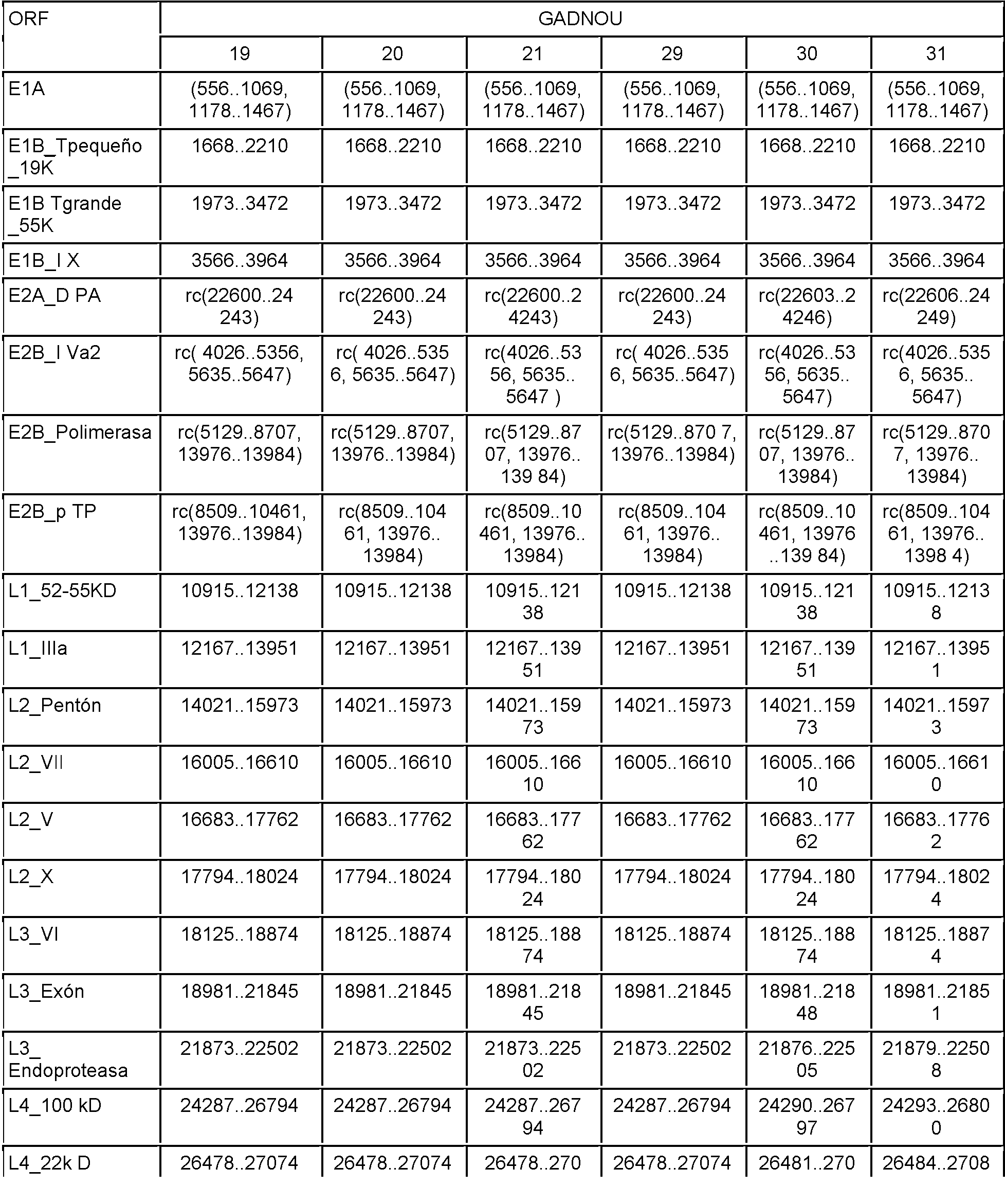

Tabla 2b: Límites genómicos de los CDS, ARN e ITR para GADNOU25, GADNOU26, GANOU27, GADNOU28. E3_Orf2* denota un marco de lectura abierto putativo que tenga un GTG como codón inicial. rc denota complemento inverso. Los productos generados por empalme se indican mediante múltiples pares de coordenadas.Table 2b: Genomic boundaries of CDS, RNA and ITR for GADNOU25, GADNOU26, GANOU27, GADNOU28. E3_Orf2* denotes a putative open reading frame having a GTG as the start codon. rc denotes reverse complement. Splice-generated products are indicated by multiple pairs of coordinates.
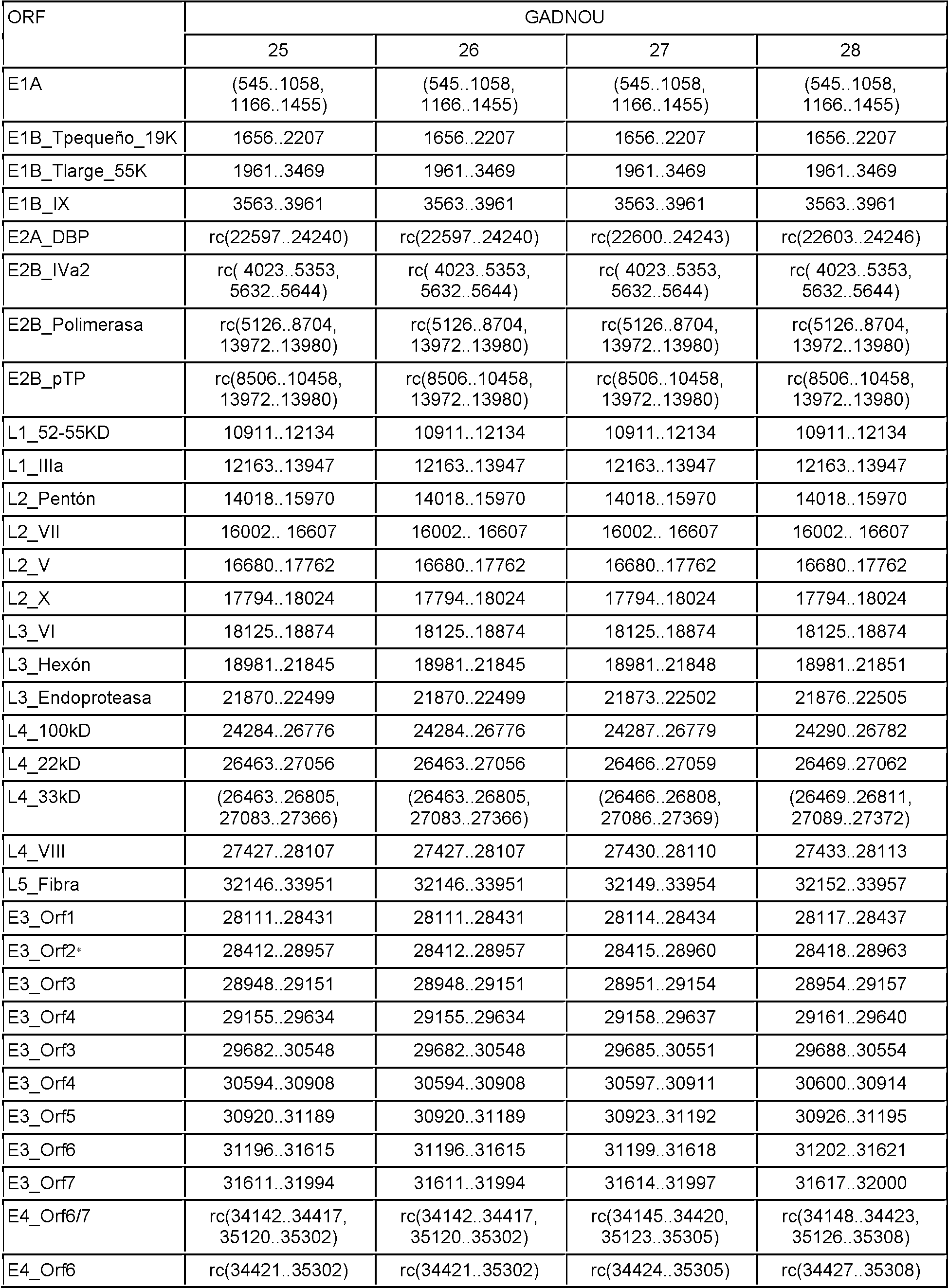
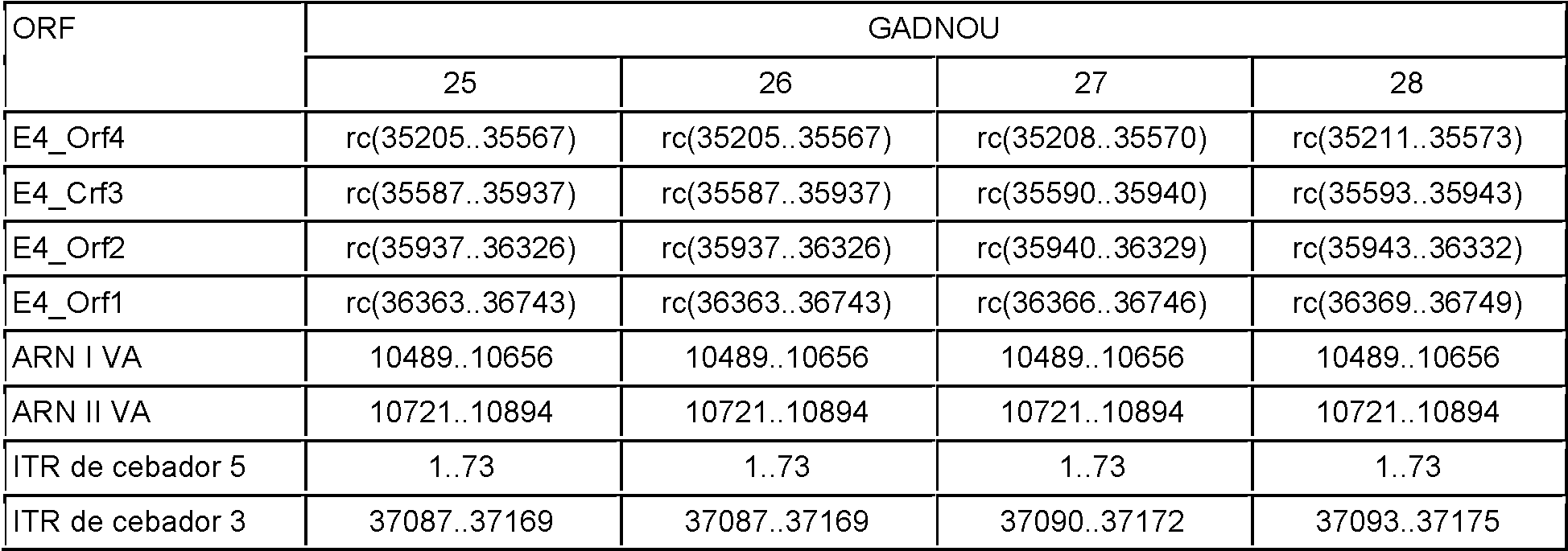
Aspectos de la enseñanza y facetas particulares de la mismaAspects of teaching and particular facets of it
La enseñanza se relaciona con varios aspectos como se establece anteriormente en el resumen de la enseñanza. Estos aspectos comprenden facetas alternativas y facetas preferidas, que se describen a continuación.The teaching relates to several aspects as stated above in the summary of the teaching. These aspects comprise alternative facets and preferred facets, which are described below.
En un primer aspecto, la enseñanza proporciona un polinucleótido aislado que codifica una proteína hexón de adenovirus como se define en el sumario de la enseñanza anterior.In a first aspect, the teaching provides an isolated polynucleotide encoding an adenovirus hexon protein as defined in the summary of the above teaching.
En una faceta preferida, las variantes de HVR tienen al menos un 90%, y más preferiblemente al menos un 95% de identidad de secuencia con la SEQ ID NO respectiva. Como alternativa a la definición por un nivel porcentual de identidad de secuencia, las variantes de HVR se pueden definir para que tengan un cierto número de mutaciones de aminoácidos dentro de la SEQ ID NO respectiva. El número de mutaciones es entonces el siguiente: en lugar de al menos un 85% de identidad de secuencia, hasta 4 mutaciones en cualquier HVR1, hasta 2 mutaciones en cualquier HVR2, hasta 1 mutación en cualquier HVR3, hasta 1 mutación en cualquier HVR4, hasta 2 mutaciones en cualquier HVR5, hasta 1 mutación en cualquier HVR6 y hasta 3 mutaciones en cualquier HVR7; en lugar de al menos un 90% de identidad de secuencia, hasta 2 mutaciones en cualquier HVR1, hasta 1 mutación en cualquier HVR2, hasta 1 mutación y preferiblemente sin mutación en cualquier HVR3, hasta 1 mutación en cualquier HVR4, hasta 1 mutación en cualquier HVR5, hasta 1 mutación y preferiblemente sin mutación en cualquier HVR6, y hasta 2 mutaciones en cualquier HVR7; en lugar de al menos 95% de identidad de secuencia, hasta 1 mutación en cualquier HVR1, hasta 1 mutación y preferiblemente ninguna mutación en cualquier HVR2, hasta 1 mutación y preferiblemente ninguna mutación en cualquier HVR3, hasta 1 mutación y preferiblemente ninguna mutación en cualquier HVR4, hasta 1 mutación y preferiblemente ninguna mutación en cualquier HVR5, hasta 1 mutación y preferiblemente ninguna mutación en cualquier HVR6, y hasta 1 mutación en cualquier HVR7.In a preferred facet, the HVR variants have at least 90%, and more preferably at least 95% sequence identity to the respective SEQ ID NO. As an alternative to definition by a percent level of sequence identity, HVR variants can be defined as having a certain number of amino acid mutations within the respective SEQ ID NO. The number of mutations is then as follows: instead of at least 85% sequence identity, up to 4 mutations in any HVR1, up to 2 mutations in any HVR2, up to 1 mutation in any HVR3, up to 1 mutation in any HVR4, up to 2 mutations in any HVR5, up to 1 mutation in any HVR6, and up to 3 mutations in any HVR7; instead of at least 90% sequence identity, up to 2 mutations in any HVR1, up to 1 mutation in any HVR2, up to 1 mutation and preferably no mutation in any HVR3, up to 1 mutation in any HVR4, up to 1 mutation in any HVR5, up to 1 mutation and preferably no mutation in any HVR6, and up to 2 mutations in any HVR7; instead of at least 95% sequence identity, up to 1 mutation in any HVR1, up to 1 mutation and preferably no mutation in any HVR2, up to 1 mutation and preferably no mutation in any HVR3, up to 1 mutation and preferably no mutation in any HVR4, up to 1 mutation and preferably no mutation in any HVR5, up to 1 mutation and preferably no mutation in any HVR6, and up to 1 mutation in any HVR7.
Como se conoce en la técnica, por ejemplo, de Bradley et al. (J Virol., enero de 2012; 86(2): 1267-72), los anticuerpos neutralizantes de adenovirus se dirigen a las regiones hipervariables de hexón, y al reemplazar las regiones HVR de un adenovirus con prevalencia en suero, ese adenovirus puede evadir el sistema inmunitario en el huésped inmunitario. Por lo tanto, aunque las HVR anteriores se pueden usar con las respectivas proteínas hexón definidas a continuación, tienen una utilidad independiente de esas proteínas hexón y también de las siguientes proteínas pentón y de fibra, es decir, reemplazando las HVR del hexón en un adenovirus diferente que tenga otro hexón, pentón y/o proteínas de fibra.As is known in the art, for example, from Bradley et al. (J Virol., 2012 Jan; 86(2): 1267-72), adenovirus neutralizing antibodies target hexon hypervariable regions, and by replacing the HVR regions of a serum-prevalent adenovirus, that adenovirus can evade the immune system in the immune host. Thus, although the above HVRs can be used with the respective hexon proteins defined below, they have utility independent of those hexon proteins and also of the following penton and fiber proteins, i.e. replacing the hexon HVRs in an adenovirus other than having other hexon, penton and/or fiber proteins.
En una faceta preferida, la proteína hexón de acuerdo conIn a preferred facet, the hexon protein according to
A) comprende una secuencia de aminoácidos de acuerdo con la SEQ ID NO: 46, o una variante de la misma que tenga al menos un 85% de identidad de secuencia con la SEQ ID NO: 46,A) comprises an amino acid sequence according to SEQ ID NO: 46, or a variant thereof having at least 85% sequence identity with SEQ ID NO: 46,
B) comprende una secuencia de aminoácidos de acuerdo con la SEQ ID NO: 47, o una variante de la misma que tenga al menos un 85% de identidad de secuencia con la SEQ ID NO: 47,B) comprises an amino acid sequence according to SEQ ID NO: 47, or a variant thereof having at least 85% sequence identity with SEQ ID NO: 47,
C) comprende una secuencia de aminoácidos de acuerdo con la SEQ ID NO : 48, o una variante de la misma que tenga al menos un 85% de identidad de secuencia con la SEQ ID NO: 48,C) comprises an amino acid sequence according to SEQ ID NO: 48, or a variant thereof that has at least 85% sequence identity with SEQ ID NO: 48,
D) comprende una secuencia de aminoácidos de acuerdo con la SEQ ID NO : 49, o una variante de la misma que tenga al menos un 85% de identidad de secuencia con la SEQ ID NO: 49, y/oD) comprises an amino acid sequence according to SEQ ID NO: 49, or a variant thereof that has at least 85% sequence identity with SEQ ID NO: 49, and/or
E) comprende una secuencia de aminoácidos de acuerdo con la SEQ ID NO: 50, o una variante de la misma que tenga al menos un 85% de identidad de secuencia con la SEQ ID NO: 50E) comprises an amino acid sequence according to SEQ ID NO: 50, or a variant thereof having at least 85% sequence identity with SEQ ID NO: 50
En una faceta preferida, las variantes de hexón tienen al menos un 90%, y preferiblemente al menos un 95%, 96%, 97%, 98% o 99% de identidad de secuencia con la SEQ ID NO respectiva. Como alternativa a la definición por un nivel porcentual de identidad de secuencia, las variantes de hexón se pueden definir para que tengan un cierto número de mutaciones de aminoácidos dentro de la SEQ ID NO respectiva. El número de mutaciones es entonces el siguiente: en lugar de al menos un 85% de identidad de secuencia, hasta 143 mutaciones en cualquier hexón; en lugar de al menos 90% de identidad de secuencia, hasta 95 mutaciones en cualquier hexón; en lugar de al menos 95% de identidad de secuencia, hasta 47 mutaciones en cualquier hexón; en lugar de al menos 96% de identidad de secuencia, hasta 38 mutaciones en cualquier hexón; en lugar de al menos 97% de identidad de secuencia, hasta 28 mutaciones en cualquier hexón; en lugar de al menos 98% de identidad de secuencia, hasta 19 mutaciones en cualquier hexón; en lugar de al menos 99% de identidad de secuencia, hasta 9 mutaciones en cualquier hexón. Debe entenderse que las variantes de hexón no tienen menos identidad de secuencia ni más mutaciones en sus HVR que las definidas para las respectivas HVR anteriores.In a preferred facet, the hexon variants have at least 90%, and preferably at least 95%, 96%, 97%, 98% or 99% sequence identity to the respective SEQ ID NO. As an alternative to definition by a percent level of sequence identity, hexon variants can be defined to have a certain number of amino acid mutations within the respective SEQ ID NO. The number of mutations is then as follows: instead of at least 85% sequence identity, up to 143 mutations in any hexon; instead of at less than 90% sequence identity, up to 95 mutations in any hexon; instead of at least 95% sequence identity, up to 47 mutations in any hexon; instead of at least 96% sequence identity, up to 38 mutations in any hexon; instead of at least 97% sequence identity, up to 28 mutations in any hexon; instead of at least 98% sequence identity, up to 19 mutations in any hexon; rather than at least 99% sequence identity, up to 9 mutations in any hexon. It is to be understood that the hexon variants have no less sequence identity or more mutations in their HVRs than defined for the respective HVRs above.
En una faceta, el polinucleótido aislado del primer aspecto codifica además una proteína pentón adenoviral que comprende una secuencia de aminoácidos de acuerdo con la SEQ ID NO: 51 o 52, o una variante de la misma que tenga al menos un 85% de identidad de secuencia con la SEQ ID NO: 51 o 52. En una faceta preferida, las variantes de pentón tienen al menos un 90%, y preferiblemente al menos un 95%, 96%, 97%, 98% o 99% de identidad de secuencia con la SEQ ID NO respectiva. Como alternativa a la definición por un nivel porcentual de identidad de secuencia, las variantes de pentón se pueden definir para que tengan un cierto número de mutaciones de aminoácidos dentro de la SEQ ID NO respectiva. El número de mutaciones es entonces el siguiente: en lugar de al menos un 85% de identidad de secuencia, hasta 97 mutaciones en cualquier pentón; en lugar de al menos un 90% de identidad de secuencia, hasta 65 mutaciones en cualquier pentón; en lugar de al menos un 95% de identidad de secuencia, hasta 32 mutaciones en cualquier pentón; en lugar de al menos un 96% de identidad de secuencia, hasta 26 mutaciones en cualquier pentón; en lugar de al menos un 97% de identidad de secuencia, hasta 19 mutaciones en cualquier pentón; en lugar de al menos un 98% de identidad de secuencia, hasta 13 mutaciones en cualquier pentón; en lugar de al menos un 99% de identidad de secuencia, hasta 6 mutaciones en cualquier pentón.In one facet, the isolated polynucleotide of the first aspect further encodes an adenoviral penton protein comprising an amino acid sequence according to SEQ ID NO: 51 or 52, or a variant thereof having at least 85% identity to sequence with SEQ ID NO: 51 or 52. In a preferred facet, the penton variants have at least 90%, and preferably at least 95%, 96%, 97%, 98% or 99% sequence identity with the respective SEQ ID NO. As an alternative to definition by a percent level of sequence identity, penton variants can be defined to have a certain number of amino acid mutations within the respective SEQ ID NO. The number of mutations is then as follows: instead of at least 85% sequence identity, up to 97 mutations in any penton; instead of at least 90% sequence identity, up to 65 mutations in any penton; instead of at least 95% sequence identity, up to 32 mutations in any penton; instead of at least 96% sequence identity, up to 26 mutations in any penton; instead of at least 97% sequence identity, up to 19 mutations in any penton; instead of at least 98% sequence identity, up to 13 mutations in any penton; instead of at least 99% sequence identity, up to 6 mutations in any penton.
Preferiblemente, las variantes de pentón de la SEQ ID NO 51 y 52 no tienen ninguna D y preferiblemente una G en la posición 289 y ninguna D y preferiblemente una N en la posición 341. Más preferiblemente, la variante de la SEQ ID NO: 52 tampoco tiene A y más preferiblemente tiene una T en la posición 442.Preferably, the penton variants of SEQ ID NO 51 and 52 have no D and preferably a G at position 289 and no D and preferably an N at position 341. More preferably, the variant of SEQ ID NO: 52 it also does not have an A and more preferably has a T at position 442.
En otra faceta, el polinucleótido aislado del primer aspecto además (es decir, junto al hexón y posiblemente la proteína pentón) codifica una proteína de fibra adenoviral que comprende una secuencia de aminoácidos de acuerdo con la SEQ ID NO: 53 o 54, o una variante de la misma que tenga al menos un 85% de identidad de secuencia con la SEQ ID NO: 53 o 54. En una faceta preferida, las variantes de fibra tienen al menos un 90%, y preferiblemente al menos un 95%, 96%, 97%, 98% o 99% de identidad de secuencia con la SEQ ID NO respectiva. Como alternativa a la definición por un nivel porcentual de identidad de secuencia, las variantes de fibra se pueden definir para que tengan un cierto número de mutaciones de aminoácidos dentro de la SEQ ID NO respectiva. El número de mutaciones es entonces el siguiente: en lugar de al menos un 85% de identidad de secuencia, hasta 89 mutaciones en cualquier fibra; en lugar de al menos 90% de identidad de secuencia, hasta 59 mutaciones en cualquier fibra; en lugar de al menos 95% de identidad de secuencia, hasta 29 mutaciones en cualquier fibra; en lugar de al menos 96% de identidad de secuencia, hasta 23 mutaciones en cualquier fibra; en lugar de al menos 97% de identidad de secuencia, hasta 17 mutaciones en cualquier fibra; en lugar de al menos 98% de identidad de secuencia, hasta 11 mutaciones en cualquier fibra; en lugar de al menos 99% de identidad de secuencia, hasta 5 mutaciones en cualquier fibra.In another facet, the isolated polynucleotide of the first aspect further (ie, together with the hexon and possibly the penton protein) encodes an adenoviral fiber protein comprising an amino acid sequence according to SEQ ID NO: 53 or 54, or a variant thereof having at least 85% sequence identity to SEQ ID NO: 53 or 54. In a preferred facet, the fiber variants have at least 90%, and preferably at least 95%, 96 %, 97%, 98% or 99% sequence identity with the respective SEQ ID NO. As an alternative to defining by a percent level of sequence identity, fiber variants can be defined to have a certain number of amino acid mutations within the respective SEQ ID NO. The number of mutations is then as follows: instead of at least 85% sequence identity, up to 89 mutations in any one fiber; instead of at least 90% sequence identity, up to 59 mutations in any one fiber; instead of at least 95% sequence identity, up to 29 mutations in any one fiber; instead of at least 96% sequence identity, up to 23 mutations in any one fiber; instead of at least 97% sequence identity, up to 17 mutations in any one fiber; instead of at least 98% sequence identity, up to 11 mutations in any one fiber; instead of at least 99% sequence identity, up to 5 mutations in any fiber.
Preferiblemente, las variantes de fibra de la SEQ ID NO: 53 no tienen A y preferiblemente una P en la posición 181, no tienen V y preferiblemente una I en la posición 474 y/o no tienen inserción de una S y preferiblemente no tienen inserción de aminoácidos entre las posiciones 4 y 5. Preferiblemente, las variantes de fibra de la SEQ ID NO: 54 no tienen T y preferiblemente una I en la posición 90 y/o una S en la posición 7 (preferiblemente una S en cada una de las posiciones 4-7).Preferably, the fiber variants of SEQ ID NO: 53 have no A and preferably a P at position 181, no V and preferably an I at position 474 and/or no insertion of an S and preferably no insertion of amino acids between positions 4 and 5. Preferably, the fiber variants of SEQ ID NO: 54 do not have T and preferably an I at position 90 and/or an S at position 7 (preferably an S at each of positions 4-7).
En otra faceta, el polinucleótido aislado del primer aspecto además (es decir, junto al hexón y posiblemente el pentón y/o la proteína de fibra) codifica un ARN no codificante de ARN II VA que comprende una secuencia de nucleótidos de acuerdo con la SEQ ID NO: 57, o una variante de la misma que tenga al menos un 85% de identidad de secuencia con la SEQ ID NO: 57. Alternativamente o además, puede codificar un ARN no codificante de ARN I VA que comprende una secuencia de nucleótidos de acuerdo con la s Eq ID NO: 55 o 56, o una variante de la misma que tenga al menos un 85% de identidad de secuencia con la SEQ ID NO: 55 o 56, respectivamente. En una faceta preferida, las variantes de ARN VA tienen al menos un 90%, y preferiblemente al menos un 95%, 96%, 97%, 98% o 99% de identidad de secuencia con la SEQ ID NO respectiva. Como alternativa a la definición por un nivel porcentual de identidad de secuencia, las variantes de ARN VA se pueden definir para tener un cierto número de mutaciones de nucleótidos dentro de la SEQ ID NO respectiva. El número de mutaciones es entonces el siguiente: en lugar de al menos un 85% de identidad de secuencia, hasta 25 mutaciones en ARN I VA y hasta 26 mutaciones en ARN II VA; en lugar de al menos un 90% de identidad de secuencia, hasta 16 mutaciones en ARN I VA y hasta 17 mutaciones en ARN II VA; en lugar de una identidad de secuencia de al menos el 95%, hasta 8 mutaciones en cualquier ARN VA; en lugar de al menos un 96% de identidad de secuencia, hasta 6 mutaciones en cualquier ARN VA; en lugar de una identidad de secuencia de al menos el 97%, hasta 5 mutaciones en cualquier ARN VA; en lugar de una identidad de secuencia de al menos el 98%, hasta 3 mutaciones en cualquier ARN VA; en lugar de al menos un 99% de identidad de secuencia, hasta 1 mutación en cualquier ARN VA.In another facet, the isolated polynucleotide of the first aspect furthermore (ie, together with the hexon and possibly the penton and/or the fiber protein) encodes an RNA II VA non-coding RNA comprising a nucleotide sequence according to SEQ ID NO: 57, or a variant thereof having at least 85% sequence identity to SEQ ID NO: 57. Alternatively or additionally, it may encode an RNA I VA non-coding RNA comprising a nucleotide sequence according to s Eq ID NO: 55 or 56, or a variant thereof having at least 85% sequence identity to SEQ ID NO: 55 or 56, respectively. In a preferred facet, VA RNA variants have at least 90%, and preferably at least 95%, 96%, 97%, 98% or 99% sequence identity to the respective SEQ ID NO. As an alternative to defining by a percent level of sequence identity, VA RNA variants can be defined to have a certain number of nucleotide mutations within the respective SEQ ID NO. The number of mutations is then as follows: instead of at least 85% sequence identity, up to 25 mutations in RNA I VA and up to 26 mutations in RNA II VA; instead of at least 90% sequence identity, up to 16 mutations in RNA I VA and up to 17 mutations in RNA II VA; instead of at least 95% sequence identity, up to 8 mutations in any VA RNA; instead of at least 96% sequence identity, up to 6 mutations in any VA RNA; instead of at least 97% sequence identity, up to 5 mutations in any VA RNA; instead of at least 98% sequence identity, up to 3 mutations in any VA RNA; rather than at least 99% sequence identity, up to 1 mutation in any VA RNA.
Preferiblemente, la variante de ARN II VA de la SEQ ID NO: 57 tiene (a) ninguna C en la posición 79 y/o ninguna A en la posición 80, y preferiblemente una T en la posición 79 y/o una G en la posición 80, y (b) ninguna A en la posición 81, y preferiblemente una G en la posición 81. La variante de ARN I VA de la SEQ ID NO: 55 preferiblemente no tiene G en la posición 80 y preferiblemente tiene una A en la posición 80.Preferably, the RNA II VA variant of SEQ ID NO: 57 has (a) no C at position 79 and/or no A at position 80, and preferably a T at position 79 and/or a G at position 80, and (b) no A in position 81, and preferably a G at position 81. The RNA I VA variant of SEQ ID NO: 55 preferably has no G at position 80 and preferably has an A at position 80.
Un ARN VA de acuerdo con la enseñanza conduce a una producción mejorada de adenovirus o partículas similares a adenovirus como se muestra en el Ejemplo 5.A VA RNA according to the teaching leads to an enhanced production of adenovirus or adenovirus-like particles as shown in Example 5.
Se prefiere que el polinucleótido del primer aspecto comprenda además otros genes adenovirales y segmentos de nucleótidos, que son adyacentes al gen del hexón, pentón y/o fibra en el genoma del adenovirus, usando las SEQ ID NOs 1-10 como referencia. Se prefiere particularmente que el polinucleótido también comprenda las secuencias requeridas para empaquetar el polinucleótido en una partícula adenoviral.It is preferred that the polynucleotide of the first aspect further comprises other adenoviral genes and nucleotide segments, which are adjacent to the hexon, penton and/or fiber gene in the adenovirus genome, using SEQ ID NOs 1-10 as reference. It is particularly preferred that the polynucleotide also comprises sequences required to package the polynucleotide into an adenoviral particle.
Generalmente, se prefiere que el polinucleótido aislado del primer aspecto comprenda al menos uno de los siguientes: Generally, it is preferred that the isolated polynucleotide of the first aspect comprises at least one of the following:
(a) un extremo 5' adenoviral, preferiblemente una repetición terminal invertida 5' adenoviral;(a) an adenoviral 5' end, preferably an adenoviral 5' terminal inverted repeat;
(b) una región E1a adenoviral, o un fragmento de la misma seleccionado entre las regiones 13S, 12S y 9S;(b) an adenoviral E1a region, or a fragment thereof selected from the 13S, 12S and 9S regions;
(c) una región E1b adenoviral, o un fragmento de la misma seleccionado entre el grupo que consiste en las regiones T pequeña, T grande y IX;(c) an adenoviral E1b region, or a fragment thereof selected from the group consisting of the small T, large T, and IX regions;
(d) una región de ARN VA adenoviral; o un fragmento de la misma seleccionada entre el grupo que consiste en las regiones ARN I VA y ARN II VA;(d) an adenoviral VA RNA region; or a fragment thereof selected from the group consisting of RNA I VA and RNA II VA regions;
(e) una región E2b adenoviral; o un fragmento de la misma seleccionada entre el grupo que consiste en las regiones pTP pequeña, Polimerasa e IVa2;(e) an adenoviral E2b region; or a fragment thereof selected from the group consisting of small pTP, Polymerase, and IVa2 regions;
(f) una región L1 adenoviral, o un fragmento de la misma, codificando dicho fragmento una proteína adenoviral seleccionada del grupo que consiste en proteína de 28.1 kD, polimerasa, agnoproteína, proteína de 52/55 kDa y proteína IIIa;(f) an adenoviral L1 region, or a fragment thereof, said fragment encoding an adenoviral protein selected from the group consisting of 28.1 kD protein, polymerase, agnoprotein, 52/55 kDa protein, and IIIa protein;
(g) una región L2 adenoviral, o un fragmento de la misma, codificando dicho fragmento una proteína adenoviral seleccionada del grupo que consiste en la proteína pentón como se definió anteriormente, proteína VII, V y X;(g) an adenoviral L2 region, or a fragment thereof, said fragment encoding an adenoviral protein selected from the group consisting of penton protein as defined above, protein VII, V and X;
(h) una región L3 adenoviral, o un fragmento de la misma, codificando dicho fragmento una proteína adenoviral seleccionada del grupo que consiste en la proteína VI, la proteína hexón como se definió anteriormente y la endoproteasa;(h) an adenoviral L3 region, or a fragment thereof, said fragment encoding an adenoviral protein selected from the group consisting of protein VI, hexon protein as defined above, and endoprotease;
(i) una región E2a adenoviral, o un fragmento de la misma, codificando dicho fragmento una proteína adenoviral que consta de la proteína DBP;(i) an adenoviral E2a region, or a fragment thereof, said fragment encoding an adenoviral protein consisting of the DBP protein;
(j) una región L4 adenoviral, o un fragmento de la misma, codificando dicho fragmento una proteína adenoviral seleccionada del grupo que consiste en la proteína de 100 kD, el homólogo de 22 kD, el homólogo de 33 kD y la proteína VIII;(j) an adenoviral L4 region, or a fragment thereof, said fragment encoding an adenoviral protein selected from the group consisting of the 100 kD protein, the 22 kD homologue, the 33 kD homologue, and protein VIII;
(k) una región E3 adenoviral, o un fragmento de la misma seleccionada del grupo que consiste en E3 ORF1, E3 ORF2, E3 ORF3, E3 ORF4, E3 ORF5, E3 ORF6, E3 ORF7, E3 ORF8 y E3 ORF9;(k) an adenoviral E3 region, or a fragment thereof selected from the group consisting of E3 ORF1, E3 ORF2, E3 ORF3, E3 ORF4, E3 ORF5, E3 ORF6, E3 ORF7, E3 ORF8, and E3 ORF9;
(l) una región L5 adenoviral, o un fragmento de la misma, codificando dicho fragmento la proteína de fibra como se definió anteriormente;(l) an adenoviral L5 region, or a fragment thereof, said fragment encoding the fiber protein as defined above;
(m) una región E4 adenoviral, o un fragmento de la misma seleccionada del grupo que consiste en E4 ORF6/7, E4 ORF6, E4 ORF5, E4 ORF4, E4 ORF3, E4 ORF2 y E4 ORF1; y/o(m) an adenoviral E4 region, or a fragment thereof selected from the group consisting of E4 ORF6/7, E4 ORF6, E4 ORF5, E4 ORF4, E4 ORF3, E4 ORF2, and E4 ORF1; I
(n) un extremo 3' adenoviral, preferiblemente una repetición terminal invertida 3' adenoviral.(n) an adenoviral 3' end, preferably an adenoviral 3' terminal inverted repeat.
Estos elementos pueden ser del mismo adenovirus que las HVR y/o hexón del polinucleótido del primer aspecto de acuerdo con la Tabla 1 (es decir, del mismo GADNOU), o de un adenovirus diferente, en particular de una especie diferente, por ejemplo un adenovirus humano, para formar un adenovirus quimérico.These elements may be from the same adenovirus as the HVRs and/or hexon of the polynucleotide of the first aspect according to Table 1 (i.e. from the same GADNOU), or from a different adenovirus, in particular from a different species, for example a human adenovirus, to form a chimeric adenovirus.
En algunas facetas del polinucleótido mencionado anteriormente, puede ser deseable que el polinucleótido no comprenda una o más regiones genómicas como se describió anteriormente (como en (a) a (m), tal como por ejemplo, la región E3 y/o E4) y/o comprende un gen adenoviral que comprende una eliminación y/o mutación que hace que al menos un gen no sea funcional. En estas facetas preferidas, las regiones adenovirales adecuadas se modifican para no incluir la región o regiones/gen o genes antes mencionados o para hacer que la región o regiones/gen o genes seleccionados no sean funcionales. Una posibilidad para hacerlos no funcionales es introducir uno o más codones de parada artificiales (por ejemplo, TAA) en el marco de lectura abierto de estos genes. Los métodos para hacer que la replicación del virus sea defectuosa son bien conocidos en la técnica (véase, por ejemplo, Brody et al., 1994 Ann NY Acad Sci., 716: 90-101). Una eliminación puede crear espacio para insertar transgenes, preferiblemente dentro de un casete de expresión, tal como un casete de minigenes como se describe en este documento. Además, las eliminaciones pueden usarse para generar vectores adenovirales que son incapaces de replicarse sin el uso de una línea celular de empaquetamiento o un virus auxiliar como es bien conocido en la técnica. Por lo tanto, un adenovirus recombinante final que comprende un polinucleótido como se describió anteriormente que comprende una o más de las eliminaciones de gen/región especificadas o mutaciones de pérdida de función puede proporcionar un adenovirus recombinante más seguro para, por ejemplo, terapia génica o vacunación.In some facets of the aforementioned polynucleotide, it may be desirable that the polynucleotide does not comprise one or more genomic regions as described above (as in (a) to (m), such as, for example, the E3 and/or E4 region) and /or comprises an adenoviral gene comprising a deletion and/or mutation rendering at least one gene non-functional. In these preferred facets, suitable adenoviral regions are modified not to include the aforementioned region(s)/gene(s) or to render the selected region(s)/gene(s) non-functional. One possibility to render them non-functional is to introduce one or more artificial stop codons (eg TAA) into the open reading frame of these genes. Methods for rendering viruses replication defective are well known in the art (see, eg, Brody et al., 1994 Ann NY Acad Sci., 716:90-101). A deletion can create space to insert transgenes, preferably within an expression cassette, such as a minigene cassette as described herein. In addition, the deletions can be used to generate adenoviral vectors that are incapable of replication without the use of a packaging cell line or helper virus as is well known in the art. Thus, a final recombinant adenovirus comprising a polynucleotide as described above comprising one or more of the specified gene/region deletions or loss-of-function mutations may provide a safer recombinant adenovirus for, for example, gene therapy or vaccination.
Si bien el polinucleótido puede no comprender al menos una región genómica/gen como se describe en este documento (tal como, por ejemplo, la región E3 y/o E4), específicamente E1A, E1B, E2A, E2B, E3 ORF1, E3 ORF2, E3 ORF3, E3 ORF4, E3 ORF5, E3 ORF6, E3 ORF7, E3 ORF8, E3 ORF9, E4 ORF6/7, E4 ORF6, E4 ORF5, E4 ORF4, E4 ORF3, E4 ORF2 y/o E4 ORF1, preferiblemente E1A, E1B, E2A, E2B, E3 y /o E4, y/o comprende un gen adenoviral que comprende una eliminación y/o mutación que hace que al menos un gen no funcional, sea deseable que retenga una región E1a y/o E1b intacta. Dicha región E1 intacta puede ubicarse en su ubicación nativa en el genoma adenoviral 0 colocarse en el sitio de una eliminación en el genoma adenoviral nativo (p. ej., en la región E3).While the polynucleotide may not comprise at least one gene/genomic region as described herein (such as, for example, the E3 and/or E4 region), specifically E1A, E1B, E2A, E2B, E3 ORF1, E3 ORF2 , E3 ORF3, E3 ORF4, E3 ORF5, E3 ORF6, E3 ORF7, E3 ORF8, E3 ORF9, E4 ORF6/7, E4 ORF6, E4 ORF5, E4 ORF4, E4 ORF3, E4 ORF2 and/or E4 ORF1, preferably E1A, E1B, E2A, E2B, E3 and/or E4, and/or comprises an adenoviral gene comprising a deletion and/or mutation that renders at least one non-functional gene, desirable to retain an intact E1a and/or E1b region. Said intact E1 region may be located in its native location in the adenoviral genome or placed at the site of a deletion in the native adenoviral genome (eg, in the E3 region).
En una faceta preferida, el polinucleótido aislado del primer aspecto codifica además una o más, preferiblemente todas, de las siguientes proteínas adenovirales: proteína VI, proteína VIII, proteína IX, proteína IIIa y proteína IVa2. In a preferred facet, the isolated polynucleotide of the first aspect further encodes one or more, preferably all, of the following adenoviral proteins: protein VI, protein VIII, protein IX, protein IIIa, and protein IVa2.
Una persona experta promedio en la técnica de los adenovirus es muy consciente de cómo determinar los marcos de lectura abiertos que codifican las proteínas adenovirales especificadas anteriormente. También conoce la estructura de los genomas adenovirales y puede mapear, sin carga indebida, las regiones adenovirales individuales y los ORF descritos en este documento para cualquier genoma adenoviral.The average person skilled in the adenovirus art is well aware of how to determine the open reading frames encoding the adenoviral proteins specified above. It also knows the structure of adenoviral genomes and can map, without undue burden, the individual adenoviral regions and ORFs described in this paper to any adenoviral genome.
En otra faceta, el polinucleótido aislado del primer aspecto codifica además una o más proteínas heterólogas o fragmentos de las mismas. La una o más proteínas heterólogas o fragmentos de las mismas son preferiblemente proteínas no adenovirales o fragmentos de las mismas. En una faceta preferida, la una o más proteínas no adenovirales o fragmentos de las mismas son una o más proteínas antigénicas o fragmentos de las mismas. Preferiblemente, la una o más proteínas heterólogas o fragmentos de las mismas forman parte de uno o más casetes de expresión. Las secuencias que codifican una proteína heteróloga y preferiblemente un casete de expresión que comprende dicha secuencia o secuencias que codifican una proteína heteróloga pueden insertarse en, por ejemplo, regiones eliminadas de un genoma adenoviral definido en este documento. Una ejemplo de proteína heteróloga es el polipéptido de acuerdo con la SEQ ID NO: 74 o variante de la misma que tenga al menos un 85% de identidad de secuencia con la SEQ ID NO: 74.In another facet, the isolated polynucleotide of the first aspect further encodes one or more heterologous proteins or fragments thereof. The one or more heterologous proteins or fragments thereof are preferably non-adenoviral proteins or fragments thereof. In a preferred facet, the one or more non-adenoviral proteins or fragments thereof are one or more antigenic proteins or fragments thereof. Preferably, the one or more heterologous proteins or fragments thereof form part of one or more expression cassettes. Heterologous protein-encoding sequences and preferably an expression cassette comprising said heterologous protein-encoding sequence(s) may be inserted into, for example, deleted regions of an adenoviral genome defined herein. An example of a heterologous protein is the polypeptide according to SEQ ID NO: 74 or a variant thereof having at least 85% sequence identity with SEQ ID NO: 74.
En un segundo aspecto, la enseñanza proporciona un polinucleótido aislado que codifica un adenovirus, que comprende un polinucleótido del primer aspecto, que comprende preferiblemente un genoma adenoviral de acuerdo con una cualquiera de las SEQ ID NOs 1-10, o una variante de las mismas que tenga al menos un 85% de identidad de secuencia con las SEQ ID NOs 1-10, respectivamente.In a second aspect, the teaching provides an isolated polynucleotide encoding an adenovirus, comprising a polynucleotide of the first aspect, preferably comprising an adenoviral genome according to any one of SEQ ID NOs 1-10, or a variant thereof. having at least 85% sequence identity to SEQ ID NOs 1-10, respectively.
En una faceta preferida, codifica un adenovirus incompetente para la replicación, que comprende preferiblemente un genoma adenoviral de acuerdo con cualquiera de las SEQ ID NOs 1-10 que carece de una o más de las regiones genómicas/genes E1A, E1B, E2A, E2B, E3 y E4.In a preferred facet, it encodes a replication-incompetent adenovirus, preferably comprising an adenoviral genome according to any of SEQ ID NOs 1-10 lacking one or more of the E1A, E1B, E2A, E2B genomic regions/genes , E3 and E4.
Lo más preferiblemente, codifica un adenovirus recombinante, preferiblemente que comprende un genoma adenoviral de acuerdo con cualquiera de las SEQ ID NOs 1-10, o una variante de las mismas que tenga al menos un 85% de identidad de secuencia con las SEQ ID NOs 1-10, respectivamente, preferiblemente en las que se insertan una o más proteínas heterólogas o fragmentos de las mismas (adenovirus portador). Preferiblemente, la una o más proteínas heterólogas o fragmentos de las mismas se insertan reemplazando una o más de las regiones genómicas/genes E1A, E1B, E2A, E2B, E3 ORF1, E3 ORF2, E3 ORF3, E3 ORF4, E3 ORF5, E3 ORF6, E3 ORF7, E3 ORF8, E3 ORF9, E4 ORF6/7, E4 ORF6, E4 ORF5, E4 ORF4, E4 ORF3, E4 ORF2 y E4 ORF1, más preferiblemente E1, E3 y/o E4. Las proteínas heterólogas o fragmentos de las mismas se insertan preferiblemente como parte de un casete de expresión. Opcionalmente, el adenovirus portador también es incompetente para la replicación como se describe en el presente documento, es decir, carece de una o más regiones genómicas/genes E1A, E1B, E2A, E2B, E3 y E4.Most preferably, it encodes a recombinant adenovirus, preferably comprising an adenoviral genome according to any of SEQ ID NOs 1-10, or a variant thereof having at least 85% sequence identity with SEQ ID NOs 1-10, respectively, preferably into which one or more heterologous proteins or fragments thereof (carrier adenovirus) are inserted. Preferably, the one or more heterologous proteins or fragments thereof are inserted by replacing one or more of the genomic regions/genes E1A, E1B, E2A, E2B, E3 ORF1, E3 ORF2, E3 ORF3, E3 ORF4, E3 ORF5, E3 ORF6 , E3 ORF7, E3 ORF8, E3 ORF9, E4 ORF6/7, E4 ORF6, E4 ORF5, E4 ORF4, E4 ORF3, E4 ORF2 and E4 ORF1, more preferably E1, E3 and/or E4. Heterologous proteins or fragments thereof are preferably inserted as part of an expression cassette. Optionally, the carrier adenovirus is also replication-incompetent as described herein, ie, it lacks one or more E1A, E1B, E2A, E2B, E3, and E4 genomic regions/genes.
En un ejemplo de faceta, la enseñanza proporciona un polinucleótido aislado que codifica un adenovirus, que comprende un polinucleótido de acuerdo con la SEQ ID NO 72 o 73, o una variante de la misma que tenga al menos un 85% de identidad de secuencia con la SEQ ID NO 72 o 73, respectivamente.In one exemplary facet, the teaching provides an isolated polynucleotide encoding an adenovirus, comprising a polynucleotide according to SEQ ID NO 72 or 73, or a variant thereof having at least 85% sequence identity with SEQ ID NO 72 or 73, respectively.
En una faceta preferida, las variantes del genoma adenoviral tienen, en lugar de al menos el 85%, al menos el 90% y preferiblemente al menos el 95%, 96%, 97%, 98%, 99%, 99.5 o 99.9% de identidad de secuencia con la SEQ ID n O 1 respectiva, al menos 90% y preferiblemente al menos 95%, 96%, 97%, 98%, 99%, 99.5 o 99.9% de identidad de secuencia con la SEQ ID NO 2, al menos 90% y preferiblemente al menos 95%, 96%, 97%, 98%, 99%, 99.5 o 99.9% de identidad de secuencia con la SEQ ID NO 3, al menos 90%, y preferiblemente al menos 95%, 96%, 97%, 98%, 99%, 99.5 o 99.9% de identidad de secuencia con la SEQ ID NO 4 respectiva, al menos 90% y preferiblemente al menos 95%, 96%, 97%, 98%, 99%, 99.5 o 99.9% de identidad de secuencia con la SEQ ID NO 5 respectiva, al menos 90% y preferiblemente al menos 95%, 96%, 97%, 98%, 99%, 99.5 o 99.9% de identidad de secuencia con la SEQ ID NO 6 respectiva, al menos 90% y preferiblemente al menos 95%, 96% , 97%, 98%, 99%, 99.5 o 99.9% de identidad de secuencia con la SEQ ID NO 7 respectiva, al menos 90%, y preferiblemente al menos 95%, 96%, 97%, 98%, 99%, 99.5 o 99.9% identidad de secuencia con la SEQ ID NO 8 respectiva, al menos 90%, y preferiblemente al menos 95%, 96%, 97%, 98%, 99%, 99.5 o 99.9% de identidad de secuencia con la SEQ ID NO 9 respectiva, o al menos 90%, y preferiblemente al menos 95%, 96%, 97%, 98%, 99%, 99.5 o 99.9% de identidad de secuencia con la SEQ ID NO 10 respectiva (en cada caso teniendo en cuenta las eliminaciones definidas anteriormente).In a preferred aspect, the variants of the adenoviral genome have, instead of at least 85%, at least 90% and preferably at least 95%, 96%, 97%, 98%, 99%, 99.5 or 99.9% of sequence identity with the respective SEQ ID NO 1, at least 90% and preferably at least 95%, 96%, 97%, 98%, 99%, 99.5 or 99.9% of sequence identity with SEQ ID NO 2 , at least 90% and preferably at least 95%, 96%, 97%, 98%, 99%, 99.5 or 99.9% sequence identity with SEQ ID NO 3, at least 90%, and preferably at least 95% , 96%, 97%, 98%, 99%, 99.5 or 99.9% sequence identity with the respective SEQ ID NO 4, at least 90% and preferably at least 95%, 96%, 97%, 98%, 99 %, 99.5 or 99.9% sequence identity with the respective SEQ ID NO 5, at least 90% and preferably at least 95%, 96%, 97%, 98%, 99%, 99.5 or 99.9% sequence identity with the respective SEQ ID NO 6, at least 90% and preferably at least 95%, 96%, 97%, 98%, 99%, 99.5 or 99.9% sequence identity c with the respective SEQ ID NO 7, at least 90%, and preferably at least 95%, 96%, 97%, 98%, 99%, 99.5 or 99.9% sequence identity with the respective SEQ ID NO 8, at least 90 %, and preferably at least 95%, 96%, 97%, 98%, 99%, 99.5 or 99.9% sequence identity with the respective SEQ ID NO 9, or at least 90%, and preferably at least 95%, 96%, 97%, 98%, 99%, 99.5 or 99.9% sequence identity with the respective SEQ ID NO 10 (in each case taking into account the deletions defined above).
En una faceta, el polinucleótido aislado del segundo aspecto codifica un adenovirus recombinante, en el que al menos una región genómica adenoviral del adenovirus recombinante se deriva de un adenovirus que no comprende HVR de hexón o una proteína de hexón como se definió anteriormente (adenovirus quimérico). Preferiblemente, el adenovirus quimérico es quimérico principalmente o preferiblemente solo para una HVR de hexón o proteína hexón y opcionalmente también un pentón y/o proteína de fibra como se define en el presente documento. En otras palabras, el polinucleótido codifica las HVR de hexón o la proteína hexón como se definió anteriormente y, opcionalmente, también para la proteína pentón y/o de fibra como se definió anteriormente, pero una o más, preferiblemente todas las demás regiones genómicas, se derivan de un adenovirus diferente, en particular diferente de un adenovirus de acuerdo con las SEQ ID NOs 1-10. El adenovirus diferente es preferiblemente uno que se encuentra naturalmente en un huésped diferente, más preferiblemente un adenovirus humano. Este polinucleótido preferiblemente codifica también para una o más proteínas heterólogas no adenovirales o fragmentos de las mismas como se definió anteriormente. Por lo tanto, se insertan uno o más genes no adenovirales heterólogos en el genoma adenoviral del adenovirus quimérico. En consecuencia, el genoma adenoviral del adenovirus quimérico es, excepto el ADN que codifica las HVR de hexón o la proteína hexón como se definió anteriormente y opcionalmente el ADN que codifica las proteínas pentón y/o de fibra como se definió anteriormente, derivado de un adenovirus que no es de simio, por ejemplo, un adenovirus humano, preferiblemente un portador no simio, por ejemplo adenovirus humano.In one facet, the isolated polynucleotide of the second aspect encodes a recombinant adenovirus, wherein at least one recombinant adenovirus adenoviral genomic region is derived from an adenovirus that does not comprise hexon HVR or hexon protein as defined above (chimeric adenovirus ). Preferably, the chimeric adenovirus is chimeric primarily or preferably only for a hexon HVR or hexon protein and optionally also a penton and/or fiber protein as defined herein. In other words, the polynucleotide encodes hexon HVRs or hexon protein as defined above and optionally also for penton and/or fiber protein as defined above, but one or more, preferably all other genomic regions, are derived from a different adenovirus, in particular different from an adenovirus according to SEQ ID NOs 1-10 . The different adenovirus is preferably one naturally found in a different host, more preferably a human adenovirus. This polynucleotide preferably also codes for one or more heterologous non-adenoviral proteins or fragments thereof as defined above. Therefore, one or more heterologous non-adenoviral genes are inserted into the adenoviral genome of the chimeric adenovirus. Accordingly, the adenoviral genome of the chimeric adenovirus is, except for the DNA encoding the hexon HVRs or hexon protein as defined above and optionally the DNA encoding the penton and/or fiber proteins as defined above, derived from a non-simian adenovirus, eg a human adenovirus, preferably a non-simian carrier, eg human adenovirus.
Generalmente se prefiere que el adenovirus sea incompetente para la replicación. Para ello, se prefiere que el adenovirus carezca de una o más de las regiones genómicas E1A, E1B, E2A, E2B, E3 y E4 o que presente una eliminación y/o mutación en las mismas que haga que la región genómica o un producto de expresión codificado por ella no sea funcional.It is generally preferred that the adenovirus be replication incompetent. For this, it is preferred that the adenovirus lacks one or more of the genomic regions E1A, E1B, E2A, E2B, E3 and E4 or that it presents a deletion and/or mutation in them that makes the genomic region or a product of expression encoded by it is not functional.
En una faceta particularmente preferida, el polinucleótido aislado del primer o segundo aspecto, en todas sus variantes descritas en el presente documento, puede tener un gen IVa2 funcionalmente debilitado, preferiblemente una eliminación o una mutación nula en él. Este gen está involucrado en el empaquetamiento del ADN viral y su deterioro conduce a la producción de partículas similares a virus. En esta faceta, el polinucleótido aislado del primer o segundo aspecto codifica preferiblemente uno o más epítopos de células B y/o epítopos de células T no adenovirales.In a particularly preferred facet, the isolated polynucleotide of the first or second aspect, in all of its variants described herein, may have a functionally impaired IVa2 gene, preferably a deletion or null mutation therein. This gene is involved in the packaging of viral DNA and its deterioration leads to the production of virus-like particles. In this facet, the isolated polynucleotide of the first or second aspect preferably encodes one or more non-adenoviral B cell epitopes and/or T cell epitopes.
En un tercer aspecto, la enseñanza proporciona al menos una cápside adenoviral aislada codificada por un polinucleótido del primer o segundo aspecto. La al menos una cápside adenoviral aislada comprende al menos un hexón con las HVR como se definió anteriormente, preferiblemente la proteína hexón definida anteriormente, y opcionalmente también la proteína pentón y/o de fibra definida anteriormente.In a third aspect, the teaching provides at least one isolated adenoviral capsid encoded by a polynucleotide of the first or second aspect. The isolated at least one adenoviral capsid comprises at least one hexon with HVRs as defined above, preferably the hexon protein defined above, and optionally also the penton and/or fiber protein defined above.
Al menos una cápside adenoviral aislada puede obtenerse por expresión en una célula. El polipéptido polipéptidos expresados se pueden purificar opcionalmente usando técnicas estándar. Por ejemplo, las células pueden lisarse mecánicamente o por choque osmótico antes de someterse a las etapas de precipitación y cromatografía, cuya naturaleza y secuencia dependerán del material recombinante particular que se va a recuperar. Alternativamente, el polipéptido o polipéptidos expresados pueden secretarse y recuperarse del medio de cultivo en el que se han cultivado las células recombinantes como se conoce en la técnica de la expresión de proteínas.At least one isolated adenoviral capsid can be obtained by expression in a cell. The expressed polypeptide polypeptides may optionally be purified using standard techniques. For example, cells may be lysed mechanically or by osmotic shock before undergoing precipitation and chromatography steps, the nature and sequence of which will depend on the particular recombinant material to be recovered. Alternatively, the expressed polypeptide(s) may be secreted and recovered from the culture medium in which the recombinant cells have been grown as is known in the art of protein expression.
En un cuarto aspecto, la enseñanza proporciona un adenovirus (también denominado vector de adenovirus o vector adenoviral en este documento) que comprende la cápside adenoviral del tercer aspecto. En consecuencia, el adenovirus puede ser, por ejemplo, un adenovirus codificado por cualquiera de las SEQ ID NOs 1-10 o un adenovirus recombinante, tal como un portador o un adenovirus quimérico como se definió anteriormente. Preferiblemente, el adenovirus es un adenovirus aislado.In a fourth aspect, the teaching provides an adenovirus (also called adenovirus vector or adenoviral vector herein) comprising the adenoviral capsid of the third aspect. Accordingly, the adenovirus may be, for example, an adenovirus encoded by any of SEQ ID NOs 1-10 or a recombinant adenovirus, such as carrier or chimeric adenovirus as defined above. Preferably, the adenovirus is an isolated adenovirus.
En un ejemplo de faceta, la enseñanza proporciona un adenovirus que comprende un polinucleótido de acuerdo con la SEQ ID NO 72 o 73, o una variante de la misma que tenga al menos un 85% de identidad de secuencia con la SEQ ID NO 72 o 73, respectivamente.In one exemplary facet, the teaching provides an adenovirus comprising a polynucleotide according to SEQ ID NO 72 or 73, or a variant thereof having at least 85% sequence identity to SEQ ID NO 72 or 73, respectively.
El adenovirus puede comprender o no un polinucleótido del primer o segundo aspecto. En caso de que este polinucleótido no esté comprendido en el adenovirus, se prefiere que se proporcione en trans (es decir, mediante un elemento genético que no sea el genoma del adenovirus incorporado en el adenovirus). Por lo general, lo proporciona un constructo auxiliar (p. ej., un plásmido o un virus) o el genoma o un constructo auxiliar en una célula huésped de empaquetamiento (célula complementaria como se describe en el presente documento). Se prefiere además que los polinucleótidos proporcionados en trans no estén comprendidos en el genoma incorporado en el adenovirus, incluidos los homólogos u otras variantes de secuencia de estos polinucleótidos. Por ejemplo, si el polinucleótido proporcionado en trans comprende un gen de hexón, pentón y/o fibra, el genoma incorporado en el adenovirus no comprende ningún polinucleótido que codifique una proteína de hexón, pentón y/o fibra, respectivamente. Lo más preferiblemente, el polinucleótido provisto en trans codifica al menos una cápside adenoviral como se define en el tercer aspecto, es decir, un hexón con las HVR como se define en el primer o segundo aspecto, preferiblemente la proteína hexón como se define en el primer o segundo aspecto, y opcionalmente también la proteína pentón y/o de fibra como se define en el primer o segundo aspecto.The adenovirus may or may not comprise a polynucleotide of the first or second aspect. In case this polynucleotide is not comprised in the adenovirus, it is preferred that it be provided in trans (ie via a genetic element other than the adenovirus genome incorporated into the adenovirus). It is typically provided by a helper construct (eg, a plasmid or virus) or the genome or a helper construct in a packaging host cell (companion cell as described herein). It is further preferred that the polynucleotides provided in trans are not comprised in the genome incorporated into the adenovirus, including homologues or other sequence variants of these polynucleotides. For example, if the polynucleotide provided in trans comprises a hexon, penton, and/or fiber gene, the genome incorporated into the adenovirus does not comprise any polynucleotide encoding a hexon, penton, and/or fiber protein, respectively. Most preferably, the polynucleotide provided in trans encodes at least one adenoviral capsid as defined in the third aspect, i.e., a hexon with HVRs as defined in the first or second aspect, preferably the hexon protein as defined in the third aspect. first or second aspect, and optionally also the penton and/or fiber protein as defined in the first or second aspect.
En la construcción de vectores de adenovirus para la administración de un gen a un huésped, por ejemplo, una célula humana o de otro mamífero, se puede emplear una variedad de secuencias de ácido nucleico de adenovirus. Por ejemplo, la totalidad o una parte del gen E3 temprano retardado de adenovirus puede eliminarse de la secuencia de adenovirus que forma parte del virus recombinante. Se cree que la función de E3 de simio es irrelevante para la función y producción de la partícula de virus recombinante. En algunas facetas, los vectores de adenovirus también pueden construirse con una eliminación de al menos la región ORF6 del gen E4, y más deseablemente debido a la redundancia en la función de esta región, la región E4 completa. Todavía otro vector de esta enseñanza contiene una eliminación en el gen E2a temprano retardado. También se pueden realizar eliminaciones en cualquiera de los genes tardíos L1 a L5 del genoma del adenovirus de simio. De manera similar, las eliminaciones en los genes intermedios IX y IVa2 pueden ser útiles para algunos fines. Se pueden realizar otras eliminaciones en los otros genes de adenovirus estructurales o no estructurales. Las eliminaciones discutidas anteriormente pueden usarse individualmente, es decir, una secuencia de adenovirus para usar en la presente enseñanza puede contener eliminaciones en una sola región. Alternativamente, pueden usarse en cualquier combinación eliminaciones de genes completos o porciones de los mismos eficaces para destruir su actividad biológica. Por ejemplo, la secuencia de adenovirus puede tener eliminaciones de la región E1 y E4, o de la región E1, E2a y E3, o de las regiones E1 y E3, o de las regiones E1, E2a y E4, con o sin eliminación de E3, etc.. Dichas eliminaciones se pueden usar en combinación con otras mutaciones genéticas adenovirales, tales como mutaciones sensibles a la temperatura, para lograr el resultado deseado.A variety of adenovirus nucleic acid sequences can be employed in the construction of adenovirus vectors for delivery of a gene to a host, eg, a human or other mammalian cell. For example, all or part of the adenovirus delayed early E3 gene can be deleted from the adenovirus sequence that forms part of the recombinant virus. The function of simian E3 is believed to be irrelevant to the function and production of the recombinant virus particle. In some facets, adenovirus vectors can also be constructed with a deletion of at least the ORF6 region of the E4 gene, and more desirably due to redundancy in the function of this region, the entire E4 region. Still another vector of this teaching contains a deletion in the delayed early E2a gene. Deletions can also be made in any of the late genes L1 to L5 of the simian adenovirus genome. Similarly, deletions in intermediate genes IX and IVa2 they can be useful for some purposes. Other deletions can be made in the other structural or non-structural adenovirus genes. The deletions discussed above can be used individually, ie, an adenovirus sequence for use in the present teaching can contain deletions in a single region. Alternatively, deletions of entire genes or portions thereof effective to destroy their biological activity may be used in any combination. For example, the adenovirus sequence may have deletions of the E1 and E4 region, or of the E1, E2a, and E3 region, or of the E1 and E3 regions, or of the E1, E2a, and E4 regions, with or without deletion of E3, etc. Such deletions can be used in combination with other adenoviral genetic mutations, such as temperature sensitive mutations, to achieve the desired result.
Un vector adenoviral que carece de secuencias adenovirales esenciales (p. ej., una región seleccionada de E1a, E1b, E2a, E2b, E4 ORF6, L1 o L4) puede cultivarse en presencia de los productos génicos adenovirales que faltan y que son necesarios para la infectividad y la propagación viral de una partícula adenoviral. Estas funciones auxiliares pueden proporcionarse cultivando el vector adenoviral en presencia de uno o más constructos auxiliares (por ejemplo, un plásmido o virus) o una célula huésped de empaquetamiento (célula complementaria como se describe en este documento). Véanse, por ejemplo, las técnicas descritas para la preparación de un vector de adenovirus humano "mínimo" en el documento WO96/13597).An adenoviral vector lacking essential adenoviral sequences (eg, a selected region of E1a, E1b, E2a, E2b, E4 ORF6, L1, or L4) can be grown in the presence of the missing adenoviral gene products that are necessary for infectivity and viral shedding of an adenoviral particle. These helper functions can be provided by culturing the adenoviral vector in the presence of one or more helper constructs (eg, a plasmid or virus) or a packaging host cell (complementary cell as described herein). See, for example, the techniques described for the preparation of a "minimal" human adenovirus vector in WO96/13597).
Los construcctos auxiliares útiles contienen secuencias de genes de adenovirus seleccionadas que complementan los genes respectivos que se eliminan y/o que no se expresan por el vector y la célula en la que se transfecta el vector. En una faceta, el constructo auxiliar es defectuoso en la replicación y contiene genes de adenovirus esenciales y, opcionalmente, adicionales.Useful helper constructs contain selected adenovirus gene sequences that complement the respective genes that are deleted and/or not expressed by the vector and the cell into which the vector is transfected. In one facet, the helper construct is replication defective and contains essential and, optionally, additional adenovirus genes.
Los constructos auxiliares también se pueden formar en conjugados de policationes como se describe en Wu et al., J. Biol. Chem., 264: 16985-16987 (1989); KJ Fisher y JM Wilson, Biochem. J., 299: 49 (1 de abril de 1994). Un constructo auxiliar puede contener opcionalmente un gen informador. Se conocen en la técnica varios de tales genes informadores. La presencia de un gen informador en el constructo auxiliar que es diferente del transgén en el vector de adenovirus permite controlar de forma independiente tanto el adenovirus como el constructo auxiliar. Este segundo informador puede usarse para facilitar la separación entre el adenovirus recombinante resultante y el constructo auxiliar tras la purificación. Una constructo auxiliar preferido es un virus auxiliar.Auxiliary constructs can also be formed into polycation conjugates as described in Wu et al., J. Biol. Chem., 264: 16985-16987 (1989); KJ Fisher and JM Wilson, Biochem. J., 299: 49 (April 1, 1994). A helper construct may optionally contain a reporter gene. A number of such reporter genes are known in the art. The presence of a reporter gene in the helper construct that is different from the transgene in the adenovirus vector allows for independent control of both the adenovirus and the helper construct. This second reporter can be used to facilitate separation between the resulting recombinant adenovirus and the helper construct after purification. A preferred helper construct is a helper virus.
Para generar adenovirus recombinantes (Ad) eliminados en cualquiera de los genes descritos en el contexto de las facetas preferidas del presente documento, la función de la región del gen eliminado, si es esencial para la replicación y la infectividad del virus, se suministra preferiblemente al virus recombinante mediante una célula o constructo auxiliar, es decir, una célula de complementación o de empaquetamiento. En muchas circunstancias, se puede usar un constructo/célula que exprese la E1 humana para transcomplementar el vector usado para generar adenovirus recombinantes. Esto es particularmente ventajoso porque, debido a la diversidad entre las secuencias de polinucleótidos de la enseñanza y las secuencias de E1 adenoviral humano que se encuentran en los constructos/ células de empaquetamiento actualmente disponibles, el uso de los constructos/células actuales que contienen E1 humana evitará la generación de adenovirus competentes para replicación durante el proceso de replicación y producción. Sin embargo, en determinadas circunstancias, será deseable utilizar un constructo/célula que exprese los productos del gen E1 para la producción de un adenovirus recombinante con E1 suprimida.To generate recombinant adenoviruses (Ad) deleted in any of the genes described in the context of the preferred facets herein, the function of the deleted gene region, if essential for virus replication and infectivity, is preferably supplied to the recombinant virus by a helper cell or construct, ie, a complementing or packaging cell. In many circumstances, a construct/cell expressing human E1 can be used to transcomplement the vector used to generate recombinant adenoviruses. This is particularly advantageous because, due to the diversity between the teaching polynucleotide sequences and human adenoviral E1 sequences found in currently available packaging constructs/cells, the use of current human E1-containing constructs/cells will prevent the generation of replication-competent adenoviruses during the replication and production process. However, under certain circumstances, it will be desirable to use a construct/cell that expresses the E1 gene products for the production of an E1-deleted recombinant adenovirus.
Si se desea, se pueden utilizar las secuencias proporcionadas en el presente documento para generar un constructo /célula auxiliar o línea celular que exprese, como mínimo, el gen E1 de adenovirus de un adenovirus de acuerdo con una cualquiera de las SEQ ID NOS 1-10 bajo el control transcripcional de un promotor para la expresión en una línea celular parental seleccionada, tal como, por ejemplo, una célula HeLa. Pueden emplearse promotores inducibles o constitutivos para este fin. Se proporcionan ejemplos de promotores, por ejemplo, en los ejemplos descritos en este documento. Tales células que expresan E1 son útiles en la generación de vectores de adenovirus recombinantes con E1 eliminada. Además, o alternativamente, la enseñanza proporciona constructos/células que expresan uno o más productos génicos adenovirales, por ejemplo, E1a, E1b, E2a y/o E4 ORF6, preferiblemente Ad5 E4 ORF6, que pueden construirse utilizando esencialmente los mismos procedimientos para uso en la generación de vectores adenovirales recombinantes. Dichos constructos/células se pueden utilizar para transcomplementar vectores de adenovirus eliminados en genes esenciales que codifican esos productos, o para proporcionar funciones auxiliares necesarias para el empaquetamiento de un virus dependiente del auxiliar (p. ej., virus adenoasociado).If desired, the sequences provided herein can be used to generate a construct/helper cell or cell line that expresses at least the adenovirus E1 gene from an adenovirus according to any one of SEQ ID NOS 1- 10 under the transcriptional control of a promoter for expression in a selected parental cell line, such as, for example, a HeLa cell. Inducible or constitutive promoters may be employed for this purpose. Examples of promoters are provided, for example, in the examples described herein. Such E1-expressing cells are useful in the generation of E1-deleted recombinant adenovirus vectors. Additionally, or alternatively, the teaching provides constructs/cells expressing one or more adenoviral gene products, eg, E1a, E1b, E2a and/or E4 ORF6, preferably Ad5 E4 ORF6, which can be constructed using essentially the same procedures for use in the generation of recombinant adenoviral vectors. Such constructs/cells can be used to transcomplement deleted adenovirus vectors into essential genes encoding those products, or to provide helper functions necessary for helper-dependent virus packaging (eg, adeno-associated virus).
Generalmente, cuando se administra un vector de adenovirus por transfección, el vector se administra en una cantidad de aproximadamente 0,1 |jg a aproximadamente 100 |jg de ADN, y preferiblemente de aproximadamente 10 a aproximadamente 50 jg de ADN a aproximadamente 1 x 10⁴ células a aproximadamente 1 x 10³ células, y preferiblemente aproximadamente 105 células. Sin embargo, las cantidades relativas de ADN del vector con respecto a las células huésped pueden ajustarse, teniendo en cuenta factores tales como el vector seleccionado, el método de administración y las células huésped seleccionadas. La introducción del vector en una célula huésped se puede lograr por cualquier medio conocido en la técnica o como se describe en este documento, incluida la transfección y la infección, por ejemplo, usando transfección o electroporación con CaPO4.Generally, when an adenovirus vector is administered by transfection, the vector is administered in an amount of from about 0.1 µg to about 100 µg of DNA, and preferably from about 10 to about 50 µg of DNA at about 1 x 10⁴ cells to about 1 x 10³ cells, and preferably about 105 cells. However, the relative amounts of vector DNA to host cells can be adjusted, taking into account such factors as the vector selected, the method of administration, and the host cells selected. Introduction of the vector into a host cell can be accomplished by any means known in the art or as described herein, including transfection and infection, for example, using CaPO4 transfection or electroporation.
Para la construcción y ensamblaje del adenovirus recombinante deseado, el vector de adenovirus se puede transfectar en un ejemplo in vitro en presencia de una constructo auxiliar en la línea celular de empaquetamiento, lo que permite que se produzca una recombinación homóloga entre las secuencias del vector auxiliar y del adenovirus, lo que permite que las secuencias del transgén del adenovirus en el vector se repliquen y se empaqueten en las cápsides del virión, lo que da como resultado partículas del vector viral recombinante como es bien conocido en la técnica. Un adenovirus recombinante de la enseñanza es útil, por ejemplo, en la transferencia de un transgén seleccionado a una célula huésped seleccionada.For the construction and assembly of the desired recombinant adenovirus, the adenovirus vector can be transfected in an example in vitro in the presence of a helper construct into the packaging cell line, allowing homologous recombination to occur between the helper vector sequences. and the adenovirus, which allows that the adenovirus transgene sequences in the vector replicate and package into virion capsids, resulting in recombinant viral vector particles as is well known in the art. A teaching recombinant adenovirus is useful, for example, in the transfer of a selected transgene into a selected host cell.
En una faceta preferida, el adenovirus del cuarto aspecto tiene una seroprevalencia en menos del 5% de los sujetos humanos y preferiblemente ninguna seroprevalencia en sujetos humanos, más preferiblemente ninguna seroprevalencia en sujetos humanos que no han estado previamente en contacto con adenovirus de grandes simios no humanos, más preferiblemente con uno o más, particularmente todos los adenovirus de acuerdo con las SEQ ID NOs 1-10. En este contexto, se prefiere que los sujetos humanos pertenezcan a un grupo étnico seleccionado de europeos, indígenas de África, asiáticos, indígenas de América e indígenas de Oceanía. Los métodos para la identificación del origen étnico de un sujeto humano están comprendidos en la técnica (véase, por ejemplo, el documento WO2003/102236).In a preferred facet, the adenovirus of the fourth aspect has a seroprevalence in less than 5% of human subjects and preferably no seroprevalence in human subjects, more preferably no seroprevalence in human subjects who have not previously been in contact with non-great ape adenoviruses. human, more preferably with one or more, particularly all adenoviruses according to SEQ ID NOs 1-10. In this context, it is preferred that the human subjects belong to an ethnic group selected from Europeans, indigenous Africans, Asians, indigenous Americans, and indigenous Oceanians. Methods for identifying the ethnicity of a human subject are within the art (see, eg, WO2003/102236).
En otra faceta preferida de un adenovirus recombinante, el ADN del adenovirus es capaz de entrar en una célula diana de mamífero, es decir, es infeccioso. Los adenovirus recombinantes infecciosos de la enseñanza se pueden usar como vacuna y para terapia génica como también se describe en este documento. Por lo tanto, en otra faceta, se prefiere que el adenovirus recombinante comprenda una molécula para el suministro a una célula diana. Preferiblemente, la célula diana es una célula de mamífero, por ejemplo, una célula de grandes simios no humanos, una célula de roedor o una célula humana. Por ejemplo, la molécula para el suministro a una célula diana puede ser un polinucleótido que codifica una proteína heteróloga (es decir, un gen heterólogo) como se define en el presente documento, preferiblemente dentro de un casete de expresión. Los métodos para introducir un casete de expresión en el genoma de un adenovirus son bien conocidos en la técnica. En un ejemplo, un adenovirus recombinante de la presente enseñanza que comprende un casete de expresión, que codifica por ejemplo, un gen heterólogo, puede generarse reemplazando una región genómica del adenovirus seleccionado de E1A, E1B, E2A, E2B, E3 y E4 con dicho casete de expresión. Las regiones genómicas E1A, E1B, E2A, E2B, E3 y E4 de los adenovirus de la enseñanza se pueden identificar fácilmente mediante una alineación con genomas adenovirales conocidos y anotados, tal como el Ad5 humano (véase: Birgitt Tauber y Thomas Dobner, Oncogene (2001) 20, páginas 7847 - 7854; y también: Andrew J. Davison, et al., "Genetic content and evolution of adenoviruses", Journal of General Virology (2003), 84, páginas 2895-2908).In another preferred facet of a recombinant adenovirus, the adenovirus DNA is capable of entering a mammalian target cell, ie, is infectious. The infectious recombinant adenoviruses of the teaching can be used as a vaccine and for gene therapy as also described herein. Therefore, in another facet, it is preferred that the recombinant adenovirus comprises a molecule for delivery to a target cell. Preferably, the target cell is a mammalian cell, eg, a non-human great ape cell, a rodent cell, or a human cell. For example, the molecule for delivery to a target cell may be a polynucleotide encoding a heterologous protein (ie, a heterologous gene) as defined herein, preferably within an expression cassette. Methods for introducing an expression cassette into the genome of an adenovirus are well known in the art. In one example, a recombinant adenovirus of the present teaching comprising an expression cassette, encoding for example a heterologous gene, can be generated by replacing a genomic region of the adenovirus selected from E1A, E1B, E2A, E2B, E3 and E4 with said expression cassette. The E1A, E1B, E2A, E2B, E3, and E4 genomic regions of the teaching adenoviruses can be readily identified by an alignment with known and annotated adenoviral genomes, such as human Ad5 (see: Birgitt Tauber and Thomas Dobner, Oncogene ( 2001) 20, pages 7847-7854, and also: Andrew J. Davison, et al., "Genetic content and evolution of adenoviruses", Journal of General Virology (2003), 84, pages 2895-2908).
La molécula para el suministro a una célula diana es preferiblemente un polinucleótido heterólogo pero también puede ser un polipéptido o un compuesto químico pequeño, preferiblemente con actividad terapéutica o diagnóstica. En una faceta particularmente preferida, la molécula para el suministro a una célula diana es un polinucleótido heterólogo que comprende una secuencia repetida terminal invertida (ITR) 5' y una ITR 3' de adenovirus. Será evidente para el experto en la materia que el tamaño molecular de la molécula tiene que elegirse de modo que la cápside pueda formarse alrededor y empaquetar la molécula, cuando se produce el adenovirus recombinante, por ejemplo, en una célula de empaquetamiento. Por lo tanto, preferiblemente el gen heterólogo es un minigén que puede tener, por ejemplo, hasta 7000 y como máximo hasta 8000 pares de bases.The molecule for delivery to a target cell is preferably a heterologous polynucleotide but may also be a polypeptide or a small chemical compound, preferably with therapeutic or diagnostic activity. In a particularly preferred embodiment, the molecule for delivery to a target cell is a heterologous polynucleotide comprising a 5' inverted terminal repeat (ITR) sequence and an adenovirus 3' ITR. It will be apparent to those skilled in the art that the molecular size of the molecule has to be chosen such that the capsid can form around and package the molecule, when the recombinant adenovirus is produced, for example, in a packaging cell. Therefore, preferably the heterologous gene is a minigene which may have, for example, up to 7,000 and at most up to 8,000 base pairs.
En un quinto aspecto, la enseñanza proporciona una partícula similar a virus (VLP) codificada por un polinucleótido del primer o segundo aspecto. En consecuencia, la VLP comprende al menos una cápside adenoviral aislada de acuerdo con el tercer aspecto. En una faceta, el polinucleótido que codifica la VLP tiene el gen Iva2 eliminado o tiene una mutación nula en el gen Iva2.In a fifth aspect, the teaching provides a virus-like particle (VLP) encoded by a polynucleotide of the first or second aspect. Accordingly, the VLP comprises at least one isolated adenoviral capsid according to the third aspect. In one facet, the polynucleotide encoding the VLP has the Iva2 gene deleted or has a null mutation in the Iva2 gene.
De acuerdo con la definición de VLP a continuación, la VLP del quinto aspecto no comprende sustancialmente ADN genómico viral. Las VLP, incluidas las VLP de adenovirus, se han utilizado para vacunación, terapia génica o para la administración directa de fármacos, por ejemplo, fármacos contra el cáncer (Chroboczek et al., ACTA ABP BIOCHIMICA POLONICA, vol. 61, No. 3/2014). En consecuencia, la VLP del quinto aspecto puede comprender uno o más epítopos de células B no adenovirales y/o células T no adenovirales, uno o más genes no adenovirales para terapia génica, y/o uno o más agentes farmacéuticos, por ejemplo, agentes anticancerígenos. En una faceta, la VLP incorpora, preferiblemente presenta uno o más epítopos de células B no adenovirales y/o incorpora uno o más epítopos de células T no adenovirales.In accordance with the definition of VLPs below, the VLP of the fifth aspect does not substantially comprise viral genomic DNA. VLPs, including adenovirus VLPs, have been used for vaccination, gene therapy, or for direct delivery of drugs, e.g. anticancer drugs (Chroboczek et al., ACTA ABP BIOCHIMICA POLONICA, vol. 61, No. 3 /2014). Accordingly, the VLP of the fifth aspect may comprise one or more epitopes of non-adenoviral B cells and/or non-adenoviral T cells, one or more non-adenoviral genes for gene therapy, and/or one or more pharmaceutical agents, e.g. anticancer. In one facet, the VLP incorporates, preferably displays one or more non-adenoviral B cell epitopes and/or incorporates one or more non-adenoviral T cell epitopes.
En un sexto aspecto, la enseñanza proporciona un vector que comprende un polinucleótido del primer o segundo aspecto. En una faceta preferida, el vector es un vector plasmídico, por ejemplo, un vector de expresión. Se puede usar ventajosamente un vector de plásmido para generar un adenovirus recombinante como se describe en el presente documento. Como se proporciona la información de secuencia de las nuevas proteínas hexón, pentón y de fibra y los ARN VA de la enseñanza, dicho adenovirus recombinante se puede obtener, por ejemplo, mediante la construcción de un adenovirus recombinante que está codificado por el polinucleótido del primer o segundo aspecto y cualquier otra región genómica adenoviral. Los métodos para la construcción de adenovirus recombinantes son bien conocidos en la técnica. Las técnicas útiles para la preparación de adenovirus recombinantes se revisan, por ejemplo, en Graham & Prevec, 1991 en Methods in Molecular Biology: Gene Transfer and Expression Protocols, (Ed. Murray, EJ.), página 109; y Hitt et al., 1997 "Human Adenovirus Vectors for Gene Transfer into Mammalian Cells" Advances in Pharmacology 40: 137-206. Otros métodos se describen en el documento WO 2006/086284. In a sixth aspect, the teaching provides a vector comprising a polynucleotide of the first or second aspect. In a preferred facet, the vector is a plasmid vector, eg an expression vector. A plasmid vector can be advantageously used to generate a recombinant adenovirus as described herein. Since the sequence information of the novel hexon, penton and fiber proteins and VA RNAs of the teaching is provided, such a recombinant adenovirus can be obtained, for example, by constructing a recombinant adenovirus that is encoded by the polynucleotide of the primer or second aspect and any other adenoviral genomic region. Methods for the construction of recombinant adenoviruses are well known in the art. Useful techniques for the preparation of recombinant adenoviruses are reviewed, for example, in Graham & Prevec, 1991 in Methods in Molecular Biology: Gene Transfer and Expression Protocols, (Ed. Murray, EJ.), page 109; and Hitt et al., 1997 "Human Adenovirus Vectors for Gene Transfer into Mammalian Cells" Advances in Pharmacology 40: 137-206. Other methods are described in WO 2006/086284.
Para expresar un polinucleótido del primer o segundo aspecto, se puede subclonar dicho polinucleótido en un vector de expresión que contiene un promotor fuerte para dirigir la transcripción, preferiblemente con un casete de expresión. Los promotores bacterianos adecuados son bien conocidos en la técnica, por ejemplo, E. coli, Bacillus sp. y Salmonella, y los kits para dichos sistemas de expresión están disponibles comercialmente. De manera similar, los sistemas de expresión eucariotas para células de mamífero, levadura y células de insecto son bien conocidos en la técnica y también están disponibles comercialmente. Véase a continuación para obtener más detalles sobre los casetes de expresión.To express a polynucleotide of the first or second aspect, said polynucleotide may be subcloned into an expression vector containing a strong promoter to drive transcription, preferably with an expression cassette. Suitable bacterial promoters are well known in the art, eg E. coli, Bacillus sp. and Salmonella, and kits for such expression systems are commercially available. Similarly, eukaryotic expression systems for mammalian cells, yeast, and insect cells are well known in the art and are also commercially available. See below for more details on expression cassettes.
El vector de expresión particular útil para transportar la información genética al interior de la célula no es particularmente crítico. Puede usarse cualquiera de los vectores convencionales usados para la expresión en células eucariotas o procariotas. Los vectores de expresión bacterianos estándar incluyen plásmidos tales como plásmidos basados en pBR322, pSKF, pET23D y sistemas de expresión de fusión tales como GST y LacZ, pero hay muchos más conocidos en la técnica por los expertos que pueden emplearse de manera útil. Los vectores de expresión que contienen elementos reguladores de virus eucariotas se usan típicamente en vectores de expresión eucariotas, por ejemplo, vectores de SV40, vectores del virus del papiloma y vectores derivados del virus de Epstein-Barr. Otros ejemplos de vectores eucariotas incluyen pMSG, pAV009/A.sup+., pMTO10/A.sup+., pMAMneo-5, pDSVE de baculovirus, pcDNA3.1, pIRES y cualquier otro vector que permita la expresión de proteínas bajo la dirección de por ejemplo, el promotor temprano inmediato de HCMV, el promotor temprano de SV40, el promotor tardío de SV40, el promotor de metalotioneína, el promotor del virus del tumor mamario murino, el promotor del virus del sarcoma de Rous, el promotor de la polihedrina u otros promotores que han demostrado ser eficaces para la expresión en células eucariotas. Algunos sistemas de expresión tienen marcadores que proporcionan amplificación génica, como la timidina quinasa, la higromicina B fosfotransferasa y la dihidrofolato reductasa. Alternativamente, también son adecuados los sistemas de expresión de alto rendimiento que no implican la amplificación génica. Los elementos que también se pueden incluir en los vectores de expresión incluyen un replicón que funciona en E. coli, un gen que codifica la resistencia a fármacos para permitir la selección de bacterias que albergan plásmidos recombinantes y sitios de restricción únicos en regiones no esenciales del plásmido para permitir la inserción de secuencias de eucariotas. El gen de resistencia a fármacos particular elegido no es crítico, cualquiera de los muchos genes de resistencia a fármacos conocidos en la técnica es adecuado. Las secuencias de procariotas se eligen opcionalmente de modo que no interfieran con la replicación del ADN en células eucariotas, si es necesario.The particular expression vector useful for transporting the genetic information into the cell is not particularly critical. Any of the conventional vectors used for expression in eukaryotic or prokaryotic cells can be used. Standard bacterial expression vectors include plasmids such as plasmids based on pBR322, pSKF, pET23D, and fusion expression systems such as GST and LacZ, but there are many more known in the art to those skilled in the art that can be usefully employed. Expression vectors containing eukaryotic virus regulatory elements are typically used in eukaryotic expression vectors, eg, SV40 vectors, papillomavirus vectors, and Epstein-Barr virus-derived vectors. Other examples of eukaryotic vectors include pMSG, pAV009/A.sup+., pMTO10/A.sup+., pMAMneo-5, baculovirus pDSVE, pcDNA3.1, pIRES, and any other vector that allows protein expression under the direction of por For example, HCMV immediate early promoter, SV40 early promoter, SV40 late promoter, metallothionein promoter, murine mammary tumor virus promoter, Rous sarcoma virus promoter, polyhedrin u other promoters that have been shown to be effective for expression in eukaryotic cells. Some expression systems have markers that provide gene amplification, such as thymidine kinase, hygromycin B phosphotransferase, and dihydrofolate reductase. Alternatively, high-throughput expression systems that do not involve gene amplification are also suitable. Elements that can also be included in expression vectors include a replicon that functions in E. coli, a gene that encodes drug resistance to allow selection of bacteria harboring recombinant plasmids, and unique restriction sites in non-essential regions of the plasmid to allow insertion of eukaryotic sequences. The particular drug resistance gene chosen is not critical, any of the many drug resistance genes known in the art is suitable. Prokaryotic sequences are optionally chosen so as not to interfere with DNA replication in eukaryotic cells, if necessary.
En un séptimo aspecto, la enseñanza proporciona una composición que comprende (i) un adyuvante, (ii) un polinucleótido aislado del primer o segundo aspecto, al menos una cápside adenoviral aislada del tercer aspecto, el adenovirus del cuarto aspecto, una partícula similar a virus del quinto aspecto, o un vector del sexto aspecto, y opcionalmente (iii) un excipiente farmacéuticamente aceptable. Preferiblemente, el adyuvante es un agonista para un receptor seleccionado del grupo que consiste en receptores de citoquinas tipo I, receptores de citoquinas tipo II, receptores de TNF, receptor de vitamina D que actúa como factor de transcripción y los receptores tipo Toll 1 (TLR1), TLR2, TLR3, TLR4, TLR5, TLR6, TLR7 y TLR9.In a seventh aspect, the teaching provides a composition comprising (i) an adjuvant, (ii) an isolated polynucleotide of the first or second aspect, at least one isolated adenoviral capsid of the third aspect, the adenovirus of the fourth aspect, an adenovirus-like particle virus of the fifth aspect, or a vector of the sixth aspect, and optionally (iii) a pharmaceutically acceptable carrier. Preferably, the adjuvant is an agonist for a receptor selected from the group consisting of type I cytokine receptors, type II cytokine receptors, TNF receptors, vitamin D receptor transcription factor, and Toll-like receptor 1 (TLR1). ), TLR2, TLR3, TLR4, TLR5, TLR6, TLR7, and TLR9.
Una composición que comprende un adyuvante puede usarse como vacuna, por ejemplo, para sujetos humanos. Por ejemplo, la activación de receptores específicos puede estimular una respuesta inmunitaria. Dichos receptores son conocidos por los expertos en la materia y comprenden, por ejemplo, receptores de citoquinas, en particular receptores de citoquinas de tipo I, receptores de citoquinas de tipo II, receptores de TNF; y receptor de vitamina D que actúa como factor de transcripción; y los receptores tipo Toll 1 (TLR1), Tl R2, TLR 3, TLR4, t Lr 5, TLR6, TLR7 y TLR9. Los agonistas de dichos receptores tienen actividad adyuvante, es decir, son inmunoestimuladores. En una faceta preferida, el adyuvante de la composición puede ser uno o más agonistas del receptor de tipo Toll. En una faceta más preferida, el adyuvante es un agonista del receptor tipo Toll 4. En una faceta particular preferida, el adyuvante es un agonista del receptor tipo Toll 9. Para ejemplos de adyuvantes, véase a continuación. Además, los excipientes farmacéuticamente aceptables preferidos se mencionan a continuación.A composition comprising an adjuvant can be used as a vaccine, for example, for human subjects. For example, activation of specific receptors can stimulate an immune response. Such receptors are known to those skilled in the art and comprise, for example, cytokine receptors, in particular type I cytokine receptors, type II cytokine receptors, TNF receptors; and vitamin D receptor that acts as a transcription factor; and Toll-like receptors 1 (TLR1), Tl R2, TLR 3, TLR4, t Lr 5, TLR6, TLR7, and TLR9. Agonists of these receptors have adjuvant activity, that is, they are immunostimulatory. In a preferred aspect, the adjuvant in the composition may be one or more Toll-like receptor agonists. In a more preferred facet, the adjuvant is a Toll-like receptor 4 agonist. In a particular preferred facet, the adjuvant is a Toll-like receptor 9 agonist. For examples of adjuvants, see below. Furthermore, preferred pharmaceutically acceptable excipients are mentioned below.
En un octavo aspecto, la enseñanza proporciona una célula que comprende un polinucleótido del primer o segundo aspecto, al menos una cápside adenoviral aislada del tercer aspecto, el adenovirus del cuarto aspecto, una partícula similar a virus del quinto aspecto, o un vector del sexto aspecto.In an eighth aspect, the teaching provides a cell comprising a polynucleotide of the first or second aspect, at least one isolated adenoviral capsid of the third aspect, the adenovirus of the fourth aspect, a virus-like particle of the fifth aspect, or a vector of the sixth aspect. appearance.
Preferiblemente, la célula es una célula huésped que expresa al menos un gen adenoviral, o preferiblemente todos los genes adenovirales, que se eliminan o se vuelven no funcionales como se explicó anteriormente para hacer que la replicación del adenovirus sea incompetente. Mediante la expresión de este al menos un gen, la célula huésped preferiblemente permite la replicación del adenovirus que de otro modo sería incompetente para la replicación. En una faceta, la célula huésped que expresa al menos un gen adenoviral seleccionado del grupo que consiste en E1A, E1B, E2A, E2B, E3 y E4. En particular, este al menos un gen adenoviral se elimina o se vuelve no funcional en el genoma adenoviral. Tal célula del complemento puede usarse para la propagación y el rescate de adenovirus que son incompetentes para la replicación, porque carecen, por ejemplo de uno de los productos génicos antes mencionados. Preferably, the cell is a host cell that expresses at least one adenoviral gene, or preferably all adenoviral genes, which are deleted or rendered non-functional as explained above to render the adenovirus replication incompetent. By expressing this at least one gene, the host cell preferably allows replication of the otherwise replication-incompetent adenovirus. In one facet, the host cell expresses at least one adenoviral gene selected from the group consisting of E1A, E1B, E2A, E2B, E3, and E4. In particular, this at least one adenoviral gene is deleted or rendered non-functional in the adenoviral genome. Such a complement cell can be used for the propagation and rescue of adenoviruses that are replication-incompetent, because they lack, for example, one of the aforementioned gene products.
La célula puede seleccionarse de una célula bacteriana tal como una célula de E. coli, una célula de levadura ta como Saccharomyces cerevisiae o Pichia pastoris, una célula vegetal, una célula de insecto tal como células SF9 o Hi5, o una célula de mamífero. Los ejemplos preferidos de células de mamífero son células de ovario de hámster chino (CHO), células de riñón embrionario humano (HEK 293), células HELA, células de hepatoma humano (por ejemplo, Huh7.5), células de hepatoma humano Hep G2, células de hepatoma humano Hep 3B y similares. The cell may be selected from a bacterial cell such as an E. coli cell, a yeast cell such as Saccharomyces cerevisiae or Pichia pastoris, a plant cell, an insect cell such as SF9 or Hi5 cells, or a mammalian cell. Preferred examples of mammalian cells are Chinese hamster ovary (CHO) cells, human embryonic kidney (HEK 293) cells, HELA cells, human hepatoma cells (eg Huh7.5), Hep G2 human hepatoma cells , Hep 3B human hepatoma cells and the like.
Si la célula comprende un polinucleótido de acuerdo con el primer o segundo aspecto, este polinucleótido puede estar presente en la célula (i) libremente disperso como tal o (ii) integrado en el genoma celular o en el ADN mitocondrial. If the cell comprises a polynucleotide according to the first or second aspect, this polynucleotide may be present in the cell (i) freely dispersed as such or (ii) integrated into the cell genome or mitochondrial DNA.
En una faceta preferida adicional, la célula es una célula huésped, preferiblemente una célula 293 o una célula PER.C6MR, que expresa al menos un gen adenoviral seleccionado del grupo que consiste en E1a, E1b, E2a, E2b, E4, L1, L2, L3, L4 y L5.In a further preferred facet, the cell is a host cell, preferably a 293 cell or a PER.C6MR cell, that expresses at least one adenoviral gene selected from the group consisting of E1a, E1b, E2a, E2b, E4, L1, L2 , L3, L4 and L5.
Pueden usarse métodos de transfección estándar para producir líneas celulares de bacterias, mamíferos, levaduras o insectos. Puede usarse cualquiera de los procedimientos bien conocidos para introducir secuencias polinucleotídicas foráneas en células huésped. Por ejemplo, los kits de transfección basados en liposomas disponibles comercialmente tales como LipofectamineMR (Invitrogen), kits de transfección basados en lípidos disponibles comercialmente tales como Fugene (Roche Diagnostics), transfección basada en polietilenglicol, precipitación con fosfato de calcio, pistola génica (biolística), electroporación o infección viral y cualquiera de los otros métodos bien conocidos para introducir ADN genómico clonado, ADNc, ADN sintético u otro material genético extraño en una célula huésped. Solo es necesario que el procedimiento de ingeniería genética particular utilizado sea capaz de introducir con éxito al menos un gen en la célula huésped capaz de expresar el receptor.Standard transfection methods can be used to produce bacterial, mammalian, yeast, or insect cell lines. Any of the well-known procedures for introducing foreign polynucleotide sequences into host cells can be used. For example, commercially available liposome-based transfection kits such as Lipofectamine™ (Invitrogen), commercially available lipid-based transfection kits such as Fugene (Roche Diagnostics), polyethylene glycol-based transfection, calcium phosphate precipitation, gene gun (biolistics ), electroporation, or viral infection and any of the other well-known methods for introducing cloned genomic DNA, cDNA, synthetic DNA, or other foreign genetic material into a host cell. It is only necessary that the particular genetic engineering method used be capable of successfully introducing at least one gene into the host cell capable of expressing the receptor.
Se describen facetas adicionales de la célula con respecto al cuarto aspecto de la enseñanza anterior.Additional facets of the cell are described with respect to the fourth aspect of the above teaching.
En un noveno aspecto, la enseñanza proporciona un polinucleótido del primer o segundo aspecto, al menos una cápside adenoviral aislada del tercer aspecto, el adenovirus del cuarto aspecto, una partícula similar a virus del quinto aspecto, o un vector del sexto aspecto y/o la composición del séptimo aspecto para su uso en el tratamiento o prevención de una enfermedad. En una faceta, el tratamiento o prevención es mediante vacunación. En otra faceta, el tratamiento es mediante terapia génica. Con respecto a la vacunación, la enfermedad es una enfermedad infecciosa, preferiblemente causada por un patógeno como se describe en el presente documento, o una enfermedad no infecciosa, preferiblemente caracterizada por células enfermas que expresan antígenos no expresados por células sanas (tales como células tumorales que expresan antígenos asociados a tumores). Con respecto a la terapia génica, la enfermedad es una enfermedad hereditaria causada por una o más mutaciones somáticas que conducen a una pérdida o ganancia de función de un gen o proteína.In a ninth aspect, the teaching provides a polynucleotide of the first or second aspect, at least one isolated adenoviral capsid of the third aspect, the adenovirus of the fourth aspect, a virus-like particle of the fifth aspect, or a vector of the sixth aspect and/or the composition of the seventh aspect for use in the treatment or prevention of a disease. In one facet, the treatment or prevention is by vaccination. In another facet, the treatment is through gene therapy. With respect to vaccination, the disease is an infectious disease, preferably caused by a pathogen as described herein, or a non-infectious disease, preferably characterized by diseased cells expressing antigens not expressed by healthy cells (such as tumor cells expressing tumor-associated antigens). With respect to gene therapy, the disease is an inherited disease caused by one or more somatic mutations leading to a loss or gain of function of a gene or protein.
Es bien sabido que los adenovirus son útiles en terapia génica y como vacunas. Los estudios preclínicos y clínicos han demostrado la viabilidad del diseño de vectores, la expresión robusta de antígenos y la inmunidad protectora utilizando este sistema. Por lo tanto, una faceta preferida del uso es en la vacunación, por ejemplo, para sujetos humanos. Las instrucciones detalladas de cómo se utilizan y preparan los adenovirus para la vacunación se proporcionan en la amplia bibliografía comprendida en la técnica y conocida por el experto en la materia. Los vectores virales basados, por ejemplo, en un adenovirus de simios grandes no humanos representan una alternativa al uso de vectores Ad derivados de humanos para el desarrollo de vacunas genéticas (Fariña SF, J Virol. Diciembre de 2001, 75 (23): 11603-13.; Fattori E, Gene Ther. Julio de 2006; 13 (14): 1088 - 96). Los adenovirus aislados de grandes simios no humanos están estrechamente relacionados con los adenovirus aislados de humanos, como lo demuestra su eficaz propagación en células de origen humano. Sin embargo, dado que los adenovirus de humanos y de simios no humanos están relacionados, puede haber algún grado de reactividad cruzada serológica o no existir entre las dos especies de virus. Esta presunción se confirmó cuando se aislaron y caracterizaron adenovirus de chimpancé. Por lo tanto, un adenovirus de grandes simios no humanos de acuerdo con la enseñanza proporciona una base para reducir los efectos adversos asociados con la inmunidad preexistente en humanos a los serotipos comunes de adenovirus humanos y, por lo tanto, una herramienta médica valiosa que puede, por ejemplo, utilizarse para inmunización y/o terapia génica. It is well known that adenoviruses are useful in gene therapy and as vaccines. Preclinical and clinical studies have demonstrated the feasibility of vector design, robust antigen expression, and protective immunity using this system. Therefore, a preferred facet of use is in vaccination, for example, for human subjects. Detailed instructions on how adenoviruses are used and prepared for vaccination are provided in the extensive literature understood in the art and known to those skilled in the art. Viral vectors based, for example, on a non-human great ape adenovirus represent an alternative to the use of human-derived Ad vectors for the development of genetic vaccines (Fariña SF, J Virol. December 2001, 75 (23): 11603 -13.; Fattori E, Gene Ther. 2006 Jul;13(14):1088-96). Adenoviruses isolated from non-human great apes are closely related to adenoviruses isolated from humans, as evidenced by their efficient propagation in cells of human origin. However, since human and nonhuman simian adenoviruses are related, some degree of serologic cross-reactivity may or may not exist between the two virus species. This assumption was confirmed when chimpanzee adenoviruses were isolated and characterized. Thus, a non-human great ape adenovirus according to teaching provides a basis for reducing adverse effects associated with pre-existing immunity in humans to common human adenovirus serotypes and thus a valuable medical tool that can eg used for immunization and/or gene therapy.
Esto se debe a las nuevas secuencias de proteínas de la cápside de adenovirus que incluyen proteína hexón, pentón y de fibra, pero en particular a las nuevas secuencias de HVR de hexón que representan los epítopos de adenovirus más expuestos en la superficie. En consecuencia, no se espera que estén presentes en el suero sanguíneo humano, o muy pocos, anticuerpos neutralizantes específicos para las proteínas de la cápside y, en particular, las HVR de hexón de acuerdo con la enseñanza. Por lo tanto, una ventaja de las secuencias novedosas es que se pueden usar para mejorar los adenovirus de la técnica anterior, que se han modificado para, por ejemplo, propósitos médicos. Por ejemplo, las secuencias se pueden utilizar para, por ejemplo reemplazar/sustituir una o más de las principales proteínas estructurales de la cápside o, en particular, solo las HVR de hexón de un adenovirus diferente, por ejemplo, un adenovirus de la técnica anterior, para obtener adenovirus recombinantes mejorados con una seroprevalencia reducida en humanos (adenovirus quiméricos). Dado que las nuevas secuencias y, por lo tanto, los adenovirus que han sido rediseñados como se describe no encontrarán ninguna respuesta inmunitaria inhibitoria significativa en humanos cuando se administren, se mejorará su eficacia de transducción global y su infectividad. Por lo tanto, se espera que dichos adenovirus mejorados sean vacunas más eficaces ya que la entrada en las células huésped y la expresión de antígenos no se verán obstaculizadas por ningún título significativo de anticuerpos neutralizantes. This is due to new adenovirus capsid protein sequences including hexon, penton and fiber protein, but in particular to new hexon HVR sequences representing the most surface exposed adenovirus epitopes. Accordingly, no or very few neutralizing antibodies specific for capsid proteins and, in particular, hexon HVRs are expected to be present in human blood serum according to the teaching. Therefore, an advantage of the novel sequences is that they can be used to improve prior art adenoviruses, which have been modified for, eg, medical purposes. For example, the sequences can be used to e.g. replace/replace one or more of the major capsid structural proteins or, in particular, only hexon HVRs from a different adenovirus, e.g. a prior art adenovirus , to obtain improved recombinant adenoviruses with reduced seroprevalence in humans (chimeric adenoviruses). Since the new sequences and thus adenoviruses that have been re-engineered as described will not encounter any significant inhibitory immune response in humans when administered, their overall transduction efficiency and infectivity will be improved. Therefore, such improved adenoviruses are expected to be more effective vaccines since entry into host cells and expression of antigens will not be hampered by any significant titers of neutralizing antibodies.
Se prefiere que la vacuna comprenda un adyuvante. Los adyuvantes inmunológicos preferidos se mencionan en este documento y se pueden usar en dicha vacuna.It is preferred that the vaccine comprises an adjuvant. Preferred immunological adjuvants are mentioned herein and can be used in said vaccine.
Si el uso es una vacunación, un adenovirus recombinante de la enseñanza puede administrarse en una dosis inmunológica y/o profilácticamente efectiva que es preferiblemente 1 * 108 a 1 * 1011 partículas virales (es decir, 1 * 108, 5 * 108, 1 * 109, 5 * 109, 1 * 1010, 2.5 * 1010 o 5 * 1010 partículas). If the use is a vaccination, a teaching recombinant adenovirus can be administered in an immunologically and/or prophylactically effective dose that is preferably 1*108 to 1*1011 viral particles (i.e., 1*108, 5*108, 1* 109, 5 * 109, 1 * 1010, 2.5 * 1010 or 5 * 1010 particles).
Además, para una vacunación que requiere un refuerzo, se prefiere aplicar una metodología de "refuerzo principal heterólogo": En vacunación, el polinucleótido del primer o segundo aspecto, al menos una cápside adenoviral aislada del tercer aspecto, el adenovirus del cuarto aspecto, una partícula similar a virus del quinto aspecto, o un vector del sexto aspecto y/o la composición del séptimo aspecto pueden usarse para cebado o refuerzo, en particular para una vacunación heteróloga de cebado-refuerzo. En una faceta preferida de cebado-refuerzo heterólogo, pueden usarse dos vacunas diferentes, por ejemplo, adenovirus, en los que es particularmente ventajoso que el polinucleótido del primer o segundo aspecto, al menos una cápside adenoviral aislada del tercer aspecto, el adenovirus del cuarto aspecto, una partícula similar a virus del quinto aspecto, o un vector del sexto aspecto y/o la composición del séptimo aspecto se usa como vacuna de refuerzo debido a la falta de anticuerpos neutralizantes en, por ejemplo, humanos. Furthermore, for a vaccination that requires a boost, it is preferred to apply a "heterologous main boost" methodology: In vaccination, the polynucleotide of the first or second aspect, at least one isolated adenoviral capsid of the third aspect, the adenovirus of the fourth aspect, a virus-like particle of the fifth aspect, or a vector of the sixth aspect and/or the composition of the seventh aspect may be used for priming or boosting, in particular for a heterologous prime-boost vaccination. In a preferred aspect of heterologous priming-boosting, two different vaccines can be used, for example adenoviruses, where it is particularly advantageous that the polynucleotide of the first or second aspect, at least one isolated adenoviral capsid of the third aspect, the adenovirus of the fourth aspect, a virus-like particle of the fifth aspect, or a vector of the sixth aspect and/or the composition of the seventh aspect is used as a booster vaccine due to the lack of neutralizing antibodies in, for example, humans.
Un adenovirus recombinante preparado usando un polinucleótido o una proteína adenoviral recombinante o un fragmento de la misma de acuerdo con las enseñanzas puede usarse para transducir una célula huésped con un polinucleótido, por ejemplo, ADN. Por lo tanto, se puede preparar un adenovirus preferiblemente deficiente en replicación, aunque infeccioso (es decir, capaz de entrar en una célula huésped) para expresar cualquier proteína o polipéptido personalizado en una célula huésped. Así, en una faceta preferida, la terapia citada en el uso de acuerdo con la enseñanza es la terapia génica. La terapia génica puede ser una terapia génica in vivo, ex vivo, o in vitro. Preferiblemente, es una terapia génica somática. Si un polinucleótido aislado, una proteína aislada, un vector, un adenovirus recombinante y/o una composición farmacéutica de acuerdo con las enseñanzas se usa para terapia génica y se administra a un sujeto a tratar, se prefiere que se administre en una cantidad dosis suficientemente grande tal que el tratamiento da como resultado que una o más células del paciente sean transfectadas, es decir, transducidas. Si un adenovirus recombinante y/o una composición farmacéutica de acuerdo con la enseñanza se administra por cualquiera de los medios de administración preferidos descritos en el presente documento, se prefiere administrar una dosis efectiva que sea preferiblemente 1 * 108 a 5 * 1011 partículas virales (es decir, 1 x 10⁸, 5 * 108, 1 * 109, 5 * 109, 1 * 1010, 2.5 x 10¹⁰, 5 x 10¹⁰, 1 x 10¹¹ o, más preferiblemente, 5 x 10¹¹ partículas). En facetas preferidas, el polinucleótido preferiblemente heterólogo que está comprendido en el adenovirus recombinante de la enseñanza es capaz de expresar una proteína o polipéptido en una célula huésped del sujeto, en el que la proteína o polipéptido comprende un péptido señal que efectúa la secreción de la proteína o polipéptido de dicha célula huésped. Por ejemplo, un paciente que necesite cierta proteína puede tratarse usando un adenovirus de la presente enseñanza que comprende un ADNc que codifica una forma secretable de esa proteína.A recombinant adenovirus prepared using a recombinant adenoviral protein or polynucleotide or fragment thereof according to the teachings can be used to transduce a host cell with a polynucleotide, eg, DNA. Thus, a preferably replication-deficient, yet infectious (ie, capable of entering a host cell) adenovirus can be prepared to express any custom protein or polypeptide in a host cell. Thus, in a preferred facet, the therapy cited in the use according to the teaching is gene therapy. The gene therapy may be in vivo, ex vivo, or in vitro gene therapy. Preferably, it is a somatic gene therapy. If an isolated polynucleotide, an isolated protein, a vector, a recombinant adenovirus and/or a pharmaceutical composition according to the teachings is used for gene therapy and is administered to a subject to be treated, it is preferred that it be administered in a dose sufficiently large such that the treatment results in one or more cells of the patient being transfected, ie, transduced. If a recombinant adenovirus and/or pharmaceutical composition according to the teaching is administered by any of the preferred means of administration described herein, it is preferred to administer an effective dose which is preferably 1*108 to 5*1011 viral particles ( i.e. 1 x 10⁸, 5 x 10⁸, 1 x 10⁹, 5 x 10⁹, 1 x 10¹⁰, 2.5 x 10¹⁰, 5 x 10¹⁰, 1 x 10¹¹ or, more preferably, 5 x 10¹¹ particles). In preferred facets, the preferably heterologous polynucleotide that is comprised in the teaching recombinant adenovirus is capable of expressing a protein or polypeptide in a host cell of the subject, wherein the protein or polypeptide comprises a signal peptide that effects secretion of the protein or polypeptide of said host cell. For example, a patient in need of a certain protein can be treated using an adenovirus of the present teaching that comprises a cDNA encoding a secretable form of that protein.
En otra faceta del uso de la presente enseñanza, un polinucleótido del primer o segundo aspecto, al menos una cápside adenoviral aislada del tercer aspecto, el adenovirus del cuarto aspecto, una partícula similar a virus del quinto aspecto, o un vector del sexto aspecto y/o la composición del séptimo aspecto (en lo sucesivo denominada producto farmacéutico de acuerdo con las enseñanzas) se formula para comprender además uno o más diluyentes farmacéuticamente aceptables; portadores; excipientes, incluidos rellenos, aglutinantes, lubricantes, deslizantes, desintegrantes y adsorbentes; y/o conservantes.In another facet of the use of the present teaching, a polynucleotide of the first or second aspect, at least one isolated adenoviral capsid of the third aspect, the adenovirus of the fourth aspect, a virus-like particle of the fifth aspect, or a vector of the sixth aspect and /or the composition of the seventh aspect (hereinafter referred to as pharmaceutical according to the teachings) is formulated to further comprise one or more pharmaceutically acceptable diluents; carriers; excipients, including fillers, binders, lubricants, glidants, disintegrants, and adsorbents; and/or preservatives.
El producto farmacéutico de acuerdo con la enseñanza puede administrarse por diversas vías bien conocidas, que incluyen administración oral, rectal, intragástrica y parenteral, por ejemplo, vías de administración intravenosa, intramuscular, intranasal, intradérmica, subcutánea y similares. Se prefiere la administración parenteral, intramuscular e intravenosa. Preferiblemente, el producto farmacéutico de acuerdo con la enseñanza se formula como jarabe, solución para infusión o inyección, una comprimido, una cápsula, comprimido oblongo, pastilla, un liposoma, un supositorio, un emplasto, una venda adhesiva, una cápsula retardante, un polvo, o una formulación de liberación lenta. Preferiblemente, el diluyente es agua, un tampón, una solución salina tamponada o una solución salina y el vehículo se selecciona preferiblemente del grupo que consiste en manteca de cacao y vitebesol.The pharmaceutical according to the teaching can be administered by various well-known routes, including oral, rectal, intragastric and parenteral administration, for example, intravenous, intramuscular, intranasal, intradermal, subcutaneous routes of administration and the like. Parenteral, intramuscular and intravenous administration is preferred. Preferably, the pharmaceutical product according to the teaching is formulated as a syrup, a solution for infusion or injection, a tablet, a capsule, a caplet, a lozenge, a liposome, a suppository, a plaster, an adhesive bandage, a retard capsule, a powder, or a slow-release formulation. Preferably, the diluent is water, a buffer, a buffered saline solution, or a saline solution, and the carrier is preferably selected from the group consisting of cocoa butter and vitebesol.
Las formas farmacéuticas preferidas particulares para la administración del producto farmacéutico de acuerdo con la enseñanza durante el uso de la presente enseñanza son formas adecuadas para uso inyectable e incluyen soluciones o dispersiones acuosas estériles y polvos estériles para la preparación extemporánea de soluciones o dispersiones inyectables estériles. Normalmente, dicha solución o dispersión incluirá un disolvente o medio de dispersión que contenga, por ejemplo, soluciones acuosas tamponadas con agua, por ejemplo tampones biocompatibles, etanol, poliol, tal como glicerol, propilenglicol, polietilenglicol, mezclas adecuadas de los mismos, tensioactivos o aceites vegetales.Particular preferred dosage forms for administration of the pharmaceutical product in accordance with the teaching during use of the present teaching are forms suitable for injectable use and include sterile aqueous solutions or dispersions and sterile powders for the extemporaneous preparation of sterile injectable solutions or dispersions. Typically, such a solution or dispersion will include a solvent or dispersion medium containing, for example, aqueous buffered solutions with water, for example biocompatible buffers, ethanol, polyol, such as glycerol, propylene glycol, polyethylene glycol, suitable mixtures thereof, surfactants or vegetable oils.
Las soluciones de infusión o inyección se pueden lograr mediante cualquier cantidad de técnicas reconocidas en el arte que incluyen, entre otras, la adición de conservantes tal como agentes antibacterianos o antifúngicos, por ejemplo, parabeno, clorobutanol, fenol, ácido sórbico o timerosal. Además, los agentes isotónicos, como azúcares o sales, en particular cloruro de sodio, pueden incorporarse en soluciones para infusión o inyección.Infusion or injection solutions can be achieved by any number of art-recognized techniques including, but not limited to, the addition of preservatives such as antibacterial or antifungal agents, for example, paraben, chlorobutanol, phenol, sorbic acid, or thimerosal. Furthermore, isotonic agents, such as sugars or salts, in particular sodium chloride, can be incorporated into solutions for infusion or injection.
Los diluyentes preferidos de la presente enseñanza son agua, tampones fisiológicos aceptables, soluciones salinas tampón fisiológicamente aceptable o soluciones salinas. Los vehículos preferidos son manteca de cacao y vitebesol. Los excipientes que se pueden utilizar con las diversas formas farmacéuticas del fármaco de acuerdo con la enseñanza se pueden elegir de la siguiente lista no limitativa:Preferred diluents in the present teaching are water, physiologically acceptable buffers, physiologically acceptable buffered saline solutions, or saline solutions. Preferred carriers are cocoa butter and vitebesol. The excipients that can be used with the various pharmaceutical forms of the drug according to the teaching can be chosen from the following non-limiting list:
a) aglutinantes tales como lactosa, manitol, sorbitol cristalino, fosfatos dibásicos, fosfatos de calcio, azúcares, celulosa microcristalina, carboximetilcelulosa, hidroxietilcelulosa, polivinilpirrolidona y similares; a) binders such as lactose, mannitol, crystalline sorbitol, dibasic phosphates, calcium phosphates, sugars, microcrystalline cellulose, carboxymethylcellulose, hydroxyethylcellulose, polyvinylpyrrolidone and the like;
b) lubricantes tales como estearato de magnesio, talco, estearato de calcio, estearato de zinc, ácido esteárico, aceite vegetal hidrogenado, leucina, glicéridos y estearilfumaratos de sodio,b) lubricants such as magnesium stearate, talc, calcium stearate, zinc stearate, stearic acid, hydrogenated vegetable oil, leucine, glycerides and sodium stearyl fumarates,
c) desintegrantes tales como almidones, croscarmelosa, metilcelulosa sódica, agar, bentonita, ácido algínico, carboximetilcelulosa, polivinilpirrolidona y similares.c) disintegrants such as starches, croscarmellose, sodium methylcellulose, agar, bentonite, alginic acid, carboxymethylcellulose, polyvinylpyrrolidone and the like.
Otros excipientes adecuados se pueden encontrar en el Handbook of Pharmaceutical Excipients, publicado por la Asociación Farmacéutica Estadounidense.Other suitable excipients can be found in the Handbook of Pharmaceutical Excipients, published by the American Pharmaceutical Association.
Ciertas cantidades del fármaco de acuerdo con las enseñanzas son preferidas para la terapia o profilaxis de una enfermedad. Sin embargo, se entiende que, dependiendo de la gravedad de la enfermedad, el tipo de enfermedad, así como el paciente respectivo a tratar, por ejemplo, el estado de salud general del paciente, etc., se requieren diferentes dosis del fármaco de acuerdo con la enseñanza para provocar un efecto terapéutico o profiláctico. La determinación de la dosis adecuada queda a discreción del médico tratante. Si el fármaco de acuerdo con las enseñanzas se va a usar profilácticamente, se puede formular como una vacuna. En este caso, el producto farmacéutico de acuerdo con la enseñanza se administra preferiblemente en las dosis preferidas y particularmente preferidas indicadas anteriormente. Preferiblemente, la administración de la vacuna se repite al menos dos, tres, cuatro, cinco, seis, siete, ocho, nueve o al menos 10 veces en el transcurso de un período de tiempo definido, hasta que el sujeto vacunado haya generado suficientes anticuerpos contra el compuesto farmacéutico de acuerdo con la enseñanza para que el riesgo de desarrollar la enfermedad respectiva haya disminuido. El periodo de tiempo en este caso suele ser variable dependiendo de la antigenicidad de la vacuna. Preferiblemente, el período de tiempo no es superior a cuatro semanas, tres meses, seis meses o tres años. En una faceta, si se usa un adenovirus de acuerdo con la enseñanza para propósitos de vacunación, al menos uno de los dominios hipervariables de la proteína hexón puede ser reemplazado por un epítopo inmunogénico del respectivo agente de la enfermedad contra el que se dirige la vacunación. Las vacunas contienen típicamente uno o más adyuvantes como se describió anteriormente. Un resumen detallado del uso de adenovirus para vacunación y métodos relacionados con el mismo se proporcionan en: Bangari DS y Mittal SK (2006) Vaccine, 24(7), páginas 849-862; vease también: Zhou D, et al., Expert Opin Biol Ther. enero de 2006; 6(1):63-72; y: Folgori A, et al., Nat Med. Febrero de 2006; 12 (2): 190-7.; vease también: Draper SJ et al., Nat Med. Agosto de 2008; 14(8):819-21. Epub 27 de julio de 2008.Certain amounts of the drug according to the teachings are preferred for the therapy or prophylaxis of a disease. However, it is understood that, depending on the severity of the disease, the type of disease, as well as the respective patient to be treated, for example, the patient's general health condition, etc., different doses of the drug are required according to with teaching to elicit a therapeutic or prophylactic effect. Determination of the proper dose is at the discretion of the treating physician. If the drug according to the teachings is to be used prophylactically, it can be formulated as a vaccine. In this case, the pharmaceutical according to the teaching is preferably administered in the preferred and particularly preferred doses indicated above. Preferably, the administration of the vaccine is repeated at least two, three, four, five, six, seven, eight, nine or at least 10 times over a defined period of time, until the vaccinated subject has generated sufficient antibodies. against the pharmaceutical compound according to the teaching so that the risk of developing the respective disease has decreased. The period of time in this case is usually variable depending on the antigenicity of the vaccine. Preferably, the period of time is not more than four weeks, three months, six months or three years. In one facet, if an adenovirus is used in accordance with the teaching for vaccination purposes, at least one of the hypervariable domains of the hexon protein may be replaced by an immunogenic epitope of the respective disease agent against which vaccination is directed. . Vaccines typically contain one or more adjuvants as described above. A detailed summary of the use of adenoviruses for vaccination and related methods are provided in: Bangari DS and Mittal SK (2006) Vaccine, 24(7), pages 849-862; see also: Zhou D, et al., Expert Opin Biol Ther. January 2006; 6(1):63-72; and: Folgori A, et al., Nat Med. Feb 2006; 12 (2): 190-7.; see also: Draper SJ et al., Nat Med. Aug 2008; 14(8):819-21. Epub July 27, 2008.
En un décimo aspecto, la presente enseñanza se refiere a un método in vitro para producir un adenovirus o una partícula similar a un adenovirus, que comprende las etapas deIn a tenth aspect, the present teaching relates to an in vitro method for producing an adenovirus or adenovirus-like particle, comprising the steps of
(i) expresar un polinucleótido aislado del primer o segundo aspecto en una célula de manera que se ensamble en la célula un adenovirus o una partícula similar a un adenovirus,(i) expressing an isolated polynucleotide of the first or second aspect in a cell such that an adenovirus or adenovirus-like particle is assembled in the cell,
(ii) aislar el adenovirus o la partícula similar a adenovirus de la célula o del medio que rodea a la célula.(ii) isolating the adenovirus or adenovirus-like particle from the cell or from the medium surrounding the cell.
El método comprende opcionalmente una etapa adicional antes de la etapa (i) de introducir el polinucleótido aislado del primer o segundo aspecto o un vector del sexto aspecto en la célula, por ejemplo, como se describió anteriormente. The method optionally comprises an additional step prior to step (i) of introducing the isolated polynucleotide of the first or second aspect or a vector of the sixth aspect into the cell, eg as described above.
Generalmente se prefiere que el polinucleótido aislado codifique un adenovirus del cuarto aspecto o una partícula similar a virus del quinto aspecto. El adenovirus es preferiblemente incompetente para la replicación. La célula es preferiblemente una célula del séptimo aspecto. Si el polinucleótido aislado codifica un adenovirus incompetente para la replicación, se prefiere que la célula sea una célula auxiliar o comprenda una constructo auxiliar (por ejemplo, un plásmido auxiliar o un virus auxiliar, por ejemplo, como se transduce con un constructo auxiliar, preferiblemente infectado con un virus auxiliar, antes o durante la etapa (i)) como se describe en el presente documento, en el que la célula auxiliar o el constructo auxiliar, respectivamente, expresan los genes/regiones genómicas que hacen que la replicación del adenovirus sea incompetente.It is generally preferred that the isolated polynucleotide encodes an adenovirus of the fourth aspect or a virus-like particle of the fifth aspect. The adenovirus is preferably replication-incompetent. The cell is preferably a cell of the seventh aspect. If the isolated polynucleotide encodes a replication-incompetent adenovirus, it is preferred that the cell is a helper cell or comprises a helper construct (eg, a helper plasmid or a helper virus, for example, as transduced with a helper construct, preferably infected with a helper virus, before or during step (i)) as described herein, wherein the helper cell or the helper construct, respectively, expresses the genes/genomic regions that render adenovirus replication incompetent.
"Tal que un adenovirus o una partícula similar a un adenovirus se ensambla en la célula" significa que en la etapa (i), todos los genes necesarios para ensamblar el adenovirus o la partícula similar a un adenovirus, como se describe en este documento, se expresan en la célula. Esto comprende todos los genes necesarios para empaquetar el adenovirus (es decir, empaquetar el genoma en la cápside del virus) si se va a ensamblar un adenovirus."Such that an adenovirus or adenovirus-like particle is assembled in the cell" means that in step (i), all genes necessary to assemble the adenovirus or adenovirus-like particle, as described herein, are expressed in the cell. This comprises all the genes necessary to package the adenovirus (ie package the genome into the virus capsid) if an adenovirus is to be assembled.
En una faceta preferida, el polinucleótido aislado codifica un ARN no codificante de ARN II VA y/o un ARN no codificante de ARN I VA como se definió anteriormente. Un ARN VA de acuerdo con la enseñanza conduce a un rendimiento mejorado de adenovirus o partículas similares a adenovirus del método como se muestra en el Ejemplo 1.In a preferred embodiment, the isolated polynucleotide encodes an RNA II VA antisense RNA and/or an RNA I VA antisense RNA as defined above. A VA RNA in accordance with the teaching leads to an improved yield of adenovirus or adenovirus-like particles from the method as shown in Example 1.
Definiciones y otras facetas de la enseñanzaDefinitions and other facets of teaching
A continuación, se proporcionan algunas definiciones de términos utilizados con frecuencia en esta memoria descriptiva. Estos términos tendrán, en cada instancia de su uso, en el resto de la memoria descriptiva, el significado definido y los significados preferidos respectivamente.Some definitions of terms frequently used in this specification are provided below. These terms will have, in each instance of their use, in the rest of the specification, the defined meaning and the preferred meanings respectively.
Como se usa en el presente documento, el término "aislado" se refiere a una molécula que está sustancialmente libre de otras moléculas con las que está asociada de forma natural. En particular, aislada significa que la molécula no está en el cuerpo de un animal o en una muestra del cuerpo de un animal. Por lo tanto, una molécula aislada está libre de otras moléculas con las que se encontraría o entraría en contacto en un animal. Aislado no significa aislado de otros componentes asociados como se describe en este documento, por ejemplo, no aislado de otros componentes de una composición en la que está incluida la molécula, o aislado de un vector o célula en la que está incluida.As used herein, the term "isolate" refers to a molecule that is substantially free of other molecules with which it is naturally associated. In particular, "isolated" means that the molecule is not in an animal body or in a sample from an animal body. Therefore, an isolated molecule is free from other molecules that it would encounter or come into contact with in an animal. Isolated does not mean isolated from others associated components as described herein, eg, not isolated from other components of a composition in which the molecule is included, or isolated from a vector or cell in which it is included.
El término "polinucleótido" pretende hacer referencia a un ácido nucleico, es decir, una molécula biológica formada por una pluralidad de nucleótidos. Incluye ADN, ARN y análogos sintéticos, por ejemplo, PNA. Se prefiere ADN. The term "polynucleotide" is intended to refer to a nucleic acid, ie, a biological molecule made up of a plurality of nucleotides. Includes DNA, RNA, and synthetic analogs, eg, PNA. DNA is preferred.
El término "marco de lectura abierto" (ORF) se refiere a una secuencia de nucleótidos que se puede traducir a aminoácidos. Por lo general, un ORF contiene un codón de inicio, una región posterior que generalmente tiene una longitud que es un múltiplo de 3 nucleótidos, pero no contiene un codón de terminación (TAG, TAA, TGA, UAG, UAA o UGA) en el marco de lectura dado. Un ORF codifica una proteína en la que los aminoácidos en los que se puede traducir forman una cadena unida a un péptido.The term "open reading frame" (ORF) refers to a nucleotide sequence that can be translated into amino acids. An ORF typically contains a start codon, a trailing region that is usually a multiple of 3 nucleotides in length, but does not contain a stop codon (TAG, TAA, TGA, UAG, UAA, or UGA) in the ORF. given reading frame. An ORF encodes a protein in which translatable amino acids form a chain linked to a peptide.
Como se usa en el presente documento, los términos "proteína", "péptido", "polipéptido", "péptidos" y "polipéptidos" se usan indistintamente en todo el documento. Estos términos se refieren tanto a péptidos naturales, por ejemplo, proteínas de origen natural y péptidos sintetizados que pueden incluir aminoácidos de origen natural o no natural. Los péptidos también se pueden modificar químicamente mediante la modificación de una cadena lateral o un extremo terminal amino o carboxilo libre de un aminoácido natural o no natural. Esta modificación química incluye la adición de fracciones químicas adicionales, así como la modificación de grupos funcionales en las cadenas laterales de los aminoácidos, tales como una glicosilación. Un péptido es un polímero que tiene preferiblemente al menos 3, 4, 5, 6, 7, 8, 9, 10, 15, 20, 25, 30, 35, 40, 45, 50, 55, 60, 65, 70, 75, 80, 85, 90, 95 o al menos 100 aminoácidos, lo más preferiblemente al menos 8 o al menos 30 aminoácidos. Dado que los polipéptidos y las proteínas divulgados en el presente documento se derivan de adenovirus, se prefiere que la masa molecular de un polipéptido o proteína aislada tal como se utiliza en el presente documento no supere los 200 kDa.As used herein, the terms "protein", "peptide", "polypeptide", "peptides" and "polypeptides" are used interchangeably throughout the document. These terms refer to both natural peptides, eg, naturally occurring proteins, and synthesized peptides which may include naturally occurring or non-naturally occurring amino acids. Peptides can also be chemically modified by modifying a side chain or a free amino or carboxyl terminus of a natural or non-natural amino acid. This chemical modification includes the addition of additional chemical moieties, as well as the modification of functional groups on amino acid side chains, such as glycosylation. A peptide is a polymer preferably having at least 3, 4, 5, 6, 7, 8, 9, 10, 15, 20, 25, 30, 35, 40, 45, 50, 55, 60, 65, 70, 75, 80, 85, 90, 95 or at least 100 amino acids, most preferably at least 8 or at least 30 amino acids. Since the polypeptides and proteins disclosed herein are derived from adenoviruses, it is preferred that the molecular mass of an isolated polypeptide or protein as used herein does not exceed 200 kDa.
Un adenovirus (Ad) es un virus icosaédrico sin envoltura que se ha identificado en varios huéspedes aviares y mamíferos. Los adenovirus humanos (hAd) pertenecen al género Mastadenovirus que incluye todos los Ad humanos conocidos y muchos Ad de origen animal (por ejemplo, bovino, porcino, canino, murino, equino, simio y ovino). Los adenovirus humanos generalmente se dividen en seis subgrupos (AF) en función de una serie de criterios biológicos, químicos, inmunológicos y estructurales que incluyen propiedades de hemaglutinación de eritrocitos de rata y mono rhesus, homología de a Dn , patrones de escisión de enzimas de restricción, porcentaje de contenido de G+C y oncogenicidad (Straus, 1984, en The Adenoviruses, ed. H. Ginsberg, páginas. 451-498, Nueva York: Plenus Press, y Horwitz, 1990; en Virology, eds. B. N. Fields y D. M. Knipe, páginas 1679-1721).An adenovirus (Ad) is a non-enveloped icosahedral virus that has been identified in various avian and mammalian hosts. Human adenoviruses (hAd) belong to the genus Mastadenovirus which includes all known human Ads and many Ads of animal origin (eg, bovine, porcine, canine, murine, equine, ape, and ovine). Human adenoviruses are generally divided into six subgroups (AF) based on a number of biological, chemical, immunological, and structural criteria including hemagglutination properties of rat and rhesus monkey erythrocytes, homology of a Dn, cleavage patterns of enzymes of restriction, percent G+C content, and oncogenicity (Straus, 1984, in The Adenoviruses, ed. H. Ginsberg, pp. 451-498, New York: Plenus Press, and Horwitz, 1990; in Virology, eds. B. N. Fields and D. M. Knipe, pages 1679-1721).
El virión adenoviral tiene una simetría icosaédrica y, dependiendo del serotipo, un diámetro de 60-90 nm. La cápside icosaédrica comprende tres proteínas principales, hexón (II), base de pentón (III) y una proteína de fibra nudosa (IV) (WC Russel, J. Gen. Virol., 81: 2573-2604 (2000)). Más específicamente, la cápside adenoviral comprende 252 capsómeros, de los cuales 240 son hexones y 12 son pentones. Los hexónes y pentones se derivan de tres polipéptidos virales diferentes. El hexón comprende tres polipéptidos idénticos, concretamente el polipéptido II. El pentón comprende una base de pentón, que proporciona un punto de unión a la cápside, y una proteína de fibra trimérica, que se une de forma no covalente y se proyecta desde la base de pentón. Otras proteínas, concretamente las proteínas IX, VI y IIIa, normalmente también están presentes en la cápside adenoviral. Se cree que estas proteínas estabilizan la cápside viral.The adenoviral virion has icosahedral symmetry and, depending on the serotype, a diameter of 60-90 nm. The icosahedral capsid comprises three major proteins, hexon (II), penton base (III), and a knotty fiber protein (IV) (WC Russel, J. Gen. Virol., 81: 2573-2604 (2000)). More specifically, the adenoviral capsid comprises 252 capsomeres, of which 240 are hexons and 12 are pentons. The hexons and pentons are derived from three different viral polypeptides. The hexon comprises three identical polypeptides, namely polypeptide II. The penton comprises a penton base, which provides a capsid attachment point, and a trimeric fiber protein, which is non-covalently attached to and projects from the penton base. Other proteins, specifically proteins IX, VI and IIIa, are also normally present in the adenoviral capsid. These proteins are believed to stabilize the viral capsid.
Un aspecto de la inmunidad preexistente que se observa en humanos es la inmunidad humoral, que puede resultar en la producción y persistencia de anticuerpos que son específicos para proteínas adenovirales. La respuesta humoral provocada por el adenovirus se dirige principalmente contra las regiones hipervariables de la proteína estructural hexón. Los adenovirus aislados de grandes simios no humanos están estrechamente relacionados con los adenovirus aislados de humanos, como lo demuestra su eficaz propagación en células de origen humano.One aspect of preexisting immunity seen in humans is humoral immunity, which can result in the production and persistence of antibodies that are specific for adenoviral proteins. The humoral response elicited by the adenovirus is directed primarily against the hypervariable regions of the hexon structural protein. Adenoviruses isolated from non-human great apes are closely related to adenoviruses isolated from humans, as evidenced by their efficient propagation in cells of human origin.
La cápside se puede modificar como se describe en este documento mediante la incorporación de polipéptidos no adenovirales, tales como epítopos de células T y/o B.The capsid can be modified as described herein by incorporation of non-adenoviral polypeptides, such as T and/or B cell epitopes.
El término "proteína hexón" se refiere a la proteína hexón (II) comprendida en un adenovirus. Una proteína hexón o una variante de la misma de acuerdo con la enseñanza tiene la misma función que una proteína hexón o un fragmento de la misma en un virión de adenovirus infeccioso. Por lo tanto, un adenovirus que comprende dicho hexón o variante de la misma, preferiblemente como una proteína de la cápside, es capaz de entrar en una célula huésped. Un método adecuado para generar variantes de una proteína hexón se describe en la patente de los Estados Unidos No.The term "hexon protein" refers to the hexon protein (II) comprised in an adenovirus. A hexon protein or a variant thereof according to the teaching has the same function as a hexon protein or a fragment thereof in an infectious adenovirus virion. Therefore, an adenovirus comprising said hexon or variant thereof, preferably as a capsid protein, is capable of entering a host cell. A suitable method for generating variants of a hexon protein is described in US Patent No.
5,922,315. En este método, al menos una región de bucle de hexón de adenovirus se cambia con al menos una región de bucle de otro serotipo de adenovirus. Puede determinarse fácilmente si un adenovirus recombinante puede entrar en una célula huésped. Por ejemplo, después de poner en contacto una célula huésped con el adenovirus, la célula huésped recombinante se puede lavar y lisar y se puede determinar si se encuentra ARN y/o ADN adenoviral en la célula huésped usando, por ejemplo, una sonda de hibridación apropiada específica para ARN y/o ADN adenoviral. Como alternativa o adicionalmente, la célula huésped después de haber sido puesta en contacto con el adenovirus recombinante puede lavarse, lisarse y sondearse con anticuerpos específicos de adenovirus, por ejemplo, utilizando transferencia Western. En otra alternativa más, se observa, por ejemplo, in vivo, si la célula huésped expresa un producto génico, por ejemplo, una proteína fluorescente tras la infección con un adenovirus recombinante que comprende un casete de expresión adecuado para expresar el producto génico en la célula huésped. 5,922,315. In this method, at least one adenovirus hexon loop region is exchanged with at least one loop region from another adenovirus serotype. It can be readily determined whether a recombinant adenovirus can enter a host cell. For example, after contacting a host cell with adenovirus, the recombinant host cell can be washed and lysed and it can be determined whether adenoviral RNA and/or DNA is found in the host cell using, for example, a hybridization probe. appropriate specific for adenoviral RNA and/or DNA. Alternatively or additionally, the host cell after being contacted with the recombinant adenovirus may be washed, lysed, and probed with adenovirus-specific antibodies, for example, using Western blotting. In yet another alternative, it is observed, eg, in vivo, whether the host cell expresses a gene product, eg, a fluorescent protein upon infection with a recombinant adenovirus comprising an expression cassette suitable for expressing the gene product in the host cell. host cell.
El término "región hipervariable" se refiere a dominios con alta variación de secuencia entre cepas, ubicados en la superficie expuesta al solvente de la proteína hexón, así expuesta en el exterior de la cápside viral. Son los principales determinantes de los anticuerpos neutralizantes. Las HVR se pueden identificar, por ejemplo, mediante el alineamiento de secuencias con otras proteínas hexón.The term "hypervariable region" refers to domains with high sequence variation between strains, located on the solvent-exposed surface of the hexon protein, thus exposed on the outside of the viral capsid. They are the main determinants of neutralizing antibodies. HVRs can be identified, for example, by sequence alignment with other hexon proteins.
Por “proteína pentón adenoviral” se entiende la proteína a base de pentón (III) comprendida en un adenovirus. Una proteína pentón adenoviral se caracteriza porque se localiza en las esquinas de la simetría icosaédrica de la cápside. Una proteína pentón o una variante de la misma de acuerdo con la enseñanza tiene la misma función que una proteína pentón en un virión de adenovirus infeccioso. Por lo tanto, un adenovirus que comprende dicho pentón o una variante de la misma, preferiblemente como una proteína de la cápside, es capaz de entrar en una célula huésped, que puede analizarse como se describió anteriormente. Además, un pentón funcional tiene afinidad por una proteína de fibra adenoviral. El experto medio sabe muy bien cómo probar las afinidades proteína-proteína. Para determinar si una primera proteína es capaz de unirse a una segunda proteína, puede usar, por ejemplo, un ensayo de doble híbrido de levadura genética o un ensayo bioquímico tal como una extracción de péptidos, un ensayo de inmunoabsorción ligado a enzimas (ELISA), un ensayo basado en la clasificación de células activadas por fluorescencia (FACS) o un ensayo de resonancia de plasmón. Cuando se usan ensayos de extracción de péptidos o de resonancia de plasmón, es útil fusionar al menos una de las proteínas con una etiqueta de afinidad tal como una etiqueta HIS, etiqueta GST u otra, como es bien conocido en el campo de la bioquímica.By "adenoviral penton protein" is meant the penton (III)-based protein comprised in an adenovirus. An adenoviral penton protein is characterized in that it localizes at the corners of the icosahedral symmetry of the capsid. A penton protein or a variant thereof according to the teaching has the same function as a penton protein in an infectious adenovirus virion. Thus, an adenovirus comprising said penton or a variant thereof, preferably as a capsid protein, is capable of entering a host cell, which can be analyzed as described above. Furthermore, a functional penton has affinity for an adenoviral fiber protein. The average expert knows very well how to test for protein-protein affinities. To determine whether a first protein is capable of binding a second protein, you can use, for example, a genetic yeast two-hybrid assay or a biochemical assay such as a peptide extraction, enzyme-linked immunosorbent assay (ELISA) , a fluorescence-activated cell sorting (FACS)-based assay, or a plasmon resonance assay. When using peptide extraction or plasmon resonance assays, it is useful to fuse at least one of the proteins with an affinity tag such as an HIS tag, GST tag or other, as is well known in the field of biochemistry.
El término "proteína de fibra" se refiere a la proteína de fibra nudosa (IV) comprendida en un adenovirus. Una proteína de fibra o una variante de la misma de acuerdo con la enseñanza tiene la misma función que una proteína de fibra o un fragmento de la misma en un virión de adenovirus infeccioso. Por lo tanto, un adenovirus que comprende dicha fibra o variante de fibra, preferiblemente como una proteína de la cápside, es capaz de entrar en una célula huésped, que puede analizarse como se describió anteriormente. Además, una proteína de fibra funcional tiene afinidad por una proteína pentón adenoviral. Además, una proteína de fibra adenoviral funcional en su forma glicosilada es capaz de trimerizarse. Por lo tanto, también se prefiere que la variante sea capaz de glicosilarse y/o formar un trímero. La afinidad, incluida la trimerización, se puede probar como se describió anteriormente, y los ensayos de glicosilación también son bien conocidos en la técnica.The term "fiber protein" refers to the knotty fiber protein (IV) comprised in an adenovirus. A fiber protein or a variant thereof according to the teaching has the same function as a fiber protein or a fragment thereof in an infectious adenovirus virion. Thus, an adenovirus comprising said fiber or fiber variant, preferably as a capsid protein, is capable of entering a host cell, which can be analyzed as described above. Furthermore, a functional fiber protein has affinity for an adenoviral penton protein. Furthermore, a functional adenoviral fiber protein in its glycosylated form is capable of trimerization. Therefore, it is also preferred that the variant is capable of being glycosylated and/or forming a trimer. Affinity, including trimerization, can be tested as described above, and glycosylation assays are also well known in the art.
El "ARN VA (asociado a virus)" es un tipo no codificante que se encuentra en los adenovirus. Desempeña un papel en la regulación de la traducción. Hay dos copias de este ARN llamadas VAI o ARN I VA y VAII o ARN II VA. Los dos genes de ARN VA son genes distintos en el genoma del adenovirus. ARN I VA es la especie principal con ARN II VA expresado en un nivel más bajo. Ninguno de los transcritos está poliadenilado y ambos son transcritos por PolIII. "VA (virus-associated) RNA" is a non-coding type found in adenoviruses. It plays a role in the regulation of translation. There are two copies of this RNA called VAI or RNA I VA and VAII or RNA II VA. The two RNA VA genes are distinct genes in the adenovirus genome. RNA I VA is the main species with RNA II VA expressed at a lower level. Neither transcript is polyadenylated and both are transcribed by PolIII.
El término "identidad" o "idéntico" en el contexto de secuencias de polinucleótidos, polipéptidos o proteínas se refiere al número de residuos en las dos secuencias que son idénticos cuando se alinean para una máxima correspondencia. Específicamente, el porcentaje de identidad de secuencia de dos secuencias, ya sean secuencias de ácidos nucleicos o de aminoácidos, es el número de coincidencias exactas entre dos secuencias alineadas dividido por la longitud de la secuencia más corta y multiplicado por 100. Las herramientas de alineación que se pueden usar para alinear dos secuencias son bien conocidas por el experto en la materia y se pueden obtener, por ejemplo, en la World Wide Web, por ejemplo, Clustal Omega (http://www.ebi.ac.uk)./Tools/msa/clustalo/) para alineaciones de polipéptidos o MUSCLE (http://www.ebi.ac.uk/Tools/msa/muscle/) o MAFFT (http://www.ebi.ac.uk/Tools/msa/mafft/) para alineaciones de polinucleótidos o WATER (http://www.ebi.ac.uk/Tools/psa/emboss_water/) para alineaciones de polinucleótidos y polipéptidos. Las alineaciones entre dos secuencias pueden llevarse a cabo utilizando la configuración de parámetros predeterminada, por ejemplo, para MAFFT preferiblemente: Matriz: Blosum62, Apertura de Hueco 1.53, Extensión de Hueco 0.123, para polinucleótidos WATER preferiblemente: MATRIZ: DNAFULL, Apertura de Hueco: 10.0, Extensión de Hueco 0.5 y para polipéptidos WATER preferiblemente MATRIZ: BLOSUM62, Apertura de Hueco: 10.0, Extensión de Hueco: 0.5. Los expertos en la materia entienden que puede ser necesario introducir huecos en cualquier secuencia para producir una alineación satisfactoria. El "mejor alineamiento de secuencias" se define como el alineamiento que produce el mayor número de residuos idénticos alineados mientras tiene un número mínimo de huecos. Preferiblemente, es un alineamiento global, que incluye cada residuo en cada secuencia en el alineamiento.The term "identity" or "identical" in the context of polynucleotide, polypeptide, or protein sequences refers to the number of residues in the two sequences that are identical when aligned for maximum correspondence. Specifically, the percent sequence identity of two sequences, whether they are nucleic acid or amino acid sequences, is the number of exact matches between two aligned sequences divided by the length of the shorter sequence and multiplied by 100. The alignment tools that can be used to align two sequences are well known to those skilled in the art and can be obtained, for example, from the World Wide Web, eg, Clustal Omega (http://www.ebi.ac.uk). /Tools/msa/clustalo/) for polypeptide alignments or MUSCLE (http://www.ebi.ac.uk/Tools/msa/muscle/) or MAFFT (http://www.ebi.ac.uk/Tools /msa/mafft/) for polynucleotide alignments or WATER (http://www.ebi.ac.uk/Tools/psa/emboss_water/) for polynucleotide and polypeptide alignments. Alignments between two sequences can be carried out using the default parameter settings, for example, for MAFFT preferably: Array: Blosum62, Gap Opening 1.53, Gap Extension 0.123, for WATER polynucleotides preferably: MATRIX: DNAFULL, Gap Opening: 10.0, Gap Extension 0.5 and for WATER polypeptides preferably MATRIX: BLOSUM62, Gap Opening: 10.0, Gap Extension: 0.5. Those skilled in the art understand that it may be necessary to introduce gaps in any sequence to produce a satisfactory alignment. The "best sequence alignment" is defined as the alignment that produces the greatest number of aligned identical residues while having a minimum number of gaps. Preferably, it is a global alignment, including every residue in every sequence in the alignment.
El término "variante" se refiere, con respecto a un polipéptido, generalmente a una versión modificada del polipéptido, por ejemplo, una mutación, por lo que uno o más aminoácidos del polipéptido pueden eliminarse, insertarse, modificarse y/o sustituirse. Generalmente, la variante es funcional, lo que significa que un adenovirus que comprende la variante funcional es capaz de infectar una célula huésped. Las funciones más específicas se definen en el presente documento y tienen precedencia sobre la definición general. Una "mutación" o "mutación de un aminoácido" puede ser una sustitución, eliminación y/o inserción de un aminoácido (puede aplicarse "y" si hay más de una mutación). Preferiblemente, es una sustitución (es decir, una sustitución de aminoácidos conservadora o no conservadora), más preferiblemente una sustitución de aminoácidos conservadora. En algunas facetas, una sustitución también incluye el intercambio de un aminoácido de origen natural con un aminoácido de origen no natural. Una sustitución conservadora comprende la sustitución de un aminoácido por otro aminoácido que tenga una propiedad química similar al aminoácido que se sustituye. Preferiblemente, la sustitución conservadora es una sustitución seleccionada del grupo que consiste en:The term "variant" refers, with respect to a polypeptide, generally to a modified version of the polypeptide, eg, a mutation, whereby one or more amino acids of the polypeptide may be deleted, inserted, modified and/or substituted. Generally, the variant is functional, meaning that an adenovirus comprising the functional variant is capable of infecting a host cell. More specific functions are defined in this document and take precedence over the general definition. A "mutation" or "amino acid mutation" can be an amino acid substitution, deletion, and/or insertion ("and" may apply if there is more than one mutation). Preferably, it is a substitution (ie, a conservative or non-conservative amino acid substitution), more preferably a conservative amino acid substitution. In some facets, a substitution also includes the exchange of a naturally occurring amino acid with a non-naturally occurring amino acid. A conservative substitution comprises the substitution of an amino acid for another amino acid that has a similar chemical property to the amino acid being substituted. Preferably, the conservative substitution is a substitution selected from the group consisting of:
(i) una sustitución de un aminoácido básico por otro aminoácido básico diferente;(i) a substitution of a basic amino acid for a different basic amino acid;
(ii) una sustitución de un aminoácido ácido por otro aminoácido ácido diferente; (ii) a substitution of an acidic amino acid for a different acidic amino acid;
(iii) una sustitución de un aminoácido aromático con otro aminoácido aromático diferente;(iii) a substitution of one aromatic amino acid with a different aromatic amino acid;
(iv) una sustitución de un aminoácido alifático no polar por otro aminoácido alifático no polar diferente; y(iv) a substitution of a nonpolar aliphatic amino acid for a different nonpolar aliphatic amino acid; Y
(v) una sustitución de un aminoácido polar sin carga por otro aminoácido polar diferente sin carga.(v) a substitution of a polar uncharged amino acid for a different polar uncharged amino acid.
Un aminoácido básico se selecciona preferiblemente del grupo que consiste en arginina, histidina y lisina. Un aminoácido ácido es preferiblemente aspartato o glutamato. Un aminoácido aromático se selecciona preferiblemente del grupo que consiste en fenilalanina, tirosina y triptófano. Un aminoácido alifático no polar se selecciona preferiblemente del grupo que consiste en glicina, alanina, valina, leucina, metionina e isoleucina. Un aminoácido polar sin carga se selecciona preferiblemente del grupo que consiste en serina, treonina, cisteína, prolina, asparagina y glutamina. A diferencia de una sustitución de aminoácido conservadora, una sustitución de aminoácido no conservadora es el intercambio de un aminoácido con cualquier aminoácido que no esté incluido en las sustituciones conservadoras descritas anteriormente (i) a (v).A basic amino acid is preferably selected from the group consisting of arginine, histidine, and lysine. An acidic amino acid is preferably aspartate or glutamate. An aromatic amino acid is preferably selected from the group consisting of phenylalanine, tyrosine, and tryptophan. A nonpolar aliphatic amino acid is preferably selected from the group consisting of glycine, alanine, valine, leucine, methionine, and isoleucine. An uncharged polar amino acid is preferably selected from the group consisting of serine, threonine, cysteine, proline, asparagine, and glutamine. Unlike a conservative amino acid substitution, a non-conservative amino acid substitution is the exchange of an amino acid with any amino acid that is not included in the conservative substitutions (i) through (v) described above.
Los medios para determinar la identidad de la secuencia se describieron anteriormente.Means for determining sequence identity are described above.
Los aminoácidos de una proteína también pueden modificarse, por ejemplo, modificarse químicamente. Por ejemplo, la cadena lateral o un extremo terminal amino o carboxilo libre de un aminoácido de la proteína o polipéptido puede modificarse, por ejemplo, mediante glicosilación, amidación, fosforilación, ubiquitinación, etc. La modificación química también puede tener lugar in vivo, por ejemplo, en una célula huésped, como es bien conocido en la técnica. Por ejemplo, un motivo de modificación química adecuado, por ejemplo, el motivo de la secuencia de glicosilación presente en la secuencia de aminoácidos de la proteína hará que la proteína sea glicosilada. A menos que una modificación conduzca a un cambio en la identidad de un aminoácido modificado (por ejemplo, una sustitución o eliminación), un polipéptido modificado está dentro del alcance del polipéptido como se menciona con respecto a una determinada SEQ ID NO, es decir, no es una variante tal como se define en el presente documento.The amino acids of a protein can also be modified, for example chemically modified. For example, the side chain or a free amino or carboxyl terminus of an amino acid of the protein or polypeptide may be modified, for example, by glycosylation, amidation, phosphorylation, ubiquitination, etc. Chemical modification can also take place in vivo, eg, in a host cell, as is well known in the art. For example, a suitable chemical modification motif, eg, glycosylation sequence motif present in the amino acid sequence of the protein will cause the protein to be glycosylated. Unless a modification leads to a change in the identity of a modified amino acid (eg, a substitution or deletion), a modified polypeptide is within the scope of the polypeptide as mentioned with respect to a certain SEQ ID NO, i.e., it is not a variant as defined herein.
El término "variante" se refiere, con respecto a un polinucleótido, generalmente a una versión modificada del polinucleótido, por ejemplo, una mutación, por lo que uno o más nucleótidos del polinucleótido pueden eliminarse, insertarse, modificarse y/o sustituirse. Generalmente, la variante es funcional, lo que significa que un adenovirus que comprende la variante funcional es capaz de infectar una célula huésped. Las funciones más específicas se definen en el presente documento y tienen precedencia sobre la definición general. Una "mutación" puede ser una sustitución, eliminación y/o inserción de un nucleótido ("y" puede aplicarse si hay más de una mutación). Preferiblemente, es una sustitución, más preferiblemente provoca una sustitución de aminoácidos, más preferiblemente una sustitución de aminoácidos conservadora.The term "variant" refers, with respect to a polynucleotide, generally to a modified version of the polynucleotide, eg, a mutation, whereby one or more nucleotides of the polynucleotide may be deleted, inserted, modified, and/or substituted. Generally, the variant is functional, meaning that an adenovirus comprising the functional variant is capable of infecting a host cell. More specific functions are defined in this document and take precedence over the general definition. A "mutation" may be a nucleotide substitution, deletion, and/or insertion ("and" may apply if there is more than one mutation). Preferably it is a substitution, more preferably it causes an amino acid substitution, more preferably a conservative amino acid substitution.
Una "proteína antigénica o un fragmento de la misma" (en la que el fragmento también es antigénico) es capaz de provocar una respuesta inmunitaria en un mamífero. Preferiblemente, es un antígeno tumoral o un antígeno derivado de un patógeno. El término "patógeno" se refiere a cualquier organismo que puede provocar una enfermedad en un sujeto. Incluye, entre otros, bacterias, protozoos, hongos, nematodos, viroides, virus y parásitos, en los que cada patógeno es capaz, ya sea por sí mismo o junto con otro patógeno, de provocar enfermedades en vertebrados, incluidos, entre otros, mamíferos, e incluye pero no se limita a seres humanos. Como se usa en el presente documento, el término "patógeno" también abarca organismos que normalmente no pueden ser patógenos en un huésped no inmunocomprometido, pero que lo son en un huésped inmunocomprometido.An "antigenic protein or fragment thereof" (wherein the fragment is also antigenic) is capable of eliciting an immune response in a mammal. Preferably, it is a tumor antigen or an antigen derived from a pathogen. The term "pathogen" refers to any organism that can cause disease in a subject. Includes, but is not limited to, bacteria, protozoa, fungi, nematodes, viroids, viruses, and parasites, where each pathogen is capable, either by itself or in conjunction with another pathogen, of causing disease in vertebrates, including, but not limited to, mammals , and includes but is not limited to humans. As used herein, the term "pathogen" also encompasses organisms that may not normally be pathogenic in a non-immunocompromised host, but are pathogenic in an immunocompromised host.
En términos generales, el genoma adenoviral está bien caracterizado. Hay una conservación general en la organización general del genoma adenoviral con respecto a los marcos de lectura abiertos específicos que están posicionados de manera similar, por ejemplo, la ubicación de los genes E1A, E1B, E2A, E2B, E3, E4, L1, L2, L3, L4 y L5 de cada virus. Cada extremo del genoma adenoviral comprende una secuencia conocida como repetición terminal invertida (ITR), que es necesaria para la replicación viral. El virus también comprende una proteasa codificada por virus, que es necesaria para procesar algunas de las proteínas estructurales requeridas para producir viriones infecciosos. La estructura del genoma adenoviral se describe sobre la base del orden en que se expresan los genes virales después de la transducción de la célula huésped. Más específicamente, los genes virales se denominan genes tempranos (E) o tardíos (L) de acuerdo con si la transcripción se produce antes o después del inicio de la replicación del ADN. En la fase inicial de la transducción, los genes E1A, e 1b , E2A, E2B, E3 y E4 del adenovirus se expresan para preparar la célula huésped para la replicación viral. Durante la fase tardía de la infección, se activa la expresión de los genes tardíos L1-L5, que codifican los componentes estructurales de las partículas del virus.In general terms, the adenoviral genome is well characterized. There is a general conservation in the general organization of the adenoviral genome with respect to specific open reading frames that are similarly positioned, for example, the location of genes E1A, E1B, E2A, E2B, E3, E4, L1, L2 , L3, L4 and L5 of each virus. Each end of the adenoviral genome comprises a sequence known as the inverted terminal repeat (ITR), which is necessary for viral replication. The virus also comprises a virus-encoded protease, which is necessary to process some of the structural proteins required to produce infectious virions. The structure of the adenoviral genome is described on the basis of the order in which the viral genes are expressed after transduction from the host cell. More specifically, viral genes are called early (E) or late (L) genes according to whether transcription occurs before or after the start of DNA replication. In the initial phase of transduction, the E1A, e1b, E2A, E2B, E3 and E4 genes of the adenovirus are expressed to prepare the host cell for viral replication. During the late phase of infection, the expression of late genes L1-L5, which encode the structural components of virus particles, is activated.
El término "vector", como se usa en el presente documento, incluye cualquier vector conocido por el experto en la materia, incluidos vectores de plásmidos, vectores de cósmidos, vectores de fagos como el fago lambda, vectores virales como vectores de adenovirus (Ad) (por ejemplo, Ad5, Ad11, Ad26, Ad35, Ad49, ChAd3, ChAd4, ChAd5, ChAd7, ChAd8, ChAd9, ChAd10, ChAd11, ChAd16, ChAd17, ChAd19, ChAd20, ChAd22, ChAd24, ChAd26, ChAd30, ChAd31, ChAd37, ChAd38, ChAd44, ChAd63 y ChAd82 no replicantes o vectores Ad4 y Ad7 competentes para la replicación conocidos del estado de la técnica, por ejemplo, el documento WO 2005/071093 A2), vectores de virus adenoasociados (AAV) (por ejemplo, AAV tipo 5), vectores de virus alfa (por ejemplo, virus de la encefalitis equina venezolana (VEE), virus sindbis (SIN), virus del bosque Semliki (SFV) y quimeras de VEE-SIN), vectores del virus del herpes, vectores del virus del sarampión, vectores del virus de la viruela (por ejemplo, virus vaccinia, virus vaccinia modificado Ankara (MVA), NYVAC (derivado de la cepa de vacuna de Copenhague) y vectores de la viruela aviar: vectores de la viruela del canario (ALVAC) y viruela aviar (FPV)) y vectores del virus de la estomatitis vesicular, partículas similares a virus o esporas bacterianas. Un vector también incluye vectores de expresión, vectores de clonación y vectores que son útiles para generar adenovirus recombinantes en células huésped.The term "vector" as used herein includes any vector known to those of skill in the art, including plasmid vectors, cosmid vectors, phage vectors such as lambda phage, viral vectors such as adenovirus vectors (Ad ) (e.g. Ad5, Ad11, Ad26, Ad35, Ad49, ChAd3, ChAd4, ChAd5, ChAd7, ChAd8, ChAd9, ChAd10, ChAd11, ChAd16, ChAd17, ChAd19, ChAd20, ChAd22, ChAd24, ChAd26, ChAd30, ChAd31, ChAd37 non-replicating ChAd38, ChAd44, ChAd63 and ChAd82 or replication-competent Ad4 and Ad7 vectors known from the prior art, eg WO 2005/071093 A2), adeno-associated virus (AAV) vectors (eg AAV type 5), alpha virus vectors (e.g., Venezuelan equine encephalitis virus (VEE), sindbis virus (SIN), Semliki Forest virus (SFV), and VEE-SIN chimeras), herpes virus vectors, measles virus, smallpox virus vectors (e.g., vaccinia virus, vaccinia virus modified Ankara (MVA), NYVAC (derived from the Copenhagen vaccine strain), and fowlpox vectors: canarypox (ALVAC) and fowlpox (FPV) vectors) and vesicular stomatitis virus vectors, virus-like particles or bacterial spores. A vector also includes expression vectors, cloning vectors, and vectors that are useful for generating recombinant adenoviruses in host cells.
Como se indicó anteriormente, una "proteína heteróloga o un fragmento de la misma" puede ser una proteína no adenoviral o un fragmento de la misma, en particular una proteína antigénica o un fragmento de la misma. Con este fin, el polinucleótido que codifica una proteína heteróloga puede ser una molécula para administrarse en una célula diana, por ejemplo, un polinucleótido que codifica una proteína antigénica o un fragmento de la misma, preferiblemente una proteína antigénica o un fragmento de un patógeno tal como un virus, bacteria, hongo, protozoo o parásito patógeno, o un antígeno tumoral. "Antígeno" se refiere a cualquier proteína o péptido capaz de provocar una respuesta inmunitaria en un mamífero. Un antígeno comprende preferiblemente al menos 8 aminoácidos y más preferiblemente comprende entre 8 y 12 aminoácidos.As noted above, a "heterologous protein or fragment thereof" may be a non-adenoviral protein or fragment thereof, in particular an antigenic protein or fragment thereof. To this end, the polynucleotide encoding a heterologous protein may be a molecule for delivery into a target cell, for example, a polynucleotide encoding an antigenic protein or fragment thereof, preferably an antigenic protein or fragment of a pathogen such as such as a pathogenic virus, bacterium, fungus, protozoan or parasite, or a tumor antigen. "Antigen" refers to any protein or peptide capable of eliciting an immune response in a mammal. An antigen preferably comprises at least 8 amino acids and more preferably comprises between 8 and 12 amino acids.
El término "casete de expresión" se refiere a una molécula de ácido nucleico que comprende al menos una secuencia de ácido nucleico que se va a expresar, junto con sus secuencias de control de transcripción y traducción. Cambiar el casete de expresión hará que el vector en el que se incorpora dirija la expresión de una secuencia o combinación de secuencias diferente. Debido a que los sitios de restricción están preferiblemente diseñados para estar presentes en los extremos 5' y 3', el casete puede insertarse, retirarse o reemplazarse fácilmente por otro casete. Preferiblemente, un casete de expresión incluye elementos reguladores en cis para la expresión eficaz de un gen dado, tal como un promotor, un sitio de iniciación y/o un sitio de poliadenilación. Más específicamente con respecto a la presente enseñanza, un casete de expresión contiene todos los elementos adicionales necesarios para la expresión del polinucleótido del primer o segundo aspecto en las células huésped. Por lo tanto, un casete de expresión típico contiene un promotor unido operativamente al polinucleótido del primer o segundo aspecto y las señales requeridas para la poliadenilación eficaz del transcrito, los sitios de unión al ribosoma y la terminación de la traducción. Los elementos adicionales del casete pueden incluir, por ejemplo, potenciadores. Un casete de expresión también debe contener una región de terminación de la transcripción secuencia abajo del gen estructural para proporcionar una terminación eficaz. La región de terminación puede obtenerse del mismo gen que la secuencia promotora o puede obtenerse de diferentes genes.The term "expression cassette" refers to a nucleic acid molecule comprising at least one nucleic acid sequence to be expressed, together with its transcriptional and translational control sequences. Changing the expression cassette will cause the vector into which it is incorporated to direct expression of a different sequence or combination of sequences. Because the restriction sites are preferably designed to be present at the 5' and 3' ends, the cassette can be easily inserted, removed, or replaced with another cassette. Preferably, an expression cassette includes cis-regulatory elements for efficient expression of a given gene, such as a promoter, initiation site, and/or polyadenylation site. More specifically with respect to the present teaching, an expression cassette contains all additional elements necessary for expression of the polynucleotide of the first or second aspect in host cells. Thus, a typical expression cassette contains a promoter operably linked to the polynucleotide of the first or second aspect and signals required for efficient polyadenylation of the transcript, ribosome binding sites, and translation termination. Additional cassette elements may include, for example, enhancers. An expression cassette must also contain a transcription termination region downstream of the structural gene to provide efficient termination. The termination region may be derived from the same gene as the promoter sequence or may be derived from different genes.
Como se usa en el presente documento, el término "minigén" se refiere a un constructo de gen heterólogo en la que uno o más segmentos funcionalmente no esenciales de un gen se eliminan con respecto al gen que se produce de forma natural. Un "casete de minigén" es un casete de expresión que comprende un minigén para la expresión. As used herein, the term "minigene" refers to a heterologous gene construct in which one or more functionally non-essential segments of a gene are deleted relative to the naturally occurring gene. A "minigene cassette" is an expression cassette comprising a minigene for expression.
El término adenovirus (AdV) recombinante "competente para la replicación" se refiere a un adenovirus que puede replicarse en una célula huésped en ausencia de cualquier proteína auxiliar recombinante contenida en la célula. Preferiblemente, un adenovirus "competente para la replicación" comprende los siguientes genes tempranos esenciales intactos o funcionales: E1A, E1B, E2A, E2B, E3 y E4. Los adenovirus de tipo silvestre aislados de un animal particular serán competentes para la replicación en ese animal.The term "replication-competent" recombinant adenovirus (AdV) refers to an adenovirus that can replicate in a host cell in the absence of any recombinant helper protein contained in the cell. Preferably, a "replication competent" adenovirus comprises the following intact or functional essential early genes: E1A, E1B, E2A, E2B, E3 and E4. Wild-type adenoviruses isolated from a particular animal will be replication competent in that animal.
El término AdV recombinante "defectuoso para la replicación" o "incompetente para la replicación" se refiere a un adenovirus que se ha vuelto incapaz de replicarse porque ha sido diseñado para comprender al menos una eliminación funcional, es decir, una eliminación que altera la función de un gen sin eliminarlo por completo, por ejemplo, introducción de codones de parada artificiales, eliminación o mutación de sitios activos o dominios de interacción, mutación o eliminación de una secuencia reguladora de un gen, etc., o eliminación completa de un gen que codifica un producto génico que es esencial para replicación viral, tal como uno o más de los genes adenovirales seleccionados de E1, E2, E3 y E4. Los virus adenovirales recombinantes de la enseñanza son preferiblemente defectuosos para replicación.The term "replication-defective" or "replication-incompetent" recombinant AdV refers to an adenovirus that has been rendered incapable of replication because it has been engineered to comprise at least one functional deletion, i.e., a function-altering deletion. of a gene without completely deleting it, for example, introduction of artificial stop codons, deletion or mutation of active sites or interacting domains, mutation or deletion of a regulatory sequence of a gene, etc., or complete deletion of a gene that encodes a gene product that is essential for viral replication, such as one or more of the adenoviral genes selected from E1, E2, E3 and E4. The teaching recombinant adenoviral viruses are preferably replication defective.
El término "adenovirus recombinante" se refiere en particular a un adenovirus que se modifica para comprender una secuencia polinucleotídica y/o polipeptídica heteróloga. "Heterólogo" puede significar de otra cepa de adenovirus, en particular una cepa de un huésped diferente (por ejemplo, un huésped humano, por ejemplo, de un adenovirus humano tal como Ad3 o Ad5), o de un organismo no adenoviral como un antígeno derivado de un patógeno como se describe en el presente documento, o de humano tal como un antígeno tumoral humano. Como tal, el término comprende adenovirus quiméricos y portadores, respectivamente. Un adenovirus recombinante puede comprender una secuencia polinucleotídica y/o polipeptídica heteróloga de otros adenovirus o de organismos no adenovirales, es decir, puede ser un adenovirus tanto quimérico como portador.The term "recombinant adenovirus" refers in particular to an adenovirus that is modified to comprise a heterologous polynucleotide and/or polypeptide sequence. "Heterologous" may mean from another strain of adenovirus, in particular a strain from a different host (eg, a human host, eg, from a human adenovirus such as Ad3 or Ad5), or from a non-adenoviral organism such as an antigen. derived from a pathogen as described herein, or from human such as a human tumor antigen. As such, the term encompasses chimeric and carrier adenoviruses, respectively. A recombinant adenovirus may comprise a heterologous polynucleotide and/or polypeptide sequence from other adenoviruses or from non-adenoviral organisms, ie, it may be both a chimeric and a carrier adenovirus.
Como se usa en el presente documento, el término "partícula similar a virus" o "VLP" se refiere a una cubierta viral vacía, no replicante, derivada en este caso de un adenovirus. Las VLP generalmente están compuestas por una o más proteínas virales, tales como, pero sin limitación, aquellas proteínas denominadas proteínas de cápside, cubierta, caparazón, superficie y/o envoltura. Contienen proteínas virales funcionales responsables de la penetración celular del virus, lo que asegura una entrada celular eficiente. Las VLP pueden formarse espontáneamente tras la expresión recombinante de la proteína en un sistema de expresión apropiado. Los métodos para producir VLP particulares son conocidos en la técnica. Las VLP de adenovirus en particular se pueden producir alterando funcionalmente, por ejemplo, eliminando o introduciendo una mutación nula en el gen Iva2 de un adenovirus, que está involucrado en el empaquetamiento del ADN viral (Ostapchuk et al., J Virol. Junio de 2011, 85 (11): 5524-5531). La presencia de las VLP se puede detectar utilizando técnicas convencionales conocidas en el arte, tal como microscopía electrónica, cristalografía de rayos X y similares. Véase, por ejemplo, Baker et al., Biophys. J. (1991) 60:1445-1456; Hagensee et al., J. Virol. (1994) 68:4503-4505. Por ejemplo, se puede realizar microscopía crioelectrónica en muestras acuosas vitrificadas de la preparación de VLP en cuestión, y se pueden registrar imágenes en condiciones de exposición apropiadas.As used herein, the term "virus-like particle" or "VLP" refers to an empty, non-replicating viral envelope, derived in this case from an adenovirus. VLPs are generally composed of one or more viral proteins, such as, but not limited to, those proteins referred to as capsid, coat, shell, surface, and/or envelope proteins. They contain functional viral proteins responsible for the cellular penetration of the virus, which ensures efficient cell entry. VLPs can form spontaneously upon recombinant expression of the protein in an appropriate expression system. Methods for producing particular VLPs are known in the art. Adenovirus VLPs in particular can be produced by functionally altering, for example, deleting or introducing a null mutation in the Iva2 gene of an adenovirus, which is involved in viral DNA packaging (Ostapchuk et al., J Virol. June 2011 , 85(11): 5524-5531). The presence of the VLPs can be detected using conventional techniques known in the art, such as electron microscopy, X-ray crystallography, and the like. See, for example, Baker et al., Biophys. J. (1991) 60:1445-1456; Hagensee et al., J.Virol. (1994) 68:4503-4505. For example, cryo-electron microscopy can be performed on vitrified aqueous samples of the VLP preparation in question, and images can be recorded under appropriate exposure conditions.
"ADN genómico sustancialmente no viral" contenido en una VLP significa que no hay ADN genómico viral en la VLP o que no hay suficiente ADN viral en la VLP para permitir la replicación del virus en una célula infectada con la VLP y que no expresa ADN que complementaría el ADN en la VLP de modo que pueda ocurrir la replicación del virus. "Substantially nonviral genomic DNA" contained in a VLP means that there is no viral genomic DNA in the VLP or that there is not enough viral DNA in the VLP to allow replication of the virus in a cell infected with the VLP and that it does not express DNA that would complement the DNA in the VLP so that virus replication can occur.
Además de lo anterior, un "epítopo", también conocido como determinante antigénico, es el segmento de una macromolécula que es reconocido por el sistema inmunológico, específicamente por anticuerpos, células B o células T. En el contexto de la presente enseñanza, se prefiere que el término "epítopo" se refiera al segmento de proteína o poliproteína que es reconocido por el sistema inmunitario. Los epítopos suelen consistir en agrupaciones superficiales químicamente activas de moléculas tales como aminoácidos o cadenas laterales de azúcar y suelen tener características estructurales tridimensionales específicas, así como características de carga específicas. Los epítopos conformacionales y no conformacionales se distinguen porque la unión a los primeros pero no a los últimos se pierde en presencia de disolventes desnaturalizantes.In addition to the above, an "epitope", also known as an antigenic determinant, is the segment of a macromolecule that is recognized by the immune system, specifically by antibodies, B cells or T cells. In the context of the present teaching, it is preferred that the term "epitope" refers to the segment of protein or polyprotein that is recognized by the immune system. Epitopes typically consist of chemically active surface clusters of molecules such as amino acids or sugar side chains and often have specific three-dimensional structural features as well as specific charge characteristics. Conformational and nonconformational epitopes are distinguished in that binding to the former but not to the latter is lost in the presence of denaturing solvents.
Un "epítopo de células T no adenoviral" es un epítopo que se puede presentar en la superficie de una célula presentadora de antígeno, en la que se une a una molécula del MHC. En humanos, las células presentadoras de antígeno profesionales están especializadas para presentar péptidos de MHC de clase II, mientras que la mayoría de las células somáticas nucleadas presentan péptidos del MHC de clase I. Los epítopos de células T presentados por moléculas del MHC de clase I son típicamente péptidos de entre 8 y 11 aminoácidos de longitud, mientras que las moléculas del MHC de clase II presentan péptidos más largos, de 13 a 17 aminoácidos de longitud.A "non-adenoviral T cell epitope" is an epitope that can be presented on the surface of an antigen presenting cell, where it binds to an MHC molecule. In humans, professional antigen-presenting cells are specialized to present MHC class II peptides, whereas most nucleated somatic cells present MHC class I peptides. T-cell epitopes presented by MHC class I molecules they are typically peptides between 8 and 11 amino acids in length, whereas MHC class II molecules have longer peptides, 13 to 17 amino acids in length.
Un "epítopo de células B no adenovirales" es un epítopo que las células B reconocen como estructuras tridimensionales en la superficie de antígenos nativos.A "non-adenoviral B cell epitope" is an epitope that B cells recognize as three-dimensional structures on the surface of native antigens.
Los epítopos de células B y T se pueden predecir con herramientas in silico, por ejemplo, las herramientas de predicción de células B o T en línea del IEDB Analysis Resource.B and T cell epitopes can be predicted with in silico tools, for example, the IEDB Analysis Resource online B or T cell prediction tools.
El término "presenta uno o más epítopos de células B no adenovirales" significa que uno o más epítopos se incorporan en la cápside de manera que sean reconocidos por las células B. El término "incorpora uno o más epítopos de células B/T no adenovirales" significa que el epítopo está contenido en la VLP sin estar incorporado en la cápside, o está incorporado en la cápside. Si está incorporado en la cápside, puede o no presentarse al exterior de manera que pueda ser reconocido por las células inmunitarias.The term "presents one or more non-adenoviral B cell epitopes" means that one or more epitopes are incorporated into the capsid in such a way that they are recognized by B cells. The term "incorporates one or more non-adenoviral B/T cell epitopes " means that the epitope is contained in the VLP without being incorporated in the capsid, or is incorporated in the capsid. If it is incorporated into the capsid, it may or may not present itself to the outside so that it can be recognized by immune cells.
Un "adyuvante inmunológico" o simplemente "adyuvante" es una sustancia que acelera, prolonga y/o mejora la calidad y/o la fuerza de una respuesta inmune a un antígeno/inmunógeno, en comparación con la administración del antígeno solo, reduciendo así la cantidad de antígeno/inmunógeno necesaria en cualquier vacuna determinada y/o la frecuencia de inyección necesaria para generar una respuesta inmunitaria adecuada al antígeno/inmunógeno de interés. Ejemplos de adyuvantes que pueden usarse en el contexto de la composición de acuerdo con la presente enseñanza son precipitados de tipo gel de hidróxido de aluminio (alumbre); APO4; alhidrogel; productos bacterianos de la membrana externa de bacterias Gram-negativas, en particular monofosforil lípido A (MPLA), lipopolisacáridos (LPS), dipéptidos de muramilo y derivados de los mismos; adyuvante incompleto de Freund; liposomas, en particular liposomas neutros, liposomas que contienen la composición y opcionalmente citoquinas; copolímeros de bloques no iónicos; adyuvante ISCOMATRIX (Drane et al., 2007); ADN no metilado que comprende dinucleótidos CpG (motivo CpG), en particular ODN CpG con una cadena principal de fosforotioato (PTO) (CpG PTO ODN) o una cadena principal de fosfodiéster (PO) (CpG PO ODN); derivados de lipopéptidos sintéticos, en particular Pam3cis; lipoarabinomanano; peptidoglicano; zimosano; proteínas de choque térmico (HSP), en particular HSP 70; ARNbc y derivados sintéticos del mismo, en particular Poly I:poly C; péptidos policatiónicos, en particular poli-L-arginina; taxol; fibronectina; flagelina; imidazoquinolina; citocinas con actividad adyuvante, en particular GM-CSF, interleucina IL-2, IL-6, IL-7, IL-18, interferones tipo I y II, en particular interferón gamma, TNF-alfa; 25-dihidroxivitamina D3 (calcitriol); y oligopéptidos sintéticos, en particular péptidos presentados por el MHC clase II. Los polímeros en bloque no iónicos que contienen polioxietileno (POE) y polioxipropileno (POP), como los copolímeros en bloque POE-POP-POE, pueden usarse como adyuvante (Newman et al., 1998). Este tipo de adyuvante es particularmente útil para composiciones que comprenden ácidos nucleicos como ingrediente activo.An "immunological adjuvant" or simply "adjuvant" is a substance that speeds up, prolongs and/or improves the quality and/or strength of an immune response to an antigen/immunogen, compared to administration of the antigen alone, thus reducing the amount of antigen/immunogen required in any given vaccine and/or frequency of injection required to generate an adequate immune response to the antigen/immunogen of interest. Examples of adjuvants that can be used in the context of the composition according to the present teaching are gel-like precipitates of aluminum hydroxide (alum); APO4; alhydrogel; bacterial outer membrane products of Gram-negative bacteria, in particular monophosphoryl lipid A (MPLA), lipopolysaccharides (LPS), muramyl dipeptides and derivatives thereof; incomplete Freund's adjuvant; liposomes, in particular neutral liposomes, liposomes containing the composition and optionally cytokines; nonionic block copolymers; ISCOMATRIX adjuvant (Drane et al., 2007); Unmethylated DNA comprising CpG dinucleotides (CpG motif), in particular CpG ODNs with a phosphorothioate (PTO) backbone (CpG PTO ODN) or a phosphodiester (PO) backbone (CpG PO ODN); synthetic lipopeptide derivatives, in particular Pam3cis; lipoarabinomannan; peptidoglycan; zymosan; heat shock proteins (HSPs), in particular HSP 70; dsRNA and synthetic derivatives thereof, in particular Poly I:poly C; polycationic peptides, in particular poly-L-arginine; taxol; fibronectin; flagellin; imidazoquinoline; cytokines with adjuvant activity, in particular GM-CSF, interleukin IL-2, IL-6, IL-7, IL-18, type I and II interferons, in particular interferon gamma, TNF-alpha; 25-dihydroxyvitamin D3 (calcitriol); and synthetic oligopeptides, in particular peptides presented by MHC class II. Non-ionic block polymers containing polyoxyethylene (POE) and polyoxypropylene (POP), such as POE-POP-POE block copolymers, can be used as a builder (Newman et al., 1998). This type of adjuvant is particularly useful for compositions comprising nucleic acids as the active ingredient.
El término "vacunación" en el contexto de la presente enseñanza es una inmunización activa, es decir, una inducción de una respuesta inmunitaria específica mediante la administración (por ejemplo, por vía subcutánea, intradérmica, intramuscular, oral, nasal) de un antígeno (una sustancia que el sistema inmunitario es del individuo vacunado como extraño y por lo tanto reconocido inmunogénico) en una formulación inmunogénica adecuada. Por lo tanto, el antígeno se usa como un disparador para que el sistema inmunitario genere una respuesta inmunitaria específica al antígeno. Una vacunación dentro del alcance de la presente enseñanza puede llevarse a cabo en principio tanto en el sentido terapéutico, como también en el sentido profiláctico. Incluye vacunación contra patógenos como se describe en este documento para tratar o prevenir enfermedades infecciosas, o vacunación para tratar o prevenir enfermedades no infecciosas, tales como el cáncer. En el caso de enfermedades no infecciosas, el antígeno es preferiblemente un antígeno de membrana celular, en particular uno que se expresa solo por una célula enferma, pero no por células no enfermas. Un ejemplo es un antígeno asociado a un tumor. En este contexto, el término "antígeno asociado a tumor" significa una estructura que es predominantemente presentada por células tumorales y por lo tanto permite una diferenciación de tejido no maligno. Preferiblemente, dicho antígeno asociado a un tumor se localiza sobre o dentro de la membrana celular de una célula tumoral. Se describen ejemplos de antígenos asociados a tumores, por ejemplo, en De Vita et al., (Eds., "Biological Therapy of Cancer", segunda edición, Capítulo 3: Biología de antígenos tumorales, Lippincott Company, ISBN 0-397-51416-6 (1995)).The term "vaccination" in the context of the present teaching is an active immunization, that is, an induction of a specific immune response by administration (for example, subcutaneously, intradermally, intramuscularly, orally, nasally) of an antigen ( a substance that is foreign to the immune system of the vaccinated individual and therefore recognized as immunogenic) in a suitable immunogenic formulation. Therefore, the antigen is used as a trigger for the immune system to mount an antigen-specific immune response. A vaccination within the scope of the present teaching can in principle be carried out both therapeutically and prophylactically. Includes vaccination against pathogens as described herein to treat or prevent infectious diseases, or vaccination to treat or prevent non-infectious diseases, such as cancer. In the case of noninfectious diseases, the antigen is preferably a cell membrane antigen, in particular one that is expressed only by a diseased cell, but not by noninfectious cells. sick. An example is a tumor associated antigen. In this context, the term "tumor-associated antigen" means a structure that is predominantly presented by tumor cells and thus allows differentiation from non-malignant tissue. Preferably, said tumor associated antigen is located on or within the cell membrane of a tumor cell. Examples of tumor-associated antigens are described, for example, in De Vita et al., (Eds., "Biological Therapy of Cancer", Second Edition, Chapter 3: Biology of Tumor Antigens, Lippincott Company, ISBN 0-397-51416 -6 (1995)).
Cebado, tal como se usa en el presente documento, se refiere a la administración de una vacuna para inducir/generar una respuesta inmunitaria en un mamífero, y "refuerzo" a la administración de una vacuna para potenciar una respuesta inmunitaria en un mamífero. La frase "cebado-refuerzo heterólogo" significa que la vacuna para inducir/generar una respuesta inmunitaria (cebado) en un mamífero y la vacuna para potenciar la respuesta inmunitaria (refuerzo) en un mamífero son diferentes. El cebado-refuerzo heterólogo es útil si un sujeto, por ejemplo, el paciente ha desarrollado anticuerpos contra un primer vector y se requiere un refuerzo. En este contexto, una primera vacuna (cebado) y una segunda vacuna (refuerzo), por ejemplo, adenovirus, son suficientemente diferentes, si la respuesta de anticuerpos inducida durante el cebado por la primera vacuna no impide que más del 70% o preferiblemente más del 80% de las partículas de la segunda vacuna administradas para el refuerzo entren en el núcleo de las células del animal que ha sido sometido a cebado y refuerzo.Priming, as used herein, refers to the administration of a vaccine to induce/generate an immune response in a mammal, and "boosting" to the administration of a vaccine to enhance an immune response in a mammal. The phrase "heterologous priming-boosting" means that the vaccine for inducing/generating an immune response (priming) in a mammal and the vaccine for enhancing the immune response (boosting) in a mammal are different. Heterologous priming-boosting is useful if a subject, eg, the patient has developed antibodies against a first vector and a boost is required. In this context, a first (priming) vaccine and a second (booster) vaccine, eg adenovirus, are sufficiently different, if the antibody response induced during priming by the first vaccine does not prevent more than 70% or preferably more 80% of the second vaccine particles given for the boost enter the nucleus of the cells of the animal that has been primed and boosted.
El término "terapia génica" puede definirse ampliamente como el concepto de introducción dirigida de material genético extraño en una célula, tejido u órgano para la corrección de genes defectuosos con el objetivo de mejorar el estado clínico de un paciente. Tal como se usa en el presente documento, el término "terapia génica" se refiere preferiblemente a "terapia somática" y no a "terapia de línea germinal", que induciría cambios hereditarios transmitidos de generación en generación, en los que la terapia somática restringe el efecto terapéutico al individuo tratado. La terapia génica, preferiblemente la terapia somática, puede discriminarse aún más mediante una transferencia directa de genes rápida y fácil de realizar al organismo. ("in vivo") o una transferencia de genes sofisticada pero más específica y controlable a células o tejidos explantados ("ex-vivo" o "in vitro"), que se reimplantan después del tratamiento. The term "gene therapy" can be broadly defined as the concept of targeted introduction of foreign genetic material into a cell, tissue or organ for the correction of defective genes with the aim of improving the clinical condition of a patient. As used herein, the term "gene therapy" preferably refers to "somatic therapy" and not "germline therapy", which would induce heritable changes passed down through generations, where somatic therapy restricts the therapeutic effect to the treated individual. Gene therapy, preferably somatic therapy, can be further discriminated by rapid and easy direct gene transfer to the organism. ( "in vivo") or sophisticated but more specific and controllable gene transfer to explanted cells or tissues ( "ex-vivo" or "in vitro"), which are re-implanted after treatment.
El término "anticuerpo neutralizante" se refiere a un anticuerpo que se une a un epítopo del adenovirus y evita que produzca una infección productiva en una célula huésped o evita la transducción de una célula diana con un vector incapaz de replicación que expresa un transgén, por ejemplo, el ADN de adenovirus es capaz de entrar en una célula, en particular en una célula huésped.The term "neutralizing antibody" refers to an antibody that binds to an epitope of the adenovirus and prevents it from producing a productive infection in a host cell or prevents transduction of a target cell with a replication-incompetent vector expressing a transgene, e.g. For example, adenovirus DNA is capable of entering a cell, in particular a host cell.
Varias modificaciones y variaciones de la enseñanza serán evidentes para los expertos en la técnica sin apartarse del alcance de la enseñanza. Aunque la enseñanza se ha descrito en relación con facetas preferidas específicas, debe entenderse que la enseñanza reivindicada no debe limitarse indebidamente a tales facetas específicas. De hecho, varias modificaciones de los modos descritos para llevar a cabo la enseñanza que son obvias para los expertos en los campos relevantes pretenden ser cubiertas por la presente enseñanza.Various modifications and variations of the teaching will be apparent to those skilled in the art without departing from the scope of the teaching. Although the teaching has been described in relation to specific preferred facets, it is to be understood that the claimed teaching should not be unduly limited to such specific facets. Indeed, various modifications of the described modes of carrying out the teaching which are obvious to those skilled in the relevant fields are intended to be covered by the present teaching.
Ejemplo 1: Aislamiento de nuevos vectores adenoviralesExample 1: Isolation of new adenoviral vectors
La construcción de los vectores pGADNOU19 y pGADNOU20 siguió los pasos que se indican a continuación. Los vectores pGADNOU19 y pGADNOU20 se derivaron de las cepas de adenovirus de tipo silvestre aisladas de muestras de heces obtenidas de grandes simios no humanos sanos utilizando procedimientos estándar. Los virus de tipo silvestre se aislaron inoculando monocapas de células HEK 293 y A549 con extractos de heces. Las monocapas celulares se observaron diariamente para detectar la aparición de un efecto citopático. Las muestras calificadas como positivas por observación bajo el microscopio se recogieron y luego las células se lisaron por congelacióndescongelación (-700°C/37°C). El lisado celular clarificado se usó luego para la propagación del virus infectando monocapas de células frescas. Después de dos pases de amplificación del virus, el adenovirus se purificó usando procedimientos estándar. El genoma viral se extrajo de virus purificados mediante digestión con SDS/proteinasa K seguida de extracción con fenol-cloroformo. El a Dn de adenovirus purificado se clonó en un vector de plásmido lanzadera para modificarlo realizando las siguientes eliminaciones del genoma viral:The construction of the vectors pGADNOU19 and pGADNOU20 followed the steps indicated below. Vectors pGADNOU19 and pGADNOU20 were derived from wild-type adenovirus strains isolated from stool samples obtained from healthy non-human great apes using standard procedures. Wild-type viruses were isolated by inoculating monolayers of HEK 293 and A549 cells with fecal extracts. Cell monolayers were observed daily for the appearance of a cytopathic effect. Samples judged positive by observation under the microscope were collected and then the cells were lysed by freeze-thawing (-700°C/37°C). The clarified cell lysate was then used for virus propagation by infecting fresh cell monolayers. After two passages of virus amplification, the adenovirus was purified using standard procedures. The viral genome was extracted from purified viruses by digestion with SDS/proteinase K followed by extraction with phenol-chloroform. The purified adenovirus aDn was cloned into a shuttle plasmid vector for modification by performing the following deletions from the viral genome:
1) eliminación de la región E1 (desde pb 461 hasta el pb 3402) del genoma viral1) deletion of the E1 region (from bp 461 to bp 3402) of the viral genome
2) eliminación de la región E3 (desde pb 28472 hasta el pb 31996) del genoma viral2) deletion of the E3 region (from bp 28472 to bp 31996) of the viral genome
Ejemplo 2: Generación de vectores lanzadera GADNOUExample 2: Generation of GADNOU shuttle vectors
Primero se secuenciaron los genomas de ADN purificados de los virus GADNOU y luego se usó la información de la secuencia de ADN para construir un vector lanzadera para clonar el genoma completo de GAd mediante recombinación homóloga. El vector lanzadera se diseñó para introducir la eliminación de la región E1 (coordenadas de nucleótidos: 461-3402). Brevemente, el vector lanzadera utilizado para clonar los virus GADNOU (denominado en el presente documento lanzadera pGAd-GAG) se construyó de la siguiente manera:Purified DNA genomes of GADNOU viruses were first sequenced and then the DNA sequence information was used to construct a shuttle vector to clone the entire GAd genome by homologous recombination. The shuttle vector was designed to introduce the deletion of the E1 region (nucleotide coordinates: 461-3402). Briefly, the shuttle vector used to clone the GADNOU viruses (herein referred to as pGAd-GAG shuttle) was constructed as follows:
a. el extremo izquierdo de GAd-GAG se amplificó mediante PCR con oligonucleótidos 5'-GAACTCC a. the left end of GAd-GAG was amplified by PCR with oligonucleotides 5'-GAACTCC
gaattcgtttaaaccatcatcaataatataccttattttggattgaggccaatatgataatgaggtgggcggggcgaggc ggggcgggtgacgtagg-3' directo (SEQ ID NO: 58) y 5'-cataatcGGCCGCAGCGGCCCGTCAG ATGACGGCGACAATAAA-3' inverso (SEQ ID NO: 59) digerido con EcoRI y Sfil luego ligado en pUC19 rc_MCS_Extremo izquierdo_PIX_Extremo derecho_V1 digerido con EcoRI y Sfil, generando así pUC19 L-ITR GAd-GAG.gaattcgtttaaaccatcatcaataataccttattttggattgaggccaatatgataatgaggtgggcggggcgaggc ggggcgggtgacgtagg-3' forward (SEQ ID NO: 58) and 5'-cataatcGGCCGCAGCGGCCCGTCAG ATGACGGCGACAATAAA-3' reverse (SEQ ID NO: 59) digested with EcoRI and Sfil then ligated into pUC19 rc_MCS_Front Left_PIX_Front Right_V1 digested with EcoRI and Sfil, thus generating pUC19 L-ITR GAd-GAG.
b. Luego se amplificó el extremo derecho de GAd por PCR con oligonucleótidos 5'-Cataatcgacccgagtcgcactctcacagcaccagca-3' directo (SEQ ID NO: 60) y 5'-GAACTCCggatccgtttaaacCATCATCAATAATATACCTTATTTTG -3' inverso (SEQ ID NO: 61) digerido con PshA1 y BamHI luego ligado en pUC19 L-ITR GAd-GAG digerido con PshA1 y BamHI, generando así pUC19 L/R-ITR GAd-GAG.b. The right end of GAd was then amplified by PCR with oligonucleotides 5'-Cataatcgacccgagtcgcactctcacagcaccagca-3' forward (SEQ ID NO: 60) and 5'-GAACTCCggatccgtttaaacCATCATCAATAATATACCTTATTTTG -3' reverse (SEQ ID NO: 61) digested with PshA1 and BamHI then ligated into pUC19 L-ITR GAd-GAG digested with PshA1 and BamHI, thus generating pUC19 L/R-ITR GAd-GAG.
c. El fragmento de ADN que contenía la región codificante de pIX se amplificó por PCR con los oligonucleótidos 5'-Cataatcgcgatcgcgcttaggcctgaccatctgg-3' directo (SEQ ID NO: 62) y 5'- GAACTCCggcgcgccTTAGGGGGAGGCAAGG CTG-3' inverso (SEQ ID NO: 63) digerido con AsisI-AscI y luego clonado en el plásmido pUC19 L/R-ITR GAd-GAG digerido con AsisI-AscI, generando pUC19 L/R-ITR pIX GAd-GAG.c. The DNA fragment containing the pIX coding region was amplified by PCR with the oligonucleotides 5'-Cataatcgcgatcgcgcttaggcctgaccatctgg-3' forward (SEQ ID NO: 62) and 5'-GAACTCCggcgcgccTTAGGGGGAGGCAAGG CTG-3' reverse (SEQ ID NO: 63) digested with AsisI-AscI and then cloned into the AsisI-AscI digested plasmid pUC19 L/R-ITR GAd-GAG, generating pUC19 L/R-ITR pIX GAd-GAG.
d. El casete HCMV-GAG-BGHpoliA se obtuvo a partir de un plásmido phCMV-GAG digerido con MscI-SfiI. El casete se clonó en pUC19 L/R-ITR pIX GAd-GAG digerido con MscI-SfiI y luego se tornó romo generando la lanzadera pGAd-GAG.d. The HCMV-GAG-BGHpolyA cassette was obtained from a MscI-SfiI digested plasmid phCMV-GAG. The cassette was cloned into pUC19 L/R-ITR pIX GAd-GAG digested with MscI-SfiI and then blunted generating the pGAd-GAG shuttle.
e. Construcción de la lanzadera BAC reemplazando la región del plásmido con la región BAC: La región BAC se obtuvo de un plásmido pBELO BAC RDL digerido con PmeI y luego clonado en el plásmido pGAd-GAG lanzadera digerido con PmeI y generando así la lanzadera BAC de GAd-GAGand. Construction of the BAC shuttle by replacing the plasmid region with the BAC region: The BAC region was obtained from a PmeI-digested pBELO BAC RDL plasmid and then cloned into the PmeI-digested shuttle plasmid pGAd-GAG, thereby generating the GAd BAC shuttle -GAG
f. Inserción del casete de selección Amp-LacZ-SacB entre el extremo derecho y la región pIX: El casete de selección Amp-LacZ-SacB se obtuvo a partir del plásmido lanzadera pChAd mediante PCR utilizando los oligonucleótidos (5'-GAACTCCGGCGCGCCTAGG GATAACAGGGTAAT ACCCCTATTTGTTTATTTTTCT -3' directo, SEQ ID NO: 64) y (5'-CATAATCGGCGCGCCATTACCCTGTTATCCCTATTATTTGTTAACTGTTAATTGTC-3' inverso, SEQ ID NO: 65) digerido con AscI. El casete de selección se clonó en la lanzadera BAC de GAd-GAG digerida con AscI que generó la lanzadera BAC de GAd-GAG A/L/S (Figura 1).F. Insertion of the Amp-LacZ-SacB selection cassette between the right end and the pIX region: The Amp-LacZ-SacB selection cassette was obtained from the shuttle plasmid pChAd by PCR using the oligonucleotides (5'-GAACTCCGGCGCGCCTAGG GATAACAGGGTAAT ACCCCTATTTGTTTATTTTTCT -3 ' forward, SEQ ID NO: 64) and (5'-CATAATCGGCGCGCCATTACCCTGTTATCCCTATTATTTGTTAACTGTTAATTGTC-3' reverse, SEQ ID NO: 65) digested with AscI. The selection cassette was cloned into the AscI digested GAd-GAG BAC shuttle which generated the GAd-GAG A/L/S BAC shuttle (FIG. 1).
El plásmido lanzadera ha sido diseñado para contener sitios de enzimas de restricción (PmeI) que están presentes solo al final de ambas ITR para permitir la liberación de ADN viral del ADN del plásmido.The shuttle plasmid has been designed to contain restriction enzyme sites (PmeI) that are present only at the end of both ITRs to allow release of viral DNA from the plasmid DNA.
Ejemplo 3: Construcción de vectores AE1Example 3: Construction of AE1 vectors
El ADN genómico de GADNOU de tipo silvestre se aisló mediante digestión con proteinasa K seguida de extracción con fenol/cloroformo. Los vectores pGADNOU19 y pGADNOU20 se obtuvieron por recombinación homóloga en la cepa BJ5183 de E. coli. La clonación del ADN viral se obtuvo transformando conjuntamente células de la cepa BJ5183 de E. coli con ADN viral de tipo silvestre purificado y la lanzadera BAC de GAd-GAG A/L/S. La recombinación homóloga entre los genes pIX, las secuencias de ADN ITR a la derecha presentes en los extremos de la lanzadera BAC (digerido con AscI) y el a Dn genómico viral permitió su inserción en el vector BAC, al eliminar al mismo tiempo la región E1 que fue sustituida por el casete de expresión, generando los vectores de AE1/GAG (BAC) GADNOU19 GAG Ba C y GADNOU20 GAG BAC. El cribado se realizó mediante análisis de restricción y secuenciación por PCR en la región del hexón.Wild-type GADNOU genomic DNA was isolated by proteinase K digestion followed by phenol/chloroform extraction. Vectors pGADNOU19 and pGADNOU20 were obtained by homologous recombination in E. coli strain BJ5183. Viral DNA cloning was obtained by co-transforming E. coli strain BJ5183 cells with purified wild-type viral DNA and the GAd-GAG A/L/S shuttle BAC. Homologous recombination between the pIX genes, the right ITR DNA sequences present at the ends of the BAC shuttle (digested with AscI) and the viral genomic aDn allowed their insertion into the BAC vector, by simultaneously deleting the region E1 that was replaced by the expression cassette, generating the AE1/GAG (BAC) vectors GADNOU19 GAG Ba C and GADNOU20 GAG BAC. Screening was performed by restriction analysis and PCR sequencing in the hexon region.
Ejemplo 4: Construcción de vectores AE3Example 4: Construction of AE3 vectors
La estrategia de construcción se basó en dos etapas consecutivas como se describe a continuación:The construction strategy was based on two consecutive stages as described below:
a) Sustitución de la región E3 por el casete de selección Amp-LacZ-SacB:a) Substitution of the E3 region by the selection cassette Amp-LacZ-SacB:
El casete de selección Amp-LacZ-SacB se obtuvo de la lanzadera BAC de GAd-GAG A/L/S mediante PCR utilizando los oligonucleótidos (5'-GGATTACACCAAGATCTTTGCTGTCATTTGTGTGCTGAGTATAATAAAGGCTGAGATCAG AATCTACTCGACCCCTATTTGTTTATTTTTTCT-3' directo, SEQ ID NO: 66) y (5'-CTTGCTATCAGATTTCAAGTAAG TGATTTTTTATTGATTACAGTTATGATCAATTGAAAGGGATAAGGTCTTATTTGTTAACTGTTAATTGTC-3' inverso, SEQ ID NO: 67). El fragmento de ADN obtenido por PCR fue luego clonado en GAdNou19 GAG BAC y GAdNou20 GAG BAC por técnica de recombinación obteniendo GAdNou19 GAG (DE1E3) A/L/S BAC y GAdNou20 GAG (DE1E3) A/L/S BACThe Amp-LacZ-SacB selection cassette was obtained from the GAd-GAG A/L/S shuttle BAC by PCR using the oligonucleotides (5'-GGATTACACCAAGATCTTTGCTGTCATTTGTGTGCTGAGTATAATAAAGGCTGAGATCAG AATCTACTCGACCCCTATTTGTTTATTTTTTCT-3' forward, SEQ ID NO: 66) and (5'- -CTTGCTATCAGATTTCAAGTAAG TGATTTTTTATTGATTACAGTTATGATCAATTGAAAGGGATAAGGTCTTATTTGTTAACTGTTAATTGTC-3' reverse, SEQ ID NO: 67). The DNA fragment obtained by PCR was then cloned into GAdNou19 GAG BAC and GAdNou20 GAG BAC by recombination technique, obtaining GAdNou19 GAG (DE1E3) A/L/S BAC and GAdNou20 GAG (DE1E3) A/L/S BAC.
b) Eliminación del casete de selección Amp-lacZ-SacB para la eliminación de la región E3:b) Deletion of the selection cassette Amp-lacZ-SacB for the deletion of the E3 region:
El casete de selección Amp-LacZ-SacB se eliminó utilizando el oligonucleótido monocatenario (5' ctgtcatttgtgtgctgagtataataaaggctgagatcagaatctactcggaccttatccctttcaattgatcataactgtaatcaataaaaaatcactt-3', SEQ ID NO: 68) obteniendo la sustitución del casete de selección Amp-LacZ-SacB con oligo ss y la posterior eliminación de la región E3. El oligo ss se usó para reemplazar el casete de selección en GADNOU19 GAG (DE1E3) A/L/S BAC y GADNOU20 GAG (DE1E3) A/L/S BAC mediante técnicas de recombinación, para crear el plásmido final GADNOUl9 GAG (DE1E3) BAC ( Figura 2) y GADNOU20 GAG (DE1E3) BAC (Figura 3).The Amp-LacZ-SacB selection cassette was removed using the single-stranded oligonucleotide (5' ctgtcatttgtgtgctgagtataataaaggctgagatcagaatctactcggaccttatccctttcaattgatcataactgtaatcaataaaaaatcactt-3', SEQ ID NO: 68) obtaining the replacement of the Amp-LacZ-SacB selection cassette with oligo ss and subsequent removal of the E3 region. The ss oligo was used to replace the selection cassette in GADNOU19 GAG (DE1E3) A/L/S BAC and GADNOU20 GAG (DE1E3) A/L/S BAC by recombination techniques, to create the final plasmid GADNOUl9 GAG (DE1E3) BAC (Figure 2) and GADNOU20 GAG (DE1E3) BAC (Figure 3).
Ejemplo 5: Productividad mejorada de los nuevos vectores adenoviralesExample 5: Improved productivity of the new adenoviral vectors
Se evaluó la productividad de dos vectores adenovirales de grandes simios no humanos, GADNOU19 y GADNOU 20, que portan la eliminación E1 y expresan el antígeno GAG en células adherentes Hek293. La productividad se evaluó infectando las células adherentes T25 con virus purificados con un MOI 100 y MOI 300 vp/células, en comparación con el vector Ad5 de referencia que porta el mismo casete de expresión. Las células infectadas se recogieron tres días después de la infección, cuando era evidente el efecto citopático total; el virus se liberó de las células infectadas The productivity of two non-human great ape adenoviral vectors, GADNOU19 and GADNOU 20, which carry the E1 deletion and express the GAG antigen on adherent Hek293 cells, was evaluated. Productivity was assessed by infecting adherent T25 cells with purified virus at MOI 100 and MOI 300 vp/cells, compared to the reference Ad5 vector carrying the same expression cassette. Infected cells were harvested three days after infection, when the full cytopathic effect was evident; the virus was released from infected cells
Claims (15)
Applications Claiming Priority (2)
| Application Number | Priority Date | Filing Date | Title |
|---|---|---|---|
| EP17179825 | 2017-07-05 | ||
| PCT/EP2018/068291 WO2019008111A1 (en) | 2017-07-05 | 2018-07-05 | Non human great apes adenovirus nucleic acid- and amino acid-sequences, vectors containing same, and uses thereof |
Publications (1)
| Publication Number | Publication Date |
|---|---|
| ES2906441T3 true ES2906441T3 (en) | 2022-04-18 |
Family
ID=59295008
Family Applications (1)
| Application Number | Title | Priority Date | Filing Date |
|---|---|---|---|
| ES18737898T Active ES2906441T3 (en) | 2017-07-05 | 2018-07-05 | Non-human great ape adenovirus nucleic acid and amino acid sequences, vectors containing them, and uses thereof |
Country Status (18)
| Country | Link |
|---|---|
| US (1) | US11098324B2 (en) |
| EP (1) | EP3649237B1 (en) |
| JP (1) | JP7274222B2 (en) |
| KR (1) | KR102582561B1 (en) |
| CN (1) | CN111108192B (en) |
| AU (1) | AU2018295421B2 (en) |
| BR (1) | BR112020000145A2 (en) |
| CA (1) | CA3066962A1 (en) |
| DK (1) | DK3649237T3 (en) |
| ES (1) | ES2906441T3 (en) |
| HU (1) | HUE058778T2 (en) |
| IL (1) | IL271835B2 (en) |
| MX (1) | MX2020000221A (en) |
| PL (1) | PL3649237T3 (en) |
| PT (1) | PT3649237T (en) |
| RU (1) | RU2762854C2 (en) |
| SG (1) | SG11201913178WA (en) |
| WO (1) | WO2019008111A1 (en) |
Families Citing this family (15)
| Publication number | Priority date | Publication date | Assignee | Title |
|---|---|---|---|---|
| EP3587581A1 (en) | 2018-06-26 | 2020-01-01 | GlaxoSmithKline Biologicals S.A. | Formulations for simian adenoviral vectors having enhanced storage stability |
| TWI852977B (en) | 2019-01-10 | 2024-08-21 | 美商健生生物科技公司 | Prostate neoantigens and their uses |
| US12018289B2 (en) | 2019-11-18 | 2024-06-25 | Janssen Biotech, Inc. | Vaccines based on mutant CALR and JAK2 and their uses |
| TW202144389A (en) * | 2020-02-14 | 2021-12-01 | 美商健生生物科技公司 | Neoantigens expressed in multiple myeloma and their uses |
| TW202144388A (en) | 2020-02-14 | 2021-12-01 | 美商健生生物科技公司 | Neoantigens expressed in ovarian cancer and their uses |
| JP2023516584A (en) | 2020-02-27 | 2023-04-20 | アモーレパシフィック コーポレーション | Composition with improved usability |
| EP4135757A1 (en) | 2020-04-13 | 2023-02-22 | Janssen Biotech, Inc. | Psma and steap1 vaccines and their uses |
| US20230109362A1 (en) | 2020-05-14 | 2023-04-06 | Glaxosmithkline Biologicals Sa | Viral biosensors |
| TWI901715B (en) * | 2020-07-01 | 2025-10-21 | 義大利商萊伊錫拉有限責任公司 | Gorilla adenovirus nucleic acid- and amino acid-sequences, vectors containing same, and uses thereof |
| WO2022007774A1 (en) * | 2020-07-06 | 2022-01-13 | 嘉兴安宇生物科技有限公司 | Novel chimpanzee adenovirus vector, construction method therefor, and application thereof |
| EP4175664A2 (en) | 2020-07-06 | 2023-05-10 | Janssen Biotech, Inc. | Prostate neoantigens and their uses |
| WO2022009049A1 (en) | 2020-07-06 | 2022-01-13 | Janssen Biotech, Inc. | Prostate neoantigens and their uses |
| WO2022009051A1 (en) | 2020-07-06 | 2022-01-13 | Janssen Biotech, Inc. | A method for determining responsiveness to prostate cancer treatment |
| KR20250113321A (en) * | 2022-12-16 | 2025-07-25 | 주식회사 아바타테라퓨틱스 | Method for producing high yield and high quality recombinant adeno-associated virus |
| WO2025158316A1 (en) | 2024-01-26 | 2025-07-31 | Janssen Biotech, Inc. | Ovarian neoantigens and use thereof |
Family Cites Families (18)
| Publication number | Priority date | Publication date | Assignee | Title |
|---|---|---|---|---|
| JP3565859B2 (en) | 1994-10-28 | 2004-09-15 | ザ・トラステイーズ・オブ・ザ・ユニバーシテイ・オブ・ペンシルベニア | Improved adenovirus and uses thereof |
| US5922315A (en) | 1997-01-24 | 1999-07-13 | Genetic Therapy, Inc. | Adenoviruses having altered hexon proteins |
| US20030224372A1 (en) | 2002-05-31 | 2003-12-04 | Denise Syndercombe-Court | Method for determining ethnic origin by means of STR profile |
| CA2880060C (en) | 2004-01-23 | 2018-03-13 | Agostino Cirillo | Chimpanzee adenovirus vaccine carriers |
| ES2358523T3 (en) * | 2004-10-13 | 2011-05-11 | Crucell Holland B.V. | IMPROVED ADENOVIRAL VECTORS AND USES OF THE SAME. |
| AP2351A (en) | 2004-10-13 | 2012-01-25 | Crucell Holland Bv | Improved adenoviral vectors and uses thereof. |
| AU2006212885A1 (en) | 2005-02-11 | 2006-08-17 | Merck & Co., Inc. | Adenovirus serotype 26 vectors, nucleic acid and viruses produced thereby |
| WO2010051367A1 (en) * | 2008-10-31 | 2010-05-06 | The Trustees Of The University Of Pennsylvania | Simian adenoviruses sadv-43, -45,-48,-49, and -50 and uses thereof |
| MX2011007980A (en) * | 2009-02-02 | 2011-08-17 | Okairos Ag | Simian adenovirus nucleic acid- and amino acid-sequences, vectors containing same, and uses thereof. |
| WO2010085984A1 (en) * | 2009-02-02 | 2010-08-05 | Okairos Ag | Simian adenovirus nucleic acid- and amino acid-sequences, vectors containing same, and uses thereof |
| WO2012023995A1 (en) * | 2010-08-18 | 2012-02-23 | Takayuki Shiratsuchi | Modification of recombinant adenovirus capsid protein with immunogenic plasmodium circumsporozoite protein epitopes |
| US20140348791A1 (en) * | 2011-09-09 | 2014-11-27 | Beth Israel Deaconess Medical Center, Inc. | Modified adenoviral vectors and methods of treatment using same |
| IN2014DN03005A (en) | 2011-10-05 | 2015-05-08 | Genvec Inc | |
| WO2013116591A1 (en) | 2012-02-02 | 2013-08-08 | Genvec, Inc. | Adenoviral vector-based malaria vaccine |
| CN103966263A (en) * | 2013-02-04 | 2014-08-06 | 广州医学院第一附属医院 | Recombinant human adenovirus 3, and preparation method and application thereof |
| CN104419717B (en) * | 2013-08-23 | 2018-04-27 | 长春百克生物科技股份公司 | Escape the recombined adhenovirus and its construction method and purposes of pre-existing immunity |
| EP3723771A4 (en) * | 2017-12-11 | 2022-04-06 | Beth Israel Deaconess Medical Center, Inc. | RECOMBINANT ADENOVIRUS AND USES THEREOF |
| TWI901715B (en) * | 2020-07-01 | 2025-10-21 | 義大利商萊伊錫拉有限責任公司 | Gorilla adenovirus nucleic acid- and amino acid-sequences, vectors containing same, and uses thereof |
-
2018
- 2018-07-05 CN CN201880045366.7A patent/CN111108192B/en active Active
- 2018-07-05 CA CA3066962A patent/CA3066962A1/en active Pending
- 2018-07-05 HU HUE18737898A patent/HUE058778T2/en unknown
- 2018-07-05 RU RU2019144161A patent/RU2762854C2/en active
- 2018-07-05 PT PT187378989T patent/PT3649237T/en unknown
- 2018-07-05 US US16/626,438 patent/US11098324B2/en active Active
- 2018-07-05 PL PL18737898T patent/PL3649237T3/en unknown
- 2018-07-05 DK DK18737898.9T patent/DK3649237T3/en active
- 2018-07-05 KR KR1020207003223A patent/KR102582561B1/en active Active
- 2018-07-05 AU AU2018295421A patent/AU2018295421B2/en active Active
- 2018-07-05 JP JP2020500165A patent/JP7274222B2/en active Active
- 2018-07-05 EP EP18737898.9A patent/EP3649237B1/en active Active
- 2018-07-05 WO PCT/EP2018/068291 patent/WO2019008111A1/en not_active Ceased
- 2018-07-05 SG SG11201913178WA patent/SG11201913178WA/en unknown
- 2018-07-05 ES ES18737898T patent/ES2906441T3/en active Active
- 2018-07-05 MX MX2020000221A patent/MX2020000221A/en unknown
- 2018-07-05 BR BR112020000145-7A patent/BR112020000145A2/en unknown
-
2020
- 2020-01-05 IL IL271835A patent/IL271835B2/en unknown
Also Published As
| Publication number | Publication date |
|---|---|
| RU2019144161A3 (en) | 2021-08-05 |
| RU2019144161A (en) | 2021-08-05 |
| NZ759892A (en) | 2023-09-29 |
| CN111108192B (en) | 2023-12-15 |
| CA3066962A1 (en) | 2019-01-10 |
| EP3649237B1 (en) | 2022-01-19 |
| IL271835B2 (en) | 2023-08-01 |
| WO2019008111A1 (en) | 2019-01-10 |
| JP7274222B2 (en) | 2023-05-16 |
| IL271835A (en) | 2020-02-27 |
| HUE058778T2 (en) | 2022-09-28 |
| MX2020000221A (en) | 2020-08-13 |
| EP3649237A1 (en) | 2020-05-13 |
| PT3649237T (en) | 2022-02-14 |
| PL3649237T3 (en) | 2022-03-28 |
| US20210130848A1 (en) | 2021-05-06 |
| AU2018295421B2 (en) | 2024-01-25 |
| SG11201913178WA (en) | 2020-01-30 |
| CN111108192A (en) | 2020-05-05 |
| KR20200024296A (en) | 2020-03-06 |
| JP2020530761A (en) | 2020-10-29 |
| IL271835B1 (en) | 2023-04-01 |
| DK3649237T3 (en) | 2022-02-21 |
| RU2762854C2 (en) | 2021-12-23 |
| AU2018295421A1 (en) | 2020-01-02 |
| US11098324B2 (en) | 2021-08-24 |
| KR102582561B1 (en) | 2023-09-26 |
| BR112020000145A2 (en) | 2020-07-14 |
Similar Documents
| Publication | Publication Date | Title |
|---|---|---|
| ES2906441T3 (en) | Non-human great ape adenovirus nucleic acid and amino acid sequences, vectors containing them, and uses thereof | |
| ES2898235T3 (en) | Simian adenovirus nucleic acid and amino acid sequences, vectors containing them, and their uses | |
| ES2959811T3 (en) | Chimpanzee adenovirus constructs with Lyssavirus antigens | |
| CN105112428B (en) | Simian adenovirus nucleic acid and amino acid sequences, vectors comprising the same and uses thereof | |
| CN107921118B (en) | Adenovirus polynucleotides and polypeptides | |
| TWI901715B (en) | Gorilla adenovirus nucleic acid- and amino acid-sequences, vectors containing same, and uses thereof | |
| HK40031047B (en) | Non human great apes adenovirus nucleic acid- and amino acid-sequences, vectors containing same, and uses thereof | |
| HK40031047A (en) | Non human great apes adenovirus nucleic acid- and amino acid-sequences, vectors containing same, and uses thereof | |
| JP2018078894A (en) | Nucleic acid and amino acid sequences of simian adenovirus, vectors comprising the same and uses thereof | |
| NZ759892B2 (en) | Non human great apes adenovirus nucleic acid- and amino acid-sequences, vectors containing same, and uses thereof |