JP2023516584A - Composition with improved usability - Google Patents
Composition with improved usability Download PDFInfo
- Publication number
- JP2023516584A JP2023516584A JP2022550809A JP2022550809A JP2023516584A JP 2023516584 A JP2023516584 A JP 2023516584A JP 2022550809 A JP2022550809 A JP 2022550809A JP 2022550809 A JP2022550809 A JP 2022550809A JP 2023516584 A JP2023516584 A JP 2023516584A
- Authority
- JP
- Japan
- Prior art keywords
- emulsified composition
- particles
- phase
- emulsified
- internal phase
- Prior art date
- Legal status (The legal status is an assumption and is not a legal conclusion. Google has not performed a legal analysis and makes no representation as to the accuracy of the status listed.)
- Pending
Links
Images




Classifications
-
- A—HUMAN NECESSITIES
- A61—MEDICAL OR VETERINARY SCIENCE; HYGIENE
- A61Q—SPECIFIC USE OF COSMETICS OR SIMILAR TOILETRY PREPARATIONS
- A61Q19/00—Preparations for care of the skin
-
- A—HUMAN NECESSITIES
- A61—MEDICAL OR VETERINARY SCIENCE; HYGIENE
- A61K—PREPARATIONS FOR MEDICAL, DENTAL OR TOILETRY PURPOSES
- A61K8/00—Cosmetics or similar toiletry preparations
- A61K8/02—Cosmetics or similar toiletry preparations characterised by special physical form
- A61K8/0241—Containing particulates characterized by their shape and/or structure
-
- A—HUMAN NECESSITIES
- A61—MEDICAL OR VETERINARY SCIENCE; HYGIENE
- A61K—PREPARATIONS FOR MEDICAL, DENTAL OR TOILETRY PURPOSES
- A61K8/00—Cosmetics or similar toiletry preparations
- A61K8/02—Cosmetics or similar toiletry preparations characterised by special physical form
- A61K8/04—Dispersions; Emulsions
- A61K8/06—Emulsions
-
- A—HUMAN NECESSITIES
- A61—MEDICAL OR VETERINARY SCIENCE; HYGIENE
- A61K—PREPARATIONS FOR MEDICAL, DENTAL OR TOILETRY PURPOSES
- A61K8/00—Cosmetics or similar toiletry preparations
- A61K8/18—Cosmetics or similar toiletry preparations characterised by the composition
- A61K8/30—Cosmetics or similar toiletry preparations characterised by the composition containing organic compounds
- A61K8/33—Cosmetics or similar toiletry preparations characterised by the composition containing organic compounds containing oxygen
- A61K8/34—Alcohols
- A61K8/347—Phenols
-
- A—HUMAN NECESSITIES
- A61—MEDICAL OR VETERINARY SCIENCE; HYGIENE
- A61K—PREPARATIONS FOR MEDICAL, DENTAL OR TOILETRY PURPOSES
- A61K8/00—Cosmetics or similar toiletry preparations
- A61K8/18—Cosmetics or similar toiletry preparations characterised by the composition
- A61K8/30—Cosmetics or similar toiletry preparations characterised by the composition containing organic compounds
- A61K8/67—Vitamins
- A61K8/671—Vitamin A; Derivatives thereof, e.g. ester of vitamin A acid, ester of retinol, retinol, retinal
-
- A—HUMAN NECESSITIES
- A61—MEDICAL OR VETERINARY SCIENCE; HYGIENE
- A61K—PREPARATIONS FOR MEDICAL, DENTAL OR TOILETRY PURPOSES
- A61K2800/00—Properties of cosmetic compositions or active ingredients thereof or formulation aids used therein and process related aspects
- A61K2800/40—Chemical, physico-chemical or functional or structural properties of particular ingredients
- A61K2800/41—Particular ingredients further characterized by their size
-
- A—HUMAN NECESSITIES
- A61—MEDICAL OR VETERINARY SCIENCE; HYGIENE
- A61K—PREPARATIONS FOR MEDICAL, DENTAL OR TOILETRY PURPOSES
- A61K2800/00—Properties of cosmetic compositions or active ingredients thereof or formulation aids used therein and process related aspects
- A61K2800/40—Chemical, physico-chemical or functional or structural properties of particular ingredients
- A61K2800/41—Particular ingredients further characterized by their size
- A61K2800/412—Microsized, i.e. having sizes between 0.1 and 100 microns
-
- A—HUMAN NECESSITIES
- A61—MEDICAL OR VETERINARY SCIENCE; HYGIENE
- A61K—PREPARATIONS FOR MEDICAL, DENTAL OR TOILETRY PURPOSES
- A61K2800/00—Properties of cosmetic compositions or active ingredients thereof or formulation aids used therein and process related aspects
- A61K2800/40—Chemical, physico-chemical or functional or structural properties of particular ingredients
- A61K2800/48—Thickener, Thickening system
-
- A—HUMAN NECESSITIES
- A61—MEDICAL OR VETERINARY SCIENCE; HYGIENE
- A61K—PREPARATIONS FOR MEDICAL, DENTAL OR TOILETRY PURPOSES
- A61K2800/00—Properties of cosmetic compositions or active ingredients thereof or formulation aids used therein and process related aspects
- A61K2800/40—Chemical, physico-chemical or functional or structural properties of particular ingredients
- A61K2800/60—Particulates further characterized by their structure or composition
- A61K2800/65—Characterized by the composition of the particulate/core
- A61K2800/652—The particulate/core comprising organic material
Landscapes
- Health & Medical Sciences (AREA)
- Life Sciences & Earth Sciences (AREA)
- Veterinary Medicine (AREA)
- Animal Behavior & Ethology (AREA)
- General Health & Medical Sciences (AREA)
- Public Health (AREA)
- Birds (AREA)
- Epidemiology (AREA)
- Dispersion Chemistry (AREA)
- Chemical & Material Sciences (AREA)
- Dermatology (AREA)
- Emergency Medicine (AREA)
- Cosmetics (AREA)
- Medicinal Preparation (AREA)
Abstract
一側面において、本開示には、乳化組成物及びその製造方法が開示される。乳化組成物は、内相と、外相、及び内相の表面を取り囲んで界面を形成する複数の界面粒子と、を含み、界面粒子は粒子サイズが内相よりも小さく、界面粒子は有機粒子を含む。乳化組成物の製造方法は、分散媒質と分散媒質に分散された有機粒子とを含むコロイド溶液を製造する段階と、水相部を製造する段階と、油相部を製造する段階、及びコロイド溶液、水相部、及び油相部を混合して、内相と、外相、及び内相の表面を取り囲んで界面を形成する複数の界面粒子と、を含む乳化組成物を製造する段階と、を含み、界面粒子は粒子サイズが内相よりも小さく、界面粒子は有機粒子を含む。【選択図】図3In one aspect, the present disclosure discloses emulsion compositions and methods of making the same. The emulsion composition comprises an internal phase, an external phase, and a plurality of interfacial particles surrounding a surface of the internal phase to form an interface, the interfacial particles being smaller in particle size than the internal phase, the interfacial particles comprising organic particles. include. A method for producing an emulsified composition comprises steps of producing a colloidal solution containing a dispersion medium and organic particles dispersed in the dispersion medium, producing an aqueous phase, producing an oil phase, and colloidal solution. , the aqueous phase portion, and the oil phase portion are mixed to produce an emulsion composition comprising an internal phase, an external phase, and a plurality of interfacial particles surrounding the surface of the internal phase to form an interface; wherein the interfacial particles are smaller in particle size than the internal phase, and the interfacial particles comprise organic particles. [Selection drawing] Fig. 3
Description
本願には乳化組成物及びその製造方法が開示される。 Disclosed herein are emulsified compositions and methods of making the same.
[関連出願に関する相互参照]
本出願は、2020年02月27日付で出願された大韓民国特許出願第10-2020-0024295号、2020年02月27日付で出願された大韓民国特許出願第10-2020-0024296号、2020年02月27日付で出願された大韓民国特許出願第10-2020-0024297号、及び2021年02月23日付で出願された大韓民国特許出願第10-2021-0024199号に基づく優先権を主張し、それらの内容の全体が本出願に参照として組み込まれる。
[Cross reference to related applications]
This application is based on Korean Patent Application No. 10-2020-0024295 filed on February 27, 2020, Korean Patent Application No. 10-2020-0024296 filed on February 27, 2020, February 2020 Claiming priority based on Korean Patent Application No. 10-2020-0024297 filed on February 27 and Korean Patent Application No. 10-2021-0024199 filed on February 23, 2021, The entirety is incorporated into this application by reference.
一般的な乳化技術としては界面活性剤を用いる方法があり、その他、無機パウダーを用いて乳化させた技術としてピッカリング乳化組成物が広く知られている。一般的にピッカリング乳化組成物は、無機パウダーを水相及び油相界面に安定して吸着させるために両親媒性を持つヤヌス構造の無機パウダーを用いることが理想的であり、このため、無機パウダーの物性が乳化組成物の乳化安定度に影響を及ぼすようになる。しかし、このような両親媒性物性を持つように無機パウダーを製造するのが技術的に至難であり生産歩留まりが低く且つ費用が多くかかるため、事実上、産業上利用し難いという不具合がある。また、無機パウダーが適切な親油性の物性を持つことができない場合、乳化安定度の向上のために界面活性剤を更に用いるのが一般的である。 As a general emulsifying technique, there is a method using a surfactant, and as an emulsifying technique using an inorganic powder, a Pickering emulsified composition is widely known. In general, Pickering emulsified compositions ideally use amphiphilic Janus structure inorganic powders in order to stably adsorb the inorganic powders to the interface between the water phase and the oil phase. The physical properties of the powder affect the emulsion stability of the emulsified composition. However, it is technically very difficult to manufacture inorganic powders having such amphipathic properties, and the production yield is low and the production cost is high. In addition, when the inorganic powder does not have suitable lipophilic properties, it is common to further use a surfactant to improve the emulsion stability.
従来、ポリオキシエチレン硬化ひまし油誘導体を用いた乳化技術が知られている。ポリエチレングリコール(Polyethylene glycol、PEG)を用いて親水性及び親油性の性質を両方とも持たせて、無機パウダーが水とオイルの界面に安定して位置するようにした。しかし、PEGは皮膚粘膜を刺激して皮膚トラブルやじんま疹を誘発すると知られており、近年、化粧品の有害成分についての関心が高まってPEGフリー化粧品を求める顧客が増加しつつある中、PEGは種々の化粧品素材から除外されている傾向にある。 Conventionally, emulsification techniques using polyoxyethylene hydrogenated castor oil derivatives are known. Polyethylene glycol (PEG) was used to impart both hydrophilic and lipophilic properties, so that the inorganic powder was stably located at the interface between water and oil. However, PEG is known to irritate the skin and mucous membranes and induce skin problems and hives. It tends to be excluded from various cosmetic ingredients.
ピッカリング乳化組成物は、無機パウダーを用いることで保湿特性に劣るという短所があるため、保湿を主な目的とする製品には適用し難い限界がある。したがって、ピッカリング乳化組成物は無機パウダーを用いる紫外線遮断剤に主に適用される。また、ピッカリング乳化組成物は無機パウダー粒子による特有の仕上がり感に限定的な使用感を示す。 The Pickering emulsified composition has the disadvantage of being inferior in moisturizing properties due to the use of inorganic powder, and thus has a limit of being difficult to apply to products whose main purpose is moisturizing. Therefore, Pickering emulsified compositions are mainly applied to UV screening agents using inorganic powders. In addition, the Pickering emulsified composition exhibits a limited sense of use due to the peculiar feeling of finishing due to the inorganic powder particles.
ピッカリング乳化組成物は冷凍・解凍による剤形安定度に劣るという短所を示す。ピッカリング乳化組成物は、両親媒性を持つ無機パウダーを用いて界面活性剤を代替する技術であって無機パウダーから構成されていることから機能性効能物質を担持することができず、このため、伝達体としての機能を果たすことができない。効能物質の担持のために多孔性無機パウダーを用いる場合、外部に効能物質をコーティングするしかない。しかし、外部に効能物質をコーティングすると、最終の無機パウダー粒子の物性が両親媒性を持つと言え難く、結局、安定化したピッカリング乳化組成物を調製するためには更なる界面活性剤や増粘剤の使用を必要とする。したがって、ピッカリング乳化組成物は両親媒性を持つ無機パウダーに効能物質を担持しこれを伝達体として用いることができないという限界がある。 The Pickering emulsified composition has the disadvantage of being inferior in dosage form stability due to freezing and thawing. The Pickering emulsified composition is a technology that substitutes surfactants using amphiphilic inorganic powders, and is composed of inorganic powders, so it cannot support functional efficacy substances. , unable to function as a carrier. When a porous inorganic powder is used to support an active substance, there is no choice but to coat the active substance on the outside. However, when the active substance is coated on the outside, it is difficult to say that the physical properties of the final inorganic powder particles have amphipathic properties. Requires the use of glue. Therefore, the Pickering emulsified composition is limited in that it cannot be used as a carrier by supporting an active substance in an amphiphilic inorganic powder.
一方、しわ改善などの効能物質は、かゆみ、ひりひり感、ほてりなどの刺激感や紅斑、むくみなどの種々の炎症性反応を示すことで、その使用量が非常に制限的である。また、このような刺激感や炎症性反応を皮膚刺激抑制用物質や抗炎症物質で緩和させるには十分ではないという限界がある。 On the other hand, effective substances for improving wrinkles are very limited in their usage because they exhibit stimulating sensations such as itching, tingling sensations and hot flashes, and various inflammatory reactions such as erythema and swelling. In addition, there is a limit that it is not sufficient to alleviate such irritation and inflammatory reactions with substances for suppressing skin irritation and anti-inflammatory substances.
一側面において、本開示は、従来ピッカリング乳化組成物の短所を改善した乳化組成物を提供することを目的とする。 In one aspect, an object of the present disclosure is to provide an emulsified composition that overcomes the drawbacks of conventional Pickering emulsified compositions.
他の側面において、本開示は、前記乳化組成物を製造する方法を提供することを目的とする。 In another aspect, the present disclosure aims to provide a method for producing said emulsified composition.
一側面において、本開示は、内相と、外相、及び前記内相の表面を取り囲んで界面を形成する複数の界面粒子と、を含み、前記界面粒子は粒子サイズが内相よりも小さく、前記界面粒子は有機粒子を含む、乳化組成物を提供する。 In one aspect, the present disclosure includes an internal phase, an external phase, and a plurality of interfacial particles surrounding a surface of the internal phase to form an interface, wherein the interfacial particles are smaller in particle size than the internal phase, and The interfacial particles provide an emulsified composition comprising organic particles.
他の側面において、本開示は、前記乳化組成物を製造する方法であって、分散媒質と前記分散媒質に分散された有機粒子とを含むコロイド溶液を製造する段階と、水相部を製造する段階と、油相部を製造する段階、及び前記コロイド溶液、水相部、及び油相部を混合して、内相と、外相、及び前記内相の表面を取り囲んで界面を形成する複数の界面粒子と、を含む乳化組成物を製造する段階を含み、前記界面粒子は粒子サイズが内相よりも小さく、前記界面粒子は有機粒子を含む、乳化組成物を製造する方法を提供する。 In another aspect, the present disclosure provides a method of making the emulsified composition, comprising: producing a colloidal solution comprising a dispersion medium and organic particles dispersed in the dispersion medium; producing an oil phase portion; and mixing the colloidal solution, the aqueous phase portion, and the oil phase portion to form an internal phase, an external phase, and a plurality of interfaces surrounding the surface of the internal phase. interfacial particles, said interfacial particles being smaller in particle size than an internal phase, said interfacial particles comprising organic particles.
一側面において、本願に開示された技術は、従来のピッカリング乳化組成物の短所を改善した乳化組成物を提供する効果がある。 In one aspect, the technology disclosed in the present application has the effect of providing an emulsified composition that overcomes the drawbacks of conventional Pickering emulsified compositions.
他の側面において、本願に開示された技術は、前記乳化組成物を製造する方法を提供する効果がある。 In another aspect, the technology disclosed in the present application has the effect of providing a method for producing the emulsified composition.
以下、本開示を詳しく説明する。 The present disclosure will be described in detail below.
一側面において、本開示は、内相と、外相、及び前記内相の表面を取り囲んで界面を形成する複数の界面粒子と、を含み、前記界面粒子は粒子サイズが内相よりも小さく、前記界面粒子は有機粒子を含む、乳化組成物を提供する。前記乳化組成物は、内相が界面粒子によって取り囲まれている形で内相の表面に複数の界面粒子が位置する。 In one aspect, the present disclosure includes an internal phase, an external phase, and a plurality of interfacial particles surrounding a surface of the internal phase to form an interface, wherein the interfacial particles are smaller in particle size than the internal phase, and The interfacial particles provide an emulsified composition comprising organic particles. The emulsified composition has a plurality of interfacial particles located on the surface of the internal phase such that the internal phase is surrounded by the interfacial particles.
例示的な一具現例において、前記内相は1~50μmの平均サイズを有してよい。他の例示的な一具現例において、前記内相は1μm以上、2μm以上、3μm以上、4μm以上、5μm以上、6μm以上、7μm以上、8μm以上、9μm以上、又は10μm以上であり、且つ50μm以下、45μm以下、40μm以下、35μm以下、30μm以下、25μm以下、20μm以下、15μm以下、10μm以下、又は5μm以下の平均サイズを有してよい。例えば、前記内相は5~30μm、10~40μm、又は10~30μmの平均サイズを有してよい。 In one exemplary embodiment, the internal phase may have an average size of 1-50 μm. In another exemplary embodiment, the internal phase is 1 μm or greater, 2 μm or greater, 3 μm or greater, 4 μm or greater, 5 μm or greater, 6 μm or greater, 7 μm or greater, 8 μm or greater, 9 μm or greater, or 10 μm or greater, and 50 μm or less. , 45 μm or less, 40 μm or less, 35 μm or less, 30 μm or less, 25 μm or less, 20 μm or less, 15 μm or less, 10 μm or less, or 5 μm or less. For example, the internal phase may have an average size of 5-30 μm, 10-40 μm, or 10-30 μm.
一般的に界面活性剤によって乳化されて形成された内相は約1~2μmの小さいサイズを有し、内相間の合一が生じるという短所がある。ピッカリング乳化組成物は約10~20μmのサイズで内相が形成され得るが、安定した剤形を有し難いという短所がある。一側面において、本開示に係る乳化組成物は、従来のピッカリング乳化組成物の短所は改善し且つピッカリング乳化組成物と同様にサイズの大きい内相を有することができ、内相間の合一が生じない利点がある。 In general, the internal phase formed by emulsification with a surfactant has a small size of about 1 to 2 μm, which is disadvantageous in that coalescence between the internal phases occurs. The Pickering emulsified composition can form an internal phase with a size of about 10 to 20 μm, but has the disadvantage that it is difficult to have a stable dosage form. In one aspect, the emulsified composition according to the present disclosure ameliorate the shortcomings of conventional Pickering emulsified compositions and can have an internal phase with a large size similar to Pickering emulsified compositions, allowing coalescence between the internal phases. has the advantage of not causing
従来の乳化組成物は、剤形安定度の向上のために内相の合一を抑えるべく内相のサイズを小さく且つ均一にさせることが一般的である。これに対し、本開示の一側面に係る乳化組成物は、内相のサイズが大きくても優れた剤形安定度を示す利点がある。また、本開示の一側面に係る乳化組成物は、大きい内相のサイズによって独特のレオロジー特性を持つことで顧客に従来の乳化組成物とは異なる使用感を提供することができる。 In conventional emulsified compositions, it is common to make the size of the internal phase small and uniform in order to suppress the coalescence of the internal phase in order to improve the stability of the dosage form. In contrast, the emulsified composition according to one aspect of the present disclosure has the advantage of exhibiting excellent dosage form stability even when the size of the internal phase is large. In addition, the emulsified composition according to one aspect of the present disclosure has unique rheological properties due to the large size of the internal phase, so that it can provide customers with a feeling of use different from that of conventional emulsified compositions.
例示的な一具現例において、前記界面粒子は、平均粒子サイズが内相の平均サイズの1/5,000~1/2であってよい。他の例示的な一具現例において、前記界面粒子は、平均粒子サイズが内相の平均サイズの1/5,000以上、1/4,000以上、1/3,000以上、1/2,000以上、1/1,000以上、1/900以上、1/800以上、1/700以上、1/600以上、1/500以上、1/400以上、1/300以上、1/200以上、1/100以上、1/90以上、1/80以上、1/70以上、1/60以上、1/50以上、1/40以上、1/30以上、1/20以上、1/10以上、1/9以上、1/8以上、1/7以上、1/6以上、又は1/5以上であり、且つ1/2以下、1/3以下、1/4以下、1/5以下、1/6以下、1/7以下、1/8以下、1/9以下、1/10以下、1/20以下、1/30以下、1/40以下、1/50以下、1/60以下、1/70以下、1/80以下、1/90以下、又は1/100以下であってよい。例えば、前記界面粒子は、平均粒子サイズが内相の平均サイズの1/3,000~1/30、1/2,000~1/40、又は1/1,000~1/50であることが製造効率又は剤形安定度の側面から好ましい。 In one exemplary embodiment, the interfacial particles may have an average particle size of 1/5,000 to 1/2 of the average size of the internal phase. In another exemplary embodiment, the interfacial particles have an average particle size of 1/5,000 or more, 1/4,000 or more, 1/3,000 or more, 1/2, 000 or more, 1/1,000 or more, 1/900 or more, 1/800 or more, 1/700 or more, 1/600 or more, 1/500 or more, 1/400 or more, 1/300 or more, 1/200 or more, 1/100 or more, 1/90 or more, 1/80 or more, 1/70 or more, 1/60 or more, 1/50 or more, 1/40 or more, 1/30 or more, 1/20 or more, 1/10 or more, 1/9 or more, 1/8 or more, 1/7 or more, 1/6 or more, or 1/5 or more, and 1/2 or less, 1/3 or less, 1/4 or less, 1/5 or less, 1 /6 or less, 1/7 or less, 1/8 or less, 1/9 or less, 1/10 or less, 1/20 or less, 1/30 or less, 1/40 or less, 1/50 or less, 1/60 or less, 1 /70 or less, 1/80 or less, 1/90 or less, or 1/100 or less. For example, the interfacial particles have an average particle size of 1/3,000 to 1/30, 1/2,000 to 1/40, or 1/1,000 to 1/50 of the average size of the internal phase. is preferable from the aspect of production efficiency or dosage form stability.
例示的な一具現例において、前記内相は1~50μmの平均サイズを有し、界面粒子は平均粒子サイズが内相の平均サイズの1/5,000~1/2であってよい。 In an exemplary embodiment, the internal phase may have an average size of 1-50 μm, and the interfacial particles may have an average particle size of 1/5,000-1/2 of the average size of the internal phase.
例示的な一具現例において、前記界面粒子はナノ単位のサイズを有してよい。 In one exemplary embodiment, the interfacial particles may have a nano-scale size.
例示的な一具現例において、前記界面粒子は平均粒子サイズが10nm以上~1μm未満であってよい。他の例示的な一具現例において、前記界面粒子は、平均粒子サイズが10nm以上、50nm以上、又は100nm以上であり、且つ1μm未満、900nm以下、800nm以下、700nm以下、600nm以下、500nm以下、400nm以下、300nm以下、又は200nm以下であってよい。例えば、前記界面粒子は、平均粒子サイズが10nm~700nm又は10nm~500nmであってよい。 In one exemplary embodiment, the interfacial particles may have an average particle size of 10 nm or more and less than 1 μm. In another exemplary embodiment, the interfacial particles have an average particle size of 10 nm or more, 50 nm or more, or 100 nm or more, and less than 1 μm, 900 nm or less, 800 nm or less, 700 nm or less, 600 nm or less, 500 nm or less; It may be 400 nm or less, 300 nm or less, or 200 nm or less. For example, the interfacial particles may have an average particle size of 10 nm to 700 nm or 10 nm to 500 nm.
一側面において、本願における前記サイズは直径を意味してよい。 In one aspect, the size in this application may refer to diameter.
例示的な一具現例において、前記直径は最長直径を意味してよい。 In one exemplary implementation, the diameter may refer to the longest diameter.
例示的な一具現例において、前記界面粒子は、内相の表面で互いに付着されて連なって位置してよい。 In one exemplary embodiment, the interfacial particles may be attached to each other and located in a row on the surface of the internal phase.
例示的な一具現例において、前記界面粒子は、内相の表面で連なって位置して内相と外相との間に界面を形成してよい。 In one exemplary embodiment, the interfacial particles may be located in series on the surface of the internal phase to form an interface between the internal and external phases.
本開示の一側面に係る乳化組成物は、内相と界面粒子のサイズを調節しそのサイズの差によって界面粒子が内相の表面に位置して内相と外相との間に界面を形成したものであってよい。内相に比べて粒子サイズの小さい界面粒子が内相の表面に吸着されて内相と外相との間に界面を形成し、粒子サイズの小さい界面粒子同士の引力によって界面粒子同士が互いに付着され内相の表面を取り囲んで界面を形成している。 In the emulsified composition according to one aspect of the present disclosure, the sizes of the internal phase and interfacial particles are adjusted, and the interfacial particles are positioned on the surface of the internal phase due to the difference in size to form an interface between the internal phase and the external phase. can be anything. Interfacial particles having a smaller particle size than the internal phase are adsorbed on the surface of the internal phase to form an interface between the internal phase and the external phase, and the interfacial particles adhere to each other due to the attractive force between the interfacial particles having a small particle size. It surrounds the surface of the internal phase and forms an interface.
例示的な一具現例において、前記界面粒子は、如何なる追加的な物性の改質なく内相を形成するのに用いられてよい。本開示の一側面に係る乳化組成物は、界面粒子、例えば有機粒子又は有機粒子と無機粒子との混合物をヤヌス構造で表面処理せずに使用可能であり、別途の界面活性剤を添加することなく安定した乳化システムを具現し得る効果がある。 In one exemplary embodiment, the interfacial particles may be used to form the internal phase without any additional modification of physical properties. The emulsified composition according to one aspect of the present disclosure can be used without surface treatment of interfacial particles, such as organic particles or a mixture of organic and inorganic particles, with a Janus structure, without adding a separate surfactant. There is an effect that a stable emulsification system can be realized without
例示的な一具現例において、前記界面粒子は無機粒子を更に含んでよい。 In one exemplary embodiment, the interfacial particles may further include inorganic particles.
一側面に係る本開示の乳化組成物は、有機粒子が内相の表面で内相を取り囲んで界面を形成することで、従来のピッカリング乳化組成物とは異なり、無機粒子をヤヌス構造で表面処理せずに使用可能であり、無機粒子を用いても別途の界面活性剤を添加することなく安定した乳化システムを具現し得る。 In the emulsified composition of the present disclosure according to one aspect, the organic particles surround the internal phase on the surface of the internal phase to form an interface. It can be used without treatment, and even if inorganic particles are used, a stable emulsification system can be realized without adding a separate surfactant.
前記無機粒子は無機物を主成分として含有する粒子を意味し、ここで主成分とは、粒子中の含有量が最も多い成分であって、例えば、含有量が50重量%以上、60重量%以上、70重量%以上、80重量%以上、又は90重量%以上の成分のことを言う。 The inorganic particles are particles containing an inorganic substance as a main component, where the main component is the component with the highest content in the particles, for example, the content is 50% by weight or more, 60% by weight or more. , 70% by weight or more, 80% by weight or more, or 90% by weight or more.
例示的な一具現例において、前記無機粒子は、シリカ、アルミナ、チタニア、ジルコニア、タルク、カオリン、マイカ、セリサイト、酸化亜鉛、酸化鉄、酸化スズ、酸化タングステン、酸化バナジウム、酸化銅、炭酸カルシウム、炭酸マグネシウム、ケイ酸マグネシウム、ボロンナイトライド、雲母チタン、及びシリコンカーバイドからなる群より選択される1以上のものであってよい。 In one exemplary embodiment, the inorganic particles include silica, alumina, titania, zirconia, talc, kaolin, mica, sericite, zinc oxide, iron oxide, tin oxide, tungsten oxide, vanadium oxide, copper oxide, and calcium carbonate. , magnesium carbonate, magnesium silicate, boron nitride, titanium mica, and silicon carbide.
例示的な一具現例において、前記無機粒子は親油性のものであってよい。一側面において、前記乳化組成物がO/W剤形の場合、油分散性質を持つ無機粒子は内相に対して分散性を持ち、外相とは混合されず、且つ、外相に対して分散性を持たない。このため、前記油分散無機粒子は、外相に分散されないことから内相の表面で界面を形成するようになる。他の側面において、前記乳化組成物がW/O剤形の場合、油分散性質を持つ無機粒子は外相に対して分散性を持ち、内相とは混合されず且つ内相に対して分散性を持たない。このため、前記油分散無機粒子は内相に分散されないことから、内相の表面で界面を形成するようになる。 In one exemplary embodiment, the inorganic particles may be lipophilic. In one aspect, when the emulsified composition is an O/W dosage form, the inorganic particles having oil-dispersible properties are dispersible in the internal phase, are not mixed with the external phase, and are dispersible in the external phase. do not have Therefore, since the oil-dispersed inorganic particles are not dispersed in the outer phase, they form an interface on the surface of the inner phase. In another aspect, when the emulsified composition is a W/O formulation, the inorganic particles having oil-dispersible properties are dispersible in the external phase, are not mixed with the internal phase, and are dispersible in the internal phase. do not have Therefore, since the oil-dispersed inorganic particles are not dispersed in the internal phase, an interface is formed on the surface of the internal phase.
例示的な一具現例において、前記無機粒子は、乳化組成物の全重量を基準に10重量%以下含まれてよい。他の例示的な一具現例において、前記無機粒子は、乳化組成物の全重量を基準に0.1重量%以上又は1重量%以上であり、且つ10重量%以下、9重量%以下、8重量%以下、7重量%以下、6重量%以下、5重量%以下、4重量%以下、3重量%以下、2重量%以下、又は1重量%以下で含まれてよい。 In one exemplary embodiment, the inorganic particles may be included in an amount of 10 wt% or less based on the total weight of the emulsified composition. In another exemplary embodiment, the inorganic particles are 0.1 wt% or more, or 1 wt% or more, and 10 wt% or less, 9 wt% or less, 8 wt% or less, based on the total weight of the emulsion composition. It may be included in wt% or less, 7 wt% or less, 6 wt% or less, 5 wt% or less, 4 wt% or less, 3 wt% or less, 2 wt% or less, or 1 wt% or less.
例示的な一具現例において、前記界面を形成する界面粒子が有機粒子か無機粒子かの判別はEDS(Energy-dispersive X-ray spectroscopy)で測定して行ってよい。 In an exemplary embodiment, whether the interfacial particles forming the interface are organic particles or inorganic particles may be determined by EDS (Energy-dispersive X-ray spectroscopy).
前記EDS(EDX又はEDAXともいう)は、電子顕微鏡に取り付けられて試料の成分を分析することができる装備であって、高エネルギーの電子ビームを試料と反応させてから固有のX-rayによって試料の成分を分析することができる。具体的に、電流の印加によって生成された電子を加速させて試料に衝突させると、試料にある内部電子が入射電子によって外部には飛び出されて空位が形成される。このとき、熱力学的にエネルギーを下げるために上位軌道にある電子が空位に遷移され原子を安定化させる。このような過程で二つのエネルギー軌道の差だけX-rayエネルギーが発散し、このエネルギーを測定することで試料の定性分析が可能である。すべての元素は各々異なる値のX-rayエネルギーを持っているため、X-rayエネルギーによってすべての元素の区分が可能である。また、入射電子によって外部に飛び出された電子(これを二次電子という)を用いて試料の高倍率イメージ観察が可能である。 The EDS (also called EDX or EDAX) is a device attached to an electron microscope that can analyze the components of a sample. components can be analyzed. Specifically, when the electrons generated by the applied current are accelerated and collide with the sample, the internal electrons in the sample are ejected by the incident electrons to form vacancies. At this time, in order to lower the energy thermodynamically, the electrons in the upper orbitals are transferred to vacancies to stabilize the atoms. In this process, the X-ray energy is diverged by the difference between the two energy trajectories, and the sample can be qualitatively analyzed by measuring this energy. Since all elements have different X-ray energies, it is possible to classify all elements according to their X-ray energies. In addition, high-magnification image observation of a sample can be performed using electrons ejected by incident electrons (called secondary electrons).
例示的な一具現例において、前記乳化組成物は、乳化剤としてコロイド溶液を含み、前記コロイド溶液は分散媒質と前記分散媒質に分散された有機粒子とを含み、前記コロイド溶液の分散媒質は乳化組成物の外相とは混和性で乳化組成物の内相とは非混和性であり、前記乳化剤にて乳化後、前記分散媒質は外相に混入され、前記分散媒質に分散された有機粒子は内相の表面を取り囲むものであってよい。前記乳化剤は、乳化作用を行う物質であって、互いに混合されない2以上の液体、例えば、油相と水相とを混合するために添加され一方の液体を他方の液体中に分散させる物質を意味する。 In one exemplary embodiment, the emulsified composition comprises a colloidal solution as an emulsifier, the colloidal solution comprises a dispersion medium and organic particles dispersed in the dispersion medium, and the dispersion medium of the colloidal solution is an emulsified composition. miscible with the outer phase of the composition and immiscible with the inner phase of the emulsified composition, and after emulsification with the emulsifier, the dispersion medium is mixed with the outer phase, and the organic particles dispersed in the dispersion medium are the inner phase. may surround the surface of the The emulsifier is a substance that performs an emulsifying action and means a substance that is added to mix two or more liquids that are not mixed with each other, for example, an oil phase and an aqueous phase, and disperses one liquid in the other liquid. do.
例示的な一具現例において、前記分散媒質は水相、すなわち親水性のものであってよく、前記コロイド溶液は水分散タイプのものであってよい。この場合、前記水分散コロイド溶液を含有する乳化組成物はO/W剤形を有し、有機粒子は水分散性質を有する。例示的な一具現例において、前記乳化組成物がO/W剤形の場合、有機粒子は親水性表面を有するものであってよく、例えば、有機粒子の表面全体が親水性のものであってよい。 In one exemplary embodiment, the dispersion medium may be an aqueous phase, i.e. hydrophilic, and the colloidal solution may be of the water dispersion type. In this case, the emulsified composition containing said water-dispersed colloidal solution has an O/W dosage form, and the organic particles have water-dispersible properties. In an exemplary embodiment, when the emulsified composition is an O/W formulation, the organic particles may have hydrophilic surfaces, for example, the entire surface of the organic particles may be hydrophilic. good.
例示的な一具現例において、前記分散媒質は油相、すなわち親油性のものであってよく、前記コロイド溶液は油分散タイプのものであってよい。この場合、前記油分散コロイド溶液を含有する乳化組成物はW/O剤形を有し、有機粒子は油分散性質を有する。例示的な一具現例において、前記乳化組成物がW/O剤形の場合、有機粒子は親油性表面を有するものであってよく、例えば、有機粒子の表面全体が親油性のものであってよい。 In one exemplary embodiment, the dispersion medium may be an oil phase, ie, lipophilic, and the colloidal solution may be of the oil dispersion type. In this case, the emulsified composition containing said oil-dispersed colloidal solution has a W/O dosage form, and the organic particles have oil-dispersed properties. In an exemplary embodiment, when the emulsified composition is a W/O formulation, the organic particles may have lipophilic surfaces, for example, the entire surface of the organic particles may be lipophilic. good.
例示的な一具現例において、前記有機粒子は、コロイド溶液の分散媒質に対して分散性を持つものであってよい。他の例示的な一具現例において、前記有機粒子は、内相・外相の両方に分散する性質を持つ界面活性剤を用いた乳化組成物やヤヌス構造の粒子を用いたピッカリング乳化組成物とは異なり、乳化組成物の外相に対して分散性を持ち、内相に対しては分散性を持たないものであってよい。一側面において、前記乳化組成物がO/W剤形の場合、有機粒子は水分散コロイド溶液に分散されて乳化組成物に添加される。このため、水分散性質を持つ有機粒子は乳化組成物の外相に対して分散性を持ち、前記水分散有機粒子は内相に対して非分散性を持つことから、内相の表面で界面を形成するようになる。他の側面において、前記乳化組成物がW/O剤形の場合、有機粒子は油分散コロイド溶液に分散されて乳化組成物に添加される。このため、油分散性質を持つ有機粒子は乳化組成物の外相に対して分散性を持ち、前記油分散有機粒子は内相に対して非分散性を持つことから、内相の表面で界面を形成するようになる。 In one exemplary embodiment, the organic particles may be dispersible in the dispersion medium of the colloidal solution. In another exemplary embodiment, the organic particles are an emulsified composition using a surfactant that disperses in both the internal phase and the external phase, or a Pickering emulsified composition using particles with a Janus structure. may be dispersible in the outer phase of the emulsified composition and not dispersible in the inner phase. In one aspect, when the emulsified composition is an O/W formulation, the organic particles are dispersed in a water-dispersed colloidal solution and added to the emulsified composition. Therefore, the organic particles having water-dispersibility have dispersibility in the outer phase of the emulsified composition, and the water-dispersible organic particles have non-dispersibility in the inner phase. come to form. In another aspect, when the emulsion composition is a W/O formulation, the organic particles are dispersed in an oil-dispersed colloidal solution and added to the emulsion composition. Therefore, the organic particles having oil-dispersible properties have dispersibility in the outer phase of the emulsified composition, and the oil-dispersible organic particles have non-dispersibility in the inner phase. come to form.
前述したように、一側面に係る本開示の乳化組成物に含有されたコロイド溶液の分散媒質は、乳化組成物の外相とは混和性で乳化組成物の内相とは非混和性である。このような分散媒質に分散されている有機粒子が乳化組成物の外相のみに分散され、内相には分散されない場合、有機粒子が乳化組成物の内相と混じる合うことができず、結局、内相の表面で連なって位置して界面を形成するようになる。言い換えれば、乳化組成物の内相に対して分散性を持たない有機粒子が内相と混じり合うことができず、内相の表面を取り囲むようになる。仮に、コロイド溶液の分散媒質が乳化組成物の内相と混和性であると、分散媒質に分散されている有機粒子が内相と混じり合うようになることから、内相と外相との間に界面を形成することができない。また、有機粒子が外相に分散されていないと、有機粒子が内相に引き付けられて内相の表面を取り囲む方式で界面を形成することができない。 As noted above, the dispersion medium of the colloidal solution contained in the emulsified composition of the present disclosure according to one aspect is miscible with the outer phase of the emulsified composition and immiscible with the inner phase of the emulsified composition. When the organic particles dispersed in such a dispersion medium are dispersed only in the outer phase of the emulsified composition and not in the inner phase, the organic particles cannot be mixed with the inner phase of the emulsified composition. It is positioned continuously on the surface of the internal phase to form an interface. In other words, the organic particles that do not have dispersibility in the internal phase of the emulsified composition cannot mix with the internal phase and surround the surface of the internal phase. If the dispersing medium of the colloidal solution is miscible with the internal phase of the emulsion composition, the organic particles dispersed in the dispersing medium will become commingled with the internal phase, resulting in a An interface cannot be formed. Also, if the organic particles are not dispersed in the outer phase, the organic particles cannot be attracted to the inner phase and form an interface in a manner surrounding the surface of the inner phase.
一側面に係る本開示の乳化組成物は、外相に有機粒子を分散させ、前記有機粒子によって安定して内相を形成して乳化したものであって、外相に分散されている有機粒子がこれよりもサイズの大きい内相に引き付けられて、内相の表面で界面を形成するものであってよい。 The emulsified composition of the present disclosure according to one aspect is obtained by dispersing organic particles in an outer phase, stably forming an inner phase with the organic particles, and emulsifying the composition, wherein the organic particles dispersed in the outer phase are It may be attracted to the larger internal phase and form an interface at the surface of the internal phase.
例示的な一具現例において、前記乳化組成物は、乳化剤としてコロイド溶液を含み、前記コロイド溶液は分散媒質と前記分散媒質に分散された有機粒子とを含み、前記コロイド溶液の分散媒質は乳化組成物の外相とは混和性で乳化組成物の内相とは非混和性であり、前記乳化剤にて乳化後、前記分散媒質は外相に混入され前記分散媒質に分散された有機粒子は内相の表面を取り囲み、前記有機粒子は乳化組成物の外相に対して分散性を持ち内相に対して非分散性のものであってよい。 In one exemplary embodiment, the emulsified composition comprises a colloidal solution as an emulsifier, the colloidal solution comprises a dispersion medium and organic particles dispersed in the dispersion medium, and the dispersion medium of the colloidal solution is an emulsified composition. It is miscible with the outer phase of the composition and immiscible with the inner phase of the emulsified composition, and after emulsification with the emulsifier, the dispersion medium is mixed with the outer phase, and the organic particles dispersed in the dispersion medium are the inner phase. Surrounding the surface, said organic particles may be dispersible in the outer phase and non-dispersible in the inner phase of the emulsified composition.
例示的な一具現例において、前記コロイド溶液は、乳化組成物の全重量を基準に7~30重量%の範囲で含まれてよい。他の例示的な一具現例において、前記コロイド溶液は、乳化組成物の全重量を基準に7重量%以上、9重量%以上、11重量%以上、13重量%以上、15重量%以上、17重量%以上、19重量%以上、21重量%以上、23重量%以上、25重量%以上、又は27重量%以上であり、且つ30重量%以下、28重量%以下、26重量%以下、24重量%以下、22重量%以下、20重量%以下、18重量%以下、16重量%以下、14重量%以下、12重量%以下、又は10重量%以下で含まれてよい。 In one exemplary embodiment, the colloidal solution may be included in the range of 7-30% by weight based on the total weight of the emulsified composition. In another exemplary embodiment, the colloidal solution contains 7 wt% or more, 9 wt% or more, 11 wt% or more, 13 wt% or more, 15 wt% or more, 17 wt% or more, based on the total weight of the emulsion composition. % by weight or more, 19% by weight or more, 21% by weight or more, 23% by weight or more, 25% by weight or more, or 27% by weight or more, and 30% by weight or less, 28% by weight or less, 26% by weight or less, and 24% by weight % or less, 22 wt% or less, 20 wt% or less, 18 wt% or less, 16 wt% or less, 14 wt% or less, 12 wt% or less, or 10 wt% or less.
例示的な一具現例において、前記有機粒子は、内相の全重量に対して0.1~5倍の重量割合で存在してよい。前記乳化組成物がO/W剤形の場合、前記内相の全重量は油相部の全重量を意味し、乳化組成物がW/O剤形の場合、前記内相の全重量は水相部の全重量を意味する。他の例示的な一具現例において、前記有機粒子は、内相の全重量に対して0.1倍以上、0.2倍以上、0.3倍以上、0.4倍以上、0.5倍以上、0.6倍以上、0.7倍以上、0.8倍以上、0.9倍以上、1倍以上、1.1倍以上、1.2倍以上、1.3倍以上、1.4倍以上、1.5倍以上、1.6倍以上、1.7倍以上、1.8倍以上、1.9倍以上、又は2倍以上であり、且つ5倍以下、4.5倍以下、4倍以下、3.5倍以下、3倍以下、2.5倍以下、2倍以下、1.5倍以下、又は1倍以下の重量割合で存在してよい。例えば、前記有機粒子は、内相の全重量に対して0.4~3倍又は1.2~3倍の重量割合で存在することが剤形安定性の側面から好ましい。 In one exemplary embodiment, the organic particles may be present in a weight ratio of 0.1 to 5 times the total weight of the internal phase. When the emulsified composition is an O/W dosage form, the total weight of the internal phase means the total weight of the oil phase, and when the emulsion composition is a W/O dosage form, the total weight of the internal phase is water. means the total weight of the phase. In another exemplary embodiment, the organic particles are 0.1 times or more, 0.2 times or more, 0.3 times or more, 0.4 times or more, 0.5 times the total weight of the internal phase. 0.6 times or more, 0.7 times or more, 0.8 times or more, 0.9 times or more, 1 time or more, 1.1 times or more, 1.2 times or more, 1.3 times or more, 1 .4 times or more, 1.5 times or more, 1.6 times or more, 1.7 times or more, 1.8 times or more, 1.9 times or more, or 2 times or more and 5 times or less, 4.5 It may be present in a weight percentage of no more than double, no greater than 4 times, no greater than 3.5 times, no greater than 3 times, no greater than 2.5 times, no greater than 2 times, no greater than 1.5 times, or no greater than 1 times. For example, the organic particles are preferably present in a weight ratio of 0.4 to 3 times or 1.2 to 3 times the total weight of the internal phase from the viewpoint of dosage form stability.
例示的な一具現例において、前記コロイド溶液は乳化組成物の全重量を基準に7~30重量%の範囲で含まれ、有機粒子は内相の全重量に対して0.1~5倍の重量割合で存在してよい。 In an exemplary embodiment, the colloidal solution is included in an amount of 7-30% by weight based on the total weight of the emulsified composition, and the organic particles are included in an amount of 0.1-5 times the total weight of the internal phase. It may be present in weight percentages.
従来、効能成分の担体としてのみ用いられていたナノエマルジョン粒子、固体脂質ナノ粒子、リポソーム及びポリマーソームなどの有機粒子は、乳化組成物中に少量添加して用いられており、有機粒子が乳化組成物の内相の表面に位置しない。一方、一側面に係る本開示の乳化組成物は、高い含量で有機粒子を含有し、有機粒子が乳化組成物の内相の表面に位置する点において、従来の有機粒子が含有された乳化組成物とは差異がある。 Organic particles such as nanoemulsion particles, solid lipid nanoparticles, liposomes and polymersomes, which have conventionally been used only as carriers for active ingredients, are added to emulsified compositions in small amounts. Not located on the surface of the internal phase of an object. On the other hand, the emulsified composition of the present disclosure according to one aspect contains organic particles in a high content, and the organic particles are located on the surface of the internal phase of the emulsified composition. There is a difference between things.
前記有機粒子は有機物を主成分として含有する粒子を意味し、ここで主成分とは、粒子中の含有量が最も多い成分であって、例えば、含有量が50重量%以上、60重量%以上、70重量%以上、80重量%以上、又は90重量%以上の成分のことを言う。 The organic particles are particles containing an organic substance as a main component, where the main component is a component with the largest content in the particles, for example, the content is 50% by weight or more, 60% by weight or more. , 70% by weight or more, 80% by weight or more, or 90% by weight or more.
例示的な一具現例において、前記有機粒子は脂質から形成されたものであってよい。 In one exemplary embodiment, the organic particles may be made of lipids.
例示的な一具現例において、前記有機粒子は脂質を含むものであってよい。 In one exemplary embodiment, the organic particles may contain lipids.
例示的な一具現例において、前記脂質は、リン脂質、ワックス、バター、及びセラミドからなる群より選択される1以上を含むものであってよい。 In one exemplary embodiment, the lipid may include one or more selected from the group consisting of phospholipid, wax, butter, and ceramide.
例示的な一具現例において、前記リン脂質は、水添レシチン、水添フォスファチジルコリン、大豆フォスフォリピッド、水添リゾフォスファチジルコリン、水添リゾレシチン、及び不飽和レシチンからなる群より選択される1以上のものであってよい。 In one exemplary embodiment, the phospholipid is selected from the group consisting of hydrogenated lecithin, hydrogenated phosphatidylcholine, soybean phospholipid, hydrogenated lysophosphatidylcholine, hydrogenated lysolecithin, and unsaturated lecithin. may be one or more of the
例示的な一具現例において、前記ワックスは、植物性ワックス、動物性ワックス、鉱物性ワックス、及び合成ワックスからなる群より選択される1以上のものであってよい。 In an exemplary embodiment, the wax may be one or more selected from the group consisting of vegetable waxes, animal waxes, mineral waxes, and synthetic waxes.
例示的な一具現例において、前記ワックスは、カンデリラワックス、カルナウバワックス、オゾケライト、セレシンワックス、モンタンワックス、マイクロクリスタリンワックス、トリベヘニン、グリセリルベヘネート、グリセリルジベヘネート、グリセリルトリベヘネート、ステアリルベヘネート、及びトリヒドロキシステアリンからなる群より選択される1以上のものであってよい。 In one exemplary embodiment, the wax includes candelilla wax, carnauba wax, ozokerite, ceresin wax, montan wax, microcrystalline wax, tribehenin, glyceryl behenate, glyceryl dibehenate, glyceryl tribehenate, It may be one or more selected from the group consisting of stearyl behenate and trihydroxy stearin.
例示的な一具現例において、前記バターは、シェアバター、ココアバター、アーモンドバター、アンズバター、ピーチバター、クプアスバター、ピスタチオバター、オリーブバター、アロエバター、バニラバター、イリペバター、椿バター、ババスバター、アボカドバター、ホホババター、コクムバター、カカオバター、マンゴーバター、豆バター、グレープシードバター、ムルムルバター、及びマカダミアシードバターからなる群より選択される1以上のものであってよい。 In one exemplary embodiment, the butter is shea butter, cocoa butter, almond butter, apricot butter, peach butter, cupuacu butter, pistachio butter, olive butter, aloe butter, vanilla butter, ilipe butter, camellia butter, babassu butter, and avocado. It may be one or more selected from the group consisting of butter, jojoba butter, kokum butter, cocoa butter, mango butter, bean butter, grape seed butter, murumuru butter, and macadamia seed butter.
例示的な一具現例において、前記セラミドは、天然セラミド、合成セラミド、又は疑似セラミドであってよい。 In one exemplary embodiment, the ceramide may be natural ceramide, synthetic ceramide, or pseudoceramide.
前記疑似セラミドは、天然セラミドと構造的に類似し、天然セラミドの皮膚保護作用、水分保持能力などと類似した特性を持つ合成物質であって、例えば、ヒドロキシプロピルビスパルミタミドMEAであってよい。 The pseudo-ceramide is a synthetic material structurally similar to natural ceramide and having properties similar to those of natural ceramide such as skin protection and moisture retention, and may be, for example, hydroxypropyl bispalmitamide MEA. .
例示的な一具現例において、前記有機粒子は、ナノエマルジョン粒子(Nanoemulsion Particle)、固体脂質ナノ粒子(Solid Lipid Nanoparticle、SLN)、リポソーム(Liposome)、及びポリマーソーム(Polymersome)からなる群より選択されるものであってよい。前記ナノエマルジョン粒子、固体脂質ナノ粒子、リポソーム、及びポリマーソームは、当該技術分野で周知の通常の製造方法によって製造して用いられてよい。 In one exemplary embodiment, the organic particles are selected from the group consisting of Nanoemulsion Particles, Solid Lipid Nanoparticles (SLN), Liposomes, and Polymersomes. can be anything. The nanoemulsion particles, solid lipid nanoparticles, liposomes, and polymersomes may be prepared and used by conventional methods well known in the art.
一般的に、エマルジョンは、内相の平均サイズによってマイクロエマルジョン、ナノエマルジョン、及びマクロエマルジョンの3種に分けられ得る。前記ナノエマルジョンは、互いに混合されない2以上の液体で一方が他方に小さい粒子状態で分散されており、その粒子のサイズがナノ単位のサイズを有するもののことを言う。前記ナノエマルジョン粒子は、ナノエマルジョンの内相、すなわち乳化粒子を意味する。 In general, emulsions can be divided into three types, microemulsions, nanoemulsions, and macroemulsions, according to the average size of the internal phase. The nanoemulsion refers to two or more liquids that are not mixed with each other, one of which is dispersed in the other in the form of small particles, and the size of the particles is in nano units. The nanoemulsion particles refer to the internal phase of the nanoemulsion, ie emulsified particles.
前記固体脂質ナノ粒子は、従来のコロイド性伝達体(colloidal carriers)の短所を克服するために提案された薬物伝達システムの一つと知られており、用いる脂質の種類や羊、界面活性剤の種類や量などの種々の因子によってそのサイズを決めてよい。 The solid lipid nanoparticles are known as one of the drug delivery systems proposed to overcome the drawbacks of conventional colloidal carriers, and the types of lipids, types, and surfactants used are known. The size may be determined by various factors such as the amount of
前記リポソームは、脂質から形成された球形又は楕円形の構造体であって、一つ以上の二重層膜によって外部から隔離される内部空間を有することを特徴とする。例えば、リン脂質のような親油性及び親水性を併せ持つ分子の相互作用によって自発的に整列された二重層膜の構造を有するものであってよい。 The liposome is a spherical or ellipsoidal structure made of lipids, and is characterized by having an internal space isolated from the outside by one or more bilayer membranes. For example, it may have a bilayer membrane structure that is spontaneously aligned by interaction of molecules having both lipophilicity and hydrophilicity, such as phospholipids.
前記ポリマーソームは、リポソームと類似した構造を有するものであって、内部流体を取り囲む膜を有し、該膜は重合体を含んでよい。例えば、リン脂質と類似した両親媒性共重合体の自己会合によって分子二重層膜の構造を形成することができる。 The polymersomes have a structure similar to liposomes and have a membrane surrounding an internal fluid, and the membrane may contain a polymer. For example, molecular bilayer membrane structures can be formed by self-association of amphiphilic copolymers similar to phospholipids.
例示的な一具現例において、前記有機粒子は、効能成分(又は、活性成分ともいう)を含んでよい。 In one exemplary embodiment, the organic particles may contain beneficial ingredients (also referred to as active ingredients).
前記効能成分は、例えば、オイルに溶解され得る効能成分であって、ビタミンA、例えばレチノール、ビタミンE、カロチン、コエンザイムQ10、レスベラトロール、ベータカロチン、バクチオール、及びリコペンなどがある。 The active ingredient is, for example, an active ingredient that can be dissolved in oil, and includes vitamin A, such as retinol, vitamin E, carotene, coenzyme Q10, resveratrol, beta-carotene, bakuchiol, and lycopene.
例示的な一具現例において、前記効能成分はバクチオール及び/又はレチノールであってよい。 In one exemplary embodiment, the active ingredient may be bakuchiol and/or retinol.
例示的な一具現例において、前記有機粒子は、内層、外層の区分がないか又は2以上の層状構造を有するものであってよい。 In an exemplary embodiment, the organic particles may have a layered structure with no inner layer, outer layer, or two or more layers.
例示的な一具現例において、前記効能成分は有機粒子に担持されたものであってよい。すなわち、前記有機粒子が2以上の層状構造を有する場合、内層に美白、しわ改善、抗酸化などの効能成分を担持してよい。例示的な一具現例において、前記有機粒子は、水溶性又は脂溶性効能成分を担持してよい。 In one exemplary embodiment, the active ingredients may be supported by organic particles. That is, when the organic particles have a layered structure of two or more layers, the inner layer may carry active ingredients such as whitening, anti-wrinkle, and antioxidant. In one exemplary embodiment, the organic particles may carry water-soluble or fat-soluble active ingredients.
本開示の一側面に係る乳化組成物は、前記効能成分の皮膚吸収率及び皮膚への伝達力を増加させる効果がある。また、本開示の一側面に係る乳化組成物は、前記効能成分の皮膚吸収率及び皮膚への伝達力に優れることによって少量の効能成分を用いても有効な効果を奏し得る利点がある。 The emulsified composition according to one aspect of the present disclosure has the effect of increasing the skin absorption rate and the ability to transmit the active ingredients to the skin. In addition, the emulsified composition according to one aspect of the present disclosure has the advantage of being able to exhibit effective effects even when using a small amount of active ingredient due to its excellent skin absorption rate and ability to transmit the active ingredient to the skin.
例示的な一具現例において、前記乳化組成物は、効能成分の皮膚刺激が改善されたものであってよい。他の例示的な一具現例において、前記有機粒子は、乳化組成物中の効能成分の皮膚刺激を低減させるものであってよい。美白、しわ改善、抗酸化などの効能成分は組成物中の含量が高いほど有利な効果を奏する。しかし、効能成分の含量が増加するほど皮膚刺激問題を引き起こし、実産業では少ない含量の効能成分を用いざるを得ないという限界がある。一側面において、本開示に係る乳化組成物は、皮膚刺激を低減させることで、効能成分を一定含量以上用い難かったという従来の限界を克服して、効能成分の含量を増加させることができるという利点がある。 In one exemplary embodiment, the emulsified composition may have improved skin irritation caused by active ingredients. In another exemplary embodiment, the organic particles may reduce skin irritation of active ingredients in the emulsified composition. Effective ingredients such as whitening, anti-wrinkle, anti-oxidation, etc. are more effective as the content in the composition is higher. However, as the content of the active ingredient increases, the problem of skin irritation is caused, and there is a limitation in that the practical industry has to use a small amount of the active ingredient. In one aspect, the emulsified composition according to the present disclosure overcomes the conventional limitation that it was difficult to use more than a certain content of active ingredients by reducing skin irritation, and can increase the content of active ingredients. There are advantages.
例示的な一具現例において、前記効能成分は、乳化組成物の全重量を基準に0.0001~10重量%の範囲で含まれてよい。他の例示的な一具現例において、前記効能成分は、乳化組成物の全重量を基準に0.0001重量%以上、0.001重量%以上、0.01重量%以上、0.1重量%以上、1重量%以上、又は2重量%以上であり、且つ10重量%以下、9重量%以下、8重量%以下、7重量%以下、6重量%以下、5重量%以下、4重量%以下、3重量%以下、又は2重量%以下で含まれてよい。 In one exemplary embodiment, the active ingredient may be included in the range of 0.0001-10% by weight based on the total weight of the emulsified composition. In another exemplary embodiment, the active ingredient is 0.0001 wt% or more, 0.001 wt% or more, 0.01 wt% or more, 0.1 wt% based on the total weight of the emulsion composition. 1% by weight or more, or 2% by weight or more, and 10% by weight or less, 9% by weight or less, 8% by weight or less, 7% by weight or less, 6% by weight or less, 5% by weight or less, 4% by weight or less , 3 wt % or less, or 2 wt % or less.
例示的な一具現例において、前記界面粒子は、不定形、球形、又は楕円形の形状を有してよい。 In one exemplary implementation, the interfacial particles may have irregular, spherical, or elliptical shapes.
例示的な一具現例において、前記界面粒子は、乳化組成物の使用感、効能などのその目的に応じて成分及び/又はサイズを調節して多様な設計が可能である。 In an exemplary embodiment, the interfacial particles can be designed in various ways by adjusting the composition and/or size according to the purpose of the emulsified composition, such as feeling of use and efficacy.
例示的な一具現例において、前記乳化組成物は化粧料組成物であってよい。例示的な一具現例において、前記化粧料組成物は、ミスト、スプレー、トナー、エッセンス、ゲル、ローション、クリーム、パック、フォームクレンジング、メーキャップベース、ファウンデーションなどの剤形であってよい。 In one exemplary embodiment, the emulsion composition may be a cosmetic composition. In one exemplary embodiment, the cosmetic composition may be in the form of mist, spray, toner, essence, gel, lotion, cream, pack, foam cleanser, makeup base, foundation, and the like.
例示的な一具現例において、前記乳化組成物は、効能成分の皮膚刺激が改善された化粧料組成物であってよい。 In an exemplary embodiment, the emulsified composition may be a cosmetic composition with improved skin irritation caused by active ingredients.
例示的な一具現例において、前記乳化組成物は皮膚外用剤組成物であってよい。前記皮膚外用剤は皮膚に直接塗られるものを意味し、例えば、種々の剤形の医薬品がこれに含まれ得る。例示的な一具現例において、前記皮膚外用剤組成物は、ミスト、スプレー、懸濁液剤、乳剤、ゲル、ローション、軟膏などの剤形であってよい。 In one exemplary embodiment, the emulsifying composition may be an external skin preparation composition. The aforementioned external preparation for skin means one that is applied directly to the skin, and may include, for example, pharmaceuticals in various dosage forms. In one exemplary embodiment, the external skin composition may be in the form of mist, spray, suspension, emulsion, gel, lotion, ointment, and the like.
例示的な一具現例において、前記乳化組成物は界面活性剤を含まないものであってよい。前記界面活性剤は、互いに混合されない2以上の液体、例えば油相と水相とを互いに混じり合わせる二つの異なる性質を持つ物質を意味する。 In one exemplary embodiment, the emulsion composition may be free of surfactants. The surfactant means a substance with two different properties that makes two or more liquids that are immiscible with each other, such as an oil phase and an aqueous phase.
例示的な一具現例において、前記乳化組成物は界面活性剤を更に含むものであってよい。 In one exemplary embodiment, the emulsion composition may further include a surfactant.
例示的な一具現例において、前記乳化組成物が界面活性剤を含むとき、内相は1~10μmの平均サイズを有してよい。 In one exemplary embodiment, when the emulsion composition includes a surfactant, the internal phase may have an average size of 1-10 μm.
例示的な一具現例において、前記乳化組成物は増粘剤を含まないものであってよい。 In one exemplary embodiment, the emulsified composition may be free of thickening agents.
例示的な一具現例において、前記乳化組成物は増粘剤を更に含むものであってよい。 In one exemplary embodiment, the emulsified composition may further include a thickening agent.
例示的な一具現例において、前記乳化組成物は界面活性剤と増粘剤を含まないものであってよい。 In one exemplary embodiment, the emulsion composition may be free of surfactants and thickeners.
例示的な一具現例において、前記乳化組成物は界面活性剤と増粘剤を更に含むものであってよい。 In one exemplary embodiment, the emulsion composition may further include a surfactant and a thickening agent.
本開示の一側面に係る乳化組成物は、増粘剤を用いないか、又は増粘剤の種類を多様に適用することで低粘度のエッセンスやローションから高粘度のクリームまでの多様な剤形を有してよい。 The emulsified composition according to one aspect of the present disclosure does not use a thickener or uses various types of thickeners to provide various dosage forms from low-viscosity essences and lotions to high-viscosity creams. may have
例示的な一具現例において、前記乳化組成物は水中油型(O/W)剤形であってよい。本開示の一側面に係る乳化組成物は、オイルの種類やオイルの極性の有無に係わらず界面粒子を用いて乳化が可能であり且つ優れた剤形安定性を示す。すなわち、油相に影響を受けることなく内相を形成することができる。 In one exemplary embodiment, the emulsion composition may be in an oil-in-water (O/W) formulation. The emulsified composition according to one aspect of the present disclosure can be emulsified using interfacial particles regardless of the type of oil or the polarity of the oil, and exhibits excellent dosage form stability. That is, the internal phase can be formed without being affected by the oil phase.
例示的な一具現例において、前記乳化組成物は、せん断応力による粘度を測定したとき、降伏応力(yield stress)が0.1~1.0Paの範囲のものであってよい。 In an exemplary embodiment, the emulsified composition may have a yield stress ranging from 0.1 to 1.0 Pa when measured by shear stress viscosity.
例示的な一具現例において、前記粘度は、レオメーターを用いて、測定条件osc.stress(Pa)0.1~1000@frequency 50Hz及び室温でのせん断応力によって測定したものであってよい。
In one exemplary embodiment, the viscosity is measured using a rheometer under the measurement conditions osc. stress (Pa) 0.1-1000 @
例示的な一具現例において、前記乳化組成物は、前記0.1~1.0Paの降伏応力を基点に粘度が30%以上、40%以上、又は50%以上低減するものであってよい。 In an exemplary embodiment, the emulsified composition may have a viscosity reduction of 30% or more, 40% or more, or 50% or more based on the yield stress of 0.1-1.0 Pa.
前記のような降伏応力を有することにより、本開示の一側面に係る乳化組成物は、初期の崩れる使用感、すなわち、初期の水弾けの使用感のような独特の使用感を提供する効果がある。このような使用感は界面粒子の含量を調節して変化させることができる。 By having the yield stress as described above, the emulsified composition according to one aspect of the present disclosure has the effect of providing a unique feeling of use such as an initial feeling of collapse, that is, a feeling of initial water splashing. be. Such feel can be changed by adjusting the content of interfacial particles.
例示的な一具現例において、前記乳化組成物は、せん断応力による粘度を測定したとき、100~1,000Pa、100~700Pa、又は100~500Paのせん断応力(shear stress)区間のうち少なくとも一部でせん断応力の増加に伴い粘度が増加する区間を示すものであってよい。 In an exemplary embodiment, the emulsified composition has at least a portion of a shear stress interval of 100-1,000 Pa, 100-700 Pa, or 100-500 Pa when measured by shear stress. may indicate a section where the viscosity increases as the shear stress increases.
例示的な一具現例において、前記粘度は、レオメーターを用いて、測定条件osc.stress(Pa)0.1~1000@frequency 50Hz及び室温でのせん断応力によって測定したものであってよい。
In one exemplary embodiment, the viscosity is measured using a rheometer under the measurement conditions osc. stress (Pa) 0.1-1000 @
例示的な一具現例において、前記乳化組成物は、せん断応力による粘度を測定したとき、降伏応力(yield stress)が0.1~1.0Paであり、前記0.1~1.0Paの降伏応力を基点に粘度が30%以上、40%以上、又は50%以上減少し、100~1,000Paのせん断応力(shear stress)区間のうち少なくとも一部でせん断応力の増加に伴い粘度が増加する区間を示すものであってよい。 In one exemplary embodiment, the emulsified composition has a yield stress of 0.1-1.0 Pa when measured by shear stress, and the yield stress of 0.1-1.0 Pa The viscosity decreases by 30% or more, 40% or more, or 50% or more based on the stress, and the viscosity increases as the shear stress increases in at least a part of the shear stress interval of 100 to 1,000 Pa. It may indicate an interval.
本開示の一側面に係る乳化組成物は、皮膚への塗布時に界面粒子による使用感が後半に現われ、滑らかな仕上がり感と肌荒れ改善及び保湿効果を提供する。内相と外相との界面に存在する界面粒子が皮膚表面にパッキング(packing)されて肌荒れを改善すると共に、閉塞効果(occlusive effect)によって水分蒸発を抑制することで皮膚水分量を高く保持することができる。 The emulsified composition according to one aspect of the present disclosure gives a feeling of use due to the interfacial particles in the latter half of the time when applied to the skin, and provides a smooth finished feeling, improvement of rough skin, and moisturizing effect. Interfacial particles present at the interface between the internal phase and the external phase are packed on the surface of the skin to improve rough skin, and the occlusive effect suppresses evaporation of moisture to maintain a high skin moisture content. can be done.
例示的な一具現例において、前記乳化組成物は凍結乾燥剤形を有するものであってよい。前記凍結乾燥剤形は、長期間の保管でも安定性を保ち、且つ液体類を含有しないことから携帯が容易であると共に移動性に非常に優れるという効果がある。 In one exemplary embodiment, the emulsified composition may have a lyophilized formulation. The freeze-dried dosage form maintains stability even when stored for a long period of time, and since it does not contain liquids, it is easy to carry and has excellent mobility.
例示的な一具現例において、前記乳化組成物は、オイル分離現象のないものであってよい。 In one exemplary embodiment, the emulsified composition may be free of oil separation phenomenon.
例示的な一具現例において、前記乳化組成物は、凍結乾燥したときにオイル分離現象のないものであってよい。 In one exemplary embodiment, the emulsified composition may be free of oil separation phenomenon when lyophilized.
例示的な一具現例において、前記オイル分離現象は、目視にて確認可能なことであってよい。 In one exemplary embodiment, the oil separation phenomenon may be visually identifiable.
例示的な一具現例において、前記凍結乾燥は、-60℃以下、又は-120~-60℃の温度で凍結させてから減圧して水を昇華及び除去して乾燥物として製造することであってよい。 In an exemplary embodiment, the freeze-drying is performed by freezing at a temperature of -60°C or below or -120 to -60°C and then depressurizing to sublimate and remove water to produce a dried product. you can
例示的な一具現例において、前記凍結乾燥条件は、温度-120~-60℃、-120~-100℃、又は-120~-110℃であることであってよい。 In an exemplary embodiment, the freeze-drying conditions may be -120 to -60°C, -120 to -100°C, or -120 to -110°C.
例示的な一具現例において、前記凍結乾燥条件は、圧力1~100mTorr、1~50mTorr、10~80mTorr、又は20~40mTorrであることであってよい。 In one exemplary embodiment, the freeze-drying conditions can be pressures of 1-100 mTorr, 1-50 mTorr, 10-80 mTorr, or 20-40 mTorr.
例示的な一具現例において、前記凍結乾燥条件は、温度-120~-60℃及び圧力1~100mTorrであることであってよい。 In one exemplary embodiment, the freeze-drying conditions may be a temperature of -120 to -60°C and a pressure of 1 to 100 mTorr.
他の側面において、本開示は、前記乳化組成物を製造する方法であって、分散媒質と前記分散媒質に分散された有機粒子とを含むコロイド溶液を製造する段階と、水相部を製造する段階と、油相部を製造する段階、及び前記コロイド溶液、水相部、及び油相部を混合して、内相と、外相、及び前記内相の表面を取り囲んで界面を形成する複数の界面粒子と、を含む乳化組成物を製造する段階と、を含み、前記界面粒子は粒子サイズが内相よりも小さく、前記界面粒子は有機粒子を含む、乳化組成物を製造する方法を提供する。 In another aspect, the present disclosure provides a method of making the emulsified composition, comprising: producing a colloidal solution comprising a dispersion medium and organic particles dispersed in the dispersion medium; producing an oil phase portion; and mixing the colloidal solution, the aqueous phase portion, and the oil phase portion to form an internal phase, an external phase, and a plurality of interfaces surrounding the surface of the internal phase. and interfacial particles, said interfacial particles having a smaller particle size than an internal phase, said interfacial particles comprising organic particles. .
例示的な一具現例において、前記方法は乳化方法であってよい。 In one exemplary embodiment, the method may be an emulsification method.
前記方法において、コロイド溶液、水相部、及び油相部の製造順序及び/又は混合順序は当業者が適宜選択し得る。 In the above method, the order of production and/or mixing of the colloidal solution, aqueous phase, and oil phase can be appropriately selected by those skilled in the art.
例示的な一具現例において、前記方法は、コロイド溶液と水相部とを混合してからその混合物を油相部と混合することであってよい。他の例示的な一具現例において、前記方法は、コロイド溶液と油相部とを混合してからその混合物を水相部と混合することであってよい。また他の例示的な一具現例において、前記方法は、水相部と油相部とを混合してからその混合物をコロイド溶液と混合することであってよい。さらに他の例示的な一具現例において、前記方法は、コロイド溶液、水相部、及び油相部を一度に混合することであってよい。 In one exemplary embodiment, the method may include mixing the colloidal solution with the aqueous phase and then mixing the mixture with the oil phase. In another exemplary embodiment, the method may be mixing the colloidal solution and the oil phase and then mixing the mixture with the aqueous phase. In yet another exemplary embodiment, the method may include mixing the aqueous phase and the oil phase and then mixing the mixture with the colloidal solution. In yet another exemplary embodiment, the method can be to mix the colloidal solution, aqueous phase, and oil phase at once.
例示的な一具現例において、前記方法は、O/W乳化組成物を製造することであって、水分散コロイド溶液を水相部に添加してから、その混合物を油相部と混合することであってよい。 In one exemplary embodiment, the method comprises making an O/W emulsified composition by adding a water-dispersed colloidal solution to the aqueous phase and then mixing the mixture with the oil phase. can be
例示的な一具現例において、前記方法は、W/O乳化組成物を製造することであって、油分散コロイド溶液を油相部に添加してから、その混合物を水相部と混合することであってよい。 In one exemplary embodiment, the method comprises making a W/O emulsified composition by adding an oil-dispersed colloidal solution to the oil phase and then mixing the mixture with the water phase. can be
例示的な一具現例において、前記方法は、外相に分散されており内相のサイズに比べて粒子サイズが相対的に小さい有機粒子が内相に引き付けられて内相の表面で内相と混ざり合うことができず界面を形成することであってよい。 In one exemplary embodiment, the method includes the method wherein organic particles dispersed in an outer phase and having a relatively small particle size compared to the size of the inner phase are attracted to the inner phase and mixed with the inner phase at the surface of the inner phase. It may be that they cannot meet and form an interface.
例示的な一具現例において、前記方法は、無機粒子を油相部に添加する段階を更に含んでよい。例えば、前記方法は、無機粒子を油相部に添加して油相部を製造してから、これをコロイド溶液、水相部又はコロイド溶液及び水相部の混合物と混合することであってよい。 In one exemplary embodiment, the method may further include adding inorganic particles to the oil phase. For example, the method may be adding inorganic particles to the oil phase to produce the oil phase and then mixing it with the colloidal solution, the aqueous phase or a mixture of the colloidal solution and the aqueous phase. .
例示的な一具現例において、前記方法は、無機粒子を乳化組成物に添加する段階を更に含んでよい。例えば、前記方法は、乳化がなされた乳化組成物に無機粒子を添加して混合することであってよい。 In one exemplary embodiment, the method may further comprise adding inorganic particles to the emulsified composition. For example, the method may be adding and mixing the inorganic particles to the emulsified emulsion composition.
一側面において、本開示は少なくとも下記の具現例を含む。 In one aspect, the disclosure includes at least the following implementations.
具現例1.内相と、外相、及び前記内相の表面を取り囲んで界面を形成する複数の界面粒子と、を含み、前記界面粒子は粒子サイズが内相よりも小さく、前記界面粒子は有機粒子を含む、乳化組成物。
具現例2.前記内相は1~50μmの平均サイズを有する、具現例1に記載の乳化組成物。
具現例3.前記界面粒子は平均粒子サイズが内相の平均サイズの1/5,000~1/2である、具現例1または2に記載の乳化組成物。
具現例4.前記界面粒子は平均粒子サイズが10nm以上~1μm未満である、具現例1~3のいずれかに記載の乳化組成物。 Embodiment 4. The emulsified composition according to any one of embodiments 1-3, wherein the interfacial particles have an average particle size of 10 nm or more and less than 1 μm.
具現例5.前記界面粒子は内相の表面で連なって位置して内相と外相との間に界面を形成する、具現例1~4のいずれかに記載の乳化組成物。
具現例6.前記界面粒子は無機粒子を更に含む、具現例1~5のいずれかに記載の乳化組成物。 Implementation example 6. The emulsified composition of any of embodiments 1-5, wherein the interfacial particles further comprise inorganic particles.
具現例7.当該乳化組成物は、乳化剤としてコロイド溶液を含み、前記コロイド溶液は分散媒質と前記分散媒質に分散された有機粒子とを含み、前記コロイド溶液の分散媒質は乳化組成物の外相とは混和性で乳化組成物の内相とは非混和性であり、前記乳化剤にて乳化後、前記分散媒質は外相に混入され、前記分散媒質に分散された有機粒子は内相の表面を取り囲む、具現例1~6のいずれかに記載の乳化組成物。
Embodiment 7. The emulsion composition comprises a colloidal solution as an emulsifier, said colloidal solution comprising a dispersion medium and organic particles dispersed in said dispersion medium, wherein said dispersion medium of said colloidal solution is miscible with the external phase of the emulsion composition. immiscible with the internal phase of the emulsified composition, after emulsification with the emulsifier, the dispersion medium is mixed with the external phase, and the organic particles dispersed in the dispersion medium surround the surface of the internal phase,
具現例8.前記コロイド溶液は乳化組成物の全重量を基準に7~30重量%の範囲で含まれる、具現例7に記載の乳化組成物。 Implementation example 8. The emulsified composition according to embodiment 7, wherein the colloidal solution is present in an amount of 7-30% by weight based on the total weight of the emulsified composition.
具現例9.前記有機粒子は乳化組成物の外相のみに分散され内相には分散されない、具現例1~8のいずれかに記載の乳化組成物。 Implementation example 9. The emulsified composition according to any one of embodiments 1-8, wherein the organic particles are dispersed only in the outer phase of the emulsified composition and not in the inner phase.
具現例10.前記有機粒子は、ナノエマルジョン粒子(Nanoemulsion Particle)、固体脂質ナノ粒子(Solid Lipid Nanoparticle、SLN)、リポソーム(Liposome)、及びポリマーソーム(Polymersome)からなる群より選択されるものである、具現例1~9のいずれかに記載の乳化組成物。
具現例11.前記有機粒子は効能成分を含む、具現例1~10のいずれかに記載の乳化組成物。
具現例12.前記効能成分はバクチオール又はレチノールを含む、具現例11に記載の乳化組成物。
具現例13.前記効能成分は有機粒子に担持される、具現例11又は12に記載の乳化組成物。
具現例14.前記効能成分は乳化組成物の全重量を基準に0.0001~10重量%の範囲で含まれる、具現例11~13のいずれかに記載の乳化組成物。 Implementation 14. The emulsified composition according to any one of embodiments 11-13, wherein the active ingredient is contained in the range of 0.0001 to 10% by weight based on the total weight of the emulsified composition.
具現例15.当該乳化組成物は化粧料組成物である、具現例1~14のいずれかに記載の乳化組成物。
具現例16.当該乳化組成物は界面活性剤を更に含む、具現例1~15のいずれかに記載の乳化組成物。 Implementation 16. The emulsion composition of any of embodiments 1-15, wherein the emulsion composition further comprises a surfactant.
具現例17.当該乳化組成物は増粘剤を更に含む、具現例1~16のいずれかに記載の乳化組成物。 Implementation 17. The emulsion composition of any of embodiments 1-16, wherein the emulsion composition further comprises a thickening agent.
具現例18.当該乳化組成物は、せん断応力による粘度を測定したとき、降伏応力(yield stress)が0.1~1.0Paである、具現例1~17のいずれかに記載の乳化組成物。 Implementation 18. 18. The emulsion composition of any of embodiments 1-17, wherein the emulsion composition has a yield stress of 0.1-1.0 Pa when measured by shear stress viscosity.
具現例19.当該乳化組成物は、前記0.1~1.0Paの降伏応力を基点に粘度が30%以上減少する、具現例18に記載の乳化組成物。 Implementation 19. 19. The emulsified composition of embodiment 18, wherein the emulsified composition exhibits a viscosity reduction of 30% or more based on the yield stress of 0.1-1.0 Pa.
具現例20.当該乳化組成物は、せん断応力による粘度を測定したとき、100~1,000Paのせん断応力(shear stress)区間のうち少なくとも一部でせん断応力の増加に伴い粘度が増加する区間を示す、具現例1~19のいずれかに記載の乳化組成物。
具現例21.当該乳化組成物は凍結乾燥剤形を有する、具現例1~20のいずれかに記載の乳化組成物。 Implementation 21. The emulsified composition of any of embodiments 1-20, wherein said emulsified composition has a lyophilized dosage form.
具現例22.具現例1~21のいずれかに記載の乳化組成物を製造する方法であって、分散媒質と前記分散媒質に分散された有機粒子とを含むコロイド溶液を製造する段階と、水相部を製造する段階と、油相部を製造する段階、及び前記コロイド溶液、水相部、及び油相部を混合して、内相と、外相、及び前記内相の表面を取り囲んで界面を形成する複数の界面粒子と、を含む乳化組成物を製造する段階と、を含み、前記界面粒子は粒子サイズが内相よりも小さく、前記界面粒子は有機粒子を含む、乳化組成物を製造する方法。 Implementation 22. A method of producing an emulsified composition according to any one of embodiments 1-21, comprising the steps of producing a colloidal solution comprising a dispersion medium and organic particles dispersed in the dispersion medium, and producing an aqueous phase. producing an oil phase portion; and mixing the colloidal solution, the aqueous phase portion, and the oil phase portion to form an internal phase, an external phase, and an interface surrounding the surface of the internal phase. and, wherein the interfacial particles are smaller in particle size than the internal phase, and wherein the interfacial particles comprise organic particles.
具現例23.当該方法は、無機粒子を油相部又は乳化組成物に添加する段階を更に含む、具現例22に記載の乳化組成物を製造する方法。 Implementation 23. 23. A method of making an emulsified composition according to embodiment 22, wherein the method further comprises adding inorganic particles to the oil phase or emulsified composition.
以下、実施例によって本開示をさらに詳しく説明することにする。なお、これらの実施例は単に本開示を例示するためのものであって、本開示の範囲がこれらの実施例によって制限されると解釈されないことは当業界における通常の知識を有する者にとって自明である。 The present disclosure will now be described in more detail by means of examples. It should be obvious to those of ordinary skill in the art that these examples are merely illustrative of the present disclosure and that the scope of the present disclosure should not be construed as being limited by these examples. be.
製造例.コロイド溶液の製造
下記の表1の組成(重量%)にて有機粒子としてナノエマルジョン粒子が含有された水分散コロイド溶液を製造した。油相部を70℃で加熱し溶解させてからホモジナイザーで分散させて親油型混合物を製造した。水相部を別途の容器で70℃に加熱し溶解させてから、前記製造した親油型混合物を水相部にゆっくり添加し70℃でホモジナイザーによって水分散型有機ナノ粒子を形成させた。ホモジナイザーとして超音波及び高圧ホモジナイザーを用いてナノ粒子のサイズを調節した。
Manufacturing example. Preparation of Colloidal Solution A water-dispersed colloidal solution containing nanoemulsion particles as organic particles was prepared according to the composition (% by weight) shown in Table 1 below. The oil phase was heated at 70° C. to dissolve and then dispersed with a homogenizer to produce a lipophilic mixture. After the aqueous phase was heated to 70° C. in a separate vessel and dissolved, the lipophilic mixture prepared above was slowly added to the aqueous phase, and water-dispersed organic nanoparticles were formed at 70° C. using a homogenizer. Ultrasonic and high-pressure homogenizers were used as homogenizers to control the size of the nanoparticles.

また、下記の表2の組成(重量%)にて有機粒子として固体脂質ナノ粒子が含有された水分散コロイド溶液を製造した。油相部を70℃で加熱し溶解させてからホモジナイザーで分散させて親油型混合物を製造した。水相部を別途の容器で70℃に加熱し溶解させてから、前記製造した親油型混合物を水相部にゆっくり添加し70℃でホモジナイザーによって水分散型有機ナノ粒子を形成させた。これを冷却させると脂質の再結晶化が生じて有機ナノ粒子が形成される。ホモジナイザーとして超音波及び高圧ホモジナイザーを用いてナノ粒子のサイズを調節した。 In addition, a water-dispersed colloidal solution containing solid lipid nanoparticles as organic particles was prepared according to the composition (% by weight) shown in Table 2 below. The oil phase was heated at 70° C. to dissolve and then dispersed with a homogenizer to produce a lipophilic mixture. After the aqueous phase was heated to 70° C. in a separate vessel and dissolved, the lipophilic mixture prepared above was slowly added to the aqueous phase, and water-dispersed organic nanoparticles were formed at 70° C. using a homogenizer. Upon cooling, the lipids recrystallize to form organic nanoparticles. Ultrasonic and high-pressure homogenizers were used as homogenizers to control the size of the nanoparticles.

また、下記の表3の組成にて有機粒子としてリポソームが含有された水分散コロイド溶液を製造した。100%水添されたオレオイル-パルミトイル/オレオイル-ステアリルフォスファチジルコリン混合物(Lipoid S100-3)とコレステロールをエタノールに加温溶解させて混合液を製造した。前記混合液を60℃の水に投入してからホモジナイザーで5,000rpmの速度で5分間混合及び撹拌させた後、高圧ホモジナイザー(high pressure homogenizer;1,000bar、3 cycle)を用いて水分散型有機ナノ粒子を製造した。回転蒸発器を用いて残留エタノール溶液を除去し脂質-コレステロールから構成されたリポソームを製造した。 Also, a water-dispersed colloidal solution containing liposomes as organic particles was prepared according to the composition shown in Table 3 below. A 100% hydrogenated oleoyl-palmitoyl/oleoyl-stearyl phosphatidylcholine mixture (Lipoid S100-3) and cholesterol were heated and dissolved in ethanol to prepare a mixed solution. The mixed solution was added to water at 60° C., mixed and stirred with a homogenizer at a speed of 5,000 rpm for 5 minutes, and then water-dispersed using a high pressure homogenizer (1,000 bar, 3 cycles). Organic nanoparticles were produced. A rotary evaporator was used to remove residual ethanol solution to produce liposomes composed of lipid-cholesterol.
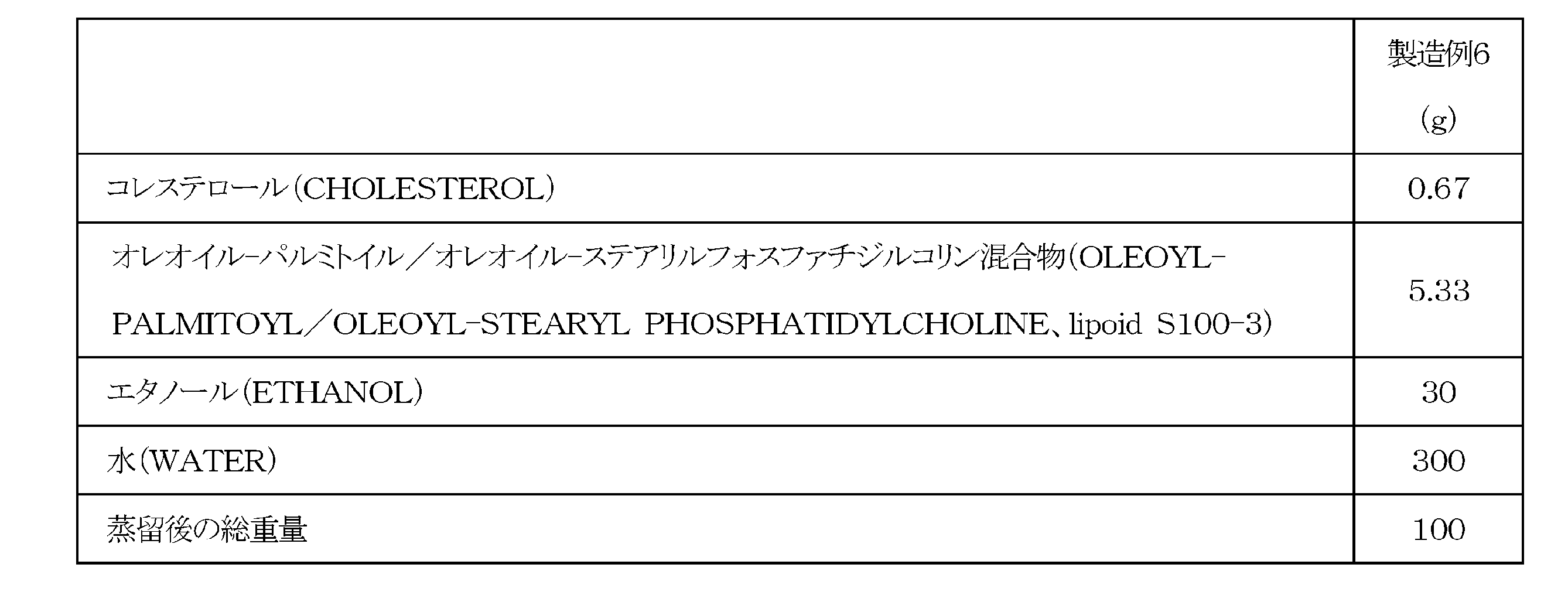
また、下記の表4の組成にて有機粒子としてポリマーソームが含有された水分散コロイド溶液を製造した。ポリ(メタクリル酸-co-ステアリルメタクリレート)共重合体、100%水添されたオレオイル-パルミトイル/オレオイル-ステアリルフォスファチジルコリン混合物(Lipoid S100-3)及びコレステロールを60℃のエタノールに加温溶解させて混合液を製造した。前記混合液を60℃の水に投入してからホモジナイザーで5,000rpmの速度で5分間混合及び撹拌させて、1次分散された高分子-リポソーム複合体を製造した後、高圧ホモジナイザー(high pressure homogenizer;1,000bar、3 cycle)を用いて水分散型有機ナノ粒子を製造した。回転蒸発器を用いて残留エタノール溶液を除去しpH敏感性高分子を用いた高分子-リポソームナノ複合体を製造した。 Also, a water-dispersed colloidal solution containing polymersomes as organic particles was prepared according to the composition shown in Table 4 below. Poly(methacrylic acid-co-stearyl methacrylate) copolymer, 100% hydrogenated oleoyl-palmitoyl/oleoyl-stearyl phosphatidylcholine mixture (Lipoid S100-3) and cholesterol were warmed to ethanol at 60°C. A mixture was prepared by dissolving. The mixed solution was added to water at 60° C., mixed and stirred with a homogenizer at a speed of 5,000 rpm for 5 minutes to prepare a primary dispersed polymer-liposome complex, and then subjected to a high pressure homogenizer. Water-dispersed organic nanoparticles were produced using a homogenizer (1,000 bar, 3 cycles). A polymer-liposome nanocomposite using a pH-sensitive polymer was prepared by removing the residual ethanol solution using a rotary evaporator.

実施例.乳化組成物の製造
本実施例では前記製造例1及び5で製造した水分散コロイド溶液を乳化剤として用いて乳化組成物を製造した。前記水分散コロイド溶液に分散された有機ナノ粒子を界面粒子として用いるか、又は前記水分散コロイド溶液に分散された有機ナノ粒子と無機粒子の両方を界面粒子として用いて乳化組成物を製造した。また、界面活性剤を乳化剤として用いて比較例1の乳化組成物を製造した。乳化組成物は、下記の表5の組成(重量%)にて次のように製造した。
Example. Production of Emulsified Composition In this example, an emulsified composition was produced using the water-dispersed colloidal solutions produced in Production Examples 1 and 5 as emulsifiers. An emulsified composition was prepared by using the organic nanoparticles dispersed in the water-dispersed colloidal solution as interfacial particles, or using both the organic nanoparticles and inorganic particles dispersed in the water-dispersed colloidal solution as interfacial particles. Also, an emulsified composition of Comparative Example 1 was produced using a surfactant as an emulsifier. An emulsified composition having the composition (% by weight) shown in Table 5 below was produced as follows.
1)水相部を50~75℃に加温して混合及び溶解させた。水分散コロイド溶液は水相部に添加した。
2)残りの油相部を50~75℃に加温して混合及び溶解させた。無機粒子は油相部に添加した。
3)温度を50~75℃に保持しながら水相部と油相部とを混合しホモジナイザーによってO/W乳化組成物を製造した。
1) The aqueous phase was heated to 50-75°C to mix and dissolve. The water-dispersed colloidal solution was added to the aqueous phase.
2) The rest of the oil phase was heated to 50-75°C to mix and dissolve. Inorganic particles were added to the oil phase.
3) While maintaining the temperature at 50 to 75°C, the water phase and the oil phase were mixed to produce an O/W emulsified composition using a homogenizer.

実施例1~7の乳化組成物は乳化安定度が高いのに対し、界面活性剤としてダイマージリノール酸ジイソステアリン酸ポリグリセリル-3及びジイソステアリン酸ポリグリセリル-4/ポリヒドロキシステアリン酸/セバケートを添加して乳化させた比較例1の乳化組成物は低い乳化安定度を示した。実施例1~7の乳化組成物は界面粒子が内相と外相との間に界面を形成し安定した内相を形成した。 While the emulsified compositions of Examples 1 to 7 have high emulsification stability, polyglyceryl-3 diisostearate dimer dilinoleate and polyglyceryl-4 diisostearate/polyhydroxystearate/sebacate were added as surfactants to emulsify. The emulsified composition of Comparative Example 1, which was prepared, exhibited low emulsification stability. In the emulsified compositions of Examples 1 to 7, interfacial particles formed an interface between the internal phase and the external phase to form a stable internal phase.
実施例1~3の乳化組成物は、界面粒子として有機粒子だけではなく無機粒子を含む。一般的に無機粒子を含む場合は乳化システムの安定度を落とすため、これを補うために界面活性剤の使用を必要とする。しかし、本開示の一側面に係る乳化組成物は、無機粒子を含んでも乳化安定度を保持しており、界面活性剤を用いることなく安定した乳化システムを形成することを確認した。無機粒子の含量が増加しても乳化システムの安定度を保持した。また、増粘剤は内相と外相との間の界面安定度に影響を及ぼさなかった。したがって、本開示の一側面に係る乳化組成物は増粘剤の種類に影響を受けることなく乳化システムの安定度を保持することができることが確認された。 The emulsified compositions of Examples 1-3 contain inorganic particles as well as organic particles as interfacial particles. The inclusion of inorganic particles generally degrades the stability of the emulsified system, necessitating the use of surfactants to compensate. However, it was confirmed that the emulsified composition according to one aspect of the present disclosure maintains emulsification stability even if it contains inorganic particles, and forms a stable emulsified system without using a surfactant. The stability of the emulsified system was retained even when the content of inorganic particles increased. Also, the thickener did not affect the interfacial stability between the inner and outer phases. Therefore, it was confirmed that the emulsified composition according to one aspect of the present disclosure can maintain the stability of the emulsified system without being affected by the type of thickener.
実施例4~7の乳化組成物は界面粒子として有機粒子のみを用い、実施例4の乳化組成物は追加的に界面活性剤を添加したものである。実施例1~3の乳化組成物と同様、実施例4~7の乳化組成物は、安定した乳化システムを形成することが確認された。また、界面粒子の使用と共に界面活性剤を添加した場合、乳化安定度をより向上させることができることが確認された。一般的に乳化組成物を形成するために用いられる界面活性剤の含量に比べて、極めて少量でも優れた乳化安定度を提供することができた。界面活性剤の少量使用が可能になることから、皮膚刺激を最小化することができた。一方、界面活性剤を添加する場合、内相のサイズは小さくなる傾向が示された。 The emulsified compositions of Examples 4 to 7 used only organic particles as interfacial particles, and the emulsified composition of Example 4 additionally added a surfactant. Similar to the emulsified compositions of Examples 1-3, it was confirmed that the emulsified compositions of Examples 4-7 form stable emulsified systems. In addition, it was confirmed that the emulsification stability can be further improved when a surfactant is added together with the use of interfacial particles. Compared to the surfactant content generally used to form emulsion compositions, even a very small amount could provide excellent emulsion stability. Since a small amount of surfactant can be used, skin irritation can be minimized. On the other hand, when the surfactant was added, the size of the internal phase tended to decrease.
比較例1の乳化組成物は、界面粒子を用いることなく界面活性剤にて乳化させたものである。比較例1の乳化組成物は、経時的に内相間の合一が生じ、凍結乾燥後にオイル分離現象が現われて、実施例1~7の乳化組成物に比べて剤形安定度に劣る結果を示した。 The emulsified composition of Comparative Example 1 was emulsified with a surfactant without using interfacial particles. In the emulsified composition of Comparative Example 1, the coalescence of the internal phases occurred over time, and the oil separation phenomenon appeared after freeze-drying. Indicated.
実験例1.界面粒子の粒度分析
前記製造例1で製造したナノエマルジョン粒子を粒度分析器(Mastersizer、Malvern、イギリス)を用いて分析した結果、平均130.5nmの粒子サイズを有することを確認した(図1参照)。PDIは異質性指数を示し、PDI値が高いほど異質性が高い分散状態を示す。前記製造例1で製造したナノエマルジョン粒子は、比較的安定し且つ同質の分散状態を有することが確認された。
Experimental example 1. Particle Size Analysis of Interfacial Particles The nanoemulsion particles prepared in Preparation Example 1 were analyzed using a particle size analyzer (Mastersizer, Malvern, UK) and found to have an average particle size of 130.5 nm (see FIG. 1). ). PDI indicates a heterogeneity index, and the higher the PDI value, the more heterogeneous the dispersion state. It was confirmed that the nanoemulsion particles prepared in Preparation Example 1 had a relatively stable and uniform dispersion state.
実験例2.乳化組成物の内相確認
乳化組成物の内相構造を確認するために、蛍光染料(nile red、515-560nm excitation;>590nm emission)を入れて前記製造例5と同じ方法にて固体脂質ナノ粒子が含有された水分散コロイド溶液を製造してから、前記実施例6と同じ方法にてO/W乳化組成物を製造した。蛍光染料を添加して製造された乳化組成物の内相を顕微鏡で観察した。
Experimental example 2. Confirmation of the internal phase of the emulsified composition In order to confirm the internal phase structure of the emulsified composition, a fluorescent dye (nile red, 515-560 nm excitation; >590 nm emission) was added and solid lipid nanoparticles were produced in the same manner as in Preparation Example 5. After preparing a water-dispersed colloidal solution containing particles, an O/W emulsified composition was prepared in the same manner as in Example 6 above. The internal phase of the emulsified composition prepared by adding the fluorescent dye was observed under a microscope.
図2にレーザー共焦点顕微鏡(Laser Confocal Microscope、VIVASCOPE 1500)で観察したイメージを示した。蛍光染料が担持された界面粒子、すなわち有機ナノ粒子が内相と外相との界面に位置することが確認された。本開示の一側面に係る乳化組成物は、界面活性剤を用いることなく界面粒子を内相と外相との界面に安定化させて安定した内相を形成することができることが確認された。 FIG. 2 shows an image observed with a laser confocal microscope (VIVASCOPE 1500). It was confirmed that interfacial particles carrying a fluorescent dye, ie, organic nanoparticles, were positioned at the interface between the inner and outer phases. It was confirmed that the emulsified composition according to one aspect of the present disclosure can form a stable internal phase by stabilizing interfacial particles at the interface between the internal phase and the external phase without using a surfactant.
実験例3.乳化組成物の顕微鏡観察及びレオロジー分析
下記の表6の組成(重量%)にて通常の方法に従い一般的なO/W乳化組成物を製造して下記の実験に用いた。
Experimental example 3. Microscopic Observation and Rheological Analysis of Emulsified Composition A general O/W emulsified composition was produced according to a conventional method with the composition (% by weight) shown in Table 6 below and used in the following experiments.

また、下記の表7の組成(重量%)にて、通常の方法に従いピッカリング乳化組成物を製造して下記の実験に用いた。 In addition, a Pickering emulsified composition was produced according to a conventional method with the composition (% by weight) shown in Table 7 below and used in the following experiments.
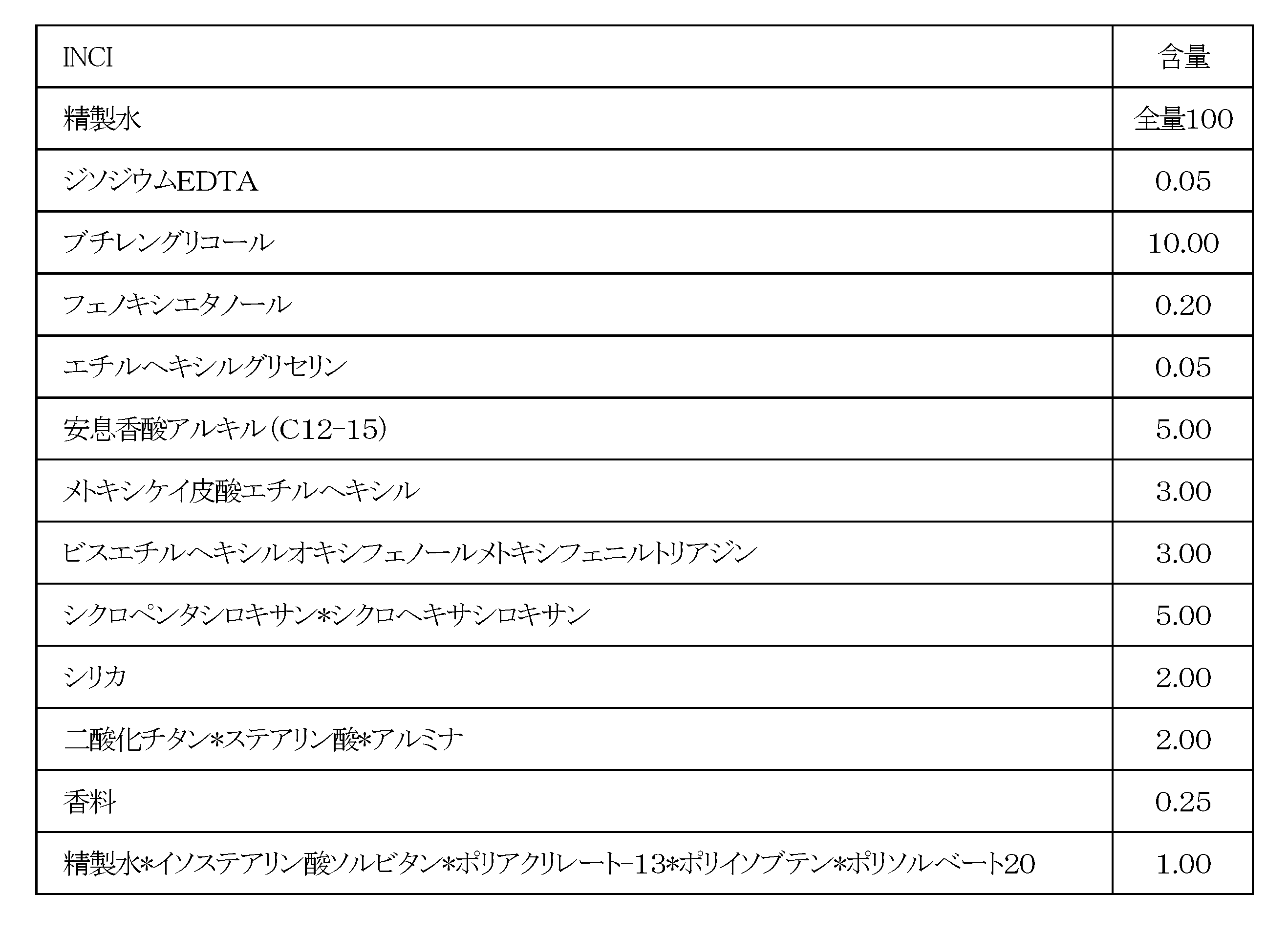
前記表6の組成にて製造した一般のO/W乳化組成物と実施例5で製造した乳化組成物とを超低温走査電子顕微鏡(Cryo Field Emission Scanning Electron Microscope、Cryo-FE-SEM、Nova SEM、FEI company)で観察して内相の表面を比較した。その結果、実施例5で製造した乳化組成物は、複数の界面粒子が内相の表面に位置して内相の表面が粟粒形状を有することが確認された(図3及び4参照)。一方、図5の写真中の中央部位に位置している一般のO/W乳化組成物の内相を確認してみると、界面活性剤によって生成された乳化組成物の内相は滑らかな表面を有しており、本開示の一側面に係る乳化組成物とは全く異なる構造を有することが分かった。 The general O/W emulsified composition prepared according to the composition shown in Table 6 and the emulsified composition prepared in Example 5 were subjected to ultra-low temperature scanning electron microscope (Cryo Field Emission Scanning Electron Microscope, Cryo-FE-SEM, Nova SEM, FEI company) and compared the surface of the internal phase. As a result, it was confirmed that the emulsion composition prepared in Example 5 had a plurality of interfacial particles located on the surface of the internal phase and the surface of the internal phase had a millet grain shape (see FIGS. 3 and 4). On the other hand, when the internal phase of the general O/W emulsified composition located in the central part of the photograph of FIG. and was found to have a completely different structure from the emulsified composition according to one aspect of the present disclosure.
従来のナノエマルジョン粒子、固体脂質ナノ粒子、リポソーム、及びポリマーソームなどのような有機粒子は効能成分の伝達体としてのみ用いられていた。従来の界面活性剤によって生成された乳化組成物の場合、前記有機粒子が含有されているといっても、図3に示すような内相の表面、すなわち内相と外相との界面に有機粒子が複数配置されている形態ではない、図5に示すような滑らかな内相の表面を示す。このことから、前記有機粒子が含有された従来の乳化組成物は有機粒子が界面粒子として作用して内相を形成したものではではないことが分かる。本開示の一側面に係る乳化組成物は、効能成分の伝達体として前記有機粒子を含む一般乳化組成物と相違するものである。 Conventional organic particles such as nanoemulsion particles, solid lipid nanoparticles, liposomes, and polymersomes have been used only as delivery vehicles for active ingredients. In the case of emulsified compositions produced by conventional surfactants, even though the organic particles are contained, the organic particles are present on the surface of the internal phase, that is, on the interface between the internal phase and the external phase, as shown in FIG. It shows a smooth inner phase surface as shown in FIG. From this, it can be seen that the conventional emulsified composition containing the organic particles does not form an internal phase with the organic particles acting as interfacial particles. The emulsified composition according to one aspect of the present disclosure is different from the general emulsified composition containing the organic particles as a carrier of active ingredients.
また、従来の界面活性剤によって生成された乳化組成物の場合、前記有機粒子が含有されているといっても、内相のサイズが大きくなると内相と外相との界面が不安定になって内相の合一が生じる。このため、内相のサイズを大きくすることができないという限界があり、本開示の一側面に係る乳化組成物のような独特の使用感を奏し得ない。 In addition, in the case of emulsified compositions produced by conventional surfactants, even if the organic particles are contained, as the size of the internal phase increases, the interface between the internal phase and the external phase becomes unstable. A union of inner phases occurs. Therefore, there is a limit that the size of the internal phase cannot be increased, and the unique feel of use of the emulsified composition according to one aspect of the present disclosure cannot be achieved.
前記製造した実施例1及び2の乳化組成物と前記表7の組成にて製造したピッカリング乳化組成物とを、それぞれ光学顕微鏡(optical microscope、DSX110、OLYMPUS)で観察して図6~8に示した。光学顕微鏡による観察の際に一般的にカバーガラスはその必要に応じて使用の有無を決める。本実験例ではピッカリング乳化組成物(図8参照)を観察する際にカバーガラスを覆って観察したため、実施例1及び2の乳化組成物とは異なるイメージを示した。図7と8をみると、無機粒子の使用によって黒く見える部分が確認され、実施例2の乳化組成物(図7参照)の場合、実施例1の乳化組成物(図6参照)に比べて無機粒子の含量が相対的に高いことから黒く見える部分が広い面積から確認された。 The emulsified compositions of Examples 1 and 2 produced above and the Pickering emulsified compositions produced according to the compositions of Table 7 were observed with an optical microscope (DSX110, OLYMPUS), and the results are shown in FIGS. Indicated. During observation with an optical microscope, the use or non-use of a cover glass is generally determined according to the need. In this experimental example, the Pickering emulsified composition (see FIG. 8) was observed while covering it with a cover glass. 7 and 8, it can be seen that the portion that looks black due to the use of inorganic particles is observed. Since the content of inorganic particles is relatively high, a black portion was confirmed from a wide area.
前記表6の組成にて製造した一般のO/W乳化組成物、前記表7の組成にて製造したピッカリング乳化組成物と実施例6及び7の乳化組成物を対象にレオロジー(測定機器:RHEOMETER(AR2000)、測定条件:osc.stress(Pa)0.1~1000@frequency 50Hz、室温)を測定して図9に示した。
Rheology (measurement equipment: RHEOMETER (AR2000), measurement conditions: osc.stress (Pa) 0.1 to 1000 @
その結果、一般のO/W乳化組成物は皮膚への塗布時に約100Paのせん断応力で構造が崩れて塗り性を示すことが確認された。これに対し、実施例6及び7の乳化組成物は0.1~1.0Paで降伏応力(Yield stress)値を有することを確認した。これは、他の剤形とは異なり、初期の崩れる使用感、すなわち、初期の水弾けの使用感を感じ得る特徴があることを示す。実施例6及び7の乳化組成物の場合、ゼロせん断粘度(zero shear viscosity)値、すなわち初期粘度値が一般のO/W乳化組成物と類似した水準を示して、初期ピックアップ及び皮膚への塗布時には一般のO/W乳化組成物と類似した厚み感を示したが、0.1~0.2Paの極めて小さいせん断応力で構造の崩れが生じて皮膚上でドラマチックに相が変わる現象を示した。このような構造的な崩れはどっしりしたクリームの使用感から柔らかいローションの塗り性のような使用感に素早く変わる感じを提供し、このような相の変化(転相)はユーザが使用感の特異性として認知するようになる。また、実施例6及び7の乳化組成物は、ずり増粘(shear-thickening)現象のように後半に粘度が増加する現象を示した。これは界面粒子の特徴が後半に現われるからである。この結果、本開示の一側面に係る乳化組成物は界面粒子の塗布によった滑らかな仕上がり感と肌荒れ改善及び保湿効果を提供することができる。 As a result, it was confirmed that a general O/W emulsified composition loses its structure under a shearing stress of about 100 Pa when applied to the skin and exhibits good applicability. On the other hand, it was confirmed that the emulsified compositions of Examples 6 and 7 had a yield stress value at 0.1-1.0 Pa. This indicates that, unlike other dosage forms, it has an initial crumbling feeling, that is, an initial feeling of water splashing. In the case of the emulsified compositions of Examples 6 and 7, the zero shear viscosity value, that is, the initial viscosity value showed a level similar to that of the general O/W emulsified composition, and the initial pick-up and application to the skin Occasionally, it exhibited a thickness similar to that of a general O/W emulsified composition. . Such structural collapse provides a feeling of use that quickly changes from a heavy cream feeling to a soft lotion-like feeling, and such a phase change (phase inversion) allows the user to feel the unique feeling of use. become recognized as sexual. In addition, the emulsified compositions of Examples 6 and 7 exhibited a phenomenon in which the viscosity increased in the latter half, such as a shear-thickening phenomenon. This is because the characteristics of interfacial particles appear in the latter half. As a result, the emulsified composition according to one aspect of the present disclosure can provide a smooth finished feeling, rough skin improvement, and moisturizing effect due to the application of the interfacial particles.
前述したように、実施例6及び7の乳化組成物は、初期の小さいせん断応力で素早くずり減粘(shear-thinning)が生じて塗り性を極大化させることができ、且つ皮膚に水分と有効成分が吸収されてせん断応力がさらに高くなる100~1,000Pa付近で界面粒子によって皮膚の上に保湿膜が形成されることで柔らかい仕上がり感を付与することができる点において、一般のO/W乳化組成物やピッカリング乳化組成物とは差異があった。 As described above, the emulsified compositions of Examples 6 and 7 were able to quickly shear-thinning with a small initial shear stress to maximize the spreadability, and to provide moisture and effectiveness to the skin. In the vicinity of 100 to 1,000 Pa, where the ingredients are absorbed and the shear stress is further increased, a moisturizing film is formed on the skin by the interfacial particles, so that a soft feeling of finish can be imparted. There was a difference between the emulsified composition and the Pickering emulsified composition.
実験例4.乳化組成物の剤形安定性確認
(1)凍結乾燥後の剤形安定性確認
前記製造した実施例1~7及び比較例1の乳化組成物と前記実験例3で表6の組成にて製造した一般のO/W乳化組成物を凍結乾燥し、これらの剤形安定性を確認した。
Experimental example 4. Confirmation of dosage form stability of emulsified composition (1) Confirmation of dosage form stability after freeze-drying The emulsified compositions of Examples 1 to 7 and Comparative Example 1 produced above and the composition shown in Table 6 in Experimental Example 3 The obtained general O/W emulsified composition was lyophilized to confirm the stability of these formulations.
凍結乾燥とは、乾燥方法の一種類であって、物質を凍結させ水蒸気(water vapor)の分圧を下げることで氷を直接蒸気にする昇華過程を通じて乾燥物を製造することを意味する。試料を冷凍庫を用いて-80℃以下の温度で凍結させてから乾燥器に移した後に昇華させた。その結果、実施例1~7の乳化組成物はオイル分離現象がないのに対し、比較例1及び実験例3の一般のO/W乳化組成物はオイル分離現象が示されることが確認された。図10に実験例3の一般のO/W乳化組成物(左側写真)と実施例6の乳化組成物(右側写真)とを比較して示した。 Freeze-drying is a kind of drying method, and refers to producing a dry product through a sublimation process in which ice is directly vaporized by freezing a substance and lowering the partial pressure of water vapor. The sample was frozen at a temperature of −80° C. or lower using a freezer, transferred to a drier, and sublimed. As a result, it was confirmed that the emulsified compositions of Examples 1 to 7 had no oil separation phenomenon, while the common O/W emulsified compositions of Comparative Example 1 and Experimental Example 3 exhibited oil separation phenomenon. . FIG. 10 shows a comparison between the general O/W emulsified composition of Experimental Example 3 (left photograph) and the emulsified composition of Example 6 (right photograph).
このような凍結乾燥は、パウダー状に再加工して使用段階で再水化することで、目的に応じて効能成分の安定化及び多様な形態の製品にて活用が可能であるという長所がある。実験例3のような一般のO/W乳化組成物は、凍結乾燥過程で外郭が収縮しながら変形が生じてオイルが染み出る現象が発生し凍結乾燥剤形で具現するのが不可能であるのに対し、本開示の一側面に係る乳化組成物は、凍結乾燥の際にもオイルが分離する現象を生じることなく内相構造体を安定して保持して優れた剤形安定性を奏する効果がある。したがって、一般のO/W乳化組成物の場合、内相構造体を安定して保持するために更なる他の工夫が必要となり、そのため、期待しなかった使用感が現われたりすることもある。しかし、本開示の一側面に係る乳化組成物のように界面粒子を用いて乳化組成物を形成すると、内相が界面粒子によってパッキングされその構造を安定して保持することができるため、更なる他の物質を用いることなく優れた剤形安定性を奏することができ、且つ使用感にも優れるという効果を奏する。 Such freeze-drying is reprocessed into powder and rehydrated at the stage of use, so it has the advantage of stabilizing the active ingredients according to the purpose and being able to be used in various forms of products. . A general O/W emulsified composition such as that of Experimental Example 3 cannot be embodied as a freeze-dried formulation because the shell shrinks and deforms during the freeze-drying process, causing oil to seep out. On the other hand, the emulsified composition according to one aspect of the present disclosure stably retains the internal phase structure without causing the phenomenon of oil separation even during freeze-drying, and exhibits excellent dosage form stability. effective. Therefore, in the case of a general O/W emulsified composition, further measures are required to stably retain the internal phase structure, and as a result, an unexpected feel during use may appear. However, when an emulsion composition is formed using interfacial particles like the emulsified composition according to one aspect of the present disclosure, the internal phase is packed by the interfacial particles and the structure can be stably maintained. It is possible to exhibit excellent dosage form stability without using other substances, and it is possible to exhibit effects such as excellent feeling of use.
(2)温度変化による剤形安定性確認
前記製造した実施例6の乳化組成物の温度変化による剤形安定性を観察して図11に示した。常温、37℃、45℃、冷蔵条件でそれぞれ4週間保管したときに剤形安定性を保持することが確認された。また、12時間にわたって40℃から-10℃まで、そして-10℃から40℃まで温度変化を加える方式で計4週間、12時間の周期でサイクリング保管時でもオイルが分離する現象を生じることなく剤形安定性を保持することが確認された。
(2) Confirmation of Formulation Stability by Temperature Change Formulation stability by temperature change of the prepared emulsified composition of Example 6 was observed and shown in FIG. It was confirmed that the dosage form stability was maintained when stored for 4 weeks at room temperature, 37° C., 45° C., and under refrigeration conditions. In addition, by changing the temperature from 40°C to -10°C and then from -10°C to 40°C over 12 hours, the oil is kept in a cycle of 12 hours for a total of 4 weeks without causing oil separation. It was confirmed that the shape stability was maintained.
また、前記製造した実施例6の乳化組成物の剤形安定性を経時変化による粘度測定を通じて観察して表8に表した。粘度は粘度計(Brookfield Viscometer、LVDV-2+P)を用いて30℃で保管されたサンプルを対象に測定した(測定条件:S64スピンドラー、12rpm、2分間測定)。その結果、本開示の一側面に係る乳化組成物は、優れた剤形安定性を有することが確認された。 In addition, the formulation stability of the prepared emulsified composition of Example 6 was observed through viscosity measurement over time, and the results are shown in Table 8. Viscosity was measured using a viscometer (Brookfield Viscometer, LVDV-2+P) on samples stored at 30°C (measurement conditions: S64 spindle, 12 rpm, 2 minutes measurement). As a result, it was confirmed that the emulsified composition according to one aspect of the present disclosure has excellent dosage form stability.

実験例5.効能成分の皮膚伝達力
前記製造した実施例7の乳化組成物を用いて界面粒子に含有された効能成分であるトコフェロールの皮膚デリバリー効果を確認して図12に示した。前記効能成分の皮膚デリバリー効果は前記実験例3における表6の組成にトコフェロール0.5重量%を添加して製造した一般のO/W乳化組成物と比較した。
Experimental example 5. Skin Delivery Power of Active Ingredients Using the emulsified composition of Example 7 prepared above, the skin delivery effect of tocopherol, an active ingredient contained in the interface particles, was confirmed and shown in FIG. The skin delivery effect of the active ingredient was compared with a general O/W emulsified composition prepared by adding 0.5% by weight of tocopherol to the composition shown in Table 6 in Experimental Example 3 above.
効能成分の皮膚デリバリー効果を確認するために、先ず、各組成物を皮膚に塗って3時間待った後、その表面に残留している組成物を拭き取ってから皮膚角質採取用ストリッピングテープ(D-Squame Stripping Discs D101、CUDERM)で10枚テーピング(taping)をした。DESI-MS(機器名:QTOF-MS(Q-Time of Flight Mass Spectrometer))イメージング技術によってテープにくっ付いている効能成分であるトコフェロールをイメージ化して皮膚デリバリー効果を確認した。 In order to confirm the skin delivery effect of the active ingredients, first, each composition was applied to the skin and waited for 3 hours. 10 sheets of Squame Stripping Discs D101, CUDERM) were taped. DESI-MS (equipment name: QTOF-MS (Q-Time of Flight Mass Spectrometer)) imaging technology was used to image the active ingredient tocopherol attached to the tape, and the skin delivery effect was confirmed.
その結果、実施例7の乳化組成物が一般のO/W乳化組成物に比べて効能成分をより皮膚深くまで伝達することが確認された。図12中の明るい部分が効能成分を示す。 As a result, it was confirmed that the emulsified composition of Example 7 delivered the active ingredients deeper into the skin than the general O/W emulsified composition. Bright areas in FIG. 12 indicate active ingredients.
実験例6.効能成分の皮膚吸収力
前記製造した実施例7の乳化組成物を用いて、界面粒子に含有された効能成分であるトコフェロールの皮膚吸収力を確認して図13に示した。前記効能成分の皮膚吸収力は前記実験例3における表6の組成にトコフェロール0.5重量%を添加して製造した一般のO/W乳化組成物と比較した。
Experimental example 6. Skin Absorbability of Effective Ingredient Using the emulsified composition of Example 7 prepared above, the skin absorbability of tocopherol, which is an effective ingredient contained in the interface particles, was confirmed and shown in FIG. The skin absorbability of the active ingredient was compared with that of a general O/W emulsified composition prepared by adding 0.5% by weight of tocopherol to the composition shown in Table 6 in Experimental Example 3 above.
効能成分の皮膚吸収量を確認するために、先ず、各組成物を皮膚に塗って3時間待った後、その表面に残留している組成物を拭き取ってから皮膚角質採取用ストリッピングテープ(D-Squame Stripping Discs D101、CUDERM)で10枚テーピング(taping)をした。HPLC分析によってテープにくっ付いている効能成分であるトコフェロールを分析して皮膚吸収量を確認した(分析装備:Waters e2695、カラムSunFire Slica(4.6×250mm×5μm)、ヘキサン:イソプロパノール=99:1、流速0.7mL/min、325nm)。 In order to confirm the amount of active ingredients absorbed into the skin, first, each composition was applied to the skin and waited for 3 hours. 10 sheets of Squame Stripping Discs D101, CUDERM) were taped. The skin absorption amount was confirmed by analyzing the effective ingredient tocopherol attached to the tape by HPLC analysis (Analysis equipment: Waters e2695, column SunFire Slica (4.6×250 mm×5 μm), hexane:isopropanol=99: 1, flow rate 0.7 mL/min, 325 nm).
その結果、実施例7の乳化組成物が、一般のO/W乳化組成物に比べてより高い効能成分の皮膚吸収力を提供することが確認された。図13中の1~5テープ、6~10テープ、1~10テープは、それぞれ第1番~第5番のテープの平均値、第6番~第10番のテープの平均値、第1番~第10番のテープの平均値を示し、y軸は測定されたトコフェロール吸収量(%)を示す。 As a result, it was confirmed that the emulsified composition of Example 7 provided higher skin absorbability of the active ingredient than the general O/W emulsified composition. 1 to 5 tapes, 6 to 10 tapes, and 1 to 10 tapes in FIG. Figure 10 shows the mean values for tapes numbered 1 to 10 and the y-axis shows the measured tocopherol absorption (%).
実験例7.乳化組成物の塗布後の肌キメ及び水分変化量確認
前記製造した実施例6の乳化組成物を皮膚に塗布して、肌キメ及び水分変化率を観察した。
Experimental example 7. Confirmation of Skin Texture and Moisture Change after Application of Emulsified Composition The emulsified composition produced in Example 6 was applied to the skin, and the skin texture and moisture change rate were observed.
その結果、実施例6の乳化組成物を皮膚に塗布した場合、塗布前に比べて肌荒れが約14.4%減少することが確認された(図14参照)。また、無塗布実験群及び前記実験例3における表6の組成にて製造した一般のO/W乳化組成物塗布実験群と対比しての水分変化率を確認した結果、実施例6の乳化組成物を皮膚に塗布した場合、皮膚に水分をより長く持ち続けることができることが確認された(図15参照)。これは皮膚への塗布時に界面粒子が、弾けながら皮膚表面にパッキングされて水分損失を抑え且つ肌キメを滑らかにするためである。 As a result, it was confirmed that when the emulsified composition of Example 6 was applied to the skin, rough skin was reduced by about 14.4% compared to before application (see FIG. 14). In addition, as a result of confirming the moisture change rate in comparison with the non-application experimental group and the general O / W emulsified composition application experimental group produced with the composition of Table 6 in Experimental Example 3, the emulsified composition of Example 6 was confirmed. It was confirmed that when the substance was applied to the skin, the skin could retain moisture for a longer period of time (see FIG. 15). This is because, when applied to the skin, the interfacial particles are popped and packed on the skin surface to suppress water loss and smooth the skin texture.
実験例8.乳化組成物の塗布後の乾燥環境での皮膚変化確認
前記製造した実施例7の乳化組成物を皮膚に塗布した後、乾燥環境で皮膚水分量、目じり皮膚柔軟性、目じり皮膚弾力及び目じりしわ変化を確認してそれぞれ図16~19に示した。乾燥環境は、相対湿度35%未満の条件で1時間待つこととした。
Experimental example 8. Confirmation of skin changes in a dry environment after application of the emulsified composition After applying the emulsified composition of Example 7 produced above to the skin, changes in skin moisture content, skin flexibility at the corners of the eyes, skin elasticity at the corners of the eyes, and wrinkles at the corners of the eyes in a dry environment were confirmed and shown in FIGS. 16 to 19, respectively. As for the dry environment, we waited for 1 hour under the condition of less than 35% relative humidity.
その結果、組成物を塗布していない実験群とは異なり、実施例7の乳化組成物を塗布した場合、乾燥環境で皮膚水分量、目じり皮膚柔軟性、目じり皮膚弾力が増加し目じりしわを防止する効果を奏することが確認された。 As a result, unlike the experimental group in which the composition was not applied, when the emulsified composition of Example 7 was applied, the skin moisture content, the corner-of-the-eye skin flexibility, and the corner-of-the-eye skin elasticity increased in a dry environment, and the corner-of-the-eye wrinkles were prevented. It was confirmed that there is an effect to
実験例9.効能成分の皮膚刺激減少効果(その1)
前記実施例に記載された方法に従い、表9の組成(重量%)にてO/W乳化組成物を製造し、皮膚刺激程度及びレチノールの力価を確認した。
Experimental example 9. Skin irritation reduction effect of active ingredients (Part 1)
O/W emulsified compositions were produced with the compositions (% by weight) shown in Table 9 according to the method described in the above examples, and the degree of skin irritation and retinol potency were confirmed.
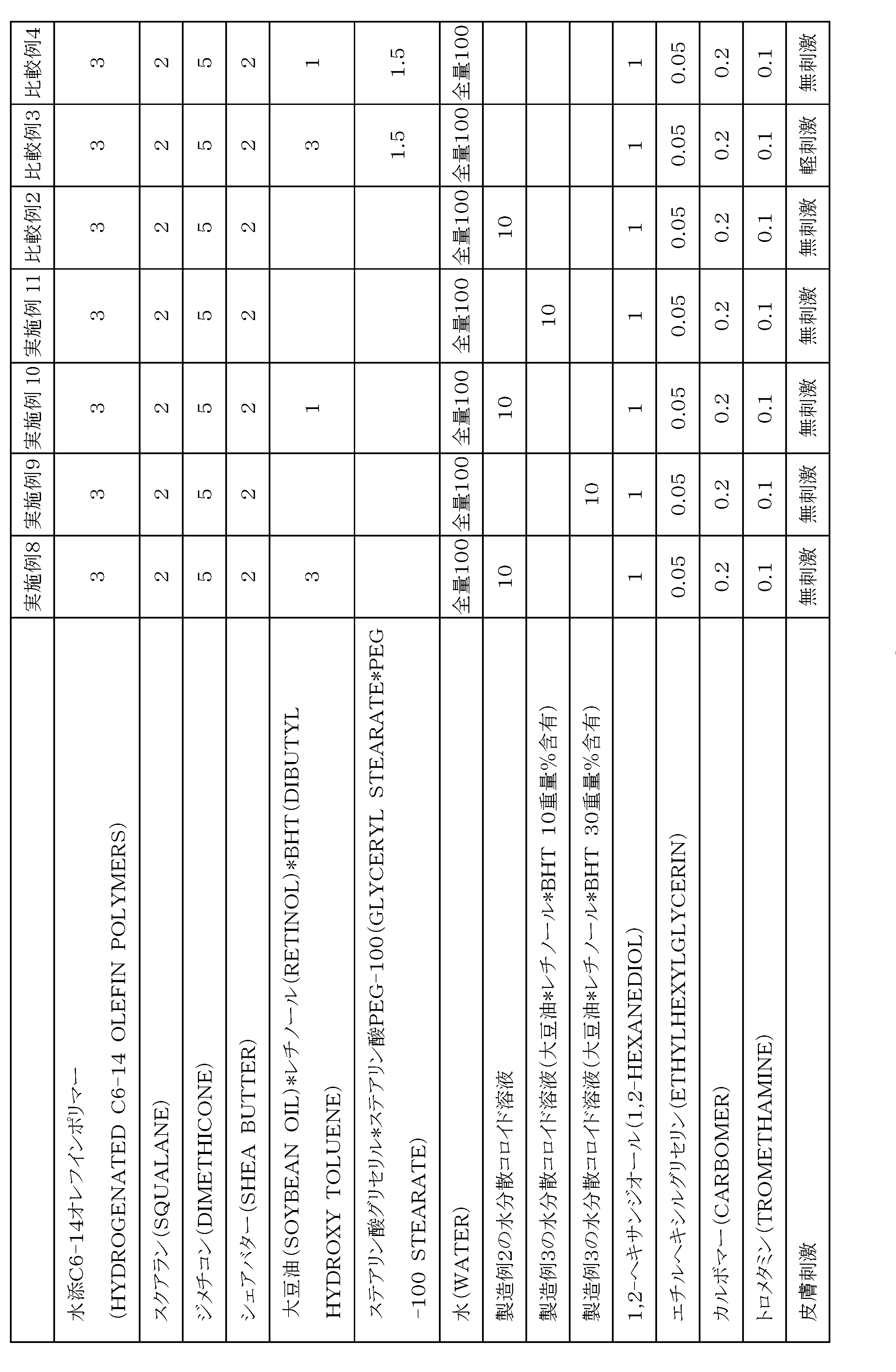
実施例8~11と比較例2は、水分散コロイド溶液を用いてO/W乳化組成物を製造したものであり、比較例3及び4は、界面活性剤を用いて一般のO/W乳化組成物を製造したものである。実施例8~11と比較例2の乳化組成物は、有効成分であるレチノールの含有の有無に係わらず有機粒子を用いて安定した乳化システムを形成することを確認した。実施例8及び10は、レチノールが内相、すなわち乳化粒子に担持されたものであり、実施例9及び11は、レチノールが界面粒子、すなわち有機粒子に担持されたものである。 In Examples 8-11 and Comparative Example 2, O/W emulsified compositions were produced using a water-dispersed colloidal solution, and in Comparative Examples 3 and 4, general O/W emulsified compositions were produced using a surfactant. A composition is produced. It was confirmed that the emulsified compositions of Examples 8 to 11 and Comparative Example 2 formed stable emulsified systems using organic particles regardless of the presence or absence of retinol as an active ingredient. Examples 8 and 10 have retinol carried in the internal phase, ie emulsifying particles, and Examples 9 and 11 have retinol carried in interfacial particles, ie organic particles.
皮膚刺激の実験は、次のようにして実施された。22人の被験者を対象にIQ chamber(商標) Systemを用いて実験物質を前腕部位に6回、24時間にかけて閉鎖貼付を実施した。反応検査は、塗布終了時点あるいは最大反応時点までCTFAガイドライン(1981)とFrosch & Kligman(1979)の検査基準によって定めた下記の基準によって行われた。
等級0:反応なし
等級1:軽い紅斑、まだら又は発熱
等級2:普通の紅斑
等級3:むくみを伴う強い紅斑
等級4:むくみと水泡を伴う強い紅斑
Skin irritation experiments were performed as follows. Twenty-two subjects underwent six closed patches of the study material on the forearm site over a period of 24 hours using the IQ chamber™ System. The response test was performed according to the following criteria defined by the CTFA guidelines (1981) and the Frosch & Kligman (1979) test criteria until the end of application or the maximum response time.
Grade 0: No reaction Grade 1: Mild erythema, mottling or fever Grade 2: Normal erythema Grade 3: Severe erythema with swelling Grade 4: Severe erythema with swelling and blisters
レチノールは、肌しわ改善に優れた効果を奏する長所があるが、組成物の剤形やユーザの皮膚によっては皮膚刺激を誘発し安定性が低いという不具合がある。特に、皮膚刺激の不具合を有する界面活性剤を含有する剤形では、レチノールと界面活性剤によって皮膚刺激の不具合が深化することがある。比較例3及び4の乳化組成物から分かるように、レチノールの含量が増加すると皮膚刺激が高くなる。しかし、前記実施例8~11の乳化組成物から確認できたように、有機粒子で乳化システムを形成するか、レチノールが担持された有機粒子で乳化システムを形成する場合、レチノールの皮膚刺激を顕著に減らすことができる。比較例2の乳化組成物は、レチノールと界面活性剤をいずれも含まないものであって、皮膚刺激がないことが確認された。 Retinol has the advantage of exhibiting an excellent effect in reducing skin wrinkles, but has the drawback of inducing skin irritation and low stability depending on the dosage form of the composition and the user's skin. Especially in dosage forms containing surfactants with skin irritation problems, retinol and surfactants can exacerbate skin irritation problems. As can be seen from the emulsified compositions of Comparative Examples 3 and 4, skin irritation increases with increasing retinol content. However, as can be seen from the emulsified compositions of Examples 8 to 11, when an emulsified system is formed with organic particles or organic particles carrying retinol, retinol causes significant skin irritation. can be reduced to The emulsified composition of Comparative Example 2 contained neither retinol nor surfactant, and was confirmed to have no skin irritation.
また、実施例8~11の乳化組成物を、それぞれ40℃で4週間保管してから乳化組成物中の含有されたレチノールの力価を確認した。レチノールの含量は高速液体クロマトグラフィー(HPLC、high Performance Liquid Chromatography)を用いて分析し、剤形中のレチノールの安定化率は93%以上であることを確認した。また、40℃で4週間保管しても内容物の変色があまりないことを確認した(図20参照)。 In addition, the emulsified compositions of Examples 8 to 11 were each stored at 40° C. for 4 weeks, and then the potency of retinol contained in the emulsified compositions was confirmed. The retinol content was analyzed using high Performance Liquid Chromatography (HPLC), and it was confirmed that the retinol stabilization rate in the dosage form was 93% or more. It was also confirmed that the contents did not change color even after being stored at 40° C. for 4 weeks (see FIG. 20).
実験例10.効能成分の皮膚刺激減少効果(その2)
前記実施例に記載された方法に従い、表11の組成(重量%)にてO/W乳化組成物を製造し、皮膚刺激程度を確認した。皮膚刺激程度は前記実験例9のような方法にて確認した。
Experimental example 10. Skin irritation reduction effect of active ingredients (Part 2)
An O/W emulsified composition was produced with the composition (% by weight) shown in Table 11 according to the method described in the above example, and the degree of skin irritation was confirmed. The degree of skin irritation was confirmed by the same method as in Experimental Example 9 above.


実施例12~17と比較例8は、水分散コロイド溶液を用いてO/W乳化組成物を製造したものであり、比較例9~11は、界面活性剤を用いて一般のO/W乳化組成物を製造したものである。実施例12~17と比較例8の乳化組成物は、有効成分であるバクチオールの含有の有無に係わらず有機粒子を用いて安定した乳化システムを形成することが確認された。実施例12、14及び16は、バクチオールがそれぞれ2.5重量%、1重量%、0.5重量%の含量で内相、すなわち乳化粒子に担持されたものであり、実施例13、15及び17は、バクチオールがそれぞれ2.5重量%、1重量%、0.5重量%の含量で界面粒子、すなわち有機粒子に担持されたものである。 In Examples 12-17 and Comparative Example 8, an O/W emulsified composition was produced using a water-dispersed colloidal solution, and in Comparative Examples 9-11, a general O/W emulsified composition was produced using a surfactant. A composition is produced. It was confirmed that the emulsified compositions of Examples 12 to 17 and Comparative Example 8 formed stable emulsified systems using organic particles regardless of the presence or absence of the active ingredient bakuchiol. In Examples 12, 14 and 16, bakuchiol was supported in the internal phase, i.e., emulsified particles, at a content of 2.5 wt%, 1 wt%, and 0.5 wt%, respectively. and 17, bakuchiol was supported on interfacial particles, ie, organic particles, at contents of 2.5% by weight, 1% by weight, and 0.5% by weight, respectively.
バクチオール効能成分の皮膚刺激を確認するために、皮膚刺激のないスクアルランに脂溶性成分であるバクチオールを入れて皮膚刺激の有無を確認した。その結果、0.5重量%以上のバクチオールが含有されたすべての実験群で皮膚刺激が発生することが確認された(表10参照)。また、比較例9~11から分かるように、バクチオールが含有された一般の乳化組成物は皮膚刺激を有する結果を示した。 In order to confirm the skin irritation caused by the active ingredient bakuchiol, bakuchiol, which is a fat-soluble component, was added to squalane, which does not cause skin irritation, and the presence or absence of skin irritation was confirmed. As a result, it was confirmed that skin irritation occurred in all experimental groups containing 0.5% by weight or more of bakuchiol (see Table 10). In addition, as can be seen from Comparative Examples 9 to 11, general emulsified compositions containing bakuchiol caused skin irritation.
しかし、前記実施例12~17の乳化組成物から確認できたように、有機粒子で乳化システムを形成するか、バクチオールが担持された有機粒子で乳化システムを形成する場合、バクチオールの皮膚刺激を顕著に減らすことができる。比較例8の乳化組成物は、バクチオールと界面活性剤をいずれも含まないものであって、皮膚刺激がないことが確認された。 However, as can be seen from the emulsified compositions of Examples 12 to 17, when an emulsified system is formed with organic particles or organic particles carrying bakuchiol, bakuchiol causes skin irritation. can be significantly reduced. The emulsified composition of Comparative Example 8 contained neither bakuchiol nor surfactant, and was confirmed to have no skin irritation.
以上、本開示の特定の部分を詳しく記述したが、当業界における通常の知識を有する者にとって、このような具体的な記述は単なる好適な実施態様であるに過ぎず、これによって本開示の範囲が制限されるものではないことは明らかである。したがって、本開示の実質的な範囲は添付の請求項とそれらの等価物によって定義されるといえる。 Although specific portions of the present disclosure have been described in detail above, such specific descriptions are merely preferred embodiments, to those of ordinary skill in the art, and thereby the scope of the present disclosure. is clearly not limiting. Accordingly, it is said that the substantial scope of the disclosure is defined by the appended claims and their equivalents.
Claims (23)
外相、及び
前記内相の表面を取り囲んで界面を形成する複数の界面粒子と、を含み、
前記界面粒子は粒子サイズが内相よりも小さく、
前記界面粒子は有機粒子を含む、乳化組成物。 internal phase and
an outer phase; and a plurality of interfacial particles surrounding the surface of the inner phase to form an interface;
the interfacial particles have a particle size smaller than that of the internal phase;
An emulsified composition, wherein the interfacial particles comprise organic particles.
前記コロイド溶液は分散媒質と前記分散媒質に分散された有機粒子とを含み、
前記コロイド溶液の分散媒質は乳化組成物の外相とは混和性で乳化組成物の内相とは非混和性であり、
前記乳化剤にて乳化後、前記分散媒質は外相に混入され、前記分散媒質に分散された有機粒子は内相の表面を取り囲む、請求項1に記載の乳化組成物。 The emulsion composition comprises a colloidal solution as an emulsifier,
the colloidal solution comprises a dispersion medium and organic particles dispersed in the dispersion medium;
the dispersion medium of said colloidal solution is miscible with the external phase of the emulsified composition and immiscible with the internal phase of the emulsified composition;
2. The emulsified composition according to claim 1, wherein after emulsification with the emulsifier, the dispersion medium is mixed into the outer phase, and the organic particles dispersed in the dispersion medium surround the surface of the inner phase.
分散媒質と前記分散媒質に分散された有機粒子とを含むコロイド溶液を製造する段階と、
水相部を製造する段階と、
油相部を製造する段階、及び
前記コロイド溶液、水相部、及び油相部を混合して、内相と、外相、及び前記内相の表面を取り囲んで界面を形成する複数の界面粒子と、を含む乳化組成物を製造する段階と、を含み、
前記界面粒子は粒子サイズが内相よりも小さく、前記界面粒子は有機粒子を含む、乳化組成物を製造する方法。 A method for producing the emulsion composition according to any one of claims 1 to 21,
preparing a colloidal solution comprising a dispersion medium and organic particles dispersed in the dispersion medium;
producing an aqueous phase;
preparing an oil phase portion; and mixing the colloidal solution, the aqueous phase portion, and the oil phase portion to form an internal phase, an external phase, and a plurality of interfacial particles surrounding the surface of the internal phase to form an interface. producing an emulsified composition comprising
A method of producing an emulsified composition, wherein the interfacial particles are smaller in particle size than the internal phase, and wherein the interfacial particles comprise organic particles.
Applications Claiming Priority (9)
| Application Number | Priority Date | Filing Date | Title |
|---|---|---|---|
| KR1020200024295A KR102887367B1 (en) | 2020-02-27 | 2020-02-27 | A composition having moisturizing effects |
| KR1020200024296A KR102887368B1 (en) | 2020-02-27 | 2020-02-27 | A low-irritation composition |
| KR10-2020-0024297 | 2020-02-27 | ||
| KR20200024297 | 2020-02-27 | ||
| KR10-2020-0024296 | 2020-02-27 | ||
| KR10-2020-0024295 | 2020-02-27 | ||
| KR10-2021-0024199 | 2021-02-23 | ||
| KR1020210024199A KR20210109456A (en) | 2020-02-27 | 2021-02-23 | Composition with improved usability |
| PCT/KR2021/002404 WO2021172908A1 (en) | 2020-02-27 | 2021-02-25 | Composition having improved usability |
Publications (1)
| Publication Number | Publication Date |
|---|---|
| JP2023516584A true JP2023516584A (en) | 2023-04-20 |
Family
ID=77491757
Family Applications (1)
| Application Number | Title | Priority Date | Filing Date |
|---|---|---|---|
| JP2022550809A Pending JP2023516584A (en) | 2020-02-27 | 2021-02-25 | Composition with improved usability |
Country Status (6)
| Country | Link |
|---|---|
| US (1) | US20230110451A1 (en) |
| EP (1) | EP4112036A4 (en) |
| JP (1) | JP2023516584A (en) |
| CN (1) | CN115175657B (en) |
| AU (1) | AU2021226304A1 (en) |
| WO (1) | WO2021172908A1 (en) |
Families Citing this family (2)
| Publication number | Priority date | Publication date | Assignee | Title |
|---|---|---|---|---|
| KR102610938B1 (en) | 2018-08-31 | 2023-12-08 | (주)아모레퍼시픽 | Nanocapsules for forming emulsion particle and emulsion composition comprising the same |
| CN116585225B (en) * | 2023-04-20 | 2023-12-12 | 杭州未可品牌管理有限公司 | Bakuchiol micro-nano emulsion and preparation method and application thereof |
Citations (14)
| Publication number | Priority date | Publication date | Assignee | Title |
|---|---|---|---|---|
| JP2006239666A (en) * | 2004-04-05 | 2006-09-14 | Univ Kanagawa | Emulsifying dispersant, emulsifying dispersion method using the same, and emulsion |
| JP2011241175A (en) * | 2010-05-18 | 2011-12-01 | Kao Corp | Oil/vesicle/water type emulsified composition and cosmetic containing the same |
| US20130115258A1 (en) * | 2010-04-26 | 2013-05-09 | Massey University | Emulsion |
| JP2014003974A (en) * | 2012-05-29 | 2014-01-16 | Univ Kanagawa | Dressing and manufacturing method thereof |
| JP2014070032A (en) * | 2012-09-28 | 2014-04-21 | Shiseido Co Ltd | Oil-in-water type emulsion composition |
| JP2014125480A (en) * | 2012-12-27 | 2014-07-07 | Univ Kanagawa | External preparations for hair restoration |
| JP2015007013A (en) * | 2013-06-25 | 2015-01-15 | 学校法人神奈川大学 | Cosmetics for hair care or nail care |
| US20170065952A1 (en) * | 2014-05-06 | 2017-03-09 | The University Of Birmingham | Pickering emulsion formulations |
| JP2018033615A (en) * | 2016-08-30 | 2018-03-08 | 学校法人神奈川大学 | Osmotic emulsion composition and liquid osmotic agent |
| CN108452314A (en) * | 2018-03-23 | 2018-08-28 | 合肥工业大学 | OSA modified wheat alcohol soluble protein nano particles and the preparation method and application thereof |
| JP2018143242A (en) * | 2017-03-01 | 2018-09-20 | 三菱ケミカルフーズ株式会社 | Oil-in-water emulsion composition and method for producing the oil-in-water emulsion composition |
| CN109771373A (en) * | 2019-01-23 | 2019-05-21 | 浙江工商大学 | Liposome-stabilized oil-in-water Pickering emulsion and preparation method thereof |
| JP2019112304A (en) * | 2014-09-17 | 2019-07-11 | 学校法人神奈川大学 | Antiperspirant or deodorant agent |
| WO2020007885A1 (en) * | 2018-07-02 | 2020-01-09 | Naturex S.A. | Emulsion comprising antioxidant particles |
Family Cites Families (16)
| Publication number | Priority date | Publication date | Assignee | Title |
|---|---|---|---|---|
| IL101007A (en) * | 1992-02-18 | 1997-08-14 | Pharmos Ltd | Dry stable compositions prepared by lyophilization |
| CN101500531A (en) * | 2006-08-09 | 2009-08-05 | 株式会社资生堂 | Sol composition containing organomodified clay mineral having flaky particle structure, oil-base gel compositions and W/O emulsion compositions containing the same |
| CN102675547A (en) * | 2011-03-09 | 2012-09-19 | 中国科学院化学研究所 | Janus particle with double properties and preparation method thereof |
| US20160367091A9 (en) * | 2011-06-13 | 2016-12-22 | Susana Fernandez Prieto | Personal Care Compositions Comprising a Di-Amido Gellant and Methods of Using |
| KR101547528B1 (en) * | 2014-01-08 | 2015-08-26 | 주식회사 코스메카코리아 | A water-in-oil pickering emulsion cosmetic composition and process of the preparation thereof |
| KR101757245B1 (en) * | 2015-07-28 | 2017-07-13 | 한국과학기술원 | Pickering emulsion and method for preparation thereof |
| WO2018105747A1 (en) * | 2016-12-08 | 2018-06-14 | 三菱ケミカルフーズ株式会社 | Oil-in-water type emulsion composition, and method for producing said oil-in-water type emulsion composition |
| KR101981853B1 (en) * | 2017-06-19 | 2019-05-23 | 연세대학교 원주산학협력단 | Pickering emulsion composition using polyimide particles and preparation method thereof |
| EP3424900A1 (en) | 2017-07-03 | 2019-01-09 | HILTI Aktiengesellschaft | Epoxy methacrylate compounds and their use |
| CN111108192B (en) | 2017-07-05 | 2023-12-15 | Nouscom股份公司 | Non-human simian adenovirus nucleic acid and amino acid sequences, vectors containing the same and uses thereof |
| FR3068832B1 (en) | 2017-07-07 | 2021-06-04 | Renault Sas | METHOD OF MANUFACTURING A LITHIUM-ION TYPE ACCUMULATOR |
| KR102224314B1 (en) * | 2017-07-31 | 2021-03-09 | (주)아모레퍼시픽 | Dispersion formulation cosmetic composition comprising spherical particle |
| CN111971069A (en) * | 2018-04-16 | 2020-11-20 | 斯博西莫公司 | Powder composition for cosmetic and health use |
| US10340136B1 (en) | 2018-07-19 | 2019-07-02 | Lam Research Corporation | Minimization of carbon loss in ALD SiO2 deposition on hardmask films |
| KR102610938B1 (en) * | 2018-08-31 | 2023-12-08 | (주)아모레퍼시픽 | Nanocapsules for forming emulsion particle and emulsion composition comprising the same |
| CN110432377B (en) * | 2019-08-13 | 2020-08-11 | 中国海洋大学 | Soybean protein isolate chitosan nanogel and preparation method and application thereof |
-
2021
- 2021-02-25 JP JP2022550809A patent/JP2023516584A/en active Pending
- 2021-02-25 US US17/800,095 patent/US20230110451A1/en active Pending
- 2021-02-25 WO PCT/KR2021/002404 patent/WO2021172908A1/en not_active Ceased
- 2021-02-25 AU AU2021226304A patent/AU2021226304A1/en active Pending
- 2021-02-25 CN CN202180017275.4A patent/CN115175657B/en active Active
- 2021-02-25 EP EP21760155.8A patent/EP4112036A4/en active Pending
Patent Citations (15)
| Publication number | Priority date | Publication date | Assignee | Title |
|---|---|---|---|---|
| JP2006239666A (en) * | 2004-04-05 | 2006-09-14 | Univ Kanagawa | Emulsifying dispersant, emulsifying dispersion method using the same, and emulsion |
| US20130115258A1 (en) * | 2010-04-26 | 2013-05-09 | Massey University | Emulsion |
| JP2011241175A (en) * | 2010-05-18 | 2011-12-01 | Kao Corp | Oil/vesicle/water type emulsified composition and cosmetic containing the same |
| JP2014003974A (en) * | 2012-05-29 | 2014-01-16 | Univ Kanagawa | Dressing and manufacturing method thereof |
| JP2014070032A (en) * | 2012-09-28 | 2014-04-21 | Shiseido Co Ltd | Oil-in-water type emulsion composition |
| JP2014125480A (en) * | 2012-12-27 | 2014-07-07 | Univ Kanagawa | External preparations for hair restoration |
| JP2015007013A (en) * | 2013-06-25 | 2015-01-15 | 学校法人神奈川大学 | Cosmetics for hair care or nail care |
| US20170065952A1 (en) * | 2014-05-06 | 2017-03-09 | The University Of Birmingham | Pickering emulsion formulations |
| JP2019112304A (en) * | 2014-09-17 | 2019-07-11 | 学校法人神奈川大学 | Antiperspirant or deodorant agent |
| JP2018033615A (en) * | 2016-08-30 | 2018-03-08 | 学校法人神奈川大学 | Osmotic emulsion composition and liquid osmotic agent |
| JP2018143242A (en) * | 2017-03-01 | 2018-09-20 | 三菱ケミカルフーズ株式会社 | Oil-in-water emulsion composition and method for producing the oil-in-water emulsion composition |
| CN108452314A (en) * | 2018-03-23 | 2018-08-28 | 合肥工业大学 | OSA modified wheat alcohol soluble protein nano particles and the preparation method and application thereof |
| WO2020007885A1 (en) * | 2018-07-02 | 2020-01-09 | Naturex S.A. | Emulsion comprising antioxidant particles |
| JP2021530354A (en) * | 2018-07-02 | 2021-11-11 | ナチュレックス エスアーNaturex Sa | Emulsion containing antioxidant particles |
| CN109771373A (en) * | 2019-01-23 | 2019-05-21 | 浙江工商大学 | Liposome-stabilized oil-in-water Pickering emulsion and preparation method thereof |
Also Published As
| Publication number | Publication date |
|---|---|
| CN115175657B (en) | 2024-07-12 |
| EP4112036A4 (en) | 2024-04-17 |
| EP4112036A1 (en) | 2023-01-04 |
| CN115175657A (en) | 2022-10-11 |
| AU2021226304A1 (en) | 2022-08-04 |
| US20230110451A1 (en) | 2023-04-13 |
| WO2021172908A1 (en) | 2021-09-02 |
Similar Documents
| Publication | Publication Date | Title |
|---|---|---|
| Eccleston | Functions of mixed emulsifiers and emulsifying waxes in dermatological lotions and creams | |
| KR100874877B1 (en) | Oil-in-water-in-oil reversed-phase multi-emulsion phase using polyol-in-oil high density nano-concentrated emulsion, and preparation method thereof | |
| CN101360481A (en) | Oil-in-water emulsions and their use for functional delivery | |
| KR20060021778A (en) | Nanoemulsion, its use and preparation method | |
| CN1845720B (en) | Concentrated and diluted stable oil-in-water emulsion | |
| KR101642054B1 (en) | Composition for transdermal transfer and cosmetics containing the same | |
| KR101780772B1 (en) | Cosmetic composition stabilizing ceramides with multi-layer nano gel emulsion and manufacturing method thereof | |
| JP2023516584A (en) | Composition with improved usability | |
| KR101509579B1 (en) | Encapsulated composition of lamella type of non-water liquid crystalline phase having skin analogue membrane using thermal sensitive lipid-conjugated pluronic and cosmetic composition using the same | |
| US8877217B2 (en) | Cationic polymer nanoparticles encapsulating an active ingredients, and the cosmetic composition containing the same | |
| JP4920425B2 (en) | Non-lamellar composition of DOPE and P80 | |
| KR102887367B1 (en) | A composition having moisturizing effects | |
| KR20210109456A (en) | Composition with improved usability | |
| JP6450144B2 (en) | Liposomes and liposome-containing cosmetics | |
| KR102887368B1 (en) | A low-irritation composition | |
| HK40077091B (en) | Composition having improved usability | |
| KR101776173B1 (en) | O/W type cosmetic composition containing liquid crystal complex for enhancing skin permeability | |
| CN101291649B (en) | Cationic polymer nanoparticles encapsulating an active ingredients, and the cosmetic composition containing the same | |
| HK40077091A (en) | Composition having improved usability | |
| AU2019329653B2 (en) | Nanocapsules forming emulsion particles and emulsion composition including same | |
| US20250360065A1 (en) | Low-viscosity multi-type emulsion composition | |
| KR20120114730A (en) | Microemulsion as a transdermal delivery system comprising gamma oryzanol | |
| Ali et al. | Emulsification technology for cosmetics preparation | |
| WO2025249502A1 (en) | Solid water-in-oil-type cosmetic | |
| HK40041218A (en) | Nanocapsules forming emulsion particles and emulsion composition including same |
Legal Events
| Date | Code | Title | Description |
|---|---|---|---|
| A521 | Request for written amendment filed |
Free format text: JAPANESE INTERMEDIATE CODE: A523 Effective date: 20220829 |
|
| A621 | Written request for application examination |
Free format text: JAPANESE INTERMEDIATE CODE: A621 Effective date: 20240104 |
|
| A977 | Report on retrieval |
Free format text: JAPANESE INTERMEDIATE CODE: A971007 Effective date: 20250219 |
|
| A131 | Notification of reasons for refusal |
Free format text: JAPANESE INTERMEDIATE CODE: A131 Effective date: 20250318 |
|
| A521 | Request for written amendment filed |
Free format text: JAPANESE INTERMEDIATE CODE: A523 Effective date: 20250611 |
|
| A131 | Notification of reasons for refusal |
Free format text: JAPANESE INTERMEDIATE CODE: A131 Effective date: 20251007 |
|
| A521 | Request for written amendment filed |
Free format text: JAPANESE INTERMEDIATE CODE: A523 Effective date: 20260106 |