EP4132650B1 - Difluorocyclohexyl derivatives as il-17 modulators - Google Patents
Difluorocyclohexyl derivatives as il-17 modulators Download PDFInfo
- Publication number
- EP4132650B1 EP4132650B1 EP21717399.6A EP21717399A EP4132650B1 EP 4132650 B1 EP4132650 B1 EP 4132650B1 EP 21717399 A EP21717399 A EP 21717399A EP 4132650 B1 EP4132650 B1 EP 4132650B1
- Authority
- EP
- European Patent Office
- Prior art keywords
- mmol
- stirred
- methyl
- compound
- minutes
- Prior art date
- Legal status (The legal status is an assumption and is not a legal conclusion. Google has not performed a legal analysis and makes no representation as to the accuracy of the status listed.)
- Active
Links
Classifications
-
- C—CHEMISTRY; METALLURGY
- C07—ORGANIC CHEMISTRY
- C07D—HETEROCYCLIC COMPOUNDS
- C07D413/00—Heterocyclic compounds containing two or more hetero rings, at least one ring having nitrogen and oxygen atoms as the only ring hetero atoms
- C07D413/14—Heterocyclic compounds containing two or more hetero rings, at least one ring having nitrogen and oxygen atoms as the only ring hetero atoms containing three or more hetero rings
-
- A—HUMAN NECESSITIES
- A61—MEDICAL OR VETERINARY SCIENCE; HYGIENE
- A61K—PREPARATIONS FOR MEDICAL, DENTAL OR TOILETRY PURPOSES
- A61K45/00—Medicinal preparations containing active ingredients not provided for in groups A61K31/00 - A61K41/00
- A61K45/06—Mixtures of active ingredients without chemical characterisation, e.g. antiphlogistics and cardiaca
-
- A—HUMAN NECESSITIES
- A61—MEDICAL OR VETERINARY SCIENCE; HYGIENE
- A61P—SPECIFIC THERAPEUTIC ACTIVITY OF CHEMICAL COMPOUNDS OR MEDICINAL PREPARATIONS
- A61P29/00—Non-central analgesic, antipyretic or antiinflammatory agents, e.g. antirheumatic agents; Non-steroidal antiinflammatory drugs [NSAID]
-
- A—HUMAN NECESSITIES
- A61—MEDICAL OR VETERINARY SCIENCE; HYGIENE
- A61P—SPECIFIC THERAPEUTIC ACTIVITY OF CHEMICAL COMPOUNDS OR MEDICINAL PREPARATIONS
- A61P37/00—Drugs for immunological or allergic disorders
-
- C—CHEMISTRY; METALLURGY
- C07—ORGANIC CHEMISTRY
- C07D—HETEROCYCLIC COMPOUNDS
- C07D235/00—Heterocyclic compounds containing 1,3-diazole or hydrogenated 1,3-diazole rings, condensed with other rings
- C07D235/02—Heterocyclic compounds containing 1,3-diazole or hydrogenated 1,3-diazole rings, condensed with other rings condensed with carbocyclic rings or ring systems
- C07D235/04—Benzimidazoles; Hydrogenated benzimidazoles
- C07D235/24—Benzimidazoles; Hydrogenated benzimidazoles with hetero atoms or with carbon atoms having three bonds to hetero atoms with at the most one bond to halogen, e.g. ester or nitrile radicals, directly attached in position 2
-
- C—CHEMISTRY; METALLURGY
- C07—ORGANIC CHEMISTRY
- C07D—HETEROCYCLIC COMPOUNDS
- C07D403/00—Heterocyclic compounds containing two or more hetero rings, having nitrogen atoms as the only ring hetero atoms, not provided for by group C07D401/00
- C07D403/02—Heterocyclic compounds containing two or more hetero rings, having nitrogen atoms as the only ring hetero atoms, not provided for by group C07D401/00 containing two hetero rings
- C07D403/12—Heterocyclic compounds containing two or more hetero rings, having nitrogen atoms as the only ring hetero atoms, not provided for by group C07D401/00 containing two hetero rings linked by a chain containing hetero atoms as chain links
-
- C—CHEMISTRY; METALLURGY
- C07—ORGANIC CHEMISTRY
- C07D—HETEROCYCLIC COMPOUNDS
- C07D403/00—Heterocyclic compounds containing two or more hetero rings, having nitrogen atoms as the only ring hetero atoms, not provided for by group C07D401/00
- C07D403/14—Heterocyclic compounds containing two or more hetero rings, having nitrogen atoms as the only ring hetero atoms, not provided for by group C07D401/00 containing three or more hetero rings
-
- C—CHEMISTRY; METALLURGY
- C07—ORGANIC CHEMISTRY
- C07D—HETEROCYCLIC COMPOUNDS
- C07D413/00—Heterocyclic compounds containing two or more hetero rings, at least one ring having nitrogen and oxygen atoms as the only ring hetero atoms
- C07D413/02—Heterocyclic compounds containing two or more hetero rings, at least one ring having nitrogen and oxygen atoms as the only ring hetero atoms containing two hetero rings
- C07D413/12—Heterocyclic compounds containing two or more hetero rings, at least one ring having nitrogen and oxygen atoms as the only ring hetero atoms containing two hetero rings linked by a chain containing hetero atoms as chain links
-
- C—CHEMISTRY; METALLURGY
- C07—ORGANIC CHEMISTRY
- C07D—HETEROCYCLIC COMPOUNDS
- C07D471/00—Heterocyclic compounds containing nitrogen atoms as the only ring hetero atoms in the condensed system, at least one ring being a six-membered ring with one nitrogen atom, not provided for by groups C07D451/00 - C07D463/00
- C07D471/02—Heterocyclic compounds containing nitrogen atoms as the only ring hetero atoms in the condensed system, at least one ring being a six-membered ring with one nitrogen atom, not provided for by groups C07D451/00 - C07D463/00 in which the condensed system contains two hetero rings
- C07D471/04—Ortho-condensed systems
Definitions
- the present invention relates to heterocyclic compounds, and to their use in therapy. More particularly, this invention is concerned with pharmacologically active substituted 4,4-difluorocyclohexyl derivatives. These compounds act as modulators of IL-17 activity, and are accordingly of benefit as pharmaceutical agents for the treatment and/or prevention of pathological conditions, including adverse inflammatory and autoimmune disorders.
- IL-17A (originally named CTLA-8 and also known as IL-17) is a pro-inflammatory cytokine and the founder member of the IL-17 family ( Rouvier et al., J. Immunol., 1993, 150, 5445-5456 ). Subsequently, five additional members of the family (IL-17B to IL-17F) have been identified, including the most closely related, IL-17F (ML-1), which shares approximately 55% amino acid sequence homology with IL-17A ( Moseley et al., Cytokine Growth Factor Rev., 2003, 14, 155-174 ).
- IL-17A and IL-17F are expressed by the recently defined autoimmune related subset of T helper cells, Th17, that also express IL-21 and IL-22 signature cytokines ( Korn et al., Ann. Rev. Immunol., 2009, 27, 485-517 ).
- IL-17A and IL-17F are expressed as homodimers, but may also be expressed as the IL-17A/F heterodimer ( Wright et al., J. Immunol., 2008, 181, 2799-2805 ).
- IL-17A and F signal through the receptors IL-17R, IL-17RC or an IL-17RA/RC receptor complex ( Gaffen, Cytokine, 2008, 43, 402-407 ). Both IL-17A and IL-17F have been associated with a number of autoimmune diseases.
- the compounds in accordance with the present invention being potent modulators of human IL-17 activity, are therefore beneficial in the treatment and/or prevention of various human ailments, including inflammatory and autoimmune disorders.
- the compounds in accordance with the present invention may be beneficial as pharmacological standards for use in the development of new biological tests and in the search for new pharmacological agents.
- the compounds of this invention may be useful as radioligands in assays for detecting pharmacologically active compounds.
- WO 2013/116682 and WO 2014/066726 relate to separate classes of chemical compounds that are stated to modulate the activity of IL-17 and to be useful in the treatment of medical conditions, including inflammatory diseases.
- WO 2018/229079 and WO 2020/011731 describe spirocyclic molecules that are stated to act as modulators of IL-17 activity, and thus to be of benefit in the treatment of pathological conditions including adverse inflammatory and autoimmune disorders.
- WO 2019/138017 describes a class of fused bicyclic imidazole derivatives, including benzimidazole derivatives and analogues thereof, that are stated to act as modulators of IL-17 activity, and thus to be of benefit in the treatment of pathological conditions including adverse inflammatory and autoimmune disorders.
- WO 2019/223718 describes heterocyclic compounds, including benzimidazole derivatives, that are stated to inhibit IL-17A and to be useful as immunomodulators.
- Co-pending international patent applications PCT/EP2019/082774 and PCT/EP2019/082779 (both published on 18 June 2020 as WO 2020/120140 and WO 2020/120141 respectively), co-pending international patent applications PCT/IB2020/055970 , PCT/EP2020/067758 and PCT/EP2020/067759 (all published on 30 December 2020 as WO 2020/261141 , WO 2020/260425 and WO 2020/260426 respectively, claiming priority from United Kingdom patent applications 1909190.9 , 1909191.7 and 1909194.1 respectively), and co-pending international patent applications PCT/EP2021/054519 and PCT/EP2021/054523 (claiming earliest priority from United Kingdom patent applications 2002635.7 and 2002636.5 respectively), describe discrete classes of chemical compounds that are stated to act as modulators of IL-17 activity, and thus to be of benefit in the treatment of pathological conditions including adverse inflammatory and autoimmune disorders.
- the compounds in accordance with the present invention also possess other notable advantages.
- the compounds of the invention display valuable metabolic stability, as determined in either microsomal or hepatocyte incubations.
- the present invention provides a compound of formula (I), or a pharmaceutically acceptable salt thereof: wherein
- the present invention also provides a compound of formula (I) as defined above, or a pharmaceutically acceptable salt thereof, for use in therapy.
- the compound of formula (I) as defined above, or a pharmaceutically acceptable salt thereof, is suitable for use in the treatment and/or prevention of disorders for which the administration of a modulator of II,-17 function is indicated.
- any of the groups in the compounds of formula (I) above is stated to be optionally substituted, this group may be unsubstituted, or substituted by one or more substituents. Generally, such groups will be unsubstituted, or substituted by one, two, three or four substituents. Typically, such groups will be unsubstituted, or substituted by one, two or three substituents. Suitably, such groups will be unsubstituted, or substituted by one or two substituents.
- the salts of the compounds of formula (I) will be pharmaceutically acceptable salts.
- Other salts may, however, be useful in the preparation of the compounds of formula (I) or of their pharmaceutically acceptable salts. Standard principles underlying the selection and preparation of pharmaceutically acceptable salts are described, for example, in Handbook of Pharmaceutical Salts: Properties, Selection and Use, ed. P.H. Stahl & C.G. Wermuth, Wiley-VCH, 2002 .
- Suitable pharmaceutically acceptable salts of the compounds of formula (I) include acid addition salts which may, for example, be formed by mixing a solution of a compound of formula (I) with a solution of a pharmaceutically acceptable acid.
- co-crystals of the compounds of formula (I) above.
- the technical term "co-crystal” is used to describe the situation where neutral molecular components are present within a crystalline compound in a definite stoichiometric ratio.
- the preparation of pharmaceutical co-crystals enables modifications to be made to the crystalline form of an active pharmaceutical ingredient, which in turn can alter its physicochemical properties without compromising its intended biological activity (see Pharmaceutical Salts and Co-crystals, ed. J. Wouters & L. Quere, RSC Publishing, 2012 ).
- Suitable alkyl groups which may be present on the compounds of use in the invention include straight-chained and branched C 1-6 alkyl groups, for example C 1-4 alkyl groups. Typical examples include methyl and ethyl groups, and straight-chained or branched propyl, butyl and pentyl groups. Particular alkyl groups include methyl, ethyl, n -propyl, isopropyl, n -butyl, sec -butyl, isobutyl, tert -butyl, 2,2-dimethylpropyl and 3-methylbutyl. Derived expressions such as "C 1-6 alkoxy", “C 1-6 alkylthio", "C 1-6 alkylsulphonyl” and "C 1-6 alkylamino" are to be construed accordingly.
- C 3-9 cycloalkyl refers to monovalent groups of 3 to 9 carbon atoms derived from a saturated monocyclic hydrocarbon, and may comprise benzo-fused analogues thereof. Suitable C 3-9 cycloalkyl groups include cyclopropyl, cyclobutyl, benzocyclobutenyl, cyclopentyl, indanyl, cyclohexyl, cycloheptyl, cyclooctyl and cyclononanyl.
- aryl refers to monovalent carbocyclic aromatic groups derived from a single aromatic ring or multiple condensed aromatic rings. Suitable aryl groups include phenyl and naphthyl, preferably phenyl.
- heteroaryl refers to monovalent aromatic groups containing at least 5 atoms derived from a single ring or multiple condensed rings, wherein one or more carbon atoms have been replaced by one or more heteroatoms selected from oxygen, sulphur and nitrogen.
- Suitable heteroaryl groups include furyl, benzofuryl, dibenzofuryl, thienyl, benzothienyl, thieno[2,3- c ]pyrazolyl, thieno[3,4- b ]-[1,4]dioxinyl, dibenzothienyl, pyrrolyl, indolyl, pyrrolo[2,3- b ]pyridinyl, pyrrolo[3,2- c ]-pyridinyl, pyrrolo[3,4- b ]pyridinyl, pyrazolyl, pyrazolo[1,5- a ]pyridinyl, 4,5,6,7-tetrahydropyrazolo[1,5- a ]pyridinyl, pyrazolo[3,4- d ]pyrimidinyl, pyrazolo[1,5- a ]-pyrazinyl, indazolyl, 4,5,6,7
- halogen as used herein is intended to include fluorine, chlorine, bromine and iodine atoms, typically fluorine, chlorine or bromine.
- Formula (I) and the formulae depicted hereinafter are intended to represent all individual tautomers and all possible mixtures thereof, unless stated or shown otherwise.
- each individual atom present in formula (I), or in the formulae depicted hereinafter may in fact be present in the form of any of its naturally occurring isotopes, with the most abundant isotope(s) being preferred.
- each individual hydrogen atom present in formula (I), or in the formulae depicted hereinafter may be present as a 1 H, 2 H (deuterium) or 3 H (tritium) atom, preferably 1 H.
- each individual carbon atom present in formula (I), or in the formulae depicted hereinafter may be present as a 12 C, 13 C or 14 C atom, preferably 12 C.
- A represents C-R 1 . In another embodiment, A represents N. In a particular embodiment, A represents C-R 1 ; and E represents C-R 2 .
- the present invention provides a compound of formula (I-1) or (I-2), or a pharmaceutically acceptable salt thereof: wherein R 1 , R 2 , R 3 , R 4a , R 4b and R 6 are as defined above.
- R 3 represents -NR 3a R 3b .
- R 3 represents a group of formula (Wa) as defined above.
- R 3b represents optionally substituted C 1-6 alkyl. In a second embodiment, R 3b represents optionally substituted C 3-7 cycloalkyl(C 1-6 )alkyl.
- R 3b Illustrative values of R 3b include ethyl, n -propyl, isopropyl, 2-methylpropyl and cyclopropylmethyl, any of which groups may be optionally substituted by one, two or three substituents as defined above.
- Suitable examples of optional substituents on R 3b include one, two or three substituents independently selected from halogen, C 1-6 alkylaminocarbonyl and di-(C 1-6 )alkylaminocarbonyl.
- Typical examples of particular substituents on R 3b include one, two or three substituents independently selected from fluoro, chloro, bromo, methyl, ethyl, trifluoromethyl, methylaminocarbonyl and dimethylaminocarbonyl.
- Apposite examples of particular substituents on R 3b include one, two or three substituents independently selected from fluoro, methyl, trifluoromethyl, methylaminocarbonyl and dimethylaminocarbonyl.
- Suitable examples of particular substituents on R 3b include one, two or three substituents independently selected from fluoro, methylaminocarbonyl and dimethylaminocarbonyl.
- Selected values of R 3b include difluoroethyl, trifluoroethyl, difluoropropyl, trifluoropropyl, trifluoroisopropyl, (fluoro)(methyl)propyl, methylaminocarbonyl-2-methylpropyl, dimethylaminocarbonyl-2-methylpropyl, (cyclopropyl)(trifluoromethyl)-methyl and difluorocyclopropylmethyl.
- Suitable values of R 3b include trifluoroethyl, trifluoropropyl, trifluoroisopropyl, methylaminocarbonyl-2-methylpropyl, dimethylaminocarbonyl-2-methylpropyl and difluorocyclopropylmethyl.
- Suitable values of the group of formula (Wa) include azetidin-1-yl and pyrrolidin-1-yl, either of which rings may be optionally substituted by one to six substituents as defined above.
- the group of formula (Wa) is unsubstituted.
- the group of formula (Wa) is substituted by one to six substituents as defined above, suitably by two to four substituents as defined above.
- the group of formula (Wa) is substituted by one substituent as defined above.
- the group of formula (Wa) is substituted by two substituents as defined above.
- the group of formula (Wa) is substituted by three substituents as defined above.
- the group of formula (Wa) is substituted by four substituents as defined above.
- the group of formula (Wa) is substituted by five substituents as defined above.
- the group of formula (Wa) is substituted by six substituents as defined above.
- Typical examples of particular substituents on the group of formula (Wa) include fluoro, chloro and bromo.
- Suitable examples of particular substituents on the group of formula (Wa) include fluoro.
- Apposite values of the group of formula (Wa) include difluoroazetidin-1-yl, tetrafluoropyrrolidin-1-yl and tetrafluoromorpholin-4-yl.
- Typical values of the group of formula (Wa) include difluoroazetidin-1-yl and tetrafluoropyrrolidin-1 -yl.
- R 4a represents methyl or ethyl, which group may be optionally substituted by one, two or three substituents as defined above. In a first aspect of that embodiment, R 4a represents optionally substituted methyl. In a second aspect of that embodiment, R 4a represents optionally substituted ethyl. In a second embodiment, R 4a represents optionally substituted propyl.
- Apposite examples of optional substituents on R 4a include one, two or three substituents independently selected from halogen and C 1-6 alkylsulfonyl.
- Typical examples of particular substituents on R 4a include one, two or three substituents independently selected from fluoro, chloro, bromo, methoxy, isopropoxy, methylsulfonyl and ethylsulfonyl.
- R 4a Selected examples of particular substituents on R 4a include one, two or three substituents independently selected from fluoro, methoxy and ethylsulfonyl.
- Apposite examples of particular substituents on R 4a include one, two or three substituents independently selected from fluoro and ethylsulfonyl.
- Selected values of R 4a include methyl, methoxymethyl, difluoroethyl, trifluoroethyl, ethylsulfonylethyl and difluoropropyl.
- Typical values of R 4a include methyl, difluoroethyl, trifluoroethyl and ethylsulfonylethyl.
- R 4b represents hydrogen. In a second embodiment, R 4b represents fluoro. In a third embodiment, R 4b represents C 1-6 alkyl, especially methyl or ethyl. In a first aspect of that embodiment, R 4b represents methyl. In a second aspect of that embodiment, R 4b represents ethyl.
- Typical values of R 4b include hydrogen and fluoro, especially hydrogen.
- R 4a and R 4b when taken together with the carbon atom to which they are both attached, may represent cyclobutyl, cyclohexyl, pyrrolidinyl, tetrahydropyranyl or piperidinyl, any of which groups may be unsubstituted, or substituted by one or two substituents as defined above.
- Apposite examples of optional substituents on the cyclic moiety formed by R 4a and R 4b include halogen.
- Suitable examples of optional substituents on the cyclic moiety formed by R 4a and R 4b include halogen and C 2-6 alkoxycarbonyl.
- Typical examples of particular substituents on the cyclic moiety formed by R 4a and R 4b include methyl, fluoro, chloro, bromo, trifluoroethyl, methoxycarbonyl and ethoxycarbonyl.
- Apposite examples of particular substituents on the cyclic moiety formed by R 4a and R 4b include methyl, fluoro, trifluoroethyl and methoxycarbonyl, especially fluoro.
- Suitable examples of particular substituents on the cyclic moiety formed by R 4a and R 4b include fluoro and methoxycarbonyl.
- Typical examples of the cyclic moiety formed by R 4a and R 4b include cyclopropyl, difluorocyclobutyl, cyclopentyl, difluorocyclohexyl, oxetanyl, methoxycarbonylpyrrolidinyl, tetrahydropyranyl, piperidinyl and methoxycarbonylpiperidinyl.
- Apposite examples of the cyclic moiety formed by R 4a and R 4b include difluorocyclobutyl, difluorocyclohexyl, methoxycarbonylpyrrolidinyl, tetrahydropyranyl, piperidinyl and methoxycarbonylpiperidinyl.
- R 6 represents aryl or heteroaryl, either of which groups may be optionally substituted by one, two or three substituents as defined above.
- R 6 represents heteroaryl, which group may be optionally substituted by one, two or three substituents as defined above.
- R 6 represents optionally substituted C 3-9 cycloalkyl. In a second embodiment, R 6 represents optionally substituted aryl. In a third embodiment, R 6 represents optionally substituted heteroaryl.
- Typical values of R 6 include cyclopropyl, cyclobutyl, cyclohexyl, phenyl, pyrazolyl, isoxazolyl, oxadiazolyl and pyridinyl, any of which groups may be optionally substituted by one, two or three substituents as defined above. Additional values of R 6 include triazolyl, which group may be optionally substituted by one, two or three substituents as defined above.
- R 6 include cyclopropyl, phenyl, pyrazolyl, isoxazolyl, oxadiazolyl and triazolyl, any of which groups may be optionally substituted by one, two or three substituents as defined above.
- R 6 include cyclopropyl, phenyl, pyrazolyl, oxadiazolyl and triazolyl, any of which groups may be optionally substituted by one, two or three substituents as defined above.
- R 6 Apt values of R 6 include phenyl, pyrazolyl, isoxazolyl and oxadiazolyl, any of which groups may be optionally substituted by one, two or three substituents as defined above.
- More apt values of R 6 include phenyl, pyrazolyl and oxadiazolyl, any of which groups may be optionally substituted by one, two or three substituents as defined above.
- Suitable values of R 6 include pyrazolyl, isoxazolyl and oxadiazolyl, any of which groups may be optionally substituted by one, two or three substituents as defined above.
- Apposite values of R 6 include pyrazolyl and oxadiazolyl, either of which groups may be optionally substituted by one, two or three substituents as defined above.
- R 6 include oxadiazolyl, which group may be optionally substituted by one, two or three substituents as defined above.
- Apposite examples of optional substituents on R 6 include one, two or three substituents independently selected from halogen and C 1-6 alkyl.
- Suitable examples of optional substituents on R 6 include one, two or three substituents independently selected from C 1-6 alkyl.
- Typical examples of particular substituents on R 6 include one, two or three substituents independently selected from fluoro, chloro, bromo, methyl, ethyl, isopropyl and tert-butyl. Additional examples include cyclopropyl.
- R 6 Selected examples of particular substituents on R 6 include one, two or three substituents independently selected from fluoro, methyl, ethyl, isopropyl and cyclopropyl.
- Apposite examples of particular substituents on R 6 include one, two or three substituents independently selected from fluoro, methyl and ethyl.
- Suitable examples of particular substituents on R 6 include one, two or three substituents independently selected from methyl and ethyl.
- R 6 Illustrative examples of particular values of R 6 include methylcyclopropyl, ethyl-cyclopropyl, dimethylcyclopropyl, cyclobutyl, cyclohexyl, phenyl, fluorophenyl, chlorophenyl, methylphenyl, methylpyrazolyl, ethylpyrazolyl, methylisoxazolyl, ethylisoxazolyl, methyloxadiazolyl, ethyloxadiazolyl and pyridinyl. Additional examples include fluorocyclopropyl, cyclopropyloxadiazolyl and isopropyltriazolyl.
- Favoured values of R 6 include methylpyrazolyl, ethylpyrazolyl, methylisoxazolyl, ethylisoxazolyl, methyloxadiazolyl and ethyloxadiazolyl.
- Selected values of R 6 include methylpyrazolyl, ethylpyrazolyl, methyloxadiazolyl and ethyloxadiazolyl.
- R 6 Selected examples of particular values of R 6 include fluorocyclopropyl, fluorophenyl, methylpyrazolyl, methyloxadiazolyl, ethyloxadiazolyl, cyclopropyloxadiazolyl and isopropyltriazolyl.
- R 6 Representative examples of particular values of R 6 include fluorophenyl, methylpyrazolyl, methyloxadiazolyl and ethyloxadiazolyl.
- R 6 include methylpyrazolyl, methyloxadiazolyl and ethyloxadiazolyl.
- R 6 Particular examples of selected values of R 6 include methyloxadiazolyl and ethyloxadiazolyl.
- R 16 represents methyl (including -CD 3 ) or ethyl.
- R 16 represents methyl. In a first aspect of that embodiment, R 16 represents -CH 3 . In a second aspect of that embodiment, R 16 represents -CD 3 . In a second embodiment, R 16 represents ethyl. In a third embodiment, R 16 represents isopropyl. In a fourth embodiment, R 16 represents cyclopropyl.
- X represents CH.
- R 16 represents N.
- R 26 represents fluoro or chloro, especially fluoro.
- R 26 represents fluoro. In a second embodiment, R 26 represents chloro.
- R 36 represents fluoro or chloro, especially fluoro.
- R 36 represents fluoro. In a second embodiment, R 36 represents chloro.
- the compounds in accordance with the present invention are beneficial in the treatment and/or prevention of various human ailments, including inflammatory and autoimmune disorders.
- the compounds according to the present invention are useful in the treatment and/or prophylaxis of a pathological disorder that is mediated by a pro-inflammatory IL-17 cytokine or is associated with an increased level of a pro-inflammatory IL-17 cytokine.
- the pathological condition is selected from the group consisting of infections (viral, bacterial, fungal and parasitic), endotoxic shock associated with infection, arthritis, rheumatoid arthritis, psoriatic arthritis, systemic onset juvenile idiopathic arthritis (JIA), systemic lupus erythematosus (SLE), asthma, chronic obstructive airways disease (COAD), chronic obstructive pulmonary disease (COPD), acute lung injury, pelvic inflammatory disease, Alzheimer's Disease, Crohn's disease, inflammatory bowel disease, irritable bowel syndrome, ulcerative colitis, Castleman's disease, axial spondyloarthritis, ankylosing spondylitis and other spondyloarthropathies, dermatomyositis, myocarditis, uveitis, exophthalmos, autoimmune thyroiditis, Peyronie's Disease, coeliac disease, gall bladder disease, Pilonidal disease, periton
- WO 2009/089036 reveals that modulators of IL-17 activity may be administered to inhibit or reduce the severity of ocular inflammatory disorders, in particular ocular surface inflammatory disorders including Dry Eye Syndrome (DES). Consequently, the compounds in accordance with the present invention are useful in the treatment and/or prevention of an IL-17-mediated ocular inflammatory disorder, in particular an IL-17-mediated ocular surface inflammatory disorder including Dry Eye Syndrome.
- DES Dry Eye Syndrome
- Ocular surface inflammatory disorders include Dry Eye Syndrome, penetrating keratoplasty, corneal transplantation, lamellar or partial thickness transplantation, selective endothelial transplantation, corneal neovascularization, keratoprosthesis surgery, corneal ocular surface inflammatory conditions, conjunctival scarring disorders, ocular autoimmune conditions, Pemphigoid syndrome, Stevens-Johnson syndrome, ocular allergy, severe allergic (atopic) eye disease, conjunctivitis and microbial keratitis.
- Dry Eye Syndrome includes keratoconjunctivitis sicca (KCS), Sjögren syndrome, Sjögren syndrome-associated keratoconjunctivitis sicca, non-Sjögren syndrome-associated keratoconjunctivitis sicca, keratitis sicca, sicca syndrome, xerophthalmia, tear film disorder, decreased tear production, aqueous tear deficiency (ATD), meibomian gland dysfunction and evaporative loss.
- KCS keratoconjunctivitis sicca
- Sjögren syndrome Sjögren syndrome-associated keratoconjunctivitis sicca
- non-Sjögren syndrome-associated keratoconjunctivitis sicca keratitis sicca
- sicca syndrome xerophthalmia
- tear film disorder decreased tear production
- ATD aqueous tear deficiency
- meibomian gland dysfunction meibomian gland dysfunction
- the compounds of the present invention may be useful in the treatment and/or prophylaxis of a pathological disorder selected from the group consisting of arthritis, rheumatoid arthritis, psoriasis, psoriatic arthritis, systemic onset juvenile idiopathic arthritis (JIA), systemic lupus erythematosus (SLE), asthma, chronic obstructive airway disease, chronic obstructive pulmonary disease, atopic dermatitis, hidradenitis suppurativa, scleroderma, systemic sclerosis, lung fibrosis, inflammatory bowel diseases (including Crohn's disease and ulcerative colitis), axial spondyloarthritis, ankylosing spondylitis and other spondyloarthropathies, cancer and pain (particularly pain associated with inflammation).
- a pathological disorder selected from the group consisting of arthritis, rheumatoid arthritis, psoriasis, ps
- the compounds of the present invention are useful in the treatment and/or prophylaxis of psoriasis, psoriatic arthritis, hidradenitis suppurativa, axial spondyloarthritis or ankylosing spondylitis.
- the present invention also provides a pharmaceutical composition which comprises a compound in accordance with the invention as described above, or a pharmaceutically acceptable salt thereof, in association with one or more pharmaceutically acceptable carriers.
- compositions according to the invention may take a form suitable for oral, buccal, parenteral, nasal, topical, ophthalmic or rectal administration, or a form suitable for administration by inhalation or insufflation.
- the pharmaceutical compositions may take the form of, for example, tablets, lozenges or capsules prepared by conventional means with pharmaceutically acceptable excipients such as binding agents (e.g. pregelatinised maize starch, polyvinylpyrrolidone or hydroxypropyl methyl cellulose); fillers (e.g. lactose, microcrystalline cellulose or calcium hydrogenphosphate); lubricants (e.g. magnesium stearate, talc or silica); disintegrants (e.g. potato starch or sodium glycollate); or wetting agents (e.g. sodium lauryl sulphate).
- binding agents e.g. pregelatinised maize starch, polyvinylpyrrolidone or hydroxypropyl methyl cellulose
- fillers e.g. lactose, microcrystalline cellulose or calcium hydrogenphosphate
- lubricants e.g. magnesium stearate, talc or silica
- disintegrants e.g. potato starch or sodium glycollate
- Liquid preparations for oral administration may take the form of, for example, solutions, syrups or suspensions, or they may be presented as a dry product for constitution with water or other suitable vehicle before use.
- Such liquid preparations may be prepared by conventional means with pharmaceutically acceptable additives such as suspending agents, emulsifying agents, non-aqueous vehicles or preservatives.
- the preparations may also contain buffer salts, flavouring agents, colouring agents or sweetening agents, as appropriate.
- Preparations for oral administration may be suitably formulated to give controlled release of the active compound.
- compositions may take the form of tablets or lozenges formulated in conventional manner.
- the compounds according to the present invention may be formulated for parenteral administration by injection, e.g. by bolus injection or infusion.
- Formulations for injection may be presented in unit dosage form, e.g. in glass ampoules or multi-dose containers, e.g. glass vials.
- the compositions for injection may take such forms as suspensions, solutions or emulsions in oily or aqueous vehicles, and may contain formulatory agents such as suspending, stabilising, preserving and/or dispersing agents.
- the active ingredient may be in powder form for constitution with a suitable vehicle, e.g. sterile pyrogen-free water, before use.
- the compounds according to the present invention may also be formulated as a depot preparation. Such long-acting formulations may be administered by implantation or by intramuscular injection.
- the compounds according to the present invention may be conveniently delivered in the form of an aerosol spray presentation for pressurised packs or a nebuliser, with the use of a suitable propellant, e.g. dichlorodifluoromethane, fluorotrichloromethane, dichlorotetrafluoroethane, carbon dioxide or other suitable gas or mixture of gases.
- a suitable propellant e.g. dichlorodifluoromethane, fluorotrichloromethane, dichlorotetrafluoroethane, carbon dioxide or other suitable gas or mixture of gases.
- compositions may, if desired, be presented in a pack or dispenser device which may contain one or more unit dosage forms containing the active ingredient.
- the pack or dispensing device may be accompanied by instructions for administration.
- the compounds according to the present invention may be conveniently formulated in a suitable ointment containing the active component suspended or dissolved in one or more pharmaceutically acceptable carriers.
- Particular carriers include, for example, mineral oil, liquid petroleum, propylene glycol, polyoxyethylene, polyoxypropylene, emulsifying wax and water.
- the compounds according to the present invention may be formulated in a suitable lotion containing the active component suspended or dissolved in one or more pharmaceutically acceptable carriers.
- Particular carriers include, for example, mineral oil, sorbitan monostearate, polysorbate 60, cetyl esters wax, cetearyl alcohol, benzyl alcohol, 2-octyldodecanol and water.
- the compounds according to the present invention may be conveniently formulated as micronized suspensions in isotonic, pH-adjusted sterile saline, either with or without a preservative such as a bactericidal or fungicidal agent, for example phenylmercuric nitrate, benzylalkonium chloride or chlorhexidine acetate.
- a preservative such as a bactericidal or fungicidal agent, for example phenylmercuric nitrate, benzylalkonium chloride or chlorhexidine acetate.
- the compounds according to the present invention may be formulated in an ointment such as petrolatum.
- the compounds according to the present invention may be conveniently formulated as suppositories. These can be prepared by mixing the active component with a suitable non-irritating excipient which is solid at room temperature but liquid at rectal temperature and so will melt in the rectum to release the active component.
- suitable non-irritating excipient include, for example, cocoa butter, beeswax and polyethylene glycols.
- daily dosages may range from around 10 ng/kg to 1000 mg/kg, typically from 100 ng/kg to 100 mg/kg, e.g. around 0.01 mg/kg to 40 mg/kg body weight, for oral or buccal administration, from around 10 ng/kg to 50 mg/kg body weight for parenteral administration, and from around 0.05 mg to around 1000 mg, e.g. from around 0.5 mg to around 1000 mg, for nasal administration or administration by inhalation or insufflation.
- a compound in accordance with the present invention may be co-administered with another pharmaceutically active agent, e.g. an anti-inflammatory molecule.
- the compounds of formula (I) above may be prepared by a process which comprises reacting a carboxylic acid of formula R 6 -CO 2 H or a salt thereof, e.g. the lithium salt thereof, with a compound of formula (III): wherein A, E, R 3 , R 4a , R 4b and R 6 are as defined above.
- Suitable coupling agents include 1-[bis(dimethylamino)methylene]-1 H -1,2,3-triazolo[4,5- b ]pyridinium 3-oxid hexafluorophosphate (HATU); and 2,4,6-tripropyl-1,3,5,2,4,6-trioxatriphosphorinane-2,4,6-trioxide.
- Suitable bases include organic amines, e.g. a trialkylamine such as N,N -diisopropylethylamine; or pyridine.
- the reaction is conveniently performed at ambient or elevated temperature in a suitable solvent, e.g.
- a cyclic ether such as tetrahydrofuran; or a dipolar aprotic solvent such as N,N -dimethylformamide or N,N- dimethylacetamide; or a chlorinated solvent such as dichloromethane; or an organic ester solvent such as ethyl acetate.
- the intermediates of formula (III) above may be prepared by removal of the N- protecting group R p from a compound of formula (IV): wherein A, E, R 3 , R 4a and R 4b are as defined above, and R p represents a N -protecting group.
- the N -protecting group R p will suitably be tert -butoxycarbonyl (BOC), in which case the removal thereof may conveniently be effected by treatment with an acid, e.g. a mineral acid such as hydrochloric acid, or an organic acid such as trifluoroacetic acid.
- BOC tert -butoxycarbonyl
- the N -protecting group R p may be benzyloxycarbonyl, in which case the removal thereof may conveniently be effected by catalytic hydrogenation, typically by treatment with hydrogen gas or ammonium formate in the presence of a hydrogenation catalyst, e.g. palladium on charcoal, or palladium hydroxide on charcoal.
- a hydrogenation catalyst e.g. palladium on charcoal, or palladium hydroxide on charcoal.
- the compounds of formula (I) above may be prepared by a two-step process which comprises:
- the saponification reaction in step (i) may generally be effected by treatment with an acid, e.g. an organic acid such as trifluoroacetic acid.
- an acid e.g. an organic acid such as trifluoroacetic acid.
- the reaction is conveniently performed at ambient temperature in a suitable organic solvent, e.g. a chlorinated solvent such as dichloromethane.
- step (ii) Alternative coupling agents that may usefully be employed in step (ii) include 2-chloro-1-methylpyridinium iodide.
- the compounds of formula (I) above may be prepared by a process which comprises cyclising a compound of formula (VIA) or (VIB): wherein A, E, R 3 , R 4a , R 4b and R 6 are as defined above.
- Cyclisation of compound (VIA) or (VIB) is conveniently effected by heating in a suitable medium, e.g. acetic acid, or trifluoroacetic acid.
- a suitable medium e.g. acetic acid, or trifluoroacetic acid.
- the intermediates of formula (VIA) or (VIB) above may be prepared by reacting a compound of formula (VII) with a carboxylic acid of formula (VIII) or a salt thereof, e.g. a lithium salt thereof: wherein A, E, R 3 , R 4a , R 4b and R 6 are as defined above; under conditions analogous to those described above for the reaction between compound (III) and a carboxylic acid of formula R 6 -CO 2 H.
- the intermediates of formula (VIII) may be prepared by a two-step procedure which comprises: (i) reacting a carboxylic acid of formula R 6 -CO 2 H with a compound of formula (IX): wherein R 6 and Alk 1 are as defined above; under conditions analogous to those described above for the reaction between compound (III) and a carboxylic acid of formula R 6 -CO 2 H; and (ii) saponification of the resulting material under conditions analogous to those described above for the saponification of compound (V).
- the N -protecting group R q will suitably be 2-(trimethylsilyl)ethoxymethyl.
- Step (i) is suitably effected by treatment of compound (XI) with a base, e.g. an organic base such as n -butyllithium, followed by reaction with compound (XII).
- a base e.g. an organic base such as n -butyllithium
- the reaction is conveniently accomplished in a suitable solvent, e.g. a cyclic ether such as tetrahydrofuran.
- Step (i) is conveniently carried out at an elevated temperature.
- Step (ii) is suitably effected by treating the reactants with a base, e.g. an inorganic base such as sodium hydride, or an organic amine such as N , N- diisopropylethylamine.
- a base e.g. an inorganic base such as sodium hydride, or an organic amine such as N , N- diisopropylethylamine.
- the intermediate of formula (XII) above may be prepared by reacting 4,4-difluorocyclohexyl carboxaldehyde with 2-methyl-2-propanesulfinamide.
- the reaction is suitably effected in the presence of pyridinium p -toluenesulfonate and magnesium sulfate.
- the reaction is conveniently carried out at ambient temperature in a suitable solvent, e.g. a chlorinated solvent such as dichloromethane.
- the intermediates of formula (V) above may be prepared by reacting a carboxylic acid of formula R 6 -CO 2 H with a compound of formula (XIV): wherein A, E, R 4a , R 4b and Alk 1 are as defined above; under conditions analogous to those described above for the reaction between compound (III) and a carboxylic acid of formula R 6 -CO 2 H.
- a compound comprising a N-H functionality may be converted into the corresponding compound comprising a N-S(O) 2 Alk 1 functionality (wherein Alk 1 is as defined above) by treatment with the appropriate C 1-4 alkylsulfonyl chloride reagent, e.g. methylsulfonyl chloride, typically in the presence of a base, e.g. an organic base such as triethylamine.
- a base e.g. an organic base such as triethylamine.
- a compound comprising a N-H functionality may be converted into the corresponding compound comprising a carbamate or urea moiety respectively by treatment with the appropriate chloroformate or carbamoyl chloride reagent, typically in the presence of a base, e.g. an organic base such as triethylamine or N,N -diisopropylethylamine.
- a compound comprising a N-H functionality may be converted into the corresponding compound comprising a urea moiety by treatment with the appropriate amine-substituted (3-methylimidazol-3-ium-1-yl)methanone iodide derivative, typically in the presence of a base, e.g.
- a compound comprising a N-H functionality may be converted into the corresponding compound comprising a N-C(H) functionality by treatment with the appropriate aldehyde or ketone in the presence of a reducing agent such as sodium triacetoxyborohydride.
- a compound comprising a carboxylic acid (-CO 2 H) moiety may be converted into the corresponding compound comprising an amide moiety by treatment with the appropriate amine, under conditions analogous to those described above for the reaction between compound (III) and a carboxylic acid of formula R 6 -CO 2 H.
- a compound comprising a C 1-4 alkoxycarbonyl moiety -CO 2 Alk 1 (wherein Alk 1 is as defined above) may be converted into the corresponding compound comprising a hydroxymethyl (-CH 2 OH) moiety by treatment with a reducing agent such as lithium aluminium hydride.
- a compound comprising a C 1-4 alkylcarbonyloxy moiety -OC(O)Alk 1 (wherein Alk 1 is as defined above), e.g. acetoxy, may be converted into the corresponding compound comprising a hydroxy (-OH) moiety by treatment with a base, e.g. an alkali metal hydroxide salt such as sodium hydroxide.
- a base e.g. an alkali metal hydroxide salt such as sodium hydroxide.
- a compound comprising a halogen atom may be converted into the corresponding compound comprising an optionally substituted aryl, heterocycloalkenyl or heteroaryl moiety by treatment with the appropriately substituted aryl, heterocycloalkenyl or heteroaryl boronic acid or a cyclic ester thereof formed with an organic diol, e.g. pinacol, 1,3-propanediol or neopentyl glycol.
- the reaction is typically effected in the presence of a transition metal catalyst, and a base.
- the transition metal catalyst may be [1,1'-bis(diphenylphosphino)ferrocene]dichloropalladium(II).
- the transition metal catalyst may be tris(dibenzylideneacetone)dipalladium(0), which may advantageously be employed in conjunction with 2-dicyclohexylphosphino-2',4',6'-triisopropylbiphenyl (XPhos).
- the base may be an inorganic base such as sodium carbonate or potassium carbonate.
- a compound comprising a halogen atom e.g. bromo
- a two-step procedure which comprises: (i) reaction with bis(pinacolato)diboron; and (ii) reaction of the compound thereby obtained with an appropriately substituted bromoaryl or bromoheteroaryl derivative.
- Step (i) is conveniently effected in the presence of a transition metal catalyst such as [1,1'-bis(diphenylphosphino)ferrocene]-dichloropalladium(II), and potassium acetate.
- Step (ii) is conveniently effected in the presence of a transition metal catalyst such as [1,1'-bis(diphenylphosphino)ferrocene]-dichloropalladium(II), and a base, e.g. an inorganic base such as sodium carbonate or potassium carbonate.
- a transition metal catalyst such as [1,1'-bis(diphenylphosphino)ferrocene]-dichloropalladium(II)
- a base e.g. an inorganic base such as sodium carbonate or potassium carbonate.
- a compound comprising a cyano (-CN) moiety may be converted into the corresponding compound comprising a 1-aminoethyl moiety by a two-step process which comprises: (i) reaction with methylmagnesium chloride, ideally in the presence of titanium(IV) isopropoxide; and (ii) treatment of the resulting material with a reducing agent such as sodium borohydride. If an excess of methylmagnesium chloride is employed in step (i), the corresponding compound comprising a 1-amino-1-methylethyl moiety may be obtained.
- a compound comprising the moiety -S- may be converted into the corresponding compound comprising the moiety -S(O)(NH)- by treatment with (diacetoxyiodo)benzene and ammonium carbamate.
- a hydrogenation catalyst e.g. palladium on charcoal.
- a compound comprising an aromatic nitrogen atom may be converted into the corresponding compound comprising an N -oxide moiety by treatment with a suitable oxidising agent, e.g. 3-chloroperbenzoic acid.
- a suitable oxidising agent e.g. 3-chloroperbenzoic acid.
- the desired product can be separated therefrom at an appropriate stage by conventional methods such as preparative HPLC; or column chromatography utilising, for example, silica and/or alumina in conjunction with an appropriate solvent system.
- the diastereomers may then be separated by any convenient means, for example by crystallisation, and the desired enantiomer recovered, e.g. by treatment with an acid in the instance where the diastereomer is a salt.
- a racemate of formula (I) may be separated using chiral HPLC.
- a particular enantiomer may be obtained by using an appropriate chiral intermediate in one of the processes described above.
- a particular enantiomer may be obtained by performing an enantiomer-specific enzymatic biotransformation, e.g. an ester hydrolysis using an esterase, and then purifying only the enantiomerically pure hydrolysed acid from the unreacted ester antipode. Chromatography, recrystallisation and other conventional separation procedures may also be used with intermediates or final products where it is desired to obtain a particular geometric isomer of the invention.
- any of the above synthetic sequences it may be necessary and/or desirable to protect sensitive or reactive groups on any of the molecules concerned. This may be achieved by means of conventional protecting groups, such as those described in Greene's Protective Groups in Organic Synthesis, ed. P.G.M. Wuts, John Wiley & Sons, 5th edition, 2014 .
- the protecting groups may be removed at any convenient subsequent stage utilising methods known from the art.
- compounds in accordance with this invention potently inhibit the ability of IL-17A to bind to IL-17RA.
- compounds of the present invention exhibit a pIC 50 value of 5.0 or more, generally of 6.0 or more, usually of 7.0 or more, typically of 7.2 or more, suitably of 7.5 or more, ideally of 7.8 or more, and preferably of 8.0 or more (pIC 50 equals -log 10 [IC 50 ], in which IC 50 is expressed as a molar concentration, so the skilled person will appreciate that a higher pIC 50 figure denotes a more active compound).
- certain compounds in accordance with this invention potently inhibit IL-17 induced IL-6 release from human dermal fibroblasts.
- compounds of the present invention exhibit a pIC 50 value of 5.0 or more, generally of 6.0 or more, usually of 7.0 or more, typically of 7.2 or more, suitably of 7.5 or more, ideally of 7.8 or more, and preferably of 8.0 or more (as before, the skilled person will appreciate that a higher pIC 50 figure denotes a more active compound).
- this assay is to test the ability of compounds to disrupt the interaction between IL-17A and soluble IL-17 Receptor A (IL-17RA). The ability of a compound to inhibit IL-17A binding to IL-17RA is measured in this assay.
- An IL-17AA-TEV-Human Fc construct was expressed in a CHO SXE cell system and purified by protein A chromatography and size exclusion. The protein was labelled with an amine reactive AlexaFluor 647 dye (Thermo Fisher #A20006), as per manufacturer's instruction.
- Soluble IL-17RA (33-317)-HKH-TEV-Fc was expressed in an Expi HEK293 cell system and purified by protein A chromatography and size exclusion.
- the Fc tag was cleaved by TEV, producing IL-17RA (33-317)-HKH, and the protein was labelled with amine reactive terbium (Thermo Fisher #PV3581).
- IL-17A (10 ⁇ L) was added to a black low volume assay plate (Costar #4511) and diluted compound (5 ⁇ L) was transferred from the aqueous dilution plate. The cytokine and compound were allowed to incubate for 1 h, then IL-17RA (10 ⁇ L) was added. The plates were wrapped in foil and incubated at room temperature for 18-20 h with gentle shaking ( ⁇ 400 rpm) before being read on a Perkin Elmer Envision plate reader (Excitation: 330 nm; Emission 615/645 nm).
- the final assay concentrations were IL-17A-AF647 2 nM and IL-17RA-Tb 2 nM, 5% DMSO.
- This assay is to test the neutralising ability to IL-17 proteins, in a human primary cell system. Stimulation of normal human dermal fibroblasts (HDF) with IL-17 alone produces only a very weak signal but in combination with certain other cytokines, such as TNF ⁇ , a synergistic effect can be seen in the production of inflammatory cytokines, i.e. IL-6.
- HDF normal human dermal fibroblasts
- HDFs were stimulated with IL-17A (50 pM) in combination with TNF- ⁇ (25 pM).
- the resultant IL-6 response was then measured using a homogenous time-resolved FRET kit from Cisbio.
- the kit utilises two monoclonal antibodies, one labelled with Eu-Cryptate (Donor) and the second with d2 or XI,665 (Acceptor).
- the intensity of the signal is proportional to the concentration of IL-6 present in the sample (Ratio is calculated by 665/620 x 104).
- the ability of a compound to inhibit IL-17 induced IL-6 release from human dermal fibroblasts is measured in this assay.
- HDF cells (Sigma #106-05n) were cultured in complete media (DMEM + 10% FCS + 2 mM L-glutamine) and maintained in a tissue culture flask using standard techniques. Cells were harvested from the tissue culture flask on the morning of the assay using TrypLE (Invitrogen #12605036). The TrypLE was neutralised using complete medium (45 mL) and the cells were centrifuged at 300 x g for 3 minutes. The cells were re-suspended in complete media (5 mL) counted and adjusted to a concentration of 3.125 x 10 4 cells/mL before being added to the 384 well assay plate (Corning #3701) at 40 ⁇ L per well. The cells were left for a minimum of three hours, at 37°C/5% CO 2 , to adhere to the plate.
- complete media DMEM + 10% FCS + 2 mM L-glutamine
- TNF ⁇ and IL-17 cytokine were prepared in complete media to final concentrations of TNF ⁇ 25 pM/IL-17A 50 pM, then 30 ⁇ L of the solution was added to a 384 well reagent plate (Greiner #781281).
- 10 ⁇ L from the aqueous dilution plate was transferred to the reagent plate containing 30 ⁇ L of the diluted cytokines, to give a 2.5% DMSO solution.
- the compounds were incubated with the cytokine mixtures for 1 h or 5 h at 37°C (incubation times for specific test compounds are indicated in the Table below). After the incubation, 10 ⁇ L was transferred to the assay plate, to give a 0.5% DMSO solution, then incubated for 18-20 h at 37°C/5% CO 2 .
- Cisbio IL-6 FRET kit (Cisbio #62IL6PEB) europium cryptate and Alexa 665 were diluted in reconstitution buffer and mixed 1: 1, as per kit insert.
- a white low volume 384 well plate (Greiner #784075) were added FRET reagents (10 ⁇ L), then supernatant (10 ⁇ L) was transferred from the assay plate to Greiner reagent plate. The mixture was incubated at room temperature for 3 h with gentle shaking ( ⁇ 400 rpm) before being read on a Synergy Neo 2 plate reader (Excitation: 330 nm; Emission: 615/645 nm).
- Chiral purification was performed using a Chiralpak-IB (250 x 21.2 mm, 5 ⁇ m column), flow rate 100 mL/minute, eluting with a 5% MeOH (+ 0.1% NH 4 OH) isocratic method (ABPR 60 bar), using a 14 minute run time on a Waters Prep 100 fractionlynx system, in tandem with a Waters SQD2 mass spectrometer.
- Chiral analysis was performed using a Chiralpak-IB (150 x 4.6 mm, 3 ⁇ m column), flow rate 3 mL/minute, eluting with a 5% MeOH (+ 0.1% NH 4 OH) isocratic method (ABPR 120 bar), using an 8 minute run time on a Waters UPC2 system, in tandem with a Waters QDa mass spectrometer.
- Chiral purification was performed using a Chiralpak IC (250 x 20 mm, 5 ⁇ m column), flow rate 100 mL/minute, eluting with an isocratic 10% MeOH (+ 0.1% NH 4 OH) method (ABPR 120 bar), using a 7.5 minute run time on a Waters Prep 100 fractionlynx system, in tandem with a Waters SQD2 mass spectrometer.
- Chiral analysis was performed using a Chiralpak-IB (150 x 4.6 mm, 3 ⁇ m column), flow rate 3 mL/minute, eluting with a 10% MeOH (+ 0.1% NH 4 OH) isocratic method (ABPR 120 bar), using a 6.5 minute run time on a Waters UPC2 system, in tandem with a Waters QDa mass spectrometer.
- Preparative Chiral LC was carried out on a Gilson system with a 321/322 pump, GX-241 autosampler, 171/172 detector and prep FC fraction collector. Purity and/or enantiomeric purity determined by UV (210-400 nm) and identity confirmed by MS. Stationary Phase: CSH 100 x 30 mm, 5 ⁇ m column Flow Rate: 40 mL/minute Gradient: 95:5 acetonitrile/H 2 O (+ 0.1% formic acid) to 5:95 acetonitrile/H 2 O (+ 0.1% formic acid) over 20 minutes.
- tert -Butyl 2-bromoacetate (45.0 mL, 0.31 mol) was added dropwise over 1 h to a slurry of activated zinc (30.2 g, 0.46 mol) in THF (400 mL) at 60°C. An exotherm was observed. The reaction mixture was stirred at 65°C for 1 h, then allowed to cool to r.t., with settling of the excess zinc. Conversion was assumed to be 100%, and the resulting yellow solution was assumed to be a 0.77M solution in THF.
- Aqueous sodium hydroxide solution (5M, 0.77 mL, 3.86 mmol) and Intermediate 48 (242 mg, 0.48 mmol) were stirred in EtOH (5 mL) at 70°C for 4 h, then stirred at r.t. for 40 h.
- the solution was concentrated in vacuo, adjusted to pH 1 using 1M HCl (5 mL), and extracted with DCM (3 x 5 mL). The organic fractions were combined, then passed through a phase separator and concentrated in vacuo, to give the title compound (226 mg, 95%) as an orange solid.
- HATU (176 mg, 0.46 mmol) was added to a stirred solution of Intermediate 51 (129 mg, 0.39 mmol), Intermediate 1 (150 mg, 0.46 mmol) and DIPEA (134 ⁇ L, 0.77 mmol) in DCM (2 mL) at r.t.
- the reaction mixture was stirred for 2 h, then washed with water (5 mL).
- the aqueous layer was extracted with DCM (5 mL).
- the organic layers were combined, passed through a phase separator and concentrated in vacuo.
- the resulting crude oil was stirred in acetic acid (2.5 mL) at 50°C for 16 h.
- the solution was concentrated in vacuo, then diluted with EtOAc (10 mL) and water (5 mL).
- HATU (6.89 g, 18.1 mmol) was added portionwise to a stirred solution of Intermediate 1 (5.19 g, 15.8 mmol), Intermediate 56 (4.93 g, 15.1 mmol) and DIPEA (5.3 mL, 30.2 mmol) in DCM (50 mL) at r.t.
- the reaction mixture was stirred for 2 h, then washed with water (25 mL).
- the aqueous layer was extracted with DCM (15 mL). The organic layers were combined, passed through a phase separator and evaporated in vacuo.
- the resulting orange oil (the nitro-reduced intermediate, 4.6 g) was re-dissolved in EtOH (40 mL) and 10% Pd/C (50% wet, 2.39 g, 1.12 mmol) was added.
- the reaction mixture was purged and stirred vigorously under a hydrogen atmosphere at r.t. for 21 h.
- the reaction mixture was filtered through a pad of Celite ® , then washed with EtOH (2 x 50 mL) and concentrated in vacuo.
- the residue was dissolved in DCM (50 mL) and washed with saturated aqueous NaHCOs solution (20 mL). The aqueous fraction was extracted with 20% MeOH in DCM (2 x 40 mL).
- HATU (202 mg, 0.53 mmol) was added to a stirred solution of Intermediate 110 (250 mg, 0.41 mmol) and 2,2-difluoropropan-1-amine hydrochloride (70 mg, 0.53 mmol). The mixture was stirred for 15 minutes, then DIPEA (356 ⁇ L, 2.04 mmol) in DCM (1 mL) was added. The reaction mixture was stirred at r.t. for 18 h, then diluted with EtOAc (30 mL) and quenched with saturated aqueous NaHCO 3 solution (30 mL) and water (30 mL). The biphasic mixture was stirred at r.t. for 10 minutes, then the phases were separated.
- Example 3 (55 mg) was subjected to chiral preparative HPLC (Method 11) to afford the title compounds (Peak 1, 9 mg, 16%; and Peak 2, 10 mg, 18%) as white solids.
- Peak 1 (arbitrarily assigned S ): ⁇ H (400 MHz, DMSO-d 6 ) 12.93 (s, 1H), 9.69 (s, 1H), 7.34 (d, J 8.4 Hz, 1H), 7.09 (d, J 7.6 Hz, 1H), 5.98 (tt, J 56.4, 4.5 Hz, 1H), 5.19 (d, J 8.0 Hz, 1H), 4.80 (q, J 11.9 Hz, 1H), 4.56-4.11 (m, 3H), 3.98 (q, J 11.8 Hz, 1H), 3.33 (br s, 3H), 2.67 (d, J 1.9 Hz, 1H), 2.42-2.13 (m, 3H), 2.13-1.90 (m, 2H), 1.78 (dd, J
- HATU 51 mg, 0.13 mmol was added to a stirred solution of DIPEA (117 ⁇ L, 0.67 mmol), Intermediate 53 (64 mg, 0.11 mmol) and 2-(trideuteriomethyl)pyrazole-3-carboxylic acid (16 mg, 0.12 mmol) in DCM (2 mL).
- the reaction mixture was stirred at r.t. for 16 h, then washed with water (5 mL).
- the aqueous layer was extracted with DCM (5 mL).
- the organic layers were combined, dried over Na 2 SO 4 and concentrated in vacuo.
- the residue was purified by flash column chromatography, eluting with a gradient of EtOAc in heptanes.
- Example 20 (1.4 g) was subject to chiral separation (Method 12) to afford the title compounds (Peak 1, 423 mg, 30%; and Peak 2, 427 mg, 30%) as white solids.
- Example 15 (110 mg) was subjected to chiral preparative HPLC (Method 15) to afford the title compounds (Peak 1, 31 mg; and Peak 2, 33 mg) as white solids.
- Example 27 (120 mg) was subjected to chiral preparative HPLC (Method 17) to afford the title compounds (Peak 1, 37 mg; and Peak 2, 32 mg) as white solids.
Landscapes
- Chemical & Material Sciences (AREA)
- Organic Chemistry (AREA)
- Health & Medical Sciences (AREA)
- Life Sciences & Earth Sciences (AREA)
- Veterinary Medicine (AREA)
- Public Health (AREA)
- General Health & Medical Sciences (AREA)
- Medicinal Chemistry (AREA)
- Animal Behavior & Ethology (AREA)
- Pharmacology & Pharmacy (AREA)
- Chemical Kinetics & Catalysis (AREA)
- Nuclear Medicine, Radiotherapy & Molecular Imaging (AREA)
- General Chemical & Material Sciences (AREA)
- Epidemiology (AREA)
- Rheumatology (AREA)
- Pain & Pain Management (AREA)
- Engineering & Computer Science (AREA)
- Bioinformatics & Cheminformatics (AREA)
- Immunology (AREA)
- Pharmaceuticals Containing Other Organic And Inorganic Compounds (AREA)
- Plural Heterocyclic Compounds (AREA)
- Nitrogen Condensed Heterocyclic Rings (AREA)
Description
- The present invention relates to heterocyclic compounds, and to their use in therapy. More particularly, this invention is concerned with pharmacologically active substituted 4,4-difluorocyclohexyl derivatives. These compounds act as modulators of IL-17 activity, and are accordingly of benefit as pharmaceutical agents for the treatment and/or prevention of pathological conditions, including adverse inflammatory and autoimmune disorders.
- IL-17A (originally named CTLA-8 and also known as IL-17) is a pro-inflammatory cytokine and the founder member of the IL-17 family (Rouvier et al., J. Immunol., 1993, 150, 5445-5456). Subsequently, five additional members of the family (IL-17B to IL-17F) have been identified, including the most closely related, IL-17F (ML-1), which shares approximately 55% amino acid sequence homology with IL-17A (Moseley et al., Cytokine Growth Factor Rev., 2003, 14, 155-174). IL-17A and IL-17F are expressed by the recently defined autoimmune related subset of T helper cells, Th17, that also express IL-21 and IL-22 signature cytokines (Korn et al., Ann. Rev. Immunol., 2009, 27, 485-517). IL-17A and IL-17F are expressed as homodimers, but may also be expressed as the IL-17A/F heterodimer (Wright et al., J. Immunol., 2008, 181, 2799-2805). IL-17A and F signal through the receptors IL-17R, IL-17RC or an IL-17RA/RC receptor complex (Gaffen, Cytokine, 2008, 43, 402-407). Both IL-17A and IL-17F have been associated with a number of autoimmune diseases.
- The compounds in accordance with the present invention, being potent modulators of human IL-17 activity, are therefore beneficial in the treatment and/or prevention of various human ailments, including inflammatory and autoimmune disorders.
- Furthermore, the compounds in accordance with the present invention may be beneficial as pharmacological standards for use in the development of new biological tests and in the search for new pharmacological agents. Thus, the compounds of this invention may be useful as radioligands in assays for detecting pharmacologically active compounds.
-
WO 2013/116682 andWO 2014/066726 relate to separate classes of chemical compounds that are stated to modulate the activity of IL-17 and to be useful in the treatment of medical conditions, including inflammatory diseases. -
WO 2018/229079 andWO 2020/011731 describe spirocyclic molecules that are stated to act as modulators of IL-17 activity, and thus to be of benefit in the treatment of pathological conditions including adverse inflammatory and autoimmune disorders. -
WO 2019/138017 describes a class of fused bicyclic imidazole derivatives, including benzimidazole derivatives and analogues thereof, that are stated to act as modulators of IL-17 activity, and thus to be of benefit in the treatment of pathological conditions including adverse inflammatory and autoimmune disorders. -
WO 2019/223718 describes heterocyclic compounds, including benzimidazole derivatives, that are stated to inhibit IL-17A and to be useful as immunomodulators. - Co-pending international patent applications
PCT/EP2019/082774 PCT/EP2019/082779 (both published on 18 June 2020 WO 2020/120140 andWO 2020/120141 respectively), co-pending international patent applicationsPCT/IB2020/055970 PCT/EP2020/067758 PCT/EP2020/067759 (all published on 30 December 2020 WO 2020/261141 ,WO 2020/260425 andWO 2020/260426 respectively, claiming priority fromUnited Kingdom patent applications 1909190.9 1909191.7 1909194.1 PCT/EP2021/054519 PCT/EP2021/054523 United Kingdom patent applications 2002635.7 2002636.5 - None of the prior art available to date, however, discloses or suggests the precise structural class of substituted 4,4-difluorocyclohexyl derivatives as provided by the present invention.
- As well as being potent modulators of human IL-17 activity, the compounds in accordance with the present invention also possess other notable advantages. In particular, the compounds of the invention display valuable metabolic stability, as determined in either microsomal or hepatocyte incubations.
- The present invention provides a compound of formula (I), or a pharmaceutically acceptable salt thereof:

- A represents C-R1 or N;
- E represents C-R2;
- R1 represents fluoro;
- R2 represents hydrogen;
- R3 represents -NR3aR3b; or R3 represents a group of formula (Wa):

- the group of formula (Wa) represents azetidin-1-yl, pyrrolidin-1-yl or morpholin-4-yl, any of which rings may be optionally substituted by one to six substituents independently selected from halogen;
- R3a represents hydrogen or C1-6 alkyl;
- R3b represents C1-6 alkyl or C3-7 cycloalkyl(C1-6)alkyl, either of which groups may be optionally substituted by one, two or three substituents independently selected from halogen, C1-6 alkyl, trifluoromethyl, C1-6 alkylaminocarbonyl and di(C1-6)alkylaminocarbonyl;
- R4a represents C1-6 alkyl, which group may be optionally substituted by one, two or three substituents independently selected from halogen, C1-6 alkoxy and C1-6 alkylsulfonyl; and
- R4b represents hydrogen, fluoro or C1-6 alkyl; or
- R4a and R4b, when taken together with the carbon atom to which they are both attached, represent cyclopropyl, cyclobutyl, cyclopentyl, cyclohexyl, oxetanyl, pyrrolidinyl, tetrahydropyranyl or piperidinyl, any of which groups may be optionally substituted by one or two substituents independently selected from C1-6 alkyl, halogen, trifluoroethyl and C2-6 alkoxycarbonyl; and
- R6 represents C3-9 cycloalkyl, aryl or heteroaryl, any of which groups may be optionally substituted by one, two or three substituents independently selected from halogen, C1-6 alkyl and cyclopropyl.
- The present invention also provides a compound of formula (I) as defined above, or a pharmaceutically acceptable salt thereof, for use in therapy.
- The compound of formula (I) as defined above, or a pharmaceutically acceptable salt thereof, is suitable for use in the treatment and/or prevention of disorders for which the administration of a modulator of II,-17 function is indicated.
- Where any of the groups in the compounds of formula (I) above is stated to be optionally substituted, this group may be unsubstituted, or substituted by one or more substituents. Generally, such groups will be unsubstituted, or substituted by one, two, three or four substituents. Typically, such groups will be unsubstituted, or substituted by one, two or three substituents. Suitably, such groups will be unsubstituted, or substituted by one or two substituents.
- For use in medicine, the salts of the compounds of formula (I) will be pharmaceutically acceptable salts. Other salts may, however, be useful in the preparation of the compounds of formula (I) or of their pharmaceutically acceptable salts. Standard principles underlying the selection and preparation of pharmaceutically acceptable salts are described, for example, in Handbook of Pharmaceutical Salts: Properties, Selection and Use, ed. P.H. Stahl & C.G. Wermuth, Wiley-VCH, 2002. Suitable pharmaceutically acceptable salts of the compounds of formula (I) include acid addition salts which may, for example, be formed by mixing a solution of a compound of formula (I) with a solution of a pharmaceutically acceptable acid.
- The present disclosure also includes within its scope co-crystals of the compounds of formula (I) above. The technical term "co-crystal" is used to describe the situation where neutral molecular components are present within a crystalline compound in a definite stoichiometric ratio. The preparation of pharmaceutical co-crystals enables modifications to be made to the crystalline form of an active pharmaceutical ingredient, which in turn can alter its physicochemical properties without compromising its intended biological activity (see Pharmaceutical Salts and Co-crystals, ed. J. Wouters & L. Quere, RSC Publishing, 2012).
- Suitable alkyl groups which may be present on the compounds of use in the invention include straight-chained and branched C1-6 alkyl groups, for example C1-4 alkyl groups. Typical examples include methyl and ethyl groups, and straight-chained or branched propyl, butyl and pentyl groups. Particular alkyl groups include methyl, ethyl, n-propyl, isopropyl, n-butyl, sec-butyl, isobutyl, tert-butyl, 2,2-dimethylpropyl and 3-methylbutyl. Derived expressions such as "C1-6 alkoxy", "C1-6 alkylthio", "C1-6 alkylsulphonyl" and "C1-6 alkylamino" are to be construed accordingly.
- The term "C3-9 cycloalkyl" as used herein refers to monovalent groups of 3 to 9 carbon atoms derived from a saturated monocyclic hydrocarbon, and may comprise benzo-fused analogues thereof. Suitable C3-9 cycloalkyl groups include cyclopropyl, cyclobutyl, benzocyclobutenyl, cyclopentyl, indanyl, cyclohexyl, cycloheptyl, cyclooctyl and cyclononanyl.
- The term "aryl" as used herein refers to monovalent carbocyclic aromatic groups derived from a single aromatic ring or multiple condensed aromatic rings. Suitable aryl groups include phenyl and naphthyl, preferably phenyl.
- The term "heteroaryl" as used herein refers to monovalent aromatic groups containing at least 5 atoms derived from a single ring or multiple condensed rings, wherein one or more carbon atoms have been replaced by one or more heteroatoms selected from oxygen, sulphur and nitrogen. Suitable heteroaryl groups include furyl, benzofuryl, dibenzofuryl, thienyl, benzothienyl, thieno[2,3-c]pyrazolyl, thieno[3,4-b]-[1,4]dioxinyl, dibenzothienyl, pyrrolyl, indolyl, pyrrolo[2,3-b]pyridinyl, pyrrolo[3,2-c]-pyridinyl, pyrrolo[3,4-b]pyridinyl, pyrazolyl, pyrazolo[1,5-a]pyridinyl, 4,5,6,7-tetrahydropyrazolo[1,5-a]pyridinyl, pyrazolo[3,4-d]pyrimidinyl, pyrazolo[1,5-a]-pyrazinyl, indazolyl, 4,5,6,7-tetrahydroindazolyl, oxazolyl, benzoxazolyl, isoxazolyl, thiazolyl, benzothiazolyl, isothiazolyl, imidazolyl, benzimidazolyl, imidazo[2,1-b]-thiazolyl, imidazo[1,2-a]pyridinyl, 5,6,7,8-tetrahydroimidazo[1,2-a]pyridinyl, imidazo-[4,5-b]pyridinyl, imidazo[1,2-b]pyridazinyl, purinyl, imidazo[1,2-a]pyrimidinyl, imidazo-[1,2-c]pyrimidinyl, imidazo[1,2-a]pyrazinyl, oxadiazolyl, thiadiazolyl, triazolyl, [1,2,4]triazolo[1,5-a]pyridinyl, [1,2,4]triazolo[4,3-a]pyridinyl, 5,6,7,8-tetrahydro-[1,2,4]triazolo[4,3-a]pyridinyl, [1,2,4]triazolo[1,5-a]pyrimidinyl, 6,8-dihydro-5H-[1,2,4]triazolo[4,3-a]pyrazinyl, benzotriazolyl, tetrazolyl, pyridinyl, quinolinyl, isoquinolinyl, naphthyridinyl, pyridazinyl, cinnolinyl, phthalazinyl, pyrimidinyl, quinazolinyl, pyrazinyl, quinoxalinyl, pteridinyl, triazinyl and chromenyl groups.
- The term "halogen" as used herein is intended to include fluorine, chlorine, bromine and iodine atoms, typically fluorine, chlorine or bromine.
- Where the compounds of formula (I) have one or more asymmetric centres, they may accordingly exist as enantiomers. Where the compounds in accordance with the invention possess two or more asymmetric centres, they may additionally exist as diastereomers. The invention is to be understood to extend to the use of all such enantiomers and diastereomers, and to mixtures thereof in any proportion, including racemates. Formula (I) and the formulae depicted hereinafter are intended to represent all individual stereoisomers and all possible mixtures thereof, unless stated or shown otherwise. In addition, compounds of formula (I) may exist as tautomers, for example keto (CH2C=O)↔enol (CH=CHOH) tautomers or amide (NHC=O)↔hydroxyimine (N=COH) tautomers. Formula (I) and the formulae depicted hereinafter are intended to represent all individual tautomers and all possible mixtures thereof, unless stated or shown otherwise.
- It is to be understood that each individual atom present in formula (I), or in the formulae depicted hereinafter, may in fact be present in the form of any of its naturally occurring isotopes, with the most abundant isotope(s) being preferred. Thus, by way of example, each individual hydrogen atom present in formula (I), or in the formulae depicted hereinafter, may be present as a 1H, 2H (deuterium) or 3H (tritium) atom, preferably 1H. Similarly, by way of example, each individual carbon atom present in formula (I), or in the formulae depicted hereinafter, may be present as a 12C, 13C or 14C atom, preferably 12C.
- In one embodiment, A represents C-R1. In another embodiment, A represents N. In a particular embodiment, A represents C-R1; and E represents C-R2.
- Suitably, the present invention provides a compound of formula (I-1) or (I-2), or a pharmaceutically acceptable salt thereof:

- In a first embodiment, R3 represents -NR3aR3b. In a second embodiment, R3 represents a group of formula (Wa) as defined above.
- In a first embodiment, R3a represents hydrogen. In a second embodiment, R3a represents C1-6 alkyl, especially methyl or ethyl. In a first aspect of that embodiment, R3a represents methyl. In a second aspect of that embodiment, R3a represents ethyl.
- In a first embodiment, R3b represents optionally substituted C1-6 alkyl. In a second embodiment, R3b represents optionally substituted C3-7 cycloalkyl(C1-6)alkyl.
- Illustrative values of R3b include ethyl, n-propyl, isopropyl, 2-methylpropyl and cyclopropylmethyl, any of which groups may be optionally substituted by one, two or three substituents as defined above.
- Suitable examples of optional substituents on R3b include one, two or three substituents independently selected from halogen, C1-6 alkylaminocarbonyl and di-(C1-6)alkylaminocarbonyl.
- Typical examples of particular substituents on R3b include one, two or three substituents independently selected from fluoro, chloro, bromo, methyl, ethyl, trifluoromethyl, methylaminocarbonyl and dimethylaminocarbonyl.
- Apposite examples of particular substituents on R3b include one, two or three substituents independently selected from fluoro, methyl, trifluoromethyl, methylaminocarbonyl and dimethylaminocarbonyl.
- Suitable examples of particular substituents on R3b include one, two or three substituents independently selected from fluoro, methylaminocarbonyl and dimethylaminocarbonyl.
- Selected values of R3b include difluoroethyl, trifluoroethyl, difluoropropyl, trifluoropropyl, trifluoroisopropyl, (fluoro)(methyl)propyl, methylaminocarbonyl-2-methylpropyl, dimethylaminocarbonyl-2-methylpropyl, (cyclopropyl)(trifluoromethyl)-methyl and difluorocyclopropylmethyl.
- Typical values of R3b include difluoroethyl, trifluoroethyl, trifluoropropyl, trifluoroisopropyl, methylaminocarbonyl-2-methylpropyl, dimethylaminocarbonyl-2-methylpropyl, (cyclopropyl)(trifluoromethyl)methyl and difluorocyclopropylmethyl.
- Suitable values of R3b include trifluoroethyl, trifluoropropyl, trifluoroisopropyl, methylaminocarbonyl-2-methylpropyl, dimethylaminocarbonyl-2-methylpropyl and difluorocyclopropylmethyl.
- Suitable values of the group of formula (Wa) include azetidin-1-yl and pyrrolidin-1-yl, either of which rings may be optionally substituted by one to six substituents as defined above.
- In a first embodiment, the group of formula (Wa) is unsubstituted. In a second embodiment, the group of formula (Wa) is substituted by one to six substituents as defined above, suitably by two to four substituents as defined above. In a first aspect of that embodiment, the group of formula (Wa) is substituted by one substituent as defined above. In a second aspect of that embodiment, the group of formula (Wa) is substituted by two substituents as defined above. In a third aspect of that embodiment, the group of formula (Wa) is substituted by three substituents as defined above. In a fourth aspect of that embodiment, the group of formula (Wa) is substituted by four substituents as defined above. In a fifth aspect of that embodiment, the group of formula (Wa) is substituted by five substituents as defined above. In a sixth aspect of that embodiment, the group of formula (Wa) is substituted by six substituents as defined above.
- Typical examples of particular substituents on the group of formula (Wa) include fluoro, chloro and bromo.
- Suitable examples of particular substituents on the group of formula (Wa) include fluoro.
- Apposite values of the group of formula (Wa) include difluoroazetidin-1-yl, tetrafluoropyrrolidin-1-yl and tetrafluoromorpholin-4-yl.
- Typical values of the group of formula (Wa) include difluoroazetidin-1-yl and tetrafluoropyrrolidin-1 -yl.
- In a first embodiment, R4a represents methyl or ethyl, which group may be optionally substituted by one, two or three substituents as defined above. In a first aspect of that embodiment, R4a represents optionally substituted methyl. In a second aspect of that embodiment, R4a represents optionally substituted ethyl. In a second embodiment, R4a represents optionally substituted propyl.
- Apposite examples of optional substituents on R4a include one, two or three substituents independently selected from halogen and C1-6 alkylsulfonyl.
- Typical examples of particular substituents on R4a include one, two or three substituents independently selected from fluoro, chloro, bromo, methoxy, isopropoxy, methylsulfonyl and ethylsulfonyl.
- Selected examples of particular substituents on R4a include one, two or three substituents independently selected from fluoro, methoxy and ethylsulfonyl.
- Apposite examples of particular substituents on R4a include one, two or three substituents independently selected from fluoro and ethylsulfonyl.
- Selected values of R4a include methyl, methoxymethyl, difluoroethyl, trifluoroethyl, ethylsulfonylethyl and difluoropropyl.
- Typical values of R4a include methyl, difluoroethyl, trifluoroethyl and ethylsulfonylethyl.
- In a first embodiment, R4b represents hydrogen. In a second embodiment, R4b represents fluoro. In a third embodiment, R4b represents C1-6 alkyl, especially methyl or ethyl. In a first aspect of that embodiment, R4b represents methyl. In a second aspect of that embodiment, R4b represents ethyl.
- Typical values of R4b include hydrogen and fluoro, especially hydrogen.
- Appositely, R4a and R4b, when taken together with the carbon atom to which they are both attached, may represent cyclobutyl, cyclohexyl, pyrrolidinyl, tetrahydropyranyl or piperidinyl, any of which groups may be unsubstituted, or substituted by one or two substituents as defined above.
- Apposite examples of optional substituents on the cyclic moiety formed by R4a and R4b include halogen.
- Suitable examples of optional substituents on the cyclic moiety formed by R4a and R4b include halogen and C2-6 alkoxycarbonyl.
- Typical examples of particular substituents on the cyclic moiety formed by R4a and R4b include methyl, fluoro, chloro, bromo, trifluoroethyl, methoxycarbonyl and ethoxycarbonyl.
- Apposite examples of particular substituents on the cyclic moiety formed by R4a and R4b include methyl, fluoro, trifluoroethyl and methoxycarbonyl, especially fluoro.
- Suitable examples of particular substituents on the cyclic moiety formed by R4a and R4b include fluoro and methoxycarbonyl.
- Typical examples of the cyclic moiety formed by R4a and R4b include cyclopropyl, difluorocyclobutyl, cyclopentyl, difluorocyclohexyl, oxetanyl, methoxycarbonylpyrrolidinyl, tetrahydropyranyl, piperidinyl and methoxycarbonylpiperidinyl.
- Apposite examples of the cyclic moiety formed by R4a and R4b include difluorocyclobutyl, difluorocyclohexyl, methoxycarbonylpyrrolidinyl, tetrahydropyranyl, piperidinyl and methoxycarbonylpiperidinyl.
- Appositely, R6 represents aryl or heteroaryl, either of which groups may be optionally substituted by one, two or three substituents as defined above.
- Suitably, R6 represents heteroaryl, which group may be optionally substituted by one, two or three substituents as defined above.
- In a first embodiment, R6 represents optionally substituted C3-9 cycloalkyl. In a second embodiment, R6 represents optionally substituted aryl. In a third embodiment, R6 represents optionally substituted heteroaryl.
- Typical values of R6 include cyclopropyl, cyclobutyl, cyclohexyl, phenyl, pyrazolyl, isoxazolyl, oxadiazolyl and pyridinyl, any of which groups may be optionally substituted by one, two or three substituents as defined above. Additional values of R6 include triazolyl, which group may be optionally substituted by one, two or three substituents as defined above.
- Representative examples of R6 include cyclopropyl, phenyl, pyrazolyl, isoxazolyl, oxadiazolyl and triazolyl, any of which groups may be optionally substituted by one, two or three substituents as defined above.
- Selected examples of R6 include cyclopropyl, phenyl, pyrazolyl, oxadiazolyl and triazolyl, any of which groups may be optionally substituted by one, two or three substituents as defined above.
- Apt values of R6 include phenyl, pyrazolyl, isoxazolyl and oxadiazolyl, any of which groups may be optionally substituted by one, two or three substituents as defined above.
- More apt values of R6 include phenyl, pyrazolyl and oxadiazolyl, any of which groups may be optionally substituted by one, two or three substituents as defined above.
- Suitable values of R6 include pyrazolyl, isoxazolyl and oxadiazolyl, any of which groups may be optionally substituted by one, two or three substituents as defined above.
- Apposite values of R6 include pyrazolyl and oxadiazolyl, either of which groups may be optionally substituted by one, two or three substituents as defined above.
- Particular values of R6 include oxadiazolyl, which group may be optionally substituted by one, two or three substituents as defined above.
- Apposite examples of optional substituents on R6 include one, two or three substituents independently selected from halogen and C1-6 alkyl.
- Suitable examples of optional substituents on R6 include one, two or three substituents independently selected from C1-6 alkyl.
- Typical examples of particular substituents on R6 include one, two or three substituents independently selected from fluoro, chloro, bromo, methyl, ethyl, isopropyl and tert-butyl. Additional examples include cyclopropyl.
- Selected examples of particular substituents on R6 include one, two or three substituents independently selected from fluoro, methyl, ethyl, isopropyl and cyclopropyl.
- Apposite examples of particular substituents on R6 include one, two or three substituents independently selected from fluoro, methyl and ethyl.
- Suitable examples of particular substituents on R6 include one, two or three substituents independently selected from methyl and ethyl.
- Illustrative examples of particular values of R6 include methylcyclopropyl, ethyl-cyclopropyl, dimethylcyclopropyl, cyclobutyl, cyclohexyl, phenyl, fluorophenyl, chlorophenyl, methylphenyl, methylpyrazolyl, ethylpyrazolyl, methylisoxazolyl, ethylisoxazolyl, methyloxadiazolyl, ethyloxadiazolyl and pyridinyl. Additional examples include fluorocyclopropyl, cyclopropyloxadiazolyl and isopropyltriazolyl.
- Favoured values of R6 include methylpyrazolyl, ethylpyrazolyl, methylisoxazolyl, ethylisoxazolyl, methyloxadiazolyl and ethyloxadiazolyl.
- Selected values of R6 include methylpyrazolyl, ethylpyrazolyl, methyloxadiazolyl and ethyloxadiazolyl.
- Selected examples of particular values of R6 include fluorocyclopropyl, fluorophenyl, methylpyrazolyl, methyloxadiazolyl, ethyloxadiazolyl, cyclopropyloxadiazolyl and isopropyltriazolyl.
- Representative examples of particular values of R6 include fluorophenyl, methylpyrazolyl, methyloxadiazolyl and ethyloxadiazolyl.
- Notable values of R6 include methylpyrazolyl, methyloxadiazolyl and ethyloxadiazolyl.
- Particular examples of selected values of R6 include methyloxadiazolyl and ethyloxadiazolyl.
- One sub-class of compounds according to the invention is represented by the compounds of formula (IIA), and pharmaceutically acceptable salts thereof:

- R16 represents methyl (including -CD3), ethyl, isopropyl or cyclopropyl; and
- A, E, R3, R4a and R4b are as defined above.
- Generally, R16 represents methyl (including -CD3) or ethyl.
- In a first embodiment, R16 represents methyl. In a first aspect of that embodiment, R16 represents -CH3. In a second aspect of that embodiment, R16 represents -CD3. In a second embodiment, R16 represents ethyl. In a third embodiment, R16 represents isopropyl. In a fourth embodiment, R16 represents cyclopropyl.
- Another sub-class of compounds according to the invention is represented by the compounds of formula (IIB), and pharmaceutically acceptable salts thereof:

- X represents CH or N; and
- A, E, R3, R4a, R4b and R16 are as defined above.
- In a first embodiment, X represents CH. In a second embodiment, R16 represents N.
- Another sub-class of compounds according to the invention is represented by the compounds of formula (IIC), and pharmaceutically acceptable salts thereof:

- R26 represents halogen; and
- A, E, R3, R4a and R4b are as defined above.
- Suitably, R26 represents fluoro or chloro, especially fluoro.
- In a first embodiment, R26 represents fluoro. In a second embodiment, R26 represents chloro.
- Another sub-class of compounds according to the invention is represented by the compounds of formula (IID), and pharmaceutically acceptable salts thereof:

- R36 represents halogen; and
- A, E, R3, R4a and R4b are as defined above.
- Suitably, R36 represents fluoro or chloro, especially fluoro.
- In a first embodiment, R36 represents fluoro. In a second embodiment, R36 represents chloro.
- Specific novel compounds in accordance with the present invention include each of the compounds whose preparation is described in the accompanying Examples, and pharmaceutically acceptable salts and solvates thereof.
- The compounds in accordance with the present invention are beneficial in the treatment and/or prevention of various human ailments, including inflammatory and autoimmune disorders.
- The compounds according to the present invention are useful in the treatment and/or prophylaxis of a pathological disorder that is mediated by a pro-inflammatory IL-17 cytokine or is associated with an increased level of a pro-inflammatory IL-17 cytokine. Generally, the pathological condition is selected from the group consisting of infections (viral, bacterial, fungal and parasitic), endotoxic shock associated with infection, arthritis, rheumatoid arthritis, psoriatic arthritis, systemic onset juvenile idiopathic arthritis (JIA), systemic lupus erythematosus (SLE), asthma, chronic obstructive airways disease (COAD), chronic obstructive pulmonary disease (COPD), acute lung injury, pelvic inflammatory disease, Alzheimer's Disease, Crohn's disease, inflammatory bowel disease, irritable bowel syndrome, ulcerative colitis, Castleman's disease, axial spondyloarthritis, ankylosing spondylitis and other spondyloarthropathies, dermatomyositis, myocarditis, uveitis, exophthalmos, autoimmune thyroiditis, Peyronie's Disease, coeliac disease, gall bladder disease, Pilonidal disease, peritonitis, psoriasis, atopic dermatitis, hidradenitis suppurativa, vasculitis, surgical adhesions, stroke, autoimmune diabetes, Type I Diabetes, lyme arthritis, meningoencephalitis, immune mediated inflammatory disorders of the central and peripheral nervous system such as multiple sclerosis and Guillain-Barr syndrome, other autoimmune disorders, pancreatitis, trauma (surgery), graft-versus-host disease, transplant rejection, fibrosing disorders including pulmonary fibrosis, liver fibrosis, renal fibrosis, scleroderma or systemic sclerosis, cancer (both solid tumours such as melanomas, hepatoblastomas, sarcomas, squamous cell carcinomas, transitional cell cancers, ovarian cancers and hematologic malignancies and in particular acute myelogenous leukaemia, chronic myelogenous leukemia, chronic lymphatic leukemia, gastric cancer and colon cancer), heart disease including ischaemic diseases such as myocardial infarction as well as atherosclerosis, intravascular coagulation, bone resorption, osteoporosis, periodontitis, hypochlorhydia and pain (particularly pain associated with inflammation).
-
WO 2009/089036 reveals that modulators of IL-17 activity may be administered to inhibit or reduce the severity of ocular inflammatory disorders, in particular ocular surface inflammatory disorders including Dry Eye Syndrome (DES). Consequently, the compounds in accordance with the present invention are useful in the treatment and/or prevention of an IL-17-mediated ocular inflammatory disorder, in particular an IL-17-mediated ocular surface inflammatory disorder including Dry Eye Syndrome. Ocular surface inflammatory disorders include Dry Eye Syndrome, penetrating keratoplasty, corneal transplantation, lamellar or partial thickness transplantation, selective endothelial transplantation, corneal neovascularization, keratoprosthesis surgery, corneal ocular surface inflammatory conditions, conjunctival scarring disorders, ocular autoimmune conditions, Pemphigoid syndrome, Stevens-Johnson syndrome, ocular allergy, severe allergic (atopic) eye disease, conjunctivitis and microbial keratitis. Particular categories of Dry Eye Syndrome include keratoconjunctivitis sicca (KCS), Sjögren syndrome, Sjögren syndrome-associated keratoconjunctivitis sicca, non-Sjögren syndrome-associated keratoconjunctivitis sicca, keratitis sicca, sicca syndrome, xerophthalmia, tear film disorder, decreased tear production, aqueous tear deficiency (ATD), meibomian gland dysfunction and evaporative loss. - Illustratively, the compounds of the present invention may be useful in the treatment and/or prophylaxis of a pathological disorder selected from the group consisting of arthritis, rheumatoid arthritis, psoriasis, psoriatic arthritis, systemic onset juvenile idiopathic arthritis (JIA), systemic lupus erythematosus (SLE), asthma, chronic obstructive airway disease, chronic obstructive pulmonary disease, atopic dermatitis, hidradenitis suppurativa, scleroderma, systemic sclerosis, lung fibrosis, inflammatory bowel diseases (including Crohn's disease and ulcerative colitis), axial spondyloarthritis, ankylosing spondylitis and other spondyloarthropathies, cancer and pain (particularly pain associated with inflammation).
- Suitably, the compounds of the present invention are useful in the treatment and/or prophylaxis of psoriasis, psoriatic arthritis, hidradenitis suppurativa, axial spondyloarthritis or ankylosing spondylitis.
- The present invention also provides a pharmaceutical composition which comprises a compound in accordance with the invention as described above, or a pharmaceutically acceptable salt thereof, in association with one or more pharmaceutically acceptable carriers.
- Pharmaceutical compositions according to the invention may take a form suitable for oral, buccal, parenteral, nasal, topical, ophthalmic or rectal administration, or a form suitable for administration by inhalation or insufflation.
- For oral administration, the pharmaceutical compositions may take the form of, for example, tablets, lozenges or capsules prepared by conventional means with pharmaceutically acceptable excipients such as binding agents (e.g. pregelatinised maize starch, polyvinylpyrrolidone or hydroxypropyl methyl cellulose); fillers (e.g. lactose, microcrystalline cellulose or calcium hydrogenphosphate); lubricants (e.g. magnesium stearate, talc or silica); disintegrants (e.g. potato starch or sodium glycollate); or wetting agents (e.g. sodium lauryl sulphate). The tablets may be coated by methods well known in the art. Liquid preparations for oral administration may take the form of, for example, solutions, syrups or suspensions, or they may be presented as a dry product for constitution with water or other suitable vehicle before use. Such liquid preparations may be prepared by conventional means with pharmaceutically acceptable additives such as suspending agents, emulsifying agents, non-aqueous vehicles or preservatives. The preparations may also contain buffer salts, flavouring agents, colouring agents or sweetening agents, as appropriate.
- Preparations for oral administration may be suitably formulated to give controlled release of the active compound.
- For buccal administration, the compositions may take the form of tablets or lozenges formulated in conventional manner.
- The compounds according to the present invention may be formulated for parenteral administration by injection, e.g. by bolus injection or infusion. Formulations for injection may be presented in unit dosage form, e.g. in glass ampoules or multi-dose containers, e.g. glass vials. The compositions for injection may take such forms as suspensions, solutions or emulsions in oily or aqueous vehicles, and may contain formulatory agents such as suspending, stabilising, preserving and/or dispersing agents. Alternatively, the active ingredient may be in powder form for constitution with a suitable vehicle, e.g. sterile pyrogen-free water, before use.
- In addition to the formulations described above, the compounds according to the present invention may also be formulated as a depot preparation. Such long-acting formulations may be administered by implantation or by intramuscular injection.
- For nasal administration or administration by inhalation, the compounds according to the present invention may be conveniently delivered in the form of an aerosol spray presentation for pressurised packs or a nebuliser, with the use of a suitable propellant, e.g. dichlorodifluoromethane, fluorotrichloromethane, dichlorotetrafluoroethane, carbon dioxide or other suitable gas or mixture of gases.
- The compositions may, if desired, be presented in a pack or dispenser device which may contain one or more unit dosage forms containing the active ingredient. The pack or dispensing device may be accompanied by instructions for administration.
- For topical administration the compounds according to the present invention may be conveniently formulated in a suitable ointment containing the active component suspended or dissolved in one or more pharmaceutically acceptable carriers. Particular carriers include, for example, mineral oil, liquid petroleum, propylene glycol, polyoxyethylene, polyoxypropylene, emulsifying wax and water. Alternatively, the compounds according to the present invention may be formulated in a suitable lotion containing the active component suspended or dissolved in one or more pharmaceutically acceptable carriers. Particular carriers include, for example, mineral oil, sorbitan monostearate, polysorbate 60, cetyl esters wax, cetearyl alcohol, benzyl alcohol, 2-octyldodecanol and water.
- For ophthalmic administration the compounds according to the present invention may be conveniently formulated as micronized suspensions in isotonic, pH-adjusted sterile saline, either with or without a preservative such as a bactericidal or fungicidal agent, for example phenylmercuric nitrate, benzylalkonium chloride or chlorhexidine acetate. Alternatively, for ophthalmic administration the compounds according to the present invention may be formulated in an ointment such as petrolatum.
- For rectal administration the compounds according to the present invention may be conveniently formulated as suppositories. These can be prepared by mixing the active component with a suitable non-irritating excipient which is solid at room temperature but liquid at rectal temperature and so will melt in the rectum to release the active component. Such materials include, for example, cocoa butter, beeswax and polyethylene glycols.
- The quantity of a compound according to the present invention required for the prophylaxis or treatment of a particular condition will vary depending on the compound chosen and the condition of the patient to be treated. In general, however, daily dosages may range from around 10 ng/kg to 1000 mg/kg, typically from 100 ng/kg to 100 mg/kg, e.g. around 0.01 mg/kg to 40 mg/kg body weight, for oral or buccal administration, from around 10 ng/kg to 50 mg/kg body weight for parenteral administration, and from around 0.05 mg to around 1000 mg, e.g. from around 0.5 mg to around 1000 mg, for nasal administration or administration by inhalation or insufflation.
- If desired, a compound in accordance with the present invention may be co-administered with another pharmaceutically active agent, e.g. an anti-inflammatory molecule.
- The compounds of formula (I) above may be prepared by a process which comprises reacting a carboxylic acid of formula R6-CO2H or a salt thereof, e.g. the lithium salt thereof, with a compound of formula (III):

- The reaction is conveniently accomplished in the presence of a coupling agent and a base. Suitable coupling agents include 1-[bis(dimethylamino)methylene]-1H-1,2,3-triazolo[4,5-b]pyridinium 3-oxid hexafluorophosphate (HATU); and 2,4,6-tripropyl-1,3,5,2,4,6-trioxatriphosphorinane-2,4,6-trioxide. Suitable bases include organic amines, e.g. a trialkylamine such as N,N-diisopropylethylamine; or pyridine. The reaction is conveniently performed at ambient or elevated temperature in a suitable solvent, e.g. a cyclic ether such as tetrahydrofuran; or a dipolar aprotic solvent such as N,N-dimethylformamide or N,N-dimethylacetamide; or a chlorinated solvent such as dichloromethane; or an organic ester solvent such as ethyl acetate.
- The intermediates of formula (III) above may be prepared by removal of the N-protecting group Rp from a compound of formula (IV):

- The N-protecting group Rp will suitably be tert-butoxycarbonyl (BOC), in which case the removal thereof may conveniently be effected by treatment with an acid, e.g. a mineral acid such as hydrochloric acid, or an organic acid such as trifluoroacetic acid.
- Alternatively, the N-protecting group Rp may be benzyloxycarbonyl, in which case the removal thereof may conveniently be effected by catalytic hydrogenation, typically by treatment with hydrogen gas or ammonium formate in the presence of a hydrogenation catalyst, e.g. palladium on charcoal, or palladium hydroxide on charcoal.
- In an alternative procedure, the compounds of formula (I) above may be prepared by a two-step process which comprises:
- (i) saponifying a compound of formula (V):

- (ii) reaction of the carboxylic acid derivative thereby obtained with a compound of formula R3-H; under conditions analogous to those described above for the reaction between compound (III) and a carboxylic acid of formula R6-CO2H.
- Where Alk1 represents methyl or ethyl, the saponification reaction in step (i) will generally be effected by treatment with a base. Suitable bases include inorganic hydroxides, e.g. an alkali metal hydroxide such as lithium hydroxide or sodium hydroxide. The reaction is conveniently performed at ambient or elevated temperature in water and a suitable organic solvent, e.g. a cyclic ether such as tetrahydrofuran, or a C1-4 alkanol such as methanol.
- Alternatively, where Alk1 represents tert-butyl, the saponification reaction in step (i) may generally be effected by treatment with an acid, e.g. an organic acid such as trifluoroacetic acid. The reaction is conveniently performed at ambient temperature in a suitable organic solvent, e.g. a chlorinated solvent such as dichloromethane.
- Alternative coupling agents that may usefully be employed in step (ii) include 2-chloro-1-methylpyridinium iodide.
- In another procedure, the compounds of formula (I) above may be prepared by a process which comprises cyclising a compound of formula (VIA) or (VIB):

- Cyclisation of compound (VIA) or (VIB) is conveniently effected by heating in a suitable medium, e.g. acetic acid, or trifluoroacetic acid.
- The intermediates of formula (VIA) or (VIB) above may be prepared by reacting a compound of formula (VII) with a carboxylic acid of formula (VIII) or a salt thereof, e.g. a lithium salt thereof:

- The intermediates of formula (VIII) may be prepared by a two-step procedure which comprises: (i) reacting a carboxylic acid of formula R6-CO2H with a compound of formula (IX):

- Alternative coupling agents that may usefully be employed in step (i) include N-(3-dimethylaminopropyl)-N'-ethylcarbodiimide hydrochloride (EDC.HCl) and O-(benzotriazol-1-yl)-N,N,N',N'-tetramethyluronium hexafluorophosphate (HBTU).
- The intermediates of formula (IV) above may be prepared by a two-step procedure which comprises the following steps:
- (i) reacting a compound of formula (VII) as defined above with a compound of formula (X):

- (ii) cyclisation of the resulting material under conditions analogous to those described above for the cyclisation of compound (VIA) or (VIB).
- In the alternative, the intermediates of formula (III) above may be prepared by a procedure which comprises the following steps:
- (i) reacting a compound of formula (XI) with the compound of formula (XII):

- wherein A, E, R3, R4a and R4b are as defined above, and Rq represents a N protecting group; to provide a compound of formula (XIII):

- wherein A, E, R3, R4a, R4b and Rq are as defined above; and
- wherein A, E, R3, R4a and R4b are as defined above, and Rq represents a N protecting group; to provide a compound of formula (XIII):
- (ii) removal of the tert-butylsulfinyl group and the N-protecting group Rq from compound (XIII).
- The N-protecting group Rq will suitably be 2-(trimethylsilyl)ethoxymethyl.
- Step (i) is suitably effected by treatment of compound (XI) with a base, e.g. an organic base such as n-butyllithium, followed by reaction with compound (XII). The reaction is conveniently accomplished in a suitable solvent, e.g. a cyclic ether such as tetrahydrofuran.
- Where the N-protecting group Rq is 2-(trimethylsilyl)ethoxymethyl, removal of the tert-butylsulfinyl group and the N-protecting group Rq from compound (XIII) in step (ii) may both be accomplished by treatment with an acid, e.g. a mineral acid such as hydrochloric acid, or an organic acid such as trifluoroacetic acid.
- Where the N-protecting group Rq is 2-(trimethylsilyl)ethoxymethyl, the intermediates of formula (XI) above may be prepared by a procedure which comprises the following steps:
- (i) reaction of a compound of formula (VII) as defined above with formic acid; and
- (ii) reaction of the material thereby obtained with 2-(trimethylsilyl)ethoxymethyl chloride.
- Step (i) is conveniently carried out at an elevated temperature.
- Step (ii) is suitably effected by treating the reactants with a base, e.g. an inorganic base such as sodium hydride, or an organic amine such as N,N-diisopropylethylamine.
- The intermediate of formula (XII) above may be prepared by reacting 4,4-difluorocyclohexyl carboxaldehyde with 2-methyl-2-propanesulfinamide. The reaction is suitably effected in the presence of pyridinium p-toluenesulfonate and magnesium sulfate. The reaction is conveniently carried out at ambient temperature in a suitable solvent, e.g. a chlorinated solvent such as dichloromethane.
- The intermediates of formula (V) above may be prepared by reacting a carboxylic acid of formula R6-CO2H with a compound of formula (XIV):

- The intermediates of formula (XIV) above may be prepared by a three-step procedure which comprises the following steps:
- (i) reacting a compound of formula (X) as defined above with a compound of formula (XV):

- (ii) cyclisation of the resulting material under conditions analogous to those described above for the cyclisation of compound (VIA) or (VIB); and
- (iii) removal of the N-protecting group Rp from the material thereby obtained;
- In an alternative method, the intermediates of formula (IV) above may be prepared by a four-step procedure which comprises the following steps:
- (i) reacting a compound of formula (X) as defined above with a compound of formula (XV) as defined above under conditions analogous to those described above for the reaction between compounds (VII) and (VIII);
- (ii) cyclisation of the resulting material under conditions analogous to those described above for the cyclisation of compound (VIA) or (VIB);
- (iii) saponification of the resulting material under conditions analogous to those described above for the saponification of compound (V); and
- (iv) reaction of the carboxylic acid derivative thereby obtained with a compound of formula R3-H; under conditions analogous to those described above for the reaction between compound (III) and a carboxylic acid of formula R6-CO2H.
- Where they are not commercially available, the starting materials of formula (VII), (IX), (X) and (XV) may be prepared by methods analogous to those described in the accompanying Examples, or by standard methods well known from the art.
- It will be understood that any compound of formula (I) initially obtained from any of the above processes may, where appropriate, subsequently be elaborated into a further compound of formula (I) by techniques known from the art. By way of example, a compound comprising a N-BOC moiety (wherein BOC is an abbreviation for tert-butoxycarbonyl) may be converted into the corresponding compound comprising a N-H moiety by treatment with an acid, e.g. a mineral acid such as hydrochloric acid, or an organic acid such as trifluoroacetic acid.
- A compound comprising a N-H functionality may be alkylated, e.g. methylated, by treatment with a suitable alkyl halide, e.g. iodomethane, typically in the presence of a base, e.g. an inorganic carbonate such as sodium carbonate.
- A compound comprising a N-H functionality may be acylated, e.g. acetylated, by treatment with a suitable acyl halide, e.g. acetyl chloride, typically in the presence of a base, e.g. an organic base such as N,N-diisopropylethylamine or triethylamine. Similarly, a compound comprising a N-H functionality may be acylated, e.g. acetylated, by treatment with a suitable acyl anhydride, e.g. acetic anhydride, typically in the presence of a base, e.g. an organic base such as triethylamine.
- Simlarly, a compound comprising a N-H functionality may be converted into the corresponding compound comprising a N-S(O)2Alk1 functionality (wherein Alk1 is as defined above) by treatment with the appropriate C1-4 alkylsulfonyl chloride reagent, e.g. methylsulfonyl chloride, typically in the presence of a base, e.g. an organic base such as triethylamine.
- Simlarly, a compound comprising a N-H functionality may be converted into the corresponding compound comprising a carbamate or urea moiety respectively by treatment with the appropriate chloroformate or carbamoyl chloride reagent, typically in the presence of a base, e.g. an organic base such as triethylamine or N,N-diisopropylethylamine. Alternatively, a compound comprising a N-H functionality may be converted into the corresponding compound comprising a urea moiety by treatment with the appropriate amine-substituted (3-methylimidazol-3-ium-1-yl)methanone iodide derivative, typically in the presence of a base, e.g. an organic base such as triethylamine. Alternatively, a compound comprising a N-H functionality may be converted into the corresponding compound comprising a urea moiety N-C(O)N(H)Alk1 (wherein Alk1 is as defined above) by treatment with the appropriate isocyanate derivative Alk1-N=C=O, typically in the presence of a base, e.g. an organic base such as triethylamine.
- A compound comprising a N-H functionality may be converted into the corresponding compound comprising a N-C(H) functionality by treatment with the appropriate aldehyde or ketone in the presence of a reducing agent such as sodium triacetoxyborohydride.
- A compound comprising a C1-4 alkoxycarbonyl moiety -CO2Alk1 (wherein Alk1 is as defined above) may be converted into the corresponding compound comprising a carboxylic acid (-CO2H) moiety by treatment with a base, e.g. an alkali metal hydroxide salt such as lithium hydroxide. Alternatively, a compound comprising a tert-butoxycarbonyl moiety may be converted into the corresponding compound comprising a carboxylic acid (-CO2H) moiety by treatment with trifluoroacetic acid.
- A compound comprising a carboxylic acid (-CO2H) moiety may be converted into the corresponding compound comprising an amide moiety by treatment with the appropriate amine, under conditions analogous to those described above for the reaction between compound (III) and a carboxylic acid of formula R6-CO2H.
- A compound comprising a C1-4 alkoxycarbonyl moiety -CO2Alk1 (wherein Alk1 is as defined above) may be converted into the corresponding compound comprising a hydroxymethyl (-CH2OH) moiety by treatment with a reducing agent such as lithium aluminium hydride.
- A compound comprising a C1-4 alkylcarbonyloxy moiety -OC(O)Alk1 (wherein Alk1 is as defined above), e.g. acetoxy, may be converted into the corresponding compound comprising a hydroxy (-OH) moiety by treatment with a base, e.g. an alkali metal hydroxide salt such as sodium hydroxide.
- A compound comprising a halogen atom, e.g. bromo, may be converted into the corresponding compound comprising an optionally substituted aryl, heterocycloalkenyl or heteroaryl moiety by treatment with the appropriately substituted aryl, heterocycloalkenyl or heteroaryl boronic acid or a cyclic ester thereof formed with an organic diol, e.g. pinacol, 1,3-propanediol or neopentyl glycol. The reaction is typically effected in the presence of a transition metal catalyst, and a base. The transition metal catalyst may be [1,1'-bis(diphenylphosphino)ferrocene]dichloropalladium(II). In the alternative, the transition metal catalyst may be tris(dibenzylideneacetone)dipalladium(0), which may advantageously be employed in conjunction with 2-dicyclohexylphosphino-2',4',6'-triisopropylbiphenyl (XPhos). Suitably, the base may be an inorganic base such as sodium carbonate or potassium carbonate.
- A compound comprising a halogen atom, e.g. bromo, may be converted into the corresponding compound comprising an optionally substituted aryl or heteroaryl moiety via a two-step procedure which comprises: (i) reaction with bis(pinacolato)diboron; and (ii) reaction of the compound thereby obtained with an appropriately substituted bromoaryl or bromoheteroaryl derivative. Step (i) is conveniently effected in the presence of a transition metal catalyst such as [1,1'-bis(diphenylphosphino)ferrocene]-dichloropalladium(II), and potassium acetate. Step (ii) is conveniently effected in the presence of a transition metal catalyst such as [1,1'-bis(diphenylphosphino)ferrocene]-dichloropalladium(II), and a base, e.g. an inorganic base such as sodium carbonate or potassium carbonate.
- A compound comprising a cyano (-CN) moiety may be converted into the corresponding compound comprising a 1-aminoethyl moiety by a two-step process which comprises: (i) reaction with methylmagnesium chloride, ideally in the presence of titanium(IV) isopropoxide; and (ii) treatment of the resulting material with a reducing agent such as sodium borohydride. If an excess of methylmagnesium chloride is employed in step (i), the corresponding compound comprising a 1-amino-1-methylethyl moiety may be obtained.
- A compound comprising the moiety -S- may be converted into the corresponding compound comprising the moiety -S(O)(NH)- by treatment with (diacetoxyiodo)benzene and ammonium carbamate.
- A compound comprising a C=C double bond may be converted into the corresponding compound comprising a CH-CH single bond by treatment with gaseous hydrogen in the presence of a hydrogenation catalyst, e.g. palladium on charcoal.
- A compound comprising an aromatic nitrogen atom may be converted into the corresponding compound comprising an N-oxide moiety by treatment with a suitable oxidising agent, e.g. 3-chloroperbenzoic acid.
- Where a mixture of products is obtained from any of the processes described above for the preparation of compounds according to the invention, the desired product can be separated therefrom at an appropriate stage by conventional methods such as preparative HPLC; or column chromatography utilising, for example, silica and/or alumina in conjunction with an appropriate solvent system.
- Where the above-described processes for the preparation of the compounds according to the invention give rise to mixtures of stereoisomers, these isomers may be separated by conventional techniques. In particular, where it is desired to obtain a particular enantiomer of a compound of formula (I) this may be produced from a corresponding mixture of enantiomers using any suitable conventional procedure for resolving enantiomers. Thus, for example, diastereomeric derivatives, e.g. salts, may be produced by reaction of a mixture of enantiomers of formula (I), e.g. a racemate, and an appropriate chiral compound, e.g. a chiral base. The diastereomers may then be separated by any convenient means, for example by crystallisation, and the desired enantiomer recovered, e.g. by treatment with an acid in the instance where the diastereomer is a salt. In another resolution process a racemate of formula (I) may be separated using chiral HPLC. Moreover, if desired, a particular enantiomer may be obtained by using an appropriate chiral intermediate in one of the processes described above. Alternatively, a particular enantiomer may be obtained by performing an enantiomer-specific enzymatic biotransformation, e.g. an ester hydrolysis using an esterase, and then purifying only the enantiomerically pure hydrolysed acid from the unreacted ester antipode. Chromatography, recrystallisation and other conventional separation procedures may also be used with intermediates or final products where it is desired to obtain a particular geometric isomer of the invention.
- During any of the above synthetic sequences it may be necessary and/or desirable to protect sensitive or reactive groups on any of the molecules concerned. This may be achieved by means of conventional protecting groups, such as those described in Greene's Protective Groups in Organic Synthesis, ed. P.G.M. Wuts, John Wiley & Sons, 5th edition, 2014. The protecting groups may be removed at any convenient subsequent stage utilising methods known from the art.
- The compounds in accordance with this invention potently inhibit the ability of IL-17A to bind to IL-17RA. Thus, when tested in the IL-17 FRET assay described below, compounds of the present invention exhibit a pIC50 value of 5.0 or more, generally of 6.0 or more, usually of 7.0 or more, typically of 7.2 or more, suitably of 7.5 or more, ideally of 7.8 or more, and preferably of 8.0 or more (pIC50 equals -log10[IC50], in which IC50 is expressed as a molar concentration, so the skilled person will appreciate that a higher pIC50 figure denotes a more active compound).
- Moreover, certain compounds in accordance with this invention potently inhibit IL-17 induced IL-6 release from human dermal fibroblasts. Indeed, when tested in the HDF cell line assay described below, compounds of the present invention exhibit a pIC50 value of 5.0 or more, generally of 6.0 or more, usually of 7.0 or more, typically of 7.2 or more, suitably of 7.5 or more, ideally of 7.8 or more, and preferably of 8.0 or more (as before, the skilled person will appreciate that a higher pIC50 figure denotes a more active compound).
- The purpose of this assay is to test the ability of compounds to disrupt the interaction between IL-17A and soluble IL-17 Receptor A (IL-17RA). The ability of a compound to inhibit IL-17A binding to IL-17RA is measured in this assay.
- An IL-17AA-TEV-Human Fc construct was expressed in a CHO SXE cell system and purified by protein A chromatography and size exclusion. The protein was labelled with an amine reactive AlexaFluor 647 dye (Thermo Fisher #A20006), as per manufacturer's instruction.
- Soluble IL-17RA (33-317)-HKH-TEV-Fc was expressed in an Expi HEK293 cell system and purified by protein A chromatography and size exclusion. The Fc tag was cleaved by TEV, producing IL-17RA (33-317)-HKH, and the protein was labelled with amine reactive terbium (Thermo Fisher #PV3581).
- In assay buffer [Dulbecco's PBS (Sigma #14190-094), 0.05% P20 (Thermo Scientific #28320), 1 mg/mL BSA (Sigma #A2153-500G)] the following solutions were prepared:
For IL-17A assay - IL-17A-Fc-AF647 at 5 nM
- IL-17RA-HKH-Tb at 5 nM
- Compounds were serially diluted in DMSO before receiving an aqueous dilution into a 384 well dilution plate (Greiner #781281), to give a 25% DMSO solution.
- IL-17A (10 µL) was added to a black low volume assay plate (Costar #4511) and diluted compound (5 µL) was transferred from the aqueous dilution plate. The cytokine and compound were allowed to incubate for 1 h, then IL-17RA (10 µL) was added. The plates were wrapped in foil and incubated at room temperature for 18-20 h with gentle shaking (<400 rpm) before being read on a Perkin Elmer Envision plate reader (Excitation: 330 nm; Emission 615/645 nm).
- The final assay concentrations were IL-17A-AF647 2 nM and IL-17RA-Tb 2 nM, 5% DMSO.
- When tested in the IL-17 FRET assay as described above, the compounds of the accompanying Examples were found to exhibit the following pIC50 values.
Example pIC50 1 7.4 2 7.4 3 7.6 4 7.4 5 5.8 6 7.1 7 7.8 8 7.0 9 # 10 # 11 # 12 # 13 # 14 # 15 # 16 6.9 17 7.3 18 6.8 19 7.9 20 7.0 21 7.6 22 6.5 23 7.7 24 7.6 25 # 26 # 27 # 28 # 29 # 30 # 31 # 32 # 33 # 34 # 35 # 36 # 37 # 38 # 39 # 40 # 41 # 42 # 43 # 44 # 45 # 46 # 47 # 48 # 49 # 50 # 51 # 52 # 53 # 54 # 55 # 56 # 57 # 58 # 59 # 60 # 61 # 62 # 63 # 64 # 65 # 66 # 67 # 68 # 69 # 70 # 71 # 72 # 73 # 74 # 75 # 76 # 77 # 78 # 79 # 80 # 81 # 82 # 83 # 84 # 85 # 86 # 87 # # :- not determined - The purpose of this assay is to test the neutralising ability to IL-17 proteins, in a human primary cell system. Stimulation of normal human dermal fibroblasts (HDF) with IL-17 alone produces only a very weak signal but in combination with certain other cytokines, such as TNFα, a synergistic effect can be seen in the production of inflammatory cytokines, i.e. IL-6.
- HDFs were stimulated with IL-17A (50 pM) in combination with TNF-α (25 pM). The resultant IL-6 response was then measured using a homogenous time-resolved FRET kit from Cisbio. The kit utilises two monoclonal antibodies, one labelled with Eu-Cryptate (Donor) and the second with d2 or XI,665 (Acceptor). The intensity of the signal is proportional to the concentration of IL-6 present in the sample (Ratio is calculated by 665/620 x 104).
- The ability of a compound to inhibit IL-17 induced IL-6 release from human dermal fibroblasts is measured in this assay.
- HDF cells (Sigma #106-05n) were cultured in complete media (DMEM + 10% FCS + 2 mM L-glutamine) and maintained in a tissue culture flask using standard techniques. Cells were harvested from the tissue culture flask on the morning of the assay using TrypLE (Invitrogen #12605036). The TrypLE was neutralised using complete medium (45 mL) and the cells were centrifuged at 300 x g for 3 minutes. The cells were re-suspended in complete media (5 mL) counted and adjusted to a concentration of 3.125 x 10⁴ cells/mL before being added to the 384 well assay plate (Corning #3701) at 40 µL per well. The cells were left for a minimum of three hours, at 37°C/5% CO2, to adhere to the plate.
- Compounds were serially diluted in DMSO before receiving an aqueous dilution into a 384 well dilution plate (Greiner #781281), where 5 µL from the titration plate was transferred to 45 µL of complete media and mixed to give a solution containing 10% DMSO.
- Mixtures of TNFα and IL-17 cytokine were prepared in complete media to final concentrations of TNFα 25 pM/IL-17A 50 pM, then 30 µL of the solution was added to a 384 well reagent plate (Greiner #781281).
- 10 µL from the aqueous dilution plate was transferred to the reagent plate containing 30 µL of the diluted cytokines, to give a 2.5% DMSO solution. The compounds were incubated with the cytokine mixtures for 1 h or 5 h at 37°C (incubation times for specific test compounds are indicated in the Table below). After the incubation, 10 µL was transferred to the assay plate, to give a 0.5% DMSO solution, then incubated for 18-20 h at 37°C/5% CO2.
- From the Cisbio IL-6 FRET kit (Cisbio #62IL6PEB) europium cryptate and Alexa 665 were diluted in reconstitution buffer and mixed 1: 1, as per kit insert. To a white low volume 384 well plate (Greiner #784075) were added FRET reagents (10 µL), then supernatant (10 µL) was transferred from the assay plate to Greiner reagent plate. The mixture was incubated at room temperature for 3 h with gentle shaking (<400 rpm) before being read on a Synergy Neo 2 plate reader (Excitation: 330 nm; Emission: 615/645 nm).
- When tested in the HDF cell line assay as described above, the compounds of the accompanying Examples were found to exhibit the following pIC50 values.


- The following Examples illustrate the preparation of compounds according to the invention.
-
Abbreviations DCM: dichloromethane THF: tetrahydrofuran MeOH: methanol EtOH: ethanol DMSO: dimethyl sulfoxide DIPEA: N,N-diisopropylethylamine DMF: N,N-dimethylformamide DMA: N,N-dimethylacetamide EtOAc: ethyl acetate TFA: trifluoroacetic acid TBME: tert-butyl methyl ether DAST: (diethylamino)sulfur trifluoride IPA: isopropyl alcohol DBU: 1,8-diazabicyclo[5.4.0]undec-7-ene LiHMDS: lithium bis(trimethylsilyl)amide T3P®: 2,4, 6-tripropyl-1,3,5,2,4,6-trioxatriphosphorinane-2, 4,6-trioxide HATU: 1-[bis(dimethylamino)methylene]-1H-1,2,3-triazolo[4,5-b]pyridinium 3-oxid hexafluorophosphate XPhos: 2-dicyclohexylphosphino-2',4',6'-triisopropylbiphenyl Pd2(dba)3: tris(dibenzylideneacetone)dipalladium(0) h: hour r.t.: room temperature M: mass RT: retention time HPLC: High Performance Liquid Chromatography LCMS: Liquid Chromatography Mass Spectrometry SFC: Supercritical Fluid Chromatography -
Stationary Phase: X-Bridge C18 Waters (2.1 x 20 mm, 2.5 µm column) Column Temperature: 40°C Mobile Phase A: 10 mM ammonium formate in water + 0.1% formic acid Mobile Phase B: acetonitrile + 5% water + 0.1% formic acid Flow rate: 1 mL/minute -
Time A% B% 0.00 95.00 5.00 1.50 5.00 95.00 2.25 5.00 95.00 2.50 95.00 5.00 -
Stationary Phase: X-Bridge C18 Waters (2.1 x 20 mm, 2.5 µm column) Column Temperature: 40°C Mobile Phase A: 10 mM ammonium formate in water + 0.1% formic acid Mobile Phase B: acetonitrile + 5% water + 0.1% formic acid Flow rate: 1 mL/minute -
Time A% B% 0.00 95.00 5.00 4.00 5.00 95.00 5.00 5.00 95.00 5.10 95.00 5.00 -
Stationary Phase: X-Bridge C18 Waters (2.1 x 20 mm, 2.5 µm column) Mobile Phase A: 10 mM ammonium formate in water + 0.1% ammonia solution Mobile Phase B: acetonitrile + 5% water + 0.1% ammonia solution Flow rate: Pump 1: 1 mL/minute -
Time A% B% 0.00 95.00 5.00 1.50 5.00 95.00 2.25 5.00 95.00 2.50 95.00 5.00 -
Stationary Phase: Phenomenex Kinetix-XB C18 (2.1 x 100 mm, 1.7 µm column) Column Temperature: 40°C Mobile Phase A: water + 0.1% formic acid Mobile Phase B: acetonitrile + 0.1% formic acid Flow rate: 0.6 mL/minute -
Time A% B% 0.00 95.00 5.00 5.30 0.00 100.00 5.80 0.00 100.00 5.82 95.00 5.00 7.00 95.0 5.00 -
Stationary Phase: Waters Sunfire C18 (30 x 100 mm, 10 µm column) (part no 186003971) Mobile Phase A: water + 0.1% formic acid Mobile Phase B: acetonitrile + 0.1% formic acid Flow rate: 40 mL/minute -
Time A% B% 0.00 90 10 0.55 90 10 14.44 5 95 16.55 5 95 16.75 90 10 -
Stationary Phase: Waters BEH C18 (30 x 2.1 mm, 1.7 µm column) (part no 186002349) Column Temperature: 40°C Mobile Phase A: 2mM ammonium bicarbonate, buffered to pH10 Mobile Phase B: acetonitrile Flow rate: 1 mL/minute -
Time A% B% 0.00 95 5 0.75 0 100 0.85 0 100 0.90 95 5 1.00 95 5 -
Stationary Phase: Phenomenex Gemini NmX-C 18 (2 x 20 mm, 3 µm column) Mobile Phase A: 10 mM ammonium formate in water + 0.1% ammonia solution Mobile Phase B: acetonitrile + 5% water + 0.1% ammonia solution Flow rate: 1 mL/minute -
Time A% B% 0.00 95.00 5.00 1.50 5.00 95.00 2.25 5.00 95.00 2.50 95.00 5.00 -
Stationary Phase: Waters Acquity UPLC BEH C18 (2.1 x 50 mm, 1.7 µm column) Mobile Phase A: 10 mM ammonium formate in water + 0.1% ammonia solution Mobile Phase B: acetonitrile + 5% water + 0.1% ammonia solution Flow rate: 1.5 mL/minute -
Time A% B% 0.00 95.00 5.00 0.10 95.00 5.00 3.50 5.00 95.00 4.00 5.00 95.00 4.05 95.00 5.00 -
Stationary Phase: Phenomenex Gemini NX-C18 (2 x 20 mm, 3 µm column) Mobile Phase A: 10 mM ammonium formate in water + 0.1% ammonia solution Mobile Phase B: acetonitrile + 5% water + 0.1% ammonia solution Flow rate: 1 mL/minute -
Time A% B% 0.00 95.00 5.00 4.00 5.00 95.00 5.00 5.00 95.00 5.10 95.00 5.00 -
- Chiral HPLC condition: Chiralpak AD-H (4.6 x 250 mm, 5 µm column)
- 85:15 heptane:EtOH (1mL/minute)
- Purification was performed by SFC using a Chiralpak IB (250 x 20 mm, 5 µm column), flow rate 100 mL/minute, eluting with an isocratic 5% MeOH (+ 0.1% NH4OH) method (ABPR 60 bar), using a 16 minute run time on a Waters Prep 100 fractionlynx system, in tandem with a Waters SQD2 mass spectrometer.
- Purification was performed by SFC using a Chiralcel OJ (250 x 20 mm, 5 µm column), flow rate 100 mL/minute, eluting with an isocratic 3% MeOH (+ 0.1% NH4OH) method (ABPR 120 bar), using a 16 minute run time on a Waters Prep 100 fractionlynx system, in tandem with a Waters SQD2 mass spectrometer.
- Achiral purification was performed using a XBridge Prep Phenyl OBD (19 x 150 mm, 5 µm column), flow rate 20 mL/minute, eluting with a focus gradient of 45-60% over 15 minutes on a Waters FractionLynx Autopurification system, in tandem with a Waters SQD2 mass spectrometer.
Solvent A: 10 mM ammonium bicarbonate in water + 0.1% ammonia solution Solvent B: acetonitrile + 5% water + 0.1% ammonia solution -
Stationary Phase: Waters Xbridge C18 (30 x 100 mm, 10 µm column) (part no 186003930) Mobile Phase A: water + 0.2% ammonium hydroxide Mobile Phase B: acetonitrile + 0.2% ammonium hydroxide Flow rate: 40mL/minute -
Time A% B% 0.00 70 30 0.55 70 30 11.00 5 95 13.10 5 95 13.31 70 30 - Chiral purification was performed using a Chiralpak-IB (250 x 21.2 mm, 5 µm column), flow rate 100 mL/minute, eluting with a 5% MeOH (+ 0.1% NH4OH) isocratic method (ABPR 60 bar), using a 14 minute run time on a Waters Prep 100 fractionlynx system, in tandem with a Waters SQD2 mass spectrometer.
- Chiral analysis was performed using a Chiralpak-IB (150 x 4.6 mm, 3 µm column), flow rate 3 mL/minute, eluting with a 5% MeOH (+ 0.1% NH4OH) isocratic method (ABPR 120 bar), using an 8 minute run time on a Waters UPC2 system, in tandem with a Waters QDa mass spectrometer.
- Chiral purification was performed using a Chiralpak IC (250 x 20 mm, 5 µm column), flow rate 100 mL/minute, eluting with an isocratic 10% MeOH (+ 0.1% NH4OH) method (ABPR 120 bar), using a 7.5 minute run time on a Waters Prep 100 fractionlynx system, in tandem with a Waters SQD2 mass spectrometer.
- Chiral analysis was performed using a Chiralpak-IB (150 x 4.6 mm, 3 µm column), flow rate 3 mL/minute, eluting with a 10% MeOH (+ 0.1% NH4OH) isocratic method (ABPR 120 bar), using a 6.5 minute run time on a Waters UPC2 system, in tandem with a Waters QDa mass spectrometer.
- Waters Prep SFC80 with a stationary phase of a Pirkle (R,R) Whelk-01 (5 mm, 250 x 21.1 mm column) and mobile phase of CO2/MeOH (70/300), flow rate 50 mL/minute (100 bar) at 40°C.
- Preparative Chiral LC was carried out on a Gilson system with a 321/322 pump, GX-241 autosampler, 171/172 detector and prep FC fraction collector. Purity and/or enantiomeric purity determined by UV (210-400 nm) and identity confirmed by MS.
Stationary Phase: CSH 100 x 30 mm, 5 µm column Flow Rate: 40 mL/minute Gradient: 95:5 acetonitrile/H2O (+ 0.1% formic acid) to 5:95 acetonitrile/H2O (+ 0.1% formic acid) over 20 minutes. -
Stationary Phase: Waters Sunfire C18 (30 x 100 mm, 10 µm column) (part no 186003971) Mobile Phase A: water + 0.1% formic acid Mobile Phase B: acetonitrile + 0.1% formic acid Flow rate: 40 mL/minute -
Time A% B% 0.00 70 30 0.55 70 30 11.00 5 95 13.10 5 95 16.31 70 30 - Preparative Chiral LC was carried out on Gilson system with a 321/322 pump, GX-241 autosampler, 171/172 detector and prep FC fraction collector. Purity and/or enantiomeric purity determined by UV (210-400 nm) and identity confirmed by MS.
Stationary Phase: Chiralpak AD-H, 4.6 x 250 mm, 5 µm column Flow Rate: 40 mL/minute Gradient: 90:10 heptane:ethanol - Purification was performed using a Chiralpak IB, 250 x 21.2 mm, 5 µm column, flow rate 100 mL/minute, eluting with an isocratic 5% EtOH (+ 10 mM ammonium formate) method (ABPR 60 bar), using a 20-minute run time on a Waters Prep 100 fractionlynx system, in tandem with a Waters SQD2 mass spectrometer.
-
Stationary Phase: Phenomenex Gemini NX-C18 (2 x 20 mm, 3 µm column) Mobile Phase A: 10 mM ammonium formate in water + 0.1% formic acid solution Mobile Phase B: acetonitrile + 5% water + 0.1% formic acid solution Flow rate: 1 mL/minute -
Time A% B% 0.00 95.00 5.00 4.00 5.00 95.00 5.00 5.00 95.00 5.10 95.00 5.00 - Chiral purification performed by HPLC using a using a Regis (R,R)-Whelk-1 250 x 21.1 mm, 5 µm column (temperature 40°C), eluting with a 3-40% MeOH (+ 0.1% NH4OH) gradient (ABPR 60 bar) with a 7.5 minute run time, on a Waters Prep 150 fractionlynx system, in tandem with a Waters QDa mass spectrometer.
- Chiral analysis performed by HPLC using a Regis (R,R)-Whelk-1 250 x 4.6 mm, 5 µm column (temperature 40°C, eluting with a 3-40% MeOH (+ 0.1% NH4OH) method (ABPR 120 bar) with a 6.5 minute run time on a Waters UPC2 Acquity system, in tandem with a Waters QDa mass spectrometer.
- Chiral purification performed by HPLC using a using a Regis (R,R)-Whelk-1 250 x 21.1 mm, 5 µm column (temperature 40°C), eluting with a 3-40% EtOH (+ 0.1% NH4OH) gradient (ABPR 60 bar) with a 7.5 minute run time, on a Waters Prep 150 fractionlynx system, in tandem with a Waters QDa mass spectrometer.
- Chiral analysis performed by HPLC using a Regis (R,R)-Whelk-1 250 x 4.6 mm, 5 µm column (temperature 40°C, eluting with a 3-40% EtOH (+ 0.1% NH4OH) method (ABPR 120 bar) with a 6.5 minute run time on a Waters UPC2 Acquity system, in tandem with a Waters QDa mass spectrometer.
- Chiral purification performed by SFC using a Chiralpak AD-H, 10 x 250 mm, 5 µm column with a flow rate of 15 mL/minute, eluting with 5% MeOH and 95% CO2.
- Chiral analysis performed by SFC using a Chiralpak AD-H, 4.6 x 250 mm, 5 µm column with with a flow rate of 4mL/minute, eluting with 5% MeOH and 95% CO2.
- Chiral purification performed by SFC Prep using a Kromasil 2EP column with a gradient of 3-40% MeOH + 0.1% NH4OH.
- Chiral analysis performed by HPLC using a Regis (R,R)-Whelk-1 250 x 4.6 mm, 5 µm column (temperature 35°C), eluting with a 3-40% MeOH (+ 0.1% NH4OH) method (ABPR 120 bar) with a 6.5 minute run time on a Waters UPC2 Acquity system, in tandem with a Waters QDa mass spectrometer.
- Chiral purification performed by SFC using a Chiralpak AD-H, 10 x 250 mm, 5 µm column, eluting with 10% EtOH and 90% CO2, with a flow rate of 15 mL/minute.
- Chiral analysis performed by SFC using a Chiralpak AD-H, 4.6 x 250 mm, 5 µm column, eluting with 15% EtOH and 85% CO2, with a flow rate of 4 mL/minute.
- Chiral purification performed by SFC using a Chiralpak AD-H, 10 x 250 mm, 5 µm column with a flow rate of 10 mL/minute and a run time of 15 minutes, eluting with 5% EtOH and 95% CO2.
- Chiral analysis performed by SFC using a Chiralpak AD-H, 4.6 x 250 mm, 5 µm column with a flow rate of 4 mL/minute over a run time of 15 minutes, eluting with 5% EtOH and 95% CO2.
- Chiral purification performed by SFC using a Chiralpak AD-H, 10 x 250 mm, 5 µm column with a flow rate of 15 mL/minute and a run time of 10 minutes, eluting with 5% EtOH and 95% CO2.
- Chiral analysis performed by SFC using a Chiralpak AD-H, 4.6 x 250 mm, 5 µm column with a flow rate of 4 mL/minute and a run time of 10 minutes, eluting with 5% EtOH and 95% CO2.
- Chiral purification performed by HPLC using a Chiralpak AD-H, 20 x 250 mm, 5 µm column with a flow rate of 18 mL/minute, eluting with 15% EtOH and 85% heptane.
- Chiral analysis performed by HPLC using a Chiralpak AD-H, 4.6 x 250 mm, 5 µm with flow rate of 1 mL/minute, eluting with 15% EtOH and 85% heptane.
- Chiral analysis performed by SFC using a Chiralpak AD-H, 4.6 x 250 mm, 5 µm column, eluting with 10% EtOH and 90% CO2, with a flow rate of 4 mL/minute.
- To a stirred solution of (2S)-2-amino-2-(4,4-difluorocyclohexyl)acetic acid hydrochloride (1.61 g, 6.66 mmol) and triethylamine (3.25 mL, 23.3 mmol) in DCM (26.6 mL) at 0°C was added N-(benzyloxycarbonyloxy)succinimide (1.61 g, 6.33 mmol). The reaction mixture was warmed to room temperature and stirred for 4 h, then diluted with DCM (25 mL) and washed with 5% hydrochloric acid (50 mL) and water (50 mL). The organic extracts were combined, passed through a phase separator and concentrated. Trituration with hexane (50 mL) afforded the title compound (1.99 g, 91%) as a white solid. δH (300 MHz, DMSO-d6) 12.70 (s, 1H), 7.09 (d, J 8.7 Hz, 1H), 7.43-7.26 (m, 5H), 5.04 (s, 2H), 4.00 (dd, J 8.7, 6.0 Hz, 1H), 2.12-1.55 (m, 7H), 1.52-1.19 (m, 2H).
- To a stirred solution of (2S)-2-amino-2-(4,4-difluorocyclohexyl)acetic acid hydrochloride (2.0 g, 8.71 mmol) in DCM (10 mL) were added triethylamine (4.3 mL, 30.5 mmol) and N-(tert-butoxycarbonyloxy)succinimide (1.72 g, 7.83 mmol). The resulting mixture was stirred at room temperature for 24 h, then diluted with DCM (200 mL), 5% hydrochloric acid (2 x 100 mL) and water (100 mL). The organic extracts were combined, passed through a phase separator and concentrated. Trituration with hexane (100 mL) afforded the title compound (2.0 g, 78%) as a white solid. δH (300 MHz, DMSO-d6) 12.60 (s, 1H), 7.09 (d, J 8.7 Hz, 1H), 3.91 (dd, J 8.5, 6.2 Hz, 1H), 2.08-1.92 (m, 2H), 1.92-1.54 (m, 5H), 1.51-1.16 (m, 11H).
- tert-Butyl 2-bromoacetate (45.0 mL, 0.31 mol) was added dropwise over 1 h to a slurry of activated zinc (30.2 g, 0.46 mol) in THF (400 mL) at 60°C. An exotherm was observed. The reaction mixture was stirred at 65°C for 1 h, then allowed to cool to r.t., with settling of the excess zinc. Conversion was assumed to be 100%, and the resulting yellow solution was assumed to be a 0.77M solution in THF.
- To a stirred suspension of 1-bromo-2,3-difluoro-4-nitrobenzene (23.0 g, 96.6 mmol) and potassium carbonate (16.0 g, 116 mmol) in acetonitrile (250 mL) was added N-benzyl-1-phenylmethanamine (20.0 mL, 106 mmol). The suspension was stirred at 80°C for 16 h, then re-treated with N-benzyl-1-phenylmethanamine (2.0 mL, 10.4 mmol) and stirred at 80°C for 1 h. The mixture was filtered, then concentrated. The residue was purified by flash column chromatography, eluting with a gradient of ethyl acetate in heptanes, to afford the title compound (40.9 g, 85%) as an orange solid. δH (400 MHz, DMSO-d6) 7.64 (dd, J 8.8, 6.5 Hz, 1H), 7.54 (dd, J 8.8, 1.6 Hz, 1H), 7.33-7.18 (m, 10H), 4.15 (s, 4H). LCMS (Method 1) [M+H]+ m/z 415, 417, RT 2.25 minutes.
- To a stirred solution of Intermediate 4 (63.0 g, 0.15 mol), XPhos (4.17 g, 8.74 mmol) and allyl(chloro)palladium dimer (1.61 g, 4.37 mmol) in THF (400 mL) under nitrogen was added Intermediate 3 (0.77M, 378 mL, 0.29 mol) dropwise. The mixture was stirred at 50°C for 45 minutes, then cooled to 30°C and quenched with saturated aqueous NH4Cl solution (200 mL), keeping the temperature between 20°C and 30°C. The combined mixture was diluted with EtOAc (200 mL), and the phases were separated. The aqueous phase was extracted with EtOAc (50 mL). The organic fractions were combined, dried over Na2SO4 and concentrated in vacuo. The residue was purified by flash column chromatography, eluting with a gradient of DCM in heptanes, to afford the title compound (65 g, 94%) as a yellow powder. δH (400 MHz, DMSO-d6) 7.47 (dd, J 8.3, 1.1 Hz, 1H), 7.30-7.18 (m, 11H), 4.11 (s, 4H), 3.68 (d, J 1.3 Hz, 2H), 1.41 (s, 9H). LCMS (Method 1): [M+H]+ m/z 451, RT 2.27 minutes.
- To a solution of Intermediate 5 (5.00 g, 11.1 mmol) in DMSO (25 mL) was added N,N,N',N'-tetramethylmethanediamine (2.3 mL, 16.7 mmol), followed by acetic anhydride (3.5 mL, 36.6 mmol). The reaction mixture was stirred at r.t. for 21 h, then diluted with water (100 mL) and extracted with EtOAc (3 x 100 mL). The combined organic fractions were washed with water (3 x 50 mL), saturated aqueous NaHCOs solution (50 mL) and brine (50 mL), then dried over Na2SO4 and concentrated in vacuo. The residue was purified by flash column chromatography, eluting with a gradient of 0-100% EtOAc in heptanes, to afford the title compound (4.97 g, 97%) as a pale yellow solid. LCMS (Method 1): [M+H]+ m/z 463.0, RT 2.32 minutes.
- To a solution of Intermediate 6 (4.97 g, 10.7 mmol) and N-(methoxymethyl)-1-phenyl-N-(trimethylsilylmethyl)methanamine (4.1 mL, 16.1 mmol) in DCM (99 mL) was added TFA (81 µL, 1.09 mmol) at 0°C. The mixture was warmed to room temperature and stirred for 16 h, then concentrated in vacuo. The residue was purified by flash column chromatography, eluting with a gradient of 0-100% EtOAc in heptanes, to afford the title compound (6.30 g, 98%) as a pale yellow solid. LCMS (Method 1): [M+H]+ m/z 596, RT 2.05 minutes.
- To a stirred solution of Intermediate 7 (3.00 g, 5.04 mmol) in EtOH (40 mL) was added 10% Pd/C (50% wet, 2.0 g, 0.94 mmol) in one portion. The reaction mixture was purged and stirred vigorously under a hydrogen atmosphere at r.t. for 18 h. The reaction mixture was filtered through a pad of Celite®, then washed with EtOH (2 x 10 mL) and concentrated in vacuo, to afford the title compound (1.60 g, 53%) as a light orange solid. δH (400 MHz, DMSO-d6) 7.35-7.13 (m, 10H), 6.78 (t, J 8.5 Hz, 1H), 6.31 (d, J 8.5 Hz, 1H), 5.06 (br s, 2H), 4.13-3.88 (m, 4H), 3.57 (s, 1H), 3.09-2.81 (m, 3H), 2.43-2.31 (m, 1H), 2.08-1.92 (m, 1H), 1.33-1.24 (m, 9H). LCMS (Method 1): [M+H]+ m/z 476, RT 1.80 minutes.
- To a stirred solution of Intermediate 8 (1.56 g, 2.62 mmol) in DCM (31 mL) was added DIPEA (884 µL, 5.06 mmol), followed by di-tert-butyl dicarbonate (572 mg, 2.62 mmol). The reaction mixture was stirred at r.t. for 1 h, then diluted with DCM (30 mL) and washed with saturated aqueous NH4Cl solution (30 mL). The organic fraction was dried over Na2SO4 and concentrated in vacuo. The residue was purified by flash column chromatography, eluting with a gradient of 0-100% EtOAc in heptanes, to afford the title compound (1.33 g, 88%) as a pale orange solid. LCMS (Method 1): [M+H]+ m/z 576, RT 2.27 minutes.
- To a stirred solution of Intermediate 9 (1.33 g, 2.26 mmol) in EtOH (30 mL) was added 10% Pd/C (50% wet, 0.78 g, 0.366 mmol) in one portion. The reaction mixture was purged and stirred vigorously under a hydrogen atmosphere at r.t. for 5 h. The reaction mixture was filtered through a pad of Celite®, then washed with EtOH (2 x 10 mL) and concentrated in vacuo, to afford the title compound (0.769 g, 86%) as a beige solid. δH (500 MHz, DMSO-d6) 6.29 (t, J 3.7 Hz, 2H), 4.80 (s, 2H), 4.41 (s, 2H), 4.14 (t, J 10.4 Hz, 1H), 3.29 (s, 1H), 3.26-3.14 (m, 2H), 2.55-2.51 (m, 1H), 2.20-2.10 (m, 1H), 1.40 (d, J 6.6 Hz, 9H), 1.31 (s, 9H). LCMS (Method 1): [M-BOC- t Bu+H]+ m/z 240.2, RT 1.86 minutes.
- To a stirred solution of Intermediate 1 (697 mg, 2.13 mmol) and HATU (810 mg, 2.16 mmol) in DCM (20 mL) at r.t. were added DIPEA (1.0 mL, 5.73 mmol) and Intermediate 10 (766 mg, 1.94 mmol). The reaction mixture was stirred for 3 h, then diluted with DCM (50 mL) and washed sequentially with saturated aqueous NH4Cl solution (50 mL), saturated aqueous NaHCOs solution (50 mL) and water (50 mL). The organic fractions were combined, dried over Na2SO4 and concentrated in vacuo. The residue was purified by flash column chromatography, eluting with a gradient of 0-100% EtOAc in heptanes. The resulting beige solid was dissolved in acetic acid (15 mL) and heated at 60°C for 12 h. The reaction mixture was cooled to r.t. and concentrated in vacuo. The residue was purified by flash column chromatography, eluting with a gradient of 0-100% EtOAc in heptanes, to afford the title compound (1.10 g, 83%) as a beige solid. δH (500 MHz, CD3OD) 7.50-6.86 (m, 7H), 5.24-4.99 (m, 2H), 4.80 (d, J 8.0 Hz, 1H), 4.46 (d, J 10.9 Hz, 1H), 3.61-3.37 (m, 3H), 2.86 (d, J 22.6 Hz, 1H), 2.48-2.31 (m, 1H), 2.24-2.09 (m, 1H), 2.09-1.89 (m, 3H), 1.89-1.66 (m, 2H), 1.50 (d, J 7.9 Hz, 11H), 1.38 (s, 10H). LCMS (Method 1): [M+H]+ m/z 687.1, RT 2.09 minutes.
- To a stirred solution of Intermediate 11 (1.10 g, 1.60 mmol) in EtOH (20 mL) was added 10% Pd/C (50% wet, 0.33 g, 0.155 mmol) in one portion. The reaction mixture was purged and stirred vigorously under a hydrogen atmosphere at r.t. for 1.5 h. The reaction mixture was filtered through a pad of Celite®, then washed with EtOH (2 x 20 mL) and concentrated in vacuo, to afford the title compound (0.88 g, 99%) as a beige solid. δH (500 MHz, CD3OD) 7.34 (d, J 8.5 Hz, 1H), 7.23-7.17 (m, 1H), 4.51-4.42 (m, 1H), 3.95 (d, J 7.3 Hz, 1H), 3.57-3.36 (m, 3H), 2.94-2.81 (m, 1H), 2.46-2.34 (m, 1H), 2.16-1.97 (m, 3H), 1.97-1.87 (m, 1H), 1.87-1.62 (m, 3H), 1.50 (d, J 7.9 Hz, 10H), 1.37 (d, J 1.3 Hz, 11H). LCMS (Method 1): [M+H]+ m/z 553.0, RT 1.76 minutes.
- To a stirred suspension of 4-methyl-1,2,5-oxadiazole-3-carboxylic acid (128 mg, 0.99 mmol) and HATU (404 mg, 1.06 mmol) in DCM (10 mL) at r.t. was added DIPEA (44 µL, 0.25 mmol), followed by Intermediate 12 (500 mg, 0.91 mmol). The reaction mixture was stirred for 2 h, then diluted sequentially with saturated aqueous NH4Cl solution (25 mL) and water (25 mL). The residue was extracted with EtOAc (2 x 50 mL). The combined organic fractions were washed with brine (50 mL), dried over Na2SO4 and concentrated in vacuo. The residue was purified by flash column chromatography, eluting with a gradient of 0-100% EtOAc in heptanes, to afford the title compound (411 mg, 69%) as an off-white solid. δH (500 MHz, CD3OD) 7.41-7.32 (m, 1H), 7.26-7.19 (m, 1H), 5.27 (d, J 8.7 Hz, 1H), 4.46 (d, J 11.4 Hz, 1H), 3.55-3.38 (m, 3H), 2.93-2.83 (m, 1H), 2.53 (s, 3H), 2.44-2.28 (m, 2H), 2.19-1.99 (m, 3H), 1.94-1.70 (m, 3H), 1.50 (d, J 8.0 Hz, 11H), 1.37 (s, 9H). LCMS (Method 1): [M+H]+ m/z 663.0, RT 2.06 minutes.
- To a stirred solution of Intermediate 13 (400 mg, 0.60 mmol) in DCM (8 mL) was added 4M HCl in 1,4-dioxane (700 µL, 2.80 mmol). The mixture was stirred at r.t. for 3.5 h, then quenched with saturated aqueous NaHCOs solution (25 mL) and extracted with 10% MeOH in DCM (3 x 20 mL). The organic fractions were combined, then dried over Na2SO4 and concentrated in vacuo, to afford the title compound (335 mg, 99%) as an off-white solid. δH (500 MHz, CD3OD) 7.34 (d, J 8.5 Hz, 1H), 7.30-7.22 (m, 1H), 5.27 (d, J 8.7 Hz, 1H), 3.95-3.86 (m, 1H), 3.17-3.06 (m, 3H), 2.81-2.68 (m, 1H), 2.53 (s, 3H), 2.42-2.26 (m, 2H), 2.18-2.00 (m, 3H), 1.95-1.66 (m, 2H), 1.62-1.40 (m, 3H), 1.37 (d, J 1.3 Hz, 9H). LCMS (Method 1): [M+H]+ m/z 563.0, RT 1.66 minutes.
- To a stirred solution of Intermediate 14 (167 mg, 0.30 mmol) and DIPEA (104 µL, 0.59 mmol) in DCM (4 mL) at 0°C was added a solution of methyl chloroformate (21 µL, 0.27 mmol) in DCM (2 mL) dropwise. The reaction mixture was stirred for 15 minutes. Additional methyl chloroformate (2.0 µL, 0.03 mmol) in DCM (0.2 mL) was added. The reaction mixture was stirred at 0°C for 20 minutes, then diluted with DCM (5 mL) and washed with saturated aqueous NaHCOs solution (5 mL). The combined organic layers were dried over Na2SO4, then filtered and concentrated in vacuo. The residue was purified by flash column chromatography, eluting with a gradient of 0-100% EtOAc in heptanes, to afford the title compound (140 mg, 76%) as an off-white solid. LCMS (Method 1): [M+H]+ m/z 621.0, RT 1.94 minutes.
- Intermediate 15 (130 mg, 0.21 mmol) was stirred in DCM (0.7 mL) and TFA (0.7 mL) at r.t. for 2.5 h. The reaction mixture was concentrated in vacuo to afford the title compound (130 mg, 91%) as a beige solid. δH (500 MHz, CD3OD) 7.38-7.31 (m, 1H), 7.31-7.22 (m, 1H), 5.19 (d, J 8.5 Hz, 1H), 4.47-4.38 (m, 1H), 3.66-3.57 (m, 3H), 3.54-3.43 (m, 2H), 3.42-3.35 (m, 1H), 2.89-2.78 (m, 1H), 2.40 (s, 3H), 2.38-2.31 (m, 1H), 2.31-2.18 (m, 1H), 2.08-1.90 (m, 3H), 1.83-1.62 (m, 2H), 1.55-1.28 (m, 3H). LCMS (Method 1): [M+H]+ m/z 565.0, RT 1.74 minutes.
- To a stirred solution of Intermediate 5 (1.00 g, 2.22 mmol) in THF (10 mL) at 5°C was added NaH (60%, 98 mg, 2.45 mmol) in one portion. The reaction mixture was stirred for 15 minutes, then 2,2-difluoroethyl trifluoromethanesulfonate (308 µL, 2.33 mmol) was added dropwise. The reaction mixture was allowed to warm to r.t. and stirred for 2 h, then treated with additional 2,2-difluoroethyl trifluoromethanesulfonate (30 µL, 0.14 mmol) and stirred for 30 minutes. The resulting mixture was quenched with saturated aqueous NH4Cl solution (50 mL) and extracted with EtOAc (2 x 50 mL). The combined organic layers were washed with brine (50 mL) and dried over Na2SO4, then filtered and concentrated in vacuo. The residue was purified by flash column chromatography, eluting with a gradient of 0-10% EtOAc in heptanes, to afford the title compound (1.00 g, 79%) as a pale oil. δH (500 MHz, CDCl3) 7.39-7.16 (m, 11H), 7.04 (dd, J 8.5, 6.7 Hz, 1H), 5.64 (tt, J 56.4, 4.6 Hz, 1H), 4.22 (s, 4H), 3.98 (t, J 7.5 Hz, 1H), 2.70-2.54 (m, 1H), 2.19-2.00 (m, 1H), 1.42 (s, 9H). LCMS (Method 2): [M+H]+ m/z 515.0, RT 4.03 minutes.
- Intermediate 17 (1.00 g, 1.94 mmol) was stirred in DCM (3.7 mL) and TFA (7.7 mL) at r.t. for 4 h. The reaction mixture was concentrated in vacuo to afford the title compound (0.89 g, 100%) as a pale orange oil. LCMS (Method 1): [M+H]+ m/z 459.0, RT 2.05 minutes.
- To a stirred solution of Intermediate 18 (1.00 g, 1.96 mmol) and HATU (895 mg, 2.35 mmol) in DCM (10 mL) at r.t. was added DIPEA (1.6 mL, 9.16 mmol). The reaction mixture was stirred for 5 minutes, then 3,3-difluoroazetidine hydrochloride (305 mg, 2.35 mmol) was added. The reaction mixture was stirred for 1 h, then diluted with DCM (50 mL) and washed with saturated aqueous NH4Cl solution (25 mL). The organic layer was dried over Na2SO4, then filtered and concentrated in vacuo. The residue was purified by flash column chromatography, eluting with a gradient of 0-100% EtOAc in heptanes, to afford the title compound (700 mg, 67%) as an orange solid. δH (500 MHz, CDCl3) 7.39 (dd, J 8.5, 1.4 Hz, 1H), 7.26 (s, 10H), 7.09 (dd, J 8.5, 6.6 Hz, 1H), 5.69 (tt, J 56.3, 4.3 Hz, 1H), 4.42-4.08 (m, 7H), 3.96-3.88 (m, 1H), 3.51 (q, J 11.1 Hz, 1H),2.73-2.55 (m, 1H), 2.15-1.97 (m, 1H). LCMS (Method 1): [M+H]+ m/z 534.0, RT 2.12 minutes.
- To a stirred solution of Intermediate 19 (700 mg, 1.31 mmol) in EtOH (10 mL) was added 10% Pd/C (50% wet, 0.28 g, 0.132 mmol) in one portion. The reaction mixture was purged and stirred vigorously under a hydrogen atmosphere at r.t. for 18 h. The reaction mixture was filtered through a pad of Celite®, then washed with EtOH (2 x 20 mL) and concentrated in vacuo, to afford the title compound (420 mg, 99%) as a light pink solid. LCMS (Method 1): [M+H]+ m/z 324.0, RT 1.40 minutes.
- To a stirred solution of Intermediate 2 (424 mg, 1.45 mmol) and HATU (555 mg, 1.45 mmol) in DCM (10 mL) at r.t. was added DIPEA (0.46 mL, 2.61 mmol), followed by Intermediate 20 (420 mg, 1.30 mmol). The reaction mixture was stirred for 1 h, then diluted with DCM (50 mL) and washed with saturated aqueous NH4Cl solution (50 mL). The combined organic phases were dried over Na2SO4, then filtered and concentrated in vacuo. The residue was purified by flash column chromatography, eluting with a gradient of 0-100% EtOAc in heptanes. The resulting pink solid was dissolved in acetic acid (6 mL) and heated at 60°C for 14 h. The reaction mixture was cooled to r.t. and concentrated in vacuo. The residue was purified by flash column chromatography, eluting with a gradient of 0-100% EtOAc in heptanes, to afford the title compound (395 mg, 52%) as a beige solid. δH (500 MHz, CD3OD) 7.35 (br s, 1H), 7.27-7.16 (m, 1H), 5.87 (tt, J 56.6, 4.5 Hz, 1H), 4.78-4.51 (m, 2H), 4.49-4.15 (m, 3H), 4.15-3.90 (m, 1H), 2.80-2.66 (m, 1H), 2.38-2.19 (m, 1H), 2.16-1.89 (m, 4H), 1.89-1.63 (m, 2H), 1.59-1.04 (m, 12H). LCMS (Method 1): [M+H]+ m/z 581.0, RT 1.93 minutes.
- Intermediate 21 (395 mg, 0.680 mmol) was stirred in DCM (2 mL) and TFA (2 mL) at r.t. for 2 h. The reaction mixture was concentrated in vacuo. The residue was suspended in saturated aqueous NaHCOs solution and extracted with 10% MeOH in DCM (4 x 10 mL). The combined organic phases were dried over Na2SO4, then filtered and concentrated in vacuo, to afford the title compound (325 mg, 99%) as a beige solid. LCMS (Method 1): [M+H]+ m/z 481.0, RT 1.54 minutes.
- To a stirring mixture of KOH (0.12 g, 2.09 mmol), KOH in water (60%, 24 mL, 0.12 mol), Intermediate 5 and tetrabutylammonium bromide (0.67 g, 2.09 mmol) was added 1,1,1-trifluoro-2-iodoethane (0.41 mL, 4.17 mmol) in one portion. The reaction mixture was stirred at 40°C for 6 h, then cooled to r.t. and partitioned between water (40 mL) and DCM (40 mL). The organic layers were combined, passed through a phase separator and concentrated in vacuo. The residue was purified by flash column chromatography, eluting with a gradient of 0-100% EtOAc in heptanes, to afford the title compound (1.04 g, 61%) as a yellow-orange solid. LCMS (Method 1): [M+H]+ m/z 533, RT 2.33 minutes.
- Intermediate 23 (65%, 1.00 g, 1.22 mmol) was stirred in DCM (3 mL) and TFA (2.7 mL) at r.t. for 18 h. The reaction mixture was concentrated in vacuo to afford the title compound (1.77 g, 100%, 60% purity) as a yellow-orange gum. LCMS (Method 1): [M+H]+ m/z 477, RT 2.05 minutes.
- To a stirred solution of Intermediate 24 (60% purity, 1.70 g, 2.14 mmol) and HATU (1.06 g, 2.80 mmol) in DCM (20 mL) at r.t. was added DIPEA (5.6 mL, 32.1 mmol). The reaction mixture was stirred for 15 minutes, then 3,3-difluoroazetidine hydrochloride (0.37 g, 2.89 mmol) was added. The reaction mixture was stirred for 18 h, then diluted with saturated aqueous NaHCOs solution (40 mL) and DCM (40 mL). The phases were separated, and the aqueous phase was extracted with DCM (2 x 40 mL). The combined organic phases were dried over Na2SO4, then filtered and concentrated in vacuo. The residue was purified by flash column chromatography, eluting with a gradient of 0-30% EtOAc in heptanes, to afford the title compound (0.56 g, 47%) as an orange solid. δH (500 MHz, DMSO-d6) 7.57 (d, J 8.5 Hz, 1H), 7.34-7.16 (m, 11H), 4.68 (q, J 11.8 Hz, 1H), 4.33 (q, J 12.6 Hz, 1H), 4.28-4.10 (m, 6H), 3.57 (q, J 11.4 Hz, 1H), 3.08-2.91 (m, 1H), 2.73-2.59 (m, 1H). LCMS (Method 1): [M+H]+ m/z 552, RT 2.16 minutes.
- To a stirred solution of Intermediate 25 (550 mg, 1 mmol) in EtOH (10 mL) was added 10% Pd/C (50% wet, 1.63 g, 0.80 mmol) in one portion. The reaction mixture was purged and stirred vigorously under a hydrogen atmosphere at r.t. for 3 h. The reaction mixture was filtered through a pad of Celite®, then washed with EtOH (2 x 20 mL) and concentrated in vacuo, to afford the title compound (0.34 g, 81%) as a clear purple oil. δH (500 MHz, DMSO-d6) 6.37-6.21 (m, 2H), 4.84 (s, 2H), 4.74 (q, J 11.7 Hz, 1H), 4.45 (s, 2H), 4.39-4.14 (m, 2H), 4.03-3.81 (m, 2H), 3.08-2.90 (m, 1H), 2.60-2.39 (m, 1H). LCMS (Method 1): [M+H]+ m/z 342, RT 1.55 minutes.
- To a stirred suspension of Intermediate 1 (338 mg, 1.03 mmol) and HATU (393 mg, 1.03 mmol) in DCM (3.5 mL) at r.t. was added DIPEA (0.35 mL, 1.99 mmol). The reaction mixture was stirred at r.t. for 15 minutes, then Intermediate 26 (333 mg, 0.80 mmol) in DCM (3.5 mL) was added. The reaction mixture was stirred for 18 h, then diluted with saturated aqueous NaHCOs solution (30 mL) and DCM (30 mL). The phases were separated, and the aqueous phase was extracted with DCM (2 x 30 mL). The combined organic phases were dried over Na2SO4, then filtered and concentrated in vacuo. The residue was purified by flash column chromatography, eluting with a gradient of 0-100% EtOAc in heptanes, to afford the title compound (0.51 g, 99%) as a red-brown oil. δH (400 MHz, DMSO-d6) 9.51 (d, J 4.5 Hz, 1H), 7.68 (d, J 7.9 Hz, 1H), 7.45-7.24 (m, 5H), 7.13-7.03 (m, 1H), 6.53 (t, J 8.0 Hz, 1H), 5.05 (s, 2H), 4.97 (s, 2H), 4.82 (q, J 11.9 Hz, 1H), 4.47-4.17 (m, 2H), 4.18-4.08 (m, 2H), 4.06-3.91 (m, 1H), 3.13-2.93 (m, 1H), 2.77-2.59 (m, 1H), 2.15-1.97 (m, 2H), 1.94-1.63 (m, 5H), 1.53-1.27 (m, 2H). LCMS (Method 1): [M+H]+ m/z 651, RT 1.97 minutes.
- Intermediate 27 (0.513 g, 0.79 mmol) was stirred in acetic acid (10 mL) at 75°C for 3 h. The reaction mixture was cooled to room temperature and concentrated in vacuo, then saturated aqueous NaHCOs solution (30 mL) was carefully added. The aqueous phase was extracted with DCM (3 x 30 mL). The organic phases were combined, passed through a phase separator and concentrated in vacuo. The residue was purified by flash column chromatography, eluting with a gradient of 0-20% MeOH in DCM, to afford the title compound (0.41 g, 82%) as a red solid. δH (400 MHz, DMSO-d6) 12.70 (br s, 1H), 8.14-7.80 (m, 1H), 7.47-7.23 (m, 5H), 7.22-7.03 (m, 1H), 5.15-4.96 (m, 2H), 4.85 (q, J 12.3 Hz, 1H), 4.73 (t, J 8.2 Hz, 1H), 4.46-4.27 (m, 2H), 4.22 (q, J 11.8 Hz, 1H), 4.10-3.93 (m, 1H), 3.51-3.20 (m, 1H, obs.), 3.18-2.99 (m, 1H), 2.86-2.63 (m, 1H), 2.20-1.63 (m, 6H), 1.58-1.44 (m, 1H), 1.43-1.18 (m, 2H). LCMS (Method 1): [M+H]+ m/z 633, RT 1.96 minutes.
- To a stirred solution of Intermediate 28 (0.41 g, 0.65 mmol) in EtOH (5 mL) and THF (5 mL) was added 10% Pd/C (50% wet, 0.207 g, 0.19 mmol) in one portion. The reaction mixture was purged and stirred vigorously under a hydrogen atmosphere at r.t. for 2 h. The reaction mixture was filtered through a pad of Celite®, then washed with EtOH (2 x 10 mL) and concentrated in vacuo, to afford the title compound (0.35 g, 100%) as a purple oil. δH (400 MHz, DMSO-d6) 12.53 (s, 1H), 7.30 (d, J 8.3 Hz, 1H), 7.10 (ddd, J 8.7, 6.6, 2.7 Hz, 1H), 4.84 (q, J 11.7 Hz, 1H), 4.53-4.28 (m, 2H), 4.30-4.14 (m, 1H), 4.04-3.89 (m, 1H), 3.88 (d, J 5.9 Hz, 1H), 3.14-2.98 (m, 1H), 2.84-2.63 (m, 1H), 2.11-1.92 (m, 2H), 1.94-1.65 (m, 4H), 1.61-1.47 (m, 1H), 1.42-1.24 (m, 2H). LCMS (Method 1): [M+H]+ m/z 499, RT 1.59 minutes.
- To a stirred solution of Intermediate 23 (3.05 g, 5.27 mmol) in EtOH (50 mL) was added 10% Pd/C (50% wet, 1.12 g, 1.05 mmol) in one portion. The reaction mixture was purged and stirred vigorously under a hydrogen atmosphere at r.t. for 18 h. The reaction mixture was filtered through a pad of Celite®, then washed with EtOH (2 x 50 mL) and concentrated in vacuo, to afford the title compound (1.91 g, 97%) as a purple-brown oil. δH (500 MHz, DMSO-d6) 6.31 (s, 2H), 4.81 (s, 2H), 4.44 (s, 2H), 3.83 (dd, J 8.2, 5.9 Hz, 1H), 3.07-2.90 (m, 1H), 2.51 (dt, J 3.6, 1.8 Hz, 1H), 1.34 (s, 9H). LCMS (Method 1): [M+H]+ m/z 323, RT 1.84 minutes.
- To a stirred solution of Intermediate 1 (2.16 g, 6.59 mmol) and HATU (2.51 g, 6.59 mmol) in DCM (25 mL) at r.t. was added DIPEA (2.2 mL, 12.7 mmol). The reaction mixture was stirred for 15 minutes. Intermediate 30 (1.90 g, 5.07 mmol) was added as a solution in DCM (25 mL). The reaction mixture was stirred for 36 h, then diluted with saturated aqueous NaHCOs solution (30 mL) and DCM (30 mL). The phases were separated, and the aqueous phase was extracted with DCM (2 x 30 mL). The organic phases were combined, passed through a phase separator and concentrated in vacuo. The residue was purified by flash column chromatography, eluting with a gradient of 0-100% EtOAc in heptanes, to afford the title compound (3.4 g, 99%) as an orangebrown solid. δH (500 MHz, DMSO-d6) 9.51 (s, 1H), 7.76-7.63 (m, 1H), 7.51-7.18 (m, 5H), 7.08 (d, J 8.4 Hz, 1H), 6.53 (t, J 7.9 Hz, 1H), 5.06 (s, 2H), 4.96 (s, 2H), 4.19-4.09 (m, 1H), 3.99 (t, J 7.3 Hz, 1H), 3.16-2.95 (m, 1H), 2.74-2.56 (m, 1H), 2.14-1.95 (m, 2H), 1.95-1.58 (m, 5H), 1.53-1.22 (m, 11H). LCMS (Method 1): [M+H]+ m/z 632, RT 2.10 minutes.
- Intermediate 31 (3.35 g, 4.93 mmol) was stirred in DCM (30 mL) and TFA (0.73 mL, 9.87 mmol) at 40°C for 16 h. The reaction mixture was cooled to r.t. and diluted with DCM (50 mL), then washed with 1M aqueous NaOH solution (50 mL). The layers were separated using a phase separator, and the organic phase was concentrated in vacuo. The residue was purified by flash column chromatography, eluting with a gradient of 0-100% EtOAc in heptanes, to afford the title compound (3.1 g, 93%) as a red-brown solid. δH (500 MHz, DMSO-d6) 12.69 (s, 1H), 7.99 (s, 1H), 7.46-7.25 (m, 6H), 7.21-7.11 (m, 1H), 5.07 (d, J 12.6 Hz, 1H), 5.01 (d, J 12.6 Hz, 1H), 4.74 (t, J 8.1 Hz, 1H), 4.18 (t, J 7.1 Hz, 1H), 3.23-3.06 (m, 1H), 2.83-2.67 (m, 1H), 2.20-2.08 (m, 1H), 2.08-1.93 (m, 2H), 1.92-1.84 (m, 1H), 1.84-1.68 (m, 2H), 1.68-1.56 (m, 1H), 1.48 (d, J 10.5 Hz, 1H), 1.44-1.30 (m, 10H). LCMS (Method 1): [M+H]+ m/z 614, RT 2.10 minutes.
- To a stirred solution of Intermediate 32 (2.40 g, 3.56 mmol) in EtOH (36 mL) was added 10% Pd/C (50% wet, 1.52 g, 0.1712 mmol) in one portion. The reaction mixture was purged and stirred vigorously under a hydrogen atmosphere at r.t for 18 h. The reaction mixture was filtered through a pad of Celite®, then washed with EtOH (2 x 20 mL) and concentrated in vacuo, to afford the title compound (1.92 g, 100%) as a pale brown foam. δH (500 MHz, DMSO-d6) 12.46 (br s, 1H), 7.30 (d, J 8.3 Hz, 1H), 7.19-6.92 (m, 1H), 4.17 (t, J 6.5 Hz, 1H), 3.90 (d, J 5.9 Hz, 1H), 3.21-3.05 (m, 1H), 2.82-2.66 (m, 1H), 2.12-1.93 (m, 2H), 1.94-1.66 (m, 4H), 1.60-1.49 (m, 1H), 1.42-1.26 (m, 11H). LCMS (Method 1): [M+H]+ m/z 480, RT 1.72 minutes.
- To a stirred suspension of 4-methyl-1,2,5-oxadiazole-3-carboxylic acid (0.63 g, 4.9 mmol) and HATU (1.87 g, 4.93 mmol) in DCM (20 mL) at r.t. was added DIPEA (1.87 mL, 10.71 mmol). The reaction mixture was stirred for 15 minutes, then Intermediate 33 (1.90 g, 3.61 mmol) in DCM (20 mL) was added. The reaction mixture was stirred for 18 h, then quenched with saturated aqueous NaHCO3 solution (40 mL) and stirred at r.t. for 20 minutes. The phases were separated using a phase separator, and the organic phase was concentrated in vacuo. The residue was purified by flash column chromatography, eluting with a gradient of 0-100% EtOAc in heptanes, to afford the title compound (2.0 g, 87%) as a yellow-orange oil. δH (500 MHz, DMSO-d6) 12.79 (s, 1H), 9.68 (s, 1H), 7.60-7.26 (m, 1H), 7.25-7.00 (m, 1H), 5.20 (t, J 7.1 Hz, 1H), 4.18 (t, J 7.2 Hz, 1H), 3.22-3.04 (m, 1H), 2.84-2.67 (m, 1H), 2.49 (s, 3H), 2.39-2.24 (m, 1H), 2.16-1.93 (m, 3H), 1.91-1.72 (m, 2H), 1.69-1.54 (m, 1H), 1.49-1.21 (m, 11H). LCMS (Method 1): [M+H]+ m/z 590, RT 2.16 minutes.
- Intermediate 34 (1.99 g, 3.11 mmol) was stirred in DCM (10 mL) and TFA (10 mL) at r.t. for 18 h. The reaction mixture was concentrated in vacuo to afford the title compound (2.52 g, 100%) as a light brown foam. δH (500 MHz, DMSO-d6) 9.60 (d, J 8.4 Hz, 1H), 7.28 (d, J 8.4 Hz, 1H), 7.21-7.06 (m, 1H), 5.11 (t, J 8.3 Hz, 1H), 4.17-4.11 (m, 1H), 3.14-2.99 (m, 1H), 2.79-2.63 (m, 1H), 2.39 (s, 3H), 2.30-2.17 (m, 1H), 2.05-1.85 (m, 3H), 1.82-1.60 (m, 2H), 1.55-1.41 (m, 1H), 1.39-1.10 (m, 3H). LCMS (Method 1): [M+H]+ m/z 534, RT 1.89 minutes.
- To a stirred suspension of Intermediate 35 (200 mg, 0.29 mmol) and HATU (145 mg, 0.38 mmol) in DCM (2 mL) at r.t. was added DIPEA (256 µL, 1.47 mmol). The reaction mixture was stirred for 15 minutes, then methyl D-valinate hydrochloride (64 mg, 0.38 mmol) in DCM (2 mL) was added. The reaction mixture was stirred for 18 h, then quenched with saturated aqueous NaHCOs solution (4 mL) and stirred at r.t. for 20 minutes. The phases were separated using a phase separator, and the organic phase was concentrated in vacuo. The residue was purified by flash column chromatography, eluting with a gradient of 0-100% EtOAc in heptanes, to afford the title compound (1:1 mixture of diastereomers, 139 mg, 63%) as a white solid. δH (500 MHz, DMSO-d6) 12.73 (s, 1H), 9.68 (s, 1H), 8.58 (dd, J 16.5, 8.1 Hz, 1H), 7.49-7.26 (m, 1H), 7.25-7.15 (m, 1H), 5.18 (d, J 6.4 Hz, 1H), 4.44 (ddd, J 16.5, 8.6, 5.1 Hz, 1H), 4.27-4.09 (m, 1H), 3.67-3.49 (m, 3H), 3.17-2.98 (m, 1H), 2.70-2.54 (m, 1H), 2.49-2.41 (m, 3H), 2.36-2.25 (m, 1H), 2.12-1.91 (m, 4H), 1.90-1.71 (m, 2H), 1.58-1.50 (m, 1H), 1.45-1.35 (m, 1H), 1.35-1.22 (m, 2H), 0.88 (d, J 6.9 Hz, 1H), 0.87 (d, J 6.9 Hz, 1H), 0.75-0.66 (m, 3H). LCMS (Method 4): [M+H]+ m/z 647, RT 3.59, 3.70 minutes.
- Intermediate 36 (135 mg, 0.18 mmol) was dissolved in THF (2.3 mL) and water (0.6 mL), and lithium hydroxide monohydrate (18.5 mg, 0.43 mmol) was added. The reaction mixture was stirred at r.t. for 18 h, then concentrated in vacuo, diluted with water (10 mL) and acidified to pH 2 with 1M HCl. The aqueous phase was extracted with DCM:isopropanol (4:1, 3 x 15 mL). The combined organic phases were dried over MgSO4, then filtered and concentrated in vacuo, to afford the title compound (1:1 mixture of diastereomers, 125 mg, 100%) as an off-white foam. δH (500 MHz, DMSO-d6) 12.51 (br s, 1H), 9.68 (dd, J8.4, 3.9 Hz, 1H), 8.45 (dd, J 8.6, 5.9 Hz, 1H), 7.36-7.23 (m, 2H), 5.25-5.16 (m, 1H), 4.53-4.42 (m, 1H), 4.21-4.11 (m, 1H), 3.15-3.00 (m, 1H), 2.73-2.55 (m, 1H), 2.48 (s, 3H), 2.40-2.24 (m, 1H), 2.13-1.93 (m, 4H), 1.90-1.68 (m, 2H), 1.61-1.49 (m, 1H), 1.48-1.21 (m, 2H), 0.88 (d, J 6.8 Hz, 3H), 0.70 (dd, J6.8, 3.7 Hz, 3H). LCMS (Method 1): [M+H]+ m/z 633, RT 1.88, 1.92 minutes.
- To a stirred mixture of KOH (4.21 g, 75.1 mmol), KOH in water (60%, 120 mL, 0.57 mol), Intermediate 5 (10 g, 20.90 mmol) and tetrabutylammonium bromide (10.12 g, 31.3 mmol) was added N-benzyl-2-chloro-N-(2-chloroethyl)ethanamine hydrochloride (16.81 g, 62.6 mmol) in one portion. The reaction mixture was stirred at 50°C for 18 h, then cooled to r.t. and partitioned between water (50 mL) and DCM (50 mL). The aqueous phase was extracted with DCM (2 x 50 mL). The combined organic phases were dried over Na2SO4, filtered and concentrated in vacuo. The residue was purified by flash column chromatography, eluting with a gradient of 0-100% EtOAc in heptanes. The resulting yellow-orange oil was stirred in DCM (10 mL) and TFA (20 mL) at r.t. for 96 h. The reaction mixture was concentrated in vacuo, and saturated aqueous NaHCOs solution was carefully added. The aqueous phase was extracted with DCM (3 x 50 mL). The resulting off-white precipitate was filtered, then dried in vacuo at 40°C for 1 h, to afford the title compound (2.15 g, 18%) as an off-white solid. δH (500 MHz, DMSO-d6) 7.45 (d, J8.5 Hz, 1H), 7.37-7.15 (m, 16H), 4.12 (s, 4H), 3.49 (s, 2H), 2.91 (d, J 11.3 Hz, 1H), 2.82-2.69 (m, 1H), 2.47-2.41 (m, 1H), 2.40-2.29 (m, 1H), 2.11-2.01 (m, 1H), 1.96-1.83 (m, 1H), 1.75-1.52 (m, 2H). LCMS (Method 1): [M+H]+ m/z 554, RT 1.83 minutes.
- To a stirred solution of Intermediate 38 (2.14 g, 3.72 mmol) and HATU (1.85 g, 4.86 mmol) in DCM (20 mL) at r.t. was added DIPEA (3.2 mL, 18.6 mmol). The reaction mixture was stirred for 15 minutes, then 3,3-difluoroazetidine hydrochloride (0.65 g, 5.02 mmol) was added. The reaction mixture was stirred for 18 h, then diluted with saturated aqueous NaHCO3 solution (30 mL) and DCM (50 mL). The phases were separated, and the aqueous phase was extracted with DCM (2 x 50 mL). The combined organic phases were dried over Na2SO4, then filtered and concentrated in vacuo. The residue was purified by flash column chromatography, eluting with a 0-100% gradient of EtOAc in heptanes, to afford the title compound (2.15 g, 89%) as an orange foam. δH (500 MHz, DMSO-d6) 7.58 (d, J 8.6 Hz, 1H), 7.45-7.35 (m, 1H), 7.35-7.15 (m, 15H), 4.85-4.18 (m, 2H), 4.16 (s, 4H), 3.72 (s, 2H), 3.39 (s, 2H), 2.58-2.41 (m, 2H), 2.32-2.20 (m, 2H), 2.20-2.08 (m, 2H), 1.96-1.80 (m, 2H). LCMS (Method 1): [M+H]+ m/z 629, RT 1.84 minutes.
- To a stirred solution of Intermediate 39 (2.04 g, 3.15 mmol) in anhydrous toluene (50 mL) was added methyl chloroformate (0.85 mL, 7.87 mmol). The reaction mixture was stirred at 100°C for 18 h, then cooled to r.t. and concentrated in vacuo. The residue was dissolved in MeOH (25 mL) and heated at 85°C for 2 h. The reaction mixture was cooled to r.t., then concentrated in vacuo. The residue was partitioned between saturated aqueous NaHCO3 solution (50 mL) and EtOAc (50 mL). The phases were separated, and the aqueous phase was extracted with EtOAc (2 x 50 mL). The combined organic phases were dried over Na2SO4, then filtered and concentrated in vacuo. The residue was purified by flash column chromatography, eluting with a gradient of 0-20% MeOH in DCM, to afford the title compound (0.45 g, 24%) as a yellow oil. δH (500 MHz, DMSO-d6) 8.26 (br s, 1H), 7.65 (d, J 8.5 Hz, 1H), 7.42-7.30 (m, 1H), 7.33-7.12 (m, 10H), 4.56-4.24 (m, 2H), 4.17 (s, 4H), 3.94-3.61 (m, 2H), 3.20-3.10 (m, 2H), 3.06-2.95 (m, 2H), 2.38-2.23 (m, 2H), 2.07-1.92 (m, 2H). LCMS (Method 1): [M+H]+ m/z 539, RT 1.79 minutes.
- To a stirred solution of Intermediate 40 (91%, 400 mg) in DCM (10 mL) was added di-tert-butyl dicarbonate (148 mg, 0.68 mmol), followed by triethylamine (0.19 mL, 1.35 mmol). The reaction mixture was stirred at r.t. for 40 minutes, then concentrated in vacuo. The residue was purified by flash column chromatography, eluting with a gradient of 0-100% EtOAc in heptanes, to afford the title compound (474 mg, 99%) as a yellow-orange gum. δH (400 MHz, DMSO-d6) 7.58 (d, J 8.0 Hz, 1H), 7.42-7.33 (m, 1H), 7.32-7.15 (m, 10H), 4.57-4.11 (m, 6H), 3.98-3.51 (m, 2H), 3.47-3.24 (m, 1H, obs.), 2.21-2.04 (m, 2H), 1.86-1.73 (m, 2H), 1.69-1.56 (m, 1H), 1.39 (s, 9H), 0.98-0.77 (m, 2H). LCMS (Method 1): [M+H]+ m/z 639, RT 2.20 minutes.
- To a stirred solution of Intermediate 41 (470 mg, 0.66 mmol) in EtOH (10 mL) was added 10% Pd/C (50% wet, 0.141 g, 0.13 mmol) in one portion. The reaction mixture was purged and stirred vigorously under a hydrogen atmosphere at r.t. for 3 h. The reaction mixture was filtered through a pad of Celite®, then washed with EtOH (2 x 20 mL) and concentrated in vacuo, to afford the title compound (0.3 g, 92%) as a brown solid. δH (500 MHz, DMSO-d6) 6.43-6.29 (m, 2H), 4.87 (s, 2H), 4.46 (s, 2H), 4.29-4.03 (m, 2H), 3.70 (s, 2H), 3.56-3.48 (m, 2H), 3.38-3.20 (m, 2H, obs.), 2.20-2.06 (m, 2H), 1.82-1.71 (m, 2H), 1.39 (s, 9H). LCMS (Method 1): [M-tBu+H]+ m/z 373, RT 1.71 minutes.
- To a stirred suspension of Intermediate 1 (255 mg, 0.779 mmol) and HATU (296 mg, 0.779 mmol) in DCM (3 mL) at r.t. was added DIPEA (0.26 mL, 1.50 mmol). The reaction mixture was stirred at r.t. for 15 minutes, then Intermediate 42 (295 mg, 0.60 mmol) in DCM (3 mL) was added. The reaction mixture was stirred for 18 h, then diluted with saturated aqueous NaHCOs solution (30 mL) and DCM (30 mL). The phases were separated, and the aqueous phase was extracted with DCM (2 x 30 mL). The combined organic phases were separated using a phase separator, then concentrated in vacuo. The residue was purified by flash column chromatography, eluting with a gradient of 0-100% EtOAc in heptanes, to afford the title compound (0.44 g, 75%) as a red-brown oil. LCMS (Method 1): [M-BOC+H]+ m/z 638, RT 2.02 minutes.
- Intermediate 43 (0.44 g, 0.45 mmol) was stirred in acetic acid (7.8 mL) at 75°C for 3 h. The reaction mixture was cooled to r.t. and concentrated in vacuo, then saturated aqueous NaHCOs solution (30 mL) was carefully added until effervescence subsided. The aqueous phase was extracted with EtOAc (3 x 30 mL). The combined organic phases were dried over Na2SO4, then filtered and concentrated in vacuo. The residue was purified by flash column chromatography, eluting with a gradient of 0-100% EtOAc in heptanes, to afford the title compound (0.32 g, 70%) as a light brown solid. δH (500 MHz, DMSO-d6) 12.71 (br s, 1H), 7.99 (br s, 1H), 7.48-7.24 (m, 6H), 7.24-7.15 (m, 1H), 5.06 (d, J 12.6 Hz, 1H), 5.01 (d, J 12.6 Hz, 1H), 4.74 (t, J 8.2 Hz, 1H), 4.43-4.08 (m, 2H), 3.93-3.45 (m, 4H), 2.34-2.22 (m, 2H), 2.21-2.08 (m, 1H), 2.08-1.61 (m, 9H), 1.57-1.44 (m, 1H), 1.44-1.31 (m, 11H). LCMS (Method 1): [M-tBu+H]+ m/z 664, RT 2.01 minutes.
- To a stirred solution of Intermediate 44 (0.31 g) in EtOH (5 mL) was added 10% Pd/C (50% wet, 0.129 g, 0.122 mmol) in one portion. The reaction mixture was purged and stirred vigorously under a hydrogen atmosphere at r.t. for 3.5 h. The reaction mixture was filtered through a pad of Celite®, then washed with EtOH (2 x 20 mL) and concentrated in vacuo, to afford the title compound (0.28 g, 100%) as a light brown oil. δH (500 MHz, DMSO-d6) 12.57 (br s, 1H), 7.31 (d, J 8.5 Hz, 1H), 7.22-7.10 (m, 1H), 4.57-4.00 (m, 3H), 3.87 (d, J 6.2 Hz, 1H), 3.80-3.52 (m, 4H), 2.34-2.19 (m, 2H), 2.10-1.62 (m, 9H), 1.58-1.48 (m, 1H), 1.40 (s, 11H). LCMS (Method 1): [M-tBu+H]+ m/z 530, RT 1.35 minutes.
- To a stirred suspension of 4-methyl-1,2,5-oxadiazole-3-carboxylic acid (76 mg, 0.59 mmol) and HATU (227 mg, 0.60 mmol) in DCM (2.5 mL) at r.t. was added DIPEA (226 µL, 1.3 mmol). The reaction mixture was stirred at r.t. for 15 minutes, then Intermediate 45 (275 mg, 0.44 mmol) in DCM (2.5 mL) was added. The reaction mixture was stirred for 2 h, then diluted with saturated aqueous NaHCOs solution (20 mL) and DCM (20 mL). The phases were separated, and the aqueous phase was extracted with DCM (2 x 20 mL). The combined organic phases were dried over Na2SO4, then filtered and concentrated in vacuo. The residue was purified by flash column chromatography, eluting with a gradient of 0-100% EtOAc in heptanes, to afford the title compound (0.24 g, 73%) as a yellow oil. δH (500 MHz, DMSO-d6) 12.90 (br s, 1H), 9.65 (br s, 1H), 7.36 (br s, 1H), 7.21 (t, J 7.6 Hz, 1H), 5.20 (d, J 8.1 Hz, 1H), 4.47-4.10 (m, 2H), 3.95-3.54 (m, 4H), 3.50-3.34 (m, 1H), 2.48 (s, 3H), 2.38-2.19 (m, 3H), 2.15-1.88 (m, 5H), 1.89-1.73 (m, 2H), 1.64-1.53 (m, 1H), 1.48-1.35 (m, 11H), 1.34-1.25 (m, 1H). LCMS (Method 1): [M-tBu+H]+ m/z 640, RT 1.97 minutes.
- To a stirred solution of 2,3,4-trifluoronitrobenzene (200 g, 1.13 mol) in acetonitrile (2 L) were added DIPEA (296 g, 2.29 mol) and dibenzylamine (245 g, 1.20 mol). The reaction mixture was stirred at 65°C for 18 h, then TBME (2 L) and water (1 L) were added. The phases were separated, and the organic fractions were washed with water (1 L), 5% HCl solution (1.6 L), 50% brine (1 L) and brine (600 mL). The organic fraction was dried over Na2SO4 and concentrated in vacuo. The residue was dissolved in TBME (500 mL) with heating, and isohexane (700 mL) was added. The mixture was allowed to cool to r.t., and crystallisation afforded the title compound (310 g, 77%). δH (300 MHz, DMSO-d6) 7.69 (m, 1H), 7.45-7.20 (m, 11H), 4.20 (s, 4H). LCMS (Method 9): [M+H]+ m/z 355.0, RT 3.03 minutes.
- To a stirred solution of 3,3-difluorocyclobutanecarbonitrile (700 mg, 5.98 mmol) in THF (15 mL) in an ice bath was added 1M LiHMDS in THF (6.0 mL, 5.98 mmol), followed by Intermediate 47 (1.41 g, 3.99 mmol). The mixture was allowed to warm to r.t. and stirred for 16 h, then quenched with saturated aqueous NH4Cl solution and extracted with EtOAc (2 x 20 mL). The organic fractions were combined, and dried over Na2SO4. The residue was purified by flash column chromatography, eluting with a gradient of 0-100% EtOAc in heptanes, to afford the title compound (242 mg, 12%) as a yellow oil. δH (400 MHz, DMSO-d6) 7.66 (dd, J 8.5, 1.3 Hz, 1H), 7.45 (dd, J 8.4, 7.4 Hz, 1H), 7.31-7.19 (m, 10H), 4.16 (s, 4H), 3.56 (tt, J 13.3, 5.9 Hz, 2H), 3.47-3.34 (m, 2H). LCMS (Method 4): [M+H]+ m/z 452.1, RT 4.5 minutes.
- Aqueous sodium hydroxide solution (5M, 0.77 mL, 3.86 mmol) and Intermediate 48 (242 mg, 0.48 mmol) were stirred in EtOH (5 mL) at 70°C for 4 h, then stirred at r.t. for 40 h. The solution was concentrated in vacuo, adjusted to pH 1 using 1M HCl (5 mL), and extracted with DCM (3 x 5 mL). The organic fractions were combined, then passed through a phase separator and concentrated in vacuo, to give the title compound (226 mg, 95%) as an orange solid. δH (500 MHz, DMSO-d6) 7.47 (d, J 8.4 Hz, 1H), 7.33-7.17 (m, 11H), 4.09 (s, 4H), 3.00-2.88 (m, 2H). LCMS (Method 3): [M+H]+ m/z 471, RT 1.74 minutes.
- To a stirred solution of DIPEA (239 µL, 1.37 mmol), Intermediate 49 (226 mg, 0.46 mmol) and 3,3-difluoroazetidine hydrochloride (65 mg, 0.50 mmol) in DCM (3 mL) at r.t. was added HATU (208 mg, 0.55 mmol). The reaction mixture was stirred at r.t. for 45 minutes, then washed with water (1 × 5 mL). The aqueous layer was extracted with DCM (2 x 5 mL). The organic layers were combined, passed through a phase separator and concentrated in vacuo. The residue was purified by flash column chromatography, eluting with a gradient of 0-100% EtOAc in heptanes, to afford the title compound (247 mg, 86%) as a yellow oil. δH (400 MHz, DMSO-d6) 7.64-7.53 (m, 2H), 7.32-7.15 (m, 10H), 4.41-4.25 (m, 2H), 4.15 (s, 4H), 3.84-3.68 (m, 2H), 3.54-3.40 (m, 2H), 3.10-2.97 (m, 2H). LCMS (Method 1): [M+H]+ m/z 546, RT 2.11 minutes.
- To a stirred solution of Intermediate 50 (247 mg, 0.45 mmol) in EtOH (4 mL) was added 10% Pd/C (50% wet with water, 80 mg, 0.04 mmol) in one portion. The reaction mixture was purged and stirred vigorously under a hydrogen atmosphere at r.t. for 18 h. The reaction mixture was filtered through a pad of Celite®, then washed with EtOH (2 x 10 mL) and concentrated in vacuo, to afford the title compound (129 mg, 85%) as a brown solid. δH (400 MHz, DMSO-d6) 6.52 (t, J 8.4 Hz, 1H), 6.35 (d, J 8.3 Hz, 1H), 4.92 (s, 2H), 4.49 (s, 2H), 4.35-4.19 (m, 2H), 3.98-3.80 (m, 2H), 3.45-3.34 (m, 2H), 3.00-2.85 (m, 2H). LCMS (Method 1): [M+H]+ m/z 336, RT 1.45 minutes.
- HATU (176 mg, 0.46 mmol) was added to a stirred solution of Intermediate 51 (129 mg, 0.39 mmol), Intermediate 1 (150 mg, 0.46 mmol) and DIPEA (134 µL, 0.77 mmol) in DCM (2 mL) at r.t. The reaction mixture was stirred for 2 h, then washed with water (5 mL). The aqueous layer was extracted with DCM (5 mL). The organic layers were combined, passed through a phase separator and concentrated in vacuo. The resulting crude oil was stirred in acetic acid (2.5 mL) at 50°C for 16 h. The solution was concentrated in vacuo, then diluted with EtOAc (10 mL) and water (5 mL). The organic layer was separated and washed with saturated brine (1 × 5 mL), then dried over Na2SO4 and concentrated in vacuo. The residue was purified by flash column chromatography, eluting with a gradient of 0-100% EtOAc in heptanes, to afford the title compound (180 mg, 67%) as a brown solid. δH (400 MHz, DMSO-d6) 13.11-12.52 (m, 1H), 8.04-7.89 (m, 1H), 7.41-7.27 (m, 6H), 5.09-4.96 (m, 2H), 4.72 (t, J 8.2 Hz, 1H), 4.38-4.20 (m, 2H), 4.01-3.88 (m, 2H), 3.63-3.47 (m, 2H), 3.24-3.07 (m, 2H), 2.17-1.92 (m, 3H), 1.91-1.56 (m, 4H), 1.52-1.28 (m, 3H). LCMS (Method 1): [M+H]+ m/z 627, RT 1.94 minutes.
- To a stirred solution of Intermediate 52 (180 mg, 0.26 mmol) in EtOH (4 mL) was added 10% Pd/C (50% wet with water, 46 mg, 0.02 mmol) in one portion. The reaction mixture was purged and stirred vigorously under a hydrogen atmosphere at r.t. for 18 h. The reaction mixture was filtered through a pad of Celite®, then washed with EtOH (2 x 10 mL) and concentrated in vacuo. The resulting brown glass was purified by flash column chromatography (KP-NH), eluting with a gradient of MeOH in DCM, to afford the title compound (64 mg, 43%) as a colourless glass. LCMS (Method 1): [M+H]+ m/z 493, RT 1.54 minutes.
- To a stirred solution of NaH (60% purity, 9.23 g, 0.23 mol) in DMA (400 mL) was added Intermediate 5 (40 g, 88.8 mmol) at 5°C in portions. The mixture was stirred for 10 minutes, then 1-iodo-2-(2-iodoethoxy)ethane (14 mL, 0.10 mol) was added dropwise. The resulting mixture was stirred at r.t. for 16 h, then cooled in an ice bath and quenched with saturated aqueous NH4Cl solution. The mixture was extracted with TBME (2 x 300 mL). The organic fractions were combined and washed with saturated brine (50 mL), then dried over Na2SO4 and concentrated in vacuo. The residue was purified by flash column chromatography, eluting with a gradient of EtOAc in heptanes, to afford the title compound (37.6 g, 67%) as a yellow solid. δH (500 MHz, CDCl3) 7.36 (dd, J 8.7, 1.4 Hz, 1H), 7.30-7.17 (m, 10H), 7.15-7.10 (m, 1H), 4.21-4.15 (m, 4H), 3.86-3.76 (m, 4H), 2.33 (d, J 13.5 Hz, 2H), 2.01-1.92 (m, 2H), 1.44 (s, 9H). LCMS (Method 1): [M+H]+ m/z 521, RT 2.26 minutes.
- Intermediate 54 (36.9 g, 65.9 mmol) was dissolved in EtOH (700 mL) and EtOAc (300 mL), and 10% Pd/C (50% wet, 21.1 g, 9.89 mmol) was added. The reaction mixture was purged and stirred vigorously under a hydrogen atmosphere at r.t. for 20 h. The reaction mixture was filtered through a pad of Celite®, then washed with EtOH (2 x 100 mL) and concentrated in vacuo. The residue was purified by flash column chromatography, eluting with a gradient of EtOAc in heptanes, to afford the title compound (21.6 g, 67%) as an off-white solid. δH (400 MHz, DMSO-d6) 7.28-7.16 (m, 10H), 6.78 (t, J 8.6 Hz, 1H), 6.32 (d, J 8.5 Hz, 1H), 5.03 (s, 2H), 4.11-3.90 (m, 4H), 3.70-3.49 (m, 4H), 2.15-2.05 (m, 2H), 1.86-1.75 (m, 2H), 1.33 (s, 9H). LCMS (Method 1): [M+H]+ m/z 491, RT 2.19 minutes.
- Intermediate 55 (21.6 g, 44.0 mmol) was dissolved in EtOH (300 mL) and 10% Pd/C (50% wet, 9.37 g, 4.40 mmol) was added. The reaction mixture was purged and stirred vigorously under a hydrogen atmosphere at r.t. for 16 h. The reaction mixture was filtered through a pad of Celite®, then washed with EtOH (2 x 100 mL) and concentrated in vacuo, to give the title compound (12.93 g, 90%) as a pale pink powder. δH (400 MHz, DMSO-d6) 6.38-6.27 (m, 2H), 4.59 (s, 4H), 3.71 (dt, J 11.5, 3.9 Hz, 2H), 3.59-3.48 (m, 2H), 2.23-2.11 (m, 2H), 1.92-1.78 (m, 2H), 1.35 (s, 9H). LCMS (Method 1): [M-tBu+H]+ m/z 255, RT 1.63 minutes.
- HATU (6.89 g, 18.1 mmol) was added portionwise to a stirred solution of Intermediate 1 (5.19 g, 15.8 mmol), Intermediate 56 (4.93 g, 15.1 mmol) and DIPEA (5.3 mL, 30.2 mmol) in DCM (50 mL) at r.t. The reaction mixture was stirred for 2 h, then washed with water (25 mL). The aqueous layer was extracted with DCM (15 mL). The organic layers were combined, passed through a phase separator and evaporated in vacuo. The residue was purified by flash column chromatography, eluting with a gradient of EtOAc in heptanes, to afford the title compound (9.5 g, 91%) as a pale pink solid. δH (500 MHz, DMSO-d6) 9.49 (s, 1H), 7.68 (d, J 8.1 Hz, 1H), 7.39-7.29 (m, 5H), 7.07 (d, J 8.5 Hz, 1H), 6.57 (t, J 8.4 Hz, 1H), 5.05 (s, 2H), 4.84 (s, 2H), 4.14 (t, J8.0 Hz, 1H), 3.77-3.69 (m, 2H), 3.64-3.56 (m, 2H), 2.20 (d, J 13.5 Hz, 2H), 2.10-1.99 (m, 2H), 1.97-1.67 (m, 7H), 1.46-1.30 (m, 11H). LCMS (Method 1): [M+H]+ m/z 620, RT 2.03 minutes.
- Intermediate 57 (17.08 g, 27.6 mmol) was stirred in acetic acid (170 mL) at 75°C for 4 h, then the mixture was cooled to r.t. and concentrated in vacuo. The resulting gum was partitioned between saturated aqueous NaHCOs solution (150 mL) and EtOAc (200 mL). The phases were separated, and the aqueous layer was further extracted with EtOAc (200 mL). The organic fractions were combined, washed with saturated brine (50 mL) and concentrated in vacuo. The residue was suspended in 1:1 EtOAc:heptanes, filtered and washed with heptanes. The filtrate was concentrated in vacuo and purified by flash column chromatography, eluting with a gradient of EtOAc in heptanes, to afford the title compound (13.29 g, 80%) as a white powder. δH (400 MHz, DMSO-d6) 12.79 (s, 1H), 7.96 (d, J 8.3 Hz, 1H), 7.44-7.24 (m, 5H), 7.23-7.14 (m, 1H), 5.10-4.97 (m, 2H), 4.72 (t, J 8.2 Hz, 1H), 3.82-3.72 (m, 2H), 3.61 (t, J 10.2 Hz, 2H), 2.32 (d, J 12.4 Hz, 2H), 2.16-1.64 (m, 8H), 1.54-1.42 (m, 1H), 1.36 (s, 10H), 1.27-1.21 (m, 1H). LCMS (Method 4):
[M+H]+ m/z 602.3, RT 3.82 minutes. - To a stirred solution of Intermediate 58 (2.0 g, 3.32 mmol) in EtOH (40 mL) and EtOAc (60 mL) was added 10% Pd/C (50% wet with water, 700 mg, 0.33 mmol). The reaction mixture was purged and stirred vigorously under a hydrogen atmosphere at r.t. for 1 h. The reaction mixture was filtered through a pad of Celite®, then washed with EtOH (2 x 20 mL) and concentrated in vacuo, to give the title compound (1.65 g, 100%) as a white solid. δH (400 MHz, DMSO-d6) 7.27 (d, J8.4 Hz, 1H), 7.18-7.09 (m, 1H), 3.86 (d, J 6.1 Hz, 1H), 3.82-3.72 (m, 2H), 3.66-3.56 (m, 2H), 2.31 (d, J 11.3 Hz, 2H), 2.08-1.91 (m, 4H), 1.91-1.62 (m, 4H), 1.52 (d, J 10.2 Hz, 1H), 1.35 (br s, 11H). LCMS (Method 1): [M+H]+ m/z 468, RT 1.59 minutes.
- DIPEA (1.5 mL, 8.43 mmol) was added to a stirred solution of 4-methyl-1,2,5-oxadiazole-3-carboxylic acid (0.49 g, 3.86 mmol) and HATU (1.48 g, 3.88 mmol) in DCM (26 mL) at r.t. The reaction mixture was stirred for 15 minutes, then Intermediate 59 (1.60 g, 2.84 mmol) was added. The reaction mixture was stirred at r.t. for 18 h, then quenched with saturated aqueous NaHCOs solution and extracted with EtOAc (3 x 20 mL). The combined organic layers were dried over MgSO4, filtered and concentrated in vacuo. The residue was purified by flash column chromatography, eluting with a gradient of 0-70% EtOAc in heptanes, to afford the title compound (1.20 g, 66%) as a yellow oil. δH (500 MHz, DMSO-d6) 12.69 (s, 1H), 9.66 (s, 1H), 7.30 (d, J 7.0 Hz, 1H), 7.20 (t, J 7.7 Hz, 1H), 5.29-5.08 (m, 1H), 3.84-3.68 (m, 2H), 3.61 (t, J 10.9 Hz, 2H), 2.47 (s, 3H), 2.31 (d, J 12.8 Hz, 2H), 2.10-1.90 (m, 5H), 1.88-1.70 (m, 2H), 1.62-1.50 (m, 1H), 1.45-1.21 (m, 12H). LCMS (Method 1): [M+H]+ m/z 578, RT 1.98 minutes.
- Intermediate 60 (1.20 g, 1.87 mmol) was stirred in DCM (9 mL) and TFA (9 mL) at r.t. for 18 h. The reaction mixture was concentrated in vacuo to afford the title compound (1.46 g, 100%) as an off-white solid. LCMS (Method 1): [M+H]+ m/z 522.0, RT 1.75 minutes.
- A mixture of Intermediate 4 (7.00 g, 16.2 mmol), XPhos (2.31 g, 4.85 mmol) and Pd2(dba)3 (2.22 g, 2.43 mmol) in dry THF (150 mL) was degassed under nitrogen for 2 minutes at r.t. A solution of bromo(2-tert-butoxy-1-methyl-2-oxoethyl)zinc in THF (0.5M, 97 mL, 48.5 mmol) was added. The reaction mixture was stirred at 50°C for 1 h, then cooled to r.t., quenched with saturated aqueous ammonium chloride solution (30 mL) and extracted with EtOAc (3 x 30 mL). The organic fractions were combined, dried over sodium sulfate and concentrated. The residue was purified by flash column chromatography, eluting with a gradient of 0-10% EtOAc in heptanes, followed by acidic reverse phase column chromatography, eluting with a gradient of 70-85% acetonitrile in water (with 0.1% formic acid), to afford the title compound (7.24 g, 96%) as an orange oil. δH (500 MHz, CDCl3) 7.31 (dd, J 8.5, 1.5 Hz, 1H), 7.28-7.25 (m, 8H), 7.25-7.20 (m, 2H), 7.07 (dd, J 8.5, 6.7 Hz, 1H), 4.22-4.17 (m, 4H), 3.89 (q, J 7.2 Hz, 1H), 1.45-1.39 (m, 12H). LCMS (Method 1): [M+H]+ m/z 465, RT 2.32 minutes.
- Intermediate 62 (7.20 g, 15.5 mmol) was stirred in DCM (30 mL) and TFA (30 mL) for 18 h. The reaction mixture was concentrated in vacuo. The resulting brown oil was taken up in DCM (100 mL). 3,3-Difluoroazetidine hydrochloride (2.40 g, 18.6 mmol), DIPEA (11 mL, 61.9 mmol) and HATU (7.06 g, 18.6 mmol) were added. The reaction mixture was stirred for 2 h, then washed with water (2 x 50 mL) and brine (30 mL), dried over Na2SO4 and concentrated in vacuo. The residue was purified by flash column chromatography, eluting with a gradient of 0-40% EtOAc in heptanes, to afford the title compound (7.7 g, 99%) as an orange oil. δH (400 MHz, DMSO-d6) 7.52 (dd, J 8.5, 1.2 Hz, 1H), 7.31-7.13 (m, 11H), 4.65 (q, J 11.8 Hz, 1H), 4.38-4.20 (m, 2H), 4.17 (s, 4H), 3.96 (q, J 6.9 Hz, 1H), 3.74 (q, J 11.4 Hz, 1H), 1.25 (d, J 7.0 Hz, 3H). LCMS (Method 1): [M+H]+ m/z 484.0, RT 2.11 minutes.
- Intermediate 63 (7.7 g, 15.29 mmol) was dissolved in EtOH (100 mL) and 10% Pd/C (50% wet, 1.63 g, 0.80 mmol) was added. The reaction mixture was purged and stirred vigorously under a hydrogen atmosphere at r.t. for 16 h. The reaction mixture was filtered through a pad of Celite®, then washed with EtOH (2 x 100 mL) and concentrated in vacuo, to give the title compound (3.82 g, 88%) as a purple solid. δH (400 MHz, DMSO-d6) 6.36-6.15 (m, 2H), 4.77-4.59 (m, 3H), 4.38 (s, 2H), 4.36-4.13 (m, 2H), 4.05-3.91 (m, 1H), 3.76 (q, J 6.9 Hz, 1H), 1.22 (d, J 7.0 Hz, 3H). LCMS (Method 1): [M+H]+ m/z 274.0, RT 0.93 minutes.
- To a solution of Intermediate 64 (2.32 g, 7.90 mmol) and Intermediate 2 (2.66 g, 9.06 mmol) in DCM (50 mL) was added DIPEA (2.9 mL, 16.5 mmol), followed by HATU (3.44 g, 9.06 mmol). The mixture was stirred at r.t. for 45 minutes, then diluted with DCM (50 mL) and washed with water (2 x 50 mL). The combined organic fractions were dried over Na2SO4 and concentrated in vacuo. The residue was purified by flash column chromatography, eluting with a gradient of 0-100% EtOAc in heptanes. The resulting pink solid was stirred in acetic acid (50 mL, 0.873 mol) at 60°C for 9 h. The reaction mixture was concentrated in vacuo. The residue was diluted with EtOAc (100 mL) and washed with saturated aqueous NaHCOs solution (3 x 50 mL) and brine (30 mL), then dried over Na2SO4 and concentrated in vacuo. The residue was purified by flash column chromatography, eluting with a gradient of 0-90% EtOAc in heptanes, followed by further purification by flash column chromatography (KP-NH), eluting with a gradient of 0-100% EtOAc in heptanes, to afford the title compound (3.3 g, 78%) as a white solid. δH (400 MHz, DMSO-d6) 12.95-12.27 (m, 1H), 7.46-7.17 (m, 2H), 7.17-6.88 (m, 1H), 4.89-4.71 (m, 1H), 4.71-4.49 (m, 1H), 4.41-3.90 (m, 4H), 2.14-1.91 (m, 3H), 1.91-1.63 (m, 3H), 1.56-1.09 (m, 15H). LCMS (Method 1): [M+H]+ m/z 531.1, RT 1.86 minutes.
- Intermediate 65 (3.30 g, 5.60 mmol) was stirred in DCM (30 mL) and TFA (10 mL) at r.t. for 1 h. The reaction mixture was concentrated in vacuo. The residue was dissolved in DCM (150 mL) and washed carefully with saturated aqueous NaHCOs solution (3 x 50 mL). The aqueous layer was extracted with DCM (2 x 50 mL). The combined organic layers were dried over Na2SO4, and concentrated in vacuo, to afford the title compound (2.6 g, 97%) as a white solid. δH (400 MHz, DMSO-d6) 7.27 (d, J 8.3 Hz, 1H), 7.11-6.95 (m, 1H), 4.77 (q, J 11.9 Hz, 1H), 4.32 (q, J 13.0, 12.3 Hz, 1H), 4.21 (q, J 12.7 Hz, 1H), 4.10 (q, J 6.9 Hz, 1H), 4.07-3.91 (m, 1H), 3.87 (d, 75.9 Hz, 1H), 2.08-1.91 (m, 2H), 1.91-1.63 (m, 4H), 1.57-1.45 (m, 1H), 1.42-1.21 (m, 5H). LCMS (Method 1):
[M+H]+ m/z 431.5, RT 0.84 minutes. - To KOH pellets (785 mg, 14 mmol), KOH in water (60%, 20 mL), Intermediate 5 (900 mg, 2 mmol) and tetrabutylammonium bromide (1.95 g, 6 mmol) was added 2,2-bis(2-bromoethyl)-1,3-dioxolane (3.45 g, 12 mmol) in one portion. The reaction mixture was stirred at 50°C for 24 h, then diluted with DCM (30 mL) and washed with water (10 mL). The organic fractions were combined, passed through a phase separator and concentrated in vacuo. The residue was purified by flash column chromatography, eluting with a gradient of 0-100% EtOAc in hexanes, to afford the title compound (550 mg, 48%) as a yellow oil. LCMS (Method 7): [M+H]+ m/z 577.0, RT 1.73 minutes.
- Intermediate 67 (550 mg, 0.954 mmol) was stirred in DCM (6 mL) and TFA (5 mL) at r.t. for 3 h. The reaction mixture was concentrated in vacuo to afford the title compound (450 mg, 100%) as a brown oil. LCMS (Method 7): [M+H]+ m/z 521.0, RT 1.11 minutes.
- To Intermediate 68 (450 mg, 0.864 mmol), HATU (395 mg, 1.04 mmol) and DIPEA (0.82 mL, 4.72 mmol) in DCM (5 mL) was added 3,3-difluoroazetidine hydrochloride (147 mg, 1.13 mmol). The reaction mixture was stirred at r.t. for 18 h, then purified by flash column chromatography, eluting with a gradient of 0-100% EtOAc in hexanes, to afford the title compound (370 mg, 78%) as a cream solid. LCMS (Method 7): [M+H]+ m/z 552.0, RT 1.51 minutes.
- To a solution of Intermediate 69 (370 mg, 0.67 mmol) in DCM (6 mL) was added DAST (0.24 mL, 1.76 mmol) dropwise. The reaction mixture was stirred at r.t. for 18 h, then poured onto ice and neutralised with saturated aqueous Na2CO3 solution (1 mL). The mixture was extracted with DCM (2 x 30 mL). The combined organic fractions were dried over MgSO4 and concentrated in vacuo. The residue was purified by flash column chromatography, eluting with a gradient of 0-100% EtOAc in hexanes, to afford the title compound (200 mg, 52%) as a yellow oil. LCMS (Method 7): [M+H]+ m/z 574.0, RT 1.62 minutes.
- Intermediate 70 (200 mg, 0.35 mmol) was dissolved in EtOH (5 mL) and 10% Pd/C (74 mg, 0.070 mmol) was added. The reaction mixture was purged and stirred vigorously under a hydrogen atmosphere at r.t. for 18 h. The reaction mixture was filtered through a pad of Celite®, then washed with MeOH (2 x 20 mL) and concentrated in vacuo, to give the title compound (90 mg, 71%) as a brown solid. LCMS (Method 7):
[M+H]+ m/z 364.0, RT 1.07 minutes. - To a solution of Intermediate 71 (90 mg, 0.25 mmol) and Intermediate 1 (97 mg, 0.297 mmol) in DCM (5 mL) at r.t. was added DIPEA (0.13 mL, 0.743 mmol), followed by HATU (113.0 mg, 0.297 mmol). The reaction mixture was stirred at r.t. for 18 h, then diluted with DCM (40 mL) and washed with water (10 mL). The aqueous fraction was extracted with DCM (2 x 20 mL). The organic fractions were combined, dried over MgSO4 and concentrated in vacuo. The residue was dissolved in acetic acid (8 mL) and heated at 70°C for 4 h, then allowed to cool to r.t. and concentrated in vacuo. The residue was purified by flash column chromatography, eluting with a gradient of 0-100% EtOAc in hexanes, to afford the title compound (160 mg, 99%) as a pale-yellow solid. LCMS (Method 7): [M+H]+ m/z 655.0, RT 1.41 minutes.
- Intermediate 72 (160 mg, 0.24 mmol) was dissolved in EtOH (8 mL) and 10% Pd/C (52 mg, 0.05 mmol) was added. The reaction mixture was purged and stirred vigorously under a hydrogen atmosphere at r.t. for 18 h. The reaction mixture was filtered through a pad of Celite®, then washed with EtOH (2 x 20 mL) and concentrated in vacuo, to give the title compound (125 mg, 98%) as a purple solid. LCMS (Method 7): [M+H]+ m/z 521.0, RT 1.20 minutes.
- To a stirred solution of 2,6-dichloro-3-nitropyridine (3.00 g, 15.5 mmol) in DCM (50 mL) were added triethylamine (4.3 mL, 31.1 mmol) and dibenzylamine (3.1 mL, 15.5 mmol). The reaction mixture was stirred at r.t. for 18 h, then diluted with DCM (50 mL), washed with water (2 x 50 mL) and brine (50 mL), dried over Na2SO4 and concentrated in vacuo. The resulting yellow oil was purified by flash column chromatography, eluting with a gradient of 0-28% EtOAc/heptane, to afford the title compound (6 g, 100%) as a yellow oil. LCMS (Method 1): [M+H]+ m/z 354.0, RT 2.19 minutes.
- To a solution of Intermediate 74 (19.9 g, 54.0 mmol) and dimethyl malonate (9.45 mL, 81.0 mmol) in DMF (110 mL) was added K2CO3 (18.7 g, 135 mmol). The mixture was heated at 70°C for 20 h, then cooled to r.t., poured into water (400 mL) and acidified with 10% HCl solution (< pH 4). The mixture was extracted with TBME (400 mL). The organic fraction was washed with water (300 mL) and brine (300 mL), then passed through a phase separator and concentrated in vacuo. The residue was dissolved in DMSO (216 mL) and water (21.6 mL), then lithium chloride (6.9 g, 160 mmol) was added. The mixture was heated at 120°C for 18 h and cooled to r.t., then diluted with water (600 mL) and extracted with TBME (2 x 300 mL). The combined organic fractions were washed with water (200 mL), dried over Na2SO4 and concentrated in vacuo. The residue was purified by flash column chromatography, eluting with a gradient of 0-25% EtOAc in isohexane, to afford the title compound (8.44 g, 34%). LCMS (Method 9):
[M+H]+ m/z 392.0, RT 2.81 minutes. - To a stirred suspension of NaH (60%, 1.04 g, 26.0 mmol) in DMF (25 mL) at 0°C was added Intermediate 75 (4.24 g, 10.8 mmol) in DMF (15 mL) dropwise. The red mixture was stirred for 5 minutes, then 1-iodo-2-(2-iodoethoxy)ethane (2.3 mL, 16.3 mmol) was added dropwise. The reaction mixture was stirred for 3 h with warming to r.t., then diluted with EtOAc (50 mL) and poured into saturated aqueous NH4Cl solution (50 mL). Water (50 mL) and EtOAc (150 mL) were added, and the mixture was separated. The organic fractions were washed sequentially with water (100 mL), saturated aqueous NH4Cl solution (100 mL), water (100 mL) and brine (50 mL). The organic fraction was dried over Na2SO4 and concentrated in vacuo. The residue was purified by flash column chromatography, eluting with a gradient of 0-30% EtOAc in heptanes, to afford the title compound (5.9 g, 100%) as a yellow oil. δH (400 MHz, CDCl3) 8.11 (d, J 8.4 Hz, 1H), 7.26 (s, 6H), 7.21-7.10 (m, 4H), 6.76 (d, J 8.4 Hz, 1H), 4.59 (s, 4H), 3.79 (t, J 4.2 Hz, 1H), 3.76 (t, J 4.2 Hz, 1H), 3.64 (s, 3H), 3.62-3.49 (m, 2H), 2.38-2.27 (m, 2H), 2.09 (ddd, J 14.0, 10.2, 4.1 Hz, 2H). LCMS (Method 2): [M+H]+ m/z 462.0, RT 3.43 minutes.
- Intermediate 76 (5.90 g, 10.9 mmol) was dissolved in EtOH (40 mL) and 10% Pd/C (50% wet, 2.32 g, 1.10 mmol) was added. The reaction mixture was purged and stirred vigorously under a hydrogen atmosphere at r.t. for 23 h. The reaction mixture was filtered through a pad of Celite®, then washed with EtOAc (2 x 50 mL) and concentrated in vacuo. The residue was purified by flash column chromatography, eluting with a gradient of 0-100% EtOAc in heptanes. The resulting orange oil (the nitro-reduced intermediate, 4.6 g) was re-dissolved in EtOH (40 mL) and 10% Pd/C (50% wet, 2.39 g, 1.12 mmol) was added. The reaction mixture was purged and stirred vigorously under a hydrogen atmosphere at r.t. for 21 h. The reaction mixture was filtered through a pad of Celite®, then washed with EtOH (2 x 50 mL) and concentrated in vacuo. The residue was dissolved in DCM (50 mL) and washed with saturated aqueous NaHCOs solution (20 mL). The aqueous fraction was extracted with 20% MeOH in DCM (2 x 40 mL). The organic fractions were combined, then dried over Na2SO4 and concentrated in vacuo, to afford the title compound (2.8 g, 52%) as a red/brown solid. LCMS (Method 6): [M+H]+ m/z 342.3, RT 0.56 minutes.
- Intermediate 77 (2.80 g, 8.20 mmol) was dissolved in MeOH (100 mL) and 10% Pd/C (50% wet, 1.75 g, 0.82 mmol) was added. The reaction mixture was purged and stirred vigorously under a hydrogen atmosphere at r.t. for 18 h. Aqueous HCl (6M, 1.4 mL, 8.20 mmol) was added, and the reaction mixture was stirred under a hydrogen atmosphere for 20 h. The reaction mixture was filtered through a pad of Celite®, then washed with MeOH (2 x 50 mL) and concentrated in vacuo. The residue was dissolved in 20% MeOH in DCM (50 mL), then washed with saturated aqueous NaHCOs solution (20 mL). The aqueous layer was extracted with 20% MeOH in DCM (50 mL). The combined organic layers were dried over Na2SO4, then concentrated in vacuo, to afford the title compound (1.98 g, 72%) as a red/brown solid. δH (500 MHz, DMSO-d6) 6.66 (d, J 7.8 Hz, 1H), 6.35 (d, J 7.8 Hz, 1H), 5.32 (s, 2H), 4.62 (s, 2H), 3.75-3.63 (m, 2H), 3.57 (s, 3H), 3.47-3.36 (m, 2H), 2.21-2.10 (m, 2H), 1.96 (ddd, J 13.7, 10.0, 3.9 Hz, 2H). LCMS (Method 6): [M+H]+ m/z 252.1, RT 0.34 minutes.
- Intermediate 78 (1.98 g, 7.88 mmol), di-tert-butyl dicarbonate (2.06 g, 9.46 mmol) and guanidine hydrochloride (1:1) (150 mg, 1.58 mmol) were stirred in EtOH (40 mL) at r.t. for 18 h. The reaction mixture was concentrated in vacuo. The residue was separated between EtOAc (100 mL) and water (50 mL). The aqueous fraction was extracted with EtOAc (50 mL). The combined organic fractions were washed with brine (30 mL), dried over Na2SO4 and concentrated in vacuo. The residue was purified by flash column chromatography, eluting with a gradient of 0-60% EtOAc in heptanes, to afford the title compound (2.41 g, 82%) as a white solid. δH (500 MHz, DMSO-d6) 8.40 (s, 1H), 7.55 (d, J 8.0 Hz, 1H), 6.54 (d, J 8.1 Hz, 1H), 5.70 (s, 2H), 3.70 (dt, J 11.5, 4.1 Hz, 2H), 3.60 (s, 3H), 3.48-3.39 (m, 2H), 2.24-2.14 (m, 2H), 2.05-1.92 (m, 2H), 1.46 (s, 9H). LCMS (Method 1): [M+H]+ m/z 352.0, RT 1.62 minutes.
- To a stirred solution of Intermediate 79 (3.00 g, 8.11 mmol) and Intermediate 1 (2.92 g, 8.92 mmol) in EtOAc (50 mL) at 0°C was added pyridine (3.0 mL, 36.5 mmol). T3P® in EtOAc (50%, 12 mL, 20.3 mmol) was added dropwise. The reaction mixture was stirred at r.t. for 1.5 h, then quenched with water (50 mL). The aqueous fraction was extracted with EtOAc (50 mL). The combined organic fractions were washed with saturated aqueous NH4Cl solution (50 mL) and water (50 mL), then dried over Na2SO4 and concentrated in vacuo. The residue was purified by flash column chromatography, eluting with a gradient of 0-30% EtOAc in heptanes, to afford the title compound (5.65 g, 95%) as a white solid. δH (400 MHz, DMSO-d6) 10.67 (s, 1H), 8.03 (d, J 8.4 Hz, 1H), 7.87 (s, 1H), 7.74 (d, J 8.0 Hz, 1H), 7.42-7.24 (m, 6H), 5.06 (s, 2H), 4.41 (t, J 6.2 Hz, 1H), 3.77-3.65 (m, 2H), 3.62 (s, 3H), 3.55-3.42 (m, 2H), 2.31-2.23 (m, 2H), 2.18-1.96 (m, 4H), 1.96-1.65 (m, 5H), 1.42 (s, 11H). LCMS (Method 1): [M+H]+ m/z 661.0, RT 2.08 minutes.
- Intermediate 80 (5.65 g, 7.70 mmol) was stirred in 1,4-dioxane (25 mL) and 4M HCl in 1,4-dioxane (25 mL, 0.10 mol) for 5 h, then the reaction mixture was concentrated in vacuo. The residue was dissolved in EtOAc (100 mL) and washed with saturated aqueous NaHCOs solution (2 x 50 mL) and brine (20 mL), then dried over Na2SO4 and concentrated in vacuo, to afford the title compound (4.79 g, 94%) as a white foam. δH (400 MHz, DMSO-d6) 10.17 (s, 1H), 7.61 (d, J 8.3 Hz, 1H), 7.43-7.25 (m, 5H), 7.17 (d, J 8.3 Hz, 1H), 7.08 (d, J 8.3 Hz, 1H), 5.05 (s, 2H), 4.91 (s, 2H), 4.39-4.20 (m, 1H), 3.77-3.64 (m, 2H), 3.59 (s, 3H), 3.52-3.37 (m, 2H), 2.29-2.15 (m, 2H), 2.15-1.94 (m, 4H), 1.94-1.61 (m, 5H), 1.60-1.30 (m, 2H). LCMS (Method 1): [M+H]+ m/z 561.0, RT 1.87 minutes.
- Intermediate 81 (4.70 g, 7.13 mmol) was stirred in acetic acid (34 mL, 0.59 mol) at 50°C for 2 h, then the reaction mixture was concentrated in vacuo. The residue was dissolved in EtOAc (150 mL) and washed with saturated aqueous NaHCO3 solution (2 x 100 mL) and brine (20 mL), then dried over Na2SO4 and concentrated in vacuo. The residue was purified by flash column chromatography, eluting with a gradient of 0-80% EtOAc in heptanes, to afford the title compound (4.15 g, 97%) as a white solid foam. δH (500 MHz, DMSO-d6) 13.27-12.36 (m, 1H), 8.03-7.76 (m, 2H), 7.39-7.28 (m, 5H), 7.25 (d, J 8.3 Hz, 1H), 5.11-4.94 (m, 2H), 4.78-4.67 (m, 1H), 3.80-3.71 (m, 2H), 3.60 (s, 3H), 3.55-3.45 (m, 2H), 2.41-2.32 (m, 2H), 2.21-2.07 (m, 2H), 2.07-1.91 (m, 3H), 1.91-1.66 (m, 3H), 1.57-1.47 (m, 1H), 1.44-1.31 (m, 1H), 1.31-1.20 (m, 1H). LCMS (Method 4): [M+H]+ m/z 543.3, RT 3.12 minutes.
- Intermediate 82 (0.50 g, 0.92 mmol) was stirred in MeOH (10 mL) and 1M aqueous NaOH solution (6.0 mL, 6.00 mmol) at 50°C for 7 h, followed by 16 h at r.t., then at 50°C for 4 h. The reaction mixture was concentrated in vacuo. The remaining aqueous residue was washed with diethyl ether (2 x 20 mL), then acidified to pH 2-3 using 1M aqueous HCl, and extracted with EtOAc (2 x 50 mL). The organic fractions were combined, then dried over Na2SO4 and concentrated in vacuo, to afford the title compound (494 mg, 98%) as a yellow foam. LCMS (Method 1): [M+H]+ m/z 529.0, RT 1.76 minutes.
- To a stirred solution of Intermediate 83 (100.0 mg, 0.19 mmol) and (2,2-difluorocyclopropyl)methanamine hydrochloride (33.0 mg, 0.23 mmol) in DCM (3 mL) and DMF (2 mL) was added DIPEA (0.13 mL, 0.76 mmol), followed by HATU (86 mg, 0.23 mmol). The reaction mixture was stirred for 15 minutes, washed sequentially with water (2 mL), saturated aqueous NH4Cl solution (2 mL), water (2 mL) and brine (2 mL), then dried over Na2SO4 and concentrated in vacuo. The residue was purified by flash column chromatography, eluting with a gradient of 0-100% EtOAc in heptanes, to afford the title compound (172 mg, 68%) as a clear oil. LCMS (Method 1): [M+H]+ m/z 618.0, RT 1.85 minutes.
- Intermediate 84 (172 mg, 0.19 mmol) was dissolved in EtOH (5 mL) and 10% Pd/C (50% wet, 40 mg, 0.019 mmol) was added. The reaction mixture was purged and stirred vigorously under a hydrogen atmosphere at r.t. for 2 h. The reaction mixture was filtered through a pad of Celite®, then washed with EtOH (2 x 10 mL) and concentrated in vacuo, to afford the title compound (102 mg) as a clear oil. LCMS (Method 1):
[M+H]+ m/z 484.0, RT 1.43 minutes. - Intermediate 5 (2.00 g, 4.44 mmol) was dissolved in DCM (10 mL), and TFA (5 mL, 64.6 mmol) was added. The mixture was stirred at r.t. for 18 h. The solvent was removed in vacuo. The residue was azeotroped with EtOAc, then placed under high vacuum overnight, to give the title compound (1.74 g, 99.4%) as a yellow powder. δH (300 MHz, DMSO-d6) 12.70 (br s, 1H), 7.50-7.20 (m, 12H), 4.15 (s, 4H), 3.76 (s, 2H). LCMS (Method 9): [M+H]+ m/z 395, RT 1.28 minutes.
- Intermediate 86 (1.74 g, 4.41 mmol) and DIPEA (1.60 mL, 9.20 mmol) were stirred in DCM (20 mL) at r.t., then HATU (1.73 g, 4.41 mmol) and 3,3,4,4-tetrafluoropyrrolidine hydrochloride (832 mg, 4.63 mmol) were added. The mixture was stirred at r.t. for 18 h, then diluted with DCM (50 mL) and washed with saturated aqueous NaHCOs solution (50 mL). The organic layer was dried over Na2SO4 and concentrated in vacuo, then purified by chromatography (silica, DCM, 0-10% MeOH gradient). The relevant fractions were concentrated in vacuo. The resulting yellow oil was azeotroped with DCM/isohexane (~1:2) to give the title compound (2.17 g, 95%) as a yellow solid. δH (300 MHz, DMSO-d6) 7.50-7.20 (m, 12H), 4.50 (m, 2H), 4.18 (s, 4H), 4.13 (m, 2H), 3.83 (s, 2H). LCMS (Method 9): [M+H]+ m/z 520, RT 2.69 minutes.
- Intermediate 87 (1.00 g, 1.92 mmol) was dissolved in dry DMF (5 mL), then NaH (81 mg, 2.02 mmol, 60% dispersion in oil) was added. The mixture was stirred at r.t. for 10 minutes, then ethyl vinyl sulfone (0.21 mL, 2.00 mmol) was added. The mixture was stirred at r.t. for 2 h, then quenched with saturated aqueous NH4Cl solution (20 mL) and extracted with TBME (20 mL). The organic layer was concentrated in vacuo, and purified by chromatography (silica, 0-15% EtOAc gradient in DCM), to give the title compound (590 mg, 48%) as a yellow solid. δH (300 MHz, DMSO-d6) 7.42 (d, J 8Hz, 1H), 7.35-7.20 (m, 10H), 7.07 (t, J 8Hz, 1H), 4.35-4.30 (m, 1H), 4.27 (s, 4H), 4.20-3.80 (m, 3H), 3.23 (m, 1H), 3.11-2.96 (m ,4H), 2.47 (m, 1H), 2.21 (m, 1H), 1.43 (t, J 7.4Hz, 3H). LCMS (Method 9): [M+H]+ m/z 640, RT 2.68 minutes.
- Intermediate 88 (580 mg, 0.91 mmol) was dissolved in EtOH (15 mL) and EtOAc (15 mL), and 10% Pd/C (80 mg) was added. The reaction mixture was degassed under vacuum and placed under a hydrogen atmosphere (balloon) with vigorous stirring for 18 h. The mixture was filtered through a Celite® plug, and washed with EtOH (20 mL). The combined organic fractions were concentrated in vacuo, then azeotroped with DCM/ isohexanes twice, to give the title compound (289 mg, 97.8%) as a foamy off-white solid. δH (300 MHz, DMSO-d6) 6.34 (d, J 8.2 Hz, 1H), 6.21 (t, J8.0 Hz, 1H), 4.86 (s, 2H), 4.46 (m, 3H), 4.20-3.88 (m, 3H), 3.55 (q, J 13.7 Hz, 1H), 3.08 (q, J 7.4 Hz, 2H), 3.02-2.80 (m, 2H), 2.33-2.08 (m, 1H), 1.95 (tt, J 12.1, 10.7, 4.2 Hz, 1H), 1.18 (t, J 7.4 Hz, 3H). LCMS (Method 9): [M+H]+ m/z 430, RT 1.24/1.27 minutes.
- Intermediate 1 (292 mg, 0.89 mmol) and HATU (350 mg, 0.89 mmol) were dissolved in dry DCM (50 mL) and DIPEA (0.31 mL, 1.785 mmol) was added, followed by Intermediate 89 (365 mg, 0.85 mmol). The mixture was stirred at r.t. for 6 h, then washed with saturated aqueous NaHCOs solution (50 mL). The organic fractions were dried over Na2SO4, then concentrated in vacuo. The residue was taken up DCM (40 mL), and TFA (0.2 mL, 3.0 mmol) was added. The mixture was stirred at 40°C for 2 h, then allowed to cool to r.t. and washed with saturated aqueous NaHCO3 solution (2 x 50 mL). The organic layer was separated and concentrated in vacuo. The residue was purified by chromatography (silica, DCM, 0-60% EtOAc gradient) to give the title compound (417 mg, 68%) as an off-white solid. δH (300 MHz, DMSO-d6) 13.00-12.70 (s, 1H), 7.95 (m, 1H), 7.57-7.21 (m, 5H), 7.06 (m, 1H), 5.16-4.86 (m, 2H), 4.86-4.26 (m, 4H), 4.26-3.83 (m, 3H), 3.67 (t, J 13.8 Hz, 1H), 3.20-2.80 (m, 3H), 2.70 (s, 2H), 2.43-2.20 (m, 1H), 2.22-1.61 (m, 3H), 1.57-1.01 (m, 5H), 0.99-0.63 (m, 3H). LCMS (Method 9): [M+H]+ m/z 721, RT 2.30 minutes.
- Intermediate 90 (410 mg, 0.57 mmol) was dissolved in EtOH (15 mL) and EtOAc (10 mL), and 10% Pd/C (50 mg) was added. The mixture was degassed and refilled with a hydrogen atmosphere (balloon), then stirred vigorously at r.t. for 4 h. The mixture was filtered through a Celite® pad, washing with EtOH (3 x 5 mL). The combined organic fractions were concentrated in vacuo to give the title compound (334 mg, 100%) as an off-white solid. LCMS (Method 9): [M+H]+ m/z 587, RT 1.72 minutes.
- To a solution of Intermediate 75 (5 g, 12.39 mmol) in THF (25 mL) were added methyl acrylate (2.5 mL, 27 mmol) and DBU (9.5 mL, 62 mmol). The resulting mixture was stirred at r.t. for 3.5 h, then magnesium bromide (11.6 g, 61.7 mmol) was added in small portions. A cooling bath was introduced halfway through the addition to control the exothermic effect. The cooling bath was removed and the reaction mixture was stirred at r.t. for 20 h, then diluted with DCM (80 mL) and washed with 1N HCl (80 mL). The aqueous washings were re-extracted with DCM (50 mL). The combined organic extracts were washed with brine (50 mL), passed through a hydrophobic frit and concentrated in vacuo. Purification by flash chromatography (SNAP 100 g, 0-40% EtOAc in hexanes) afforded the title compound (6.5 g, 90%) as a yellow oil. LCMS (Method 9): [M+H]+ m/z 564, RT 2.94 minutes.
- To a solution of Intermediate 92 (6.5 g, 10 mmol) in DMSO (51 mL) were added NaCl (890 mg, 15.22 mmol) and water (5.1 mL). The resulting mixture was stirred at 110°C for 2 days, then cooled to r.t., diluted with TBME (250 mL) and washed with water (250 mL) mixed with brine (20 mL). The aqueous washings were re-extracted with TBME (250 mL). The combined organic extracts were dried over Na2SO4, filtered and concentrated in vacuo. Purification by flash chromatography (SNAP 100 g, 0-50% EtOAc in hexane) afforded the title compound (3.0 g, 58%) as a yellow oil. LCMS (Method 7): [M+H]+ m/z 474, RT 2.43 minutes.
- To a solution of Intermediate 93 (2.5 g, 5.3 mmol) in dry DCM (26.4 mL) at -78°C under N2 was added bis(2-methoxyethyl)aminosulfur trifluoride (6.7 mL, 16 mmol). The cooling bath was removed, and the mixture was stirred at r.t. for 21 h, then diluted with DCM (150 mL) and washed with aqueous NaHCO3 solution (150 mL). The organic extracts were passed through a hydrophobic frit and concentrated in vacuo. The residue was taken up in acetone (53 mL) and water (5.3 mL), then potassium osmate(VI) dihydrate (100 mg, 0.26 mmol) and 4-methylmorpholine N-oxide (1 g, 8.28 mmol) were added. The resulting mixture was stirred at r.t. for 22 h, then additional potassium osmate(VI) dihydrate (50 mg) was added. Stirring at r.t. was continued for 1.5 h, then additional 4-methylmorpholine N-oxide (300 mg) was added. After 1 h, the mixture was concentrated in vacuo. The residue was taken up in DCM (100 mL) and washed with water (100 mL). The aqueous washings were re-extracted with DCM (100 mL). The organic extracts were passed through a hydrophobic frit and concentrated in vacuo. Purification by flash chromatography (SNAP 100 g, 0-50% EtOAc in hexane) afforded a mixture of the title compound and vinyl fluoride, which was again dissolved in acetone (53 mL) and water (5.3 mL), to which potassium osmate(VI) dihydrate (100 mg, 0.26 mmol) and 4-methylmorpholine N-oxide (1 g, 8.28 mmol) were added. Stirring at r.t. was continued for 24 h, then the mixture was concentrated in vacuo. The residue was taken up in DCM (100 mL) and washed with water (100 mL). The aqueous washings were re-extracted with DCM (100 mL). The organic extracts were passed through a hydrophobic frit and concentrated in vacuo. Purification by flash chromatography (SNAP 100 g, 0-60% EtOAc in hexane) afforded the title compound (1.27 g, 48.5%) as a yellow oil that solidified on standing. LCMS (Method 7): [M+H]+ m/z 496, RT 2.66 minutes.
- To a stirred solution of Intermediate 94 (305 mg, 0.62 mmol) in a mixture of EtOH (4.6 mL) and DCM (4.6 mL) were added 6M HCl (0.21 mL) and 10% palladium on charcoal (50% wet) (64 mg, 0.30 mmol). The reaction mixture was evacuated with nitrogen gas (3 times), then placed under an atmosphere of hydrogen gas. The reaction mixture was stirred under 1 atmosphere of hydrogen gas (balloon) at ambient temperature for 20 h, then filtered over a pad of Celite®, rinsing the filter cake with EtOH (2 x 5 mL). The filtrates were combined, and the solvent was removed in vacuo. The residue was diluted with EtOAc (10 mL) and washed with saturated aqueous NaHCOs solution (5 mL) and brine (5 mL), then dried over anhydrous Na2SO4 and filtered. The solvent was removed in vacuo to afford the title compound (179 mg, 91%) as a purple oil, which was utilised without further purification. δH (400 MHz, CDCl3) 6.85 (d, J 7.8 Hz, 1H), 6.63 (d, J 7.8 Hz, 1H), 4.18 (s, 2H), 3.67 (s, 3H), 3.25 (s, 2H), 2.47-2.36 (m, 2H), 2.26-2.16 (m, 2H), 2.09-1.83 (m, 4H).
- To a stirred solution of Intermediate 95 (170 mg, 0.54 mmol) in EtOH (2.8 mL) were added di-tert-butyl dicarbonate (129 mg, 0.59 mmol) and guanidine hydrochloride (1:1) (11 mg, 0.11 mmol) portionwise. The reaction mixture was stirred at 50°C for 16 h, then allowed to cool to ambient temperature. The solvent was removed in vacuo. Water (5 mL) was added, and the mixture was extracted with EtOAc (2 x 5 mL). The organic extracts were combined, washed with saturated aqueous NaHCOs solution (5 mL) and brine (5 mL), then dried over anhydrous Na2SO4 and filtered. The solvent was concentrated in vacuo. The residue was purified using automated chromatography (Isolera 4, 10 g SFAR Duo column), eluting with a gradient of EtOAc in heptane (5-50%), to afford the title compound (170 mg, 77%) as a clear gum. δH (400 MHz, CDCl3) 7.51 (d, J8.0 Hz, 1H), 6.72 (d, J 8.1 Hz, 1H), 6.00 (s, 1H), 4.51 (s, 2H), 3.67 (s, 3H), 2.47-2.37 (m, 2H), 2.28-2.15 (m, 2H), 2.08-1.85 (m, 4H), 1.51 (s, 9H).
- To a stirred solution of Intermediate 96 (170 mg, 0.44 mmol), Intermediate 1 (159 mg, 0.49 mmol) and pyridine (0.16 mL, 2.03 mmol) in EtOAc (1.5 mL), previously cooled using an ice bath, was added T3P® (50% in EtOAc) (0.65 mL, 1.10 mmol) dropwise, maintaining the temperature below 10°C. The reaction mixture was stirred at ambient temperature for 2 h, then diluted with EtOAc (4 mL), cooled to 0°C and quenched with 1M HCl (2 mL). The aqueous phase was separated. The organic phase was washed with water (3 mL) and brine (2 mL), then dried over anhydrous Na2SO4 and filtered. The solvent was concentrated in vacuo to afford the title compound (315 mg, 95%) as a yellow foam. δH (400 MHz, CDCl3) 8.48 (s, 1H), 8.17 (d, J 8.4 Hz, 1H), 7.83 (s, 1H), 7.40-7.30 (m, 5H), 7.26-7.21 (m, 1H), 5.48 (d, J 8.7 Hz, 1H), 5.14 (s, 2H), 4.46 (s, 1H), 3.65 (s, 3H), 2.45 (dd, J 12.9, 5.0 Hz, 2H), 2.23-2.10 (m, 4H), 2.06-1.62 (m, 11H), 1.48 (s, 9H).
- To a stirred solution of Intermediate 97 (310 mg, 0.45 mmol) in DCM (2 mL) was added TFA (0.33 mL, 4.46 mmol) portionwise. The reaction mixture was heated at 40°C for 16 h, then allowed to cool to ambient temperature and washed with saturated aqueous NaHCO3 solution (2 mL). The organic phase was collected, and the aqueous phase was extracted with DCM (2 mL). The organic layers were combined, dried over anhydrous Na2SO4 and filtered. The solvent was removed in vacuo. The residue was purified using automated chromatography (Isolera 4, 10 g KP-Sil column), eluting with a gradient of EtOAc in heptane (5-50%) to afford the title compound (137 mg, 51% yield) as a beige solid. δH (400 MHz, CD3OD) 7.90 (d, J 8.2 Hz, 1H), 7.40-7.26 (m, 5H), 7.08-6.85 (m, 1H), 5.12 (d, J 12.5 Hz, 1H), 5.06 (d, J 12.5 Hz, 1H), 4.95 (d, J 20.1 Hz, 1H), 3.68 (s, 3H), 2.58-2.48 (m, 2H), 2.44-2.34 (m, 2H), 2.12-1.93 (m, 6H), 1.88-1.63 (m, 3H), 1.61-1.30 (m, 4H) (two NH signals exchanged with solvent).
- To a stirred solution of Intermediate 98 (130 mg, 0.23 mmol) in MeOH (1 mL) was added 2M aqueous NaOH solution (0.56 mL, 1.13 mmol) portionwise. The reaction mixture was heated at 50°C for 16 h, then cooled to ambient temperature. The pH was adjusted to ~2-3 with the slow addition of 1M HCl. The reaction mixture was diluted with EtOAc (10 mL) and washed with brine (2 x 2 mL), then dried over anhydrous Na2SO4 and filtered. The solvent was removed in vacuo. The resulting beige solid was taken up in EtOAc (0.7 mL) with 2,2,2-trifluoroethanamine (0.013 mL, 0.163 mmol) and pyridine (0.055 mL, 0.680 mmol). T3P® (50% in EtOAc) (0.22 mL, 0.37 mmol) was added dropwise at ambient temperature, and stirring was continued for a further 4.5 h. The reaction mixture was diluted with EtOAc(4 mL) and cooled to 0°C, then quenched with 1M HCl (2 mL). The aqueous phase was separated. The organic phase was washed with water (2 mL) and brine (2 mL), then dried over anhydrous Na2SO4 and filtered. The solvent was concentrated in vacuo. The residue was purified using automated chromatography (Isolera 4, 10 g SFAR Duo column), eluting with a gradient of EtOAc in heptane (5-100%), to afford the title compound (29.3 mg, 19%) as a grey solid. δH (400 MHz, CD3OD) 7.99-7.80 (m, 1H), 7.40-7.21 (m, 5H), 7.17-6.90 (m, 1H), 5.12 (d, J 12.4 Hz, 1H), 5.06 (d, J 12.4 Hz, 1H), 4.80-4.75 (m, 1H), 3.83 (q, J 9.3 Hz, 2H), 2.59-2.35 (m, 4H), 2.10-1.93 (m, 6H), 1.87-1.65 (m, 3H), 1.58-1.36 (m, 4H) (three NH signals exchanged with solvent).
- To a solution of Intermediate 47 (15.0 g, 42.3 mmol) and dimethyl malonate (7.4 mL, 63 mmol) in DMF (85 mL) was added K2CO3 (14.6 g, 106 mmol). The mixture was heated at 60°C for 24 h, then diluted with TBME (450 mL) and water (300 mL). The pH was adjusted to ~7 with 10% aqueous HCl. The organic layer was washed with water (2 x 300 mL), separated and concentrated in vacuo. The residue was dissolved in a mixture of DMSO (170 mL) and water (17 mL). Lithium chloride (5.4 g, 130 mmol) was added to the solution, and the mixture was heated at 115°C for 20 h. Water (400 mL) was added to the mixture. The resulting yellow suspension was extracted with TBME (2 x 300 mL). The combined organic layers were washed with water (300 mL) and brine (300 mL), dried over Na2SO4 and concentrated. The residue was recrystallised from TBME and isohexane to give the title compound (11.26 g, 65%). LCMS (Method 8): [M+H]+ m/z 409, RT 2.95 minutes.
- To a stirred solution of Intermediate 100 (10.60 g, 26.0 mmol) in THF was added NaH (60%, 1.15 g, 28.6 mmol) in one portion at -10°C. The mixture was stirred for 15 minutes, then a solution of 2,2-difluoroethyl trifluoromethanesulfonate (3.6 mL, 27.2 mmol) was added dropwise. The reaction mixture allowed to warm to r.t. and stirred for 18 h, then quenched with saturated aqueous NH4Cl solution (100 mL) and extracted with EtOAc (2 x 100 mL). The combined organic phases were washed with brine (2 x 50 mL) and dried over MgSO4, then filtered and concentrated in vacuo. The resulting crude material was separated by flash column chromatography, eluting with EtOAc/heptane (0-100% gradient), to afford the title compound (7.4 g, 59%) as a yellow-orange solid. δH (500 MHz, DMSO-d6) 7.53 (dd, J 8.4, 0.9 Hz, 1H), 7.38-7.13 (m, 11H), 5.97 (tt, J 56.1, 4.4 Hz, 1H), 4.21-4.06 (m, 5H), 3.63 (s, 3H), 2.77-2.55 (m, 1H), 2.23 (dtdd, J 19.2, 15.2, 8.2, 4.4 Hz, 1H). LCMS (Method 2): [M+H]+ m/z 473, RT 3.66 minutes.
- To a stirred solution of Intermediate 101 (7.3 g, 14.99 mmol) in EtOH (50 mL) was added 10% palladium on carbon (50% wet) (1.60 g, 1.50 mmol) in one portion. The reaction mixture was stirred under 1 atmosphere of H2 for 18 h, then filtered through Celite® and concentrated in vacuo, to afford the title compound (4.25 g, 85%) as a purple oil. δH (400 MHz, DMSO-d6) 6.38-6.24 (m, 2H), 5.96 (tt, J 56.4, 4.6 Hz, 1H), 4.81 (s, 2H), 4.44 (s, 2H), 3.88 (t, J 7.4 Hz, 1H), 3.59 (s, 3H), 2.66-2.52 (m, 1H), 2.24-2.06 (m, 1H). LCMS (Method 1): [M+H]+ m/z 263, RT 1.50 minutes.
- To a stirred solution of Intermediate 1 (5.48 g, 16.74 mmol) and HATU (6.36 g, 16.74 mmol) in DCM (30 mL) at r.t. was added DIPEA (5.62 mL, 32.19 mmol). The reaction mixture was stirred for 15 minutes, then Intermediate 102 (4.22 g, 12.87 mmol) was added as a solution in DCM (30 mL). The reaction mixture was stirred for 18 h, then diluted with saturated aqueous NaHCO3 solution (50 mL) and DCM (50 mL). The phases were separated, and the aqueous phase was extracted with DCM (2 x 50 mL). The combined organic phases were separated using a hydrophobic frit, then concentrated in vacuo. The residue was separated by flash column chromatography, eluting with EtOAc/ heptane (0-100% gradient), to afford the title compound (8.78 g, quantitative) as a pale pink solid. δH (500 MHz, DMSO-d6) 9.51 (s, 1H), 7.70 (d, J8.0 Hz, 1H), 7.42-7.27 (m, 5H), 7.07 (d, J 8.4 Hz, 1H), 6.52 (t, J8.0 Hz, 1H), 6.04 (tt, J 56.3, 4.4 Hz, 1H), 5.06 (s, 2H), 4.96 (s, 2H), 4.14 (t, J 7.9 Hz, 1H), 4.08-3.99 (m, 1H), 3.62 (s, 3H), 2.72-2.58 (m, 1H), 2.32-2.17 (m, 1H), 2.14-1.96 (m, 2H), 1.95-1.56 (m, 5H), 1.50-1.28 (m, 2H). LCMS (Method 1): [M+H]+ m/z 572, RT 2.02 minutes.
- Intermediate 103 (8.77 g, 13.66 mmol) was stirred in DCM (150 mL) and TFA (2.02 mL, 27.31 mmol) at 40°C for 16 h. The reaction mixture was cooled to r.t., diluted with DCM (50 mL) and washed with 1M aqueous NaOH solution (50 mL). The layers were separated using a hydrophobic frit, and the organic phase was concentrated in vacuo. The residue was purified by flash column chromatography, eluting with EtOAc/heptane (0-100% gradient), to afford the title compound (7.25 g, 87%) as a pale pink solid. δH (500 MHz, DMSO-d6) 12.68 (s, 1H), 8.01 (d, J 6.8 Hz, 1H), 7.40-7.24 (m, 6H), 7.16-7.08 (m, 1H), 6.18-5.88 (m, 1H), 5.06 (d, J 12.6 Hz, 1H), 5.01 (d, J 12.6 Hz, 1H), 4.71 (t, J 8.0 Hz, 1H), 4.23 (t, J 7.3 Hz, 1H), 3.60 (s, 3H), 2.85-2.60 (m, 1H), 2.40-2.23 (m, 1H), 2.17-2.07 (m, 1H), 2.07-1.93 (m, 2H), 1.92-1.85 (m, 1H), 1.85-1.61 (m, 2H), 1.54-1.43 (m, 1H), 1.42-1.31 (m, 1H), 1.31-1.20 (m, 1H). LCMS (Method 1): [M+H]+ m/z 554, RT 2.00 minutes.
- To a stirred solution of Intermediate 104 (2.50 g, 4.11 mmol) in EtOH (40 mL) was added 10% palladium on carbon (50% wet) (0.87 g, 0.41 mmol) in one portion. The reaction mixture was stirred under 1 atmosphere of H2 for 18 h, then filtered through Celite® and concentrated in vacuo, to afford the title compound (2.02 g, quantitative) as a pale brown foam. δH (500 MHz, DMSO-d6) 12.37 (br s, 1H), 7.30 (d, J 8.3 Hz, 1H), 7.08 (dd, J 8.2, 6.6 Hz, 1H), 6.03 (tt, J 56.3, 4.5 Hz, 1H), 4.22 (t, J 7.4 Hz, 1H), 3.97-3.80 (m, 1H), 3.60 (s, 3H), 2.81-2.63 (m, 1H), 2.40-2.22 (m, 1H), 2.08-1.92 (m, 2H), 1.93-1.63 (m, 4H), 1.61-1.48 (m, 1H), 1.42-1.22 (m, 2H) (NH2 protons not observed in NMR spectrum). LCMS (Method 1): [M+H]+ m/z 420, RT 1.55 minutes.
- To a stirred solution of Intermediate 104 (15.00 g, 27.1 mmol) in1,4-dioxane (150 mL) was added 10% Pd/C (50% wet) (5.0%, 1.73 g, 0.81 mmol). The reaction mixture was cycled through vacuum and nitrogen three times, then stirred under an atmosphere of hydrogen at r.t. for 16 h. The mixture was filtered through a pad of Celite®, washing through with 1,4-dioxane (50 mL). The solvent was removed in vacuo to afford the title compound (12.8 g, quantitative) as a purple/brown foam. LCMS (Method 2): [M+H]+ m/z 420, RT 2.07 minutes.
- To a stirred suspension of 4-methyl-1,2,5-oxadiazole-3-carboxylic acid (0.67 g, 5.25 mmol) and HATU (2.00 g, 5.28 mmol) in DCM (20 mL) at r.t. was added DIPEA (2.00 mL, 11.47 mmol) The reaction mixture was stirred for 15 minutes, then Intermediate 105 (2.00 g, 3.86 mmol) in DCM (20 mL) was added. The reaction mixture was stirred for 18 h, then quenched with saturated aqueous NaHCO3 solution (40 mL) and stirred at r.t. for 20 minutes. The phases separated using a hydrophobic frit, and the organic phase was concentrated in vacuo. The residue was separated by flash column chromatography, eluting with EtOAc/heptane (0-100% gradient), to afford the title compound (1.71 g, 79%) as a white solid. δH (500 MHz, DMSO-d6) 12.78 (s, 1H), 9.68 (s, 1H), 7.51-7.23 (m, 1H), 7.20-7.06 (m, 1H), 6.17-5.90 (m, 1H), 5.23-5.13 (m, 1H), 4.24 (t, J7.4 Hz, 1H), 3.60 (s, 3H), 2.80-2.63 (m, 1H), 2.48 (s, 3H), 2.41-2.24 (m, 2H), 2.14-1.92 (m, 3H), 1.91-1.71 (m, 2H), 1.68-1.52 (m, 1H), 1.48-1.23 (m, 2H). LCMS (Method 1): [M+H]+ m/z 530, RT 1.96 minutes.
- To a stirred suspension of Intermediate 106 (1.7 g, 3.05 mmol) in THF (40 mL) and water (10 mL) was added LiOH.H2O (0.32 g, 7.32 mmol) in one portion. The reaction mixture was stirred at r.t. for 18 h. Additional LiOH.H2O (0.070 g, 1.62 mmol) was added, and stirring was continued at r.t. for another 2 h. The solvents were concentrated in vacuo and water (30 mL) was added, then the suspension was acidified to pH 2 with 1N HCl and extracted with DCM/IPA (4:1) (3 x 30 mL). The combined organic phases were dried over MgSO4, then filtered and concentrated in vacuo, to afford, after drying in vacuo at 40°C for 18 h, the title compound (1.60 g, 99%) as a white solid. δH (500 MHz, DMSO-d6) 9.68 (d, J 8.4 Hz, 1H), 7.36 (d, J 8.4 Hz, 1H), 7.16 (dd, J 8.3, 6.6 Hz, 1H), 6.19-5.88 (m, 1H), 5.20 (t, J 8.4 Hz, 1H), 4.12 (t, J7.4 Hz, 1H), 2.68 (dtdd, J 24.6, 16.7, 8.4, 4.8 Hz, 1H), 2.48 (s, 3H), 2.38-2.19 (m, 2H), 2.12-1.93 (m, 3H), 1.90-1.71 (m, 2H), 1.55 (d, J 12.5 Hz, 1H), 1.47-1.20 (m, 2H) (CO2H and benzimidazole NH protons not observed). LCMS (Method 1): [M+H]+ m/z 516, RT 1.84 minutes.
- To a stirred solution of Intermediate 105 (164 mg, 0.36 mmol), 2-fluorobenzoic acid (65 mg, 0.463 mmol) and DIPEA (186 µL, 1.07 mmol) in DMF (3 mL) was added HATU (176 mg, 0.463 mmol) in DMF (2 mL). The reaction mixture was stirred for 30 minutes at r.t., then concentrated in vacuo. The residue was dissolved in EtOAc (15 mL) and washed sequentially with saturated aqueous NaHCOs solution (10 mL) and brine (3 x 10 mL). The organic phase was dried over MgSO4, then filtered and concentrated in vacuo. The residue was separated by flash column chromatography, eluting with EtOAc/ heptane (0-100% gradient), to afford the title compound (165 mg, 81%) as a white solid. δH (400 MHz, DMSO-d6) 13.08-12.71 (m, 1H), 9.00-8.76 (m, 1H), 7.62 (t, J 6.7 Hz, 1H), 7.59-7.50 (m, 1H), 7.35-7.22 (m, 3H), 7.20-7.08 (m, 1H), 6.22-5.86 (m, 1H), 5.20 (t, J 8.3 Hz, 1H), 4.23 (t, J 7.3 Hz, 1H), 3.60 (s, 3H), 3.48-2.21 (m, 1H, obs.), 2.83-2.63 (m, 1H), 2.39-2.18 (m, 1H), 2.15-1.93 (m, 3H), 1.94-1.69 (m, 2H), 1.60-1.50 (m, 1H), 1.48-1.22 (m, 2H). LCMS (Method 1): [M+H]+ m/z 542, RT 1.97 minutes.
- To a stirred suspension Intermediate 108 (165 mg, 0.305 mmol) in THF (4 mL) and water (1 mL) was added LiOH.H2O (31.4 mg, 0.731 mmol) in one portion. The reaction mixture was stirred at r.t. for 18 h. Additional LiOH.H2O (10 mg, 0.233 mmol) was added, and stirring was continued at r.t. for another 2.5 h. The solvents were concentrated in vacuo and water (30 mL) was added, then the suspension was acidified to pH 2 with 1N HCl and extracted with DCM/IPA (4:1) (3 x 30 mL). The combined organic phases were dried over MgSO4, then filtered and concentrated in vacuo, to afford, after drying in vacuo at 40°C for 18 h, the title compound (191 mg, quantitative) as a white solid. δH (400 MHz, DMSO-d6) 8.91 (d, J 6.5 Hz, 1H), 7.63 (t, J 7.6 Hz, 1H), 7.58-7.51 (m, 1H), 7.36 (d, J 8.4 Hz, 1H), 7.35-7.26 (m, 2H), 7.20-7.13 (m, 1H), 6.19-5.86 (m, 1H), 5.22 (t, J 8.4 Hz, 1H), 4.12 (t, J 7.4 Hz, 1H), 3.94-3.02 (m, 1H, obs.), 2.78-2.60 (m, 1H), 2.37-2.18 (m, 1H), 2.15-1.94 (m, 3H), 1.91-1.68 (m, 2H), 1.60-1.50 (m, 1H), 1.47-1.21 (m, 2H). LCMS (Method 1): [M+H]+ m/z 528, RT 1.85 minutes.
- Lithium hydroxide monohydrate (0.26 g, 6.08 mmol) in water (8 mL) was added to a solution of Intermediate 104 (1.54 g, 2.53 mmol) in THF (33 mL). The reaction mixture was stirred at r.t. for 64 h, then the solvents were concentrated in vacuo. The residue was diluted with water (50 mL), and the pH was adjusted to 2 using 1M HCl. The resulting material was extracted with DCM:IPA (4:1) (3 x 50 mL). The combined organic layers were washed with brine (50 mL), then dried over MgSO4 and filtered. The solvent was concentrated in vacuo. The residue was dried in vacuo at 40°C for 18 h to give the title compound (1.57g, quantitative) as a yellow foam. LCMS (Method 1):
[M+H]+ m/z 540, RT 1.88 minutes. - HATU (202 mg, 0.53 mmol) was added to a stirred solution of Intermediate 110 (250 mg, 0.41 mmol) and 2,2-difluoropropan-1-amine hydrochloride (70 mg, 0.53 mmol). The mixture was stirred for 15 minutes, then DIPEA (356 µL, 2.04 mmol) in DCM (1 mL) was added. The reaction mixture was stirred at r.t. for 18 h, then diluted with EtOAc (30 mL) and quenched with saturated aqueous NaHCO3 solution (30 mL) and water (30 mL). The biphasic mixture was stirred at r.t. for 10 minutes, then the phases were separated. The aqueous phase was washed with EtOAc (2 x 30 mL), and the combined organic phases were washed with brine (3 x 30 mL), then dried over MgSO4, filtered and concentrated in vacuo. The resulting crude material was purified by normal phase flash column chromatography (Isolera 4, Sfar Duo 50 g, eluting with 0-100% EtOAc in heptane) to afford the title compound (207 mg, 80%) as a yellow solid. LCMS (Method 1): [M+H]+ m/z 617, RT 1.97 minutes.
- To a stirred solution of Intermediate 111 (200mg, 0.32 mmol) in 1,4-dioxane (4 mL), placed under nitrogen (three cycles of vacuum/nitrogen gas), was added 10% Pd/C (50% wet) (5.0%, 134 mg, 0.06 mmol) in a single portion. The reaction mixture was stirred under hydrogen (three cycles of vacuum/nitrogen gas, followed by three cycles of vacuum/hydrogen gas) for 21 h, then filtered through Celite®. The plug was washed with additional MeOH. The combined filtrates were concentrated in vacuo to afford the title compound (182 mg, quantitative) as a brown foam. LCMS (Method 1): [M+H]+ m/z 483, RT 1.60 minutes.
- To a stirred solution of Intermediate 105 (12.58 g, 27.0 mmol) and lithium 2-isopropyl-1,2,4-triazole-3-carboxylate (4.78 g, 29.7 mmol) in DMF (100 mL) was added HATU (12.32 g, 32.4 mmol), followed by DIPEA (10 mL, 56.7 mmol). The resulting mixture was stirred under an atmosphere of nitrogen at r.t. for 1.5 h, then partitioned between EtOAc (50 mL) and water (50 mL) and stirred for 10 minutes. The layers were separated, and the aqueous layer was further extracted with EtOAc (50 mL). The combined organic extracts were washed with saturated aqueous NH4Cl solution (20 mL), water (15 mL), saturated aqueous NH4Cl solution (15 mL), water (15 mL), saturated aqueous NaHCOs solution (15 mL), water (15 mL) and brine (15 mL), then dried over MgSO4, filtered and concentrated in vacuo. The crude material was purified by flash chromatography (Isolera 4, Sfar Duo 350 g), eluting with a gradient 0-100% EtOAc in heptane, to give the title compound (9.8 g, 65%) as a yellow solid. LCMS (Method 2): [M+H]+ m/z 557, RT 3.03 minutes.
- To a solution of Intermediate 113 (9.82 g, 17.6 mmol) in THF (150 mL) was added 1M aqueous lithium hydroxide solution (53 mL, 52.9 mmol). The reaction mixture was stirred under an atmosphere of nitrogen at r.t. for 20 h. The THF was removed in vacuo. The aqueous phase was washed with TBME (20 mL), then acidified with 1N aqueous HCl and extracted with EtOAc (2 x 50 mL). The combined organic extracts were washed with water (15 mL) and brine (15 mL), then dried over MgSO4, filtered and concentrated in vacuo, to afford the title compound (9 g, 61% over two steps) as a yellow solid. LCMS (Method 2): [M+H]+ m/z 543, RT 2.75 minutes.
- To a stirred solution of Intermediate 32 (1g, 1.71 mmol) in a mixture of THF (4 mL) and MeOH (4 mL) was added 2M aqueous NaOH solution (4.0 mL, 8.00 mmol) portionwise. The reaction mixture was stirred at ambient temperature for 3 h, then 1M HCl (9 mL) was added dropwise and the resulting material was extracted EtOAc (2 x 20 mL). The organic extracts were combined and washed with brine (20 mL), then dried over anhydrous Na2SO4 and filtered. The solvent was concentrated in vacuo to afford the title compound (932 mg, 98%) as a pink solid. LCMS (Method 2): [M+H]+ m/z 558, RT 2.96 minutes.
- To a solution of Intermediate 115 (1.18 g, 2.00 mmol) and 2-fluoro-2-methyl-propan-1-amine hydrochloride (0.28 g, 2.20 mmol) in DMF (6 mL) was added DIPEA (1.0 mL, 6.01 mmol), followed by HATU (0.91 g, 2.40 mmol) in DMF (6 mL). The reaction mixture was stirred at r.t. for 18 h, then concentrated in vacuo. The resulting brown oil was taken up in EtOAc (50 mL). The organic layer was washed with saturated aqueous NaHCOs solution (25 mL) and brine (3 x 25 mL), then dried over MgSO4 and filtered. The solvent was evaporated. Purification of the resulting brown foam by flash column chromatography (Biotage Isolera Sfar Duo 50 g, eluting with a gradient of 0-55% EtOAc in heptane) gave the title compound (1.37 g, quantitative) as a pale brown solid. LCMS (Method 2): [M+H]+ m/z 631.2, RT 3.22 minutes.
- To a stirred solution of Intermediate 116 (1.37 g, 2.05 mmol) in 1,4-dioxane (45 mL), placed under nitrogen (three cycles of vacuum/nitrogen gas), was added 10% Pd/C (50% wet) (5.0%, 0.87 g, 0.41 mmol) in a single portion. The reaction mixture was stirred under hydrogen (three cycles of vacuum/nitrogen gas, followed by three cycles of vacuum/hydrogen gas) for 22 h, then filtered through Celite®, washing with MeOH. The filtrate was concentrated in vacuo, then azeotroped with DCM, to give the title compound (1.16 g, 99.7%) as a grey/brown foam. LCMS (Method 1): [M+H]+ m/z 497.2, RT 1.62 minutes.
- To a solution of Intermediate 115 (1.10 g, 1.87 mmol) and 2,2-difluoropropan-1-amine hydrochloride (1:1) (0.27 g, 2.05 mmol) in DMF (6 mL) was added DIPEA (0.98 mL, 5.60 mmol), followed by HATU (0.85 g, 2.24 mmol) in DMF (5 mL). The reaction mixture was stirred at r.t., then concentrated in vacuo. The resulting brown oil was taken up in EtOAc (50 mL). The organic layer was washed with saturated aqueous NaHCOs solution (25 mL) and brine (3 x 25 mL), then dried over MgSO4 and filtered. The solvent was evaporated. Purification of the resulting pale brown foam was carried out by flash column chromatography (Biotage Isolera Sfar Duo 50 g, eluting with a gradient of 0-60% EtOAc in heptane) to give the title compound (1.23 g, quantitative) as a pale brown foam. LCMS (Method 2): [M+H]+ m/z 635.2 , RT 3.22 minutes.
- To a stirred solution of Intermediate 118 (1.23 g, 1.86 mmol) in 1,4-dioxane (40 mL), placed under nitrogen (three cycles of vacuum/nitrogen gas), was added 10% Pd/C (50% wet) (5.0%, 0.79 g, 0.37 mmol) in a single portion. The reaction mixture was stirred under hydrogen (three cycles of vacuum/nitrogen gas, followed by three cycles of vacuum/hydrogen gas) for 20 h, then filtered through Celite®, washing with MeOH. The filtrate was concentrated in vacuo, then azeotroped with DCM, to give the title compound 1.02 g, quantitative) as a grey/brown foam. LCMS (Method 1): [M+H]+ m/z 501.2 , RT 1.63 minutes.
- To a stirred solution of Intermediate 100 (1 g, 2.45 mmol) in DMSO (4.8969 mL) was added acetic anhydride (0.69 mL, 7.35 mmol), followed by N,N,N',N'-tetramethyl-methanediamine (0.50 mL, 3.67 mmol). The resulting solution was stirred at r.t. for 2 h, then partitioned between EtOAc (15 mL) and water (10 mL) and stirred for 10 minutes. The layers were separated, and the organic phase was washed with brine (10 mL), dried over MgSO4, filtered and concentrated to dryness. The crude material was purified by flash column chromatography (Isolera 4, Sfar Duo 25 g), eluting with a gradient 0-20% EtOAc in heptane, to afford the title compound (860 mg, 84%) as a yellow oil, which crystallised to a yellow solid upon standing. LCMS (Method 1): [M+H]+ m/z 421, RT 2.21 minutes.
- To a stirred solution of Intermediate 120 (850 mg, 2.02 mmol) in anhydrous MeOH (20 mL) was added sodium methoxide (109 mg, 2.02 mmol). The resulting solution was stirred at r.t. under an atmosphere of nitrogen for 16 h. The volume was reduced to about 5 mL, then the resulting material was diluted with DCM (15 mL) and quenched with saturated aqueous NH4Cl solution (10 mL). After stirring for 5 minutes, the layers were separated, and the aqueous layer was extracted with DCM (10 mL). The combined organic extracts were washed with brine (10 mL) and dried over MgSO4, then filtered and concentrated to dryness, to afford the title compound (950 mg, quantitative) as a yellow oil. LCMS (Method 1): [M+H]+ m/z 453, RT 2.15 minutes.
- To a stirred solution of Intermediate 121 (500 mg, 1.11 mmol) in EtOH (10 mL) was added 10% Pd/C (50% wet) (5.0%, 470 mg, 0.22 mmol). The reaction mixture was cycled through vacuum and nitrogen three times, then stirred under an atmosphere of hydrogen at r.t. for 16 h. The mixture was filtered through a pad of Celite®, washing through with EtOAc (10 mL). The solvent was removed in vacuo. The crude material (260 mg) was purified by FCC (Isolera4, Sfar Duo 10 g), eluting with a 0-100% gradient of EtOAc in heptane, to afford the title compound (215 mg, 80%) as a purple oil, which crystallised upon standing. LCMS (Method 1): [M+H]+ m/z 243, RT 0.98 minutes.
- To a stirred solution of Intermediate 122 (190 mg, 0.784 mmol) and Intermediate 1 (257 mg, 0.78 mmol) in DMF (2.8 mL) was added HATU (328 mg, 0.86 mmol), followed by DIPEA (0.29 mL, 1.65 mmol). The resulting mixture was stirred under an atmosphere of nitrogen at r.t. for 16 h, then partitioned between EtOAc (20 mL) and water (10 mL) and stirred for 10 minutes. The layers were separated, and the aqueous layer was further extracted with EtOAc (10 mL). The combined organic extracts were washed with saturated aqueous NH4Cl solution (10 mL), water (10 mL), saturated aqueous NaHCOs solution (10 mL) and brine (10 mL), then dried over MgSO4, filtered and concentrated in vacuo. The crude material (550 mg) was purified by FCC (Isolera 4, Sfar Duo 25 g), eluting with a 0-100% gradient of EtOAc in heptane, and the isolated material was taken up in DCM (10 mL), to which was added TFA (0.20 mL, 2.72 mmol). The reaction mixture was stirred under an atmosphere of nitrogen at 40°C for 18 h, then cooled to r.t. and diluted with DCM (20 mL). Saturated aqueous NaHCOs solution was added until effervescence ceased. The layers were separated, and the aqueous layer was extracted with DCM (15 mL). The combined organic extracts were washed with brine (15 mL) and dried over MgSO4, then filtered and concentrated in vacuo, to afford the title compound (350 mg, 84%) as a beige solid. LCMS (Method 1): [M+H]+ m/z 534, RT 1.94 minutes.
- To a stirred solution of Intermediate 123 (150 mg, 0.28 mmol) in THF (5 mL) was added 1M aqueous lithium hydroxide solution (1.1 mL, 1.12 mmol). The reaction mixture was stirred under an atmosphere of nitrogen at r.t. for 40 h, then diluted with water, acidified with 1N aqueous HCl until pH 2, and extracted with EtOAc (2 x 15 mL). The combined organic extracts were washed with brine (10 mL) and dried over MgSO4, then filtered and concentrated in vacuo, to yield the title compound (150 mg, quantitative) as a white solid. LCMS (Method 1): [M+H]+ m/z 520, RT 1.83 minutes.
- To a stirred solution of Intermediate 124 (150 mg, 0.289 mmol) and 2,2,2-trifluoroethanamine (34 mg, 0.346 mmol) in DMF (3 mL) was added HATU (132 mg, 0.346 mmol), followed by DIPEA (0.11 mL, 0.606 mmol). The resulting mixture was stirred under an atmosphere of nitrogen at r.t. for 15 h, then partitioned between EtOAc (10 mL) and water (5 mL) and stirred for 10 minutes. The layers were separated, and the aqueous layer was further extracted with EtOAc (10 mL). The combined organic extracts were washed with saturated aqueous NH4Cl solution (10 mL), water (10 mL), saturated aqueous NaHCOs solution (10 mL) and brine (10 mL), then dried over MgSO4, filtered and concentrated in vacuo. The crude material was purified by flash column chromatography (Isolera 4, Sfar Duo 10 g), eluting with a 0-100% gradient of EtOAc in heptane, to afford the title compound (120 mg, 60%) as a white solid. LCMS (Method 2): [M+H]+ m/z 601, RT 2.98 minutes.
- To a stirred solution of Intermediate 125 (120 mg, 0.20 mmol) in EtOH (4 mL) was added 10% Pd/C (50% wet) (5.0%, 85 mg, 0.04 mmol). The reaction mixture was cycled through vacuum and nitrogen three times, then stirred under an atmosphere of hydrogen at r.t. for 1.5 h. The mixture was filtered through a pad of Celite®, washing through with EtOAc (10 mL) and EtOH (10 mL). The solvent was removed in vacuo to afford the title compound (106 mg, quantitative) as a colourless film. LCMS (Method 2): [M+H]+ m/z 467, RT 1.97 minutes.
- To a nitrogen-purged solution of Intermediate 99 (2 g, 3.05 mmol) in EtOH (20 mL) was added Pd/C (0.15 g). The flask was evacuated and purged with hydrogen, then stirred overnight. The reaction mixture was filtered through Celite®, and the plug was washed with DCM. The resulting material was concentrated in vacuo. The resulting dark gum was purified using silica gel chromatography, eluting with 100% EtOAc and a MeOH gradient (0-10%), to yield the title compound (1.2 g, 70%) as a purple/grey foam. LCMS (Method 3): [M+H]+ m/z 510, RT 1.19 minutes.
- To a solution of 2,2-difluoropropanol (85 mL, 1050 mmol) and triethylamine (290 mL, 2080 mmol) in DCM (2 L) at -15°C (internal temperature) was added trifluoromethanesulfonic anhydride (200 mL, 1200 mmol) over 40 minutes, maintaining the temperature below 10°C. The colourless solution became dark brown during the addition. After 1 h, the material was washed with 10% HCl solution and analysed by 1H NMR, which showed complete conversion. 10% HCl solution (1 L) was added, and the mixture was warmed to 20°C. The organic layers were washed with water (2 × 1 L), then passed through a hydrophobic frit and concentrated in vacuo, to give the title compound (80 mass %) (231 g, 77%) as a dark brown oil. 19F NMR (282 MHz, CDCl3) δ -74.28, -98.69 to -101.35 (m). δH (300 MHz, CDCl3) 4.53 (t, J 10.9 Hz, 2H), 1.77 (t, J 18.6 Hz, 3H).
- To a solution of diethyl malonate (61 mL, 400 mmol) at 0°C in THF (800 mL) was added potassium tert-butoxide (55 g, 480 mmol) in three portions (exothermic). A thick suspension formed. After 30 minutes, Intermediate 128 (80 mass %) (231 g, 810 mmol) in THF (150 mL) was added. The mixture was warmed to 25°C. After 92 h, isohexane (200 mL) was added, followed by 10% HCl solution (400 mL). The aqueous layer was extracted with TBME (300 mL). The organic phases were combined and washed with saturated aqueous NaHCOs solution (2 x 500 mL) (effervescence observed), then dried over Na2SO4 and concentrated under reduced pressure. The resulting dark brown oil was purified by flash chromatography (gradient elution of 0-20% TBDME in isohexane) to give the title compound (90.0 g, 86%) as a pale-yellow oil. δH (300 MHz, CDCl3) 4.39-4.09 (m, 4H), 3.68 (tt, J 6.8, 0.7 Hz, 1H), 2.57 (td, J 16.7, 6.8 Hz, 2H), 1.65 (t, J 18.4 Hz, 3H), 1.29 (t, J 7.1 Hz, 6H).
- To a solution of Intermediate 4 (20 g, 56 mmol) and Intermediate 129 (90 mass %) (26 g, 98 mmol) in DMF (110 mL) was added K2CO3 (24 g, 174 mmol). The mixture was heated at 90°C (external temperature) for 30 h. The resulting dark brown/black mixture was cooled to ambient temperature and poured into water (200 mL). The aqueous phase was extracted with TBME (2 x 200 mL). The combined extracts were dried over Na2SO4 and concentrated under reduced pressure. The resulting dark brown oil crystallised slowly. The residue was recrystallised from isohexane:TBME (3:2) (150 mL). The crystals were recovered on a sinter, then washed with isohexane (200 mL) and dried, to give the title compound (22.3 g, 69%) as a yellow-brown solid. δH (300 MHz, DMSO-d6) 7.82-7.68 (m, 1H), 7.55 (dd, J 8.8, 1.4 Hz, 1H), 7.38-7.12 (m, 10H), 4.34-4.12 (m, 4H), 4.10 (s, 4H), 2.96 (t, J 16.6 Hz, 2H), 1.52 (t, J 19.3 Hz, 3H), 1.17 (t, J7.1 Hz, 6H).
- To a solution of Intermediate 130 (4.1 g, 7.2 mmol) in THF (30 mL) was added LiOH.H2O (1.2 g, 29 mmol) dissolved in H2O (10 mL). The mixture was stirred for 12 h at 35°C, then diethyl ether (50 mL) was added and the layers were separated. The aqueous layer was made acidic using 0.5M HCl solution. The material was extracted into EtOAc (2 x 50 mL), then passed through a hydrophobic frit and evaporated in vacuo, to give the title compound (3.3 g, 95%) as an orange gum. LCMS (Method 3): [M+H]+ m/z 573, RT 1.55 minutes.
- To a solution of Intermediate 131 (10.0 g, 21.2 mmol) in MeOH (21 mL) was added H2SO4 (18.18M) in H2O (4.4 mL). The reaction mixture was heated at the reflux temperature (75°C) for 18 h, then concentrated in vacuo and dissolved in EtOAc (100 mL). The organic layer was washed with saturated aqueous NaHCOs solution (100 mL), and the aqueous layer was extracted with EtOAc (2 x 50 mL). The combined organic extracts were dried over Na2SO4, then passed through a phase separator and concentrated in vacuo, to give the title compound (9.09 g, 88%) as an orange oil. LCMS (Method 3): [M+H]+ m/z 487.2, RT 1.48 minutes.
- To a solution of Intermediate 132 (9.0 g, 18.7 mmol) in EtOH (187 mL) under N2 was added Pd/C (10 mass %) (909 mg, 0.85 mmol). The reaction flask was placed under an atmosphere of H2. After 18 h, the reaction mixture was filtered through a pad of Celite®, then concentrated in vacuo, to give the title compound (5.3 g, quantitative) as an orange oil. LCMS (Method 9): [M+H]+ m/z 277.2, RT 1.31 minutes.
- To a mixture of Intermediate 133 (5.16 g, 18.7 mmol), Intermediate 1 (7.34 g, 22.4 mmol) and HATU (8.70 g, 22.4 mmol) in DCM (190 mL) was added DIPEA (6.0 g, 46.7 mmol). The reaction mixture was stirred at r.t. for 2.5 h, then washed with water (200 mL). The aqueous layer was extracted with DCM (2 x 100 mL). The combined organic extracts were passed through a phase separator and concentrated in vacuo. The crude material was purified by column chromatography (Biotage SFAR HC DUO, 200 g, Isolera), eluting with a gradient of 0-80% EtOAc in isohexane, to give title compound (10.86 g, 99%) as a pink amorphous solid. LCMS (Method 3): [M+H]+ m/z 586.2, RT 1.22 minutes.
- To a solution of Intermediate 134 (10.9 g, 18.54 mmol) in DCM (185 mL) was added TFA (5.6 mL, 74.16 mmol). The reaction mixture was heated at 40°C overnight, then quenched with saturated aqueous NaHCO3 solution (200 mL). The aqueous layer was extracted with DCM (2 x 100 mL). The combined organic extracts were passed through a phase separator and concentrated in vacuo. The crude material was purified by column chromatography (Biotage SFAR HC DUO, 200 g, Isolera), eluting with a gradient of 0-80% EtOAc in isohexane, followed by crystallisation from hot TBME, to give the title compound (7.18 g, 68%) as a colourless amorphous solid. LCMS (Method 3):
[M+H]+ m/z 568.2, RT 1.21 minutes. - To a solution of Intermediate 135 in 1,4-dioxane (50 mL) was added LiOH.H2O (880 mg, 21 mmol) dissolved in H2O (20 mL). MeOH (10 mL) was also added to facilitate the dissolution of the starting material, and the reaction mixture was left to stir overnight. Additional LiOH.H2O (0.5 g, 12 mmol) in water (10 mL) was added. The reaction mixture was left overnight, then the volatiles were removed in vacuo and the remainder was freeze-dried overnight, to afford the title compound (lithium salt) (-80% pure) (3.9 g, 79%) as a white solid. LCMS (Method 3): [M+H]+ m/z 544.2, RT 1.44 minutes.
- To a stirred solution of Intermediate 136 (2g, 3.25 mmol) in DCM (50 mL) and DIPEA (1.7 mL, 9.7 mmol) was added 2-fluoro-2-methylpropan-1-amine hydrochloride (622 mg, 4.88 mmol), followed by HATU (1.6 g, 4.1 mmol). The reaction mixture was stirred for 2 h at r.t., then diluted with DCM (100 mL) and brine (10 mL). The layers were separated, and aqueous layer was re-extracted with DCM (100 mL). The combined organic extracts were passed through a phase separator and concentrated in vacuo. The resulting off-white solid was purified by flash column chromatography on silica, eluting with 1-80% EtOAc/hexane, to afford a white solid (mixture of stereoisomers) (1.65 g). A portion of that material (300 mg) was subject to chiral purification (Method 25), yielding Peak 1 (100 mg) and Peak 2, the latter arbitrarily assigned as the title compound (100 mg). LCMS (Method 8): [M+H]+ m/z 672.4, RT 2.05 minutes. Chiral analysis (Method 26): RT 5.140 minutes, 100% d.e.
- Intermediate 137 (420 mg, 0.67 mmol) was dissolved in EtOH (10 mL) and ammonium formate (0.9 g, 13.56 mmol) was added. The reaction flask was degassed and nitrogen flushed, then Pd/C (70 mg, 0.07 mmol) was added. The reaction mixture was stirred for 5 h, then filtered through a pad of Celite® and washed with DCM. The filtrate was washed with water (10 mL), then re-extracted with DCM (10 mL). The combined organic extracts were washed once again with water (10 mL), then passed through a hydrophobic frit and concentrated in vacuo, to afford the title compound (330 mg, 90%) as a white solid. LCMS (Method 9): [M+H]+ m/z 493.2, RT 1.69 minutes.
- To a stirred solution of Intermediate 101 (10.00 g, 21.2 mmol) in THF (100 mL) was added a solution of LiOH.H2O (2.20 g, 51.2 mmol) in water (25 mL) portionwise at ambient temperature. The reaction mixture was stirred for 16 h, then cooled with an ice bath. 6M HCl (10 mL) was added dropwise. The resulting solution was diluted with water (20 mL) and extracted with EtOAc (200 mL). The organic layer was washed with water (2 x 50 mL) and brine (50 mL), then dried over anhydrous Na2SO4 and filtered. The solvent was concentrated in vacuo to afford the title compound (9.77 g, 96%) as a yellow solid. LCMS (Method 1): [M+H]+ m/z 459, RT 2.05 minutes.
- To a stirred solution of Intermediate 139 (800 mg, 1.75 mmol) in DCM (8 mL) was added DIPEA (0.46 mL, 2.62 mmol). To the resulting solution was added 2,2,2-trifluoroethylamine (0.17 mL, 2.10 mmol), followed by HATU (821 mg, 2.09 mmol). The reaction mixture was stirred at r.t. for 18 h, then diluted with DCM (50 mL) and washed with brine. The aqueous layer was re-extracted with DCM (50 mL). The combined organic extracts were washed with saturated aqueous NH4Cl solution (50 mL) and concentrated in vacuo. The resulting orange oil was purified by column chromatography on silica (25G SFar column), eluting with 1-100% EtOAc in hexane, to yield the title compound (900 mg, 96%) as a yellow oil. LCMS (Method 3): [M+H]+ m/z 540, RT 1.55 minutes.
- To a stirred solution of Intermediate 140 (1.5 g, 2.78 mmol) in EtOH (20 mL) at r.t. was added Pd/C (592 mg, 0.56 mmol). The reaction mixture was placed under a hydrogen gas atmosphere (three cycles of vacuum/nitrogen gas, followed by three cycles of vacuum/hydrogen gas) and stirred at r.t. for 18 h. The material was filtered through a plug of Celite®, and concentrated in vacuo. The resulting dark brown oil was purified by column chromatography (25g Si cartridge, pre-conditioned with hexane and eluted with 0-60% EtOAc/hexane) to yield the title compound (717 mg, 78%) as a light brown solid. LCMS (Method 3): [M+H]+ m/z 330, RT 1.10 minutes.
- Intermediate 141 (717 mg) was subject to chiral HPLC (Method 27) to yield the title compounds (Peak 1, 270 mg, 38%; and Peak 2, 270 mg, 38%). Chiral analysis (Method 28): Peak 1, RT 3.96 minutes (100%); and Peak 2, RT 4.93 minutes (100%).
- To a stirred solution of Intermediate 143 (50.00 g, 0.152 mol) and Intermediate 1 (49.71 g, 0.152 mol) in DMF (500 mL) was added HATU (69.00 g, 0.181 mol) portionwise, followed by DIPEA (53 mL, 0.304 mol). The reaction mixture was stirred at ambient temperature for 2.5 h, then poured into water (3 L). The resulting suspension was stirred for a further 20 minutes. The solid was collected by filtration, rinsing the filter cake with water (2 x 400 mL) and diethyl ether (400 mL). The wet solid was transferred to a 5 L flask and MeOH (3 L) was added. The slurry was heated at 50°C for 1 h (resulting in partial crystallisation of the product, although full dissolution was never achieved). The solid (a wet cake) was collected by filtration, and further dried in a vacuum oven to give a fudge like solid. The MeOH filtrate was concentrated in vacuo to give a brown solid. Both solids were recombined and dissolved (with gentle heating) in EtOAc (6 L). The solvent was removed in vacuo, and the solid was further dried in a vacuum oven (40°C) for 16 h, to afford the title compound (85.34 g, 86%) as a dark beige solid. LCMS (Method 2): [M+H]+ m/z 639, RT 3.24 minutes.
- To a stirred solution of Intermediate 144 (85.00 g, 0.133 mol) in DCM (3400 mL) was added TFA (40 mL, 0.539 mol) dropwise. The reaction mixture was stirred at 40°C for 20 h, then cooled to ambient temperature. 1M aqueous NaOH solution (0.5 L) was added portionwise. Saturated aqueous NaOH solution (200 mL) was then carefully added portionwise. The organic phase was collected and washed with water (1 L), then dried over anhydrous Na2SO4 and filtered. The solvent was concentrated in vacuo. The residue was purified by dry flash chromatography (1 kg of silica), eluting with a 10-40% gradient of EtOAc in heptane, to afford the title compound (100% e.e.) (74.36 g, 88%) as a pale pink solid. LCMS (Method 2): [M+H]+ m/z 621, RT 3.19 minutes.
- To a stirred solution of Intermediate 145 (0.7 g, 1 mmol) in EtOH (10 mL), degassed and nitrogen flushed, was added Pd/C (100 mg, 0.09 mmol). The material was further degassed, and hydrogen was added via a balloon. The reaction mixture was stirred overnight, then filtered through a pad of Celite®. The filtrate was concentrated in vacuo to afford the title compound (0.6 g, quantitative) as a grey solid. LCMS (Method 3): [M+H]+ m/z 487.0, RT 1.22 minutes.
- Into a vial were introduced Intermediate 136 (150 mg, 0.27 mmol), 2,2-difluoro-propan-1-amine hydrochloride (53 mg, 0.41 mmol), DIPEA (0.14 mL, 0.81 mmol) and DMF (3 mL) at r.t. under N, then HATU (155 mg, 0.41 mmol) was added. The reaction mixture was stirred for 2 h, then quenched with water (12 mL) and brine (6 mL). The mixture was extracted with EtOAc (12 mL). The organic layer was washed with brine (6 mL), then dried over MgSO4, filtered and concentrated in vacuo. The resulting crude material was purified by silica flash column chromatography, eluting with a gradient of between 10% EtOAc:90% heptane and 70% EtOAc:30% heptane, to give the title compound (141 mg, 83%) as a white solid. LCMS (Method 1): [M+H]+ 631.2, RT 1.96 minutes.
- Into a round-bottomed flask were introduced Intermediate 147 (141 mg, 0.203 mmol) and EtOH (6 mL) at r.t. The mixture was stirred, evacuated and purged with N2, and the cycle was repeated three times. Pd/C (10 wt %, 50% wet) (5.0%, 43 mg, 0.02 mmol) was added. The mixture was stirred, evacuated and purged with N2, and the cycle was repeated three times. The evacuate-purge cycle was repeated three times with H2, and the reaction mixture was left for 2 h. The reaction mixture was evacuated and purged with N2, and the cycle was repeated three times. The reaction mixture was filtered through glass-fibre filter paper, and the filter cake was washed with MeOH (~10 mL). The filtrate was concentrated in vacuo to give the title compound (106 mg, 95%) as a grey solid. LCMS (Method 1): [M+H]+ 497.2, RT 1.61 minutes.
-
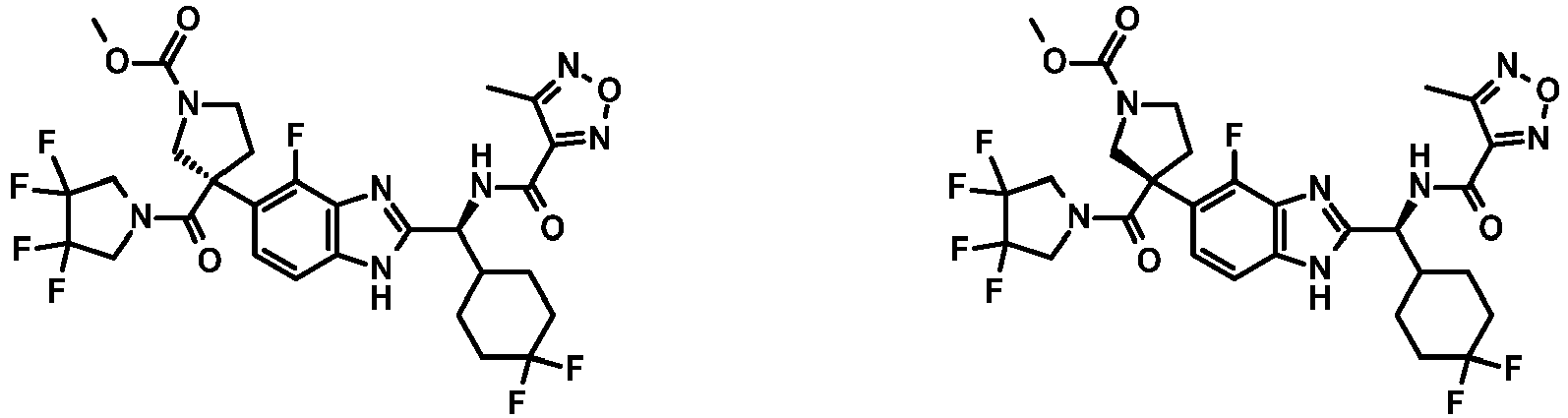
- To a stirred solution of 3,3,4,4-tetrafluoropyrrolidine hydrochloride (53 mg, 0.30 mmol) and 2-chloro-1-methylpyridinium iodide (75 mg, 0.29 mmol) in DMA (1 mL) was added DIPEA (100 µL, 0.57 mmol), followed by dropwise addition of a solution of Intermediate 16 (100 mg, 0.15 mmol) in DMA (1 mL). The reaction mixture was stirred at r.t. for 25 minutes, then added dropwise to a further solution of 2-chloro-1-methyl-pyridinium iodide (37 mg, 0.14 mmol), 3,3,4,4-tetrafluoropyrrolidine hydrochloride (26 mg, 0.15 mmol) and DIPEA (50 µL, 0.28 mmol) in DMA (0.2 mL) at r.t and stirred for 30 minutes. The reaction mixture was diluted with saturated aqueous NH4Cl solution (5 mL) and extracted with EtOAc (3 x 5 mL). The combined organic layers were dried over Na2SO4, then filtered and concentrated in vacuo. The residue was purified by flash column chromatography, eluting with a gradient of 0-10% MeOH in DCM. The resulting material was purified by chiral preparative HPLC (Method 10) to afford the title compounds (Peak 1, 23 mg, 22%; and Peak 2, 22 mg, 21%) as off-white solids.
- Peak 1 (arbitrarily assigned 3S at pyrrolidine): δH (500 MHz, DMSO-d6) 12.79 (br s, 1H), 9.61 (br s, 1H), 7.33 (br s, 1H), 7.24-7.12 (m, 1H), 5.21-5.10 (m, 1H), 4.13-3.84 (m, 3H), 3.75-3.55 (m, 2H), 3.55-3.49 (m, 3H), 3.48-3.29 (m, 3H), 2.65-2.50 (m, 1H), 2.41 (s, 3H), 2.30-2.18 (m, 1H), 2.06-1.84 (m, 3H), 1.83-1.65 (m, 2H), 1.51 (d, J 12.2 Hz, 1H), 1.41-1.14 (m, 3H). LCMS (Method 4): [M+H]+ m/z 690.3, RT 3.31 minutes.
- Peak 2 (arbitrarily assigned 3R at pyrrolidine): δH (500 MHz, DMSO-d6) 12.80 (br s, 1H), 9.59 (br s, 1H), 7.34 (br s, 1H), 7.23-7.13 (m, 1H), 5.15 (d, J 7.9 Hz, 1H), 4.16-3.87 (m, 3H), 3.77-3.55 (m, 2H), 3.53 (d, J 2.9 Hz, 3H), 3.48-3.31 (m, 3H), 2.65-2.50 (m, 1H), 2.41 (s, 3H), 2.29-2.19 (m, 1H), 2.06-1.84 (m, 3H), 1.83-1.66 (m, 2H), 1.56-1.46 (m, 1H), 1.41-1.14 (m, 3H). LCMS (Method 4): [M+H]+ m/z 690.3, RT 3.31 minutes.
-

- To a stirred solution of 4-methyl-1,2,5-oxadiazole-3-carboxylic acid (31.0 mg, 0.24 mmol) and HATU (93.0 mg, 0.25 mmol) in DCM (4 mL) at r.t. was added DIPEA (140 µL, 0.80 mmol), followed by Intermediate 22 (100 mg, 0.21 mmol). The reaction mixture was stirred for 18 h, then concentrated in vacuo. The residue was purified by preparative HPLC (Method 5) to afford the title compound (60 mg, 49%) as an off-white solid. δH (500 MHz, CD3OD) 7.57-7.28 (m, 1H), 7.28-7.18 (m, 1H), 5.87 (tt, J 56.5, 4.5 Hz, 1H), 5.26 (d, J 8.6 Hz, 1H), 4.77-4.65 (m, 1H), 4.44-4.28 (m, 2H), 4.28-4.17 (m, 1H), 4.14-3.99 (m, 1H), 2.80-2.65 (m, 1H), 2.53 (s, 3H), 2.40-2.19 (m, 2H), 2.18-1.99 (m, 3H), 1.95-1.72 (m, 2H), 1.65-1.35 (m, 3H). LCMS (Method 4): [M+H]+ m/z 591.3, RT 3.32 minutes.
-

- Example 3 (55 mg) was subjected to chiral preparative HPLC (Method 11) to afford the title compounds (Peak 1, 9 mg, 16%; and Peak 2, 10 mg, 18%) as white solids. Peak 1 (arbitrarily assigned S): δH (400 MHz, DMSO-d6) 12.93 (s, 1H), 9.69 (s, 1H), 7.34 (d, J 8.4 Hz, 1H), 7.09 (d, J 7.6 Hz, 1H), 5.98 (tt, J 56.4, 4.5 Hz, 1H), 5.19 (d, J 8.0 Hz, 1H), 4.80 (q, J 11.9 Hz, 1H), 4.56-4.11 (m, 3H), 3.98 (q, J 11.8 Hz, 1H), 3.33 (br s, 3H), 2.67 (d, J 1.9 Hz, 1H), 2.42-2.13 (m, 3H), 2.13-1.90 (m, 2H), 1.78 (dd, J 31.8, 13.4 Hz, 1H), 1.58 (d, J 13.4 Hz, 1H), 1.50-1.15 (m, 2H), 1.03-0.73 (m, 1H). LCMS (Method 8): [M+H]+ m/z 591.4, RT 1.89 minutes.
Peak 2 (arbitrarily assigned R): δH (400 MHz, DMSO-d6) 13.05 (s, 1H), 9.73 (s, 1H), 7.33 (d, J 8.4 Hz, 1H), 7.08 (s, 1H), 6.34-5.49 (m, 1H), 5.19 (d, J 8.1 Hz, 1H), 4.80 (q, J 11.9 Hz, 1H), 4.46-4.10 (m, 3H), 3.97 (q, J 11.4 Hz, 1H), 3.33 (br s, 3H), 2.84-2.56 (m, 1H), 2.40-2.14 (m, 2H), 2.14-1.91 (m, 2H), 1.91-1.67 (m, 1H), 1.58 (d, J 13.4 Hz, 1H), 1.48-1.09 (m, 3H), 0.85 (d, J 7.7 Hz, 1H). LCMS (Method 8): [M+H]+ m/z 591.2, RT 1.89 minutes. -

- To a stirred solution of Intermediate 22 (100 mg, 0.21 mmol), 2-methylpyrazole-3-carboxylic acid (31 mg, 0.25 mmol) and DIPEA (140 µL, 0.80 mmol) in DCM (4 mL) at r.t. was added HATU (99.0 mg, 0.260 mmol). The mixture was stirred at r.t. for 2 h, then concentrated in vacuo and purified by preparative HPLC, to afford the title compound (77 mg, 63%) as an off-white solid. δH (500 MHz, CD3OD) 7.49 (d, J 2.1 Hz, 1H), 7.38 (br s, 1H), 7.28-7.18 (m, 1H), 6.95 (t, J 2.2 Hz, 1H), 5.87 (tt, J 56.6, 4.4 Hz, 1H), 5.21 (d, J 8.7 Hz, 1H), 4.77-4.65 (m, 1H), 4.45-4.28 (m, 2H), 4.28-4.18 (m, 1H), 4.09 (s, 3H), 4.08-4.01 (m, 1H), 2.80-2.65 (m, 1H), 2.36-2.20 (m, 2H), 2.18-1.99 (m, 3H), 1.94-1.70 (m, 2H), 1.64-1.35 (m, 3H). LCMS (Method 4): [M+H]+ m/z 589.3, RT 2.94 minutes.
-

- To a stirred suspension of 4-methyl-1,2,5-oxadiazole-3-carboxylic acid (16 mg, 0.12 mmol) and HATU (44 mg, 0.12 mmol) in DCM (0.5 mL) at r.t. was added DIPEA (44 µL, 0.25 mmol). The reaction mixture was stirred at r.t. for 15 minutes, then Intermediate 29 (50 mg, 0.09 mmol) in DCM (0.5 mL) was added. The reaction mixture was stirred for 18 h, then concentrated in vacuo. The residue was purified by preparative HPLC (Method 5) to afford the title compound (33 mg, 55%) as a white powder. δH (500 MHz, CD3OD) 7.38 (dd, J 8.4, 3.2 Hz, 1H), 7.27-7.18 (m, 1H), 5.27 (d, J 8.7 Hz, 1H), 4.77-4.67 (m, 1H), 4.44-4.31 (m, 2H), 4.21 (q, J 11.9 Hz, 1H), 4.12-4.02 (m, 1H), 3.20-3.06 (m, 1H), 2.70-2.57 (m, 1H), 2.50 (s, 3H), 2.39-2.28 (m, 1H), 2.17-1.99 (m, 3H), 1.91-1.69 (m, 2H), 1.63-1.37 (m, 3H). LCMS (Method 4): [M+H]+ m/z 609, RT 3.46 minutes.
-

- To a stirred solution of 1-methyl-1H-pyrazole-5-carboxylic acid (16.0 mg, 0.13 mmol) and HATU (49.5 mg, 0.13 mmol) in DCM (1.1 mL) at r.t. was added DIPEA (49 µL, 0.28 mmol). The reaction mixture was stirred for 15 minutes, then Intermediate 29 (50 mg, 0.10 mmol) was added. The reaction mixture was stirred at r.t. for 18 h, then concentrated in vacuo. The residue was purified by preparative HPLC (Method 5) to afford the title compound (23 mg, 39%) as a white solid. δH (500 MHz, CD3OD) 7.47 (d, J 2.2 Hz, 1H), 7.38 (d, J 8.4 Hz, 1H), 7.25-7.20 (m, 1H), 6.93 (t, J 2.3 Hz, 1H), 5.21 (d, J 8.7 Hz, 1H), 4.77-4.65 (m, 1H), 4.45-4.31 (m, 2H), 4.27-4.16 (m, 1H), 4.13-4.01 (m, 4H), 3.21-3.07 (m, 1H), 2.71-2.57 (m, 1H), 2.36-2.24 (m, 1H), 2.16-1.97 (m, 3H), 1.90-1.69 (m, 2H), 1.62-1.35 (m, 3H). LCMS (Method 4): [M+H]+ m/z 607, RT 3.10 minutes.
-

- To a stirred suspension of Intermediate 37 (40 mg, 0.06 mmol) and HATU (29 mg, 0.08 mmol) in DCM (1 mL) at r.t. was added DIPEA (52 µL, 0.30 mmol). The reaction mixture was stirred at r.t. for 15 minutes, then methylamine (2M in THF, 39 µL, 0.08 mmol) was added. The reaction mixture was stirred for 64 h, then quenched with saturated aqueous NaHCOs solution (1 mL) and stirred at r.t. for 20 minutes. The phases were separated using a phase separator, and the organic phase was concentrated in vacuo. The residue was purified by acidic preparative HPLC (Method 5) to afford the title compounds (Peak 1, 7 mg, 18%; and Peak 2, 1.6 mg, 4%) as white solids.
- Peak 1 (arbitrarily assigned as S): δH (500 MHz, DMSO-d6) 12.70 (s, 1H), 9.67 (d, J 8.5 Hz, 1H), 8.13 (d, J 9.0 Hz, 1H), 7.92-7.79 (m, 1H), 7.46-7.20 (m, 2H), 5.25-5.14 (m, 1H), 4.40 (t, J 6.8 Hz, 1H), 4.10-4.01 (m, 1H), 3.19-3.02 (m, 1H), 2.72-2.61 (m, 1H), 2.59 (d, J 4.5 Hz, 3H), 2.48 (s, 3H), 2.36-2.23 (m, 1H), 2.14-1.93 (m, 3H), 1.90-1.70 (m, 3H), 1.61-1.50 (m, 1H), 1.47-1.35 (m, 1H), 1.36-1.22 (m, 1H), 0.70-0.53 (m, 6H). LCMS (Method 4): [M+H]+ m/z 646, RT 3.13 minutes.
- Peak 2 (arbitrarily assigned as R): δH (500 MHz, CD3OD) 7.54-7.19 (m, 2H), 5.26 (d, J 8.5 Hz, 1H), 4.55-4.42 (m, 1H), 4.09 (d, J 8.1 Hz, 1H), 3.28-3.11 (m, 1H), 2.61 (s, 3H), 2.58-2.44 (m, 4H), 2.42-2.25 (m, 1H), 2.19-1.96 (m, 4H), 1.96-1.70 (m, 2H), 1.69-1.36 (m, 3H), 1.01-0.86 (m, 6H). LCMS (Method 4): [M+H]+ m/z 646, RT 3.26 minutes.
-

- To a stirred suspension of Intermediate 37 (40 mg, 0.06 mmol) and HATU (29 mg, 0.08 mmol) in DCM (1 mL) at r.t. was added DIPEA (52 µL, 0.30 mmol). The reaction mixture was stirred at r.t. for 15 minutes, then dimethylamine (2M in THF, 39 µL, 0.08 mmol) was added. The reaction mixture was stirred for 64 h, then quenched with saturated aqueous NaHCOs solution (1 mL) and stirred at r.t. for 20 minutes. The phases were separated using a phase separator, and the organic phase was concentrated in vacuo. The residue was purified by acidic preparative HPLC (Method 5) to afford the title compounds (Peak 1, 7.8 mg, 20%; and Peak 2, 9 mg, 22%) as white solids.
- Peak 1 (arbitrarily assigned S): δH (500 MHz, DMSO-d6) 12.77 (s, 1H), 9.69 (s, 1H), 8.43 (d, J 8.8 Hz, 1H), 7.52-7.09 (m, 2H), 5.24-5.10 (m, 1H), 4.56 (t, J 8.4 Hz, 1H), 4.43 (dd, J 8.7, 4.9 Hz, 1H), 3.18-3.02 (m, 1H), 2.97 (s, 3H), 2.72 (s, 3H), 2.64-2.53 (m, 1H), 2.48 (s, 3H), 2.36-2.21 (m, 1H), 2.15-1.91 (m, 4H), 1.90-1.66 (m, 2H), 1.62-1.48 (m, 1H), 1.47-1.20 (m, 2H), 0.87 (d, J 6.7 Hz, 3H), 0.83 (d, J 6.7 Hz, 3H). LCMS (Method 4): [M+H]+ m/z 646, RT 3.46 minutes.
- Peak 2 (arbitrarily assigned as R): δH (500 MHz, DMSO-d6) 12.72 (s, 1H), 9.78-9.64 (m, 1H), 8.39 (d, J 8.3 Hz, 1H), 7.47-7.22 (m, 2H), 5.25-5.15 (m, 1H), 4.49 (t, J 8.5 Hz, 1H), 4.43-4.31 (m, 1H), 3.20-3.01 (m, 4H), 2.84 (s, 3H), 2.73-2.57 (m, 1H), 2.48 (s, 3H), 2.36-2.25 (m, 1H), 2.13-1.92 (m, 3H), 1.92-1.71 (m, 3H), 1.61-1.51 (m, 1H), 1.47-1.35 (m, 1H), 1.36-1.21 (m, 1H), 0.70 (d, J 6.7 Hz, 3H), 0.64-0.50 (m, 3H). LCMS (Method 4): [M+H]+ m/z 660, RT 3.32 minutes.
-

- To a stirred solution of Intermediate 35 (50 mg, 0.07 mmol) and HATU (36 mg, 0.10 mmol) in DCM (1 mL) at r.t. was added DIPEA (64 µL, 0.37 mmol). The reaction mixture was stirred for 15 minutes, then 3,3,3-trifluoropropan-1-amine (11 mg, 0.10 mmol) was added. The reaction mixture was stirred for 64 h, then concentrated in vacuo. The residue was purified by acidic preparative HPLC (Method 5) to afford the title compound (23 mg, 50%) as a cream solid. δH (500 MHz, DMSO-d6) 12.74 (s, 1H), 9.69 (d, J 8.4 Hz, 1H), 8.36 (t, J 5.1 Hz, 1H), 7.30 (d, J 8.4 Hz, 1H), 7.25-7.12 (m, 1H), 5.18 (t, J 8.3 Hz, 1H), 4.18 (t, J 6.8 Hz, 1H), 3.31-3.26 (m, 1H), 3.26-3.18 (m, 1H), 3.17-3.02 (m, 1H), 2.79-2.56 (m, 1H), 2.48 (s, 3H), 2.42-2.24 (m, 3H), 2.13-1.93 (m, 3H), 1.91-1.70 (m, 2H), 1.61-1.50 (m, 1H), 1.47-1.35 (m, 1H), 1.35-1.22 (m, 1H). LCMS (Method 4):
[M+H]+ m/z 629, RT 3.52 minutes. -

- To a stirred solution of Intermediate 35 (150 mg, 0.22 mmol) and HATU (109 mg, 0.22 mmol) in DCM (3.5 mL) at r.t. was added DIPEA (192 µL, 1.10 mmol). The reaction mixture was stirred for 15 minutes, then (2,2-difluorocyclopropyl)methanamine (31 mg, 0.29 mmol) was added. The reaction mixture was stirred for 64 h, then diluted with DCM (15 mL), quenched with saturated aqueous NaHCOs solution (20 mL) and stirred at r.t. for 10 minutes. The phases were separated, and the aqueous phase was extracted with DCM (2 x 15 mL). The combined organic phases were dried over Na2SO4, then filtered and concentrated in vacuo. The residue was purified by flash column chromatography, eluting with a gradient of 0-100% EtOAc in heptanes, to afford the title compound (85 mg, 58%) as a pale pink solid. δH (400 MHz, DMSO-d6) 13.16-12.57 (m, 1H), 9.85-9.42 (m, 1H), 8.51-8.36 (m, 1H), 7.50-7.26 (m, 1H), 7.27-7.04 (m, 1H), 5.18 (t, J 7.7 Hz, 1H), 4.23 (t, J 6.5 Hz, 1H), 3.21-2.97 (m, 3H), 2.66-2.55 (m, 1H), 2.48 (s, 3H), 2.37-2.19 (m, 1H), 2.15-1.92 (m, 3H), 1.90-1.65 (m, 3H), 1.61-1.03 (m, 5H). LCMS (Method 4): [M+H]+ m/z 623, RT 3.49 minutes.
-

- To a stirred solution of Intermediate 35 (50 mg, 0.07 mmol) and HATU (36 mg, 0.10 mmol) in DCM (1 mL) at r.t. was added DIPEA (64 µL, 0.38 mmol). The reaction mixture was stirred for 15 minutes, then (2S)-1,1,1-trifluoropropan-2-amine (11 mg, 0.10 mmol) was added. The reaction mixture was stirred for 64 h, then concentrated in vacuo. The residue was purified by acidic preparative HPLC (Method 5) to afford the title compound (4.7 mg, 10%). δH (500 MHz, DMSO-d6) 13.46-12.31 (m, 1H), 9.74-9.54 (m, 1H), 9.00-8.66 (m, 1H), 7.48-7.28 (m, 1H), 7.27-7.12 (m, 1H), 5.18 (q, J 7.8 Hz, 1H), 4.68-4.51 (m, 1H), 4.37-4.24 (m, 1H), 3.21-3.02 (m, 1H), 2.72-2.57 (m, 1H), 2.48 (s, 3H), 2.36-2.24 (m, 1H), 2.13-1.93 (m, 3H), 1.91-1.71 (m, 2H), 1.61-1.50 (m, 1H), 1.47-1.36 (m, 1H), 1.35-1.25 (m, 1H), 1.25-1.09 (m, 3H). LCMS (Method 4): [M+H]+ m/z 629, RT 3.63 minutes.
-

- Intermediate 46 (0.23 g, 0.31 mmol) was stirred in DCM (5 mL) and TFA (0.46 mL, 6.18 mmol) at r.t. for 40 minutes. The reaction mixture was quenched with saturated aqueous NaHCOs solution (20 mL) and extracted with DCM:isopropanol (4:1, 2 x 20 mL). The combined organic phases were dried over Na2SO4, then filtered and concentrated in vacuo, to afford the title compound (0.21 g, 100%) as an off-white solid. δH (500 MHz, DMSO-d6) 9.66 (s, 1H), 7.39 (d, J 8.2 Hz, 1H), 7.33-7.09 (m, 1H), 5.21 (d, J 6.0 Hz, 1H), 4.79-4.31 (m, 1H), 4.31-4.05 (m, 2H), 3.84-3.58 (m, 2H), 3.03-2.92 (m, 2H), 2.91-2.78 (m, 2H), 2.48 (s, 3H), 2.40-2.20 (m, 3H), 2.18-1.91 (m, 5H), 1.90-1.73 (m, 2H), 1.63-1.54 (m, 1H), 1.48-1.25 (m, 2H). LCMS (Method 1): [M+H]+ m/z 596, RT 1.58 minutes.
-

- Methyl chloroformate (6.2 µL, 0.08 mmol) in DCM (1 mL) was added to an ice-cooled solution of Example 16 (50 mg, 0.08 mmol) and DIPEA (28 µL, 0.16 mmol) in DCM (1 mL). The reaction mixture was stirred at 0°C for 20 minutes, then allowed to warm to r.t. and stirred for 30 minutes. The reaction mixture was quenched with water (7 mL) and stirred vigorously for 15 minutes. Saturated aqueous NH4Cl solution (7 mL) was added, and the mixture was stirred vigorously for a further 15 minutes. The phases were separated, and the combined organic layers were concentrated in vacuo. The residue was purified by acidic preparative HPLC (Method 5) to afford the title compound (25 mg, 48%) as a white solid. δH (500 MHz, DMSO-d6) 12.86 (br s, 1H), 9.69 (br s, 1H), 7.36 (br s, 1H), 7.26-7.14 (m, 1H), 5.21 (d, J 8.1 Hz, 1H), 4.69-4.03 (m, 2H), 3.95-3.62 (m, 4H), 3.59 (s, 3H), 3.33 (m, 2H, obs.), 2.47 (s, 3H), 2.35-2.22 (m, 3H), 2.13-1.88 (m, 5H), 1.87-1.72 (m, 2H), 1.63-1.52 (m, 1H), 1.48-1.25 (m, 2H). LCMS (Method 4): [M+H]+ m/z 654, RT 3.10 minutes.
-
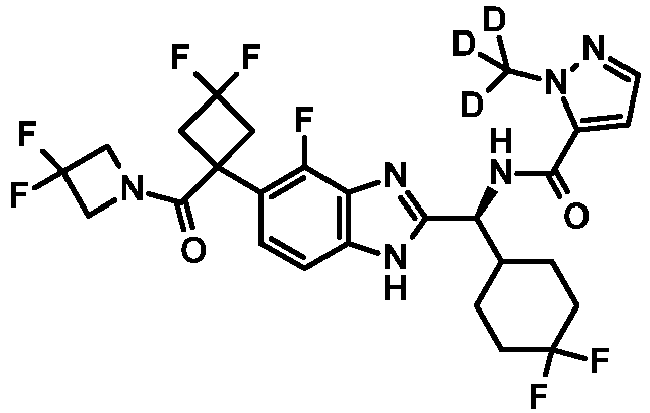
- HATU (51 mg, 0.13 mmol) was added to a stirred solution of DIPEA (117 µL, 0.67 mmol), Intermediate 53 (64 mg, 0.11 mmol) and 2-(trideuteriomethyl)pyrazole-3-carboxylic acid (16 mg, 0.12 mmol) in DCM (2 mL). The reaction mixture was stirred at r.t. for 16 h, then washed with water (5 mL). The aqueous layer was extracted with DCM (5 mL). The organic layers were combined, dried over Na2SO4 and concentrated in vacuo. The residue was purified by flash column chromatography, eluting with a gradient of EtOAc in heptanes. To the resulting colourless glass was added diethyl ether (1 mL), followed by EtOAc (2 mL) and heptanes (8 mL), until a white precipitate was observed. The mixture was filtered and washed with heptanes. The solid was further purified by reverse-phase column chromatography, eluting with a gradient of acetonitrile in water (+0.1% formic acid), to afford the title compound (21 mg, 31%) as a white powder. δH (400 MHz, CD3OD) 7.48 (d, J 2.2 Hz, 1H), 7.46-7.35 (m, 2H), 6.94 (d, J 2.2 Hz, 1H), 5.21 (d, J 8.7 Hz, 1H), 4.30 (s, 2H), 3.93 (s, 2H), 3.62-3.46 (m, 2H), 3.23-3.08 (m, 2H), 2.38-2.23 (m, 1H), 2.19-1.97 (m, 3H), 1.94-1.68 (m, 2H), 1.62-1.34 (m, 3H). LCMS (Method 4): [M+H]+ m/z 604, RT 2.98 minutes.
-

- To a stirred solution of 3,3,4,4-tetrafluoropyrrolidine hydrochloride (28.0 mg, 0.16 mmol) and 2-chloro-1-methylpyridinium iodide (40.0 mg, 0.16 mmol) in DMA (0.3 mL) was added DIPEA (52 µL, 0.30 mmol), followed by a solution of Intermediate 61 (50.0 mg, 0.08 mmol) in DMA (0.3 mL). The reaction mixture was stirred at r.t. for 15 minutes, then concentrated in vacuo. The residue was purified by acidic preparative HPLC (Method 5) to afford the title compound (21 mg, 41%) as an off-white solid. δH (400 MHz, CD3OD) 7.65-7.34 (m, 2H), 5.28 (d, J 8.4 Hz, 1H), 4.20-3.78 (m, 6H), 3.65-3.34 (m, 2H), 2.53 (s, 3H), 2.44-2.28 (m, 3H), 2.26-2.01 (m, 5H), 1.93-1.73 (m, 2H), 1.64-1.39 (m, 3H). LCMS (Method 4): [M+H]+ m/z 647.14, RT 3.33 minutes.
-

- To a solution of Intermediate 66 (1.70 g, 3.52 mmol) and 2-methylpyrazole-3-carboxylic acid (532 mg, 4.22 mmol) in DCM (50 mL) was added DIPEA (2.5 mL, 14.1 mmol), followed by HATU (1.6 g, 4.22 mmol). The reaction mixture was stirred at r.t. for 1 h, diluted with DCM (50 mL) and washed with water (4 x 50 mL) and brine (30 mL), then dried over Na2SO4 and concentrated in vacuo. The residue was purified by flash column chromatography, eluting with a gradient of 0-100% EtOAc in DCM, followed by trituration with cold diethyl ether, to afford the title compound (1.4 g, 70%) as a white solid. δH (500 MHz, DMSO-d6) 13.01-12.67 (m, 1H), 9.02-8.85 (m, 1H), 7.50-7.45 (m, 1H), 7.43-7.23 (m, 1H), 7.13-7.02 (m, 2H), 5.20-5.07 (m, 1H), 4.86-4.68 (m, 1H), 4.38-4.26 (m, 1H), 4.26-4.15 (m, 1H), 4.15-4.08 (m, 1H), 4.08-3.91 (m, 4H), 2.35-2.22 (m, 1H), 2.12-1.92 (m, 3H), 1.89-1.68 (m, 2H), 1.60-1.47 (m, 1H), 1.45-1.20 (m, 5H). LCMS (Method 4): [M+H]+ m/z 539.3, RT 2.73 minutes.
-

- Example 20 (1.4 g) was subject to chiral separation (Method 12) to afford the title compounds (Peak 1, 423 mg, 30%; and Peak 2, 427 mg, 30%) as white solids.
- Peak 1 (arbitrarily assigned S): δH (400 MHz, DMSO-d6) 12.82 (s, 1H), 8.97 (d, J 8.5 Hz, 1H), 7.48 (d, J 2.1 Hz, 1H), 7.31 (d, J 8.3 Hz, 1H), 7.18-6.82 (m, 2H), 5.15 (t, J 8.6 Hz, 1H), 4.78 (q, J 12.1 Hz, 1H), 4.43-4.11 (m, 2H), 4.03 (s, 3H), 3.33 (s, 2H), 2.51 (p, J 1.9 Hz, 3H), 2.30 (q, J 10.5, 10.1 Hz, 1H), 2.19-1.96 (m, 2H), 1.54 (d, J 13.3 Hz, 1H), 1.46-1.04 (m, 5H). LCMS (Method 8): [M+H]+ m/z 539.2, RT 1.61 minutes.
- Peak 2 (arbitrarily assigned R): δH (400 MHz, DMSO-d6) 12.82 (s, 1H), 8.97 (d, J 8.5 Hz, 1H), 7.47 (d, J 2.1 Hz, 1H), 7.31 (d, J 8.4 Hz, 1H), 7.18-6.80 (m, 2H), 5.15 (t, J 8.6 Hz, 1H), 4.79 (d, J 12.1 Hz, 1H), 4.49-3.77 (m, 6H), 3.33 (s, 2H), 2.51 (s, 1H), 2.30 (q, J 10.9, 10.5 Hz, 1H), 2.15-1.91 (m, 2H), 1.91-1.66 (m, 1H), 1.66-1.46 (m, 1H), 1.46-0.97 (m, 5H). LCMS (Method 8): [M+H]+ m/z 539.2, RT 1.60 minutes.
-

- To a solution of 4-methyl-1,2,5-oxadiazole-3-carboxylic acid (8.1 mg, 0.06 mmol) in DCM (0.5 mL) were added DIPEA (21 µL, 0.23 mmol) and HATU (25 mg, 0.06 mmol). The mixture was stirred at r.t. for 10 minutes, then Intermediate 73 (30 mg, 0.06 mmol) in DCM (0.5 mL) was added. The mixture was stirred at r.t. for 1 h, then diluted with DCM (10 mL), washed with water (2 x 5 mL) and passed through a phase separator. The organic fractions were combined and concentrated in vacuo. The residue was purified by reverse-phase preparative HPLC (Method 13) to afford the title compound (3.5 mg, 9.5%) as an off white solid. δH (400 MHz, DMSO-d6) 12.80 (s, 1H), 9.59 (s, 1H), 7.35 (s, 1H), 7.19 (s, 1H), 5.20 (d, J 8.0 Hz, 1H), 4.27 (s, 2H), 3.59 (d, J 63.0 Hz, 2H), 2.68 (p, J 1.8 Hz, 1H), 2.46-2.36 (m, 1H), 2.36-2.13 (m, 2H), 2.13-1.90 (m, 7H), 1.81 (dt, J 29.9, 13.2 Hz, 2H), 1.60 (d, J 13.3 Hz, 2H), 1.53-1.19 (m, 4H), 0.95 (dd, J 6.6, 1.6 Hz, 1H). LCMS (Method 8): [M+H]+ m/z 631.4, RT 2.00 minutes.
-
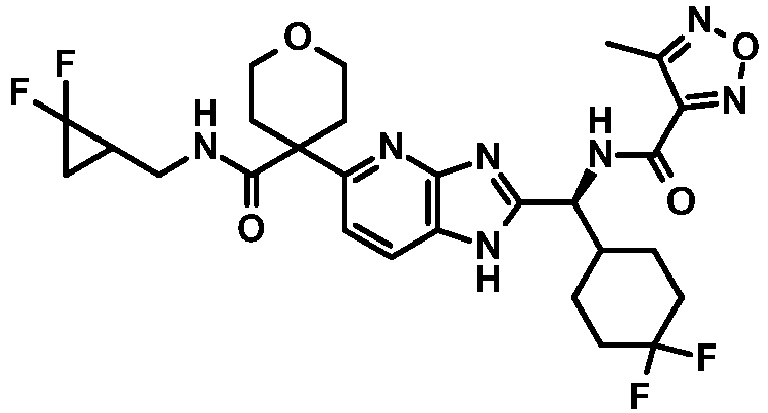
- To a stirred solution of Intermediate 85 (102 mg, 0.19 mmol) and 4-methyl-1,2,5-oxadiazole-3-carboxylic acid (29 mg, 0.23 mmol) in DCM (3 mL) was added DIPEA (66 µL, 0.38 mmol), followed by HATU (87 mg, 0.23 mmol). The reaction mixture was stirred at r.t. for 1.5 h, washed with water (2 x 2 mL) and brine (1 mL), then concentrated under N2 stream. The residue was purified by preparative HPLC (Method 14) to afford the title compound (26 mg, 23%) as a white solid. δH (400 MHz, DMSO-d6) 13.25-12.38 (m, 1H), 9.56 (br s, 1H), 7.93 (br s, 1H), 7.85-7.74 (m, 1H), 7.22 (d, J 8.4 Hz, 1H), 5.29-5.11 (m, 1H), 3.78-3.61 (m, 2H), 3.61-3.48 (m, 2H), 3.23-3.14 (m, 1H), 3.14-3.02 (m, 1H), 2.48 (s, 3H), 2.41-2.34 (m, 2H), 2.34-2.25 (m, 1H), 2.19-2.10 (m, 2H), 2.10-1.91 (m, 3H), 1.91-1.72 (m, 3H), 1.66-1.55 (m, 1H), 1.50-1.37 (m, 2H), 1.37-1.26 (m, 1H), 1.19-1.10 (m, 1H). LCMS (Method 4): [M+H]+ m/z 594.3, RT 2.93 minutes.
-

- Example 15 (110 mg) was subjected to chiral preparative HPLC (Method 15) to afford the title compounds (Peak 1, 31 mg; and Peak 2, 33 mg) as white solids.
- Peak 1 (arbitrarily assigned S): δH (400 MHz, DMSO-d6) 12.80 (br s, 1H), 9.63 (br s, 1H), 8.78 (d, J 8.8 Hz, 1H), 7.29 (d, J 8.0 Hz, 1H), 7.14 (t, J 7.4 Hz, 1H), 5.18 (d, J 8.1 Hz, 1H), 4.62 (dt, J 15.5, 7.7 Hz, 1H), 4.31 (dd, J 8.4, 5.4 Hz, 1H), 3.12 (m, 1H), 2.74-2.56 (m, 1H), 2.48 (s, 3H), 2.34-2.25 (m, 1H), 2.09-1.90 (m, 3H), 1.90-1.68 (m, 2H), 1.56 (d, J 13.4 Hz, 1H), 1.46-1.27 (m, 2H), 1.23 (d, J 7.0 Hz, 3H). LCMS (Method 8): [M+H]+ m/z 629.4, RT 2.06 minutes. Chiral LC (Method 16): RT 3.52 minutes, 100%.
- Peak 2 (arbitrarily assigned R): δH (400 MHz, DMSO-d6) 9.67 (br s, 1H), 8.88 (d, J 8.9 Hz, 1H), 7.31 (br s, 1H), 7.23 (m, 1H), 5.18 (t, J 7.7 Hz, 1H), 4.57 (dq, J 15.6, 7.5 Hz, 1H), 4.28 (dd, J 9.1, 4.7 Hz, 1H), 3.12 (dt, J 15.0, 11.1 Hz, 1H), 2.68-2.59 (m, 1H), 2.48 (s, 3H), 2.36-2.23 (m, 1H), 2.09-1.96 (m, 3H), 1.88-1.70 (m, 2H), 1.55 (d, J 13.5 Hz, 1H), 1.47-1.18 (m, 2H), 1.11 (d, J7.1 Hz, 3H). LCMS (Method 8): [M+H]+ m/z 629.4, RT 2.08 minutes. Chiral LC (Method 16): RT 4.22 minutes, 100%.
-

- 4-Methyl-1,2,5-oxadiazole-3-carboxylic acid (40 mg, 0.30 mmol) and HATU (117 mg, 0.30 mmol) were dissolved in DCM (3 mL) and DIPEA (0.10 mL, 0.58 mmol) was added, followed by Intermediate 91 (167 mg, 0.28 mmol) in DCM (4 mL). The mixture was stirred at r.t. overnight, then washed with saturated aqueous NH4Cl solution (10 mL) and concentrated in vacuo. The residue was purified by chromatography (silica, DCM, 0-65% EtOAc gradient) to give the title compound (187 mg, 94%) as an off-white solid. δH (300 MHz, DMSO-d6) 13.05 (d, J 4.4 Hz, 0.25H), 12.80 (s, 0.75H), 9.68 (d, J 8.4 Hz, 0.75H), 9.59 (d, J 8.6 Hz, 0.25H), 7.47 (d, J 8.4 Hz, 0.25H), 7.36 (d, J 8.4 Hz, 0.75H), 7.09 (ddd, J 8.6, 6.4, 2.8 Hz, 1H), 5.21 (q, J 8.3 Hz, 1H), 4.56 (q, J 13.5 Hz, 1H), 4.36 (q, J 6.1, 5.1 Hz, 1H), 4.25-3.86 (m, 2H), 3.86-3.50 (m, 1H), 3.22-2.81 (m, 4H), 2.50 (s, 3H), 2.32 (q, J 11.1, 10.5 Hz, 2H), 2.15-1.00 (m, 13H). LCMS (Method 9): [M+H]+ m/z 697, RT 2.11 minutes.
-

- Example 27 (120 mg) was subjected to chiral preparative HPLC (Method 17) to afford the title compounds (Peak 1, 37 mg; and Peak 2, 32 mg) as white solids.
- Peak 1 (arbitrarily assigned S): δH (400 MHz, DMSO-d6) 13.04 (s, 0.2H), 12.92-12.68 (m, 0.8H), 9.68 (d, J 8.5 Hz, 0.8H), 9.59 (d, J 8.6 Hz, 0.2H), 7.47 (d, J 8.4 Hz, 0.2H), 7.36 (d, J 8.4 Hz, 0.8H), 7.07 (dt, J 8.2, 6.0 Hz, 1H), 5.29-5.06 (m, 1H), 4.56 (q, J 13.2 Hz, 1H), 4.37 (t, J 7.2 Hz, 1H), 4.05 (dt, J 47.6, 14.4 Hz, 2H), 3.65 (p, J 13.5, 13.0 Hz, 1H), 3.22-2.81 (m, 4H), 2.50 (s, 3H), 2.43-2.16 (m, 1H), 2.17-1.67 (m, 6H), 1.67-1.02 (m, 7H). LCMS (Method 9): [M+H]+ m/z 697, RT 2.11 minutes. Chiral LC (Method 18): RT 3.48 minutes, 100%.
- Peak 2 (arbitrarily assigned R): δH (400 MHz, DMSO-d6) 12.86 (s, 1H), 9.64 (s, 1H), 7.36 (d, J 8.3 Hz, 1H), 7.05 (t, J 7.4 Hz, 1H), 5.19 (s, 1H), 4.56 (q, J 13.5 Hz, 1H), 4.36 (t, J 7.2 Hz, 1H), 4.07 (dq, J 46.8, 14.3 Hz, 2H), 3.65 (q, J 13.5 Hz, 1H), 3.17-2.80 (m, 4H), 2.49 (s, 3H), 2.42-2.15 (m, 1H), 2.18-1.24 (m, 8H), 1.17 (t, J 7.4 Hz, 5H). LCMS (Method 9): [M+H]+ m/z 697, RT 2.11 minutes. Chiral LC (Method 18): RT 5.09 minutes, 99.7%.
-

- 4-Ethyl-1,2,5-oxadiazole-3-carboxylic acid (43 mg, 0.30 mmol) and HATU (117 mg, 0.30 mmol) were dissolved in DCM (3 mL) and DIPEA (0.10 mL, 0.58 mmol) was added, followed by Intermediate 91 (167 mg, 0.28 mmol) in DCM (4 mL). The mixture was stirred at r.t. overnight, then washed with saturated aqueous NH4Cl solution (10 mL) and concentrated in vacuo. Purification by chromatography (silica, DCM, 0-65% EtOAc gradient) gave the title compound (195 mg, 96%) as an off-white solid. δH (300 MHz, DMSO-d6) 12.92-12.80 (m, 1H), 9.70 (d, J 8.4 Hz, 1H), 8.16 (s, 0.2H), 7.08 (dd, J 8.8, 6.7 Hz, 1H), 5.20 (m, 1H), 4.81-4.25 (m, 2H), 4.25-3.82 (m, 2H), 3.82-3.48 (m, 2H), 3.23-2.70 (m, 6H), 2.45-2.20 (m, 2H), 2.20-1.63 (m, 5H), 1.24-0.95 (m, 10H). LCMS (Method 9): [M+H]+ m/z 711, RT 2.37 minutes.
-

- Example 30 (130 mg) was subjected to chiral preparative HPLC (Method 17) to afford the title compounds (Peak 1, 35 mg; and Peak 2, 32 mg) as white solids.
- Peak 1 (arbitrarily assigned S): δH (400 MHz, DMSO-d6) 13.06 (s, 0.2H), 12.82 (s, 0.8H), 9.71 (d, J 8.4 Hz, 0.8H), 9.63 (d, J 8.4 Hz, 0.2H), 7.47-7.35 (m, 1H), 7.18-6.97 (m, 1H), 5.29-5.12 (m, 1H), 4.56 (q, J 13.3 Hz, 1H), 4.37 (t, J 7.2 Hz, 1H), 4.20-3.90 (m, 2H), 3.63 (q, J 13.6 Hz, 1H), 3.20-2.83 (m, 7H), 2.44-2.22 (m, 1H), 2.14-1.48 (m, 6H), 1.49-1.07 (m, 9H). LCMS (Method 9): [M+H]+ m/z 711, RT 2.37 minutes. Chiral LC (Method 18): RT 3.31 minutes, 100%.
- Peak 2 (arbitrarily assigned R): δH (400 MHz, DMSO-d6) 12.97 (s, 1H), 9.47 (s, 1H), 7.28 (d, J 8.3 Hz, 1H), 6.88 (s, 1H), 5.16 (d, J 7.5 Hz, 1H), 4.53 (q, J 13.2 Hz, 1H), 4.32 (t, J 7.2 Hz, 1H), 4.06 (dq, J 43.3, 14.3 Hz, 2H), 3.59 (q, J 13.6 Hz, 1H), 3.16-2.76 (m, 7H), 2.44-2.14 (m, 2H), 2.14-1.54 (m, 6H), 1.21 (dt, J 29.8, 7.4 Hz, 8H). LCMS (Method 9): [M+H]+ m/z 711, RT 2.37 minutes. Chiral LC (Method 18): RT 4.83 minutes, 99.6%.
-
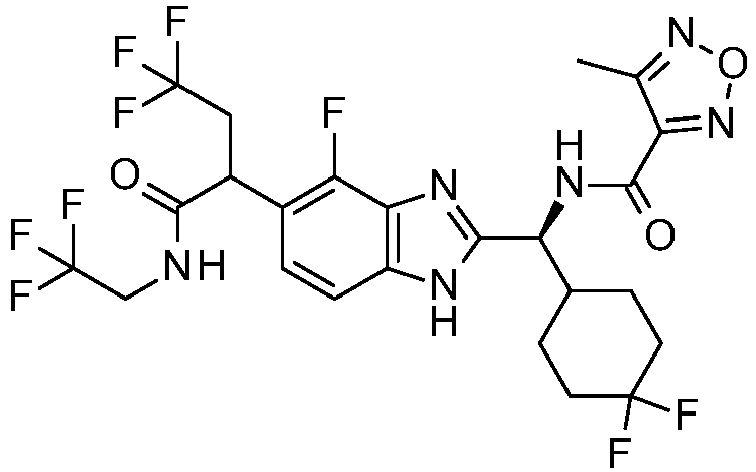
- To a stirred suspension of Intermediate 35 (100 mg, 0.147 mmol) and HATU (73 mg, 0.191 mmol) in DCM (1 mL) at r.t. was added DIPEA (128 µL, 0.734 mmol). The reaction mixture was stirred at r.t. for 15 minutes, then 2,2,2-trifluoroethanamine (19 mg, 0.191 mmol) was added. The reaction mixture was stirred at r.t. for 64 h, then diluted with DCM, quenched with saturated aqueous NaHCOs solution (8 mL) and stirred at r.t. for 10 minutes. The phases were separated using a hydrophobic frit, and the organic phase was concentrated in vacuo. The residue was separated by acidic preparative HPLC (Method 5) to afford the title compound (29 mg, 44%) as a white solid. δH (500 MHz, DMSO-d6) 13.39-12.19 (m, 1H), 9.69 (s, 1H), 8.91-8.85 (m, 1H), 7.52-7.25 (m, 1H), 7.24-7.17 (m, 1H), 5.18 (d, J 7.9 Hz, 1H), 4.30 (dd, J 8.3, 5.6 Hz, 1H), 3.95-3.83 (m, 2H), 3.22-3.08 (m, 1H), 2.72-2.58 (m, 1H), 2.48 (s, 3H), 2.35-2.24 (m, 1H), 2.12-1.91 (m, 3H), 1.89-1.71 (m, 2H), 1.58-1.49 (m, 1H), 1.46-1.35 (m, 1H), 1.35-1.23 (m, 1H). LCMS (Method 4): [M+H]+ m/z 615, RT 3.52 minutes.
-

- Example 33 (25 mg) was subjected to chiral preparative purification (Method 19) to afford the title compounds (Peak 1, 7.5 mg, 38%; and Peak 2, 8.1 mg, 41%) as white solids.
- Peak 1 (arbitrarily assigned S): δH (500 MHz, DMSO-d6) 12.81 (br s, 1H), 9.67 (br s, 1H), 8.87 (t, J 6.3 Hz, 1H), 7.49-7.25 (m, 1H), 7.23-7.14 (m, 1H), 5.18 (d, J 8.2 Hz, 1H), 4.30 (dd, J 8.3, 5.5 Hz, 1H), 3.94-3.84 (m, 2H), 3.22-3.08 (m, 1H), 2.76-2.57 (m, 1H), 2.48 (s, 3H), 2.35-2.25 (m, 1H), 2.12-1.92 (m, 3H), 1.90-1.70 (m, 2H), 1.60-1.51 (m, 1H), 1.46-1.35 (m, 1H), 1.35-1.23 (m, 1H). LCMS (Method 4): [M+H]+ m/z 615, RT 3.51 minutes.
- Peak 2 (arbitrarily assigned R): δH (500 MHz, DMSO-d6) 12.81 (br s, 1H), 9.65 (br s, 1H), 8.87 (t, J 6.3 Hz, 1H), 7.48-7.26 (m, 1H), 7.23-7.15 (m, 1H), 5.18 (d, J 8.2 Hz, 1H), 4.30 (dd, J 8.3, 5.5 Hz, 1H), 3.94-3.83 (m, 2H), 3.22-3.06 (m, 1H), 2.72-2.58 (m, 1H), 2.48 (s, 3H), 2.35-2.25 (m, 1H), 2.12-1.92 (m, 3H), 1.89-1.71 (m, 2H), 1.60-1.50 (m, 1H), 1.47-1.35 (m, 1H), 1.35-1.23 (m, 1H). LCMS (Method 4): [M+H]+ m/z 615, RT 3.52 minutes.
-

- To a stirred suspension of Intermediate 35 (95%, 50 mg, 0.0734 mmol) and HATU (36 mg, 0.0954 mmol) in DCM (1 mL) at r.t. was added DIPEA (64 µL, 0.367 mmol). The reaction mixture was stirred at r.t. for 15 minutes, then 2,2-difluoroethan-amine (7.7 mg, 0.10 mmol) was added. The reaction mixture was stirred at r.t. for 18 h, then diluted with DCM (4 mL), quenched with saturated aqueous NaHCOs solution (4 mL) and stirred at r.t. for 10 minutes. The phases were separated using a hydrophobic frit, and the organic phase was concentrated in vacuo. The residue was separated by acidic preparative HPLC (Method 5) to afford, after freeze-drying, the title compound (14.8 mg, 44%) as a white solid. δH (500 MHz, DMSO-d6) 12.74 (br s, 1H), 9.74-9.65 (m, 1H), 8.62-8.53 (m, 1H), 7.30 (d, J 8.4 Hz, 1H), 7.25-7.15 (m, 1H), 6.09-5.79 (m, 1H), 5.18 (t, J 8.4 Hz, 1H), 4.28 (t, J 6.9 Hz, 1H), 3.53-3.40 (m, 2H), 3.23-3.04 (m, 1H), 2.75-2.58 (m, 1H), 2.48 (s, 3H), 2.35-2.24 (m, 1H), 2.13-1.92 (m, 3H), 1.92-1.70 (m, 2H), 1.60-1.50 (m, 1H), 1.48-1.35 (m, 1H), 1.35-1.22 (m, 1H). LCMS (Method 4): [M+H]+ m/z 597, RT 3.36 minutes.
-

- Example 36 (27 mg) was subjected to chiral basic preparative HPLC (Method 23) to afford the title compounds (Peak 1, 3 mg; and Peak 2, 3 mg) as white solids.
- Peak 1 (arbitrarily assigned S): LCMS (Method 9): [M+H]+ m/z 597, RT 1.91 minutes. LCMS (Method 24): [M+H]+ m/z 597, RT 1.96 minutes.
- Peak 2 (arbitrarily assigned R): LCMS (Method 9): [M+H]+ m/z 597, RT 1.89 minutes. LCMS (Method 24): [M+H]+ m/z 597, RT 1.94 minutes.
-

- To a stirred solution of Intermediate 99 (25 mg, 0.04 mmol) in EtOH (0.5 mL) and DCM (0.5 mL) were added ammonium formate (24 mg, 0.388 mmol) and 10% palladium on charcoal (50% wet) (4.1 mg, 0.02 mmol). The reaction mixture was stirred at r.t. for 16 h, then placed under an atmosphere of hydrogen gas. Stirring was continued at r.t. for a further 2 h. The catalyst was removed by filtration, and the filtrate was concentrated in vacuo. The residue was diluted with DCM (5mL) and washed with water (2 mL), then filtered through phase separator. The DCM was removed in vacuo. The residue was diluted with EtOH (1 mL) and 10% palladium on charcoal (50% wet) (4.1 mg, 0.02 mmol) was added. The mixture was stirred under an atmosphere of hydrogen for a further 20 h, then diluted with EtOH (2 mL) and filtered through a pad of Celite®, rinsing the filter cake with EtOH (2 x 1 mL). The filtrates were combined, and the solvent was removed in vacuo. The resulting clear gum was taken up in EtOAc (0.48 mL) with 4-methyl-1,2,5-oxadiazole-3-carboxylic acid (5 mg, 0.04 mmol) and pyridine (11 µL, 0.14 mmol). T3P® (50% in EtOAc) (45 µL, 0.08 mmol) was added dropwise at r.t., and stirring was continued for a further 5 h. The reaction mixture was diluted with EtOAc (4 mL) and cooled to 0°C, then quenched with 1M HCl (0.5 mL). The aqueous phase was separated. The organic phase was washed with water (1 mL) and brine (1 mL), then dried over anhydrous Na2SO4 and filtered. The solvent was concentrated in vacuo. The residue was purified using flash column chromatography (2 g silica), eluting with a gradient of EtOAc in heptane (10-60%). The resulting white solid was further purified by preparative HPLC to afford the title compound (4.5 mg, 22%) as a white solid. δH (400 MHz, CD3OD) 8.54 (s, 1H), 7.93 (d, J 8.3 Hz, 1H), 7.36 (d, J 8.5 Hz, 1H), 5.27 (d, J 8.5 Hz, 1H), 3.83 (q, J 9.3 Hz, 2H), 2.54 (s, 1H), 2.52 (s, 3H), 2.47-2.30 (m, 3H), 2.13-1.96 (m, 7H), 1.92-1.71 (m, 2H), 1.67-1.59 (m, 1H), 1.60-1.32 (m, 3H) (formate salt, 3 x NH signals exchanged with solvent). LCMS (Method 4): [M+H]+ m/z 620, RT 3.52 minutes.
-

- To a stirred solution of Intermediate 107 (500 mg, 0.94 mmol), 2,2,2-trifluoroethanamine (121 mg, 1.22 mmol) and DIPEA (0.82 mL, 4.70 mmol) in DCM (15 mL) at r.t. was added HATU (465 mg, 1.22 mmol) in one portion. The reaction mixture was stirred at r.t. for 16 h, then diluted with DCM (20 mL) and quenched with saturated aqueous NaHCOs solution (20 mL). The biphasic mixture was stirred at r.t. for 10 minutes, and the phases were separated using a hydrophobic frit. The organic phase was concentrated in vacuo. The residue was separated by flash column chromatography, eluting with EtOAc/heptane (0-100% gradient), to afford the title compound as a white solid (361 mg, 61%). δH (500 MHz, DMSO-d6) 12.73 (s, 1H), 9.74-9.62 (m, 1H), 8.84-8.66 (m, 1H), 7.30 (d, J 8.4 Hz, 1H), 7.22-7.08 (m, 1H), 6.11-5.82 (m, 1H), 5.17 (t, J 8.3 Hz, 1H), 4.19 (t, J 7.2 Hz, 1H), 3.97-3.77 (m, 2H), 2.71-2.56 (m, 1H), 2.47 (s, 3H), 2.32-2.15 (m, 2H), 2.10-1.97 (m, 3H), 1.88-1.71 (m, 2H), 1.54 (d, J 11.8 Hz, 1H), 1.45-1.24 (m, 2H). LCMS (Method 4): [M+H]+ m/z 597, RT 3.39 minutes.
-

- Example 40 (350 mg) was subjected to chiral basic preparative HPLC (Method 15) to afford the title compounds (Peak 1, 100 mg, 29%; and Peak 2, 100 mg, 29%) as white solids.
- Peak 1 (arbitrarily assigned S): δH (300 MHz, DMSO-d6) 12.80 (s, 1H), 9.64 (s, 1H), 8.74 (t, J 6.3 Hz, 1H), 7.31 (d, J 8.4 Hz, 1H), 7.14 (dd, J 8.4, 6.5 Hz, 1H), 5.96 (tt, J 56.5, 4.4 Hz, 1H), 5.17 (d, J 8.0 Hz, 1H), 4.35-4.03 (m, 1H), 4.05-3.67 (m, 2H), 2.65 (dtt, J 19.7, 9.3, 4.5 Hz, 1H), 2.47 (s, 3H), 2.40-2.15 (m, 2H), 2.11-1.97 (m, 3H), 1.88-1.71 (m, 2H), 1.54 (m, 1H), 1.45-1.20 (m, 2H). LCMS (Method 9): [M+H]+ m/z 597, RT 1.89 minutes. Chiral LC (Method 16): RT 5.37 minutes, 100%.
- Peak 2 (arbitrarily assigned R): δH (300 MHz, DMSO-d6) 12.83 (s, 1H), 9.65 (s, 1H), 8.75 (t, J6.3 Hz, 1H), 7.32 (d, J 8.4 Hz, 1H), 7.15 (dd, J 8.4, 6.5 Hz, 1H), 5.96 (tt, J 56.4, 4.5 Hz, 1H), 5.18 (d, J 8.0 Hz, 1H), 4.36-4.02 (m, 1H), 3.88 (dq, J 15.4, 9.3 Hz, 2H), 2.65 (m, 1H), 2.47 (s, 3H), 2.39-2.10 (m, 2H), 2.10-1.97 (m, 3H), 1.88-1.71 (m, 2H), 1.64-1.15 (m, 3H). LCMS (Method 9): [M+H]+ m/z 597, RT 1.88 minutes. Chiral LC (Method 16): RT 6.46 minutes, 99%.
-

- To a stirred solution of (2S)-1,1,1-trifluoropropan-2-amine (96 mg, 0.85 mmol) and 2-chloro-1-methylpyridinium iodide (157 mg, 0.612 mmol) in DMA (2.5 mL) was added DIPEA (411 µL, 2.35 mmol), followed by the dropwise addition of a solution of Intermediate 107 (250 mg, 0.47 mmol) in DMA (2.5 mL). The reaction mixture was stirred at 50°C for 18 h, then diluted with water (10 mL) and extracted with EtOAc (3 x 15 mL). The combined organic layers were washed with brine (2 x 15 mL) and dried over MgSO4, then filtered and concentrated in vacuo. The residue was separated by flash column chromatography, eluting with EtOAc/heptane (0-100% gradient), to afford the title compound (219 mg, 74%) as a white solid. δH (500 MHz, DMSO-d6) 12.75 (br s, 1H), 9.67 (br s, 1H), 8.83-8.65 (m, 1H), 7.49-7.25 (m, 1H), 7.24-7.12 (m, 1H), 6.15-5.79 (m, 1H), 5.28-5.10 (m, 1H), 4.68-4.52 (m, 1H), 4.25-4.13 (m, 1H), 2.72-2.55 (m, 1H), 2.48 (s, 3H), 2.36-2.24 (m, 1H), 2.24-2.12 (m, 1H), 2.11-1.94 (m, 3H), 1.89-1.72 (m, 2H), 1.60-1.51 (m, 1H), 1.46-1.36 (m, 1H), 1.35-1.23 (m, 1H), 1.25-1.07 (m, 3H). LCMS (Method 4): [M+H]+ m/z 611, RT 3.53 minutes.
-

- Example 43 (80 mg) was subjected to chiral basic preparative HPLC (Method 15) to afford the title compounds (Peak 1, 25 mg, 31%; and Peak 2, 24 mg, 31%) as white solids.
- Peak 1 (arbitrarily assigned S): δH (400 MHz, DMSO-d6) 12.83 (br s, 1H), 9.70 (br s, 1H), 8.68 (d, J 8.8 Hz, 1H), 7.64-7.22 (m, 1H), 7.19-7.09 (m, 1H), 6.15-5.80 (m, 1H), 5.19 (d, J 7.2 Hz, 1H), 4.67-4.53 (m, 1H), 4.25-4.14 (m, 1H), 2.71-2.55 (m, 1H), 2.48 (s, 3H), 2.37-2.25 (m, 1H), 2.23-1.93 (m, 4H), 1.91-1.68 (m, 2H), 1.60-1.50 (m, 1H), 1.49-1.26 (m, 2H), 1.23 (d, J7.1 Hz, 3H). LCMS (Method 4): [M+H]+ m/z 611, RT 3.49 minutes.
- Peak 2 (arbitrarily assigned R): δH (400 MHz, DMSO-d6) 12.90 (s, 1H), 9.72 (s, 1H), 8.77 (d, J 8.9 Hz, 1H), 7.67-7.26 (m, 1H), 7.20 (dd, J 8.3, 6.6 Hz, 1H), 6.12-5.73 (m, 1H), 5.18 (d, J 8.1 Hz, 1H), 4.66-4.48 (m, 1H), 4.18 (dd, J 8.4, 6.3 Hz, 1H), 2.71-2.55 (m, 1H), 2.48 (s, 3H), 2.35-2.14 (m, 2H), 2.12-1.92 (m, 3H), 1.91-1.68 (m, 2H), 1.60-1.51 (m, 1H), 1.47-1.20 (m, 2H), 1.12 (d, J7.1 Hz, 3H). LCMS (Method 4): [M+H]+ m/z 611, RT 3.52 minutes.
-

- To a stirred solution of (2R)-1,1,1-trifluoropropan-2-amine (96 mg, 0.85 mmol) and 2-chloro-1-methylpyridinium iodide (157 mg, 0.612 mmol) in DMA (2.5 mL) was added DIPEA (411 µL, 2.35 mmol), followed by dropwise addition of a solution of Intermediate 107 (250 mg, 0.47 mmol) in DMA (2.5 mL). The reaction mixture was stirred at 50°C for 24 h, then diluted with water (10 mL) and extracted with EtOAc (3 x 15 mL). The combined organic layers were washed with brine (2 x 15 mL) and dried over MgSO4, then filtered and concentrated in vacuo. The residue was separated by flash column chromatography, eluting with EtOAc/heptane (0-100% gradient), to afford the title compound (215 mg, 69%) as a white solid. δH (500 MHz, DMSO-d6) 12.75 (br s, 1H), 9.66 (br s, 1H), 8.86-8.65 (m, 1H), 7.46-7.26 (m, 1H), 7.23-7.11 (m, 1H), 6.15-5.78 (m, 1H), 5.24-5.12 (m, 1H), 4.68-4.51 (m, 1H), 4.25-4.14 (m, 1H), 2.70-2.56 (m, 1H), 2.48 (s, 3H), 2.35-2.25 (m, 1H), 2.25-2.13 (m, 1H), 2.11-1.93 (m, 3H), 1.91-1.69 (m, 2H), 1.60-1.49 (m, 1H), 1.47-1.35 (m, 1H), 1.35-1.25 (m, 1H), 1.26-1.07 (m, 3H). LCMS (Method 4): [M+H]+ m/z 611, RT 3.48 minutes.
-

- Example 46 (110 mg) was subjected to chiral basic preparative HPLC (Method 15) to afford the title compounds (Peak 1, 66 mg; and Peak 2, 35 mg) as white solids.
- Peak 1 (arbitrarily assigned S): δH (500 MHz, DMSO-d6) 13.24 (br s, 1H), 9.91 (br s, 1H), 8.70 (d, J 8.8 Hz, 1H), 7.40-7.22 (m, 1H), 7.20-7.08 (m, 1H), 6.14-5.84 (m, 1H), 5.20 (d, J 8.0 Hz, 1H), 4.68-4.53 (m, 1H), 4.24-4.15 (m, 1H), 2.70-2.54 (m, 1H), 2.48 (s, 3H), 2.35-2.25 (m, 1H), 2.24-2.10 (m, 1H), 2.10-1.91 (m, 3H), 1.89-1.70 (m, 2H), 1.61-1.50 (m, 1H), 1.47-1.35 (m, 1H), 1.35-1.25 (m, 1H), 1.23 (d, J 7.1 Hz, 3H). LCMS (Method 4): [M+H]+ m/z 611, RT 3.48 minutes.
- Peak 2 (arbitrarily assigned R): δH (500 MHz, DMSO-d6) 13.18 (br s, 1H), 9.91 (br s, 1H), 8.78 (d, J 8.9 Hz, 1H), 7.56-7.25 (m, 1H), 7.23-7.16 (m, 1H), 6.09-5.80 (m, 1H), 5.19 (d, J 8.0 Hz, 1H), 4.65-4.51 (m, 1H), 4.21-4.15 (m, 1H), 2.68-2.54 (m, 1H), 2.47 (s, 3H), 2.35-2.24 (m, 1H), 2.24-2.14 (m, 1H), 2.12-1.91 (m, 3H), 1.89-1.70 (m, 2H), 1.58-1.50 (m, 1H), 1.48-1.36 (m, 1H), 1.35-1.22 (m, 1H), 1.11 (d, J7.1 Hz, 3H). LCMS (Method 4): [M+H]+ m/z 611, RT 3.53 minutes.
-

- To a stirred suspension of Intermediate 109 (191 mg, 0.28 mmol) and HATU (137 mg, 0.36 mmol) in DCM (2 mL) at r.t. was added DIPEA (242 µL, 1.39 mmol) The reaction mixture was stirred at r.t. for 15 minutes, then 2,2,2-trifluoroethanamine (36 mg, 0.36 mmol) in DCM (2 mL) was added. The reaction mixture was stirred for 18 h, then diluted with DCM (4 mL) and quenched with saturated aqueous NaHCO3 solution (4 mL). The biphasic mixture was stirred at r.t. for 10 minutes, then the phases were separated using a hydrophobic frit. The organic phase was concentrated in vacuo. The residue was separated by preparative HPLC (Method 21) to afford the title compound (88 mg, 50%) as a white solid. δH (400 MHz, DMSO-d6) 12.70 (br s, 1H), 8.88 (d, J 7.9 Hz, 1H), 8.75 (t, J 6.3 Hz, 1H), 7.69-7.60 (m, 1H), 7.58-7.50 (m, 1H), 7.41-7.23 (m, 3H), 7.21-7.12 (m, 1H), 6.15-5.80 (m, 1H), 5.21 (t, J 8.4 Hz, 1H), 4.26-4.15 (m, 1H), 4.01-3.76 (m, 2H), 2.75-2.55 (m, 1H), 2.30-2.14 (m, 2H), 2.13-1.92 (m, 3H), 1.91-1.67 (m, 2H), 1.58-1.49 (m, 1H), 1.48-1.21 (m, 2H)._LCMS (Method 4): [M+H]+ m/z 609, RT 3.37 minutes.
-

- Example 49 (85 mg) was subjected to chiral purification (Method 22) to afford the title compounds (Peak 1, 43 mg; and Peak 2, 21 mg) as white solids.
- Peak 1 (arbitrarily assigned S): δH (400 MHz, DMSO-d6) 12.74 (br s, 1H), 9.00-8.83 (m, 1H), 8.74 (t, J 6.3 Hz, 1H), 7.67-7.59 (m, 1H), 7.59-7.49 (m, 1H), 7.45-7.23 (m, 3H), 7.18-7.09 (m, 1H), 6.15-5.79 (m, 1H), 5.21 (t, J 8.3 Hz, 1H), 4.24-4.14 (m, 1H), 3.98-3.75 (m, 2H), 2.75-2.58 (m, 1H), 2.30-2.14 (m, 2H), 2.12-1.93 (m, 3H), 1.92-1.63 (m, 2H), 1.58-1.49 (m, 1H), 1.49-1.15 (m, 2H). LCMS (Method 4): [M+H]+ m/z 609, RT 3.37 minutes.
- Peak 2 (arbitrarily assigned R): δH (400 MHz, DMSO-d6) 12.90 (s, 1H), 9.72 (s, 1H), 8.77 (d, J 8.9 Hz, 1H), 7.67-7.26 (m, 1H), 7.20 (dd, J 8.3, 6.6 Hz, 1H), 6.12-5.73 (m, 1H), 5.18 (d, J 8.1 Hz, 1H), 4.66-4.48 (m, 1H), 4.18 (dd, J 8.4, 6.3 Hz, 1H), 2.71-2.55 (m, 1H), 2.48 (s, 3H), 2.35-2.14 (m, 2H), 2.12-1.92 (m, 3H), 1.91-1.68 (m, 2H), 1.60-1.51 (m, 1H), 1.47-1.20 (m, 2H), 1.12 (d, J 7.1 Hz, 3H). LCMS (Method 4): [M+H]+ m/z 609, RT 3.37 minutes.
-

- To a stirred solution of 1-cyclopropyl-2,2,2-trifluoroethan-1-amine hydrochloride (45 mg, 0.26 mmol) and 2-chloro-1-methylpyridinium iodide (48 mg, 0.19 mmol) in DMA (1 mL) was added DIPEA (125 µL, 0.72 mmol), followed by the dropwise addition of a solution of Intermediate 107 (100 mg, 0.14 mmol) in DMA (1 mL). The reaction mixture was stirred at 50°C for 18 h, then diluted with water (7 mL) and extracted with EtOAc (3 x 7 mL). The combined organic layers were dried over MgSO4, filtered and concentrated in vacuo. The residue was separated by flash column chromatography, eluting with EtOAc/heptane (0-100% gradient). The relevant fractions were combined and concentrated in vacuo. The residue was further purified by acidic preparative HPLC (Method 21) to afford the title compound (57 mg, 61%) as a white solid. δH (400 MHz, DMSO-d6) 12.63 (br s, 1H), 9.56 (br s, 1H), 8.72 (d, J 9.0 Hz, 1H), 7.43-7.12 (m, 1H), 7.12-6.98 (m, 1H), 6.08-5.65 (m, 1H), 5.08 (d, J 7.5 Hz, 1H), 4.22-4.09 (m, 1H), 3.99-3.79 (m, 1H), 3.61-2.97 (m, 1H, obs.), 2.65-2.45 (m, 1H), 2.37 (s, 3H), 2.27-1.81 (m, 4H), 1.81-1.58 (m, 2H), 1.50-1.40 (m, 1H), 1.38-1.24 (m, 1H), 1.24-1.10 (m, 1H), 1.04-0.79 (m, 1H), 0.55-0.33 (m, 2H), 0.26 to -0.06 (m, 2H). LCMS (Method 4): [M+H]+ m/z 637, RT 3.68, 3.70 minutes (mixture of stereoisomers).
-

- DIPEA (79 µL, 0.46 mmol) was added to a stirred solution of lithium 2-isopropyl-1,2,4-triazole-3-carboxylate (27 mg, 0.17 mmol) and HATU in DMF (1 mL) at r.t. The material was stirred for 5 minutes, then Intermediate 112 (87 mg, 0.15 mmol) in DMF (1 mL) was added. The reaction mixture was stirred at r.t. for 18 h, then left standing at r.t. for 4 days. The mixture was diluted with EtOAc (20 mL) and quenched with saturated aqueous NaHCOs solution (20 mL), then the biphasic mixture was stirred at r.t. for 20 minutes. The layers were separated, and the aqueous phase was extracted with EtOAc (2 x 20 mL). The combined organic extracts were dried over MgSO4, then filtered and concentrated in vacuo. The residue was purified by low pH HPLC to afford the title compound (mixture of stereoisomers) (20 mg, 21%) as an off-white solid. δH (500 MHz, DMSO-d6) 13.21-12.49 (m, 1H), 9.18-8.92 (m, 1H), 8.53 (t, J 6.2 Hz, 1H), 8.13 (s, 1H), 7.52-7.24 (m, 1H), 7.25-7.15 (m, 1H), 6.13-5.79 (m, 1H), 5.60-5.46 (m, 1H), 5.16 (t, J 8.4 Hz, 1H), 4.25-4.14 (m, 1H), 3.62-3.39 (m, 2H), 2.71-2.55 (m, 1H), 2.32-2.11 (m, 2H), 2.10-1.88 (m, 3H), 1.88-1.68 (m, 2H),1.58-1.18 (m, 12H). LCMS (Method 4): [M+H]+ m/z 620, RT 3.36 minutes.
-

- Example 53 (12 mg) was subjected to chiral purification (Method 29) to afford the title compounds (Peak 1, 5 mg, 41%; and Peak 2, 5 mg, 41%) as white solids.
- Peak 1 (arbitrarily assigned R): NMR and LCMS retention times identical to those described for Example 53. Chiral LC (Method 30): RT 2.74 minutes, 95%.
- Peak 2 (arbitrarily assigned S): NMR and LCMS retention times identical to those described for Example 53. Chiral LC (Method 30): RT 4.14 minutes, 98%.
-

- To a stirred solution of Intermediate 114 (126 mg, 0.23 mmol) and 2-fluoro-2-methylpropan-1-amine hydrochloride (47 mg, 0.37 mmol) in DMF (2 mL) and DIPEA (0.12 mL, 0.69 mmol) was added HATU (114 mg, 0.29 mmol). The reaction mixture was stirred for 90 h, then partitioned between EtOAc (20 mL) and brine (20 mL). The layers were separated, and the aqueous layer was back-extracted with EtOAc (3 x 20 mL). The combined organic extracts were dried, filtered and concentrated in vacuo. Purification by flash chromatography (KP-NH, sample pre-adsorbed onto KP-NH silica and dry loaded), eluting with a 0-80% gradient of EtOAc/isohexane, yielded the title compound (25 mg, 18%) as a white solid. δH (400 MHz, DMSO-d6) 12.74 (s, 1H), 9.06 (d, J 8.6 Hz, 1H), 8.30 (t, J 6.2 Hz, 1H), 8.13 (s, 1H), 7.38-7.24 (m, 1H), 7.18 (t, J 7.6 Hz, 1H), 5.94 (tt, J 56.6, 4.5 Hz, 1H), 5.55 (hept, J 6.6 Hz, 1H), 5.16 (t, J 8.2 Hz, 1H), 4.21 (dd, J 8.5, 6.3 Hz, 1H), 3.36-3.34 (m, 1H), 3.31-3.14 (m, 2H), 2.67-2.52 (m, 2H), 2.32-2.11 (m, 1H), 2.10-1.67 (m, 3H), 1.60-1.50 (m, 1H), 1.43 (d, J 6.6 Hz, 3H), 1.38 (d, J 6.6 Hz, 3H), 1.37-1.25 (m, 1H), 1.21 (d, J 21.4 Hz, 3H), 1.13 (d, J 21.4 Hz, 3H). LCMS (Method 8): [M+H]+ m/z 616, RT 2.69 minutes.
-

- Example 56 (115 mg) was subjected to chiral purification (Method 31) to afford, after lyophilisation, the title compounds (Peak 1, 7 mg, 4.9%; and Peak 2, 13 mg, 9.1%) as white solids.
- Peak 1 (arbitrarily assigned R): NMR and LCMS retention times identical to those described for Example 56. Chiral LC (Method 32): RT 4.33 minutes, 100%.
- Peak 2 (arbitrarily assigned S): NMR and LCMS retention times identical to those described for Example 56. Chiral LC (Method 32): RT 4.79 minutes, 100%.
-

- DIPEA (79 µL, 0.455 mmol) was added to a stirred solution of 4-cyclopropyl-1,2,5-oxadiazole-3-carboxylic acid (29 mg, 0.169 mmol) and HATU (79 mg, 0.208 mmol) in DMF (1 mL) at r.t. The resulting mixture was stirred for 5 minutes then Intermediate 112 in DMF (1 mL) was added. The reaction mixture was stirred at r.t. for 18 h, then left standing at r.t. for 4 days. The mixture was diluted with EtOAc (20 mL), then quenched with saturated aqueous NaHCOs solution (20 mL). The biphasic mixture was stirred at r.t. for 20 minutes. The layers were separated, and the aqueous phase was extracted with EtOAc (2 x 20 mL). The combined organic extracts were dried over MgSO4, then filtered and concentrated in vacuo. The residue was purified by low pH HPLC to afford the title compound (mixture of stereoisomers) (32 mg, 34%) as an off-white solid. δH (500 MHz, DMSO-d6) 13.14-12.58 (m, 1H), 9.84-9.58 (m, 1H), 8.53 (t, J 6.3 Hz, 1H), 7.47-7.25 (m, 1H), 7.24-7.14 (m, 1H), 6.13-5.80 (m, 1H), 5.24-5.15 (m, 1H), 4.20 (dd, J 8.2, 6.5 Hz, 1H), 3.61-3.39 (m, 2H), 2.74-2.56 (m, 1H), 2.33-2.12 (m, 3H), 2.12-1.91 (m, 3H), 1.90-1.69 (m, 2H), 1.59-1.50 (m, 1H), 1.50-1.25 (m, 5H), 1.18-1.05 (m, 2H). LCMS (Method 4): [M+H]+ m/z 619, RT 3.57 minutes.
-

- Example 59 (30 mg) was subjected to chiral purification (Method 33) to afford the title compounds (Peak 1, 13 mg, 43%; and Peak 2, 12 mg, 40%) as white solids.
- Peak 1 (arbitrarily assigned R): NMR and LCMS retention times identical to those described for Example 59. Chiral LC (Method 34): RT 1.70 minutes, 100%.
- Peak 2 (arbitrarily assigned S): NMR and LCMS retention times identical to those described for Example 59. Chiral LC (Method 34): RT 2.55 minutes, 100%.
-

- DIPEA (46 µL, 0.27 mmol) was added to a solution of Intermediate 117 (50 mg, 0.09 mmol) and 4-cyclopropyl-1,2,5-oxadiazole-3-carboxylic acid (20 mg, 0.12 mmol) in DMF (0.5mL), then HATU (40 mg, 0.11 mmol) in DMF (0.5 mL) was added. The reaction mixture was stirred at r.t. for 2.5 h, then diluted with saturated aqueous NaHCOs solution (2 mL) and water (2 mL). The aqueous mixture was extracted with EtOAc (5 x 2 mL). The combined organic layers were dried over MgSO4 and filtered, then the solvent was concentrated in vacuo. Purification of the resulting brown oil by low pH HPLC gave the title compound (29 mg, 65 %) as an off- white solid. δH (500 MHz, CD3OD) 7.41-7.24 (m, 2H), 5.27 (d, J 8.7 Hz, 1H), 4.43 (dd, J 8.5, 5.2 Hz, 1H), 3.41 (dd, J 20.7, 14.1 Hz, 1H), 3.30-3.16 (m, 2H),2.62-2.49 (m, 1H), 2.45-2.38 (m, 1H),2.38-2.27 (m, 1H), 2.17-2.00 (m, 3H),1.92-1.70 (m, 2H), 1.62-1.37 (m, 3H), 1.24 (d, J 21.1 Hz, 3H), 1.17-1.09 (m, 5H), 1.06-0.98 (m, 2H). Three exchangeable proton signals were not observed. LCMS (Method 4): [M+H]+ m/z 633.3, RT 3.74 minutes.
-

- Example 62 (27 mg) was subjected to chiral purification (Method 35) to afford the title compounds (Peak 1, 6 mg, 22%; and Peak 2, 6 mg, 22%) as white solids.
- Peak 1 (arbitrarily assigned R): NMR and LCMS retention times identical to those described for Example 62. Chiral LC (Method 36): RT 5.87 minutes, 100%.
- Peak 2 (arbitrarily assigned S): NMR and LCMS retention times identical to those described for Example 62. Chiral LC (Method 36): RT 8.06 minutes, 100%.
-

- To a stirred solution of DIPEA (38 µL, 0.218 mmol) was added a solution of Intermediate 119 (40 mg, 0.07 mmol) and 4-cyclopropyl-1,2,5-oxadiazole-3-carboxylic acid (16 mg, 0.09 mmol) in DMF (0.4 mL), then HATU (33 mg, 0.09 mmol) in DMF (0.4 mL) was added. The reaction mixture was stirred at r.t. for 2.5 h, then diluted with saturated aqueous NaHCOs solution (2 mL) and water (2 mL). The aqueous mixture was extracted with EtOAc (5 x 2 mL). The combined organic layers were dried over MgSO4 and filtered, then the solvent was concentrated in vacuo. The resulting brown oil was purified by low pH HPLC to give the title compound (34 mg, 80%) as an off-white solid. δH (500 MHz, CD3OD) 7.38-7.27(m, 2H), 5.26 (d, J 8.7 Hz, 1H), 4.41(dd, J 8.4, 5.3 Hz, 1H), 3.65-3.46 (m, 2H), 3.26-3.14 (m, 1H), 2.62-2.50 (m,1H), 2.45-2.39 (m, 1H), 2.37-2.28 (m,1H), 2.18-1.99 (m, 3H), 1.92-1.70 (m, 2H), 1.62-1.49 (m, 2H), 1.48-1.35 (m, 4H), 1.18-1.07 (m, 2H), 1.07-0.98 (m, 2H). Three exchangeable proton signals were not observed. LCMS (Method 4): [M+H]+ m/z 637.3, RT 3.71 minutes.
-

- Example 65 (28 mg) was subjected to chiral purification (Method 37) to afford the title compounds (Peak 1, 10 mg, 35%; and Peak 2, 10 mg, 35%) as white solids.
- Peak 1 (arbitrarily assigned R): NMR and LCMS retention times identical to those described for Example 65. Chiral LC (Method 38): RT 2.53 minutes, 100%.
- Peak 2 (arbitrarily assigned S): NMR and LCMS retention times identical to those described for Example 65. Chiral LC (Method 38): RT 4.09 minutes, 98%.
-

- DIPEA (299 µL, 1.71 mmol) was added to a solution of Intermediate 119 (470 mg, 0.86 mmol) and lithium 2-isopropyl-1,2,4-triazole-3-carboxylate (151 mg, 0.94 mmol) in DMF (5 mL), then HATU (390 mg, 1.03 mmol) in DMF (5 mL) was added. The reaction mixture was stirred at r.t. for 18 h, then concentrated in vacuo. The resulting brown oil was partitioned between EtOAc (50 mL) and saturated aqueous NaHCOs solution (10 mL). The aqueous layer was extracted with EtOAc (20 mL). The combined organic layers were dried over MgSO4 and filtered, then the solvent was concentrated in vacuo. The resulting orange/brown viscous oil (0.82 g) was purified by flash column chromatography (Biotage Isolera, Sfar HC 25 g, eluting with a gradient of 0-3% MeOH-DCM), followed by further flash column chromatography (Biotage Isolera, Sfar Amino Duo 28 g, eluting with a gradient of 0-100% EtOAc-heptane), then further purified by low pH HPLC, to afford the title compound (mixture of diastereomers) (327 mg, 56%) as a cream solid. δH (400 MHz, CD3OD) 7.98 (s, 1H),7.39-7.24 (m, 2H), 5.69-5.55 (m, 1H), 5.24 (d, J 8.3 Hz, 1H), 4.40 (dd, J 8.4, 5.3 Hz,1H), 3.67-3.43 (m, 2H), 3.28-3.15 (m, 1H), 2.62-2.48 (m, 1H), 2.34-2.23 (m, 1H), 2.16-1.98 (m, 3H), 1.92-1.69 (m, 2H), 1.58 (s,1H), 1.53-1.37 (m, 11H). Three exchangeable proton signals were not observed. LCMS (Method 8): [M+H]+ m/z 636.4, RT 1.99 minutes.
-

- Example 68 (325 mg) was subjected to chiral purification (Method 25) to afford the title compounds (Peak 1, 90 mg, 27%; and Peak 2, 90 mg, 27%) as white solids.
- Peak 1 (arbitrarily assigned R): NMR and LCMS retention times identical to those described for Example 68. Chiral LC (Method 26): RT 3.27 minutes, 100%.
- Peak 2 (arbitrarily assigned S): NMR and LCMS retention times identical to those described for Example 68. Chiral LC (Method 26): RT 3.72 minutes, 99%.
-

- DIPEA (290 µL, 1.66 mmol) was added to a stirred solution of Intermediate 117 (470 mg, 0.83 mmol) and lithium 2-isopropyl-1,2,4-triazole-3-carboxylate (160 mg, 0.99 mmol) in DMF (5 mL), then HATU (410 mg, 1.08 mmol) in DMF (5 mL) was added. The reaction mixture was stirred at r.t. for 18 h, then concentrated in vacuo. The resulting brown oil was partitioned between EtOAc (50 mL) and saturated aqueous NaHCOs solution (10 mL). The aqueous layer was extracted with EtOAc (20 mL). The combined organic layers were dried over MgSO4 and filtered, then the solvent was concentrated in vacuo. The resulting orange/brown viscous oil was purified by flash column chromatography (Biotage Isolera, Sfar HC 25 g, eluting with a gradient of 0-3% MeOH-DCM), followed by further flash column chromatography (Biotage Isolera, Sfar Amino Duo 28 g, eluting with a gradient of 0-100% EtOAc-heptane), then further purified by low pH HPLC, to give the title compound (mixture of diastereomers) (294 mg, 53%) as a cream solid. δH (400 MHz, CD3OD) 8.00-7.95 (m, 1H), 7.46-7.21 (m, 2H), 5.69-5.56 (m, 1H), 5.24 (d, J 8.4 Hz, 1H), 4.42 (dd, J 8.5, 5.1 Hz, 1H), 3.46-3.36 (m, 1H), 3.28-3.15 (m, 2H), 2.63-2.48 (m, 1H), 2.35-2.22 (m, 1H), 2.17-1.95 (m, 3H), 1.93-1.69 (m, 2H), 1.63-1.55 (m, 1H), 1.53-1.36 (m, 8H), 1.24 (dd, J 21.1, 1.1 Hz, 3H), 1.13 (dd, J 21.1, 2.4 Hz, 3H). Three exchangeable proton signals were not observed. LCMS (Method 8): [M+H]+ m/z 632.4, RT 2.00 minutes.
-

- Example 71 (292 mg) was subjected to chiral purification (Method 25) to afford the title compounds (Peak 1, 95 mg, 33%; and Peak 2, 92 mg, 32%) as white solids.
- Peak 1 (arbitrarily assigned R): NMR and LCMS retention times identical to those described for Example 71. Chiral LC (Method 26): RT 4.03 minutes, 100%.
- Peak 2 (arbitrarily assigned S): NMR and LCMS retention times identical to those described for Example 71. Chiral LC (Method 26): RT 4.45 minutes, 99.7%.
-

- To a stirred solution of Intermediate 126 (50 mg, 0.11 mmol) and 4-cyclopropyl-1,2,5-oxadiazole-3-carboxylic acid (18 mg, 0.12 mmol) in DMF (1.5 mL) was added HATU (49 mg, 0.13 mmol), followed by DIPEA (39 µL, 0.23 mmol). The reaction mixture was stirred under an atmosphere of nitrogen at r.t. for 1.5 h, then partitioned between EtOAc (10 mL) and water (10 mL), and stirred for 10 minutes. The layers were separated, and the aqueous layer was further extracted with EtOAc (10 mL). The combined organic extracts were washed with saturated aqueous NH4Cl solution (5 mL), water (5 mL), saturated aqueous NaHCOs solution (5 mL) and brine (5 mL), then dried over MgSO4, filtered and concentrated. The crude material (130 mg) was purified by flash column chromatography (Isolera 4, Sfar Duo 10 g), eluting with a 0-100% gradient of EtOAc in heptane, to afford the title compound (32 mg, 44%) as a white solid. δH (400 MHz, DMSO-d6) 12.80 (s, 1H), 9.71 (s, 1H), 8.76 (t, J 6.4 Hz, 1H), 7.38-7.25 (m, 1H), 7.24-7.16 (m, 1H), 5.19 (d, J 7.7 Hz, 1H), 4.26 (dd, J 8.7, 5.8 Hz, 1H), 4.04-3.74 (m, 3H), 3.54-3.44 (m, 1H), 3.24 (s, 3H), 2.32-2.22 (m, 2H), 2.13-1.90 (m, 3H), 1.90-1.69 (m, 2H), 1.60-1.49 (m, 1H), 1.47-1.33 (m, 1H), 1.33-1.20 (m, 1H), 1.16-1.07 (m, 2H), 1.00-0.93 (m, 2H). LCMS (Method 4): [M+H]+ m/z 603, RT 3.41 minutes.
-

- Example 74 (25 mg) was subjected to chiral purification (Method 33) to afford the title compounds (Peak 1, 8 mg, 32%; and Peak 2, 7 mg, 28%) as white solids.
- Peak 1 (arbitrarily assigned R): NMR and LCMS retention times identical to those described for Example 74. Chiral LC (Method 34): RT 4.38 minutes, 100% d.e.
- Peak 2 (arbitrarily assigned S): NMR and LCMS retention times identical to those described for Example 74. Chiral LC (Method 34): RT 21.68 minutes, 100% d.e.
-

- Intermediate 127 (1.2 g, 2.4 mmol) and lithium 2-isopropyl-1,2,4-triazole-3-carboxylate (0.42 g, 2.5 mmol) were suspended in DMF (9.4 mL), then HATU (1.1 g, 2.8 mmol) was added portionwise. The reaction mixture was stirred at r.t. for 1 h, then partitioned between EtOAc and water. The organic portion was dried over Na2SO4, then filtered and concentrated in vacuo. The crude material was purified on silica gel (eluting with a gradient of 0-100% EtOAc in isohexanes). The resulting white solid was triturated with diethyl ether to give the title compound (96% purity) (0.71 g, 46%). δH (400 MHz, DMSO-d6) 13.44-12.09 (m, 1H), 9.28-8.83 (m, 1H), 8.30-8.20 (m, 1H), 8.14 (s, 1H), 8.06-7.88 (m, 1H), 7.22 (d, J 8.4 Hz, 1H), 5.55 (hept, J 6.6 Hz, 1H), 5.25-5.13 (m, 1H), 4.04-3.68 (m, 2H), 2.48-2.43 (m, 2H), 2.37-2.14 (m, 3H), 2.16-1.66 (m, 9H), 1.67-1.53 (m, 1H), 1.43 (d, J 6.6 Hz, 3H), 1.39 (d, J 6.6 Hz, 3H), 1.37-1.18 (m, 2H). LCMS (Method 8): [M+H]+ m/z 647, RT 2.37 minutes.
-

- HATU (21.2 mg, 0.0541 mmol) was added to a solution of Intermediate 127 (25.0 mg, 0.0491 mmol) and 1-fluorocyclopropanecarboxylic acid (5.7 mg, 0.054 mmol) in DMF (0.25 mL), then DIPEA (0.026 mL, 0.15 mmol) was added. The reaction mixture was stirred at r.t. for 5 h, then purified by preparative basic reverse-phase HPLC and freeze-dried, to afford the title compound (12.5 mg, 43%) as a white solid. δH (400 MHz, DMSO-d6) 12.82 (br s, 1H), 8.57 (br s, 1H), 8.20 (t, J 6.3 Hz, 1H), 7.88 (br s, 1H), 7.14 (br s, 1H), 5.03 (t, J 8.2 Hz, 1H), 3.84 (td, J 9.8, 6.3 Hz, 2H), 2.49-2.41 (obs. m, 2H), 2.32-2.13 (m, 3H), 2.11-1.65 (m, 9H), 1.60-1.47 (m, 1H), 1.42-1.11 (m, 6H). LCMS (Method 8): [M+H]+ m/z 596, RT 1.90 minutes.
-

- Intermediate 138 (35 mg, 0.07 mmol) and lithium 2-isopropyl-1,2,4-triazole-3-carboxylate (15 mg, 0.084 mmol) were suspended in DCM (2 mL), and DIPEA (0.04 mL, 0.2 mmol) was added. After 2 minutes, HATU (35 mg, 0.09 mmol) was added. The reaction mixture was vigorously stirred at r.t. for 1 h, then diluted with DCM (10 mL) and washed with water (10 mL). The aqueous layer was extracted with DCM (10 mL). The combined organic phases were passed through a hydrophobic frit and evaporated in vacuo. The resulting off-white solid was purified by preparative HPLC to afford the title compound (15 mg, 33%) as a white solid. δH (300 MHz, DMSO-d6) 12.50 (s, 1H), 9.09 (s, 1H), 8.32 (t, J 62 Hz, 1H), 8.13 (s, 1H), 7.29-7.18 (m, 1H), 5.54 (p, J 6.6 Hz, 1H), 5.18 (t, J 8.5 Hz, 1H), 4.29 (dd, J 8.7, 4.4 Hz, 1H), 3.26 (dd, J 6.1, 2.0 Hz, 1H), 3.23-3.15 (m, 1H), 2.98-2.73 (m, 1H), 2.43-1.76 (m, 7H), 1.60 (t, J 19.0 Hz, 5H), 1.50-1.27 (m, 3H), 1.42 (d, J 6.6 Hz, 3H), 1.38 (d, J 6.6 Hz, 3H), 1.21 (d, J21.4 Hz, 3H), 1.12 (d, J 21.4 Hz, 3H). LCMS (Method 8): [M+H]+ m/z 630.4, RT 1.96 minutes.
-

- HATU (187 mg, 0.49 mmol) was added to a solution of Intermediate 146 (190 mg, 0.39 mmol) and lithium 2-isopropyl-1,2,4-triazole-3-carboxylate (72 mg, 0.43 mmol) in DMF (2 mL), then DIPEA (0.028 mL, 0.16 mmol) was added. The reaction mixture was stirred at r.t. for 48 h, then diluted with water. The white solid that precipitated was collected by filtration, then purified by preparative basic reverse-phase HPLC and freeze-dried, to afford the title compound (100 mg, 33%) as a white solid. δH (400 MHz, DMSO-d6) 12.74 (br s, 1H), 9.09 (d, J 9.3 Hz, 1H), 8.75 (t, J 6.3 Hz, 1H), 8.13 (s, 1H), 7.33 (d, J 8.9 Hz, 1H), 7.16 (dd, J 8.4, 6.4 Hz, 1H), 5.97 (t, J 4.5 Hz, 1H), 5.53 (h, J 6.6 Hz, 1H), 5.17 (t, J 8.5 Hz, 1H), 4.20 (dd, J 8.2, 6.4 Hz, 1H), 3.86 (m, 2H), 2.62 (ddt, J 15.1, 11.0, 5.2 Hz, 1H), 2.23 (ddd, J 20.5, 13.4, 6.8 Hz, 2H), 2.12-1.64 (m, 4H), 1.54-1.20 (m, 10H). LCMS (Method 8): [M+H]+ m/z 624, RT 2.25 minutes.
-

- HATU (22.9 mg, 0.0584 mmol) was added to a solution of Intermediate 146 (25.8 mg, 0.05 mmol) and 1-fluorocyclopropanecarboxylic acid (6.1 mg, 0.06 mmol) in DMF (0.27 mL), then DIPEA (0.028 mL, 0.16 mmol) was added. The reaction mixture was stirred at r.t. for 5 h, then purified by preparative basic reverse-phase HPLC and freeze-dried, to afford the title compound (observed as a 0.8:0.2 ratio of two "tautomers" in the NMR spectrum) (10.6 mg, 35%) as a white solid. δH (400 MHz, DMSO-d6) 12.96 (s, 0.2H), 12.65 (s, 0.8H), 8.86-8.70 (m, 1.8H), 8.66 (s, 0.2H), 7.45-7.36 (m, 0.2H), 7.30 (d, J 8.4 Hz, 0.8H), 7.16 (t, J 7.4 Hz, 1H), 5.97 (tt, J 56.4, 4.4 Hz, 1H), 5.04 (t, J8.6 Hz, 1H), 4.24-4.15 (m, 1H), 3.98-3.76 (m, 2H), 2.73-2.54 (m, 1H), 2.31-2.12 (m, 2H), 2.12-1.89 (m, 3H), 1.89-1.66 (m, 2H), 1.49-1.10 (m, 7H). LCMS (Method 8): [M+H]+ m/z 573, RT 1.80 minutes.
-
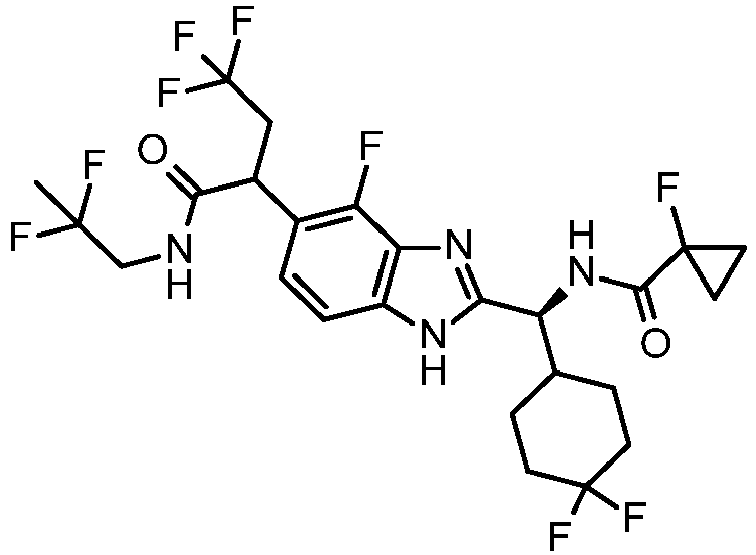
- Into a vial were introduced Intermediate 119 (100 mg, 0.18 mmol), 1-fluoro-cyclopropane-1-carboxylic acid (23 mg, 0.22 mmol), DIPEA (0.06 mL, 0.36 mmol) and DMF (2 mL) at r.t. under N2, followed by HATU (83 mg, 0.22 mmol). The reaction mixture was stirred for 1 h, then diluted with EtOAc (8 mL) and washed sequentially with water (2 mL) and brine (2 mL). The combined organic layers were dried over MgSO4, filtered and concentrated in vacuo. The crude residue was purified by HPLC to give the title compound (81 mg, 74%) as a white solid. δH (500 MHz, DMSO-d6) 13.13-12.52 (m, 1H), 8.84-8.70 (m, 1H), 8.63 (q, J 6.2 Hz, 1H), 7.44-7.25 (m, 1H), 7.25-7.16 (m, 1H), 5.04 (t, J 8.6 Hz, 1H), 4.36-4.27 (m, 1H), 3.55-3.45 (m, 2H), 3.16-3.06 (m, 1H), 2.68-2.56 (m, 1H), 2.29-2.17 (m, 1H), 2.10-2.01 (m, 1H), 2.01-1.89 (m, 2H), 1.87-1.65 (m, 2H), 1.51-1.38 (m, 4H), 1.38-1.11 (m, 6H). LCMS (Method 4): [M+H]+ 587.2, RT 3.29 minutes.
-

- Example 82 (74 mg) was subjected to chiral purification (Method 39) to afford the title compounds (Peak 1, 27 mg, 36%; and Peak 2, 26 mg, 36%) as white solids.
- Peak 1 (arbitrarily assigned R): NMR and LCMS retention times identical to those described for Example 82. Chiral LC (Method 40): RT 6.42 minutes, 100%.
- Peak 2 (arbitrarily assigned S): NMR and LCMS retention times identical to those described for Example 82. Chiral LC (Method 40): RT 8.67 minutes, 100%.
-

- Into a vial were introduced Intermediate 148 (106 mg, 0.19 mmol), lithium 2-isopropyl-1,2,4-triazole-3-carboxylate (38 mg, 0.23 mmol), DIPEA (68 µL, 0.39 mmol) and DMF (2 mL) at r.t. under N2, followed by HATU (89 mg, 0.23 mmol). The reaction mixture was stirred for 30 minutes, then diluted with EtOAc (6 mL) and washed sequentially with water (2 mL) and brine (2 mL). The combined organic layers were dried over MgSO4, filtered and concentrated in vacuo. The residue was purified by preparative HPLC to give the title compound (69 mg, 55%) as a white solid. δH (400 MHz, DMSO-d6) 13.14-12.46 (m, 1H), 9.17-8.90 (m, 1H), 8.62-8.43 (m, 1H), 8.12 (s, 1H), 7.52-7.03 (m, 2H), 5.65-5.42 (m, 1H), 5.17 (t, J 8.6 Hz, 1H), 4.34-4.17 (m, 1H), 3.55-3.41 (m, 2H), 2.98-2.75 (m, 1H), 2.30-2.11 (m, 2H), 2.11-1.87 (m, 3H), 1.87-1.67 (m, 2H), 1.66-1.47 (m, 4H), 1.47-1.35 (m, 9H), 1.35-1.20 (m, 2H). LCMS (Method 4): [M+H]+ 634.3, RT 3.39 minutes.
-

- Example 85 (64 mg) was subjected to chiral purification (Method 33) to afford the title compounds (Peak 1, 20 mg, 31%; and Peak 2, 23 mg, 36%) as white solids.
- Peak 1 (arbitrarily assigned R): NMR and LCMS retention times identical to those described for Example 85. Chiral LC (Method 41): RT 3.52 minutes, 100% d.e.
- Peak 2 (arbitrarily assigned S): NMR and LCMS retention times identical to those described for Example 85. Chiral LC (Method 41): RT 6.78 minutes, 100% d.e.
Claims (15)
- A compound of formula (I), or a pharmaceutically acceptable salt thereof:
 A represents C-R1 or N;E represents C-R2;R1 represents fluoro;R2 represents hydrogen;R3 represents -NR3aR3b; or R3 represents a group of formula (Wa):
 the group of formula (Wa) represents azetidin-1-yl, pyrrolidin-1-yl or morpholin-4-yl, any of which rings may be optionally substituted by one to six substituents independently selected from halogen;R3a represents hydrogen or C1-6 alkyl;R3b represents C1-6 alkyl or C3-7 cycloalkyl(C1-6)alkyl, either of which groups may be optionally substituted by one, two or three substituents independently selected from halogen, C1-6 alkyl, trifluoromethyl, C1-6 alkylaminocarbonyl and di(C1-6)alkylaminocarbonyl;R4a represents C1-6 alkyl, which group may be optionally substituted by one, two or three substituents independently selected from halogen, C1-6 alkoxy and C1-6 alkylsulfonyl; andR4b represents hydrogen, fluoro or C1-6 alkyl; orR4a and R4b, when taken together with the carbon atom to which they are both attached, represent cyclopropyl, cyclobutyl, cyclopentyl, cyclohexyl, oxetanyl, pyrrolidinyl, tetrahydropyranyl or piperidinyl, any of which groups may be optionally substituted by one or two substituents independently selected from C1-6 alkyl, halogen, trifluoroethyl and C2-6 alkoxycarbonyl; andR6 represents C3-9 cycloalkyl, aryl or heteroaryl, any of which groups may be optionally substituted by one, two or three substituents independently selected from halogen, C1-6 alkyl and cyclopropyl.
 - A compound as claimed in claim 1 represented by formula (I-1) or (I-2), or a pharmaceutically acceptable salt thereof:

- A compound as claimed in claim 1 or claim 2 wherein R6 represents heteroaryl, which group may be optionally substituted by one, two or three substituents independently selected from C1-6 alkyl.
- A compound as claimed in claim 1 represented by formula (IIA), or a pharmaceutically acceptable salt thereof:
 R16 represents methyl, ethyl, isopropyl or cyclopropyl; andA, E, R3, R4a and R4b are as defined in claim 1.
 - A compound as claimed in claim 1 represented by formula (IIB), or a pharmaceutically acceptable salt thereof:
 X represents CH or N;A, E, R3, R4a and R4b are as defined in claim 1; andR16 is as defined in claim 4.
 - A compound as claimed in claim 1 represented by formula (IIC), or a pharmaceutically acceptable salt thereof:
 R26 represents halogen; andA, E, R3, R4a and R4b are as defined in claim 1.
 - A compound as claimed in claim 1 represented by formula (IID), or a pharmaceutically acceptable salt thereof:
 R36 represents halogen; andA, E, R3, R4a and R4b are as defined in claim 1.
 - A compound as claimed in any one of the preceding claims wherein R3 represents -NR3aR3b, in which R3a is as defined in claim 1; and R3b represents difluoroethyl, trifluoroethyl, difluoropropyl, trifluoropropyl, trifluoroisopropyl, (fluoro)-(methyl)propyl, methylaminocarbonyl-2-methylpropyl, dimethylaminocarbonyl-2-methylpropyl, (cyclopropyl)(trifluoromethyl)methyl or difluorocyclopropylmethyl.
- A compound as claimed in any one of claims 1 to 7 wherein R3 represents a group of formula (Wa) as defined in claim 1, in which the group of formula (Wa) represents azetidin-1-yl or pyrrolidin-1-yl, either of which rings may be optionally substituted by two to four substituents independently selected from halogen.
- A compound as claimed in any one of the preceding claims wherein R4a represents methyl, methoxymethyl, difluoroethyl, trifluoroethyl, ethylsulfonylethyl or difluoropropyl.
- A compound as claimed in any one of claims 1 to 9 wherein R4a and R4b, when taken together with the carbon atom to which they are both attached, represent cyclobutyl, cyclohexyl, pyrrolidinyl, tetrahydropyranyl or piperidinyl, any of which groups may be unsubstituted, or substituted by one or two substituents independently selected from halogen and C2-6 alkoxycarbonyl.
- A compound of formula (I) as defined in claim 1, or a pharmaceutically acceptable salt thereof, for use in therapy.
- A compound of formula (I) as defined in claim 1, or a pharmaceutically acceptable salt thereof, for use in the treatment and/or prevention of an inflammatory or autoimmune disorder.
- A pharmaceutical composition comprising a compound of formula (I) as defined in claim 1, or a pharmaceutically acceptable salt thereof, in association with a pharmaceutically acceptable carrier.
- A pharmaceutical composition as claimed in claim 14 further comprising an additional pharmaceutically active ingredient.
Applications Claiming Priority (3)
| Application Number | Priority Date | Filing Date | Title |
|---|---|---|---|
| GBGB2005153.8A GB202005153D0 (en) | 2020-04-07 | 2020-04-07 | Therapeutic agents |
| GBGB2009617.8A GB202009617D0 (en) | 2020-06-24 | 2020-06-24 | Therapeutic agents |
| PCT/EP2021/058940 WO2021204801A1 (en) | 2020-04-07 | 2021-04-06 | Difluorocyclohexyl derivatives as il-17 modulators |
Publications (3)
| Publication Number | Publication Date |
|---|---|
| EP4132650A1 EP4132650A1 (en) | 2023-02-15 |
| EP4132650B1 true EP4132650B1 (en) | 2024-06-12 |
| EP4132650C0 EP4132650C0 (en) | 2024-06-12 |
Family
ID=75438771
Family Applications (1)
| Application Number | Title | Priority Date | Filing Date |
|---|---|---|---|
| EP21717399.6A Active EP4132650B1 (en) | 2020-04-07 | 2021-04-06 | Difluorocyclohexyl derivatives as il-17 modulators |
Country Status (7)
| Country | Link |
|---|---|
| US (1) | US20230271951A1 (en) |
| EP (1) | EP4132650B1 (en) |
| JP (1) | JP7682920B2 (en) |
| CN (1) | CN115702024A (en) |
| CA (1) | CA3179686A1 (en) |
| ES (1) | ES2983724T3 (en) |
| WO (1) | WO2021204801A1 (en) |
Families Citing this family (8)
| Publication number | Priority date | Publication date | Assignee | Title |
|---|---|---|---|---|
| BR112022021962A2 (en) | 2020-04-30 | 2023-03-28 | Janssen Pharmaceutica Nv | IMIDAZOPYRIDAZINES AS IL-17 MODULATORS |
| AR126255A1 (en) | 2021-07-01 | 2023-10-04 | UCB Biopharma SRL | IMIDAZOTRIAZINE DERIVATIVES AS MODULATORS OF IL-17 |
| WO2023025783A1 (en) | 2021-08-23 | 2023-03-02 | Leo Pharma A/S | Small molecule modulators of il-17 |
| WO2023111181A1 (en) | 2021-12-16 | 2023-06-22 | Leo Pharma A/S | Small molecule modulators of il-17 |
| WO2023166172A1 (en) | 2022-03-04 | 2023-09-07 | Leo Pharma A/S | Small molecule modulators of il-17 |
| GB202210731D0 (en) | 2022-07-22 | 2022-09-07 | UCB Biopharma SRL | Therapeutic agents |
| TW202430165A (en) | 2022-12-02 | 2024-08-01 | 丹麥商理奧藥品公司 | Small molecule modulators of il-17 |
| WO2025247285A1 (en) * | 2024-05-28 | 2025-12-04 | 西藏海思科制药有限公司 | Preparation method for heterocyclic compound capable of inhibiting il-17a, and use thereof |
Family Cites Families (17)
| Publication number | Priority date | Publication date | Assignee | Title |
|---|---|---|---|---|
| CA2709883A1 (en) * | 2007-12-19 | 2009-06-25 | The Scripps Research Institute | Benzimidazoles and analogs as rho kinase inhibitors |
| JP5886523B2 (en) | 2008-01-09 | 2016-03-16 | ザ スキーペンズ アイ リサーチ インスティチュート インコーポレイテッド | Therapeutic composition for treating inflammatory disorders of the eye |
| US9284283B2 (en) | 2012-02-02 | 2016-03-15 | Ensemble Therapeutics Corporation | Macrocyclic compounds for modulating IL-17 |
| AU2013255470B2 (en) * | 2012-05-04 | 2015-09-17 | Novartis Ag | Complement pathway modulators and uses thereof |
| WO2014066726A2 (en) | 2012-10-26 | 2014-05-01 | Ensemble Therapeutics Corporation | Compounds for modulating il-17 |
| GB201709456D0 (en) * | 2017-06-14 | 2017-07-26 | Ucb Biopharma Sprl | Therapeutic agents |
| WO2019138017A1 (en) * | 2018-01-15 | 2019-07-18 | Ucb Biopharma Sprl | Fused imidazole derivatives as il-17 modulators |
| MX2020011405A (en) * | 2018-05-03 | 2021-01-08 | Jiangsu Hengrui Medicine Co | BENCIMIDAZOLE DERIVATIVES AS RETINOID-RELATED ORPHAN RECEPTOR GAMMA (RORY) MODULATORS AND PHARMACEUTICAL USES THEREOF. |
| WO2019223718A1 (en) | 2018-05-22 | 2019-11-28 | 成都先导药物开发股份有限公司 | Immunomodulator |
| JP7349491B2 (en) | 2018-07-12 | 2023-09-22 | ユーシービー バイオファルマ エスアールエル | Spirocyclic indane analogs as IL-17 modulators |
| GB201820166D0 (en) | 2018-12-11 | 2019-01-23 | Ucb Biopharma Sprl | Therapeutic agents |
| GB201820165D0 (en) | 2018-12-11 | 2019-01-23 | Ucb Biopharma Sprl | Therapeutic agents |
| GB201909194D0 (en) | 2019-06-26 | 2019-08-07 | Ucb Biopharma Sprl | Therapeutic agents |
| GB201909191D0 (en) | 2019-06-26 | 2019-08-07 | Ucb Biopharma Sprl | Therapeutic agents |
| GB201909190D0 (en) | 2019-06-26 | 2019-08-07 | Ucb Biopharma Sprl | Therapeutic agents |
| WO2021027724A1 (en) * | 2019-08-09 | 2021-02-18 | 成都先导药物开发股份有限公司 | Immunomodulator |
| WO2021098844A1 (en) * | 2019-11-20 | 2021-05-27 | 成都先导药物开发股份有限公司 | Immunomodulator |
-
2021
- 2021-04-06 US US17/995,495 patent/US20230271951A1/en active Pending
- 2021-04-06 WO PCT/EP2021/058940 patent/WO2021204801A1/en not_active Ceased
- 2021-04-06 EP EP21717399.6A patent/EP4132650B1/en active Active
- 2021-04-06 JP JP2022561194A patent/JP7682920B2/en active Active
- 2021-04-06 ES ES21717399T patent/ES2983724T3/en active Active
- 2021-04-06 CA CA3179686A patent/CA3179686A1/en active Pending
- 2021-04-06 CN CN202180040727.0A patent/CN115702024A/en active Pending
Also Published As
| Publication number | Publication date |
|---|---|
| JP7682920B2 (en) | 2025-05-26 |
| JP2023521107A (en) | 2023-05-23 |
| US20230271951A1 (en) | 2023-08-31 |
| EP4132650C0 (en) | 2024-06-12 |
| ES2983724T3 (en) | 2024-10-24 |
| CA3179686A1 (en) | 2021-10-14 |
| EP4132650A1 (en) | 2023-02-15 |
| CN115702024A (en) | 2023-02-14 |
| WO2021204801A1 (en) | 2021-10-14 |
Similar Documents
| Publication | Publication Date | Title |
|---|---|---|
| EP4132650B1 (en) | Difluorocyclohexyl derivatives as il-17 modulators | |
| EP3740478B1 (en) | Fused imidazole derivatives as il-17 modulators | |
| EP3638227B1 (en) | Spirocyclic indolines as il-17 modulators | |
| EP3893871B1 (en) | Benzimidazolone derivatives, and analogues thereof, as il-17 modulators | |
| RU2658827C2 (en) | Amide derivatives of pyrosol | |
| WO2020120141A1 (en) | Functionalised amine derivatives as il-17 modulators | |
| CA2957048C (en) | Optionally fused heterocyclyl-substituted derivatives of pyrimidine useful for the treatment of inflammatory, metabolic, oncologic and autoimmune diseases | |
| US20220242855A1 (en) | Fused Imidazole Derivatives as IL-17 Modulators | |
| EP4363421A1 (en) | Imidazotriazine derivatives as il-17 modulators | |
| US20240140951A1 (en) | Imidazopyridazine derivatives as il-17 modulators | |
| WO2021170631A1 (en) | Difluorocyclohexyl derivatives as il-17 modulators | |
| WO2021170627A1 (en) | Difluorocyclohexyl derivatives as il-17 modulators | |
| WO2022165513A1 (en) | Cdk2 inhibitors and methods of using the same | |
| WO2021204800A1 (en) | Difluorocyclohexyl derivatives as il-17 modulators | |
| WO2022096412A1 (en) | Dicyclopropylmethyl derivatives as il-17 modulators | |
| WO2022096411A1 (en) | Dicyclopropylmethyl derivatives as il-17 modulators | |
| US20260028341A1 (en) | Imidazotriazine derivatives as il-17 modulators | |
| BR112020011776A2 (en) | triazole-linked carbamoyl cyclohexyl acids as lpa antagonists |
Legal Events
| Date | Code | Title | Description |
|---|---|---|---|
| STAA | Information on the status of an ep patent application or granted ep patent |
Free format text: STATUS: UNKNOWN |
|
| STAA | Information on the status of an ep patent application or granted ep patent |
Free format text: STATUS: THE INTERNATIONAL PUBLICATION HAS BEEN MADE |
|
| PUAI | Public reference made under article 153(3) epc to a published international application that has entered the european phase |
Free format text: ORIGINAL CODE: 0009012 |
|
| STAA | Information on the status of an ep patent application or granted ep patent |
Free format text: STATUS: REQUEST FOR EXAMINATION WAS MADE |
|
| 17P | Request for examination filed |
Effective date: 20221107 |
|
| AK | Designated contracting states |
Kind code of ref document: A1 Designated state(s): AL AT BE BG CH CY CZ DE DK EE ES FI FR GB GR HR HU IE IS IT LI LT LU LV MC MK MT NL NO PL PT RO RS SE SI SK SM TR |
|
| DAV | Request for validation of the european patent (deleted) | ||
| DAX | Request for extension of the european patent (deleted) | ||
| STAA | Information on the status of an ep patent application or granted ep patent |
Free format text: STATUS: EXAMINATION IS IN PROGRESS |
|
| 17Q | First examination report despatched |
Effective date: 20230817 |
|
| GRAP | Despatch of communication of intention to grant a patent |
Free format text: ORIGINAL CODE: EPIDOSNIGR1 |
|
| STAA | Information on the status of an ep patent application or granted ep patent |
Free format text: STATUS: GRANT OF PATENT IS INTENDED |
|
| INTG | Intention to grant announced |
Effective date: 20240320 |
|
| GRAS | Grant fee paid |
Free format text: ORIGINAL CODE: EPIDOSNIGR3 |
|
| GRAA | (expected) grant |
Free format text: ORIGINAL CODE: 0009210 |
|
| STAA | Information on the status of an ep patent application or granted ep patent |
Free format text: STATUS: THE PATENT HAS BEEN GRANTED |
|
| AK | Designated contracting states |
Kind code of ref document: B1 Designated state(s): AL AT BE BG CH CY CZ DE DK EE ES FI FR GB GR HR HU IE IS IT LI LT LU LV MC MK MT NL NO PL PT RO RS SE SI SK SM TR |
|
| REG | Reference to a national code |
Ref country code: GB Ref legal event code: FG4D |
|
| REG | Reference to a national code |
Ref country code: CH Ref legal event code: EP |
|
| REG | Reference to a national code |
Ref country code: DE Ref legal event code: R096 Ref document number: 602021014357 Country of ref document: DE |
|
| REG | Reference to a national code |
Ref country code: IE Ref legal event code: FG4D |
|
| U01 | Request for unitary effect filed |
Effective date: 20240628 |
|
| U07 | Unitary effect registered |
Designated state(s): AT BE BG DE DK EE FI FR IT LT LU LV MT NL PT RO SE SI Effective date: 20240902 |
|
| PG25 | Lapsed in a contracting state [announced via postgrant information from national office to epo] |
Ref country code: HR Free format text: LAPSE BECAUSE OF FAILURE TO SUBMIT A TRANSLATION OF THE DESCRIPTION OR TO PAY THE FEE WITHIN THE PRESCRIBED TIME-LIMIT Effective date: 20240612 |
|
| PG25 | Lapsed in a contracting state [announced via postgrant information from national office to epo] |
Ref country code: GR Free format text: LAPSE BECAUSE OF FAILURE TO SUBMIT A TRANSLATION OF THE DESCRIPTION OR TO PAY THE FEE WITHIN THE PRESCRIBED TIME-LIMIT Effective date: 20240913 |
|
| REG | Reference to a national code |
Ref country code: ES Ref legal event code: FG2A Ref document number: 2983724 Country of ref document: ES Kind code of ref document: T3 Effective date: 20241024 |
|
| PG25 | Lapsed in a contracting state [announced via postgrant information from national office to epo] |
Ref country code: NO Free format text: LAPSE BECAUSE OF FAILURE TO SUBMIT A TRANSLATION OF THE DESCRIPTION OR TO PAY THE FEE WITHIN THE PRESCRIBED TIME-LIMIT Effective date: 20240912 Ref country code: HR Free format text: LAPSE BECAUSE OF FAILURE TO SUBMIT A TRANSLATION OF THE DESCRIPTION OR TO PAY THE FEE WITHIN THE PRESCRIBED TIME-LIMIT Effective date: 20240612 Ref country code: GR Free format text: LAPSE BECAUSE OF FAILURE TO SUBMIT A TRANSLATION OF THE DESCRIPTION OR TO PAY THE FEE WITHIN THE PRESCRIBED TIME-LIMIT Effective date: 20240913 Ref country code: RS Free format text: LAPSE BECAUSE OF FAILURE TO SUBMIT A TRANSLATION OF THE DESCRIPTION OR TO PAY THE FEE WITHIN THE PRESCRIBED TIME-LIMIT Effective date: 20240912 |
|
| PG25 | Lapsed in a contracting state [announced via postgrant information from national office to epo] |
Ref country code: PL Free format text: LAPSE BECAUSE OF FAILURE TO SUBMIT A TRANSLATION OF THE DESCRIPTION OR TO PAY THE FEE WITHIN THE PRESCRIBED TIME-LIMIT Effective date: 20240612 |
|
| PG25 | Lapsed in a contracting state [announced via postgrant information from national office to epo] |
Ref country code: IS Free format text: LAPSE BECAUSE OF FAILURE TO SUBMIT A TRANSLATION OF THE DESCRIPTION OR TO PAY THE FEE WITHIN THE PRESCRIBED TIME-LIMIT Effective date: 20241012 |
|
| PG25 | Lapsed in a contracting state [announced via postgrant information from national office to epo] |
Ref country code: CZ Free format text: LAPSE BECAUSE OF FAILURE TO SUBMIT A TRANSLATION OF THE DESCRIPTION OR TO PAY THE FEE WITHIN THE PRESCRIBED TIME-LIMIT Effective date: 20240612 |
|
| PG25 | Lapsed in a contracting state [announced via postgrant information from national office to epo] |
Ref country code: SK Free format text: LAPSE BECAUSE OF FAILURE TO SUBMIT A TRANSLATION OF THE DESCRIPTION OR TO PAY THE FEE WITHIN THE PRESCRIBED TIME-LIMIT Effective date: 20240612 |
|
| PG25 | Lapsed in a contracting state [announced via postgrant information from national office to epo] |
Ref country code: SM Free format text: LAPSE BECAUSE OF FAILURE TO SUBMIT A TRANSLATION OF THE DESCRIPTION OR TO PAY THE FEE WITHIN THE PRESCRIBED TIME-LIMIT Effective date: 20240612 |
|
| PG25 | Lapsed in a contracting state [announced via postgrant information from national office to epo] |
Ref country code: SM Free format text: LAPSE BECAUSE OF FAILURE TO SUBMIT A TRANSLATION OF THE DESCRIPTION OR TO PAY THE FEE WITHIN THE PRESCRIBED TIME-LIMIT Effective date: 20240612 Ref country code: SK Free format text: LAPSE BECAUSE OF FAILURE TO SUBMIT A TRANSLATION OF THE DESCRIPTION OR TO PAY THE FEE WITHIN THE PRESCRIBED TIME-LIMIT Effective date: 20240612 Ref country code: PL Free format text: LAPSE BECAUSE OF FAILURE TO SUBMIT A TRANSLATION OF THE DESCRIPTION OR TO PAY THE FEE WITHIN THE PRESCRIBED TIME-LIMIT Effective date: 20240612 Ref country code: IS Free format text: LAPSE BECAUSE OF FAILURE TO SUBMIT A TRANSLATION OF THE DESCRIPTION OR TO PAY THE FEE WITHIN THE PRESCRIBED TIME-LIMIT Effective date: 20241012 Ref country code: CZ Free format text: LAPSE BECAUSE OF FAILURE TO SUBMIT A TRANSLATION OF THE DESCRIPTION OR TO PAY THE FEE WITHIN THE PRESCRIBED TIME-LIMIT Effective date: 20240612 |
|
| PLBE | No opposition filed within time limit |
Free format text: ORIGINAL CODE: 0009261 |
|
| STAA | Information on the status of an ep patent application or granted ep patent |
Free format text: STATUS: NO OPPOSITION FILED WITHIN TIME LIMIT |
|
| PGFP | Annual fee paid to national office [announced via postgrant information from national office to epo] |
Ref country code: GB Payment date: 20250306 Year of fee payment: 5 |
|
| 26N | No opposition filed |
Effective date: 20250313 |
|
| U20 | Renewal fee for the european patent with unitary effect paid |
Year of fee payment: 5 Effective date: 20250430 |
|
| PGFP | Annual fee paid to national office [announced via postgrant information from national office to epo] |
Ref country code: ES Payment date: 20250509 Year of fee payment: 5 |
|
| PGFP | Annual fee paid to national office [announced via postgrant information from national office to epo] |
Ref country code: CH Payment date: 20250501 Year of fee payment: 5 |
|
| PG25 | Lapsed in a contracting state [announced via postgrant information from national office to epo] |
Ref country code: MC Free format text: LAPSE BECAUSE OF FAILURE TO SUBMIT A TRANSLATION OF THE DESCRIPTION OR TO PAY THE FEE WITHIN THE PRESCRIBED TIME-LIMIT Effective date: 20240612 |