EP3990604B1 - Detergent composition - Google Patents
Detergent composition Download PDFInfo
- Publication number
- EP3990604B1 EP3990604B1 EP20732589.5A EP20732589A EP3990604B1 EP 3990604 B1 EP3990604 B1 EP 3990604B1 EP 20732589 A EP20732589 A EP 20732589A EP 3990604 B1 EP3990604 B1 EP 3990604B1
- Authority
- EP
- European Patent Office
- Prior art keywords
- detergent composition
- surfactant
- composition according
- mixtures
- alcohol
- Prior art date
- Legal status (The legal status is an assumption and is not a legal conclusion. Google has not performed a legal analysis and makes no representation as to the accuracy of the status listed.)
- Active
Links
Classifications
-
- C—CHEMISTRY; METALLURGY
- C11—ANIMAL OR VEGETABLE OILS, FATS, FATTY SUBSTANCES OR WAXES; FATTY ACIDS THEREFROM; DETERGENTS; CANDLES
- C11D—DETERGENT COMPOSITIONS; USE OF SINGLE SUBSTANCES AS DETERGENTS; SOAP OR SOAP-MAKING; RESIN SOAPS; RECOVERY OF GLYCEROL
- C11D1/00—Detergent compositions based essentially on surface-active compounds; Use of these compounds as a detergent
- C11D1/66—Non-ionic compounds
- C11D1/83—Mixtures of non-ionic with anionic compounds
- C11D1/831—Mixtures of non-ionic with anionic compounds of sulfonates with ethers of polyoxyalkylenes without phosphates
-
- C—CHEMISTRY; METALLURGY
- C11—ANIMAL OR VEGETABLE OILS, FATS, FATTY SUBSTANCES OR WAXES; FATTY ACIDS THEREFROM; DETERGENTS; CANDLES
- C11D—DETERGENT COMPOSITIONS; USE OF SINGLE SUBSTANCES AS DETERGENTS; SOAP OR SOAP-MAKING; RESIN SOAPS; RECOVERY OF GLYCEROL
- C11D1/00—Detergent compositions based essentially on surface-active compounds; Use of these compounds as a detergent
- C11D1/66—Non-ionic compounds
- C11D1/83—Mixtures of non-ionic with anionic compounds
-
- C—CHEMISTRY; METALLURGY
- C11—ANIMAL OR VEGETABLE OILS, FATS, FATTY SUBSTANCES OR WAXES; FATTY ACIDS THEREFROM; DETERGENTS; CANDLES
- C11D—DETERGENT COMPOSITIONS; USE OF SINGLE SUBSTANCES AS DETERGENTS; SOAP OR SOAP-MAKING; RESIN SOAPS; RECOVERY OF GLYCEROL
- C11D3/00—Other compounding ingredients of detergent compositions covered in group C11D1/00
- C11D3/0005—Other compounding ingredients characterised by their effect
- C11D3/0036—Soil deposition preventing compositions; Antiredeposition agents
-
- C—CHEMISTRY; METALLURGY
- C11—ANIMAL OR VEGETABLE OILS, FATS, FATTY SUBSTANCES OR WAXES; FATTY ACIDS THEREFROM; DETERGENTS; CANDLES
- C11D—DETERGENT COMPOSITIONS; USE OF SINGLE SUBSTANCES AS DETERGENTS; SOAP OR SOAP-MAKING; RESIN SOAPS; RECOVERY OF GLYCEROL
- C11D3/00—Other compounding ingredients of detergent compositions covered in group C11D1/00
- C11D3/16—Organic compounds
- C11D3/37—Polymers
- C11D3/3703—Macromolecular compounds obtained otherwise than by reactions only involving carbon-to-carbon unsaturated bonds
- C11D3/3715—Polyesters or polycarbonates
-
- C—CHEMISTRY; METALLURGY
- C11—ANIMAL OR VEGETABLE OILS, FATS, FATTY SUBSTANCES OR WAXES; FATTY ACIDS THEREFROM; DETERGENTS; CANDLES
- C11D—DETERGENT COMPOSITIONS; USE OF SINGLE SUBSTANCES AS DETERGENTS; SOAP OR SOAP-MAKING; RESIN SOAPS; RECOVERY OF GLYCEROL
- C11D3/00—Other compounding ingredients of detergent compositions covered in group C11D1/00
- C11D3/16—Organic compounds
- C11D3/37—Polymers
- C11D3/3703—Macromolecular compounds obtained otherwise than by reactions only involving carbon-to-carbon unsaturated bonds
- C11D3/3723—Polyamines or polyalkyleneimines
-
- C—CHEMISTRY; METALLURGY
- C11—ANIMAL OR VEGETABLE OILS, FATS, FATTY SUBSTANCES OR WAXES; FATTY ACIDS THEREFROM; DETERGENTS; CANDLES
- C11D—DETERGENT COMPOSITIONS; USE OF SINGLE SUBSTANCES AS DETERGENTS; SOAP OR SOAP-MAKING; RESIN SOAPS; RECOVERY OF GLYCEROL
- C11D3/00—Other compounding ingredients of detergent compositions covered in group C11D1/00
- C11D3/16—Organic compounds
- C11D3/38—Products with no well-defined composition, e.g. natural products
- C11D3/386—Preparations containing enzymes, e.g. protease or amylase
-
- C—CHEMISTRY; METALLURGY
- C11—ANIMAL OR VEGETABLE OILS, FATS, FATTY SUBSTANCES OR WAXES; FATTY ACIDS THEREFROM; DETERGENTS; CANDLES
- C11D—DETERGENT COMPOSITIONS; USE OF SINGLE SUBSTANCES AS DETERGENTS; SOAP OR SOAP-MAKING; RESIN SOAPS; RECOVERY OF GLYCEROL
- C11D3/00—Other compounding ingredients of detergent compositions covered in group C11D1/00
- C11D3/16—Organic compounds
- C11D3/38—Products with no well-defined composition, e.g. natural products
- C11D3/386—Preparations containing enzymes, e.g. protease or amylase
- C11D3/38609—Protease or amylase in solid compositions only
-
- C—CHEMISTRY; METALLURGY
- C11—ANIMAL OR VEGETABLE OILS, FATS, FATTY SUBSTANCES OR WAXES; FATTY ACIDS THEREFROM; DETERGENTS; CANDLES
- C11D—DETERGENT COMPOSITIONS; USE OF SINGLE SUBSTANCES AS DETERGENTS; SOAP OR SOAP-MAKING; RESIN SOAPS; RECOVERY OF GLYCEROL
- C11D3/00—Other compounding ingredients of detergent compositions covered in group C11D1/00
- C11D3/16—Organic compounds
- C11D3/38—Products with no well-defined composition, e.g. natural products
- C11D3/386—Preparations containing enzymes, e.g. protease or amylase
- C11D3/38618—Protease or amylase in liquid compositions only
-
- C—CHEMISTRY; METALLURGY
- C11—ANIMAL OR VEGETABLE OILS, FATS, FATTY SUBSTANCES OR WAXES; FATTY ACIDS THEREFROM; DETERGENTS; CANDLES
- C11D—DETERGENT COMPOSITIONS; USE OF SINGLE SUBSTANCES AS DETERGENTS; SOAP OR SOAP-MAKING; RESIN SOAPS; RECOVERY OF GLYCEROL
- C11D3/00—Other compounding ingredients of detergent compositions covered in group C11D1/00
- C11D3/16—Organic compounds
- C11D3/38—Products with no well-defined composition, e.g. natural products
- C11D3/386—Preparations containing enzymes, e.g. protease or amylase
- C11D3/38627—Preparations containing enzymes, e.g. protease or amylase containing lipase
-
- C—CHEMISTRY; METALLURGY
- C11—ANIMAL OR VEGETABLE OILS, FATS, FATTY SUBSTANCES OR WAXES; FATTY ACIDS THEREFROM; DETERGENTS; CANDLES
- C11D—DETERGENT COMPOSITIONS; USE OF SINGLE SUBSTANCES AS DETERGENTS; SOAP OR SOAP-MAKING; RESIN SOAPS; RECOVERY OF GLYCEROL
- C11D3/00—Other compounding ingredients of detergent compositions covered in group C11D1/00
- C11D3/16—Organic compounds
- C11D3/38—Products with no well-defined composition, e.g. natural products
- C11D3/386—Preparations containing enzymes, e.g. protease or amylase
- C11D3/38636—Preparations containing enzymes, e.g. protease or amylase containing enzymes other than protease, amylase, lipase, cellulase, oxidase or reductase
-
- C—CHEMISTRY; METALLURGY
- C11—ANIMAL OR VEGETABLE OILS, FATS, FATTY SUBSTANCES OR WAXES; FATTY ACIDS THEREFROM; DETERGENTS; CANDLES
- C11D—DETERGENT COMPOSITIONS; USE OF SINGLE SUBSTANCES AS DETERGENTS; SOAP OR SOAP-MAKING; RESIN SOAPS; RECOVERY OF GLYCEROL
- C11D3/00—Other compounding ingredients of detergent compositions covered in group C11D1/00
- C11D3/16—Organic compounds
- C11D3/38—Products with no well-defined composition, e.g. natural products
- C11D3/386—Preparations containing enzymes, e.g. protease or amylase
- C11D3/38645—Preparations containing enzymes, e.g. protease or amylase containing cellulase
-
- C—CHEMISTRY; METALLURGY
- C11—ANIMAL OR VEGETABLE OILS, FATS, FATTY SUBSTANCES OR WAXES; FATTY ACIDS THEREFROM; DETERGENTS; CANDLES
- C11D—DETERGENT COMPOSITIONS; USE OF SINGLE SUBSTANCES AS DETERGENTS; SOAP OR SOAP-MAKING; RESIN SOAPS; RECOVERY OF GLYCEROL
- C11D3/00—Other compounding ingredients of detergent compositions covered in group C11D1/00
- C11D3/16—Organic compounds
- C11D3/38—Products with no well-defined composition, e.g. natural products
- C11D3/386—Preparations containing enzymes, e.g. protease or amylase
- C11D3/38654—Preparations containing enzymes, e.g. protease or amylase containing oxidase or reductase
-
- C—CHEMISTRY; METALLURGY
- C11—ANIMAL OR VEGETABLE OILS, FATS, FATTY SUBSTANCES OR WAXES; FATTY ACIDS THEREFROM; DETERGENTS; CANDLES
- C11D—DETERGENT COMPOSITIONS; USE OF SINGLE SUBSTANCES AS DETERGENTS; SOAP OR SOAP-MAKING; RESIN SOAPS; RECOVERY OF GLYCEROL
- C11D1/00—Detergent compositions based essentially on surface-active compounds; Use of these compounds as a detergent
- C11D1/02—Anionic compounds
- C11D1/04—Carboxylic acids or salts thereof
-
- C—CHEMISTRY; METALLURGY
- C11—ANIMAL OR VEGETABLE OILS, FATS, FATTY SUBSTANCES OR WAXES; FATTY ACIDS THEREFROM; DETERGENTS; CANDLES
- C11D—DETERGENT COMPOSITIONS; USE OF SINGLE SUBSTANCES AS DETERGENTS; SOAP OR SOAP-MAKING; RESIN SOAPS; RECOVERY OF GLYCEROL
- C11D1/00—Detergent compositions based essentially on surface-active compounds; Use of these compounds as a detergent
- C11D1/02—Anionic compounds
- C11D1/04—Carboxylic acids or salts thereof
- C11D1/06—Ether- or thioether carboxylic acids
-
- C—CHEMISTRY; METALLURGY
- C11—ANIMAL OR VEGETABLE OILS, FATS, FATTY SUBSTANCES OR WAXES; FATTY ACIDS THEREFROM; DETERGENTS; CANDLES
- C11D—DETERGENT COMPOSITIONS; USE OF SINGLE SUBSTANCES AS DETERGENTS; SOAP OR SOAP-MAKING; RESIN SOAPS; RECOVERY OF GLYCEROL
- C11D1/00—Detergent compositions based essentially on surface-active compounds; Use of these compounds as a detergent
- C11D1/02—Anionic compounds
- C11D1/12—Sulfonic acids or sulfuric acid esters; Salts thereof
- C11D1/29—Sulfates of polyoxyalkylene ethers
-
- C—CHEMISTRY; METALLURGY
- C11—ANIMAL OR VEGETABLE OILS, FATS, FATTY SUBSTANCES OR WAXES; FATTY ACIDS THEREFROM; DETERGENTS; CANDLES
- C11D—DETERGENT COMPOSITIONS; USE OF SINGLE SUBSTANCES AS DETERGENTS; SOAP OR SOAP-MAKING; RESIN SOAPS; RECOVERY OF GLYCEROL
- C11D1/00—Detergent compositions based essentially on surface-active compounds; Use of these compounds as a detergent
- C11D1/66—Non-ionic compounds
- C11D1/72—Ethers of polyoxyalkylene glycols
-
- C—CHEMISTRY; METALLURGY
- C11—ANIMAL OR VEGETABLE OILS, FATS, FATTY SUBSTANCES OR WAXES; FATTY ACIDS THEREFROM; DETERGENTS; CANDLES
- C11D—DETERGENT COMPOSITIONS; USE OF SINGLE SUBSTANCES AS DETERGENTS; SOAP OR SOAP-MAKING; RESIN SOAPS; RECOVERY OF GLYCEROL
- C11D2111/00—Cleaning compositions characterised by the objects to be cleaned; Cleaning compositions characterised by non-standard cleaning or washing processes
- C11D2111/10—Objects to be cleaned
- C11D2111/12—Soft surfaces, e.g. textile
Definitions
- the present invention concerns a detergent composition. More particularly a detergent composition comprising a C16 and/or C18 ether sulfate surfactant.
- Alkyl ether sulfate surfactants based on saturated and monounsaturated C16 and C18 linear alky chains are waxy solids, with high melting points, typically above 45°C. For ease of handling in factories it would be desirable if the melting temperature could be reduced below 40°C, to allow flow through pipes, without need for extensive heating.
- a problem is how to reduce the melting temperature of a surfactant system incorporating alkyl ether sulfate surfactants based on C16 and C18.
- this problem can be solved by the combination of a C16 and/or C18 ether sulfate with an nonionic surfactant that is an alcohol ethoxylate having an oleyl and/or elaidic chain.
- the resulting surfactant mixture has a melting point below 40°C.
- the invention relates to a surfactant composition
- a surfactant composition comprising:
- the surfactant composition comprises water
- the level of water is less than 10 wt.%.
- the surfactant composition is incorporated in a detergent composition for home and personal care use, more preferably home care, most preferably a domestic detergent composition for cleaning clothes and household textiles.
- the detergent composition is a laundry composition, more preferably a liquid laundry composition.
- the detergent composition comprises from 0.2 to 50 wt.%, preferably from 1 to 40 wt.%, more preferably from 1.5 to 30 wt.%, even more preferably from 2 to 25 wt.%, most preferably from 4 to 15 wt.% of additional surfactant other than surfactants (a) and (b), wherein the surfactants are selected from: anionic, nonionic or amphoteric surfactants and mixtures thereof. More preferably the surfactant comprises anionic and/or nonionic surfactants.
- the additional nonionic surfactant is saturated and mono-unsaturated aliphatic alcohol ethoxylate, preferably selected from C 12 to C 15 primary linear alcohol ethoxylates with an average of from 5 to 30 ethoxylates, more preferably from 7 to 9 ethoxylates.
- the total amount of additional nonionic surfactants other than nonionic surfactant (a), in a composition of the invention ranges from 0.1 to 10 wt.%, more preferably from 1 to 8 wt.%, even more preferably from 1.5 to 6 wt.%, most preferably from 2 to 5 wt.%.
- the additional anionic surfactant is selected from C12 to C18 alkyl ether carboxylates; citric acid ester of a C16 to C18 monoglyceride (citrem), tartartic acid esters of a C16 to C18 monoglyceride (tatem) and diacetyl tartaric acid ester of a C16 to C18 monoglyceride (datem); and water-soluble alkali metal salts of organic sulfates and sulfonates having alkyl radicals containing from about 8 to about 22 carbon atoms; and mixtures thereof; most preferably, the anionic surfactant is selected from C16 to C18 alkyl ether carboxylates; citric acid ester of a C16 to C18 monoglyceride (citrem), tartartic acid esters of a C16 to C18 monoglyceride (tatem) and diacetyl tartaric acid ester of a C16 to C18 monoglyceride (datem
- the total amount of additional anionic surfactants other than anionic surfactant (b) in a composition of the invention ranges from 0.5 to 20 wt.%, more preferably from 1 to 16 wt.%, even more preferably from 1.5 to 14 wt.%, most preferably from 2 to 12 wt.%.
- the composition comprises from 0.5 to 15 wt.%, more preferably from 0.75 to 15 wt.%, even more preferably from 1 to 12 wt.%, most preferably from 1.5 to 10 wt.% of cleaning boosters selected from antiredeposition polymers; soil release polymers; alkoxylated polycarboxylic acid esters; and mixtures thereof.
- cleaning boosters selected from antiredeposition polymers; soil release polymers; alkoxylated polycarboxylic acid esters; and mixtures thereof.
- the antiredeposition polymers are alkoxylated polyamines; and/or the soil release polymer is a polyester soil release polymer.
- the detergent composition is a laundry detergent composition, more preferably a laundry liquid detergent composition.
- the composition comprises one or more enzymes from the group: lipases proteases, alpha-amylases, cellulases, peroxidases/oxidases, pectate lyases, and mannanases, or mixtures thereof, more preferably lipases, proteases, alpha-amylases, cellulases and mixtures thereof, wherein the level of each enzyme in the composition of the invention is from 0.0001 wt.% to 0.1 wt.%.
- the invention provides a domestic method of treating a textile, the method comprising the step of: treating a textile with an aqueous solution of 0.5 to 20 g/L of the detergent composition, preferably the laundry liquid detergent composition, of the first aspect.
- indefinite article “a” or “an” and its corresponding definite article “the” as used herein means at least one, or one or more, unless specified otherwise.
- wt.% relates to the amount by weight of the ingredient based on the total weight of the composition.
- charged surfactants for example anionic surfactants and the C16 and/or C18 ether sulfate (b)
- wt.% is calculated based on the protonated form of the surfactant.
- n and m where used are the mole average values.
- Alcohol ether sulfates are discussed in Anionic Surfactants: Organic Chemistry edited by H.W Stache (Marcel Dekker 1996).
- the composition comprises from 2 to 25 wt.%, preferably from 3 to 20 wt.%, most preferably from 4 to 15 wt.% of a C16 and/or C18 ether sulfate.
- C16 and/or C18 ether sulfates are ether sulfates of the form R 2 -(OCH 2 CH 2 ) n OSO 3 H where R 2 is saturated or monounsaturated linear C16 and/or C18 alkyl and where n is from 5 to 20, preferably from 6 to 14, more preferably from 7 to 13, most preferably from 7 to 12.
- the monounsaturation is preferably in the 9 position of the chain, and the double bond may be in a cis or trans configuration (oleyl or elaidic).
- the cis or trans ether sulfate CH 3 (CH 2 ) 7 -CH CH-(CH 2 ) 8 O-(OCH 2 CH 2 ) n OSO 3 H, is described as C18:1( ⁇ 9) ether sulfate.
- 18 is the number of carbon atoms in the chain, 1 is the number of double bonds and ⁇ 9 the position of the double bond on the chain.
- R 2 is selected from linear C16 alkyl, linear C18 alkyl, linear C18:1( ⁇ 9) alkyl and mixtures thereof.
- C16 and/or C18 ether sulfates with alkyl chains selected from a mixture of cetyl (linear C16) and stearyl (linear C18); oleyl ether sulfates and elaidic ether sulfates; and mixtures thereof.
- R 2 is saturated.
- Oleyl ether sulfates have a monounsaturated C18 chain with a cis double bond in the 9 position of the chain.
- Elaidic ether sulfate have a monounsaturated C18 chain with a trans double bond in the 9 position of the chain.
- Alcohol ether sulfates may be synthesised by ethoxylation of an alkyl alcohol to form an alcohol ethoxylate followed by sulfonation and neutralisation with a suitable alkali.
- the production of the alcohol ethoxylate involves an ethoxylation reaction: R-OH + q ethylene oxide ⁇ R-O-(CH2CH2O)q-H
- the reactions are base catalysed using NaOH, KOH, or NaOCH3.
- catalyst which provide narrower ethoxy distribution than NaOH, KOH, or NaOCH3.
- these narrower distribution catalysts involve a Group II base such as Ba dodecanoate; Group II metal alkoxides; Group II hyrodrotalcite as described in WO2007/147866 .
- Lanthanides may also be used.
- Such narrower distribution alcohol ethoxylates are available from Azo Nobel and Sasol.
- the greater than 70 wt.% of the alcohol ethoxylate should consist of ethoxylate with 5, 6, 7, 8, 9 10, 11, 12, 13, 14 and 15 Ethoxylate groups.
- the alkyl chain in the alcohol ether sulfate is preferably obtained from plants, preferably from a variety of plants.
- the oil fraction is preferably extracted, the triglyceride hydrolysed to give the carboxylic acid which is reduced to give the alkyl alcohol required for the surfactant synthesis.
- the oil is hydrogenated to removed polyunsaturated alkyl chains such as linoleic and linoleneic acid.
- Preferred plant sources of oils are palm, rapeseed, sunflower, maze, soy, cottonseed, olive oil and trees. The oil from trees is called tall oil. Most preferably the oil source is rapeseed oils. Palm oil may be used but is not preferred.
- alkyl ether sulfate surfactants may be in salt form or acid form, typically in the form of a water-soluble sodium, potassium, ammonium, magnesium or mono-, di- or tri- C2-C3 alkanolammonium salt, with the sodium cation being the usual one chosen.
- the weight fraction of saturated R 2 (C18 alcohol ether sulfate)/(C16 alcohol ether sulfate) is from 2 to 400, more preferably 8 to 200 where, the weight of the alkyl ether sulfate is for the protonated form R 2 -(OCH 2 CH 2 ) n OSO 3 H.
- Linear saturated or mono-unsaturated C20 and C22 alcohol ether sulfate may be present, preferably where n (the average number of moles of ethoxylation) is 6 to 14, preferably 7 to 13.
- n the average number of moles of ethoxylation
- the ratio of sum of (C18 alcohol ether sulfate)/(C20 and C22 alcohol ether sulfate) is greater than 10.
- Alcohol ethoxylates are discussed in the Nonionic Surfactants: Organic Chemistry edited by Nico M. van Os (Marcel Dekker 1998), Surfactant Science Series published by CRC press.
- Alcohol ethoxylates may be synthesised by ethoxylation of an alkyl alcohol.
- the alkyl chain in the alcohol ethoxylates is oleyl or elaidic, which is a monounsaturated linear C18 chain with the double bond in the 9 position in the cis or trans configuration.
- the R 1 chain comprises from 40 to 80 wt.% oleic.
- the R 1 chain is obtained from plants, preferably from a variety of plants.
- the oil fraction is preferably extracted
- the triglyceride may be partially hydrogenated to convert polyunsaturated fatty acid chains to oleyl chains, then the triglyceride hydrolysed to give the carboxylic acid which is reduced to give the alkyl alcohol required for the surfactant synthesis.
- Mono-unsaturated chains produced by partial hydrogenation are typically a 1:1 mix of cis and trans isomer.
- plants which give high oleic acid fraction may be used.
- the oleic alcohol may be separated from other chains as necessary.
- Preferred plant sources of oils are: rapeseed, sunflower, maze, soy, cottonseed, olive oil and trees.
- Most preferably plant sources of oils are: high oleic sunflower oil, high oleic rapeseed oil and olive oil.
- the production of the alcohol ethoxylate and the alkyl ether sulfate involves an ethoxylation reaction: R-OH + q ethylene oxide ⁇ R-O-(CH 2 CH 2 O) q -H
- the reactions are base catalysed using NaOH, KOH, or NaOCH 3 .
- catalyst which provide narrower ethoxy distribution than NaOH, KOH, or NaOCH 3 .
- these narrower distribution catalysts involve a Group II base such as Ba dodecanoate; Group II metal alkoxides; Group II hyrodrotalcite as described in WO2007/147866 . Lanthanides may also be used.
- Such narrower distribution alcohol ethoxylates are available from Azo Nobel and Sasol.
- the greater than 70 wt.% of the alcohol ethoxylate should consist of ethoxylate with 5,6,7,8,9 10, 11, 12, 13, 14 and 15 Ethoxylate groups.
- the surfactant composition of the first aspect of the invention is preferably used in the manufacture of detergent compositions.
- the surfactant composition is incorporated in a detergent composition for home and personal care use, more preferably home care, most preferably a domestic detergent composition for cleaning clothes and household textiles.
- the detergent composition is a laundry composition.
- Said composition may be in any form for example a liquid, solid, powder, liquid unit dose.
- the composition is a liquid composition, for example a liquid laundry composition.
- a laundry composition preferably the formulation when dissolved in demineralised water at 20°C has a pH of 3 to 10, more preferably from 4 to 8, even more preferably 6.5 to 7.5, most preferably 7.
- composition may comprise additional anionic surfactant other than specified in (b) of the claims (the C16 and/or C18 ether sulfates of (b)).
- anionic surfactant Any anionic surfactant may be used. However preferred surfactants are described below.
- the anionic surfactants that may be added are additional surfactants to those surfactants specified in (b) of the claims (the C16 and/or C18 ether sulfates of (b)).
- Suitable anionic detergent compounds are selected from C12 to C18 alkyl ether carboxylates; citric acid ester of a C16 to C18 monoglyceride (citrem), tartartic acid esters of a C16 to C18 monoglyceride (tatem) and diacetyl tartaric acid ester of a C16 to C18 monoglyceride (datem); and water-soluble alkali metal salts of organic sulfates and sulfonates having alkyl radicals containing from about 8 to about 22 carbon atoms; and mixtures thereof.
- Citrem, tatem and datem are described in Hasenhuettl, G.L and Hartel, R.W. (Eds) Food Emulsifiers and Their Application. 2008 (Springer ) and in Whitehurst, R.J. (Ed) Emulsifiers in Food Technology 2008 (Wiley-VCH ).
- the additional anionic surfactant comprises C16 to C18 alkyl ether carboxylates; citric acid ester of a C16 to C18 monoglyceride (citrem), tartartic acid esters of a C16 to C18 monoglyceride (tatem) and diacetyl tartaric acid ester of a C16 to C18 monoglyceride (datem) and sulfonates, for example, linear alkyl benzene sulfonate.
- the total amount of additional anionic surfactant other than anionic surfactant (b) in a composition of the invention ranges from 0.5 to 20 wt.%, more preferably from 1 to 16 wt.%, even more preferably from 1.5 to 14 wt.%, most preferably from 2 to 12 wt.%.
- these additional anionic surfactants are present at lower levels than the alkyl ether sulfate, preferably the weight fraction of further anionic surfactant/alkyl ether surfactant (b) is from 0 to 0.4, more preferably 0 to 0.1.
- the surfactants used are saturated or mono-unsaturated.
- the alkyl chains are derived from natural sources.
- composition may comprise an additional nonionic surfactant other than the nonionic surfactant (a) in the claim.
- nonionic surfactant Any additional nonionic surfactant may be used, however, preferred nonionic surfactants are described below.
- Nonionic surfactants are preferably selected from saturated and mono-unsaturated aliphatic alcohol ethoxylates.
- Aliphatic alcohol ethoxylates for use in the invention may suitably be selected from C 8 to C 18 primary or secondary linear or branched alcohol ethoxylates with an average of from 2 to 40 moles of ethylene oxide per mole of alcohol.
- the nonionic surfactant is saturated and mono-unsaturated aliphatic alcohol ethoxylate, preferably selected from C 12 to C 15 primary linear alcohol ethoxylates with an average of from 5 to 30 ethoxylates, more preferably from 7 to 9 ethoxylates.
- the alkyl chain is mono-unsaturated.
- the total amount of additional nonionic surfactants other than specified as (a) in claim 1, in a composition of the invention ranges from 0.1 to 10 wt.%, more preferably from 1 to 8 wt.%, even more preferably from 1.5 to 6 wt.%, most preferably from 2 to 5 wt.%.
- the composition preferably comprises from 0.5 to 15 wt.%, more preferably from 0.75 to 15 wt.%, even more preferably from 1 to 12 wt.%, most preferably from 1.5 to 10 wt.% of cleaning boosters selected from antiredeposition polymers; soil release polymers; alkoxylated polycarboxylic acid esters as described in WO/2019/008036 and WO/2019/007636 ; and mixtures thereof.
- Preferred antiredeposition polymers include alkoxylated polyamines.
- a preferred alkoxylated polyamine comprises an alkoxylated polyethylenimine, and/or alkoxylated polypropylenimine.
- the polyamine may be linear or branched. It may be branched to the extent that it is a dendrimer.
- the alkoxylation may typically be ethoxylation or propoxylation, or a mixture of both. Where a nitrogen atom is alkoxylated, a preferred average degree of alkoxylation is from 10 to 30, preferably from 15 to 25.
- a preferred material is ethoxylated polyethyleneimine, with an average degree of ethoxylation being from 10 to 30 preferably from 15 to 25, where a nitrogen atom is ethoxylated.
- the soil release polymer is a polyester soil release polymer.
- Preferred soil release polymers include those described in WO 2014/029479 and WO 2016/005338 .
- polyester based soil release polymer is a polyester according to the following formula (I) wherein
- polyester provided as an active blend comprising:
- Alkoxylated polycarboxylic acid esters are obtainable by first reacting an aromatic polycarboxylic acid containing at least three carboxylic acid units or anhydrides derived therefrom, preferably an aromatic polycarboxylic acid containing three or four carboxylic acid units or anhydrides derived therefrom, more preferably an aromatic polycarboxylic acid containing three carboxylic acid units or anhydrides derived therefrom, even more preferably trimellitic acid or trimellitic acid anhydride, most preferably trimellitic acid anhydride, with an alcohol alkoxylate and in a second step reacting the resulting product with an alcohol or a mixture of alcohols, preferably with C16/C18 alcohol.
- enzymes such as lipases, proteases, alpha-amylases, cellulases, peroxidases/oxidases, pectate lyases, and mannanases, or mixtures thereof, may be present in the formulation.
- enzymes are present, then preferably they are selected from: lipases, proteases, alpha-amylases, cellulases and mixtures thereof.
- the level of each enzyme in the laundry composition of the invention is from 0.0001 wt.% to 0.1 wt.%.
- Levels of enzyme present in the composition preferably relate to the level of enzyme as pure protein.
- Suitable lipases include those of bacterial or fungal origin. Chemically modified or protein engineered mutants are included. Examples of useful lipases include lipases from Humicola (synonym Thermomyces), e.g. from H. lanuginosa (T. lanuginosus) as described in EP 258 068 and EP 305 216 or from H. insolens as described in WO 96/13580 , a Pseudomonas lipase, e.g. from P. alcaligenes or P. pseudoalcaligenes ( EP 218 272 ), P. cepacia ( EP 331 376 ), P. stutzeri ( GB 1,372,034 ), P.
- lipase variants such as those described in WO 92/05249 , WO 94/01541 , EP 407 225 , EP 260 105 , WO 95/35381 , WO 96/00292 , WO 95/30744 , WO 94/25578 , WO 95/14783 , WO 95/22615 , WO 97/04079 and WO 97/07202 , WO 00/60063 .
- Lipolase TM and Lipolase Ultra TM Lipex TM and Lipoclean TM (Novozymes A/S).
- the invention may be carried out in the presence of phospholipase classified as EC 3.1.1.4 and/or EC 3.1.1.32.
- phospholipase is an enzyme which has activity towards phospholipids.
- Phospholipids such as lecithin or phosphatidylcholine, consist of glycerol esterified with two fatty acids in an outer (sn-1) and the middle (sn-2) positions and esterified with phosphoric acid in the third position; the phosphoric acid, in turn, may be esterified to an amino-alcohol.
- Phospholipases are enzymes which participate in the hydrolysis of phospholipids.
- phospholipases A 1 and A 2 which hydrolyze one fatty acyl group (in the sn-1 and sn-2 position, respectively) to form lysophospholipid
- lysophospholipase or phospholipase B
- Phospholipase C and phospholipase D release diacyl glycerol or phosphatidic acid respectively.
- proteases hydrolyse bonds within peptides and proteins, in the laundry context this leads to enhanced removal of protein or peptide containing stains.
- suitable proteases families include aspartic proteases; cysteine proteases; glutamic proteases; aspargine peptide lyase; serine proteases and threonine proteases. Such protease families are described in the MEROPS peptidase database (http://merops.sanger.ac.uk/). Serine proteases are preferred. Subtilase type serine proteases are more preferred.
- the term "subtilases" refers to a sub-group of serine protease according to Siezen et al., Protein Engng.
- Serine proteases are a subgroup of proteases characterized by having a serine in the active site, which forms a covalent adduct with the substrate.
- the subtilases may be divided into 6 subdivisions, i.e. the Subtilisin family, the Thermitase family, the Proteinase K family, the Lantibiotic peptidase family, the Kexin family and the Pyrolysin family.
- subtilases are those derived from Bacillus such as Bacillus lentus, B. alkalophilus, B. subtilis, B. amyloliquefaciens, Bacillus pumilus and Bacillus gibsonii described in; US7262042 and WO09/021867 , and subtilisin lentus, subtilisin Novo, subtilisin Carlsberg, Bacillus licheniformis, subtilisin BPN', subtilisin 309, subtilisin 147 and subtilisin 168 described in WO 89/06279 and protease PD138 described in ( WO 93/18140 ).
- proteases may be those described in WO 92/175177 , WO 01/016285 , WO 02/026024 and WO 02/016547 .
- trypsin-like proteases are trypsin (e.g. of porcine or bovine origin) and the Fusarium protease described in WO 89/06270 , WO 94/25583 and WO 05/040372 , and the chymotrypsin proteases derived from Cellumonas described in WO 05/052161 and WO 05/052146 .
- protease is a subtilisins (EC 3.4.21.62).
- subtilases are those derived from Bacillus such as Bacillus lentus, B. alkalophilus, B. subtilis, B. amyloliquefaciens, Bacillus pumilus and Bacillus gibsonii described in; US7262042 and WO09/021867 , and subtilisin lentus, subtilisin Novo, subtilisin Carlsberg, Bacillus licheniformis, subtilisin BPN', subtilisin 309, subtilisin 147 and subtilisin 168 described in WO89/06279 and protease PD138 described in ( WO93/18140 ).
- the subsilisin is derived from Bacillus, preferably Bacillus lentus, B.
- subtilisin is derived from Bacillus gibsonii or Bacillus Lentus.
- Suitable commercially available protease enzymes include those sold under the trade names names Alcalase ® , Blaze@; DuralaseTm, DurazymTm, Relase ® , Relase ® Ultra, Savinase ® , Savinase ® Ultra, Primase ® , Polarzyme ® , Kannase ® , Liquanase ® , Liquanase ® Ultra, Ovozyme ® , Coronase ® , Coronase ® Ultra, Neutrase ® , Everlase ® and Esperase ® all could be sold as Ultra ® or Evity ® (Novozymes A/S).
- the invention may use cutinase, classified in EC 3.1.1.74.
- the cutinase used according to the invention may be of any origin.
- Preferably cutinases are of microbial origin, in particular of bacterial, of fungal or of yeast origin.
- Suitable amylases include those of bacterial or fungal origin. Chemically modified or protein engineered mutants are included. Amylases include, for example, alpha-amylases obtained from Bacillus, e.g. a special strain of B. licheniformis, described in more detail in GB 1,296,839 , or the Bacillus sp. strains disclosed in WO 95/026397 or WO 00/060060 .
- amylases are Duramyl TM , Termamyl TM , Termamyl Ultra TM , Natalase TM , Stainzyme TM , Fungamyl TM and BAN TM (Novozymes A/S), Rapidase TM and Purastar TM (from Genencor International Inc.).
- Suitable cellulases include those of bacterial or fungal origin. Chemically modified or protein engineered mutants are included. Suitable cellulases include cellulases from the genera Bacillus, Pseudomonas, Humicola, Fusarium, Thielavia, Acremonium, e.g. the fungal cellulases produced from Humicola insolens, Thielavia terrestris, Myceliophthora thermophila, and Fusarium oxysporum disclosed in US 4,435,307 , US 5,648,263 , US 5,691,178 , US 5,776,757 , WO 89/09259 , WO 96/029397 , and WO 98/012307 .
- Celluzyme TM Commercially available cellulases include Celluzyme TM , Carezyme TM , Celluclean TM , Endolase TM , Renozyme TM (Novozymes A/S), Clazinase TM and Puradax HA TM (Genencor International Inc.), and KAC-500(B) TM (Kao Corporation).
- Celluclean TM is preferred.
- Suitable peroxidases/oxidases include those of plant, bacterial or fungal origin. Chemically modified or protein engineered mutants are included. Examples of useful peroxidases include peroxidases from Coprinus, e.g. from C. cinereus, and variants thereof as those described in WO 93/24618 , WO 95/10602 , and WO 98/15257 . Commercially available peroxidases include Guardzyme TM and Novozym TM 51004 (Novozymes A/S).
- Any enzyme present in the composition may be stabilized using conventional stabilizing agents, e.g., a polyol such as propylene glycol or glycerol, a sugar or sugar alcohol, lactic acid, boric acid, or a boric acid derivative, e.g., an aromatic borate ester, or a phenyl boronic acid derivative such as 4-formylphenyl boronic acid, and the composition may be formulated as described in e.g. WO 92/19709 and WO 92/19708 .
- a polyol such as propylene glycol or glycerol
- a sugar or sugar alcohol lactic acid, boric acid, or a boric acid derivative, e.g., an aromatic borate ester, or a phenyl boronic acid derivative such as 4-formylphenyl boronic acid
- the formulation may contain further ingredients.
- the composition may comprise a builder or a complexing agent.
- Builder materials may be selected from 1) calcium sequestrant materials, 2) precipitating materials, 3) calcium ion-exchange materials and 4) mixtures thereof.
- calcium sequestrant builder materials examples include alkali metal polyphosphates, such as sodium tripolyphosphate and organic sequestrants, such as ethylene diamine tetra-acetic acid.
- composition may also contain 0-10 wt.% of a builder or complexing agent such as ethylenediaminetetraacetic acid, diethylenetriamine-pentaacetic acid, citric acid, alkyl- or alkenylsuccinic acid, nitrilotriacetic acid or the other builders mentioned below.
- a builder or complexing agent such as ethylenediaminetetraacetic acid, diethylenetriamine-pentaacetic acid, citric acid, alkyl- or alkenylsuccinic acid, nitrilotriacetic acid or the other builders mentioned below.
- the laundry detergent formulation is a non-phosphate built laundry detergent formulation, i.e., contains less than 1 wt.% of phosphate. Most preferably the laundry detergent formulation is not built i.e. contain less than 1 wt.% of builder.
- the detergent composition is an aqueous liquid laundry detergent it is preferred that mono propylene glycol or glycerol is present at a level from 1 to 30 wt.%, most preferably 2 to 18 wt.%, to provide the formulation with appropriate, pourable viscosity.
- the composition preferably comprises a fluorescent agent (optical brightener).
- Fluorescent agents are well known and many such fluorescent agents are available commercially. Usually, these fluorescent agents are supplied and used in the form of their alkali metal salts, for example, the sodium salts.
- the total amount of the fluorescent agent or agents used in the composition is generally from 0.0001 to 0.5 wt.%, preferably 0.005 to 2 wt.%, more preferably 0.01 to 0.1 wt.%.
- Preferred classes of fluorescer are: Di-styryl biphenyl compounds, e.g. Tinopal (Trade Mark) CBS-X, Di-amine stilbene di-sulphonic acid compounds, e.g. Tinopal DMS pure Xtra and Blankophor (Trade Mark) HRH, and Pyrazoline compounds, e.g. Blankophor SN.
- Preferred fluorescers are fluorescers with CAS-No 3426-43-5 ; CAS-No 35632-99-6 ; CAS-No 24565-13-7 ; CAS-No 12224-16-7 ; CAS-No 13863-31-5 ; CAS-No 4193-55-9 ; CAS-No 16090-02-1 ; CAS-No 133-66-4 ; CAS-No 68444-86-0 ; CAS-No 27344-41-8 .
- fluorescers are: sodium 2 (4-styryl-3-sulfophenyl)-2H-napthol[1,2-d]triazole, disodium 4,4'-bis ⁇ [(4-anilino-6-(N methyl-N-2 hydroxyethyl) amino 1,3,5-triazin-2-yl)]amino ⁇ stilbene-2-2' disulphonate, disodium 4,4'-bis ⁇ [(4-anilino-6-morpholino-1,3,5-triazin-2-yl)]amino ⁇ stilbene-2-2' disulphonate, and disodium 4,4'-bis(2-sulphostyryl)biphenyl.
- Dyes are described in Color Chemistry Synthesis, Properties and Applications of Organic Dyes and Pigments, (H Zollinger, Wiley VCH, Switzerland, 2003 ) and, Industrial Dyes Chemistry, Properties Applications. (K Hunger (ed), Wiley-VCH Weinheim 2003 ).
- Dyes for use in laundry detergents preferably have an extinction coefficient at the maximum absorption in the visible range (400 to 700nm) of greater than 5000 L mol -1 cm -1 , preferably greater than 10000 L mol -1 cm -1 .
- Preferred dye chromophores are azo, azine, anthraquinone, phthalocyanine and triphenylmethane.
- Azo, anthraquinone, phthalocyanine and triphenylmethane dyes preferably carry a net anionic charged or are uncharged.
- Azine dyes preferably carry a net anionic or cationic charge.
- Shading dyes deposit to fabric during the wash or rinse step of the washing process providing a visible hue to the fabric.
- the dye gives a blue or violet colour to a white cloth with a hue angle of 240 to 345, more preferably 260 to 320, most preferably 270 to 300.
- the white cloth used in this test is bleached non-mercerised woven cotton sheeting.
- Shading dyes are discussed in WO2005/003274 , WO2006/032327(Unilever ), WO2006/032397(Unilever ), WO2006/045275(Unilever ), WO 2006/027086(Unilever ), WO2008/017570(Unilever ), WO 2008/141880(Unilever ), WO2009/132870(Unilever ), WO 2009/141173 (Unilever ), WO 2010/099997(Unilever ), WO 2010/102861 (Unilever ), WO 2010/148624(Unilever ), WO2008/087497 (P&G ), WO2011/011799 (P&G ), WO2012/054820 (P&G ), WO2013/142495 (P&G ), WO2013/151970 (P&G ), WO2018/085211 (P&G ), and WO2019/075149 (P&G ).
- a mixture of shading dyes may be used.
- the shading dye chromophore is most preferably selected from mono-azo, bis-azo and azine.
- Mono-azo dyes preferably contain a heterocyclic ring and are most preferably thiophene dyes.
- Bis-azo dyes are preferably sulphonated bis-azo dyes.
- Preferred examples of sulphonated bis-azo compounds are direct violet 7, direct violet 9, direct violet 11, direct violet 26, direct violet 31, direct violet 35, direct violet 40, direct violet 41, direct violet 51, direct violet 66, direct violet 99 and alkoxylated versions thereof.
- Alkoxylated bis-azo dyes are discussed in WO2012/054058 and WO/2010/151906 .
- alkoxylated bis-azo dye is :
- Azine dyes are preferably selected from sulphonated phenazine dyes and cationic phenazine dyes. Preferred examples are acid blue 98, acid violet 50, dye with CAS-No 72749-80-5, acid blue 59, and the phenazine dye selected from: wherein:
- the shading dye is preferably present in the composition in range from 0.0001 to 0.1wt %. Depending upon the nature of the shading dye there are preferred ranges depending upon the efficacy of the shading dye which is dependent on class and particular efficacy within any particular class. As stated above the shading dye is preferably a blue or violet shading dye.
- the composition preferably comprises a perfume.
- perfumes are provided in the CTFA (Cosmetic, Toiletry and Fragrance Association) 1992 International Buyers Guide, published by CFTA Publications and OPD 1993 Chemicals Buyers Directory 80th Annual Edition, published by Schnell Publishing Co .
- the perfume comprises at least one note (compound) from: alpha-isomethyl ionone, benzyl salicylate; citronellol; coumarin; hexyl cinnamal; linalool; pentanoic acid, 2-methyl-, ethyl ester; octanal; benzyl acetate; 1,6-octadien-3-ol, 3,7-dimethyl-, 3-acetate; cyclohexanol, 2-(1,1-dimethylethyl)-, 1-acetate; delta-damascone; beta-ionone; verdyl acetate; dodecanal; hexyl cinnamic aldehyde; cyclopentadecanolide; benzeneacetic acid, 2-phenylethyl ester; amyl salicylate; beta-caryophyllene; ethyl undecylenate; geranyl an
- Useful components of the perfume include materials of both natural and synthetic origin. They include single compounds and mixtures. Specific examples of such components may be found in the current literature, e.g., in Fenaroli's Handbook of Flavour Ingredients, 1975, CRC Press ; Synthetic Food Adjuncts, 1947 by M. B. Jacobs, edited by Van Nostr and; or Perfume and Flavour Chemicals by S. Arctander 1969, Montclair, N.J. (USA ).
- compositions of the present invention it is envisaged that there will be four or more, preferably five or more, more preferably six or more or even seven or more different perfume components.
- top notes are defined by Poucher ( Journal of the Society of Cosmetic Chemists 6(2):80 [1955 ]).
- Preferred top-notes are selected from citrus oils, linalool, linalyl acetate, lavender, dihydromyrcenol, rose oxide and cis-3-hexanol.
- the Research Institute for Fragrance Materials provides a database of perfumes (fragrances) with safety information.
- Perfume top note may be used to cue the whiteness and brightness benefit of the invention.
- perfume may be encapsulated, typical perfume components which it is advantageous to encapsulate, include those with a relatively low boiling point, preferably those with a boiling point of less than 300, preferably 100-250 Celsius. It is also advantageous to encapsulate perfume components which have a low CLog P (ie. those which will have a greater tendency to be partitioned into water), preferably with a CLog P of less than 3.0.
- these materials have been called the "delayed blooming" perfume ingredients and include one or more of the following materials: allyl caproate, amyl acetate, amyl propionate, anisic aldehyde, anisole, benzaldehyde, benzyl acetate, benzyl acetone, benzyl alcohol, benzyl formate, benzyl iso valerate, benzyl propionate, beta gamma hexenol, camphor gum, laevo-carvone, d-carvone, cinnamic alcohol, cinamyl formate, cis-jasmone, cis-3-hexenyl acetate, cuminic alcohol, cyclal c, dimethyl benzyl carbinol, dimethyl benzyl carbinol acetate, ethyl acetate, ethyl aceto acetate, ethy
- compositions of the present invention it is envisaged that there will be four or more, preferably five or more, more preferably six or more or even seven or more different perfume components from the list given of delayed blooming perfumes given above present in the perfume.
- perfumes with which the present invention can be applied are the socalled aromatherapy' materials. These include many components also used in perfumery, including components of essential oils such as Clary Sage, Eucalyptus, Geranium, Lavender, Mace Extract, Neroli, Nutmeg, Spearmint, Sweet Violet Leaf and Valerian.
- the laundry treatment composition does not contain a peroxygen bleach, e.g., sodium percarbonate, sodium perborate, and peracid.
- a peroxygen bleach e.g., sodium percarbonate, sodium perborate, and peracid.
- the composition may comprise one or more further polymers.
- suitable polymers are carboxymethylcellulose, poly (ethylene glycol), poly(vinyl alcohol), polycarboxylates such as polyacrylates, maleic/acrylic acid copolymers and lauryl methacrylate/acrylic acid copolymers.
- alkyl groups are sufficiently long to form branched or cyclic chains, the alkyl groups encompass branched, cyclic and linear alkyl chains.
- the alkyl groups are preferably linear or branched, most preferably linear.
- the detergent compositions optionally include one or more laundry adjunct ingredients.
- an anti-oxidant may be present in the formulation.
- amalgamate ingredient includes: perfumes, dispersing agents, stabilizers, pH control agents, metal ion control agents, colorants, brighteners, dyes, odour control agent, properfumes, cyclodextrin, perfume, solvents, soil release polymers, preservatives, antimicrobial agents, chlorine scavengers, anti-shrinkage agents, fabric crisping agents, spotting agents, anti-oxidants, anti-corrosion agents, bodying agents, drape and form control agents, smoothness agents, static control agents, wrinkle control agents, sanitization agents, disinfecting agents, germ control agents, mould control agents, mildew control agents, antiviral agents, antimicrobials, drying agents, stain resistance agents, soil release agents, malodour control agents, fabric refreshing agents, chlorine bleach odour control agents, dye fixatives, dye transfer inhibitors, shading dyes, colour maintenance agents, colour restoration, rejuvenation agents, anti-fading agents, whiteness enhancers, anti-abrasion agents
- C18:1( ⁇ 9) refers to a linear C18 carbon chain with a cis or trans double bond in the 9 position, for example oleic or elaidic.
- Formulation CES (%) O-10 (%) O-20 (%) 45°C 37°C 25°C
Landscapes
- Chemical & Material Sciences (AREA)
- Life Sciences & Earth Sciences (AREA)
- Engineering & Computer Science (AREA)
- Chemical Kinetics & Catalysis (AREA)
- Oil, Petroleum & Natural Gas (AREA)
- Wood Science & Technology (AREA)
- Organic Chemistry (AREA)
- Detergent Compositions (AREA)
Description
- The present invention concerns a detergent composition. More particularly a detergent composition comprising a C16 and/or C18 ether sulfate surfactant.
- Alkyl ether sulfate surfactants based on saturated and monounsaturated C16 and C18 linear alky chains are waxy solids, with high melting points, typically above 45°C. For ease of handling in factories it would be desirable if the melting temperature could be reduced below 40°C, to allow flow through pipes, without need for extensive heating.
- A problem is how to reduce the melting temperature of a surfactant system incorporating alkyl ether sulfate surfactants based on C16 and C18.
- Surprisingly, this problem can be solved by the combination of a C16 and/or C18 ether sulfate with an nonionic surfactant that is an alcohol ethoxylate having an oleyl and/or elaidic chain. The resulting surfactant mixture has a melting point below 40°C. Some surfactant and detergent compositions comprising alkyl ether sulfates and/or alcohol ethoxylates are disclosed in
US 3 844 951 A ,EP 3 241 887 A1 ,US 2012/252712 A1 ,DE 44 43 644 A1 . - The invention relates to a surfactant composition comprising:
- a) from 10 to 90 wt.%, preferably from 20 to 80 wt.%, most preferably from 20 to 50 wt.% of an alcohol ethoxylate of formula R1-(OCH2CH2)mOH where R1 is oleyl and/or elaidic and where m is from 6 to 16, preferably 7 to 14, more preferably 8 to 12; and,
- b) from 10 to 90 wt.%, preferably from 20 to 80 wt.%, most preferably from 50 to 80 wt.% of an alcohol ether sulfate of formula R2-(OCH2CH2)nOSO3H where R2 is saturated or monounsaturated linear C16 and C18 alkyl chain and n is from 5 to 20, preferably from 6 to 14, more preferably from 7 to 13, most preferably from 8 to 12;
- Preferably if the surfactant composition comprises water, the level of water is less than 10 wt.%.
- Preferably the surfactant composition is incorporated in a detergent composition for home and personal care use, more preferably home care, most preferably a domestic detergent composition for cleaning clothes and household textiles.
- Preferably the detergent composition is a laundry composition, more preferably a liquid laundry composition.
- Preferably the detergent composition comprises from 0.2 to 50 wt.%, preferably from 1 to 40 wt.%, more preferably from 1.5 to 30 wt.%, even more preferably from 2 to 25 wt.%, most preferably from 4 to 15 wt.% of additional surfactant other than surfactants (a) and (b), wherein the surfactants are selected from: anionic, nonionic or amphoteric surfactants and mixtures thereof. More preferably the surfactant comprises anionic and/or nonionic surfactants.
- Preferably the additional nonionic surfactant is saturated and mono-unsaturated aliphatic alcohol ethoxylate, preferably selected from C12 to C15 primary linear alcohol ethoxylates with an average of from 5 to 30 ethoxylates, more preferably from 7 to 9 ethoxylates. Preferably the total amount of additional nonionic surfactants other than nonionic surfactant (a), in a composition of the invention ranges from 0.1 to 10 wt.%, more preferably from 1 to 8 wt.%, even more preferably from 1.5 to 6 wt.%, most preferably from 2 to 5 wt.%.
- Preferably the additional anionic surfactant is selected from C12 to C18 alkyl ether carboxylates; citric acid ester of a C16 to C18 monoglyceride (citrem), tartartic acid esters of a C16 to C18 monoglyceride (tatem) and diacetyl tartaric acid ester of a C16 to C18 monoglyceride (datem); and water-soluble alkali metal salts of organic sulfates and sulfonates having alkyl radicals containing from about 8 to about 22 carbon atoms; and mixtures thereof; most preferably, the anionic surfactant is selected from C16 to C18 alkyl ether carboxylates; citric acid ester of a C16 to C18 monoglyceride (citrem), tartartic acid esters of a C16 to C18 monoglyceride (tatem) and diacetyl tartaric acid ester of a C16 to C18 monoglyceride (datem) and sulfonates, for example, linear alkyl benzene sulfonate; and mixtures thereof. Preferably the total amount of additional anionic surfactants other than anionic surfactant (b) in a composition of the invention ranges from 0.5 to 20 wt.%, more preferably from 1 to 16 wt.%, even more preferably from 1.5 to 14 wt.%, most preferably from 2 to 12 wt.%.
- Preferably the composition comprises from 0.5 to 15 wt.%, more preferably from 0.75 to 15 wt.%, even more preferably from 1 to 12 wt.%, most preferably from 1.5 to 10 wt.% of cleaning boosters selected from antiredeposition polymers; soil release polymers; alkoxylated polycarboxylic acid esters; and mixtures thereof.
- Preferably the antiredeposition polymers are alkoxylated polyamines; and/or the soil release polymer is a polyester soil release polymer.
- Preferably the detergent composition is a laundry detergent composition, more preferably a laundry liquid detergent composition.
- Preferably the composition comprises one or more enzymes from the group: lipases proteases, alpha-amylases, cellulases, peroxidases/oxidases, pectate lyases, and mannanases, or mixtures thereof, more preferably lipases, proteases, alpha-amylases, cellulases and mixtures thereof, wherein the level of each enzyme in the composition of the invention is from 0.0001 wt.% to 0.1 wt.%.
- In a second aspect the invention provides a domestic method of treating a textile, the method comprising the step of: treating a textile with an aqueous solution of 0.5 to 20 g/L of the detergent composition, preferably the laundry liquid detergent composition, of the first aspect.
- The indefinite article "a" or "an" and its corresponding definite article "the" as used herein means at least one, or one or more, unless specified otherwise.
- All enzyme levels refer to pure protein.
- wt.% relates to the amount by weight of the ingredient based on the total weight of the composition. For charged surfactants (for example anionic surfactants and the C16 and/or C18 ether sulfate (b)), wt.% is calculated based on the protonated form of the surfactant.
- The values of n and m where used are the mole average values.
- Alcohol ether sulfates are discussed in Anionic Surfactants: Organic Chemistry edited by H.W Stache (Marcel Dekker 1996).
- The composition comprises from 2 to 25 wt.%, preferably from 3 to 20 wt.%, most preferably from 4 to 15 wt.% of a C16 and/or C18 ether sulfate.
- C16 and/or C18 ether sulfates are ether sulfates of the form R2-(OCH2CH2)nOSO3H where R2 is saturated or monounsaturated linear C16 and/or C18 alkyl and where n is from 5 to 20, preferably from 6 to 14, more preferably from 7 to 13, most preferably from 7 to 12.
- The monounsaturation is preferably in the 9 position of the chain, and the double bond may be in a cis or trans configuration (oleyl or elaidic). The cis or trans ether sulfate CH3(CH2)7-CH=CH-(CH2)8O-(OCH2CH2)nOSO3H, is described as C18:1(Δ9) ether sulfate. 18 is the number of carbon atoms in the chain, 1 is the number of double bonds and Δ9 the position of the double bond on the chain. Most preferably R2 is selected from linear C16 alkyl, linear C18 alkyl, linear C18:1(Δ9) alkyl and mixtures thereof.
- Preferred examples are C16 and/or C18 ether sulfates with alkyl chains selected from a mixture of cetyl (linear C16) and stearyl (linear C18); oleyl ether sulfates and elaidic ether sulfates; and mixtures thereof.
- Most preferably R2 is saturated.
- Oleyl ether sulfates have a monounsaturated C18 chain with a cis double bond in the 9 position of the chain. Elaidic ether sulfate have a monounsaturated C18 chain with a trans double bond in the 9 position of the chain.
- Alcohol ether sulfates may be synthesised by ethoxylation of an alkyl alcohol to form an alcohol ethoxylate followed by sulfonation and neutralisation with a suitable alkali.
- The production of the alcohol ethoxylate involves an ethoxylation reaction:
R-OH + q ethylene oxide →R-O-(CH2CH2O)q-H
- Such ethoxylation reactions are described in Non-Ionic Surfactant Organic Chemistry (N. M. van Os ed), Surfactant Science Series Volume 72, CRC Press.
- Preferably the reactions are base catalysed using NaOH, KOH, or NaOCH3. Even more preferred are catalyst which provide narrower ethoxy distribution than NaOH, KOH, or NaOCH3. Preferably these narrower distribution catalysts involve a Group II base such as Ba dodecanoate; Group II metal alkoxides; Group II hyrodrotalcite as described in
WO2007/147866 . Lanthanides may also be used. Such narrower distribution alcohol ethoxylates are available from Azo Nobel and Sasol. - Preferably the ethoxy distribution has greater than 70 wt.%, more preferably greater than 80 w.t% of the alcohol ethoxylate R-O-(CH2CH2O)q-H in the range R-O-(CH2CH2O)x-H to R-O-(CH2CH2O)y-H where q is the mole average degree of ethoxylation and x and y are absolute numbers, where x = q-q/2 and y = q+q/2.
- For example when q = 10, then the greater than 70 wt.% of the alcohol ethoxylate should consist of ethoxylate with 5, 6, 7, 8, 9 10, 11, 12, 13, 14 and 15 Ethoxylate groups.
- The alkyl chain in the alcohol ether sulfate is preferably obtained from plants, preferably from a variety of plants. In this case the oil fraction is preferably extracted, the triglyceride hydrolysed to give the carboxylic acid which is reduced to give the alkyl alcohol required for the surfactant synthesis. Preferably the oil is hydrogenated to removed polyunsaturated alkyl chains such as linoleic and linoleneic acid. Preferred plant sources of oils are palm, rapeseed, sunflower, maze, soy, cottonseed, olive oil and trees. The oil from trees is called tall oil. Most preferably the oil source is rapeseed oils. Palm oil may be used but is not preferred.
- The alkyl ether sulfate surfactants may be in salt form or acid form, typically in the form of a water-soluble sodium, potassium, ammonium, magnesium or mono-, di- or tri- C2-C3 alkanolammonium salt, with the sodium cation being the usual one chosen.
- Preferably the weight fraction of saturated R2 (C18 alcohol ether sulfate)/(C16 alcohol ether sulfate) is from 2 to 400, more preferably 8 to 200 where, the weight of the alkyl ether sulfate is for the protonated form R2-(OCH2CH2)nOSO3H.
- Linear saturated or mono-unsaturated C20 and C22 alcohol ether sulfate may be present, preferably where n (the average number of moles of ethoxylation) is 6 to 14, preferably 7 to 13. Preferably the ratio of sum of (C18 alcohol ether sulfate)/(C20 and C22 alcohol ether sulfate) is greater than 10.
- Alcohol ethoxylates are discussed in the Nonionic Surfactants: Organic Chemistry edited by Nico M. van Os (Marcel Dekker 1998), Surfactant Science Series published by CRC press.
- Alcohol ethoxylates may be synthesised by ethoxylation of an alkyl alcohol.
- The alkyl chain in the alcohol ethoxylates is oleyl or elaidic, which is a monounsaturated linear C18 chain with the double bond in the 9 position in the cis or trans configuration. Most preferably the R1 chain comprises from 40 to 80 wt.% oleic.
- Preferably the R1 chain is obtained from plants, preferably from a variety of plants. In this case the oil fraction is preferably extracted, the triglyceride may be partially hydrogenated to convert polyunsaturated fatty acid chains to oleyl chains, then the triglyceride hydrolysed to give the carboxylic acid which is reduced to give the alkyl alcohol required for the surfactant synthesis. Mono-unsaturated chains produced by partial hydrogenation are typically a 1:1 mix of cis and trans isomer. Alternatively, plants which give high oleic acid fraction may be used. The oleic alcohol may be separated from other chains as necessary. Preferred plant sources of oils are: rapeseed, sunflower, maze, soy, cottonseed, olive oil and trees. Most preferably plant sources of oils are: high oleic sunflower oil, high oleic rapeseed oil and olive oil.
- The production of the alcohol ethoxylate and the alkyl ether sulfate involves an ethoxylation reaction:
R-OH + q ethylene oxide → R-O-(CH2CH2O)q-H
- Such ethoxylation reactions are described in Non-Ionic Surfactant Organic Chemistry (N. M. van Os ed), Surfactant Science Series Volume 72, CRC Press.
- Preferably the reactions are base catalysed using NaOH, KOH, or NaOCH3. Even more preferred are catalyst which provide narrower ethoxy distribution than NaOH, KOH, or NaOCH3. Preferably these narrower distribution catalysts involve a Group II base such as Ba dodecanoate; Group II metal alkoxides; Group II hyrodrotalcite as described in
WO2007/147866 . Lanthanides may also be used. Such narrower distribution alcohol ethoxylates are available from Azo Nobel and Sasol. - Preferably the ethoxy distribution has greater than 70 wt.%, more preferably greater than 80 w.t% of the alcohol ethoxylate R-O-(CH2CH2O)q-H in the range R-O-(CH2CH2O)x-H to R-O-(CH2CH2O)y-H where q is the average degree of ethoxylation and x and y are absolute numbers, where x = q-q/2 and y = q+q/2.
- For example when q = 10, then the greater than 70 wt.% of the alcohol ethoxylate should consist of ethoxylate with 5,6,7,8,9 10, 11, 12, 13, 14 and 15 Ethoxylate groups.
- The surfactant composition of the first aspect of the invention is preferably used in the manufacture of detergent compositions.
- The surfactant composition is incorporated in a detergent composition for home and personal care use, more preferably home care, most preferably a domestic detergent composition for cleaning clothes and household textiles.
- Preferably the detergent composition is a laundry composition. Said composition may be in any form for example a liquid, solid, powder, liquid unit dose. Preferably the composition is a liquid composition, for example a liquid laundry composition.
- If a laundry composition, then preferably the formulation when dissolved in demineralised water at 20°C has a pH of 3 to 10, more preferably from 4 to 8, even more preferably 6.5 to 7.5, most preferably 7.
- The composition may comprise additional anionic surfactant other than specified in (b) of the claims (the C16 and/or C18 ether sulfates of (b)).
- Any anionic surfactant may be used. However preferred surfactants are described below. The anionic surfactants that may be added are additional surfactants to those surfactants specified in (b) of the claims (the C16 and/or C18 ether sulfates of (b)).
- Examples of suitable anionic detergent compounds are selected from C12 to C18 alkyl ether carboxylates; citric acid ester of a C16 to C18 monoglyceride (citrem), tartartic acid esters of a C16 to C18 monoglyceride (tatem) and diacetyl tartaric acid ester of a C16 to C18 monoglyceride (datem); and water-soluble alkali metal salts of organic sulfates and sulfonates having alkyl radicals containing from about 8 to about 22 carbon atoms; and mixtures thereof.
- Citrem, tatem and datem are described in Hasenhuettl, G.L and Hartel, R.W. (Eds) Food Emulsifiers and Their Application. 2008 (Springer) and in Whitehurst, R.J. (Ed) Emulsifiers in Food Technology 2008 (Wiley-VCH).
- Most preferably, the additional anionic surfactant comprises C16 to C18 alkyl ether carboxylates; citric acid ester of a C16 to C18 monoglyceride (citrem), tartartic acid esters of a C16 to C18 monoglyceride (tatem) and diacetyl tartaric acid ester of a C16 to C18 monoglyceride (datem) and sulfonates, for example, linear alkyl benzene sulfonate.
- Preferably the total amount of additional anionic surfactant other than anionic surfactant (b) in a composition of the invention ranges from 0.5 to 20 wt.%, more preferably from 1 to 16 wt.%, even more preferably from 1.5 to 14 wt.%, most preferably from 2 to 12 wt.%.
- Preferably these additional anionic surfactants are present at lower levels than the alkyl ether sulfate, preferably the weight fraction of further anionic surfactant/alkyl ether surfactant (b) is from 0 to 0.4, more preferably 0 to 0.1.
- Preferably the surfactants used are saturated or mono-unsaturated. Preferably the alkyl chains are derived from natural sources.
- The composition may comprise an additional nonionic surfactant other than the nonionic surfactant (a) in the claim.
- Any additional nonionic surfactant may be used, however, preferred nonionic surfactants are described below.
- Nonionic surfactants are preferably selected from saturated and mono-unsaturated aliphatic alcohol ethoxylates.
- Aliphatic alcohol ethoxylates for use in the invention may suitably be selected from C8 to C18 primary or secondary linear or branched alcohol ethoxylates with an average of from 2 to 40 moles of ethylene oxide per mole of alcohol.
- Preferably the nonionic surfactant is saturated and mono-unsaturated aliphatic alcohol ethoxylate, preferably selected from C12 to C15 primary linear alcohol ethoxylates with an average of from 5 to 30 ethoxylates, more preferably from 7 to 9 ethoxylates. Preferably the alkyl chain is mono-unsaturated.
- Mixtures of any of the above described materials may also be used.
- Preferably the total amount of additional nonionic surfactants other than specified as (a) in claim 1, in a composition of the invention ranges from 0.1 to 10 wt.%, more preferably from 1 to 8 wt.%, even more preferably from 1.5 to 6 wt.%, most preferably from 2 to 5 wt.%.
- The composition preferably comprises from 0.5 to 15 wt.%, more preferably from 0.75 to 15 wt.%, even more preferably from 1 to 12 wt.%, most preferably from 1.5 to 10 wt.% of cleaning boosters selected from antiredeposition polymers; soil release polymers; alkoxylated polycarboxylic acid esters as described in
WO/2019/008036 andWO/2019/007636 ; and mixtures thereof. - Preferred antiredeposition polymers include alkoxylated polyamines.
- A preferred alkoxylated polyamine comprises an alkoxylated polyethylenimine, and/or alkoxylated polypropylenimine. The polyamine may be linear or branched. It may be branched to the extent that it is a dendrimer. The alkoxylation may typically be ethoxylation or propoxylation, or a mixture of both. Where a nitrogen atom is alkoxylated, a preferred average degree of alkoxylation is from 10 to 30, preferably from 15 to 25. A preferred material is ethoxylated polyethyleneimine, with an average degree of ethoxylation being from 10 to 30 preferably from 15 to 25, where a nitrogen atom is ethoxylated.
- Preferably the soil release polymer is a polyester soil release polymer.
- Preferred soil release polymers include those described in
WO 2014/029479 andWO 2016/005338 . - Preferably the polyester based soil release polymer is a polyester according to the following formula (I)

- R1 and R2
- independently of one another are X-(OC2H4)n-(OC3H6)m wherein X is C1-4 alkyl and preferably methyl, the -(OC2H4) groups and the -(OC3H6) groups are arranged blockwise and the block consisting of the -(OC3H6) groups is bound to a COO group or are HO-(C3H6), and preferably are independently of one another X-(OC2H4)n-(OC3H6)m,
- n
- is based on a molar average number of from 12 to 120 and preferably of from 40 to 50,
- m
- is based on a molar average number of from 1 to 10 and preferably of from 1 to 7, and
- a
- is based on a molar average number of from 4 to 9.
- Preferably the polyester provided as an active blend comprising:
- A) from 45 to 55 % by weight of the active blend of one or more polyesters according to the following formula (I)

- R1 and R2
- independently of one another are X-(OC2H4)n-(OC3H6)m wherein X is C1-4 alkyl and preferably methyl, the -(OC2H4) groups and the -(OC3H6) groups are arranged blockwise and the block consisting of the -(OC3H6) groups is bound to a COO group or are HO-(C3H6), and preferably are independently of one another X-(OC2H4)n-(OC3H6)m,
- n
- is based on a molar average number of from 12 to 120 and preferably of from 40 to 50,
- m
- is based on a molar average number of from 1 to 10 and preferably of from 1 to 7, and
- a
- is based on a molar average number of from 4 to 9 and
- B)
- from 10 to 30 % by weight of the active blend of one or more alcohols selected from the group consisting of ethylene glycol, 1,2-propylene glycol, 1,3-propylene glycol, 1,2-butylene glycol, 1,3-butylene glycol, 1,4-butylene glycol and butyl glycol and
- C)
- from 24 to 42 % by weight of the active blend of water.
- Alkoxylated polycarboxylic acid esters are obtainable by first reacting an aromatic polycarboxylic acid containing at least three carboxylic acid units or anhydrides derived therefrom, preferably an aromatic polycarboxylic acid containing three or four carboxylic acid units or anhydrides derived therefrom, more preferably an aromatic polycarboxylic acid containing three carboxylic acid units or anhydrides derived therefrom, even more preferably trimellitic acid or trimellitic acid anhydride, most preferably trimellitic acid anhydride, with an alcohol alkoxylate and in a second step reacting the resulting product with an alcohol or a mixture of alcohols, preferably with C16/C18 alcohol.
- Preferably enzymes, such as lipases, proteases, alpha-amylases, cellulases, peroxidases/oxidases, pectate lyases, and mannanases, or mixtures thereof, may be present in the formulation.
- If enzymes are present, then preferably they are selected from: lipases, proteases, alpha-amylases, cellulases and mixtures thereof.
- If present, then the level of each enzyme in the laundry composition of the invention is from 0.0001 wt.% to 0.1 wt.%.
- Levels of enzyme present in the composition preferably relate to the level of enzyme as pure protein.
- Suitable lipases include those of bacterial or fungal origin. Chemically modified or protein engineered mutants are included. Examples of useful lipases include lipases from Humicola (synonym Thermomyces), e.g. from H. lanuginosa (T. lanuginosus) as described in
EP 258 068 EP 305 216 WO 96/13580 EP 218 272 EP 331 376 GB 1,372,034 WO 95/06720 WO 96/27002 WO 96/12012 JP 64/744992 WO 91/16422 WO 92/05249 WO 94/01541 EP 407 225 EP 260 105 WO 95/35381 WO 96/00292 WO 95/30744 WO 94/25578 WO 95/14783 WO 95/22615 WO 97/04079 WO 97/07202 WO 00/60063 - Preferred commercially available lipase enzymes include Lipolase™ and Lipolase Ultra™, Lipex™ and Lipoclean ™ (Novozymes A/S).
- The invention may be carried out in the presence of phospholipase classified as EC 3.1.1.4 and/or EC 3.1.1.32. As used herein, the term phospholipase is an enzyme which has activity towards phospholipids.
- Phospholipids, such as lecithin or phosphatidylcholine, consist of glycerol esterified with two fatty acids in an outer (sn-1) and the middle (sn-2) positions and esterified with phosphoric acid in the third position; the phosphoric acid, in turn, may be esterified to an amino-alcohol. Phospholipases are enzymes which participate in the hydrolysis of phospholipids. Several types of phospholipase activity can be distinguished, including phospholipases A1 and A2 which hydrolyze one fatty acyl group (in the sn-1 and sn-2 position, respectively) to form lysophospholipid; and lysophospholipase (or phospholipase B) which can hydrolyze the remaining fatty acyl group in lysophospholipid. Phospholipase C and phospholipase D (phosphodiesterases) release diacyl glycerol or phosphatidic acid respectively.
- Protease enzymes hydrolyse bonds within peptides and proteins, in the laundry context this leads to enhanced removal of protein or peptide containing stains. Examples of suitable proteases families include aspartic proteases; cysteine proteases; glutamic proteases; aspargine peptide lyase; serine proteases and threonine proteases. Such protease families are described in the MEROPS peptidase database (http://merops.sanger.ac.uk/). Serine proteases are preferred. Subtilase type serine proteases are more preferred. The term "subtilases" refers to a sub-group of serine protease according to Siezen et al., Protein Engng. 4 (1991) 719-737 and Siezen et al. Protein Science 6 (1997) 501 -523. Serine proteases are a subgroup of proteases characterized by having a serine in the active site, which forms a covalent adduct with the substrate. The subtilases may be divided into 6 subdivisions, i.e. the Subtilisin family, the Thermitase family, the Proteinase K family, the Lantibiotic peptidase family, the Kexin family and the Pyrolysin family.
- Examples of subtilases are those derived from Bacillus such as Bacillus lentus, B. alkalophilus, B. subtilis, B. amyloliquefaciens, Bacillus pumilus and Bacillus gibsonii described in;
US7262042 andWO09/021867 WO 89/06279 WO 93/18140 WO 92/175177 WO 01/016285 WO 02/026024 WO 02/016547 WO 89/06270 WO 94/25583 WO 05/040372 WO 05/052161 WO 05/052146 - Most preferably the protease is a subtilisins (EC 3.4.21.62).
- Examples of subtilases are those derived from Bacillus such as Bacillus lentus, B. alkalophilus, B. subtilis, B. amyloliquefaciens, Bacillus pumilus and Bacillus gibsonii described in;
US7262042 andWO09/021867 WO89/06279 WO93/18140 US 6,312,936 BI,US 5,679,630 ,US 4,760,025 ,US7,262,042 andWO 09/021867 - Suitable commercially available protease enzymes include those sold under the trade names names Alcalase®, Blaze@; DuralaseTm, DurazymTm, Relase®, Relase® Ultra, Savinase®, Savinase® Ultra, Primase®, Polarzyme®, Kannase®, Liquanase®, Liquanase® Ultra, Ovozyme®, Coronase®, Coronase® Ultra, Neutrase®, Everlase® and Esperase® all could be sold as Ultra® or Evity® (Novozymes A/S).
- The invention may use cutinase, classified in EC 3.1.1.74. The cutinase used according to the invention may be of any origin. Preferably cutinases are of microbial origin, in particular of bacterial, of fungal or of yeast origin.
- Suitable amylases (alpha and/or beta) include those of bacterial or fungal origin. Chemically modified or protein engineered mutants are included. Amylases include, for example, alpha-amylases obtained from Bacillus, e.g. a special strain of B. licheniformis, described in more detail in
GB 1,296,839 WO 95/026397 WO 00/060060 - Suitable cellulases include those of bacterial or fungal origin. Chemically modified or protein engineered mutants are included. Suitable cellulases include cellulases from the genera Bacillus, Pseudomonas, Humicola, Fusarium, Thielavia, Acremonium, e.g. the fungal cellulases produced from Humicola insolens, Thielavia terrestris, Myceliophthora thermophila, and Fusarium oxysporum disclosed in
US 4,435,307 ,US 5,648,263 ,US 5,691,178 ,US 5,776,757 ,WO 89/09259 WO 96/029397 WO 98/012307 - Suitable peroxidases/oxidases include those of plant, bacterial or fungal origin. Chemically modified or protein engineered mutants are included. Examples of useful peroxidases include peroxidases from Coprinus, e.g. from C. cinereus, and variants thereof as those described in
WO 93/24618 WO 95/10602 WO 98/15257 - Further enzymes suitable for use are discussed in
WO 2009/087524 ,WO 2009/090576 ,WO 2009/107091 ,WO 2009/111258 andWO 2009/148983 . - Any enzyme present in the composition may be stabilized using conventional stabilizing agents, e.g., a polyol such as propylene glycol or glycerol, a sugar or sugar alcohol, lactic acid, boric acid, or a boric acid derivative, e.g., an aromatic borate ester, or a phenyl boronic acid derivative such as 4-formylphenyl boronic acid, and the composition may be formulated as described in e.g.
WO 92/19709 WO 92/19708 - The formulation may contain further ingredients.
- The composition may comprise a builder or a complexing agent.
- Builder materials may be selected from 1) calcium sequestrant materials, 2) precipitating materials, 3) calcium ion-exchange materials and 4) mixtures thereof.
- Examples of calcium sequestrant builder materials include alkali metal polyphosphates, such as sodium tripolyphosphate and organic sequestrants, such as ethylene diamine tetra-acetic acid.
- The composition may also contain 0-10 wt.% of a builder or complexing agent such as ethylenediaminetetraacetic acid, diethylenetriamine-pentaacetic acid, citric acid, alkyl- or alkenylsuccinic acid, nitrilotriacetic acid or the other builders mentioned below.
- More preferably the laundry detergent formulation is a non-phosphate built laundry detergent formulation, i.e., contains less than 1 wt.% of phosphate. Most preferably the laundry detergent formulation is not built i.e. contain less than 1 wt.% of builder.
- If the detergent composition is an aqueous liquid laundry detergent it is preferred that mono propylene glycol or glycerol is present at a level from 1 to 30 wt.%, most preferably 2 to 18 wt.%, to provide the formulation with appropriate, pourable viscosity.
- The composition preferably comprises a fluorescent agent (optical brightener).
- Fluorescent agents are well known and many such fluorescent agents are available commercially. Usually, these fluorescent agents are supplied and used in the form of their alkali metal salts, for example, the sodium salts.
- The total amount of the fluorescent agent or agents used in the composition is generally from 0.0001 to 0.5 wt.%, preferably 0.005 to 2 wt.%, more preferably 0.01 to 0.1 wt.%. Preferred classes of fluorescer are: Di-styryl biphenyl compounds, e.g. Tinopal (Trade Mark) CBS-X, Di-amine stilbene di-sulphonic acid compounds, e.g. Tinopal DMS pure Xtra and Blankophor (Trade Mark) HRH, and Pyrazoline compounds, e.g. Blankophor SN.
- Preferred fluorescers are fluorescers with CAS-No 3426-43-5; CAS-No 35632-99-6; CAS-No 24565-13-7; CAS-No 12224-16-7; CAS-No 13863-31-5; CAS-No 4193-55-9; CAS-No 16090-02-1; CAS-No 133-66-4; CAS-No 68444-86-0; CAS-No 27344-41-8.
- Most preferred fluorescers are: sodium 2 (4-styryl-3-sulfophenyl)-2H-napthol[1,2-d]triazole, disodium 4,4'-bis{[(4-anilino-6-(N methyl-N-2 hydroxyethyl) amino 1,3,5-triazin-2-yl)]amino}stilbene-2-2' disulphonate, disodium 4,4'-bis{[(4-anilino-6-morpholino-1,3,5-triazin-2-yl)]amino} stilbene-2-2' disulphonate, and disodium 4,4'-bis(2-sulphostyryl)biphenyl.
- It is advantageous to have shading dye present in the formulation.
- Dyes are described in Color Chemistry Synthesis, Properties and Applications of Organic Dyes and Pigments, (H Zollinger, Wiley VCH, Zürich, 2003) and, Industrial Dyes Chemistry, Properties Applications. (K Hunger (ed), Wiley-VCH Weinheim 2003).
- Dyes for use in laundry detergents preferably have an extinction coefficient at the maximum absorption in the visible range (400 to 700nm) of greater than 5000 L mol-1 cm-1, preferably greater than 10000 L mol-1 cm-1.
- Preferred dye chromophores are azo, azine, anthraquinone, phthalocyanine and triphenylmethane. Azo, anthraquinone, phthalocyanine and triphenylmethane dyes preferably carry a net anionic charged or are uncharged. Azine dyes preferably carry a net anionic or cationic charge.
- Blue or violet Shading dyes are most preferred. Shading dyes deposit to fabric during the wash or rinse step of the washing process providing a visible hue to the fabric. In this regard the dye gives a blue or violet colour to a white cloth with a hue angle of 240 to 345, more preferably 260 to 320, most preferably 270 to 300. The white cloth used in this test is bleached non-mercerised woven cotton sheeting.
- Shading dyes are discussed in
WO2005/003274 ,WO2006/032327(Unilever ),WO2006/032397(Unilever ),WO2006/045275(Unilever ),WO 2006/027086(Unilever ),WO2008/017570(Unilever ),WO 2008/141880(Unilever ),WO2009/132870(Unilever ),WO 2009/141173 (Unilever ),WO 2010/099997(Unilever ),WO 2010/102861 (Unilever ),WO 2010/148624(Unilever ),WO2008/087497 (P&G ),WO2011/011799 (P&G ),WO2012/054820 (P&G ),WO2013/142495 (P&G ),WO2013/151970 (P&G ),WO2018/085211 (P&G ), andWO2019/075149 (P&G ). - A mixture of shading dyes may be used.
- The shading dye chromophore is most preferably selected from mono-azo, bis-azo and azine.
- Mono-azo dyes preferably contain a heterocyclic ring and are most preferably thiophene dyes. The mono-azo dyes are preferably alkoxylated and are preferably uncharged or anionically charged at pH=7. Alkoxylated thiophene dyes are discussed in
WO2013/142495 andWO2008/087497 . A preferred example of a thiophene dye is shown below: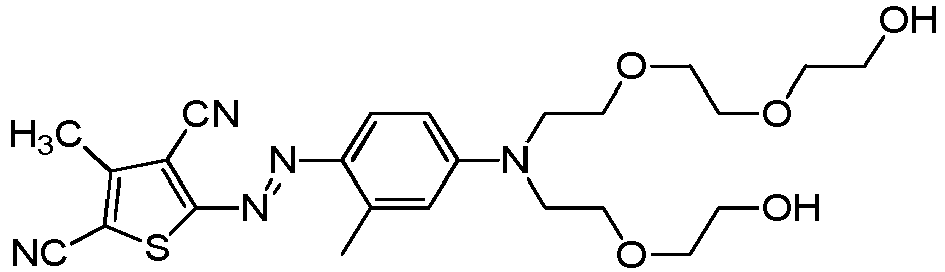
- Bis-azo dyes are preferably sulphonated bis-azo dyes. Preferred examples of sulphonated bis-azo compounds are direct violet 7, direct violet 9, direct violet 11, direct violet 26, direct violet 31, direct violet 35, direct violet 40, direct violet 41, direct violet 51, direct violet 66, direct violet 99 and alkoxylated versions thereof.
- Alkoxylated bis-azo dyes are discussed in
WO2012/054058 andWO/2010/151906 . - An example of an alkoxylated bis-azo dye is :
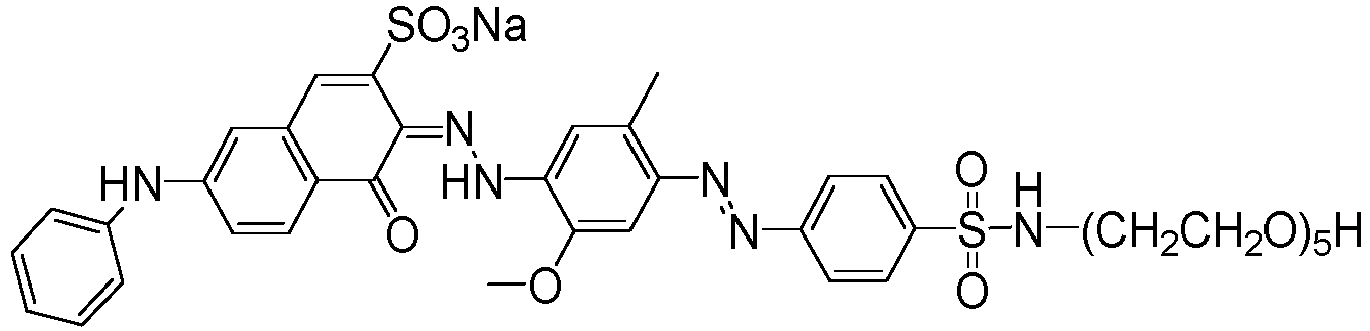
- Azine dyes are preferably selected from sulphonated phenazine dyes and cationic phenazine dyes. Preferred examples are acid blue 98, acid violet 50, dye with CAS-No 72749-80-5, acid blue 59, and the phenazine dye selected from:
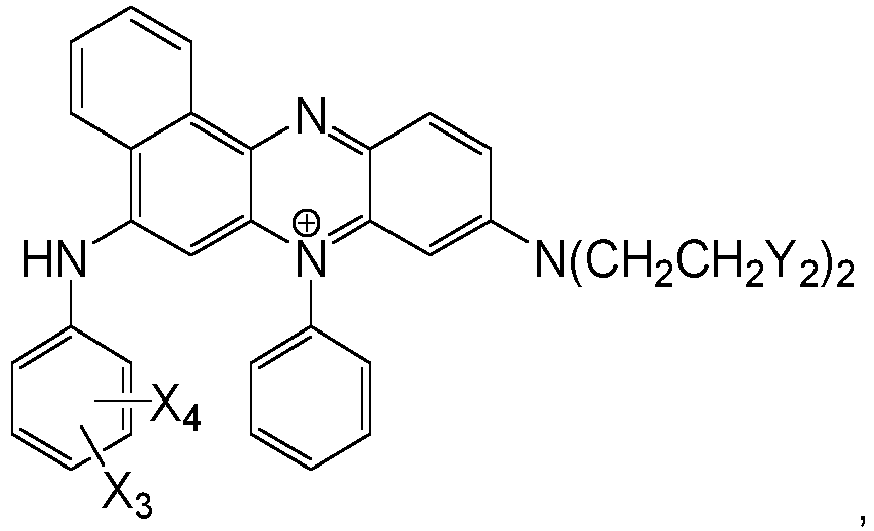
- X3 is selected from: -H; -F; -CH3; -C2H5; -OCH3; and, -OC2H5;
- X4 is selected from: -H; -CH3; -C2H5; -OCH3; and, -OC2H5;
- Y2 is selected from: -OH; -OCH2CH2OH; -CH(OH)CH2OH; -OC(O)CH3; and, C(O)OCH3. Anthraquinone dyes covalently bound to ethoxylate or propoxylated polyethylene imine may be used as described in
WO2011/047987 andWO 2012/119859 . - The shading dye is preferably present is present in the composition in range from 0.0001 to 0.1wt %. Depending upon the nature of the shading dye there are preferred ranges depending upon the efficacy of the shading dye which is dependent on class and particular efficacy within any particular class. As stated above the shading dye is preferably a blue or violet shading dye.
- The composition preferably comprises a perfume. Many suitable examples of perfumes are provided in the CTFA (Cosmetic, Toiletry and Fragrance Association) 1992 International Buyers Guide, published by CFTA Publications and OPD 1993 Chemicals Buyers Directory 80th Annual Edition, published by Schnell Publishing Co.
- Preferably the perfume comprises at least one note (compound) from: alpha-isomethyl ionone, benzyl salicylate; citronellol; coumarin; hexyl cinnamal; linalool; pentanoic acid, 2-methyl-, ethyl ester; octanal; benzyl acetate; 1,6-octadien-3-ol, 3,7-dimethyl-, 3-acetate; cyclohexanol, 2-(1,1-dimethylethyl)-, 1-acetate; delta-damascone; beta-ionone; verdyl acetate; dodecanal; hexyl cinnamic aldehyde; cyclopentadecanolide; benzeneacetic acid, 2-phenylethyl ester; amyl salicylate; beta-caryophyllene; ethyl undecylenate; geranyl anthranilate; alpha-irone; beta-phenyl ethyl benzoate; alpa-santalol; cedrol; cedryl acetate; cedry formate; cyclohexyl salicyate; gamma-dodecalactone; and, beta phenylethyl phenyl acetate.
- Useful components of the perfume include materials of both natural and synthetic origin. They include single compounds and mixtures. Specific examples of such components may be found in the current literature, e.g., in Fenaroli's Handbook of Flavour Ingredients, 1975, CRC Press; Synthetic Food Adjuncts, 1947 by M. B. Jacobs, edited by Van Nostrand; or Perfume and Flavour Chemicals by S. Arctander 1969, Montclair, N.J. (USA).
- It is commonplace for a plurality of perfume components to be present in a formulation. In the compositions of the present invention it is envisaged that there will be four or more, preferably five or more, more preferably six or more or even seven or more different perfume components.
- In perfume mixtures preferably 15 to 25 wt.% are top notes. Top notes are defined by Poucher (Journal of the Society of Cosmetic Chemists 6(2):80 [1955]). Preferred top-notes are selected from citrus oils, linalool, linalyl acetate, lavender, dihydromyrcenol, rose oxide and cis-3-hexanol.
- The International Fragrance Association has published a list of fragrance ingredients (perfumes) in 2011. (http://www.ifraorg.org/en-us/ingredients#.U7Z4hPldWzk)
- The Research Institute for Fragrance Materials provides a database of perfumes (fragrances) with safety information.
- Perfume top note may be used to cue the whiteness and brightness benefit of the invention. Some or all of the perfume may be encapsulated, typical perfume components which it is advantageous to encapsulate, include those with a relatively low boiling point, preferably those with a boiling point of less than 300, preferably 100-250 Celsius. It is also advantageous to encapsulate perfume components which have a low CLog P (ie. those which will have a greater tendency to be partitioned into water), preferably with a CLog P of less than 3.0. These materials, of relatively low boiling point and relatively low CLog P have been called the "delayed blooming" perfume ingredients and include one or more of the following materials: allyl caproate, amyl acetate, amyl propionate, anisic aldehyde, anisole, benzaldehyde, benzyl acetate, benzyl acetone, benzyl alcohol, benzyl formate, benzyl iso valerate, benzyl propionate, beta gamma hexenol, camphor gum, laevo-carvone, d-carvone, cinnamic alcohol, cinamyl formate, cis-jasmone, cis-3-hexenyl acetate, cuminic alcohol, cyclal c, dimethyl benzyl carbinol, dimethyl benzyl carbinol acetate, ethyl acetate, ethyl aceto acetate, ethyl amyl ketone, ethyl benzoate, ethyl butyrate, ethyl hexyl ketone, ethyl phenyl acetate, eucalyptol, eugenol, fenchyl acetate, flor acetate (tricyclo decenyl acetate) , frutene (tricyclco decenyl propionate) , geraniol, hexenol, hexenyl acetate, hexyl acetate, hexyl formate, hydratropic alcohol, hydroxycitronellal, indone, isoamyl alcohol, iso menthone, isopulegyl acetate, isoquinolone, ligustral, linalool, linalool oxide, linalyl formate, menthone, menthyl acetphenone, methyl amyl ketone, methyl anthranilate, methyl benzoate, methyl benyl acetate, methyl eugenol, methyl heptenone, methyl heptine carbonate, methyl heptyl ketone, methyl hexyl ketone, methyl phenyl carbinyl acetate, methyl salicylate, methyl-n-methyl anthranilate, nerol, octalactone, octyl alcohol, p-cresol, p-cresol methyl ether, p-methoxy acetophenone, p-methyl acetophenone, phenoxy ethanol, phenyl acetaldehyde, phenyl ethyl acetate, phenyl ethyl alcohol, phenyl ethyl dimethyl carbinol, prenyl acetate, propyl bornate, pulegone, rose oxide, safrole, 4-terpinenol, alphaterpinenol, and /or viridine. It is commonplace for a plurality of perfume components to be present in a formulation. In the compositions of the present invention it is envisaged that there will be four or more, preferably five or more, more preferably six or more or even seven or more different perfume components from the list given of delayed blooming perfumes given above present in the perfume.
- Another group of perfumes with which the present invention can be applied are the socalled aromatherapy' materials. These include many components also used in perfumery, including components of essential oils such as Clary Sage, Eucalyptus, Geranium, Lavender, Mace Extract, Neroli, Nutmeg, Spearmint, Sweet Violet Leaf and Valerian.
- It is preferred that the laundry treatment composition does not contain a peroxygen bleach, e.g., sodium percarbonate, sodium perborate, and peracid.
- The composition may comprise one or more further polymers. Examples are carboxymethylcellulose, poly (ethylene glycol), poly(vinyl alcohol), polycarboxylates such as polyacrylates, maleic/acrylic acid copolymers and lauryl methacrylate/acrylic acid copolymers.
- Where alkyl groups are sufficiently long to form branched or cyclic chains, the alkyl groups encompass branched, cyclic and linear alkyl chains. The alkyl groups are preferably linear or branched, most preferably linear.
- The detergent compositions optionally include one or more laundry adjunct ingredients.
- To prevent oxidation of the formulation an anti-oxidant may be present in the formulation.
- The term "adjunct ingredient" includes: perfumes, dispersing agents, stabilizers, pH control agents, metal ion control agents, colorants, brighteners, dyes, odour control agent, properfumes, cyclodextrin, perfume, solvents, soil release polymers, preservatives, antimicrobial agents, chlorine scavengers, anti-shrinkage agents, fabric crisping agents, spotting agents, anti-oxidants, anti-corrosion agents, bodying agents, drape and form control agents, smoothness agents, static control agents, wrinkle control agents, sanitization agents, disinfecting agents, germ control agents, mould control agents, mildew control agents, antiviral agents, antimicrobials, drying agents, stain resistance agents, soil release agents, malodour control agents, fabric refreshing agents, chlorine bleach odour control agents, dye fixatives, dye transfer inhibitors, shading dyes, colour maintenance agents, colour restoration, rejuvenation agents, anti-fading agents, whiteness enhancers, anti-abrasion agents, wear resistance agents, fabric integrity agents, anti-wear agents, and rinse aids, UV protection agents, sun fade inhibitors, insect repellents, anti-allergenic agents, enzymes, flame retardants, water proofing agents, fabric comfort agents, water conditioning agents, shrinkage resistance agents, stretch resistance agents, and combinations thereof. If present, such adjuncts can be used at a level of from 0.1% to 5% by weight of the composition
- The invention will be further described with the following non-limiting examples.
- Compositions of various proportions of C16 and/or C18 ether sulfate (CES standing for cetearyl ether sulfate) with 10 moles of ethoxylation (the alkyl chain is a mix of C16 and C18, predominately C18) and C18:1(Δ9) alcohol ethoxylate with 10 moles of ethoxylation (O-10), or C18:1(Δ9) alcohol ethoxylate with 20 moles of ethoxylation (O-20), were made by melting and mixing. The mixtures were equilibrated in temperature-controlled storage cabinets and the phase behaviour observed.
- The results are given in the following table, with the inventive formulations denoted by a number (1 to 4), and the comparative formulations denoted by a letter (A-G).
- C18:1(Δ9) refers to a linear C18 carbon chain with a cis or trans double bond in the 9 position, for example oleic or elaidic.
Formulation CES (%) O-10 (%) O-20 (%) 45°C 37°C 25°C A 100 0 - Liquid Solid Solid 1 80 20 - Liquid Liquid Solid 2 60 40 - Liquid Liquid Solid 3 40 60 - Liquid Liquid Solid 4 20 80 - Liquid Liquid Solid B 0 100 - Liquid Liquid Solid C 80 - 20 Liquid Solid Solid D 60 - 40 Liquid Solid Solid E 40 - 60 Liquid Solid Solid F 20 - 80 Liquid Solid Solid G 0 - 100 Liquid Solid Solid - Surprisingly at 37°C the mixes of CES with O-10 are liquid, whereas O-10 and CES are both solid at this temperature. The mixes of CES with O-20 are solid at 37°C.
Claims (15)
- A surfactant composition, comprising:a) from 10 to 90 wt.%, preferably from 20 to 80 wt.%, most preferably from 20 to 50 wt.% of an alcohol ethoxylate of formula R1-(OCH2CH2)mOH where R1 is oleyl and/or elaidic and where m is from 6 to 16, preferably 7 to 14, more preferably 8 to 12; and,b) from 10 to 90 wt.%, preferably from 20 to 80 wt.%, most preferably from 50 to 80 wt.% of an alcohol ether sulfate of formula R2-(OCH2CH2)nOSO3H where R2 is saturated or monounsaturated linear C16 and C18 alkyl chain and n is from 5 to 20, preferably from 6 to 14, more preferably from 7 to 13, most preferably from 8 to 12;wherein the total level of (a) + (b) is greater than 80 wt.%.
- A surfactant composition according to claim 1, wherein if the surfactant composition comprises water, then the level of water is less than 10 wt.%.
- A detergent composition for home and personal care use, preferably home care, most preferably a domestic detergent composition for cleaning clothes and household textiles, comprising the surfactant composition according to claim 1 or claim 2.
- A detergent composition according to claim 3, wherein the detergent composition is a laundry composition, more preferably a liquid laundry composition.
- A detergent composition according to claim 3 to claim 4, wherein the composition comprises from 0.2 to 50 wt.%, preferably from 1 to 40 wt.%, more preferably from 1.5 to 30 wt.%, even more preferably from 2 to 25 wt.%, most preferably from 4 to 15 wt.% of additional surfactant other than surfactants (a) and (b), wherein the surfactants are selected from: anionic, nonionic or amphoteric surfactants and mixtures thereof.
- A detergent composition according to claim 5, wherein the additional surfactant comprises anionic and/or nonionic surfactants.
- A detergent composition according to any claim 5 or claim 6, comprising from 0.1 to 10 wt.%, preferably from 1 to 8 wt.%, more preferably from 1.5 to 6 wt.%, most preferably from 2 to 5 wt.% of additional nonionic surfactants other than nonionic surfactant (a), wherein the nonionic surfactant is selected from saturated and monounsaturated aliphatic alcohol ethoxylate, preferably selected from C12 to C15 primary linear alcohol ethoxylates with an average of from 5 to 30 ethoxylates, more preferably with an average of from 7 to 9 ethoxylates.
- A detergent composition according to any one of claims 5 to 7, comprising from 0.5 to 20 wt.%, more preferably from 1 to 16 wt.%, even more preferably from 1.5 to 14 wt.%, most preferably from 2 to 12 wt.% of additional anionic surfactant other than anionic surfactant (b), wherein the additional anionic surfactant is selected from C12 to C18 alkyl ether carboxylates; citric acid ester of a C16 to C18 monoglyceride (citrem), tartartic acid esters of a C16 to C18 monoglyceride (tatem) and diacetyl tartaric acid ester of a C16 to C18 monoglyceride (datem); and water-soluble alkali metal salts of organic sulfates and sulfonates having alkyl radicals containing from 8 to 22 carbon atoms; and mixtures thereof; most preferably, the anionic surfactant is selected from C16 to C18 alkyl ether carboxylates; citric acid ester of a C16 to C18 monoglyceride (citrem), tartartic acid esters of a C16 to C18 monoglyceride (tatem) and diacetyl tartaric acid ester of a C16 to C18 monoglyceride (datem) and sulfonates, for example, linear alkyl benzene sulfonate; and mixtures thereof.
- A detergent composition according to any one of claims 3 to 8, wherein the composition comprises from 0.5 to 15 wt.%, more preferably from 0.75 to 15 wt.%, even more preferably from 1 to 12 wt.%, most preferably from 1.5 to 10 wt.% of cleaning boosters selected from antiredeposition polymers; soil release polymers; alkoxylated polycarboxylic acid esters, and mixtures thereof.
- A detergent composition according to claim 9, wherein the antiredeposition polymers are alkoxylated polyamines; and/or the soil release polymer is a polyester soil release polymer.
- A detergent composition according to claim 9 or claim 10, wherein the soil release polymer is a polyester soil release polymer.
- A detergent composition according to any one of claims 3 to 11, wherein the composition comprises one or more enzymes from the group: lipases, proteases, alpha-amylases, cellulases, peroxidases/oxidases, pectate lyases, and mannanases, or mixtures thereof, preferably lipases, proteases, alpha-amylases, cellulases and mixtures thereof, wherein the level of each enzyme in the composition of the invention is from 0.0001 wt.% to 0.1 wt.%.
- A detergent composition according to any one of claims 3 to 12, wherein the R1 alkyl chain in the alcohol ethoxylates comprises from 40 to 80 wt.% oleic.
- A detergent composition according to any one of claims 3 to 13, comprising less than 1 wt.% phosphate.
- A domestic method of treating a textile, the method comprising the step of: treating a textile with an aqueous solution of 0.5 to 20 g/L of the detergent composition of any one of claims 3 to 14, and optionally drying the textile.
Applications Claiming Priority (2)
| Application Number | Priority Date | Filing Date | Title |
|---|---|---|---|
| EP19183232 | 2019-06-28 | ||
| PCT/EP2020/066332 WO2020260040A1 (en) | 2019-06-28 | 2020-06-12 | Detergent composition |
Publications (2)
| Publication Number | Publication Date |
|---|---|
| EP3990604A1 EP3990604A1 (en) | 2022-05-04 |
| EP3990604B1 true EP3990604B1 (en) | 2022-12-14 |
Family
ID=67137629
Family Applications (1)
| Application Number | Title | Priority Date | Filing Date |
|---|---|---|---|
| EP20732589.5A Active EP3990604B1 (en) | 2019-06-28 | 2020-06-12 | Detergent composition |
Country Status (7)
| Country | Link |
|---|---|
| US (1) | US20220364022A1 (en) |
| EP (1) | EP3990604B1 (en) |
| CN (1) | CN114008184B (en) |
| AR (1) | AR119274A1 (en) |
| BR (1) | BR112021025430A2 (en) |
| WO (1) | WO2020260040A1 (en) |
| ZA (1) | ZA202110800B (en) |
Families Citing this family (4)
| Publication number | Priority date | Publication date | Assignee | Title |
|---|---|---|---|---|
| WO2019067560A1 (en) | 2017-09-26 | 2019-04-04 | Ecolab Usa Inc. | Acidic/anionic antimicrobial and virucidal compositions and uses thereof |
| WO2021126956A1 (en) | 2019-12-16 | 2021-06-24 | Ecolab Usa Inc. | Anionic surfactant impact on virucidal efficacy |
| EP4330366B1 (en) * | 2021-04-30 | 2024-09-25 | Unilever IP Holdings B.V. | Composition |
| WO2022248108A1 (en) | 2021-05-28 | 2022-12-01 | Unilever Ip Holdings B.V. | A liquid laundry detergent composition comprising c16 and c18 alcohol ethoxylate surfactant and/or c16 and c18 alkyl ether sulphate |
Family Cites Families (101)
| Publication number | Priority date | Publication date | Assignee | Title |
|---|---|---|---|---|
| GB1296839A (en) | 1969-05-29 | 1972-11-22 | ||
| US3844951A (en) * | 1970-01-14 | 1974-10-29 | Henkel & Cie Gmbh | Detergent compositions containing a textile softener |
| GB1372034A (en) | 1970-12-31 | 1974-10-30 | Unilever Ltd | Detergent compositions |
| DK187280A (en) | 1980-04-30 | 1981-10-31 | Novo Industri As | RUIT REDUCING AGENT FOR A COMPLETE LAUNDRY |
| US4760025A (en) | 1984-05-29 | 1988-07-26 | Genencor, Inc. | Modified enzymes and methods for making same |
| JPH0697997B2 (en) | 1985-08-09 | 1994-12-07 | ギスト ブロカデス ナ−ムロ−ゼ フエンノ−トチヤツプ | New enzymatic detergent additive |
| ES2058119T3 (en) | 1986-08-29 | 1994-11-01 | Novo Nordisk As | ENZYMATIC DETERGENT ADDITIVE. |
| NZ221627A (en) | 1986-09-09 | 1993-04-28 | Genencor Inc | Preparation of enzymes, modifications, catalytic triads to alter ratios or transesterification/hydrolysis ratios |
| DE3854249T2 (en) | 1987-08-28 | 1996-02-29 | Novonordisk As | Recombinant Humicola Lipase and Process for the Production of Recombinant Humicola Lipases. |
| WO1989006270A1 (en) | 1988-01-07 | 1989-07-13 | Novo-Nordisk A/S | Enzymatic detergent |
| DK6488D0 (en) | 1988-01-07 | 1988-01-07 | Novo Industri As | ENZYMES |
| JP3079276B2 (en) | 1988-02-28 | 2000-08-21 | 天野製薬株式会社 | Recombinant DNA, Pseudomonas sp. Containing the same, and method for producing lipase using the same |
| US5776757A (en) | 1988-03-24 | 1998-07-07 | Novo Nordisk A/S | Fungal cellulase composition containing alkaline CMC-endoglucanase and essentially no cellobiohydrolase and method of making thereof |
| EP0406314B1 (en) | 1988-03-24 | 1993-12-01 | Novo Nordisk A/S | A cellulase preparation |
| GB8915658D0 (en) | 1989-07-07 | 1989-08-23 | Unilever Plc | Enzymes,their production and use |
| KR100236540B1 (en) | 1990-04-14 | 2000-01-15 | 레클로우크스 라우에르 | Alkaline bacillus lipases, coding dna sequences thereof and bacilli which produce these lipases |
| DK0548228T3 (en) | 1990-09-13 | 1999-05-10 | Novo Nordisk As | lipase variants |
| US5292796A (en) | 1991-04-02 | 1994-03-08 | Minnesota Mining And Manufacturing Company | Urea-aldehyde condensates and melamine derivatives comprising fluorochemical oligomers |
| ES2085024T3 (en) | 1991-04-30 | 1996-05-16 | Procter & Gamble | LIQUID DETERGENTS REINFORCED WITH BORICO-POLYOL ACID COMPLEX TO INHIBIT THE PROTEOLYTIC ENZYME. |
| EP0511456A1 (en) | 1991-04-30 | 1992-11-04 | The Procter & Gamble Company | Liquid detergents with aromatic borate ester to inhibit proteolytic enzyme |
| DK28792D0 (en) | 1992-03-04 | 1992-03-04 | Novo Nordisk As | NEW ENZYM |
| DK72992D0 (en) | 1992-06-01 | 1992-06-01 | Novo Nordisk As | ENZYME |
| DK88892D0 (en) | 1992-07-06 | 1992-07-06 | Novo Nordisk As | CONNECTION |
| AU673078B2 (en) | 1993-04-27 | 1996-10-24 | Genencor International, Inc. | New lipase variants for use in detergent applications |
| DK52393D0 (en) | 1993-05-05 | 1993-05-05 | Novo Nordisk As | |
| JP2859520B2 (en) | 1993-08-30 | 1999-02-17 | ノボ ノルディスク アクティーゼルスカブ | Lipase, microorganism producing the same, method for producing lipase, and detergent composition containing lipase |
| US5817495A (en) | 1993-10-13 | 1998-10-06 | Novo Nordisk A/S | H2 O2 -stable peroxidase variants |
| CA2173105C (en) | 1993-10-14 | 2003-05-27 | Andre Baeck | Protease-containing cleaning compositions |
| JPH07143883A (en) | 1993-11-24 | 1995-06-06 | Showa Denko Kk | Lipase gene and mutant lipase |
| ATE222604T1 (en) | 1994-02-22 | 2002-09-15 | Novozymes As | METHOD FOR PRODUCING A VARIANT OF A LIPOLYTIC ENZYME |
| DE69534464T2 (en) | 1994-03-29 | 2006-09-28 | Novozymes A/S | ALKALIC AMYLASE FROM BACELLUS |
| WO1995030744A2 (en) | 1994-05-04 | 1995-11-16 | Genencor International Inc. | Lipases with improved surfactant resistance |
| WO1995035381A1 (en) | 1994-06-20 | 1995-12-28 | Unilever N.V. | Modified pseudomonas lipases and their use |
| WO1996000292A1 (en) | 1994-06-23 | 1996-01-04 | Unilever N.V. | Modified pseudomonas lipases and their use |
| BE1008998A3 (en) | 1994-10-14 | 1996-10-01 | Solvay | Lipase, microorganism producing the preparation process for the lipase and uses thereof. |
| AU3697995A (en) | 1994-10-26 | 1996-05-23 | Novo Nordisk A/S | An enzyme with lipolytic activity |
| DE4443644A1 (en) * | 1994-12-08 | 1996-06-13 | Henkel Kgaa | Solid, free-flowing preparations |
| JPH08228778A (en) | 1995-02-27 | 1996-09-10 | Showa Denko Kk | Novel lipase gene and method for producing lipase using the same |
| CN1182451A (en) | 1995-03-17 | 1998-05-20 | 诺沃挪第克公司 | Novel endoglucanases |
| WO1997007202A1 (en) | 1995-08-11 | 1997-02-27 | Novo Nordisk A/S | Novel lipolytic enzymes |
| WO1997004078A1 (en) | 1995-07-14 | 1997-02-06 | Novo Nordisk A/S | A modified enzyme with lipolytic activity |
| DE69735767T2 (en) | 1996-09-17 | 2007-04-05 | Novozymes A/S | cellulase |
| WO1998015257A1 (en) | 1996-10-08 | 1998-04-16 | Novo Nordisk A/S | Diaminobenzoic acid derivatives as dye precursors |
| CN1276004A (en) * | 1997-10-10 | 2000-12-06 | 普罗格特-甘布尔公司 | Mid-chain branched surfactands with cellulose derivatives |
| MA25044A1 (en) | 1997-10-23 | 2000-10-01 | Procter & Gamble | WASHING COMPOSITIONS CONTAINING MULTISUBSTITUTED PROTEASE VARIANTS. |
| AU9593098A (en) * | 1998-09-30 | 2000-04-17 | Procter & Gamble Company, The | Laundry detergent and/or fabric care compositions comprising chemical componentslinked to a cellulose binding domain |
| KR20010108379A (en) | 1999-03-31 | 2001-12-07 | 피아 스타르 | Lipase variant |
| ES2532606T3 (en) | 1999-03-31 | 2015-03-30 | Novozymes A/S | Polypeptides with alkaline alpha-amylase activity and nucleic acids encoding them |
| EP1214426A2 (en) | 1999-08-31 | 2002-06-19 | Novozymes A/S | Novel proteases and variants thereof |
| CN1337553A (en) | 2000-08-05 | 2002-02-27 | 李海泉 | Underground sightseeing amusement park |
| CA2419896C (en) | 2000-08-21 | 2014-12-09 | Novozymes A/S | Subtilase enzymes |
| DE10162728A1 (en) | 2001-12-20 | 2003-07-10 | Henkel Kgaa | New alkaline protease from Bacillus gibsonii (DSM 14393) and washing and cleaning agents containing this new alkaline protease |
| GB0314210D0 (en) | 2003-06-18 | 2003-07-23 | Unilever Plc | Laundry treatment compositions |
| CN1871344A (en) | 2003-10-23 | 2006-11-29 | 诺和酶股份有限公司 | Protease with improved stability in detergents |
| AU2004293826B2 (en) | 2003-11-19 | 2009-09-17 | Danisco Us Inc. | Serine proteases, nucleic acids encoding serine enzymes and vectors and host cells incorporating same |
| GB0420203D0 (en) | 2004-09-11 | 2004-10-13 | Unilever Plc | Laundry treatment compositions |
| PL1794275T3 (en) | 2004-09-23 | 2009-12-31 | Unilever Nv | Laundry treatment compositions |
| GB0421145D0 (en) | 2004-09-23 | 2004-10-27 | Unilever Plc | Laundry treatment compositions |
| DE102004052007B4 (en) | 2004-10-25 | 2007-12-06 | Müller Weingarten AG | Drive system of a forming press |
| MX2009000119A (en) | 2006-06-23 | 2009-01-26 | Akzo Nobel Nv | Process for preparation of alkoxylated alkylamines / alkyl ether amines with peaked distribution. |
| DE602007002544D1 (en) | 2006-08-10 | 2009-11-05 | Unilever Plc | NUANCIERUNGSMITTEL |
| CA2673239C (en) | 2007-01-19 | 2012-07-24 | The Procter & Gamble Company | Laundry care composition comprising a whitening agent having an azo-thiophene or triphenylmethane colorant moiety and a polyoxyalkylene moiety |
| MX2009012393A (en) | 2007-05-18 | 2009-12-01 | Unilever Nv | Triphenodioxazine dyes. |
| DE102007038031A1 (en) | 2007-08-10 | 2009-06-04 | Henkel Ag & Co. Kgaa | Agents containing proteases |
| EP2242830B2 (en) | 2008-01-04 | 2020-03-11 | The Procter & Gamble Company | Enzyme and fabric hueing agent containing compositions |
| EP2085070A1 (en) | 2008-01-11 | 2009-08-05 | Procter & Gamble International Operations SA. | Cleaning and/or treatment compositions |
| AR070497A1 (en) | 2008-02-29 | 2010-04-07 | Procter & Gamble | DETERGENT COMPOSITION THAT LIPASA INCLUDES |
| MX2010009457A (en) | 2008-02-29 | 2010-09-24 | Procter & Gamble | Detergent composition comprising lipase. |
| ES2400204T5 (en) | 2008-05-02 | 2015-11-26 | Unilever N.V. | Granules with reduced staining |
| US8222194B2 (en) * | 2008-05-09 | 2012-07-17 | Rhodia Operations | Cleaning compositions incorporating green solvents and methods for use |
| CN102015994B (en) * | 2008-05-09 | 2013-10-30 | 罗地亚管理公司 | Cleaning compositions incorporating green solvents and methods for use |
| MX2010012769A (en) | 2008-05-20 | 2011-03-02 | Unilever Nv | Shading composition. |
| EP2300588B1 (en) | 2008-06-06 | 2019-02-06 | The Procter and Gamble Company | Detergent composition comprising a variant of a family 44 xyloglucanase |
| KR20110053451A (en) * | 2008-08-14 | 2011-05-23 | 멜라루카, 인크. | Highly Concentrated Liquid Laundry Detergent |
| CN102341489B (en) | 2009-03-05 | 2014-05-14 | 荷兰联合利华有限公司 | Dye radical initiators |
| MY154041A (en) | 2009-03-12 | 2015-04-30 | Unilever Plc | Dye-polymers formulations |
| WO2010148624A1 (en) | 2009-06-26 | 2010-12-29 | Unilever Plc | Dye polymers |
| PL2491105T3 (en) | 2009-10-23 | 2015-04-30 | Unilever Nv | Dye polymers |
| EP2336290A1 (en) * | 2009-12-15 | 2011-06-22 | Cognis IP Management GmbH | Gel-form preparations |
| US20120101018A1 (en) | 2010-10-22 | 2012-04-26 | Gregory Scot Miracle | Bis-azo colorants for use as bluing agents |
| EP2630197B1 (en) | 2010-10-22 | 2019-03-06 | Milliken & Company | Bis-azo colorants for use as bluing agents |
| WO2012054058A1 (en) | 2010-10-22 | 2012-04-26 | The Procter & Gamble Company | Bis-azo colorants for use as bluing agents |
| CN103210073B (en) | 2010-11-12 | 2016-06-08 | 宝洁公司 | Thiophene azo dyes and laundry care compositions containing them |
| CA2818736A1 (en) * | 2010-11-22 | 2012-05-31 | Rhodia Operations | Dilutable cleaning compositions and methods for use |
| EP2683775B1 (en) | 2011-03-10 | 2014-12-17 | Unilever PLC, a company registered in England and Wales under company no. 41424 | Dye polymer |
| BR112014023153B1 (en) | 2012-03-19 | 2021-02-23 | Milliken & Company | carboxylate dyes |
| WO2013151970A1 (en) | 2012-04-03 | 2013-10-10 | The Procter & Gamble Company | Laundry detergent composition comprising water-soluble phthalocyanine compound |
| DE102012016462A1 (en) | 2012-08-18 | 2014-02-20 | Clariant International Ltd. | Use of polyesters in detergents and cleaners |
| CN106456471A (en) * | 2014-05-02 | 2017-02-22 | 爱美瑞公司 | Solvent compositions based on dihydrofarnesene |
| EP2966160A1 (en) | 2014-07-09 | 2016-01-13 | Clariant International Ltd. | Storage-stable compositions comprising soil release polymers |
| JP2018501374A (en) * | 2014-12-23 | 2018-01-18 | ルブリゾル アドバンスド マテリアルズ, インコーポレイテッド | Laundry detergent composition |
| WO2016111884A2 (en) * | 2015-01-08 | 2016-07-14 | Stepan Company | Cold-water laundry detergents |
| WO2016206837A1 (en) * | 2015-06-26 | 2016-12-29 | Unilever Plc | Laundry detergent composition |
| EP3241887A1 (en) * | 2016-08-01 | 2017-11-08 | Clariant International Ltd | Composition comprising alcohol ethoxylate and glucamide |
| CN109844083B (en) * | 2016-10-18 | 2021-11-09 | 联合利华知识产权控股有限公司 | Whitening composition |
| US20200185158A1 (en) | 2016-11-03 | 2020-06-11 | Temple University-Of The Commonwealth System Of Higher Education | Broadband and Tunable Organic-Inorganic Hybrid Short-Wave Infrared Materials |
| WO2018204812A1 (en) * | 2017-05-04 | 2018-11-08 | Lubrizol Advanced Materials, Inc. | Dual activated microgel |
| EP3424976A1 (en) | 2017-07-07 | 2019-01-09 | Clariant International Ltd | Alkoxylated polycarboxylic acid esters |
| CN110869480B (en) | 2017-07-07 | 2021-08-13 | 联合利华知识产权控股有限公司 | whitening composition |
| WO2019071174A1 (en) * | 2017-10-05 | 2019-04-11 | Lubrizol Advanced Materials, Inc. | Structured unit dose cleansing product |
| EP3694969B1 (en) | 2017-10-12 | 2021-08-18 | The Procter & Gamble Company | Laundry care compositions comprising leuco compounds |
-
2020
- 2020-06-12 CN CN202080046109.2A patent/CN114008184B/en active Active
- 2020-06-12 WO PCT/EP2020/066332 patent/WO2020260040A1/en not_active Ceased
- 2020-06-12 BR BR112021025430A patent/BR112021025430A2/en active IP Right Grant
- 2020-06-12 EP EP20732589.5A patent/EP3990604B1/en active Active
- 2020-06-12 US US17/621,679 patent/US20220364022A1/en not_active Abandoned
- 2020-06-25 AR ARP200101800A patent/AR119274A1/en active IP Right Grant
-
2021
- 2021-12-22 ZA ZA2021/10800A patent/ZA202110800B/en unknown
Also Published As
| Publication number | Publication date |
|---|---|
| AR119274A1 (en) | 2021-12-09 |
| WO2020260040A1 (en) | 2020-12-30 |
| BR112021025430A2 (en) | 2022-02-01 |
| CN114008184A (en) | 2022-02-01 |
| EP3990604A1 (en) | 2022-05-04 |
| ZA202110800B (en) | 2023-10-25 |
| US20220364022A1 (en) | 2022-11-17 |
| CN114008184B (en) | 2024-12-06 |
Similar Documents
| Publication | Publication Date | Title |
|---|---|---|
| EP3990598B1 (en) | Detergent composition | |
| EP3649222B1 (en) | Whitening composition | |
| EP3990604B1 (en) | Detergent composition | |
| EP3990602B1 (en) | Detergent composition | |
| EP4204396B1 (en) | Surfactant and detergent composition | |
| EP4204526B1 (en) | Surfactant and detergent composition | |
| EP3990603B1 (en) | Detergent composition | |
| EP4041853B1 (en) | Detergent composition | |
| WO2022043042A1 (en) | Detergent composition | |
| EP3990599B1 (en) | Detergent composition | |
| WO2020260006A1 (en) | Detergent compositions | |
| EP3649221B1 (en) | Laundry cleaning composition | |
| EP3417039B1 (en) | Whitening composition | |
| BR112021023398B1 (en) | DETERGENT COMPOSITION, DOMESTIC METHOD OF TEXTILE TREATMENT AND USE OF ETHER SULFATE ALCOHOL | |
| EP3884023A1 (en) | Detergent composition |
Legal Events
| Date | Code | Title | Description |
|---|---|---|---|
| STAA | Information on the status of an ep patent application or granted ep patent |
Free format text: STATUS: UNKNOWN |
|
| STAA | Information on the status of an ep patent application or granted ep patent |
Free format text: STATUS: THE INTERNATIONAL PUBLICATION HAS BEEN MADE |
|
| PUAI | Public reference made under article 153(3) epc to a published international application that has entered the european phase |
Free format text: ORIGINAL CODE: 0009012 |
|
| STAA | Information on the status of an ep patent application or granted ep patent |
Free format text: STATUS: REQUEST FOR EXAMINATION WAS MADE |
|
| 17P | Request for examination filed |
Effective date: 20211209 |
|
| AK | Designated contracting states |
Kind code of ref document: A1 Designated state(s): AL AT BE BG CH CY CZ DE DK EE ES FI FR GB GR HR HU IE IS IT LI LT LU LV MC MK MT NL NO PL PT RO RS SE SI SK SM TR |
|
| GRAP | Despatch of communication of intention to grant a patent |
Free format text: ORIGINAL CODE: EPIDOSNIGR1 |
|
| STAA | Information on the status of an ep patent application or granted ep patent |
Free format text: STATUS: GRANT OF PATENT IS INTENDED |
|
| DAV | Request for validation of the european patent (deleted) | ||
| DAX | Request for extension of the european patent (deleted) | ||
| INTG | Intention to grant announced |
Effective date: 20220808 |
|
| GRAS | Grant fee paid |
Free format text: ORIGINAL CODE: EPIDOSNIGR3 |
|
| GRAA | (expected) grant |
Free format text: ORIGINAL CODE: 0009210 |
|
| STAA | Information on the status of an ep patent application or granted ep patent |
Free format text: STATUS: THE PATENT HAS BEEN GRANTED |
|
| AK | Designated contracting states |
Kind code of ref document: B1 Designated state(s): AL AT BE BG CH CY CZ DE DK EE ES FI FR GB GR HR HU IE IS IT LI LT LU LV MC MK MT NL NO PL PT RO RS SE SI SK SM TR |
|
| REG | Reference to a national code |
Ref country code: GB Ref legal event code: FG4D |
|
| REG | Reference to a national code |
Ref country code: CH Ref legal event code: EP |
|
| REG | Reference to a national code |
Ref country code: DE Ref legal event code: R096 Ref document number: 602020006953 Country of ref document: DE |
|
| REG | Reference to a national code |
Ref country code: IE Ref legal event code: FG4D |
|
| REG | Reference to a national code |
Ref country code: AT Ref legal event code: REF Ref document number: 1537670 Country of ref document: AT Kind code of ref document: T Effective date: 20230115 |
|
| REG | Reference to a national code |
Ref country code: LT Ref legal event code: MG9D |
|
| REG | Reference to a national code |
Ref country code: NL Ref legal event code: MP Effective date: 20221214 |
|
| PG25 | Lapsed in a contracting state [announced via postgrant information from national office to epo] |
Ref country code: SE Free format text: LAPSE BECAUSE OF FAILURE TO SUBMIT A TRANSLATION OF THE DESCRIPTION OR TO PAY THE FEE WITHIN THE PRESCRIBED TIME-LIMIT Effective date: 20221214 Ref country code: NO Free format text: LAPSE BECAUSE OF FAILURE TO SUBMIT A TRANSLATION OF THE DESCRIPTION OR TO PAY THE FEE WITHIN THE PRESCRIBED TIME-LIMIT Effective date: 20230314 Ref country code: LT Free format text: LAPSE BECAUSE OF FAILURE TO SUBMIT A TRANSLATION OF THE DESCRIPTION OR TO PAY THE FEE WITHIN THE PRESCRIBED TIME-LIMIT Effective date: 20221214 Ref country code: FI Free format text: LAPSE BECAUSE OF FAILURE TO SUBMIT A TRANSLATION OF THE DESCRIPTION OR TO PAY THE FEE WITHIN THE PRESCRIBED TIME-LIMIT Effective date: 20221214 |
|
| REG | Reference to a national code |
Ref country code: AT Ref legal event code: MK05 Ref document number: 1537670 Country of ref document: AT Kind code of ref document: T Effective date: 20221214 |
|
| PG25 | Lapsed in a contracting state [announced via postgrant information from national office to epo] |
Ref country code: RS Free format text: LAPSE BECAUSE OF FAILURE TO SUBMIT A TRANSLATION OF THE DESCRIPTION OR TO PAY THE FEE WITHIN THE PRESCRIBED TIME-LIMIT Effective date: 20221214 Ref country code: LV Free format text: LAPSE BECAUSE OF FAILURE TO SUBMIT A TRANSLATION OF THE DESCRIPTION OR TO PAY THE FEE WITHIN THE PRESCRIBED TIME-LIMIT Effective date: 20221214 Ref country code: HR Free format text: LAPSE BECAUSE OF FAILURE TO SUBMIT A TRANSLATION OF THE DESCRIPTION OR TO PAY THE FEE WITHIN THE PRESCRIBED TIME-LIMIT Effective date: 20221214 Ref country code: GR Free format text: LAPSE BECAUSE OF FAILURE TO SUBMIT A TRANSLATION OF THE DESCRIPTION OR TO PAY THE FEE WITHIN THE PRESCRIBED TIME-LIMIT Effective date: 20230315 |
|
| P01 | Opt-out of the competence of the unified patent court (upc) registered |
Effective date: 20230428 |
|
| PG25 | Lapsed in a contracting state [announced via postgrant information from national office to epo] |
Ref country code: NL Free format text: LAPSE BECAUSE OF FAILURE TO SUBMIT A TRANSLATION OF THE DESCRIPTION OR TO PAY THE FEE WITHIN THE PRESCRIBED TIME-LIMIT Effective date: 20221214 |
|
| PG25 | Lapsed in a contracting state [announced via postgrant information from national office to epo] |
Ref country code: SM Free format text: LAPSE BECAUSE OF FAILURE TO SUBMIT A TRANSLATION OF THE DESCRIPTION OR TO PAY THE FEE WITHIN THE PRESCRIBED TIME-LIMIT Effective date: 20221214 Ref country code: RO Free format text: LAPSE BECAUSE OF FAILURE TO SUBMIT A TRANSLATION OF THE DESCRIPTION OR TO PAY THE FEE WITHIN THE PRESCRIBED TIME-LIMIT Effective date: 20221214 Ref country code: PT Free format text: LAPSE BECAUSE OF FAILURE TO SUBMIT A TRANSLATION OF THE DESCRIPTION OR TO PAY THE FEE WITHIN THE PRESCRIBED TIME-LIMIT Effective date: 20230414 Ref country code: ES Free format text: LAPSE BECAUSE OF FAILURE TO SUBMIT A TRANSLATION OF THE DESCRIPTION OR TO PAY THE FEE WITHIN THE PRESCRIBED TIME-LIMIT Effective date: 20221214 Ref country code: EE Free format text: LAPSE BECAUSE OF FAILURE TO SUBMIT A TRANSLATION OF THE DESCRIPTION OR TO PAY THE FEE WITHIN THE PRESCRIBED TIME-LIMIT Effective date: 20221214 Ref country code: CZ Free format text: LAPSE BECAUSE OF FAILURE TO SUBMIT A TRANSLATION OF THE DESCRIPTION OR TO PAY THE FEE WITHIN THE PRESCRIBED TIME-LIMIT Effective date: 20221214 Ref country code: AT Free format text: LAPSE BECAUSE OF FAILURE TO SUBMIT A TRANSLATION OF THE DESCRIPTION OR TO PAY THE FEE WITHIN THE PRESCRIBED TIME-LIMIT Effective date: 20221214 |
|
| PG25 | Lapsed in a contracting state [announced via postgrant information from national office to epo] |
Ref country code: SK Free format text: LAPSE BECAUSE OF FAILURE TO SUBMIT A TRANSLATION OF THE DESCRIPTION OR TO PAY THE FEE WITHIN THE PRESCRIBED TIME-LIMIT Effective date: 20221214 Ref country code: PL Free format text: LAPSE BECAUSE OF FAILURE TO SUBMIT A TRANSLATION OF THE DESCRIPTION OR TO PAY THE FEE WITHIN THE PRESCRIBED TIME-LIMIT Effective date: 20221214 Ref country code: IS Free format text: LAPSE BECAUSE OF FAILURE TO SUBMIT A TRANSLATION OF THE DESCRIPTION OR TO PAY THE FEE WITHIN THE PRESCRIBED TIME-LIMIT Effective date: 20230414 Ref country code: AL Free format text: LAPSE BECAUSE OF FAILURE TO SUBMIT A TRANSLATION OF THE DESCRIPTION OR TO PAY THE FEE WITHIN THE PRESCRIBED TIME-LIMIT Effective date: 20221214 |
|
| REG | Reference to a national code |
Ref country code: DE Ref legal event code: R097 Ref document number: 602020006953 Country of ref document: DE |
|
| PLBE | No opposition filed within time limit |
Free format text: ORIGINAL CODE: 0009261 |
|
| STAA | Information on the status of an ep patent application or granted ep patent |
Free format text: STATUS: NO OPPOSITION FILED WITHIN TIME LIMIT |
|
| PG25 | Lapsed in a contracting state [announced via postgrant information from national office to epo] |
Ref country code: DK Free format text: LAPSE BECAUSE OF FAILURE TO SUBMIT A TRANSLATION OF THE DESCRIPTION OR TO PAY THE FEE WITHIN THE PRESCRIBED TIME-LIMIT Effective date: 20221214 |
|
| 26N | No opposition filed |
Effective date: 20230915 |
|
| PG25 | Lapsed in a contracting state [announced via postgrant information from national office to epo] |
Ref country code: SI Free format text: LAPSE BECAUSE OF FAILURE TO SUBMIT A TRANSLATION OF THE DESCRIPTION OR TO PAY THE FEE WITHIN THE PRESCRIBED TIME-LIMIT Effective date: 20221214 |
|
| PG25 | Lapsed in a contracting state [announced via postgrant information from national office to epo] |
Ref country code: MC Free format text: LAPSE BECAUSE OF FAILURE TO SUBMIT A TRANSLATION OF THE DESCRIPTION OR TO PAY THE FEE WITHIN THE PRESCRIBED TIME-LIMIT Effective date: 20221214 |
|
| PG25 | Lapsed in a contracting state [announced via postgrant information from national office to epo] |
Ref country code: MC Free format text: LAPSE BECAUSE OF FAILURE TO SUBMIT A TRANSLATION OF THE DESCRIPTION OR TO PAY THE FEE WITHIN THE PRESCRIBED TIME-LIMIT Effective date: 20221214 |
|
| REG | Reference to a national code |
Ref country code: CH Ref legal event code: PL |
|
| REG | Reference to a national code |
Ref country code: BE Ref legal event code: MM Effective date: 20230630 |
|
| PG25 | Lapsed in a contracting state [announced via postgrant information from national office to epo] |
Ref country code: LU Free format text: LAPSE BECAUSE OF NON-PAYMENT OF DUE FEES Effective date: 20230612 |
|
| REG | Reference to a national code |
Ref country code: IE Ref legal event code: MM4A |
|
| PG25 | Lapsed in a contracting state [announced via postgrant information from national office to epo] |
Ref country code: LU Free format text: LAPSE BECAUSE OF NON-PAYMENT OF DUE FEES Effective date: 20230612 |
|
| PG25 | Lapsed in a contracting state [announced via postgrant information from national office to epo] |
Ref country code: IE Free format text: LAPSE BECAUSE OF NON-PAYMENT OF DUE FEES Effective date: 20230612 |
|
| PG25 | Lapsed in a contracting state [announced via postgrant information from national office to epo] |
Ref country code: IE Free format text: LAPSE BECAUSE OF NON-PAYMENT OF DUE FEES Effective date: 20230612 Ref country code: CH Free format text: LAPSE BECAUSE OF NON-PAYMENT OF DUE FEES Effective date: 20230630 |
|
| PG25 | Lapsed in a contracting state [announced via postgrant information from national office to epo] |
Ref country code: IT Free format text: LAPSE BECAUSE OF FAILURE TO SUBMIT A TRANSLATION OF THE DESCRIPTION OR TO PAY THE FEE WITHIN THE PRESCRIBED TIME-LIMIT Effective date: 20221214 Ref country code: BE Free format text: LAPSE BECAUSE OF NON-PAYMENT OF DUE FEES Effective date: 20230630 |
|
| PGFP | Annual fee paid to national office [announced via postgrant information from national office to epo] |
Ref country code: GB Payment date: 20240621 Year of fee payment: 5 |
|
| PGFP | Annual fee paid to national office [announced via postgrant information from national office to epo] |
Ref country code: DE Payment date: 20240619 Year of fee payment: 5 |
|
| PGFP | Annual fee paid to national office [announced via postgrant information from national office to epo] |
Ref country code: FR Payment date: 20240628 Year of fee payment: 5 |
|
| PG25 | Lapsed in a contracting state [announced via postgrant information from national office to epo] |
Ref country code: BG Free format text: LAPSE BECAUSE OF FAILURE TO SUBMIT A TRANSLATION OF THE DESCRIPTION OR TO PAY THE FEE WITHIN THE PRESCRIBED TIME-LIMIT Effective date: 20221214 |
|
| PG25 | Lapsed in a contracting state [announced via postgrant information from national office to epo] |
Ref country code: BG Free format text: LAPSE BECAUSE OF FAILURE TO SUBMIT A TRANSLATION OF THE DESCRIPTION OR TO PAY THE FEE WITHIN THE PRESCRIBED TIME-LIMIT Effective date: 20221214 |
|
| PG25 | Lapsed in a contracting state [announced via postgrant information from national office to epo] |
Ref country code: CY Free format text: LAPSE BECAUSE OF FAILURE TO SUBMIT A TRANSLATION OF THE DESCRIPTION OR TO PAY THE FEE WITHIN THE PRESCRIBED TIME-LIMIT; INVALID AB INITIO Effective date: 20200612 |
|
| PGFP | Annual fee paid to national office [announced via postgrant information from national office to epo] |
Ref country code: TR Payment date: 20250603 Year of fee payment: 6 |
|
| PG25 | Lapsed in a contracting state [announced via postgrant information from national office to epo] |
Ref country code: HU Free format text: LAPSE BECAUSE OF FAILURE TO SUBMIT A TRANSLATION OF THE DESCRIPTION OR TO PAY THE FEE WITHIN THE PRESCRIBED TIME-LIMIT; INVALID AB INITIO Effective date: 20200612 |