EP3873600B1 - Pyridinyl sulfonamide derivatives, pharmaceutical compositions and uses thereof - Google Patents
Pyridinyl sulfonamide derivatives, pharmaceutical compositions and uses thereof Download PDFInfo
- Publication number
- EP3873600B1 EP3873600B1 EP19794970.4A EP19794970A EP3873600B1 EP 3873600 B1 EP3873600 B1 EP 3873600B1 EP 19794970 A EP19794970 A EP 19794970A EP 3873600 B1 EP3873600 B1 EP 3873600B1
- Authority
- EP
- European Patent Office
- Prior art keywords
- alkyl
- group
- hplc
- heterocyclyl
- compound
- Prior art date
- Legal status (The legal status is an assumption and is not a legal conclusion. Google has not performed a legal analysis and makes no representation as to the accuracy of the status listed.)
- Active
Links
Classifications
-
- C—CHEMISTRY; METALLURGY
- C07—ORGANIC CHEMISTRY
- C07D—HETEROCYCLIC COMPOUNDS
- C07D213/00—Heterocyclic compounds containing six-membered rings, not condensed with other rings, with one nitrogen atom as the only ring hetero atom and three or more double bonds between ring members or between ring members and non-ring members
- C07D213/02—Heterocyclic compounds containing six-membered rings, not condensed with other rings, with one nitrogen atom as the only ring hetero atom and three or more double bonds between ring members or between ring members and non-ring members having three double bonds between ring members or between ring members and non-ring members
- C07D213/04—Heterocyclic compounds containing six-membered rings, not condensed with other rings, with one nitrogen atom as the only ring hetero atom and three or more double bonds between ring members or between ring members and non-ring members having three double bonds between ring members or between ring members and non-ring members having no bond between the ring nitrogen atom and a non-ring member or having only hydrogen or carbon atoms directly attached to the ring nitrogen atom
- C07D213/60—Heterocyclic compounds containing six-membered rings, not condensed with other rings, with one nitrogen atom as the only ring hetero atom and three or more double bonds between ring members or between ring members and non-ring members having three double bonds between ring members or between ring members and non-ring members having no bond between the ring nitrogen atom and a non-ring member or having only hydrogen or carbon atoms directly attached to the ring nitrogen atom with hetero atoms or with carbon atoms having three bonds to hetero atoms with at the most one bond to halogen, e.g. ester or nitrile radicals, directly attached to ring carbon atoms
- C07D213/62—Oxygen or sulfur atoms
- C07D213/70—Sulfur atoms
- C07D213/71—Sulfur atoms to which a second hetero atom is attached
-
- A—HUMAN NECESSITIES
- A61—MEDICAL OR VETERINARY SCIENCE; HYGIENE
- A61K—PREPARATIONS FOR MEDICAL, DENTAL OR TOILETRY PURPOSES
- A61K31/00—Medicinal preparations containing organic active ingredients
- A61K31/33—Heterocyclic compounds
- A61K31/395—Heterocyclic compounds having nitrogen as a ring hetero atom, e.g. guanethidine or rifamycins
- A61K31/435—Heterocyclic compounds having nitrogen as a ring hetero atom, e.g. guanethidine or rifamycins having six-membered rings with one nitrogen as the only ring hetero atom
- A61K31/44—Non condensed pyridines; Hydrogenated derivatives thereof
- A61K31/445—Non condensed piperidines, e.g. piperocaine
- A61K31/4523—Non condensed piperidines, e.g. piperocaine containing further heterocyclic ring systems
- A61K31/4545—Non condensed piperidines, e.g. piperocaine containing further heterocyclic ring systems containing a six-membered ring with nitrogen as a ring hetero atom, e.g. pipamperone, anabasine
-
- C—CHEMISTRY; METALLURGY
- C07—ORGANIC CHEMISTRY
- C07D—HETEROCYCLIC COMPOUNDS
- C07D401/00—Heterocyclic compounds containing two or more hetero rings, having nitrogen atoms as the only ring hetero atoms, at least one ring being a six-membered ring with only one nitrogen atom
- C07D401/02—Heterocyclic compounds containing two or more hetero rings, having nitrogen atoms as the only ring hetero atoms, at least one ring being a six-membered ring with only one nitrogen atom containing two hetero rings
- C07D401/12—Heterocyclic compounds containing two or more hetero rings, having nitrogen atoms as the only ring hetero atoms, at least one ring being a six-membered ring with only one nitrogen atom containing two hetero rings linked by a chain containing hetero atoms as chain links
-
- A—HUMAN NECESSITIES
- A61—MEDICAL OR VETERINARY SCIENCE; HYGIENE
- A61K—PREPARATIONS FOR MEDICAL, DENTAL OR TOILETRY PURPOSES
- A61K31/00—Medicinal preparations containing organic active ingredients
- A61K31/33—Heterocyclic compounds
- A61K31/395—Heterocyclic compounds having nitrogen as a ring hetero atom, e.g. guanethidine or rifamycins
- A61K31/435—Heterocyclic compounds having nitrogen as a ring hetero atom, e.g. guanethidine or rifamycins having six-membered rings with one nitrogen as the only ring hetero atom
- A61K31/44—Non condensed pyridines; Hydrogenated derivatives thereof
- A61K31/4427—Non condensed pyridines; Hydrogenated derivatives thereof containing further heterocyclic ring systems
-
- A—HUMAN NECESSITIES
- A61—MEDICAL OR VETERINARY SCIENCE; HYGIENE
- A61K—PREPARATIONS FOR MEDICAL, DENTAL OR TOILETRY PURPOSES
- A61K31/00—Medicinal preparations containing organic active ingredients
- A61K31/33—Heterocyclic compounds
- A61K31/395—Heterocyclic compounds having nitrogen as a ring hetero atom, e.g. guanethidine or rifamycins
- A61K31/435—Heterocyclic compounds having nitrogen as a ring hetero atom, e.g. guanethidine or rifamycins having six-membered rings with one nitrogen as the only ring hetero atom
- A61K31/44—Non condensed pyridines; Hydrogenated derivatives thereof
- A61K31/4427—Non condensed pyridines; Hydrogenated derivatives thereof containing further heterocyclic ring systems
- A61K31/4439—Non condensed pyridines; Hydrogenated derivatives thereof containing further heterocyclic ring systems containing a five-membered ring with nitrogen as a ring hetero atom, e.g. omeprazole
-
- A—HUMAN NECESSITIES
- A61—MEDICAL OR VETERINARY SCIENCE; HYGIENE
- A61K—PREPARATIONS FOR MEDICAL, DENTAL OR TOILETRY PURPOSES
- A61K31/00—Medicinal preparations containing organic active ingredients
- A61K31/33—Heterocyclic compounds
- A61K31/395—Heterocyclic compounds having nitrogen as a ring hetero atom, e.g. guanethidine or rifamycins
- A61K31/435—Heterocyclic compounds having nitrogen as a ring hetero atom, e.g. guanethidine or rifamycins having six-membered rings with one nitrogen as the only ring hetero atom
- A61K31/44—Non condensed pyridines; Hydrogenated derivatives thereof
- A61K31/4427—Non condensed pyridines; Hydrogenated derivatives thereof containing further heterocyclic ring systems
- A61K31/444—Non condensed pyridines; Hydrogenated derivatives thereof containing further heterocyclic ring systems containing a six-membered ring with nitrogen as a ring heteroatom, e.g. amrinone
-
- A—HUMAN NECESSITIES
- A61—MEDICAL OR VETERINARY SCIENCE; HYGIENE
- A61K—PREPARATIONS FOR MEDICAL, DENTAL OR TOILETRY PURPOSES
- A61K31/00—Medicinal preparations containing organic active ingredients
- A61K31/33—Heterocyclic compounds
- A61K31/395—Heterocyclic compounds having nitrogen as a ring hetero atom, e.g. guanethidine or rifamycins
- A61K31/535—Heterocyclic compounds having nitrogen as a ring hetero atom, e.g. guanethidine or rifamycins having six-membered rings with at least one nitrogen and one oxygen as the ring hetero atoms, e.g. 1,2-oxazines
- A61K31/5375—1,4-Oxazines, e.g. morpholine
- A61K31/5377—1,4-Oxazines, e.g. morpholine not condensed and containing further heterocyclic rings, e.g. timolol
-
- A—HUMAN NECESSITIES
- A61—MEDICAL OR VETERINARY SCIENCE; HYGIENE
- A61K—PREPARATIONS FOR MEDICAL, DENTAL OR TOILETRY PURPOSES
- A61K45/00—Medicinal preparations containing active ingredients not provided for in groups A61K31/00 - A61K41/00
- A61K45/06—Mixtures of active ingredients without chemical characterisation, e.g. antiphlogistics and cardiaca
-
- A—HUMAN NECESSITIES
- A61—MEDICAL OR VETERINARY SCIENCE; HYGIENE
- A61P—SPECIFIC THERAPEUTIC ACTIVITY OF CHEMICAL COMPOUNDS OR MEDICINAL PREPARATIONS
- A61P1/00—Drugs for disorders of the alimentary tract or the digestive system
- A61P1/16—Drugs for disorders of the alimentary tract or the digestive system for liver or gallbladder disorders, e.g. hepatoprotective agents, cholagogues, litholytics
-
- A—HUMAN NECESSITIES
- A61—MEDICAL OR VETERINARY SCIENCE; HYGIENE
- A61P—SPECIFIC THERAPEUTIC ACTIVITY OF CHEMICAL COMPOUNDS OR MEDICINAL PREPARATIONS
- A61P11/00—Drugs for disorders of the respiratory system
-
- A—HUMAN NECESSITIES
- A61—MEDICAL OR VETERINARY SCIENCE; HYGIENE
- A61P—SPECIFIC THERAPEUTIC ACTIVITY OF CHEMICAL COMPOUNDS OR MEDICINAL PREPARATIONS
- A61P13/00—Drugs for disorders of the urinary system
- A61P13/12—Drugs for disorders of the urinary system of the kidneys
-
- A—HUMAN NECESSITIES
- A61—MEDICAL OR VETERINARY SCIENCE; HYGIENE
- A61P—SPECIFIC THERAPEUTIC ACTIVITY OF CHEMICAL COMPOUNDS OR MEDICINAL PREPARATIONS
- A61P27/00—Drugs for disorders of the senses
-
- A—HUMAN NECESSITIES
- A61—MEDICAL OR VETERINARY SCIENCE; HYGIENE
- A61P—SPECIFIC THERAPEUTIC ACTIVITY OF CHEMICAL COMPOUNDS OR MEDICINAL PREPARATIONS
- A61P27/00—Drugs for disorders of the senses
- A61P27/02—Ophthalmic agents
-
- A—HUMAN NECESSITIES
- A61—MEDICAL OR VETERINARY SCIENCE; HYGIENE
- A61P—SPECIFIC THERAPEUTIC ACTIVITY OF CHEMICAL COMPOUNDS OR MEDICINAL PREPARATIONS
- A61P35/00—Antineoplastic agents
-
- A—HUMAN NECESSITIES
- A61—MEDICAL OR VETERINARY SCIENCE; HYGIENE
- A61P—SPECIFIC THERAPEUTIC ACTIVITY OF CHEMICAL COMPOUNDS OR MEDICINAL PREPARATIONS
- A61P9/00—Drugs for disorders of the cardiovascular system
-
- A—HUMAN NECESSITIES
- A61—MEDICAL OR VETERINARY SCIENCE; HYGIENE
- A61P—SPECIFIC THERAPEUTIC ACTIVITY OF CHEMICAL COMPOUNDS OR MEDICINAL PREPARATIONS
- A61P9/00—Drugs for disorders of the cardiovascular system
- A61P9/10—Drugs for disorders of the cardiovascular system for treating ischaemic or atherosclerotic diseases, e.g. antianginal drugs, coronary vasodilators, drugs for myocardial infarction, retinopathy, cerebrovascula insufficiency, renal arteriosclerosis
-
- C—CHEMISTRY; METALLURGY
- C07—ORGANIC CHEMISTRY
- C07D—HETEROCYCLIC COMPOUNDS
- C07D401/00—Heterocyclic compounds containing two or more hetero rings, having nitrogen atoms as the only ring hetero atoms, at least one ring being a six-membered ring with only one nitrogen atom
- C07D401/14—Heterocyclic compounds containing two or more hetero rings, having nitrogen atoms as the only ring hetero atoms, at least one ring being a six-membered ring with only one nitrogen atom containing three or more hetero rings
-
- C—CHEMISTRY; METALLURGY
- C07—ORGANIC CHEMISTRY
- C07D—HETEROCYCLIC COMPOUNDS
- C07D405/00—Heterocyclic compounds containing both one or more hetero rings having oxygen atoms as the only ring hetero atoms, and one or more rings having nitrogen as the only ring hetero atom
- C07D405/14—Heterocyclic compounds containing both one or more hetero rings having oxygen atoms as the only ring hetero atoms, and one or more rings having nitrogen as the only ring hetero atom containing three or more hetero rings
Definitions
- This invention relates to new compounds, in particular pyridinyl sulfonamide derivatives, to processes for preparing such compounds, to their therapeutic use, in particular in diseases and conditions mediated by the inhibition of AOC3, and to pharmaceutical compositions comprising them.
- AOC3 amine oxidase, copper containing 3; vascular adhesion protein 1
- AOC3 has two closely homologous genes in the human genome: AOC1 which corresponds to a diamine oxidase ( Chassande, O. et al., 1994, J. Biol. Chem.
- AOC4 is a sequence that does not lead to a functional gene product in humans due to an internal stop-codon ( Schwelberger, H. G., 2007, J. Neural Transm. 114: 757-762 ).
- the enzyme contains an oxidized 2,4,5-trihydroxy-phenylalaninequinone (TPQ) and a copper ion in the active side.
- This characteristic catalytic center classifies the semicarbazide-sensitive amine oxidase (SSAO, copper-containing amine:oxygen oxido-reductase (deaminating)):
- SSAO semicarbazide-sensitive amine oxidase
- the type II membrane protein belongs to the family of copper containing amine oxidases together with several other diamine and the lysyl oxidases.
- the later enzymes can be distinguished from AOC3 in their preference for diamines and the low sensitivity towards semicarbazide inhibition ( Stahl, P. et al., 2008, Curr. Med. Chem. 15: 1827-1839 ).
- monoamine oxidases contain the flavin adenine dinucleotide (FAD) cofactor in their reactive center like monoamine oxidase A (MAO-A) and monoamine oxidase B (MAO-B) and follow therefore a different reaction scheme.
- FAD flavin adenine dinucleotide
- AOC3 catalyzes a two-step reaction mechanism for the oxidative deamination of primary aliphatic and aromatic amines.
- the primary amine forms a Schiff-base with a TPQ carbonyl group.
- hydrolysis takes place and an aldehyde and the aminoquinol form of TPQ are formed in the active site.
- the aminoquinol form of TPQ is oxidized and hydrolyzed to re-generate TPQ under the formation of ammonia and peroxide with the help of the copper ion ( Mure, M. et al., 2002, Biochemistry 41: 9269-9278 ).
- the byproduct hydrogen peroxide is sensed by the tissue as a messenger of inflammation.
- This reaction product is able to activate the endothelium and is fostering the activation of leukocytes.
- Siglec-10 as a membrane bound substrate provides a mechanistic understanding of how the enzymatic reaction could trigger the leukocyte transmigration through activated endothelia.
- the binding of Siglec-10 to AOC3 was shown in several adhesion assays and led to increased hydrogen peroxide production ( Kivi, E. et al., 2009, Blood 114: 5385-5392 ). Binding of activated leukocytes to the dimeric, extracellular AOC3 via the Siglec-10 generates a transient association to the activated endothelium. Therefore, the rolling velocity of leukocytes is reduced, which increases the transmigration of leukocytes into the interstitium of inflamed tissues.
- AOC3 activity can be found in most tissues and is mainly expressed in endothelial cells, smooth muscle cells and adipocytes ( Boomsma, F. et al.,2000, Comp Biochem. Physiol C. Toxicol. Pharmacol. 126: 69-78 ; O'Sullivan, J. et al.,2004, Neurotoxicology 25: 303-315 ).
- AOC3 activity is constitutive in the liver sinusoideal endothelial cells ( McNab, G. et al., 1996, Gastroenterology 110: 522-528 ) and mRNA expression is further upregulated under inflammatory conditions in this tissue ( Lalor, P. F. et al., 2002, Immunol.
- AOC3 not only exists as a membrane protein, but can also be found as soluble plasma activity probably due to a metalloprotease mediated shedding process ( Abella, A. et al., 2004, Diabetologia 47: 429-438 ); Boomsma, F. et al., 2005, Diabetologia 48: 1002-1007 ; Stolen, C. M. et al., 2004, Circ. Res. 95: 50-57 )). Elevated levels of soluble AOC3 have been observed in diabetes ( Li, H. Y. et al., 2009, Clin. Chim.
- AOC3 The role of AOC3 in the activation of inflammation via peroxide generation and the recruitment of leukocytes to activated endothelium makes it an attractive target for the treatment of inflammatory components in several diseases. Therefore a variety of small molecular compounds and antibodies have been tested in different disease animal models. Amongst those, the inhibition of AOC3 showed beneficial effects in the models of melanoma and lymphoma cancer ( Marttila-Ichihara, F. et al., 2010, J. Immunol. 184: 3164-3173 ), acute and chronic joint ( Tabi, T. et al., 2013, J. Neural Transm. 120: 963-967 ) or lung ( Foot, J. S. et al., 2013, J. Pharmacol. Exp.
- the amine oxidase copper containing 2 (AOC2) enzyme is a family member of homodimeric amine oxidases sensitive to the inhibition of semicarbazide.
- the human enzyme shares 65% of its amino acids with the closest homolog AOC3 ( Zhang et al., 2003, Gene 318: 45-53 ).
- Recombinant overexpression of the longer version sv1 provides evidence of cell surface expression and enzymatic activity, whereas the shorter version sv2 remains cytoplasmatic in a HEK293 in vitro expression system.
- AOC2 and AOC3 exhibit different substrate profiles due to structural differences in the active sites: AOC2 exerts a high prevalence for 2-phenylethylamine and tryptamine and a low activity on the turnover of methylamine or benzylamine compared to AOC3 enzymatic activity. Nevertheless, both enzymes can form heterodimers that reconstitute enzymatic active centers with retained substrate selectivity.
- Expression analysis of AOC2 mRNA shows a broad expression of the two splice variants sv1 and sv2 of the AOC2 gene in lung, brain, heart, liver, kidney, pancreas and peripheral blood lymphocytes ( Kaitaniemi et al., 2009, Cellular and Molecular Life 66: 2743-2757 ).
- AOC2 enzymatic tissue activity
- the only human tissue with high AOC2-like activity is the retina and expression is associated to the retinal capillaries as shown by immune-histological studies.
- the highest mRNA expression of AOC2 is also found in the mouse retina, however the signals of mRNA and protein expression are found predominantly in the retinal ganglion cell layer.
- the genomic sequence of AOC2 gene contains a stop codon in the exon 1 region, which defines the peptide length to 17% of the mouse and human AOC2 protein giving rise to a non-functional protein ( Zhang et al., 2003, Gene 318: 45-53 ).
- AOC2 physiological function can be reminiscent of the AOC3 homolog which is described as relevant for e.g. neurovascular, retinal inflammation and recruitment of immune cells ( Matsuda et al., 2017, Invest Ophthalmol Vis Sci. 58(7): 3254-3261 , Noda et al., 2008, FASEB J. 4: 1094-103 ).
- Data on pharmacological inhibition or genetic depletion of AOC2 is not available so far and it is therefore difficult to estimate the contribution of AOC2 to retinal-vascular inflammation.
- AOC3 inhibition a combined inhibition of AOC2 and AOC3 might increase anti-inflammatory potency in man, in particular for the treatment of ocular diseases.
- AOC3 inhibitors are known in the art, for example, the compounds disclosed in WO 2013/163675 , WO 2018/027892 , WO 2018/148856 and WO 2018/149226 .
- the pyridinyl sulfonamide derivatives of the present invention may provide several advantages, such as enhanced potency, improved selectivity, reduced plasma protein binding, improved CYP (cytochrome P450) enzyme profile and high metabolic stability, high chemical stability, improved tissue distribution, e.g. reduced brain exposure, improved side effect profile and/or tolerability and in consequence low toxicity, reduced risk to cause adverse events or undesirable side effects, and enhanced solubility.
- the pyridinyl sulfonamides of the present invention exhibit increased inhibition of human AOC2.
- the pyridinyl sulfonamide derivatives of the present invention exhibit increased selectivity towards AOC1.
- AOC1 expression and enzymatic activity is mainly found in the gut, placenta and kidney.
- the enzyme catalyzes the oxidation of primary amines derived from nutrition and protects the individuum from cardiometabolic effects of histamine, putrescine, tryptamine and cadaverine.
- Inhibition of AOC1 can lead to impaired tolerance to ingested histamine, resulting in increased plasma and tissue histamine-levels which can cause adverse events or undesirable side effects like decreased aterial pressure and compensation by increased heart-rate, tachycardia, headache, flush, urticaria, pruritus, bronchospasm and cardiac arrest ( Maintz L. and Novak N. 2007. Am. J. Clin. Nutr. 85: 1185-96 ).
- the aim of the present invention is to provide new compounds, in particular new pyridinyl sulfonamide derivatives, which are active with regard to AOC2 and AOC3.
- a further aim of the present invention is to provide new compounds, in particular new pyridinyl sulfonamide derivatives, which have an inhibitory effect on AOC2 and AOC3 in vitro and/or in vivo and possess suitable pharmacological and pharmacokinetic properties to use them as medicaments.
- a further aim of the present invention is to provide effective dual AOC2 and AOC3 inhibitors, in particular for the treatment of various diseases, for example of cancer, NASH (non-alcoholic steatohepatitis), pulmonary fibrosis, retinopathy, nephropathy and stroke, in particular hemorrhagic stroke.
- various diseases for example of cancer, NASH (non-alcoholic steatohepatitis), pulmonary fibrosis, retinopathy, nephropathy and stroke, in particular hemorrhagic stroke.
- Another aim of the present invention is to provide effective dual AOC2 and AOC3 inhibitors for the treatment of metabolic disorders such as cancer, NASH (non-alcoholic steatohepatitis), pulmonary fibrosis, retinopathy, nephropathy and stroke, in particular hemorrhagic stroke.
- metabolic disorders such as cancer, NASH (non-alcoholic steatohepatitis), pulmonary fibrosis, retinopathy, nephropathy and stroke, in particular hemorrhagic stroke.
- Also disclosed herein are methods for treating a disease or condition mediated by the inhibition of AOC2 and AOC3 in a patient.
- a further aim of the present invention is to provide a pharmaceutical composition comprising at least one compound according to the invention.
- a further aim of the present invention is to provide a combination of at least one compound according to the invention with one or more additional therapeutic agents.
- a further aim of the present invention is to provide methods for the synthesis of the new compounds, in particular pyridinyl sulfonamide derivatives.
- a further aim of the present invention is to provide starting and/or intermediate compounds suitable in methods for the synthesis of the new compounds.
- the present invention provides a compound of general formula wherein
- the present invention relates to processes for preparing a compound of general formula (I) and to new intermediate compounds in these processes.
- a further aspect of the invention relates to a salt of the compounds of general formula (I) according to this invention, in particular to a pharmaceutically acceptable salt thereof.
- this invention relates to a pharmaceutical composition, comprising one or more compounds of general formula (I) or one or more pharmaceutically acceptable salts thereof according to the invention, optionally together with one or more inert carriers and/or diluents.
- Also disclosed herein is a method for treating diseases or conditions which are mediated by inhibiting the activity of AOC3 in a patient in need thereof characterized in that a compound of general formula (I) or a pharmaceutically acceptable salt thereof is administered to the patient.
- a compound for use in a method for treating cancer, NASH (non-alcoholic steatohepatitis), pulmonary fibrosis, retinopathy, nephropathy or stroke in a patient in need thereof characterized in that a compound of general formula (I) or a pharmaceutically acceptable salt thereof is administered to the patient.
- Also disclosed herein is a method for treating a disease or condition mediated by the inhibition of AOC3 in a patient that includes the step of administering to the patient in need of such treatment a therapeutically effective amount of a compound of the general formula (I) or a pharmaceutically acceptable salt thereof in combination with a therapeutically effective amount of one or more additional therapeutic agents.
- Also disclosed herein is a use of a compound of the general formula (I) or a pharmaceutically acceptable salt thereof in combination with one or more additional therapeutic agents for the treatment or prevention of diseases or conditions which are mediated by the inhibition of AOC3.
- this invention relates to a pharmaceutical composition which comprises a compound according to general formula (I) or a pharmaceutically acceptable salt thereof and one or more additional therapeutic agents, optionally together with one or more inert carriers and/or diluents.
- n is an integer selected from 1 and 2.
- n 1
- n is 2.
- m is an integer selected from 0, 1 and 2.
- m is 0 or 1.
- n 0.
- n 1
- n and the group R 1 are as defined above.
- Preferred compounds of the invention include: and and the salts thereof, preferably the pharmaceutically acceptable salts thereof.
- the compounds according to the invention may be obtained using methods of synthesis which are known to the one skilled in the art and described in the literature of organic synthesis.
- the compounds are obtained analogously to the methods of preparation explained more fully hereinafter, in particular as described in the experimental section.
- compound(s) according to this invention denote the compounds of the formula (I) according to the present invention including their tautomers, stereoisomers and mixtures thereof and the salts thereof, in particular the pharmaceutically acceptable salts thereof, and the solvates and hydrates of such compounds, including the solvates and hydrates of such tautomers, stereoisomers and salts thereof.
- treatment embraces both preventative, i.e. prophylactic, or therapeutic, i.e. curative and/or palliative, treatment.
- treatment and “treating” comprise therapeutic treatment of patients having already developed said condition, in particular in manifest form.
- Therapeutic treatment may be symptomatic treatment in order to relieve the symptoms of the specific indication or causal treatment in order to reverse or partially reverse the conditions of the indication or to stop or slow down progression of the disease.
- compositions and methods of the present invention may be used for instance as therapeutic treatment over a period of time as well as for chronic therapy.
- treatment and “treating” comprise prophylactic treatment, i.e. a treatment of patients at risk to develop a condition mentioned hereinbefore, thus reducing said risk.
- this invention refers to patients requiring treatment, it relates primarily to treatment in mammals, in particular humans.
- terapéuticaally effective amount means an amount of a compound of the present invention that (i) treats or prevents the particular disease or condition, (ii) attenuates, ameliorates, or eliminates one or more symptoms of the particular disease or condition, or (iii) prevents or delays the onset of one or more symptoms of the particular disease or condition described herein.
- modulated or “modulating”, or “modulate(s)", as used herein, unless otherwise indicated, refers to the inhibition of AOC3 with one or more compounds of the present invention.
- mediated refers to the (i) treatment, including prevention the particular disease or condition, (ii) attenuation, amelioration, or elimination of one or more symptoms of the particular disease or condition, or (iii) prevention or delay of the onset of one or more symptoms of the particular disease or condition described herein.
- substituted means that any one or more hydrogens on the designated atom, radical or moiety is replaced with a selection from the indicated group, provided that the atom's normal valence is not exceeded, and that the substitution results in an acceptably stable compound.
- C 1-6 -alkyl means an alkyl group or radical having 1 to 6 carbon atoms.
- the last named subgroup is the radical attachment point, for example, the substituent "aryl-C 1-3 -alkyl-" means an aryl group which is bound to a C 1-3 -alkyl-group, the latter of which is bound to the core or to the group to which the substituent is attached.
- An asterisk is may be used in sub-formulas to indicate the bond which is connected to the core molecule as defined.
- the numeration of the atoms of a substituent starts with the atom which is closest to the core or to the group to which the substituent is attached.
- 3-carboxypropyl-group represents the following substituent: wherein the carboxy group is attached to the third carbon atom of the propyl group.
- the asterisk may be used in sub-formulas to indicate the bond which is connected to the core molecule as defined.
- each X, Y and Z group is optionally substituted with
- each group X, each group Y and each group Z either each as a separate group or each as part of a composed group may be substituted as defined.
- R ex denotes H, C 1-3 -alkyl, C 3-6 -cycloalkyl, C 3-6 -cycloalkyl-C 1-3 -alkyl or C 1-3 -alkyl-O-, wherein each alkyl group is optionally substituted with one or more L ex .” or the like means that in each of the beforementioned groups which comprise the term alkyl, i.e. in each of the groups C 1-3 -alkyl, C 3-6 -cycloalkyl-C 1-3 -alkyl and C 1-3 -alkyl-O-, the alkyl moiety may be substituted with L ex as defined.
- bicyclic includes spirocyclic.
- a given chemical formula or name shall encompass tautomers and all stereo, optical and geometrical isomers (e.g. enantiomers, diastereomers, etc%) and racemates thereof as well as mixtures in different proportions of the separate enantiomers, mixtures of diastereomers, or mixtures of any of the foregoing forms where such isomers and enantiomers exist, as well as salts, including pharmaceutically acceptable salts thereof and solvates thereof such as for instance hydrates including solvates of the free compounds or solvates of a salt of the compound.
- the compounds of the invention are always E-configured in the vinyl fluoride moiety.
- phrases "pharmaceutically acceptable” is employed herein to refer to those compounds, materials, compositions, and/or dosage forms which are, within the scope of sound medical judgment, suitable for use in contact with the tissues of human beings and animals without excessive toxicity, irritation, allergic response, or other problem or complication, and commensurate with a reasonable benefit/risk ratio.
- pharmaceutically acceptable salts refer to derivatives of the disclosed compounds wherein the parent compound is modified by making acid or base salts thereof.
- examples of pharmaceutically acceptable salts include, but are not limited to, mineral or organic acid salts of basic residues such as amines; alkali or organic salts of acidic residues such as carboxylic acids; and the like.
- the pharmaceutically acceptable salts of the present invention can be synthesized from the parent compound which contains a basic or acidic moiety by conventional chemical methods. Generally, such salts can be prepared by reacting the free acid or base forms of these compounds with a sufficient amount of the appropriate base or acid in water or in an organic diluent like ether, ethyl acetate, ethanol, isopropanol, or acetonitrile, or a mixture thereof.
- Salts of other acids than those mentioned above which for example are useful for purifying or isolating the compounds of the present invention also comprise a part of the invention.
- halogen generally denotes fluorine, chlorine, bromine and iodine.
- C 1-n -alkyl wherein n is an integer from 1 to n, either alone or in combination with another radical denotes an acyclic, saturated, branched or linear hydrocarbon radical with 1 to n C atoms.
- C 1-5 -alkyl embraces the radicals H 3 C-, H 3 C-CH 2 -, H 3 C-CH 2 -CH 2 -, H 3 C-CH(CH 3 )-, H 3 C-CH 2 -CH 2 -CH 2 -, H 3 C-CH 2 -CH(CH 3 )-, H 3 C-CH(CH 3 )-CH 2 -, H 3 C-C(CH 3 ) 2 -, H 3 C-CH 2 -CH 2 -CH 2 -CH 2 -, H 3 C-CH 2 -CH 2 -CH(CH 3 )-, H 3 C-CH 2 -CH(CH 3 )-CH 2 -, H 3 C-CH(CH 3 )-CH 2 -, H 3
- C 3-n -cycloalkyl wherein n is an integer 4 to n, either alone or in combination with another radical denotes a cyclic, saturated, unbranched hydrocarbon radical with 3 to n C atoms.
- the cyclic group may be mono-, bi-, tri- or spirocyclic, most preferably monocyclic.
- cycloalkyl groups include cyclopropyl, cyclobutyl, cyclopentyl, cyclohexyl, cycloheptyl, cyclooctyl, cyclononyl, cyclododecyl, bicyclo[3.2.1.]octyl, spiro[4.5]decyl, norpinyl, norbonyl, norcaryl, adamantyl, etc.
- the MAO-Glo TM Assay provides a sensitive method for the measurement of monoamine oxidase (MAO) activity ( Valley, M. P. et al., 2006, Anal. Biochem. 359: 238-246 ) from a variety of tissues, biofluids or recombinant expressed or purified enzymes.
- MAO monoamine oxidase
- As substrate a derivate of the beetle luciferin ((4S)-4,5-dihydro-2-(6-hydroxybenzothiazolyl)-4-thiazole-carboxylic acid) is used, which is oxidized at a primary amine moiety. After a spontaneous elimination and a catalyzed esterase reaction, the turnover of the luciferine by the luciferase is recorded as a signal of AOC3 activity.
- the compound inhibitors are dissolved in DMSO and adjusted to the respective assay concentration with reaction buffer (50 mM HEPES, 5 mM KCI, 2 mM CaCl 2 , 1.4 mM MgCl 2 , 120 mM NaCl, 0.001% (v/v) Tween 20, 100 ⁇ M TCEP, pH 7.4).
- reaction buffer 50 mM HEPES, 5 mM KCI, 2 mM CaCl 2 , 1.4 mM MgCl 2 , 120 mM NaCl, 0.001% (v/v) Tween 20, 100 ⁇ M TCEP, pH 7.4
- An aliquot of 3 ⁇ L of the compound dilution is added to a 384 well plate (Optiplate, PS, flat bottom, white, PERKIN ELMER, #6007290) with a final DMSO concentration of 6.6%.
- Recombinant CHO cells overexpressing the human (1500 cells/well), mouse (1000 cells/well) or rat (500 cells/well) AOC3 enzyme are diluted in reaction buffer and added in a volume of 15 ⁇ L to the wells. After incubation for 20 minutes at 37°C, 2 ⁇ L of MAO substrate (dissolved in DMSO at 16 mM, adjusted to assay concentration in reaction buffer to a final assay concentration of 20 ⁇ M) is added and further incubated for 60 minutes at 37°C. The turnover of the substrate is determined by the addition of 20 ⁇ L of the detection-mix which was generated by the addition of reconstitution buffer with esterase (PROMEGA, #V1402) to the luciferine detection reagent (PROMEGA, #V1402). After an incubation period of 20 minutes, the luminescent signal is measured with Envision 2104 Multilabel Reader (PERKIN ELMER).
- MAO substrate dissolved in DMSO at 16 mM, adjusted to assay concentration in reaction buffer to a final assay concentration
- Alternative assays for the determination of the AOC3 enzymatic activity could be the extraction of 14 C-labelled benzylamine reaction product or the Amplex Red Monoamine Oxidase reaction (Molecular Probes, Netherlands) as described in Gella et al. ( Gella, A. et al., 2013, J. Neural Transm. 120: 1015-1018 ).
- the compounds of general formula (I) according to the invention for example have IC 50 values below 5000 nM, particularly below 1000 nM, preferably below 300 nM, most preferably below 100 nM.
- the Amplex ® Red Assay provides a sensitive method for the detection of H 2 O 2 generated during enzymatic reactions like the amine oxidation catalyzed by AOC2.
- the compound inhibitors are dissolved in DMSO and adjusted to the respective 20x assay concentration with reaction buffer (100 mM sodiumphosphate, 0.05% Pluronic F-127 (#P3000MP Sigma-Aldrich, pH 7.4). An aliquot of 5 ⁇ L of the compound dilution is added to a 96 well plate (flat bottom F, black, GREINER bio-one, #655900) in a DMSO concentration of 2%.
- An AOC2 enzyme containing cell homogenate is generated by transient transfection of 6x10⁶ HEK293 cells per flask (T75) with 9 ⁇ g pCMV-SPORT6-AOC2 (BC142641rc, #pCS6(BC142641)-seq-TCHS1003-GVO-TRI, BioCat) in 750 ⁇ L of EMEM culture medium (#BE12-611F, Lonza) and 33,75 ⁇ l Attractene (#301005, Qiagen). Cells are cultured for 3 days in EMEM culture medium containing 10% FCS (#04-00-1A, Biological Industries). After washing twice with ice cold PBS, cells are lysed by mechanic homogenation and cleared supernatants are shock frozen in liquid nitrogen and stored at -80°C.
- cell lysates are thawed on ice and 1:1 diluted with reaction buffer. An Aliquot of 45 ⁇ L is added to the compound dilution and incubated for 30 min at 37°C. The enzymatic reaction is started with the addition of 50 ⁇ L of Amplex ® Red reaction mix (final assay concentration: 100 mM sodiumphosphate, 120 ⁇ M Amplex ® Red reagent (#A22177 Molecular Probes), 1.5 U/mL Horseradish Peroxidase (#P8375 Sigma-Aldrich), 2 mM phenylethylamine (#P6513-25G Sigma-Aldrich), 0.05% Pluronic F-127 (#P3000MP Sigma-Aldrich), pH 7.4, 37°C).
- Amplex ® Red reaction mix final assay concentration: 100 mM sodiumphosphate, 120 ⁇ M Amplex ® Red reagent (#A22177 Molecular Probes)
- Horseradish Peroxidase #P8375 Sigma-Ald
- the turnover per time of the substrate is determined directly with a fluorescence reader (Ex 540nm/Em 590nm) like Envision 2104 Multilabel Reader (PERKIN ELMER) for 60 min. (cf. Anal Biochem (1997) 253:169-174 ; Anal Biochem (1997) 253:162-168 )
- the Amplex ® Red Assay provides a sensitive method for the detection of H 2 O 2 generated during enzymatic reactions like the amine oxidation catalyzed by AOC1.
- the compound inhibitors are dissolved in DMSO and adjusted to the respective assay concentration with reaction buffer (100 mM sodiumphosphate, 0.05% Pluronic F-127 (#P3000MP Sigma-Aldrich), pH 7.4). An aliquot of 3 ⁇ L of the compound dilution is added to a 384 well plate (Optiplate, PS, flat bottom F, black, PERKIN ELMER, #6007270) in a DMSO concentration of 6.6%.
- reaction buffer 100 mM sodiumphosphate, 0.05% Pluronic F-127 (#P3000MP Sigma-Aldrich), pH 7.4
- reaction buffer 100 mM sodiumphosphate, 0.05% Pluronic F-127 (#P3000MP Sigma-Aldrich), pH 7.4
- An aliquot of 3 ⁇ L of the compound dilution is added to a 384 well plate (Optiplate, PS, flat bottom F, black, PERKIN ELMER, #6007270) in a DMSO concentration of 6.6%
- An AOC1 enzyme aliquot (#8297-AO-010, R&D Systems) is thawed on ice, diluted in reaction buffer and added in a volume of 7 ⁇ L to the wells to give a final assay concentration of 1 ng/well.
- the enzymatic reaction is started with the addition of 10 ⁇ L of Amplex ® Red reaction mix (final assay concentration: 100 mM sodiumphosphate, 120 ⁇ M Amplex ® Red reagent (#A22177 Molecular Probes), 1.5 U/mL Horseradish Peroxidase (#P8375 Sigma-Aldrich), 200 ⁇ M putrescine (#P7505 Sigma-Alrdich), 0.05% Pluronic F-127 (#P3000MP Sigma-Aldrich), pH 7.4, 37°C).
- Amplex ® Red reaction mix final assay concentration: 100 mM sodiumphosphate, 120 ⁇ M Amplex ® Red reagent (#A22177 Molecular Probes), 1.5 U/mL Horseradish Peroxidase (#P8375 Sigma-Aldrich), 200 ⁇ M putrescine (#P7505 Sigma-Alrdich), 0.05% Pluronic F-127 (#P3000MP Sigma-Aldrich), pH 7.4, 37°C).
- AOC2 enzymatic tissue activity the only human tissue with high AOC2-like activity is the retina and expression is associated to the retinal capillaries as shown by immune-histological studies.
- AOC2 physiological function can be reminiscent of the AOC3 homolog which is described as relevant for e.g. neurovascular, retinal inflammation and recruitment of immune cells ( Matsuda et al. Invest Ophthalmol Vis Sci. 2017, 58(7): 3254-3261 , Noda et al FASEB J. 2008, 4: 1094-103 ).
- Data on pharmacological inhibition or genetic depletion of AOC2 is not available so far and it is therefore difficult to estimate the contribution of AOC2 to retinal-vascular inflammation.
- AOC3 inhibition a combined inhibition of AOC2 and AOC3 might increase anti-inflammatory potency in man, in particular for the treatment of ocular diseases.
- the compounds according to the present invention are more active inhibitors of AOC2 than the corresponding prior art compounds as e.g. described in WO 2013/163675 and WO 2018/027892 , i.e., the replacement of the phenyl moiety by a pyridinyl moiety and the introduction of azetidinyl-, pyrrolidinyl- or piperidinyl-sulfonylamides results in compounds with an improved inhibitory activity towards AOC2, without affecting the activity towards AOC3.
- compound 14 of WO 2013/163675 represents the structurally closest comparison compound as compared to the presently claimed cyclic amines in the same position.
- Compound 14 of WO 2013/163675 contains a dimethylamino-sulfonamide moiety as compared to the cyclic azetidinyl-, pyrrolidinyl- or piperidinyl sulfonamides disclosed in the present invention.
- Compound 14 of WO 2013/163675 contains a phenyl group whereas the compounds disclosed in the present invention contain a pyridinyl group.
- Reference compounds A and B that structurally differ from examples 42 and 35 of the present invention solely in phenyl versus pyridinyl group can be obtained in analogy to the syntheses described in WO 2013/163675 .
- the pyridinyl derivatives of the present invention show an increased inhibitory potency against AOC2.
- Reference compound A is 22-fold (ratio IC 50 AOC2 / IC 50 AOC3) less active against AOC2 as compared to AOC3, while the pyridinyl analog Example 42 is only 4-fold less active against AOC2.
- Reference compound B is 92-fold less active against AOC2 as compared to AOC3, while the pyridinyl analog Example 42 is only 5-fold less active against AOC2.
- AOC1 expression and enzymatic activity is mainly found in the gut, placenta and kidney.
- the enzyme catalyzes the oxidation of primary amines derived from nutrition and protects the individuum from cardiometabolic effects of histamine, putrescine, tryptamine and cadaverine.
- Inhibition of AOC1 can lead to impaired tolerance to ingested histamine, resulting in increased plasma and tissue histamine-levels which can cause adverse events or undesirable side effects like decreased aterial pressure and compensation by increased heart-rate, tachycardia, headache, flush, urticaria, pruritus, bronchospasm and cardiac arrest ( Maintz L. and Novak N. 2007. Am. J. Clin. Nutr.
- the compounds of the present invention exhibit increased selectivity towards AOC1 as compared to prior art compounds, particularly to the compounds disclosed in WO 2018/027892 .
- Examples 6, 5 and 2 of WO 2018/027892 differ from examples 35, 40 and 45, respectively, in the pyrimidinyl versus pyridinyl group and in the lack of the sulfonyl group.
- Example 6 of WO 2018/027892 and the pyridinyl sulfonyl analog Example 35 of the present invention are similarly potent against AOC3, Example 35 shows a much higher IC 50 against AOC1.
- Example 5 of WO 2018/027892 and the racemic pyridinyl sulfonyl analog Example 40 of the present invention are similarly potent against AOC3, however Example 40 shows a much higher IC 50 against AOC1.
- Example 2 of WO 2018/027892 and the pyridinyl sulfonyl analog Example 45 of the present invention are similarly potent against AOC3, however Example 45 shows a much higher IC 50 against AOC1.
- the compounds of general formula (I) according to the invention and the corresponding salts thereof are suitable for the treatment, including preventative treatment of all those diseases or conditions which may be affected or which are mediated by the inhibition of AOC3 and AOC2 activity.
- compounds of the present invention show moderate to high in vitro efflux and/or a low intrinsic permeability in an MDCK p-GP assay. Therefore, compounds of the present invention are expected to exhibit a lower free concentration in the brain than in the blood ( Liu, H. et al., 2018, Drug Discovery Today 23 (7): 1357-1372 ). Accordingly, the present invention relates to a compound of general formula (I) as a medicament.
- Also disclosed herein is the use of a compound of general formula (I) for the treatment and/or prevention of diseases or conditions which are mediated by the inhibition of AOC3 in a patient, preferably in a human.
- Also disclosed herein is a method for treating, including preventing a disease or condition mediated by the inhibition of AOC3 in a mammal that includes the step of administering to a patient, preferably a human, in need of such treatment a therapeutically effective amount of a compound of the present invention, or a pharmaceutical composition thereof.
- the compounds of the present invention are particularly suitable for treating inflammatory diseases, such as vascular inflammatory diseases, arthritis, acute and chronic joint inflammation; eczema, such as atopic eczema, psoriasis ulcerative and rheumatoid psoriasis; pain, particularly musculoskeletal or nociceptive pain; inflammatory bowel disease, particularly non-infectious inflammatory bowel disease; multiple sclerosis; scleroderma, pulmonary diseases such as respiratory distress syndrome, asthma, pulmonary fibrosis, idiopathic pulmonary fibrosis (IPF), chronic obstructive pulmonary disease (COPD) and idiopathic inflammatory disease; nephropathy, diabetic proteinuria, kidney fibrosis; diabetic retinopathy or diabetic oedema such as macular diabetic oedema; cancer, particularly melanoma and lymphoma; hepatocellular carcinoma, unspecified Colitis, rhe
- the compounds of the present invention are particularly suitable for treating inflammatory diseases, such as vascular inflammatory diseases, arthritis and inflammatory bowel disease, particularly non-infectious inflammatory bowel disease; pulmonary fibrosis and idiopathic pulmonary fibrosis; diabetic retinopathy or diabetic oedema such as macular diabetic oedema; unspecified Colitis, rheumatoid Crohn's disease Colitis; biliary tract diseases, primary biliary cholangitis, primary sclerosing cholangitis, non-alcoholic steatohepatitis (NASH), non-alcoholic fatty liver disease (NAFLD), alcoholic liver disease, liver fibrosis, and liver cirrhosis.
- inflammatory diseases such as vascular inflammatory diseases, arthritis and inflammatory bowel disease, particularly non-infectious inflammatory bowel disease; pulmonary fibrosis and idiopathic pulmonary fibrosis; diabetic retinopathy or diabetic oedema such as
- the dose range of the compounds of general formula (I) applicable per day is usually from 0.001 to 10 mg per kg body weight of the patient, preferably from 0.01 to 8 mg per kg body weight of the patient.
- Each dosage unit may conveniently contain 0.1 to 1000 mg of the active substance, preferably it contains between 0.5 to 500 mg of the active substance.
- the actual therapeutically effective amount or therapeutic dosage will of course depend on factors known by those skilled in the art such as age and weight of the patient, route of administration and severity of disease. In any case the combination will be administered at dosages and in a manner which allows a therapeutically effective amount to be delivered based upon the patient's unique condition.
- Suitable preparations for administering the compounds of formula (I) will be apparent to those with ordinary skill in the art and include for example tablets, pills, capsules, suppositories, lozenges, troches, solutions, syrups, elixirs, sachets, injectables, inhalatives and powders etc.
- the content of the pharmaceutically active compound(s) is advantageously in the range from 0.1 to 90 wt.-%, for example from 1 to 70 wt.-% of the composition as a whole.
- Suitable tablets may be obtained, for example, by mixing one or more compounds according to formula (I) with known excipients, for example inert diluents, carriers, disintegrants, adjuvants, surfactants, binders and/or lubricants.
- excipients for example inert diluents, carriers, disintegrants, adjuvants, surfactants, binders and/or lubricants.
- the tablets may also consist of several layers.
- the compounds of the invention may further be combined with one or more, preferably one additional therapeutic agent.
- the additional therapeutic agent is selected from the group of therapeutic agents useful in the treatment of diseases or conditions associated with the metabolic syndrom, diabetes, obesity, cardiovascular diseases, cancer, NASH (non-alcoholic steatohepatitis), pulmonary fibrosis, retinopathy, nephropathy and/or stroke.
- a compound of the invention may be combined with one or more additional therapeutic agents selected from the group consisting of anti-obesity agents (including appetite suppressants), agents which lower blood glucose, anti-diabetic agents, agents for treating dyslipidemias, such as lipid lowering agents, antihypertensive agents, antiatherosclerotic agents, anti-inflammatory active ingredients, anti-fibrotic agents, agents for the treatment of malignant tumors, antithrombotic agents, anti-angiogenesis agents, agents for the treatment of heart failure and agents for the treatment of complications caused by diabetes or associated with diabetes.
- anti-obesity agents including appetite suppressants
- agents which lower blood glucose such as lipid lowering agents, antihypertensive agents, antiatherosclerotic agents, anti-inflammatory active ingredients, anti-fibrotic agents, agents for the treatment of malignant tumors, antithrombotic agents, anti-angiogenesis agents, agents for the treatment of heart failure and agents for the treatment of complications caused by diabetes or associated with diabetes.
- compounds of the present invention and/or pharmaceutical compositions comprising a compound of the present invention optionally in combination with one or more additional therapeutic agents are administered in conjunction with exercise and/or a diet.
- Also disclosed herein is the use of a compound according to the invention in combination with one or more additional therapeutic agents described hereinbefore and hereinafter for the treatment or prevention of diseases or conditions which may be affected or which are mediated by the inhibition of AOC3, in particular diseases or conditions as described hereinbefore and hereinafter.
- Also disclosed herein is a method for treating, including preventing a disease or condition mediated by the inhibition of AOC3 in a patient that includes the step of administering to the patient, preferably a human, in need of such treatment a therapeutically effective amount of a compound of the present invention in combination with a therapeutically effective amount of one or more additional therapeutic agents described in hereinbefore and hereinafter,
- the compound according to the invention and the one or more additional therapeutic agents may both be present together in one formulation, for example a tablet or capsule, or separately in two identical or different formulations, for example as a so-called kit-of-parts.
- this invention relates to a pharmaceutical composition which comprises a compound according to the invention and one or more additional therapeutic agents described hereinbefore and hereinafter, optionally together with one or more inert carriers and/or diluents.
- the potent inhibitory effect of the compounds of the invention can be determined by in vitro enzyme assays as described in the experimental section.
- the compounds of the present invention may also be made by methods known in the art including those described below and including variations within the skill of the art.
- the vinylfluorid E / Z - isomers of compounds of the general formula I may be separated by preparative HPLC or column chromatography on silica gel which affords compounds of the general formula I in isomerically pure form.
- Compounds of the general formula 1-amide which exhibit an amide group according to the definitions for R 1 can also be prepared from carboxylic acids of the general formula 5-1, a primary or secondary amine of the general formula 4-2, wherein the amine substituents R are selected as previously defined for amides among substituent R 1 , an amide coupling reagent such as 1-propanephosphonic acid cyclic anhydride, TCFH or HATU, and a base such as triethylamine or DIPEA in an appropriate solvent such as THF or DMF at a temperature between -20°C and 100°C.
- Carboxylic acids of the general formula 5-1 are accessible from the corresponding alkyl esters through saponification with sodium or lithium hydroxide in a solvent such as methanol or THF at a temperature between -20°C and 100°C.
- the synthetic routes presented may rely on the use of protecting groups.
- reactive groups present such as hydroxy, carbonyl, carboxy, amino, alkylamino or imino, may be protected during the reaction by conventional protecting groups which are cleaved again after the reaction.
- Suitable protecting groups for the respective functionalities and their removal are well known to the one skilled in the art and are described in the literature of organic synthesis.
- the compounds of general formula I may be resolved into their enantiomers and/or diastereomers as mentioned before.
- the compounds of general formula I which occur as racemates may be separated by methods known per se into their optical antipodes and diastereomeric mixtures of compounds of general formula I may be resolved into their diastereomers by taking advantage of their different physico-chemical properties using methods known per se, e.g. chromatography and/or fractional crystallization; if the compounds obtained thereafter are racemates, they may be resolved into the enantiomers as mentioned above.
- racemates are preferably resolved by column chromatography on chiral phases or by crystallization from an optically active solvent or by reacting with an optically active substance which forms salts or derivatives such as esters or amides with the racemic compound.
- Salts may be formed with enantiomerically pure acids for basic compounds and with enantiomerically pure bases for acidic compounds.
- Diastereomeric derivatives are formed with enantiomerically pure auxiliary compounds, e.g. acids, their activated derivatives, or alcohols. Separation of the diastereomeric mixture of salts or derivatives thus obtained may be achieved by taking advantage of their different physico-chemical properties, e.g. differences in solubility; the free antipodes may be released from the pure diastereomeric salts or derivatives by the action of suitable agents.
- Optically active acids commonly used for such a purpose as well as optically active alcohols applicable as auxiliary residues are known to those skilled in the art.
- the compounds of formula I may be converted into salts, particularly for pharmaceutical use into the pharmaceutically acceptable salts.
- pharmaceutically acceptable salts refer to derivatives of the disclosed compounds wherein the parent compound is modified by making acid or base salts thereof.
- reaction progress is monitored by thin layer chromatography (TLC) or HPLC-MS.
- TLC thin layer chromatography
- HPLC-MS HPLC-MS.
- Intermediates and products are purified using at least one of the following methods: Recrystallization, column chromatography on silica gel or reversed phase HPLC using a C18 semi-preparative column eluting with a gradient of:
- MS mass spectrometry
- the compounds of the invention may be prepared by the general methods and examples presented below and methods known to those of ordinary skill in the art. Optimum reaction conditions and reaction times may vary depending on the particular reactants used. Unless otherwise specified, solvents, temperatures, pressures, and other reaction conditions may be readily selected by one of ordinary skill in the art. Specific procedures are provided in the synthetic section. Undescribed intermediates used in the syntheses below are either commercially available or easily prepared by methods known to those skilled in the art. Reaction progress may be monitored by conventional methods such as thin layer chromatography (TLC) or high pressure liquid chromatography-mass spec (HPLC-MS). Intermediates and products may be purified by methods known in the art, including column chromatography, HPLC, preparative TLC or recrystallization.
- TLC thin layer chromatography
- HPLC-MS high pressure liquid chromatography-mass spec
- Step1 Amide-coupling: To the solution of trans-3-aza-bicyclo[3.1.0]hexane-3,6-dicarboxylic acid 3- tert -butyl ester (1.00 g; 4.40 mmol) and TEA (4.94 mL; 35.20 mmol) in THF (5 mL) was added methylamine (2 M in THF; 4.40 mL; 8.80 mmol). The reaction mixture was stirred at RT for 5 min and 1-propanephosphonic acid cyclic anhydride (50% in THF; 5.14 mL; 8.80 mmol) was added. The reaction mixture was stirred at RT for 45 min, diluted with aq. 4 N NaOH (25 mL) and extracted with MTBE (2 x 25 mL). The pooled organic phases were dried with Na 2 SO 4 , filtered and evaporated to dryness.
- Intermediate I.5 could be prepared according to the procedure described in WO 98/27086 , pp. 38-40. Starting materials were morpholine and 4-phenyl-piperidine-1,4-dicarboxylic acid mono- tert -butyl ester.
- Step 1 Amide-coupling: (R)-Pyrrolidine-1,3-dicarboxylic acid 1-tert-butyl ester (800 mg, 3.61 mmol) was dissolved in THF (5.00 mL) and TEA (4.05 mL; 28.84 mmol) and a solution of methylamine in THF (2 M; 3.61 mL; 7.21 mmol) was added. To the reaction mixture was added a solution of 1-propanephosphonic acid cyclic anhydride (50% in THF; 4.21 mL; 7.21 mmol) at RT. The reaction mixture was stirred at RT for 1 h and diluted with 4 N aq. sodium hydroxide (20 mL). The aq. phase was extracted with MTBE (2 x 20 mL) and the pooled organic phases were washed with brine, dried, filtered and concentrated in vacuo.
- Step1 - Amide-coupling To the solution of (S)-Pyrrolidine-1,3-dicarboxylic acid 1-tert- butyl ester (500 mg; 2.32 mmol) and TEA (2.61 mL; 18.58 mmol) in THF (4.5 mL) was added a solution of morpholine (220 mg; 2.56 mmol) in THF (0.8 mL) and afterwards 1-propanephosphonic acid cyclic anhydride (50% in THF; 2.71 mL; 4.65 mmol) was added. The reaction mixture was stirred at RT for 3 h, diluted with aq. 4 N NaOH (20 mL) and extracted with MTBE (2 x 20 mL). The pooled organic phases were washed with brine, dried with Na 2 SO 4 , filtered and evaporated to dryness.
- Step2 - BOC deprotection The crude material of step 1 was taken up in MeOH (20 mL) and hydrogen chloride (4 N in 1,4-dioxane; 5 mL; 20.00 mmol) was added. The reaction mixture was stirred at RT overnight, concentrated under reduced pressure and co-evaporated with toluene to provide intermediate l.11.
- Racemic cis-3-aza-bicyclo[3.1,0]hexane-1,3-dicarboxylic acid-3- tert -butyl ester (1.00 g; 4.40 mmol) and HATU (1.90 g; 4.84 mmol) were suspended in DMF und DIPEA (1.89 mL; 11.00 mmol) was added. The reaction mixture was stirred at RT for 30 min. To the reaction mixture was added morpholine (0.77 mL; 8.80 mmol) and the solution was stirred at RT overnight. The reaction mixture was diluted with water (20 mL) and extracted with DCM (3 x 20 mL). The pooled organic phases were washed with aq.
- Step1 - Amide-coupling (R)-Pyrrolidine-1,3-dicarboxylic acid 1- tert -butyl ester (800 mg; 3.61 mmol) was diluted with DCM (8 mL) and N-methylmorpholine (0.45 mL; 3.97 mmol) was added. The reaction mixture was cooled to 0°C and IBCF (0.5 mL; 3.79 mmoL) was added. The reaction mixture was stirred at 0°C for 5 min, warmed to RT and stirred for 1 h at RT. After addition of aq. NH 4 OH (32%; 0.67 mL; 5.41 mmol) the reaction mixture was stirred at RT for 80 min. The reaction mixture was diluted with water and extracted with DCM (2 x 20 mL). The pooled organic phases were washed with sat. aq. NaHCO 3 -solution, dried and evaporated under reduced pressure.
- Step 1 Amide-coupling: 4-Methyl-piperidine-1,4-dicarboxylic acid mono-tert-butyl ester (500 mg, 1.99 mmol) was dissolved in THF (5 mL) and TEA (2.24 mL; 15.95 mmol) and a solution of ethylamine in THF (2 M; 1.99 mL; 3.99 mmol) was added. To the reaction mixture was added a solution of 1-propanephosphonic acid cyclic anhydride (50% in THF; 2.33 mL; 3.99 mmol) at RT. The reaction mixture was stirred at RT for 1 h and diluted with 4 N aq. sodium hydroxide (20 mL). The aq. phase was extracted with MTBE (2 x 20 mL) and the pooled organic phases were washed with brine (20 mL), dried, filtered and concentrated in vacuo.
- the E/Z-mixture of the alcohol (intermediate IV.1) was prepared according to the procedure described in WO 2013/163675 , pp. 50-53.
- Example 1 trans-3-[6-((E)-2-Aminomethyl-3-fluoro-allyloxy)-pyridine-3-sulfonyl]-3-aza-bicyclo[3.1.0]hexane-6-carboxylic acid methylamide trifluoroacetate
- Example 51 1-[6-((E)-2-Aminomethyl-3-fluoro-allyloxy)-pyridine-3-sulfonyl]-piperidine-4-carboxylic acid methyl ester trifluoroacetate
Landscapes
- Health & Medical Sciences (AREA)
- Chemical & Material Sciences (AREA)
- Organic Chemistry (AREA)
- Veterinary Medicine (AREA)
- Medicinal Chemistry (AREA)
- Pharmacology & Pharmacy (AREA)
- Life Sciences & Earth Sciences (AREA)
- Animal Behavior & Ethology (AREA)
- General Health & Medical Sciences (AREA)
- Public Health (AREA)
- General Chemical & Material Sciences (AREA)
- Chemical Kinetics & Catalysis (AREA)
- Nuclear Medicine, Radiotherapy & Molecular Imaging (AREA)
- Engineering & Computer Science (AREA)
- Bioinformatics & Cheminformatics (AREA)
- Epidemiology (AREA)
- Urology & Nephrology (AREA)
- Heart & Thoracic Surgery (AREA)
- Pulmonology (AREA)
- Cardiology (AREA)
- Gastroenterology & Hepatology (AREA)
- Ophthalmology & Optometry (AREA)
- Vascular Medicine (AREA)
- Pharmaceuticals Containing Other Organic And Inorganic Compounds (AREA)
- Plural Heterocyclic Compounds (AREA)
- Pyridine Compounds (AREA)
Description
- This invention relates to new compounds, in particular pyridinyl sulfonamide derivatives, to processes for preparing such compounds, to their therapeutic use, in particular in diseases and conditions mediated by the inhibition of AOC3, and to pharmaceutical compositions comprising them.
- The enzymatic activity of AOC3 (amine oxidase, copper containing 3; vascular adhesion protein 1) has been described already in 1967 as a monoamine oxidase activity in the plasma of chronic liver disease patients (Gressner, A. M. et al., 1982, J. Clin. Chem. Clin. Biochem. 20: 509-514; McEwen, C. M., Jr. et al.,1967, J. Lab Clin. Med. 70: 36-47). AOC3 has two closely homologous genes in the human genome: AOC1 which corresponds to a diamine oxidase (Chassande, O. et al., 1994, J. Biol. Chem. 269: 14484-14489) and AOC2, a SSAO with a specific expression in the retina (Imamura, Y. et al., 1997, Genomics 40: 277-283). AOC4 is a sequence that does not lead to a functional gene product in humans due to an internal stop-codon (Schwelberger, H. G., 2007, J. Neural Transm. 114: 757-762).
- The enzyme contains an oxidized 2,4,5-trihydroxy-phenylalaninequinone (TPQ) and a copper ion in the active side. This characteristic catalytic center classifies the semicarbazide-sensitive amine oxidase (SSAO, copper-containing amine:oxygen oxido-reductase (deaminating)): The type II membrane protein belongs to the family of copper containing amine oxidases together with several other diamine and the lysyl oxidases. However, the later enzymes can be distinguished from AOC3 in their preference for diamines and the low sensitivity towards semicarbazide inhibition (Dunkel, P. et al., 2008, Curr. Med. Chem. 15: 1827-1839). On the other hand, monoamine oxidases contain the flavin adenine dinucleotide (FAD) cofactor in their reactive center like monoamine oxidase A (MAO-A) and monoamine oxidase B (MAO-B) and follow therefore a different reaction scheme.
- AOC3 catalyzes a two-step reaction mechanism for the oxidative deamination of primary aliphatic and aromatic amines. In a first reaction, the primary amine forms a Schiff-base with a TPQ carbonyl group. After abstraction of a proton from the carbon in α-position to the amino group, hydrolysis takes place and an aldehyde and the aminoquinol form of TPQ are formed in the active site. In the presence of oxygen, the aminoquinol form of TPQ is oxidized and hydrolyzed to re-generate TPQ under the formation of ammonia and peroxide with the help of the copper ion (Mure, M. et al., 2002, Biochemistry 41: 9269-9278). Several substrates of AOC3 have been described, like the physiological amines methylamine, dopamine, or aminoacetone, whose products of oxidation have been associated to cardiovascular pathologies (Yu, P. H. et al.,1993, Diabetes 42: 594-603). Synthetic amines have been optimized for their turnover by AOC3 like benzylamine derivates (Yraola, F. et al., 2006, J. Med. Chem. 49: 6197-6208), C-Naphthalen-1-methylamine (Marti, L. et al., 2004, J. Med. Chem. 47: 4865-4874) or luciferin derivates (Valley, M. P. et al., 2006, Anal. Biochem. 359: 238-246). The later substrate can be used for the sensitive detection of AOC3 activity in plasma, tissue or for biochemical characterization of the enzyme.
- Under pathophysiological conditions of high AOC3 activity the aldehyde products are highly reactive, leading to advanced glycosylation end products (Mathys, K. C. et al., 2002, Biochem. Biophys. Res. Commun. 297: 863-869) which are regarded as markers and drivers of diabetes associated inflammatory mechanisms.
- Furthermore, the byproduct hydrogen peroxide is sensed by the tissue as a messenger of inflammation. This reaction product is able to activate the endothelium and is fostering the activation of leukocytes.
- The binding and modification of Siglec-10 as a membrane bound substrate provides a mechanistic understanding of how the enzymatic reaction could trigger the leukocyte transmigration through activated endothelia. The binding of Siglec-10 to AOC3 was shown in several adhesion assays and led to increased hydrogen peroxide production (Kivi, E. et al., 2009, Blood 114: 5385-5392). Binding of activated leukocytes to the dimeric, extracellular AOC3 via the Siglec-10 generates a transient association to the activated endothelium. Therefore, the rolling velocity of leukocytes is reduced, which increases the transmigration of leukocytes into the interstitium of inflamed tissues. Further, a conserved RGD-motif on the surface of AOC3 argues for its adhesive role: The deletion of this sequence reduced leukocyte recruitment (Salmi, M. et al., 2000, Circ. Res. 86: 1245-1251), probably via a lack of integrin β1 binding activity (Aspinall, A. I. et al., 2010, Hepatology 51: 2030-2039).
- This finding correlates to the phenotype of AOC3 knock out mice, which exert a reduced leukocyte and lymphocyte transmigration capacity (Stolen, C. M. et al., 2005, Immunity. 22: 105-115) into lymphoid organs and adipose tissue (Bour, S. et al., 2009, Am. J. Pathol. 174: 1075-1083).
- AOC3 activity can be found in most tissues and is mainly expressed in endothelial cells, smooth muscle cells and adipocytes (Boomsma, F. et al.,2000, Comp Biochem. Physiol C. Toxicol. Pharmacol. 126: 69-78; O'Sullivan, J. et al.,2004, Neurotoxicology 25: 303-315). In humans, in contrast to mice, AOC3 activity is constitutive in the liver sinusoideal endothelial cells (McNab, G. et al., 1996, Gastroenterology 110: 522-528) and mRNA expression is further upregulated under inflammatory conditions in this tissue (Lalor, P. F. et al., 2002, Immunol. Cell Biol. 80: 52-64); Bonder, C. S. et al., 2005, Immunity. 23: 153-163). AOC3 not only exists as a membrane protein, but can also be found as soluble plasma activity probably due to a metalloprotease mediated shedding process (Abella, A. et al., 2004, Diabetologia 47: 429-438); Boomsma, F. et al., 2005, Diabetologia 48: 1002-1007; Stolen, C. M. et al., 2004, Circ. Res. 95: 50-57)). Elevated levels of soluble AOC3 have been observed in diabetes (Li, H. Y. et al., 2009, Clin. Chim. Acta 404: 149-153), obesity (Meszaros, Z. et al., 1999, Metabolism 48: 113-117; Weiss, H. G. et al., 2003, Metabolism 52: 688-692), congestive heart failure (Boomsma, F. et al., 1997, Cardiovasc. Res. 33: 387-391), hemorrhagic stroke (Hernandez-Guillamon, M. et al, 2012, Cerebrovasc. Dis. 33, 55-63), end-stage renal disease (Kurkijarvi, R. et al., 2001, Eur. J. Immunol. 31: 2876-2884) and inflammatory liver disease (Kurkijarvi, R. et al., 1998, J. Immunol. 161: 1549-1557). For the latter, levels of AOC3 plasma activity have been correlated to liver fibrosis and serve as a predictor in patients with NAFLD (Weston, C. J. et al., 2011, J. Neural Transm. 118: 1055-1064). After transplantation of cirrhotic livers, high AOC3 plasma levels returned to normal values, which argues for the liver as the major source of plasma AOC3 activity under this pathological condition (Boomsma, F. et al., 2003, Biochim. Biophys. Acta 1647: 48-54).
- The role of AOC3 in the activation of inflammation via peroxide generation and the recruitment of leukocytes to activated endothelium makes it an attractive target for the treatment of inflammatory components in several diseases. Therefore a variety of small molecular compounds and antibodies have been tested in different disease animal models. Amongst those, the inhibition of AOC3 showed beneficial effects in the models of melanoma and lymphoma cancer (Marttila-Ichihara, F. et al., 2010, J. Immunol. 184: 3164-3173), acute and chronic joint (Tabi, T. et al., 2013, J. Neural Transm. 120: 963-967) or lung (Foot, J. S. et al., 2013, J. Pharmacol. Exp. Ther. 347: 365-374, Schilter, H. C. et al., 2015, Resp. Res. 16:42) inflammation, diabetic macular edema (Inoue, T. et al., 2013,Bioorg. Med. Chem. 21: 1219-1233), kidney fibrosis (Wong, M. etal., 2014, Am. J. Physiol Renal Physiol 307: F908-F916), liver allograft rejection (Martelius, T. et al., 2004, Am. J. Pathol. 165: 1993-2001) and non-alcoholic liver disease.
- The development of a potent and well tolerated AOC3 inhibitor would therefore be beneficial for the treatment of the respective human diseases.
- The amine oxidase copper containing 2 (AOC2) enzyme is a family member of homodimeric amine oxidases sensitive to the inhibition of semicarbazide. The human enzyme shares 65% of its amino acids with the closest homolog AOC3 (Zhang et al., 2003, Gene 318: 45-53). Recombinant overexpression of the longer version sv1 provides evidence of cell surface expression and enzymatic activity, whereas the shorter version sv2 remains cytoplasmatic in a HEK293 in vitro expression system. AOC2 and AOC3 exhibit different substrate profiles due to structural differences in the active sites: AOC2 exerts a high prevalence for 2-phenylethylamine and tryptamine and a low activity on the turnover of methylamine or benzylamine compared to AOC3 enzymatic activity. Nevertheless, both enzymes can form heterodimers that reconstitute enzymatic active centers with retained substrate selectivity. Expression analysis of AOC2 mRNA shows a broad expression of the two splice variants sv1 and sv2 of the AOC2 gene in lung, brain, heart, liver, kidney, pancreas and peripheral blood lymphocytes (Kaitaniemi et al., 2009, Cellular and Molecular Life 66: 2743-2757). According to AOC2 enzymatic tissue activity, the only human tissue with high AOC2-like activity is the retina and expression is associated to the retinal capillaries as shown by immune-histological studies. In the mouse, the highest mRNA expression of AOC2 is also found in the mouse retina, however the signals of mRNA and protein expression are found predominantly in the retinal ganglion cell layer. In the rat, the genomic sequence of AOC2 gene contains a stop codon in the exon 1 region, which defines the peptide length to 17% of the mouse and human AOC2 protein giving rise to a non-functional protein (Zhang et al., 2003, Gene 318: 45-53).
- According to enzymatic function and localization of expression, AOC2 physiological function can be reminiscent of the AOC3 homolog which is described as relevant for e.g. neurovascular, retinal inflammation and recruitment of immune cells (Matsuda et al., 2017, Invest Ophthalmol Vis Sci. 58(7): 3254-3261, Noda et al., 2008, FASEB J. 4: 1094-103). Data on pharmacological inhibition or genetic depletion of AOC2 is not available so far and it is therefore difficult to estimate the contribution of AOC2 to retinal-vascular inflammation.
- Nonetheless, as compared to AOC3 inhibition alone, a combined inhibition of AOC2 and AOC3 might increase anti-inflammatory potency in man, in particular for the treatment of ocular diseases.
- AOC3 inhibitors are known in the art, for example, the compounds disclosed in
WO 2013/163675 ,WO 2018/027892 ,WO 2018/148856 andWO 2018/149226 . The pyridinyl sulfonamide derivatives of the present invention may provide several advantages, such as enhanced potency, improved selectivity, reduced plasma protein binding, improved CYP (cytochrome P450) enzyme profile and high metabolic stability, high chemical stability, improved tissue distribution, e.g. reduced brain exposure, improved side effect profile and/or tolerability and in consequence low toxicity, reduced risk to cause adverse events or undesirable side effects, and enhanced solubility. - The pyridinyl sulfonamides of the present invention exhibit increased inhibition of human AOC2.
- The pyridinyl sulfonamide derivatives of the present invention exhibit increased selectivity towards AOC1. AOC1 expression and enzymatic activity is mainly found in the gut, placenta and kidney. The enzyme catalyzes the oxidation of primary amines derived from nutrition and protects the individuum from cardiometabolic effects of histamine, putrescine, tryptamine and cadaverine. Inhibition of AOC1 can lead to impaired tolerance to ingested histamine, resulting in increased plasma and tissue histamine-levels which can cause adverse events or undesirable side effects like decreased aterial pressure and compensation by increased heart-rate, tachycardia, headache, flush, urticaria, pruritus, bronchospasm and cardiac arrest (Maintz L. and Novak N. 2007. Am. J. Clin. Nutr. 85: 1185-96). The consequence of AOC1 inhibition in combination with histamine intake has been demonstrated in experiments with pigs: After the application of the AOC1-inhibitor aminoguanidine (100 mg/kg) and gavage of histamine (2 mg/kg) animals experienced increased histamine blood levels accompanied with a drop of blood pressure, increased heart rate, flushing, vomiting and death (3 out of 15 animals) (Sattler J. 1988. Agents and Actions, 23: 361-365) under the experimental conditions. Histamine intolerance in humans was associated to mutations in the promoter region of AOC1, leading to reduced mRNA expression and plasma AOC1 activity (Maintz et al. 2011. Allergy 66: 893-902).
- The aim of the present invention is to provide new compounds, in particular new pyridinyl sulfonamide derivatives, which are active with regard to AOC2 and AOC3.
- A further aim of the present invention is to provide new compounds, in particular new pyridinyl sulfonamide derivatives, which have an inhibitory effect on AOC2 and AOC3 in vitro and/or in vivo and possess suitable pharmacological and pharmacokinetic properties to use them as medicaments.
- A further aim of the present invention is to provide effective dual AOC2 and AOC3 inhibitors, in particular for the treatment of various diseases, for example of cancer, NASH (non-alcoholic steatohepatitis), pulmonary fibrosis, retinopathy, nephropathy and stroke, in particular hemorrhagic stroke.
- Another aim of the present invention is to provide effective dual AOC2 and AOC3 inhibitors for the treatment of metabolic disorders such as cancer, NASH (non-alcoholic steatohepatitis), pulmonary fibrosis, retinopathy, nephropathy and stroke, in particular hemorrhagic stroke.
- Also disclosed herein (but not claimed) are methods for treating a disease or condition mediated by the inhibition of AOC2 and AOC3 in a patient.
- A further aim of the present invention is to provide a pharmaceutical composition comprising at least one compound according to the invention.
- A further aim of the present invention is to provide a combination of at least one compound according to the invention with one or more additional therapeutic agents.
- A further aim of the present invention is to provide methods for the synthesis of the new compounds, in particular pyridinyl sulfonamide derivatives.
- A further aim of the present invention is to provide starting and/or intermediate compounds suitable in methods for the synthesis of the new compounds.
- Further aims of the present invention become apparent to the one skilled in the art by the description hereinbefore and in the following and by the examples.
- Within the scope of the present invention it has now surprisingly been found that the new compounds of general formula (I) as described hereinafter exhibit an inhibiting activity with regard to AOC2 and AOC3.
- According to another aspect of the present invention it has been found that the new compounds of general formula (I) as described hereinafter exhibit an inhibiting activity with regard to AOC3.
- In a first aspect the present invention provides a compound of general formula

- ring
- A is selected from the group A-G1 consisting of:

- R1
- is selected from the group R1-G1 consisting of H, F, Cl, Br, CN, -OH, C1-4-alkyl, -O-(C1-4-alkyl), -(CH2)m-COOH, -(CH2)m-C(=O)-O-(C1-4-alkyl), -C(=O)-heterocyclyl, -(CH2)m-C(=O)-NH2, -(CH2)m-C(=O)-NH-(C1-4-alkyl), -(CH2)m-C(=O)-N(C1-4-alkyl)2, -C(=O)-NH-C3-6-cycloalkyl, -C(=O)-NH-heterocyclyl, -(CH2)m-NH-C(=O)-(C1-3-alkyl), -N(C1-3-alkyl)-C(=O)-(C1-4-alkyl), -N(C1-3-alkyl)-C(=O)-NH2, -NH-C(=O)-NH-(C1-4-alkyl), heterocyclyl and phenyl,
- wherein each alkyl group or sub-group is optionally substituted with 1 or more F atoms or with one OH or -O-(C1-3-alkyl) group; and
- wherein each heterocyclyl is selected from the group consisting of azetidinyl, imidazolidinyl, piperidinyl, tetrahydropyranyl and morpholinyl and is optionally substituted with one or two groups independently selected from the group consisting of oxo, C1-3-alkyl, -C(=O)-CH3 and -C(=O)-cyclopropyl; and
- wherein multiple R1 may be identical or different, if n is 2; and
- n
- is an integer selected from 1 and 2; and
- m
- is an integer selected from 0, 1 and 2; and
- wherein in any definition mentioned hereinbefore, if not specified otherwise, any alkyl group or sub-group may be straight-chained or branched and is optionally substituted with 1 or more F atoms,
- a tautomer or stereoisomers thereof,
- or a salt thereof,
- or a solvate or hydrate thereof.
- In a further aspect the present invention relates to processes for preparing a compound of general formula (I) and to new intermediate compounds in these processes.
- A further aspect of the invention relates to a salt of the compounds of general formula (I) according to this invention, in particular to a pharmaceutically acceptable salt thereof.
- In a further aspect this invention relates to a pharmaceutical composition, comprising one or more compounds of general formula (I) or one or more pharmaceutically acceptable salts thereof according to the invention, optionally together with one or more inert carriers and/or diluents.
- Also disclosed herein (but not claimed) is a method for treating diseases or conditions which are mediated by inhibiting the activity of AOC3 in a patient in need thereof characterized in that a compound of general formula (I) or a pharmaceutically acceptable salt thereof is administered to the patient.
- According to another aspect of the invention, there is provided a compound for use in a method for treating cancer, NASH (non-alcoholic steatohepatitis), pulmonary fibrosis, retinopathy, nephropathy or stroke in a patient in need thereof characterized in that a compound of general formula (I) or a pharmaceutically acceptable salt thereof is administered to the patient.
- According to another aspect of the invention, there is provided the use of a compound of the general formula (I) or a pharmaceutically acceptable salt thereof for the manufacture of a medicament for a therapeutic method as described above or hereinafter.
- According to another aspect of the invention, there is provided a compound of the general formula (I) or a pharmaceutically acceptable salt thereof for use in a therapeutic method as described above or hereinafter.
- Also disclosed herein (but not claimed) is a method for treating a disease or condition mediated by the inhibition of AOC3 in a patient that includes the step of administering to the patient in need of such treatment a therapeutically effective amount of a compound of the general formula (I) or a pharmaceutically acceptable salt thereof in combination with a therapeutically effective amount of one or more additional therapeutic agents.
- Also disclosed herein (but not claimed) is a use of a compound of the general formula (I) or a pharmaceutically acceptable salt thereof in combination with one or more additional therapeutic agents for the treatment or prevention of diseases or conditions which are mediated by the inhibition of AOC3.
- In a further aspect this invention relates to a pharmaceutical composition which comprises a compound according to general formula (I) or a pharmaceutically acceptable salt thereof and one or more additional therapeutic agents, optionally together with one or more inert carriers and/or diluents.
- Other aspects of the invention become apparent to the one skilled in the art from the specification and the experimental part as described hereinbefore and hereinafter.
- Unless otherwise stated, the groups, residues, and substituents, particularly A, R1 and R2, are defined as above and hereinafter. If residues, substituents or groups occur several times in a compound, as for example R2, they may have the same or different meanings. Some preferred meanings of individual groups and substituents of the compounds according to the invention will be given hereinafter. Any and each of these definitions may be combined with each other.
- A:
- A-G1:
Ring A is preferably selected from the group A-G1 as defined above. - A-G2:
In another embodiment, ring A is selected from the group A-G2 consisting of
- A-G3:
In another embodiment, ring A is selected from the group A-G3 consisting of
- A-G4:
In another embodiment, ring A is selected from the group A-G4 consisting of
- A-G5:
In another embodiment, ring A is selected from the group A-G5 consisting of
- A-G1:
- R 1 :
- R1-G1:
The group R1 is preferably selected from the group R1-G1 as defined above. - R1-G1a:
In one embodiment the group R1 is selected from the group R1-G1a consisting of: H, F, Cl, -OH, C1-4-alkyl, -O-(C1-2-alkyl), -(CH2)m-COOH, -(CH2)m-C(=O)-O-(C1-2-alkyl), -C(=O)-heterocyclyl, -(CH2)m-C(=O)-NH2, -(CH2)m-C(=O)-NH-(C1-4-alkyl), -(CH2)m-C(=O)-N(CH3)(C1-3-alkyl), -C(=O)-NH-cyclopropyl, -C(=O)-NH-heterocyclyl, -(CH2)m-NH-C(=O)-(C1-3-alkyl), -N(C1-2-alkyl)-C(=O)-(C1-2-alkyl),-N(C1-2-alkyl)-C(=O)-NH2, -NH-C(=O)-NH-(C1-2-alkyl), heterocyclyl and phenyl,- wherein each alkyl group or sub-group is optionally substituted with 1 to 3 F atoms or with one OH or-O-(C1-2-alkyl) group; and
- wherein each heterocyclyl is selected from the group consisting of azetidinyl, imidazolidinyl, piperidinyl, tetrahydropyranyl and morpholinyl and is optionally substituted with one or two groups independently selected from the group consisting of oxo, C1-2-alkyl, -C(=O)-CH3 and -C(=O)-cyclopropyl; and
- wherein m is 0 or 1; and
- wherein multiple R1 may be identical or different, if n is 2.
- R1-G1b:
In another embodiment the group R1 is selected from the group R1-G1b consisting of: H, F, -OH, -CH3, -CF3, -O-CH3, -COOH, -(CH2)m-C(=O)-O-CH3, -(CH2)m-C(=O)-NH2, -C(=O)-NH-(C1-3-alkyl), -(CH2)-C(=O)-N(CH3)2, -(CH2)-C(=O)-N(CH3)(CH2CH3), -C(=O)-NH-cyclopropyl, 1-(cyclopropylcarbonyl)-piperidin-4-yl and 3-methyl-2-oxo-imidazolidin-1-yl,- wherein each ethyl group or sub-group is optionally substituted in position 2 with one F atom, one OH or one -O-CH3 group; and
- wherein each propyi group or sub-group is optionally substituted in position 2 or 3 with 1 to 3 F atoms; and
- wherein m is 0 or 1; and
- wherein multiple R1 may be identical or different, if n is 2.
- R1-G2:
In another embodiment the group R1 is selected from the group R1-G2 consisting of: H, F, -OH, C1-4-alkyl, -O-(C1-4-alkyl), -(CH2)m-COOH, -(CH2)m-C(=O)-O-(C1-4-alkyl), -C(=O)-heterocyclyl, -(CH2)m-C(=O)-NH2, -(CH2)m-C(=O)-NH-(C1-4-alkyl), -(CH2)m-C(=O)-N(C1-4-alkyl)2, -C(=O)-NH-C3-6-cycloalkyl, -C(=O)-NH-heterocyclyl, -(CH2)m-NH-C(=O)-(C1-3-alkyl), -N(C1-3-alkyl)-C(=O)-(C1-4-alkyl), -N(C1-3-alkyl)-C(=O)-NH2, -NH-C(=O)-NH-(C1-4-alkyl), heterocyclyl and phenyl,- wherein each alkyl group or sub-group is optionally substituted with 1 or more F atoms or with one OH or -O-(C1-3-alkyl) group; and
- wherein each heterocyclyl is selected from the group consisting of azetidinyl, imidazolidinyl, piperidinyl, tetrahydropyranyl and morpholinyl and is optionally substituted with one or two groups independently selected from the group consisting of oxo, C1-3-alkyl, -C(=O)-CH3 and -C(=O)-cyclopropyl; and
- wherein multiple R1 may be identical or different, if n is 2.
- R1-G2a:
In another embodiment the group R1 is selected from the group R1-G2a consisting of: H, -OH, C1-2-alkyl, -O-(C1-2-alkyl), -(CH2)m-COOH, -(CH2)m-C(=O)-O-(C1-2-alkyl), -C(=O)-heterocyclyl, -(CH2)m-C(=O)-NH2, -(CH2)m-C(=O)-NH-(C1-4-alkyl), -(CH2)m-C(=O)-N(C1-2-alkyl)2, -C(=O)-NH-C3-6-cyclopropyl, -C(=O)-NH-heterocyclyl, -(CH2)m-NH-C(=O)-(C1-3-alkyl), -N(CH3)-C(=O)-(C1-2-alkyl), -N(CH3)-C(=O)-NH2, -NH-C(=O)-NH-(C1-3-alkyl), heterocyclyl and phenyl,- wherein each alkyl group or sub-group is optionally substituted with 1 to 3 F atoms or with one OH or -O-CH3 group; and
- wherein each heterocyclyl is selected from the group consisting of azetidinyl, imidazolidinyl, tetrahydropyranyl and morpholinyl and is optionally substituted with one or two groups independently selected from the group consisting of oxo, C1-3-alkyl and -C(=O)-CH3; and
- wherein multiple R1 may be identical or different, if n is 2.
- R1-G2b:
In another embodiment the group R1 is selected from the group R1-G2b consisting of: H, -OH, C1-2-alkyl, -O-CH3, -(CH2)m-COOH, -(CH2)m-C(=O)-O-CH3, -C(=O)-heterocyclyl, -(CH2)m-C(=O)-NH2, -(CH2)m-C(=O)-NH-(C1-4-alkyl), -(CH2)m-C(=O)-N(CH3)2, -C(=O)-NH-C3-6-cyclopropyl, -C(=O)-NH-tetrahydropyranyl, -(CH2)m-NH-C(=O)-(C1-2-alkyl), -N(CH3)-C(=O)-CH3, -N(CH3)-C(=O)-NH2, -NH-C(=O)-NH-CH3, imidazolidinyl and phenyl,- wherein each alkyl group or sub-group is optionally substituted with 1 to 3 F atoms or with one OH group; and
- wherein the imidazolidinyl group optionally substituted with one or two groups independently selected from the group consisting of oxo and CH3, and
- wherein each heterocyclyl is selected from the group consisting of azetidinyl and morpholinyl and is optionally substituted with one CH3; and
- wherein m is 0 or 1; and
- wherein multiple R1 may be identical or different, if n is 2.
- R1-G3:
In another embodiment the group R1 is selected from the group R1-G3 consisting of: H, F, Cl, -OH, -O-(C1-4-alkyl), -C(=O)-heterocyclyl, -(CH2)m-C(=O)-NH2, -(CH2)m-C(=O)-NH-(C1-4-alkyl), -(CH2)m-C(=O)-N(C1-4-alkyl)2, -(CH2)m-NH-C(=O)-(C1-3-alkyl) and - N(C1-3-alkyl)-C(=O)-(C1-4-alkyl),- wherein each alkyl group or sub-group is optionally substituted with 1 or more F atoms or with one OH or -O-(C1-3-alkyl) group; and
- wherein each heterocyclyl is selected from the group consisting of azetidinyl, imidazolidinyl, piperidinyl, tetrahydropyranyl and morpholinyl and is optionally substituted with one oxo or C1-3-alkyl group; and
- wherein multiple R1 may be identical or different, if n is 2.
- R1-G3a:
In another embodiment the group R1 is selected from the group R1-G3a consisting of: H, F, -OH, -O-(C1-2-alkyl), -C(=O)-morpholinyl, -C(=O)-NH2, -C(=O)-NH-(C1-4-alkyl), -C(=O)-N(C1-3-alkyl)2, -NH-C(=O)-(C1-2-alkyl) and -N(CH3)-C(=O)-(C1-2-alkyl),- wherein each alkyl group or sub-group is optionally substituted with 1 to 3 F atoms or with one OH or-O-(C1-3-alkyl) group; and
- wherein multiple R1 may be identical or different, if n is 2.
- R1-G3b:
In another embodiment the group R1 is selected from the group R1-G3b consisting of: H, F, -OH, -O-CH3, -C(=O)-morpholinyl, -C(=O)-NH2, -C(=O)-NH-(C1-4-alkyl), -C(=O)-N(CH3)2 and -NH-C(=O)-(CH3),- wherein each alkyl group or sub-group is optionally substituted with one OH group; and
- wherein multiple R1 may be identical or different, if n is 2.
- R1-G4:
In another embodiment the group R1 is selected from the group R1-G4 consisting of: H, -(CH2)m-COOH, -(CH2)m-C(=O)-O-(C1-4-alkyl), -C(=O)-heterocyclyl, -(CH2)m-C(=O)-NH2, -(CH2)m-C(=O)-NH-(C1-4-alkyl) and -(CH2)m-C(=O)-N(C1-4-alkyl)2,- wherein each alkyl group or sub-group is optionally substituted with 1 or more F atoms or with one OH or -O-(C1-3-alkyl) group; and
- wherein each heterocyclyl is selected from the group consisting of azetidinyl, imidazolidinyl, piperidinyl, tetrahydropyranyl and morpholinyl and is optionally substituted with one oxo or C1-3-alkyl group; and
- wherein multiple R1 may be identical or different, if n is 2.
- R1-G4a:
In another embodiment the group R1 is selected from the group R1-G4a consisting of: H, -COOH, -C(=O)-O-(C1-2-alkyl), -C(=O)-morpholinyl, -C(=O)-NH2, -C(=O)-NH-(C1-4-alkyl) and -C(=O)-N(C1-4-alkyl)2,- wherein each alkyl group or sub-group is optionally substituted with 1 to 3 F atoms or with one OH or-O-(C1-3-alkyl) group; and
- wherein multiple R1 may be identical or different, if n is 2.
- R1-G4b:
In another embodiment the group R1 is selected from the group R1-G4b consisting of: H, -COOH, -C(=O)-O-CH3, -C(=O)-morpholinyl, -C(=O)-NH2, -C(=O)-NH-(C1-4-alkyl) and -C(=O)-N(CH3)(C1-4-alkyl),- wherein each alkyl group or sub-group is optionally substituted with one -O-CH3 group.
- R1-G5:
In one embodiment the group R1 is selected from the group R1-G5 consisting of: H, F, Cl, Br, CN, -OH, C1-4-alkyl, -O-(C1-4-alkyl), -C(=O)-NH2, -C(=O)-NH-(C1-4-alkyl), -C(=O)-N(C1-4-alkyl)2 and heterocyclyl,- wherein each alkyl group or sub-group is optionally substituted with 1 or more F atoms or with one OH or -O-(C1-3-alkyl) group; and
- wherein each heterocyclyl is selected from the group consisting of azetidinyl and piperidinyl, and is optionally substituted with one C1-3-alkyl, -C(=O)-CH3 or -C(=O)-cyclopropyl group; and
- wherein multiple R1 may be identical or different, if n is 2.
- R1-G5a:
In another embodiment the group R1 is selected from the group R1-G5a consisting of: H, F, -OH, C1-4-alkyl, -O-(C1-2-alkyl), -C(=O)-NH2, -C(=O)-NH-(C1-2-alkyl), -C(=O)-N(C1-2-alkyl)2 and piperidinyl,- wherein each alkyl group or sub-group is optionally substituted with 1 to 3 F atoms or with one OH group; and
- wherein the piperidinyl group is optionally substituted with one -C(=O)-CH3 or -C(=O)-cyclopropyl group; and
- wherein multiple R1 may be identical or different, if n is 2.
- R1-G5b:
In another embodiment the group R1 is selected from the group R1-G5b consisting of: H, F, -OH, C1-4-alkyl, -O-CH3, -C(=O)-NH2, -C(=O)-NH-(CH3), -C(=O)-N(CH3)2 and piperidinyl,- wherein each alkyl group or sub-group is optionally substituted with one OH group; and
- wherein the piperidinyl group is optionally substituted with one -C(=O)-cyclopropyl group; and
- wherein multiple R1 may be identical or different, if n is 2. Groups R1-G5, R1-G5a and R1-G5b are preferably combined with group A-G5. If n is 2, the second R1 group of R1-G5, R1-G5a or R1-G5b is preferably selected from the group consisting of F and CH3.
- R1-G1:
- In one embodiment, n is an integer selected from 1 and 2.
- Preferably, n is 1.
- In another embodiment, n is 2.
- In one embodiment, m is an integer selected from 0, 1 and 2.
- Preferably, m is 0 or 1.
- In another embodiment, m is 0.
- In still another embodiment, m is 1.
- The following preferred embodiments of compounds of formula I are described using generic formulae I.1 to I.4, wherein any tautomers, solvates, hydrates and salts thereof, in particular the pharmaceutically acceptable salts thereof, are encompassed.


- In of the above formulae (1.1) to (I.4), n and the group R1 are as defined above.
- Examples of preferred subgeneric embodiments (E) according to the present invention are set forth in the following table, wherein each substituent group of each embodiment is defined according to the definitions set forth above:
Embodiment Formula A R1 n E1 I A-G1 R1-G1 1 or 2 E2 I A-G1 R1-G1 1 E3 I A-G1 R1-G1 a 1 or 2 E4 I A-G1 R'-G1a 1 E5 I A-G1 R1-G1b 1 or 2 E6 I A-G1 R1-G1b 1 E7 I A-G2 R1-G2 1 or 2 E8 I A-G2 R1-G2 1 E9 I A-G2 R'-G2a 1 or 2 E10 I A-G2 R'-G2a 1 E11 I A-G2 R1-G2b 1 or 2 E12 I A-G2 R1-G2b 1 E13 I A-G3 R1-G3 1 or 2 E14 I A-G3 R1-G3 1 E15 I A-G3 R1-G3a 1 or 2 E16 I A-G3 R1-G3a 1 E17 I A-G3 R'-G3b 1 or 2 E18 I A-G3 R1-G3b 1 E19 I A-G4 R1-G4 1 or 2 E20 I A-G4 R1-G4 1 E21 I A-G4 R1-G4a 1 or 2 E22 I A-G4 R1-G4a 1 E23 I A-G4 R1-G4b 1 E24 I A-G5 R1-G5 1 or 2 E25 I A-G5 R1-G5 1 E26 I A-G5 R1-G5a 1 or 2 E27 I A-G5 R1-G5a 1 E28 I A-G5 R'-G5b 1 or 2 E29 I A-G5 R'-G5b 1 - Preferred compounds of the invention include:
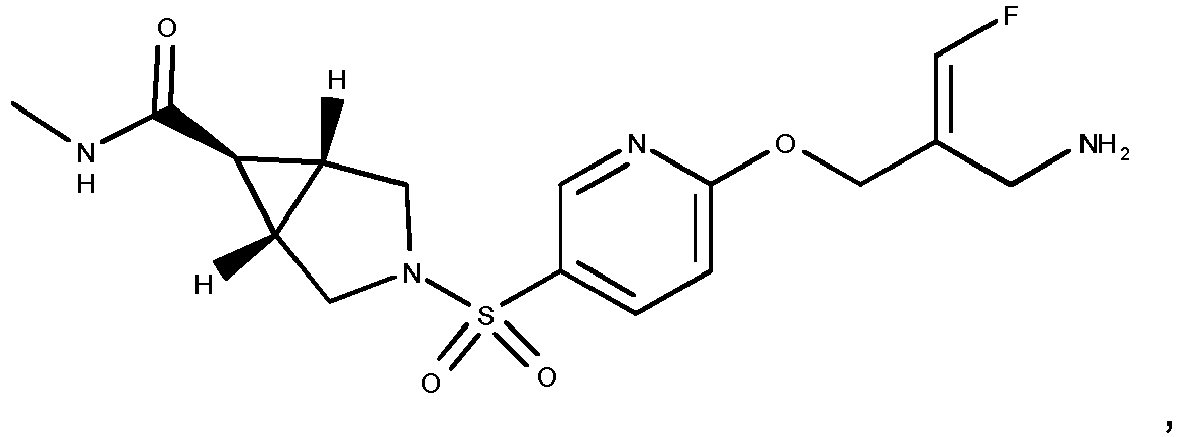


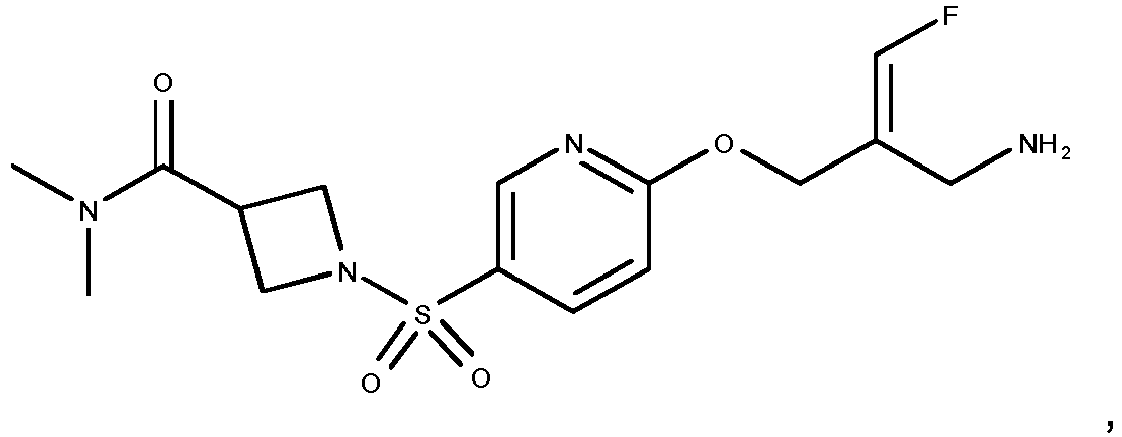
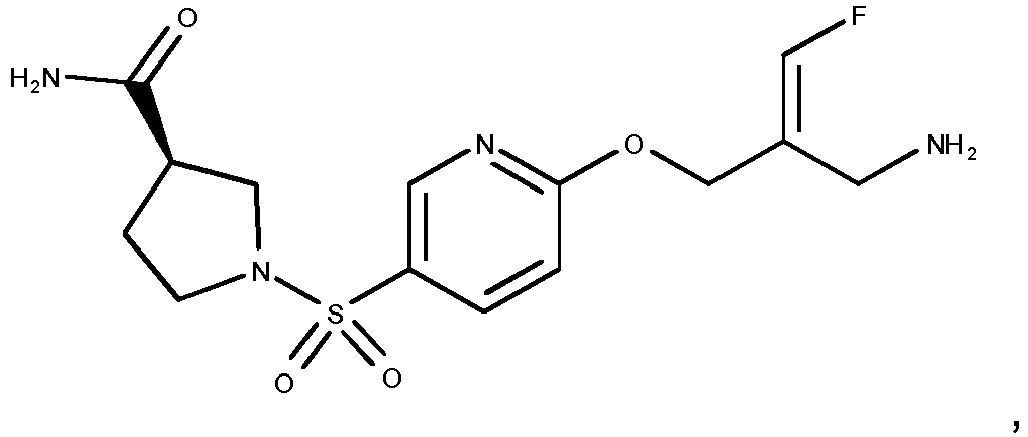


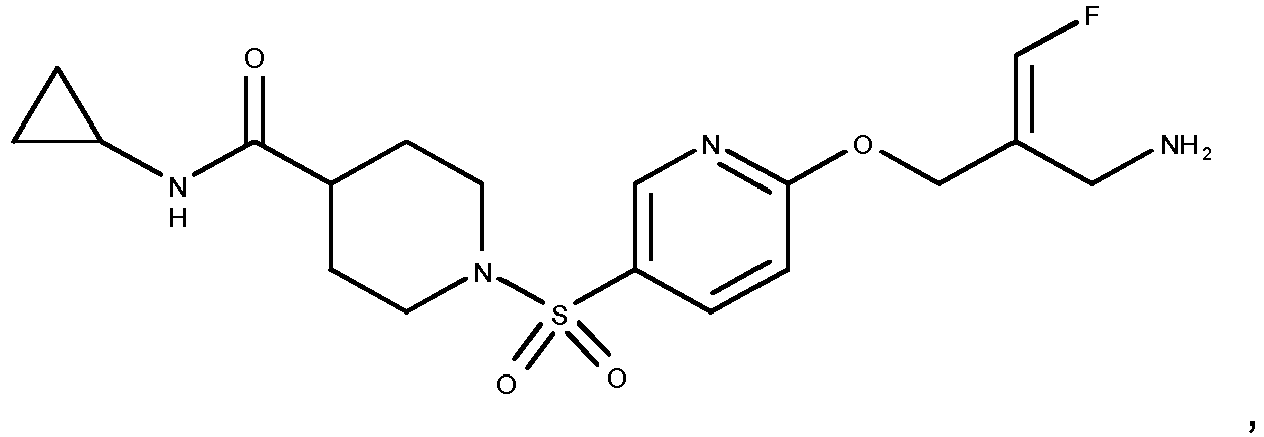
- Particularly preferred compounds, including their tautomers and stereoisomers, the salts thereof, or any solvates or hydrates thereof, are described in the experimental section hereinafter.
- The compounds according to the invention may be obtained using methods of synthesis which are known to the one skilled in the art and described in the literature of organic synthesis. Preferably, the compounds are obtained analogously to the methods of preparation explained more fully hereinafter, in particular as described in the experimental section.
- Terms not specifically defined herein should be given the meanings that would be given to them by one of skill in the art in light of the disclosure and the context. As used in the specification, however, unless specified to the contrary, the following terms have the meaning indicated and the following conventions are adhered to.
- The terms "compound(s) according to this invention", "compound(s) of formula (I)", "compound(s) of the invention" and the like denote the compounds of the formula (I) according to the present invention including their tautomers, stereoisomers and mixtures thereof and the salts thereof, in particular the pharmaceutically acceptable salts thereof, and the solvates and hydrates of such compounds, including the solvates and hydrates of such tautomers, stereoisomers and salts thereof.
- Notwithstanding the above, the compounds of the invention are always E-configured in the vinyl fluoride moiety.
- The terms "treatment" and "treating" embraces both preventative, i.e. prophylactic, or therapeutic, i.e. curative and/or palliative, treatment. Thus the terms "treatment" and "treating" comprise therapeutic treatment of patients having already developed said condition, in particular in manifest form. Therapeutic treatment may be symptomatic treatment in order to relieve the symptoms of the specific indication or causal treatment in order to reverse or partially reverse the conditions of the indication or to stop or slow down progression of the disease. Thus the compositions and methods of the present invention may be used for instance as therapeutic treatment over a period of time as well as for chronic therapy. In addition the terms "treatment" and "treating" comprise prophylactic treatment, i.e. a treatment of patients at risk to develop a condition mentioned hereinbefore, thus reducing said risk.
- When this invention refers to patients requiring treatment, it relates primarily to treatment in mammals, in particular humans.
- The term "therapeutically effective amount" means an amount of a compound of the present invention that (i) treats or prevents the particular disease or condition, (ii) attenuates, ameliorates, or eliminates one or more symptoms of the particular disease or condition, or (iii) prevents or delays the onset of one or more symptoms of the particular disease or condition described herein.
- The terms "modulated" or "modulating", or "modulate(s)", as used herein, unless otherwise indicated, refers to the inhibition of AOC3 with one or more compounds of the present invention.
- The terms "mediated" or "mediating" or "mediate", as used herein, unless otherwise indicated, refers to the (i) treatment, including prevention the particular disease or condition, (ii) attenuation, amelioration, or elimination of one or more symptoms of the particular disease or condition, or (iii) prevention or delay of the onset of one or more symptoms of the particular disease or condition described herein.
- The term "substituted" as used herein, means that any one or more hydrogens on the designated atom, radical or moiety is replaced with a selection from the indicated group, provided that the atom's normal valence is not exceeded, and that the substitution results in an acceptably stable compound.
- In the groups, radicals, or moieties defined below, the number of carbon atoms is often specified preceding the group, for example, C1-6-alkyl means an alkyl group or radical having 1 to 6 carbon atoms. In general, for groups comprising two or more subgroups, the last named subgroup is the radical attachment point, for example, the substituent "aryl-C1-3-alkyl-" means an aryl group which is bound to a C1-3-alkyl-group, the latter of which is bound to the core or to the group to which the substituent is attached.
- In case a compound of the present invention is depicted in form of a chemical name and as a formula in case of any discrepancy the formula shall prevail.
- An asterisk is may be used in sub-formulas to indicate the bond which is connected to the core molecule as defined.
- The numeration of the atoms of a substituent starts with the atom which is closest to the core or to the group to which the substituent is attached.
- For example, the term "3-carboxypropyl-group" represents the following substituent:

- The terms "1-methylpropyl-", "2,2-dimethylpropyl-" or "cyclopropylmethyl-" group represent the following groups:

- The asterisk may be used in sub-formulas to indicate the bond which is connected to the core molecule as defined.
- In a definition of a group the term "wherein each X, Y and Z group is optionally substituted with" and the like denotes that each group X, each group Y and each group Z either each as a separate group or each as part of a composed group may be substituted as defined. For example a definition "Rex denotes H, C1-3-alkyl, C3-6-cycloalkyl, C3-6-cycloalkyl-C1-3-alkyl or C1-3-alkyl-O-, wherein each alkyl group is optionally substituted with one or more Lex." or the like means that in each of the beforementioned groups which comprise the term alkyl, i.e. in each of the groups C1-3-alkyl, C3-6-cycloalkyl-C1-3-alkyl and C1-3-alkyl-O-, the alkyl moiety may be substituted with Lex as defined.
- In the following the term bicyclic includes spirocyclic.
- Unless specifically indicated, throughout the specification and the appended claims, a given chemical formula or name shall encompass tautomers and all stereo, optical and geometrical isomers (e.g. enantiomers, diastereomers, etc...) and racemates thereof as well as mixtures in different proportions of the separate enantiomers, mixtures of diastereomers, or mixtures of any of the foregoing forms where such isomers and enantiomers exist, as well as salts, including pharmaceutically acceptable salts thereof and solvates thereof such as for instance hydrates including solvates of the free compounds or solvates of a salt of the compound. Notwithstanding the above, the compounds of the invention are always E-configured in the vinyl fluoride moiety.
- The phrase "pharmaceutically acceptable" is employed herein to refer to those compounds, materials, compositions, and/or dosage forms which are, within the scope of sound medical judgment, suitable for use in contact with the tissues of human beings and animals without excessive toxicity, irritation, allergic response, or other problem or complication, and commensurate with a reasonable benefit/risk ratio.
- As used herein, "pharmaceutically acceptable salts" refer to derivatives of the disclosed compounds wherein the parent compound is modified by making acid or base salts thereof. Examples of pharmaceutically acceptable salts include, but are not limited to, mineral or organic acid salts of basic residues such as amines; alkali or organic salts of acidic residues such as carboxylic acids; and the like.
- The pharmaceutically acceptable salts of the present invention can be synthesized from the parent compound which contains a basic or acidic moiety by conventional chemical methods. Generally, such salts can be prepared by reacting the free acid or base forms of these compounds with a sufficient amount of the appropriate base or acid in water or in an organic diluent like ether, ethyl acetate, ethanol, isopropanol, or acetonitrile, or a mixture thereof.
- Salts of other acids than those mentioned above which for example are useful for purifying or isolating the compounds of the present invention also comprise a part of the invention.
- The term halogen generally denotes fluorine, chlorine, bromine and iodine.
- The term "C1-n-alkyl", wherein n is an integer from 1 to n, either alone or in combination with another radical denotes an acyclic, saturated, branched or linear hydrocarbon radical with 1 to n C atoms. For example the term C1-5-alkyl embraces the radicals H3C-, H3C-CH2-, H3C-CH2-CH2-, H3C-CH(CH3)-, H3C-CH2-CH2-CH2-, H3C-CH2-CH(CH3)-, H3C-CH(CH3)-CH2-, H3C-C(CH3)2-, H3C-CH2-CH2-CH2-CH2-, H3C-CH2-CH2-CH(CH3)-, H3C-CH2-CH(CH3)-CH2-, H3C-CH(CH3)-CH2-CH2-, H3C-CH2-C(CH3)2-, H3C-C(CH3)2-CH2-, H3C-CH(CH3)-CH(CH3)- and H3C-CH2-CH(CH2CH3)-.
- The term "C3-n-cycloalkyl", wherein n is an integer 4 to n, either alone or in combination with another radical denotes a cyclic, saturated, unbranched hydrocarbon radical with 3 to n C atoms. The cyclic group may be mono-, bi-, tri- or spirocyclic, most preferably monocyclic. Examples of such cycloalkyl groups include cyclopropyl, cyclobutyl, cyclopentyl, cyclohexyl, cycloheptyl, cyclooctyl, cyclononyl, cyclododecyl, bicyclo[3.2.1.]octyl, spiro[4.5]decyl, norpinyl, norbonyl, norcaryl, adamantyl, etc.
- Many of the terms given above may be used repeatedly in the definition of a formula or group and in each case have one of the meanings given above, independently of one another.
- All rests and substituents as defined hereinbefore and hereinafter may be substituted with one or more F atoms.
- The activity of the compounds of the invention may be demonstrated using the following AOC3 assay:
- The MAO-Glo™ Assay (commercially available from PROMEGA, #V1402) provides a sensitive method for the measurement of monoamine oxidase (MAO) activity (Valley, M. P. et al., 2006, Anal. Biochem. 359: 238-246) from a variety of tissues, biofluids or recombinant expressed or purified enzymes. As substrate a derivate of the beetle luciferin ((4S)-4,5-dihydro-2-(6-hydroxybenzothiazolyl)-4-thiazole-carboxylic acid) is used, which is oxidized at a primary amine moiety. After a spontaneous elimination and a catalyzed esterase reaction, the turnover of the luciferine by the luciferase is recorded as a signal of AOC3 activity.
- For the determination of AOC3 activity or compound inhibition potency, the compound inhibitors are dissolved in DMSO and adjusted to the respective assay concentration with reaction buffer (50 mM HEPES, 5 mM KCI, 2 mM CaCl2, 1.4 mM MgCl2, 120 mM NaCl, 0.001% (v/v) Tween 20, 100 µM TCEP, pH 7.4). An aliquot of 3 µL of the compound dilution is added to a 384 well plate (Optiplate, PS, flat bottom, white, PERKIN ELMER, #6007290) with a final DMSO concentration of 6.6%. Recombinant CHO cells, overexpressing the human (1500 cells/well), mouse (1000 cells/well) or rat (500 cells/well) AOC3 enzyme are diluted in reaction buffer and added in a volume of 15 µL to the wells. After incubation for 20 minutes at 37°C, 2 µL of MAO substrate (dissolved in DMSO at 16 mM, adjusted to assay concentration in reaction buffer to a final assay concentration of 20 µM) is added and further incubated for 60 minutes at 37°C. The turnover of the substrate is determined by the addition of 20 µL of the detection-mix which was generated by the addition of reconstitution buffer with esterase (PROMEGA, #V1402) to the luciferine detection reagent (PROMEGA, #V1402). After an incubation period of 20 minutes, the luminescent signal is measured with Envision 2104 Multilabel Reader (PERKIN ELMER).
- Alternative assays for the determination of the AOC3 enzymatic activity could be the extraction of 14C-labelled benzylamine reaction product or the Amplex Red Monoamine Oxidase reaction (Molecular Probes, Netherlands) as described in Gella et al. (Gella, A. et al., 2013, J. Neural Transm. 120: 1015-1018).
- The compounds of general formula (I) according to the invention for example have IC50 values below 5000 nM, particularly below 1000 nM, preferably below 300 nM, most preferably below 100 nM.
- The Amplex® Red Assay (commercially available from Thermo Fisher Scientific) provides a sensitive method for the detection of H2O2 generated during enzymatic reactions like the amine oxidation catalyzed by AOC2. The assay reagent is a colorless substrate (N-acetyl-3,7-dihydroxyphenoxazine) that reacts in a 1:1 stoichiometry with hydrogen peroxide (H2O2) to produce the fluorescent dye resorufin (7-hydroxyphenoxazin-3-one, excitation/emission maxima=570/585 nm). For the determination of AOC2 activity or compound AOC2 inhibition potency, the compound inhibitors are dissolved in DMSO and adjusted to the respective 20x assay concentration with reaction buffer (100 mM sodiumphosphate, 0.05% Pluronic F-127 (#P3000MP Sigma-Aldrich, pH 7.4). An aliquot of 5 µL of the compound dilution is added to a 96 well plate (flat bottom F, black, GREINER bio-one, #655900) in a DMSO concentration of 2%.
- An AOC2 enzyme containing cell homogenate is generated by transient transfection of 6x10⁶ HEK293 cells per flask (T75) with 9 µg pCMV-SPORT6-AOC2 (BC142641rc, #pCS6(BC142641)-seq-TCHS1003-GVO-TRI, BioCat) in 750 µL of EMEM culture medium (#BE12-611F, Lonza) and 33,75 µl Attractene (#301005, Qiagen). Cells are cultured for 3 days in EMEM culture medium containing 10% FCS (#04-00-1A, Biological Industries). After washing twice with ice cold PBS, cells are lysed by mechanic homogenation and cleared supernatants are shock frozen in liquid nitrogen and stored at -80°C.
- For the determination of AOC2 enzymatic activity cell lysates are thawed on ice and 1:1 diluted with reaction buffer. An Aliquot of 45 µL is added to the compound dilution and incubated for 30 min at 37°C. The enzymatic reaction is started with the addition of 50 µL of Amplex® Red reaction mix (final assay concentration: 100 mM sodiumphosphate, 120 µM Amplex® Red reagent (#A22177 Molecular Probes), 1.5 U/mL Horseradish Peroxidase (#P8375 Sigma-Aldrich), 2 mM phenylethylamine (#P6513-25G Sigma-Aldrich), 0.05% Pluronic F-127 (#P3000MP Sigma-Aldrich), pH 7.4, 37°C).
- The turnover per time of the substrate is determined directly with a fluorescence reader (Ex 540nm/Em 590nm) like Envision 2104 Multilabel Reader (PERKIN ELMER) for 60 min.
(cf. Anal Biochem (1997) 253:169-174; Anal Biochem (1997) 253:162-168) - The Amplex® Red Assay (available from Thermo Fisher Scientific) provides a sensitive method for the detection of H2O2 generated during enzymatic reactions like the amine oxidation catalyzed by AOC1. The assay reagent is a colorless substrate (N-acetyl-3,7-dihydroxyphenoxazine) that reacts in a 1:1 stoichiometry with hydrogen peroxide (H2O2) to produce the fluorescent dye resorufin (7-hydroxyphenoxazin-3-one, excitation/emission maxima=570/585 nm).
- For the determination of AOC1 activity or compound AOC1 inhibition potency, the compound inhibitors are dissolved in DMSO and adjusted to the respective assay concentration with reaction buffer (100 mM sodiumphosphate, 0.05% Pluronic F-127 (#P3000MP Sigma-Aldrich), pH 7.4). An aliquot of 3 µL of the compound dilution is added to a 384 well plate (Optiplate, PS, flat bottom F, black, PERKIN ELMER, #6007270) in a DMSO concentration of 6.6%.
- An AOC1 enzyme aliquot (#8297-AO-010, R&D Systems) is thawed on ice, diluted in reaction buffer and added in a volume of 7 µL to the wells to give a final assay concentration of 1 ng/well. After incubation of inhibitor and enzyme for 30 minutes at 37°C, the enzymatic reaction is started with the addition of 10 µL of Amplex® Red reaction mix (final assay concentration: 100 mM sodiumphosphate, 120 µM Amplex® Red reagent (#A22177 Molecular Probes), 1.5 U/mL Horseradish Peroxidase (#P8375 Sigma-Aldrich), 200 µM putrescine (#P7505 Sigma-Alrdich), 0.05% Pluronic F-127 (#P3000MP Sigma-Aldrich), pH 7.4, 37°C).
- After an incubation for 30 minutes at 37°C the turnover of the substrate is determined directly (or after the addition of an excess of an amine-oxidase inhibitor) with a fluorescence reader (Ex 540nm/Em 590nm) like Envision 2104 Multilabel Reader (PERKIN ELMER).
- In the following table the activity expressed as IC50 (nM) of compounds according to the invention is presented wherein the IC50 values are determined in the AOC3, AOC2 and AOC1 assays as described hereinbefore. The term "Example" refers to the example numbers according to the following experimental section.
- Biological data of the compounds of the present invention as obtained in the AOC3, AOC2 and AOC1 assays. nd = not determined.
Example AOC3 IC50 AOC2 IC50 AOC1 IC50 01 12 nM 162 nM 43370 nM 02 33 nM 1139 nM >49992 nM 03 25 nM 1022 nM 23641 nM 04 49 nM 806 nM >50000 nM 05 73 nM 629 nM >50000 nM 06 61 nM 593 nM >50000 nM 07 37 nM 531 nM >50000 nM 08 37 nM 524 nM >50000 nM 09 39 nM 489 nM 6174 nM 10 52 nM 407 nM >50000 nM 11 12 nM 401 nM >49954 nM 12 38 nM 385 nM >49980 nM 13 43 nM 358 nM >50000 nM 14 41 nM 306 nM 14255 nM 15 38 nM 263 nM >50000 nM 16 30 nM 262 nM >50000 nM 17 8 nM 251 nM >50000 nM 18 37 nM 244 nM >50000 nM 19 32 nM 214 nM >50000 nM 20 54 nM 192 nM >50000 nM 21 20 nM 190 nM >49974 nM 22 11 nM 188 nM >50000 nM 23 62 nM 180 nM >50000 nM 24 28 nM 165 nM >50000 nM 25 36 nM 164 nM 26661 nM 26 45 nM 164 nM >50000 nM 27 51 nM 160 nM >50000 nM 28 42 nM 158 nM >49948 nM 29 36 nM 151 nM >49966 nM 30 46 nM 126 nM 11387 nM 31 21 nM 121 nM >49970 nM 32 17 nM 73 nM 39500 nM 33 15 nM 49 nM 33032 nM 34 14 nM 14 nM 15847 nM 35 38 nM 207 nM >50000 nM 36 67 nM 551 nM >50000 nM 37 15 nM 451 nM 22572 nM 38 13 nM 278 nM >49976 nM 39 19 nM 262 nM 16975 nM 40 26 nM 125 nM >50000 nM 41 5 nM 123 nM 25390 nM 42 20 nM 87 nM >49973 nM 43 16 nM 69 nM 36481 nM 44 14 nM 574 nM >50000 nM 45 10 nM 307 nM 11399 nM 46 10 nM 234 nM >49993 nM 47 5 nM 144 nM 23169 nM 48 24 nM 67 nM 1485 nM 49 21 nM 50 nM >50000 nM 50 20 nM 24 nM >50000 nM 51 13 nM 325 nM 48005 nM 52 9 nM 315 nM 41750 nM 53 15 nM 19 nM >50000 nM 54 308 nM 4 nM >50000 nM 55 391 nM 50 nM >49957 nM 56 89 nM 34 nM 34674 nM 57 2690 nM 6 nM >50000 nM 58 114 nM 363 nM >49945 nM 59 18 nM nd 27250 nM 60 21 nM 92 nM >50000 nM 61 26 nM 61 nM >50000 nM 62 18 nM nd >50000 nM 63 19 nM nd >50000 nM 64 17 nM nd >50000 nM 65 11 nM nd >50000 nM 66 23 nM nd 31003 nM - According to AOC2 enzymatic tissue activity, the only human tissue with high AOC2-like activity is the retina and expression is associated to the retinal capillaries as shown by immune-histological studies. According to enzymatic function and localization of expression, AOC2 physiological function can be reminiscent of the AOC3 homolog which is described as relevant for e.g. neurovascular, retinal inflammation and recruitment of immune cells (Matsuda et al. Invest Ophthalmol Vis Sci. 2017, 58(7): 3254-3261, Noda et al FASEB J. 2008, 4: 1094-103). Data on pharmacological inhibition or genetic depletion of AOC2 is not available so far and it is therefore difficult to estimate the contribution of AOC2 to retinal-vascular inflammation.
- Nonetheless, as compared to AOC3 inhibition alone, a combined inhibition of AOC2 and AOC3 might increase anti-inflammatory potency in man, in particular for the treatment of ocular diseases.
- Therefore, it was an aim of the invention to provide compounds with a high activity on AOC3 and AOC2, in order to achieve the desired pharmacological effects.
- It has now been found out that, surprisingly, the compounds according to the present invention are more active inhibitors of AOC2 than the corresponding prior art compounds as e.g. described in
WO 2013/163675 andWO 2018/027892 , i.e., the replacement of the phenyl moiety by a pyridinyl moiety and the introduction of azetidinyl-, pyrrolidinyl- or piperidinyl-sulfonylamides results in compounds with an improved inhibitory activity towards AOC2, without affecting the activity towards AOC3. - As it has a secondary amine substituent in the sulfonamide group, compound 14 of
WO 2013/163675 represents the structurally closest comparison compound as compared to the presently claimed cyclic amines in the same position. Compound 14 ofWO 2013/163675 contains a dimethylamino-sulfonamide moiety as compared to the cyclic azetidinyl-, pyrrolidinyl- or piperidinyl sulfonamides disclosed in the present invention. Additionally, Compound 14 ofWO 2013/163675 contains a phenyl group whereas the compounds disclosed in the present invention contain a pyridinyl group. While Compound 14 ofWO 2013/163675 is a weak inhibitor of AOC2 (IC50 = 1164 nM, ca. 145-fold higher than IC50 against AOC3), the compound of the present invention exhibit an improved inhibitory activity against AOC2 as exemplified by Examples 42, 35, 40 (each only ca. 5-fold less active against AOC2 as compared to AOC3) and 45 (ca. 30-fold less active against AOC2 as compared to AOC3) in the following table. - Reference compounds A and B that structurally differ from examples 42 and 35 of the present invention solely in phenyl versus pyridinyl group can be obtained in analogy to the syntheses described in
WO 2013/163675 . In comparison, the pyridinyl derivatives of the present invention show an increased inhibitory potency against AOC2. Reference compound A is 22-fold (ratio IC50 AOC2 / IC50 AOC3) less active against AOC2 as compared to AOC3, while the pyridinyl analog Example 42 is only 4-fold less active against AOC2. Reference compound B is 92-fold less active against AOC2 as compared to AOC3, while the pyridinyl analog Example 42 is only 5-fold less active against AOC2. - AOC1 expression and enzymatic activity is mainly found in the gut, placenta and kidney. The enzyme catalyzes the oxidation of primary amines derived from nutrition and protects the individuum from cardiometabolic effects of histamine, putrescine, tryptamine and cadaverine. Inhibition of AOC1 can lead to impaired tolerance to ingested histamine, resulting in increased plasma and tissue histamine-levels which can cause adverse events or undesirable side effects like decreased aterial pressure and compensation by increased heart-rate, tachycardia, headache, flush, urticaria, pruritus, bronchospasm and cardiac arrest (Maintz L. and Novak N. 2007. Am. J. Clin. Nutr. 85: 1185-96). The consequence of AOC1 inhibition in combination with histamine intake has been demonstrated in experiments with pigs: After the application of the AOC1-inhibitor aminoguanidine (100 mg/kg) and gavage of histamine (2 mg/kg) animals experienced increased histamine blood levels accompanied with a drop of blood pressure, increased heart rate, flushing, vomiting and death (3 out of 15 animals) (Sattler J. 1988. Agents and Actions, 23: 361-365) under the experimental conditions. Histamine intolerance in humans was associated to mutations in the promoter region of AOC1, leading to reduced mRNA expression and plasma AOC1 activity (Maintz et al. 2011. Allergy 66: 893-902).
- Therefore, it was an aim of the invention to provide compounds with a low activity on AOC1, in order to avoid such undesired side-effects.
- It has now been found out that, surprisingly, the compounds of the present invention exhibit increased selectivity towards AOC1 as compared to prior art compounds, particularly to the compounds disclosed in
WO 2018/027892 . Examples 6, 5 and 2 ofWO 2018/027892 differ from examples 35, 40 and 45, respectively, in the pyrimidinyl versus pyridinyl group and in the lack of the sulfonyl group. While Example 6 ofWO 2018/027892 and the pyridinyl sulfonyl analog Example 35 of the present invention are similarly potent against AOC3, Example 35 shows a much higher IC50 against AOC1. Example 5 ofWO 2018/027892 and the racemic pyridinyl sulfonyl analog Example 40 of the present invention are similarly potent against AOC3, however Example 40 shows a much higher IC50 against AOC1. In addition, Example 2 ofWO 2018/027892 and the pyridinyl sulfonyl analog Example 45 of the present invention are similarly potent against AOC3, however Example 45 shows a much higher IC50 against AOC1. - Comparison of biological data of certain compounds as obtained in the AOC3, AOC2 and AOC1 assays as described above.
Structure IC50 AOC3 IC50 AOC2 IC50 AOC1 
WO 2013/163675 8 nM 1164 nM >50000 nM 
13 nM 287 nM >49978 µM 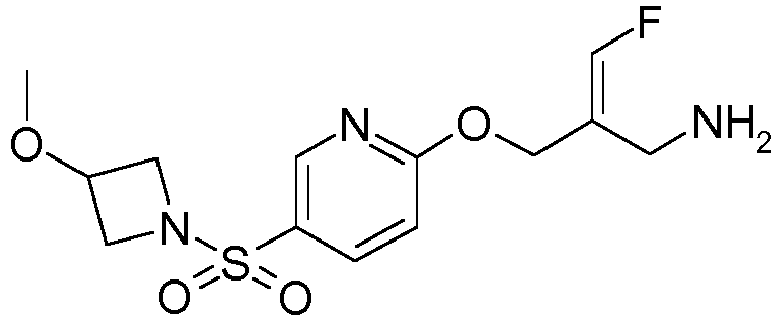
20 nM 87 nM >49973 nM 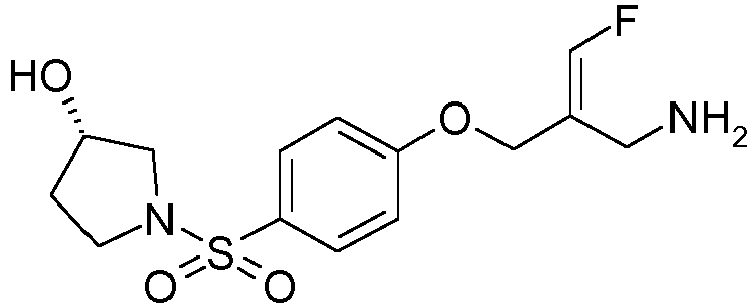
27 nM 2515 nM >50000 µM 
38 nM 207 nM >50000 µM 
WO 2018/027892 59 nM 1118 nM 1171 nM 
WO 2018/027892 13 nM 497 nM 268 nM 
26 nM 125 nM >50000 µM 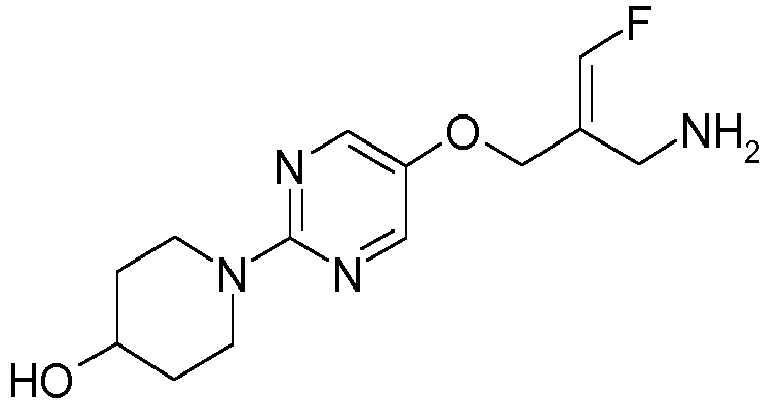
WO 2018/027892 20 nM 1085 nM 269 nM 
10 nM 307 nM 11399 nM - In view of their ability to inhibit AOC3 and AOC2, the compounds of general formula (I) according to the invention and the corresponding salts thereof are suitable for the treatment, including preventative treatment of all those diseases or conditions which may be affected or which are mediated by the inhibition of AOC3 and AOC2 activity. Further, compounds of the present invention show moderate to high in vitro efflux and/or a low intrinsic permeability in an MDCK p-GP assay. Therefore, compounds of the present invention are expected to exhibit a lower free concentration in the brain than in the blood (Liu, H. et al., 2018, Drug Discovery Today 23 (7): 1357-1372). Accordingly, the present invention relates to a compound of general formula (I) as a medicament.
- Also disclosed herein (but not claimed) is the use of a compound of general formula (I) for the treatment and/or prevention of diseases or conditions which are mediated by the inhibition of AOC3 in a patient, preferably in a human.
- Also disclosed herein (but not claimed) is a method for treating, including preventing a disease or condition mediated by the inhibition of AOC3 in a mammal that includes the step of administering to a patient, preferably a human, in need of such treatment a therapeutically effective amount of a compound of the present invention, or a pharmaceutical composition thereof.
- Diseases and conditions mediated by inhibitors of AOC3 embrace cancer, NASH (non-alcoholic steatohepatitis), pulmonary fibrosis, retinopathy, nephropathy and stroke.
- According to one aspect the compounds of the present invention are particularly suitable for treating inflammatory diseases, such as vascular inflammatory diseases, arthritis, acute and chronic joint inflammation; eczema, such as atopic eczema, psoriasis ulcerative and rheumatoid psoriasis; pain, particularly musculoskeletal or nociceptive pain; inflammatory bowel disease, particularly non-infectious inflammatory bowel disease; multiple sclerosis; scleroderma, pulmonary diseases such as respiratory distress syndrome, asthma, pulmonary fibrosis, idiopathic pulmonary fibrosis (IPF), chronic obstructive pulmonary disease (COPD) and idiopathic inflammatory disease; nephropathy, diabetic proteinuria, kidney fibrosis; diabetic retinopathy or diabetic oedema such as macular diabetic oedema; cancer, particularly melanoma and lymphoma; hepatocellular carcinoma, unspecified Colitis, rheumatoid Crohn's disease Colitis; biliary tract diseases, primary biliary cholangitis, primary sclerosing cholangitis, non-alcoholic steatohepatitis (NASH), non-alcoholic fatty liver disease (NAFLD), alcoholic liver disease, liver fibrosis, liver cirrhosis; ulcerative reperfusion injury, cerebral ischaemia and transplant rejection.
- According to another aspect the compounds of the present invention are particularly suitable for treating inflammatory diseases, such as vascular inflammatory diseases, arthritis and inflammatory bowel disease, particularly non-infectious inflammatory bowel disease; pulmonary fibrosis and idiopathic pulmonary fibrosis; diabetic retinopathy or diabetic oedema such as macular diabetic oedema; unspecified Colitis, rheumatoid Crohn's disease Colitis; biliary tract diseases, primary biliary cholangitis, primary sclerosing cholangitis, non-alcoholic steatohepatitis (NASH), non-alcoholic fatty liver disease (NAFLD), alcoholic liver disease, liver fibrosis, and liver cirrhosis.
- The dose range of the compounds of general formula (I) applicable per day is usually from 0.001 to 10 mg per kg body weight of the patient, preferably from 0.01 to 8 mg per kg body weight of the patient. Each dosage unit may conveniently contain 0.1 to 1000 mg of the active substance, preferably it contains between 0.5 to 500 mg of the active substance.
- The actual therapeutically effective amount or therapeutic dosage will of course depend on factors known by those skilled in the art such as age and weight of the patient, route of administration and severity of disease. In any case the combination will be administered at dosages and in a manner which allows a therapeutically effective amount to be delivered based upon the patient's unique condition.
- Suitable preparations for administering the compounds of formula (I) will be apparent to those with ordinary skill in the art and include for example tablets, pills, capsules, suppositories, lozenges, troches, solutions, syrups, elixirs, sachets, injectables, inhalatives and powders etc. The content of the pharmaceutically active compound(s) is advantageously in the range from 0.1 to 90 wt.-%, for example from 1 to 70 wt.-% of the composition as a whole.
- Suitable tablets may be obtained, for example, by mixing one or more compounds according to formula (I) with known excipients, for example inert diluents, carriers, disintegrants, adjuvants, surfactants, binders and/or lubricants. The tablets may also consist of several layers.
- The compounds of the invention may further be combined with one or more, preferably one additional therapeutic agent. According to one embodiment the additional therapeutic agent is selected from the group of therapeutic agents useful in the treatment of diseases or conditions associated with the metabolic syndrom, diabetes, obesity, cardiovascular diseases, cancer, NASH (non-alcoholic steatohepatitis), pulmonary fibrosis, retinopathy, nephropathy and/or stroke.
- Therefore a compound of the invention may be combined with one or more additional therapeutic agents selected from the group consisting of anti-obesity agents (including appetite suppressants), agents which lower blood glucose, anti-diabetic agents, agents for treating dyslipidemias, such as lipid lowering agents, antihypertensive agents, antiatherosclerotic agents, anti-inflammatory active ingredients, anti-fibrotic agents, agents for the treatment of malignant tumors, antithrombotic agents, anti-angiogenesis agents, agents for the treatment of heart failure and agents for the treatment of complications caused by diabetes or associated with diabetes.
- Preferably, compounds of the present invention and/or pharmaceutical compositions comprising a compound of the present invention optionally in combination with one or more additional therapeutic agents are administered in conjunction with exercise and/or a diet.
- Also disclosed herein (but not claimed) is the use of a compound according to the invention in combination with one or more additional therapeutic agents described hereinbefore and hereinafter for the treatment or prevention of diseases or conditions which may be affected or which are mediated by the inhibition of AOC3, in particular diseases or conditions as described hereinbefore and hereinafter.
- Also disclosed herein (but not claimed) is a method for treating, including preventing a disease or condition mediated by the inhibition of AOC3 in a patient that includes the step of administering to the patient, preferably a human, in need of such treatment a therapeutically effective amount of a compound of the present invention in combination with a therapeutically effective amount of one or more additional therapeutic agents described in hereinbefore and hereinafter,
- The use of the compound according to the invention in combination with the additional therapeutic agent may take place simultaneously or at staggered times.
- The compound according to the invention and the one or more additional therapeutic agents may both be present together in one formulation, for example a tablet or capsule, or separately in two identical or different formulations, for example as a so-called kit-of-parts.
- Consequently, in another aspect, this invention relates to a pharmaceutical composition which comprises a compound according to the invention and one or more additional therapeutic agents described hereinbefore and hereinafter, optionally together with one or more inert carriers and/or diluents.
- Typical methods of preparing the compounds of the invention are described in the experimental section.
- The potent inhibitory effect of the compounds of the invention can be determined by in vitro enzyme assays as described in the experimental section.
- The compounds of the present invention may also be made by methods known in the art including those described below and including variations within the skill of the art.

- Compounds of the general formula I, wherein A and R1 are as previously defined, can be prepared via the process outlined in Scheme 1 using a compound of the general formula 1-1. Deprotection of the tert-Butoxycarbonyl (= BOC) group may be effected by treatment with an acid such as hydrochloric acid or trifluoroacetic acid in a suitable solvent such as methanol, dioxane or dichloromethane at a temperature between -20°C and 100°C. If 1-1 is employed as a mixture of E/Z-isomers, the vinylfluorid E/Z- isomers of compounds of the general formula I may be separated by preparative HPLC or column chromatography on silica gel which affords compounds of the general formula I in isomerically pure form.

- Intermediates of the general formula 1-1, wherein A and R1 are as previously defined, can be prepared via the process outlined in Scheme 2 using a 6-fluoro or 6-chloro substituted pyridinyl sulfonamide compound of the general formula 2-1, wherein A and R1 are as previously defined, and the alcohol 2-2 either as pure E-isomer or as an E/Z-mixture, and a base such as sodium tert-butoxide or sodium hydride in an appropriate solvent such as THF, DMSO or toluene at a temperature between -20°C and 100°C.

- Intermediates of the general formula 2-1, wherein A and R1 are as previously defined, can be prepared via the process outlined in Scheme 3 using an amine compound of the general formula 3-1, wherein A and R1 are as previously defined, and 6-fluoro- or 6-chloropyridine-3-sulfonyl chloride, and a base such as triethylamine in an appropriate solvent such as dichloromethane, NMP, THF, DMSO or mixtures thereof at a temperature between -20°C and 100°C.

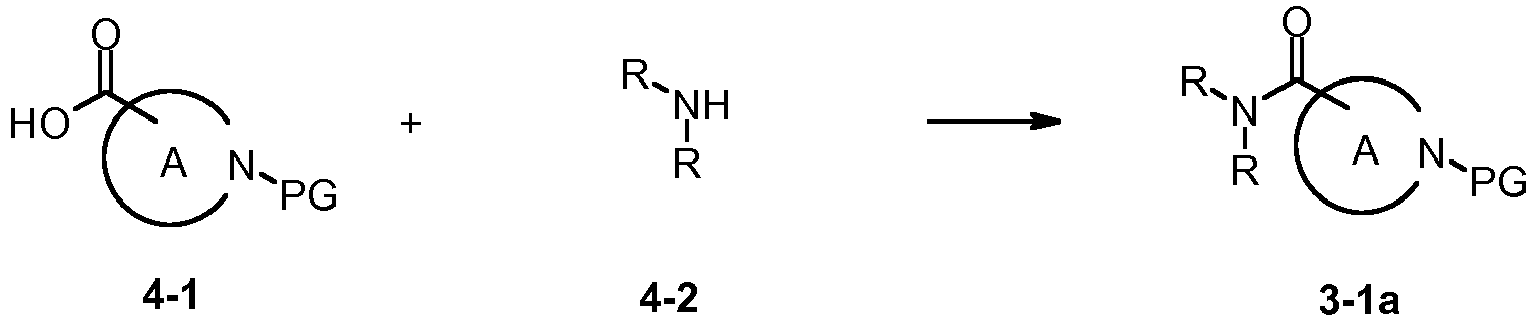
- Intermediates of the general formula 3-1a, wherein the amine substituents R are selected as previously defined for amides among substituent R1, can be prepared via the process outlined in Scheme 4 using a carboxylic acid of the general formula 4-1, a primary or secondary amine of the general formula 4-2, wherein the amine substituents R are selected as previously defined for amides among substituent R1, an amide coupling reagent such as 1-propanephosphonic acid cyclic anhydride or HATU, and a base such as triethylamine or DIPEA in an appropriate solvent such as THF or DMF at a temperature between -20°C and 100°C.

- Compounds of the general formula 1-amide which exhibit an amide group according to the definitions for R1, can also be prepared from carboxylic acids of the general formula 5-1, a primary or secondary amine of the general formula 4-2, wherein the amine substituents R are selected as previously defined for amides among substituent R1, an amide coupling reagent such as 1-propanephosphonic acid cyclic anhydride, TCFH or HATU, and a base such as triethylamine or DIPEA in an appropriate solvent such as THF or DMF at a temperature between -20°C and 100°C. Carboxylic acids of the general formula 5-1 are accessible from the corresponding alkyl esters through saponification with sodium or lithium hydroxide in a solvent such as methanol or THF at a temperature between -20°C and 100°C.
- The synthetic routes presented may rely on the use of protecting groups. For example, reactive groups present, such as hydroxy, carbonyl, carboxy, amino, alkylamino or imino, may be protected during the reaction by conventional protecting groups which are cleaved again after the reaction. Suitable protecting groups for the respective functionalities and their removal are well known to the one skilled in the art and are described in the literature of organic synthesis.
- The compounds of general formula I may be resolved into their enantiomers and/or diastereomers as mentioned before.
- The compounds of general formula I which occur as racemates may be separated by methods known per se into their optical antipodes and diastereomeric mixtures of compounds of general formula I may be resolved into their diastereomers by taking advantage of their different physico-chemical properties using methods known per se, e.g. chromatography and/or fractional crystallization; if the compounds obtained thereafter are racemates, they may be resolved into the enantiomers as mentioned above.
- The racemates are preferably resolved by column chromatography on chiral phases or by crystallization from an optically active solvent or by reacting with an optically active substance which forms salts or derivatives such as esters or amides with the racemic compound. Salts may be formed with enantiomerically pure acids for basic compounds and with enantiomerically pure bases for acidic compounds.
- Diastereomeric derivatives are formed with enantiomerically pure auxiliary compounds, e.g. acids, their activated derivatives, or alcohols. Separation of the diastereomeric mixture of salts or derivatives thus obtained may be achieved by taking advantage of their different physico-chemical properties, e.g. differences in solubility; the free antipodes may be released from the pure diastereomeric salts or derivatives by the action of suitable agents. Optically active acids commonly used for such a purpose as well as optically active alcohols applicable as auxiliary residues are known to those skilled in the art.
- As mentioned above, the compounds of formula I may be converted into salts, particularly for pharmaceutical use into the pharmaceutically acceptable salts. As used herein, "pharmaceutically acceptable salts" refer to derivatives of the disclosed compounds wherein the parent compound is modified by making acid or base salts thereof.
- The Examples that follow are intended to illustrate the present invention without restricting it.
-
- A
- Acid
- ACN
- Acetonitrile
- aq.
- Aqueous
- B
- Base
- BOC
- tert-Butoxycarbonyl
- °C
- Degree Celsius
- Cbz
- Benzyloxycarbonyl
- d
- Day
- DCM
- Dichloromethane
- DIPEA
- N,N-Diisopropylethylamine
- DMF
- N,N-Dimethylformamide
- DMSO
- Dimethylsulfoxide
- eq
- Equivalent
- ESI-MS
- Electrospray ionisation mass spectrometry
- EtOH
- Ethanol
- EtOAc
- Ethyl acetate
- exc.
- Excess
- g
- Gramm
- h
- Hour
- HATU
- N,N,N',N'-tetramethyl-O-(7-azabenzotriazol-1 -yl)uronium hexatluorophosphate
- HPLC
- High performance liquid chromatography
- IBCF
- Isobutylchloroformate
- iPrOH
- Iso-Propylalcohol
- L
- Liter
- M
- Molar (mol/L)
- MeOH
- Methanol
- min
- Minute
- mg
- milligramm
- mL
- Milliliter
- mmol
- Millimol
- MS
- Mass spectrometry
- MTBE
- 2-Methoxy-2-methylpropane
- N
- Normal = 1 molar = 1 mol/L
- NMP
- N-methyl-2-pyrrolidinone
- NMR
- Nuclear magnetic resonance
- Pd/C
- Palladium on carbon
- psi
- Pound-force per square inch
- RP
- Reverse phase
- RT
- Room temperature (about 22 °C)
- Rt
- Retention time
- S
- Solvent
- Sat.
- Saturated
- T
- Temperature
- t
- Time
- TBTU
- Benzotriazolyl tetramethyluronium tetrafluoroborate
- TCFH
- Chloro-N,N,N',N'-tetramethylformamidinium hexatluorophosphate
- TLC
- Thin-layer chromatography
- TEA
- Triethylamine
- TFA
- Trifluoroacetic acid
- THF
- Tetrahydrofuran
- THP
- Tetrahydropyran
- Tol
- Toluene
- Unless noted otherwise, all reactions are run at room temperature (about 22 °C), under inert atmosphere (e.g., Argon, N2), and under anhydrous conditions. All compounds are characterized by at least one of the following methods: 1H NMR, HPLC, HPLC-MS, or melting point.
- Typically, reaction progress is monitored by thin layer chromatography (TLC) or HPLC-MS. Intermediates and products are purified using at least one of the following methods:
Recrystallization, column chromatography on silica gel or reversed phase HPLC using a C18 semi-preparative column eluting with a gradient of: - ACN and H2O + 0.1% TFA
- ACN and H2O + 0.1% NH4OH
- The reported mass spectrometry (MS) data correspond to the observed mass signals (e.g., [M+H]+). The HPLC methods used to characterize the compounds of the invention is described in the following tables.
-
Method Mobile Phase A Mobile Phase B Gradient Flow (mL/min) Column Tempe rature HPLC-1 0.1% TFA in water ACN Time (min) %A %B XBridge BEH C18_2.1 × 30 mm_1.7 µm particle diameter 60°C 0.0 99.0 1.0 1.6 0.02 99.0 1.0 1.6 1.0 0.0 100.0 1.6 1.1 0.0 100.0 1.6 Method Mobile Phase A Mobile Phase B Gradient Flow (mL/min) Column Tempe rature HPLC-2 0.1% TFA in water ACN Time (min) %A %B Sunfire C18_2.1 × 30 mm 2.5 µm particle diameter 60°C 0.0 99.0 1.0 1.5 0.02 99.0 1.0 1.5 1.0 0.0 100.0 1.5 1.1 0.0 100.0 1.5 Method Mobile Phase A Mobile Phase B Gradient Flow (mL/min) Column Tempe rature HPLC-3 0.1% TFA in water ACN Time (min) %A %B Sunfire C18_2.1 × 30 mm_2.5 µm particle diameter 60°C 0.0 50.0 50.0 1.5 0.02 50.0 50.0 1.5 1.0 0.0 100.0 1.5 1.1 0.0 100.0 1.5 Method Mobile Phase A Mobile Phase B Gradient Flow (mL/min) Column Tempe rature HPLC-4 0.1% NH3 in water ACN Time (min) %A %B XBridge C1 8_3.0 x 30 mm_2.5 µm particle diameter 60°C 0.0 97.0 3.0 2.2 0.2 97.0 3.0 2.2 1.2 0.0 100.0 2.2 1.25 0.0 100.0 3.0 1.4 0.0 100.0 3.0 Method Mobile Phase A Mobile Phase B Gradient Flow (mL/min) Column Tempe rature HPLC-5 0.1% TFA in water ACN Time (min) %A %B XBridge C1 8_3.0 x 30 mm_2.5 µm particle diameter 60°C 0.0 97.0 3.0 2.2 0.2 97.0 3.0 2.2 1.2 0.0 100.0 2.2 1.25 0.0 100.0 3.0 1.4 0.0 100.0 3.0 Method Mobile Phase A Mobile Phase B Gradient Flow (mL/mi n) Column Tempe rature HPLC-6 0.1% TFA in water ACN Time (min) %A %B Sunfire C1 8_3.0 x 30 mm_2.5 µm particle diameter 60°C 0.0 97.0 3.0 2.2 0.2 97.0 3.0 2.2 1.2 0.0 100.0 2.2 1.25 0.0 100.0 3.0 1.4 0.0 100.0 3.0 Method Mobile Phase A Mobile Phase B Gradient Flow (mL/min) Column Tempe rature HPLC-7 0.1% TFA in water 0.08% TFA in ACN Time (min) %A %B Sunfire C1 8_3.0 x 30 mm_2.5 µm particle diameter 60°C 0.0 95.0 5.0 1.5 1.3 0.0 100.0 1.5 1.5 0.0 100.0 1.5 1.6 95.0 5.0 1.5 Method Mobile Phase A Mobile Phase B Gradient Flow (mL/min) Column Tempe rature HPLC-8 0.1% NH3 in water ACN Time (min) %A %B XBridge C18_3.0 x 30 mm_2.5 µm particle diameter 60°C 0.0 95.0 5.0 1.5 1.3 0.0 100.0 1.5 1.5 0.0 100.0 1.5 1.6 95.0 5.0 1.5 Method Mobile Phase A Mobile Phase B Gradient Flow (mL/min) Column Tempe rature HPLC-9 0.1% TFA in water 0.08% TFA in ACN Time (min) %A %B Sunfire C18_3.0 x 30 mm_2.5 µm particle diameter 60°C 0.0 95.0 5.0 1.5 1.3 0.0 100.0 1.5 1.5 0.0 100.0 1.5 1.6 95.0 5.0 1.5 Method Mobile Phase A Mobile Phase B Gradient Flow (mL/min) Column Tempe rature HPLC-10 0.1% TFA in water ACN Time (min) %A %B Sunfire C18_3.0 × 30 mm_2.5 µm particle diameter 60°C 0.0 97.0 3.0 4.0 0.15 97.0 3.0 3.0 2.15 0.0 100.0 3.0 2.2 0.0 100.0 4.5 2.4 0.0 100.0 4.5 - The intermediates and examples which follow are illustrative and, as recognized by one skilled in the art, particular reagents or conditions could be modified as needed for individual compounds without undue experimentation.
- The compounds of the invention may be prepared by the general methods and examples presented below and methods known to those of ordinary skill in the art. Optimum reaction conditions and reaction times may vary depending on the particular reactants used. Unless otherwise specified, solvents, temperatures, pressures, and other reaction conditions may be readily selected by one of ordinary skill in the art. Specific procedures are provided in the synthetic section. Undescribed intermediates used in the syntheses below are either commercially available or easily prepared by methods known to those skilled in the art. Reaction progress may be monitored by conventional methods such as thin layer chromatography (TLC) or high pressure liquid chromatography-mass spec (HPLC-MS). Intermediates and products may be purified by methods known in the art, including column chromatography, HPLC, preparative TLC or recrystallization.
-

- Step1 - Amide-coupling: To the solution of trans-3-aza-bicyclo[3.1.0]hexane-3,6-dicarboxylic acid 3-tert-butyl ester (1.00 g; 4.40 mmol) and TEA (4.94 mL; 35.20 mmol) in THF (5 mL) was added methylamine (2 M in THF; 4.40 mL; 8.80 mmol). The reaction mixture was stirred at RT for 5 min and 1-propanephosphonic acid cyclic anhydride (50% in THF; 5.14 mL; 8.80 mmol) was added. The reaction mixture was stirred at RT for 45 min, diluted with aq. 4 N NaOH (25 mL) and extracted with MTBE (2 x 25 mL). The pooled organic phases were dried with Na2SO4, filtered and evaporated to dryness.
- Step2 - BOC deprotection: The crude material of step 1 was taken up in EtOAc (20 mL) and MeOH (20 mL) and hydrogen chloride (4 N in 1,4-dioxane; 5 mL; 20.00 mmol) was added. The reaction mixture was stirred at RT overnight and concentrated under reduced pressure to provide intermediate I.1.
Yield: 882 mg (80%), ESI-MS: m/z = 141 [M+H]+, Rt (HPLC): 0.12 min (HPLC-6) -

- Trans-3-Aza-bicyclo[3.1.0]hexane-1,3-dicarboxylic acid 3-tert-butyl ester (1.00 g; 4.40 mmol) and HATU (1.90 g; 4.84 mmol) were dissolved in DMF (5 mL) and DIPEA (1.89 mL; 11.00 mmol) and stirred at RT for 30 min. To the reaction mixture methylamine (2 M in THF; 4.40 mL; 8.80 mmol) was added and was stirred at RT overnight. The reaction mixture was diluted with water (20 mL) and extracted with DCM (3 x 20 mL). The pooled organic phases were washed with aq. 1 N NaOH, dried and concentrated under reduced pressure. The residue was purified by RP-HPLC (ACN/ water + TFA) to obtain intermediate I.2a.
Yield: 0.95 g (90%), ESI-MS: m/z = 185 [M+H]+, Rt (HPLC): 0.87 min (HPLC-6) -

- Intermediate I.2a (0.94 mg; 3.89 mmol) was dissolved in MeOH (2 mL) and hydrogen chloride (4 N in 1 ,4-dioxane; 5.00 mL; 20.00 mmol) was added. The reaction mixture was stirred at RT for 1 h 40 min, then reduced in vacuo and co-evaporated with MeOH to provide intermediate I.2.
Yield: 0.65 g (95%), ESI-MS: m/z = 191 [M+H]+, Rt (HPLC): 0.09 min (HPLC-10) -

- (S)-Pyrrolidine-1 ,3-dicarboxylic acid-1-benzylester (2.00 g; 8.02 mmol) was dissolved in THF (20.00 mL) and TEA (9.01 mL; 64.19 mmol) and 1-amino-2-methylpropan-2-ol (0.83 g; 8.83 mmol) was added. The reaction mixture was cooled to 0 °C and a solution of 1-propanephosphonic acid cyclic anhydride (50% in THF; 7.03 ml; 12.04 mmol) was added. It was stirred at RT for 3 h. The reaction mixture was diluted with aq. 4 N NaOH (20 mL) and extracted with MTBE (30 mL) twice. The pooled organic phases were dried and evaporated to give the crude intermediate I.3a.
Yield: 2.51 g (98%), ESI-MS: m/z = 321 [M+H]+, Rt(HPLC): 0.90 min (HPLC-6) -
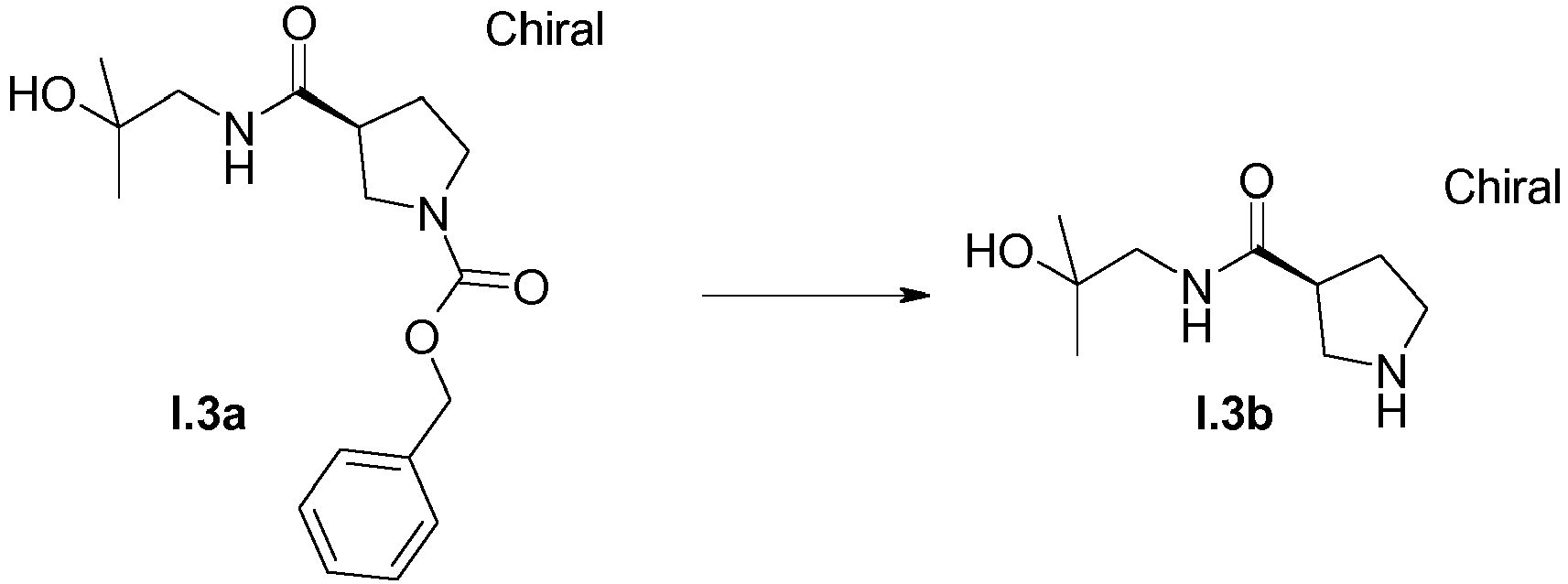
- A mixture of intermediate I.3a (2.51 g; 7.83 mmol) and 10% Pd/C (0.25 g) in MeOH (50 mL) was treated with hydrogen (50 psi) at RT overnight. The reaction mixture was filtered, washed with MeOH and concentrated in vacuo to provide the crude intermediate I.3b.
Yield: 1.47 g (99%), ESI-MS: m/z = 187 [M+H]+, Rt(HPLC): 0.12 min (HPLC-6) -

- Intermediate I.3b (1.47 g; 7.89 mmol) was diluted with 3,4-dihydro-2H-pyrane (10.00 mL; 108.28 mmol) and p-toluenesulfonic acid monohydrate (0.15 g; 0.79 mmol) was added. The reaction mixture was stirred at RT for three days and concentrated in vacuo to obtain the crude intermediate I.3.
Yield: 2.54 g (99%), ESI-MS: m/z = 271 [M+H]+, Rt(HPLC): 0.75 min (HPLC-4) -

- (S)-3-Acetylamino-piperidine-1-carboxylic acid tert-butyl ester (3.00 g; 12.38 mmol), trifluoroacetic acid (9.54 mL; 123.80 mmol) and DCM (80 mL) were stirred at RT overnight. The reaction mixture was evaporated and co-evaporated with EtOH for two times to give intermediate I.4.
Yield: 4.20 g (quant.), ESI-MS: m/z = 143 [M+H]+ -

- Intermediate I.5 could be prepared according to the procedure described in
WO 98/27086 -
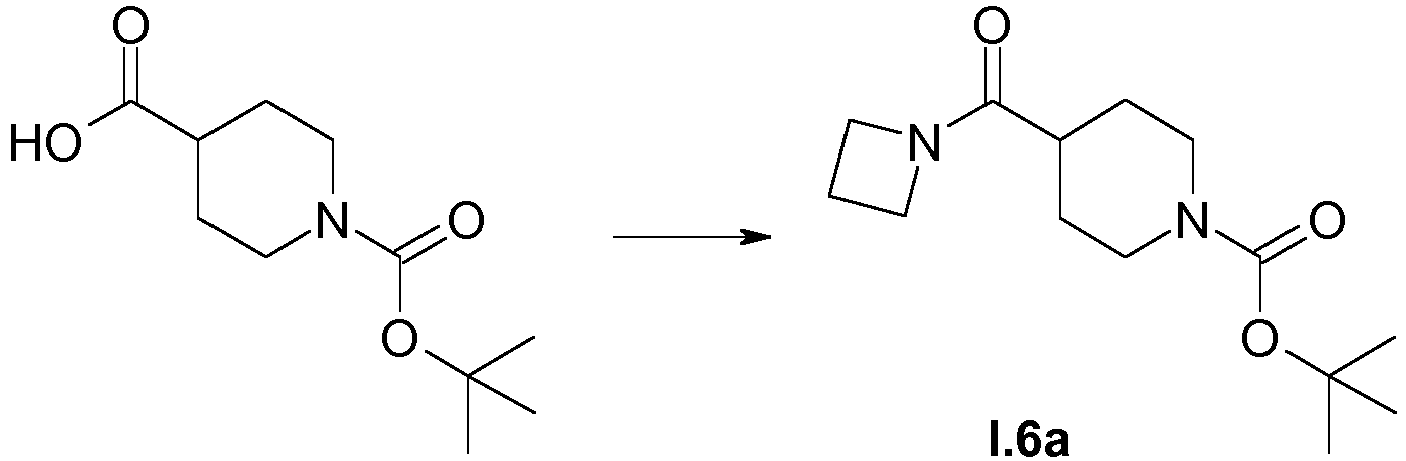
- Piperidine-1,4-dicarboxylic acid mono-tert-butyl ester (2.00 g; 8.72 mmol), TBTU (2.89 g; 9.00 mmol) and TEA (1.25 mL; 9.00 mmol) were dissolved in THF and stirred at RT for 1 h. Azetidine (0.61 mL; 9.00 mmol) and TEA (1.25 mL; 9.00 mmol) were added to the reaction mixture. The reaction mixture was stirred at RT overnight, diluted with water and extracted with EtOAc. The pooled organic phases were dried with Na2SO4 and reduced in vacuo to give the crude intermediate I.6a.
Yield: 2.00 g (85%), ESI-MS: m/z = 269 [M+H]+ -

- Intermediate l.6a (2.00 g; 7.45 mmol) was dissolved in DCM (20 mL) and TFA (2.23 mL; 30.00 mmol) was added. The reaction mixture was stirred at RT overnight and reduced in vacuo. The residue was taken up in DCM, filtered through a HCO3-cartridge and the filtrate was evaporated under reduced pressure to provide intermediate l.6.Yield: 2.80 g (quant.), ESI-MS: m/z = 169 [M+H]+
-
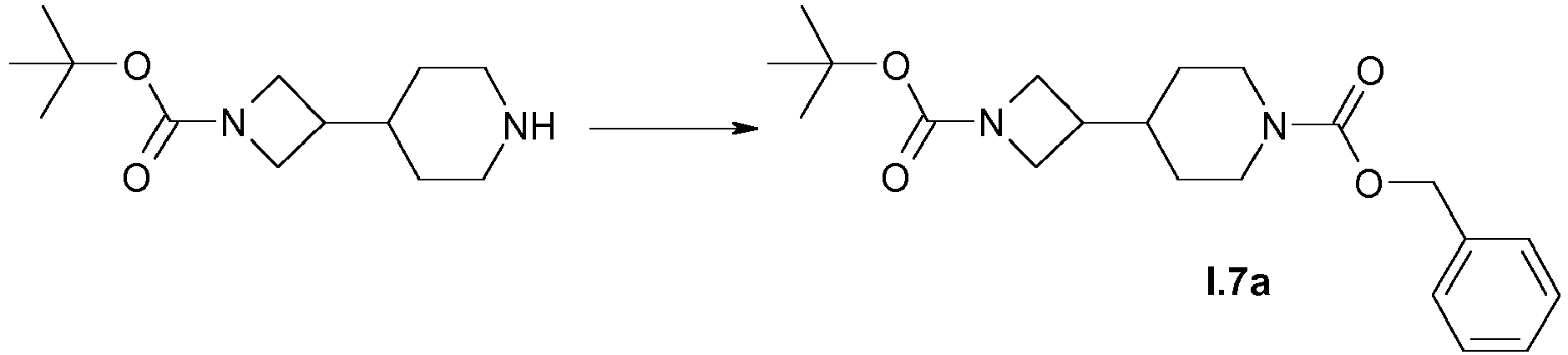
- 3-Piperidine-4-yl-azetidine-1-carboxylic acid tert-butyl ester (500 mg; 2.08 mmol) was dissolved in DCM (10 mg), treated with TEA (348 µL; 2.50 mmol) and cooled to 0°C. To the reaction mixture was added benzyl chloroformate (322 µL; 2.29 mmol) dropwise and afterwards the reaction mixture was warmed to RT. The reaction mixture was stirred at RT overnight, diluted with DCM and extracted with water twice. The organic phase was dried and concentrated in vacuo. The crude material was purified by silica gel chromatography (cyclohexane/ EtOAC) to provide intermediate I.7a.
Yield: 220 mg (28%), ESI-MS: m/z = 375 [M+H]+, Rt (HPLC): 0.81 min (HPLC-2) -
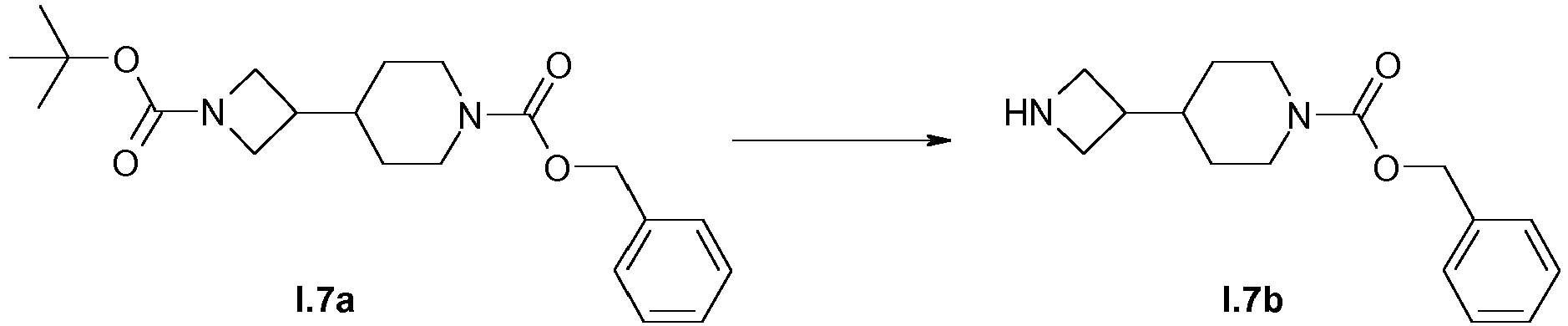
- To a solution of intermediate I.7a (220 mg; 0.59 mmol) in DCM (3 mL) was added TFA (453 µL; 5.87 mmol). The reaction mixture was stirred at RT overnight, the solvent was evaporated under reduced pressure and the residue was washed once with water and once with aq. solution of NaHCOs. The organic phase was dried and concentrated in vacuo to give the crude intermediate I.7b.
Yield: 170 mg (100%), ESI-MS: m/z = 275 [M+H]+, Rt (HPLC): 0.43 min (HPLC-2) -

- Intermediate I.7b (170 mg; 0.62 mmol) was dissolved in DCM (3.00 mL) and treated with TEA (258 µL; 1.86 mmol). The solution was cooled to 0°C and acetyl chloride (53 µL;0.74 mmol) was added dropwise. The reaction mixture was stirred at 0°C for 10 min, warmed to RT and stirred at RT overnight. The reaction mixture was washed with water twice. The organic phase was dried and concentrated in vacuo to provide the crude intermediate I.7c.
Yield: 190 mg (97%), ESI-MS: m/z = 317 [M+H]+, Rt (HPLC): 0.60 min (HPLC-2) -

- A mixture of intermediate I.7c (190 mg; 0.60 mmol) and 10% Pd/C (50 mg) in MeOH (5 mL) was treated with hydrogen (50psi) at RT overnight. The reaction mixture was filtered and concentrated in vacuo to provide the crude intermediate l.7.
Yield: 90 mg (82%), ESI-MS: m/z = 183 [M+H]+ -

- Intermediate I.8 was prepared according to the procedure described in
WO 2008/071646 , pp. 81-82. -

- 4-Carboxymethyl-piperidine-1-carboxylic acid tert-butyl ester (3.00 g; 12.33 mmol), TBTU (3.96 g; 12.33 mmol) and TEA (5.19 mL; 36.99 mmol) were dissolved in DMF (10 mL). The solution was stirred at RT for 10 min. Ethylamine hydrochloride (1.01 g; 12.33 mmol) was added to the reaction mixture and it was stirred at RT overnight. To the reaction mixture was added TBTU and after 5 min stirring at RT ethylamine hydrochloride (0.5 g; 6.15 mmol) was added. After 4 h stirring at RT the reaction mixture was extracted with EtOAc. The organic phases were concentrated in vacuo. The crude material was dissolved in DCM, filtered over a basic Alox-cartridge and the filtrate was washed with aq. 0.1 N HCl and evaporated under reduced pressure to give intermediate I.9a.
Yield: 3.3 g (99%), ESI-MS: m/z = 271 [M+H]+, Rt (HPLC): 0.75 min (HPLC-4) -
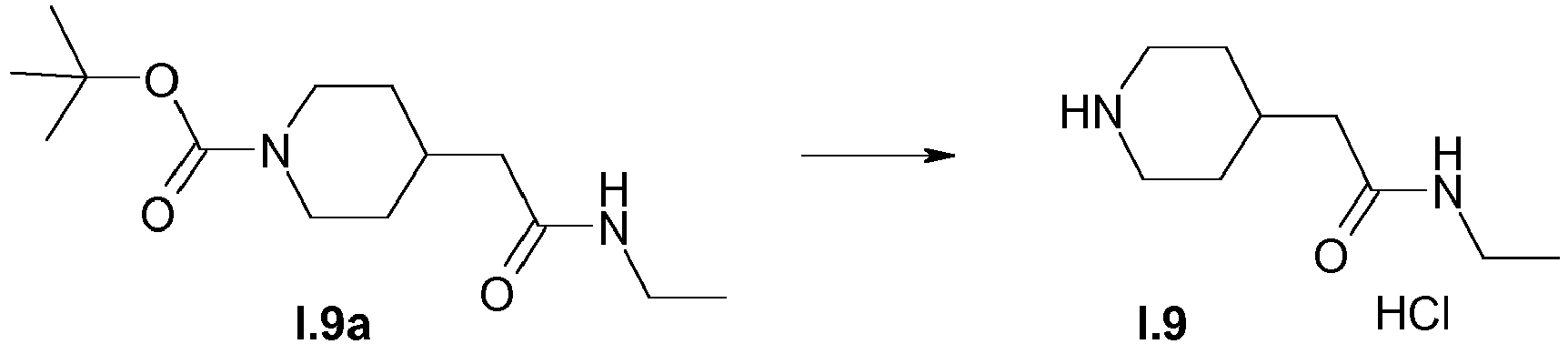
- Intermediate I.9a (3.30 g; 12.21 mmol) was dissolved in 1.4-dioxane (30 mL) and a solution of 4 N hydrogen chloride in 1,4-dioxane (6.10 mL; 24.41 mmol) was added. The reaction mixture was stirred at RT overnight. To the reaction mixture was added a solution of 4 N hydrogen chloride in 1,4-dioxane (6.10 mL; 24.41 mmol) and it was stirred at RT overnight. The reaction diluted with diethyl ether and the precipitate was filtered to obtain intermediate I.9.
Yield: 2.52 g (100%), ESI-MS: m/z = 171 [M+H]+, Rt (HPLC): 0.78 min (HPLC-6) -

- Step 1 - Amide-coupling: (R)-Pyrrolidine-1,3-dicarboxylic acid 1-tert-butyl ester (800 mg, 3.61 mmol) was dissolved in THF (5.00 mL) and TEA (4.05 mL; 28.84 mmol) and a solution of methylamine in THF (2 M; 3.61 mL; 7.21 mmol) was added. To the reaction mixture was added a solution of 1-propanephosphonic acid cyclic anhydride (50% in THF; 4.21 mL; 7.21 mmol) at RT. The reaction mixture was stirred at RT for 1 h and diluted with 4 N aq. sodium hydroxide (20 mL). The aq. phase was extracted with MTBE (2 x 20 mL) and the pooled organic phases were washed with brine, dried, filtered and concentrated in vacuo.
- Step 2 - BOC deprotection: The crude material of step 1 was diluted with EtOAc (20 mL) and treated with 4 N HCl in 1 ,4-dioxane (2 mL; 8.00 mmol) at RT. The reaction mixture was stirred at RT overnight. The reaction mixture was concentrated in vacuo to provide intermediate I.10.
Yield: 755 mg (99%), ESI-MS: m/z = 129 [M+H]+, Rt (HPLC): 0.12 min (HPLC-6) -

- Step1 - Amide-coupling: To the solution of (S)-Pyrrolidine-1,3-dicarboxylic acid 1-tert-butyl ester (500 mg; 2.32 mmol) and TEA (2.61 mL; 18.58 mmol) in THF (4.5 mL) was added a solution of morpholine (220 mg; 2.56 mmol) in THF (0.8 mL) and afterwards 1-propanephosphonic acid cyclic anhydride (50% in THF; 2.71 mL; 4.65 mmol) was added. The reaction mixture was stirred at RT for 3 h, diluted with aq. 4 N NaOH (20 mL) and extracted with MTBE (2 x 20 mL). The pooled organic phases were washed with brine, dried with Na2SO4, filtered and evaporated to dryness.
- Step2 - BOC deprotection: The crude material of step 1 was taken up in MeOH (20 mL) and hydrogen chloride (4 N in 1,4-dioxane; 5 mL; 20.00 mmol) was added. The reaction mixture was stirred at RT overnight, concentrated under reduced pressure and co-evaporated with toluene to provide intermediate l.11.
- Yield: 527 mg (82%), ESI-MS: m/z = 185 [M+H]+, Rt (HPLC): 0.12 min (HPLC-6) The following intermediate was prepared in analogy to the above described procedure using the corresponding starting materials. For changes from this procedure, see "synthesis comment".

-

- Racemic cis-3-aza-bicyclo[3.1,0]hexane-1,3-dicarboxylic acid-3-tert-butyl ester (1.00 g; 4.40 mmol) and HATU (1.90 g; 4.84 mmol) were suspended in DMF und DIPEA (1.89 mL; 11.00 mmol) was added. The reaction mixture was stirred at RT for 30 min. To the reaction mixture was added morpholine (0.77 mL; 8.80 mmol) and the solution was stirred at RT overnight. The reaction mixture was diluted with water (20 mL) and extracted with DCM (3 x 20 mL). The pooled organic phases were washed with aq. 1 N NaOH (20 mL), dried and concentrated in vacuo. The crude material was purified by RP-HPLC (C18, 50 °C, Acetonitrile + 0.1% TFA in water) to obtain intermediate I.14a.
Yield: 1.17 g (90%), ESI-MS: m/z = 241 [M+H]+, Rt (HPLC): 0.90 min (HPLC-6) -

- Intermediate I.14a (0.76 g; 2.56 mmol) was dissolved in MeOH (2.00 mL) and hydrogen chloride (4 N in 1 ,4-dioxane; 5.00 mL; 20.00 mmol) was added. The reaction mixture was stirred at RT overnight. The reaction mixture was diluted with MTBE, the precipitate was filtered and washed with MTBE. The solvent was allowed to evaporate in order to obtain intermediate I.14 as a dry solid.
Yield: 0.53 g (89%), ESI-MS: m/z = 197 [M+H]+, Rt (HPLC): 0.20 min (HPLC-1) -

- 3-Piperidin-4-yl-azetidine-1-carboxylic acid tert-butyl ester (530 mg; 2.21 mmol) was dissolved in DCM (20 mL) and TEA (0.71 mL; 5.07 mmol) was added. The solution was cooled with an ice bath and cyclopropanecarbonyl chloride (300 mg; 2.87 mmol) dissolved in DCM (1 mL) was added. The reaction mixture was stirred at 0°C for 1 h and stirred at 15°C for 3 d. The reaction mixture was diluted with DCM and washed with sat. aq. NaHCO3-solution once, two times with aq. 0.5 N HCl-solution and once with brine. The organic phase was dried over Na2SO4 and concentrated in vacuo to give intermediate I.15a.
Yield: 690 mg (91 %), ESI-MS: m/z = 309 [M+H]+, Rt (HPLC): 0.64 min (HPLC-2) -

- Intermediate I.15a (690 mg; 3.01 mmol), TFA (0.62 mL; 8.05mmol) and DCM (20 mL) were stirred at RT overnight and evaporated to give intermediate I.15.
Yield: 500 mg (77%), ESI-MS: m/z = 209 [M+H]+, Rt (HPLC): 0.26 min (HPLC-2) -

- Step1 - Amide-coupling: (R)-Pyrrolidine-1,3-dicarboxylic acid 1-tert-butyl ester (800 mg; 3.61 mmol) was diluted with DCM (8 mL) and N-methylmorpholine (0.45 mL; 3.97 mmol) was added. The reaction mixture was cooled to 0°C and IBCF (0.5 mL; 3.79 mmoL) was added. The reaction mixture was stirred at 0°C for 5 min, warmed to RT and stirred for 1 h at RT. After addition of aq. NH4OH (32%; 0.67 mL; 5.41 mmol) the reaction mixture was stirred at RT for 80 min. The reaction mixture was diluted with water and extracted with DCM (2 x 20 mL). The pooled organic phases were washed with sat. aq. NaHCO3-solution, dried and evaporated under reduced pressure.
- Step2 - BOC deprotection: The crude material of step 1 was dissolved in DCM (5 mL), TFA (0.83 mL; 10.81 mmol) was added and the reaction mixture was stirred at RT for 1 h. To the reaction mixture was added TFA (0.83 mL; 10.81 mmol) and it was stirred at RT overnight. The reaction mixture was concentrated in vacuo to provide intermediate I.16.
Yield: 1.19 g (100%), ESI-MS: m/z = 115 [M+H]+, Rt (HPLC): 0.11 min (HPLC-6) -

- Step 1 - Amide-coupling: 4-Methyl-piperidine-1,4-dicarboxylic acid mono-tert-butyl ester (500 mg, 1.99 mmol) was dissolved in THF (5 mL) and TEA (2.24 mL; 15.95 mmol) and a solution of ethylamine in THF (2 M; 1.99 mL; 3.99 mmol) was added. To the reaction mixture was added a solution of 1-propanephosphonic acid cyclic anhydride (50% in THF; 2.33 mL; 3.99 mmol) at RT. The reaction mixture was stirred at RT for 1 h and diluted with 4 N aq. sodium hydroxide (20 mL). The aq. phase was extracted with MTBE (2 x 20 mL) and the pooled organic phases were washed with brine (20 mL), dried, filtered and concentrated in vacuo.
- Step 2 - BOC deprotection: The crude material of step 1 was diluted with EtOAc (20 mL) and treated with 4 N HCl in 1,4-dioxane (1 mL; 4.00 mmol) at RT. The reaction mixture was stirred at RT overnight. The reaction mixture was concentrated in vacuo to provide intermediate I.17.
Yield: 236 mg (46%), ESI-MS: m/z = 171 [M+H]+, Rt (HPLC): 0.13 min (HPLC-6) -

- The mixture of intermediate I.1 (550 mg; 2.49 mmol) and TEA (1.91 mL; 13.58 mmol) in DCM (15 mL) was cooled to 0-5°C. 6-Chloropyridine-3-sulfonyl chloride (500 mg; 2.26 mmol) was added to the reaction mixture and it was stirred for 10 min at 0°C, then warmed to RT and stirred at RT overnight. The reaction mixture was diluted with DCM and washed with water and with 1 N aq. HCl. The organic phase was dried with Na2SO4, filtered and reduced in vacuo. The crude material was triturated with diisopropyl ether, the solid was filtered, washed with diisopropyl ether and dried at 60°C in vacuo to give Intermediate II.1.
Yield: 507 mg (71 %), ESI-MS: m/z = 316 [M+H]+, Rt (HPLC): 0.83 min (HPLC-6) - The following intermediates were prepared in analogy to the above described procedure using 6-chloropyridine-3-sulfonyl chloride and the corresponding starting material. For changes from this procedure, see "synthesis comment".

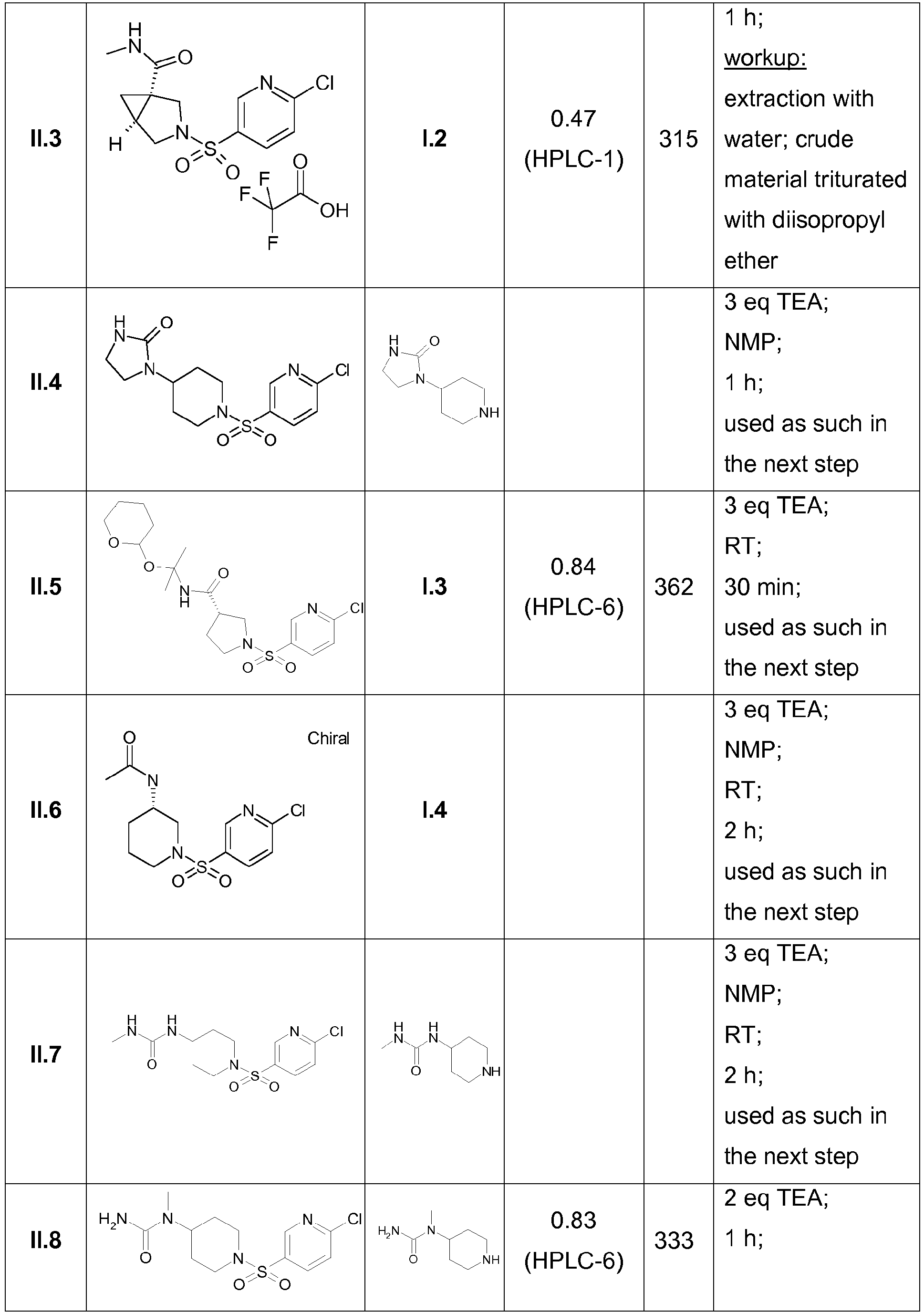


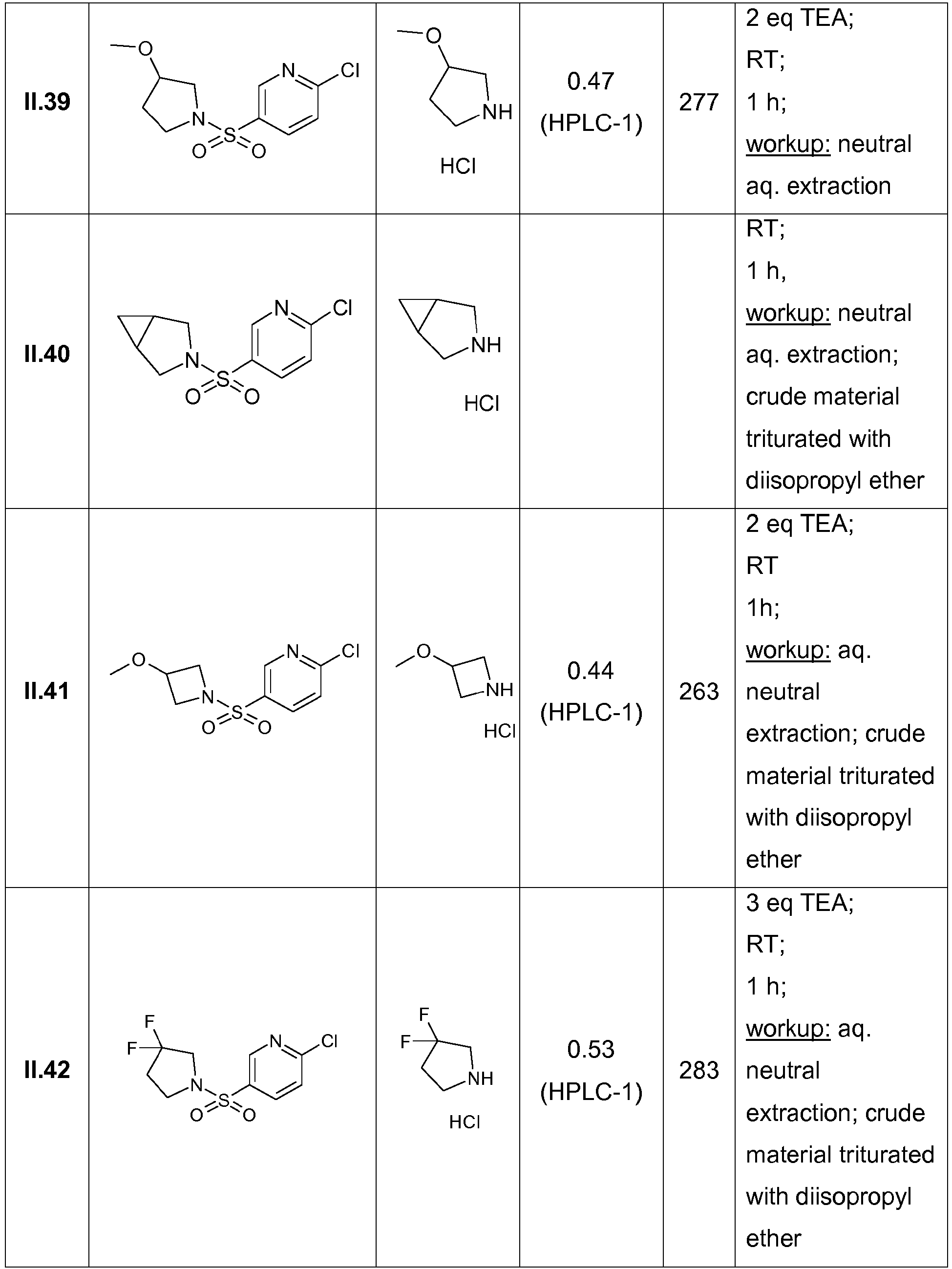

-

- Piperidine-4-carboxylic acid methyl ester hydrochloride (1.15 g; 6.39 mmol) was suspended in DCM (40 mL) and TEA (3.56 mL; 25.56 mmol) was added. To the reaction mixture was added a solution of 6-fluoropyridine-3-sulfonyl chloride (1.25 g; 6.39 mmol) in DCM (10 mL). It was stirred at RT for 45 min, then diluted with DCM (50 mL) and washed with water (2 x 40 mL). The pooled organic phases were dried with Na2SO4 and concentrated in vacuo. The crude material was suspended in MTBE and the remaining solid was filtered to provide intermediate III.1.
Yield: 1.4 g (73%), ESI-MS: m/z = 302 [M+H]+, Rt (HPLC): 0.52 min (HPLC-1) - The following intermediates were prepared in analogy to the above described procedure using 6-fluoropyridine-3-sulfonyl chloride and the corresponding starting material. For changes from this procedure, see "synthesis comment".
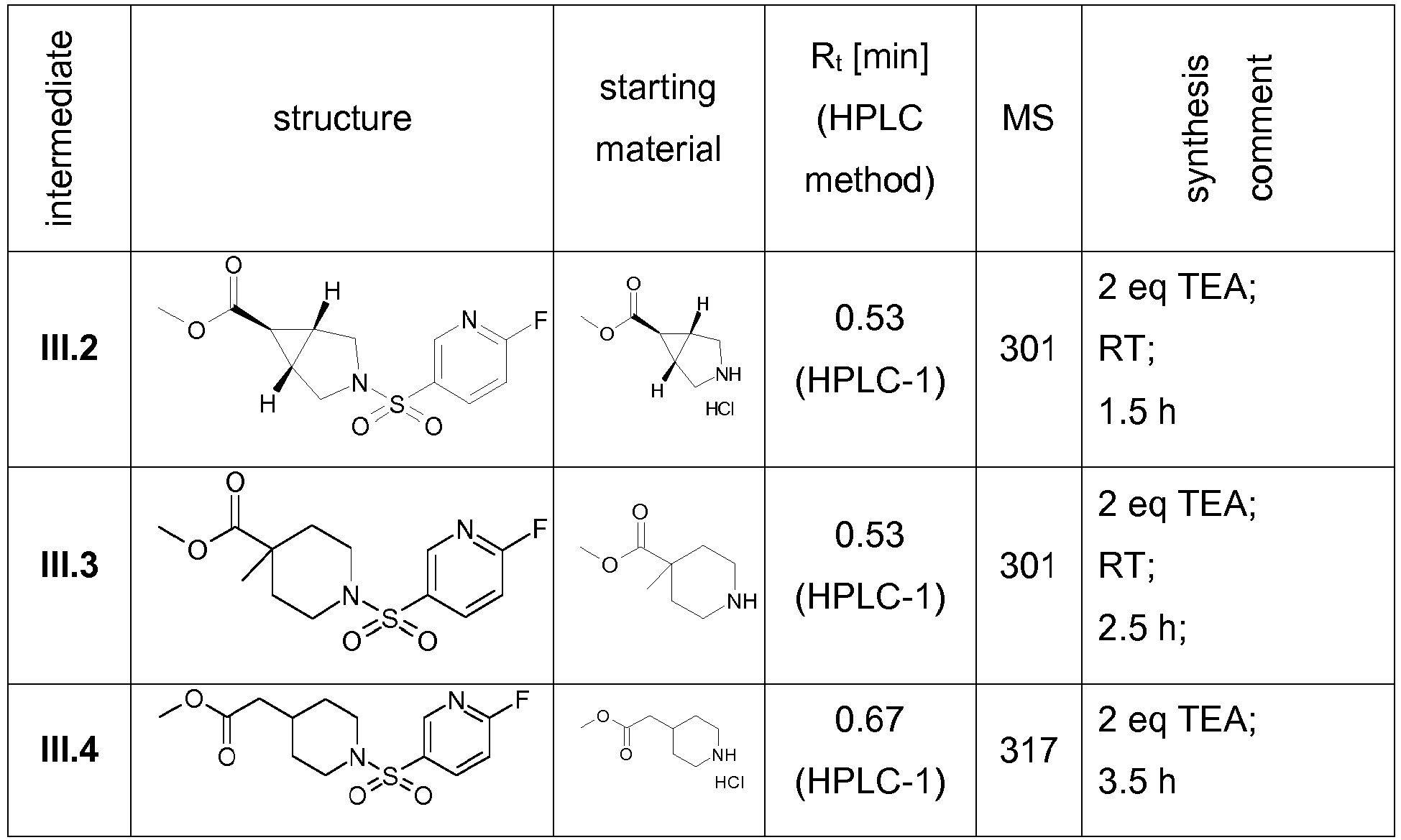
-

- The E/Z-mixture of the alcohol (intermediate IV.1) was prepared according to the procedure described in
WO 2013/163675 , pp. 50-53. -

- Intermediate IV.1 (4.00 g; 19.49 mmol) was purified three times by column chromatography on silica gel to give the single E-isomer IV.2 (1.95 g; 9.50 mmol; 49%).
-

- Intermediate II.1 (326 mg; 85% purity; 0.88 mmol) and intermediate IV.1 (216 mg; 1.05 mmol) were dissolved in THF (1 mL; S) and DMSO (1 mL; S) and cooled to 0°C. To the reaction mixture was added sodium tert-butoxide (2 M in THF; 0.53 mL; 1.05 mmol; B) and after 5 min at 0 °C the mixture was stirred at RT (T) for 35 min (t). The reaction mixture was purified by RP-HPLC (ACN/water + TFA) to obtain the BOC-protected example 1.
Yield: 410 mg (96%), ESI-MS: m/z = 385 [M+H-BOC]+, Rt (HPLC): 1.05 min (HPLC-6) -

- The BOC-protected example 1 as the E/Z-mixture (410 mg; 0.85 mmol) was dissolved in DCM (15 mL; S) and TFA (266 µL; 3.45 mmol; A) was added. The reaction mixture was stirred at RT (T) for 2.5 h (t), then evaporated under reduced pressure, dissolved in MeOH (5 mL) and purified by RP-HPLC (ACN/water + TFA) to give example 1.
Yield: 160 mg (38%), ESI-MS: m/z = 385 [M+H]+, Rt (HPLC): 0.64 min (HPLC-5) - The following examples (example number given in column #) were prepared in analogy to the above described procedure using the corresponding starting materials. Details for the two steps are given in the column synthesis comment, the retention-time and mass (ESI-MS, m/z = [M+H]+) determined by HPLC-MS are given in the columns RT and MS.
# structure 2 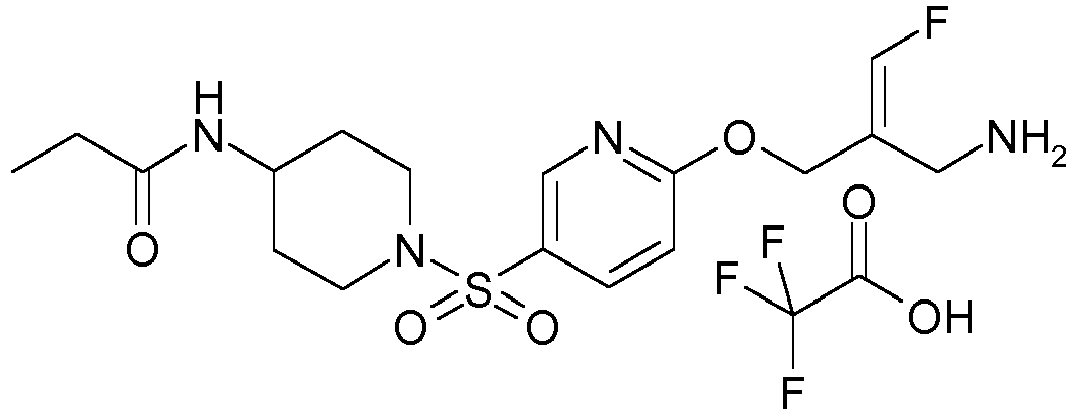
3 
4 
5 
6 
7 
8 
9 
10 
11 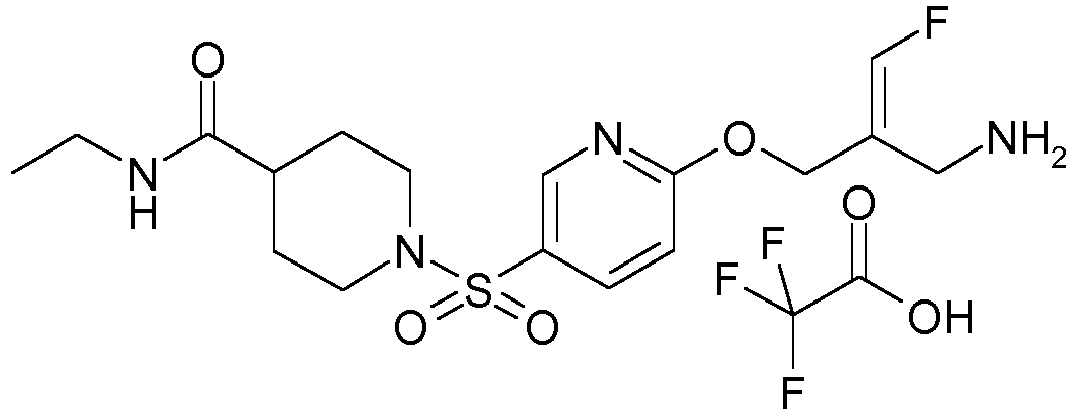
12 
13 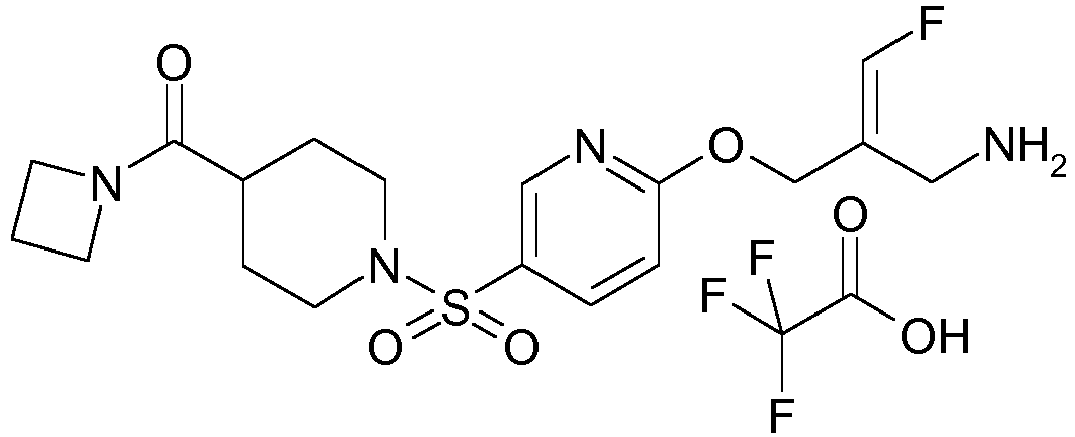
14 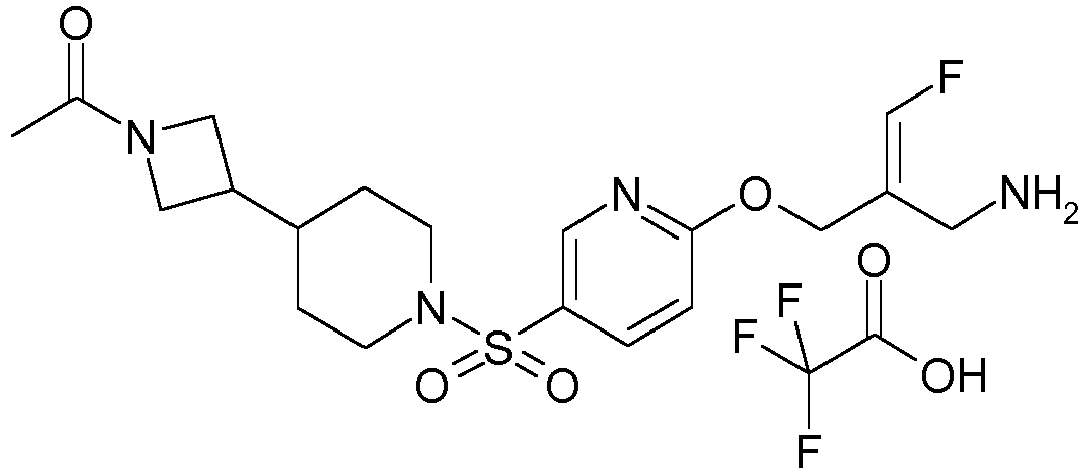
15 
16 
17 
18 
19 
20 
21 
22 
23 
24 
25 
26 
27 
28 
29 
30 
31 
32 
33 
34 
# Substitution BOC deprotection starting material s Rt [min] (HPLC method) MS synthesis comment Rt [min] (HPLC method) MS synthesis comment 2 II.2; IV.1 0.77 (HPLC-8) 501 S: THF/ NMP 0.40 (HPLC-7) 401 S: DCM B: 4.10 eq T: 0°C to RT A: 51 eq t: overnight TFA purification: RP-HPLC (ACN/water + NH4OH) T: RT t: 1 h 3 II.3; IV.1 0.61 (HPLC-1 ) 485 S: THF/ NMP 0.37 (HPLC-1 ) 385 S: DCM B: 4.00 eq T: RT A: 13 eq t: 30 min TFA workup: evaporation; no purification T: RT t: 1 h 4 II.4; IV.1 0.96 (HPLC-4) 414 S: THF/ NMP 0.70 (HPLC-6) 414 S: DCM A: 23 eq B: 4.00 eq TFA T: 0°C to RT T: RT t: 2 h t: 2 h 5 II.5; IV.1 1.01 (HPLC-6) 531 S: DCM 0.69 (HPLC-6) 431 S: DCM B: 4.00 eq A: 6 eq TFA T: RT T: RT t: 45 min t: 2 h 6 II.6; IV.1 0.74 (HPLC-8) 487 S: THF/ NMP 0.36 (HPLC-7) 387 S: DCM B: 4.10 eq T: 0°C to RT A: 51 eq t: overnight TFA purification: RP-HPLC (ACN/ water + NH4OH) T: RT t: 1 h 7 II.7; IV.1 0.71 (HPLC-8) 502 S: THF/ NMP 0.36 (HPLC-7) 402 S: DCM B: 4.10 eq T: 0°C to RT A: 51 eq t: overnight TFA purification: RP-HPLC (ACN/ water + NH4OH) T: RT t: 1 h 8 II.8; IV.1 0.94 (HPLC-4) 402 S: THF/ NMP 0.68 (HPLC-6) 402 S: DCM A: 14 eq B: 4.00 eq TFA T: 0°C to RT T: RT t: 2 h t: 2 h 9 II.9; IV.1 1.15 (HPLC-6) 519 S: THF/ DMSO 0.84 (HPLC-6) 519 S: DCM B: 1.05 eq A: 7 eq TFA T: 0°C to RT T: RT t: 80min h t: 2 h 10 II.10; IV.1 1.07 (HPLC-6) 443 S: THF/ DMSO 0.72 (HPLC-6) 443 S: DCM B: 1.05 eq A: 26 eq T: 0°C to RT TFA t: 35 min h T: RT 11 II.11; IV.1 1.07 (HPLC-6) 401 S: THF/ DMSO 0.71 (HPLC-6) 401 S: DCM B: 1.05 eq A: 8 eq TFA T: 0°C to RT T: RT t: 40 min h 12 II.12; IV.1 1.08 (HPLC-6) 401 S: THF/ DMSO 0.71 (HPLC-6) 401 S: DCM B: 1.05 eq A: 25 eq T: 0°C to RT TFA t: 40 min T: RT 13 II.13; IV.1 0.77 (HPLC-8) 513 S: THF/ NMP 0.40 (HPLC-7) 413 S: DCM B: 4.10 eq T: 0°C to RT A: 51 eq t: overnight TFA purification: RP-HPLC (ACN/water + NH4OH) T: RT t: 1 h 14 II.14; IV.1 S: DCM 0.38 (HPLC-2) 427 S: DCM B: 6.00 eq T: 0°C to RT t: 2 d A: 5 eq TFA workup: aq. extraction; no purification T: RT t: overnight 15 II.15; IV.1 0.77 (HPLC-8) 513 S: THF/ NMP 0.37 (HPLC-7) 401 S: DCM B: 4.10 eq T: 0°C to RT A: 51 eq t: overnight TFA purification: RP-HPLC (ACN/water + NH4OH) T: RT t: 1 h 16 II.16; IV.1 1.05 (HPLC-6) 515 S: THF/ 0.74 (HPLC-6) 415 S: DCM NMP A: 44 eq B: 4.00 eq TFA T: 0°C to RT T: RT t: 2 h t: 2 h 17 II.17; IV.1 0.97 (HPLC-6) 373 S: THF/ 0.66 (HPLC-6) 373 S: DCM DMSO A: 19 eq B: 1.05 eq TFA T: 0°C to RT T: RT t: 35 min t: 1 h 18 II.18; IV.1 0.74 (HPLC-8) 432 S: THF/ 0.34 (HPLC-7) 332 S: DCM NMP A: 51 eq B: 4.10 eq TFA T: 0°C to RT T: RT t: overnight t: 1 h purification: RP-HPLC (ACN/water + NH4OH) 19 II.19; IV.1 0.78 (HPLC-8) 515 S: THF/ NMP 0.41 (HPLC-7) 415 S: DCM B: 4.10 eq T: 0°C to RT A: 51 eq t: overnight TFA purification: RP-HPLC (ACN/water + NH4OH) T: RT t: 1 h 20 II.20; IV.1 0.76 (HPLC-8) 501 S: THF/ NMP 0.40 (HPLC-7) 401 S: DCM B: 4.10 eq T: 0°C to RT A: 51 eq t: overnight TFA purification: RP-HPLC (ACN/water + NH4OH) T: RT t: 1 h 21 II.21; IV.1 1.05 (HPLC-6) 528 S: THF/ NMP 0.73 (HPLC-6) 428 S: DCM A: 44 eq B: 4.00 eq TFA T: 0°C to RT T: RT t: 2 h t: 1 h 22 II.22; IV.1 0.71 (HPLC-1 ) 502 S: Tol 0.44 (HPLC-1 ) 402 S: 1.4-dioxane B: 2.50 eq as a solid T: 0°C to RT t: 3 h workup: aq. acidic extraction; purification by RP-HPLC (ACN/water + TFA) A: 60 eq HCl T: RT t: 1 h 23 II.23; IV.1 0.98 (HPLC-6) 473 S: THF/ NMP 0.64 (HPLC-6) 373 S: DCM A: 44 eq B: 3.00 eq TFA T: 0°C to RT T: RT t: overnight t: 1 h 24 II.24; IV.1 1.00 (HPLC-6) 473 S: DCM 0.65 (HPLC-6) 373 S: DCM B: 4.00 eq A: 30 eq T: RT TFA t: overnight T: RT t: 1 h 25 II.25; IV.1 1.04 (HPLC-6) 529 S: THF/ DMSO 0.70 (HPLC-6) 429 S: DCM B: 4.10 eq A: 7 eq TFA T: 0°C to RT T: RT t: 1.5 h 26 II.26; IV.1 0.87 (HPLC-8) 460 S: THF/ NMP 0.38 (HPLC-7) 360 S: DCM B: 4.10 eq T: 0°C to RT A: 51 eq t: overnight TFA purification: RP-HPLC (ACN/ water + NH4OH) T: RT t: 1 h 27 II.27; IV.1 1.04 (HPLC-6) 487 S: THF/ DMSO 0.70 (HPLC-6) 387 S: DCM B: 4.10 eq A: 9 eq TFA T: 0°C to RT T: RT t: 1.5 h t: 75 min 28 II.28; IV.1 1.03 (HPLC-6) 473 S: THF/ DMSO 0.67 (HPLC-6) 373 S: DCM B: 4.10 eq A: 9 eq TFA T: 0°C to RT T: RT t: 1.5 h 29 ll.29; IV.1 1.01 (HPLC-6) 473 S: THF/ DMSO 0.66 (HPLC-6) 373 S: DCM B: 4.10 eq A: 11 eq T: 0°C to RT TFA t: 1.5 h T: RT 30 II.30; IV.1 0.63 (HPLC-1 ) 541 S: THF 0.43 (HPLC-1 ) 441 S: DCM B: 4.00 eq A: 13 eq T: RT TFA t: 40 min T: RT t: 2 h 31 II.31; IV.1 0.97 (HPLC-6) 445 S: THF/ DMSO 0.62 (HPLC-6) 345 S: DCM B: 4.10 eq A: 60 eq T: 0°C to RT TFA t: 2.5 h T: RT 32 II.32; IV.1 0.84 (HPLC-8) 553 S: THF/ NMP 0.49 (HPLC-7) 453 S: DCM B: 4.10 eq T: 0°C to RT A: 51 eq t: overnight TFA purification: RP-HPLC (ACN/ water + NH4OH) T: RT t: 1 h 33 II.33; IV.1 0.96 (HPLC-6) 459 S: DMSO 0.63 (HPLC-6) 359 S: DCM B: 1.05 eq A: 18 eq T: RT TFA t: overnight T: RT t: 2 h 34 II.34; IV.1 1.07 (HPLC-6) 515 S: THF/ DMSO/ 0.74 (HPLC-6) 415 S: DCM DCM A: 5 eq TFA B: 4.00 eq T: RT T: RT t: 2 h t: overnight -

- Intermediate IV.2 (176 mg; 0.86 mmol) was diluted with THF (6 mL; S) and sodium hydride (55%; 75 mg; 1.72 mmol; B) was added at RT. After stirring at RT (T) for 10 min (t) intermediate II.35 (226 mg; 0.86 mmol) was added. The reaction mixture was stirred at RT (T) overnight (t) and purified by RP-HPLC (ACN/water + TFA) to give the BOC-protected example 35.
Yield: 139 mg (38%), ESI-MS: m/z = 432 [M+H]+, Rt (HPLC): 0.63 min (HPLC-2) -
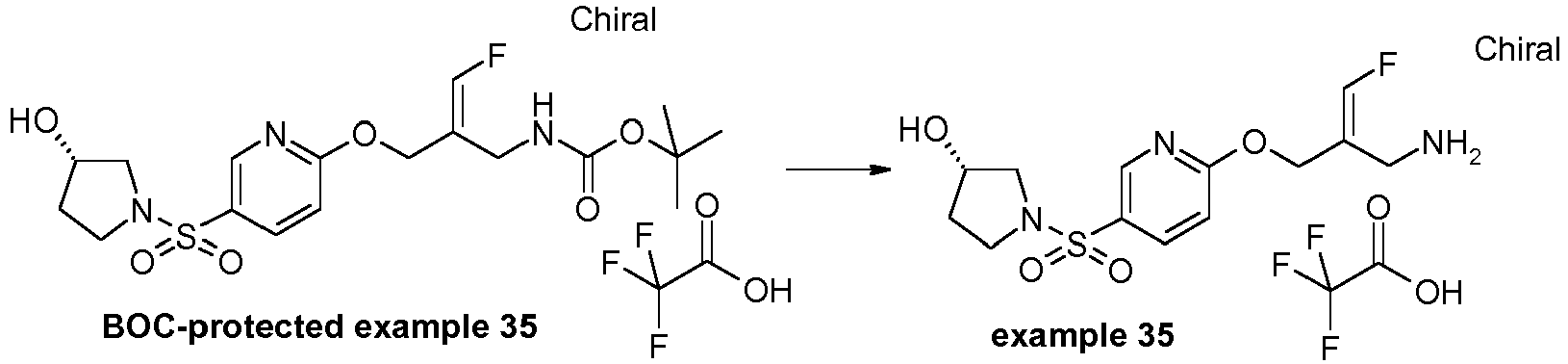
- The BOC-protected example 35 (139 mg; 0.32 mmol) was diluted with DCM (4 mL; S) and TFA (1.5 mL; 195 mmol; A) was added. The reaction mixture was stirred at RT (T) for 3 h (t) and purified by RP-HPLC (ACN/water + TFA) to give example 35.
Yield: 103 mg (27%), ESI-MS: m/z = 332 [M+H]+, Rt (HPLC): 0.62 min (HPLC-6) - The following examples (example number given in column #) were prepared in analogy to the above described procedure using the corresponding starting materials. Details for the two steps are given in the column synthesis comment, the retention-time and mass (ESI-MS, m/z = [M+H]+) determined by HPLC-MS are given in the columns Rt and MS.
# structure 36 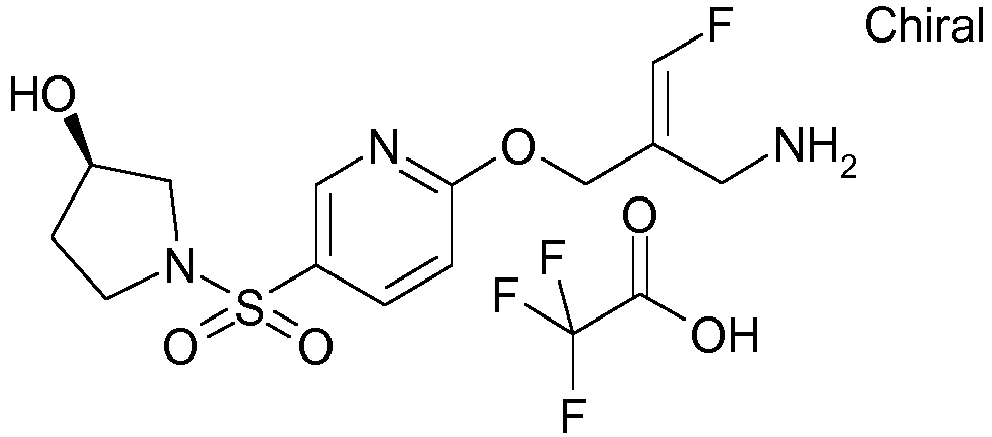
37 
38 
39 
40 
41 
42 
43 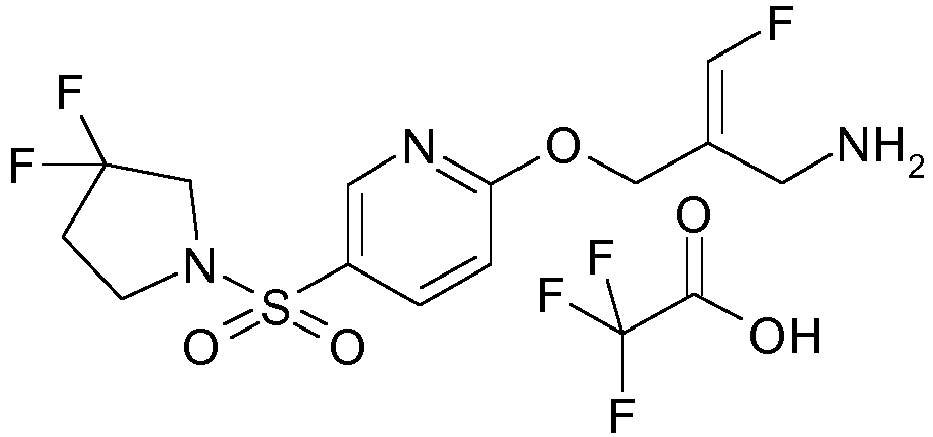
# Substitution BOC deprotection starting materials Rt [min] (HPLC method) MS synthesis comment Rt [min] (HPLC method) MS synthesis comment 3 6 II.36; IV.2 0.63 (HPLC-2) 432 S: THF 0.62 (HPLC-6) 332 S: DCM B: 2.00 eq A: 9 eq TFA T: RT T: RT t: overnight t: 3 h 3 7 II.37; IV.2 S: DMF 0.34 (HPLC-1) 338 S: DCM B: 1.00 eq A: 42 eq TFA T: RT T: RT t: 2 h; t: 2 h intermediate not isolated 3 8 
S: DMF 0.34 (HPLC-3) 316 B: 1.00 eq S: DCM T: RT A: 42 eq TFA t: 2 h; T: RT intermediate not isolated t: 2 h 3 9 II.38; IV.2 S: DMF 0.39 (HPLC-1) 302 B: 2.00 eq S: DCM T: RT A: 37 eq TFA t: 2 h; T: RT intermediate not isolated t: 1 h 4 0 II.39; IV.2 S: DMF 0.33 (HPLC-1) 346 B: 2.00 eq S: DCM T: RT A: 43 eq TFA t: 2 h; T: RT intermediate not isolated t: 2 h 4 1 II.40; IV.2 S: DMF 0.38 (HPLC-1) 328 B: 2.00 eq S: DCM T: RT A: 2 eq TFA t: 2 h; T: RT intermediate not isolated t: 2 h 4 2 II.41; IV.2 S: DMF 0.36 (HPLC-1) 332 B: 2.00 eq S: DCM T: RT A: 41 eq TFA t: 2 h; T: RT intermediate not isolated t: 2 h 4 3 II.42; IV.2 S: DMF 0.40 (HPLC-1) 352 B: 2.00 eq S: DCM T: RT A: 44 eq TFA t: 2 h; T: RT intermediate not isolated t: 1 h -

- Intermediate IV.1 (70 mg; 0.34 mmol) was dissolved in THF (1 ml; S) and sodium hydride (55%; 30 mg; 0.68 mmol; B) was added. After stirring at RT (T) for 10 min (t) intermediate II.43 (108 mg; 0.34 mmol) was added and the reaction mixture was stirred at RT (T) overnight (t). The reaction mixture was purified by RP-HPLC (ACN/ water + TFA) to give the BOC-protected example 44.
Yield: 95 mg (57%), ESI-MS: m/z = 487 [M+H]+, Rt (HPLC): 0.64 min (HPLC-2) -

- The BOC-protected example 44 as E/Z-mixture (95 mg; 0.20 mmol) was diluted with DCM (4 mL; S) and TFA (1.5 mL; 19.47 mmol; A) was added. The reaction mixture was stirred at RT (T) for 3.3 h (t) and purified by RP-HPLC (ACN/water + TFA) to give example 44.
Yield: 44 mg (26%), ESI-MS: m/z = 387 [M+H]+, Rt (HPLC): 0.66 min (HPLC-6) - The following examples (example number given in column #) were prepared in analogy to the above described procedure using the corresponding starting materials. Details for the two steps are given in the column synthesis comment, the retention-time and mass (ESI-MS, m/z = [M+H]+) determined by HPLC-MS are given in the columns Rt and MS.
# structure 45 
46 
47 
48 
49 
50 
# Substitution BOC deprotection starting materials Rt [min] (HPLC method) MS synthesis comment Rt [min] (HPLC method) MS synthesis comment 45 II.44; VI.1 0.65 (HPLC-2) 446 S: THF 0.65 (HPLC-6) 346 S: DCM B: 2.00 eq A: 26 eq TFA T: RT T: RT t: overnight t: overnight 46 II.45; IV.1 S: THF 0.37 (HPLC-1) 360 S: DCM B: 2.00 eq A: 46 eq TFA T: RT T: RT t: 2 h; t: 2 h intermediate not isolated 47 II.46; IV.1 S: THF 0.40 (HPLC-1) 330 B: 2.00 eq S: DCM T: RT A: 41 eq TFA t: 2 h; T: RT intermediate not isolated t: 2 h 48 II.47; IV.1 0.68 (HPLC-2) 460 S: THF 0.70 (HPLC-6) 360 S: DCM B: 2.00 eq A: 19 eq TFA T: RT T: RT t: overnight t: 1 h 49 II.48; IV.1 0.61 (HPLC-2) 459 S: THF 0.62 (HPLC-6) 359 S: DCM B: 2.00 eq A: 35 eq TFA T: RT T: RT t: overnight t: 1 h 50 II.49; IV.1 0.75 (HPLC-2) 514 S: THF 0.78 (HPLC-6) 414 S: DCM B: 2.00 eq A: 24 eq TFA T: RT T: RT t: overnight t: 2 h -

- Intermediate IV.1 (70 mg; 0.33 mmol) was dissolved in Tol (3 mL; S) and sodium tert-butoxide (30 mg; 0.33 mmol; B) was added. To the reaction mixture intermediate III.1 (100 mg; 0.33 mmol) was added and the reaction mixture was stirred at RT (T) for 35 min (t). Toluene was evaporated under reduced pressure, the residue taken up in MeOH (3 mL) and purified by RP-HPLC (ACN/ water + TFA) to give the BOC-protected example 51.
Yield: 97 mg (60%), ESI-MS: m/z = 488 [M+H]+, Rt (HPLC): 0.69 min (HPLC-1) -

- The BOC-protected example 51 (50 mg; 0.10 mmol) was diluted with DCM (4 mL; S) and TFA (30 µL; 0.41 mmol; A) was added. The reaction mixture was stirred at RT (T) over the weekend (t). Then it was evaporated in vacuo, the residue taken up with MeOH (3 mL) and purified by RP-HPLC (ACN/ water + TFA) to give example 51.
Yield: 16 mg (31%), ESI-MS: m/z = 388 [M+H]+, Rt (HPLC): 0.4 min (HPLC-1) - The following examples (example number given in column #) were prepared in analogy to the above described procedure using the corresponding starting materials. Details for the two steps are given in the column synthesis comment, the retention-time and mass (ESI-MS, m/z = [M+H]+) determined by HPLC-MS are given in the columns Rt and MS.
# structure 52 
53 
# Substitution BOC deprotection starting materials Rt [min] (HPLC method) MS synthesis comment Rt [min] (HPLC method) MS synthesis comment 52 III.2; IV.1 0.69 (HPLC-1) 486 S: Tol 0.43 (HPLC-1) 386 B: 1.00 eq T: RT t: 70 min; S: DCM workup: extraction; A: 2 eq TFA T: RT purification: column chromatography on silica t: overnight 53 lll.3; IV.1 0.72 (HPLC-1) 502 S: Tol 0.48 (HPLC-1) 402 B: 1.00 eq T: RT t: 70 min; S: DCM workup: extraction; A: 4 eq TFA purification: column chromatography on silica T: RT t: 2 h -

- The alcohol IV.1 (0.95 g; 4.62 mmol) was dissolved in toluene (30 mL) and sodium tert-butoxide (0.44 g; 4.62mmol) and intermediate III.4 (1.46 g; 4.62 mmol) were added. The reaction mixture was stirred at RT for 2 h, diluted with toluene (30 mL) and extracted with water two times. The organic phase was dried with Na2SO4 and evaporated under reduced pressure. The residue was purified by silica gel chromatography to provide intermediate V.1.
Yield: 1.85 g (80%), ESI-MS: m/z = 502 [M+H]+, Rt (HPLC): 0.72 min (HPLC-1) - The following intermediates were prepared in analogy to the above described procedure using the alcohol IV.1 and the corresponding starting material. For changes from this procedure, see "synthesis comment".


-

- Intermediate V.1 (1.85 g; 3.69 mmol) was dissolved in MeOH (70 mL) and aq. NaOH (1 N; 22.13 mL; 22.13 mmol) was added. The reaction mixture was stirred at RT for 10 min, then acidified with citric acid (10%) and MeOH was evaporated under reduced pressure. The residue was cooled to 5°C, the precipitate was filtered, washed with water (10 mL) and dried at 40°C to give intermediate VI.1.
Yield: 1.31 g (73%), ESI-MS: m/z = 488 [M+H]+, Rt (HPLC): 0.62 min (HPLC-1) - The following intermediates were prepared in analogy to the above described procedure using the corresponding starting material. For changes from this procedure, see "synthesis comment".
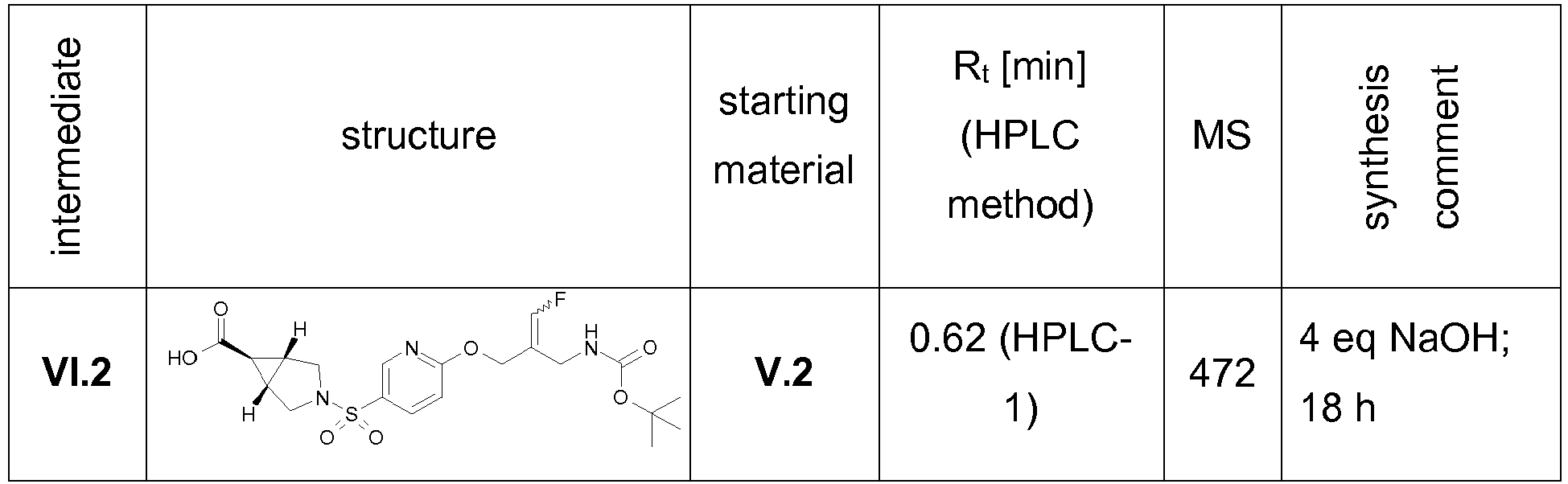

-

- Intermediate VI.1 (50 mg; 0.10 mmol) was dissolved in a solution of 4 N hydrogen chloride in 1,4-dioxane (1.5 mL; 6.00 mmol) and stirred at RT for 70 min. The reaction mixture was evaporated in vacuo. The residue was dissolved in MeOH (3 mL) and purified by RP-HPLC (ACN/ water + TFA) to provide example 54. Yield: 18 mg (35%), ESI-MS: m/z = 388 [M+H]+, Rt (HPLC): 0.40 min (HPLC-1)
-

- To a solution of intermediate VI.2 (50 mg; 0.11 mmol) in DCM (10 mL) was added TFA (50 mg; 0.42 mmol). The reaction mixture was stirred at RT for 50 min, evaporated in vacuo and the residue was purified by RP-HPLC (ACN/ water + TFA) to provide example 55.
Yield: 14 mg (27%), ESI-MS: m/z = 372 [M+H]+, Rt (HPLC): 0.40 min (HPLC-1) - The following examples were prepared in analogy to the above described procedure using the corresponding starting material. For changes from this procedure, see "synthesis comment".

-

- Intermediate VI.4 (40 mg; 0.08 mmol) was dissolved in DMF (2.00 mL) and TEA (46 µL; 0.33 mmol) and TCFH (23 mg; 0.08 mmol) were added. The reaction mixture was stirred at RT for 10 min and 4-aminotetrahydropyran (20 mg; 0.20 mmol) was added. The reaction mixture was stirred at RT overnight, then acidified with TFA (aq.; 50%) and purified by RP-HPLC (ACN/ water + TFA) to provide intermediate VII.1. Yield: 22 mg (47%), ESI-MS: m/z = 471 [M+H]+, Rt (HPLC): 1.05 min (HPLC-6)
- The following intermediates were prepared in analogy to the above described procedure using corresponding starting materials.

-

- To a solution of intermediate VI.1 (100 mg; 0.21 mmol) in DMF (1 mL) was added TEA (40 µL; 0.41 mmol) and HATU (90 mg; 0.23 mmol) at RT. Ammonia (0.5 M in 1,4-dioxane; 2 mL; 1.00 mmol) was added to the reaction mixture and it was stirred at RT for 1 h 40 min. The reaction mixture was diluted with water and extracted with EtOAc. The pooled organic phases were dried with Na2SO4 and evaporated. The crude material was taken up in MeOH (3 mL) and purified by RP-HPLC (ACN/ water + TFA) to provide intermediate VII.3.
Yield: 70 mg (70%), ESI-MS: m/z = 486 [M+H]+, Rt (HPLC): 0.58 min (HPLC-1) - The following intermediates were prepared in analogy to the above described procedure using the corresponding starting materials. For changes from this procedure, see "synthesis comment".

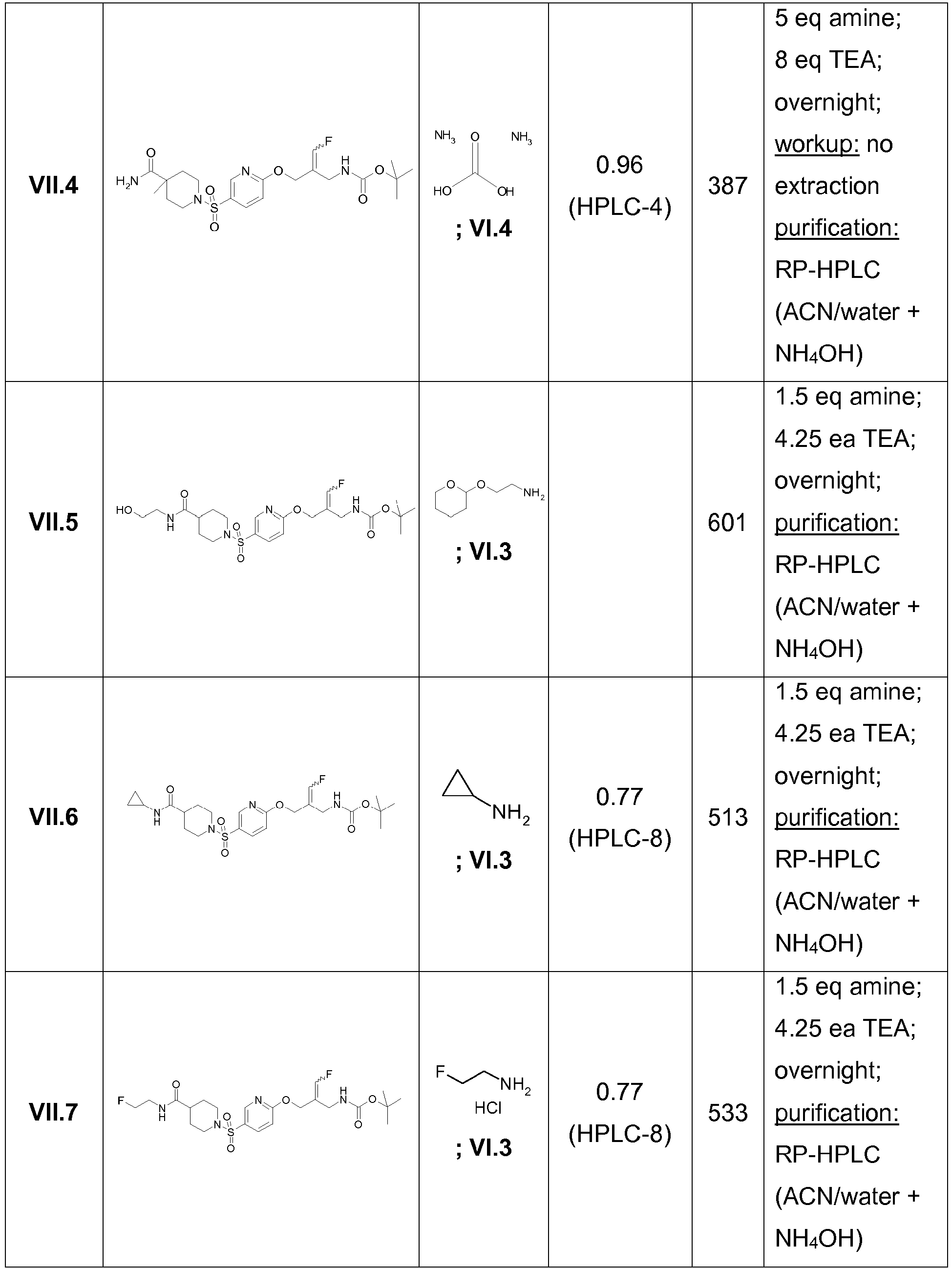

-

- To the solution of intermediate VI.2 (40 mg; 0.08 mmol), 2-methoxyethylamine (15 mg: 0.20 mmol) and N-methylmorpholine (47 µL; 0.42 mmol) in DCM (2 mL) was added 1-propanephosphonic acid cyclic anhydride (50% in EtOAc; 100 µL; 0.17 mmol). The reaction mixture was stirred at RT overnight, treated with 1-propanephosphonic acid cyclic anhydride (50% in EtOAc; 50 µL; 0.09 mmol) again and stirred at RT overnight. The reaction mixture was dissolved in ACN/water and purified by RP-HPLC (ACN/water + NH4OH) to provide intermediate VII.9.
ESI-MS: m/z = 552 [M+H]+, Rt (HPLC): 0.75 min (HPLC-8) -

- A solution of intermediate VII.1 (22 mg; 0.04 mmol) and TFA (1.00 mL; 12,96 mmol) in DCM (1 mL) was stirred at RT for 2 h, then evaporated to dryness under reduced pressure, acidified with TFA (50%) and purified by RP-HPLC (ACN/water + TFA) to provide example 58.
Yield: 13 mg (56%), ESI-MS: m/z = 471 [M+H]+, Rt (HPLC): 0.74 min (HPLC-6) - The following examples were prepared in analogy to the above described procedure using the corresponding starting material. For changes from this procedure, see "synthesis comment".


Claims (20)
- A compound of formula (I)
 ring A is selected from the group consisting of:
 R1 is selected from the group consisting of H, F, Cl, Br, CN, -OH, C1-4-alkyl, -O-(C1-4-alkyl), -(CH2)m-COOH, -(CH2)m-C(=O)-O-(C1-4-alkyl), -C(=O)-heterocyclyl, -(CH2)m-C(=O)-NH2, -(CH2)m-C(=O)-NH-(C1-4-alkyl), -(CH2)m-C(=O)-N(C1-4-alkyl)2, -C(=O)-NH-C3-6-cycloalkyl, -C(=O)-NH-heterocyclyl, -(CH2)m-NH-C(=O)-(C1-3-alkyl), -N(C1-3-alkyl)-C(=0)-(C1-4-alkyl), -N(C1-3-alkyl)-C(=O)-NH2, -NH-C(=O)-NH-(C1-4-alkyl), heterocyclyl and phenyl,wherein each alkyl group or sub-group is optionally substituted with 1 or more F atoms or with one OH or -0-(C1-3-alkyl) group; andwherein each heterocyclyl is selected from the group consisting of azetidinyl, imidazolidinyl, piperidinyl, tetrahydropyranyl and morpholinyl and is optionally substituted with one or two groups independently selected from the group consisting of oxo, C1-3-alkyl, -C(=O)-CH3 and -C(=O)-cyclopropyl; andwherein multiple R1 may be identical or different, if n is 2; andn is an integer selected from 1 and 2; andm is an integer selected from 0, 1 and 2; andwherein in any definition mentioned hereinbefore, if not specified otherwise, any alkyl group or sub-group may be straight-chained or branched and is optionally substituted with 1 or more F atoms,or a salt thereof.
 - The compound of formula (l) according to claim 1, wherein
R1 is selected from the group consisting of:H, F, Cl, -OH, C1-4-alkyl, -0-(C1-2-alkyl), -(CH2)m-COOH, -(CH2)m-C(=O)-O-(Ci-2-alkyl), -C(=O)-heterocyclyl, -(CH2)m-C(=O)-NH2, -(CH2)m-C(=O)-NH-(Ci-4-alkyl), -(CH2)m-C(=O)-N(CH3)(C1-3-alkyl),-C(=O)-NH-cyclopropyl, -C(=O)-NH-heterocyclyl, -(CH2)m-NH-C(=O)-(C1-3-alkyl),-N(C1-2-alkyl)-C(=O)-(C1-2-alkyl),-N(C1-2-alkyl)-C(=O)-NH2, -NH-C(=O)-NH-(Ci-2-alkyl), heterocyclyl and phenyl,wherein each alkyl group or sub-group is optionally substituted with 1 to 3 F atoms or with one OH or -O-(C1-2-alkyl) group; andwherein each heterocyclyl is selected from the group consisting of azetidinyl, imidazolidinyl, piperidinyl, tetrahydropyranyl and morpholinyl and is optionally substituted with one or two groups independently selected from the group consisting of oxo, C1-2-alkyl, -C(=O)-CH3 and -C(=O)-cyclopropyl; andwherein m is 0 or 1; andwherein multiple R1 may be identical or different, if n is 2;or a salt thereof. - The compound of formula (I) according to claim 2, wherein
R1 is selected from the group consisting of:H, F, -OH, -CH3, -CF3, -O-CH3, -COOH, -(CH2)m-C(=O)-O-CH3, -(CH2)m-C(=O)-NH2, -C(=O)-NH-(C1-3-alkyl), -(CH2)-C(=O)-N(CH3)2, -(CH2)-C(=O)-N(CH3)(CH2CH3), -C(=O)-NH-cyclopropyl, 1-(cyclopropylcarbonyl)-piperidin-4-yl and 3-methyl-2-oxo-imidazolidin-1-yl,wherein each ethyl group or sub-group is optionally substituted in position 2 with one F atom, one OH or one -O-CH3 group; andwherein each propyl group or sub-group is optionally substituted in position 2 or 3 with 1 to 3 F atoms; andwherein m is 0 or 1; andwherein, if n is 2, multiple R1 may be identical or different and the second R1 group is selected from the group consisting of F, CH3, CF3 and phenyl;or a salt thereof. - The compound of formula (I) according to claim 1, whereinring A is
 R1 is selected from the group consisting of H, F, -OH, C1-4-alkyl, -O-(C1-4-alkyl), -(CH2)m-COOH, -(CH2)m-C(=O)-O-(C1-4-alkyl), -C(=O)-heterocyclyl, -(CH2)m-C(=O)-NH2, -(CH2)m-C(=O)-NH-(C1-4-alkyl), -(CH2)m-C(=O)-N(C1-4-alkyl)2, -C(=O)-NH-C3-6-cycloalkyl, -C(=O)-NH-heterocyclyl, -(CH2)m-NH-C(=O)-(C1-3-alkyl), -N(C1-3-alkyl)-C(=O)-(C1-4-alkyl), -N(C1-3-alkyl)-C(=O)-NH2, -NH-C(=O)-NH-(C1-4-alkyl), heterocyclyl and phenyl,wherein each alkyl group or sub-group is optionally substituted with 1 or more F atoms or with one OH or -O-(C1-3-alkyl) group; andwherein each heterocyclyl is selected from the group consisting of azetidinyl, imidazolidinyl, piperidinyl, tetrahydropyranyl and morpholinyl and is optionally substituted with one or two groups independently selected from the group consisting of oxo, C1-3-alkyl, -C(=O)-CH3 and -C(=O)-cyclopropyl; andwherein multiple R1 may be identical or different, if n is 2; andn is an integer selected from 1 and 2; andm is an integer selected from 0 and 1;or a salt thereof.
 - The compound of formula (I) according to claim 4, wherein
R1 is selected from the group consisting of:H, -OH, C1-2-alkyl, -O-(C1-2-alkyl), -(CH2)m-COOH, -(CH2)m-C(=O)-O-(C1-2-alkyl), -C(=O)-heterocyclyl, -(CH2)m-C(=O)-NH2, -(CH2)m-C(=O)-NH-(C1-4-alkyl), -(CH2)m-C(=O)-N(C1-2-alkyl)2, -C(=O)-NH-C3-6-cyclopropyl, -C(=O)-NH-heterocyclyl, -(CH2)m-NH-C(=O)-(C1-3-alkyl), -N(CH3)-C(=O)-(C1-2-alkyl), -N(CH3)-C(=O)-NH2, -NH-C(=O)-NH-(C1-3-alkyl), heterocyclyl and phenyl,wherein each alkyl group or sub-group is optionally substituted with 1 to 3 F atoms or with one OH or -O-CH3 group; andwherein each heterocyclyl is selected from the group consisting of azetidinyl, imidazolidinyl, tetrahydropyranyl and morpholinyl and is optionally substituted with one or two groups independently selected from the group consisting of oxo, C1-3-alkyl and -C(=O)-CH3; andwherein, if n is 2, multiple R1 may be identical or different, and the second R1 group is selected from the group consisting of CH3, CF3 and phenyl;or a salt thereof. - The compound of formula (I) according to claim 1, whereinring A is
 R1 is selected from the group consisting of H, F, Cl, -OH, -O-(C1-4-alkyl), -C(=O)-heterocyclyl, -(CH2)m-C(=O)-NH2, -(CH2)m-C(=O)-NH-(C1-4-alkyl), -(CH2)m-C(=O)-N(C1-4-alkyl)2, -(CH2)m-NH-C(=O)-(C1-3-alkyl) and -N(C1-3-alkyl)-C(=O)-(C1-4-alkyl),wherein each alkyl group or sub-group is optionally substituted with 1 or more F atoms or with one OH or -O-(C1-3-alkyl) group; andwherein each heterocyclyl is selected from the group consisting of azetidinyl, imidazolidinyl, piperidinyl, tetrahydropyranyl and morpholinyl and is optionally substituted with one oxo or C1-3-alkyl group; andwherein, if n is 2, multiple R1 may be identical or different and the second R1 group is F; andn is an integer selected from 1 and 2; andm is an integer selected from 0 and 1;or a salt thereof.
 - The compound of formula (I) according to claim 1, whereinring A is
 R1 is selected from the group consisting of H, -(CH2)m-COOH, -(CH2)m-C(=O)-O-(C1-4-alkyl), -C(=O)-heterocyclyl, -(CH2)m-C(=O)-NH2, -(CH2)m-C(=O)-NH-(C1-4-alkyl) and -(CH2)m-C(=O)-N(C1-4-alkyl)2,wherein each alkyl group or sub-group is optionally substituted with 1 or more F atoms or with one OH or -O-(C1-3-alkyl) group; andwherein each heterocyclyl is selected from the group consisting of azetidinyl, imidazolidinyl, piperidinyl, tetrahydropyranyl and morpholinyl and is optionally substituted with one oxo or C1-3-alkyl group; andwherein multiple R1 may be identical or different, if n is 2; andn is 1; andm is an integer selected from 0 and 1;or a salt thereof.
 - The compound of formula (I) according to claim 1, whereinring A is
 R1 is selected from the group consisting of H, F, Cl, Br, CN, -OH, C1-4-alkyl, -O-(C1-4-alkyl), -C(=O)-NH2, -C(=O)-NH-(C1-4-alkyl), -C(=O)-N(C1-4-alkyl)2 and heterocyclyl,wherein each alkyl group or sub-group is optionally substituted with 1 or more F atoms or with one OH or -O-(C1-3-alkyl) group; andwherein each heterocyclyl is selected from the group consisting of azetidinyl, and piperidinyl, and is optionally substituted with one C1-3-alkyl, -C(=O)-CH3 or -C(=O)-cyclopropyl group; andwherein, if n is 2, multiple R1 may be identical or different and the second R1 group is selected from the group consisting of F and CH3; andn is an integer selected from 1 and 2;or a salt thereof.
 - The compound of formula (I) according to claim 1 selected from the group consisting of:

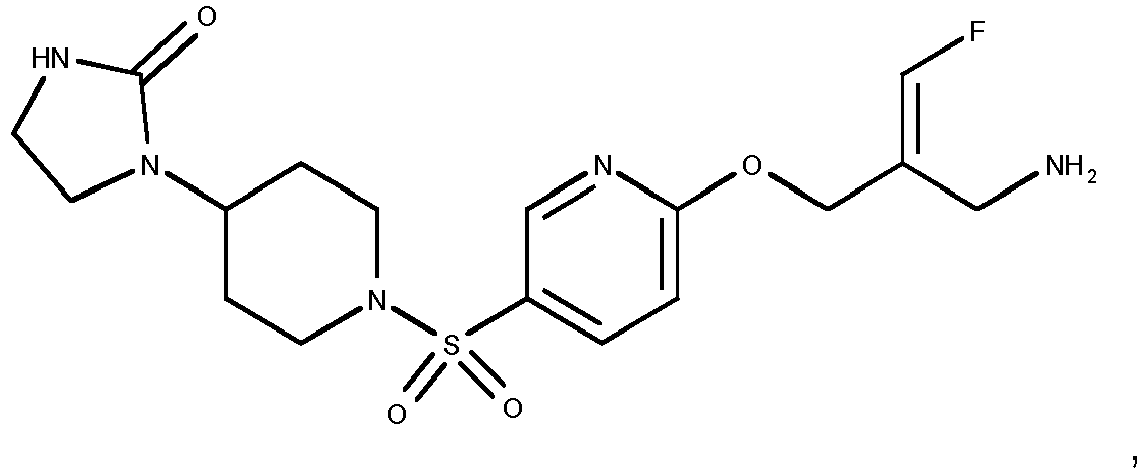


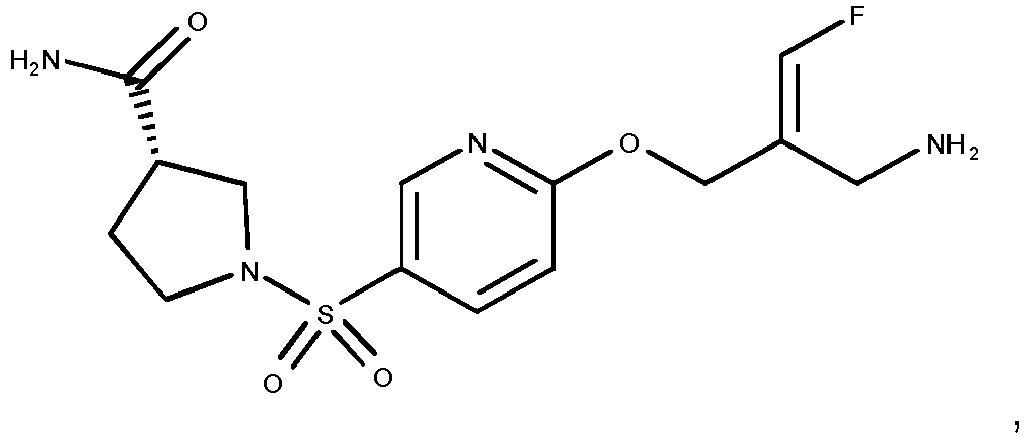
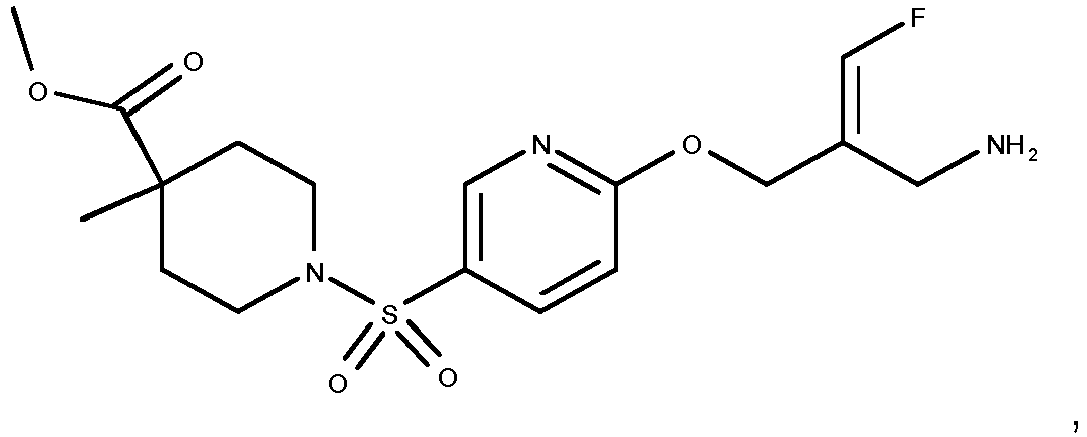
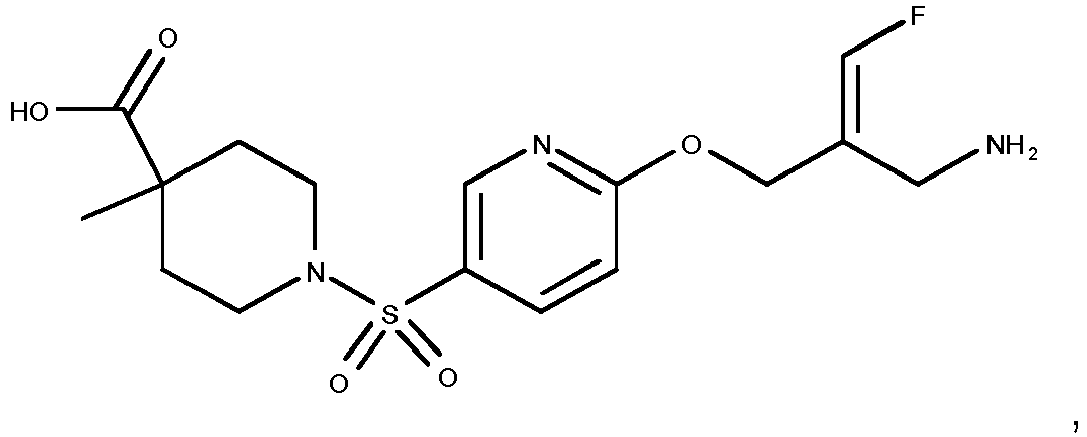


- The compound of formula (I) according to claim 9 having the structure:
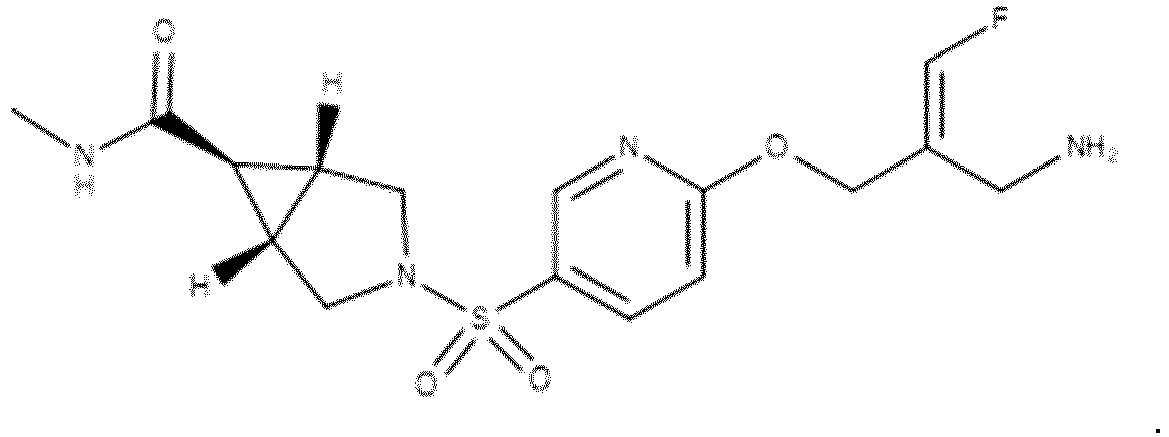
- The compound of formula (I) according to claim 9 having the structure:

- The compound of formula (I) according to claim 9 having the structure:

- The compound of formula (I) according to claim 9 having the structure:
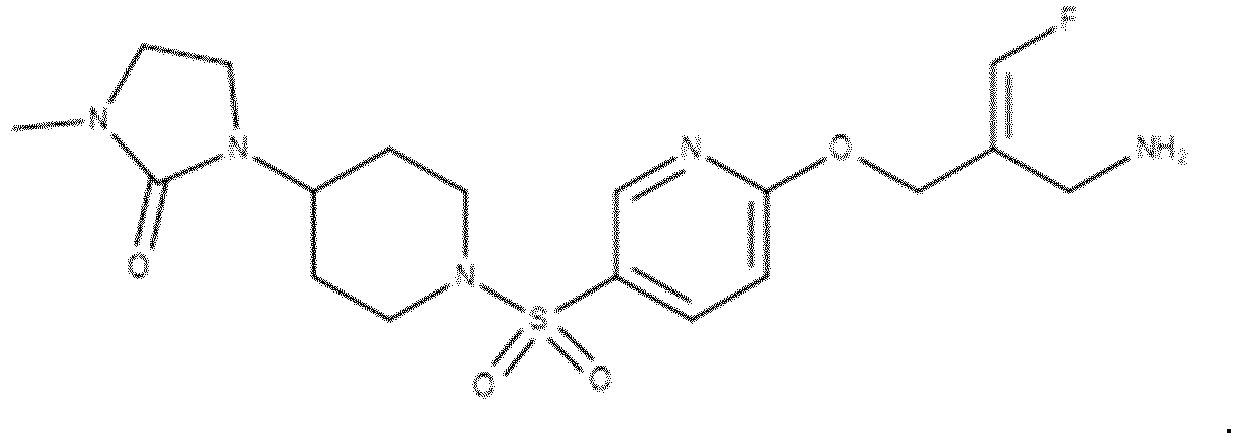
- The compound of formula (I) according to claim 9 having the structure:

- The compound of formula (I) according to claim 9 having the structure:

- A pharmaceutically acceptable salt of a compound according to any one of claims 1 to 15.
- A compound according to any one of claims 1 to 15 or a pharmaceutically acceptable salt thereof for use as a medicament.
- A compound according to any one of claims 1 to 15 or a pharmaceutically acceptable salt thereof for use in the treatment of cancer, NASH (non-alcoholic steatohepatitis), pulmonary fibrosis, retinopathy, nephropathy or stroke.
- A pharmaceutical composition comprising a compound according to any one of claims 1 to 15 or a pharmaceutically acceptable salt thereof, optionally together with one or more inert carriers and/or diluents.
- A pharmaceutical composition comprising one or more compounds according to one or more of the claims 1 to 15 or a pharmaceutically acceptable salt thereof, and one or more additional therapeutic agents, optionally together with one or more inert carriers and/or diluents.
Priority Applications (3)
| Application Number | Priority Date | Filing Date | Title |
|---|---|---|---|
| HRP20231608TT HRP20231608T1 (en) | 2018-10-29 | 2019-10-24 | Pyridinyl sulfonamide derivatives, pharmaceutical compositions and uses thereof |
| SI201930672T SI3873600T1 (en) | 2018-10-29 | 2019-10-24 | Pyridinyl sulfonamide derivatives, pharmaceutical compositions and uses thereof |
| RS20231203A RS64963B1 (en) | 2018-10-29 | 2019-10-24 | Pyridinyl sulfonamide derivatives, pharmaceutical compositions and uses thereof |
Applications Claiming Priority (2)
| Application Number | Priority Date | Filing Date | Title |
|---|---|---|---|
| EP18203196 | 2018-10-29 | ||
| PCT/EP2019/078992 WO2020089026A1 (en) | 2018-10-29 | 2019-10-24 | Pyridinyl sulfonamide derivatives, pharmaceutical compositions and uses thereof |
Publications (3)
| Publication Number | Publication Date |
|---|---|
| EP3873600A1 EP3873600A1 (en) | 2021-09-08 |
| EP3873600B1 true EP3873600B1 (en) | 2023-09-20 |
| EP3873600B9 EP3873600B9 (en) | 2024-02-14 |
Family
ID=64082994
Family Applications (1)
| Application Number | Title | Priority Date | Filing Date |
|---|---|---|---|
| EP19794970.4A Active EP3873600B9 (en) | 2018-10-29 | 2019-10-24 | Pyridinyl sulfonamide derivatives, pharmaceutical compositions and uses thereof |
Country Status (33)
| Country | Link |
|---|---|
| US (1) | US12178809B2 (en) |
| EP (1) | EP3873600B9 (en) |
| JP (1) | JP7317109B2 (en) |
| KR (1) | KR102812426B1 (en) |
| CN (1) | CN112955215B (en) |
| AU (1) | AU2019373306B2 (en) |
| BR (1) | BR112021004635A2 (en) |
| CA (1) | CA3112510A1 (en) |
| CL (1) | CL2021000839A1 (en) |
| CO (1) | CO2021005509A2 (en) |
| CR (1) | CR20210216A (en) |
| DK (1) | DK3873600T5 (en) |
| DO (1) | DOP2021000068A (en) |
| EA (1) | EA202191114A1 (en) |
| EC (1) | ECSP21030482A (en) |
| ES (1) | ES2967359T3 (en) |
| FI (1) | FI3873600T3 (en) |
| HR (1) | HRP20231608T1 (en) |
| HU (1) | HUE064995T2 (en) |
| IL (1) | IL282428A (en) |
| LT (1) | LT3873600T (en) |
| MA (1) | MA54051A (en) |
| MX (1) | MX2021004940A (en) |
| MY (1) | MY206745A (en) |
| PE (1) | PE20211467A1 (en) |
| PH (1) | PH12021550901A1 (en) |
| PL (1) | PL3873600T3 (en) |
| PT (1) | PT3873600T (en) |
| RS (1) | RS64963B1 (en) |
| SA (1) | SA521421755B1 (en) |
| SG (1) | SG11202102440SA (en) |
| SI (1) | SI3873600T1 (en) |
| WO (1) | WO2020089026A1 (en) |
Families Citing this family (9)
| Publication number | Priority date | Publication date | Assignee | Title |
|---|---|---|---|---|
| US12178809B2 (en) | 2018-10-29 | 2024-12-31 | Boehringer Ingelheim International Gmbh | Pyridinyl sulfonamide derivatives, pharmaceutical compositions and uses thereof |
| US12213970B2 (en) * | 2018-10-29 | 2025-02-04 | Boehringer Ingelheim International Gmbh | Pyridinyl sulfonamide derivatives, pharmaceutical compositions and uses thereof |
| WO2021050964A1 (en) | 2019-09-13 | 2021-03-18 | Nimbus Saturn, Inc. | Hpk1 antagonists and uses thereof |
| CN114621189B (en) * | 2020-12-14 | 2024-01-02 | 上海拓界生物医药科技有限公司 | Lactam derivative and application thereof |
| CN114621243B (en) * | 2020-12-14 | 2024-03-01 | 上海拓界生物医药科技有限公司 | Sulfonamide derivative and application thereof |
| CN114621190B (en) * | 2020-12-14 | 2023-12-05 | 上海拓界生物医药科技有限公司 | Allylamine derivative and application thereof |
| CN117120090A (en) | 2021-02-12 | 2023-11-24 | 林伯士萨顿公司 | HPK1 antagonists and uses thereof |
| WO2022187856A1 (en) | 2021-03-05 | 2022-09-09 | Nimbus Saturn, Inc. | Hpk1 antagonists and uses thereof |
| EP4313989A4 (en) | 2021-03-29 | 2025-03-05 | Nimbus Saturn, Inc. | HPK1 ANTAGONISTS AND THEIR USES |
Family Cites Families (54)
| Publication number | Priority date | Publication date | Assignee | Title |
|---|---|---|---|---|
| PT946548E (en) | 1996-12-19 | 2002-06-28 | Aventis Pharma Inc | NEW PYRROLIDINE AMIDE DERIVATIVES SUBSTITUTED BY HETEROCYCLES |
| UA71994C2 (en) | 1999-08-31 | 2005-01-17 | Kissei Pharmaceutical | Glucopyranosyloxypyrazole derivatives, a pharmaceutical composition containing these derivatives and intermediate compounds for the preparation thereof |
| MXPA02003254A (en) | 1999-09-27 | 2002-09-30 | Pioneer Hi Bred Int | Enhanced stress tolerance in maize via manipulation of cell cycle regulatory genes. |
| US6515117B2 (en) | 1999-10-12 | 2003-02-04 | Bristol-Myers Squibb Company | C-aryl glucoside SGLT2 inhibitors and method |
| PH12000002657B1 (en) | 1999-10-12 | 2006-02-21 | Bristol Myers Squibb Co | C-aryl glucoside SGLT2 inhibitors |
| US7053060B2 (en) | 2000-11-30 | 2006-05-30 | Kissei Pharmaceutical Co., Ltd. | Glucopyranosyloxybenzylbenzene derivatives, medicinal compositions containing the same and intermediates in the production thereof |
| KR100701437B1 (en) | 2000-12-28 | 2007-03-30 | 깃세이 야쿠힌 고교 가부시키가이샤 | Glucopyranosyloxypyrazole derivatives and pharmaceutical uses thereof |
| KR100945455B1 (en) | 2002-03-22 | 2010-03-05 | 깃세이 야쿠힌 고교 가부시키가이샤 | Crystallization of Glucopyranosyloxybenzyl Benzene Derivatives |
| DE10231370B4 (en) | 2002-07-11 | 2006-04-06 | Sanofi-Aventis Deutschland Gmbh | Thiophene glycoside derivatives, medicaments containing these compounds and methods of making these medicaments |
| JP4580866B2 (en) | 2002-12-19 | 2010-11-17 | バーテックス ファーマシューティカルズ インコーポレイテッド | TACE inhibitor |
| WO2004080990A1 (en) | 2003-03-14 | 2004-09-23 | Astellas Pharma Inc. | C-glycoside derivatives and salts thereof |
| EA015104B1 (en) | 2003-08-01 | 2011-06-30 | Мицубиси Танабе Фарма Корпорейшн | Novel compounds having inhibitory activity against sodium-dependant transporter |
| AU2004268621C1 (en) | 2003-08-29 | 2011-08-18 | Exelixis, Inc. | c-Kit modulators and methods of use |
| JP4181605B2 (en) | 2004-03-16 | 2008-11-19 | ベーリンガー インゲルハイム インターナショナル ゲゼルシャフト ミット ベシュレンクテル ハフツング | Glucopyranosyl-substituted phenyl derivatives, pharmaceuticals containing the compounds, and uses and production methods thereof |
| US20080015202A1 (en) | 2004-09-09 | 2008-01-17 | Astellas Pharma Inc. | Thiazole Derivatives Having Vap-1 Inhibitory Activity |
| TW200637839A (en) | 2005-01-07 | 2006-11-01 | Taisho Pharmaceutical Co Ltd | 1-thio-d-glucitol derivatives |
| TW200637869A (en) | 2005-01-28 | 2006-11-01 | Chugai Pharmaceutical Co Ltd | The spiroketal derivatives and the use as therapeutical agent for diabetes of the same |
| UA91546C2 (en) | 2005-05-03 | 2010-08-10 | Бьорінгер Інгельхайм Інтернаціональ Гмбх | Crystalline form of 1-chloro-4-(я-d-glucopyranos-1-yl)-2-[4-((s)-tetrahydrofuran-3-yloxy)-benzyl]-benzene, a method for its preparation and the use thereof for preparing medicaments |
| US7772191B2 (en) | 2005-05-10 | 2010-08-10 | Boehringer Ingelheim International Gmbh | Processes for preparing of glucopyranosyl-substituted benzyl-benzene derivatives and intermediates therein |
| CN103819416A (en) | 2005-10-07 | 2014-05-28 | 埃克塞里艾克西斯公司 | N-(3-amino-quinoxalin-2-yl)-sulfonamide derivatives and their use as phosphatidylinositol 3-kinase inhibitors |
| US7745414B2 (en) | 2006-02-15 | 2010-06-29 | Boehringer Ingelheim International Gmbh | Glucopyranosyl-substituted benzonitrile derivatives, pharmaceutical compositions containing such compounds, their use and process for their manufacture |
| EP2004166A2 (en) | 2006-03-31 | 2008-12-24 | La Jolla Pharmaceutical Company | Inhibitors of semicarbazide-sensitive amine oxidase (ssao) and vap-1 mediated adhesion useful for treatment and prevention of diseases |
| EP2019679B1 (en) | 2006-05-23 | 2018-06-20 | Theracos, Inc. | Glucose transport inhibitors and methods of use |
| US7919598B2 (en) | 2006-06-28 | 2011-04-05 | Bristol-Myers Squibb Company | Crystal structures of SGLT2 inhibitors and processes for preparing same |
| TWI499414B (en) | 2006-09-29 | 2015-09-11 | Lexicon Pharmaceuticals Inc | Inhibitors of sodium glucose co-transporter 2 and methods of their use |
| UY30730A1 (en) | 2006-12-04 | 2008-07-03 | Mitsubishi Tanabe Pharma Corp | CRYSTAL FORM OF HEMIHYDRATE 1- (B (BETA) -D-GLUCOPYRANOSIL) -4-METHYL-3- [5- (4-FLUOROPHENYL) -2-TIENYLMETHYL] BENZENE |
| TW200831485A (en) | 2006-12-11 | 2008-08-01 | Boehringer Ingelheim Int | New pyridazine derivatives with MCH antagonistic activity and medicaments comprising these compounds |
| AR065809A1 (en) | 2007-03-22 | 2009-07-01 | Bristol Myers Squibb Co | PHARMACEUTICAL FORMULATIONS CONTAINING AN SGLT2 INHIBITOR |
| JP5653213B2 (en) | 2007-07-26 | 2015-01-14 | レクシコン ファーマシューティカルズ インコーポレイテッド | Methods and compounds useful for the preparation of sodium-glucose cotransporter 2 inhibitors |
| US20090054392A1 (en) | 2007-08-20 | 2009-02-26 | Wyeth | Naphthylpyrimidine, naphthylpyrazine and naphthylpyridazine analogs and their use as agonists of the wnt-beta-catenin cellular messaging system |
| CN101801371B (en) | 2007-09-10 | 2012-11-28 | 詹森药业有限公司 | Process for the preparation of compounds useful as SGLT inhibitors |
| TW201011043A (en) | 2008-06-20 | 2010-03-16 | Chugai Pharmaceutical Co Ltd | Crystal of spiroketal derivatives and process for preparation of spiroketal derivatives |
| TWI472521B (en) | 2008-07-17 | 2015-02-11 | Lexicon Pharmaceuticals Inc | Solid forms of (2s,3r,4r,5s,6r)-2-(4-chloro-3-(4-ethoxybenzyl)phenyl)-6-(methylthio)tetrahydro-2h-pyran-3,4,5-triol and methods of their use |
| SG175154A1 (en) | 2009-04-16 | 2011-11-28 | Taisho Pharmaceutical Co Ltd | Pharmaceutical compositions |
| ES2546762T3 (en) | 2009-09-30 | 2015-09-28 | Boehringer Ingelheim International Gmbh | Procedures for preparing glucopyranosyl substituted benzyl benzene derivatives |
| EA020798B1 (en) | 2009-09-30 | 2015-01-30 | Бёрингер Ингельхайм Интернациональ Гмбх | Method for the preparation of a crystalline form of 1-chloro-4-(beta-d-glucopyranos-1-yl)-2-[4-((s)-tetrahydrofuran-3-yloxy)benzyl]benzene |
| FI20115234A0 (en) | 2011-03-08 | 2011-03-08 | Biotie Therapies Corp | New pyridazinone and pyridone compounds |
| KR101879011B1 (en) | 2011-03-15 | 2018-07-16 | 아스테라스 세이야쿠 가부시키가이샤 | Guanidine compound |
| US9192617B2 (en) * | 2012-03-20 | 2015-11-24 | Boehringer Ingelheim International Gmbh | Pharmaceutical composition, methods for treating and uses thereof |
| JP6182595B2 (en) | 2012-05-02 | 2017-08-16 | ベーリンガー インゲルハイム インターナショナル ゲゼルシャフト ミット ベシュレンクテル ハフツング | Substituted 3-haloallylamine inhibitors of SSAO and uses thereof |
| US10577363B2 (en) | 2014-09-10 | 2020-03-03 | Epizyme, Inc. | Substituted piperidine compounds |
| WO2017022861A1 (en) | 2015-08-06 | 2017-02-09 | 宇部興産株式会社 | Substituted guanidine derivative |
| WO2017148519A1 (en) | 2016-03-03 | 2017-09-08 | Boehringer Ingelheim International Gmbh | Pyridinylmethyl carbamimidoylcarbamate derivatives and their use as aoc3 inhibitors |
| PL3455216T3 (en) | 2016-05-12 | 2021-05-17 | Boehringer Ingelheim International Gmbh | Pyridinyl derivatives, pharmaceutical compositions and uses thereof as aoc3 inhibitors |
| WO2018027892A1 (en) * | 2016-08-12 | 2018-02-15 | Eli Lilly And Company | Amino pyrimidine ssao inhibitors |
| US11168069B2 (en) | 2017-02-07 | 2021-11-09 | Oblique Therapeutics Ab | Heterocyclylsulfonyl-substituted pyridines and their use in the treatment of cancer |
| WO2018148856A1 (en) | 2017-02-14 | 2018-08-23 | Eli Lilly And Company | Diazaspirodecanyl-pyrimidine compounds useful as ssao inhibitors |
| EP3617186A1 (en) | 2017-04-28 | 2020-03-04 | Sichuan Kelun-Biotech Biopharmaceutical Co., Ltd. | Fluoroallylamine derivative and use thereof |
| AU2018287777B2 (en) | 2017-06-20 | 2020-05-21 | Shandong Danhong Pharmaceutical Co., Ltd. | SSAO inhibitor |
| CN109251166B (en) | 2017-07-13 | 2021-11-05 | 广东东阳光药业有限公司 | Amine compounds inhibiting SSAO/VAP-1 and their application in medicine |
| CN109810041B (en) | 2017-11-21 | 2023-08-15 | 药捷安康(南京)科技股份有限公司 | Halogenated allylamine SSAO/VAP-1 inhibitors and their applications |
| CN111989103A (en) | 2018-04-17 | 2020-11-24 | 勃林格殷格翰国际有限公司 | Pharmaceutical compositions, methods of treatment and uses thereof |
| US12213970B2 (en) * | 2018-10-29 | 2025-02-04 | Boehringer Ingelheim International Gmbh | Pyridinyl sulfonamide derivatives, pharmaceutical compositions and uses thereof |
| US12178809B2 (en) | 2018-10-29 | 2024-12-31 | Boehringer Ingelheim International Gmbh | Pyridinyl sulfonamide derivatives, pharmaceutical compositions and uses thereof |
-
2019
- 2019-10-24 US US17/285,918 patent/US12178809B2/en active Active
- 2019-10-24 WO PCT/EP2019/078992 patent/WO2020089026A1/en not_active Ceased
- 2019-10-24 JP JP2021523407A patent/JP7317109B2/en active Active
- 2019-10-24 PE PE2021000602A patent/PE20211467A1/en unknown
- 2019-10-24 ES ES19794970T patent/ES2967359T3/en active Active
- 2019-10-24 PT PT197949704T patent/PT3873600T/en unknown
- 2019-10-24 CN CN201980071238.4A patent/CN112955215B/en active Active
- 2019-10-24 EP EP19794970.4A patent/EP3873600B9/en active Active
- 2019-10-24 RS RS20231203A patent/RS64963B1/en unknown
- 2019-10-24 HU HUE19794970A patent/HUE064995T2/en unknown
- 2019-10-24 KR KR1020217015606A patent/KR102812426B1/en active Active
- 2019-10-24 PL PL19794970.4T patent/PL3873600T3/en unknown
- 2019-10-24 FI FIEP19794970.4T patent/FI3873600T3/en active
- 2019-10-24 MA MA054051A patent/MA54051A/en unknown
- 2019-10-24 SG SG11202102440SA patent/SG11202102440SA/en unknown
- 2019-10-24 MY MYPI2021001763A patent/MY206745A/en unknown
- 2019-10-24 MX MX2021004940A patent/MX2021004940A/en unknown
- 2019-10-24 SI SI201930672T patent/SI3873600T1/en unknown
- 2019-10-24 CR CR20210216A patent/CR20210216A/en unknown
- 2019-10-24 CA CA3112510A patent/CA3112510A1/en active Pending
- 2019-10-24 AU AU2019373306A patent/AU2019373306B2/en active Active
- 2019-10-24 HR HRP20231608TT patent/HRP20231608T1/en unknown
- 2019-10-24 LT LTEPPCT/EP2019/078992T patent/LT3873600T/en unknown
- 2019-10-24 DK DK19794970.4T patent/DK3873600T5/en active
- 2019-10-24 PH PH1/2021/550901A patent/PH12021550901A1/en unknown
- 2019-10-24 BR BR112021004635-6A patent/BR112021004635A2/en unknown
- 2019-10-24 EA EA202191114A patent/EA202191114A1/en unknown
-
2021
- 2021-04-05 CL CL2021000839A patent/CL2021000839A1/en unknown
- 2021-04-14 SA SA521421755A patent/SA521421755B1/en unknown
- 2021-04-16 DO DO2021000068A patent/DOP2021000068A/en unknown
- 2021-04-19 IL IL282428A patent/IL282428A/en unknown
- 2021-04-27 CO CONC2021/0005509A patent/CO2021005509A2/en unknown
- 2021-04-28 EC ECSENADI202130482A patent/ECSP21030482A/en unknown
Also Published As
Similar Documents
| Publication | Publication Date | Title |
|---|---|---|
| EP3873600B1 (en) | Pyridinyl sulfonamide derivatives, pharmaceutical compositions and uses thereof | |
| EP3873599B1 (en) | Pyridinyl sulfonamide derivatives, pharmaceutical compositions and uses thereof | |
| EP3423436B1 (en) | Pyridinylmethyl carbamimidoylcarbamate derivatives and their use as aoc3 inhibitors | |
| EP3455216B1 (en) | Pyridinyl derivatives, pharmaceutical compositions and uses thereof as aoc3 inhibitors | |
| EP3423434B1 (en) | 4-cyano-benzyl carbamimidoylcarbamate derivatives and their use as aoc3 inhibitors | |
| EA043735B1 (en) | PYRIDINYLSULFONAMIDE DERIVATIVES, PHARMACEUTICAL COMPOSITIONS AND THEIR APPLICATION | |
| HK1262598B (en) | Pyridinyl derivatives, pharmaceutical compositions and uses thereof as aoc3 inhibitors | |
| HK1262598A1 (en) | Pyridinyl derivatives, pharmaceutical compositions and uses thereof as aoc3 inhibitors | |
| NZ746586B2 (en) | Pyridinyl derivatives, pharmaceutical compositions and uses thereof as aoc3 inhibitors |
Legal Events
| Date | Code | Title | Description |
|---|---|---|---|
| REG | Reference to a national code |
Ref country code: HR Ref legal event code: TUEP Ref document number: P20231608T Country of ref document: HR |
|
| STAA | Information on the status of an ep patent application or granted ep patent |
Free format text: STATUS: UNKNOWN |
|
| STAA | Information on the status of an ep patent application or granted ep patent |
Free format text: STATUS: THE INTERNATIONAL PUBLICATION HAS BEEN MADE |
|
| PUAI | Public reference made under article 153(3) epc to a published international application that has entered the european phase |
Free format text: ORIGINAL CODE: 0009012 |
|
| STAA | Information on the status of an ep patent application or granted ep patent |
Free format text: STATUS: REQUEST FOR EXAMINATION WAS MADE |
|
| 17P | Request for examination filed |
Effective date: 20210531 |
|
| AK | Designated contracting states |
Kind code of ref document: A1 Designated state(s): AL AT BE BG CH CY CZ DE DK EE ES FI FR GB GR HR HU IE IS IT LI LT LU LV MC MK MT NL NO PL PT RO RS SE SI SK SM TR |
|
| RAV | Requested validation state of the european patent: fee paid |
Extension state: TN Effective date: 20210531 Extension state: MA Effective date: 20210531 |
|
| REG | Reference to a national code |
Ref country code: HK Ref legal event code: DE Ref document number: 40060201 Country of ref document: HK |
|
| RIC1 | Information provided on ipc code assigned before grant |
Ipc: A61K 45/06 20060101ALI20221202BHEP Ipc: A61K 31/5377 20060101ALI20221202BHEP Ipc: A61K 31/4545 20060101ALI20221202BHEP Ipc: A61K 31/454 20060101ALI20221202BHEP Ipc: C07D 401/14 20060101ALI20221202BHEP Ipc: C07D 401/12 20060101ALI20221202BHEP Ipc: C07D 213/71 20060101ALI20221202BHEP Ipc: C07D 405/14 20060101ALI20221202BHEP Ipc: A61P 35/00 20060101ALI20221202BHEP Ipc: A61P 27/00 20060101ALI20221202BHEP Ipc: A61P 13/12 20060101ALI20221202BHEP Ipc: A61P 11/00 20060101ALI20221202BHEP Ipc: A61P 9/00 20060101ALI20221202BHEP Ipc: A61P 1/16 20060101AFI20221202BHEP |
|
| GRAP | Despatch of communication of intention to grant a patent |
Free format text: ORIGINAL CODE: EPIDOSNIGR1 |
|
| STAA | Information on the status of an ep patent application or granted ep patent |
Free format text: STATUS: GRANT OF PATENT IS INTENDED |
|
| INTG | Intention to grant announced |
Effective date: 20230119 |
|
| GRAJ | Information related to disapproval of communication of intention to grant by the applicant or resumption of examination proceedings by the epo deleted |
Free format text: ORIGINAL CODE: EPIDOSDIGR1 |
|
| STAA | Information on the status of an ep patent application or granted ep patent |
Free format text: STATUS: REQUEST FOR EXAMINATION WAS MADE |
|
| GRAP | Despatch of communication of intention to grant a patent |
Free format text: ORIGINAL CODE: EPIDOSNIGR1 |
|
| STAA | Information on the status of an ep patent application or granted ep patent |
Free format text: STATUS: GRANT OF PATENT IS INTENDED |
|
| P01 | Opt-out of the competence of the unified patent court (upc) registered |
Effective date: 20230508 |
|
| INTC | Intention to grant announced (deleted) | ||
| INTG | Intention to grant announced |
Effective date: 20230609 |
|
| GRAS | Grant fee paid |
Free format text: ORIGINAL CODE: EPIDOSNIGR3 |
|
| GRAA | (expected) grant |
Free format text: ORIGINAL CODE: 0009210 |
|
| STAA | Information on the status of an ep patent application or granted ep patent |
Free format text: STATUS: THE PATENT HAS BEEN GRANTED |
|
| AK | Designated contracting states |
Kind code of ref document: B1 Designated state(s): AL AT BE BG CH CY CZ DE DK EE ES FI FR GB GR HR HU IE IS IT LI LT LU LV MC MK MT NL NO PL PT RO RS SE SI SK SM TR |
|
| REG | Reference to a national code |
Ref country code: GB Ref legal event code: FG4D |
|
| REG | Reference to a national code |
Ref country code: CH Ref legal event code: EP |
|
| REG | Reference to a national code |
Ref country code: DE Ref legal event code: R096 Ref document number: 602019037899 Country of ref document: DE |
|
| REG | Reference to a national code |
Ref country code: IE Ref legal event code: FG4D |
|
| REG | Reference to a national code |
Ref country code: FI Ref legal event code: FGE |
|
| REG | Reference to a national code |
Ref country code: PT Ref legal event code: SC4A Ref document number: 3873600 Country of ref document: PT Date of ref document: 20231215 Kind code of ref document: T Free format text: AVAILABILITY OF NATIONAL TRANSLATION Effective date: 20231211 |
|
| REG | Reference to a national code |
Ref country code: NL Ref legal event code: FP Ref country code: SE Ref legal event code: TRGR |
|
| REG | Reference to a national code |
Ref country code: DK Ref legal event code: T3 Effective date: 20231222 |
|
| REG | Reference to a national code |
Ref country code: NO Ref legal event code: T2 Effective date: 20230920 |
|
| REG | Reference to a national code |
Ref country code: CH Ref legal event code: PK Free format text: BERICHTIGUNG B9 |
|
| REG | Reference to a national code |
Ref country code: GR Ref legal event code: EP Ref document number: 20230402514 Country of ref document: GR Effective date: 20240209 Ref country code: SK Ref legal event code: T3 Ref document number: E 43100 Country of ref document: SK |
|
| REG | Reference to a national code |
Ref country code: HR Ref legal event code: ODRP Ref document number: P20231608T Country of ref document: HR Payment date: 20231221 Year of fee payment: 5 |
|
| REG | Reference to a national code |
Ref country code: HR Ref legal event code: T1PR Ref document number: P20231608 Country of ref document: HR Ref country code: EE Ref legal event code: FG4A Ref document number: E023890 Country of ref document: EE Effective date: 20231219 |
|
| REG | Reference to a national code |
Ref country code: DK Ref legal event code: T5 Effective date: 20240313 |
|
| REG | Reference to a national code |
Ref country code: LT Ref legal event code: TK9D Effective date: 20240301 |
|
| PG25 | Lapsed in a contracting state [announced via postgrant information from national office to epo] |
Ref country code: IS Free format text: LAPSE BECAUSE OF FAILURE TO SUBMIT A TRANSLATION OF THE DESCRIPTION OR TO PAY THE FEE WITHIN THE PRESCRIBED TIME-LIMIT Effective date: 20240120 |
|
| REG | Reference to a national code |
Ref country code: EE Ref legal event code: LD4A Ref document number: E023890 Country of ref document: EE |
|
| REG | Reference to a national code |
Ref country code: HU Ref legal event code: AG4A Ref document number: E064995 Country of ref document: HU |
|
| REG | Reference to a national code |
Ref country code: ES Ref legal event code: FG2A Ref document number: 2967359 Country of ref document: ES Kind code of ref document: T3 Effective date: 20240429 |
|
| PG25 | Lapsed in a contracting state [announced via postgrant information from national office to epo] |
Ref country code: SM Free format text: LAPSE BECAUSE OF FAILURE TO SUBMIT A TRANSLATION OF THE DESCRIPTION OR TO PAY THE FEE WITHIN THE PRESCRIBED TIME-LIMIT Effective date: 20230920 Ref country code: IS Free format text: LAPSE BECAUSE OF FAILURE TO SUBMIT A TRANSLATION OF THE DESCRIPTION OR TO PAY THE FEE WITHIN THE PRESCRIBED TIME-LIMIT Effective date: 20240120 |
|
| REG | Reference to a national code |
Ref country code: AT Ref legal event code: UEP Ref document number: 1612951 Country of ref document: AT Kind code of ref document: T Effective date: 20230920 |
|
| REG | Reference to a national code |
Ref country code: DE Ref legal event code: R097 Ref document number: 602019037899 Country of ref document: DE |
|
| PG25 | Lapsed in a contracting state [announced via postgrant information from national office to epo] |
Ref country code: MC Free format text: LAPSE BECAUSE OF FAILURE TO SUBMIT A TRANSLATION OF THE DESCRIPTION OR TO PAY THE FEE WITHIN THE PRESCRIBED TIME-LIMIT Effective date: 20230920 |
|
| PLBE | No opposition filed within time limit |
Free format text: ORIGINAL CODE: 0009261 |
|
| STAA | Information on the status of an ep patent application or granted ep patent |
Free format text: STATUS: NO OPPOSITION FILED WITHIN TIME LIMIT |
|
| PG25 | Lapsed in a contracting state [announced via postgrant information from national office to epo] |
Ref country code: MC Free format text: LAPSE BECAUSE OF FAILURE TO SUBMIT A TRANSLATION OF THE DESCRIPTION OR TO PAY THE FEE WITHIN THE PRESCRIBED TIME-LIMIT Effective date: 20230920 |
|
| 26N | No opposition filed |
Effective date: 20240621 |
|
| REG | Reference to a national code |
Ref country code: HR Ref legal event code: ODRP Ref document number: P20231608 Country of ref document: HR Payment date: 20241011 Year of fee payment: 6 |
|
| PGFP | Annual fee paid to national office [announced via postgrant information from national office to epo] |
Ref country code: NL Payment date: 20241021 Year of fee payment: 6 |
|
| PGFP | Annual fee paid to national office [announced via postgrant information from national office to epo] |
Ref country code: HU Payment date: 20241024 Year of fee payment: 6 |
|
| PGFP | Annual fee paid to national office [announced via postgrant information from national office to epo] |
Ref country code: PT Payment date: 20241010 Year of fee payment: 6 |
|
| PGFP | Annual fee paid to national office [announced via postgrant information from national office to epo] |
Ref country code: NO Payment date: 20241023 Year of fee payment: 6 |
|
| PGFP | Annual fee paid to national office [announced via postgrant information from national office to epo] |
Ref country code: DK Payment date: 20241025 Year of fee payment: 6 |
|
| PGFP | Annual fee paid to national office [announced via postgrant information from national office to epo] |
Ref country code: BE Payment date: 20241021 Year of fee payment: 6 Ref country code: FI Payment date: 20241025 Year of fee payment: 6 Ref country code: GR Payment date: 20241021 Year of fee payment: 6 |
|
| PGFP | Annual fee paid to national office [announced via postgrant information from national office to epo] |
Ref country code: BG Payment date: 20241024 Year of fee payment: 6 |
|
| PGFP | Annual fee paid to national office [announced via postgrant information from national office to epo] |
Ref country code: AT Payment date: 20241022 Year of fee payment: 6 |
|
| PGFP | Annual fee paid to national office [announced via postgrant information from national office to epo] |
Ref country code: CZ Payment date: 20241015 Year of fee payment: 6 Ref country code: HR Payment date: 20241011 Year of fee payment: 6 Ref country code: IE Payment date: 20241028 Year of fee payment: 6 |
|
| PGFP | Annual fee paid to national office [announced via postgrant information from national office to epo] |
Ref country code: RO Payment date: 20241015 Year of fee payment: 6 Ref country code: SK Payment date: 20241016 Year of fee payment: 6 |
|
| PGFP | Annual fee paid to national office [announced via postgrant information from national office to epo] |
Ref country code: IT Payment date: 20241025 Year of fee payment: 6 Ref country code: ES Payment date: 20241128 Year of fee payment: 6 Ref country code: RS Payment date: 20241011 Year of fee payment: 6 |
|
| PGFP | Annual fee paid to national office [announced via postgrant information from national office to epo] |
Ref country code: SE Payment date: 20241021 Year of fee payment: 6 |
|
| PGFP | Annual fee paid to national office [announced via postgrant information from national office to epo] |
Ref country code: TR Payment date: 20241014 Year of fee payment: 6 |
|
| PGFP | Annual fee paid to national office [announced via postgrant information from national office to epo] |
Ref country code: SI Payment date: 20241010 Year of fee payment: 6 |
|
| PGFP | Annual fee paid to national office [announced via postgrant information from national office to epo] |
Ref country code: PL Payment date: 20250930 Year of fee payment: 7 |
|
| PGFP | Annual fee paid to national office [announced via postgrant information from national office to epo] |
Ref country code: MT Payment date: 20250922 Year of fee payment: 7 |
|
| VS25 | Lapsed in a validation state [announced via postgrant information from nat. office to epo] |
Ref country code: MA Free format text: FAILURE TO ELECT DOMICILE IN THE NATIONAL COUNTRY Effective date: 20231221 |
|
| REG | Reference to a national code |
Ref country code: CH Ref legal event code: U11 Free format text: ST27 STATUS EVENT CODE: U-0-0-U10-U11 (AS PROVIDED BY THE NATIONAL OFFICE) Effective date: 20251101 |
|
| PGFP | Annual fee paid to national office [announced via postgrant information from national office to epo] |
Ref country code: LU Payment date: 20251022 Year of fee payment: 7 |
|
| PGFP | Annual fee paid to national office [announced via postgrant information from national office to epo] |
Ref country code: DE Payment date: 20251021 Year of fee payment: 7 |
|
| PGFP | Annual fee paid to national office [announced via postgrant information from national office to epo] |
Ref country code: LT Payment date: 20250929 Year of fee payment: 7 Ref country code: GB Payment date: 20251022 Year of fee payment: 7 |
|
| PGFP | Annual fee paid to national office [announced via postgrant information from national office to epo] |
Ref country code: FR Payment date: 20251030 Year of fee payment: 7 |
|
| PGFP | Annual fee paid to national office [announced via postgrant information from national office to epo] |
Ref country code: CH Payment date: 20251101 Year of fee payment: 7 |
|
| PGFP | Annual fee paid to national office [announced via postgrant information from national office to epo] |
Ref country code: CY Payment date: 20250923 Year of fee payment: 7 |
|
| PGFP | Annual fee paid to national office [announced via postgrant information from national office to epo] |
Ref country code: LV Payment date: 20251015 Year of fee payment: 7 |
|
| PGFP | Annual fee paid to national office [announced via postgrant information from national office to epo] |
Ref country code: EE Payment date: 20251106 Year of fee payment: 7 |