EP3802081B1 - Method for producing silicone hydrogel contact lenses - Google Patents
Method for producing silicone hydrogel contact lenses Download PDFInfo
- Publication number
- EP3802081B1 EP3802081B1 EP19729369.9A EP19729369A EP3802081B1 EP 3802081 B1 EP3802081 B1 EP 3802081B1 EP 19729369 A EP19729369 A EP 19729369A EP 3802081 B1 EP3802081 B1 EP 3802081B1
- Authority
- EP
- European Patent Office
- Prior art keywords
- meth
- divalent radical
- acrylamide
- terminated
- alkyl
- Prior art date
- Legal status (The legal status is an assumption and is not a legal conclusion. Google has not performed a legal analysis and makes no representation as to the accuracy of the status listed.)
- Active
Links
Images


Classifications
-
- B—PERFORMING OPERATIONS; TRANSPORTING
- B29—WORKING OF PLASTICS; WORKING OF SUBSTANCES IN A PLASTIC STATE IN GENERAL
- B29D—PRODUCING PARTICULAR ARTICLES FROM PLASTICS OR FROM SUBSTANCES IN A PLASTIC STATE
- B29D11/00—Producing optical elements, e.g. lenses or prisms
- B29D11/00009—Production of simple or compound lenses
- B29D11/00038—Production of contact lenses
-
- B—PERFORMING OPERATIONS; TRANSPORTING
- B29—WORKING OF PLASTICS; WORKING OF SUBSTANCES IN A PLASTIC STATE IN GENERAL
- B29D—PRODUCING PARTICULAR ARTICLES FROM PLASTICS OR FROM SUBSTANCES IN A PLASTIC STATE
- B29D11/00—Producing optical elements, e.g. lenses or prisms
- B29D11/00009—Production of simple or compound lenses
- B29D11/00038—Production of contact lenses
- B29D11/00125—Auxiliary operations, e.g. removing oxygen from the mould, conveying moulds from a storage to the production line in an inert atmosphere
- B29D11/00134—Curing of the contact lens material
-
- B—PERFORMING OPERATIONS; TRANSPORTING
- B29—WORKING OF PLASTICS; WORKING OF SUBSTANCES IN A PLASTIC STATE IN GENERAL
- B29D—PRODUCING PARTICULAR ARTICLES FROM PLASTICS OR FROM SUBSTANCES IN A PLASTIC STATE
- B29D11/00—Producing optical elements, e.g. lenses or prisms
- B29D11/00009—Production of simple or compound lenses
- B29D11/00038—Production of contact lenses
- B29D11/00125—Auxiliary operations, e.g. removing oxygen from the mould, conveying moulds from a storage to the production line in an inert atmosphere
- B29D11/00192—Demoulding, e.g. separating lenses from mould halves
-
- C—CHEMISTRY; METALLURGY
- C08—ORGANIC MACROMOLECULAR COMPOUNDS; THEIR PREPARATION OR CHEMICAL WORKING-UP; COMPOSITIONS BASED THEREON
- C08F—MACROMOLECULAR COMPOUNDS OBTAINED BY REACTIONS ONLY INVOLVING CARBON-TO-CARBON UNSATURATED BONDS
- C08F226/00—Copolymers of compounds having one or more unsaturated aliphatic radicals, each having only one carbon-to-carbon double bond, and at least one being terminated by a single or double bond to nitrogen or by a heterocyclic ring containing nitrogen
- C08F226/06—Copolymers of compounds having one or more unsaturated aliphatic radicals, each having only one carbon-to-carbon double bond, and at least one being terminated by a single or double bond to nitrogen or by a heterocyclic ring containing nitrogen by a heterocyclic ring containing nitrogen
- C08F226/10—N-Vinyl-pyrrolidone
-
- C—CHEMISTRY; METALLURGY
- C08—ORGANIC MACROMOLECULAR COMPOUNDS; THEIR PREPARATION OR CHEMICAL WORKING-UP; COMPOSITIONS BASED THEREON
- C08G—MACROMOLECULAR COMPOUNDS OBTAINED OTHERWISE THAN BY REACTIONS ONLY INVOLVING UNSATURATED CARBON-TO-CARBON BONDS
- C08G77/00—Macromolecular compounds obtained by reactions forming a linkage containing silicon with or without sulfur, nitrogen, oxygen or carbon in the main chain of the macromolecule
- C08G77/42—Block-or graft-polymers containing polysiloxane sequences
- C08G77/442—Block-or graft-polymers containing polysiloxane sequences containing vinyl polymer sequences
-
- G—PHYSICS
- G02—OPTICS
- G02B—OPTICAL ELEMENTS, SYSTEMS OR APPARATUS
- G02B1/00—Optical elements characterised by the material of which they are made; Optical coatings for optical elements
- G02B1/04—Optical elements characterised by the material of which they are made; Optical coatings for optical elements made of organic materials, e.g. plastics
- G02B1/041—Lenses
- G02B1/043—Contact lenses
-
- B—PERFORMING OPERATIONS; TRANSPORTING
- B29—WORKING OF PLASTICS; WORKING OF SUBSTANCES IN A PLASTIC STATE IN GENERAL
- B29K—INDEXING SCHEME ASSOCIATED WITH SUBCLASSES B29B, B29C OR B29D, RELATING TO MOULDING MATERIALS OR TO MATERIALS FOR MOULDS, REINFORCEMENTS, FILLERS OR PREFORMED PARTS, e.g. INSERTS
- B29K2083/00—Use of polymers having silicon, with or without sulfur, nitrogen, oxygen, or carbon only, in the main chain, as moulding material
-
- B—PERFORMING OPERATIONS; TRANSPORTING
- B29—WORKING OF PLASTICS; WORKING OF SUBSTANCES IN A PLASTIC STATE IN GENERAL
- B29K—INDEXING SCHEME ASSOCIATED WITH SUBCLASSES B29B, B29C OR B29D, RELATING TO MOULDING MATERIALS OR TO MATERIALS FOR MOULDS, REINFORCEMENTS, FILLERS OR PREFORMED PARTS, e.g. INSERTS
- B29K2105/00—Condition, form or state of moulded material or of the material to be shaped
- B29K2105/0058—Liquid or visquous
- B29K2105/0061—Gel or sol
-
- C—CHEMISTRY; METALLURGY
- C08—ORGANIC MACROMOLECULAR COMPOUNDS; THEIR PREPARATION OR CHEMICAL WORKING-UP; COMPOSITIONS BASED THEREON
- C08L—COMPOSITIONS OF MACROMOLECULAR COMPOUNDS
- C08L33/00—Compositions of homopolymers or copolymers of compounds having one or more unsaturated aliphatic radicals, each having only one carbon-to-carbon double bond, and only one being terminated by only one carboxyl radical, or of salts, anhydrides, esters, amides, imides or nitriles thereof; Compositions of derivatives of such polymers
- C08L33/04—Homopolymers or copolymers of esters
- C08L33/06—Homopolymers or copolymers of esters of esters containing only carbon, hydrogen and oxygen, which oxygen atoms are present only as part of the carboxyl radical
Definitions
- the present invention is related to a method for producing silicone hydrogel contact lenses, in particular silicone hydrogel contact lenses having an inherently wettable surface.
- silicone hydrogel contact lenses become more and more popular because of their high oxygen permeability and comfort.
- Most commercially-available silicone hydrogel contact lenses are produced economically in large number in a manufacturing method which generally includes a molding process according to a conventional cast molding technique involving use of disposable plastic molds typically consisting of two mold halves and use of a mixture of vinylic monomers and at least one vinylic crosslinker. Following the molding process, molds are opened and the cast-molded lenses need to be removed from the molds and be subjected to various post-molding processes including extraction, hydration, packaging, and sterilization, etc.
- each of the cast-molded silicone hydrogel contact lenses adheres to one of the two mold halves of each mold.
- the adhesion of a molded silicone hydrogel contact lens to a mold half can be quite strong. Removal (or delensing) of molded lenses from mold halves by force may cause damages to the molded lenses (e.g., completely or partial tears). Further, the lenses removed (delensed) from mold halves can adhere to itself (curl) and would be difficult to be handled. Consequently, those mold halves having a lens adhered thereon are subjected to extraction with an organic solvent in an extraction tank and subsequently to hydration in water in a hydration tank. Those hydrated lenses are then removed from those mold halves and further processed.
- the higher level of ultrasonic vibrational energy might be required to remove silicone hydrogel contact lenses from mold halves.
- a higher ultrasonic vibrational energy could cause damages to the molded silicone hydrogel contact lenses and lower the product yield. Further, it may not have adequate efficiency and consistency in removing silicone hydrogel contact lenses from mold halves.
- the invention is directed to a method for producing silicone hydrogel contact lenses, comprising the step of: (1) obtaining a polymerizable composition which is clear at room temperature, wherein the polymerizable composition comprises (a) at least one siloxane-containing vinylic monomer, (b) at least one first polysiloxane vinylic crosslinker, (c) at least one hydrophilic N-vinyl amide monomer, (d) from about 5% to about 15% by weight of a hydrophobic acrylic monomer relative to the total weight of the polymerizable composition, wherein the hydrophobic acrylic monomer is capable of forming a homopolymer having a glass-transition temperature T g of at least about 60°C, wherein the hydrophobic acrylic monomer is capable of dissolving components (a) to (c) to form a solution with a concentration of at least about 5% by weight, (e) from about 4% to about 16% by weight of at least one organic solvent having 2 to 8 carbon atoms relative to the total weight of the polymeriz
- hydrogel or “hydrogel material” refers to a crosslinked polymeric material which has three-dimensional polymer networks (i.e., polymer matrix), is insoluble in water, but can hold at least 10% by weight of water in its polymer matrix when it is fully hydrated (or equilibrated).
- a “silicone hydrogel” refers to a silicone-containing hydrogel obtained by copolymerization of a polymerizable composition comprising at least one silicone-containing monomer or at least one silicone-containing macromer or at least one crosslinkable silicone-containing prepolymer.
- non-silicone hydrogel refers to a hydrogel that is theoretically free of silicon.
- Hydrophilic as used herein, describes a material or portion thereof that will more readily associate with water than with lipids.
- room temperature refers to a temperature of about 21°C to about 27°C.
- soluble in reference to a compound or material in a solvent, means that the compound or material can be dissolved in the solvent to give a solution with a concentration of at least about 0.5% by weight at room temperature.
- insoluble in reference to a compound or material in a solvent, means that the compound or material can be dissolved in the solvent to give a solution with a concentration of less than 0.05% by weight at room temperature.
- a "vinylic monomer” refers to a compound that has one sole ethylenically unsaturated group, is soluble in a solvent, and can be polymerized actinically or thermally.
- an “acrylic monomer” refers to a vinylic monomer having one sole (meth)acryloyl group.
- acrylic monomrs includes (meth)acryloxy [or(meth)acryloyloxy] monomers and (meth)acrylamido monomers.
- (meth)acryloxy monomer or “(meth)acryloyloxy monomer” refers to a vinylic monomer having one sole group of
- (meth)acrylamido monomer refers to a vinylic monomer having one sole group of in which R° is H or C 1 -C 4 alkyl.
- (meth)acrylamide refers to methacrylamide and/or acrylamide.
- (meth)acrylate refers to methacrylate and/or acrylate.
- terminal (meth)acryloyl group refers to one (meth)acryloyl group at one of the two ends of the main chain (or backbone) of an organic compound as known to a person skilled in the art.
- (meth)acrylamide refers to methacrylamide and/or acrylamide.
- (meth)acrylate refers to methacrylate and/or acrylate.
- actinically in reference to curing, crosslinking or polymerizing of a polymerizable composition, a prepolymer or a material means that the curing (e.g., crosslinked and/or polymerized) is performed by actinic irradiation, such as, for example, UV/visible irradiation, ionizing radiation (e.g. gamma ray or X-ray irradiation), microwave irradiation, and the like.
- actinic irradiation such as, for example, UV/visible irradiation, ionizing radiation (e.g. gamma ray or X-ray irradiation), microwave irradiation, and the like.
- thermal curing or actinic curing methods are well-known to a person skilled in the art.
- vinyl crosslinker refers to an organic compound having at least two ethylenically unsaturated groups.
- a “vinylic crosslinking agent” refers to a vinylic crosslinker having a molecular weight of 700 Daltons or less.
- polymer means a material formed by polymerizing/crosslinking one or more monomers or macromers or prepolymers or combinations thereof.
- molecular weight of a polymeric material refers to the number average molecular weight unless otherwise specifically noted or unless testing conditions indicate otherwise.
- a "polysiloxane segment” refers to a polymer chain consisting of at least three consecutively- and directly-linked siloxane units (divalent radical) each independent of one another having a formula of in which R 1 ' and R 2 ' are two substituents independently selected from the group consisting of C 1 -C 10 alkyl, C 1 -C 4 -alkyl- or C 1 -C 4 -alkoxy-substituted phenyl, C 1 -C 10 fluoroalkyl, C 1 -C 10 fluoroether, C 6 -C 18 aryl radical, -alk-(OC 2 H 4 ) ⁇ 1 -OR° (in which alk is C 1 -C 6 alkyl diradical, R° is H or C 1 -C 4 alkyl and ⁇ 1 is an integer from 1 to 10), a C 2 -C 40 organic radical having at least one functional group selected from the group consisting of hydroxyl group (-OH), carboxy
- polysiloxane vinylic crosslinker refers to a compound comprising at least one polysiloxane segment and at least two ethylenically-unsaturated groups.
- linear polysiloxane vinylic crosslinker refers to a compound comprising a main chain which includes at least one polysiloxane segment and is terminated with one ethylenically-unsaturated group at each of the two ends of the main chain.
- a “chain-extended polysiloxane vinylic crosslinker” refers to a compound comprising at least two ethylenically-unsaturated groups and at least two polysiloxane segments each pair of which are linked by one divalent radical.
- fluid indicates that a material is capable of flowing like a liquid.
- the term "clear" in reference to a polymerizable composition means that the polymerizable composition is a transparent solution or liquid mixture (i.e., having a light transmissibility of 85% or greater, preferably 90% or greater in the range between 400 to 700 nm).
- alkyl refers to a monovalent radical obtained by removing a hydrogen atom from a linear or branched alkane compound.
- An alkyl group (radical) forms one bond with one other group in an organic compound.
- alkylene divalent group or “alkylene diradical” or “alkyl diradical” interchangeably refers to a divalent radical obtained by removing one hydrogen atom from an alkyl. An alkylene divalent group forms two bonds with other groups in an organic compound.
- alkoxy or "alkoxyl” refers to a monovalent radical obtained by removing the hydrogen atom from the hydroxyl group of a linear or branched alkyl alcohol. An alkoxy group (radical) forms one bond with one other group in an organic compound.
- substituted in reference to an alkyl diradical or an alkyl radical means that the alkyl diradical or the alkyl radical comprises at least one substituent which replaces one hydrogen atom of the alkyl diradical or the alkyl radical and is selected from the group consisting of hydroxyl (-OH), carboxyl (-COOH), -NH 2 , sulfhydryl (-SH), C 1 -C 4 alkyl, C 1 -C 4 alkoxy, C 1 -C 4 alkylthio (alkyl sulfide), C 1 -C 4 acylamino, C 1 -C 4 alkylamino, di-C 1 -C 4 alkylamino, and combinations thereof.
- a free radical initiator can be either a photoinitiator or a thermal initiator.
- a "photoinitiator” refers to a chemical that initiates free radical crosslinking/polymerizing reaction by the use of light.
- a “thermal initiator” refers to a chemical that initiates free radical crosslinking/polymerizing reaction by the use of heat energy.
- Post-curing surface treatment in reference to a silicone hydrogel bulk material or a SiHy contact lens, means a surface treatment process that is performed after the silicone hydrogel bulk material or the SiHy contact lens is formed by curing (i.e., thermally or actinically polymerizing) a SiHy lens formulation.
- a "SiHy lens formulation” refers to a polymerizable composition that comprises all necessary polymerizable components for producing a SiHy contact lens or a SiHy lens bulk material as well known to a person skilled in the art.
- non-optical surface of a mold half refers to mold half surface which does not contact the lens forming material during cast molding of a contact lens.
- the invention is generally related to a contact lens manufacturing method comprising a process for removing unprocessed molded silicone hydrogel contact lenses from mold halves in a relatively efficient and consistent manner.
- the invention is partly based on the discovery that in combination with use of a relatively low ultrasonic vibration energy for delensing, higher efficiency and consistency in removing unprocessed molded silicone hydrogel contact lenses from mold halves can be achieved by using a hydrophobic acrylic monomer as a blending vinylic monomer (i.e., a reactive diluent) and an organic solvent (i.e., a non-reactive diluent) in such a way that weight ratio of the hydrophobic acrylic monomer (reactive diluent) over the sum of the hydrophobic acrylic monomer (reactive diluent) and the organic solvent (non-reactive diluent) is at least 0.24 per gram of the polymerizable composition.
- This method of the invention can be easily implemented in a production environment for enhancing
- the present invention provides a method for producing silicone hydrogel contact lenses, comprising the step of: (1) obtaining a polymerizable composition which is clear at room temperature, wherein the polymerizable composition comprises (a) at least one siloxane-containing vinylic monomer, (b) at least one first polysiloxane vinylic crosslinker, (c) at least one hydrophilic N-vinyl amide monomer, (d) from about 5% to about 15% (preferably from about 6% to about 14%, more preferably from about 7% to about 13%, even more preferably from about 8% to about 12%) by weight of at least one hydrophobic acrylic monomer relative to the total weight of the polymerizable composition, wherein the hydrophobic acrylic monomer is capable of forming a homopolymer having a glass-transition temperature T g of at least about 60°C (preferably at least about 70°C, more preferably at least about 80°C, even more preferably at least about 90°C), wherein the hydrophobic acrylic monomer is capable of dissolv
- a siloxane-containing vinylic monomer can be any vinylic monomer of formula (M1) or (M2) in which: a1 is zero or 1; R o is H or methyl; X o is O or NR 1 ; L 1 is a C 2 -C 8 alkylene divalent radical or a divalent radical of -L 1 '-X 1 -L 1 " -, -L 1 '-X 1 '-CH 2 -CH(OH)-CH 2 -O-L 1 "- or L 1 ' is a C 2 -C 8 alkylene divalent radical which has zero or one hydroxyl group; L 1 " is C 3 -C 8 alkylene divalent radical which has zero or one hydroxyl group; X 1 is O, NR 1 , NHCOO, OCONH, CONR 1 , or NR 1 CO; R 1 is H or a C 1 -C 4 alkyl having 0 to 2 hydroxyl group; R t1
- Examples of preferred siloxane-containing vinylic monomers of formula (M1) include without limitation ⁇ -(meth)acryloxypropyl terminated ⁇ -C 1 -C 4 -alkyl terminated polydimethylsiloxane, ⁇ -(meth)acryloxy-2-hydroxypropyloxypropyl terminated ⁇ -C 1 -C 4 -alkyl terminated polydimethylsiloxane, ⁇ -(2-hydroxyl-methacryloxypropyloxypropyl)- ⁇ -C 1 -C 4 -alkyl-decamethylpentasiloxane, ⁇ -[3-(meth)acryloxyethoxy-2-hydroxypropyloxypropyl]-terminated ⁇ -C 1 -C 4 -alkyl terminated polydimethylsiloxane, ⁇ -[3-(meth)acryloxy-propyloxy-2-hydroxypropyloxypropyl]-terminated ⁇ -C 1 -C 4 -alky
- Examples of preferred siloxane-containing vinylic monomers of formula (M2) include without limitation tris(trimethylsilyloxy)silylpropyl (meth)acrylate, [3-(meth)acryloxy-2-hydroxypropyloxy]propylbis(trimethylsiloxy)methylsilane, [3-(meth)acryloxy-2-hydroxypropyloxy]propylbis(trimethylsiloxy)butylsilane, 3-(meth)acryloxy-2-(2-hydroxyethoxy)-propyloxy)propylbis(trimethylsiloxy)methylsilane, 3-(meth)acryloxy-2-hydroxypropyloxy)propyltris(trimethylsiloxy)silane, N-[tris(trimethylsiloxy)silylpropyl]-(meth)acrylamide, N-(2-hydroxy-3-(3-(bis(trimethylsilyloxy)methylsilyl)propyloxy)propyl)-2-methyl (meth)acrylamide, N-
- any suitable polysiloxane vinylic crosslinkers can be used in the invention.
- preferred polysiloxane vinylic crosslinkers are di-(meth)acryloyl-terminated polydimethylsiloxanes; di-vinyl carbonate-terminated polydimethylsiloxanes; di-vinyl carbamate-terminated polydimethylsiloxane; N,N,N',N'-tetrakis(3-methacryloxy-2-hydroxypropyl)-alpha,omega-bis-3-aminopropyl-polydimethylsiloxane; polysiloxane-containing macromer selected from the group consisting of Macromer A, Macromer B, Macromer C, and Macromer D described in U.S.
- One class of preferred polysiloxane vinylic crosslinkers are di-(meth)acryloyloxy-terminated polysiloxane vinylic crosslinkers each having dimethylsiloxane units and hydrophilized siloxane units each having one methyl substituent and one monovalent C 4 -C 40 organic radical substituent having 2 to 6 hydroxyl groups as disclosed in U.S. Pat. App. Pub. No. 2017-0166673 A1 , more preferably a polysiloxane vinylic crosslinker of formula (I) in which:
- the monovalent radical R I3 is a radical of formula (le) in which m1 is 3, p1 is 1, and R I6 is hydrogen.
- R I3 is a radical of formula (le) in which m1 is 3, p1 is 1, and R I6 is hydrogen.
- Such a preferred polysiloxane vinylic crosslinker is represented by formula (A) in which ⁇ 1 and ⁇ 1 are as defined above.
- a polysiloxane vinylic crosslinker of formula (I) can be prepared according to procedures described in U.S. Pat. Appl. Pub. No. 2017-0166673 A1 .
- Polysiloxane vinylic crosslinkers of formula (1) can be obtained from commercial suppliers, or prepared by reacting glycidyl (meth)acrylate (meth)acryloyl chloride with a di-amino-terminated polydimethylsiloxane or a di-hydroxyl-terminated polydimethylsiloxane, reacting isocyantoethyl (meth)acrylate with di-hydroxyl-terminated polydimethylsiloxanes, reacting an amino-containing acrylic monomer with di-carboxyl-terminated polydimethylsiloxane in the presence of a coupling agent (a carbodiimide); reacting a carboxyl-containing acrylic monomer with di-amino-terminated polydimethylsiloxane in the presence of a coupling agent (a carbodiimide). Or reacting a hydroxyl-containing acrylic monomer with a di-hydroxy-terminated polydisiloxane.
- a coupling agent a car
- Preferred examples of polysiloxane vinylic crosslinkers of formula (1) include without limitation ⁇ , ⁇ -bis[3-(meth)acrylamidopropyl]-terminated polydimethylsiloxane, ⁇ , ⁇ -bis[3-(meth)acryloxypropyl]-terminated polydimethylsiloxane, ⁇ , ⁇ -bis[3-(meth)acryloxy-2-hydroxypropyloxypropyl]-terminated polydimethylsiloxane, ⁇ , ⁇ -bis[3-(meth)acryloxyethoxy-2-hydroxypropyloxypropyl]-terminated polydimethylsiloxane, ⁇ , ⁇ -bis[3-(meth)acryloxypropyloxy-2-hydroxypropyloxypropyl]-terminated polydimethylsiloxane, ⁇ , ⁇ -bis[3-(meth)acryloxy-isopropyloxy-2-hydroxypropyloxypropyl]-terminated polydimethylsilox
- Chain-extended polysiloxane vinylic crosslinkers of formula (2) can be prepared according to the procedures described in U.S. Pat. Nos. 5034461 , 5416132 , 5449729 , 5760100 , 7423074 , and 8529057 .
- Chain-extended polysiloxane vinylic crosslinkers of formula (3), (4) or (5) can be prepared according to the procedures described in detail in U.S. Pat. App. Pub. No. 2018-0100053 A1 .
- Chain-extended polysiloxane vinylic crosslinkers of formula (6) can be prepared according to the procedures described in detail in U.S. Pat. App. Pub. No. 2018-0100038 A1 .
- Chain-extended polysiloxane vinylic crosslinkers of formula (7) can be prepared according to the procedures described in U.S. Pat. No. 8993651 .
- Another class of preferred chain-extended polysiloxane vinylic crosslinkers are those which each comprise at least two polysiloxane segments and dangling hydrophilic polymer chains each covalently attached to a divalent radical separating each pair of adjacent polysiloxane segments and having at least two pendant hydrophilic groups and/or chains as disclosed in U.S. Pat. Appl. Pub. No. 2012-0088843 A1 ; those which each comprise at least two polysiloxane segments and dangling hydrophilic polymer chains each covalently attached to a divalent radical separating each pair of adjacent polysiloxane segments as disclosed in U.S. Pat. Appl. Pub. No. 2012-0088844 A1 .
- any suitable N-vinyl amide monomers can be used in the invention.
- preferred N-vinyl amide monomers include without limitation N-vinylpyrrolidone, N-vinyl piperidone, N-vinyl caprolactam, N-vinyl-N-methyl acetamide, N-vinyl formamide, N-vinyl acetamide, N-vinyl isopropylamide, N-vinyl-N-methyl acetamide, N-vinyl-N-ethyl acetamide, N-vinyl-N-ethyl formamide, and mixtures thereof.
- the N-vinyl amide monomer is N-vinylpyrrolidone, N-vinyl-N-methyl acetamide, or combinations thereof.
- Any hydrophobic acrylic monomer can be used in the invention, provided that it can form a homopolymer with a T g of at least about 60°C (preferably at least about 70°C, more preferably at least about 80°C, even more preferably at least about 90°C) and that it can dissolve components (a) to (c) to form a solution with a concentration of at least about 5% by weight. It is believed that such a hydrophobic acrylic monomer can increase a Tg of the dominant phase of a resultant silicone hydrogel material above the room temperature and may make the unprocessed silicone hydrogel lens precursor more rigid.
- methyl methacrylate, tert-butyl methacrylate, cyclohexyl methacrylate, isobornyl acrylate, isobornyl methacrylate, or a combination thereof is used in the invention. Even more preferably, methyl methacrylate, tert-butyl methacrylate, cyclohexyl methacrylate, or a combination thereof is used in the invention.
- Examples of preferred organic solvents having 2 to 8 carbon atoms include without limitation, alcohols having 2 to 8 carbon atoms (e.g., ethanol, 1-propanol, isopropanol, 1-butanol, sec-butanol, isobutanol, tert-butyl alcohol, 1-pentanol, 2-pentanol, 3-pentanol, 3-methyl-2-butanol, 2-methyl-1-butanol, 2,2-dimethyl-1-propanol, tert-amyl alcohol, 2-hexanol, 3-hexanol, 2-heptanol, 2-octanol, 2-nonanol, 2-decanol, 3-octanol, 2-methyl-2-pentanol, 2,3-dimethyl-2-butanol, 3-methyl-3-pentanol, 2-methyl-2-hexanol, 3-methyl-3-hexanol, 3-methyl-3-heptanol, 4-methyl
- the organic solvent is an alcohol having 3 to 5 carbon atoms (e.g., 1-propanol, isopropanol, 1-butanol, sec-butanol, isobutanol, tert-butyl alcohol, 1-pentanol, 2-pentanol, 3-pentanol, 3-methyl-2-butanol, 2-methyl-1-butanol, 2,2-dimethyl-1-propanol, tert-amyl alcohol, 1-methoxy-2-propanol, 3-ethoxy-1-propanol, 1-ethoxy-2-propanol, or combinations thereof).
- an alcohol having 3 to 5 carbon atoms e.g., 1-propanol, isopropanol, 1-butanol, sec-butanol, isobutanol, tert-butyl alcohol, 1-pentanol, 2-pentanol, 3-pentanol, 3-methyl-2-butanol, 2-methyl-1-but
- a polymerizable composition can comprise about 1.5% or less (preferably about 1.2% or less, more preferably from about 0.1% to about 1.0%) by weight of one or more non-silicone vinylic crosslinkers relative to the total weight of all polymerizable components in the polymerizable composition.
- non-silicone vinylic cross-linking agents include without limitation ethyleneglycol di-(meth)acrylate, diethyleneglycol di-(meth)acrylate, triethyleneglycol di-(meth)acrylate, tetraethyleneglycol di-(meth)acrylate, glycerol di-(meth)acrylate, 1,3-propanediol di-(meth)acrylate, 1,3-butanediol di-(meth)acrylate, 1,4-butanediol di-(meth)acrylate, glycerol 1,3-diglycerolate di-(meth)acrylate, ethylenebis[oxy(2-hydroxypropane-1,3-diyl)] di-(meth)acrylate, bis[2-(meth)acryloxyethyl] phosphate, trimethylolpropane di-(meth)acrylate, and 3,4-bis[(meth)acryloyl]tetrahydrofu
- a preferred non-silicone vinylic cross-linking agent is tetra(ethyleneglycol) di-(meth)acrylate, tri(ethyleneglycol) di-(meth)acrylate, ethyleneglycol di-(meth)acrylate, di(ethyleneglycol) di-(meth)acrylate, tetraethyleneglycol divinyl ether, triethyleneglycol divinyl ether, diethyleneglycol divinyl ether, ethyleneglycol divinyl ether, triallyl isocyanurate, triallyl cyanurate, or a combination thereof.
- thermal polymerization initiators Any suitable thermal polymerization initiators, known to the skilled artisan, can be used in the invention.
- thermal polymerization initiators includes without limitation peroxides, hydroperoxides, azo-bis(alkyl- or cycloalkylnitriles), persulfates, percarbonates or mixtures thereof.
- thermal free radical initiators examples include benzoylperoxide, tert.-butyl peroxide, di-tert.-butyl-diperoxyphthalate, tert.-butyl hydroperoxide, azo-bis(isobutyronitrile) (AIBN), 1,1-azodiisobutyramidine, 1,1'-azo-bis (1-cyclohexanecarbonitrile), 2,2'-azo-bis(2,4-dimethylvaleronitrile) and the like.
- the polymerization is carried out conveniently in an above-mentioned solvent at elevated temperature, for example at a temperature of from 25 to 100°C and preferably 40 to 80°C.
- the reaction time may vary within wide limits, but is conveniently, for example, from 1 to 24 hours or preferably from 2 to 12 hours. It is advantageous to previously degas the components and solvents used in the polymerization reaction and to carry out said copolymerization reaction under an inert atmosphere, e.g., under N 2 or Ar atmosphere.
- Suitable photoinitiators are benzoin methyl ether, diethoxyacetophenone, a benzoylphosphine oxide, 1-hydroxycyclohexyl phenyl ketone and Darocur and Irgacur types, preferably Darocur 1173 ® and Darocur 2959 ® , Germane-based Norrish Type I photo initiators.
- benzoylphosphine initiators include 2,4,6-trimethylbenzoyldiphenylophosphine oxide; bis-(2,6-dichlorobenzoyl)-4-N-propylphenylphosphine oxide; and bis-(2,6-dichlorobenzoyl)-4-N-butylphenylphosphine oxide.
- Reactive photoinitiators which can be incorporated, for example, into a macromer or can be used as a special monomer are also suitable.
- reactive photoinitiators are those disclosed in EP 632 329.
- the polymerization can then be triggered off by actinic radiation, for example light, in particular UV light or visible light of a suitable wavelength.
- actinic radiation for example light, in particular UV light or visible light of a suitable wavelength.
- the spectral requirements can be controlled accordingly, if appropriate, by addition of suitable photosensitizers.
- a polymerizable composition of the invention can further comprise (but preferably comprises) one or more UV-absorbing vinylic monomers and optionally (but preferably) one or more UV/HEVL-absorbing vinylic monomers.
- UV/HEVL-absorbing vinylic monomer refers to a vinylic monomer that can absorbs UV light and high-energy-violet-light (i.e., light having wavelength between 380 nm and 440 nm.
- UV-absorbing vinylic monomers examples include UV-absorbing vinylic monomers and UV/HEVL-absorbing vinylic monomers.
- UV/HEVL-absorbing vinylic monomers are known to a person skilled in the art and are disclosed in the patents and patent application publications, e.g., US 9,315,669 , US 2018-0081197 A1 , etc.
- a polymerizable composition of the invention can further comprise one or more hydrophilic acrylic monomers, preferably in an amount of about 10% or less (more preferably about 8% or less, even more preferably about 5% or less) by weight relative to the total weight of the polymerizable composition.
- hydrophilic acrylic monomers include without limitation N,N-dimethyl (meth)acrylamide, (meth)acrylamide, N-hydroxylethyl (meth)acrylamide, N-hydroxypropyl (meth)acrylamide, hydroxyethyl methacrylate, glycerol methacrylate (GMA), polyethylene glycol (meth)acrylate having a number average molecular weight of up to 1500, polyethylene glycol C 1 -C 4 -alkyl ether (meth)acrylate having a number average molecular weight of up to 1500, N-[tris(hydroxymethyl)methyl]-acrylamide, (meth)acrylic acid, ethylacrylic acid, and combinations thereof.
- the hydrophilic vinylic monomer is N,N-dimethyl (meth)acrylamide, hydroxyethyl (meth)acrylate, N-hydroxylethyl (meth)acrylamide, glycerol methacrylate (GMA), or combinations thereof.
- a polymerizable composition used in the invention can also comprise other necessary components known to a person skilled in the art, such as, for example, a visibility tinting agent (e.g., one or more polymerizable dyes, pigments, or mixtures thereof), antimicrobial agents (e.g., preferably silver nanoparticles), a bioactive agent, leachable lubricants, leachable tear-stabilizing agents, and mixtures thereof, as known to a person skilled in the art.
- a visibility tinting agent e.g., one or more polymerizable dyes, pigments, or mixtures thereof
- antimicrobial agents e.g., preferably silver nanoparticles
- bioactive agent e.g., leachable lubricants, leachable tear-stabilizing agents, and mixtures thereof, as known to a person skilled in the art.
- a polymerizable composition used in the invention can be prepared by dissolving and blending all of the desirable components in a mixture of components (d) and (e).
- Methods of manufacturing mold sections for cast molding a contact lens are generally well known to those of ordinary skill in the art.
- the process of the present invention is not limited to any particular method of forming a mold.
- any method of forming a mold can be used in the present invention.
- the following discussion has been provided as one embodiment of forming a mold.
- a mold comprises at least two mold halves (or mold sections), one male half and one female mold half.
- the male mold half has a first molding (or optical) surface which is in direct contact with a polymerizable composition for cast molding of a contact lens and defines the posterior (concave) surface of a molded contact lens; and the female mold half has a second molding (or optical) surface which is in direct contact with the polymerizable composition and defines the anterior (convex) surface of the molded contact lens.
- the male and female mold halves are configured to receive each other such that a lens-forming cavity is formed between the first molding surface and the second molding surface.
- FIG. 1 schematically illustrates a preferred mold 100 used in the methods of the invention.
- the mold 100 comprises a female mold half 1 and male mold half 2.
- the male mold half 2 comprises a base 61, a substantially cylindrical body 25 which extends upward from base 61, a posterior molding surface defining the posterior (concave) surface of a molded contact lens, and an annular shoulder 65 which surrounds the posterior molding surface.
- the posterior molding surface protrudes outward from the top of body 25.
- the annular shoulder 65 shown is flat. It is understood that the annular shoulder 65 can have any suitable surface, such as, e.g., a tilted surface.
- the female mold half 1 comprises a base 51, a substantially cylindrical body 15 which extends upward from base 51, an anterior molding surface defining the anterior (convex) surface of a molded contact lens, and a collar 4.
- the anterior molding surface recesses downward from the top of the body 15.
- Collar 4 (or up-protruding flange) is preferably integral part of the female mold half 1 and protrudes upward from the top of the body 15.
- a circumferential groove (or recess) 11 is formed on top of the body 15 between the anterior molding surface and the collar 4 and functions as an overflow for any excess unpolymerized lens-forming material.
- the term "collar” as used herein refers to a peripheral circular part which protrudes upward from the top of body of one of the two mating mold halves.
- a collar can be attached to or preferably integral part of that mold half and which can encircle the other mold half to provide a tight seal between the two mold halves. It is understood that the collar can be provided on either of the male and female mold halves.
- the female mold half 1 and a male mold half 2 are configured to receive each other such that a contact lens forming cavity 12 is formed between the anterior and posterior molding surfaces.
- the collar 4 encircles the body 25 of the male mold half 2 to provide a tight seal 5 between the female and male mold halves when the mold is closed. Typically, there is no lens material in the seal.
- mold halves 1 and 2 can be first injection molded from a plastic resin in an injection molding apparatus, as well known to a person skilled in the art.
- a specific amount of a polymerizable lens-forming material is typically dispensed into the female mold half 1 by means of a dispensing device and then the male mold half 2 is put on and the mold 100 is closed ( FIG. 1 ).
- the mold 100 closes any excess unpolymerized lens-forming material is pressed into an overflow 11 provided on the female mold half 1.
- the polymerizable composition in the closed mold 100 is cured thermally in an oven or actinically with UV/visible irradiation.
- the mold halves can be formed through various techniques, such as injection molding. Methods of manufacturing mold halves for cast-molding a contact lens are generally well known to those of ordinary skill in the art.
- the process of the present invention is not limited to any particular method of forming a mold. In fact, any method of forming a mold can be used in the present invention.
- the mold halves can be formed through various techniques, such as injection molding or lathing. Examples of suitable processes for forming the mold halves are disclosed in U.S. Patent Nos. 4,444,711 ; 4,460,534 ; 5,843,346 ; and 5,894,002 .
- Virtually all materials known in the art for making molds can be used to make molds for making contact lenses.
- polymeric materials such as polyethylene, polypropylene, polystyrene, PMMA, Topas ® COC grade 8007-S10 (clear amorphous copolymer of ethylene and norbornene, from Ticona GmbH of Frankfurt, Germany and Summit, New Jersey), or the like can be used.
- Other materials that allow UV light transmission could be used, such as quartz glass and sapphire.
- the polymerizable composition can be introduced (dispensed) into a cavity formed by a mold according to any known methods.
- a specific amount of a polymerizable lens-forming material is typically dispensed into a female mold half by means of a dispensing device and then a male mold half is put on and the mold is closed. As the mold closes, any excess unpolymerized lens-forming material is pressed into an overflow provided on the female mold half (or alternatively on the male mold half).
- the closed mold containing the polymerizable compsition subsequently is cured (i.e., polymerized) thermally or actinically to produce a molded unprocessed silicone hydrogel lens precursor.
- the demolding assembly comprises a pin 70 positionable against the center area of non-optical molding surface of the female mold half.
- the pin 70 has a flat free end 70a to enable a surface contact between the free end 70a and the center area of non-optical molding surface of the female mold half.
- the scope of the invention is not limited to such a particular flat configuration of the pin end 70a, for example the pin may have a rounded free end.
- the pin 70 is movable and the female mold half remains stationary by applying a restraining force to the female mold half with a first prying finger 32 for maintaining the female mold half in a fixed position.
- the free end 70a of the pin 70 applies a longitudinally directed force to the central portion of the non-optical surface of the female mold half.
- the first prying finger 32 applies a counteractive force against the end face 51a of the flange 51 of the female mold half 1. Consequently, the female mold half is compressed between the free end 70a of the pin 70 and the first finger 32.
- the compression force deforms the curved part of the female mold half and breaks the adhesive bond between the molding surface of the female mold half 1 and the anterior surface of the molded lens 12.
- the mold After breaking the bond between the optical molding surface of the female mold half and the molded lens, the mold is separated, the molded unprocessed contact lens adheres to the male mold half 2. It is surprising to find out that, according to the present invention, the molded contact lens adhering to the male mold half even though the molding surfaces of the female mold and male mold are not treated before or after dispensing a specific amount of a polymerizable lens-forming material into one of the mold halves to render the molded contact lens preferentially adhered to the female mold or male mold when separating the mold.
- the lens typically remains adhered to the male mold section.
- the compression can be applied to the applying a force to non-optical surface of the male mold half at a location about the center area of non-optical molding surface along the longitudinal axis of the mold to deform the male mold half to compress the female mold half between the pin and the first set of pry fingers so as to break the bonds between the optical molding surface of the male mold half and the molded lens, thereby the molded lens adheres to the female mold half after separating the mold.
- an ultrasonic welding system is used not to welding two pieces of plastic material together, but instead to separate molded silicone hydrogel contact lens from the lens-adhered mold half.
- An ultrasonic welding system as illustrated in FIG. 3 comprises: a power supply 300 which provides a high power AC signal with frequency matching the resonance frequency of the ultrasonic stack.
- An ultrasonic stack composed of a converter 310, a booster 320 and a horn 330. All three elements of the stack are specifically tuned to resonate at the same exact ultrasonic frequency (Typically 15, 20, 30, 35, 40 or 70 kHz).
- The converts the electrical signal into a mechanical vibration.
- the booster modifies the amplitude of the vibration.
- the horn can also define the amplitude of vibration and apply the mechanical vibration to the parts to be contacted.
- any kind of mechanical system which transfers the vibrational energy from the converter to the mold half can be used.
- FIG. 4 illustrates an embodiment of the invention wherein an ultrasonic horn 330 having a flat surface 340 is sized to be approximately the outer diameter of the male mold half 2 and seated on extended flat edge surround the outer concave surface 35 (or back surface of the annular shoulder 65 of the male mold half.
- the male mold half 2 proximate the ultrasonic horn vibrates with the acoustical energy emitted from the ultrasonic horn 330 while the contact lens 85 is attached thereon so that a relative motion at the frequency of the acoustic energy takes place between back surface of the annular shoulder 65 of the male mold half and the contact lens attached thereon.
- the male mold half and the contact lens attached thereon is held stationary by a position holder 75.
- a person skilled in the art knows which device can be used as a position holder, for example, a level metal or a cup having an attached level metal.
- the cup can be used to collect the lens separated from the male mold half.
- the cup can be attached a vacuum source and the vacuum can assist the separation of the lens from the male mold half.
- FIG. 5A and 5B show an embodiment wherein an ultrasonic horn 330 having a convex surface 340 is of a size that allows it to extend within the outer concave portion of male half mold half 2.
- the male mold half and the contact lens 85 attached thereon is held stationary by a position holder 75.
- FIG. 5A illustrates that the ultrasonic horn vibrates with the acoustical energy emitted from the ultrasonic horn 330 while the contact lens is attached thereon so that a relative motion at the frequency of the acoustic energy takes place through contact surface between inside of the outer concave portion of male half mold half 2 and the contact lens attached thereon.
- FIG. 5A illustrates that the ultrasonic horn vibrates with the acoustical energy emitted from the ultrasonic horn 330 while the contact lens is attached thereon so that a relative motion at the frequency of the acoustic energy takes place through contact surface between inside of the outer concave portion of male half mold half 2 and the contact
- 5B illustrates that the ultrasonic horn vibrates with the acoustical energy emitted from the ultrasonic horn 330 while the contact lens is attached thereon so that a relative motion at the frequency of the acoustic energy takes place through contact points between edges of the outer concave portion of male half mold half 2 and the contact lens attached thereon.
- FIG. 6 illustrates an embodiment of the invention is shown wherein an ultrasonic horn 330 having a flat surface 340 is sized to be approximately the outer diameter of the female mold half 1 to contact the center area of the outer convex portion of the female mold half.
- the female mold half and the contact lens 85 attached thereon is held stationary by a position holder 75 .
- the center portion of back surface (non-optical surface) of the female mold half 1 proximate the ultrasonic horn vibrates with the acoustical energy emitted from the ultrasonic horn 330 while the contact lens is attached thereon so that a relative motion at the frequency of the acoustic energy takes place between the female mold half and the contact lens attached thereon.
- FIG. 7A and 7B show an embodiment wherein an ultrasonic horn 330 having a concave surface 340 is of a size that allows it to extend within the outer convex portion of female half mold half 1 to contact the center area of the outer convex portion of the female mold half.
- the female mold half and the contact lens 85 attached thereon is held stationary by a position holder 75.
- FIG. 7A illustrates that the ultrasonic horn vibrates with the acoustical energy emitted from the ultrasonic horn 330 while the contact lens is attached thereon so that a relative motion at the frequency of the acoustic energy takes place through contact surface between inside of the outer convex portion of female half mold half 1 and the contact lens attached thereon.
- FIG. 7B illustrates that the ultrasonic horn vibrates with the acoustical energy emitted from the ultrasonic horn 330 while the contact lens is attached thereon so that a relative motion at the frequency of the acoustic energy takes place through contact points between edges of the outer concave portion of female half mold half 1 and the contact lens attached thereon.
- the ultrasonic welding system is comprised of a power supply 300 which generates a frequency range from 15 kHz to 70 kHz by the use of solid state power devices.
- This high frequency electrical energy is supplied to a converter 320.
- This component changes the electrical energy into ultrasonic mechanical vibratory energy at the frequency of the converted electrical energy supply which is typically 15 kHz to 70 kHz.
- the vibratory ultrasonic acoustical energy is then transmitted through an amplitude modifying device called a booster 320.
- the booster is a passive (i.e., non-powered) device which is used to modify the output amplitude of the converter before it reaches the horn 330.
- the horn is shaped to have a flat surface, convex surface, a concave surface, or the like 340 which is an acoustical tool that transfers the vibratory energy directly to the non-optical surface of a mold half.
- an ultrasonic welding apparatus as described above, the specific system being used for the investigation is a Dukane iQ Series ES Servo Ultrasonic Welding Press System with a 30 kHz generator, 2:1 booster.
- the generator creates a user settable, high voltage (-1000 Vrms), 30 kHz signal that is applied to the transducer.
- the transducer expands and contract with this applied voltage and creates a mechanical vibration at the face of the transducer. This vibration is amplified by the booster and horn assembly. To maximize the effectiveness of the mechanical vibration on the part, the vibration needs to be applied in a prescribed manner.
- the ultrasonic horn is lowered to a point in space, where it begins to look for a reaction force equal to the trigger force set by the user. It will continue to move downward at prescribed speed over a short distance looking for that reaction force. When that force is achieved, the system will fire the ultrasonics. Once fired, the horn will seek to move to maintain that constant force. Force mode was chosen to deal with the normal positional variation you would encounter with different parts placed slightly differently from the previous part, as well as slight geometry variations from part to part. The generator output energy equals to the time integral of power. Example process settings are shown in the following table. Process Parameter Setting Generator Frequency 30 or 40 kHz Booster 2:1 Horn 2:1 Trigger Force 100 N Energy 0.1-40 J
- Generator Frequency is operated between 15 kHz to 70 kHz, preferably between 20 kHz to 40 kHz, more preferably between 30 kHz to 40 kHz.
- Trigger Force is operated between 1.0 N to 150N, preferably between 20 N to 120N, more preferably between 40 N to 110N, still more preferably between 80 N to 100N.
- Energy is operated between 0.2J to 18J.
- energy is operated between 0.5J to 30J, still more preferably between 1.0J to 20J.
- the duration of applying the ultrasonic vibration energy necessary to separate the molded hydrogel contact lens from the female mold half or the male mold half attached thereon is typically less than 10 seconds, preferably less than 5.0 seconds, more preferably less than 2.0 seconds, still more preferably less than 1.0 second.
- NVP N-vinylpyrrolidone
- MMA methyl methacrylate
- TEGDMA triethyleneglycol dimethacrylate
- VAZO TM 64 2,2'-dimethyl-2,2'azodipropiononitrile
- Norbloc is 2-[3-(2H-Benzotriazol-2-yl)-4-hydroxyphenyl]ethyl methacrylate from Aldrich
- UV28 represents 2- ⁇ 2'-Hydroxy-3'- tert -butyl-5'-[3'-methacryloyloxypropoxy]phenyl ⁇ -5-chloro-2H-benzotriazole
- RB247 is Reactive Blue 247
- PrOH represents 1-propanol
- PBS represents a phosphate-buffered saline which has a pH of 7.2 ⁇ 0.2 at 25°C and contains about 0.044 wt.% NaH 2 PO 4 ⁇ H 2 O, about
- compositions are prepared at room temperature in air using 5-30 minutes of stirring.
- 1-propanol (PrOH) is used as non-reactive diluent.
- MMA is used as reactive diluent.
- Eight polymerizable compositions are prepared by dissolving and blending: 33 weight part units of D9; 10 weight part units of G4; 46 weight part units of NVP; 1.5 weight part units of Norbloc; 33 weight part units of D9; 0.01 weight part unit of RB247; 0.4 weight part unit of UV28; 0.5 weight part unit of Vazo TM -64; and various amounts (weight part units shown in Table 1) of TEGDMA; in various amounts (weight part units shown in Table 1) of PrOH and various amounts (weight part units shown in Table 1) of MMA.
- These eight polymerizable compositions are designed according to 3 factor DOE (Design of Experiment) using Minitab version 17.
- Approximately 30-35 mg of a formulation prepared above is introduced into a polypropylene molds. Then, the molds are dosed and thermally cured in an even under nitrogen using the following temperature conditions: at 55°C for 40 minutes; at 80°C for 40 minutes; and at 100°C for 40 minutes.
- Lens molds each with a molded silicone hydrogel contact lens precursor therein are mechanically opened as illustrated by FIG. 2 and described above.
- the molded unprocessed silicone hydrogel contact lens precursors adhere to the male mold halves.
- Molded unprocessed silicone hydrogel contact lens precursors are removed (i.e., "delensed") from lens-adhered male mold halves by using an ultrasonic welding apparatus as illustrated in FIG. 3 .
- An ultrasonic horn made of stainless steel and having a shape shown in FIGs 4 and 5 .
- Lens molds each with a molded silicone hydrogel contact lens precursor therein are mechanically opened as illustrated by FIG. 2 and described above.
- the molded unprocessed silicone hydrogel contact lens precursors adhere to the male mold halves.
- Table 2 Condition Energy (J) Trigger force (N) Ramp up time (ms) 2J 2 56 100 18J 18 56 20
Landscapes
- Engineering & Computer Science (AREA)
- Health & Medical Sciences (AREA)
- Chemical & Material Sciences (AREA)
- Physics & Mathematics (AREA)
- Mechanical Engineering (AREA)
- Ophthalmology & Optometry (AREA)
- Manufacturing & Machinery (AREA)
- General Physics & Mathematics (AREA)
- Optics & Photonics (AREA)
- Chemical Kinetics & Catalysis (AREA)
- Medicinal Chemistry (AREA)
- Polymers & Plastics (AREA)
- Organic Chemistry (AREA)
- Eyeglasses (AREA)
- Addition Polymer Or Copolymer, Post-Treatments, Or Chemical Modifications (AREA)
- Macromonomer-Based Addition Polymer (AREA)
Description
- The present invention is related to a method for producing silicone hydrogel contact lenses, in particular silicone hydrogel contact lenses having an inherently wettable surface.
- In recent years, silicone hydrogel contact lenses become more and more popular because of their high oxygen permeability and comfort. Most commercially-available silicone hydrogel contact lenses are produced economically in large number in a manufacturing method which generally includes a molding process according to a conventional cast molding technique involving use of disposable plastic molds typically consisting of two mold halves and use of a mixture of vinylic monomers and at least one vinylic crosslinker. Following the molding process, molds are opened and the cast-molded lenses need to be removed from the molds and be subjected to various post-molding processes including extraction, hydration, packaging, and sterilization, etc.
- Typically, after opening the disposable molds, each of the cast-molded silicone hydrogel contact lenses adheres to one of the two mold halves of each mold. The adhesion of a molded silicone hydrogel contact lens to a mold half can be quite strong. Removal (or delensing) of molded lenses from mold halves by force may cause damages to the molded lenses (e.g., completely or partial tears). Further, the lenses removed (delensed) from mold halves can adhere to itself (curl) and would be difficult to be handled. Consequently, those mold halves having a lens adhered thereon are subjected to extraction with an organic solvent in an extraction tank and subsequently to hydration in water in a hydration tank. Those hydrated lenses are then removed from those mold halves and further processed.
- Because mold halves can take up valuable space in an extraction or hydration tank, it would be desirable to remove molded lenses from the lens-adhering mold halves before extraction and hydration processes. The
U.S. Pat. Appl. Pub. No. 2018-0104919 A1 and the commonly-owned co-pendingU.S. Pat. Appl. No. 15/841,647 disclose an apparatus and a method for removing molded lenses from mold halves by applying an ultrasonic vibrational energy to at least one area of the non-optical surface of a mold half having the molded silicone hydrogel contact lens adhered thereon. Although this approach can be used in removing silicone hydrogel contact lenses from mold halves, there are some limitations. For example, the higher level of ultrasonic vibrational energy might be required to remove silicone hydrogel contact lenses from mold halves. However, a higher ultrasonic vibrational energy could cause damages to the molded silicone hydrogel contact lenses and lower the product yield. Further, it may not have adequate efficiency and consistency in removing silicone hydrogel contact lenses from mold halves. - Therefore, there is still a need for a delensing process which can remove silicone hydrogel contact lenses from mold halves in a relatively efficient and consistent manner and which can be easily implemented in a production environment.
- The invention is directed to a method for producing silicone hydrogel contact lenses, comprising the step of: (1) obtaining a polymerizable composition which is clear at room temperature, wherein the polymerizable composition comprises (a) at least one siloxane-containing vinylic monomer, (b) at least one first polysiloxane vinylic crosslinker, (c) at least one hydrophilic N-vinyl amide monomer, (d) from about 5% to about 15% by weight of a hydrophobic acrylic monomer relative to the total weight of the polymerizable composition, wherein the hydrophobic acrylic monomer is capable of forming a homopolymer having a glass-transition temperature Tg of at least about 60°C, wherein the hydrophobic acrylic monomer is capable of dissolving components (a) to (c) to form a solution with a concentration of at least about 5% by weight, (e) from about 4% to about 16% by weight of at least one organic solvent having 2 to 8 carbon atoms relative to the total weight of the polymerizable composition, (f) at least one non-silicone vinylic crosslinker, and (g) at least one free radical initiator, wherein the sum of the amounts of components (a) to (c) is at least about 60% by weight relative to the total weight of the polymerizable composition, wherein weight ratio of component (d) over the sum of components (d) and (e) is at least 0.24 per 100 grams of the polymerizable composition; (2) introducing the polymerizable composition into a lens mold, wherein the lens mold comprises a male mold half having a first molding surface and a female mold half having a second molding surface, wherein the male and female mold halves are configured to receive each other such that a mold cavity is formed between the first and second molding surfaces when the mold is closed; (3) curing thermally or actinically the polymerizable composition in the lens mold to form a unprocessed silicone hydrogel lens precursor; (4) separating the mold into the male and female mold halves, with the unprocessed silicone hydrogel adhered on a lens-adhered mold half which is one of the male and female mold halves; (5) removing the unprocessed silicone hydrogel lens precursor from the lens-adhered mold half before the unprocessed silicone hydrogel lens precursor is contacted with water or any liquid, wherein the step of removing is performed by (a) bringing a ultrasonic horn in direct contact with at least one area of a non-optical surface of the lens-adhered mold half having the unprocessed silicone hydrogel lens precursor attached thereon and (b) applying a ultrasonic vibrational energy of from about 0.2 to about 18 J to the at least one area of the non-optical surface of the lens-adhered mold half having the unprocessed silicone hydrogel lens precursor attached thereon so as to remove the unprocessed silicone hydrogel lens precursor from the lens-adhered mold half; and (6) subjecting the unprocessed silicone hydrogel lens precursor to one or more post-molding processes selected from the group consisting of extraction, hydration, packaging, sterilization, and combinations thereof.
- The present invention provides the foregoing and other features, and the advantages of the invention will become further apparent from the following detailed description of the presently preferred embodiments, read in conjunction with the accompanying figures. The detailed description and figures are merely illustrative of the invention and do not limit the scope of the invention, which is defined by the appended claims and equivalents thereof.
-
-
FIG. 1 is a cross-sectional view of a preferred mold. -
FIG. 2 illustrates schematically a preferred process for separating the male and female mold halves of a mold. -
FIG. 3 illustrates an ultrasonic welding system. -
FIG. 4 illustrates a flat ultrasonic horn seated on extended flat edge surround the outer concave surface of the male mold half. -
FIG. 5A and5B illustrate a convex ultrasonic horn is seated within the outer concave portion of male half mold half. -
FIG. 6 illustrates a flat ultrasonic horn is sized to be approximately the outer diameter of the female mold half. -
FIG. 7A and 7B illustrate a concave ultrasonic horn seated within the outer convex portion of female half mold half. - Unless defined otherwise, all technical and scientific terms used herein have the same meaning as commonly understood by one of ordinary skill in the art to which this invention belongs. Generally, the nomenclature used herein and the laboratory procedures are well known and commonly employed in the art. Conventional methods are used for these procedures, such as those provided in the art and various general references. Where a term is provided in the singular, the inventors also contemplate the plural of that term. The nomenclature used herein and the laboratory procedures described below are those well-known and commonly employed in the art.
- "About" as used herein in this application means that a number, which is referred to as "about", comprises the recited number plus or minus 1-10% of that recited number.
- A "hydrogel" or "hydrogel material" refers to a crosslinked polymeric material which has three-dimensional polymer networks (i.e., polymer matrix), is insoluble in water, but can hold at least 10% by weight of water in its polymer matrix when it is fully hydrated (or equilibrated).
- A "silicone hydrogel" refers to a silicone-containing hydrogel obtained by copolymerization of a polymerizable composition comprising at least one silicone-containing monomer or at least one silicone-containing macromer or at least one crosslinkable silicone-containing prepolymer.
- As used in this application, the term "non-silicone hydrogel" refers to a hydrogel that is theoretically free of silicon.
- "Hydrophilic," as used herein, describes a material or portion thereof that will more readily associate with water than with lipids.
- The term "room temperature" refers to a temperature of about 21°C to about 27°C.
- The term "soluble", in reference to a compound or material in a solvent, means that the compound or material can be dissolved in the solvent to give a solution with a concentration of at least about 0.5% by weight at room temperature.
- The term "insoluble", in reference to a compound or material in a solvent, means that the compound or material can be dissolved in the solvent to give a solution with a concentration of less than 0.05% by weight at room temperature.
- A "vinylic monomer" refers to a compound that has one sole ethylenically unsaturated group, is soluble in a solvent, and can be polymerized actinically or thermally.
- As used in this application, the term "ethylenically unsaturated group" is employed herein in a broad sense and is intended to encompass any groups containing at least one >C=C< group. Exemplary ethylenically unsaturated groups include without limitation (meth)acryloyl

- An "acrylic monomer" refers to a vinylic monomer having one sole (meth)acryloyl group. Examples of acrylic monomrs includes (meth)acryloxy [or(meth)acryloyloxy] monomers and (meth)acrylamido monomers.
- An "(meth)acryloxy monomer" or "(meth)acryloyloxy monomer" refers to a vinylic monomer having one sole group of

- An "(meth)acrylamido monomer" refers to a vinylic monomer having one sole group of

- The term "(meth)acrylamide" refers to methacrylamide and/or acrylamide.
- The term "(meth)acrylate" refers to methacrylate and/or acrylate.
- An "N-vinyl amide monomer" refers to an amide compound having a vinyl group (-CH=CH2) that is directly attached to the nitrogen atom of the amide group.
- The term "terminal (meth)acryloyl group" refers to one (meth)acryloyl group at one of the two ends of the main chain (or backbone) of an organic compound as known to a person skilled in the art.
- The term "(meth)acrylamide" refers to methacrylamide and/or acrylamide.
- The term "(meth)acrylate" refers to methacrylate and/or acrylate.
- As used herein, "actinically" in reference to curing, crosslinking or polymerizing of a polymerizable composition, a prepolymer or a material means that the curing (e.g., crosslinked and/or polymerized) is performed by actinic irradiation, such as, for example, UV/visible irradiation, ionizing radiation (e.g. gamma ray or X-ray irradiation), microwave irradiation, and the like. Thermal curing or actinic curing methods are well-known to a person skilled in the art.
- A "hydrophilic vinylic monomer", a "hydrophilic acrylic monomer", a "hydrophilic (meth)acryloxy monomer", or a "hydrophilic (meth)acrylamido monomer", as used herein, respectively refers to a vinylic monomer, an acrylic monomer, a (meth)acryloxy monomer, or a (meth)acrylamido monomer), which typically yields a homopolymer that is watersoluble or can absorb at least 10 percent by weight of water.
- A "hydrophobic vinylic monomer", a "hydrophobic acrylic monomer", a "hydrophobic (meth)acryloxy monomer", or a "hydrophobic (meth)acrylamido monomer", as used herein, respectively refers to a vinylic monomer, an acrylic monomer, a (meth)acryloxy monomer, or a (meth)acrylamido monomer), which typically yields a homopolymer that is insoluble in water and can absorb less than 10% by weight of water.
- As used in this application, the term "vinylic crosslinker" refers to an organic compound having at least two ethylenically unsaturated groups. A "vinylic crosslinking agent" refers to a vinylic crosslinker having a molecular weight of 700 Daltons or less.
- As used in this application, the term "polymer" means a material formed by polymerizing/crosslinking one or more monomers or macromers or prepolymers or combinations thereof.
- As used in this application, the term "molecular weight" of a polymeric material (including monomeric or macromeric materials) refers to the number average molecular weight unless otherwise specifically noted or unless testing conditions indicate otherwise.
- A "polysiloxane segment" refers to a polymer chain consisting of at least three consecutively- and directly-linked siloxane units (divalent radical) each independent of one another having a formula of
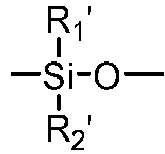
- A "polysiloxane vinylic crosslinker" refers to a compound comprising at least one polysiloxane segment and at least two ethylenically-unsaturated groups.
- A "linear polysiloxane vinylic crosslinker" refers to a compound comprising a main chain which includes at least one polysiloxane segment and is terminated with one ethylenically-unsaturated group at each of the two ends of the main chain.
- A "chain-extended polysiloxane vinylic crosslinker" refers to a compound comprising at least two ethylenically-unsaturated groups and at least two polysiloxane segments each pair of which are linked by one divalent radical.
- The term "fluid" as used herein indicates that a material is capable of flowing like a liquid.
- As used in this application, the term "clear" in reference to a polymerizable composition means that the polymerizable composition is a transparent solution or liquid mixture (i.e., having a light transmissibility of 85% or greater, preferably 90% or greater in the range between 400 to 700 nm).
- The term "alkyl" refers to a monovalent radical obtained by removing a hydrogen atom from a linear or branched alkane compound. An alkyl group (radical) forms one bond with one other group in an organic compound.
- The term "alkylene divalent group" or "alkylene diradical" or "alkyl diradical" interchangeably refers to a divalent radical obtained by removing one hydrogen atom from an alkyl. An alkylene divalent group forms two bonds with other groups in an organic compound.
- The term "alkoxy" or "alkoxyl" refers to a monovalent radical obtained by removing the hydrogen atom from the hydroxyl group of a linear or branched alkyl alcohol. An alkoxy group (radical) forms one bond with one other group in an organic compound.
- In this application, the term "substituted" in reference to an alkyl diradical or an alkyl radical means that the alkyl diradical or the alkyl radical comprises at least one substituent which replaces one hydrogen atom of the alkyl diradical or the alkyl radical and is selected from the group consisting of hydroxyl (-OH), carboxyl (-COOH), -NH2, sulfhydryl (-SH), C1-C4 alkyl, C1-C4 alkoxy, C1-C4 alkylthio (alkyl sulfide), C1-C4 acylamino, C1-C4 alkylamino, di-C1-C4 alkylamino, and combinations thereof.
- A free radical initiator can be either a photoinitiator or a thermal initiator. A "photoinitiator" refers to a chemical that initiates free radical crosslinking/polymerizing reaction by the use of light. A "thermal initiator" refers to a chemical that initiates free radical crosslinking/polymerizing reaction by the use of heat energy.
- "Post-curing surface treatment", in reference to a silicone hydrogel bulk material or a SiHy contact lens, means a surface treatment process that is performed after the silicone hydrogel bulk material or the SiHy contact lens is formed by curing (i.e., thermally or actinically polymerizing) a SiHy lens formulation. A "SiHy lens formulation" refers to a polymerizable composition that comprises all necessary polymerizable components for producing a SiHy contact lens or a SiHy lens bulk material as well known to a person skilled in the art.
- A "non-optical surface of a mold half" refers to mold half surface which does not contact the lens forming material during cast molding of a contact lens.
- The invention is generally related to a contact lens manufacturing method comprising a process for removing unprocessed molded silicone hydrogel contact lenses from mold halves in a relatively efficient and consistent manner. The invention is partly based on the discovery that in combination with use of a relatively low ultrasonic vibration energy for delensing, higher efficiency and consistency in removing unprocessed molded silicone hydrogel contact lenses from mold halves can be achieved by using a hydrophobic acrylic monomer as a blending vinylic monomer (i.e., a reactive diluent) and an organic solvent (i.e., a non-reactive diluent) in such a way that weight ratio of the hydrophobic acrylic monomer (reactive diluent) over the sum of the hydrophobic acrylic monomer (reactive diluent) and the organic solvent (non-reactive diluent) is at least 0.24 per gram of the polymerizable composition. This method of the invention can be easily implemented in a production environment for enhancing the production yield.
- The present invention provides a method for producing silicone hydrogel contact lenses, comprising the step of: (1) obtaining a polymerizable composition which is clear at room temperature, wherein the polymerizable composition comprises (a) at least one siloxane-containing vinylic monomer, (b) at least one first polysiloxane vinylic crosslinker, (c) at least one hydrophilic N-vinyl amide monomer, (d) from about 5% to about 15% (preferably from about 6% to about 14%, more preferably from about 7% to about 13%, even more preferably from about 8% to about 12%) by weight of at least one hydrophobic acrylic monomer relative to the total weight of the polymerizable composition, wherein the hydrophobic acrylic monomer is capable of forming a homopolymer having a glass-transition temperature Tg of at least about 60°C (preferably at least about 70°C, more preferably at least about 80°C, even more preferably at least about 90°C), wherein the hydrophobic acrylic monomer is capable of dissolving components (a) to (c) to form a solution with a concentration of at least about 5% by weight, (e) from about 4% to about 16% (preferably from about 5% to about 15%, more preferably from about 6% to about 14%, even more preferably from about 6% to 12%) by weight of at least one organic solvent having 2 to 8 carbon atoms (preferably having 3 to 5 carbon atoms) relative to the total weight of the polymerizable composition, (f) at least one non-silicone vinylic crosslinker, and (g) at least one free radical initiator, wherein the sum of the amounts of components (a) to (c) is at least about 60%, (preferably at least about 65%, more preferably at least about 70%, even more preferably at least about 75%) by weight relative to the total weight of the polymerizable composition, wherein weight ratio of component (d) over the sum of components (d) and (e) is at least 0.24 (preferably at least 0.35, more preferably at least 0.45, even more preferably at least 0.55) per 100 grams of the polymerizable composition; (2) introducing the polymerizable composition into a lens mold, wherein the lens mold comprises a male mold half having a first molding surface and a female mold half having a second molding surface, wherein the male and female mold halves are configured to receive each other such that a mold cavity is formed between the first and second molding surfaces when the mold is closed; (3) curing thermally or actinically the polymerizable composition in the lens mold to form a unprocessed silicone hydrogel lens precursor within the lens mold; (4) separating the mold into the male and female mold halves, with the unprocessed silicone hydrogel adhered on a lens-adhered mold half which is one of the male and female mold halves; (5) removing the unprocessed silicone hydrogel lens precursor from the lens-adhered mold half before the unprocessed silicone hydrogel lens precursor is contacted with water or any liquid, wherein the step of removing is performed by (a) bringing a ultrasonic horn in direct contact with at least one area of a non-optical surface of the lens-adhered mold half having the unprocessed silicone hydrogel lens precursor attached thereon and (b) applying a ultrasonic vibrational energy of from about 0.2 to about 18 J to the at least one area of the non-optical surface of the lens-adhered mold half having the unprocessed silicone hydrogel lens precursor attached thereon so as to remove the unprocessed silicone hydrogel lens precursor from the lens-adhered mold half; and (6) subjecting the unprocessed silicone hydrogel lens precursor to one or more post-molding processes selected from the group consisting of extraction, hydration, packaging, sterilization, and combinations thereof.
- In accordance with the invention, a siloxane-containing vinylic monomer can be any vinylic monomer of formula (M1) or (M2)



- Examples of preferred siloxane-containing vinylic monomers of formula (M1) include without limitation α-(meth)acryloxypropyl terminated ω-C1-C4-alkyl terminated polydimethylsiloxane, α-(meth)acryloxy-2-hydroxypropyloxypropyl terminated ω-C1-C4-alkyl terminated polydimethylsiloxane, α-(2-hydroxyl-methacryloxypropyloxypropyl)-ω-C1-C4-alkyl-decamethylpentasiloxane, α-[3-(meth)acryloxyethoxy-2-hydroxypropyloxypropyl]-terminated ω-C1-C4-alkyl terminated polydimethylsiloxane, α-[3-(meth)acryloxy-propyloxy-2-hydroxypropyloxypropyl]-terminated ω-C1-C4-alkyl terminated polydimethylsiloxane, α-[3-(meth)acryloxyisopropyloxy-2-hydroxypropyloxypropyl]-terminated ω-C1-C4-alkyl terminated polydimethylsiloxane, α-[3-(meth)acryloxybutyloxy-2-hydroxypropyloxypropyl]-terminated ω-C1-C4-alkyl terminated polydimethylsiloxane, α-[3-(meth)acryloxyethylamino-2-hydroxypropyloxypropyl]-terminated ω-C1-C4-alkyl terminated polydimethylsiloxane, α-[3-(meth)acryloxypropylamino-2-hydroxypropyloxypropyl]-terminated ω-C1-C4-alkyl terminated polydimethylsiloxane, α-[3-(meth)acryloxy-butylamino-2-hydroxypropyloxypropyl]-terminated ω-C1-C4-alkyl terminated polydimethylsiloxane, α-(meth)acryloxy(polyethylenoxy)-2-hydroxypropyloxypropyl]-terminated ω-C1-C4-alkyl terminated polydimethylsiloxane, α-[(meth)acryloxy-2-hydroxypropyloxy-ethoxypropyl]-terminated ω-C1-C4-alkyl terminated polydimethylsiloxane, α-[(meth)acryloxy-2-hydroxypropyl-N-ethylaminopropyl]-terminated ω-C1-C4-alkyl terminated polydimethylsiloxane, α-[(meth)acryloxy-2-hydroxypropyl-aminopropyl]-terminated ω-C1-C4-alkyl terminated polydimethylsiloxane, α-[(meth)acryloxy-2-hydroxypropyloxy-(polyethylenoxy)propyl]-terminated ω-C1-C4-alkyl terminated polydimethylsiloxane, α-(meth)acryloylamidopropyloxypropyl terminated ω-C1-C4-alkyl terminated polydimethylsiloxane, α-N-methyl-(meth)acryloylamidopropyloxypropyl terminated ω-C1-C4-alkyl terminated polydimethylsiloxane, α-[3-(meth)acrylamidoethoxy-2-hydroxypropyloxy-propyl]-terminated ω-C1-C4-alkyl polydimethylsiloxane, α-[3-(meth)acrylamidopropyloxy-2-hydroxypropyloxypropyl]-terminated ω-C1-C4-alkyl terminated polydimethylsiloxane, α-[3-(meth)acrylamidoisopropyloxy-2-hydroxypropyloxypropyl]-terminated ω-C1-C4-alkyl terminated polydimethylsiloxane, α-[3-(meth)acrylamidobutyloxy-2-hydroxypropyloxypropyl]-terminated ω-C1-C4-alkyl terminated polydimethylsiloxane, α-[3-(meth)acryloylamido-2-hydroxypropyloxypropyl] terminated ω-C1-C4-alkyl polydimethylsiloxane, α-[3-[N-methyl-(meth)acryloylamido]-2-hydroxypropyloxypropyl] terminated ω-C1-C4-alkyl terminated polydimethylsiloxane, N-methyl-N'-(propyltetra(dimethylsiloxy)dimethylbutylsilane) (meth)acrylamide, N-(2,3-dihydroxypropane)-N'-(propyltetra(dimethylsiloxy)dimethylbutylsilane) (meth)acrylamide, (meth)acryloylamidopropyltetra(dimethylsiloxy)dimethylbutylsilane, α-vinyl carbonate-terminated ω-C1-C4-alkyl-terminated polydimethylsiloxanes, α-vinyl carbamate-terminated ω-C1-C4-alkyl-terminated polydimethylsiloxane, those disclosed in
U.S. Pat. Nos. 9097840 9103965 U.S. Pat. Nos. 5070215 ,6166236 ,6867245 ,8415405 ,8475529 ,8614261 , and9217813 - Examples of preferred siloxane-containing vinylic monomers of formula (M2) include without limitation tris(trimethylsilyloxy)silylpropyl (meth)acrylate, [3-(meth)acryloxy-2-hydroxypropyloxy]propylbis(trimethylsiloxy)methylsilane, [3-(meth)acryloxy-2-hydroxypropyloxy]propylbis(trimethylsiloxy)butylsilane, 3-(meth)acryloxy-2-(2-hydroxyethoxy)-propyloxy)propylbis(trimethylsiloxy)methylsilane, 3-(meth)acryloxy-2-hydroxypropyloxy)propyltris(trimethylsiloxy)silane, N-[tris(trimethylsiloxy)silylpropyl]-(meth)acrylamide, N-(2-hydroxy-3-(3-(bis(trimethylsilyloxy)methylsilyl)propyloxy)propyl)-2-methyl (meth)acrylamide, N-(2-hydroxy-3-(3-(bis(trimethylsilyloxy)methylsilyl)propyloxy)-propyl) (meth)acrylamide, N-(2-hydroxy-3-(3-(tris(trimethylsilyloxy)silyl)propyloxy)propyl)-2-methyl acrylamide, N-(2-hydroxy-3-(3-(tris(trimethylsilyloxy)silyl)propyloxy)propyl) (meth)acrylamide, N-[tris(dimethylpropylsiloxy)silylpropyl]-(meth)acrylamide, N-[tris(dimethylphenylsiloxy)silylpropyl] (meth)acrylamide, N-[tris(dimethylethylsiloxy)silylpropyl] (meth)acrylamide, N,N-bis[2-hydroxy-3-(3-(bis(trimethylsilyloxy)methylsilyl)propyloxy)propyl]-2-methyl (meth)acrylamide, N,N-bis[2-hydroxy-3-(3-(bis(trimethylsilyloxy)methylsilyl)-propyloxy)propyl] (meth)acrylamide, N,N-bis[2-hydroxy-3-(3-(tris(trimethylsilyloxy)silyl)-propyloxy)propyl]-2-methyl (meth)acrylamide, N,N-bis[2-hydroxy-3-(3-(tris(trimethylsilyloxy)-silyl)propyloxy)propyl] (meth)acrylamide, N-[2-hydroxy-3-(3-(t-butyldimethylsilyl)propyloxy)-propyl]-2-methyl (meth)acrylamide, N-[2-hydroxy-3-(3-(t-butyldimethylsilyl)propyloxy)propyl] (meth)acrylamide, N,N-bis[2-hydroxy-3-(3-(t-butyldimethylsilyl)propyloxy)propyl]-2-methyl (meth)acrylamide, N-2-(meth)acryloxyethyl-O-(methyl-bis-trimethylsiloxy-3-propyl)silyl carbamate, 3-(trimethylsilyl)propylvinyl carbonate, 3-(vinyloxycarbonylthio)propyl-tris(trimethyl-siloxy)silane, 3-[tris(trimethylsiloxy)silyl]propylvinyl carbamate, 3-[tris(trimethylsiloxy)silyl] propyl allyl carbamate, 3-[tris(trimethylsiloxy)silyl]propyl vinyl carbonate, those disclosed in
U.S. Pat. Nos. 9097840 9103965 9475827 U.S. Pat. Nos. 5070215 ,6166236 ,7214809 ,8475529 ,8658748 ,9097840 9103965 9475827 - Any suitable polysiloxane vinylic crosslinkers can be used in the invention. Examples of preferred polysiloxane vinylic crosslinkers are di-(meth)acryloyl-terminated polydimethylsiloxanes; di-vinyl carbonate-terminated polydimethylsiloxanes; di-vinyl carbamate-terminated polydimethylsiloxane; N,N,N',N'-tetrakis(3-methacryloxy-2-hydroxypropyl)-alpha,omega-bis-3-aminopropyl-polydimethylsiloxane; polysiloxane-containing macromer selected from the group consisting of Macromer A, Macromer B, Macromer C, and Macromer D described in
U.S. Pat. No. 5760100 ; polysiloxane-containing macromers disclosed inU.S. Pat. Nos. 4136250 ,4153641 ,4182822 ,4189546 ,4343927 ,4254248 ,4355147 ,4276402 ,4327203 ,4341889 ,4486577 ,4543398 ,4605712 ,4661575 ,4684538 ,4703097 ,4833218 ,4837289 ,4954586 ,4954587 ,5010141 ,5034461 ,5070170 ,5079319 ,5039761 ,5346946 ,5358995 ,5387632 ,5416132 ,5451617 ,5486579 ,5962548 ,5981675 ,6039913 ,6762264 ,4259467 ,4260725 , and4261875 . - One class of preferred polysiloxane vinylic crosslinkers are di-(meth)acryloyloxy-terminated polysiloxane vinylic crosslinkers each having dimethylsiloxane units and hydrophilized siloxane units each having one methyl substituent and one monovalent C4-C40 organic radical substituent having 2 to 6 hydroxyl groups as disclosed in
U.S. Pat. App. Pub. No. 2017-0166673 A1 , more preferably a polysiloxane vinylic crosslinker of formula (I)
- υ1 is an integer of from 30 to 500 and ω1 is an integer of from 1 to 75, provided that ω1/υ1 is from about 0.035 to about 0.15 (preferably from about 0.040 to about 0.12, even more preferably from about 0.045 to about 0.10);
- X01 is O or NRN in which RN is hydrogen or C1-C10-alkyl;
- Ro is hydrogen or methyl;
- RI1 and RI2 independently of each other are a substituted or unsubstituted C1-C10 alkylene divalent radical or a divalent radical of -RI4-O-RI5- in which RI4 and RI5 independently of each other are a substituted or unsubstituted C1-C10 alkylene divalent radical;
- RI3 is a monovalent radical of any one of formula (Ia) to (Ie)


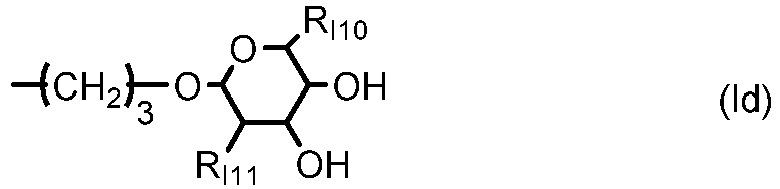

- p1 is zero or 1; m1 is an integer of 2 to 4; m2 is an integer of 1 to 5; m3 is an integer of 3 to 6; m4 is an integer of 2 to 5;
- RI6 is hydrogen or methyl;
- RI7 is a C2-C6 hydrocarbon radical having (m2+1) valencies;
- RI8 is a C2-C6 hydrocarbon radical having (m4+1) valencies;
- RI9 is ethyl or hydroxymethyl;
- RI10 is methyl or hydromethyl;
- RI11 is hydroxyl or methoxy;
- XI1 is a sulfur linkage of -S- or a teriary amino linkage of -NRI12- in which RI12 is C1-C1 alkyl, hydroxyethyl, hydroxypropyl, or 2,3-dihydroxypropyl; and
- XI2 is an amide linkage of

- In a particularly preferred embodiment, the monovalent radical RI3 is a radical of formula (le) in which m1 is 3, p1 is 1, and RI6 is hydrogen. Such a preferred polysiloxane vinylic crosslinker is represented by formula (A)
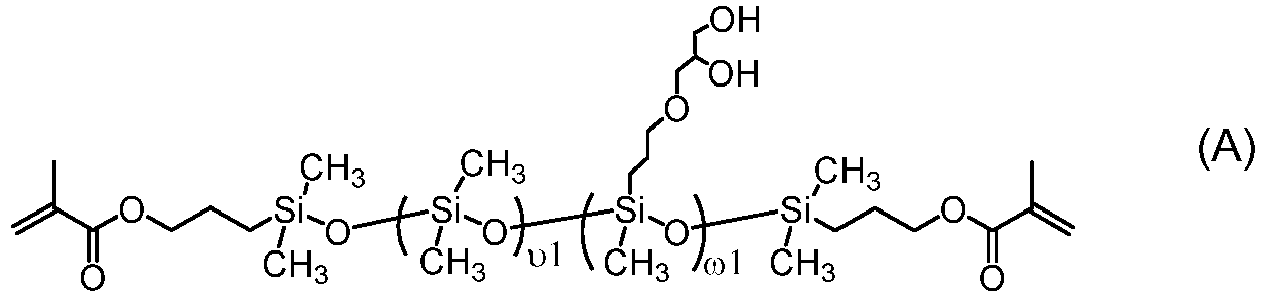
- A polysiloxane vinylic crosslinker of formula (I) can be prepared according to procedures described in
U.S. Pat. Appl. Pub. No. 2017-0166673 A1 . - Other classes of preferred polysiloxane vinylic crosslinkers are vinylic crosslinkers of any one of formula (1) to (7)





- υ1 is an integer of from 30 to 500;
- υ2 is an integer of from 5 to 50;
- υ3 is an integer of from 5 to 100;
- ω2 and ω3 independent of each other are an integer of from 1 to 15;
- a1 and g1 independent of each other is zero or 1;
- h1 is an integer of 1 to 20 and h2 is an integer of 0 to 20;
- m1 and m3 indpendent of each other is 0 or 1, m2 is an integer of 1 to 6, m4 is an integer of 1 to 5, m5 is 2 or 3;
- q1 is an integer of 1 to 20, q2 is an integer of 0 to 20, q3 is an integer of 0 to 2, q4 is an integer of 2 to 50, q5 and q6 independent of each other are a number of 0 to 35, provided that (q4+q5+q6) is an integer of 2 to 50;
- x+y is an integer of from 10 to 30;
- e1 is an integer of 5 to 100, p1 and b1 independent of each other are an integer of 0 to 50, provided that (e1+p1+b1)≥10 and

- Ro is H or methyl;
- R1, R1n, R2n, R3n, and R4n independent of one another are H or a C1-C4 alkyl having 0 to 2 hydroxyl group;
- Rn5 is H or a C1-C10 alkyl;
- R2 is a C4-C14 hydrocarbon divalent radical;
- R3 is a C2-C6 alkylene divalent radical;
- R4 and R5 independent of each other are a C1-C6 alkylene divalent radical or a C1-C6 alkylene-oxy-C1-C6 alkylene divalent radical;
- R6 and R7 independent of each other are a C1-C6 alkylene divalent radical or a C1-C6 alkoxy-C1-C6 alkylene divalent radical;
- R8 and R9 independent of each other are a substituted or unsubstituted C1-C12 alkylene divalent radical;
- Xo, X1', Xo1, X02, and X03 independent of one another are O or NR1;
- X1 is O, NR1, NHCOO, OCONH, CONR1, or NR1CO;
- Xo4 is -COO- or -CONRn5-;
- Xo5 and Xo7 independent of each other are a direct bond, -COO- or -CONRn5-;
- Xo6 is a direct bond, a C1-C6 alkylene divalent radical, a C1-C6 alkylenoxy divalent radical, -COO-, or -CONRn5-;
- Xo8 is a direct bond or -COO-;
- Xo9 is O or NRn5;
- X10 is a direct bond, a C1-C6 alkylene divalent radical, -COO-, or -CONRn5-;
- E1' is a monovalent radical of

- E2 is a monovalent radical of

- E3 is a monovalent radical of

- E4 is a monovalent radical of

- L1 is a C2-C8 alkylene divalent radical or a divalent radical of -L1'-X1-L1"-,


- L1' is a C2-C8 alkylene divalent radical which has zero or one hydroxyl group;
- L1" is C3-C8 alkylene divalent radical which has zero or one hydroxyl group;
- L3 is a divalent radical of



- L3' is C3-C8 alkylene divalent radical;
- L4 is a divalent radical of


- hpL1 is a divalent radical of

- hpL2 is a divalent radical of

- hpL3 is a divalent radical of

- hpL4 is a divalent radical of




- M0 is C3-C8 alkylene divalent radical;
- M1 is a C4-C14 hydrocarbon divalent radical;
- M2 and M3 independent of each other are a C1-C6 alkylene divalent radical;
- J0 is a C1-C12 hydrocarbon radical having 0 to 2 hydroxyl or carboxyl groups;
- G1 is a direct bond, a C1-C4 alkylene divalent radical, or a bivalent radical of


-X07-M3-X09-CH2-CH(OH)-CH2-O-M0-,
or
- G2 is a C1-C4 alkylene divalent radical or a bivalent radical of


-M3-X09-CH2-CH(OH)-CH2-O-M0-,
or
- G3 is a divalent radical of

- G4 is a divalent radical of any one of (a) -NR3'- in which R3' is hydrogen or C1-C3 alkyl,


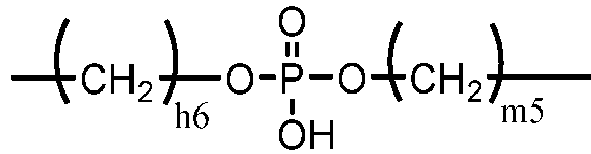
- Y1 is a C1-C6 alkylene divalent radical, 2-hydroxylpropylene divalent radical, 2-(phosphonyloxy)propylene divalent radical, 1,2-dihydroxyethylene divalent radical, a divalent radical of

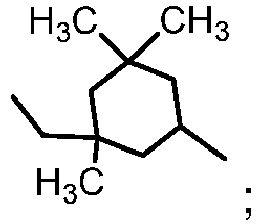
- Y2 is a divalent radical of

- Y3 is a divalent radical of

- Z0 is a direct bond or a C1-C12 alkylene divalent radical;
- Z1 is a C1-C6 alkylene divalent radical, a hydroxyl-or methoxy-substituted C1-C6 alkylene divalent radical, or a substituted or unsubstituted phenylene divalent radical,
- Z2 is a C1-C6 alkylene divalent radical, a hydroxyl-or methoxy-substituted C1-C6 alkylene divalent radical, a dihydroxyl- or dimethoxy-substituted C2-C6 alkylene divalent radical, a divalent radical of -C2H4-(O-C2H4)m2-, a divalent radical of -Z4-S-S-Z4-, a hydroxyl- or methoxy-substituted C1-C6 alkylene divalent radical, or a substituted or unsubstituted phenylene divalent radical,
- Z3 is a divalent radical of any one of (a) -NRn3-,

- Z4 is a C1-C6 alkylene divalent radical,
- Z5 is a C1-C6 alkylene divalent radical, 2-hydroxylpropylene divalent radical, 2-(phosphonyloxy)propylene divalent radical, 1,2-dihydroxyethylene divalent radical, 2,3-dihydroxybutylene divalent radical,
- Z6 is (a) a C1-C6 alkylene divalent radical, (b) a divalent radical of


- Z7 is a divalent radical of

- Z8 is a divalent radical of

- Polysiloxane vinylic crosslinkers of formula (1) can be obtained from commercial suppliers, or prepared by reacting glycidyl (meth)acrylate (meth)acryloyl chloride with a di-amino-terminated polydimethylsiloxane or a di-hydroxyl-terminated polydimethylsiloxane, reacting isocyantoethyl (meth)acrylate with di-hydroxyl-terminated polydimethylsiloxanes, reacting an amino-containing acrylic monomer with di-carboxyl-terminated polydimethylsiloxane in the presence of a coupling agent (a carbodiimide); reacting a carboxyl-containing acrylic monomer with di-amino-terminated polydimethylsiloxane in the presence of a coupling agent (a carbodiimide). Or reacting a hydroxyl-containing acrylic monomer with a di-hydroxy-terminated polydisiloxane.
- Preferred examples of polysiloxane vinylic crosslinkers of formula (1) include without limitation α,ω-bis[3-(meth)acrylamidopropyl]-terminated polydimethylsiloxane, α,ω-bis[3-(meth)acryloxypropyl]-terminated polydimethylsiloxane, α,ω-bis[3-(meth)acryloxy-2-hydroxypropyloxypropyl]-terminated polydimethylsiloxane, α,ω-bis[3-(meth)acryloxyethoxy-2-hydroxypropyloxypropyl]-terminated polydimethylsiloxane, α,ω-bis[3-(meth)acryloxypropyloxy-2-hydroxypropyloxypropyl]-terminated polydimethylsiloxane, α,ω-bis[3-(meth)acryloxy-isopropyloxy-2-hydroxypropyloxypropyl]-terminated polydimethylsiloxane, α,ω-bis[3-(meth)acryloxybutyloxy-2-hydroxypropyloxypropyl]-terminated polydimethylsiloxane, α,ω-bis[3-(meth)acrylamidoethoxy-2-hydroxypropyloxypropyl]-terminated polydimethylsiloxane, α,ω-bis[3-(meth)acrylamidopropyloxy-2-hydroxypropyloxypropyl]-terminated polydimethylsiloxane, α,ω-bis[3-(meth)acrylamidoisopropyloxy-2-hydroxypropyloxypropyl]-terminated polydimethylsiloxane, α,ω-bis[3-(meth)acrylamidobutyloxy-2-hydroxypropyloxypropyl]-terminated polydimethylsiloxane, α,ω-bis[3-(meth)acryloxyethylamino-2-hydroxypropyloxypropyl]-terminated polydimethylsiloxane, α,ω-bis[3-(meth)acryloxypropylamino-2-hydroxypropyloxypropyl]-terminated polydimethylsiloxane, α,ω-bis[3-(meth)acryloxybutylamino-2-hydroxypropyloxypropyl]-terminated polydimethylsiloxane, α,ω-bis[(meth)acrylamidoethylamino-2-hydroxypropyloxy-propyl]-terminated polydimethylsiloxane, α,ω-bis[3-(meth)acrylamidopropylamino-2-hydroxypropyloxypropyl]-terminated polydimethylsiloxane, α,ω-bis[3-(meth)acrylamide-butylamino-2-hydroxypropyloxypropyl]-terminated polydimethylsiloxane, α,ω-bis[(meth)acryloxy-2-hydroxypropyloxy-ethoxypropyl]-terminated polydimethylsiloxane, α,ω-bis[(meth)acryloxy-2-hydroxypropyl-N-ethylaminopropyl]-terminated polydimethylsiloxane, α,ω-bis[(meth)acryloxy-2-hydroxypropyl-aminopropyl]-polydimethylsiloxane, α,ω-bis[(meth)acryloxy-2-hydroxypropyloxy-(polyethylenoxy)propyl]-terminated polydimethylsiloxane, α,ω-bis[(meth)acryloxyethylamino-carbonyloxy-ethoxypropyl]-terminated polydimethylsiloxane, α,ω-bis[(meth)acryloxyethylamino-carbonyloxy-(polyethylenoxy)propyl]-terminated polydimethylsiloxane, combinations thereof.
- Chain-extended polysiloxane vinylic crosslinkers of formula (2) can be prepared according to the procedures described in
U.S. Pat. Nos. 5034461 ,5416132 ,5449729 ,5760100 ,7423074 , and8529057 . Chain-extended polysiloxane vinylic crosslinkers of formula (3), (4) or (5) can be prepared according to the procedures described in detail inU.S. Pat. App. Pub. No. 2018-0100053 A1 . Chain-extended polysiloxane vinylic crosslinkers of formula (6) can be prepared according to the procedures described in detail inU.S. Pat. App. Pub. No. 2018-0100038 A1 . Chain-extended polysiloxane vinylic crosslinkers of formula (7) can be prepared according to the procedures described inU.S. Pat. No. 8993651 . - Another class of preferred chain-extended polysiloxane vinylic crosslinkers are those which each comprise at least two polysiloxane segments and dangling hydrophilic polymer chains each covalently attached to a divalent radical separating each pair of adjacent polysiloxane segments and having at least two pendant hydrophilic groups and/or chains as disclosed in
U.S. Pat. Appl. Pub. No. 2012-0088843 A1 ; those which each comprise at least two polysiloxane segments and dangling hydrophilic polymer chains each covalently attached to a divalent radical separating each pair of adjacent polysiloxane segments as disclosed inU.S. Pat. Appl. Pub. No. 2012-0088844 A1 . - In accordance with the invention, any suitable N-vinyl amide monomers can be used in the invention. Examples of preferred N-vinyl amide monomers include without limitation N-vinylpyrrolidone, N-vinyl piperidone, N-vinyl caprolactam, N-vinyl-N-methyl acetamide, N-vinyl formamide, N-vinyl acetamide, N-vinyl isopropylamide, N-vinyl-N-methyl acetamide, N-vinyl-N-ethyl acetamide, N-vinyl-N-ethyl formamide, and mixtures thereof. Preferably, the N-vinyl amide monomer is N-vinylpyrrolidone, N-vinyl-N-methyl acetamide, or combinations thereof.
- Any hydrophobic acrylic monomer can be used in the invention, provided that it can form a homopolymer with a Tg of at least about 60°C (preferably at least about 70°C, more preferably at least about 80°C, even more preferably at least about 90°C) and that it can dissolve components (a) to (c) to form a solution with a concentration of at least about 5% by weight. It is believed that such a hydrophobic acrylic monomer can increase a Tg of the dominant phase of a resultant silicone hydrogel material above the room temperature and may make the unprocessed silicone hydrogel lens precursor more rigid.
- Examples of such hydrophobic acrylic monomers includes methyl methacrylate (Tg=105°C of homopolymer), ethyl methacrylate (Tg=65°C of homopolymer), isopropyl methacrylate (Tg=81°C of homopolymer), sec-butyl methacrylate (Tg=60°C of homopolymer), tert-butyl methacrylate (Tg=107°C of homopolymer), cyclohexyl methacrylate (Tg=83°C of homopolymer), isobornyl acrylate (Tg=94°C of homopolymer), isobornyl methacrylate (Tg=110°C of homopolymer), phenyl methacrylate (Tg=110°C of homopolymer), 4-tert-butylstyrene (Tg=132°C of homopolymer), 2-methylstyrene (Tg=120°C of homopolymer), styrene (Tg=100°C of homopolymer), 4-ethoxystyrene (Tg=86°C of homopolymer), 2,4-dimethystyrene (Tg=112°C of homopolymer), 2,5-dimethylstyrene (Tg=143°C of homopolymer), 3,5-dimethylstyrene (Tg=104°C of homopolymer), and combinations thereof. More preferably, methyl methacrylate, tert-butyl methacrylate, cyclohexyl methacrylate, isobornyl acrylate, isobornyl methacrylate, or a combination thereof is used in the invention. Even more preferably, methyl methacrylate, tert-butyl methacrylate, cyclohexyl methacrylate, or a combination thereof is used in the invention.
- Examples of preferred organic solvents having 2 to 8 carbon atoms include without limitation, alcohols having 2 to 8 carbon atoms (e.g., ethanol, 1-propanol, isopropanol, 1-butanol, sec-butanol, isobutanol, tert-butyl alcohol, 1-pentanol, 2-pentanol, 3-pentanol, 3-methyl-2-butanol, 2-methyl-1-butanol, 2,2-dimethyl-1-propanol, tert-amyl alcohol, 2-hexanol, 3-hexanol, 2-heptanol, 2-octanol, 2-nonanol, 2-decanol, 3-octanol, 2-methyl-2-pentanol, 2,3-dimethyl-2-butanol, 3-methyl-3-pentanol, 2-methyl-2-hexanol, 3-methyl-3-hexanol, 3-methyl-3-heptanol, 4-methyl-4-heptanol, 2-methyl-2-heptanol, 3-ethyl-3-hexanol, 3-methyl-3-heptanol, 2,4-dimethyl-2-pentanol, 3-ethyl-3-pentanol, 1-methoxy-2-propanol, 3-ethoxy-1-propanol, 1-ethoxy-2-propanol, 1-isobutoxy-2-propanol, 3-methoxy-1-butanol, 1-methoxy-2-butanol, norborneol, 1-methylcyclohexanol, 1-methylcyclopentanol, 1-ethylcyclopentanol, 1-ethylcyclopentanol, 4-hydroxy-4-methyl-1-cyclopentanol, or combinations thereof), dipropylene glycol methyl ether, ethylene glycol n-butyl ether, acetone, methyl ethyl ketone, diethylene glycol n-butyl ether, diethylene glycol methyl ether, propylene glycol methyl ether, propylene glycol methyl ether acetate, propylene glycol n-propyl ether, propylene glycol n-butyl ether, ethyl acetate, butyl acetate, amyl acetate, methyl lactate, ethyl lactate, propyl lactate, 1-methyl-2-pyrrolidone, N,N-dimethylpropionamide, dimethyl formamide, dimethyl acetamide, dimethyl propionamide, N-methyl pyrrolidinone, and mixtures thereof. Preferably, the organic solvent is an alcohol having 3 to 5 carbon atoms (e.g., 1-propanol, isopropanol, 1-butanol, sec-butanol, isobutanol, tert-butyl alcohol, 1-pentanol, 2-pentanol, 3-pentanol, 3-methyl-2-butanol, 2-methyl-1-butanol, 2,2-dimethyl-1-propanol, tert-amyl alcohol, 1-methoxy-2-propanol, 3-ethoxy-1-propanol, 1-ethoxy-2-propanol, or combinations thereof).
- In accordance with the invention, a polymerizable composition can comprise about 1.5% or less (preferably about 1.2% or less, more preferably from about 0.1% to about 1.0%) by weight of one or more non-silicone vinylic crosslinkers relative to the total weight of all polymerizable components in the polymerizable composition.
- Examples of preferred non-silicone vinylic cross-linking agents include without limitation ethyleneglycol di-(meth)acrylate, diethyleneglycol di-(meth)acrylate, triethyleneglycol di-(meth)acrylate, tetraethyleneglycol di-(meth)acrylate, glycerol di-(meth)acrylate, 1,3-propanediol di-(meth)acrylate, 1,3-butanediol di-(meth)acrylate, 1,4-butanediol di-(meth)acrylate, glycerol 1,3-diglycerolate di-(meth)acrylate, ethylenebis[oxy(2-hydroxypropane-1,3-diyl)] di-(meth)acrylate, bis[2-(meth)acryloxyethyl] phosphate, trimethylolpropane di-(meth)acrylate, and 3,4-bis[(meth)acryloyl]tetrahydrofuan, diacrylamide (i.e., N-(1-oxo-2-propenyl)-2-propenamide), dimethacrylamide (i.e., N-(1-oxo-2-methyl-2-propenyl)-2-methyl-2-propenamide), N,N-di(meth)acryloyl-N-methylamine, N,N-di(meth)acryloyl-N-ethylamine, N,N'-methylene bis(meth)acrylamide, N,N'-ethylene bis(meth)acrylamide, N,N'-dihydroxyethylene bis(meth)acrylamide, N,N'-propylene bis(meth)acrylamide, N,N'-2-hydroxypropylene bis(meth)acrylamide, N,N'-2,3-dihydroxybutylene bis(meth)acrylamide, 1,3-bis(meth)acrylamide-propane-2-yl dihydrogen phosphate (i.e., N,N'-2-phophonyloxypropylene bis(meth)acrylamide), piperazine diacrylamide (or 1,4-bis(meth)acryloyl piperazine), tetraethyleneglycol divinyl ether, triethyleneglycol divinyl ether, diethyleneglycol divinyl ether, ethyleneglycol divinyl ether, triallyl isocyanurate, triallyl cyanurate, trimethylopropane trimethacrylate, pentaerythritol tetramethacrylate, bisphenol A dimethacrylate, and combinations thereof. A preferred non-silicone vinylic cross-linking agent is tetra(ethyleneglycol) di-(meth)acrylate, tri(ethyleneglycol) di-(meth)acrylate, ethyleneglycol di-(meth)acrylate, di(ethyleneglycol) di-(meth)acrylate, tetraethyleneglycol divinyl ether, triethyleneglycol divinyl ether, diethyleneglycol divinyl ether, ethyleneglycol divinyl ether, triallyl isocyanurate, triallyl cyanurate, or a combination thereof.
- Any suitable thermal polymerization initiators, known to the skilled artisan, can be used in the invention. Examples of thermal polymerization initiators includes without limitation peroxides, hydroperoxides, azo-bis(alkyl- or cycloalkylnitriles), persulfates, percarbonates or mixtures thereof. Examples of thermal free radical initiators are benzoylperoxide, tert.-butyl peroxide, di-tert.-butyl-diperoxyphthalate, tert.-butyl hydroperoxide, azo-bis(isobutyronitrile) (AIBN), 1,1-azodiisobutyramidine, 1,1'-azo-bis (1-cyclohexanecarbonitrile), 2,2'-azo-bis(2,4-dimethylvaleronitrile) and the like. The polymerization is carried out conveniently in an above-mentioned solvent at elevated temperature, for example at a temperature of from 25 to 100°C and preferably 40 to 80°C. The reaction time may vary within wide limits, but is conveniently, for example, from 1 to 24 hours or preferably from 2 to 12 hours. It is advantageous to previously degas the components and solvents used in the polymerization reaction and to carry out said copolymerization reaction under an inert atmosphere, e.g., under N2 or Ar atmosphere.
- Suitable photoinitiators are benzoin methyl ether, diethoxyacetophenone, a benzoylphosphine oxide, 1-hydroxycyclohexyl phenyl ketone and Darocur and Irgacur types, preferably Darocur 1173® and Darocur 2959®, Germane-based Norrish Type I photo initiators. Examples of benzoylphosphine initiators include 2,4,6-trimethylbenzoyldiphenylophosphine oxide; bis-(2,6-dichlorobenzoyl)-4-N-propylphenylphosphine oxide; and bis-(2,6-dichlorobenzoyl)-4-N-butylphenylphosphine oxide. Reactive photoinitiators which can be incorporated, for example, into a macromer or can be used as a special monomer are also suitable. Examples of reactive photoinitiators are those disclosed in EP 632 329. The polymerization can then be triggered off by actinic radiation, for example light, in particular UV light or visible light of a suitable wavelength. The spectral requirements can be controlled accordingly, if appropriate, by addition of suitable photosensitizers.
- In accordance with a preferred embodiment of the invention, a polymerizable composition of the invention can further comprise (but preferably comprises) one or more UV-absorbing vinylic monomers and optionally (but preferably) one or more UV/HEVL-absorbing vinylic monomers. The term "UV/HEVL-absorbing vinylic monomer" refers to a vinylic monomer that can absorbs UV light and high-energy-violet-light (i.e., light having wavelength between 380 nm and 440 nm. Examples of UV-absorbing vinylic monomers and UV/HEVL-absorbing vinylic monomers are known to a person skilled in the art and are disclosed in the patents and patent application publications, e.g.,
US 9,315,669 US 2018-0081197 A1 , etc. - In accordance with the invention, a polymerizable composition of the invention can further comprise one or more hydrophilic acrylic monomers, preferably in an amount of about 10% or less (more preferably about 8% or less, even more preferably about 5% or less) by weight relative to the total weight of the polymerizable composition.
- Examples of preferred hydrophilic acrylic monomers include without limitation N,N-dimethyl (meth)acrylamide, (meth)acrylamide, N-hydroxylethyl (meth)acrylamide, N-hydroxypropyl (meth)acrylamide, hydroxyethyl methacrylate, glycerol methacrylate (GMA), polyethylene glycol (meth)acrylate having a number average molecular weight of up to 1500, polyethylene glycol C1-C4-alkyl ether (meth)acrylate having a number average molecular weight of up to 1500, N-[tris(hydroxymethyl)methyl]-acrylamide, (meth)acrylic acid, ethylacrylic acid, and combinations thereof. Preferably, the hydrophilic vinylic monomer is N,N-dimethyl (meth)acrylamide, hydroxyethyl (meth)acrylate, N-hydroxylethyl (meth)acrylamide, glycerol methacrylate (GMA), or combinations thereof.
- A polymerizable composition used in the invention can also comprise other necessary components known to a person skilled in the art, such as, for example, a visibility tinting agent (e.g., one or more polymerizable dyes, pigments, or mixtures thereof), antimicrobial agents (e.g., preferably silver nanoparticles), a bioactive agent, leachable lubricants, leachable tear-stabilizing agents, and mixtures thereof, as known to a person skilled in the art.
- A polymerizable composition used in the invention can be prepared by dissolving and blending all of the desirable components in a mixture of components (d) and (e).
- Methods of manufacturing mold sections for cast molding a contact lens are generally well known to those of ordinary skill in the art. The process of the present invention is not limited to any particular method of forming a mold. In fact, any method of forming a mold can be used in the present invention. However, for illustrative purposes, the following discussion has been provided as one embodiment of forming a mold.
- In general, a mold comprises at least two mold halves (or mold sections), one male half and one female mold half. The male mold half has a first molding (or optical) surface which is in direct contact with a polymerizable composition for cast molding of a contact lens and defines the posterior (concave) surface of a molded contact lens; and the female mold half has a second molding (or optical) surface which is in direct contact with the polymerizable composition and defines the anterior (convex) surface of the molded contact lens. The male and female mold halves are configured to receive each other such that a lens-forming cavity is formed between the first molding surface and the second molding surface.
-
FIG. 1 schematically illustrates apreferred mold 100 used in the methods of the invention. Themold 100 comprises afemale mold half 1 andmale mold half 2. - The
male mold half 2 comprises abase 61, a substantiallycylindrical body 25 which extends upward frombase 61, a posterior molding surface defining the posterior (concave) surface of a molded contact lens, and anannular shoulder 65 which surrounds the posterior molding surface. The posterior molding surface protrudes outward from the top ofbody 25. Theannular shoulder 65 shown is flat. It is understood that theannular shoulder 65 can have any suitable surface, such as, e.g., a tilted surface. - The
female mold half 1 comprises abase 51, a substantiallycylindrical body 15 which extends upward frombase 51, an anterior molding surface defining the anterior (convex) surface of a molded contact lens, and acollar 4. The anterior molding surface recesses downward from the top of thebody 15. Collar 4 (or up-protruding flange) is preferably integral part of thefemale mold half 1 and protrudes upward from the top of thebody 15. A circumferential groove (or recess) 11 is formed on top of thebody 15 between the anterior molding surface and thecollar 4 and functions as an overflow for any excess unpolymerized lens-forming material. - The term "collar" as used herein refers to a peripheral circular part which protrudes upward from the top of body of one of the two mating mold halves. A collar can be attached to or preferably integral part of that mold half and which can encircle the other mold half to provide a tight seal between the two mold halves. It is understood that the collar can be provided on either of the male and female mold halves.
- The
female mold half 1 and amale mold half 2 are configured to receive each other such that a contactlens forming cavity 12 is formed between the anterior and posterior molding surfaces. Thecollar 4 encircles thebody 25 of themale mold half 2 to provide atight seal 5 between the female and male mold halves when the mold is closed. Typically, there is no lens material in the seal. - In operation,
mold halves female mold half 1 by means of a dispensing device and then themale mold half 2 is put on and themold 100 is closed (FIG. 1 ). As themold 100 closes, any excess unpolymerized lens-forming material is pressed into anoverflow 11 provided on thefemale mold half 1. Subsequently, the polymerizable composition in theclosed mold 100 is cured thermally in an oven or actinically with UV/visible irradiation. - The mold halves can be formed through various techniques, such as injection molding. Methods of manufacturing mold halves for cast-molding a contact lens are generally well known to those of ordinary skill in the art. The process of the present invention is not limited to any particular method of forming a mold. In fact, any method of forming a mold can be used in the present invention. The mold halves can be formed through various techniques, such as injection molding or lathing. Examples of suitable processes for forming the mold halves are disclosed in
U.S. Patent Nos. 4,444,711 ;4,460,534 ;5,843,346 ; and5,894,002 . - Virtually all materials known in the art for making molds can be used to make molds for making contact lenses. For example, polymeric materials, such as polyethylene, polypropylene, polystyrene, PMMA, Topas® COC grade 8007-S10 (clear amorphous copolymer of ethylene and norbornene, from Ticona GmbH of Frankfurt, Germany and Summit, New Jersey), or the like can be used. Other materials that allow UV light transmission could be used, such as quartz glass and sapphire.
- In accordance with the invention, the polymerizable composition can be introduced (dispensed) into a cavity formed by a mold according to any known methods. A specific amount of a polymerizable lens-forming material is typically dispensed into a female mold half by means of a dispensing device and then a male mold half is put on and the mold is closed. As the mold closes, any excess unpolymerized lens-forming material is pressed into an overflow provided on the female mold half (or alternatively on the male mold half).
- The closed mold containing the polymerizable compsition subsequently is cured (i.e., polymerized) thermally or actinically to produce a molded unprocessed silicone hydrogel lens precursor.
- Subsequently, applying a force to non-optical surface of the female mold at a location about the center area of non-optical molding surface at an angle of less than about 30 degrees, preferably less than about 10 degrees, most preferably less than about 5 degrees (i.e., in a direction substantially normal to center area of non-optical molding surface) relative to the axis of the mold to deform the female mold half which breaks the bonds between the optical molding surface of the female mold half and the molded lens, as shown in
FIG. 2 . Various ways of applying a force to non-optical surface of the female mold half at a location about the center area of non-optical molding surface along the axis of the mold to deform the female mold half which breaks the bonds between the optical molding surface of the female mold half and the molded lens. It is understood that the mold-opening device can have any configurations known to a person skilled in the art for performing the function of separating two mold halves from each other. For example, referring toFIG. 2 , the demolding assembly comprises apin 70 positionable against the center area of non-optical molding surface of the female mold half. Thepin 70 has a flatfree end 70a to enable a surface contact between thefree end 70a and the center area of non-optical molding surface of the female mold half. It will be appreciated that the scope of the invention is not limited to such a particular flat configuration of thepin end 70a, for example the pin may have a rounded free end. In the present embodiment, thepin 70 is movable and the female mold half remains stationary by applying a restraining force to the female mold half with a first pryingfinger 32 for maintaining the female mold half in a fixed position. However, it is possible to arrange the assembly so that the female mold half is movable and thepin 70 remains stationary, or so that both thepin 70 and the female mold half can be moved relative to each other. - In use, during the demolding operation, the
free end 70a of thepin 70 applies a longitudinally directed force to the central portion of the non-optical surface of the female mold half. The first pryingfinger 32 applies a counteractive force against theend face 51a of theflange 51 of thefemale mold half 1. Consequently, the female mold half is compressed between thefree end 70a of thepin 70 and thefirst finger 32. The compression force deforms the curved part of the female mold half and breaks the adhesive bond between the molding surface of thefemale mold half 1 and the anterior surface of the moldedlens 12. - Then, apply a vertical lifting movement to the male mold half with a second prying finger (while maintaining the restraints on the female mold so as to effectuate gradual separation between the female mold and the male mold.
- After breaking the bond between the optical molding surface of the female mold half and the molded lens, the mold is separated, the molded unprocessed contact lens adheres to the
male mold half 2. It is surprising to find out that, according to the present invention, the molded contact lens adhering to the male mold half even though the molding surfaces of the female mold and male mold are not treated before or after dispensing a specific amount of a polymerizable lens-forming material into one of the mold halves to render the molded contact lens preferentially adhered to the female mold or male mold when separating the mold. - According to the present application as mentioned above, the lens typically remains adhered to the male mold section. However, by using similar principle, the compression can be applied to the applying a force to non-optical surface of the male mold half at a location about the center area of non-optical molding surface along the longitudinal axis of the mold to deform the male mold half to compress the female mold half between the pin and the first set of pry fingers so as to break the bonds between the optical molding surface of the male mold half and the molded lens, thereby the molded lens adheres to the female mold half after separating the mold.
- According to the present application, an ultrasonic welding system is used not to welding two pieces of plastic material together, but instead to separate molded silicone hydrogel contact lens from the lens-adhered mold half. An ultrasonic welding system as illustrated in
FIG. 3 comprises: apower supply 300 which provides a high power AC signal with frequency matching the resonance frequency of the ultrasonic stack. An ultrasonic stack composed of aconverter 310, abooster 320 and ahorn 330. All three elements of the stack are specifically tuned to resonate at the same exact ultrasonic frequency (Typically 15, 20, 30, 35, 40 or 70 kHz). The converts the electrical signal into a mechanical vibration. The booster modifies the amplitude of the vibration. The horn can also define the amplitude of vibration and apply the mechanical vibration to the parts to be contacted. However, any kind of mechanical system which transfers the vibrational energy from the converter to the mold half can be used. -
FIG. 4 illustrates an embodiment of the invention wherein anultrasonic horn 330 having aflat surface 340 is sized to be approximately the outer diameter of themale mold half 2 and seated on extended flat edge surround the outer concave surface 35 (or back surface of theannular shoulder 65 of the male mold half. Themale mold half 2 proximate the ultrasonic horn vibrates with the acoustical energy emitted from theultrasonic horn 330 while thecontact lens 85 is attached thereon so that a relative motion at the frequency of the acoustic energy takes place between back surface of theannular shoulder 65 of the male mold half and the contact lens attached thereon. The male mold half and the contact lens attached thereon is held stationary by aposition holder 75. A person skilled in the art knows which device can be used as a position holder, for example, a level metal or a cup having an attached level metal. The cup can be used to collect the lens separated from the male mold half. Furthermore, the cup can be attached a vacuum source and the vacuum can assist the separation of the lens from the male mold half. -
FIG. 5A and5B show an embodiment wherein anultrasonic horn 330 having aconvex surface 340 is of a size that allows it to extend within the outer concave portion of malehalf mold half 2. The male mold half and thecontact lens 85 attached thereon is held stationary by aposition holder 75.FIG. 5A illustrates that the ultrasonic horn vibrates with the acoustical energy emitted from theultrasonic horn 330 while the contact lens is attached thereon so that a relative motion at the frequency of the acoustic energy takes place through contact surface between inside of the outer concave portion of malehalf mold half 2 and the contact lens attached thereon.FIG. 5B illustrates that the ultrasonic horn vibrates with the acoustical energy emitted from theultrasonic horn 330 while the contact lens is attached thereon so that a relative motion at the frequency of the acoustic energy takes place through contact points between edges of the outer concave portion of malehalf mold half 2 and the contact lens attached thereon. -
FIG. 6 illustrates an embodiment of the invention is shown wherein anultrasonic horn 330 having aflat surface 340 is sized to be approximately the outer diameter of thefemale mold half 1 to contact the center area of the outer convex portion of the female mold half. The female mold half and thecontact lens 85 attached thereon is held stationary by a position holder 75.The center portion of back surface (non-optical surface) of thefemale mold half 1 proximate the ultrasonic horn vibrates with the acoustical energy emitted from theultrasonic horn 330 while the contact lens is attached thereon so that a relative motion at the frequency of the acoustic energy takes place between the female mold half and the contact lens attached thereon. -
FIG. 7A and 7B show an embodiment wherein anultrasonic horn 330 having aconcave surface 340 is of a size that allows it to extend within the outer convex portion of femalehalf mold half 1 to contact the center area of the outer convex portion of the female mold half. The female mold half and thecontact lens 85 attached thereon is held stationary by aposition holder 75.FIG. 7A illustrates that the ultrasonic horn vibrates with the acoustical energy emitted from theultrasonic horn 330 while the contact lens is attached thereon so that a relative motion at the frequency of the acoustic energy takes place through contact surface between inside of the outer convex portion of femalehalf mold half 1 and the contact lens attached thereon. 7B illustrates that the ultrasonic horn vibrates with the acoustical energy emitted from theultrasonic horn 330 while the contact lens is attached thereon so that a relative motion at the frequency of the acoustic energy takes place through contact points between edges of the outer concave portion of femalehalf mold half 1 and the contact lens attached thereon. - According to the present invention, the modification to the output part of the horn and the preferred parameters associated with operating the system are given in the following.
The ultrasonic welding system is comprised of apower supply 300 which generates a frequency range from 15 kHz to 70 kHz by the use of solid state power devices. This high frequency electrical energy is supplied to aconverter 320. This component changes the electrical energy into ultrasonic mechanical vibratory energy at the frequency of the converted electrical energy supply which is typically 15 kHz to 70 kHz. The vibratory ultrasonic acoustical energy is then transmitted through an amplitude modifying device called abooster 320. The booster is a passive (i.e., non-powered) device which is used to modify the output amplitude of the converter before it reaches thehorn 330. The horn is shaped to have a flat surface, convex surface, a concave surface, or the like 340 which is an acoustical tool that transfers the vibratory energy directly to the non-optical surface of a mold half. - The present invention is practiced with the above described apparatus as follows: an ultrasonic welding apparatus as described above, the specific system being used for the investigation is a Dukane iQ Series ES Servo Ultrasonic Welding Press System with a 30 kHz generator, 2:1 booster. The generator creates a user settable, high voltage (-1000 Vrms), 30 kHz signal that is applied to the transducer. The transducer expands and contract with this applied voltage and creates a mechanical vibration at the face of the transducer. This vibration is amplified by the booster and horn assembly. To maximize the effectiveness of the mechanical vibration on the part, the vibration needs to be applied in a prescribed manner.
- To operate the Dukane Servo system, the ultrasonic horn is lowered to a point in space, where it begins to look for a reaction force equal to the trigger force set by the user. It will continue to move downward at prescribed speed over a short distance looking for that reaction force. When that force is achieved, the system will fire the ultrasonics. Once fired, the horn will seek to move to maintain that constant force. Force mode was chosen to deal with the normal positional variation you would encounter with different parts placed slightly differently from the previous part, as well as slight geometry variations from part to part. The generator output energy equals to the time integral of power. Example process settings are shown in the following table.
Process Parameter Setting Generator Frequency 30 or 40 kHz Booster 2:1 Horn 2:1 Trigger Force 100 N Energy 0.1-40 J - According to the present invention, Generator Frequency is operated between 15 kHz to 70 kHz, preferably between 20 kHz to 40 kHz, more preferably between 30 kHz to 40 kHz. Trigger Force is operated between 1.0 N to 150N, preferably between 20 N to 120N, more preferably between 40 N to 110N, still more preferably between 80 N to 100N. Energy is operated between 0.2J to 18J. Alternatively, but not forming part of the invention, energy is operated between 0.5J to 30J, still more preferably between 1.0J to 20J. The duration of applying the ultrasonic vibration energy necessary to separate the molded hydrogel contact lens from the female mold half or the male mold half attached thereon is typically less than 10 seconds, preferably less than 5.0 seconds, more preferably less than 2.0 seconds, still more preferably less than 1.0 second.
- The following abbreviations are used in the following examples: NVP represents N-vinylpyrrolidone; MMA represents methyl methacrylate; TEGDMA represent triethyleneglycol dimethacrylate; VAZO™ 64 represents 2,2'-dimethyl-2,2'azodipropiononitrile; Norbloc is 2-[3-(2H-Benzotriazol-2-yl)-4-hydroxyphenyl]ethyl methacrylate from Aldrich; UV28 represents 2-{2'-Hydroxy-3'-tert-butyl-5'-[3'-methacryloyloxypropoxy]phenyl}-5-chloro-2H-benzotriazole; RB247 is Reactive Blue 247; PrOH represents 1-propanol; PBS represents a phosphate-buffered saline which has a pH of 7.2±0.2 at 25°C and contains about 0.044 wt.% NaH2PO4·H2O, about 0.388 wt.% Na2HPO4·2H2O, and about 0.79 wt.% NaCl and; wt.% represents weight percent; D9 represents monobutyl-terminated monomethacryloxypropyl-terminated polydimethylsiloxane (Mw ~ 984 g/mol from Shin-Etsu); "G4" macromer represents a di-methacryloyloxypropyl-terminated polysiloxane (Mn ~ 13.5K g/mol, OH content ~ 1.8 meq/g) of formula (A) shown above.
- All polymerizable compositions (i.e., "formulations") are prepared at room temperature in air using 5-30 minutes of stirring. 1-propanol (PrOH) is used as non-reactive diluent. MMA is used as reactive diluent. Eight polymerizable compositions are prepared by dissolving and blending: 33 weight part units of D9; 10 weight part units of G4; 46 weight part units of NVP; 1.5 weight part units of Norbloc; 33 weight part units of D9; 0.01 weight part unit of RB247; 0.4 weight part unit of UV28; 0.5 weight part unit of Vazo™-64; and various amounts (weight part units shown in Table 1) of TEGDMA; in various amounts (weight part units shown in Table 1) of PrOH and various amounts (weight part units shown in Table 1) of MMA. These eight polymerizable compositions are designed according to 3 factor DOE (Design of Experiment) using Minitab version 17.
Table 1 Formulation # PrOH MMA TEGDMA 
Weight Part Units 1 6 5 0.1 0.44 2 6 10 0.1 0.58 3 6 5 0.8 0.44 4 6 10 0.8 0.58 5 14 5 0.1 0.24 6 14 10 0.1 0.36 7 14 5 0.8 0.24 8 14 10 0.8 0.36 - Approximately 30-35 mg of a formulation prepared above is introduced into a polypropylene molds. Then, the molds are dosed and thermally cured in an even under nitrogen using the following temperature conditions: at 55°C for 40 minutes; at 80°C for 40 minutes; and at 100°C for 40 minutes.
- Lens molds each with a molded silicone hydrogel contact lens precursor therein are mechanically opened as illustrated by
FIG. 2 and described above. The molded unprocessed silicone hydrogel contact lens precursors adhere to the male mold halves. - Molded unprocessed silicone hydrogel contact lens precursors are removed (i.e., "delensed") from lens-adhered male mold halves by using an ultrasonic welding apparatus as illustrated in
FIG. 3 . An ultrasonic horn made of stainless steel and having a shape shown inFIGs 4 and5 . - Lens molds each with a molded silicone hydrogel contact lens precursor therein are mechanically opened as illustrated by
FIG. 2 and described above. The molded unprocessed silicone hydrogel contact lens precursors adhere to the male mold halves. The following energy settings shown in Table 2 are used for each group.Table 2 Condition Energy (J) Trigger force (N) Ramp up time (ms) 2J 2 56 100 18J 18 56 20 - For the milder 2J condition, a slower ramp-up time is employed to make the overall condition even milder for the lens mold interface. Lenses removed with this condition are regarded as having weaker surface bonding. Five lenses per condition per formulation are tested. E.g., for
formulation 8, 5 lenses are tested under the 2J condition while 5 lenses are tested under the 18J condition. The results are reported in Table 3.Table 3 Formulation [PrOH] [MMA] [TEGDMA] 
Delensing% With 2J with 18J 1 6 5 0.1 0.44 0 40 2 6 10 0.1 0.58 40 100 3 6 5 0.8 0.44 0 100 4 6 10 0.8 0.58 100 100 5 14 5 0.1 0.24 0 20 6 14 10 0.1 0.36 20 80 7 14 5 0.8 0.24 0 0 8 14 10 0.8 0.36 0 100 * per 100 grams of formulation
Claims (16)
- A method for producing silicone hydrogel contact lenses, comprising the steps of:(1) obtaining a polymerizable composition which is clear at room temperature,wherein the polymerizable composition comprises(a) at least one siloxane-containing vinylic monomer,(b) at least one polysiloxane vinylic crosslinker,(c) at least one hydrophilic N-vinyl amide monomer,(d) from 5% to 15% by weight of at least one hydrophobic acrylic monomer relative to the total weight of the polymerizable composition, wherein the hydrophobic acrylic monomer is capable of forming a homopolymer having a glass-transition temperature Tg of at least 60°C,wherein the hydrophobic acrylic monomer is capable of dissolving components (a) to (c) to form a solution with a concentration of at least 5% by weight, (e) from 4% to 16% by weight of at least one organic solvent having 2 to 8 carbon atoms relative to the total weight of the polymerizable composition, (f) at least one non-silicone vinylic crosslinker, and (g) at least one free radical initiator, wherein the sum of the amounts of components (a) to (c) is at least 60% by weight relative to the total weight of the polymerizable composition, wherein weight ratio of component (d) over the sum of components (d) and (e) is at least 0.24 per 100 grams of the polymerizable composition;(2) introducing the polymerizable composition into a lens mold (100), wherein the lens mold comprises a male mold half (2) having a first molding surface and a female mold half (1) having a second molding surface, wherein the male and female mold halves (2,1) are configured to receive each other such that a mold cavity (12) is formed between the first and second molding surfaces when the mold (100) is closed;(3) curing thermally or actinically the polymerizable composition in the lens mold (100) to form a unprocessed silicone hydrogel lens precursor (85) within the lens mold (100);(4) separating the mold (100) into the male (2) and female (1) mold halves, with the unprocessed silicone hydrogel (85) adhered on a lens-adhered mold half which is one of the male and female mold halves;(5) removing the unprocessed silicone hydrogel lens precursor (85) from the lens-adhered mold half before the unprocessed silicone hydrogel lens precursor (85) is contacted with water or any liquid, wherein the step of removing is performed by (a) bringing a ultrasonic horn (330) in direct contact with at least one area of a non-optical surface of the lens-adhered mold half having the unprocessed silicone hydrogel lens precursor attached thereon and (b) applying a ultrasonic vibrational energy of from 0.2 to 18 J to the at least one area of the non-optical surface of the lens-adhered mold half having the unprocessed silicone hydrogel lens precursor (85) attached thereon so as to remove the unprocessed silicone hydrogel lens precursor (85) from the lens-adhered mold half; and(6) subjecting the unprocessed silicone hydrogel lens precursor (85) to one or more post-molding processes selected from the group consisting of extraction, hydration, packaging, sterilization, and combinations thereof.
- The method of claim 2, wherein the hydrophobic acrylic monomer is methyl methacrylate, ethyl methacrylate, isopropyl methacrylate, sec-butyl methacrylate, tert-butyl methacrylate, cyclohexyl methacrylate, isobornyl acrylate, isobornyl methacrylate, phenyl methacrylate, 4-tert-butylstyrene, 2-methylstyrene, styrene, 4-ethoxystyrene, 2,4-dimethystyrene, 2,5-dimethylstyrene, 3,5-dimethylstyrene, or a combination thereof.
- The method of claim 1 or 2, wherein the organic solvent is 1-propanol, isopropanol, 1-butanol, sec-butanol, isobutanol, tert-butyl alcohol, 1-pentanol, 2-pentanol, 3-pentanol, 3-methyl-2-butanol, 2-methyl-1-butanol, 2,2-dimethyl-1-propanol, tert-amyl alcohol, 1-methoxy-2-propanol, 3-ethoxy-1-propanol, 1-ethoxy-2-propanol, or a combination thereof.
- The method of any one of claims 1 to 3, wherein the polymerizable composition comprises 1.5% or less by weight of at least one non-silicone vinylic crosslinker relative to the total weight of all polymerizable components in the polymerizable composition.
- The method of claim 4, wherein said at least non-silicone vinylic crosslinker is ethyleneglycol di-(meth)acrylate, diethyleneglycol di-(meth)acrylate, triethyleneglycol di-(meth)acrylate, tetraethyleneglycol di-(meth)acrylate, glycerol di-(meth)acrylate, 1,3-propanediol di-(meth)acrylate, 1,3-butanediol di-(meth)acrylate, 1,4-butanediol di-(meth)acrylate, glycerol 1,3-diglycerolate di-(meth)acrylate, ethylenebis[oxy(2-hydroxypropane-1,3-diyl)] di-(meth)acrylate, bis[2-(meth)acryloxyethyl] phosphate, trimethylolpropane di-(meth)acrylate, and 3,4-bis[(meth)acryloyl]tetrahydrofuan, diacrylamide (i.e., N-(1-oxo-2-propenyl)-2-propenamide), dimethacrylamide (i.e., N-(1-oxo-2-methyl-2-propenyl)-2-methyl-2-propenamide), N,N-di(meth)acryloyl-N-methylamine, N,N-di(meth)acryloyl-N-ethylamine, N,N'-methylene bis(meth)acrylamide, N,N'-ethylene bis(meth)acrylamide, N,N'-dihydroxyethylene bis(meth)acrylamide, N,N'-propylene bis(meth)acrylamide, N,N'-2-hydroxypropylene bis(meth)acrylamide, N,N'-2,3-dihydroxybutylene bis(meth)acrylamide, 1,3-bis(meth)acrylamide-propane-2-yl dihydrogen phosphate (i.e., N,N'-2-phophonyloxypropylene bis(meth)acrylamide), piperazine diacrylamide (or 1,4-bis(meth)acryloyl piperazine), tetraethyleneglycol divinyl ether, triethyleneglycol divinyl ether, diethyleneglycol divinyl ether, ethyleneglycol divinyl ether, triallyl isocyanurate, triallyl cyanurate, trimethylopropane trimethacrylate, pentaerythritol tetramethacrylate, bisphenol A dimethacrylate, or combinations thereof.
- The method of any one of claims 1 to 5, wherein the step of curing is carried out thermally.
- The method of any one of claims 1 to 5, wherein the step of curing is carried out actinically.
- The method of any one of claims 1 to 7, wherein the polymerizable composition further comprises 10% or less by weight of at least one hydrophilic acrylic monomer, relative to the total weight of the polymerizable composition.
- The method of claim 8, wherein hydrophilic acrylic monomer is N,N-dimethyl (meth)acrylamide, (meth)acrylamide, N-hydroxylethyl (meth)acrylamide, N-hydroxypropyl (meth)acrylamide, hydroxyethyl methacrylate, glycerol methacrylate (GMA), polyethylene glycol (meth)acrylate having a number average molecular weight of up to 1500, polyethylene glycol C1-C4-alkyl ether (meth)acrylate having a number average molecular weight of up to 1500, N-[tris(hydroxymethyl)methyl]-acrylamide, (meth)acrylic acid, ethylacrylic acid, or a combination thereof.
- The method of any one of claims 1 to 9, wherein said at least one siloxane-containing vinylic monomer is eithera) tris(trimethylsilyloxy)silylpropyl (meth)acrylate, [3-(meth)acryloxy-2-hydroxypropyloxy]propylbis(trimethylsiloxy) methylsilane, [3-(meth)acryloxy-2-hydroxypropyloxy]propylbis(trimethylsiloxy)butylsilane, 3-(meth)acryloxy-2-(2-hydroxyethoxy)-propyloxy)propylbis(trimethylsiloxy)methylsilane, 3-(meth)acryloxy-2-hydroxypropyloxy)propyltris(trimethylsiloxy)silane, N-[tris(trimethylsiloxy)silylpropyl]-(meth)acrylamide, N-(2-hydroxy-3-(3-(bis(trimethylsilyloxy)methylsilyl)propyloxy)-propyl)-2-methyl (meth)acrylamide, N-(2-hydroxy-3-(3-(bis(trimethylsilyloxy)methylsilyl)-propyloxy)propyl) (meth)acrylamide, N-(2-hydroxy-3-(3-(tris(trimethylsilyloxy)silyl)-propyloxy)propyl)-2-methyl acrylamide, N-(2-hydroxy-3-(3-(tris(trimethylsilyloxy)silyl)-propyloxy)propyl) (meth)acrylamide, N-[tris(dimethylpropylsiloxy)silylpropyl]-(meth)acrylamide, N-[tris(dimethylphenylsiloxy) silylpropyl] (meth)acrylamide, N-[tris(dimethylethylsiloxy)silylpropyl] (meth)acrylamide, N,N-bis[2-hydroxy-3-(3-(bis(trimethylsilyloxy)methylsilyl)propyloxy)propyl]-2-methyl (meth)acrylamide, N,N-bis[2-hydroxy-3-(3-(bis(trimethylsilyloxy)methylsilyl)propyloxy)-propyl] (meth)acrylamide, N,N-bis[2-hydroxy-3-(3-(tris(trimethylsilyloxy)silyl)propyloxy)-propyl]-2-methyl (meth)acrylamide, N,N-bis[2-hydroxy-3-(3-(tris(trimethylsilyloxy)-silyl)propyloxy)propyl] (meth)acrylamide, N-[2-hydroxy-3-(3-(t-butyldimethylsilyl)-propyloxy)propyl]-2-methyl (meth)acrylamide, N-[2-hydroxy-3-(3-(t-butyldimethylsilyl)propyloxy)propyl] (meth)acrylamide, N,N-bis[2-hydroxy-3-(3-(t-butyldimethylsilyl)propyloxy)propyl]-2-methyl (meth)acrylamide, N-2-(meth)acryloxyethyl-O-(methyl-bis-trimethylsiloxy-3-propyl)silyl carbamate, 3-(trimethylsilyl)propylvinyl carbonate, 3-(vinyloxycarbonylthio)-propyl-tris(trimethyl-siloxy)silane, 3-[tris(trimethylsiloxy)silyl]propylvinyl carbamate, 3-[tris(trimethylsiloxy)silyl] propyl allyl carbamate, 3-[tris(trimethylsiloxy)silyl]propyl vinyl carbonate, or a combination thereof, orb) α-(meth)acryloxypropyl terminated ω-C1-C4-alkyl terminated polydimethylsiloxane, α-(meth)acryloxy-2-hydroxypropyloxypropyl terminated ω-C1-C4-alkyl terminated polydimethylsiloxane, α-(2-hydroxyl-methacryloxypropyloxypropyl)-ω-C1-C4-alkyl-decamethylpentasiloxane, α-[3-(meth)acryloxyethoxy-2-hydroxypropyloxypropyl]-terminated ω-C1-C4-alkyl terminated polydimethylsiloxane, α-[3-(meth)acryloxy-propyloxy-2-hydroxypropyloxypropyl]-terminated ω-C1-C4-alkyl terminated polydimethylsiloxane, α-[3-(meth)acryloxyisopropyloxy-2-hydroxypropyloxypropyl]-terminated ω-C1-C4-alkyl terminated polydimethylsiloxane, α-[3-(meth)acryloxybutyloxy-2-hydroxypropyloxypropyl]-terminated ω-C1-C4-alkyl terminated polydimethylsiloxane, α-[3-(meth)acryloxyethylamino-2-hydroxypropyloxypropyl]-terminated ω-C1-C4-alkyl terminated polydimethylsiloxane, α-[3-(meth)acryloxypropylamino-2-hydroxypropyloxypropyl]-terminated ω-C1-C4-alkyl terminated polydimethylsiloxane, α-[3-(meth)acryloxy-butylamino-2-hydroxypropyloxypropyl]-terminated ω-C1-C4-alkyl terminated polydimethylsiloxane, α-(meth)acryloxy(polyethylenoxy)-2-hydroxypropyloxypropyl]-terminated ω-C1-C4-alkyl terminated polydimethylsiloxane, α-[(meth)acryloxy-2-hydroxypropyloxy-ethoxypropyl]-terminated ω-C1-C4-alkyl terminated polydimethylsiloxane, α-[(meth)acryloxy-2-hydroxypropyl-N-ethylaminopropyl]-terminated ω-C1-C4-alkyl terminated polydimethylsiloxane, α-[(meth)acryloxy-2-hydroxypropyl-aminopropyl]-terminated ω-C1-C4-alkyl terminated polydimethylsiloxane, α-[(meth)acryloxy-2-hydroxypropyloxy-(polyethylenoxy)propyl]-terminated ω-C1-C4-alkyl terminated polydimethylsiloxane, α-(meth)acryloylamidopropyloxypropyl terminated ω-C1-C4-alkyl terminated polydimethylsiloxane, α-N-methyl-(meth)acryloylamidopropyloxypropyl terminated ω-C1-C4-alkyl terminated polydimethylsiloxane, α-[3-(meth)acrylamidoethoxy-2-hydroxypropyloxy-propyl]-terminated ω-C1-C4-alkyl polydimethylsiloxane, α-[3-(meth)acrylamidopropyloxy-2-hydroxypropyloxypropyl]-terminated ω-C1-C4-alkyl terminated polydimethylsiloxane, α-[3-(meth)acrylamidoisopropyloxy-2-hydroxypropyloxypropyl]-terminated ω-C1-C4-alkyl terminated polydimethylsiloxane, α-[3-(meth)acrylamidobutyloxy-2-hydroxypropyloxypropyl]-terminated ω-C1-C4-alkyl terminated polydimethylsiloxane, α-[3-(meth)acryloylamido-2-hydroxypropyloxypropyl] terminated ω-C1-C4-alkyl polydimethylsiloxane, α-[3-[N-methyl-(meth)acryloylamido]-2-hydroxypropyloxypropyl] terminated ω-C1-C4-alkyl terminated polydimethylsiloxane, N-methyl-N'-(propyltetra(dimethylsiloxy)dimethylbutylsilane) (meth)acrylamide, N-(2,3-dihydroxypropane)-N'-(propyltetra(dimethylsiloxy)dimethylbutylsilane) (meth)acrylamide, (meth)acryloylamidopropyltetra(dimethylsiloxy)dimethylbutylsilane, α-vinyl carbonate-terminated ω-C1-C4-alkyl-terminated polydimethylsiloxanes, α-vinyl carbamate-terminated ω-C1-C4-alkyl-terminated polydimethylsiloxane, or a mixture thereof.
- The method of any one of claims 1 to 10, wherein said at least one polysiloxane vinylic crosslinker is a vinylic crosslinker of formula (I)
 υ1 is an integer of from 30 to 500 and ω1 is an integer of from 1 to 75, provided that ω1/υ1 is from 0.035 to 0.15;X01 is O or NRN in which RN is hydrogen or C1-C10-alkyl;Ro is hydrogen or methyl;RI1 and RI2 independently of each other are a substituted or unsubstituted C1-C10 alkylene divalent radical or a divalent radical of -RI4-O-RI5- in which RI4 and RI5 independently of each other are a substituted or unsubstituted C1-C10 alkylene divalent radical;RI3 is a monovalent radical of any one of formula (Ia) to (Ie)


 p1 is zero or 1; m1 is an integer of 2 to 4; m2 is an integer of 1 to 5; m3 is an integer of 3 to 6; m4 is an integer of 2 to 5;RI6 is hydrogen or methyl;RI7 is a C2-C6 hydrocarbon radical having (m2+1) valencies;RI8 is a C2-C6 hydrocarbon radical having (m4+1) valencies;RI9 is ethyl or hydroxymethyl;RI10 is methyl or hydromethyl;RI11 is hydroxyl or methoxy;XI1 is a sulfur linkage of -S- or a teriary amino linkage of -NRI12- in which RI12 is C1-C1 alkyl, hydroxyethyl, hydroxypropyl, or 2,3-dihydroxypropyl; andXI2 is an amide linkage of
- The method of any one of claims 1 to 10, wherein said at least one polysiloxane vinylic crosslinker is a vinylic crosslinker of any one of formula (1) to (7)






 υ1 is an integer of from 30 to 500;υ2 is an integer of from 5 to 50;υ3 is an integer of from 5 to 100;ω2 and ω3 independent of each other are an integer of from 1 to 15;a1 and g1 independent of each other is zero or 1;h1 is an integer of 1 to 20 and h2 is an integer of 0 to 20;m1 and m3 indpendent of each other is 0 or 1, m2 is an integer of 1 to 6, m4 is an integer of 1 to 5, m5 is 2 or 3;q1 is an integer of 1 to 20, q2 is an integer of 0 to 20, q3 is an integer of 0 to 2, q4 is an integer of 2 to 50, q5 and q6 independent of each other are a number of 0 to 35, provided that (q4+q5+q6) is an integer of 2 to 50;x+y is an integer of from 10 to 30;e1 is an integer of 5 to 100, p1 and b1 independent of each other are an integer of 0 to 50, provided that (e1+p1+b1)≥10 and
 Ro is H or methyl;R1, R1n, R2n, R3n, and R4n independent of one another are H or a C1-C4 alkyl having 0 to 2 hydroxyl group;Rn5 is H or a C1-C10 alkyl;R2 is a C4-C14 hydrocarbon divalent radical;R3 is a C2-C6 alkylene divalent radical;R4 and R5 independent of each other are a C1-C6 alkylene divalent radical or a C1-C6 alkylene-oxy-C1-C6 alkylene divalent radical;R6 and R7 independent of each other are a C1-C6 alkylene divalent radical or a C1-C6 alkoxy-C1-C6 alkylene divalent radical;R8 and R9 independent of each other are a substituted or unsubstituted C1-C12 alkylene divalent radical;Xo, X1', Xo1, X02, and X03 independent of one another are O or NR1;X1 is O, NR1, NHCOO, OCONH, CONR1, or NR1CO;Xo4 is -COO- or -CON Rn5-;Xo5 and Xo7 independent of each other are a direct bond, -COO- or -CONRn5-;Xo6 is a direct bond, a C1-C6 alkylene divalent radical, a C1-C6 alkylenoxy divalent radical, -COO-, or -CONRn5-;Xo8 is a direct bond or -COO-;Xo9 is O or NRn5;X10 is a direct bond, a C1-C6 alkylene divalent radical, -COO-, or -CONRn5-;E1' is a monovalent radical of
 E2 is a monovalent radical of
 E3 is a monovalent radical of
 E4 is a monovalent radical of
 L1 is a C2-C8 alkylene divalent radical or a divalent radical of -L1'-X1-L1"-,

 L1' is a C2-C8 alkylene divalent radical which has zero or one hydroxyl group;L1" is C3-C8 alkylene divalent radical which has zero or one hydroxyl group;L3 is a divalent radical of
 PE is a divalent radical of
 L3' is C3-C8 alkylene divalent radical;L4 is a divalent radical of


 hpL1 is a divalent radical of
 hpL2 is a divalent radical of
 hpL3 is a divalent radical of
 hpL4 is a divalent radical of
 pOAlk is a divalent radical of -(EO)e1(PO)p1(BO)b1- in which EO is an oxyethylene unit (-CH2CH2O-), PO is an oxypropylene unit (
 BO is an oxybutylene unit (
 M0 is C3-C8 alkylene divalent radical;M1 is a C4-C14 hydrocarbon divalent radical;M2 and M3 independent of each other are a C1-C6 alkylene divalent radical;J0 is a C1-C12 hydrocarbon radical having 0 to 2 hydroxyl or carboxyl groups;G1 is a direct bond, a C1-C4 alkylene divalent radical, or a bivalent radical of


 G2 is a C1-C4 alkylene divalent radical or a bivalent radical of



 G3 is a divalent radical of
 G4 is a divalent radical of any one of (a) -NR3'- in which R3' is hydrogen or C1-C3 alkyl, (b)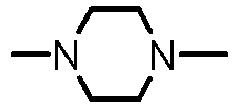


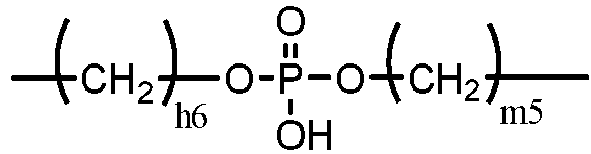 Y1 is a C1-C6 alkylene divalent radical, 2-hydroxylpropylene divalent radical, 2-(phosphonyloxy)propylene divalent radical, 1,2-dihydroxyethylene divalent radical, a divalent radical of
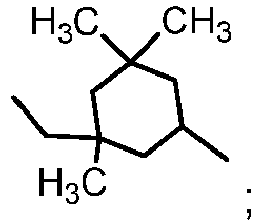 Y2 is a divalent radical of
 Y3 is a divalent radical of
 Z0 is a direct bond or a C1-C12 alkylene divalent radical;Z1 is a C1-C6 alkylene divalent radical, a hydroxyl-or methoxy-substituted C1-C6 alkylene divalent radical, or a substituted or unsubstituted phenylene divalent radical,Z2 is a C1-C6 alkylene divalent radical, a hydroxyl-or methoxy-substituted C1-C6 alkylene divalent radical, a dihydroxyl- or dimethoxy-substituted C2-C6 alkylene divalent radical, a divalent radical of -C2H4-(O-C2H4)m2-, a divalent radical of - Z4-S-S-Z4-, a hydroxyl- or methoxy-substituted C1-C6 alkylene divalent radical, or a substituted or unsubstituted phenylene divalent radical,Z3 is a divalent radical of any one of (a) -NRn3-, (b)
 Z4 is a C1-C6 alkylene divalent radical,Z5 is a C1-C6 alkylene divalent radical, 2-hydroxylpropylene divalent radical, 2-(phosphonyloxy)propylene divalent radical, 1,2-dihydroxyethylene divalent radical, 2,3-dihydroxybutylene divalent radical,Z6 is (a) a C1-C6 alkylene divalent radical, (b) a divalent radical of

 Z7 is a divalent radical of
 Z8 is a divalent radical of
- The method of any one of claims 1 to 12, wherein said at least one hydrophilic N-vinyl amide monomer is N-vinylpyrrolidone, N-vinyl piperidone, N-vinyl caprolactam, N-vinyl-N-methyl acetamide, N-vinyl formamide, N-vinyl acetamide, N-vinyl isopropylamide, N-vinyl-N-methyl acetamide, N-vinyl-N-ethyl acetamide, N-vinyl-N-ethyl formamide, or a mixture thereof.
- The method of any one of claims 1 to 13, wherein the ultrasonic horn (330) has a convex surface (340) which is in contact with the lens-adhered mold half.
- The method of any one of claims 1 to 13, wherein the ultrasonic horn (330) has a concave surface (340) which is in contact with the lens-adhered mold half.
- The method of any one of claims 1 to 13, wherein the ultrasonic horn (330) has a flat surface (340) which is in contact with the lens-adhered mold half.
Applications Claiming Priority (2)
| Application Number | Priority Date | Filing Date | Title |
|---|---|---|---|
| US201862680004P | 2018-06-04 | 2018-06-04 | |
| PCT/IB2019/054588 WO2019234591A1 (en) | 2018-06-04 | 2019-06-03 | Method for producing silicone hydrogel contact lenses |
Publications (2)
| Publication Number | Publication Date |
|---|---|
| EP3802081A1 EP3802081A1 (en) | 2021-04-14 |
| EP3802081B1 true EP3802081B1 (en) | 2023-03-01 |
Family
ID=66794052
Family Applications (1)
| Application Number | Title | Priority Date | Filing Date |
|---|---|---|---|
| EP19729369.9A Active EP3802081B1 (en) | 2018-06-04 | 2019-06-03 | Method for producing silicone hydrogel contact lenses |
Country Status (6)
| Country | Link |
|---|---|
| US (1) | US11254076B2 (en) |
| EP (1) | EP3802081B1 (en) |
| HU (1) | HUE061825T2 (en) |
| MY (1) | MY202143A (en) |
| SG (1) | SG11202009915VA (en) |
| WO (1) | WO2019234591A1 (en) |
Families Citing this family (6)
| Publication number | Priority date | Publication date | Assignee | Title |
|---|---|---|---|---|
| CN111300855A (en) * | 2019-12-24 | 2020-06-19 | 江苏海伦隐形眼镜有限公司 | Interferometric contact lens molds and methods of forming lenses |
| ES2993426T3 (en) * | 2020-03-19 | 2024-12-30 | Alcon Inc | High refractive index siloxane insert materials for embedded contact lenses |
| WO2022216451A1 (en) | 2021-04-06 | 2022-10-13 | Alcon Inc. | Apparatus, systems, and methods for objectively assessing accommodation in an eye |
| CN118176104A (en) * | 2021-12-20 | 2024-06-11 | 爱尔康公司 | Apparatus, system and method for forming ophthalmic lens components using soluble cores and molds |
| EP4514596A1 (en) * | 2022-04-29 | 2025-03-05 | Alcon Inc. | Method for making silicone hydrogel contact lenses |
| TWI828345B (en) * | 2022-09-30 | 2024-01-01 | 晶碩光學股份有限公司 | Siloxane monomer, contact lens composition and contact lens |
Family Cites Families (70)
| Publication number | Priority date | Publication date | Assignee | Title |
|---|---|---|---|---|
| US4343927A (en) | 1976-11-08 | 1982-08-10 | Chang Sing Hsiung | Hydrophilic, soft and oxygen permeable copolymer compositions |
| US4182822A (en) | 1976-11-08 | 1980-01-08 | Chang Sing Hsiung | Hydrophilic, soft and oxygen permeable copolymer composition |
| US4136250A (en) | 1977-07-20 | 1979-01-23 | Ciba-Geigy Corporation | Polysiloxane hydrogels |
| US4189546A (en) | 1977-07-25 | 1980-02-19 | Bausch & Lomb Incorporated | Polysiloxane shaped article for use in biomedical applications |
| US4153641A (en) | 1977-07-25 | 1979-05-08 | Bausch & Lomb Incorporated | Polysiloxane composition and contact lens |
| US4261875A (en) | 1979-01-31 | 1981-04-14 | American Optical Corporation | Contact lenses containing hydrophilic silicone polymers |
| US4276402A (en) | 1979-09-13 | 1981-06-30 | Bausch & Lomb Incorporated | Polysiloxane/acrylic acid/polcyclic esters of methacrylic acid polymer contact lens |
| US4254248A (en) | 1979-09-13 | 1981-03-03 | Bausch & Lomb Incorporated | Contact lens made from polymers of polysiloxane and polycyclic esters of acrylic acid or methacrylic acid |
| US4260725A (en) | 1979-12-10 | 1981-04-07 | Bausch & Lomb Incorporated | Hydrophilic contact lens made from polysiloxanes which are thermally bonded to polymerizable groups and which contain hydrophilic sidechains |
| US4259467A (en) | 1979-12-10 | 1981-03-31 | Bausch & Lomb Incorporated | Hydrophilic contact lens made from polysiloxanes containing hydrophilic sidechains |
| US4327203A (en) | 1981-02-26 | 1982-04-27 | Bausch & Lomb Incorporated | Polysiloxane with cycloalkyl modifier composition and biomedical devices |
| US4355147A (en) | 1981-02-26 | 1982-10-19 | Bausch & Lomb Incorporated | Polysiloxane with polycyclic modifier composition and biomedical devices |
| US4341889A (en) | 1981-02-26 | 1982-07-27 | Bausch & Lomb Incorporated | Polysiloxane composition and biomedical devices |
| US4444711A (en) | 1981-12-21 | 1984-04-24 | Husky Injection Molding Systems Ltd. | Method of operating a two-shot injection-molding machine |
| US4661575A (en) | 1982-01-25 | 1987-04-28 | Hercules Incorporated | Dicyclopentadiene polymer product |
| US4460534A (en) | 1982-09-07 | 1984-07-17 | International Business Machines Corporation | Two-shot injection molding |
| US4486577A (en) | 1982-10-12 | 1984-12-04 | Ciba-Geigy Corporation | Strong, silicone containing polymers with high oxygen permeability |
| US4543398A (en) | 1983-04-28 | 1985-09-24 | Minnesota Mining And Manufacturing Company | Ophthalmic devices fabricated from urethane acrylates of polysiloxane alcohols |
| US4605712A (en) | 1984-09-24 | 1986-08-12 | Ciba-Geigy Corporation | Unsaturated polysiloxanes and polymers thereof |
| US4833218A (en) | 1984-12-18 | 1989-05-23 | Dow Corning Corporation | Hydrophilic silicone-organic copolymer elastomers containing bioactine agent |
| US4684538A (en) | 1986-02-21 | 1987-08-04 | Loctite Corporation | Polysiloxane urethane compounds and adhesive compositions, and method of making and using the same |
| DE3708308A1 (en) | 1986-04-10 | 1987-10-22 | Bayer Ag | CONTACT OPTICAL ITEMS |
| US4837289A (en) | 1987-04-30 | 1989-06-06 | Ciba-Geigy Corporation | UV- and heat curable terminal polyvinyl functional macromers and polymers thereof |
| US5070170A (en) | 1988-02-26 | 1991-12-03 | Ciba-Geigy Corporation | Wettable, rigid gas permeable, substantially non-swellable contact lens containing block copolymer polysiloxane-polyoxyalkylene backbone units, and use thereof |
| US4954587A (en) | 1988-07-05 | 1990-09-04 | Ciba-Geigy Corporation | Dimethylacrylamide-copolymer hydrogels with high oxygen permeability |
| JPH0651795B2 (en) | 1988-09-16 | 1994-07-06 | 信越化学工業株式会社 | Methacryl functional dimethyl polysiloxane |
| US4954586A (en) | 1989-01-17 | 1990-09-04 | Menicon Co., Ltd | Soft ocular lens material |
| US5070215A (en) | 1989-05-02 | 1991-12-03 | Bausch & Lomb Incorporated | Novel vinyl carbonate and vinyl carbamate contact lens material monomers |
| US5034461A (en) | 1989-06-07 | 1991-07-23 | Bausch & Lomb Incorporated | Novel prepolymers useful in biomedical devices |
| US5010141A (en) | 1989-10-25 | 1991-04-23 | Ciba-Geigy Corporation | Reactive silicone and/or fluorine containing hydrophilic prepolymers and polymers thereof |
| US5079319A (en) | 1989-10-25 | 1992-01-07 | Ciba-Geigy Corporation | Reactive silicone and/or fluorine containing hydrophilic prepolymers and polymers thereof |
| WO1993005085A1 (en) | 1991-09-12 | 1993-03-18 | Bausch & Lomb Incorporated | Wettable silicone hydrogel compositions and methods |
| JP3354571B2 (en) | 1991-11-05 | 2002-12-09 | ボシュ・アンド・ロム・インコーポレイテッド | Wettable silicone hydrogel composition and method for producing the same |
| US5310779A (en) | 1991-11-05 | 1994-05-10 | Bausch & Lomb Incorporated | UV curable crosslinking agents useful in copolymerization |
| US5358995A (en) | 1992-05-15 | 1994-10-25 | Bausch & Lomb Incorporated | Surface wettable silicone hydrogels |
| JP3195662B2 (en) | 1992-08-24 | 2001-08-06 | 株式会社メニコン | Ophthalmic lens materials |
| JP2774233B2 (en) | 1992-08-26 | 1998-07-09 | 株式会社メニコン | Ophthalmic lens materials |
| TW328535B (en) | 1993-07-02 | 1998-03-21 | Novartis Ag | Functional photoinitiators and their manufacture |
| US5894002A (en) | 1993-12-13 | 1999-04-13 | Ciba Vision Corporation | Process and apparatus for the manufacture of a contact lens |
| US5843346A (en) | 1994-06-30 | 1998-12-01 | Polymer Technology Corporation | Method of cast molding contact lenses |
| US5760100B1 (en) | 1994-09-06 | 2000-11-14 | Ciba Vision Corp | Extended wear ophthalmic lens |
| US5962548A (en) | 1998-03-02 | 1999-10-05 | Johnson & Johnson Vision Products, Inc. | Silicone hydrogel polymers |
| US6039913A (en) | 1998-08-27 | 2000-03-21 | Novartis Ag | Process for the manufacture of an ophthalmic molding |
| US5981675A (en) | 1998-12-07 | 1999-11-09 | Bausch & Lomb Incorporated | Silicone-containing macromonomers and low water materials |
| WO2001007523A1 (en) | 1999-07-27 | 2001-02-01 | Bausch & Lomb Incorporated | Contact lens material |
| CA2394939C (en) | 1999-12-16 | 2007-10-30 | Asahikasei Aime Co., Ltd. | Long-wearable soft contact lens |
| US7214809B2 (en) | 2004-02-11 | 2007-05-08 | Johnson & Johnson Vision Care, Inc. | (Meth)acrylamide monomers containing hydroxy and silicone functionalities |
| HUE044130T2 (en) | 2004-08-27 | 2019-09-30 | Coopervision Int Holding Co Lp | Silicone hydrogel contact lenses |
| CA2592206A1 (en) | 2004-12-29 | 2006-07-06 | Bausch & Lomb Incorporated | Polysiloxane prepolymers for biomedical devices |
| US8038711B2 (en) | 2005-07-19 | 2011-10-18 | Clarke Gerald P | Accommodating intraocular lens and methods of use |
| JP5720103B2 (en) | 2010-03-18 | 2015-05-20 | 東レ株式会社 | Silicone hydrogels, ophthalmic lenses and contact lenses |
| TWI875491B (en) | 2010-07-30 | 2025-03-01 | 瑞士商愛爾康公司 | Hydrated contact lens |
| EP2625217B1 (en) | 2010-10-06 | 2018-07-04 | Novartis AG | Chain-extended polysiloxane crosslinkers with dangling hydrophilic polymer chains |
| CA2813469C (en) | 2010-10-06 | 2016-01-12 | Novartis Ag | Polymerizable chain-extended polysiloxanes with pendant hydrophilic groups |
| KR101743801B1 (en) | 2011-02-28 | 2017-06-05 | 쿠퍼비젼 인터내셔날 홀딩 캄파니, 엘피 | Silicone hydrogel contact lenses having acceptable levels of energy loss |
| US9217813B2 (en) | 2011-02-28 | 2015-12-22 | Coopervision International Holding Company, Lp | Silicone hydrogel contact lenses |
| CA2889925C (en) | 2012-12-14 | 2017-07-04 | Novartis Ag | Tris(trimethyl siloxy)silane vinylic monomers and uses thereof |
| WO2014093751A2 (en) | 2012-12-14 | 2014-06-19 | Novartis Ag | Amphiphilic siloxane-containing vinylic monomers and uses thereof |
| EP2931767B1 (en) | 2012-12-14 | 2017-11-08 | Novartis AG | Amphiphilic siloxane-containing (meth)acrylamides and uses thereof |
| US9315669B2 (en) | 2013-09-30 | 2016-04-19 | Novartis Ag | Method for making UV-absorbing ophthalmic lenses |
| ES2877408T3 (en) | 2015-12-15 | 2021-11-16 | Alcon Inc | Hydrophilized Polydiorganosiloxane Vinyl Crosslinkers and Uses Thereof |
| SG11201900640UA (en) | 2016-09-20 | 2019-04-29 | Novartis Ag | Process for producing contact lenses with durable lubricious coatings thereon |
| US10465047B2 (en) | 2016-10-11 | 2019-11-05 | Novartis Ag | Polymerizable polydimethylsiloxane-polyoxyalkylene block copolymers |
| EP3526278B1 (en) | 2016-10-11 | 2020-12-30 | Alcon Inc. | Chain-extended polydimethylsiloxane vinylic crosslinkers and uses thereof |
| EP3526016B1 (en) | 2016-10-14 | 2025-09-10 | Alcon Inc. | Method for producing contact lenses |
| CN109803815B (en) | 2016-10-14 | 2021-06-11 | 爱尔康公司 | Method for manufacturing contact lenses |
| CN110023067A (en) | 2016-12-16 | 2019-07-16 | 诺华股份有限公司 | The method for manufacturing haptic lens |
| EP3802080B1 (en) * | 2018-06-04 | 2023-07-19 | Alcon Inc. | Method for making silicone hydrogel contact lenses |
| US11254075B2 (en) * | 2018-06-04 | 2022-02-22 | Alcon Inc. | Method for producing silicone hydrogel contact lenses |
| SG11202111035WA (en) * | 2019-05-13 | 2021-11-29 | Alcon Inc | Method for producing photochromic contact lenses |
-
2019
- 2019-06-03 EP EP19729369.9A patent/EP3802081B1/en active Active
- 2019-06-03 HU HUE19729369A patent/HUE061825T2/en unknown
- 2019-06-03 WO PCT/IB2019/054588 patent/WO2019234591A1/en not_active Ceased
- 2019-06-03 US US16/429,811 patent/US11254076B2/en active Active
- 2019-06-03 MY MYPI2020005227A patent/MY202143A/en unknown
- 2019-06-03 SG SG11202009915VA patent/SG11202009915VA/en unknown
Also Published As
| Publication number | Publication date |
|---|---|
| MY202143A (en) | 2024-04-05 |
| SG11202009915VA (en) | 2020-12-30 |
| EP3802081A1 (en) | 2021-04-14 |
| US20190366660A1 (en) | 2019-12-05 |
| HUE061825T2 (en) | 2023-08-28 |
| US11254076B2 (en) | 2022-02-22 |
| WO2019234591A1 (en) | 2019-12-12 |
Similar Documents
| Publication | Publication Date | Title |
|---|---|---|
| EP3802081B1 (en) | Method for producing silicone hydrogel contact lenses | |
| US10301451B2 (en) | Chain-extended polydimethylsiloxane vinylic crosslinkers and uses thereof | |
| US10465047B2 (en) | Polymerizable polydimethylsiloxane-polyoxyalkylene block copolymers | |
| US12116442B2 (en) | Method for producing silicone hydrogel contact lenses | |
| EP2432808B1 (en) | Actinically-crosslinkable siloxane-containing copolymers | |
| US11433629B2 (en) | Method for preparing silicone hydrogels | |
| US11254075B2 (en) | Method for producing silicone hydrogel contact lenses | |
| TWI767616B (en) | Method for producing embedded or hybrid hydrogel contact lenses | |
| TWI825650B (en) | Embedded hydrogel contact lenses and method for making the same | |
| EP3969268B1 (en) | Method for producing photochromic contact lenses | |
| US10527757B2 (en) | Amphiphilic branched polydiorganosiloxane macromers | |
| TW202239578A (en) | Method for making embedded hydrogel contact lenses | |
| TW202408774A (en) | Method for making embedded hydrogel contact lenses | |
| TW202413071A (en) | Method for making embedded hydrogel contact lenses |
Legal Events
| Date | Code | Title | Description |
|---|---|---|---|
| STAA | Information on the status of an ep patent application or granted ep patent |
Free format text: STATUS: UNKNOWN |
|
| STAA | Information on the status of an ep patent application or granted ep patent |
Free format text: STATUS: THE INTERNATIONAL PUBLICATION HAS BEEN MADE |
|
| PUAI | Public reference made under article 153(3) epc to a published international application that has entered the european phase |
Free format text: ORIGINAL CODE: 0009012 |
|
| STAA | Information on the status of an ep patent application or granted ep patent |
Free format text: STATUS: REQUEST FOR EXAMINATION WAS MADE |
|
| 17P | Request for examination filed |
Effective date: 20201215 |
|
| AK | Designated contracting states |
Kind code of ref document: A1 Designated state(s): AL AT BE BG CH CY CZ DE DK EE ES FI FR GB GR HR HU IE IS IT LI LT LU LV MC MK MT NL NO PL PT RO RS SE SI SK SM TR |
|
| AX | Request for extension of the european patent |
Extension state: BA ME |
|
| DAV | Request for validation of the european patent (deleted) | ||
| DAX | Request for extension of the european patent (deleted) | ||
| GRAP | Despatch of communication of intention to grant a patent |
Free format text: ORIGINAL CODE: EPIDOSNIGR1 |
|
| STAA | Information on the status of an ep patent application or granted ep patent |
Free format text: STATUS: GRANT OF PATENT IS INTENDED |
|
| RIC1 | Information provided on ipc code assigned before grant |
Ipc: C08L 33/06 20060101ALN20220623BHEP Ipc: G02B 1/04 20060101ALI20220623BHEP Ipc: C08G 77/442 20060101ALI20220623BHEP Ipc: B29D 11/00 20060101AFI20220623BHEP |
|
| INTG | Intention to grant announced |
Effective date: 20220713 |
|
| GRAJ | Information related to disapproval of communication of intention to grant by the applicant or resumption of examination proceedings by the epo deleted |
Free format text: ORIGINAL CODE: EPIDOSDIGR1 |
|
| STAA | Information on the status of an ep patent application or granted ep patent |
Free format text: STATUS: REQUEST FOR EXAMINATION WAS MADE |
|
| GRAP | Despatch of communication of intention to grant a patent |
Free format text: ORIGINAL CODE: EPIDOSNIGR1 |
|
| STAA | Information on the status of an ep patent application or granted ep patent |
Free format text: STATUS: GRANT OF PATENT IS INTENDED |
|
| INTC | Intention to grant announced (deleted) | ||
| RIC1 | Information provided on ipc code assigned before grant |
Ipc: C08L 33/06 20060101ALN20220913BHEP Ipc: G02B 1/04 20060101ALI20220913BHEP Ipc: C08G 77/442 20060101ALI20220913BHEP Ipc: B29D 11/00 20060101AFI20220913BHEP |
|
| INTG | Intention to grant announced |
Effective date: 20220930 |
|
| GRAS | Grant fee paid |
Free format text: ORIGINAL CODE: EPIDOSNIGR3 |
|
| GRAA | (expected) grant |
Free format text: ORIGINAL CODE: 0009210 |
|
| STAA | Information on the status of an ep patent application or granted ep patent |
Free format text: STATUS: THE PATENT HAS BEEN GRANTED |
|
| AK | Designated contracting states |
Kind code of ref document: B1 Designated state(s): AL AT BE BG CH CY CZ DE DK EE ES FI FR GB GR HR HU IE IS IT LI LT LU LV MC MK MT NL NO PL PT RO RS SE SI SK SM TR |
|
| REG | Reference to a national code |
Ref country code: GB Ref legal event code: FG4D |
|
| REG | Reference to a national code |
Ref country code: CH Ref legal event code: EP Ref country code: AT Ref legal event code: REF Ref document number: 1550697 Country of ref document: AT Kind code of ref document: T Effective date: 20230315 |
|
| REG | Reference to a national code |
Ref country code: DE Ref legal event code: R096 Ref document number: 602019025851 Country of ref document: DE |
|
| REG | Reference to a national code |
Ref country code: IE Ref legal event code: FG4D |
|
| P01 | Opt-out of the competence of the unified patent court (upc) registered |
Effective date: 20230505 |
|
| REG | Reference to a national code |
Ref country code: LT Ref legal event code: MG9D |
|
| REG | Reference to a national code |
Ref country code: NL Ref legal event code: MP Effective date: 20230301 |
|
| PG25 | Lapsed in a contracting state [announced via postgrant information from national office to epo] |
Ref country code: RS Free format text: LAPSE BECAUSE OF FAILURE TO SUBMIT A TRANSLATION OF THE DESCRIPTION OR TO PAY THE FEE WITHIN THE PRESCRIBED TIME-LIMIT Effective date: 20230301 Ref country code: NO Free format text: LAPSE BECAUSE OF FAILURE TO SUBMIT A TRANSLATION OF THE DESCRIPTION OR TO PAY THE FEE WITHIN THE PRESCRIBED TIME-LIMIT Effective date: 20230601 Ref country code: LV Free format text: LAPSE BECAUSE OF FAILURE TO SUBMIT A TRANSLATION OF THE DESCRIPTION OR TO PAY THE FEE WITHIN THE PRESCRIBED TIME-LIMIT Effective date: 20230301 Ref country code: LT Free format text: LAPSE BECAUSE OF FAILURE TO SUBMIT A TRANSLATION OF THE DESCRIPTION OR TO PAY THE FEE WITHIN THE PRESCRIBED TIME-LIMIT Effective date: 20230301 Ref country code: HR Free format text: LAPSE BECAUSE OF FAILURE TO SUBMIT A TRANSLATION OF THE DESCRIPTION OR TO PAY THE FEE WITHIN THE PRESCRIBED TIME-LIMIT Effective date: 20230301 Ref country code: ES Free format text: LAPSE BECAUSE OF FAILURE TO SUBMIT A TRANSLATION OF THE DESCRIPTION OR TO PAY THE FEE WITHIN THE PRESCRIBED TIME-LIMIT Effective date: 20230301 |
|
| REG | Reference to a national code |
Ref country code: AT Ref legal event code: MK05 Ref document number: 1550697 Country of ref document: AT Kind code of ref document: T Effective date: 20230301 |
|
| REG | Reference to a national code |
Ref country code: HU Ref legal event code: AG4A Ref document number: E061825 Country of ref document: HU |
|
| PG25 | Lapsed in a contracting state [announced via postgrant information from national office to epo] |
Ref country code: SE Free format text: LAPSE BECAUSE OF FAILURE TO SUBMIT A TRANSLATION OF THE DESCRIPTION OR TO PAY THE FEE WITHIN THE PRESCRIBED TIME-LIMIT Effective date: 20230301 Ref country code: PL Free format text: LAPSE BECAUSE OF FAILURE TO SUBMIT A TRANSLATION OF THE DESCRIPTION OR TO PAY THE FEE WITHIN THE PRESCRIBED TIME-LIMIT Effective date: 20230301 Ref country code: NL Free format text: LAPSE BECAUSE OF FAILURE TO SUBMIT A TRANSLATION OF THE DESCRIPTION OR TO PAY THE FEE WITHIN THE PRESCRIBED TIME-LIMIT Effective date: 20230301 Ref country code: GR Free format text: LAPSE BECAUSE OF FAILURE TO SUBMIT A TRANSLATION OF THE DESCRIPTION OR TO PAY THE FEE WITHIN THE PRESCRIBED TIME-LIMIT Effective date: 20230602 Ref country code: FI Free format text: LAPSE BECAUSE OF FAILURE TO SUBMIT A TRANSLATION OF THE DESCRIPTION OR TO PAY THE FEE WITHIN THE PRESCRIBED TIME-LIMIT Effective date: 20230301 |
|
| PG25 | Lapsed in a contracting state [announced via postgrant information from national office to epo] |
Ref country code: SM Free format text: LAPSE BECAUSE OF FAILURE TO SUBMIT A TRANSLATION OF THE DESCRIPTION OR TO PAY THE FEE WITHIN THE PRESCRIBED TIME-LIMIT Effective date: 20230301 Ref country code: RO Free format text: LAPSE BECAUSE OF FAILURE TO SUBMIT A TRANSLATION OF THE DESCRIPTION OR TO PAY THE FEE WITHIN THE PRESCRIBED TIME-LIMIT Effective date: 20230301 Ref country code: PT Free format text: LAPSE BECAUSE OF FAILURE TO SUBMIT A TRANSLATION OF THE DESCRIPTION OR TO PAY THE FEE WITHIN THE PRESCRIBED TIME-LIMIT Effective date: 20230703 Ref country code: EE Free format text: LAPSE BECAUSE OF FAILURE TO SUBMIT A TRANSLATION OF THE DESCRIPTION OR TO PAY THE FEE WITHIN THE PRESCRIBED TIME-LIMIT Effective date: 20230301 Ref country code: CZ Free format text: LAPSE BECAUSE OF FAILURE TO SUBMIT A TRANSLATION OF THE DESCRIPTION OR TO PAY THE FEE WITHIN THE PRESCRIBED TIME-LIMIT Effective date: 20230301 Ref country code: AT Free format text: LAPSE BECAUSE OF FAILURE TO SUBMIT A TRANSLATION OF THE DESCRIPTION OR TO PAY THE FEE WITHIN THE PRESCRIBED TIME-LIMIT Effective date: 20230301 |
|
| PG25 | Lapsed in a contracting state [announced via postgrant information from national office to epo] |
Ref country code: SK Free format text: LAPSE BECAUSE OF FAILURE TO SUBMIT A TRANSLATION OF THE DESCRIPTION OR TO PAY THE FEE WITHIN THE PRESCRIBED TIME-LIMIT Effective date: 20230301 Ref country code: IS Free format text: LAPSE BECAUSE OF FAILURE TO SUBMIT A TRANSLATION OF THE DESCRIPTION OR TO PAY THE FEE WITHIN THE PRESCRIBED TIME-LIMIT Effective date: 20230701 |
|
| REG | Reference to a national code |
Ref country code: DE Ref legal event code: R097 Ref document number: 602019025851 Country of ref document: DE |
|
| PLBE | No opposition filed within time limit |
Free format text: ORIGINAL CODE: 0009261 |
|
| STAA | Information on the status of an ep patent application or granted ep patent |
Free format text: STATUS: NO OPPOSITION FILED WITHIN TIME LIMIT |
|
| PG25 | Lapsed in a contracting state [announced via postgrant information from national office to epo] |
Ref country code: MC Free format text: LAPSE BECAUSE OF FAILURE TO SUBMIT A TRANSLATION OF THE DESCRIPTION OR TO PAY THE FEE WITHIN THE PRESCRIBED TIME-LIMIT Effective date: 20230301 |
|
| PG25 | Lapsed in a contracting state [announced via postgrant information from national office to epo] |
Ref country code: SI Free format text: LAPSE BECAUSE OF FAILURE TO SUBMIT A TRANSLATION OF THE DESCRIPTION OR TO PAY THE FEE WITHIN THE PRESCRIBED TIME-LIMIT Effective date: 20230301 Ref country code: MC Free format text: LAPSE BECAUSE OF FAILURE TO SUBMIT A TRANSLATION OF THE DESCRIPTION OR TO PAY THE FEE WITHIN THE PRESCRIBED TIME-LIMIT Effective date: 20230301 Ref country code: DK Free format text: LAPSE BECAUSE OF FAILURE TO SUBMIT A TRANSLATION OF THE DESCRIPTION OR TO PAY THE FEE WITHIN THE PRESCRIBED TIME-LIMIT Effective date: 20230301 |
|
| REG | Reference to a national code |
Ref country code: CH Ref legal event code: PL |
|
| 26N | No opposition filed |
Effective date: 20231204 |
|
| REG | Reference to a national code |
Ref country code: BE Ref legal event code: MM Effective date: 20230630 |
|
| PG25 | Lapsed in a contracting state [announced via postgrant information from national office to epo] |
Ref country code: LU Free format text: LAPSE BECAUSE OF NON-PAYMENT OF DUE FEES Effective date: 20230603 |
|
| PG25 | Lapsed in a contracting state [announced via postgrant information from national office to epo] |
Ref country code: LU Free format text: LAPSE BECAUSE OF NON-PAYMENT OF DUE FEES Effective date: 20230603 |
|
| PG25 | Lapsed in a contracting state [announced via postgrant information from national office to epo] |
Ref country code: CH Free format text: LAPSE BECAUSE OF NON-PAYMENT OF DUE FEES Effective date: 20230630 |
|
| PG25 | Lapsed in a contracting state [announced via postgrant information from national office to epo] |
Ref country code: IT Free format text: LAPSE BECAUSE OF FAILURE TO SUBMIT A TRANSLATION OF THE DESCRIPTION OR TO PAY THE FEE WITHIN THE PRESCRIBED TIME-LIMIT Effective date: 20230301 Ref country code: FR Free format text: LAPSE BECAUSE OF NON-PAYMENT OF DUE FEES Effective date: 20230630 Ref country code: BE Free format text: LAPSE BECAUSE OF NON-PAYMENT OF DUE FEES Effective date: 20230630 |
|
| PG25 | Lapsed in a contracting state [announced via postgrant information from national office to epo] |
Ref country code: BG Free format text: LAPSE BECAUSE OF FAILURE TO SUBMIT A TRANSLATION OF THE DESCRIPTION OR TO PAY THE FEE WITHIN THE PRESCRIBED TIME-LIMIT Effective date: 20230301 |
|
| PG25 | Lapsed in a contracting state [announced via postgrant information from national office to epo] |
Ref country code: BG Free format text: LAPSE BECAUSE OF FAILURE TO SUBMIT A TRANSLATION OF THE DESCRIPTION OR TO PAY THE FEE WITHIN THE PRESCRIBED TIME-LIMIT Effective date: 20230301 |
|
| PGFP | Annual fee paid to national office [announced via postgrant information from national office to epo] |
Ref country code: DE Payment date: 20250521 Year of fee payment: 7 |
|
| PGFP | Annual fee paid to national office [announced via postgrant information from national office to epo] |
Ref country code: GB Payment date: 20250522 Year of fee payment: 7 |
|
| PG25 | Lapsed in a contracting state [announced via postgrant information from national office to epo] |
Ref country code: CY Free format text: LAPSE BECAUSE OF FAILURE TO SUBMIT A TRANSLATION OF THE DESCRIPTION OR TO PAY THE FEE WITHIN THE PRESCRIBED TIME-LIMIT; INVALID AB INITIO Effective date: 20190603 |
|
| PGFP | Annual fee paid to national office [announced via postgrant information from national office to epo] |
Ref country code: IE Payment date: 20250523 Year of fee payment: 7 |
|
| PGFP | Annual fee paid to national office [announced via postgrant information from national office to epo] |
Ref country code: HU Payment date: 20250610 Year of fee payment: 7 |
|
| PG25 | Lapsed in a contracting state [announced via postgrant information from national office to epo] |
Ref country code: TR Free format text: LAPSE BECAUSE OF FAILURE TO SUBMIT A TRANSLATION OF THE DESCRIPTION OR TO PAY THE FEE WITHIN THE PRESCRIBED TIME-LIMIT Effective date: 20230301 |