US9315669B2 - Method for making UV-absorbing ophthalmic lenses - Google Patents
Method for making UV-absorbing ophthalmic lenses Download PDFInfo
- Publication number
- US9315669B2 US9315669B2 US14/494,186 US201414494186A US9315669B2 US 9315669 B2 US9315669 B2 US 9315669B2 US 201414494186 A US201414494186 A US 201414494186A US 9315669 B2 US9315669 B2 US 9315669B2
- Authority
- US
- United States
- Prior art keywords
- acrylamide
- lens
- meth
- hydroxy
- absorbing
- Prior art date
- Legal status (The legal status is an assumption and is not a legal conclusion. Google has not performed a legal analysis and makes no representation as to the accuracy of the status listed.)
- Active
Links
- 0 *ON(C)C(=O)C(=C)C.*ON(C)C(=O)C=C.C Chemical compound *ON(C)C(=O)C(=C)C.*ON(C)C(=O)C=C.C 0.000 description 14
- ROWSHEZYONOOTN-UHFFFAOYSA-N C=C(C)C(=O)OCC1=C(O)C(N2N=C3C=CC(C(F)(F)F)=CC3=N2)=CC(OC)=C1 Chemical compound C=C(C)C(=O)OCC1=C(O)C(N2N=C3C=CC(C(F)(F)F)=CC3=N2)=CC(OC)=C1 ROWSHEZYONOOTN-UHFFFAOYSA-N 0.000 description 2
- CQASBOLQSRQKBZ-UHFFFAOYSA-N C=C(C)C(=O)OCC1=C(O)C(N2N=C3C=CC(Cl)=CC3=N2)=CC(OC)=C1 Chemical compound C=C(C)C(=O)OCC1=C(O)C(N2N=C3C=CC(Cl)=CC3=N2)=CC(OC)=C1 CQASBOLQSRQKBZ-UHFFFAOYSA-N 0.000 description 2
- SMLYKAMMSAUQAR-UHFFFAOYSA-N C=C(C)C(=O)OCCCOC1=CC(C(C)(C)C)=C(O)C(N2N=C3C=CC(C(F)(F)F)=CC3=N2)=C1 Chemical compound C=C(C)C(=O)OCCCOC1=CC(C(C)(C)C)=C(O)C(N2N=C3C=CC(C(F)(F)F)=CC3=N2)=C1 SMLYKAMMSAUQAR-UHFFFAOYSA-N 0.000 description 2
- DINCRTRWXNCVSQ-UHFFFAOYSA-N C.C=C(C)C(C)=O.C=CC(C)=O Chemical compound C.C=C(C)C(C)=O.C=CC(C)=O DINCRTRWXNCVSQ-UHFFFAOYSA-N 0.000 description 1
- REFCVAYUCRKZIM-MNYXATJNSA-O C.[3H][N+]1(C)CC(O)C1 Chemical compound C.[3H][N+]1(C)CC(O)C1 REFCVAYUCRKZIM-MNYXATJNSA-O 0.000 description 1
- VQTUBCCKSQIDNK-UHFFFAOYSA-N C=C(C)C Chemical compound C=C(C)C VQTUBCCKSQIDNK-UHFFFAOYSA-N 0.000 description 1
- VCYCUECVHJJFIQ-UHFFFAOYSA-N C=C(C)C(=O)OCCC1=CC=C(O)C(N2N=C3C=CC=CC3=N2)=C1 Chemical compound C=C(C)C(=O)OCCC1=CC=C(O)C(N2N=C3C=CC=CC3=N2)=C1 VCYCUECVHJJFIQ-UHFFFAOYSA-N 0.000 description 1
- MIVVEHZFNLPPHL-UHFFFAOYSA-N CC(C)(C)C.CC1CCC(C)C1.CC1CCCC(C)C1.CCC(C)(C)C.CCC(C)C.CCC(C)C.CCC(C)C(C)C.CCC(C)C(C)CC.CCC(C)C(C)O.CCC(C)CO.CCC(O)C(C)CC(C)C Chemical compound CC(C)(C)C.CC1CCC(C)C1.CC1CCCC(C)C1.CCC(C)(C)C.CCC(C)C.CCC(C)C.CCC(C)C(C)C.CCC(C)C(C)CC.CCC(C)C(C)O.CCC(C)CO.CCC(O)C(C)CC(C)C MIVVEHZFNLPPHL-UHFFFAOYSA-N 0.000 description 1
- ZGDRLYHCNOGEMH-UHFFFAOYSA-N CC(C)(C)C.CCC(C)(C)C Chemical compound CC(C)(C)C.CCC(C)(C)C ZGDRLYHCNOGEMH-UHFFFAOYSA-N 0.000 description 1
- NUMAUTUOGCPEIA-UHFFFAOYSA-N CCC1=CC=C(C(=O)[Ge](CC)(CC)C(=O)C2=CC=C(OC)C=C2)C=C1.CC[Ge](CC)(C(=O)C1=CC=CC=C1)C(=O)C1=CC=CC=C1.O=C([Ge](C1=CC=CC=C1)(C1=CC=CC=C1)C1=CC=CC=C1)[Ge](C1=CC=CC=C1)(C1=CC=CC=C1)C1=CC=CC=C1 Chemical compound CCC1=CC=C(C(=O)[Ge](CC)(CC)C(=O)C2=CC=C(OC)C=C2)C=C1.CC[Ge](CC)(C(=O)C1=CC=CC=C1)C(=O)C1=CC=CC=C1.O=C([Ge](C1=CC=CC=C1)(C1=CC=CC=C1)C1=CC=CC=C1)[Ge](C1=CC=CC=C1)(C1=CC=CC=C1)C1=CC=CC=C1 NUMAUTUOGCPEIA-UHFFFAOYSA-N 0.000 description 1
- BKZNRDWUUGYOSD-UHFFFAOYSA-N CC[Ge](CC)(C(=O)C1=CC=C(OC)C=C1)C(=O)C1=CC=C(OC)C=C1.CC[Ge](CC)(C(=O)C1=CC=CC=C1)C(=O)C1=CC=CC=C1.O=C([Ge](C1=CC=CC=C1)(C1=CC=CC=C1)C1=CC=CC=C1)[Ge](C1=CC=CC=C1)(C1=CC=CC=C1)C1=CC=CC=C1 Chemical compound CC[Ge](CC)(C(=O)C1=CC=C(OC)C=C1)C(=O)C1=CC=C(OC)C=C1.CC[Ge](CC)(C(=O)C1=CC=CC=C1)C(=O)C1=CC=CC=C1.O=C([Ge](C1=CC=CC=C1)(C1=CC=CC=C1)C1=CC=CC=C1)[Ge](C1=CC=CC=C1)(C1=CC=CC=C1)C1=CC=CC=C1 BKZNRDWUUGYOSD-UHFFFAOYSA-N 0.000 description 1
- POPACFLNWGUDSR-UHFFFAOYSA-N CO[Si](C)(C)C Chemical compound CO[Si](C)(C)C POPACFLNWGUDSR-UHFFFAOYSA-N 0.000 description 1
- RWWQABVBGYHTRG-ZIWWWHOHSA-N [3H]C1(C)CC(=O)OC(C)=N1.[3H][3H][3H] Chemical compound [3H]C1(C)CC(=O)OC(C)=N1.[3H][3H][3H] RWWQABVBGYHTRG-ZIWWWHOHSA-N 0.000 description 1
- KRYXAKFBVKHXNX-SIRURAOESA-N [3H][3H][N+]1([3H])CC(O)C1 Chemical compound [3H][3H][N+]1([3H])CC(O)C1 KRYXAKFBVKHXNX-SIRURAOESA-N 0.000 description 1
Images


Classifications
-
- C—CHEMISTRY; METALLURGY
- C08—ORGANIC MACROMOLECULAR COMPOUNDS; THEIR PREPARATION OR CHEMICAL WORKING-UP; COMPOSITIONS BASED THEREON
- C08F—MACROMOLECULAR COMPOUNDS OBTAINED BY REACTIONS ONLY INVOLVING CARBON-TO-CARBON UNSATURATED BONDS
- C08F2/00—Processes of polymerisation
- C08F2/46—Polymerisation initiated by wave energy or particle radiation
- C08F2/48—Polymerisation initiated by wave energy or particle radiation by ultraviolet or visible light
-
- B—PERFORMING OPERATIONS; TRANSPORTING
- B29—WORKING OF PLASTICS; WORKING OF SUBSTANCES IN A PLASTIC STATE IN GENERAL
- B29D—PRODUCING PARTICULAR ARTICLES FROM PLASTICS OR FROM SUBSTANCES IN A PLASTIC STATE
- B29D11/00—Producing optical elements, e.g. lenses or prisms
- B29D11/00009—Production of simple or compound lenses
- B29D11/00038—Production of contact lenses
-
- B—PERFORMING OPERATIONS; TRANSPORTING
- B29—WORKING OF PLASTICS; WORKING OF SUBSTANCES IN A PLASTIC STATE IN GENERAL
- B29D—PRODUCING PARTICULAR ARTICLES FROM PLASTICS OR FROM SUBSTANCES IN A PLASTIC STATE
- B29D11/00—Producing optical elements, e.g. lenses or prisms
- B29D11/00865—Applying coatings; tinting; colouring
- B29D11/00894—Applying coatings; tinting; colouring colouring or tinting
- B29D11/00913—Applying coatings; tinting; colouring colouring or tinting full body; edge-to-edge
-
- C—CHEMISTRY; METALLURGY
- C08—ORGANIC MACROMOLECULAR COMPOUNDS; THEIR PREPARATION OR CHEMICAL WORKING-UP; COMPOSITIONS BASED THEREON
- C08F—MACROMOLECULAR COMPOUNDS OBTAINED BY REACTIONS ONLY INVOLVING CARBON-TO-CARBON UNSATURATED BONDS
- C08F220/00—Copolymers of compounds having one or more unsaturated aliphatic radicals, each having only one carbon-to-carbon double bond, and only one being terminated by only one carboxyl radical or a salt, anhydride ester, amide, imide or nitrile thereof
- C08F220/02—Monocarboxylic acids having less than ten carbon atoms; Derivatives thereof
- C08F220/52—Amides or imides
- C08F220/54—Amides, e.g. N,N-dimethylacrylamide or N-isopropylacrylamide
-
- C—CHEMISTRY; METALLURGY
- C08—ORGANIC MACROMOLECULAR COMPOUNDS; THEIR PREPARATION OR CHEMICAL WORKING-UP; COMPOSITIONS BASED THEREON
- C08F—MACROMOLECULAR COMPOUNDS OBTAINED BY REACTIONS ONLY INVOLVING CARBON-TO-CARBON UNSATURATED BONDS
- C08F230/00—Copolymers of compounds having one or more unsaturated aliphatic radicals, each having only one carbon-to-carbon double bond, and containing phosphorus, selenium, tellurium or a metal
- C08F230/04—Copolymers of compounds having one or more unsaturated aliphatic radicals, each having only one carbon-to-carbon double bond, and containing phosphorus, selenium, tellurium or a metal containing a metal
- C08F230/08—Copolymers of compounds having one or more unsaturated aliphatic radicals, each having only one carbon-to-carbon double bond, and containing phosphorus, selenium, tellurium or a metal containing a metal containing silicon
-
- C—CHEMISTRY; METALLURGY
- C08—ORGANIC MACROMOLECULAR COMPOUNDS; THEIR PREPARATION OR CHEMICAL WORKING-UP; COMPOSITIONS BASED THEREON
- C08K—Use of inorganic or non-macromolecular organic substances as compounding ingredients
- C08K5/00—Use of organic ingredients
- C08K5/0008—Organic ingredients according to more than one of the "one dot" groups of C08K5/01 - C08K5/59
- C08K5/0041—Optical brightening agents, organic pigments
-
- C—CHEMISTRY; METALLURGY
- C08—ORGANIC MACROMOLECULAR COMPOUNDS; THEIR PREPARATION OR CHEMICAL WORKING-UP; COMPOSITIONS BASED THEREON
- C08L—COMPOSITIONS OF MACROMOLECULAR COMPOUNDS
- C08L33/00—Compositions of homopolymers or copolymers of compounds having one or more unsaturated aliphatic radicals, each having only one carbon-to-carbon double bond, and only one being terminated by only one carboxyl radical, or of salts, anhydrides, esters, amides, imides or nitriles thereof; Compositions of derivatives of such polymers
- C08L33/24—Homopolymers or copolymers of amides or imides
- C08L33/26—Homopolymers or copolymers of acrylamide or methacrylamide
-
- C—CHEMISTRY; METALLURGY
- C08—ORGANIC MACROMOLECULAR COMPOUNDS; THEIR PREPARATION OR CHEMICAL WORKING-UP; COMPOSITIONS BASED THEREON
- C08L—COMPOSITIONS OF MACROMOLECULAR COMPOUNDS
- C08L83/00—Compositions of macromolecular compounds obtained by reactions forming in the main chain of the macromolecule a linkage containing silicon with or without sulfur, nitrogen, oxygen or carbon only; Compositions of derivatives of such polymers
- C08L83/04—Polysiloxanes
-
- G—PHYSICS
- G02—OPTICS
- G02B—OPTICAL ELEMENTS, SYSTEMS OR APPARATUS
- G02B1/00—Optical elements characterised by the material of which they are made; Optical coatings for optical elements
- G02B1/04—Optical elements characterised by the material of which they are made; Optical coatings for optical elements made of organic materials, e.g. plastics
- G02B1/041—Lenses
- G02B1/043—Contact lenses
Definitions
- This invention is related to a method for producing UV-absorbing silicone hydrogel contact lenses capable of blocking ultra-violet (“UV”) radiation (from 280 nm to 380 nm) and optionally (but preferably) violet radiation with wavelengths from 381 nm to 440 nm, thereby protecting eyes to some extent from damages caused by UV radiation and potentially by high energy violet light (HEVL).
- UV ultra-violet
- HUVL high energy violet light
- DAILIES TOTAL1® water gradient silicone hydrogel contact lenses are produced by using an unconventional cast-molding technology—the so-called Lightstream TechnologyTM (ALCON), as illustrated in U.S. Pat. Nos. 5,508,317, 5,789,464, 5,849,810, 6,800,225, and 8,163,206, which are incorporated by reference in their entireties.
- the Lightstream TechnologyTM involves (1) a lens-forming composition, (2) reusable molds produced in high precision, and (3) curing under a spatial limitation of actinic radiation (e.g., UV/Visible light) for a very short period of time (e.g., less than about 30 seconds).
- actinic radiation e.g., UV/Visible light
- Lenses produced according to the Lightstream TechnologyTM can have high consistency and high fidelity to the original lens design, because of use of reusable, high precision molds.
- contact lenses with high quality can be produced at relatively lower cost due to the short curing time and a high production yield.
- the Lightstream TechnologyTM has not been applied to make UV-absorbing silicone hydrogel contact lenses.
- the photocuring of a lens-forming composition in a mold may not be effected uniformly and resultant lenses may have unacceptable internal stress derived from the non-uniform curing.
- the present invention is generally related to a method for making silicone hydrogel contact lenses which have an UVB transmittance of about 10% or less (preferably about 5% or less, more preferably about 2.5% or less, even more preferably about 1% or less) between 280 and 315 nanometers, an UVA transmittance of about 30% or less (preferably about 20% or less, more preferably about 10% or less, even more preferably about 5% or less) between 316 and 380 nanometers, and optionally (but preferably) an average violet transmittance of about 70% or less (preferably about 65% or less, more preferably about 60% or less, even more preferably about 55% or less) between 381 nm and 440 nm.
- a method of the invention comprises the steps of: (1) providing a mold for making a soft contact lens, wherein the mold has a first mold half with a first molding surface defining the anterior surface of a contact lens and a second mold half with a second molding surface defining the posterior surface of the contact lens, wherein said first and second mold halves are configured to receive each other such that a cavity is formed between said first and second molding surfaces; (2) introducing a pre-polymerization mixture of lens-forming materials into the cavity, wherein the pre-polymerization mixture comprises at least one hydrophilic vinylic monomer, at least one siloxane-containing vinylic monomer, at least one polysiloxane crosslinker (with two or more ethylenically-unsaturated groups), at least one UV-absorbing vinylic monomer that absorbs ultraviolet light and optionally (but preferably) high-energy violet light from 381 nm to 440 nm, at least one tinting agent, and from about 0.05% to about 1.5% by weight of at least one german
- FIG. 1 illustrates the internal stress levels of three cast-molded silicone hydrogel contact lenses: A—substantially free of internal stress; B—strong internal stress; and C—extremely strong internal stress.
- FIG. 2 shows the UV-Vis transmission spectrum of a silicone hydrogel contact lens produced from a mixture of lens-forming material (Formulation 5A, Example 5).
- FIG. 3 shows the UV-Vis transmission spectrum of a silicone hydrogel contact lens made from a mixture of lens-forming material (Formulation 5C, Example 5).
- FIG. 4 shows the UV-Vis transmission spectrum of a silicone hydrogel contact lens produced from a mixture of lens-forming material (Formulation 5D, Example 5).
- FIG. 5 shows the UV-Vis transmission spectrum of a silicone hydrogel contact lens made from a mixture of lens-forming material (Formulation 5E, Example 5).
- FIG. 6 shows the UV-Vis transmission spectrum of a silicone hydrogel contact lens produced from a mixture of lens-forming material (Formulation 5F, Example 5).
- FIG. 7 shows the UV-Vis transmission spectrum of a silicone hydrogel contact lens made from a mixture of lens-forming material (Formulation 5G, Example 5).
- FIG. 8 shows the UV-Vis transmission spectrum of a silicone hydrogel contact lens produced from a mixture of lens-forming material (Formulation 5H, Example 5).
- FIG. 9 shows the internal stress levels of three silicone hydrogel contact lenses cast-molded from three different pre-polymerization mixtures using different photoinitiators.
- an “ophthalmic lens” refers to a contact lens and/or an intraocular lens.
- a “contact Lens” refers to a structure that can be placed on or within a wearer's eye. A contact lens can correct, improve, or alter a user's eyesight, but that need not be the case.
- a “silicone hydrogel contact lens” refers to a contact lens comprising a silicone hydrogel material.
- hydrogel or “hydrogel material” refers to a crosslinked polymeric material which is not water-soluble and can contains at least 10% by weight of water within its polymer matrix when fully hydrated.
- a “silicone hydrogel” refers to a hydrogel containing silicone.
- a silicone hydrogel typically is obtained by copolymerization of a polymerizable composition comprising at least one silicone-containing vinylic monomer or at least one silicone-containing vinylic macromer or at least one silicone-containing prepolymer having ethylenically unsaturated groups.
- a “vinylic monomer” refers to a compound that has one sole ethylenically-unsaturated group.
- soluble in reference to a compound or material in a solvent, means that the compound or material can be dissolved in the solvent to give a solution with a concentration of at least about 0.5% by weight at room temperature (i.e., a temperature of about 20° C. to about 30° C.).
- insoluble in reference to a compound or material in a solvent, means that the compound or material can be dissolved in the solvent to give a solution with a concentration of less than 0.005% by weight at room temperature (as defined above).
- olefinically unsaturated group or “ethylenically unsaturated group” is employed herein in a broad sense and is intended to encompass any groups containing at least one >C ⁇ C ⁇ group.
- exemplary ethylenically unsaturated groups include without limitation (meth)acryloyl
- (meth)acrylamide refers to methacrylamide and/or acrylamide.
- (meth)acrylamido refers to an ethylenically-unsaturated group of
- R° is hydrogen or C 1 -C 10 -alkyl.
- ene group refers to a monovalent radical comprising CH 2 ⁇ CH— that is not covalently attached to an oxygen or nitrogen atom or a carbonyl group.
- (meth)acrylamide-type monomer refers to a vinylic monomer containing one (meth)acrylamido group.
- (meth)acrylate refers to methacrylate and/or acrylate.
- a “hydrophilic vinylic monomer”, as used herein, refers to a vinylic monomer which can be polymerized to form a homopolymer that is water-soluble or can absorb at least 10 percent by weight of water.
- hydrophobic vinylic monomer refers to a vinylic monomer which can be polymerized to form a homopolymer that is insoluble in water and can absorb less than 10 percent by weight of water.
- UVA refers to radiation occurring at wavelengths between 316 and 380 nanometers
- UVB refers to radiation occurring between 280 and 315 nanometers
- Vollet refers to radiation occurring at wavelengths between 381 and 440 nanometers.
- UVA transmittance (or “UVA % T”)
- UVB transmittance or “UVB % T”
- average violet-transmittance or “Violet % T”
- UVA ⁇ ⁇ % ⁇ ⁇ T Average ⁇ ⁇ % ⁇ ⁇ Transmission ⁇ ⁇ between ⁇ ⁇ 316 ⁇ ⁇ nm ⁇ ⁇ and ⁇ ⁇ 380 ⁇ ⁇ nm Luminescence ⁇ ⁇ % ⁇ ⁇ T
- the term “macromer” or “prepolymer” refers to a medium and high molecular weight compound or polymer that contains two or more ethylenically unsaturated groups.
- Medium and high molecular weight typically means average molecular weights greater than 700 Daltons.
- crosslinker refers to a compound having at least two ethylenically unsaturated groups.
- a “crosslinking agent” refers to a crosslinker having a molecular weight of about 700 Daltons or less.
- polymer means a material formed by polymerizing/crosslinking one or more monomers or macromers or prepolymers.
- molecular weight of a polymeric material refers to the weight-average molecular weight unless otherwise specifically noted or unless testing conditions indicate otherwise.
- amino group refers to a primary or secondary amino group of formula —NHR°, where R° is hydrogen or C 1 -C 10 -alkyl, unless otherwise specifically noted.
- linear oligodimethylsiloxane chain refers to a divalent radical of
- m1 is an integer of from 3 to 10, preferably from 3 to 8, more preferably from 3 to 5.
- polysiloxane refers to a segment of
- n1 and n2 independently of each other are an integer of from 0 to 500 and (n1+n2) is from 10 to 500
- R 1 , R 2 , R 3 , R 4 , R 5 , R 6 , R 7 , and R 8 independently of one another, are C 1 -C 10 alkyl, C 1 -C 4 alkyl- or C 1 -C 4 -alkoxy-substituted phenyl, C 1 -C 10 fluoroalkyl, C 1 -C 10 fluoroether, C 6 -C 18 aryl radical, or -alk-(OC 2 H 4 ) n3 —OR° (in which alk is C 1 -C 6 -alkylene divalent radical, R° is H or C 1 -C 10 alkyl and n3 is an integer from 1 to 10).
- fluid indicates that a material is capable of flowing like a liquid.
- alkyl refers to a monovalent radical obtained by removing a hydrogen atom from a linear or branched alkane compound.
- An alkyl group (radical) forms one bond with one other group in an organic compound.
- alkylene refers to a divalent radical obtained by removing one hydrogen atom from an alkyl.
- An alkylene group (or radical) forms two bonds with other groups in an organic compound.
- substituted in reference to an alkylene divalent radical or an alkyl radical means that the alkylene divalent radical or the alkyl radical comprises at least one substituent which replaces one hydrogen atom of the alkylene or alkyl radical and is selected from the group consisting of hydroxyl, carboxyl, —NH 2 , sulfhydryl, C 1 -C 4 alkyl, C 1 -C 4 alkoxy, C 1 -C 4 alkylthio (alkyl sulfide), C 1 -C 4 acylamino, C 1 -C 4 alkylamino, di-C 1 -C 4 alkylamino, halogen atom (Br or Cl), and combinations thereof.
- an “oxazoline” refers to a compound of
- R 1 is hydrogen, methyl or ethyl group.
- polyoxazoline segment refers to a divalent radical of
- R 1 is hydrogen, methyl or ethyl group, and q is an integer from 3 to 500 and is obtained in a ring-opening polymerization.
- azetidinium refers to a positively-charged, divalent radical (or group or moiety) of
- T 1 and T 2 are a direct bond connecting to one mono-valent radical.
- azlactone refers to a mono-valent radical of
- T 3 and T 4 independently of each other is C 1 -C 8 alkyl (preferably methyl).
- a free radical initiator can be either a photoinitiator or a thermal initiator.
- a “photoinitiator” refers to a chemical that initiates free radical crosslinking/polymerizing reaction by the use of light.
- a “thermal initiator” refers to a chemical that initiates radical crosslinking/polymerizing reaction by the use of heat energy.
- UV-absorbing vinylic monomer refers to a compound comprising an ethylenically-unsaturated group and a UV-absorbing moiety which can absorb or screen out UV radiation in the range from 200 nm to 400 nm as understood by a person skilled in the art.
- a “spatial limitation of actinic radiation” refers to an act or process in which energy radiation in the form of rays is directed by, for example, a mask or screen or combinations thereof, to impinge, in a spatially restricted manner, onto an area having a well defined peripheral boundary.
- a spatial limitation of UV radiation is obtained by using a mask or screen having a radiation (e.g., UV and/or visible light) permeable region, a radiation (e.g., UV and/or visible light) impermeable region surrounding the radiation-permeable region, and a projection contour which is the boundary between the radiation-impermeable and radiation-permeable regions, as schematically illustrated in the drawings of U.S. Pat. No. 6,800,225 (FIGS.
- the mask or screen allows to spatially projects a beam of radiation (e.g., UV radiation and/or visible radiation) having a cross-sectional profile defined by the projection contour of the mask or screen.
- the projected beam of radiation e.g., UV radiation and/or visible radiation limits radiation impinging on a lens formulation located in the path of the projected beam from the first molding surface to the second molding surface of a mold.
- the resultant contact lens comprises an anterior surface defined by the first molding surface, an opposite posterior surface defined by the second molding surface, and a lens edge defined by the sectional profile of the projected UV and/or visible beam (i.e., a spatial limitation of radiation).
- the radiation used for the crosslinking is radiation energy, especially UV radiation (and/or visible radiation), gamma radiation, electron radiation or thermal radiation, the radiation energy preferably being in the form of a substantially parallel beam in order on the one hand to achieve good restriction and on the other hand efficient use of the energy.
- a “tinting agent” refers to a color additive (e.g., copper phthalocyanine) which is capable of creating a light color (e.g., blue or green) edge-to-edge visibility tint for facilitating the handling of contact lenses. Visibility tinted contact lenses are virtually invisible once they are worn by a wearer and cannot change eye color of a wear in any way.
- a color additive e.g., copper phthalocyanine
- EII effective intensity on initiator
- T is defined as the transmittance
- intensity gradient refers to the ratio of the EII value of an initiator and the total intensity of a curing light over a given wavelength range (e.g., from 380 nm to 480 nm), according to the following equation.
- % ⁇ ⁇ int ⁇ ⁇ grad ⁇ lower upper ⁇ ( I 0 ⁇ ( 1 - T ) ) ⁇ ⁇ d ⁇ ⁇ lower upper ⁇ ( I 0 ) ⁇ d ⁇
- the term “good cross-section” means that a cross-section of a cast-molded contact lens does not show internal stress when being analyzed by metrology for cross-sections, as shown by that the curvature of the cross-section is close to the curvature of the forming molds ( FIG. 1A ).
- a flat cross section ( FIG. 1B ), a relatively-flat and slightly-twisted curvature (Example 10) or an opposite curvature ( FIG. 1C ) would indicate that internal stress inside the lens is too strong.
- Internal stress within a cast-molded lens indicates inhomogeneous network throughout a cast-molded lens and is generally caused by non-uniform curing of a lens-forming composition in a mold. Cross-sections are inspected for internal stress according to the procedures described in Example 1.
- the intrinsic “oxygen permeability”, Dk, of a material is the rate at which oxygen will pass through a material.
- oxygen permeability (Dk) in reference to a hydrogel (silicone or non-silicone) or a contact lens means an oxygen permeability (Dk) which is measured at and corrected for the surface resistance to oxygen flux caused by the boundary layer effect according to the procedures shown in Examples hereinafter.
- Oxygen permeability is conventionally expressed in units of barrers, where “barrer” is defined as [(cm 3 oxygen)(mm)/(cm 2 )(sec)(mm Hg)] ⁇ 10 ⁇ 9 .
- the “oxygen transmissibility”, Dk/t, of a lens or material is the rate at which oxygen will pass through a specific lens or material with an average thickness of t [in units of mm] over the area being measured.
- Oxygen transmissibility is conventionally expressed in units of barrers/mm, where “barrers/mm” is defined as [(cm 3 oxygen)/(cm 2 )(sec)(mm Hg)] ⁇ 10 ⁇ 9 .
- modulus or “elastic modulus” in reference to a contact lens or a material means the tensile modulus or Young's modulus which is a measure of the stiffness of a contact lens or a material.
- the modulus can be measured using a method in accordance with ANSI Z80.20 standard.
- ANSI Z80.20 standard A person skilled in the art knows well how to determine the elastic modulus of a silicone hydrogel material or a contact lens. For example, all commercial contact lenses have reported values of elastic modulus.
- “Surface modification” or “surface treatment”, as used herein, means that an article has been treated in a surface treatment process (or a surface modification process) prior to or posterior to the formation of the article, in which (1) a coating is applied to the surface of the article, (2) chemical species are adsorbed onto the surface of the article, (3) the chemical nature (e.g., electrostatic charge) of chemical groups on the surface of the article are altered, or (4) the surface properties of the article are otherwise modified.
- Exemplary surface treatment processes include, but are not limited to, a surface treatment by energy (e.g., a plasma, a static electrical charge, irradiation, or other energy source), chemical treatments, the grafting of hydrophilic vinylic monomers or macromers onto the surface of an article, mold-transfer coating process disclosed in U.S. Pat. No. 6,719,929 (herein incorporated by reference in its entirety), the incorporation of wetting agents into a lens formulation for making contact lenses proposed in U.S. Pat. Nos. 6,367,929 and 6,822,016 (herein incorporated by references in their entireties), reinforced mold-transfer coating disclosed in U.S. Pat. No.
- energy e.g., a plasma, a static electrical charge, irradiation, or other energy source
- chemical treatments e.g., the grafting of hydrophilic vinylic monomers or macromers onto the surface of an article
- mold-transfer coating process disclosed in U.S. Pat. No. 6,719,9
- Post-curing surface treatment in reference to a silicone hydrogel material or a soft contact lens, means a surface treatment process that is performed after the formation (curing) of the hydrogel material or the soft contact lens in a mold.
- a “hydrophilic surface” in reference to a silicone hydrogel material or a contact lens means that the silicone hydrogel material or the contact lens has a surface hydrophilicity characterized by having an averaged water contact angle of about 90 degrees or less, preferably about 80 degrees or less, more preferably about 70 degrees or less, more preferably about 60 degrees or less.
- An “average contact angle” refers to a water contact angle (static water contact angle measured by Sessile Drop), which is obtained by averaging measurements of at least 3 individual contact lenses.
- the invention is directed to a method for making silicone hydrogel contact lenses which are free of or substantially free of internal stress and have an UVB transmittance of about 10% or less (preferably about 5% or less, more preferably about 2.5% or less, even more preferably about 1% or less) between 280 and 315 nanometers, an UVA transmittance of about 30% or less (preferably about 20% or less, more preferably about 10% or less, even more preferably about 5% or less) between 316 and 380 nanometers, and optionally (but preferably) an average violet transmittance of about 70% or less (preferably about 65% or less, more preferably about 60% or less, even more preferably about 55% or less) between 381 nm and 440 nm.
- the present invention is partly based on the discovery that a germanium-based Norrish Type I photoinitiator can be advantageously used in making silicone hydrogel contact lenses that absorb UV radiation and optionally (but preferably) HEVL radiation and is free of or substantially free of internal stress typically associated with contact lenses obtained by photocuring of a lens-forming composition having an UV-absorbing vinylic monomer (and additionally some tinting agents) in molds. Limited number of photo-initiators are available that are active in the visible region and provide fast cure times. Phosphine oxide type photoinitiators (i.e., TPO) and Germanium type photoinitiators (Ge-PI) may meet these basic requirements.
- TPO Phosphine oxide type photoinitiators
- Ge-PI Germanium type photoinitiators
- Ge-PI can be used to cure a lens-forming composition to form silicone hydrogel contact lenses which are substantially-free or completely-free of internal stress observed by metrology inspection of a cross-section of a lens.
- Silicone hydrogel contact lenses obtained from a lens-forming composition including TPO as photoinitiator have internal stress, as observed by metrology inspection of a cross-section of the lens, although the lens-forming composition with TPO have comparable values of effective intensity on initiator (EII) and intensity gradient over a 100- ⁇ m path length similar to those of a lens-forming composition with Ge-PI.
- EII effective intensity on initiator
- Ge-PI is susceptible to photobleaching and its higher intensity gradient and higher EII values may not adversely affect curing of a lens-forming composition in a mold for making silicone hydrogel contact lenses capable of absorbing UV radiation and can minimize or eliminate the source for causing the internal stress within such silicone hydrogel contact lenses.
- the present invention is also partly based on the discovery that by selecting the combination of UV-absorbing vinylic monomers, germanium-based Norrish Type I photoinitiator, and (meth)acrylamide-type monomers and/or macromers in preparing a mixture for making UV-absorbing silicone hydrogel contact lenses as well as a visible radiation as curing radiation source, the curing time of the mixture in a mold can be shortened so as to make the mixture suitable for making UV-absorbing silicone hydrogel contact lenses based on the Lightstream TechnologyTM.
- the relatively-short curing time involved in the invention can ensure that contact lenses with high quality lens edge are produced at a lower cost.
- a relatively longer curing time may adversely affect the quality of lens edge of contact lenses made according to the Lightstream TechnologyTM and can increase the product cost by lowering the production output.
- the high curing light intensity and high photoinitiator concentration have limits and may not be sufficient to reduce the curing time enough for the Lightstream TechnologyTM. Further, these measures may cause resultant lenses with undesirable physical properties, such as, for example, fragile and high content of extractable due to unpolymerized monomers.
- a curing time of less than about 30 seconds, for example, can be achieved with a 445 nm LED light source (e.g., a curing light intensity of about 60 mW/cm 2 or less).
- UV-absorbing silicone hydrogel contact lenses made from such a mixture according to the Lightstream Technology can have high lens edge quality, relatively low lens production cost because of the relatively short curing time, and minimal or no internal stress.
- the present invention provides a method for making silicone hydrogel contact lenses which have an UVB transmittance of about 10% or less (preferably about 5% or less, more preferably about 2.5% or less, even more preferably about 1% or less) between 280 and 315 nanometers, an UVA transmittance of about 30% or less (preferably about 20% or less, more preferably about 10% or less, even more preferably about 5% or less) between 316 and 380 nanometers, and optionally (but preferably) an average violet transmittance of about 70% or less (preferably about 65% or less, more preferably about 60% or less, even more preferably about 55% or less) between 381 nm and 440 nm, the method comprising the steps of: (1) providing a mold for making a soft contact lens, wherein the mold has a first mold half with a first molding surface defining the anterior surface of a contact lens and a second mold half with a second molding surface defining the posterior surface of the contact lens, wherein said first and second mold halves are configured to receive each
- the hydrophilic vinylic monomer is a hydrophilic (meth)acrylamide-type monomer and the siloxane-containing vinylic monomer is a siloxane-containing (meth)acrylamide-type monomer;
- the pre-polymerization mixture is characterized by having an ability to be cured within about 100 seconds by a visible light having an intensity sufficient to produce lenses of good quality (preferably a total intensity of from about 10 to about 100 mW/cm 2 in the wavelength region from 380 nm to 550 nm); and the step of irradiating is performed under a spatial limitation of actinic radiation) for a time period of about 120 seconds or less by using the light source including the light in the region of from 380 to 550 nm.
- the pre-polymerization mixture comprises a first UV-absorbing vinylic monomer that absorbs UV radiation and HEVL radiation of from 380 nm to 440 nm, and a violet-tinting agent (preferably Carbazole Violet). More preferably, the pre-polymerization mixture further comprises a second UV-absorbing vinylic monomer that absorbs UV radiation. It is understood that the terms “first” and “second” are used in this application to mean that they are different from each other.
- Lens molds for making contact lenses are well known to a person skilled in the art. Methods of manufacturing mold sections for cast-molding a contact lens are generally well known to those of ordinary skill in the art.
- the process of the present invention is not limited to any particular method of forming a mold. In fact, any method of forming a mold can be used in the present invention.
- the first and second mold halves can be formed through various techniques, such as injection molding or lathing. Examples of suitable processes for forming the mold halves are disclosed in U.S. Pat. No. 4,444,711 to Schad; U.S. Pat. No. 4,460,534 to Boehm et at; U.S. Pat. No. 5,843,346 to Morrill; and U.S. Pat. No.
- the projected beam of radiation e.g., radiation from the light source including the light in the region of 380 nm to 550 nm
- radiation e.g., UV radiation
- the resultant contact lens comprises an anterior surface defined by the first molding surface, an opposite posterior surface defined by the second molding surface, and a lens edge (with sharp edge and high quality) defined by the sectional profile of the projected radiation beam (i.e., a spatial limitation of radiation).
- reusable molds suitable for spatial limitation of radiation include without limitation those disclosed in U.S. Pat. Nos. 6,627,124, 6,800,225, 7,384,590, and 7,387,759, which are incorporated by reference in their entireties.
- a preferred reusable mold comprises a first mold half having a first molding surface and a second mold half having a second molding surface.
- the two mold halves of the preferred reusable mold are not touching each other, but there is a thin gap of annular design arranged between the two mold halves.
- the gap is connected to the mold cavity formed between the first and second molding surfaces, so that excess pre-polymerization mixture can flow into the gap. It is understood that gaps with any design can be used in the invention.
- At least one of the first and second molding surfaces is permeable to a crosslinking radiation. More preferably, one of the first and second molding surfaces is permeable to a crosslinking radiation while the other molding surface is poorly permeable to the crosslinking radiation.
- the reusable mold preferably comprises a mask which is fixed, constructed or arranged in, at or on the mold half having the radiation-permeable molding surface.
- the mask is impermeable or at least of poor permeability compared with the permeability of the radiation-permeable molding surface.
- the mask extends inwardly right up to the mold cavity and surrounds the mold cavity so as to screen all areas behind the mask with the exception of the mold cavity.
- the mask may preferably be a thin chromium layer, which can be produced according to processes as known, for example, in photo and UV lithography. Other metals or metal oxides may also be suitable mask materials.
- the mask can also be coated with a protective layer, for example of silicon dioxide if the material used for the mold or mold half is quartz.
- the mask can be a masking collar made of a material comprising a UV-absorber and substantially blocks curing energy therethrough as described in U.S. Pat. No. 7,387,759 (incorporated by reference in its entirety).
- the mold half with the mask comprises a generally circular disc-shaped transmissive portion and a masking collar having an inner diameter adapted to fit in close engagement with the transmissive portion, wherein said transmissive portion is made from an optically clear material and allows passage of curing energy therethrough, and wherein the masking collar is made from a material comprising a light-blocker and substantially blocks passage of curing energy therethrough, wherein the masking collar generally resembles a washer or a doughnut, with a center hole for receiving the transmissive portion, wherein the transmissive portion is pressed into the center opening of the masking collar and the masking collar is mounted within a bushing sleeve.
- Reusable molds can be made of quartz, glass, sapphire, CaF 2 , a cyclic olefin copolymer (such as for example, Topas® COC grade 8007-S10 (clear amorphous copolymer of ethylene and norbornene) from Ticona GmbH of Frankfurt, Germany and Summit, N.J., Zeonex® and Zeonor® from Zeon Chemicals LP, Louisville, Ky.), polymethylmethacrylate (PMMA), polyoxymethylene from DuPont (Delrin), Ultem® (polyetherimide) from G.E. Plastics, PrimoSpire®, etc.
- a cyclic olefin copolymer such as for example, Topas® COC grade 8007-S10 (clear amorphous copolymer of ethylene and norbornene) from Ticona GmbH of Frankfurt, Germany and Summit, N.J., Zeonex® and Zeonor® from Zeon Chemicals LP, Louisville, Ky
- hydrophilic vinylic monomers examples include (meth)acrylamide-type monomers, N-methyl-3-methylene-2-pyrrolidone, 1-ethyl-3-methylene-2-pyrrolidone, 1-methyl-5-methylene-2-pyrrolidone, 1-ethyl-5-methylene-2-pyrrolidone, 5-methyl-3-methylene-2-pyrrolidone, 5-ethyl-3-methylene-2-pyrrolidone, 1-n-propyl-3-methylene-2-pyrrolidone, 1-n-propyl-5-methylene-2-pyrrolidone, 1-isopropyl-3-methylene-2-pyrrolidone, 1-isopropyl-5-methylene-2-pyrrolidone, 1-n-butyl-3-methylene-2-pyrrolidone, 1-tert-butyl-3-methylene-2-pyrrolidone, 2-hydroxyethylmethacrylate (HEMA), 2-hydroxyethyl acrylate (HEA), hydroxypropy
- hydrophilic (meth)acrylamide-type monomers examples include without limitation N,N-dimethylacrylamide, N,N-dimethylmethacrylamide, N-(hydroxymethyl)acrylamide, N-hydroxyethyl acrylamide, N-hydroxypropyl acrylamide, N-[Tris(hydroxymethyl)methyl]acrylamide, acrylamide, methacrylamide, N-(2-aminoethyl)(meth)acrylamide, N-(3-aminopropyl)(meth)acrylamide, or a mixture thereof.
- N,N-dimethylacrylamide is used in the invention. It is understood that other hydrophilic (meth)acrylamide-type monomers can also be used in this invention.
- siloxane-containing vinylic monomers can be used in the invention.
- One preferred class of siloxane-containing vinylic monomers are those vinylic monomers containing a tris(trialkylsiloxy)silyl group.
- Another preferred class of siloxane-containing vinylic monomers are those vinylic monomers containing a bis(trialkylsilyloxy)alkylsilyl group.
- Another preferred class of siloxane-containing vinylic monomers are those vinylic monomers containing an oligodimethylsiloxane or polysiloxane segment.
- silicone-containing vinylic monomers can be used in the invention.
- preferred silicone-containing vinylic monomers include without limitation N-[tris(trimethylsiloxy)silylpropyl]-(meth)acrylamide, N-[tris(dimethylpropylsiloxy)-silylpropyl]-(meth)acrylamide, N-[tris(dimethylphenylsiloxy)silylpropyl](meth)acrylamide, N-[tris(dimethylethylsiloxy)silylpropyl](meth)acrylamide, N-(2-hydroxy-3-(3-(bis(trimethylsilyloxy)methylsilyl)propyloxy)propyl)-2-methyl acrylamide; N-(2-hydroxy-3-(3-(bis(trimethylsilyloxy)methylsilyl)propyloxy)acrylamide; N,N-bis[2-hydroxy-3-(3-(bis(trimethylsilyloxy)methylsilyl)methylsilyl)
- siloxane-containing (meth)acrylamide-type monomers include without limitation N-[tris(trimethylsiloxy)silylpropyl](meth)acrylamide, N-[tris(dimethylethylsiloxy)-silylpropyl](meth)acrylamide, N-[tris(dimethylpropylsiloxy)silylpropyl](meth)acrylamide, N-[tris(dimethylphenylsiloxy)silylpropyl](meth)acrylamide, N-(2-hydroxy-3-(3-(tris(trimethylsilyloxy)silyl)propyloxy)propyl)-2-methyl acrylamide, N-(2-hydroxy-3-(3-(tris(trimethylsilyloxy)silyl)propyloxy)propyl)acrylamide, N,N-bis[2-hydroxy-3-(3-(tris(trimethylsilyloxy)silyl)propyloxy)propyl)acrylamide
- R′ is hydrogen or methyl
- R′′, R 11 and R 12 independent of one another are C 1 -C 6 alkyl (preferably methyl)
- r1 and r2 independent of each other are integer of 0 or 1
- m1 is an integer of 3 to 10 (preferably 3 to 8, more preferably 3 to 5)
- R 9 and R 10 independent of each other are a substituted or unsubstituted C 1 -C 10 alkylene divalent group
- X 1 is a linkage of
- R′′ is as defined above and R 12 ′′ and R 12 ′ independent of each other are C 1 -C 6 alkyl (preferably methyl).
- siloxane-containing (meth)acrylamide-type monomer of formula (I) include without limitation
- R 13 is an alkylene divalent group of —CH 2 CH 2 —, —CH 2 CH 2 CH 2 —, —CH 2 CH 2 CH 2 CH 2 —,
- R 14 is a divalent alkylene radical of —CH 2 CH 2 — or —CH 2 CH 2 CH 2 —
- R 15 is a divalent alkylene radical of
- R′′, R 12 and R 11 independent of one another are C 1 -C 4 alkyl (preferably methyl), and m2 is an integer of from 3 to 5.
- a siloxane vinylic monomer of formula (I) can be prepared from a monofunctional trisiloxane of formula (IV)
- R 12 , R 10 and R 11 are as defined above and E 1 is amino (—NH 2 ), carboxyl (—COOH) or hydroxyl group (—OH), by reacting it with N-hydroxysuccinimide ester of (meth)acrylic acid, (meth)acrylic acid halide (chloride or bromide), (meth)acrylic acid anhydride, (meth)acrylic acid, a NH 2 -containing (meth)acrylamide, a carboxyl-containing (meth)acrylamide, or an azlactone-containing vinylic monomer (e.g., 2-vinyl-4,4-dimethyl-1,3-oxazolin-5-one, 2-isopropenyl-4,4-dimethyl-1,3-oxazolin-5-one, 2-vinyl-4-methyl-4-ethyl-1,3-oxazolin-5-one, 2-isopropenyl-4-methyl-4-butyl-1,3-oxazolin-5
- N,N-substituted (meth)acrylamide For obtaining N,N-substituted (meth)acrylamide, the resultant N-substituted (meth)acrylamide is further reacted with a C 1 -C 6 alkyl halide according to a process described in U.S. Pat. No. 4,835,312 (herein incorporated by reference in its entirety).
- an amino group reacts with aldehyde group to form a Schiff base which may further be reduced; an amino group —NHR° reacts with an acid chloride or bromide group or with an acid anhydride group to form an amide linkage (—CO—NR°—); an amino group —NHR° reacts with a N-hydroxysuccinimide ester group to form an amide linkage; an amino group —NHR° reacts with a carboxylic acid group in the presence of a coupling agent—carbodiimide (e.g., 1-ethyl-3-(3-dimethylaminopropyl)carbodiimide (EDC), N,N′-dicyclohexylcarbodiimide (DCC), 1-cylcohexyl-3-(2-morpholinoethyl)carbodiimide, diisopropyl carbodiimide, or mixtures thereof) and N-hydroxysuccinimide to form an amide linkage; an amino group —
- a monofunctional trisiloxane of formula (IV) can be prepared from a hydrosiloxane-containing trisiloxane of formula (V)
- R 12 and R 11 are as defined above, by reacting it with an ene-containing monomer having an amino, carboxyl or hydroxyl group, in a platinum-catalyzed hydrosilylation reaction as known to a person skilled in the art.
- Hydrosiloxane-containing trisiloxane of formula (IIb) can be prepared according to the procedures described in EP2136622B1 (herein incorporated by reference in its entirety).
- a siloxane vinylic monomer of formula (Ia) or (Ib) can be prepared by first reacting a monofunctional trisiloxane of formula (IV) (in which E 1 is NH 2 ) with (meth)acrylic acid chloride (or bromide), (meth)acrylic acid anhydride, the N-hydroxysuccinimide ester of (meth)acrylic acid, or (meth)acrylic acid in the presence of EDC and N-hydroxysuccinimide to obtain an N-substituted (meth)acrylamide.
- N,N-substituted (meth)acrylamide can be obtained by reacting the resultant N-substituted (meth)acrylamide with alkyl halide (as described above).
- a siloxane vinylic monomer of formula (Ic) or (Id) can be prepared by first reacting a monofunctional trisiloxane of formula (IV) (in which E 1 is NH 2 ) with carboxyl-containing (meth)acrylamide (e.g., a reaction product of N-hydroxysuccinimide ester of (meth)acrylic acid with an amino acid selected from the group consisting of ⁇ -alanine, ⁇ -aminobutyric acid, 5-aminovaleric acid, 3-aminobutanoic acid, 3-aminoisobutyric acid, 3-aminocyclohexane carboxylic acid, 3-aminocyclopentane carboxylic acid, ⁇ -leucine, ⁇ -isoleucine, ⁇ -serine, ⁇ -threonine, or statine) or an azlactone-containing vinylic monomer (e.g., 2-vinyl-4,4-dimethyl-1,3-oxazolin-5-
- a siloxane vinylic monomer of formula (Ie) or (If) can be prepared by first reacting a monofunctional trisiloxane of formula (IV) (in which E 1 is carboxyl group) with NH 2 -containing (meth)acrylamide (e.g., (meth)acrylamidoethylamine or (meth)acrylamidopropylamine) to obtain an N-substituted (meth)acrylamide.
- N,N-substituted (meth)acrylamide can be obtained by reacting the resultant N-substituted (meth)acrylamide with alkyl halide (as described above).
- a siloxane vinylic monomer of formula (Ig) or (Ih) can be prepared by reacting a monofunctional trisiloxane of formula (IV) (in which E 1 is hydroxyl group) with an azlactone-containing vinylic monomer (e.g., 2-vinyl-4,4-dimethyl-1,3-oxazolin-5-one, 2-isopropenyl-4,4-dimethyl-1,3-oxazolin-5-one, 2-vinyl-4,4-dimethyl-1,3-oxazolin-6-one, or 2-isopropenyl-4,4-dimethyl-1,3-oxazolin-6-one) to obtain an N-substituted (meth)acrylamide.
- N,N-substituted (meth)acrylamide can be obtained by reacting the resultant N-substituted (meth)acrylamide with alkyl halide (as described above).
- a siloxane vinylic monomer of formula (II) can be prepared from a monofunctional oligo-dimethylsiloxane of formula (VI)
- R 11 , R 10 , and m1 are as defined above and E 1 is amino (—NH 2 ), carboxyl (—COOH) or hydroxyl group (—OH), by first reacting it with N-hydroxysuccinimide ester of (meth)acrylic acid, (meth)acrylic acid halide (chloride or bromide), (meth)acrylic acid anhydride, (meth)acrylic acid, a NH 2 -containing (meth)acrylamide, a carboxyl-containing (meth)acrylamide, or an azlactone-containing vinylic monomer (e.g., 2-vinyl-4,4-dimethyl-1,3-oxazolin-5-one, 2-isopropenyl-4,4-dimethyl-1,3-oxazolin-5-one, 2-vinyl-4-methyl-4-ethyl-1,3-oxazolin-5-one, 2-isopropenyl-4-methyl-4-butyl-1,3-ox
- Mono-N,N-substituted (meth)acrylamide-terminated oligo-dimethylsiloxane vinylic monomer can be obtained by reacting the resultant mono-N-substituted (meth)acrylamido-terminated oligo-dimethylsiloxane vinylic monomer with alkyl halide (as described above).
- a monofunctional oligo-dimethylsiloxane of formula (VI) can be prepared by initiating the “living” polymerization of hexamethylcyclotrisiloxane with alkyl lithium (e.g., n-butyl lithium) and quenching the reaction with dimethylchlorosilane followed by hydrosilylation with an ene-containing monomer (e.g., allylamine, 3-butenylamine, 4-pentenylamine, 5-hexenylamine, 5-heptenylamine, 6-heptenylamine, allyl alcohol, allylcarbinol, allyethyl alcohol, 5-hexen-1-ol, 5-hexen-2-ol, 9-decen-1-ol, 3-butenoic acid, 4-pentenoic acid, 5-hexenoic acid, 6-heptenoic acid, 7-octenoic acid, 8-nonenoic acid, 9-decenoic acid).
- polysiloxane crosslinkers can be used in this invention.
- examples of polysiloxane crosslinkers include without limitation ⁇ , ⁇ -dimethacryloxy-terminated or ⁇ , ⁇ -diacryloxy-terminated polydimethylsiloxanes of various molecular weight; ⁇ , ⁇ -vinyl carbonate-terminated polydimethylsiloxanes of various molecular weight; ⁇ , ⁇ -vinyl carbamate-terminated polydimethylsiloxane of various molecular weight; ⁇ , ⁇ -methacrylamido-terminated polydimethylsiloxanes of various molecular weight; ⁇ , ⁇ -acrylamido-terminated polydimethylsiloxanes of various molecular weight; bis-3-methacryloxy-2-hydroxypropyloxypropyl polydimethylsiloxane of various molecular weight; N,N,N′,N′-tetrakis(3-methacryloxy-2-hydroxypropyl)-
- the monomer of lens-forming materials comprises a polysiloxane crosslinker of formula (III)
- E and E′ independent of each other are methacryloxy, (meth)acrylamide, or N—C 1 -C 6 alkyl(meth)acrylamido group
- R 9 , R 10 , X 1 , r1, r2 are as defined above
- n1 and n2 independently of each other are an integer of from 0 to 200 and (n1+n2) is from 10 to 200
- R 1 , R 2 , R 3 , R 4 , R 5 , R 6 , R 7 , and R 8 independently of one another, are C 1 -C 10 alkyl, C 1 -C 4 alkyl- or C 1 -C 4 -alkoxy-substituted phenyl, C 1 -C 10 fluoroalkyl, C 1 -C 10 fluoroether, C 6 -C 18 aryl radical, -alk-(OC 2 H 4 ) n3 —OR° (in which alk is C 1 -C 6 -alkylene
- R 1 to R 8 are methyl; or R 1 to R 4 and R 6 to R 8 are methyl whereas R 5 is -alk-(OC 2 H 4 ) n3 —OR° in which alk is C 1 -C 6 -alkylene divalent radical, R° is H or C 1 -C 10 alkyl and n3 is an integer from 1 to 10.
- a UV-absorbing vinylic monomer used in the invention comprises a benzophenone-moiety, preferably a benzotriazole-moiety.
- a UV-absorbing vinylic monomer used in the invention is a benzotriazole-containing UV/HEVL absorber that absorbs both ultraviolet light and high-energy violet light (HEVL) and preferably is represented by formula
- UV/HEVL absorbers of the above formula are described in U.S. Pat. No. 8,153,703 and U.S. Pat. No. 8,232,326, which are herein incorporated by references in their entireties.
- Benzotriazole-containing UV-absorbing vinyl monomers can be prepared according to procedures described in U.S. Pat. Nos. 3,299,173, 4,612,358, 4,716,234, 4,528,311 (herein incorporated by reference in their entireties) or can be obtained from commercial suppliers.
- UV-absorbing vinylic monomers examples include without limitation 2-hydroxy-4-acryloxy alkoxy benzophenone, 2-hydroxy-4-methacryloxy alkoxy benzophenone, allyl-2-hydroxybenzophenone, 4-acryloylethoxy-2-hydroxybenzophenone (UV2), 2-hydroxy-4-methacryloyloxybenzophenone (UV7), or combinations thereof.
- Benzophenone-containing UV-absorbing vinyl monomers can be prepared according to procedures described in U.S. Pat. No. 3,162,676 (herein incorporated by reference in its entirety) or can be obtained from commercial suppliers.
- UV-absorbing and UV/HEVL-absorbing, benzotriazole-containing vinylic monomers include without limitation: 2-(2-hydroxy-5-vinylphenyl)-2H-benzotriazole, 2-(2-hydroxy-5-acrylyloxyphenyl)-2H-benzotriazole, 2-(2-hydroxy-3-methacrylamido methyl-5-tert octylphenyl)benzotriazole, 2-(2′-hydroxy-5′-methacrylamidophenyl)-5-chlorobenzotriazole, 2-(2′-hydroxy-5′-methacrylamidophenyl)-5-methoxybenzotriazole, 2-(2′-hydroxy-5′-methacryloxypropyl-3′-t-butyl-phenyl)-5-chlorobenzotriazole, 2-(2′-hydroxy-5′-methacryloxypropylphenyl)benzotriazole, 2-hydroxy-5-methoxy-3-(5-(trifluoromethyl)-2
- UV-absorbing vinylic monomers examples include 2-hydroxy-5-methoxy-3-(5-(trifluoromethyl)-2H-benzo[d][1,2,3]triazol-2-yl)benzyl methacrylate (WL-1), 3-(5-fluoro-2H-benzo[d][1,2,3]triazol-2-yl)-2-hydroxy-5-methoxybenzyl methacrylate (WL-2), 2-[2′-Hydroxy-3′-tert-butyl-5′-(3′-acryloyloxypropoxy)phenyl]-5-trifluoromethyl-2H-benzotriazole (CF 3 -UV13), 3-(5-chloro-2H-benzo[d][1,2,3]triazol-2-yl)-2-hydroxy-5-methoxybenzyl methacrylate (WL-4), 2-[3-(2H-benzotriazol-2-yl)-4-hydroxyphenyl]ethyl ester (Norbloc),
- the monomer of lens-forming materials comprises a UV/HEVL-absorbing vinylic monomer (e.g., 2-hydroxy-5-methoxy-3-(5-(trifluoromethyl)-2H-benzo[d][1,2,3]triazol-2-yl)benzyl methacrylate
- a UV/HEVL-absorbing vinylic monomer e.g., 2-hydroxy-5-methoxy-3-(5-(trifluoromethyl)-2H-benzo[d][1,2,3]triazol-2-yl)benzyl methacrylate
- the monomer of lens-forming materials comprises a mixture of Norbloc 7966 (2-(2′-hydroxy-5′-methacryloxyethylphenyl)-2H-benzotriazole, i.e
- the amount of at least one UV-absorbing vinylic monomer in the pre-polymerization mixture is sufficient to render a contact lens, which is obtained from the curing of the pre-polymerization mixture, ability of blocking or absorbing (i.e., the inverse of transmittance) at least 90% (preferably at least about 95%, more preferably at least about 97.5%, even more preferably at least about 99%) of UVB (between 280 and 315 nanometers), at least 70% (preferably at least about 80%, more preferably at least about 90%, even more preferably at least about 95%) of UVA transmittance (between 316 and 380 nanometers), and optionally (but preferably) at least 30% (preferably at least about 40%, more preferably at least about 50%, even more preferably at least about 60%) of violet light between 381 nm and 440 nm, which impinge on the lens.
- germanium-based Norrish Type I photoinitiators can be used in this invention, so long as they are capable of initiating a free-radical polymerization under irradiation with a light source including a light in the region of about 380 to about 550 nm.
- germanium-based Norrish Type I photoinitiators are acylgermanium compounds described in U.S. Pat. No. 7,605,190 (herein incorporated by reference in its entirety).
- the monomer of lens-forming materials comprises at least one of the following acylgermanium compounds.
- the pre-polymerization mixture can also comprise additional hydrophilic vinylic monomer other than hydrophilic(meth)acrylamide-type monomer.
- additional hydrophilic vinylic monomer can be used in the invention.
- Suitable hydrophilic vinylic monomers are, without this being an exhaustive list, hydroxyl-substituted lower alkyl (C 1 to C 6 ) acrylates and methacrylates, hydroxyl-substituted lower alkyl vinyl ethers, N-vinylpyrrole, N-vinyl-2-pyrrolidone, 2-vinyloxazoline, 2-vinyl-4,4′-dialkyloxazolin-5-one, 2- and 4-vinylpyridine, olefinically unsaturated carboxylic acids having a total of 3 to 6 carbon atoms, amino(lower alkyl)- (where the term “amino” also includes quaternary ammonium), mono(lower alkylamino)(lower alkyl) and
- hydrophilic vinylic monomers are 2-hydroxyethylmethacrylate (HEMA), 2-hydroxyethyl acrylate (HEA), hydroxypropyl acrylate, hydroxypropyl methacrylate (HPMA), trimethylammonium 2-hydroxy propylmethacrylate hydrochloride, aminopropyl methacrylate hydrochloride, dimethylaminoethyl methacrylate (DMAEMA), glycerol methacrylate (GMA), N-vinyl-2-pyrrolidone (NVP), allyl alcohol, vinylpyridine, acrylic acid, a C 1 -C 4 -alkoxy polyethylene glycol (meth)acrylate having a weight average molecular weight of from 200 to 1500, methacrylic acid, N-vinyl formamide, N-vinyl acetamide, N-vinyl isopropylamide, N-vinyl-N-methyl acetamide, allyl alcohol, and N-vinyl caprolactam
- the hydrophilic vinylic monomer other than amide-type vinylic monomer is N-vinyl-2-pyrrolidone (NVP), glycerol methacrylate (GMA), a C 1 -C 4 -alkoxy polyethylene glycol (meth)acrylate having a weight average molecular weight of from 200 to 1500, N-vinyl formamide, N-vinyl acetamide, N-vinyl isopropylamide, N-vinyl-N-methyl acetamide, or a mixture thereof.
- NDP N-vinyl-2-pyrrolidone
- GMA glycerol methacrylate
- methacrylate a C 1 -C 4 -alkoxy polyethylene glycol (meth)acrylate having a weight average molecular weight of from 200 to 1500
- N-vinyl formamide N-vinyl acetamide
- N-vinyl isopropylamide N-vinyl-N-methyl acetamide
- a pre-polymerization mixture of lens-forming materials of the invention can also comprise a non-silicone hydrophobic monomer (i.e., free of silicone).
- a non-silicone hydrophobic vinylic monomer i.e., free of silicone.
- the mechanical properties (e.g., modulus of elasticity) of the resultant polymer may be improved.
- any non-silicone hydrophobic vinylic monomer can be used in the actinically polymerizable composition for preparing the intermediary copolymer with pendant or terminal functional groups.
- non-silicone hydrophobic vinylic monomers include methylacrylate, ethyl-acrylate, propylacrylate, isopropylacrylate, cyclohexylacrylate, 2-ethylhexylacrylate, methylmethacrylate, ethyl methacrylate, propylmethacrylate, vinyl acetate, vinyl propionate, vinyl butyrate, vinyl valerate, styrene, chloroprene, vinyl chloride, vinylidene chloride, acrylonitrile, 1-butene, butadiene, methacrylonitrile, vinyl toluene, vinyl ethyl ether, perfluorohexylethyl-thio-carbonyl-aminoethyl-methacrylate, isobornyl methacrylate, trifluoroethyl methacrylate, hexafluoro-isopropyl methacrylate, hexafluorobut
- hydrophilic vinylic monomer other than (meth)acrylamide-type monomer and/or non-silicone hydrophobic vinylic monomer are present in the pre-polymerization mixture, their total amount is less than about 10% by weight, preferably, less than about 8% by weight, even more preferably less than about 5% by weight.
- the pre-polymerization mixture of lens-forming materials comprises a crosslinking agent, preferably selected from the group consisting of N,N′-methylene-bis-(meth)acrylamide, N,N′-ethylene-bis-(meth)acrylamide, N,N′-dihydroxyethylene-bis-(meth)acrylamide, 1,3-bis(acrylamidopropyl)-1,1,3,3-tetramethyldisiloxane, 1,3-bis(methacrylamidopropyl)-1,1,3,3-tetramethyldisiloxane, and combinations thereof.
- a crosslinking agent preferably selected from the group consisting of N,N′-methylene-bis-(meth)acrylamide, N,N′-ethylene-bis-(meth)acrylamide, N,N′-dihydroxyethylene-bis-(meth)acrylamide, 1,3-bis(acrylamidopropyl)-1,1,3,3-tetramethyldisiloxane, and combinations thereof.
- visibility tinting agents e.g., D&C Blue No. 6, D&C Green No. 6, D&C Violet No. 2, carbazole violet, certain copper complexes, certain chromium oxides, various iron oxides, phthalocyanine green, phthalocyanine blue, titanium dioxides, or mixtures thereof.
- a pre-polymerization mixture of lens-forming materials for making a UV-absorbing silicone hydrogel contact lens of the invention can further comprise antimicrobial agents (e.g., silver nanoparticles), a bioactive agent (e.g., a drug, an amino acid, a polypeptide, a protein, a nucleic acid, 2-pyrrolidone-5-carboxylic acid (PCA), an alpha hydroxyl acid, linoleic and gamma linoleic acids, vitamins, or any combination thereof), leachable lubricants (e.g., a non-crosslinkable hydrophilic polymer having an average molecular weight from 5,000 to 500,000, preferably from 10,000 to 300,000, more preferably from 20,000 to 100,000 Daltons), leachable tear-stabilizing agents (e.g., a phospholipid, a monoglyceride, a diglyceride, a triglyceride, a glycolipid, a glyceroglycolipid,
- a pre-polymerization mixture of lens-forming materials is a fluid composition, which can be a solution or a melt at a temperature from about 20° C. to about 85° C.
- a pre-polymerization mixture of lens-forming materials can be prepared by dissolving all of the desirable components in any suitable solvent known to a person skilled in the art.
- Example of suitable solvents includes without limitation, water, tetrahydrofuran, tripropylene glycol methyl ether, dipropylene glycol methyl ether, ethylene glycol n-butyl ether, ketones (e.g., acetone, methyl ethyl ketone, etc.), diethylene glycol n-butyl ether, diethylene glycol methyl ether, ethylene glycol phenyl ether, propylene glycol methyl ether, propylene glycol methyl ether acetate, dipropylene glycol methyl ether acetate, propylene glycol n-propyl ether, dipropylene glycol n-propyl ether, tripropylene glycol n-butyl ether, propylene glycol n-butyl ether, dipropylene glycol n-butyl ether, tripropylene glycol n-butyl ether, propylene glycol n-butyl ether, di
- the pre-polymerization mixture of lens-forming materials of the invention comprises: (1) from about 10% to about 75% by weight, preferably from about 10% to about 65% by weight, even more preferably from about 15% to about 60% by weight, even more preferably from about 20% to about 55% by weight, of at least one hydrophilic vinylic monomer; (2) from about 5% to about 50% by weight, preferably from about 10% to about 40% by weight, more preferably from about 15% to about 30% by weight, of at least one siloxane-containing vinylic monomer; (3) from about 5% to about 50% by weight, preferably from about 10% to about 40% by weight, more preferably from about 15% to about 35% by weight, of at least one polysiloxane crosslinker; (4) from about 0.1% to about 4% by weight, preferably from about 0.2% to about 3% by weight, more preferably from about 0.5% to about 2.5% by weight, of at least one UV-absorbing vinylic monomer (preferably one capable of blocking violet radiation in the region of from 381 nm to
- a pre-polymerization mixture of lens-forming materials of the invention can be modified, e.g., by substituting the components (1) to (4) of the pre-polymerization mixture with one or more actinically-crosslinkable prepolymers which comprise monomeric units derived from at least one hydrophilic (meth)acrylamide-type monomer, at least one siloxane-containing (meth)acrylamide monomer, at least one polysiloxane crosslinker (preferably at least one ⁇ , ⁇ -dimethacrylamido-terminated polysiloxane crosslinker, more preferably at least one ⁇ , ⁇ -dimethacrylamido-terminated polysiloxane crosslinker of formula (V)), and at least one UV-absorbing vinylic monomer (preferably one capable of blocking violet radiation in the region of from 400 nm to 440 nm).
- actinically-crosslinkable prepolymers which comprise monomeric units derived from at least one hydrophilic (meth)acrylamide-type monomer,
- Such actinically-crosslinkable prepolymers can be mixed with from about 0.05% to about 1.5% by weight (preferably from about 0.1% to 1.3% by weight, more preferably from about 0.5% to about 1.1% by weight) of at least one germanium-based Norrish Type I photoinitiator to form a pre-polymerization mixture for making UV absorbing silicone hydrogel contact lenses.
- Actinically-crosslinkable prepolymers containing UV-absorbing monomeric units can be prepared according to processes described in US 2012/0029111 A1, US 2012/0026457 A1, U.S. Pat. No. 8,480,227 and U.S. Pat. No. 8,431,624 (herein incorporated by references in their entireties).
- the pre-polymerization mixture can be introduced (dispensed) into a cavity formed by a mold according to any known methods.
- the pre-polymerization mixture is dispensed into the mold, it is polymerized to produce a contact lens.
- Crosslinking may be initiated upon exposure to a light source including a light in a region between 380 nm to 550 nm, preferably under a spatial limitation of actinic radiation, to crosslink the polymerizable components in the pre-polymerization mixture.
- light source can be any ones emitting light in the 380-550 nm range sufficient to activate germanium-based Norrish Type I photoinitiators.
- Blue-light sources are commercially available and include: the Palatray CU blue-light unit (available from Heraeus Kulzer, Inc., Irvine, Calif.), the Fusion F450 blue light system (available from TEAMCO, Richardson, Tex.), Dymax Blue Wave 200, LED light sources from Opsytec (385 nm, 395 nm, 405 nm, 435 nm, 445 nm, 460 nm), LED light sources from Hamamatsu (385 nm), and the GE 24′′ blue fluorescent lamp (available from General Electric Company, U.S.).
- a preferred blue-light source is the UV LED from Opsytec (those described above).
- the intensity of the light source is set to produce lenses of good quality given the light source and photoinitiator.
- the total intensity of the light source is preferably from about 10 to about 100 mW/cm 2 , preferably from about 20 to about 60 mW/cm 2 in the 380 nm to 550 nm region is more preferred.
- the crosslinking according to the invention may be effected in any time period of about 40 minutes or less, preferably in a very short time (e.g. in about 120 seconds, preferably in about 80 seconds, more preferably in 50 about seconds, even more preferably in about 30 seconds, and most preferably in 5 to 30 seconds).
- a very short time e.g. in about 120 seconds, preferably in about 80 seconds, more preferably in 50 about seconds, even more preferably in about 30 seconds, and most preferably in 5 to 30 seconds).
- Opening of the mold so that the molded lens can be removed from the mold may take place in a manner known per se.
- the molded contact lens can be subject to lens extraction to remove unpolymerized vinylic monomers and macromers.
- the extraction solvent can be any solvent known to a person skilled in the art. Examples of suitable extraction solvent are those described above for preparing pre-polymerization mixtures.
- lenses can be hydrated in water or an aqueous solution of a wetting agent (e.g., a hydrophilic polymer).
- the molded contact lenses can further subject to further processes, such as, for example, surface treatment (for example, such as, plasma treatment, chemical treatments, the grafting of hydrophilic monomers or macromers onto the surface of a lens, Layer-by-layer coating, in-package crosslinking of a thermally-reactive hydrophilic polymeric material, etc.); packaging in lens packages with a packaging solution which can contain about 0.005% to about 5% by weight of a wetting agent (e.g., a hydrophilic polymer), a viscosity-enhancing agent (e.g., methyl cellulose (MC), ethyl cellulose, hydroxymethylcellulose, hydroxyethyl cellulose (HEC), hydroxypropylcellulose (HPC), hydroxypropylmethyl cellulose (HPMC), or a mixture thereof), or an in-package-coating material; sterilization such as autoclave at from 118 to 124° C. for at least about 30 minutes; and the like.
- surface treatment for example, such as, plasma treatment
- Preferred surfaces treatments are LbL coating such as those described in U.S. Pat. Nos. 6,451,871, 6,719,929, 6,793,973, 6,811,805, 6,896,926 (herein incorporated by references in their entirety), plasma treatment, in-package-coating such as those disclosed in US Patent Application Publication Nos. 2011/0134387, 2012/0026457 and 2013/0118127 (herein incorporated by references in their entireties).
- a preferred plasma treatment is those processes in which an ionized gas is applied to the surface of an article as described in U.S. Pat. Nos. 4,312,575 and 4,632,844 (incorporated herein by reference in their entireties).
- a contact lens of the invention preferably is characterized by having an average Violet-transmittance of about 65% or less (preferably about 60% or less, more preferably about 55% or less) between 380 and 440 nanometers.
- a contact lens of the invention has an oxygen permeability of preferably at least about 40 barrers, more preferably at least about 60 barrers, even more preferably at least about 80 barrers (at about 35° C.).
- a contact lens of the invention has an elastic modulus of about 2.0 MPa or less, preferably about 1.5 MPa or less, more preferably about 1.2 or less, even more preferably from about 0.4 MPa to about 1.0 MPa (at room temperature, about 22° C. to 28° C.).
- a contact lens of the invention further has a water content of preferably from about 15% to about 70%, more preferably from about 20% to about 50% by weight (at room temperature, about 22° C. to 28° C.) when fully hydrated.
- the water content of a silicone hydrogel contact lens can be measured according to Bulk Technique as disclosed in U.S. Pat. No. 5,849,811.
- the apparent oxygen permeability of a lens and oxygen transmissibility of a lens material is determined according to a technique similar to the one described in U.S. Pat. No. 5,760,100 and in an article by Winterton et al., (The Cornea: Transactions of the World Congress on the Cornea 111, H. D. Cavanagh Ed., Raven Press: New York 1988, pp 273-280), both of which are herein incorporated by reference in their entireties.
- Oxygen fluxes (J) are measured at 34° C. in a wet cell (i.e., gas streams are maintained at about 100% relative humidity) using a Dk1000 instrument (available from Applied Design and Development Co., Norcross, Ga.), or similar analytical instrument.
- An air stream having a known percentage of oxygen (e.g., 21%), is passed across one side of the lens at a rate of about 10 to 20 cm 3 /min., while a nitrogen stream is passed on the opposite side of the lens at a rate of about 10 to 20 cm 3 /min.
- a sample is equilibrated in a test media (i.e., saline or distilled water) at the prescribed test temperature for at least 30 minutes prior to measurement but not more than 45 minutes. Any test media used as the overlayer is equilibrated at the prescribed test temperature for at least 30 minutes prior to measurement but not more than 45 minutes.
- the stir motor's speed is set to 1200 ⁇ 50 rpm, corresponding to an indicated setting of 400 ⁇ 15 on the stepper motor controller.
- the barometric pressure surrounding the system, P measured is measured.
- the thickness (t) of the lens in the area being exposed for testing is determined by measuring about 10 locations with a Mitotoya micrometer VL-50, or similar instrument, and averaging the measurements.
- the oxygen concentration in the nitrogen stream i.e., oxygen which diffuses through the lens
- Dk app is expressed in units of barrers.
- the apparent oxygen transmissibility (Dk/t) of the material may be calculated by dividing the apparent oxygen permeability (Dk app ) by the average thickness (t) of the lens.
- the above described measurements are not corrected for the so-called boundary layer effect which is attributable to the use of a water or saline bath on top of the contact lens during the oxygen flux measurement.
- the boundary layer effect causes the reported value for the apparent Dk of a silicone hydrogel material to be lower than the actual intrinsic Dk value. Further, the relative impact of the boundary layer effect is greater for thinner lenses than with thicker lenses. The net effect is that the reported Dk appear to change as a function of lens thickness when it should remain constant.
- the intrinsic Dk value of a lens can be estimated based on a Dk value corrected for the surface resistance to oxygen flux caused by the boundary layer effect as follows.
- Iotrafilcon A Focus® N&D® from CIBA VISION CORPORATION
- Iotrafilcon B AirOptixTM from CIBA VISION CORPORATION
- a thickness series should cover a thickness range of approximately 100 ⁇ m or more.
- the range of reference lens thicknesses will bracket the test lens thicknesses.
- the Dk app of these reference lenses must be measured on the same equipment as the test lenses and should ideally be measured contemporaneously with the test lenses.
- the equipment setup and measurement parameters should be held constant throughout the experiment. The individual samples may be measured multiple times if desired.
- the residual oxygen resistance, R r is equal to a.
- the estimated intrinsic Dk of the test lens can be used to calculate what the apparent Dk (Dk a _ std ) would have been for a standard thickness lens in the same test environment based on Equation 3.
- the standard thickness (t std ) for Iotrafilcon A 85 ⁇ m.
- the standard thickness for Iotrafilcon B 60 ⁇ m.
- Dk a _ std t std /[( t std /Dk a )+ R r _ std ] (3) Ion Permeability Measurements.
- the ion permeability of a lens is measured according to procedures described in U.S. Pat. No. 5,760,100 (herein incorporated by reference in its entirety).
- the values of ion permeability reported in the following examples are relative ionoflux diffusion coefficients (D/D ref ) in reference to a lens material, Alsacon, as reference material.
- Alsacon has an ionoflux diffusion coefficient of 0.314 ⁇ 10 ⁇ 3 mm 2 /minute.
- Lens water content is measured according to ISO 18369-4, section 4.6.2 (gravimetric or loss on drying).
- Lens diameter is measured according to ISO 18369-3, section 4.3 (projection comparator method).
- UVA ⁇ ⁇ % ⁇ ⁇ T Average ⁇ ⁇ % ⁇ ⁇ Transmission ⁇ ⁇ between ⁇ ⁇ 316 ⁇ ⁇ nm ⁇ ⁇ and ⁇ ⁇ 380 ⁇ ⁇ nm Luminescence ⁇ ⁇ % ⁇ ⁇ T
- the photo-rheology experiment measures the elastic (G′) and viscous modulus (G′′) as a function of time during curing.
- the experiment is conducted by using an appropriate light source, optionally cutoff filters to select wavelengths of interest, and a rheometer.
- the light source is a Mercury bulb in a Hamamatsu light source.
- the total intensity of light source is set by adjusting the shutter opening to get an appropriate intensity measured by a radiometer.
- the sample is placed between a quartz plate that allows UV light to pass through and the rheometer.
- the cure time is determined when the elastic modulus (G′) reaches a plateau.
- the lens color is measured using an X-Rite SP64 Spectrophotometer with X-Rite Color Master software.
- a Macor® dome that is approximately 97% reflective is used as the reflective surface and lens holder.
- the color is described using L*, a*, and b* values.
- the level of internal stress within a cast-molded contact lens is analyzed by determining the curvature of a cross-section of a cast-molded contact lens.
- An autoclaved lens is cut through lens center using two LEICA 818 (High Profile Microtome) blades in parallel.
- the width of the cross section is about 300 microns.
- the lens cross-section is then placed in phosphate-buffered saline (PBS) on its edge.
- PBS phosphate-buffered saline
- the deviation in curvature of cross-section from the curvature of the forming mold is proportional to the internal stress within a lens.
- a good cross-section is shaped approximately like the mold.
- a bad cross-section can be flat, twisted, or inverted.
- the intensity of the light is measured using Opsytec spectrometer (I 0 ).
- the UV/Vis spectrum of the formulation is measured in a 100 um quartz cell to mimic a lens thickness.
- the effective intensity on initiator is calculated based on the following equation:
- the intensity gradient calculation uses the same data used for the EII calculation except uses the following calculation.
- % ⁇ ⁇ int ⁇ ⁇ grad ⁇ lower upper ⁇ ( I 0 ⁇ ( 1 - T ) ) ⁇ ⁇ d ⁇ ⁇ lower upper ⁇ ( I 0 ) ⁇ ⁇ d ⁇
- IPDI isophorone diisocyanate
- the reactor is held for 4.5 h at about 40° C., forming HO-PDMS-IPDI-PDMS-IPDI-PDMS-OH.
- MEK is then removed under reduced pressure.
- the terminal hydroxyl-groups are capped with methacryloyloxyethyl groups in a third step by addition of 7.77 g of isocyanatoethylmethacrylate (IEM) and an additional 0.063 g of DBTDL, forming IEM-PDMS-IPDI-PDMS-IPDI-PDMS-IEM (i.e., CE-PDMS terminated with methacrylate groups).
- IEM isocyanatoethylmethacrylate
- 240.43 g of KF-6001 is added into a 1-L reactor equipped with stirring, thermometer, cryostat, dropping funnel, and nitrogen/vacuum inlet adapter, and then dried by application of high vacuum (2 ⁇ 10 ⁇ 2 mBar). Then, under an atmosphere of dry nitrogen, 320 g of distilled MEK is then added into the reactor and the mixture is stirred thoroughly. 0.235 g of DBTDL is added to the reactor. After the reactor is warmed to 45° C., 45.86 g of IPDI are added through an addition funnel over 10 minutes to the reactor under moderate stirring. The reaction is kept for 2 hours at 60° C.
- Lens formulations are prepared by mixing components listed in Table 1 followed by heating at 40° C. for 15 minutes.
- Formulation G required heating at 50° C. for 30 minutes.
- Lens formulations are prepared by mixing components listed in Table 3 below followed by heating at 40° C. for 20 min.
- Formulations 5F and 5G require heating at 50° C. for 20 min.
- a polyacrylic acid (PAA) coating solution is prepared by dissolving an amount of PAA (M.W.: 450 kDa, from Lubrizol) in a given volume of 1-propanol (1-PrOH) to have a concentration of about 0.44% by weight and the pH is adjusted with formic acid to about 2.0.
- PAA polyacrylic acid
- Poly(AAm-co-AA) (90/10) partial sodium salt ( ⁇ 90% solid content, poly(AAm-co-AA) 90/10, Mw 200,000) is purchased from Polysciences, Inc. and used as received.
- Polyamidonamine epichlorohydrin (PAE) (Kymene, an azetidinium content of 0.46 assayed with NMR) is purchased from Ashland as an aqueous solution and used as received.
- IPC saline is prepared by dissolving about 0.07% w/w of poly(AAm-co-AA) (90/10) and about 0.15% of PAE (an initial azetidinium millimolar equivalents of about 8.8 millimole) in phosphate-buffered saline (PBS) (about 0.044 w/w % NaH 2 PO 4 .H 2 O, about 0.388 w/w/% Na 2 HPO 4 .2H 2 O, about 0.79 w/w % NaCl) and adjusting the pH to 7.2-7.4. Then the IPC saline is heat pre-treated for about 4 hours at about 70° C. (heat pretreatment).
- PBS phosphate-buffered saline
- poly(AAm-co-AA) and PAE are partially crosslinked to each other (i.e., not consuming all azetidinium groups of PAE) to form a water-soluble and thermally-crosslinkable hydrophilic polymeric material containing azetidinium groups within the branched polymer network in the IPC saline.
- the IPC is cooled to room temperature then filtered using a 0.22 micron PES membrane filter.
- Lenses are prepared by cast-molding from the lens formulation prepared above in a reusable mold (quartz female mold half and glass male mold half), similar to the mold shown in FIGS. 1-6 in U.S. Pat. Nos. 7,384,590 and 7,387,759 (FIGS. 1-6).
- Lens formulation 5A prepared in Example 5 in the molds is irradiated for about 25 seconds using a Hamamatsu lamp with the light below 328 nm blocked by a long pass filter. The measured total intensity from 310 to 400 nm is 50 mW/cm 2 .
- Cast-molded contact lenses are then extracted by dipping in the following series of baths: deionized (DI) water bath (about 56 seconds); 3 methyl ethyl ketone (MEK) baths (about 22, 78, 224 seconds respectively, (DI) water bath (about 56 seconds).
- DI deionized
- MEK 3 methyl ethyl ketone
- DI water bath
- the lenses are in contact for 44 seconds with the PAA-coating solution prepared above to form a PAA coating on each lens, then equilibrated into water, and then placed into polypropylene shells containing 0.65 mL of IPC saline prepared above, and autoclaved for 45 minutes at 121° C.
- the UV/Vis spectrum is shown in FIG. 2 .
- Lenses are prepared by cast-molding from the lens formulation prepared above in a reusable mold (quartz female mold half and LBHH-1 male mold half).
- Lens formulation 5B prepared in Example 5 in the molds is irradiated for 25 seconds using a 405 nm LED supplied by Opsytec. The measured total intensity from 350 to 460 nm is about 30 mW/cm 2 .
- Cast-molded contact lenses are then extracted by dipping in the following series of baths: deionized (DI) water bath (about 56 seconds); 3 methyl ethyl ketone (MEK) baths (about 22, 78, 224 seconds respectively, (DI) water bath (about 56 seconds).
- DI deionized
- MEK 3 methyl ethyl ketone
- the lenses are in contact for 44 seconds with the PAA-coating solution prepared above to form a PAA coating on each lens, then equilibrated into water, and then placed into polypropylene shells containing 0.65 mL of IPC saline prepared above, and autoclaved for 45 minutes at 121° C.
- Lenses are prepared by cast-molding from the lens formulation prepared above in a reusable mold (quartz female mold half and LBHH-1 male mold half). Lens formulation 5C prepared in Example 5 in the molds is irradiated for 25 seconds using a 405 nm LED supplied by Opsytec. The measured total intensity from 350 to 460 nm is about 25 mW/cm 2 . Cast-molded contact lenses are then extracted by dipping in the following series of baths: deionized (DI) water bath (about 56 seconds); 3 methyl ethyl ketone (MEK) baths (about 22, 78, 224 seconds respectively, (DI) water bath (about 56 seconds).
- DI deionized
- MEK 3 methyl ethyl ketone
- the lenses are in contact for 44 seconds with the PAA-coating solution prepared above to form a PAA coating on each lens, then equilibrated into water, and then placed into polypropylene shells containing 0.65 mL of IPC saline prepared above, and autoclaved for 45 minutes at 121° C.
- the UV/Vis spectrum is shown in FIG. 3 .
- Lenses are prepared by cast-molding from the lens formulation prepared above in a reusable mold (quartz female mold half and ZnSe male mold half). Lens formulation 4C through G prepared in Example 4 in the molds are irradiated for 25 seconds using a 445 nm LED supplied by Opsytec. The measured total intensity from 200 to 800 nm is 54 mW/cm 2 (total intensity). Cast-molded contact lenses are then extracted by dipping in the following series of baths: deionized (DI) water bath (about 56 seconds); 3 methyl ethyl ketone (MEK) baths (about 22, 78, 224 seconds respectively, (DI) water bath (about 56 seconds).
- DI deionized
- MEK 3 methyl ethyl ketone
- the lenses are in contact for 44 seconds with the PAA-coating solution prepared above to form a PAA coating on each lens, then equilibrated into water, and then placed into polypropylene shells containing 0.65 mL of IPC saline prepared above, and autoclaved for 45 minutes at 121° C.
- the UV/Vis spectra are shown in FIGS. 4-8 .
- the lens formulation is prepared by mixing components listed in Table 5 below followed by heating at 40° C. for 20 min.
- Lenses are prepared by cast-molding from the lens formulation prepared above in a polypropylene molds.
- Lens formulation 8A prepared in Example 8 in the molds are irradiated for 240 seconds using a 445 nm LED from Opsytec. The measured total intensity from 390 to 500 nm is 6.6 mW/cm 2 .
- Cast-molded contact lenses are then hot water deblocked, extracted in isopropyl alcohol for a minimum of 4 hours, equilibrated into DI water, vacuum dried for a minimum of 2 hours at ⁇ 500 Torr, then plasma coated. The plasma coating is done at a 2:1 ratio of methane gas and air.
- the lenses are equilibrated into PBS and autoclaved for 30 minutes at 121° C.
- Lenses are prepared by cast-molding from the lens formulation prepared above in a polypropylene molds.
- Lens formulation 8B prepared in Example 8 in the molds are irradiated for 35 minutes (2100 seconds) using an InstantFit LEDtube model: 9290002842.
- the measured total intensity from 400 to 470 nm is 0.53 mW/cm 2 .
- Cast-molded contact lenses are then extracted by dipping in the following series of baths: deionized (DI) water bath (about 56 seconds); 3 methyl ethyl ketone (MEK) baths (about 22, 78, 224 seconds respectively, (DI) water bath (about 56 seconds).
- DI deionized
- MEK 3 methyl ethyl ketone
- the lenses are in contact for 44 seconds with the PAA-coating solution prepared above to form a PAA coating on each lens, then equilibrated into water, and then placed into polypropylene shells containing 0.65 mL of IPC saline prepared above, and autoclaved for 45 minutes at 121° C.
- the lens properties and curing conditions are given in Table 6 below.
- Lenses are prepared by cast-molding from the lens formulation prepared above in a reusable mold (quartz female mold half and LBHH-1 male mold half).
- Lens formulation 8C prepared in Example 8 in the molds is irradiated for 25 seconds using a 405 nm LED supplied by Opsytec. The measured total intensity from 350 to 460 nm is about 30 mW/cm 2 .
- Cast-molded contact lenses are then extracted by dipping in the following series of baths: deionized (DI) water bath (about 56 seconds); 3 methyl ethyl ketone (MEK) baths (about 22, 78, 224 seconds respectively, (DI) water bath (about 56 seconds).
- DI deionized
- MEK 3 methyl ethyl ketone
- the lenses are in contact for 44 seconds with the PAA-coating solution prepared above to form a PAA coating on each lens, then equilibrated into water, and then placed into polypropylene shells containing 0.65 mL of IPC saline prepared above, and autoclaved for 45 minutes at 121° C.
- Silicone hydrogel contact lenses prepared in Examples 7 and 9 from three different pre-polymerization mixtures (i.e., lens-forming formulations) using TPO and Ge as photoinitiators are examined for internal stress (quality of cross-section) according to the procedures described in Example 1.
- the cross-section of a silicone hydrogel contact lens prepared from Formulation 5C using Ge-PI as photoinitiator has a curvature substantially similar to that of its forming mold (i.e., the designed curvature), indicating no or minimal internal stress (i.e., good cross-sections) ( FIG. 9C ).
Landscapes
- Chemical & Material Sciences (AREA)
- Health & Medical Sciences (AREA)
- Medicinal Chemistry (AREA)
- Chemical Kinetics & Catalysis (AREA)
- Polymers & Plastics (AREA)
- Organic Chemistry (AREA)
- Physics & Mathematics (AREA)
- Engineering & Computer Science (AREA)
- Optics & Photonics (AREA)
- General Physics & Mathematics (AREA)
- Manufacturing & Machinery (AREA)
- Ophthalmology & Optometry (AREA)
- Mechanical Engineering (AREA)
- Eyeglasses (AREA)
Abstract
Description

allyl, vinyl

styrenyl, or other C═C containing groups.
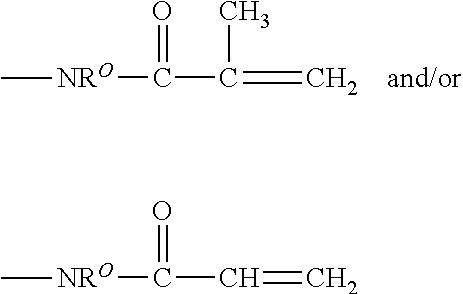
in which R° is hydrogen or C1-C10-alkyl.
in which Luminescence % T is defined according to ISO 18369-3 (section 4.6.1.2)
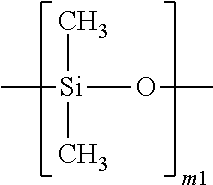
in which m1 is an integer of from 3 to 10, preferably from 3 to 8, more preferably from 3 to 5.
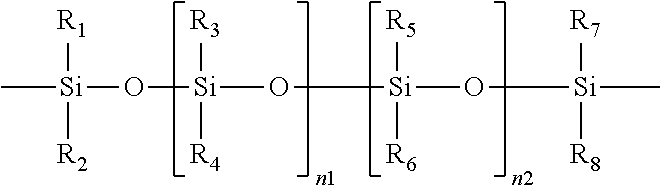
in which n1 and n2 independently of each other are an integer of from 0 to 500 and (n1+n2) is from 10 to 500, R1, R2, R3, R4, R5, R6, R7, and R8 independently of one another, are C1-C10 alkyl, C1-C4 alkyl- or C1-C4-alkoxy-substituted phenyl, C1-C10 fluoroalkyl, C1-C10 fluoroether, C6-C18 aryl radical, or -alk-(OC2H4)n3—OR° (in which alk is C1-C6-alkylene divalent radical, R° is H or C1-C10 alkyl and n3 is an integer from 1 to 10).

in which R1 is hydrogen, methyl or ethyl group.
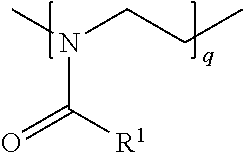
in which R1 is hydrogen, methyl or ethyl group, and q is an integer from 3 to 500 and is obtained in a ring-opening polymerization.

in which T1 and T2 are a direct bond connecting to one mono-valent radical.
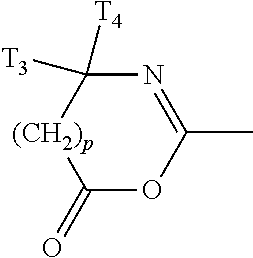
in which p is 0 or 1; T3 and T4 independently of each other is C1-C8 alkyl (preferably methyl).
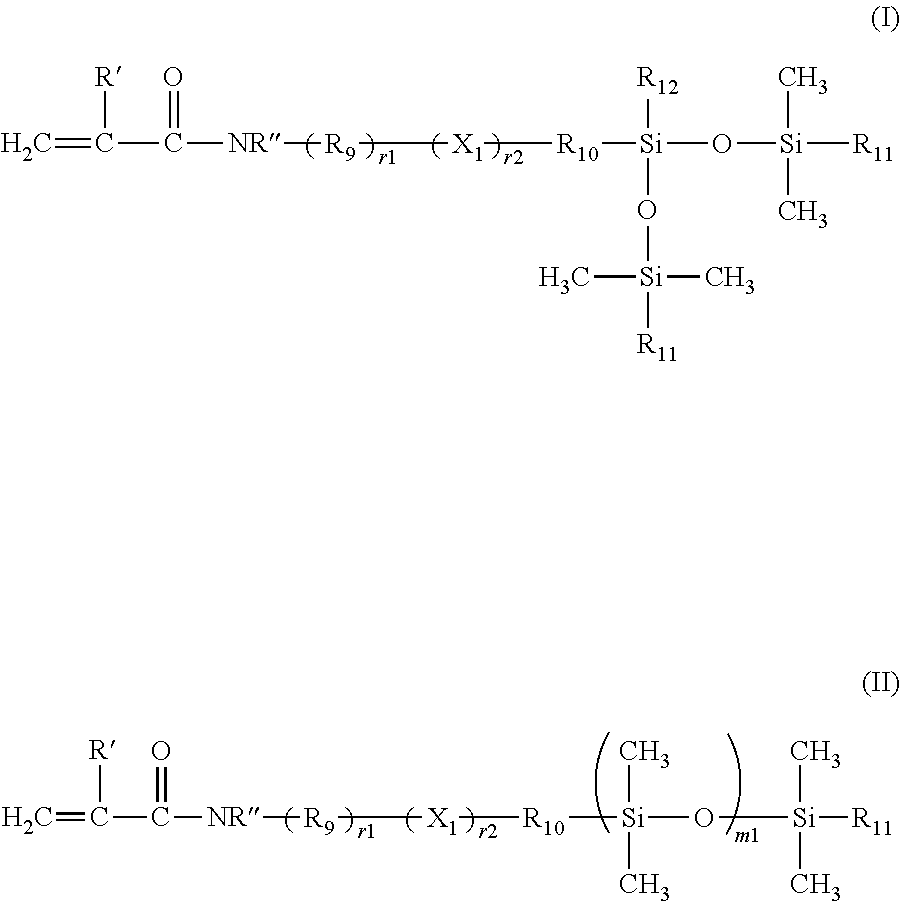
in which R′ is hydrogen or methyl, R″, R11 and R12 independent of one another are C1-C6 alkyl (preferably methyl), r1 and r2 independent of each other are integer of 0 or 1, m1 is an integer of 3 to 10 (preferably 3 to 8, more preferably 3 to 5), R9 and R10 independent of each other are a substituted or unsubstituted C1-C10 alkylene divalent group, X1 is a linkage of
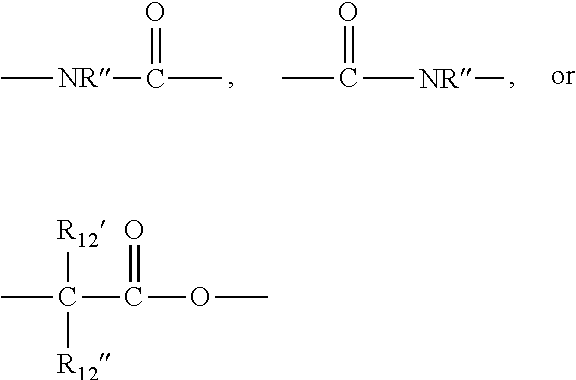
in which R″ is as defined above and R12″ and R12′ independent of each other are C1-C6 alkyl (preferably methyl).

in which R13 is an alkylene divalent group of —CH2CH2—, —CH2CH2CH2—, —CH2CH2CH2CH2—,
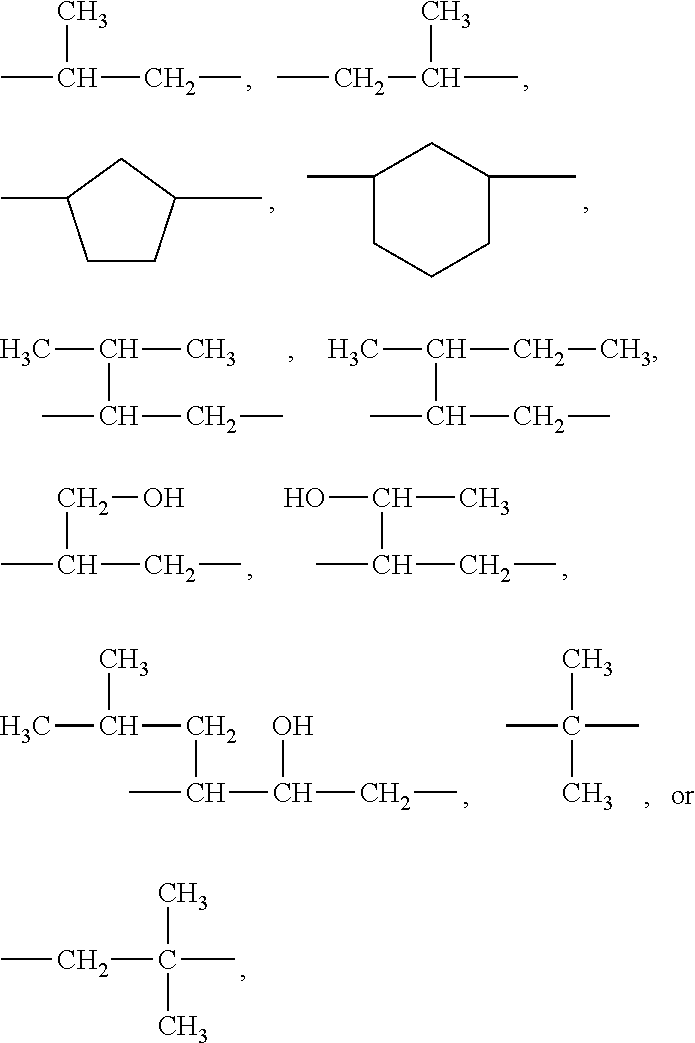
R14 is a divalent alkylene radical of —CH2CH2— or —CH2CH2CH2—, and R15 is a divalent alkylene radical of
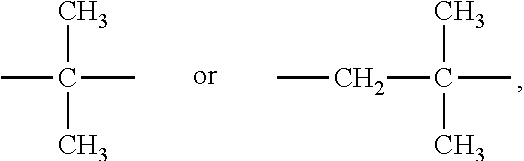
R″, R12 and R11 independent of one another are C1-C4 alkyl (preferably methyl), and m2 is an integer of from 3 to 5.
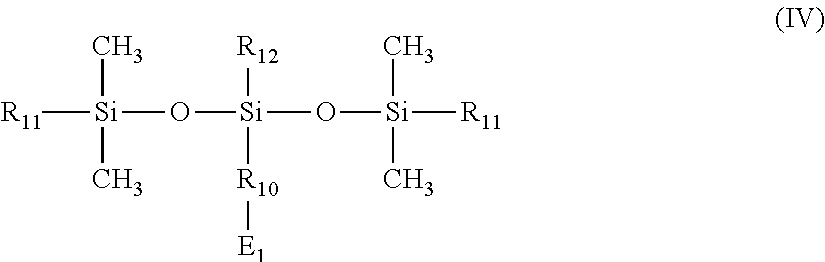
In which R12, R10 and R11 are as defined above and E1 is amino (—NH2), carboxyl (—COOH) or hydroxyl group (—OH), by reacting it with N-hydroxysuccinimide ester of (meth)acrylic acid, (meth)acrylic acid halide (chloride or bromide), (meth)acrylic acid anhydride, (meth)acrylic acid, a NH2-containing (meth)acrylamide, a carboxyl-containing (meth)acrylamide, or an azlactone-containing vinylic monomer (e.g., 2-vinyl-4,4-dimethyl-1,3-oxazolin-5-one, 2-isopropenyl-4,4-dimethyl-1,3-oxazolin-5-one, 2-vinyl-4-methyl-4-ethyl-1,3-oxazolin-5-one, 2-isopropenyl-4-methyl-4-butyl-1,3-oxazolin-5-one, 2-vinyl-4,4-dibutyl-1,3-oxazolin-5-one, 2-isopropenyl-4-methyl-4-dodecyl-1,3-oxazolin-5-one, 2-isopropenyl-4,4-diphenyl-1,3-oxazolin-5-one, 2-isopropenyl-4,4-pentamethylene-1,3-oxazolin-5-one, 2-isopropenyl-4,4-tetramethylene-1,3-oxazolin-5-one, 2-vinyl-4,4-diethyl-1,3-oxazolin-5-one, 2-vinyl-4-methyl-4-nonyl-1,3-oxazolin-5-one, 2-isopropenyl-4-methyl-4-phenyl-1,3-oxazolin-5-one, 2-isopropenyl-4-methyl-4-benzyl-1,3-oxazolin-5-one, 2-vinyl-4,4-pentamethylene-1,3-oxazolin-5-one, and 2-vinyl-4,4-dimethyl-1,3-oxazolin-6-one), in a coupling reaction, to obtain an N-substituted (meth)acrylamide. For obtaining N,N-substituted (meth)acrylamide, the resultant N-substituted (meth)acrylamide is further reacted with a C1-C6 alkyl halide according to a process described in U.S. Pat. No. 4,835,312 (herein incorporated by reference in its entirety).

reacts with amino group (—NHR°), a carboxyl, a hydroxyl, or thiol to form a linkage (T1T2N—CH2-CH(OH)—CH2-E- with E=NR°, COO, O, or S) at an temperature of from about 40° C. to 140° C.
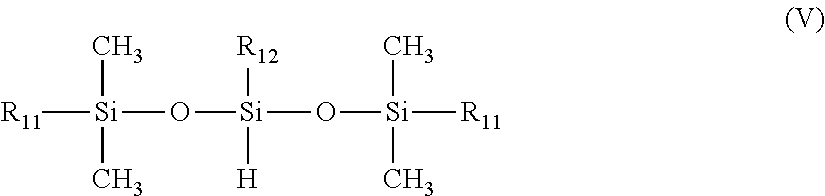
in which R12 and R11 are as defined above, by reacting it with an ene-containing monomer having an amino, carboxyl or hydroxyl group, in a platinum-catalyzed hydrosilylation reaction as known to a person skilled in the art.
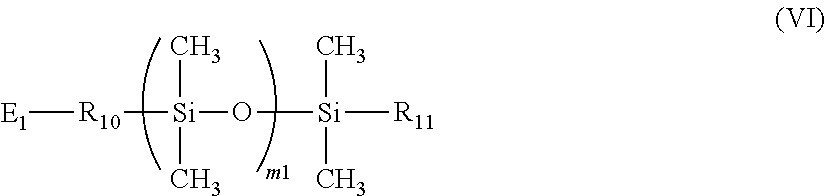
In which R11, R10, and m1 are as defined above and E1 is amino (—NH2), carboxyl (—COOH) or hydroxyl group (—OH), by first reacting it with N-hydroxysuccinimide ester of (meth)acrylic acid, (meth)acrylic acid halide (chloride or bromide), (meth)acrylic acid anhydride, (meth)acrylic acid, a NH2-containing (meth)acrylamide, a carboxyl-containing (meth)acrylamide, or an azlactone-containing vinylic monomer (e.g., 2-vinyl-4,4-dimethyl-1,3-oxazolin-5-one, 2-isopropenyl-4,4-dimethyl-1,3-oxazolin-5-one, 2-vinyl-4-methyl-4-ethyl-1,3-oxazolin-5-one, 2-isopropenyl-4-methyl-4-butyl-1,3-oxazolin-5-one, 2-vinyl-4,4-dibutyl-1,3-oxazolin-5-one, 2-isopropenyl-4-methyl-4-dodecyl-1,3-oxazolin-5-one, 2-isopropenyl-4,4-diphenyl-1,3-oxazolin-5-one, 2-isopropenyl-4,4-pentamethylene-1,3-oxazolin-5-one, 2-isopropenyl-4,4-tetramethylene-1,3-oxazolin-5-one, 2-vinyl-4,4-diethyl-1,3-oxazolin-5-one, 2-vinyl-4-methyl-4-nonyl-1,3-oxazolin-5-one, 2-isopropenyl-4-methyl-4-phenyl-1,3-oxazolin-5-one, 2-isopropenyl-4-methyl-4-benzyl-1,3-oxazolin-5-one, 2-vinyl-4,4-pentamethylene-1,3-oxazolin-5-one, and 2-vinyl-4,4-dimethyl-1,3-oxazolin-6-one), in a coupling reaction well known to a person skilled in the art (as described above), to obtain mono-N-substituted (meth)acrylamido-terminated oligo-dimethylsiloxane vinylic monomer. Mono-N,N-substituted (meth)acrylamide-terminated oligo-dimethylsiloxane vinylic monomer can be obtained by reacting the resultant mono-N-substituted (meth)acrylamido-terminated oligo-dimethylsiloxane vinylic monomer with alkyl halide (as described above).

in which E and E′ independent of each other are methacryloxy, (meth)acrylamide, or N—C1-C6 alkyl(meth)acrylamido group, R9, R10, X1, r1, r2 are as defined above, n1 and n2 independently of each other are an integer of from 0 to 200 and (n1+n2) is from 10 to 200, and R1, R2, R3, R4, R5, R6, R7, and R8 independently of one another, are C1-C10 alkyl, C1-C4 alkyl- or C1-C4-alkoxy-substituted phenyl, C1-C10 fluoroalkyl, C1-C10 fluoroether, C6-C18 aryl radical, -alk-(OC2H4)n3—OR° (in which alk is C1-C6-alkylene divalent radical, R° is H or C1-C6 alkyl and n3 is an integer from 1 to 10), or a linear hydrophilic polymer chain. More preferably, R1 to R8 are methyl; or R1 to R4 and R6 to R8 are methyl whereas R5 is -alk-(OC2H4)n3—OR° in which alk is C1-C6-alkylene divalent radical, R° is H or C1-C10 alkyl and n3 is an integer from 1 to 10.
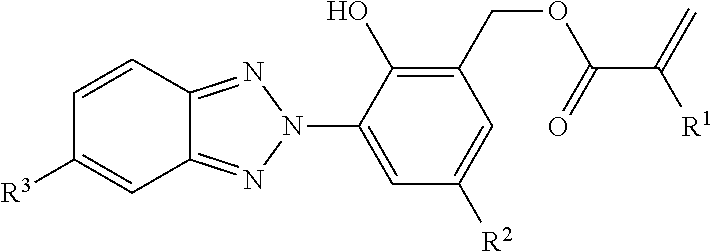
wherein R1═H, CH3, CH2CH3, or CH2OH; R2═C1-C4 alkyl or preferably C1-C4 alkoxy; and R3═H, CH3, CH3O, F, Cl, Br, I, or CF3. Preparation of those UV/HEVL absorbers of the above formula are described in U.S. Pat. No. 8,153,703 and U.S. Pat. No. 8,232,326, which are herein incorporated by references in their entireties. Benzotriazole-containing UV-absorbing vinyl monomers can be prepared according to procedures described in U.S. Pat. Nos. 3,299,173, 4,612,358, 4,716,234, 4,528,311 (herein incorporated by reference in their entireties) or can be obtained from commercial suppliers.
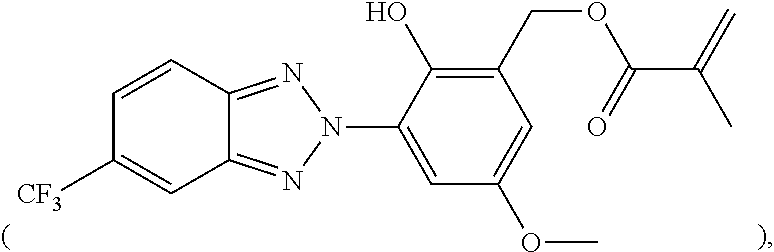
or 3-(5-chloro-2H-benzo[d][1,2,3]triazol-2-yl)-2-hydroxy-5-methoxybenzyl methacrylate
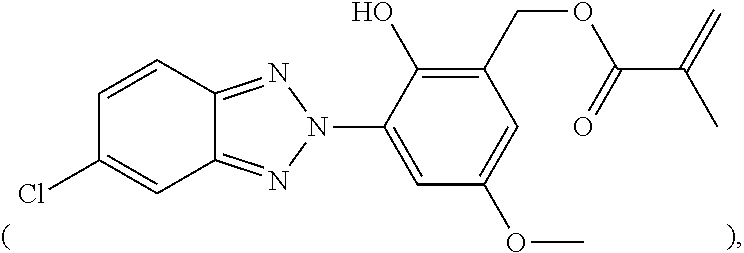
or 2-[2′-Hydroxy-3′-tert-butyl-5′-(3′-acryloyloxypropoxy)phenyl]-5-trifluoromethyl-2H-benzotriazole
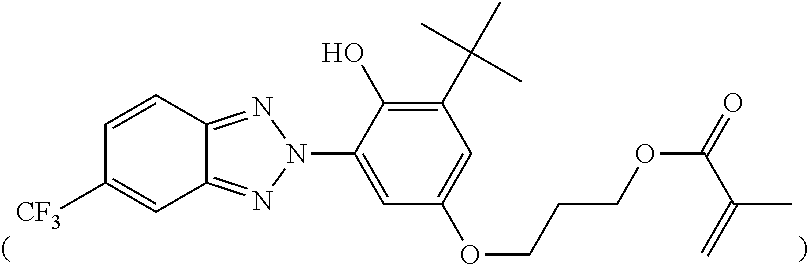
capable of absorbing a light in a region between 400 nm and 440 nm, preferably present in an amount sufficient to impart resultant UV-absorbing silicone hydrogel contact lens a characteristics of having a transmittance of about 50% or less at 420 nm. Even more preferably, the monomer of lens-forming materials comprises a mixture of Norbloc 7966 (2-(2′-hydroxy-5′-methacryloxyethylphenyl)-2H-benzotriazole, i.e
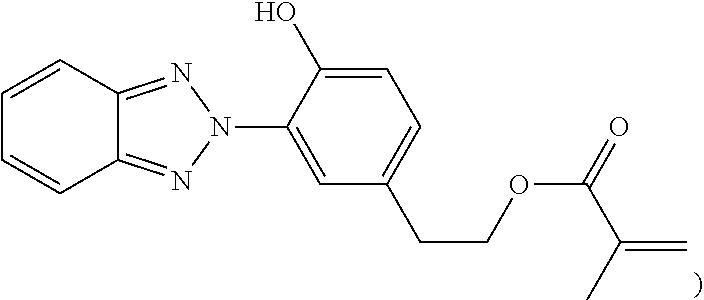
with 2-hydroxy-5-methoxy-3-(5-(trifluoromethyl)-2H-benzo[d][1,2,3]triazol-2-yl)benzyl methacrylate
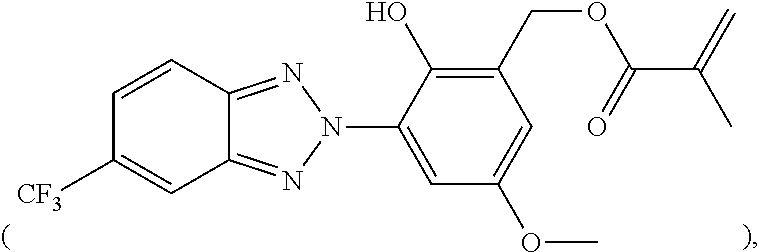
or 3-(5-chloro-2H-benzo[d][1,2,3]triazol-2-yl)-2-hydroxy-5-methoxybenzyl methacrylate

or 2-[2′-Hydroxy-3′-tert-butyl-5′-(3′-acryloyloxypropoxy)phenyl]-5-trifluoromethyl-2H-benzotriazole
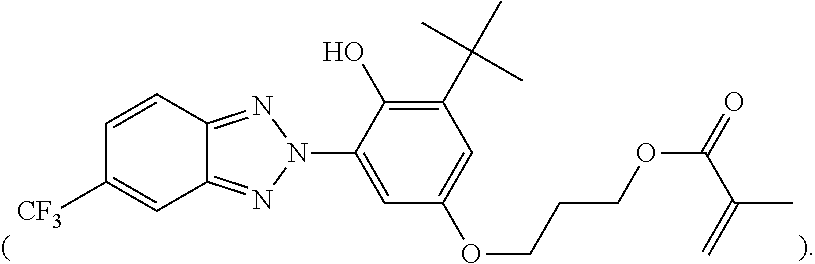
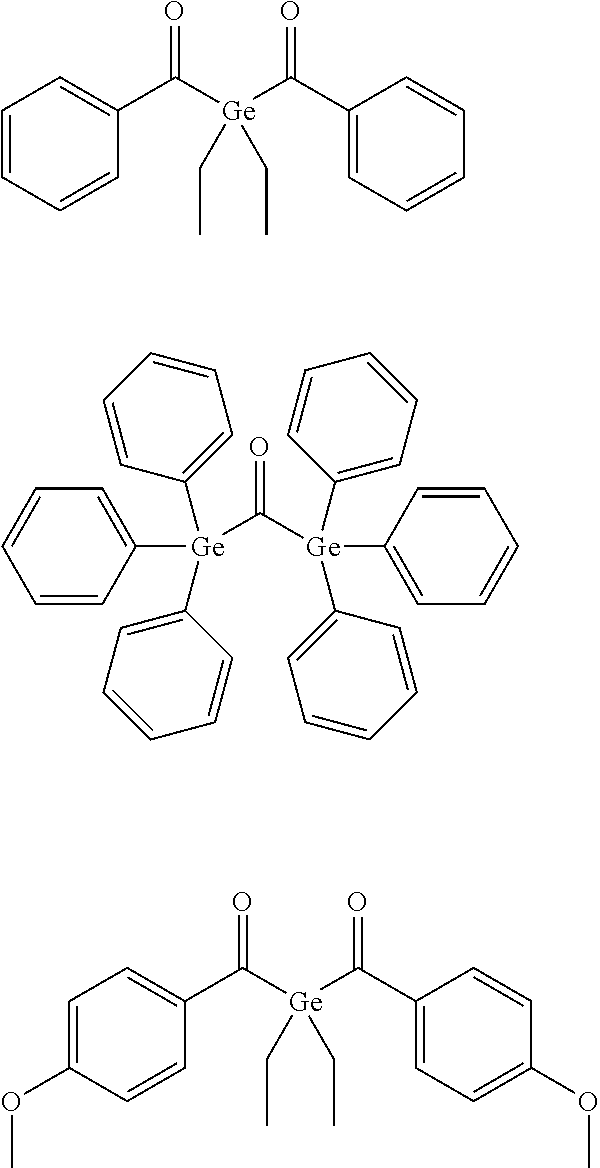
Dk app =Jt/(P oxygen)
where
in which t is the thickness of the test lens (i.e., the reference lens too), and n is the number of the reference lenses measured. Plot the residual oxygen resistance value, Rr vs. t data and fit a curve of the form Y=a+bX where, for the jth lens, Yj=(ΔP/J)j and X=tj. The residual oxygen resistance, Rr is equal to a.
Dk c =t/[(t/Dk a)−R r] (2)
Dk a _ std =t std/[(t std /Dk a)+R r _ std] (3)
Ion Permeability Measurements.
in which Luminescence % T is the weighted average % transmission between 380 and 780 according to ISO 18369.
Photo-rheology:
Intensity Gradient Calculation:
| TABLE 1 | ||
| Formulation | ||
| A | B | C | D | E | F | G | ||
| L-PEG 2000 | 0.15% |
| CE-PDMS | 31.85% |
| DMA | 23.24% |
| Tris-Am | 20.71% | 19.51% |
| WL-1 | — | — | — | — | — | — | 1.2% |
| 1-propanol | 23.07% | 23.07% | 23.82% | 23.57% | 23.32% | 23.07% | 23.57% |
| Darocur 1173 | 1% | — | — | — | — | — | — |
| TPO | — | 1% | — | — | — | — | — |
| Ge-PI | — | — | 0.25% | 0.5% | 0.75% | 1.0% | 0.5% |
| L-PEG 2000: N-(carbonyl-methoxypolyethylene glycol-2000)-1,2-disteaoyl-sn-glycero-3-phosphoethanolamin, sodium salt; | |||||||
| CE-PDMS: chain-extended polydimethylsiloxane crosslinker prepared in Example 2; | |||||||
| DMA: N,N-dimethylacrylamide; | |||||||
| TRIS-Am: N-[tris(trimethylsiloxy)-silylpropyl]acrylamide; | |||||||
| WL-1: 2-hydroxy-5-methoxy-3-(5-(trifluoromethyl)-2H-benzo[d][1,2,3]triazol-2-yl)benzyl methacrylate; | |||||||
| Darocur 1173: 2-Hydroxy-2-methylpropiophenone; | |||||||
| TPO: Diphenyl(2,4,6-trimethylbenzoyl)phosphine oxide; | |||||||
| Ge-PI: Bis(4-methoxybenzoyl)diethylgermanium | |||||||
| TABLE 2 | ||
| Lens Formulation | ||
| A | B | C | D | E | F | G | ||
| Long-pass Cutoff filter (nm) | 330 | 380 | 420 |
| Intensity (mW/cm2) | 16 | 5 | 12.5 |
| Cure time (s) | 11 | 10 | 16 | 12 | 12 | 10 | 16 |
| G′ (kPa) | 110 | 113 | 106 | 92 | 80 | 75 | 97 |
| TABLE 3 | |||||||||
| 5A | 5B | 5C | 5D | 5E | 5F | 5G | 5H | ||
| Carbazole | — | — | — | — | 30 | — | 60 | — |
| violet | ppm | ppm | ||||||
| CuP tint (%) | 0.1 | — | 0.1 | 0.1 | 0.1 | 0.10 | 0.15 | 0.1 |
| DMPC (%) | 0.76 |
| LPEG2000 | 0.61 |
| (%) |
| Norbloc (%) | — | 1 | 1 | 1 | 0.3 | 0.1 | 0.55 | 0.542 |
| WL-1 (%) | — | — | — | — | — | — | 0.25 | 0.246 |
| WL-2 (%) | — | — | — | — | — | 1.0 | — | — |
| BZT (%) | — | — | — | — | 0.8 | — | — | — |
| CE PDMS | 31.83 | 31.83 | 31.83 | 31.83 | 31.83 | 31.83 | 31.83 | 31.37 |
| (%) | ||||||||
| Tris | 20.71 | 19.71 | 19.71 | 19.71 | 19.61 | 19.61 | 19.71 | 19.62 |
| acrylamide | ||||||||
| (%) | ||||||||
| Darocur | 1.0 | — | — | — | — | — | — | — |
| 1173 (%) | ||||||||
| TPO (%) | — | 0.75 | — | — | — | — | — | — |
| Ge-PI (%) | — | — | 0.36 | 0.6 | 0.6 | 0.6 | 0.6 | 0.6 |
| 1-propanol | 21.75 | 22.10 | 23.82 | 23.07 | 23.57 | 23.32 | 23.07 | 23.20 |
| (%) | ||||||||
| DMA (%) | 23.24 | 23.24 | 23.24 | 23.24 | 23.24 | 23.24 | 23.24 | 22.90 |
| DMPC: 1,2-Dimyristoyl-sn-glycero-3-phophocholine | ||||||||
| BZT: 2-(2′-hydroxy-3′-tert-butyl-5′[3″-(4-vinylbenzyloxy)propoxyphenyl]-5-methoxy-2H-benzotriazole | ||||||||
| WL-2: 3-(5-fluoro-2H-benzo[d][1,2,3]triazol-2-yl)-2-hydroxy-5-methoxybenzyl methacrylate | ||||||||
| Carbazole violet: pigment added to adjust final lens color | ||||||||
| CuP tint: 5% copper phthalocyanine blue pigment dispersion in tris(trimethylsiloxy)silylpropylmethacrylate, TRIS | ||||||||
| TABLE 4 | |||||||||
| 5A | 5B | 5C | 5D | 5E | 5F | 5G | 5H | ||
| Cure Lamp | Hamamatsu | 405 nm | 405 nm | 445 nm | 445 nm | 445 nm | 445 nm | 445 nm |
| LED | LED | LED | LED | LED | LED | LED | ||
| Total Intensity | 50 | 30 | 25 | 54 | 54 | 54 | 54 | 54 |
| (mW/cm2) | ||||||||
| Cure Time (s) | 25 | 25 | 25 | 25 | 25 | 25 | 25 | 25 |
| FC Mold | glass | L-BBH1 | L-BBH1 | ZnSe | ZnSe | ZnSe | ZnSe | ZnSe |
| Diameter (mm) | 14.13 | 14.05 | 14.23 | 14.12 | 14.28 | 14.49 | 14.31 | 14.13 |
| Water (%) | 31.48 | — | 32.11 | 31.4 | 32.05 | 35.64 | 32.6 | 32.77 |
| IP | 6.9 | 6.6 | 6.7 | 7.0 | 7.3 | 11.2 | 8.3 | 8.4 |
| Dkc | 131 | 127 | 124 | 127 | 122 | 116 | 125 | 123 |
| Modulus (mPa) | 0.72 | 0.63 | 0.67 | 0.64 | 0.63 | 0.64 | 0.63 | 0.62 |
| UVA % T | 93 | — | 4.9 | 4.7 | 0.08 | 0.70 | 2.5 | 3.7 |
| UVB % T | 85 | — | 0.056 | 0.057 | 0.028 | 0.14 | 0.048 | 0.22 |
| Violet % T | 98 | — | 90 | 91 | 47 | 47 | 59 | 64 |
| L* | 81.9 | — | — | — | 81.0 | 83.0 | 80.8 | 83.3 |
| a* | −2.2 | — | — | — | −4.3 | −4.7 | −4.3 | −6.9 |
| b* | −3.7 | — | — | — | 1.7 | 2.7 | 4.1 | 6.4 |
| TABLE 5 | ||||
| 8A | 8B | 8C | ||
| CuP tint (%) | — | 0.1 | — | ||
| DMPC (%) | — | 0.76 | 0.76 | ||
| LPEG2000 (%) | — | 0.61 | 0.61 | ||
| Norbloc (%) | 1 | 1 | 1 | ||
| Betacon (%) | 25.92 | — | — | ||
| CE PDMS | — | 31.83 | 31.83 | ||
| TRIS (%) | 18.25 | — | — | ||
| Tris acrylamide (%) | 19.71 | 19.71 | |||
| TPO | — | — | 0.6 | ||
| Ge-PI (%) | 0.5 | 0.6 | — | ||
| Ethanol (%) | 25.45 | — | — | ||
| 1-Propanol | — | 22.15 | 22.25 | ||
| DMA (%) | 28.88 | 23.25 | 23.24 | ||
| TRIS = tris(trimethylsiloxy)silylpropylmethacrylate | |||||
| Betacon = α,ω-methacryloyl functionalized PDMS-perfluoroether macromer (see example B from patent 5,760,100) | |||||
| TABLE 6 | |||
| 8A | 8B | ||
| Cure Lamp | 445 nm LED | InstantFit LED | ||
| Total Intensity (mW/cm2) | 6.6 | 0.53 | ||
| Cure Time (s) | 240 | 2100 | ||
| Mold | Polypropylene | Polypropylene | ||
| Diameter (mm) | 14.08 | 14.68 | ||
| Water (%) | 32.1 | 30.4 | ||
| IP | 2.0 | 2.9 | ||
| Dkc | 104 | 130 | ||
| Modulus (mPa) | 0.94 | 0.82 | ||
| UVA % T | — | 4.6 | ||
| UVB % T | — | 0.061 | ||
| TABLE 7 | |||||
| Formulation | 8C | 5B | 5C | ||
| Initiator | TPO | TPO | Ge-PI | ||
| Initiator concentration (%) | 0.6 | 0.72 | 0.36 | ||
| Intensity Gradient (%) | 11 | 13 | 15 | ||
| Ell (mW/cm2) | 3.0 | 3.6 | 3.7 | ||
| Cure Time (s) | 25 | 25 | 25 | ||
Claims (17)
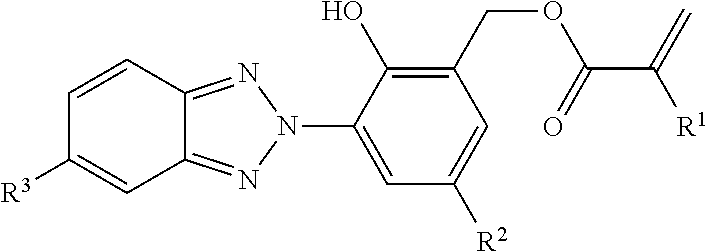


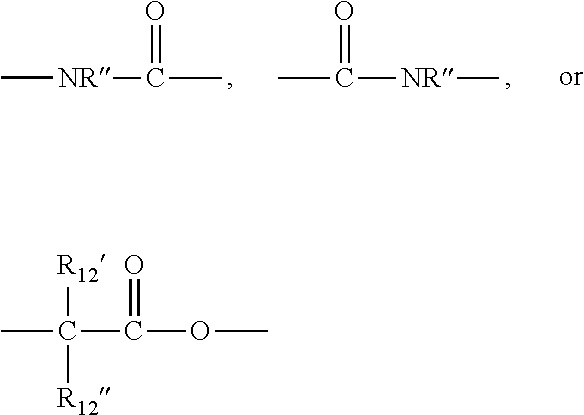

Priority Applications (10)
| Application Number | Priority Date | Filing Date | Title |
|---|---|---|---|
| US14/494,186 US9315669B2 (en) | 2013-09-30 | 2014-09-23 | Method for making UV-absorbing ophthalmic lenses |
| PCT/US2014/057442 WO2015048279A1 (en) | 2013-09-30 | 2014-09-25 | Silicone hydrogel lenses with relatively-long thermal stability |
| CN201480051257.8A CN105555816B (en) | 2013-09-30 | 2014-09-25 | Silicone hydrogel lenses with relatively long thermal stability |
| SG11201601189RA SG11201601189RA (en) | 2013-09-30 | 2014-09-25 | Silicone hydrogel lenses with relatively-long thermal stability |
| MYPI2016700420A MY180745A (en) | 2013-09-30 | 2014-09-25 | Silicone hydrogel lenses with relatively-long thermal stability |
| US14/496,492 US9568645B2 (en) | 2013-09-30 | 2014-09-25 | Silicone hydrogel lenses with relatively-long thermal stability |
| JP2016518709A JP6239099B2 (en) | 2013-09-30 | 2014-09-25 | Silicone hydrogel lenses with relatively long-term thermal stability |
| HUE14784570A HUE043628T2 (en) | 2013-09-30 | 2014-09-25 | Silicone hydrogel lenses with relatively-long thermal stability |
| CA2921303A CA2921303C (en) | 2013-09-30 | 2014-09-25 | Silicone hydrogel lenses with relatively-long thermal stability |
| EP14784570.5A EP3052535B1 (en) | 2013-09-30 | 2014-09-25 | Silicone hydrogel lenses with relatively-long thermal stability |
Applications Claiming Priority (2)
| Application Number | Priority Date | Filing Date | Title |
|---|---|---|---|
| US201361884181P | 2013-09-30 | 2013-09-30 | |
| US14/494,186 US9315669B2 (en) | 2013-09-30 | 2014-09-23 | Method for making UV-absorbing ophthalmic lenses |
Related Child Applications (1)
| Application Number | Title | Priority Date | Filing Date |
|---|---|---|---|
| US14/496,492 Continuation-In-Part US9568645B2 (en) | 2013-09-30 | 2014-09-25 | Silicone hydrogel lenses with relatively-long thermal stability |
Publications (2)
| Publication Number | Publication Date |
|---|---|
| US20150094393A1 US20150094393A1 (en) | 2015-04-02 |
| US9315669B2 true US9315669B2 (en) | 2016-04-19 |
Family
ID=51662349
Family Applications (1)
| Application Number | Title | Priority Date | Filing Date |
|---|---|---|---|
| US14/494,186 Active US9315669B2 (en) | 2013-09-30 | 2014-09-23 | Method for making UV-absorbing ophthalmic lenses |
Country Status (7)
| Country | Link |
|---|---|
| US (1) | US9315669B2 (en) |
| EP (1) | EP3052534B1 (en) |
| CN (1) | CN105579480B (en) |
| HU (1) | HUE045140T2 (en) |
| MY (1) | MY179469A (en) |
| SG (1) | SG11201601187VA (en) |
| WO (1) | WO2015048035A1 (en) |
Cited By (42)
| Publication number | Priority date | Publication date | Assignee | Title |
|---|---|---|---|---|
| US9954287B2 (en) | 2014-11-20 | 2018-04-24 | At&T Intellectual Property I, L.P. | Apparatus for converting wireless signals and electromagnetic waves and methods thereof |
| US9981435B2 (en) | 2014-12-17 | 2018-05-29 | Novartis Ag | Reusable lens molds and methods of use thereof |
| US10324311B2 (en) * | 2015-06-02 | 2019-06-18 | Novartis Ag | Visible-light photoinitiators and uses thereof |
| US10328645B2 (en) | 2015-12-17 | 2019-06-25 | Novartis Ag | Reusable lens molds and methods of use thereof |
| WO2019234590A1 (en) | 2018-06-04 | 2019-12-12 | Alcon Inc. | Method for making silicone hydrogel contact lenses |
| WO2019234593A1 (en) | 2018-06-04 | 2019-12-12 | Alcon Inc. | Method for producing silicone hydrogel contact lenses |
| WO2019234591A1 (en) | 2018-06-04 | 2019-12-12 | Alcon Inc. | Method for producing silicone hydrogel contact lenses |
| WO2020240440A1 (en) | 2019-05-28 | 2020-12-03 | Alcon Inc. | Method for making opaque colored silicone hydrogel contact lenses |
| US10935695B2 (en) | 2018-03-02 | 2021-03-02 | Johnson & Johnson Vision Care, Inc. | Polymerizable absorbers of UV and high energy visible light |
| WO2021186380A1 (en) | 2020-03-19 | 2021-09-23 | Alcon Inc. | Method for producing embedded or hybrid hydrogel contact lenses |
| WO2021224855A1 (en) | 2020-05-07 | 2021-11-11 | Alcon Inc. | Method for producing silicone hydrogel contact lenses |
| WO2021245551A1 (en) | 2020-06-02 | 2021-12-09 | Alcon Inc. | Method for making photochromic contact lenses |
| WO2022090967A1 (en) | 2020-10-28 | 2022-05-05 | Alcon Inc. | Method for making photochromic contact lenses |
| WO2022097049A1 (en) | 2020-11-04 | 2022-05-12 | Alcon Inc. | Method for making photochromic contact lenses |
| WO2022097048A1 (en) | 2020-11-04 | 2022-05-12 | Alcon Inc. | Method for making photochromic contact lenses |
| US11346982B2 (en) | 2017-06-07 | 2022-05-31 | Alcon Inc. | Silicone hydrogel contact lenses |
| WO2022189940A1 (en) | 2021-03-08 | 2022-09-15 | Alcon Inc. | Method for making photofunctional contact lenses |
| WO2022208450A1 (en) | 2021-04-01 | 2022-10-06 | Alcon Inc. | Method for making photochromic contact lenses |
| US11543683B2 (en) | 2019-08-30 | 2023-01-03 | Johnson & Johnson Vision Care, Inc. | Multifocal contact lens displaying improved vision attributes |
| WO2023209631A1 (en) | 2022-04-28 | 2023-11-02 | Alcon Inc. | Method for making uv and hevl-absorbing ophthalmic lenses |
| WO2023209630A1 (en) | 2022-04-29 | 2023-11-02 | Alcon Inc. | Method for making silicone hydrogel contact lenses |
| WO2023228054A1 (en) | 2022-05-23 | 2023-11-30 | Alcon Inc. | Method for making hevl-filtering contact lenses |
| WO2023228055A1 (en) | 2022-05-23 | 2023-11-30 | Alcon Inc. | Uv/hevl-filtering contact lenses |
| WO2024038390A1 (en) | 2022-08-17 | 2024-02-22 | Alcon Inc. | A contact lens with a hydrogel coating thereon |
| US11958824B2 (en) | 2019-06-28 | 2024-04-16 | Johnson & Johnson Vision Care, Inc. | Photostable mimics of macular pigment |
| US11993037B1 (en) | 2018-03-02 | 2024-05-28 | Johnson & Johnson Vision Care, Inc. | Contact lens displaying improved vision attributes |
| WO2024161344A1 (en) | 2023-02-02 | 2024-08-08 | Alcon Inc. | Water gradient silicone hydrogel contact lenses |
| WO2024180452A1 (en) | 2023-02-27 | 2024-09-06 | Alcon Inc. | A method for producing wettable silicone hydrogel contact lenses |
| WO2024183985A1 (en) * | 2023-03-08 | 2024-09-12 | Bausch + Lomb Ireland Limited | Contact lens containing deprotected ultraviolet blockers |
| WO2024194826A1 (en) | 2023-03-22 | 2024-09-26 | Alcon Inc. | Method for making embedded hydrogel contact lenses |
| WO2024236526A2 (en) | 2023-05-18 | 2024-11-21 | Alcon Inc. | High-energy-violet-absorbing vinylic monomers |
| WO2024236524A1 (en) | 2023-05-18 | 2024-11-21 | Alcon Inc. | Uv/hevl-filtering silicone hydrogel contact lenses |
| WO2024241239A1 (en) | 2023-05-25 | 2024-11-28 | Alcon Inc. | Coated silicone hydrogel contact lenses and method for making the same |
| WO2024246822A1 (en) | 2023-06-01 | 2024-12-05 | Alcon Inc. | Method for making embedded silicone hydrogel contact lenses |
| WO2025032504A2 (en) | 2023-08-07 | 2025-02-13 | Alcon Inc. | Uv/hevl-filtering silicone hydrogel contact lenses |
| WO2025243219A1 (en) | 2024-05-22 | 2025-11-27 | Alcon Inc. | Reactive dyes and their use in contact lenses |
| WO2025243221A1 (en) | 2024-05-22 | 2025-11-27 | Alcon Inc. | Reactive hevl-absorbing dyes |
| WO2025243218A1 (en) | 2024-05-22 | 2025-11-27 | Alcon Inc. | Method for making centrally colored contact lenses |
| US12486348B2 (en) | 2019-08-30 | 2025-12-02 | Johnson & Johnson Vision Care, Inc. | Contact lens displaying improved vision attributes |
| US12486403B2 (en) | 2018-03-02 | 2025-12-02 | Johnson & Johnson Vision Care, Inc. | Polymerizable absorbers of UV and high energy visible light |
| US12509428B2 (en) | 2019-06-28 | 2025-12-30 | Johnson & Johnson Vision Care, Inc. | Polymerizable fused tricyclic compounds as absorbers of UV and visible light |
| US12534623B2 (en) | 2018-03-02 | 2026-01-27 | Johnson & Johnson Vision Care, Inc. | Contact lens with improved tear film optical quality |
Families Citing this family (17)
| Publication number | Priority date | Publication date | Assignee | Title |
|---|---|---|---|---|
| US20060090658A1 (en) | 2004-11-01 | 2006-05-04 | Michael Phillips | Tissue marking system |
| US9568645B2 (en) | 2013-09-30 | 2017-02-14 | Novartis Ag | Silicone hydrogel lenses with relatively-long thermal stability |
| EP3140332B1 (en) * | 2014-05-07 | 2020-02-12 | Tubitak | A formulation and lens manufacturing process for the production of intraocular lens (iol) |
| US9555151B2 (en) | 2014-10-03 | 2017-01-31 | Soft Health Technologies, Llc | Systems and methods for incontinence control |
| EP3233449B1 (en) | 2014-12-17 | 2019-07-24 | Novartis AG | Reusable lens molds and methods of use thereof |
| WO2016205657A1 (en) * | 2015-06-19 | 2016-12-22 | Vector Surgical, Llc | Ink for marking a tissue specimen |
| WO2017015614A1 (en) * | 2015-07-23 | 2017-01-26 | The University Of North Carolina At Chapel Hill | Solvent-free supersoft and superelastic materials |
| CN109135586A (en) * | 2017-06-28 | 2019-01-04 | 瑞洲树脂(东莞)有限公司 | A kind of blue ray radiation preventing solidification potting compound and a kind of anti-blue light eyeglass and a kind of anti-blue light camera lens and blue ray radiation preventing solidify optics plate |
| US11067831B2 (en) * | 2017-10-30 | 2021-07-20 | Coopervision International Limited | Methods of manufacturing coated contact lenses |
| US20220340760A1 (en) * | 2018-03-02 | 2022-10-27 | Johnson & Johnson Vision Care, Inc. | Polymerizable absorbers of uv and high energy visible light |
| US20230085695A1 (en) * | 2018-03-02 | 2023-03-23 | Johnson & Johnson Vision Care, Inc. | Contact lens with improved vision break-up time |
| US20220187628A1 (en) * | 2019-02-28 | 2022-06-16 | Hue.Ai, LLC | Optical device with transmission inhibition plateau in blue spectral range |
| US11221499B2 (en) * | 2019-03-29 | 2022-01-11 | Johnson & Johnson Vision Care, Inc. | Invertible lens and method of design |
| JP7509036B2 (en) * | 2019-08-27 | 2024-07-02 | 東レ株式会社 | Method for manufacturing a medical device |
| US20220342122A1 (en) * | 2021-04-22 | 2022-10-27 | Tianchen Innovative Materials Technology Co., Ltd | Optical material, optical product, and manufacturing method thereof |
| CN113717334A (en) * | 2021-07-06 | 2021-11-30 | 吉林爱惠瞳医用科技有限公司 | High-oxygen-transmission-rate corneal contact lens and preparation method thereof |
| CN118126331A (en) * | 2024-04-30 | 2024-06-04 | 杭州崇耀科技发展有限公司 | A monomer of UV release agent and preparation method thereof |
Citations (54)
| Publication number | Priority date | Publication date | Assignee | Title |
|---|---|---|---|---|
| US3162676A (en) | 1962-06-18 | 1964-12-22 | Nat Starch Chem Corp | Ethylenically unsaturated derivatives of 2, 4-dihydroxybenzophenone |
| US3299173A (en) | 1963-04-15 | 1967-01-17 | Diamond Alkali Co | Unsaturated polyesters prepared from reactable fire-retardant agents |
| US4312575A (en) | 1979-09-18 | 1982-01-26 | Peyman Gholam A | Soft corneal contact lens with tightly cross-linked polymer coating and method of making same |
| US4444711A (en) | 1981-12-21 | 1984-04-24 | Husky Injection Molding Systems Ltd. | Method of operating a two-shot injection-molding machine |
| US4460534A (en) | 1982-09-07 | 1984-07-17 | International Business Machines Corporation | Two-shot injection molding |
| US4528311A (en) | 1983-07-11 | 1985-07-09 | Iolab Corporation | Ultraviolet absorbing polymers comprising 2-hydroxy-5-acrylyloxyphenyl-2H-benzotriazoles |
| US4612358A (en) | 1984-10-27 | 1986-09-16 | Rohm Gmbh | UV-absorbing monomer and polymers thereof |
| US4632844A (en) | 1984-02-04 | 1986-12-30 | Japan Synthetic Rubber Co., Ltd. | Optical product having a thin film on the surface |
| US4716234A (en) | 1986-12-01 | 1987-12-29 | Iolab Corporation | Ultraviolet absorbing polymers comprising 2-(2'-hydroxy-5'-acryloyloxyalkoxyphenyl)-2H-benzotriazole |
| US4835312A (en) | 1981-01-17 | 1989-05-30 | Mitsui Chemicals, Incorporated | Production process of N-substituted amide compounds |
| EP0213622B1 (en) | 1985-08-29 | 1992-04-15 | Sumitomo Electric Industries Limited | Amorphous photovoltaic elements |
| US5508317A (en) | 1993-08-06 | 1996-04-16 | Ciba-Geigy Corporation | Photocrosslinked polymers |
| US5760100A (en) | 1994-09-06 | 1998-06-02 | Ciba Vision Corporation | Extended wear ophthalmic lens |
| US5843346A (en) | 1994-06-30 | 1998-12-01 | Polymer Technology Corporation | Method of cast molding contact lenses |
| US5894002A (en) | 1993-12-13 | 1999-04-13 | Ciba Vision Corporation | Process and apparatus for the manufacture of a contact lens |
| US6039913A (en) | 1998-08-27 | 2000-03-21 | Novartis Ag | Process for the manufacture of an ophthalmic molding |
| US6367929B1 (en) | 1998-03-02 | 2002-04-09 | Johnson & Johnson Vision Care, Inc. | Hydrogel with internal wetting agent |
| US6451871B1 (en) | 1998-11-25 | 2002-09-17 | Novartis Ag | Methods of modifying surface characteristics |
| US6627124B1 (en) | 1997-10-21 | 2003-09-30 | Novartis Ag | Single mould alignment |
| US6719929B2 (en) | 2000-02-04 | 2004-04-13 | Novartis Ag | Method for modifying a surface |
| US6793973B2 (en) | 2000-02-04 | 2004-09-21 | Novartis Ag | Single-dip process for achieving a layer-by-layer-like coating |
| US6800225B1 (en) | 1994-07-14 | 2004-10-05 | Novartis Ag | Process and device for the manufacture of mouldings and mouldings manufactured in accordance with that process |
| US6811805B2 (en) | 2001-05-30 | 2004-11-02 | Novatis Ag | Method for applying a coating |
| US6822016B2 (en) | 2001-09-10 | 2004-11-23 | Johnson & Johnson Vision Care, Inc. | Biomedical devices containing internal wetting agents |
| US6896926B2 (en) | 2002-09-11 | 2005-05-24 | Novartis Ag | Method for applying an LbL coating onto a medical device |
| US7091283B2 (en) | 2000-03-24 | 2006-08-15 | Novartis Ag | Crosslinkable prepolymers from a hydrophilic monomer and a hydrophobic crosslinker |
| US20080015315A1 (en) | 2006-07-12 | 2008-01-17 | Frank Chang | Novel Polymers |
| US7384590B2 (en) | 2002-12-17 | 2008-06-10 | Novartis Ag | System and method for curing polymeric moldings |
| US7387759B2 (en) | 2002-12-17 | 2008-06-17 | Novartis Ag | System and method for curing polymeric moldings having a masking collar |
| US20080143958A1 (en) | 2006-12-13 | 2008-06-19 | Arturo Norberto Medina | Production of ophthalmic devices based on photo-induced step growth polymerization |
| US20080143003A1 (en) | 2006-12-13 | 2008-06-19 | John Christopher Phelan | Actinically curable silicone hydrogel copolymers and uses thereof |
| US20080234457A1 (en) | 2007-03-22 | 2008-09-25 | Zhou Jian S | Silicone-containing prepolymers with dangling hydrophilic polymer chains |
| US20080231798A1 (en) | 2007-03-22 | 2008-09-25 | Zhou Jian S | Prepolymers with dangling polysiloxane-containing polymer chains |
| US20080277814A1 (en) | 2006-09-27 | 2008-11-13 | Ivoclar Vivadent Ag | Polymerizable compositions with acylgermanium compounds |
| US7521519B1 (en) | 2000-03-14 | 2009-04-21 | Novartis Ag | Organic compounds |
| WO2010071691A1 (en) | 2008-12-18 | 2010-06-24 | Novartis Ag | Method for making silicone hydrogel contact lenses |
| US20100249356A1 (en) | 2008-09-30 | 2010-09-30 | Osman Rathore | Ionic silicone hydrogels having improved hydrolytic stability |
| US7858000B2 (en) | 2006-06-08 | 2010-12-28 | Novartis Ag | Method of making silicone hydrogel contact lenses |
| US20110063567A1 (en) | 2009-09-15 | 2011-03-17 | Angelika Maria Domschke | Prepolymers suitable for making ultra-violet absorbing contact lenses |
| US20110134387A1 (en) | 2009-12-08 | 2011-06-09 | Samuel Newton T | Silicone hydrogel lens with a covalently attached coating |
| US20120026457A1 (en) | 2010-07-30 | 2012-02-02 | Yongxing Qiu | Silicone hydrogel lens with a crosslinked hydrophilic coating |
| US20120029111A1 (en) | 2010-07-30 | 2012-02-02 | Frank Chang | Amphiphilic polysiloxane prepolymers and uses thereof |
| US8147897B2 (en) | 2007-02-09 | 2012-04-03 | Novartis Ag | Cross-linkable polyionic coatings for medical devices |
| US8153703B2 (en) | 2008-11-04 | 2012-04-10 | Novartis Ag | UV/visible light absorbers for ophthalmic lens materials |
| US20120088843A1 (en) | 2010-10-06 | 2012-04-12 | Frank Chang | Polymerizable chain-extended polysiloxanes with pendant hydrophilic groups |
| US20120088844A1 (en) | 2010-10-06 | 2012-04-12 | Selma Kuyu | Chain-extended polysiloxane crosslinkers with dangling hydrophilic polymer chains |
| US20120088861A1 (en) | 2010-10-06 | 2012-04-12 | Jinyu Huang | Water-processable silicone-containing prepolymers and uses thereof |
| US8409599B2 (en) | 2009-11-04 | 2013-04-02 | Novartis Ag | Silicone hydrogel lens with a grafted hydrophilic coating |
| US20130118127A1 (en) | 2011-11-15 | 2013-05-16 | Novartis Ag | Silicone hydrogel lens with a crosslinked hydrophilic coating |
| US20140171542A1 (en) | 2012-12-14 | 2014-06-19 | Novartis Ag | Amphiphilic siloxane-containing vinylic monomers and uses thereof |
| US20140171539A1 (en) | 2012-12-14 | 2014-06-19 | Novartis Ag | Amphiphilic siloxane-containing (meth)acrylamides and uses thereof |
| WO2014093772A1 (en) | 2012-12-14 | 2014-06-19 | Novartis Ag | Tris(trimethyl siloxy)silane vinylic monomers and uses thereof |
| US20150080490A1 (en) * | 2012-04-11 | 2015-03-19 | Ivoclar Vivadent Ag | Polymerizable compositions with high polymerization depth |
| US20150092155A1 (en) | 2013-09-30 | 2015-04-02 | Novartis Ag | Silicone hydrogel lenses with relatively-long thermal stability |
Family Cites Families (4)
| Publication number | Priority date | Publication date | Assignee | Title |
|---|---|---|---|---|
| WO1997033742A1 (en) * | 1996-03-11 | 1997-09-18 | Innotech, Inc. | Optical lens preforms |
| US5891931A (en) * | 1997-08-07 | 1999-04-06 | Alcon Laboratories, Inc. | Method of preparing foldable high refractive index acrylic ophthalmic device materials |
| NZ597161A (en) | 2007-03-08 | 2013-07-26 | Momentive Performance Mat Inc | Hydrolysis resistant organomodified trisiloxane surfactants |
| CN102964532A (en) * | 2012-11-29 | 2013-03-13 | 海昌隐形眼镜有限公司 | Organic silicon hydrogel material of contact lenses and preparation method thereof |
-
2014
- 2014-09-23 US US14/494,186 patent/US9315669B2/en active Active
- 2014-09-23 MY MYPI2016700400A patent/MY179469A/en unknown
- 2014-09-23 SG SG11201601187VA patent/SG11201601187VA/en unknown
- 2014-09-23 HU HUE14781385A patent/HUE045140T2/en unknown
- 2014-09-23 CN CN201480053442.0A patent/CN105579480B/en active Active
- 2014-09-23 EP EP14781385.1A patent/EP3052534B1/en active Active
- 2014-09-23 WO PCT/US2014/057019 patent/WO2015048035A1/en not_active Ceased
Patent Citations (68)
| Publication number | Priority date | Publication date | Assignee | Title |
|---|---|---|---|---|
| US3162676A (en) | 1962-06-18 | 1964-12-22 | Nat Starch Chem Corp | Ethylenically unsaturated derivatives of 2, 4-dihydroxybenzophenone |
| US3299173A (en) | 1963-04-15 | 1967-01-17 | Diamond Alkali Co | Unsaturated polyesters prepared from reactable fire-retardant agents |
| US4312575A (en) | 1979-09-18 | 1982-01-26 | Peyman Gholam A | Soft corneal contact lens with tightly cross-linked polymer coating and method of making same |
| US4835312A (en) | 1981-01-17 | 1989-05-30 | Mitsui Chemicals, Incorporated | Production process of N-substituted amide compounds |
| US4444711A (en) | 1981-12-21 | 1984-04-24 | Husky Injection Molding Systems Ltd. | Method of operating a two-shot injection-molding machine |
| US4460534A (en) | 1982-09-07 | 1984-07-17 | International Business Machines Corporation | Two-shot injection molding |
| US4528311A (en) | 1983-07-11 | 1985-07-09 | Iolab Corporation | Ultraviolet absorbing polymers comprising 2-hydroxy-5-acrylyloxyphenyl-2H-benzotriazoles |
| US4632844A (en) | 1984-02-04 | 1986-12-30 | Japan Synthetic Rubber Co., Ltd. | Optical product having a thin film on the surface |
| US4612358A (en) | 1984-10-27 | 1986-09-16 | Rohm Gmbh | UV-absorbing monomer and polymers thereof |
| EP0213622B1 (en) | 1985-08-29 | 1992-04-15 | Sumitomo Electric Industries Limited | Amorphous photovoltaic elements |
| US4716234A (en) | 1986-12-01 | 1987-12-29 | Iolab Corporation | Ultraviolet absorbing polymers comprising 2-(2'-hydroxy-5'-acryloyloxyalkoxyphenyl)-2H-benzotriazole |
| US5508317A (en) | 1993-08-06 | 1996-04-16 | Ciba-Geigy Corporation | Photocrosslinked polymers |
| US5789464A (en) | 1993-08-06 | 1998-08-04 | Ciba Vision Corporation | Photocrosslinked polymers |
| US5849810A (en) | 1993-08-06 | 1998-12-15 | Ciba Vision Corporation | Photocrosslinked polymers |
| US5894002A (en) | 1993-12-13 | 1999-04-13 | Ciba Vision Corporation | Process and apparatus for the manufacture of a contact lens |
| US5843346A (en) | 1994-06-30 | 1998-12-01 | Polymer Technology Corporation | Method of cast molding contact lenses |
| US6800225B1 (en) | 1994-07-14 | 2004-10-05 | Novartis Ag | Process and device for the manufacture of mouldings and mouldings manufactured in accordance with that process |
| US5849811A (en) | 1994-09-06 | 1998-12-15 | Ciba Vision Corporation | Extended wear ophthalmic lens |
| US5760100A (en) | 1994-09-06 | 1998-06-02 | Ciba Vision Corporation | Extended wear ophthalmic lens |
| US5760100B1 (en) | 1994-09-06 | 2000-11-14 | Ciba Vision Corp | Extended wear ophthalmic lens |
| US5849811B1 (en) | 1994-09-06 | 2000-11-14 | Ciba Vision Corporatin | Extended wear ophthalmic lens |
| US6627124B1 (en) | 1997-10-21 | 2003-09-30 | Novartis Ag | Single mould alignment |
| US6367929B1 (en) | 1998-03-02 | 2002-04-09 | Johnson & Johnson Vision Care, Inc. | Hydrogel with internal wetting agent |
| US6039913A (en) | 1998-08-27 | 2000-03-21 | Novartis Ag | Process for the manufacture of an ophthalmic molding |
| US6451871B1 (en) | 1998-11-25 | 2002-09-17 | Novartis Ag | Methods of modifying surface characteristics |
| US6793973B2 (en) | 2000-02-04 | 2004-09-21 | Novartis Ag | Single-dip process for achieving a layer-by-layer-like coating |
| US6719929B2 (en) | 2000-02-04 | 2004-04-13 | Novartis Ag | Method for modifying a surface |
| US7521519B1 (en) | 2000-03-14 | 2009-04-21 | Novartis Ag | Organic compounds |
| US7091283B2 (en) | 2000-03-24 | 2006-08-15 | Novartis Ag | Crosslinkable prepolymers from a hydrophilic monomer and a hydrophobic crosslinker |
| US7238750B2 (en) | 2000-03-24 | 2007-07-03 | Novartis Ag | Polymers |
| US7268189B2 (en) | 2000-03-24 | 2007-09-11 | Novartis Ag | Polymers |
| US6811805B2 (en) | 2001-05-30 | 2004-11-02 | Novatis Ag | Method for applying a coating |
| US6822016B2 (en) | 2001-09-10 | 2004-11-23 | Johnson & Johnson Vision Care, Inc. | Biomedical devices containing internal wetting agents |
| US6896926B2 (en) | 2002-09-11 | 2005-05-24 | Novartis Ag | Method for applying an LbL coating onto a medical device |
| US7387759B2 (en) | 2002-12-17 | 2008-06-17 | Novartis Ag | System and method for curing polymeric moldings having a masking collar |
| US7384590B2 (en) | 2002-12-17 | 2008-06-10 | Novartis Ag | System and method for curing polymeric moldings |
| US7858000B2 (en) | 2006-06-08 | 2010-12-28 | Novartis Ag | Method of making silicone hydrogel contact lenses |
| US20080015315A1 (en) | 2006-07-12 | 2008-01-17 | Frank Chang | Novel Polymers |
| US7605190B2 (en) | 2006-09-27 | 2009-10-20 | Ivoclar Vivadent Ag | Polymerizable compositions with acylgermanium compounds |
| US20080277814A1 (en) | 2006-09-27 | 2008-11-13 | Ivoclar Vivadent Ag | Polymerizable compositions with acylgermanium compounds |
| EP1905415B1 (en) | 2006-09-27 | 2009-07-01 | Ivoclar Vivadent AG | Polymerisable compositions comprising acyl-germanium as initiators |
| US20080143958A1 (en) | 2006-12-13 | 2008-06-19 | Arturo Norberto Medina | Production of ophthalmic devices based on photo-induced step growth polymerization |
| US20080143003A1 (en) | 2006-12-13 | 2008-06-19 | John Christopher Phelan | Actinically curable silicone hydrogel copolymers and uses thereof |
| US8147897B2 (en) | 2007-02-09 | 2012-04-03 | Novartis Ag | Cross-linkable polyionic coatings for medical devices |
| US20080231798A1 (en) | 2007-03-22 | 2008-09-25 | Zhou Jian S | Prepolymers with dangling polysiloxane-containing polymer chains |
| US20080234457A1 (en) | 2007-03-22 | 2008-09-25 | Zhou Jian S | Silicone-containing prepolymers with dangling hydrophilic polymer chains |
| US20100249356A1 (en) | 2008-09-30 | 2010-09-30 | Osman Rathore | Ionic silicone hydrogels having improved hydrolytic stability |
| US8153703B2 (en) | 2008-11-04 | 2012-04-10 | Novartis Ag | UV/visible light absorbers for ophthalmic lens materials |
| US8232326B2 (en) | 2008-11-04 | 2012-07-31 | Novartis Ag | UV/visible light absorbers for ophthalmic lens materials |
| US8163206B2 (en) * | 2008-12-18 | 2012-04-24 | Novartis Ag | Method for making silicone hydrogel contact lenses |
| WO2010071691A1 (en) | 2008-12-18 | 2010-06-24 | Novartis Ag | Method for making silicone hydrogel contact lenses |
| US20110063567A1 (en) | 2009-09-15 | 2011-03-17 | Angelika Maria Domschke | Prepolymers suitable for making ultra-violet absorbing contact lenses |
| US8431624B2 (en) | 2009-09-15 | 2013-04-30 | Novartis Ag | Prepolymers suitable for making ultra-violet absorbing contact lenses |
| US8409599B2 (en) | 2009-11-04 | 2013-04-02 | Novartis Ag | Silicone hydrogel lens with a grafted hydrophilic coating |
| US20110134387A1 (en) | 2009-12-08 | 2011-06-09 | Samuel Newton T | Silicone hydrogel lens with a covalently attached coating |
| US20120029111A1 (en) | 2010-07-30 | 2012-02-02 | Frank Chang | Amphiphilic polysiloxane prepolymers and uses thereof |
| US20120026457A1 (en) | 2010-07-30 | 2012-02-02 | Yongxing Qiu | Silicone hydrogel lens with a crosslinked hydrophilic coating |
| US8480227B2 (en) | 2010-07-30 | 2013-07-09 | Novartis Ag | Silicone hydrogel lenses with water-rich surfaces |
| US8557940B2 (en) | 2010-07-30 | 2013-10-15 | Novartis Ag | Amphiphilic polysiloxane prepolymers and uses thereof |
| US20120088861A1 (en) | 2010-10-06 | 2012-04-12 | Jinyu Huang | Water-processable silicone-containing prepolymers and uses thereof |
| US20120088844A1 (en) | 2010-10-06 | 2012-04-12 | Selma Kuyu | Chain-extended polysiloxane crosslinkers with dangling hydrophilic polymer chains |
| US20120088843A1 (en) | 2010-10-06 | 2012-04-12 | Frank Chang | Polymerizable chain-extended polysiloxanes with pendant hydrophilic groups |
| US20130118127A1 (en) | 2011-11-15 | 2013-05-16 | Novartis Ag | Silicone hydrogel lens with a crosslinked hydrophilic coating |
| US20150080490A1 (en) * | 2012-04-11 | 2015-03-19 | Ivoclar Vivadent Ag | Polymerizable compositions with high polymerization depth |
| US20140171542A1 (en) | 2012-12-14 | 2014-06-19 | Novartis Ag | Amphiphilic siloxane-containing vinylic monomers and uses thereof |
| US20140171539A1 (en) | 2012-12-14 | 2014-06-19 | Novartis Ag | Amphiphilic siloxane-containing (meth)acrylamides and uses thereof |
| WO2014093772A1 (en) | 2012-12-14 | 2014-06-19 | Novartis Ag | Tris(trimethyl siloxy)silane vinylic monomers and uses thereof |
| US20150092155A1 (en) | 2013-09-30 | 2015-04-02 | Novartis Ag | Silicone hydrogel lenses with relatively-long thermal stability |
Non-Patent Citations (10)
| Title |
|---|
| Durmaz, Y.Y. et. al, Visible Light Initiated Free Radical Promoted Cationic Polymerization Using Acylgermane Based Photoinitiator in the Presence of Onium Salts, Macromolecules 2008, 41, 6714-6718. |
| Ganster, B. et. al, New Photocleavable Structures. Diacylgermane-Based Photoinitiators for Visible Light Curing, Macromolecules 2008, 41, 2394-2400. |
| Moszner, N. et al, Benzoyl germanium Derivatives as Novel Visible Light Photoinitiators for Dental Materials, Dental Materials 2008, 24, 901-907. |
| Moszner, N. et al, Benzoylgermanium Derivatives as Novel Visible-Light Photoinitiators for Dental Composites, Macromolecular Materials Engineering 2009, 294, 877-886. |
| PCT International Search Report dated Dec. 17, 2014, International Application No. PCT/US2014/057442, International Filing Date Sep. 25, 2014. |
| PCT International Search Report dated Dec. 17, 2015, International Application No. PCT/US2014/057019, International Filing Date Sep. 23, 2014. |
| PCT Written Opinion of the International Searching Authority dated Dec. 17, 2014, International Application No. PCT/US2014/057442, International Filing Date Sep. 25, 2014. |
| PCT Written Opinion of the International Searching Authority dated Dec. 17, 2015, International Application No. PCT/US2014/057019, International Filing Date Sep. 23, 2014. |
| Tehfe, M. et. al, Bis(germyl)ketones: Toward a New Class of Type I Photoinitiating Systems Sensitive Above 500 nm?a, Macromolecular Rapid Communications 2010, 31, 473-478. |
| Winterton et al., The Cornea: Transactions of the World Congress on the Cornea 111, H.D. Cavanagh Ed., Raven Press: New York 1988, pp. 273-280. |
Cited By (63)
| Publication number | Priority date | Publication date | Assignee | Title |
|---|---|---|---|---|
| US9954287B2 (en) | 2014-11-20 | 2018-04-24 | At&T Intellectual Property I, L.P. | Apparatus for converting wireless signals and electromagnetic waves and methods thereof |
| US9981435B2 (en) | 2014-12-17 | 2018-05-29 | Novartis Ag | Reusable lens molds and methods of use thereof |
| US10324311B2 (en) * | 2015-06-02 | 2019-06-18 | Novartis Ag | Visible-light photoinitiators and uses thereof |
| US10328645B2 (en) | 2015-12-17 | 2019-06-25 | Novartis Ag | Reusable lens molds and methods of use thereof |
| US11346982B2 (en) | 2017-06-07 | 2022-05-31 | Alcon Inc. | Silicone hydrogel contact lenses |
| US11993037B1 (en) | 2018-03-02 | 2024-05-28 | Johnson & Johnson Vision Care, Inc. | Contact lens displaying improved vision attributes |
| US12486403B2 (en) | 2018-03-02 | 2025-12-02 | Johnson & Johnson Vision Care, Inc. | Polymerizable absorbers of UV and high energy visible light |
| US12534623B2 (en) | 2018-03-02 | 2026-01-27 | Johnson & Johnson Vision Care, Inc. | Contact lens with improved tear film optical quality |
| US11820899B2 (en) | 2018-03-02 | 2023-11-21 | Johnson & Johnson Vision Care, Inc. | Polymerizable absorbers of UV and high energy visible light |
| US10935695B2 (en) | 2018-03-02 | 2021-03-02 | Johnson & Johnson Vision Care, Inc. | Polymerizable absorbers of UV and high energy visible light |
| WO2019234590A1 (en) | 2018-06-04 | 2019-12-12 | Alcon Inc. | Method for making silicone hydrogel contact lenses |
| US11254076B2 (en) | 2018-06-04 | 2022-02-22 | Alcon Inc. | Method for producing silicone hydrogel contact lenses |
| US11254075B2 (en) | 2018-06-04 | 2022-02-22 | Alcon Inc. | Method for producing silicone hydrogel contact lenses |
| WO2019234591A1 (en) | 2018-06-04 | 2019-12-12 | Alcon Inc. | Method for producing silicone hydrogel contact lenses |
| WO2019234593A1 (en) | 2018-06-04 | 2019-12-12 | Alcon Inc. | Method for producing silicone hydrogel contact lenses |
| US11433629B2 (en) | 2018-06-04 | 2022-09-06 | Alcon Inc. | Method for preparing silicone hydrogels |
| WO2020240440A1 (en) | 2019-05-28 | 2020-12-03 | Alcon Inc. | Method for making opaque colored silicone hydrogel contact lenses |
| US11584097B2 (en) | 2019-05-28 | 2023-02-21 | Alcon Inc. | Method for making opaque colored silicone hydrogel contact lenses |
| US12509428B2 (en) | 2019-06-28 | 2025-12-30 | Johnson & Johnson Vision Care, Inc. | Polymerizable fused tricyclic compounds as absorbers of UV and visible light |
| US11958824B2 (en) | 2019-06-28 | 2024-04-16 | Johnson & Johnson Vision Care, Inc. | Photostable mimics of macular pigment |
| US12497379B2 (en) | 2019-06-28 | 2025-12-16 | Johnson & Johnson Vision Care, Inc. | Photostable mimics of macular pigment |
| US12486348B2 (en) | 2019-08-30 | 2025-12-02 | Johnson & Johnson Vision Care, Inc. | Contact lens displaying improved vision attributes |
| US11543683B2 (en) | 2019-08-30 | 2023-01-03 | Johnson & Johnson Vision Care, Inc. | Multifocal contact lens displaying improved vision attributes |
| US12481173B2 (en) | 2019-08-30 | 2025-11-25 | Johnson & Johnson Vision Care, Inc. | Multifocal contact lens displaying improved vision attributes |
| US11833770B2 (en) | 2020-03-19 | 2023-12-05 | Alcon Inc. | Method for producing embedded or hybrid hydrogel contact lenses |
| WO2021186380A1 (en) | 2020-03-19 | 2021-09-23 | Alcon Inc. | Method for producing embedded or hybrid hydrogel contact lenses |
| US12116442B2 (en) | 2020-05-07 | 2024-10-15 | Alcon Inc. | Method for producing silicone hydrogel contact lenses |
| WO2021224855A1 (en) | 2020-05-07 | 2021-11-11 | Alcon Inc. | Method for producing silicone hydrogel contact lenses |
| US11999908B2 (en) | 2020-06-02 | 2024-06-04 | Alcon Inc. | Method for making photochromic contact lenses |
| WO2021245551A1 (en) | 2020-06-02 | 2021-12-09 | Alcon Inc. | Method for making photochromic contact lenses |
| WO2022090967A1 (en) | 2020-10-28 | 2022-05-05 | Alcon Inc. | Method for making photochromic contact lenses |
| US11945181B2 (en) | 2020-10-28 | 2024-04-02 | Alcon Inc. | Method for making photochromic contact lenses |
| US11886045B2 (en) | 2020-11-04 | 2024-01-30 | Alcon Inc. | Method for making photochromic contact lenses |
| US11975499B2 (en) | 2020-11-04 | 2024-05-07 | Alcon Inc. | Method for making photochromic contact lenses |
| WO2022097048A1 (en) | 2020-11-04 | 2022-05-12 | Alcon Inc. | Method for making photochromic contact lenses |
| WO2022097049A1 (en) | 2020-11-04 | 2022-05-12 | Alcon Inc. | Method for making photochromic contact lenses |
| WO2022189941A1 (en) | 2021-03-08 | 2022-09-15 | Alcon Inc. | Method for making photochromic contact lenses |
| US12285922B2 (en) | 2021-03-08 | 2025-04-29 | Alcon Inc. | Method for making photofunctional contact lenses |
| WO2022189940A1 (en) | 2021-03-08 | 2022-09-15 | Alcon Inc. | Method for making photofunctional contact lenses |
| US12111443B2 (en) | 2021-03-08 | 2024-10-08 | Alcon Inc. | Method for making photochromic contact lenses |
| WO2022208450A1 (en) | 2021-04-01 | 2022-10-06 | Alcon Inc. | Method for making photochromic contact lenses |
| US11833771B2 (en) | 2021-04-01 | 2023-12-05 | Alcon Inc. | Method for making photochromic contact lenses |
| WO2023209631A1 (en) | 2022-04-28 | 2023-11-02 | Alcon Inc. | Method for making uv and hevl-absorbing ophthalmic lenses |
| WO2023209630A1 (en) | 2022-04-29 | 2023-11-02 | Alcon Inc. | Method for making silicone hydrogel contact lenses |
| WO2023228054A1 (en) | 2022-05-23 | 2023-11-30 | Alcon Inc. | Method for making hevl-filtering contact lenses |
| WO2023228055A1 (en) | 2022-05-23 | 2023-11-30 | Alcon Inc. | Uv/hevl-filtering contact lenses |
| WO2024038390A1 (en) | 2022-08-17 | 2024-02-22 | Alcon Inc. | A contact lens with a hydrogel coating thereon |
| US12515423B2 (en) | 2022-08-17 | 2026-01-06 | Alcon Inc. | Contact lens with a hydrogel coating thereon |
| WO2024161344A1 (en) | 2023-02-02 | 2024-08-08 | Alcon Inc. | Water gradient silicone hydrogel contact lenses |
| WO2024180452A1 (en) | 2023-02-27 | 2024-09-06 | Alcon Inc. | A method for producing wettable silicone hydrogel contact lenses |
| WO2024183985A1 (en) * | 2023-03-08 | 2024-09-12 | Bausch + Lomb Ireland Limited | Contact lens containing deprotected ultraviolet blockers |
| WO2024194826A1 (en) | 2023-03-22 | 2024-09-26 | Alcon Inc. | Method for making embedded hydrogel contact lenses |
| WO2024236526A2 (en) | 2023-05-18 | 2024-11-21 | Alcon Inc. | High-energy-violet-absorbing vinylic monomers |
| WO2024236524A1 (en) | 2023-05-18 | 2024-11-21 | Alcon Inc. | Uv/hevl-filtering silicone hydrogel contact lenses |
| WO2024241239A1 (en) | 2023-05-25 | 2024-11-28 | Alcon Inc. | Coated silicone hydrogel contact lenses and method for making the same |
| WO2024246822A1 (en) | 2023-06-01 | 2024-12-05 | Alcon Inc. | Method for making embedded silicone hydrogel contact lenses |
| WO2024246823A1 (en) | 2023-06-01 | 2024-12-05 | Alcon Inc. | Method for making embedded hydrogel contact lenses |
| WO2024246817A1 (en) | 2023-06-01 | 2024-12-05 | Alcon Inc. | Embedded hydrogel contact lenses |
| WO2024246819A1 (en) | 2023-06-01 | 2024-12-05 | Alcon Inc. | Method for making embedded hydrogel contact lenses |
| WO2025032504A2 (en) | 2023-08-07 | 2025-02-13 | Alcon Inc. | Uv/hevl-filtering silicone hydrogel contact lenses |
| WO2025243218A1 (en) | 2024-05-22 | 2025-11-27 | Alcon Inc. | Method for making centrally colored contact lenses |
| WO2025243221A1 (en) | 2024-05-22 | 2025-11-27 | Alcon Inc. | Reactive hevl-absorbing dyes |
| WO2025243219A1 (en) | 2024-05-22 | 2025-11-27 | Alcon Inc. | Reactive dyes and their use in contact lenses |
Also Published As
| Publication number | Publication date |
|---|---|
| SG11201601187VA (en) | 2016-04-28 |
| MY179469A (en) | 2020-11-06 |
| CN105579480A (en) | 2016-05-11 |
| US20150094393A1 (en) | 2015-04-02 |
| CN105579480B (en) | 2019-02-22 |
| EP3052534B1 (en) | 2019-05-01 |
| WO2015048035A1 (en) | 2015-04-02 |
| EP3052534A1 (en) | 2016-08-10 |
| HUE045140T2 (en) | 2019-12-30 |
Similar Documents
| Publication | Publication Date | Title |
|---|---|---|
| US9315669B2 (en) | Method for making UV-absorbing ophthalmic lenses | |
| US12286501B2 (en) | Hydrophilized polydiorganosiloxane vinylic crosslinkers and uses thereof | |
| US9568645B2 (en) | Silicone hydrogel lenses with relatively-long thermal stability | |
| US9052439B2 (en) | Method for making UV-absorbing ophthalmic lenses | |
| US9097839B2 (en) | Method for making silicone hydrogel contact lenses | |
| US8557334B2 (en) | Silicone hydrogel lens with a covalently attached coating | |
| EP3052535B1 (en) | Silicone hydrogel lenses with relatively-long thermal stability | |
| US9329306B2 (en) | Carbosiloxane vinylic monomers | |
| US12247169B2 (en) | Method for making photochromic contact lenses | |
| US11975499B2 (en) | Method for making photochromic contact lenses | |
| US12285922B2 (en) | Method for making photofunctional contact lenses | |
| US20230364832A1 (en) | Method for making uv and hevl-absorbing ophthalmic lenses | |
| US20230374225A1 (en) | Method for making hevl-filtering contact lenses | |
| HK1181122A (en) | Method for making uv-absorbing ophthalmic lenses | |
| HK1181122B (en) | Method for making uv-absorbing ophthalmic lenses |
Legal Events
| Date | Code | Title | Description |
|---|---|---|---|
| AS | Assignment |
Owner name: ALCON RESEARCH, LTD., GEORGIA Free format text: ASSIGNMENT OF ASSIGNORS INTEREST;ASSIGNORS:HOLLAND, TROY VERNON;CHANG, FRANK;HAKEN, UWE;AND OTHERS;SIGNING DATES FROM 20140926 TO 20141002;REEL/FRAME:033978/0754 Owner name: NOVARTIS AG, SWITZERLAND Free format text: ASSIGNMENT OF ASSIGNORS INTEREST;ASSIGNOR:ALCON RESEARCH, LTD.;REEL/FRAME:033978/0784 Effective date: 20141016 |
|
| AS | Assignment |
Owner name: NOVARTIS AG, SWITZERLAND Free format text: ASSIGNMENT OF ASSIGNORS INTEREST;ASSIGNOR:ALCON RESEARCH, LTD.;REEL/FRAME:034138/0091 Effective date: 20141013 |
|
| STCF | Information on status: patent grant |
Free format text: PATENTED CASE |
|
| MAFP | Maintenance fee payment |
Free format text: PAYMENT OF MAINTENANCE FEE, 4TH YEAR, LARGE ENTITY (ORIGINAL EVENT CODE: M1551); ENTITY STATUS OF PATENT OWNER: LARGE ENTITY Year of fee payment: 4 |
|
| AS | Assignment |
Owner name: ALCON INC., SWITZERLAND Free format text: CONFIRMATORY DEED OF ASSIGNMENT EFFECTIVE APRIL 8, 2019;ASSIGNOR:NOVARTIS AG;REEL/FRAME:051454/0788 Effective date: 20191111 |
|
| MAFP | Maintenance fee payment |
Free format text: PAYMENT OF MAINTENANCE FEE, 8TH YEAR, LARGE ENTITY (ORIGINAL EVENT CODE: M1552); ENTITY STATUS OF PATENT OWNER: LARGE ENTITY Year of fee payment: 8 |