EP3694042B1 - Lithium metal secondary battery having improved safety and battery module including same - Google Patents
Lithium metal secondary battery having improved safety and battery module including same Download PDFInfo
- Publication number
- EP3694042B1 EP3694042B1 EP19800698.3A EP19800698A EP3694042B1 EP 3694042 B1 EP3694042 B1 EP 3694042B1 EP 19800698 A EP19800698 A EP 19800698A EP 3694042 B1 EP3694042 B1 EP 3694042B1
- Authority
- EP
- European Patent Office
- Prior art keywords
- protective layer
- polymer
- lithium metal
- secondary battery
- lithium
- Prior art date
- Legal status (The legal status is an assumption and is not a legal conclusion. Google has not performed a legal analysis and makes no representation as to the accuracy of the status listed.)
- Active
Links
Classifications
-
- H—ELECTRICITY
- H01—ELECTRIC ELEMENTS
- H01M—PROCESSES OR MEANS, e.g. BATTERIES, FOR THE DIRECT CONVERSION OF CHEMICAL ENERGY INTO ELECTRICAL ENERGY
- H01M4/00—Electrodes
- H01M4/02—Electrodes composed of, or comprising, active material
- H01M4/36—Selection of substances as active materials, active masses, active liquids
- H01M4/362—Composites
- H01M4/366—Composites as layered products
-
- H—ELECTRICITY
- H01—ELECTRIC ELEMENTS
- H01M—PROCESSES OR MEANS, e.g. BATTERIES, FOR THE DIRECT CONVERSION OF CHEMICAL ENERGY INTO ELECTRICAL ENERGY
- H01M10/00—Secondary cells; Manufacture thereof
- H01M10/42—Methods or arrangements for servicing or maintenance of secondary cells or secondary half-cells
- H01M10/4235—Safety or regulating additives or arrangements in electrodes, separators or electrolyte
-
- H—ELECTRICITY
- H01—ELECTRIC ELEMENTS
- H01M—PROCESSES OR MEANS, e.g. BATTERIES, FOR THE DIRECT CONVERSION OF CHEMICAL ENERGY INTO ELECTRICAL ENERGY
- H01M50/00—Constructional details or processes of manufacture of the non-active parts of electrochemical cells other than fuel cells, e.g. hybrid cells
- H01M50/40—Separators; Membranes; Diaphragms; Spacing elements inside cells
- H01M50/409—Separators, membranes or diaphragms characterised by the material
- H01M50/411—Organic material
- H01M50/414—Synthetic resins, e.g. thermoplastics or thermosetting resins
-
- H—ELECTRICITY
- H01—ELECTRIC ELEMENTS
- H01M—PROCESSES OR MEANS, e.g. BATTERIES, FOR THE DIRECT CONVERSION OF CHEMICAL ENERGY INTO ELECTRICAL ENERGY
- H01M10/00—Secondary cells; Manufacture thereof
- H01M10/05—Accumulators with non-aqueous electrolyte
- H01M10/052—Li-accumulators
-
- H—ELECTRICITY
- H01—ELECTRIC ELEMENTS
- H01M—PROCESSES OR MEANS, e.g. BATTERIES, FOR THE DIRECT CONVERSION OF CHEMICAL ENERGY INTO ELECTRICAL ENERGY
- H01M10/00—Secondary cells; Manufacture thereof
- H01M10/05—Accumulators with non-aqueous electrolyte
- H01M10/056—Accumulators with non-aqueous electrolyte characterised by the materials used as electrolytes, e.g. mixed inorganic/organic electrolytes
- H01M10/0561—Accumulators with non-aqueous electrolyte characterised by the materials used as electrolytes, e.g. mixed inorganic/organic electrolytes the electrolyte being constituted of inorganic materials only
- H01M10/0563—Liquid materials, e.g. for Li-SOCl2 cells
-
- H—ELECTRICITY
- H01—ELECTRIC ELEMENTS
- H01M—PROCESSES OR MEANS, e.g. BATTERIES, FOR THE DIRECT CONVERSION OF CHEMICAL ENERGY INTO ELECTRICAL ENERGY
- H01M10/00—Secondary cells; Manufacture thereof
- H01M10/05—Accumulators with non-aqueous electrolyte
- H01M10/056—Accumulators with non-aqueous electrolyte characterised by the materials used as electrolytes, e.g. mixed inorganic/organic electrolytes
- H01M10/0564—Accumulators with non-aqueous electrolyte characterised by the materials used as electrolytes, e.g. mixed inorganic/organic electrolytes the electrolyte being constituted of organic materials only
- H01M10/0565—Polymeric materials, e.g. gel-type or solid-type
-
- H—ELECTRICITY
- H01—ELECTRIC ELEMENTS
- H01M—PROCESSES OR MEANS, e.g. BATTERIES, FOR THE DIRECT CONVERSION OF CHEMICAL ENERGY INTO ELECTRICAL ENERGY
- H01M10/00—Secondary cells; Manufacture thereof
- H01M10/05—Accumulators with non-aqueous electrolyte
- H01M10/056—Accumulators with non-aqueous electrolyte characterised by the materials used as electrolytes, e.g. mixed inorganic/organic electrolytes
- H01M10/0564—Accumulators with non-aqueous electrolyte characterised by the materials used as electrolytes, e.g. mixed inorganic/organic electrolytes the electrolyte being constituted of organic materials only
- H01M10/0566—Liquid materials
- H01M10/0567—Liquid materials characterised by the additives
-
- H—ELECTRICITY
- H01—ELECTRIC ELEMENTS
- H01M—PROCESSES OR MEANS, e.g. BATTERIES, FOR THE DIRECT CONVERSION OF CHEMICAL ENERGY INTO ELECTRICAL ENERGY
- H01M10/00—Secondary cells; Manufacture thereof
- H01M10/05—Accumulators with non-aqueous electrolyte
- H01M10/058—Construction or manufacture
-
- H—ELECTRICITY
- H01—ELECTRIC ELEMENTS
- H01M—PROCESSES OR MEANS, e.g. BATTERIES, FOR THE DIRECT CONVERSION OF CHEMICAL ENERGY INTO ELECTRICAL ENERGY
- H01M4/00—Electrodes
- H01M4/02—Electrodes composed of, or comprising, active material
- H01M4/13—Electrodes for accumulators with non-aqueous electrolyte, e.g. for lithium-accumulators; Processes of manufacture thereof
- H01M4/134—Electrodes based on metals, Si or alloys
-
- H—ELECTRICITY
- H01—ELECTRIC ELEMENTS
- H01M—PROCESSES OR MEANS, e.g. BATTERIES, FOR THE DIRECT CONVERSION OF CHEMICAL ENERGY INTO ELECTRICAL ENERGY
- H01M4/00—Electrodes
- H01M4/02—Electrodes composed of, or comprising, active material
- H01M4/13—Electrodes for accumulators with non-aqueous electrolyte, e.g. for lithium-accumulators; Processes of manufacture thereof
- H01M4/137—Electrodes based on electro-active polymers
-
- H—ELECTRICITY
- H01—ELECTRIC ELEMENTS
- H01M—PROCESSES OR MEANS, e.g. BATTERIES, FOR THE DIRECT CONVERSION OF CHEMICAL ENERGY INTO ELECTRICAL ENERGY
- H01M4/00—Electrodes
- H01M4/02—Electrodes composed of, or comprising, active material
- H01M4/36—Selection of substances as active materials, active masses, active liquids
- H01M4/38—Selection of substances as active materials, active masses, active liquids of elements or alloys
- H01M4/381—Alkaline or alkaline earth metals elements
- H01M4/382—Lithium
-
- H—ELECTRICITY
- H01—ELECTRIC ELEMENTS
- H01M—PROCESSES OR MEANS, e.g. BATTERIES, FOR THE DIRECT CONVERSION OF CHEMICAL ENERGY INTO ELECTRICAL ENERGY
- H01M50/00—Constructional details or processes of manufacture of the non-active parts of electrochemical cells other than fuel cells, e.g. hybrid cells
- H01M50/40—Separators; Membranes; Diaphragms; Spacing elements inside cells
- H01M50/409—Separators, membranes or diaphragms characterised by the material
- H01M50/431—Inorganic material
-
- H—ELECTRICITY
- H01—ELECTRIC ELEMENTS
- H01M—PROCESSES OR MEANS, e.g. BATTERIES, FOR THE DIRECT CONVERSION OF CHEMICAL ENERGY INTO ELECTRICAL ENERGY
- H01M50/00—Constructional details or processes of manufacture of the non-active parts of electrochemical cells other than fuel cells, e.g. hybrid cells
- H01M50/40—Separators; Membranes; Diaphragms; Spacing elements inside cells
- H01M50/409—Separators, membranes or diaphragms characterised by the material
- H01M50/449—Separators, membranes or diaphragms characterised by the material having a layered structure
-
- H—ELECTRICITY
- H01—ELECTRIC ELEMENTS
- H01M—PROCESSES OR MEANS, e.g. BATTERIES, FOR THE DIRECT CONVERSION OF CHEMICAL ENERGY INTO ELECTRICAL ENERGY
- H01M50/00—Constructional details or processes of manufacture of the non-active parts of electrochemical cells other than fuel cells, e.g. hybrid cells
- H01M50/40—Separators; Membranes; Diaphragms; Spacing elements inside cells
- H01M50/46—Separators, membranes or diaphragms characterised by their combination with electrodes
-
- H—ELECTRICITY
- H01—ELECTRIC ELEMENTS
- H01M—PROCESSES OR MEANS, e.g. BATTERIES, FOR THE DIRECT CONVERSION OF CHEMICAL ENERGY INTO ELECTRICAL ENERGY
- H01M50/00—Constructional details or processes of manufacture of the non-active parts of electrochemical cells other than fuel cells, e.g. hybrid cells
- H01M50/40—Separators; Membranes; Diaphragms; Spacing elements inside cells
- H01M50/463—Separators, membranes or diaphragms characterised by their shape
-
- H—ELECTRICITY
- H01—ELECTRIC ELEMENTS
- H01M—PROCESSES OR MEANS, e.g. BATTERIES, FOR THE DIRECT CONVERSION OF CHEMICAL ENERGY INTO ELECTRICAL ENERGY
- H01M50/00—Constructional details or processes of manufacture of the non-active parts of electrochemical cells other than fuel cells, e.g. hybrid cells
- H01M50/40—Separators; Membranes; Diaphragms; Spacing elements inside cells
- H01M50/489—Separators, membranes, diaphragms or spacing elements inside the cells, characterised by their physical properties, e.g. swelling degree, hydrophilicity or shut down properties
-
- H—ELECTRICITY
- H01—ELECTRIC ELEMENTS
- H01M—PROCESSES OR MEANS, e.g. BATTERIES, FOR THE DIRECT CONVERSION OF CHEMICAL ENERGY INTO ELECTRICAL ENERGY
- H01M50/00—Constructional details or processes of manufacture of the non-active parts of electrochemical cells other than fuel cells, e.g. hybrid cells
- H01M50/40—Separators; Membranes; Diaphragms; Spacing elements inside cells
- H01M50/489—Separators, membranes, diaphragms or spacing elements inside the cells, characterised by their physical properties, e.g. swelling degree, hydrophilicity or shut down properties
- H01M50/491—Porosity
-
- H—ELECTRICITY
- H01—ELECTRIC ELEMENTS
- H01M—PROCESSES OR MEANS, e.g. BATTERIES, FOR THE DIRECT CONVERSION OF CHEMICAL ENERGY INTO ELECTRICAL ENERGY
- H01M4/00—Electrodes
- H01M4/02—Electrodes composed of, or comprising, active material
- H01M2004/026—Electrodes composed of, or comprising, active material characterised by the polarity
- H01M2004/027—Negative electrodes
-
- H—ELECTRICITY
- H01—ELECTRIC ELEMENTS
- H01M—PROCESSES OR MEANS, e.g. BATTERIES, FOR THE DIRECT CONVERSION OF CHEMICAL ENERGY INTO ELECTRICAL ENERGY
- H01M4/00—Electrodes
- H01M4/02—Electrodes composed of, or comprising, active material
- H01M2004/026—Electrodes composed of, or comprising, active material characterised by the polarity
- H01M2004/028—Positive electrodes
-
- Y—GENERAL TAGGING OF NEW TECHNOLOGICAL DEVELOPMENTS; GENERAL TAGGING OF CROSS-SECTIONAL TECHNOLOGIES SPANNING OVER SEVERAL SECTIONS OF THE IPC; TECHNICAL SUBJECTS COVERED BY FORMER USPC CROSS-REFERENCE ART COLLECTIONS [XRACs] AND DIGESTS
- Y02—TECHNOLOGIES OR APPLICATIONS FOR MITIGATION OR ADAPTATION AGAINST CLIMATE CHANGE
- Y02E—REDUCTION OF GREENHOUSE GAS [GHG] EMISSIONS, RELATED TO ENERGY GENERATION, TRANSMISSION OR DISTRIBUTION
- Y02E60/00—Enabling technologies; Technologies with a potential or indirect contribution to GHG emissions mitigation
- Y02E60/10—Energy storage using batteries
Definitions
- the present application claims priority to Korean Patent Application No. 10-2018-0053846 filed on May 10, 2018 in the Republic of Korea.
- the present disclosure relates to a lithium metal secondary battery having improved safety and a battery module including the same. More particularly, the present disclosure relates to a lithium metal secondary battery having improved safety and including a protective layer having a self-healing function, and a battery module including the same.
- lithium secondary batteries are used in most portable electronic instruments by virtue of their excellent performance, such as high energy density and long life characteristics.
- middle- to large-scale batteries for electric vehicles and large-capacity energy storage systems has grown, there has been a need for next-generation lithium secondary batteries having higher energy density as compared to the existing lithium ion batteries.
- lithium metal battery As next-generation lithium secondary batteries having high capacity and high energy are desired, batteries using lithium metal as a negative electrode have been spotlighted.
- Typical examples of such batteries include a lithium metal battery, lithium sulfur battery and a lithium-air battery. Since lithium metal used as a negative electrode has a low density (0.54 g/cm 3 ) and a low standard reduction potential (-3.045V, based on the standard hydrogen electrode), it is possible to realize high capacity and high density per volume (or weight).
- a lithium metal secondary battery has serious problems, such as formation of lithium dendrite and low Coulombic efficiency.
- dendritic lithium lithium dendrite
- dead lithium are formed at the lithium metal negative electrode, which causes loss of the active material.
- lithium metal having high reactivity forms a solid electrolyte interface (SEI) layer on the surface through reactions with an electrolyte and residual water.
- SEI solid electrolyte interface
- the SEI layer is repeatedly broken and formed again due to an increase in surface area of the electrode caused by formation of dendrite and dead lithium. Therefore, lithium metal and the electrolyte are consumed continuously, which results in low Coulombic efficiency of the lithium metal negative electrode and short cycle life.
- SEI solid electrolyte interface
- a lithium metal negative electrode including an in-situ passivation layer (SEI layer) or ex-situ protective layer introduced thereto shows effects of inhibiting dendrite growth and providing improved performance. Therefore, it is important to design and develop a protective layer in order to provide a lithium metal negative electrode with a stable interface.
- SEI layer in-situ passivation layer
- ex-situ protective layer introduced thereto shows effects of inhibiting dendrite growth and providing improved performance. Therefore, it is important to design and develop a protective layer in order to provide a lithium metal negative electrode with a stable interface.
- KR 2015 0062084 A describes a protection film for a lithium sulfur battery electrode, a lithium sulfur battery including the same, and a method for producing the same. More specifically, a coating layer is formed on a surface of an active material layer or a separation film by an oligomer or polymer compound including S-S combination, and lithium poly sulfide is prevented from being eluted to an electrolyte from a lithium sulfur battery including the same.
- the present disclosure is directed to providing a lithium metal secondary battery having a self-healing function by using a protective layer including a polymer having a sulfur chain group as a protective layer for a lithium metal negative electrode to form a chemically stable sulfide-based interface on the surface of the lithium metal negative electrode and to prevent rapid growth of lithium dendrite at a specific position.
- the present disclosure is also directed to providing a battery module including the lithium metal secondary battery.
- a lithium metal secondary battery including: an electrode assembly including a positive electrode, a negative electrode, a separator interposed between the positive electrode and the negative electrode and a protective layer interposed between the negative electrode and the separator; a non-aqueous electrolyte impregnating the electrode assembly, wherein the negative electrode includes lithium metal, the protective layer includes a polymer having a sulfur chain group, the surface of the negative electrode is coated with said protective layer comprising a polymer having a sulfur chain group, and the polymer comprising the sulfur chain group is a product of a nucleophilic substitution reaction between a sulfate group-containing polymer and lithium polysulfide, wherein the lithium polysulfide has the formula Li2Sn, wherein 0 ⁇ n ⁇ 10.
- the lithium metal negative electrode includes a polymer having a sulfur chain group as a protective layer, and thus it is possible to form a chemically stable sulfide-based interface on the surface of the lithium metal negative electrode, thereby preventing rapid growth of lithium dendrite. Ultimately, it is possible to improve the safety of a battery.
- Such a sulfur chain group undergoes reduction instead of lithium metal, and thus prevents an excessive concentration of reaction at a specific position, and provides a self-healing function by preventing deterioration of the protective layer.
- such a sulfur chain group is fixed in the polymer and only a predetermined amount thereof required for reaction is cleaved, and then participates continuously in the reaction.
- a lithium metal secondary battery including: an electrode assembly including a positive electrode, a lithium metal negative electrode and a separator interposed between the positive electrode and the lithium metal negative electrode; and a non-aqueous electrolyte impregnating the electrode assembly, wherein the lithium metal secondary battery further includes a protective layer interposed between the lithium metal negative electrode and the separator, the protective layer includes a polymer having a sulfur chain group and is coated on the surface of the negative electrode, and the polymer comprising the sulfur chain group is a product of a nucleophilic substitution reaction between a sulfate group-containing polymer and lithium polysulfide, wherein the lithium polysulfide has the formula Li 2 S n , wherein 0 ⁇ n ⁇ 10.
- the polymer having a sulfur chain group can form a chemically stable sulfide-based interface on the surface of the lithium metal negative electrode, thereby preventing rapid growth of lithium dendrite. Ultimately, it is possible to improve the battery safety.
- such a sulfur chain group undergoes reduction instead of lithium metal, and thus prevents excessive concentration of reaction at a specific position and provides a self-healing function by preventing deterioration of the protective layer.
- Such a sulfur chain group is fixed in the polymer and only a predetermined amount thereof required for reaction is cleaved, and then participates continuously in the reaction.
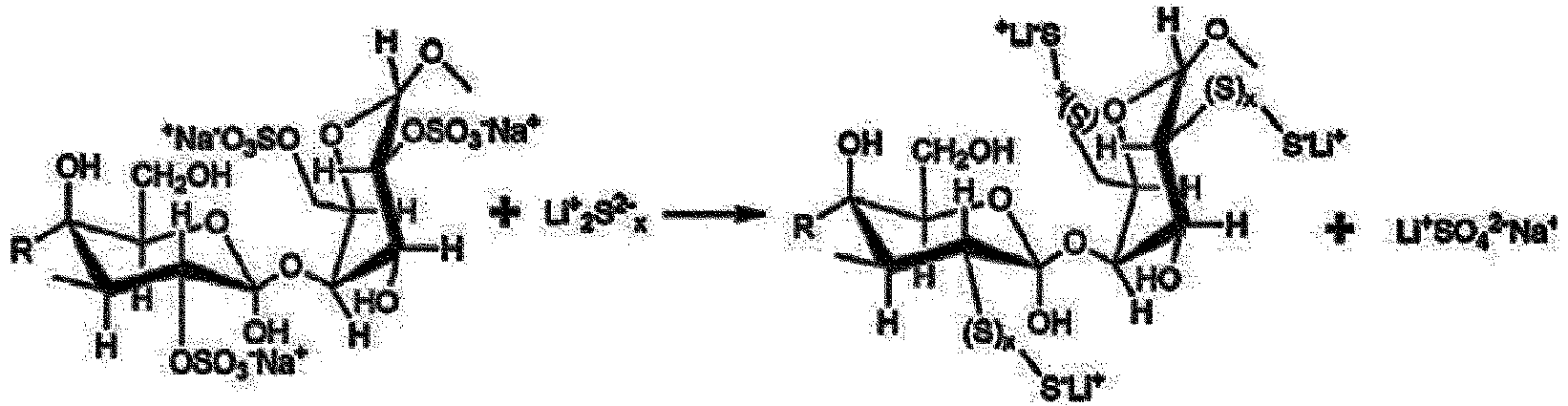
- the polymer having a sulfur chain group is a product of a nucleophilic substitution between a sulfate group (SO 4 2- )-containing polymer and lithium polysulfide (Li 2 S n ), wherein n is a number satisfying 0 ⁇ n ⁇ 10.
- the sulfate group (SO 4 2- ) is a good leaving group and spontaneously causes nucleophilic substitution with lithium polysulfide (Li 2 S n ).
- a polymer having a substituted sulfur chain group can be formed.
- the following Reaction Scheme 1 shows structural formula of an embodiment of carrageenan having a substituted sulfur chain group formed by nucleophilic substitution of carrageenan molecule.
- the sulfate group-containing polymer may be a carrageenan polymer, but is not limited thereto.
- the carrageenan polymer may be ⁇ -carrageenan, -carrageenan or ⁇ -carrageenan.
- the carrageenan polymer may be ⁇ -carrageenan.
- the non-aqueous electrolyte may further include LiNO 3 as an additive.
- LiNO 3 By virtue of the presence of LiNO 3 , it is possible to form a more stable sulfide-based interface having high conductivity on the surface of the lithium metal negative electrode.
- the protective layer according to the present disclosure functions to inhibit growth of dendrites that may occur on the surface of a negative electrode and to prevent chemical reactions between an electrolyte and a negative electrode.
- the protective layer may include a polymer material, an inorganic material or both, and may have properties as a porous layer including pores.
- the protective layer may have a structure of porous polymer layer, porous inorganic layer, porous mixture layer mixed with a binder resin and inorganic material or composite porous layer including a porous polymer layer laminated with a porous inorganic layer, depending on its components.
- the protective layer may use a porous polymer layer including a polymer or a porous mixture layer mixed with a binder resin and inorganic material, as a protective layer substrate.
- a polymer having a sulfur chain group may be introduced to the protective layer substrate.
- the protective layer according to the present disclosure has a porous structure, it facilitates impregnation of an electrolyte into a negative electrode active material layer, even when the protective layer covers the surface of the negative electrode active material layer.
- the protective layer may hold the electrolyte sufficiently therein. Further, since the protective layer sufficiently holds the electrolyte therein, it is possible to delay depletion of the electrolyte during the operation of a lithium metal secondary battery, and thus to delay degradation of the life of a lithium metal secondary battery.
- methods for introducing a polymer having a sulfur chain group to the protective layer may include, but are not limited to: a method for subjecting a protective layer substrate to dip coating with a solution containing an adequate amount of polymer having a sulfur chain group dissolved therein.
- any solvent may be used with no particular limitation, as long as it can dissolve the polymer having a sulfur chain group and does not affect the properties of the polymer.
- the solvent include water, methanol, ethanol, propanol, isopropanol, acetone, dimethyl formamide, dimethyl acetamide, chloroform, dichloromethane, trichloroethylene, n-hexane or a mixture thereof.
- the solvent may include at least one of methanol, ethanol, propanol, isopropanol and acetone.
- the solution containing a polymer having a sulfur chain group dissolved therein may have a concentration of 0.1 wt% to 2.0 wt%, preferably 0.2 wt% to 1.0 wt%, and more preferably 0.6 wt% to 0.8 wt%.
- concentration is less than0.1 wt%, it is not possible to provide a sufficient effect of adding a polymer having a sulfur chain group.
- concentration is larger than 2.0 wt%, the protective layer shows a decrease in ion conductivity due to the polymer having a sulfur chain group and cycle life characteristics may be degraded undesirably.
- the protective layer may have a pore diameter size of 0.01 ⁇ m to 10 ⁇ m. Meanwhile, the protective layer may have a porosity of 5 vol% to 95 vol%. Preferably, the porosity may be 25 vol% to 70 vol% in terms of holding an electrolyte.
- the porosity and pore size may be determined with an adsorption gas, such as nitrogen, by using BELSORP (BET apparatus) available from BEL JAPAN Co., or by using mercury intrusion porosimetry or capillary flow porosimetry.
- the porosity may be calculated by measuring the thickness and weight of the resultant coating layer and using the theoretical density of the coating layer.
- methods for forming the porous structure of the protective layer are not particularly limited.
- the polymer resin may be mixed with a pore-forming agent, such as polycarbonate or wax, to form a film shape, and then the pore-forming agent may be removed to form pores at the sites from which the pore forming agent is removed.
- the protective layer substrate may be prepared in the form of a porous mixture layer further including inorganic particles in terms of forming pores and improving mechanical properties.
- a porous protective layer may be formed through a dry process, wet process, phase separation process or a phase transformation process.
- the polymer resin that may be used in the protective layer is not particularly limited, as long as it can impart porous properties to the protective layer and can perform the above-described functions as a protective layer.
- the polymer resin may include a polyvinylidene-based polymer resin containing a vinylidene polymerization unit.
- Particular examples of the polyvinylidene-based polymer resin include at least one of polyvinylidene, polyvinylidene fluoride-co-hexafluoropropylene and polyvinylidene fluoride-co-trichloroethylene, but are not limited thereto.
- the polymer resin may include at least one of polyolefin resin, polyethylene terephthalate, polybutylene terephthalate, polyacetal, polyamide, polycarbonate, polyimide, polyetherether ketone, polyether sulfone, polyphenylene oxide, polyphenylene sulfide and polyethylene naphthalene, in combination with or independently from the above-mentioned polyvinylidene-based polymer resin.
- the inorganic particles that may be contained in the protective layer are not particularly limited, as long as they can impart porous properties to the protective layer, can perform the above-mentioned functions as a protective layer, and cause no oxidation and/or reduction in the operating voltage range (e.g. 0-5V based on Li/Li + ) of a battery.
- the inorganic particles include at least one of BaTiO 3 , SrTiO 3 , SnO 2 , CeO 2 , MgO, NiO, CaO, ZnO, ZrO 2 , Y 2 O 3 , Al 2 O 3 , TiO 2 and SiC.
- the particle diameter of inorganic particles and an adequate particle size may be selected considering the thickness, porosity and pore size of the protective layer.
- the thickness of the protective layer is not particularly limited, but may be 0.1 ⁇ m to 100 ⁇ m. According to an embodiment of the present disclosure, the thickness of the protective layer may be 0.1 ⁇ m or more, 0.2 ⁇ m or more, 1 ⁇ m or more, 10 ⁇ m or more, or 15 ⁇ m or more, and 70 ⁇ m or less, 50 ⁇ m or less, 30 ⁇ m or less, 10 ⁇ m or less, 8 ⁇ m or less, or 5 ⁇ m or less, within the above-defined range. For example, the thickness of the protective layer is 10 ⁇ m to 50 ⁇ m.
- the protective layer can hold an electrolyte sufficiently, and thus it is possible to delay the problem of depletion of the electrolyte during the operation of a battery and to improve the life characteristics of a lithium metal secondary battery.
- the thickness of the protective layer is less than 0.1 ⁇ m, it is not possible to perform functions as a protective layer.
- the thickness of the protective layer is larger than100 ⁇ m, electrode resistance is increased undesirably.
- the battery according to the present disclosure includes an electrode, particularly a negative electrode, the surface of which is coated with the above-described protective layer.
- a sulfide-based passivation layer is formed on the surface of lithium dendrite to provide an effect of inhibiting additional growth of lithium dendrite.
- the sulfur chain group of the polymer contained in the protective layer reacts with lithium dendrite to produce byproducts, such as lithium sulfide (Li 2 S) or lithium disulfide (Li 2 S 2 ), and lithium dendrite is coated with a passivation layer including such byproducts.
- a passivation layer having higher chemical stability may be formed. Therefore, it is possible to prevent lithium metal from corrosion caused by an electrolyte and to reduce generation of dead lithium, i.e. lithium that cannot participate in charge/discharge cycles. As a result, it is possible to reduce the irreversible capacity of a negative electrode.
- the positive electrode according to the present disclosure may be obtained by applying a mixture of a positive electrode active material, a conductive material and a binder onto a positive electrode current collector, followed by drying. If desired, the mixture may further include a filler.
- the positive electrode current collector is formed to have a thickness of 3 ⁇ m to 500 ⁇ m.
- the positive electrode current collector is not particularly limited, as long as it causes no chemical change in the corresponding battery and has high conductivity.
- Particular examples of the positive electrode current collector may include stainless steel, aluminum, nickel, titanium, baked carbon, aluminum or stainless steel surface-treated with carbon, nickel, titanium or silver, or the like.
- fine surface irregularities may be formed on the surface of the current collector to increase the adhesion of the positive electrode active material.
- the current collector may have various shapes, such as a film, sheet, foil, net, porous body, foam, non-woven body, or the like.
- the conductive material is added generally in an amount of 1-50 wt% based on the total weight of the mixture including the positive electrode active material.
- the conductive material is not particularly limited, as long as it causes no chemical change in the corresponding battery and has conductivity.
- Particular examples of the conductive material include: graphite, such as natural graphite or artificial graphite; carbon black, such as acetylene black, Ketjen black, channel black, furnace black, lamp black or thermal black; conductive fibers, such as carbon fibers or metallic fibers; conductive tubes, such as carbon nanotubes; metal powder, such as carbon fluoride, aluminum or nickel powder; conductive whisker, such as zinc oxide or potassium titanate; conductive metal oxide, such as titanium oxide; and conductive materials, such as polyphenylene derivatives.
- the binder assists binding between the positive electrode active material and the conductive material and binding to the current collector.
- the binder is added in an amount of 1 wt% to 50 wt% based on the total weight of the mixture including the positive electrode active material.
- the binder include polyvinylidene fluoride, polyvinyl alcohol, carboxymethyl cellulose (CMC), starch, hydroxypropyl cellulose, regenerated cellulose, polyvinyl pyrrolidone, tetrafluoroethylene, polyethylene, polypropylene, ethylene-propylene-diene terpolymer (EPDM), sulfonated EPDM, styrene butyrene rubber, fluororubber, various copolymers, or the like.
- the filler inhibits swelling of the positive electrode and is used optionally.
- the filler is not particularly limited, as long as it causes no chemical change in the corresponding battery and is a fibrous material.
- Particular examples of the filler include olefinic polymers, such as polyethylene or polypropylene; and fibrous materials, such as glass fibers or carbon fibers.
- the positive electrode active material used herein may include any one of lithium metal oxides and lithium-free metal oxides or a mixture of two or more of them.
- Lithium metal oxides used currently as a positive electrode active material are capable of initial discharge.
- lithium-free metal oxides include vanadium oxide, manganese oxide, nickel oxide, cobalt oxide, niobium oxide, iron phosphate, or the like.
- the negative electrode includes a negative electrode current collector and an electrode active material layer formed on the negative electrode current collector, wherein the electrode active material layer includes lithium metal.
- the negative electrode may include a negative electrode current collector and a lithium metal layer formed on the negative electrode current collector.
- the lithium metal layer includes sheet-like metal and has a width controllable depending on the electrode shape to facilitate manufacture of the electrode.
- the lithium metal layer may have a thickness of 0 ⁇ m to 300 ⁇ m.
- the lithium metal layer may be formed by electrodeposition, such as vapor deposition, of lithium metal or application of lithium metal powder. According to an embodiment of the present disclosure, even when no lithium metal layer is formed on the negative electrode current collector, lithium ions are transported from the positive electrode during charge to produce a lithium metal layer on the surface of the negative electrode current collector, which allows operation as a lithium metal secondary battery.
- non-limiting examples of the negative electrode current collector include foil made of copper, gold, nickel or copper alloy, or a combination thereof.
- the negative electrode current collector may have various shapes, such as a film, sheet, foil, net, porous body, foam and a non-woven web body.
- the separator used in the lithium metal secondary battery according to the present disclosure is interposed between the positive electrode and the negative electrode, and is an electrically insulating thin film having high ion permeability and mechanical strength.
- the separator may include a porous polymer substrate.
- the porous polymer substrate may be any porous polymer substrate used conventionally for a lithium secondary battery, and particular examples thereof include a polyolefin-based porous membrane or non-woven web, but are not limited thereto.
- polystyrene-based porous membrane may include those formed of polymers including polyethylene, such as high-density polyethylene, linear low-density polyethylene, low-density polyethylene and ultrahigh-molecular weight polyethylene, polypropylene, polybutylene and polypentene, alone or in combination.
- polyethylene such as high-density polyethylene, linear low-density polyethylene, low-density polyethylene and ultrahigh-molecular weight polyethylene, polypropylene, polybutylene and polypentene, alone or in combination.
- non-woven web may include those formed of polymers including polyethylene terephthalate, polybutylene terephthalate, polyester, polyacetal, polyamide, polycarbonate, polyimide, polyetherether ketone, polyether sulfone, polyphenylene oxide, polyether sulfone, polyphenylene oxide, polyphenylene sulfide, polyethylene naphthalene, or the like, alone or in combination.
- the non-woven web structure may be a spun-bonded non-woven web or a melt blown non-woven web including long fibers.
- the thickness of the porous polymer substrate is not particularly limited but may be 1 ⁇ m to 500 ⁇ m, 3 ⁇ m to 300 ⁇ m, or 5 ⁇ m to 50 ⁇ m.
- the size of the pores present in the porous polymer substrate and the porosity are not particularly limited.
- the pore diameter size and porosity may be 0.001 vol% to 50 ⁇ m and 10 vol% to 95 vol%, respectively.
- the electrolyte salt contained in the non-aqueous electrolyte that may be used in the present disclosure is a lithium salt.
- Any lithium salt used conventionally for an electrolyte for a lithium secondary battery may be used with no particular limitation.
- the anion of the lithium salt may be any one selected from the group consisting of F - , Cl - , Br - , I - , NO 3 - , N(CN) 2 - , BF 4 - , ClO 4 - , PF 6 - , (CF 3 ) 2 PF 4 - , (CF 3 ) 3 PF 3 - , (CF 3 ) 4 PF 2 - , (CF 3 ) 5 PF - , (CF 3 ) 6 P - , CF 3 SO 3 - , CF 3 CF 2 SO 3 - , (CF 3 SO 2 ) 2 N-, (FSO 2 ) 2 N-, CF 3 CF 2 (CF 3 ) 2 CO
- organic solvent for example, it is possible to use ethers, esters, amides, linear carbonates or cyclic carbonates, alone or in combination.
- Typical examples of the organic solvent may include carbonate compounds, such as cyclic carbonates, linear carbonates or mixtures thereof.
- ethylene carbonate and propylene carbonate which are cyclic carbonates among the carbonate organic solvents, are organic solvents having high viscosity and a high dielectric constant, and thus can dissociate the lithium salt in the electrolyte well.
- ethers may include any one selected from the group consisting of dimethyl ether, diethyl ether, dipropyl ether, methyl ethyl ether, methyl propyl ether and ethyl propyl ether, or a mixture of two or more of them, but are not limited thereto.
- esters include any one selected from the group consisting of methyl acetate, ethyl acetate, propyl acetate, methyl propionate, ethyl propionate, ⁇ -butyrolactone, ⁇ -valerolactone, ⁇ -caprolactone, ⁇ -valerolactone and ⁇ -caprolactone, or a mixture of two or more of them, but are not limited thereto.
- Injection of the electrolyte may be carried out in an adequate step during the process for manufacturing a lithium secondary battery depending on the manufacturing process of a final product and properties required for a final product. In other words, injection of the electrolyte may be carried out before the assemblage of a lithium secondary battery or in the final step of the assemblage of a lithium secondary battery.
- the lithium secondary battery according to the present disclosure may be subjected to a lamination or stacking step of a separator with electrodes and a folding step, in addition to the conventional winding step.
- the battery casing may be a metallic can, or a pouch-type battery casing of a laminate sheet including a resin layer and a metal layer.
- a battery module including two or more unit cells and a module casing configured to receive the unit cells, wherein each of the unit cells is the lithium metal secondary battery according to the present disclosure.
- a battery pack including the battery module and a device including the battery pack as a power source.
- particular examples of the device may include, but are not limited to: power tools driven by an electric motor; electric cars, including electric vehicles, hybrid electric vehicles, plug-in hybrid electric vehicles, or the like; electric carts, including electric bikes and electric scooters; electric golf carts; electric power storage systems; or the like.
- FIG. 1 illustrates reactivity with ⁇ -carrageenan polymer as determined through a color change in lithium polysulfide solution and UV-Vis analysis
- FIG. 2 is a graph of X-ray photoelectron spectroscopy before and after reaction of lithium polysulfide solution with ⁇ -carrageenan polymer.
- PVDF-co-HFP Polyvinylidene fluoride-co-hexafluoropropylene
- Al 2 O 3 aluminum oxide
- PC propylene carbonate
- DMAC dimethyl acetamide
- the resultant solution was cast onto a glass plate by using a doctor blade to a thickness of 150 ⁇ m.
- the resultant plate was vacuum-dried at room temperature to allow evaporation of DMAC and then introduced to a distilled water bath to remove PC.
- the resultant film was vacuum dried at 60°C for 2 days to remove the remaining water completely, thereby providing a free-standing protective layer (thickness: about 30 ⁇ m).
- the resultant protective layer was attached onto lithium foil having a thickness of 150 ⁇ m through a roll press inside of an argon glove box, and then cut into a disc shape to obtain an electrode.
- the resultant electrodes were used as a positive electrode and a negative electrode and a separator (polypropylene-based porous polymer substrate) was interposed between both electrodes to obtain a coin-cell.
- an electrolyte containing 1M LiPF 6 and 0.2M LiNO 3 dissolved in a solvent containing a mixture of ethylene carbonate (EC) and ethyl methyl carbonate (DEC) at a volume ratio of 30:70 was injected to the coin-cell to obtain a symmetric lithium cell.
- PVDF-co-HFP Polyvinylidene fluoride-co-hexafluoropropylene
- Al 2 O 3 aluminum oxide
- PC propylene carbonate
- DMAC dimethyl acetamide
- the resultant solution was cast onto a glass plate by using a doctor blade to a thickness of 150 ⁇ m.
- the resultant plate was vacuum-dried at room temperature to allow evaporation of DMAC and then introduced to a distilled water bath to remove PC.
- the resultant film was vacuum dried at 60°C for 2 days to remove the remaining water completely, thereby providing a free-standing protective layer.
- the resultant protective layer had a thickness of about 30 ⁇ m and a porosity of about 40%.
- the resultant polymer film was dip coated with a solution containing the carrageenan polymer having a sulfur chain group and obtained from Preparation Example, dissolved in water to a concentration of 0.2 wt%, to obtain a protective layer including the carrageenan polymer having a sulfur chain group.
- the finished protective layer had a thickness of about 30 ⁇ m.
- the resultant protective layer was attached onto lithium foil having a thickness of 150 ⁇ m through a roll press inside of an argon glove box, and then cut into a disc shape to obtain an electrode.
- the resultant electrodes were used as a positive electrode and a negative electrode and a separator (polypropylene-based porous polymer substrate) was interposed between both electrodes to obtain a coin-cell.
- an electrolyte containing 1M LiPF 6 and 0.2M LiNO 3 dissolved in a solvent containing a mixture of ethylene carbonate (EC) and ethyl methyl carbonate (DEC) at a volume ratio of 30:70 was injected to the coin-cell to obtain a symmetric lithium cell.
- a symmetric lithium cell was obtained in the same manner as Example 1, except that the protective layer was dip coated with a solution containing the carrageenan polymer having a sulfur chain group, dissolved in water to a concentration of 0.4 wt%, when the carrageenan polymer having a sulfur chain group was introduced to the protective layer.
- a symmetric lithium cell was obtained in the same manner as Example 1, except that the protective layer was dip coated with a solution containing the carrageenan polymer having a sulfur chain group, dissolved in water to a concentration of 0.6 wt%, when the carrageenan polymer having a sulfur chain group was introduced to the protective layer.
- a symmetric lithium cell was obtained in the same manner as Example 1, except that the protective layer was dip coated with a solution containing the carrageenan polymer having a sulfur chain group, dissolved in water to a concentration of 0.8 wt%, when the carrageenan polymer having a sulfur chain group was introduced to the protective layer.
- a symmetric lithium cell was obtained in the same manner as Example 1, except that the protective layer was dip coated with a solution containing the carrageenan polymer having a sulfur chain group, dissolved in water to a concentration of 1.0 wt%, when the carrageenan polymer having a sulfur chain group was introduced to the protective layer.
- Each of the cells was subjected to the initial charge/discharge cycle at a current density of 0.1 mA/cm 2 for 10 hours in each time of charge and discharge, and then subjected to charge/discharge cycles at a current density of 1 mA/cm 2 for 1 hour in each time of charge and discharge.
- FIG. 3 is a graph illustrating the cycle number until a short-circuit occurs due to dendrite after operating each of the cells according to Examples and Comparative Example
- FIG. 4 is a graph illustrating the ion conductivity of each of the protective layers according to Examples and Comparative Example.
- the cell cycle number tends to be increased, as the concentration of carrageenan polymer solution having a sulfur chain group is increased to the concentration of Example 3.
- the concentration is increased to the concentration of Example 4 or more, the cell cycle number is decreased as compared to Example 3. It is thought that this is because the ion conductivity of the protective layer is reduced as the content of carrageenan polymer having a sulfur chain group is increased, as can be seen from FIG. 4.
- the carrageenan polymer having a sulfur chain group has an effect of inhibiting dendrites, and thus improves cycle life as its content is increased.
- the content of carrageenan polymer having a sulfur chain group reaches a predetermined level or higher, over-voltage derived from the low ion conductivity of the protective layer more significantly affects the battery, resulting in degradation of cycle life.
Landscapes
- Chemical & Material Sciences (AREA)
- Chemical Kinetics & Catalysis (AREA)
- Electrochemistry (AREA)
- General Chemical & Material Sciences (AREA)
- Engineering & Computer Science (AREA)
- Manufacturing & Machinery (AREA)
- Inorganic Chemistry (AREA)
- Materials Engineering (AREA)
- Condensed Matter Physics & Semiconductors (AREA)
- General Physics & Mathematics (AREA)
- Physics & Mathematics (AREA)
- Composite Materials (AREA)
- Dispersion Chemistry (AREA)
- Secondary Cells (AREA)
- Battery Electrode And Active Subsutance (AREA)
- Connection Of Batteries Or Terminals (AREA)
Description
- The present application claims priority to
Korean Patent Application No. 10-2018-0053846 filed on May 10, 2018 - Currently, lithium secondary batteries are used in most portable electronic instruments by virtue of their excellent performance, such as high energy density and long life characteristics. However, as the market of middle- to large-scale batteries for electric vehicles and large-capacity energy storage systems has grown, there has been a need for next-generation lithium secondary batteries having higher energy density as compared to the existing lithium ion batteries.
- As next-generation lithium secondary batteries having high capacity and high energy are desired, batteries using lithium metal as a negative electrode have been spotlighted. Typical examples of such batteries include a lithium metal battery, lithium sulfur battery and a lithium-air battery. Since lithium metal used as a negative electrode has a low density (0.54 g/cm3) and a low standard reduction potential (-3.045V, based on the standard hydrogen electrode), it is possible to realize high capacity and high density per volume (or weight).
- However, a lithium metal secondary battery has serious problems, such as formation of lithium dendrite and low Coulombic efficiency. During the electrochemical cycles of a battery, dendritic lithium (lithium dendrite) and dead lithium are formed at the lithium metal negative electrode, which causes loss of the active material. In addition, lithium metal having high reactivity forms a solid electrolyte interface (SEI) layer on the surface through reactions with an electrolyte and residual water. Herein, the SEI layer is repeatedly broken and formed again due to an increase in surface area of the electrode caused by formation of dendrite and dead lithium. Therefore, lithium metal and the electrolyte are consumed continuously, which results in low Coulombic efficiency of the lithium metal negative electrode and short cycle life. In addition, when lithium dendrite penetrates through a separator and is grown, an internal short-circuit occurs, leading to safety problems, such as fire accidents, explosion, or the like.
- Therefore, it is required to inhibit the growth of lithium dendrite and to improve reversibility of the lithium metal negative electrode in order to realize a lithium metal battery having high performance and high safety.
- According to the related art, it has been reported that a lithium metal negative electrode including an in-situ passivation layer (SEI layer) or ex-situ protective layer introduced thereto shows effects of inhibiting dendrite growth and providing improved performance. Therefore, it is important to design and develop a protective layer in order to provide a lithium metal negative electrode with a stable interface.
-
KR 2015 0062084 A - The present disclosure is directed to providing a lithium metal secondary battery having a self-healing function by using a protective layer including a polymer having a sulfur chain group as a protective layer for a lithium metal negative electrode to form a chemically stable sulfide-based interface on the surface of the lithium metal negative electrode and to prevent rapid growth of lithium dendrite at a specific position. The present disclosure is also directed to providing a battery module including the lithium metal secondary battery.
- The present disclosure is designed to solve the problems of the related art. According to the present disclosure, there is provided a lithium metal secondary battery including: an electrode assembly including a positive electrode, a negative electrode, a separator interposed between the positive electrode and the negative electrode and a protective layer interposed between the negative electrode and the separator; a non-aqueous electrolyte impregnating the electrode assembly, wherein the negative electrode includes lithium metal, the protective layer includes a polymer having a sulfur chain group, the surface of the negative electrode is coated with said protective layer comprising a polymer having a sulfur chain group, and the polymer comprising the sulfur chain group is a product of a nucleophilic substitution reaction between a sulfate group-containing polymer and lithium polysulfide,
wherein the lithium polysulfide has the formula Li2Sn, wherein 0 < n < 10. - Specific embodiments of the present disclosure are set out in claims 2 to 9 and are described below.
- According to the present disclosure, the lithium metal negative electrode includes a polymer having a sulfur chain group as a protective layer, and thus it is possible to form a chemically stable sulfide-based interface on the surface of the lithium metal negative electrode, thereby preventing rapid growth of lithium dendrite. Ultimately, it is possible to improve the safety of a battery.
- Such a sulfur chain group undergoes reduction instead of lithium metal, and thus prevents an excessive concentration of reaction at a specific position, and provides a self-healing function by preventing deterioration of the protective layer.
- In addition, such a sulfur chain group is fixed in the polymer and only a predetermined amount thereof required for reaction is cleaved, and then participates continuously in the reaction.
- The accompanying drawings illustrate a preferred embodiment of the present disclosure and together with the foregoing disclosure, serve to provide further understanding of the technical features of the present disclosure, and thus, the present disclosure is not construed as being limited to the drawings.
- FIG. 1 illustrates reactivity with λ-carrageenan polymer as determined through a color change in the lithium polysulfide solution and UV-Vis analysis.
- FIG. 2 is a graph of X-ray photoelectron spectroscopy (XPS) before and after reaction of lithium polysulfide solution with λ-carrageenan polymer.
- FIG. 3 is a graph illustrating the cycle number until a short-circuit occurs due to dendrite after operating each of the cells according to Examples and Comparative Example.
- FIG. 4 is a graph illustrating the ion conductivity of each of the protective layers according to Examples and Comparative Example.
- Hereinafter, preferred embodiments of the present disclosure will be described in detail with reference to the accompanying drawings.
- There is provided a lithium metal secondary battery including: an electrode assembly including a positive electrode, a lithium metal negative electrode and a separator interposed between the positive electrode and the lithium metal negative electrode; and a non-aqueous electrolyte impregnating the electrode assembly, wherein the lithium metal secondary battery further includes a protective layer interposed between the lithium metal negative electrode and the separator, the protective layer includes a polymer having a sulfur chain group and is coated on the surface of the negative electrode, and the polymer comprising the sulfur chain group is a product of a nucleophilic substitution reaction between a sulfate group-containing polymer and lithium polysulfide, wherein the lithium polysulfide has the formula Li2Sn, wherein 0 < n < 10.
- According to the present disclosure, the polymer having a sulfur chain group can form a chemically stable sulfide-based interface on the surface of the lithium metal negative electrode, thereby preventing rapid growth of lithium dendrite. Ultimately, it is possible to improve the battery safety.
- In addition, such a sulfur chain group undergoes reduction instead of lithium metal, and thus prevents excessive concentration of reaction at a specific position and provides a self-healing function by preventing deterioration of the protective layer.
- Further, such a sulfur chain group is fixed in the polymer and only a predetermined amount thereof required for reaction is cleaved, and then participates continuously in the reaction.
- Herein, the polymer having a sulfur chain group is a product of a nucleophilic substitution between a sulfate group (SO4 2-)-containing polymer and lithium polysulfide (Li2Sn), wherein n is a number satisfying 0 < n < 10. The sulfate group (SO4 2-) is a good leaving group and spontaneously causes nucleophilic substitution with lithium polysulfide (Li2Sn). Through the reaction, a polymer having a substituted sulfur chain group can be formed. The following Reaction Scheme 1 shows structural formula of an embodiment of carrageenan having a substituted sulfur chain group formed by nucleophilic substitution of carrageenan molecule.

- Herein, the sulfate group-containing polymer may be a carrageenan polymer, but is not limited thereto. In addition, the carrageenan polymer may be κ-carrageenan,-carrageenan or λ-carrageenan. Most preferably, the carrageenan polymer may be λ-carrageenan.

- Herein, the non-aqueous electrolyte may further include LiNO3 as an additive. By virtue of the presence of LiNO3, it is possible to form a more stable sulfide-based interface having high conductivity on the surface of the lithium metal negative electrode.
- The protective layer according to the present disclosure functions to inhibit growth of dendrites that may occur on the surface of a negative electrode and to prevent chemical reactions between an electrolyte and a negative electrode.
- According to the present disclosure, the protective layer may include a polymer material, an inorganic material or both, and may have properties as a porous layer including pores. The protective layer may have a structure of porous polymer layer, porous inorganic layer, porous mixture layer mixed with a binder resin and inorganic material or composite porous layer including a porous polymer layer laminated with a porous inorganic layer, depending on its components.
- According to an embodiment of the present disclosure, the protective layer may use a porous polymer layer including a polymer or a porous mixture layer mixed with a binder resin and inorganic material, as a protective layer substrate. In addition, a polymer having a sulfur chain group may be introduced to the protective layer substrate.
- As mentioned above, since the protective layer according to the present disclosure has a porous structure, it facilitates impregnation of an electrolyte into a negative electrode active material layer, even when the protective layer covers the surface of the negative electrode active material layer. In addition, when an electrolyte is injected after manufacturing an electrode assembly, the protective layer may hold the electrolyte sufficiently therein. Further, since the protective layer sufficiently holds the electrolyte therein, it is possible to delay depletion of the electrolyte during the operation of a lithium metal secondary battery, and thus to delay degradation of the life of a lithium metal secondary battery.
- Meanwhile, methods for introducing a polymer having a sulfur chain group to the protective layer may include, but are not limited to: a method for subjecting a protective layer substrate to dip coating with a solution containing an adequate amount of polymer having a sulfur chain group dissolved therein.
- Any solvent may be used with no particular limitation, as long as it can dissolve the polymer having a sulfur chain group and does not affect the properties of the polymer. Particular examples of the solvent include water, methanol, ethanol, propanol, isopropanol, acetone, dimethyl formamide, dimethyl acetamide, chloroform, dichloromethane, trichloroethylene, n-hexane or a mixture thereof. For example, the solvent may include at least one of methanol, ethanol, propanol, isopropanol and acetone.
- Herein, the solution containing a polymer having a sulfur chain group dissolved therein may have a concentration of 0.1 wt% to 2.0 wt%, preferably 0.2 wt% to 1.0 wt%, and more preferably 0.6 wt% to 0.8 wt%. When the concentration is less than0.1 wt%, it is not possible to provide a sufficient effect of adding a polymer having a sulfur chain group. When the concentration is larger than 2.0 wt%, the protective layer shows a decrease in ion conductivity due to the polymer having a sulfur chain group and cycle life characteristics may be degraded undesirably.
- According to an embodiment of the present disclosure, the protective layer may have a pore diameter size of 0.01 µm to 10 µm. Meanwhile, the protective layer may have a porosity of 5 vol% to 95 vol%. Preferably, the porosity may be 25 vol% to 70 vol% in terms of holding an electrolyte. The porosity and pore size may be determined with an adsorption gas, such as nitrogen, by using BELSORP (BET apparatus) available from BEL JAPAN Co., or by using mercury intrusion porosimetry or capillary flow porosimetry. According to another embodiment of the present disclosure, the porosity may be calculated by measuring the thickness and weight of the resultant coating layer and using the theoretical density of the coating layer.
- According to an embodiment of the present disclosure, methods for forming the porous structure of the protective layer are not particularly limited. For example, in the case of a porous polymer layer, the polymer resin may be mixed with a pore-forming agent, such as polycarbonate or wax, to form a film shape, and then the pore-forming agent may be removed to form pores at the sites from which the pore forming agent is removed. In addition, the protective layer substrate may be prepared in the form of a porous mixture layer further including inorganic particles in terms of forming pores and improving mechanical properties. In addition to the above-mentioned method, a porous protective layer may be formed through a dry process, wet process, phase separation process or a phase transformation process.
- According to an embodiment of the present disclosure, the polymer resin that may be used in the protective layer is not particularly limited, as long as it can impart porous properties to the protective layer and can perform the above-described functions as a protective layer. For example, the polymer resin may include a polyvinylidene-based polymer resin containing a vinylidene polymerization unit. Particular examples of the polyvinylidene-based polymer resin include at least one of polyvinylidene, polyvinylidene fluoride-co-hexafluoropropylene and polyvinylidene fluoride-co-trichloroethylene, but are not limited thereto. In addition, the polymer resin may include at least one of polyolefin resin, polyethylene terephthalate, polybutylene terephthalate, polyacetal, polyamide, polycarbonate, polyimide, polyetherether ketone, polyether sulfone, polyphenylene oxide, polyphenylene sulfide and polyethylene naphthalene, in combination with or independently from the above-mentioned polyvinylidene-based polymer resin.
- According to an embodiment of the present disclosure, the inorganic particles that may be contained in the protective layer are not particularly limited, as long as they can impart porous properties to the protective layer, can perform the above-mentioned functions as a protective layer, and cause no oxidation and/or reduction in the operating voltage range (e.g. 0-5V based on Li/Li+) of a battery. Particular examples of the inorganic particles include at least one of BaTiO3, SrTiO3, SnO2, CeO2, MgO, NiO, CaO, ZnO, ZrO2, Y2O3, Al2O3, TiO2 and SiC. There is no particular limitation in the particle diameter of inorganic particles, and an adequate particle size may be selected considering the thickness, porosity and pore size of the protective layer.
- According to an embodiment of the present disclosure, the thickness of the protective layer is not particularly limited, but may be 0.1 µm to 100 µm. According to an embodiment of the present disclosure, the thickness of the protective layer may be 0.1 µm or more, 0.2 µm or more, 1 µm or more, 10 µm or more, or 15 µm or more, and 70 µm or less, 50 µm or less, 30 µm or less, 10 µm or less, 8 µm or less, or 5 µm or less, within the above-defined range. For example, the thickness of the protective layer is 10 µm to 50 µm. Within the range of 0.1 µm to 100 µm, the protective layer can hold an electrolyte sufficiently, and thus it is possible to delay the problem of depletion of the electrolyte during the operation of a battery and to improve the life characteristics of a lithium metal secondary battery. When the thickness of the protective layer is less than 0.1 µm, it is not possible to perform functions as a protective layer. When the thickness of the protective layer is larger than100 µm, electrode resistance is increased undesirably.
- As described above, the battery according to the present disclosure includes an electrode, particularly a negative electrode, the surface of which is coated with the above-described protective layer. Thus, when lithium dendrite is grown through the gaps in the pores of the protective layer or defects of the protective layer, a sulfide-based passivation layer is formed on the surface of lithium dendrite to provide an effect of inhibiting additional growth of lithium dendrite. In other words, the sulfur chain group of the polymer contained in the protective layer reacts with lithium dendrite to produce byproducts, such as lithium sulfide (Li2S) or lithium disulfide (Li2S2), and lithium dendrite is coated with a passivation layer including such byproducts. Herein, when LiNO3 is present, a passivation layer having higher chemical stability may be formed. Therefore, it is possible to prevent lithium metal from corrosion caused by an electrolyte and to reduce generation of dead lithium, i.e. lithium that cannot participate in charge/discharge cycles. As a result, it is possible to reduce the irreversible capacity of a negative electrode.
- Meanwhile, the positive electrode according to the present disclosure may be obtained by applying a mixture of a positive electrode active material, a conductive material and a binder onto a positive electrode current collector, followed by drying. If desired, the mixture may further include a filler.
- In general, the positive electrode current collector is formed to have a thickness of 3 µm to 500 µm. The positive electrode current collector is not particularly limited, as long as it causes no chemical change in the corresponding battery and has high conductivity. Particular examples of the positive electrode current collector may include stainless steel, aluminum, nickel, titanium, baked carbon, aluminum or stainless steel surface-treated with carbon, nickel, titanium or silver, or the like. In addition, fine surface irregularities may be formed on the surface of the current collector to increase the adhesion of the positive electrode active material. The current collector may have various shapes, such as a film, sheet, foil, net, porous body, foam, non-woven body, or the like.
- The conductive material is added generally in an amount of 1-50 wt% based on the total weight of the mixture including the positive electrode active material. The conductive material is not particularly limited, as long as it causes no chemical change in the corresponding battery and has conductivity. Particular examples of the conductive material include: graphite, such as natural graphite or artificial graphite; carbon black, such as acetylene black, Ketjen black, channel black, furnace black, lamp black or thermal black; conductive fibers, such as carbon fibers or metallic fibers; conductive tubes, such as carbon nanotubes; metal powder, such as carbon fluoride, aluminum or nickel powder; conductive whisker, such as zinc oxide or potassium titanate; conductive metal oxide, such as titanium oxide; and conductive materials, such as polyphenylene derivatives.
- The binder assists binding between the positive electrode active material and the conductive material and binding to the current collector. In general, the binder is added in an amount of 1 wt% to 50 wt% based on the total weight of the mixture including the positive electrode active material. Particular examples of the binder include polyvinylidene fluoride, polyvinyl alcohol, carboxymethyl cellulose (CMC), starch, hydroxypropyl cellulose, regenerated cellulose, polyvinyl pyrrolidone, tetrafluoroethylene, polyethylene, polypropylene, ethylene-propylene-diene terpolymer (EPDM), sulfonated EPDM, styrene butyrene rubber, fluororubber, various copolymers, or the like.
- The filler inhibits swelling of the positive electrode and is used optionally. The filler is not particularly limited, as long as it causes no chemical change in the corresponding battery and is a fibrous material. Particular examples of the filler include olefinic polymers, such as polyethylene or polypropylene; and fibrous materials, such as glass fibers or carbon fibers.
- The positive electrode active material used herein may include any one of lithium metal oxides and lithium-free metal oxides or a mixture of two or more of them. Lithium metal oxides used currently as a positive electrode active material are capable of initial discharge. However, it is possible to incorporate lithium-free metal oxides, which are inexpensive and ensure safety, partially to a positive electrode, or it is possible to apply 100% of lithium-free metal oxides.
- Herein, particular examples of such lithium-free metal oxides include vanadium oxide, manganese oxide, nickel oxide, cobalt oxide, niobium oxide, iron phosphate, or the like.
- Meanwhile, the negative electrode includes a negative electrode current collector and an electrode active material layer formed on the negative electrode current collector, wherein the electrode active material layer includes lithium metal. According to an embodiment of the present disclosure, the negative electrode may include a negative electrode current collector and a lithium metal layer formed on the negative electrode current collector. The lithium metal layer includes sheet-like metal and has a width controllable depending on the electrode shape to facilitate manufacture of the electrode. The lithium metal layer may have a thickness of 0 µm to 300 µm. In a variant, the lithium metal layer may be formed by electrodeposition, such as vapor deposition, of lithium metal or application of lithium metal powder. According to an embodiment of the present disclosure, even when no lithium metal layer is formed on the negative electrode current collector, lithium ions are transported from the positive electrode during charge to produce a lithium metal layer on the surface of the negative electrode current collector, which allows operation as a lithium metal secondary battery.
- In addition, non-limiting examples of the negative electrode current collector include foil made of copper, gold, nickel or copper alloy, or a combination thereof.
- In addition, similar to the positive electrode current collector, it is possible to reinforce the binding force to lithium metal by forming fine surface irregularities on the surface of the negative electrode current collector. The negative electrode current collector may have various shapes, such as a film, sheet, foil, net, porous body, foam and a non-woven web body.
- The separator used in the lithium metal secondary battery according to the present disclosure is interposed between the positive electrode and the negative electrode, and is an electrically insulating thin film having high ion permeability and mechanical strength.
- The separator may include a porous polymer substrate. The porous polymer substrate may be any porous polymer substrate used conventionally for a lithium secondary battery, and particular examples thereof include a polyolefin-based porous membrane or non-woven web, but are not limited thereto.
- Particular examples of the polyolefin-based porous membrane may include those formed of polymers including polyethylene, such as high-density polyethylene, linear low-density polyethylene, low-density polyethylene and ultrahigh-molecular weight polyethylene, polypropylene, polybutylene and polypentene, alone or in combination.
- In addition to the polyolefin-based non-woven web, particular examples of the non-woven web may include those formed of polymers including polyethylene terephthalate, polybutylene terephthalate, polyester, polyacetal, polyamide, polycarbonate, polyimide, polyetherether ketone, polyether sulfone, polyphenylene oxide, polyether sulfone, polyphenylene oxide, polyphenylene sulfide, polyethylene naphthalene, or the like, alone or in combination. The non-woven web structure may be a spun-bonded non-woven web or a melt blown non-woven web including long fibers.
- The thickness of the porous polymer substrate is not particularly limited but may be 1 µm to 500 µm, 3 µm to 300 µm, or 5 µm to 50 µm.
- In addition, the size of the pores present in the porous polymer substrate and the porosity are not particularly limited. However, the pore diameter size and porosity may be 0.001 vol% to 50 µm and 10 vol% to 95 vol%, respectively.
- In addition, the electrolyte salt contained in the non-aqueous electrolyte that may be used in the present disclosure is a lithium salt. Any lithium salt used conventionally for an electrolyte for a lithium secondary battery may be used with no particular limitation. For example, the anion of the lithium salt may be any one selected from the group consisting of F-, Cl-, Br-, I-, NO3 -, N(CN)2 -, BF4 -, ClO4 -, PF6 -, (CF3)2PF4 -, (CF3)3PF3 -, (CF3)4PF2 -, (CF3)5PF-, (CF3)6P-, CF3SO3 -, CF3CF2SO3 -, (CF3SO2)2N-, (FSO2)2N-, CF3CF2(CF3)2CO-, (CF3SO2)2CH-, (SF5)3C-, (CF3SO2)3C-, CF3(CF2)7SO3 -, CF3CO2 -, CH3CO2 -, SCN-, and (CF3CF2SO2)2N-.
- Particular examples of the organic solvent that may be contained in the non-aqueous electrolyte may include those conventionally used for an electrolyte for a lithium secondary battery with no particular limitation. For example, it is possible to use ethers, esters, amides, linear carbonates or cyclic carbonates, alone or in combination.
- Typical examples of the organic solvent may include carbonate compounds, such as cyclic carbonates, linear carbonates or mixtures thereof.
- Particularly, ethylene carbonate and propylene carbonate, which are cyclic carbonates among the carbonate organic solvents, are organic solvents having high viscosity and a high dielectric constant, and thus can dissociate the lithium salt in the electrolyte well. In addition, it is possible to prepare an electrolyte having high electrical conductivity, when using such cyclic carbonates in combination with low-viscosity low-dielectric constant linear carbonates, such as dimethyl carbonate and diethyl carbonate, at an adequate ratio.
- Further, among the organic solvents, particular examples of the ethers may include any one selected from the group consisting of dimethyl ether, diethyl ether, dipropyl ether, methyl ethyl ether, methyl propyl ether and ethyl propyl ether, or a mixture of two or more of them, but are not limited thereto.
- Among the organic solvents, particular examples of the esters include any one selected from the group consisting of methyl acetate, ethyl acetate, propyl acetate, methyl propionate, ethyl propionate, γ-butyrolactone, γ-valerolactone, γ-caprolactone, σ-valerolactone and ε-caprolactone, or a mixture of two or more of them, but are not limited thereto.
- Injection of the electrolyte may be carried out in an adequate step during the process for manufacturing a lithium secondary battery depending on the manufacturing process of a final product and properties required for a final product. In other words, injection of the electrolyte may be carried out before the assemblage of a lithium secondary battery or in the final step of the assemblage of a lithium secondary battery.
- The lithium secondary battery according to the present disclosure may be subjected to a lamination or stacking step of a separator with electrodes and a folding step, in addition to the conventional winding step. In addition, the battery casing may be a metallic can, or a pouch-type battery casing of a laminate sheet including a resin layer and a metal layer.
- Also disclosed is a battery module including two or more unit cells and a module casing configured to receive the unit cells, wherein each of the unit cells is the lithium metal secondary battery according to the present disclosure. There are also disclosed a battery pack including the battery module and a device including the battery pack as a power source.
- Herein, particular examples of the device may include, but are not limited to: power tools driven by an electric motor; electric cars, including electric vehicles, hybrid electric vehicles, plug-in hybrid electric vehicles, or the like; electric carts, including electric bikes and electric scooters; electric golf carts; electric power storage systems; or the like.
- Examples will be described more fully hereinafter so that the present disclosure can be understood with ease. The following examples may, however, be embodied in many different forms and should not be construed as limited to the exemplary embodiments set forth therein. Rather, these exemplary embodiments are provided so that the present disclosure will be thorough and complete, and will fully convey the scope of the present disclosure to those skilled in the art.
- To 0.002 M lithium polysulfide solution (0.002 M Li2S8 in dimethoxyethane (DME)), λ-carrageenan polymer was introduced.
- FIG. 1 illustrates reactivity with λ-carrageenan polymer as determined through a color change in lithium polysulfide solution and UV-Vis analysis, and FIG. 2 is a graph of X-ray photoelectron spectroscopy before and after reaction of lithium polysulfide solution with λ-carrageenan polymer.
- Referring to FIGS. 1 and 2, the solution to which carrageenan polymer was added showed a change in color and absorbance depending on wavelength. This suggests that reaction occurred between both materials.
- In addition, it can be seen from the XPS graph before and after reaction between both materials that nucleophilic substitution occurred between the sulfate group of λ-carrageenan polymer and the lithium polysulfide solution to form a carrageenan polymer having a sulfur chain group.
- Polyvinylidene fluoride-co-hexafluoropropylene (PVDF-co-HFP) polymer, aluminum oxide (Al2O3) and propylene carbonate (PC) were mixed at a weight ratio of 1:4:1, and the resultant mixture was introduced to dimethyl acetamide (DMAC) and the solution was agitated homogeneously. The resultant solution was cast onto a glass plate by using a doctor blade to a thickness of 150 µm. The resultant plate was vacuum-dried at room temperature to allow evaporation of DMAC and then introduced to a distilled water bath to remove PC. In addition, the resultant film was vacuum dried at 60°C for 2 days to remove the remaining water completely, thereby providing a free-standing protective layer (thickness: about 30 µm).
- The resultant protective layer was attached onto lithium foil having a thickness of 150 µm through a roll press inside of an argon glove box, and then cut into a disc shape to obtain an electrode. The resultant electrodes were used as a positive electrode and a negative electrode and a separator (polypropylene-based porous polymer substrate) was interposed between both electrodes to obtain a coin-cell. Then, an electrolyte containing 1M LiPF6 and 0.2M LiNO3 dissolved in a solvent containing a mixture of ethylene carbonate (EC) and ethyl methyl carbonate (DEC) at a volume ratio of 30:70 was injected to the coin-cell to obtain a symmetric lithium cell.
- Polyvinylidene fluoride-co-hexafluoropropylene (PVDF-co-HFP) polymer, aluminum oxide (Al2O3) and propylene carbonate (PC) were mixed at a weight ratio of 1:4:1, and the resultant mixture was introduced to dimethyl acetamide (DMAC) and the solution was agitated homogeneously. The resultant solution was cast onto a glass plate by using a doctor blade to a thickness of 150 µm. The resultant plate was vacuum-dried at room temperature to allow evaporation of DMAC and then introduced to a distilled water bath to remove PC. In addition, the resultant film was vacuum dried at 60°C for 2 days to remove the remaining water completely, thereby providing a free-standing protective layer. After drying, the resultant protective layer had a thickness of about 30 µm and a porosity of about 40%. Then, the resultant polymer film was dip coated with a solution containing the carrageenan polymer having a sulfur chain group and obtained from Preparation Example, dissolved in water to a concentration of 0.2 wt%, to obtain a protective layer including the carrageenan polymer having a sulfur chain group. The finished protective layer had a thickness of about 30 µm.
- The resultant protective layer was attached onto lithium foil having a thickness of 150 µm through a roll press inside of an argon glove box, and then cut into a disc shape to obtain an electrode. The resultant electrodes were used as a positive electrode and a negative electrode and a separator (polypropylene-based porous polymer substrate) was interposed between both electrodes to obtain a coin-cell. Then, an electrolyte containing 1M LiPF6 and 0.2M LiNO3 dissolved in a solvent containing a mixture of ethylene carbonate (EC) and ethyl methyl carbonate (DEC) at a volume ratio of 30:70 was injected to the coin-cell to obtain a symmetric lithium cell.
- A symmetric lithium cell was obtained in the same manner as Example 1, except that the protective layer was dip coated with a solution containing the carrageenan polymer having a sulfur chain group, dissolved in water to a concentration of 0.4 wt%, when the carrageenan polymer having a sulfur chain group was introduced to the protective layer.
- A symmetric lithium cell was obtained in the same manner as Example 1, except that the protective layer was dip coated with a solution containing the carrageenan polymer having a sulfur chain group, dissolved in water to a concentration of 0.6 wt%, when the carrageenan polymer having a sulfur chain group was introduced to the protective layer.
- A symmetric lithium cell was obtained in the same manner as Example 1, except that the protective layer was dip coated with a solution containing the carrageenan polymer having a sulfur chain group, dissolved in water to a concentration of 0.8 wt%, when the carrageenan polymer having a sulfur chain group was introduced to the protective layer.
- A symmetric lithium cell was obtained in the same manner as Example 1, except that the protective layer was dip coated with a solution containing the carrageenan polymer having a sulfur chain group, dissolved in water to a concentration of 1.0 wt%, when the carrageenan polymer having a sulfur chain group was introduced to the protective layer.
- Each of the cells was subjected to the initial charge/discharge cycle at a current density of 0.1 mA/cm2 for 10 hours in each time of charge and discharge, and then subjected to charge/discharge cycles at a current density of 1 mA/cm2 for 1 hour in each time of charge and discharge.
- FIG. 3 is a graph illustrating the cycle number until a short-circuit occurs due to dendrite after operating each of the cells according to Examples and Comparative Example, and FIG. 4 is a graph illustrating the ion conductivity of each of the protective layers according to Examples and Comparative Example.
- Referring to FIGS. 3 and 4, it can be seen that the cell cycle number tends to be increased, as the concentration of carrageenan polymer solution having a sulfur chain group is increased to the concentration of Example 3. However, when the concentration is increased to the concentration of Example 4 or more, the cell cycle number is decreased as compared to Example 3. It is thought that this is because the ion conductivity of the protective layer is reduced as the content of carrageenan polymer having a sulfur chain group is increased, as can be seen from FIG. 4.
- In other words, the carrageenan polymer having a sulfur chain group has an effect of inhibiting dendrites, and thus improves cycle life as its content is increased. However, when the content of carrageenan polymer having a sulfur chain group reaches a predetermined level or higher, over-voltage derived from the low ion conductivity of the protective layer more significantly affects the battery, resulting in degradation of cycle life.
- It should be understood that the detailed description is given by way of illustration only and various changes and modifications may be made without departing from the scope of the invention as defined in the following claims. Therefore, the embodiments disclosed herein are not intended to limit the scope of the present disclosure but are for illustrative purposes only, and the scope of the present disclosure is not limited thereto. It should be also understood that the scope of the present disclosure is defined by the following claims.
Claims (9)
- A lithium metal secondary battery comprising:an electrode assembly comprising a positive electrode, a negative electrode, a separator interposed between the positive electrode and the negative electrode, and a protective layer interposed between the negative electrode and the separator;a non-aqueous electrolyte impregnating the electrode assembly,wherein the negative electrode comprises lithium metal,wherein the protective layer comprises a polymer having a sulfur chain group;characterized in that the surface of the negative electrode is coated with said protective layer comprising a polymer having a sulfur chain group, and the polymer comprising the sulfur chain group is a product of a nucleophilic substitution reaction between a sulfate group-containing polymer and lithium polysulfide,wherein the lithium polysulfide has the formula Li2Sn, wherein 0 < n < 10.
- The lithium metal secondary battery according to claim 1, wherein the sulfate group-containing polymer comprises a carrageenan polymer.
- The lithium metal secondary battery according to claim 2, wherein the carrageenan polymer comprises λ-carrageenan.
- The lithium metal secondary battery according to claim 1, wherein the protective layer comprises a protective layer substrate, said protective layer substrate comprising (a) a porous polymer layer or (b) porous mixture layer comprising a binder resin mixed with an inorganic material, wherein the polymer comprising the sulfur chain group is introduced to the protective layer substrate.
- The lithium metal secondary battery according to claim 1, wherein the non-aqueous electrolyte comprises LiNO3 as an additive.
- The lithium metal secondary battery according to claim 1, wherein the protective layer has a thickness of 0.1 µm to 100 µm.
- The lithium metal secondary battery according to claim 1, wherein the protective layer comprises a protective layer substrate,
wherein the protective layer substrate comprises a polyvinylidene-based polymer resin comprising a vinylidene polymerization unit. - The lithium metal secondary battery according to claim 8, wherein the protective layer further comprises inorganic particles,
wherein the inorganic particle comprises at least one selected from the group consisting of BaTiO3, SrTiO3, SnO2, CeO2, MgO, NiO, CaO, ZnO, ZrO2, Y2O3, Al2O3, TiO2, and SiC. - The lithium metal secondary battery according to claim 1, wherein the protective layer has a porosity of 5 vol% to 95 vol%.
Applications Claiming Priority (2)
| Application Number | Priority Date | Filing Date | Title |
|---|---|---|---|
| KR20180053846 | 2018-05-10 | ||
| PCT/KR2019/005667 WO2019216713A1 (en) | 2018-05-10 | 2019-05-10 | Lithium metal secondary battery with improved safety, and battery module including same |
Publications (3)
| Publication Number | Publication Date |
|---|---|
| EP3694042A1 EP3694042A1 (en) | 2020-08-12 |
| EP3694042A4 EP3694042A4 (en) | 2021-04-07 |
| EP3694042B1 true EP3694042B1 (en) | 2023-09-13 |
Family
ID=68467530
Family Applications (1)
| Application Number | Title | Priority Date | Filing Date |
|---|---|---|---|
| EP19800698.3A Active EP3694042B1 (en) | 2018-05-10 | 2019-05-10 | Lithium metal secondary battery having improved safety and battery module including same |
Country Status (9)
| Country | Link |
|---|---|
| US (1) | US11450894B2 (en) |
| EP (1) | EP3694042B1 (en) |
| JP (1) | JP7064068B2 (en) |
| KR (1) | KR102292727B1 (en) |
| CN (1) | CN111328435B (en) |
| ES (1) | ES2960888T3 (en) |
| HU (1) | HUE064162T2 (en) |
| PL (1) | PL3694042T3 (en) |
| WO (1) | WO2019216713A1 (en) |
Families Citing this family (13)
| Publication number | Priority date | Publication date | Assignee | Title |
|---|---|---|---|---|
| KR102390657B1 (en) | 2019-02-01 | 2022-04-26 | 주식회사 엘지에너지솔루션 | Electrode with Insulation Film, Manufacturing Method thereof, and Lithium Secondary Battery Comprising the Same |
| KR102322714B1 (en) * | 2019-02-01 | 2021-11-08 | 주식회사 엘지에너지솔루션 | Stack type-Electrode Assembly Comprising Electrode with Insulation Layer and Lithium Secondary Battery Comprising the Same |
| JP2022091637A (en) * | 2020-12-09 | 2022-06-21 | 株式会社Gsユアサ | Negative electrodes for non-aqueous electrolyte storage elements, non-aqueous electrolyte storage elements, and methods for manufacturing them. |
| US20240145661A1 (en) * | 2021-03-15 | 2024-05-02 | Vitzrocell Co. Ltd. | Method of manufacturing anode electrode for lithium metal battery using irradiation of photoelectromagnetic energy and anode electrode for lithium metal battery |
| KR20220151327A (en) | 2021-05-06 | 2022-11-15 | 현대자동차주식회사 | Anode for lithium secondary battery comprising interfacial layer made of phosphorus-doped graphitic carbon nitride, lithium secondary battery comprising the same, and producing method thereof |
| KR20230032401A (en) | 2021-08-31 | 2023-03-07 | 현대자동차주식회사 | Anode for lithium secondary battery comprising interfacial layer made of phosphorus-doped graphitic carbon nitride and single ion conducting polymer, lithium secondary battery comprising the same, and producing method thereof |
| EP4456305A4 (en) * | 2021-12-24 | 2025-08-06 | Panasonic Ip Man Co Ltd | Secondary battery separator, manufacturing method therefor and secondary battery |
| JP7753891B2 (en) * | 2022-01-14 | 2025-10-15 | トヨタ自動車株式会社 | negative electrode |
| CN118743096A (en) * | 2022-01-28 | 2024-10-01 | 松下知识产权经营株式会社 | Separator for secondary battery, method for producing the same, and secondary battery |
| KR102806351B1 (en) * | 2022-06-13 | 2025-05-09 | 인천대학교 산학협력단 | Lambda carrageenan based water soluble binder for silicon anodes, silicon anodes including the same, and lithium ion battery containing the same |
| KR20250159914A (en) * | 2024-05-03 | 2025-11-11 | 삼성에스디아이 주식회사 | Lithium metal battery and method for manufacturing the same |
| KR20250159826A (en) * | 2024-05-03 | 2025-11-11 | 삼성에스디아이 주식회사 | Lithium metal battery and method of manufacturing the same |
| CN118513549B (en) * | 2024-06-25 | 2025-09-12 | 武汉船用电力推进装置研究所(中国船舶集团有限公司第七一二研究所) | A soluble copper-based composite material and its preparation method and application |
Family Cites Families (24)
| Publication number | Priority date | Publication date | Assignee | Title |
|---|---|---|---|---|
| KR100450208B1 (en) | 2002-09-23 | 2004-09-24 | 삼성에스디아이 주식회사 | Negative electrode for lithium battery and lithium battery comprising same |
| IN2012DN03375A (en) * | 2009-10-27 | 2015-10-23 | Solvay Fluor Gmbh | |
| US10305104B2 (en) | 2010-04-02 | 2019-05-28 | A123 Systems, LLC | Li-ion battery cathode materials with over-discharge protection |
| KR101757671B1 (en) | 2010-11-30 | 2017-07-14 | 제온 코포레이션 | Slurry for secondary battery porous membranes, secondary battery porous membrane, secondary battery electrode, secondary battery separator, secondary battery, and method for producing secondary battery porous membrane |
| US10950849B2 (en) * | 2011-06-30 | 2021-03-16 | Cornell University | Hybrid materials and nanocomposite materials, methods of making same, and uses thereof |
| US9278238B2 (en) | 2011-08-24 | 2016-03-08 | Victaulic Company | Bracket |
| US9577289B2 (en) | 2012-12-17 | 2017-02-21 | Sion Power Corporation | Lithium-ion electrochemical cell, components thereof, and methods of making and using same |
| US10062898B2 (en) * | 2013-07-10 | 2018-08-28 | GM Global Technology Operations LLC | Surface coating method and method for improving electrochemical performance of an electrode for a lithium based battery |
| KR20150062084A (en) | 2013-11-28 | 2015-06-05 | (주)오렌지파워 | Lithium sulfur battery comprising electrode protective film, and method for preparing the same |
| KR20150103938A (en) * | 2014-03-04 | 2015-09-14 | 현대자동차주식회사 | A separation membrane for lithium sulfur batteries |
| KR20150106253A (en) | 2014-03-11 | 2015-09-21 | 한국과학기술원 | Protection layer for lithium electrode of lithium-sulfur battery, manufacturing method for the same, lithium-sulfur battery comprising the same |
| JP6221875B2 (en) * | 2014-03-24 | 2017-11-01 | 日本ゼオン株式会社 | Nonaqueous secondary battery porous membrane binder, nonaqueous secondary battery porous membrane composition, nonaqueous secondary battery porous membrane and nonaqueous secondary battery |
| KR20160034082A (en) | 2014-09-19 | 2016-03-29 | 포항공과대학교 산학협력단 | Si based anode, method for preparing the same and secondary batterie comprising the same |
| US10573933B2 (en) * | 2015-05-15 | 2020-02-25 | Samsung Electronics Co., Ltd. | Lithium metal battery |
| CN107864687A (en) * | 2015-06-18 | 2018-03-30 | 南加利福尼亚大学 | Mixing the conductive membranes of lithium ion improves lithium-sulfur cell and the performance of other energy storage devices |
| US10347904B2 (en) * | 2015-06-19 | 2019-07-09 | Solidenergy Systems, Llc | Multi-layer polymer coated Li anode for high density Li metal battery |
| CN105140449A (en) * | 2015-08-14 | 2015-12-09 | 中国人民解放军63971部队 | Method for protecting anode of lithium sulfur battery |
| KR102464364B1 (en) | 2016-05-09 | 2022-11-08 | 삼성전자주식회사 | Negative electrode for lithium metal battery and lithium metal battery comprising the same |
| US10741846B2 (en) | 2016-05-09 | 2020-08-11 | Samsung Electronics Co., Ltd. | Negative electrode for lithium metal battery and lithium metal battery comprising the same |
| CN107665966A (en) * | 2016-07-27 | 2018-02-06 | 中国科学院大连化学物理研究所 | A kind of lithium-sulfur cell |
| KR101890697B1 (en) | 2016-11-14 | 2018-08-22 | 주식회사 액시오닉스 | Assembling type sterilizer with UVC LED |
| CN107068971A (en) * | 2016-12-09 | 2017-08-18 | 清华大学 | A kind of lithium anode of lithium battery |
| CN106848384A (en) * | 2017-03-10 | 2017-06-13 | 合肥中航新能源技术研究院有限责任公司 | A kind of long-life lithium sulphur electrokinetic cell of high-energy-density |
| KR102582050B1 (en) * | 2019-07-16 | 2023-09-21 | 주식회사 엘지에너지솔루션 | Lithium metal anode and lithium metal anode including the same |
-
2019
- 2019-05-10 EP EP19800698.3A patent/EP3694042B1/en active Active
- 2019-05-10 CN CN201980005585.7A patent/CN111328435B/en active Active
- 2019-05-10 US US16/756,683 patent/US11450894B2/en active Active
- 2019-05-10 HU HUE19800698A patent/HUE064162T2/en unknown
- 2019-05-10 PL PL19800698.3T patent/PL3694042T3/en unknown
- 2019-05-10 WO PCT/KR2019/005667 patent/WO2019216713A1/en not_active Ceased
- 2019-05-10 JP JP2020524479A patent/JP7064068B2/en active Active
- 2019-05-10 ES ES19800698T patent/ES2960888T3/en active Active
- 2019-05-10 KR KR1020190055203A patent/KR102292727B1/en active Active
Also Published As
| Publication number | Publication date |
|---|---|
| JP7064068B2 (en) | 2022-05-10 |
| US20200243919A1 (en) | 2020-07-30 |
| KR20190129767A (en) | 2019-11-20 |
| JP2021501456A (en) | 2021-01-14 |
| CN111328435A (en) | 2020-06-23 |
| HUE064162T2 (en) | 2024-02-28 |
| CN111328435B (en) | 2023-07-14 |
| WO2019216713A1 (en) | 2019-11-14 |
| PL3694042T3 (en) | 2024-01-29 |
| EP3694042A4 (en) | 2021-04-07 |
| US11450894B2 (en) | 2022-09-20 |
| KR102292727B1 (en) | 2021-08-23 |
| EP3694042A1 (en) | 2020-08-12 |
| ES2960888T3 (en) | 2024-03-07 |
Similar Documents
| Publication | Publication Date | Title |
|---|---|---|
| EP3694042B1 (en) | Lithium metal secondary battery having improved safety and battery module including same | |
| EP3386008B1 (en) | Anode having double-protection layer formed thereon for lithium secondary battery, and lithium secondary battery comprising same | |
| EP3422444B1 (en) | Anode for lithium secondary battery comprising mesh-shaped insulating layer, and lithium secondary battery comprising same | |
| EP3518334B1 (en) | Non-aqueous electrolyte solution additive, non-aqueous electrolyte solution for lithium secondary battery and lithium secondary battery comprising said additive | |
| EP3429014B1 (en) | Lithium secondary battery having lithium metal formed on cathode and manufacturing method therefor | |
| US9515321B2 (en) | Binder solution for anode, active material slurry for anode comprising the binder solution, anode using the slurry and electrochemical device comprising the anode | |
| EP3637500B1 (en) | Separator for lithium ion secondary battery and lithium metal battery including the same | |
| EP3761437A1 (en) | Lithium metal secondary battery having improved lifetime performance | |
| EP4358194B1 (en) | Secondary battery cathode having improved thermal stability and manufacturing method therefor | |
| EP3651243B1 (en) | Method for fabrication of lithium metal secondary battery comprising lithium electrode | |
| CN112313818B (en) | Method for manufacturing negative electrode for lithium secondary battery | |
| EP3471193A1 (en) | Lithium secondary battery comprising cathode active material for synthesizing lithium cobalt oxide, and manufacturing method therefor | |
| KR101539824B1 (en) | Si NEGATIVE ELECTRODE ACTIVE MATERIAL | |
| CN114600273B (en) | Method for pre-lithiating negative electrode | |
| CN121532855A (en) | A negative electrode for lithium secondary batteries, a method for manufacturing the same, and lithium secondary batteries including the same. | |
| CN118120073A (en) | High voltage lithium-containing electrochemical cells and related methods | |
| HK1234530A1 (en) | Lithium-sulfur battery |
Legal Events
| Date | Code | Title | Description |
|---|---|---|---|
| STAA | Information on the status of an ep patent application or granted ep patent |
Free format text: STATUS: THE INTERNATIONAL PUBLICATION HAS BEEN MADE |
|
| PUAI | Public reference made under article 153(3) epc to a published international application that has entered the european phase |
Free format text: ORIGINAL CODE: 0009012 |
|
| STAA | Information on the status of an ep patent application or granted ep patent |
Free format text: STATUS: REQUEST FOR EXAMINATION WAS MADE |
|
| 17P | Request for examination filed |
Effective date: 20200505 |
|
| AK | Designated contracting states |
Kind code of ref document: A1 Designated state(s): AL AT BE BG CH CY CZ DE DK EE ES FI FR GB GR HR HU IE IS IT LI LT LU LV MC MK MT NL NO PL PT RO RS SE SI SK SM TR |
|
| AX | Request for extension of the european patent |
Extension state: BA ME |
|
| A4 | Supplementary search report drawn up and despatched |
Effective date: 20210304 |
|
| RIC1 | Information provided on ipc code assigned before grant |
Ipc: H01M 4/38 20060101ALI20210226BHEP Ipc: H01M 4/134 20100101ALI20210226BHEP Ipc: H01M 10/42 20060101ALI20210226BHEP Ipc: H01M 10/058 20100101AFI20210226BHEP Ipc: H01M 4/36 20060101ALI20210226BHEP Ipc: H01M 10/052 20100101ALI20210226BHEP Ipc: H01M 10/0567 20100101ALI20210226BHEP Ipc: H01M 50/46 20210101ALI20210226BHEP |
|
| DAV | Request for validation of the european patent (deleted) | ||
| DAX | Request for extension of the european patent (deleted) | ||
| RAP1 | Party data changed (applicant data changed or rights of an application transferred) |
Owner name: KOREA ADVANCED INSTITUTE OF SCIENCE AND TECHNOLOGY Owner name: LG ENERGY SOLUTION, LTD. |
|
| RAP3 | Party data changed (applicant data changed or rights of an application transferred) |
Owner name: KOREA ADVANCED INSTITUTE OF SCIENCE AND TECHNOLOGY Owner name: LG ENERGY SOLUTION, LTD. |
|
| RIC1 | Information provided on ipc code assigned before grant |
Ipc: H01M 50/46 20210101ALI20230228BHEP Ipc: H01M 4/38 20060101ALI20230228BHEP Ipc: H01M 4/36 20060101ALI20230228BHEP Ipc: H01M 4/134 20100101ALI20230228BHEP Ipc: H01M 10/0567 20100101ALI20230228BHEP Ipc: H01M 10/052 20100101ALI20230228BHEP Ipc: H01M 10/42 20060101ALI20230228BHEP Ipc: H01M 10/058 20100101AFI20230228BHEP |
|
| GRAP | Despatch of communication of intention to grant a patent |
Free format text: ORIGINAL CODE: EPIDOSNIGR1 |
|
| STAA | Information on the status of an ep patent application or granted ep patent |
Free format text: STATUS: GRANT OF PATENT IS INTENDED |
|
| INTG | Intention to grant announced |
Effective date: 20230428 |
|
| GRAS | Grant fee paid |
Free format text: ORIGINAL CODE: EPIDOSNIGR3 |
|
| GRAA | (expected) grant |
Free format text: ORIGINAL CODE: 0009210 |
|
| STAA | Information on the status of an ep patent application or granted ep patent |
Free format text: STATUS: THE PATENT HAS BEEN GRANTED |
|
| P01 | Opt-out of the competence of the unified patent court (upc) registered |
Effective date: 20230726 |
|
| AK | Designated contracting states |
Kind code of ref document: B1 Designated state(s): AL AT BE BG CH CY CZ DE DK EE ES FI FR GB GR HR HU IE IS IT LI LT LU LV MC MK MT NL NO PL PT RO RS SE SI SK SM TR |
|
| REG | Reference to a national code |
Ref country code: CH Ref legal event code: EP |
|
| REG | Reference to a national code |
Ref country code: DE Ref legal event code: R096 Ref document number: 602019037485 Country of ref document: DE |
|
| REG | Reference to a national code |
Ref country code: IE Ref legal event code: FG4D |
|
| REG | Reference to a national code |
Ref country code: SE Ref legal event code: TRGR |
|
| REG | Reference to a national code |
Ref country code: LT Ref legal event code: MG9D |
|
| REG | Reference to a national code |
Ref country code: NL Ref legal event code: MP Effective date: 20230913 |
|
| PG25 | Lapsed in a contracting state [announced via postgrant information from national office to epo] |
Ref country code: GR Free format text: LAPSE BECAUSE OF FAILURE TO SUBMIT A TRANSLATION OF THE DESCRIPTION OR TO PAY THE FEE WITHIN THE PRESCRIBED TIME-LIMIT Effective date: 20231214 |
|
| PG25 | Lapsed in a contracting state [announced via postgrant information from national office to epo] |
Ref country code: RS Free format text: LAPSE BECAUSE OF FAILURE TO SUBMIT A TRANSLATION OF THE DESCRIPTION OR TO PAY THE FEE WITHIN THE PRESCRIBED TIME-LIMIT Effective date: 20230913 Ref country code: NO Free format text: LAPSE BECAUSE OF FAILURE TO SUBMIT A TRANSLATION OF THE DESCRIPTION OR TO PAY THE FEE WITHIN THE PRESCRIBED TIME-LIMIT Effective date: 20231213 Ref country code: LV Free format text: LAPSE BECAUSE OF FAILURE TO SUBMIT A TRANSLATION OF THE DESCRIPTION OR TO PAY THE FEE WITHIN THE PRESCRIBED TIME-LIMIT Effective date: 20230913 Ref country code: LT Free format text: LAPSE BECAUSE OF FAILURE TO SUBMIT A TRANSLATION OF THE DESCRIPTION OR TO PAY THE FEE WITHIN THE PRESCRIBED TIME-LIMIT Effective date: 20230913 Ref country code: HR Free format text: LAPSE BECAUSE OF FAILURE TO SUBMIT A TRANSLATION OF THE DESCRIPTION OR TO PAY THE FEE WITHIN THE PRESCRIBED TIME-LIMIT Effective date: 20230913 Ref country code: GR Free format text: LAPSE BECAUSE OF FAILURE TO SUBMIT A TRANSLATION OF THE DESCRIPTION OR TO PAY THE FEE WITHIN THE PRESCRIBED TIME-LIMIT Effective date: 20231214 Ref country code: FI Free format text: LAPSE BECAUSE OF FAILURE TO SUBMIT A TRANSLATION OF THE DESCRIPTION OR TO PAY THE FEE WITHIN THE PRESCRIBED TIME-LIMIT Effective date: 20230913 |
|
| REG | Reference to a national code |
Ref country code: AT Ref legal event code: MK05 Ref document number: 1612219 Country of ref document: AT Kind code of ref document: T Effective date: 20230913 |
|
| REG | Reference to a national code |
Ref country code: HU Ref legal event code: AG4A Ref document number: E064162 Country of ref document: HU |
|
| PG25 | Lapsed in a contracting state [announced via postgrant information from national office to epo] |
Ref country code: NL Free format text: LAPSE BECAUSE OF FAILURE TO SUBMIT A TRANSLATION OF THE DESCRIPTION OR TO PAY THE FEE WITHIN THE PRESCRIBED TIME-LIMIT Effective date: 20230913 |
|
| REG | Reference to a national code |
Ref country code: ES Ref legal event code: FG2A Ref document number: 2960888 Country of ref document: ES Kind code of ref document: T3 Effective date: 20240307 |
|
| PG25 | Lapsed in a contracting state [announced via postgrant information from national office to epo] |
Ref country code: IS Free format text: LAPSE BECAUSE OF FAILURE TO SUBMIT A TRANSLATION OF THE DESCRIPTION OR TO PAY THE FEE WITHIN THE PRESCRIBED TIME-LIMIT Effective date: 20240113 |
|
| PG25 | Lapsed in a contracting state [announced via postgrant information from national office to epo] |
Ref country code: AT Free format text: LAPSE BECAUSE OF FAILURE TO SUBMIT A TRANSLATION OF THE DESCRIPTION OR TO PAY THE FEE WITHIN THE PRESCRIBED TIME-LIMIT Effective date: 20230913 |
|
| PG25 | Lapsed in a contracting state [announced via postgrant information from national office to epo] |
Ref country code: SM Free format text: LAPSE BECAUSE OF FAILURE TO SUBMIT A TRANSLATION OF THE DESCRIPTION OR TO PAY THE FEE WITHIN THE PRESCRIBED TIME-LIMIT Effective date: 20230913 Ref country code: RO Free format text: LAPSE BECAUSE OF FAILURE TO SUBMIT A TRANSLATION OF THE DESCRIPTION OR TO PAY THE FEE WITHIN THE PRESCRIBED TIME-LIMIT Effective date: 20230913 Ref country code: IS Free format text: LAPSE BECAUSE OF FAILURE TO SUBMIT A TRANSLATION OF THE DESCRIPTION OR TO PAY THE FEE WITHIN THE PRESCRIBED TIME-LIMIT Effective date: 20240113 Ref country code: EE Free format text: LAPSE BECAUSE OF FAILURE TO SUBMIT A TRANSLATION OF THE DESCRIPTION OR TO PAY THE FEE WITHIN THE PRESCRIBED TIME-LIMIT Effective date: 20230913 Ref country code: CZ Free format text: LAPSE BECAUSE OF FAILURE TO SUBMIT A TRANSLATION OF THE DESCRIPTION OR TO PAY THE FEE WITHIN THE PRESCRIBED TIME-LIMIT Effective date: 20230913 Ref country code: AT Free format text: LAPSE BECAUSE OF FAILURE TO SUBMIT A TRANSLATION OF THE DESCRIPTION OR TO PAY THE FEE WITHIN THE PRESCRIBED TIME-LIMIT Effective date: 20230913 Ref country code: PT Free format text: LAPSE BECAUSE OF FAILURE TO SUBMIT A TRANSLATION OF THE DESCRIPTION OR TO PAY THE FEE WITHIN THE PRESCRIBED TIME-LIMIT Effective date: 20240115 Ref country code: SK Free format text: LAPSE BECAUSE OF FAILURE TO SUBMIT A TRANSLATION OF THE DESCRIPTION OR TO PAY THE FEE WITHIN THE PRESCRIBED TIME-LIMIT Effective date: 20230913 |
|
| PG25 | Lapsed in a contracting state [announced via postgrant information from national office to epo] |
Ref country code: IT Free format text: LAPSE BECAUSE OF FAILURE TO SUBMIT A TRANSLATION OF THE DESCRIPTION OR TO PAY THE FEE WITHIN THE PRESCRIBED TIME-LIMIT Effective date: 20230913 |
|
| REG | Reference to a national code |
Ref country code: DE Ref legal event code: R097 Ref document number: 602019037485 Country of ref document: DE |
|
| PG25 | Lapsed in a contracting state [announced via postgrant information from national office to epo] |
Ref country code: DK Free format text: LAPSE BECAUSE OF FAILURE TO SUBMIT A TRANSLATION OF THE DESCRIPTION OR TO PAY THE FEE WITHIN THE PRESCRIBED TIME-LIMIT Effective date: 20230913 |
|
| PLBE | No opposition filed within time limit |
Free format text: ORIGINAL CODE: 0009261 |
|
| STAA | Information on the status of an ep patent application or granted ep patent |
Free format text: STATUS: NO OPPOSITION FILED WITHIN TIME LIMIT |
|
| PG25 | Lapsed in a contracting state [announced via postgrant information from national office to epo] |
Ref country code: DK Free format text: LAPSE BECAUSE OF FAILURE TO SUBMIT A TRANSLATION OF THE DESCRIPTION OR TO PAY THE FEE WITHIN THE PRESCRIBED TIME-LIMIT Effective date: 20230913 |
|
| 26N | No opposition filed |
Effective date: 20240614 |
|
| PG25 | Lapsed in a contracting state [announced via postgrant information from national office to epo] |
Ref country code: SI Free format text: LAPSE BECAUSE OF FAILURE TO SUBMIT A TRANSLATION OF THE DESCRIPTION OR TO PAY THE FEE WITHIN THE PRESCRIBED TIME-LIMIT Effective date: 20230913 |
|
| PG25 | Lapsed in a contracting state [announced via postgrant information from national office to epo] |
Ref country code: SI Free format text: LAPSE BECAUSE OF FAILURE TO SUBMIT A TRANSLATION OF THE DESCRIPTION OR TO PAY THE FEE WITHIN THE PRESCRIBED TIME-LIMIT Effective date: 20230913 |
|
| PG25 | Lapsed in a contracting state [announced via postgrant information from national office to epo] |
Ref country code: BG Free format text: LAPSE BECAUSE OF FAILURE TO SUBMIT A TRANSLATION OF THE DESCRIPTION OR TO PAY THE FEE WITHIN THE PRESCRIBED TIME-LIMIT Effective date: 20230913 |
|
| PG25 | Lapsed in a contracting state [announced via postgrant information from national office to epo] |
Ref country code: BG Free format text: LAPSE BECAUSE OF FAILURE TO SUBMIT A TRANSLATION OF THE DESCRIPTION OR TO PAY THE FEE WITHIN THE PRESCRIBED TIME-LIMIT Effective date: 20230913 |
|
| REG | Reference to a national code |
Ref country code: CH Ref legal event code: PL |
|
| PG25 | Lapsed in a contracting state [announced via postgrant information from national office to epo] |
Ref country code: MC Free format text: LAPSE BECAUSE OF FAILURE TO SUBMIT A TRANSLATION OF THE DESCRIPTION OR TO PAY THE FEE WITHIN THE PRESCRIBED TIME-LIMIT Effective date: 20230913 |
|
| PG25 | Lapsed in a contracting state [announced via postgrant information from national office to epo] |
Ref country code: LU Free format text: LAPSE BECAUSE OF NON-PAYMENT OF DUE FEES Effective date: 20240510 |
|
| PG25 | Lapsed in a contracting state [announced via postgrant information from national office to epo] |
Ref country code: MC Free format text: LAPSE BECAUSE OF FAILURE TO SUBMIT A TRANSLATION OF THE DESCRIPTION OR TO PAY THE FEE WITHIN THE PRESCRIBED TIME-LIMIT Effective date: 20230913 Ref country code: LU Free format text: LAPSE BECAUSE OF NON-PAYMENT OF DUE FEES Effective date: 20240510 Ref country code: CH Free format text: LAPSE BECAUSE OF NON-PAYMENT OF DUE FEES Effective date: 20240531 |
|
| REG | Reference to a national code |
Ref country code: BE Ref legal event code: MM Effective date: 20240531 |
|
| PG25 | Lapsed in a contracting state [announced via postgrant information from national office to epo] |
Ref country code: IE Free format text: LAPSE BECAUSE OF NON-PAYMENT OF DUE FEES Effective date: 20240510 |
|
| PG25 | Lapsed in a contracting state [announced via postgrant information from national office to epo] |
Ref country code: BE Free format text: LAPSE BECAUSE OF NON-PAYMENT OF DUE FEES Effective date: 20240531 |
|
| PGFP | Annual fee paid to national office [announced via postgrant information from national office to epo] |
Ref country code: PL Payment date: 20250423 Year of fee payment: 7 Ref country code: DE Payment date: 20250422 Year of fee payment: 7 |
|
| PGFP | Annual fee paid to national office [announced via postgrant information from national office to epo] |
Ref country code: GB Payment date: 20250422 Year of fee payment: 7 Ref country code: ES Payment date: 20250613 Year of fee payment: 7 |
|
| PGFP | Annual fee paid to national office [announced via postgrant information from national office to epo] |
Ref country code: HU Payment date: 20250526 Year of fee payment: 7 |
|
| PGFP | Annual fee paid to national office [announced via postgrant information from national office to epo] |
Ref country code: FR Payment date: 20250422 Year of fee payment: 7 |
|
| PGFP | Annual fee paid to national office [announced via postgrant information from national office to epo] |
Ref country code: SE Payment date: 20250422 Year of fee payment: 7 |
|
| PG25 | Lapsed in a contracting state [announced via postgrant information from national office to epo] |
Ref country code: CY Free format text: LAPSE BECAUSE OF FAILURE TO SUBMIT A TRANSLATION OF THE DESCRIPTION OR TO PAY THE FEE WITHIN THE PRESCRIBED TIME-LIMIT; INVALID AB INITIO Effective date: 20190510 |