EP3682440B1 - Methods for driving electro-optic displays - Google Patents
Methods for driving electro-optic displays Download PDFInfo
- Publication number
- EP3682440B1 EP3682440B1 EP18855740.9A EP18855740A EP3682440B1 EP 3682440 B1 EP3682440 B1 EP 3682440B1 EP 18855740 A EP18855740 A EP 18855740A EP 3682440 B1 EP3682440 B1 EP 3682440B1
- Authority
- EP
- European Patent Office
- Prior art keywords
- display
- white
- black
- pixels
- pixel
- Prior art date
- Legal status (The legal status is an assumption and is not a legal conclusion. Google has not performed a legal analysis and makes no representation as to the accuracy of the status listed.)
- Active
Links
Images


Classifications
-
- G—PHYSICS
- G09—EDUCATION; CRYPTOGRAPHY; DISPLAY; ADVERTISING; SEALS
- G09G—ARRANGEMENTS OR CIRCUITS FOR CONTROL OF INDICATING DEVICES USING STATIC MEANS TO PRESENT VARIABLE INFORMATION
- G09G3/00—Control arrangements or circuits, of interest only in connection with visual indicators other than cathode-ray tubes
- G09G3/20—Control arrangements or circuits, of interest only in connection with visual indicators other than cathode-ray tubes for presentation of an assembly of a number of characters, e.g. a page, by composing the assembly by combination of individual elements arranged in a matrix no fixed position being assigned to or needed to be assigned to the individual characters or partial characters
- G09G3/34—Control arrangements or circuits, of interest only in connection with visual indicators other than cathode-ray tubes for presentation of an assembly of a number of characters, e.g. a page, by composing the assembly by combination of individual elements arranged in a matrix no fixed position being assigned to or needed to be assigned to the individual characters or partial characters by control of light from an independent source
- G09G3/3433—Control arrangements or circuits, of interest only in connection with visual indicators other than cathode-ray tubes for presentation of an assembly of a number of characters, e.g. a page, by composing the assembly by combination of individual elements arranged in a matrix no fixed position being assigned to or needed to be assigned to the individual characters or partial characters by control of light from an independent source using light modulating elements actuated by an electric field and being other than liquid crystal devices and electrochromic devices
- G09G3/344—Control arrangements or circuits, of interest only in connection with visual indicators other than cathode-ray tubes for presentation of an assembly of a number of characters, e.g. a page, by composing the assembly by combination of individual elements arranged in a matrix no fixed position being assigned to or needed to be assigned to the individual characters or partial characters by control of light from an independent source using light modulating elements actuated by an electric field and being other than liquid crystal devices and electrochromic devices based on particles moving in a fluid or in a gas, e.g. electrophoretic devices
-
- G—PHYSICS
- G09—EDUCATION; CRYPTOGRAPHY; DISPLAY; ADVERTISING; SEALS
- G09G—ARRANGEMENTS OR CIRCUITS FOR CONTROL OF INDICATING DEVICES USING STATIC MEANS TO PRESENT VARIABLE INFORMATION
- G09G3/00—Control arrangements or circuits, of interest only in connection with visual indicators other than cathode-ray tubes
- G09G3/20—Control arrangements or circuits, of interest only in connection with visual indicators other than cathode-ray tubes for presentation of an assembly of a number of characters, e.g. a page, by composing the assembly by combination of individual elements arranged in a matrix no fixed position being assigned to or needed to be assigned to the individual characters or partial characters
- G09G3/2007—Display of intermediate tones
-
- G—PHYSICS
- G09—EDUCATION; CRYPTOGRAPHY; DISPLAY; ADVERTISING; SEALS
- G09G—ARRANGEMENTS OR CIRCUITS FOR CONTROL OF INDICATING DEVICES USING STATIC MEANS TO PRESENT VARIABLE INFORMATION
- G09G2310/00—Command of the display device
- G09G2310/06—Details of flat display driving waveforms
-
- G—PHYSICS
- G09—EDUCATION; CRYPTOGRAPHY; DISPLAY; ADVERTISING; SEALS
- G09G—ARRANGEMENTS OR CIRCUITS FOR CONTROL OF INDICATING DEVICES USING STATIC MEANS TO PRESENT VARIABLE INFORMATION
- G09G2310/00—Command of the display device
- G09G2310/06—Details of flat display driving waveforms
- G09G2310/061—Details of flat display driving waveforms for resetting or blanking
- G09G2310/062—Waveforms for resetting a plurality of scan lines at a time
-
- G—PHYSICS
- G09—EDUCATION; CRYPTOGRAPHY; DISPLAY; ADVERTISING; SEALS
- G09G—ARRANGEMENTS OR CIRCUITS FOR CONTROL OF INDICATING DEVICES USING STATIC MEANS TO PRESENT VARIABLE INFORMATION
- G09G2310/00—Command of the display device
- G09G2310/06—Details of flat display driving waveforms
- G09G2310/061—Details of flat display driving waveforms for resetting or blanking
- G09G2310/063—Waveforms for resetting the whole screen at once
-
- G—PHYSICS
- G09—EDUCATION; CRYPTOGRAPHY; DISPLAY; ADVERTISING; SEALS
- G09G—ARRANGEMENTS OR CIRCUITS FOR CONTROL OF INDICATING DEVICES USING STATIC MEANS TO PRESENT VARIABLE INFORMATION
- G09G2310/00—Command of the display device
- G09G2310/06—Details of flat display driving waveforms
- G09G2310/068—Application of pulses of alternating polarity prior to the drive pulse in electrophoretic displays
-
- G—PHYSICS
- G09—EDUCATION; CRYPTOGRAPHY; DISPLAY; ADVERTISING; SEALS
- G09G—ARRANGEMENTS OR CIRCUITS FOR CONTROL OF INDICATING DEVICES USING STATIC MEANS TO PRESENT VARIABLE INFORMATION
- G09G2320/00—Control of display operating conditions
- G09G2320/02—Improving the quality of display appearance
- G09G2320/0204—Compensation of DC component across the pixels in flat panels
-
- G—PHYSICS
- G09—EDUCATION; CRYPTOGRAPHY; DISPLAY; ADVERTISING; SEALS
- G09G—ARRANGEMENTS OR CIRCUITS FOR CONTROL OF INDICATING DEVICES USING STATIC MEANS TO PRESENT VARIABLE INFORMATION
- G09G2320/00—Control of display operating conditions
- G09G2320/02—Improving the quality of display appearance
- G09G2320/0209—Crosstalk reduction, i.e. to reduce direct or indirect influences of signals directed to a certain pixel of the displayed image on other pixels of said image, inclusive of influences affecting pixels in different frames or fields or sub-images which constitute a same image, e.g. left and right images of a stereoscopic display
-
- G—PHYSICS
- G09—EDUCATION; CRYPTOGRAPHY; DISPLAY; ADVERTISING; SEALS
- G09G—ARRANGEMENTS OR CIRCUITS FOR CONTROL OF INDICATING DEVICES USING STATIC MEANS TO PRESENT VARIABLE INFORMATION
- G09G2320/00—Control of display operating conditions
- G09G2320/02—Improving the quality of display appearance
- G09G2320/0247—Flicker reduction other than flicker reduction circuits used for single beam cathode-ray tubes
-
- G—PHYSICS
- G09—EDUCATION; CRYPTOGRAPHY; DISPLAY; ADVERTISING; SEALS
- G09G—ARRANGEMENTS OR CIRCUITS FOR CONTROL OF INDICATING DEVICES USING STATIC MEANS TO PRESENT VARIABLE INFORMATION
- G09G2320/00—Control of display operating conditions
- G09G2320/02—Improving the quality of display appearance
- G09G2320/0257—Reduction of after-image effects
-
- G—PHYSICS
- G09—EDUCATION; CRYPTOGRAPHY; DISPLAY; ADVERTISING; SEALS
- G09G—ARRANGEMENTS OR CIRCUITS FOR CONTROL OF INDICATING DEVICES USING STATIC MEANS TO PRESENT VARIABLE INFORMATION
- G09G2320/00—Control of display operating conditions
- G09G2320/02—Improving the quality of display appearance
- G09G2320/0285—Improving the quality of display appearance using tables for spatial correction of display data
-
- G—PHYSICS
- G09—EDUCATION; CRYPTOGRAPHY; DISPLAY; ADVERTISING; SEALS
- G09G—ARRANGEMENTS OR CIRCUITS FOR CONTROL OF INDICATING DEVICES USING STATIC MEANS TO PRESENT VARIABLE INFORMATION
- G09G2320/00—Control of display operating conditions
- G09G2320/04—Maintaining the quality of display appearance
- G09G2320/043—Preventing or counteracting the effects of ageing
- G09G2320/045—Compensation of drifts in the characteristics of light emitting or modulating elements
Definitions
- This invention relates to methods for driving electro-optic displays. More specifically, this invention relates to driving methods for reducing pixel edge artifacts and/or image retentions in electro-optic displays.
- Electro-optic displays typically have a backplane provided with a plurality of pixel electrodes each of which defines one pixel of the display; conventionally, a single common electrode extending over a large number of pixels, and normally the whole display is provided on the opposed side of the electro-optic medium.
- the individual pixel electrodes may be driven directly (i.e., a separate conductor may be provided to each pixel electrode) or the pixel electrodes may be driven in an active matrix manner which will be familiar to those skilled in backplane technology. Since adjacent pixel electrodes will often be at different voltages, they must be separated by inter-pixel gaps of finite width in order to avoid electrical shorting between electrodes.
- Blooming refers to the tendency for application of a drive voltage to a pixel electrode to cause a change in the optical state of the electro-optic medium over an area larger than the physical size of the pixel electrode.
- excessive blooming should be avoided (for example, in a high resolution active matrix display one does not wish application of a drive voltage to a single pixel to cause switching over an area covering several adjacent pixels, since this would reduce the effective resolution of the display) a controlled amount of blooming is often useful. For example, consider a black-on-white electro-optic display which displays numbers using a conventional seven-segment array of seven directly driven pixel electrodes for each digit. When, for example, a zero is displayed, six segments are turned black.
- the inter-pixel gaps In the absence of blooming, the six inter-pixel gaps will be visible. However, by providing a controlled amount of blooming, for example as described in the aforementioned 2005/0062714, the inter-pixel gaps can be made to turn black, resulting in a more visually pleasing digit. However, blooming can lead to a problem denoted "edge ghosting".
- An area of blooming is not a uniform white or black but is typically a transition zone where, as one moves across the area of blooming, the color of the medium transitions from white through various shades of gray to black. Accordingly, an edge ghost will typically be an area of varying shades of gray rather than a uniform gray area, but can still be visible and objectionable, especially since the human eye is well equipped to detect areas of gray in monochrome images where each pixel is supposed to be pure black or pure white.) In some cases, asymmetric blooming may contribute to edge ghosting. "Asymmetric blooming" refers to a phenomenon whereby in some electro-optic media (for example, the copper chromite/titania encapsulated electrophoretic media described in U.S. Patent No.
- the blooming is "asymmetric" in the sense that more blooming occurs during a transition from one extreme optical state of a pixel to the other extreme optical state than during a transition in the reverse direction; in the media described in this patent, typically the blooming during a black-to-white transition is greater than that during a white- to-black one.
- US 2017/0148372 A1 describes a method of operating an electro-optic display, comprising: detecting a null state transition of a first pixel when transitioning from a first image to a second image; determining whether a threshold number of cardinal neighbors of the first pixel transition from a black state to a white state when transitioning from the first image to the second image; and in response to a transition to a subsequent image, applying a voltage signal to the first pixel, wherein the voltage signal has a waveform configured to generate an optical black state for the first pixel.
- US 2016/0225322 A1 describes methods and apparatus for driving an electro-optic display to display white text on a black background ("dark mode") while reducing edge artifacts, ghosting and flashy updates. Accumulation of edge artifacts is reduced by applying a special waveform transition to edge regions with methods to manage the DC imbalance introduced by the special transition. Edge artifact clearing may be achieved by identifying specific edge pixels to receive a special transition called an inverted top-off pulse ("iTop Pulse”) and, since the iTop Pulse is DC imbalanced, to subsequently discharge remnant voltage from the display.
- iTop Pulse inverted top-off pulse
- the present invention relates to methods for driving electro-optic displays, especially bistable electro-optic displays. More specifically, this invention relates to driving methods which may allow for reduced "ghosting" and edge effects, and reduced flashing in such displays.
- This invention is especially, but not exclusively, intended for use with particle-based electrophoretic displays in which one or more types of electrically charged particles are present in a fluid and are moved through the fluid under the influence of an electric field to change the appearance of the display.
- optical property is typically color perceptible to the human eye, it may be another optical property, such as optical transmission, reflectance, luminescence or, in the case of displays intended for machine reading, pseudo-color in the sense of a change in reflectance of electromagnetic wavelengths outside the visible range.
- gray state is used herein in its conventional meaning in the imaging art to refer to a state intermediate two extreme optical states of a pixel, and does not necessarily imply a black-white transition between these two extreme states.
- E Ink patents and published applications referred to below describe electrophoretic displays in which the extreme states are white and deep blue, so that an intermediate "gray state” would actually be pale blue. Indeed, as already mentioned, the change in optical state may not be a color change at all.
- black and “white” may be used hereinafter to refer to the two extreme optical states of a display, and should be understood as normally including extreme optical states which are not strictly black and white, for example, the aforementioned white and dark blue states.
- the term “monochrome” may be used hereinafter to denote a drive scheme which only drives pixels to their two extreme optical states with no intervening gray states.
- solid electro-optic displays includes rotating bichromal member displays, encapsulated electrophoretic displays, microcell electrophoretic displays and encapsulated liquid crystal displays.
- bistable and “bistability” are used herein in their conventional meaning in the art to refer to displays comprising display elements having first and second display states differing in at least one optical property, and such that after any given element has been driven, by means of an addressing pulse of finite duration, to assume either its first or second display state, after the addressing pulse has terminated, that state will persist for at least several times, for example at least four times, the minimum duration of the addressing pulse required to change the state of the display element.
- addressing pulse of finite duration
- some particle-based electrophoretic displays capable of gray scale are stable not only in their extreme black and white states but also in their intermediate gray states, and the same is true of some other types of electro-optic displays.
- This type of display is properly called “multi-stable” rather than bistable, although for convenience the term “bistable” may be used herein to cover both bistable and multi-stable displays.
- impulse is used herein in its conventional meaning of the integral of voltage with respect to time.
- bistable electro-optic media act as charge transducers, and with such media an alternative definition of impulse, namely the integral of current over time (which is equal to the total charge applied) may be used.
- the appropriate definition of impulse should be used, depending on whether the medium acts as a voltage-time impulse transducer or a charge impulse transducer.
- waveform will be used to denote the entire voltage against time curve used to effect the transition from one specific initial gray level to a specific final gray level.
- waveform will comprise a plurality of waveform elements; where these elements are essentially rectangular (i.e., where a given element comprises application of a constant voltage for a period of time); the elements may be called "pulses” or "drive pulses”.
- drive scheme denotes a set of waveforms sufficient to effect all possible transitions between gray levels for a specific display.
- a display may make use of more than one drive scheme; for example, the aforementioned U. S. Patent No. 7,012,600 teaches that a drive scheme may need to be modified depending upon parameters such as the temperature of the display or the time for which it has been in operation during its lifetime, and thus a display may be provided with a plurality of different drive schemes to be used at differing temperature etc.
- a set of drive schemes used in this manner may be referred to as "a set of related drive schemes.” It is also possible, as described in several of the aforementioned MEDEOD applications, to use more than one drive scheme simultaneously in different areas of the same display, and a set of drive schemes used in this manner may be referred to as "a set of simultaneous drive schemes.”
- electro-optic displays are known.
- One type of electro-optic display is a rotating bichromal member type as described, for example, in U.S. Patents Nos. 5,808,783 ; 5,777,782 ; 5,760,761 ; 6,054,071 6,055,091 ; 6,097,531 ; 6,128,124 ; 6,137,467 ; and 6,147,791 (although this type of display is often referred to as a "rotating bichromal ball" display, the term "rotating bichromal member" is preferred as more accurate since in some of the patents mentioned above the rotating members are not spherical).
- Such a display uses a large number of small bodies (typically spherical or cylindrical) which have two or more sections with differing optical characteristics, and an internal dipole. These bodies are suspended within liquid-filled vacuoles within a matrix, the vacuoles being filled with liquid so that the bodies are free to rotate. The appearance of the display is changed by applying an electric field thereto, thus rotating the bodies to various positions and varying which of the sections of the bodies is seen through a viewing surface.
- This type of electro-optic medium is typically bistable.
- electro-optic display uses an electrochromic medium, for example an electrochromic medium in the form of a nanochromic film comprising an electrode formed at least in part from a semi-conducting metal oxide and a plurality of dye molecules capable of reversible color change attached to the electrode; see, for example O'Regan, B., et al., Nature 1991, 353, 737 ; and Wood, D., Information Display, 18(3), 24 (March 2002 ). See also Bach, U., et al., Adv. Mater., 2002, 14(11), 845 . Nanochromic films of this type are also described, for example, in U.S. Patents Nos. 6,301,038 ; 6,870,657 ; and 6,950,220 . This type of medium is also typically bistable.
- electro-optic display is an electro-wetting display developed by Philips and described in Hayes, R.A., et al., "Video-Speed Electronic Paper Based on Electrowetting", Nature, 425, 383-385 (2003 ). It is shown in U.S. Patent No. 7,420,549 that such electro-wetting displays can be made bistable.
- Electrophoretic displays can have attributes of good brightness and contrast, wide viewing angles, state bistability, and low power consumption when compared with liquid crystal displays. Nevertheless, problems with the long-term image quality of these displays have prevented their widespread usage. For example, particles that make up electrophoretic displays tend to settle, resulting in inadequate service-life for these displays.
- electrophoretic media require the presence of a fluid.
- this fluid is a liquid, but electrophoretic media can be produced using gaseous fluids; see, for example, Kitamura, T., et al., "Electrical toner movement for electronic paper-like display", IDW Japan, 2001, Paper HCS1-1 , and Yamaguchi, Y., et al., "Toner display using insulative particles charged triboelectrically", IDW Japan, 2001, Paper AMD4-4 ). See also U.S. Patents Nos. 7,321,459 and 7,236,291 .
- Such gas-based electrophoretic media appear to be susceptible to the same types of problems due to particle settling as liquid-based electrophoretic media, when the media are used in an orientation which permits such settling, for example in a sign where the medium is disposed in a vertical plane. Indeed, particle settling appears to be a more serious problem in gas-based electrophoretic media than in liquid-based ones, since the lower viscosity of gaseous suspending fluids as compared with liquid ones allows more rapid settling of the electrophoretic particles.
- encapsulated electrophoretic and other electro-optic media comprise numerous small capsules, each of which itself comprises an internal phase containing electrophoretically-mobile particles in a fluid medium, and a capsule wall surrounding the internal phase.
- the capsules are themselves held within a polymeric binder to form a coherent layer positioned between two electrodes.
- the technologies described in these patents and applications include:
- the walls surrounding the discrete microcapsules in an encapsulated electrophoretic medium could be replaced by a continuous phase, thus producing a so-called polymer-dispersed electrophoretic display, in which the electrophoretic medium comprises a plurality of discrete droplets of an electrophoretic fluid and a continuous phase of a polymeric material, and that the discrete droplets of electrophoretic fluid within such a polymer-dispersed electrophoretic display may be regarded as capsules or microcapsules even though no discrete capsule membrane is associated with each individual droplet; see for example, the aforementioned 2002/0131147. Accordingly, for purposes of the present application, such polymer-dispersed electrophoretic media are regarded as sub-species of encapsulated electrophoretic media.
- microcell electrophoretic display A related type of electrophoretic display is a so-called "microcell electrophoretic display.”
- the charged particles and the suspending fluid are not encapsulated within microcapsules but instead are retained within a plurality of cavities formed within a carrier medium, e.g., a polymeric film.
- a carrier medium e.g., a polymeric film.
- microcell electrophoretic displays can refer to all such display types, which may also be described collectively as “microcavity electrophoretic displays” to generalize across the morphology of the walls.
- electro-optic display is an electro-wetting display developed by Philips and described in Hayes, R. A., et al., "Video-Speed Electronic Paper Based on Electrowetting," Nature, 425, 383-385 (2003 ). It is shown in copending application Ser. No. 10/711,802, filed Oct. 6, 2004 , that such electro-wetting displays can be made bistable.
- bistable ferroelectric liquid crystal displays are known in the art and have exhibited remnant voltage behavior.
- electrophoretic media may be opaque (since, for example, in many electrophoretic media, the particles substantially block transmission of visible light through the display) and operate in a reflective mode, some electrophoretic displays can be made to operate in a so-called "shutter mode" in which one display state is substantially opaque and one is light-transmissive. See, for example, U.S. Patent Nos. 6,130,774 ; 6,172,798 ; 5,872,552 ; 6,144,361 ; 6,271,823 ; 6,225,971 ; and 6,184,856 .
- Dielectrophoretic displays which are similar to electrophoretic displays but rely upon variations in electric field strength, can operate in a similar mode; see U.S. Pat. No. 4,418,346 .
- Other types of electro-optic displays may also be capable of operating in shutter mode.
- a high-resolution display may include individual pixels which are addressable without interference from adjacent pixels.
- One way to obtain such pixels is to provide an array of non-linear elements, such as transistors or diodes, with at least one non-linear element associated with each pixel, to produce an "active matrix" display.
- An addressing or pixel electrode, which addresses one pixel, is connected to an appropriate voltage source through the associated non-linear element.
- the non-linear element is a transistor
- the pixel electrode may be connected to the drain of the transistor, and this arrangement will be assumed in the following description, although it is essentially arbitrary and the pixel electrode could be connected to the source of the transistor.
- the pixels may be arranged in a two-dimensional array of rows and columns, such that any specific pixel is uniquely defined by the intersection of one specified row and one specified column.
- the sources of all the transistors in each column may be connected to a single column electrode, while the gates of all the transistors in each row may be connected to a single row electrode; again the assignment of sources to rows and gates to columns may be reversed if desired.
- the display may be written in a row-by-row manner.
- the row electrodes are connected to a row driver, which may apply to a selected row electrode a voltage such as to ensure that all the transistors in the selected row are conductive, while applying to all other rows a voltage such as to ensure that all the transistors in these non-selected rows remain non-conductive.
- the column electrodes are connected to column drivers, which place upon the various column electrodes voltages selected to drive the pixels in a selected row to their desired optical states.
- the aforementioned voltages are relative to a common front electrode which may be provided on the opposed side of the electro-optic medium from the non-linear array and extends across the whole display. As in known in the art, voltage is relative and a measure of a charge differential between two points.
- One voltage value is relative to another voltage value. For example, zero voltage (“0V”) refers to having no voltage differential relative to another voltage.)
- 0V zero voltage
- a "shift" in the optical state associated with an addressing pulse refers to a situation in which a first application of a particular addressing pulse to an electro-optic display results in a first optical state (e.g., a first gray tone), and a subsequent application of the same addressing pulse to the electro-optic display results in a second optical state (e.g., a second gray tone).
- Remnant voltages may give rise to shifts in the optical state because the voltage applied to a pixel of the electro-optic display during application of an addressing pulse includes the sum of the remnant voltage and the voltage of the addressing pulse.
- a “drift” in the optical state of a display over time refers to a situation in which the optical state of an electro-optic display changes while the display is at rest (e.g., during a period in which an addressing pulse is not applied to the display). Remnant voltages may give rise to drifts in the optical state because the optical state of a pixel may depend on the pixel's remnant voltage, and a pixel's remnant voltage may decay over time.
- edge ghosting a type of ghosting in which an outline (edge) of a portion of a previous image remains visible.
- FIG. 1 shows a schematic of a pixel 100 of an electro-optic display in accordance with the subject matter submitted herein.
- Pixel 100 may include an imaging film 110.
- imaging film 110 may be bistable.
- imaging film 110 may include, without limitation, an encapsulated electrophoretic imaging film, which may include, for example, charged pigment particles.
- Imaging film 110 may be disposed between a front electrode 102 and a rear electrode 104.
- the front electrode 102 may be formed between the imaging film and the front of the display.
- front electrode 102 may be transparent.
- front electrode 102 may be formed of any suitable transparent material, including, without limitation, indium tin oxide (ITO).
- Rear electrode 104 may be formed opposite a front electrode 102.
- a parasitic capacitance (not shown) may be formed between front electrode 102 and rear electrode 104.
- Pixel 100 may be one of a plurality of pixels.
- the plurality of pixels may be arranged in a two-dimensional array of rows and columns to form a matrix, such that any specific pixel is uniquely defined by the intersection of one specified row and one specified column.
- the matrix of pixels may be an "active matrix," in which each pixel is associated with at least one non-linear circuit element 120.
- the non-linear circuit element 120 may be coupled between back-plate electrode 104 and an addressing electrode 108.
- non-linear element 120 may include a diode and/or a transistor, including, without limitation, a MOSFET.
- the drain (or source) of the MOSFET may be coupled to back-plate electrode 104, the source (or drain) of the MOSFET may be coupled to addressing electrode 108, and the gate of the MOSFET may be coupled to a driver electrode 106 configured to control the activation and deactivation of the MOSFET.
- the terminal of the MOSFET coupled to back-plate electrode 104 will be referred to as the MOSFET's drain, and the terminal of the MOSFET coupled to addressing electrode 108 will be referred to as the MOSFET's source.
- the source and drain of the MOSFET may be interchanged.
- the addressing electrodes 108 of all the pixels in each column may be connected to a same column electrode, and the driver electrodes 106 of all the pixels in each row may be connected to a same row electrode.
- the row electrodes may be connected to a row driver, which may select one or more rows of pixels by applying to the selected row electrodes a voltage sufficient to activate the non-linear elements 120 of all the pixels 100 in the selected row(s).
- the column electrodes may be connected to column drivers, which may place upon the addressing electrode 106 of a selected (activated) pixel a voltage suitable for driving the pixel into a desired optical state.
- the voltage applied to an addressing electrode 108 may be relative to the voltage applied to the pixel's front-plate electrode 102 (e.g., a voltage of approximately zero volts).
- the front-plate electrodes 102 of all the pixels in the active matrix may be coupled to a common electrode.
- the pixels 100 of the active matrix may be written in a row-by-row manner. For example, a row of pixels may be selected by the row driver, and the voltages corresponding to the desired optical states for the row of pixels may be applied to the pixels by the column drivers. After a pre-selected interval known as the "line address time," the selected row may be deselected, another row may be selected, and the voltages on the column drivers may be changed so that another line of the display is written.
- FIG. 2 shows a circuit model of the electro-optic imaging layer 110 disposed between the front electrode 102 and the rear electrode 104 in accordance with the subject matter presented herein.
- Resistor 202 and capacitor 204 may represent the resistance and capacitance of the electro-optic imaging layer 110, the front electrode 102 and the rear electrode 104, including any adhesive layers.
- Resistor 212 and capacitor 214 may represent the resistance and capacitance of a lamination adhesive layer.
- Capacitor 216 may represent a capacitance that may form between the front electrode 102 and the back electrode 104, for example, interfacial contact areas between layers, such as the interface between the imaging layer and the lamination adhesive layer and/or between the lamination adhesive layer and the backplane electrode.
- a voltage Vi across a pixel's imaging film 110 may include the pixel's remnant voltage.
- a display may make use of a "direct update” drive scheme (“DUDS” or “DU”).
- the DU may have two or more than two gray levels, typically fewer than a gray scale drive scheme ("GSDS), which can effect transitions between all possible gray levels, but the most important characteristic of a DU scheme is that transitions are handled by a simple unidirectional drive from the initial gray level to the final gray level, as opposed to the "indirect" transitions often used in a GSDS, where in at least some transitions the pixel is driven from an initial gray level to one extreme optical state, then in the reverse direction to a final gray level; in some cases, the transition may be effected by driving from the initial gray level to one extreme optical state, thence to the opposed extreme optical state, and only then to the final extreme optical state - see, for example, the drive scheme illustrated in Figures 11A and 11B of the aforementioned U.
- present electrophoretic displays may have an update time in grayscale mode of about two to three times the length of a saturation pulse (where "the length of a saturation pulse” is defined as the time period, at a specific voltage, that suffices to drive a pixel of a display from one extreme optical state to the other), or approximately 700-900 milliseconds, whereas a DU has a maximum update time equal to the length of the saturation pulse, or about 200-300 milliseconds.
- the DU waveform mode is a driving scheme that usually considers updates to white and black with empty self-transitions.
- the DU mode would have a short update time to bring up black and white quickly, with minimal appearance of a "flashy" transition, where the display would appear to be blinking on and off and may be visually unattractive to some viewer's eyes.
- the DU mode may sometimes be used to bring up menus, progress bars, keyboards etc. on a display screen. Because both the white to white and black to black transitions are null (i.e., un-driven) in the DU mode, edge artifacts may arise in the black and white backgrounds.
- some of the alternative display pixel edge artifacts reduction methods may result in additional latency due to image processing designed to detect and remove edge artifacts after each image update.
- the use of the DC imbalance waveforms in these reduction methods would not be feasible since the small dwell time in between updates does not allow sufficient time to perform post drive discharging. And without post drive discharging, there is a potential risk to overall optical performance and module reliability.
- each display pixel may be represented by a designator MAP (i, j), and pixels that may develop edge artifacts may be flagged and their map information (i.e., the MAP (i.j) designator) may be saved in a binary map.
- MAP designator
- Illustrated below is one approach that may be used to keep track of generated edge artifacts on the map and flag such pixels:
- a display pixel designated MAP may be flagged with a numerical value of 1, indicating that dark edge artifacts have formed on this pixel.
- Some of the conditions required may include (1). this display pixel is going through a white to white transition; (2). all four cardinal neighbors (i.e., the four closest neighboring pixels) have a next graytone of white; AND (3). at least one cardinal neighbor has a current graytone that is not white; and (4). none of the neighboring pixels (i.e., the four cardinal neighbors and also the diagonal neighbors) are currently flagged for edge artifacts.
- a display pixel MAP (i, j) may be flagged with a numerical value of 2, indicating that white edges have formed on this pixel.
- Some of the conditions required may include (1). this pixel is going through a black to black transition; (2). at least one cardinal neighbor has a current graytone that is not black and its next graytone is black; and (3). none of the neighboring pixels (i.e., the four cardinal neighbors and also the diagonal neighbors) are currently flagged for edge artifacts.
- one advantage of this approach is that the above mentioned image processing (i.e., map generation and pixel flagging) can occur concurrently with the display image updating cycles, thereby avoiding the creation of extra latencies to the updating cycles, due at least in part to the reason that the generated map is only required at the completion of the update cycle.
- image processing i.e., map generation and pixel flagging
- pixel information accumulated by the generated map is later used for clearing the edge artifacts (e.g., using an out waveform mode). For example, pixels flagged for edge artifacts may be cleared with a low flash waveform with specialized waveforms.
- Full clearing white to white and black to black waveforms in conjunction with special edge clearing white to white and black to black waveforms may be used to clear the edge artifacts.
- the balanced pulse pairs described in U.S. Patent Application No. 2013/0194250 may be used:
- a DU_OUT transition scheme (e.g., a modified DU scheme with the edge artifact reduction algorithm included) may be applied to pixels that is not going through a white to white or black to black transition, for example, these pixels may receive the normal transition updates as if they were under a normal DU drive scheme.
- a special full white to white waveform may be applied. In some embodiments, this white to white waveform may be a waveform similar to what is illustrated in FIG.
- the special edge clearing white to white waveform can take the form of a pulse pair as described in US 2013/0194250 A1 , or a DC imbalance pulse drive to white as given in illustrated in FIG 3b , in which case post drive discharge described in may be used to discharge remnant voltages and reduce device stresses.
- a DC imbalanced pulse as illustrated in FIG 4a , may be used to drive a pixel to black, in which case, again, a post drive discharge may be performed.
- a such DC imbalanced pulse have only a drive to the positive 15 volts for a period of time.
- excellent edge clearing performance can be achieved at the cost of small transition appearance imperfections (e.g., flashes) due to the use of the special full clearing waveform.
- transition appearance imperfections e.g., flashes
- transition appearance imperfections may be reduced using an alternative implementation described below.
- DC imbalanced waveforms may be used to clear the edge artifacts.
- post drive discharges may be used to reduce hardware stress due to the imbalanced waveforms.
- a DC imbalanced drive pulse e.g., a pulse similar to that illustrated in FIG 4a
- edge artifact information instead of storing edge artifact information in a designated memory location, one may bring forward the edge artifact information in an image buffer associated with the display's controller unit (e.g., using a next image buffer associated with the controller unit).
- the special white to white and special black to black image states can be the same as the white to white and black to black image states for both application of the waveform transition and for image processing. For the application of waveform transition, this means that:
- FIG 5a and FIG 5b illustrate displays without and with edge artifacts reduction applied.
- edge artifacts reduction is not applied, white edges on a black background is clearly visible, as shown in FIG. 5a .
- FIG. 5b shows that the white edges are cleared using one of the proposed methods presented herein.
Landscapes
- Engineering & Computer Science (AREA)
- Physics & Mathematics (AREA)
- Computer Hardware Design (AREA)
- General Physics & Mathematics (AREA)
- Theoretical Computer Science (AREA)
- Control Of Indicators Other Than Cathode Ray Tubes (AREA)
- Electrochromic Elements, Electrophoresis, Or Variable Reflection Or Absorption Elements (AREA)
- Liquid Crystal (AREA)
Description
- This invention relates to methods for driving electro-optic displays. More specifically, this invention relates to driving methods for reducing pixel edge artifacts and/or image retentions in electro-optic displays.
- Electro-optic displays typically have a backplane provided with a plurality of pixel electrodes each of which defines one pixel of the display; conventionally, a single common electrode extending over a large number of pixels, and normally the whole display is provided on the opposed side of the electro-optic medium. The individual pixel electrodes may be driven directly (i.e., a separate conductor may be provided to each pixel electrode) or the pixel electrodes may be driven in an active matrix manner which will be familiar to those skilled in backplane technology. Since adjacent pixel electrodes will often be at different voltages, they must be separated by inter-pixel gaps of finite width in order to avoid electrical shorting between electrodes. Although at first glance it might appear that the electro-optic medium overlying these gaps would not switch when drive voltages are applied to the pixel electrodes (and indeed, this is often the case with some non-bistable electro-optic media, such as liquid crystals, where a black mask is typically provided to hide these non-switching gaps), in the case of many bistable electro-optic media the medium overlying the gap does switch because of a phenomenon known as "blooming".
- Blooming refers to the tendency for application of a drive voltage to a pixel electrode to cause a change in the optical state of the electro-optic medium over an area larger than the physical size of the pixel electrode. Although excessive blooming should be avoided (for example, in a high resolution active matrix display one does not wish application of a drive voltage to a single pixel to cause switching over an area covering several adjacent pixels, since this would reduce the effective resolution of the display) a controlled amount of blooming is often useful. For example, consider a black-on-white electro-optic display which displays numbers using a conventional seven-segment array of seven directly driven pixel electrodes for each digit. When, for example, a zero is displayed, six segments are turned black. In the absence of blooming, the six inter-pixel gaps will be visible. However, by providing a controlled amount of blooming, for example as described in the aforementioned 2005/0062714, the inter-pixel gaps can be made to turn black, resulting in a more visually pleasing digit. However, blooming can lead to a problem denoted "edge ghosting".
- An area of blooming is not a uniform white or black but is typically a transition zone where, as one moves across the area of blooming, the color of the medium transitions from white through various shades of gray to black. Accordingly, an edge ghost will typically be an area of varying shades of gray rather than a uniform gray area, but can still be visible and objectionable, especially since the human eye is well equipped to detect areas of gray in monochrome images where each pixel is supposed to be pure black or pure white.) In some cases, asymmetric blooming may contribute to edge ghosting. "Asymmetric blooming" refers to a phenomenon whereby in some electro-optic media (for example, the copper chromite/titania encapsulated electrophoretic media described in
U.S. Patent No. 7,002,728 ) the blooming is "asymmetric" in the sense that more blooming occurs during a transition from one extreme optical state of a pixel to the other extreme optical state than during a transition in the reverse direction; in the media described in this patent, typically the blooming during a black-to-white transition is greater than that during a white- to-black one. -
US 2017/0148372 A1 describes a method of operating an electro-optic display, comprising: detecting a null state transition of a first pixel when transitioning from a first image to a second image; determining whether a threshold number of cardinal neighbors of the first pixel transition from a black state to a white state when transitioning from the first image to the second image; and in response to a transition to a subsequent image, applying a voltage signal to the first pixel, wherein the voltage signal has a waveform configured to generate an optical black state for the first pixel. -
US 2016/0225322 A1 describes methods and apparatus for driving an electro-optic display to display white text on a black background ("dark mode") while reducing edge artifacts, ghosting and flashy updates. Accumulation of edge artifacts is reduced by applying a special waveform transition to edge regions with methods to manage the DC imbalance introduced by the special transition. Edge artifact clearing may be achieved by identifying specific edge pixels to receive a special transition called an inverted top-off pulse ("iTop Pulse") and, since the iTop Pulse is DC imbalanced, to subsequently discharge remnant voltage from the display. - As such, driving methods that also reduces the ghosting or blooming effects are needed.
- The invention is set out in the independent claims. Preferred embodiments of the invention are outlined in the dependent claims.
-
-
FIG. 1 is a circuit diagram representing an electrophoretic display; -
FIG. 2 shows a circuit model of the electro-optic imaging layer; -
FIG. 3a illustrates an exemplary special pulse pair edge erasing waveform for pixels going through a white to white transition; -
FIG. 3b illustrates an exemplary special DC imbalanced pulse to erase white edges for pixels going through a white to white transition; -
FIG. 3c illustrates an exemplary special full white to white driving waveform; -
FIG. 4a illustrates an exemplary special edge erasing waveform for pixels going through a black to black transition; -
FIG. 4b illustrates an exemplary special full black to black driving waveform; -
FIG. 5a illustrates a screen shot of a display with blooming or ghosting effect; and -
FIG 5b illustrates another screen shot of a display with blooming or ghost effect reduction applied in accordance with the subject matter presented herein. - The present invention relates to methods for driving electro-optic displays, especially bistable electro-optic displays. More specifically, this invention relates to driving methods which may allow for reduced "ghosting" and edge effects, and reduced flashing in such displays. This invention is especially, but not exclusively, intended for use with particle-based electrophoretic displays in which one or more types of electrically charged particles are present in a fluid and are moved through the fluid under the influence of an electric field to change the appearance of the display.
- The term "electro-optic", as applied to a material or a display, is used herein in its conventional meaning in the imaging art to refer to a material having first and second display states differing in at least one optical property, the material being changed from its first to its second display state by application of an electric field to the material. Although the optical property is typically color perceptible to the human eye, it may be another optical property, such as optical transmission, reflectance, luminescence or, in the case of displays intended for machine reading, pseudo-color in the sense of a change in reflectance of electromagnetic wavelengths outside the visible range.
- The term "gray state" is used herein in its conventional meaning in the imaging art to refer to a state intermediate two extreme optical states of a pixel, and does not necessarily imply a black-white transition between these two extreme states. For example, several of the E Ink patents and published applications referred to below describe electrophoretic displays in which the extreme states are white and deep blue, so that an intermediate "gray state" would actually be pale blue. Indeed, as already mentioned, the change in optical state may not be a color change at all. The terms "black" and "white" may be used hereinafter to refer to the two extreme optical states of a display, and should be understood as normally including extreme optical states which are not strictly black and white, for example, the aforementioned white and dark blue states. The term "monochrome" may be used hereinafter to denote a drive scheme which only drives pixels to their two extreme optical states with no intervening gray states.
- Some electro-optic materials are solid in the sense that the materials have solid external surfaces, although the materials may, and often do, have internal liquid- or gas-filled spaces. Such displays using solid electro-optic materials may hereinafter for convenience be referred to as "solid electro-optic displays". Thus, the term "solid electro-optic displays" includes rotating bichromal member displays, encapsulated electrophoretic displays, microcell electrophoretic displays and encapsulated liquid crystal displays.
- The terms "bistable" and "bistability" are used herein in their conventional meaning in the art to refer to displays comprising display elements having first and second display states differing in at least one optical property, and such that after any given element has been driven, by means of an addressing pulse of finite duration, to assume either its first or second display state, after the addressing pulse has terminated, that state will persist for at least several times, for example at least four times, the minimum duration of the addressing pulse required to change the state of the display element. It is shown in
U.S. Patent No. 7,170,670 that some particle-based electrophoretic displays capable of gray scale are stable not only in their extreme black and white states but also in their intermediate gray states, and the same is true of some other types of electro-optic displays. This type of display is properly called "multi-stable" rather than bistable, although for convenience the term "bistable" may be used herein to cover both bistable and multi-stable displays. - The term "impulse" is used herein in its conventional meaning of the integral of voltage with respect to time. However, some bistable electro-optic media act as charge transducers, and with such media an alternative definition of impulse, namely the integral of current over time (which is equal to the total charge applied) may be used. The appropriate definition of impulse should be used, depending on whether the medium acts as a voltage-time impulse transducer or a charge impulse transducer.
- Much of the discussion below will focus on methods for driving one or more pixels of an electro-optic display through a transition from an initial gray level to a final gray level (which may or may not be different from the initial gray level). The term "waveform" will be used to denote the entire voltage against time curve used to effect the transition from one specific initial gray level to a specific final gray level. Typically such a waveform will comprise a plurality of waveform elements; where these elements are essentially rectangular (i.e., where a given element comprises application of a constant voltage for a period of time); the elements may be called "pulses" or "drive pulses". The term "drive scheme" denotes a set of waveforms sufficient to effect all possible transitions between gray levels for a specific display. A display may make use of more than one drive scheme; for example, the aforementioned
U. S. Patent No. 7,012,600 teaches that a drive scheme may need to be modified depending upon parameters such as the temperature of the display or the time for which it has been in operation during its lifetime, and thus a display may be provided with a plurality of different drive schemes to be used at differing temperature etc. A set of drive schemes used in this manner may be referred to as "a set of related drive schemes." It is also possible, as described in several of the aforementioned MEDEOD applications, to use more than one drive scheme simultaneously in different areas of the same display, and a set of drive schemes used in this manner may be referred to as "a set of simultaneous drive schemes." - Several types of electro-optic displays are known. One type of electro-optic display is a rotating bichromal member type as described, for example, in
U.S. Patents Nos. 5,808,783 ;5,777,782 ;5,760,761 ;6,054,071 6,055,091 ;6,097,531 ;6,128,124 ;6,137,467 ; and6,147,791 (although this type of display is often referred to as a "rotating bichromal ball" display, the term "rotating bichromal member" is preferred as more accurate since in some of the patents mentioned above the rotating members are not spherical). Such a display uses a large number of small bodies (typically spherical or cylindrical) which have two or more sections with differing optical characteristics, and an internal dipole. These bodies are suspended within liquid-filled vacuoles within a matrix, the vacuoles being filled with liquid so that the bodies are free to rotate. The appearance of the display is changed by applying an electric field thereto, thus rotating the bodies to various positions and varying which of the sections of the bodies is seen through a viewing surface. This type of electro-optic medium is typically bistable. - Another type of electro-optic display uses an electrochromic medium, for example an electrochromic medium in the form of a nanochromic film comprising an electrode formed at least in part from a semi-conducting metal oxide and a plurality of dye molecules capable of reversible color change attached to the electrode; see, for example O'Regan, B., et al., Nature 1991, 353, 737; and Wood, D., Information Display, 18(3), 24 (March 2002). See also Bach, U., et al., Adv. Mater., 2002, 14(11), 845. Nanochromic films of this type are also described, for example, in
U.S. Patents Nos. 6,301,038 ;6,870,657 ; and6,950,220 . This type of medium is also typically bistable. - Another type of electro-optic display is an electro-wetting display developed by Philips and described in Hayes, R.A., et al., "Video-Speed Electronic Paper Based on Electrowetting", Nature, 425, 383-385 (2003). It is shown in
U.S. Patent No. 7,420,549 that such electro-wetting displays can be made bistable. - One type of electro-optic display, which has been the subject of intense research and development for a number of years, is the particle-based electrophoretic display, in which a plurality of charged particles move through a fluid under the influence of an electric field. Electrophoretic displays can have attributes of good brightness and contrast, wide viewing angles, state bistability, and low power consumption when compared with liquid crystal displays. Nevertheless, problems with the long-term image quality of these displays have prevented their widespread usage. For example, particles that make up electrophoretic displays tend to settle, resulting in inadequate service-life for these displays.
- As noted above, electrophoretic media require the presence of a fluid. In most prior art electrophoretic media, this fluid is a liquid, but electrophoretic media can be produced using gaseous fluids; see, for example, Kitamura, T., et al., "Electrical toner movement for electronic paper-like display", IDW Japan, 2001, Paper HCS1-1, and Yamaguchi, Y., et al., "Toner display using insulative particles charged triboelectrically", IDW Japan, 2001, Paper AMD4-4). See also
U.S. Patents Nos. 7,321,459 and7,236,291 . Such gas-based electrophoretic media appear to be susceptible to the same types of problems due to particle settling as liquid-based electrophoretic media, when the media are used in an orientation which permits such settling, for example in a sign where the medium is disposed in a vertical plane. Indeed, particle settling appears to be a more serious problem in gas-based electrophoretic media than in liquid-based ones, since the lower viscosity of gaseous suspending fluids as compared with liquid ones allows more rapid settling of the electrophoretic particles. - Numerous patents and applications assigned to or in the names of the Massachusetts Institute of Technology (MIT) and E Ink Corporation describe various technologies used in encapsulated electrophoretic and other electro-optic media. Such encapsulated media comprise numerous small capsules, each of which itself comprises an internal phase containing electrophoretically-mobile particles in a fluid medium, and a capsule wall surrounding the internal phase. Typically, the capsules are themselves held within a polymeric binder to form a coherent layer positioned between two electrodes. The technologies described in these patents and applications include:
- (a) Electrophoretic particles, fluids and fluid additives; see for example
U.S. Patents Nos. 7,002,728 and7,679,814 ; - (b) Capsules, binders and encapsulation processes; see for example
U.S. Patents Nos. 6,922,276 and7,411,719 ; - (c) Microcell structures, wall materials, and methods of forming microcells; see for example
United States Patents Nos. 7,072,095 and9,279,906 - (d) Methods for filling and sealing microcells; see for example
United States Patents Nos. 7,144,942 and7,715,088 ; - (e) Films and sub-assemblies containing electro-optic materials; see for example
U.S. Patents Nos. 6,982,178 and7,839,564 ; - (f) Backplanes, adhesive layers and other auxiliary layers and methods used in displays; see for example
U.S. Patents Nos. 7,116,318 and7,535,624 ; - (g) Color formation and color adjustment; see for example
U.S. Patents Nos. 7,075,502 and7,839,564 . - (h) Applications of displays; see for example
U.S. Patents Nos. 7,312,784 ;8,009,348 ; - (i) Non-electrophoretic displays, as described in
U.S. Patents Nos. 6,241,921 andU.S. Patent Application Publication No. 2015/0277160 ; and applications of encapsulation and microcell technology other than displays; see for exampleU.S. Patent Application Publications Nos. 2015/0005720 and2016/0012710 ; and - (j) Methods for driving displays; see for example
U.S. Patents Nos. 5,930,026 ;6,445,489 ;6,504,524 ;6,512,354 ;6,531,997 ;6,753,999 ;6,825,970 ;6,900,851 ;6,995,550 ;7,012,600 ;7,023,420 ;7,034,783 ;7,061,166 ;7,061,662 ;7,116,466 ;7,119,772 ;7,177,066 ;7,193,625 ;7,202,847 ;7,242,514 ;7,259,744 ;7,304,787 ;7,312,794 ;7,327,511 ;7,408,699 ;7,453,445 ;7,492,339 ;7,528,822 ;7,545,358 ;7,583,251 ;7,602,374 ;7,612,760 ;7,679,599 ;7,679,813 ;7,683,606 ;7,688,297 ;7,729,039 ;7,733,311 ;7,733,335 ;7,787,169 ;7,859,742 ;7,952,557 ;7,956,841 ;7,982,479 ;7,999,787 ;8,077,141 ;8,125,501 ;8,139,050 ;8,174,490 ;8,243,013 ;8,274,472 ;8,289,250 ;8,300,006 ;8,305,341 ;8,314,784 ;8,373,649 ;8,384,658 ;8,456,414 ;8,462,102 ;8,537,105 ;8,558,783 ;8,558,785 ;8,558,786 ;8,558,855 ;8,576,164 ;8,576,259 ;8,593,396 ;8,605,032 ;8,643,595 ;8,665,206 ;8,681,191 ;8,730,153 ;8,810,525 ;8,928,562 ;8,928,641 ;8,976,444 ;9,013,394 9,019,197 9,019,198 9,019,318 9,082,352 9,171,508 9,218,773 9,224,338 9,224,342 9,224,344 9,230,492 9,251,736 9,262,973 9,269,311 9,299,294 9,373,289 9,390,066 9,390,661 9,412,314 U.S. Patent Applications Publication Nos. 2003/0102858 ;2004/0246562 ;2005/0253777 ;2007/0070032 ;2007/0076289 ;2007/0091418 ;2007/0103427 ;2007/0176912 ;2007/0296452 ;2008/0024429 ;2008/0024482 ;2008/0136774 ;2008/0169821 ;2008/0218471 ;2008/0291129 ;2008/0303780 ;2009/0174651 ;2009/0195568 ;2009/0322721 ;2010/0194733 ;2010/0194789 ;2010/0220121 ;2010/0265561 ;2010/0283804 ;2011/0063314 ;2011/0175875 ;2011/0193840 ;2011/0193841 ;2011/0199671 ;2011/0221740 ;2012/0001957 ;2012/0098740 ;2013/0063333 ;2013/0194250 ;2013/0249782 ;2013/0321278 ;2014/0009817 ;2014/0085355 ;2014/0204012 ;2014/0218277 ;2014/0240210 ;2014/0240373 ;2014/0253425 ;2014/0292830 ;2014/0293398 ;2014/0333685 ;2014/0340734 ;2015/0070744 ;2015/0097877 ;2015/0109283 ;2015/0213749 ;2015/0213765 ;2015/0221257 ;2015/0262255 ;2016/0071465 ;2016/0078820 ;2016/0093253 ;2016/0140910 ; and2016/0180777 . - Many of the aforementioned patents and applications recognize that the walls surrounding the discrete microcapsules in an encapsulated electrophoretic medium could be replaced by a continuous phase, thus producing a so-called polymer-dispersed electrophoretic display, in which the electrophoretic medium comprises a plurality of discrete droplets of an electrophoretic fluid and a continuous phase of a polymeric material, and that the discrete droplets of electrophoretic fluid within such a polymer-dispersed electrophoretic display may be regarded as capsules or microcapsules even though no discrete capsule membrane is associated with each individual droplet; see for example, the aforementioned 2002/0131147. Accordingly, for purposes of the present application, such polymer-dispersed electrophoretic media are regarded as sub-species of encapsulated electrophoretic media.
- A related type of electrophoretic display is a so-called "microcell electrophoretic display." In a microcell electrophoretic display, the charged particles and the suspending fluid are not encapsulated within microcapsules but instead are retained within a plurality of cavities formed within a carrier medium, e.g., a polymeric film. See, for example, International Application Publication No.
WO 02/01281 U.S. Application No. 2002/0075556 , both assigned to Sipix Imaging, Inc. - Many of the aforementioned E Ink and MIT patents and applications also contemplate microcell electrophoretic displays and polymer-dispersed electrophoretic displays. The term "encapsulated electrophoretic displays" can refer to all such display types, which may also be described collectively as "microcavity electrophoretic displays" to generalize across the morphology of the walls.
- Another type of electro-optic display is an electro-wetting display developed by Philips and described in Hayes, R. A., et al., "Video-Speed Electronic Paper Based on Electrowetting," Nature, 425, 383-385 (2003). It is shown in copending application Ser. No.
10/711,802, filed Oct. 6, 2004 - Other types of electro-optic materials may also be used. Of particular interest, bistable ferroelectric liquid crystal displays (FLCs) are known in the art and have exhibited remnant voltage behavior.
Although electrophoretic media may be opaque (since, for example, in many electrophoretic media, the particles substantially block transmission of visible light through the display) and operate in a reflective mode, some electrophoretic displays can be made to operate in a so-called "shutter mode" in which one display state is substantially opaque and one is light-transmissive. See, for example,U.S. Patent Nos. 6,130,774 ;6,172,798 ;5,872,552 ;6,144,361 ;6,271,823 ;6,225,971 ; and6,184,856 . Dielectrophoretic displays, which are similar to electrophoretic displays but rely upon variations in electric field strength, can operate in a similar mode; seeU.S. Pat. No. 4,418,346 . Other types of electro-optic displays may also be capable of operating in shutter mode. - A high-resolution display may include individual pixels which are addressable without interference from adjacent pixels. One way to obtain such pixels is to provide an array of non-linear elements, such as transistors or diodes, with at least one non-linear element associated with each pixel, to produce an "active matrix" display. An addressing or pixel electrode, which addresses one pixel, is connected to an appropriate voltage source through the associated non-linear element. When the non-linear element is a transistor, the pixel electrode may be connected to the drain of the transistor, and this arrangement will be assumed in the following description, although it is essentially arbitrary and the pixel electrode could be connected to the source of the transistor. In high-resolution arrays, the pixels may be arranged in a two-dimensional array of rows and columns, such that any specific pixel is uniquely defined by the intersection of one specified row and one specified column. The sources of all the transistors in each column may be connected to a single column electrode, while the gates of all the transistors in each row may be connected to a single row electrode; again the assignment of sources to rows and gates to columns may be reversed if desired.
- The display may be written in a row-by-row manner. The row electrodes are connected to a row driver, which may apply to a selected row electrode a voltage such as to ensure that all the transistors in the selected row are conductive, while applying to all other rows a voltage such as to ensure that all the transistors in these non-selected rows remain non-conductive. The column electrodes are connected to column drivers, which place upon the various column electrodes voltages selected to drive the pixels in a selected row to their desired optical states. (The aforementioned voltages are relative to a common front electrode which may be provided on the opposed side of the electro-optic medium from the non-linear array and extends across the whole display. As in known in the art, voltage is relative and a measure of a charge differential between two points. One voltage value is relative to another voltage value. For example, zero voltage ("0V") refers to having no voltage differential relative to another voltage.) After a pre-selected interval known as the "line address time," a selected row is deselected, another row is selected, and the voltages on the column drivers are changed so that the next line of the display is written.
- However, in use, certain waveforms may produce a remnant voltage to pixels of an electro-optic display, and as evident from the discussion above, this remnant voltage produces several unwanted optical effects and is in general undesirable.
- As presented herein, a "shift" in the optical state associated with an addressing pulse refers to a situation in which a first application of a particular addressing pulse to an electro-optic display results in a first optical state (e.g., a first gray tone), and a subsequent application of the same addressing pulse to the electro-optic display results in a second optical state (e.g., a second gray tone). Remnant voltages may give rise to shifts in the optical state because the voltage applied to a pixel of the electro-optic display during application of an addressing pulse includes the sum of the remnant voltage and the voltage of the addressing pulse.
- A "drift" in the optical state of a display over time refers to a situation in which the optical state of an electro-optic display changes while the display is at rest (e.g., during a period in which an addressing pulse is not applied to the display). Remnant voltages may give rise to drifts in the optical state because the optical state of a pixel may depend on the pixel's remnant voltage, and a pixel's remnant voltage may decay over time.
- As discussed above, "ghosting" refers to a situation in which, after the electro-optic display has been rewritten, traces of the previous image(s) are still visible. Remnant voltages may give rise to "edge ghosting," a type of ghosting in which an outline (edge) of a portion of a previous image remains visible.
-
FIG. 1 shows a schematic of apixel 100 of an electro-optic display in accordance with the subject matter submitted herein.Pixel 100 may include animaging film 110. In some embodiments,imaging film 110 may be bistable. In some embodiments,imaging film 110 may include, without limitation, an encapsulated electrophoretic imaging film, which may include, for example, charged pigment particles. -
Imaging film 110 may be disposed between afront electrode 102 and arear electrode 104. Thefront electrode 102 may be formed between the imaging film and the front of the display. In some embodiments,front electrode 102 may be transparent. In some embodiments,front electrode 102 may be formed of any suitable transparent material, including, without limitation, indium tin oxide (ITO). Rear electrode 104 may be formed opposite afront electrode 102. In some embodiments, a parasitic capacitance (not shown) may be formed betweenfront electrode 102 andrear electrode 104. -
Pixel 100 may be one of a plurality of pixels. The plurality of pixels may be arranged in a two-dimensional array of rows and columns to form a matrix, such that any specific pixel is uniquely defined by the intersection of one specified row and one specified column. In some embodiments, the matrix of pixels may be an "active matrix," in which each pixel is associated with at least onenon-linear circuit element 120. Thenon-linear circuit element 120 may be coupled between back-plate electrode 104 and an addressingelectrode 108. In some embodiments,non-linear element 120 may include a diode and/or a transistor, including, without limitation, a MOSFET. The drain (or source) of the MOSFET may be coupled to back-plate electrode 104, the source (or drain) of the MOSFET may be coupled to addressingelectrode 108, and the gate of the MOSFET may be coupled to adriver electrode 106 configured to control the activation and deactivation of the MOSFET. (For simplicity, the terminal of the MOSFET coupled to back-plate electrode 104 will be referred to as the MOSFET's drain, and the terminal of the MOSFET coupled to addressingelectrode 108 will be referred to as the MOSFET's source. However, one of ordinary skill in the art will recognize that, in some embodiments, the source and drain of the MOSFET may be interchanged.) - In some embodiments of the active matrix, the addressing
electrodes 108 of all the pixels in each column may be connected to a same column electrode, and thedriver electrodes 106 of all the pixels in each row may be connected to a same row electrode. The row electrodes may be connected to a row driver, which may select one or more rows of pixels by applying to the selected row electrodes a voltage sufficient to activate thenon-linear elements 120 of all thepixels 100 in the selected row(s). The column electrodes may be connected to column drivers, which may place upon the addressingelectrode 106 of a selected (activated) pixel a voltage suitable for driving the pixel into a desired optical state. The voltage applied to an addressingelectrode 108 may be relative to the voltage applied to the pixel's front-plate electrode 102 (e.g., a voltage of approximately zero volts). In some embodiments, the front-plate electrodes 102 of all the pixels in the active matrix may be coupled to a common electrode. - In some embodiments, the
pixels 100 of the active matrix may be written in a row-by-row manner. For example, a row of pixels may be selected by the row driver, and the voltages corresponding to the desired optical states for the row of pixels may be applied to the pixels by the column drivers. After a pre-selected interval known as the "line address time," the selected row may be deselected, another row may be selected, and the voltages on the column drivers may be changed so that another line of the display is written. -
FIG. 2 shows a circuit model of the electro-optic imaging layer 110 disposed between thefront electrode 102 and therear electrode 104 in accordance with the subject matter presented herein.Resistor 202 andcapacitor 204 may represent the resistance and capacitance of the electro-optic imaging layer 110, thefront electrode 102 and therear electrode 104, including any adhesive layers.Resistor 212 andcapacitor 214 may represent the resistance and capacitance of a lamination adhesive layer.Capacitor 216 may represent a capacitance that may form between thefront electrode 102 and theback electrode 104, for example, interfacial contact areas between layers, such as the interface between the imaging layer and the lamination adhesive layer and/or between the lamination adhesive layer and the backplane electrode. A voltage Vi across a pixel'simaging film 110 may include the pixel's remnant voltage. - In some usage applications, a display may make use of a "direct update" drive scheme ("DUDS" or "DU"). The DU may have two or more than two gray levels, typically fewer than a gray scale drive scheme ("GSDS), which can effect transitions between all possible gray levels, but the most important characteristic of a DU scheme is that transitions are handled by a simple unidirectional drive from the initial gray level to the final gray level, as opposed to the "indirect" transitions often used in a GSDS, where in at least some transitions the pixel is driven from an initial gray level to one extreme optical state, then in the reverse direction to a final gray level; in some cases, the transition may be effected by driving from the initial gray level to one extreme optical state, thence to the opposed extreme optical state, and only then to the final extreme optical state - see, for example, the drive scheme illustrated in Figures 11A and 11B of the aforementioned
U. S. Patent No. 7,012,600 . Thus, present electrophoretic displays may have an update time in grayscale mode of about two to three times the length of a saturation pulse (where "the length of a saturation pulse" is defined as the time period, at a specific voltage, that suffices to drive a pixel of a display from one extreme optical state to the other), or approximately 700-900 milliseconds, whereas a DU has a maximum update time equal to the length of the saturation pulse, or about 200-300 milliseconds. - It should be appreciated that the Direct Update (DU) waveform mode or driving scheme described above is used herein to explain the general working principles of the subject matter disclosed herein. It is not meant to serve as a limitation to the current subject matter. As these working principles can be easily applied to other waveform modes or schemes.
- The DU waveform mode is a driving scheme that usually considers updates to white and black with empty self-transitions. The DU mode would have a short update time to bring up black and white quickly, with minimal appearance of a "flashy" transition, where the display would appear to be blinking on and off and may be visually unattractive to some viewer's eyes. The DU mode may sometimes be used to bring up menus, progress bars, keyboards etc. on a display screen. Because both the white to white and black to black transitions are null (i.e., un-driven) in the DU mode, edge artifacts may arise in the black and white backgrounds.
- As described above, when an un-driven pixel lies adjacent a pixel which is being updated, a phenomenon known as "blooming" occurs, in which the driving of the driven pixel causes a change in optical state over an area slightly larger than that of the driven pixel, and this area intrudes into the area of adjacent pixels. Such blooming manifests itself as edge effects along the edges where the un-driven pixels lie adjacent driven pixels. Similar edge effects occur when using regional updates (where only a particular region of the display is updated, for example to show an image), except that with regional updates the edge effects occur at the boundary of the region being updated. Over time, such edge effects become visually distracting and must be cleared. Hitherto, such edge effects (and the effects of color drift in un-driven white pixels) have typically been removed by using a single Global Clearing or GC update at intervals. Unfortunately, use of such an occasional GC update may reintroduces the problem of a "flashy" update, and indeed the flashiness of the update may be heightened by the fact that the flashy update only occurs at long intervals.
- In comparison, some of the alternative display pixel edge artifacts reduction methods may result in additional latency due to image processing designed to detect and remove edge artifacts after each image update. In addition, the use of the DC imbalance waveforms in these reduction methods would not be feasible since the small dwell time in between updates does not allow sufficient time to perform post drive discharging. And without post drive discharging, there is a potential risk to overall optical performance and module reliability.
- Instead, in accordance with the present invention, pixel edge artifacts generated under a drive scheme or waveform modes are stored in a binary map, for example, each display pixel may be represented by a designator MAP (i, j), and pixels that may develop edge artifacts may be flagged and their map information (i.e., the MAP (i.j) designator) may be saved in a binary map. Illustrated below is one approach that may be used to keep track of generated edge artifacts on the map and flag such pixels:

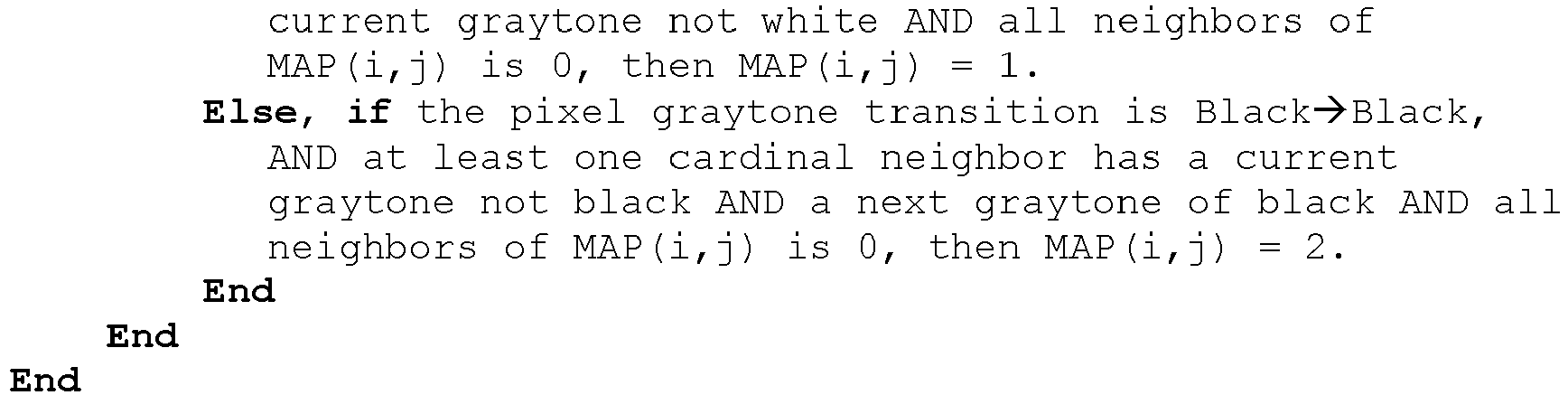
- In this approach, when certain conditions are met, a display pixel designated MAP (i, j) may be flagged with a numerical value of 1, indicating that dark edge artifacts have formed on this pixel. Some of the conditions required may include (1). this display pixel is going through a white to white transition; (2). all four cardinal neighbors (i.e., the four closest neighboring pixels) have a next graytone of white; AND (3). at least one cardinal neighbor has a current graytone that is not white; and (4). none of the neighboring pixels (i.e., the four cardinal neighbors and also the diagonal neighbors) are currently flagged for edge artifacts.
- Similarly, when certain conditions are met, a display pixel MAP (i, j) may be flagged with a numerical value of 2, indicating that white edges have formed on this pixel. Some of the conditions required may include (1). this pixel is going through a black to black transition; (2). at least one cardinal neighbor has a current graytone that is not black and its next graytone is black; and (3). none of the neighboring pixels (i.e., the four cardinal neighbors and also the diagonal neighbors) are currently flagged for edge artifacts.
- In use, one advantage of this approach is that the above mentioned image processing (i.e., map generation and pixel flagging) can occur concurrently with the display image updating cycles, thereby avoiding the creation of extra latencies to the updating cycles, due at least in part to the reason that the generated map is only required at the completion of the update cycle.
- Once an update mode has completed (e.g., the display ceases from using a particular update mode), pixel information accumulated by the generated map is later used for clearing the edge artifacts (e.g., using an out waveform mode). For example, pixels flagged for edge artifacts may be cleared with a low flash waveform with specialized waveforms.
- Full clearing white to white and black to black waveforms in conjunction with special edge clearing white to white and black to black waveforms may be used to clear the edge artifacts. For example, the balanced pulse pairs described in
U.S. Patent Application No. 2013/0194250 may be used: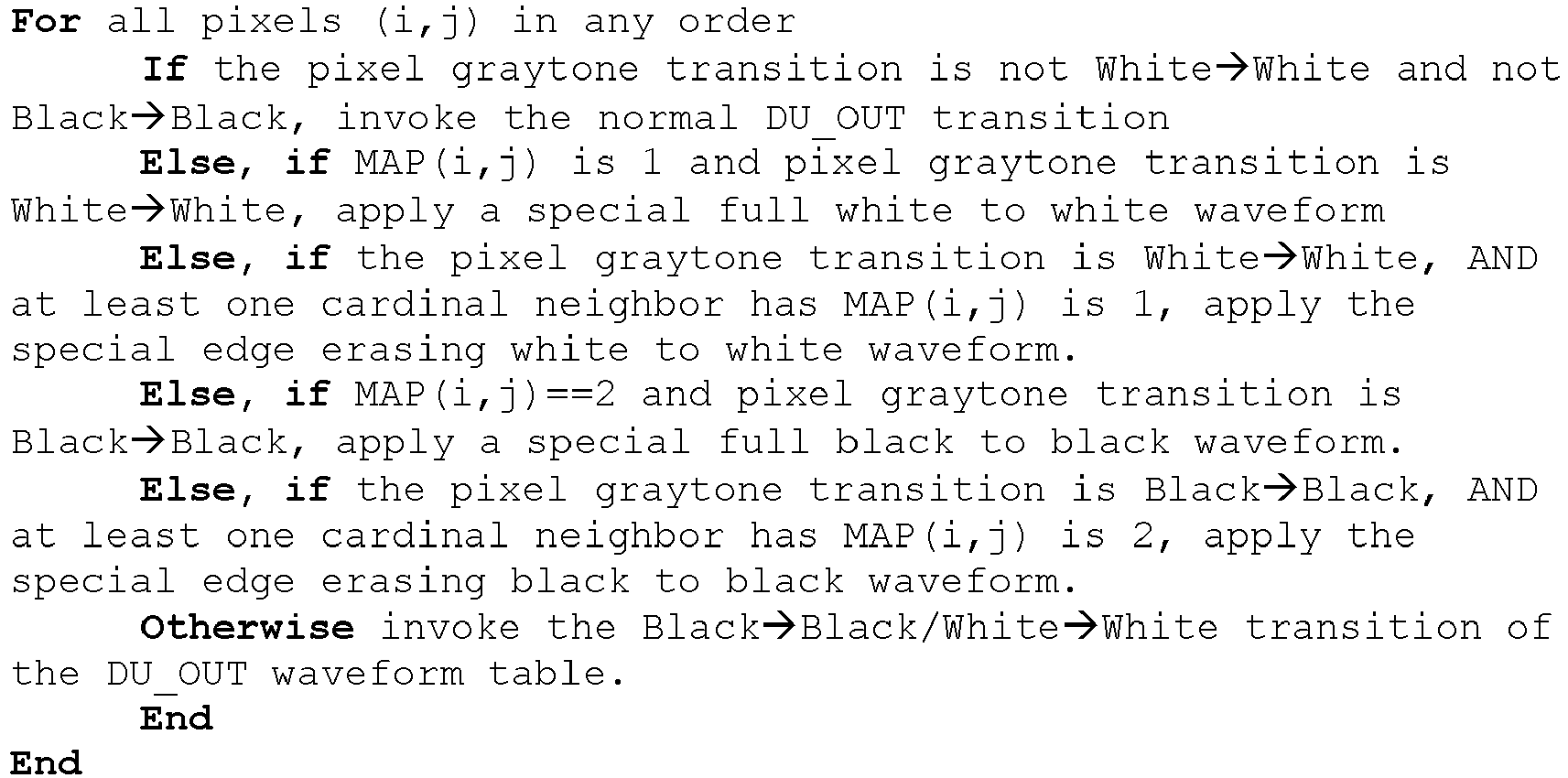
- In this approach, a DU_OUT transition scheme (e.g., a modified DU scheme with the edge artifact reduction algorithm included) may be applied to pixels that is not going through a white to white or black to black transition, for example, these pixels may receive the normal transition updates as if they were under a normal DU drive scheme. Else, for a pixel with dark edge artifacts (i.e., MAP (i, j) = 1) and going through a white to white transition, a special full white to white waveform may be applied. In some embodiments, this white to white waveform may be a waveform similar to what is illustrated in
FIG. 3c , which may be substantially DC balanced, meaning, the sum of the voltage bias apply as a function of magnitude and time is substantially zero overall; otherwise, if a pixel is going through a white to white transition, and at least one cardinal neighbor has dark edge artifact (i.e., MAP (i, j) = 1), a special edge erasing white to white waveform is applied (e.g.,FIG 3a ); still more, if a pixel had white edge artifact (i.e., MAP (i, j) = 2) and is going through a black to black transition, a special full black to black waveform, as illustrated inFIG 4b , may be applied; still more, if a pixel is going through a black to black transition, AND at least one cardinal neighbor is flagged for white edge artifact (i.e., MAP (i, j) = 2), apply a special edge erasing black to black waveform, as illustrated inFIG 4a ; otherwise, apply the black to black or white to white transition waveforms to all other pixels using waveforms from the DU-OUT waveform table. - Using the above mentioned method, full clearing white to white and black to black waveforms are used in conjunction with special edge clearing white to white and black to black waveforms to clear the edge artifacts. In some embodiments, the special edge clearing white to white waveform can take the form of a pulse pair as described in
US 2013/0194250 A1 , or a DC imbalance pulse drive to white as given in illustrated inFIG 3b , in which case post drive discharge described in may be used to discharge remnant voltages and reduce device stresses. Similarly, a DC imbalanced pulse, as illustrated inFIG 4a , may be used to drive a pixel to black, in which case, again, a post drive discharge may be performed. As illustrated inFIG 4 , a such DC imbalanced pulse have only a drive to the positive 15 volts for a period of time. In this configuration, excellent edge clearing performance can be achieved at the cost of small transition appearance imperfections (e.g., flashes) due to the use of the special full clearing waveform. - In another embodiment, transition appearance imperfections (e.g., flashes) may be reduced using an alternative implementation described below.

- In this approach, instead of using specialized edge clearing waveforms as described in the first method above, DC imbalanced waveforms may be used to clear the edge artifacts. In some instances, post drive discharges may be used to reduce hardware stress due to the imbalanced waveforms. In use, when a display pixel is not going through either a white to white or black to black transition, a normal DU-OUT transition is applied to the pixel. Else, if a display pixel is identified of having dark edge artifacts (i.e., MAP (i, j) = 1) and is going through a white to white transition, a DC imbalanced drive pulse is used to drive the pixel to white (e.g., a pulse similar to that illustrated in
FIG 3b ); else, if a display pixel is identified of having white edge artifacts (i.e., MAP (i, j) = 2) and is going through a black to black transition, a DC imbalanced drive pulse (e.g., a pulse similar to that illustrated inFIG 4a )is applied to drive the pixel to black; otherwise, invoke the black to black or white to white transitions of the DU-OUT waveform table to the display pixels. - In yet another embodiment, instead of storing edge artifact information in a designated memory location, one may bring forward the edge artifact information in an image buffer associated with the display's controller unit (e.g., using a next image buffer associated with the controller unit).

- In this approach, for a pixel going through a white to white transition and all of its four cardinal neighbors having a next graytone of white, if at least one of the cardinal neighbor's current gray tone is not white, then set the pixel's next gray tone to a special white to white image state in the next image buffer; else, if a pixel's graytone transition is black to black, and at least one cardinal neighbor has a current graytone that is not black and a next graytone that is black, then the pixel's next graytone is set to a special black to black image state in the next image buffer. In use, during an update cycle the special white to white and special black to black image states can be the same as the white to white and black to black image states for both application of the waveform transition and for image processing. For the application of waveform transition, this means that:
- special white state → white state (i.e., white state to white state) is equivalent to white state → white state (i.e., white state to white state) of the waveform look-up table
- special white state → any gray states (i.e., white state to any gray state) is equivalent to white state → any gray states (i.e., white state to any gray state) of the waveform look-up stable, etc.
- special black state -7 black state (i.e., black state to black state) is equivalent to black state → black state (i.e., black state to black state) of the waveform look-up table
- special black state → any gray states (i.e., black state to any gray state) is equivalent to black state → any gray states (i.e., black state to any gray state) of the waveform look-up stable, etc.
-
FIG 5a and FIG 5b illustrate displays without and with edge artifacts reduction applied. In practice, where edge artifacts reduction is not applied, white edges on a black background is clearly visible, as shown inFIG. 5a . In contrast,FIG. 5b shows that the white edges are cleared using one of the proposed methods presented herein.
Claims (7)
- A method for driving an electro-optic display having a plurality of display pixels comprising:updating the display with a first image; andidentifying display pixels with edge artifacts after the first image update;the method being characterized by:creating a binary map indicating the locations of the identified display pixels with edge artifacts;storing the identified display pixels information in a memory; andupdating the display with a second image, applying a special edge clearing waveform to each pixel flagged for edge artifacts in the binary map and undergoing a white-to-white or black-to-black transition during the updating with the second image, while other pixels undergo normal transition updates;wherein the creating the binary map occurs concurrently with a display image update cycle.
- The method of claim 1, wherein the step of identifying display pixels with edge artifacts comprising determining the graytone transitions of the display pixels.
- The method of claim 1, wherein the step of identifying display pixels with edge artifacts comprising determining displays pixels having different graytones than at least one of its cardinal neighboring pixels.
- The method of claim 1, wherein the step of identifying display pixels with edge artifacts comprising flagging the identified pixels to a memory associated with the display's controller.
- The method of claim 1, wherein the special edge clearing waveform is substantially DC balanced.
- The method of claim 1, wherein the special edge clearing waveform is DC imbalanced.
- The method of claim 5 further comprising performing a post drive discharge.
Applications Claiming Priority (2)
| Application Number | Priority Date | Filing Date | Title |
|---|---|---|---|
| US201762557285P | 2017-09-12 | 2017-09-12 | |
| PCT/US2018/050618 WO2019055486A1 (en) | 2017-09-12 | 2018-09-12 | Methods for driving electro-optic displays |
Publications (4)
| Publication Number | Publication Date |
|---|---|
| EP3682440A1 EP3682440A1 (en) | 2020-07-22 |
| EP3682440A4 EP3682440A4 (en) | 2021-04-28 |
| EP3682440B1 true EP3682440B1 (en) | 2024-11-06 |
| EP3682440C0 EP3682440C0 (en) | 2024-11-06 |
Family
ID=65723057
Family Applications (1)
| Application Number | Title | Priority Date | Filing Date |
|---|---|---|---|
| EP18855740.9A Active EP3682440B1 (en) | 2017-09-12 | 2018-09-12 | Methods for driving electro-optic displays |
Country Status (6)
| Country | Link |
|---|---|
| US (2) | US11423852B2 (en) |
| EP (1) | EP3682440B1 (en) |
| JP (1) | JP7079845B2 (en) |
| CN (1) | CN111133501A (en) |
| TW (1) | TWI711306B (en) |
| WO (1) | WO2019055486A1 (en) |
Families Citing this family (9)
| Publication number | Priority date | Publication date | Assignee | Title |
|---|---|---|---|---|
| CN110865488B (en) * | 2019-11-27 | 2022-09-09 | 京东方科技集团股份有限公司 | Backlight module, display panel and display device |
| JP7629031B2 (en) * | 2020-05-31 | 2025-02-12 | イー インク コーポレイション | Electro-optic display and method for driving same - Patents.com |
| CA3177451A1 (en) * | 2020-06-11 | 2021-12-16 | E Ink Corporation | Electro-optic displays, and methods for driving same |
| KR102797902B1 (en) * | 2020-08-31 | 2025-04-17 | 이 잉크 코포레이션 | Electro-optical displays and driving methods |
| US11450262B2 (en) * | 2020-10-01 | 2022-09-20 | E Ink Corporation | Electro-optic displays, and methods for driving same |
| WO2022072500A1 (en) * | 2020-10-02 | 2022-04-07 | E Ink Corporation | Front plane laminates with outer surface electrical connections |
| US20220398956A1 (en) | 2021-06-14 | 2022-12-15 | E Ink California, Llc | Methods and apparatuses for driving electro-optic displays |
| KR102884254B1 (en) | 2021-12-30 | 2025-11-10 | 이 잉크 코포레이션 | Method of driving an electro-optical display |
| WO2025198932A1 (en) * | 2024-03-19 | 2025-09-25 | E Ink Corporation | Methods and systems for managing remnant voltage during fast updates in electrophoretic displays |
Family Cites Families (189)
| Publication number | Priority date | Publication date | Assignee | Title |
|---|---|---|---|---|
| US4418346A (en) | 1981-05-20 | 1983-11-29 | Batchelder J Samuel | Method and apparatus for providing a dielectrophoretic display of visual information |
| US5745094A (en) | 1994-12-28 | 1998-04-28 | International Business Machines Corporation | Electrophoretic display |
| US6137467A (en) | 1995-01-03 | 2000-10-24 | Xerox Corporation | Optically sensitive electric paper |
| US7411719B2 (en) | 1995-07-20 | 2008-08-12 | E Ink Corporation | Electrophoretic medium and process for the production thereof |
| US7259744B2 (en) | 1995-07-20 | 2007-08-21 | E Ink Corporation | Dielectrophoretic displays |
| US7023420B2 (en) | 2000-11-29 | 2006-04-04 | E Ink Corporation | Electronic display with photo-addressing means |
| US7999787B2 (en) | 1995-07-20 | 2011-08-16 | E Ink Corporation | Methods for driving electrophoretic displays using dielectrophoretic forces |
| US7327511B2 (en) | 2004-03-23 | 2008-02-05 | E Ink Corporation | Light modulators |
| US8139050B2 (en) | 1995-07-20 | 2012-03-20 | E Ink Corporation | Addressing schemes for electronic displays |
| US7583251B2 (en) | 1995-07-20 | 2009-09-01 | E Ink Corporation | Dielectrophoretic displays |
| US7193625B2 (en) | 1999-04-30 | 2007-03-20 | E Ink Corporation | Methods for driving electro-optic displays, and apparatus for use therein |
| US8089453B2 (en) | 1995-07-20 | 2012-01-03 | E Ink Corporation | Stylus-based addressing structures for displays |
| US6866760B2 (en) | 1998-08-27 | 2005-03-15 | E Ink Corporation | Electrophoretic medium and process for the production thereof |
| US7956841B2 (en) | 1995-07-20 | 2011-06-07 | E Ink Corporation | Stylus-based addressing structures for displays |
| US5760761A (en) | 1995-12-15 | 1998-06-02 | Xerox Corporation | Highlight color twisting ball display |
| US6055091A (en) | 1996-06-27 | 2000-04-25 | Xerox Corporation | Twisting-cylinder display |
| US5808783A (en) | 1996-06-27 | 1998-09-15 | Xerox Corporation | High reflectance gyricon display |
| US5930026A (en) | 1996-10-25 | 1999-07-27 | Massachusetts Institute Of Technology | Nonemissive displays and piezoelectric power supplies therefor |
| US5777782A (en) | 1996-12-24 | 1998-07-07 | Xerox Corporation | Auxiliary optics for a twisting ball display |
| DE69830566T2 (en) | 1997-02-06 | 2006-05-11 | University College Dublin | ELECTROCHROMIC SYSTEM |
| US7002728B2 (en) | 1997-08-28 | 2006-02-21 | E Ink Corporation | Electrophoretic particles, and processes for the production thereof |
| US6054071A (en) | 1998-01-28 | 2000-04-25 | Xerox Corporation | Poled electrets for gyricon-based electric-paper displays |
| EP1064584B1 (en) | 1998-03-18 | 2004-05-19 | E Ink Corporation | Electrophoretic display |
| US6753999B2 (en) | 1998-03-18 | 2004-06-22 | E Ink Corporation | Electrophoretic displays in portable devices and systems for addressing such displays |
| US7075502B1 (en) | 1998-04-10 | 2006-07-11 | E Ink Corporation | Full color reflective display with multichromatic sub-pixels |
| EP1075670B1 (en) | 1998-04-27 | 2008-12-17 | E-Ink Corporation | Shutter mode microencapsulated electrophoretic display |
| US6241921B1 (en) | 1998-05-15 | 2001-06-05 | Massachusetts Institute Of Technology | Heterogeneous display elements and methods for their fabrication |
| AU5094899A (en) | 1998-07-08 | 2000-02-01 | E-Ink Corporation | Method and apparatus for sensing the state of an electrophoretic display |
| US20030102858A1 (en) | 1998-07-08 | 2003-06-05 | E Ink Corporation | Method and apparatus for determining properties of an electrophoretic display |
| US6144361A (en) | 1998-09-16 | 2000-11-07 | International Business Machines Corporation | Transmissive electrophoretic display with vertical electrodes |
| US6271823B1 (en) | 1998-09-16 | 2001-08-07 | International Business Machines Corporation | Reflective electrophoretic display with laterally adjacent color cells using a reflective panel |
| US6184856B1 (en) | 1998-09-16 | 2001-02-06 | International Business Machines Corporation | Transmissive electrophoretic display with laterally adjacent color cells |
| US6225971B1 (en) | 1998-09-16 | 2001-05-01 | International Business Machines Corporation | Reflective electrophoretic display with laterally adjacent color cells using an absorbing panel |
| US6128124A (en) | 1998-10-16 | 2000-10-03 | Xerox Corporation | Additive color electric paper without registration or alignment of individual elements |
| US6097531A (en) | 1998-11-25 | 2000-08-01 | Xerox Corporation | Method of making uniformly magnetized elements for a gyricon display |
| US6147791A (en) | 1998-11-25 | 2000-11-14 | Xerox Corporation | Gyricon displays utilizing rotating elements and magnetic latching |
| US6504524B1 (en) | 2000-03-08 | 2003-01-07 | E Ink Corporation | Addressing methods for displays having zero time-average field |
| US7119772B2 (en) | 1999-04-30 | 2006-10-10 | E Ink Corporation | Methods for driving bistable electro-optic displays, and apparatus for use therein |
| US7012600B2 (en) | 1999-04-30 | 2006-03-14 | E Ink Corporation | Methods for driving bistable electro-optic displays, and apparatus for use therein |
| US6531997B1 (en) | 1999-04-30 | 2003-03-11 | E Ink Corporation | Methods for addressing electrophoretic displays |
| US8009348B2 (en) | 1999-05-03 | 2011-08-30 | E Ink Corporation | Machine-readable displays |
| EP1500969A1 (en) | 1999-10-11 | 2005-01-26 | University College Dublin | Compound and its use in electrochromic devices |
| US6672921B1 (en) | 2000-03-03 | 2004-01-06 | Sipix Imaging, Inc. | Manufacturing process for electrophoretic display |
| US7715088B2 (en) | 2000-03-03 | 2010-05-11 | Sipix Imaging, Inc. | Electrophoretic display |
| US6788449B2 (en) | 2000-03-03 | 2004-09-07 | Sipix Imaging, Inc. | Electrophoretic display and novel process for its manufacture |
| JP4198999B2 (en) | 2001-03-13 | 2008-12-17 | イー インク コーポレイション | Equipment for displaying drawings |
| WO2002079869A1 (en) | 2001-04-02 | 2002-10-10 | E Ink Corporation | Electrophoretic medium with improved image stability |
| US7679814B2 (en) | 2001-04-02 | 2010-03-16 | E Ink Corporation | Materials for use in electrophoretic displays |
| US20020188053A1 (en) | 2001-06-04 | 2002-12-12 | Sipix Imaging, Inc. | Composition and process for the sealing of microcups in roll-to-roll display manufacturing |
| US7535624B2 (en) | 2001-07-09 | 2009-05-19 | E Ink Corporation | Electro-optic display and materials for use therein |
| US6982178B2 (en) | 2002-06-10 | 2006-01-03 | E Ink Corporation | Components and methods for use in electro-optic displays |
| US7038670B2 (en) | 2002-08-16 | 2006-05-02 | Sipix Imaging, Inc. | Electrophoretic display with dual mode switching |
| US6825970B2 (en) | 2001-09-14 | 2004-11-30 | E Ink Corporation | Methods for addressing electro-optic materials |
| CN102789758B (en) * | 2001-11-20 | 2016-05-18 | 伊英克公司 | Drive the method for bistable electro-optic displays |
| US7528822B2 (en) | 2001-11-20 | 2009-05-05 | E Ink Corporation | Methods for driving electro-optic displays |
| US8558783B2 (en) | 2001-11-20 | 2013-10-15 | E Ink Corporation | Electro-optic displays with reduced remnant voltage |
| US7202847B2 (en) | 2002-06-28 | 2007-04-10 | E Ink Corporation | Voltage modulated driver circuits for electro-optic displays |
| US7952557B2 (en) | 2001-11-20 | 2011-05-31 | E Ink Corporation | Methods and apparatus for driving electro-optic displays |
| US8125501B2 (en) | 2001-11-20 | 2012-02-28 | E Ink Corporation | Voltage modulated driver circuits for electro-optic displays |
| US8593396B2 (en) | 2001-11-20 | 2013-11-26 | E Ink Corporation | Methods and apparatus for driving electro-optic displays |
| US9412314B2 (en) | 2001-11-20 | 2016-08-09 | E Ink Corporation | Methods for driving electro-optic displays |
| US6900851B2 (en) | 2002-02-08 | 2005-05-31 | E Ink Corporation | Electro-optic displays and optical systems for addressing such displays |
| JP4202266B2 (en) | 2002-03-06 | 2008-12-24 | 株式会社ブリヂストン | Image display apparatus and method |
| US6950220B2 (en) | 2002-03-18 | 2005-09-27 | E Ink Corporation | Electro-optic displays, and methods for driving same |
| AU2003232018A1 (en) | 2002-04-24 | 2003-11-10 | E Ink Corporation | Electronic displays |
| US7649674B2 (en) | 2002-06-10 | 2010-01-19 | E Ink Corporation | Electro-optic display with edge seal |
| US20110199671A1 (en) | 2002-06-13 | 2011-08-18 | E Ink Corporation | Methods for driving electrophoretic displays using dielectrophoretic forces |
| US20080024482A1 (en) | 2002-06-13 | 2008-01-31 | E Ink Corporation | Methods for driving electro-optic displays |
| US7839564B2 (en) | 2002-09-03 | 2010-11-23 | E Ink Corporation | Components and methods for use in electro-optic displays |
| US20130063333A1 (en) | 2002-10-16 | 2013-03-14 | E Ink Corporation | Electrophoretic displays |
| TWI229230B (en) | 2002-10-31 | 2005-03-11 | Sipix Imaging Inc | An improved electrophoretic display and novel process for its manufacture |
| AU2003299673A1 (en) | 2002-12-16 | 2004-07-22 | E Ink Corporation | Backplanes for electro-optic displays |
| US6922276B2 (en) | 2002-12-23 | 2005-07-26 | E Ink Corporation | Flexible electro-optic displays |
| US7236291B2 (en) | 2003-04-02 | 2007-06-26 | Bridgestone Corporation | Particle use for image display media, image display panel using the particles, and image display device |
| WO2004104979A2 (en) | 2003-05-16 | 2004-12-02 | Sipix Imaging, Inc. | Improved passive matrix electrophoretic display driving scheme |
| JP2004356206A (en) | 2003-05-27 | 2004-12-16 | Fuji Photo Film Co Ltd | Laminated structure and its manufacturing method |
| US8174490B2 (en) | 2003-06-30 | 2012-05-08 | E Ink Corporation | Methods for driving electrophoretic displays |
| WO2005020199A2 (en) | 2003-08-19 | 2005-03-03 | E Ink Corporation | Methods for controlling electro-optic displays |
| JP5506137B2 (en) | 2003-09-19 | 2014-05-28 | イー インク コーポレイション | Method for reducing edge effects in electro-optic displays |
| JP2007507737A (en) | 2003-10-03 | 2007-03-29 | コーニンクレッカ フィリップス エレクトロニクス エヌ ヴィ | Electrophoretic display unit |
| US8514168B2 (en) | 2003-10-07 | 2013-08-20 | Sipix Imaging, Inc. | Electrophoretic display with thermal control |
| US7061662B2 (en) | 2003-10-07 | 2006-06-13 | Sipix Imaging, Inc. | Electrophoretic display with thermal control |
| EP1671304B1 (en) | 2003-10-08 | 2008-08-20 | E Ink Corporation | Electro-wetting displays |
| US7177066B2 (en) | 2003-10-24 | 2007-02-13 | Sipix Imaging, Inc. | Electrophoretic display driving scheme |
| US8928562B2 (en) | 2003-11-25 | 2015-01-06 | E Ink Corporation | Electro-optic displays, and methods for driving same |
| CN1886776A (en) | 2003-11-25 | 2006-12-27 | 皇家飞利浦电子股份有限公司 | Display device with display device and cycle orbit stabilization method for driving the display device |
| US7492339B2 (en) | 2004-03-26 | 2009-02-17 | E Ink Corporation | Methods for driving bistable electro-optic displays |
| US8289250B2 (en) | 2004-03-31 | 2012-10-16 | E Ink Corporation | Methods for driving electro-optic displays |
| US20050253777A1 (en) | 2004-05-12 | 2005-11-17 | E Ink Corporation | Tiled displays and methods for driving same |
| US20080136774A1 (en) | 2004-07-27 | 2008-06-12 | E Ink Corporation | Methods for driving electrophoretic displays using dielectrophoretic forces |
| WO2006015044A1 (en) | 2004-07-27 | 2006-02-09 | E Ink Corporation | Electro-optic displays |
| US7453445B2 (en) | 2004-08-13 | 2008-11-18 | E Ink Corproation | Methods for driving electro-optic displays |
| US8643595B2 (en) | 2004-10-25 | 2014-02-04 | Sipix Imaging, Inc. | Electrophoretic display driving approaches |
| JP4718859B2 (en) | 2005-02-17 | 2011-07-06 | セイコーエプソン株式会社 | Electrophoresis apparatus, driving method thereof, and electronic apparatus |
| JP4690079B2 (en) | 2005-03-04 | 2011-06-01 | セイコーエプソン株式会社 | Electrophoresis apparatus, driving method thereof, and electronic apparatus |
| US7999832B2 (en) | 2005-05-20 | 2011-08-16 | Industrial Technology Research Institute | Controlled gap states for liquid crystal displays |
| US7408699B2 (en) | 2005-09-28 | 2008-08-05 | Sipix Imaging, Inc. | Electrophoretic display and methods of addressing such display |
| US20070176912A1 (en) | 2005-12-09 | 2007-08-02 | Beames Michael H | Portable memory devices with polymeric displays |
| KR100793087B1 (en) * | 2006-01-04 | 2008-01-10 | 엘지전자 주식회사 | Plasma display device |
| US7982479B2 (en) | 2006-04-07 | 2011-07-19 | Sipix Imaging, Inc. | Inspection methods for defects in electrophoretic display and related devices |
| US7683606B2 (en) | 2006-05-26 | 2010-03-23 | Sipix Imaging, Inc. | Flexible display testing and inspection |
| US20150005720A1 (en) | 2006-07-18 | 2015-01-01 | E Ink California, Llc | Electrophoretic display |
| US20080024429A1 (en) | 2006-07-25 | 2008-01-31 | E Ink Corporation | Electrophoretic displays using gaseous fluids |
| US8274472B1 (en) | 2007-03-12 | 2012-09-25 | Sipix Imaging, Inc. | Driving methods for bistable displays |
| US8243013B1 (en) | 2007-05-03 | 2012-08-14 | Sipix Imaging, Inc. | Driving bistable displays |
| US10319313B2 (en) | 2007-05-21 | 2019-06-11 | E Ink Corporation | Methods for driving video electro-optic displays |
| US20080303780A1 (en) | 2007-06-07 | 2008-12-11 | Sipix Imaging, Inc. | Driving methods and circuit for bi-stable displays |
| US20090022229A1 (en) | 2007-07-17 | 2009-01-22 | Chih-Ta Star Sung | Efficient image transmission between TV chipset and display device |
| US9224342B2 (en) | 2007-10-12 | 2015-12-29 | E Ink California, Llc | Approach to adjust driving waveforms for a display device |
| US8373649B2 (en) | 2008-04-11 | 2013-02-12 | Seiko Epson Corporation | Time-overlapping partial-panel updating of a bistable electro-optic display |
| JP5904791B2 (en) * | 2008-04-11 | 2016-04-20 | イー インク コーポレイション | Method for driving an electro-optic display |
| CN102027528B (en) | 2008-04-14 | 2014-08-27 | 伊英克公司 | Method for driving an electro-optic display |
| US8462102B2 (en) | 2008-04-25 | 2013-06-11 | Sipix Imaging, Inc. | Driving methods for bistable displays |
| WO2010014359A2 (en) | 2008-08-01 | 2010-02-04 | Sipix Imaging, Inc. | Gamma adjustment with error diffusion for electrophoretic displays |
| US8559746B2 (en) * | 2008-09-04 | 2013-10-15 | Silicon Image, Inc. | System, method, and apparatus for smoothing of edges in images to remove irregularities |
| US9019318B2 (en) | 2008-10-24 | 2015-04-28 | E Ink California, Llc | Driving methods for electrophoretic displays employing grey level waveforms |
| US8558855B2 (en) | 2008-10-24 | 2013-10-15 | Sipix Imaging, Inc. | Driving methods for electrophoretic displays |
| JP5287157B2 (en) | 2008-11-10 | 2013-09-11 | セイコーエプソン株式会社 | Electrophoretic display device driving method, electrophoretic display device, and electronic apparatus |
| US9251736B2 (en) | 2009-01-30 | 2016-02-02 | E Ink California, Llc | Multiple voltage level driving for electrophoretic displays |
| US20100194789A1 (en) | 2009-01-30 | 2010-08-05 | Craig Lin | Partial image update for electrophoretic displays |
| US20100194733A1 (en) | 2009-01-30 | 2010-08-05 | Craig Lin | Multiple voltage level driving for electrophoretic displays |
| US8576259B2 (en) | 2009-04-22 | 2013-11-05 | Sipix Imaging, Inc. | Partial update driving methods for electrophoretic displays |
| US9460666B2 (en) | 2009-05-11 | 2016-10-04 | E Ink California, Llc | Driving methods and waveforms for electrophoretic displays |
| CN102013247B (en) * | 2009-09-08 | 2012-10-31 | 北大方正集团有限公司 | Refresh control method and system for electronic paper screen |
| US9390661B2 (en) | 2009-09-15 | 2016-07-12 | E Ink California, Llc | Display controller system |
| US20110063314A1 (en) | 2009-09-15 | 2011-03-17 | Wen-Pin Chiu | Display controller system |
| US8810525B2 (en) | 2009-10-05 | 2014-08-19 | E Ink California, Llc | Electronic information displays |
| US8576164B2 (en) | 2009-10-26 | 2013-11-05 | Sipix Imaging, Inc. | Spatially combined waveforms for electrophoretic displays |
| US9390066B2 (en) | 2009-11-12 | 2016-07-12 | Digital Harmonic Llc | Precision measurement of waveforms using deconvolution and windowing |
| US7859742B1 (en) | 2009-12-02 | 2010-12-28 | Sipix Technology, Inc. | Frequency conversion correction circuit for electrophoretic displays |
| US8928641B2 (en) | 2009-12-02 | 2015-01-06 | Sipix Technology Inc. | Multiplex electrophoretic display driver circuit |
| JP5359840B2 (en) | 2009-12-10 | 2013-12-04 | セイコーエプソン株式会社 | Electrophoretic display device driving method, electrophoretic display device, and electronic apparatus |
| US11049463B2 (en) | 2010-01-15 | 2021-06-29 | E Ink California, Llc | Driving methods with variable frame time |
| US8558786B2 (en) | 2010-01-20 | 2013-10-15 | Sipix Imaging, Inc. | Driving methods for electrophoretic displays |
| US9224338B2 (en) | 2010-03-08 | 2015-12-29 | E Ink California, Llc | Driving methods for electrophoretic displays |
| TWI409767B (en) | 2010-03-12 | 2013-09-21 | Sipix Technology Inc | Driving method of electrophoretic display |
| TWI591604B (en) | 2010-04-09 | 2017-07-11 | 電子墨水股份有限公司 | Methods for driving electro-optic displays |
| US9013394B2 (en) | 2010-06-04 | 2015-04-21 | E Ink California, Llc | Driving method for electrophoretic displays |
| TWI444975B (en) | 2010-06-30 | 2014-07-11 | Sipix Technology Inc | Electrophoretic display and driving method thereof |
| TWI436337B (en) | 2010-06-30 | 2014-05-01 | Sipix Technology Inc | Electrophoretic display and driving method thereof |
| TWI455088B (en) | 2010-07-08 | 2014-10-01 | Sipix Imaging Inc | Three dimensional driving scheme for electrophoretic display devices |
| US8665206B2 (en) | 2010-08-10 | 2014-03-04 | Sipix Imaging, Inc. | Driving method to neutralize grey level shift for electrophoretic displays |
| US8294822B2 (en) * | 2010-08-17 | 2012-10-23 | Broadcom Corporation | Method and system for key aware scaling |
| TWI518652B (en) | 2010-10-20 | 2016-01-21 | 達意科技股份有限公司 | Electro-phoretic display apparatus |
| TWI493520B (en) | 2010-10-20 | 2015-07-21 | Sipix Technology Inc | Electro-phoretic display apparatus and driving method thereof |
| TWI409563B (en) | 2010-10-21 | 2013-09-21 | Sipix Technology Inc | Electro-phoretic display apparatus |
| TWI598672B (en) | 2010-11-11 | 2017-09-11 | 希畢克斯幻像有限公司 | Driving method for electrophoretic displays |
| US20160180777A1 (en) | 2010-11-11 | 2016-06-23 | E Ink California, Inc. | Driving method for electrophoretic displays |
| US8878770B2 (en) | 2011-05-10 | 2014-11-04 | Seiko Epson Corporation | Control method of electro-optical device, controller of electro-optical device, electro-optical device, and electronic apparatus |
| US8605354B2 (en) | 2011-09-02 | 2013-12-10 | Sipix Imaging, Inc. | Color display devices |
| US9514667B2 (en) | 2011-09-12 | 2016-12-06 | E Ink California, Llc | Driving system for electrophoretic displays |
| US9019197B2 (en) * | 2011-09-12 | 2015-04-28 | E Ink California, Llc | Driving system for electrophoretic displays |
| US11030936B2 (en) * | 2012-02-01 | 2021-06-08 | E Ink Corporation | Methods and apparatus for operating an electro-optic display in white mode |
| EP2810273A4 (en) | 2012-02-01 | 2015-12-23 | E Ink Corp | Methods for driving electro-optic displays |
| JP2013195482A (en) | 2012-03-16 | 2013-09-30 | Seiko Epson Corp | Image processing circuit, electronic apparatus and image processing method |
| TWI537661B (en) | 2012-03-26 | 2016-06-11 | 達意科技股份有限公司 | Electrophoretic display system |
| US9513743B2 (en) | 2012-06-01 | 2016-12-06 | E Ink Corporation | Methods for driving electro-optic displays |
| TWI470606B (en) | 2012-07-05 | 2015-01-21 | Sipix Technology Inc | Driving methof of passive display panel and display apparatus |
| GB2504141B (en) | 2012-07-20 | 2020-01-29 | Flexenable Ltd | Method of reducing artefacts in an electro-optic display by using a null frame |
| US9279906B2 (en) | 2012-08-31 | 2016-03-08 | E Ink California, Llc | Microstructure film |
| CN102866526B (en) | 2012-09-21 | 2016-08-03 | 京东方科技集团股份有限公司 | Display device |
| TWI550580B (en) | 2012-09-26 | 2016-09-21 | 達意科技股份有限公司 | Electro-phoretic display and driving method thereof |
| US9129581B2 (en) * | 2012-11-06 | 2015-09-08 | Aspeed Technology Inc. | Method and apparatus for displaying images |
| US9218773B2 (en) | 2013-01-17 | 2015-12-22 | Sipix Technology Inc. | Method and driving apparatus for outputting driving signal to drive electro-phoretic display |
| US9792862B2 (en) | 2013-01-17 | 2017-10-17 | E Ink Holdings Inc. | Method and driving apparatus for outputting driving signal to drive electro-phoretic display |
| TWI600959B (en) | 2013-01-24 | 2017-10-01 | 達意科技股份有限公司 | Electrophoretic display and method for driving panel thereof |
| TWI490839B (en) | 2013-02-07 | 2015-07-01 | Sipix Technology Inc | Electrophoretic display and method of operating an electrophoretic display |
| TWI490619B (en) | 2013-02-25 | 2015-07-01 | Sipix Technology Inc | Electrophoretic display |
| US9721495B2 (en) | 2013-02-27 | 2017-08-01 | E Ink Corporation | Methods for driving electro-optic displays |
| WO2014134504A1 (en) | 2013-03-01 | 2014-09-04 | E Ink Corporation | Methods for driving electro-optic displays |
| WO2014138630A1 (en) | 2013-03-07 | 2014-09-12 | E Ink Corporation | Method and apparatus for driving electro-optic displays |
| TWI502573B (en) | 2013-03-13 | 2015-10-01 | Sipix Technology Inc | Electrophoretic display capable of reducing passive matrix coupling effect and method thereof |
| JP5871170B2 (en) | 2013-03-29 | 2016-03-01 | ソニー株式会社 | Display control device, display control method, and electronic information display device |
| US20140293398A1 (en) | 2013-03-29 | 2014-10-02 | Sipix Imaging, Inc. | Electrophoretic display device |
| JP6393747B2 (en) | 2013-05-17 | 2018-09-19 | イー・インク・カリフォルニア・リミテッド・ライアビリティ・カンパニーE Ink California,Llc | Driving method of color display device |
| TWI526765B (en) | 2013-06-20 | 2016-03-21 | 達意科技股份有限公司 | Electrophoretic display and method of operating an electrophoretic display |
| US9620048B2 (en) | 2013-07-30 | 2017-04-11 | E Ink Corporation | Methods for driving electro-optic displays |
| KR101879559B1 (en) | 2013-07-31 | 2018-07-17 | 이 잉크 코포레이션 | Methods for driving electro-optic displays |
| TWI550332B (en) | 2013-10-07 | 2016-09-21 | 電子墨水加利福尼亞有限責任公司 | Driving methods for color display device |
| US20150262255A1 (en) | 2014-03-12 | 2015-09-17 | Netseer, Inc. | Search monetization of images embedded in text |
| US10444553B2 (en) | 2014-03-25 | 2019-10-15 | E Ink California, Llc | Magnetophoretic display assembly and driving scheme |
| TWI559915B (en) | 2014-07-10 | 2016-12-01 | Sipix Technology Inc | Smart medication device |
| US9928810B2 (en) | 2015-01-30 | 2018-03-27 | E Ink Corporation | Font control for electro-optic displays and related apparatus and methods |
| WO2016126963A1 (en) | 2015-02-04 | 2016-08-11 | E Ink Corporation | Electro-optic displays displaying in dark mode and light mode, and related apparatus and methods |
| EP3254276A4 (en) | 2015-02-04 | 2018-07-11 | E Ink Corporation | Electro-optic displays with reduced remnant voltage, and related apparatus and methods |
| WO2016176291A1 (en) * | 2015-04-27 | 2016-11-03 | E Ink Corporation | Methods and apparatuses for driving display systems |
| TWI566225B (en) | 2015-12-17 | 2017-01-11 | 宏碁股份有限公司 | Drive device and drive method |
| JP2017120315A (en) | 2015-12-28 | 2017-07-06 | ソニー株式会社 | Display device, driving method, and electronic apparatus |
| JP2017156365A (en) | 2016-02-29 | 2017-09-07 | キヤノン株式会社 | Liquid crystal display device |
-
2018
- 2018-09-12 EP EP18855740.9A patent/EP3682440B1/en active Active
- 2018-09-12 JP JP2020514593A patent/JP7079845B2/en active Active
- 2018-09-12 WO PCT/US2018/050618 patent/WO2019055486A1/en not_active Ceased
- 2018-09-12 CN CN201880057665.2A patent/CN111133501A/en active Pending
- 2018-09-12 US US16/128,996 patent/US11423852B2/en active Active
-
2019
- 2019-01-23 TW TW108102573A patent/TWI711306B/en active
-
2022
- 2022-07-26 US US17/873,301 patent/US11568827B2/en active Active
Also Published As
| Publication number | Publication date |
|---|---|
| TW202011727A (en) | 2020-03-16 |
| CN111133501A (en) | 2020-05-08 |
| EP3682440A1 (en) | 2020-07-22 |
| WO2019055486A1 (en) | 2019-03-21 |
| EP3682440A4 (en) | 2021-04-28 |
| TWI711306B (en) | 2020-11-21 |
| US11568827B2 (en) | 2023-01-31 |
| US11423852B2 (en) | 2022-08-23 |
| JP7079845B2 (en) | 2022-06-02 |
| EP3682440C0 (en) | 2024-11-06 |
| US20220375418A1 (en) | 2022-11-24 |
| US20190122617A1 (en) | 2019-04-25 |
| JP2020533638A (en) | 2020-11-19 |
Similar Documents
| Publication | Publication Date | Title |
|---|---|---|
| US11568827B2 (en) | Methods for driving electro-optic displays to minimize edge ghosting | |
| US11935496B2 (en) | Electro-optic displays, and methods for driving same | |
| KR20170110657A (en) | Electro-optic displays displaying in dark mode and light mode, and related apparatus and methods | |
| US11520202B2 (en) | Electro-optic displays, and methods for driving same | |
| US20250285575A1 (en) | Electro-optic displays, and methods for driving same | |
| KR102435841B1 (en) | Electro-optical displays and their driving methods | |
| US11289036B2 (en) | Methods for driving electro-optic displays | |
| CA3157990C (en) | Methods for driving electro-optic displays | |
| HK40027133B (en) | Electro-optic displays, and methods for driving same | |
| HK40027133A (en) | Electro-optic displays, and methods for driving same | |
| HK40018519A (en) | Methods for driving electro-optic displays |
Legal Events
| Date | Code | Title | Description |
|---|---|---|---|
| STAA | Information on the status of an ep patent application or granted ep patent |
Free format text: STATUS: THE INTERNATIONAL PUBLICATION HAS BEEN MADE |
|
| PUAI | Public reference made under article 153(3) epc to a published international application that has entered the european phase |
Free format text: ORIGINAL CODE: 0009012 |
|
| STAA | Information on the status of an ep patent application or granted ep patent |
Free format text: STATUS: REQUEST FOR EXAMINATION WAS MADE |
|
| 17P | Request for examination filed |
Effective date: 20200414 |
|
| AK | Designated contracting states |
Kind code of ref document: A1 Designated state(s): AL AT BE BG CH CY CZ DE DK EE ES FI FR GB GR HR HU IE IS IT LI LT LU LV MC MK MT NL NO PL PT RO RS SE SI SK SM TR |
|
| AX | Request for extension of the european patent |
Extension state: BA ME |
|
| DAV | Request for validation of the european patent (deleted) | ||
| DAX | Request for extension of the european patent (deleted) | ||
| A4 | Supplementary search report drawn up and despatched |
Effective date: 20210325 |
|
| RIC1 | Information provided on ipc code assigned before grant |
Ipc: G09G 5/36 20060101AFI20210319BHEP Ipc: G09G 5/02 20060101ALI20210319BHEP |
|
| STAA | Information on the status of an ep patent application or granted ep patent |
Free format text: STATUS: EXAMINATION IS IN PROGRESS |
|
| 17Q | First examination report despatched |
Effective date: 20230127 |
|
| GRAP | Despatch of communication of intention to grant a patent |
Free format text: ORIGINAL CODE: EPIDOSNIGR1 |
|
| STAA | Information on the status of an ep patent application or granted ep patent |
Free format text: STATUS: GRANT OF PATENT IS INTENDED |
|
| INTG | Intention to grant announced |
Effective date: 20240620 |
|
| GRAS | Grant fee paid |
Free format text: ORIGINAL CODE: EPIDOSNIGR3 |
|
| GRAA | (expected) grant |
Free format text: ORIGINAL CODE: 0009210 |
|
| STAA | Information on the status of an ep patent application or granted ep patent |
Free format text: STATUS: THE PATENT HAS BEEN GRANTED |
|
| AK | Designated contracting states |
Kind code of ref document: B1 Designated state(s): AL AT BE BG CH CY CZ DE DK EE ES FI FR GB GR HR HU IE IS IT LI LT LU LV MC MK MT NL NO PL PT RO RS SE SI SK SM TR |
|
| REG | Reference to a national code |
Ref country code: GB Ref legal event code: FG4D |
|
| REG | Reference to a national code |
Ref country code: CH Ref legal event code: EP |
|
| REG | Reference to a national code |
Ref country code: DE Ref legal event code: R096 Ref document number: 602018076374 Country of ref document: DE |
|
| REG | Reference to a national code |
Ref country code: IE Ref legal event code: FG4D |
|
| U01 | Request for unitary effect filed |
Effective date: 20241204 |
|
| U07 | Unitary effect registered |
Designated state(s): AT BE BG DE DK EE FI FR IT LT LU LV MT NL PT RO SE SI Effective date: 20241211 |
|
| PG25 | Lapsed in a contracting state [announced via postgrant information from national office to epo] |
Ref country code: HR Free format text: LAPSE BECAUSE OF FAILURE TO SUBMIT A TRANSLATION OF THE DESCRIPTION OR TO PAY THE FEE WITHIN THE PRESCRIBED TIME-LIMIT Effective date: 20241106 Ref country code: IS Free format text: LAPSE BECAUSE OF FAILURE TO SUBMIT A TRANSLATION OF THE DESCRIPTION OR TO PAY THE FEE WITHIN THE PRESCRIBED TIME-LIMIT Effective date: 20250306 |
|
| PG25 | Lapsed in a contracting state [announced via postgrant information from national office to epo] |
Ref country code: ES Free format text: LAPSE BECAUSE OF FAILURE TO SUBMIT A TRANSLATION OF THE DESCRIPTION OR TO PAY THE FEE WITHIN THE PRESCRIBED TIME-LIMIT Effective date: 20241106 |
|
| PG25 | Lapsed in a contracting state [announced via postgrant information from national office to epo] |
Ref country code: NO Free format text: LAPSE BECAUSE OF FAILURE TO SUBMIT A TRANSLATION OF THE DESCRIPTION OR TO PAY THE FEE WITHIN THE PRESCRIBED TIME-LIMIT Effective date: 20250206 |
|
| PG25 | Lapsed in a contracting state [announced via postgrant information from national office to epo] |
Ref country code: GR Free format text: LAPSE BECAUSE OF FAILURE TO SUBMIT A TRANSLATION OF THE DESCRIPTION OR TO PAY THE FEE WITHIN THE PRESCRIBED TIME-LIMIT Effective date: 20250207 |
|
| PG25 | Lapsed in a contracting state [announced via postgrant information from national office to epo] |
Ref country code: PL Free format text: LAPSE BECAUSE OF FAILURE TO SUBMIT A TRANSLATION OF THE DESCRIPTION OR TO PAY THE FEE WITHIN THE PRESCRIBED TIME-LIMIT Effective date: 20241106 |
|
| PG25 | Lapsed in a contracting state [announced via postgrant information from national office to epo] |
Ref country code: RS Free format text: LAPSE BECAUSE OF FAILURE TO SUBMIT A TRANSLATION OF THE DESCRIPTION OR TO PAY THE FEE WITHIN THE PRESCRIBED TIME-LIMIT Effective date: 20250206 |
|
| PG25 | Lapsed in a contracting state [announced via postgrant information from national office to epo] |
Ref country code: SM Free format text: LAPSE BECAUSE OF FAILURE TO SUBMIT A TRANSLATION OF THE DESCRIPTION OR TO PAY THE FEE WITHIN THE PRESCRIBED TIME-LIMIT Effective date: 20241106 |
|
| PG25 | Lapsed in a contracting state [announced via postgrant information from national office to epo] |
Ref country code: SK Free format text: LAPSE BECAUSE OF FAILURE TO SUBMIT A TRANSLATION OF THE DESCRIPTION OR TO PAY THE FEE WITHIN THE PRESCRIBED TIME-LIMIT Effective date: 20241106 |
|
| PG25 | Lapsed in a contracting state [announced via postgrant information from national office to epo] |
Ref country code: CZ Free format text: LAPSE BECAUSE OF FAILURE TO SUBMIT A TRANSLATION OF THE DESCRIPTION OR TO PAY THE FEE WITHIN THE PRESCRIBED TIME-LIMIT Effective date: 20241106 |
|
| PLBE | No opposition filed within time limit |
Free format text: ORIGINAL CODE: 0009261 |
|
| STAA | Information on the status of an ep patent application or granted ep patent |
Free format text: STATUS: NO OPPOSITION FILED WITHIN TIME LIMIT |
|
| U20 | Renewal fee for the european patent with unitary effect paid |
Year of fee payment: 8 Effective date: 20250820 |
|
| REG | Reference to a national code |
Ref country code: CH Ref legal event code: U11 Free format text: ST27 STATUS EVENT CODE: U-0-0-U10-U11 (AS PROVIDED BY THE NATIONAL OFFICE) Effective date: 20251001 |
|
| 26N | No opposition filed |
Effective date: 20250807 |
|
| PGFP | Annual fee paid to national office [announced via postgrant information from national office to epo] |
Ref country code: GB Payment date: 20250822 Year of fee payment: 8 |
|
| PGFP | Annual fee paid to national office [announced via postgrant information from national office to epo] |
Ref country code: CH Payment date: 20251001 Year of fee payment: 8 |