EP3643714B1 - 4,5-disubstituted-1-hydro-pyrrole(2,3-f)quinolone-2,7,9-tricarboxylate compound and applications - Google Patents
4,5-disubstituted-1-hydro-pyrrole(2,3-f)quinolone-2,7,9-tricarboxylate compound and applications Download PDFInfo
- Publication number
- EP3643714B1 EP3643714B1 EP17909121.0A EP17909121A EP3643714B1 EP 3643714 B1 EP3643714 B1 EP 3643714B1 EP 17909121 A EP17909121 A EP 17909121A EP 3643714 B1 EP3643714 B1 EP 3643714B1
- Authority
- EP
- European Patent Office
- Prior art keywords
- compound
- formula
- group
- branched
- acid
- Prior art date
- Legal status (The legal status is an assumption and is not a legal conclusion. Google has not performed a legal analysis and makes no representation as to the accuracy of the status listed.)
- Active
Links
Images


Classifications
-
- C—CHEMISTRY; METALLURGY
- C07—ORGANIC CHEMISTRY
- C07C—ACYCLIC OR CARBOCYCLIC COMPOUNDS
- C07C231/00—Preparation of carboxylic acid amides
- C07C231/12—Preparation of carboxylic acid amides by reactions not involving the formation of carboxamide groups
-
- C—CHEMISTRY; METALLURGY
- C07—ORGANIC CHEMISTRY
- C07D—HETEROCYCLIC COMPOUNDS
- C07D471/00—Heterocyclic compounds containing nitrogen atoms as the only ring hetero atoms in the condensed system, at least one ring being a six-membered ring with one nitrogen atom, not provided for by groups C07D451/00 - C07D463/00
- C07D471/02—Heterocyclic compounds containing nitrogen atoms as the only ring hetero atoms in the condensed system, at least one ring being a six-membered ring with one nitrogen atom, not provided for by groups C07D451/00 - C07D463/00 in which the condensed system contains two hetero rings
- C07D471/04—Ortho-condensed systems
-
- C—CHEMISTRY; METALLURGY
- C07—ORGANIC CHEMISTRY
- C07C—ACYCLIC OR CARBOCYCLIC COMPOUNDS
- C07C231/00—Preparation of carboxylic acid amides
- C07C231/02—Preparation of carboxylic acid amides from carboxylic acids or from esters, anhydrides, or halides thereof by reaction with ammonia or amines
-
- C—CHEMISTRY; METALLURGY
- C07—ORGANIC CHEMISTRY
- C07C—ACYCLIC OR CARBOCYCLIC COMPOUNDS
- C07C231/00—Preparation of carboxylic acid amides
- C07C231/10—Preparation of carboxylic acid amides from compounds not provided for in groups C07C231/02 - C07C231/08
-
- C—CHEMISTRY; METALLURGY
- C07—ORGANIC CHEMISTRY
- C07C—ACYCLIC OR CARBOCYCLIC COMPOUNDS
- C07C233/00—Carboxylic acid amides
- C07C233/01—Carboxylic acid amides having carbon atoms of carboxamide groups bound to hydrogen atoms or to acyclic carbon atoms
- C07C233/16—Carboxylic acid amides having carbon atoms of carboxamide groups bound to hydrogen atoms or to acyclic carbon atoms having the nitrogen atom of at least one of the carboxamide groups bound to a carbon atom of a hydrocarbon radical substituted by singly-bound oxygen atoms
- C07C233/24—Carboxylic acid amides having carbon atoms of carboxamide groups bound to hydrogen atoms or to acyclic carbon atoms having the nitrogen atom of at least one of the carboxamide groups bound to a carbon atom of a hydrocarbon radical substituted by singly-bound oxygen atoms with the substituted hydrocarbon radical bound to the nitrogen atom of the carboxamide group by a carbon atom of a six-membered aromatic ring
- C07C233/25—Carboxylic acid amides having carbon atoms of carboxamide groups bound to hydrogen atoms or to acyclic carbon atoms having the nitrogen atom of at least one of the carboxamide groups bound to a carbon atom of a hydrocarbon radical substituted by singly-bound oxygen atoms with the substituted hydrocarbon radical bound to the nitrogen atom of the carboxamide group by a carbon atom of a six-membered aromatic ring having the carbon atom of the carboxamide group bound to a hydrogen atom or to a carbon atom of an acyclic saturated carbon skeleton
-
- C—CHEMISTRY; METALLURGY
- C07—ORGANIC CHEMISTRY
- C07C—ACYCLIC OR CARBOCYCLIC COMPOUNDS
- C07C233/00—Carboxylic acid amides
- C07C233/01—Carboxylic acid amides having carbon atoms of carboxamide groups bound to hydrogen atoms or to acyclic carbon atoms
- C07C233/34—Carboxylic acid amides having carbon atoms of carboxamide groups bound to hydrogen atoms or to acyclic carbon atoms having the nitrogen atom of at least one of the carboxamide groups bound to a carbon atom of a hydrocarbon radical substituted by amino groups
- C07C233/42—Carboxylic acid amides having carbon atoms of carboxamide groups bound to hydrogen atoms or to acyclic carbon atoms having the nitrogen atom of at least one of the carboxamide groups bound to a carbon atom of a hydrocarbon radical substituted by amino groups with the substituted hydrocarbon radical bound to the nitrogen atom of the carboxamide group by a carbon atom of a six-membered aromatic ring
- C07C233/43—Carboxylic acid amides having carbon atoms of carboxamide groups bound to hydrogen atoms or to acyclic carbon atoms having the nitrogen atom of at least one of the carboxamide groups bound to a carbon atom of a hydrocarbon radical substituted by amino groups with the substituted hydrocarbon radical bound to the nitrogen atom of the carboxamide group by a carbon atom of a six-membered aromatic ring having the carbon atom of the carboxamide group bound to a hydrogen atom or to a carbon atom of a saturated carbon skeleton
-
- C—CHEMISTRY; METALLURGY
- C07—ORGANIC CHEMISTRY
- C07D—HETEROCYCLIC COMPOUNDS
- C07D209/00—Heterocyclic compounds containing five-membered rings, condensed with other rings, with one nitrogen atom as the only ring hetero atom
- C07D209/02—Heterocyclic compounds containing five-membered rings, condensed with other rings, with one nitrogen atom as the only ring hetero atom condensed with one carbocyclic ring
- C07D209/04—Indoles; Hydrogenated indoles
- C07D209/30—Indoles; Hydrogenated indoles with hetero atoms or with carbon atoms having three bonds to hetero atoms with at the most one bond to halogen, directly attached to carbon atoms of the hetero ring
- C07D209/42—Carbon atoms having three bonds to hetero atoms with at the most one bond to halogen, e.g. ester or nitrile radicals
Definitions
- the present invention relates to the technical field of preparation of organic compounds, and particularly to a 4,5-disubstituted-1H-pyrrolo(2,3-f)quinolin-2,7,9-tricarboxylate compound, and a preparation method and use thereof.
- Pyrroloquinoline quinone is a natural product, also known as methoxatin.
- the primary use of PQQ is to protect the mitochondria against oxidative stress, and provide neuroprotection and myocardial protection.
- Common food sources for PQQ include parsley, green pepper, green tea, papaya, kiwi and milk.
- the concentration of PQQ in food sources just varies from nanograms (ng) to micrograms ( ⁇ g) per kilogram. Therefore, it is difficult to guarantee sufficient PQQ acquisition through dietary supplementation, and it is necessary to develop a chemical method to synthesize PQQ in large scales.
- the process exhibits a high selectivity to product, the consumption of ammonium cerium nitrate is extremely large (more than 8 times the weight of the raw material), and the optimum yield of this step is only approximately 60% due to the difficulty in the separation and purification.
- the high price of CAN makes the overall synthesis cost of PQQ high; and the cerium salt can only be treated as waste, and therefore the sewage discharge load is high.
- due to the low efficiency of the process it is difficult to achieve efficient industrial production of PQQ.
- Van der Meer4 R.A. et al "Determination of PQQ in quinoproteins with covalently bound cofactor and in PQQ-derivatives, FEBS Letters, Elsevier, Vol 254., no1-2, 1989, pages 99-105 also discloses a method for producing PQQ.
- an object of the present invention is to provide an improved method for synthesizing PQQ, which avoids the use of ammonium cerium nitrate and becomes a key route for inexpensive and large-scale synthesis of PQQ.
- the present invention provides a method for synthesizing PQQ, and is as set out in the appended set of claims.
- the method for synthesizing PQQ provided in the invention comprises the following steps:
- the method for reacting the compound of Formula I with a base or a protonic acid to obtain the compound of Formula VI preferably comprises: adding the compound of Formula I to an alkali liquor or a protonic acid, reacting under reflux by heating, cooling to room temperature after the reaction is completed, filtering under suction, adjusting the pH of the filtrate to less than 2, washing, and drying.
- the base is NaOH or KOH; and the protonic acid is hydroiodic acid, hydrochloric acid or hydrobromic acid.
- the method for reacting the compound of Formula VI or Formula VIA with a protonic acid to obtain PQP preferably comprises: adding the compound of Formula VI to acetic acid, adding a protonic acid solution dropwise, mixing uniformly, reacting under reflux, adding the reaction solution to ice water after the reaction is completed to precipitate a solid out, filtering under suction, washing, drying, and recrystallizing in ethanol.
- the protonic acid is hydroiodic acid, hydrochloric acid or hydrobromic acid, and further preferably hydroiodic acid.
- the oxidizing agent is hydrogen peroxide, concentrated sulfuric acid, concentrated nitric acid or ozone.
- step 1 or step I of the method as described in claim 1 is preceded by the following method step: a compound having a structure of Formula I':
- the compound of formula I' is selected from
- the key step is that at the later stage of reaction, the methoxy-pyrroloquinoline intermediate needs to be oxidized into a pyrroloquinoline quinone intermediate by ammonium cerium nitrate (CAN).
- CAN ammonium cerium nitrate
- the process has a high selectivity to product, the consumption of ammonium cerium nitrate is extremely large (more than 8 times the weight of the raw material), and the optimum yield of this step is only approximately 60% due to the difficulty in the separation and purification.
- the high price of cerium ammonium nitrate makes the overall synthesis cost of PQQ high.
- the present invention proposes an improved route for synthesizing PQQ.
- a reaction intermediate for synthesizing PQQ is provided, which is a 4,5-disubstituted-1H-pyrrolo(2,3-f)quinolin-2,7,9 -tricarboxylate compound, or an analog, isomer or derivative thereof, having a structure of Formula I:
- the key step is that at the later stage of reaction, the methoxy-pyrroloquinoline intermediate needs to be mildly oxidized into a pyrroloquinoline quinone intermediate by ammonium cerium nitrate (CAN).
- CAN ammonium cerium nitrate
- the oxidant is expensive and required to be used in a large amount.
- the present application provides a novel reaction intermediate for synthesizing PQQ, namely the compound of Formula I.
- the reaction is allowed to proceed without the need for expensive oxidant in subsequent preparation of PQQ. Therefore, the improvement on the compound of Formula I is mainly attributed to the introduction of the R 2 substituent group as compared with the prior art.
- the key step in the introduction of the R 2 substituent group is the synthesis of the compound og Formula III.
- the substitution commonly found on the aromatic ring are mainly halogenation, nitrosation, sulfonation reaction, alkylation, acylation, and others.
- An alkoxy group is attached to a position adjacent to the position where the R 2 substituent group is intended to be introduced on the aromatic ring structure of the present application. The applicant found in the experiment that it is difficult to introduce the substituent group to the adjacent position by a conventional substitution reaction due to the presence of the alkoxy group.
- the applicant has attempted to introduce an R 2 substituent group to the compound of Formula III by a relatively easy halogenation reaction.
- the halogenation on the aromatic ring is generally carried out by the following methods. Description is made by taking bromination as an example.
- NBS or NCS is used as a halogen source, and concentrated sulfuric acid or methanesulfonic acid is used as a solvent; a substrate is added, and then reacted to obtain the product with high efficiency.
- the introduced R 2 substituent group may be a halogen, or a linear or branched alkoxy group.
- the present application in order to prepare the compound of Formula I, further provides a method for preparing the compound of Formula I, which comprises specifically:
- a method for synthesizing PQQ which comprises the following steps:
- the compound of Formula I is used as a reaction intermediate for synthesizing PQQ, and an alkoxy-pyrroloquinoline can be oxidized into pyrroloquinoline quinone under mild temperature conditions (30-40°C) without further oxidation.
- the separation and purification are simple, and therefore the product has a high molar yield of 85% or more.
- the synthesis route is as follows.
- the specific preparation method is as follows.
- the solid obtained in the previous step was dissolved in 200 g of ethanol, and 32 g of ethyl 2-methylacetoacetate was slowly added while the temperature was controlled to lower than 0°C. After the addition, a NaOH solution was added dropwise, while the temperature was controlled to not greater than 0°C. After the addition was completed, the mixture was stirred at room temperature for 12 hrs. After the reaction was completed, the reaction solution was filtered under suction. The solid was washed with water, filtered under suction and dried. 100 g of a light orange-red solid was obtained.
- the orange-red solid obtained in the previous step was dissolved in 500 g of sulfuric acid and stirred at room temperature for 24 hrs. After completion of the reaction, the reaction solution was added to 2000 g of ice water to precipitate a pale yellow solid, which was filtered under suction, washed twice with water, and dried. The solid was recrystallized twice in ethanol, to obtain 45 g of Compound 5. Molar yield: 65.66%, HPLC purity: 99%.
- Compound 2 was prepared through a method that followed.
- Compound 3 was prepared through a method that followed.
- the specific preparation method is as follows.
- Compound 7 was prepared, as described in Example 2, 3 or 4.
- the synthesis route is as follows.
- the synthesis route is as follows.
- Compound 7 was prepared, as described in Example 2, 3 or 4.
- the synthesis route is as follows.
- the synthesis method was specifically as follows.
- the synthesis method was specifically as follows.
Landscapes
- Chemical & Material Sciences (AREA)
- Organic Chemistry (AREA)
- Chemical Kinetics & Catalysis (AREA)
- Nitrogen Condensed Heterocyclic Rings (AREA)
- Pharmaceuticals Containing Other Organic And Inorganic Compounds (AREA)
- Plural Heterocyclic Compounds (AREA)
Description
- The present invention relates to the technical field of preparation of organic compounds, and particularly to a 4,5-disubstituted-1H-pyrrolo(2,3-f)quinolin-2,7,9-tricarboxylate compound, and a preparation method and use thereof.
- Pyrroloquinoline quinone (PQQ) is a natural product, also known as methoxatin. Among many uses, the primary use of PQQ is to protect the mitochondria against oxidative stress, and provide neuroprotection and myocardial protection. Common food sources for PQQ include parsley, green pepper, green tea, papaya, kiwi and milk. However, the concentration of PQQ in food sources just varies from nanograms (ng) to micrograms (µg) per kilogram. Therefore, it is difficult to guarantee sufficient PQQ acquisition through dietary supplementation, and it is necessary to develop a chemical method to synthesize PQQ in large scales.
- The first total synthesis of PQQ was conducted by Corey et al. [J. Am. Chem. Soc. 103 (1981), 5599-5600]. As reported by Corey, PQQ can be prepared from commercial raw materials by a 10-step chemical process. However, only 50 mg of PQQ can be obtained following the reported process.
- Subsequently, the Corey's route to PQQ was modified by Martin et al. [HelvChemActa76 (1993)], and the total synthesis steps are reduced to 9 steps. However, the overall process route is very similar, and the production scale is not significantly improved.
- In 2006, the novel synthesis of PQQ was reported in
WO 2006/102642 A1 issued to Kempf et al. This application mainly discloses the large-scale synthesis of PQQ by combining the Corey's and Martin's routes. This application further claims the purification of the end compound with sulfuric acid. - In 2014, India Anser Biotech Pte. Ltd. publicized the patent
WO2014/195896 concerning PQQ synthesis. The novelty of this application from others lies in that PQQ can be synthesized at a large scale with methyl halobenzene as a raw material. However, at the vital step to grantee the full chemical synthesis of PQQ, the methoxy-pyrroloquinoline intermediate needs to be mildly oxidized into a pyrroloquinoline quinone intermediate by ammonium cerium nitrate (CAN). Although the process exhibits a high selectivity to product, the consumption of ammonium cerium nitrate is extremely large (more than 8 times the weight of the raw material), and the optimum yield of this step is only approximately 60% due to the difficulty in the separation and purification. In addition, the high price of CAN makes the overall synthesis cost of PQQ high; and the cerium salt can only be treated as waste, and therefore the sewage discharge load is high. In addition, due to the low efficiency of the process, it is difficult to achieve efficient industrial production of PQQ. - Gainor, J.A.: "Synthesis of the bacterial coenzyme methoxatin", J.Org.Chem., vol 47, discloses a method for producing PQQ.
- Van der Meer4 R.A. et al: "Determination of PQQ in quinoproteins with covalently bound cofactor and in PQQ-derivatives, FEBS Letters, Elsevier, Vol 254., no1-2, 1989, pages 99-105 also discloses a method for producing PQQ.
- In view of the prior art, an object of the present invention is to provide an improved method for synthesizing PQQ, which avoids the use of ammonium cerium nitrate and becomes a key route for inexpensive and large-scale synthesis of PQQ.
- The present invention provides a method for synthesizing PQQ, and is as set out in the appended set of claims.
- The method for synthesizing PQQ provided in the invention comprises the following steps:
- (1) reacting a compound of formula I

- where R1 and R4 are each independently an atom or group selected from hydrogen, a linear or branched C1-8 alkyl group, a deuterated linear or branched C1-8 alkyl group, an aralkyl group, or a substituted aryl group but not both R1 and R4 are hydrogen;
- R2 is independently an atom or group selected from a linear or branched C1-8 alkoxy group, or a deuterated linear or branched C1-8 alkoxy group; and
- R3 is independently an atom or group selected from a linear or branched C1-8 alkoxy group, or a deuterated linear or branched C1-8 alkoxy group.
- with a base or a protonic acid to obtain a compound of formula IV;

- (2) reacting the compound of Formula VI with a protonic acid to obtain reduced PQQ, that is, PQP; and
- (3) oxidizing PQP with an oxidizing agent to obtain PQQ or
- (I) reacting a compound of Formula VIA

with a protonic acid to obtain reduced PQQ, that is, PQP; and - (II) oxidizing PQP with an oxidizing agent to obtain PQQ.
- (I) reacting a compound of Formula VIA
- In Step (1), the method for reacting the compound of Formula I with a base or a protonic acid to obtain the compound of Formula VI preferably comprises: adding the compound of Formula I to an alkali liquor or a protonic acid, reacting under reflux by heating, cooling to room temperature after the reaction is completed, filtering under suction, adjusting the pH of the filtrate to less than 2, washing, and drying.
- Preferably, in Step (1), the base is NaOH or KOH; and the protonic acid is hydroiodic acid, hydrochloric acid or hydrobromic acid.
- In Step (2) or step (I), the method for reacting the compound of Formula VI or Formula VIA with a protonic acid to obtain PQP preferably comprises: adding the compound of Formula VI to acetic acid, adding a protonic acid solution dropwise, mixing uniformly, reacting under reflux, adding the reaction solution to ice water after the reaction is completed to precipitate a solid out, filtering under suction, washing, drying, and recrystallizing in ethanol.
- Preferably, in Step (2) or step (I), the protonic acid is hydroiodic acid, hydrochloric acid or hydrobromic acid, and further preferably hydroiodic acid.
- Preferably, in Step (3) or step (II), the oxidizing agent is hydrogen peroxide, concentrated sulfuric acid, concentrated nitric acid or ozone.
- The route for synthesizing PQQ of the present invention is:

- In a preferred embodiment of the
method step 1 or step I of the method as described inclaim 1 is preceded by the following method step:
a compound having a structure of Formula I':
- where R1 and R4 are each independently an atom or group selected from hydrogen, a linear or branched C1-8 alkyl group, a deuterated linear or branched C1-8 alkyl group, an aralkyl group, or a substituted aryl group;
- R2 is a halogen; and
- R3 is independently an atom or group selected from a linear or branched C1-8 alkoxy group, or a deuterated linear or branched C1-8 alkoxy group
- is subjected to a reaction replacing the halogen with an ethoxy or methoxy group.
- The invention is also embodied in a compound having a structure of Formula I':

- where R1 and R4 are each independently an atom or group selected from hydrogen, a linear or branched C1-8 alkyl group, a deuterated linear or branched C1-8 alkyl group, an aralkyl group, or a substituted aryl group;
- R2 is a halogen; and
- R3 is independently an atom or group selected from a linear or branched C1-8 alkoxy group, or a deuterated linear or branched C1-8 alkoxy group.
- Preferably the compound of formula I' is selected from


- The above technical solution has the following beneficial effects:
- (1) In the present invention, an inexpensive and easy-get raw material is used, and the full synthesis of PQQ is realized by synthesizing the compound of Formula I. In the present invention, an R2 group that is a readily oxidizable and stable substituent is introduced to the compound of Formula I, thus providing a more convenient reaction condition for the preparation of PQQ in the next step; and no expensive oxidant is needed, whereby a process in which CAN is used as an oxidant in the synthesis of PQQ in existing patents and literatures is replaced. This makes the whole process cheaper and more efficient, reduces the waste discharge throughout the process, and optimizes the economic and environmental benefits of the entire process.
- (2) By using the method for synthesizing PQQ according to the present invention, the PQQ synthesis at a scale of "kg" or more can be realized, and the yield of the product is high, which are advantageous for industrial production.
- The closest prior art is constituted by Gainor, J.A.: "Synthesis of the bacterial coenzyme methoxatin", J.Org.Chem., vol 47,
-
-
Fig. 1 shows an IR spectrum ofCompound 3, that is, 2-methoxy-3-bromo-5-nitro-acetylaniline; -
Fig. 2 shows an IR spectrum of 2-methoxy-3-chloro-5-nitro-acetylaniline; -
Fig. 3 shows an IR spectrum ofCompound 4, that is, 2-methoxy-3-bromo-5-amino-acetylaniline; -
Fig. 4 shows an IR spectrum ofCompound 6, that is, ethyl 6-amino-4-bromo-5-methoxy-1H-iodol-2-carboxylate; -
Fig. 5 shows an IR spectrum ofCompound 7, that is, triethyl 4-bromo-5-methoxy-1H-pyrrolo(2,3-f)quinolin-2,7,9-tricarboxylate; -
Fig. 6 shows an IR spectrum ofCompound 8, that is, 4,5-dimethoxy-1H-pyrrolo(2,3-f)quinolin-2,7,9-tricarboxylic acid; -
Fig. 7 shows an IR spectrum ofCompound 11, that is, 2-ethyl 7,9-dimethyl 4-bromo-5-methoxy-1H-pyrrolo(2,3-f)quinolin-2,7,9-tricarboxylate; -
Fig. 8 shows an IR spectrum of PQQ, that is, pyrroloquinoline quinone; -
Fig. 9 shows a 1H-NMR spectrum ofCompound 3, that is, 2-methoxy-3-bromo-5-nitro-acetylaniline; -
Fig. 10 shows a 1H-NMR spectrum of 2-methoxy-3-chloro-5-nitro-acetylaniline; -
Fig. 11 shows a 1H-NMR spectrum ofCompound 4, that is, 2-methoxy-3-bromo-5-amino-acetylaniline; -
Fig. 12 shows a 1H-NMR spectrum ofCompound 6, that is, ethyl 6-amino-4-bromo-5-methoxy-1H-indol-2-carboxylate; -
Fig. 13 shows a 1H-NMR spectrum ofCompound 7, that is, triethyl 4-bromo-5-methoxy-1H-pyrrolo(2,3-f)quinolin-2,7,9-tricarboxylate; -
Fig. 14 shows a 1H-NMR spectrum ofCompound 8, that is, 4,5-dimethoxy-1H-pyrrolo(2,3-f)quinolin-2,7,9-tricarboxylic acid; -
Fig. 15 shows a 1H-NMR spectrum ofCompound 11, that is, 2-ethyl 7,9-dimethyl 4-bromo-5-methoxy-1H-pyrrolo(2,3-f)quinolin-2,7,9-tricarboxylate; -
Fig. 16 shows a 1H-NMR spectrum of PQQ, that is, pyrroloquinoline quinone; -
Fig. 17 shows a 13C-NMR spectrum ofCompound 3, that is, 2-methoxy-3-bromo-5-nitro-acetylaniline; -
Fig. 18 shows a 13C-NMR spectrum of 2-methoxy-3-chloro-5-nitro-acetylaniline; -
Fig. 19 shows a 13C-NMR spectrum ofCompound 4, that is, 2-methoxy-3-bromo-5-amino-acetylaniline; -
Fig. 20 shows a 13C-NMR spectrum ofCompound 6, that is, ethyl 6-amino-4-bromo-5-methoxy-1H-indol-2-carboxylate; -
Fig. 21 shows a 13C-NMR spectrum ofCompound 7, that is, triethyl 4-bromo-5-methoxy-1H-pyrrolo(2,3-f)quinolin-2,7,9-tricarboxylate; -
Fig. 22 shows a 13C-NMR spectrum ofCompound 8, that is, 4,5-dimethoxy-1H-pyrrolo(2,3-f)quinolin-2,7,9-tricarboxylic acid; and -
Fig. 23 shows a 13C-NMR spectrum of PQQ, that is, pyrroloquinoline quinone. - It should be noted that the following detailed description is exemplary and is intended to provide a further description of the present invention. All technical and scientific terms used herein have the same meaning as commonly understood by one of ordinary skill in the art to which this invention belongs, unless otherwise indicated.
- However, as described in the background, in the existing route involving the full chemical synthesis of PQQ in the prior art, the key step is that at the later stage of reaction, the methoxy-pyrroloquinoline intermediate needs to be oxidized into a pyrroloquinoline quinone intermediate by ammonium cerium nitrate (CAN). Although the process has a high selectivity to product, the consumption of ammonium cerium nitrate is extremely large (more than 8 times the weight of the raw material), and the optimum yield of this step is only approximately 60% due to the difficulty in the separation and purification. In addition, the high price of cerium ammonium nitrate makes the overall synthesis cost of PQQ high. In order to solve the above technical problems, the present invention proposes an improved route for synthesizing PQQ.
- The development of a new PQQ synthesis route, especially to avoid the use of ammonium cerium nitrate, has become a key way to cheap and large-scale synthesis of PQQ. In one embodiment of the present application, a reaction intermediate for synthesizing PQQ is provided, which is a 4,5-disubstituted-1H-pyrrolo(2,3-f)quinolin-2,7,9 -tricarboxylate compound, or an analog, isomer or derivative thereof, having a structure of Formula I:

- where R1 and R4 are each independently an atom or group selected from hydrogen, a linear or branched C1-8 alkyl group, a deuterated linear or branched C1-8 alkyl group, an aralkyl group, or a substituted aryl group;
- R2 is independently an atom or group selected from halogens, a linear or branched C1-8 alkoxy group, or a deuterated linear or branched C1-8 alkoxy group; and
- R3 is independently an atom or group selected from a linear or branched C1-8 alkoxy group, or a deuterated linear or branched C1-8 alkoxy group.
- In another embodiment of the present application, an intermediate for synthesizing the compound of Formula I is provided, which has a structure of Formula III:

- where R2 is independently an atom or group selected from halogens, a linear or branched C1-8 alkoxy group, or a deuterated linear or branched C1-8 alkyl group; and
- R3 is independently an atom or group selected from a linear or branched C1-8 alkoxy group, or a deuterated linear or branched C1-8 alkoxy group.
- In some specific embodiments of the present invention, when R3=OMe and R2 is respectively Br, Cl, I, or OMe in Formula III, the synthesis route is as follows:

- In the existing route involving the full chemical synthesis of PQQ, the key step is that at the later stage of reaction, the methoxy-pyrroloquinoline intermediate needs to be mildly oxidized into a pyrroloquinoline quinone intermediate by ammonium cerium nitrate (CAN). The oxidant is expensive and required to be used in a large amount. To improve the synthesis process of PQQ, the present application provides a novel reaction intermediate for synthesizing PQQ, namely the compound of Formula I. By introducing a readily oxidizable and stable substituent on the compound of Formula I, the reaction is allowed to proceed without the need for expensive oxidant in subsequent preparation of PQQ. Therefore, the improvement on the compound of Formula I is mainly attributed to the introduction of the R2 substituent group as compared with the prior art. The key step in the introduction of the R2 substituent group is the synthesis of the compound og Formula III.
- In the prior art, the substitution commonly found on the aromatic ring are mainly halogenation, nitrosation, sulfonation reaction, alkylation, acylation, and others. An alkoxy group is attached to a position adjacent to the position where the R2 substituent group is intended to be introduced on the aromatic ring structure of the present application. The applicant found in the experiment that it is difficult to introduce the substituent group to the adjacent position by a conventional substitution reaction due to the presence of the alkoxy group.
- Based on this, the applicant has attempted to introduce an R2 substituent group to the compound of Formula III by a relatively easy halogenation reaction. In the prior art, the halogenation on the aromatic ring is generally carried out by the following methods. Description is made by taking bromination as an example.
- (1) Bromine is used as a bromine source, Fe or ferric bromide is used as a catalyst, and a halogenated alkane is used as solvent for bromination.
- (2) A dilute acid-water solution is used as a solvent and BrO3 is used as a bromine source for bromination.
- (3) NBS is used as a bromine source and an organic acid is used as a solvent for bromination.
- However, attempts are made to carry out the halogenation reaction on the aromatic ring with Br2/Fe/CH2Cl2, Br2/FeBr3/CHCl3, Br2/FeBr3/CCl4, Br2/FeBr3/HAc, Br2/FeBr3/THF, NaBrO3/H2SO4-H2O, KBrO3/HAc-H2O, NBS/HAc, and other systems, that is, to introduce an R2 substituent group to the compound of Formula III, in the earlier studies of the present application. However, the resulting products are heterogeneous, and almost no or only trace amount of the target product is present, and therefore the introduction of an R2 substituent group on the compound of Formula III cannot be achieved.
- Therefore, for a particularly specific compound involved in the present application, how to carry out the halogenation reaction on the aromatic ring to introduce an R2 substituent group is a difficulty encountered in the study of the present application, which cannot be solved by the conventional methods in the prior art.
- After repeated experiments and exploration, finally in this application, NBS or NCS is used as a halogen source, and concentrated sulfuric acid or methanesulfonic acid is used as a solvent; a substrate is added, and then reacted to obtain the product with high efficiency. In this way, the introduction of an R2 substituent group to the compound of Formula III is achieved. The introduced R2 substituent group may be a halogen, or a linear or branched alkoxy group. These groups are readily oxidizable and relatively stable, and are very favorable for the subsequent oxidation reaction to prepare PQQ; and no expensive oxidant is needed, thereby greatly reducing the preparation cost of PQQ.
- In another embodiment of the present application, in order to prepare the compound of Formula I, the present application further provides a method for preparing the compound of Formula I, which comprises specifically:
- (1) acetylating Compound a that is a raw material to obtain Compound b;
- (2) halogenating/substituting Compound b to obtain Compound c;
- (3) subjecting Compound c to nitro reduction to obtain Compound d;
- (4) obtaining Compound e by Fischer synthesis by diazotizing Compound d, and then reacting with 2-methyl acetoacetate;
- (5) deacylating Compound e to obtain Compound f; and
- (6) obtaining the compound of Formula I by Skraup reaction by condensing Compound f with 2-oxopentendioate.
- The technical synthesis route is as follows.

- In some specific embodiments of the present invention, in Formula I, when R1=R4=Et, R2=Br, and R3=OMe, the compound of Formula I is prepared through a synthesis route below:

- In some other specific embodiments of the present invention, in Formula I, when R1=R4=H, R2=OMe, and R3=OMe, the compound of Formula I is prepared through a synthesis route below:
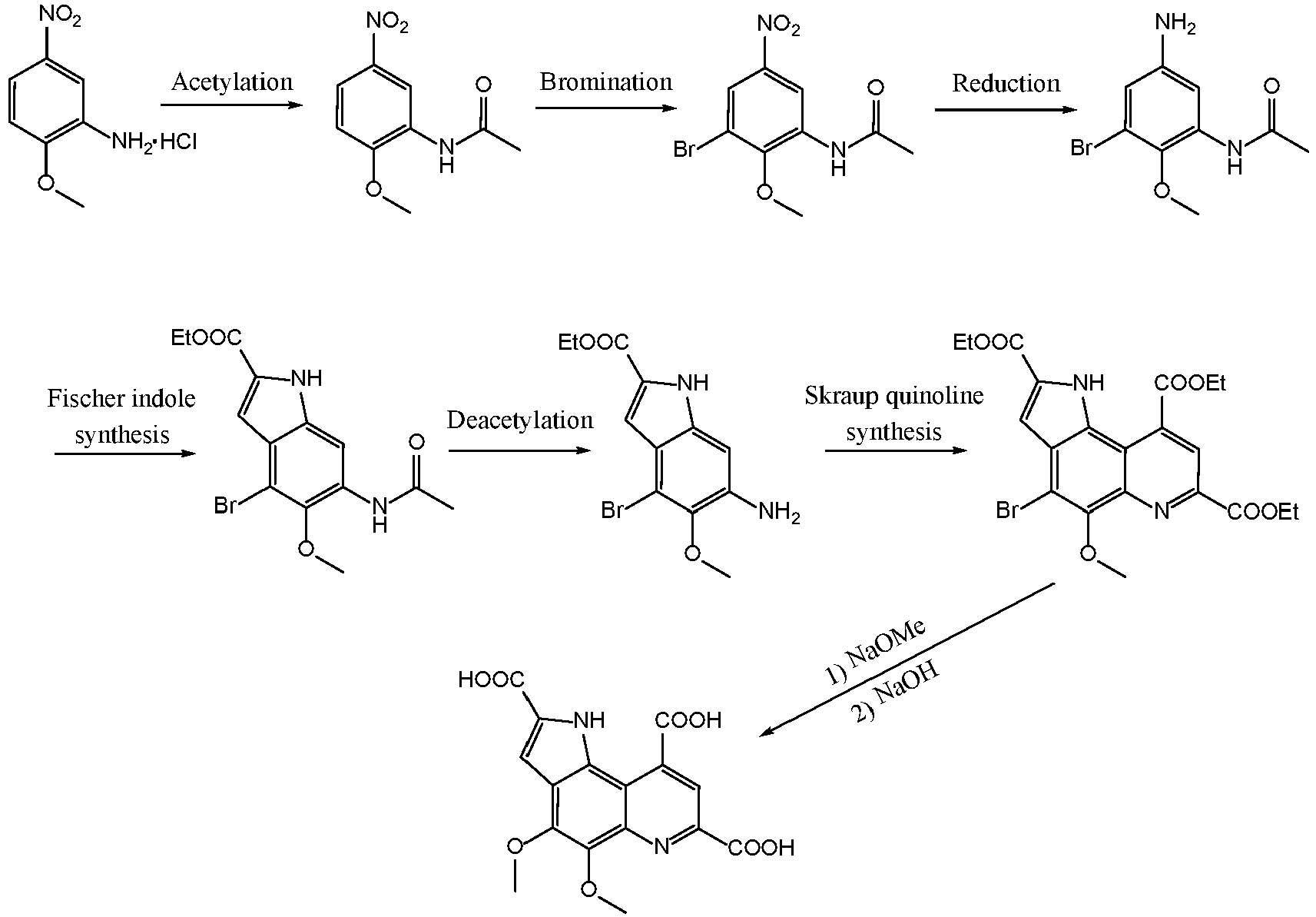
- In some other specific embodiments of the present invention, in Formula I, when R1=R4=Et, R2=OEt, and R3=OMe, the compound of Formula I is prepared through a synthesis route below:

- In some other specific embodiments of the present invention, in Formula I, when R1=Et, R2=Br, R3=OMe, and R4=Me, the compound of Formula I is prepared through a synthesis route below:

- From the description of the above preparation methods and technical routes, those skilled in the art can clearly learn how to carry out the synthesis of the reaction intermediate of Formula I for PQQ without further definition.
- In another embodiment of the present application, a method for synthesizing PQQ is provided, which comprises the following steps:
- (1) reacting the compound of Formula I with a base or a protonic acid to obtain a compound of formula VI;
- (2) reacting the compound of Formula VI with a protonic acid to obtain reduced PQQ, that is, PQP; and
- (3) oxidizing PQP with an oxidizing agent to obtain PQQ.
- The route for synthesizing PQQ of the present invention is:

- In the present invention, the compound of Formula I is used as a reaction intermediate for synthesizing PQQ, and an alkoxy-pyrroloquinoline can be oxidized into pyrroloquinoline quinone under mild temperature conditions (30-40°C) without further oxidation. The separation and purification are simple, and therefore the product has a high molar yield of 85% or more.
- To enable those skilled in the art to more clearly understand the technical solutions of the present invention, the technical solutions of the present invention will be described in detail below in conjunction with specific examples and comparative examples.
- When R3=OMe and R2 is respectively Br, Cl, I, or OMe in Formula III, the route is as follows:
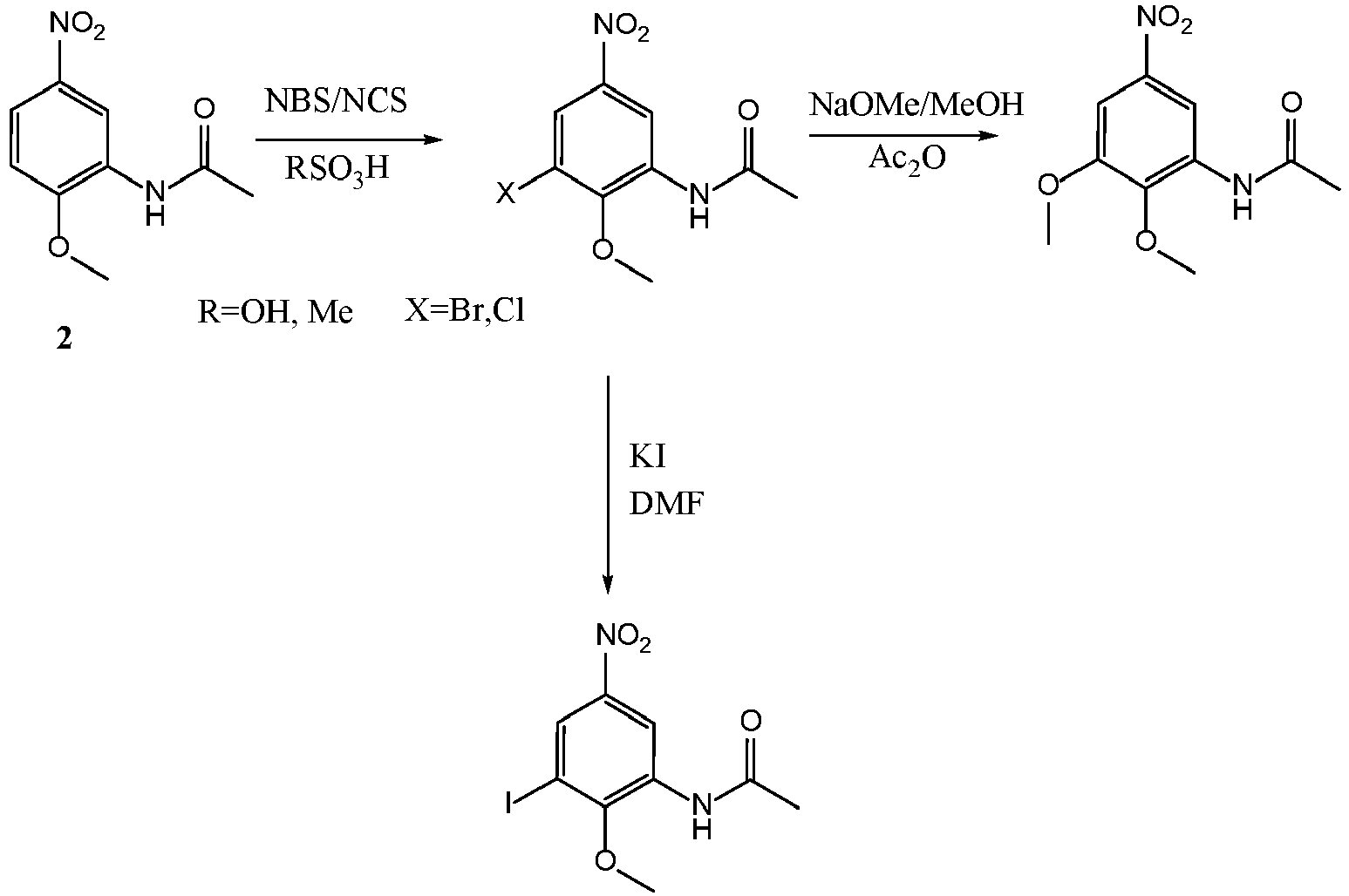
- (1) Synthesis of compound of Formula III When R2 is Br (namely, 2-methoxy-3-bromo-5-nitro-acetylaniline, designated as Compound 3):
- Synthesis method I:
100 g ofCompound 2 was slowly fed to 500 g of concentrated sulfuric acid while cooled in ice water, stirred to dissolve it, and mixed uniformly. 95 g of NBS was added, and reacted for 12 hrs at 25°C after complete dissolution. After the reaction was completed, the reaction solution was added to 5000 g of water to precipitate a solid out. The solid was filtered under suction, washed to pH 5-6, filtered under suction, and dried to obtain 128 g ofCompound 3. Molar yield: 93%, HPLC purity: 98.5%. - Synthesis method II:
- 100 g of
Compound 2 was slowly fed to 500 g of methanesulfonic acid while cooled in ice water, stirred to dissolve it, and mixed uniformly. 95 g of NBS was added, and reacted for 12 hrs at 25°C after complete dissolution. After the reaction was completed, the reaction solution was added to 5000 g of water to precipitate a solid out. The solid was filtered under suction, washed to pH 5-6, filtered under suction, and dried to obtain 130 g ofCompound 3. Molar yield: 94.5%, HPLC purity: 98.8%. ESI (M/Z): 290[M+H]; - 1H-NMR (400 MHz, DMSO-D6) δ 9.91 (s, 1H), 9.03 (d, J = 2.8 Hz, 1H), 8.18 (d, J = 2.8 Hz, 1H), 3.85 (s, 3H), 2.20 (s, 3H).
- 100 g of
- Synthesis method I:
- (2) Synthesis of compound of Formula III When R2 is Cl (namely, 2-methoxy-3-chloro-5-nitro-acetylaniline):
- 100 g of
Compound 2 was slowly fed to 500 g of concentrated sulfuric acid while cooled in ice water, stirred to dissolve it, and mixed uniformly. 75 g of NCS was added, and reacted for 36 hrs at 50°C after complete dissolution. After the reaction was completed, the reaction solution was added to 5000 g of water to precipitate a solid out. The solid was filtered under suction, washed to pH 5-6, filtered under suction, and dried to obtain 98 g of 2-methoxy-3-chloro-5-nitro-acetylaniline. Ms=244.5, Molar yield: 84.2%, HPLC purity: 98.5%. - ESI (M/Z): 246.5[M+H];
- 1H-NMR (400 MHz, DMSO-D6) δ 9.90 (s, 1H), 9.02 (d, J = 2.8 Hz, 1H), 8.08 (d, J = 2.8 Hz, 1H), 3.88 (s, 3H), 2.20 (s, 3H).
- 100 g of
- (3) Synthesis of compound of Formula III when R2 is I
100 g ofCompound 3 and 500 g of KI were fed to 1500 g of DMF, heated to 120°C and reacted for 8 hrs. After the reaction was completed, the solvent was evaporated to dryness under reduced pressure. Distilled water was added, and stirred to precipitate a solid out which was then filtered, and dried to give 94 g of 2-methoxy-3-iodo-5-nitro-acetylaniline. Molar yield: 81%, HPLC purity: 97.6%. ESI (M/Z): 337[M+H]. - (4) Synthesis of compound of Formula III when R2 is OMe
374 g of 30% sodium methoxide/methanol solution was fed to a reaction flask, and evaporated under reduced pressure to remove 85% of methanol. 600 g of dioxane, 100 g ofCompound 3, and 10 g of CuI were added to the residue, heated to 90°C and reacted under reflux for 12 hrs. After the reaction was completed, the solvent was recovered under reduced pressure, and 600 g of water was added to the residue, and stirred to precipitate a solid out. The obtained solid was fed to 353 g of acetic anhydride, heated to 80°C and reacted with stirring for 4 hrs. After the completion of the reaction, the solvent was recovered under reduced pressure, and the residue was washed with 600 g of distilled water. A crystal was precipitated, recrystallized in anhydrous ethanol, and dried to give 68 g of 2-methoxy-3-methoxy-5-nitro-acetylaniline. Ms=240, Molar yield: 82%, HPLC purity: 97.8%. ESI (M/Z): 241[M+H]. - The synthesis route is as follows.

- The specific preparation method is as follows.
- 100 g of
Compound 1, that is, 2-methoxy-5-nitroaniline hydrochloride, was added to 1500 g of water, stirred to dissolve it, and then filtered after the solid was almost completely dissolved. 40% NaOH solution was added to the filtrate to adjust the solution to pH > 4. The solution was extracted three times with 200 g of ethyl acetate. The organic phases were combined, washed with 500 g of saturated brine, and then dried over 100 g of anhydrous magnesium sulfate. After filtration, the solvent was rotary evaporated to dryness under reduced pressure at 50°C to give an orange-red solid. The orange-red solid was dissolved in 600 g of acetic anhydride, heated to 80°C and reacted for 4 hrs. After the reaction was completed, most of the solvent was removed by evaporation under reduced pressure. After cooling, the residue was added to 1000 g of ice water to precipitate a large amount of a solid. The solid was filtered out, repeatedly washed with water until it was not significantly acidic, and dried to obtain 81 g ofCompound 2. Molar yield: 78.88%, HPLC purity: 98.2%. - ESI (M/Z): 211[M+H] .
- 100 g of
Compound 2 was slowly fed to 500 g of concentrated sulfuric acid while cooled in ice water, stirred to dissolve it, and mixed uniformly. 95 g of NBS was added, and reacted for 12 hrs at 25°C after complete dissolution. After the reaction was completed, the reaction solution was added to 5000 g of water to precipitate a solid out. The solid was filtered under suction, washed to pH 5-6, filtered under suction, and dried to obtain 128 g ofCompound 3. Molar yield: 93%, HPLC purity: 98.5%. - ESI (M/Z): 290[M+H];
- 1H-NMR (400 MHz, DMSO-D6) δ 9.91 (s, 1H), 9.03 (d, J = 2.8 Hz, 1H), 8.18 (d, J = 2.8 Hz, 1H), 3.85 (s, 3H), 2.20 (s, 3H).
- 100 g of iron powder was added to 1000 g of a 10% acetic acid solution, heated to 80°C and reacted with stirring for 1 hr. After the reaction solution was slightly cold, 150 g of
Compound 3 was slowly added. After the mixture was uniformly mixed, the mixture was heated to 75-80°C and reacted with stirring for 6 hrs, until the reaction was completed. The reaction solution was cooled to room temperature, adjusted to pH 8-9 with a saturated sodium carbonate solution and filtered under suction. After the solid was repeatedly washed with hot ethanol, the ethanol solution was collected, and ethanol was rotary evaporated to dryness under reduced pressure to precipitate a large amount of crystal which was then filtered out under suction. - The solid was collected and dried to obtain 110.5 g of white granular crystal, that is,
Compound 4. Molar yield: 82.2%, HPLC purity: 98.9%. - ESI (M/Z): 260[M+H].
- 100 g of 32-37% concentrated hydrochloric acid was fed to a reaction flask, and 50 g of
Compound 4 was slowly added at -25°C, uniformly mixed and then stirred for 60 min. 45 g of 40% sodium nitrite solution was slowly added dropwise to a reaction flask while the temperature was controlled to not greater than -10°C, and stirred for 15 min. 45 g of 40% HBF4 solution was added dropwise while the temperature was controlled to not greater than 0°C. After the addition was completed, the temperature was raised to 5°C. A cream yellow turbid solution was obtained, which was filtered under suction. The filter cake was rinsed with cold alcohol, and the solid was collected. - The solid obtained in the previous step was dissolved in 200 g of ethanol, and 32 g of ethyl 2-methylacetoacetate was slowly added while the temperature was controlled to lower than 0°C. After the addition, a NaOH solution was added dropwise, while the temperature was controlled to not greater than 0°C. After the addition was completed, the mixture was stirred at room temperature for 12 hrs. After the reaction was completed, the reaction solution was filtered under suction. The solid was washed with water, filtered under suction and dried. 100 g of a light orange-red solid was obtained.
- The orange-red solid obtained in the previous step was dissolved in 500 g of sulfuric acid and stirred at room temperature for 24 hrs. After completion of the reaction, the reaction solution was added to 2000 g of ice water to precipitate a pale yellow solid, which was filtered under suction, washed twice with water, and dried. The solid was recrystallized twice in ethanol, to obtain 45 g of
Compound 5. Molar yield: 65.66%, HPLC purity: 99%. - ESI (M/Z): 356[M+H].
- 100 g of
Compound 5 was added to a mixed solution of 500 g of ethanol and 100 g of concentrated hydrochloric acid, stirred until uniform, heated to reflux, and reacted for 8 hrs. The ethanol was evaporated off under reduced pressure. After cooling to room temperature, the residue was added to 1000 g of ice water to precipitate a large amount of a light brown solid, which was then filtered under suction. The solid was washed twice with water and dried. - The light brown solid obtained in the previous step was added to 1000 g of a 15% NaOH solution, and stirred at room temperature for 24 hrs. The solid was filtered under suction, washed with water until it was not significantly basic, and then dried, to obtain 56 g of a brown solid, that is,
Compound 6. Molar yield: 63.5%, HPLC purity: 98.7%. - ESI(M/Z): 314[M+H];
- 1H-NMR (400 MHz, DMSO-D6) δ 11.53 (d, J = 1.5 Hz, 1H), 6.82 (dd, J = 2.2, 0.6 Hz, 1H), 6.66 (d, J = 0.7 Hz, 1H), 5.34 (s, 2H), 4.28 (q, J = 7.1 Hz, 2H), 3.70 (s, 3H), 1.31 (t, J = 7.1 Hz, 3H).
- 100 g of
Compound 6 was dissolved in 500 g of dichloromethane, and 1000 g of diethyl 2-oxopentendioate was added thereto, and stirred at room temperature for 24 hrs. The solvent was evaporated to dryness under reduced pressure to obtain a dark brown viscous material. The viscous material was dissolved in hot ethanol, and filtered while hot. The filtrate was placed in a refrigerator overnight to precipitate a pale yellow solid. The solid was filtered under suction and dried to obtain 93 g ofCompound 7. Molar yield: 58.93%, HPLC purity: 99.2%. - ESI(M/Z): 495 [M+H];
- 1H-NMR (400 MHz, DMSO-D6) δ 12.33 (d, J = 1.9 Hz, 1H), 8.64 (s, 1H), 7.18 (d, J = 2.3 Hz, 1H), 4.57 (q, J = 7.1 Hz, 2H), 4.47 (q, J = 7.1 Hz, 2H), 4.40 (q, J = 7.1 Hz, 2H), 4.08 (s, 3H), 1.46 (t, J = 7.1 Hz, 3H), 1.42 (t, J = 7.1 Hz, 3H), 1.38 (t, J = 7.1 Hz, 3H).
- 100 g of
Compound 1, i.e., 2-methoxy-5-nitroaniline hydrochloride, was dissolved in 600 g of acetic anhydride, and heated to 80°C for 8 hrs, and the tail gas was absorbed with a NaOH solution. After the reaction was completed, most of the solvent was removed by evaporation under reduced pressure. After cooling, the residue was added to 1000 g of ice water to precipitate a large amount of a solid. The solid was filtered out, repeatedly washed with water until it was not significantly acidic, and dried to obtain 96g ofCompound 2. Molar yield: 93.48%, HPLC purity: 98.7%. - ESI (M/Z): 211 [M+H].
- The remaining steps were the same as those in Example 1.
- 100 g of
Compound 2 was slowly fed to 500 g of methanesulfonic acid while cooled in ice water, stirred to dissolve it, and mixed uniformly. 95 g of NBS was added, and reacted for 12 hrs at 25°C after complete dissolution. After the reaction was completed, the reaction solution was added to 5000 g of water to precipitate a solid out. The solid was filtered under suction, washed to pH 5-6, filtered under suction, and dried to obtain 130 g ofCompound 3. Molar yield: 94.5%, HPLC purity: 98.8%. - The remaining steps were the same as those in Example 1.
- The specific preparation method is as follows.
- 100 g of the
solid Compound 7 and 20 g of CuI were added to 800 g of dioxane, and stirred until uniform. 500 g of a 30% sodium methoxide/methanol solution was slowly added. After mixing well, the resulting system was heated and reacted under reflux for 8 hrs. After completion of the reaction, the mixture was cooled slightly, and the solvent was recovered under reduced pressure at a temperature of 80°C at most. After recovery, the mixture was cooled to 30°C, and 1000 g of a 10% NaOH solution was slowly added thereto, and heated to reflux for 6 hrs. After the reaction was completed, it was cooled to room temperature and filtered under suction. Ice was added to the filtrate, and then concentrated hydrochloric acid was slowly added to adjust the pH to less than 2. The resulting solution was filtered under suction, and the solid was washed with distilled water until it was not significantly acidic, and then dried to obtain 65 g ofCompound 8 as a dark orange bulk solid. Molar yield: 89.2%, HPLC purity: 98.3%. - ESI (M/Z): 359[M-H];
- 1H-NMR (400 MHz, DMSO-D6) δ 13.49 (d, J = 5.7 Hz, 1H), 12.56 (s, 1H), 8.62 (d, J = 38.1 Hz, 1H), 7.32 (s, 1H), 4.23 (s, 3H), 4.03 (m, 3H).
- The synthesis route is as follows.

- The synthesis route is as follows.

-
Compound 7 was prepared, as described in Example 2, 3 or 4. - 100 g of
Compound 7 and 20 g of CuI were added to 800 g of dioxane, and stirred until uniform. 500 g of a 30% sodium ethoxide solution was slowly added. After mixing well, the resulting system was heated and reacted under reflux for 8 hrs. After the reaction was completed, the reaction solution was slightly cooled, and the solvent was recovered under reduced pressure at a temperature of 80°C at most. After recovery, the residue was cooled to 30°C or less, distilled water was added, and the pH was adjusted to 2 to 3 with dilute hydrochloric acid. - A solid material was precipitated out, filtered under suction, and washed with water. The solid material was collected and dried to give 80 g of
Compound 9. Molar yield: 86.1%, HPLC purity: 99.1%. ESI (M/Z): 460[M+H]. - The synthesis route is as follows.

- 100 g of
Compound 6 was dissolved in 500 g of dichloromethane, and 1000 g of dimethyl 2-oxopentendioate was added thereto, and stirred at room temperature for 24 hrs. The solvent was evaporated to dryness under reduced pressure to obtain a dark brown viscous material. The viscous material was dissolved in hot ethanol, and filtered while hot. The filtrate was placed in a refrigerator overnight to precipitate a pale yellow solid. The solid was filtered under suction and dried to obtain 87g ofCompound 11. Molar yield: 58.4%, HPLC purity: 98.6%. - ESI (M/Z):467[M+H].
- 1H-NMR (400 MHz, DMSO-D6) δ 12.46 (d, J = 1.9 Hz, 1H), 8.73 (s, 1H), 7.28 (d, J = 2.3 Hz, 1H), 4.42 (q, J = 7.1 Hz, 2H), 4.08 (s, 3H), 4.02 (s, 6H), 1.39(t, J = 7.1 Hz, 3H).
-
Compound 8 prepared in Example 5 was used as a reaction intermediate for the synthesis of PQQ, and the synthesis route was as follows.
- The synthesis method was specifically as follows.
- (1) Preparation of Compound 10 (PQP): 100 g of the
solid Compound 8 was added to 500 g of acetic acid, and 300 g of a 40% HI solution was added dropwise, uniformly mixed, and refluxed for 8 hrs. After the reaction was completed, the reaction solution was added to 2500 g of ice water to precipitate a solid, which was filtered under suction, washed until it was not significantly acidic, and dried. The solid was recrystallized in ethanol to give 73 g of Compound 10 (PQP). Molar yield: 85.5%, HPLC purity: 98.4%. ESI (M/Z): 331[M-H]. - (2) Preparation of pyrroloquinoline quinone (PQQ)
- 100 g of the solid Compound 10 (PQP), was added to 500 g of a 30% hydrogen peroxide solution, maintained at a temperature of 35°C, and stirred for 24 hrs. After cooling, the reaction solution was filtered, and the solid was dried and dissolved in 500 g of concentrated sulfuric acid. Then the sulfuric acid solution was added to 2500 g of ice water to precipitate a large amount of a red solid. The solid was filtered out, repeatedly washed with water until it was not significantly acidic, and dried to obtain 86 g of PQQ as a red powdered solid. Molar yield: 86.5%, HPLC purity: 99.6%. ESI (M/Z):329[M-H].
-
Compound 9 prepared in Example 6 was used as a reaction intermediate for the synthesis of PQQ, and the synthesis route was as follows.
- The synthesis method was specifically as follows.
- (1) Preparation of Compound 10: 100 g of
Compound 9 was added to 1000 g of a 10% NaOH solution, and heated to reflux for 6 hrs. After the reaction was completed, it was cooled to room temperature and filtered under suction. Ice was added to the filtrate, and then concentrated hydrochloric acid was slowly added to adjust the pH to less than 2. The resulting solution was filtered under suction, and the solid was washed with distilled water until it was not significantly acidic, and then dried. The resulting solid was added to 500 g of acetic acid, and 300 g of a 40% HI solution was added dropwise, mixed uniformly and refluxed for 8 hrs. After the reaction was completed, the reaction solution was added to 2500 g of ice water to precipitate a solid, which was filtered under suction, washed until it was not significantly acidic, and dried. The solid was recrystallized in ethanol to give 65g of Compound 10 (PQP). Molar yield: 89.86%, HPLC purity: 98.1%. ESI (M/Z): 331[M-H]. - (2) Preparation of pyrroloquinoline quinone (PQQ)
- 100 g of the solid Compound 10 (PQP), was added to 500 g of a 30% hydrogen peroxide solution, maintained at a temperature of 35°C, and stirred for 24 hrs. After cooling, the reaction solution was filtered, and the solid was dried and dissolved in 500 g of concentrated sulfuric acid. Then the sulfuric acid solution was added to 2500 g of ice water to precipitate a large amount of a red solid. The solid was filtered out, repeatedly washed with water until it was not significantly acidic, and dried to obtain 85g of PQQ as a red powdered solid. Molar yield: 85.6%, HPLC purity: 99.6%.
- ESI (M/Z):329[M-H];
- 1H-NMR (400 MHz, DMSO-D6) δ 13.23 (s, 1H), 8.60 (s, 1H), 7.21 (d, J = 2.2 Hz, 1H).
- The above examples are preferred embodiments of the present invention, but the embodiments of the present invention are not limited to thereto.
Claims (9)
- A method for synthesizing PQQ, comprising the steps of:(1) reacting a compound of Formula I
 where R1 and R4 are each independently an atom or group selected from hydrogen, a linear or branched C1-8 alkyl group, a deuterated linear or branched C1-8 alkyl group, an aralkyl group, or a substituted aryl group but not both R1 and R4 are hydrogen;R2 is independently an atom or group selected from a linear or branched C1-8 alkoxy group, or a deuterated linear or branched C1-8 alkoxy group; andR3 is independently an atom or group selected from a linear or branched C1-8 alkoxy group, or a deuterated linear or branched C1-8 alkoxy group,with a base or a protonic acid to obtain a compound of formula VI;
 (2) reacting the compound of Formula VI with a protonic acid to obtain reduced PQQ, that is, PQP; and
 (3) oxidizing PQP with an oxidizing agent to obtain PQQ or(I) reacting a compound of Formula VIA
with a protonic acid to obtain reduced PQQ, that is, PQP; and(II) oxidizing PQP with an oxidizing agent to obtain PQQ. - The synthesis method according to claim 1, wherein in Step (1), the method for reacting the compound of Formula I with a base or a protonic acid to obtain the compound of Formula VI comprises: adding the compound of Formula I to an alkali liquor or a protonic acid, reacting under reflux by heating, cooling to room temperature after the reaction is completed, filtering under suction, adjusting the pH of the filtrate to less than 2, washing, and drying.
- The synthesis method according to claim 1 or 2, wherein in Step (1), the base is NaOH or KOH; and the protonic acid is hydroiodic acid, hydrochloric acid or hydrobromic acid.
- The synthesis method according to claim 1, wherein in Step (2) or step (I), the method step for reacting the compound of Formula VI or formula VIA with a protonic acid to obtain reduced PQQ, that is, PQP, comprises: adding the compound of Formula VI to acetic acid, adding a protonic acid solution dropwise, mixing uniformly, reacting under reflux, adding the reaction solution to ice water after the reaction is completed to precipitate a solid out, filtering under suction, washing, drying, and recrystallizing in ethanol.
- The synthesis method according to claim 1 or 4, wherein in Step (2) or step (I), the protonic acid is hydroiodic acid, hydrochloric acid or hydrobromic acid, and preferably hydroiodic acid.
- The synthesis method according to claim 1, wherein in Step (3) or step (II), the oxidizing agent is hydrogen peroxide, concentrated sulfuric acid, concentrated nitric acid or ozone.
- The synthesis method as claimed in any of the claims 1 to 6 wherein step 1 or step I is preceded by the following method step: a compound having a structure of Formula I':
 where R1 and R4 are each an ethyl group;R2 is Br; andR3 is a methyl groupis subjected to a reaction replacing the halogen of R2 by an ethoxy or methoxy group, with a reagent being selected from the group consisting of NaOMe and NaOEt.
 - A compound having a structure of Formula I':
 where R1 and R4 are each independently an atom or group selected from hydrogen, a linear or branched C1-8 alkyl group, a deuterated linear or branched C1-8 alkyl group, an aralkyl group, or a substituted aryl group;R2 is a halogen; andR3 is independently an atom or group selected from a linear or branched C1-8 alkoxy group, or a deuterated linear or branched C1-8 alkoxy group.
 - A compound as claimed in claim 8 wherein the compound of formula l'is selected from


Applications Claiming Priority (2)
| Application Number | Priority Date | Filing Date | Title |
|---|---|---|---|
| CN201710331083.6A CN107089982B (en) | 2017-05-11 | 2017-05-11 | 4,5-disubstituted-1-hydro-pyrrole (2,3-f) quinoline-2,7,9-tricarboxylate compound and its application |
| PCT/CN2017/085108 WO2018205299A1 (en) | 2017-05-11 | 2017-05-19 | 4,5-disubstituted-1-hydro-pyrrole(2,3-f)quinolone-2,7,9-tricarboxylate compound and applications |
Publications (3)
| Publication Number | Publication Date |
|---|---|
| EP3643714A1 EP3643714A1 (en) | 2020-04-29 |
| EP3643714A4 EP3643714A4 (en) | 2020-12-02 |
| EP3643714B1 true EP3643714B1 (en) | 2024-01-10 |
Family
ID=59637257
Family Applications (1)
| Application Number | Title | Priority Date | Filing Date |
|---|---|---|---|
| EP17909121.0A Active EP3643714B1 (en) | 2017-05-11 | 2017-05-19 | 4,5-disubstituted-1-hydro-pyrrole(2,3-f)quinolone-2,7,9-tricarboxylate compound and applications |
Country Status (4)
| Country | Link |
|---|---|
| US (1) | US10807979B2 (en) |
| EP (1) | EP3643714B1 (en) |
| CN (2) | CN108191858B (en) |
| WO (1) | WO2018205299A1 (en) |
Families Citing this family (3)
| Publication number | Priority date | Publication date | Assignee | Title |
|---|---|---|---|---|
| CN111087395A (en) * | 2019-12-31 | 2020-05-01 | 江西农业大学 | A kind of preparation method of four-step synthesis of pyrroloquinoline quinone |
| CN115894362B (en) * | 2022-11-11 | 2023-11-07 | 山东原力泰医药科技有限公司 | Intermediate and application and method thereof in preparation of pyrroloquinoline quinone |
| CN115894483A (en) * | 2022-11-11 | 2023-04-04 | 山东原力泰医药科技有限公司 | Intermediate and method for preparing pyrroloquinoline quinone |
Family Cites Families (5)
| Publication number | Priority date | Publication date | Assignee | Title |
|---|---|---|---|---|
| CA1302275C (en) * | 1986-08-07 | 1992-06-02 | Yuji Narutomi | Enzyme inhibitor |
| US20070072894A1 (en) | 2005-03-24 | 2007-03-29 | Kempf J V | Synthesis of pyrroloquinoline quinone (PQQ) |
| CN101193888A (en) * | 2005-03-24 | 2008-06-04 | Clf医疗技术加速程序有限公司 | The synthetic method of pyrroloquinoline quinone (PQQ) |
| US9115128B2 (en) | 2013-06-06 | 2015-08-25 | Anthem Biosciences Pvt. Ltd. | Compounds of 3-(5-substituted Oxy-2, 4-dinitrophenyl)-2-oxo-propionic acid ester, synthesis and applications thereof |
| CN104557921B (en) * | 2014-12-24 | 2018-04-27 | 常熟理工学院 | The synthetic method of pyrroloquinoline quinone |
-
2017
- 2017-05-11 CN CN201810077681.XA patent/CN108191858B/en active Active
- 2017-05-11 CN CN201710331083.6A patent/CN107089982B/en active Active
- 2017-05-19 EP EP17909121.0A patent/EP3643714B1/en active Active
- 2017-05-19 WO PCT/CN2017/085108 patent/WO2018205299A1/en not_active Ceased
- 2017-05-19 US US16/466,198 patent/US10807979B2/en active Active
Also Published As
| Publication number | Publication date |
|---|---|
| CN107089982B (en) | 2018-06-05 |
| EP3643714A4 (en) | 2020-12-02 |
| EP3643714A1 (en) | 2020-04-29 |
| CN108191858A (en) | 2018-06-22 |
| CN107089982A (en) | 2017-08-25 |
| WO2018205299A1 (en) | 2018-11-15 |
| CN108191858B (en) | 2019-11-26 |
| US20200071319A1 (en) | 2020-03-05 |
| US10807979B2 (en) | 2020-10-20 |
Similar Documents
| Publication | Publication Date | Title |
|---|---|---|
| EP3643714B1 (en) | 4,5-disubstituted-1-hydro-pyrrole(2,3-f)quinolone-2,7,9-tricarboxylate compound and applications | |
| CN105130926B (en) | A kind of preparation method of methylene blue | |
| CN105693554B (en) | The preparation method of alanine derivatives | |
| JP2002193887A (en) | Method for producing iodonium salt compound | |
| EP3527556B1 (en) | Method for preparing deuterated imidazole diketone compound | |
| EP3303274A1 (en) | Process for the synthesis of 9,9-bis(hydroxymethyl)fluorene | |
| CN104072495B (en) | The preparation method of natural product alkaloid A aptamine | |
| JPH02188570A (en) | Production of halogen-substituted quinoline derivative | |
| AU2021107258A4 (en) | 2-methylene-1-indanone derivative and synthesis method thereof | |
| CN104163802A (en) | 2-aminothiazole-4-ethyl formate preparation method | |
| HK1236932A1 (en) | 4,5-disubstituted-1-hydrogen-pyrrole(2,3-f)quinoline-2,7,9-tricarboxylate compounds and a use thereof | |
| HK1236932A (en) | 4,5-disubstituted-1-hydrogen-pyrrole(2,3-f)quinoline-2,7,9-tricarboxylate compounds and a use thereof | |
| HK1236932B (en) | 4,5-disubstituted-1-hydrogen-pyrrole(2,3-f)quinoline-2,7,9-tricarboxylate compounds and a use thereof | |
| CN108047254A (en) | A kind of new compounds II and preparation method and purposes | |
| CN101824010B (en) | Method for synthesizing 4-aryl-4,5-dihydrofuran | |
| CN110156681B (en) | Synthesis method of 2-ester group quinoline | |
| CN109651179B (en) | 2- (2-aminobenzoyl) benzoic acid derivatives and process for preparing the same | |
| CN117430602A (en) | Method for preparing 6-halogeno-4-hydroxy [1,5] naphthyridine-3-formate and derivative thereof | |
| CN107033112A (en) | A kind of preparation method of nevadensin | |
| CN114213261A (en) | Preparation method of 4-methoxy-2-nitroaniline | |
| CN116023331A (en) | Synthesis method of 3- (difluoromethyl) -1-methyl-1H-pyrazole-4-carboxylic acid | |
| CN116606238A (en) | A kind of N-Boc-3-nitroindole and preparation method thereof | |
| CN114573501A (en) | Method for large-scale production of 2,2', 6',2 '-terpyridine-4' -formaldehyde | |
| CN105566270A (en) | 3-aryl coumarin derivatives and preparation method thereof | |
| EP4214201A1 (en) | Preparation method of substituted pyrimidine piperazine compounds |
Legal Events
| Date | Code | Title | Description |
|---|---|---|---|
| STAA | Information on the status of an ep patent application or granted ep patent |
Free format text: STATUS: THE INTERNATIONAL PUBLICATION HAS BEEN MADE |
|
| PUAI | Public reference made under article 153(3) epc to a published international application that has entered the european phase |
Free format text: ORIGINAL CODE: 0009012 |
|
| STAA | Information on the status of an ep patent application or granted ep patent |
Free format text: STATUS: REQUEST FOR EXAMINATION WAS MADE |
|
| 17P | Request for examination filed |
Effective date: 20190608 |
|
| AK | Designated contracting states |
Kind code of ref document: A1 Designated state(s): AL AT BE BG CH CY CZ DE DK EE ES FI FR GB GR HR HU IE IS IT LI LT LU LV MC MK MT NL NO PL PT RO RS SE SI SK SM TR |
|
| AX | Request for extension of the european patent |
Extension state: BA ME |
|
| DAV | Request for validation of the european patent (deleted) | ||
| DAX | Request for extension of the european patent (deleted) | ||
| RIC1 | Information provided on ipc code assigned before grant |
Ipc: C07D 471/04 20060101AFI20200727BHEP Ipc: C07C 231/12 20060101ALI20200727BHEP Ipc: C07C 231/02 20060101ALI20200727BHEP Ipc: C07C 233/24 20060101ALI20200727BHEP Ipc: C07D 209/42 20060101ALI20200727BHEP |
|
| A4 | Supplementary search report drawn up and despatched |
Effective date: 20201102 |
|
| RIC1 | Information provided on ipc code assigned before grant |
Ipc: C07C 231/02 20060101ALI20201027BHEP Ipc: C07C 231/12 20060101ALI20201027BHEP Ipc: C07D 471/04 20060101AFI20201027BHEP Ipc: C07D 209/42 20060101ALI20201027BHEP Ipc: C07C 233/24 20060101ALI20201027BHEP |
|
| RAP1 | Party data changed (applicant data changed or rights of an application transferred) |
Owner name: SHANDONG CAMASY BIOTECHNOLOGY CO., LTD. |
|
| STAA | Information on the status of an ep patent application or granted ep patent |
Free format text: STATUS: EXAMINATION IS IN PROGRESS |
|
| 17Q | First examination report despatched |
Effective date: 20221209 |
|
| RAP1 | Party data changed (applicant data changed or rights of an application transferred) |
Owner name: SHANDONG YUANLITAI MEDICAL TECHNOLOGY CO., LTD. |
|
| GRAP | Despatch of communication of intention to grant a patent |
Free format text: ORIGINAL CODE: EPIDOSNIGR1 |
|
| STAA | Information on the status of an ep patent application or granted ep patent |
Free format text: STATUS: GRANT OF PATENT IS INTENDED |
|
| INTG | Intention to grant announced |
Effective date: 20230915 |
|
| GRAS | Grant fee paid |
Free format text: ORIGINAL CODE: EPIDOSNIGR3 |
|
| GRAA | (expected) grant |
Free format text: ORIGINAL CODE: 0009210 |
|
| STAA | Information on the status of an ep patent application or granted ep patent |
Free format text: STATUS: THE PATENT HAS BEEN GRANTED |
|
| AK | Designated contracting states |
Kind code of ref document: B1 Designated state(s): AL AT BE BG CH CY CZ DE DK EE ES FI FR GB GR HR HU IE IS IT LI LT LU LV MC MK MT NL NO PL PT RO RS SE SI SK SM TR |
|
| REG | Reference to a national code |
Ref country code: GB Ref legal event code: FG4D |
|
| REG | Reference to a national code |
Ref country code: CH Ref legal event code: EP |
|
| REG | Reference to a national code |
Ref country code: DE Ref legal event code: R096 Ref document number: 602017078453 Country of ref document: DE |
|
| REG | Reference to a national code |
Ref country code: IE Ref legal event code: FG4D |
|
| REG | Reference to a national code |
Ref country code: LT Ref legal event code: MG9D |
|
| REG | Reference to a national code |
Ref country code: NL Ref legal event code: MP Effective date: 20240110 |
|
| REG | Reference to a national code |
Ref country code: AT Ref legal event code: MK05 Ref document number: 1648825 Country of ref document: AT Kind code of ref document: T Effective date: 20240110 |
|
| PG25 | Lapsed in a contracting state [announced via postgrant information from national office to epo] |
Ref country code: NL Free format text: LAPSE BECAUSE OF FAILURE TO SUBMIT A TRANSLATION OF THE DESCRIPTION OR TO PAY THE FEE WITHIN THE PRESCRIBED TIME-LIMIT Effective date: 20240110 |
|
| PG25 | Lapsed in a contracting state [announced via postgrant information from national office to epo] |
Ref country code: NL Free format text: LAPSE BECAUSE OF FAILURE TO SUBMIT A TRANSLATION OF THE DESCRIPTION OR TO PAY THE FEE WITHIN THE PRESCRIBED TIME-LIMIT Effective date: 20240110 |
|
| PG25 | Lapsed in a contracting state [announced via postgrant information from national office to epo] |
Ref country code: IS Free format text: LAPSE BECAUSE OF FAILURE TO SUBMIT A TRANSLATION OF THE DESCRIPTION OR TO PAY THE FEE WITHIN THE PRESCRIBED TIME-LIMIT Effective date: 20240510 |
|
| PG25 | Lapsed in a contracting state [announced via postgrant information from national office to epo] |
Ref country code: LT Free format text: LAPSE BECAUSE OF FAILURE TO SUBMIT A TRANSLATION OF THE DESCRIPTION OR TO PAY THE FEE WITHIN THE PRESCRIBED TIME-LIMIT Effective date: 20240110 |
|
| PG25 | Lapsed in a contracting state [announced via postgrant information from national office to epo] |
Ref country code: GR Free format text: LAPSE BECAUSE OF FAILURE TO SUBMIT A TRANSLATION OF THE DESCRIPTION OR TO PAY THE FEE WITHIN THE PRESCRIBED TIME-LIMIT Effective date: 20240411 |
|
| PG25 | Lapsed in a contracting state [announced via postgrant information from national office to epo] |
Ref country code: RS Free format text: LAPSE BECAUSE OF FAILURE TO SUBMIT A TRANSLATION OF THE DESCRIPTION OR TO PAY THE FEE WITHIN THE PRESCRIBED TIME-LIMIT Effective date: 20240410 Ref country code: HR Free format text: LAPSE BECAUSE OF FAILURE TO SUBMIT A TRANSLATION OF THE DESCRIPTION OR TO PAY THE FEE WITHIN THE PRESCRIBED TIME-LIMIT Effective date: 20240110 |
|
| PG25 | Lapsed in a contracting state [announced via postgrant information from national office to epo] |
Ref country code: ES Free format text: LAPSE BECAUSE OF FAILURE TO SUBMIT A TRANSLATION OF THE DESCRIPTION OR TO PAY THE FEE WITHIN THE PRESCRIBED TIME-LIMIT Effective date: 20240110 |
|
| PG25 | Lapsed in a contracting state [announced via postgrant information from national office to epo] |
Ref country code: AT Free format text: LAPSE BECAUSE OF FAILURE TO SUBMIT A TRANSLATION OF THE DESCRIPTION OR TO PAY THE FEE WITHIN THE PRESCRIBED TIME-LIMIT Effective date: 20240110 |
|
| PG25 | Lapsed in a contracting state [announced via postgrant information from national office to epo] |
Ref country code: RS Free format text: LAPSE BECAUSE OF FAILURE TO SUBMIT A TRANSLATION OF THE DESCRIPTION OR TO PAY THE FEE WITHIN THE PRESCRIBED TIME-LIMIT Effective date: 20240410 Ref country code: NO Free format text: LAPSE BECAUSE OF FAILURE TO SUBMIT A TRANSLATION OF THE DESCRIPTION OR TO PAY THE FEE WITHIN THE PRESCRIBED TIME-LIMIT Effective date: 20240410 Ref country code: LT Free format text: LAPSE BECAUSE OF FAILURE TO SUBMIT A TRANSLATION OF THE DESCRIPTION OR TO PAY THE FEE WITHIN THE PRESCRIBED TIME-LIMIT Effective date: 20240110 Ref country code: IS Free format text: LAPSE BECAUSE OF FAILURE TO SUBMIT A TRANSLATION OF THE DESCRIPTION OR TO PAY THE FEE WITHIN THE PRESCRIBED TIME-LIMIT Effective date: 20240510 Ref country code: HR Free format text: LAPSE BECAUSE OF FAILURE TO SUBMIT A TRANSLATION OF THE DESCRIPTION OR TO PAY THE FEE WITHIN THE PRESCRIBED TIME-LIMIT Effective date: 20240110 Ref country code: GR Free format text: LAPSE BECAUSE OF FAILURE TO SUBMIT A TRANSLATION OF THE DESCRIPTION OR TO PAY THE FEE WITHIN THE PRESCRIBED TIME-LIMIT Effective date: 20240411 Ref country code: ES Free format text: LAPSE BECAUSE OF FAILURE TO SUBMIT A TRANSLATION OF THE DESCRIPTION OR TO PAY THE FEE WITHIN THE PRESCRIBED TIME-LIMIT Effective date: 20240110 Ref country code: BG Free format text: LAPSE BECAUSE OF FAILURE TO SUBMIT A TRANSLATION OF THE DESCRIPTION OR TO PAY THE FEE WITHIN THE PRESCRIBED TIME-LIMIT Effective date: 20240110 Ref country code: AT Free format text: LAPSE BECAUSE OF FAILURE TO SUBMIT A TRANSLATION OF THE DESCRIPTION OR TO PAY THE FEE WITHIN THE PRESCRIBED TIME-LIMIT Effective date: 20240110 |
|
| PG25 | Lapsed in a contracting state [announced via postgrant information from national office to epo] |
Ref country code: PL Free format text: LAPSE BECAUSE OF FAILURE TO SUBMIT A TRANSLATION OF THE DESCRIPTION OR TO PAY THE FEE WITHIN THE PRESCRIBED TIME-LIMIT Effective date: 20240110 Ref country code: PT Free format text: LAPSE BECAUSE OF FAILURE TO SUBMIT A TRANSLATION OF THE DESCRIPTION OR TO PAY THE FEE WITHIN THE PRESCRIBED TIME-LIMIT Effective date: 20240510 |
|
| PG25 | Lapsed in a contracting state [announced via postgrant information from national office to epo] |
Ref country code: SE Free format text: LAPSE BECAUSE OF FAILURE TO SUBMIT A TRANSLATION OF THE DESCRIPTION OR TO PAY THE FEE WITHIN THE PRESCRIBED TIME-LIMIT Effective date: 20240110 Ref country code: PT Free format text: LAPSE BECAUSE OF FAILURE TO SUBMIT A TRANSLATION OF THE DESCRIPTION OR TO PAY THE FEE WITHIN THE PRESCRIBED TIME-LIMIT Effective date: 20240510 Ref country code: PL Free format text: LAPSE BECAUSE OF FAILURE TO SUBMIT A TRANSLATION OF THE DESCRIPTION OR TO PAY THE FEE WITHIN THE PRESCRIBED TIME-LIMIT Effective date: 20240110 Ref country code: LV Free format text: LAPSE BECAUSE OF FAILURE TO SUBMIT A TRANSLATION OF THE DESCRIPTION OR TO PAY THE FEE WITHIN THE PRESCRIBED TIME-LIMIT Effective date: 20240110 |
|
| PG25 | Lapsed in a contracting state [announced via postgrant information from national office to epo] |
Ref country code: DK Free format text: LAPSE BECAUSE OF FAILURE TO SUBMIT A TRANSLATION OF THE DESCRIPTION OR TO PAY THE FEE WITHIN THE PRESCRIBED TIME-LIMIT Effective date: 20240110 |
|
| REG | Reference to a national code |
Ref country code: DE Ref legal event code: R097 Ref document number: 602017078453 Country of ref document: DE |
|
| PG25 | Lapsed in a contracting state [announced via postgrant information from national office to epo] |
Ref country code: SM Free format text: LAPSE BECAUSE OF FAILURE TO SUBMIT A TRANSLATION OF THE DESCRIPTION OR TO PAY THE FEE WITHIN THE PRESCRIBED TIME-LIMIT Effective date: 20240110 |
|
| PG25 | Lapsed in a contracting state [announced via postgrant information from national office to epo] |
Ref country code: CZ Free format text: LAPSE BECAUSE OF FAILURE TO SUBMIT A TRANSLATION OF THE DESCRIPTION OR TO PAY THE FEE WITHIN THE PRESCRIBED TIME-LIMIT Effective date: 20240110 Ref country code: EE Free format text: LAPSE BECAUSE OF FAILURE TO SUBMIT A TRANSLATION OF THE DESCRIPTION OR TO PAY THE FEE WITHIN THE PRESCRIBED TIME-LIMIT Effective date: 20240110 |
|
| PG25 | Lapsed in a contracting state [announced via postgrant information from national office to epo] |
Ref country code: SK Free format text: LAPSE BECAUSE OF FAILURE TO SUBMIT A TRANSLATION OF THE DESCRIPTION OR TO PAY THE FEE WITHIN THE PRESCRIBED TIME-LIMIT Effective date: 20240110 |
|
| PG25 | Lapsed in a contracting state [announced via postgrant information from national office to epo] |
Ref country code: SM Free format text: LAPSE BECAUSE OF FAILURE TO SUBMIT A TRANSLATION OF THE DESCRIPTION OR TO PAY THE FEE WITHIN THE PRESCRIBED TIME-LIMIT Effective date: 20240110 Ref country code: SK Free format text: LAPSE BECAUSE OF FAILURE TO SUBMIT A TRANSLATION OF THE DESCRIPTION OR TO PAY THE FEE WITHIN THE PRESCRIBED TIME-LIMIT Effective date: 20240110 Ref country code: RO Free format text: LAPSE BECAUSE OF FAILURE TO SUBMIT A TRANSLATION OF THE DESCRIPTION OR TO PAY THE FEE WITHIN THE PRESCRIBED TIME-LIMIT Effective date: 20240110 Ref country code: EE Free format text: LAPSE BECAUSE OF FAILURE TO SUBMIT A TRANSLATION OF THE DESCRIPTION OR TO PAY THE FEE WITHIN THE PRESCRIBED TIME-LIMIT Effective date: 20240110 Ref country code: DK Free format text: LAPSE BECAUSE OF FAILURE TO SUBMIT A TRANSLATION OF THE DESCRIPTION OR TO PAY THE FEE WITHIN THE PRESCRIBED TIME-LIMIT Effective date: 20240110 Ref country code: CZ Free format text: LAPSE BECAUSE OF FAILURE TO SUBMIT A TRANSLATION OF THE DESCRIPTION OR TO PAY THE FEE WITHIN THE PRESCRIBED TIME-LIMIT Effective date: 20240110 |
|
| PLBE | No opposition filed within time limit |
Free format text: ORIGINAL CODE: 0009261 |
|
| STAA | Information on the status of an ep patent application or granted ep patent |
Free format text: STATUS: NO OPPOSITION FILED WITHIN TIME LIMIT |
|
| REG | Reference to a national code |
Ref country code: DE Ref legal event code: R119 Ref document number: 602017078453 Country of ref document: DE |
|
| PG25 | Lapsed in a contracting state [announced via postgrant information from national office to epo] |
Ref country code: IT Free format text: LAPSE BECAUSE OF FAILURE TO SUBMIT A TRANSLATION OF THE DESCRIPTION OR TO PAY THE FEE WITHIN THE PRESCRIBED TIME-LIMIT Effective date: 20240110 |
|
| 26N | No opposition filed |
Effective date: 20241011 |
|
| REG | Reference to a national code |
Ref country code: CH Ref legal event code: PL |
|
| PG25 | Lapsed in a contracting state [announced via postgrant information from national office to epo] |
Ref country code: IT Free format text: LAPSE BECAUSE OF FAILURE TO SUBMIT A TRANSLATION OF THE DESCRIPTION OR TO PAY THE FEE WITHIN THE PRESCRIBED TIME-LIMIT Effective date: 20240110 |
|
| PG25 | Lapsed in a contracting state [announced via postgrant information from national office to epo] |
Ref country code: MC Free format text: LAPSE BECAUSE OF FAILURE TO SUBMIT A TRANSLATION OF THE DESCRIPTION OR TO PAY THE FEE WITHIN THE PRESCRIBED TIME-LIMIT Effective date: 20240110 |
|
| PG25 | Lapsed in a contracting state [announced via postgrant information from national office to epo] |
Ref country code: LU Free format text: LAPSE BECAUSE OF NON-PAYMENT OF DUE FEES Effective date: 20240519 |
|
| GBPC | Gb: european patent ceased through non-payment of renewal fee |
Effective date: 20240519 |
|
| PG25 | Lapsed in a contracting state [announced via postgrant information from national office to epo] |
Ref country code: MC Free format text: LAPSE BECAUSE OF FAILURE TO SUBMIT A TRANSLATION OF THE DESCRIPTION OR TO PAY THE FEE WITHIN THE PRESCRIBED TIME-LIMIT Effective date: 20240110 Ref country code: LU Free format text: LAPSE BECAUSE OF NON-PAYMENT OF DUE FEES Effective date: 20240519 Ref country code: CH Free format text: LAPSE BECAUSE OF NON-PAYMENT OF DUE FEES Effective date: 20240531 |
|
| REG | Reference to a national code |
Ref country code: BE Ref legal event code: MM Effective date: 20240531 |
|
| PG25 | Lapsed in a contracting state [announced via postgrant information from national office to epo] |
Ref country code: DE Free format text: LAPSE BECAUSE OF NON-PAYMENT OF DUE FEES Effective date: 20241203 |
|
| PG25 | Lapsed in a contracting state [announced via postgrant information from national office to epo] |
Ref country code: IE Free format text: LAPSE BECAUSE OF NON-PAYMENT OF DUE FEES Effective date: 20240519 |
|
| PG25 | Lapsed in a contracting state [announced via postgrant information from national office to epo] |
Ref country code: SI Free format text: LAPSE BECAUSE OF FAILURE TO SUBMIT A TRANSLATION OF THE DESCRIPTION OR TO PAY THE FEE WITHIN THE PRESCRIBED TIME-LIMIT Effective date: 20240110 Ref country code: BE Free format text: LAPSE BECAUSE OF NON-PAYMENT OF DUE FEES Effective date: 20240531 |
|
| PG25 | Lapsed in a contracting state [announced via postgrant information from national office to epo] |
Ref country code: GB Free format text: LAPSE BECAUSE OF NON-PAYMENT OF DUE FEES Effective date: 20240519 |
|
| PGFP | Annual fee paid to national office [announced via postgrant information from national office to epo] |
Ref country code: FR Payment date: 20250402 Year of fee payment: 9 |
|
| PG25 | Lapsed in a contracting state [announced via postgrant information from national office to epo] |
Ref country code: CY Free format text: LAPSE BECAUSE OF FAILURE TO SUBMIT A TRANSLATION OF THE DESCRIPTION OR TO PAY THE FEE WITHIN THE PRESCRIBED TIME-LIMIT; INVALID AB INITIO Effective date: 20170519 |
|
| PG25 | Lapsed in a contracting state [announced via postgrant information from national office to epo] |
Ref country code: HU Free format text: LAPSE BECAUSE OF FAILURE TO SUBMIT A TRANSLATION OF THE DESCRIPTION OR TO PAY THE FEE WITHIN THE PRESCRIBED TIME-LIMIT; INVALID AB INITIO Effective date: 20170519 |
|
| PG25 | Lapsed in a contracting state [announced via postgrant information from national office to epo] |
Ref country code: FI Free format text: LAPSE BECAUSE OF FAILURE TO SUBMIT A TRANSLATION OF THE DESCRIPTION OR TO PAY THE FEE WITHIN THE PRESCRIBED TIME-LIMIT Effective date: 20240110 |