EP3380480B1 - Pyrazole acc inhibitors and uses thereof - Google Patents
Pyrazole acc inhibitors and uses thereof Download PDFInfo
- Publication number
- EP3380480B1 EP3380480B1 EP16810189.7A EP16810189A EP3380480B1 EP 3380480 B1 EP3380480 B1 EP 3380480B1 EP 16810189 A EP16810189 A EP 16810189A EP 3380480 B1 EP3380480 B1 EP 3380480B1
- Authority
- EP
- European Patent Office
- Prior art keywords
- spp
- compound
- plants
- examples
- compounds
- Prior art date
- Legal status (The legal status is an assumption and is not a legal conclusion. Google has not performed a legal analysis and makes no representation as to the accuracy of the status listed.)
- Active
Links
Classifications
-
- C—CHEMISTRY; METALLURGY
- C07—ORGANIC CHEMISTRY
- C07D—HETEROCYCLIC COMPOUNDS
- C07D495/00—Heterocyclic compounds containing in the condensed system at least one hetero ring having sulfur atoms as the only ring hetero atoms
- C07D495/02—Heterocyclic compounds containing in the condensed system at least one hetero ring having sulfur atoms as the only ring hetero atoms in which the condensed system contains two hetero rings
- C07D495/04—Ortho-condensed systems
-
- A—HUMAN NECESSITIES
- A01—AGRICULTURE; FORESTRY; ANIMAL HUSBANDRY; HUNTING; TRAPPING; FISHING
- A01N—PRESERVATION OF BODIES OF HUMANS OR ANIMALS OR PLANTS OR PARTS THEREOF; BIOCIDES, e.g. AS DISINFECTANTS, AS PESTICIDES OR AS HERBICIDES; PEST REPELLANTS OR ATTRACTANTS; PLANT GROWTH REGULATORS
- A01N43/00—Biocides, pest repellants or attractants, or plant growth regulators containing heterocyclic compounds
- A01N43/90—Biocides, pest repellants or attractants, or plant growth regulators containing heterocyclic compounds having two or more relevant hetero rings, condensed among themselves or with a common carbocyclic ring system
-
- A—HUMAN NECESSITIES
- A61—MEDICAL OR VETERINARY SCIENCE; HYGIENE
- A61P—SPECIFIC THERAPEUTIC ACTIVITY OF CHEMICAL COMPOUNDS OR MEDICINAL PREPARATIONS
- A61P3/00—Drugs for disorders of the metabolism
- A61P3/04—Anorexiants; Antiobesity agents
-
- A—HUMAN NECESSITIES
- A61—MEDICAL OR VETERINARY SCIENCE; HYGIENE
- A61P—SPECIFIC THERAPEUTIC ACTIVITY OF CHEMICAL COMPOUNDS OR MEDICINAL PREPARATIONS
- A61P31/00—Antiinfectives, i.e. antibiotics, antiseptics, chemotherapeutics
- A61P31/04—Antibacterial agents
-
- A—HUMAN NECESSITIES
- A61—MEDICAL OR VETERINARY SCIENCE; HYGIENE
- A61P—SPECIFIC THERAPEUTIC ACTIVITY OF CHEMICAL COMPOUNDS OR MEDICINAL PREPARATIONS
- A61P31/00—Antiinfectives, i.e. antibiotics, antiseptics, chemotherapeutics
- A61P31/10—Antimycotics
-
- A—HUMAN NECESSITIES
- A61—MEDICAL OR VETERINARY SCIENCE; HYGIENE
- A61P—SPECIFIC THERAPEUTIC ACTIVITY OF CHEMICAL COMPOUNDS OR MEDICINAL PREPARATIONS
- A61P33/00—Antiparasitic agents
-
- C—CHEMISTRY; METALLURGY
- C07—ORGANIC CHEMISTRY
- C07D—HETEROCYCLIC COMPOUNDS
- C07D487/00—Heterocyclic compounds containing nitrogen atoms as the only ring hetero atoms in the condensed system, not provided for by groups C07D451/00 - C07D477/00
- C07D487/02—Heterocyclic compounds containing nitrogen atoms as the only ring hetero atoms in the condensed system, not provided for by groups C07D451/00 - C07D477/00 in which the condensed system contains two hetero rings
- C07D487/04—Ortho-condensed systems
-
- C—CHEMISTRY; METALLURGY
- C07—ORGANIC CHEMISTRY
- C07D—HETEROCYCLIC COMPOUNDS
- C07D491/00—Heterocyclic compounds containing in the condensed ring system both one or more rings having oxygen atoms as the only ring hetero atoms and one or more rings having nitrogen atoms as the only ring hetero atoms, not provided for by groups C07D451/00 - C07D459/00, C07D463/00, C07D477/00 or C07D489/00
- C07D491/02—Heterocyclic compounds containing in the condensed ring system both one or more rings having oxygen atoms as the only ring hetero atoms and one or more rings having nitrogen atoms as the only ring hetero atoms, not provided for by groups C07D451/00 - C07D459/00, C07D463/00, C07D477/00 or C07D489/00 in which the condensed system contains two hetero rings
- C07D491/04—Ortho-condensed systems
- C07D491/044—Ortho-condensed systems with only one oxygen atom as ring hetero atom in the oxygen-containing ring
- C07D491/048—Ortho-condensed systems with only one oxygen atom as ring hetero atom in the oxygen-containing ring the oxygen-containing ring being five-membered
-
- C—CHEMISTRY; METALLURGY
- C12—BIOCHEMISTRY; BEER; SPIRITS; WINE; VINEGAR; MICROBIOLOGY; ENZYMOLOGY; MUTATION OR GENETIC ENGINEERING
- C12N—MICROORGANISMS OR ENZYMES; COMPOSITIONS THEREOF; PROPAGATING, PRESERVING, OR MAINTAINING MICROORGANISMS; MUTATION OR GENETIC ENGINEERING; CULTURE MEDIA
- C12N9/00—Enzymes; Proenzymes; Compositions thereof; Processes for preparing, activating, inhibiting, separating or purifying enzymes
- C12N9/93—Ligases (6)
-
- C—CHEMISTRY; METALLURGY
- C12—BIOCHEMISTRY; BEER; SPIRITS; WINE; VINEGAR; MICROBIOLOGY; ENZYMOLOGY; MUTATION OR GENETIC ENGINEERING
- C12Y—ENZYMES
- C12Y604/00—Ligases forming carbon-carbon bonds (6.4)
- C12Y604/01—Ligases forming carbon-carbon bonds (6.4.1)
- C12Y604/01002—Acetyl-CoA carboxylase (6.4.1.2)
Definitions
- Obesity is a health crisis of epic proportions.
- the health burden of obesity measured by quality-adjusted life-years lost per adult, has surpassed that of smoking to become the most serious, preventable cause of death.
- about 34% of adults have obesity, up from 31% in 1999 and about 15% in the years 1960 through 1980.
- Obesity increases the rate of mortality from all causes for both men and women at all ages and in all racial and ethnic groups. Obesity also leads to social stigmatization and discrimination, which decreases quality of life dramatically.
- the chronic diseases that result from obesity cost the US economy more than $150 billion in weight-related medical bills each year.
- Another ongoing problem is the lack of antifungal drugs with activity against a broad range of fungal pathogens. Often, a given antifungal drug will have activity against one fungal species but lack activity against other, even closely related, species, such as Candida albicans , Candida krusei , and Candida parapsilosis.
- WO 2013/071169 A1 describes thienopyrimidine derivatives which are inhibitors of Acetyl-CoA carboxylase (ACC) useful for treating fungal infections.
- ACC Acetyl-CoA carboxylase
- a compound of this invention and agriculturally acceptable compositions thereof, are effective as inhibitors of Acetyl-CoA carboxylase (ACC).
- ACC Acetyl-CoA carboxylase
- the compound of the present invention and agriculturally acceptable compositions thereof, are useful for control of fungal pathogens in agriculture.
- aliphatic or "aliphatic group”, as used herein, means a straight-chain (i.e., unbranched) or branched, substituted or unsubstituted hydrocarbon chain that is completely saturated or that contains one or more units of unsaturation, or a monocyclic hydrocarbon or bicyclic hydrocarbon that is completely saturated or that contains one or more units of unsaturation, but which is not aromatic (also referred to herein as "carbocycle,” “cycloaliphatic” or “cycloalkyl”), that has a single point of attachment to the rest of the molecule.
- aliphatic groups contain 1-6 aliphatic carbon atoms.
- aliphatic groups contain 1-5 aliphatic carbon atoms. In other embodiments, aliphatic groups contain 1-4 aliphatic carbon atoms. In still other embodiments, aliphatic groups contain 1-3 aliphatic carbon atoms, and in yet other embodiments, aliphatic groups contain 1-2 aliphatic carbon atoms.
- cycloaliphatic (or “carbocycle” or “cycloalkyl”) refers to a monocyclic C 3 -C 6 hydrocarbon that is completely saturated or that contains one or more units of unsaturation, but which is not aromatic, that has a single point of attachment to the rest of the molecule.
- Suitable aliphatic groups include, but are not limited to, linear or branched, substituted or unsubstituted alkyl, alkenyl, alkynyl groups and hybrids thereof such as (cycloalkyl)alkyl, (cycloalkenyl)alkyl or (cycloalkyl)alkenyl.
- heteroatom means one or more of oxygen, sulfur, nitrogen, phosphorus, or silicon (including, any oxidized form of nitrogen, sulfur, phosphorus, or silicon; the quaternized form of any basic nitrogen or; a substitutable nitrogen of a heterocyclic ring, for example N (as in 3,4-dihydro-2 H -pyrrolyl), NH (as in pyrrolidinyl) or NR + (as in N-substituted pyrrolidinyl)).
- unsaturated means that a moiety has one or more units of unsaturation.
- bivalent C 1-8 (or C 1-6 ) saturated or unsaturated, straight or branched, hydrocarbon chain refers to bivalent alkylene, alkenylene, and alkynylene chains that are straight or branched as defined herein.
- alkylene refers to a bivalent alkyl group.
- An "alkylene chain” is a polymethylene group, i.e., -(CH 2 ) n -, wherein n is a positive integer, preferably from 1 to 6, from 1 to 4, from 1 to 3, from 1 to 2, or from 2 to 3.
- a substituted alkylene chain is a polymethylene group in which one or more methylene hydrogen atoms are replaced with a substituent. Suitable substituents include those described below for a substituted aliphatic group.
- alkenylene refers to a bivalent alkenyl group.
- a substituted alkenylene chain is a polymethylene group containing at least one double bond in which one or more hydrogen atoms are replaced with a substituent. Suitable substituents include those described below for a substituted aliphatic group.
- halogen means F, Cl, Br, or I.
- aryl used alone or as part of a larger moiety as in “aralkyl,” “aralkoxy,” or “aryloxyalkyl,” refers to monocyclic or bicyclic ring systems having a total of five to fourteen ring members, wherein at least one ring in the system is aromatic and wherein each ring in the system contains 3 to 7 ring members.
- aryl may be used interchangeably with the term “aryl ring.”
- aryl used alone or as part of a larger moiety as in “aralkyl,” “aralkoxy,” or “aryloxyalkyl,” refers to monocyclic and bicyclic ring systems having a total of five to 10 ring members, wherein at least one ring in the system is aromatic and wherein each ring in the system contains three to seven ring members.
- aryl may be used interchangeably with the term “aryl ring”.
- aryl refers to an aromatic ring system which includes, but not limited to, phenyl, biphenyl, naphthyl, anthracyl and the like, which may bear one or more substituents.
- aryl is a group in which an aromatic ring is fused to one or more non-aromatic rings, such as indanyl, phthalimidyl, naphthimidyl, phenanthridinyl, or tetrahydronaphthyl, and the like.
- heteroaryl and “heteroar-,” used alone or as part of a larger moiety refer to groups having 5 to 10 ring atoms, preferably 5, 6, or 9 ring atoms; having 6, 10, or 14 ⁇ electrons shared in a cyclic array; and having, in addition to carbon atoms, from one to five heteroatoms.
- Heteroaryl groups include, without limitation, thienyl, furanyl, pyrrolyl, imidazolyl, pyrazolyl, triazolyl, tetrazolyl, oxazolyl, isoxazolyl, oxadiazolyl, thiazolyl, isothiazolyl, thiadiazolyl, pyridyl, pyridazinyl, pyrimidinyl, pyrazinyl, indolizinyl, purinyl, naphthyridinyl, and pteridinyl.
- heteroaryl and “heteroar-”, as used herein, also include groups in which a heteroaromatic ring is fused to one or more aryl, cycloaliphatic, or heterocyclyl rings, where the radical or point of attachment is on the heteroaromatic ring.
- Nonlimiting examples include indolyl, isoindolyl, benzothienyl, benzo furanyl, dibenzofuranyl, indazolyl, benzimidazolyl, benzthiazolyl, quinolyl, isoquinolyl, cinnolinyl, phthalazinyl, quinazolinyl, quinoxalinyl, 4 H -quinolizinyl, carbazolyl, acridinyl, phenazinyl, phenothiazinyl, phenoxazinyl, tetrahydroquinolinyl, tetrahydroisoquinolinyl, and pyrido[2,3-b]-1,4-oxazin-3(4H)-one.
- heteroaryl group may be mono- or bicyclic.
- heteroaryl may be used interchangeably with the terms “heteroaryl ring,” “heteroaryl group,” or “heteroaromatic,” any of which terms include rings that are optionally substituted.
- heteroarylkyl refers to an alkyl group substituted by a heteroaryl, wherein the alkyl and heteroaryl portions independently are optionally substituted.
- heterocycle As used herein, the terms “heterocycle,” “heterocyclyl,” “heterocyclic radical,” and “heterocyclic ring” are used interchangeably and refer to a stable 5- to 7-membered monocyclic or 7-10-membered bicyclic heterocyclic moiety that is either saturated or partially unsaturated, and having, in addition to carbon atoms, one or more, preferably one to four, heteroatoms, as defined above.
- nitrogen includes a substituted nitrogen.
- the nitrogen may be N (as in 3,4-dihydro-2 H -pyrrolyl), NH (as in pyrrolidinyl), or + NR (as in N -substituted pyrrolidinyl).
- a heterocyclic ring can be attached to its pendant group at any heteroatom or carbon atom that results in a stable structure and any of the ring atoms can be optionally substituted.
- saturated or partially unsaturated heterocyclic radicals include, without limitation, tetrahydrofuranyl, tetrahydrothiophenyl pyrrolidinyl, piperidinyl, pyrrolinyl, tetrahydroquinolinyl, tetrahydroisoquinolinyl, decahydroquinolinyl, oxazolidinyl, piperazinyl, dioxanyl, dioxolanyl, diazepinyl, oxazepinyl, thiazepinyl, morpholinyl, and quinuclidinyl.
- heterocycle refers to an alkyl group substituted by a heterocyclyl, wherein the alkyl and heterocyclyl portions independently are optionally substituted.
- partially unsaturated refers to a ring moiety that includes at least one double or triple bond.
- partially unsaturated is intended to encompass rings having multiple sites of unsaturation, but is not intended to include aryl or heteroaryl moieties, as herein defined.
- compounds of the invention may contain "optionally substituted” moieties.
- substituted whether preceded by the term “optionally” or not, means that one or more hydrogens of the designated moiety are replaced with a suitable substituent.
- an “optionally substituted” group may have a suitable substituent at each substitutable position of the group, and when more than one position in any given structure may be substituted with more than one substituent selected from a specified group, the substituent may be either the same or different at every position.
- Combinations of substituents envisioned by this invention are preferably those that result in the formation of stable or chemically feasible compounds.
- stable refers to compounds that are not substantially altered when subjected to conditions to allow for their production, detection, and, in certain embodiments, their recovery, purification, and use for one or more of the purposes disclosed herein.
- Suitable monovalent substituents on R° are independently halogen, -(CH 2 ) 0-2 R ⁇ , -(haloR ⁇ ), -(CH 2 ) 0-2 OH, -(CH 2 ) 0-2 OR ⁇ , -(CH 2 ) 0-2 CH(OR ⁇ ) 2 , -O(haloR ⁇ ), -CN, -N 3 , -(CH 2 ) 0-2 C(O)R ⁇ , -(CH 2 ) 0-2 C(O)OH, -(CH 2 ) 0-2 C(O)OR ⁇ , -(CH 2 ) 0-2 SR ⁇ , -(CH 2 ) 0-2 SH, -(CH 2 ) 0-2 NH 2 , -(CH 2 ) 0-2 NHR ⁇ , -(CH 2 )
- Suitable divalent substituents that are bound to vicinal substitutable carbons of an "optionally substituted” group include: -O(CR ⁇ 2 ) 2-3 O-, wherein each independent occurrence of R ⁇ is selected from hydrogen, C 1-6 aliphatic which may be substituted as defined below, or an unsubstituted 5-6-membered saturated, partially unsaturated, or aryl ring having 0-4 heteroatoms independently selected from nitrogen, oxygen, or sulfur.
- Suitable substituents on the aliphatic group of R ⁇ include halogen, -R ⁇ , -(haloR ⁇ ), -OH, -OR ⁇ , -O(haloR ⁇ ), -CN, -C(O)OH, -C(O)OR ⁇ , -NH 2 , -NHR ⁇ , -NR ⁇ 2 , or -NO 2 , wherein each R ⁇ is unsubstituted or where preceded by "halo" is substituted only with one or more halogens, and is independently C 1-4 aliphatic, -CH 2 Ph, -O(CH 2 ) 0-1 Ph, or a 5-6-membered saturated, partially unsaturated, or aryl ring having 0-4 heteroatoms independently selected from nitrogen, oxygen, or sulfur.
- Suitable substituents on a substitutable nitrogen of an "optionally substituted" group include -R ⁇ , -NR ⁇ 2 , -C(O)R ⁇ , -C(O)OR ⁇ , -C(O)C(O)R ⁇ , -C(O)CH 2 C(O)R ⁇ , -S(O) 2 R ⁇ , -S(O) 2 NR ⁇ 2 , -C(S)NR ⁇ 2 , -C(NH)NR ⁇ 2 , or -N(R ⁇ )S(O) 2 R ⁇ ; wherein each R ⁇ is independently hydrogen, C 1-6 aliphatic which may be substituted as defined below, unsubstituted -OPh, or an unsubstituted 5-6-membered saturated, partially unsaturated, or aryl ring having 0-4 heteroatoms independently selected from nitrogen, oxygen, or sulfur, or, notwithstanding the definition above, two independent occurrence
- Suitable substituents on the aliphatic group of R ⁇ are independently halogen, -R ⁇ , -(haloR ⁇ ), -OH, -OR ⁇ , -O(haloR ⁇ ), -CN, -C(O)OH, -C(O)OR ⁇ , -NH 2 , -NHR ⁇ , -NR ⁇ 2 , or -NO 2 , wherein each R ⁇ is unsubstituted or where preceded by "halo" is substituted only with one or more halogens, and is independently C 1-4 aliphatic, -CH 2 Ph, -O(CH 2 ) 0-1 Ph, or a 5-6-membered saturated, partially unsaturated, or aryl ring having 0-4 heteroatoms independently selected from nitrogen, oxygen, or sulfur.
- structures depicted herein are also meant to include all isomeric (e.g., enantiomeric, diastereomeric, and geometric (or conformational)) forms of the structure; for example, the R and S configurations for each asymmetric center, Z and E double bond isomers, and Z and E conformational isomers. Therefore, single stereochemical isomers as well as enantiomeric, diastereomeric, and geometric (or conformational) mixtures of the present compounds are within the scope of the invention. Unless otherwise stated, all tautomeric forms of the compounds of the invention are within the scope of the invention.
- structures depicted herein are also meant to include compounds that differ only in the presence of one or more isotopically enriched atoms.
- compounds having the present structures including the replacement of hydrogen by deuterium or tritium, or the replacement of a carbon by a 13 C- or 14 C-enriched carbon are within the scope of this invention.
- Such compounds are useful, for example, as analytical tools, as probes in biological assays, or as therapeutic agents in accordance with the present invention.
- the present invention provides a compound having the structure: or an agriculturally acceptable salt thereof.
- the present invention provides the compound depicted in Table 1, above, or an agriculturally acceptable salt thereof.
- the present invention provides a compound as described above, wherein the compound is present as an agriculturally acceptable salt.
- the compounds of this invention may be prepared or isolated in general by synthetic and/or semi-synthetic methods known to those skilled in the art for analogous compounds and by methods described in detail in the Examples, herein.
- LG includes, but is not limited to, halogens (e.g. fluoride, chloride, bromide, iodide), sulfonates (e.g. mesylate, tosylate, benzenesulfonate, brosylate, nosylate, triflate), diazonium, and the like.
- halogens e.g. fluoride, chloride, bromide, iodide
- sulfonates e.g. mesylate, tosylate, benzenesulfonate, brosylate, nosylate, triflate
- diazonium and the like.
- oxygen protecting group includes, for example, carbonyl protecting groups, hydroxyl protecting groups, etc.
- Hydroxyl protecting groups are well known in the art and include those described in detail in Protecting Groups in Organic Synthesis, T. W. Greene and P. G. M. Wuts, 3rd edition, John Wiley & Sons, 1999 .
- suitable hydroxyl protecting groups include, but are not limited to, esters, allyl ethers, ethers, silyl ethers, alkyl ethers, arylalkyl ethers, and alkoxyalkyl ethers.
- esters include formates, acetates, carbonates, and sulfonates.
- Specific examples include formate, benzoyl formate, chloroacetate, trifluoroacetate, methoxyacetate, triphenylmethoxyacetate, p-chlorophenoxyacetate, 3-phenylpropionate, 4-oxopentanoate, 4,4-(ethylenedithio)pentanoate, pivaloate (trimethylacetyl), crotonate, 4-methoxy-crotonate, benzoate, p -benzylbenzoate, 2,4,6-trimethylbenzoate, carbonates such as methyl, 9-fluorenylmethyl, ethyl, 2,2,2-trichloroethyl, 2-(trimethylsilyl)ethyl, 2-(phenylsulfonyl)ethyl, vinyl, allyl, and p -nitrobenzyl.
- silyl ethers examples include trimethylsilyl, triethylsilyl, t -butyldimethylsilyl, t -butyldiphenylsilyl, triisopropylsilyl, and other trialkylsilyl ethers.
- Alkyl ethers include methyl, benzyl, p-methoxybenzyl, 3,4-dimethoxybenzyl, trityl, t -butyl, allyl, and allyloxycarbonyl ethers or derivatives.
- Alkoxyalkyl ethers include acetals such as methoxymethyl, methylthiomethyl, (2-methoxyethoxy)methyl, benzyloxymethyl, beta-(trimethylsilyl)ethoxymethyl, and tetrahydropyranyl ethers.
- arylalkyl ethers include benzyl, p -methoxybenzyl (MPM), 3,4-dimethoxybenzyl, O-nitrobenzyl, p-nitrobenzyl, p -halobenzyl, 2,6-dichlorobenzyl, p -cyanobenzyl, and 2- and 4-picolyl.
- Amino protecting groups are well known in the art and include those described in detail in Protecting Groups in Organic Synthesis, T. W. Greene and P. G. M. Wuts, 3rd edition, John Wiley & Sons, 1999 .
- Suitable amino protecting groups include, but are not limited to, aralkylamines, carbamates, cyclic imides, allyl amines, amides, and the like.
- Examples of such groups include t -butyloxycarbonyl (BOC), ethyloxycarbonyl, methyloxycarbonyl, trichloroethyloxycarbonyl, allyloxycarbonyl (Alloc), benzyloxocarbonyl (CBZ), allyl, phthalimide, benzyl (Bn), fluorenylmethylcarbonyl (Fmoc), formyl, acetyl, chloroacetyl, dichloroacetyl, trichloroacetyl, phenylacetyl, trifluoroacetyl, benzoyl, and the like.
- each of PG, LG, R 1 , R 2 , R 3 , R 4 , L 1 , L 2 , and X is as defined above and below and in classes and subclasses as described herein.
- step S-1 comprises protecting the amine of a compound of formula G-1 , thereby forming a compound of formula G-2.
- the PG is acetyl.
- the acetyl protection is accomplished through the use of acetic anhydride.
- a catalyst is added to promote the reaction.
- the catalyst is MgClO 4 .
- step S-2 comprises the formation of a LG to within compound of formula G-2, thereby forming a compound of formula G-3.
- LG is a sulfonate.
- LG is a halogen.
- LG is chlorine.
- LG is bromine.
- a bromine-containing compound, G-3 is produced through the use of N-bromosuccinimide.
- step S-3 comprises the coupling of with a compound of formula G-3, thereby forming a compound of formula G-4.
- the coupling is a Stille cross coupling.
- M is a metal complex.
- M is SnR 3 , where R is as defined above and described within.
- M is Sn(C 4 H 9 ) 3 .
- an additional metal catalyst is added to facilitate the coupling.
- the metal catalyst comprises Pd.
- the metal catalyst is Pd(PPh 3 ) 4 .
- the coupling is copper-catalyzed.
- the metal catalyst is CuSO 4 .
- a base is added.
- the base is Cs 2 CO 3 .
- the solvent is DMF.
- step S-4 comprises deprotection of the amine of a compound of formula G-4, thereby forming a compound of formula G-5.
- the PG is acetyl.
- deprotection is achieved through use of hydrazine.
- water is added to the reaction mixture.
- ethanol is added to the reaction mixture.
- step S-5 comprises contacting a compound of formula G-5 with a reagent, thereby forming a compound of formula G-6.
- the reagent is bis(trichloromethyl)carbonate.
- step S-5 further comprises a base.
- the base is triethylamine.
- the solvent is CH 2 Cl 2 .
- step S-6 comprises contacting a compound of formula G-6 with a reagent, thereby forming a compound of formula G-7.
- the reagent is H 2 N-L 1 -R 3 , wherein L 1 and R 3 is as defined above and decribed within.
- step S-7 comprises cyclization of a compound of formula G-7 , thereby forming a compound of formula G-8.
- a base is added to catalyze the cyclization.
- the base is CS 2 CO 3 .
- the solvent is t -BuOH.
- step S-8 comprises contacting a compound of formula G-8 with a reagent, thereby forming a compound of formula G-9.
- the reagent is HO-L 2 -R 4 .
- the addition of L 2 -R 4 is accomplished through the use of additional reagents.
- the additional reagents are diisopropyl azodicarboxylate and triphenylphosine.
- the solvent is THF.
- compounds of formula G-9 may contain one or more stereocenters, and may be present as an racemic or diastereomeric mixture.
- One of skill in the art will also appreciate that there are many methods known in the art for the separation of isomers to obtain stereoenriched or stereopure isomers of those compounds, including but not limited to HPLC, chiral HPLC, fractional crystallization of diastereomeric salts, kinetic enzymatic resolution (e.g. by fungal-, bacterial-, or animal-derived lipases or esterases), and formation of covalent diastereomeric derivatives using an enantioenriched reagent.
- a provided compound inhibits at least one of Botrtyis cinerea , Collectotrichum graminicola , Diplodia maydis , Fusarium moniliforme , Fusarium virguliforme , Phytophthora capsici , Rhizoctonia solani , and Septoria at a concentration of 2 ⁇ g/mL or less.
- a provided compound inhibits at least one of Botrtyis cinerea, Collectotrichum graminicola, Diplodia maydis , Fusarium moniliforme , Fusarium virguliforme , Phytophthora capsici, Rhizoctonia solani , and Septoria at a concentration of 1 ⁇ g/mL or less.
- a compound of the present invention inhibits at least two of Botrtyis cinerea , Collectotrichum graminicola, Diplodia maydis , Fusarium moniliforme , Fusarium virguliforme , Phytophthora capsici , Rhizoctonia solani , and Septoria at a concentration of 2 ⁇ g/mL or less.
- a compound of the present invention inhibits at least two of Botrtyis cinerea , Collectotrichum graminicola , Diplodia maydis , Fusarium moniliforme , Fusarium virguliforme , Phytophthora capsici , Rhizoctonia solani, and Septoria at a concentration of 1 ⁇ g/mL or less.
- a compound of the present invention inhibits at least three of Botrtyis cinerea, Collectotrichum graminicola , Diplodia maydis , Fusarium moniliforme , Fusarium virguliforme , Phytophthora capsici, Rhizoctonia solani, and Septoria at a concentration of 2 ⁇ g/mL or less.
- a compound of the present invention inhibits at least three of Botrtyis cinerea , Collectotrichum graminicola , Diplodia maydis , Fusarium moniliforme , Fusarium virguliforme , Phytophthora capsici, Rhizoctonia solani , and Septoria at a concentration of 1 ⁇ g/mL or less.
- a provided compound or composition may be used as herbicides.
- the present invention provides a method to inhibit the growth or viability of plants comprising treating plants with compounds of the present invention.
- a provided compound or composition can be used to inhibit the growth or viability of plants by inhibiting ACC.
- the method of the present invention comprises using a provided compound or composition to inhibit fatty acid production in or increase fatty acid oxidation in plants.
- the invention further refers to an agricultural composition
- an agricultural composition comprising at least one provided compound as defined above or an agriculturally acceptable salt thereof and a liquid or solid carrier.
- Suitable carriers, as well as auxiliaries and further active compounds which may also be contained in the composition of the invention are defined below.
- Suitable "agriculturally acceptable salts” include but are not limited to the salts of those cations or the acid addition salts of those acids whose cations and anions, respectively, have no adverse effect on the fungicidal action of a provided compound.
- suitable cations are in particular the ions of the alkali metals, preferably sodium and potassium, of the alkaline earth metals, preferably calcium, magnesium and barium, and of the transition metals, preferably manganese, copper, zinc and iron, and also the ammonium ion which, if desired, may carry one to four C 1 -C 4 -alkyl substituents and/or one phenyl or benzyl substituent, preferably diisopropylammonium, tetramethylammonium, tetrabutylammonium, trimethylbenzylammonium.
- Additional agriculturally acceptable salts include phosphonium ions, sulfonium ions, preferably tri(C 1 -C 4 -alkyl)sulfonium and sulfoxonium ions, preferably tri(C 1 -C 4 -alkyl)sulfoxonium.
- Anions of useful acid addition salts are primarily chloride, bromide, fluoride, hydrogen- sulfate, sulfate, dihydrogenphosphate, hydrogenphosphate, phosphate, nitrate, bicarbonate, carbonate, hexafluorosilicate, hexafluorophosphate, benzoate, and also the anions of C 1 -C 4 -alkanoic acids, preferably formate, acetate, propionate and butyrate.
- Such agriculturally acceptable acid addition salts can be formed by reacting a provided compound bearing a basic ionizable group with an acid of the corresponding anion, preferably hydrochloric acid, hydrobromic acid, sulfuric acid, phosphoric acid or nitric acid.
- a provided compound or composition thereof is suitable as fungicides. They are distinguished by an outstanding effectiveness against a broad spectrum of phytopathogenic fungi, including soil-borne fungi, which derive especially from the classes of the Plasmodiophoromycetes, Peronosporomycetes (syn. Oomycetes), Chytridiomycetes, Zygomycetes, Ascomycetes, Basidiomycetes and Deuteromycetes (syn. Fungi imperfecti). Some are systemically effective and they can be used in crop protection as foliar fungicides, fungicides for seed dressing and soil fungicides. Moreover, they are suitable for controlling harmful fungi, which inter alia occur in wood or roots of plants.
- a provided compound or composition thereof is particularly important in the control of phytopathogenic fungi on various cultivated plants, such as cereals, e.g. wheat, rye, barley, triticale, oats or rice; beet, e.g. sugar beet or fodder beet; fruits, such as pomes, stone fruits or soft fruits, e.g.
- a provided compound or compositions thereof is used for controlling a multitude of fungi on field crops, such as potatoes, sugar beets, tobacco, wheat, rye, barley, oats, rice, corn, cotton, soybeans, rape, legumes, sunflowers, coffee or sugar cane; fruits; vines; ornamentals; or vegetables, such as cucumbers, tomatoes, beans or squashes.
- field crops such as potatoes, sugar beets, tobacco, wheat, rye, barley, oats, rice, corn, cotton, soybeans, rape, legumes, sunflowers, coffee or sugar cane; fruits; vines; ornamentals; or vegetables, such as cucumbers, tomatoes, beans or squashes.
- plant propagation material is to be understood to denote all the generative parts of the plant such as seeds and vegetative plant material such as cuttings and tubers (e.g. potatoes), which can be used for the multiplication of the plant.
- vegetative plant material such as cuttings and tubers (e.g. potatoes)
- These young plants may also be protected before transplantation by a total or partial treatment by immersion or pouring.
- treatment of plant propagation materials with a provided compound or compositions thereof is used for controlling a multitude of fungi on cereals, such as wheat, rye, barley and oats; rice, corn, cotton and soybeans.
- cultivadas plants is to be understood as including plants which have been modified by breeding, mutagenesis or genetic engineering including but not limiting to agricultural biotech products on the market or in development.
- Genetically modified plants are plants, which genetic material has been so modified by the use of recombinant DNA techniques that under natural circumstances cannot readily be obtained by cross breeding, mutations or natural recombination.
- one or more genes have been integrated into the genetic material of a genetically modified plant in order to improve certain properties of the plant.
- Such genetic modifications also include but are not limited to targeted post-translational modification of protein(s), oligo- or polypeptides e.g. by glycosylation or polymer additions such as prenylated, acetylated or farnesylated moieties or PEG moieties.
- HPPD hydroxyphenylpyruvate dioxygenase
- ALS acetolactate synthase
- sulfonyl ureas see e.g.
- EP-A 242 236 , EP-A 242 246 ) or oxynil herbicides see e.g. US 5,559,024 ) as a result of conventional methods of breeding or genetic engineering.
- Several cultivated plants have been rendered tolerant to herbicides by conventional methods of breeding (mutagenesis), e.g. Clearfield ® summer rape (Canola, BASF SE, Germany) being tolerant to imidazolinones, e.g. imazamox.
- plants are also covered that, by the use of recombinant DNA techniques, are capable to synthesize one or more insecticidal proteins, especially those known from the bacterial genus Bacillus, particularly from Bacillus thuringiensis, such as ⁇ -endotoxins, e.g. CrylA(b), CrylA(c), CrylF, CrylF(a2), CryllA(b), CrylllA, CrylllB(bi) or Cry ⁇ c; vegetative insecticidal proteins (VIP), e.g. VIP1, VIP2, VIP3 or VIP3A; insecticidal proteins of bacteria colonizing nematodes, e.g. Photorhabdus spp.
- VIP1 insecticidal proteins
- toxins produced by animals such as scorpion toxins, arachnid toxins, wasp toxins, or other insect-specific neurotoxins
- toxins produced by fungi such Streptomycetes toxins, plant lectins, such as pea or barley lectins; agglutinins
- proteinase inhibitors such as trypsin inhibitors, serine protease inhibitors, patatin, cystatin or pa- pain inhibitors
- ribosome-inactivating proteins (RIP) such as ricin, maize-RIP, abrin, luffin, saporin or bryodin
- steroid metabolism enzymes such as 3-hydroxysteroid oxidase, ecdysteroid-IDP-glycosyl-transferase, cholesterol oxidases, ecdysone inhibitors or HMG-CoA-reductase
- ion channel blockers such as blockers of sodium or
- these insecticidal proteins or toxins are to be understood expressly also as pre-toxins, hybrid proteins, truncated or otherwise modified proteins.
- Hybrid proteins are characterized by a new combination of protein domains, (see, e.g. WO 02/015701 ).
- Further examples of such toxins or genetically modified plants capable of synthesizing such toxins are disclosed, e.g., in EP-A 374 753 , WO 93/007278 , WO 95/34656 , EP-A 427 529 , EP-A 451 878 , WO 03/18810 und WO 03/52073 .
- WO 03/018810 MON 863 from Monsanto Europe S.A., Belgium (corn cultivars producing the Cry3Bb1 toxin), IPC 531 from Monsanto Europe S.A., Belgium (cotton cultivars producing a modified version of the CryiAc toxin) and 1507 from Pioneer Overseas Corporation, Belgium (corn cultivars producing the Cry1 F toxin and PAT enzyme).
- plants are also covered that, by the use of recombinant DNA techniques, are capable to synthesize one or more proteins to increase the resistance or tolerance of those plants to bacterial, viral or fungal pathogens.
- proteins are the socalled "pathogenesis-related proteins" (PR proteins, see, e.g. EP-A 392225 ), plant disease resistance genes (e.g. potato cultivars, which express resistance genes acting against Phytophthora infestans derived from the Mexican wild potato Solanum bulbocastanum) or T4-lysozym (e.g. potato cultivars capable of synthesizing these proteins with increased resistance against bacteria such as Erwinia amylvora).
- PR proteins pathogenesis-related proteins
- plant disease resistance genes e.g. potato cultivars, which express resistance genes acting against Phytophthora infestans derived from the Mexican wild potato Solanum bulbocastanum
- T4-lysozym e.g. potato cultivars capable of synthesizing these proteins
- plants are also covered that, by the use of recombinant DNA techniques, are capable to synthesize one or more proteins to increase the productivity (e.g. biomass production, grain yield, starch content, oil content or protein content), tolerance to drought, salinity or other growth-limiting environmental factors or tolerance to pests and fungal, bacterial or viral pathogens of those plants.
- productivity e.g. biomass production, grain yield, starch content, oil content or protein content
- tolerance to drought e.g. biomass production, grain yield, starch content, oil content or protein content
- tolerance to drought e.g., salinity or other growth-limiting environmental factors or tolerance to pests and fungal, bacterial or viral pathogens of those plants.
- plants are also covered that, by the use of recombinant DNA techniques, contain a modified amount of substances of content or new substances of content, specifically to improve human or animal nutrition, e.g. oil crops that produce health-promoting long-chain omega-3 fatty acids or unsaturated omega-9 fatty acids (e.g. Nexera ® rape, DOW Agro Sciences, Canada).
- plants are also covered that, by the use of recombinant DNA techniques, contain a modified amount of substances of content or new substances of content, specifically to improve raw material production, e.g. potatoes that produce increased amounts of amylopectin (e.g. Amflora ® potato, BASF SE, Germany).
- a modified amount of substances of content or new substances of content specifically to improve raw material production, e.g. potatoes that produce increased amounts of amylopectin (e.g. Amflora ® potato, BASF SE, Germany).
- a provided compound and compositions thereof is particularly suitable for controlling the following plant diseases:
- Albugo spp. white rust on ornamentals, vegetables (e.g. A. Candida) and sunflowers (e.g. A. tragopogonis ); Altemaria spp. (Alternaria leaf spot) on vegetables, rape ( A . brassicola or brassicae ), sugar beets ( A . tenuis ), fruits, rice, soybeans, potatoes (e.g. A. solani or A. alternata ), tomatoes (e.g. A. solani or A. alternata ) and wheat; Aphanomyces spp. on sugar beets and vegetables; Ascochyta spp. on cereals and vegetables, e.g. A.
- tritici anthracnose ) on wheat and A. hordei on barley; Bipolaris and Drechslera spp. (teleomorph: Cochliobolus spp. ), e.g. Southern leaf blight (D. maydis ) or Northern leaf blight ( ⁇ . zeicola ) on corn, e.g. spot blotch ( ⁇ . sorokiniana ) on cereals and e.g. B. oryzae on rice and turfs; Blumeria (formerly Erysiphe ) graminis (powdery mildew) on cereals (e.g.
- Botiytis cinerea (teleomorph: Botryotinia fuckeliana : grey mold) on fruits and berries (e.g. strawberries), vegetables (e.g. lettuce, carrots, celery and cabbages), rape, flowers, vines, forestry plants and wheat; Bremia lactucae (downy mildew) on lettuce; Ceratocystis (syn. Ophiostoma ) spp. (rot or wilt) on broad-leaved trees and evergreens, e.g. C. ulmi (Dutch elm disease) on elms; Cercospora spp. ( Cercospora leaf spots) on corn (e.g.
- Gray leaf spot C. zeaemaydis
- rice sugar beets (e.g. C. beticola ), sugar cane, vegetables, coffee, soybeans (e.g. C. sojina or C . kikuchii ) and rice
- Cladosporium spp. on tomatoes e.g. C. fulvum : leaf mold
- cereals e.g. C. herbarum (black ear) on wheat
- Cochliobolus anamorph: Helminthosporium of Bipolaris
- spp. (leaf spots) on corn (C. carbonum ), cereals (e.g. C.
- sativus anamorph: B. sorokiniana
- rice e.g. C. miyabeanus, anamorph: H. oryzae
- Colletotrichum teleomorph: Glomerella
- spp. anthracnose on cotton (e.g. C. gossypii ), corn (e.g. C. graminicola : Anthracnose stalk rot), soft fruits, potatoes (e.g. C. coccodes : black dot), beans (e.g. C. lindemuthianum ) and soybeans (e.g. C. truncatum or C. gloeosporioides ); Corticium spp. , e.g.
- C. sasakii sheath blight
- Corynespora cassiicola leaf spots
- Cycloconium spp. e.g. C. oleaginum on olive trees
- Cylindrocarpon spp. e.g. fruit tree canker or young vine decline, teleomorph: Nectria or Neonectria spp.
- vines e.g. C. liriodendri
- teleomorph Neonectria liriodendri.
- Phellinus punctata , F. mediterranea , Phaeomoniella chlamydospora (earlier Phaeoacremonium chlamydosporum ), Phaeoacremonium aleophilum and/or Botryosphaeria obtusa ; Elsinoe spp. on pome fruits ( E. pyri ), soft fruits ( E. veneta : anthracnose) and vines ( E ampelina : anthracnose); Entyloma oryzae (leaf smut) on rice; Epicoccum spp. (black mold) on wheat; Erysiphe spp.
- Cladosporium vitis on vines; Macrophomina phaseolina (syn. phaseoli) (root and stem rot) on soybeans and cotton; Microdochium (syn. Fusarium ) nivale (pink snow mold) on cereals (e.g. wheat or barley); Microsphaera diffusa (powdery mildew) on soybeans; Monilinia spp. , e.g. M. laxa , M.fructicola and M. fructigena (bloom and twig blight, brown rot) on stone fruits and other rosaceous plants; Mycosphaerella spp. on cereals, bananas, soft fruits and ground nuts, such as e.g. M.
- soybeans e.g. P. gregata : stem rot; Phoma lingam (root and stem rot) on rape and cabbage and P. betae (root rot, leaf spot and damping-off) on sugar beets; Phomopsis spp. on sunflowers, vines (e.g. P. viticola : can and leaf spot) and soybeans (e.g. stem rot: P. phaseoli , teleomorph: Diaporthe phaseolorum ); Physoderma maydis (brown spots) on corn; Phytophthora spp.
- Podosphaera spp. (powdery mildew) on rosaceous plants, hop, pome and soft fruits, e.g. P. leucotricha on apples; Polymyxa spp. , e.g. on cereals, such as barley and wheat ( P. graminis ) and sugar beets (P. betae) and thereby transmitted viral diseases; Pseudocercosporella herpotrichoides (eyespot, teleomorph: Tapesia yallundae ) on cereals, e.g. wheat or barley; Pseudoperonospora (downy mildew) on various plants, e.g. P.
- Puccinia spp. rusts on various plants, e.g. P. triticina (brown or leaf rust), P. striiformis (stripe or yellow rust), P. hordei (dwarf rust), P. graminis (stem or black rust) or P. recondita (brown or leaf rust) on cereals, such as e.g. wheat, barley or rye, and asparagus (e.g. P.
- Pyrenophora anamorph: Drechslera
- triticirepentis tan spot
- P. feres net blotch
- Pyricularia spp. e.g. P. oryzae (teleomorph: Magnaporthe grisea, rice blast) on rice and P. grisea on turf and cereals
- Pythium spp. (damping-off) on turf, rice, corn, wheat, cotton, rape, sunflowers, soybeans, sugar beets, vegetables and various other plants (e.g. P. ultimum or P. aphanidermatum );
- Ramularia spp. e.g. R.
- collo-cygni Roso-cygni (Ramularia leaf spots, Physiological leaf spots) on barley and R. beticola on sugar beets; Rhizoctonia spp. on cotton, rice, potatoes, turf, corn, rape, potatoes, sugar beets, vegetables and various other plants, e.g. R. solani (root and stem rot) on soybeans, R. solani (sheath blight) on rice or R.
- smut on corn, (e.g. S. miliaria : head smut), sorghum and sugar cane; Sphaerotheca fuliginea (powdery mildew) on cucurbits; Spongospora subterranea (powdery scab) on potatoes and thereby transmitted viral diseases; Stagonospora spp. on cereals, e.g. S . nodorum (Stagonospora blotch, teleomorph: Leptosphaeria [syn. Phaeosphaeria ] nodorum ) on wheat; Synchytrium endobioticum on potatoes (potato wart disease); Taphrina spp. , e.g.
- T. deformans leaf curl disease
- T. pruni plum pocket
- Thielaviopsis spp. black root rot
- tobacco, pome fruits, vegetables, soybeans and cotton e.g. T. basicola (syn. Chalara elegans )
- Tilletia spp. common bunt or stinking smut
- cereals such as e.g. T. tritici (syn. T. caries , wheat bunt) and T. controversa (dwarf bunt) on wheat
- Typhula incamata grey snow mold
- Urocystis spp. e.g. U.
- occulta stem smut
- Uromyces spp. rust
- vegetables such as beans (e.g. U. appendiculatus , syn. U. phaseoli ) and sugar beets (e.g. U. betae);
- Ustilago spp. loose smut) on cereals (e.g. U. nuda and U. avaenae ), corn (e.g. U. maydis : corn smut) and sugar cane; Venturia spp. (scab) on apples (e.g. V . inaequalis ) and pears; and Verticillium spp. (wilt) on various plants, such as fruits and ornamentals, vines, soft fruits, vegetables and field crops, e.g. V . dahliae on strawberries, rape, potatoes and tomatoes.
- a provided compound or compositions thereof is also suitable for controlling harmful fungi in the protection of stored products or harvest and in the protection of materials.
- the term "protection of materials” is to be understood to denote the protection of technical and non-living materials, such as adhesives, glues, wood, paper and paperboard, textiles, leather, paint dispersions, plastics, colling lubricants, fiber or fabrics, against the infestation and destruction by harmful microorganisms, such as fungi and bacteria.
- Ascomycetes such as Ophiostoma spp. , Ceratocystis spp. , Aureobasidium pullulans , Sclerophoma spp.
- yeast fungi are worthy of note: Candida spp. and Saccharomyces cerevisae.
- a provided compound or compositions thereof may be used for improving the health of a plant.
- the invention also relates to a method for improving plant health by treating a plant, its propagation material and/or the locus where the plant is growing or is to grow with an effective amount of a provided compound or composition thereof.
- plant health is to be understood to denote a condition of the plant and/or its products which is determined by several indicators alone or in combination with each other such as yield (e.g. increased biomass and/or increased content of valuable ingredients), plant vigor (e.g. improved plant growth and/or greener leaves ("greening effect")), quality (e.g. improved content or composition of certain ingredients) and tolerance to abiotic and/or biotic stress.
- yield e.g. increased biomass and/or increased content of valuable ingredients
- plant vigor e.g. improved plant growth and/or greener leaves (“greening effect")
- quality e.g. improved content or composition of certain ingredients
- tolerance to abiotic and/or biotic stress e.g. improved content or composition of certain ingredients
- a provided compound can be present in different crystal modifications whose biological activity may differ. They are likewise subject matter of the present invention.
- a provided compound is employed as such or in form of a composition by treating the fungi or the plants, plant propagation materials, such as seeds, soil, surfaces, materials or rooms to be protected from fungal attack with a fungicidally effective amount of the active substances.
- the application can be carried out both before and after the infection of the plants, plant propagation materials, such as seeds, soil, surfaces, materials or rooms by the fungi.
- Plant propagation materials may be treated with a provided compound or composition thereof comprising at least one provided compound prophylactically either at or before planting or transplanting.
- the invention also relates to agrochemical compositions comprising a solvent or solid carrier and at least one provided compound and to the use for controlling harmful fungi.
- An agrochemical composition comprises a fungicidally effective amount of a provided compound.
- the term "effective amount” denotes an amount of a provided compound or composition thereof, which is sufficient for controlling harmful fungi on cultivated plants or in the protection of materials and which does not result in a substantial damage to the treated plants. Such an amount can vary in a broad range and is dependent on various factors, such as the fungal species to be controlled, the treated cultivated plant or material, the climatic conditions and the specific compound used.
- a provided compound or a pharmaceutically acceptable salt thereof can be converted into customary types of agrochemical compositions, e.g. solutions, emulsions, suspensions, dusts, powders, pastes and granules.
- the composition type depends on the particular intended purpose; in each case, it should ensure a fine and uniform distribution of the provided compound.
- composition types are suspensions (SC, OD, FS), emulsifiable concentrates (EC), emulsions (EW, EO, ES), pastes, pastilles, wettable powders or dusts (WP, SP, SS, WS, DP, DS) or granules (GR, FG, GG, MG), which can be water- soluble or wettable, as well as gel formulations for the treatment of plant propagation materials such as seeds (GF).
- composition types e.g. SC, OD, FS, EC, WG, SG, WP, SP, SS, WS, GF
- composition types such as DP, DS, GR, FG, GG and MG are usually used undiluted.
- compositions are prepared in a known manner (cf. US 3,060,084 , EP-A 707 445 (for liquid concentrates), Browning: "Agglomeration", Chemical Engineering, Dec. 4, 1967, 147-48 , Perry's Chemical Engineer's Handbook, 4th Ed., McGraw-Hill, New York, 1963, pp. 8-57 et seq., WO 91/13546 , US 4,172,714 , US 4,144,050 , US 3,920,442 , US 5,180,587 , US 5,232,701 , US 5,208,030 , GB 2,095,558 , US 3,299,566 , Klingman: Weed Control as a Science (J.
- the agrochemical compositions may also comprise auxiliaries which are customary in agrochemical compositions.
- auxiliaries depend on the particular application form and active substance, respectively.
- auxiliaries are solvents, solid carriers, dispersants or emulsifiers (such as further solubilizers, protective colloids, surfactants and adhesion agents), organic and inorganic thickeners, bactericides, anti-freezing agents, anti-foaming agents, if appropriate colorants and tackifiers or binders (e.g. for seed treatment formulations).
- Suitable solvents are water, organic solvents such as mineral oil fractions of medium to high boiling point, such as kerosene or diesel oil, furthermore coal tar oils and oils of vegetable or animal origin, aliphatic, cyclic and aromatic hydrocarbons, e.g.
- Solid carriers are mineral earths such as silicates, silica gels, talc, kaolins, limestone, lime, chalk, bole, loess, clays, dolomite, diatomaceous earth, calcium sulfate, magnesium sulfate, magnesium oxide, ground synthetic materials, fertilizers, such as, e.g., ammonium sulfate, ammonium phosphate, ammonium nitrate, ureas, and products of vegetable origin, such as cereal meal, tree bark meal, wood meal and nutshell meal, cellulose powders and other solid carriers.
- mineral earths such as silicates, silica gels, talc, kaolins, limestone, lime, chalk, bole, loess, clays, dolomite, diatomaceous earth, calcium sulfate, magnesium sulfate, magnesium oxide, ground synthetic materials, fertilizers, such as, e.g., ammonium sulfate, ammonium phosphate,
- Suitable surfactants are alkali metal, alkaline earth metal and ammonium salts of aromatic sulfonic acids, such as ligninsulfonic acid (Borresperse ® types, Borregard, Norway) phenolsulfonic acid, naphthalenesulfonic acid (Morwet ® types, Akzo Nobel, U.S.A.), dibutylnaphthalene-sulfonic acid (Nekal ® types, BASF, Germany), and fatty acids, alkylsulfonates, alkyl-arylsulfonates, alkyl sulfates, laurylether sulfates, fatty alcohol sulfates, and sulfated hexa-, hepta- and octadecanolates, sulfated fatty alcohol glycol ethers, furthermore condens
- aromatic sulfonic acids such as ligninsulfonic acid (Borresperse ®
- methylcellulose methylcellulose
- hydrophobically modified starches polyvinyl alcohols (Mowiol ® types, Clariant, Switzerland), polycarboxylates (Sokolan ® types, BASF, Germany), polyalkoxylates, polyvinyl- amines (Lupasol ® types, BASF, Germany), polyvinylpyrrolidone and the copolymers therof.
- thickeners i.e. compounds that impart a modified flowability to compositions, i.e. high viscosity under static conditions and low viscosity during agitation
- thickeners are polysaccharides and organic and inorganic clays such as Xanthan gum (Kelzan ® , CP Kelco, U.S.A.), Rhodopol ® 23 (Rhodia, France), Veegum ® (RT. Vanderbilt, U.S.A.) or Attaclay ® (Engelhard Corp., NJ, USA).
- Bactericides may be added for preservation and stabilization of the composition.
- suitable bactericides are those based on dichlorophene and benzylalcohol hemi formal (Proxel ® from ICI or Acticide ® RS from Thor Chemie and Kathon ® MK from Rohm & Haas) and isothiazolinone derivatives such as alkylisothiazolinones and benzisothiazolinones (Acticide ® MBS from Thor Chemie).
- Suitable anti-freezing agents are ethylene glycol, propylene glycol, urea and glycerin.
- anti-foaming agents examples include silicone emulsions (such as e.g. Silikon ® SRE, Wacker, Germany or Rhodorsil ® , Rhodia, France), long chain alcohols, fatty acids, salts of fatty acids, fluoroorganic compounds and mixtures thereof.
- Suitable colorants are pigments of low water solubility and water-soluble dyes. Examples to be mentioned und the designations rhodamin B, C. I. pigment red 112, C. I. solvent red 1, pigment blue 15:4, pigment blue 15:3, pigment blue 15:2, pigment blue 15:1, pigment blue 80, pigment yellow 1, pigment yellow 13, pigment red 112, pigment red 48:2, pigment red 48:1, pigment red 57:1, pigment red 53:1, pigment orange 43, pigment orange 34, pigment orange 5, pigment green 36, pigment green 7, pigment white 6, pigment brown 25, basic violet 10, basic violet 49, acid red 51, acid red 52, acid red 14, acid blue 9, acid yellow 23, basic red 10, basic red 108.
- tackifiers or binders examples include polyvinylpyrrolidones, polyvinylacetates, polyvinyl alcohols and cellulose ethers (Tylose ® , Shin-Etsu, Japan).
- Powders, materials for spreading and dusts can be prepared by mixing or concomitantly grinding a provided compound and, if appropriate, further active substances, with at least one solid carrier.
- Granules e.g. coated granules, impregnated granules and homogeneous granules, can be prepared by binding the active substances to solid carriers.
- solid carriers are mineral earths such as silica gels, silicates, talc, kaolin, attaclay, limestone, lime, chalk, bole, loess, clay, dolomite, diatomaceous earth, calcium sulfate, magnesium sulfate, magnesium oxide, ground synthetic materials, fertilizers, such as, e.g., ammonium sulfate, ammonium phosphate, ammonium nitrate, ureas, and products of vegetable origin, such as cereal meal, tree bark meal, wood meal and nutshell meal, cellulose powders and other solid carriers.
- mineral earths such as silica gels, silicates, talc, kaolin, attaclay, limestone, lime, chalk, bole, loess, clay, dolomite
- composition types include, but are not limited to: 1.
- Composition types for dilution with water i) Water-soluble concentrates (SL, LS): 10 parts by weight of a provided compound are dissolved in 90 parts by weight of water or in a water-soluble solvent. As an alternative, wetting agents or other auxiliaries are added. The active substance dissolves upon dilution with water. In this way, a composition having a content of 10% by weight of active substance is obtained.
- Dispersible concentrates DC: 20 parts by weight of a provided compound are dissolved in 70 parts by weight of cyclohexanone with addition of 10 parts by weight of a dispersant, e.g. polyvinylpyrrolidone.
- Emulsifiable concentrates 15 parts by weight of a provided compound are dissolved in 75 parts by weight of xylene with addition of calcium dodecylbenzenesulfonate and castor oil ethoxylate (in each case 5 parts by weight). Dilution with water gives an emulsion.
- the composition has an active substance content of 15% by weight.
- Emulsions 25 parts by weight of a provided compound are dissolved in 35 parts by weight of xylene with addition of calcium dodecylbenzenesulfonate and castor oil ethoxylate (in each case 5 parts by weight). This mixture is introduced into 30 parts by weight of water by means of an emulsifying machine (Ultraturrax) and made into a homogeneous emulsion. Dilution with water gives an emulsion.
- the composition has an active substance content of 25% by weight.
- Suspensions SC, OD, FS: In an agitated ball mill, 20 parts by weight of a provided compound are comminuted with addition of 10 parts by weight of dispersants and wetting agents and 70 parts by weight of water or an organic solvent to give a fine active sub- stance suspension. Dilution with water gives a stable suspension of the active substance. The active substance content in the composition is 20% by weight.
- Water-dispersible granules and water-soluble granules (WG, SG) 50 parts by weight of a provided compound are ground finely with addition of 50 parts by weight of dispersants and wetting agents and prepared as water-dispersible or water-soluble granules by means of technical appliances (e.g.
- the composition has an active substance content of 50% by weight.
- WP, SP, SS, WS Water-dispersible powders and water-soluble powders (WP, SP, SS, WS) 75 parts by weight of a provided compound are ground in a rotor-stator mill with addition of 25 parts by weight of dispersants, wetting agents and silica gel. Dilution with water gives a stable dispersion or solution of the active substance.
- the active substance content of the composition is 75% by weight.
- Gel (GF) In an agitated ball mill, 20 parts by weight of a provided compound are comminuted with addition of 10 parts by weight of dispersants, 1 part by weight of a gelling agent wetters and 70 parts by weight of water or of an organic solvent to give a fine suspension of the active substance. Dilution with water gives a stable suspension of the active substance, whereby a composition with 20% (w/w) of active substance is obtained.
- composition types to be applied undiluted ix) Dustable powders (DP, DS): 5 parts by weight of a provided compound are ground finely and mixed intimately with 95 parts by weight of finely divided kaolin. This gives a dustable composition having an active substance content of 5% by weight.
- xi) ULV solutions (UL) 10 parts by weight of a provided compound are dissolved in 90 parts by weight of an organic solvent, e.g. xylene. This gives a composition to be applied undiluted having an active substance content of 10% by weight.
- the agrochemical compositions generally comprise between 0.01 and 95%, preferably between 0.1 and 90%, most preferably between 0.5 and 90%, by weight of active substance.
- the active substances are employed in a purity of from 90% to 100%, preferably from 95% to 100% (according to NMR spectrum).
- Water-soluble concentrates (LS), flowable concentrates (FS), powders for dry treatment (DS), water-dispersible powders for slurry treatment (WS), water-soluble powders (SS), emulsions (ES) emulsifiable concentrates (EC) and gels (GF) are usually employed for the purposes of treatment of plant propagation materials, particularly seeds.
- These compositions can be applied to plant propagation materials, particularly seeds, diluted or undiluted.
- the compositions in question give, after two-to-tenfold dilution, active substance concentrations of from 0.01 to 60% by weight, preferably from 0.1 to 40% by weight, in the ready-to-use preparations. Application can be carried out before or during sowing.
- Methods for applying or treating a provided agrochemical compound or composition thereof on to plant propagation material, especially seeds, are known in the art, and include dressing, coating, pelleting, dusting, soaking and in- furrow application methods of the propagation material.
- a provided compound or composition thereof is applied on to the plant propagation material by a method such that germination is not induced, e.g. by seed dressing, pelleting, coating and dusting.
- a suspension-type (FS) composition is used for seed treatment.
- a FS composition may comprise 1-800 g/l of active substance, 1-200 g/l Surfactant, 0 to 200 g/l antifreezing agent, 0 to 400 g/l of binder, 0 to 200 g/l of a pigment and up to 1 liter of a solvent, preferably water.
- the active substances can be used as such or in the form of their compositions, e.g. in the form of directly sprayable solutions, powders, suspensions, dispersions, emulsions, dispersions, pastes, dustable products, materials for spreading, or granules, by means of spraying, atomizing, dusting, spreading, brushing, immersing or pouring.
- the application forms depend entirely on the intended purposes; it is intended to ensure in each case the finest possible distribution of the active substances according to the invention.
- Aqueous application forms can be prepared from emulsion concentrates, pastes or wettable powders (sprayable powders, oil dispersions) by adding water.
- the substances can be homogenized in water by means of a wetter, tackifier, dispersant or emulsifier.
- a wetter, tackifier, dispersant or emulsifier it is possible to prepare concentrates composed of active substance, wetter, tackifier, dispersant or emulsifier and, if appropriate, solvent or oil, and such concentrates are suitable for dilution with water.
- the active substance concentrations in the ready-to-use preparations can be varied within relatively wide ranges. In general, they are from 0.0001 to 10%, preferably from 0.001 to 1 % by weight of active substance.
- the active substances may also be used successfully in the ultra-low-volume process (ULV), it being possible to apply compositions comprising over 95% by weight of active substance, or even to apply the active substance without additives.
- UUV ultra-low-volume process
- the amounts of active substances applied are, depending on the kind of effect desired, from 0.001 to 2 kg per ha, preferably from 0.005 to 2 kg per ha, more preferably from 0.05 to 0.9 kg per ha, in particular from 0.1 to 0.75 kg per ha.
- amounts of active substance of from 0.1 to 1000 g, preferably from 1 to 1000 g, more preferably from 1 to 100 g and most preferably from 5 to 100 g, per 100 kilogram of plant propagation material (preferably seed) are generally required.
- the amount of active substance applied depends on the kind of application area and on the desired effect. Amounts customarily applied in the protection of materials are, e.g., 0.001 g to 2 kg, preferably 0.005 g to 1 kg, of active substance per cubic meter of treated material.
- oils, wetters, adjuvants, herbicides, bactericides, other fungicides and/or pesticides may be added to the active substances or the compositions comprising them, if appropriate not until immediately prior to use (tank mix).
- These agents can be admixed with the compositions according to the invention in a weight ratio of 1:100 to 100:1, preferably 1:10 to 10:1.
- Adjuvants which can be used are in particular organic modified polysiloxanes such as Break Thru S 240 ® ; alcohol alkoxylates such as Atplus 245 ® , Atplus MBA 1303 ® , Plurafac LF 300 ® and Lutensol ON 30 ® ; EO/PO block polymers, e.g. Pluronic RPE 2035 ® and Genapol B ® ; alcohol ethoxylates such as Lutensol XP 80 ® ; and dioctyl sulfosuccinate sodium such as Leophen RA ® .
- organic modified polysiloxanes such as Break Thru S 240 ®
- alcohol alkoxylates such as Atplus 245 ® , Atplus MBA 1303 ® , Plurafac LF 300 ® and Lutensol ON 30 ®
- EO/PO block polymers e.g. Pluronic RPE 2035 ® and Genapol B ®
- compositions according to the invention can, in the use form as fungicides, also be present together with other active substances, e.g. with pesticides, growth regulators, fungicides or else with fertilizers, as pre-mix or, if appropriate, not until immediately prior to use (tank mix).
- the pesticide may be, for example, an insecticide, a fungicide, an herbicide, or an additional nematicide.
- the composition may also comprise one or more additional active substances, including biological control agents, microbial extracts, natural products, plant growth activators and/or plant defense agents.
- the present invention furthermore relates to agrochemical compositions comprising a mixture of at least one provided compound (component 1) and at least one further active substance useful for plant protection, e.g. selected from the groups A) to J) (component 2), in particular one further fungicide, e.g. one or more fungicide from the groups A) to F), as described above, and if desired one suitable solvent or solid carrier.
- component 1 at least one provided compound
- component 2 at least one further active substance useful for plant protection
- component 2 e.g. selected from the groups A) to J
- one further fungicide e.g. one or more fungicide from the groups A) to F
- combating harmful fungi with a mixture of a provided compound and at least one fungicide from groups A) to F), as described above, is more efficient than combating those fungi with a provided compound alone or fungicides from groups A) to F) alone.
- a provided compound together with at least one active substance from groups A) to J) a synergistic effect can be obtained, i.e. more than simple addition of the individual effects is obtained (synergistic mixtures).
- applying a provided compound together with at least one further active substance is to be understood to denote that at least one provided compound and at least one further active substance occur simultaneously at the site of action (i.e. the harmful fungi to be controlled or their habitats such as infected plants, plant propagation materials, particularly seeds, surfaces, materials or the soil as well as plants, plant propagation materials, particularly seeds, soil, surfaces, materials or rooms to be protected from fungal attack) in a fungicidally effective amount.
- This can be obtained by applying a provided compound and at least one further active substance simultaneously, either jointly (e.g.
- tank-mix or separately, or in succession, wherein the time interval between the individual applications is selected to ensure that the active substance applied first still occurs at the site of action in a sufficient amount at the time of application of the further active substance(s).
- the order of application is not essential for working of the present invention.
- the weight ratio of component 1 and component 2 generally depends from the properties of the active substances used, usually it is in the range of from 1 :100 to 100:1, regularly in the range of from 1 :50 to 50:1, preferably in the range of from 1 :20 to 20:1, more preferably in the range of from 1 :10 to 10:1 and in particular in the range of from 1 :3 to 3:1.
- the weight ratio of component 1 and component 2 depends from the properties of the active substances used, preferably it is in the range of from 1:50 to 50:1 and particularly in the range of from 1 :10 to 10:1, and the weight ratio of component 1 and component 3 preferably is in the range of from 1:50 to 50:1 and particularly in the range of from 1:10 to 10:1.
- the components can be used individually or already partially or completely mixed with one another to prepare the composition according to the invention. It is also possible for them to be packaged and used further as combination composition such as a kit of parts.
- kits may include one or more, including all, components that may be used to prepare a subject agrochemical composition.
- kits may include one or more fungicide component(s) and/or an adjuvant component and/or an insecticide component and/or a growth regulator component and/or an herbicide.
- One or more of the components may already be combined together or pre-formulated. In those embodiments where more than two components are provided in a kit, the components may already be combined together and as such are packaged in a single container such as a vial, bottle, can, pouch, bag or canister. In other embodiments, two or more components of a kit may be packaged separately, i.e., not pre-formulated.
- kits may include one or more separate containers such as vials, cans, bottles, pouches, bags or canisters, each container containing a separate component for an agrochemical composition.
- a component of the kit may be applied separately from or together with the further components or as a component of a combination composition according to the invention for preparing the composition according to the invention.
- the user applies the composition according to the invention usually from a predosage device, a knapsack sprayer, a spray tank or a spray plane.
- the agrochemical composition is made up with water and/or buffer to the desired application concentration, it being possible, if appropriate, to add further auxiliaries, and the ready-to-use spray liquor or the agrochemical composition according to the invention is thus obtained.
- 50 to 500 liters of the ready-to-use spray liquor are applied per hectare of agricultural useful area.
- 100 to 400 liters of the ready-to-use spray liquor are applied per hectare.
- the invention provides a kit for greenhouse application of a ready-to-use composition of the invention.
- individual components of the composition according to the invention such as parts of a kit or parts of a binary or ternary mixture may be mixed by the user himself in a spray tank and further auxiliaries may be added, if appropriate (tank mix).
- either individual components of the composition according to the invention or partially premixed components, e.g. components comprising a provided compound and/or active substances from the groups A) to I) may be mixed by the user in a spray tank and further auxiliaries and additives may be added, if appropriate (tank mix).
- either individual components of the composition according to the invention or partially premixed components e.g. components comprising a provided compound and/or active substances from the groups A) to J
- the invention provides a mixture comprising a provided compound (component 1) and at least one active substance selected from the strobilurins of group A) (component 2) and particularly selected from azoxystrobin, dimoxystrobin, fluoxastrobin, kresoxim-methyl, orysastrobin, picoxystrobin, pyraclostrobin and trifloxystrobin.
- the invention provides a mixture comprising a provided compound (component 1) and at least one active substance selected from the carboxamides of group B) (component 2).
- the carboxamide is selected from the group consisting of bixafen, boscalid, sedaxane, fenhexamid, metalaxyl, isopyrazam, mefenoxam, ofurace, dimethomorph, flumorph, fluopicolid (picobenzamid), zoxamide, carpropamid, mandipropamid and N-(3',4',5'-trifluorobiphenyl-2-yl)-3-difluoromethyl-1-methyl-1H-pyrazole-4-carboxamide.
- the invention provides a mixture comprising a provided compound (component 1) and at least one active substance selected from the azoles of group C) (component 2).
- the azole is selected from the group consisting of cyproconazole, difenoconazole, epoxiconazole, fluquinconazole, flusilazole, flutriafol, metconazole, myclobutanil, penconazole, propiconazole, prothioconazole, triadimefon, triadimenol, tebuconazole, tetraconazole, triticonazole, prochloraz, cyazofamid, benomyl, carbendazim and ethaboxam.
- the invention provides a mixture comprising a provided compound (component 1) and at least one active substance selected from the heterocyclic compounds of group D) (component 2).
- the heterocyclic compounds of group D) are selected from the group consisting of fluazinam, cyprodinil, fenarimol, mepanipyrim, pyrimethanil, triforine, fludioxonil, dodemorph, fenpropimorph, tridemorph, fenpropidin, iprodione, vinclozolin, famoxadone, fenamidone, probenazole, proquinazid, acibenzolar-S-methyl, captafol, folpet, fenoxanil, quinoxyfen and 5-ethyl-6-octyl-[1,2,4]triazolo[1,5-a]pyrimidine-7-ylamine.
- the invention provides a mixture comprising a provided compound (component 1) and at least one active substance selected from the carbamates of group E) (component 2).
- the carbamates are selected from the group consisting of mancozeb, metiram, propineb, thiram, iprovalicarb, benthiavalicarb and propamocarb.
- the invention provides a mixture comprising a provided compound (component 1) and at least one active substance selected from the fungicides given in group F) (component 2).
- the fungicides of group F) are selected from the group consisting of dithianon, fentin salts, such as fentin acetate, fosetyl, fosetyl-aluminium, H 3 PO 3 and salts thereof, chlorthalonil, dichlofluanid, thiophanat-methyl, copper acetate, copper hydroxide, copper oxychloride, copper sulfate, sulfur, cymoxanil, metrafenone and spiroxamine.
- the invention provides a mixture comprising a provided compound (component 1) and at least one active substance selected from the herbicides given in group H) (component 2).
- the herbicides of group H) are selected from the group consisting of acetochlor, clethodim, dicamba, 1,5-dimethyl-6-thioxo-3-(2,2,7-trifluoro-3,4-dihydro-3-oxo-4-prop-2-ynyl-2 H -1,4-benzoxazin-6-yl)-1,3,5-triazinane-2,4-dione (trifludimoxazin), ethyl 2-((3-(2-chloro-4-f]uoro-5-(3-methyl-2,6-dioxo-4-(trifluoromethyl)-2,3-dihydropyrimidin-1(6H)-yl)phenoxy)pyridin-2-yl)oxy)acetate, flumiox
- the herbicides of group H) are selected from the group consisting of chlorazifop, clodinafop, clofop, cyhalofop, diclofop, fenoxaprop, fenoxaprop-P, fenthiaprop, fluazifop, fluazifop-P, haloxyfop, haloxyfop-P, isoxapyrifop, kuicaoxi, metamifop, propaquizafop, quizalofop, quizalofop-P, trifop, alloxydim, butroxydim, clethodim, cloproxydim, cycloxydim, profoxydim, sethoxydim, tepraloxydim, tralkoxydim, and pinoxaden.
- the invention provides a mixture comprising a provided compound (component 1) and at least one active substance selected from the insecticides and nematicides given in group I) (component 2).
- the insecticides and nematicides of group I) are selected from the group consisting of abamectin, aldicarb, aldoxycarb, bifenthrin, broflanilide, carbofuran, chlorantraniliprole, clothianidin, cyantraniliprole, cyclaniliprole, cyfluthrin, cyhalothrin, cypermethrin, deltamethrin, dinotefuran, emamectin, ethiprole, fenamiphos, fipronil, flubendiamide, fosthiazate, imidacloprid, ivermectin, lambda-cyhalothrin, milbemectin, 3-phenyl
- the invention provides a mixture comprising a provided compound (component 1) and at least one active substance selected from the biological control agents given in group J) (component 2).
- the bacteria of biological control agents of group J) are selected from the group consisting of Bacillus amyloliquefaciens, Bacillus cereus, Bacillus firmus, Bacillus, lichenformis, Bacillus pumilus, Bacillus sphaericus, Bacillus subtilis, Bacillus thuringiensis, Bradyrhizobium japonicum, Chromobacterium subtsugae, Metarhizium anisopliae, Pasteuria nishizawae, Pasteuria penetrans, Pasteuria usage, Pseudomonas fluorescens, and Streptomyces lydicus.
- the fungi of biological control agents of group J) are selected from the group consisting of Beauveria bassiana, Coniothyrium minitans, Gliocladium virens, Muscodor albus, Paecilomyces lilacinus, Trichoderma polysporum, and Trichoderma virens.
- component 2 The active substances referred to as component 2, their preparation and their activity against harmful fungi is known in the art. In some embodiments these substances are commercially available.
- the compounds described by IUPAC nomenclature, their preparation and their fungicidal activity are also known in the art (cf. Can. J. Plant Sci.
- the mixtures of active substances can be prepared as compositions comprising besides the active ingredients at least one inert ingredient by usual means, e.g. by the means given for a provided compound or composition thereof.
- the mixtures of active substances according to the present invention are suitable as fungicides, as is a provided compound.
- the mixtures and compositions of the present invention are useful for the protection of plants against a broad spectrum of phytopathogenic fungi.
- the phytopathogenic fungi are from the classes of the Ascomycetes, Basidiomycetes, Deuteromycetes and Peronosporomycetes (syn. Oomycetes).
- the ADP-Glo TM Kinase Assay kit from Promega was used.
- the ADP-Glo TM Kinase Assay is a luminescent ADP detection assay to measure enzymatic activity by quantifying the amount of ADP produced during an enzyme reaction. The assay is performed in two steps; first, after the enzyme reaction, an equal volume of ADP-Glo TM Reagent is added to terminate the reaction and deplete the remaining ATP.
- the Kinase Detection Reagent is added to simultaneously convert ADP to ATP and allow the newly synthesized ATP to be measured using a luciferase/luciferin reaction.
- Luminescence can be correlated to ADP concentrations by using an ATP-to-ADP conversion curve.
- the detailed procedure is as follows. 50 ⁇ L of the compound being tested (600 ⁇ M in DMSO) was added to a 384-well dilution plate. The compound was diluted 1:3 in succession in DMSO for each row for 11 wells. 0.5 ⁇ L ACC2 working solution was added to 384-well white Optiplate assay plate.
- 0.5 ⁇ L diluted compound solution in each column from step 2 was added to assay plate, each row containing 2 replicates. For the last 2 rows, 0.5 ⁇ L negative control (DMSO) was added in one row and 0.5 ⁇ L positive control (compound 1-97) in the other. The plates were incubated at room temperature for 15 minutes. 5 ⁇ L substrate working solution was added to each well to initiate reaction.
- DMSO negative control
- compound 1-97 positive control
- Final ACC2 reaction concentrations consist of: 5 nM ACC2, 20 ⁇ M ATP, 20 ⁇ M acetyl-CoA, 12 mM NaHCO3, 0.01% Brij35, 2 mM DTT, 5% DMSO, test compound concentrations: 30 ⁇ M, 10 ⁇ M, 3.33 ⁇ M, 1.11 ⁇ M, 0.37 ⁇ M, 0.123 ⁇ M, 0.0411 ⁇ M, 0.0137 ⁇ M, 0.00457 ⁇ M, 0.00152 ⁇ M, and 0.00051 ⁇ M. Plates were incubated at room temperature for 60 minutes. 10 ⁇ L ADP glo reagent was added. Plates were incubated at room temperature for 40 minutes. 20 ⁇ L kinase detection reagent was added. Plates were incubated at room temperature for 40 minutes, and then read on a Perkin Elmer EnVision 2104 plate reader for luminescence as Relative Light Units (RLU).
- RLU Relative Light Unit
- Cells are rinsed with 1 mL PBS, then aspirated, and the rinse and aspiration steps are repeated. 0.5 ml of 0.1N NaOH are added to each well and let sit at RT to dissolve cell monolayer. The remaining cell suspension is pooled with medium. For the protein determination plate, an aliquot is removed for protein determination (25 ul). 1.0 mL of EtOH and 0.17 mL 50% KOH are added to tubes containing medium and cell suspensions. Cells are incubated at 90 °C for 1 hr, then cooled to room temperature.
- the remaining petroleum ether layer is discarded and the aqueous phase reserved for fatty acid extractions.
- the aqueous phase was acidified with 1 ml of concentrated HCl, checking pH of one or two extracts to make sure pH was below 1.
- 5 ml of petroleum ether is added per tube, shaken vigorously, centrifuged at 1000 rpm for 5 min, and 4 ml of the petroleum ether layer is transferred to a new glass tube (10 ⁇ 18 mm).
- 5 ml of petroleum ether was added per tube, shaken vigorously, centrifuged at 1000 rpm for 5 min, and 5 ml of the petroleum ether layer is transferred to the glass tube, and the extraction repeated again.
- the petroleum ether extracts are pooled and evaporated to dryness overnight.
- Compounds of the present invention were evaluated in an Anti-Fungal Activity Assay.
- An exemplary procedure for the assay, which measures the susceptibility of various Candida species to anti-fungal compounds follows.
- Compounds to be tested including fluconazole and amphotericin B
- DMSO dimethyl sulfoxide
- These stock solutions were sterile filtered using a 0.22 um nylon syringe filter, then diluted in sterile water to achieve a final concentration of 128 ⁇ g/mL.
- Broth microtiter MIC challenge plates were prepared following CLSI guidelines (M27-A3, Vol. 28 No. 14).
- the original CLSI guidelines focused on reading Candida MICs after 48 h of incubation. As reading after only 24 h offers a clear advantage of patient care, QC limits are being established for all drugs at 24 h. That being said there are no known interpretive breakpoints for amphotericin B at 24 h and the current fluconazole interpretive breakpoints are based on a 48 h reading.
- the MIC for the test compounds were recorded at 48 h. All MIC determinations were achieved by visually comparing the growth found in the antibiotic challenged wells to that of the growth control. The first well found in the dilution scheme that showed no growth (or complete inhibition) was recorded as the MIC.
Landscapes
- Chemical & Material Sciences (AREA)
- Organic Chemistry (AREA)
- Health & Medical Sciences (AREA)
- Life Sciences & Earth Sciences (AREA)
- Engineering & Computer Science (AREA)
- General Health & Medical Sciences (AREA)
- Zoology (AREA)
- Wood Science & Technology (AREA)
- Bioinformatics & Cheminformatics (AREA)
- Genetics & Genomics (AREA)
- Medicinal Chemistry (AREA)
- General Engineering & Computer Science (AREA)
- Biochemistry (AREA)
- Veterinary Medicine (AREA)
- General Chemical & Material Sciences (AREA)
- Public Health (AREA)
- Animal Behavior & Ethology (AREA)
- Pharmacology & Pharmacy (AREA)
- Nuclear Medicine, Radiotherapy & Molecular Imaging (AREA)
- Chemical Kinetics & Catalysis (AREA)
- Plant Pathology (AREA)
- Agronomy & Crop Science (AREA)
- Molecular Biology (AREA)
- Biomedical Technology (AREA)
- Biotechnology (AREA)
- Microbiology (AREA)
- Environmental Sciences (AREA)
- Dentistry (AREA)
- Pest Control & Pesticides (AREA)
- Communicable Diseases (AREA)
- Oncology (AREA)
- Diabetes (AREA)
- Tropical Medicine & Parasitology (AREA)
- Child & Adolescent Psychology (AREA)
- Hematology (AREA)
- Obesity (AREA)
- Pharmaceuticals Containing Other Organic And Inorganic Compounds (AREA)
- Plural Heterocyclic Compounds (AREA)
- Agricultural Chemicals And Associated Chemicals (AREA)
- Heterocyclic Carbon Compounds Containing A Hetero Ring Having Oxygen Or Sulfur (AREA)
Description
- Obesity is a health crisis of epic proportions. The health burden of obesity, measured by quality-adjusted life-years lost per adult, has surpassed that of smoking to become the most serious, preventable cause of death. In the US, about 34% of adults have obesity, up from 31% in 1999 and about 15% in the years 1960 through 1980. Obesity increases the rate of mortality from all causes for both men and women at all ages and in all racial and ethnic groups. Obesity also leads to social stigmatization and discrimination, which decreases quality of life dramatically. The chronic diseases that result from obesity cost the US economy more than $150 billion in weight-related medical bills each year. Furthermore, about half of the obese population, and 25% of the general population, have metabolic syndrome, a condition associated with abdominal obesity, hypertension, increased plasma triglycerides, decreased HDL cholesterol, and insulin resistance, which increases the risk for type-2 diabetes (T2DM), stroke and coronary heart disease. [Harwood, Expert Opin. Ther. Targets 9: 267, 2005].
- Diet and exercise, even when used in conjunction with the current pharmacotherapy, do not provide sustainable weight loss needed for long-term health benefit. Currently, only a few anti-obesity drugs are approved in the US, the fat absorption inhibitor orlistat (Xenical®), the 5-HT2C antagonist lorcaserin (Belviq®), and the combination therapy phentermine/topiramate (Qsymia®). Unfortunately, poor efficacy and unappealing gastrointestinal side effects limit the use of orlistat. Surgery can be effective but is limited to patients with extremely high body-bass indices (BMI) and the low throughput of surgery limits the impact of this modality to about 200k patients per year. The majority of obesity drugs in clinical development are designed to reduce caloric intake through central action in the CNS (e.g., anorectics and satiety agents). However, the FDA has taken an unfavorable position against CNS-active agents, due to their modest efficacy and observed/potential side-effect profiles.
- The continuing and increasing problem of obesity, and the current lack of safe and effective drugs for treating it, highlight the overwhelming need for new drugs to treat this condition and its underlying causes.
- Another ongoing problem is the lack of antifungal drugs with activity against a broad range of fungal pathogens. Often, a given antifungal drug will have activity against one fungal species but lack activity against other, even closely related, species, such as Candida albicans, Candida krusei, and Candida parapsilosis.
-
WO 2013/071169 A1 describes thienopyrimidine derivatives which are inhibitors of Acetyl-CoA carboxylase (ACC) useful for treating fungal infections. - It has now been found that a compound of this invention, and agriculturally acceptable compositions thereof, are effective as inhibitors of Acetyl-CoA carboxylase (ACC). The compound has the structure:

- The compound of the present invention, and agriculturally acceptable compositions thereof, are useful for control of fungal pathogens in agriculture.
- The present application discloses a compound of formula I:

- X is -O-, -S-, or -NR-;
- R1 is hydrogen, C1-4 aliphatic optionally substituted with 1-4 halogen, -OR, -SR, -N(R)2, - N(R)C(O)R, -C(O)N(R)2, -N(R)C(O)N(R)2, -N(R)C(O)OR, -OC(O)N(R)2, -N(R)S(O)2R, - S(O)2N(R)2, -C(O)R, -C(O)OR, -OC(O)R, -S(O)R, or -S(O)2R;
- each R2, R6, R7, R8, and R10 is independently oxo, halogen, -CN, -Ra, -OR, -SR, -N(R)2, -N(R)C(O)R, -C(O)N(R)2, -N(R)C(O)N(R)2, -N(R)C(O)OR, -OC(O)N(R)2, -N(R)S(O)2R, -S(O)2N(R)2, -C(O)R, -C(O)OR, -OC(O)R, -S(O)R, or -S(O)2R;
- each R is hydrogen or Ra;
- each Ra is independently an optionally substituted group selected from C1-6 aliphatic, a 3-8 membered saturated or partially unsaturated monocyclic carbocyclic ring, phenyl, an 8-10 membered bicyclic aromatic carbocyclic ring, a 4-8 membered saturated or partially unsaturated monocyclic heterocyclic ring having 1-2 heteroatoms independently selected from nitrogen, oxygen, or sulfur, a 5-6 membered monocyclic heteroaromatic ring having 1-4 heteroatoms independently selected from nitrogen, oxygen, or sulfur, or an 8-10 membered bicyclic heteroaromatic ring having 1-5 heteroatoms independently selected from nitrogen, oxygen, or sulfur;
- L1 is a covalent bond, a 1-6 membered straight or branched bivalent hydrocarbon chain, cyclopropylenyl, cyclobutylenyl, or oxetanylenyl;
- L2 is a covalent bond or a 1-6 membered straight or branched bivalent hydrocarbon chain, wherein L2 is substituted by n instances of R9;
- R3 is -OR, -C(O)OR, -N(R)C(O)OR, -OC(O)N(R)2, -C(O)N(R)OR, -C(O)NH2, -C(O)NHRa, - C(O)N(Ra)2, or -C(O)Hy;
- Hy is a 3-8 membered saturated or partially unsaturated monocyclic heterocyclic ring having 1-2 heteroatoms independently selected from nitrogen, oxygen, or sulfur, a 5-6 membered monocyclic heteroaromatic ring having 1-4 heteroatoms independently selected from nitrogen, oxygen, or sulfur, or an 8-10 membered bicyclic heteroaromatic ring having 1-5 heteroatoms independently selected from nitrogen, oxygen, or sulfur, wherein Hy is substituted by p instances of R6;
- R4 is selected from a 3-8 membered monocyclic saturated or partially unsaturated carbocyclic ring, a 4-8 membered monocyclic saturated or partially unsaturated heterocyclic ring having 1-2 heteroatoms independently selected from nitrogen, oxygen, or sulfur, phenyl, an 8-10 membered bicyclic aryl ring, a 5-6 membered monocyclic heteroaryl ring having 1-4 heteroatoms independently selected from nitrogen, oxygen, or sulfur, and an 8-10 membered bicyclic heteroaryl ring having 1-4 heteroatoms independently selected from nitrogen, oxygen, or sulfur, wherein R4 is substituted by q instances of R7;
- each R5 is independently selected from hydrogen, C1-4 aliphatic, a 3-8 membered monocyclic saturated or partially unsaturated carbocyclic ring, a 4-8 membered monocyclic saturated or partially unsaturated heterocyclic ring having 1-2 heteroatoms independently selected from nitrogen, oxygen, or sulfur, phenyl, an 8-10 membered bicyclic aryl ring, a 5-6 membered monocyclic heteroaryl ring having 1-4 heteroatoms independently selected from nitrogen, oxygen, or sulfur, or an 8-10 membered bicyclic heteroaryl ring having 1-4 heteroatoms independently selected from nitrogen, oxygen, or sulfur, wherein each R5 is substituted with r instances of R8;
- each R9 is independently R10 or -OR5;
- m is 0, 1, 2, or 3;
- n is 0, 1, or 2;
- p is 0, 1, 2, 3, or 4;
- q is 0, 1, 2, 3, 4, or 5; and
- r is 0, 1, 2, 3, or 4.
- According to the present invention, there is provided a compound having the structure:
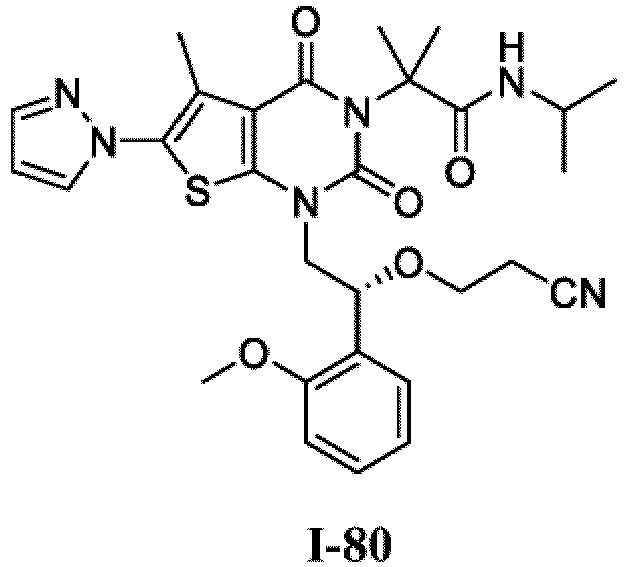
- As used herein, the following definitions shall apply unless otherwise indicated. For purposes of this invention, the chemical elements are identified in accordance with the Periodic Table of the Elements, CAS version, Handbook of Chemistry and Physics, 75th Ed. Additionally, general principles of organic chemistry are described in "Organic Chemistry", Thomas Sorrell, University Science Books, Sausalito: 1999, and "March's Advanced Organic Chemistry", 5th Ed., Ed.: Smith, M.B. and March, J., John Wiley & Sons, New York: 2001.
- The term "aliphatic" or "aliphatic group", as used herein, means a straight-chain (i.e., unbranched) or branched, substituted or unsubstituted hydrocarbon chain that is completely saturated or that contains one or more units of unsaturation, or a monocyclic hydrocarbon or bicyclic hydrocarbon that is completely saturated or that contains one or more units of unsaturation, but which is not aromatic (also referred to herein as "carbocycle," "cycloaliphatic" or "cycloalkyl"), that has a single point of attachment to the rest of the molecule. Unless otherwise specified, aliphatic groups contain 1-6 aliphatic carbon atoms. In some embodiments, aliphatic groups contain 1-5 aliphatic carbon atoms. In other embodiments, aliphatic groups contain 1-4 aliphatic carbon atoms. In still other embodiments, aliphatic groups contain 1-3 aliphatic carbon atoms, and in yet other embodiments, aliphatic groups contain 1-2 aliphatic carbon atoms. In some embodiments, "cycloaliphatic" (or "carbocycle" or "cycloalkyl") refers to a monocyclic C3-C6 hydrocarbon that is completely saturated or that contains one or more units of unsaturation, but which is not aromatic, that has a single point of attachment to the rest of the molecule. Suitable aliphatic groups include, but are not limited to, linear or branched, substituted or unsubstituted alkyl, alkenyl, alkynyl groups and hybrids thereof such as (cycloalkyl)alkyl, (cycloalkenyl)alkyl or (cycloalkyl)alkenyl.
- The term "heteroatom" means one or more of oxygen, sulfur, nitrogen, phosphorus, or silicon (including, any oxidized form of nitrogen, sulfur, phosphorus, or silicon; the quaternized form of any basic nitrogen or; a substitutable nitrogen of a heterocyclic ring, for example N (as in 3,4-dihydro-2H-pyrrolyl), NH (as in pyrrolidinyl) or NR+ (as in N-substituted pyrrolidinyl)).
- The term "unsaturated," as used herein, means that a moiety has one or more units of unsaturation.
- As used herein, the term "bivalent C1-8 (or C1-6) saturated or unsaturated, straight or branched, hydrocarbon chain", refers to bivalent alkylene, alkenylene, and alkynylene chains that are straight or branched as defined herein.
- The term "alkylene" refers to a bivalent alkyl group. An "alkylene chain" is a polymethylene group, i.e., -(CH2)n-, wherein n is a positive integer, preferably from 1 to 6, from 1 to 4, from 1 to 3, from 1 to 2, or from 2 to 3. A substituted alkylene chain is a polymethylene group in which one or more methylene hydrogen atoms are replaced with a substituent. Suitable substituents include those described below for a substituted aliphatic group.
- The term "alkenylene" refers to a bivalent alkenyl group. A substituted alkenylene chain is a polymethylene group containing at least one double bond in which one or more hydrogen atoms are replaced with a substituent. Suitable substituents include those described below for a substituted aliphatic group.
- The term "halogen" means F, Cl, Br, or I.
- The term "aryl" used alone or as part of a larger moiety as in "aralkyl," "aralkoxy," or "aryloxyalkyl," refers to monocyclic or bicyclic ring systems having a total of five to fourteen ring members, wherein at least one ring in the system is aromatic and wherein each ring in the system contains 3 to 7 ring members. The term "aryl" may be used interchangeably with the term "aryl ring."
- The term "aryl" used alone or as part of a larger moiety as in "aralkyl," "aralkoxy," or "aryloxyalkyl," refers to monocyclic and bicyclic ring systems having a total of five to 10 ring members, wherein at least one ring in the system is aromatic and wherein each ring in the system contains three to seven ring members. The term "aryl" may be used interchangeably with the term "aryl ring". In certain embodiments of the present invention, "aryl" refers to an aromatic ring system which includes, but not limited to, phenyl, biphenyl, naphthyl, anthracyl and the like, which may bear one or more substituents. Also included within the scope of the term "aryl," as it is used herein, is a group in which an aromatic ring is fused to one or more non-aromatic rings, such as indanyl, phthalimidyl, naphthimidyl, phenanthridinyl, or tetrahydronaphthyl, and the like.
- The terms "heteroaryl" and "heteroar-," used alone or as part of a larger moiety, e.g., "heteroaralkyl," or "heteroaralkoxy," refer to groups having 5 to 10 ring atoms, preferably 5, 6, or 9 ring atoms; having 6, 10, or 14 π electrons shared in a cyclic array; and having, in addition to carbon atoms, from one to five heteroatoms. Heteroaryl groups include, without limitation, thienyl, furanyl, pyrrolyl, imidazolyl, pyrazolyl, triazolyl, tetrazolyl, oxazolyl, isoxazolyl, oxadiazolyl, thiazolyl, isothiazolyl, thiadiazolyl, pyridyl, pyridazinyl, pyrimidinyl, pyrazinyl, indolizinyl, purinyl, naphthyridinyl, and pteridinyl. The terms "heteroaryl" and "heteroar-", as used herein, also include groups in which a heteroaromatic ring is fused to one or more aryl, cycloaliphatic, or heterocyclyl rings, where the radical or point of attachment is on the heteroaromatic ring. Nonlimiting examples include indolyl, isoindolyl, benzothienyl, benzo furanyl, dibenzofuranyl, indazolyl, benzimidazolyl, benzthiazolyl, quinolyl, isoquinolyl, cinnolinyl, phthalazinyl, quinazolinyl, quinoxalinyl, 4H-quinolizinyl, carbazolyl, acridinyl, phenazinyl, phenothiazinyl, phenoxazinyl, tetrahydroquinolinyl, tetrahydroisoquinolinyl, and pyrido[2,3-b]-1,4-oxazin-3(4H)-one. A heteroaryl group may be mono- or bicyclic. The term "heteroaryl" may be used interchangeably with the terms "heteroaryl ring," "heteroaryl group," or "heteroaromatic," any of which terms include rings that are optionally substituted. The term "heteroaralkyl" refers to an alkyl group substituted by a heteroaryl, wherein the alkyl and heteroaryl portions independently are optionally substituted.
- As used herein, the terms "heterocycle," "heterocyclyl," "heterocyclic radical," and "heterocyclic ring" are used interchangeably and refer to a stable 5- to 7-membered monocyclic or 7-10-membered bicyclic heterocyclic moiety that is either saturated or partially unsaturated, and having, in addition to carbon atoms, one or more, preferably one to four, heteroatoms, as defined above. When used in reference to a ring atom of a heterocycle, the term "nitrogen" includes a substituted nitrogen. As an example, in a saturated or partially unsaturated ring having 0-3 heteroatoms selected from oxygen, sulfur or nitrogen, the nitrogen may be N (as in 3,4-dihydro-2H-pyrrolyl), NH (as in pyrrolidinyl), or +NR (as in N-substituted pyrrolidinyl).
- A heterocyclic ring can be attached to its pendant group at any heteroatom or carbon atom that results in a stable structure and any of the ring atoms can be optionally substituted. Examples of such saturated or partially unsaturated heterocyclic radicals include, without limitation, tetrahydrofuranyl, tetrahydrothiophenyl pyrrolidinyl, piperidinyl, pyrrolinyl, tetrahydroquinolinyl, tetrahydroisoquinolinyl, decahydroquinolinyl, oxazolidinyl, piperazinyl, dioxanyl, dioxolanyl, diazepinyl, oxazepinyl, thiazepinyl, morpholinyl, and quinuclidinyl. The terms "heterocycle," "heterocyclyl," "heterocyclyl ring," "heterocyclic group," "heterocyclic moiety," and "heterocyclic radical," are used interchangeably herein, and also include groups in which a heterocyclyl ring is fused to one or more aryl, heteroaryl, or cycloaliphatic rings, such as indolinyl, 3H-indolyl, chromanyl, phenanthridinyl, or tetrahydroquinolinyl, where the radical or point of attachment is on the heterocyclyl ring. A heterocyclyl group may be mono- or bicyclic. The term "heterocyclylalkyl" refers to an alkyl group substituted by a heterocyclyl, wherein the alkyl and heterocyclyl portions independently are optionally substituted.
- As used herein, the term "partially unsaturated" refers to a ring moiety that includes at least one double or triple bond. The term "partially unsaturated" is intended to encompass rings having multiple sites of unsaturation, but is not intended to include aryl or heteroaryl moieties, as herein defined.
- As described herein, compounds of the invention may contain "optionally substituted" moieties. In general, the term "substituted," whether preceded by the term "optionally" or not, means that one or more hydrogens of the designated moiety are replaced with a suitable substituent. Unless otherwise indicated, an "optionally substituted" group may have a suitable substituent at each substitutable position of the group, and when more than one position in any given structure may be substituted with more than one substituent selected from a specified group, the substituent may be either the same or different at every position. Combinations of substituents envisioned by this invention are preferably those that result in the formation of stable or chemically feasible compounds. The term "stable," as used herein, refers to compounds that are not substantially altered when subjected to conditions to allow for their production, detection, and, in certain embodiments, their recovery, purification, and use for one or more of the purposes disclosed herein.
- Suitable monovalent substituents on a substitutable carbon atom of an "optionally substituted" group are independently halogen; -(CH2)0-4R°; -(CH2)0-4OR°; -O(CH2)0-4R°, -O-(CH2)0-4C(O)OR°; -(CH2)0-4CH(OR°)2; -(CH2)0-4SR°; -(CH2)0-4Ph, which may be substituted with R°; -(CH2)0-4O(CH2)0-1Ph which may be substituted with R°; -CH=CHPh, which may be substituted with R°; -(CH2)0-4O(CH2)0-1-pyridyl which may be substituted with R°; -NO2; -CN; -N3; -(CH2)0-4N(R°)2; -(CH2)0-4N(R°)C(O)R°; -N(R°)C(S)R°; -(CH2)0-4N(R°)C(O)NR°2; -N(R°)C(S)NR°2; -(CH2)0-4N(R°)C(O)OR°; -N(R°)N(R°)C(O)R°; -N(R°)N(R°)C(O)NR°2; -N(R°)N(R°)C(O)OR°: -(CH2)0-4C(O)R°; -C(S)R°; -(CH2)0-4C(O)OR°; -(CH2)0-4C(O)SR°; -(CH2)0-4C(O)OSiR°3; -(CH2)0-4OC(O)R°; -OC(O)(CH2)0-4SR°; -(CH2)0-4SC(O)R°; -(CH2)0-4C(O)NR°2; -C(S)NR°2; -C(S)SR°; -SC(S)SR°, -(CH2)0-.4OC(O)NR°2; -C(O)N(OR°)R°; -C(O)C(O)R°; -C(O)CH2C(O)R°; C(NOR°)R°; -(CH2)0-4SSR°; -(CH2)0-4S(O)2R°; -(CH2)0-4S(O)2OR°; -(CH2)0-4OS(O)2R°; -S(O)2NR°2; -(CH2)0-4S(O)R°; -N(R°)S(O)2NR°2; -N(R°)S(O)2R°; -N(OR°)R°; -C(NH)NR°2; -P(O)2R°; -P(O)R°2; -OP(O)R°2; -OP(O)(OR°)2; SiR°3; -(C1-4 straight or branched alkylene)O-N(R°)2; or -(C1-4 straight or branched alkylene)C(O)O-N(R°)2, wherein each R° may be substituted as defined below and is independently hydrogen, C1-6 aliphatic, -CH2Ph, -O(CH2)0-1Ph, -CH2-(5-6 membered heteroaryl ring), or a 5-6-membered saturated, partially unsaturated, or aryl ring having 0-4 heteroatoms independently selected from nitrogen, oxygen, or sulfur, or, notwithstanding the definition above, two independent occurrences of R°, taken together with their intervening atom(s), form a 3-12--membered saturated, partially unsaturated, or aryl mono- or bicyclic ring having 0-4 heteroatoms independently selected from nitrogen, oxygen, or sulfur, which may be substituted as defined below.
- Suitable monovalent substituents on R° (or the ring formed by taking two independent occurrences of R° together with their intervening atoms), are independently halogen, -(CH2)0-2R●, -(haloR●), -(CH2)0-2OH, -(CH2)0-2OR●, -(CH2)0-2CH(OR●)2, -O(haloR●), -CN, -N3, -(CH2)0-2C(O)R●, -(CH2)0-2C(O)OH, -(CH2)0-2C(O)OR●, -(CH2)0-2SR●, -(CH2)0-2SH, -(CH2)0-2NH2, -(CH2)0-2NHR●, -(CH2)0-2NR● 2, -NO2, -SiR● 3, -OSiR● 3, -C(O)SR●, -(C1-4 straight or branched alkylene)C(O)OR●, or -SSR●; wherein each R● is unsubstituted or where preceded by "halo" is substituted only with one or more halogens, and is independently selected from C1-4 aliphatic, -CH2Ph, -O(CH2)0-1PH, or a 5-6-membered saturated, partially unsaturated, or aryl ring having 0-4 heteroatoms independently selected from nitrogen, oxygen, or sulfur. Suitable divalent substituents on a saturated carbon atom of R° include =O and =S.
- Suitable divalent substituents on a saturated carbon atom of an "optionally substituted" group include the following: =O, =S, =NNR∗ 2, =NNHC(O)R∗, =NNHC(O)OR∗, =NNHS(O)2R∗, =NR∗, =NOR∗, -O(C(R∗ 2))2-3O-, or -S(C(R∗ 2))2-3S-, wherein each independent occurrence of R∗ is selected from hydrogen, C1-6 aliphatic which may be substituted as defined below, or an unsubstituted 5-6-membered saturated, partially unsaturated, or aryl ring having 0-4 heteroatoms independently selected from nitrogen, oxygen, or sulfur. Suitable divalent substituents that are bound to vicinal substitutable carbons of an "optionally substituted" group include: -O(CR∗ 2)2-3O-, wherein each independent occurrence of R∗ is selected from hydrogen, C1-6 aliphatic which may be substituted as defined below, or an unsubstituted 5-6-membered saturated, partially unsaturated, or aryl ring having 0-4 heteroatoms independently selected from nitrogen, oxygen, or sulfur.
- Suitable substituents on the aliphatic group of R∗ include halogen, -R●, -(haloR●), -OH, -OR●, -O(haloR●), -CN, -C(O)OH, -C(O)OR●, -NH2, -NHR●, -NR● 2, or -NO2, wherein each R● is unsubstituted or where preceded by "halo" is substituted only with one or more halogens, and is independently C1-4 aliphatic, -CH2Ph, -O(CH2)0-1Ph, or a 5-6-membered saturated, partially unsaturated, or aryl ring having 0-4 heteroatoms independently selected from nitrogen, oxygen, or sulfur.
- Suitable substituents on a substitutable nitrogen of an "optionally substituted" group include -R†, -NR† 2, -C(O)R†, -C(O)OR†, -C(O)C(O)R†, -C(O)CH2C(O)R†, -S(O)2R†, -S(O)2NR† 2, -C(S)NR† 2, -C(NH)NR† 2, or -N(R†)S(O)2R†; wherein each R† is independently hydrogen, C1-6 aliphatic which may be substituted as defined below, unsubstituted -OPh, or an unsubstituted 5-6-membered saturated, partially unsaturated, or aryl ring having 0-4 heteroatoms independently selected from nitrogen, oxygen, or sulfur, or, notwithstanding the definition above, two independent occurrences of R†, taken together with their intervening atom(s) form an unsubstituted 3-12-membered saturated, partially unsaturated, or aryl mono- or bicyclic ring having 0-4 heteroatoms independently selected from nitrogen, oxygen, or sulfur.
- Suitable substituents on the aliphatic group of R† are independently halogen, -R●, -(haloR●), -OH, -OR●, -O(haloR●), -CN, -C(O)OH, -C(O)OR●, -NH2, -NHR●, -NR● 2, or -NO2, wherein each R● is unsubstituted or where preceded by "halo" is substituted only with one or more halogens, and is independently C1-4 aliphatic, -CH2Ph, -O(CH2)0-1Ph, or a 5-6-membered saturated, partially unsaturated, or aryl ring having 0-4 heteroatoms independently selected from nitrogen, oxygen, or sulfur.
- Unless otherwise stated, structures depicted herein are also meant to include all isomeric (e.g., enantiomeric, diastereomeric, and geometric (or conformational)) forms of the structure; for example, the R and S configurations for each asymmetric center, Z and E double bond isomers, and Z and E conformational isomers. Therefore, single stereochemical isomers as well as enantiomeric, diastereomeric, and geometric (or conformational) mixtures of the present compounds are within the scope of the invention. Unless otherwise stated, all tautomeric forms of the compounds of the invention are within the scope of the invention. Additionally, unless otherwise stated, structures depicted herein are also meant to include compounds that differ only in the presence of one or more isotopically enriched atoms. For example, compounds having the present structures including the replacement of hydrogen by deuterium or tritium, or the replacement of a carbon by a 13C- or 14C-enriched carbon are within the scope of this invention. Such compounds are useful, for example, as analytical tools, as probes in biological assays, or as therapeutic agents in accordance with the present invention.
- The present invention provides a compound having the structure:

- The compound of the invention is set forth in Table 1, below:

- In certain embodiments, the present invention provides the compound depicted in Table 1, above, or an agriculturally acceptable salt thereof.
- In certain embodiments, the present invention provides a compound as described above, wherein the compound is present as an agriculturally acceptable salt.
- The compounds of this invention may be prepared or isolated in general by synthetic and/or semi-synthetic methods known to those skilled in the art for analogous compounds and by methods described in detail in the Examples, herein.
- In the Schemes below, where a particular protecting group ("PG"), leaving group ("LG"), or transformation condition is depicted, one of ordinary skill in the art will appreciate that other protecting groups, leaving groups, and transformation conditions are also suitable and are contemplated. Such groups and transformations are described in detail in March's Advanced Organic Chemistry: Reactions, Mechanisms, and Structure, M. B. Smith and J. March, 5th Edition, John Wiley & Sons, 2001, Comprehensive Organic Transformations, R. C. Larock, 2nd Edition, John Wiley & Sons, 1999, and Protecting Groups in Organic Synthesis, T. W. Greene and P. G. M. Wuts, 3rd edition, John Wiley & Sons, 1999.
- As used herein, the phrase "leaving group" (LG) includes, but is not limited to, halogens (e.g. fluoride, chloride, bromide, iodide), sulfonates (e.g. mesylate, tosylate, benzenesulfonate, brosylate, nosylate, triflate), diazonium, and the like.
- As used herein, the phrase "oxygen protecting group" includes, for example, carbonyl protecting groups, hydroxyl protecting groups, etc. Hydroxyl protecting groups are well known in the art and include those described in detail in Protecting Groups in Organic Synthesis, T. W. Greene and P. G. M. Wuts, 3rd edition, John Wiley & Sons, 1999. Examples of suitable hydroxyl protecting groups include, but are not limited to, esters, allyl ethers, ethers, silyl ethers, alkyl ethers, arylalkyl ethers, and alkoxyalkyl ethers. Examples of such esters include formates, acetates, carbonates, and sulfonates. Specific examples include formate, benzoyl formate, chloroacetate, trifluoroacetate, methoxyacetate, triphenylmethoxyacetate, p-chlorophenoxyacetate, 3-phenylpropionate, 4-oxopentanoate, 4,4-(ethylenedithio)pentanoate, pivaloate (trimethylacetyl), crotonate, 4-methoxy-crotonate, benzoate, p-benzylbenzoate, 2,4,6-trimethylbenzoate, carbonates such as methyl, 9-fluorenylmethyl, ethyl, 2,2,2-trichloroethyl, 2-(trimethylsilyl)ethyl, 2-(phenylsulfonyl)ethyl, vinyl, allyl, and p-nitrobenzyl. Examples of such silyl ethers include trimethylsilyl, triethylsilyl, t-butyldimethylsilyl, t-butyldiphenylsilyl, triisopropylsilyl, and other trialkylsilyl ethers. Alkyl ethers include methyl, benzyl, p-methoxybenzyl, 3,4-dimethoxybenzyl, trityl, t-butyl, allyl, and allyloxycarbonyl ethers or derivatives. Alkoxyalkyl ethers include acetals such as methoxymethyl, methylthiomethyl, (2-methoxyethoxy)methyl, benzyloxymethyl, beta-(trimethylsilyl)ethoxymethyl, and tetrahydropyranyl ethers. Examples of arylalkyl ethers include benzyl, p-methoxybenzyl (MPM), 3,4-dimethoxybenzyl, O-nitrobenzyl, p-nitrobenzyl, p-halobenzyl, 2,6-dichlorobenzyl, p-cyanobenzyl, and 2- and 4-picolyl.
- Amino protecting groups are well known in the art and include those described in detail in Protecting Groups in Organic Synthesis, T. W. Greene and P. G. M. Wuts, 3rd edition, John Wiley & Sons, 1999. Suitable amino protecting groups include, but are not limited to, aralkylamines, carbamates, cyclic imides, allyl amines, amides, and the like. Examples of such groups include t-butyloxycarbonyl (BOC), ethyloxycarbonyl, methyloxycarbonyl, trichloroethyloxycarbonyl, allyloxycarbonyl (Alloc), benzyloxocarbonyl (CBZ), allyl, phthalimide, benzyl (Bn), fluorenylmethylcarbonyl (Fmoc), formyl, acetyl, chloroacetyl, dichloroacetyl, trichloroacetyl, phenylacetyl, trifluoroacetyl, benzoyl, and the like.
- In certain examples, compounds of formula I are generally prepared according to Scheme I set forth below:

- In Scheme I above, each of PG, LG, R1, R2, R3, R4, L1, L2, and X is as defined above and below and in classes and subclasses as described herein.
- In one aspect, methods are disclosed for preparing compounds of formula G-9 according to the steps depicted in Scheme I, above. In some examples, step S-1 comprises protecting the amine of a compound of formula G-1, thereby forming a compound of formula G-2. In some examples, the PG is acetyl. In some examples, the acetyl protection is accomplished through the use of acetic anhydride. In some examples, a catalyst is added to promote the reaction. In some embodiments, the catalyst is MgClO4.
- In some examples, step S-2 comprises the formation of a LG to within compound of formula G-2, thereby forming a compound of formula G-3. In some examples, LG is a sulfonate. In some examples, LG is a halogen. In some examples, LG is chlorine. In some examples, LG is bromine. In some examples, a bromine-containing compound, G-3, is produced through the use of N-bromosuccinimide.
- In some examples, step S-3 comprises the coupling of
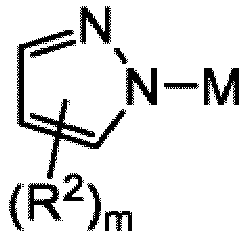
- In some examples, step S-4 comprises deprotection of the amine of a compound of formula G-4, thereby forming a compound of formula G-5. In some examples, the PG is acetyl. In some examples, deprotection is achieved through use of hydrazine. In some examples, water is added to the reaction mixture. In some examples, ethanol is added to the reaction mixture.
- In some examples, step S-5 comprises contacting a compound of formula G-5 with a reagent, thereby forming a compound of formula G-6. In some examples, the reagent is bis(trichloromethyl)carbonate. In some examples, step S-5 further comprises a base. In some examples, the base is triethylamine. In some examples, the solvent is CH2Cl2.
- In some examples, step S-6 comprises contacting a compound of formula G-6 with a reagent, thereby forming a compound of formula G-7. In some examples, the reagent is H2N-L1-R3, wherein L1 and R3 is as defined above and decribed within.
- In some examples, step S-7 comprises cyclization of a compound of formula G-7, thereby forming a compound of formula G-8. In some examples, a base is added to catalyze the cyclization. In some examples, the base is CS2CO3. In some examples, the solvent is t-BuOH.
- In some examples, step S-8 comprises contacting a compound of formula G-8 with a reagent, thereby forming a compound of formula G-9. In some examples, the reagent is HO-L2-R4. In some examples, the addition of L2-R4 is accomplished through the use of additional reagents. In some examples, the additional reagents are diisopropyl azodicarboxylate and triphenylphosine. In some examples, the solvent is THF.
- One of skill in the art will appreciate that compounds of formula G-9 may contain one or more stereocenters, and may be present as an racemic or diastereomeric mixture. One of skill in the art will also appreciate that there are many methods known in the art for the separation of isomers to obtain stereoenriched or stereopure isomers of those compounds, including but not limited to HPLC, chiral HPLC, fractional crystallization of diastereomeric salts, kinetic enzymatic resolution (e.g. by fungal-, bacterial-, or animal-derived lipases or esterases), and formation of covalent diastereomeric derivatives using an enantioenriched reagent.
- One of skill in the art will appreciate that various functional groups present in compounds of the invention such as aliphatic groups, alcohols, carboxylic acids, esters, amides, aldehydes, halogens and nitriles can be interconverted by techniques well known in the art including, but not limited to reduction, oxidation, esterification, hydrolysis, partial oxidation, partial reduction, halogenation, dehydration, partial hydration, and hydration. See e.g. "March's Advanced Organic Chemistry", 5th Ed., Ed.: Smith, M.B. and March, J., John Wiley & Sons, New York: 2001. Such interconversions may require one or more of the aforementioned techniques, and certain methods for synthesizing compounds of the invention are described below in the Exemplification.
- In some embodiments, a provided compound inhibits at least one of Botrtyis cinerea, Collectotrichum graminicola, Diplodia maydis, Fusarium moniliforme, Fusarium virguliforme, Phytophthora capsici, Rhizoctonia solani, and Septoria at a concentration of 2 µg/mL or less. In some embodiments, a provided compound inhibits at least one of Botrtyis cinerea, Collectotrichum graminicola, Diplodia maydis, Fusarium moniliforme, Fusarium virguliforme, Phytophthora capsici, Rhizoctonia solani, and Septoria at a concentration of 1 µg/mL or less. In some embodiments, a compound of the present invention inhibits at least two of Botrtyis cinerea, Collectotrichum graminicola, Diplodia maydis, Fusarium moniliforme, Fusarium virguliforme, Phytophthora capsici, Rhizoctonia solani, and Septoria at a concentration of 2 µg/mL or less. In some embodiments, a compound of the present invention inhibits at least two of Botrtyis cinerea, Collectotrichum graminicola, Diplodia maydis, Fusarium moniliforme, Fusarium virguliforme, Phytophthora capsici, Rhizoctonia solani, and Septoria at a concentration of 1 µg/mL or less. In some embodiments, a compound of the present invention inhibits at least three of Botrtyis cinerea, Collectotrichum graminicola, Diplodia maydis, Fusarium moniliforme, Fusarium virguliforme, Phytophthora capsici, Rhizoctonia solani, and Septoria at a concentration of 2 µg/mL or less. In some embodiments, a compound of the present invention inhibits at least three of Botrtyis cinerea, Collectotrichum graminicola, Diplodia maydis, Fusarium moniliforme, Fusarium virguliforme, Phytophthora capsici, Rhizoctonia solani, and Septoria at a concentration of 1 µg/mL or less.
- In certain embodiments, a provided compound or composition, according to the method of the present invention, may be used as herbicides. In some embodiments, the present invention provides a method to inhibit the growth or viability of plants comprising treating plants with compounds of the present invention. In some embodiments of the present invention, a provided compound or composition can be used to inhibit the growth or viability of plants by inhibiting ACC. In some embodiments, the method of the present invention comprises using a provided compound or composition to inhibit fatty acid production in or increase fatty acid oxidation in plants.
- The invention further refers to an agricultural composition comprising at least one provided compound as defined above or an agriculturally acceptable salt thereof and a liquid or solid carrier. Suitable carriers, as well as auxiliaries and further active compounds which may also be contained in the composition of the invention are defined below.
- Suitable "agriculturally acceptable salts" include but are not limited to the salts of those cations or the acid addition salts of those acids whose cations and anions, respectively, have no adverse effect on the fungicidal action of a provided compound. Thus, suitable cations are in particular the ions of the alkali metals, preferably sodium and potassium, of the alkaline earth metals, preferably calcium, magnesium and barium, and of the transition metals, preferably manganese, copper, zinc and iron, and also the ammonium ion which, if desired, may carry one to four C1-C4-alkyl substituents and/or one phenyl or benzyl substituent, preferably diisopropylammonium, tetramethylammonium, tetrabutylammonium, trimethylbenzylammonium. Additional agriculturally acceptable salts include phosphonium ions, sulfonium ions, preferably tri(C1-C4-alkyl)sulfonium and sulfoxonium ions, preferably tri(C1-C4-alkyl)sulfoxonium. Anions of useful acid addition salts are primarily chloride, bromide, fluoride, hydrogen- sulfate, sulfate, dihydrogenphosphate, hydrogenphosphate, phosphate, nitrate, bicarbonate, carbonate, hexafluorosilicate, hexafluorophosphate, benzoate, and also the anions of C1-C4-alkanoic acids, preferably formate, acetate, propionate and butyrate. Such agriculturally acceptable acid addition salts can be formed by reacting a provided compound bearing a basic ionizable group with an acid of the corresponding anion, preferably hydrochloric acid, hydrobromic acid, sulfuric acid, phosphoric acid or nitric acid.
- A provided compound or composition thereof is suitable as fungicides. They are distinguished by an outstanding effectiveness against a broad spectrum of phytopathogenic fungi, including soil-borne fungi, which derive especially from the classes of the Plasmodiophoromycetes, Peronosporomycetes (syn. Oomycetes), Chytridiomycetes, Zygomycetes, Ascomycetes, Basidiomycetes and Deuteromycetes (syn. Fungi imperfecti). Some are systemically effective and they can be used in crop protection as foliar fungicides, fungicides for seed dressing and soil fungicides. Moreover, they are suitable for controlling harmful fungi, which inter alia occur in wood or roots of plants.
- In some embodiments, a provided compound or composition thereof is particularly important in the control of phytopathogenic fungi on various cultivated plants, such as cereals, e.g. wheat, rye, barley, triticale, oats or rice; beet, e.g. sugar beet or fodder beet; fruits, such as pomes, stone fruits or soft fruits, e.g. apples, pears, plums, peaches, almonds, cherries, strawberries, raspberries, blackberries or gooseberries; leguminous plants, such as lentils, peas, alfalfa or soybeans; oil plants, such as rape, mustard, olives, sunflowers, coconut, cocoa beans, castor oil plants, oil palms, ground nuts or soybeans; cucurbits, such as squashes, cucumber or melons; fiber plants, such as cotton, flax, hemp or jute; citrus fruit, such as oranges, lemons, grapefruits or mandarins; vegetables, such as spinach, lettuce, asparagus, cabbages, carrots, onions, tomatoes, potatoes, cucurbits or paprika; lauraceous plants, such as avocados, cinnamon or camphor; energy and raw material plants, such as corn, soybean, rape, sugar cane or oil palm; corn; tobacco; nuts; coffee; tea; bananas; vines (table grapes and grape juice grape vines); hop; turf; natural rubber plants or ornamental and forestry plants, such as flowers, shrubs, broad-leaved trees or evergreens, e.g. conifers; and on the plant propagation material, such as seeds, and the crop material of these plants.
- In some embodiments, a provided compound or compositions thereof is used for controlling a multitude of fungi on field crops, such as potatoes, sugar beets, tobacco, wheat, rye, barley, oats, rice, corn, cotton, soybeans, rape, legumes, sunflowers, coffee or sugar cane; fruits; vines; ornamentals; or vegetables, such as cucumbers, tomatoes, beans or squashes.
- The term "plant propagation material" is to be understood to denote all the generative parts of the plant such as seeds and vegetative plant material such as cuttings and tubers (e.g. potatoes), which can be used for the multiplication of the plant. This includes seeds, roots, fruits, tubers, bulbs, rhizomes, shoots, sprouts and other parts of plants, including seedlings and young plants, which are to be transplanted after germination or after emergence from soil. These young plants may also be protected before transplantation by a total or partial treatment by immersion or pouring.
- In some embodiments, treatment of plant propagation materials with a provided compound or compositions thereof is used for controlling a multitude of fungi on cereals, such as wheat, rye, barley and oats; rice, corn, cotton and soybeans.
- The term "cultivated plants" is to be understood as including plants which have been modified by breeding, mutagenesis or genetic engineering including but not limiting to agricultural biotech products on the market or in development. Genetically modified plants are plants, which genetic material has been so modified by the use of recombinant DNA techniques that under natural circumstances cannot readily be obtained by cross breeding, mutations or natural recombination. Typically, one or more genes have been integrated into the genetic material of a genetically modified plant in order to improve certain properties of the plant. Such genetic modifications also include but are not limited to targeted post-translational modification of protein(s), oligo- or polypeptides e.g. by glycosylation or polymer additions such as prenylated, acetylated or farnesylated moieties or PEG moieties.
- Plants that have been modified by breeding, mutagenesis or genetic engineering, e.g. have been rendered tolerant to applications of specific classes of herbicides, such as hydroxyphenylpyruvate dioxygenase (HPPD) inhibitors; acetolactate synthase (ALS) inhibitors, such as sulfonyl ureas (see e.g.
US 6,222,100 ,WO 01/82685 WO 00/26390 WO 97/41218 WO 98/02526 WO 98/02527 WO 04/106529 WO 05/20673 WO 03/14357 WO 03/13225 WO 03/14356 WO 04/16073 US 6,222,100 ,WO 01/82685 WO 00/026390 WO 97/41218 WO 98/002526 WO 98/02527 WO 04/106529 WO 05/20673 WO 03/014357 WO 03/13225 WO 03/14356 WO 04/16073 WO 92/00377 EP-A 242 236 EP-A 242 246 US 5,559,024 ) as a result of conventional methods of breeding or genetic engineering. Several cultivated plants have been rendered tolerant to herbicides by conventional methods of breeding (mutagenesis), e.g. Clearfield® summer rape (Canola, BASF SE, Germany) being tolerant to imidazolinones, e.g. imazamox. Genetic engineering methods have been used to render cultivated plants, such as soybean, cotton, corn, beets and rape, tolerant to herbicides such as glyphosate and glufosinate, some of which are commercially available under the trade names RoundupReady® (glyphosate-tolerant, Monsanto, U.S.A.) and LibertyLink® (glufosinate- tolerant, Bayer CropScience, Germany). - Furthermore, plants are also covered that, by the use of recombinant DNA techniques, are capable to synthesize one or more insecticidal proteins, especially those known from the bacterial genus Bacillus, particularly from Bacillus thuringiensis, such as δ-endotoxins, e.g. CrylA(b), CrylA(c), CrylF, CrylF(a2), CryllA(b), CrylllA, CrylllB(bi) or Cryθc; vegetative insecticidal proteins (VIP), e.g. VIP1, VIP2, VIP3 or VIP3A; insecticidal proteins of bacteria colonizing nematodes, e.g. Photorhabdus spp. or Xenor-habdus spp.; toxins produced by animals, such as scorpion toxins, arachnid toxins, wasp toxins, or other insect-specific neurotoxins; toxins produced by fungi, such Streptomycetes toxins, plant lectins, such as pea or barley lectins; agglutinins; proteinase inhibitors, such as trypsin inhibitors, serine protease inhibitors, patatin, cystatin or pa- pain inhibitors; ribosome-inactivating proteins (RIP), such as ricin, maize-RIP, abrin, luffin, saporin or bryodin; steroid metabolism enzymes, such as 3-hydroxysteroid oxidase, ecdysteroid-IDP-glycosyl-transferase, cholesterol oxidases, ecdysone inhibitors or HMG-CoA-reductase; ion channel blockers, such as blockers of sodium or calcium channels; juvenile hormone esterase; diuretic hormone receptors (helicokinin receptors); stilbene synthase, bibenzyl synthase, chitinases or glucanases. In the context of the present invention these insecticidal proteins or toxins are to be understood expressly also as pre-toxins, hybrid proteins, truncated or otherwise modified proteins. Hybrid proteins are characterized by a new combination of protein domains, (see, e.g.
WO 02/015701 EP-A 374 753 WO 93/007278 WO 95/34656 EP-A 427 529 EP-A 451 878 WO 03/18810 WO 03/52073 WO 03/018810 - Furthermore, plants are also covered that, by the use of recombinant DNA techniques, are capable to synthesize one or more proteins to increase the resistance or tolerance of those plants to bacterial, viral or fungal pathogens. Examples of such proteins are the socalled "pathogenesis-related proteins" (PR proteins, see, e.g.
EP-A 392225 - Furthermore, plants are also covered that, by the use of recombinant DNA techniques, are capable to synthesize one or more proteins to increase the productivity (e.g. biomass production, grain yield, starch content, oil content or protein content), tolerance to drought, salinity or other growth-limiting environmental factors or tolerance to pests and fungal, bacterial or viral pathogens of those plants.
- Furthermore, plants are also covered that, by the use of recombinant DNA techniques, contain a modified amount of substances of content or new substances of content, specifically to improve human or animal nutrition, e.g. oil crops that produce health-promoting long-chain omega-3 fatty acids or unsaturated omega-9 fatty acids (e.g. Nexera® rape, DOW Agro Sciences, Canada).
- Furthermore, plants are also covered that, by the use of recombinant DNA techniques, contain a modified amount of substances of content or new substances of content, specifically to improve raw material production, e.g. potatoes that produce increased amounts of amylopectin (e.g. Amflora® potato, BASF SE, Germany).
- A provided compound and compositions thereof is particularly suitable for controlling the following plant diseases:
- Albugo spp. (white rust) on ornamentals, vegetables (e.g. A. Candida) and sunflowers (e.g. A. tragopogonis); Altemaria spp. (Alternaria leaf spot) on vegetables, rape (A. brassicola or brassicae), sugar beets (A. tenuis), fruits, rice, soybeans, potatoes (e.g. A. solani or A. alternata), tomatoes (e.g. A. solani or A. alternata) and wheat; Aphanomyces spp. on sugar beets and vegetables; Ascochyta spp. on cereals and vegetables, e.g. A. tritici (anthracnose) on wheat and A. hordei on barley; Bipolaris and Drechslera spp. (teleomorph: Cochliobolus spp.), e.g. Southern leaf blight (D. maydis) or Northern leaf blight (β. zeicola) on corn, e.g. spot blotch (β. sorokiniana) on cereals and e.g. B. oryzae on rice and turfs; Blumeria (formerly Erysiphe) graminis (powdery mildew) on cereals (e.g. on wheat or barley); Botiytis cinerea (teleomorph: Botryotinia fuckeliana: grey mold) on fruits and berries (e.g. strawberries), vegetables (e.g. lettuce, carrots, celery and cabbages), rape, flowers, vines, forestry plants and wheat; Bremia lactucae (downy mildew) on lettuce; Ceratocystis (syn. Ophiostoma) spp. (rot or wilt) on broad-leaved trees and evergreens, e.g. C. ulmi (Dutch elm disease) on elms; Cercospora spp. (Cercospora leaf spots) on corn (e.g. Gray leaf spot: C. zeaemaydis), rice, sugar beets (e.g. C. beticola), sugar cane, vegetables, coffee, soybeans (e.g. C. sojina or C. kikuchii) and rice; Cladosporium spp. on tomatoes (e.g. C. fulvum: leaf mold) and cereals, e.g. C. herbarum (black ear) on wheat; Claviceps purpurea (ergot) on cereals; Cochliobolus (anamorph: Helminthosporium of Bipolaris) spp. (leaf spots) on corn (C. carbonum), cereals (e.g. C. sativus, anamorph: B. sorokiniana) and rice (e.g. C. miyabeanus, anamorph: H. oryzae); Colletotrichum (teleomorph: Glomerella) spp. (anthracnose) on cotton (e.g. C. gossypii), corn (e.g. C. graminicola: Anthracnose stalk rot), soft fruits, potatoes (e.g. C. coccodes: black dot), beans (e.g. C. lindemuthianum) and soybeans (e.g. C. truncatum or C. gloeosporioides); Corticium spp., e.g. C. sasakii (sheath blight) on rice; Corynespora cassiicola (leaf spots) on soybeans and ornamentals; Cycloconium spp., e.g. C. oleaginum on olive trees; Cylindrocarpon spp. (e.g. fruit tree canker or young vine decline, teleomorph: Nectria or Neonectria spp.) on fruit trees, vines (e.g. C. liriodendri, teleomorph: Neonectria liriodendri. Black Foot Disease) and ornamentals; Dematophora (teleomorph: Rosellinia) necatrix (root and stem rot) on soybeans; Diaporthe spp., e.g. D. phaseolorum (damping off) on soybeans; Drechslera (syn. Helminthosporium, teleomorph: Pyrenophora) spp. on corn, cereals, such as barley (e.g. D. teres, net blotch) and wheat (e.g. D. tritici-repentis: tan spot), rice and turf; Esca (dieback, apoplexy) on vines, caused by Formitiporia (syn. Phellinus) punctata, F. mediterranea, Phaeomoniella chlamydospora (earlier Phaeoacremonium chlamydosporum), Phaeoacremonium aleophilum and/or Botryosphaeria obtusa; Elsinoe spp. on pome fruits (E. pyri), soft fruits (E. veneta: anthracnose) and vines (E ampelina: anthracnose); Entyloma oryzae (leaf smut) on rice; Epicoccum spp. (black mold) on wheat; Erysiphe spp. (powdery mildew) on sugar beets (E. betae), vegetables (e.g. E. pisi), such as cucurbits (e.g. E. cichoracearum), cabbages, rape (e.g. E. cruciferarum); Eutypa lata (Eutypa canker or dieback, anamorph: Cytosporina lata, syn. Libertella blepharis) on fruit trees, vines and ornamental woods; Exserohilum (syn. Helminthosporium) spp. on corn (e.g. E. turcicum); Fusarium (teleomorph: Gibberella) spp. (wilt, root or stem rot) on various plants, such as F. graminearum or F. culmorum (root rot, scab or head blight) on cereals (e.g. wheat or barley), F. oxysporum on tomatoes, F. solani on soybeans and F. verticillioides on corn; Gaeumannomyces graminis (take-all) on cereals (e.g. wheat or barley) and corn; Gibberella spp. on cereals (e.g. G. zeae) and rice (e.g. G. fujikuroi: Bakanae disease); Glomerella cingulata on vines, pome fruits and other plants and G. gossypii on cotton; Grainstaining complex on rice; Guignardia bidwellii (black rot) on vines; Gymnosporangium spp. on rosaceous plants and junipers, e.g. G. sabinae (rust) on pears; Helminthosporium spp. (syn. Drechslera, teleomorph: Cochliobolus) on corn, cereals and rice; Hemileia spp., e.g. H. vastatrix (coffee leaf rust) on coffee; Isariopsis clavispora (syn. Cladosporium vitis) on vines; Macrophomina phaseolina (syn. phaseoli) (root and stem rot) on soybeans and cotton; Microdochium (syn. Fusarium) nivale (pink snow mold) on cereals (e.g. wheat or barley); Microsphaera diffusa (powdery mildew) on soybeans; Monilinia spp., e.g. M. laxa, M.fructicola and M. fructigena (bloom and twig blight, brown rot) on stone fruits and other rosaceous plants; Mycosphaerella spp. on cereals, bananas, soft fruits and ground nuts, such as e.g. M. graminicola (anamorph: Septoria tritici, Septoria blotch) on wheat or M. fijiensis (black Sigatoka disease) on bananas; Peronospora spp. (downy mildew) on cabbage (e.g. P. brassicae), rape (e.g. P. parasitica), onions (e.g. P. destructor), tobacco (P. tabacina) and soybeans (e.g. P. manshurica); Phakopsora pachyrhizi and P. meibomiae (soybean rust) on soybeans; Phialophora spp. e.g. on vines (e.g. P. tracheiphila and P. tetraspora) and soybeans (e.g. P. gregata: stem rot); Phoma lingam (root and stem rot) on rape and cabbage and P. betae (root rot, leaf spot and damping-off) on sugar beets; Phomopsis spp. on sunflowers, vines (e.g. P. viticola: can and leaf spot) and soybeans (e.g. stem rot: P. phaseoli, teleomorph: Diaporthe phaseolorum); Physoderma maydis (brown spots) on corn; Phytophthora spp. (wilt, root, leaf, fruit and stem root) on various plants, such as paprika and cucurbits (e.g. P. capsici), soybeans (e.g. P. megasperma, syn. P. sojae), potatoes and tomatoes (e.g. P. infestans: late blight) and broad-leaved trees (e.g. P. ramorum: sudden oak death); Plasmodiophora brassicae (club root) on cabbage, rape, radish and other plants; Plasmopara spp., e.g. P. viticola (grapevine downy mildew) on vines and P. halstediiou sunflowers; Podosphaera spp. (powdery mildew) on rosaceous plants, hop, pome and soft fruits, e.g. P. leucotricha on apples; Polymyxa spp., e.g. on cereals, such as barley and wheat (P. graminis) and sugar beets (P. betae) and thereby transmitted viral diseases; Pseudocercosporella herpotrichoides (eyespot, teleomorph: Tapesia yallundae) on cereals, e.g. wheat or barley; Pseudoperonospora (downy mildew) on various plants, e.g. P. cubensis on cucurbits or P. humili on hop; Pseudopezicula tracheiphila (red fire disease or, rotbrenner, anamorph: Phialophora) on vines; Puccinia spp. (rusts) on various plants, e.g. P. triticina (brown or leaf rust), P. striiformis (stripe or yellow rust), P. hordei (dwarf rust), P. graminis (stem or black rust) or P. recondita (brown or leaf rust) on cereals, such as e.g. wheat, barley or rye, and asparagus (e.g. P. asparagi); Pyrenophora (anamorph: Drechslera) triticirepentis (tan spot) on wheat or P. feres (net blotch) on barley; Pyricularia spp., e.g. P. oryzae (teleomorph: Magnaporthe grisea, rice blast) on rice and P. grisea on turf and cereals; Pythium spp. (damping-off) on turf, rice, corn, wheat, cotton, rape, sunflowers, soybeans, sugar beets, vegetables and various other plants (e.g. P. ultimum or P. aphanidermatum); Ramularia spp., e.g. R. collo-cygni (Ramularia leaf spots, Physiological leaf spots) on barley and R. beticola on sugar beets; Rhizoctonia spp. on cotton, rice, potatoes, turf, corn, rape, potatoes, sugar beets, vegetables and various other plants, e.g. R. solani (root and stem rot) on soybeans, R. solani (sheath blight) on rice or R. cerealis (Rhizoctonia spring blight) on wheat or barley; Rhizopus stolonifer (black mold, soft rot) on strawberries, carrots, cabbage, vines and tomatoes; Rhynchosporium secalis (scald) on barley, rye and triticale; Sarocladium oryzae and S. attenuatum (sheath rot) on rice; Sclerotinia spp. (stem rot or white mold) on vegetables and field crops, such as rape, sunflowers (e.g. S. sclerotiorum) and soybeans (e.g. S. rolfsii or S. sclerotiorum); Septoria spp. on various plants, e.g. S. glycines (brown spot) on soybeans, S. tritici (Septoria blotch) on wheat and S. (syn. Stagonospora) nodorum (Stagonospora blotch) on cereals; Uncinula (syn. Erysiphe) necator (powdery mildew, anamorph: Oidium tuckeri) on vines; Setospaeria spp. (leaf blight) on corn (e.g. S. turcicum, syn. Helminthosporium turcicum) and turf; Sphacelotheca spp. (smut) on corn, (e.g. S. miliaria: head smut), sorghum and sugar cane; Sphaerotheca fuliginea (powdery mildew) on cucurbits; Spongospora subterranea (powdery scab) on potatoes and thereby transmitted viral diseases; Stagonospora spp. on cereals, e.g. S. nodorum (Stagonospora blotch, teleomorph: Leptosphaeria [syn. Phaeosphaeria] nodorum) on wheat; Synchytrium endobioticum on potatoes (potato wart disease); Taphrina spp., e.g. T. deformans (leaf curl disease) on peaches and T. pruni (plum pocket) on plums; Thielaviopsis spp. (black root rot) on tobacco, pome fruits, vegetables, soybeans and cotton, e.g. T. basicola (syn. Chalara elegans); Tilletia spp. (common bunt or stinking smut) on cereals, such as e.g. T. tritici (syn. T. caries, wheat bunt) and T. controversa (dwarf bunt) on wheat; Typhula incamata (grey snow mold) on barley or wheat; Urocystis spp., e.g. U. occulta (stem smut) on rye; Uromyces spp. (rust) on vegetables, such as beans (e.g. U. appendiculatus, syn. U. phaseoli) and sugar beets (e.g. U. betae); Ustilago spp. (loose smut) on cereals (e.g. U. nuda and U. avaenae), corn (e.g. U. maydis: corn smut) and sugar cane; Venturia spp. (scab) on apples (e.g. V. inaequalis) and pears; and Verticillium spp. (wilt) on various plants, such as fruits and ornamentals, vines, soft fruits, vegetables and field crops, e.g. V. dahliae on strawberries, rape, potatoes and tomatoes.
- A provided compound or compositions thereof is also suitable for controlling harmful fungi in the protection of stored products or harvest and in the protection of materials. The term "protection of materials" is to be understood to denote the protection of technical and non-living materials, such as adhesives, glues, wood, paper and paperboard, textiles, leather, paint dispersions, plastics, colling lubricants, fiber or fabrics, against the infestation and destruction by harmful microorganisms, such as fungi and bacteria. As to the protection of wood and other materials, the particular attention is paid to the following harmful fungi: Ascomycetes such as Ophiostoma spp., Ceratocystis spp., Aureobasidium pullulans, Sclerophoma spp., Chaetomium spp., Humicola spp., Petriella spp., Trichurus spp.; Basidiomycetes such as Coniophora spp., Coriolus spp., Gloeophyllwn spp., Lentinus spp., Pleurotus spp., Poria spp., Selpula spp. and Tyromyces spp., Deuteromycetes such as Aspergillus spp., Cladosporium spp., Penicillium spp., Trichorma spp., Altemaria spp., Paecilomyces spp. and Zygomycetes such as Mucor spp., and in addition in the protection of stored products and harvest the following yeast fungi are worthy of note: Candida spp. and Saccharomyces cerevisae.
- A provided compound or compositions thereof may be used for improving the health of a plant. The invention also relates to a method for improving plant health by treating a plant, its propagation material and/or the locus where the plant is growing or is to grow with an effective amount of a provided compound or composition thereof.
- The term "plant health" is to be understood to denote a condition of the plant and/or its products which is determined by several indicators alone or in combination with each other such as yield (e.g. increased biomass and/or increased content of valuable ingredients), plant vigor (e.g. improved plant growth and/or greener leaves ("greening effect")), quality (e.g. improved content or composition of certain ingredients) and tolerance to abiotic and/or biotic stress. The above identified indicators for the health condition of a plant may be interdependent or may result from each other.
- A provided compound can be present in different crystal modifications whose biological activity may differ. They are likewise subject matter of the present invention.
- A provided compound is employed as such or in form of a composition by treating the fungi or the plants, plant propagation materials, such as seeds, soil, surfaces, materials or rooms to be protected from fungal attack with a fungicidally effective amount of the active substances. The application can be carried out both before and after the infection of the plants, plant propagation materials, such as seeds, soil, surfaces, materials or rooms by the fungi.
- Plant propagation materials may be treated with a provided compound or composition thereof comprising at least one provided compound prophylactically either at or before planting or transplanting.
- The invention also relates to agrochemical compositions comprising a solvent or solid carrier and at least one provided compound and to the use for controlling harmful fungi.
- An agrochemical composition comprises a fungicidally effective amount of a provided compound. The term "effective amount" denotes an amount of a provided compound or composition thereof, which is sufficient for controlling harmful fungi on cultivated plants or in the protection of materials and which does not result in a substantial damage to the treated plants. Such an amount can vary in a broad range and is dependent on various factors, such as the fungal species to be controlled, the treated cultivated plant or material, the climatic conditions and the specific compound used.
- A provided compound or a pharmaceutically acceptable salt thereof can be converted into customary types of agrochemical compositions, e.g. solutions, emulsions, suspensions, dusts, powders, pastes and granules. The composition type depends on the particular intended purpose; in each case, it should ensure a fine and uniform distribution of the provided compound.
- Examples for composition types are suspensions (SC, OD, FS), emulsifiable concentrates (EC), emulsions (EW, EO, ES), pastes, pastilles, wettable powders or dusts (WP, SP, SS, WS, DP, DS) or granules (GR, FG, GG, MG), which can be water- soluble or wettable, as well as gel formulations for the treatment of plant propagation materials such as seeds (GF).
- Usually the composition types (e.g. SC, OD, FS, EC, WG, SG, WP, SP, SS, WS, GF) are employed diluted. Composition types such as DP, DS, GR, FG, GG and MG are usually used undiluted.
- The compositions are prepared in a known manner (cf.
US 3,060,084 ,EP-A 707 445 WO 91/13546 US 4,172,714 ,US 4,144,050 ,US 3,920,442 ,US 5,180,587 ,US 5,232,701 ,US 5,208,030 ,GB 2,095,558 US 3,299,566 , Klingman: Weed Control as a Science (J. Wiley & Sons, New York, 1961), Hance et al.: Weed Control Handbook (8th Ed., Blackwell Scientific, Oxford, 1989) and Mollet, H. and Grubemann, A.: Formulation technology (Wiley VCH Verlag, Weinheim, 2001 ). - The agrochemical compositions may also comprise auxiliaries which are customary in agrochemical compositions. The auxiliaries used depend on the particular application form and active substance, respectively.
- Examples for suitable auxiliaries are solvents, solid carriers, dispersants or emulsifiers (such as further solubilizers, protective colloids, surfactants and adhesion agents), organic and inorganic thickeners, bactericides, anti-freezing agents, anti-foaming agents, if appropriate colorants and tackifiers or binders (e.g. for seed treatment formulations). Suitable solvents are water, organic solvents such as mineral oil fractions of medium to high boiling point, such as kerosene or diesel oil, furthermore coal tar oils and oils of vegetable or animal origin, aliphatic, cyclic and aromatic hydrocarbons, e.g. toluene, xylene, paraffin, tetrahydronaphthalene, alkylated naphthalenes or their derivatives, alcohols such as methanol, ethanol, propanol, butanol and cyclohexanol, glycols, ketones such as cyclohexanone and gamma-butyrolactone, fatty acid dimethylamides, fatty acids and fatty acid esters and strongly polar solvents, e.g. amines such as N-methylpyrrolidone.
- Solid carriers are mineral earths such as silicates, silica gels, talc, kaolins, limestone, lime, chalk, bole, loess, clays, dolomite, diatomaceous earth, calcium sulfate, magnesium sulfate, magnesium oxide, ground synthetic materials, fertilizers, such as, e.g., ammonium sulfate, ammonium phosphate, ammonium nitrate, ureas, and products of vegetable origin, such as cereal meal, tree bark meal, wood meal and nutshell meal, cellulose powders and other solid carriers.
- Suitable surfactants (adjuvants, wetters, tackifiers, dispersants or emulsifiers) are alkali metal, alkaline earth metal and ammonium salts of aromatic sulfonic acids, such as ligninsulfonic acid (Borresperse® types, Borregard, Norway) phenolsulfonic acid, naphthalenesulfonic acid (Morwet® types, Akzo Nobel, U.S.A.), dibutylnaphthalene-sulfonic acid (Nekal® types, BASF, Germany), and fatty acids, alkylsulfonates, alkyl-arylsulfonates, alkyl sulfates, laurylether sulfates, fatty alcohol sulfates, and sulfated hexa-, hepta- and octadecanolates, sulfated fatty alcohol glycol ethers, furthermore condensates of naphthalene or of naphthalenesulfonic acid with phenol and formaldehyde, polyoxy-ethylene octylphenyl ether, ethoxylated isooctylphenol, octylphenol, nonylphenol, alkylphenyl polyglycol ethers, tributylphenyl polyglycol ether, tristearyl- phenyl polyglycol ether, alkylaryl polyether alcohols, alcohol and fatty alcohol/ethylene oxide condensates, ethoxylated castor oil, polyoxyethylene alkyl ethers, ethoxylated polyoxypropylene, lauryl alcohol polyglycol ether acetal, sorbitol esters, lignin-sulfite waste liquors and proteins, denatured proteins, polysaccharides (e.g. methylcellulose), hydrophobically modified starches, polyvinyl alcohols (Mowiol® types, Clariant, Switzerland), polycarboxylates (Sokolan® types, BASF, Germany), polyalkoxylates, polyvinyl- amines (Lupasol® types, BASF, Germany), polyvinylpyrrolidone and the copolymers therof.
- Examples for thickeners (i.e. compounds that impart a modified flowability to compositions, i.e. high viscosity under static conditions and low viscosity during agitation) are polysaccharides and organic and inorganic clays such as Xanthan gum (Kelzan®, CP Kelco, U.S.A.), Rhodopol® 23 (Rhodia, France), Veegum® (RT. Vanderbilt, U.S.A.) or Attaclay® (Engelhard Corp., NJ, USA).
- Bactericides may be added for preservation and stabilization of the composition. Examples for suitable bactericides are those based on dichlorophene and benzylalcohol hemi formal (Proxel® from ICI or Acticide® RS from Thor Chemie and Kathon® MK from Rohm & Haas) and isothiazolinone derivatives such as alkylisothiazolinones and benzisothiazolinones (Acticide® MBS from Thor Chemie).
- Examples for suitable anti-freezing agents are ethylene glycol, propylene glycol, urea and glycerin.
- Examples for anti-foaming agents are silicone emulsions (such as e.g. Silikon® SRE, Wacker, Germany or Rhodorsil®, Rhodia, France), long chain alcohols, fatty acids, salts of fatty acids, fluoroorganic compounds and mixtures thereof.
- Suitable colorants are pigments of low water solubility and water-soluble dyes. Examples to be mentioned und the designations rhodamin B, C. I. pigment red 112, C. I. solvent red 1, pigment blue 15:4, pigment blue 15:3, pigment blue 15:2, pigment blue 15:1, pigment blue 80, pigment yellow 1, pigment yellow 13, pigment red 112, pigment red 48:2, pigment red 48:1, pigment red 57:1, pigment red 53:1, pigment orange 43, pigment orange 34, pigment orange 5, pigment green 36, pigment green 7, pigment white 6, pigment brown 25, basic violet 10, basic violet 49, acid red 51, acid red 52, acid red 14, acid blue 9, acid yellow 23, basic red 10, basic red 108.
- Examples for tackifiers or binders are polyvinylpyrrolidones, polyvinylacetates, polyvinyl alcohols and cellulose ethers (Tylose®, Shin-Etsu, Japan).
- Powders, materials for spreading and dusts can be prepared by mixing or concomitantly grinding a provided compound and, if appropriate, further active substances, with at least one solid carrier.
- Granules, e.g. coated granules, impregnated granules and homogeneous granules, can be prepared by binding the active substances to solid carriers. Examples of solid carriers are mineral earths such as silica gels, silicates, talc, kaolin, attaclay, limestone, lime, chalk, bole, loess, clay, dolomite, diatomaceous earth, calcium sulfate, magnesium sulfate, magnesium oxide, ground synthetic materials, fertilizers, such as, e.g., ammonium sulfate, ammonium phosphate, ammonium nitrate, ureas, and products of vegetable origin, such as cereal meal, tree bark meal, wood meal and nutshell meal, cellulose powders and other solid carriers.
- Examples for composition types include, but are not limited to: 1. Composition types for dilution with water, i) Water-soluble concentrates (SL, LS): 10 parts by weight of a provided compound are dissolved in 90 parts by weight of water or in a water-soluble solvent. As an alternative, wetting agents or other auxiliaries are added. The active substance dissolves upon dilution with water. In this way, a composition having a content of 10% by weight of active substance is obtained. ii) Dispersible concentrates (DC): 20 parts by weight of a provided compound are dissolved in 70 parts by weight of cyclohexanone with addition of 10 parts by weight of a dispersant, e.g. polyvinylpyrrolidone. Dilution with water gives a dispersion. The active substance content is 20% by weight. iii) Emulsifiable concentrates (EC): 15 parts by weight of a provided compound are dissolved in 75 parts by weight of xylene with addition of calcium dodecylbenzenesulfonate and castor oil ethoxylate (in each case 5 parts by weight). Dilution with water gives an emulsion. The composition has an active substance content of 15% by weight. iv) Emulsions (EW, EO, ES): 25 parts by weight of a provided compound are dissolved in 35 parts by weight of xylene with addition of calcium dodecylbenzenesulfonate and castor oil ethoxylate (in each case 5 parts by weight). This mixture is introduced into 30 parts by weight of water by means of an emulsifying machine (Ultraturrax) and made into a homogeneous emulsion. Dilution with water gives an emulsion. The composition has an active substance content of 25% by weight. v) Suspensions (SC, OD, FS): In an agitated ball mill, 20 parts by weight of a provided compound are comminuted with addition of 10 parts by weight of dispersants and wetting agents and 70 parts by weight of water or an organic solvent to give a fine active sub- stance suspension. Dilution with water gives a stable suspension of the active substance. The active substance content in the composition is 20% by weight. vi) Water-dispersible granules and water-soluble granules (WG, SG) 50 parts by weight of a provided compound are ground finely with addition of 50 parts by weight of dispersants and wetting agents and prepared as water-dispersible or water-soluble granules by means of technical appliances (e.g. extrusion, spray tower, fluidized bed). Dilution with water gives a stable dispersion or solution of the active substance. The composition has an active substance content of 50% by weight. vii) Water-dispersible powders and water-soluble powders (WP, SP, SS, WS) 75 parts by weight of a provided compound are ground in a rotor-stator mill with addition of 25 parts by weight of dispersants, wetting agents and silica gel. Dilution with water gives a stable dispersion or solution of the active substance. The active substance content of the composition is 75% by weight. viii) Gel (GF): In an agitated ball mill, 20 parts by weight of a provided compound are comminuted with addition of 10 parts by weight of dispersants, 1 part by weight of a gelling agent wetters and 70 parts by weight of water or of an organic solvent to give a fine suspension of the active substance. Dilution with water gives a stable suspension of the active substance, whereby a composition with 20% (w/w) of active substance is obtained.
- 2. Composition types to be applied undiluted: ix) Dustable powders (DP, DS): 5 parts by weight of a provided compound are ground finely and mixed intimately with 95 parts by weight of finely divided kaolin. This gives a dustable composition having an active substance content of 5% by weight. x) Granules (GR, FG, GG, MG): 0.5 parts by weight of a provided compound are ground finely and associated with 99.5 parts by weight of carriers. Current methods are extrusion, spray-drying or the fluidized bed. This gives granules to be applied undiluted having an active substance content of 0.5% by weight. xi) ULV solutions (UL) 10 parts by weight of a provided compound are dissolved in 90 parts by weight of an organic solvent, e.g. xylene. This gives a composition to be applied undiluted having an active substance content of 10% by weight.
- The agrochemical compositions generally comprise between 0.01 and 95%, preferably between 0.1 and 90%, most preferably between 0.5 and 90%, by weight of active substance. The active substances are employed in a purity of from 90% to 100%, preferably from 95% to 100% (according to NMR spectrum).
- Water-soluble concentrates (LS), flowable concentrates (FS), powders for dry treatment (DS), water-dispersible powders for slurry treatment (WS), water-soluble powders (SS), emulsions (ES) emulsifiable concentrates (EC) and gels (GF) are usually employed for the purposes of treatment of plant propagation materials, particularly seeds. These compositions can be applied to plant propagation materials, particularly seeds, diluted or undiluted. The compositions in question give, after two-to-tenfold dilution, active substance concentrations of from 0.01 to 60% by weight, preferably from 0.1 to 40% by weight, in the ready-to-use preparations. Application can be carried out before or during sowing. Methods for applying or treating a provided agrochemical compound or composition thereof on to plant propagation material, especially seeds, are known in the art, and include dressing, coating, pelleting, dusting, soaking and in- furrow application methods of the propagation material. In a preferred embodiment, a provided compound or composition thereof is applied on to the plant propagation material by a method such that germination is not induced, e.g. by seed dressing, pelleting, coating and dusting.
- In a preferred embodiment, a suspension-type (FS) composition is used for seed treatment. Typically, a FS composition may comprise 1-800 g/l of active substance, 1-200 g/l Surfactant, 0 to 200 g/l antifreezing agent, 0 to 400 g/l of binder, 0 to 200 g/l of a pigment and up to 1 liter of a solvent, preferably water.
- The active substances can be used as such or in the form of their compositions, e.g. in the form of directly sprayable solutions, powders, suspensions, dispersions, emulsions, dispersions, pastes, dustable products, materials for spreading, or granules, by means of spraying, atomizing, dusting, spreading, brushing, immersing or pouring. The application forms depend entirely on the intended purposes; it is intended to ensure in each case the finest possible distribution of the active substances according to the invention. Aqueous application forms can be prepared from emulsion concentrates, pastes or wettable powders (sprayable powders, oil dispersions) by adding water. To prepare emulsions, pastes or oil dispersions, the substances, as such or dissolved in an oil or solvent, can be homogenized in water by means of a wetter, tackifier, dispersant or emulsifier. Alternatively, it is possible to prepare concentrates composed of active substance, wetter, tackifier, dispersant or emulsifier and, if appropriate, solvent or oil, and such concentrates are suitable for dilution with water.
- The active substance concentrations in the ready-to-use preparations can be varied within relatively wide ranges. In general, they are from 0.0001 to 10%, preferably from 0.001 to 1 % by weight of active substance.
- The active substances may also be used successfully in the ultra-low-volume process (ULV), it being possible to apply compositions comprising over 95% by weight of active substance, or even to apply the active substance without additives.
- When employed in plant protection, the amounts of active substances applied are, depending on the kind of effect desired, from 0.001 to 2 kg per ha, preferably from 0.005 to 2 kg per ha, more preferably from 0.05 to 0.9 kg per ha, in particular from 0.1 to 0.75 kg per ha.
- In treatment of plant propagation materials such as seeds, e.g. by dusting, coating or drenching seed, amounts of active substance of from 0.1 to 1000 g, preferably from 1 to 1000 g, more preferably from 1 to 100 g and most preferably from 5 to 100 g, per 100 kilogram of plant propagation material (preferably seed) are generally required.
- When used in the protection of materials or stored products, the amount of active substance applied depends on the kind of application area and on the desired effect. Amounts customarily applied in the protection of materials are, e.g., 0.001 g to 2 kg, preferably 0.005 g to 1 kg, of active substance per cubic meter of treated material.
- Various types of oils, wetters, adjuvants, herbicides, bactericides, other fungicides and/or pesticides may be added to the active substances or the compositions comprising them, if appropriate not until immediately prior to use (tank mix). These agents can be admixed with the compositions according to the invention in a weight ratio of 1:100 to 100:1, preferably 1:10 to 10:1.
- Adjuvants which can be used are in particular organic modified polysiloxanes such as Break Thru S 240®; alcohol alkoxylates such as Atplus 245®, Atplus MBA 1303®, Plurafac LF 300® and Lutensol ON 30®; EO/PO block polymers, e.g. Pluronic RPE 2035® and Genapol B®; alcohol ethoxylates such as Lutensol XP 80®; and dioctyl sulfosuccinate sodium such as Leophen RA®.
- The compositions according to the invention can, in the use form as fungicides, also be present together with other active substances, e.g. with pesticides, growth regulators, fungicides or else with fertilizers, as pre-mix or, if appropriate, not until immediately prior to use (tank mix). The pesticide may be, for example, an insecticide, a fungicide, an herbicide, or an additional nematicide. The composition may also comprise one or more additional active substances, including biological control agents, microbial extracts, natural products, plant growth activators and/or plant defense agents.
- Mixing a provided compound or compositions thereof in the use form as fungicides with other fungicides results in many cases in an expansion of the fungicidal spectrum of activity being obtained or in a prevention of fungicide resistance development. Furthermore, in many cases, synergistic effects are obtained.
- The following list of active substances, in conjunction with which the compounds according to the invention can be used, is intended to illustrate the possible combinations but does not limit them:
- A) strobilurins azoxystrobin, coumoxystrobin, dimoxystrobin, enestroburin, enoxastrobin, fenaminstrobin, fluoxastrobin, flufenoxystrobin, kresoxim-methyl, mandestrobin, metominostrobin, orysastrobin, picoxystrobin, pyraclostrobin, pyrametostrobin, pyraoxystrobin, pyribencarb, trifloxystrobin, 2-(2-(6-(3-chloro-2-methyl-phenoxy)-5-fluoro-pyrimidin-4-yloxy)-phenyl)-2-methoxyimino-N-methyl-acetamide, 3-methoxy-2-(2-(N-(4-methoxy-phenyl)-cyclopropane-carboximidoylsulfanylmethyl)-phenyl)-acrylic acid methyl ester, methyl (2-chloro-5-[1-(3-methylbenzyloxyimino)ethyl]benzyl)carbamate and 2-(2-(3-(2,6-dichlorophenyl)-1-methyl-allylideneaminooxymethyl)-phenyl)-2-methoxyimino-N-methylacetamide;
- B) carboxamides and carboxanilides: benalaxyl, benalaxyl-M, benodanil, benzovindiflupyr, bixafen, boscalid, carboxin, fenfuram, fenhexamid, fluindapyr, flutolanil, fluxapyroxad, furametpyr, isopyrazam, isotianil, kiralaxyl, mepronil, metalaxyl, metalaxyl-M (mefenoxam), ofurace, oxadixyl, oxycarboxin, oxathiapiprolin, penflufen, penthiopyrad, pydiflumetofen, sedaxane, tecloftalam, thifluzamide, tiadinil, 2-amino-4-methyl-thiazole-5-carboxanilide, 2-chloro-N-(1,1,3-trimethyl-indan-4-yl)-nicotinamide, N- (3',4',5'-trifluorobiphenyl-2-yl)-3-difluoromethyl-1-methyl-1H-pyrazole-4-carboxamide, N-(4'-trifluoromethylthiobiphenyl-2-yl)-3-dinuoromethyl-1-methyl-1H-pyrazole-4-carboxamide, N-(2-(1,3-dimethyl-butyl)-phenyl)-1, 3-dimethyl-5-fluoro-1H-pyrazole-4-carboxamide and N-(2-(1,3,3-trimethyl-butyl)-phenyl)-1,3-dimethyl-5-fluoro-1H-pyrazole-4-carboxamide; carboxylic morpholides: dimethomorph, flumorph, pyrimorph; benzoic acid amides: flumetover, fluopicolide, fluopyram, zoxamide, N-(3-ethyl-3,5,5-trimethyl-cyclohexyl)-3-formylamino-2-hydroxy-benzamide; other carboxamides: carpropamid, dicyclomet, mandiproamid, oxytetracyclin, silthiofam and N-(6-methoxy-pyridin-3-yl) cyclopropanecarboxylic acid amide;
- C) azoles and triazoles: ametoctradin, azaconazole, bitertanol, bromuconazole, cyproconazole, difenoconazole, diniconazole, diniconazole-M, epoxiconazole, fenbuconazole, fluquinconazole, flusilazole, flutriafol, flutriazole, hexaconazole, imibenconazole, ipconazole, metconazole, myclobutanil, oxpoconazole, paclobutrazole, penconazole, propiconazole, prothioconazole, simeconazole, tebuconazole, tetraconazole, triadimefon, triadimenol, triticonazole, uniconazole, 1-(4-chloro-phenyl)-2-([1,2,4]triazol-1-yl)-cycloheptanol; imidazoles: cyazofamid, imazalil, pefurazoate, prochloraz, triflumizol; benzimidazoles: benomyl, carbendazim, fuberidazole, thiabendazole; - others: ethaboxam, etridiazole, hymexazole and 2-(4-chloro-phenyl)-N-[4-(3 ,4-dimethoxy-phenyl)-isoxazol-5-yl]-2-prop-2-ynyloxy-acetamide;
- D) heterocyclic compounds pyridines: fluazinam, pyrifenox, triclopyricarb, 3-[5-(4-chloro-phenyl)-2,3-dimethyl-isoxazolidin- 3 -yl]-pyridine, 3-[5-(4-methyl-phenyl)-2,3-dimethyl-isoxazolidin-3-yl]-pyridine, 2,3,5,6-tetra-chloro-4-methanesulfonyl-pyridine, 3,4,5-trichloropyridine-2,6-di-carbonitrile, N-(1-(5-bromo-3-chloro-pyridin-2-yl)-ethyl)-2,4-dichloronicotinamide, N-[(5-bromo-3-chloro-pyridin-2-yl)-methyl]-2,4-dichloro-nicotinamide; pyrimidines: bupirimate, cyprodinil, diflumetorim, fenarimol, ferimzone, mepanipyrim, nitrapyrin, nuarimol, pyrimethanil; piperazines: triforine; pyrroles: fenpiclonil, fludioxonil; morpholines: aldimorph, dodemorph, dodemorph-acetate, fenpropimorph, tridemorph; piperidines: fenpropidin; - dicarboximides: fluoroimid, iprodione, procymidone, vinclozolin; - non-aromatic 5-membered heterocycles: famoxadone, fenamidone, flutianil, octhilinone, probenazole, 5-amino-2-isopropyl-3-oxo-4-ortho-tolyl-2,3-dihydro-pyrazole-1-carbothioic acid S-allyl ester; others: acibenzolar-S-methyl, amisulbrom, anilazin, blasticidin-S, captafol, captan, chinomethionat, dazomet, debacarb, diclomezine, difenzoquat, difenzoquat-methylsulfate, fenoxanil, Folpet, oxolinic acid, piperalin, proquinazid, pyroquilon, quinoxyfen, triazoxide, tricyclazole, 2-butoxy-6-iodo-3-propylchromen-4-one, 5-chloro-1-(4,6-dimethoxy-pyrimidin-2-yl)-2-methyl-1H-benzimidazole, 5-chloro-7-(4-methylpiperidin-1-yl)-6-(2,4,6-trifluorophenyl)-[1,2,4]triazolo[1,5-a]pyrimidine and 5-ethyl-6-octyl-[1,2,4]triazolo[1,5-a]pyrimidine-7-ylamine;
- E) carbamates thio- and dithiocarbamates: ferbam, mancozeb, maneb, metam, methasulfocarb, methasulphocarb, metiram, propineb, prothiocarb, thiram, zineb, ziram; carbamates: benthiavalicarb, diethofencarb, iprovalicarb, propamocarb, propamocarb hydrochloride, valiphenal and N-(1-(1-(4-cyano-phenyl)ethanesulfonyl)-but-2-yl) carbamic acid-(4-fluorophenyl) ester;
- F) other active substances - guanidines: guanidine, dodine, dodine free base, guazatine, guazatine-acetate, iminoctadine, iminoctadine-triacetate, iminoctadine-tris(albesilate); - antibiotics: kasugamycin, kasugamycin hydrochloride-hydrate, streptomycin, polyoxine, validamycin A; nitrophenyl derivates: binapacryl, dinobuton, dinocap, nitrthal-isopropyl, tecnazene, organometal compounds: fentin salts, such as fentin-acetate, fentin chloride or fentin hydroxide; - sulfur-containing heterocyclyl compounds: dithianon, isoprothiolane; organophosphorus compounds: edifenphos, fosetyl, fosetyl-aluminum, iproben-fos, phosphorous acid and its salts, pyrazophos, tolclofos-methyl; organochlorine compounds: chlorothalonil, dichlofluanid, dichlorophen, flusulfamide, hexachlorobenzene, pencycuron, pentachlorphenole and its salts, phthalide, quintozene, thiophanate, thiophanate-methyl, tolylfluanid, N-(4-chloro-2-nitro-phenyl)-N-ethyl-4-methyl-benzenesulfonamide; inorganic active substances: Bordeaux mixture, copper acetate, copper hydroxide, copper oxychloride, basic copper sulfate, sulfur; biphenyl, bronopol, cyflufenamid, cymoxanil, diphenylamin, metrafenone, mildiomycin, oxin-copper, prohexadione-calcium, spiroxamine, tolylfluanid, N-(cyclopropylmethoxyimino-(6-difluoro-methoxy-2,3-difluoro-phenyl)-methyl)-2-phenylacetamide, N'-(4-(4-chloro-3-trifluoromethyl-phenoxy)-2,5-dimethyl-phenyl)-N-ethyl-N-methylformamidine, N'-(4-(4-fluoro-3-trifluoromethyl-phenoxy)-2,5-dimethyl-phenyl)-N-ethyl-N-methyl formamidine, N'-(2-methyl-5-trifluoromethyl-4-(3-trimethylsilanyl-propoxy)-phenyl)-N-ethyl-N-methylformamidine, N'-(5-difluoromethyl-2-methyl-4-(3-trimethylsilanyl-propoxy)-phenyl)-N-ethyl-N-methylformamidine, 2-{1-[2-(5-methyl-3-trifluoromethyl-pyrazole-1-yl)-acetyl]-piperidin-4-yl}-thiazole-4- carboxylic acid methyl-(1,2,3,4-tetrahydro-naphthaten-1-yl)-amide, 2-{1-[2-(5- methyl-S-trifluoromethyl-pyrazole-i-yO-acety^-piperidin^-ylJ-thiazole^-carboxylic acid methyl-(R)-1, 2,3,4-tetrahydro-naphthalen-1-yl-amide, acetic acid 6-tert-butyl- 8-fluoro-2,3-dimethyl-quinolin-4-yl ester and methoxy-acetic acid 6-tert-butyl-8- fluoro-2,3-dimethyl-quinolin-4-yl ester.
- G) growth regulators abscisic acid, amidochlor, ancymidol, 6-benzylaminopurine, brassinolide, butralin, chlormequat (chlormequat chloride), choline chloride, cyclanilide, daminozide, dikegulac, dimethipin, 2,6-dimethylpuridine, ethephon, flumetralin, flurprimidol, fluthiacet, forchlorfenuron, gibberellic acid, inabenfide, indole-3-acetic acid, maleic hydrazide, mefluidide, mepiquat (mepiquat chloride), naphthaleneacetic acid, N-6-benzyladenine, paclobutrazol, prohexadione (prohexadione-calcium), prohydrojasmon, thidiazuron, triapenthenol, tributyl phosphorotrithioate, 2,3,5-triiodobenzoic acid, trinexapac-ethyl and uniconazole;
- H) herbicides - acetamides: acetochlor, alachlor, butachlor, dimethachlor, dimethenamid, flufenacet, mefenacet, metolachlor, metazachlor, napropamide, naproanilide, pethoxamid, pretilachlor, propachlor, thenylchlor; - amino acid derivatives: bilanafos, glyphosate, glufosinate, sulfosate; - aryloxyphenoxypropionates: chlorazifop, clodinafop, clofop, cyhalofop, diclofop, cyhalofop-butyl, fenoxaprop, fenoxaprop-P, fenthiaprop, fluazifop, fluazifop-P, haloxyfop, haloxyfop-P, isoxapyrifop, kuicaoxi, metamifop, propaquizafop, quizalofop, quizalofop-P, quizalofop-P-tefuryl, trifop; - Bipyridyls: diquat, paraquat; (thio)carbamates: asulam, butylate, carbetamide, desmedipham, dimepiperate, eptam (EPTC), esprocarb, molinate, orbencarb, phenmedipham, prosulfocarb, pyributicarb, thiobencarb, triallate; - cyclohexanediones: alloxydim, butroxydim, clethodim, cloproxydim, cycloxydim, pinoxaden; profoxydim, sethoxydim, tepraloxydim, tralkoxydim; - dinitroanilines: benfluralin, ethalfluralin, oryzalin, pendimethalin, prodiamine, trifluralin; - diphenyl ethers: acifluorfen, aclonifen, bifenox, diclofop, ethoxyfen, fomesafen, lactofen, oxyfluorfen; - hydroxybenzonitriles: bomoxynil, dichlobenil, ioxynil; - imidazolinones: imazamethabenz, imazamox, imazapic, imazapyr, imazaquin, imazethapyr; - phenoxy acetic acids: clomeprop, 2,4-dichlorophenoxyacetic acid (2,4-D), 2,4-DB, dichlorprop, MCPA, MCPA-thioethyl, MCPB, Mecoprop; pyrazines: chloridazon, flufenpyr-ethyl, fluthiacet, norflurazon, pyridate; - pyridines: aminopyralid, clopyralid, diflufenican, dithiopyr, fluridone, fluroxypyr, picloram, picolinafen, thiazopyr, triclopyr; - sulfonyl ureas: amidosulfuron, azimsulfuron, bensulfuron, chlorimuron-ethyl, chlorsulfuron, cinosulfuron, cyclosulfamuron, ethoxysulfuron, flazasulfuron, flucetosulfuron, flupyrsulfuron, foramsulfuron, halosulfuron, imazosulfuron, iodosulfuron, mesosulfuron, metsulfuron-methyl, nicosulfuron, oxasulfuron, primisulfuron, prosulfuron, pyrazosulfuron, rimsulfuron, sulfometuron, sulfosulfuron, thifensulfuron, triasulfuron, tribenuron, trifloxysulfuron, triflusulfuron, tritosulfuron, 1-((2-chloro-6-propyl-imidazo[1,2-b]pyridazin-3-yl)sulfonyl)-3-(4,6-dimethoxy-pyrmidin-2-yl)urea; - triazines: ametryn, atrazine, cyanazine, dimethametryn, ethiozin, hexazinone, metamitron, metribuzin, prometryn, simazine, terbuthylazine, terbutryn, triaziflam; - ureas: chlorotoluron, daimuron, diuron, fluometuron, isoproturon, linuron, methabenzthiazuron, tebuthiuron; - other acetolactate synthase inhibitors: bispyribac-sodium, cloransulam-methyl, diclosulam, florasulam, flucarbazone, flumetsulam, metosulam, ortho-sulfamuron, penoxsulam, propoxycarbazone, pyribambenz-propyl, pyribenzoxim, pyriftalid, pyriminobac-methyl, pyrimisulfan, pyrithiobac, pyroxasulfone, pyroxsulam; - others: amicarbazone, aminotriazole, anilofos, beflubutamid, benazolin, bencarbazone, benfluresate, benzofenap, bentazone, benzobicyclon, bromacil, bromobutide, butafenacil, butamifos, cafenstrole, carfentrazone, cinidon-ethlyl, chlorthal-dimethyl, cinmethylin, clomazone, cumyluron, cyprosulfamide, dicamba, difenzoquat, diflufenzopyr, Drechslera monoceras, endothal, ethofumesate, etobenzanid, fentrazamide, flumiclorac-pentyl, flumioxazin, flupoxam, flurochloridone, flurtamone, halauxifen, indanofan, isoxaben, isoxaflutole, lenacil, propanil, propyzamide, quinclorac, quinmerac, mesotrione, methyl arsonic acid, naptalam, oxadiargyl, oxadiazon, oxaziclomefone, pentoxazone, pinoxaden, pyraclonil, pyraflufen-ethyl, pyrasulfotole, pyrazoxyfen, pyrazolynate, quinoclamine, saflufenacil, sulcotrione, sulfentrazone, terbacil, tefuryltrione, tembotrione, thiencarbazone, topramezone, 4-hydroxy-3-[2-(2-methoxy-ethoxymethyl)-6-trifluoromethyl-pyridine-3-carbonyl]-bicyclo[3.2.1]oct-3-en-2-one, (3-[2-chloro-4-fluoro-5-(3-methyl-2,6-dioxo-4-trifluoromethyl-3,6-dihydro-2H-pyrimidin-1-yl)-phenoxy]-pyridin-2-yloxy)-acetic acid ethyl ester, 1,5-dimethyl-6-thioxo-3-(2,2,7-trifluoro-3,4-dihydro-3-oxo-4-prop-2-ynyl-2H-1,4-benzoxazin-6-yl)-1 ,3 ,5-triazinane-2,4-dione (trifludimo xazin), 6-amino-5-chloro-2-cyclopropyl-pyrimidine-4-carboxylic acid methyl ester, 6-chloro-3-(2-cyclopropyl-6-methyl-phenoxy)-pyridazin-4-ol, 4-amino-3-chloro-6-(4-chloro-phenyl)-5-fluoro-pyridine-2-carboxylic acid, 4-amino-3-chloro-6-(4-chloro-2-fluoro-3-methoxy-phenyl)-pyridine-2-carboxylic acid methyl ester, and 4-amino-3-chloro-6-(4-chloro-3-dimethylamino-2-fluoro-phenyl)-pyridine-2-carboxylic acid methyl ester.
- I) insecticides and nematicides - organo(thio)phosphates: acephate, azamethiphos, azinphos-methyl, chlorpyrifos, chlorpyrifos-methyl, chlorfenvinphos, diazinon, dichlorvos, dicrotophos, dimethoate, disulfoton, ethion, fenamiphos, fenitrothion, fenthion, isoxathion, malathion, methamidophos, methidathion, methyl-parathion, mevinphos, monocrotophos, oxydemeton-methyl, paraoxon, parathion, phenthoate, phosalone, phosmet, phosphamidon, phorate, phoxim, pirimiphos-methyl, profenofos, prothiofos, sulprophos, tetrachlorvinphos, terbufos, triazophos, trichlorfon; - carbamates: alanycarb, aldicarb, bendiocarb, benfuracarb, carbaryl, carbofuran, carbosulfan, fenoxycarb, furathiocarb, methiocarb, methomyl, oxamyl, pirimicarb, propoxur, thiodicarb, triazamate; - pyrethroids: allethrin, bifenthrin, cyfluthrin, cyhalothrin, cyphenothrin, cypermethrin, alpha-cypermethrin, beta-cypermethrin, zeta-cypermethrin, deltamethrin, esfenvalerate, etofenprox, fenpropatlirin, fenvalerate, imiprothrin, lambda-cyhalothrin, permethrin, prallethrin, pyrethrin I and II, resmethrin, silafluofen, tau-fluvalinate, tefluthrin, tetramethrin, tralomethrin, transfluthrin, profluthrin, dimefluthrin; - insect growth regulators: a) chitin synthesis inhibitors: benzoylureas: chlorfluazuron, cyramazin, diflubenzuron, flucycloxuron, flufenoxuron, hexaflumuron, lufenuron, novaluron, teflubenzuron, tritlumuron; buprofezin, diofenolan, hexythiazox, etoxazole, clofentazine; b) ecdysone antagonists: halofenozide, methoxyfenozide, tebufenozide, azadirachtin; c) juvenoids: pyriproxyfen, methoprene, fenoxycarb; d) lipid biosynthesis inhibitors: spirodiclofen, spiromesifen, spirotetramat; - nicotinic receptor agonists/antagonists compounds: clothianidin, dinotefuran, imidacloprid, thiamethoxam, nitenpyram, acetamiprid, thiacloprid, 1-(2-chloro-thiazol-5-ylmethyl)-2-nitrimino-3,5-dimethyl-[1,3,5]triazinane; - GABA antagonist compounds: endosulfan, ethiprole, fipronil, vaniliprole, pyrafluprole, pyriprole, 5-amino-1 -(2,6-dichloro-4-methyl-phenyl)-4-sulfinamoyl-1H-pyrazole-3-carbothioic acid amide; macrocyclic lactone insecticides: abamectin, emamectin, milbemectin, lepimectin, spinosad, spinetoram; - mitochondrial electron transport inhibitor (METI) I acaricides: fenazaquin, pyrida- ben, tebufenpyrad, tolfenpyrad, flufenerim; - METI II and III compounds: acequinocyl, fluacyprim, hydramethylnon; - Uncouplers: chlorfenapyr; - oxidative phosphorylation inhibitors: cyhexatin, diafenthiuron, fenbutatin oxide, propargite; - moulting disruptor compounds: cryomazine; mixed function oxidase inhibitors: piperonyl butoxide; sodium channel blockers: indoxacarb, metaflumizone; - others: benclothiaz, bifenazate, cartap, flonicamid, pyridalyl, pymetrozine, sulfur, thiocyclam, flubendiamide, chlorantraniliprole, cyazypyr (HGW86), cyenopyrafen, flupyrazofos, cyflumetofen, amidoflumet, imicyafos, bistrifluron, and pyrifluquinazon; - other insecticides and nematicides: broflanilide, cyclaniliprole, sulfoxaflor, flupyradifurone, amitraz, pyrimidifen, cyantraniliprole, fluazaindolizine, tetraniliprole, and tioxazafen.
- J) Biological control agent: - bacteria genus: Actinomycetes, Agrobacterium, Arthrobacter, Alcaligenes, Aureobacterium, Azobacter, Bacillus, Beijerinckia, Bradyrhizobium, Brevibacillus, Burkholderia, Chromobacterium, Clostridium, Clavibacter, Comamonas, Corynebacterium, Curtobacterium, Enterobacter, Flavobacterium, Gluconobacter, Hydrogenophage, Klebsiella, Metarhizium, Methylobacterium, Paenibacillus, Pasteuria, Photorhabdus, Phyllobacterium, Pseudomonas, Rhizobium, Serratia, Sphingobacterium, Stenotrophomonas, Streptomyces, Variovax, and Xenorhabdus; - fungi genus: Alternaria, Ampelomyces, Aspergillus, Aureobasidium, Beauveria, Colletotrichum, Coniothyrium, Gliocladium, Metarhizium, Muscodor, Paecilomyces, Penicillium, Trichoderma, Typhula, Ulocladium, and Verticillium; - plant growth activators or plant defense agents: harpin, Reynoutria sachalinensis, jasmonate, lipochitooligosaccharides, salicylic acid, and isoflavones.
- The present invention furthermore relates to agrochemical compositions comprising a mixture of at least one provided compound (component 1) and at least one further active substance useful for plant protection, e.g. selected from the groups A) to J) (component 2), in particular one further fungicide, e.g. one or more fungicide from the groups A) to F), as described above, and if desired one suitable solvent or solid carrier. Those mixtures are of particular interest, since many of them at the same application rate show higher efficiencies against harmful fungi. Furthermore, combating harmful fungi with a mixture of a provided compound and at least one fungicide from groups A) to F), as described above, is more efficient than combating those fungi with a provided compound alone or fungicides from groups A) to F) alone. By applying a provided compound together with at least one active substance from groups A) to J) a synergistic effect can be obtained, i.e. more than simple addition of the individual effects is obtained (synergistic mixtures).
- According to this invention, applying a provided compound together with at least one further active substance is to be understood to denote that at least one provided compound and at least one further active substance occur simultaneously at the site of action (i.e. the harmful fungi to be controlled or their habitats such as infected plants, plant propagation materials, particularly seeds, surfaces, materials or the soil as well as plants, plant propagation materials, particularly seeds, soil, surfaces, materials or rooms to be protected from fungal attack) in a fungicidally effective amount. This can be obtained by applying a provided compound and at least one further active substance simultaneously, either jointly (e.g. as tank-mix) or separately, or in succession, wherein the time interval between the individual applications is selected to ensure that the active substance applied first still occurs at the site of action in a sufficient amount at the time of application of the further active substance(s). The order of application is not essential for working of the present invention.
- In binary mixtures, i.e. compositions according to the invention comprising one provided compound (component 1) and one further active substance (component 2), e.g. one active substance from groups A) to J), the weight ratio of component 1 and component 2 generally depends from the properties of the active substances used, usually it is in the range of from 1 :100 to 100:1, regularly in the range of from 1 :50 to 50:1, preferably in the range of from 1 :20 to 20:1, more preferably in the range of from 1 :10 to 10:1 and in particular in the range of from 1 :3 to 3:1.
- In ternary mixtures, i.e. compositions according to the invention comprising a provided compound (component 1 ) and a first further active substance (component 2) and a second further active substance (component 3), e.g. two active substances from groups A) to J), the weight ratio of component 1 and component 2 depends from the properties of the active substances used, preferably it is in the range of from 1:50 to 50:1 and particularly in the range of from 1 :10 to 10:1, and the weight ratio of component 1 and component 3 preferably is in the range of from 1:50 to 50:1 and particularly in the range of from 1:10 to 10:1.
- The components can be used individually or already partially or completely mixed with one another to prepare the composition according to the invention. It is also possible for them to be packaged and used further as combination composition such as a kit of parts.
- In one embodiment of the invention, the kits may include one or more, including all, components that may be used to prepare a subject agrochemical composition. For example, kits may include one or more fungicide component(s) and/or an adjuvant component and/or an insecticide component and/or a growth regulator component and/or an herbicide. One or more of the components may already be combined together or pre-formulated. In those embodiments where more than two components are provided in a kit, the components may already be combined together and as such are packaged in a single container such as a vial, bottle, can, pouch, bag or canister. In other embodiments, two or more components of a kit may be packaged separately, i.e., not pre-formulated. As such, kits may include one or more separate containers such as vials, cans, bottles, pouches, bags or canisters, each container containing a separate component for an agrochemical composition. In both forms, a component of the kit may be applied separately from or together with the further components or as a component of a combination composition according to the invention for preparing the composition according to the invention.
- The user applies the composition according to the invention usually from a predosage device, a knapsack sprayer, a spray tank or a spray plane. Here, the agrochemical composition is made up with water and/or buffer to the desired application concentration, it being possible, if appropriate, to add further auxiliaries, and the ready-to-use spray liquor or the agrochemical composition according to the invention is thus obtained. In some embodiments, 50 to 500 liters of the ready-to-use spray liquor are applied per hectare of agricultural useful area. In some embodiments 100 to 400 liters of the ready-to-use spray liquor are applied per hectare. In some embodiments, the invention provides a kit for greenhouse application of a ready-to-use composition of the invention.
- According to one embodiment, individual components of the composition according to the invention such as parts of a kit or parts of a binary or ternary mixture may be mixed by the user himself in a spray tank and further auxiliaries may be added, if appropriate (tank mix). In a further embodiment, either individual components of the composition according to the invention or partially premixed components, e.g. components comprising a provided compound and/or active substances from the groups A) to I), may be mixed by the user in a spray tank and further auxiliaries and additives may be added, if appropriate (tank mix).
- In a further embodiment, either individual components of the composition according to the invention or partially premixed components, e.g. components comprising a provided compound and/or active substances from the groups A) to J), can be applied jointly (e.g. after tankmix) or consecutively.
- In some embodiments, the invention provides a mixture comprising a provided compound (component 1) and at least one active substance selected from the strobilurins of group A) (component 2) and particularly selected from azoxystrobin, dimoxystrobin, fluoxastrobin, kresoxim-methyl, orysastrobin, picoxystrobin, pyraclostrobin and trifloxystrobin.
- In some embodiments the invention provides a mixture comprising a provided compound (component 1) and at least one active substance selected from the carboxamides of group B) (component 2). In some embodiments, the carboxamide is selected from the group consisting of bixafen, boscalid, sedaxane, fenhexamid, metalaxyl, isopyrazam, mefenoxam, ofurace, dimethomorph, flumorph, fluopicolid (picobenzamid), zoxamide, carpropamid, mandipropamid and N-(3',4',5'-trifluorobiphenyl-2-yl)-3-difluoromethyl-1-methyl-1H-pyrazole-4-carboxamide.
- In some embodiments, the invention provides a mixture comprising a provided compound (component 1) and at least one active substance selected from the azoles of group C) (component 2). In some embodiments, the azole is selected from the group consisting of cyproconazole, difenoconazole, epoxiconazole, fluquinconazole, flusilazole, flutriafol, metconazole, myclobutanil, penconazole, propiconazole, prothioconazole, triadimefon, triadimenol, tebuconazole, tetraconazole, triticonazole, prochloraz, cyazofamid, benomyl, carbendazim and ethaboxam.
- In some embodiments, the invention provides a mixture comprising a provided compound (component 1) and at least one active substance selected from the heterocyclic compounds of group D) (component 2). In some embodiments, the heterocyclic compounds of group D) are selected from the group consisting of fluazinam, cyprodinil, fenarimol, mepanipyrim, pyrimethanil, triforine, fludioxonil, dodemorph, fenpropimorph, tridemorph, fenpropidin, iprodione, vinclozolin, famoxadone, fenamidone, probenazole, proquinazid, acibenzolar-S-methyl, captafol, folpet, fenoxanil, quinoxyfen and 5-ethyl-6-octyl-[1,2,4]triazolo[1,5-a]pyrimidine-7-ylamine.
- In some embodiments, the invention provides a mixture comprising a provided compound (component 1) and at least one active substance selected from the carbamates of group E) (component 2). In some embodiments, the carbamates are selected from the group consisting of mancozeb, metiram, propineb, thiram, iprovalicarb, benthiavalicarb and propamocarb.
- In some embodiments the invention provides a mixture comprising a provided compound (component 1) and at least one active substance selected from the fungicides given in group F) (component 2). In some embodiments, the fungicides of group F) are selected from the group consisting of dithianon, fentin salts, such as fentin acetate, fosetyl, fosetyl-aluminium, H3PO3 and salts thereof, chlorthalonil, dichlofluanid, thiophanat-methyl, copper acetate, copper hydroxide, copper oxychloride, copper sulfate, sulfur, cymoxanil, metrafenone and spiroxamine.
- In some embodiments the invention provides a mixture comprising a provided compound (component 1) and at least one active substance selected from the herbicides given in group H) (component 2). In some embodiments, the herbicides of group H) are selected from the group consisting of acetochlor, clethodim, dicamba, 1,5-dimethyl-6-thioxo-3-(2,2,7-trifluoro-3,4-dihydro-3-oxo-4-prop-2-ynyl-2H-1,4-benzoxazin-6-yl)-1,3,5-triazinane-2,4-dione (trifludimoxazin), ethyl 2-((3-(2-chloro-4-f]uoro-5-(3-methyl-2,6-dioxo-4-(trifluoromethyl)-2,3-dihydropyrimidin-1(6H)-yl)phenoxy)pyridin-2-yl)oxy)acetate, flumioxazin, fomesafen, glyphosate, glufosinate, halauxifen, isoxaflutole, mesotrione, metolachlor, quizalofop, saflufenacil, sulcotrione, tembotrione, topramezone, and 2,4-D. In some embodiments, the herbicides of group H) are selected from the group consisting of chlorazifop, clodinafop, clofop, cyhalofop, diclofop, fenoxaprop, fenoxaprop-P, fenthiaprop, fluazifop, fluazifop-P, haloxyfop, haloxyfop-P, isoxapyrifop, kuicaoxi, metamifop, propaquizafop, quizalofop, quizalofop-P, trifop, alloxydim, butroxydim, clethodim, cloproxydim, cycloxydim, profoxydim, sethoxydim, tepraloxydim, tralkoxydim, and pinoxaden.
- In some embodiments the invention provides a mixture comprising a provided compound (component 1) and at least one active substance selected from the insecticides and nematicides given in group I) (component 2). In some embodiments, the insecticides and nematicides of group I) are selected from the group consisting of abamectin, aldicarb, aldoxycarb, bifenthrin, broflanilide, carbofuran, chlorantraniliprole, clothianidin, cyantraniliprole, cyclaniliprole, cyfluthrin, cyhalothrin, cypermethrin, deltamethrin, dinotefuran, emamectin, ethiprole, fenamiphos, fipronil, flubendiamide, fosthiazate, imidacloprid, ivermectin, lambda-cyhalothrin, milbemectin, 3-phenyl-5-(2-thienyl)-1,2,4-oxadiazole, nitenpyram, oxamyl, permethrin, spinetoram, spinosad, spirodichlofen, spirotetramat, tefluthrin, tetraniliprole, thiacloprid, thiamethoxam, thiodicarb, and tioxazafen.
- In some embodiments the invention provides a mixture comprising a provided compound (component 1) and at least one active substance selected from the biological control agents given in group J) (component 2). In some embodiments, the bacteria of biological control agents of group J) are selected from the group consisting of Bacillus amyloliquefaciens, Bacillus cereus, Bacillus firmus, Bacillus, lichenformis, Bacillus pumilus, Bacillus sphaericus, Bacillus subtilis, Bacillus thuringiensis, Bradyrhizobium japonicum, Chromobacterium subtsugae, Metarhizium anisopliae, Pasteuria nishizawae, Pasteuria penetrans, Pasteuria usage, Pseudomonas fluorescens, and Streptomyces lydicus. In some embodiments, the fungi of biological control agents of group J) are selected from the group consisting of Beauveria bassiana, Coniothyrium minitans, Gliocladium virens, Muscodor albus, Paecilomyces lilacinus, Trichoderma polysporum, and Trichoderma virens.
- The active substances referred to as component 2, their preparation and their activity against harmful fungi is known in the art. In some embodiments these substances are commercially available. The compounds described by IUPAC nomenclature, their preparation and their fungicidal activity are also known in the art (cf. Can. J. Plant Sci. 48(6), 587-94, 1968;
EP-A 141 317 EP-A 152 031 EP-A 226 917 EP-A 243 970 EP-A 256 503 EP-A 428 941 EP-A 532 022 EP-A 1 028 125 ;EP-A 1 035 122 ;EP-A 1 201 648 ;EP-A 1 122 244 ,JP 2002316902 DE 19650197 ;DE 10021412 ;DE 102005009458 ;US 3,296,272 ;US 3,325,503 ;WO 98/46608 WO 99/14187 WO 99/24413 WO 99/27783 WO 00/29404 WO 00/46148 WO 00/65913 WO 01/54501 WO 01/56358 WO 02/22583 WO 02/40431 WO 03/10149 WO 03/1 1853 WO 03/14103 WO 03/16286 WO 03/53145 WO 03/61388 WO 03/66609 WO 03/74491 WO 04/49804 WO 04/83193 WO 05/120234 WO 05/123689 WO 05/123690 WO 05/63721 WO 05/87772 WO 05/87773 WO 06/15866 WO 06/87325 WO 06/87343 WO 07/82098 WO 07/90624 WO 12/030887 - The mixtures of active substances can be prepared as compositions comprising besides the active ingredients at least one inert ingredient by usual means, e.g. by the means given for a provided compound or composition thereof.
- Concerning usual ingredients of such compositions reference is made to the explanations given for the compositions containing a provided compound.
- The mixtures of active substances according to the present invention are suitable as fungicides, as is a provided compound. In some embodiments the mixtures and compositions of the present invention are useful for the protection of plants against a broad spectrum of phytopathogenic fungi. In some embodiments, the phytopathogenic fungi are from the classes of the Ascomycetes, Basidiomycetes, Deuteromycetes and Peronosporomycetes (syn. Oomycetes).
- As depicted in the Examples below, in certain exemplary embodiments, compounds are prepared according to the following general procedures. It will be appreciated that, although the general methods depict the synthesis of certain compounds of the present invention, the following general methods, and other methods known to one of ordinary skill in the art, can be applied to all compounds and subclasses and species of each of these compounds, as described herein.
-

- Into a 10-mL round-bottom flask was placed a solution of 43.1 (200 mg, 0.36 mmol, 1.00 equiv) in CH2Cl2 (1.5 mL), HATU (274 mg, 0.72 mmol, 2.00 equiv), DIEA (92 mg, 0.71 mmol, 2.00 equiv) and propan-2-amine (42 mg, 0.73 mmol, 2.00 equiv). The reaction was stirred for 1 h at room temperature. The resulting solution was diluted with CH2Cl2, and washed with H2O. The resulting mixture was concentrated under vacuum. The crude product was purified by preparative HPLC to furnish 126.6 mg (59%) of 1-43 as a white solid. LC-MS (ES, m/z): [M+Na]+ 624; 1H NMR (400 MHz, DMSO-d6 ): δ 8.11-8.10 (d, 1H), 7.78 (d, 1H), 7.26-7.24 (d, 1H), 7.18-7.10 (m, 2H), 6.98-6.94 (m, 1H), 6.57-6.56 (m, 1H), 5.12-5.09 (m, 1H), 4.00-3.93 (m, 2H), 3.90-3.75 (m, 1H), 3.68 (s, 3H), 3.50-3.43 (m, 1H), 3.39-3.32 (m, 3H), 3.12 (s, 3H), 2.30 (s, 3H), 1.63-1.60 (d, 6H), 1.02-0.99 (dd, 6H).
-

- Compound I-80 was prepared from compound 80.1 and propan-2-amine using procedure described in Reference Example 1. LC-MS [M+H]+ 579; 1H NMR (300 MHz, DMSO-d6 ): δ 0.99-1.03 (dd,6H), 1.61-1.64 (d,6H), 2.29 (s,3H), 2.64-2.69 (m,2H), 3.42-3.52 (m,2H), 3.73 (s,3H), 3.78-3.88 (m,1H), 3.99-4.02 (m,2H), 5.15-5.17 (t,1H), 6.55-6.57 (t,1H), 6.97-7.04 (m,2H), 7.14-7.17 (d,1H), 7.29-7.31 (m,1H), 7.40-7.43 (m,1H), 7.76-7.77 (d,1H), 8.08-8.09 (d,1H).
- An exemplary procedure for the in vitro ACC inhibition assay, which can be used to determine the inhibitory action of compounds of the invention toward either human (hACC2) or fungal (fACC2) ACC2, follows. The ADP-Glo™ Kinase Assay kit from Promega was used. The ADP-Glo™ Kinase Assay is a luminescent ADP detection assay to measure enzymatic activity by quantifying the amount of ADP produced during an enzyme reaction. The assay is performed in two steps; first, after the enzyme reaction, an equal volume of ADP-Glo™ Reagent is added to terminate the reaction and deplete the remaining ATP. Second, the Kinase Detection Reagent is added to simultaneously convert ADP to ATP and allow the newly synthesized ATP to be measured using a luciferase/luciferin reaction. Luminescence can be correlated to ADP concentrations by using an ATP-to-ADP conversion curve. The detailed procedure is as follows. 50 µL of the compound being tested (600 µM in DMSO) was added to a 384-well dilution plate. The compound was diluted 1:3 in succession in DMSO for each row for 11 wells. 0.5 µL ACC2 working solution was added to 384-well white Optiplate assay plate. 0.5 µL diluted compound solution in each column from step 2 was added to assay plate, each row containing 2 replicates. For the last 2 rows, 0.5 µL negative control (DMSO) was added in one row and 0.5 µL positive control (compound 1-97) in the other. The plates were incubated at room temperature for 15 minutes. 5 µL substrate working solution was added to each well to initiate reaction. Final ACC2 reaction concentrations consist of: 5 nM ACC2, 20 µM ATP, 20 µM acetyl-CoA, 12 mM NaHCO3, 0.01% Brij35, 2 mM DTT, 5% DMSO, test compound concentrations: 30 µM, 10 µM, 3.33 µM, 1.11 µM, 0.37 µM, 0.123 µM, 0.0411 µM, 0.0137 µM, 0.00457 µM, 0.00152 µM, and 0.00051 µM. Plates were incubated at room temperature for 60 minutes. 10 µL ADP glo reagent was added. Plates were incubated at room temperature for 40 minutes. 20 µL kinase detection reagent was added. Plates were incubated at room temperature for 40 minutes, and then read on a Perkin Elmer EnVision 2104 plate reader for luminescence as Relative Light Units (RLU).
- Data for each concentration, as well as the positive and negative controls were averaged, and the standard deviation calculated. Percent inhibition was calculated by the formula: 100 × (average negative control - compound) / (average negative control - average positive control). The IC50 for each compound was calculated by fitting the data with a nonlinear regression equation: Y=Bottom + (Top-Bottom)/(1+10^((LogIC50-X)∗HillSlope)), where X is the log of compound concentration and Y is percent inhibition.
- The results of the in vitro ACC2 inhibition assays are set forth in Table 2. The compound numbers correspond to the compound numbers in Table 1. Compounds having an activity designated as "AA" provided an IC50 0.0006-0.003 µM; provided an "A" provided an IC50 0.003-0.01 µM; compounds having an activity designated as "B" provided an IC50 0.01-0.04 µM; and compounds having an activity designated as "C" provided an IC50 ≥0.04 µM IC50. "NA" stands for "not assayed."
Table 2. Results of in vitro ACC2 Inhibition Assay Compound hACC 2 fACC2 I-80 B A - Compounds of the present invention are evaluated in a thermal shift assay using methods substantially similar to those described by Vedadi et al. "Chemical screening methods to identify ligands that promote protein stability, protein crystallization, and structure determination." PNAS (2006) vol. 103, 43, 15835-15840.
- Compounds of the present invention are evaluated in a [14C] Acetate Incorporation Assay. An exemplary procedure for the assay, which measures the incorporation of isotopically labeled acetate into fatty acids, follows. HepG2 cells are maintained in T-75 flasks containing DMEM supplemented with 2mM 1-glutamine, penicillin G (100 units/mL), streptomycin 100µg/mL with 10% FBS and incubated in a humidified incubator with 5% CO2 at 37°C. Cells were fed every 2-3 days. On Day 1 cells are seeded in 24 well plates at a density of 1.2 × 10⁵ cells/ml/well with the growth medium. On Day 3 the medium is replaced with fresh medium containing 10% FBS. On Day 4 the medium is replaced with 0.5 ml of fresh medium containing test compound (in DMSO; final [DMSO] is 0.5 %) and the cells are incubated at 37 °C for 1 hour. To one copy of plate, 4 ul of [2-14C] acetate (56mCi/mmol; 1 mCi/ml; PerkinElmer) is added and the cells are incubated at 37 °C, 5% CO2 for 5 hrs. To a second copy of plate, 4 ul of cold acetate are added and the cells are incubated at 37 °C, 5% CO2 for 5 hrs. This plate is used for protein concentration measurement. Medium is removed and placed in a 15 ml centrifuge tube (BD, Falcon/352096). Cells are rinsed with 1 mL PBS, then aspirated, and the rinse and aspiration steps are repeated. 0.5 ml of 0.1N NaOH are added to each well and let sit at RT to dissolve cell monolayer. The remaining cell suspension is pooled with medium. For the protein determination plate, an aliquot is removed for protein determination (25 ul). 1.0 mL of EtOH and 0.17 mL 50% KOH are added to tubes containing medium and cell suspensions. Cells are incubated at 90 °C for 1 hr, then cooled to room temperature. 5 ml petroleum ether is added per tube, shaken vigorously, centrifuged at 1000 rpm for 5 min, and 500 uL of the petroleum ether layer is transferred to tubes for Microbeta reading, then 2 ml Aquasol-2 are added to each tube, and the tubes are shaken and counted with a Microbeta Liquid Scintillation Counter (Perkin Elmer).
- The remaining petroleum ether layer is discarded and the aqueous phase reserved for fatty acid extractions. The aqueous phase was acidified with 1 ml of concentrated HCl, checking pH of one or two extracts to make sure pH was below 1. 5 ml of petroleum ether is added per tube, shaken vigorously, centrifuged at 1000 rpm for 5 min, and 4 ml of the petroleum ether layer is transferred to a new glass tube (10∗18 mm). 5 ml of petroleum ether was added per tube, shaken vigorously, centrifuged at 1000 rpm for 5 min, and 5 ml of the petroleum ether layer is transferred to the glass tube, and the extraction repeated again. The petroleum ether extracts are pooled and evaporated to dryness overnight. On Day 5 the residue from the petroleum ether fractions is resuspended in 120 uL of chloroform-hexane (1:1) containing 200 ug of linoleic acid as a carrier. 5 uL of this is spotted onto silica gel sheets, and the plates are developed using heptane-diethyl ether-acetic acid (90:30:1) as eluent. The fatty acid band is visualized with iodine vapor and the corresponding bands are cut out into scintillation vials. 2 ml of Aquasol-2 is added to each vial, and the vials are shaken and counted on a scintillation counter.
- Compounds of the present invention were evaluated in an Anti-Fungal Activity Assay. An exemplary procedure for the assay, which measures the susceptibility of various Candida species to anti-fungal compounds, follows. Compounds to be tested (including fluconazole and amphotericin B) were dissolved in DMSO to obtain a solution having a concentration of 1 mg/mL. These stock solutions were sterile filtered using a 0.22 um nylon syringe filter, then diluted in sterile water to achieve a final concentration of 128 µg/mL.
- All species were grown from frozen stock by directly plating on to freshly prepared Sabouraud Dextrose agar (BD, Difco) and incubated overnight in ambient air at 35 °C for 24 h. A direct suspension was prepared in RPMI 1640 + MOPS (Lonza, Biowhittaker) by taking individual colonies from the overnight cultures using sterile swabs soaked in sterile saline. The concentration of the suspension was determined using pre-determined standard curves. These suspensions were then diluted down to 5 × 10³ CFU/mL to achieve a final concentration of 2.5 × 10³ CFU/mL once added to the microtiter plate as per CLSI guidelines (M27-A3, Vol.28 No.14).
- Broth microtiter MIC challenge plates were prepared following CLSI guidelines (M27-A3, Vol. 28 No. 14). The original CLSI guidelines focused on reading Candida MICs after 48 h of incubation. As reading after only 24 h offers a clear advantage of patient care, QC limits are being established for all drugs at 24 h. That being said there are no known interpretive breakpoints for amphotericin B at 24 h and the current fluconazole interpretive breakpoints are based on a 48 h reading. The MIC for the test compounds were recorded at 48 h. All MIC determinations were achieved by visually comparing the growth found in the antibiotic challenged wells to that of the growth control. The first well found in the dilution scheme that showed no growth (or complete inhibition) was recorded as the MIC.
- The results of the Anti-Fungal Activity Assay are shown in Table 3. Compounds having an activity designated as "AA" provided an MIC of 0.08-0.24 µg/mL; "A" provided an MIC of 0.25-1.0 µg/mL; compounds having an activity designated as "B" provided an MIC of 1.1-2.0 µg/mL; compounds having an activity designated as "C" provided an MIC of 2.1-4.0 µg/mL; and compounds having an activity designated as "D" provided an MIC of > 4.1 µg/mL.
Table 3. Exemplary Anti-Fungal (Candida) Activity Assay Results Candida Species (MIC, µg/mL, 3 replicates) Compound Number C. albicans ATCC 90028 C. krusei ATCC 6258 C. parapsilosis ATCC 22019 I-80 D D D - While we have described a number of embodiments of this invention, it is apparent that our basic examples may be altered to provide other embodiments that utilize the compounds and methods of this invention. Therefore, it will be appreciated that the scope of this invention is to be defined by the appended claims rather than by the specific embodiments that have been represented by way of example.
Claims (4)
- A compound having the structure:

- A composition for use in agriculture comprising a compound according to claim 1 and an agriculturally acceptable carrier, optionally comprising an adjuvant, optionally comprising one or more additional pesticides, and optionally comprising one or more biological control agents, microbial extracts, natural products, plant growth activators or plant defense agents or mixtures thereof.
- A method of controlling agricultural fungal pathogens, the method comprising administering the composition according to claim 2 to a plant, a seed or soil.
- A method of inhibiting ACC in a plant, comprising contacting the plant with a compound according to claim 1 or a composition according to claim 2.
Priority Applications (1)
| Application Number | Priority Date | Filing Date | Title |
|---|---|---|---|
| SI201631675T SI3380480T1 (en) | 2015-11-25 | 2016-11-22 | Pyrazole acc inhibitors and uses thereof |
Applications Claiming Priority (2)
| Application Number | Priority Date | Filing Date | Title |
|---|---|---|---|
| US201562259973P | 2015-11-25 | 2015-11-25 | |
| PCT/US2016/063386 WO2017091600A1 (en) | 2015-11-25 | 2016-11-22 | Pyrazole acc inhibitors and uses thereof |
Publications (2)
| Publication Number | Publication Date |
|---|---|
| EP3380480A1 EP3380480A1 (en) | 2018-10-03 |
| EP3380480B1 true EP3380480B1 (en) | 2022-12-14 |
Family
ID=57543206
Family Applications (1)
| Application Number | Title | Priority Date | Filing Date |
|---|---|---|---|
| EP16810189.7A Active EP3380480B1 (en) | 2015-11-25 | 2016-11-22 | Pyrazole acc inhibitors and uses thereof |
Country Status (18)
| Country | Link |
|---|---|
| US (2) | US20170166582A1 (en) |
| EP (1) | EP3380480B1 (en) |
| JP (1) | JP2019502660A (en) |
| KR (1) | KR20180082556A (en) |
| CN (1) | CN108349995B (en) |
| AR (1) | AR106798A1 (en) |
| AU (1) | AU2016361412A1 (en) |
| BR (1) | BR112018010113B1 (en) |
| CA (1) | CA3004796C (en) |
| CL (1) | CL2018001356A1 (en) |
| CO (1) | CO2018005368A2 (en) |
| EA (1) | EA201890913A1 (en) |
| ES (1) | ES2939833T3 (en) |
| MX (1) | MX2018006286A (en) |
| PL (1) | PL3380480T3 (en) |
| PT (1) | PT3380480T (en) |
| SI (1) | SI3380480T1 (en) |
| WO (1) | WO2017091600A1 (en) |
Families Citing this family (28)
| Publication number | Priority date | Publication date | Assignee | Title |
|---|---|---|---|---|
| LT2776038T (en) | 2011-11-11 | 2018-04-25 | Gilead Apollo, Llc | Acc inhibitors and uses thereof |
| WO2015117087A1 (en) | 2014-01-31 | 2015-08-06 | Dana-Farber Cancer Institute, Inc. | Uses of diazepane derivatives |
| MX2016009974A (en) | 2014-01-31 | 2016-10-31 | Dana Farber Cancer Inst Inc | Diaminopyrimidine benzenesulfone derivatives and uses thereof. |
| CA2996977A1 (en) | 2015-09-11 | 2017-03-16 | Dana-Farber Cancer Institute, Inc. | Acetamide thienotriazolodiazepines and uses thereof |
| KR20180049058A (en) | 2015-09-11 | 2018-05-10 | 다나-파버 캔서 인스티튜트 인크. | Cyanothienotriazolodiazepines and their uses |
| AR106472A1 (en) | 2015-10-26 | 2018-01-17 | Gilead Apollo Llc | ACC INHIBITORS AND USES OF THE SAME |
| MX2018006287A (en) | 2015-11-25 | 2018-09-07 | Gilead Apollo Llc | Triazole acc inhibitors and uses thereof. |
| EA201890913A1 (en) | 2015-11-25 | 2018-11-30 | Джилид Аполло, Ллс | PYRAZOL COMPOUNDS AS ACC INHIBITORS AND THEIR APPLICATION |
| WO2017091602A1 (en) | 2015-11-25 | 2017-06-01 | Gilead Apollo, Llc | Ester acc inhibitors and uses thereof |
| CN108347939B (en) | 2015-11-25 | 2021-09-28 | 吉利德阿波罗公司 | Fungicidal compositions containing derivatives of 2, 4-dioxo-1, 4-dihydrothieno [2,3-D ] pyrimidine |
| SG10201913450PA (en) | 2015-11-25 | 2020-03-30 | Dana Farber Cancer Inst Inc | Bivalent bromodomain inhibitors and uses thereof |
| BR112018067408A2 (en) | 2016-03-02 | 2018-12-26 | Gilead Apollo Llc | solid forms of a thienopyrimidinedione ac inhibitor and methods for producing them |
| KR102577824B1 (en) | 2017-01-22 | 2023-09-13 | 선샤인 레이크 파르마 컴퍼니 리미티드 | Thienopyrimidine derivatives and their uses in medicine |
| JP2020509038A (en) | 2017-03-03 | 2020-03-26 | ギリアド アポロ, エルエルシー | Methods for preparing fungicidal compounds |
| WO2018171698A1 (en) * | 2017-03-24 | 2018-09-27 | 浙江海正药业股份有限公司 | Heteroaryl pyrimidone derivative, and preparation method therefor and uses thereof |
| EP4122464B1 (en) | 2017-03-28 | 2024-05-15 | Gilead Sciences, Inc. | Therapeutic combinations for treating liver diseases |
| CN110709402B (en) * | 2017-06-15 | 2022-05-10 | 浙江海正药业股份有限公司 | Heteroaryl pyrimidone derivatives, preparation method and medical application thereof |
| WO2019015583A1 (en) | 2017-07-17 | 2019-01-24 | Nanjing Ruijie Pharmatech Co., Ltd. | Novel compounds and their uses as acc inhibitors |
| CN110950884B (en) * | 2018-09-27 | 2024-03-26 | 上海翰森生物医药科技有限公司 | Inhibitors containing bis-cyclic derivatives, preparation methods and applications thereof |
| TW202033511A (en) | 2018-10-29 | 2020-09-16 | 美商基利阿波羅有限責任公司 | Processes for the preparation of fungicidal compounds |
| CN111484504B (en) * | 2019-01-25 | 2024-05-10 | 南京圣和药业股份有限公司 | Optical isomer of ACC inhibitor and application thereof |
| WO2021000242A1 (en) | 2019-07-02 | 2021-01-07 | 广东东阳光药业有限公司 | Thienopyrimidine derivatives having stereo configurations and use thereof in medicine |
| AR119594A1 (en) | 2019-08-09 | 2021-12-29 | Gilead Sciences Inc | THIENOPYRIMIDINE DERIVATIVES AS ACC INHIBITORS AND USES THEREOF |
| CN110746439B (en) * | 2019-10-18 | 2020-10-30 | 南京瑞捷医药科技有限公司 | A kind of preparation method of thienopyrimidinedione compound |
| CN111039880B (en) * | 2019-12-10 | 2022-06-21 | 河南大学 | Application of miconazole and derivative thereof as TGR5 agonist |
| US11478533B2 (en) | 2020-04-27 | 2022-10-25 | Novo Nordisk A/S | Semaglutide for use in medicine |
| CN113968871A (en) * | 2020-07-25 | 2022-01-25 | 南京圣和药业股份有限公司 | Crystalline forms of a phenyl-substituted ACC inhibitor |
| US20220192956A1 (en) * | 2020-12-18 | 2022-06-23 | The Procter & Gamble Company | Superior efficacy of azoxystrobin and other strobilurins |
Family Cites Families (130)
| Publication number | Priority date | Publication date | Assignee | Title |
|---|---|---|---|---|
| US3060084A (en) | 1961-06-09 | 1962-10-23 | Du Pont | Improved homogeneous, readily dispersed, pesticidal concentrate |
| US3299566A (en) | 1964-06-01 | 1967-01-24 | Olin Mathieson | Water soluble film containing agricultural chemicals |
| US3325503A (en) | 1965-02-18 | 1967-06-13 | Diamond Alkali Co | Polychloro derivatives of mono- and dicyano pyridines and a method for their preparation |
| US3296272A (en) | 1965-04-01 | 1967-01-03 | Dow Chemical Co | Sulfinyl- and sulfonylpyridines |
| US4144050A (en) | 1969-02-05 | 1979-03-13 | Hoechst Aktiengesellschaft | Micro granules for pesticides and process for their manufacture |
| US3920442A (en) | 1972-09-18 | 1975-11-18 | Du Pont | Water-dispersible pesticide aggregates |
| US4172714A (en) | 1976-12-20 | 1979-10-30 | E. I. Du Pont De Nemours And Company | Dry compactible, swellable herbicidal compositions and pellets produced therefrom |
| GB2095558B (en) | 1981-03-30 | 1984-10-24 | Avon Packers Ltd | Formulation of agricultural chemicals |
| DE3338292A1 (en) | 1983-10-21 | 1985-05-02 | Basf Ag, 6700 Ludwigshafen | 7-AMINO-AZOLO (1,5-A) -PYRIMIDINE AND FUNGICIDES CONTAINING THEM |
| CA1249832A (en) | 1984-02-03 | 1989-02-07 | Shionogi & Co., Ltd. | Azolyl cycloalkanol derivatives and agricultural fungicides |
| US5304732A (en) | 1984-03-06 | 1994-04-19 | Mgi Pharma, Inc. | Herbicide resistance in plants |
| BR8600161A (en) | 1985-01-18 | 1986-09-23 | Plant Genetic Systems Nv | CHEMICAL GENE, HYBRID, INTERMEDIATE PLASMIDIO VECTORS, PROCESS TO CONTROL INSECTS IN AGRICULTURE OR HORTICULTURE, INSECTICIDE COMPOSITION, PROCESS TO TRANSFORM PLANT CELLS TO EXPRESS A PLANTINIDE TOXIN, PRODUCED BY CULTURES, UNITED BY BACILLA |
| DE3545319A1 (en) | 1985-12-20 | 1987-06-25 | Basf Ag | ACRYLIC ACID ESTERS AND FUNGICIDES THAT CONTAIN THESE COMPOUNDS |
| ATE57390T1 (en) | 1986-03-11 | 1990-10-15 | Plant Genetic Systems Nv | PLANT CELLS OBTAINED BY GENOLOGICAL TECHNOLOGY AND RESISTANT TO GLUTAMINE SYNTHETASE INHIBITORS. |
| US4670560A (en) | 1986-04-28 | 1987-06-02 | Ortho Pharmaceutical Corporation | Thienopyrimidine-2,4-dione derivatives and intermediates thereof |
| CN1015981B (en) | 1986-05-02 | 1992-03-25 | 施托福化学公司 | The preparation method of pyridyl imidate |
| DE256503T1 (en) | 1986-08-12 | 1990-02-08 | Mitsubishi Kasei Corp., Tokio/Tokyo | PYRIDINE CARBOXAMIDE DERIVATIVES AND THEIR USE AS A FUNGICIDAL AGENT. |
| FR2629098B1 (en) | 1988-03-23 | 1990-08-10 | Rhone Poulenc Agrochimie | CHEMICAL GENE OF HERBICIDE RESISTANCE |
| US5180587A (en) | 1988-06-28 | 1993-01-19 | E. I. Du Pont De Nemours And Company | Tablet formulations of pesticides |
| EP0374753A3 (en) | 1988-12-19 | 1991-05-29 | American Cyanamid Company | Insecticidal toxines, genes coding therefor, antibodies binding them, transgenic plant cells and plants expressing these toxines |
| JPH02225485A (en) | 1989-02-27 | 1990-09-07 | Taiho Yakuhin Kogyo Kk | Thienopyrimidine-3-acetic acid derivative |
| ES2199931T3 (en) | 1989-03-24 | 2004-03-01 | Syngenta Participations Ag | TRANSGENIC PLANTS RESISTANT TO DISEASES. |
| ZW13690A1 (en) | 1989-08-30 | 1990-11-21 | Aeci Ltd | Active ingredient dosage device |
| ES2074547T3 (en) | 1989-11-07 | 1995-09-16 | Pioneer Hi Bred Int | LARVICID LECTINES, AND INDUCED RESISTANCE OF PLANTS TO INSECTS. |
| AU628229B2 (en) | 1989-11-10 | 1992-09-10 | Agro-Kanesho Co. Ltd. | Hexahydrotriazine compounds and insecticides |
| AU651335B2 (en) | 1990-03-12 | 1994-07-21 | E.I. Du Pont De Nemours And Company | Water-dispersible or water-soluble pesticide granules from heat-activated binders |
| WO1992000377A1 (en) | 1990-06-25 | 1992-01-09 | Monsanto Company | Glyphosate tolerant plants |
| EP0480679B1 (en) | 1990-10-11 | 1996-09-18 | Sumitomo Chemical Company Limited | Pesticidal composition |
| JP2828186B2 (en) | 1991-09-13 | 1998-11-25 | 宇部興産株式会社 | Acrylate-based compounds, their preparation and fungicides |
| UA48104C2 (en) | 1991-10-04 | 2002-08-15 | Новартіс Аг | Dna fragment including sequence that codes an insecticide protein with optimization for corn, dna fragment providing directed preferable for the stem core expression of the structural gene of the plant related to it, dna fragment providing specific for the pollen expression of related to it structural gene in the plant, recombinant dna molecule, method for obtaining a coding sequence of the insecticide protein optimized for corn, method of corn plants protection at least against one pest insect |
| DE4322211A1 (en) | 1993-07-03 | 1995-01-12 | Basf Ag | Aqueous, multi-phase, stable ready-to-use formulation for crop protection agents and processes for their preparation |
| JP3811196B2 (en) | 1993-08-26 | 2006-08-16 | 武田薬品工業株式会社 | Endothelin antagonist, thienopyrimidine derivative and process for producing the same |
| TW276256B (en) | 1993-08-26 | 1996-05-21 | Takeda Pharm Industry Co Ltd | |
| US5530195A (en) | 1994-06-10 | 1996-06-25 | Ciba-Geigy Corporation | Bacillus thuringiensis gene encoding a toxin active against insects |
| JPH09110873A (en) | 1995-08-17 | 1997-04-28 | Takeda Chem Ind Ltd | Thienopyrimidine derivative, its production and use |
| CA2227384A1 (en) | 1995-08-17 | 1997-02-27 | Toshifumi Watanabe | Thienopyrimidine derivatives, their production and use |
| US5773704A (en) | 1996-04-29 | 1998-06-30 | Board Of Supervisors Of Louisiana State University And Agricultural And Mechanical College | Herbicide resistant rice |
| CA2250908C (en) | 1996-04-30 | 2012-03-13 | Takeda Chemical Industries, Ltd. | Combined use of gnrh agonist and antagonist |
| JP2007302703A (en) | 1996-04-30 | 2007-11-22 | Takeda Chem Ind Ltd | Medicinal composition |
| US5773702A (en) | 1996-07-17 | 1998-06-30 | Board Of Trustees Operating Michigan State University | Imidazolinone herbicide resistant sugar beet plants |
| AU3596697A (en) | 1996-07-17 | 1998-02-09 | Michigan State University | Imidazolinone herbicide resistant sugar beet plants |
| DE19650197A1 (en) | 1996-12-04 | 1998-06-10 | Bayer Ag | 3-thiocarbamoylpyrazole derivatives |
| TW460476B (en) | 1997-04-14 | 2001-10-21 | American Cyanamid Co | Fungicidal trifluoromethylalkylamino-triazolopyrimidines |
| US6984644B2 (en) | 1997-05-28 | 2006-01-10 | Astrazeneca Ab | Treatment of skin disorders using thieno[2,3-D]pyrimidinediones |
| SE9702001D0 (en) | 1997-05-28 | 1997-05-28 | Astra Pharma Prod | Novel compounds |
| NZ503594A (en) | 1997-09-18 | 2001-08-31 | Basf Ag | (Phenyl, thienyl or pyrazolyl)-substituted and alkyl-substituted benzamidoxime derivatives, and benzonitrile intermediates, useful as fungicides |
| DE19750012A1 (en) | 1997-11-12 | 1999-05-20 | Bayer Ag | Isothiazole carboxamides |
| AU1621799A (en) | 1997-12-04 | 1999-06-16 | Dow Agrosciences Llc | Fungicidal compositions and methods, and compounds and methods for the preparation thereof |
| DE19754082A1 (en) | 1997-12-05 | 1999-06-10 | Knoll Ag | Method of combating obesity |
| US6348643B1 (en) | 1998-10-29 | 2002-02-19 | American Cyanamid Company | DNA sequences encoding the arabidopsis acetohydroxy-acid synthase small subunit and methods of use |
| AU755538B2 (en) | 1998-11-17 | 2002-12-12 | Ihara Chemical Industry Co. Ltd. | Pyrimidinylbenzimidazole and triazinylbenzimidazole derivatives and agricultural/horticultural fungicides |
| IT1303800B1 (en) | 1998-11-30 | 2001-02-23 | Isagro Ricerca Srl | DIPEPTID COMPOUNDS HAVING HIGH FUNGICIDE AND AGRICULTURAL USE. |
| JP3417862B2 (en) | 1999-02-02 | 2003-06-16 | 新東工業株式会社 | Silica gel highly loaded with titanium oxide photocatalyst and method for producing the same |
| AU770077B2 (en) | 1999-03-11 | 2004-02-12 | Dow Agrosciences Llc | Heterocyclic substituted isoxazolidines and their use as fungicides |
| EP1171442B1 (en) | 1999-04-09 | 2005-12-07 | Cell Therapeutics, Inc. | Xanthine derivatives and analogs as cell signalling inhibitors |
| US6586617B1 (en) | 1999-04-28 | 2003-07-01 | Sumitomo Chemical Takeda Agro Company, Limited | Sulfonamide derivatives |
| UA73307C2 (en) | 1999-08-05 | 2005-07-15 | Куміаі Кемікал Індастрі Ко., Лтд. | Carbamate derivative and fungicide of agricultural/horticultural destination |
| DE10021412A1 (en) | 1999-12-13 | 2001-06-21 | Bayer Ag | Fungicidal active ingredient combinations |
| DK1250047T3 (en) | 2000-01-25 | 2005-05-30 | Syngenta Participations Ag | Herbicide agent |
| US6376548B1 (en) | 2000-01-28 | 2002-04-23 | Rohm And Haas Company | Enhanced propertied pesticides |
| IL167957A (en) | 2000-02-04 | 2009-07-20 | Sumitomo Chemical Co | Hydroxypyridine compound |
| MX233208B (en) | 2000-04-28 | 2005-12-20 | Basf Ag | Use of the maize x112 mutant ahas 2 gene and imidazolinone herbicides for selection of transgenic monocots, maize, rice and wheat plants resistant to the imidazolinone herbicides. |
| CN100353846C (en) | 2000-08-25 | 2007-12-12 | 辛根塔参与股份公司 | New insecticidal toxins from Bacillus thuringiensis insecticidal crystal proteins |
| MXPA03002338A (en) | 2000-09-18 | 2003-09-10 | Du Pont | Pyridinyl amides and imides for use as fungicides. |
| NZ525744A (en) | 2000-11-17 | 2004-10-29 | Dow Agrosciences Llc | Compounds having fungicidal activity and processes to make and use same |
| EP1370562A1 (en) | 2001-02-14 | 2003-12-17 | Warner-Lambert Company LLC | Thieno[2,3-d]pyrimidindione derivatives as matrix metalloproteinase inhibitors |
| JP5034142B2 (en) | 2001-04-20 | 2012-09-26 | 住友化学株式会社 | Plant disease control composition |
| DE10136065A1 (en) | 2001-07-25 | 2003-02-13 | Bayer Cropscience Ag | pyrazolylcarboxanilides |
| AR037228A1 (en) | 2001-07-30 | 2004-11-03 | Dow Agrosciences Llc | ACID COMPOUNDS 6- (ARIL OR HETEROARIL) -4-AMYNOPYCOLINIC, HERBICIDE COMPOSITION THAT UNDERSTANDS AND METHOD TO CONTROL UNWANTED VEGETATION |
| FR2828196A1 (en) | 2001-08-03 | 2003-02-07 | Aventis Cropscience Sa | New iodochromone derivatives, useful for the prevention or cure of plant fungal disorders, especially in cereals, vines, fruits, legumes or ornamental plants |
| US7897845B2 (en) | 2001-08-09 | 2011-03-01 | University Of Saskatchewan | Wheat plants having increased resistance to imidazolinone herbicides |
| RU2337532C2 (en) | 2001-08-09 | 2008-11-10 | Юниверсити Оф Саскачеван | Wheat plants with higher resistance to imidazolinone herbicides |
| ES2417012T3 (en) | 2001-08-09 | 2013-08-05 | Northwest Plant Breeding Co. | Wheat plants that exhibit increased resistance to imidazolinone herbicides |
| US7655658B2 (en) | 2001-08-10 | 2010-02-02 | Palatin Technologies, Inc. | Thieno [2,3-D]pyrimidine-2,4-dione melanocortin-specific compounds |
| JPWO2003016286A1 (en) | 2001-08-17 | 2004-12-02 | 三共アグロ株式会社 | 3-phenoxy-4-pyridazinol derivative and herbicidal composition containing the same |
| US7230167B2 (en) | 2001-08-31 | 2007-06-12 | Syngenta Participations Ag | Modified Cry3A toxins and nucleic acid sequences coding therefor |
| WO2003052073A2 (en) | 2001-12-17 | 2003-06-26 | Syngenta Participations Ag | Novel corn event |
| WO2003053145A1 (en) | 2001-12-21 | 2003-07-03 | Nissan Chemical Industries, Ltd. | Bactericidal composition |
| TWI327462B (en) | 2002-01-18 | 2010-07-21 | Sumitomo Chemical Co | Condensed heterocyclic sulfonyl urea compound, a herbicide containing the same, and a method for weed control using the same |
| DE10204390A1 (en) | 2002-02-04 | 2003-08-14 | Bayer Cropscience Ag | Disubstituted thiazolylcarboxanilides |
| PL372887A1 (en) | 2002-02-27 | 2005-08-08 | Pfizer Products Inc. | Acc inhibitors |
| HK1079785B (en) | 2002-03-05 | 2007-08-10 | 辛根塔参与股份公司 | O-cyclopropyl-carboxanilides and their use as fungicides |
| EP1551218B1 (en) | 2002-07-10 | 2017-05-17 | The Department of Agriculture, Western Australia | Wheat plants having increased resistance to imidazolinone herbicides |
| AU2003253165A1 (en) | 2002-08-13 | 2004-02-25 | Warner-Lambert Company Llc | Pyrimidine fused bicyclic metalloproteinase inhibitors |
| GB0227966D0 (en) | 2002-11-29 | 2003-01-08 | Syngenta Participations Ag | Organic Compounds |
| DE602004020052D1 (en) | 2003-01-06 | 2009-04-30 | Israel State | VEGETABLE ACETYL-COA CARBOXYLASE-INHIBITING HERBICIDES AS PESTICIDES |
| CA2514407C (en) | 2003-01-29 | 2012-01-03 | Takeda Pharmaceutical Company Limited | Thienopyrimidine compounds and use thereof |
| WO2004083193A1 (en) | 2003-03-17 | 2004-09-30 | Sumitomo Chemical Company, Limited | Amide compound and bactericide composition containing the same |
| MXPA05012733A (en) | 2003-05-28 | 2006-05-17 | Basf Ag | Wheat plants having increased tolerance to imidazolinone herbicides. |
| ES2743420T3 (en) | 2003-08-29 | 2020-02-19 | Instituto Nac De Tecnologia Agropecuaria | Rice plants that have increased tolerance against imidazolinone herbicides |
| TWI355894B (en) | 2003-12-19 | 2012-01-11 | Du Pont | Herbicidal pyrimidines |
| JP2007527886A (en) | 2004-03-10 | 2007-10-04 | ビーエーエスエフ アクチェンゲゼルシャフト | 5,6-Dialkyl-7-aminotriazolopyrimidines, their preparation, and their use for controlling harmful fungi, and compositions containing these compounds |
| HRP20100538T1 (en) | 2004-03-10 | 2010-12-31 | Basf Se | 5,6-dialkyl-7-amino-triazolopyrimidines, method for their production, their use for controlling pathogenic fungi and agents containing said compounds |
| WO2005120234A2 (en) | 2004-06-03 | 2005-12-22 | E.I. Dupont De Nemours And Company | Fungicidal mixtures of amidinylphenyl compounds |
| EP1761498A1 (en) | 2004-06-18 | 2007-03-14 | Basf Aktiengesellschaft | 1-methyl-3-difluoromethyl-pyrazol-4-carbonic acid-(ortho-phenyl)-anilides, and use thereof as a fungicide |
| ATE458722T1 (en) | 2004-06-18 | 2010-03-15 | Basf Se | 1-METHYL-3-TRIFLUORMETHYL-PYRAZOLE-4-CARBONIC ACID (ORTHO-PHENYL) ANILIDES AND THEIR USE AS A FUNGICIDE |
| WO2006014647A2 (en) | 2004-07-21 | 2006-02-09 | Athersys, Inc. | Cyclic n-hydroxy imides as inhibitors of flap endonuclease and uses thereof |
| GB0418048D0 (en) | 2004-08-12 | 2004-09-15 | Syngenta Participations Ag | Method for protecting useful plants or plant propagation material |
| WO2006087325A1 (en) | 2005-02-16 | 2006-08-24 | Basf Aktiengesellschaft | 5-alkoxyalkyl-6-alkyl-7-amino-azolopyrimidines, method for their production, their use for controlling pathogenic fungi and agents containing said substances |
| DE102005007160A1 (en) | 2005-02-16 | 2006-08-24 | Basf Ag | Pyrazolecarboxylic acid anilides, process for their preparation and compositions containing them for controlling harmful fungi |
| DE102005009458A1 (en) | 2005-03-02 | 2006-09-07 | Bayer Cropscience Ag | pyrazolylcarboxanilides |
| KR101288144B1 (en) | 2005-06-14 | 2013-07-18 | 아스카 세이야쿠 가부시키가이샤 | Thienopyrimidine derivative |
| PL1973881T3 (en) | 2006-01-13 | 2010-04-30 | Dow Agrosciences Llc | 6-(poly-substituted aryl)-4-aminopicolinates and their use as herbicides |
| EP1983832A2 (en) | 2006-02-09 | 2008-10-29 | Syngeta Participations AG | A method of protecting a plant propagation material, a plant, and/or plant organs |
| US20070208040A1 (en) | 2006-03-02 | 2007-09-06 | Elfatih Elzein | A2a adenosine receptor antagonists |
| JPWO2008143262A1 (en) | 2007-05-21 | 2010-08-12 | 武田薬品工業株式会社 | Heterocyclic compounds and uses thereof |
| JP5535931B2 (en) | 2008-10-27 | 2014-07-02 | 武田薬品工業株式会社 | Bicyclic compound |
| US8623880B2 (en) | 2009-03-23 | 2014-01-07 | Glenmark Pharmaceuticals S.A. | Fused pyrimidine-dione derivatives as TRPA1 modulators |
| HRP20140035T1 (en) | 2009-12-29 | 2014-02-14 | Poxel | TIENO [2,3-B] PYRIDINDION AMPK ACTIVATORS AND THEIR THERAPY USES |
| AU2011252874A1 (en) | 2010-05-14 | 2012-11-29 | University Of Rochester | Compositions and methods for targeting A3G:RNA complexes |
| WO2012030887A1 (en) | 2010-09-02 | 2012-03-08 | Divergence, Inc. | New compositions and methods for controlling nematode pests |
| LT2776038T (en) | 2011-11-11 | 2018-04-25 | Gilead Apollo, Llc | Acc inhibitors and uses thereof |
| US9988399B2 (en) | 2013-05-10 | 2018-06-05 | Gilead Apollo, Llc | Bicyclic compounds as ACC inhibitors and uses thereof |
| CA2911818A1 (en) | 2013-05-10 | 2014-11-13 | Nimbus Apollo, Inc. | Acc inhibitors and uses thereof |
| MX2015015422A (en) | 2013-05-10 | 2016-06-21 | Nimbus Apollo Inc | Acc inhibitors and uses thereof. |
| EP2994141A4 (en) | 2013-05-10 | 2016-11-23 | Nimbus Apollo Inc | Acc inhibitors and uses thereof |
| TWI652012B (en) | 2013-05-20 | 2019-03-01 | 杜邦股份有限公司 | Solid form of fungicidal pyrazole |
| WO2015003881A1 (en) * | 2013-07-08 | 2015-01-15 | Syngenta Participations Ag | Microbiocidal heterobicyclic derivatives |
| WO2015003879A1 (en) * | 2013-07-08 | 2015-01-15 | Syngenta Participations Ag | Microbiocidal heterobicylic derivatives |
| WO2015007451A1 (en) * | 2013-07-15 | 2015-01-22 | Syngenta Participations Ag | Microbiocidal heterobicyclic derivatives |
| HK1243369A1 (en) * | 2015-01-09 | 2018-07-13 | 吉利德阿波罗公司 | Acc inhibitor combination therapy for the treatment of non-alcoholic fatty liver disease |
| AR106472A1 (en) | 2015-10-26 | 2018-01-17 | Gilead Apollo Llc | ACC INHIBITORS AND USES OF THE SAME |
| CN108347939B (en) | 2015-11-25 | 2021-09-28 | 吉利德阿波罗公司 | Fungicidal compositions containing derivatives of 2, 4-dioxo-1, 4-dihydrothieno [2,3-D ] pyrimidine |
| EA201890913A1 (en) | 2015-11-25 | 2018-11-30 | Джилид Аполло, Ллс | PYRAZOL COMPOUNDS AS ACC INHIBITORS AND THEIR APPLICATION |
| WO2017091602A1 (en) | 2015-11-25 | 2017-06-01 | Gilead Apollo, Llc | Ester acc inhibitors and uses thereof |
| SG10201913450PA (en) | 2015-11-25 | 2020-03-30 | Dana Farber Cancer Inst Inc | Bivalent bromodomain inhibitors and uses thereof |
| MX2018006287A (en) | 2015-11-25 | 2018-09-07 | Gilead Apollo Llc | Triazole acc inhibitors and uses thereof. |
| JP7105691B2 (en) | 2015-11-25 | 2022-07-25 | イーフェクター セラピューティクス, インコーポレイテッド | EIF4A-INHIBITING COMPOUNDS AND RELATED METHODS |
| BR112018067408A2 (en) | 2016-03-02 | 2018-12-26 | Gilead Apollo Llc | solid forms of a thienopyrimidinedione ac inhibitor and methods for producing them |
| SG10201911221RA (en) | 2016-12-16 | 2020-02-27 | Cystic Fibrosis Found | Bicyclic heteroaryl derivatives as cftr potentiators |
-
2016
- 2016-11-22 EA EA201890913A patent/EA201890913A1/en unknown
- 2016-11-22 AU AU2016361412A patent/AU2016361412A1/en not_active Abandoned
- 2016-11-22 PT PT168101897T patent/PT3380480T/en unknown
- 2016-11-22 KR KR1020187016696A patent/KR20180082556A/en not_active Withdrawn
- 2016-11-22 SI SI201631675T patent/SI3380480T1/en unknown
- 2016-11-22 WO PCT/US2016/063386 patent/WO2017091600A1/en not_active Ceased
- 2016-11-22 US US15/358,627 patent/US20170166582A1/en not_active Abandoned
- 2016-11-22 PL PL16810189.7T patent/PL3380480T3/en unknown
- 2016-11-22 ES ES16810189T patent/ES2939833T3/en active Active
- 2016-11-22 CN CN201680067509.5A patent/CN108349995B/en active Active
- 2016-11-22 BR BR112018010113-3A patent/BR112018010113B1/en active IP Right Grant
- 2016-11-22 JP JP2018525693A patent/JP2019502660A/en active Pending
- 2016-11-22 MX MX2018006286A patent/MX2018006286A/en unknown
- 2016-11-22 CA CA3004796A patent/CA3004796C/en active Active
- 2016-11-22 EP EP16810189.7A patent/EP3380480B1/en active Active
- 2016-11-23 AR ARP160103590A patent/AR106798A1/en not_active Application Discontinuation
-
2018
- 2018-05-18 CL CL2018001356A patent/CL2018001356A1/en unknown
- 2018-05-23 CO CONC2018/0005368A patent/CO2018005368A2/en unknown
-
2019
- 2019-01-03 US US16/239,360 patent/US10941158B2/en active Active
Also Published As
| Publication number | Publication date |
|---|---|
| CL2018001356A1 (en) | 2018-08-17 |
| PL3380480T3 (en) | 2023-05-08 |
| CA3004796C (en) | 2023-11-14 |
| EP3380480A1 (en) | 2018-10-03 |
| US20170166582A1 (en) | 2017-06-15 |
| US10941158B2 (en) | 2021-03-09 |
| PT3380480T (en) | 2023-03-14 |
| KR20180082556A (en) | 2018-07-18 |
| AR106798A1 (en) | 2018-02-21 |
| AU2016361412A9 (en) | 2018-12-06 |
| CN108349995A (en) | 2018-07-31 |
| WO2017091600A9 (en) | 2018-07-19 |
| JP2019502660A (en) | 2019-01-31 |
| CO2018005368A2 (en) | 2018-05-31 |
| ES2939833T3 (en) | 2023-04-27 |
| AU2016361412A1 (en) | 2018-05-24 |
| WO2017091600A1 (en) | 2017-06-01 |
| CA3004796A1 (en) | 2017-06-01 |
| BR112018010113A2 (en) | 2018-11-21 |
| MX2018006286A (en) | 2018-09-07 |
| SI3380480T1 (en) | 2023-04-28 |
| EA201890913A1 (en) | 2018-11-30 |
| CN108349995B (en) | 2021-08-03 |
| BR112018010113B1 (en) | 2022-06-14 |
| US20190375759A1 (en) | 2019-12-12 |
Similar Documents
| Publication | Publication Date | Title |
|---|---|---|
| EP3380480B1 (en) | Pyrazole acc inhibitors and uses thereof | |
| EP3380479B1 (en) | Triazole acc inhibitors and uses thereof | |
| EP3154949B1 (en) | Substituted [1,2,4]triazole and imidazole compounds as fungicides | |
| HUE027461T2 (en) | Fungicidal substituted 2-[2-halogenalkyl-4-(phenoxy)-phenyl]-1-[1,2,4]triazol-1-yl-ethanol compounds | |
| KR20120062679A (en) | Triazole compounds carrying a sulfur substituent | |
| EP2442654A2 (en) | Fungicidal mixtures | |
| JP5383699B2 (en) | Pyridylmethyl-sulfonamide compound | |
| WO2010139653A1 (en) | Fungicidal mixtures comprising heteraromatic sulfonamides | |
| EP2224812A2 (en) | Azolylmethyloxiranes, use thereof and agents containing the same | |
| CN104427872A (en) | Substituted thiadiazoles and their use as fungicides | |
| EP2560492B1 (en) | Fungicidal mixtures comprising ametoctradin and a tetrazoloxime derivative | |
| WO2010146032A2 (en) | Fungicidal mixtures | |
| EP2252590A1 (en) | Substituted sulfonic acid amide compounds | |
| WO2010029003A1 (en) | Triazole compounds, use thereof, and agents containing same | |
| EP2334654A1 (en) | Triazole compounds, the use thereof and preparations containing these compounds | |
| WO2010146029A2 (en) | Fungicidal mixtures | |
| EP2328878A1 (en) | Triazole compounds, the use thereof and preparations containing these compounds | |
| WO2009112523A1 (en) | Substituted pyraz inylmethyl sulfonamides for use as. fungicides | |
| WO2009071389A1 (en) | Fungicide mixtures | |
| WO2009103650A1 (en) | Sulfonamide compounds and their use as fungicide | |
| JP2014516356A (en) | Use of substituted dithiine-tetracarboximides to control phytopathogenic fungi | |
| WO2009071450A1 (en) | Fungicidal mixture | |
| WO2009071419A1 (en) | Fungicidal mixtures | |
| JP2011514886A (en) | Pyrimidylmethylsulfonamide compound | |
| EP2252600A1 (en) | Substituted triazinylmethyl sulfonamides |
Legal Events
| Date | Code | Title | Description |
|---|---|---|---|
| STAA | Information on the status of an ep patent application or granted ep patent |
Free format text: STATUS: UNKNOWN |
|
| STAA | Information on the status of an ep patent application or granted ep patent |
Free format text: STATUS: THE INTERNATIONAL PUBLICATION HAS BEEN MADE |
|
| PUAI | Public reference made under article 153(3) epc to a published international application that has entered the european phase |
Free format text: ORIGINAL CODE: 0009012 |
|
| STAA | Information on the status of an ep patent application or granted ep patent |
Free format text: STATUS: REQUEST FOR EXAMINATION WAS MADE |
|
| 17P | Request for examination filed |
Effective date: 20180615 |
|
| AK | Designated contracting states |
Kind code of ref document: A1 Designated state(s): AL AT BE BG CH CY CZ DE DK EE ES FI FR GB GR HR HU IE IS IT LI LT LU LV MC MK MT NL NO PL PT RO RS SE SI SK SM TR |
|
| AX | Request for extension of the european patent |
Extension state: BA ME |
|
| DAV | Request for validation of the european patent (deleted) | ||
| DAX | Request for extension of the european patent (deleted) | ||
| STAA | Information on the status of an ep patent application or granted ep patent |
Free format text: STATUS: EXAMINATION IS IN PROGRESS |
|
| 17Q | First examination report despatched |
Effective date: 20200327 |
|
| GRAP | Despatch of communication of intention to grant a patent |
Free format text: ORIGINAL CODE: EPIDOSNIGR1 |
|
| STAA | Information on the status of an ep patent application or granted ep patent |
Free format text: STATUS: GRANT OF PATENT IS INTENDED |
|
| INTG | Intention to grant announced |
Effective date: 20220629 |
|
| GRAS | Grant fee paid |
Free format text: ORIGINAL CODE: EPIDOSNIGR3 |
|
| GRAA | (expected) grant |
Free format text: ORIGINAL CODE: 0009210 |
|
| STAA | Information on the status of an ep patent application or granted ep patent |
Free format text: STATUS: THE PATENT HAS BEEN GRANTED |
|
| AK | Designated contracting states |
Kind code of ref document: B1 Designated state(s): AL AT BE BG CH CY CZ DE DK EE ES FI FR GB GR HR HU IE IS IT LI LT LU LV MC MK MT NL NO PL PT RO RS SE SI SK SM TR |
|
| REG | Reference to a national code |
Ref country code: GB Ref legal event code: FG4D |
|
| REG | Reference to a national code |
Ref country code: CH Ref legal event code: EP |
|
| REG | Reference to a national code |
Ref country code: DE Ref legal event code: R096 Ref document number: 602016076908 Country of ref document: DE |
|
| REG | Reference to a national code |
Ref country code: IE Ref legal event code: FG4D |
|
| REG | Reference to a national code |
Ref country code: AT Ref legal event code: REF Ref document number: 1537628 Country of ref document: AT Kind code of ref document: T Effective date: 20230115 |
|
| REG | Reference to a national code |
Ref country code: PT Ref legal event code: SC4A Ref document number: 3380480 Country of ref document: PT Date of ref document: 20230314 Kind code of ref document: T Free format text: AVAILABILITY OF NATIONAL TRANSLATION Effective date: 20230307 |
|
| REG | Reference to a national code |
Ref country code: NL Ref legal event code: FP |
|
| REG | Reference to a national code |
Ref country code: SE Ref legal event code: TRGR |
|
| REG | Reference to a national code |
Ref country code: LT Ref legal event code: MG9D |
|
| REG | Reference to a national code |
Ref country code: NO Ref legal event code: T2 Effective date: 20221214 |
|
| REG | Reference to a national code |
Ref country code: ES Ref legal event code: FG2A Ref document number: 2939833 Country of ref document: ES Kind code of ref document: T3 Effective date: 20230427 |
|
| PG25 | Lapsed in a contracting state [announced via postgrant information from national office to epo] |
Ref country code: LT Free format text: LAPSE BECAUSE OF FAILURE TO SUBMIT A TRANSLATION OF THE DESCRIPTION OR TO PAY THE FEE WITHIN THE PRESCRIBED TIME-LIMIT Effective date: 20221214 Ref country code: FI Free format text: LAPSE BECAUSE OF FAILURE TO SUBMIT A TRANSLATION OF THE DESCRIPTION OR TO PAY THE FEE WITHIN THE PRESCRIBED TIME-LIMIT Effective date: 20221214 |
|
| REG | Reference to a national code |
Ref country code: GR Ref legal event code: EP Ref document number: 20230400406 Country of ref document: GR Effective date: 20230410 |
|
| PG25 | Lapsed in a contracting state [announced via postgrant information from national office to epo] |
Ref country code: RS Free format text: LAPSE BECAUSE OF FAILURE TO SUBMIT A TRANSLATION OF THE DESCRIPTION OR TO PAY THE FEE WITHIN THE PRESCRIBED TIME-LIMIT Effective date: 20221214 Ref country code: LV Free format text: LAPSE BECAUSE OF FAILURE TO SUBMIT A TRANSLATION OF THE DESCRIPTION OR TO PAY THE FEE WITHIN THE PRESCRIBED TIME-LIMIT Effective date: 20221214 Ref country code: HR Free format text: LAPSE BECAUSE OF FAILURE TO SUBMIT A TRANSLATION OF THE DESCRIPTION OR TO PAY THE FEE WITHIN THE PRESCRIBED TIME-LIMIT Effective date: 20221214 |
|
| REG | Reference to a national code |
Ref country code: SK Ref legal event code: T3 Ref document number: E 41458 Country of ref document: SK |
|
| PG25 | Lapsed in a contracting state [announced via postgrant information from national office to epo] |
Ref country code: SM Free format text: LAPSE BECAUSE OF FAILURE TO SUBMIT A TRANSLATION OF THE DESCRIPTION OR TO PAY THE FEE WITHIN THE PRESCRIBED TIME-LIMIT Effective date: 20221214 Ref country code: RO Free format text: LAPSE BECAUSE OF FAILURE TO SUBMIT A TRANSLATION OF THE DESCRIPTION OR TO PAY THE FEE WITHIN THE PRESCRIBED TIME-LIMIT Effective date: 20221214 Ref country code: EE Free format text: LAPSE BECAUSE OF FAILURE TO SUBMIT A TRANSLATION OF THE DESCRIPTION OR TO PAY THE FEE WITHIN THE PRESCRIBED TIME-LIMIT Effective date: 20221214 |
|
| PG25 | Lapsed in a contracting state [announced via postgrant information from national office to epo] |
Ref country code: IS Free format text: LAPSE BECAUSE OF FAILURE TO SUBMIT A TRANSLATION OF THE DESCRIPTION OR TO PAY THE FEE WITHIN THE PRESCRIBED TIME-LIMIT Effective date: 20230414 Ref country code: AL Free format text: LAPSE BECAUSE OF FAILURE TO SUBMIT A TRANSLATION OF THE DESCRIPTION OR TO PAY THE FEE WITHIN THE PRESCRIBED TIME-LIMIT Effective date: 20221214 |
|
| REG | Reference to a national code |
Ref country code: DE Ref legal event code: R097 Ref document number: 602016076908 Country of ref document: DE |
|
| PLBE | No opposition filed within time limit |
Free format text: ORIGINAL CODE: 0009261 |
|
| STAA | Information on the status of an ep patent application or granted ep patent |
Free format text: STATUS: NO OPPOSITION FILED WITHIN TIME LIMIT |
|
| PG25 | Lapsed in a contracting state [announced via postgrant information from national office to epo] |
Ref country code: DK Free format text: LAPSE BECAUSE OF FAILURE TO SUBMIT A TRANSLATION OF THE DESCRIPTION OR TO PAY THE FEE WITHIN THE PRESCRIBED TIME-LIMIT Effective date: 20221214 |
|
| 26N | No opposition filed |
Effective date: 20230915 |
|
| REG | Reference to a national code |
Ref country code: AT Ref legal event code: UEP Ref document number: 1537628 Country of ref document: AT Kind code of ref document: T Effective date: 20221214 |
|
| PG25 | Lapsed in a contracting state [announced via postgrant information from national office to epo] |
Ref country code: MC Free format text: LAPSE BECAUSE OF FAILURE TO SUBMIT A TRANSLATION OF THE DESCRIPTION OR TO PAY THE FEE WITHIN THE PRESCRIBED TIME-LIMIT Effective date: 20221214 |
|
| PG25 | Lapsed in a contracting state [announced via postgrant information from national office to epo] |
Ref country code: LU Free format text: LAPSE BECAUSE OF NON-PAYMENT OF DUE FEES Effective date: 20231122 |
|
| PG25 | Lapsed in a contracting state [announced via postgrant information from national office to epo] |
Ref country code: MC Free format text: LAPSE BECAUSE OF FAILURE TO SUBMIT A TRANSLATION OF THE DESCRIPTION OR TO PAY THE FEE WITHIN THE PRESCRIBED TIME-LIMIT Effective date: 20221214 Ref country code: LU Free format text: LAPSE BECAUSE OF NON-PAYMENT OF DUE FEES Effective date: 20231122 |
|
| PG25 | Lapsed in a contracting state [announced via postgrant information from national office to epo] |
Ref country code: BG Free format text: LAPSE BECAUSE OF FAILURE TO SUBMIT A TRANSLATION OF THE DESCRIPTION OR TO PAY THE FEE WITHIN THE PRESCRIBED TIME-LIMIT Effective date: 20221214 |
|
| PG25 | Lapsed in a contracting state [announced via postgrant information from national office to epo] |
Ref country code: BG Free format text: LAPSE BECAUSE OF FAILURE TO SUBMIT A TRANSLATION OF THE DESCRIPTION OR TO PAY THE FEE WITHIN THE PRESCRIBED TIME-LIMIT Effective date: 20221214 |
|
| PG25 | Lapsed in a contracting state [announced via postgrant information from national office to epo] |
Ref country code: CY Free format text: LAPSE BECAUSE OF FAILURE TO SUBMIT A TRANSLATION OF THE DESCRIPTION OR TO PAY THE FEE WITHIN THE PRESCRIBED TIME-LIMIT; INVALID AB INITIO Effective date: 20161122 |
|
| PG25 | Lapsed in a contracting state [announced via postgrant information from national office to epo] |
Ref country code: HU Free format text: LAPSE BECAUSE OF FAILURE TO SUBMIT A TRANSLATION OF THE DESCRIPTION OR TO PAY THE FEE WITHIN THE PRESCRIBED TIME-LIMIT; INVALID AB INITIO Effective date: 20161122 |
|
| PGFP | Annual fee paid to national office [announced via postgrant information from national office to epo] |
Ref country code: PL Payment date: 20250912 Year of fee payment: 10 |
|
| PGFP | Annual fee paid to national office [announced via postgrant information from national office to epo] |
Ref country code: FR Payment date: 20250930 Year of fee payment: 10 |
|
| PGFP | Annual fee paid to national office [announced via postgrant information from national office to epo] |
Ref country code: SE Payment date: 20250910 Year of fee payment: 10 |
|
| PGFP | Annual fee paid to national office [announced via postgrant information from national office to epo] |
Ref country code: IE Payment date: 20250909 Year of fee payment: 10 |
|
| PGFP | Annual fee paid to national office [announced via postgrant information from national office to epo] |
Ref country code: SI Payment date: 20250923 Year of fee payment: 10 |
|
| PGFP | Annual fee paid to national office [announced via postgrant information from national office to epo] |
Ref country code: NL Payment date: 20251003 Year of fee payment: 10 |
|
| REG | Reference to a national code |
Ref country code: CH Ref legal event code: U11 Free format text: ST27 STATUS EVENT CODE: U-0-0-U10-U11 (AS PROVIDED BY THE NATIONAL OFFICE) Effective date: 20251201 |
|
| PGFP | Annual fee paid to national office [announced via postgrant information from national office to epo] |
Ref country code: PT Payment date: 20251121 Year of fee payment: 10 |
|
| PGFP | Annual fee paid to national office [announced via postgrant information from national office to epo] |
Ref country code: DE Payment date: 20250930 Year of fee payment: 10 |
|
| PGFP | Annual fee paid to national office [announced via postgrant information from national office to epo] |
Ref country code: GB Payment date: 20251001 Year of fee payment: 10 |
|
| PGFP | Annual fee paid to national office [announced via postgrant information from national office to epo] |
Ref country code: NO Payment date: 20251113 Year of fee payment: 10 |
|
| PGFP | Annual fee paid to national office [announced via postgrant information from national office to epo] |
Ref country code: AT Payment date: 20251027 Year of fee payment: 10 |
|
| PGFP | Annual fee paid to national office [announced via postgrant information from national office to epo] |
Ref country code: IT Payment date: 20251022 Year of fee payment: 10 |
|
| PGFP | Annual fee paid to national office [announced via postgrant information from national office to epo] |
Ref country code: TR Payment date: 20251120 Year of fee payment: 10 Ref country code: GR Payment date: 20251014 Year of fee payment: 10 Ref country code: BE Payment date: 20251003 Year of fee payment: 10 |
|
| PGFP | Annual fee paid to national office [announced via postgrant information from national office to epo] |
Ref country code: CH Payment date: 20251201 Year of fee payment: 10 |
|
| PGFP | Annual fee paid to national office [announced via postgrant information from national office to epo] |
Ref country code: CZ Payment date: 20251110 Year of fee payment: 10 |
|
| PGFP | Annual fee paid to national office [announced via postgrant information from national office to epo] |
Ref country code: SK Payment date: 20251013 Year of fee payment: 10 |
|
| PGFP | Annual fee paid to national office [announced via postgrant information from national office to epo] |
Ref country code: ES Payment date: 20251210 Year of fee payment: 10 |