EP3309182A2 - Polymerization catalysts, methods of making; methods of using, and polyolefinproducts made therefrom - Google Patents
Polymerization catalysts, methods of making; methods of using, and polyolefinproducts made therefrom Download PDFInfo
- Publication number
- EP3309182A2 EP3309182A2 EP17199891.7A EP17199891A EP3309182A2 EP 3309182 A2 EP3309182 A2 EP 3309182A2 EP 17199891 A EP17199891 A EP 17199891A EP 3309182 A2 EP3309182 A2 EP 3309182A2
- Authority
- EP
- European Patent Office
- Prior art keywords
- divalent
- substituted
- group
- polymer
- molecular weight
- Prior art date
- Legal status (The legal status is an assumption and is not a legal conclusion. Google has not performed a legal analysis and makes no representation as to the accuracy of the status listed.)
- Granted
Links
Images


Classifications
-
- C—CHEMISTRY; METALLURGY
- C08—ORGANIC MACROMOLECULAR COMPOUNDS; THEIR PREPARATION OR CHEMICAL WORKING-UP; COMPOSITIONS BASED THEREON
- C08F—MACROMOLECULAR COMPOUNDS OBTAINED BY REACTIONS ONLY INVOLVING CARBON-TO-CARBON UNSATURATED BONDS
- C08F10/00—Homopolymers and copolymers of unsaturated aliphatic hydrocarbons having only one carbon-to-carbon double bond
-
- C—CHEMISTRY; METALLURGY
- C07—ORGANIC CHEMISTRY
- C07F—ACYCLIC, CARBOCYCLIC OR HETEROCYCLIC COMPOUNDS CONTAINING ELEMENTS OTHER THAN CARBON, HYDROGEN, HALOGEN, OXYGEN, NITROGEN, SULFUR, SELENIUM OR TELLURIUM
- C07F17/00—Metallocenes
-
- C—CHEMISTRY; METALLURGY
- C07—ORGANIC CHEMISTRY
- C07F—ACYCLIC, CARBOCYCLIC OR HETEROCYCLIC COMPOUNDS CONTAINING ELEMENTS OTHER THAN CARBON, HYDROGEN, HALOGEN, OXYGEN, NITROGEN, SULFUR, SELENIUM OR TELLURIUM
- C07F7/00—Compounds containing elements of Groups 4 or 14 of the Periodic Table
- C07F7/003—Compounds containing elements of Groups 4 or 14 of the Periodic Table without C-Metal linkages
-
- C—CHEMISTRY; METALLURGY
- C08—ORGANIC MACROMOLECULAR COMPOUNDS; THEIR PREPARATION OR CHEMICAL WORKING-UP; COMPOSITIONS BASED THEREON
- C08F—MACROMOLECULAR COMPOUNDS OBTAINED BY REACTIONS ONLY INVOLVING CARBON-TO-CARBON UNSATURATED BONDS
- C08F210/00—Copolymers of unsaturated aliphatic hydrocarbons having only one carbon-to-carbon double bond
- C08F210/16—Copolymers of ethene with alpha-alkenes, e.g. EP rubbers
-
- C—CHEMISTRY; METALLURGY
- C08—ORGANIC MACROMOLECULAR COMPOUNDS; THEIR PREPARATION OR CHEMICAL WORKING-UP; COMPOSITIONS BASED THEREON
- C08F—MACROMOLECULAR COMPOUNDS OBTAINED BY REACTIONS ONLY INVOLVING CARBON-TO-CARBON UNSATURATED BONDS
- C08F2420/00—Metallocene catalysts
- C08F2420/02—Cp or analog bridged to a non-Cp X anionic donor
-
- C—CHEMISTRY; METALLURGY
- C08—ORGANIC MACROMOLECULAR COMPOUNDS; THEIR PREPARATION OR CHEMICAL WORKING-UP; COMPOSITIONS BASED THEREON
- C08F—MACROMOLECULAR COMPOUNDS OBTAINED BY REACTIONS ONLY INVOLVING CARBON-TO-CARBON UNSATURATED BONDS
- C08F4/00—Polymerisation catalysts
- C08F4/42—Metals; Metal hydrides; Metallo-organic compounds; Use thereof as catalyst precursors
- C08F4/44—Metals; Metal hydrides; Metallo-organic compounds; Use thereof as catalyst precursors selected from light metals, zinc, cadmium, mercury, copper, silver, gold, boron, gallium, indium, thallium, rare earths or actinides
- C08F4/60—Metals; Metal hydrides; Metallo-organic compounds; Use thereof as catalyst precursors selected from light metals, zinc, cadmium, mercury, copper, silver, gold, boron, gallium, indium, thallium, rare earths or actinides together with refractory metals, iron group metals, platinum group metals, manganese, rhenium technetium or compounds thereof
- C08F4/62—Refractory metals or compounds thereof
- C08F4/64—Titanium, zirconium, hafnium or compounds thereof
- C08F4/659—Component covered by group C08F4/64 containing a transition metal-carbon bond
- C08F4/65912—Component covered by group C08F4/64 containing a transition metal-carbon bond in combination with an organoaluminium compound
-
- C—CHEMISTRY; METALLURGY
- C08—ORGANIC MACROMOLECULAR COMPOUNDS; THEIR PREPARATION OR CHEMICAL WORKING-UP; COMPOSITIONS BASED THEREON
- C08F—MACROMOLECULAR COMPOUNDS OBTAINED BY REACTIONS ONLY INVOLVING CARBON-TO-CARBON UNSATURATED BONDS
- C08F4/00—Polymerisation catalysts
- C08F4/42—Metals; Metal hydrides; Metallo-organic compounds; Use thereof as catalyst precursors
- C08F4/44—Metals; Metal hydrides; Metallo-organic compounds; Use thereof as catalyst precursors selected from light metals, zinc, cadmium, mercury, copper, silver, gold, boron, gallium, indium, thallium, rare earths or actinides
- C08F4/60—Metals; Metal hydrides; Metallo-organic compounds; Use thereof as catalyst precursors selected from light metals, zinc, cadmium, mercury, copper, silver, gold, boron, gallium, indium, thallium, rare earths or actinides together with refractory metals, iron group metals, platinum group metals, manganese, rhenium technetium or compounds thereof
- C08F4/62—Refractory metals or compounds thereof
- C08F4/64—Titanium, zirconium, hafnium or compounds thereof
- C08F4/659—Component covered by group C08F4/64 containing a transition metal-carbon bond
- C08F4/65916—Component covered by group C08F4/64 containing a transition metal-carbon bond supported on a carrier, e.g. silica, MgCl2, polymer
-
- Y—GENERAL TAGGING OF NEW TECHNOLOGICAL DEVELOPMENTS; GENERAL TAGGING OF CROSS-SECTIONAL TECHNOLOGIES SPANNING OVER SEVERAL SECTIONS OF THE IPC; TECHNICAL SUBJECTS COVERED BY FORMER USPC CROSS-REFERENCE ART COLLECTIONS [XRACs] AND DIGESTS
- Y10—TECHNICAL SUBJECTS COVERED BY FORMER USPC
- Y10S—TECHNICAL SUBJECTS COVERED BY FORMER USPC CROSS-REFERENCE ART COLLECTIONS [XRACs] AND DIGESTS
- Y10S526/00—Synthetic resins or natural rubbers -- part of the class 520 series
- Y10S526/943—Polymerization with metallocene catalysts
Definitions
- the present disclosure relates generally to polymerization catalysts, methods of using and methods of making said catalysts, and polymers and products made therefrom. More particularly, the present disclosure relates to catalyst systems comprising at least two catalyst components, methods of making said catalyst systems, methods for polymerizing olefins using catalyst systems, and polymers, resins, and articles made therefrom.
- metallocene compounds in polymerization catalysts, and the use of metallocene catalysts for polymerization are known.
- metallocene catalysts there remains an ongoing effort to develop metallocene catalysts, polymerization processes using such catalysts, and polyolefin resins and products made therewith, each having advantageous properties and performance.
- U.S. Patent No. 4,530,914 discusses a catalyst system for producing polyethylene having a broad molecular weight distribution using two different metallocene-type catalyst compounds having different propagation and termination rate constants for ethylene polymerization.
- U.S. Patent No. 4,937,299 is directed to a homogeneous catalyst system of at least two metallocene-type catalyst compounds each having different reactivity ratios for use in a single reactor to produce a polymer blend.
- 5,470,811 discusses producing polymers having improved product properties using an isomeric mixture of two or more substituted metallocene-type catalyst compounds.
- EP-A2-0 743 327 discuss the use of meso and racemic bridged mixed metallocene-type catalysts compounds to produce ethylene polymers having improved processability.
- U.S. Patent No. 5,516,848 relates to a process for producing polypropylene using a bridged mono-cyclopentadienyl heteroatom containing compound and an unbridged, bis-cyclopentadienyl containing compound.
- EP-B 1-0 310 734 discusses the use of a mixed bridged hafnium and zirconium metallocene-type catalyst compounds to produce a polymer having broad molecular weight distribution.
- U.S. Patent No. 5,696,045 describes using at least two different bridged zirconium metallocene-type catalyst compounds to produce propylene polymers having a broad molecular weight distribution where one of the stereorigid zirconocenes has an indenyl ligand having a substituent on the six-member ring.
- EP-B 1-516 018 describes using two different bridged zirconium metallocene-type catalyst compounds to produce a broad molecular weight distribution polypropylene polymer where one of the bridged metallocenes has indenyl ligands that are substituted in at least the two position.
- Patent No 6, 492,472 discusses a catalyst system comprising at least two different metallocene compounds, the system comprising a bridged metallocene catalyst compound and a bridged, asymmetrically substituted, metallocene catalyst compound useful for producing polymers generally having a narrow molecular weight distribution.
- U.S. Patent No. 7,141,632 discusses a mixed metallocene catalyst system including a poor comonomer incorporating metallocene catalyst compound and a good comonomer incorporating metallocene catalyst compound useful in producing a more broadly separated bimodal polymer composition.
- U.S. Patent No. 7,163,906 discusses a catalyst composition comprising the contact product of at least one metallocene compound and at least one organochromium compound.
- Patent No. 7,172,987 discusses a bimetallic catalyst system comprising a modified Ziegler-Natta catalyst component and a metallocene catalyst component useful for producing bimodal polymers, specifically polyethylene, having a polydispersity of from 12 to 50.
- the resulting polymer from a series polymerization process is a combination or blend of two different polymers.
- These polymer blends typically, contain a high molecular weight and a low molecular weight component.
- U.S. Patent No. 5,665,818 discusses using two fluidized gas phase reactors in series using a transition metal based catalyst to form an in situ polymer blend having improved extrudability.
- EP-B 1-0 527 221 discusses a series reactor process using metallocene-type catalyst systems for producing bimodal molecular weight distribution polymer products.
- series or multistage reactor processes are expensive and more difficult to operate.
- a catalyst system comprising a first catalyst compound and a second catalyst compound, wherein said first catalyst compound is a metallocene, and wherein said second catalyst compound has the following Structure I: wherein M is a Group 4 metal (IUPAC; new notation), for example, M may be Ti, Zr, or Hf; each R 1 through R 9 may be any of hydrides, halides, alkyls or aryls, wherein the alkyls or aryls may optionally be substituted; and X is at least one leaving group, for example, X may be any of F, Cl, Br, I, Me, Bnz, CH 2 SiMe 3 , or C 1 to C 5 alkyls; and optionally a cocatalyst.
- M is a Group 4 metal (IUPAC; new notation), for example, M may be Ti, Zr, or Hf
- each R 1 through R 9 may be any of hydrides, halides, alkyls or aryls, wherein the alky
- a catalyst system comprising a first catalyst compound that when used in a polymerization reaction produces a first polymer having a weight average molecular weight (Mw) in the range of from 40,000 to 200,000 g/mol, and a second catalyst compound that when used in a polymerization reaction produces a second polymer having an Mw of greater than 1,000,000 g/mol, and a cocatalyst compound.
- Mw weight average molecular weight
- a method for making a catalyst system comprising: contacting in a diluent (a) a first compound wherein said compound is a metallocene; and (b) a second compound having the following Structure I: wherein M is a Group 4 metal (IUPAC; new notation), for example, M may be Ti, Zr, or Hf; each R 1 through R 9 may be any of hydrides, halides, alkyls or aryls, wherein the alkyls or aryls may optionally be substituted; and X is at least one leaving group, for example, X may be any of F, Cl, Br, I, Me, Bnz, CH 2 SiMe 3 , or C 1 to C 5 alkyls; and (c) a cocatalyst to form the catalyst system.
- M is a Group 4 metal (IUPAC; new notation)
- M may be Ti, Zr, or Hf
- each R 1 through R 9 may be any of hydrides, halides,
- a method for olefin polymerization comprising: contacting two or more olefin monomers with a catalyst system under olefin polymerization conditions to create a polyolefin wherein said catalyst system comprises a first catalyst component and a second catalyst component, wherein said first catalyst component is a metallocene; and wherein said second catalyst component has the following Structure I: wherein M is a Group 4 (IUPAC; new notation) metal, for example, M may be Ti, Zr, or Hf; each R 1 through R 9 may be any of hydrides, halides, alkyls or aryls, wherein the alkyls or aryls may optionally be substituted; and X is at least one leaving group, for example, X is at least one leaving group, for example, X may be any of F, Cl, Br, I, Me, Bnz, CH 2 SiMe 3 , or C 1 to C 5 alkyls; and wherein said first catalyst component
- a halogen atom as in a moiety "substituted with a halogen atom” includes more than one halogen atom, such that the moiety may be substituted with two or more halogen atoms
- reference to "a substituent” includes one or more substituents
- reference to "a ligand” includes one or more ligands, and the like.
- the present disclosure provides catalyst systems for olefin polymerization, methods of making and method of using said catalyst systems, and polymer and products made therewith.
- the catalyst systems of the disclosure comprise at least two catalyst components - a first catalyst compound and a second catalyst compound.
- the catalyst systems may further comprise one or more additional catalyst compounds. Any two or more catalyst systems of the disclosure may be combined to produce a catalyst system of the disclosure.
- the terms "mixed catalyst system” and “mixed catalyst” may be used interchangeably herein with “catalyst system.”
- the catalyst systems of the present disclosure comprise a first catalyst component that produces generally low molecular weight polyolefin, and a second catalyst component that produces generally high molecular weight polyolefin.
- a first catalyst component that produces generally low molecular weight polyolefin and a second catalyst component that produces generally high molecular weight polyolefin.
- reaction conditions including, but not limited to, reaction temperature, hydrogen concentration, and comonomer concentration
- catalysts can be described by the general molecular weight of the polyolefin they produce under standard reactor conditions, or a range of standard reactor conditions.
- the first catalyst component that produces low molecular weight polyolefin may be referred to herein as a "low molecular weight catalyst".
- the second catalyst component that produces generally high molecular weight polyolefin may be referred to herein as a "high molecular weight catalyst". It should be understood that the molecular weight is in reference to the polymer produced by the catalyst and not the molecular weight of the catalyst itself.
- low molecular weight is defined to be a weight average molecular weight (Mw) in the range of from about 40,000 to about 200,000 g/mol, preferably from about 50,000 to about 180,000 g/mol, more preferably from about 60,000 to about 175,000 g/mol, and even more preferably from about 70,000 to about 150,000 g/mol. In one non-limiting embodiment, low molecular weight is about 100,000 g/mol.
- high molecular weight is defined as a weight average molecular weight (Mw) greater than about 1 million g/mol, preferably greater than about 1.5 million g/mol, even more preferably greater than about 2 million g/mol, and still more preferably greater than about 3 million g/mol. In one non-limiting embodiment, high molecular weight is about 5 million g/mol.
- the low molecular weight catalyst component is a metallocene compound, and the high molecular weight catalyst is a non-metallocene compound.
- the low molecular weight component is a Group 15 containing compound.
- the low molecular weight component is a phenoxide transition metal composition.
- the low molecular weight component is a Group 5 or 6 metal imido complex.
- the low molecular weight component is a bridged bis(arylamido) Group 4 compound.
- the low molecular weight component is a derivatives of a metallocene or a phenoxide transition metal composition or a group 5 or 6 metal imido complex or a bridged bis(arylamido) Group 4 compound.
- the low molecular weight component is any combination of metallocene and a phenoxide transition metal composition and a Group 5 or 6 metal imido complex and a bridged bis(arylamido) Group 4 compound.
- R 1 , R 2 , R 3 , R 4 , and R 5 can be identical or different (e.g. R 1 , R 2 , R 3 , R 4 , and R 5 may all be substituted alkyls or R 1 and R 2 may be a substituted alkyl and R 3 may be an aryl, etc.).
- Use of the singular includes use of the plural and vice versa (e.g., a hexane solvent, includes hexanes).
- a named R group will generally have the structure that is recognized in the art as corresponding to R groups having that name.
- precatalyst As catalysts and vice versa.
- alkyl refers to a branched or unbranched saturated hydrocarbon group typically although not necessarily containing 1 to about 50 carbon atoms, such as methyl, ethyl, n-propyl, isopropyl, n-butyl, isobutyl, t-butyl, octyl, decyl, and the like, as well as cycloalkyl groups such as cyclopentyl, cyclohexyl and the like. Generally, although again not necessarily, alkyl groups herein may contain 1 to about 12 carbon atoms.
- the term "lower alkyl” intends an alkyl group of one to six carbon atoms, specifically one to four carbon atoms.
- alkyl also refers to divalent alkyls such as -CR 2 - which may be referred to as alkylenes or hydrocarbylenes and may be substituted with one or more substituent groups or heteroatom containing groups.
- substituted alkyl refers to alkyl substituted with one or more substituent groups (e.g., benzyl or chloromethyl)
- heteroatom-containing alkyl and heteroalkyl refer to alkyl in which at least one carbon atom is replaced with a heteroatom (e.g., -CH 2 OCH 3 is an example of a heteroalkyl).
- alkenyl refers to a branched or unbranched hydrocarbon group typically although not necessarily containing 2 to about 50 carbon atoms and at least one double bond, such as ethenyl, n-propenyl, isopropenyl, n-butenyl, isobutenyl, octenyl, decenyl, and the like. Generally, although again not necessarily, alkenyl groups herein contain 2 to about 12 carbon atoms.
- the term "lower alkenyl” intends an alkenyl group of two to six carbon atoms, specifically two to four carbon atoms.
- Substituted alkenyl refers to alkenyl substituted with one or more substituent groups
- heteroatom-containing alkenyl and “heteroalkenyl” refer to alkenyl in which at least one carbon atom is replaced with a heteroatom.
- alkynyl refers to a branched or unbranched hydrocarbon group typically although not necessarily containing 2 to about 50 carbon atoms and at least one triple bond, such as ethynyl, n-propynyl, isopropynyl, n-butynyl, isobutynyl, octynyl, decynyl, and the like. Generally, although again not necessarily, alkynyl groups herein may have 2 to about 12 carbon atoms.
- the term "lower alkynyl” intends an alkynyl group of two to six carbon atoms, specifically three or four carbon atoms.
- Substituted alkynyl refers to alkynyl substituted with one or more substituent groups
- heteroatom-containing alkynyl and heteroalkynyl refer to alkynyl in which at least one carbon atom is replaced with a heteroatom
- alkoxy intends an alkyl group bound through a single, terminal ether linkage; that is, an "alkoxy” group may be represented asO-alkyl where alkyl is as defined above.
- a "lower alkoxy” group intends an alkoxy group having one to six, more specifically one to four, carbon atoms.
- aryloxy is used in a similar fashion, with aryl as defined below.
- hydroxy refers to --OH.
- alkylthio intends an alkyl group bound through a single, terminal thioether linkage; that is, an "alkylthio" group may be represented as --S-alkyl where alkyl is as defined above.
- a "lower alkyl thio” group intends an alkyl thio group having one to six, more specifically one to four, carbon atoms.
- arylthio is used similarly, with aryl as defined below.
- thioxy refers to --SH.
- aryl refers to an aromatic substituent containing a single aromatic ring or multiple aromatic rings that are fused together, linked covalently, or linked to a common group such as a methylene or ethylene moiety. More specific aryl groups contain one aromatic ring or two or three fused or linked aromatic rings, e.g., phenyl, naphthyl, biphenyl, anthracenyl, phenanthrenyl, and the like. In particular embodiments, aryl substituents have 1 to about 200 carbon atoms, typically 1 to about 50 carbon atoms, and specifically 1 to about 20 carbon atoms.
- Substituted aryl refers to an aryl moiety substituted with one or more substituent groups, (e.g., tolyl, mesityl and perfluorophenyl) and the terms "heteroatom-containing aryl” and “heteroaryl” refer to aryl in which at least one carbon atom is replaced with a heteroatom (e.g., rings such as thiophene, pyridine, isoxazole, pyrazole, pyrrole, furan, etc. or benzo-fused analogues of these rings are included in the term "heteroaryl”).
- multi-ring moieties are substituents and in such an embodiment the multi-ring moiety can be attached at an appropriate atom.
- naphthyl can be 1-naphthyl or 2-naphthyl
- anthracenyl can be 1-anthracenyl, 2-anthracenyl or 9-anthracenyl
- phenanthrenyl can be 1-phenanthrenyl, 2-phenanthrenyl, 3-phenanthrenyl, 4-phenanthrenyl or 9-phenanthrenyl.
- aralkyl refers to an alkyl group with an aryl substituent
- aralkylene refers to an alkylene group with an aryl substituent
- alkaryl refers to an aryl group that has an alkyl substituent
- alkarylene refers to an arylene group with an alkyl substituent
- halo and “halogen” and “halide” are used in the conventional sense to refer to a chloro, bromo, fluoro or iodo substituent.
- haloalkyl refers to an alkyl, alkenyl or alkynyl group, respectively, in which at least one of the hydrogen atoms in the group has been replaced with a halogen atom.
- heteroatom-containing refers to a molecule or molecular fragment in which one or more carbon atoms is replaced with an atom other than carbon, e.g., nitrogen, oxygen, sulfur, phosphorus, boron or silicon.
- heteroalkyl refers to an alkyl substituent that is heteroatom-containing
- heterocyclic refers to a cyclic substituent that is heteroatom-containing
- heteroaryl refers to an aryl substituent that is heteroatom-containing
- heteroatom-containing When the term “heteroatom-containing” appears prior to a list of possible heteroatom-containing groups, it is intended that the term apply to every member of that group. That is, the phrase “heteroatom-containing alkyl, alkenyl and alkynyl” is to be interpreted as “heteroatom-containing alkyl, heteroatom-containing alkenyl and heteroatom-containing alkynyl.”
- Hydrocarbyl refers to hydrocarbyl radicals containing 1 to about 50 carbon atoms, specifically 1 to about 24 carbon atoms, most specifically 1 to about 16 carbon atoms, including branched or unbranched, saturated or unsaturated species, such as alkyl groups, alkenyl groups, aryl groups, and the like.
- lower hydrocarbyl intends a hydrocarbyl group of one to six carbon atoms, specifically one to four carbon atoms.
- Substituted hydrocarbyl refers to hydrocarbyl substituted with one or more substituent groups
- heteroatom-containing hydrocarbyl and “heterohydrocarbyl” refer to hydrocarbyl in which at least one carbon atom is replaced with a heteroatom.
- substituted as in “substituted hydrocarbyl,” “substituted aryl,” “substituted alkyl,” “substituted alkenyl” and the like, as alluded to in some of the aforementioned definitions, is meant that in the hydrocarbyl, hydrocarbylene, alkyl, alkenyl, aryl or other moiety, at least one hydrogen atom bound to a carbon atom is replaced with one or more substituents that are functional groups such as hydroxyl, alkoxy, alkylthio, phosphino, amino, halo, silyl, and the like.
- substituted When the term "substituted" appears prior to a list of possible substituted groups, it is intended that the term apply to every member of that group. That is, the phrase “substituted alkyl, alkenyl and alkynyl” is to be interpreted as “substituted alkyl, substituted alkenyl and substituted alkynyl.” Similarly, “optionally substituted alkyl, alkenyl and alkynyl” is to be interpreted as “optionally substituted alkyl, optionally substituted alkenyl and optionally substituted alkynyl.”
- divalent as in “divalent hydrocarbyl”, “divalent alkyl”, “divalent aryl” and the like, is meant that the hydrocarbyl, alkyl, aryl or other moiety is bonded at two points to atoms, molecules or moieties with the two bonding points being covalent bonds.
- aromatic is used in its usual sense, including unsaturation that is essentially delocalized across multiple bonds, such as around a ring.
- sil refers to the -SiZ 1 Z 2 Z 3 radical, where each of SiZ 1 Z 2 Z 3 is independently selected from the group consisting of hydride and optionally substituted alkyl, alkenyl, alkynyl, heteroatom-containing alkyl, heteroatom-containing alkenyl, heteroatom-containing alkynyl, aryl, heteroaryl, alkoxy, aryloxy, amino, silyl and combinations thereof.
- boryl refers to the -BZ 1 Z 2 group, where each of Z 1 and Z 2 is as defined above.
- phosphino refers to the group -PZ 1 Z 2 , where each of Z 1 and Z 2 is as defined above.
- phosphine refers to the group: PZ 1 Z 2 Z 3 , where each of Z 1 , Z 2 , Z 3 as defined above.
- amino is used herein to refer to the group -NZ 1 Z 2 , where each of Z 1 and Z 2 is as defined above.
- amine is used herein to refer to the group: NZ 1 Z 2 Z 3 , where each of Z 1 , Z 2 , Z 3 is as defined above.
- saturated refers to lack of double and triple bonds between atoms of a radical group such as ethyl, cyclohexyl, pyrrolidinyl, and the like.
- unsaturated refers to the presence of one or more double and triple bonds between atoms of a radical group such as vinyl, acetylide, oxazolinyl, cyclohexenyl, acetyl and the like.
- the catalyst system may include at least one metallocene catalyst component.
- the metallocene catalyst component may include "half sandwich” and “full sandwich” compounds having one or more Cp ligands (cyclopentadienyl and ligands isolobal to cyclopentadienyl) bound to at least one Group 3 to Group 12 metal atom, and one or more leaving group(s) bound to the at least one metal atom.
- these compounds will be referred to as “metallocenes” or "metallocene catalyst components”.
- the one or more metallocene catalyst components are represented by the formula (I): Cp A Cp B MX n (I)
- the metal atom "M" of the metallocene catalyst compound may be selected from the group consisting of Groups 3 through 12 atoms and lanthanide Group atoms in one embodiment; and selected from the group consisting of Groups 3 through 10 atoms in a more particular embodiment, and selected from the group consisting of Sc, Ti, Zr, Hf, V, Nb, Ta, Mn, Re, Fe, Ru, Os, Co, Rh, Ir, and Ni in yet a more particular embodiment; and selected from the group consisting of Groups 4, 5 and 6 atoms in yet a more particular embodiment, and a Ti, Zr, Hf atoms in yet a more particular embodiment, and Zr in yet a more particular embodiment.
- the oxidation state of the metal atom "M” may range from 0 to +7 in one embodiment; and in a more particular embodiment, is +1, +2, +3, +4 or +5; and in yet a more particular embodiment is +2, +3 or +4.
- the groups bound the metal atom "M” is such that the compounds described below in the formulas and structures are neutral, unless otherwise indicated.
- the Cp ligand(s) form at least one chemical bond with the metal atom M to form the "metallocene catalyst compound".
- the Cp ligands are distinct from the leaving groups bound to the catalyst compound in that they are not highly susceptible to substitution/abstraction reactions.
- M is as described above; each X is chemically bonded to M; each Cp group is chemically bonded to M; and n is 0 or an integer from 1 to 4, and either 1 or 2 in a particular embodiment.
- the ligands represented by Cp A and Cp B in formula (I) may be the same or different cyclopentadienyl ligands or ligands isolobal to cyclopentadienyl, either or both of which may contain heteroatoms and either or both of which may be substituted by a group R.
- Cp A and Cp B are independently selected from the group consisting of cyclopentadienyl, indenyl, tetrahydroindenyl, fluorenyl, and substituted derivatives of each.
- each Cp A and Cp B of formula (I) may be unsubstituted or substituted with any one or combination of substituent groups R.
- substituent groups R as used in structure (I) include hydrogen radicals, hydrocarbyls, lower hydrocarbyls, substituted hydrocarbyls, heterohydrocarbyls, alkyls, lower alkyls, substituted alkyls, heteroalkyls, alkenyls, lower alkenyls, substituted alkenyls, heteroalkenyls, alkynyls, lower alkynyls, substituted alkynyls, heteroalkynyls, alkoxys, lower alkoxys, aryloxys, hydroxyls, alkylthios, lower alkyls thios, arylthios, thioxys, aryls, substituted aryls, heteroaryls, aralkyls, aralkylenes, alkyls, lower
- alkyl substituents R associated with formula (i) includes methyl, ethyl, propyl, butyl, pentyl, hexyl, cyclopentyl, cyclohexyl, benzyl, phenyl, methylphenyl, and tert-butylphenyl groups and the like, including all their isomers, for example tertiary-butyl, isopropyl, and the like.
- radicals include substituted alkyls and aryls such as, for example, fluoromethyl, fluroethyl, difluroethyl, iodopropyl, bromohexyl, chlorobenzyl and hydrocarbyl substituted organometalloid radicals including trimethylsilyl, trimethylgermyl, methyldiethylsilyl and the like; and halocarbyl-substituted organometalloid radicals including tris(trifluoromethyl)silyl, methylbis(difluoromethyl)silyl, bromomethyldimethylgermyl and the like; and disubstituted boron radicals including dimethylboron for example; and disubstituted Group 15 radicals including dimethylamine, dimethylphosphine, diphenylamine, methylphenylphosphine, Group 16 radicals including methoxy, ethoxy, propoxy, phenoxy, methylsulfide and
- substituents R include olefins such as but not limited to olefinically unsaturated substituents including vinyl-terminated ligands, for example 3-butenyl, 2-propenyl, 5-hexenyl and the like.
- at least two R groups, two adjacent R groups in one embodiment, are joined to form a ring structure having from 3 to 30 atoms selected from the group consisting of carbon, nitrogen, oxygen, phosphorous, silicon, germanium, aluminum, boron and combinations thereof.
- a substituent group R group such as 1-butanyl may form a bonding association to the element M.
- Each X in formula (I) is independently selected from the group consisting of: any leaving group in one embodiment; halogen ions, hydrides, hydrocarbyls, lower hydrocarbyls, substituted hydrocarbyls, heterohydrocarbyls, alkyls, lower alkyls, substituted alkyls, heteroalkyls, alkenyls, lower alkenyls, substituted alkenyls, heteroalkenyls, alkynyls, lower alkynyls, substituted alkynyls, heteroalkynyls, alkoxys, lower alkoxys, aryloxys, hydroxyls, alkylthios, lower alkyls thios, arylthios, thioxys, aryls, substituted aryls, heteroaryls, aralkyls, aralkylenes, alkaryls, alkarylenes, halides, haloalkyls,
- X is C 1 to C 12 alkyls, C 2 to C 12 alkenyls, C 6 to C 12 aryls, C 7 to C 20 alkylaryls, C 1 to C 12 alkoxys, C 6 to C 16 aryloxys, C 7 to C 18 alkylaryloxys, C 1 to C 12 fluoroalkyls, C 6 to C 12 fluoroaryls, and C 1 to C 12 heteroatom-containing hydrocarbons and substituted derivatives thereof in a more particular embodiment; hydride, halogen ions, C 1 to C 6 alkyls, C 2 to C 6 alkenyls, C 7 to C 18 alkylaryls, C 1 to C 6 alkoxys, C 6 to C 14 aryloxys, C 7 to C 16 alkylaryloxys, C 1 to C 6 alkylcarboxylates, C 1 to C 6 fluorinated alkylcarboxylates, C 6 to C 12 arylcarboxylates, C
- X groups in formula (I) include amines, phosphines, ethers, carboxylates, dienes, hydrocarbon radicals having from 1 to 20 carbon atoms, fluorinated hydrocarbon radicals (e.g ., -C 6 F 5 (pentafluorophenyl)), fluorinated alkylcarboxylates ( e.g ., CF 3 C(O)O - ), hydrides and halogen ions and combinations thereof.
- X ligands include alkyl groups such as cyclobutyl, cyclohexyl, methyl, heptyl, tolyl, trifluoromethyl, tetramethylene, pentamethylene, methylidene, methyoxy, ethyoxy, propoxy, phenoxy, bis(N-methylanilide), dimethylamide, dimethylphosphide radicals and the like.
- two or more X's form a part of a fused ring or ring system.
- the metallocene catalyst component includes those of formula (I) where Cp A and Cp B are bridged to each other by at least one bridging group, (A), such that the structure is represented by formula (II): Cp A (A)Cp B MX n (II)
- bridged metallocenes These bridged compounds represented by formula (II) are known as "bridged metallocenes".
- Cp A , Cp B , M, X and n are as defined above for formula (I); and wherein each Cp ligand is chemically bonded to M, and (A) is chemically bonded to each Cp.
- Non-limiting examples of bridging group (A) include divalent alkyls, divalent lower alkyls, divalent substituted alkyls, divalent heteroalkyls, divalent alkenyls, divalent lower alkenyls, divalent substituted alkenyls, divalent heteroalkenyls, divalent alkynyls, divalent lower alkynyls, divalent substituted alkynyls, divalent heteroalkynyls, divalent alkoxys, divalent lower alkoxys, divalent aryloxys, divalent alkylthios, divalent lower alkyl thios, divalent arylthios, divalent aryls, divalent substituted aryls, divalent heteroaryls, divalent aralkyls, divalent aralkylenes, divalent alkaryls, divalent alkarylenes, divalent haloalkyls, divalent haloalkenyls, divalent hal
- bridging group A include divalent hydrocarbon groups containing at least one Group 13 to 16 atom, such as but not limited to at least one of a carbon, oxygen, nitrogen, silicon, aluminum, boron, germanium and tin atom and combinations thereof; wherein the heteroatom may also be C 1 to C 12 alkyl or aryl substituted to satisfy neutral valency.
- the bridging group (A) may also contain substituent groups R as defined above for formula (I) including halogen radicals and iron.
- the bridged metallocene catalyst component of formula (II) has two or more bridging groups (
- bridging group (A) include methylene, ethylene, ethylidene, propylidene, isopropylidene, diphenylmethylene, 1,2-dimethylethylene, 1,2-diphenylethylene, 1,1,2,2-tetramethylethylene, dimethylsilyl, diethylsilyl, methyl-ethylsilyl, trifluoromethylbutylsilyl, bis(trifluoromethyl)silyl, di(n-butyl)silyl, di(n-propyl)silyl, di(i-propyl)silyl, di(n-hexyl)silyl, dicyclohexylsilyl, diphenylsilyl, cyclohexylphenylsilyl, t-butylcyclohexylsilyl, di(t-butylphenyl)silyl, di(p-tolyl)silyl and the corresponding moieties
- bridging group (A) may also be cyclic, comprising, for example 4 to 10, 5 to 7 ring members in a more particular embodiment.
- the ring members may be selected from the elements mentioned above, from one or more of B, C, Si, Ge, N and O in a particular embodiment.
- Non-limiting examples of ring structures which may be present as or part of the bridging moiety are cyclobutylidene, cyclopentylidene, cyclohexylidene, cycloheptylidene, cyclooctylidene and the corresponding rings where one or two carbon atoms are replaced by at least one of Si, Ge, N and O, in particular, Si and Ge.
- the bonding arrangement between the ring and the Cp groups may be either cis-, trans-, or a combination.
- the cyclic bridging groups (A) may be saturated or unsaturated and/or carry one or more substituents and/or be fused to one or more other ring structures. If present, the one or more substituents are selected from the group consisting of hydrocarbyl (e.g., alkyl such as methyl) and halogen (e.g., F, Cl) in one embodiment.
- hydrocarbyl e.g., alkyl such as methyl
- halogen e.g., F, Cl
- the one or more Cp groups which the above cyclic bridging moieties may optionally be fused to may be saturated or unsaturated and are selected from the group consisting of those having 4 to 10, more particularly 5, 6 or 7 ring members (selected from the group consisting of C, N, O and S in a particular embodiment) such as, for example, cyclopentyl, cyclohexyl and phenyl.
- these ring structures may themselves be fused such as, for example, in the case of a naphthyl group.
- these (optionally fused) ring structures may carry one or more substituents.
- these substituents are hydrocarbyl (particularly alkyl) groups and halogen atoms.
- the ligands Cp A and Cp B of formula (I) and (II) are different from each other in one embodiment, and the same in another embodiment.
- the metallocene catalyst components include mono-ligand metallocene compounds (e.g., mono cyclopentadienyl catalyst components) such as described in WO 93/08221 for example.
- the at least one metallocene catalyst component is a bridged "half-sandwich" metallocene represented by the formula (III): Cp A (A)QMX n (III) wherein Cp A is defined above and is bound to M; (A) is defined above and is a bridging group bonded to Q and Cp A ; and wherein an atom from the Q group is bonded to M; and n is 0 or an integer from 1 to 3; 1 or 2 in a particular embodiment.
- Cp A , (A) and Q may form a fused ring system.
- the X groups and n of formula (III) are as defined above in formula (I) and (II).
- Cp A is selected from the group consisting of cyclopentadienyl, indenyl, tetrahydroindenyl, fluorenyl, substituted versions thereof, and combinations thereof.
- Q is a heteroatom-containing ligand in which the bonding atom (the atom that is bonded with the metal M) is selected from the group consisting of Group 15 atoms and Group 16 atoms in one embodiment, and selected from the group consisting of nitrogen, phosphorus, oxygen or sulfur atom in a more particular embodiment, and nitrogen and oxygen in yet a more particular embodiment.
- Non-limiting examples of Q groups include ethers, amines, phosphines, thioethers, alkylamines, arylamines, mercapto compounds, ethoxy compounds, carboxylates ( e.g ., pivalate), carbamates, azenyl, azulene, pentalene, phosphoyl, phosphinimine, pyrrolyl, pyrozolyl, carbazolyl, borabenzene other compounds comprising Group 15 and Group 16 atoms capable of bonding with M.
- the at least one metallocene catalyst component is an unbridged "half sandwich" metallocene represented by the formula (iV): Cp A MQ q X n (IV) wherein Cp A is defined as for the Cp groups in (I) and is a ligand that is bonded to M; each Q is independently bonded to M; Q is also bound to Cp A in one embodiment; X is a leaving group as described above in (I); n ranges from 0 to 3, and is 1 or 2 in one embodiment; q ranges from 0 to 3, and is 1 or 2 in one embodiment.
- Cp A is selected from the group consisting of cyclopentadienyl, indenyl, tetrahydroindenyl, fluorenyl, substituted version thereof, and combinations thereof.
- Q is selected from the group consisting of ROO - , RO-, R(O)-, -NR-, -CR 2 -, -S-, -NR 2 , -CR 3 , -SR, -SiR 3 , -PR 2 , -H, and substituted and unsubstituted aryl groups, wherein R is selected from the group consisting of hydrocarbyls, lower hydrocarbyls, substituted hydrocarbyls, heterohydrocarbyls, alkyls, lower alkyls, substituted alkyls, heteroalkyls, alkenyls, lower alkenyls, substituted alkenyls, heteroalkenyls, alkynyls, lower alkynyls, substituted alkynyls, heteroalkynyls, alkoxys, lower alkoxys, aryloxys, hydroxyls, alkylthios, lower alkyls
- R is selected from C 1 to C 6 alkyls, C 6 to C 12 aryls, C 1 to C 6 alkylamines, C 6 to C 12 alkylarylamines, C 1 to C 6 alkoxys, C 6 to C 12 aryloxys, and the like.
- Q include C 1 to C 12 carbamates, C 1 to C 12 carboxylates ( e.g ., pivalate), C 2 to C 20 allyls, and C 2 to C 20 heteroallyl moieties.
- the at least one metallocene catalyst component can be described more particularly in structures (VIa), (VIb), (VIc), (VId), (VIe), and (VIf): wherein in structures (VIa) to (VIf), M is selected from the group consisting of Group 3 to Group 12 atoms, and selected from the group consisting of Group 3 to Group 10 atoms in a more particular embodiment, and selected from the group consisting of Group 3 to Group 6 atoms in yet a more particular embodiment, and selected from the group consisting of Group 4 atoms in yet a more particular embodiment, and selected from the group consisting of Zr and Hf in yet a more particular embodiment; and is Zr in yet a more particular embodiment; wherein Q in (VIa) to (VIf) is selected from the group consisting of hydrocarbyls, lower hydrocarbyls, substituted hydrocarbyls, heterohydrocarbyls, alkyls, lower alkyls, substituted alkyls, heteroalkyls, alken
- R* may be from the group of divalent hydrocarbylenes and heteroatom-containing hydrocarbylenes in one embodiment; and selected from the group consisting of alkylenes, substituted alkylenes and heteroatom-containing hydrocarbylenes in another embodiment; and selected from the group consisting of C 1 to C 12 alkylenes, C 1 to C 12 substituted alkylenes, and C 1 to C 12 heteroatom-containing hydrocarbylenes in a more particular embodiment; and selected from the group consisting of C 1 to C 4 alkylenes in yet a more particular embodiment; and wherein both R* groups are identical in another embodiment in structures (VIf);
- R 13 may also be selected independently from C 1 to C 12 alkyls, C 2 to C 12 alkenyls, C 6 to C 12 aryls, C 7 to C 20 alkylaryls, C 1 to C 12 alkoxys, C 1 to C 12 fluoroalkyls, C 6 to C 12 fluoroaryls, and C 1 to C 12 heteroatom-containing hydrocarbons and substituted derivatives thereof in one embodiment; selected from the group consisting of hydrogen radical, fluorine radical, chlorine radical, bromine radical, C 1 to C 6 alkyls, C 2 to C 6 alkenyls, C 7 to C 18 alkylaryls, C 1 to C 6 fluoroalkyls, C 2 to C 6 fluoroalkenyls, C 7 to C 18 fluoroalkylaryls in a more particular embodiment; and hydrogen radical, fluorine radical, chlorine radical, methyl, ethyl, propyl, isopropyl, butyl, isobutyl, terti
- the structure of the metallocene catalyst component represented by (XIa) may take on many forms such as disclosed in, for example, US 5,026,798 , US 5,703,187 , and US 5,747,406 , including a dimmer or oligomeric structure, such as disclosed in, for example, US 5,026,798 and US 6,069,213 .
- R 1 and R 2 form a conjugated 6-membered carbon ring system that may or may not be substituted.
- the metallocene compound is selected from the group consisting of (Pentamethylcyclopentadienyl)(Propyl cyclopentadienyl)ZrX' 2 , (Tetramethylcyclopentadienyl)(Propyl cyclopentadienyl)ZrX' 2 , (Pentamethylcyclopentadienyl)(Butyl cyclopentadienyl)ZrX' 2 , (Tetramethylcyclopentadienyl)(Butyl cyclopentadienyl)ZrX' 2 , Me2Si(Indenyl)2ZrX2, Me2Si(Tetrahydroindenyl)2ZrX' 2 , (n-propyl cyclopentadienyl)2ZrX' 2 , (n-propyl cyclopentadienyl)2ZrX' 2 , (n-propyl cyclopentadie
- metallocene catalysts components described above include their structural or optical or enantiomeric isomers (racemic mixture), and may be a pure enantiomer in one embodiment.
- a single, bridged, asymmetrically substituted metallocene catalyst component having a racemic and/or meso isomer does not, itself, constitute at least two different bridged, metallocene catalyst components.
- the "metallocene catalyst component” may comprise any combination of any “embodiment” described herein.
- Metallocene compounds and catalysts are known in the art and any one or more may be utilized herein. Suitable metallocenes include but are not limited to all of the metallocenes disclosed and referenced in the U.S. Patents cited above, as well as those disclosed and referenced in U.S. Patent Nos. 7,179,876 , 7,169,864 , 7,157,531 , 7,129,302 , 6,995,109 , 6,958,306 , 6,884748 , 6,689,847 , U.S. Patent Application publication number 2007/0055028 , and published PCT Application Nos.
- WO 97/22635 WO 00/699/22 , WO 01/30860 , WO 01/30861 , WO 02/46246 , WO 02/50088 , WO 04/026921 , and WO 06/019494 , all fully incorporated herein by reference.
- Additional catalysts suitable for use herein include those referenced in U.S. Patent Nos. 6,309,997 , 6,265,338 , U.S. Patent Application publication number 2006/019925 , and the following articles: Chem Rev 2000 , 100, 1253 , Resconi; Chem Rev 2003 , 103, 283 ; Chem Eur. J. 2006, 12, 7546 Mitsui; J Mol Catal A 2004, 213, 141 ; Macromol Chem Phys, 2005, 206, 1847 ; and J Am Chem Soc 2001, 123, 6847 .
- Group 15-containing catalyst components include Group 3 to Group 12 metal complexes, wherein the metal is 2 to 4 coordinate, the coordinating moiety or moieties including at least two Group 15 atoms, and up to four Group 15 atoms.
- the Group 15-containing catalyst component is a complex of a Group 4 metal and from one to four ligands such that the Group 4 metal is at least 2 coordinate, the coordinating moiety or moieties including at least two nitrogens.
- Group 15-containing compounds are disclosed in, for example, WO 98/46651 , WO 99/01460 ; EP A1 0 893,454 ; EP A1 0 894 005 ; US 5,318,935 ; US 5,889,128 US 6,333,389 B2 and US 6,271,325 B1 .
- the Group 15-containing catalyst components are prepared by methods known in the art, such as those disclosed in, for example, EP 0 893 454 A1 , US 5,889,128 , US 6,333,389 B2 and WO 00/37511 .
- the "Group 15-containing catalyst component” may comprise any combination of any “embodiment” described herein.
- Phenoxide transition metal catalyst compositions are heteroatom substituted phenoxide ligated Group 3 to 10 transition metal or lanthanide metal compounds wherein the metal is bound to the oxygen of the phenoxide group.
- Phenoxide transition metal catalyst compounds may be represented by Formula XIV or XV: or
- a heteroatom containing group may be any heteroatom or a heteroatom bound to carbon, silicon or another heteroatom.
- Preferred heteroatoms include boron, aluminum, silicon, nitrogen, phosphorus, arsenic, tin, lead, antimony, oxygen, selenium, and tellurium.
- Particularly preferred heteroatoms include nitrogen, oxygen, phosphorus, and sulfur. Even more particularly preferred heteroatoms include nitrogen and oxygen.
- the heteroatom itself may be directly bound to the phenoxide ring or it may be bound to another atom or atoms that are bound to the phenoxide ring.
- the heteroatom containing group may contain one or more of the same or different heteroatoms.
- Preferred heteroatom containing groups include imines, amines, oxides, phosphines, ethers, ketones, oxoazolines heterocyclics, oxazolines, thioethers, and the like. Particularly preferred heteroatom containing groups include imines. Any two adjacent R groups may form a ring structure, preferably a 5 or 6 membered ring. Likewise the R groups may form multi-ring structures. In one embodiment any two or more R groups do not form a 5 membered ring.
- heteroatom substituted phenoxide transition metal compound is an iminophenoxide Group 4 transition metal compound, and more preferably an iminophenoxidezirconium compound.
- one or more catalyst compounds or catalyst systems may be used in combination with one or more conventional-type catalyst compounds or catalyst systems.
- Mixed catalysts and catalyst systems are described in U.S. Patent Nos. 4,159,965 , 4,325,837 , 4,701,432 , 5,124,418 , 5,077,255 , 5,183,867 , 5,391,660 , 5,395,810 , 5,691,264 , 5,723,399 and 5,767,031 , and PCT Publication No. WO 96/23010 published Aug. 1, 1996 , all of which are herein fully incorporated by reference.
- the compound is a biphenyl phenol catalyst (BPP) compound.
- BPP catalyst compounds are known in the art and any are suitable for use herein such as, but not limited to those disclosed in U.S. Patent Nos. 7,091,282 , 7,030,256 , 7,060,848 , 7,126,031 , 6,841,502 , U. S. Patent Application publication numbers 2006/0025548 , 2006/020588 , 2006/00211892 , and published PCT application numbers WO 2006/020624 , WO 2005/108406 , and WO 2003/091262 , all incorporated herein by reference.
- R 1 of formula 1 is hydride, hydrocarbyl, lower hydrocarbyl, substituted hydrocarbyl, heterohydrocarbyl, alkyl, lower alkyl, substituted alkyl, heteroalkyl, alkenyl, lower alkenyl, substituted alkenyl, heteroalkenyl, alkynyl, lower alkynyl, substituted alkynyl, heteroalkynyl, alkoxy, lower alkoxy, aryloxy, hydroxyl, alkylthio, lower alkyl thio, arylthio, thioxy, aryl, substituted aryl, heteroaryl, aralkyl, aralkylene, alkaryl, alkarylene, halide, haloalkyl, haloalkenyl, haloalkynyl, heteroalkyl, heterocycle,
- the bridging group R 1 is selected from the group consisting of optionally substituted divalent hydrocarbyl and divalent heteroatom containing hydrocarbyl.
- R 1 is selected from the group consisting of optionally substituted divalent alkyl, divalent lower alkyl, divalent substituted alkyl, divalent heteroalkyl, divalent alkenyl, divalent lower alkenyl, divalent substituted alkenyl, divalent heteroalkenyl, divalent alkynyl, divalent lower alkynyl, divalent substituted alkynyl, divalent heteroalkynyl, divalent alkoxy, divalent lower alkoxy, divalent aryloxy, divalent alkylthio, divalent lower alkyl thio, divalent arylthio, divalent aryl, divalent substituted aryl, divalent heteroaryl, divalent aralkyl, divalent aralkylene, divalent alkaryl, divalent alkarylene, divalent a
- R 1 can be represented by the general formula --(Q"R 40 2-z ") z' -wherein each Q" is either carbon or silicon and each R 40 may be the same or different from the others such that each R 40 is selected from the group consisting of hydride and optionally substituted hydrocarbyl, and optionally two or more R 40 groups may be joined into a ring structure having from 3 to 50 atoms in the ring structure (not counting hydrogen atoms); and z' is an integer from 1 to 10, more specifically from 1 5 and even more specifically from 2 5 and z" is 0, 1 or 2. For example, when z" is 2, there is no R 40 groups associated with Q", which allows for those cases where one Q" is multiply bonded to a second Q".
- R 40 is selected from the group consisting of hydride, halide, and optionally substituted alkyl, alkenyl, alkynyl, heteroalkyl, heteroalkenyl, heteroalkynyl, aryl, heteroaryl, alkoxyl, aryloxyl, silyl, boryl, phosphino, amino, thioxy, alkylthio, arylthio, and combinations thereof.
- Specific R 1 groups within these embodiments include --(CH 2 ) 2 --, --(CH 2 ) 3 --, --(CH 2 ) 4 -- and --(CH 2 )-(C 6 H 4 )-(CH 2 )--.
- Other specific bridging moieties are set forth in the example ligands and complexes herein.
- R 2 - R 9 of formula (XVI) are optionally hydrocarbyl, lower hydrocarbyl, substituted hydrocarbyl, heterohydrocarbyl, alkyl, lower alkyl, substituted alkyl, heteroalkyl, alkenyl, lower alkenyl, substituted alkenyl, heteroalkenyl, alkynyl, lower alkynyl, substituted alkynyl, heteroalkynyl, alkoxy, lower alkoxy, aryloxy, hydroxyl, alkylthio, lower alkyl thio, arylthio, thioxy, aryl, substituted aryl, heteroaryl, aralkyl, aralkylene, alkaryl, alkarylene, halide, haloalkyl, haloalkenyl, haloalkynyl, heteroalkyl, heterocycle, heteroaryl, heteroatom-containing group, silyl, boryl, phosphino, phosphino,
- Each X in formula (XVI) is independently selected from the group consisting of: any leaving group in one embodiment; halogen ions, hydrides, C 1 to C 12 alkyls, C 2 to C 12 alkenyls, C 6 to C 12 aryls, C 7 to C 20 alkylaryls, C 1 to C 12 alkoxys, C 6 to C 16 aryloxys, C 7 to C 18 alkylaryloxys, C 1 to C 12 fluoroalkyls, C 6 to C 12 fluoroaryls, and C 1 to C 12 heteroatom-containing hydrocarbons and substituted derivatives thereof in a more particular embodiment; hydride, halogen ions, C 1 to C 6 alkyls, C 2 to C 6 alkenyls, C 7 to C 18 alkylaryls, C 1 to C 6 alkoxys, C 6 to C 14 aryloxys, C 7 to C 16 alkylaryloxys, C 1 to C 6 alkylcarboxylates, C 1 to
- X groups in formula (XVI) include amines, phosphines, ethers, carboxylates, dienes, hydrocarbon radicals having from 1 to 20 carbon atoms, fluorinated hydrocarbon radicals (e.g ., -C 6 F 5 (pentafluorophenyl)), fluorinated alkylcarboxylates ( e.g ., CF 3 C(O)O - ), hydrides and halogen ions and combinations thereof.
- fluorinated hydrocarbon radicals e.g ., -C 6 F 5 (pentafluorophenyl)
- fluorinated alkylcarboxylates e.g ., CF 3 C(O)O -
- X ligands include alkyl groups such as cyclobutyl, cyclohexyl, methyl, heptyl, tolyl, trifluoromethyl, tetramethylene, pentamethylene, methylidene, methyoxy, ethyoxy, propoxy, phenoxy, bis(N-methylanilide), dimethylamide, dimethylphosphide radicals and the like.
- two or more X's form a part of a fused ring or ring system.
- M may be Ti, Zr, or Hf.
- R 1 , R 3 , R 5 through R 9 are H; each R 2 may be any of alkyl, aryl, or heteroaryl; each R 4 may be any of H, alkyl, aryl; and each X may be any of F, Cl, Br, I, Me, Bnz, CH 2 SiMe 3 , or C1 to C5 alkyls.
- M may be Ti, Zr, or Hf;
- R 1 may be any of CH 2 CH 2 , (CH 2 ) 3 , (CH 2 ) 4 , CH 2 CHMeCH 2 , CH 2 CMe 2 CH 2 , Me 2 Si, CH 2 SiMe 2 CH 2 , each R 2 may be any of an aryl group, defined here to bind through the 1-position to the BPP ring, with substituents in the 2-position or substituents in the 2 and 6 positions such as 2,4-Me 2 Ph, 2,5-Me 2 Ph, 2,6-Me 2 Ph, 2,6-Et 2 Ph, 2,6-Pr 2 -Ph, 2,6-Bu 2 Ph, 2-MeNapthyl, 2,4,6-Me 3 Ph, 2,4,6-Et 3 Ph, 2,4,6-Pr 3 Ph, carbazole and substituted carbazoles; R 3 and R 5 through R 9 are H; each R 4 may be any of H, Me
- M may be either Zr or Hf; and X may be any of F, Cl, Br, I, Me, Bnz, or CH 2 SiMe 3 .
- M may be either Zr or Hf;
- R 1 may be either (CH 2 ) 3 or (CH 2 ) 4 ;
- each R 2 may be any of 2,6-Me2Ph, 2,6-Et2Ph, 2,6-Pr2-Ph, 2,6-Bu2Ph, 2-MeNapthyl, 2,4,6-Me3Ph, 2,4,6-Et3Ph, 2,4,6-Pr3Ph, and carbazole;
- each R 4 may be any of H, Methyl or Butyl; and
- X may be any of F, Cl, or Me.
- the R 1 is (CH 2 ) 3 ;
- each R 3 is either 2,4,6-Me3Ph or 2-MeNapthyl;
- each R 4 is CH 3 ;
- X is Cl
- the high molecular weight catalyst component may be any catalyst that produces a polymer having a weight average molecular weight (Mw) of greater than about 1 million g/mol, preferably greater than about 1.5 million g/mol, even more preferably greater than about 2 million g/mol, and still more preferably greater than about 3 million g/mol.
- the low molecular weight catalyst may be any catalyst that produces a polymer having a weight average molecular weight (Mw) in the range of from about 40,000 to about 200,000 g/mol, preferably from about 50,000 to about 180,000 g/mol, more preferably from about 60,000 to about 175,000 g/mol, and even more preferably from about 70,000 to about 150,000 g/mol.
- the high molecular weight catalyst produces polymer having an Mw greater than about 5 million g/mol
- the low molecular weight catalyst produces polymer having an Mw of about 100,000 g/mol.
- the amount of each catalyst component present in the catalyst systems of the disclosure may be varied within a range.
- the amount of each catalyst component present in the catalyst systems may be dependent on one or more reaction parameters including but not limited to reactor temperature, hydrogen concentration, and comonomer concentration.
- the low molecular weight catalyst is generally present in an amount greater than that of the high molecular weight catalyst.
- the high molecular weight catalyst component is present in a catalyst system in an amount in a range of from about 0.001 to about 5.0 mol% of said low molecular weight catalyst component, preferably in a range of from about 0.05 to about 2.5 mol% of said low molecular weight catalyst component, more preferably in a range of from about 0.1 to about 2.0 mol% of said low molecular weight catalyst component.
- the mol % of the high molecular weight catalyst may be calculated from the equation: 100(moles of high molecular weight catalyst)/(moles of low molecular weight catalyst + moles of high molecular weight catalyst).
- the above described low and high molecular weight precatalyst compounds can be combined with an activator and optionally a support or carrier in a manner that will allow production of a polymer with low and high molecular weight components.
- the term "cocatalyst” or “cocatalysts” may be used interchangeably with one or more "activators”. This activation yields catalyst compounds capable of polymerizing olefins.
- activator is defined to be any compound or component or method which can activate any of the precatalyst metal compounds of the invention as described above.
- Non-limiting activators for example may include a Lewis acid or a non-coordinating ionic activator or ionizing activator or any other compound including Lewis bases, aluminum alkyls, conventional-type cocatalysts or an activator-support and combinations thereof that can convert a neutral precatalyst metal compound to a catalytically active cationic metal compound.
- alumoxane or modified alumoxane as an activator, and/or to also use ionizing activators, neutral or ionic, such as tri (n-butyl)ammonium tetrakis(pentafluorophenyl)boron or a trisperfluorophenyl boron metalloid precursor or a trisperfluoronaphtyl boron metalloid precursor that would ionize the neutral precatalyst metal compound.
- the low and high molecular weight catalyst precursors according to this invention may be activated for polymerization catalysis in any manner sufficient to allow coordination or cationic polymerization. This can be achieved for coordination polymerization when one ligand can be abstracted and another will either allow insertion of the unsaturated monomers or will be similarly abstractable for replacement with a ligand that allows insertion of the unsaturated monomer (labile ligands), eg. alkyl, silyl or hydride.
- labile ligands eg. alkyl, silyl or hydride.
- the traditional activators of coordination polymerization art are suitable, those typically include Lewis acids such as alumoxane compounds, and ionizing, anion precursor compounds that abstract one so as to ionize the bridged metallocene metal center in to a cation and provide a counterbalancing noncoordianting ion.
- Lewis acids such as alumoxane compounds
- anion precursor compounds that abstract one so as to ionize the bridged metallocene metal center in to a cation and provide a counterbalancing noncoordianting ion.
- an activation method using ionizing ionic compounds not containing an active proton but capable of producing both a cationic metal compound catalyst and a non-coordinating anion are also contemplated, and are described in EP-A-0 426 637 , EP-A- 0 573 403 and U.S. Patent No. 5,387,568 , which are all herein incorporated by reference.
- alumoxanes examples include methylalumoxane (MAO), modified methylalumoxane (MMAO), ethylalumoxane and isobutylalumoxane.
- Alkylalumoxanes and modified alkylalumoxanes are suitable as catalyst activators, particularly when the abstractable ligand is a halide. Mixtures of different alumoxanes and modified alumoxanes may also be used. For further descriptions, see U.S.
- Alumoxanes may be produced by the hydrolysis of the respective trialkylaluminum compound.
- MMAO may be produced by the hydrolysis of trimethylaluminum and a higher trialkylaluminum such as triisobutylaluminum.
- MMAO's are generally more soluble in aliphatic solvents and more stable during storage.
- a visually clear methylalumoxane it may be preferable to use a visually clear methylalumoxane.
- a cloudy or gelled alumoxane can be filtered to produce a clear solution or clear alumoxane can be decanted from the cloudy solution.
- Another preferred alumoxane is a modified methyl alumoxane (MMAO) cocatalyst type 3A (commercially available from Akzo Chemicals, Inc. under the trade name Modified Methylalumoxane type 3A, covered under patent number US 5,041,584 ).
- MMAO modified methyl alumoxane
- Aluminum alkyl or organoaluminum compounds which may be utilized as activators (or scavengers) include trimethylaluminum, triethylaluminum, triisobutylaluminum, tri-n-hexylaluminum, tri-n-octylaluminum and the like.
- an ionizing or stoichiometric activator such as tri (n-butyl) ammonium tetrakis (pentafluorophenyl) boron, a trisperfluorophenyl boron metalloid precursor or a trisperfluoronaphtyl boron metalloid precursor, polyhalogenated heteroborane anions ( WO 98/43983 ), boric acid ( U.S. Patent No. 5,942,459 ) or combination thereof. It is also within the scope of this invention to use neutral or ionic activators alone or in combination with alumoxane or modified alumoxane activators.
- neutral stoichiometric activators include tri-substituted boron, tellurium, aluminum, gallium and indium or mixtures thereof.
- the three substituent groups are each independently selected from alkyls, alkenyls, halogen, substituted alkyls, aryls, arylhalides, alkoxy and halides.
- the three groups are independently selected from halogen, mono or multicyclic (including halosubstituted) aryls, alkyls, and alkenyl compounds and mixtures thereof, preferred are alkenyl groups having 1 to 20 carbon atoms, alkyl groups having 1 to 20 carbon atoms, alkoxy groups having 1 to 20 carbon atoms and aryl groups having 3 to 20 carbon atoms (including substituted aryls). More preferably, the three groups are alkyls having 1 to 4 carbon groups, phenyl, naphthyl or mixtures thereof. Even more preferably, the three groups are halogenated, preferably fluorinated, aryl groups. Most preferably, the neutral stoichiometric activator is trisperfluorophenyl boron or trisperfluoronaphthyl boron.
- Ionic stoichiometric activator compounds may contain an active proton, or some other cation associated with, but not coordinated to, or only loosely coordinated to, the remaining ion of the ionizing compound.
- Such compounds and the like are described in European publications EP-A-0 570 982 , EP-A-0 520 732 , EP-A-0 495 375 , EP-B1-0 500 944 , EP-A-0 277 003 and EP-A-0 277 004 , and U.S. Patent Nos. 5,153,157 , 5,198,401 , 5,066,741 , 5,206,197 , 5,241,025 , 5,384,299 and 5,502,124 and U.S. Patent Application Serial No. 08/285,380, filed August 3, 1994 , all of which are herein fully incorporated by reference.
- Suitable anions are known in the art and will be suitable for use with the catalysts of the invention. See in particular, patents US 5,278,119 , WO2002102857 , WO2002051884 , WO200218452 , WO2000037513 , WO2000029454 , WO2000004058 , WO9964476 , WO2003049856 , WO2003051892 , WO2003040070 , WO2003000740 , WO2002036639 , WO2002000738 , WO2002000666 , WO2001081435 , WO2001042249 , WO2000004059 . Also see the review articles by S. H.
- the combined activator and metal compounds are combined in ratios of about 1000:1 to about 0.5:1.
- any quantity of alumoxane that activates a precatalyst metal compound may be used.
- the ratio of Aluminum to the total molar amount of precatalyst or catalyst metal is between 1000:1 and 1:1. More preferably, the ratio is from 500:1 to 25:1. Even more preferably, the ratio is from 250:1 to 50:1. Even more preferably, the ratio is between 200:1 and 75:1.
- the activator is an ionizing activator
- any quantity of ionizing activator that activates a precatalyst metal compound may be used.
- the ratio of ionizing activator to the total molar amount of precatalyst or catalyst metal is between 10:1 and 1:10. More preferably, the ratio is from 5:1 to 1:5. Even more preferably, the ratio is from 4:1 to 1:4. Even more preferably, the ratio is between 2:1 and 1:2.
- any quantity of activators that activates precatalyst metal compounds may be used.
- the catalysts of the invention comprise high and low molecular weight catalyst precursors, an activator and a support material.
- Methods for preparing supported catalysts are well known in the art and are easily extendible to the preparation of catalysts with high and low molecular weight catalyst metal compounds.
- the above described precatalyst metal compounds and activators may be combined with one or more support materials or carriers using one of the support methods well known in the art or as described below.
- the method of the invention uses a polymerization catalyst in a supported form.
- a catalyst system is in a supported form, for example deposited on, bonded to, contacted with, or incorporated within, adsorbed or absorbed in, or on, a support or carrier.
- support or “carrier” are used interchangeably and are any support material, preferably a porous support material, for example, talc, inorganic oxides and inorganic chlorides.
- Other carriers include resinous support materials such as polystyrene, functionalized or crosslinked organic supports, such as polystyrene divinyl benzene polyolefins or polymeric compounds, zeolites, clays, or any other organic or inorganic support material and the like, or mixtures thereof.
- the preferred carriers are inorganic oxides that include those Group 2, 3, 4, 5, 13 or 14 metal oxides.
- the preferred supports include silica, alumina, silica-alumina, magnesium chloride, and mixtures thereof.
- Other useful supports include magnesia, titania, zirconia, montmorillonite ( EP-B1 0 511 665 ) and the like.
- combinations of these support materials may be used, for example, silica-chromium, silica-alumina, silica-titania and the like.
- the carrier most preferably an inorganic oxide, has a surface area in the range of from about 10 to about 700 m 2 /g, pore volume in the range of from about 0.1 to about 4.0 mL/g and average particle size in the range of from about 5 to about 500 ⁇ m. More preferably, the surface area of the carrier is in the range of from about 50 to about 500 m 2 /g, pore volume of from about 0.5 to about 3.5 mL/g and average particle size of from about 10 to about 200 ⁇ m.
- the surface area of the carrier is in the range is from about 100 to about 400 m 2 /g, pore volume from about 0.8 to about 3.0 mL/g and average particle size is from about 5 to about 100 ⁇ m.
- the average pore size of the carrier of the invention typically has pore size in the range of from 10 to 1000 ⁇ , preferably 50 to about 500 ⁇ , and most preferably 75 to about 350 ⁇ .
- the catalyst compounds of the invention may be deposited on the same or separate supports together with an activator, or the activator may be used in an unsupported form, or may be deposited on a support different from the supported catalyst metal compounds of the invention, or any combination thereof.
- the catalyst systems and polymerization processes of the present disclosure are directed to polymerization of one or more olefin monomers having from 2 to 30 carbon atoms.
- the catalysts and polymerization processes are particularly well suited to the polymerization of two or more olefin monomers of ethylene, propylene, 1-butene, 1-pentene, 1-hexene, 1-heptene, 1-octene, 1-nonene, 4-methyl-1-pentene, 1-isobutene, 1-isobutene and 1-decene.
- monomers useful in the processes of the disclosure include ethylenically unsaturated monomers, diolefins having 4 to 18 carbon atoms, conjugated or nonconjugated dienes, polyenes, vinyl monomers and cyclic olefins.
- Non-limiting monomers useful in the disclosure may include norbornene, norbornadiene, isobutylene, isoprene, vinylbenzocyclobutane, styrenes, alkyl substituted styrene, ethylidene norbornene, dicyclopentadiene and cyclopentene.
- the present disclosure encompasses homopolymerization processes comprising a single olefin species such as ethylene or propylene, as well as copolymerization reactions between one olefin species (referred to herein as the "monomer” and “monomer compound") and at least a second olefin species (referred to herein as “comonomer” and “comonomer compound”) different from the first species.
- a copolymer will comprise a major amount of the monomer compound (i.e., greater than about 50 mole percent) and a minor amount of the comonomer (i.e., less than about 50 mole percent).
- the comonomers generally have from three to about 20 carbon atoms in their molecular chain and examples include, but are not limited to, propylene, 1-butene, 2-butene, 3-methyl-1-butene, isobutylene, 1-pentene, 2-pentene, 3-methyl-1-pentene, 4-methyl-1-pentene, 1-hexene, 2-hexene, 3-hexene, 3-ethyl-1-hexene, 1-heptene, 2-heptene, 3-heptene, the four normal octenes, the four normal nonenes, or the five normal decenes.
- a copolymer may comprise ethylene copolymerized with a comonomer selected from 1-butene, 1-pentene, 1-hexene, 1-octene, 1-decene, or styrene.
- ethylene or propylene is polymerized with at least two different comonomers, optionally one of which may be a diene, to form a terpolymer.
- two of the three monomers of the terpolymer are butene and ethylene.
- the comonomer content is 1.0 to 20.0 wt%, or 2.0 to 15.0 wt%.
- the polymerization processes of the present disclosure may be utilized for production of any polyolefin though preference is given to homopolymers and copolymers of polyethylene.
- the polyolefins are copolymers of ethylene and at least one comonomer selected from the group consisting of propylene, 1-butene, 1-pentene, 1-hexene, 1-heptene, 1-octene, and combinations thereof.
- the polyolefins are bimodal copolymers of ethylene and at least one comonomer selected from the group consisting of propylene, 1-butene, 1-pentene, 1-hexene, 1-heptene, 1-octene, and combinations thereof.
- Polymerization reactors suitable for the present disclosure may be any type of reactor known in the art and may comprise at least one raw material feed system, at least one feed system for catalyst or catalyst components, at least one reactor system, at least one polymer recovery system or any suitable combination thereof. Suitable reactors for the present disclosure may further comprise any one or more of any of a catalyst storage system, an extrusion system, a cooling system, a diluent recycling system, or a control system. Such reactors may comprise continuous take-off and direct recycling of catalyst, diluent, and polymer.
- continuous processes may comprise the continuous introduction of a monomer, a catalyst, and optionally a diluent into a polymerization reactor and the continuous removal from this reactor of polymer and recycling of diluent and unreacted monomers and comonomers.
- the comonomer if present in the polymerization reactor, is present at any level that will achieve the desired weight percent incorporation of the comonomer into the finished polyethylene. This is expressed as a mole ratio of comonomer to ethylene as described herein, which is the ratio of the gas concentration of comonomer moles in the cycle gas to the gas concentration of ethylene moles in the cycle gas.
- the comonomer is present with ethylene in the cycle gas in a mole ratio range of from 0 or 0.0001 (comonomer:ethylene) to 0.20 or 0.10, and from 0.001 to 0.080 in another embodiment, and from 0.001 to 0.050 in even another embodiment, and from 0.002 to 0.20 in still another embodiment.
- the comonomer is present with ethylene in the cycle gas in a mole ratio range comprising any combination of any upper limit with any lower limit as described herein.
- the processes of the present disclosure may be characterized in that the desired composition of high molecular weight to low molecular weight moiety can be achieved at any of the above comonomer to ethylene ratios.
- Hydrogen if present in the polymerization reactor, is present at any level that will achieve the desired melt index (MI, or I2) and molecular weights of the high and the low molecular weight component.
- MI melt index
- the amount of hydrogen in the polymerization can be expressed as a mole ratio relative to the total polymerizable monomer, for example, ethylene, or a blend of ethylene and another alpha olefin.
- the amount of hydrogen used in the polymerization processes of the present disclosure is an amount necessary to achieve the desired MI of the final polyolefin resin.
- the ratio of hydrogen to total ethylene monomer (mol ppm H2: mol % ethylene) in the circulating gas stream is in a range of from 0 to 100, in a range of from 0.05 to 50 in another embodiment, in a range of from 0.10 to 40 in even another embodiment, and in a range of from 0.15 to 35 in still another embodiment.
- the ratio of hydrogen to total ethylene monomer (mol ppm H2: mol % ethylene) in the circulating gas stream may be in a range comprising any combination of any upper mole ratio limit with any lower mole ratio limit described above.
- the processes of the disclosure may be characterized in that the desired composition of high molecular weight to low molecular weight moiety can be achieved at any of the above hydrogen to ethylene ratios.
- the process may also include "condensing agents" as is known in the art and disclosed in, for example, U.S. Patent Nos. 4,543,399 , 5,405,922 and 462,999 .
- the condensing agent if present in the reactor can be at any level that will achieve the desired increase in the dew point in order to improve cooling and ultimately space time yields.
- Suitable condensing agents include but are not limited to saturated hydrocarbons such as propane, n-butane, isobutane, n-pentane, isopentane, neopentane, n-hexane, isohexane, n-heptane, n-octane or mixtures thereof.
- the catalysts and catalyst systems of the invention described above are suitable for use in any polymerization process over a wide range of temperatures and pressures.
- the temperatures may be in the range of from -60°C to about 280°C, preferably from 50°C to about 200°C, and the pressures employed may be in the range from 1 atmosphere to about 500 atmospheres or higher.
- the polymerization processes of the disclosure may be carried out in solution, in bulk, in suspension, in gas-phase, in slurry-phase, as a high-pressure process, or any combinations thereof. Generally solution, gas-phase and slurry-phase processes are preferred. The processes may be carried out in any one or more stages and/or in any one or more reactor having any one or more reaction zone and are conducted substantially in the absence of catalyst poisons. As known by one of skill in the art, organometallic compounds may be employed as scavenging agents for poisons to increase the catalyst activity. The polymerization processes may be carried out batchwise, continuously run, or any combinations thereof. In one non-limiting embodiment, the polymerization processes of the present disclosure are carried out in a continuous gas-phase reactor. In another non-limiting embodiment, polymerization processes of the disclosure are carried out in a single gas-phase reactor.
- the polymers of the disclosure comprise a high molecular weight component and a low molecular weight component.
- high molecular weight is defined herein as being greater than about 1,000,000 g/mol, preferably greater than about 1,500,000 g/mol, more preferably greater than about 2,000,000 g/mol, and even more preferably greater than about 3,000,000 g/mol. In one non-limiting embodiment, high molecular weight is greater than 5,000,000 g/mol.
- low molecular weight is defined herein as being in the range of from about 40,000 to about 200,000 g/mol, preferably from about 50,000 to about 180,000 g/mol, more preferably from about 60,000 to about 175,000 g/mol, and even more preferably from about 70,000 to about 150,000 g/mol. In one non-limiting embodiment, low molecular weight is about 100,000 g/mol.
- the high molecular weight component comprises a molecular weight at least 10 times greater than the low molecular weight component, preferably at least 20 times greater than that of the low molecular weight component, more preferably at least 30 times greater than that of the low molecular weight component, and even more preferably at least 40 times greater than that of the low molecular weight component.
- the polymers of the disclosure may have a density in the range of from about 0.86g/cc to 0.97 g/cm 3 as measured according to ASTM 1505-03.
- melt strength refers to the force required to draw a molten polymer extrudate at a rate of 12mm/s 2 at an extrusion temperature (190°C and 250°C were used herein) until breakage of the extrudate whereby the force is applied by take up rollers.
- melt tension may be expressed as a function of the melt index (MI) value, and generally may be greater than 6*MI -0.6675 . In other non-limiting embodiments, the MI value may be greater than 8*MI -0.6675 . In still non-limiting embodiments, the MI value may be greater than 10*MI -0.6675 .
- the polymers of the present disclosure may have a melt index ("MI" or "I 2 ”) as measured by ASTM-D-1238-E (190°C, 2.16 kg weight) in the range of from .001 dg/min to 25 dg/min.
- MI melt index
- the polymers of the present disclosure may have a MI in a range of from about 0.001 dg/min to about 5 dg/min; in even other non-limiting embodiments a MI in a range of from about 0.01 dg/min to about 5 dg/min in other embodiments; and in still other non-limiting embodiments a MI in a range of from about 0.01 dg/min to about 1 dg/min.
- the polymers of the present disclosure may have a melt flow ratio (MFR) in the range of from about 10 to 300.
- MFR is defined as I 21 /I 2 , wherein I 21 is measured by ASTM-D-1238-F, at 190°C, 21.6 kg weight.
- the polymers of the present disclosure may have a MFR in a range of from about 15 to 250; in even other non-limiting embodiments, a MFR in a range of from about 15 to 200; and in still other non-limiting embodiments a MFR in a range of from about 20 to 150.
- the extensional viscosity of a polymer increases with time.
- the transient uniaxial extensional viscosity of a linear polymer can be predicted. Strain hardening occurs when a polymer is subjected to uniaxial extension and the transient extensional viscosity increases more than what is predicted from linear viscoelastic theory.
- the strain hardening index is the ratio of the observed transient uniaxial extensional viscosity to the theoretically predicted transient uniaxial extensional viscosity. Strain hardening index is expressed herein as the following ratio: ⁇ E + observed / ⁇ E + predicted .
- the strain hardening index of the polymers of the present disclosure is a ratio/value greater than 3 in some embodiments, a value greater than 5 in other embodiments, a value greater than 8 in even other embodiments, and a value greater than 10 in still other embodiments.
- the polymers of the present disclosure may be characterized in that they exhibit an activation energy (Ea) of less than 7 kcal/mol/K. In other non-limiting embodiments, the Ea of the polymers of the present disclosure may be less than 6 kcal/mol/K.
- rheological data may be presented by plotting the phase angle versus the absolute value of the complex shear modulus to produce a van Gurp-Palmen (vGP) plot.
- the vGP plot of conventional polyethylene polymers shows monotonic behavior and a negative slope toward higher G* values.
- Conventional LLDPE polymer both with and without long chain branches also exhibit a negative slope on a vGP plot.
- the vGP plots of the polymers described in the present disclosure exhibit two slopes - a positive slope at lower G* values and a negative slope at higher G* values.
- FIG. 1 there are shown van Gurp-Palmen (vGP or VGP) plots of various linear polyethylene resins: a conventional monodispersed PE (hydrogenated polyputadiene) (closed circles), a conventional metallocene LLDPE resin with a narrow molecular weight distribution (closed squares), a conventional bimodal resin having a broad molecular weight distribution (asterisk), and an inventive resin of the disclosure (closed diamonds).
- the molecular weights and molecular weight distributions of the conventional resins are shown in Table 1 below. Increasing polydispersity in comparative conventional resins stretches the curve along the abscissa, but does not change the monotonic nature of the vGP plot (note how their curves in FIG.
- the resin (ExceedTM1018) and the bimodal resin (BorougeTM FB 2230) are commercially available resins.
- the introduction of a high molecular weight fraction according to the disclosure may change the shape of the vGP plot in that it causes a maximum in the vGP plot as shown in FIG. 1 .
- Table 1 Resin Grade Mw Mw/Mn Anionically polymerized hydrogenated polybutadiene 87,400 g/mol 1.02 Metallocene PE resin ExceedTM 1018 101,000 g/mol 2.2 Dual reactor bimodal PE resin BorougeTM FB 2230 192800 20.4
- the ratio of the z-average molecular weight (Mz) to the weight average molecular weight (Mw) of the polymers of the present disclosure may be a ratio having a value in a range of from about 6 to 12. In other non-limiting embodiments, the Mz/Mw ratio may be a value in a range of from about 7 to 15. In even other non-limiting embodiments, the Mz/Mw ratio may be a value greater than 10.
- the ratio of the Mw to the number average molecular weight (Mn) (ratio of Mw/Mn is also referred to as polydispersity) can be in the range of from 2.5 to 8 in some non-limiting embodiments, from 3.0 to 10 in other non-limiting embodiments, and from 3.5 to 12 in even other non-limiting embodiments.
- the Mz/Mw ratio is a value greater than the Mw/Mn ratio.
- Mn is the number average molecular weight and may be expressed as ⁇ (M i N i )/ ⁇ N i ;
- Mw is the weight average molecular weight and may be expressed as ⁇ (M i 2 N i )/ ⁇ (M i N i );
- Mz is the z-average molecular weight of a polymer and may be expressed as ⁇ (M i 3 N i )/ ⁇ (M i 2 N i ) wherein Ni is the number of molecules of molecular weight Mi. Techniques for determining these values are known in the art and any may be used herein.
- the polymers of the disclosure generally show very high viscosities at low shear rates and exhibit strong shear thinning.
- a shear thinning index may be expressed as the ratio of the complex viscosities ( ⁇ *) at two given oscillatory shear frequencies, arbitrarily selected herein to be 0.01 rad/sec ( ⁇ * 0.01 ) and 100 rad/sec ( ⁇ * 100 ).
- the shear thinning index is expressed herein as ( ⁇ * 0.01 )/( ⁇ * 100 ). Both ( ⁇ * 0.01 ) and ( ⁇ * 100 ) are obtained from oscillatory shear rheometry as described herein.
- the shear thinning index ( ⁇ * 0.01 / ⁇ * 100 ) of the polymers of the present disclosure may be a value in the range of 5 to 500. In other non-limiting embodiments, the shear thinning index may be in the range of 25 to 500. In even other embodiments, the shear thinning index may be in the range of 50 to 500. In still other embodiments, the shear thinning index may be in the range of 100 to 500.
- the resins of the disclosure are suitable for use in a variety of products and end-use applications including, but not limited to film, sheets, laminating, jacketing, insulating, and a variety of articles produced by injection molding, blow molding, extrusion coating, profile extrusion, and combinations thereof.
- the molecular weights and molecular weight distributions of the resins described in the present disclosure were characterized using a High Temperature Size Exclusion Chromatograph (PL 220, Polymer Laboratories), equipped with a differential refractive index detector (DRI). Three Polymer Laboratories PLgel 10mm Mixed-B columns were used. The nominal flow rate was 1.0 cm 3 /min, and the nominal injection volume was 300 ⁇ L. The various transfer lines, columns and differential refractometer (the DRI detector) were contained in an oven maintained at 160 C.
- Polymer solutions were prepared in filtered 1,2,4-Trichlorobenzene (TCB) containing 1000 ppm of butylated hydroxy toluene (BHT). The same solvent was used as the SEC eluent. Polymer solutions were prepared by dissolving the desired amount of dry polymer in the appropriate volume of SEC eluent to yield concentrations ranging from 0.5 to 1.5 mg/mL. The sample mixtures were heated at 160°C with continuous agitation for about 2 to 2.5 hours. Sample solution will be filtered off-line before injecting to GPC with 2 ⁇ m filter using the Polymer Labs SP260 Sample Prep Station.
- TBC 1,2,4-Trichlorobenzene
- BHT butylated hydroxy toluene
- the separation efficiency of the column set was calibrated using a series of narrow MWD polystyrene standards, which reflects the expected MW range for samples and the exclusion limits of the column set. Eighteen individual polystyrene standards, ranging from Mp ⁇ 580 to 10,000,000, were used to generate the calibration curve. The polystyrene standards are obtained from Polymer Laboratories (Amherst, MA). To assure internal consistency, the flow rate is corrected for each calibrant run to give a common peak position for the flow rate marker (taken to be the positive inject peak) before determining the retention volume for each polystyrene standard. The flow marker peak position thus assigned was also used to correct the flow rate when analyzing samples; therefore, it is an essential part of the calibration procedure.
- a calibration curve (logMp vs. retention volume) is generated by recording the retention volume at the peak in the DRI signal for each PS standard, and fitting this data set to a 2 nd -order polynomial.
- the equivalent polyethylene molecular weights are determined by using the following Mark-Houwink coefficients: k (dL/g) A PS 1.75 x 10 -4 0.67 PE 5.79 x 10 -4 0.695
- the resins were stabilized with 500 ppm of Irganox 1076 and 1500 ppm of Irgafosl68.
- the measurements were carried out on an oscillatory rheometer (Rheometrics RDS-2, ARES) with 25mm diameter parallel plates in a dynamic mode under nitrogen atmosphere.
- the rheometer was thermally stable at 190°C for at least 30 minutes before inserting compression-molded sample of resin onto the parallel plates.
- frequency sweeps in the range from 0.01 to 100 rad/s were carried out at 190°C under constant strain.
- the sweeps were carried out at 5 different temperatures as described herein.
- methylaluminoxane (MAO) and (1-Me, 3-BuCp) 2 ZrCl 2 were obtained from Albemarle Corporation.
- (n-PrCp) 2 HfCl 2 was obtained from Boulder Scientific.
- (n-PrCp) 2 HfMe 2 may be prepared by methylation of (n-PrCp) 2 HfCl 2 with methyl lithium in toluene.
- Ligand B was obtained from Symyx Technologies.
- Zr(CH 2 Ph) 2 Cl 2 (OEt 2 ) was prepared by reaction of ZrBnz 4 and ZrCl 4 in diethyl ether.
- the comparative supported catalyst (1-Me, 3-Bu Cp) 2 ZrCl 2 is a commercial catalyst (HP 100) obtained from Univation Technologies.
- Crosfield ES757 silica (741 g), dehydrated at 600°C, was added to a stirred (overhead mechanical conical stirrer) mixture of toluene (2 L) and 30 wt% solution of methyl aluminoxane in toluene (874 g, 4.52 mol).
- the silica was chased with toluene (200 mL) then the mixture was heated to 90°C for 3 h. Afterwards, volatiles were removed by application of vacuum and mild heat (40°C) overnight then the solid was allowed to cool to room temperature.
- PC precatalysts
- toluene was added at a rate of ca. 0.5 mL/min to a slurry SMAO and pentane (amounts provided in Table 2 below), stirred with an overhead stirrer. After stirring for > 30 min, the mixture was filtered and dried in-vacuo.
- test catalysts were evaluated in a continuous run gas phase reactor R125 (LGPR).
- the reactor was lined out with standard HP100 catalyst at conditions used to make 1.2 MI, 0.917 density (LGPR condition 51-2006). Product was collected and the reactor was transitioned to each of the other catalysts.
- Ethylene/1-hexene copolymers were produced according to the following procedure.
- the catalyst composition was injected dry into a fluidized bed gas phase polymerization reactor. More particularly, polymerization was conducted in a 152.4 mm diameter gas-phase fluidized bed reactor operating at approximately 2068 kPa total pressure.
- the reactor bed weight was approximately 2 kg.
- Fluidizing gas was passed through the bed at a velocity of approximately 0.6 m per second.
- the fluidizing gas exiting the bed entered a resin disengaging zone located at the upper portion of the reactor.
- the fluidizing gas then entered a recycle loop and passed through a cycle gas compressor and water-cooled heat exchanger.
- the shell side water temperature was adjusted to maintain the reactor temperature as specified in Tables 4-8.
- Ethylene, hydrogen, 1-hexene and nitrogen were fed to the cycle gas loop just upstream of the compressor at quantities sufficient to maintain the desired gas concentrations as specified in Tables 4-8. Gas concentrations were measured by an on-line vapor fraction analyzer.
- Product polyethylene particles
- Residual catalyst and activator in the resin was deactivated in the product drum with a wet nitrogen purge.
- the catalyst was fed to the reactor bed through a stainless steel injection tube at a rate sufficient to maintain the desired polymer production rate.
- C 6 /C 2 flow ratio (“FR") is the ratio of the lbs of 1-hexene comonomer feed to the pounds of ethylene feed to the reactor, whereas the C 6 /C 2 ratio is the ratio of the gas concentration of 1-hexene moles in the cycle gas to the gas concentration of ethylene moles in the cycle gas.
- the C 6 /C 2 ratio is obtained from a cycle gas vapor fraction analyzer, whereas the C 6 /C 2 Flow Ratio comes from some measure of the mass flow.
- the cycle gas is the gas in the reactor, and is measured from a tap off the recirculating loop around the reactor. The ratios reported in the following tables are from the gas concentrations in the reactor.
- Tables 4-8 provide summaries of run conditions and product properties of non-limiting examples of the present disclosure for resins with densities of 0.91 - 0.95 as indicated in the tables.
- MI and HLMI values reported in Tables 4-8 as "QC, reactor granules" were obtained from the polymer granules that were isolated from the polymerization reactor. Each granular resin was dry-blended with 1500 ppm BHT (2,6-bis(1,1-dimethylethyl)-4-methylphenol). MI and HLMI were then measured according to ASTM -D-1238-E and ASTM D-1238-F, respectively.
- the MI and HLMI values reported in Tables 4-8 as "ASTM, pellets" were obtained from compounded resins.
- 500 ppm Irganox 1076 and 1500 ppm Igrafos 168 both available from Ciba Chemicals
- the melt temperature was 210°C.
- the output rate was about 3.5 lbs/hr.
- the MI and HLMI of the pellets were then measured according to ASTM -D-1238-E and ASTM D-1238-F, respectively.
- the density values reported in Tables 4-8 as "QC, reactor granules" were obtained from the polymer granules that were isolated from the polymerization reactor. Each granular resin was dry-blended with 1500 ppm BHT and compression molded plaques were produced by heating the polymers in a mold to 179°C and subsequently cooling them to 23°C at a rate of 15°C. The molding pressure was chosen such that air pockets are removed and a uniform samples result. The density was then determined by immersing solid specimens of the compression molded plaques in a column filled with liquid of uniformly gradient density. The gradient density was in accordance with ASTM 1505.
- Table 5B Summary of Resin Data - resin density 0.92 R125 control HP-100 base 0.1% 7960 0.1% Univ8 0.5% Univ8 0.5% 7960 Data Point 050-2006 051-2006 052-2006 054-2006 055-2006 Example 24 25 26 27 28 Catalyst from Example HP100 HP100 7 8 8
- Product Data Resin 00270-128 no sample 100 MI (ASTM, pellets) 1.33 0.6 0.7 0.1 HLMI (ASTM, pellets) 22.17 13.5 14.0 5.5 5.3 HLMI/MI 16.66 22.9 20.2 68.1 57.0 Density (ASTM, pellets) 0.9171 0.9164 0.9167 0.9172 0.9171 Melt Strength (190 C) 13.10 18.60 15.80 17.10 too high Melt Strength (250 C) 6.10 9.60 8.90 10.00 34.90 Shear Thinning Index 3.40 21.90 8.70 99.70 166.80 Strain Hardening Index 1.12 6.80 4.64 8.68 250.78 Ea No data No data No data
- the present inventors have found that the polymers produced by a catalyst system of the disclosure comprising a metallocene catalyst component and a non-metallocene catalyst component possess advantageous properties in comparison to polymer produced using the metallocene catalyst alone, and in comparison to conventional polymers.
- melt strength is defined as the force required to draw a molten polymer extrudate at a rate of 12mm/s 2 and at an extrusion temperature (190°C and 250°C were used herein) until breakage of the extrudate whereby the force is applied by take up rollers.
- the polymer is extruded at a velocity of 0.33 mm/s through an annular die of 2 mm diameter and 30 mm length.
- Melt strength values reported herein are determined using a Gottfert Rheotens tester and are reported in centi-Newtons (cN). Additional experimental parameters for determining the melt strength are listed in Table 9.
- FIG. 2 shows the melt strength of non-limiting inventive resins 1, 2, and 3 compared with several conventional resins having low MI (BMC-100 untailored, BMC-100 tailored, Borouge FB2230, and EZP 1804).
- the melt strength of inventive resin 3 is an order of magnitude higher than that of linear or long chain branched polyethylenes of similar MI.
- strain hardening occurs when a polymer is subjected to uniaxial extension and the transient extensional viscosity increases more than what is predicted from linear viscoelastic theory.
- the strain hardening index is the ratio of the observed transient uniaxial extensional viscosity ( ⁇ E + observed) to the theoretically predicted transient uniaxial extensional viscosity ( ⁇ E + predicted). Strain hardening index is expressed herein as the following ratio: ⁇ E + observed / ⁇ E + predicted .
- the extensional viscosity of inventive resin 3 at a function of time.
- the strain hardening index of the polymers of the present disclosure is a value greater than 3 in some embodiments, a value greater than 5 in other embodiments, a value greater than 8 in even other embodiments, and a value greater than 10 in still other embodiments.
- the resins were stabilized with 500 ppm of Irganox 1076 and 1500 ppm of Irgafos168.
- the transient uniaxial extensional viscosity was measured at temperatures of 150 °C and 190 °C and different strain rates, 0.1 sec -1 , 1.0 sec -1 , and 10 sec -1 .
- the transient uniaxial extensional viscosity can be measured using a SER-HV-401 Testing Platform, which is commercially available from Xpansion Instruments LLC, Tallmadge, OH, USA.
- the SER Testing Platform was used on a Rheometrics ARES-LS rotational rheometer, which is available from TA Instruments.
- Extensional rheology data from the Sentmanat Extensional Rhoemeter (SER) indicate the inventive resins show strain hardening behavior and extremely high transient uniaxial extensional viscosities (also referred to herein simply as "extensional viscosity").
- FIG. 3 shows extensional viscosity of inventive resin 3 as a function of time. The reference line in FIG. 3 is the predicted linear viscoelastic envelop.
- inventive resins show strong shear thinning. They can be readily extruded but have very high viscosities at low shear rates, providing for the high melt strength.
- FIG. 4 shows the shear thinning characteristics of inventive resins 1, 2 and 3 compared to the XCAT-HP base resin. As can be seen in FIG. 4 , the inventive resins have similar viscosities at high frequencies but much higher viscosities at low frequencies than the base resin (shear thinning).
- FIG. 5 compares inventive resins 1, 2, and 3 with conventional resins (Borouge FB2230 and EZP 1804), which show very high/strong shear thinning characteristics. As can be seen in FIG. 5 , the inventive resins have similar viscosities at high frequencies but much higher viscosities at low frequencies than comparative resins (comparative resins already show very high shear thinning).
- FIG. 6 the Van Gurp-Palmen plots of non-limiting inventive resins 2 and 3 are shown in comparison with the HP-100 base resin.
- FIG. 7 shows a comparison of the van Gurp-Palmen plots of non-limiting inventive resins 2 and 3 and two conventional resins (Borouge FB2230 and EZP 1804).
- EZP1804 exhibits the signature of a highly branched long-chain LLDPE.
- Borouge 2230 is a commercial bimodal LLDPE that does not have long chain branches. Both conventional resins show the expected behavior.
- Table 10 Film Blowing parameters Film Blowing Conditions Temperature Profile Zone 1 (°C) 185 Zone 2 (°C) 185 Zone 3 (°C) 195 Die (°C) 200 Melt Temperature (°C) 198 Process Data Output (lb/h) 3.5 Head Pressure (psi) 343 Die Pressure (psi) 2350 Screw Speed (rpm) 32 Gauge (mils) 1
- Tables 11 and 12 provide some properties of non-limiting example films produced from resins of the disclosure.
- Table 11 Film Properties - Resin Density 0.93 Sample ID 00270-136 -011 -012 -021 -022 -031 -032 -041 -042 -051 -052 Material: Films from resin example 29 29 30 30 31 31 32 32 33 33 MI 1.25 1.254 1.10 1.10 0.91 0.91 0.73 0.73 0.09 0.089 HLMI 22.32 22.32 21.84 21.84 21.08 21.08 19.37 19.37 8.975 8.975 MIR 17.8 17.8 19.9 19.9 23.2 23.2 26.7 26.7 100.8 100.8 Density 0.928 0.928 0.929 0.929 0.930 0.930 0.931 0.931 0.929 0.929 Film Properties BUR 2.2 3.2 2.2 3.2 2.2 2.2 2.2 2.2 2.2 2.2 2.2 2.2 2.2 2.2 2.2 2.2 2.2 2.2 2.2 2.2 2.2 2.2
- ranges from any lower limit may be combined with any upper limit to recite a range not explicitly recited, as well as, ranges from any lower limit may be combined with any other lower limit to recite a range not explicitly recited, in the same way, ranges from any upper limit may be combined with any other upper limit to recite a range not explicitly recited.
- ranges from any upper limit may be combined with any other upper limit to recite a range not explicitly recited.
- within a range includes every point or individual value between its end points even though not explicitly recited. Thus, every point or individual value may serve as its own lower or upper limit combined with any other point or individual value or any other lower or upper limit, to recite a range not explicitly recited.
Landscapes
- Chemical & Material Sciences (AREA)
- Organic Chemistry (AREA)
- Health & Medical Sciences (AREA)
- Chemical Kinetics & Catalysis (AREA)
- Medicinal Chemistry (AREA)
- Polymers & Plastics (AREA)
- Transition And Organic Metals Composition Catalysts For Addition Polymerization (AREA)
- Addition Polymer Or Copolymer, Post-Treatments, Or Chemical Modifications (AREA)
Abstract
Description
- This application claims the benefit of Serial No.
61/003,181, filed November 15, 2007 - The present disclosure relates generally to polymerization catalysts, methods of using and methods of making said catalysts, and polymers and products made therefrom. More particularly, the present disclosure relates to catalyst systems comprising at least two catalyst components, methods of making said catalyst systems, methods for polymerizing olefins using catalyst systems, and polymers, resins, and articles made therefrom.
- The use of metallocene compounds in polymerization catalysts, and the use of metallocene catalysts for polymerization are known. However, there remains an ongoing effort to develop metallocene catalysts, polymerization processes using such catalysts, and polyolefin resins and products made therewith, each having advantageous properties and performance.
- There are numerous references discussing metallocene catalyst systems comprising at least two catalyst components, wherein at least one component is a metallocene catalyst. For example,
U.S. Patent No. 4,530,914 discusses a catalyst system for producing polyethylene having a broad molecular weight distribution using two different metallocene-type catalyst compounds having different propagation and termination rate constants for ethylene polymerization.U.S. Patent No. 4,937,299 is directed to a homogeneous catalyst system of at least two metallocene-type catalyst compounds each having different reactivity ratios for use in a single reactor to produce a polymer blend.U.S. Patent No. 5,470,811 discusses producing polymers having improved product properties using an isomeric mixture of two or more substituted metallocene-type catalyst compounds.EP-A2-0 743 327 discuss the use of meso and racemic bridged mixed metallocene-type catalysts compounds to produce ethylene polymers having improved processability.U.S. Patent No. 5,516,848 relates to a process for producing polypropylene using a bridged mono-cyclopentadienyl heteroatom containing compound and an unbridged, bis-cyclopentadienyl containing compound.EP-B 1-0 310 734 U.S. Patent No. 5,696,045 describes using at least two different bridged zirconium metallocene-type catalyst compounds to produce propylene polymers having a broad molecular weight distribution where one of the stereorigid zirconocenes has an indenyl ligand having a substituent on the six-member ring.EP-B 1-516 018 describes using two different bridged zirconium metallocene-type catalyst compounds to produce a broad molecular weight distribution polypropylene polymer where one of the bridged metallocenes has indenyl ligands that are substituted in at least the two position.U.S. Patent No 6, 492,472 discusses a catalyst system comprising at least two different metallocene compounds, the system comprising a bridged metallocene catalyst compound and a bridged, asymmetrically substituted, metallocene catalyst compound useful for producing polymers generally having a narrow molecular weight distribution.U.S. Patent No. 7,141,632 discusses a mixed metallocene catalyst system including a poor comonomer incorporating metallocene catalyst compound and a good comonomer incorporating metallocene catalyst compound useful in producing a more broadly separated bimodal polymer composition.U.S. Patent No. 7,163,906 discusses a catalyst composition comprising the contact product of at least one metallocene compound and at least one organochromium compound.U.S. Patent No. 7,172,987 discusses a bimetallic catalyst system comprising a modified Ziegler-Natta catalyst component and a metallocene catalyst component useful for producing bimodal polymers, specifically polyethylene, having a polydispersity of from 12 to 50. - Additionally, there are also references directed to polymerization processes in which two or more polymerization reactors are joined in series, where one catalyst is used in a first reactor to produce a first polymer that is then fed into a second reactor with the same or different catalyst, typically under different reactor conditions. In this way, the resulting polymer from a series polymerization process is a combination or blend of two different polymers. These polymer blends, typically, contain a high molecular weight and a low molecular weight component. For example,
U.S. Patent No. 5,665,818 discusses using two fluidized gas phase reactors in series using a transition metal based catalyst to form an in situ polymer blend having improved extrudability.EP-B 1-0 527 221 - However, there remains a need for catalyst systems with good reactor operability. There is also a need for catalyst systems for producing bimodal polyolefin compositions. There is even another need in the art for methods of polymerizing bimodal polyolefin, preferably, in a single reactor, having good processability. There is yet another need for olefin polymers and polyolefin products having enhanced properties. These and other limitations may be overcome with the catalysts, methods, polymers, and products of the present disclosure.
- The following presents a general summary of some of the many possible embodiments of this disclosure in order to provide a basic understanding of this disclosure. This summary is not an extensive overview of all embodiments of the disclosure. This summary is not intended to identify key or critical elements of the disclosure or to delineate or otherwise limit the scope of the claims. The following summary merely presents some concepts of the disclosure in a general form as a prelude to the more detailed description that follows.
- According to one embodiment there is provided a catalyst system comprising a first catalyst compound and a second catalyst compound, wherein said first catalyst compound is a metallocene, and wherein said second catalyst compound has the following Structure I:

- According to another embodiment there is provided a catalyst system comprising a first catalyst compound that when used in a polymerization reaction produces a first polymer having a weight average molecular weight (Mw) in the range of from 40,000 to 200,000 g/mol, and a second catalyst compound that when used in a polymerization reaction produces a second polymer having an Mw of greater than 1,000,000 g/mol, and a cocatalyst compound. Generally the catalyst system when used in a polymerization reaction produces a polymer product comprising said first and second polymers, wherein said polymer product comprises at least one of the following properties: (i) a melt strength value greater than 6*MI-0.6675 and wherein MI is the melt index value of said polymer product measured in accordance with ASTM-D-1238-E, (ii) a ratio of extensional viscosity measured at a strain rate of 1 sec-1, 190°C, and time=4 seconds to that predicted by linear viscoelasticity at the same temperature and time of greater than 3, (iii) an activation energy (Ea) of less than 7 kcal/mol/K, and (iv) a Mz/Mw ratio greater than the Mw/Mn ratio, wherein Mz is the z-average molecular weight of said polymer product, Mw is the weight average molecular weight of said polymer product, Mn is the number average molecular weight of said polymer product; and v) a van Gurp-Palmen plot comprising a positive slope and possessing a maximum, wherein the van Gurp-Palmen plot is a plot of the phase angle versus the absolute value of the complex shear modulus determined from dynamic rheology, more particularly, from frequency sweeps in the range from 0.01 to 100 rad/s at 190°C.
- According to even another embodiment there is provided a method for making a catalyst system comprising: contacting in a diluent (a) a first compound wherein said compound is a metallocene; and (b) a second compound having the following Structure I:

- According to still another embodiment there is provided a method for olefin polymerization comprising: contacting two or more olefin monomers with a catalyst system under olefin polymerization conditions to create a polyolefin wherein said catalyst system comprises a first catalyst component and a second catalyst component, wherein said first catalyst component is a metallocene; and wherein said second catalyst component has the following Structure I:
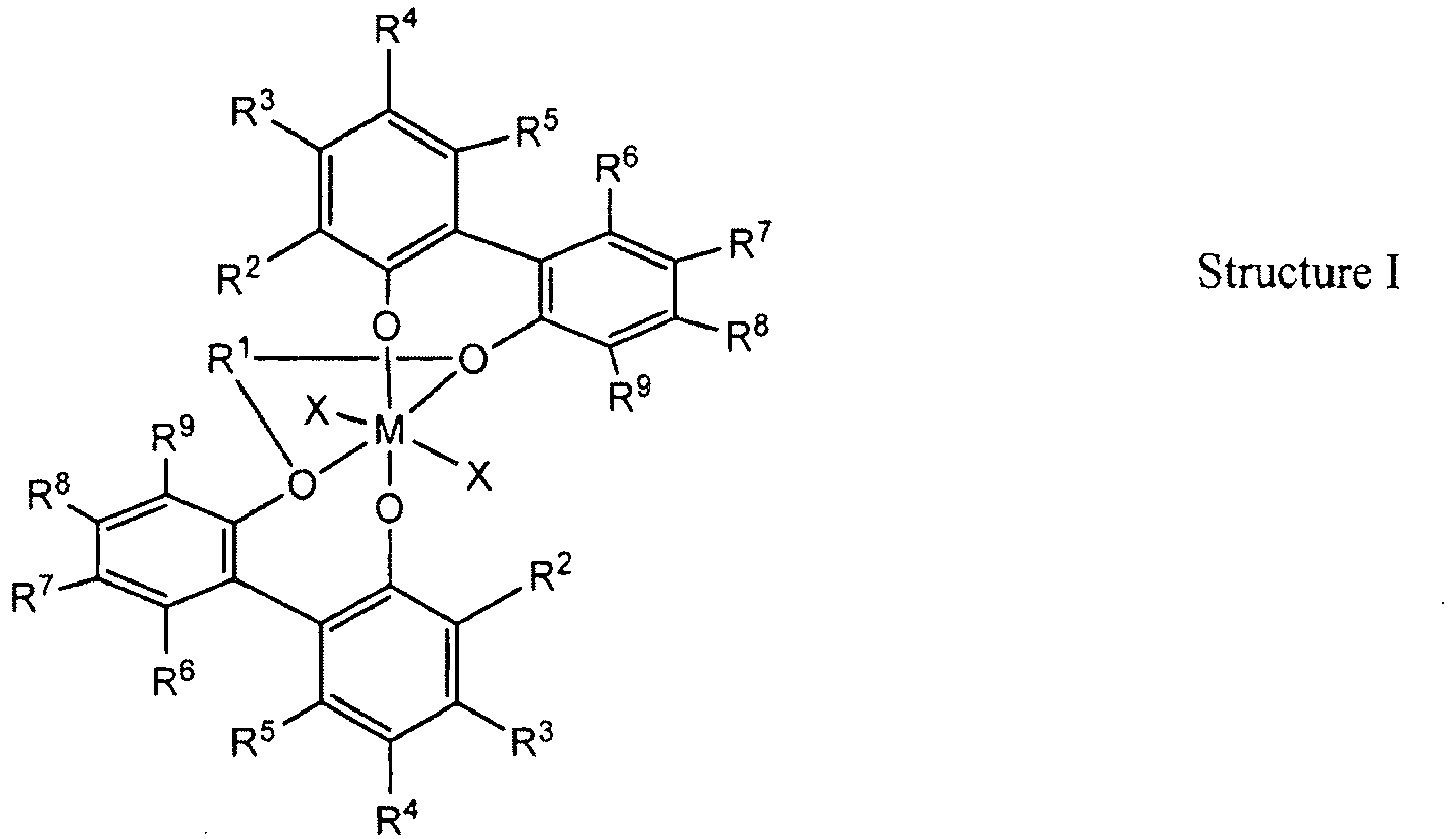
- According to even still another embodiment there is provided a method for producing polyethylene comprising the steps of: mixing a first polyethylene having a weight average molecular weight (Mw) of greater than 1,000,000 g/mol together and a second polyethylene having an Mw in the range of 40,000 to 200,000 g/mol in a solvent to produce a bimodal polyethylene solution; and precipitating said bimodal polyethylene out of said solution, wherein said bimodal polyethylene comprises at least one of the following properties: (i) a melt strength value greater than 6*MI-0.6675, wherein MI is the melt index value measured in accordance with ASTM-D-1238-E, (ii) a ratio of extensional viscosity measured at a strain rate of 1 sec-1, 190°C, and time=4 seconds to that predicted by linear viscoelasticity at the same temperature and time of greater than 3, (iii) an activation energy (Ea) of less than 7 kcal/mol/K, and (iv) a Mz/Mw ratio greater than the Mw/Mn ratio, wherein Mz is the z-average molecular weight of said polyethylene, Mw is the weight average molecular weight of said polyethylene, Mn is the number average molecular weight of said polyethylene; and v) a van Gurp-Palmen plot comprising a positive slope and possessing a maximum, wherein the van Gurp-Palmen plot is a plot of the phase angle versus the absolute value of the complex shear modulus determined from dynamic rheology, more particularly, from frequency sweeps in the range from 0.01 to 100 rad/s at 190°C. Generally the step of mixing comprises dissolving the first and second polymers in the solvent.
- According to even yet another embodiment there is provided an ethylene polymer comprising at least one of the following properties: (i) melt strength value greater than 6*MI-0.6675, wherein MI is the melt index value of said polymer measured in accordance with ASTM-D-1238-E, (ii) a ratio of extensional viscosity measured at a strain rate of 1 sec-1, 190°C, and time=4 seconds to that predicted by linear viscoelasticity at the same temperature and time of greater than 3, (iii) an activation energy (Ea) of less than 7 kcal/mol/K, and (iv) a Mz/Mw ratio greater than the Mw/Mn ratio, wherein Mz is the z-average molecular weight of said polymer, Mw is the weight average molecular weight of said polymer, Mn is the number average molecular weight of said polymer; and v) a van Gurp-Palmen plot comprising a positive slope and possessing a maximum, wherein the van Gurp-Palmen plot is a plot of the phase angle versus the absolute value of the complex shear modulus determined from dynamic rheology, more particularly, from frequency sweeps in the range from 0.01 to 100 rad/s at 190°C.
- According to still even another embodiment there is provided an article produced from an ethylene polymer comprising at least one of the following properties: (i) melt strength value greater than 6*MI-0.6675, wherein MI is the melt index value of said polymer measured in accordance with ASTM D-1238-E, (ii) a ratio of extensional viscosity measured at a strain rate of 1 sec-1, 190°C, and time=4 seconds to that predicted by linear viscoelasticity at the same temperature and time of greater than 3, (iii) an activation energy (Ea) of less than 7 kcal/mol/K, and (iv) a Mz/Mw ratio greater than the Mw/Mn ratio, wherein Mz is the z-average molecular weight of said polymer, Mw is the weight average molecular weight of said polymer, Mn is the number average molecular weight of said polymer; and v) a van Gurp-Palmen plot comprising a positive slope and possessing a maximum, wherein the van Gurp-Palmen plot is a plot of the phase angle versus the absolute value of the complex shear modulus determined from dynamic rheology, more particularly, from frequency sweeps in the range from 0.01 to 100 rad/s at 190°C.
- The following drawings illustrate some of the many possible embodiments of this disclosure in order to provide a basic understanding of the present disclosure. These drawings do not provide an extensive overview of all embodiments of this disclosure. These drawings are not intended to identify key or critical elements of the disclosure or to delineate or otherwise limit the scope of the claims. The following drawings merely present some concepts of the disclosure in a general form. Thus, for a detailed understanding of this disclosure, reference should be made to the following detailed description, taken in conjunction with the accompanying drawings, in which like elements have been given like numerals.
-
FIG. 1 provides a comparison of Van Gurp-Palmen plots of non-limiting example resins of the disclosure and conventional resins. -
FIG. 2 provides a comparison of the melt strengths of non-limiting example resins of the disclosure and conventional resins having low MI. -
FIG. 3 depicts the transient uniaxial extensional viscosity of non-limiting example resin 3 of the disclosure as a function of time. -
FIG. 4 provides a comparison of the shear thinning characteristics of a non-limiting example resin of the disclosure and a control resin. -
FIG. 5 provides a comparison of non-limiting example resins of the disclosure and conventional resins. -
FIG. 6 provides a comparison of Van Gurp-Palmen plots of non-limiting example resins of the disclosure and a control resin. -
FIG. 7 provides a comparison of Van Gurp-Palmen plots of non-limiting example resins of the disclosure and conventional resins. - Before the present compounds, components, compositions, and/or methods are disclosed and described, it is to be understood that unless otherwise indicated this invention is not limited to specific compounds, components, compositions, reactants, reaction conditions, ligands, metallocene structures, or the like, as such may vary, unless otherwise specified. It is also to be understood that the terminology used herein is for the purpose of describing particular embodiments only and is not intended to be limiting.
- It must also be noted that, as used in the specification and the appended claims, the singular forms "a," "an," and "the" include plural referents unless otherwise specified. Thus, for example, reference to "a leaving group" as in a moiety "substituted with a leaving group" includes more than one leaving group, such that the moiety may be substituted with two or more such groups. Similarly, reference to "a halogen atom" as in a moiety "substituted with a halogen atom" includes more than one halogen atom, such that the moiety may be substituted with two or more halogen atoms, reference to "a substituent" includes one or more substituents, reference to "a ligand" includes one or more ligands, and the like.
- The present disclosure provides catalyst systems for olefin polymerization, methods of making and method of using said catalyst systems, and polymer and products made therewith. The catalyst systems of the disclosure comprise at least two catalyst components - a first catalyst compound and a second catalyst compound. The catalyst systems may further comprise one or more additional catalyst compounds. Any two or more catalyst systems of the disclosure may be combined to produce a catalyst system of the disclosure. The terms "mixed catalyst system" and "mixed catalyst" may be used interchangeably herein with "catalyst system."
- The catalyst systems of the present disclosure comprise a first catalyst component that produces generally low molecular weight polyolefin, and a second catalyst component that produces generally high molecular weight polyolefin. As known by one of skill in the art, although the precise molecular weight of a polyolefin produced by a polymerization catalyst in a polymerization reaction is dependent upon reaction conditions including, but not limited to, reaction temperature, hydrogen concentration, and comonomer concentration, catalysts can be described by the general molecular weight of the polyolefin they produce under standard reactor conditions, or a range of standard reactor conditions. The first catalyst component that produces low molecular weight polyolefin may be referred to herein as a "low molecular weight catalyst". The second catalyst component that produces generally high molecular weight polyolefin may be referred to herein as a "high molecular weight catalyst". It should be understood that the molecular weight is in reference to the polymer produced by the catalyst and not the molecular weight of the catalyst itself.
- As used herein, "low molecular weight" is defined to be a weight average molecular weight (Mw) in the range of from about 40,000 to about 200,000 g/mol, preferably from about 50,000 to about 180,000 g/mol, more preferably from about 60,000 to about 175,000 g/mol, and even more preferably from about 70,000 to about 150,000 g/mol. In one non-limiting embodiment, low molecular weight is about 100,000 g/mol. As used herein, "high molecular weight" is defined as a weight average molecular weight (Mw) greater than about 1 million g/mol, preferably greater than about 1.5 million g/mol, even more preferably greater than about 2 million g/mol, and still more preferably greater than about 3 million g/mol. In one non-limiting embodiment, high molecular weight is about 5 million g/mol.
- In one non-limiting embodiment of the disclosure, the low molecular weight catalyst component is a metallocene compound, and the high molecular weight catalyst is a non-metallocene compound. In another non-limiting example the low molecular weight component is a Group 15 containing compound. In another non-limiting example the low molecular weight component is a phenoxide transition metal composition. In another non-limiting example the low molecular weight component is a Group 5 or 6 metal imido complex. In another non-limiting example the low molecular weight component is a bridged bis(arylamido) Group 4 compound. In another non-limiting example the low molecular weight component is a derivatives of a metallocene or a phenoxide transition metal composition or a group 5 or 6 metal imido complex or a bridged bis(arylamido) Group 4 compound. In another non-limiting example, the low molecular weight component is any combination of metallocene and a phenoxide transition metal composition and a Group 5 or 6 metal imido complex and a bridged bis(arylamido) Group 4 compound.
- As used herein, the phrase "characterized by the formula" is not intended to be limiting and is used in the same way that "comprising" is commonly used. The term "independently selected" is used herein to indicate that the R groups, e.g., R1, R2, R3, R4, and R5 can be identical or different (e.g. R1, R2, R3, R4, and R5 may all be substituted alkyls or R1 and R2 may be a substituted alkyl and R3 may be an aryl, etc.). Use of the singular includes use of the plural and vice versa (e.g., a hexane solvent, includes hexanes). A named R group will generally have the structure that is recognized in the art as corresponding to R groups having that name.
- The terms "compound" and "complex" are generally used interchangeably in this specification, but those of skill in the art may recognize certain compounds as complexes and vice versa.
- The terms "precatalyst", "catalyst", "precatalyst metal compound", "catalyst metal compound", "catalyst component" are generally used interchangeably in this specification, but those of skill in the art may recognize certain precatalysts as catalysts and vice versa.
- The terms "monomer" and "comonomer" are generally used interchangeably in this specification, but those of skill in the art may recognize certain monomers as comonomers and vice versa.
- For the purposes of illustration, representative certain groups are defined herein. These definitions are intended to supplement and illustrate, not preclude, the definitions known to those of skill in the art. "Optional" or "optionally" means that the subsequently described event or circumstance may or may not occur, and that the description includes instances where said event or circumstance occurs and instances where it does not. For example, the phrase "optionally substituted hydrocarbyl" means that a hydrocarbyl moiety may or may not be substituted and that the description includes both unsubstituted hydrocarbyl and hydrocarbyl where there is substitution.
- The term "alkyl" as used herein refers to a branched or unbranched saturated hydrocarbon group typically although not necessarily containing 1 to about 50 carbon atoms, such as methyl, ethyl, n-propyl, isopropyl, n-butyl, isobutyl, t-butyl, octyl, decyl, and the like, as well as cycloalkyl groups such as cyclopentyl, cyclohexyl and the like. Generally, although again not necessarily, alkyl groups herein may contain 1 to about 12 carbon atoms. The term "lower alkyl" intends an alkyl group of one to six carbon atoms, specifically one to four carbon atoms. The term alkyl also refers to divalent alkyls such as -CR2- which may be referred to as alkylenes or hydrocarbylenes and may be substituted with one or more substituent groups or heteroatom containing groups. "Substituted alkyl" refers to alkyl substituted with one or more substituent groups (e.g., benzyl or chloromethyl), and the terms "heteroatom-containing alkyl" and "heteroalkyl" refer to alkyl in which at least one carbon atom is replaced with a heteroatom (e.g., -CH2OCH3 is an example of a heteroalkyl).
- The term "alkenyl" as used herein refers to a branched or unbranched hydrocarbon group typically although not necessarily containing 2 to about 50 carbon atoms and at least one double bond, such as ethenyl, n-propenyl, isopropenyl, n-butenyl, isobutenyl, octenyl, decenyl, and the like. Generally, although again not necessarily, alkenyl groups herein contain 2 to about 12 carbon atoms. The term "lower alkenyl" intends an alkenyl group of two to six carbon atoms, specifically two to four carbon atoms. "Substituted alkenyl" refers to alkenyl substituted with one or more substituent groups, and the terms "heteroatom-containing alkenyl" and "heteroalkenyl" refer to alkenyl in which at least one carbon atom is replaced with a heteroatom.
- The term "alkynyl" as used herein refers to a branched or unbranched hydrocarbon group typically although not necessarily containing 2 to about 50 carbon atoms and at least one triple bond, such as ethynyl, n-propynyl, isopropynyl, n-butynyl, isobutynyl, octynyl, decynyl, and the like. Generally, although again not necessarily, alkynyl groups herein may have 2 to about 12 carbon atoms. The term "lower alkynyl" intends an alkynyl group of two to six carbon atoms, specifically three or four carbon atoms. "Substituted alkynyl" refers to alkynyl substituted with one or more substituent groups, and the terms "heteroatom-containing alkynyl" and "heteroalkynyl" refer to alkynyl in which at least one carbon atom is replaced with a heteroatom.
- The term "alkoxy" as used herein intends an alkyl group bound through a single, terminal ether linkage; that is, an "alkoxy" group may be represented asO-alkyl where alkyl is as defined above. A "lower alkoxy" group intends an alkoxy group having one to six, more specifically one to four, carbon atoms. The term "aryloxy" is used in a similar fashion, with aryl as defined below. The term "hydroxy" refers to --OH.
- Similarly, the term "alkylthio" as used herein intends an alkyl group bound through a single, terminal thioether linkage; that is, an "alkylthio" group may be represented as --S-alkyl where alkyl is as defined above. A "lower alkyl thio" group intends an alkyl thio group having one to six, more specifically one to four, carbon atoms. The term "arylthio" is used similarly, with aryl as defined below. The term "thioxy" refers to --SH.
- The term "aryl" as used herein, and unless otherwise specified, refers to an aromatic substituent containing a single aromatic ring or multiple aromatic rings that are fused together, linked covalently, or linked to a common group such as a methylene or ethylene moiety. More specific aryl groups contain one aromatic ring or two or three fused or linked aromatic rings, e.g., phenyl, naphthyl, biphenyl, anthracenyl, phenanthrenyl, and the like. In particular embodiments, aryl substituents have 1 to about 200 carbon atoms, typically 1 to about 50 carbon atoms, and specifically 1 to about 20 carbon atoms. "Substituted aryl" refers to an aryl moiety substituted with one or more substituent groups, (e.g., tolyl, mesityl and perfluorophenyl) and the terms "heteroatom-containing aryl" and "heteroaryl" refer to aryl in which at least one carbon atom is replaced with a heteroatom (e.g., rings such as thiophene, pyridine, isoxazole, pyrazole, pyrrole, furan, etc. or benzo-fused analogues of these rings are included in the term "heteroaryl"). In some embodiments herein, multi-ring moieties are substituents and in such an embodiment the multi-ring moiety can be attached at an appropriate atom. For example, "naphthyl" can be 1-naphthyl or 2-naphthyl; "anthracenyl" can be 1-anthracenyl, 2-anthracenyl or 9-anthracenyl; and "phenanthrenyl" can be 1-phenanthrenyl, 2-phenanthrenyl, 3-phenanthrenyl, 4-phenanthrenyl or 9-phenanthrenyl.
- The term "aralkyl" refers to an alkyl group with an aryl substituent, and the term "aralkylene" refers to an alkylene group with an aryl substituent; the term "alkaryl" refers to an aryl group that has an alkyl substituent, and the term "alkarylene" refers to an arylene group with an alkyl substituent.
- The terms "halo" and "halogen" and "halide" are used in the conventional sense to refer to a chloro, bromo, fluoro or iodo substituent. The terms "haloalkyl," "haloalkenyl" or "haloalkynyl" (or "halogenated alkyl," "halogenated alkenyl," or "halogenated alkynyl") refers to an alkyl, alkenyl or alkynyl group, respectively, in which at least one of the hydrogen atoms in the group has been replaced with a halogen atom.
- The term "heteroatom-containing" as in a "heteroatom-containing hydrocarbyl group" refers to a molecule or molecular fragment in which one or more carbon atoms is replaced with an atom other than carbon, e.g., nitrogen, oxygen, sulfur, phosphorus, boron or silicon. Similarly, the term "heteroalkyl" refers to an alkyl substituent that is heteroatom-containing, the term "heterocyclic" refers to a cyclic substituent that is heteroatom-containing, the term "heteroaryl" refers to an aryl substituent that is heteroatom-containing, and the like. When the term "heteroatom-containing" appears prior to a list of possible heteroatom-containing groups, it is intended that the term apply to every member of that group. That is, the phrase "heteroatom-containing alkyl, alkenyl and alkynyl" is to be interpreted as "heteroatom-containing alkyl, heteroatom-containing alkenyl and heteroatom-containing alkynyl."
- "Hydrocarbyl" refers to hydrocarbyl radicals containing 1 to about 50 carbon atoms, specifically 1 to about 24 carbon atoms, most specifically 1 to about 16 carbon atoms, including branched or unbranched, saturated or unsaturated species, such as alkyl groups, alkenyl groups, aryl groups, and the like. The term "lower hydrocarbyl" intends a hydrocarbyl group of one to six carbon atoms, specifically one to four carbon atoms. "Substituted hydrocarbyl" refers to hydrocarbyl substituted with one or more substituent groups, and the terms "heteroatom-containing hydrocarbyl" and "heterohydrocarbyl" refer to hydrocarbyl in which at least one carbon atom is replaced with a heteroatom.
- By "substituted" as in "substituted hydrocarbyl," "substituted aryl," "substituted alkyl," "substituted alkenyl" and the like, as alluded to in some of the aforementioned definitions, is meant that in the hydrocarbyl, hydrocarbylene, alkyl, alkenyl, aryl or other moiety, at least one hydrogen atom bound to a carbon atom is replaced with one or more substituents that are functional groups such as hydroxyl, alkoxy, alkylthio, phosphino, amino, halo, silyl, and the like. When the term "substituted" appears prior to a list of possible substituted groups, it is intended that the term apply to every member of that group. That is, the phrase "substituted alkyl, alkenyl and alkynyl" is to be interpreted as "substituted alkyl, substituted alkenyl and substituted alkynyl." Similarly, "optionally substituted alkyl, alkenyl and alkynyl" is to be interpreted as "optionally substituted alkyl, optionally substituted alkenyl and optionally substituted alkynyl."
- By "divalent" as in "divalent hydrocarbyl", "divalent alkyl", "divalent aryl" and the like, is meant that the hydrocarbyl, alkyl, aryl or other moiety is bonded at two points to atoms, molecules or moieties with the two bonding points being covalent bonds. The term "aromatic" is used in its usual sense, including unsaturation that is essentially delocalized across multiple bonds, such as around a ring.
- As used herein the term "silyl" refers to the -SiZ1Z2Z3 radical, where each of SiZ1Z2Z3 is independently selected from the group consisting of hydride and optionally substituted alkyl, alkenyl, alkynyl, heteroatom-containing alkyl, heteroatom-containing alkenyl, heteroatom-containing alkynyl, aryl, heteroaryl, alkoxy, aryloxy, amino, silyl and combinations thereof.
- As used herein the term "boryl" refers to the -BZ1Z2 group, where each of Z1 and Z2 is as defined above. As used herein, the term "phosphino" refers to the group -PZ1Z2, where each of Z1 and Z2 is as defined above. As used herein, the term "phosphine" refers to the group: PZ1Z2Z3, where each of Z1, Z2, Z3 as defined above. The term "amino" is used herein to refer to the group -NZ1Z2, where each of Z1 and Z2 is as defined above. The term "amine" is used herein to refer to the group: NZ1Z2Z3, where each of Z1, Z2, Z3 is as defined above.
- The term "saturated" refers to lack of double and triple bonds between atoms of a radical group such as ethyl, cyclohexyl, pyrrolidinyl, and the like. The term "unsaturated" refers to the presence of one or more double and triple bonds between atoms of a radical group such as vinyl, acetylide, oxazolinyl, cyclohexenyl, acetyl and the like.
- The catalyst system may include at least one metallocene catalyst component. The metallocene catalyst component may include "half sandwich" and "full sandwich" compounds having one or more Cp ligands (cyclopentadienyl and ligands isolobal to cyclopentadienyl) bound to at least one Group 3 to Group 12 metal atom, and one or more leaving group(s) bound to the at least one metal atom. Hereinafter, these compounds will be referred to as "metallocenes" or "metallocene catalyst components".
- In one aspect, the one or more metallocene catalyst components are represented by the formula (I):
CpACpBMXn (I)
- The metal atom "M" of the metallocene catalyst compound, as described throughout the specification and claims, may be selected from the group consisting of Groups 3 through 12 atoms and lanthanide Group atoms in one embodiment; and selected from the group consisting of Groups 3 through 10 atoms in a more particular embodiment, and selected from the group consisting of Sc, Ti, Zr, Hf, V, Nb, Ta, Mn, Re, Fe, Ru, Os, Co, Rh, Ir, and Ni in yet a more particular embodiment; and selected from the group consisting of Groups 4, 5 and 6 atoms in yet a more particular embodiment, and a Ti, Zr, Hf atoms in yet a more particular embodiment, and Zr in yet a more particular embodiment. The oxidation state of the metal atom "M" may range from 0 to +7 in one embodiment; and in a more particular embodiment, is +1, +2, +3, +4 or +5; and in yet a more particular embodiment is +2, +3 or +4. The groups bound the metal atom "M" is such that the compounds described below in the formulas and structures are neutral, unless otherwise indicated. The Cp ligand(s) form at least one chemical bond with the metal atom M to form the "metallocene catalyst compound". The Cp ligands are distinct from the leaving groups bound to the catalyst compound in that they are not highly susceptible to substitution/abstraction reactions.
- M is as described above; each X is chemically bonded to M; each Cp group is chemically bonded to M; and n is 0 or an integer from 1 to 4, and either 1 or 2 in a particular embodiment.
- The ligands represented by CpA and CpB in formula (I) may be the same or different cyclopentadienyl ligands or ligands isolobal to cyclopentadienyl, either or both of which may contain heteroatoms and either or both of which may be substituted by a group R. In one embodiment, CpA and CpB are independently selected from the group consisting of cyclopentadienyl, indenyl, tetrahydroindenyl, fluorenyl, and substituted derivatives of each.
- Independently, each CpA and CpB of formula (I) may be unsubstituted or substituted with any one or combination of substituent groups R. Non-limiting examples of substituent groups R as used in structure (I) include hydrogen radicals, hydrocarbyls, lower hydrocarbyls, substituted hydrocarbyls, heterohydrocarbyls, alkyls, lower alkyls, substituted alkyls, heteroalkyls, alkenyls, lower alkenyls, substituted alkenyls, heteroalkenyls, alkynyls, lower alkynyls, substituted alkynyls, heteroalkynyls, alkoxys, lower alkoxys, aryloxys, hydroxyls, alkylthios, lower alkyls thios, arylthios, thioxys, aryls, substituted aryls, heteroaryls, aralkyls, aralkylenes, alkaryls, alkarylenes, halides, haloalkyls, haloalkenyls, haloalkynyls, heteroalkyls, heterocycles, heteroaryls, heteroatom-containing groups, silyls, boryls, phosphinos, phosphines, aminos, amines, cycloalkyls, acyls, aroyls, alkylthiols, dialkylamines, alkylamidos, alkoxycarbonyls, aryloxycarbonyls, carbomoyls, alkyl- and dialkyl-carbamoyls, acyloxys, acylaminos, aroylaminos, and combinations thereof.
- More particular non-limiting examples of alkyl substituents R associated with formula (i) includes methyl, ethyl, propyl, butyl, pentyl, hexyl, cyclopentyl, cyclohexyl, benzyl, phenyl, methylphenyl, and tert-butylphenyl groups and the like, including all their isomers, for example tertiary-butyl, isopropyl, and the like. Other possible radicals include substituted alkyls and aryls such as, for example, fluoromethyl, fluroethyl, difluroethyl, iodopropyl, bromohexyl, chlorobenzyl and hydrocarbyl substituted organometalloid radicals including trimethylsilyl, trimethylgermyl, methyldiethylsilyl and the like; and halocarbyl-substituted organometalloid radicals including tris(trifluoromethyl)silyl, methylbis(difluoromethyl)silyl, bromomethyldimethylgermyl and the like; and disubstituted boron radicals including dimethylboron for example; and disubstituted Group 15 radicals including dimethylamine, dimethylphosphine, diphenylamine, methylphenylphosphine, Group 16 radicals including methoxy, ethoxy, propoxy, phenoxy, methylsulfide and ethylsulfide. Other substituents R include olefins such as but not limited to olefinically unsaturated substituents including vinyl-terminated ligands, for example 3-butenyl, 2-propenyl, 5-hexenyl and the like. In one embodiment, at least two R groups, two adjacent R groups in one embodiment, are joined to form a ring structure having from 3 to 30 atoms selected from the group consisting of carbon, nitrogen, oxygen, phosphorous, silicon, germanium, aluminum, boron and combinations thereof. Also, a substituent group R group such as 1-butanyl may form a bonding association to the element M.
- Each X in formula (I) is independently selected from the group consisting of: any leaving group in one embodiment; halogen ions, hydrides, hydrocarbyls, lower hydrocarbyls, substituted hydrocarbyls, heterohydrocarbyls, alkyls, lower alkyls, substituted alkyls, heteroalkyls, alkenyls, lower alkenyls, substituted alkenyls, heteroalkenyls, alkynyls, lower alkynyls, substituted alkynyls, heteroalkynyls, alkoxys, lower alkoxys, aryloxys, hydroxyls, alkylthios, lower alkyls thios, arylthios, thioxys, aryls, substituted aryls, heteroaryls, aralkyls, aralkylenes, alkaryls, alkarylenes, halides, haloalkyls, haloalkenyls, haloalkynyls, heteroalkyls, heterocycles, heteroaryls, heteroatom-containing groups, silyls, boryls, phosphinos, phosphines, aminos, amines, cycloalkyls, acyls, aroyls, alkylthiols, dialkylamines, alkylamidos, alkoxycarbonyls, aryloxycarbonyls, carbomoyls, alkyl- and dialkyl-carbamoyls, acyloxys, acylaminos, aroylaminos, and combinations thereof. In another embodiment, X is C1 to C12 alkyls, C2 to C12 alkenyls, C6 to C12 aryls, C7 to C20 alkylaryls, C1 to C12 alkoxys, C6 to C16 aryloxys, C7 to C18 alkylaryloxys, C1 to C12 fluoroalkyls, C6 to C12 fluoroaryls, and C1 to C12 heteroatom-containing hydrocarbons and substituted derivatives thereof in a more particular embodiment; hydride, halogen ions, C1 to C6 alkyls, C2 to C6 alkenyls, C7 to C18 alkylaryls, C1 to C6 alkoxys, C6 to C14 aryloxys, C7 to C16 alkylaryloxys, C1 to C6 alkylcarboxylates, C1 to C6 fluorinated alkylcarboxylates, C6 to C12 arylcarboxylates, C7 to C18 alkylarylcarboxylates, C1 to C6 fluoroalkyls, C2 to C6 fluoroalkenyls, and C7 to C18 fluoroalkylaryls in yet a more particular embodiment; hydride, chloride, fluoride, methyl, phenyl, phenoxy, benzoxy, tosyl, fluoromethyls and fluorophenyls in yet a more particular embodiment; C1 to C12 alkyls, C2 to C12 alkenyls, C6 to C12 aryls, C7 to C20 alkylaryls, substituted C1 to C12 alkyls, substituted C6 to C12 aryls, substituted C7 to C20 alkylaryls and C1 to C12 heteroatom-containing alkyls, C1 to C12 heteroatom-containing aryls and C1 to C12 heteroatom-containing alkylaryls in yet a more particular embodiment; chloride, fluoride, C1 to C6 alkyls, C2 to C6 alkenyls, C7 to C18 alkylaryls, halogenated C1 to C6 alkyls, halogenated C2 to C6 alkenyls, and halogenated C7 to C18 alkylaryls in yet a more particular embodiment; fluoride, methyl, ethyl, propyl, phenyl, methylphenyl, dimethylphenyl, trimethylphenyl, fluoromethyls (mono-, di- and trifluoromethyls) and fluorophenyls (mono-, di-, tri-, tetra- and pentafluorophenyls) in yet a more particular embodiment.
- Other non-limiting examples of X groups in formula (I) include amines, phosphines, ethers, carboxylates, dienes, hydrocarbon radicals having from 1 to 20 carbon atoms, fluorinated hydrocarbon radicals (e.g., -C6F5 (pentafluorophenyl)), fluorinated alkylcarboxylates (e.g., CF3C(O)O-), hydrides and halogen ions and combinations thereof. Other examples of X ligands include alkyl groups such as cyclobutyl, cyclohexyl, methyl, heptyl, tolyl, trifluoromethyl, tetramethylene, pentamethylene, methylidene, methyoxy, ethyoxy, propoxy, phenoxy, bis(N-methylanilide), dimethylamide, dimethylphosphide radicals and the like. In one embodiment, two or more X's form a part of a fused ring or ring system.
- In another aspect, the metallocene catalyst component includes those of formula (I) where CpA and CpB are bridged to each other by at least one bridging group, (A), such that the structure is represented by formula (II):
CpA(A)CpBMXn (II)
- These bridged compounds represented by formula (II) are known as "bridged metallocenes". CpA, CpB, M, X and n are as defined above for formula (I); and wherein each Cp ligand is chemically bonded to M, and (A) is chemically bonded to each Cp. Non-limiting examples of bridging group (A) include divalent alkyls, divalent lower alkyls, divalent substituted alkyls, divalent heteroalkyls, divalent alkenyls, divalent lower alkenyls, divalent substituted alkenyls, divalent heteroalkenyls, divalent alkynyls, divalent lower alkynyls, divalent substituted alkynyls, divalent heteroalkynyls, divalent alkoxys, divalent lower alkoxys, divalent aryloxys, divalent alkylthios, divalent lower alkyl thios, divalent arylthios, divalent aryls, divalent substituted aryls, divalent heteroaryls, divalent aralkyls, divalent aralkylenes, divalent alkaryls, divalent alkarylenes, divalent haloalkyls, divalent haloalkenyls, divalent haloalkynyls, divalent heteroalkyls, divalent heterocycles, divalent heteroaryls, divalent heteroatom-containing groups, divalent hydrocarbyls, divalent lower hydrocarbyls, divalent substituted hydrocarbyls, divalent heterohydrocarbyls, divalent silyls, divalent boryls, divalent phosphinos, divalent phosphines, divalent aminos, divalent amines, divalent ethers, divalent thioethers. Additional non-limiting examples of bridging group A include divalent hydrocarbon groups containing at least one Group 13 to 16 atom, such as but not limited to at least one of a carbon, oxygen, nitrogen, silicon, aluminum, boron, germanium and tin atom and combinations thereof; wherein the heteroatom may also be C1 to C12 alkyl or aryl substituted to satisfy neutral valency. The bridging group (A) may also contain substituent groups R as defined above for formula (I) including halogen radicals and iron. More particular non-limiting examples of bridging group (A) are represented by C1 to C6 alkylenes, substituted C1 to C6 alkylenes, oxygen, sulfur, R'2C=, R'2Si=, -Si(R')2Si(R'2)-, R'2Ge=, R'P= (wherein "=" represents two chemical bonds), where R' is independently selected from the group consisting of hydride, hydrocarbyl, substituted hydrocarbyl, halocarbyl, substituted halocarbyl, hydrocarbyl-substituted organometalloid, halocarbyl-substituted organometalloid, disubstituted boron, disubstituted Group 15 atoms, substituted Group 16 atoms, and halogen radical; and wherein two or more R' may be joined to form a ring or ring system. In one embodiment, the bridged metallocene catalyst component of formula (II) has two or more bridging groups (A).
- Other non-limiting examples of bridging group (A) include methylene, ethylene, ethylidene, propylidene, isopropylidene, diphenylmethylene, 1,2-dimethylethylene, 1,2-diphenylethylene, 1,1,2,2-tetramethylethylene, dimethylsilyl, diethylsilyl, methyl-ethylsilyl, trifluoromethylbutylsilyl, bis(trifluoromethyl)silyl, di(n-butyl)silyl, di(n-propyl)silyl, di(i-propyl)silyl, di(n-hexyl)silyl, dicyclohexylsilyl, diphenylsilyl, cyclohexylphenylsilyl, t-butylcyclohexylsilyl, di(t-butylphenyl)silyl, di(p-tolyl)silyl and the corresponding moieties wherein the Si atom is replaced by a Ge or a C atom; dimethylsilyl, diethylsilyl, dimethylgermyl and diethylgermyl.
- In another embodiment, bridging group (A) may also be cyclic, comprising, for example 4 to 10, 5 to 7 ring members in a more particular embodiment. The ring members may be selected from the elements mentioned above, from one or more of B, C, Si, Ge, N and O in a particular embodiment. Non-limiting examples of ring structures which may be present as or part of the bridging moiety are cyclobutylidene, cyclopentylidene, cyclohexylidene, cycloheptylidene, cyclooctylidene and the corresponding rings where one or two carbon atoms are replaced by at least one of Si, Ge, N and O, in particular, Si and Ge. The bonding arrangement between the ring and the Cp groups may be either cis-, trans-, or a combination.
- The cyclic bridging groups (A) may be saturated or unsaturated and/or carry one or more substituents and/or be fused to one or more other ring structures. If present, the one or more substituents are selected from the group consisting of hydrocarbyl (e.g., alkyl such as methyl) and halogen (e.g., F, Cl) in one embodiment. The one or more Cp groups which the above cyclic bridging moieties may optionally be fused to may be saturated or unsaturated and are selected from the group consisting of those having 4 to 10, more particularly 5, 6 or 7 ring members (selected from the group consisting of C, N, O and S in a particular embodiment) such as, for example, cyclopentyl, cyclohexyl and phenyl. Moreover, these ring structures may themselves be fused such as, for example, in the case of a naphthyl group. Moreover, these (optionally fused) ring structures may carry one or more substituents. Illustrative, non-limiting examples of these substituents are hydrocarbyl (particularly alkyl) groups and halogen atoms.
- The ligands CpA and CpB of formula (I) and (II) are different from each other in one embodiment, and the same in another embodiment.
- In yet another aspect, the metallocene catalyst components include mono-ligand metallocene compounds (e.g., mono cyclopentadienyl catalyst components) such as described in
WO 93/08221
CpA(A)QMXn (III)
wherein CpA is defined above and is bound to M; (A) is defined above and is a bridging group bonded to Q and CpA; and wherein an atom from the Q group is bonded to M; and n is 0 or an integer from 1 to 3; 1 or 2 in a particular embodiment. In formula (III), CpA, (A) and Q may form a fused ring system. The X groups and n of formula (III) are as defined above in formula (I) and (II). In one embodiment, CpA is selected from the group consisting of cyclopentadienyl, indenyl, tetrahydroindenyl, fluorenyl, substituted versions thereof, and combinations thereof. - In formula (III), Q is a heteroatom-containing ligand in which the bonding atom (the atom that is bonded with the metal M) is selected from the group consisting of Group 15 atoms and Group 16 atoms in one embodiment, and selected from the group consisting of nitrogen, phosphorus, oxygen or sulfur atom in a more particular embodiment, and nitrogen and oxygen in yet a more particular embodiment. Non-limiting examples of Q groups include ethers, amines, phosphines, thioethers, alkylamines, arylamines, mercapto compounds, ethoxy compounds, carboxylates (e.g., pivalate), carbamates, azenyl, azulene, pentalene, phosphoyl, phosphinimine, pyrrolyl, pyrozolyl, carbazolyl, borabenzene other compounds comprising Group 15 and Group 16 atoms capable of bonding with M.
- In yet another aspect, the at least one metallocene catalyst component is an unbridged "half sandwich" metallocene represented by the formula (iV):
CpAMQqXn (IV)
wherein CpA is defined as for the Cp groups in (I) and is a ligand that is bonded to M; each Q is independently bonded to M; Q is also bound to CpA in one embodiment; X is a leaving group as described above in (I); n ranges from 0 to 3, and is 1 or 2 in one embodiment; q ranges from 0 to 3, and is 1 or 2 in one embodiment. In one embodiment, CpA is selected from the group consisting of cyclopentadienyl, indenyl, tetrahydroindenyl, fluorenyl, substituted version thereof, and combinations thereof. - In formula (iV), Q is selected from the group consisting of ROO-, RO-, R(O)-, -NR-, -CR2-, -S-, -NR2, -CR3, -SR, -SiR3, -PR2, -H, and substituted and unsubstituted aryl groups, wherein R is selected from the group consisting of hydrocarbyls, lower hydrocarbyls, substituted hydrocarbyls, heterohydrocarbyls, alkyls, lower alkyls, substituted alkyls, heteroalkyls, alkenyls, lower alkenyls, substituted alkenyls, heteroalkenyls, alkynyls, lower alkynyls, substituted alkynyls, heteroalkynyls, alkoxys, lower alkoxys, aryloxys, hydroxyls, alkylthios, lower alkyls thios, arylthios, thioxys, aryls, substituted aryls, heteroaryls, aralkyls, aralkylenes, alkaryls, alkarylenes, halides, haloalkyls, haloalkenyls, haloalkynyls, heteroalkyls, heterocycles, heteroaryls, heteroatom-containing groups, silyls, boryls, phosphinos, phosphines, aminos, amines, cycloalkyls, acyls, aroyls, alkylthiols, dialkylamines, alkylamidos, alkoxycarbonyls, aryloxycarbonyls, carbomoyls, alkyl- and dialkyl-carbamoyls, acyloxys, acylaminos, aroylaminos, and combinations thereof. In another embodiment, R is selected from C1 to C6 alkyls, C6 to C12 aryls, C1 to C6 alkylamines, C6 to C12 alkylarylamines, C1 to C6 alkoxys, C6 to C12 aryloxys, and the like. Non-limiting examples of Q include C1 to C12 carbamates, C1 to C12 carboxylates (e.g., pivalate), C2 to C20 allyls, and C2 to C20 heteroallyl moieties.
- Described another way, the "half sandwich" metallocenes above can be described as in formula (II), such as described in, for example,
US 6,069,213 :
CpAM(Q2GZ)Xn or T(CpAM(Q2GZ)Xn)m (V)
wherein - M, CpA, X and n are as defined above;
- Q2GZ forms a polydentate ligand unit (e.g., pivalate), wherein at least one of the Q groups form a bond with M, and is defined such that each Q is independently selected from the group consisting of -O-, -NR-, -CR2- and -S-; G is either carbon or silicon; and Z is selected from the group consisting of R,-OR, -NR2, -CR3, -SR, -SiR3, -PR2, and hydride, providing that when Q is -NR-, then Z is selected from the group consisting of -OR, -NR2, -SR, -SiR3, -PR2; and provided that neutral valency for Q is satisfied by Z; and wherein each R is independently selected from the group consisting of hydrocarbyls, lower hydrocarbyls, substituted hydrocarbyls, heterohydrocarbyls, alkyls, lower alkyls, substituted alkyls, heteroalkyls, alkenyls, lower alkenyls, substituted alkenyls, heteroalkenyls, alkynyls, lower alkynyls, substituted alkynyls, heteroalkynyls, alkoxys, lower alkoxys, aryloxys, hydroxyls, alkylthios, lower alkyls thios, arylthios, thioxys, aryls, substituted aryls, heteroaryls, aralkyls, aralkylenes, alkaryls, alkarylenes, halides, haloalkyls, haloalkenyls, haloalkynyls, heteroalkyls, heterocycles, heteroaryls, heteroatom-containing groups, silyls, boryls, phosphinos, phosphines, aminos, amines, cycloalkyls, acyls, aroyls, alkylthiols, dialkylamines, alkylamidos, alkoxycarbonyls, aryloxycarbonyls, carbomoyls, alkyl- and dialkyl-carbamoyls, acyloxys, acylaminos, aroylaminos, and combinations thereof. In another embodiment, R is selected from the group consisting of C1 to C10 heteroatom containing groups, C1 to C10 alkyls, C6 to C12 aryls, C6 to C12 alkylaryls, C1 to C10 alkoxys, and C6 to C12 aryloxys;
- n is 1 or 2 in a particular embodiment; and
- T is a bridging group selected from the group consisting of C1 to C10 alkylenes, C6 to C12 arylenes and C1 to C10 heteroatom containing groups, and C6 to C12 heterocyclic groups; wherein each T group bridges adjacent "CpAM(Q2GZ)Xn" groups, and is chemically bonded to the CpA groups.
- m is an integer from 1 to 7; m is an integer from 2 to 6 in a more particular embodiment.
- In another aspect, the at least one metallocene catalyst component can be described more particularly in structures (VIa), (VIb), (VIc), (VId), (VIe), and (VIf):

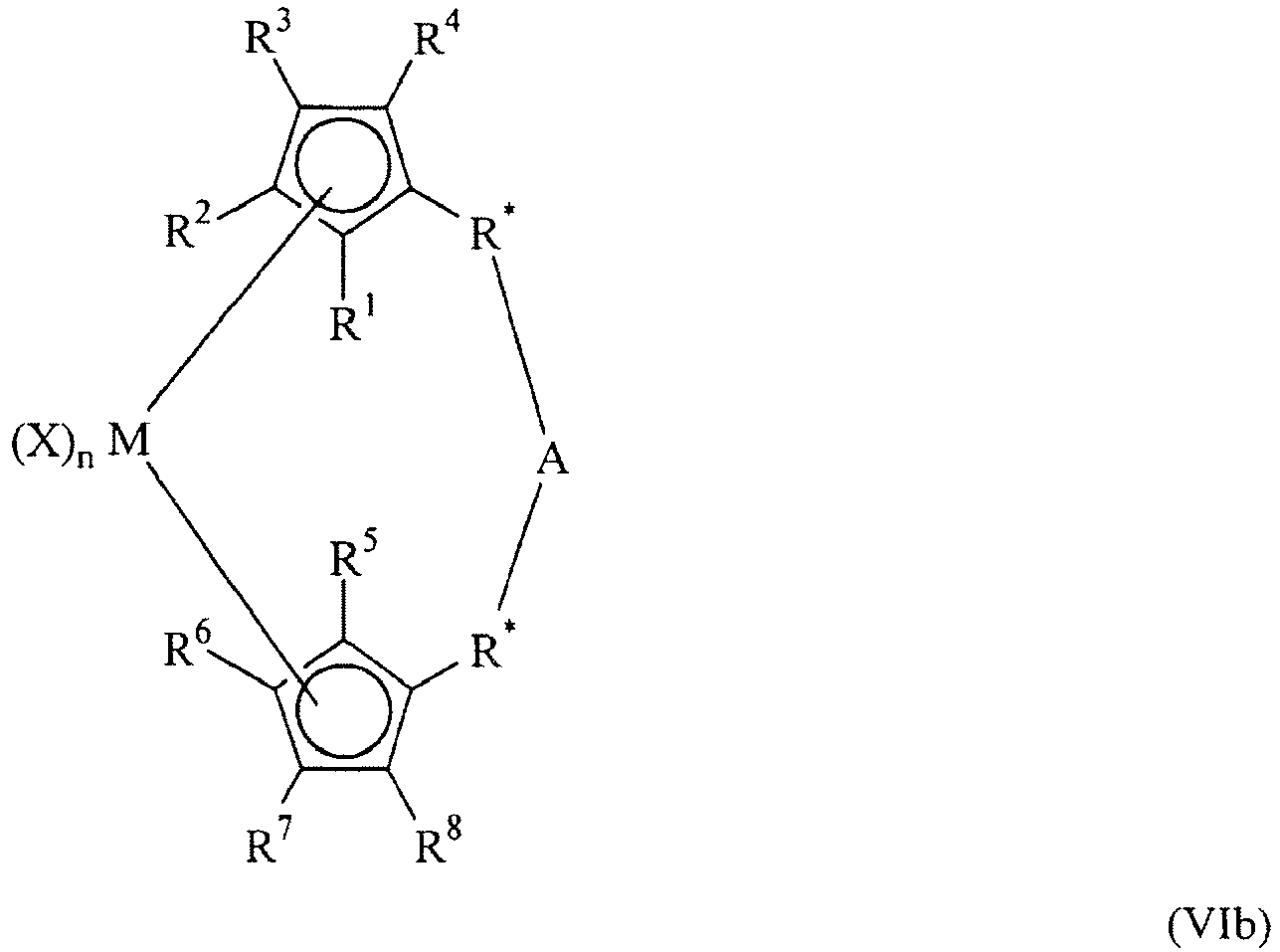

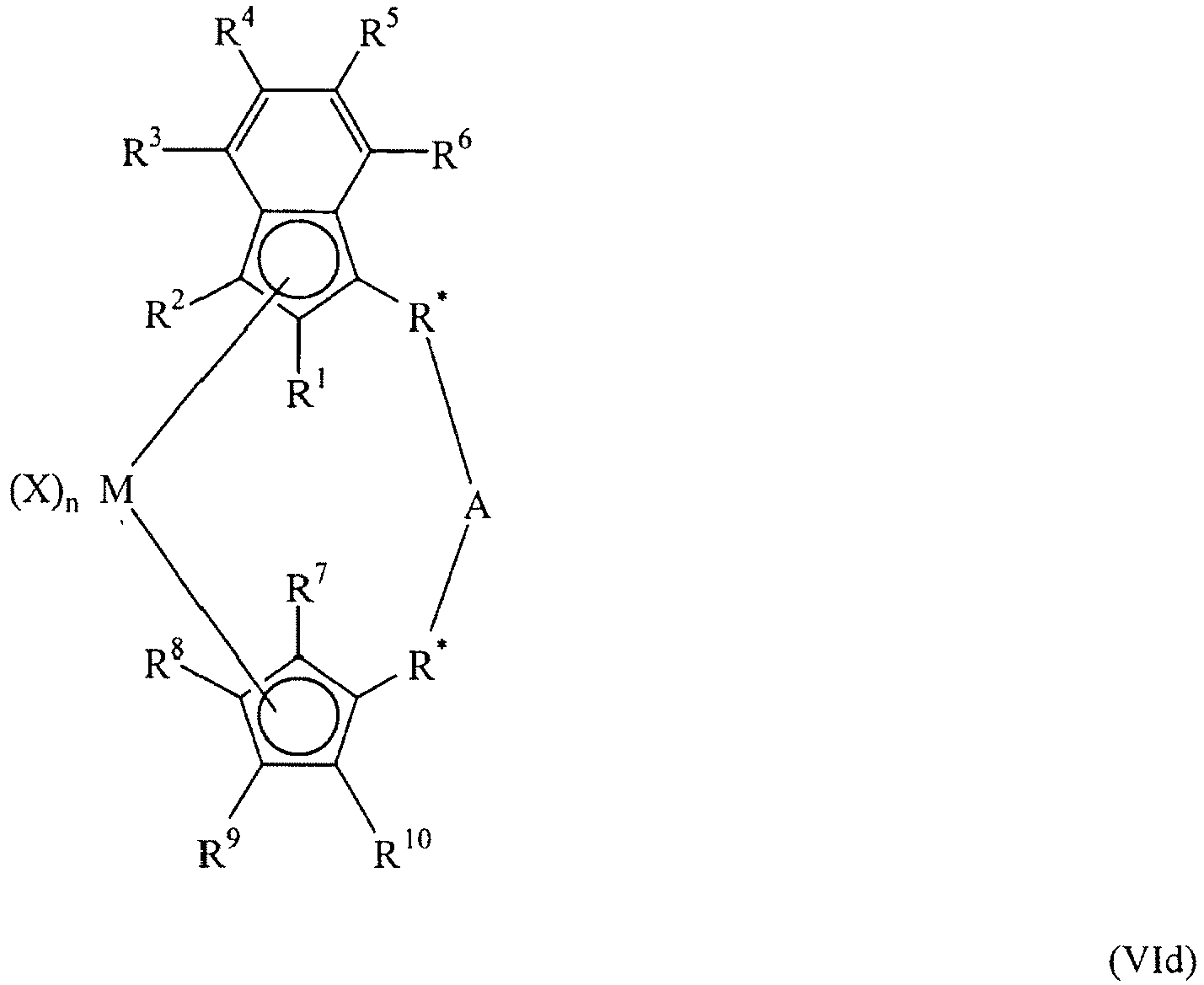


wherein Q in (VIa) to (VIf) is selected from the group consisting of hydrocarbyls, lower hydrocarbyls, substituted hydrocarbyls, heterohydrocarbyls, alkyls, lower alkyls, substituted alkyls, heteroalkyls, alkenyls, lower alkenyls, substituted alkenyls, heteroalkenyls, alkynyls, lower alkynyls, substituted alkynyls, heteroalkynyls, alkoxys, lower alkoxys, aryloxys, hydroxyls, alkylthios, lower alkyls thios, arylthios, thioxys, aryls, substituted aryls, heteroaryls, aralkyls, aralkylenes, alkaryls, alkarylenes, halides, haloalkyls, haloalkenyls, haloalkynyls, heteroalkyls, heterocycles, heteroaryls, heteroatom-containing groups, silyls, boryls, phosphinos, phosphines, aminos, amines, cycloalkyls, acyls, aroyls, alkylthiols, dialkylamines, alkylamidos, alkoxycarbonyls, aryloxycarbonyls, carbomoyls, alkyl- and dialkyl-carbamoyls, acyloxys, acylaminos, aroylaminos, alkylenes, aryls, arylenes, alkoxys, aryloxys, amines, arylamines (e.g., pyridyl) alkylamines, phosphines, alkylphosphines, substituted alkyls, substituted aryls, substituted alkoxys, substituted aryloxys, substituted amines, substituted alkylamines, substituted phosphines, substituted alkylphosphines, carbamates, heteroallyls, carboxylates (non-limiting examples of suitable carbamates and carboxylates include trimethylacetate, trimethylacetate, methylacetate, p-toluate, benzoate, diethylcarbamate, and dimethylcarbamate), fluorinated alkyls, fluorinated aryls, and fluorinated alkylcarboxylates; wherein the saturated groups defining Q comprise from 1 to 20 carbon atoms in one embodiment; and wherein the aromatic groups comprise from 5 to 20 carbon atoms in one embodiment; wherein R* may be selected from divalent alkyls, divalent lower alkyls, divalent substituted alkyls, divalent heteroalkyls, divalent alkenyls, divalent lower alkenyls, divalent substituted alkenyls, divalent heteroalkenyls, divalent alkynyls, divalent lower alkynyls, divalent substituted alkynyls, divalent heteroalkynyls, divalent alkoxys, divalent lower alkoxys, divalent aryloxys, divalent alkylthios, divalent lower alkyl thios, divalent arylthios, divalent aryls, divalent substituted aryls, divalent heteroaryls, divalent aralkyls, divalent aralkylenes, divalent alkaryls, divalent alkarylenes, divalent haloalkyls, divalent haloalkenyls, divalent haloalkynyls, divalent heteroalkyls, divalent heterocycles, divalent heteroaryls, divalent heteroatom-containing groups, divalent hydrocarbyls, divalent lower hydrocarbyls, divalent substituted hydrocarbyls, divalent heterohydrocarbyls, divalent silyls, divalent boryls, divalent phosphinos, divalent phosphines, divalent aminos, divalent amines, divalent ethers, divalent thioethers. Additionally, R* may be from the group of divalent hydrocarbylenes and heteroatom-containing hydrocarbylenes in one embodiment; and selected from the group consisting of alkylenes, substituted alkylenes and heteroatom-containing hydrocarbylenes in another embodiment; and selected from the group consisting of C1 to C12 alkylenes, C1 to C12 substituted alkylenes, and C1 to C12 heteroatom-containing hydrocarbylenes in a more particular embodiment; and selected from the group consisting of C1 to C4 alkylenes in yet a more particular embodiment; and wherein both R* groups are identical in another embodiment in structures (VIf);
A is as described above for (A) in structure (II), and more particularly, selected from the group consisting of a chemical bond, -O-, -S-, -SO2-, -NR-, =SiR2, =GeR2, =SnR2, -R2SiSiR2-, RP=, C1 to C12 alkylenes, substituted C1 to C12 alkylenes, divalent C4 to C12 cyclic hydrocarbons and substituted and unsubstituted aryl groups in one embodiment; and selected from the group consisting of C5 to C8 cyclic hydrocarbons, -CH2CH2-, =CR2 and =SiR2 in a more particular embodiment; wherein and R is selected from the group consisting of alkyls, cycloalkyls, aryls, alkoxys, fluoroalkyls and heteroatom-containing hydrocarbons in one embodiment; and R is selected from the group consisting of C1 to C6 alkyls, substituted phenyls, phenyl, and C1 to C6 alkoxys in a more particular embodiment; and R is selected from the group consisting of methoxy, methyl, phenoxy, and phenyl in yet a more particular embodiment; wherein A may be absent in yet another embodiment, in which case each R* is defined as for R1-R13; each X is as described above in (I); n is an integer from 0 to 4, and from 1 to 3 in another embodiment, and 1 or 2 in yet another embodiment; and R1 through R13 are independently: selected from the group consisting of hydrogen radicals, hydrocarbyls, lower hydrocarbyls, substituted hydrocarbyls, heterohydrocarbyls, alkyls, lower alkyls, substituted alkyls, heteroalkyls, alkenyls, lower alkenyls, substituted alkenyls, heteroalkenyls, alkynyls, lower alkynyls, substituted alkynyls, heteroalkynyls, alkoxys, lower alkoxys, aryloxys, hydroxyls, alkylthios, lower alkyls thios, arylthios, thioxys, aryls, substituted aryls, heteroaryls, aralkyls, aralkylenes, alkaryls, alkarylenes, halides, haloalkyls, haloalkenyls, haloalkynyls, heteroalkyls, heterocycles, heteroaryls, heteroatom-containing groups, silyls, boryls, phosphinos, phosphines, aminos, amines, cycloalkyls, acyls, aroyls, alkylthiols, dialkylamines, alkylamidos, alkoxycarbonyls, aryloxycarbonyls, carbomoyls, alkyl- and dialkyl-carbamoyls, acyloxys, acylaminos, aroylaminos. through R13 may also be selected independently from C1 to C12 alkyls, C2 to C12 alkenyls, C6 to C12 aryls, C7 to C20 alkylaryls, C1 to C12 alkoxys, C1 to C12 fluoroalkyls, C6 to C12 fluoroaryls, and C1 to C12 heteroatom-containing hydrocarbons and substituted derivatives thereof in one embodiment; selected from the group consisting of hydrogen radical, fluorine radical, chlorine radical, bromine radical, C1 to C6 alkyls, C2 to C6 alkenyls, C7 to C18 alkylaryls, C1 to C6 fluoroalkyls, C2 to C6 fluoroalkenyls, C7 to C18 fluoroalkylaryls in a more particular embodiment; and hydrogen radical, fluorine radical, chlorine radical, methyl, ethyl, propyl, isopropyl, butyl, isobutyl, tertiary butyl, hexyl, phenyl, 2,6-di-methylpheyl, and 4-tertiarybutylpheyl groups in yet a more particular embodiment; wherein adjacent R groups may form a ring, either saturated, partially saturated, or completely saturated. - The structure of the metallocene catalyst component represented by (XIa) may take on many forms such as disclosed in, for example,
US 5,026,798 ,US 5,703,187 , andUS 5,747,406 , including a dimmer or oligomeric structure, such as disclosed in, for example,US 5,026,798 andUS 6,069,213 . - In a particular embodiment of the metallocene represented in (VId), R1 and R2 form a conjugated 6-membered carbon ring system that may or may not be substituted.
- In one non-limiting embodiment, the metallocene compound is selected from the group consisting of (Pentamethylcyclopentadienyl)(Propyl cyclopentadienyl)ZrX'2, (Tetramethylcyclopentadienyl)(Propyl cyclopentadienyl)ZrX'2, (Pentamethylcyclopentadienyl)(Butyl cyclopentadienyl)ZrX'2, (Tetramethylcyclopentadienyl)(Butyl cyclopentadienyl)ZrX'2, Me2Si(Indenyl)2ZrX2, Me2Si(Tetrahydroindenyl)2ZrX'2, (n-propyl cyclopentadienyl)2ZrX'2, (n-propyl cyclopentadienyl)2HfX'2, (n-butyl cyclopentadienyl)2ZrX'2, (n- butyl cyclopentadienyl)2HfX'2, (1-Methyl, 3-Butyl cyclopentadienyl)2ZrX'2, HN(CH2CH2N(2,4,6-Me3Phenyl))2ZrX'2, HN(CH2CH2N(2,3,4,5,6-Me5Phenyl))2ZrX'2, (1-Me, 3-Bu-Cp)2ZrCl2, (CpPr)(Me4Cp)HfCl2, (CpBu)2ZrCl2, (CpPr)2ZrCI2, (CpBu)2HfCl2, (CpPr)2HfC12, and any combinations thereof.
- By "derivatives thereof", it is meant any substitution or ring formation as described above; and in particular, replacement of the metal "M" (Cr, Zr, Ti or Hf) with an atom selected from the group consisting of Cr, Zr, Hf and Ti; and replacement of the "X" group with any of C1 to C5 alkyls, C6 aryls, C6 to C10 alkylaryls, fluorine or chlorine; n is 1, 2 or 3.
- It is contemplated that the metallocene catalysts components described above include their structural or optical or enantiomeric isomers (racemic mixture), and may be a pure enantiomer in one embodiment.
- As used herein, a single, bridged, asymmetrically substituted metallocene catalyst component having a racemic and/or meso isomer does not, itself, constitute at least two different bridged, metallocene catalyst components.
- The "metallocene catalyst component" may comprise any combination of any "embodiment" described herein.
- Metallocene compounds and catalysts are known in the art and any one or more may be utilized herein. Suitable metallocenes include but are not limited to all of the metallocenes disclosed and referenced in the U.S. Patents cited above, as well as those disclosed and referenced in
U.S. Patent Nos. 7,179,876 ,7,169,864 ,7,157,531 ,7,129,302 ,6,995,109 ,6,958,306 ,6,884748 ,6,689,847 ,U.S. Patent Application publication number 2007/0055028 , andpublished PCT Application Nos. WO 97/22635 WO 00/699/22 WO 01/30860 WO 01/30861 WO 02/46246 WO 02/50088 WO 04/026921 WO 06/019494 U.S. Patent Nos. 6,309,997 ,6,265,338 ,U.S. Patent Application publication number 2006/019925 , and the following articles:Chem Rev 2000100, 1253 , Resconi; Chem Rev 2003,103, 283 ; Chem Eur. J. 2006, 12, 7546 Mitsui; J Mol Catal A 2004, 213, 141; Macromol Chem Phys, 2005, 206, 1847; and J Am Chem Soc 2001, 123, 6847. - "Group 15-containing catalyst components", as referred to herein, include Group 3 to Group 12 metal complexes, wherein the metal is 2 to 4 coordinate, the coordinating moiety or moieties including at least two Group 15 atoms, and up to four Group 15 atoms. In one embodiment, the Group 15-containing catalyst component is a complex of a Group 4 metal and from one to four ligands such that the Group 4 metal is at least 2 coordinate, the coordinating moiety or moieties including at least two nitrogens. Representative Group 15-containing compounds are disclosed in, for example,
WO 98/46651 WO 99/01460 EP A1 0 893,454EP A1 0 894 005US 5,318,935 ;US 5,889,128 US 6,333,389 B2 andUS 6,271,325 B1 . - The Group 15-containing catalyst components are prepared by methods known in the art, such as those disclosed in, for example,
EP 0 893 454 A1US 5,889,128 ,US 6,333,389 B2 andWO 00/37511 - The "Group 15-containing catalyst component" may comprise any combination of any "embodiment" described herein.
- Phenoxide transition metal catalyst compositions are heteroatom substituted phenoxide ligated Group 3 to 10 transition metal or lanthanide metal compounds wherein the metal is bound to the oxygen of the phenoxide group. Phenoxide transition metal catalyst compounds may be represented by Formula XIV or XV:

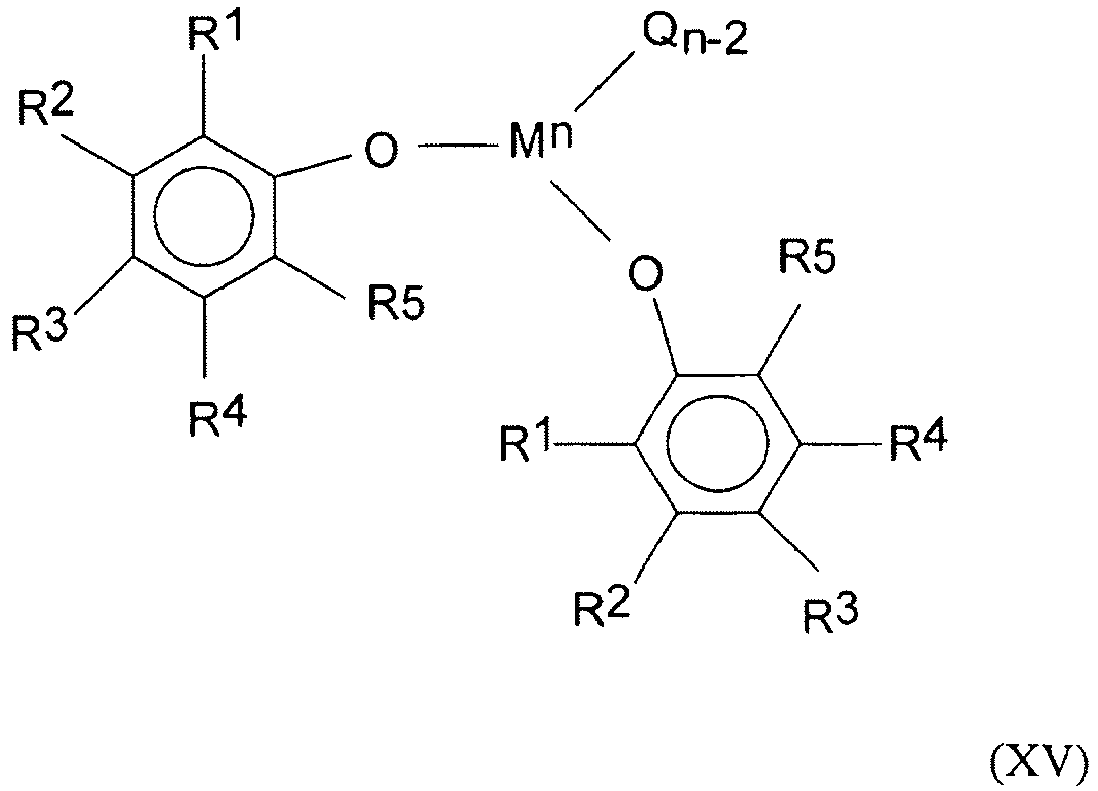
- wherein R1 is hydrogen or a C4 to C100 group, preferably a tertiary alkyl group, preferably a C4 to C20 alkyl group, preferably a C4 to C20 tertiary alkyl group, preferably a neutral C4 to C100 group and may or may not also be bound to M;
- at least one of R2 to R5 is a heteroatom containing group, the rest of R2 to R5 are independently hydrogen or a C1 to C100 group, preferably a C4 to C20 alkyl group, preferred examples of which include butyl, isobutyl, t-butyl, pentyl, hexyl, heptyl, isohexyl, octyl, isooctyl, decyl, nonyl, dodecyl, and any of R2 to R5 also may or may not be bound to M;
- Each R1 to R5 group may be independently substituted or unsubstituted with other atoms, including heteroatoms or heteroatom containing group(s);
- O is oxygen;
- M is a Group 3 to Group 10 transition metal or lanthanide metal, preferably a Group 4 metal, preferably M is Ti, Zr or Hf;
- n is the valence state of the metal M, preferably 2, 3, 4, or 5; and
- Q is, and each Q may be independently be, an alkyl, halogen, benzyl, amide, carboxylate, carbamate, thiolate, hydride or alkoxide group, or a bond to an R group containing a heteroatom which may be any of R1 to R5.
- A heteroatom containing group may be any heteroatom or a heteroatom bound to carbon, silicon or another heteroatom. Preferred heteroatoms include boron, aluminum, silicon, nitrogen, phosphorus, arsenic, tin, lead, antimony, oxygen, selenium, and tellurium. Particularly preferred heteroatoms include nitrogen, oxygen, phosphorus, and sulfur. Even more particularly preferred heteroatoms include nitrogen and oxygen. The heteroatom itself may be directly bound to the phenoxide ring or it may be bound to another atom or atoms that are bound to the phenoxide ring. The heteroatom containing group may contain one or more of the same or different heteroatoms. Preferred heteroatom containing groups include imines, amines, oxides, phosphines, ethers, ketones, oxoazolines heterocyclics, oxazolines, thioethers, and the like. Particularly preferred heteroatom containing groups include imines. Any two adjacent R groups may form a ring structure, preferably a 5 or 6 membered ring. Likewise the R groups may form multi-ring structures. In one embodiment any two or more R groups do not form a 5 membered ring.
- In a preferred embodiment the heteroatom substituted phenoxide transition metal compound is an iminophenoxide Group 4 transition metal compound, and more preferably an iminophenoxidezirconium compound.
- It is further contemplated by the invention that other catalysts can be combined with the compounds of the invention. For example, see Hlatky, G.G. Chem. Rev. (2000), 100, 1347; Alt, H.; Koppl, A. Chem. Rev. (2000), 100, 1205; Resconi, L. et al., Chem. Rev. (2000), 100, 1253; Bryntzinger, H.H. et.al., Angew. Chem. Int. Ed. Engl. (1995), 34, 1143; Ittel, S.D. et al., Chem. Rev. (2000), 100, 1169; Gibson, V.C. et al., Chem. Rev. (2003), 103, 283; Skupinska, J., Chem. Rev. (1991), 91, 613; Carter, A. et al., Chem. Commun., 2002, 858; McGuinness, D.S.; et al., J. Am. Chem. Soc. (2003), 125, 5272; McGuiness, D.S., Chem. Commun. (2003), 334;
U.S. Patent Nos. 4,937,299 ,4,935,474 ,5,281,679 ,5,359,015 ,5,470,811 , and5,719,241 , all of which are herein fully incorporated herein reference. - In another embodiment of the invention one or more catalyst compounds or catalyst systems may be used in combination with one or more conventional-type catalyst compounds or catalyst systems. Non-limiting examples of mixed catalysts and catalyst systems are described in
U.S. Patent Nos. 4,159,965 ,4,325,837 ,4,701,432 ,5,124,418 ,5,077,255 ,5,183,867 ,5,391,660 ,5,395,810 ,5,691,264 ,5,723,399 and5,767,031 , andPCT Publication No. WO 96/23010 published Aug. 1, 1996 - With respect to the catalyst systems of the disclosure wherein the high molecular weight catalyst compound is a non-metallocene compound generally the compound is a biphenyl phenol catalyst (BPP) compound. BPP catalyst compounds are known in the art and any are suitable for use herein such as, but not limited to those disclosed in
U.S. Patent Nos. 7,091,282 ,7,030,256 ,7,060,848 ,7,126,031 ,6,841,502 ,U. S. Patent Application publication numbers 2006/0025548 ,2006/020588 ,2006/00211892 PCT application numbers WO 2006/020624 ,WO 2005/108406 , andWO 2003/091262 , all incorporated herein by reference. - Preference may be given to BPP compounds having formula (XVI) shown below:
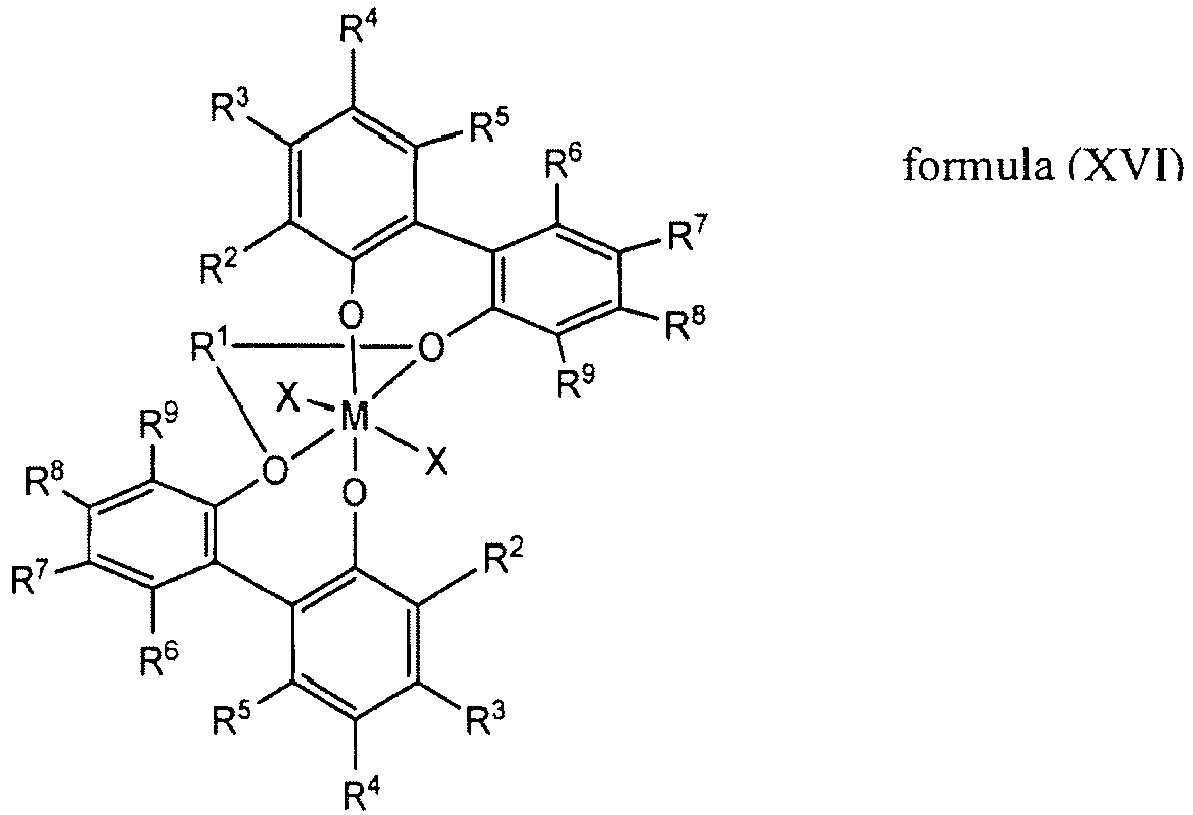
formula 1 is hydride, hydrocarbyl, lower hydrocarbyl, substituted hydrocarbyl, heterohydrocarbyl, alkyl, lower alkyl, substituted alkyl, heteroalkyl, alkenyl, lower alkenyl, substituted alkenyl, heteroalkenyl, alkynyl, lower alkynyl, substituted alkynyl, heteroalkynyl, alkoxy, lower alkoxy, aryloxy, hydroxyl, alkylthio, lower alkyl thio, arylthio, thioxy, aryl, substituted aryl, heteroaryl, aralkyl, aralkylene, alkaryl, alkarylene, halide, haloalkyl, haloalkenyl, haloalkynyl, heteroalkyl, heterocycle, heteroaryl, heteroatom-containing group, silyl, boryl, phosphino, phosphine, amino, amine. - In some embodiments, the bridging group R1 is selected from the group consisting of optionally substituted divalent hydrocarbyl and divalent heteroatom containing hydrocarbyl. In other embodiments, R1 is selected from the group consisting of optionally substituted divalent alkyl, divalent lower alkyl, divalent substituted alkyl, divalent heteroalkyl, divalent alkenyl, divalent lower alkenyl, divalent substituted alkenyl, divalent heteroalkenyl, divalent alkynyl, divalent lower alkynyl, divalent substituted alkynyl, divalent heteroalkynyl, divalent alkoxy, divalent lower alkoxy, divalent aryloxy, divalent alkylthio, divalent lower alkyl thio, divalent arylthio, divalent aryl, divalent substituted aryl, divalent heteroaryl, divalent aralkyl, divalent aralkylene, divalent alkaryl, divalent alkarylene, divalent halide, divalent haloalkyl, divalent haloalkenyl, divalent haloalkynyl, divalent heteroalkyl, divalent heterocycle, divalent heteroaryl, divalent heteroatom-containing group, divalent hydrocarbyl, divalent lower hydrocarbyl, divalent substituted hydrocarbyl, divalent heterohydrocarbyl, divalent silyl, divalent boryl, divalent phosphino, divalent phosphine, divalent amino, divalent amine, divalent ether, divalent thioether. In still other embodiments, R1 can be represented by the general formula --(Q"R40 2-z")z'-wherein each Q" is either carbon or silicon and each R40 may be the same or different from the others such that each R40 is selected from the group consisting of hydride and optionally substituted hydrocarbyl, and optionally two or more R40 groups may be joined into a ring structure having from 3 to 50 atoms in the ring structure (not counting hydrogen atoms); and z' is an integer from 1 to 10, more specifically from 1 5 and even more specifically from 2 5 and z" is 0, 1 or 2. For example, when z" is 2, there is no R40 groups associated with Q", which allows for those cases where one Q" is multiply bonded to a second Q". In more specific embodiments, R40 is selected from the group consisting of hydride, halide, and optionally substituted alkyl, alkenyl, alkynyl, heteroalkyl, heteroalkenyl, heteroalkynyl, aryl, heteroaryl, alkoxyl, aryloxyl, silyl, boryl, phosphino, amino, thioxy, alkylthio, arylthio, and combinations thereof. Specific R1 groups within these embodiments include --(CH2)2--, --(CH2)3--, --(CH2)4-- and --(CH2)-(C6H4)-(CH2)--. Other specific bridging moieties are set forth in the example ligands and complexes herein.
- In one embodiment R2 - R9 of formula (XVI) are optionally hydrocarbyl, lower hydrocarbyl, substituted hydrocarbyl, heterohydrocarbyl, alkyl, lower alkyl, substituted alkyl, heteroalkyl, alkenyl, lower alkenyl, substituted alkenyl, heteroalkenyl, alkynyl, lower alkynyl, substituted alkynyl, heteroalkynyl, alkoxy, lower alkoxy, aryloxy, hydroxyl, alkylthio, lower alkyl thio, arylthio, thioxy, aryl, substituted aryl, heteroaryl, aralkyl, aralkylene, alkaryl, alkarylene, halide, haloalkyl, haloalkenyl, haloalkynyl, heteroalkyl, heterocycle, heteroaryl, heteroatom-containing group, silyl, boryl, phosphino, phosphine, amino, or amine.
- Each X in formula (XVI) is independently selected from the group consisting of: any leaving group in one embodiment; halogen ions, hydrides, C1 to C12 alkyls, C2 to C12 alkenyls, C6 to C12 aryls, C7 to C20 alkylaryls, C1 to C12 alkoxys, C6 to C16 aryloxys, C7 to C18 alkylaryloxys, C1 to C12 fluoroalkyls, C6 to C12 fluoroaryls, and C1 to C12 heteroatom-containing hydrocarbons and substituted derivatives thereof in a more particular embodiment; hydride, halogen ions, C1 to C6 alkyls, C2 to C6 alkenyls, C7 to C18 alkylaryls, C1 to C6 alkoxys, C6 to C14 aryloxys, C7 to C16 alkylaryloxys, C1 to C6 alkylcarboxylates, C1 to C6 fluorinated alkylcarboxylates, C6 to C12 arylcarboxylates, C7 to C18 alkylarylcarboxylates, C1 to C6 fluoroalkyls, C2 to C6 fluoroalkenyls, and C7 to C18 fluoroalkylaryls in yet a more particular embodiment; hydride, chloride, fluoride, methyl, phenyl, phenoxy, benzoxy, tosyl, fluoromethyls and fluorophenyls in yet a more particular embodiment; C1 to C12 alkyls, C2 to C12 alkenyls, C6 to C12 aryls, C7 to C20 alkylaryls, substituted C1 to C12 alkyls, substituted C6 to C12 aryls, substituted C7 to C20 alkylaryls and C1 to C12 heteroatom-containing alkyls, C1 to C12 heteroatom-containing aryls and C1 to C12 heteroatom-containing alkylaryls in yet a more particular embodiment; chloride, fluoride, C1 to C6 alkyls, C2 to C6 alkenyls, C7 to C18 alkylaryls, halogenated C1 to C6 alkyls, halogenated C2 to C6 alkenyls, and halogenated C7 to C18 alkylaryls in yet a more particular embodiment; fluoride, methyl, ethyl, propyl, phenyl, methylphenyl, dimethylphenyl, trimethylphenyl, fluoromethyls (mono-, di- and trifluoromethyls) and fluorophenyls (mono-, di-, tri-, tetra- and pentafluorophenyls) in yet a more particular embodiment.
- Other non-limiting examples of X groups in formula (XVI) include amines, phosphines, ethers, carboxylates, dienes, hydrocarbon radicals having from 1 to 20 carbon atoms, fluorinated hydrocarbon radicals (e.g., -C6F5 (pentafluorophenyl)), fluorinated alkylcarboxylates (e.g., CF3C(O)O-), hydrides and halogen ions and combinations thereof. Other examples of X ligands include alkyl groups such as cyclobutyl, cyclohexyl, methyl, heptyl, tolyl, trifluoromethyl, tetramethylene, pentamethylene, methylidene, methyoxy, ethyoxy, propoxy, phenoxy, bis(N-methylanilide), dimethylamide, dimethylphosphide radicals and the like. In one embodiment, two or more X's form a part of a fused ring or ring system.
- In one embodiment of the compound represented by formula (XVI), M may be Ti, Zr, or Hf. R1, R3, R5 through R9 are H; each R2 may be any of alkyl, aryl, or heteroaryl; each R4 may be any of H, alkyl, aryl; and each X may be any of F, Cl, Br, I, Me, Bnz, CH2SiMe3, or C1 to C5 alkyls.
- In another non-limiting embodiment of the compound represented by formula (XVI), M may be Ti, Zr, or Hf; R1 may be any of CH2CH2, (CH2)3, (CH2)4, CH2CHMeCH2, CH2CMe2CH2, Me2Si, CH2SiMe2CH2, each R2 may be any of an aryl group, defined here to bind through the 1-position to the BPP ring, with substituents in the 2-position or substituents in the 2 and 6 positions such as 2,4-Me2Ph, 2,5-Me2Ph, 2,6-Me2Ph, 2,6-Et2Ph, 2,6-Pr2-Ph, 2,6-Bu2Ph, 2-MeNapthyl, 2,4,6-Me3Ph, 2,4,6-Et3Ph, 2,4,6-Pr3Ph, carbazole and substituted carbazoles; R3 and R5 through R9 are H; each R4 may be any of H, Methyl, Ethyl, Propyl, Butyl, Pentyl; and each X may be any of F, Cl, Br, I, Me, Bnz, CH2SiMe3, or C1 to C5 alkyls.
- In one preferred embodiment, M may be either Zr or Hf; and X may be any of F, Cl, Br, I, Me, Bnz, or CH2SiMe3. In another preferred embodiment, M may be either Zr or Hf; R1 may be either (CH2)3 or (CH2)4; each R2 may be any of 2,6-Me2Ph, 2,6-Et2Ph, 2,6-Pr2-Ph, 2,6-Bu2Ph, 2-MeNapthyl, 2,4,6-Me3Ph, 2,4,6-Et3Ph, 2,4,6-Pr3Ph, and carbazole; each R4 may be any of H, Methyl or Butyl; and X may be any of F, Cl, or Me. In even another preferred embodiment, the R1 is (CH2)3; each R3 is either 2,4,6-Me3Ph or 2-MeNapthyl; each R4 is CH3; X is Cl; and M is Zr.
- In another non-limiting embodiment, the high molecular weight catalyst component may be any catalyst that produces a polymer having a weight average molecular weight (Mw) of greater than about 1 million g/mol, preferably greater than about 1.5 million g/mol, even more preferably greater than about 2 million g/mol, and still more preferably greater than about 3 million g/mol. The low molecular weight catalyst may be any catalyst that produces a polymer having a weight average molecular weight (Mw) in the range of from about 40,000 to about 200,000 g/mol, preferably from about 50,000 to about 180,000 g/mol, more preferably from about 60,000 to about 175,000 g/mol, and even more preferably from about 70,000 to about 150,000 g/mol. In one preferred embodiment, the high molecular weight catalyst produces polymer having an Mw greater than about 5 million g/mol, and the low molecular weight catalyst produces polymer having an Mw of about 100,000 g/mol.
- The amount of each catalyst component present in the catalyst systems of the disclosure may be varied within a range. The amount of each catalyst component present in the catalyst systems may be dependent on one or more reaction parameters including but not limited to reactor temperature, hydrogen concentration, and comonomer concentration. The low molecular weight catalyst is generally present in an amount greater than that of the high molecular weight catalyst. Generally, the high molecular weight catalyst component is present in a catalyst system in an amount in a range of from about 0.001 to about 5.0 mol% of said low molecular weight catalyst component, preferably in a range of from about 0.05 to about 2.5 mol% of said low molecular weight catalyst component, more preferably in a range of from about 0.1 to about 2.0 mol% of said low molecular weight catalyst component. For example, in the case of one high and one low molecular weight catalyst, the mol % of the high molecular weight catalyst may be calculated from the equation: 100(moles of high molecular weight catalyst)/(moles of low molecular weight catalyst + moles of high molecular weight catalyst).
- The above described low and high molecular weight precatalyst compounds can be combined with an activator and optionally a support or carrier in a manner that will allow production of a polymer with low and high molecular weight components. The term "cocatalyst" or "cocatalysts" may be used interchangeably with one or more "activators". This activation yields catalyst compounds capable of polymerizing olefins.
- For the purposes of this patent specification and appended claims, the term "activator" is defined to be any compound or component or method which can activate any of the precatalyst metal compounds of the invention as described above. Non-limiting activators, for example may include a Lewis acid or a non-coordinating ionic activator or ionizing activator or any other compound including Lewis bases, aluminum alkyls, conventional-type cocatalysts or an activator-support and combinations thereof that can convert a neutral precatalyst metal compound to a catalytically active cationic metal compound. It is within the scope of this invention to use alumoxane or modified alumoxane as an activator, and/or to also use ionizing activators, neutral or ionic, such as tri (n-butyl)ammonium tetrakis(pentafluorophenyl)boron or a trisperfluorophenyl boron metalloid precursor or a trisperfluoronaphtyl boron metalloid precursor that would ionize the neutral precatalyst metal compound.
- The low and high molecular weight catalyst precursors according to this invention may be activated for polymerization catalysis in any manner sufficient to allow coordination or cationic polymerization. This can be achieved for coordination polymerization when one ligand can be abstracted and another will either allow insertion of the unsaturated monomers or will be similarly abstractable for replacement with a ligand that allows insertion of the unsaturated monomer (labile ligands), eg. alkyl, silyl or hydride. The traditional activators of coordination polymerization art are suitable, those typically include Lewis acids such as alumoxane compounds, and ionizing, anion precursor compounds that abstract one so as to ionize the bridged metallocene metal center in to a cation and provide a counterbalancing noncoordianting ion. In one embodiment, an activation method using ionizing ionic compounds not containing an active proton but capable of producing both a cationic metal compound catalyst and a non-coordinating anion are also contemplated, and are described in
EP-A-0 426 637 ,EP-A- 0 573 403 andU.S. Patent No. 5,387,568 , which are all herein incorporated by reference. - Alkylalumoxanes and modified alkylalumoxane are suitable as catalyst activators, particularly for the invention metal compounds where R1 = halide or other functional group. Alkylalumoxanes and modified alkylalumoxane are also suitable as catalyst for the invention metal compounds where R1 = hydrocarbyl or substituted hydrocarbyl. In one embodiment, one or more alumoxanes are utilized as an activator in the catalyst composition of the invention. Alumoxanes, sometimes called aluminoxanes in the art, are generally oligomeric compounds containing -Al(R)-O- subunits, where R is an alkyl group. Examples of alumoxanes include methylalumoxane (MAO), modified methylalumoxane (MMAO), ethylalumoxane and isobutylalumoxane. Alkylalumoxanes and modified alkylalumoxanes are suitable as catalyst activators, particularly when the abstractable ligand is a halide. Mixtures of different alumoxanes and modified alumoxanes may also be used. For further descriptions, see
U.S. Patents 4,665,208 ,4,952,540 ,5,041,584 ,5,091,352 ,5,206,199 ,5,204,419 ,4,874,734 ,4,924,018 ,4,908,463 ,4,968,827 ,5,329,032 ,5,248,801 ,5,235,081 ,5,157,137 ,5,103,031 andEP 0 561 476 A1EP 0 279 586 B1EP 0 516 476 AEP 0 594 218 A1WO 94/10180 - Alumoxanes may be produced by the hydrolysis of the respective trialkylaluminum compound. MMAO may be produced by the hydrolysis of trimethylaluminum and a higher trialkylaluminum such as triisobutylaluminum. MMAO's are generally more soluble in aliphatic solvents and more stable during storage. There are a variety of methods for preparing alumoxane and modified alumoxanes, non-limiting examples of which are described in
U.S. Patent No. 4,665,208 ,4,952,540 ,5,091,352 ,5,206,199 ,5,204,419 ,4,874,734 ,4,924,018 ,4,908,463 ,4,968,827 ,5,308,815 ,5,329,032 ,5,248,801 ,5,235,081 ,5,157,137 ,5,103,031 ,5,391,793 ,5,391,529 ,5,693,838 ,5,731,253 ,5,731,451 ,5,744,656 ,5,847,177 ,5,854,166 ,5,856,256 and5,939,346 and European publicationsEP-A-0 561 476 ,EP-B1-0 279 586 ,EP-A-0 594-218 andEP-B1-0 586 665 , andPCT publications WO 94/10180 WO 99/15534 US 5,041,584 ). - Aluminum alkyl or organoaluminum compounds which may be utilized as activators (or scavengers) include trimethylaluminum, triethylaluminum, triisobutylaluminum, tri-n-hexylaluminum, tri-n-octylaluminum and the like.
- It is within the scope of this invention to use an ionizing or stoichiometric activator, neutral or ionic, such as tri (n-butyl) ammonium tetrakis (pentafluorophenyl) boron, a trisperfluorophenyl boron metalloid precursor or a trisperfluoronaphtyl boron metalloid precursor, polyhalogenated heteroborane anions (
WO 98/43983 U.S. Patent No. 5,942,459 ) or combination thereof. It is also within the scope of this invention to use neutral or ionic activators alone or in combination with alumoxane or modified alumoxane activators. - Examples of neutral stoichiometric activators include tri-substituted boron, tellurium, aluminum, gallium and indium or mixtures thereof. The three substituent groups are each independently selected from alkyls, alkenyls, halogen, substituted alkyls, aryls, arylhalides, alkoxy and halides. Preferably, the three groups are independently selected from halogen, mono or multicyclic (including halosubstituted) aryls, alkyls, and alkenyl compounds and mixtures thereof, preferred are alkenyl groups having 1 to 20 carbon atoms, alkyl groups having 1 to 20 carbon atoms, alkoxy groups having 1 to 20 carbon atoms and aryl groups having 3 to 20 carbon atoms (including substituted aryls). More preferably, the three groups are alkyls having 1 to 4 carbon groups, phenyl, naphthyl or mixtures thereof. Even more preferably, the three groups are halogenated, preferably fluorinated, aryl groups. Most preferably, the neutral stoichiometric activator is trisperfluorophenyl boron or trisperfluoronaphthyl boron.
- Ionic stoichiometric activator compounds may contain an active proton, or some other cation associated with, but not coordinated to, or only loosely coordinated to, the remaining ion of the ionizing compound. Such compounds and the like are described in European publications
EP-A-0 570 982 ,EP-A-0 520 732 ,EP-A-0 495 375 ,EP-B1-0 500 944 ,EP-A-0 277 003 andEP-A-0 277 004 , andU.S. Patent Nos. 5,153,157 ,5,198,401 ,5,066,741 ,5,206,197 ,5,241,025 ,5,384,299 and5,502,124 andU.S. Patent Application Serial No. 08/285,380, filed August 3, 1994 - Suitable anions are known in the art and will be suitable for use with the catalysts of the invention. See in particular, patents
US 5,278,119 ,WO2002102857 ,WO2002051884 ,WO200218452 WO2000037513 ,WO2000029454 ,WO2000004058 ,WO9964476 WO2003049856 ,WO2003051892 ,WO2003040070 ,WO2003000740 ,WO2002036639 ,WO2002000738 ,WO2002000666 ,WO2001081435 ,WO2001042249 ,WO2000004059 . Also see the review articles by S. H. Strauss, "The Search for Larger and More Weakly Coordinating Anions", Chem. Rev., 93, 927-942 (1993) and C. A. Reed, "Carboranes: A New Class of Weakly Coordinating Anions for Strong Electrophiles, Oxidants and Superacids", Acc. Chem. Res., 31, 133 -139 (1998). - Illustrative, but not limiting examples of boron compounds which may be used as an activating cocatalyst in the preparation of the improved catalysts of this invention are tri-substituted ammonium salts such as: trimethylammonium tetraphenylborate, triethylammonium tetraphenylborate, tripropylammonium tetraphenylborate, tri(n-butyl)ammonium tetraphenylborate, tri(t-butyl)ammonium tetraphenylborate, N,N-dimethylanilinium tetraphenylborate, N,N-diethylanilinium tetraphenylborate, N,N-dimethyl-(2,4,6-trimethylanilinium) tetraphenylborate, trimethylammonium tetrakis(pentafluorophenyl)borate, triethylammonium tetrakis(pentafluorophenyl)borate, tripropylammonium tetrakis(pentafluorophenyl)borate, tri(n-butyl)ammonium tetrakis(pentafluorophenyl)borate, tri(sec-butyl)ammonium tetrakis(pentafluorophenyl) borate, N,N-dimethylanilinium tetrakis(pentafluorophenyl) borate, N,N-diethylanilinium tetrakis(pentafluorophenyl) borate, N,N-dimethyl-(2,4,6-trimethylanilinium) tetrakis(pentafluorophenyl) borate, trimethylammonium tetrakis(heptafluoronaphthyl)borate, triethylammonium tetrakis(heptafluoronaphthyl)borate, tripropylammonium tetrakis(heptafluoronaphthyl)borate, tri(n-butyl)ammonium tetrakis(heptafluoronaphthyl)borate, tri(sec-butyl)ammonium tetrakis(heptafluoronaphthyl)borate, N,N-dimethylanilinium tetrakis(heptafluoronaphthyl)borate, N,N-diethylanilinium tetrakis(heptafluoronaphthyl)borate, trimethylammonium (2-perfluorobiphenyl)3(perfluorophenylalkynyl)borate, triethylammonium (2-perfluorobiphenyl)3(perfluorophenylalkynyl)borate, tripropylammonium (2-perfluorobiphenyl)3(perfluorophenylalkynyl)borate, tri(n-butyl)ammonium (2-perfluorobiphenyl)3(perfluorophenylalkynyl)borate, tri(sec-butyl)ammonium (2-perfluorobiphenyl)3(perfluorophenylalkynyl)borate, N,N-dimethylanilinium (2-perfluorobiphenyl)3(perfluorophenylalkynyl)borate, N,N-diethylanilinium (2-perfluorobiphenyl)3(perfluorophenylalkynyl)borate, trimethylammonium tetrakis-(2,3,4,6-tetrafluorophenylborate, triethylammonium tetrakis-(2,3,4,6-tetrafluorophenyl) borate, tripropylammonium tetrakis-(2,3,4,6-tetrafluorophenyl) borate, tri(n-butyl)ammonium tetrakis-(2,3,4,6-tetrafluoro-phenyl) borate, dimethyl(t-butyl)ammonium tetrakis-(2,3,4,6-tetrafluorophenyl) borate, N,N-dimethylanilinium tetrakis-(2,3,4,6-tetrafluorophenyl) borate, N,N-diethylanilinium tetrakis-(2,3,4,6-tetrafluoro-phenyl) borate, and N,N-dimethyl-(2,4,6-trimethylanilinium)tetrakis-(2,3,4,6-tetrafluorophenyl) borate; dialkyl ammonium salts such as: di-(i-propyl)ammonium tetrakis(pentafluorophenyl) borate, and dicyclohexylammonium tetrakis(pentafluorophenyl) borate; and tri-substituted phosphonium salts such as: triphenylphosphonium tetrakis(pentafluorophenyl) borate, tri(o-tolyl)phosphonium tetrakis(pentafluorophenyl) borate, and tri(2,6-dimethylphenyl)phosphonium tetrakis(pentafluorophenyl) borate; non-Bronsted acids such as triphenylcarbenium tetrakis(pentafluorophenyl)borate, triphenylcarbenium tetrakis(heptafluoronaphthyl)borate, triphenylcarbenium (2-perfluorobiphenyl)3(perfluorophenylalkynyl)borate, trisperfluorophenyl borane, and triperfluoronaphthyl borane.
- In general the combined activator and metal compounds are combined in ratios of about 1000:1 to about 0.5:1.
- When the activator is an alumoxane (modified or unmodified), any quantity of alumoxane that activates a precatalyst metal compound may be used. Preferably, the ratio of Aluminum to the total molar amount of precatalyst or catalyst metal is between 1000:1 and 1:1. More preferably, the ratio is from 500:1 to 25:1. Even more preferably, the ratio is from 250:1 to 50:1. Even more preferably, the ratio is between 200:1 and 75:1.
- When the activator is an ionizing activator, any quantity of ionizing activator that activates a precatalyst metal compound may be used. Preferably, the ratio of ionizing activator to the total molar amount of precatalyst or catalyst metal is between 10:1 and 1:10. More preferably, the ratio is from 5:1 to 1:5. Even more preferably, the ratio is from 4:1 to 1:4. Even more preferably, the ratio is between 2:1 and 1:2.
- When a combination of activators is employed, any quantity of activators that activates precatalyst metal compounds may be used.
- In a preferred embodiment, the catalysts of the invention comprise high and low molecular weight catalyst precursors, an activator and a support material. Methods for preparing supported catalysts are well known in the art and are easily extendible to the preparation of catalysts with high and low molecular weight catalyst metal compounds.
- The above described precatalyst metal compounds and activators may be combined with one or more support materials or carriers using one of the support methods well known in the art or as described below. In the preferred embodiment, the method of the invention uses a polymerization catalyst in a supported form. For example, in a most preferred embodiment, a catalyst system is in a supported form, for example deposited on, bonded to, contacted with, or incorporated within, adsorbed or absorbed in, or on, a support or carrier.
- The terms "support" or "carrier" are used interchangeably and are any support material, preferably a porous support material, for example, talc, inorganic oxides and inorganic chlorides. Other carriers include resinous support materials such as polystyrene, functionalized or crosslinked organic supports, such as polystyrene divinyl benzene polyolefins or polymeric compounds, zeolites, clays, or any other organic or inorganic support material and the like, or mixtures thereof.
- The preferred carriers are inorganic oxides that include those Group 2, 3, 4, 5, 13 or 14 metal oxides. The preferred supports include silica, alumina, silica-alumina, magnesium chloride, and mixtures thereof. Other useful supports include magnesia, titania, zirconia, montmorillonite (
EP- ) and the like. Also, combinations of these support materials may be used, for example, silica-chromium, silica-alumina, silica-titania and the like.B1 0 511 665 - It is preferred that the carrier, most preferably an inorganic oxide, has a surface area in the range of from about 10 to about 700 m2/g, pore volume in the range of from about 0.1 to about 4.0 mL/g and average particle size in the range of from about 5 to about 500 µm. More preferably, the surface area of the carrier is in the range of from about 50 to about 500 m2/g, pore volume of from about 0.5 to about 3.5 mL/g and average particle size of from about 10 to about 200 µm. Most preferably the surface area of the carrier is in the range is from about 100 to about 400 m2/g, pore volume from about 0.8 to about 3.0 mL/g and average particle size is from about 5 to about 100 µm. The average pore size of the carrier of the invention typically has pore size in the range of from 10 to 1000 Å, preferably 50 to about 500 Å, and most preferably 75 to about 350 Å.
- Examples of supporting catalyst systems are described in Hlatky, Chem. Rev. (2000), 100, 1347 1376 and Fink et al., Chem. Rev. (2000), 100, 1377 1390,
U.S. Patent Nos. 4,701,432 ,4,808,561 ,4,912,075 ,4,925,821 ,4,937,217 ,5,008,228 ,5,238,892 ,5,240,894 ,5,332,706 ,5,346,925 ,5,422,325 ,5,466,649 ,5,466,766 ,5,468,702 ,5,529,965 ,5,554,704 ,5,629,253 ,5,639,835 ,5,625,015 ,5,643,847 ,5,665,665 ,5,698,487 ,5,714,424 ,5,723,400 ,5,723,402 ,5,731,261 ,5,759,940 ,5,767,032 and5,770,664 ,U.S. Application Serial No. 271,598 filed July 7, 1994 and Serial No.788,736 filed January 23, 1997 , andPCT Publication Nos. WO 95/32995 WO 95/14044 WO 96/06187 WO 97/02297 - In one embodiment, the catalyst compounds of the invention may be deposited on the same or separate supports together with an activator, or the activator may be used in an unsupported form, or may be deposited on a support different from the supported catalyst metal compounds of the invention, or any combination thereof.
- The catalyst systems and polymerization processes of the present disclosure are directed to polymerization of one or more olefin monomers having from 2 to 30 carbon atoms. The catalysts and polymerization processes are particularly well suited to the polymerization of two or more olefin monomers of ethylene, propylene, 1-butene, 1-pentene, 1-hexene, 1-heptene, 1-octene, 1-nonene, 4-methyl-1-pentene, 1-isobutene, 1-isobutene and 1-decene. Other monomers useful in the processes of the disclosure include ethylenically unsaturated monomers, diolefins having 4 to 18 carbon atoms, conjugated or nonconjugated dienes, polyenes, vinyl monomers and cyclic olefins. Non-limiting monomers useful in the disclosure may include norbornene, norbornadiene, isobutylene, isoprene, vinylbenzocyclobutane, styrenes, alkyl substituted styrene, ethylidene norbornene, dicyclopentadiene and cyclopentene.
- The present disclosure encompasses homopolymerization processes comprising a single olefin species such as ethylene or propylene, as well as copolymerization reactions between one olefin species (referred to herein as the "monomer" and "monomer compound") and at least a second olefin species (referred to herein as "comonomer" and "comonomer compound") different from the first species. Generally a copolymer will comprise a major amount of the monomer compound (i.e., greater than about 50 mole percent) and a minor amount of the comonomer (i.e., less than about 50 mole percent). The comonomers generally have from three to about 20 carbon atoms in their molecular chain and examples include, but are not limited to, propylene, 1-butene, 2-butene, 3-methyl-1-butene, isobutylene, 1-pentene, 2-pentene, 3-methyl-1-pentene, 4-methyl-1-pentene, 1-hexene, 2-hexene, 3-hexene, 3-ethyl-1-hexene, 1-heptene, 2-heptene, 3-heptene, the four normal octenes, the four normal nonenes, or the five normal decenes. In one non-limiting embodiment, a copolymer may comprise ethylene copolymerized with a comonomer selected from 1-butene, 1-pentene, 1-hexene, 1-octene, 1-decene, or styrene.
- In another embodiment of the process of the invention, ethylene or propylene is polymerized with at least two different comonomers, optionally one of which may be a diene, to form a terpolymer. In one embodiment, two of the three monomers of the terpolymer are butene and ethylene. In one embodiment, the comonomer content is 1.0 to 20.0 wt%, or 2.0 to 15.0 wt%.
- The polymerization processes of the present disclosure may be utilized for production of any polyolefin though preference is given to homopolymers and copolymers of polyethylene. In one non-limiting embodiment, the polyolefins are copolymers of ethylene and at least one comonomer selected from the group consisting of propylene, 1-butene, 1-pentene, 1-hexene, 1-heptene, 1-octene, and combinations thereof. In another non-limiting embodiment, the polyolefins are bimodal copolymers of ethylene and at least one comonomer selected from the group consisting of propylene, 1-butene, 1-pentene, 1-hexene, 1-heptene, 1-octene, and combinations thereof.
- Polymerization reactors suitable for the present disclosure may be any type of reactor known in the art and may comprise at least one raw material feed system, at least one feed system for catalyst or catalyst components, at least one reactor system, at least one polymer recovery system or any suitable combination thereof. Suitable reactors for the present disclosure may further comprise any one or more of any of a catalyst storage system, an extrusion system, a cooling system, a diluent recycling system, or a control system. Such reactors may comprise continuous take-off and direct recycling of catalyst, diluent, and polymer. Generally, continuous processes may comprise the continuous introduction of a monomer, a catalyst, and optionally a diluent into a polymerization reactor and the continuous removal from this reactor of polymer and recycling of diluent and unreacted monomers and comonomers.
- The comonomer, if present in the polymerization reactor, is present at any level that will achieve the desired weight percent incorporation of the comonomer into the finished polyethylene. This is expressed as a mole ratio of comonomer to ethylene as described herein, which is the ratio of the gas concentration of comonomer moles in the cycle gas to the gas concentration of ethylene moles in the cycle gas. In one embodiment, the comonomer is present with ethylene in the cycle gas in a mole ratio range of from 0 or 0.0001 (comonomer:ethylene) to 0.20 or 0.10, and from 0.001 to 0.080 in another embodiment, and from 0.001 to 0.050 in even another embodiment, and from 0.002 to 0.20 in still another embodiment. In yet another embodiment, the comonomer is present with ethylene in the cycle gas in a mole ratio range comprising any combination of any upper limit with any lower limit as described herein.
- The processes of the present disclosure may be characterized in that the desired composition of high molecular weight to low molecular weight moiety can be achieved at any of the above comonomer to ethylene ratios.
- Hydrogen, if present in the polymerization reactor, is present at any level that will achieve the desired melt index (MI, or I2) and molecular weights of the high and the low molecular weight component. Using the catalyst systems of the present disclosure increasing the concentration of hydrogen may increase the melt index of the polyolefin generated. MI can thus be influenced by the hydrogen concentration. The amount of hydrogen in the polymerization can be expressed as a mole ratio relative to the total polymerizable monomer, for example, ethylene, or a blend of ethylene and another alpha olefin. The amount of hydrogen used in the polymerization processes of the present disclosure is an amount necessary to achieve the desired MI of the final polyolefin resin.
- In one embodiment, the ratio of hydrogen to total ethylene monomer (mol ppm H2: mol % ethylene) in the circulating gas stream is in a range of from 0 to 100, in a range of from 0.05 to 50 in another embodiment, in a range of from 0.10 to 40 in even another embodiment, and in a range of from 0.15 to 35 in still another embodiment. In yet another embodiment, the ratio of hydrogen to total ethylene monomer (mol ppm H2: mol % ethylene) in the circulating gas stream may be in a range comprising any combination of any upper mole ratio limit with any lower mole ratio limit described above.
- The processes of the disclosure may be characterized in that the desired composition of high molecular weight to low molecular weight moiety can be achieved at any of the above hydrogen to ethylene ratios.
- The process may also include "condensing agents" as is known in the art and disclosed in, for example,
U.S. Patent Nos. 4,543,399 ,5,405,922 and462,999 . The condensing agent, if present in the reactor can be at any level that will achieve the desired increase in the dew point in order to improve cooling and ultimately space time yields. Suitable condensing agents include but are not limited to saturated hydrocarbons such as propane, n-butane, isobutane, n-pentane, isopentane, neopentane, n-hexane, isohexane, n-heptane, n-octane or mixtures thereof. - The catalysts and catalyst systems of the invention described above are suitable for use in any polymerization process over a wide range of temperatures and pressures. The temperatures may be in the range of from -60°C to about 280°C, preferably from 50°C to about 200°C, and the pressures employed may be in the range from 1 atmosphere to about 500 atmospheres or higher.
- The polymerization processes of the disclosure may be carried out in solution, in bulk, in suspension, in gas-phase, in slurry-phase, as a high-pressure process, or any combinations thereof. Generally solution, gas-phase and slurry-phase processes are preferred. The processes may be carried out in any one or more stages and/or in any one or more reactor having any one or more reaction zone and are conducted substantially in the absence of catalyst poisons. As known by one of skill in the art, organometallic compounds may be employed as scavenging agents for poisons to increase the catalyst activity. The polymerization processes may be carried out batchwise, continuously run, or any combinations thereof. In one non-limiting embodiment, the polymerization processes of the present disclosure are carried out in a continuous gas-phase reactor. In another non-limiting embodiment, polymerization processes of the disclosure are carried out in a single gas-phase reactor.
- Generally, the polymers of the disclosure comprise a high molecular weight component and a low molecular weight component. The polymers of the disclosure generally comprise from about 0.01 to about 25% of the high molecular weight component, preferably from about 0.05 to about 20%, more preferably from about 0.075 to about 15% of a very high molecular weight component, even more preferably from about 0.1 to about 12.5% of a very high molecular weight component, wherein the fraction of the high molecular weight component is determined by integrating the area under the molecular weight vs. dwt%/dLogM curve from molecular weight = 1,000,000 to molecular weight = 10,000,000.
- As described previously, "high molecular weight" is defined herein as being greater than about 1,000,000 g/mol, preferably greater than about 1,500,000 g/mol, more preferably greater than about 2,000,000 g/mol, and even more preferably greater than about 3,000,000 g/mol. In one non-limiting embodiment, high molecular weight is greater than 5,000,000 g/mol. As described previously, "low molecular weight" is defined herein as being in the range of from about 40,000 to about 200,000 g/mol, preferably from about 50,000 to about 180,000 g/mol, more preferably from about 60,000 to about 175,000 g/mol, and even more preferably from about 70,000 to about 150,000 g/mol. In one non-limiting embodiment, low molecular weight is about 100,000 g/mol.
- Generally the high molecular weight component comprises a molecular weight at least 10 times greater than the low molecular weight component, preferably at least 20 times greater than that of the low molecular weight component, more preferably at least 30 times greater than that of the low molecular weight component, and even more preferably at least 40 times greater than that of the low molecular weight component.
- Generally the polymers of the disclosure may have a density in the range of from about 0.86g/cc to 0.97 g/cm3 as measured according to ASTM 1505-03.
- The resins of the disclosure generally exhibit melt strength values greater than that of conventional linear or long chain branched polyethylene of similar melt index. As used herein "melt strength" refers to the force required to draw a molten polymer extrudate at a rate of 12mm/s2 at an extrusion temperature (190°C and 250°C were used herein) until breakage of the extrudate whereby the force is applied by take up rollers. The melt strength of the polymers of the disclosure, also referred to herein as "melt tension", may be expressed as a function of the melt index (MI) value, and generally may be greater than 6*MI-0.6675. In other non-limiting embodiments, the MI value may be greater than 8*MI-0.6675. In still non-limiting embodiments, the MI value may be greater than 10*MI-0.6675.
- In one non-limiting embodiment, the polymers of the present disclosure may have a melt index ("MI" or "I2") as measured by ASTM-D-1238-E (190°C, 2.16 kg weight) in the range of from .001 dg/min to 25 dg/min. In other non-limiting embodiments, the polymers of the present disclosure may have a MI in a range of from about 0.001 dg/min to about 5 dg/min; in even other non-limiting embodiments a MI in a range of from about 0.01 dg/min to about 5 dg/min in other embodiments; and in still other non-limiting embodiments a MI in a range of from about 0.01 dg/min to about 1 dg/min.
- In one non-limiting embodiment, the polymers of the present disclosure may have a melt flow ratio (MFR) in the range of from about 10 to 300. MFR is defined as I21/I2, wherein I21 is measured by ASTM-D-1238-F, at 190°C, 21.6 kg weight. In other non-limiting embodiments, the polymers of the present disclosure may have a MFR in a range of from about 15 to 250; in even other non-limiting embodiments, a MFR in a range of from about 15 to 200; and in still other non-limiting embodiments a MFR in a range of from about 20 to 150.
- As known by one of skill in the art, when subjected to uniaxial extension at a given strain rate, the extensional viscosity of a polymer increases with time. As also known by one of skill in the art, the transient uniaxial extensional viscosity of a linear polymer can be predicted. Strain hardening occurs when a polymer is subjected to uniaxial extension and the transient extensional viscosity increases more than what is predicted from linear viscoelastic theory. As defined herein, the strain hardening index is the ratio of the observed transient uniaxial extensional viscosity to the theoretically predicted transient uniaxial extensional viscosity. Strain hardening index is expressed herein as the following ratio:

- At conditions characteristic of film blowing, for example strain rate of 1 sec-1, temperature of 190°C, and time of 4 seconds (i.e., a strain (ε) of 4), generally the strain hardening index of the polymers of the present disclosure is a ratio/value greater than 3 in some embodiments, a value greater than 5 in other embodiments, a value greater than 8 in even other embodiments, and a value greater than 10 in still other embodiments.
- The polymers of the present disclosure may be characterized in that they exhibit an activation energy (Ea) of less than 7 kcal/mol/K. In other non-limiting embodiments, the Ea of the polymers of the present disclosure may be less than 6 kcal/mol/K.
- In the present disclosure, the activation energy is determined from dynamic oscillatory shear rheology measurements at five different temperatures, 150°C, 170°C, 190°C, 210°C, 230°C and 250 °C. At each temperature, scans are performed as a function of angular shear frequency (from ω = 100 rad/s to ω = 0.01 rad/s) at a constant shear strain. Master curves of storage modulus, G', and loss modulus, G", are obtained by time-temperature (t-T) superposition and the flow activation energies (Ea) are obtained from an Arrhenius plot, aT=exp (Ea/kT), where 1/T is plotted as a function of ln(aT), which relates the shift factor (aT) to Ea.
- As known by one of skill in the art, rheological data may be presented by plotting the phase angle versus the absolute value of the complex shear modulus to produce a van Gurp-Palmen (vGP) plot. The vGP plot of conventional polyethylene polymers shows monotonic behavior and a negative slope toward higher G* values. Conventional LLDPE polymer both with and without long chain branches also exhibit a negative slope on a vGP plot. The vGP plots of the polymers described in the present disclosure exhibit two slopes - a positive slope at lower G* values and a negative slope at higher G* values.
- Referring now to
FIG. 1 , there are shown van Gurp-Palmen (vGP or VGP) plots of various linear polyethylene resins: a conventional monodispersed PE (hydrogenated polyputadiene) (closed circles), a conventional metallocene LLDPE resin with a narrow molecular weight distribution (closed squares), a conventional bimodal resin having a broad molecular weight distribution (asterisk), and an inventive resin of the disclosure (closed diamonds). The molecular weights and molecular weight distributions of the conventional resins are shown in Table 1 below. Increasing polydispersity in comparative conventional resins stretches the curve along the abscissa, but does not change the monotonic nature of the vGP plot (note how their curves inFIG. 1 become less steep). The resin (Exceed™1018) and the bimodal resin (Borouge™ FB 2230) are commercially available resins. In non-limiting embodiments of the present disclosure, the introduction of a high molecular weight fraction according to the disclosure may change the shape of the vGP plot in that it causes a maximum in the vGP plot as shown inFIG. 1 .Table 1: Resin Grade Mw Mw/Mn Anionically polymerized hydrogenated polybutadiene 87,400 g/mol 1.02 Metallocene PE resin Exceed™ 1018 101,000 g/mol 2.2 Dual reactor bimodal PE resin Borouge™ FB 2230 192800 20.4 - In non-limiting embodiments, the ratio of the z-average molecular weight (Mz) to the weight average molecular weight (Mw) of the polymers of the present disclosure may be a ratio having a value in a range of from about 6 to 12. In other non-limiting embodiments, the Mz/Mw ratio may be a value in a range of from about 7 to 15. In even other non-limiting embodiments, the Mz/Mw ratio may be a value greater than 10. The ratio of the Mw to the number average molecular weight (Mn) (ratio of Mw/Mn is also referred to as polydispersity) can be in the range of from 2.5 to 8 in some non-limiting embodiments, from 3.0 to 10 in other non-limiting embodiments, and from 3.5 to 12 in even other non-limiting embodiments. Generally for the polymers of the disclosure, the Mz/Mw ratio is a value greater than the Mw/Mn ratio. As known in the art, Mn is the number average molecular weight and may be expressed as Σ(MiNi)/ΣNi; Mw is the weight average molecular weight and may be expressed as Σ(Mi 2Ni)/Σ(MiNi); and Mz is the z-average molecular weight of a polymer and may be expressed as Σ(Mi 3Ni)/Σ(Mi 2Ni) wherein Ni is the number of molecules of molecular weight Mi. Techniques for determining these values are known in the art and any may be used herein.
- The polymers of the disclosure generally show very high viscosities at low shear rates and exhibit strong shear thinning. A shear thinning index may be expressed as the ratio of the complex viscosities (η*) at two given oscillatory shear frequencies, arbitrarily selected herein to be 0.01 rad/sec (η*0.01) and 100 rad/sec (η*100). Thus, the shear thinning index is expressed herein as (η*0.01)/(η*100). Both (η*0.01) and (η*100) are obtained from oscillatory shear rheometry as described herein. The shear thinning index (η*0.01/η*100) of the polymers of the present disclosure may be a value in the range of 5 to 500. In other non-limiting embodiments, the shear thinning index may be in the range of 25 to 500. In even other embodiments, the shear thinning index may be in the range of 50 to 500. In still other embodiments, the shear thinning index may be in the range of 100 to 500.
- The resins of the disclosure are suitable for use in a variety of products and end-use applications including, but not limited to film, sheets, laminating, jacketing, insulating, and a variety of articles produced by injection molding, blow molding, extrusion coating, profile extrusion, and combinations thereof.
- It is to be understood that while the invention has been described in conjunction with the specific embodiments thereof, the foregoing description is intended to illustrate and not limit the scope of the invention. Other aspects, advantages and modifications will be apparent to those skilled in the art to which the invention pertains.
- Therefore, the following examples are put forth so as to provide those skilled in the art with a complete disclosure and description of how to make and use the compounds of the invention, and are not intended to limit the scope of that which the inventors regard as their invention. Because of the high molecular weights of the polyethylene resins described herein, it is necessary to measure size exclusion chromatography at elevated temperatures to ensure adequate solubility of the polymer molecules. Molecular weights and molecular weight distributions of the resins described herein were determined using high temperature size exclusion chromatography.
- The molecular weights and molecular weight distributions of the resins described in the present disclosure were characterized using a High Temperature Size Exclusion Chromatograph (PL 220, Polymer Laboratories), equipped with a differential refractive index detector (DRI). Three Polymer Laboratories PLgel 10mm Mixed-B columns were used. The nominal flow rate was 1.0 cm3 /min, and the nominal injection volume was 300 µL. The various transfer lines, columns and differential refractometer (the DRI detector) were contained in an oven maintained at 160 C.
- Polymer solutions were prepared in filtered 1,2,4-Trichlorobenzene (TCB) containing 1000 ppm of butylated hydroxy toluene (BHT). The same solvent was used as the SEC eluent. Polymer solutions were prepared by dissolving the desired amount of dry polymer in the appropriate volume of SEC eluent to yield concentrations ranging from 0.5 to 1.5 mg/mL. The sample mixtures were heated at 160°C with continuous agitation for about 2 to 2.5 hours. Sample solution will be filtered off-line before injecting to GPC with 2µm filter using the Polymer Labs SP260 Sample Prep Station.
- The separation efficiency of the column set was calibrated using a series of narrow MWD polystyrene standards, which reflects the expected MW range for samples and the exclusion limits of the column set. Eighteen individual polystyrene standards, ranging from Mp ∼580 to 10,000,000, were used to generate the calibration curve. The polystyrene standards are obtained from Polymer Laboratories (Amherst, MA). To assure internal consistency, the flow rate is corrected for each calibrant run to give a common peak position for the flow rate marker (taken to be the positive inject peak) before determining the retention volume for each polystyrene standard. The flow marker peak position thus assigned was also used to correct the flow rate when analyzing samples; therefore, it is an essential part of the calibration procedure. A calibration curve (logMp vs. retention volume) is generated by recording the retention volume at the peak in the DRI signal for each PS standard, and fitting this data set to a 2nd-order polynomial. The equivalent polyethylene molecular weights are determined by using the following Mark-Houwink coefficients:
k (dL/g) A PS 1.75 x 10 -4 0.67 PE 5.79 x 10 -4 0.695 - For dynamic oscillatory shear measurements, the resins were stabilized with 500 ppm of Irganox 1076 and 1500 ppm of Irgafosl68. The measurements were carried out on an oscillatory rheometer (Rheometrics RDS-2, ARES) with 25mm diameter parallel plates in a dynamic mode under nitrogen atmosphere. For all experiments, the rheometer was thermally stable at 190°C for at least 30 minutes before inserting compression-molded sample of resin onto the parallel plates. To determine the samples viscoelastic behavior, frequency sweeps in the range from 0.01 to 100 rad/s were carried out at 190°C under constant strain. To determine the activation energy, the sweeps were carried out at 5 different temperatures as described herein.
-
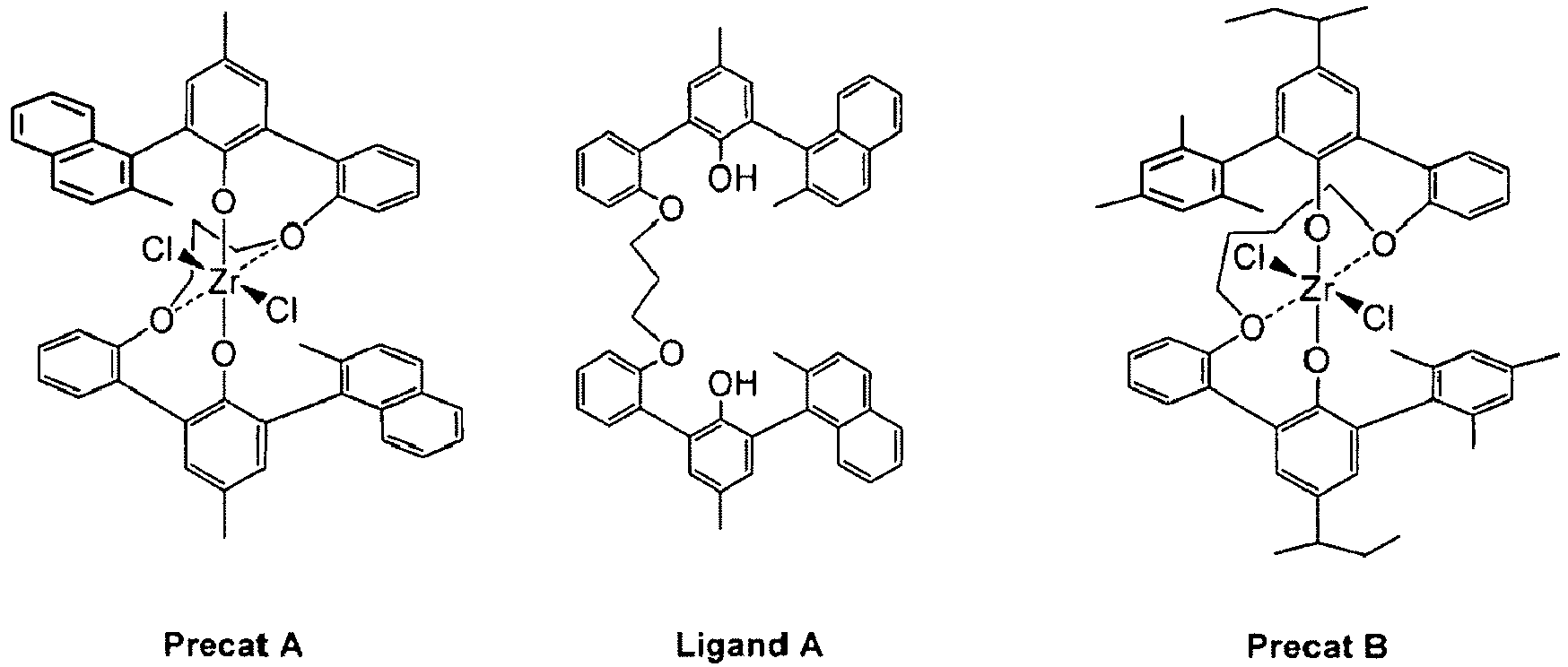

- Anhydrous oxygen free solvents were used. Thirty-weight percent methylaluminoxane (MAO) and (1-Me, 3-BuCp)2ZrCl2 were obtained from Albemarle Corporation. (n-PrCp)2HfCl2 was obtained from Boulder Scientific. (n-PrCp)2HfMe2 may be prepared by methylation of (n-PrCp)2HfCl2 with methyl lithium in toluene. Ligand B was obtained from Symyx Technologies. Zr(CH2Ph)2Cl2(OEt2) was prepared by reaction of ZrBnz4 and ZrCl4 in diethyl ether. The comparative supported catalyst (1-Me, 3-Bu Cp)2ZrCl2 is a commercial catalyst (HP 100) obtained from Univation Technologies.
-

-
STEP 1. A solution of 30g (0.13mol, 1eq) of O-MOM- bromo methyl compound in 300ml of dry tetrahydrofuran was cooled to -76°C. 53 ml of n-butyl lithium (1.2eq, 0.155 mol) was added in such a manner that the temperature did not rise beyond -70°C. The resulting mixture was stirred for another 4 hours at - 78°C. 53ml (0.18mol, 1.4eq) of n-butyl borate was then added to the reaction mass maintaining the temperature from -76°C to -70°C. Stirring was then continued for another 5 hours after which the reaction mass was quenched with 150ml of water. This was stirred for another 10hrs. The organic layer and the aqueous layer were separated. The aqueous layer was washed with petroleum ether and the organic layer was washed with 10% sodium hydroxide solution. The aqueous layer and the sodium hydroxide layer were then combined and acidified using 505 conc. HCl solution. A white solid was obtained which was filtered off and dried under vacuum. Yield = 20g. - STEP 2. 15g (0.067mol, 1eq) of 1-Bromo-2-methyl naphthalene, 0.4g ( 5mol%) of palladium tetrakis, 16g (0.081mol, 1.2eq) of -O-MOM boronic acid, 29g of 2M solution of sodium carbonate and 150ml of toluene were taken in a RB flask and heated to 120°C. After 16 hrs, the reaction mass was diluted with ethyl acetate and the two layers were separated. The resulting organic layer was washed with water followed by brine. This was then dried over sodium sulfate, filtered and concentrated. The crude obtained (25g) was then taken for further step without any purification.
- STEP 3. The 25g of crude material obtained from STEP 2 was stirred along with 240ml of methanolic HCl solution at RT for 16 hrs. The reaction mass was then diluted with excess of ethyl acetate. The organic layer was then washed with water followed by brine. This was then dried over sodium sulfate, filtered and concentrated. The crude obtained was then purified by column chromatography using 1% of ethyl acetate in petroleum ether. Yield= 11.8g.
- STEP 4. 11.8g (0.047 mol, 1eq) of methynaphthyl phenol obtained from the above step and 7ml (0.047mol, 1eq) of triethyl amine were taken in 110ml of dry dichloromethane and stirred well. A solution of 13g (0.007mol, 1.5eq) of N-bromo succinimide in 300ml of dry dichloromethane was added over a period of 30mins. The reaction mass was then stirred for 24 hours after which it was quenched with 1.5N HCl. The organic layer was separated and washed with water and brine. It was then dried over sodium sulfate and concentrated. The crude obtained (17g) was then taken for further step without any purification as it was pure enough. (98%).
- STEP 5. To a solution of 17g (0.052mol, 1eq) of the bromo phenol compound and 43ml (0.26mol, 5eq) of diisopropyl ethyl amine in 170ml of dry dichloromethane, 16ml (0.208mol, 4eq) of MOM chloride was added in drops. The resulting mass was stirred at RT for 16 hrs. The reaction mass was diluted with 1.5N HCl solution. The organic layer was separated and washed with water and brine. It was then dried over sodium sulfate and concentrated. The crude obtained was purified by column chromatography using petroleum ether and ethyl acetate as eluant which was 99% pure by HPLC. This was taken for the further step. Yield= 12g.
- STEP 6. A solution of 12g (0.0323mol, 1eq) of O-MOM- bromo compound in 120ml of dry tetrahydrofuran was cooled to -76°C. To this 13.5ml of n-butyl lithium (1.2eq, 0.034mol) was added in such a manner that the temperature did not rise beyond -70°C. The resulting mixture was stirred for another 1hr at -78°C. 13ml (0.045mol, 1.4eq) of n-butyl borate was then added to the reaction mass maintaining the temperature from -76°C to -70°C. The reaction mass was then quenched with 50ml of water and extraction was done in ethyl acetate. This was dried over sodium sulfate, filtered and concentrated. The crude (11g) obtained was taken along with 3.7g (10mol%) of palladium tetrakis, 3.8g ( 0.008mol) of C3 iodo ether (prepared from the 2-iodophenol and 1,2-dibromopropane), 27g (0.258mol,8eq) of 2M solution of sodium carbonate and 120ml of toluene, in a RB flask and heated to 120°C. After 16 hrs, the reaction mass was diluted with ethyl acetate and the two layers were separated. The resulting organic layer was washed with water followed by brine. This was then dried over sodium sulfate, filtered and concentrated. The crude obtained (17g) was then taken for further step without any purification.
- STEP 7. The 17g of crude material obtained from STEP 6 was stirred along with 170ml of methanolic HCl solution and 3 ml of dichloromethane at RT for 16 hrs. The reaction mass was then diluted with excess of ethyl acetate. The organic layer was then washed with water followed by brine. This was then dried over sodium sulfate, filtered and concentrated. The crude obtained was then purified by column chromatography using 1% of ethyl acetate in petroleum ether. Two fractions were collected and analyzed by HPLC, NMR and LCMS. The first fraction was 4g and consisted of two isomers which were confirmed by NMR, LCMS AND HPLC. The second fraction (550mg) also consists of two isomers which were confirmed by NMR and LCMS.
- To a solution consisting of Ligand A (2.750 grams, 3.814 mmol) in approximately 80 milliliters of toluene was added a solution of Zr(CH2Ph)2Cl2(Et2O) (1.603 grams) in 20 milliliters of toluene. An additional 20 milliliters of solvent were added to the mixture. After stirring the mixture at room temperature for 1 hour, the reaction was heated to 80 °C for 2 hours. Approximately 70% of the solvent was removed, and pentane added to induce further precipitation of the product. The mixture was chilled. The solids collected by filtration and washed with minimum pentane.
- A solution of Zr(CH2Ph)2Cl2(Et2O)1.2 (58.7 mg, 0.1355 mmol) in toluene (8 mL) was added to a hot solution (120 °C) of Ligand B (100 mg, 0.129 mmol) in toluene (32 mL) over a period of 5 minutes while stirring. After 15 min, the reaction was chilled and the solvent mostly removed. When there was 1-2 mL left, the solution was placed in about 15 mL of pentane. The solvents were reduced to
ca 1/2 of the original volume. The slurry was decanted and the solids dried. Yield 39 mg. - In a typical procedure, Crosfield ES757 silica (741 g), dehydrated at 600°C, was added to a stirred (overhead mechanical conical stirrer) mixture of toluene (2 L) and 30 wt% solution of methyl aluminoxane in toluene (874 g, 4.52 mol). The silica was chased with toluene (200 mL) then the mixture was heated to 90°C for 3 h. Afterwards, volatiles were removed by application of vacuum and mild heat (40°C) overnight then the solid was allowed to cool to room temperature.
- A solution of precatalysts (PC) and toluene was added at a rate of ca. 0.5 mL/min to a slurry SMAO and pentane (amounts provided in Table 2 below), stirred with an overhead stirrer. After stirring for > 30 min, the mixture was filtered and dried in-vacuo.
Table 2 Supported Catalyst preparations Example # PC 1 Mass of PC 1 (mg) PC 2 Mass of PC 2 (g) SMAO (g) Toluene (mL) Pentane (mL) mol % PC 15 A 1.4 D 1.3044 80.03 60 450 0.05 6 A 2.6 D 1.3 80.02 60 450 0.1 7 A 1.3 D 0.6469 40.01 30 375 0.1 8 B 6.7 D 0.647 40 30 375 0.48 9-Comparative D 0.8136 50.06 40 450 0 10 B 1.9 D 0.8133 50.07 30 375 0.11 11 A 1.5 D 0.8166 50 40 450 0.09 12 A 7.8 D 0.811 50 30 375 0.47 13 B 7.1 D 0.8113 50 30 375 0.4 14-Comparative D 0.814 50 40 450 0 15 B 1.4 D 0.5877 40.1 30 375 0.11 16 A 1.7 D 0.8127 50.02 40 450 0.1 17-Comparative C 0.7941 50 20 300 0 18 A 1.3 C 0.6337 39.99 50 450 0.1 19 A 3.3 C 0.6339 39.95 65.4 450 0.25 20 A 6.6 C 0.6363 39.9 90.8 450 0.5 - These catalysts were tested in a continuous fluidized-bed gas-phase reactor with a nominal 14" reactor diameter, an average bed weight of about 1900 g, gas-velocity of about 1.6 ft/s, production rate of about 500 g/h. The reactor was operated at a temperature of 79.4 °C, and a pressure of 300 psig. The composition of ethylene, hydrogen, and 1-hexene is indicated in Table 3 below; the balance being nitrogen.
Table 3: Summary of Polymerization conditions Example Catalyst from Example H2 conc. (molppm) Comonomer conc. (mol%) C2 conc. (mol%) Residence Time (h) 21-comparative HP100 251 1.083 35.0 3.8 22 5 246 1.109 35.0 4.2 23 6 244 1.097 35.0 3.6 24-comparative HP100 123 0.619 34.7 4.0 25-comparative HP100 89 0.618 35.0 4.7 26 7 85 0.627 35.0 3.7 27 8 94 0.725 35.1 4.3 28 8 90 0.679 34.7 3.8 29-comparative 9 91 0.342 35.2 5.0 30 10 99 0.312 35.1 5.7 31 11 97 0.291 35.0 3.7 32 12 103 0.282 35.0 4.0 33 13 102 0.320 35.0 4.2 34-comparative 14 and 9 85 0.179 35.0 4.2 35 15 and 10 84 0.171 35.0 3.3 36 16 and 11 82 0.178 35.0 3.3 37 13 86 0.197 35.0 5.0 38-comparative HP100 84 0.057 35.0 6.0 39-comparative 17 115 0.019 35.0 4.1 40 18 115 0.003 35.0 4.0 41 19 117 0.009 35.0 4.3 42 20 114 0.003 35.0 4.4 - The test catalysts were evaluated in a continuous run gas phase reactor R125 (LGPR). The reactor was lined out with standard HP100 catalyst at conditions used to make 1.2 MI, 0.917 density (LGPR condition 51-2006). Product was collected and the reactor was transitioned to each of the other catalysts.
- Ethylene/1-hexene copolymers were produced according to the following procedure. The catalyst composition was injected dry into a fluidized bed gas phase polymerization reactor. More particularly, polymerization was conducted in a 152.4 mm diameter gas-phase fluidized bed reactor operating at approximately 2068 kPa total pressure. The reactor bed weight was approximately 2 kg. Fluidizing gas was passed through the bed at a velocity of approximately 0.6 m per second. The fluidizing gas exiting the bed entered a resin disengaging zone located at the upper portion of the reactor. The fluidizing gas then entered a recycle loop and passed through a cycle gas compressor and water-cooled heat exchanger. The shell side water temperature was adjusted to maintain the reactor temperature as specified in Tables 4-8. Ethylene, hydrogen, 1-hexene and nitrogen were fed to the cycle gas loop just upstream of the compressor at quantities sufficient to maintain the desired gas concentrations as specified in Tables 4-8. Gas concentrations were measured by an on-line vapor fraction analyzer. Product (polyethylene particles) was continuously withdrawn from the reactor in batch mode into a purging vessel before it was transferred into a product bin. Residual catalyst and activator in the resin was deactivated in the product drum with a wet nitrogen purge. The catalyst was fed to the reactor bed through a stainless steel injection tube at a rate sufficient to maintain the desired polymer production rate. "C6/C2 flow ratio ("FR")" is the ratio of the lbs of 1-hexene comonomer feed to the pounds of ethylene feed to the reactor, whereas the C6/C2 ratio is the ratio of the gas concentration of 1-hexene moles in the cycle gas to the gas concentration of ethylene moles in the cycle gas. The C6/C2 ratio is obtained from a cycle gas vapor fraction analyzer, whereas the C6/C2 Flow Ratio comes from some measure of the mass flow. The cycle gas is the gas in the reactor, and is measured from a tap off the recirculating loop around the reactor. The ratios reported in the following tables are from the gas concentrations in the reactor. Samples are taken every 9 min, and thus reported C6/C2 ratios are running averages. Tables 4-8 provide summaries of run conditions and product properties of non-limiting examples of the present disclosure for resins with densities of 0.91 - 0.95 as indicated in the tables.
- The MI and HLMI values reported in Tables 4-8 as "QC, reactor granules" were obtained from the polymer granules that were isolated from the polymerization reactor. Each granular resin was dry-blended with 1500 ppm BHT (2,6-bis(1,1-dimethylethyl)-4-methylphenol). MI and HLMI were then measured according to ASTM -D-1238-E and ASTM D-1238-F, respectively.
- The MI and HLMI values reported in Tables 4-8 as "ASTM, pellets" were obtained from compounded resins. To compound the resins, 500 ppm Irganox 1076 and 1500 ppm Igrafos 168 (both available from Ciba Chemicals) were added to the reactor granules and the admixture extruded using a ¾" Haake twin screw extruder. The melt temperature was 210°C. The output rate was about 3.5 lbs/hr. The MI and HLMI of the pellets were then measured according to ASTM -D-1238-E and ASTM D-1238-F, respectively.
- The density values reported in Tables 4-8 as "QC, reactor granules" were obtained from the polymer granules that were isolated from the polymerization reactor. Each granular resin was dry-blended with 1500 ppm BHT and compression molded plaques were produced by heating the polymers in a mold to 179°C and subsequently cooling them to 23°C at a rate of 15°C. The molding pressure was chosen such that air pockets are removed and a uniform samples result. The density was then determined by immersing solid specimens of the compression molded plaques in a column filled with liquid of uniformly gradient density. The gradient density was in accordance with ASTM 1505.
- The density values reported in Tables 4-8 as "ASTM, pellets" were obtained from compounded resins. To compound the resins, 500 ppm Irganox 1076 and 1500 ppm Igrafos 168 were added to the reactor granules and the admixture extruded using a ¾" Haake twin screw extruder. The melt temperature was 210°C. The output rate was about 3.5 lbs/hr. The density of the pellets was then measured according to ASTM 1505-03.
Table 4A: Summary of Process Data - resin density 0.91 HP-100 base HP-100 + 0.05% Univ8 HP-100 + 0.1 % Univ8 Example 21 22 23 Catalyst from Example HP100 5 6 PROCESS DATA H2 conc. (molppm) 251 246 244 Hydrogen flow (sccm) 6.72 6.22 6.88 Comonomerconc. (mol%) 1.083 1.109 1.097 C2 conc. (mol%) 35.0 35.0 35.0 Comonomer/C2 Flow Ratio 0.135 0.135 0.135 C2 flow (g/hr) 590 606 624 H2/C2 Ratio 7.2 7.0 7.0 Comonomer/C2 Ratio 0.031 0.032 0.031 Rx. Pressure (psig) 300 300 300 Reactor Temp (F) 175 175 175 Avg. Bedweight (g) 1894 1930 1903 Production (g/hr) 494 462 533 Residence Time (hr) 3.8 4.2 3.6 C2 Utilization (gC2/gC2 poly) 1.19 1.31 1.17 Avg Velocity (ft/s) 1.58 1.57 1.46 Catalyst Timer (minutes) 15.0 50.0 38.0 Catalyst Feed (g/hr) 0.694 0.208 0.274 Cat Prod. (g/g) - MB(new=.249) 496 1546 1356 Product Data Bulk Density 0.3565 0.3993 Powder Flow Time 7.63 7.25 Total Production (grams) 26976 12717 18669 Number of Bedturnovers 14.2 6.6 9.8 Basic Resin Data (QC) MI (QC reactor granules) 5.92 5.47 4.51 HLMI (QC reactor granules) 112.31 104.81 HLMI/MI (QC reactor granules) 18.97 23.24 Density (QC reactor granules) 0.9115 0.9107 0.9105 Table 4B: Summary of Resin Data - resin density 0.91 HP-100 base HP-100 + 0.05% Univ8 HP-100 + 0.1% Univ8 Example 21 22 23 Catalyst from Example HP100 5 6 Product Data Resin 00270-153 020 030 040 MI (ASTM, pellets) 5.69 5.31 4.4 HLMI (ASTM, pellets) 112.70 100.10 83.7 HLMI/MI (ASTM, pellets) 18.90 18.90 18.8 Density (ASTM, pellets) 0.9124 0.9110 0.9118 Melt Strength (190 C) no data no data no data Melt Strength (250 C) no data no data no data Shear Thinning Index no data no data no data Strain Hardening Index no data no data no data Ea no data no data no data GPC-3d no data no data no data Mw no data no data no data Mw no data no data no data Mz no data no data no data Mw/Mn no data no data no data Mz/Mw no data no data no data Table 5A: Summary of Process Data - resin density 0.92 R125 control HP-100 base 0.1% 7960 0.1% Univ8 0.5% Univ8 0.5% 7960 Example 24 25 26 27 28 Catalyst from Example HP100 HP100 7 8 8 PROCESS DATA H2 conc. (molppm) 123 89 85 94 90 Hydrogen flow (sccm) 4.22 1.75 1.45 1.45 1.45 Comonomer conc. (mol%) 0.619 0.618 0.627 0.725 0.679 C2 conc. (mol%) 34.7 35.0 35.0 35.1 34.7 Comonomer/C2 Flow Ratio 0.088 0.085 0.084 0.084 0.084 C2 flow (g/hr) 631 546 647 504 660 H2/C2 Ratio 3.5 2.5 2.4 2.7 2.6 Comonomer/C2 Ratio 0.018 0.018 0.018 0.021 0.020 Rx. Pressure (psig) 300 300 300 300 300 Reactor Temp (F) 175 175 175 175 175 Avg. Bedweight (g) 1946 1852 1834 1824 1937 Production (g/hr) 491 397 497 427 505 Residence Time (hr) 4.0 4.7 3.7 4.3 3.8 C2 Utilization (gC2/gC2 poly) 1.29 1.37 1.30 1.18 1.31 Avg Velocity (ft/s) 1.51 1.53 1.45 1.53 1.52 Catalyst Timer (minutes) 17.5 20.0 20.0 14.0 16.0 Catalyst Feed (g/hr) 0.596 0.521 0.521 0.744 0.651 Cat Prod. (g/g) - MB(new=.249) 574 532 665 400 541 Product Data Melt Index (MI) (QC reactor granules) 2.22 1.21 0.69 0.12 0.12 HLMI (QC reactor granules) 39.05 21.56 13.40 2.03 n/a HLMI/MI Ratio 17.59 17.82 19.42 16.92 n/a Gradient Density (QC reactor granules) 0.9186 0.9174 0.9176 0.9181 0.9177 Bulk Density n/a 0.3718 n/a 0.3980 n/a Powder Flow Time n/a 7.7 7.5 7.3 n/a Total Production (grams) 7853.0 8738.0 10929.0 8536.0 10096.0 Number of Bedturnovers 4.0 4.7 6.0 4.7 5.2 NOTES Trouble with H2 analyzer and H2 flow control cat feeder problems at end of run. Table 5B: Summary of Resin Data - resin density 0.92 R125 control HP-100 base 0.1% 7960 0.1% Univ8 0.5% Univ8 0.5% 7960 Data Point 050-2006 051-2006 052-2006 054-2006 055-2006 Example 24 25 26 27 28 Catalyst from Example HP100 HP100 7 8 8 Product Data Resin 00270-128 no sample 100 MI (ASTM, pellets) 1.33 0.6 0.7 0.1 0.1 HLMI (ASTM, pellets) 22.17 13.5 14.0 5.5 5.3 HLMI/MI 16.66 22.9 20.2 68.1 57.0 Density (ASTM, pellets) 0.9171 0.9164 0.9167 0.9172 0.9171 Melt Strength (190 C) 13.10 18.60 15.80 17.10 too high Melt Strength (250 C) 6.10 9.60 8.90 10.00 34.90 Shear Thinning Index 3.40 21.90 8.70 99.70 166.80 Strain Hardening Index 1.12 6.80 4.64 8.68 250.78 Ea No data No data No data No data No data GPC-3d Mw 40033 35164 42025 47289 49199 Mw 105638 130295 147701 245554 243126 Mz 189208 720683 864299 1719040 1915233 Mw/Mn 2.64 3.71 3.51 5.19 4.94 Mz/Mw 1.79 5.53 5.85 7.00 7.88 Table 6A: Summary of Process Data - resin density 0.93 HP-100 base 0.1% 7960 0.1% Univ8 0.5% Univ8 0.5% 7960 Example 29 30 31 32 33 Catalyst from Example 9 10 11 12 13 Process Data H2 conc. (molppm) 91 99 97 103 102 Hydrogen flow (sccm) 20.09 4.29 3.60 5.14 2.73 Comonomer conc. (mol%) 0.342 0.312 0.291 0.282 0.320 C2 conc. (mol%) 35.2 35.1 35.0 35.0 35.0 Comonomer/C2 Flow Ratio 0.035 0.035 0.035 0.035 0.035 C2 flow (g/hr) 707 602 689 718 711 H2/C2 Ratio 2.6 2.8 2.8 2.9 2.9 Comonomer/C2 Ratio 0.010 0.009 0.008 0.008 0.009 Rx. Pressure (psig) 300 300 300 300 300 Reactor Temp (F) 175 175 175 175 175 Avg. Bedweight (g) 1864 1865 1878 1932 1939 Production (g/hr) 375 330 508 487 459 Residence Time (hr) 5.0 5.7 3.7 4.0 4.2 C2 Utilization (gC2/gC2 poly) 1.89 1.82 1.36 1.48 1.55 Avg Velocity (ft/s) 1.57 1.58 1.58 1.58 1.58 Catalyst Timer (minutes) 28.0 24.4 20.0 23.2 23.0 Catalyst Feed (g/hr) 0.372 0.426 0.521 0.449 0.453 Cat Prod. (g/g) - MB(new=.249) 703 540 680 756 707 Bulk Density 0.4018 0.4103 0.4176 0.4298 0.4360 Powder Flow Time 7.16 7.78 8.10 9.22 9.32 Total Production (grams) 28274 15410 14385 20990 15082 Number of Bedturnovers 15.2 8.3 7.7 10.9 7.8 Basic Resin Data MI (QC reactor granules) 1.25 1.1 0.9 0.7 0.1 HLMI (QC reactor granules) 22.32 21.8 21.1 19.4 9.0 HLMI/MI 17.80 19.9 23.2 26.7 100.8 Density (QC reactor granules) 0.9285 0.9294 0.9305 0.9310 0.9280 Table 6B: Summary of Resin Data - resin density 0.93 HP-100 base 0.1% 7960 0.1% Univ8 0.5% Univ8 0.5% 7960 Data Point 5-2_2007 5-3_2007 5-4_2007 5-5_2007 5-6_2007 Example 29 30 31 32 33 Catalyst from Example 9 10 11 12 13 Resin 00270-136 100 200 300 400 500 MI (ASTM, pellets) 1.25 1.1 0.9 0.7 0.1 HLMI (ASTM, pellets) 22.32 21.8 21.1 19.4 9.0 HLMI/MI 17.80 19.9 23.2 26.7 100.8 Density (ASTM, pellets) 0.9285 0.9294 0.9305 0.9310 0.9280 Melt Strength (190 C) 13.10 18.60 15.80 17.10 too high Melt Strength (250 C) 6.10 9.60 8.90 10.00 34.90 Shear Thinning Index 21.97 No data No data 248.23 Strain Hardening Index 4.00 4.41 5.42 4.41 14.48 Ea 7.02 No data No data 5.57 GPC-3d Mw 37426 36032 36872 31984 42374 Mw 120938 136675 138060 162940 265891 Mz 683380 1022488 1047292 1285485 2227940 Mw/Mn 3.23 3.79 3.74 5.09 6.27 Mz/Mw 5.65 7.48 7.59 7.89 8.38 Table 7A: Summary of Process Data - resin density 0.94 HP-100 base 0.1% 7960 0.1% Univ8 0.5% 7960 Example 34 35 36 37 Catalyst from Example 14 and 9 15 and 10 16 and 11 13 PROCESS DATA H2 conc. (molppm) 85 84 82 86 Hydrogen flow (sccm) 7.37 7.54 6.04 3.97 Comonomer conc. (mol%) 0.179 0.171 0.178 0.197 C2 conc. (mol%) 35.0 35.0 35.0 35.0 Comonomer/C2 Flow Ratio 0.020 0.020 0.020 0.020 C2 flow (g/hr) 736 739 635 408 H2/C2 Ratio 2.4 2.4 2.4 2.5 Comonomer/C2 Ratio 0.005 0.005 0.005 0.006 Rx. Pressure (psig) 300 300 300 300 Reactor Temp (F) 175 175 175 175 Avg. Bedweight (g) 1844 1917 1857 1909 Production (g/hr) 443 588 567 380 Residence Time (hr) 4.2 3.3 3.3 5.0 C2 Utilization (gC2/gC2 poly) 1.66 1.26 1.12 1.07 Avg Velocity (ft/s) 1.48 1.46 1.46 1.46 Catalyst Timer (minutes) 18.0 19.0 16.3 22.0 Catalyst Feed (g/hr) 0.578 0.548 0.641 0.473 Cat Prod. (g/g) - MB(new=.249) 534 748 617 560 Product Data Bulk Density 0.4128 0.4500 0.4353 0.4478 Powder Flow Time 8.40 9.29 7.41 8.81 Total Production (grams) 16222 14429 16463 15649 Number of Bedturnovers 8.8 7.5 8.9 8.2 Basic Resin Data MI (QC reactor granules) 1.81 1.75 1.45 1.28 HLMI (QC reactor granules) 36.19 34.26 30.36 28.25 HLMI/MI 20.03 20.03 20.03 20.03 Density (QC reactor granules) 0.9354 0.9373 0.9373 0.9377 Table 7B: Summary of Resin Data - resin density 0.94 HP-100 base 0.1% 7960 0.1% Univ8 0.5% 7960 Example 34 35 36 37 Catalyst from Example 14 and 9 15 and 10 16 and 11 13 Product Data MI (ASTM, pellets) 1.81 1.75 1.45 1.28 HLMI (ASTM, pellets) 36.19 34.26 30.36 28.25 HLMI/MI 20.03 20.03 20.03 20.03 Density (ASTM, pellets) 0.9381 0.9375 0.9379 0.9378 Melt Strength (190 C) 13.10 18.60 15.80 too high Melt Strength (250 C) 6.10 9.60 8.90 34.90 Shear Thinning Index 5.37 4.63 19.82 80.60 Strain Hardening Index n/a 1.00 4.14 16.64 Ea in progress in progress in progress GPC-3d Mn 26352 29682 27576 28242 Mw 90911 93851 94584 125147 Mz 170268 176178 240151 769345 Mw/Mn 3.45 3.16 3.43 4.43 Mz/Mw 1.87 1.88 2.54 6.15 Table 8A: Summary of Process Data - resin density 0.95 HP-100 base VP-100 base VP-100 + 0.1% Univ8 VP-100 + 0.25% Univ8 VP-100 + 0.5% Univ8 Data Point 303-153 303-154 303-155 303-156 Example 38 39 40 41 42 Catalyst from Example HP100 17 18 19 20 Chemist ID # EX-370 STD HFP / 757 base HfP, 0.001 (Univ08)ZrCl2 HfP,0.0025 (Univ08)ZrCl2 HfP, 0.005 (Univ08)ZrCl2 Start Time 1700 1500 1900 300 2300 Finish Time next day 1100 same day 500 700 1100 same day 1500 PROCESS DATA H2 conc. (molppm) 84 115 115 117 114 Hydrogen flow (sccm) 7.61 3.37 3.32 3.28 3.04 Comonomer conc. (mol%) 0.057 0.019 0.003 0.009 0.003 C2 conc. (mol%) 35.0 35.0 35.0 35.0 35.0 Comonomer/C2 Flow Ratio 0.007 0.003 0.003 0.003 0.003 C2 flow (g/hr) 587 647 632 646 608 H2/C2 Ratio 2.4 3.3 3.3 3.3 3.3 Comonomer/C2 Ratio 0.002 0.001 0.00007 0.00027 0.00007 Rx. Pressure (psig) 300 300 300 300 300 Reactor Temp (F) 175 175 175 175 175 Avg. Bedweiqht (g) 1864 1881 1879 1910 1897 Production (g/hr) 313 457 472 446 432 Residence Time (hr) 6.0 4.1 4.0 4.3 4.4 C2 Utilization (gC2/gC2 poly) 1.87 1.42 1.34 1.45 1.41 Avg Velocity (ft/s) 1.57 1.56 1.56 1.55 1.56 Catalyst Timer (minutes) 15.0 45.0 45.0 45.0 43.0 Catalyst Feed (g/hr) 0.694 0.231 0.231 0.231 0.242 Cat Prod. (g/g) - MB(new=.249) 314 1377 1422 1343 1243 Product Data Bulk Density 0.4200 0.4038 0.4093 0.4057 0.3884 Powder Flow Time 6.81 7.88 7.34 7.15 6.81 Total Production (grams) 15531 33596 15131 13092 26301 Number of Bedtumovers 8.3 17.9 8.1 6.9 13.9 Basic Resin Data MI 1.32 0.92 0.81 0.37 0.21 HLMI 20.60 18.27 13.96 12.18 9.29 HLMI/MI 15.54 19.86 17.17 32.91 44.24 Density 0.9469 0.9467 0.9485 0.9497 0.9488 Table 8B: Summary of Resin Data - resin density 0.94 HP-100 base VP-100 base VP-100 + 0.1% Univ8 VP-100 + 0.25% Univ8 VP-100 + 0.5% Univ8 Product Data Resin 00270-157 020 030 040 050 060 MI (ASTM, pellets) 1.59 1.17 0.97 0.68 0.43 HLMI (ASTM, pellets) 29.50 19.00 16.80 14.40 10.97 HLMI/MI (ASTM, pellets) 18.55 16.24 17.32 21.18 25.51 Density (ASTM, pellets) 0.9505 0.9491 0.9514 0.9503 0.9512 - The present inventors have found that the polymers produced by a catalyst system of the disclosure comprising a metallocene catalyst component and a non-metallocene catalyst component possess advantageous properties in comparison to polymer produced using the metallocene catalyst alone, and in comparison to conventional polymers.
- As used herein, "melt strength" is defined as the force required to draw a molten polymer extrudate at a rate of 12mm/s2 and at an extrusion temperature (190°C and 250°C were used herein) until breakage of the extrudate whereby the force is applied by take up rollers. The polymer is extruded at a velocity of 0.33 mm/s through an annular die of 2 mm diameter and 30 mm length. Melt strength values reported herein are determined using a Gottfert Rheotens tester and are reported in centi-Newtons (cN). Additional experimental parameters for determining the melt strength are listed in Table 9. For the measurements of melt strength, the resins were stabilized with 500 ppm of Irganox 1076 and 1500 ppm of Irgafos168.
Table 9: Melt Strength test parameters Acceleration 12mm/s2 Temperature 190.0 °C Piston diameter 12 mm Piston speed 0.4862 mm/s Die diameter 2 mm Die length 30 mm Shear rate at the die 70.0 s-1 Strand length 125.0 mm Vo 17.5 mm/s Vs 70.8 mm/s -
FIG. 2 shows the melt strength of non-limitinginventive resins 1, 2, and 3 compared with several conventional resins having low MI (BMC-100 untailored, BMC-100 tailored, Borouge FB2230, and EZP 1804). As seen inFIG. 2 , the melt strength of inventive resin 3 is an order of magnitude higher than that of linear or long chain branched polyethylenes of similar MI. - It is known in the art that when a polymer is subjected to uniaxial extension, the extensional viscosity of the polymer increases with strain rate. It is also known that the transient uniaxial extensional viscosity of a linear polymer can be predicted. "Strain hardening" occurs when a polymer is subjected to uniaxial extension and the transient extensional viscosity increases more than what is predicted from linear viscoelastic theory. As defined herein, the strain hardening index is the ratio of the observed transient uniaxial extensional viscosity (ηE +observed) to the theoretically predicted transient uniaxial extensional viscosity (ηE +predicted). Strain hardening index is expressed herein as the following ratio:

- Referring now to
FIG. 3 there is provided the extensional viscosity of inventive resin 3 at a function of time. At conditions characteristic of film blowing for example strain rate of 1 sec-1, temperature of 190°C, and time of 4 seconds (i.e., a strain (ε) of 4), the strain hardening index of the polymers of the present disclosure is a value greater than 3 in some embodiments, a value greater than 5 in other embodiments, a value greater than 8 in even other embodiments, and a value greater than 10 in still other embodiments. - or extensional viscosity measurements, the resins were stabilized with 500 ppm of Irganox 1076 and 1500 ppm of Irgafos168. The transient uniaxial extensional viscosity was measured at temperatures of 150 °C and 190 °C and different strain rates, 0.1 sec-1, 1.0 sec-1, and 10 sec-1. For example, the transient uniaxial extensional viscosity can be measured using a SER-HV-401 Testing Platform, which is commercially available from Xpansion Instruments LLC, Tallmadge, OH, USA. The SER Testing Platform was used on a Rheometrics ARES-LS rotational rheometer, which is available from TA Instruments. Inc., Newcastle, DE, USA. The SER Testing Platform is described in
US patent 6,578,413 , which is incorporated herein by reference. A general description of transient uniaxial extensional viscosity measurements is provided, for example in, "Strain hardening of various polyolefins in uniaxial elongational flow", The Society of Rheology, Inc. J. Rheol. 47(3), 619-630 (2003); and "Measuring the transient extensional rheology of polyethylene melts using the SER universal testing platform", The Society of Rheology, Inc. J. Rheol. 49(3), 585-606 (2005), incorporated herein by reference. - Extensional rheology data from the Sentmanat Extensional Rhoemeter (SER) indicate the inventive resins show strain hardening behavior and extremely high transient uniaxial extensional viscosities (also referred to herein simply as "extensional viscosity").
FIG. 3 shows extensional viscosity of inventive resin 3 as a function of time. The reference line inFIG. 3 is the predicted linear viscoelastic envelop. - The inventive resins show strong shear thinning. They can be readily extruded but have very high viscosities at low shear rates, providing for the high melt strength.
FIG. 4 shows the shear thinning characteristics ofinventive resins 1, 2 and 3 compared to the XCAT-HP base resin. As can be seen inFIG. 4 , the inventive resins have similar viscosities at high frequencies but much higher viscosities at low frequencies than the base resin (shear thinning).FIG. 5 comparesinventive resins 1, 2, and 3 with conventional resins (Borouge FB2230 and EZP 1804), which show very high/strong shear thinning characteristics. As can be seen inFIG. 5 , the inventive resins have similar viscosities at high frequencies but much higher viscosities at low frequencies than comparative resins (comparative resins already show very high shear thinning). - In
FIG. 6 , the Van Gurp-Palmen plots of non-limiting inventive resins 2 and 3 are shown in comparison with the HP-100 base resin.FIG. 7 shows a comparison of the van Gurp-Palmen plots of non-limiting inventive resins 2 and 3 and two conventional resins (Borouge FB2230 and EZP 1804). EZP1804 exhibits the signature of a highly branched long-chain LLDPE. Borouge 2230 is a commercial bimodal LLDPE that does not have long chain branches. Both conventional resins show the expected behavior. - Despite the high viscosities, the material could readily be made into film with good bubble stability. Blown films were made using Haake Rheomex 252P single screw extruder in connection with a Brabender blown film die. The extruder was equipped with a 19 mm (0.75 inch) metering screw that has a compression ratio 3:1. Ratio of screw diameter over length was 20:1. Output rate was about 3.5 lbs/hr. Additional film blowing parameters are provided in Table 10.
Table 10: Film Blowing parameters Film Blowing Conditions Temperature Profile Zone 1 (°C) 185 Zone 2 (°C) 185 Zone 3 (°C) 195 Die (°C) 200 Melt Temperature (°C) 198 Process Data Output (lb/h) 3.5 Head Pressure (psi) 343 Die Pressure (psi) 2350 Screw Speed (rpm) 32 Gauge (mils) 1 - Tables 11 and 12 provide some properties of non-limiting example films produced from resins of the disclosure.
Table 11: Film Properties - Resin Density 0.93 Sample ID 00270-136 -011 -012 -021 -022 -031 -032 -041 -042 -051 -052 Material: Films from resin example 29 29 30 30 31 31 32 32 33 33 MI 1.25 1.254 1.10 1.10 0.91 0.91 0.73 0.73 0.09 0.089 HLMI 22.32 22.32 21.84 21.84 21.08 21.08 19.37 19.37 8.975 8.975 MIR 17.8 17.8 19.9 19.9 23.2 23.2 26.7 26.7 100.8 100.8 Density 0.928 0.928 0.929 0.929 0.930 0.930 0.931 0.931 0.929 0.929 Film Properties BUR 2.2 3.2 2.2 3.2 2.2 3.2 2.2 3.2 2.2 3 1% Secant Modulus (psi) MD 37695 40501 45924 39999 47090 36373 48140 41123 TD 48655 46125 49548 54153 57231 52400 59120 49967 Tensile Yield Strength (psi) MD 1847 1870 1946 2054 2061 1999 2109 2090 1,998 TD 2091 2069 2268 2309 2461 2493 2395 2435 Elongation @ Yield (%) MD 5.2 5.5 5.5 6 5.4 5.3 5.4 5.4 5.7 TD 5.3 5.3 5.6 5 5.9 5.6 4.9 5.1 Tensile Strength (psi) MD 6529 6601 5901 6675 6691 6757 7314 7197 8,678 TD 6518 6579 6446 6840 6499 6637 5855 6837 Elongation @ Break (%) MD 596 628 380 492 454 567 386 462 165 TD 704 715 730 701 738 707 717 675 Gloss (GU)* MD 74 67 62 55 60 51 37 33 18 15 TD 76 67 60 57 60 48 35 30 19 11 Haze 6 12.4 10.5 12.5 9.1 13.1 17.4 24.5 45.3 42.4 Clarity 97 96 84.7 86.7 87.2 84.5 70.5 73.3 40.2 35.5 Transmittance 92.6 92.6 92.6 92.7 92.6 92.8 92.5 74 91.9 92.2 Internal Haze 2.06 2.47 1.74 2.26 1.64 1.61 1.24 1.4 0.81 0.97 Elmendorf Tear MD (gms) 35.06 56.16 21.84 18.56 19.8 42.28 14.86 24.74 TD (gms) 634.4 603.52 589.12 551.52 634.08 570.88 718.08 623.84 MD (gms/mil) 34 57 19 22 19 45 15 27 TD (gms/mil) 560 579 511 592 548 611 619 675 Puncture Peak Load (lbs) 10.73 10.76 11.5 8.79 11.36 8.98 10.6 9.43 Peak Force/mil (lbs/mil) 8.94 10.06 9.5 9.66 9.62 8.89 9.46 10.14 Break Energy (inch-lbs) 17.98 23.49 14.79 14.88 15.67 14.44 14.74 16.14 Break Energy/mil (inch-lbs/mil) 14.98 21.96 12.22 16.35 13.28 14.29 13.16 17.36 Dart Drop gms 119 115.5 117 84 87 70 90 484 gms/mil 99.17 107.94 96.69 92.31 73.73 69.31 80.36 90.3 Shrink MD 87 80 89 88 90 88 89 86 88 85 TD -18 13 -16 12 -14 21 -8 22 21 24 FAR -10 -30 -20 -20 -20 -20 -20 Gauge Mic (mils) Average 1.2 1.07 1.21 0.91 1.18 1.01 1.12 0.93 1.16 1.02 Low 0.95 0.84 1.05 0.6 0.96 0.56 0.89 0.6 0.51 0.54 High 1.68 1.41 1.69 1.2 1.49 1.55 1.35 0.93 1.71 1.38 Table 12: Film Properties - Resin Density 0.92 Sample ID 00270 -128-011 -128-021 128-031 -128-041 -128-051 -135-011 -135-021 -135-022 Material: Films from resin example 24 26 27 28 commercial control Exceed 1018 CA 1a 1b 1c MI 1.331 0.6933 0.0808 0.093 0.59 0.59 HLMI 22.17 13.97 5.5 5.3 13.54 13.54 MIR 16.66 20.15 68.07 56.99 22.95 22.95 Density 0.91707 0.91671 0.91721 0.91712 0.91540 0.91636 0.91636 Film Properties BUR 2.2 3.2 Gauge (mil) 1.41 1.31 1.09 0.92 1.25 Average 1.27 1.18 0.80 0.72 0.97 0.99 0.96 0.80 Low 1.60 1.46 1.37 1.14 1.53 0.68 0.76 0.55 High 1.27 1.13 1.21 Elmendorf Tear MD (g) 315 128 24 36 384 218 32 62 TD (g) 567 690 755 603 396 331 410 395 MD (g/mil) 255 105 29 49 311 233 34 79 TD (g/mil) 451 591 797 674 333 369 416 540 Dart Drop Mthd A (g) * 301.5 * * * 288 249 225 (g/mil) * 230 * * * 291 259 281 Tensile & Elongation Tensile @ Yield (psi) MD 1,129 1,170 1,622 1,308 1,227 1,086 1,290 TD 1,244 1,352 1,520 1,420 1,317 1,132 1,227 Ultimate Tensile (psi) MD 8,404 8,235 10,139 9,593 9,218 8,046 8,793 TD 8,191 8,955 9,025 8,402 9,428 8,814 7,329 Elongation @ Yield (%) MD 6.1 6.3 6.9 6.4 5.8 6.2 5.5 TD 6 5.7 5.2 5.1 5.9 6.1 6.5 Break Elongation (%) MD 661 570 311 324 9218 636 559 TD 668 622 622 609 9428 620 486 MD 21,675 20,776 27,391 25,079 23,856 19,821 21,395 TD 20,449 22,779 31,745 24,763 23,377 18,103 20,055 Puncture Mthd A Peak Force (lb) 15.2 15.7 10.8 14.2 12.0 9.4 11.6 Peak Force (lb/mil) 10.8 12.0 9.9 15.4 9.6 9.5 12.1 Break Energy (in-lb) 51.7 46.9 20.3 31.2 43.3 32.0 28.0 Break Energy (in-lb/mil) 36.7 35.8 18.6 33.9 34.6 32.3 29.2 Internal Haze (%) average value(%) 2.62 0.91 0.64 0.76 5.42 1.06 1.08 Shrink (%) MD 62 81 87 89 30 47 84 81 TD 6 -9 3 8 19 8 21 14 GLOSS MD 47 67.7 12.5 19.8 9.4 44.5 42 TD 46.6 70.1 14.5 16.8 9.6 42.6 37.6 Haze (%) average value(%) 13.9 6.03 50.5 41.1 66.9 15.0 16.6 *exhausted sample and unable to obtain 10/10 ratio - The phrases, unless otherwise specified, "consists essentially of" and "consisting essentially of" do not exclude the presence of other steps, elements, or materials, whether or not, specifically mentioned in this specification, as along as such steps, elements, or materials, do not affect the basic and novel characteristics of the invention, additionally, they do not exclude impurities normally associated with the elements and materials used.
- For the sake of brevity, only certain ranges are explicitly disclosed herein. However, ranges from any lower limit may be combined with any upper limit to recite a range not explicitly recited, as well as, ranges from any lower limit may be combined with any other lower limit to recite a range not explicitly recited, in the same way, ranges from any upper limit may be combined with any other upper limit to recite a range not explicitly recited. Additionally, within a range includes every point or individual value between its end points even though not explicitly recited. Thus, every point or individual value may serve as its own lower or upper limit combined with any other point or individual value or any other lower or upper limit, to recite a range not explicitly recited.
- All priority documents are herein fully incorporated by reference for all jurisdictions in which such incorporation is permitted and to the extent such disclosure is consistent with the description of the present invention. Further, all documents and references cited herein, including testing procedures, publications, patents, journal articles, etc. are herein fully incorporated by reference for all jurisdictions in which such incorporation is permitted and to the extent such disclosure is consistent with the description of the present invention.
- While the invention has been described with respect to a number of embodiments and examples, those skilled in the art, having benefit of this disclosure, will appreciate that other embodiments can be devised which do not depart from the scope and spirit of the invention as disclosed herein.
- The present invention will now be described in relation to the following non-limiting clauses:
- 1. A catalyst system comprising:
- a metallocene catalyst compound;
- a second catalyst compound having the following formula I:
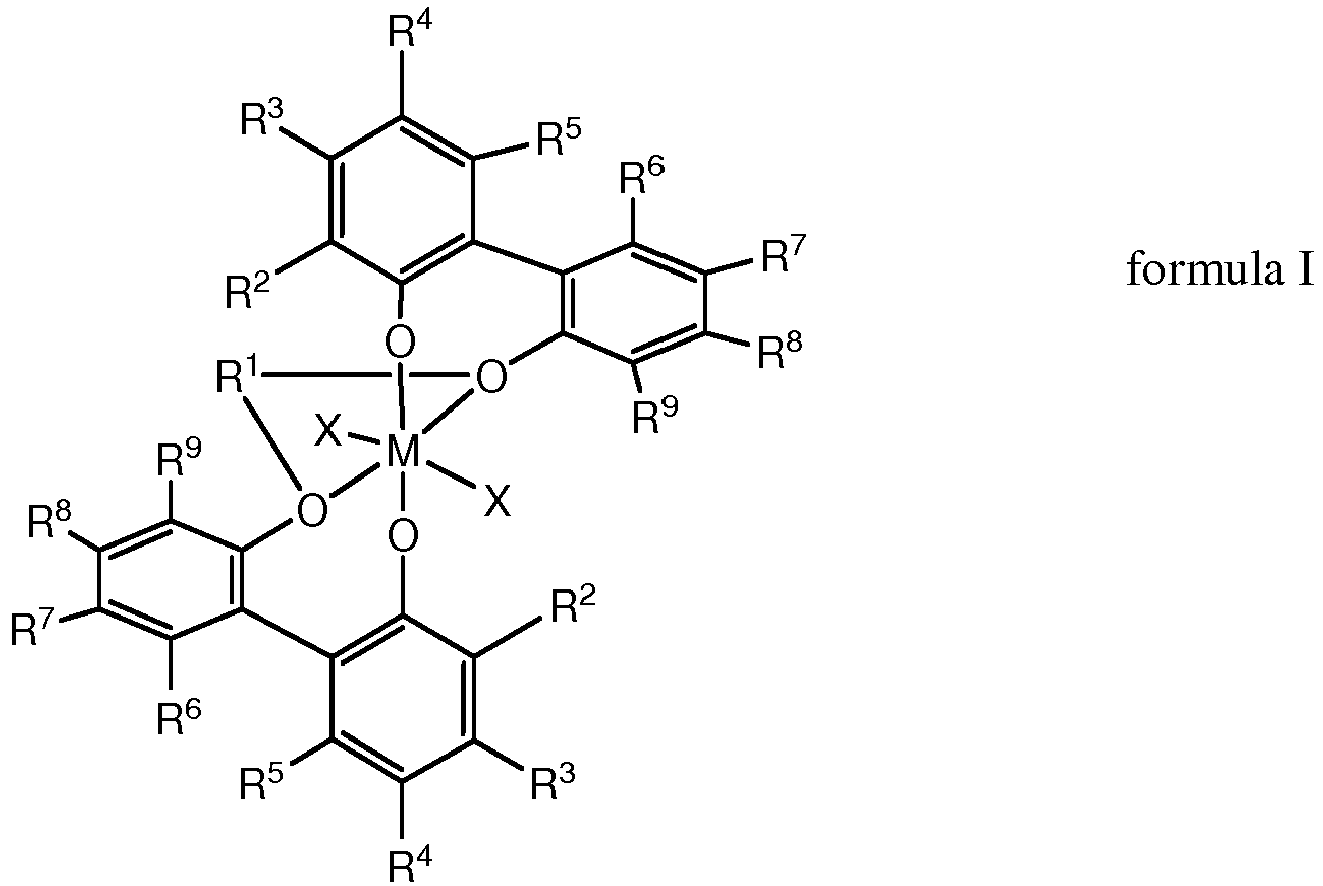
- 2. The catalyst system of clause 1 wherein said metallocene catalyst compound has a formula selected from the group consisting of CpACpBM'X'n, CpA(A)CpBM'X'n, CpA(A)QM'X'n and CpAM'QqX'n, wherein CpA and CpB may each be independently selected from the group consisting of cyclopentadienyl ligands and ligands isolobal to cyclopentadienyl, either or both CpA and CpB may contain heteroatoms, and either or both CpA and CpB may be substituted by one or more R groups, wherein M' is selected from the group consisting of Groups 3 through 12 atoms and lanthanide Group atoms, wherein X' may be any leaving group, wherein n is 0 or an integer from 1 to 4, wherein A is selected from the group consisting of divalent alkyls, divalent lower alkyls, divalent substituted alkyls, divalent heteroalkyls, divalent alkenyls, divalent lower alkenyls, divalent substituted alkenyls, divalent heteroalkenyls, divalent alkynyls, divalent lower alkynyls, divalent substituted alkynyls, divalent heteroalkynyls, divalent alkoxys, divalent lower alkoxys, divalent aryloxys, divalent alkylthios, divalent lower alkyl thios, divalent arylthios, divalent aryls, divalent substituted aryls, divalent heteroaryls, divalent aralkyls, divalent aralkylenes, divalent alkaryls, divalent alkarylenes, divalent haloalkyls, divalent haloalkenyls, divalent haloalkynyls, divalent heteroalkyls, divalent heterocycles, divalent heteroaryls, divalent heteroatom-containing groups, divalent hydrocarbyls, divalent lower hydrocarbyls, divalent substituted hydrocarbyls, divalent heterohydrocarbyls, divalent silyls, divalent boryls, divalent phosphinos, divalent phosphines, divalent aminos, divalent amines, divalent ethers, divalent thioethers; wherein R is selected from the group consisting of alkyls, lower alkyls, substituted alkyls, heteroalkyls, alkenyls, lower alkenyls, substituted alkenyls, heteroalkenyls, alkynyls, lower alkynyls, substituted alkynyls, heteroalkynyls, alkoxys, lower alkoxys, aryloxys, alkylthios, lower alkyl thios, arylthios, aryls, substituted aryls, heteroaryls, aralkyls, aralkylenes, alkaryls, alkarylenes, haloalkyls, haloalkenyls, haloalkynyls, heteroalkyls, heterocycles, heteroaryls, heteroatom-containing groups, hydrocarbyls, lower hydrocarbyls, substituted hydrocarbyls, heterohydrocarbyls, silyls, boryls, phosphinos, phosphines, aminos, amines, ethers, thioethers wherein Q is selected from the group consisting of heteroatom-containing ligands, ROO-, RO-, R(O)-, -NR-, -CR2-, -S-, -NR2, -CR3, -SR, -SiR3, -PR2, -H, and substituted and unsubstituted aryl groups; and wherein q is selected from 0 to 3.
- 3. The catalyst system of any one of the preceding clauses wherein said second compound is present in an amount in a range of from about 0.001 to about 5.0 mol% relative to said first compound.
- 4. The catalyst system of any one of the preceding clauses wherein said metallocene catalyst compound is selected from the group consisting of (Pentamethylcyclopentadienyl)(Propyl cyclopentadienyl)ZrX'2, (Tetramethylcyclopentadienyl) (Propyl cyclopentadienyl)ZrX'2, (Pentamethylcyclopentadienyl)(Butyl cyclopentadienyl)ZrX'2, (Tetramethylcyclopentadienyl) (Butyl cyclopentadienyl)ZrX'2, Me2Si(Indenyl)2ZrX'2, Me2Si(Tetrahydroindenyl)2ZrX'2, (n-propyl cyclopentadienyl)2ZrX'2, (n-propyl cyclopentadienyl)2HfX'2, (n-butyl cyclopentadienyl)2ZrX'2, (n- butyl cyclopentadienyl)2HfX'2, (1-Methyl, 3-Butyl cyclopentadienyl)2ZrX'2, HN(CH2CH2N(2,4,6-Me3Phenyl))2ZrX'2, HN(CH2CH2N(2,3,4,5,6-Me5Phenyl))2ZrX'2, (1-Me, 3-Bu-cyclopentadienyl)2ZrCl2, (Propyl cyclopentadienyl)(Tetramethylcyclopentadienyl)HfCl2, (Butyl cyclopentadienyl)2ZrCl2, (Propyl cyclopentadienyl)2ZrCl2, (Butyl cyclopentadienyl)2HfCl2, (Propyl cyclopentadienyl)2HfCl2, and any combinations thereof.
- 5. The catalyst system of clause 4 wherein said M is selected from the group consisting of Ti, Zr, and Hf; each R2 is selected from the group consisting of alkyls, aryls, and heteroaryls; each R4 is selected from the group consisting of H, alkyls, and aryls; and X is selected from the group consisting of F, Cl, Br, I, Me, Bnz, CH2SiMe3, and C1 to C5 alkyls or alkenyls.
- 6. The catalyst system of clause 5 wherein R1 is selected from the group consisting of CH2CH2, (CH2)3, (CH2)4, CH2CHMeCH2, CH2CMe2CH2, Me2Si, CH2SiMe2CH2, and CH2SiR2CH2; each R2 may be any aryl group with substituents in the 2 and 6 positions; each R3 and R5 through R9 are H; each R4 is selected from the group consisting of H, Methyl, Ethyl, Propyl, Butyl, and Pentyl; and X is selected from the group consisting of F, Cl, Br, I, Me, Bnz, CH2SiMe3, and C1 to C5 alkyls or alkenyls.
- 7. The catalyst system of clause 6 wherein M is either Zr or Hf; each R1 is either (CH2)3 or (CH2)4; each R2 is selected from the group consisting of 2,6-Me2Ph, 2,6-Et2Ph, 2,6-Pr2-Ph, 2,6-Bu2Ph, 2-MeNapthyl, 2,4,6-Me3Ph, 2,4,6-Et3Ph, 2,4,6-Pr3Ph, and carbazole; each R4 is selected from the group consisting of H, Methyl and Butyl; and X is selected from the group consisting of F, Cl, and Me.
- 8. The catalyst system of clause 7 wherein R1 is (CH2)3; each R2 is either 2,4,6-Me3Ph or 2-MeNapthyl; each R4 is CH3; X is Cl; and M is Zr.
- 9. The catalyst system of any one of the preceding clauses wherein said cocatalyst includes an activator and, the catalyst system optionally includes a support.
- 10. The catalyst system of clause 9 wherein said activator is methylaluminoxane and said support is silica.
- 11. A catalyst system comprising:
- a first catalyst compound that when used in a polymerization reaction produces a first polymer having a weight average molecular weight (Mw) in the range of from 40,000 to 200,000 g/mol;
- a second catalyst compound that when used in a polymerization reaction produces a second polymer having an Mw of greater than 1,000,000 g/mol; and
- optionally, a cocatalyst,
- 12. The catalyst system of clause 11 wherein said second catalyst compound is present in an amount in a range of from about 0.001 to about 5.0 mol% relative to said first catalyst compound.
- 13. The catalyst system of clause 11 or 12 wherein said polymer product comprises at least two of said properties (i), (ii), (iii), (iv) and (v).
- 14. The catalyst system of any one of clauses 11-13 wherein said polymer product comprises at least three of said properties (i), (ii), (iii), (iv) and (v).
- 15. The catalyst system of any one of clauses 11-13 wherein said polymer product comprises at least four of said properties (i), (ii), (iii), (iv) and (v).
- 16. The catalyst system of any one of clauses 11-13 wherein said polymer product comprises said properties (i), (ii), (iii), (iv) and (v).
- 17. The catalyst system of any one of clauses 11-16 wherein in property (i) said melt strength value is greater than 8*MI-0.6675.
- 18. The catalyst system of any one of clauses 11-16 wherein in property (i) said melt strength value is greater than 10*MI-0.6675.
- 19. The catalyst system of any one of clauses 11-17 wherein in property (ii) said ratio is greater than 5.
- 20. The catalyst system of any one of clauses 11-17 wherein in property (ii) said ratio is greater than 8.
- 21. A method for making a catalyst system comprising:
- contacting in a diluent (a) a first compound wherein said compound is a metallocene; and (b) a second compound having the following formula I:

- contacting in a diluent (a) a first compound wherein said compound is a metallocene; and (b) a second compound having the following formula I:
- 22. The method of clause 21 wherein said metallocene catalyst compound has a formula selected from the group consisting of CpACpBM'X'n, CpA(A)CpBM'X'n, CpA(A)QM'X'n and CpAM'QqX'n, wherein CpA and CpB may each be independently selected from the group consisting of cyclopentadienyl ligands and ligands isolobal to cyclopentadienyl, either or both CpA and CpB may contain heteroatoms, and either or both CpA and CpB may be substituted by one or more R groups, wherein M' is selected from the group consisting of Groups 3 through 12 atoms and lanthanide Group atoms, wherein X' may be any leaving group, wherein n is 0 or an integer from 1 to 4, wherein A is selected from the group consisting of divalent alkyls, divalent lower alkyls, divalent substituted alkyls, divalent heteroalkyls, divalent alkenyls, divalent lower alkenyls, divalent substituted alkenyls, divalent heteroalkenyls, divalent alkynyls, divalent lower alkynyls, divalent substituted alkynyls, divalent heteroalkynyls, divalent alkoxys, divalent lower alkoxys, divalent aryloxys, divalent alkylthios, divalent lower alkyl thios, divalent arylthios, divalent aryls, divalent substituted aryls, divalent heteroaryls, divalent aralkyls, divalent aralkylenes, divalent alkaryls, divalent alkarylenes, divalent haloalkyls, divalent haloalkenyls, divalent haloalkynyls, divalent heteroalkyls, divalent heterocycles, divalent heteroaryls, divalent heteroatom-containing groups, divalent hydrocarbyls, divalent lower hydrocarbyls, divalent substituted hydrocarbyls, divalent heterohydrocarbyls, divalent silyls, divalent boryls, divalent phosphinos, divalent phosphines, divalent aminos, divalent amines, divalent ethers, divalent thioethers; wherein R is selected from the group consisting of alkyls, lower alkyls, substituted alkyls, heteroalkyls, alkenyls, lower alkenyls, substituted alkenyls, heteroalkenyls, alkynyls, lower alkynyls, substituted alkynyls, heteroalkynyls, alkoxys, aryloxys, alkylthios, lower alkyl thios, arylthios, aryls, substituted aryls, heteroaryls, aralkyls, aralkylenes, alkaryls, alkarylenes, haloalkyls, haloalkenyls, haloalkynyls, heteroalkyls, heterocycles, heteroaryls, heteroatom-containing groups, hydrocarbyls, lower hydrocarbyls, substituted hydrocarbyls, heterohydrocarbyls, silyls, boryls, phosphinos, phosphines, aminos, amines, ethers, thioethers; wherein Q is selected from the group consisting of heteroatom-containing ligands, ROO-, RO-, R(O)-, -NR-, -CR2-, -S-, -NR2, -CR3, -SR, -SiR3, -PR2, -H, and substituted and unsubstituted aryl groups; and wherein q is selected from 0 to 3.
- 23. The method of clause 21 or 22 wherein said catalyst system comprises said second compound in an amount less than 5.0 mol% relative to said first compound.
- 24. The method of any one of clauses 22-23 wherein said metallocene catalyst compound is selected from the group consisting of (Pentamethylcyclopentadienyl)(Propyl cyclopentadienyl)ZrX'2, (Tetramethylcyclopentadienyl) (Propyl cyclopentadienyl)ZrX'2, (Pentamethylcyclopentadienyl)(Butyl cyclopentadienyl)ZrX'2, (Tetramethylcyclopentadienyl) (Butyl cyclopentadienyl)ZrX'2, Me2Si(Indenyl)2ZrX'2, Me2Si(Tetrahydroindenyl)2ZrX'2, (n-propyl cyclopentadienyl)2ZrX'2, (n-propyl cyclopentadienyl)2HfX'2, (n-butyl cyclopentadienyl)2ZrX'2, (n- butyl cyclopentadienyl)2HfX'2, (1-Methyl, 3-Butyl cyclopentadienyl)2ZrX'2, HN(CH2CH2N(2,4,6-Me3Phenyl))2ZrX'2, HN(CH2CH2N(2,3,4,5,6-Me5Phenyl))2ZrX'2, (1-Me, 3-Bu-cyclopentadienyl)2ZrCl2, (Propyl cyclopentadienyl)(Tetramethylcyclopentadienyl)HfCl2, (Butyl cyclopentadienyl)2ZrCl2, (Propyl cyclopentadienyl)2ZrCl2, (Butyl cyclopentadienyl)2HfCl2, (Propyl cyclopentadienyl)2HfCl2, and any combinations thereof.
- 25. The method of clause 24 wherein M is selected from the group consisting of Ti, Zr, and Hf; each R1 through R9 is selected from the group consisting of hydride, halides, unsubstituted alkyls, unsubstituted aryls, substituted alkyls, substituted aryls and heteroaryls; and X is selected from the group consisting of F, Cl, Br, I, Me, Bnz, CH2SiMe3, and C1 to C5 alkyls or alkenyls.
- 26. The method of clause 25 wherein R1 is selected from the group consisting of CH2CH2, (CH2)3, (CH2)4, CH2CHMeCH2, CH2CMe2CH2, Me2Si, CH2SiMe2CH2, and CH2SiR2CH2; each R2 may be any aryl group with substituents in the 2 and 6 positions; each R3 and R5 through R9 are H; each R4 is selected from the group consisting of H, Methyl, Ethyl, Propyl, Butyl, and Pentyl; and X is selected from the group consisting of F, Cl, Br, I, Me, Bnz, CH2SiMe3, and C1 to C5 alkyls or alkenyls.
- 27. The method of clause 26 wherein M is either Zr or Hf; each R1 is either (CH2)3 or (CH2)4; each R2 is selected from the group consisting of 2,6-Me2Ph, 2,6-Et2Ph, 2,6-Pr2-Ph, 2,6-Bu2Ph, 2-MeNapthyl, 2,4,6-Me3Ph, 2,4,6-Et3Ph, 2,4,6-Pr3Ph, and carbazole; each R4 is selected from the group consisting of H, Methyl and Butyl; and X is selected from the group consisting of F, Cl, and Me.
- 28. The method of clause 27 wherein R1 is (CH2)3; each R2 is either 2,4,6-Me3Ph or 2-MeNapthyl; each R4 is CH3; X is Cl; and M is Zr.
- 29. The method of any one of clauses 22-28 wherein said cocatalyst includes an activator and the catalyst system optionally includes a support.
- 30. The method of clause 29 wherein said activator is methylaluminoxane and said support is silica.
- 31. The method of any one of clauses 22-30 wherein said diluent is selected from the group consisting of pentane, isopentane, hexane, isohexane, heptane, octane, nonane, cyclopentane, cyclohexane, benzene, toluene, ethylbenzene and diethylbenzene, and may be different from one another.
- 32. A method for olefin polymerization comprising:
- contacting one or more olefin monomers with a catalyst system under olefin polymerization conditions to create a polyolefin wherein said catalyst system comprises a first catalyst component and a second catalyst component, wherein said first catalyst component is a metallocene; and wherein said second catalyst component has the following formula I:

- contacting one or more olefin monomers with a catalyst system under olefin polymerization conditions to create a polyolefin wherein said catalyst system comprises a first catalyst component and a second catalyst component, wherein said first catalyst component is a metallocene; and wherein said second catalyst component has the following formula I:
- 33. The method of clause 32 wherein said metallocene catalyst compound has a formula selected from the group consisting of CpACpBM'X'n, CpA(A)CpBM'X'n, CpA(A)QM'X'n and CpAM'QqX'n, wherein CpA and CpB may each be independently selected from the group consisting of cyclopentadienyl ligands and ligands isolobal to cyclopentadienyl, either or both CpA and CpB may contain heteroatoms, and either or both CpA and CpB may be substituted by one or more R groups, wherein M' is selected from the group consisting of Groups 3 through 12 atoms and lanthanide Group atoms, wherein X' may be any leaving group, wherein n is 0 or an integer from 1 to 4, wherein A is selected from the group consisting of divalent alkyls, divalent lower alkyls, divalent substituted alkyls, divalent heteroalkyls, divalent alkenyls, divalent lower alkenyls, divalent substituted alkenyls, divalent heteroalkenyls, divalent alkynyls, divalent lower alkynyls, divalent substituted alkynyls, divalent heteroalkynyls, divalent alkoxys, divalent lower alkoxys, divalent aryloxys, divalent alkylthios, divalent lower alkyl thios, divalent arylthios, divalent aryls, divalent substituted aryls, divalent heteroaryls, divalent aralkyls, divalent aralkylenes, divalent alkaryls, divalent alkarylenes, divalent haloalkyls, divalent haloalkenyls, divalent haloalkynyls, divalent heteroalkyls, divalent heterocycles, divalent heteroaryls, divalent heteroatom-containing groups, divalent hydrocarbyls, divalent lower hydrocarbyls, divalent substituted hydrocarbyls, divalent heterohydrocarbyls, divalent silyls, divalent boryls, divalent phosphinos, divalent phosphines, divalent aminos, divalent amines, divalent ethers, divalent thioethers; wherein R is selected from the group consisting of alkyls, lower alkyls, substituted alkyls, heteroalkyls, alkenyls, lower alkenyls, substituted alkenyls, heteroalkenyls, alkynyls, lower alkynyls, substituted alkynyls, heteroalkynyls, alkoxys, lower alkoxys, aryloxys, alkylthios, lower alkyl thios, arylthios, aryls, substituted aryls, heteroaryls, aralkyls, aralkylenes, alkaryls, alkarylenes, haloalkyls, haloalkenyls, haloalkynyls, heteroalkyls, heterocycles, heteroaryls, heteroatom-containing groups, hydrocarbyls, lower hydrocarbyls, substituted hydrocarbyls, heterohydrocarbyls, silyls, boryls, phosphinos, phosphines, aminos, amines, ethers, thioethers, wherein Q is selected from the group consisting of heteroatom-containing ligands, ROO-, RO-, R(O)-, -NR-, -CR2-, -S-, -NR2, -CR3, -SR, -SiR3, -PR2, -H, and substituted and unsubstituted aryl groups; and wherein q is selected from 0 to 3.
- 34. The method of clause 32 or 33 wherein said olefin monomers comprise ethylene, and optinally, hexene, butene, octene, or mixtures thereof.
- 35. The method of any one of clauses 32-34 wherein said olefin monomers further comprise at least one comonomer species selected from the group consisting of propylene, 1-butene, t-pentene, 1-hexene, 1-heptene, 1-octene, and combinations thereof.
- 36. The method of any one of clauses 32-35 wherein said contacting is in a gas-phase, slurry-phase or solution-phase reactor.
- 37. The method of any one of clauses 32-36 wherein said polyolefin comprises at least one of the following properties: (i) a melt strength value greater than 6*MI-0.6675, wherein MI is the melt index value of said polyolefin measured in accordance with ASTM-D-1238-E, (ii) a ratio of extensional viscosity measured at a strain rate of 1 sec-1, 190°C, and time=4 seconds to that predicted by linear viscoelasticity at the same temperature and time of greater than 3, (iii) an activation energy (Ea) of less than 7 kcal/mol/K, (iv) a Mz/Mw ratio greater than the Mw/Mn ratio, wherein Mz is the z-average molecular weight of said polyolefin, Mw is the weight average molecular weight of said polyolefin, Mn is the number average molecular weight of said polyolefin, and v) a van Gurp-Palmen plot comprising a positive slope and possessing a maximum, wherein the van Gurp-Palmen plot is a plot of the phase angle versus the absolute value of the complex shear modulus determined from dynamic rheology, more particularly, from frequency sweeps in the range from 0.01 to 100 rad/s at 190°C.
- 38. The method of any one of clauses 32-37 wherein said polymer product comprises at least two of said properties (i), (ii), (iii), (iv) and (v).
- 39. The method of any one of clauses 32-37 wherein said polymer product comprises at least three of said properties (i), (ii), (iii), (iv) and (v).
- 40. The method of any one of clauses 32-37 wherein said polymer product comprises at least four of said properties (i), (ii), (iii), (iv) and (v).
- 41. The method of any one of clauses 32-37 wherein said polymer product comprises said properties (i), (ii), (iii), (iv) and (v).
- 42. The method of any one of clauses 32-41 wherein in property (i) said melt strength value is greater than 8*MI-0.6675.
- 43. The method of any one of clauses 32-41 wherein in property (i) said melt strength value is greater than 10*MI-0.6675.
- 44. The method of any one of clauses 32-43 wherein in property (ii) said ratio is greater than 5.
- 45. The method of any one of clauses 32-43 wherein in property (ii) said ratio is greater than 8.
- 46. A method for producing polyethylene comprising the steps of:
- mixing a first polyethylene having a weight average molecular weight (Mw) of greater than 1,000,000 g/mol together and a second polyethylene having an Mw in the range of 40,000 to 200,000 g/mol in a solvent to produce a bimodal polyethylene solution; and
- precipitating said bimodal polyethylene out of said solution, wherein said bimodal polyethylene comprises at least one of the following properties: (i) a melt strength value greater than 6*MI-0.6675, wherein MI is the melt index value measured in accordance with ASTM-D-1238-E, (ii) a ratio of extensional viscosity measured at a strain rate of 1 sec-1, 190°C, and time=4 seconds to that predicted by linear viscoelasticity at the same temperature and time of greater than 3, (iii) an activation energy (Ea) of less than 7 kcal/mol/K, and (iv) a Mz/Mw ratio greater than the Mw/Mn ratio, wherein Mz is the z-average molecular weight of said polyethylene, Mw is the weight average molecular weight of said polyethylene, Mn is the number average molecular weight of said polyethylene, wherein when plotted on a van Gurp-Palmen plot, the phase angle versus the absolute value of the complex shear modulus of said polyethylene produces a positive slope, and wherein said complex shear modulus is determined from frequency sweeps in the range from 0.01 to 100 rad/s at 190°C.
- 47. The method of clause 46 wherein said mixing comprises dissolving said first polyethylene and said second polyethylene in said solvent.
- 48. The method of clause 46 or 47 wherein said bimodal polyethylene comprises at least one comonomer species selected from the group consisting of propylene, 1-butene, t-pentene, 1-hexene, 1-heptene, 1-octene, and combinations thereof.
- 49. The method of any one of clauses 46-48 wherein said bimodal polyethylene comprises at least two of said properties (i), (ii), (iii), (iv) and (v).
- 50. The method of any one of clauses 46-48 wherein said bimodal polyethylene comprises at least three of said properties (i), (ii), (iii), (iv) and (v).
- 51. The method of any one of clauses 46-48 wherein said bimodal polyethylene comprises at least four of said properties (i), (ii), (iii), (iv) and (v).
- 52. The method of any one of clauses 46-48 wherein said bimodal polyethylene comprises said properties (i), (ii), (iii), (iv) and (v).
- 53. The method of any one of clauses 46-52 wherein in property (i) said melt strength value is greater than 8*MI-0.6675.
- 54. The method of one of clauses 46-52 wherein in property (i) said melt strength value is greater than 10*MI-0.6675.
- 55. The method of one of clauses 46-54 wherein in property (ii) said ratio is greater than 5.
- 56. The method of one of clauses 46-54 wherein in property (ii) said ratio is greater than 8.
- 57. An ethylene polymer comprising at least one of the following properties: (i) melt strength value greater than 6*MI-0.6675, wherein MI is the melt index value of said polymer measured in accordance with ASTM-D-1238-E, (ii) a ratio of extensional viscosity measured at a strain rate of 1 sec-1, 190°C, and time=4 seconds to that predicted by linear viscoelasticity at the same temperature and time of greater than 3, (iii) an activation energy (Ea) of less than 7 kcal/mol/K, (iv) a Mz/Mw ratio greater than the Mw/Mn ratio, wherein Mz is the z-average molecular weight of said polymer, Mw is the weight average molecular weight of said polymer, Mn is the number average molecular weight of said polymer, and v) a van Gurp-Palmen plot comprising a positive slope and possessing a maximum, wherein the van Gurp-Palmen plot is a plot of the phase angle versus the absolute value of the complex shear modulus determined from dynamic rheology, more particularly, from frequency sweeps in the range from 0.01 to 100 rad/s at 190°C.
- 58. The ethylene polymer of clause 57 wherein said ethylene polymer comprise at least one comonomer species selected from the group consisting of propylene, 1-butene, t-pentene, 1-hexene, 1-heptene, 1-octene, and combinations thereof.
- 59. The ethylene polymer of clause 57 or 58 wherein said polymer comprises at least two of said properties (i), (ii), (iii), (iv) and (v).
- 60. The ethylene polymer of clause 57 or 58 wherein said polymer comprises at least three of said properties (i), (ii), (iii), (iv) and (v).
- 61. The ethylene polymer of clause 57 or 58 wherein said polymer comprises at least four of said properties (i), (ii), (iii), (iv) and (v).
- 62. The ethylene polymer of clause 57 or 58 wherein said polymer comprises said properties (i), (ii), (iii), (iv) and (v).
- 63. The ethylene polymer of any one of clauses 57-62 wherein in property (i) said melt strength value is greater than 8*MI-0.6675.
- 64. The ethylene polymer of any one of clauses 57-62 wherein in property (i) said melt strength value is greater than 10*MI-0.6675.
- 65. The ethylene polymer of any one of clauses 57-64 wherein in property (ii) said ratio is greater than 5.
- 66. The ethylene polymer of any one of clauses 57-64 wherein in property (ii) said ratio is greater than 8.
- 67. The ethylene polymer of any one of clauses 57-66 wherein said polymer exhibits a bimodal molecular weight distribution comprising a first molecular weight component having a weight average molecular weight (Mw) of greater than 1 million g/mol, and a second molecular weight component comprising a Mw in the range of 40,000 to 200,000 g/mol, and wherein said first component is present in said polymer in an amount in the range of about 0.05% to about 20%.
- 68. The ethylene polymer of any one of clauses 57-67 wherein said ethylene polymer has a density measured in accordance with ASTM 1505-03 in the range of 0.89 g/cm3 to 0.97 g/cm3.
- 69. An article produced from an ethylene polymer comprising at least one of the following properties: (i) melt strength value greater than 6*MI-0.6675, wherein MI is the melt index value of said polymer measured in accordance with ASTM D-1238-E, (ii) a ratio of extensional viscosity measured at a strain rate of 1 sec-1, 190°C, and time=4 seconds to that predicted by linear viscoelasticity at the same temperature and time of greater than 3, (iii) an activation energy (Ea) of less than 7 kcal/mol/K, and (iv) a Mz/Mw ratio greater than the Mw/Mn ratio, wherein Mz is the z-average molecular weight of said polymer, Mw is the weight average molecular weight of said polymer, Mn is the number average molecular weight of said polymer, v) a van Gurp-Palmen plot comprising a positive slope and possessing a maximum, wherein the van Gurp-Palmen plot is a plot of the phase angle versus the absolute value of the complex shear modulus determined from dynamic rheology, more particularly, from frequency sweeps in the range from 0.01 to 100 rad/s at 190°C.
- 70. The article of
clause 69 wherein said article is a film. - 71. The article of
clause - 72. The article of any one of clauses 69-71 wherein said ethylene polymer comprises at least two of said properties (i), (ii), (iii), (iv) and (v).
- 73. The article of any one of clauses 69-71 wherein said ethylene polymer comprises at least three of said properties (i), (ii), (iii), (iv) and (v).
- 74. The article of any one of clauses 69-71 wherein said ethylene polymer comprises at least four of said properties (i), (ii), (iii), (iv) and (v).
- 75. The article of any one of clauses 69-71 wherein said ethylene polymer comprises said properties (i), (ii), (iii) and (iv).
- 76. The article of any one of clauses 69-75 wherein in property (i) said melt strength value is greater than 8*MI-0.6675.
- 77. The article of any one of clauses 69-75 wherein in property (i) said melt strength value is greater than 10*MI-0.6675.
- 78. The article of any one of clauses 69-77 wherein in property (ii) said ratio is greater than 5.
- 79. The article of any one of clauses 69-77 wherein in property (ii) said ratio is greater than 8.
Claims (15)
- An ethylene polymer comprising at least one of the following properties: (i) melt strength value greater than 6*MI-0.6675, wherein MI is the melt index value of said polymer measured in accordance with ASTM-D-1238-E, (ii) a ratio of extensional viscosity measured at a strain rate of 1 sec-1, 190°C, and time=4 seconds to that predicted by linear viscoelasticity at the same temperature and time of greater than 3, (iii) an activation energy (Ea) of less than 7 kcal/mol/K, (iv) a Mz/Mw ratio greater than the Mw/Mn ratio, wherein Mz is the z-average molecular weight of said polymer, Mw is the weight average molecular weight of said polymer, Mn is the number average molecular weight of said polymer, and v) a van Gurp-Palmen plot comprising a positive slope and possessing a maximum, wherein the van Gurp-Palmen plot is a plot of the phase angle versus the absolute value of the complex shear modulus determined from dynamic rheology, more particularly, from frequency sweeps in the range from 0.01 to 100 rad/s at 190°C.
- The ethylene polymer of claim 1 wherein said ethylene polymer comprise at least one comonomer species selected from the group consisting of propylene, 1-butene, t-pentene, 1-hexene, 1-heptene, 1-octene, and combinations thereof.
- The ethylene polymer of claim 1 or 2 wherein said polymer comprises at least two of said properties (i), (ii), (iii), (iv) and (v), or wherein said polymer comprises at least three of said properties (i), (ii), (iii), (iv) and (v), or wherein said polymer comprises at least four of said properties (i), (ii), (iii), (iv) and (v), or wherein said polymer comprises said properties (i), (ii), (iii), (iv) and (v).
- The ethylene polymer of any one of claims 1-3 wherein in property (i) said melt strength value is greater than 8*MI-0.6675, or wherein in property (i) said melt strength value is greater than 10*MI-0.6675.
- The ethylene polymer of any one of claims 1-4 wherein in property (ii) said ratio is greater than 5, or wherein in property (ii) said ratio is greater than 8.
- The ethylene polymer of any one of claims 1-5 wherein said polymer exhibits a bimodal molecular weight distribution comprising a first molecular weight component having a weight average molecular weight (Mw) of greater than 1 million g/mol, and a second molecular weight component comprising a Mw in the range of 40,000 to 200,000 g/mol, and wherein said first component is present in said polymer in an amount in the range of about 0.05% to about 20%.
- The ethylene polymer of any one of claims 1-6 wherein said ethylene polymer has a density measured in accordance with ASTM 1505-03 in the range of 0.89 g/cm3 to 0.97 g/cm3.
- An article produced from an ethylene polymer wherein the ethylene polymer is defined according to any one of claims 1 to 7.
- The article of claim 8 wherein said article is a film.
- A method for olefin polymerization comprising:contacting one or more olefin monomers with a catalyst system under olefin polymerization conditions to create a polyolefin wherein said catalyst system comprises a first catalyst component and a second catalyst component, wherein said first catalyst component is a metallocene; and wherein said second catalyst component has the following formula I:

- The method of claim 10 wherein said metallocene catalyst compound has a formula selected from the group consisting of CpACpBM'X'n, CpA(A)CpBM'X'n, CpA(A)QM'X'n and CpAM'QqX'n, wherein CpA and CpB may each be independently selected from the group consisting of cyclopentadienyl ligands and ligands isolobal to cyclopentadienyl, either or both CpA and CpB may contain heteroatoms, and either or both CpA and CpB may be substituted by one or more R groups, wherein M' is selected from the group consisting of Groups 3 through 12 atoms and lanthanide Group atoms, wherein X' may be any leaving group, wherein n is 0 or an integer from 1 to 4, wherein A is selected from the group consisting of divalent alkyls, divalent lower alkyls, divalent substituted alkyls, divalent heteroalkyls, divalent alkenyls, divalent lower alkenyls, divalent substituted alkenyls, divalent heteroalkenyls, divalent alkynyls, divalent lower alkynyls, divalent substituted alkynyls, divalent heteroalkynyls, divalent alkoxys, divalent lower alkoxys, divalent aryloxys, divalent alkylthios, divalent lower alkyl thios, divalent arylthios, divalent aryls, divalent substituted aryls, divalent heteroaryls, divalent aralkyls, divalent aralkylenes, divalent alkaryls, divalent alkarylenes, divalent haloalkyls, divalent haloalkenyls, divalent haloalkynyls, divalent heteroalkyls, divalent heterocycles, divalent heteroaryls, divalent heteroatom-containing groups, divalent hydrocarbyls, divalent lower hydrocarbyls, divalent substituted hydrocarbyls, divalent heterohydrocarbyls, divalent silyls, divalent boryls, divalent phosphinos, divalent phosphines, divalent aminos, divalent amines, divalent ethers, divalent thioethers; wherein R is selected from the group consisting of alkyls, lower alkyls, substituted alkyls, heteroalkyls, alkenyls, lower alkenyls, substituted alkenyls, heteroalkenyls, alkynyls, lower alkynyls, substituted alkynyls, heteroalkynyls, alkoxys, lower alkoxys, aryloxys, alkylthios, lower alkyl thios, arylthios, aryls, substituted aryls, heteroaryls, aralkyls, aralkylenes, alkaryls, alkarylenes, haloalkyls, haloalkenyls, haloalkynyls, heteroalkyls, heterocycles, heteroaryls, heteroatom-containing groups, hydrocarbyls, lower hydrocarbyls, substituted hydrocarbyls, heterohydrocarbyls, silyls, boryls, phosphinos, phosphines, aminos, amines, ethers, thioethers, wherein Q is selected from the group consisting of heteroatom-containing ligands, ROO-, RO-, R(O)-, -NR-, -CR2-, -S-, -NR2, -CR3, -SR, -SiR3, -PR2, -H, and substituted and unsubstituted aryl groups; and wherein q is selected from 0 to 3.
- The method of any one of claims 10-11 wherein said olefin monomers further comprise at least one comonomer species selected from the group consisting of propylene, 1-butene, t-pentene, 1-hexene, 1-heptene, 1-octene, and combinations thereof.
- The method of any one of claims 10-12 wherein said contacting is in a gas-phase, slurry-phase or solution-phase reactor.
- The method of any one of claims 10-13 wherein said polymer product comprises at least two of said properties (i), (ii), (iii), (iv) and (v), or wherein said polymer product comprises at least three of said properties (i), (ii), (iii), (iv) and (v), or wherein said polymer product comprises at least four of said properties (i), (ii), (iii), (iv) and (v) or wherein said polymer product comprises said properties (i), (ii), (iii), (iv) and (v).
- The method of any one of claims 10-14 wherein in property (i) said melt strength value is greater than 8*MI-0.6675, or wherein in property (i) said melt strength value is greater than 10*MI-0.6675; and/or wherein in property (ii) said ratio is greater than 5, and/or wherein in property (ii) said ratio is greater than 8.
Applications Claiming Priority (3)
| Application Number | Priority Date | Filing Date | Title |
|---|---|---|---|
| US318107P | 2007-11-15 | 2007-11-15 | |
| PCT/US2008/012691 WO2009064404A2 (en) | 2007-11-15 | 2008-11-12 | Polymeriazation catalysts, methods of making; methods of using, and polyolefinproducts made therefrom |
| EP08849630A EP2209819A2 (en) | 2007-11-15 | 2008-11-12 | Polymerization catalysts, methods of making; methods of using, and polyolefinproducts made therefrom |
Related Parent Applications (1)
| Application Number | Title | Priority Date | Filing Date |
|---|---|---|---|
| EP08849630A Division EP2209819A2 (en) | 2007-11-15 | 2008-11-12 | Polymerization catalysts, methods of making; methods of using, and polyolefinproducts made therefrom |
Publications (3)
| Publication Number | Publication Date |
|---|---|
| EP3309182A2 true EP3309182A2 (en) | 2018-04-18 |
| EP3309182A3 EP3309182A3 (en) | 2018-06-13 |
| EP3309182B1 EP3309182B1 (en) | 2020-09-30 |
Family
ID=40227590
Family Applications (3)
| Application Number | Title | Priority Date | Filing Date |
|---|---|---|---|
| EP08849630A Ceased EP2209819A2 (en) | 2007-11-15 | 2008-11-12 | Polymerization catalysts, methods of making; methods of using, and polyolefinproducts made therefrom |
| EP17199891.7A Active EP3309182B1 (en) | 2007-11-15 | 2008-11-12 | Polymerization catalysts, methods of making; methods of using, and polyolefinproducts made therefrom |
| EP08849989A Withdrawn EP2209820A1 (en) | 2007-11-15 | 2008-11-14 | Polymerization catalysts and methods of using the same to produce polyolefin products |
Family Applications Before (1)
| Application Number | Title | Priority Date | Filing Date |
|---|---|---|---|
| EP08849630A Ceased EP2209819A2 (en) | 2007-11-15 | 2008-11-12 | Polymerization catalysts, methods of making; methods of using, and polyolefinproducts made therefrom |
Family Applications After (1)
| Application Number | Title | Priority Date | Filing Date |
|---|---|---|---|
| EP08849989A Withdrawn EP2209820A1 (en) | 2007-11-15 | 2008-11-14 | Polymerization catalysts and methods of using the same to produce polyolefin products |
Country Status (9)
| Country | Link |
|---|---|
| US (3) | US8586497B2 (en) |
| EP (3) | EP2209819A2 (en) |
| CN (3) | CN102585058B (en) |
| BR (2) | BRPI0820309B1 (en) |
| CL (1) | CL2008003394A1 (en) |
| ES (1) | ES2836248T3 (en) |
| RU (2) | RU2509088C2 (en) |
| TW (1) | TW200936619A (en) |
| WO (3) | WO2009064404A2 (en) |
Families Citing this family (76)
| Publication number | Priority date | Publication date | Assignee | Title |
|---|---|---|---|---|
| WO2011087520A1 (en) * | 2009-12-22 | 2011-07-21 | Univation Technologies, Llc | Catalyst systems having a tailored hydrogen response |
| TW200936619A (en) * | 2007-11-15 | 2009-09-01 | Univation Tech Llc | Polymerization catalysts, methods of making, methods of using, and polyolefin products made therefrom |
| CN101878237B (en) * | 2007-11-30 | 2013-04-24 | 住友化学株式会社 | Ethylene-α-olefin copolymers and moldings |
| CN102414228B (en) * | 2009-05-14 | 2014-05-07 | 尤尼威蒂恩技术有限责任公司 | Mixed metal catalyst system with tailored hydrogen response |
| US20110003940A1 (en) | 2009-07-01 | 2011-01-06 | Dow Global Technologies Inc. | Ethylene-based polymer compositions for use as a blend component in shrinkage film applications |
| WO2011103402A1 (en) | 2010-02-22 | 2011-08-25 | Univation Technologies, Llc | Catalyst systems and methods for using same to produce polyolefin products |
| WO2012097146A1 (en) * | 2011-01-14 | 2012-07-19 | W. R. Grace & Co.-Conn. | Process of making modified metallocene catalyst, catalyst produced and use thereof |
| CA2734167C (en) * | 2011-03-15 | 2018-03-27 | Nova Chemicals Corporation | Polyethylene film |
| WO2013028283A1 (en) | 2011-08-19 | 2013-02-28 | Univation Technologies, Llc | Catalyst systems and methods for using same to produce polyolefin products |
| CN103930452B (en) | 2011-11-08 | 2016-08-31 | 尤尼威蒂恩技术有限责任公司 | Process for the production of polyolefins using a catalyst system |
| US10081720B2 (en) * | 2012-01-07 | 2018-09-25 | Council Of Scientific & Industrial Research | Modified polypropylene compositions for reduced necking in extrusion film casting or extrusion coating processes |
| US9387957B2 (en) * | 2012-01-25 | 2016-07-12 | The Glad Products Company | Trash bag with inner bag |
| US8664461B2 (en) | 2012-03-19 | 2014-03-04 | Exxonmobil Chemical Patents Inc. | Catalysts for producing polyalpha-olefins and processes related thereto |
| JP6400571B2 (en) | 2012-06-26 | 2018-10-03 | ダウ グローバル テクノロジーズ エルエルシー | Polyethylene blend composition suitable for inflation film and film made therefrom |
| US9096698B2 (en) | 2012-08-09 | 2015-08-04 | Americas Styrenics, LLC | Styrenic resin incorporating recycled polystyrene |
| US8609778B1 (en) | 2012-08-09 | 2013-12-17 | Americas Styrenics, LLC | Styrenic resin incorporating recycled polystyrene |
| US9115228B2 (en) | 2012-08-09 | 2015-08-25 | Americas Styrenics, LLC | Styrenic resin having improved extensional viscosity |
| BR112015011215B1 (en) | 2012-11-26 | 2018-11-21 | Braskem S.A. | METALOCENAL CATALYST SUPPORTED IN HYBRID SUPPORT, PROCEDURE FOR OBTAINING IT, POLYMERIZATION PROCESS FOR OBTAINING AN EOMIC HOMOPOLYMER OR COPOLYMER WITH DISTRIBUTION OF LARGE OR METAL BALODIUM OF THE METAL PIPELINE AND METALBALL DIMENSION BIMODAL |
| EP4039366A1 (en) | 2012-12-28 | 2022-08-10 | Univation Technologies, LLC | Supported catalyst with improved flowability |
| RU2654061C2 (en) | 2013-02-07 | 2018-05-16 | ЮНИВЕЙШН ТЕКНОЛОДЖИЗ, ЭлЭлСи | Production of polyolefin |
| US9840570B2 (en) | 2013-03-11 | 2017-12-12 | Chevron Phillips Chemical Company, Lp | Medium density polyethylene compositions |
| ES2644669T3 (en) | 2013-03-15 | 2017-11-29 | Univation Technologies, Llc | Ligands for catalysts |
| ES2873521T3 (en) * | 2013-03-15 | 2021-11-03 | Univation Tech Llc | Multiple catalyst system comprising metallocenes and nitrogen-based tridentate ligand complexes for olefin polymerization |
| JP6360549B2 (en) | 2013-03-15 | 2018-07-18 | ユニベーション・テクノロジーズ・エルエルシー | Tridentate nitrogen-based ligands for olefin polymerization catalysts |
| WO2014197169A1 (en) | 2013-06-05 | 2014-12-11 | Univation Technologies, Llc | Protecting phenol groups |
| CN106404602A (en) * | 2013-10-29 | 2017-02-15 | 天津大学 | Method used for measuring polystyrene platform modulus |
| US20160362510A1 (en) * | 2014-02-11 | 2016-12-15 | Univation Technologies, Llc | Method to prepare ethylene copolymers |
| CN104478987B (en) * | 2014-11-18 | 2018-06-19 | 中国热带农业科学院椰子研究所 | A kind of special extract and extracting method of oil palm leaves total protein matter |
| WO2016094861A1 (en) | 2014-12-12 | 2016-06-16 | Exxonmobil Chemical Patents Inc. | Olefin polymerization catalyst system comprising mesoporous organosilica support |
| WO2016171810A1 (en) * | 2015-04-20 | 2016-10-27 | Exxonmobil Chemical Patents Inc. | Supported catalyst systems and processes for use thereof |
| CN107531839B (en) * | 2015-04-24 | 2021-05-25 | 尤尼威蒂恩技术有限责任公司 | Method for operating a polymerization reactor |
| KR101950462B1 (en) | 2016-02-24 | 2019-02-20 | 주식회사 엘지화학 | Olefin polymer and preparation method thereof |
| KR101800866B1 (en) * | 2016-04-26 | 2017-12-21 | 대림산업 주식회사 | Multimodal polyolefin resin with high melt strength and article prepared with the same |
| WO2018013283A2 (en) | 2016-07-13 | 2018-01-18 | Exxonmobil Chemical Patents Inc. | Dual metallocene catalyst copolymer compositions |
| CN109641990B (en) * | 2016-07-13 | 2022-08-19 | 埃克森美孚化学专利公司 | Dual metallocene catalyst copolymer compositions |
| CN109661457B (en) | 2016-07-14 | 2022-06-10 | 埃克森美孚化学专利公司 | Lubricating oil compositions comprising dual metallocene-catalyzed bimodal copolymer compositions useful as viscosity modifiers |
| CN115028766B (en) * | 2016-10-19 | 2024-06-28 | 埃克森美孚化学专利公司 | Supported catalyst system and method of using the same |
| US10280234B2 (en) | 2016-11-11 | 2019-05-07 | Exxonmobil Chemical Patents Inc. | Catalyst compositions and use thereof |
| WO2018089165A1 (en) * | 2016-11-11 | 2018-05-17 | Exxonmobil Chemical Patents Inc. | Catalyst compositions and use thereof |
| WO2018118259A1 (en) * | 2016-12-22 | 2018-06-28 | Exxonmobil Chemical Patents Inc. | Spray-dried olefin polymerization catalyst compositions and polymerization processes for using the same |
| KR20190103318A (en) * | 2017-01-13 | 2019-09-04 | 토탈 리서치 앤드 테크놀로지 펠루이 | High Purity Polypropylene and Polypropylene Compositions for Molding |
| WO2018191000A1 (en) | 2017-04-10 | 2018-10-18 | Exxonmobil Chemicl Patents Inc. | Methods for making polyolefin polymer compositions |
| JP6868714B2 (en) * | 2017-05-10 | 2021-05-12 | ユニベーション・テクノロジーズ・エルエルシー | Catalyst system and process for its use |
| US11390704B2 (en) | 2017-06-14 | 2022-07-19 | Exxonmobil Chemical Patents Inc. | Ethylene copolymer blends for cross-linking applications |
| WO2019027572A1 (en) * | 2017-08-02 | 2019-02-07 | Exxonmobil Chemical Patents Inc. | Bridged biphenyl phenol transition metal complexes, production, and use thereof |
| CN111183160B (en) | 2017-10-06 | 2022-06-10 | 埃克森美孚化学专利公司 | Polyethylene extrudates and process for making same |
| EP3710501A2 (en) | 2017-11-15 | 2020-09-23 | ExxonMobil Chemical Patents Inc. | Polymerization processes |
| US11015002B2 (en) | 2017-11-15 | 2021-05-25 | Exxonmobil Chemical Patents Inc. | Polymerization processes |
| US11111325B2 (en) | 2017-11-15 | 2021-09-07 | Exxonmobil Chemical Patents Inc. | Polymerization processes |
| US11952480B2 (en) | 2018-02-05 | 2024-04-09 | Exxonmobil Chemical Patents Inc. | Enhanced processability of LLDPE by addition of ultra-high molecular weight density polyethylene |
| PL3567061T3 (en) | 2018-05-09 | 2024-02-26 | Borealis Ag | Polypropylene pipe composition |
| KR102445573B1 (en) | 2018-05-09 | 2022-09-22 | 보레알리스 아게 | Polypropylene-Ultra-High Molecular Weight-Polyethylene Composition |
| US12006423B2 (en) * | 2018-08-29 | 2024-06-11 | ExxonMobil Engineering & Technology Company | Methods of making polymer compositions with enhanced elasticity by employing VTP and HMP catalyst systems in parallel processes |
| JP7606987B2 (en) | 2019-05-31 | 2024-12-26 | ダウ グローバル テクノロジーズ エルエルシー | Low density polyethylene with improved processability |
| WO2021064546A1 (en) * | 2019-10-01 | 2021-04-08 | Nova Chemicals (International) S.A. | High productivity polymerization with aryloxy ether ligand catalyst |
| BR112022008378A2 (en) | 2019-11-04 | 2022-07-12 | Dow Global Technologies Llc | BIMODAL POLYMERIZATION CATALYST SYSTEM, AND, METHODS FOR MAKING A POLYETHYLENE COMPOSITION AND FOR MANUFACTURING THE BIMODAL POLYMERIZATION CATALYST SYSTEM |
| JP7730316B2 (en) * | 2019-11-04 | 2025-08-27 | ダウ グローバル テクノロジーズ エルエルシー | Biphenylphenol polymerization catalyst |
| BR112022011778A2 (en) * | 2019-12-19 | 2022-08-30 | Dow Global Technologies Llc | USE OF A GAS PHASE BIPHENYLPHENOL POLYMERIZATION CATALYST, POLYMERIZATION CATALYST SYSTEM, POLYMERIZATION METHOD, AND, POLYETHYLENE COMPOSITION |
| CN115380073A (en) | 2020-03-30 | 2022-11-22 | 埃克森美孚化学专利公司 | Comb block copolymers and methods thereof |
| US20230151127A1 (en) | 2020-05-29 | 2023-05-18 | Dow Global Technologies Llc | Attenuated hybrid catalysts |
| BR112022023905A2 (en) | 2020-05-29 | 2022-12-27 | Dow Global Technologies Llc | PROCESS FOR PRODUCING AN ETHYLENE-BASED COPOLYMER |
| CN115698102B (en) | 2020-05-29 | 2024-11-26 | 陶氏环球技术有限责任公司 | Weakened post-metallocene catalyst |
| EP4144773A4 (en) * | 2020-11-17 | 2024-03-13 | Lg Chem, Ltd. | Polyolefin |
| CA3207939A1 (en) * | 2021-02-15 | 2022-08-18 | Ruth Figueroa | Biphenylphenol polymerization catalysts |
| US20240002562A1 (en) | 2021-02-15 | 2024-01-04 | Dow Global Technologies Llc | Method for making a poly(ethylene-co-1 -alkene) copolymer with reverse comonomer distribution |
| KR20230145128A (en) * | 2021-02-15 | 2023-10-17 | 다우 글로벌 테크놀로지스 엘엘씨 | Biphenylphenol polymerization catalyst with improved dynamic induction time |
| CN118139902A (en) | 2021-10-21 | 2024-06-04 | 尤尼威蒂恩技术有限责任公司 | Bimodal poly(ethylene-co-1-olefin) copolymers and blow molded intermediate bulk containers prepared therefrom |
| EP4431535A4 (en) * | 2021-12-07 | 2025-05-07 | Hanwha Solutions Corporation | CATALYST FOR OLEFIN POLYMERIZATION COMPRISING A HYBRID CATALYST COMPOSITION AND OLEFIN POLYMER PREPARED USING THE LATTER |
| JP2025510021A (en) | 2022-03-22 | 2025-04-14 | ノバ ケミカルズ(インターナショナル)ソシエテ アノニム | Organometallic complexes, olefin polymerization catalyst systems and polymerization processes |
| WO2024081272A1 (en) | 2022-10-11 | 2024-04-18 | Dow Global Technologies Llc | Bimodal hdpe and polyethylene blend containing virgin and recycled hdpe materials |
| KR20250085790A (en) | 2022-10-11 | 2025-06-12 | 다우 글로벌 테크놀로지스 엘엘씨 | Polyethylene blend containing virgin and recycled HDPE materials |
| CN116554378B (en) * | 2023-06-13 | 2025-09-23 | 万华化学集团股份有限公司 | A type of non-metallocene catalyst and its preparation method and application |
| WO2024263748A1 (en) | 2023-06-23 | 2024-12-26 | Univation Technologies, Llc | Single reactor-made bimodal high-density polyethylene copolymer and methods and articles |
| WO2025034361A1 (en) | 2023-08-10 | 2025-02-13 | Dow Global Technologies Llc | Multimodal polyethylene compositions |
| WO2025101264A1 (en) | 2023-11-09 | 2025-05-15 | Dow Global Technologies Llc | Multimodal polyethylene compositions |
| WO2025117273A1 (en) | 2023-12-01 | 2025-06-05 | ExxonMobil Technology and Engineering Company | Support-bound activators, supported catalyst systems, and processes for use thereof |
Citations (164)
| Publication number | Priority date | Publication date | Assignee | Title |
|---|---|---|---|---|
| US462999A (en) | 1891-11-10 | William b | ||
| US4159965A (en) | 1976-09-28 | 1979-07-03 | Asahi Kasei Kogyo Kabushiki Kaisha | Catalyst useful for polymerizing olefins |
| US4325837A (en) | 1980-08-12 | 1982-04-20 | Phillips Petroleum Company | Catalyst, method of producing the catalyst, and polymerization process employing the catalyst |
| US4530914A (en) | 1983-06-06 | 1985-07-23 | Exxon Research & Engineering Co. | Process and catalyst for producing polyethylene having a broad molecular weight distribution |
| US4543399A (en) | 1982-03-24 | 1985-09-24 | Union Carbide Corporation | Fluidized bed reaction systems |
| US4665208A (en) | 1985-07-11 | 1987-05-12 | Exxon Chemical Patents Inc. | Process for the preparation of alumoxanes |
| US4701432A (en) | 1985-11-15 | 1987-10-20 | Exxon Chemical Patents Inc. | Supported polymerization catalyst |
| EP0277004A1 (en) | 1987-01-30 | 1988-08-03 | Exxon Chemical Patents Inc. | Catalysts, method of preparing these catalysts and method of using said catalysts |
| EP0277003A1 (en) | 1987-01-30 | 1988-08-03 | Exxon Chemical Patents Inc. | Catalysts, method of preparing these catalysts, and polymerization processes wherein these catalysts are used |
| US4808561A (en) | 1985-06-21 | 1989-02-28 | Exxon Chemical Patents Inc. | Supported polymerization catalyst |
| US4874734A (en) | 1987-04-03 | 1989-10-17 | Mitsui Petrochemical Industries, Ltd. | Process for producing solid catalyst for polymerization of olefins |
| US4908463A (en) | 1988-12-05 | 1990-03-13 | Ethyl Corporation | Aluminoxane process |
| US4912075A (en) | 1987-12-17 | 1990-03-27 | Exxon Chemical Patents Inc. | Method for preparing a supported metallocene-alumoxane catalyst for gas phase polymerization |
| US4924018A (en) | 1989-06-26 | 1990-05-08 | Ethyl Corporation | Alkylaluminoxane process |
| US4925821A (en) | 1987-12-17 | 1990-05-15 | Exxon Chemical Patents Inc. | Method for utilizing triethyaluminum to prepare an alumoxane support for an active metallocene catalyst |
| US4935474A (en) | 1983-06-06 | 1990-06-19 | Exxon Research & Engineering Company | Process and catalyst for producing polyethylene having a broad molecular weight distribution |
| US4937299A (en) | 1983-06-06 | 1990-06-26 | Exxon Research & Engineering Company | Process and catalyst for producing reactor blend polyolefins |
| US4937217A (en) | 1987-12-17 | 1990-06-26 | Exxon Chemical Patents Inc. | Method for utilizing triethylaluminum to prepare an alumoxane support for an active metallocene catalyst |
| US4952540A (en) | 1987-02-14 | 1990-08-28 | Mitsui Petrochemical Industries, Ltd. | Finely divided aluminoxane, process for producing same and its use |
| US4968827A (en) | 1989-06-06 | 1990-11-06 | Ethyl Corporation | Alkylaluminoxane process |
| US5008228A (en) | 1988-03-29 | 1991-04-16 | Exxon Chemical Patents Inc. | Method for preparing a silica gel supported metallocene-alumoxane catalyst |
| EP0426637A2 (en) | 1989-10-30 | 1991-05-08 | Fina Technology, Inc. | Preparation of metallocene catalysts for polymerization of olefins |
| US5026798A (en) | 1989-09-13 | 1991-06-25 | Exxon Chemical Patents Inc. | Process for producing crystalline poly-α-olefins with a monocyclopentadienyl transition metal catalyst system |
| US5041584A (en) | 1988-12-02 | 1991-08-20 | Texas Alkyls, Inc. | Modified methylaluminoxane |
| US5066741A (en) | 1990-03-22 | 1991-11-19 | The Dow Chemical Company | Process for preparation of syndiotactic vinyl aromatic polymers |
| US5077255A (en) | 1986-09-09 | 1991-12-31 | Exxon Chemical Patents Inc. | New supported polymerization catalyst |
| US5091352A (en) | 1988-09-14 | 1992-02-25 | Mitsui Petrochemical Industries, Ltd. | Olefin polymerization catalyst component, olefin polymerization catalyst and process for the polymerization of olefins |
| US5103031A (en) | 1989-02-21 | 1992-04-07 | Ethyl Corporation | Falling film aluminoxane process |
| US5124418A (en) | 1985-11-15 | 1992-06-23 | Exxon Chemical Patents Inc. | Supported polymerization catalyst |
| EP0495375A2 (en) | 1991-01-16 | 1992-07-22 | The Dow Chemical Company | Process for preparing addition polymerization catalysts via metal center oxidation |
| US5153157A (en) | 1987-01-30 | 1992-10-06 | Exxon Chemical Patents Inc. | Catalyst system of enhanced productivity |
| US5157137A (en) | 1991-07-26 | 1992-10-20 | Ethyl Corporation | Method of making gel free alkylaluminoxane solutions |
| EP0516476A2 (en) | 1991-05-29 | 1992-12-02 | Se-Kure Controls, Inc. | Anti-theft sensor |
| EP0520732A1 (en) | 1991-06-24 | 1992-12-30 | The Dow Chemical Company | Homogeneous olefin polymerization catalyst by ligand abstraction with lewis acids |
| US5198401A (en) | 1987-01-30 | 1993-03-30 | Exxon Chemical Patents Inc. | Ionic metallocene catalyst compositions |
| US5204419A (en) | 1986-11-20 | 1993-04-20 | Mitsui Petrochemical Industries, Ltd. | Process for polymerizing olefins |
| US5206197A (en) | 1991-03-04 | 1993-04-27 | The Dow Chemical Company | Catalyst composition for preparation of syndiotactic vinyl aromatic polymers |
| US5206199A (en) | 1987-04-20 | 1993-04-27 | Mitsui Petrochemical Industries, Ltd. | Catalyst for polymerizing an olefin and process for polymerizing an olefin |
| WO1993008221A2 (en) | 1991-10-15 | 1993-04-29 | The Dow Chemical Company | Elastic substantially linear olefin polymers |
| US5235081A (en) | 1992-03-18 | 1993-08-10 | Ethyl Corporation | Method of removing gel forming materials from methylaluminoxanes |
| US5238892A (en) | 1992-06-15 | 1993-08-24 | Exxon Chemical Patents Inc. | Supported catalyst for 1-olefin(s) (co)polymerization |
| US5240894A (en) | 1992-05-18 | 1993-08-31 | Exxon Chemical Patents Inc. | Method for making and using a supported metallocene catalyst system |
| US5241025A (en) | 1987-01-30 | 1993-08-31 | Exxon Chemical Patents Inc. | Catalyst system of enhanced productivity |
| EP0561476A1 (en) | 1992-03-18 | 1993-09-22 | Akzo Nobel N.V. | Polymethylaluminoxane of enhanced solution stability |
| US5248801A (en) | 1992-08-27 | 1993-09-28 | Ethyl Corporation | Preparation of methylaluminoxanes |
| EP0570982A1 (en) | 1992-05-22 | 1993-11-24 | Tosoh Corporation | Catalysts and process for producing olefin polymers |
| EP0573403A2 (en) | 1992-06-04 | 1993-12-08 | Fina Technology, Inc. | Cationic metallocene catalysts based on triphenylcarbenium aluminum |
| US5281679A (en) | 1991-11-07 | 1994-01-25 | Exxon Chemical Patents Inc. | Catalyst and method of broadening polymer molecular weight distribution and increasing polymer tensile impact strength and products made thereof |
| EP0594218A1 (en) | 1986-09-24 | 1994-04-27 | Mitsui Petrochemical Industries, Ltd. | Process for polymerizing olefins |
| US5308815A (en) | 1991-07-26 | 1994-05-03 | Ethyl Corporation | Heterogeneous methylaluminoxane catalyst system |
| WO1994010180A1 (en) | 1992-11-02 | 1994-05-11 | Akzo N.V. | Aryloxyaluminoxanes |
| US5318935A (en) | 1990-12-27 | 1994-06-07 | Exxon Chemical Patents Inc. | Amido transition metal compound and a catalyst system for the production of isotatic polypropylene |
| US5332706A (en) | 1992-12-28 | 1994-07-26 | Mobil Oil Corporation | Process and a catalyst for preventing reactor fouling |
| US5346925A (en) | 1992-11-10 | 1994-09-13 | Mitsubishi Petrochemical Company Limited | Method for producing α-olefin polymers |
| US5359015A (en) | 1991-11-07 | 1994-10-25 | Exxon Chemical Patents Inc. | Metallocene catalysts and their production and use |
| EP0310734B1 (en) | 1987-09-11 | 1994-11-23 | Fina Technology, Inc. | Catalyst systems for producing polyolefins having a broad molecular weight distribution |
| US5384299A (en) | 1987-01-30 | 1995-01-24 | Exxon Chemical Patents Inc. | Ionic metallocene catalyst compositions |
| US5387568A (en) | 1989-10-30 | 1995-02-07 | Fina Technology, Inc. | Preparation of metallocene catalysts for polymerization of olefins |
| US5391529A (en) | 1993-02-01 | 1995-02-21 | Albemarle Corporation | Siloxy-aluminoxane compositions, and catalysts which include such compositions with a metallocene |
| US5391793A (en) | 1992-11-02 | 1995-02-21 | Akzo Nobel N.V. | Aryloxyaluminoxanes |
| US5391660A (en) | 1992-01-14 | 1995-02-21 | Nippon Oil Company, Limited | Process for preparing polyolefines |
| US5395810A (en) | 1991-09-30 | 1995-03-07 | Fina Technology, Inc. | Method of making a homogeneous-heterogenous catalyst system for olefin polymerization |
| US5405922A (en) | 1993-04-26 | 1995-04-11 | Exxon Chemical Patents Inc. | Process for polymerizing monomers in fluidized beds |
| WO1995014044A1 (en) | 1993-11-19 | 1995-05-26 | Exxon Chemical Patents Inc. | Polymerization catalyst systems, their production and use |
| US5422325A (en) | 1993-09-17 | 1995-06-06 | Exxon Chemical Patents Inc. | Supported polymerization catalysts, their production and use |
| US5466766A (en) | 1991-05-09 | 1995-11-14 | Phillips Petroleum Company | Metallocenes and processes therefor and therewith |
| US5466649A (en) | 1993-10-15 | 1995-11-14 | Exxon Chemical Patents Inc. | Polymerization catalyst systems, their production and use |
| US5468702A (en) | 1994-07-07 | 1995-11-21 | Exxon Chemical Patents Inc. | Method for making a catalyst system |
| US5470811A (en) | 1993-08-06 | 1995-11-28 | Exxon Chemical Patents Inc. | Polymerization catalysts, their production and use |
| WO1995032995A1 (en) | 1994-05-26 | 1995-12-07 | Montell Technology Company Bv | Components and catalysts for the polymerization of olefins |
| WO1996006187A1 (en) | 1994-08-25 | 1996-02-29 | The Solicitor For The Affairs Of Her Majesty's Treasury In Her Britannic Majesty's Government Of The United Kingdom Of Great Britain And Northern Ireland | Nucleotide sequencing method |
| US5502124A (en) | 1992-07-01 | 1996-03-26 | Exxon Chemical Patents Inc. | Transition metal olefin polymerization processes |
| EP0516018B1 (en) | 1991-05-27 | 1996-03-27 | Hoechst Aktiengesellschaft | Process for preparing olefin polymers with large molecular weight distribution |
| US5516848A (en) | 1995-01-31 | 1996-05-14 | Exxon Chemical Patents Inc. | Process to produce thermoplastic elastomers |
| US5529965A (en) | 1994-10-28 | 1996-06-25 | Exxon Chemical Patents Inc. | Polymerization catalyst systems, their production and use |
| WO1996023010A2 (en) | 1995-01-24 | 1996-08-01 | E.I. Du Pont De Nemours And Company | α-OLEFINS AND OLEFIN POLYMERS AND PROCESSES THEREFOR |
| EP0743327A2 (en) | 1995-05-16 | 1996-11-20 | Union Carbide Chemicals & Plastics Technology Corporation | Ethylene polymers having enhanced processability |
| WO1997002297A1 (en) | 1995-07-06 | 1997-01-23 | Exxon Chemical Patents Inc. | Method for producing prepolymerized, supported metallocene catalyst systems |
| US5625015A (en) | 1994-11-23 | 1997-04-29 | Exxon Chemical Patents Inc. | Method for making supported catalyst systems and catalyst systems therefrom |
| US5629253A (en) | 1994-04-26 | 1997-05-13 | Exxon Chemical Patents, Inc. | Polymerization catalyst systems, their production and use |
| US5639835A (en) | 1994-02-14 | 1997-06-17 | Jejelowo; Moses Olukayode | Polymerization catalyst systems, their production and use |
| WO1997022635A1 (en) | 1995-12-19 | 1997-06-26 | Exxon Chemical Patents Inc. | High temperature olefin polymerization process |
| US5643847A (en) | 1994-08-03 | 1997-07-01 | Exxon Chemical Patents Inc. | Supported ionic catalyst composition |
| EP0527221B1 (en) | 1991-03-04 | 1997-09-03 | Phillips Petroleum Company | Process for preparing polyolefins having a bimodal molecular weight distribution |
| US5665818A (en) | 1996-03-05 | 1997-09-09 | Union Carbide Chemicals & Plastics Technology Corporation | High activity staged reactor process |
| US5691264A (en) | 1994-07-08 | 1997-11-25 | Spherilene S.P.A. | Components and catalysts for the polymerization of olefins |
| US5693838A (en) | 1995-11-13 | 1997-12-02 | Albemarle Corporation | Aluminoxane process and product |
| US5696045A (en) | 1993-09-29 | 1997-12-09 | Winter; Andreas | Process for the preparation of polyolefins |
| US5703187A (en) | 1989-08-31 | 1997-12-30 | The Dow Chemical Company | Pseudo-random copolymers formed by use of constrained geometry addition polymerization catalysts |
| US5714424A (en) | 1995-01-09 | 1998-02-03 | W. R. Grace & Co.-Conn. | Multi-component polyolefin catalysts |
| US5719241A (en) | 1993-04-07 | 1998-02-17 | Fina Research, S.A. | Process for producing polyolefins and polyolefin catalyst |
| US5723399A (en) | 1995-09-14 | 1998-03-03 | Showa Denko K.K. | Ethylenic polymerization catalyst |
| US5723400A (en) | 1995-02-21 | 1998-03-03 | Montell North America Inc. | Process for the preparation of a solid catalyst component suitable for the polymerization of olefins which includes at least two additions of an electron donor |
| US5723402A (en) | 1996-05-30 | 1998-03-03 | Pq Corporation | Silicas with specific contents of cations as supports for olefin polymerization catalysts |
| US5731451A (en) | 1996-07-12 | 1998-03-24 | Akzo Nobel Nv | Modified polyalkylauminoxane composition formed using reagent containing aluminum trialkyl siloxide |
| US5731261A (en) | 1995-06-01 | 1998-03-24 | Enichem S.P.A. | Process for the preparation of mixed porous silica-alumina oxides in a spherical form |
| US5731253A (en) | 1995-07-27 | 1998-03-24 | Albemarle Corporation | Hydrocarbylsilloxy - aluminoxane compositions |
| US5744656A (en) | 1996-10-25 | 1998-04-28 | Boulder Scientific Company | Conversion of hexafluorobenzene to bromopentafluorobenzene |
| US5747406A (en) | 1997-01-10 | 1998-05-05 | Union Carbide Chemicals & Plastics Technology Corporation | Catalyst composition for the production of olefin polymers |
| US5759940A (en) | 1994-03-29 | 1998-06-02 | Montell Technology Company Bv | Components and catalysts for the polymerization of olefins |
| US5767031A (en) | 1995-06-07 | 1998-06-16 | Fina Technology, Inc. | Ziegler-Natta catalysts modified with metallocenes |
| US5767032A (en) | 1993-12-03 | 1998-06-16 | Borealis A/S | Catalyst for olefin polymerization and a method for the manufacture thereof |
| US5770664A (en) | 1994-10-13 | 1998-06-23 | Japan Polyolefins Co., Ltd. | Catalyst component for producing polyolefin, catalyst for producing polyolefin comprising the catalyst component, and process for producing polyolefin in the presence of the catalyst |
| EP0511665B1 (en) | 1991-05-01 | 1998-07-22 | Mitsubishi Chemical Corporation | Catalyst for polymerizing an olefin and method for producing an olefin polymer |
| EP0500944B1 (en) | 1990-07-24 | 1998-10-07 | Mitsui Chemicals, Inc. | Catalyst for alpha-olefin polymerization and production of poly-alpha-olefin therewith |
| WO1998043983A1 (en) | 1997-04-03 | 1998-10-08 | Colorado State University Research Foundation | Polyhalogenated monoheteroborane anion compositions |
| WO1998046651A2 (en) | 1997-04-11 | 1998-10-22 | Massachusetts Institute Of Technology | Living olefin polymerization processes |
| US5847177A (en) | 1996-10-10 | 1998-12-08 | Albemarle Corporation | Production of hydrocarbon-soluble hydrocarbylaluminoxanes |
| US5854166A (en) | 1996-08-19 | 1998-12-29 | Northwestern University | Synthesis and use of (perfluoroaryl) fluoro-aluminate anion |
| US5856256A (en) | 1996-02-20 | 1999-01-05 | Northwestern University | Organo-Lewis acid as cocatalyst for cationic homogeneous Ziegler-Natta olefin polymerizations |
| WO1999001460A1 (en) | 1997-07-02 | 1999-01-14 | Union Carbide Chemicals & Plastics Technology Corporation | Catalyst for the production of olefin polymers |
| EP0893454A1 (en) | 1997-02-07 | 1999-01-27 | Mitsui Chemicals, Inc. | Olefin polymerization catalyst and process for the production of olefin polymers |
| EP0894005A1 (en) | 1996-02-15 | 1999-02-03 | The Board Of Governors For Higher Education State Of Rhode Island And Providence Plantations | Salmonella typhimurium vaccine |
| WO1999015534A1 (en) | 1997-09-19 | 1999-04-01 | The Dow Chemical Company | Modified alumoxane catalyst activator |
| US5942459A (en) | 1995-02-21 | 1999-08-24 | Mitsubishi Chemical Corporation | Catalysts for olefin polymerization and a process for preparing olefin polymers therewith |
| WO1999064476A1 (en) | 1998-06-12 | 1999-12-16 | Univation Technologies Llc | Olefin polymerization process using activated lewis acid-base complexes |
| WO2000004059A1 (en) | 1998-07-16 | 2000-01-27 | Exxon Chemical Patents Inc. | Supported lewis acid cocatalysts for olefin polymerization |
| WO2000004058A1 (en) | 1998-07-16 | 2000-01-27 | Univation Technologies Llc | Aluminum-based lewis acid cocatalysts for olefin polymerization |
| WO2000029454A1 (en) | 1998-11-13 | 2000-05-25 | Univation Technologies Llc | Nitrogen-containing group 13 anionic complexes for olefin polymerization |
| US6069213A (en) | 1997-12-16 | 2000-05-30 | Union Carbide Chemicals & Plastics Technology Corporation | Mixed catalyst system |
| WO2000037511A2 (en) | 1998-12-18 | 2000-06-29 | Univation Technologies, Llc | Olefin polymerization catalyst system, polymerization process and polymer therefrom |
| WO2000037513A1 (en) | 1998-12-18 | 2000-06-29 | Univation Technologies, Llc | Haloaryl containing group 13 substituents on bridged metallocene polyolefin catalysts |
| WO2000069922A2 (en) | 1999-05-17 | 2000-11-23 | Univation Technologies, Llc | Method of polymerization |
| WO2001030861A1 (en) | 1999-10-22 | 2001-05-03 | Univation Technologies, Llc | Catalyst compositions, methods of polymerization, and polymers therefrom |
| WO2001030860A1 (en) | 1999-10-22 | 2001-05-03 | Univation Technologies, Llc | Catalyst systems and their use in a polymerization process |
| WO2001042249A1 (en) | 1999-12-09 | 2001-06-14 | Exxon Chemical Patents Inc. | Olefin polymerization cocatalysts derived from group-15 compounds and processes using them |
| US6265338B1 (en) | 1989-09-13 | 2001-07-24 | Exxon Chemical Patents, Inc. | Monocyclopentadienyl titanium metal compounds for ethylene-α-olefin copolymer production catalysts |
| US6309997B1 (en) | 1997-04-25 | 2001-10-30 | Mitsui Chemicals, Inc. | Olefin polymerization catalysts, transition metal compounds, processes for olefin polymerization, and α-olefin/conjugated diene copolymers |
| WO2001081435A2 (en) | 2000-04-07 | 2001-11-01 | Exxonmobil Chemical Patents, Inc. | Nitrogen-containing group-13 anionic compounds for olefin polymerization |
| US6333389B2 (en) | 1998-12-18 | 2001-12-25 | Univation Technologies, Llc | Olefin polymerization catalysts, their production and use |
| WO2002000738A1 (en) | 2000-06-23 | 2002-01-03 | Exxonmobil Chemical Patents Inc. | Siloxy substituted cocatalyst activators for olefin polymerization |
| WO2002018452A2 (en) | 2000-08-28 | 2002-03-07 | Univation Technologies, Llc | A method for preparing a polymerisation catalyst activator, and a polymerization process using such an activator |
| WO2002036639A2 (en) | 2000-11-06 | 2002-05-10 | Exxonmobil Chemical Patents Inc. | Fluorinated zwitterionic cocatalyst activators for olefin polymerization |
| WO2002046246A2 (en) | 2000-12-04 | 2002-06-13 | Univaton Technologies, Llc | Polimerization process |
| WO2002050088A1 (en) | 2000-12-18 | 2002-06-27 | Univation Technologies, Llc | Preparation of polymerization catalysts |
| WO2002051884A2 (en) | 2000-12-22 | 2002-07-04 | Univation Technologies, Llc | A catalyst system and its use in a polymerization process |
| US6492472B2 (en) | 1998-05-15 | 2002-12-10 | Univation Technologies, Llc | Mixed catalysts for use in a polymerization process |
| WO2002102857A2 (en) | 2001-06-18 | 2002-12-27 | Univation Technologies, Llc | Catalyst system and its use in a polymerization process |
| WO2003000740A2 (en) | 2001-06-20 | 2003-01-03 | Exxonmobil Chemical Patents Inc. | Polyolefins made by catalyst comprising a noncoordinating anion and articles comprising them |
| WO2003040070A2 (en) | 2001-11-02 | 2003-05-15 | Exxonmobil Chemical Patents Inc. | Dicops containing acetylenic substituents |
| US6578413B2 (en) | 1998-11-10 | 2003-06-17 | The Goodyear Tire & Rubber Company | Dual windup extensional rheometer |
| WO2003049856A1 (en) | 2001-12-05 | 2003-06-19 | Exxonmobil Chemical Patents Inc. | Bulky borate activators |
| WO2003051892A1 (en) | 2001-12-13 | 2003-06-26 | Exxonmobil Chemical Patents Inc. | Partially fluorinated naphthyl-based borates |
| WO2003091262A1 (en) | 2002-04-24 | 2003-11-06 | Symyx Technologies, Inc. | Bridged bi-aromatic ligands, complexes, catalysts and processes for polymerizing and poymers therefrom |
| WO2004026921A1 (en) | 2002-09-20 | 2004-04-01 | Exxonmobil Chemical Patents Inc. | Polymer production at supercritical conditions |
| US6884748B2 (en) | 2002-09-04 | 2005-04-26 | Univation Technologies, Llc | Process for producing fluorinated catalysts |
| US6958306B2 (en) | 2003-08-28 | 2005-10-25 | Univation Technologies, Llc | Activated catalyst systems from substituted dialuminoxane complexes |
| WO2005108406A1 (en) | 2004-04-29 | 2005-11-17 | Symyx Tecnologies, Inc | Bridged bi-aromatic catalysts, complexes, and method of using the same |
| US20060019925A1 (en) | 2002-11-21 | 2006-01-26 | Kowa Co. Ltd. | Peritoneal dialysis method |
| US20060020588A1 (en) | 2004-07-22 | 2006-01-26 | International Business Machines Corporation | Constructing and maintaining a personalized category tree, displaying documents by category and personalized categorization system |
| US20060025548A1 (en) | 2002-04-24 | 2006-02-02 | Symyx Technologies, Inc. | Bridged bi-aromatic catalysts, complexes, and methods of using the same |
| US6995109B2 (en) | 2001-11-30 | 2006-02-07 | Univation Technologies, Llc | Method of making a bimetallic catalyst with higher activity |
| WO2006019494A1 (en) | 2004-07-14 | 2006-02-23 | Exxonmobil Chemical Patents Inc. | Polymer production at supercritical conditions |
| WO2006020624A1 (en) | 2004-08-09 | 2006-02-23 | Dow Global Technologies Inc. | Supported bis(hydroxyarylaryloxy) catalysts for manufacture of polymers |
| US7060848B2 (en) | 2002-04-24 | 2006-06-13 | Symyx Technologies, Inc. | Bridged bi-aromatic catalysts, complexes, and methods of using the same |
| US7091282B2 (en) | 2003-05-15 | 2006-08-15 | Bridgestone Corporation | Composition containing ethylene/propylene/diene copolymer and polyalkylene/olefin copolymer |
| US7129302B2 (en) | 2000-11-30 | 2006-10-31 | Univation Technologies, Llc | Bimetallic catalyst for producing polyethylene resins with bimodal molecular weight distribution, its preparation and use |
| US7141632B2 (en) | 2001-07-19 | 2006-11-28 | Univation Technologies, Llc | Mixed metallocene catalyst systems containing a poor comonomer incorporator and a good comonomer incorporator |
| US7157531B2 (en) | 2004-06-21 | 2007-01-02 | Univation Technologies, Llc | Methods for producing polymers with control over composition distribution |
| US7163906B2 (en) | 2004-11-04 | 2007-01-16 | Chevron Phillips Chemical Company, Llp | Organochromium/metallocene combination catalysts for producing bimodal resins |
| US7169864B2 (en) | 2004-12-01 | 2007-01-30 | Novolen Technology Holdings, C.V. | Metallocene catalysts, their synthesis and their use for the polymerization of olefins |
| US7172987B2 (en) | 2002-12-31 | 2007-02-06 | Univation Technologies, Llc | Bimetallic catalyst, method of polymerization and bimodal polyolefins therefrom |
| US7179876B2 (en) | 2001-07-19 | 2007-02-20 | Univation Technologies, Llc | High tear films from hafnocene catalyzed polyethylenes |
| US20070055028A1 (en) | 2004-01-07 | 2007-03-08 | Casty Gary L | Preparation of polymerization catalyst activators utilizing indole-modified silica supports |
Family Cites Families (32)
| Publication number | Priority date | Publication date | Assignee | Title |
|---|---|---|---|---|
| US4243619A (en) | 1978-03-31 | 1981-01-06 | Union Carbide Corporation | Process for making film from low density ethylene hydrocarbon copolymer |
| US4354004A (en) | 1981-09-28 | 1982-10-12 | Shell Oil Company | Film compositions from olefin polymer blends |
| US4659685A (en) * | 1986-03-17 | 1987-04-21 | The Dow Chemical Company | Heterogeneous organometallic catalysts containing a supported titanium compound and at least one other supported organometallic compound |
| US6143854A (en) | 1993-08-06 | 2000-11-07 | Exxon Chemical Patents, Inc. | Polymerization catalysts, their production and use |
| US5749202A (en) | 1996-03-12 | 1998-05-12 | Tenneco Packaging | Stretch wrap films |
| US6417130B1 (en) * | 1996-03-25 | 2002-07-09 | Exxonmobil Oil Corporation | One pot preparation of bimetallic catalysts for ethylene 1-olefin copolymerization |
| BR9709008A (en) * | 1996-05-17 | 1999-09-28 | Dow Chemical Co | Composition of olefin copolymer, process for the polymerization of an alpha-olefin monomer with one or more olefin comonomers, organometallic polymerization catalyst, film or other article of manufacture and mixture of two or more resin components. |
| CN1207396A (en) * | 1997-07-31 | 1999-02-10 | 埃里森化学专利公司 | Polymerization process |
| ES2183412T3 (en) | 1997-08-27 | 2003-03-16 | Dow Chemical Co | ELASTOMEROS WITH IMPROVED PROCESSABILITY. |
| US6242545B1 (en) | 1997-12-08 | 2001-06-05 | Univation Technologies | Polymerization catalyst systems comprising substituted hafinocenes |
| DE19815340A1 (en) * | 1998-04-06 | 1999-10-07 | Gestra Gmbh | Fitting housing with a connecting part and a hood |
| CA2248463A1 (en) | 1998-09-28 | 2000-03-28 | Scott Collins | Iminophosphonamide complexes for olefin polymerization |
| US6372868B1 (en) * | 1999-12-07 | 2002-04-16 | Univation Technologies, Llc | Start up methods for multiple catalyst systems |
| US6399722B1 (en) | 1999-12-01 | 2002-06-04 | Univation Technologies, Llc | Solution feed of multiple catalysts |
| US6444605B1 (en) * | 1999-12-28 | 2002-09-03 | Union Carbide Chemicals & Plastics Technology Corporation | Mixed metal alkoxide and cycloalkadienyl catalysts for the production of polyolefins |
| CA2400665A1 (en) | 2000-02-22 | 2001-08-30 | Univation Technologies, Llc | Process for the polymerization of ethylene and a small amount of a diene |
| US6800692B2 (en) | 2000-06-22 | 2004-10-05 | Exxonmobil Chemical Patents Inc. | Metallocene-produced very low density polyethylenes |
| US6932592B2 (en) | 2000-06-22 | 2005-08-23 | Exxonmobil Chemical Patents Inc. | Metallocene-produced very low density polyethylenes |
| GB0102440D0 (en) | 2001-01-31 | 2001-03-14 | Borealis Tech Oy | Catalyst |
| JP4221363B2 (en) | 2001-07-19 | 2009-02-12 | ユニベーション・テクノロジーズ・エルエルシー | Polyethylene film with improved physical properties |
| US6875828B2 (en) * | 2002-09-04 | 2005-04-05 | Univation Technologies, Llc | Bimodal polyolefin production process and films therefrom |
| JP2004149673A (en) * | 2002-10-30 | 2004-05-27 | Mitsui Chemicals Inc | Method for producing ethylene-based wax |
| ATE343602T1 (en) | 2003-04-24 | 2006-11-15 | Dow Global Technologies Inc | COPOLYMERS OF ETHYLENE AND 1-HEPTENE |
| US7122601B2 (en) | 2003-07-28 | 2006-10-17 | Fina Technology, Inc. | Properties of polyolefin blends and their manufactured articles |
| BRPI0415341B1 (en) * | 2003-10-15 | 2014-02-04 | Method for producing a polymer composition | |
| US7410926B2 (en) * | 2003-12-30 | 2008-08-12 | Univation Technologies, Llc | Polymerization process using a supported, treated catalyst system |
| JP5166678B2 (en) * | 2004-03-31 | 2013-03-21 | 三井化学株式会社 | Process for producing olefin polymer |
| US7193017B2 (en) * | 2004-08-13 | 2007-03-20 | Univation Technologies, Llc | High strength biomodal polyethylene compositions |
| US7312279B2 (en) | 2005-02-07 | 2007-12-25 | Univation Technologies, Llc | Polyethylene blend compositions |
| WO2007035485A1 (en) * | 2005-09-15 | 2007-03-29 | Dow Global Technologies Inc. | Catalytic olefin block copolymers with controlled block sequence distribution |
| TW200936619A (en) * | 2007-11-15 | 2009-09-01 | Univation Tech Llc | Polymerization catalysts, methods of making, methods of using, and polyolefin products made therefrom |
| US9388306B2 (en) | 2008-03-04 | 2016-07-12 | Exxonmobil Chemical Patents Inc. | Polyethylene stretch film |
-
2008
- 2008-10-20 TW TW097140169A patent/TW200936619A/en unknown
- 2008-11-12 EP EP08849630A patent/EP2209819A2/en not_active Ceased
- 2008-11-12 CN CN201110459169.XA patent/CN102585058B/en active Active
- 2008-11-12 CN CN200880116090.3A patent/CN101861339B/en active Active
- 2008-11-12 WO PCT/US2008/012691 patent/WO2009064404A2/en not_active Ceased
- 2008-11-12 US US12/741,137 patent/US8586497B2/en active Active
- 2008-11-12 ES ES17199891T patent/ES2836248T3/en active Active
- 2008-11-12 RU RU2010123990/04A patent/RU2509088C2/en active
- 2008-11-12 EP EP17199891.7A patent/EP3309182B1/en active Active
- 2008-11-12 BR BRPI0820309-1A patent/BRPI0820309B1/en active IP Right Grant
- 2008-11-14 CL CL2008003394A patent/CL2008003394A1/en unknown
- 2008-11-14 BR BRPI0820630-9A patent/BRPI0820630B1/en active IP Right Grant
- 2008-11-14 WO PCT/US2008/012768 patent/WO2009064452A2/en not_active Ceased
- 2008-11-14 CN CN200880115210A patent/CN101855252A/en active Pending
- 2008-11-14 RU RU2010123984/04A patent/RU2010123984A/en not_active Application Discontinuation
- 2008-11-14 EP EP08849989A patent/EP2209820A1/en not_active Withdrawn
- 2008-11-14 WO PCT/US2008/012823 patent/WO2009064482A1/en not_active Ceased
- 2008-11-14 US US12/741,142 patent/US8088704B2/en active Active
-
2009
- 2009-05-14 US US12/466,264 patent/US8455601B2/en active Active
Patent Citations (181)
| Publication number | Priority date | Publication date | Assignee | Title |
|---|---|---|---|---|
| US462999A (en) | 1891-11-10 | William b | ||
| US4159965A (en) | 1976-09-28 | 1979-07-03 | Asahi Kasei Kogyo Kabushiki Kaisha | Catalyst useful for polymerizing olefins |
| US4325837A (en) | 1980-08-12 | 1982-04-20 | Phillips Petroleum Company | Catalyst, method of producing the catalyst, and polymerization process employing the catalyst |
| US4543399A (en) | 1982-03-24 | 1985-09-24 | Union Carbide Corporation | Fluidized bed reaction systems |
| US4530914A (en) | 1983-06-06 | 1985-07-23 | Exxon Research & Engineering Co. | Process and catalyst for producing polyethylene having a broad molecular weight distribution |
| US4937299A (en) | 1983-06-06 | 1990-06-26 | Exxon Research & Engineering Company | Process and catalyst for producing reactor blend polyolefins |
| US4935474A (en) | 1983-06-06 | 1990-06-19 | Exxon Research & Engineering Company | Process and catalyst for producing polyethylene having a broad molecular weight distribution |
| US4808561A (en) | 1985-06-21 | 1989-02-28 | Exxon Chemical Patents Inc. | Supported polymerization catalyst |
| US4665208A (en) | 1985-07-11 | 1987-05-12 | Exxon Chemical Patents Inc. | Process for the preparation of alumoxanes |
| US5124418A (en) | 1985-11-15 | 1992-06-23 | Exxon Chemical Patents Inc. | Supported polymerization catalyst |
| US4701432A (en) | 1985-11-15 | 1987-10-20 | Exxon Chemical Patents Inc. | Supported polymerization catalyst |
| US5183867A (en) | 1986-09-09 | 1993-02-02 | Exxon Chemical Patents Inc. | Polymerization process using a new supported polymerization catalyst |
| US5077255A (en) | 1986-09-09 | 1991-12-31 | Exxon Chemical Patents Inc. | New supported polymerization catalyst |
| EP0594218A1 (en) | 1986-09-24 | 1994-04-27 | Mitsui Petrochemical Industries, Ltd. | Process for polymerizing olefins |
| US5204419A (en) | 1986-11-20 | 1993-04-20 | Mitsui Petrochemical Industries, Ltd. | Process for polymerizing olefins |
| US5384299A (en) | 1987-01-30 | 1995-01-24 | Exxon Chemical Patents Inc. | Ionic metallocene catalyst compositions |
| EP0277004A1 (en) | 1987-01-30 | 1988-08-03 | Exxon Chemical Patents Inc. | Catalysts, method of preparing these catalysts and method of using said catalysts |
| US5153157A (en) | 1987-01-30 | 1992-10-06 | Exxon Chemical Patents Inc. | Catalyst system of enhanced productivity |
| US5278119A (en) | 1987-01-30 | 1994-01-11 | Exxon Chemical Patents Inc. | Catalysts, method of preparing these catalysts, and polymerization processes wherein these catalysts are used |
| EP0277003A1 (en) | 1987-01-30 | 1988-08-03 | Exxon Chemical Patents Inc. | Catalysts, method of preparing these catalysts, and polymerization processes wherein these catalysts are used |
| US5241025A (en) | 1987-01-30 | 1993-08-31 | Exxon Chemical Patents Inc. | Catalyst system of enhanced productivity |
| US5198401A (en) | 1987-01-30 | 1993-03-30 | Exxon Chemical Patents Inc. | Ionic metallocene catalyst compositions |
| EP0279586B1 (en) | 1987-02-14 | 1994-05-04 | Mitsui Petrochemical Industries, Ltd. | Finely divided aluminoxane, process for producing same and its use |
| US4952540A (en) | 1987-02-14 | 1990-08-28 | Mitsui Petrochemical Industries, Ltd. | Finely divided aluminoxane, process for producing same and its use |
| US4874734A (en) | 1987-04-03 | 1989-10-17 | Mitsui Petrochemical Industries, Ltd. | Process for producing solid catalyst for polymerization of olefins |
| US5206199A (en) | 1987-04-20 | 1993-04-27 | Mitsui Petrochemical Industries, Ltd. | Catalyst for polymerizing an olefin and process for polymerizing an olefin |
| EP0310734B1 (en) | 1987-09-11 | 1994-11-23 | Fina Technology, Inc. | Catalyst systems for producing polyolefins having a broad molecular weight distribution |
| US4925821A (en) | 1987-12-17 | 1990-05-15 | Exxon Chemical Patents Inc. | Method for utilizing triethyaluminum to prepare an alumoxane support for an active metallocene catalyst |
| US4937217A (en) | 1987-12-17 | 1990-06-26 | Exxon Chemical Patents Inc. | Method for utilizing triethylaluminum to prepare an alumoxane support for an active metallocene catalyst |
| US4912075A (en) | 1987-12-17 | 1990-03-27 | Exxon Chemical Patents Inc. | Method for preparing a supported metallocene-alumoxane catalyst for gas phase polymerization |
| US5008228A (en) | 1988-03-29 | 1991-04-16 | Exxon Chemical Patents Inc. | Method for preparing a silica gel supported metallocene-alumoxane catalyst |
| US5091352A (en) | 1988-09-14 | 1992-02-25 | Mitsui Petrochemical Industries, Ltd. | Olefin polymerization catalyst component, olefin polymerization catalyst and process for the polymerization of olefins |
| US5041584A (en) | 1988-12-02 | 1991-08-20 | Texas Alkyls, Inc. | Modified methylaluminoxane |
| US4908463A (en) | 1988-12-05 | 1990-03-13 | Ethyl Corporation | Aluminoxane process |
| US5103031A (en) | 1989-02-21 | 1992-04-07 | Ethyl Corporation | Falling film aluminoxane process |
| US4968827A (en) | 1989-06-06 | 1990-11-06 | Ethyl Corporation | Alkylaluminoxane process |
| US4924018A (en) | 1989-06-26 | 1990-05-08 | Ethyl Corporation | Alkylaluminoxane process |
| US5703187A (en) | 1989-08-31 | 1997-12-30 | The Dow Chemical Company | Pseudo-random copolymers formed by use of constrained geometry addition polymerization catalysts |
| US5026798A (en) | 1989-09-13 | 1991-06-25 | Exxon Chemical Patents Inc. | Process for producing crystalline poly-α-olefins with a monocyclopentadienyl transition metal catalyst system |
| US6265338B1 (en) | 1989-09-13 | 2001-07-24 | Exxon Chemical Patents, Inc. | Monocyclopentadienyl titanium metal compounds for ethylene-α-olefin copolymer production catalysts |
| EP0426637A2 (en) | 1989-10-30 | 1991-05-08 | Fina Technology, Inc. | Preparation of metallocene catalysts for polymerization of olefins |
| US5387568A (en) | 1989-10-30 | 1995-02-07 | Fina Technology, Inc. | Preparation of metallocene catalysts for polymerization of olefins |
| US5066741A (en) | 1990-03-22 | 1991-11-19 | The Dow Chemical Company | Process for preparation of syndiotactic vinyl aromatic polymers |
| EP0500944B1 (en) | 1990-07-24 | 1998-10-07 | Mitsui Chemicals, Inc. | Catalyst for alpha-olefin polymerization and production of poly-alpha-olefin therewith |
| US5318935A (en) | 1990-12-27 | 1994-06-07 | Exxon Chemical Patents Inc. | Amido transition metal compound and a catalyst system for the production of isotatic polypropylene |
| EP0495375A2 (en) | 1991-01-16 | 1992-07-22 | The Dow Chemical Company | Process for preparing addition polymerization catalysts via metal center oxidation |
| EP0527221B1 (en) | 1991-03-04 | 1997-09-03 | Phillips Petroleum Company | Process for preparing polyolefins having a bimodal molecular weight distribution |
| US5206197A (en) | 1991-03-04 | 1993-04-27 | The Dow Chemical Company | Catalyst composition for preparation of syndiotactic vinyl aromatic polymers |
| EP0511665B1 (en) | 1991-05-01 | 1998-07-22 | Mitsubishi Chemical Corporation | Catalyst for polymerizing an olefin and method for producing an olefin polymer |
| US5466766A (en) | 1991-05-09 | 1995-11-14 | Phillips Petroleum Company | Metallocenes and processes therefor and therewith |
| EP0516018B1 (en) | 1991-05-27 | 1996-03-27 | Hoechst Aktiengesellschaft | Process for preparing olefin polymers with large molecular weight distribution |
| EP0516476A2 (en) | 1991-05-29 | 1992-12-02 | Se-Kure Controls, Inc. | Anti-theft sensor |
| EP0520732A1 (en) | 1991-06-24 | 1992-12-30 | The Dow Chemical Company | Homogeneous olefin polymerization catalyst by ligand abstraction with lewis acids |
| US5308815A (en) | 1991-07-26 | 1994-05-03 | Ethyl Corporation | Heterogeneous methylaluminoxane catalyst system |
| US5157137A (en) | 1991-07-26 | 1992-10-20 | Ethyl Corporation | Method of making gel free alkylaluminoxane solutions |
| US5395810A (en) | 1991-09-30 | 1995-03-07 | Fina Technology, Inc. | Method of making a homogeneous-heterogenous catalyst system for olefin polymerization |
| WO1993008221A2 (en) | 1991-10-15 | 1993-04-29 | The Dow Chemical Company | Elastic substantially linear olefin polymers |
| US5281679A (en) | 1991-11-07 | 1994-01-25 | Exxon Chemical Patents Inc. | Catalyst and method of broadening polymer molecular weight distribution and increasing polymer tensile impact strength and products made thereof |
| US5359015A (en) | 1991-11-07 | 1994-10-25 | Exxon Chemical Patents Inc. | Metallocene catalysts and their production and use |
| US5391660A (en) | 1992-01-14 | 1995-02-21 | Nippon Oil Company, Limited | Process for preparing polyolefines |
| EP0586665B1 (en) | 1992-03-18 | 1998-09-16 | Albemarle Corporation | Method of removing gel forming materials from methylaluminoxanes |
| US5329032A (en) | 1992-03-18 | 1994-07-12 | Akzo Chemicals Inc. | Polymethylaluminoxane of enhanced solution stability |
| EP0561476A1 (en) | 1992-03-18 | 1993-09-22 | Akzo Nobel N.V. | Polymethylaluminoxane of enhanced solution stability |
| US5235081A (en) | 1992-03-18 | 1993-08-10 | Ethyl Corporation | Method of removing gel forming materials from methylaluminoxanes |
| US5554704A (en) | 1992-05-18 | 1996-09-10 | Exxon Chemical Patents, Inc. | Controlled particle size polyolefins from silica supported prepolymerized matallocene catalyst |
| US5240894A (en) | 1992-05-18 | 1993-08-31 | Exxon Chemical Patents Inc. | Method for making and using a supported metallocene catalyst system |
| EP0570982A1 (en) | 1992-05-22 | 1993-11-24 | Tosoh Corporation | Catalysts and process for producing olefin polymers |
| EP0573403A2 (en) | 1992-06-04 | 1993-12-08 | Fina Technology, Inc. | Cationic metallocene catalysts based on triphenylcarbenium aluminum |
| US5238892A (en) | 1992-06-15 | 1993-08-24 | Exxon Chemical Patents Inc. | Supported catalyst for 1-olefin(s) (co)polymerization |
| US5502124A (en) | 1992-07-01 | 1996-03-26 | Exxon Chemical Patents Inc. | Transition metal olefin polymerization processes |
| US5248801A (en) | 1992-08-27 | 1993-09-28 | Ethyl Corporation | Preparation of methylaluminoxanes |
| US5391793A (en) | 1992-11-02 | 1995-02-21 | Akzo Nobel N.V. | Aryloxyaluminoxanes |
| WO1994010180A1 (en) | 1992-11-02 | 1994-05-11 | Akzo N.V. | Aryloxyaluminoxanes |
| US5939346A (en) | 1992-11-02 | 1999-08-17 | Akzo Nobel N.V. | Catalyst system comprising an aryloxyaluminoxane containing an electron withdrawing group |
| US5346925A (en) | 1992-11-10 | 1994-09-13 | Mitsubishi Petrochemical Company Limited | Method for producing α-olefin polymers |
| US5332706A (en) | 1992-12-28 | 1994-07-26 | Mobil Oil Corporation | Process and a catalyst for preventing reactor fouling |
| US5391529A (en) | 1993-02-01 | 1995-02-21 | Albemarle Corporation | Siloxy-aluminoxane compositions, and catalysts which include such compositions with a metallocene |
| US5719241A (en) | 1993-04-07 | 1998-02-17 | Fina Research, S.A. | Process for producing polyolefins and polyolefin catalyst |
| US5405922A (en) | 1993-04-26 | 1995-04-11 | Exxon Chemical Patents Inc. | Process for polymerizing monomers in fluidized beds |
| US5470811A (en) | 1993-08-06 | 1995-11-28 | Exxon Chemical Patents Inc. | Polymerization catalysts, their production and use |
| US5422325A (en) | 1993-09-17 | 1995-06-06 | Exxon Chemical Patents Inc. | Supported polymerization catalysts, their production and use |
| US5696045A (en) | 1993-09-29 | 1997-12-09 | Winter; Andreas | Process for the preparation of polyolefins |
| US5466649A (en) | 1993-10-15 | 1995-11-14 | Exxon Chemical Patents Inc. | Polymerization catalyst systems, their production and use |
| WO1995014044A1 (en) | 1993-11-19 | 1995-05-26 | Exxon Chemical Patents Inc. | Polymerization catalyst systems, their production and use |
| US5767032A (en) | 1993-12-03 | 1998-06-16 | Borealis A/S | Catalyst for olefin polymerization and a method for the manufacture thereof |
| US5639835A (en) | 1994-02-14 | 1997-06-17 | Jejelowo; Moses Olukayode | Polymerization catalyst systems, their production and use |
| US5759940A (en) | 1994-03-29 | 1998-06-02 | Montell Technology Company Bv | Components and catalysts for the polymerization of olefins |
| US5629253A (en) | 1994-04-26 | 1997-05-13 | Exxon Chemical Patents, Inc. | Polymerization catalyst systems, their production and use |
| WO1995032995A1 (en) | 1994-05-26 | 1995-12-07 | Montell Technology Company Bv | Components and catalysts for the polymerization of olefins |
| US5698487A (en) | 1994-05-26 | 1997-12-16 | Montell Technology Company Bv | Components and catalysts for the polymerization of olefins |
| US5468702A (en) | 1994-07-07 | 1995-11-21 | Exxon Chemical Patents Inc. | Method for making a catalyst system |
| US5691264A (en) | 1994-07-08 | 1997-11-25 | Spherilene S.P.A. | Components and catalysts for the polymerization of olefins |
| US5643847A (en) | 1994-08-03 | 1997-07-01 | Exxon Chemical Patents Inc. | Supported ionic catalyst composition |
| WO1996006187A1 (en) | 1994-08-25 | 1996-02-29 | The Solicitor For The Affairs Of Her Majesty's Treasury In Her Britannic Majesty's Government Of The United Kingdom Of Great Britain And Northern Ireland | Nucleotide sequencing method |
| US5770664A (en) | 1994-10-13 | 1998-06-23 | Japan Polyolefins Co., Ltd. | Catalyst component for producing polyolefin, catalyst for producing polyolefin comprising the catalyst component, and process for producing polyolefin in the presence of the catalyst |
| US5529965A (en) | 1994-10-28 | 1996-06-25 | Exxon Chemical Patents Inc. | Polymerization catalyst systems, their production and use |
| US5665665A (en) | 1994-11-23 | 1997-09-09 | Exxon Chemical Patents, Inc. | Method for making supported catalyst systems and catalyst systems therefrom |
| US5625015A (en) | 1994-11-23 | 1997-04-29 | Exxon Chemical Patents Inc. | Method for making supported catalyst systems and catalyst systems therefrom |
| US5714424A (en) | 1995-01-09 | 1998-02-03 | W. R. Grace & Co.-Conn. | Multi-component polyolefin catalysts |
| WO1996023010A2 (en) | 1995-01-24 | 1996-08-01 | E.I. Du Pont De Nemours And Company | α-OLEFINS AND OLEFIN POLYMERS AND PROCESSES THEREFOR |
| US5516848A (en) | 1995-01-31 | 1996-05-14 | Exxon Chemical Patents Inc. | Process to produce thermoplastic elastomers |
| US5723400A (en) | 1995-02-21 | 1998-03-03 | Montell North America Inc. | Process for the preparation of a solid catalyst component suitable for the polymerization of olefins which includes at least two additions of an electron donor |
| US5942459A (en) | 1995-02-21 | 1999-08-24 | Mitsubishi Chemical Corporation | Catalysts for olefin polymerization and a process for preparing olefin polymers therewith |
| EP0743327A2 (en) | 1995-05-16 | 1996-11-20 | Union Carbide Chemicals & Plastics Technology Corporation | Ethylene polymers having enhanced processability |
| US5731261A (en) | 1995-06-01 | 1998-03-24 | Enichem S.P.A. | Process for the preparation of mixed porous silica-alumina oxides in a spherical form |
| US5767031A (en) | 1995-06-07 | 1998-06-16 | Fina Technology, Inc. | Ziegler-Natta catalysts modified with metallocenes |
| WO1997002297A1 (en) | 1995-07-06 | 1997-01-23 | Exxon Chemical Patents Inc. | Method for producing prepolymerized, supported metallocene catalyst systems |
| US5731253A (en) | 1995-07-27 | 1998-03-24 | Albemarle Corporation | Hydrocarbylsilloxy - aluminoxane compositions |
| US5723399A (en) | 1995-09-14 | 1998-03-03 | Showa Denko K.K. | Ethylenic polymerization catalyst |
| US5693838A (en) | 1995-11-13 | 1997-12-02 | Albemarle Corporation | Aluminoxane process and product |
| WO1997022635A1 (en) | 1995-12-19 | 1997-06-26 | Exxon Chemical Patents Inc. | High temperature olefin polymerization process |
| EP0894005A1 (en) | 1996-02-15 | 1999-02-03 | The Board Of Governors For Higher Education State Of Rhode Island And Providence Plantations | Salmonella typhimurium vaccine |
| US5856256A (en) | 1996-02-20 | 1999-01-05 | Northwestern University | Organo-Lewis acid as cocatalyst for cationic homogeneous Ziegler-Natta olefin polymerizations |
| US5665818A (en) | 1996-03-05 | 1997-09-09 | Union Carbide Chemicals & Plastics Technology Corporation | High activity staged reactor process |
| US5723402A (en) | 1996-05-30 | 1998-03-03 | Pq Corporation | Silicas with specific contents of cations as supports for olefin polymerization catalysts |
| US5731451A (en) | 1996-07-12 | 1998-03-24 | Akzo Nobel Nv | Modified polyalkylauminoxane composition formed using reagent containing aluminum trialkyl siloxide |
| US5854166A (en) | 1996-08-19 | 1998-12-29 | Northwestern University | Synthesis and use of (perfluoroaryl) fluoro-aluminate anion |
| US5847177A (en) | 1996-10-10 | 1998-12-08 | Albemarle Corporation | Production of hydrocarbon-soluble hydrocarbylaluminoxanes |
| US5744656A (en) | 1996-10-25 | 1998-04-28 | Boulder Scientific Company | Conversion of hexafluorobenzene to bromopentafluorobenzene |
| US5747406A (en) | 1997-01-10 | 1998-05-05 | Union Carbide Chemicals & Plastics Technology Corporation | Catalyst composition for the production of olefin polymers |
| EP0893454A1 (en) | 1997-02-07 | 1999-01-27 | Mitsui Chemicals, Inc. | Olefin polymerization catalyst and process for the production of olefin polymers |
| WO1998043983A1 (en) | 1997-04-03 | 1998-10-08 | Colorado State University Research Foundation | Polyhalogenated monoheteroborane anion compositions |
| WO1998046651A2 (en) | 1997-04-11 | 1998-10-22 | Massachusetts Institute Of Technology | Living olefin polymerization processes |
| US5889128A (en) | 1997-04-11 | 1999-03-30 | Massachusetts Institute Of Technology | Living olefin polymerization processes |
| US6309997B1 (en) | 1997-04-25 | 2001-10-30 | Mitsui Chemicals, Inc. | Olefin polymerization catalysts, transition metal compounds, processes for olefin polymerization, and α-olefin/conjugated diene copolymers |
| WO1999001460A1 (en) | 1997-07-02 | 1999-01-14 | Union Carbide Chemicals & Plastics Technology Corporation | Catalyst for the production of olefin polymers |
| WO1999015534A1 (en) | 1997-09-19 | 1999-04-01 | The Dow Chemical Company | Modified alumoxane catalyst activator |
| US6069213A (en) | 1997-12-16 | 2000-05-30 | Union Carbide Chemicals & Plastics Technology Corporation | Mixed catalyst system |
| US6492472B2 (en) | 1998-05-15 | 2002-12-10 | Univation Technologies, Llc | Mixed catalysts for use in a polymerization process |
| WO1999064476A1 (en) | 1998-06-12 | 1999-12-16 | Univation Technologies Llc | Olefin polymerization process using activated lewis acid-base complexes |
| WO2000004058A1 (en) | 1998-07-16 | 2000-01-27 | Univation Technologies Llc | Aluminum-based lewis acid cocatalysts for olefin polymerization |
| WO2000004059A1 (en) | 1998-07-16 | 2000-01-27 | Exxon Chemical Patents Inc. | Supported lewis acid cocatalysts for olefin polymerization |
| US6578413B2 (en) | 1998-11-10 | 2003-06-17 | The Goodyear Tire & Rubber Company | Dual windup extensional rheometer |
| WO2000029454A1 (en) | 1998-11-13 | 2000-05-25 | Univation Technologies Llc | Nitrogen-containing group 13 anionic complexes for olefin polymerization |
| US6333389B2 (en) | 1998-12-18 | 2001-12-25 | Univation Technologies, Llc | Olefin polymerization catalysts, their production and use |
| WO2000037511A2 (en) | 1998-12-18 | 2000-06-29 | Univation Technologies, Llc | Olefin polymerization catalyst system, polymerization process and polymer therefrom |
| WO2000037513A1 (en) | 1998-12-18 | 2000-06-29 | Univation Technologies, Llc | Haloaryl containing group 13 substituents on bridged metallocene polyolefin catalysts |
| US6271325B1 (en) | 1999-05-17 | 2001-08-07 | Univation Technologies, Llc | Method of polymerization |
| WO2000069922A2 (en) | 1999-05-17 | 2000-11-23 | Univation Technologies, Llc | Method of polymerization |
| WO2001030860A1 (en) | 1999-10-22 | 2001-05-03 | Univation Technologies, Llc | Catalyst systems and their use in a polymerization process |
| WO2001030861A1 (en) | 1999-10-22 | 2001-05-03 | Univation Technologies, Llc | Catalyst compositions, methods of polymerization, and polymers therefrom |
| WO2001042249A1 (en) | 1999-12-09 | 2001-06-14 | Exxon Chemical Patents Inc. | Olefin polymerization cocatalysts derived from group-15 compounds and processes using them |
| WO2001081435A2 (en) | 2000-04-07 | 2001-11-01 | Exxonmobil Chemical Patents, Inc. | Nitrogen-containing group-13 anionic compounds for olefin polymerization |
| WO2002000666A1 (en) | 2000-06-23 | 2002-01-03 | Exxonmobil Chemical Patents Inc. | Siloxy substituted cocatalyst activators for olefin polymerization |
| WO2002000738A1 (en) | 2000-06-23 | 2002-01-03 | Exxonmobil Chemical Patents Inc. | Siloxy substituted cocatalyst activators for olefin polymerization |
| WO2002018452A2 (en) | 2000-08-28 | 2002-03-07 | Univation Technologies, Llc | A method for preparing a polymerisation catalyst activator, and a polymerization process using such an activator |
| WO2002036639A2 (en) | 2000-11-06 | 2002-05-10 | Exxonmobil Chemical Patents Inc. | Fluorinated zwitterionic cocatalyst activators for olefin polymerization |
| US7129302B2 (en) | 2000-11-30 | 2006-10-31 | Univation Technologies, Llc | Bimetallic catalyst for producing polyethylene resins with bimodal molecular weight distribution, its preparation and use |
| WO2002046246A2 (en) | 2000-12-04 | 2002-06-13 | Univaton Technologies, Llc | Polimerization process |
| US6689847B2 (en) | 2000-12-04 | 2004-02-10 | Univation Technologies, Llc | Polymerization process |
| WO2002050088A1 (en) | 2000-12-18 | 2002-06-27 | Univation Technologies, Llc | Preparation of polymerization catalysts |
| WO2002051884A2 (en) | 2000-12-22 | 2002-07-04 | Univation Technologies, Llc | A catalyst system and its use in a polymerization process |
| WO2002102857A2 (en) | 2001-06-18 | 2002-12-27 | Univation Technologies, Llc | Catalyst system and its use in a polymerization process |
| WO2003000740A2 (en) | 2001-06-20 | 2003-01-03 | Exxonmobil Chemical Patents Inc. | Polyolefins made by catalyst comprising a noncoordinating anion and articles comprising them |
| US7179876B2 (en) | 2001-07-19 | 2007-02-20 | Univation Technologies, Llc | High tear films from hafnocene catalyzed polyethylenes |
| US7141632B2 (en) | 2001-07-19 | 2006-11-28 | Univation Technologies, Llc | Mixed metallocene catalyst systems containing a poor comonomer incorporator and a good comonomer incorporator |
| WO2003040070A2 (en) | 2001-11-02 | 2003-05-15 | Exxonmobil Chemical Patents Inc. | Dicops containing acetylenic substituents |
| US6995109B2 (en) | 2001-11-30 | 2006-02-07 | Univation Technologies, Llc | Method of making a bimetallic catalyst with higher activity |
| WO2003049856A1 (en) | 2001-12-05 | 2003-06-19 | Exxonmobil Chemical Patents Inc. | Bulky borate activators |
| WO2003051892A1 (en) | 2001-12-13 | 2003-06-26 | Exxonmobil Chemical Patents Inc. | Partially fluorinated naphthyl-based borates |
| US7030256B2 (en) | 2002-04-24 | 2006-04-18 | Symyx Technologies, Inc. | Bridged bi-aromatic ligands, catalysts, processes for polymerizing and polymers therefrom |
| WO2003091262A1 (en) | 2002-04-24 | 2003-11-06 | Symyx Technologies, Inc. | Bridged bi-aromatic ligands, complexes, catalysts and processes for polymerizing and poymers therefrom |
| US6841502B2 (en) | 2002-04-24 | 2005-01-11 | Symyx Technologies, Inc. | Bridged bi-aromatic ligands, catalysts, processes for polymerizing and polymers therefrom |
| US7126031B2 (en) | 2002-04-24 | 2006-10-24 | Symyx Technologies, Inc. | Bridged bi-aromatic ligands, catalysts, processes for polymerizing and polymers therefrom |
| US20060025548A1 (en) | 2002-04-24 | 2006-02-02 | Symyx Technologies, Inc. | Bridged bi-aromatic catalysts, complexes, and methods of using the same |
| US20060211892A1 (en) | 2002-04-24 | 2006-09-21 | Symyx Technologies, Inc. | Bridged bi-aromatic ligands, catalysts, processes for polymerizing and polymers therefrom |
| US7060848B2 (en) | 2002-04-24 | 2006-06-13 | Symyx Technologies, Inc. | Bridged bi-aromatic catalysts, complexes, and methods of using the same |
| US6884748B2 (en) | 2002-09-04 | 2005-04-26 | Univation Technologies, Llc | Process for producing fluorinated catalysts |
| WO2004026921A1 (en) | 2002-09-20 | 2004-04-01 | Exxonmobil Chemical Patents Inc. | Polymer production at supercritical conditions |
| US20060019925A1 (en) | 2002-11-21 | 2006-01-26 | Kowa Co. Ltd. | Peritoneal dialysis method |
| US7172987B2 (en) | 2002-12-31 | 2007-02-06 | Univation Technologies, Llc | Bimetallic catalyst, method of polymerization and bimodal polyolefins therefrom |
| US7091282B2 (en) | 2003-05-15 | 2006-08-15 | Bridgestone Corporation | Composition containing ethylene/propylene/diene copolymer and polyalkylene/olefin copolymer |
| US6958306B2 (en) | 2003-08-28 | 2005-10-25 | Univation Technologies, Llc | Activated catalyst systems from substituted dialuminoxane complexes |
| US20070055028A1 (en) | 2004-01-07 | 2007-03-08 | Casty Gary L | Preparation of polymerization catalyst activators utilizing indole-modified silica supports |
| WO2005108406A1 (en) | 2004-04-29 | 2005-11-17 | Symyx Tecnologies, Inc | Bridged bi-aromatic catalysts, complexes, and method of using the same |
| US7157531B2 (en) | 2004-06-21 | 2007-01-02 | Univation Technologies, Llc | Methods for producing polymers with control over composition distribution |
| WO2006019494A1 (en) | 2004-07-14 | 2006-02-23 | Exxonmobil Chemical Patents Inc. | Polymer production at supercritical conditions |
| US20060020588A1 (en) | 2004-07-22 | 2006-01-26 | International Business Machines Corporation | Constructing and maintaining a personalized category tree, displaying documents by category and personalized categorization system |
| WO2006020624A1 (en) | 2004-08-09 | 2006-02-23 | Dow Global Technologies Inc. | Supported bis(hydroxyarylaryloxy) catalysts for manufacture of polymers |
| US7163906B2 (en) | 2004-11-04 | 2007-01-16 | Chevron Phillips Chemical Company, Llp | Organochromium/metallocene combination catalysts for producing bimodal resins |
| US7169864B2 (en) | 2004-12-01 | 2007-01-30 | Novolen Technology Holdings, C.V. | Metallocene catalysts, their synthesis and their use for the polymerization of olefins |
Non-Patent Citations (22)
| Title |
|---|
| ALT, H.; KOPPL, A., CHEM. REV., vol. 100, 2000, pages 1205 |
| BRYNTZINGER, H.H., ANGEW. CHEM. INT. ED. ENGL., vol. 34, 1995, pages 1143 |
| C. A. REED: "Carboranes: A New Class of Weakly Coordinating Anions for Strong Electrophiles, Oxidants and Superacids", ACC. CHEM. RES., vol. 31, 1998, pages 133 - 139, XP000982013, DOI: doi:10.1021/ar970230r |
| CARTER, A. ET AL., CHEM. COMMUN., 2002, pages 858 |
| CHEM EUR. J., vol. 12, 2006, pages 7546 |
| CHEM REV, vol. 100, 2000, pages 1253 |
| FINK ET AL., CHEM. REV., vol. 100, 2000, pages 1377 - 1390 |
| GIBSON, V.C. ET AL., CHEM. REV., vol. 103, 2003, pages 283 |
| HLATKY, CHEM. REV., vol. 100, 2000, pages 1347 - 1376 |
| HLATKY, G.G., CHEM. REV., vol. 100, 2000, pages 1347 |
| ITTEL, S.D. ET AL., CHEM. REV., vol. 100, 2000, pages 1169 |
| J AM CHEM SOC, vol. 123, 2001, pages 6847 |
| J. RHEOL.: "Measuring the transient extensional rheology of polyethylene melts using the SER universal testing platform", vol. 49, 2005, THE SOCIETY OF RHEOLOGY, INC., pages: 585 - 606 |
| J. RHEOL: "Strain hardening of various polyolefins in uniaxial elongational flow", vol. 47, 2003, THE SOCIETY OF RHEOLOGY, INC., pages: 619 - 630 |
| MACROMOL CHEM PHYS, vol. 206, 2005, pages 1847 |
| MCGUINESS, D.S., CHEM. COMMUN., 2003, pages 334 |
| MCGUINNESS, D.S. ET AL., J. AM. CHEM. SOC., vol. 125, 2003, pages 5272 |
| MITSUI, J MOL CATAL A, vol. 213, 2004, pages 141 |
| RESCONI, CHEM REV, vol. 103, 2003, pages 283 |
| RESCONI, L. ET AL., CHEM. REV., vol. 100, 2000, pages 1253 |
| S. H. STRAUSS: "The Search for Larger and More Weakly Coordinating Anions", CHEM. REV., vol. 93, 1993, pages 927 - 942, XP000914998, DOI: doi:10.1021/cr00019a005 |
| SKUPINSKA, J., CHEM. REV., vol. 91, 1991, pages 613 |
Also Published As
| Publication number | Publication date |
|---|---|
| WO2009064452A3 (en) | 2009-07-02 |
| TW200936619A (en) | 2009-09-01 |
| CN102585058A (en) | 2012-07-18 |
| RU2010123984A (en) | 2011-12-20 |
| ES2836248T3 (en) | 2021-06-24 |
| US20100261861A1 (en) | 2010-10-14 |
| US8586497B2 (en) | 2013-11-19 |
| RU2010123990A (en) | 2011-12-20 |
| CN101855252A (en) | 2010-10-06 |
| WO2009064452A2 (en) | 2009-05-22 |
| EP2209820A1 (en) | 2010-07-28 |
| US20090306323A1 (en) | 2009-12-10 |
| US8455601B2 (en) | 2013-06-04 |
| US20100234547A1 (en) | 2010-09-16 |
| WO2009064404A3 (en) | 2009-08-20 |
| RU2509088C2 (en) | 2014-03-10 |
| EP2209819A2 (en) | 2010-07-28 |
| US8088704B2 (en) | 2012-01-03 |
| WO2009064482A1 (en) | 2009-05-22 |
| BRPI0820630A2 (en) | 2020-12-22 |
| BRPI0820309A2 (en) | 2021-01-26 |
| BRPI0820630B1 (en) | 2021-07-20 |
| EP3309182B1 (en) | 2020-09-30 |
| CN102585058B (en) | 2016-04-06 |
| EP3309182A3 (en) | 2018-06-13 |
| CN101861339B (en) | 2014-10-29 |
| CN101861339A (en) | 2010-10-13 |
| WO2009064404A2 (en) | 2009-05-22 |
| CL2008003394A1 (en) | 2009-03-06 |
| BRPI0820309B1 (en) | 2021-09-08 |
Similar Documents
| Publication | Publication Date | Title |
|---|---|---|
| EP3309182B1 (en) | Polymerization catalysts, methods of making; methods of using, and polyolefinproducts made therefrom | |
| EP2707398B1 (en) | Spray-dried catalyst compositions and polymerization processes employing the same | |
| EP3105259B1 (en) | Producing catalyst compositions | |
| EP2970525B1 (en) | Multiple catalyst system comprising metallocenes and tridentate nitrogen based ligand complexes for olefin polymerisation | |
| EP2646480B1 (en) | Processes for the polymerization of olefins with extracted metal carboxylate salts | |
| EP3283536B1 (en) | Catalysts for control of long chain branching | |
| EP3268399B1 (en) | Spray dried catalyst compositions, methods for preparation and use in olefin polymerization processes | |
| US6890876B2 (en) | Processes for producing fluorided catalysts from nitrogenous metallocenes | |
| US20190248937A1 (en) | Catalyst activators, methods of preparation and use in polymerization processes | |
| EP3288984B1 (en) | Supported catalyst compositions having improved flow properties and preparation thereof | |
| EP2646481B1 (en) | Catalyst composition having improved flow characteristics and methods of making and using the same | |
| EP3747913B1 (en) | Continuity compositions and olefin polymerisation method using the same | |
| EP3126403A1 (en) | Catalyst composition, methods of preparation and use in a polymerization process | |
| EP2951211B1 (en) | Processes for making catalyst compositions having improved flow |
Legal Events
| Date | Code | Title | Description |
|---|---|---|---|
| PUAI | Public reference made under article 153(3) epc to a published international application that has entered the european phase |
Free format text: ORIGINAL CODE: 0009012 |
|
| STAA | Information on the status of an ep patent application or granted ep patent |
Free format text: STATUS: REQUEST FOR EXAMINATION WAS MADE |
|
| 17P | Request for examination filed |
Effective date: 20171103 |
|
| AC | Divisional application: reference to earlier application |
Ref document number: 2209819 Country of ref document: EP Kind code of ref document: P |
|
| AK | Designated contracting states |
Kind code of ref document: A2 Designated state(s): AT BE BG CH CY CZ DE DK EE ES FI FR GB GR HR HU IE IS IT LI LT LU LV MC MT NL NO PL PT RO SE SI SK TR |
|
| PUAL | Search report despatched |
Free format text: ORIGINAL CODE: 0009013 |
|
| AK | Designated contracting states |
Kind code of ref document: A3 Designated state(s): AT BE BG CH CY CZ DE DK EE ES FI FR GB GR HR HU IE IS IT LI LT LU LV MC MT NL NO PL PT RO SE SI SK TR |
|
| RIC1 | Information provided on ipc code assigned before grant |
Ipc: C08F 4/64 20060101ALI20180508BHEP Ipc: C08F 4/6592 20060101ALI20180508BHEP Ipc: C08F 10/00 20060101AFI20180508BHEP |
|
| RIN1 | Information on inventor provided before grant (corrected) |
Inventor name: RIX, FRANCIS, C. Inventor name: KOLB, RAINER Inventor name: LI, DONGMING Inventor name: GARCIA-FRANCO, CESAR, A. |
|
| STAA | Information on the status of an ep patent application or granted ep patent |
Free format text: STATUS: EXAMINATION IS IN PROGRESS |
|
| 17Q | First examination report despatched |
Effective date: 20190206 |
|
| GRAP | Despatch of communication of intention to grant a patent |
Free format text: ORIGINAL CODE: EPIDOSNIGR1 |
|
| STAA | Information on the status of an ep patent application or granted ep patent |
Free format text: STATUS: GRANT OF PATENT IS INTENDED |
|
| INTG | Intention to grant announced |
Effective date: 20200416 |
|
| GRAS | Grant fee paid |
Free format text: ORIGINAL CODE: EPIDOSNIGR3 |
|
| GRAA | (expected) grant |
Free format text: ORIGINAL CODE: 0009210 |
|
| STAA | Information on the status of an ep patent application or granted ep patent |
Free format text: STATUS: THE PATENT HAS BEEN GRANTED |
|
| AC | Divisional application: reference to earlier application |
Ref document number: 2209819 Country of ref document: EP Kind code of ref document: P |
|
| AK | Designated contracting states |
Kind code of ref document: B1 Designated state(s): AT BE BG CH CY CZ DE DK EE ES FI FR GB GR HR HU IE IS IT LI LT LU LV MC MT NL NO PL PT RO SE SI SK TR |
|
| REG | Reference to a national code |
Ref country code: CH Ref legal event code: EP Ref country code: GB Ref legal event code: FG4D |
|
| REG | Reference to a national code |
Ref country code: DE Ref legal event code: R096 Ref document number: 602008063322 Country of ref document: DE Ref country code: AT Ref legal event code: REF Ref document number: 1318724 Country of ref document: AT Kind code of ref document: T Effective date: 20201015 |
|
| REG | Reference to a national code |
Ref country code: IE Ref legal event code: FG4D |
|
| PG25 | Lapsed in a contracting state [announced via postgrant information from national office to epo] |
Ref country code: HR Free format text: LAPSE BECAUSE OF FAILURE TO SUBMIT A TRANSLATION OF THE DESCRIPTION OR TO PAY THE FEE WITHIN THE PRESCRIBED TIME-LIMIT Effective date: 20200930 Ref country code: BG Free format text: LAPSE BECAUSE OF FAILURE TO SUBMIT A TRANSLATION OF THE DESCRIPTION OR TO PAY THE FEE WITHIN THE PRESCRIBED TIME-LIMIT Effective date: 20201230 Ref country code: SE Free format text: LAPSE BECAUSE OF FAILURE TO SUBMIT A TRANSLATION OF THE DESCRIPTION OR TO PAY THE FEE WITHIN THE PRESCRIBED TIME-LIMIT Effective date: 20200930 Ref country code: FI Free format text: LAPSE BECAUSE OF FAILURE TO SUBMIT A TRANSLATION OF THE DESCRIPTION OR TO PAY THE FEE WITHIN THE PRESCRIBED TIME-LIMIT Effective date: 20200930 Ref country code: NO Free format text: LAPSE BECAUSE OF FAILURE TO SUBMIT A TRANSLATION OF THE DESCRIPTION OR TO PAY THE FEE WITHIN THE PRESCRIBED TIME-LIMIT Effective date: 20201230 Ref country code: GR Free format text: LAPSE BECAUSE OF FAILURE TO SUBMIT A TRANSLATION OF THE DESCRIPTION OR TO PAY THE FEE WITHIN THE PRESCRIBED TIME-LIMIT Effective date: 20201231 |
|
| REG | Reference to a national code |
Ref country code: AT Ref legal event code: MK05 Ref document number: 1318724 Country of ref document: AT Kind code of ref document: T Effective date: 20200930 |
|
| PG25 | Lapsed in a contracting state [announced via postgrant information from national office to epo] |
Ref country code: LV Free format text: LAPSE BECAUSE OF FAILURE TO SUBMIT A TRANSLATION OF THE DESCRIPTION OR TO PAY THE FEE WITHIN THE PRESCRIBED TIME-LIMIT Effective date: 20200930 |
|
| REG | Reference to a national code |
Ref country code: LT Ref legal event code: MG4D |
|
| PG25 | Lapsed in a contracting state [announced via postgrant information from national office to epo] |
Ref country code: EE Free format text: LAPSE BECAUSE OF FAILURE TO SUBMIT A TRANSLATION OF THE DESCRIPTION OR TO PAY THE FEE WITHIN THE PRESCRIBED TIME-LIMIT Effective date: 20200930 Ref country code: PT Free format text: LAPSE BECAUSE OF FAILURE TO SUBMIT A TRANSLATION OF THE DESCRIPTION OR TO PAY THE FEE WITHIN THE PRESCRIBED TIME-LIMIT Effective date: 20210201 Ref country code: RO Free format text: LAPSE BECAUSE OF FAILURE TO SUBMIT A TRANSLATION OF THE DESCRIPTION OR TO PAY THE FEE WITHIN THE PRESCRIBED TIME-LIMIT Effective date: 20200930 Ref country code: CZ Free format text: LAPSE BECAUSE OF FAILURE TO SUBMIT A TRANSLATION OF THE DESCRIPTION OR TO PAY THE FEE WITHIN THE PRESCRIBED TIME-LIMIT Effective date: 20200930 Ref country code: LT Free format text: LAPSE BECAUSE OF FAILURE TO SUBMIT A TRANSLATION OF THE DESCRIPTION OR TO PAY THE FEE WITHIN THE PRESCRIBED TIME-LIMIT Effective date: 20200930 |
|
| PG25 | Lapsed in a contracting state [announced via postgrant information from national office to epo] |
Ref country code: AT Free format text: LAPSE BECAUSE OF FAILURE TO SUBMIT A TRANSLATION OF THE DESCRIPTION OR TO PAY THE FEE WITHIN THE PRESCRIBED TIME-LIMIT Effective date: 20200930 Ref country code: PL Free format text: LAPSE BECAUSE OF FAILURE TO SUBMIT A TRANSLATION OF THE DESCRIPTION OR TO PAY THE FEE WITHIN THE PRESCRIBED TIME-LIMIT Effective date: 20200930 Ref country code: IS Free format text: LAPSE BECAUSE OF FAILURE TO SUBMIT A TRANSLATION OF THE DESCRIPTION OR TO PAY THE FEE WITHIN THE PRESCRIBED TIME-LIMIT Effective date: 20210130 |
|
| REG | Reference to a national code |
Ref country code: ES Ref legal event code: FG2A Ref document number: 2836248 Country of ref document: ES Kind code of ref document: T3 Effective date: 20210624 |
|
| PG25 | Lapsed in a contracting state [announced via postgrant information from national office to epo] |
Ref country code: MC Free format text: LAPSE BECAUSE OF FAILURE TO SUBMIT A TRANSLATION OF THE DESCRIPTION OR TO PAY THE FEE WITHIN THE PRESCRIBED TIME-LIMIT Effective date: 20200930 Ref country code: SK Free format text: LAPSE BECAUSE OF FAILURE TO SUBMIT A TRANSLATION OF THE DESCRIPTION OR TO PAY THE FEE WITHIN THE PRESCRIBED TIME-LIMIT Effective date: 20200930 |
|
| REG | Reference to a national code |
Ref country code: CH Ref legal event code: PL |
|
| REG | Reference to a national code |
Ref country code: DE Ref legal event code: R097 Ref document number: 602008063322 Country of ref document: DE |
|
| PG25 | Lapsed in a contracting state [announced via postgrant information from national office to epo] |
Ref country code: LU Free format text: LAPSE BECAUSE OF NON-PAYMENT OF DUE FEES Effective date: 20201112 |
|
| PLBE | No opposition filed within time limit |
Free format text: ORIGINAL CODE: 0009261 |
|
| STAA | Information on the status of an ep patent application or granted ep patent |
Free format text: STATUS: NO OPPOSITION FILED WITHIN TIME LIMIT |
|
| GBPC | Gb: european patent ceased through non-payment of renewal fee |
Effective date: 20201230 |
|
| PG25 | Lapsed in a contracting state [announced via postgrant information from national office to epo] |
Ref country code: CH Free format text: LAPSE BECAUSE OF NON-PAYMENT OF DUE FEES Effective date: 20201130 Ref country code: DK Free format text: LAPSE BECAUSE OF FAILURE TO SUBMIT A TRANSLATION OF THE DESCRIPTION OR TO PAY THE FEE WITHIN THE PRESCRIBED TIME-LIMIT Effective date: 20200930 Ref country code: LI Free format text: LAPSE BECAUSE OF NON-PAYMENT OF DUE FEES Effective date: 20201130 |
|
| 26N | No opposition filed |
Effective date: 20210701 |
|
| REG | Reference to a national code |
Ref country code: NL Ref legal event code: FP |
|
| PG25 | Lapsed in a contracting state [announced via postgrant information from national office to epo] |
Ref country code: IE Free format text: LAPSE BECAUSE OF NON-PAYMENT OF DUE FEES Effective date: 20201112 |
|
| PG25 | Lapsed in a contracting state [announced via postgrant information from national office to epo] |
Ref country code: GB Free format text: LAPSE BECAUSE OF NON-PAYMENT OF DUE FEES Effective date: 20201230 Ref country code: SI Free format text: LAPSE BECAUSE OF FAILURE TO SUBMIT A TRANSLATION OF THE DESCRIPTION OR TO PAY THE FEE WITHIN THE PRESCRIBED TIME-LIMIT Effective date: 20200930 |
|
| PG25 | Lapsed in a contracting state [announced via postgrant information from national office to epo] |
Ref country code: IS Free format text: LAPSE BECAUSE OF FAILURE TO SUBMIT A TRANSLATION OF THE DESCRIPTION OR TO PAY THE FEE WITHIN THE PRESCRIBED TIME-LIMIT Effective date: 20210130 Ref country code: TR Free format text: LAPSE BECAUSE OF FAILURE TO SUBMIT A TRANSLATION OF THE DESCRIPTION OR TO PAY THE FEE WITHIN THE PRESCRIBED TIME-LIMIT Effective date: 20200930 Ref country code: MT Free format text: LAPSE BECAUSE OF FAILURE TO SUBMIT A TRANSLATION OF THE DESCRIPTION OR TO PAY THE FEE WITHIN THE PRESCRIBED TIME-LIMIT Effective date: 20200930 Ref country code: CY Free format text: LAPSE BECAUSE OF FAILURE TO SUBMIT A TRANSLATION OF THE DESCRIPTION OR TO PAY THE FEE WITHIN THE PRESCRIBED TIME-LIMIT Effective date: 20200930 |
|
| P01 | Opt-out of the competence of the unified patent court (upc) registered |
Effective date: 20230526 |
|
| PGFP | Annual fee paid to national office [announced via postgrant information from national office to epo] |
Ref country code: NL Payment date: 20250912 Year of fee payment: 18 |
|
| PGFP | Annual fee paid to national office [announced via postgrant information from national office to epo] |
Ref country code: FR Payment date: 20250908 Year of fee payment: 18 |
|
| PGFP | Annual fee paid to national office [announced via postgrant information from national office to epo] |
Ref country code: DE Payment date: 20250916 Year of fee payment: 18 |
|
| PGFP | Annual fee paid to national office [announced via postgrant information from national office to epo] |
Ref country code: IT Payment date: 20251022 Year of fee payment: 18 |
|
| PGFP | Annual fee paid to national office [announced via postgrant information from national office to epo] |
Ref country code: BE Payment date: 20251006 Year of fee payment: 18 |
|
| PGFP | Annual fee paid to national office [announced via postgrant information from national office to epo] |
Ref country code: ES Payment date: 20251212 Year of fee payment: 18 |