EP3139423A1 - Compound having acridan ring structure, and organic electroluminescent device - Google Patents
Compound having acridan ring structure, and organic electroluminescent device Download PDFInfo
- Publication number
- EP3139423A1 EP3139423A1 EP16001939.4A EP16001939A EP3139423A1 EP 3139423 A1 EP3139423 A1 EP 3139423A1 EP 16001939 A EP16001939 A EP 16001939A EP 3139423 A1 EP3139423 A1 EP 3139423A1
- Authority
- EP
- European Patent Office
- Prior art keywords
- substituted
- carbon atoms
- substituent
- unsubstituted
- linear
- Prior art date
- Legal status (The legal status is an assumption and is not a legal conclusion. Google has not performed a legal analysis and makes no representation as to the accuracy of the status listed.)
- Withdrawn
Links
- 0 CC1(C)c2cc(N(c3ccccc3C3(C)C)c(cc4)c3cc4-c(cc3)cc(c4c5)c3[s]c4ccc5-c3c(*)c(*)c(*)c(*)c3*)ccc2-c2ccccc12 Chemical compound CC1(C)c2cc(N(c3ccccc3C3(C)C)c(cc4)c3cc4-c(cc3)cc(c4c5)c3[s]c4ccc5-c3c(*)c(*)c(*)c(*)c3*)ccc2-c2ccccc12 0.000 description 3
- WGIOECXLAYQYSD-UHFFFAOYSA-N CC(C)(C(CCC=C1)=C1c1c2)c1cc1c2c2cc(-c(cc3)cc4c3N(c3ccc5[s]c(cccc6)c6c5c3)c3ccccc3C4(C)C)ccc2[n]1-c1ccccc1 Chemical compound CC(C)(C(CCC=C1)=C1c1c2)c1cc1c2c2cc(-c(cc3)cc4c3N(c3ccc5[s]c(cccc6)c6c5c3)c3ccccc3C4(C)C)ccc2[n]1-c1ccccc1 WGIOECXLAYQYSD-UHFFFAOYSA-N 0.000 description 1
- QRQOJVICEGBDIK-UHFFFAOYSA-N CC(C)(c1ccccc1-c1c2)c1cc1c2c2cc(-c(cc3)cc4c3N(c(cc3)ccc3-c3ccccc3)c3ccccc3C4(C)C)ccc2[n]1-c1ccccc1 Chemical compound CC(C)(c1ccccc1-c1c2)c1cc1c2c2cc(-c(cc3)cc4c3N(c(cc3)ccc3-c3ccccc3)c3ccccc3C4(C)C)ccc2[n]1-c1ccccc1 QRQOJVICEGBDIK-UHFFFAOYSA-N 0.000 description 1
- AMAGEZNGHHFOSO-UHFFFAOYSA-N CC(C12)C=CC=C1C(C)(C)c(cc(cc1)-c(cc3)cc(-c4c5cccc4)c3S5=O)c1N2c1ccc2-c3ccccc3C(C)(C)c2c1 Chemical compound CC(C12)C=CC=C1C(C)(C)c(cc(cc1)-c(cc3)cc(-c4c5cccc4)c3S5=O)c1N2c1ccc2-c3ccccc3C(C)(C)c2c1 AMAGEZNGHHFOSO-UHFFFAOYSA-N 0.000 description 1
- PZJVQSXKUGQZHK-UHFFFAOYSA-N CC1(C)c(cc(cc2)-c(cc3)cc4c3[o]c3ccccc43)c2N(c2ccccc2)c2ccccc12 Chemical compound CC1(C)c(cc(cc2)-c(cc3)cc4c3[o]c3ccccc43)c2N(c2ccccc2)c2ccccc12 PZJVQSXKUGQZHK-UHFFFAOYSA-N 0.000 description 1
- OULAKXJEJNJVAK-UHFFFAOYSA-N CC1(C)c(cc(cc2)-c(cc3)ccc3-[n]3c4ccccc4c4c3cccc4)c2N(c(cc2)ccc2-c2c3[s]c4ccccc4c3ccc2)c2ccccc12 Chemical compound CC1(C)c(cc(cc2)-c(cc3)ccc3-[n]3c4ccccc4c4c3cccc4)c2N(c(cc2)ccc2-c2c3[s]c4ccccc4c3ccc2)c2ccccc12 OULAKXJEJNJVAK-UHFFFAOYSA-N 0.000 description 1
- WUVKXKILGPANRY-UHFFFAOYSA-N CC1(C)c(cc(cc2)-c(cc3)ccc3-[n]3c4ccccc4c4c3cccc4)c2N(c(cc2)ccc2-c2ccccc2)c2ccccc12 Chemical compound CC1(C)c(cc(cc2)-c(cc3)ccc3-[n]3c4ccccc4c4c3cccc4)c2N(c(cc2)ccc2-c2ccccc2)c2ccccc12 WUVKXKILGPANRY-UHFFFAOYSA-N 0.000 description 1
- PUGLVIICBUYAAJ-UHFFFAOYSA-N CC1(C)c(cc(cc2)N(c3c(C(C)(C)c4c5)cccc3)c4ccc5-c(cc3)cc(c4c5cc6[s]c7ccccc7c6c4)c3[n]5-c3ccccc3)c2-c2c1cccc2 Chemical compound CC1(C)c(cc(cc2)N(c3c(C(C)(C)c4c5)cccc3)c4ccc5-c(cc3)cc(c4c5cc6[s]c7ccccc7c6c4)c3[n]5-c3ccccc3)c2-c2c1cccc2 PUGLVIICBUYAAJ-UHFFFAOYSA-N 0.000 description 1
- NBPFVAGLRVSGLB-UHFFFAOYSA-N CC1(C)c2cc(N(c3c(C(C)(CNI)c4c5)cccc3)c4ccc5-c3ccc4[o]c(cccc5)c5c4c3)ccc2-c2ccccc12 Chemical compound CC1(C)c2cc(N(c3c(C(C)(CNI)c4c5)cccc3)c4ccc5-c3ccc4[o]c(cccc5)c5c4c3)ccc2-c2ccccc12 NBPFVAGLRVSGLB-UHFFFAOYSA-N 0.000 description 1
- YJEGYVJBYFDMJC-UHFFFAOYSA-N CC1(C)c2cc(N(c3ccccc3C3(C)C)c(cc4)c3cc4-c(cc3c4c5cc(c(cccc6)c6[s]6)c6c4)ccc3[n]5-c3ccccc3)ccc2-c2ccccc12 Chemical compound CC1(C)c2cc(N(c3ccccc3C3(C)C)c(cc4)c3cc4-c(cc3c4c5cc(c(cccc6)c6[s]6)c6c4)ccc3[n]5-c3ccccc3)ccc2-c2ccccc12 YJEGYVJBYFDMJC-UHFFFAOYSA-N 0.000 description 1
Images


Classifications
-
- C—CHEMISTRY; METALLURGY
- C07—ORGANIC CHEMISTRY
- C07D—HETEROCYCLIC COMPOUNDS
- C07D495/00—Heterocyclic compounds containing in the condensed system at least one hetero ring having sulfur atoms as the only ring hetero atoms
- C07D495/02—Heterocyclic compounds containing in the condensed system at least one hetero ring having sulfur atoms as the only ring hetero atoms in which the condensed system contains two hetero rings
- C07D495/04—Ortho-condensed systems
-
- C—CHEMISTRY; METALLURGY
- C07—ORGANIC CHEMISTRY
- C07D—HETEROCYCLIC COMPOUNDS
- C07D219/00—Heterocyclic compounds containing acridine or hydrogenated acridine ring systems
- C07D219/02—Heterocyclic compounds containing acridine or hydrogenated acridine ring systems with only hydrogen, hydrocarbon or substituted hydrocarbon radicals, directly attached to carbon atoms of the ring system
-
- C—CHEMISTRY; METALLURGY
- C07—ORGANIC CHEMISTRY
- C07D—HETEROCYCLIC COMPOUNDS
- C07D401/00—Heterocyclic compounds containing two or more hetero rings, having nitrogen atoms as the only ring hetero atoms, at least one ring being a six-membered ring with only one nitrogen atom
- C07D401/02—Heterocyclic compounds containing two or more hetero rings, having nitrogen atoms as the only ring hetero atoms, at least one ring being a six-membered ring with only one nitrogen atom containing two hetero rings
- C07D401/04—Heterocyclic compounds containing two or more hetero rings, having nitrogen atoms as the only ring hetero atoms, at least one ring being a six-membered ring with only one nitrogen atom containing two hetero rings directly linked by a ring-member-to-ring-member bond
-
- C—CHEMISTRY; METALLURGY
- C07—ORGANIC CHEMISTRY
- C07D—HETEROCYCLIC COMPOUNDS
- C07D401/00—Heterocyclic compounds containing two or more hetero rings, having nitrogen atoms as the only ring hetero atoms, at least one ring being a six-membered ring with only one nitrogen atom
- C07D401/02—Heterocyclic compounds containing two or more hetero rings, having nitrogen atoms as the only ring hetero atoms, at least one ring being a six-membered ring with only one nitrogen atom containing two hetero rings
- C07D401/10—Heterocyclic compounds containing two or more hetero rings, having nitrogen atoms as the only ring hetero atoms, at least one ring being a six-membered ring with only one nitrogen atom containing two hetero rings linked by a carbon chain containing aromatic rings
-
- C—CHEMISTRY; METALLURGY
- C07—ORGANIC CHEMISTRY
- C07D—HETEROCYCLIC COMPOUNDS
- C07D405/00—Heterocyclic compounds containing both one or more hetero rings having oxygen atoms as the only ring hetero atoms, and one or more rings having nitrogen as the only ring hetero atom
- C07D405/02—Heterocyclic compounds containing both one or more hetero rings having oxygen atoms as the only ring hetero atoms, and one or more rings having nitrogen as the only ring hetero atom containing two hetero rings
- C07D405/04—Heterocyclic compounds containing both one or more hetero rings having oxygen atoms as the only ring hetero atoms, and one or more rings having nitrogen as the only ring hetero atom containing two hetero rings directly linked by a ring-member-to-ring-member bond
-
- C—CHEMISTRY; METALLURGY
- C07—ORGANIC CHEMISTRY
- C07D—HETEROCYCLIC COMPOUNDS
- C07D405/00—Heterocyclic compounds containing both one or more hetero rings having oxygen atoms as the only ring hetero atoms, and one or more rings having nitrogen as the only ring hetero atom
- C07D405/02—Heterocyclic compounds containing both one or more hetero rings having oxygen atoms as the only ring hetero atoms, and one or more rings having nitrogen as the only ring hetero atom containing two hetero rings
- C07D405/10—Heterocyclic compounds containing both one or more hetero rings having oxygen atoms as the only ring hetero atoms, and one or more rings having nitrogen as the only ring hetero atom containing two hetero rings linked by a carbon chain containing aromatic rings
-
- C—CHEMISTRY; METALLURGY
- C07—ORGANIC CHEMISTRY
- C07D—HETEROCYCLIC COMPOUNDS
- C07D405/00—Heterocyclic compounds containing both one or more hetero rings having oxygen atoms as the only ring hetero atoms, and one or more rings having nitrogen as the only ring hetero atom
- C07D405/14—Heterocyclic compounds containing both one or more hetero rings having oxygen atoms as the only ring hetero atoms, and one or more rings having nitrogen as the only ring hetero atom containing three or more hetero rings
-
- C—CHEMISTRY; METALLURGY
- C07—ORGANIC CHEMISTRY
- C07D—HETEROCYCLIC COMPOUNDS
- C07D409/00—Heterocyclic compounds containing two or more hetero rings, at least one ring having sulfur atoms as the only ring hetero atoms
- C07D409/02—Heterocyclic compounds containing two or more hetero rings, at least one ring having sulfur atoms as the only ring hetero atoms containing two hetero rings
- C07D409/04—Heterocyclic compounds containing two or more hetero rings, at least one ring having sulfur atoms as the only ring hetero atoms containing two hetero rings directly linked by a ring-member-to-ring-member bond
-
- C—CHEMISTRY; METALLURGY
- C07—ORGANIC CHEMISTRY
- C07D—HETEROCYCLIC COMPOUNDS
- C07D409/00—Heterocyclic compounds containing two or more hetero rings, at least one ring having sulfur atoms as the only ring hetero atoms
- C07D409/14—Heterocyclic compounds containing two or more hetero rings, at least one ring having sulfur atoms as the only ring hetero atoms containing three or more hetero rings
-
- C—CHEMISTRY; METALLURGY
- C09—DYES; PAINTS; POLISHES; NATURAL RESINS; ADHESIVES; COMPOSITIONS NOT OTHERWISE PROVIDED FOR; APPLICATIONS OF MATERIALS NOT OTHERWISE PROVIDED FOR
- C09K—MATERIALS FOR MISCELLANEOUS APPLICATIONS, NOT PROVIDED FOR ELSEWHERE
- C09K11/00—Luminescent, e.g. electroluminescent, chemiluminescent materials
- C09K11/06—Luminescent, e.g. electroluminescent, chemiluminescent materials containing organic luminescent materials
-
- H—ELECTRICITY
- H10—SEMICONDUCTOR DEVICES; ELECTRIC SOLID-STATE DEVICES NOT OTHERWISE PROVIDED FOR
- H10K—ORGANIC ELECTRIC SOLID-STATE DEVICES
- H10K50/00—Organic light-emitting devices
-
- H—ELECTRICITY
- H10—SEMICONDUCTOR DEVICES; ELECTRIC SOLID-STATE DEVICES NOT OTHERWISE PROVIDED FOR
- H10K—ORGANIC ELECTRIC SOLID-STATE DEVICES
- H10K50/00—Organic light-emitting devices
- H10K50/10—OLEDs or polymer light-emitting diodes [PLED]
- H10K50/11—OLEDs or polymer light-emitting diodes [PLED] characterised by the electroluminescent [EL] layers
-
- H—ELECTRICITY
- H10—SEMICONDUCTOR DEVICES; ELECTRIC SOLID-STATE DEVICES NOT OTHERWISE PROVIDED FOR
- H10K—ORGANIC ELECTRIC SOLID-STATE DEVICES
- H10K50/00—Organic light-emitting devices
- H10K50/10—OLEDs or polymer light-emitting diodes [PLED]
- H10K50/14—Carrier transporting layers
- H10K50/15—Hole transporting layers
-
- H—ELECTRICITY
- H10—SEMICONDUCTOR DEVICES; ELECTRIC SOLID-STATE DEVICES NOT OTHERWISE PROVIDED FOR
- H10K—ORGANIC ELECTRIC SOLID-STATE DEVICES
- H10K50/00—Organic light-emitting devices
- H10K50/10—OLEDs or polymer light-emitting diodes [PLED]
- H10K50/17—Carrier injection layers
-
- H—ELECTRICITY
- H10—SEMICONDUCTOR DEVICES; ELECTRIC SOLID-STATE DEVICES NOT OTHERWISE PROVIDED FOR
- H10K—ORGANIC ELECTRIC SOLID-STATE DEVICES
- H10K50/00—Organic light-emitting devices
- H10K50/10—OLEDs or polymer light-emitting diodes [PLED]
- H10K50/18—Carrier blocking layers
-
- H—ELECTRICITY
- H10—SEMICONDUCTOR DEVICES; ELECTRIC SOLID-STATE DEVICES NOT OTHERWISE PROVIDED FOR
- H10K—ORGANIC ELECTRIC SOLID-STATE DEVICES
- H10K50/00—Organic light-emitting devices
- H10K50/10—OLEDs or polymer light-emitting diodes [PLED]
- H10K50/18—Carrier blocking layers
- H10K50/181—Electron blocking layers
-
- H—ELECTRICITY
- H10—SEMICONDUCTOR DEVICES; ELECTRIC SOLID-STATE DEVICES NOT OTHERWISE PROVIDED FOR
- H10K—ORGANIC ELECTRIC SOLID-STATE DEVICES
- H10K85/00—Organic materials used in the body or electrodes of devices covered by this subclass
- H10K85/60—Organic compounds having low molecular weight
- H10K85/615—Polycyclic condensed aromatic hydrocarbons, e.g. anthracene
-
- H—ELECTRICITY
- H10—SEMICONDUCTOR DEVICES; ELECTRIC SOLID-STATE DEVICES NOT OTHERWISE PROVIDED FOR
- H10K—ORGANIC ELECTRIC SOLID-STATE DEVICES
- H10K85/00—Organic materials used in the body or electrodes of devices covered by this subclass
- H10K85/60—Organic compounds having low molecular weight
- H10K85/615—Polycyclic condensed aromatic hydrocarbons, e.g. anthracene
- H10K85/622—Polycyclic condensed aromatic hydrocarbons, e.g. anthracene containing four rings, e.g. pyrene
-
- H—ELECTRICITY
- H10—SEMICONDUCTOR DEVICES; ELECTRIC SOLID-STATE DEVICES NOT OTHERWISE PROVIDED FOR
- H10K—ORGANIC ELECTRIC SOLID-STATE DEVICES
- H10K85/00—Organic materials used in the body or electrodes of devices covered by this subclass
- H10K85/60—Organic compounds having low molecular weight
- H10K85/615—Polycyclic condensed aromatic hydrocarbons, e.g. anthracene
- H10K85/626—Polycyclic condensed aromatic hydrocarbons, e.g. anthracene containing more than one polycyclic condensed aromatic rings, e.g. bis-anthracene
-
- H—ELECTRICITY
- H10—SEMICONDUCTOR DEVICES; ELECTRIC SOLID-STATE DEVICES NOT OTHERWISE PROVIDED FOR
- H10K—ORGANIC ELECTRIC SOLID-STATE DEVICES
- H10K85/00—Organic materials used in the body or electrodes of devices covered by this subclass
- H10K85/60—Organic compounds having low molecular weight
- H10K85/649—Aromatic compounds comprising a hetero atom
- H10K85/657—Polycyclic condensed heteroaromatic hydrocarbons
-
- H—ELECTRICITY
- H10—SEMICONDUCTOR DEVICES; ELECTRIC SOLID-STATE DEVICES NOT OTHERWISE PROVIDED FOR
- H10K—ORGANIC ELECTRIC SOLID-STATE DEVICES
- H10K85/00—Organic materials used in the body or electrodes of devices covered by this subclass
- H10K85/60—Organic compounds having low molecular weight
- H10K85/649—Aromatic compounds comprising a hetero atom
- H10K85/657—Polycyclic condensed heteroaromatic hydrocarbons
- H10K85/6572—Polycyclic condensed heteroaromatic hydrocarbons comprising only nitrogen in the heteroaromatic polycondensed ring system, e.g. phenanthroline or carbazole
-
- H—ELECTRICITY
- H10—SEMICONDUCTOR DEVICES; ELECTRIC SOLID-STATE DEVICES NOT OTHERWISE PROVIDED FOR
- H10K—ORGANIC ELECTRIC SOLID-STATE DEVICES
- H10K85/00—Organic materials used in the body or electrodes of devices covered by this subclass
- H10K85/60—Organic compounds having low molecular weight
- H10K85/649—Aromatic compounds comprising a hetero atom
- H10K85/657—Polycyclic condensed heteroaromatic hydrocarbons
- H10K85/6574—Polycyclic condensed heteroaromatic hydrocarbons comprising only oxygen in the heteroaromatic polycondensed ring system, e.g. cumarine dyes
-
- H—ELECTRICITY
- H10—SEMICONDUCTOR DEVICES; ELECTRIC SOLID-STATE DEVICES NOT OTHERWISE PROVIDED FOR
- H10K—ORGANIC ELECTRIC SOLID-STATE DEVICES
- H10K85/00—Organic materials used in the body or electrodes of devices covered by this subclass
- H10K85/60—Organic compounds having low molecular weight
- H10K85/649—Aromatic compounds comprising a hetero atom
- H10K85/657—Polycyclic condensed heteroaromatic hydrocarbons
- H10K85/6576—Polycyclic condensed heteroaromatic hydrocarbons comprising only sulfur in the heteroaromatic polycondensed ring system, e.g. benzothiophene
-
- C—CHEMISTRY; METALLURGY
- C09—DYES; PAINTS; POLISHES; NATURAL RESINS; ADHESIVES; COMPOSITIONS NOT OTHERWISE PROVIDED FOR; APPLICATIONS OF MATERIALS NOT OTHERWISE PROVIDED FOR
- C09K—MATERIALS FOR MISCELLANEOUS APPLICATIONS, NOT PROVIDED FOR ELSEWHERE
- C09K2211/00—Chemical nature of organic luminescent or tenebrescent compounds
- C09K2211/10—Non-macromolecular compounds
- C09K2211/1003—Carbocyclic compounds
- C09K2211/1007—Non-condensed systems
-
- C—CHEMISTRY; METALLURGY
- C09—DYES; PAINTS; POLISHES; NATURAL RESINS; ADHESIVES; COMPOSITIONS NOT OTHERWISE PROVIDED FOR; APPLICATIONS OF MATERIALS NOT OTHERWISE PROVIDED FOR
- C09K—MATERIALS FOR MISCELLANEOUS APPLICATIONS, NOT PROVIDED FOR ELSEWHERE
- C09K2211/00—Chemical nature of organic luminescent or tenebrescent compounds
- C09K2211/10—Non-macromolecular compounds
- C09K2211/1003—Carbocyclic compounds
- C09K2211/1011—Condensed systems
-
- C—CHEMISTRY; METALLURGY
- C09—DYES; PAINTS; POLISHES; NATURAL RESINS; ADHESIVES; COMPOSITIONS NOT OTHERWISE PROVIDED FOR; APPLICATIONS OF MATERIALS NOT OTHERWISE PROVIDED FOR
- C09K—MATERIALS FOR MISCELLANEOUS APPLICATIONS, NOT PROVIDED FOR ELSEWHERE
- C09K2211/00—Chemical nature of organic luminescent or tenebrescent compounds
- C09K2211/10—Non-macromolecular compounds
- C09K2211/1018—Heterocyclic compounds
- C09K2211/1025—Heterocyclic compounds characterised by ligands
- C09K2211/1029—Heterocyclic compounds characterised by ligands containing one nitrogen atom as the heteroatom
-
- C—CHEMISTRY; METALLURGY
- C09—DYES; PAINTS; POLISHES; NATURAL RESINS; ADHESIVES; COMPOSITIONS NOT OTHERWISE PROVIDED FOR; APPLICATIONS OF MATERIALS NOT OTHERWISE PROVIDED FOR
- C09K—MATERIALS FOR MISCELLANEOUS APPLICATIONS, NOT PROVIDED FOR ELSEWHERE
- C09K2211/00—Chemical nature of organic luminescent or tenebrescent compounds
- C09K2211/10—Non-macromolecular compounds
- C09K2211/1018—Heterocyclic compounds
- C09K2211/1025—Heterocyclic compounds characterised by ligands
- C09K2211/1088—Heterocyclic compounds characterised by ligands containing oxygen as the only heteroatom
-
- C—CHEMISTRY; METALLURGY
- C09—DYES; PAINTS; POLISHES; NATURAL RESINS; ADHESIVES; COMPOSITIONS NOT OTHERWISE PROVIDED FOR; APPLICATIONS OF MATERIALS NOT OTHERWISE PROVIDED FOR
- C09K—MATERIALS FOR MISCELLANEOUS APPLICATIONS, NOT PROVIDED FOR ELSEWHERE
- C09K2211/00—Chemical nature of organic luminescent or tenebrescent compounds
- C09K2211/10—Non-macromolecular compounds
- C09K2211/1018—Heterocyclic compounds
- C09K2211/1025—Heterocyclic compounds characterised by ligands
- C09K2211/1092—Heterocyclic compounds characterised by ligands containing sulfur as the only heteroatom
-
- H—ELECTRICITY
- H10—SEMICONDUCTOR DEVICES; ELECTRIC SOLID-STATE DEVICES NOT OTHERWISE PROVIDED FOR
- H10K—ORGANIC ELECTRIC SOLID-STATE DEVICES
- H10K85/00—Organic materials used in the body or electrodes of devices covered by this subclass
- H10K85/60—Organic compounds having low molecular weight
- H10K85/631—Amine compounds having at least two aryl rest on at least one amine-nitrogen atom, e.g. triphenylamine
- H10K85/636—Amine compounds having at least two aryl rest on at least one amine-nitrogen atom, e.g. triphenylamine comprising heteroaromatic hydrocarbons as substituents on the nitrogen atom
Definitions
- the present invention relates to compounds suited for an organic electroluminescent device, a preferred self light-emitting device for various display devices, and to the device. Specifically, the invention relates to compounds having an acridan ring structure, and to organic electroluminescent devices that use the compounds.
- the organic electroluminescent device is a self-emitting device, and has been actively studied for their brighter, superior viewability and ability to display clearer images compared with the liquid crystal device.
- Non-Patent Document 2 for example.
- the light emitting layer can be also fabricated by doping a charge-transporting compound, generally called a host material, with a phosphor or a phosphorescent material.
- a charge-transporting compound generally called a host material
- a phosphor or a phosphorescent material As described in the foregoing Lecture Preprints, selection of organic materials in an organic electroluminescent device greatly influences various device characteristics, including efficiency and durability.
- the charges injected from the both electrodes recombine at the light emitting layer to cause emission. What is important here is how efficiently the hole and electron charges are transferred to the light emitting layer.
- the probability of hole-electron recombination can be improved by improving hole injectability and electron blocking performance of blocking injected electrons from the cathode, and high luminous efficiency can be obtained by confining excitons generated in the light emitting layer.
- the role of a hole transport material is therefore important, and there is a need for a hole transport material that has high hole injectability, high hole mobility, high electron blocking performance, and high durability to electrons.
- Heat resistance and the amorphousness of the materials are also important with respect to a lifetime of the device.
- the materials with low heat resistance cause thermal decomposition even at a low temperature by heat generated during the drive of the device, which leads to the deterioration of the materials.
- the materials with low amorphousness cause crystallization of a thin film even in a short time and lead to the deterioration of the device.
- the materials in use are therefore required to have characteristics of high heat resistance and satisfactory amorphousness.
- NPD N,N'-diphenyl-N,N'-di( ⁇ -naphthyl)benzidine
- Patent Documents 1 and 2 various aromatic amine derivatives
- Tg glass transition point
- Non-Patent Document 3 for example
- the aromatic amine derivatives described in the Patent Documents 1 and 2 include a compound known to have an excellent hole mobility of 10 -3 cm 2 /Vs or higher.
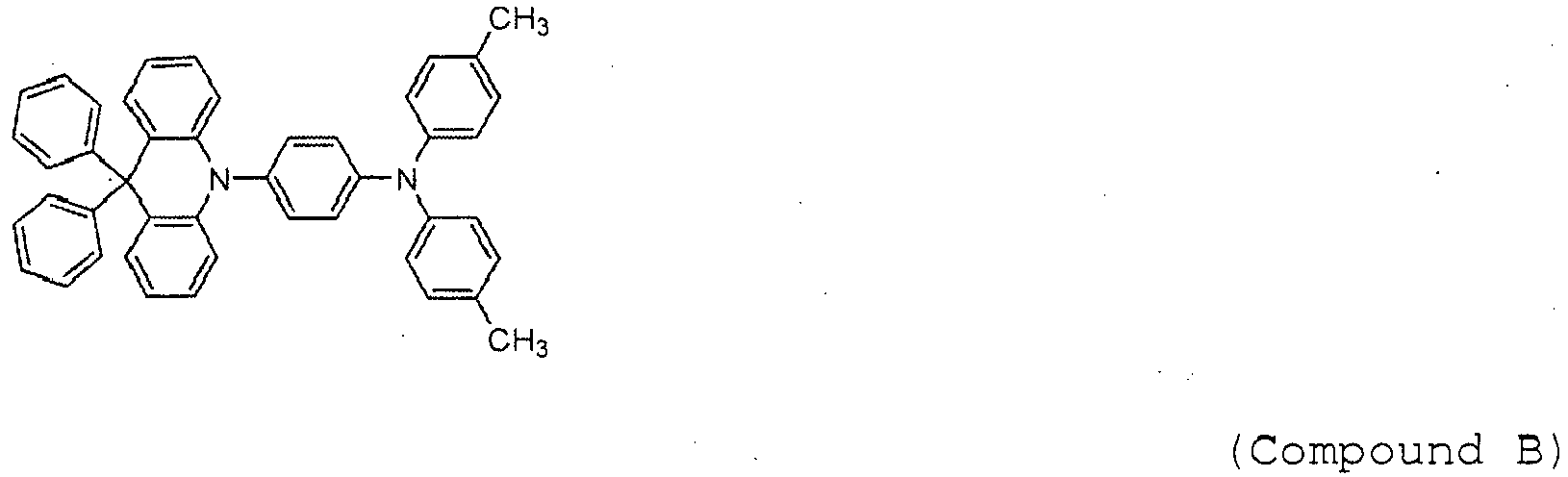
- Arylamine compounds of the following formulae having a substituted acridan structure are proposed as compounds improved in the characteristics such as heat resistance, hole injectability and electron blocking performance (refer to Patent Documents 3 and 4, for example).
- An object of the present invention is to provide an organic compound with characteristics excelling in hole-injecting/transporting performance and having electron blocking ability, high stability in a thin-film state and excellent heat resistance, the organic compound being provided as material for an organic electroluminescent device having high efficiency and high durability.
- This invention also provides the organic electroluminescent device of high efficiency and high durability using this compound.
- Physical properties of the organic compound to be provided by the present invention include (1) good hole injection characteristics, (2) large hole mobility, (3) excellent electron blocking ability, (4) stability in the thin-film state, and (5) excellent heat resistance.
- Physical properties of the organic electroluminescent device to be provided by the present invention include (1) high luminous efficiency and high power efficiency, (2) low turn on voltage, and (3) low actual driving voltage.
- the present inventors designed compounds having an acridan ring structure in anticipation of the high hole-injecting/transporting ability of an aromatic tertiary amine structure, the electron blocking performance of the acridan ring structure, and the effect of heat resistance and thin-film stability of these partial structures.
- the present inventors produced various test organic electroluminescent devices using the compounds chemically synthesized to have the acridan ring structure, and the present invention was completed after thorough evaluations of the device characteristics.
- linear or branched alkyl of 1 to 6 carbon atoms examples include methyl, ethyl, n-propyl, isopropyl, n-butyl, isobutyl, tert-butyl, n-pentyl, isopentyl, neopentyl, n-hexyl, cyclopentyl, cyclohexyl, 1-adamantyl, 2-adamantyl, vinyl
- substituted linear or branched alkyl of 1 to 6 carbon atoms include a deuterium atom, trifluoromethyl, cyano, nitro; halogen atoms such as a fluorine atom, a chlorine atom, a bromine atom, and an iodine atom; linear or branched alkoxy of 1 to 6 carbon atoms such as methoxy, ethoxy, and propyloxy; alkenyl such as allyl; aryloxy such as phenoxy and tolyloxy; arylalkoxy such as benzyloxy and phenethyloxy; aromatic hydrocarbon groups or condensed polycyclic aromatic groups such as pheny
- substituents may be further substituted with other substituents. Further, these substituents may bind to each other via a single bond, substituted or unsubstituted methylene,, an oxygen atom, or a sulfur atom to form a ring.
- substituents may be further substituted with other substituents. Further, these substituents may bind to each other via a single bond, substituted or unsubstituted methylene, an oxygen atom, or a sulfur atom to form a ring.
- aromatic hydrocarbon group aromatic heterocyclic group
- condensed polycyclic aromatic group in the "substituted or unsubstituted aromatic hydrocarbon group", “substituted or unsubstituted aromatic heterocyclic group”, or “substituted or unsubstituted condensed polycyclic aromatic group” represented by R 5 to R 9 in general formula (1) and (2) include phenyl, biphenylyl, terphenylyl, naphthyl, anthryl, phenanthryl, fluorenyl, indenyl, pyrenyl, perylenyl, fluoranthenyl, triphenylenyl, pyridyl, furyl, pyranyl, thienyl, quinolyl, isoquinolyl, benzofuranyl, benzothienyl, indolyl, carbazolyl, benzoxazolyl, benzothiazolyl, quinoxalyl
- the "aromatic heterocyclic group" in the "substituted or unsubstituted aromatic heterocyclic group” represented by R 5 to R 7 in general formulae (1) and (2) is a sulfur-containing aromatic heterocyclic group such as thienyl, benzothienyl, benzothiazolyl, and dibenzothienyl.
- substituted aromatic hydrocarbon group substituted aromatic heterocyclic group
- substituted condensed polycyclic aromatic group represented by R 5 to R 9 in general formulae (1) and (2)
- substituents include a deuterium atom, trifluoromethyl, cyano, nitro; halogen atoms such as a fluorine atom, a chlorine atom, a bromine atom, and an iodine atom; linear or branched alkyl of 1 to 6 carbon atoms such as methyl, ethyl, n-propyl, isopropyl, n-butyl, isobutyl, tert-butyl, n-pentyl, isopentyl, neopentyl, and n-hexyl; linear or branched alkoxy of 1 to 6 carbon atoms such as methoxy, ethoxy, and propyloxy; alkeny
- aryloxy in the "substituted or unsubstituted aryloxy” represented by R 1 to R 7 in general formulae (1) and (2) include phenoxy, tolyloxy, biphenylyloxy, terphenylyloxy, naphthyloxy, anthryloxy, phenanthryloxy, fluorenyloxy, indenyloxy, pyrenyloxy, and perylenyloxy. These groups may bind to each other via a single bond, substituted or unsubstituted methylene, an oxygen atom, or a sulfur atom to form a ring.
- substituted aryloxy represented by R 1 to R 7 in general formulae (1) and (2)
- substituents include a deuterium atom, trifluoromethyl, cyano, nitro; halogen atoms such as a fluorine atom, a chlorine atom, a bromine atom, and an iodine atom; linear or branched alkyl of 1 to 6 carbon atoms such as methyl, ethyl, n-propyl, isopropyl, n-butyl, isobutyl, tert-butyl, n-pentyl, isopentyl, neopentyl, and n-hexyl; linear or branched alkoxy of 1 to 6 carbon atoms such as methoxy, ethoxy, and propyloxy; alkenyl such as allyl; aralkyl such as benzyl, naphthylmethyl, and
- aromatic hydrocarbon group aromatic heterocyclic group
- condensed polycyclic aromatic group in the "substituted or unsubstituted aromatic hydrocarbon group", “substituted or unsubstituted aromatic heterocyclic group”, or “substituted or unsubstituted condensed polycyclic aromatic group” represented by Ar 1 and Ar 2 in general formulae (1) and (2) include phenyl, biphenylyl, terphenylyl, naphthyl, anthryl, phenanthryl, fluorenyl, indenyl, pyrenyl, perylenyl, fluoranthenyl, triphenylenyl, pyridyl, furyl, pyranyl, thienyl, quinolyl, isoquinolyl, benzofuranyl, benzothienyl, indolyl, carbazolyl, benzoxazolyl, benzothiazolyl, quinoxaly
- the "aromatic heterocyclic group" in the "substituted or unsubstituted aromatic heterocyclic group” represented by Ar 1 and Ar 2 in general formulae (1) and (2) is a sulfur and nitrogen-containing aromatic heterocyclic group such as thienyl, benzothienyl, benzothiazolyl, and dibenzothienyl, and sulfur-nitrogen-containing aromatic heterocyclic group.
- substituted aromatic hydrocarbon group substituted aromatic heterocyclic group
- substituted condensed polycyclic aromatic group represented by Ar 1 and Ar 2 in general formulae (1) and (2)
- substituents include a deuterium atom, trifluoromethyl, cyano, nitro; halogen atoms such as a fluorine atom, a chlorine atom, a bromine atom, and an iodine atom; linear or branched alkyl of 1 to 6 carbon atoms such as methyl, ethyl, n-propyl, isopropyl, n-butyl, isobutyl, tert-butyl, n-pentyl, isopentyl, neopentyl, and n-hexyl; linear or branched alkoxy of 1 to 6 carbon atoms such as methoxy, ethoxy, and propyloxy; alkeny
- substituents may be further substituted. Further, these substituents may bind to each other, or to the "substituted aromatic hydrocarbon group", “substituted aromatic heterocyclic group”, or “substituted condensed polycyclic aromatic group” represented by Ar 1 and Ar 2 via a single bond, substituted or unsubstituted methylene, an oxygen atom, or a sulfur atom to form a ring.
- R 8 and R 9 in general formulae (1) and (2) are "linear or branched alkyl of 1 to 6 carbon atoms that may have a substituent", particularly preferably methyl, ethyl, and propyl.
- Ar 1 and Ar 2 in general formulae (1) and (2) are "substituted or unsubstituted aromatic hydrocarbon groups", “substituted or unsubstituted condensed polycyclic aromatic groups", or “carbazolyl groups having a substituent selected from an aromatic hydrocarbon groups, an aromatic heterocyclic groups, or a condensed polycyclic aromatic groups at the ninth position", or "sulfur-containing aromatic heterocyclic groups", or “sulfur and nitorogen-containing aromatic heterocyclic groups”, particularly preferably substituted or unsubstituted phenyl, substituted or unsubstituted biphenylyl, substituted or unsubstituted terphenylyl, substituted or unsubstituted naphthyl, substituted or unsubstituted phenanthryl, 9,9'-dimethylfluorenyl, 9-phenyl-9H-carbazolyl, and substituted or unsubstituted triphenyleny
- the compounds of general formulae (1) and (2) having an acridan ring structure of the present invention are novel compounds and have superior electron blocking ability, superior amorphousness and a more stable thin-film state compared to conventional hole transport materials.
- the compounds of general formulae (1) and (2) having an acridan ring structure of the present invention can be used as a constituent material of the hole injection layer and/or hole transport layer of an organic electroluminescent device (hereinafter referred to as an organic EL device).
- an organic EL device With the use of material having higher hole injectability, higher mobility, higher electron blocking performance and higher stability to electrons than conventional materials, excitons generated in a light emitting layer can be confined, and the probability of hole-electron recombination can be improved. This improves luminous efficiency, lowers driving voltage and thus improves the durability of the organic EL device.
- the compounds of general formulae (1) and (2) having an acridan ring structure of the present invention can also be used as a constituent material of the electron blocking layer of an organic EL device.
- driving voltage is lowered and current resistance is improved while maintaining high luminous efficiency.
- the maximum emission luminance of the organic EL device is improved.
- the compounds of general formulae (1) and (2) having an acridan ring structure of the present invention can also be used as a constituent material of the light emitting layer of the organic EL device.
- the material of the present invention having superior hole transportability and a wider band gap than conventional materials is used as the host material of the light emitting layer in order to form the light emitting layer by carrying a fluorescent material or phosphorescent material called a dopant. In this way, the organic EL device with a low driving voltage and improved luminous efficiency can be achieved.
- the high efficiency and high durability of the organic EL device in the present invention can be achieved because of the use of the compound having an acridan ring structure, which has greater hole mobility, superior electron blocking ability and superior amorphousness than conventional hole transport materials as well as a stable thin-film state.
- the compound having an acridan ring structure of the present invention is useful as the constituent material of the hole injection layer, hole transport layer, electron blocking layer, or light emitting layer of the organic EL device.
- the compound has an excellent electron blocking ability and satisfactory amorphousness, and excels in heat resistance as well as a stable thin-film state.
- the organic EL device of the present invention has high luminous efficiency and high power efficiency, and the actual driving voltage of the device can thereby be lowered.
- the compounds having an acridan ring structure of the present invention are novel compounds, and may be synthesized by using, for example, the following method.
- This bromo compound can then be used to synthesize the compound having an acridan ring structure in a cross-coupling reaction such as Suzuki coupling (refer to Non-Patent Document 5, for example) with boronic acid or boronate synthesized by reaction with pinacolborane or bis(pinacolato)diboron (refer to Non-Patent Document 4, for example).
- a cross-coupling reaction such as Suzuki coupling (refer to Non-Patent Document 5, for example) with boronic acid or boronate synthesized by reaction with pinacolborane or bis(pinacolato)diboron (refer to Non-Patent Document 4, for example).
- the compound having an acridan ring structure may be synthesized to include substituents at different positions by the cross-coupling reaction of an acridan substituted with an aryl group at the 10 position after obtaining a bromo compound having substituents at different positions by changing reagents and conditions of bromination.
- Tg glass transition point
- Tg glass transition point
- a melting point a melting point
- a work function an index of hole transportability
- the glass transition point (Tg) and the melting point were measured by a high-sensitive differential scanning calorimeter (DSC3100S produced by Bruker AXS) using powder.
- a 100 nm-thick thin film was fabricated on an ITO substrate, and an atmosphere photoelectron spectrometer (AC-3 produced by Riken Keiki Co., Ltd.) was used.
- the organic EL device of the present invention may have a structure including an anode, a hole transport layer, an electron blocking layer, a light emitting layer, an electron transport layer, and a cathode successively formed on a substrate, optionally with a hole injection layer between the anode and the hole transport layer, or with an electron injection layer between the electron transport layer and the cathode.
- some of the organic layers may be omitted.
- the device may be configured to include an anode, a hole transport layer, a light emitting layer, an electron transport layer, and a cathode successively formed on a substrate.
- Electrode materials with high work functions such as ITO and gold are used as the anode of the organic EL device of the present invention.
- the hole injection layer of the organic EL device of the present invention may be made of material such as porphyrin compounds as represented by copper phthalocyanine, starburst-type triphenylamine derivatives, various triphenylamine tetramers, accepting heterocyclic compounds such as hexacyano azatriphenylene, and coating-type polymer materials, in addition to the compounds of general formula (1) having an acridan ring structure of the present invention. These materials may be formed into a thin film by a vapor deposition method or other known methods such as a spin coating method and an inkjet method.
- Examples of material used for the hole transport layer of the organic EL device of the present invention can be benzidine derivatives such as N,N'-diphenyl-N,N'-di(m-tolyl)benzidine (hereinafter referred to as TPD), N,N'-diphenyl-N,N'-di( ⁇ -naphthyl)benzidine (hereinafter referred to as NPD), and N,N,N',N'-tetrabiphenylylbenzidine; 1,1-bis[4-(di-4-tolylamino)phenyl]cyclohexane (hereinafter referred to as TAPC); and various triphenylamine trimers and tetramers, in addition to the compounds of general formula (1) having an acridan ring structure of the present invention.
- TPD N,N'-diphenyl-N,N'-di(m-tolyl)benzidine
- NPD N,N'-diphenyl-N,
- PEDOT poly(3,4-ethylenedioxythiophene)
- PSS poly(styrene sulfonate)
- material used for the hole injection layer or the hole transport layer may be obtained by p-doping trisbromophenylamine hexachloroantimony or the like into the material commonly used for these layers, or may be, for example, polymer compounds each having a TPD structure as a part of the compound structure.
- Examples of material used for the electron blocking layer of the organic EL device of the present invention can be compounds having an electron blocking effect, including, for example, carbazole derivatives such as 4,4',4" -tri(N-carbazolyl)triphenylamine (hereinafter referred to as TCTA), 9,9-bis[4-(carbazol-9-yl)phenyl]fluorene, 1,3-bis(carbazol-9-yl)benzene (hereinafter referred to as mCP), and 2,2-bis(4-carbazol-9-ylphenyl)adamantane (hereinafter referred to as Ad-Cz); and compounds having a triphenylsilyl group and a triarylamine structure, as represented by 9-[4-(carbazol-9-yl)phenyl]-9-[4-(triphenylsilyl)phenyl]-9H-fluorene, in addition to the compounds of general formula (1) having an acridan ring structure of the present invention
- These may be individually deposited for film forming, may be used as a single layer deposited mixed with other materials, or may be formed as a laminate of individually deposited layers, a laminate of mixedly deposited layers, or a laminate of the individually deposited layer and the mixedly deposited layer. These materials may be formed into a thin-film by using a vapor deposition method or other known methods such as a spin coating method and an inkjet method.
- Examples of material used for the light emitting layer of the organic EL device of the present invention can be various metal complexes, anthracene derivatives, bis(styryl)benzene derivatives, pyrene derivatives, oxazole derivatives, and polyparaphenylene vinylene derivatives, in addition to quinolinol derivative metal complexes such as Alq 3 .
- the light emitting layer may comprise a host material and a dopant material.
- Examples of the host material can be thiazole derivatives, benzimidazole derivatives, and polydialkyl fluorene derivatives, in addition to the above light-emitting materials and the compounds of general formula (1) having an acridan ring structure of the present invention.
- Examples of the dopant material can be quinacridone, coumarin, rubrene, perylene, derivatives thereof, benzopyran derivatives, rhodamine 'derivatives, and aminostyryl derivatives. These may be individually deposited for film forming, may be used as a single layer deposited mixed with other materials, or may be formed as a laminate of individually deposited layers, a laminate of mixedly deposited layers, or a laminate of the individually deposited layer and the mixedly deposited layer.
- the light-emitting material may be a phosphorescent light-emitting material.
- Phosphorescent materials as metal complexes of metals such as iridium and platinum may be used as the phosphorescent light-emitting material.
- Examples of the phosphorescent materials can be green phosphorescent materials such as Ir(ppy) 3 , blue phosphorescent materials such as FIrpic and FIr 6 , and red phosphorescent materials such as Btp 2 Ir(acac).
- the compounds of general formula (1) having an acridan ring structure of the present invention may be used in addition to carbazole derivatives such as 4,4'-di (N-carbazolyl)biphenyl (hereinafter referred to as CBP), TCTA, and mCP.
- CBP 4,4'-di (N-carbazolyl)biphenyl
- TCTA 4,4'-di (N-carbazolyl)biphenyl
- mCP mCP.
- Compounds such as p-bis(triphenylsilyl)benzene (hereinafter referred to as UGH2) and 2,2',2 '-(1,3,5-phenylene)-tris(1-phenyl-1H-benzimidazole) (hereinafter referred to as TPBI) may be used as the electron transporting host material to produce a high-performance organic EL device.
- UGH2 p-bis(triphenylsilyl)benzen
- the host material In order to avoid concentration quenching, it is preferable to dope the host material with the phosphorescent light-emitting material by co-evaporation in a range of 1 to 30 weight percent to the whole light emitting layer.
- These materials may be formed into a thin-film by using a vapor deposition method or other known methods such as a spin coating method and an inkjet method.
- the hole blocking layer of the organic EL device of the present invention may be formed by using hole blocking compounds such as various rare earth complexes, triazole derivatives, triazine derivatives, and oxadiazole derivatives, in addition to the metal complexes of phenanthroline derivatives such as bathocuproin (hereinafter referred to as BCP), and the metal complexes of quinolinol derivatives such as aluminum(III) bis(2-methyl-8-quinolinate)-4-phenylphenolate (hereinafter referred to as BAlq). These materials may also serve as the material of the electron transport layer.
- BCP bathocuproin
- BAlq aluminum(III) bis(2-methyl-8-quinolinate)-4-phenylphenolate
- These may be individually deposited for film forming, may be used as a single layer deposited mixed with other materials, or may be formed as a laminate of individually deposited layers, a laminate of mixedly deposited layers, or a laminate of the individually deposited layer and the mixedly deposited layer. These materials may be formed into a thin-film by using a vapor deposition method or other known methods such as a spin coating method and an inkjet method.
- Examples of material used for the electron transport layer of the organic EL device of the present invention can be various metal complexes, triazole derivatives, triazine derivatives, oxadiazole derivatives, thiadiazole derivatives, carbodiimide derivatives, quinoxaline derivatives, phenanthroline derivatives, and silole derivatives, in addition to the metal complexes of quinolinol derivatives such as Alq 3 and BAlq.
- These may be individually deposited for film forming, may be used as a single layer deposited mixed with other materials, or may be formed as a laminate of individually deposited layers, a laminate of mixedly deposited layers, or a laminate of the individually deposited layer and the mixedly deposited layer.
- These materials may be formed into a thin-film by using a vapor deposition method or other known methods such as a spin coating method and an inkjet method.
- Examples of material used for the electron injection layer of the organic EL device of the present invention can be alkali metal salts such as lithium fluoride and cesium fluoride; alkaline earth metal salts such as magnesium fluoride; and metal oxides such as aluminum oxide.
- the electron injection layer may be omitted in the preferred selection of the electron transport layer and the cathode.
- the cathode of the organic EL device of the present invention may be made of an electrode material with a low work function such as aluminum, or an alloy of an electrode material with an even lower work function such as a magnesium-silver alloy, a magnesium-indium alloy, or an aluminum-magnesium alloy.
- the mixture was heated after adding tetrakis(triphenylphosphine)palladium (0.24 g), and stirred at 67°C for 5 hours. After the mixture was allowed to cool to room temperature, toluene (50 ml) was added to perform liquid separation in order to collect an organic layer. The organic layer was washed with water (50 ml), dried over anhydrous magnesium sulfate, and concentrated under reduced pressure to obtain a crude product. The crude product was purified by column chromatography (support: silica gel, eluent: hexane/toluene).
- the structure of the product white powder was identified by NMR.
- the 1 H-NMR measurement result is shown in FIG. 1 .
- 2-bromo-10-(9,9-dimethyl-9H-fluoren-2-yl)- 9,9-dimethylacridan (7.00 g), 4,4,5,5-tetramethyl-2-(triphenylene-2-yl)-[1,3,2]dioxaborolane (5.16 g), tetrakis(triphenylphosphine)palladium (0.34 g), potassium carbonate (4.03 g), toluene (40 ml), ethanol (10 ml), and water (15 ml) were added to a reaction vessel in a nitrogen atmosphere, heated, and stirred for 3 hours under reflux.
- the structure of the product white powder was identified by NMR.
- the 1 H-NMR measurement result is shown in FIG. 2 .
- 1-bromo-4-(dibenzofuran-2-yl)benzene (11.0 g), 4,4,5,5-tetramethyl-2-(10-phenyl-2,9,9-trimethylacridan-7-yl)-[1,3,2]dioxaborolane (17.3 g), tetrakis(triphenylphosphine)palladium (0.78 g), potassium carbonate (7.05 g), toluene (110 ml), ethanol (18 ml), and water (25 ml) were added to a reaction vessel in a nitrogen atmosphere, heated, and stirred for 6.5 hours under reflux.
- the structure of the product white powder was identified by NMR.
- the 1 H-NMR measurement result is shown in FIG. 3 .
- the melting points and the glass transition points of the compounds of the present invention were determined using a high-sensitive differential scanning calorimeter (DSC3100S produced by Bruker AXS). Melting point Glass transition point Compound of Example 1 of the present invention 253°C 134°C Compound of Example 2 of the present invention 262°C 139°C
- the compounds of the present invention had glass transition points of 100°C or more. This indicates that the compounds of the present invention have a stable thin-film state.
- a 100 nm-thick vapor-deposited film was fabricated on an ITO substrate using the compounds of the present invention.
- the work function was measured using an atmosphere photoelectron spectrometer (AC-3 produced by Riken Keiki Co., Ltd.).
- Work function Compound of Example 1 of the present invention 5.48 eV
- Compound of Example 2 of the present invention 5.48 eV
- the compounds of the present invention have more desirable energy levels and more desirable hole transportability than common hole transport materials such as NPD and TPD having work functions of 5.4 eV.
- the organic EL device as illustrated in FIG. 4 , was fabricated from a hole injection layer 3, a hole transport layer 4, a light emitting layer 5, an electron transport layer 6, an electron injection layer 7, and a cathode (aluminum electrode) 8 successively formed by vapor deposition on a glass substrate 1 that had been provided beforehand with an ITO electrode as a transparent anode 2.
- the glass substrate 1 having ITO (thickness 150 nm) formed thereon was washed with an organic solvent, and subjected to an oxygen plasma treatment to wash the surface.
- the glass substrate with the ITO electrode was then installed in a vacuum vapor deposition apparatus, and the pressure was reduced to 0.001 Pa or less.
- the hole transport layer 4 was then formed on the hole injection layer 3 by forming the compound of Example 1 of the present invention (Compound 69) in a thickness of 40 nm.
- the electron transport layer 6 was then formed on the light emitting layer 5 by forming Alq 3 in a thickness of 30 nm.
- the electron injection layer 7 was formed on the electron transport layer 6 by forming lithium fluoride in a thickness of 0.5 nm.
- the cathode 8 was formed by vapor depositing aluminum in a thickness of 150 nm. The characteristics of the organic EL device thus fabricated were measured in an atmosphere at ordinary temperature.
- Table 1 summarizes the results of the emission characteristics measurements performed by applying a DC voltage to the organic EL device fabricated with the compound of Example 1 of the present invention (Compound 69).
- An organic EL device was fabricated under the same conditions used in Example 6, except that the hole transport layer 4 was formed by forming the compound of Example 2 of the present invention (Compound 71) in a thickness of 40 nm, instead of using the compound of Example 1 of the present invention (Compound 69).
- the characteristics of the organic EL device thus fabricated were measured in an atmosphere at ordinary temperature. Table 1 summarizes the results of the emission characteristics measurements performed by applying a DC voltage to the fablicated organic EL device.
- an organic EL device was fabricated under the same conditions used in Example 6, except that the hole transport layer 4 was formed by forming Compound 87 of the structural formula below in a thickness of 40 nm, instead of using the compound of Example 1 of the present invention (Compound 69).
- the characteristics of the organic EL device thus fabricated were measured in an atmosphere at ordinary temperature. Table 1 summarizes the results of the emission characteristics measurements performed by applying a DC voltage to the fablicated organic EL device.
- the driving voltage upon passing a current with a current density of 10 mA/cm 2 was 5.30 V for the organic EL device that uses the compound of Example 1 of the present invention (Compound 69), and 5.09 V for the organic EL device that uses the compound of Example 2 of the present invention (Compound 71), comparable to, or even lower than 5.17 V for the organic EL device that uses Compound 87.
- the organic EL devices using the compounds having an acridan ring structure of the present invention can greatly improve luminous efficiency and power efficiency, and can achieve a lower actual driving voltage compared to the organic EL device that uses Compound 87.
- the compounds having an acridan ring structure of the present invention have high hole transportability, an excellent amorphousness, and a stable thin-film state, and are desirable for organic EL devices.
- the organic EL device produced by using the compounds can have high luminous efficiency and high power efficiency, and a low actual driving voltage, and can thus have improved durability. There are potential applications for, for example, home electronic appliances and illuminations.
Landscapes
- Chemical & Material Sciences (AREA)
- Organic Chemistry (AREA)
- Physics & Mathematics (AREA)
- Engineering & Computer Science (AREA)
- Materials Engineering (AREA)
- Spectroscopy & Molecular Physics (AREA)
- Optics & Photonics (AREA)
- Electroluminescent Light Sources (AREA)
- Other In-Based Heterocyclic Compounds (AREA)
- Plural Heterocyclic Compounds (AREA)
Abstract
Description
- The present invention relates to compounds suited for an organic electroluminescent device, a preferred self light-emitting device for various display devices, and to the device. Specifically, the invention relates to compounds having an acridan ring structure, and to organic electroluminescent devices that use the compounds.
- The organic electroluminescent device is a self-emitting device, and has been actively studied for their brighter, superior viewability and ability to display clearer images compared with the liquid crystal device.
- In 1987, C. W. Tang et al. at Eastman Kodak developed a laminated structure device using materials assigned with different roles, realizing practical applications of an organic electroluminescent device with organic materials. These researchers laminated an electron-transporting phosphor which is tris(8-hydroxyquinoline)aluminum (hereinafter referred to as Alq3) and a hole-transporting aromatic amine compound, and injected the both charges into the phosphor layer to cause emission in order to obtain a high luminance of 1,000 cd/m2 or more at a voltage of 10 V or less (refer to
Patent Documents - To date, various improvements have been made for practical applications of the organic electroluminescent device. In order to realize high efficiency and durability, various roles are further subdivided to provide an electroluminescence device that includes an anode, a hole injection layer, a hole transport layer, a light emitting layer, an electron transport layer, an electron injection layer, and a cathode successively formed on a substrate (refer to Non-Patent
Document 1, for example). - Further, there have been attempts to use triplet excitons for further improvements of luminous efficiency, and use of phosphorescent materials has been investigated (refer to Non-Patent
Document 2, for example). - The light emitting layer can be also fabricated by doping a charge-transporting compound, generally called a host material, with a phosphor or a phosphorescent material. As described in the foregoing Lecture Preprints, selection of organic materials in an organic electroluminescent device greatly influences various device characteristics, including efficiency and durability.
- In an organic electroluminescent device, the charges injected from the both electrodes recombine at the light emitting layer to cause emission. What is important here is how efficiently the hole and electron charges are transferred to the light emitting layer. The probability of hole-electron recombination can be improved by improving hole injectability and electron blocking performance of blocking injected electrons from the cathode, and high luminous efficiency can be obtained by confining excitons generated in the light emitting layer. The role of a hole transport material is therefore important, and there is a need for a hole transport material that has high hole injectability, high hole mobility, high electron blocking performance, and high durability to electrons.
- Heat resistance and the amorphousness of the materials are also important with respect to a lifetime of the device. The materials with low heat resistance cause thermal decomposition even at a low temperature by heat generated during the drive of the device, which leads to the deterioration of the materials. The materials with low amorphousness cause crystallization of a thin film even in a short time and lead to the deterioration of the device. The materials in use are therefore required to have characteristics of high heat resistance and satisfactory amorphousness.
- N,N'-diphenyl-N,N'-di(α-naphthyl)benzidine (hereinafter referred to as NPD) and various aromatic amine derivatives are known as the hole transport materials used for the organic electroluminescent device (refer to
Patent Documents Document 3, for example). The aromatic amine derivatives described in thePatent Documents - Arylamine compounds of the following formulae having a substituted acridan structure (for example, Compounds A and B) are proposed as compounds improved in the characteristics such as heat resistance, hole injectability and electron blocking performance (refer to
Patent Documents 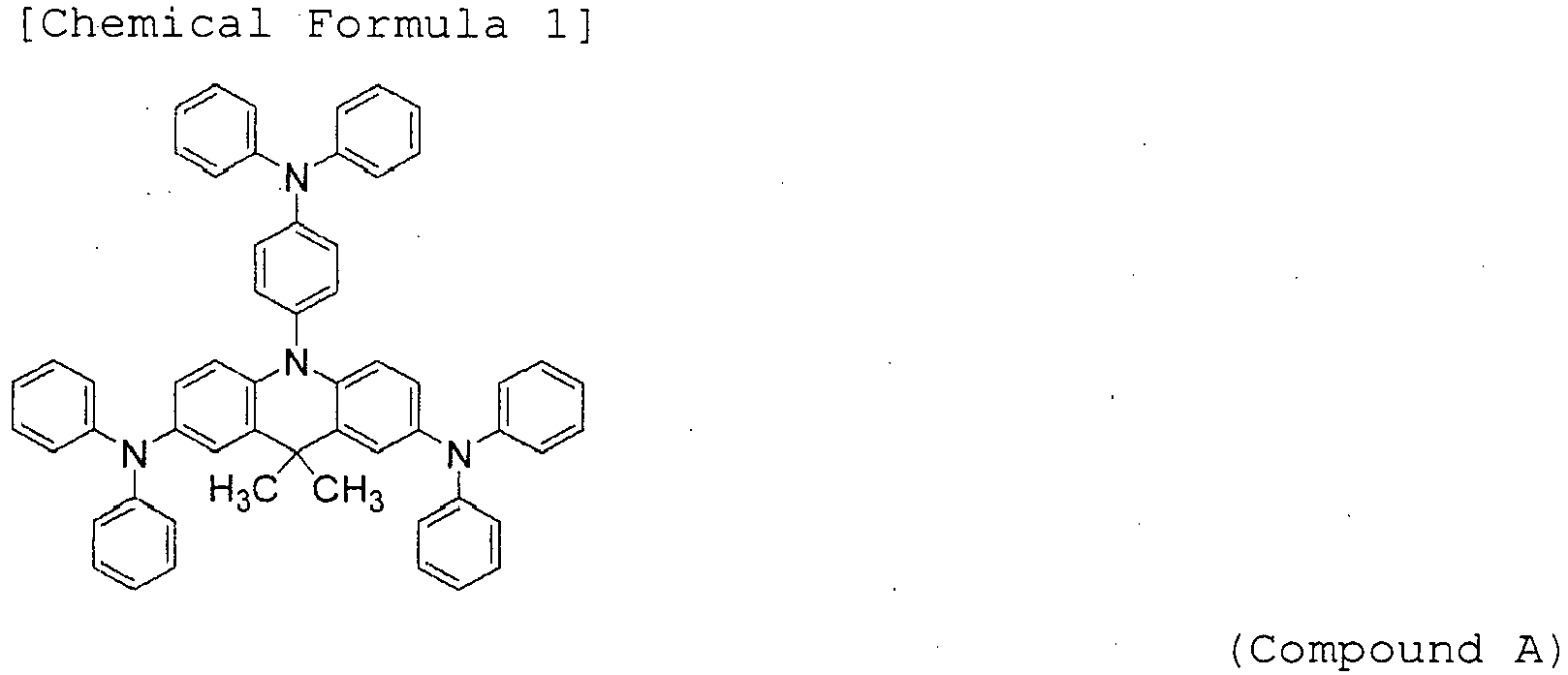

- However, while the devices using these compounds for the hole injection layer or the hole transport layer have been improved in heat resistance, luminous efficiency and the like, the improvements are still insufficient. Further, it cannot be said to have a sufficiently low driving voltage and sufficient current efficiency, and there is a problem also in amorphousness. Further improvements of a low driving voltage and luminous efficiency while increasing amorphousness are therefore needed.
-
- Patent Document 1:
JP-A-8-48656 - Patent Document 2: Japanese Patent No.
3194657 - Patent Document 3:
WO2006/033563 - Patent Document 4:
WO2007/110228 -
- Non-Patent Document 1: The Japan Society of Applied Physics, 9th Lecture Preprints, pp. 55 to 61 (2001)
- Non-Patent Document 2: The Japan Society of Applied Physics, 9th Lecture Preprints, pp. 23 to 31 (2001)
- Non-Patent Document 3: Organic EL Symposium, the 3rd Regular presentation Preprints, pp. 13 to 14 (2006)
- Non-Patent Document 4: J. Org. Chem., 60, 7508 (1995)
- Non-Patent Document 5: Chem. Rev., 95, 2457 (1995)
- An object of the present invention is to provide an organic compound with characteristics excelling in hole-injecting/transporting performance and having electron blocking ability, high stability in a thin-film state and excellent heat resistance, the organic compound being provided as material for an organic electroluminescent device having high efficiency and high durability. This invention also provides the organic electroluminescent device of high efficiency and high durability using this compound.
- Physical properties of the organic compound to be provided by the present invention include (1) good hole injection characteristics, (2) large hole mobility, (3) excellent electron blocking ability, (4) stability in the thin-film state, and (5) excellent heat resistance. Physical properties of the organic electroluminescent device to be provided by the present invention include (1) high luminous efficiency and high power efficiency, (2) low turn on voltage, and (3) low actual driving voltage.
- In order to achieve the above objects, the present inventors designed compounds having an acridan ring structure in anticipation of the high hole-injecting/transporting ability of an aromatic tertiary amine structure, the electron blocking performance of the acridan ring structure, and the effect of heat resistance and thin-film stability of these partial structures. The present inventors produced various test organic electroluminescent devices using the compounds chemically synthesized to have the acridan ring structure, and the present invention was completed after thorough evaluations of the device characteristics.
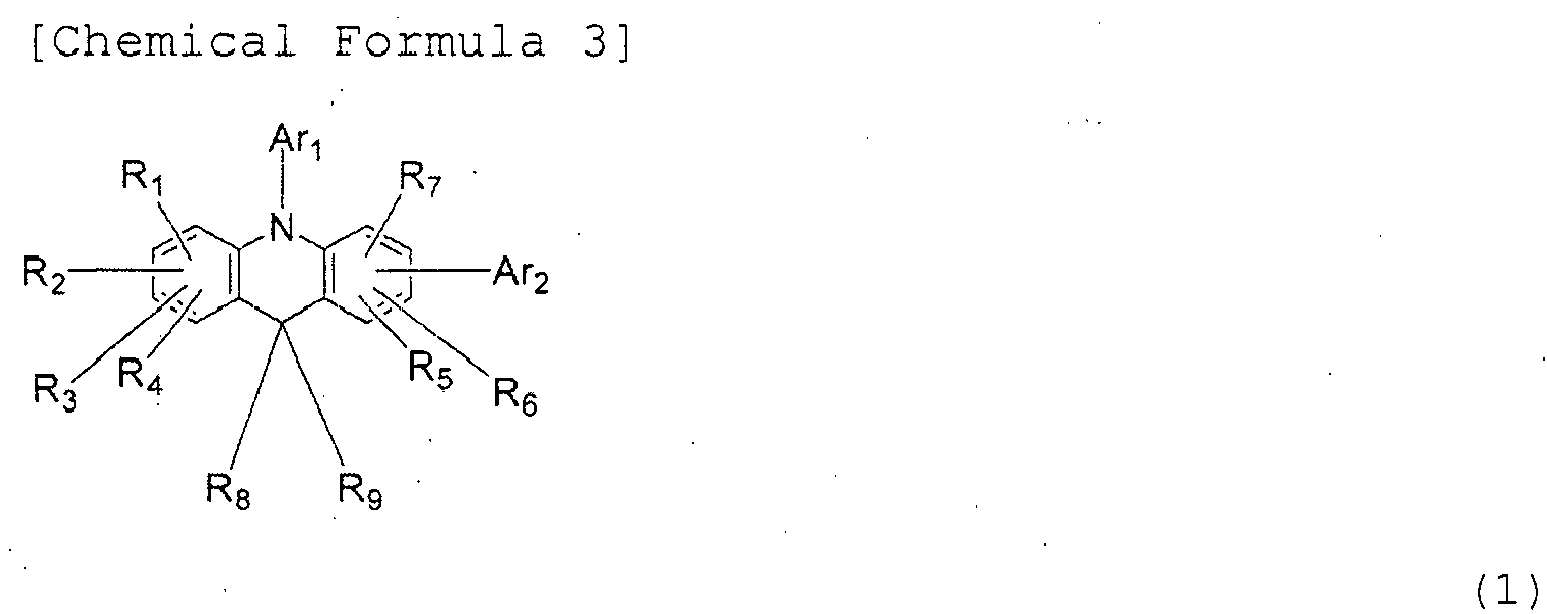
- 1) Specifically, the present invention is a compound of the following general formula (1) having an acridan ring structure.
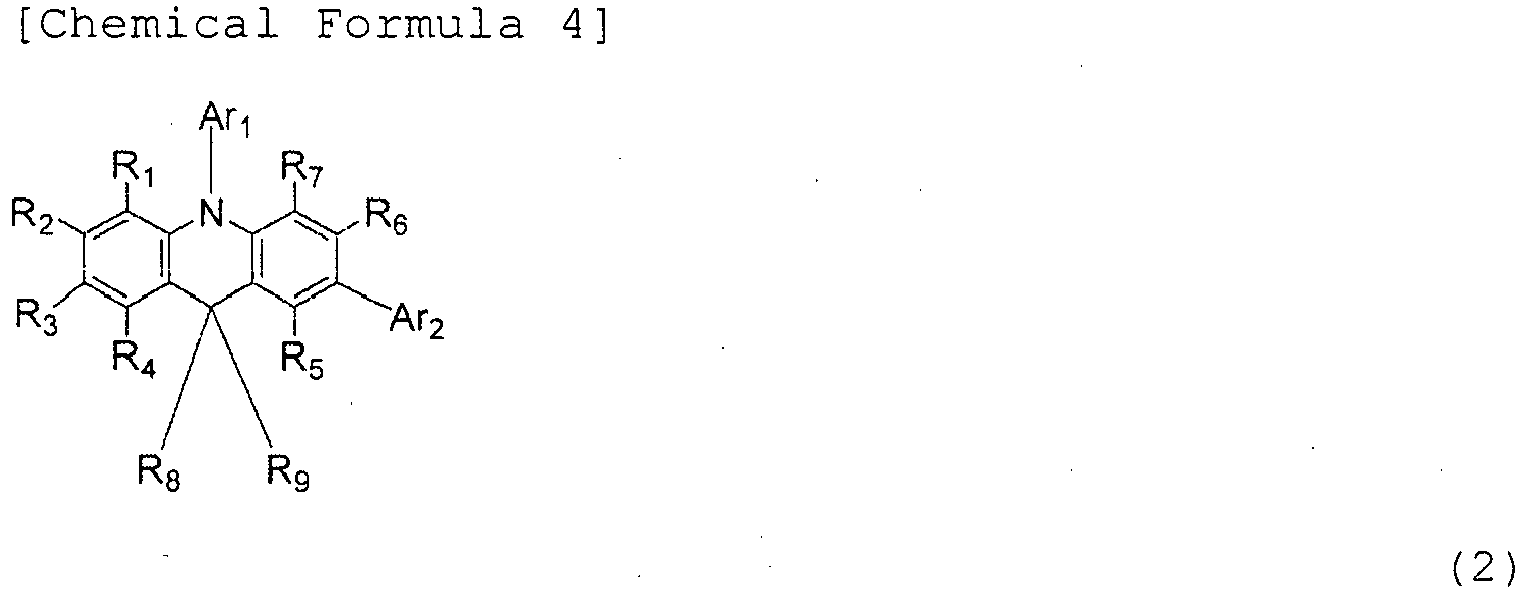
- 2) The present invention is a compound of the following general formula (2) having an acridan ring structure.
- 3) The present invention is a compound of the general formula (1) having an acridan ring structure in which R8 and R9 are methyl.
- 4) The present invention is a compound of the general formula (1) having an acridan ring structure in which Ar1 is substituted or unsubstituted biphenylyl.
- 5) The present invention is a compound of the general formula (1) having an acridan ring structure in which Ar1 is substituted or unsubstituted 9,9'-dimethylfluorenyl.
- 6) The present invention is a compound of the general formula (1) having an acridan ring structure in which Ar1 is substituted or unsubstituted phenyl.
- 7) The present invention is a compound of the general formula (1) having an acridan ring structure in which Ar2 is substituted or unsubstituted condensed polycyclic aromatic group.
- 8) The present invention is a compound of the general formula (1) having an acridan ring structure in which Ar2 is carbazolyl having a substituent selected from aromatic hydrocarbon groups, aromatic heterocyclic groups, or condensed polycyclic aromatic groups at the ninth position.
- 9) The present invention is a compound of the general formula (1) having an acridan ring structure in which Ar2 is phenyl having a substituent selected from aromatic hydrocarbon groups, aromatic heterocyclic groups, or condensed polycyclic aromatic groups.
- 10) The present invention is an organic electroluminescent device that includes a pair of electrodes, and one or more organic layers sandwiched between the pair of electrodes, wherein the compound of the general formula (1) or (2) having an acridan ring structure is used as a constituent material of at least one of the organic layers.
- 11) The present invention is an organic electroluminescent device, wherein the organic layer is a hole transport layer.
- 12) The present invention is an organic electroluminescent device, wherein the organic layer is a electron blocking layer.
- 13) The present invention is an organic electroluminescent device, wherein the organic layer is a hole injection layer.
- 14) The present invention is an organic electroluminescent device, wherein the organic layer is a light emitting layer.
- Specific examples of the "linear or branched alkyl of 1 to 6 carbon atoms", "cycloalkyl of 5 to 10 carbon atoms", or "linear or branched alkenyl of 2 to 6 carbon atoms" in the "linear or branched alkyl of 1 to 6 carbon atoms that may have a substituent", "cycloalkyl of 5 to 10 carbon atoms that may have a substituent", or "linear or branched alkenyl of 2 to 6 carbon atoms that may have a substituent" represented by R1 to R9 in general formulae (1) and (2) include methyl, ethyl, n-propyl, isopropyl, n-butyl, isobutyl, tert-butyl, n-pentyl, isopentyl, neopentyl, n-hexyl, cyclopentyl, cyclohexyl, 1-adamantyl, 2-adamantyl, vinyl, allyl, isopropenyl, and 2-butenyl. These groups may bind to each other via a single bond, substituted or unsubstituted methylene, an oxygen atom, or a sulfur atom to form a ring.
- Specific examples of the "substituent" in the "substituted linear or branched alkyl of 1 to 6 carbon atoms", "substituted cycloalkyl of 5 to 10 carbon atoms", or "substituted linear or branched alkenyl of 2 to 6 carbon atoms" represented by R1 to R9 in general formulae (1) and (2) include a deuterium atom, trifluoromethyl, cyano, nitro; halogen atoms such as a fluorine atom, a chlorine atom, a bromine atom, and an iodine atom; linear or branched alkoxy of 1 to 6 carbon atoms such as methoxy, ethoxy, and propyloxy; alkenyl such as allyl; aryloxy such as phenoxy and tolyloxy; arylalkoxy such as benzyloxy and phenethyloxy; aromatic hydrocarbon groups or condensed polycyclic aromatic groups such as phenyl, biphenylyl, terphenylyl, naphthyl, anthracenyl, phenanthryl, fluorenyl, indenyl, pyrenyl, perylenyl, fluoranthenyl, and triphenylenyl; and aromatic heterocyclic groups such as pyridyl, pyranyl, thienyl, furyl, pyrrolyl, quinolyl, isoquinolyl, benzofuranyl, benzothienyl, indolyl, carbazolyl, benzoxazolyl, benzothiazolyl, quinoxalyl, benzoimidazolyl, pyrazolyl, dibenzofuranyl, dibenzothienyl, and carbolinyl. These substituents may be further substituted with other substituents. Further, these substituents may bind to each other via a single bond, substituted or unsubstituted methylene,, an oxygen atom, or a sulfur atom to form a ring.
- Specific examples of the "linear or branched alkyloxy of 1 to 6 carbon atoms" or "cycloalkyloxy of 5 to 10 carbon atoms" in the "linear or branched alkyloxy of 1 to 6 carbon atoms that may have a substituent" or "cycloalkyloxy of 5 to 10 carbon atoms that may have a substituent" represented by R1 to R9 in general formulae (1) and (2) include methyloxy, ethyloxy, n-propyloxy, isopropyloxy, n-butyloxy, tert-butyloxy, n-pentyloxy, n-hexyloxy, cyclopentyloxy, cyclohexyloxy, cycloheptyloxy, cyclooctyloxy, 1-adamantyloxy, and 2-adamantyloxy. These groups may bind to each other via a single bond, substituted or unsubstituted methylene, an oxygen atom, or a sulfur atom to form a ring.
- Specific examples of the "substituent" in the "substituted linear or branched alkyloxy of 1 to 6 carbon atoms" or "substituted cycloalkyloxy of 5 to 10 carbon atoms" represented by R1 to R9 in general formulae (1) and (2) include a deuterium atom, trifluoromethyl, cyano, nitro; halogen atoms such as a fluorine atom, a chlorine atom, a bromine atom, and an iodine atom; linear or branched alkoxy of 1 to 6 carbon atoms such as methoxy, ethoxy, and propyloxy; alkenyl such as allyl; aryloxy such as phenoxy and tolyloxy; arylalkoxy such as benzyloxy and phenethyloxy; aromatic hydrocarbon groups or condensed polycyclic aromatic groups such as phenyl, biphenylyl, terphenylyl, naphthyl, anthracenyl, phenanthryl, fluorenyl, indenyl, pyrenyl, perylenyl, fluoranthenyl, and triphenylenyl; and aromatic heterocyclic groups such as pyridyl, pyranyl, thienyl, furyl, pyrrolyl, quinolyl, isoquinolyl, benzofuranyl, benzothienyl, indolyl, carbazolyl, benzoxazolyl, benzothiazolyl, quinoxalyl, benzoimidazolyl, pyrazolyl, dibenzofuranyl, dibenzothienyl, and carbolinyl. These substituents may be further substituted with other substituents. Further, these substituents may bind to each other via a single bond, substituted or unsubstituted methylene, an oxygen atom, or a sulfur atom to form a ring.
- Specific examples of the "aromatic hydrocarbon group", "aromatic heterocyclic group", or "condensed polycyclic aromatic group" in the "substituted or unsubstituted aromatic hydrocarbon group", "substituted or unsubstituted aromatic heterocyclic group", or "substituted or unsubstituted condensed polycyclic aromatic group" represented by R5 to R9 in general formula (1) and (2) include phenyl, biphenylyl, terphenylyl, naphthyl, anthryl, phenanthryl, fluorenyl, indenyl, pyrenyl, perylenyl, fluoranthenyl, triphenylenyl, pyridyl, furyl, pyranyl, thienyl, quinolyl, isoquinolyl, benzofuranyl, benzothienyl, indolyl, carbazolyl, benzoxazolyl, benzothiazolyl, quinoxalyl, benzoimidazolyl, pyrazolyl, dibenzofuranyl, dibenzothienyl, and carbolinyl. These groups may bind to each other via a single bond, substituted or unsubstituted methylene, an oxygen atom, or a sulfur atom to form a ring.
- It is preferable that the "aromatic heterocyclic group" in the "substituted or unsubstituted aromatic heterocyclic group" represented by R5 to R7 in general formulae (1) and (2) is a sulfur-containing aromatic heterocyclic group such as thienyl, benzothienyl, benzothiazolyl, and dibenzothienyl.
- Specific examples of the "substituent" in the "substituted aromatic hydrocarbon group", "substituted aromatic heterocyclic group", or "substituted condensed polycyclic aromatic group" represented by R5 to R9 in general formulae (1) and (2) include a deuterium atom, trifluoromethyl, cyano, nitro; halogen atoms such as a fluorine atom, a chlorine atom, a bromine atom, and an iodine atom; linear or branched alkyl of 1 to 6 carbon atoms such as methyl, ethyl, n-propyl, isopropyl, n-butyl, isobutyl, tert-butyl, n-pentyl, isopentyl, neopentyl, and n-hexyl; linear or branched alkoxy of 1 to 6 carbon atoms such as methoxy, ethoxy, and propyloxy; alkenyl such as allyl; aralkyl such as benzyl, naphthylmethyl, and phenethyl; aryloxy such as phenoxy and tolyloxy; arylalkoxy such as benzyloxy and phenethyloxy; aromatic hydrocarbon groups or condensed polycyclic aromatic groups such as phenyl, biphenylyl, terphenylyl, naphthyl, anthracenyl, phenanthryl, fluorenyl, indenyl, pyrenyl, perylenyl, fluoranthenyl, and triphenylenyl; aromatic heterocyclic groups such as pyridyl, pyranyl, thienyl, furyl, pyrrolyl, quinolyl, isoquinolyl, benzofuranyl, benzbthienyl, indolyl, carbazolyl, benzoxazolyl, benzothiazolyl, quinoxalyl, benzoimidazolyl, pyrazolyl, dibenzofuranyl, dibenzothienyl, and carbolinyl; arylvinyl such as styryl and naphthylvinyl; and acyl such as acetyl and benzoyl. These substituents may be further substituted. Further, these substituents may bind to each other via a single bond, substituted or unsubstituted methylene, an oxygen atom, or a sulfur atom to form a ring.
- Specific examples of the "aryloxy" in the "substituted or unsubstituted aryloxy" represented by R1 to R7 in general formulae (1) and (2) include phenoxy, tolyloxy, biphenylyloxy, terphenylyloxy, naphthyloxy, anthryloxy, phenanthryloxy, fluorenyloxy, indenyloxy, pyrenyloxy, and perylenyloxy. These groups may bind to each other via a single bond, substituted or unsubstituted methylene, an oxygen atom, or a sulfur atom to form a ring.
- Specific examples of the "substituent" in the "substituted aryloxy" represented by R1 to R7 in general formulae (1) and (2) include a deuterium atom, trifluoromethyl, cyano, nitro; halogen atoms such as a fluorine atom, a chlorine atom, a bromine atom, and an iodine atom; linear or branched alkyl of 1 to 6 carbon atoms such as methyl, ethyl, n-propyl, isopropyl, n-butyl, isobutyl, tert-butyl, n-pentyl, isopentyl, neopentyl, and n-hexyl; linear or branched alkoxy of 1 to 6 carbon atoms such as methoxy, ethoxy, and propyloxy; alkenyl such as allyl; aralkyl such as benzyl, naphthylmethyl, and phenethyl; aryloxy such as phenoxy and tolyloxy; arylalkoxy such as benzyloxy and phenethyloxy; aromatic hydrocarbon groups or condensed polycyclic aromatic groups such as phenyl, biphenylyl, terphenylyl, naphthyl, anthracenyl, phenanthryl, fluorenyl, indenyl, pyrenyl, perylenyl, fluoranthenyl, and triphenylenyl; aromatic heterocyclic groups such as pyridyl, pyranyl, thienyl, furyl, pyrrolyl, quinolyl, isoquinolyl, benzofuranyl, benzothienyl, indolyl, carbazolyl, benzoxazolyl, benzothiazolyl, quinoxalyl, benzoimidazolyl, pyrazolyl, dibenzofuranyl, dibenzothienyl, and carbolinyl; arylvinyl such as styryl and naphthylvinyl; and acyl such as acetyl and benzoyl. These substituents may be further substituted. Further, these substituents may bind to each other via a single bond, substituted or unsubstituted methylene, an oxygen atom, or a sulfur atom to form a ring.
- Specific examples of the "aromatic hydrocarbon group", "aromatic heterocyclic group", or "condensed polycyclic aromatic group" in the "substituted or unsubstituted aromatic hydrocarbon group", "substituted or unsubstituted aromatic heterocyclic group", or "substituted or unsubstituted condensed polycyclic aromatic group" represented by Ar1 and Ar2 in general formulae (1) and (2) include phenyl, biphenylyl, terphenylyl, naphthyl, anthryl, phenanthryl, fluorenyl, indenyl, pyrenyl, perylenyl, fluoranthenyl, triphenylenyl, pyridyl, furyl, pyranyl, thienyl, quinolyl, isoquinolyl, benzofuranyl, benzothienyl, indolyl, carbazolyl, benzoxazolyl, benzothiazolyl, quinoxalyl, benzoimidazolyl, pyrazolyl, dibenzofuranyl, dibenzothienyl, thienoondolyl, benzothienoindolyl, and carbolinyl.
- It is preferable that the "aromatic heterocyclic group" in the "substituted or unsubstituted aromatic heterocyclic group" represented by Ar1 and Ar2 in general formulae (1) and (2) is a sulfur and nitrogen-containing aromatic heterocyclic group such as thienyl, benzothienyl, benzothiazolyl, and dibenzothienyl, and sulfur-nitrogen-containing aromatic heterocyclic group.
- Specific examples of the "substituent" in the "substituted aromatic hydrocarbon group", "substituted aromatic heterocyclic group", or "substituted condensed polycyclic aromatic group" represented by Ar1 and Ar2 in general formulae (1) and (2) include a deuterium atom, trifluoromethyl, cyano, nitro; halogen atoms such as a fluorine atom, a chlorine atom, a bromine atom, and an iodine atom; linear or branched alkyl of 1 to 6 carbon atoms such as methyl, ethyl, n-propyl, isopropyl, n-butyl, isobutyl, tert-butyl, n-pentyl, isopentyl, neopentyl, and n-hexyl; linear or branched alkoxy of 1 to 6 carbon atoms such as methoxy, ethoxy, and propyloxy; alkenyl such as allyl; aralkyl such as benzyl, naphthylmethyl, and phenethyl; aryloxy such as phenoxy and tolyloxy; arylalkoxy such as benzyloxy and phenethyloxy; aromatic hydrocarbon groups or condensed polycyclic aromatic groups such as phenyl, biphenylyl, terphenylyl, naphthyl, anthracenyl, phenanthryl, fluorenyl, indenyl, pyrenyl, perylenyl, fluoranthenyl, and triphenylenyl; aromatic heterocyclic groups such as pyridyl, pyranyl, thienyl, furyl, pyrrolyl, quinolyl, isoquinolyl, benzofuranyl, benzothienyl, indolyl, carbazolyl, benzoxazolyl, benzothiazolyl, quinoxalyl, benzoimidazolyl, pyrazolyl, dibenzofuranyl, dibenzothienyl, and carbolinyl; arylvinyl such as styryl and naphthylvinyl; and acyl such as acetyl and benzoyl. These substituents may be further substituted. Further, these substituents may bind to each other, or to the "substituted aromatic hydrocarbon group", "substituted aromatic heterocyclic group", or "substituted condensed polycyclic aromatic group" represented by Ar1 and Ar2 via a single bond, substituted or unsubstituted methylene, an oxygen atom, or a sulfur atom to form a ring.
- It is preferable that R8 and R9 in general formulae (1) and (2) are "linear or branched alkyl of 1 to 6 carbon atoms that may have a substituent", particularly preferably methyl, ethyl, and propyl.
- It is preferable that Ar1 and Ar2 in general formulae (1) and (2) are "substituted or unsubstituted aromatic hydrocarbon groups", "substituted or unsubstituted condensed polycyclic aromatic groups", or "carbazolyl groups having a substituent selected from an aromatic hydrocarbon groups, an aromatic heterocyclic groups, or a condensed polycyclic aromatic groups at the ninth position", or "sulfur-containing aromatic heterocyclic groups", or "sulfur and nitorogen-containing aromatic heterocyclic groups", particularly preferably substituted or unsubstituted phenyl, substituted or unsubstituted biphenylyl, substituted or unsubstituted terphenylyl, substituted or unsubstituted naphthyl, substituted or unsubstituted phenanthryl, 9,9'-dimethylfluorenyl, 9-phenyl-9H-carbazolyl, and substituted or unsubstituted triphenylenyl.
- The compounds of general formulae (1) and (2) having an acridan ring structure of the present invention are novel compounds and have superior electron blocking ability, superior amorphousness and a more stable thin-film state compared to conventional hole transport materials.
- The compounds of general formulae (1) and (2) having an acridan ring structure of the present invention can be used as a constituent material of the hole injection layer and/or hole transport layer of an organic electroluminescent device (hereinafter referred to as an organic EL device). With the use of material having higher hole injectability, higher mobility, higher electron blocking performance and higher stability to electrons than conventional materials, excitons generated in a light emitting layer can be confined, and the probability of hole-electron recombination can be improved. This improves luminous efficiency, lowers driving voltage and thus improves the durability of the organic EL device.
- The compounds of general formulae (1) and (2) having an acridan ring structure of the present invention can also be used as a constituent material of the electron blocking layer of an organic EL device. With the use of material having an excellent electron blocking ability and having superior hole transportability and higher stability in a thin-film state than conventional materials, driving voltage is lowered and current resistance is improved while maintaining high luminous efficiency. As a result, the maximum emission luminance of the organic EL device is improved.
- The compounds of general formulae (1) and (2) having an acridan ring structure of the present invention can also be used as a constituent material of the light emitting layer of the organic EL device. The material of the present invention having superior hole transportability and a wider band gap than conventional materials is used as the host material of the light emitting layer in order to form the light emitting layer by carrying a fluorescent material or phosphorescent material called a dopant. In this way, the organic EL device with a low driving voltage and improved luminous efficiency can be achieved.
- The high efficiency and high durability of the organic EL device in the present invention can be achieved because of the use of the compound having an acridan ring structure, which has greater hole mobility, superior electron blocking ability and superior amorphousness than conventional hole transport materials as well as a stable thin-film state.
- The compound having an acridan ring structure of the present invention is useful as the constituent material of the hole injection layer, hole transport layer, electron blocking layer, or light emitting layer of the organic EL device. The compound has an excellent electron blocking ability and satisfactory amorphousness, and excels in heat resistance as well as a stable thin-film state. The organic EL device of the present invention has high luminous efficiency and high power efficiency, and the actual driving voltage of the device can thereby be lowered.
-
-
FIG. 1 is a 1H-NMR chart of the compound of Example 1 of the present invention (Compound 69). -
FIG. 2 is a 1H-NMR chart of the compound of Example 2 of the present invention (Compound 71). -
FIG. 3 is a 1H-NMR chart of the compound of Example 3 of the present invention (Compound 80). -
FIG. 4 is a diagram illustrating the configuration of the EL devices of Examples 6 and 7 and Comparative Example 1. - The compounds having an acridan ring structure of the present invention are novel compounds, and may be synthesized by using, for example, the following method. First, an acridan substituted with an aryl group at the corresponding 10 position is bromiriated with bromine or N-bromosuccinimide to synthesize a bromo compound substituted at the 2 position (refer to
Patent Document 3, for example). This bromo compound can then be used to synthesize the compound having an acridan ring structure in a cross-coupling reaction such as Suzuki coupling (refer toNon-Patent Document 5, for example) with boronic acid or boronate synthesized by reaction with pinacolborane or bis(pinacolato)diboron (refer toNon-Patent Document 4, for example). - Further, the compound having an acridan ring structure may be synthesized to include substituents at different positions by the cross-coupling reaction of an acridan substituted with an aryl group at the 10 position after obtaining a bromo compound having substituents at different positions by changing reagents and conditions of bromination.
- The following presents specific examples of preferred compounds among the compounds of general formula (1) having an acridan ring structure. The present invention, however, is not restricted to these compounds.
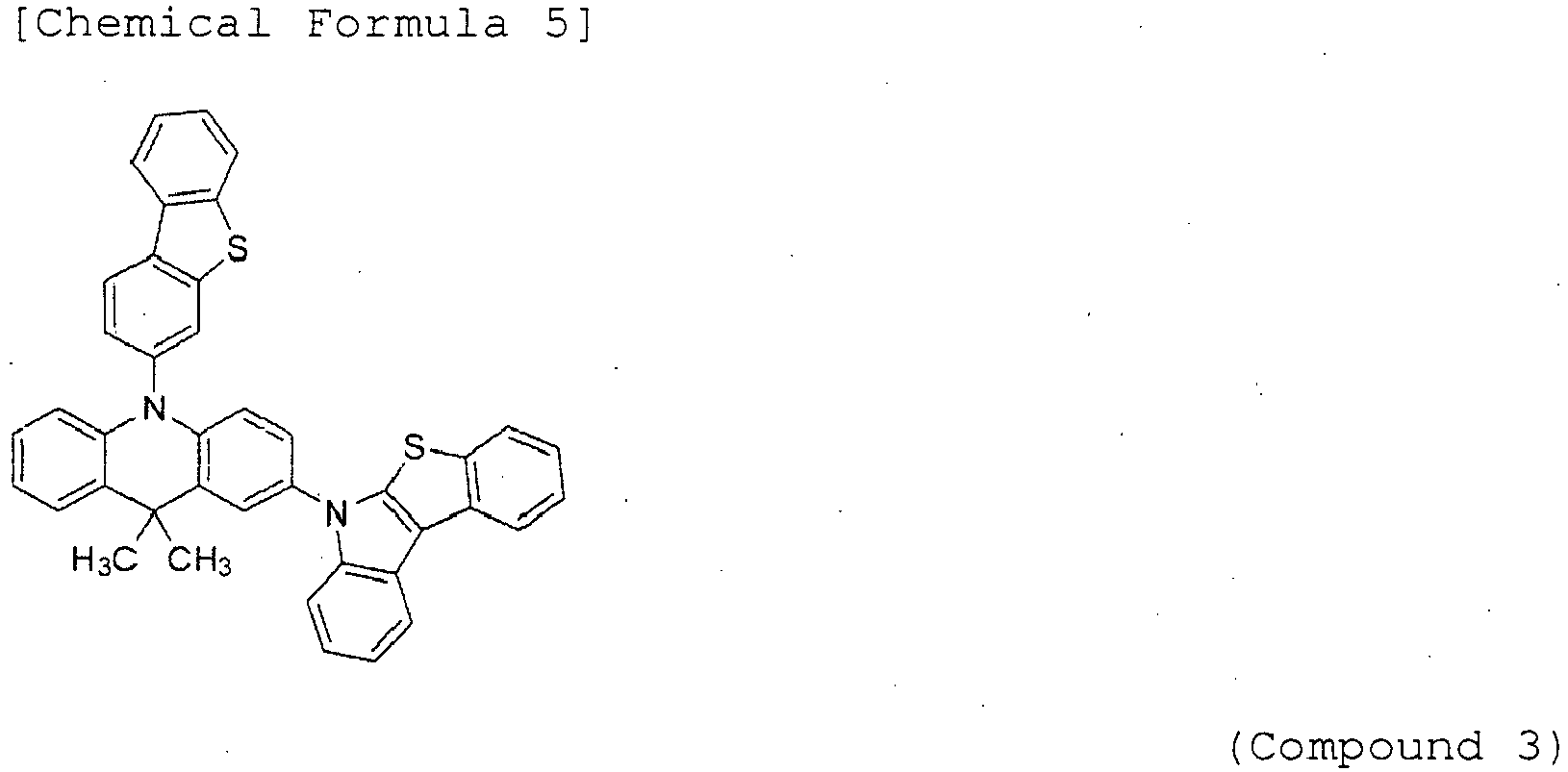


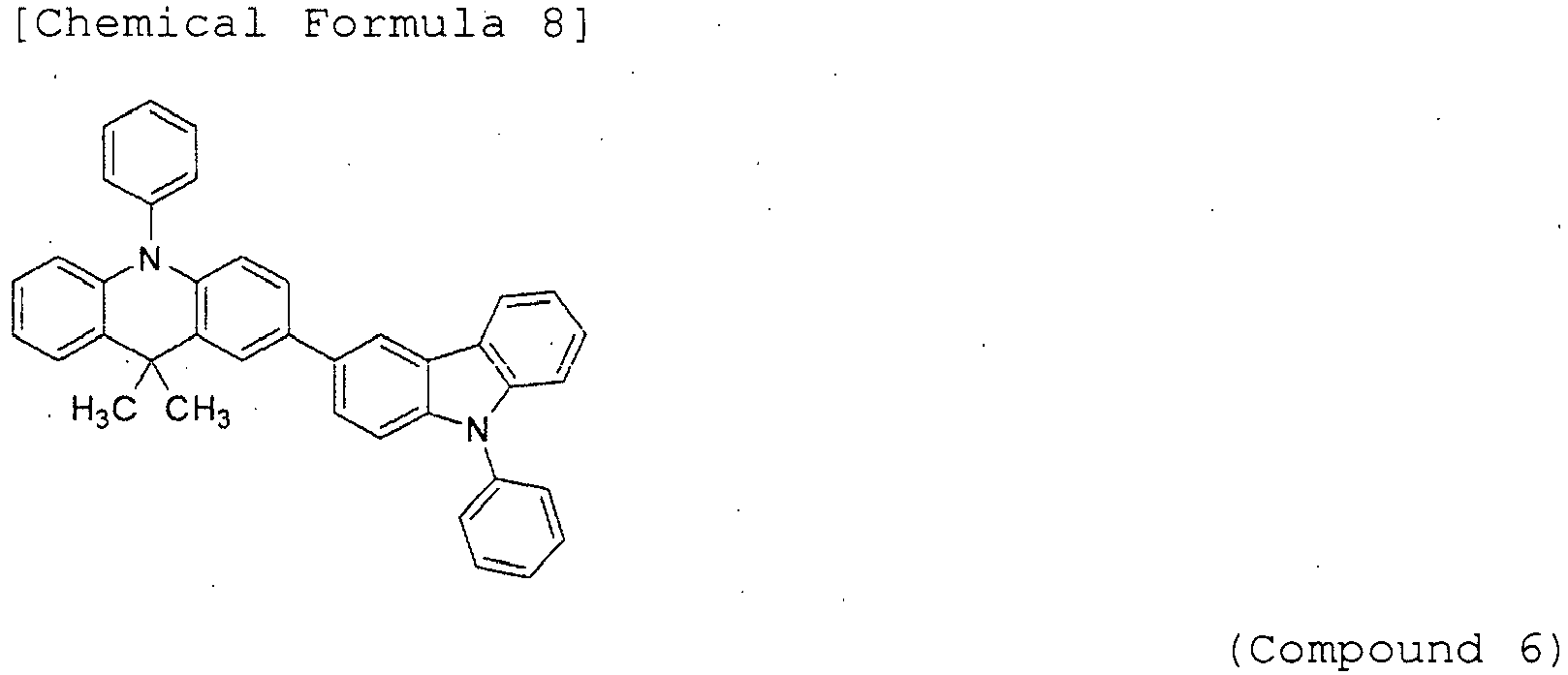


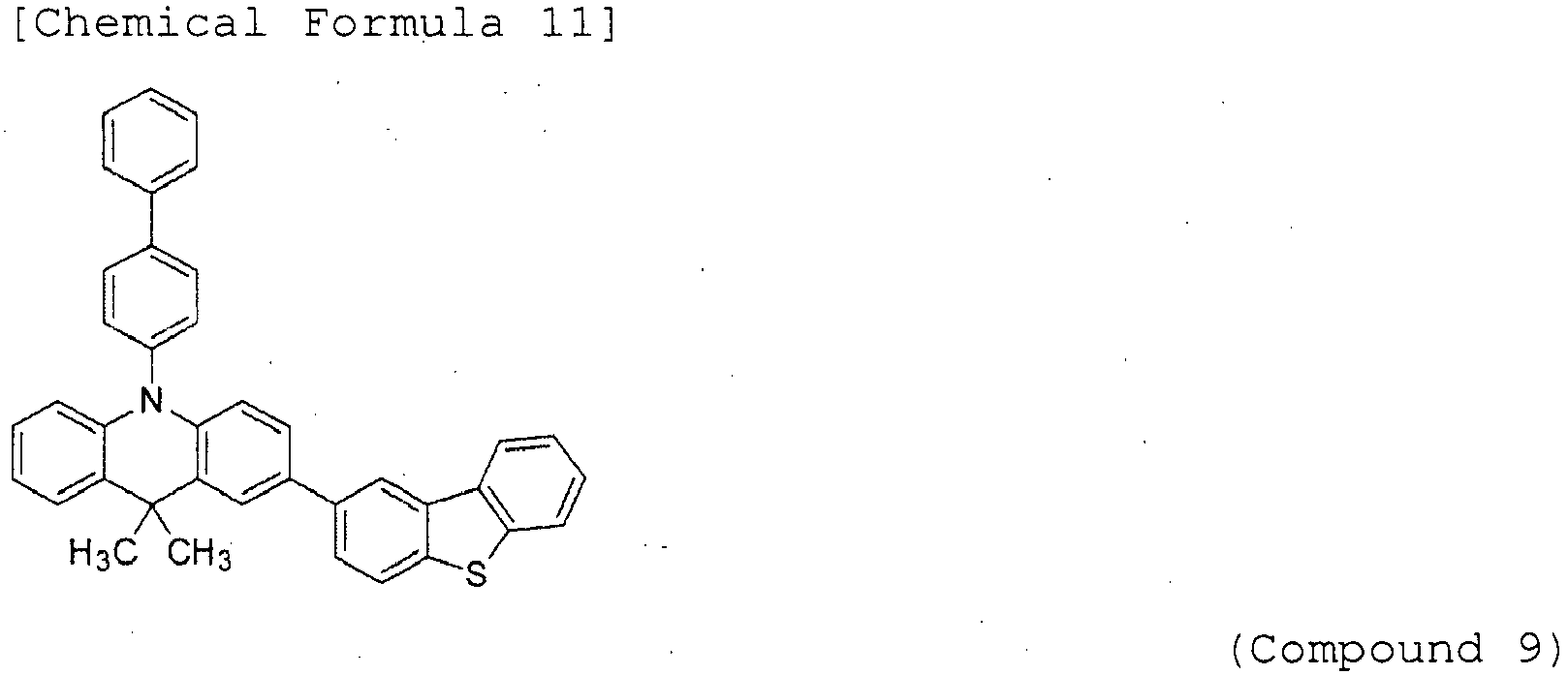
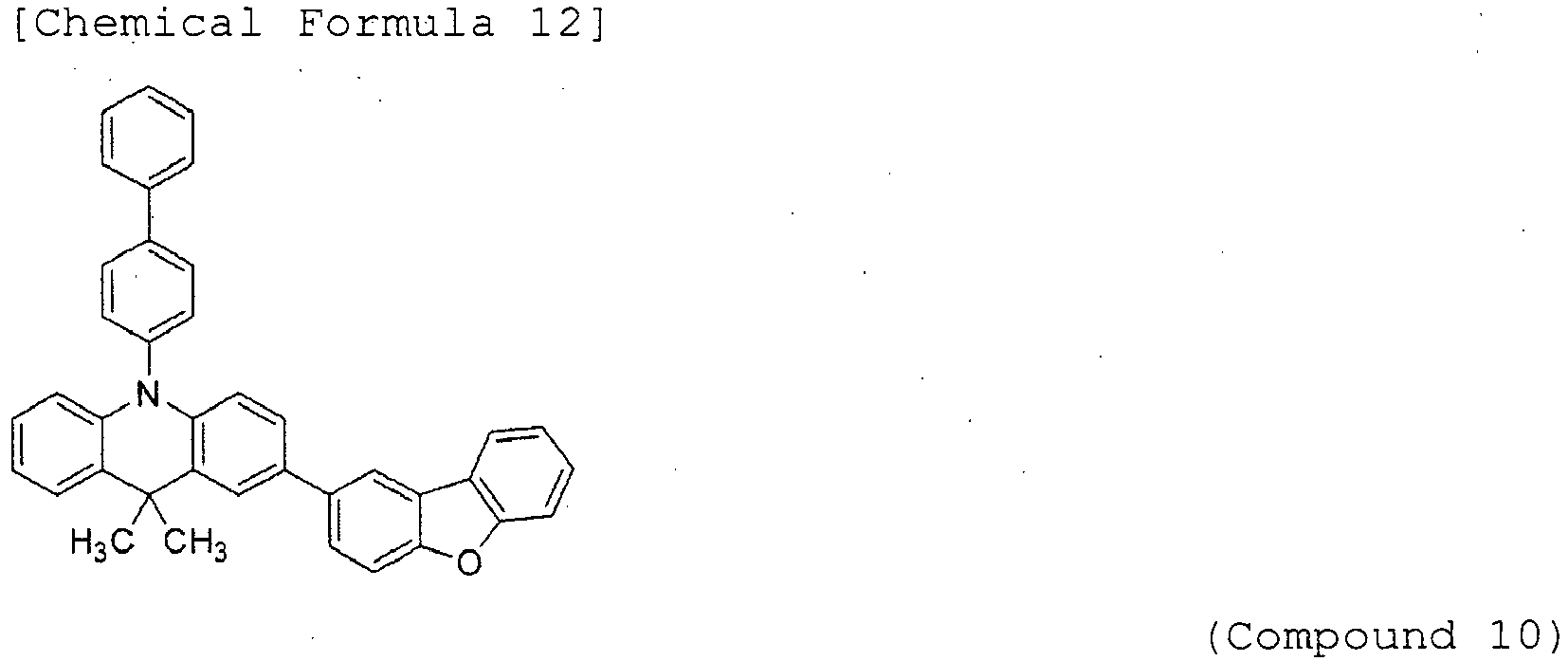
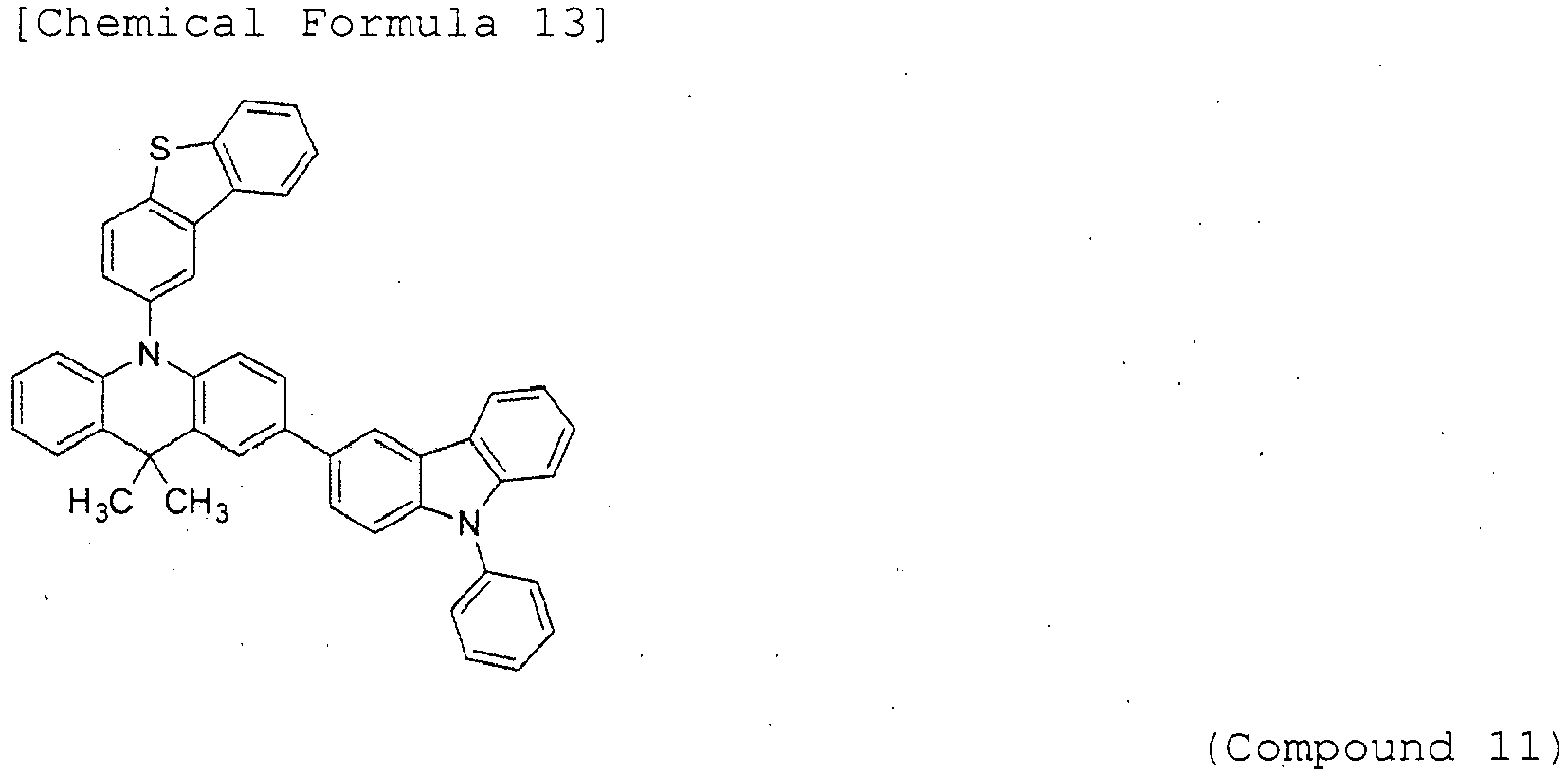
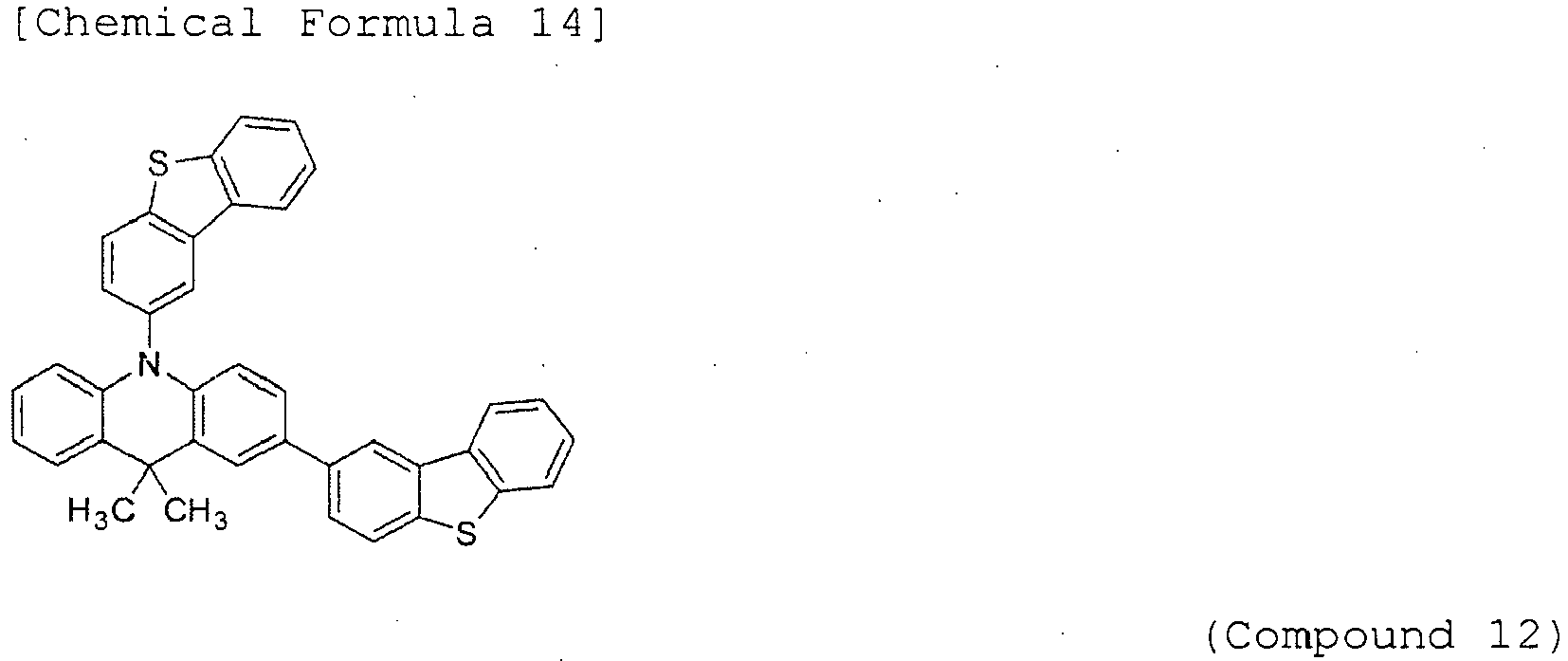

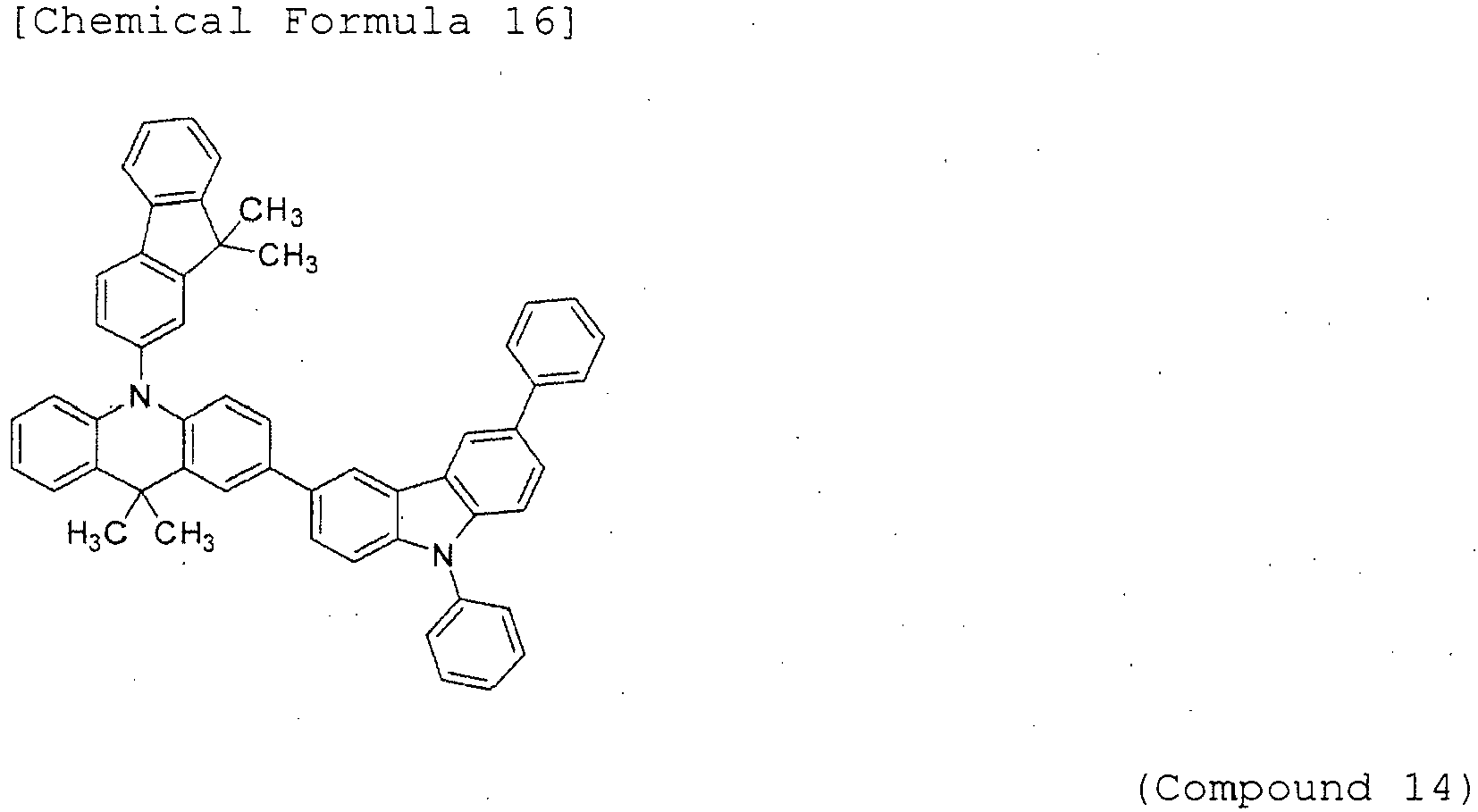

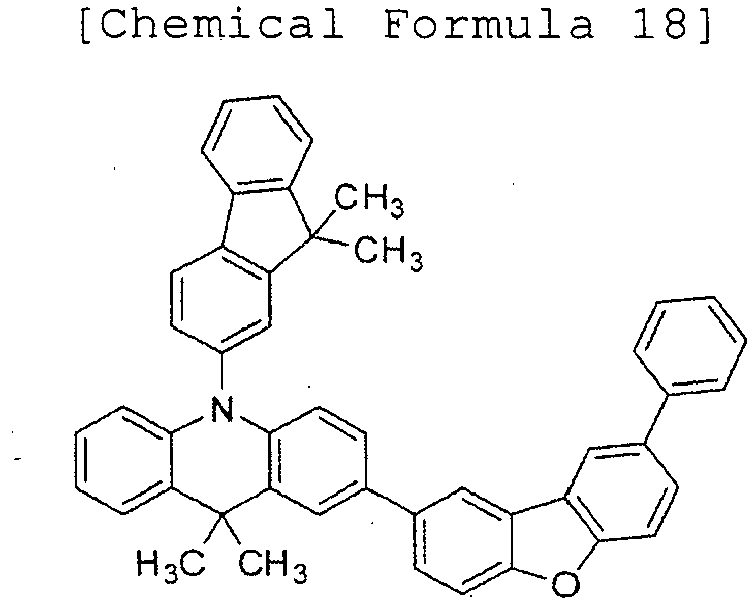

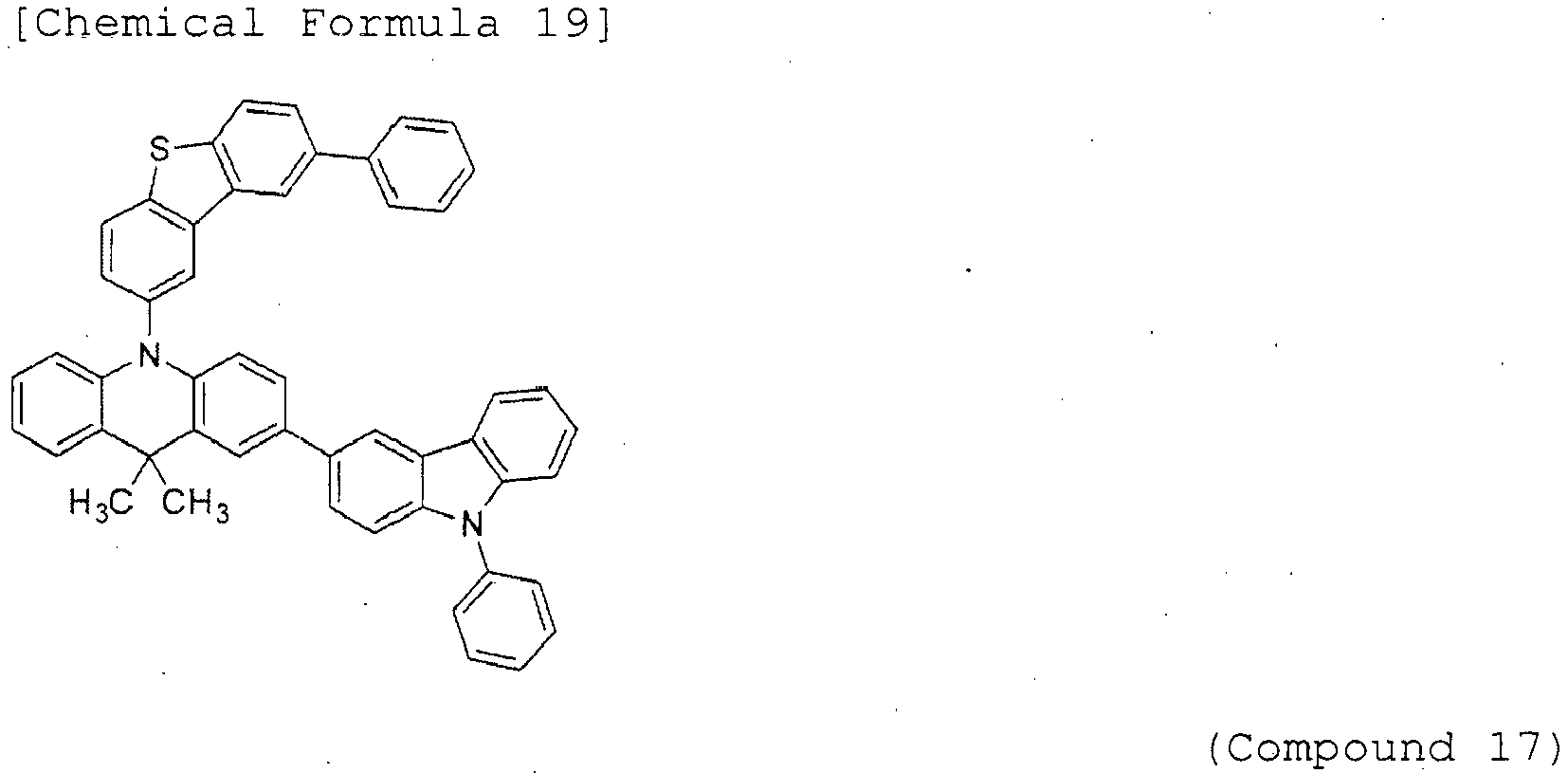


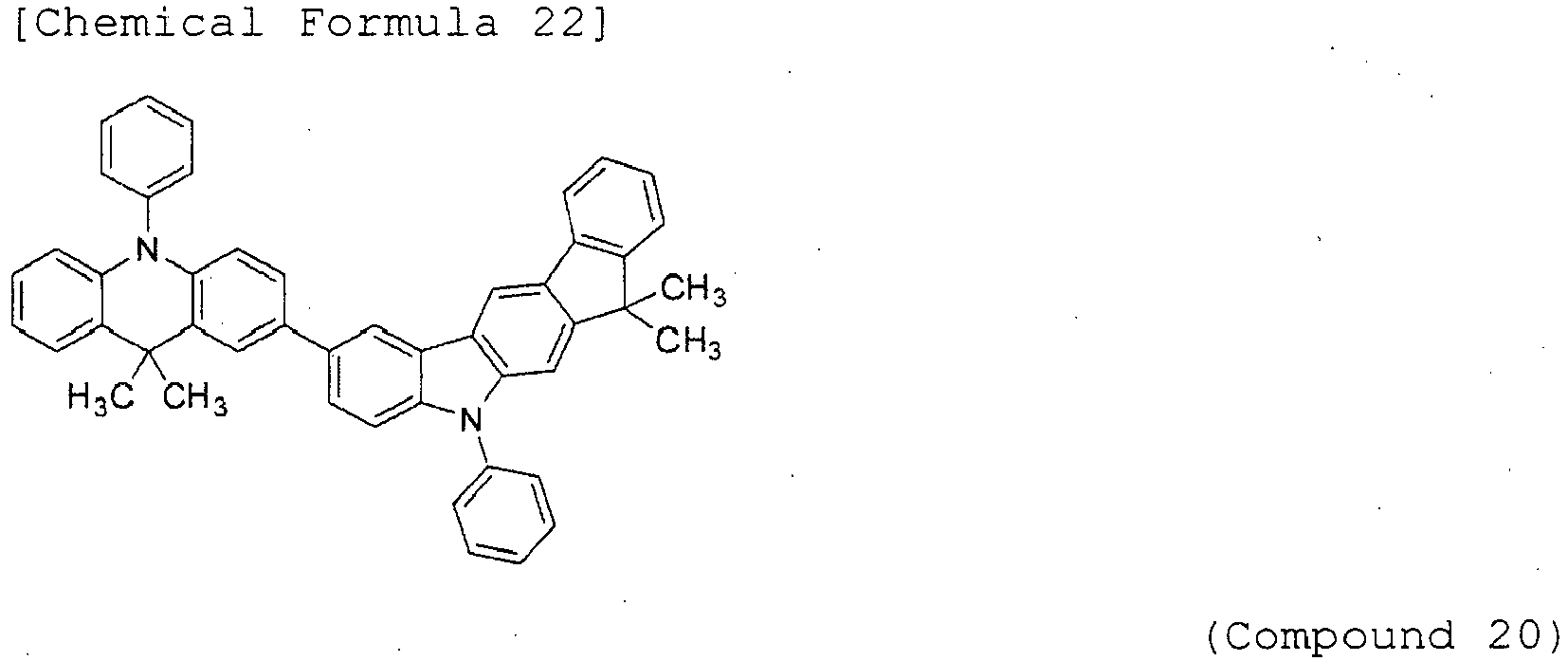

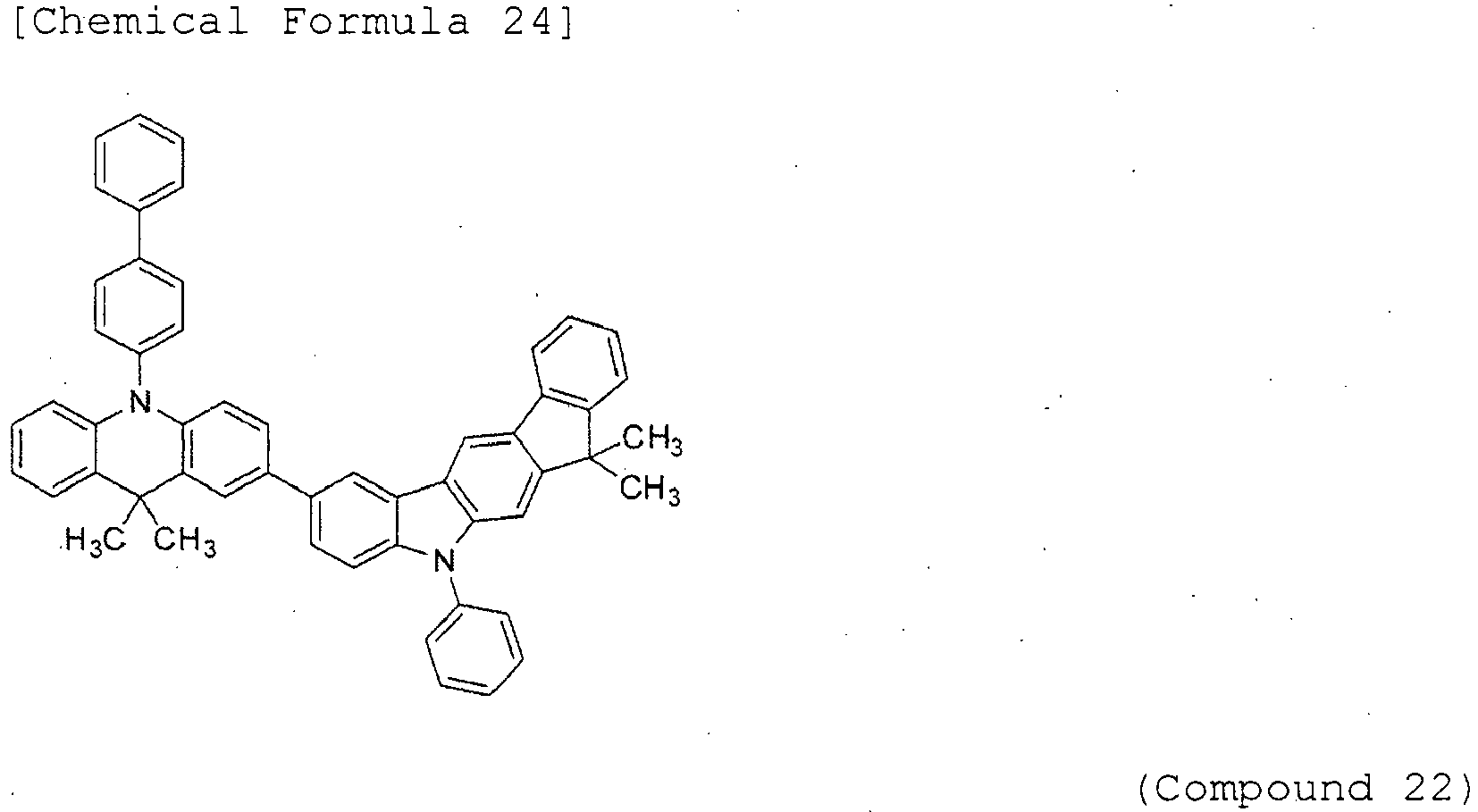


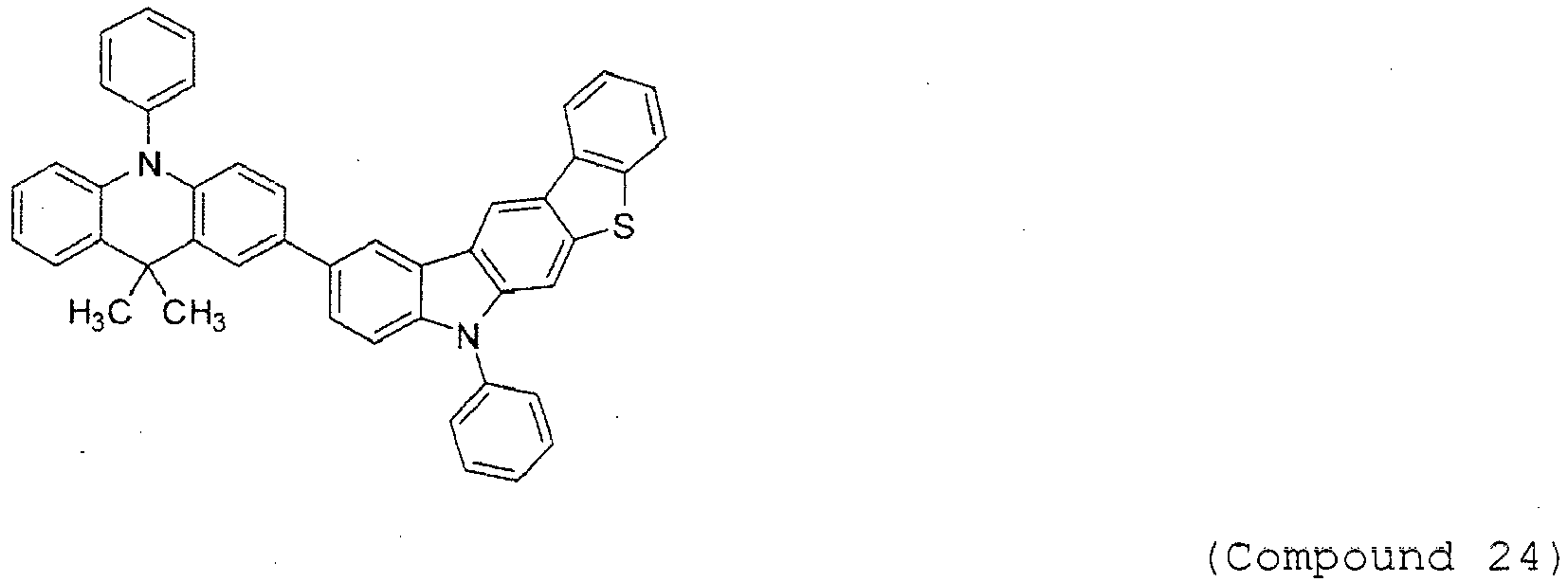
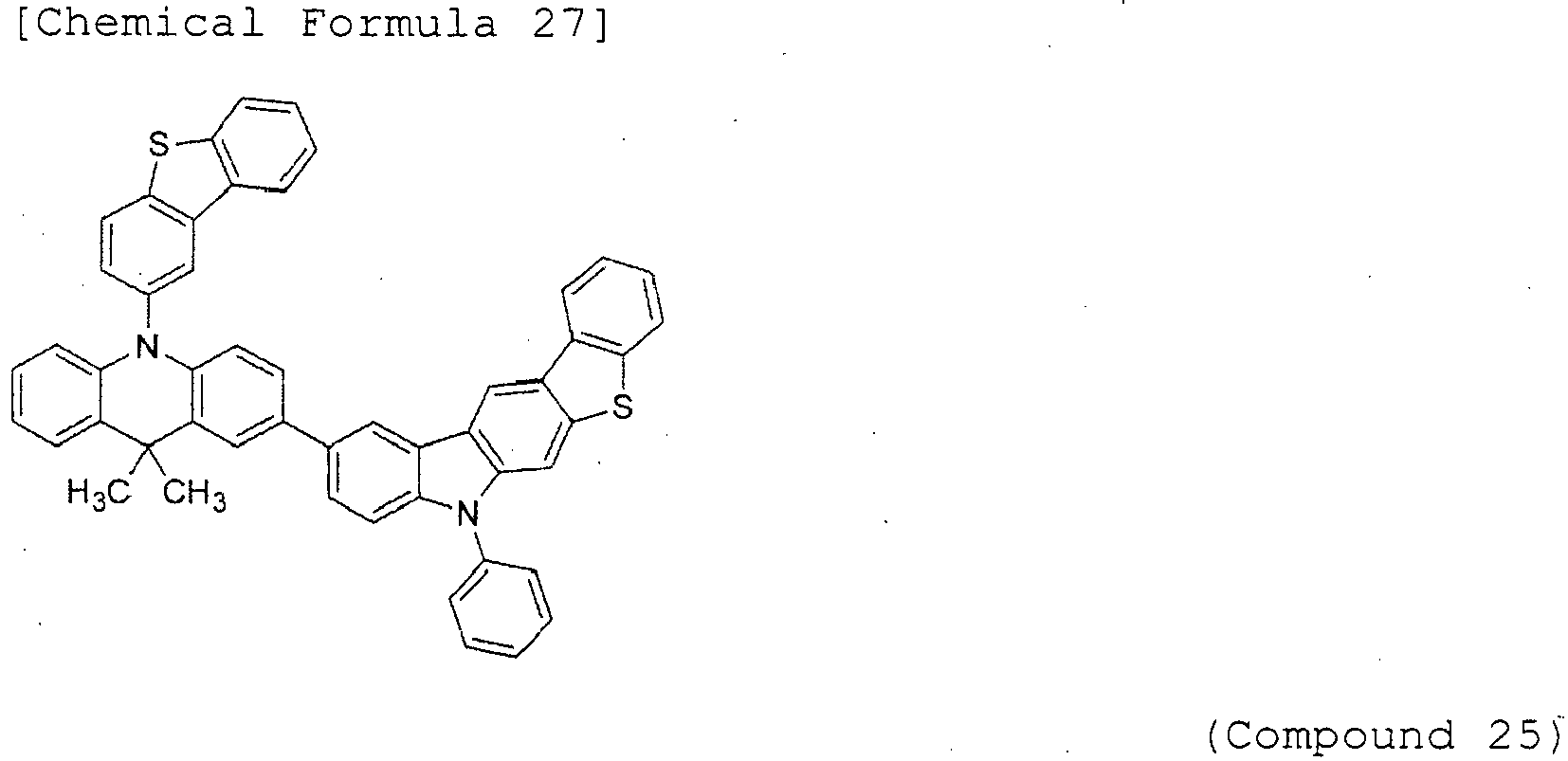

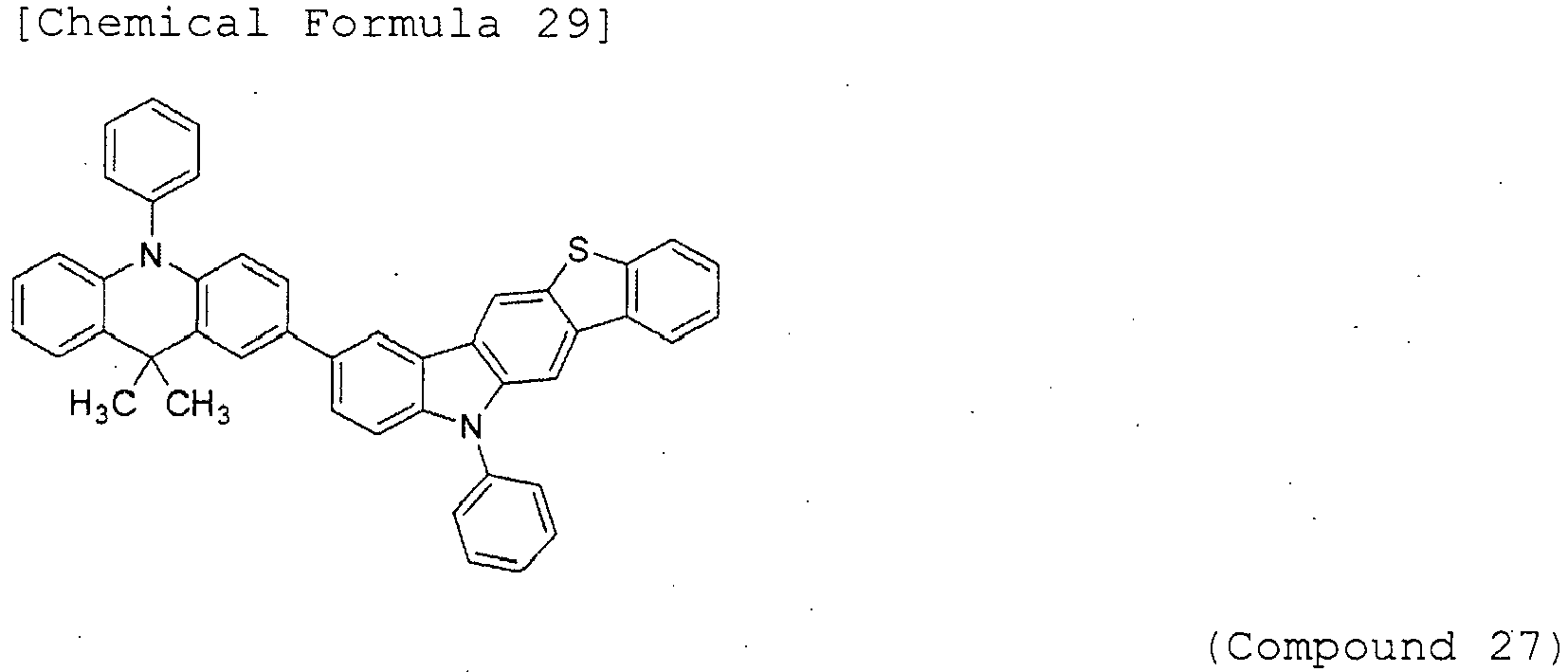
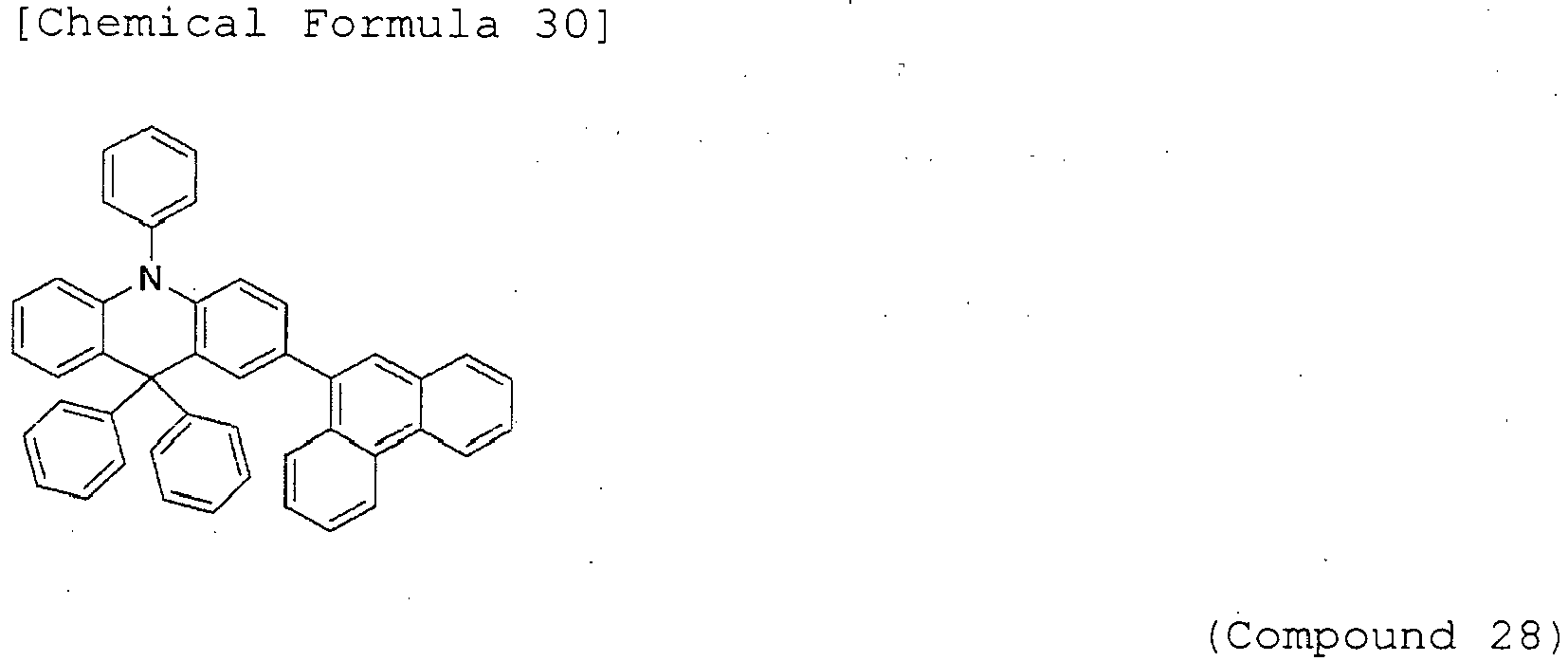

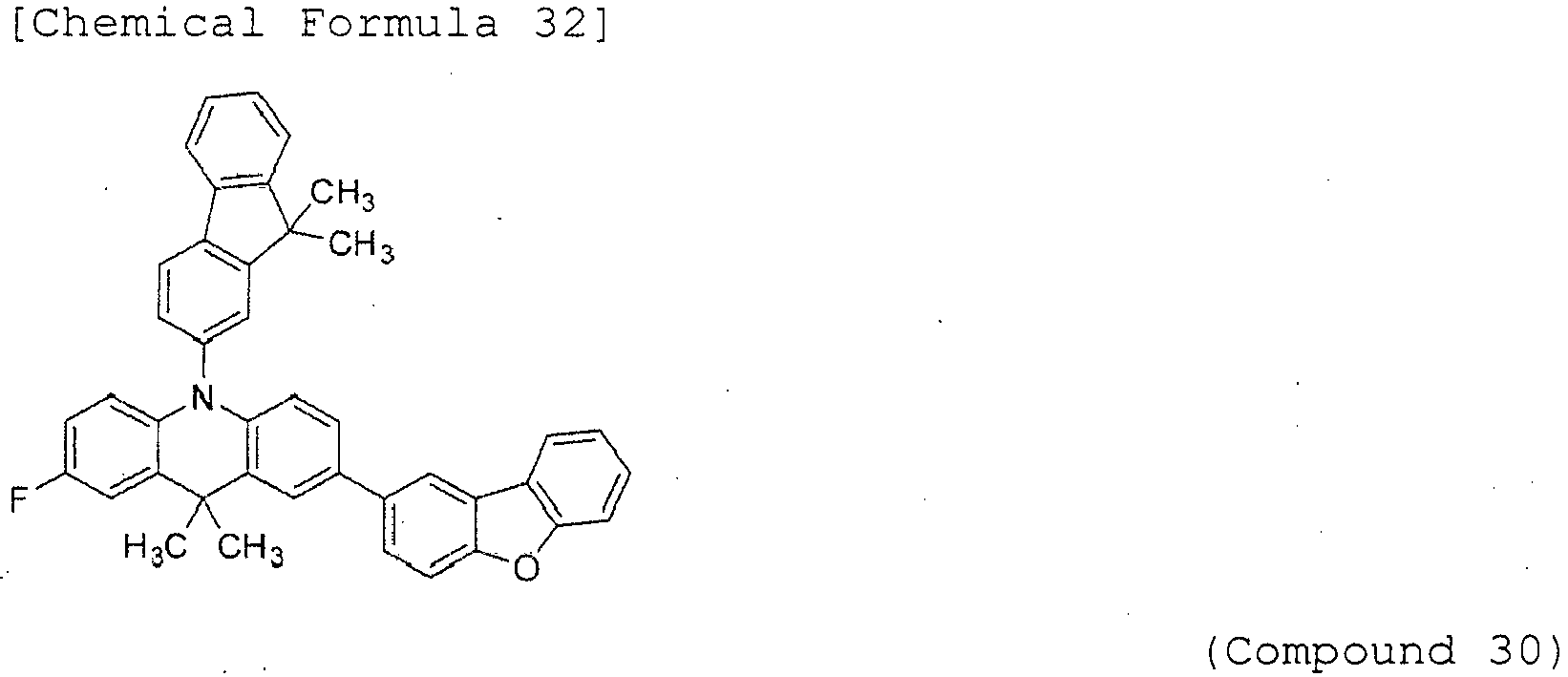
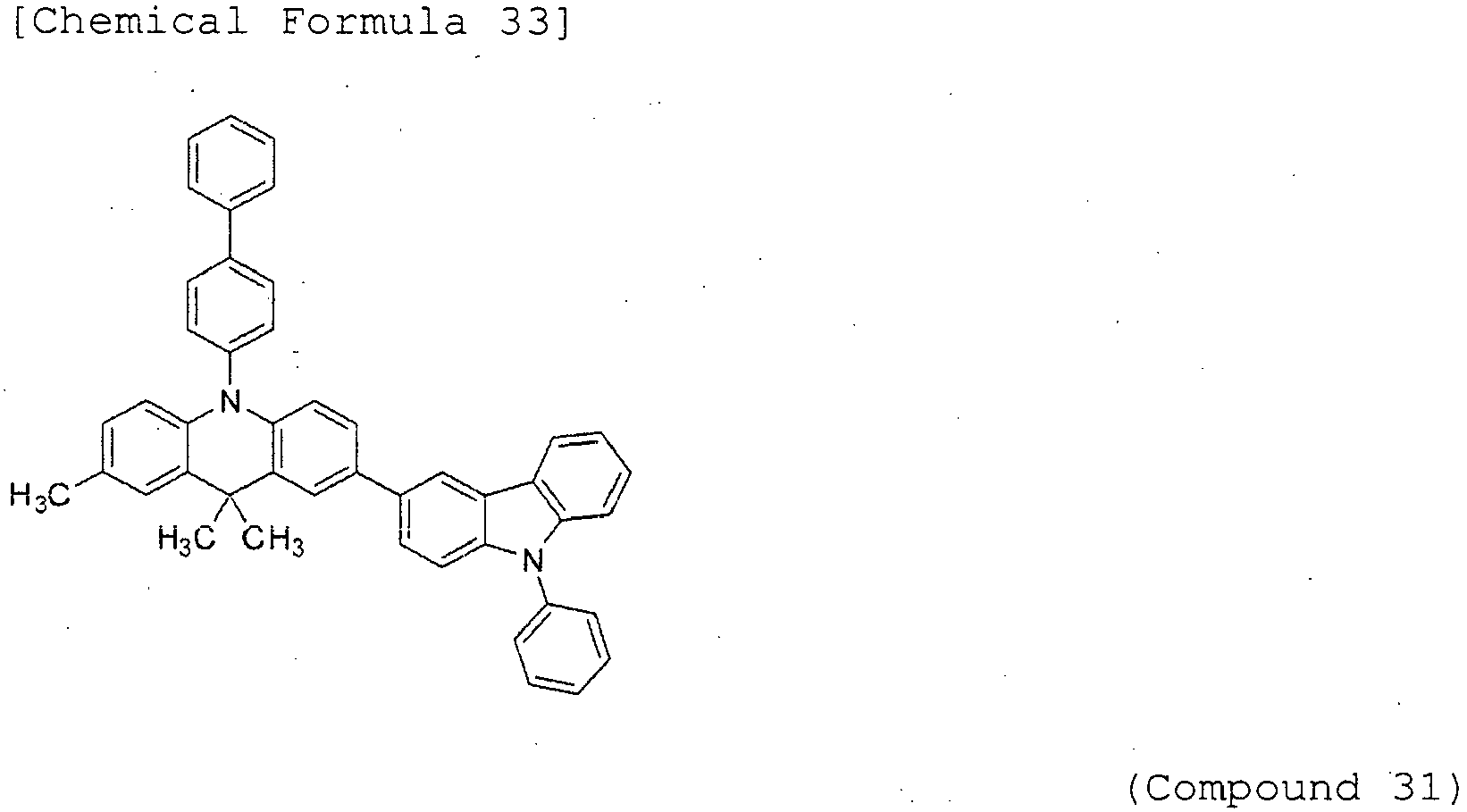
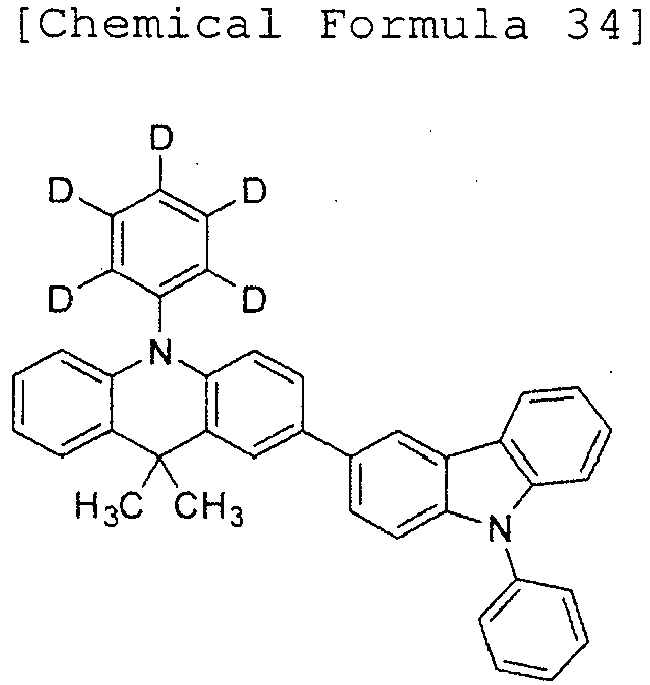

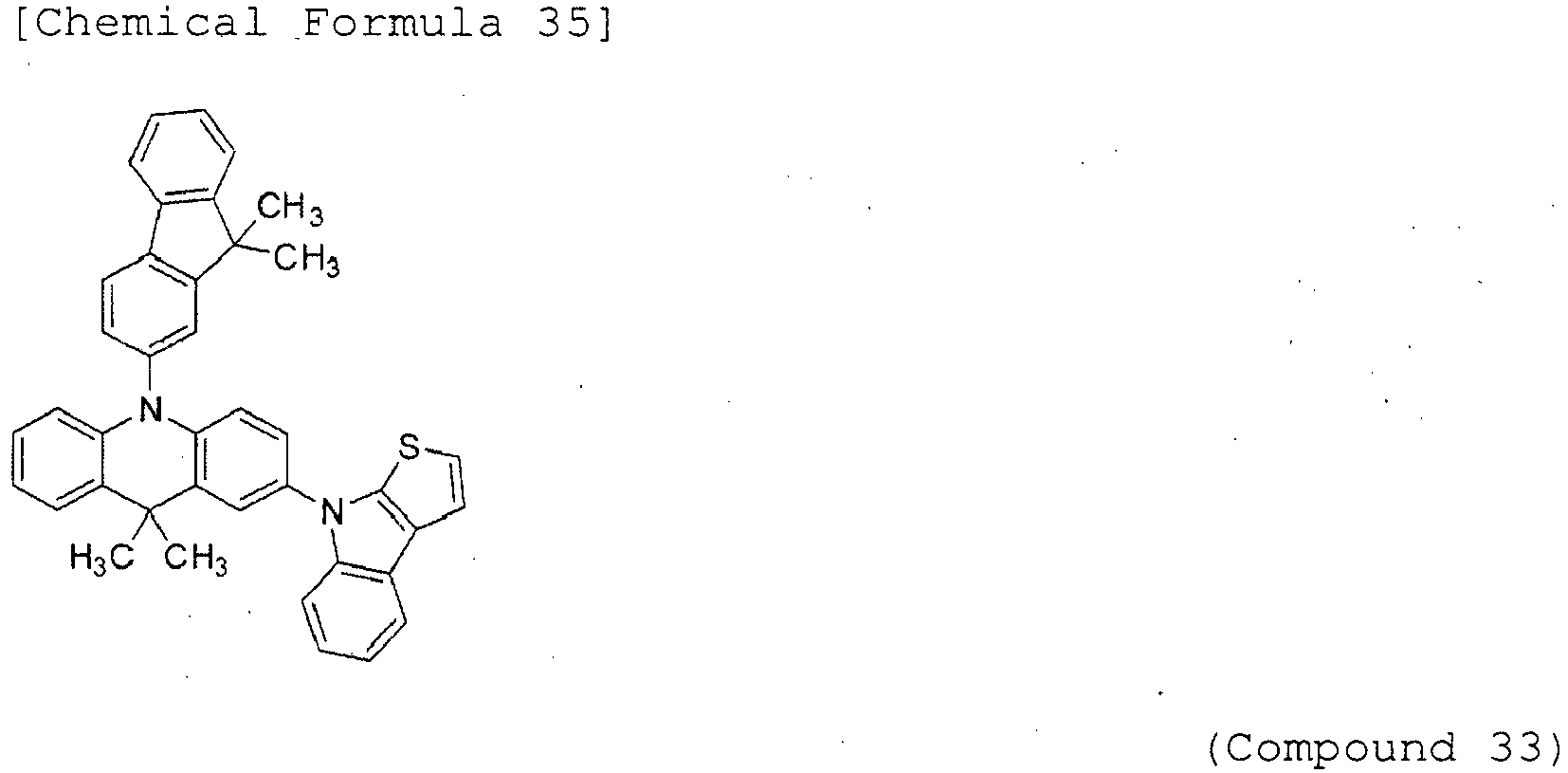


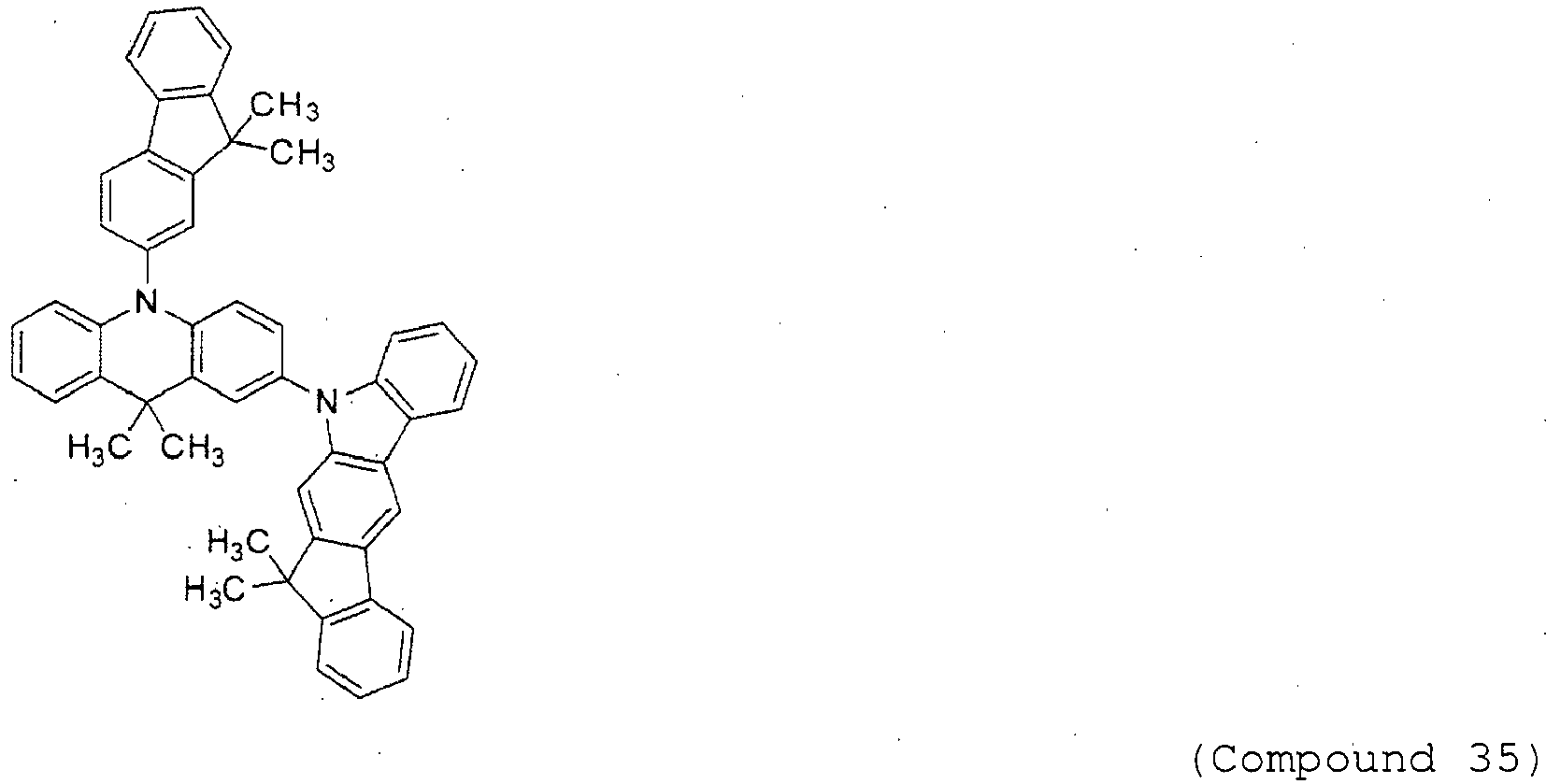
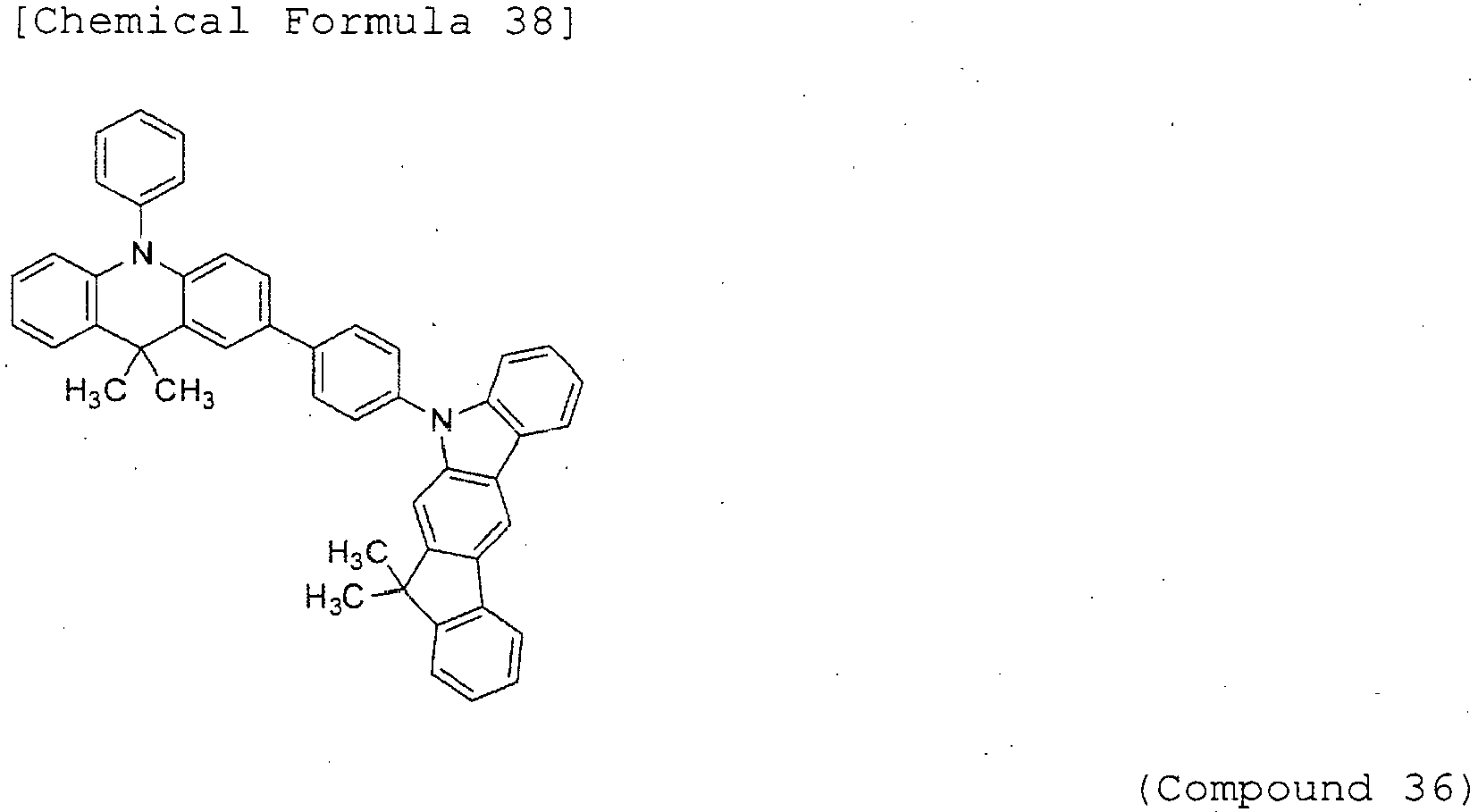


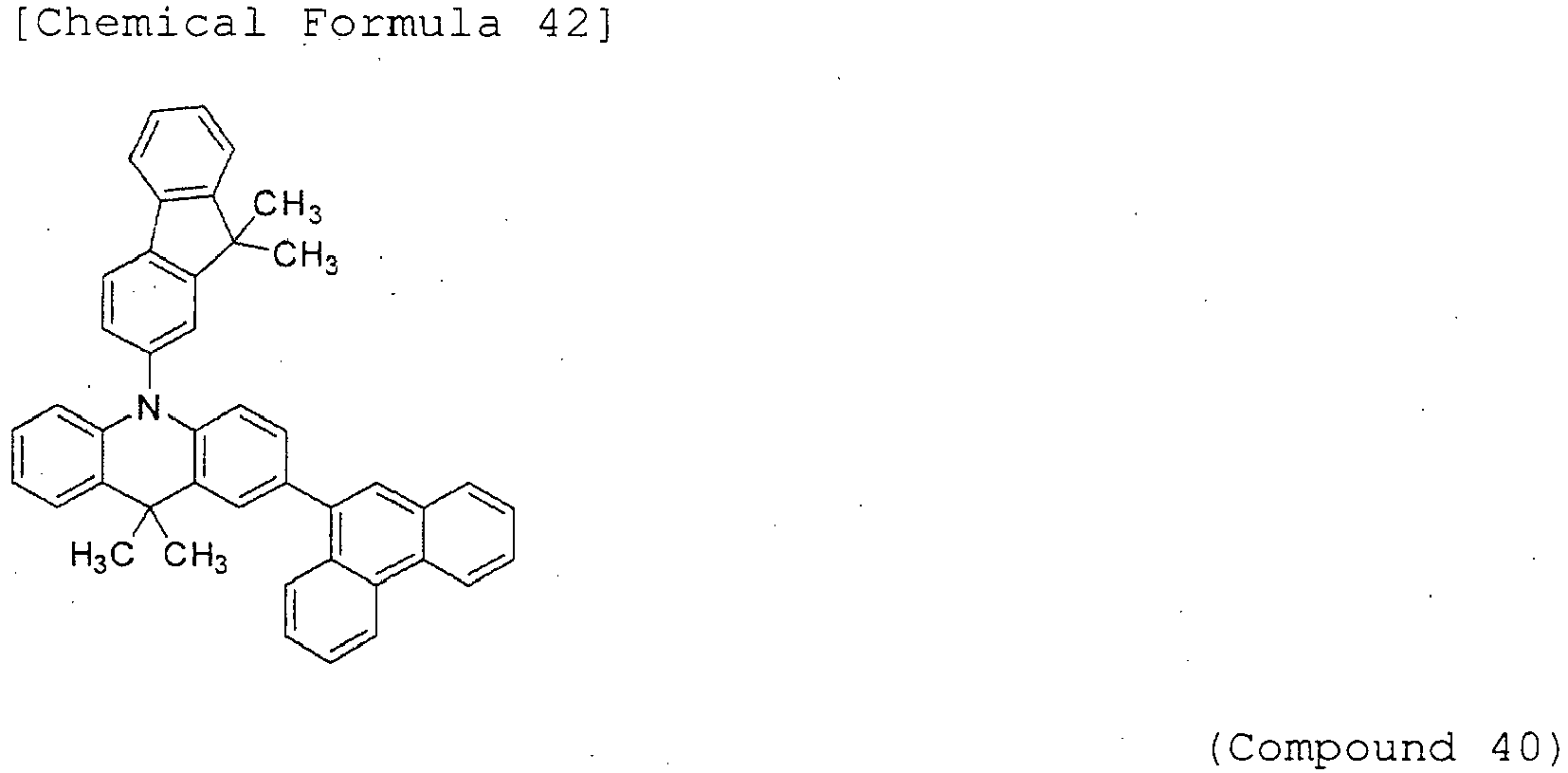
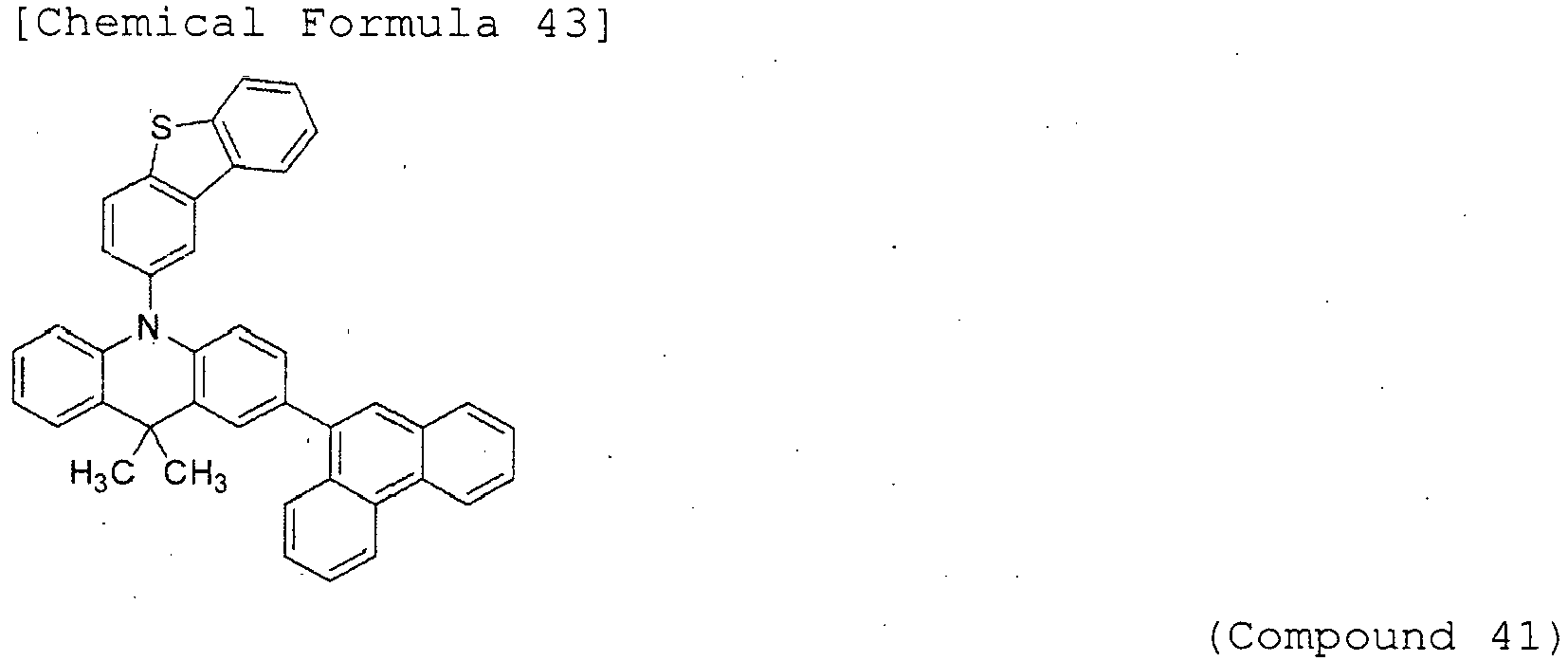

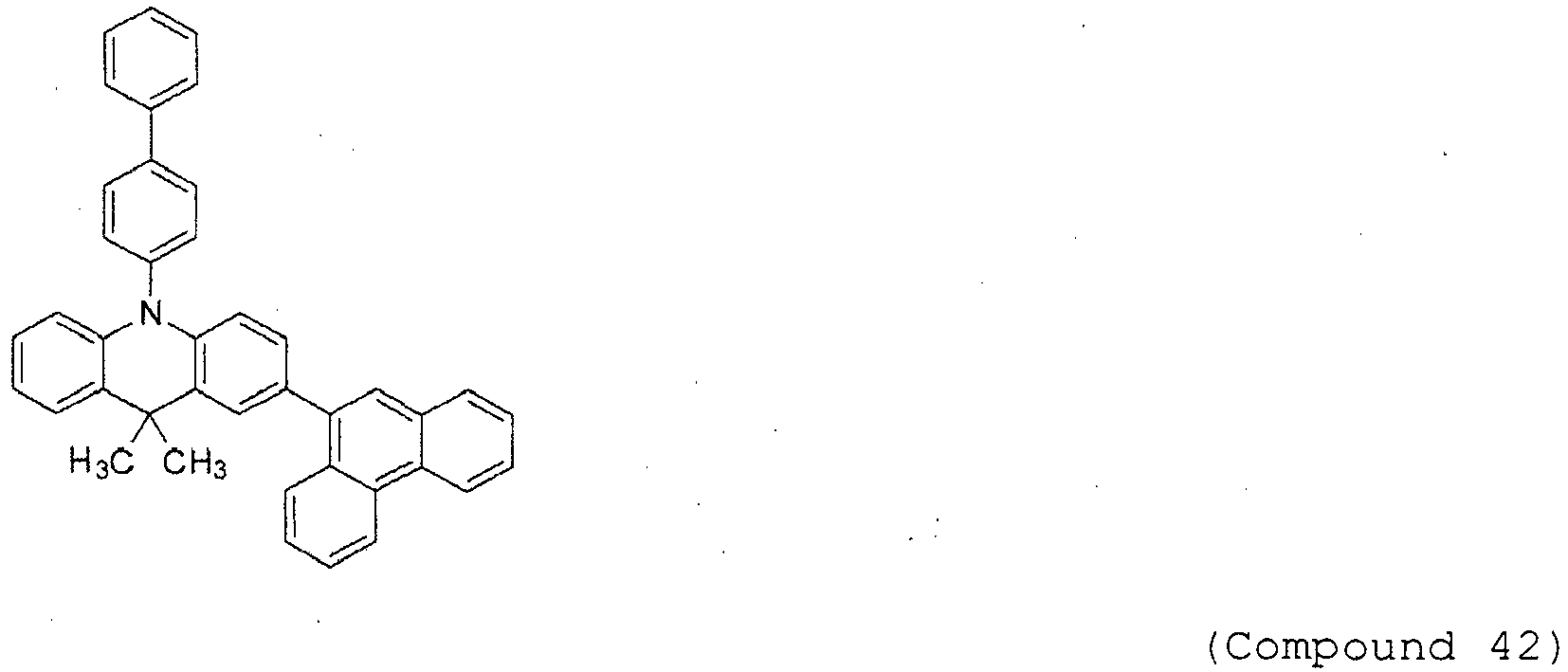


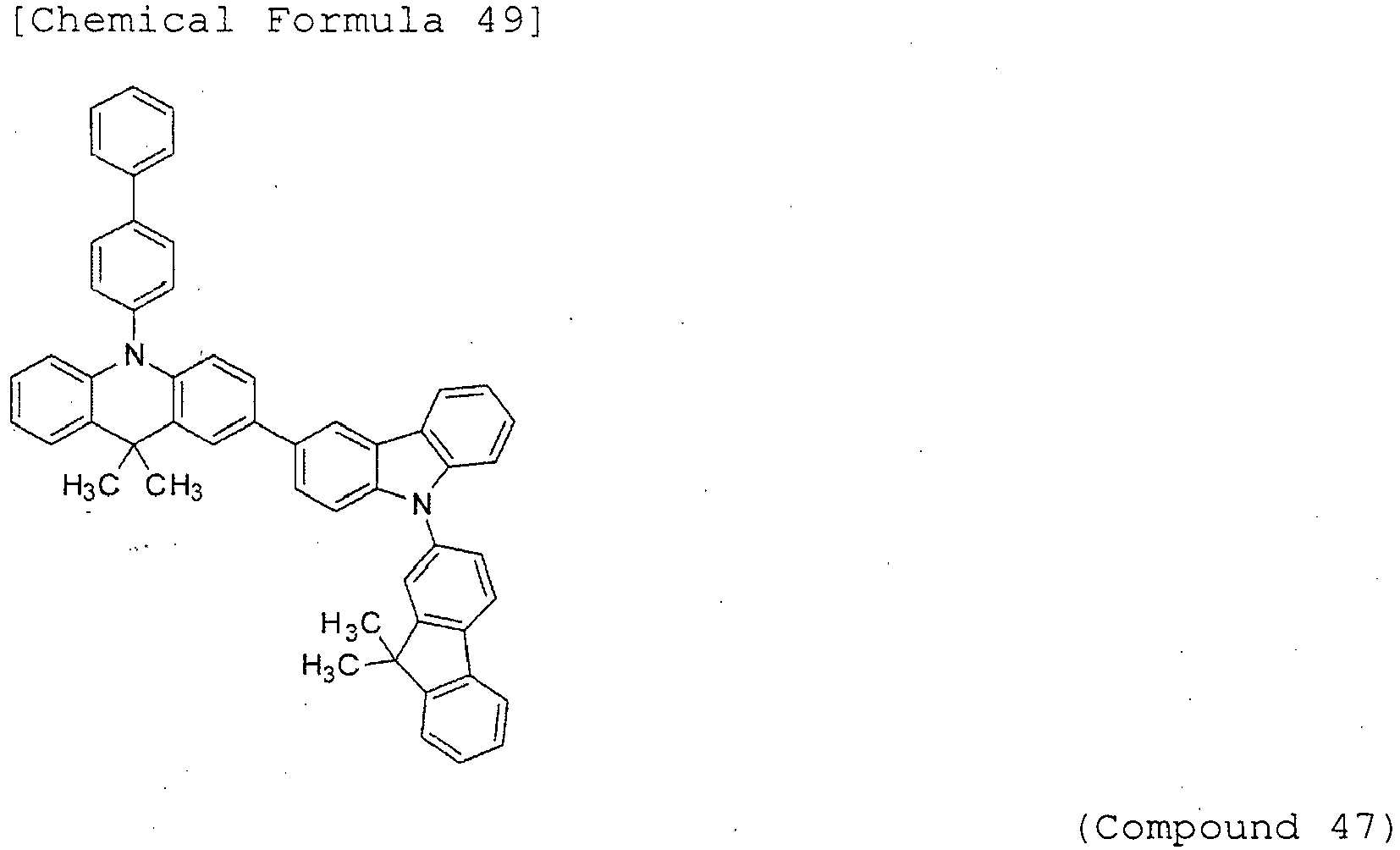

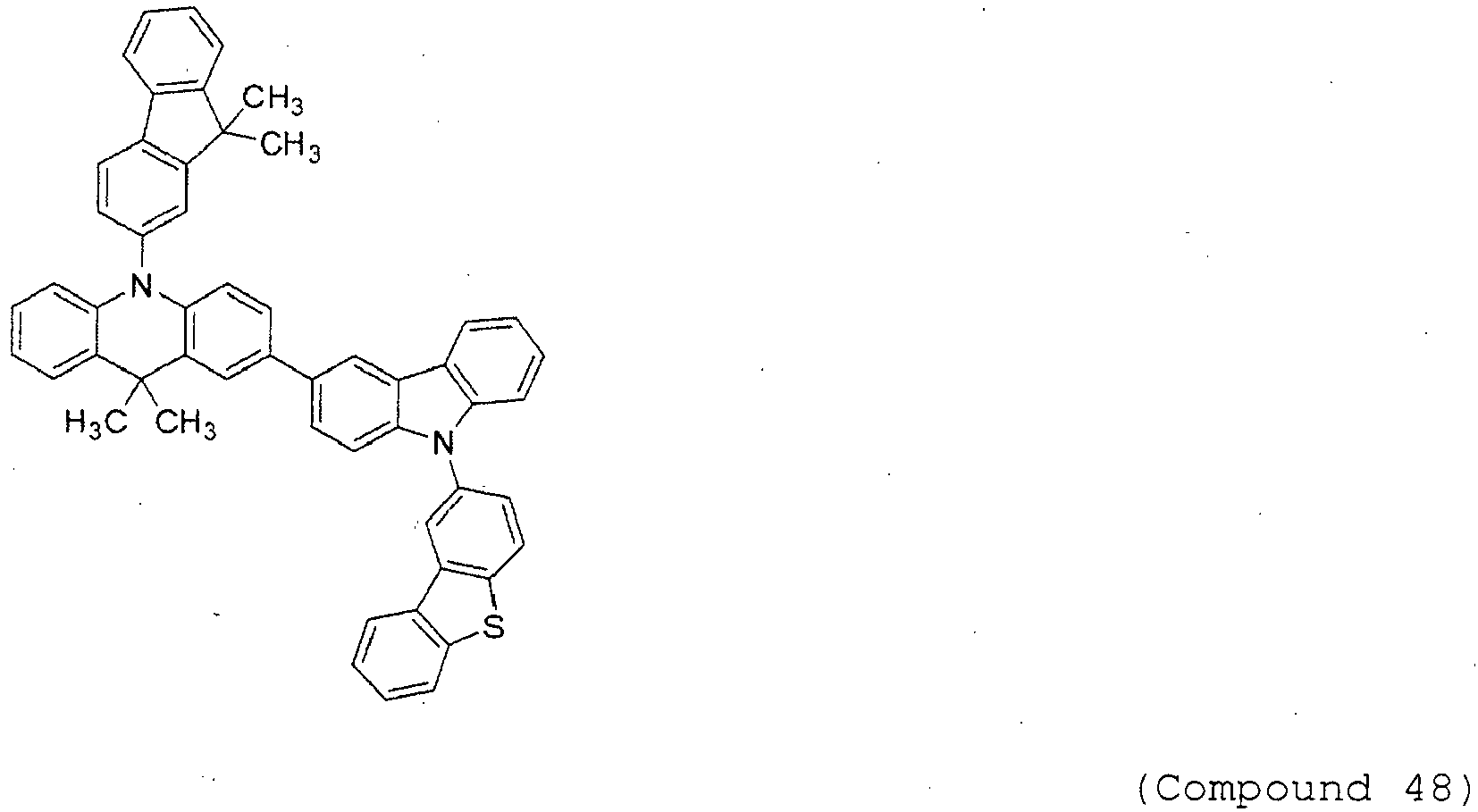
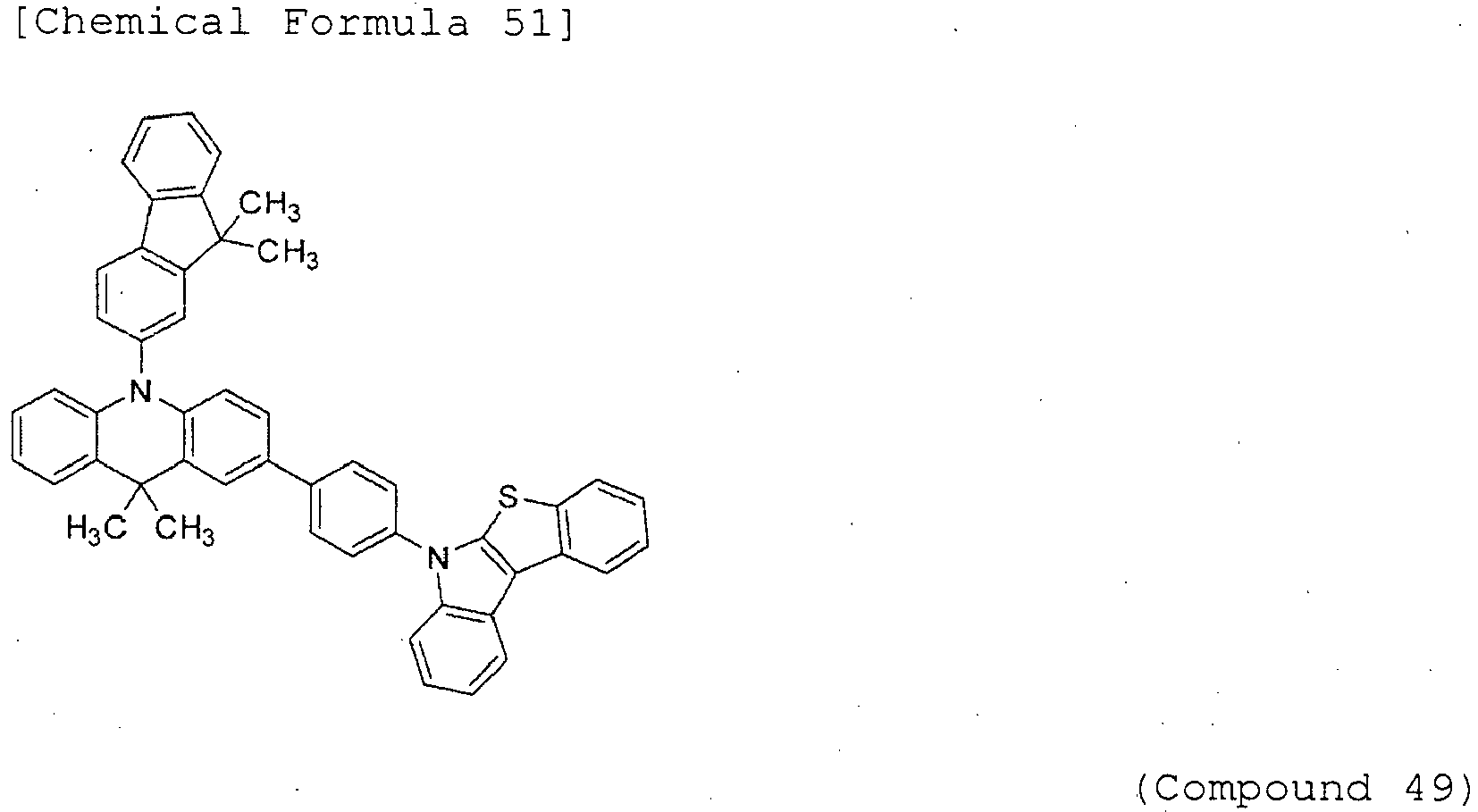


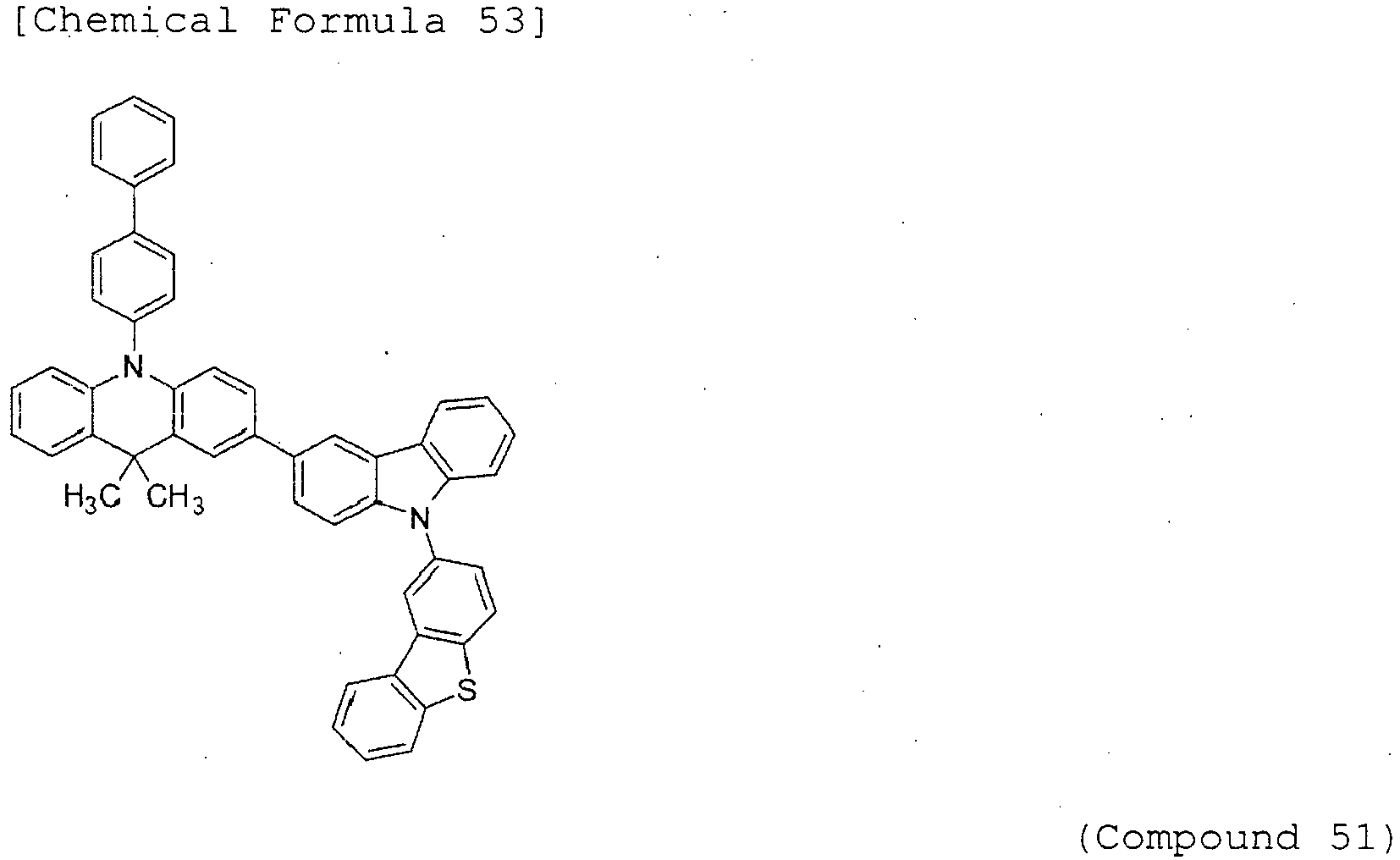


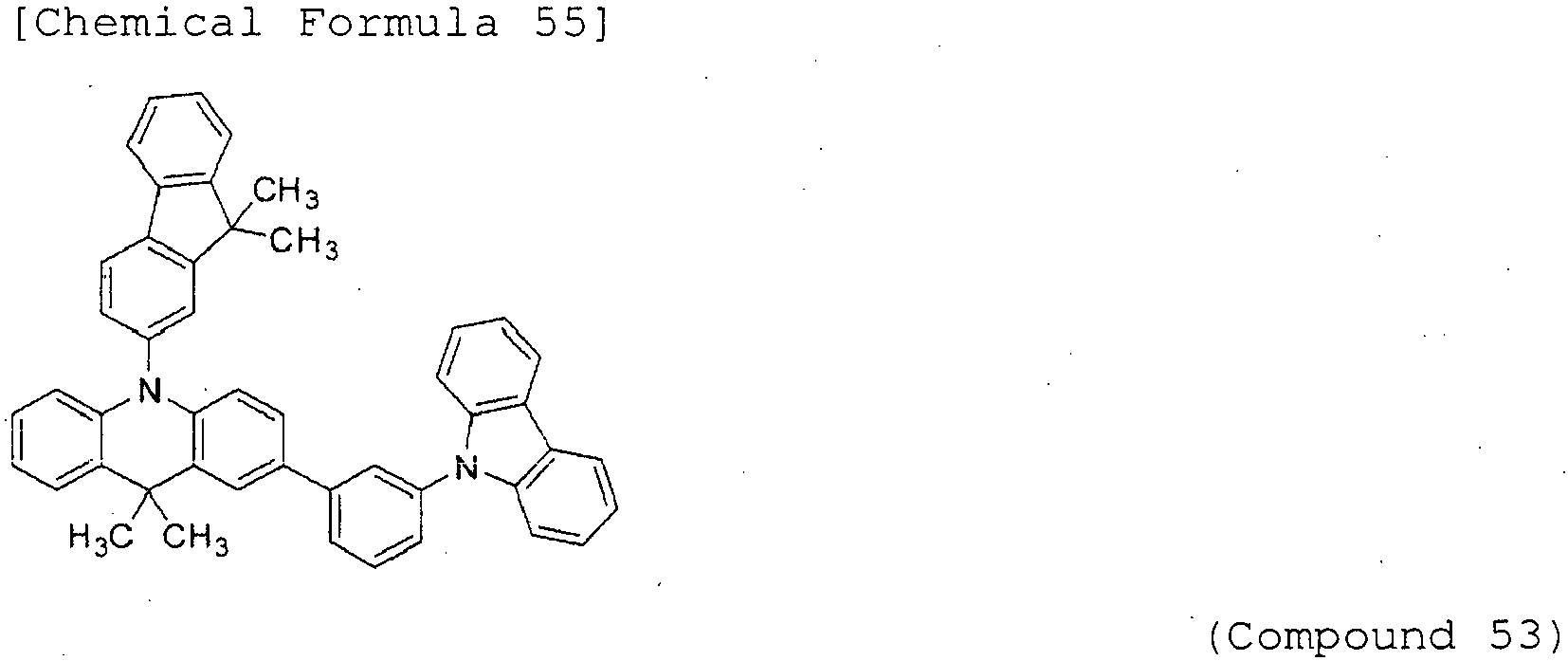

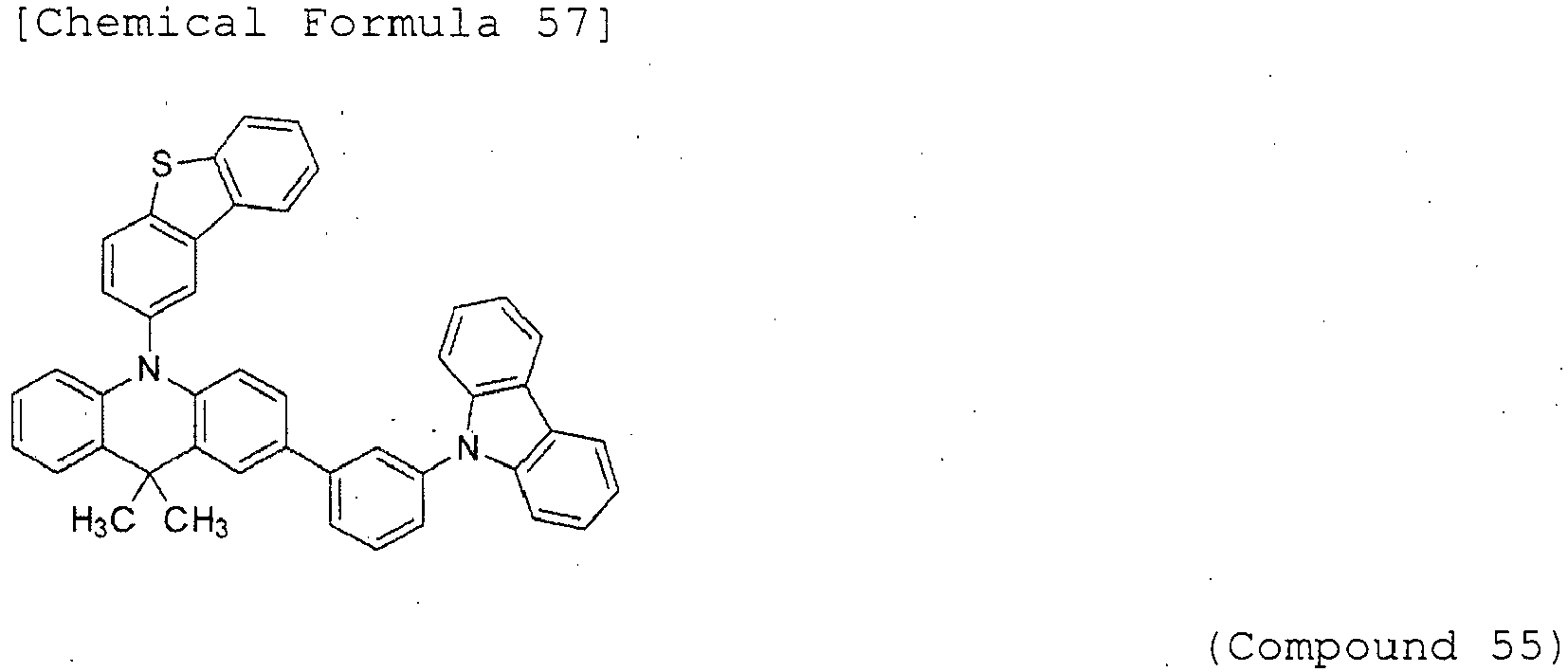
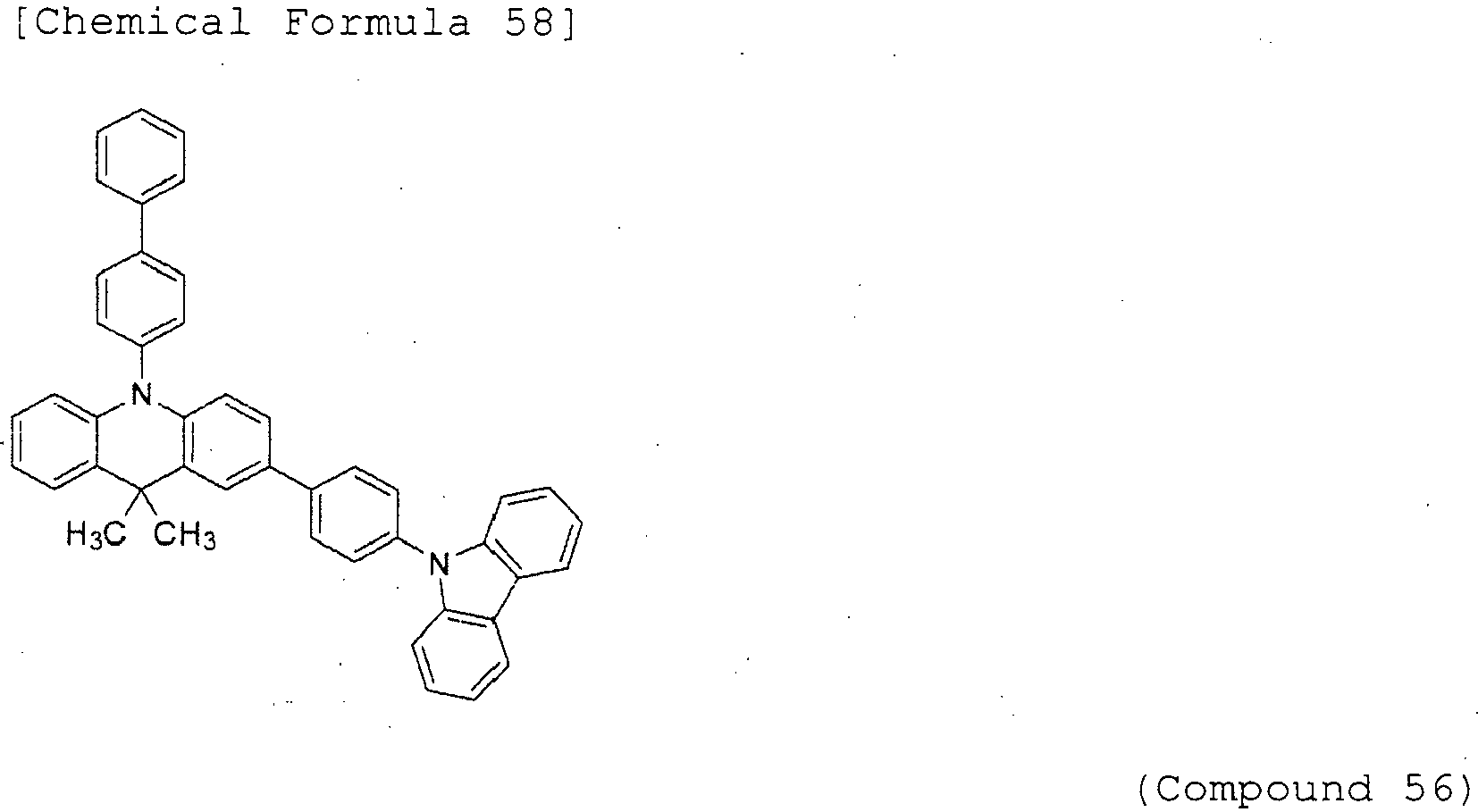

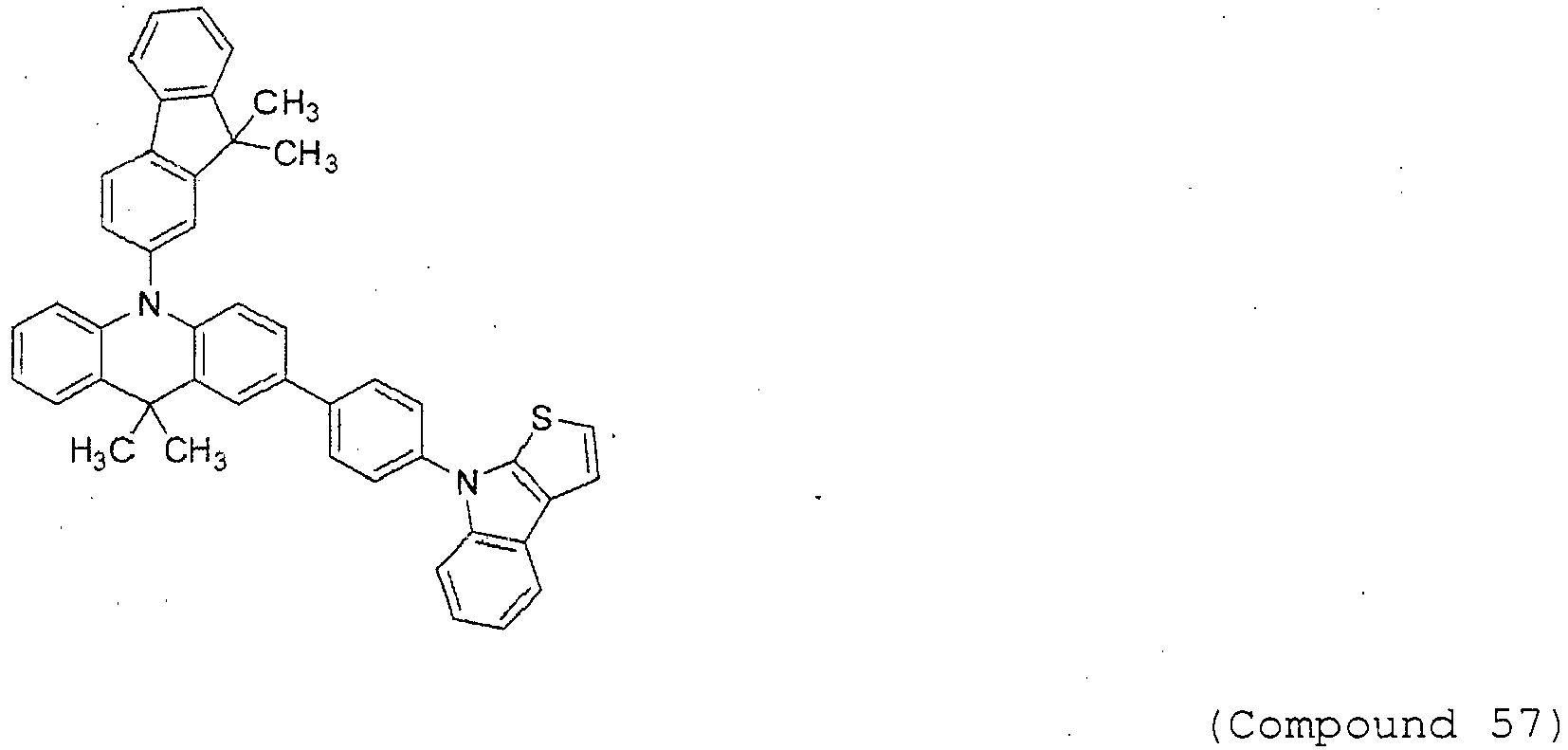
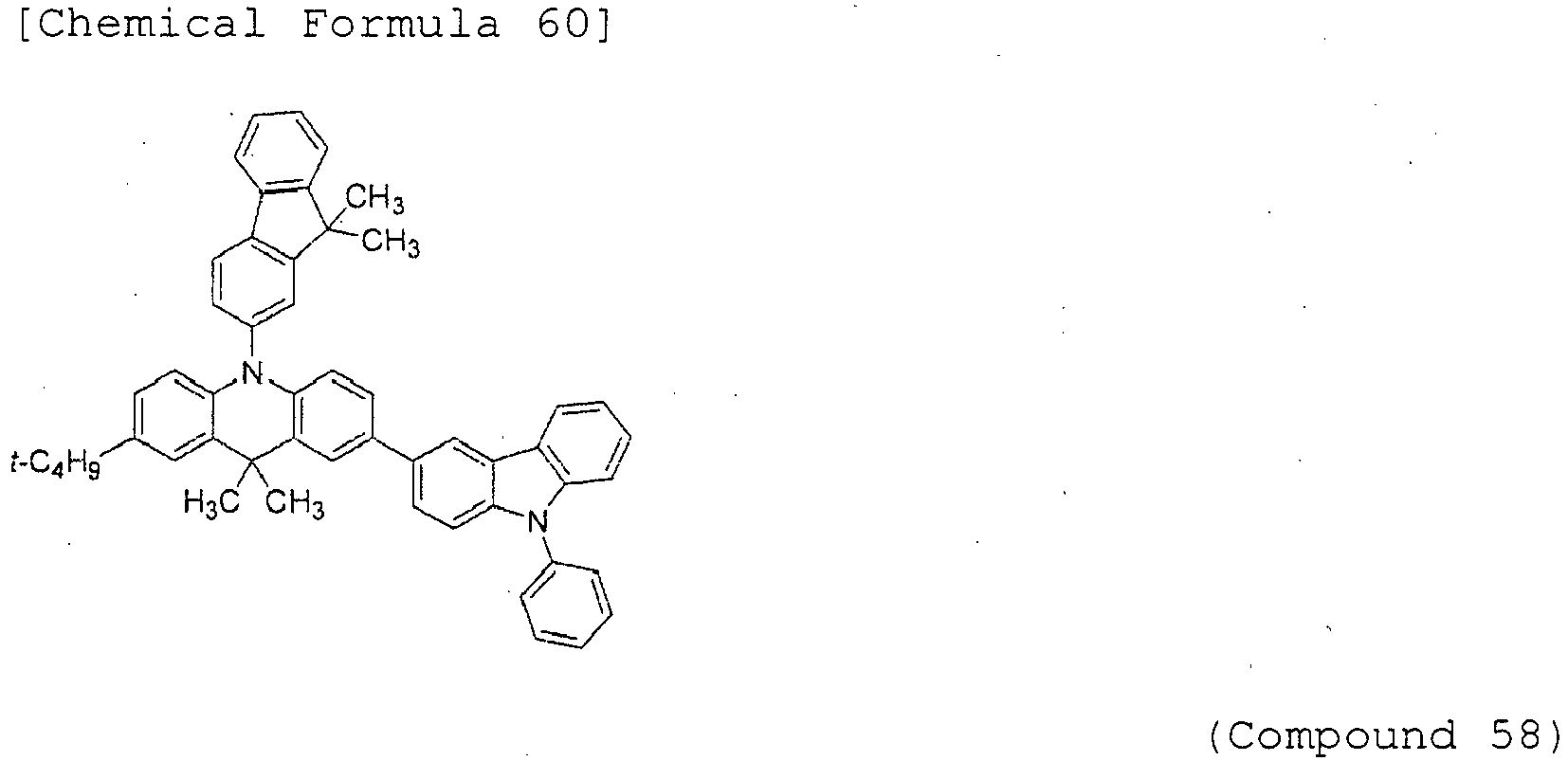
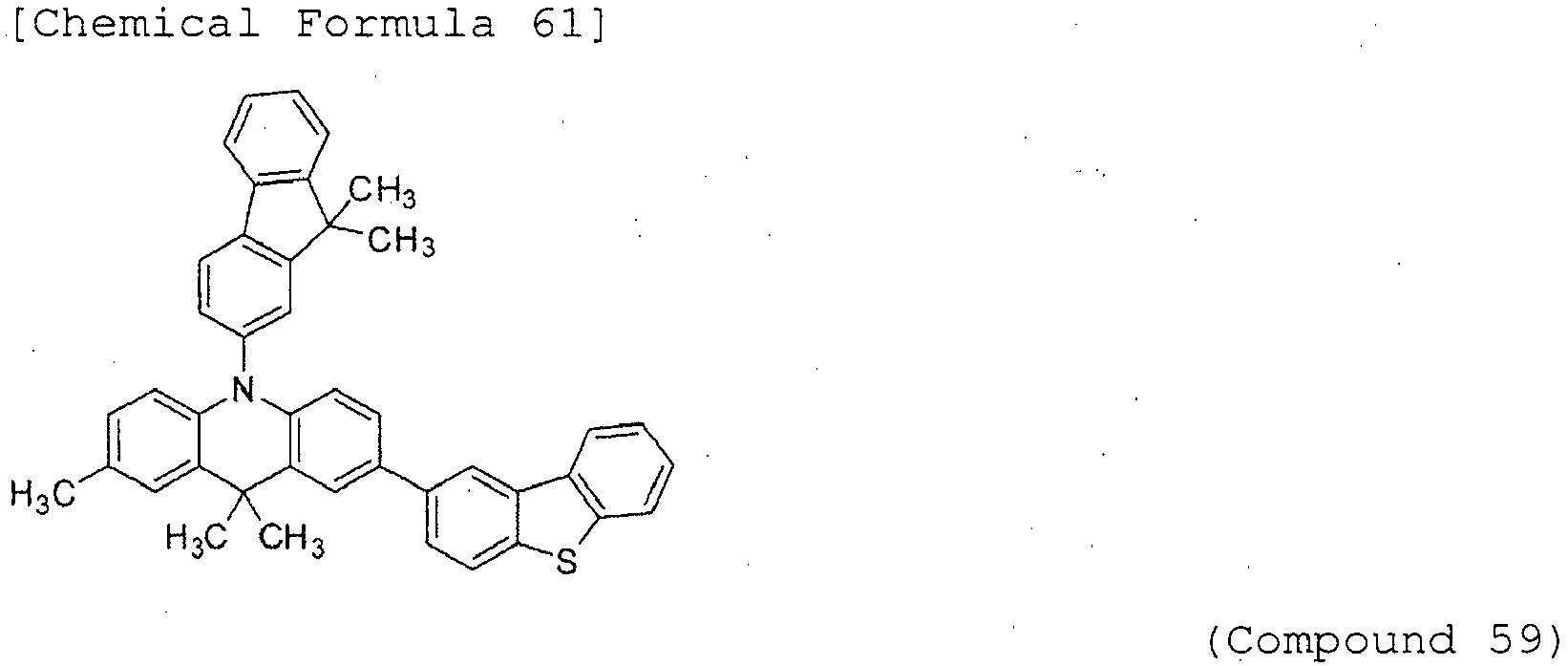
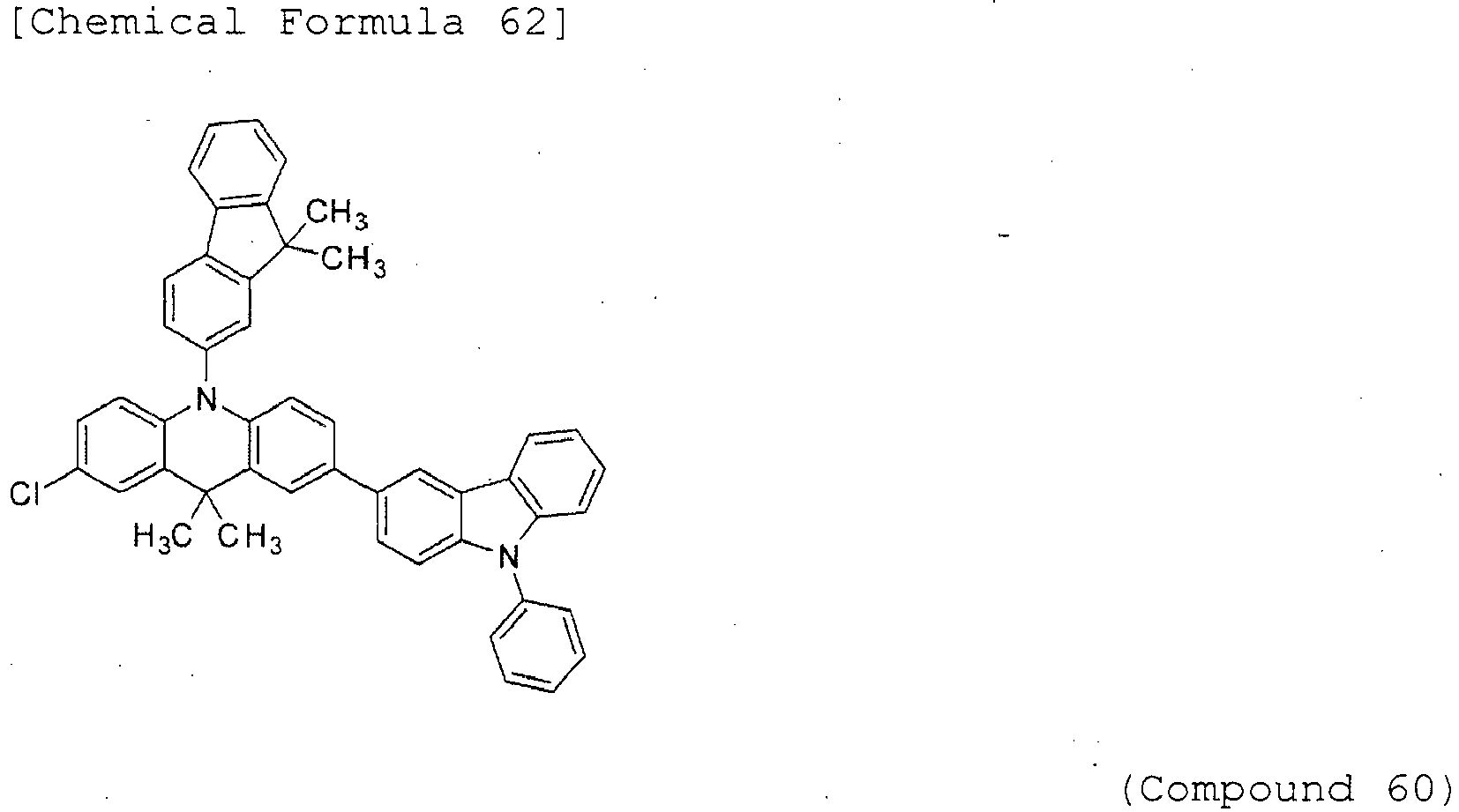
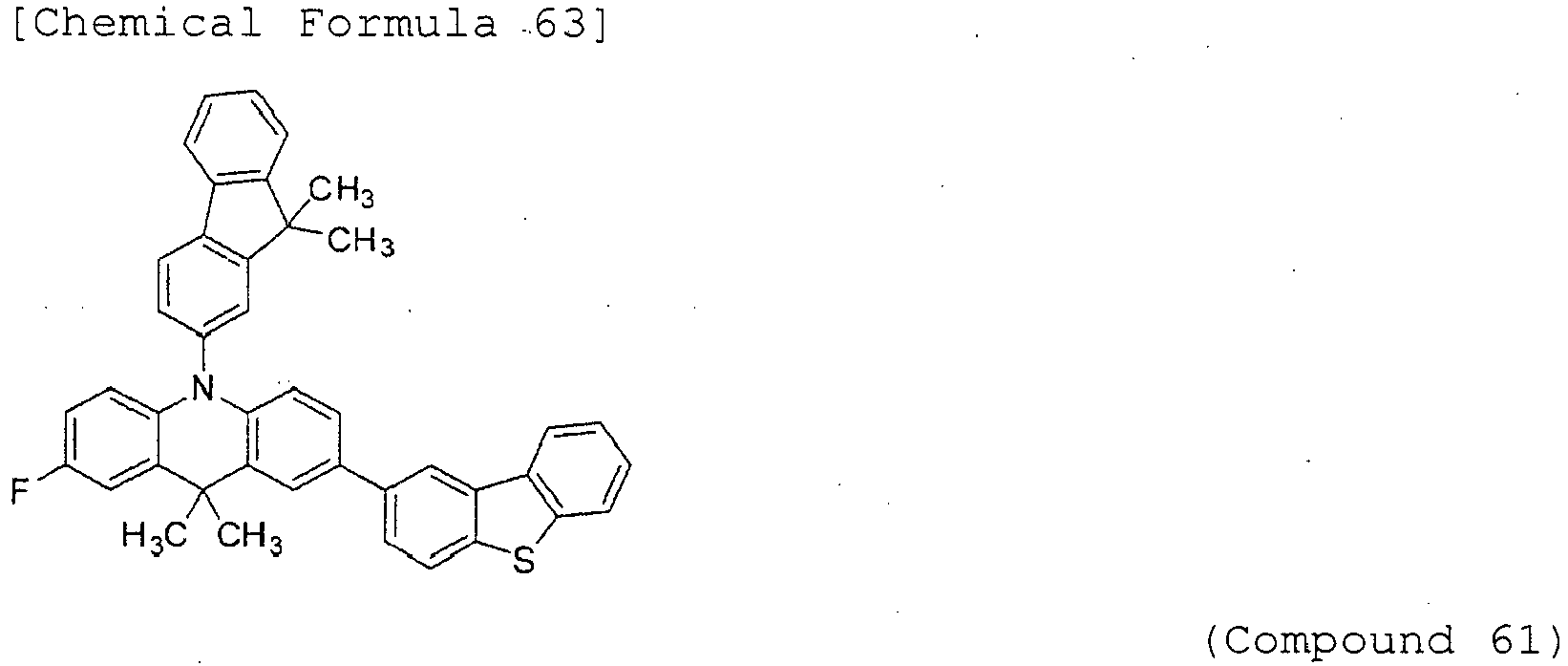

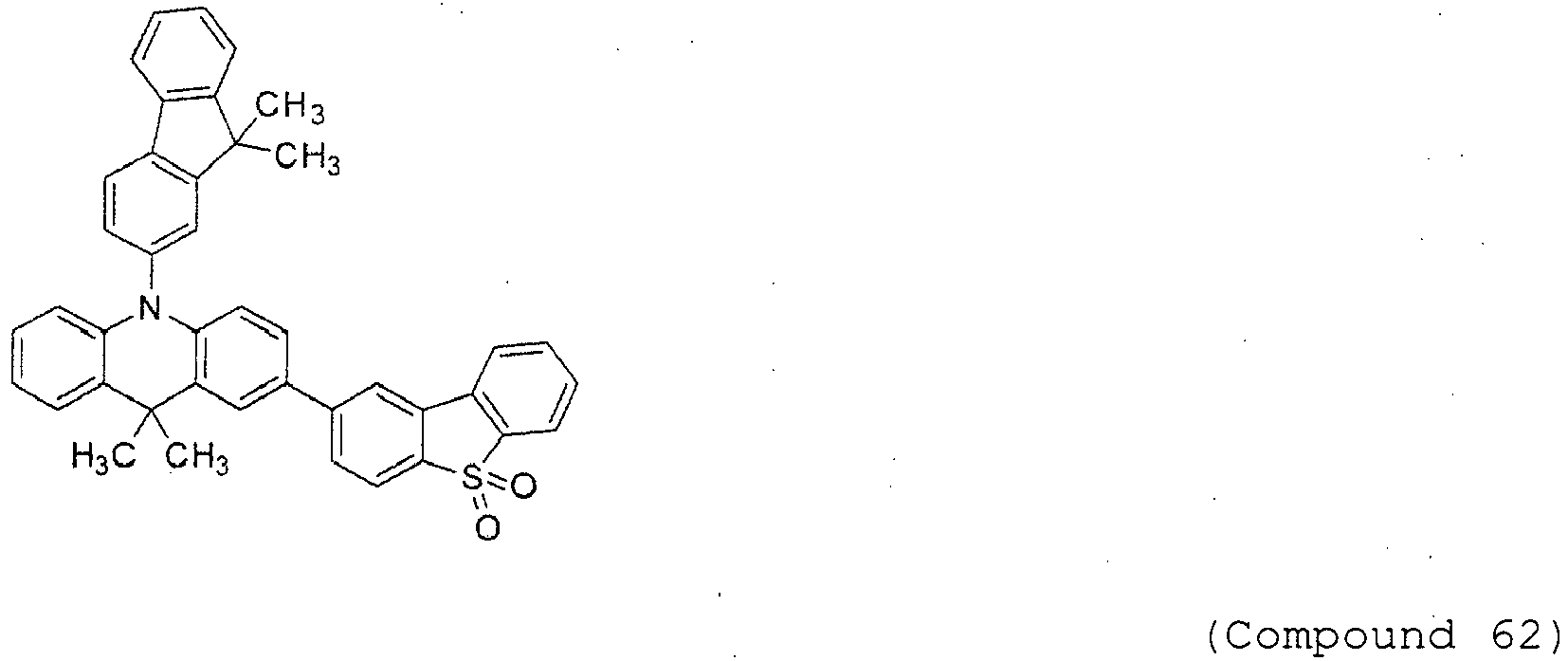
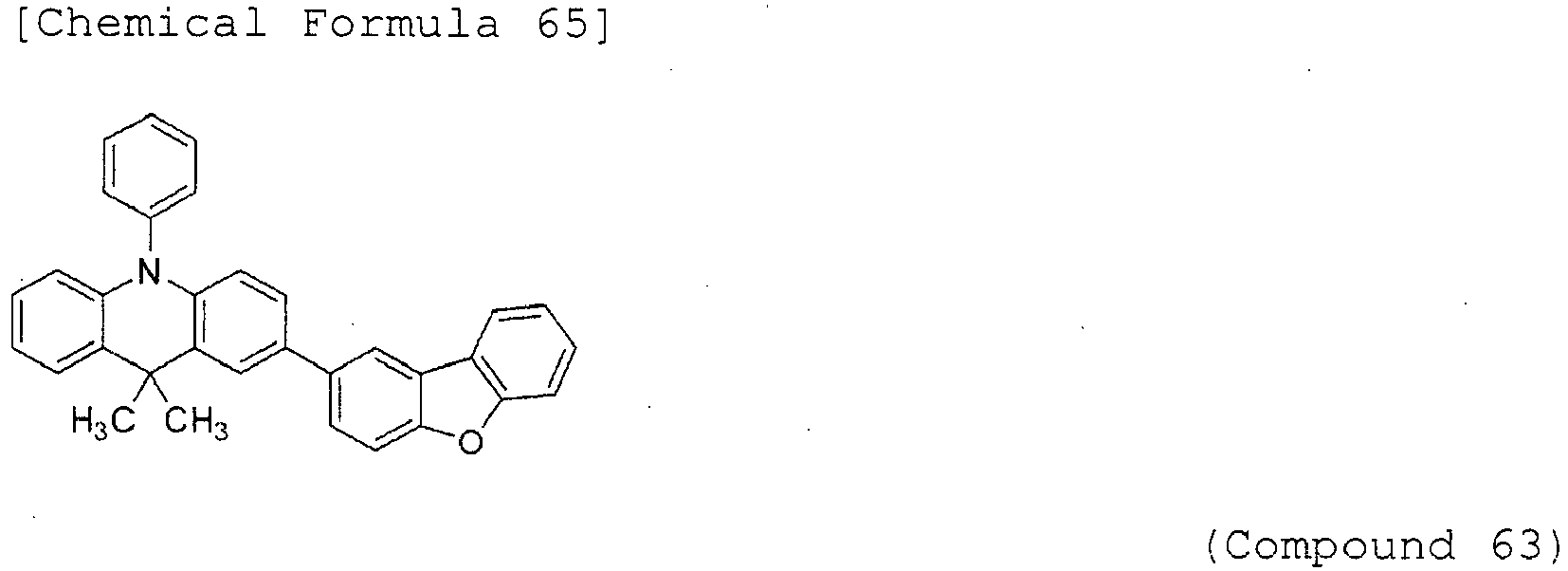
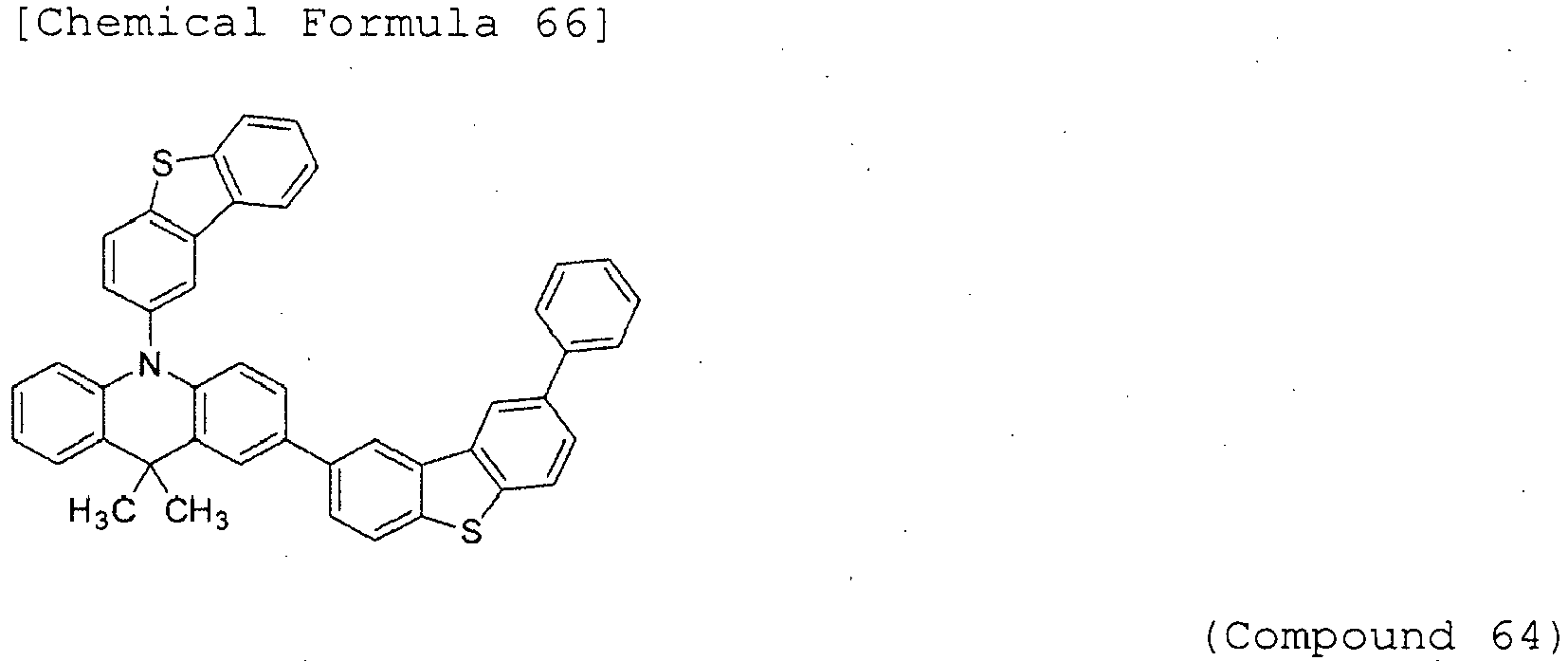

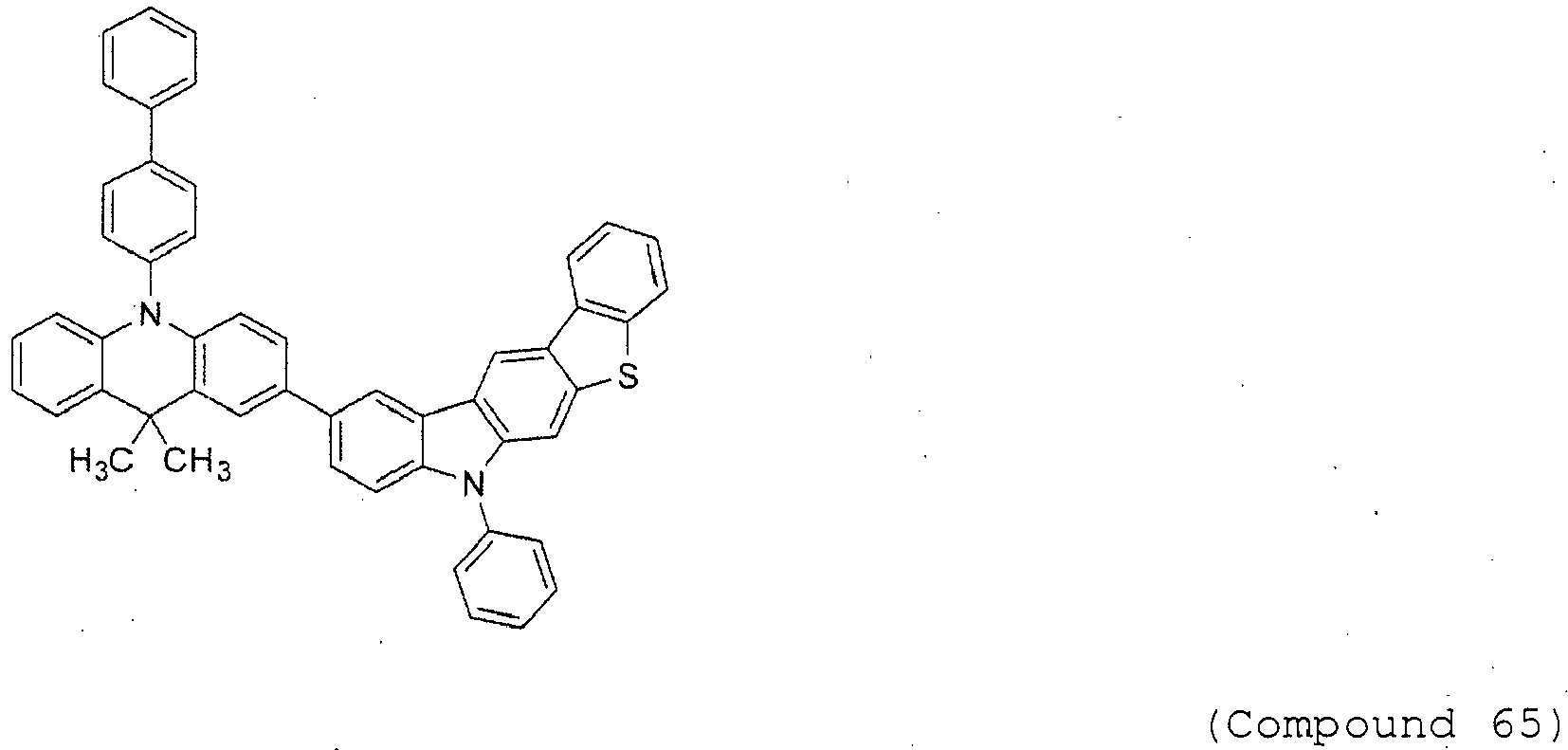
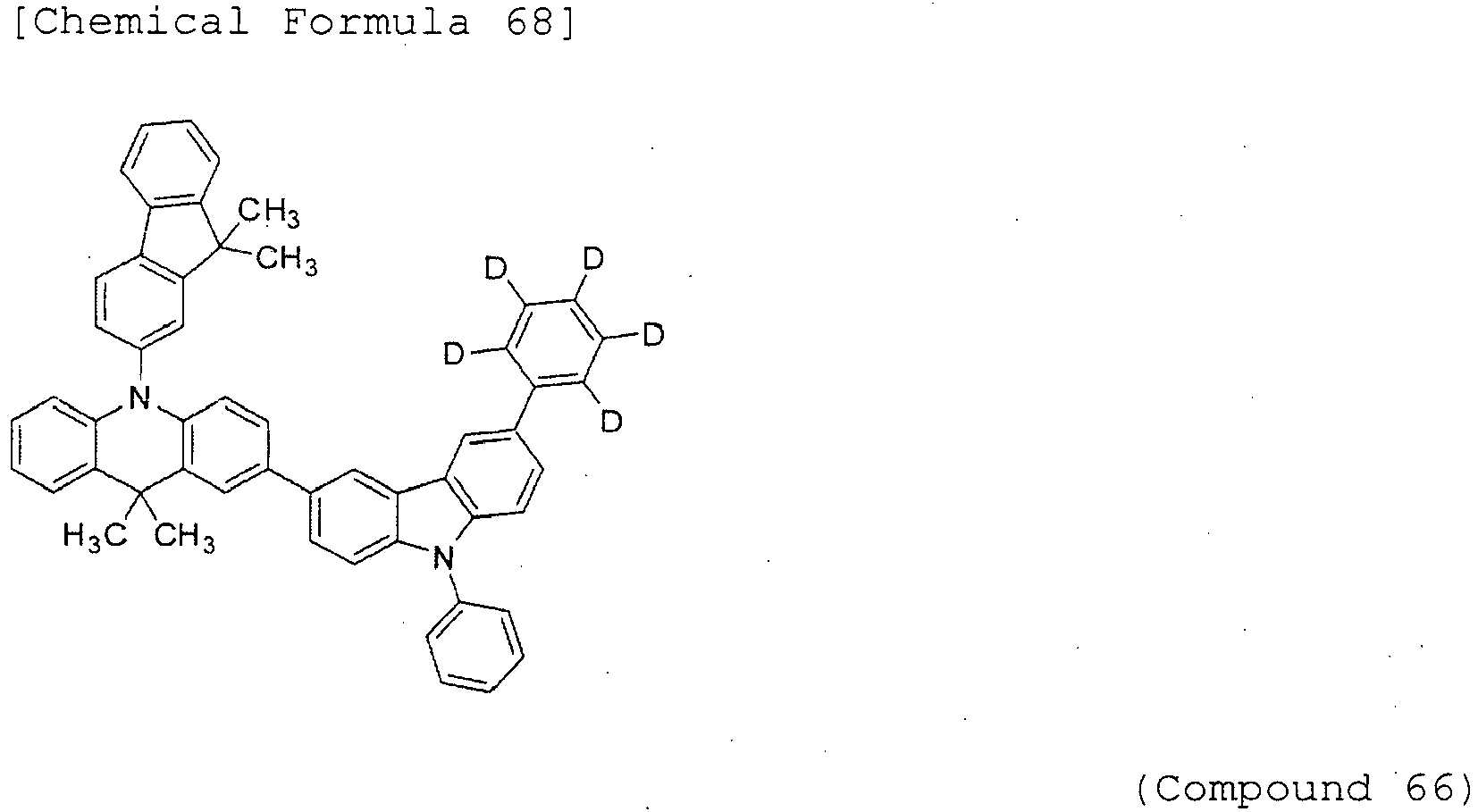

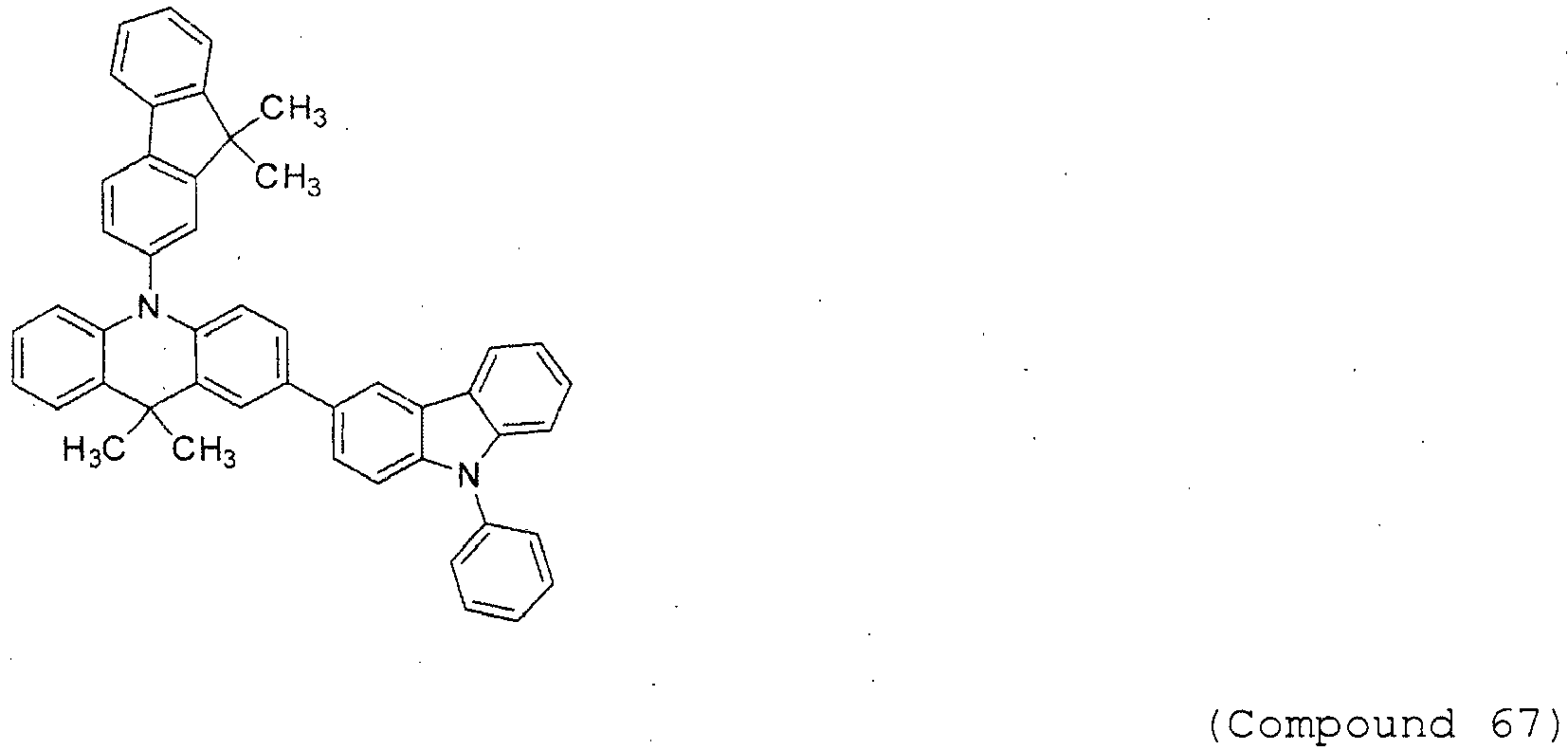

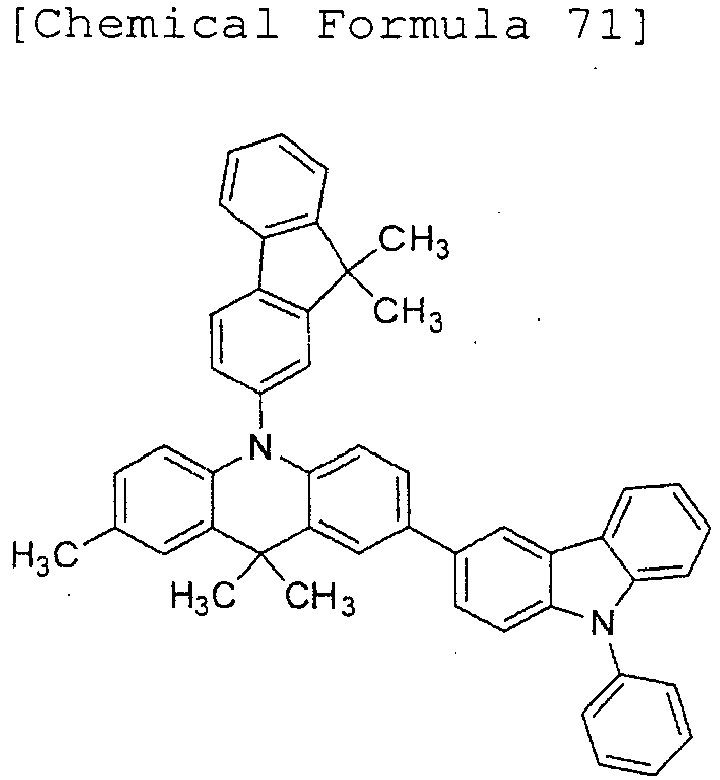


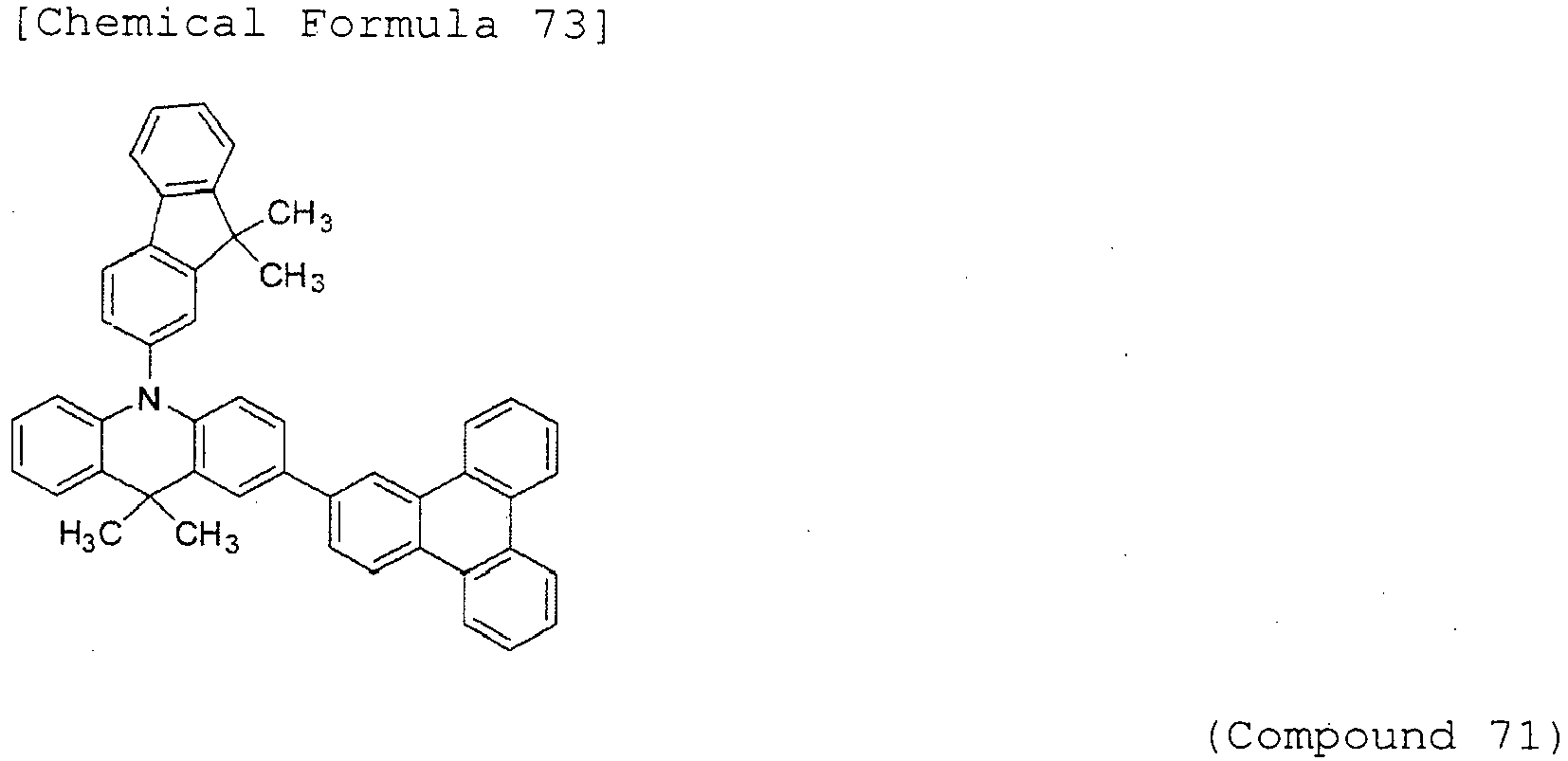


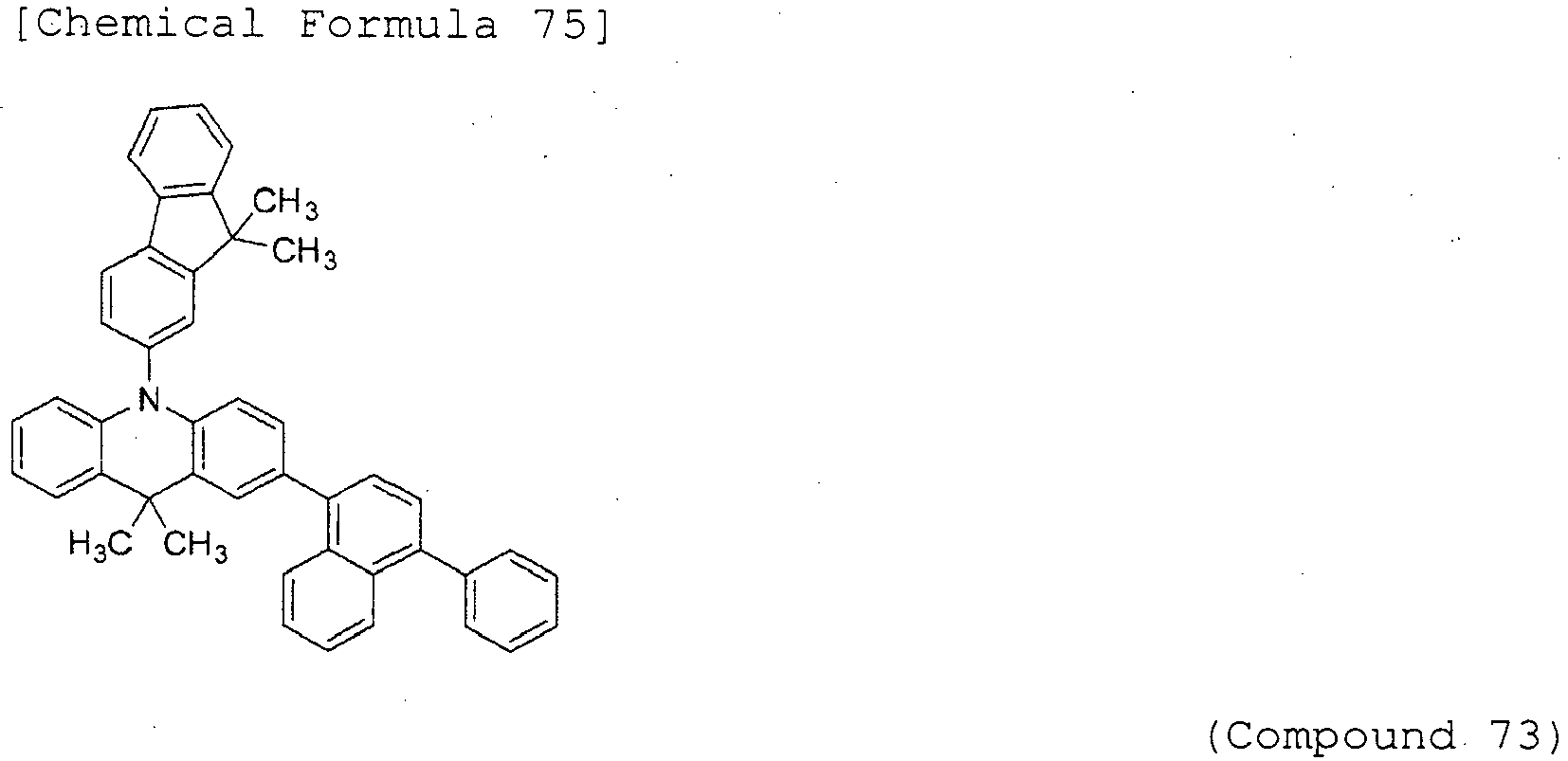

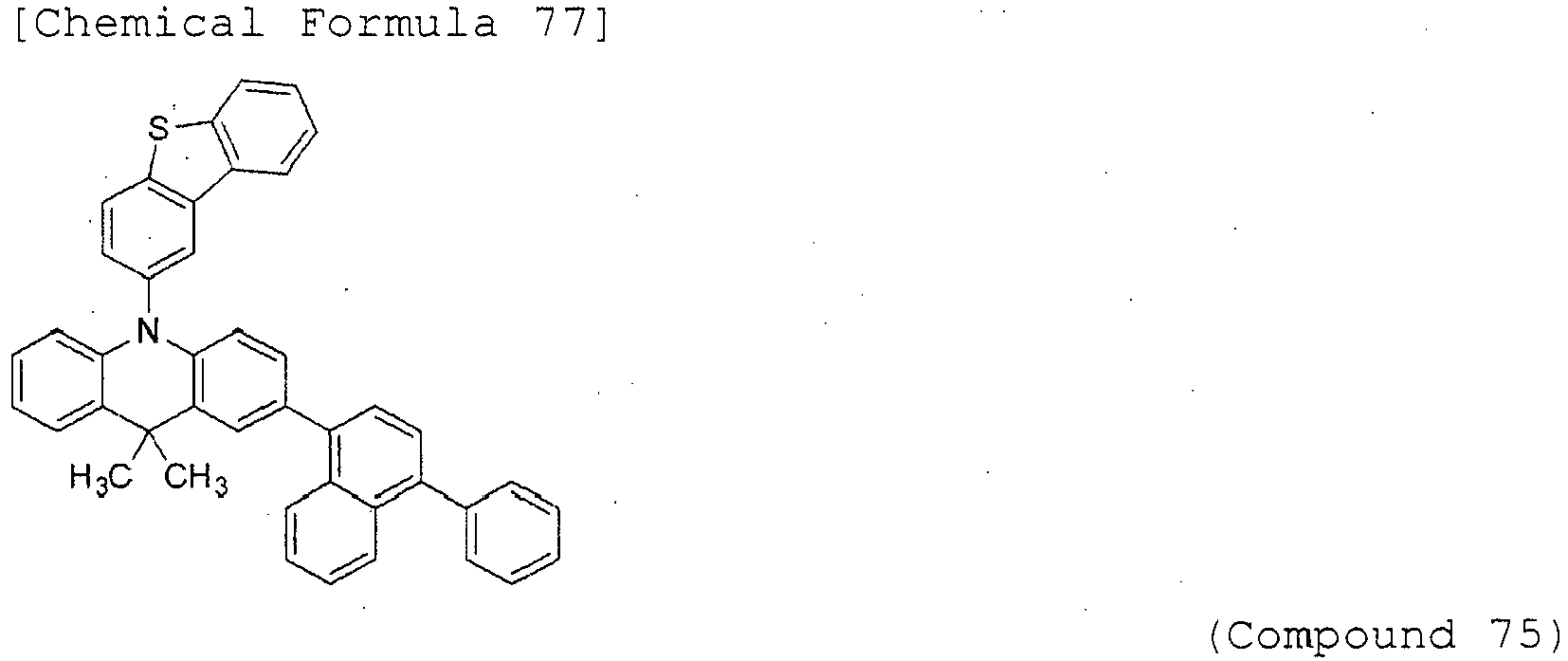
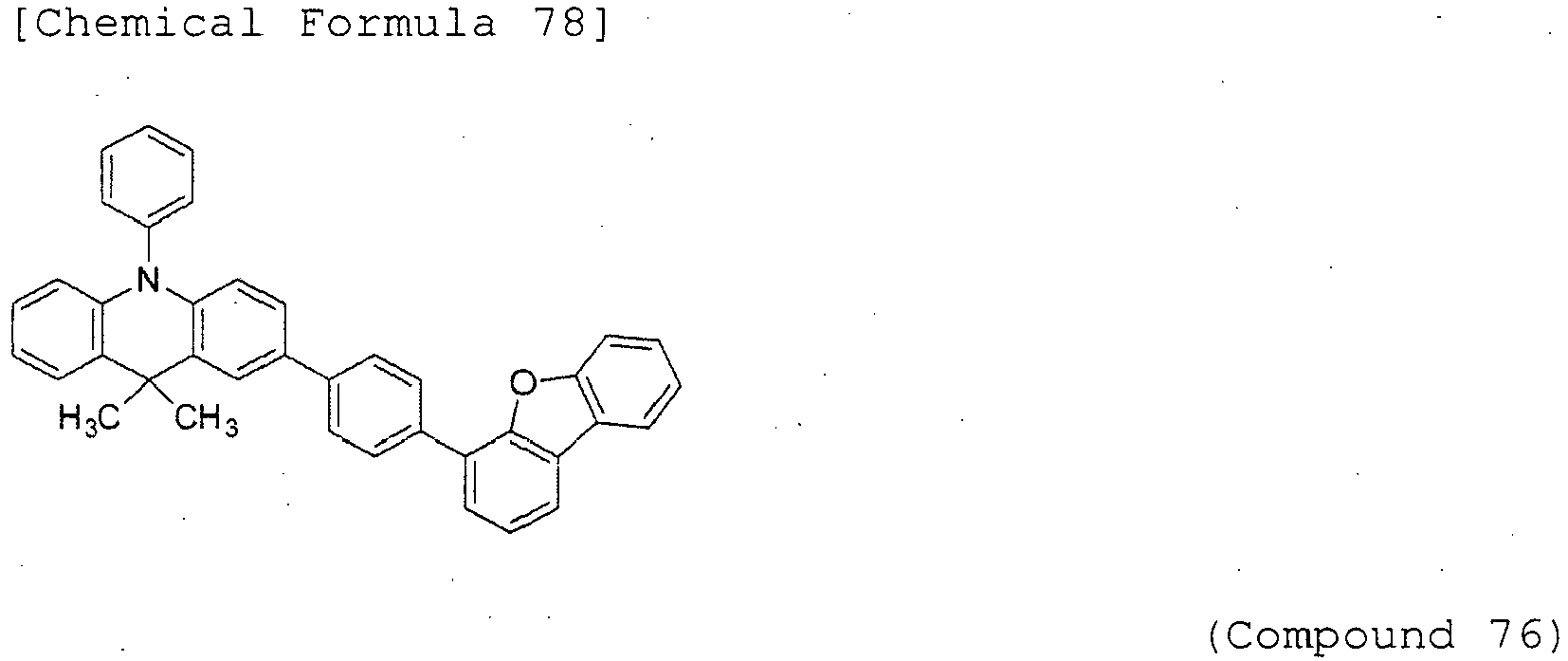


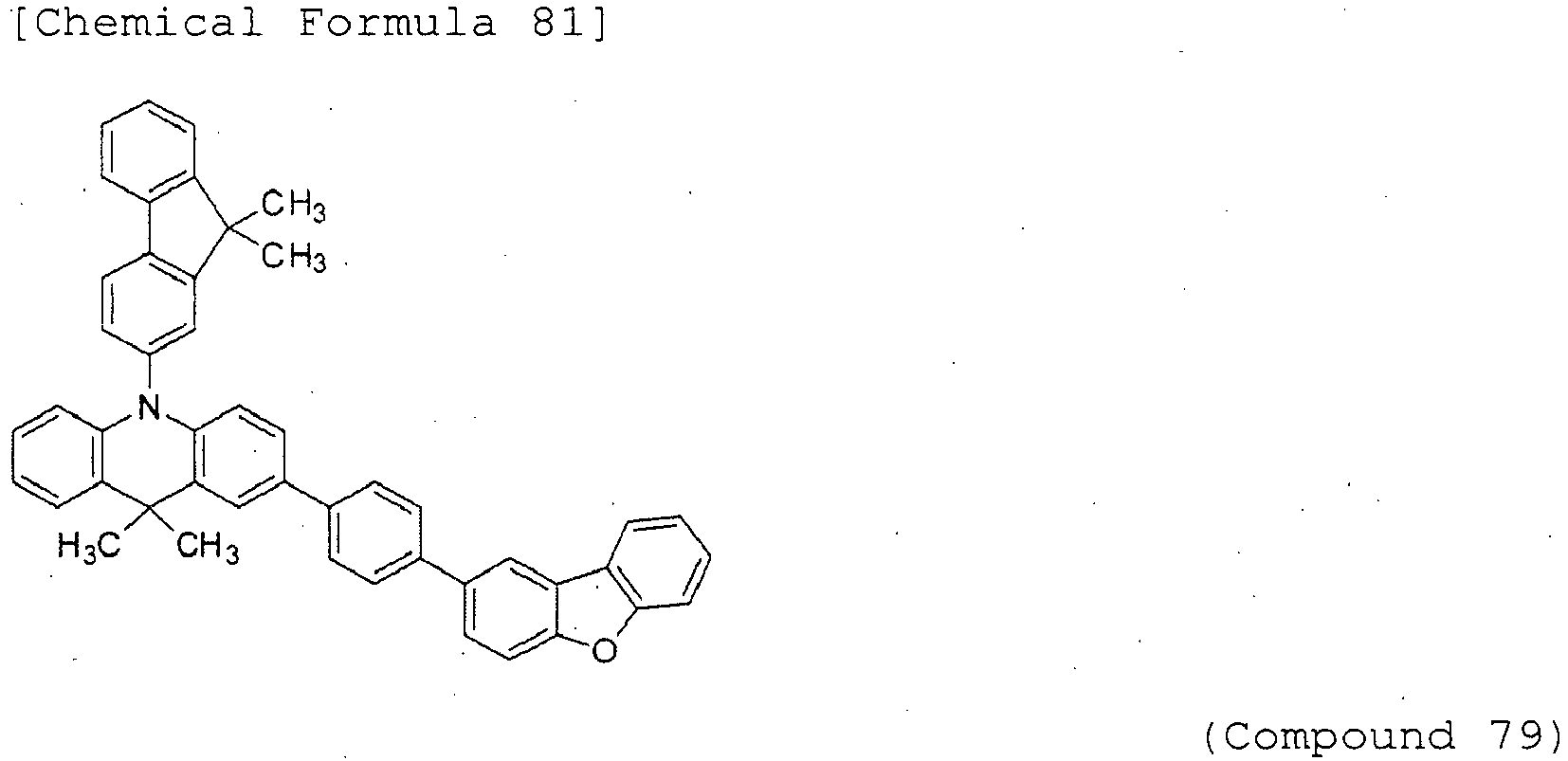
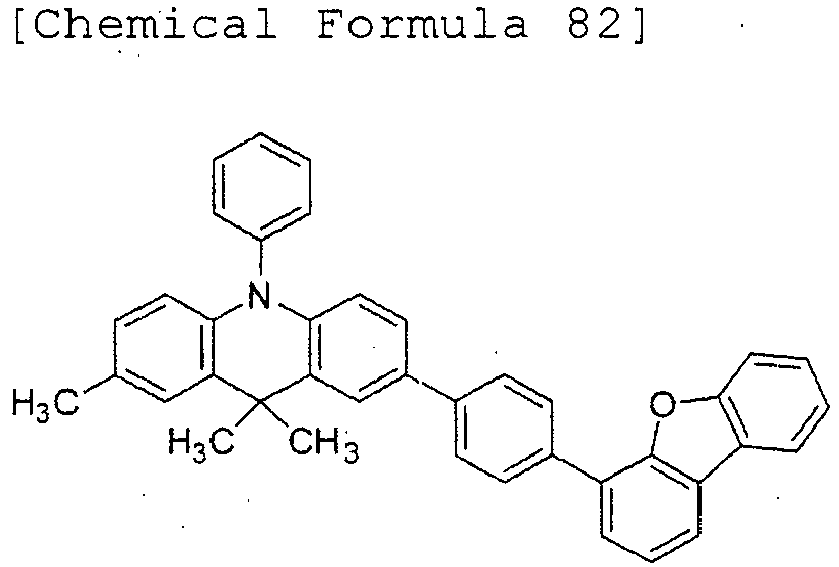

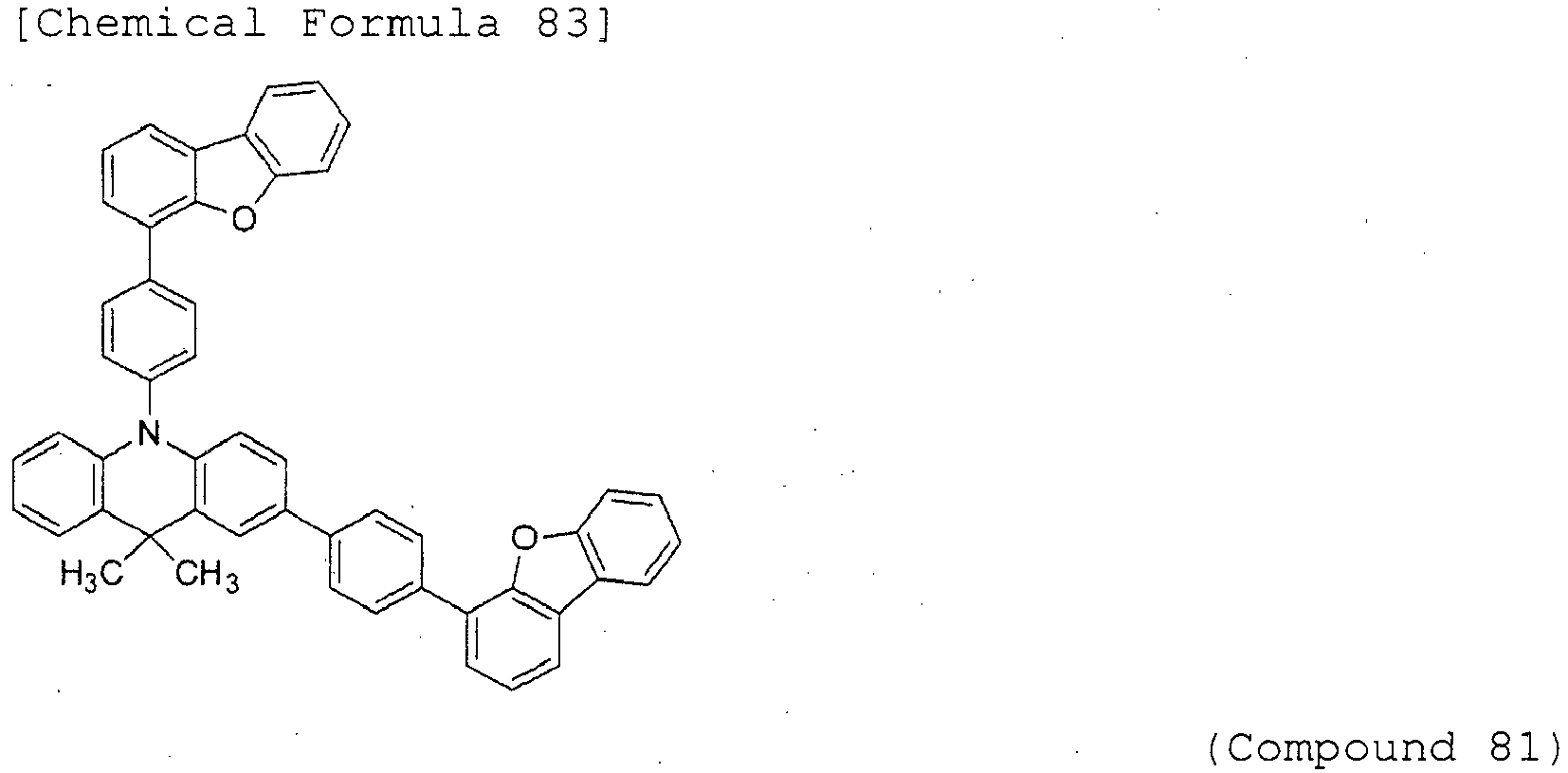
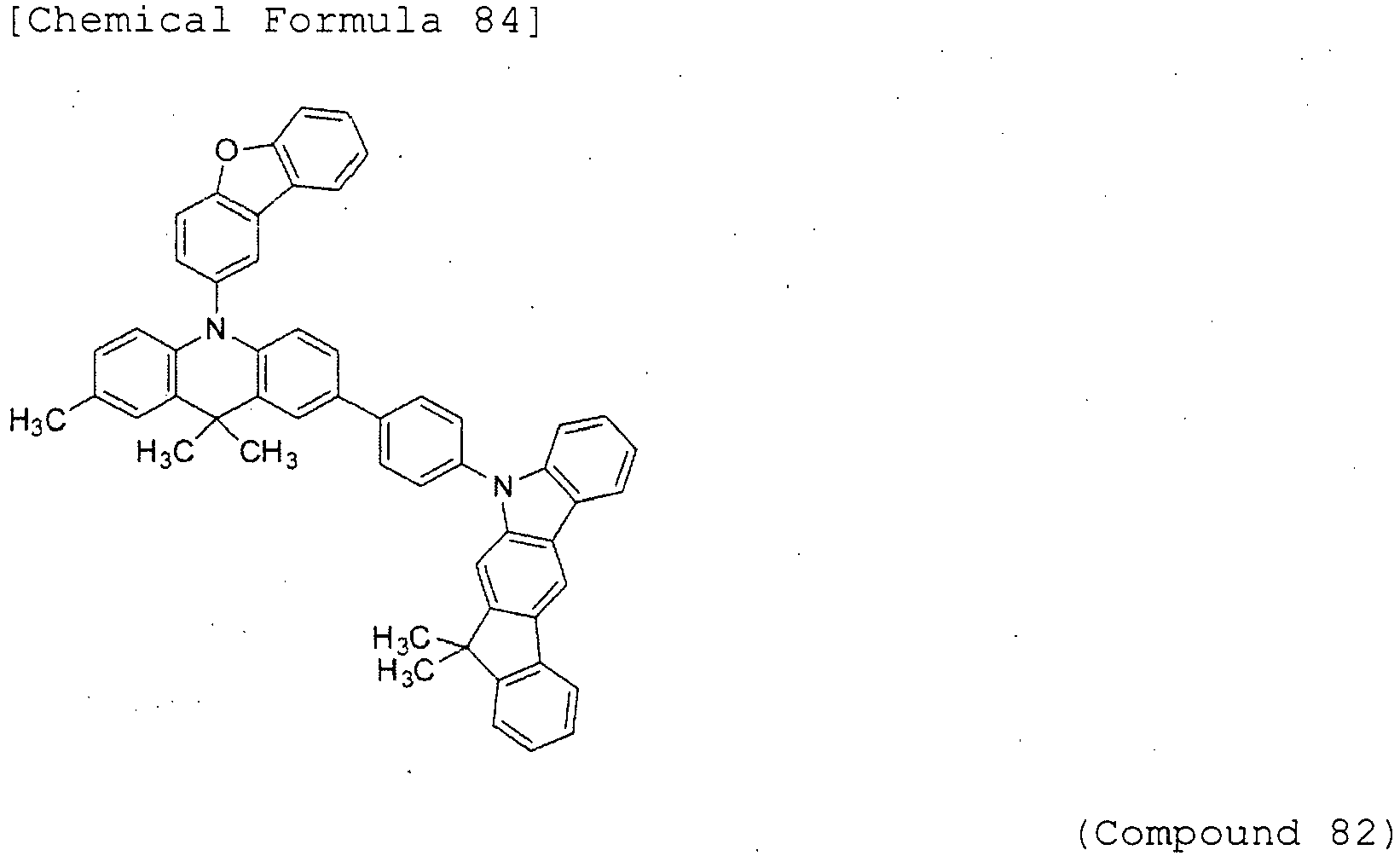


- These compounds were purified by methods such as column chromatography, adsorption using, for example, silica gel, activated carbon, or activated clay, and recrystallization or crystallization using a solvent. The compounds were identified by an NMR analysis. A glass transition point (Tg), a melting point, and a work function were measured as material property values. The glass transition point (Tg) can be used as an index of stability in the thin-film state, the melting point as an index of vapor deposition, and the work function as an index of hole transportability.
- The glass transition point (Tg) and the melting point were measured by a high-sensitive differential scanning calorimeter (DSC3100S produced by Bruker AXS) using powder.
- For the measurement of the work function, a 100 nm-thick thin film was fabricated on an ITO substrate, and an atmosphere photoelectron spectrometer (AC-3 produced by Riken Keiki Co., Ltd.) was used.
- The organic EL device of the present invention may have a structure including an anode, a hole transport layer, an electron blocking layer, a light emitting layer, an electron transport layer, and a cathode successively formed on a substrate, optionally with a hole injection layer between the anode and the hole transport layer, or with an electron injection layer between the electron transport layer and the cathode. In such multilayer structures, some of the organic layers may be omitted. For example, the device may be configured to include an anode, a hole transport layer, a light emitting layer, an electron transport layer, and a cathode successively formed on a substrate.
- Electrode materials with high work functions such as ITO and gold are used as the anode of the organic EL device of the present invention. The hole injection layer of the organic EL device of the present invention may be made of material such as porphyrin compounds as represented by copper phthalocyanine, starburst-type triphenylamine derivatives, various triphenylamine tetramers, accepting heterocyclic compounds such as hexacyano azatriphenylene, and coating-type polymer materials, in addition to the compounds of general formula (1) having an acridan ring structure of the present invention. These materials may be formed into a thin film by a vapor deposition method or other known methods such as a spin coating method and an inkjet method.
- Examples of material used for the hole transport layer of the organic EL device of the present invention can be benzidine derivatives such as N,N'-diphenyl-N,N'-di(m-tolyl)benzidine (hereinafter referred to as TPD), N,N'-diphenyl-N,N'-di(α-naphthyl)benzidine (hereinafter referred to as NPD), and N,N,N',N'-tetrabiphenylylbenzidine; 1,1-bis[4-(di-4-tolylamino)phenyl]cyclohexane (hereinafter referred to as TAPC); and various triphenylamine trimers and tetramers, in addition to the compounds of general formula (1) having an acridan ring structure of the present invention. These may be individually deposited for film forming, may be used as a single layer deposited mixed with other materials, or may be formed as a laminate of individually deposited layers, a laminate of mixedly deposited layers, ,or a laminate of the individually deposited layer and the mixedly deposited layer. Examples of material used for the hole injection/transport layer can be coating-type polymer materials such as poly(3,4-ethylenedioxythiophene) (hereinafter referred to as PEDOT)/poly(styrene sulfonate) (hereinafter referred to as PSS). These materials may be formed into a thin-film by a vapor deposition method or other known methods such as a spin coating method and an inkjet method.
- Further, material used for the hole injection layer or the hole transport layer may be obtained by p-doping trisbromophenylamine hexachloroantimony or the like into the material commonly used for these layers, or may be, for example, polymer compounds each having a TPD structure as a part of the compound structure.
- Examples of material used for the electron blocking layer of the organic EL device of the present invention can be compounds having an electron blocking effect, including, for example, carbazole derivatives such as 4,4',4" -tri(N-carbazolyl)triphenylamine (hereinafter referred to as TCTA), 9,9-bis[4-(carbazol-9-yl)phenyl]fluorene, 1,3-bis(carbazol-9-yl)benzene (hereinafter referred to as mCP), and 2,2-bis(4-carbazol-9-ylphenyl)adamantane (hereinafter referred to as Ad-Cz); and compounds having a triphenylsilyl group and a triarylamine structure, as represented by 9-[4-(carbazol-9-yl)phenyl]-9-[4-(triphenylsilyl)phenyl]-9H-fluorene, in addition to the compounds of general formula (1) having an acridan ring structure of the present invention. These may be individually deposited for film forming, may be used as a single layer deposited mixed with other materials, or may be formed as a laminate of individually deposited layers, a laminate of mixedly deposited layers, or a laminate of the individually deposited layer and the mixedly deposited layer. These materials may be formed into a thin-film by using a vapor deposition method or other known methods such as a spin coating method and an inkjet method.
- Examples of material used for the light emitting layer of the organic EL device of the present invention can be various metal complexes, anthracene derivatives, bis(styryl)benzene derivatives, pyrene derivatives, oxazole derivatives, and polyparaphenylene vinylene derivatives, in addition to quinolinol derivative metal complexes such as Alq3. Further, the light emitting layer may comprise a host material and a dopant material. Examples of the host material can be thiazole derivatives, benzimidazole derivatives, and polydialkyl fluorene derivatives, in addition to the above light-emitting materials and the compounds of general formula (1) having an acridan ring structure of the present invention. Examples of the dopant material can be quinacridone, coumarin, rubrene, perylene, derivatives thereof, benzopyran derivatives, rhodamine 'derivatives, and aminostyryl derivatives. These may be individually deposited for film forming, may be used as a single layer deposited mixed with other materials, or may be formed as a laminate of individually deposited layers, a laminate of mixedly deposited layers, or a laminate of the individually deposited layer and the mixedly deposited layer.
- Further, the light-emitting material may be a phosphorescent light-emitting material. Phosphorescent materials as metal complexes of metals such as iridium and platinum may be used as the phosphorescent light-emitting material. Examples of the phosphorescent materials can be green phosphorescent materials such as Ir(ppy)3, blue phosphorescent materials such as FIrpic and FIr6, and red phosphorescent materials such as Btp2Ir(acac). As the hole injecting and transporting host material, the compounds of general formula (1) having an acridan ring structure of the present invention may be used in addition to carbazole derivatives such as 4,4'-di (N-carbazolyl)biphenyl (hereinafter referred to as CBP), TCTA, and mCP. Compounds such as p-bis(triphenylsilyl)benzene (hereinafter referred to as UGH2) and 2,2',2 '-(1,3,5-phenylene)-tris(1-phenyl-1H-benzimidazole) (hereinafter referred to as TPBI) may be used as the electron transporting host material to produce a high-performance organic EL device.
- In order to avoid concentration quenching, it is preferable to dope the host material with the phosphorescent light-emitting material by co-evaporation in a range of 1 to 30 weight percent to the whole light emitting layer.
- These materials may be formed into a thin-film by using a vapor deposition method or other known methods such as a spin coating method and an inkjet method.
- The hole blocking layer of the organic EL device of the present invention may be formed by using hole blocking compounds such as various rare earth complexes, triazole derivatives, triazine derivatives, and oxadiazole derivatives, in addition to the metal complexes of phenanthroline derivatives such as bathocuproin (hereinafter referred to as BCP), and the metal complexes of quinolinol derivatives such as aluminum(III) bis(2-methyl-8-quinolinate)-4-phenylphenolate (hereinafter referred to as BAlq). These materials may also serve as the material of the electron transport layer. These may be individually deposited for film forming, may be used as a single layer deposited mixed with other materials, or may be formed as a laminate of individually deposited layers, a laminate of mixedly deposited layers, or a laminate of the individually deposited layer and the mixedly deposited layer. These materials may be formed into a thin-film by using a vapor deposition method or other known methods such as a spin coating method and an inkjet method.
- Examples of material used for the electron transport layer of the organic EL device of the present invention can be various metal complexes, triazole derivatives, triazine derivatives, oxadiazole derivatives, thiadiazole derivatives, carbodiimide derivatives, quinoxaline derivatives, phenanthroline derivatives, and silole derivatives, in addition to the metal complexes of quinolinol derivatives such as Alq3 and BAlq. These may be individually deposited for film forming, may be used as a single layer deposited mixed with other materials, or may be formed as a laminate of individually deposited layers, a laminate of mixedly deposited layers, or a laminate of the individually deposited layer and the mixedly deposited layer. These materials may be formed into a thin-film by using a vapor deposition method or other known methods such as a spin coating method and an inkjet method.
- Examples of material used for the electron injection layer of the organic EL device of the present invention can be alkali metal salts such as lithium fluoride and cesium fluoride; alkaline earth metal salts such as magnesium fluoride; and metal oxides such as aluminum oxide. However, the electron injection layer may be omitted in the preferred selection of the electron transport layer and the cathode.
- The cathode of the organic EL device of the present invention may be made of an electrode material with a low work function such as aluminum, or an alloy of an electrode material with an even lower work function such as a magnesium-silver alloy, a magnesium-indium alloy, or an aluminum-magnesium alloy.
- The following describes an embodiment of the present invention in more detail based on Examples. The present invention, however, is not restricted to the following Examples.
- 7-bromo-10-(9,9-dimethyl-9H-fluoren-2-yl)-2,9,9-trimethylacridan (5.27 g), 9-phenyl-3-(4,4,5,5-tetramethyl-[1,3,2]dioxaborolane-2-yl)-9H-carbazol (4.70 g), toluene (79 ml), ethanol (20 ml), and a 2 M potassium carbonate aqueous solution (8 ml) were added to a reaction vessel in a nitrogen atmosphere, and aerated with nitrogen gas for 30 minutes under ultrasonic irradiation. The mixture was heated after adding tetrakis(triphenylphosphine)palladium (0.24 g), and stirred at 67°C for 5 hours. After the mixture was allowed to cool to room temperature, toluene (50 ml) was added to perform liquid separation in order to collect an organic layer. The organic layer was washed with water (50 ml), dried over anhydrous magnesium sulfate, and concentrated under reduced pressure to obtain a crude product. The crude product was purified by column chromatography (support: silica gel, eluent: hexane/toluene). The crystallization with a toluene/diisopropyl ether mixed solvent and the crystallization with a toluene/hexane mixed solvent were repeated, and the product was washed under reflux with methanol to obtain a white powder of 10-(9,9-dimethyl-9H-fluoren-2-yl)-2,9,9-trimethyl-7-(9-phenyl-9H-carbazol-3-yl)acridan (Compound 69; 2.87 g; yield 41%).
- The structure of the product white powder was identified by NMR. The 1H-NMR measurement result is shown in
FIG. 1 . - 1H-NMR (THF-d8) detected 40 hydrogen signals, as follows. δ (ppm) = 8.36 (1H), 8.20 (1H), 8.05 (1H), 7.85 (2H), 7.64-7.21 (17H), 6.74 (1H), 6.41 (1H), 6.24 (1H), 2.27 (3H), 1.77 (6H), 1.54 (6H).
- 2-bromo-10-(9,9-dimethyl-9H-fluoren-2-yl)- 9,9-dimethylacridan (7.00 g), 4,4,5,5-tetramethyl-2-(triphenylene-2-yl)-[1,3,2]dioxaborolane (5.16 g), tetrakis(triphenylphosphine)palladium (0.34 g), potassium carbonate (4.03 g), toluene (40 ml), ethanol (10 ml), and water (15 ml) were added to a reaction vessel in a nitrogen atmosphere, heated, and stirred for 3 hours under reflux. After the mixture was allowed to cool to room temperature, water and toluene were added to perform liquid separation in order to collect an organic layer. The organic layer was dried over anhydrous magnesium sulfate, and concentrated under reduced pressure to obtain a crude product. The crude product was purified by column chromatography (support: silica gel, eluent: toluene/ hexane=1/1) to obtain a white powder of 10-(9,9-dimethyl-9H-fluoren-2-yl)-9,9-dimethyl-2-(triphenylene-2-yl)acridan (Compound 71; 5.40 g; yield 59%).
- The structure of the product white powder was identified by NMR. The 1H-NMR measurement result is shown in
FIG. 2 . - 1H-NMR (THF-d8) detected 37 hydrogen signals, as follows. δ (ppm) = 8.93 (1H), 8.85 (1H), 8.80-8.71 (4H), 8.09 (1H), 8.01 (1H), 7.95 (1H), 7.87 (1H), 7.69-7.61 (4H), 7.59-7.46 (4H), 7.42-7.34 (3H), 6.98-6.87 (2H), 6.51 (1H), 6.39 (1H), 1.85 (6H), 1.57(6H).
- 1-bromo-4-(dibenzofuran-2-yl)benzene (11.0 g), 4,4,5,5-tetramethyl-2-(10-phenyl-2,9,9-trimethylacridan-7-yl)-[1,3,2]dioxaborolane (17.3 g), tetrakis(triphenylphosphine)palladium (0.78 g), potassium carbonate (7.05 g), toluene (110 ml), ethanol (18 ml), and water (25 ml) were added to a reaction vessel in a nitrogen atmosphere, heated, and stirred for 6.5 hours under reflux. After the mixture was allowed to cool to room temperature, water and toluene were added to perform liquid separation in order to collect an organic layer. The organic layer was dried over anhydrous magnesium sulfate, and concentrated under reduced pressure to obtain a crude product. The crude product was purified by column chromatography (support: silica gel, eluent: toluene/ heptane=1/4) to obtain a white powder of 2-[(dibenzofuran-2-yl)benzene-4-yl)-7,9,9-trimethyl-10-phenylacridan (Compound 80; 13.2 g; yield 71%).
- The structure of the product white powder was identified by NMR. The 1H-NMR measurement result is shown in
FIG. 3 . - 1H-NMR (THF-d8) detected 31 hydrogen signals, as follows. δ (ppm) = 8.18 (1H), 8.02-7.94 (3H), 7.84 (1H), 7.75-7.72 (2H), 7.71-7.62 (4H), 7.54 (1H), 7.49-7.29 (7H), 6.74 (1H), 6.32 (1H), 6.15 (1H), 2.27 (3H), 1.78 (6H).
- The melting points and the glass transition points of the compounds of the present invention were determined using a high-sensitive differential scanning calorimeter (DSC3100S produced by Bruker AXS).
Melting point Glass transition point Compound of Example 1 of the present invention 253°C 134°C Compound of Example 2 of the present invention 262°C 139°C - The compounds of the present invention had glass transition points of 100°C or more. This indicates that the compounds of the present invention have a stable thin-film state.
- A 100 nm-thick vapor-deposited film was fabricated on an ITO substrate using the compounds of the present invention. The work function was measured using an atmosphere photoelectron spectrometer (AC-3 produced by Riken Keiki Co., Ltd.).
Work function Compound of Example 1 of the present invention 5.48 eV Compound of Example 2 of the present invention 5.48 eV - As shown above, the compounds of the present invention have more desirable energy levels and more desirable hole transportability than common hole transport materials such as NPD and TPD having work functions of 5.4 eV.
- The organic EL device, as illustrated in
FIG. 4 , was fabricated from ahole injection layer 3, ahole transport layer 4, alight emitting layer 5, anelectron transport layer 6, anelectron injection layer 7, and a cathode (aluminum electrode) 8 successively formed by vapor deposition on aglass substrate 1 that had been provided beforehand with an ITO electrode as atransparent anode 2. - Specifically, the
glass substrate 1 having ITO (thickness 150 nm) formed thereon was washed with an organic solvent, and subjected to an oxygen plasma treatment to wash the surface. The glass substrate with the ITO electrode was then installed in a vacuum vapor deposition apparatus, and the pressure was reduced to 0.001 Pa or less. This was followed by formation of thehole injection layer 3 by forming Compound 84 of the structural formula below over thetransparent anode 2 in a thickness of 20 nm. Thehole transport layer 4 was then formed on thehole injection layer 3 by forming the compound of Example 1 of the present invention (Compound 69) in a thickness of 40 nm. Then, thelight emitting layer 5 was formed on thehole transport layer 4 in a thickness of 30 nm by the dual vapor deposition of Compound 85 of the structural formula below and Compound 86 of the structural formula below at a deposition rate ratio of Compound 85: Compound 86 = 5:95. Theelectron transport layer 6 was then formed on thelight emitting layer 5 by forming Alq3 in a thickness of 30 nm. Then, theelectron injection layer 7 was formed on theelectron transport layer 6 by forming lithium fluoride in a thickness of 0.5 nm. Finally, thecathode 8 was formed by vapor depositing aluminum in a thickness of 150 nm. The characteristics of the organic EL device thus fabricated were measured in an atmosphere at ordinary temperature. - Table 1 summarizes the results of the emission characteristics measurements performed by applying a DC voltage to the organic EL device fabricated with the compound of Example 1 of the present invention (Compound 69).
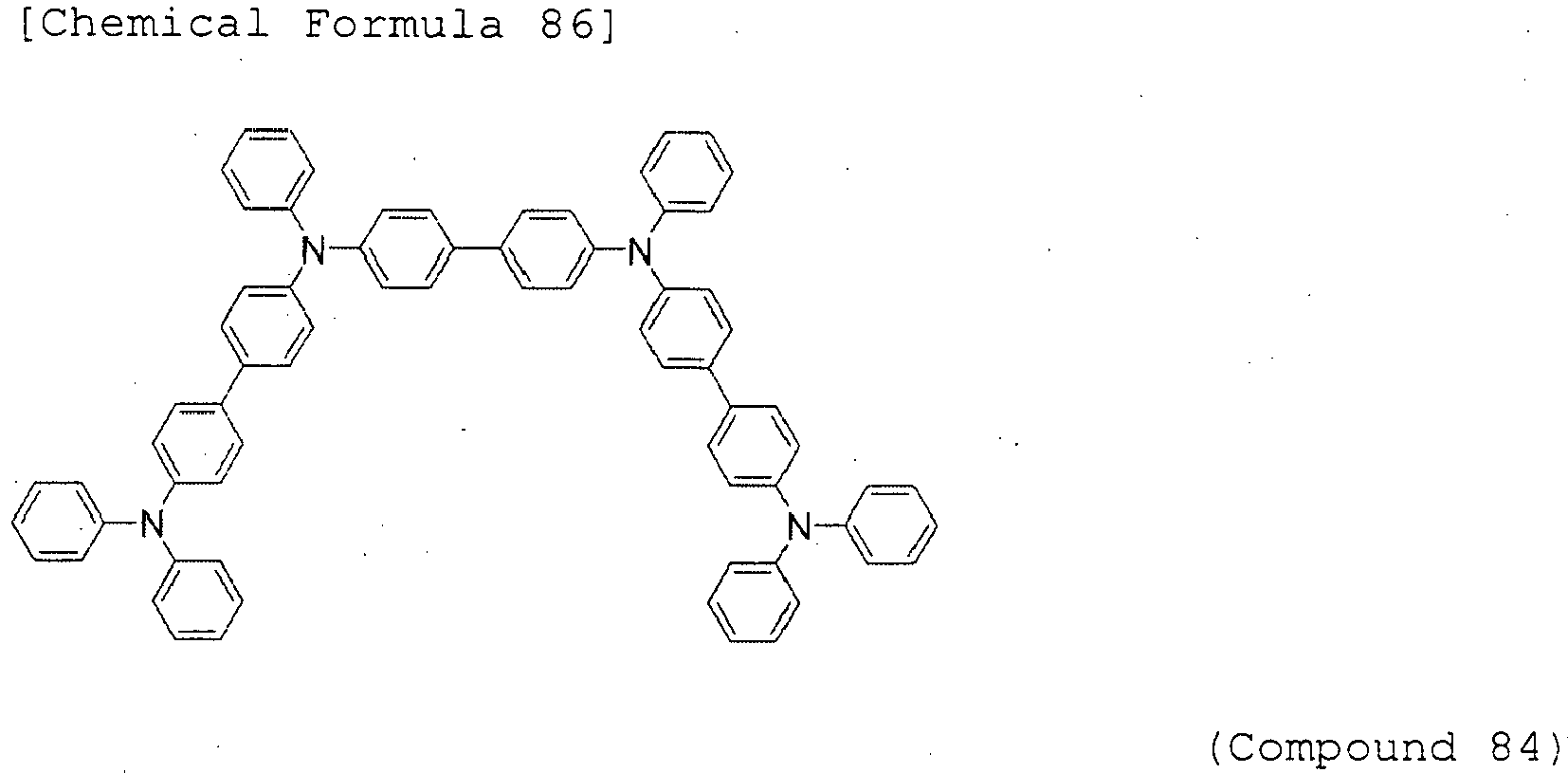

-

- An organic EL device was fabricated under the same conditions used in Example 6, except that the
hole transport layer 4 was formed by forming the compound of Example 2 of the present invention (Compound 71) in a thickness of 40 nm, instead of using the compound of Example 1 of the present invention (Compound 69). The characteristics of the organic EL device thus fabricated were measured in an atmosphere at ordinary temperature. Table 1 summarizes the results of the emission characteristics measurements performed by applying a DC voltage to the fablicated organic EL device. - For comparison, an organic EL device was fabricated under the same conditions used in Example 6, except that the
hole transport layer 4 was formed by forming Compound 87 of the structural formula below in a thickness of 40 nm, instead of using the compound of Example 1 of the present invention (Compound 69). The characteristics of the organic EL device thus fabricated were measured in an atmosphere at ordinary temperature. Table 1 summarizes the results of the emission characteristics measurements performed by applying a DC voltage to the fablicated organic EL device.
[Table 1] Compound Voltage [V] (@10mA/cm2) Luminance [cd/m2] (@10mA/cm2) Current efficiency [cd/A] (@10mA/cm2 ) Power efficiency [1m/W] (@10mA/cm2) Ex. 6 Compound 69 5.30 937 9.37 5.56 Ex. 7 Compound 71 5.09 1051 10.51 6.49 Com. Ex. 1 Compound 87 5.17 903 9.03 5.49 - As can be seen in Table 1, the driving voltage upon passing a current with a current density of 10 mA/cm2 was 5.30 V for the organic EL device that uses the compound of Example 1 of the present invention (Compound 69), and 5.09 V for the organic EL device that uses the compound of Example 2 of the present invention (Compound 71), comparable to, or even lower than 5.17 V for the organic EL device that uses Compound 87. When compared to the power efficiency 5.49 lm/W of the organic EL device that uses Compound 87, there was improvement in the organic EL device that uses the compound of Example 1 (Compounds 69) as shown in its power efficiency 5.56 lm/W, and there was a great improvement particularly in the organic EL device that uses the compound of Example 2 (Compounds 71) as shown in its power efficiency 6.49 lm/W. Further, the luminance and the current efficiency both greatly improved as compared with Compound 87.
- As is clear from these results, the organic EL devices using the compounds having an acridan ring structure of the present invention can greatly improve luminous efficiency and power efficiency, and can achieve a lower actual driving voltage compared to the organic EL device that uses Compound 87.
- The compounds having an acridan ring structure of the present invention have high hole transportability, an excellent amorphousness, and a stable thin-film state, and are desirable for organic EL devices. The organic EL device produced by using the compounds can have high luminous efficiency and high power efficiency, and a low actual driving voltage, and can thus have improved durability. There are potential applications for, for example, home electronic appliances and illuminations.
-
- 1
- Glass substrate
- 2
- Transparent anode
- 3
- Hole injection layer
- 4
- Hole transport layer
- 5
- Light emitting layer
- 6
- Electron transport layer
- 7
- Electron injection layer
- 8
- Cathode
Claims (8)
- A compound of the following general formula (1) having an acridan ring structure,
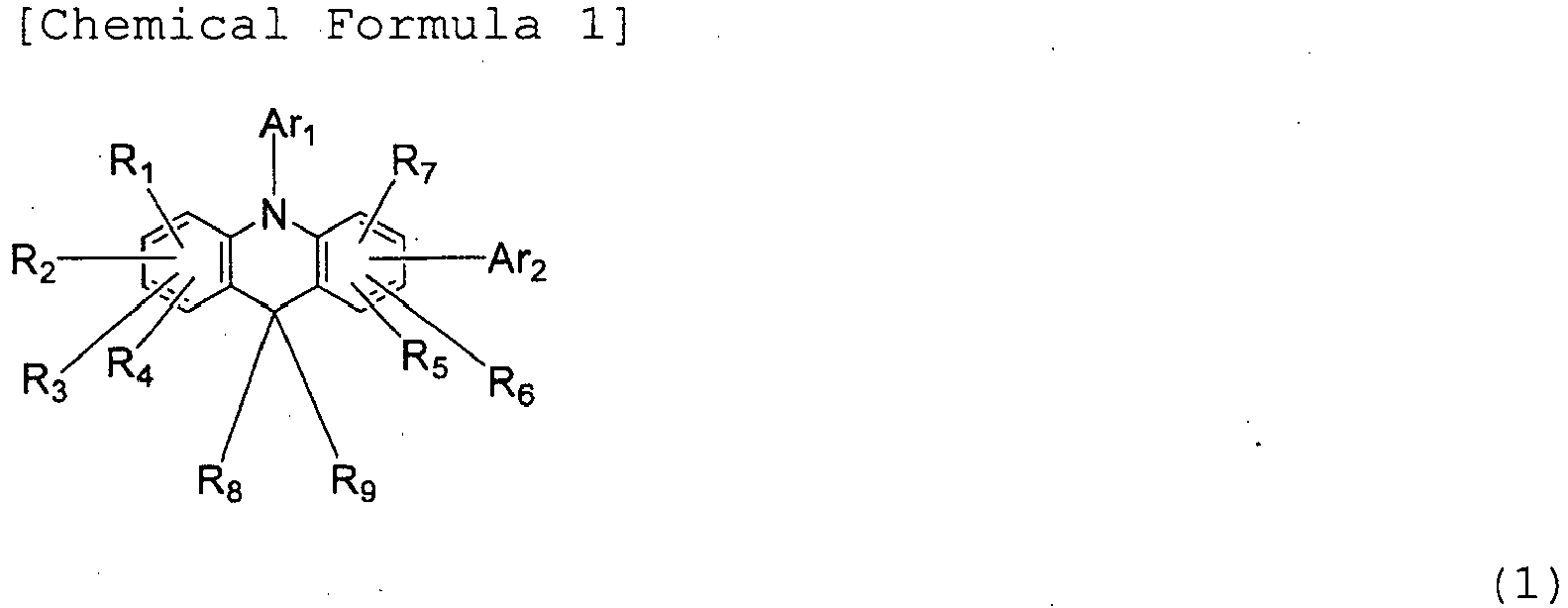
- The compound having an acridan ring structure according to claim 1, wherein the compound is represented by the following general formula (2),

- The compound having an acridan ring structure according to claim 1, wherein R8 and R9 in the general formula (1) are methyl.
- An organic electroluminescent device comprising a pair of electrodes, and one or more organic layers sandwiched between the pair of electrodes, wherein the compound having an acridan ring structure of claim 1 or 2 is used as a constituent material of at least one of the organic layers.
- The organic electroluminescent device according to claim 4, wherein the organic layer is a hole transport layer.
- The organic electroluminescent device according to claim 4, wherein the organic layer is an electron blocking layer.
- The organic electroluminescent device according to claim 4, wherein the organic layer is a hole injection layer.
- The organic electroluminescent device according to claim 4, wherein the organic layer is a light emitting layer.
Applications Claiming Priority (2)
| Application Number | Priority Date | Filing Date | Title |
|---|---|---|---|
| JP2012088912 | 2012-04-10 | ||
| EP13775172.3A EP2837622A4 (en) | 2012-04-10 | 2013-04-04 | COMPOUND HAVING A CYCLIC ACRIDAN STRUCTURE AND ORGANIC ELECTROLUMINESCENT ELEMENT |
Related Parent Applications (1)
| Application Number | Title | Priority Date | Filing Date |
|---|---|---|---|
| EP13775172.3A Division EP2837622A4 (en) | 2012-04-10 | 2013-04-04 | COMPOUND HAVING A CYCLIC ACRIDAN STRUCTURE AND ORGANIC ELECTROLUMINESCENT ELEMENT |
Publications (1)
| Publication Number | Publication Date |
|---|---|
| EP3139423A1 true EP3139423A1 (en) | 2017-03-08 |
Family
ID=49327365
Family Applications (2)
| Application Number | Title | Priority Date | Filing Date |
|---|---|---|---|
| EP13775172.3A Withdrawn EP2837622A4 (en) | 2012-04-10 | 2013-04-04 | COMPOUND HAVING A CYCLIC ACRIDAN STRUCTURE AND ORGANIC ELECTROLUMINESCENT ELEMENT |
| EP16001939.4A Withdrawn EP3139423A1 (en) | 2012-04-10 | 2013-04-04 | Compound having acridan ring structure, and organic electroluminescent device |
Family Applications Before (1)
| Application Number | Title | Priority Date | Filing Date |
|---|---|---|---|
| EP13775172.3A Withdrawn EP2837622A4 (en) | 2012-04-10 | 2013-04-04 | COMPOUND HAVING A CYCLIC ACRIDAN STRUCTURE AND ORGANIC ELECTROLUMINESCENT ELEMENT |
Country Status (7)
| Country | Link |
|---|---|
| US (1) | US20150060803A1 (en) |
| EP (2) | EP2837622A4 (en) |
| JP (1) | JP6173305B2 (en) |
| KR (1) | KR20150001768A (en) |
| CN (1) | CN104203920A (en) |
| TW (1) | TWI598340B (en) |
| WO (1) | WO2013153780A1 (en) |
Families Citing this family (2)
| Publication number | Priority date | Publication date | Assignee | Title |
|---|---|---|---|---|
| CN105541747A (en) * | 2016-02-03 | 2016-05-04 | 中节能万润股份有限公司 | OLED material and application thereof |
| CN109232419B (en) | 2018-09-17 | 2021-01-05 | 宁波卢米蓝新材料有限公司 | A kind of 9,10-dihydroacridine derivative and its preparation method and use |
Citations (7)
| Publication number | Priority date | Publication date | Assignee | Title |
|---|---|---|---|---|
| JPH0848656A (en) | 1994-02-08 | 1996-02-20 | Tdk Corp | Compound for organic el element and organic el element |
| JP3194657B2 (en) | 1993-11-01 | 2001-07-30 | 松下電器産業株式会社 | EL device |
| WO2006033563A1 (en) | 2004-09-24 | 2006-03-30 | Lg Chem. Ltd. | Organic light emitting device |
| WO2007110228A1 (en) | 2006-03-27 | 2007-10-04 | Novaled Ag | N-heterocyclic compounds and their use in electronic, optoelectronic and electroluminescent components |
| WO2011107186A2 (en) * | 2010-03-02 | 2011-09-09 | Merck Patent Gmbh | Compounds for electronic devices |
| WO2011155169A1 (en) * | 2010-06-07 | 2011-12-15 | 保土谷化学工業株式会社 | Compounds with acridan ring structures and organic electroluminescence elements |
| KR20120083242A (en) * | 2011-01-17 | 2012-07-25 | 주식회사 엘지화학 | New compounds and organic light emitting device comprising the same |
Family Cites Families (15)
| Publication number | Priority date | Publication date | Assignee | Title |
|---|---|---|---|---|
| KR100957709B1 (en) * | 2004-09-24 | 2010-05-12 | 주식회사 이큐스앤자루 | 5,6-dimethylthieno [2,3-di] pyrimidine derivative, preparation method thereof and pharmaceutical composition for antiviral comprising the same |
| DE102009005290A1 (en) * | 2009-01-20 | 2010-07-22 | Merck Patent Gmbh | Connections for electronic devices |
| KR101427605B1 (en) * | 2009-03-31 | 2014-08-07 | 롬엔드하스전자재료코리아유한회사 | Novel organic light emitting compounds and organic electroluminescent devices employing the same |
| KR101120892B1 (en) * | 2009-06-19 | 2012-02-27 | 주식회사 두산 | Acridine derivative and organic electroluminescence device comprising the same |
| DE102009053836A1 (en) * | 2009-11-18 | 2011-05-26 | Merck Patent Gmbh | Materials for organic electroluminescent devices |
| DE102010005697A1 (en) * | 2010-01-25 | 2011-07-28 | Merck Patent GmbH, 64293 | Connections for electronic devices |
| KR101717988B1 (en) * | 2010-03-31 | 2017-03-22 | 에스에프씨 주식회사 | Spiro compound and organic electroluminescent devices comprising the same |
| WO2012029253A1 (en) * | 2010-08-31 | 2012-03-08 | 出光興産株式会社 | Nitrogen-containing aromatic heterocyclic derivative and organic electroluminescence device using same |
| JP5735241B2 (en) * | 2010-09-08 | 2015-06-17 | ユー・ディー・シー アイルランド リミテッド | Organic electroluminescent device and charge transport material |
| DE102010045405A1 (en) * | 2010-09-15 | 2012-03-15 | Merck Patent Gmbh | Materials for organic electroluminescent devices |
| US20120273766A1 (en) * | 2010-10-12 | 2012-11-01 | Idemitsu Kosan Co., Ltd. | Aromatic heterocyclic derivative and organic electroluminescence device using the same |
| JP6195823B2 (en) * | 2011-05-05 | 2017-09-13 | メルク パテント ゲーエムベーハー | Compounds for electronic devices |
| KR101884496B1 (en) * | 2011-05-05 | 2018-08-01 | 메르크 파텐트 게엠베하 | Compounds for electronic devices |
| CN103619986B (en) * | 2011-06-03 | 2017-02-08 | 默克专利有限公司 | Organic electroluminescence device |
| CN103946215B (en) * | 2011-11-17 | 2016-09-28 | 默克专利有限公司 | Spiroacridine derivatives and their use as materials for organic electroluminescent devices |
-
2013
- 2013-04-04 KR KR20147029900A patent/KR20150001768A/en not_active Withdrawn
- 2013-04-04 JP JP2014510046A patent/JP6173305B2/en not_active Expired - Fee Related
- 2013-04-04 WO PCT/JP2013/002331 patent/WO2013153780A1/en not_active Ceased
- 2013-04-04 EP EP13775172.3A patent/EP2837622A4/en not_active Withdrawn
- 2013-04-04 EP EP16001939.4A patent/EP3139423A1/en not_active Withdrawn
- 2013-04-04 CN CN201380018545.9A patent/CN104203920A/en active Pending
- 2013-04-04 US US14/391,604 patent/US20150060803A1/en not_active Abandoned
- 2013-04-10 TW TW102112758A patent/TWI598340B/en not_active IP Right Cessation
Patent Citations (8)
| Publication number | Priority date | Publication date | Assignee | Title |
|---|---|---|---|---|
| JP3194657B2 (en) | 1993-11-01 | 2001-07-30 | 松下電器産業株式会社 | EL device |
| JPH0848656A (en) | 1994-02-08 | 1996-02-20 | Tdk Corp | Compound for organic el element and organic el element |
| WO2006033563A1 (en) | 2004-09-24 | 2006-03-30 | Lg Chem. Ltd. | Organic light emitting device |
| WO2007110228A1 (en) | 2006-03-27 | 2007-10-04 | Novaled Ag | N-heterocyclic compounds and their use in electronic, optoelectronic and electroluminescent components |
| WO2011107186A2 (en) * | 2010-03-02 | 2011-09-09 | Merck Patent Gmbh | Compounds for electronic devices |
| WO2011155169A1 (en) * | 2010-06-07 | 2011-12-15 | 保土谷化学工業株式会社 | Compounds with acridan ring structures and organic electroluminescence elements |
| US20150048351A1 (en) * | 2010-06-07 | 2015-02-19 | Hodogaya Chemical Co., Ltd. | Compound having acridan ring structure, and organic electroluminescent device |
| KR20120083242A (en) * | 2011-01-17 | 2012-07-25 | 주식회사 엘지화학 | New compounds and organic light emitting device comprising the same |
Non-Patent Citations (5)
| Title |
|---|
| "Organic EL Symposium", THE 3RD REGULAR PRESENTATION PREPRINTS, 2006, pages 13 - 14 |
| "The Japan Society of Applied Physics", 9TH LECTURE PREPRINTS, 2001, pages 23 - 31 |
| "The Japan Society of Applied Physics", 9TH LECTURE PREPRINTS, 2001, pages 55 - 61 |
| CHEM. REV., vol. 95, 1995, pages 2457 |
| J. ORG. CHEM., vol. 60, 1995, pages 7508 |
Also Published As
| Publication number | Publication date |
|---|---|
| EP2837622A1 (en) | 2015-02-18 |
| TWI598340B (en) | 2017-09-11 |
| KR20150001768A (en) | 2015-01-06 |
| TW201406727A (en) | 2014-02-16 |
| WO2013153780A1 (en) | 2013-10-17 |
| US20150060803A1 (en) | 2015-03-05 |
| EP2837622A4 (en) | 2016-03-09 |
| CN104203920A (en) | 2014-12-10 |
| JP6173305B2 (en) | 2017-08-02 |
| JPWO2013153780A1 (en) | 2015-12-17 |
Similar Documents
| Publication | Publication Date | Title |
|---|---|---|
| EP2471771B1 (en) | Compound having carbazole ring structure and organic electroluminescent device | |
| EP2492986B1 (en) | Organic electroluminescent element | |
| EP2599773B1 (en) | Compound having indenocarbazole ring structure and organic electroluminescent element | |
| EP2679589B1 (en) | Compounds having indolocarbazole ring structure, and organic electroluminescent elements | |
| EP2960958B1 (en) | Organic electroluminescence element | |
| US9818949B2 (en) | Compound having acridan ring structure, and organic electroluminescent device | |
| US9306174B2 (en) | Organic electroluminescent device | |
| EP3291323B1 (en) | Organic electroluminescent element | |
| EP3021372B1 (en) | Organic electroluminescent element | |
| EP2894155B1 (en) | Compound having indeno acridan ring structure, and organic electroluminescence element | |
| US9905770B2 (en) | Compound having acridan ring structure, and organic electroluminescent device | |
| EP2589591A1 (en) | Compound with carbazole ring structure and organic electroluminescent element | |
| EP3370272A1 (en) | Organic electroluminescent device | |
| EP3544073A1 (en) | Organic electroluminescence element | |
| CN108475736A (en) | Organic electroluminescent device | |
| EP3343657A1 (en) | Organic electroluminescent element | |
| US11925107B2 (en) | Organic electroluminescent device | |
| EP2669284B1 (en) | Compound having pyridoindole ring structure and substituted bipyridyl group, and organic electroluminescent element | |
| EP3139423A1 (en) | Compound having acridan ring structure, and organic electroluminescent device |
Legal Events
| Date | Code | Title | Description |
|---|---|---|---|
| PUAI | Public reference made under article 153(3) epc to a published international application that has entered the european phase |
Free format text: ORIGINAL CODE: 0009012 |
|
| AC | Divisional application: reference to earlier application |
Ref document number: 2837622 Country of ref document: EP Kind code of ref document: P |
|
| AK | Designated contracting states |
Kind code of ref document: A1 Designated state(s): AL AT BE BG CH CY CZ DE DK EE ES FI FR GB GR HR HU IE IS IT LI LT LU LV MC MK MT NL NO PL PT RO RS SE SI SK SM TR |
|
| 17P | Request for examination filed |
Effective date: 20170908 |
|
| RBV | Designated contracting states (corrected) |
Designated state(s): AL AT BE BG CH CY CZ DE DK EE ES FI FR GB GR HR HU IE IS IT LI LT LU LV MC MK MT NL NO PL PT RO RS SE SI SK SM TR |
|
| 17Q | First examination report despatched |
Effective date: 20180209 |
|
| STAA | Information on the status of an ep patent application or granted ep patent |
Free format text: STATUS: THE APPLICATION HAS BEEN WITHDRAWN |
|
| 18W | Application withdrawn |
Effective date: 20180319 |