EP2938595B1 - Method for the synthesis of a hydrazine that can be used in the treatment of the papilloma virus - Google Patents
Method for the synthesis of a hydrazine that can be used in the treatment of the papilloma virus Download PDFInfo
- Publication number
- EP2938595B1 EP2938595B1 EP13814987.7A EP13814987A EP2938595B1 EP 2938595 B1 EP2938595 B1 EP 2938595B1 EP 13814987 A EP13814987 A EP 13814987A EP 2938595 B1 EP2938595 B1 EP 2938595B1
- Authority
- EP
- European Patent Office
- Prior art keywords
- group
- optionally substituted
- ortho
- aryl
- phenyl
- Prior art date
- Legal status (The legal status is an assumption and is not a legal conclusion. Google has not performed a legal analysis and makes no representation as to the accuracy of the status listed.)
- Not-in-force
Links
- 238000000034 method Methods 0.000 title claims description 20
- OAKJQQAXSVQMHS-UHFFFAOYSA-N Hydrazine Chemical compound NN OAKJQQAXSVQMHS-UHFFFAOYSA-N 0.000 title description 46
- 230000015572 biosynthetic process Effects 0.000 title description 11
- 238000003786 synthesis reaction Methods 0.000 title description 11
- 241001631646 Papillomaviridae Species 0.000 title description 3
- 125000003118 aryl group Chemical group 0.000 claims description 50
- 125000003545 alkoxy group Chemical group 0.000 claims description 47
- 150000001875 compounds Chemical class 0.000 claims description 46
- 125000000217 alkyl group Chemical group 0.000 claims description 34
- 125000001997 phenyl group Chemical group [H]C1=C([H])C([H])=C(*)C([H])=C1[H] 0.000 claims description 31
- XSQUKJJJFZCRTK-UHFFFAOYSA-N Urea Chemical compound NC(N)=O XSQUKJJJFZCRTK-UHFFFAOYSA-N 0.000 claims description 29
- 125000001424 substituent group Chemical group 0.000 claims description 24
- 125000003710 aryl alkyl group Chemical group 0.000 claims description 23
- 125000002252 acyl group Chemical group 0.000 claims description 19
- 125000000753 cycloalkyl group Chemical group 0.000 claims description 19
- 125000005843 halogen group Chemical group 0.000 claims description 18
- 150000001412 amines Chemical class 0.000 claims description 16
- 125000002496 methyl group Chemical group [H]C([H])([H])* 0.000 claims description 15
- 239000004202 carbamide Substances 0.000 claims description 14
- 125000004432 carbon atom Chemical group C* 0.000 claims description 14
- 125000000623 heterocyclic group Chemical group 0.000 claims description 13
- 125000000587 piperidin-1-yl group Chemical group [H]C1([H])N(*)C([H])([H])C([H])([H])C([H])([H])C1([H])[H] 0.000 claims description 13
- 230000008707 rearrangement Effects 0.000 claims description 12
- 125000004093 cyano group Chemical group *C#N 0.000 claims description 11
- -1 methyl Chemical compound 0.000 claims description 11
- 125000004945 acylaminoalkyl group Chemical group 0.000 claims description 9
- 239000000460 chlorine Substances 0.000 claims description 9
- 125000004438 haloalkoxy group Chemical group 0.000 claims description 9
- 150000003839 salts Chemical class 0.000 claims description 9
- 229920006395 saturated elastomer Polymers 0.000 claims description 9
- 239000002253 acid Substances 0.000 claims description 8
- 239000003795 chemical substances by application Substances 0.000 claims description 8
- 230000001939 inductive effect Effects 0.000 claims description 8
- 125000000956 methoxy group Chemical group [H]C([H])([H])O* 0.000 claims description 8
- 229930195734 saturated hydrocarbon Natural products 0.000 claims description 7
- GDTBXPJZTBHREO-UHFFFAOYSA-N bromine Substances BrBr GDTBXPJZTBHREO-UHFFFAOYSA-N 0.000 claims description 6
- 229910019093 NaOCl Inorganic materials 0.000 claims description 5
- 229910052801 chlorine Inorganic materials 0.000 claims description 5
- 238000004519 manufacturing process Methods 0.000 claims description 5
- SUKJFIGYRHOWBL-UHFFFAOYSA-N sodium hypochlorite Chemical compound [Na+].Cl[O-] SUKJFIGYRHOWBL-UHFFFAOYSA-N 0.000 claims description 5
- WKBOTKDWSSQWDR-UHFFFAOYSA-N Bromine atom Chemical compound [Br] WKBOTKDWSSQWDR-UHFFFAOYSA-N 0.000 claims description 4
- ZAMOUSCENKQFHK-UHFFFAOYSA-N Chlorine atom Chemical compound [Cl] ZAMOUSCENKQFHK-UHFFFAOYSA-N 0.000 claims description 4
- 229910052794 bromium Inorganic materials 0.000 claims description 4
- 238000006243 chemical reaction Methods 0.000 claims description 4
- WISBJJCGQVYDOI-UHFFFAOYSA-N 1-(4-benzylphenyl)-1-(2-methyl-6-piperidin-1-ylphenyl)urea Chemical group C=1C=C(CC=2C=CC=CC=2)C=CC=1N(C(N)=O)C=1C(C)=CC=CC=1N1CCCCC1 WISBJJCGQVYDOI-UHFFFAOYSA-N 0.000 claims description 3
- 125000004435 hydrogen atom Chemical group [H]* 0.000 claims description 3
- GWPXAKGQGKGEHP-UHFFFAOYSA-N 1-(4-benzylphenyl)-1-(2-methyl-6-piperidin-1-ylphenyl)hydrazine Chemical compound C=1C=C(CC=2C=CC=CC=2)C=CC=1N(N)C=1C(C)=CC=CC=1N1CCCCC1 GWPXAKGQGKGEHP-UHFFFAOYSA-N 0.000 claims description 2
- 125000004185 ester group Chemical group 0.000 claims description 2
- 239000001257 hydrogen Substances 0.000 claims description 2
- 229910052739 hydrogen Inorganic materials 0.000 claims description 2
- 125000001183 hydrocarbyl group Chemical group 0.000 claims 3
- 229930195735 unsaturated hydrocarbon Natural products 0.000 claims 3
- PYDPVYMURKJIIO-UHFFFAOYSA-N 4-[2-[2-(4-benzylphenyl)-2-(2-methyl-6-piperidin-1-ylphenyl)hydrazinyl]-2-oxoethyl]-5-bromo-2-methoxybenzoic acid;hydrochloride Chemical compound Cl.C1=C(C(O)=O)C(OC)=CC(CC(=O)NN(C=2C=CC(CC=3C=CC=CC=3)=CC=2)C=2C(=CC=CC=2C)N2CCCCC2)=C1Br PYDPVYMURKJIIO-UHFFFAOYSA-N 0.000 claims 1
- KWYUFKZDYYNOTN-UHFFFAOYSA-M Potassium hydroxide Chemical compound [OH-].[K+] KWYUFKZDYYNOTN-UHFFFAOYSA-M 0.000 description 27
- 235000013877 carbamide Nutrition 0.000 description 13
- WEVYAHXRMPXWCK-UHFFFAOYSA-N Acetonitrile Chemical compound CC#N WEVYAHXRMPXWCK-UHFFFAOYSA-N 0.000 description 9
- XEKOWRVHYACXOJ-UHFFFAOYSA-N Ethyl acetate Chemical compound CCOC(C)=O XEKOWRVHYACXOJ-UHFFFAOYSA-N 0.000 description 9
- OKKJLVBELUTLKV-UHFFFAOYSA-N Methanol Chemical group OC OKKJLVBELUTLKV-UHFFFAOYSA-N 0.000 description 9
- HEMHJVSKTPXQMS-UHFFFAOYSA-M Sodium hydroxide Chemical compound [OH-].[Na+] HEMHJVSKTPXQMS-UHFFFAOYSA-M 0.000 description 9
- 238000004128 high performance liquid chromatography Methods 0.000 description 9
- 239000000543 intermediate Substances 0.000 description 7
- LFQSCWFLJHTTHZ-UHFFFAOYSA-N Ethanol Chemical compound CCO LFQSCWFLJHTTHZ-UHFFFAOYSA-N 0.000 description 6
- DKGAVHZHDRPRBM-UHFFFAOYSA-N Tert-Butanol Chemical compound CC(C)(C)O DKGAVHZHDRPRBM-UHFFFAOYSA-N 0.000 description 6
- 150000002430 hydrocarbons Chemical group 0.000 description 6
- 239000002904 solvent Substances 0.000 description 6
- QTBSBXVTEAMEQO-UHFFFAOYSA-N Acetic acid Chemical compound CC(O)=O QTBSBXVTEAMEQO-UHFFFAOYSA-N 0.000 description 5
- 238000005481 NMR spectroscopy Methods 0.000 description 5
- 125000001797 benzyl group Chemical group [H]C1=C([H])C([H])=C(C([H])=C1[H])C([H])([H])* 0.000 description 5
- 238000003756 stirring Methods 0.000 description 5
- 239000002585 base Substances 0.000 description 4
- 150000002500 ions Chemical class 0.000 description 4
- 239000011541 reaction mixture Substances 0.000 description 4
- XLYOFNOQVPJJNP-UHFFFAOYSA-N water Substances O XLYOFNOQVPJJNP-UHFFFAOYSA-N 0.000 description 4
- YMWUJEATGCHHMB-UHFFFAOYSA-N Dichloromethane Chemical compound ClCCl YMWUJEATGCHHMB-UHFFFAOYSA-N 0.000 description 3
- VEXZGXHMUGYJMC-UHFFFAOYSA-N Hydrochloric acid Chemical compound Cl VEXZGXHMUGYJMC-UHFFFAOYSA-N 0.000 description 3
- AFVFQIVMOAPDHO-UHFFFAOYSA-N Methanesulfonic acid Chemical compound CS(O)(=O)=O AFVFQIVMOAPDHO-UHFFFAOYSA-N 0.000 description 3
- NBIIXXVUZAFLBC-UHFFFAOYSA-N Phosphoric acid Chemical compound OP(O)(O)=O NBIIXXVUZAFLBC-UHFFFAOYSA-N 0.000 description 3
- XBDQKXXYIPTUBI-UHFFFAOYSA-N Propionic acid Chemical compound CCC(O)=O XBDQKXXYIPTUBI-UHFFFAOYSA-N 0.000 description 3
- QAOWNCQODCNURD-UHFFFAOYSA-N Sulfuric acid Chemical compound OS(O)(=O)=O QAOWNCQODCNURD-UHFFFAOYSA-N 0.000 description 3
- 241001080024 Telles Species 0.000 description 3
- 239000007864 aqueous solution Substances 0.000 description 3
- 125000004429 atom Chemical group 0.000 description 3
- KRKNYBCHXYNGOX-UHFFFAOYSA-N citric acid Chemical compound OC(=O)CC(O)(C(O)=O)CC(O)=O KRKNYBCHXYNGOX-UHFFFAOYSA-N 0.000 description 3
- 229910052731 fluorine Inorganic materials 0.000 description 3
- 238000002955 isolation Methods 0.000 description 3
- 229910052757 nitrogen Inorganic materials 0.000 description 3
- 229910052760 oxygen Inorganic materials 0.000 description 3
- 125000003367 polycyclic group Chemical group 0.000 description 3
- 238000002360 preparation method Methods 0.000 description 3
- 239000000243 solution Substances 0.000 description 3
- 229910052717 sulfur Inorganic materials 0.000 description 3
- RYHBNJHYFVUHQT-UHFFFAOYSA-N 1,4-Dioxane Chemical compound C1COCCO1 RYHBNJHYFVUHQT-UHFFFAOYSA-N 0.000 description 2
- GRNOZCCBOFGDCL-UHFFFAOYSA-N 2,2,2-trichloroacetyl isocyanate Chemical compound ClC(Cl)(Cl)C(=O)N=C=O GRNOZCCBOFGDCL-UHFFFAOYSA-N 0.000 description 2
- HZAXFHJVJLSVMW-UHFFFAOYSA-N 2-Aminoethan-1-ol Chemical compound NCCO HZAXFHJVJLSVMW-UHFFFAOYSA-N 0.000 description 2
- XKRFYHLGVUSROY-UHFFFAOYSA-N Argon Chemical compound [Ar] XKRFYHLGVUSROY-UHFFFAOYSA-N 0.000 description 2
- RGHNJXZEOKUKBD-SQOUGZDYSA-N D-gluconic acid Chemical compound OC[C@@H](O)[C@@H](O)[C@H](O)[C@@H](O)C(O)=O RGHNJXZEOKUKBD-SQOUGZDYSA-N 0.000 description 2
- VZCYOOQTPOCHFL-OWOJBTEDSA-N Fumaric acid Chemical compound OC(=O)\C=C\C(O)=O VZCYOOQTPOCHFL-OWOJBTEDSA-N 0.000 description 2
- AEMRFAOFKBGASW-UHFFFAOYSA-N Glycolic acid Chemical compound OCC(O)=O AEMRFAOFKBGASW-UHFFFAOYSA-N 0.000 description 2
- DGAQECJNVWCQMB-PUAWFVPOSA-M Ilexoside XXIX Chemical compound C[C@@H]1CC[C@@]2(CC[C@@]3(C(=CC[C@H]4[C@]3(CC[C@@H]5[C@@]4(CC[C@@H](C5(C)C)OS(=O)(=O)[O-])C)C)[C@@H]2[C@]1(C)O)C)C(=O)O[C@H]6[C@@H]([C@H]([C@@H]([C@H](O6)CO)O)O)O.[Na+] DGAQECJNVWCQMB-PUAWFVPOSA-M 0.000 description 2
- WHUUTDBJXJRKMK-VKHMYHEASA-N L-glutamic acid Chemical compound OC(=O)[C@@H](N)CCC(O)=O WHUUTDBJXJRKMK-VKHMYHEASA-N 0.000 description 2
- MBBZMMPHUWSWHV-BDVNFPICSA-N N-methylglucamine Chemical compound CNC[C@H](O)[C@@H](O)[C@H](O)[C@H](O)CO MBBZMMPHUWSWHV-BDVNFPICSA-N 0.000 description 2
- 150000004008 N-nitroso compounds Chemical class 0.000 description 2
- GRYLNZFGIOXLOG-UHFFFAOYSA-N Nitric acid Chemical compound O[N+]([O-])=O GRYLNZFGIOXLOG-UHFFFAOYSA-N 0.000 description 2
- CDBYLPFSWZWCQE-UHFFFAOYSA-L Sodium Carbonate Chemical compound [Na+].[Na+].[O-]C([O-])=O CDBYLPFSWZWCQE-UHFFFAOYSA-L 0.000 description 2
- WYURNTSHIVDZCO-UHFFFAOYSA-N Tetrahydrofuran Chemical compound C1CCOC1 WYURNTSHIVDZCO-UHFFFAOYSA-N 0.000 description 2
- DTQVDTLACAAQTR-UHFFFAOYSA-N Trifluoroacetic acid Chemical compound OC(=O)C(F)(F)F DTQVDTLACAAQTR-UHFFFAOYSA-N 0.000 description 2
- 229910001413 alkali metal ion Inorganic materials 0.000 description 2
- 229910052782 aluminium Inorganic materials 0.000 description 2
- WNROFYMDJYEPJX-UHFFFAOYSA-K aluminium hydroxide Chemical compound [OH-].[OH-].[OH-].[Al+3] WNROFYMDJYEPJX-UHFFFAOYSA-K 0.000 description 2
- WPYMKLBDIGXBTP-UHFFFAOYSA-N benzoic acid Chemical compound OC(=O)C1=CC=CC=C1 WPYMKLBDIGXBTP-UHFFFAOYSA-N 0.000 description 2
- 239000011575 calcium Substances 0.000 description 2
- 150000002148 esters Chemical class 0.000 description 2
- 239000011737 fluorine Substances 0.000 description 2
- 125000001153 fluoro group Chemical group F* 0.000 description 2
- 150000004677 hydrates Chemical class 0.000 description 2
- 150000007529 inorganic bases Chemical class 0.000 description 2
- SUMDYPCJJOFFON-UHFFFAOYSA-N isethionic acid Chemical compound OCCS(O)(=O)=O SUMDYPCJJOFFON-UHFFFAOYSA-N 0.000 description 2
- JVTAAEKCZFNVCJ-UHFFFAOYSA-N lactic acid Chemical compound CC(O)C(O)=O JVTAAEKCZFNVCJ-UHFFFAOYSA-N 0.000 description 2
- 239000000203 mixture Substances 0.000 description 2
- 125000002950 monocyclic group Chemical group 0.000 description 2
- TXXHDPDFNKHHGW-UHFFFAOYSA-N muconic acid Chemical compound OC(=O)C=CC=CC(O)=O TXXHDPDFNKHHGW-UHFFFAOYSA-N 0.000 description 2
- 125000004123 n-propyl group Chemical group [H]C([H])([H])C([H])([H])C([H])([H])* 0.000 description 2
- 125000004433 nitrogen atom Chemical group N* 0.000 description 2
- 150000002832 nitroso derivatives Chemical class 0.000 description 2
- 150000007530 organic bases Chemical class 0.000 description 2
- 239000012074 organic phase Substances 0.000 description 2
- 239000012429 reaction media Substances 0.000 description 2
- YGSDEFSMJLZEOE-UHFFFAOYSA-N salicylic acid Chemical compound OC(=O)C1=CC=CC=C1O YGSDEFSMJLZEOE-UHFFFAOYSA-N 0.000 description 2
- 239000011734 sodium Substances 0.000 description 2
- 239000012453 solvate Substances 0.000 description 2
- 125000003107 substituted aryl group Chemical group 0.000 description 2
- KDYFGRWQOYBRFD-UHFFFAOYSA-N succinic acid Chemical compound OC(=O)CCC(O)=O KDYFGRWQOYBRFD-UHFFFAOYSA-N 0.000 description 2
- VZCYOOQTPOCHFL-UHFFFAOYSA-N trans-butenedioic acid Natural products OC(=O)C=CC(O)=O VZCYOOQTPOCHFL-UHFFFAOYSA-N 0.000 description 2
- 150000003672 ureas Chemical class 0.000 description 2
- QBYIENPQHBMVBV-HFEGYEGKSA-N (2R)-2-hydroxy-2-phenylacetic acid Chemical compound O[C@@H](C(O)=O)c1ccccc1.O[C@@H](C(O)=O)c1ccccc1 QBYIENPQHBMVBV-HFEGYEGKSA-N 0.000 description 1
- YONLFQNRGZXBBF-ZIAGYGMSSA-N (2r,3r)-2,3-dibenzoyloxybutanedioic acid Chemical compound O([C@@H](C(=O)O)[C@@H](OC(=O)C=1C=CC=CC=1)C(O)=O)C(=O)C1=CC=CC=C1 YONLFQNRGZXBBF-ZIAGYGMSSA-N 0.000 description 1
- MIOPJNTWMNEORI-GMSGAONNSA-N (S)-camphorsulfonic acid Chemical compound C1C[C@@]2(CS(O)(=O)=O)C(=O)C[C@@H]1C2(C)C MIOPJNTWMNEORI-GMSGAONNSA-N 0.000 description 1
- BJEPYKJPYRNKOW-REOHCLBHSA-N (S)-malic acid Chemical compound OC(=O)[C@@H](O)CC(O)=O BJEPYKJPYRNKOW-REOHCLBHSA-N 0.000 description 1
- 125000004214 1-pyrrolidinyl group Chemical group [H]C1([H])N(*)C([H])([H])C([H])([H])C1([H])[H] 0.000 description 1
- UPHOPMSGKZNELG-UHFFFAOYSA-N 2-hydroxynaphthalene-1-carboxylic acid Chemical compound C1=CC=C2C(C(=O)O)=C(O)C=CC2=C1 UPHOPMSGKZNELG-UHFFFAOYSA-N 0.000 description 1
- BMYNFMYTOJXKLE-UHFFFAOYSA-N 3-azaniumyl-2-hydroxypropanoate Chemical compound NCC(O)C(O)=O BMYNFMYTOJXKLE-UHFFFAOYSA-N 0.000 description 1
- ZCYVEMRRCGMTRW-UHFFFAOYSA-N 7553-56-2 Chemical group [I] ZCYVEMRRCGMTRW-UHFFFAOYSA-N 0.000 description 1
- 239000005711 Benzoic acid Substances 0.000 description 1
- OYPRJOBELJOOCE-UHFFFAOYSA-N Calcium Chemical compound [Ca] OYPRJOBELJOOCE-UHFFFAOYSA-N 0.000 description 1
- BVKZGUZCCUSVTD-UHFFFAOYSA-L Carbonate Chemical compound [O-]C([O-])=O BVKZGUZCCUSVTD-UHFFFAOYSA-L 0.000 description 1
- KZBUYRJDOAKODT-UHFFFAOYSA-N Chlorine Chemical compound ClCl KZBUYRJDOAKODT-UHFFFAOYSA-N 0.000 description 1
- XDTMQSROBMDMFD-UHFFFAOYSA-N Cyclohexane Chemical compound C1CCCCC1 XDTMQSROBMDMFD-UHFFFAOYSA-N 0.000 description 1
- RGHNJXZEOKUKBD-UHFFFAOYSA-N D-gluconic acid Natural products OCC(O)C(O)C(O)C(O)C(O)=O RGHNJXZEOKUKBD-UHFFFAOYSA-N 0.000 description 1
- FEWJPZIEWOKRBE-JCYAYHJZSA-N Dextrotartaric acid Chemical compound OC(=O)[C@H](O)[C@@H](O)C(O)=O FEWJPZIEWOKRBE-JCYAYHJZSA-N 0.000 description 1
- PXGOKWXKJXAPGV-UHFFFAOYSA-N Fluorine Chemical compound FF PXGOKWXKJXAPGV-UHFFFAOYSA-N 0.000 description 1
- WHUUTDBJXJRKMK-UHFFFAOYSA-N Glutamic acid Natural products OC(=O)C(N)CCC(O)=O WHUUTDBJXJRKMK-UHFFFAOYSA-N 0.000 description 1
- UFHFLCQGNIYNRP-UHFFFAOYSA-N Hydrogen Chemical compound [H][H] UFHFLCQGNIYNRP-UHFFFAOYSA-N 0.000 description 1
- CPELXLSAUQHCOX-UHFFFAOYSA-N Hydrogen bromide Chemical compound Br CPELXLSAUQHCOX-UHFFFAOYSA-N 0.000 description 1
- TXXHDPDFNKHHGW-CCAGOZQPSA-N Muconic acid Natural products OC(=O)\C=C/C=C\C(O)=O TXXHDPDFNKHHGW-CCAGOZQPSA-N 0.000 description 1
- ZLMJMSJWJFRBEC-UHFFFAOYSA-N Potassium Chemical compound [K] ZLMJMSJWJFRBEC-UHFFFAOYSA-N 0.000 description 1
- OFOBLEOULBTSOW-UHFFFAOYSA-N Propanedioic acid Natural products OC(=O)CC(O)=O OFOBLEOULBTSOW-UHFFFAOYSA-N 0.000 description 1
- IWYDHOAUDWTVEP-UHFFFAOYSA-N R-2-phenyl-2-hydroxyacetic acid Natural products OC(=O)C(O)C1=CC=CC=C1 IWYDHOAUDWTVEP-UHFFFAOYSA-N 0.000 description 1
- 238000005593 Shestakov synthesis reaction Methods 0.000 description 1
- VYPSYNLAJGMNEJ-UHFFFAOYSA-N Silicium dioxide Chemical compound O=[Si]=O VYPSYNLAJGMNEJ-UHFFFAOYSA-N 0.000 description 1
- PMZURENOXWZQFD-UHFFFAOYSA-L Sodium Sulfate Chemical compound [Na+].[Na+].[O-]S([O-])(=O)=O PMZURENOXWZQFD-UHFFFAOYSA-L 0.000 description 1
- FEWJPZIEWOKRBE-UHFFFAOYSA-N Tartaric acid Natural products [H+].[H+].[O-]C(=O)C(O)C(O)C([O-])=O FEWJPZIEWOKRBE-UHFFFAOYSA-N 0.000 description 1
- GSEJCLTVZPLZKY-UHFFFAOYSA-N Triethanolamine Chemical compound OCCN(CCO)CCO GSEJCLTVZPLZKY-UHFFFAOYSA-N 0.000 description 1
- 125000000218 acetic acid group Chemical group C(C)(=O)* 0.000 description 1
- 230000002378 acidificating effect Effects 0.000 description 1
- 125000005073 adamantyl group Chemical group C12(CC3CC(CC(C1)C3)C2)* 0.000 description 1
- 230000006978 adaptation Effects 0.000 description 1
- BJEPYKJPYRNKOW-UHFFFAOYSA-N alpha-hydroxysuccinic acid Natural products OC(=O)C(O)CC(O)=O BJEPYKJPYRNKOW-UHFFFAOYSA-N 0.000 description 1
- 239000004411 aluminium Substances 0.000 description 1
- XAGFODPZIPBFFR-UHFFFAOYSA-N aluminium Chemical compound [Al] XAGFODPZIPBFFR-UHFFFAOYSA-N 0.000 description 1
- 229910000147 aluminium phosphate Inorganic materials 0.000 description 1
- 229910052786 argon Inorganic materials 0.000 description 1
- SRSXLGNVWSONIS-UHFFFAOYSA-N benzenesulfonic acid Chemical compound OS(=O)(=O)C1=CC=CC=C1 SRSXLGNVWSONIS-UHFFFAOYSA-N 0.000 description 1
- 229940092714 benzenesulfonic acid Drugs 0.000 description 1
- 125000005605 benzo group Chemical group 0.000 description 1
- 125000000928 benzodioxinyl group Chemical group O1C(=COC2=C1C=CC=C2)* 0.000 description 1
- 125000002047 benzodioxolyl group Chemical group O1OC(C2=C1C=CC=C2)* 0.000 description 1
- 125000004618 benzofuryl group Chemical group O1C(=CC2=C1C=CC=C2)* 0.000 description 1
- 235000010233 benzoic acid Nutrition 0.000 description 1
- 125000004196 benzothienyl group Chemical group S1C(=CC2=C1C=CC=C2)* 0.000 description 1
- 125000003236 benzoyl group Chemical group [H]C1=C([H])C([H])=C(C([H])=C1[H])C(*)=O 0.000 description 1
- 244000309464 bull Species 0.000 description 1
- KDYFGRWQOYBRFD-NUQCWPJISA-N butanedioic acid Chemical compound O[14C](=O)CC[14C](O)=O KDYFGRWQOYBRFD-NUQCWPJISA-N 0.000 description 1
- 125000000484 butyl group Chemical group [H]C([*])([H])C([H])([H])C([H])([H])C([H])([H])[H] 0.000 description 1
- 229910052791 calcium Inorganic materials 0.000 description 1
- AXCZMVOFGPJBDE-UHFFFAOYSA-L calcium dihydroxide Chemical compound [OH-].[OH-].[Ca+2] AXCZMVOFGPJBDE-UHFFFAOYSA-L 0.000 description 1
- 239000000920 calcium hydroxide Substances 0.000 description 1
- 229910001861 calcium hydroxide Inorganic materials 0.000 description 1
- 229910052799 carbon Inorganic materials 0.000 description 1
- 125000001309 chloro group Chemical group Cl* 0.000 description 1
- 125000000392 cycloalkenyl group Chemical group 0.000 description 1
- 125000000582 cycloheptyl group Chemical group [H]C1([H])C([H])([H])C([H])([H])C([H])([H])C([H])(*)C([H])([H])C1([H])[H] 0.000 description 1
- 125000000113 cyclohexyl group Chemical group [H]C1([H])C([H])([H])C([H])([H])C([H])(*)C([H])([H])C1([H])[H] 0.000 description 1
- 125000000640 cyclooctyl group Chemical group [H]C1([H])C([H])([H])C([H])([H])C([H])([H])C([H])(*)C([H])([H])C([H])([H])C1([H])[H] 0.000 description 1
- 125000001511 cyclopentyl group Chemical group [H]C1([H])C([H])([H])C([H])([H])C([H])(*)C1([H])[H] 0.000 description 1
- 125000001559 cyclopropyl group Chemical group [H]C1([H])C([H])([H])C1([H])* 0.000 description 1
- 125000004855 decalinyl group Chemical group C1(CCCC2CCCCC12)* 0.000 description 1
- ZBCBWPMODOFKDW-UHFFFAOYSA-N diethanolamine Chemical compound OCCNCCO ZBCBWPMODOFKDW-UHFFFAOYSA-N 0.000 description 1
- 238000004821 distillation Methods 0.000 description 1
- 239000003480 eluent Substances 0.000 description 1
- 229940082150 encore Drugs 0.000 description 1
- CCIVGXIOQKPBKL-UHFFFAOYSA-M ethanesulfonate Chemical compound CCS([O-])(=O)=O CCIVGXIOQKPBKL-UHFFFAOYSA-M 0.000 description 1
- 125000001495 ethyl group Chemical group [H]C([H])([H])C([H])([H])* 0.000 description 1
- 125000004672 ethylcarbonyl group Chemical group [H]C([H])([H])C([H])([H])C(*)=O 0.000 description 1
- 238000001704 evaporation Methods 0.000 description 1
- 230000008020 evaporation Effects 0.000 description 1
- 238000000605 extraction Methods 0.000 description 1
- 238000001914 filtration Methods 0.000 description 1
- 239000012467 final product Substances 0.000 description 1
- 238000003818 flash chromatography Methods 0.000 description 1
- 125000004428 fluoroalkoxy group Chemical group 0.000 description 1
- 239000001530 fumaric acid Substances 0.000 description 1
- 125000002541 furyl group Chemical group 0.000 description 1
- 239000000174 gluconic acid Substances 0.000 description 1
- 235000012208 gluconic acid Nutrition 0.000 description 1
- 239000004220 glutamic acid Substances 0.000 description 1
- 235000013922 glutamic acid Nutrition 0.000 description 1
- 229910052736 halogen Inorganic materials 0.000 description 1
- 150000002367 halogens Chemical class 0.000 description 1
- 231100001261 hazardous Toxicity 0.000 description 1
- 125000005842 heteroatom Chemical group 0.000 description 1
- 125000002883 imidazolyl group Chemical group 0.000 description 1
- 125000001041 indolyl group Chemical group 0.000 description 1
- 229910052740 iodine Inorganic materials 0.000 description 1
- 125000000959 isobutyl group Chemical group [H]C([H])([H])C([H])(C([H])([H])[H])C([H])([H])* 0.000 description 1
- 239000012948 isocyanate Substances 0.000 description 1
- 150000002513 isocyanates Chemical class 0.000 description 1
- 125000001449 isopropyl group Chemical group [H]C([H])([H])C([H])(*)C([H])([H])[H] 0.000 description 1
- 125000005956 isoquinolyl group Chemical group 0.000 description 1
- 239000004310 lactic acid Substances 0.000 description 1
- 235000014655 lactic acid Nutrition 0.000 description 1
- VZCYOOQTPOCHFL-UPHRSURJSA-N maleic acid Chemical compound OC(=O)\C=C/C(O)=O VZCYOOQTPOCHFL-UPHRSURJSA-N 0.000 description 1
- 239000011976 maleic acid Substances 0.000 description 1
- 239000001630 malic acid Substances 0.000 description 1
- 235000011090 malic acid Nutrition 0.000 description 1
- 229960002510 mandelic acid Drugs 0.000 description 1
- 238000004949 mass spectrometry Methods 0.000 description 1
- 229910021645 metal ion Inorganic materials 0.000 description 1
- 229940098779 methanesulfonic acid Drugs 0.000 description 1
- 150000007522 mineralic acids Chemical class 0.000 description 1
- 125000000896 monocarboxylic acid group Chemical group 0.000 description 1
- OTLZNGSNUUYDHA-UHFFFAOYSA-N n-(4-benzylphenyl)-2-methyl-6-piperidin-1-ylaniline Chemical compound C=1C=C(CC=2C=CC=CC=2)C=CC=1NC=1C(C)=CC=CC=1N1CCCCC1 OTLZNGSNUUYDHA-UHFFFAOYSA-N 0.000 description 1
- 125000001280 n-hexyl group Chemical group C(CCCCC)* 0.000 description 1
- 125000000740 n-pentyl group Chemical group [H]C([H])([H])C([H])([H])C([H])([H])C([H])([H])C([H])([H])* 0.000 description 1
- KVBGVZZKJNLNJU-UHFFFAOYSA-N naphthalene-2-sulfonic acid Chemical compound C1=CC=CC2=CC(S(=O)(=O)O)=CC=C21 KVBGVZZKJNLNJU-UHFFFAOYSA-N 0.000 description 1
- 125000001624 naphthyl group Chemical group 0.000 description 1
- 229910017604 nitric acid Inorganic materials 0.000 description 1
- 230000009935 nitrosation Effects 0.000 description 1
- 238000007034 nitrosation reaction Methods 0.000 description 1
- 231100000252 nontoxic Toxicity 0.000 description 1
- 230000003000 nontoxic effect Effects 0.000 description 1
- 125000002868 norbornyl group Chemical group C12(CCC(CC1)C2)* 0.000 description 1
- 150000007524 organic acids Chemical class 0.000 description 1
- 235000005985 organic acids Nutrition 0.000 description 1
- 125000001715 oxadiazolyl group Chemical group 0.000 description 1
- 125000004043 oxo group Chemical group O=* 0.000 description 1
- 125000004430 oxygen atom Chemical group O* 0.000 description 1
- FJKROLUGYXJWQN-UHFFFAOYSA-N papa-hydroxy-benzoic acid Natural products OC(=O)C1=CC=C(O)C=C1 FJKROLUGYXJWQN-UHFFFAOYSA-N 0.000 description 1
- 239000008194 pharmaceutical composition Substances 0.000 description 1
- 239000000825 pharmaceutical preparation Substances 0.000 description 1
- 229940127557 pharmaceutical product Drugs 0.000 description 1
- 230000000144 pharmacologic effect Effects 0.000 description 1
- 239000012071 phase Substances 0.000 description 1
- 125000005936 piperidyl group Chemical group 0.000 description 1
- IUGYQRQAERSCNH-UHFFFAOYSA-N pivalic acid Chemical compound CC(C)(C)C(O)=O IUGYQRQAERSCNH-UHFFFAOYSA-N 0.000 description 1
- WSHYKIAQCMIPTB-UHFFFAOYSA-M potassium;2-oxo-3-(3-oxo-1-phenylbutyl)chromen-4-olate Chemical compound [K+].[O-]C=1C2=CC=CC=C2OC(=O)C=1C(CC(=O)C)C1=CC=CC=C1 WSHYKIAQCMIPTB-UHFFFAOYSA-M 0.000 description 1
- 238000001556 precipitation Methods 0.000 description 1
- 239000000651 prodrug Substances 0.000 description 1
- 229940002612 prodrug Drugs 0.000 description 1
- 235000019260 propionic acid Nutrition 0.000 description 1
- 238000000746 purification Methods 0.000 description 1
- 125000003373 pyrazinyl group Chemical group 0.000 description 1
- 125000003226 pyrazolyl group Chemical group 0.000 description 1
- 125000004076 pyridyl group Chemical group 0.000 description 1
- 125000000714 pyrimidinyl group Chemical group 0.000 description 1
- 125000000168 pyrrolyl group Chemical group 0.000 description 1
- IUVKMZGDUIUOCP-BTNSXGMBSA-N quinbolone Chemical compound O([C@H]1CC[C@H]2[C@H]3[C@@H]([C@]4(C=CC(=O)C=C4CC3)C)CC[C@@]21C)C1=CCCC1 IUVKMZGDUIUOCP-BTNSXGMBSA-N 0.000 description 1
- 125000005493 quinolyl group Chemical group 0.000 description 1
- 238000001953 recrystallisation Methods 0.000 description 1
- 238000010992 reflux Methods 0.000 description 1
- 229960004889 salicylic acid Drugs 0.000 description 1
- 125000002914 sec-butyl group Chemical group [H]C([H])([H])C([H])([H])C([H])(*)C([H])([H])[H] 0.000 description 1
- 239000000741 silica gel Substances 0.000 description 1
- 229910002027 silica gel Inorganic materials 0.000 description 1
- 229910052708 sodium Inorganic materials 0.000 description 1
- 229910000029 sodium carbonate Inorganic materials 0.000 description 1
- 229910052938 sodium sulfate Inorganic materials 0.000 description 1
- 235000011152 sodium sulphate Nutrition 0.000 description 1
- 239000007787 solid Substances 0.000 description 1
- 239000000725 suspension Substances 0.000 description 1
- 230000002194 synthesizing effect Effects 0.000 description 1
- 235000002906 tartaric acid Nutrition 0.000 description 1
- 239000011975 tartaric acid Substances 0.000 description 1
- 125000004213 tert-butoxy group Chemical group [H]C([H])([H])C(O*)(C([H])([H])[H])C([H])([H])[H] 0.000 description 1
- 125000000999 tert-butyl group Chemical group [H]C([H])([H])C(*)(C([H])([H])[H])C([H])([H])[H] 0.000 description 1
- YLQBMQCUIZJEEH-UHFFFAOYSA-N tetrahydrofuran Natural products C=1C=COC=1 YLQBMQCUIZJEEH-UHFFFAOYSA-N 0.000 description 1
- 125000001544 thienyl group Chemical group 0.000 description 1
- 125000000464 thioxo group Chemical group S=* 0.000 description 1
- JOXIMZWYDAKGHI-UHFFFAOYSA-N toluene-4-sulfonic acid Chemical compound CC1=CC=C(S(O)(=O)=O)C=C1 JOXIMZWYDAKGHI-UHFFFAOYSA-N 0.000 description 1
- LENZDBCJOHFCAS-UHFFFAOYSA-N tris Chemical compound OCC(N)(CO)CO LENZDBCJOHFCAS-UHFFFAOYSA-N 0.000 description 1
- 229960000281 trometamol Drugs 0.000 description 1
Classifications
-
- C—CHEMISTRY; METALLURGY
- C07—ORGANIC CHEMISTRY
- C07D—HETEROCYCLIC COMPOUNDS
- C07D295/00—Heterocyclic compounds containing polymethylene-imine rings with at least five ring members, 3-azabicyclo [3.2.2] nonane, piperazine, morpholine or thiomorpholine rings, having only hydrogen atoms directly attached to the ring carbon atoms
- C07D295/04—Heterocyclic compounds containing polymethylene-imine rings with at least five ring members, 3-azabicyclo [3.2.2] nonane, piperazine, morpholine or thiomorpholine rings, having only hydrogen atoms directly attached to the ring carbon atoms with substituted hydrocarbon radicals attached to ring nitrogen atoms
- C07D295/12—Heterocyclic compounds containing polymethylene-imine rings with at least five ring members, 3-azabicyclo [3.2.2] nonane, piperazine, morpholine or thiomorpholine rings, having only hydrogen atoms directly attached to the ring carbon atoms with substituted hydrocarbon radicals attached to ring nitrogen atoms substituted by singly or doubly bound nitrogen atoms
- C07D295/135—Heterocyclic compounds containing polymethylene-imine rings with at least five ring members, 3-azabicyclo [3.2.2] nonane, piperazine, morpholine or thiomorpholine rings, having only hydrogen atoms directly attached to the ring carbon atoms with substituted hydrocarbon radicals attached to ring nitrogen atoms substituted by singly or doubly bound nitrogen atoms with the ring nitrogen atoms and the substituent nitrogen atoms separated by carbocyclic rings or by carbon chains interrupted by carbocyclic rings
-
- C—CHEMISTRY; METALLURGY
- C07—ORGANIC CHEMISTRY
- C07D—HETEROCYCLIC COMPOUNDS
- C07D295/00—Heterocyclic compounds containing polymethylene-imine rings with at least five ring members, 3-azabicyclo [3.2.2] nonane, piperazine, morpholine or thiomorpholine rings, having only hydrogen atoms directly attached to the ring carbon atoms
- C07D295/04—Heterocyclic compounds containing polymethylene-imine rings with at least five ring members, 3-azabicyclo [3.2.2] nonane, piperazine, morpholine or thiomorpholine rings, having only hydrogen atoms directly attached to the ring carbon atoms with substituted hydrocarbon radicals attached to ring nitrogen atoms
- C07D295/14—Heterocyclic compounds containing polymethylene-imine rings with at least five ring members, 3-azabicyclo [3.2.2] nonane, piperazine, morpholine or thiomorpholine rings, having only hydrogen atoms directly attached to the ring carbon atoms with substituted hydrocarbon radicals attached to ring nitrogen atoms substituted by carbon atoms having three bonds to hetero atoms with at the most one bond to halogen, e.g. ester or nitrile radicals
- C07D295/155—Heterocyclic compounds containing polymethylene-imine rings with at least five ring members, 3-azabicyclo [3.2.2] nonane, piperazine, morpholine or thiomorpholine rings, having only hydrogen atoms directly attached to the ring carbon atoms with substituted hydrocarbon radicals attached to ring nitrogen atoms substituted by carbon atoms having three bonds to hetero atoms with at the most one bond to halogen, e.g. ester or nitrile radicals with the ring nitrogen atoms and the carbon atoms with three bonds to hetero atoms separated by carbocyclic rings or by carbon chains interrupted by carbocyclic rings
Definitions
- the present invention relates to a novel process for the synthesis of compounds useful for the treatment of papilloma virus, described in particular in the application WO 2007/135 106 .
- nitroso compounds being hazardous to use, such a route of synthesis is not the most suitable from an industrial point of view.
- rather strict standards regarding the acceptable residual levels of nitroso compound in a pharmaceutical product lead to consider another route of synthesis.
- the inventors have thus discovered that it is possible to prepare the desired hydrazine from the corresponding amine via an intermediate urea and not by an N-nitroso compound.
- the term "pharmaceutically acceptable” means that which is useful in the preparation of a pharmaceutical composition which is generally safe, non-toxic and neither biologically nor otherwise undesirable and which is acceptable for veterinary as well as human pharmaceutical use.
- halogen means a fluorine, bromine, chlorine or iodine atom.
- fluorine bromine or chlorine atom.
- alkyl group is meant, in the sense of the present invention, a saturated hydrocarbon chain, linear or branched, comprising from 1 to 6 carbon atoms, in particular the methyl, ethyl, n-propyl, isopropyl, n-propyl groups. butyl, iso-butyl, sec-butyl, tert-butyl, n-pentyl or n-hexyl.
- it is methyl.
- cycloalkyl group is intended to mean a monocyclic or polycyclic, preferably mono-, bi- or tri-cyclic, saturated system comprising from 3 to 12 carbon atoms, the cycles being able to be two or more carbon atoms. two fused or bridged, such as cyclopropyl, cyclopentyl, cyclohexyl, cycloheptyl, cyclooctyl, adamantyl, decalinyl or norbornyl.
- N-cycloalkyl is meant, in the sense of the present invention, a cycloalkyl group as defined above for which a carbon atom has been substituted by a nitrogen atom, the bond with the molecule being by this nitrogen atom. It is advantageously a piperidin-1-yl or pyrrolidin-1-yl group.
- acyl is meant, within the meaning of the present invention, a group of formula -C (O) -Z, where Z represents an alkyl group as defined above or a phenyl. It may advantageously be an acetyl, ethylcarbonyl or benzoyl group.
- alkoxy group is meant, in the sense of the present invention, an alkyl group as defined above bonded to the molecule through an oxygen atom. It may be in particular a methoxy, ethoxy, n-propoxy, isopropoxy, n-butoxy, iso-butoxy, sec-butoxy or tert-butoxy group.
- haloalkoxy group is meant, in the sense of the present invention, an alkoxy group as defined above substituted with one or more halogen atom (s) as defined above.
- it will be fluoroalkoxy, that is to say an alkoxy group substituted by one or more fluorine atom (s), such as a group -OCF 3 or -OCH 2 CF 3 .
- aryl group is meant, in the sense of the present invention, an aromatic group, preferably comprising from 5 to 10 carbon atoms and comprising one or more contiguous rings, such as for example a phenyl or naphthyl group.
- aryl is meant, in the sense of the present invention, an aromatic group, preferably comprising from 5 to 10 carbon atoms and comprising one or more contiguous rings, such as for example a phenyl or naphthyl group.
- it is phenyl.
- heterocycle is intended to mean a monocyclic or polycyclic, and preferably mono- or bi-cyclic, saturated, unsaturated or aromatic system comprising from 3 to 12 ring members, the rings being two fused, spiro-fused or bridged, and comprising 1 to 4 heteroatoms, identical or different, selected from O, S and N, and optionally comprising one or two oxo or thioxo groups, being understood only in the case of a polycyclic system one of the rings may be aromatic while the other may be aromatic, saturated or unsaturated.
- these will be piperidyl, piperazyl, furyl, thienyl, pyrrolyl, pyrazolyl, imidazolyl, pyridyl, pyrimidyl, pyrazinyl, pyradizinyl, benzofuryl, benzothienyl, indolyl, quinolyl, isoquinolyl, benzodioxolyl, benzodioxinyl, benzo [1,2, 5] thiadiazolyl, benzo [1,2,5] oxadiazolyl, [1,2,3] triazolyl and [1,2,4] triazolyl.
- arylalkyl is meant, in the sense of the present invention, an aryl group as defined above linked to the molecule through an alkyl group as defined above. Preferably, it is a benzyl group.
- acylaminoalkyl means a group of formula -Alk-NHCO-Alk ', in which Alk and Alk' represent, independently of one another, an alkyl group as defined herein. -above.
- the hydrazine of formula (I) as defined above can thus be prepared from the urea of formula (III) as defined above by a Shestakov rearrangement.
- This rearrangement of Shestakov will advantageously be carried out in the presence of a rearrangement inducing agent selected from NaOCl and KOCl, and preferably being NaOCl.
- the rearrangement inducing agent is introduced in a staggered manner over time.
- the inducing agent may be introduced in several portions spread over time or drop by drop, or continuously in a slow manner so that the addition is sufficiently spread over time.
- the addition parameter such as the addition rate for a continuous addition
- At least one molar equivalent, preferably between 1 and 1.5 molar equivalents, and preferably about 1 molar equivalent, of rearrangement inducing agent is used in this reaction, for one molar equivalent of urea of formula (III).
- the Shestakov rearrangement may be carried out in a dioxane / water mixture or in an alcohol as a solvent, and preferably in tert- butanol.
- alcohol means a compound of formula Alk-OH, in which Alk represents an alkyl group as defined above.
- Alk represents an alkyl group as defined above.
- it is methanol, ethanol or tert- butanol.
- This rearrangement is advantageously carried out under basic conditions, especially in the presence of sodium or potassium hydroxide and preferably in the presence of potassium hydroxide.
- Step (1) may be carried out in a solvent such as acetonitrile, tetrahydrofuran, dichloromethane or else dioxane and preferably in acetonitrile.
- a solvent such as acetonitrile, tetrahydrofuran, dichloromethane or else dioxane and preferably in acetonitrile.
- Step (1) can be carried out at ambient temperature, that is to say at temperatures ranging from 20 to 40 ° C, and preferably at about 25 ° C.
- Potassium or sodium hydroxide and preferably KOH, may be used as a base in step (2).
- the solvent used in this step (2) will be an alcohol as defined above and preferably will be methanol, step (2) being carried out in particular at the reflux of this solvent.
- the isolation of the final product can be achieved by techniques well known to those skilled in the art, such as by extraction, evaporation of the solvent or by precipitation and filtration.
- the hydrazine thus obtained may also be purified if necessary by methods well known to those skilled in the art, such as by recrystallization if the compound is crystalline, or by distillation.
- G 1 represents a bond or a linear and saturated hydrocarbon-based chain comprising 1 to 4 carbon atoms, and preferably represents a bond.
- the radical A defined above is an aryl, preferably a phenyl, substituted in meta or para, preferably para, with an alkoxy group, such as methoxy, or with an aryl or arylalkyl group, such as phenyl or benzyl, optionally substituted with one or two substituents, identical or different, such as an acyl or alkoxy group.
- B represents an aryl group, preferably a phenyl, substituted in the ortho position by a heterocycle, preferably an N-cycloalkyl, such as a piperidin-1-yl group, and optionally substituted in the ortho 'position by an alkyl group. , such as methyl.
- hydrazine of formula (I) is N - (4-benzyl-phenyl) - N - (2-methyl-6-piperidin-1-yl-phenyl) hydrazine (hydrazine (Ia)).
- the compounds of formula (V) correspond to compounds useful for the treatment of papilloma virus described in the application WO 2007/135 106 .
- This patent application also describes the process for preparing the compounds of formula (V) from the hydrazine of formula (I), as well as the process for the preparation of the amines of formula (II).
- the term "acid” means a COOH group.
- esters is meant, within the meaning of the present invention, a -CO-O-Alk group, where Alk represents an alkyl group as defined above.
- R2 represents a halogen atom, such as a bromine atom, preferably in the meta position relative to R3.
- G 1 represents a bond or a linear and saturated hydrocarbon-based chain comprising 1 to 4 carbon atoms, and preferably represents a bond.
- the radical A defined above is an aryl, preferably a phenyl, substituted in meta or para, preferably para, with an alkoxy group, such as methoxy, or with an aryl or arylalkyl group, such as phenyl or benzyl, optionally substituted with one or two substituents, identical or different, such as an acyl or alkoxy group.
- B represents an aryl group, preferably a phenyl, substituted in the ortho position by a heterocycle, preferably an N-cycloalkyl, such as a piperidin-1-yl group, and optionally substituted in the ortho 'position by an alkyl group. , such as methyl.
- the compound of formula (V) is 4- [ N'- (4-benzyl-phenyl) -N '- (2-methyl-6-piperidin-1-yl-phenyl) hydrochloride) hydrazinocarbonyl methyl] -5-bromo-2-methoxy-benzoic acid (compound (Va)).
- the compound (Va) can be prepared from the intermediates (Ia), (IIa) and (IIIa) mentioned above.
- G 1 represents a bond or a linear and saturated hydrocarbon-based chain comprising 1 to 4 carbon atoms, and preferably represents a bond.
- the radical A defined above is an aryl, preferably a phenyl, substituted in meta or para, preferably para, with an alkoxy group, such as methoxy, or with an aryl or arylalkyl group, such as phenyl or benzyl, optionally substituted with one or two substituents, identical or different, such as an acyl or alkoxy group.
- B represents an aryl group, preferably a phenyl, substituted in the ortho position by a heterocycle, preferably an N-cycloalkyl, such as a piperidin-1-yl group, and optionally substituted in the ortho 'position by an alkyl group. , such as methyl.
- the compound (III) will be 1- (4-benzyl-phenyl) -1- (2-methyl-6-piperidin-1-yl-phenyl) -urea (compound (IIIa)).
- the reaction mixture is extracted with ethyl acetate (3x100 mL).
- the combined organic phases are concentrated to dryness under reduced pressure to give the desired hydrazine (4 g, 83% purity determined by HPLC).
- the residue thus obtained is then purified by flash column chromatography on silica gel (eluent: cyclohexane / ethyl acetate 95/5) to give the desired hydrazine (3.4 g, 9.1 mmol, 81% yield overall) as a cream-colored solid with a purity of 95.6% determined by HPLC.
- This compound is prepared from the hydrazine (Ia) obtained in Step 3 above according to the protocol described in the application WO 2007/135 106 .
- This protocol is described in Example 27 of this application, and corresponds to Steps 5 and 6 of this example (pages 91-92).
Landscapes
- Chemical & Material Sciences (AREA)
- Organic Chemistry (AREA)
- Hydrogenated Pyridines (AREA)
- Pharmaceuticals Containing Other Organic And Inorganic Compounds (AREA)
- Organic Low-Molecular-Weight Compounds And Preparation Thereof (AREA)
Description
La présente invention concerne un nouveau procédé de synthèse de composés utiles pour le traitement du virus du papillome décrits notamment dans la demande
Les composés décrits dans la demande 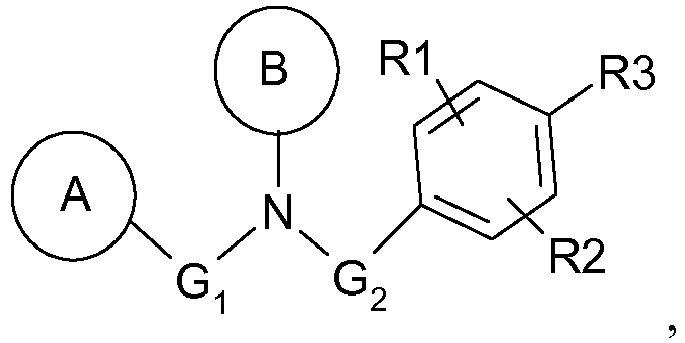
- A représente un groupe aryle, cycloalkyle, cycloalkényle ou hétérocycle éventuellement substitué,
- B représente un aryle ou un hétérocycle éventuellement substitué,
- R1 et R2 représentent indépendamment un atome d'hydrogène ou divers substituants,
- R3 représente une fonction acide ou un radical prodrogue ou un bioisostère de cette fonction,
- G1 représente une liaison ou une chaîne hydrocarbonée, et
- G2 représente un groupe

- A represents an optionally substituted aryl, cycloalkyl, cycloalkenyl or heterocycle group,
- B represents an optionally substituted aryl or heterocycle,
- R1 and R2 independently represent a hydrogen atom or various substituents,
- R3 represents an acid function or a prodrug radical or a bioisostere of this function,
- G 1 represents a bond or a hydrocarbon chain, and
- G 2 represents a group
Le procédé de synthèse de ces composés décrit dans la demande 

La préparation de l'hydrazine à partir de l'amine correspondante est réalisée par nitrosation de l'amine en présence de NaNO2 pour donner le composé N-nitroso correspondant qui est ensuite réduit pour donner l'hydrazine. Cependant, les composés nitroso étant dangereux d'utilisation, une telle voie de synthèse n'est pas la plus adaptée d'un point de vue industriel. De plus, des normes assez strictes concernant les teneurs résiduelles acceptables de composé nitroso dans un produit pharmaceutique conduisent à envisager une autre voie de synthèse.The preparation of the hydrazine from the corresponding amine is carried out by nitrosation of the amine in the presence of NaNO 2 to give the corresponding N-nitroso compound which is then reduced to give the hydrazine. However, nitroso compounds being hazardous to use, such a route of synthesis is not the most suitable from an industrial point of view. In addition, rather strict standards regarding the acceptable residual levels of nitroso compound in a pharmaceutical product lead to consider another route of synthesis.
Les inventeurs ont ainsi découvert qu'il était possible de préparer l'hydrazine désirée à partir de l'amine correspondante en passant par une urée intermédiaire et non par un composé N-nitroso.The inventors have thus discovered that it is possible to prepare the desired hydrazine from the corresponding amine via an intermediate urea and not by an N-nitroso compound.
La présente invention a donc pour objet un procédé de préparation d'une hydrazine de formule générale (I) :
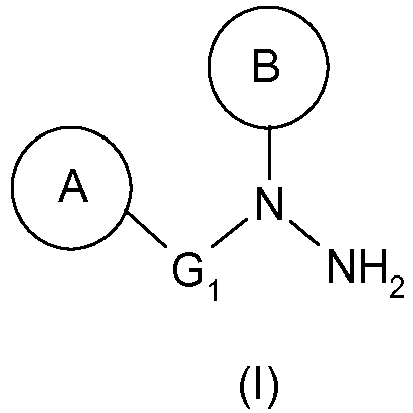
- ▪ G1 représente une liaison ou une chaîne hydrocarbonée, linéaire ou ramifiée, saturée ou insaturée, comprenant 1 à 4 atomes de carbone, éventuellement substituée par un ou deux groupements alkyle, de préférence identiques,
- ▪ A représente un groupement aryle, tel que phényle, éventuellement substitué :
- en position méta ou para par :
- un atome d'halogène ou un groupement cyano, alkoxy, halogénoalkoxy, acylaminoalkyle ou -XR où X représente -O-, -S-, -SO-, -SO2- ou -CO- et R représente un groupement arylalkyle, cycloalkyle ou aryle, chacun éventuellement substitué par un ou deux substituants, identiques ou différents, tels que atome d'halogène, groupement alkoxy ou acyle, ou
- un groupement cycloalkyle, aryle ou arylalkyle, chacun éventuellement substitué par un ou deux substituants, identiques ou différents, tels qu'un groupement acyle ou alkoxy,
- et/ou en position ortho ou méta par un groupement alkyle, et
- en position méta ou para par :
- ▪ B représente un groupement aryle, de préférence un phényle, substitué en position ortho par un hétérocycle, de préférence un N-cycloalkyle, tel qu'un groupement pipéridin-1-yle, et éventuellement substitué en position ortho' par un groupement alkyle, tel qu'un méthyle,
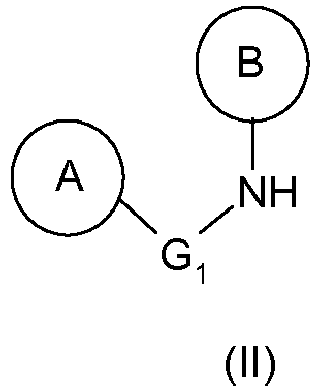
caractérisé en ce que ledit procédé passe par une urée de formule (III) comme intermédiaire de synthèse :

- G 1 represents a bond or a hydrocarbon chain, linear or branched, saturated or unsaturated, comprising 1 to 4 carbon atoms, optionally substituted with one or two alkyl groups, preferably identical,
- A represents an aryl group, such as phenyl, which is optionally substituted:
- in meta or para position by:
- a halogen atom or a cyano, alkoxy, haloalkoxy, acylaminoalkyl or -XR group where X represents -O-, -S-, -SO-, -SO 2 - or -CO- and R represents an arylalkyl, cycloalkyl or aryl, each optionally substituted with one or two substituents, which may be identical or different, such as a halogen atom, an alkoxy or acyl group, or
- a cycloalkyl, aryl or arylalkyl group, each optionally substituted by one or two substituents, identical or different, such as an acyl or alkoxy group,
- and / or in ortho or meta position by an alkyl group, and
- in meta or para position by:
- B represents an aryl group, preferably a phenyl, substituted in the ortho position by a heterocycle, preferably an N-cycloalkyl, such as a piperidin-1-yl group, and optionally substituted in the ortho 'position by an alkyl group; such as methyl,
characterized in that said process passes through a urea of formula (III) as synthesis intermediate:
Dans la présente invention, on entend par « pharmaceutiquement acceptable » ce qui est utile dans la préparation d'une composition pharmaceutique qui est généralement sûr, non toxique et ni biologiquement ni autrement non souhaitable et qui est acceptable pour une utilisation vétérinaire de même que pharmaceutique humaine.In the present invention, the term "pharmaceutically acceptable" means that which is useful in the preparation of a pharmaceutical composition which is generally safe, non-toxic and neither biologically nor otherwise undesirable and which is acceptable for veterinary as well as human pharmaceutical use.
Par « sels pharmaceutiquement acceptables » d'un composé, on entend désigner dans la présente invention des sels qui sont pharmaceutiquement acceptables, comme défini ici, et qui possèdent l'activité pharmacologique souhaitée du composé parent. De tels sels comprennent :
- (1) les hydrates et les solvates,
- (2) les sels d'addition d'acide formés avec des acides inorganiques tels que l'acide chlorhydrique, l'acide bromhydrique, l'acide sulfurique, l'acide nitrique, l'acide phosphorique et similaires ; ou formés avec des acides organiques tels que l'acide acétique, l'acide benzènesulfonique, l'acide benzoïque, l'acide camphresulfonique, l'acide citrique, l'acide éthane-sulfonique, l'acide fumarique, l'acide glucoheptonique, l'acide gluconique, l'acide glutamique, l'acide glycolique, l'acide hydroxynaphtoïque, l'acide 2-hydroxyéthanesulfonique, l'acide lactique, l'acide maléique, l'acide malique, l'acide mandélique, l'acide méthanesulfonique, l'acide muconique, l'acide 2-naphtalènesulfonique, l'acide propionique, l'acide salicylique, l'acide succinique, l'acide dibenzoyl-L-tartrique, l'acide tartrique, l'acide p-toluènesulfonique, l'acide triméthylacétique, l'acide trifluoroacétique et similaires ; et
- (3) les sels formés lorsqu'un proton acide présent dans le composé parent soit est remplacé par un ion métallique, par exemple un ion de métal alcalin (Na+, K+ ou Li+ par exemple), un ion de métal alcalino-terreux (comme Ca2+ ou Mg2+) ou un ion d'aluminium ; soit se coordonne avec une base organique ou inorganique. Les bases organiques acceptables comprennent la diéthanolamine, l'éthanolamine, N-méthylglucamine, la triéthanolamine, la trométhamine et similaires. Les bases inorganiques acceptables comprennent l'hydroxyde d'aluminium, l'hydroxyde de calcium, l'hydroxyde de potassium, le carbonate de sodium et l'hydroxyde de sodium.
- (1) hydrates and solvates,
- (2) acid addition salts formed with inorganic acids such as hydrochloric acid, hydrobromic acid, sulfuric acid, nitric acid, phosphoric acid and the like; or formed with organic acids such as acetic acid, benzenesulfonic acid, benzoic acid, camphorsulfonic acid, citric acid, ethanesulfonic acid, fumaric acid, glucoheptonic acid, gluconic acid, glutamic acid, glycolic acid, hydroxynaphthoic acid, 2-hydroxyethanesulfonic acid, lactic acid, maleic acid, malic acid, mandelic acid, acid methanesulfonic acid, muconic acid, 2-naphthalenesulfonic acid, propionic acid, salicylic acid, succinic acid, dibenzoyl-L-tartaric acid, tartaric acid, p-toluenesulphonic acid, trimethylacetic acid, trifluoroacetic acid and the like; and
- (3) the salts formed when an acidic proton present in the parent compound is replaced by a metal ion, for example an alkali metal ion (Na + , K + or Li + for example), an alkali metal ion; earthy (such as Ca 2+ or Mg 2+ ) or an aluminum ion; either coordinates with an organic or inorganic base. Acceptable organic bases include diethanolamine, ethanolamine, N-methylglucamine, triethanolamine, tromethamine and the like. Acceptable inorganic bases include aluminum hydroxide, calcium hydroxide, potassium hydroxide, sodium carbonate and sodium hydroxide.
Par « insaturé », on entend, au sens de la présente invention, que le groupement comprend une ou plusieurs insaturations.By "unsaturated" is meant, within the meaning of the present invention, that the group comprises one or more unsaturations.
Par « insaturation », on entend, au sens de la présente invention une double liaison ou une triple liaison.By "unsaturation" is meant in the sense of the present invention a double bond or a triple bond.
Par « halogène », on entend, au sens de la présente invention, un atome de fluor, de brome, de chlore ou d'iode. Avantageusement, il s'agit d'un atome de fluor, de brome ou de chlore.For the purposes of the present invention, the term "halogen" means a fluorine, bromine, chlorine or iodine atom. Advantageously, it is a fluorine, bromine or chlorine atom.
Par groupement « alkyle », on entend, au sens de la présente invention, une chaîne hydrocarbonée saturée, linéaire ou ramifiée, comportant de 1 à 6 atomes de carbone, en particulier les groupes méthyle, éthyle, n-propyle, isopropyle, n-butyle, iso-butyle, sec-butyle, tert-butyle, n-pentyle ou encore n-hexyle. Avantageusement, il s'agit du méthyle.By "alkyl" group is meant, in the sense of the present invention, a saturated hydrocarbon chain, linear or branched, comprising from 1 to 6 carbon atoms, in particular the methyl, ethyl, n-propyl, isopropyl, n-propyl groups. butyl, iso-butyl, sec-butyl, tert-butyl, n-pentyl or n-hexyl. Advantageously, it is methyl.
Par groupement « cycloalkyle », on entend, au sens de la présente invention, un système monocyclique ou polycyclique, de préférence mono-, bi- ou tri-cyclique, saturé, comportant de 3 à 12 atomes de carbone, les cycles pouvant être deux à deux fusionnés ou pontés, tel que les groupes cyclopropyle, cyclopentyle, cyclohexyle, cycloheptyle, cyclooctyle, adamantyle, décalinyle ou encore norbornyle.For the purposes of the present invention, the term "cycloalkyl" group is intended to mean a monocyclic or polycyclic, preferably mono-, bi- or tri-cyclic, saturated system comprising from 3 to 12 carbon atoms, the cycles being able to be two or more carbon atoms. two fused or bridged, such as cyclopropyl, cyclopentyl, cyclohexyl, cycloheptyl, cyclooctyl, adamantyl, decalinyl or norbornyl.
Par groupement « N-cycloalkyle », on entend, au sens de la présente invention, un groupe cycloalkyle tel que défini ci-dessus pour lequel un atome de carbone a été substitué par un atome d'azote, la liaison avec la molécule se faisant par cet atome d'azote. Il s'agit avantageusement d'un groupe pipéridin-1-yle ou pyrrolidin-1-yle.By "N-cycloalkyl" group is meant, in the sense of the present invention, a cycloalkyl group as defined above for which a carbon atom has been substituted by a nitrogen atom, the bond with the molecule being by this nitrogen atom. It is advantageously a piperidin-1-yl or pyrrolidin-1-yl group.
Par groupement « acyle », on entend, au sens de la présente invention, un groupe de formule -C(O)-Z, où Z représente un groupe alkyle tel que défini ci-dessus ou un phényle. Il peut s'agir avantageusement d'un groupe acétyle, éthylcarbonyle ou encore benzoyle.By "acyl" group is meant, within the meaning of the present invention, a group of formula -C (O) -Z, where Z represents an alkyl group as defined above or a phenyl. It may advantageously be an acetyl, ethylcarbonyl or benzoyl group.
Par groupement « alkoxy », on entend, au sens de la présente invention, un groupe alkyle tel que défini ci-dessus lié à la molécule par l'intermédiaire d'un atome d'oxygène. Il peut s'agir en particulier d'un groupe méthoxy, éthoxy, n-propoxy, isopropoxy, n-butoxy, iso-butoxy, sec-butoxy ou encore tert-butoxy.By "alkoxy" group is meant, in the sense of the present invention, an alkyl group as defined above bonded to the molecule through an oxygen atom. It may be in particular a methoxy, ethoxy, n-propoxy, isopropoxy, n-butoxy, iso-butoxy, sec-butoxy or tert-butoxy group.
Par groupement « halogénoalkoxy », on entend, au sens de la présente invention, un groupe alkoxy tel que défini ci-dessus substitué par un ou plusieurs atome(s) d'halogène tel(s) que défini(s) ci-dessus. De préférence, il s'agira de fluoroalkoxy, c'est-à-dire d'un groupe alkoxy substitué par un ou plusieurs atome(s) de fluor, tel qu'un groupe -OCF3 ou encore -OCH2CF3.By "haloalkoxy" group is meant, in the sense of the present invention, an alkoxy group as defined above substituted with one or more halogen atom (s) as defined above. Preferably, it will be fluoroalkoxy, that is to say an alkoxy group substituted by one or more fluorine atom (s), such as a group -OCF 3 or -OCH 2 CF 3 .
Par groupement « aryle », on entend, au sens de la présente invention, un groupement aromatique, comportant de préférence de 5 à 10 atomes de carbone et comprenant un ou plusieurs cycles accolés, comme par exemple un groupement phényle ou naphtyle. Avantageusement, il s'agit du phényle.By "aryl" group is meant, in the sense of the present invention, an aromatic group, preferably comprising from 5 to 10 carbon atoms and comprising one or more contiguous rings, such as for example a phenyl or naphthyl group. Advantageously, it is phenyl.
Par « hétérocycle », on entend, au sens de la présente invention, un système monocyclique ou polycyclique, et de préférence mono- ou bi-cyclique, saturé, insaturé ou aromatique, comportant de 3 à 12 chaînons, les cycles pouvant être deux à deux fusionnés, spiro-fusionnés ou pontés, et comprenant 1 à 4 hétéroatomes, identiques ou différents, choisis parmi O, S et N, et comprenant éventuellement un ou deux groupements oxo ou thioxo, étant compris que dans le cas d'un système polycyclique, l'un des cycles peut être aromatique tandis que le ou les autres peuvent être aromatique, saturé ou insaturé. Avantageusement, il s'agira des groupes pipéridyle, pipérazyle, furyle, thiényle, pyrrolyle, pyrazolyle, imidazolyle, pyridyle, pyrimidyle, pyrazinyle, pyradizinyle, benzofuryle, benzothiényle, indolyle, quinolyle, isoquinolyle, benzodioxolyle, benzodioxinyle, benzo[1,2,5]thiadiazolyle, benzo[1,2,5]oxadiazolyle, [1,2,3]triazolyle et [1,2,4]triazolyle.For the purposes of the present invention, the term "heterocycle" is intended to mean a monocyclic or polycyclic, and preferably mono- or bi-cyclic, saturated, unsaturated or aromatic system comprising from 3 to 12 ring members, the rings being two fused, spiro-fused or bridged, and comprising 1 to 4 heteroatoms, identical or different, selected from O, S and N, and optionally comprising one or two oxo or thioxo groups, being understood only in the case of a polycyclic system one of the rings may be aromatic while the other may be aromatic, saturated or unsaturated. Advantageously, these will be piperidyl, piperazyl, furyl, thienyl, pyrrolyl, pyrazolyl, imidazolyl, pyridyl, pyrimidyl, pyrazinyl, pyradizinyl, benzofuryl, benzothienyl, indolyl, quinolyl, isoquinolyl, benzodioxolyl, benzodioxinyl, benzo [1,2, 5] thiadiazolyl, benzo [1,2,5] oxadiazolyl, [1,2,3] triazolyl and [1,2,4] triazolyl.
Par groupement « arylalkyle », on entend, au sens de la présente invention, un groupe aryle tel que défini ci-dessus lié à la molécule par l'intermédiaire d'un groupe alkyle tel que défini ci-dessus. De préférence, il s'agit d'un groupe benzyle.By "arylalkyl" group is meant, in the sense of the present invention, an aryl group as defined above linked to the molecule through an alkyl group as defined above. Preferably, it is a benzyl group.
Par « acylaminoalkyle », on entend, au sens de la présente invention, un groupement de formule -Alk-NHCO-Alk', où Alk et Alk' représentent, indépendamment l'un de l'autre, un groupe alkyle tel que défini ci-dessus.For the purposes of the present invention, the term "acylaminoalkyl" means a group of formula -Alk-NHCO-Alk ', in which Alk and Alk' represent, independently of one another, an alkyl group as defined herein. -above.
L'hydrazine de formule (I) telle que définie ci-dessus pourra ainsi être préparée à partir de l'urée de formule (III) telle que définie ci-dessus par un réarrangement de Shestakov.The hydrazine of formula (I) as defined above can thus be prepared from the urea of formula (III) as defined above by a Shestakov rearrangement.
Cette réaction est décrite dans la littérature pour des urées différemment substituées (
Ce réarrangement de Shestakov sera avantageusement réalisé en présence d'un agent inducteur de réarrangement choisi parmi NaOCl et KOCl, et de préférence étant NaOCl.This rearrangement of Shestakov will advantageously be carried out in the presence of a rearrangement inducing agent selected from NaOCl and KOCl, and preferably being NaOCl.
De préférence, l'agent inducteur de réarrangement est introduit de manière échelonnée dans le temps. Ainsi, l'agent inducteur pourra être introduit en plusieurs portions étalées dans le temps ou au goutte à goutte, ou encore en continu de manière lente pour que l'addition soit suffisamment étalée dans le temps. L'homme du métier saura adapter le paramètre d'addition (telle que la vitesse d'addition pour une addition en continu) de l'agent inducteur de manière à avoir une addition optimale.Preferably, the rearrangement inducing agent is introduced in a staggered manner over time. Thus, the inducing agent may be introduced in several portions spread over time or drop by drop, or continuously in a slow manner so that the addition is sufficiently spread over time. Those skilled in the art will be able to adapt the addition parameter (such as the addition rate for a continuous addition) of the inducing agent so as to have an optimal addition.
Au moins un équivalent molaire, avantageusement entre 1 et 1,5 équivalents molaires, et de préférence environ 1 équivalent molaire, d'agent inducteur de réarrangement est utilisé dans cette réaction, pour un équivalent molaire d'urée de formule (III).At least one molar equivalent, preferably between 1 and 1.5 molar equivalents, and preferably about 1 molar equivalent, of rearrangement inducing agent is used in this reaction, for one molar equivalent of urea of formula (III).
En effet, les inventeurs ont remarqué de manière surprenante que de meilleurs rendements étaient obtenus lorsque l'agent inducteur de réarrangement était ajouté progressivement au milieu réactionnel par rapport à un seul ajout.Indeed, the inventors have surprisingly noticed that better yields were obtained when the rearrangement inducing agent was added gradually to the reaction medium with respect to a single addition.
Bien évidemment, le nombre de portions additionnées et la durée de l'addition dépendront de l'échelle à laquelle est effectuée la réaction, de telles adaptations étant de la pratique commune de l'homme du métier.Of course, the number of portions added and the duration of the addition will depend on the scale at which the reaction is performed, such adaptations being common practice of those skilled in the art.
Le réarrangement de Shestakov pourra être réalisé dans un mélange dioxane/eau ou dans un alcool comme solvant, et de préférence dans le tert-butanol.The Shestakov rearrangement may be carried out in a dioxane / water mixture or in an alcohol as a solvent, and preferably in tert- butanol.
Par « alcool », on entend, au sens de la présente invention, un composé de formule Alk-OH, où Alk représente un groupe alkyle tel que défini ci-dessus. De préférence, il s'agit du méthanol, de l'éthanol ou du tert-butanol.For the purposes of the present invention, the term "alcohol" means a compound of formula Alk-OH, in which Alk represents an alkyl group as defined above. Preferably, it is methanol, ethanol or tert- butanol.
Ce réarrangement est réalisé avantageusement dans des conditions basiques, notamment en présence d'hydroxyde de sodium ou de potassium et de préférence, en présence d'hydroxyde de potassium.This rearrangement is advantageously carried out under basic conditions, especially in the presence of sodium or potassium hydroxide and preferably in the presence of potassium hydroxide.
Par ailleurs, l'urée de formule (III) telle que définie ci-dessus peut être préparée à partir de l'amine de formule (II) telle que définie ci-dessus selon les étapes suivantes :
- (1) mise en réaction de l'amine de formule (II) avec l'isocyanate de trichloroacétyle (Cl3CC(O)-N=C=O) pour donner le composé de formule (IV) :
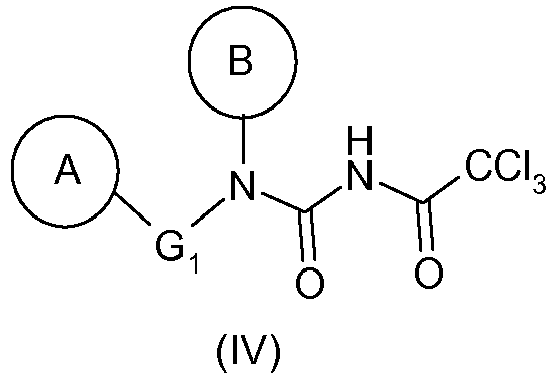
- (2) traitement en milieu basique du composé de formule (IV) obtenu à l'étape précédente pour donner une urée de formule (III).
- (1) reacting the amine of formula (II) with trichloroacetyl isocyanate (Cl 3 CC (O) -N = C = O) to give the compound of formula (IV):
- (2) treatment in basic medium of the compound of formula (IV) obtained in the preceding step to give a urea of formula (III).
L'étape (1) pourra être réalisée dans un solvant tel que l'acétonitrile, le tétrahydrofurane, le dichlorométhane ou encore le dioxane et de préférence dans l'acétonitrile.Step (1) may be carried out in a solvent such as acetonitrile, tetrahydrofuran, dichloromethane or else dioxane and preferably in acetonitrile.
L'étape (1) peut être réalisée à température ambiante, c'est-à-dire à des températures variant entre 20 et 40°C, et de préférence à environ 25°C.Step (1) can be carried out at ambient temperature, that is to say at temperatures ranging from 20 to 40 ° C, and preferably at about 25 ° C.
L'hydroxyde de potassium ou de sodium, et de préférence KOH, pourra être utilisé comme base dans l'étape (2).Potassium or sodium hydroxide, and preferably KOH, may be used as a base in step (2).
Le solvant utilisé dans cette étape (2) sera un alcool tel que défini ci-dessus et de préférence sera le méthanol, l'étape (2) étant réalisée notamment au reflux de ce solvant.The solvent used in this step (2) will be an alcohol as defined above and preferably will be methanol, step (2) being carried out in particular at the reflux of this solvent.
Ainsi, selon un mode de réalisation particulier du procédé de l'invention, l'hydrazine de formule (I) précédente pourra être préparée selon les étapes successives suivantes :
- (1) mise en réaction d'une amine de formule (II) telle que définie précédemment avec Cl3CC(O)-N=C=O pour donner un composé de formule (IV) tel que défini précédemment,
- (2) traitement en milieu basique du composé de formule (IV) obtenu à l'étape précédente pour donner une urée de formule (III) telle que définie précédemment,
- (3) réaction de Shestakov à partir de l'urée de formule (III) obtenue à l'étape précédente pour donner une hydrazine de formule (I) telle que définie précédemment, et
- (4) isolation du milieu réactionnel de l'hydrazine de formule (I) obtenue à l'étape précédente.
- (1) reacting an amine of formula (II) as defined above with Cl 3 CC (O) -N = C = O to give a compound of formula (IV) as defined above,
- (2) treatment in a basic medium of the compound of formula (IV) obtained in the preceding step to give a urea of formula (III) as defined above,
- (3) Shestakov reaction from the urea of formula (III) obtained in the preceding step to give a hydrazine of formula (I) as defined previously, and
- (4) isolation of the reaction medium from the hydrazine of formula (I) obtained in the preceding step.
L'isolation du produit final pourra être réalisée par des techniques bien connues de l'homme du métier, comme par exemple par extraction, évaporation du solvant ou encore par précipitation et filtration.The isolation of the final product can be achieved by techniques well known to those skilled in the art, such as by extraction, evaporation of the solvent or by precipitation and filtration.
L'hydrazine ainsi obtenue pourra par ailleurs être purifiée si nécessaire par des méthodes bien connues de l'homme du métier, comme par recristallisation si le composé est cristallin, ou encore par distillation.The hydrazine thus obtained may also be purified if necessary by methods well known to those skilled in the art, such as by recrystallization if the compound is crystalline, or by distillation.
Avantageusement, G1 représente une liaison ou une chaîne hydrocarbonée linéaire et saturée, comprenant 1 à 4 atomes de carbone, et de préférence représente une liaison.Advantageously, G 1 represents a bond or a linear and saturated hydrocarbon-based chain comprising 1 to 4 carbon atoms, and preferably represents a bond.
De manière avantageuse, le radical A défini ci-dessus est un aryle, de préférence un phényle, substitué en méta ou en para, de préférence en para, par un groupement alkoxy, tel que méthoxy, ou par un groupement aryle ou arylalkyle, tel que phényle ou benzyle, éventuellement substitué par un ou deux substituants, identiques ou différents, tels qu'un groupement acyle ou alkoxy.Advantageously, the radical A defined above is an aryl, preferably a phenyl, substituted in meta or para, preferably para, with an alkoxy group, such as methoxy, or with an aryl or arylalkyl group, such as phenyl or benzyl, optionally substituted with one or two substituents, identical or different, such as an acyl or alkoxy group.
Avantageusement, B représente un groupement aryle, de préférence un phényle, substitué en position ortho par un hétérocycle, de préférence un N-cycloalkyle, tel qu'un groupement pipéridin-1-yle, et éventuellement substitué en position ortho' par un groupement alkyle, tel qu'un méthyle.Advantageously, B represents an aryl group, preferably a phenyl, substituted in the ortho position by a heterocycle, preferably an N-cycloalkyl, such as a piperidin-1-yl group, and optionally substituted in the ortho 'position by an alkyl group. , such as methyl.
En particulier, l'hydrazine de formule (I) est la N-(4-benzyl-phényl)-N-(2-méthyl-6-pipéridin-1-yl-phényl)-hydrazine (hydrazine (Ia)).In particular, the hydrazine of formula (I) is N - (4-benzyl-phenyl) - N - (2-methyl-6-piperidin-1-yl-phenyl) hydrazine (hydrazine (Ia)).
Par conséquent, l'hydrazine (Ia) précédente est préparée à partir de 1-(4-benzyl-phényl)-1-(2-méthyl-6-pipéridin-1-yl-phényl)-urée (composé (IIIa)), elle-même préparée à partir de (4-benzyl-phényl)-(2-méthyl-6-pipéridin-1-yl-phényl)-amine (composé (IIa)).Therefore, the above hydrazine (Ia) is prepared from 1- (4-benzyl-phenyl) -1- (2-methyl-6-piperidin-1-yl-phenyl) -urea (Compound (IIIa)) itself prepared from (4-benzyl-phenyl) - (2-methyl-6-piperidin-1-yl-phenyl) -amine (Compound (IIa)).
La présente invention a également pour objet un procédé de préparation d'un composé de formule (V) suivante :
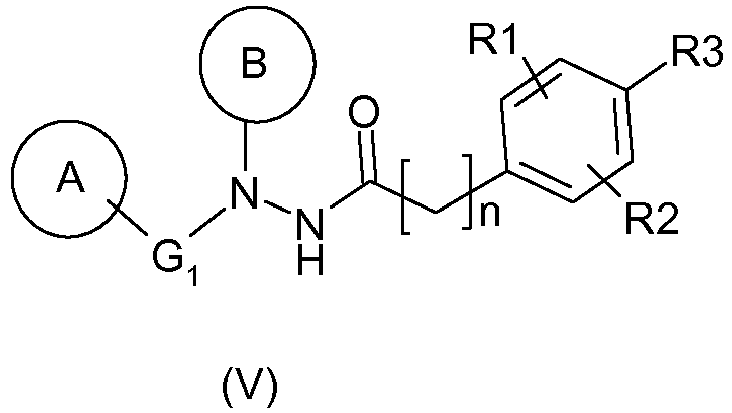
dans lequel :
- ▪ R1 représente un groupement alkoxy, tel que méthoxy, de préférence en position ortho par rapport à R3,
- ▪ R2 représente un atome d'hydrogène ou d'halogène, tel que chlore ou brome, ou un groupement alkyle, tel que méthyle, de préférence en position méta par rapport à R3,
- ▪ R3 représente un groupement acide ou ester, et de préférence acide,
- ▪ n est un nombre entier compris entre 1 et 4, de préférence entre 1 et 2, et encore de préférence est 1,
- ▪ G1 représente une liaison ou une chaîne hydrocarbonée, linéaire ou ramifiée, saturée ou insaturée, comprenant 1 à 4 atomes de carbone, éventuellement substituée par un ou deux groupements alkyle, de préférence identiques,
- ▪A représente un groupement aryle, tel que phényle, éventuellement substitué :
- en position méta ou para par :
- un atome d'halogène ou un groupement cyano, alkoxy, halogénoalkoxy, acylaminoalkyle ou -XR où X représente -O-, -S-, -SO-, -SO2- ou -CO- et R représente un groupement arylalkyle, cycloalkyle ou aryle, chacun éventuellement substitué par un ou deux substituants, identiques ou différents, tels que atome d'halogène, groupement alkoxy ou acyle, ou
- un groupement cycloalkyle, aryle ou arylalkyle, chacun éventuellement substitué par un ou deux substituants, identiques ou différents, tels qu'un groupement acyle ou alkoxy,
- et/ou en position ortho ou méta par un groupement alkyle, et
- en position méta ou para par :
- ▪ B représente un groupement aryle, de préférence un phényle, substitué en position ortho par un hétérocycle, de préférence un N-cycloalkyle, tel qu'un groupement pipéridin-1-yle, et éventuellement substitué en position ortho' par un groupement alkyle, tel qu'un méthyle,
in which :
- R1 represents an alkoxy group, such as methoxy, preferably in position ortho to R3,
- R 2 represents a hydrogen or halogen atom, such as chlorine or bromine, or an alkyl group, such as methyl, preferably in the meta position with respect to R 3,
- R3 represents an acid or ester group, and preferably an acid group,
- N is an integer between 1 and 4, preferably between 1 and 2, and more preferably is 1,
- G 1 represents a bond or a hydrocarbon chain, linear or branched, saturated or unsaturated, comprising 1 to 4 carbon atoms, optionally substituted with one or two alkyl groups, preferably identical,
- A represents an aryl group, such as phenyl, which is optionally substituted:
- in meta or para position by:
- a halogen atom or a cyano, alkoxy, haloalkoxy, acylaminoalkyl or -XR group where X represents -O-, -S-, -SO-, -SO 2 - or -CO- and R represents an arylalkyl, cycloalkyl or aryl, each optionally substituted with one or two substituents, which may be identical or different, such as a halogen atom, an alkoxy or acyl group, or
- a cycloalkyl, aryl or arylalkyl group, each optionally substituted by one or two substituents, identical or different, such as an acyl or alkoxy group,
- and / or in ortho or meta position by an alkyl group, and
- in meta or para position by:
- B represents an aryl group, preferably a phenyl, substituted in the ortho position by a heterocycle, preferably an N-cycloalkyl, such as a piperidin-1-yl group, and optionally substituted in the ortho 'position by an alkyl group; such as methyl,
Les composés de formule (V) correspondent à des composés utiles pour le traitement du virus du papillome décrits dans la demande
Par « acide », on entend, au sens de la présente invention, un groupement COOH.For the purposes of the present invention, the term "acid" means a COOH group.
Par « ester », on entend, au sens de la présente invention, un groupement -CO-O-Alk, où Alk représente un groupement alkyle tel que défini précédemment.By "ester" is meant, within the meaning of the present invention, a -CO-O-Alk group, where Alk represents an alkyl group as defined above.
Avantageusement, R2 représente un atome d'halogène, tel qu'un atome de brome, de préférence en position méta par rapport à R3.Advantageously, R2 represents a halogen atom, such as a bromine atom, preferably in the meta position relative to R3.
Avantageusement, G1 représente une liaison ou une chaîne hydrocarbonée linéaire et saturée, comprenant 1 à 4 atomes de carbone, et de préférence représente une liaison.Advantageously, G 1 represents a bond or a linear and saturated hydrocarbon-based chain comprising 1 to 4 carbon atoms, and preferably represents a bond.
De manière avantageuse, le radical A défini ci-dessus est un aryle, de préférence un phényle, substitué en méta ou en para, de préférence en para, par un groupement alkoxy, tel que méthoxy, ou par un groupement aryle ou arylalkyle, tel que phényle ou benzyle, éventuellement substitué par un ou deux substituants, identiques ou différents, tels qu'un groupement acyle ou alkoxy.Advantageously, the radical A defined above is an aryl, preferably a phenyl, substituted in meta or para, preferably para, with an alkoxy group, such as methoxy, or with an aryl or arylalkyl group, such as phenyl or benzyl, optionally substituted with one or two substituents, identical or different, such as an acyl or alkoxy group.
Avantageusement, B représente un groupement aryle, de préférence un phényle, substitué en position ortho par un hétérocycle, de préférence un N-cycloalkyle, tel qu'un groupement pipéridin-1-yle, et éventuellement substitué en position ortho' par un groupement alkyle, tel qu'un méthyle.Advantageously, B represents an aryl group, preferably a phenyl, substituted in the ortho position by a heterocycle, preferably an N-cycloalkyl, such as a piperidin-1-yl group, and optionally substituted in the ortho 'position by an alkyl group. , such as methyl.
De préférence, le composé de formule (V) répond aux caractéristiques suivantes :
- A représente un groupement phényle substitué en position para par un groupe benzyle,
- B représente un groupe phényle substitué en position ortho par un groupe pipéridin-1-yle et en position ortho' par un groupe méthyle,
- G1 représente une liaison, et
- R1, R2, R3 et n sont tels que définis précédemment.
- A represents a phenyl group substituted in the para position by a benzyl group,
- B represents a phenyl group substituted in the ortho position with a piperidin-1-yl group and at the ortho 'position with a methyl group,
- G 1 represents a bond, and
- R1, R2, R3 and n are as previously defined.
En particulier, le composé de formule (V) est le chlorhydrate de l'acide 4-[N'-(4-benzyl-phényl)-N'-(2-méthyl-6-pipéridin-1-yl-phényl)-hydrazinocarbonyl méthyl]-5-bromo-2-méthoxy-benzoïque (composé (Va)).In particular, the compound of formula (V) is 4- [ N'- (4-benzyl-phenyl) -N '- (2-methyl-6-piperidin-1-yl-phenyl) hydrochloride) hydrazinocarbonyl methyl] -5-bromo-2-methoxy-benzoic acid (compound (Va)).
Par conséquent, le composé (Va) pourra être préparé à partir des intermédiaires (Ia), (IIa) et (IIIa) cités précédemment.Therefore, the compound (Va) can be prepared from the intermediates (Ia), (IIa) and (IIIa) mentioned above.
La présente invention a également pour objet un composé de formule générale (III) :
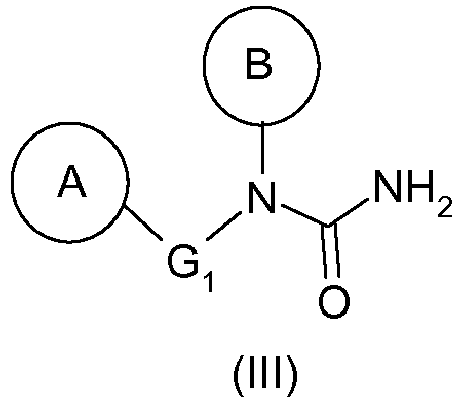
- ▪ G1 représente une liaison ou une chaîne hydrocarbonée, linéaire ou ramifiée, saturée ou insaturée, comprenant 1 à 4 atomes de carbone, éventuellement substituée par un ou deux groupements alkyle, de préférence identiques,
- ▪ A représente un groupement aryle, tel que phényle, éventuellement substitué :
- en position méta ou para par :
- un atome d'halogène ou un groupement cyano, alkoxy, halogénoalkoxy, acylaminoalkyle ou -XR où X représente -O-, -S-, -SO-, -SO2- ou -CO- et R représente un groupement arylalkyle, cycloalkyle ou aryle, chacun éventuellement substitué par un ou deux substituants, identiques ou différents, tels que atome d'halogène, groupement alkoxy ou acyle, ou
- un groupement cycloalkyle, aryle ou arylalkyle, chacun éventuellement substitué par un ou deux substituants, identiques ou différents, tels qu'un groupement acyle ou alkoxy,
- et/ou en position ortho ou méta par un groupement alkyle, et
- en position méta ou para par :
- ▪ B représente un groupement aryle, de préférence un phényle, substitué en position ortho par un hétérocycle, de préférence un N-cycloalkyle, tel qu'un groupement pipéridin-1-yle, et éventuellement substitué en position ortho' par un groupement alkyle, tel qu'un méthyle.
- G 1 represents a bond or a hydrocarbon chain, linear or branched, saturated or unsaturated, comprising 1 to 4 carbon atoms, optionally substituted with one or two alkyl groups, preferably identical,
- A represents an aryl group, such as phenyl, which is optionally substituted:
- in meta or para position by:
- a halogen atom or a cyano, alkoxy, haloalkoxy, acylaminoalkyl or -XR group where X represents -O-, -S-, -SO-, -SO 2 - or -CO- and R represents an arylalkyl, cycloalkyl or aryl, each optionally substituted with one or two substituents, which may be identical or different, such as a halogen atom, an alkoxy or acyl group, or
- a cycloalkyl, aryl or arylalkyl group, each optionally substituted by one or two substituents, identical or different, such as an acyl or alkoxy group,
- and / or in ortho or meta position by an alkyl group, and
- in meta or para position by:
- B represents an aryl group, preferably a phenyl, substituted in the ortho position by a heterocycle, preferably an N-cycloalkyl, such as a piperidin-1-yl group, and optionally substituted in the ortho 'position by an alkyl group; such as methyl.
Avantageusement, G1 représente une liaison ou une chaîne hydrocarbonée linéaire et saturée, comprenant 1 à 4 atomes de carbone, et de préférence représente une liaison.Advantageously, G 1 represents a bond or a linear and saturated hydrocarbon-based chain comprising 1 to 4 carbon atoms, and preferably represents a bond.
De manière avantageuse, le radical A défini ci-dessus est un aryle, de préférence un phényle, substitué en méta ou en para, de préférence en para, par un groupement alkoxy, tel que méthoxy, ou par un groupement aryle ou arylalkyle, tel que phényle ou benzyle, éventuellement substitué par un ou deux substituants, identiques ou différents, tels qu'un groupement acyle ou alkoxy.Advantageously, the radical A defined above is an aryl, preferably a phenyl, substituted in meta or para, preferably para, with an alkoxy group, such as methoxy, or with an aryl or arylalkyl group, such as phenyl or benzyl, optionally substituted with one or two substituents, identical or different, such as an acyl or alkoxy group.
Avantageusement, B représente un groupement aryle, de préférence un phényle, substitué en position ortho par un hétérocycle, de préférence un N-cycloalkyle, tel qu'un groupement pipéridin-1-yle, et éventuellement substitué en position ortho' par un groupement alkyle, tel qu'un méthyle.Advantageously, B represents an aryl group, preferably a phenyl, substituted in the ortho position by a heterocycle, preferably an N-cycloalkyl, such as a piperidin-1-yl group, and optionally substituted in the ortho 'position by an alkyl group. , such as methyl.
En particulier, le composé (III) sera la 1-(4-benzyl-phényl)-1-(2-méthyl-6-pipéridin-1-yl-phényl)-urée (composé (IIIa)).In particular, the compound (III) will be 1- (4-benzyl-phenyl) -1- (2-methyl-6-piperidin-1-yl-phenyl) -urea (compound (IIIa)).
La présente invention sera mieux comprise à la lumière des exemples non limitatifs qui suivent.The present invention will be better understood in the light of the nonlimiting examples which follow.
- CCMTLC
- Chromatographie sur Couche MinceThin-layer chromotography
- éq.eq.
- Equivalent molaireMolar equivalent
- HPLCHPLC
- Chromatographie Liquide Haute PerformanceHigh Performance Liquid Chromatography
- RMNNMR
- Résonance magnétique nucléaireNuclear magnetic resonance
- SMSM
- Spectrométrie de masseMass spectrometry
Ce composé est synthétisé selon le mode opératoire décrit dans la demande
A une suspension de l'amine (Ia) (4,00 g, 11,23 mmol, 1,0 éq.) dans l'acétonitrile anhydre (100mL), sous argon et sous agitation, est ajouté de l'isocyanate de trichloroacétyle (2,53 g, 13,48 mmol, 1,2 éq.) au goutte à goutte, à 18°C, pendant 10 min. La solution jaune limpide résultante est agitée pendant encore 15 min. à température ambiante. Après consommation complète de l'amine (IIa) (suivi par CCM et HPLC), le solvant est évaporé sous pression réduite. Le composé intermédiaire brut brun clair ainsi obtenu (6,2 g, rendement quantitatif) est utilisé directement dans l'étape suivante sans purification supplémentaire.
Rendement : quantitatif
HPLC : 92,24 %
RMN 1H (CDCl3, 200 MHz) δ (ppm) : 8,80 (s élargi, 1H), 6,95-7,31 (m, 12H), 3,92 (s, 2H), 2,86 (m, 2H), 2,73 (m, 2H), 2,03 (s, 3H), 1,53 (m, 6H)To a suspension of the amine (Ia) (4.00 g, 11.23 mmol, 1.0 eq.) In anhydrous acetonitrile (100 mL), under argon and with stirring, is added trichloroacetyl isocyanate (2.53 g, 13.48 mmol, 1.2 eq) dropwise at 18 ° C. 10 minutes. The resulting clear yellow solution is stirred for a further 15 minutes. at room temperature. After complete consumption of the amine (IIa) (monitored by TLC and HPLC), the solvent is evaporated under reduced pressure. The light brown crude intermediate thus obtained (6.2 g, quantitative yield) is used directly in the next step without further purification.
Yield: quantitative
HPLC: 92.24%
1 H NMR (CDCl 3 , 200 MHz) δ (ppm): 8.80 (broad s, 1H), 6.95-7.31 (m, 12H), 3.92 (s, 2H), 2.86 (m, 2H), 2.73 (m, 2H), 2.03 (s, 3H), 1.53 (m, 6H)
A une solution de l'intermédiaire brut obtenu à l'étape (1) précédente (6,13 g, 11,2 mmol, 1,0 éq.) dans le méthanol (120 mL), est ajoutée une solution aqueuse de KOH (12,73g de KOH, 224,0 mmol, 20 éq., dans 25 mL d'eau) sous agitation. Le mélange réactionnel est alors chauffé à 75°C sous agitation pendant 1h30 à la même température. Après consommation complète de l'intermédiaire (suivi par CCM), le mélange réactionnel est concentré à sec. Le mélange brut résultant est alors repris dans de l'eau (100 mL) et extrait avec de l'acétate d'éthyle (3x100 mL). Les phases organiques rassemblées sont séchées sur sulfate de sodium, filtrées et concentrées sous pression réduite pour donner l'urée désirée (IIIa) (4,43 g, 11,1 mmol, 99 % de rendement) sous forme d'une gomme incolore avec une pureté de 83 % déterminée par HPLC. Cette urée est alors utilisée telle quelle dans l'étape suivante.
Rendement : 99 %
SM : MH+ 400
HPLC : 83,01 %
RMN 1H (CDCl3, 200 MHz) δ (ppm) : 6,94-7,30 (m, 12H), 4,77 (s, 2H), 3,91 (s, 2H), 2,91 (m, 2H), 2,60 (m, 2H), 2,26 (s, 3H), 1,48 (m, 6H).To a solution of the crude intermediate obtained in the preceding step (1) (6.13 g, 11.2 mmol, 1.0 eq.) In methanol (120 mL) is added an aqueous solution of KOH ( 12.73 g KOH, 224.0 mmol, 20 equiv., In 25 mL water) with stirring. The reaction mixture is then heated at 75 ° C. with stirring for 1.5 hours at the same temperature. After complete consumption of the intermediate (monitored by TLC), the reaction mixture is concentrated to dryness. The resulting crude mixture is then taken up in water (100 mL) and extracted with ethyl acetate (3x100 mL). The combined organic phases are dried over sodium sulfate, filtered and concentrated under reduced pressure to give the desired urea (IIIa) (4.43 g, 11.1 mmol, 99% yield) as a colorless gum with a purity of 83% determined by HPLC. This urea is then used as it is in the next step.
Yield: 99%
SM: MH + 400
HPLC: 83.01%
1 H NMR (CDCl 3 , 200 MHz) δ (ppm): 6.94-7.30 (m, 12H), 4.77 (s, 2H), 3.91 (s, 2H), 2.91 ( m, 2H), 2.60 (m, 2H), 2.26 (s, 3H), 1.48 (m, 6H).
A une solution de l'urée brute (IIIa) obtenue au stade 2 précédent (4,43 g, 11,1 mmol, 1 éq.) dans le tert-butanol (50 mL) est ajoutée une solution aqueuse de KOH (12,58 g de KOH, 222,1 mmol, 20 éq., dans 25 mL d'eau) à 18°C, sous agitation, pendant 10 min. Au mélange réactionnel résultant, est ajoutée une solution aqueuse de NaOCl (8,21 mL, 11,1 mmol, 10 % de chlore actif) par portions (1 mL toutes les 15 min.) sur une période de 2h15. Après agitation vigoureuse à 18°C pendant 15 min. supplémentaires, les phases sont séparées. Le mélange réactionnel est extrait avec de l'acétate d'éthyle (3x100 mL). Les phases organiques rassemblées sont concentrées jusqu'à siccité sous pression réduite pour donner l'hydrazine désirée (4 g, 83 % de pureté déterminée par HPLC). Le résidu ainsi obtenu est alors purifié par chromatographie flash sur colonne sur gel de silice (éluant : cyclohexane/acétate d'éthyle 95/5) pour donner l'hydrazine désirée (3,4 g, 9,1 mmol, 81 % de rendement global) sous forme d'un solide de couleur crème avec une pureté de 95,6 % déterminée par HPLC.
Rendement global : 81 %
SM : MH+ 372
HPLC : 95,60 %
RMN 1H (CDCl3, 400 MHz) δ (ppm) : 7,25 (m, 2H), 7,14 (m, 4H), 6,97 (m, 4H), 6,73 (m, 2H), 4,83 (s élargi, 2H), 3,87 (s, 2H), 2,80 (s élargi, 4H), 2,08 (s, 3H), 1,46-1,57 (m, 6H).To a solution of the crude urea (IIIa) obtained in Step 2 above (4.43 g, 11.1 mmol, 1 eq.) In tert- butanol (50 mL) is added an aqueous solution of KOH (12, 58 g of KOH, 222.1 mmol, 20 equiv., In 25 ml of water) at 18 ° C., with stirring, for 10 min. To the resulting reaction mixture is added an aqueous solution of NaOCl (8.21 mL, 11.1 mmol, 10% active chlorine) in portions (1 mL every 15 minutes) over a period of 2 hours 15 minutes. After vigorous stirring at 18 ° C for 15 min. additional, the phases are separated. The reaction mixture is extracted with ethyl acetate (3x100 mL). The combined organic phases are concentrated to dryness under reduced pressure to give the desired hydrazine (4 g, 83% purity determined by HPLC). The residue thus obtained is then purified by flash column chromatography on silica gel (eluent: cyclohexane / ethyl acetate 95/5) to give the desired hydrazine (3.4 g, 9.1 mmol, 81% yield overall) as a cream-colored solid with a purity of 95.6% determined by HPLC.
Overall performance: 81%
SM: MH + 372
HPLC: 95.60%
1 H NMR (CDCl 3 , 400 MHz) δ (ppm): 7.25 (m, 2H), 7.14 (m, 4H), 6.97 (m, 4H), 6.73 (m, 2H) , 4.83 (s extended, 2H), 3.87 (s, 2H), 2.80 (s extended, 4H), 2.08 (s, 3H), 1.46-1.57 (m, 6H) ).
Ce composé est préparé à partir de l'hydrazine (Ia) obtenue au stade 3 précédent selon le protocole décrit dans la demande
Claims (15)
- A method for producing a compound of general formula (I):
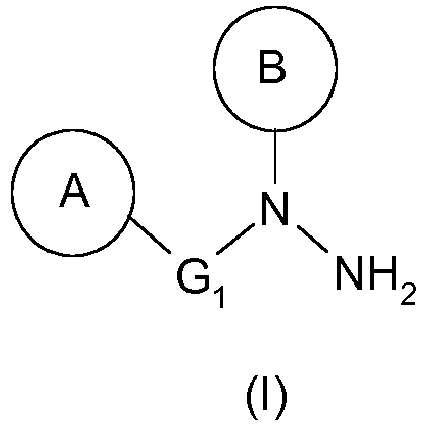
wherein:▪ G1 is a bond or a linear or branched, saturated or unsaturated hydrocarbon chain comprising 1 to 4 carbon atoms, optionally substituted by one or two alkyl groups,▪ A is an aryl group, optionally substituted:- in the meta or para position by:• a halogen atom or a cyano, alkoxy, haloalkoxy, acylaminoalkyl or -XR group where X is -O-, -S-, -SO-, -SO2- or -CO- and R is an arylalkyl, cycloalkyl or aryl group, each optionally substituted by one or two identical or different substituents, or• a cycloalkyl, aryl or arylalkyl group, each optionally substituted by one or two identical or different substituents,- and/or in the ortho or meta position by an alkyl group, and▪ B is an aryl group, substituted in the ortho position by a heterocycle, and optionally substituted in the ortho' position by an alkyl group,comprising the following steps :(1) reaction of an amine of following formula (II):
with Cl3CC(O)-N=C=O to give a compound of following formula (IV): (2) treatment in basic medium of the compound of formula (IV) obtained in the preceding step to give a urea of following formula (III):
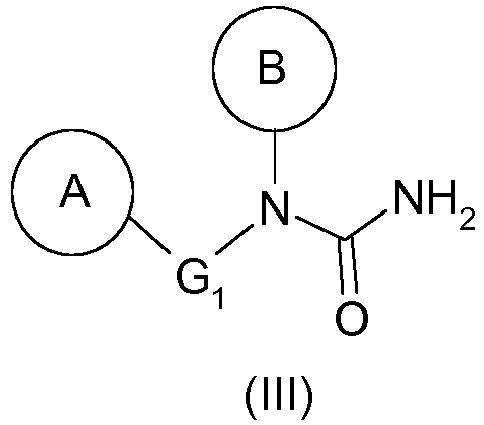 (3) Shestakov rearrangement of the urea of formula (III) to give the compound of formula (I).
 - The method according to claim 1, characterized in that the Shestakov rearrangement is carried out in the presence of a rearrangement inducing agent selected from NaOCl and KOCl, and preferably being NaOCl.
- The method according to any one of claims 1 and 2, characterized in that the rearrangement inducing agent is introduced in a staggered fashion.
- The method according to any one of claims 1 to 3, characterized in that:▪ A is a phenyl group optionally substituted:- in the meta or para position by:• a halogen atom or a cyano, alkoxy, haloalkoxy, acylaminoalkyl or -XR group where X is -O-, -S-, -SO-, -SO2- or -CO- and R is an arylalkyl, cycloalkyl or aryl group, each optionally substituted by one or two identical or different substituents, selected from a halogen atom, an alkoxy group and an acyl group, or• a cycloalkyl, aryl or arylalkyl group, each optionally substituted by one or two identical or different substituents, selected from an acyl group and an alkoxy group,- and/or in the ortho or meta position by an alkyl group, and▪ B is a phenyl group substituted in the ortho position by a N-cycloalkyl, such as a piperidin-1-yl group, and optionally substituted in the ortho' position by an alkyl group.
- The method according to any one of claims 1 to 4, characterized in that B is a phenyl group substituted in the ortho position by a piperidin-1-yl group and optionally substituted in the ortho' position by a methyl group.
- The method according to any one of claims 1 to 5, characterized in that A is an aryl, preferably a phenyl, substituted in the meta or para position, preferably in the para position, by an alkoxy group such as methoxy or by an aryl or arylalkyl group optionally substituted by one or two identical or different substituents, such as an acyl or alkoxy group.
- The method according to any one of claims 1 to 6, characterized in that the compound of formula (I) is N-(4-benzyl-phenyl)-N-(2-methyl-6-piperidin-1-yl-phenyl)-hydrazine.
- A method for producing a compound of following formula (V):
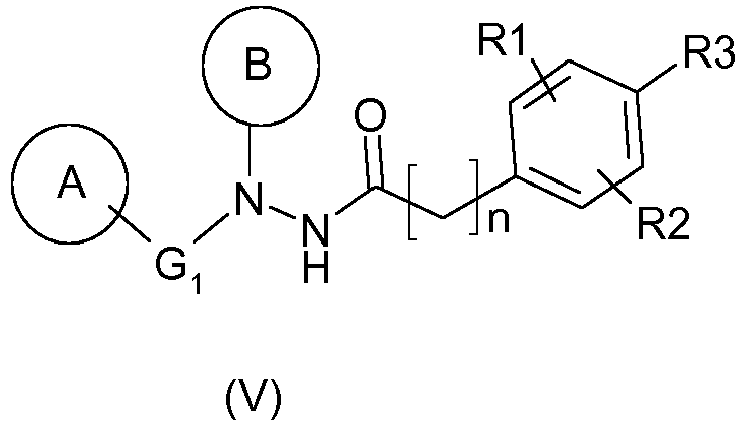
wherein:▪ R1 is an alkoxy group, such as methoxy, preferably in the ortho position relative to R3,▪ R2 is a hydrogen or halogen atom, such as chlorine or bromine, or an alkyl group, such as methyl, preferably in the meta position relative to R3,▪ R3 is an acid or ester group, and preferably an acid group,▪ n is an integer between 1 and 4, preferably between 1 and 2, and more preferably is 1,▪ G1 is a bond or a linear or branched, saturated or unsaturated hydrocarbon chain comprising 1 to 4 carbon atoms, optionally substituted by one or two preferably identical alkyl groups,▪ A is an aryl group, such as phenyl, optionally substituted:- in the meta or para position by:• a halogen atom or a cyano, alkoxy, haloalkoxy, acylaminoalkyl or -XR group where X is -O-, -S-, -SO-, -SO2- or -CO- and R is an arylalkyl, cycloalkyl or aryl group, each optionally substituted by one or two identical or different substituents, such as a halogen atom, an alkoxy or acyl group, or• a cycloalkyl, aryl or arylalkyl group, each optionally substituted by one or two identical or different substituents, such as an acyl or alkoxy group,- and/or in the ortho or meta position by an alkyl group, and▪ B is an aryl group, preferably a phenyl, substituted in the ortho position by a heterocycle, preferably an N-cycloalkyl, such as a piperidin-1-yl group, and optionally substituted in the ortho' position by an alkyl group, such as a methyl,characterized in that the compound of formula (V) is prepared from a compound of formula (I) according to any one of claims 1 to 7 and the compound of formula (I) is prepared by a method according to any one of claims 1 to 7. - The method according to claim 8, characterized in that A is an aryl, preferably a phenyl, substituted in the meta or para position, preferably in the para position, by an alkoxy group such as methoxy or by an aryl or arylalkyl group optionally substituted by one or two identical or different substituents, such as an acyl or alkoxy group.
- The method according to any one of claims 8 and 9, characterized in that the compound of formula (V) is 4-[N'-(4-benzyl-phenyl)-N'-(2-methyl-6-piperidin-1-yl-phenyl)-hydrazinocarbonyl methyl]-5-bromo-2-methoxy benzoic acid hydrochloride.
- A compound of general formula (III):
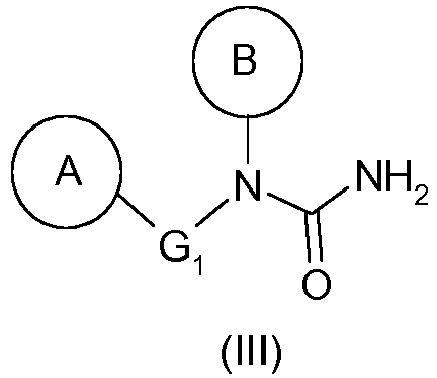 ▪ G1 is a bond or a linear or branched, saturated or unsaturated hydrocarbon chain comprising 1 to 4 carbon atoms, optionally substituted by one or two alkyl groups,▪ A is an aryl group, optionally substituted:- in the meta or para position by:• a halogen atom or a cyano, alkoxy, haloalkoxy, acylaminoalkyl or -XR group where X is -O-, -S-, -SO-, -SO2- or -CO- and R is an arylalkyl, cycloalkyl or aryl group, each optionally substituted by one or two identical or different substituents, or• a cycloalkyl, aryl or arylalkyl group, each optionally substituted by one or two identical or different substituents,- and/or in the ortho or meta position by an alkyl group, and▪ B is an aryl group substituted in the ortho position by a heterocycle, and optionally substituted in the ortho' position by an alkyl group.
 - The compound according to claim 11, characterized in that:▪ A is a phenyl group optionally substituted:- in the meta or para position by:• a halogen atom or a cyano, alkoxy, haloalkoxy, acylaminoalkyl or -XR group where X is -O-, -S-, -SO-, -SO2- or -CO- and R is an arylalkyl, cycloalkyl or aryl group, each optionally substituted by one or two identical or different substituents, selected from a halogen atom, an alkoxy group and an acyl group, or• a cycloalkyl, aryl or arylalkyl group, each optionally substituted by one or two identical or different substituents, selected from an acyl group and an alkoxy group,- and/or in the ortho or meta position by an alkyl group, and▪ B is a phenyl group substituted in the ortho position by a N-cycloalkyl, such as a piperidin-1-yl group, and optionally substituted in the ortho' position by an alkyl group,
- The compound according to any one of claims 11 and 12, characterized in that B is a phenyl group substituted in the ortho position by a piperidin-1-yl group and optionally substituted in the ortho' position by a methyl group.
- The compound according to any one of claims 11 to 13, characterized in that A is an aryl, preferably a phenyl, substituted in the meta or para position, preferably in the para position, by an alkoxy group such as methoxy or by an aryl or arylalkyl group optionally substituted by one or two identical or different substituents, such as an acyl or alkoxy group.
- The compound according to any one of claims 11 to 14, characterized in that it is 1-(4-benzyl-phenyl)-1-(2-methyl-6-piperidin-1-yl-phenyl)-urea.
Priority Applications (1)
| Application Number | Priority Date | Filing Date | Title |
|---|---|---|---|
| PL13814987T PL2938595T3 (en) | 2012-12-27 | 2013-12-27 | Method for the synthesis of a hydrazine that can be used in the treatment of the papilloma virus |
Applications Claiming Priority (2)
| Application Number | Priority Date | Filing Date | Title |
|---|---|---|---|
| FR1262872A FR3000490B1 (en) | 2012-12-27 | 2012-12-27 | PROCESS FOR SYNTHESIZING HYDRAZINE USEFUL IN THE TREATMENT OF PAPILLOMA VIRUS |
| PCT/EP2013/078035 WO2014102313A1 (en) | 2012-12-27 | 2013-12-27 | Method for the synthesis of a hydrazine that can be used in the treatment of the papilloma virus |
Publications (2)
| Publication Number | Publication Date |
|---|---|
| EP2938595A1 EP2938595A1 (en) | 2015-11-04 |
| EP2938595B1 true EP2938595B1 (en) | 2017-06-14 |
Family
ID=48083277
Family Applications (1)
| Application Number | Title | Priority Date | Filing Date |
|---|---|---|---|
| EP13814987.7A Not-in-force EP2938595B1 (en) | 2012-12-27 | 2013-12-27 | Method for the synthesis of a hydrazine that can be used in the treatment of the papilloma virus |
Country Status (13)
| Country | Link |
|---|---|
| US (1) | US9908858B2 (en) |
| EP (1) | EP2938595B1 (en) |
| JP (1) | JP6169721B2 (en) |
| CN (1) | CN104870425B (en) |
| AR (1) | AR094304A1 (en) |
| BR (1) | BR112015015428A2 (en) |
| ES (1) | ES2636817T3 (en) |
| FR (1) | FR3000490B1 (en) |
| IL (1) | IL239555A0 (en) |
| PL (1) | PL2938595T3 (en) |
| PT (1) | PT2938595T (en) |
| RU (1) | RU2649006C2 (en) |
| WO (1) | WO2014102313A1 (en) |
Family Cites Families (2)
| Publication number | Priority date | Publication date | Assignee | Title |
|---|---|---|---|---|
| ES2296399T3 (en) * | 1998-08-20 | 2008-04-16 | Toyama Chemical Co., Ltd. | DERIVATIVES OF NITROGENED HETEROCICLIC CARBOXAMIDE OR A SALT OF THE SAME AS ANTIVIRAL AGENTS. |
| FR2901273B1 (en) * | 2006-05-19 | 2010-12-24 | Anaconda Pharma | INHIBITORS OF HUMAN PAPILLOMA VIRUS AND THE PHARMACEUTICAL COMPOSITIONS CONTAINING THE SAME |
-
2012
- 2012-12-27 FR FR1262872A patent/FR3000490B1/en not_active Expired - Fee Related
-
2013
- 2013-12-27 ES ES13814987.7T patent/ES2636817T3/en active Active
- 2013-12-27 JP JP2015550081A patent/JP6169721B2/en active Active
- 2013-12-27 US US14/655,266 patent/US9908858B2/en active Active
- 2013-12-27 AR ARP130105059A patent/AR094304A1/en unknown
- 2013-12-27 WO PCT/EP2013/078035 patent/WO2014102313A1/en not_active Ceased
- 2013-12-27 PT PT138149877T patent/PT2938595T/en unknown
- 2013-12-27 RU RU2015126766A patent/RU2649006C2/en not_active IP Right Cessation
- 2013-12-27 CN CN201380067991.9A patent/CN104870425B/en not_active Expired - Fee Related
- 2013-12-27 BR BR112015015428A patent/BR112015015428A2/en not_active IP Right Cessation
- 2013-12-27 EP EP13814987.7A patent/EP2938595B1/en not_active Not-in-force
- 2013-12-27 PL PL13814987T patent/PL2938595T3/en unknown
-
2015
- 2015-06-21 IL IL239555A patent/IL239555A0/en unknown
Non-Patent Citations (1)
| Title |
|---|
| None * |
Also Published As
| Publication number | Publication date |
|---|---|
| JP6169721B2 (en) | 2017-07-26 |
| IL239555A0 (en) | 2015-08-31 |
| FR3000490A1 (en) | 2014-07-04 |
| CN104870425B (en) | 2017-06-13 |
| FR3000490B1 (en) | 2015-03-13 |
| US20150353517A1 (en) | 2015-12-10 |
| EP2938595A1 (en) | 2015-11-04 |
| PT2938595T (en) | 2017-09-22 |
| ES2636817T3 (en) | 2017-10-09 |
| WO2014102313A1 (en) | 2014-07-03 |
| US9908858B2 (en) | 2018-03-06 |
| BR112015015428A2 (en) | 2017-07-11 |
| CN104870425A (en) | 2015-08-26 |
| RU2649006C2 (en) | 2018-03-29 |
| RU2015126766A (en) | 2017-01-27 |
| HK1214260A1 (en) | 2016-07-22 |
| PL2938595T3 (en) | 2017-12-29 |
| JP2016503068A (en) | 2016-02-01 |
| AR094304A1 (en) | 2015-07-22 |
Similar Documents
| Publication | Publication Date | Title |
|---|---|---|
| EP2200983B1 (en) | Method for preparing disubstituted piperidine and intermediates | |
| FR2945531A1 (en) | 7-AZA-SPIRO® 3,5-NONANE-7-CARBOXYLATE DERIVATIVES, THEIR PREPARATION AND THEIR THERAPEUTIC APPLICATION | |
| EP2595976A1 (en) | Process for preparing aminobenzoylbenzofuran derivatives | |
| EP1720848A1 (en) | Derivatives of alkylpiperazine- and alkylhomopiperazine- carboxylates, preparation method thereof and use of same as faah enzyme inhibitors | |
| FR2983198A1 (en) | PROCESS FOR THE PREPARATION OF 5-AMINO-BENZOYL-BENZOFURAN DERIVATIVES | |
| EP1590321A2 (en) | Aryl alkyl carbamate derivatives production and use thereof in therapy | |
| US20100113778A1 (en) | Process for preparing o-chloromethylphenylglyoxylic esters, improved process for preparing (e)-2-(2-chloromethylphenyl)-2-alkoximinoacetic esters, and novel intermediates for their preparation | |
| EP2354118A1 (en) | Process for the preparation of combretastatine | |
| HU186776B (en) | Process for preparing new, optically active imidazolidin-2-one derivatives | |
| WO2009098515A1 (en) | Novel process for the preparation of vorinostat | |
| EP0002978B1 (en) | Thiazolidinedione-2,4 derivatives, their preparation and pharmaceutical applications | |
| EP0348257A2 (en) | (Hetero)aryl-diazole derivatives, process for their preparation and their therapeutical use | |
| EP2938595B1 (en) | Method for the synthesis of a hydrazine that can be used in the treatment of the papilloma virus | |
| CA2256247C (en) | New naphtalene compounds, their preparation and pharmaceutical compositions containing them | |
| EP0915858A1 (en) | Intermediates for the preparation of 2-imidazoline-5-ones | |
| KR102748251B1 (en) | Intermediates and methods for the preparation of linagliptin and its salts | |
| EP1735297B1 (en) | Synthesising method and benzoxathiepine intermediates | |
| FR2460951A1 (en) | PROCESS FOR THE PREPARATION OF 15-HYDROXYIMINO-E-HOMOEBURNANE DERIVATIVES AND COMPOUNDS OBTAINED THEREBY | |
| KR100850558B1 (en) | Efficient preparation of atorvastatin | |
| WO2011067538A1 (en) | Combretastatin derivative preparation method | |
| EP0354078B1 (en) | Derivatives of benzocycloheptene, method for their preparation and pharmaceutical compositions containing same | |
| KR20050006286A (en) | PROCESS FOR PREPARING (S)-TETRAHYDRO-α-(1-METHYLETHYL)-2-OXO-1(2H)-PYRIMIDINEACETIC ACID | |
| EP2331492A1 (en) | Method for preparing the ethyl ester of 4-[trans-4-[(phenylmethyl)amino]cyclohexyl]benzoic acid and the hemifumarate salt thereof | |
| CH420107A (en) | Process for the preparation of new substituted aralkylaminoalkylcyclohexane derivatives | |
| WO2018051042A1 (en) | Novel method for the synthesis of agomelatine |
Legal Events
| Date | Code | Title | Description |
|---|---|---|---|
| PUAI | Public reference made under article 153(3) epc to a published international application that has entered the european phase |
Free format text: ORIGINAL CODE: 0009012 |
|
| 17P | Request for examination filed |
Effective date: 20150707 |
|
| AK | Designated contracting states |
Kind code of ref document: A1 Designated state(s): AL AT BE BG CH CY CZ DE DK EE ES FI FR GB GR HR HU IE IS IT LI LT LU LV MC MK MT NL NO PL PT RO RS SE SI SK SM TR |
|
| AX | Request for extension of the european patent |
Extension state: BA ME |
|
| DAX | Request for extension of the european patent (deleted) | ||
| GRAP | Despatch of communication of intention to grant a patent |
Free format text: ORIGINAL CODE: EPIDOSNIGR1 |
|
| RAP1 | Party data changed (applicant data changed or rights of an application transferred) |
Owner name: ANACONDA PHARMA |
|
| RIN1 | Information on inventor provided before grant (corrected) |
Inventor name: BLUMENFELD, MARTA Inventor name: COMPERE, DELPHINE Inventor name: CIUFOLINI, MARCO A. |
|
| INTG | Intention to grant announced |
Effective date: 20161208 |
|
| GRAS | Grant fee paid |
Free format text: ORIGINAL CODE: EPIDOSNIGR3 |
|
| GRAJ | Information related to disapproval of communication of intention to grant by the applicant or resumption of examination proceedings by the epo deleted |
Free format text: ORIGINAL CODE: EPIDOSDIGR1 |
|
| GRAL | Information related to payment of fee for publishing/printing deleted |
Free format text: ORIGINAL CODE: EPIDOSDIGR3 |
|
| GRAR | Information related to intention to grant a patent recorded |
Free format text: ORIGINAL CODE: EPIDOSNIGR71 |
|
| GRAA | (expected) grant |
Free format text: ORIGINAL CODE: 0009210 |
|
| INTC | Intention to grant announced (deleted) | ||
| AK | Designated contracting states |
Kind code of ref document: B1 Designated state(s): AL AT BE BG CH CY CZ DE DK EE ES FI FR GB GR HR HU IE IS IT LI LT LU LV MC MK MT NL NO PL PT RO RS SE SI SK SM TR |
|
| INTG | Intention to grant announced |
Effective date: 20170509 |
|
| REG | Reference to a national code |
Ref country code: GB Ref legal event code: FG4D Free format text: NOT ENGLISH |
|
| REG | Reference to a national code |
Ref country code: CH Ref legal event code: EP Ref country code: AT Ref legal event code: REF Ref document number: 900815 Country of ref document: AT Kind code of ref document: T Effective date: 20170615 |
|
| REG | Reference to a national code |
Ref country code: IE Ref legal event code: FG4D Free format text: LANGUAGE OF EP DOCUMENT: FRENCH |
|
| REG | Reference to a national code |
Ref country code: DE Ref legal event code: R096 Ref document number: 602013022365 Country of ref document: DE |
|
| REG | Reference to a national code |
Ref country code: CH Ref legal event code: NV Representative=s name: MICHELI AND CIE SA, CH |
|
| REG | Reference to a national code |
Ref country code: PT Ref legal event code: SC4A Ref document number: 2938595 Country of ref document: PT Date of ref document: 20170922 Kind code of ref document: T Free format text: AVAILABILITY OF NATIONAL TRANSLATION Effective date: 20170913 |
|
| REG | Reference to a national code |
Ref country code: NL Ref legal event code: FP |
|
| REG | Reference to a national code |
Ref country code: ES Ref legal event code: FG2A Ref document number: 2636817 Country of ref document: ES Kind code of ref document: T3 Effective date: 20171009 |
|
| REG | Reference to a national code |
Ref country code: LT Ref legal event code: MG4D |
|
| PG25 | Lapsed in a contracting state [announced via postgrant information from national office to epo] |
Ref country code: NO Free format text: LAPSE BECAUSE OF FAILURE TO SUBMIT A TRANSLATION OF THE DESCRIPTION OR TO PAY THE FEE WITHIN THE PRESCRIBED TIME-LIMIT Effective date: 20170914 Ref country code: FI Free format text: LAPSE BECAUSE OF FAILURE TO SUBMIT A TRANSLATION OF THE DESCRIPTION OR TO PAY THE FEE WITHIN THE PRESCRIBED TIME-LIMIT Effective date: 20170614 Ref country code: LT Free format text: LAPSE BECAUSE OF FAILURE TO SUBMIT A TRANSLATION OF THE DESCRIPTION OR TO PAY THE FEE WITHIN THE PRESCRIBED TIME-LIMIT Effective date: 20170614 Ref country code: HR Free format text: LAPSE BECAUSE OF FAILURE TO SUBMIT A TRANSLATION OF THE DESCRIPTION OR TO PAY THE FEE WITHIN THE PRESCRIBED TIME-LIMIT Effective date: 20170614 |
|
| PG25 | Lapsed in a contracting state [announced via postgrant information from national office to epo] |
Ref country code: RS Free format text: LAPSE BECAUSE OF FAILURE TO SUBMIT A TRANSLATION OF THE DESCRIPTION OR TO PAY THE FEE WITHIN THE PRESCRIBED TIME-LIMIT Effective date: 20170614 Ref country code: LV Free format text: LAPSE BECAUSE OF FAILURE TO SUBMIT A TRANSLATION OF THE DESCRIPTION OR TO PAY THE FEE WITHIN THE PRESCRIBED TIME-LIMIT Effective date: 20170614 Ref country code: BG Free format text: LAPSE BECAUSE OF FAILURE TO SUBMIT A TRANSLATION OF THE DESCRIPTION OR TO PAY THE FEE WITHIN THE PRESCRIBED TIME-LIMIT Effective date: 20170914 Ref country code: SE Free format text: LAPSE BECAUSE OF FAILURE TO SUBMIT A TRANSLATION OF THE DESCRIPTION OR TO PAY THE FEE WITHIN THE PRESCRIBED TIME-LIMIT Effective date: 20170614 |
|
| REG | Reference to a national code |
Ref country code: FR Ref legal event code: PLFP Year of fee payment: 5 |
|
| PG25 | Lapsed in a contracting state [announced via postgrant information from national office to epo] |
Ref country code: EE Free format text: LAPSE BECAUSE OF FAILURE TO SUBMIT A TRANSLATION OF THE DESCRIPTION OR TO PAY THE FEE WITHIN THE PRESCRIBED TIME-LIMIT Effective date: 20170614 Ref country code: CZ Free format text: LAPSE BECAUSE OF FAILURE TO SUBMIT A TRANSLATION OF THE DESCRIPTION OR TO PAY THE FEE WITHIN THE PRESCRIBED TIME-LIMIT Effective date: 20170614 Ref country code: SK Free format text: LAPSE BECAUSE OF FAILURE TO SUBMIT A TRANSLATION OF THE DESCRIPTION OR TO PAY THE FEE WITHIN THE PRESCRIBED TIME-LIMIT Effective date: 20170614 Ref country code: RO Free format text: LAPSE BECAUSE OF FAILURE TO SUBMIT A TRANSLATION OF THE DESCRIPTION OR TO PAY THE FEE WITHIN THE PRESCRIBED TIME-LIMIT Effective date: 20170614 |
|
| PGFP | Annual fee paid to national office [announced via postgrant information from national office to epo] |
Ref country code: NL Payment date: 20171226 Year of fee payment: 5 |
|
| PG25 | Lapsed in a contracting state [announced via postgrant information from national office to epo] |
Ref country code: SM Free format text: LAPSE BECAUSE OF FAILURE TO SUBMIT A TRANSLATION OF THE DESCRIPTION OR TO PAY THE FEE WITHIN THE PRESCRIBED TIME-LIMIT Effective date: 20170614 Ref country code: IS Free format text: LAPSE BECAUSE OF FAILURE TO SUBMIT A TRANSLATION OF THE DESCRIPTION OR TO PAY THE FEE WITHIN THE PRESCRIBED TIME-LIMIT Effective date: 20171014 |
|
| PGFP | Annual fee paid to national office [announced via postgrant information from national office to epo] |
Ref country code: PT Payment date: 20171205 Year of fee payment: 5 Ref country code: PL Payment date: 20171205 Year of fee payment: 5 Ref country code: CH Payment date: 20171227 Year of fee payment: 5 Ref country code: BE Payment date: 20171227 Year of fee payment: 5 Ref country code: IE Payment date: 20171228 Year of fee payment: 5 Ref country code: GR Payment date: 20171228 Year of fee payment: 5 |
|
| REG | Reference to a national code |
Ref country code: DE Ref legal event code: R097 Ref document number: 602013022365 Country of ref document: DE |
|
| REG | Reference to a national code |
Ref country code: GR Ref legal event code: EP Ref document number: 20170402397 Country of ref document: GR Effective date: 20180309 |
|
| PLBE | No opposition filed within time limit |
Free format text: ORIGINAL CODE: 0009261 |
|
| STAA | Information on the status of an ep patent application or granted ep patent |
Free format text: STATUS: NO OPPOSITION FILED WITHIN TIME LIMIT |
|
| PG25 | Lapsed in a contracting state [announced via postgrant information from national office to epo] |
Ref country code: DK Free format text: LAPSE BECAUSE OF FAILURE TO SUBMIT A TRANSLATION OF THE DESCRIPTION OR TO PAY THE FEE WITHIN THE PRESCRIBED TIME-LIMIT Effective date: 20170614 |
|
| 26N | No opposition filed |
Effective date: 20180315 |
|
| PG25 | Lapsed in a contracting state [announced via postgrant information from national office to epo] |
Ref country code: SI Free format text: LAPSE BECAUSE OF FAILURE TO SUBMIT A TRANSLATION OF THE DESCRIPTION OR TO PAY THE FEE WITHIN THE PRESCRIBED TIME-LIMIT Effective date: 20170614 |
|
| PG25 | Lapsed in a contracting state [announced via postgrant information from national office to epo] |
Ref country code: LU Free format text: LAPSE BECAUSE OF NON-PAYMENT OF DUE FEES Effective date: 20171227 Ref country code: MT Free format text: LAPSE BECAUSE OF FAILURE TO SUBMIT A TRANSLATION OF THE DESCRIPTION OR TO PAY THE FEE WITHIN THE PRESCRIBED TIME-LIMIT Effective date: 20170614 |
|
| PGFP | Annual fee paid to national office [announced via postgrant information from national office to epo] |
Ref country code: FR Payment date: 20181220 Year of fee payment: 6 |
|
| REG | Reference to a national code |
Ref country code: AT Ref legal event code: UEP Ref document number: 900815 Country of ref document: AT Kind code of ref document: T Effective date: 20170614 |
|
| PGFP | Annual fee paid to national office [announced via postgrant information from national office to epo] |
Ref country code: GB Payment date: 20190118 Year of fee payment: 6 Ref country code: DE Payment date: 20181228 Year of fee payment: 6 Ref country code: ES Payment date: 20190103 Year of fee payment: 6 Ref country code: IT Payment date: 20181227 Year of fee payment: 6 |
|
| PG25 | Lapsed in a contracting state [announced via postgrant information from national office to epo] |
Ref country code: MC Free format text: LAPSE BECAUSE OF FAILURE TO SUBMIT A TRANSLATION OF THE DESCRIPTION OR TO PAY THE FEE WITHIN THE PRESCRIBED TIME-LIMIT Effective date: 20170614 Ref country code: HU Free format text: LAPSE BECAUSE OF FAILURE TO SUBMIT A TRANSLATION OF THE DESCRIPTION OR TO PAY THE FEE WITHIN THE PRESCRIBED TIME-LIMIT; INVALID AB INITIO Effective date: 20131227 |
|
| PG25 | Lapsed in a contracting state [announced via postgrant information from national office to epo] |
Ref country code: PT Free format text: LAPSE BECAUSE OF NON-PAYMENT OF DUE FEES Effective date: 20190627 |
|
| REG | Reference to a national code |
Ref country code: CH Ref legal event code: PL |
|
| REG | Reference to a national code |
Ref country code: NL Ref legal event code: MM Effective date: 20190101 |
|
| REG | Reference to a national code |
Ref country code: IE Ref legal event code: MM4A |
|
| PG25 | Lapsed in a contracting state [announced via postgrant information from national office to epo] |
Ref country code: NL Free format text: LAPSE BECAUSE OF NON-PAYMENT OF DUE FEES Effective date: 20190101 |
|
| REG | Reference to a national code |
Ref country code: BE Ref legal event code: MM Effective date: 20181231 |
|
| PG25 | Lapsed in a contracting state [announced via postgrant information from national office to epo] |
Ref country code: CY Free format text: LAPSE BECAUSE OF FAILURE TO SUBMIT A TRANSLATION OF THE DESCRIPTION OR TO PAY THE FEE WITHIN THE PRESCRIBED TIME-LIMIT Effective date: 20170614 Ref country code: IE Free format text: LAPSE BECAUSE OF NON-PAYMENT OF DUE FEES Effective date: 20181227 |
|
| PG25 | Lapsed in a contracting state [announced via postgrant information from national office to epo] |
Ref country code: MK Free format text: LAPSE BECAUSE OF FAILURE TO SUBMIT A TRANSLATION OF THE DESCRIPTION OR TO PAY THE FEE WITHIN THE PRESCRIBED TIME-LIMIT Effective date: 20170614 Ref country code: GR Free format text: LAPSE BECAUSE OF NON-PAYMENT OF DUE FEES Effective date: 20190702 Ref country code: BE Free format text: LAPSE BECAUSE OF NON-PAYMENT OF DUE FEES Effective date: 20181231 |
|
| PG25 | Lapsed in a contracting state [announced via postgrant information from national office to epo] |
Ref country code: CH Free format text: LAPSE BECAUSE OF NON-PAYMENT OF DUE FEES Effective date: 20181231 Ref country code: LI Free format text: LAPSE BECAUSE OF NON-PAYMENT OF DUE FEES Effective date: 20181231 |
|
| REG | Reference to a national code |
Ref country code: AT Ref legal event code: MM01 Ref document number: 900815 Country of ref document: AT Kind code of ref document: T Effective date: 20181227 |
|
| PG25 | Lapsed in a contracting state [announced via postgrant information from national office to epo] |
Ref country code: AT Free format text: LAPSE BECAUSE OF NON-PAYMENT OF DUE FEES Effective date: 20181227 |
|
| REG | Reference to a national code |
Ref country code: DE Ref legal event code: R119 Ref document number: 602013022365 Country of ref document: DE |
|
| PG25 | Lapsed in a contracting state [announced via postgrant information from national office to epo] |
Ref country code: AL Free format text: LAPSE BECAUSE OF FAILURE TO SUBMIT A TRANSLATION OF THE DESCRIPTION OR TO PAY THE FEE WITHIN THE PRESCRIBED TIME-LIMIT Effective date: 20170614 |
|
| PG25 | Lapsed in a contracting state [announced via postgrant information from national office to epo] |
Ref country code: PL Free format text: LAPSE BECAUSE OF NON-PAYMENT OF DUE FEES Effective date: 20181227 |
|
| GBPC | Gb: european patent ceased through non-payment of renewal fee |
Effective date: 20191227 |
|
| PG25 | Lapsed in a contracting state [announced via postgrant information from national office to epo] |
Ref country code: GB Free format text: LAPSE BECAUSE OF NON-PAYMENT OF DUE FEES Effective date: 20191227 Ref country code: IT Free format text: LAPSE BECAUSE OF NON-PAYMENT OF DUE FEES Effective date: 20191227 Ref country code: FR Free format text: LAPSE BECAUSE OF NON-PAYMENT OF DUE FEES Effective date: 20191231 Ref country code: DE Free format text: LAPSE BECAUSE OF NON-PAYMENT OF DUE FEES Effective date: 20200701 |
|
| REG | Reference to a national code |
Ref country code: ES Ref legal event code: FD2A Effective date: 20210524 |
|
| PG25 | Lapsed in a contracting state [announced via postgrant information from national office to epo] |
Ref country code: ES Free format text: LAPSE BECAUSE OF NON-PAYMENT OF DUE FEES Effective date: 20191228 |
|
| PG25 | Lapsed in a contracting state [announced via postgrant information from national office to epo] |
Ref country code: TR Free format text: LAPSE BECAUSE OF NON-PAYMENT OF DUE FEES Effective date: 20181227 |