EP2867224B1 - Pyrrolidine derivatives and their use as complement pathway modulators - Google Patents
Pyrrolidine derivatives and their use as complement pathway modulators Download PDFInfo
- Publication number
- EP2867224B1 EP2867224B1 EP13762560.4A EP13762560A EP2867224B1 EP 2867224 B1 EP2867224 B1 EP 2867224B1 EP 13762560 A EP13762560 A EP 13762560A EP 2867224 B1 EP2867224 B1 EP 2867224B1
- Authority
- EP
- European Patent Office
- Prior art keywords
- bicyclo
- aza
- amide
- carboxylic acid
- acetyl
- Prior art date
- Legal status (The legal status is an assumption and is not a legal conclusion. Google has not performed a legal analysis and makes no representation as to the accuracy of the status listed.)
- Not-in-force
Links
- 0 *=C(C1)CN[C@]1C(O)=O Chemical compound *=C(C1)CN[C@]1C(O)=O 0.000 description 2
- WUZONMXEQKYWIA-FXAINCCUSA-N NC(C(c(cccc1)c1NCC(N([C@H](C1)[C@H]1C1)[C@@H]1C(O)=O)=O)=N)=O Chemical compound NC(C(c(cccc1)c1NCC(N([C@H](C1)[C@H]1C1)[C@@H]1C(O)=O)=O)=N)=O WUZONMXEQKYWIA-FXAINCCUSA-N 0.000 description 2
- LVLUPFZJKJZVDL-UTUOFQBUSA-N O=C([C@H]1N[C@H](C2)[C@H]2C1)OCc1ccccc1 Chemical compound O=C([C@H]1N[C@H](C2)[C@H]2C1)OCc1ccccc1 LVLUPFZJKJZVDL-UTUOFQBUSA-N 0.000 description 2
- AGEZXYOZHKGVCM-UHFFFAOYSA-N BrCc1ccccc1 Chemical compound BrCc1ccccc1 AGEZXYOZHKGVCM-UHFFFAOYSA-N 0.000 description 1
- ZRNAOAKDRACQNY-DFBGVHRSSA-O CC(C(c(ccnc1)c1NCC(N([C@H](C1)[C@H]1C1)[C@@H]1C(NCCC(F)(F)F)=O)=O)=[NH2+])=O Chemical compound CC(C(c(ccnc1)c1NCC(N([C@H](C1)[C@H]1C1)[C@@H]1C(NCCC(F)(F)F)=O)=O)=[NH2+])=O ZRNAOAKDRACQNY-DFBGVHRSSA-O 0.000 description 1
- OCJXWXGVDQCFJW-LURJTMIESA-N CC(C)(C)C[C@@H](CO)N Chemical compound CC(C)(C)C[C@@H](CO)N OCJXWXGVDQCFJW-LURJTMIESA-N 0.000 description 1
- YQDYAUKDLBWOHF-HBGVWJBISA-N CC(c(c1c2)n[n](CC(N([C@H](C3)[C@H]3C3)[C@@H]3C(NCCCOC(F)(F)F)=O)=O)c1ccc2OCc1ncccn1)=O Chemical compound CC(c(c1c2)n[n](CC(N([C@H](C3)[C@H]3C3)[C@@H]3C(NCCCOC(F)(F)F)=O)=O)c1ccc2OCc1ncccn1)=O YQDYAUKDLBWOHF-HBGVWJBISA-N 0.000 description 1
- FHHBMJGEAUMAKX-UHFFFAOYSA-N CCC(CC(CC(O)=O)C1C)=C(C(N)=O)c2c1cccc2 Chemical compound CCC(CC(CC(O)=O)C1C)=C(C(N)=O)c2c1cccc2 FHHBMJGEAUMAKX-UHFFFAOYSA-N 0.000 description 1
- OTLBZCGFICWYQC-WQAKAFBOSA-O CCNC([C@H](C[C@@H]1[C@H]2C1)N2C(CNc(cncc1)c1C(C(N)=O)=[NH2+])=O)=O Chemical compound CCNC([C@H](C[C@@H]1[C@H]2C1)N2C(CNc(cncc1)c1C(C(N)=O)=[NH2+])=O)=O OTLBZCGFICWYQC-WQAKAFBOSA-O 0.000 description 1
- BLUYPSWULUQJRI-HLTSFMKQSA-N C[C@@H]1C#C[C@@H]1C[C@@H](C(NCCOC(F)(F)F)=O)N Chemical compound C[C@@H]1C#C[C@@H]1C[C@@H](C(NCCOC(F)(F)F)=O)N BLUYPSWULUQJRI-HLTSFMKQSA-N 0.000 description 1
- MPIMHOPZHMVOIC-XYPHTWIQSA-O C[Si+](C)(C)CCNC([C@H](C[C@@H]1[C@H]2C1)N2C(CNc(cccc1)c1C(C(N)=O)=[NH2+])=O)=O Chemical compound C[Si+](C)(C)CCNC([C@H](C[C@@H]1[C@H]2C1)N2C(CNc(cccc1)c1C(C(N)=O)=[NH2+])=O)=O MPIMHOPZHMVOIC-XYPHTWIQSA-O 0.000 description 1
- UHHOMRSXESCGOG-WQVCFCJDSA-N C[Si+](C)(C)CCNC([C@H](C[C@@H]1[C@H]2C1)N2C(CNc(cncc1)c1C(C(N)=O)=N)=O)=O Chemical compound C[Si+](C)(C)CCNC([C@H](C[C@@H]1[C@H]2C1)N2C(CNc(cncc1)c1C(C(N)=O)=N)=O)=O UHHOMRSXESCGOG-WQVCFCJDSA-N 0.000 description 1
- BQHXRYYRGCRTFY-LZQZEXGQSA-O NC(C(c(cccc1)c1NCC(N([C@H](C1)[C@H]1C1)[C@@H]1C(OCc1ccccc1)=O)=O)=[NH2+])=O Chemical compound NC(C(c(cccc1)c1NCC(N([C@H](C1)[C@H]1C1)[C@@H]1C(OCc1ccccc1)=O)=O)=[NH2+])=O BQHXRYYRGCRTFY-LZQZEXGQSA-O 0.000 description 1
- TXQAZWIBPGKHOX-UHFFFAOYSA-N Nc1c[nH]c2c1cccc2 Chemical compound Nc1c[nH]c2c1cccc2 TXQAZWIBPGKHOX-UHFFFAOYSA-N 0.000 description 1
Classifications
-
- C—CHEMISTRY; METALLURGY
- C07—ORGANIC CHEMISTRY
- C07F—ACYCLIC, CARBOCYCLIC OR HETEROCYCLIC COMPOUNDS CONTAINING ELEMENTS OTHER THAN CARBON, HYDROGEN, HALOGEN, OXYGEN, NITROGEN, SULFUR, SELENIUM OR TELLURIUM
- C07F7/00—Compounds containing elements of Groups 4 or 14 of the Periodic Table
- C07F7/02—Silicon compounds
- C07F7/08—Compounds having one or more C—Si linkages
- C07F7/0803—Compounds with Si-C or Si-Si linkages
- C07F7/081—Compounds with Si-C or Si-Si linkages comprising at least one atom selected from the elements N, O, halogen, S, Se or Te
- C07F7/0812—Compounds with Si-C or Si-Si linkages comprising at least one atom selected from the elements N, O, halogen, S, Se or Te comprising a heterocyclic ring
-
- A—HUMAN NECESSITIES
- A61—MEDICAL OR VETERINARY SCIENCE; HYGIENE
- A61P—SPECIFIC THERAPEUTIC ACTIVITY OF CHEMICAL COMPOUNDS OR MEDICINAL PREPARATIONS
- A61P1/00—Drugs for disorders of the alimentary tract or the digestive system
- A61P1/04—Drugs for disorders of the alimentary tract or the digestive system for ulcers, gastritis or reflux esophagitis, e.g. antacids, inhibitors of acid secretion, mucosal protectants
-
- A—HUMAN NECESSITIES
- A61—MEDICAL OR VETERINARY SCIENCE; HYGIENE
- A61P—SPECIFIC THERAPEUTIC ACTIVITY OF CHEMICAL COMPOUNDS OR MEDICINAL PREPARATIONS
- A61P1/00—Drugs for disorders of the alimentary tract or the digestive system
- A61P1/16—Drugs for disorders of the alimentary tract or the digestive system for liver or gallbladder disorders, e.g. hepatoprotective agents, cholagogues, litholytics
-
- A—HUMAN NECESSITIES
- A61—MEDICAL OR VETERINARY SCIENCE; HYGIENE
- A61P—SPECIFIC THERAPEUTIC ACTIVITY OF CHEMICAL COMPOUNDS OR MEDICINAL PREPARATIONS
- A61P11/00—Drugs for disorders of the respiratory system
-
- A—HUMAN NECESSITIES
- A61—MEDICAL OR VETERINARY SCIENCE; HYGIENE
- A61P—SPECIFIC THERAPEUTIC ACTIVITY OF CHEMICAL COMPOUNDS OR MEDICINAL PREPARATIONS
- A61P11/00—Drugs for disorders of the respiratory system
- A61P11/16—Central respiratory analeptics
-
- A—HUMAN NECESSITIES
- A61—MEDICAL OR VETERINARY SCIENCE; HYGIENE
- A61P—SPECIFIC THERAPEUTIC ACTIVITY OF CHEMICAL COMPOUNDS OR MEDICINAL PREPARATIONS
- A61P13/00—Drugs for disorders of the urinary system
- A61P13/12—Drugs for disorders of the urinary system of the kidneys
-
- A—HUMAN NECESSITIES
- A61—MEDICAL OR VETERINARY SCIENCE; HYGIENE
- A61P—SPECIFIC THERAPEUTIC ACTIVITY OF CHEMICAL COMPOUNDS OR MEDICINAL PREPARATIONS
- A61P19/00—Drugs for skeletal disorders
-
- A—HUMAN NECESSITIES
- A61—MEDICAL OR VETERINARY SCIENCE; HYGIENE
- A61P—SPECIFIC THERAPEUTIC ACTIVITY OF CHEMICAL COMPOUNDS OR MEDICINAL PREPARATIONS
- A61P19/00—Drugs for skeletal disorders
- A61P19/02—Drugs for skeletal disorders for joint disorders, e.g. arthritis, arthrosis
-
- A—HUMAN NECESSITIES
- A61—MEDICAL OR VETERINARY SCIENCE; HYGIENE
- A61P—SPECIFIC THERAPEUTIC ACTIVITY OF CHEMICAL COMPOUNDS OR MEDICINAL PREPARATIONS
- A61P21/00—Drugs for disorders of the muscular or neuromuscular system
- A61P21/04—Drugs for disorders of the muscular or neuromuscular system for myasthenia gravis
-
- A—HUMAN NECESSITIES
- A61—MEDICAL OR VETERINARY SCIENCE; HYGIENE
- A61P—SPECIFIC THERAPEUTIC ACTIVITY OF CHEMICAL COMPOUNDS OR MEDICINAL PREPARATIONS
- A61P25/00—Drugs for disorders of the nervous system
-
- A—HUMAN NECESSITIES
- A61—MEDICAL OR VETERINARY SCIENCE; HYGIENE
- A61P—SPECIFIC THERAPEUTIC ACTIVITY OF CHEMICAL COMPOUNDS OR MEDICINAL PREPARATIONS
- A61P25/00—Drugs for disorders of the nervous system
- A61P25/02—Drugs for disorders of the nervous system for peripheral neuropathies
-
- A—HUMAN NECESSITIES
- A61—MEDICAL OR VETERINARY SCIENCE; HYGIENE
- A61P—SPECIFIC THERAPEUTIC ACTIVITY OF CHEMICAL COMPOUNDS OR MEDICINAL PREPARATIONS
- A61P25/00—Drugs for disorders of the nervous system
- A61P25/14—Drugs for disorders of the nervous system for treating abnormal movements, e.g. chorea, dyskinesia
- A61P25/16—Anti-Parkinson drugs
-
- A—HUMAN NECESSITIES
- A61—MEDICAL OR VETERINARY SCIENCE; HYGIENE
- A61P—SPECIFIC THERAPEUTIC ACTIVITY OF CHEMICAL COMPOUNDS OR MEDICINAL PREPARATIONS
- A61P27/00—Drugs for disorders of the senses
-
- A—HUMAN NECESSITIES
- A61—MEDICAL OR VETERINARY SCIENCE; HYGIENE
- A61P—SPECIFIC THERAPEUTIC ACTIVITY OF CHEMICAL COMPOUNDS OR MEDICINAL PREPARATIONS
- A61P27/00—Drugs for disorders of the senses
- A61P27/02—Ophthalmic agents
-
- A—HUMAN NECESSITIES
- A61—MEDICAL OR VETERINARY SCIENCE; HYGIENE
- A61P—SPECIFIC THERAPEUTIC ACTIVITY OF CHEMICAL COMPOUNDS OR MEDICINAL PREPARATIONS
- A61P29/00—Non-central analgesic, antipyretic or antiinflammatory agents, e.g. antirheumatic agents; Non-steroidal antiinflammatory drugs [NSAID]
-
- A—HUMAN NECESSITIES
- A61—MEDICAL OR VETERINARY SCIENCE; HYGIENE
- A61P—SPECIFIC THERAPEUTIC ACTIVITY OF CHEMICAL COMPOUNDS OR MEDICINAL PREPARATIONS
- A61P3/00—Drugs for disorders of the metabolism
-
- A—HUMAN NECESSITIES
- A61—MEDICAL OR VETERINARY SCIENCE; HYGIENE
- A61P—SPECIFIC THERAPEUTIC ACTIVITY OF CHEMICAL COMPOUNDS OR MEDICINAL PREPARATIONS
- A61P3/00—Drugs for disorders of the metabolism
- A61P3/04—Anorexiants; Antiobesity agents
-
- A—HUMAN NECESSITIES
- A61—MEDICAL OR VETERINARY SCIENCE; HYGIENE
- A61P—SPECIFIC THERAPEUTIC ACTIVITY OF CHEMICAL COMPOUNDS OR MEDICINAL PREPARATIONS
- A61P3/00—Drugs for disorders of the metabolism
- A61P3/08—Drugs for disorders of the metabolism for glucose homeostasis
- A61P3/10—Drugs for disorders of the metabolism for glucose homeostasis for hyperglycaemia, e.g. antidiabetics
-
- A—HUMAN NECESSITIES
- A61—MEDICAL OR VETERINARY SCIENCE; HYGIENE
- A61P—SPECIFIC THERAPEUTIC ACTIVITY OF CHEMICAL COMPOUNDS OR MEDICINAL PREPARATIONS
- A61P31/00—Antiinfectives, i.e. antibiotics, antiseptics, chemotherapeutics
- A61P31/04—Antibacterial agents
-
- A—HUMAN NECESSITIES
- A61—MEDICAL OR VETERINARY SCIENCE; HYGIENE
- A61P—SPECIFIC THERAPEUTIC ACTIVITY OF CHEMICAL COMPOUNDS OR MEDICINAL PREPARATIONS
- A61P33/00—Antiparasitic agents
- A61P33/10—Anthelmintics
-
- A—HUMAN NECESSITIES
- A61—MEDICAL OR VETERINARY SCIENCE; HYGIENE
- A61P—SPECIFIC THERAPEUTIC ACTIVITY OF CHEMICAL COMPOUNDS OR MEDICINAL PREPARATIONS
- A61P37/00—Drugs for immunological or allergic disorders
-
- A—HUMAN NECESSITIES
- A61—MEDICAL OR VETERINARY SCIENCE; HYGIENE
- A61P—SPECIFIC THERAPEUTIC ACTIVITY OF CHEMICAL COMPOUNDS OR MEDICINAL PREPARATIONS
- A61P37/00—Drugs for immunological or allergic disorders
- A61P37/02—Immunomodulators
-
- A—HUMAN NECESSITIES
- A61—MEDICAL OR VETERINARY SCIENCE; HYGIENE
- A61P—SPECIFIC THERAPEUTIC ACTIVITY OF CHEMICAL COMPOUNDS OR MEDICINAL PREPARATIONS
- A61P37/00—Drugs for immunological or allergic disorders
- A61P37/02—Immunomodulators
- A61P37/06—Immunosuppressants, e.g. drugs for graft rejection
-
- A—HUMAN NECESSITIES
- A61—MEDICAL OR VETERINARY SCIENCE; HYGIENE
- A61P—SPECIFIC THERAPEUTIC ACTIVITY OF CHEMICAL COMPOUNDS OR MEDICINAL PREPARATIONS
- A61P37/00—Drugs for immunological or allergic disorders
- A61P37/08—Antiallergic agents
-
- A—HUMAN NECESSITIES
- A61—MEDICAL OR VETERINARY SCIENCE; HYGIENE
- A61P—SPECIFIC THERAPEUTIC ACTIVITY OF CHEMICAL COMPOUNDS OR MEDICINAL PREPARATIONS
- A61P43/00—Drugs for specific purposes, not provided for in groups A61P1/00-A61P41/00
-
- A—HUMAN NECESSITIES
- A61—MEDICAL OR VETERINARY SCIENCE; HYGIENE
- A61P—SPECIFIC THERAPEUTIC ACTIVITY OF CHEMICAL COMPOUNDS OR MEDICINAL PREPARATIONS
- A61P7/00—Drugs for disorders of the blood or the extracellular fluid
- A61P7/06—Antianaemics
-
- A—HUMAN NECESSITIES
- A61—MEDICAL OR VETERINARY SCIENCE; HYGIENE
- A61P—SPECIFIC THERAPEUTIC ACTIVITY OF CHEMICAL COMPOUNDS OR MEDICINAL PREPARATIONS
- A61P7/00—Drugs for disorders of the blood or the extracellular fluid
- A61P7/08—Plasma substitutes; Perfusion solutions; Dialytics or haemodialytics; Drugs for electrolytic or acid-base disorders, e.g. hypovolemic shock
-
- A—HUMAN NECESSITIES
- A61—MEDICAL OR VETERINARY SCIENCE; HYGIENE
- A61P—SPECIFIC THERAPEUTIC ACTIVITY OF CHEMICAL COMPOUNDS OR MEDICINAL PREPARATIONS
- A61P9/00—Drugs for disorders of the cardiovascular system
-
- A—HUMAN NECESSITIES
- A61—MEDICAL OR VETERINARY SCIENCE; HYGIENE
- A61P—SPECIFIC THERAPEUTIC ACTIVITY OF CHEMICAL COMPOUNDS OR MEDICINAL PREPARATIONS
- A61P9/00—Drugs for disorders of the cardiovascular system
- A61P9/10—Drugs for disorders of the cardiovascular system for treating ischaemic or atherosclerotic diseases, e.g. antianginal drugs, coronary vasodilators, drugs for myocardial infarction, retinopathy, cerebrovascula insufficiency, renal arteriosclerosis
-
- C—CHEMISTRY; METALLURGY
- C07—ORGANIC CHEMISTRY
- C07D—HETEROCYCLIC COMPOUNDS
- C07D403/00—Heterocyclic compounds containing two or more hetero rings, having nitrogen atoms as the only ring hetero atoms, not provided for by group C07D401/00
- C07D403/02—Heterocyclic compounds containing two or more hetero rings, having nitrogen atoms as the only ring hetero atoms, not provided for by group C07D401/00 containing two hetero rings
- C07D403/06—Heterocyclic compounds containing two or more hetero rings, having nitrogen atoms as the only ring hetero atoms, not provided for by group C07D401/00 containing two hetero rings linked by a carbon chain containing only aliphatic carbon atoms
-
- C—CHEMISTRY; METALLURGY
- C07—ORGANIC CHEMISTRY
- C07D—HETEROCYCLIC COMPOUNDS
- C07D403/00—Heterocyclic compounds containing two or more hetero rings, having nitrogen atoms as the only ring hetero atoms, not provided for by group C07D401/00
- C07D403/02—Heterocyclic compounds containing two or more hetero rings, having nitrogen atoms as the only ring hetero atoms, not provided for by group C07D401/00 containing two hetero rings
- C07D403/12—Heterocyclic compounds containing two or more hetero rings, having nitrogen atoms as the only ring hetero atoms, not provided for by group C07D401/00 containing two hetero rings linked by a chain containing hetero atoms as chain links
-
- C—CHEMISTRY; METALLURGY
- C07—ORGANIC CHEMISTRY
- C07D—HETEROCYCLIC COMPOUNDS
- C07D403/00—Heterocyclic compounds containing two or more hetero rings, having nitrogen atoms as the only ring hetero atoms, not provided for by group C07D401/00
- C07D403/14—Heterocyclic compounds containing two or more hetero rings, having nitrogen atoms as the only ring hetero atoms, not provided for by group C07D401/00 containing three or more hetero rings
-
- C—CHEMISTRY; METALLURGY
- C07—ORGANIC CHEMISTRY
- C07D—HETEROCYCLIC COMPOUNDS
- C07D471/00—Heterocyclic compounds containing nitrogen atoms as the only ring hetero atoms in the condensed system, at least one ring being a six-membered ring with one nitrogen atom, not provided for by groups C07D451/00 - C07D463/00
- C07D471/02—Heterocyclic compounds containing nitrogen atoms as the only ring hetero atoms in the condensed system, at least one ring being a six-membered ring with one nitrogen atom, not provided for by groups C07D451/00 - C07D463/00 in which the condensed system contains two hetero rings
- C07D471/04—Ortho-condensed systems
Definitions
- the invention relates to compounds for use in the inhibition of the complement alternative pathway and particularly to inhibition of Factor D, in patients suffering from conditions and diseases associated with complement alternative pathway activation such as age-related macular degeneration, diabetic retinopathy and related ophthalmic diseases.
- the complement system is a crucial component of the innate immunity system and comprises a group of proteins that are normally present in an inactive state. These proteins are organized in three activation pathways: the classical, the lectin, and the alternative pathways ( V. M. Holers, In Clinical Immunology: Principles and Practice, ed. R.R. Rich, Mosby Press; 1996, 363-391 ). Molecules from microorganisms, antibodies or cellular components can activate these pathways resulting in the formation of protease complexes known as the C3-convertase and the C5-convertase.
- the classical pathway is a calcium/magnesium-dependent cascade, which is normally activated by the formation of antigen-antibody complexes.
- the alternative pathway is a magnesium-dependent cascade which is activated by deposition and activation of C3 on certain susceptible surfaces (e.g., cell wall polysaccharides of yeast and bacteria, and certain biopolymer materials).
- Factor D may be a suitable target for the inhibition of this amplification of the complement pathways because its plasma concentration in humans is very low (about 1.8 ⁇ g/mL), and it has been shown to be the limiting enzyme for activation of the alternative complement pathway ( P.H. Lesavre and H.J. Müller-Eberhard. J. Exp. Med., 1978; 148: 1498-1510 ; J.E. Volanakis et al., New Eng. J. Med., 1985; 312:395-401 ).
- Macular degeneration is a clinical term that is used to describe a family of diseases that are characterized by a progressive loss of central vision associated with abnormalities of Bruch's membrane, the choroid, the neural retina and/or the retinal pigment epithelium.
- the macula lutea In the center of the retina is the macula lutea, which is about 1/3 to 1 ⁇ 2 cm in diameter.
- the macula provides detailed vision, particularly in the center (the fovea), because the cones are higher in density and because of the high ratio of ganlion cells to photoreceptor cells. Blood vessels, ganglion cells, inner nuclear layer and cells, and the plexiform layers are all displaced to the side (rather than resting above the photoreceptor cells), thereby allowing light a more direct path to the cones.
- the choroid Under the retina is the choroid, a part of the uveal tract, and the retinal pigmented epithelium (RPE), which is between the neural retina and the choroid.
- Age-related macular degeneration is associated with progressive loss of visual acuity in the central portion of the visual field, changes in color vision, and abnormal dark adaptation and sensitivity.
- Two principal clinical manifestations of AMD have been described as the dry, or atrophic, form and the neovascular, or exudative, form.
- the dry form is associated with atrophic cell death of the central retina or macula, which is required for fine vision used for activities such as reading, driving or recognizing faces.
- About 10-20% of these AMD patients progress to the second form of AMD, known as neovascular AMD (also referred to as wet AMD).
- Neovascular AMD is characterized by the abnormal growth of blood vessels under the macula and vascular leakage, resulting in displacement of the retina, hemorrhage and scarring. This results in a deterioration of sight over a period of weeks to years.
- Neovascular AMD cases originate from intermediate or advanced dry AMD. The neovascular form accounts for 85% of legal blindness due to AMD. In neovascular AMD, as the abnormal blood vessels leak fluid and blood, scar tissue is formed that destroys the central retina.
- CNV choroidal neovascularizaton
- Complement factor H variant increases the risk of age-related macular degeneration. Science. 2005 Apr 15;308(5720):419-21 ; Klein RJ, et al Complement factor H polymorphism in age-related macular degeneration. Science. 2005 Apr 15;308(5720):385-9 ; Lau LI, et al. Association of the Y402H polymorphism in complement factor H gene and neovascular age-related macular degeneration in Chinese patients. Invest Ophthalmol Vis Sci. 2006 Aug;47(8):3242-6 ; Simonelli F, et al. Polymorphism p.402Y>H in the complement factor H protein is a risk factor for age related macular degeneration in an Italian population. Br J Ophthalmol.
- WO2008131368 decribes styrenyl derivatives for treating ophthalmic diseases and disorders and WO2012093101 decribes indole derivatives or analogues for treating age-related macular degeneration.
- the present invention provides compounds that modulate, and preferably inhibit, activation the alternative complement pathway.
- the present invention provides compounds that modulate, and preferably inhibit, Factor D activity and/or Factor D mediated complement pathway activation.
- Factor D modulators are preferably high affinity Factor D inhibitors that inhibit the catalytic activity of complement Factor Ds, such as primate Factor D and particularly human Factor D.
- the compounds of the present invention inhibit or suppress the amplification of the complement system caused by C3 activation irrespective of the inital mechanism of activation (including for example activation of the classical, lectin or ficolin pathways).
- the invention provides a pharmaceutical composition
- a pharmaceutical composition comprising a therapeutically effective amount of a compound according to the present invention and one or more pharmaceutically acceptable carriers.
- the invention provides a combination, in particular a pharmaceutical combination, comprising a therapeutically effective amount of the compound according to the present inventionf and one or more therapeutically active.
- the invention further provides compounds for use in methods of treating or preventing complement mediated diseases.
- Complement mediated diseases include ophthalmic diseases (including early or neovascular age-related macular degeneration and geographic atrophy), autoimmune diseases (including arthritis, rheumatoid arthritis), Respiratory diseases, cardiovascular diseases.
- the present invention provides compounds that modulate Factor D activation and/or Factor D-mediated signal transduction of the complement system.
- Such compounds may be used in vitro or in vivo to modulate (preferably inhibit) Factor D activity in a variety of contexts.
- a compound or salt thereof according to the present invention is provided in which the compound is selected from the group consisting of
- the invention provides a combination, in particular a pharmaceutical combination, comprising a therapeutically effective amount of the compound according to the present invention and one or more therapeutically active agents (preferably selected from those listed infra ).
- alkyl refers to a fully saturated branched or unbranched hydrocarbon moiety having up to 20 carbon atoms. Unless otherwise provided, alkyl refers to hydrocarbon moieties having 1 to 16 carbon atoms, 1 to 10 carbon atoms, 1 to 7 carbon atoms, or 1 to 4 carbon atoms.
- alkyl include, but are not limited to, methyl, ethyl, n -propyl, iso -propyl, n -butyl, sec -butyl, iso -butyl, tert -butyl, n -pentyl, isopentyl, neopentyl, n -hexyl, 3-methylhexyl, 2,2- dimethylpentyl, 2,3-dimethylpentyl, n -heptyl, n -octyl, n -nonyl, n- decyl and the like.
- alkylene refers to divalent alkyl group as defined herein above having 1 to 20 carbon atoms. It comprises 1 to 20 carbon atoms, Unless otherwise provided, alkylene refers to moieties having 1 to 16 carbon atoms, 1 to 10 carbon atoms, 1 to 7 carbon atoms, or 1 to 4 carbon atoms.
- alkylene examples include, but are not limited to, methylene, ethylene, n -propylene, iso -propylene, n -butylene, sec -butylene, iso -butylene, tert- butylene, n -pentylene, isopentylene, neopentylene, n -hexylene, 3-methylhexylene, 2,2-dimethylpentylene, 2,3-dimethylpentylene, n -heptylene, n -octylene, n -nonylene, n -decylene and the like.
- haloalkyl refers to an alkyl as defined herein, that is substituted by one or more halo groups as defined herein.
- the haloalkyl can be monohaloalkyl, dihaloalkyl or polyhaloalkyl including perhaloalkyl.
- a monohaloalkyl can have one iodo, bromo, chloro or fluoro within the alkyl group.
- Dihaloalky and polyhaloalkyl groups can have two or more of the same halo atoms or a combination of different halo groups within the alkyl.
- the polyhaloalkyl contains up to 12, or 10, or 8, or 6, or 4, or 3, or 2 halo groups.
- Non-limiting examples of haloalkyl include fluoromethyl, difluoromethyl, trifluoromethyl, chloromethyl, dichloromethyl, trichloromethyl, pentafluoroethyl, heptafluoropropyl, difluorochloromethyl, dichlorofluoromethyl, difluoroethyl, difluoropropyl, dichloroethyl and dichloropropyl.
- a perhaloalkyl refers to an alkyl having all hydrogen atoms replaced with halo atoms.
- aryl refers to an aromatic hydrocarbon group having 6-20 carbon atoms in the ring portion. Typically, aryl is monocyclic, bicyclic or tricyclic aryl having 6-20 carbon atoms.
- aryl refers to an aromatic substituent which can be a single aromatic ring, or multiple aromatic rings that are fused together.
- Non-limiting examples include phenyl, naphthyl or tetrahydronaphthyl, each of which may optionally be substituted by 1-4 substituents, such as alkyl, trifluoromethyl, cycloalkyl, halogen, hydroxy, alkoxy, acyl, alkyl-C(O)-O-, aryl-O-, heteroaryl-O-, amino, thiol, alkyl-S-, aryl-S-, nitro, cyano, carboxy, alkyl-O-C(O)-, carbamoyl, alkyl-S(O)-, sulfonyl, sulfonamido, phenyl, and heterocyclyl.
- substituents such as alkyl, trifluoromethyl, cycloalkyl, halogen, hydroxy, alkoxy, acyl, alkyl-C(O)-O-, aryl-O-, heteroaryl-
- alkoxy refers to alkyl-O-, wherein alkyl is defined herein above.
- Representative examples of alkoxy include, but are not limited to, methoxy, ethoxy, propoxy, 2-propoxy, butoxy, tert- butoxy, pentyloxy, hexyloxy, cyclopropyloxy-, cyclohexyloxy- and the like.
- alkoxy groups typically have about 1-7, more preferably about 1-4 carbons.
- heterocyclyl refers to a saturated or unsaturated non-aromatic ring or ring system, e . g ., which is a 4-, 5-, 6-, or 7-membered monocyclic, 7-, 8-, 9-, 10-, 11-, or 12-membered bicyclic or 10-, 11-, 12-, 13-, 14- or 15-membered tricyclic ring system and contains at least one heteroatom selected from O, S and N, where the N and S can also optionally be oxidized to various oxidation states.
- the heterocyclic group can be attached at a heteroatom or a carbon atom.
- the heterocyclyl can include fused or bridged rings as well as spirocyclic rings.
- heterocycles include tetrahydrofuran (THF), dihydrofuran, 1, 4-dioxane, morpholine, 1,4-dithiane, piperazine, piperidine, 1,3-dioxolane, imidazolidine, imidazoline, pyrroline, pyrrolidine, tetrahydropyran, dihydropyran, oxathiolane, dithiolane, 1,3-dioxane, 1,3-dithiane, oxathiane, thiomorpholine, and the like.
- heterocyclyl further refers to heterocyclic groups as defined herein substituted with 1 to 5 substituents independently selected from the groups consisting of the following:
- cycloalkyl refers to saturated or unsaturated monocyclic, bicyclic or tricyclic hydrocarbon groups of 3-12 carbon atoms. Unless otherwise provided, cycloalkyl refers to cyclic hydrocarbon groups having between 3 and 9 ring carbon atoms or between 3 and 7 ring carbon atoms, each of which can be optionally substituted by one, or two, or three, or more substituents independently selected from the group consisting of alkyl, halo, oxo, hydroxy, alkoxy, alkyl-C(O)-, acylamino, carbamoyl, alkyl-NH-, (alkyl) 2 N-, thiol, alkyl-S-, nitro, cyano, carboxy, alkyl-O-C(O)-, sulfonyl, sulfonamido, sulfamoyl, and heterocyclyl.
- Exemplary monocyclic hydrocarbon groups include, but are not limited to, cyclopropyl, cyclobutyl, cyclopentyl, cyclopentenyl, cyclohexyl and cyclohexenyl and the like.
- Exemplary bicyclic hydrocarbon groups include bornyl, indyl, hexahydroindyl, tetrahydronaphthyl, decahydronaphthyl, bicyclo[2.1.1]hexyl, bicyclo[2.2.1]heptyl, bicyclo[2.2.1]heptenyl, 6,6-dimethylbicyclo[3.1.1]heptyl, 2,6,6-trimethylbicyclo[3.1.1]heptyl, bicyclo[2.2.2]octyl and the like.
- Exemplary tricyclic hydrocarbon groups include adamantyl and the like.
- aryloxy refers to both an -O-aryl and an -O-heteroaryl group, wherein aryl and heteroaryl are defined herein.
- heteroaryl refers to a 5-14 membered monocyclic- or bicyclic- or tricyclic-aromatic ring system, having 1 to 8 heteroatoms selected from N, O or S.
- the heteroaryl is a 5-10 membered ring system (e.g., 5-7 membered monocycle or an 8-10 memberred bicycle) or a 5-7 membered ring system.
- Typical heteroaryl groups include 2- or 3-thienyl, 2- or 3-furyl, 2- or 3-pyrrolyl, 2-, 4-, or 5-imidazolyl, 3-, 4-, or 5- pyrazolyl, 2-, 4-, or 5-thiazolyl, 3-, 4-, or 5-isothiazolyl, 2-, 4-, or 5-oxazolyl, 3-, 4-, or 5-isoxazolyl, 3- or 5-1,2,4-triazolyl, 4- or 5-1,2, 3-triazolyl, tetrazolyl, 2-, 3-, or 4-pyridyl, 3- or 4-pyridazinyl, 3-, 4-, or 5-pyrazinyl, 2-pyrazinyl, and 2-, 4-, or 5-pyrimidinyl.
- heteroaryl also refers to a group in which a heteroaromatic ring is fused to one or more aryl, cycloaliphatic, or heterocyclyl rings, where the radical or point of attachment is on the heteroaromatic ring.
- Nonlimiting examples include 1-, 2-, 3-, 5-, 6-, 7-, or 8- indolizinyl, 1-, 3-, 4-, 5-, 6-, or 7-isoindolyl, 2-, 3-, 4-, 5-, 6-, or 7-indolyl, 2-, 3-, 4-, 5-, 6-, or 7-indazolyl, 2-, 4-, 5-, 6-, 7-, or 8- purinyl, 1-, 2-, 3-, 4-, 6-, 7-, 8-, or 9-quinolizinyl, 2-, 3-, 4-, 5-, 6-, 7-, or 8-quinoliyl, 1-, 3-, 4-, 5-, 6-, 7-, or 8-isoquinoliyl, 1-, 4-, 5-, 6-, 7-, or 8-phthalazinyl, 2-, 3-, 4-, 5-, or 6-naphthyridinyl, 2-, 3-, 5-, 6-, 7-, or 8-quinazolinyl, 3-, 4-, 5-, 6-, 7-, or 8-c
- Typical fused heteroary groups include, but are not limited to 2-, 3-, 4-, 5-, 6-, 7-, or 8-quinolinyl, 1-, 3-, 4-, 5-, 6-, 7-, or 8-isoquinolinyl, 2-, 3-, 4-, 5-, 6-, or 7-indolyl, 2-, 3-, 4-, 5-, 6-, or 7-benzo[b]thienyl, 2-, 4-, 5- , 6-, or 7-benzoxazolyl, 2-, 4-, 5-, 6-, or 7-benzimidazolyl, and 2-, 4-, 5-, 6-, or 7-benzothiazolyl.
- a heteroaryl group may be substituted with 1 to 5 substituents independently selected from the groups consisting of the following:
- halogen refers to fluoro, chloro, bromo, and iodo.
- the term "optionally substituted” refers to a group that is unsubstituted or is substituted by one or more, typically 1, 2, 3 or 4, suitable non-hydrogen substituents, each of which is independently selected from the group consisting of:
- the term “isomers” refers to different compounds that have the same molecular formula but differ in arrangement and configuration of the atoms.
- an optical isomer or “a stereoisomer” refers to any of the various stereo isomeric configurations which may exist for a given compound of the present invention and includes geometric isomers. It is understood that a substituent may be attached at a chiral center of a carbon atom. Therefore, the invention includes enantiomers, diastereomers or racemates of the compound.
- “Enantiomers” are a pair of stereoisomers that are non-superimposable mirror images of each other. A 1:1 mixture of a pair of enantiomers is a “racemic" mixture.
- the term is used to designate a racemic mixture where appropriate.
- the asterisk (*) indicated in the name of a compound designate a racemic mixture.
- "Diastereoisomers” or “diastereomers” are stereoisomers that have at least two asymmetric atoms, but which are not mirror-images of each other.
- the absolute stereochemistry is specified according to the Cahn- Ingold- Prelog R-S system. When a compound is a pure enantiomer the stereochemistry at each chiral carbon may be specified by either R or S .
- Resolved compounds whose absolute configuration is unknown can be designated (+) or (-) depending on the direction (dextro- or levorotatory) which they rotate plane polarized light at the wavelength of the sodium D line.
- Certain of the compounds described herein contain one or more asymmetric centers or axes and may thus give rise to enantiomers, diastereomers, and other stereoisomeric forms that may be defined, in terms of absolute stereochemistry, as ( R )- or ( S )-.
- the present invention is meant to include all such possible isomers, including racemic mixtures, optically pure forms and intermediate mixtures.
- Optically active ( R )- and ( S )- isomers may be prepared using chiral synthons or chiral reagents, or resolved using conventional techniques. If the compound contains a double bond, the substituent may be E or Z configuration. If the compound contains a disubstituted cycloalkyl, the cycloalkyl substituent may have a cis- or trans-configuration. All tautomeric forms are also intended to be included.
- the term "pharmaceutically acceptable salts” refers to salts that retain the biological effectiveness and properties of the compounds of this invention and, which typically are not biologically or otherwise undesirable.
- the compounds of the present invention are capable of forming acid and/or base salts by virtue of the presence of amino and/or carboxyl groups or groups similar thereto.
- Pharmaceutically acceptable acid addition salts can be formed with inorganic acids and organic acids, e.g., acetate, aspartate, benzoate, besylate, bromide/hydrobromide, bicarbonate/carbonate, bisulfate/sulfate, camphorsulfornate, chloride/hydrochloride, chlortheophyllonate, citrate, ethandisulfonate, fumarate, gluceptate, gluconate, glucuronate, hippurate, , hydroiodide/iodide, isethionate, lactate, lactobionate, laurylsulfate, malate, maleate, malonate, mandelate, mesylate, methylsulphate, naphthoate, napsylate, nicotinate, nitrate, octadecanoate, oleate, oxalate, palmitate, pamoate, phosphate/hydrogen phosphate/di
- Inorganic acids from which salts can be derived include, for example, hydrochloric acid, hydrobromic acid, sulfuric acid, nitric acid, and phosphoric acid.
- Organic acids from which salts can be derived include, for example, acetic acid, propionic acid, glycolic acid, oxalic acid, maleic acid, malonic acid, succinic acid, fumaric acid, tartaric acid, citric acid, benzoic acid, mandelic acid, methanesulfonic acid, ethanesulfonic acid, toluenesulfonic acid, sulfosalicylic acid, and the like.
- Pharmaceutically acceptable base addition salts can be formed with inorganic and organic bases.
- Inorganic bases from which salts can be derived include, for example, ammonium salts and metals from columns I to XII of the periodic table.
- the salts are derived from sodium, potassium, ammonium, calcium, magnesium, iron, silver, zinc, and copper; particularly suitable salts include ammonium, potassium, sodium, calcium and magnesium salts.
- Organic bases from which salts can be derived include, for example, primary, secondary, and tertiary amines, substituted amines including naturally occurring substituted amines, cyclic amines, basic ion exchange resins, and the like.
- Certain organic amines include isopropylamine, benzathine, cholinate, diethanolamine, diethylamine, lysine, meglumine, piperazine and tromethamine.
- the pharmaceutically acceptable salts of the present invention can be synthesized from a parent compound, a basic or acidic moiety, by conventional chemical methods.
- such salts can be prepared by reacting free acid forms of these compounds with a stoichiometric amount of the appropriate base (such as Na, Ca, Mg, or K hydroxide, carbonate, bicarbonate or the like), or by reacting free base forms of these compounds with a stoichiometric amount of the appropriate acid.
- a stoichiometric amount of the appropriate base such as Na, Ca, Mg, or K hydroxide, carbonate, bicarbonate or the like
- Such reactions are typically carried out in water or in an organic solvent, or in a mixture of the two.
- use of non-aqueous media like ether, ethyl acetate, ethanol, isopropanol, or acetonitrile is desirable, where practicable.
- any formula given herein is also intended to represent unlabeled forms as well as isotopically labeled forms of the compounds.
- Isotopically labeled compounds have structures depicted by the formulas given herein except that one or more atoms are replaced by an atom having a selected atomic mass or mass number.
- isotopes that can be incorporated into compounds of the invention include isotopes of hydrogen, carbon, nitrogen, oxygen, phosphorus, fluorine, and chlorine, such as 2 H, 3 H, 11 C, 13 C, 14 C, 15 N, 18 F 31 P, 32 P, 35 S, 36 Cl, 125 I respectively.
- the invention includes various isotopically labeled compounds as defined herein, for example those into which radioactive isotopes, such as 3 H, 13 C, and 14 C, are present.
- isotopically labelled compounds are useful in metabolic studies (with 14 C), reaction kinetic studies (with, for example 2 H or 3 H), detection or imaging techniques, such as positron emission tomography (PET) or single-photon emission computed tomography (SPECT) including drug or substrate tissue distribution assays, or in radioactive treatment of patients.
- PET positron emission tomography
- SPECT single-photon emission computed tomography
- an 18 F or labeled compound may be particularly desirable for PET or SPECT studies.
- Isotopically labeled compounds of this invention and prodrugs thereof can generally be prepared by carrying out the procedures disclosed in the schemes or in the examples and preparations described below by substituting a readily available isotopically labeled reagent for a non-isotopically labeled reagent.
- isotopic enrichment factor means the ratio between the isotopic abundance and the natural abundance of a specified isotope.
- a substituent in a compound of this invention is denoted deuterium, such compound has an isotopic enrichment factor for each designated deuterium atom of at least 3500 (52.5% deuterium incorporation at each designated deuterium atom), at least 4000 (60% deuterium incorporation), at least 4500 (67.5% deuterium incorporation), at least 5000 (75% deuterium incorporation), at least 5500 (82.5% deuterium incorporation), at least 6000 (90% deuterium incorporation), at least 6333.3 (95% deuterium incorporation), at least 6466.7 (97% deuterium incorporation), at least 6600 (99% deuterium incorporation), or at least 6633.3 (99.5% deuterium incorporation).
- selective deuteration of compounds of the invention include deuteration of R 5 , when R 5 is alkanoyl, e.g., C(O)CD 3 .
- certain substitutents on the proline ring are selectively deuterated.
- the alkyl residue is preferably deuterated, e.g., CD 3 or OCD 3 .
- R 10 , R 11 and/or R 12 is deuterated alkyl, preferably CD 3 .
- Isotopically-labeled compounds of the invention can generally be prepared by conventional techniques known to those skilled in the art or by processes analogous to those described in the accompanying Examples and Preparations using an appropriate isotopically-labeled reagents in place of the non-labeled reagent previously employed.
- solvates refers to a molecular complex of a compound of the present invention (including salts thereof) with one or more solvent molecules.
- solvent molecules are those commonly used in the pharmaceutical art, which are known to be innocuous to a recipient, e.g., water, ethanol, dimethylsulfoxide, acetone and other common organic solvents.
- hydrate refers to a molecular complex comprising a compound of the invention and water.
- Pharmaceutically acceptable solvates in accordance with the invention include those wherein the solvent of crystallization may be isotopically substituted, e . g . D 2 O, d 6 -acetone, d 6 -DMSO.
- Compounds of the invention that contain groups capable of acting as donors and/or acceptors for hydrogen bonds may be capable of forming co-crystals with suitable co-crystal formers.
- These co-crystals may be prepared from compounds of the invention by known co-crystal forming procedures. Such procedures include grinding, heating, co-subliming, co-melting, or contacting in solution compounds of the invention with the co-crystal former under crystallization conditions and isolating co-crystals thereby formed.
- Suitable co-crystal formers include those described in WO 2004/078163 .
- the invention further provides co-crystals comprising a compound of the invention.
- the term "pharmaceutically acceptable carrier” includes any and all solvents, dispersion media, coatings, surfactants, antioxidants, preservatives (e . g ., antibacterial agents, antifungal agents), isotonic agents, absorption delaying agents, salts, preservatives, drugs, drug stabilizers, binders, excipients, disintegration agents, lubricants, sweetening agents, flavoring agents, dyes, and the like and combinations thereof, as would be known to those skilled in the art (see, for example, Remington's Pharmaceutical Sciences, 18th Ed. Mack Printing Company, 1990, pp. 1289- 1329 ). Except insofar as any conventional carrier is incompatible with the active ingredient, its use in the therapeutic or pharmaceutical compositions is contemplated.
- a therapeutically effective amount of a compound of the present invention refers to an amount of the compound of the present invention that will elicit the biological or medical response of a subject, for example, reduction or inhibition of an enzyme or a protein activity, or ameliorate symptoms, alleviate conditions, slow or delay disease progression, or prevent a disease, etc.
- a therapeutically effective amount refers to the amount of the compound of the present invention that, when administered to a subject, is effective to (1) at least partially alleviating, inhibiting, preventing and/or ameliorating a condition, or a disorder, or a disease or biological process (e.g., tissue regeneration and reproduction) (i) mediated by Factor D, or (ii) associated with Factor D activity, or (iii) characterized by activity (normal or abnormal) of the complement alternative pathway; or (2) reducing or inhibiting the activity of Factor D; or (3) reducing or inhibiting the expression of Factor D; or (4) reducing or inhibiting activation of the complement system and particularly reducing or inhibiting generation of C3a, iC3b, C5a or the membrane attack complex generated by activation of the complement alternative pathway.
- a disease or biological process e.g., tissue regeneration and reproduction
- a therapeutically effective amount refers to the amount of the compound of the present invention that, when administered to a cell, or a tissue, or a non-cellular biological material, or a medium, is effective to at least partially reducing or inhibiting the activity of Factor D and/or the complement alternative pathway; or at least partially reducing or inhibiting the expression of Factor D and/or the complement alternative pathway.
- a therapeutically effective amount as illustrated in the above embodiment for Factor D and/or the complement alternative pathway.
- the term "subject" refers to an animal. Typically the animal is a mammal. A subject also refers to for example, primates ( e . g ., humans), cows, sheep, goats, horses, dogs, cats, rabbits, rats, mice, fish, birds and the like. In certain embodiments, the subject is a primate. In yet other embodiments, the subject is a human.
- primates e . g ., humans
- the subject is a primate.
- the subject is a human.
- the term “inhibit”, “inhibition” or “inhibiting” refers to the reduction or suppression of a given condition, symptom, or disorder, or disease, or a significant decrease in the baseline activity of a biological activity or process.
- the term “treat”, “treating” or “treatment” of any disease or disorder refers in one embodiment, to ameliorating the disease or disorder (i.e., slowing or arresting or reducing the development of the disease or at least one of the clinical symptoms thereof).
- “treat”, “treating” or “treatment” refers to alleviating or ameliorating at least one physical parameter including those which may not be discernible by the patient.
- “treat”, “treating” or “treatment” refers to modulating the disease or disorder, either physically, ( e.g., stabilization of a discernible symptom), physiologically, ( e.g., stabilization of a physical parameter), or both.
- “treat”, “treating” or “treatment” refers to preventing or delaying the onset or development or progression of the disease or disorder.
- a subject is "in need of” a treatment if such subject would benefit biologically, medically or in quality of life from such treatment.
- any asymmetric atom (e.g., carbon or the like) of the compound(s) of the present invention can be present in racemic or enantiomerically enriched, for example the ( R )-, ( S )- or ( R , S )- configuration.
- each asymmetric atom has at least 50 % enantiomeric excess, at least 60 % enantiomeric excess, at least 70 % enantiomeric excess, at least 80 % enantiomeric excess, at least 90 % enantiomeric excess, at least 95 % enantiomeric excess, or at least 99 % enantiomeric excess in the ( R )- or ( S )- configuration.
- Substituents at atoms with unsaturated bonds may, if possible, be present in cis- ( Z )- or trans- ( E )- form.
- a compound of the present invention can be in the form of one of the possible optical isomers, rotamers, atropisomers, tautomers or mixtures thereof, for example, as substantially pure geometric ( cis or trans ) isomers, diastereomers, optical isomers (antipodes), racemates or mixtures thereof.
- Any resulting mixtures of isomers can be separated on the basis of the physicochemical differences of the constituents, into the pure or substantially pure geometric or optical isomers, diastereomers, racemates, for example, by chromatography and/or fractional crystallization.
- any resulting racemates of final products or intermediates can be resolved into the optical antipodes by known methods, e . g ., by separation of the diastereomeric salts thereof, obtained with an optically active acid or base, and liberating the optically active acidic or basic compound.
- a basic moiety may thus be employed to resolve the compounds of the present invention into their optical antipodes, e . g ., by fractional crystallization of a salt formed with an optically active acid, e .
- Racemic products can also be resolved by chiral chromatography, e . g ., high pressure liquid chromatography (HPLC) using a chiral adsorbent.
- HPLC high pressure liquid chromatography
- the compounds of the present invention may also form internal salts, e.g., zwitterionic molecules.
- a pro-drug is an active or inactive compound that is modified chemically through in vivo physiological action, such as hydrolysis, metabolism and the like, into a compound of this invention following administration of the prodrug to a subject.
- the suitability and techniques involved in making and using pro-drugs are well known by those skilled in the art.
- Prodrugs can be conceptually divided into two non-exclusive categories, bioprecursor prodrugs and carrier prodrugs. See The Practice of Medicinal Chemistry, Ch. 31-32 (Ed. Wermuth, Academic Press, San Diego, Calif., 2001 ).
- bioprecursor prodrugs are compounds, which are inactive or have low activity compared to the corresponding active drug compound, that contain one or more protective groups and are converted to an active form by metabolism or solvolysis. Both the active drug form and any released metabolic products should have acceptably low toxicity.
- Carrier prodrugs are drug compounds that contain a transport moiety, e . g ., that improve uptake and/or localized delivery to a site(s) of action.
- a transport moiety e . g .
- the linkage between the drug moiety and the transport moiety is a covalent bond
- the prodrug is inactive or less active than the drug compound
- any released transport moiety is acceptably non-toxic.
- the transport moiety is intended to enhance uptake, typically the release of the transport moiety should be rapid.
- it is desirable to utilize a moiety that provides slow release e . g ., certain polymers or other moieties, such as cyclodextrins.
- Carrier prodrugs can, for example, be used to improve one or more of the following properties: increased lipophilicity, increased duration of pharmacological effects, increased site-specificity, decreased toxicity and adverse reactions, and/or improvement in drug formulation (e . g ., stability, water solubility, suppression of an undesirable organoleptic or physiochemical property).
- lipophilicity can be increased by esterification of (a) hydroxyl groups with lipophilic carboxylic acids (e.g., a carboxylic acid having at least one lipophilic moiety), or (b) carboxylic acid groups with lipophilic alcohols (e.g., an alcohol having at least one lipophilic moiety, for example aliphatic alcohols).
- prodrugs are, e . g ., esters of free carboxylic acids and S -acyl derivatives of thiols and O -acyl derivatives of alcohols or phenols, wherein acyl has a meaning as defined herein.
- Suitable prodrugs are often pharmaceutically acceptable ester derivatives convertible by solvolysis under physiological conditions to the parent carboxylic acid, e .
- lower alkyl esters cycloalkyl esters, lower alkenyl esters, benzyl esters, mono- or di-substituted lower alkyl esters, such as the ⁇ -(amino, mono- or di-lower alkylamino, carboxy, lower alkoxycarbonyl)-lower alkyl esters, the ⁇ -(lower alkanoyloxy, lower alkoxycarbonyl or di-lower alkylaminocarbonyl)-lower alkyl esters, such as the pivaloyloxymethyl ester and the like conventionally used in the art.
- amines have been masked as arylcarbonyloxymethyl substituted derivatives which are cleaved by esterases in vivo releasing the free drug and formaldehyde ( Bundgaard, J. Med. Chem. 2503 (1989 )).
- drugs containing an acidic NH group such as imidazole, imide, indole and the like, have been masked with N-acyloxymethyl groups ( Bundgaard, Design of Prodrugs, Elsevier (1985 )). Hydroxy groups have been masked as esters and ethers.
- EP 039,051 (Sloan and Little ) discloses Mannich-base hydroxamic acid prodrugs, their preparation and use.
- the compounds of the present invention can also be obtained in the form of their hydrates, or include other solvents used for their crystallization.
- protecting group a readily removable group that is not a constituent of the particular desired end product of the compounds of the present invention.
- the protection of functional groups by such protecting groups, the protecting groups themselves, and their cleavage reactions are described for example in standard reference works, such as J. F. W. McOmie, "Protective Groups in Organic Chemistry", Plenum Press, London and New York 1973 , in T. W. Greene and P. G. M. Wuts, "Protective Groups in Organic Synthesis", Third edition, Wiley, New York 1999 , in “ The Peptides”; Volume 3 (editors: E. Gross and J.
- Salts of compounds of the present invention having at least one salt-forming group may be prepared in a manner known to those skilled in the art.
- salts of compounds of the present invention having acid groups may be formed, for example, by treating the compounds with metal compounds, such as alkali metal salts of suitable organic carboxylic acids, e.g. the sodium salt of 2-ethylhexanoic acid, with organic alkali metal or alkaline earth metal compounds, such as the corresponding hydroxides, carbonates or hydrogen carbonates, such as sodium or potassium hydroxide, carbonate or hydrogen carbonate, with corresponding calcium compounds or with ammonia or a suitable organic amine, stoichiometric amounts or only a small excess of the salt-forming agent preferably being used.
- metal compounds such as alkali metal salts of suitable organic carboxylic acids, e.g. the sodium salt of 2-ethylhexanoic acid
- organic alkali metal or alkaline earth metal compounds such as the corresponding hydroxides, carbonates or hydrogen carbonates
- Acid addition salts of compounds of the present invention are obtained in customary manner, e . g . by treating the compounds with an acid or a suitable anion exchange reagent.
- Internal salts of compounds of the present invention containing acid and basic salt-forming groups, e . g . a free carboxy group and a free amino group, may be formed, e . g . by the neutralisation of salts, such as acid addition salts, to the isoelectric point, e . g . with weak bases, or by treatment with ion exchangers.
- Salts can be converted into the free compounds in accordance with methods known to those skilled in the art.
- Metal and ammonium salts can be converted, for example, by treatment with suitable acids, and acid addition salts, for example, by treatment with a suitable basic agent.
- diastereoisomers can be separated, for example, by partitioning between polyphasic solvent mixtures, recrystallisation and/or chromatographic separation, for example over silica gel or by e.g. medium pressure liquid chromatography over a reversed phase column, and racemates can be separated, for example, by the formation of salts with optically pure salt-forming reagents and separation of the mixture of diastereoisomers so obtainable, for example by means of fractional crystallisation, or by chromatography over optically active column materials.
- mixtures of isomers that are formed can be separated into the individual isomers, for example diastereoisomers or enantiomers, or into any desired mixtures of isomers, for example racemates or mixtures of diastereoisomers, for example analogously to the methods described under "Additional process steps”.
- solvents from which those solvents that are suitable for any particular reaction may be selected include those mentioned specifically or, for example, water, esters, such as lower alkyl-lower alkanoates, for example ethyl acetate, ethers, such as aliphatic ethers, for example diethyl ether, or cyclic ethers, for example tetrahydrofuran or dioxane, liquid aromatic hydrocarbons, such as benzene or toluene, alcohols, such as methanol, ethanol or 1- or 2-propanol, nitriles, such as acetonitrile, halogenated hydrocarbons, such as methylene chloride or chloroform, acid amides, such as dimethylformamide or dimethyl acetamide, bases, such as heterocyclic nitrogen bases, for example pyridine or N -methylpyrrolidin-2-one, carboxylic acid anhydrides, such as lower alkanoic acid anhydrides, for example acetic anhydride,
- the compounds, including their salts, may also be obtained in the form of hydrates, or their crystals may, for example, include the solvent used for crystallization. Different crystalline forms may be present.
- the invention relates also to those forms of the process in which a compound obtainable as an intermediate at any stage of the process is used as starting material and the remaining process steps are carried out, or in which a starting material is formed under the reaction conditions or is used in the form of a derivative, for example in a protected form or in the form of a salt, or a compound obtainable by the process according to the invention is produced under the process conditions and processed further in situ.
- the compounds of the invetion can be prepared according to the Schemes provided infra.
- a compound of the formula IV or V can, for example, be prepared from a corresponding N-protected aminoacid as described below:
- a compound of the formula IV or V can, for example, be prepared from a corresponding protected aminoacid as described below:
- the invention further describes any variant of the present processes, in which an intermediate product obtainable at any stage thereof is used as starting material and the remaining steps are carried out, or in which the starting materials are formed in situ under the reaction conditions, or in which the reaction components are used in the form of their salts or optically pure materials.
- the present invention provides a pharmaceutical composition
- a pharmaceutical composition comprising a compound of the present invention and a pharmaceutically acceptable carrier.
- the pharmaceutical composition can be formulated for particular routes of administration such as oral administration, parenteral administration, and ophthalmic administration, etc.
- the pharmaceutical compositions of the present invention can be made up in a solid form (including without limitation capsules, tablets, pills, granules, powders or suppositories), or in a liquid form (including without limitation solutions, suspensions, emulsions, each of which may be suitable for ophthalmic administration).
- compositions can be subjected to conventional pharmaceutical operations such as sterilization and/or can contain conventional inert diluents, lubricating agents, or buffering agents, as well as adjuvants, such as preservatives, stabilizers, wetting agents, emulsifers and buffers, etc.
- the pharmaceutical compositions are tablets or gelatin capsules comprising the active ingredient together with
- Tablets may be either film coated or enteric coated according to methods known in the art.
- compositions for oral administration include an effective amount of a compound of the invention in the form of tablets, lozenges, aqueous or oily suspensions, dispersible powders or granules, emulsion, hard or soft capsules, or syrups or elixirs.
- Compositions intended for oral use are prepared according to any method known in the art for the manufacture of pharmaceutical compositions and such compositions can contain one or more agents selected from the group consisting of sweetening agents, flavoring agents, coloring agents and preserving agents in order to provide pharmaceutically elegant and palatable preparations. Tablets may contain the active ingredient in admixture with nontoxic pharmaceutically acceptable excipients which are suitable for the manufacture of tablets.
- excipients are, for example, inert diluents, such as calcium carbonate, sodium carbonate, lactose, calcium phosphate or sodium phosphate; granulating and disintegrating agents, for example, corn starch, or alginic acid; binding agents, for example, starch, gelatin or acacia; and lubricating agents, for example magnesium stearate, stearic acid or talc.
- the tablets are uncoated or coated by known techniques to delay disintegration and absorption in the gastrointestinal tract and thereby provide a sustained action over a longer period.
- a time delay material such as glyceryl monostearate or glyceryl distearate can be employed.
- Formulations for oral use can be presented as hard gelatin capsules wherein the active ingredient is mixed with an inert solid diluent, for example, calcium carbonate, calcium phosphate or kaolin, or as soft gelatin capsules wherein the active ingredient is mixed with water or an oil medium, for example, peanut oil, liquid paraffin or olive oil.
- an inert solid diluent for example, calcium carbonate, calcium phosphate or kaolin
- water or an oil medium for example, peanut oil, liquid paraffin or olive oil.
- compositions are aqueous isotonic solutions or suspensions, and suppositories are advantageously prepared from fatty emulsions or suspensions.
- Said compositions may be sterilized and/or contain adjuvants, such as preserving, stabilizing, wetting or emulsifying agents, solution promoters, salts for regulating the osmotic pressure and/or buffers. In addition, they may also contain other therapeutically valuable substances.
- Said compositions are prepared according to conventional mixing, granulating or coating methods, respectively, and contain about 0.1-75%, or contain about 1-50%, of the active ingredient.
- compositions for transdermal application include an effective amount of a compound of the invention with a suitable carrier.
- Carriers suitable for transdermal delivery include absorbable pharmacologically acceptable solvents to assist passage through the skin of the host.
- transdermal devices are in the form of a bandage comprising a backing member, a reservoir containing the compound optionally with carriers, optionally a rate controlling barrier to deliver the compound of the skin of the host at a controlled and predetermined rate over a prolonged period of time, and means to secure the device to the skin.
- compositions for topical application include aqueous solutions, suspensions, ointments, creams, gels or sprayable formulations, e . g ., for delivery by aerosol or the like.
- topical delivery systems will in particular be appropriate for ophthalmic application, e.g., for the treatment of eye diseases e.g., for therapeutic or prophylactic use in treating age related macular degeneration and other complement mediated ophthalmic disorders.
- Such may contain solubilizers, stabilizers, tonicity enhancing agents, buffers and preservatives.
- a topical application may also pertain to an inhalation or to an intranasal application. They may be conveniently delivered in the form of a dry powder (either alone, as a mixture, for example a dry blend with lactose, or a mixed component particle, for example with phospholipids) from a dry powder inhaler or an aerosol spray presentation from a pressurised container, pump, spray, atomizer or nebuliser, with or without the use of a suitable propellant.
- a dry powder either alone, as a mixture, for example a dry blend with lactose, or a mixed component particle, for example with phospholipids
- Dosage forms for the topical or transdermal administration of a compound of this invention include powders, sprays, ointments, pastes, creams, lotions, gels, solutions, patches and inhalants.
- the active compound may be mixed under sterile conditions with a pharmaceutically acceptable carrier, and with any preservatives, buffers, or propellants that may be desirable.
- the ointments, pastes, creams and gels may contain, in addition to an active compound of this invention, excipients, such as animal and vegetable fats, oils, waxes, paraffins, starch, tragacanth, cellulose derivatives, polyethylene glycols, silicones, bentonites, silicic acid, talc and zinc oxide, or mixtures thereof.
- excipients such as animal and vegetable fats, oils, waxes, paraffins, starch, tragacanth, cellulose derivatives, polyethylene glycols, silicones, bentonites, silicic acid, talc and zinc oxide, or mixtures thereof.
- Powders and sprays can contain, in addition to a compound of this invention, excipients such as lactose, talc, silicic acid, aluminum hydroxide, calcium silicates and polyamide powder, or mixtures of these substances.
- Sprays can additionally contain customary propellants, such as chlorofluorohydrocarbons and volatile unsubstituted hydrocarbons, such as butane and propane.
- Transdermal patches have the added advantage of providing controlled delivery of a compound of the present invention to the body.
- dosage forms can be made by dissolving or dispersing the compound in the proper medium.
- Absorption enhancers can also be used to increase the flux of the compound across the skin. The rate of such flux can be controlled by either providing a rate controlling membrane or dispersing the active compound in a polymer matrix or gel.
- Ophthalmic formulations are also contemplated as being within the scope of this invention.
- the present invention further provides anhydrous pharmaceutical compositions and dosage forms comprising the compounds of the present invention as active ingredients, since water may facilitate the degradation of certain compounds.
- Anhydrous pharmaceutical compositions and dosage forms of the invention can be prepared using anhydrous or low moisture containing ingredients and low moisture or low humidity conditions.
- An anhydrous pharmaceutical composition may be prepared and stored such that its anhydrous nature is maintained. Accordingly, anhydrous compositions are packaged using materials known to prevent exposure to water such that they can be included in suitable formulary kits. Examples of suitable packaging include, but are not limited to, hermetically sealed foils, plastics, unit dose containers ( e . g., vials), blister packs, and strip packs.
- compositions and dosage forms that comprise one or more agents that reduce the rate by which the compound of the present invention as an active ingredient will decompose.
- agents which are referred to herein as “stabilizers,” include, but are not limited to, antioxidants such as ascorbic acid, pH buffers, or salt buffers, etc.
- the compounds of the invention in free form or in pharmaceutically acceptable salt form exhibit valuable pharmacological properties, e.g. Factor D modulating properties, complement pathway modulating properties and modulation of the complement alternative pathway properties, e.g. as indicated in in vitro and in vivo tests as provided in the next sections and are therefore indicated for therapy.
- pharmacological properties e.g. Factor D modulating properties, complement pathway modulating properties and modulation of the complement alternative pathway properties, e.g. as indicated in in vitro and in vivo tests as provided in the next sections and are therefore indicated for therapy.
- the compounds of the invention are suitable for use in the treatment of diseases and disorders associated with fatty acid metabolism, including obesity and other metabolic disorders.
- the compounds of the invention may be used in blood ampules, diagnostic kits and other equipment used in the collection and sampling of blood.
- the use of the compounds of the invention in such diagnostic kits may inhibit the ex vivo activation of the complement pathway associated with blood sampling.
- the pharmaceutical composition or combination of the present invention can be in unit dosage of about 1-1000 mg of active ingredient(s) for a subject of about 50-70 kg, or about 1-500 mg or about 1-250 mg or about 1-150 mg or about 0.5-100 mg, or about 1-50 mg of active ingredients.
- the therapeutically effective dosage of a compound, the pharmaceutical composition, or the combinations thereof is dependent on the species of the subject, the body weight, age and individual condition, the disorder or disease or the severity thereof being treated. A physician, clinician or veterinarian of ordinary skill can readily determine the effective amount of each of the active ingredients necessary to prevent, treat or inhibit the progress of the disorder or disease.
- the above-cited dosage properties are demonstrable in vitro and in vivo tests using advantageously mammals, e . g ., mice, rats, dogs, monkeys or isolated organs, tissues and preparations thereof.
- the compounds of the present invention can be applied in vitro in the form of solutions, e.g., aqueous solutions, and in vivo either enterally, parenterally, advantageously intravenously, e.g., as a suspension or in aqueous solution.
- the dosage in vitro may range between about 10 -3 molar and 10 -9 molar concentrations.
- a therapeutically effective amount in vivo may range depending on the route of administration, between about 0.1-500 mg/kg, or between about 1-100 mg/kg.
- the activity of a compound according to the present invention can be assessed by the following in vitro & in vivo methods.
- the compound of the present invention may be administered either simultaneously with, or before or after, one or more other therapeutic agent.
- the compound of the present invention may be administered separately, by the same or different route of administration, or together in the same pharmaceutical composition as the other agents.
- the invention provides a product comprising a compound of the invention and at least one other therapeutic agent as a combined preparation for simultaneous, separate or sequential use in therapy.
- the therapy is the treatment of a disease or condition mediated by alternative complement pathway.
- Products provided as a combined preparation include a composition comprising the compound of the invention and the other therapeutic agent(s) together in the same pharmaceutical composition, or the compound of the invention and the other therapeutic agent(s) in separate form, e . g . in the form of a kit.
- the invention provides a pharmaceutical composition comprising a compound of the invention and another therapeutic agent(s).
- the pharmaceutical composition may comprise a pharmaceutically acceptable excipient, as described above.
- the invention provides a kit comprising two or more separate pharmaceutical compositions, at least one of which contains a compound of the invention
- the kit comprises means for separately retaining said compositions, such as a container, divided bottle, or divided foil packet.
- a container, divided bottle, or divided foil packet An example of such a kit is a blister pack, as typically used for the packaging of tablets, capsules and the like.
- the kit of the invention may be used for administering different dosage forms, for example, oral and parenteral, for administering the separate compositions at different dosage intervals, or for titrating the separate compositions against one another.
- the kit of the invention typically comprises directions for administration.
- the compound of the invention and the other therapeutic agent may be manufactured and/or formulated by the same or different manufacturers. Moreover, the compound of the invention and the other therapeutic may be brought together into a combination therapy: (i) prior to release of the combination product to physicians ( e . g . in the case of a kit comprising the compound of the invention and the other therapeutic agent); (ii) by the physician themselves (or under the guidance of the physician) shortly before administration; (iii) in the patient themselves, e . g . during sequential administration of the compound of the invention and the other therapeutic agent.
- the invention provides a compound of the invention for use in treating a disease or condition mediated by the complement alternative pathway, wherein the medicament is prepared for administration with another therapeutic agent.
- the invention also provides the use of another therapeutic agent for treating a disease or condition mediated by the complement alternative pathway, wherein the medicament is administered with a compound of the invention.
- the invention also provides a compound of the invention for use in a method of treating a disease or condition mediated by the complement alternative pathway, wherein the compound of the invention is prepared for administration with another therapeutic agent.
- the invention also provides another therapeutic agent for use in a method of treating a disease or condition mediated by the complement alternative pathway and/or Factor D, wherein the other therapeutic agent is prepared for administration with a compound of the invention.
- the invention also provides a compound of the invention for use in a method of treating a disease or condition mediated by the complement alternative pathway and/or Factor D, wherein the compound of the invention is administered with another therapeutic agent.
- the invention also provides another therapeutic agent for use in a method of treating a disease or condition mediated by the complement alternative pathway and/or Factor D, wherein the other therapeutic agent is administered with a compound of the invention.
- the invention also provides the compound of the invention for treating a disease or condition mediated by the complement alternative pathway and/or Factor D, wherein the patient has previously ( e . g . within 24 hours) been treated with another therapeutic agent.
- the invention also provides the use of another therapeutic agent for treating a disease or condition mediated by the complement alternative pathway and/or Factor D wherein the patient has previously ( e.g. within 24 hours) been treated with a compound of the invention.
- compositions can be administered alone or in combination with other molecules known to have a beneficial effect on retinal attachment or damaged retinal tissue, including molecules capable of tissue repair and regeneration and/or inhibiting inflammation.
- useful, cofactors include anti-VEGF agents (such as an antibody or FAB against VEGF, e.g., Lucentis or Avastin), basic fibroblast growth factor (bFGF), ciliary neurotrophic factor (CNTF), axokine (a mutein of CNTF), leukemia inhibitory factor (LIF), neutrotrophin 3 (NT-3), neurotrophin-4 (NT-4), nerve growth factor (NGF), insulin-like growth factor II, prostaglandin E2, 30 kD survival factor, taurine, and vitamin A.
- anti-VEGF agents such as an antibody or FAB against VEGF, e.g., Lucentis or Avastin
- bFGF basic fibroblast growth factor
- CNTF ciliary neurotrophic factor
- axokine a mutein of
- cofactors include symptom-alleviating cofactors, including antiseptics, antibiotics, antiviral and antifungal agents and analgesics and anesthetics
- suitable agents for combination treatment with the compounds of the invention include agents known in the art that are able to modulate the activities of complement components.
- a combination therapy regimen may be additive, or it may produce synergistic results (e . g ., reductions in complement pathway activity more than expected for the combined use of the two agents).
- the present invention provide a combination therapy for preventing and/or treating AMD or another complement related ocular disease as described above with a compound of the invention and an anti-angiogenic, such as anti-VEGF agent (including Lucentis and Avastin) or photodynamic therapy (such as verteporfin).
- the present invention provide a combination therapy for preventing and/or treating autoimmune disease as described above with a compound of the invention and a B-Cell or T-Cell modulating agent (for example cyclosporine or analogs thereof, rapamycin, RAD001 or analogs thereof, and the like).
- a B-Cell or T-Cell modulating agent for example cyclosporine or analogs thereof, rapamycin, RAD001 or analogs thereof, and the like.
- for multimple sclerosis therapy may include the combination of a compound of the invention and a second MS agent selected from fingolimod, cladribine, tysarbi, laquinimod, rebif, avonex and the like.
- the invention provides compounds of the invention for use in a method of modulating activity of the complement alternative pathway in a subject.
- the invention further provides compounds of the invention for use in methods of modulating the activity of the complement alternative pathway in a subject by modulating the activity of Factor D.
- the invention provides a compound of the invention for use as a medicament.
- the invention provides a compound according to the invention for use in the treatment of a disorder or disease in a subject mediated by complement activation.
- the invention provides the compound according to the invention for use in the treatment of a disorder or disease mediated by activation of the complement alternative pathway.
- the invention provides a compound according to the invention for use in the treatment of a disorder or disease in a subject characterized by activation of the complement system. More particularly, the invention provides the compounds provided herein for use in the treatment of a disease or disorder characterized by over activiation of the complement alternative pathway or the C3 amplification loop of the alternative pathway. In certain embodiments, the use is in the treatment of a disease or disorder is selected from retinal diseases (such as age-related macular degeneration).
- the present invention provides the compounds of the invention for use in treating a disease or disorder associated with increased complement activity.
- the compounds of the invention for use are provided for the treatment of diseases associated with increased activity of the C3 amplification loop of the complement pathway.
- the compounds of the invention for use are provided for treating or preventing complement mediated diseases are provided in which the complement activation is induced by antibody-antigen interactions, by a component of an autoimmune disease, or by ischemic damage.
- the present invention provides the compounds of the invention for use in treating or preventing age-related macular degeneration (AMD).
- AMD age-related macular degeneration
- patients who are currently asymptomatic but are at risk of developing a symptomatic macular degeneration related disorder are suitable for administration with a compound of the invention.
- the compounds of the invention for use in treating or preventing AMD include, but are not limited to, uses in treating or preventing one or more symptoms or aspects of AMD selected from formation of ocular drusen, inflammation of the eye or eye tissue, loss of photoreceptor cells, loss of vision (including loss of visual acuity or visual field), neovascularization (including CNV), retinal detachment, photoreceptor degeneration, RPE degeneration, retinal degeneration, chorioretinal degeneration, cone degeneration, retinal dysfunction, retinal damage in response to light exposure, damage of the Bruch's membrane, and/ or loss of RPE function.
- the compound of the invention can be used, inter alia, to prevent the onset of AMD, to prevent the progression of early AMD to advanced forms of AMD including neovascular AMD or geographic atrophy, to slow and/or prevent progression of geographic atrophy, to treat or prevent macular edema from AMD or other conditions (such as diabetic retinopathy, uveitis, or post surgical or non-surgical trauma), to prevent or reduce the loss of vision from AMD, and to improve vision lost due to pre-existing early or advanced AMD. It can also be used in combination with anti-VEGF therapies for the treatment of neovascular AMD patients or for the prevention of neovascular AMD.
- the present invention further provides compounds of the invention for use in treating a complement related disease or disorder by administering to a subject in need thereof an effective amount of the compound(s) of the invention, wherein said disease or disorder is selected from uveitis, adult macuar degeneration, diabetic retinopathy, retinitis pigmentosa, macular edema, Behcet's uveitis, multifocal choroiditis, Vogt-Koyangi-Harada syndrome, imtermediate uveitis, birdshot retino-chorioditis, sympathetic ophthalmia, ocular dicatricial pemphigoid, ocular pemphigus, nonartertic ischemic optic neuropathy, postoperative inflammation, and retinal vein occlusion.
- said disease or disorder is selected from uveitis, adult macuar degeneration, diabetic retinopathy, retinitis pigmentosa, macular edema, Behcet'
- the present invention provides compounds of the invention for use in treating a complement related disease or disorder.
- complement related diseases or disorders include: neurological disorders, multiple sclerosis, stroke, Guillain Barre Syndrome, traumatic brain injury, Parkinson's disease, disorders of inappropriate or undesirable complement activation, hemodialysis complications, hyperacute allograft rejection, xenograft rejection, interleukin-2 induced toxicity during IL-2 therapy, inflammatory disorders, inflammation of autoimmune diseases, Crohn's disease, adult respiratory distress syndrome, thermal injury including burns or frostbite, myocarditis, post-ischemic reperfusion conditions, myocardial infarction, balloon angioplasty, post-pump syndrome in cardiopulmonary bypass or renal bypass, atherosclerosis, hemodialysis, renal ischemia, mesenteric artery reperfusion after aortic reconstruction, infectious disease or sepsis, immune complex disorders and autoimmune diseases, rheumatoid arthritis, systemic lupus erythematosus (
- lung disease and disorders such as dyspnea, hemoptysis, ARDS, asthma, chronic obstructive pulmonary disease (COPD), emphysema, pulmonary embolisms and infarcts, pneumonia, fibrogenic dust diseases, inert dusts and minerals ( e . g ., silicon, coal dust, beryllium, and asbestos), pulmonary fibrosis, organic dust diseases, chemical injury (due to irritant gases and chemicals, e . g ., chlorine, phosgene, sulfur dioxide, hydrogen sulfide, nitrogen dioxide, ammonia, and hydrochloric acid), smoke injury, thermal injury ( e .
- COPD chronic obstructive pulmonary disease
- emphysema pulmonary embolisms and infarcts
- fibrogenic dust diseases e e g ., silicon, coal dust, beryllium, and asbestos
- pulmonary fibrosis e. fibrosis
- organic dust diseases
- the present invention provides the compounds of the invention for use in treating a complement related disease or disorder, wherein said disease or disorder is asthma, arthritis (e . g ., rheumatoid arthritis), autoimmune heart disease, multiple sclerosis, inflammatory bowel disease, ischemia-reperfusion injuries, Barraquer-Simons Syndrome, hemodialysis, systemic lupus, lupus erythematosus, psoriasis, multiple sclerosis, transplantation, diseases of the central nervous system such as Alzheimer's disease and other neurodegenerative conditions, atypicaly hemolytic uremic syndrome (aHUS), glomerulonephritis (including membrane proliferative glomerulonephritis), blistering cutaneous diseases (including bullous pemphigoid, pemphigus, and epidermolysis bullosa), ocular cicatrical pemphigoid or MPGN II.
- asthma arthritis
- arthritis e . g ., r
- the present invention provides the compounds of the invention for use in treating glomerulonephritis.
- Symptoms of glomerulonephritis include, but not limited to, proteinuria; reduced glomerular filtration rate (GFR); serum electrolyte changes including azotemia (uremia, excessive blood urea nitrogen--BUN) and salt retention, leading to water retention resulting in hypertension and edema; hematuria and abnormal urinary sediments including red cell casts; hypoalbuminemia; hyperlipidemia; and lipiduria.
- the present invention provides the compounds of the invention for use in treating paroxysmal nocturnal hemoglobinuria (PNH), with or without concomitent administration of a complement C5 inhibitor or C5 convertase inhibitor such as Soliris.
- PNH paroxysmal nocturnal hemoglobinuria
- a complement C5 inhibitor or C5 convertase inhibitor such as Soliris.
- the present invention provides the compounds of the invention for use in reducing the dysfunction of the immune and/or hemostatic systems associated with extracorporeal circulation.
- the compounds of the present invention can be used in any procedure which involves circulating the patient's blood from a blood vessel of the patient, through a conduit, and back to a blood vessel of the patient, the conduit having a luminal surface comprising a material capable of causing at least one of complement activation, platelet activation, leukocyte activation, or platelet-leukocyte adhesion.
- Such procedures include, but are not limited to, all forms of ECC, as well as procedures involving the introduction of an artificial or foreign organ, tissue, or vessel into the blood circuit of a patient. More particularly, such procedures include, but are not limited to, transplantation procedures including kidney, liver, lung or heart transplant procedures and islet cell transplant procedures.
- Recombinant human factor D (expressed in E. coli and purified using standard methods) at 10 nM concentration is incubated with test compound at various concentrations for 1 hour at room temperature in 0.1 M Hepes buffer, pH 7.5, containing 1 mM MgCl 2 , 1 M NaCl and 0.05 % CHAPS.
- a synthetic substrate Z-Lys-thiobenzyl and 2,4-dinitrobenzenesulfonyl-fluoresceine are added to final concentrations of 200 ⁇ M and 25 ⁇ M, respectively.
- the increase in fluorescence is recorded at excitation of 485 nm and emission at 535 nm in a microplate spectrofluorimeter.
- IC 50 values are calculated from percentage of inhibition of complement factor D-activity as a function of test compound concentration.
- Recombinant human factor D (expressed in E. coli and purified using standard methods) at a 10 nM concentration is incubated with test compound at various concentrations for 1 hour at room temperature in 0.1 M PBS pH 7.4 containing 7.5 mM MgCl 2 and 0.075% (w/v) CHAPS.
- Cobra venom factor and human complement factor B substrate complex is added to a final concentration of 200 nM.
- the enzyme reaction was stopped by addition of 0.1 M sodium carbonate buffer pH 9.0 containing 0.15 M NaCl and 40 mM EDTA.
- the product of the reaction, Ba was quantified by means of an enzyme-linked-immunosorbent assay.
- IC 50 values are calculated from percentage of inhibition of factor D-activity as a function of test compound concentration.
- Part A Synthesis of substituted aromatic or heteroromatic building blocks:
- the crude residue was diluted in CH 2 Cl 2 (200 mL) and washed with an aq. solution of Na 2 S 2 O 5 5% and with a sat. aq. solution of NaHCO 3 .
- the organic layer was dried (Na 2 SO 4 ), filtered and concentrated.
- the mixture was filtered through a pad of celite, the organic layer was separated, washed with brine, dried (Na 2 SO 4 ), filtered and concentrated.
- the crude mixture was purified by flash chromatography on silica gel (c-hexane to c-hexane/EtOAc 8:2) the desired material as a white powder.
- the reaction mixture was stirred at RT for 6 h, then poured into a a sat. aq. solution of NaHCO 3 and extracted twice with CH 2 Cl 2 . The combined organic extracts were dried (Na 2 SO 4 ), filtered and concentrated. The crude material was purified by flash chromatography on silica gel (c-hexane to c-hexane/EtOAc 8:2) to give the desired material as a white powder.
- DMF can also be used instead of Dichloromethane.
- Example 44 1- ⁇ 2-[(1R,3S,5R)-3-(2-Fluoro-3,3-dimethyl-butylcarbamoyl)-2-aza-bicyclo[3.1.0]hex-2-yl]-2-oxo-ethyl ⁇ -1H - indazole - 3 - carboxylic acid amide
- the combined organic layers were dried (Na 2 SO 4 ), filtered and concentrated.
- the crude residue was purified by preparative HPLC (Waters Sunfire C18-ODB, 5 ⁇ m, 30x100mm, gradient: 0-0.5 min 5% CH 3 CN in H 2 O flow: 5mL/min, 0.5-18.5 min 5 to 100% CH 3 CN in H 2 O flow: 40mL/min, 18.5-20 min 100% CH 3 CN, CH 3 CN and H 2 O containing 0.1% TFA).
- the pure HPLC fractions were neutralized with an aqueous saturated solution of Na 2 CO 3 , extracted with CH 2 Cl 2 (x2), dried (Na 2 SO 4 ), filtered and concentrated to give the desired material.
- Example IC 50 ( ⁇ M) Example IC 50 ( ⁇ M) 1 0.061 30 0.324 2 0.605 31 1.144 3 0.103 32 0.874 4 0.161 33 0.271 5 0.088 34 0.192 6 0.168 35 0.593 7 0.068 36 0.113 8 0.009 37 0.443 9 0.153 38 1.046 10 5.674 39 5.319 11 14.635 40 10.791 12 7.216 41 1.352 13 0.504 42 5.357 14 0.127 43 0.323 15 0.021 44 0.384 16 0.152 17 0.333 18 2.893 19 0.929 20 0.328 21 0.058 22 0.057 23 0.427 24 1.750 25 0.912 26 1.387 27 1.967 28 0.065 29 0.227
Landscapes
- Health & Medical Sciences (AREA)
- Chemical & Material Sciences (AREA)
- Organic Chemistry (AREA)
- Veterinary Medicine (AREA)
- General Health & Medical Sciences (AREA)
- Public Health (AREA)
- Chemical Kinetics & Catalysis (AREA)
- General Chemical & Material Sciences (AREA)
- Medicinal Chemistry (AREA)
- Nuclear Medicine, Radiotherapy & Molecular Imaging (AREA)
- Engineering & Computer Science (AREA)
- Pharmacology & Pharmacy (AREA)
- Life Sciences & Earth Sciences (AREA)
- Animal Behavior & Ethology (AREA)
- Bioinformatics & Cheminformatics (AREA)
- Immunology (AREA)
- Diabetes (AREA)
- Neurology (AREA)
- Hematology (AREA)
- Neurosurgery (AREA)
- Biomedical Technology (AREA)
- Obesity (AREA)
- Physical Education & Sports Medicine (AREA)
- Pulmonology (AREA)
- Cardiology (AREA)
- Rheumatology (AREA)
- Orthopedic Medicine & Surgery (AREA)
- Urology & Nephrology (AREA)
- Heart & Thoracic Surgery (AREA)
- Vascular Medicine (AREA)
- Ophthalmology & Optometry (AREA)
- Tropical Medicine & Parasitology (AREA)
- Psychology (AREA)
- Communicable Diseases (AREA)
- Oncology (AREA)
- Pain & Pain Management (AREA)
- Endocrinology (AREA)
- Child & Adolescent Psychology (AREA)
- Gastroenterology & Hepatology (AREA)
- Emergency Medicine (AREA)
Description
- The invention relates to compounds for use in the inhibition of the complement alternative pathway and particularly to inhibition of Factor D, in patients suffering from conditions and diseases associated with complement alternative pathway activation such as age-related macular degeneration, diabetic retinopathy and related ophthalmic diseases.
- The complement system is a crucial component of the innate immunity system and comprises a group of proteins that are normally present in an inactive state. These proteins are organized in three activation pathways: the classical, the lectin, and the alternative pathways (V. M. Holers, In Clinical Immunology: Principles and Practice, ed. R.R. Rich, Mosby Press; 1996, 363-391). Molecules from microorganisms, antibodies or cellular components can activate these pathways resulting in the formation of protease complexes known as the C3-convertase and the C5-convertase. The classical pathway is a calcium/magnesium-dependent cascade, which is normally activated by the formation of antigen-antibody complexes. It can also be activated in an antibody-independent manner by the binding of C-reactive protein complexed to ligand and by many pathogens including gram-negative bacteria. The alternative pathway is a magnesium-dependent cascade which is activated by deposition and activation of C3 on certain susceptible surfaces (e.g., cell wall polysaccharides of yeast and bacteria, and certain biopolymer materials).
- Factor D may be a suitable target for the inhibition of this amplification of the complement pathways because its plasma concentration in humans is very low (about 1.8 µg/mL), and it has been shown to be the limiting enzyme for activation of the alternative complement pathway (P.H. Lesavre and H.J. Müller-Eberhard. J. Exp. Med., 1978; 148: 1498-1510; J.E. Volanakis et al., New Eng. J. Med., 1985; 312:395-401).
- Macular degeneration is a clinical term that is used to describe a family of diseases that are characterized by a progressive loss of central vision associated with abnormalities of Bruch's membrane, the choroid, the neural retina and/or the retinal pigment epithelium. In the center of the retina is the macula lutea, which is about 1/3 to ½ cm in diameter. The macula provides detailed vision, particularly in the center (the fovea), because the cones are higher in density and because of the high ratio of ganlion cells to photoreceptor cells. Blood vessels, ganglion cells, inner nuclear layer and cells, and the plexiform layers are all displaced to the side (rather than resting above the photoreceptor cells), thereby allowing light a more direct path to the cones. Under the retina is the choroid, a part of the uveal tract, and the retinal pigmented epithelium (RPE), which is between the neural retina and the choroid. The choroidal blood vessels provide nutrition to the retina and its visual cells.
- Age-related macular degeneration (AMD), the most prevalent form of macular degeneration, is associated with progressive loss of visual acuity in the central portion of the visual field, changes in color vision, and abnormal dark adaptation and sensitivity. Two principal clinical manifestations of AMD have been described as the dry, or atrophic, form and the neovascular, or exudative, form. The dry form is associated with atrophic cell death of the central retina or macula, which is required for fine vision used for activities such as reading, driving or recognizing faces. About 10-20% of these AMD patients progress to the second form of AMD, known as neovascular AMD (also referred to as wet AMD).
- Neovascular AMD is characterized by the abnormal growth of blood vessels under the macula and vascular leakage, resulting in displacement of the retina, hemorrhage and scarring. This results in a deterioration of sight over a period of weeks to years. Neovascular AMD cases originate from intermediate or advanced dry AMD. The neovascular form accounts for 85% of legal blindness due to AMD. In neovascular AMD, as the abnormal blood vessels leak fluid and blood, scar tissue is formed that destroys the central retina.
- The new blood vessels in neovascular AMD are usually derived from the choroid and are referred to as choroidal neovascularizaton (CNV). The pathogenesis of new choroidal vessels is poorly understood, but such factors as inflammation, ischemia, and local production of angiogenic factors are thought to be important. A published study suggests that CNV is caused by complement activation in a mouse laser model (Bora P.S., J. Immunol. 2005;174; 491-497).
- Human genetic evidence implicates the involvement of the complement system, particularly the alternative pathway, in the pathogenesis of Age-related Macular Degeneration (AMD). Significant associations have been found between AMD and polymorphisms in complement factor H (CFH) (Edwards AO, et al. Complement factor H polymorphism and age-related macular degeneration. Science. 2005 Apr 15;308(5720):421-4; Hageman GS, et al Acommon haplotype in the complement regulatory gene factor H (HF1/CFH) predisposes individuals to age-related macular degeneration. Proc Natl Acad Sci USA. 2005 May 17;102(20):7227-32; Haines JL, et al. Complement factor H variant increases the risk of age-related macular degeneration. Science. 2005 Apr 15;308(5720):419-21; Klein RJ, et al Complement factor H polymorphism in age-related macular degeneration. Science. 2005 Apr 15;308(5720):385-9; Lau LI, et al. Association of the Y402H polymorphism in complement factor H gene and neovascular age-related macular degeneration in Chinese patients. Invest Ophthalmol Vis Sci. 2006 Aug;47(8):3242-6; Simonelli F, et al. Polymorphism p.402Y>H in the complement factor H protein is a risk factor for age related macular degeneration in an Italian population. Br J Ophthalmol. 2006 Sep;90(9):1142-5; and Zareparsi S, et al Strong association of the Y402H variant in complement factor H at 1q32 with susceptibility to age-related macular degeneration. Am J Hum Genet. 2005 Jul;77(1):149-53. Complement factor B (CFB) and complement C2 (Gold B, et al. Variation in factor B (BF) and complement component 2 (C2) genes is associated with age-related macular degeneration. Nat Genet. 2006 Apr;38(4):458-62 and Jakobsdottir J, et al. C2 and CFB genes inage-related maculopathy and joint action with CFH and LOC387715 genes. PLoS One. 2008 May 21;3(5):e2199), and most recently in complement C3 (Despriet DD, et al Complement component C3 and risk of age-related macular degeneration. Ophthalmology. 2009 Mar;116(3):474-480.e2; Maller JB, et al Variation in complement factor 3 is associated with risk of age-related macular degeneration. Nat Genet. 2007 Oct;39(10):1200-1 and Park KH, et al Complement component 3 (C3) haplotypes and risk of advanced age-related macular degeneration. Invest Ophthalmol Vis Sci. 2009 Jul;50(7):3386-93. Epub 2009 Feb 21. Taken together, the genetic variations in the alternative pathway components CFH, CFB, and C3 can predict clinical outcome in nearly 80% of cases.
- Currently there is no proven medical therapy for dry AMD and many patients with neovascular AMD become legally blind despite current therapy with anti-VEGF agents such as Lucentis. Thus, it would be desirable to provide therapeutic agents for the treatment or prevention of complement mediated diseases and particularly for the treatment of AMD.
-
WO2008131368 decribes styrenyl derivatives for treating ophthalmic diseases and disorders andWO2012093101 decribes indole derivatives or analogues for treating age-related macular degeneration. - The present invention provides compounds that modulate, and preferably inhibit, activation the alternative complement pathway. In certain embodiments, the present invention provides compounds that modulate, and preferably inhibit, Factor D activity and/or Factor D mediated complement pathway activation. Such Factor D modulators are preferably high affinity Factor D inhibitors that inhibit the catalytic activity of complement Factor Ds, such as primate Factor D and particularly human Factor D.
- The compounds of the present invention inhibit or suppress the amplification of the complement system caused by C3 activation irrespective of the inital mechanism of activation (including for example activation of the classical, lectin or ficolin pathways).
- Various embodiments of the invention are described herein. It will be recognized that features specified in each embodiment may be combined with other specified features to provide further embodiments.
- In another embodiment, the invention provides a pharmaceutical composition comprising a therapeutically effective amount of a compound according to the present invention and one or more pharmaceutically acceptable carriers.
- In another embodiment, the invention provides a combination, in particular a pharmaceutical combination, comprising a therapeutically effective amount of the compound according to the present inventionf and one or more therapeutically active.
- The invention further provides compounds for use in methods of treating or preventing complement mediated diseases. Complement mediated diseases include ophthalmic diseases (including early or neovascular age-related macular degeneration and geographic atrophy), autoimmune diseases (including arthritis, rheumatoid arthritis), Respiratory diseases, cardiovascular diseases.
- Other aspects of the invention are discussed infra.
- As noted above, the present invention provides compounds that modulate Factor D activation and/or Factor D-mediated signal transduction of the complement system. Such compounds may be used in vitro or in vivo to modulate (preferably inhibit) Factor D activity in a variety of contexts. A compound or salt thereof according to the present invention is provided in which the compound is selected from the group consisting of
- 1-{2-[(1R,3S,5R)-3-(3,3-dimethyl-butylcarbamoyl)-2-aza-bicyclo[3.1.0]hex-2-yl]-2-oxoethyl}-1 H-indazole-3-carboxylic acid amide;
- (1 R,3S,5R)-2-[2-(3-Acetyl-indazol-1-yl)-acetyl]-2-aza-bicyclo[3.1.0]hexane-3-carboxylic acid (3-trifluoromethoxy-propyl)-amide;
- 1-{2-[(2S,3S,4S)-2-(3,3-Dimethyl-butylcarbamoyl)-4-fluoro-3-methoxy-pyrrolidin-1-yl]-2-oxo-ethyl}-1 H-indazole-3-carboxylic acid amide;
- 1-{2-[(2S,3S,4S)-2-(3,3-Dimethyl-butylcarbamoyl)-4-fluoro-3-methoxy-pyrrolidin-1-yl]-2-oxo-ethyl}-5-methyl-1H-pyrazolo[3,4-c]pyridine-3-carboxylic acid amide;
- (2S,3S,4S)-1-[2-(3-Acetyl-indazol-1-yl)-acetyl]-4-fluoro-3-methoxy-pyrrolidine-2-carboxylic acid (3,3-dimethyl-butyl)-amide;
- 1-{2-[(1R,3S,5R)-3-(3,3-Dimethyl-butylcarbamoyl)-2-aza-bicyclo[3.1.0]hex-2-yl]-2-oxo-ethyl}-1 H-pyrazolo[3,4-c] pyridine-3-carboxylic acid amide;
- (1 R,3S,5R)-2-[2-(3-Acetyl-pyrazolo[3,4-c]pyridin-1-yl)-acetyl]-2-aza-bicyclo[3.1.0]hexane-3-carboxylic acid (3,3-dimethyl-butyl)-amide;
- (1R,3S,5R)-2-{2-[3-Acetyl-5-(pyrimidin-2-ylmethoxy)-indazol-1-yl]-acetyl}-2-aza-bicyclo[3.1.0] hexane-3-carboxylic acid (3,3-dimethyl-butyl)-amide;
- 1-{2-Oxo-2-[(1R,3S,5R)-3-(2-trimethylsilanyl-ethylcarbamoyl)-2-aza-bicyclo[3.1,0]hex-2-yl]-ethyl}-1H-pyrazolo[3,4-c]pyridine-3-carboxylic acid amide;
- 1-{2-[(1R,3S,5R)-3-(3-Hydroxy-3-methyl-butylcarbamoyl)-2-aza-bicyclo[3.1.0]hex-2-yl]-2-oxo-ethyl}-1H-pyrazolo[3,4-c]pyridine-3-carboxylic acid amide trifluoroacetate;
- 1-{2-[(2R,3R,4R)-2-(3,3-Dimethyl-butylcarbamoyl)-3-fluoro-4-methoxy-pyrrolidin-1-yl]-2-oxo-ethyl}-1H-indazole-3-carboxylic acid amide;
- 1-[2-((1R,3S,5R)-3-Ethyl carbamoyl-2-aza-bicyclo[3.1.0]hex-2-yl)-2-oxo-ethyl]-1H-pyrazolo[3,4-c]pyridine-3-carboxylic acid amide;
- (1R,3S,5R)-2-{2-[3-Acetyl-5-(pyrimidin-2-ylmethoxy)-indazol-1-yl]-acetyl}-2-azabicyclo[3.1.0]hexane-3-carboxylic acid ethylamide;
- (1R,3S,5R)-2-{2-[3-Acetyl-5-(pyrimidin-2-ylmethoxy)-indazol-1-yl]-acetyl}-2-aza-bicyclo[3.1.0]hexane-3-carboxylic acid (3-trifluoro methoxy-propyl)-amide;
- (1R,3S,5R)-2-{2-[3-Acetyl-5-(pyrimidin-2-ylmethoxy)-indazol-1-yl]-acetyl}-2-aza-bicyclo[3.1.0]hexane-3-carboxylic acid (2-trifluoro methoxy-ethyl)-amide;
- (1R,3S,5R)-2-{2-[3-Acetyl-5-(pyrimidin-2-ylmethoxy)-indazol-1-yl]-acetyl}-2-aza-bicyclo[3.1.0]hexane-3-carboxylic acid (2-pentafluoroethyloxy-ethyl)-amide;
- (1R,3S,5R)-2-{2-[3-Acetyl-5-(pyrimidin-2-ylmethoxy)-indazol-1-yl]-acetyl}-2-aza-bicyclo[3.1.0]hexane-3-carboxylic acid ((R)-sec-butyl)-amide;
- 1-[2-((1R,3S,5R)-3-Ethylcarbamoyl-2-aza-bicyclo[3.1.0]hex-2-yl)-2-oxo-ethyl]-5-(pyrimidin-2-ylmethoxy)-1H-indazole-3-carboxylic acid amide;
- (1R,3S,5R)-2-{2-[3-Acetyl-5-(pyrimidin-2-ylmethoxy)-indazol-1-yl]-acetyl}-2-aza-bicyclo[3.1.0]hexane-3-carboxylic acid ((S)-sec-butyl)-amide;
- (1R,3S,5R)-2-{2-[3-Acetyl-5-(pyrimidin-2-ylmethoxy)-indazol-1-yl]-acetyl}-2-aza-bicyclo[3.1.0]hexane-3-carboxylic acid isopropyl amide;
- (1R,3S,5R)-2-Aza-bicyclo[3.1.0]hexane-2,3-dicarboxylic acid 2-[(1-carbamoyl-1H-indol-3-yl)-amide]3-[(3,3-dimethyl-butyl)-amide];
- (1R,3S,5R)-2-Aza-bicyclo[3.1.0]hexane-2,3-dicarboxylic acid 2-[(1-carbamoyl-1H-indol-3-yl)-amide]3-[(2-trimethylsilanyl-ethyl)-amide];
- (1R,3S,5R)-2-Aza-bicyclo[3.1.0]hexane-2,3-dicarboxylic acid 2-[(1-carbamoyl-1H-indol-3-yl)-amide]3-[(2-trifluoromethoxy-ethyl)-amide];
- (1R,3S,5R)-2-Aza-bicyclo[3.1.0]hexane-2,3-dicarboxylic acid 2-[(1-carbamoyl-1H-indol-3-yl)-amide]3-ethylamide;
- (1R,3S,5R)-2-Aza-bicyclo[3.1.0]hexane-2,3-dicarboxylic acid 2-[(1-carbamoyl-1H-indol-3-yl)-amide]3-[(3-trifluoromethoxy-propyl)-amide];
- (1R,3S,5R)-2-Aza-bicyclo[3.1.0]hexane-2,3-dicarboxylic acid 2-[(1-carbamoyl-1H-indol-3-yl)-amide] 3-[(4-trifluoromethoxy-butyl)-amide];
- (1R,3S,5R)-2-Aza-bicyclo[3.1.0]hexane-2,3-diarboxylic acid 2-[(1-carbamoyl-1H-indol-3-yl)-amide]3-[(2-pentafluoroethyloxy-ethyl)-amide];
- 1-{2-oxo-2-[(1R,3S,5R)-3-(2-trimethylsilanyl-ethylcarbamoyl)-2-aza-bicyclo[3.1.0]hex-2-yl]-ethyl}-1H-indazole-3-carboxylic acid amide;
- (1R,3S,5R)-2-[2-(3-Acetyl-pyrazolo[3,4-b]pyridin-1-yl)-acetyl]-2-aza-bicyclo[3.1.0] hexane-3-carboxylic acid (3,3-dimethyl-butyl)-amide;
- (1R,3S,5R)-2-[2-(3-Acetyl-pyrazolo[3,4-b]pyridin-1-yl)-acetyl]-2-aza-bicyclo[3.1.0] hexane-3-carboxylic acid (3-methyl-butyl)-amide;
- (1R,3S,5R)-2-[2-(3-Acetyl-pyrazolo[3,4-b]pyridin-1-yl)-acetyl]-2-aza-bicyclo[3.1.0] hexane-3-carboxylic acid (4,4,4-trifluoro-butyl)-amide;
- 1-{2-[(1R,3S,5R)-3-(2,2-Difluoro-ethylcarbamoyl)-2-aza-bicyclo[3.1.0]hex-2-yl]-2-oxoethyl}-1 H-indazole-3-carboxylic acid amide;
- 1-{2-[(1R,3S,5R)-3-(2-Hydroxy-3,3-dimethyl-butylcarbamoyl)-2-aza-bicyclo[3.1.0]hex-2-yl]-2-oxo-ethyl}-1H-indazole-3-carboxylic acid amide;
- 1-{2-[(1R,3S,5R)-3-(3,3-Dimethyl-2-oxo-butylcarbamoyl)-2-aza-bicyclo[3.1.0]hex-2-yl]-2-oxo-ethyl}-1H-indazole-3-carboxylic acid amide;
- 1-{2-[(1R,3S,5R)-3-((S)-1-Hydroxymethyl-3,3-dimethyl-butylcarbamoyl)-2-aza-bicyclo[3.1.0]hex-2-yl]-2-oxo-ethyl}-1H-indazole-3-carboxylic acid amide;
- 1-{2-Oxo-2-[(1R,3S,5R)-3-((R)-1,3,3-trimethyl-butylcarbamoyl)-2-aza-bicyclo[3.1,0]hex-2-yl]-ethyl}-1H-indazole-3-carboxylic acid amide;
- 1-{2-[(1R,3S,5R)-3-((S)-1-Methoxymethyl-3,3-dimethyl-butylcarbamoyl)-2-aza-bicyclo[3.1.0]hex-2-yl]-2-oxo-ethyl}-1H-indazole-3-carboxylic acid amide;
- 1-{2-[(1R,3S,5R)-3-(3,3-Difluoro-butylcarbamoyl)-2-aza-bicyclo[3.1.0]hex-2-yl]-2-oxoethyl}-1 H-indazole-3-carboxylic acid amide;
- (1 R,3S,5R)-2-[2-(3-Acetyl-pyrazolo[3,4-c]pyridin-1-yl)-acetyl]-2-aza-bicyclo [3.1.0]hexane-3-carboxylic acid (3,3,3-trifluoro-propyl)-amide;
- (1R,3S,5R)-2-[2-(3-Acetyl-pyrazolo[3,4-b]pyridin-1-yl)-acetyl]-2-aza-bicyclo [3.1.0]hexane-3-carboxylic acid (3,3,3-trifluoro-2-hydroxy-propyl)-amide;
- 1-{2-[(1R,3S,5R)-3-(2-Fluoro-ethylcarbamoyl)-2-aza-bicyclo[3.1.0]hex-2-yl]-2-oxo-ethyl}-1H-indazole-3-carboxylic acid amide;
- 1-{2-[(1R,3S,5R)-3-((R)-1-Hydroxymethyl-3,3-dimethyl-butylcarbamoyl)-2-aza-bicyclo[3.1.0]hex-2-yl]-2-oxo-ethyl}-1H-indazole-3-carboxylic acid amide;
- (1R,3S,5R)-2-[2-(3-Acetyl-pyrazolo[3,4-c]pyridin-1-yl)-acetyl]-2-aza-bicyclo[3.1.0]hexane-3-carboxylic acid (2-trimethylsilanyl-ethyl)-amide; and
- 1-{2-[(1R,3S,5R)-3-(2-Fluoro-3,3-dimethyl-butylcarbamoyl)-2-aza-bicyclo[3.1.0]hex-2-yl]-2-oxo-ethyl}-1H-indazole-3-carboxylic acid amide.
- Some of the compounds listed supra have been prepared in enantiopure form (i.e., greater than about 80%, greater than 90% or greater than 95% enantiomeric purity). Other compounds have been isolated as mixtures of stereoisomers, e.g., diastereoisomeric mixtures of two or more diastereomers. Each compound isolated as a mixture of stereoisomers has been marked as mixture in the foregoing list.
- In one embodiment, the invention provides a combination, in particular a pharmaceutical combination, comprising a therapeutically effective amount of the compound according to the present invention and one or more therapeutically active agents (preferably selected from those listed infra).
- For purposes of interpreting this specification, the following definitions will apply and whenever appropriate, terms used in the singular will also include the plural and vice versa.
- As used herein, the term "alkyl" refers to a fully saturated branched or unbranched hydrocarbon moiety having up to 20 carbon atoms. Unless otherwise provided, alkyl refers to hydrocarbon moieties having 1 to 16 carbon atoms, 1 to 10 carbon atoms, 1 to 7 carbon atoms, or 1 to 4 carbon atoms. Representative examples of alkyl include, but are not limited to, methyl, ethyl, n-propyl, iso-propyl, n-butyl, sec-butyl, iso-butyl, tert-butyl, n-pentyl, isopentyl, neopentyl, n-hexyl, 3-methylhexyl, 2,2- dimethylpentyl, 2,3-dimethylpentyl, n-heptyl, n-octyl, n-nonyl, n-decyl and the like.
- As used herein, the term "alkylene" refers to divalent alkyl group as defined herein above having 1 to 20 carbon atoms. It comprises 1 to 20 carbon atoms, Unless otherwise provided, alkylene refers to moieties having 1 to 16 carbon atoms, 1 to 10 carbon atoms, 1 to 7 carbon atoms, or 1 to 4 carbon atoms. Representative examples of alkylene include, but are not limited to, methylene, ethylene, n-propylene, iso-propylene, n-butylene, sec-butylene, iso-butylene, tert-butylene, n-pentylene, isopentylene, neopentylene, n-hexylene, 3-methylhexylene, 2,2-dimethylpentylene, 2,3-dimethylpentylene, n-heptylene, n-octylene, n-nonylene, n-decylene and the like.
- As used herein, the term "haloalkyl" refers to an alkyl as defined herein, that is substituted by one or more halo groups as defined herein. The haloalkyl can be monohaloalkyl, dihaloalkyl or polyhaloalkyl including perhaloalkyl. A monohaloalkyl can have one iodo, bromo, chloro or fluoro within the alkyl group. Dihaloalky and polyhaloalkyl groups can have two or more of the same halo atoms or a combination of different halo groups within the alkyl. Typically the polyhaloalkyl contains up to 12, or 10, or 8, or 6, or 4, or 3, or 2 halo groups. Non-limiting examples of haloalkyl include fluoromethyl, difluoromethyl, trifluoromethyl, chloromethyl, dichloromethyl, trichloromethyl, pentafluoroethyl, heptafluoropropyl, difluorochloromethyl, dichlorofluoromethyl, difluoroethyl, difluoropropyl, dichloroethyl and dichloropropyl. A perhaloalkyl refers to an alkyl having all hydrogen atoms replaced with halo atoms.
- The term "aryl" refers to an aromatic hydrocarbon group having 6-20 carbon atoms in the ring portion. Typically, aryl is monocyclic, bicyclic or tricyclic aryl having 6-20 carbon atoms.
- Furthermore, the term "aryl" as used herein, refers to an aromatic substituent which can be a single aromatic ring, or multiple aromatic rings that are fused together.
- Non-limiting examples include phenyl, naphthyl or tetrahydronaphthyl, each of which may optionally be substituted by 1-4 substituents, such as alkyl, trifluoromethyl, cycloalkyl, halogen, hydroxy, alkoxy, acyl, alkyl-C(O)-O-, aryl-O-, heteroaryl-O-, amino, thiol, alkyl-S-, aryl-S-, nitro, cyano, carboxy, alkyl-O-C(O)-, carbamoyl, alkyl-S(O)-, sulfonyl, sulfonamido, phenyl, and heterocyclyl.
- As used herein, the term "alkoxy" refers to alkyl-O-, wherein alkyl is defined herein above. Representative examples of alkoxy include, but are not limited to, methoxy, ethoxy, propoxy, 2-propoxy, butoxy, tert-butoxy, pentyloxy, hexyloxy, cyclopropyloxy-, cyclohexyloxy- and the like. Typically, alkoxy groups have about 1-7, more preferably about 1-4 carbons.
- As used herein, the term "heterocyclyl" or "heterocyclo" refers to a saturated or unsaturated non-aromatic ring or ring system, e.g., which is a 4-, 5-, 6-, or 7-membered monocyclic, 7-, 8-, 9-, 10-, 11-, or 12-membered bicyclic or 10-, 11-, 12-, 13-, 14- or 15-membered tricyclic ring system and contains at least one heteroatom selected from O, S and N, where the N and S can also optionally be oxidized to various oxidation states. The heterocyclic group can be attached at a heteroatom or a carbon atom. The heterocyclyl can include fused or bridged rings as well as spirocyclic rings. Examples of heterocycles include tetrahydrofuran (THF), dihydrofuran, 1, 4-dioxane, morpholine, 1,4-dithiane, piperazine, piperidine, 1,3-dioxolane, imidazolidine, imidazoline, pyrroline, pyrrolidine, tetrahydropyran, dihydropyran, oxathiolane, dithiolane, 1,3-dioxane, 1,3-dithiane, oxathiane, thiomorpholine, and the like.
- The term "heterocyclyl" further refers to heterocyclic groups as defined herein substituted with 1 to 5 substituents independently selected from the groups consisting of the following:
- (a) alkyl;
- (b) hydroxy (or protected hydroxy);
- (c) halo;
- (d) oxo, i.e., =O;
- (e) amino, alkylamino or dialkylamino;
- (f) alkoxy;
- (g) cycloalkyl;
- (h) carboxyl;
- (i) heterocyclooxy, wherein heterocyclooxy denotes a heterocyclic group bonded through an oxygen bridge;
- (j) alkyl-O-C(O)-;
- (k) mercapto;
- (l) nitro;
- (m) cyano;
- (n) sulfamoyl or sulfonamido;
- (o) aryl;
- (p) alkyl-C(O)-O-;
- (q) aryl-C(O)-O-;
- (r) aryl-S-;
- (s) aryloxy;
- (t) alkyl-S-;
- (u) formyl, i.e., HC(O)-;
- (v) carbamoyl;
- (w) aryl-alkyl-; and
- (x) aryl substituted with alkyl, cycloalkyl, alkoxy, hydroxy, amino, alkyl-C(O)-NH-, alkylamino, dialkylamino or halogen.
- As used herein, the term "cycloalkyl" refers to saturated or unsaturated monocyclic, bicyclic or tricyclic hydrocarbon groups of 3-12 carbon atoms. Unless otherwise provided, cycloalkyl refers to cyclic hydrocarbon groups having between 3 and 9 ring carbon atoms or between 3 and 7 ring carbon atoms, each of which can be optionally substituted by one, or two, or three, or more substituents independently selected from the group consisting of alkyl, halo, oxo, hydroxy, alkoxy, alkyl-C(O)-, acylamino, carbamoyl, alkyl-NH-, (alkyl)2N-, thiol, alkyl-S-, nitro, cyano, carboxy, alkyl-O-C(O)-, sulfonyl, sulfonamido, sulfamoyl, and heterocyclyl. Exemplary monocyclic hydrocarbon groups include, but are not limited to, cyclopropyl, cyclobutyl, cyclopentyl, cyclopentenyl, cyclohexyl and cyclohexenyl and the like. Exemplary bicyclic hydrocarbon groups include bornyl, indyl, hexahydroindyl, tetrahydronaphthyl, decahydronaphthyl, bicyclo[2.1.1]hexyl, bicyclo[2.2.1]heptyl, bicyclo[2.2.1]heptenyl, 6,6-dimethylbicyclo[3.1.1]heptyl, 2,6,6-trimethylbicyclo[3.1.1]heptyl, bicyclo[2.2.2]octyl and the like. Exemplary tricyclic hydrocarbon groups include adamantyl and the like.
- As used herein, the term "aryloxy" refers to both an -O-aryl and an -O-heteroaryl group, wherein aryl and heteroaryl are defined herein.
- As used herein, the term "heteroaryl" refers to a 5-14 membered monocyclic- or bicyclic- or tricyclic-aromatic ring system, having 1 to 8 heteroatoms selected from N, O or S. Typically, the heteroaryl is a 5-10 membered ring system (e.g., 5-7 membered monocycle or an 8-10 memberred bicycle) or a 5-7 membered ring system. Typical heteroaryl groups include 2- or 3-thienyl, 2- or 3-furyl, 2- or 3-pyrrolyl, 2-, 4-, or 5-imidazolyl, 3-, 4-, or 5- pyrazolyl, 2-, 4-, or 5-thiazolyl, 3-, 4-, or 5-isothiazolyl, 2-, 4-, or 5-oxazolyl, 3-, 4-, or 5-isoxazolyl, 3- or 5-1,2,4-triazolyl, 4- or 5-1,2, 3-triazolyl, tetrazolyl, 2-, 3-, or 4-pyridyl, 3- or 4-pyridazinyl, 3-, 4-, or 5-pyrazinyl, 2-pyrazinyl, and 2-, 4-, or 5-pyrimidinyl.
- The term "heteroaryl" also refers to a group in which a heteroaromatic ring is fused to one or more aryl, cycloaliphatic, or heterocyclyl rings, where the radical or point of attachment is on the heteroaromatic ring. Nonlimiting examples include 1-, 2-, 3-, 5-, 6-, 7-, or 8- indolizinyl, 1-, 3-, 4-, 5-, 6-, or 7-isoindolyl, 2-, 3-, 4-, 5-, 6-, or 7-indolyl, 2-, 3-, 4-, 5-, 6-, or 7-indazolyl, 2-, 4-, 5-, 6-, 7-, or 8- purinyl, 1-, 2-, 3-, 4-, 6-, 7-, 8-, or 9-quinolizinyl, 2-, 3-, 4-, 5-, 6-, 7-, or 8-quinoliyl, 1-, 3-, 4-, 5-, 6-, 7-, or 8-isoquinoliyl, 1-, 4-, 5-, 6-, 7-, or 8-phthalazinyl, 2-, 3-, 4-, 5-, or 6-naphthyridinyl, 2-, 3- , 5-, 6-, 7-, or 8-quinazolinyl, 3-, 4-, 5-, 6-, 7-, or 8-cinnolinyl, 2-, 4-, 6-, or 7-pteridinyl, 1-, 2-, 3-, 4-, 5-, 6-, 7-, or 8-4aH carbazolyl, 1-, 2-, 3-, 4-, 5-, 6-, 7-, or 8-carbzaolyl, 1-, 3-, 4-, 5-, 6-, 7-, 8-, or 9-carbolinyl, 1-, 2-, 3-, 4-, 6-, 7-, 8-, 9-, or 10-phenanthridinyl, 1- , 2-, 3-, 4-, 5-, 6-, 7-, 8-, or 9-acridinyl, 1-, 2-, 4-, 5-, 6-, 7-, 8-, or 9-perimidinyl, 2-, 3-, 4-, 5-, 6-, 8-, 9-, or 10-phenathrolinyl, 1-, 2-, 3-, 4-, 6-, 7-, 8-, or 9-phenazinyl, 1-, 2-, 3-, 4-, 6-, 7-, 8-, 9-, or 10-phenothiazinyl, 1-, 2-, 3-, 4-, 6-, 7-, 8-, 9-, or 10-phenoxazinyl, 2-, 3-, 4-, 5-, 6-, or 1-, 3-, 4-, 5-, 6-, 7-, 8-, 9-, or 10- benzisoqinolinyl, 2-, 3-, 4-, or thieno[2,3-b]furanyl, 2-, 3-, 5-, 6-, 7-, 8-, 9-, 10-, or 11-7H-pyrazino[2,3-c]carbazolyl,2-, 3-, 5-, 6-, or 7-2H- furo[3,2-b]-pyranyl, 2-, 3-, 4-, 5-, 7-, or 8-5H-pyrido[2,3-d]-o-oxazinyl, 1-, 3-, or 5-1 H-pyrazolo[4,3-d]-oxazolyl, 2-, 4-, or 54H-imidazo[4,5-d]thiazolyl, 3-, 5-, or 8-pyrazino[2,3-d]pyridazinyl, 2-, 3-, 5-, or 6- imidazo[2,1-b] thiazolyl, 1-, 3-, 6-, 7-, 8-, or 9-furo[3,4-c]cinnolinyl, 1-, 2-, 3-, 4-, 5-, 6-, 8-, 9-, 10, or 11-4H-pyrido[2,3-c]carbazolyl, 2-, 3-, 6-, or 7-imidazo[1,2-b][1,2,4]triazinyl, 7-benzo[b]thienyl, 2-, 4-, 5- , 6-, or 7-benzoxazolyl, 2-, 4-, 5-, 6-, or 7-benzimidazolyl, 2-, 4-, 4-, 5-, 6-, or 7-benzothiazolyl, 1-, 2-, 4-, 5-, 6-, 7-, 8-, or 9- benzoxapinyl, 2-, 4-, 5-, 6-, 7-, or 8-benzoxazinyl, 1-, 2-, 3-, 5-, 6-, 7-, 8-, 9-, 10-, or 11-1H-pyrrolo[1,2-b][2]benzazapinyl. Typical fused heteroary groups include, but are not limited to 2-, 3-, 4-, 5-, 6-, 7-, or 8-quinolinyl, 1-, 3-, 4-, 5-, 6-, 7-, or 8-isoquinolinyl, 2-, 3-, 4-, 5-, 6-, or 7-indolyl, 2-, 3-, 4-, 5-, 6-, or 7-benzo[b]thienyl, 2-, 4-, 5- , 6-, or 7-benzoxazolyl, 2-, 4-, 5-, 6-, or 7-benzimidazolyl, and 2-, 4-, 5-, 6-, or 7-benzothiazolyl.
- A heteroaryl group may be substituted with 1 to 5 substituents independently selected from the groups consisting of the following:
- (a) alkyl;
- (b) hydroxy (or protected hydroxy);
- (c) halo;
- (d) oxo, i.e., =O;
- (e) amino, alkylamino or dialkylamino;
- (f) alkoxy;
- (g) cycloalkyl;
- (h) carboxyl;
- (i) heterocyclooxy, wherein heterocyclooxy denotes a heterocyclic group bonded through an oxygen bridge;
- (j) alkyl-O-C(O)-;
- (k) mercapto;
- (l) nitro;
- (m) cyano;
- (n) sulfamoyl or sulfonamido;
- (o) aryl;
- (p) alkyl-C(O)-O-;
- (q) aryl-C(O)-O-;
- (r) aryl-S-;
- (s) aryloxy;
- (t) alkyl-S-;
- (u) formyl, i.e., HC(O)-;
- (v) carbamoyl;
- (w) aryl-alkyl-; and
- (x) aryl substituted with alkyl, cycloalkyl, alkoxy, hydroxy, amino, alkyl-C(O)-NH-, alkylamino, dialkylamino or halogen.
- As used herein, the term "halogen" or "halo" refers to fluoro, chloro, bromo, and iodo.
- As used herein, the term "optionally substituted" unless otherwise specified refers to a group that is unsubstituted or is substituted by one or more, typically 1, 2, 3 or 4, suitable non-hydrogen substituents, each of which is independently selected from the group consisting of:
- (a) alkyl;
- (b) hydroxy (or protected hydroxy);
- (c) halo;
- (d) oxo, i.e., =O;
- (e) amino, alkylamino or dialkylamino;
- (f) alkoxy;
- (g) cycloalkyl;
- (h) carboxyl;
- (i) heterocyclooxy, wherein heterocyclooxy denotes a heterocyclic group bonded through an oxygen bridge;
- (j) alkyl-O-C(O)-;
- (k) mercapto;
- (l) nitro;
- (m) cyano;
- (n) sulfamoyl or sulfonamido;
- (o) aryl;
- (p) alkyl-C(O)-O-;
- (q) aryl-C(O)-O-;
- (r) aryl-S-;
- (s) aryloxy;
- (t) alkyl-S-;
- (u) formyl, i.e., HC(O)-;
- (v) carbamoyl;
- (w) aryl-alkyl-; and
- (x) aryl substituted with alkyl, cycloalkyl, alkoxy, hydroxy, amino, alkyl-C(O)-NH-, alkylamino, dialkylamino or halogen.
- As used herein, the term "isomers" refers to different compounds that have the same molecular formula but differ in arrangement and configuration of the atoms. Also as used herein, the term "an optical isomer" or "a stereoisomer" refers to any of the various stereo isomeric configurations which may exist for a given compound of the present invention and includes geometric isomers. It is understood that a substituent may be attached at a chiral center of a carbon atom. Therefore, the invention includes enantiomers, diastereomers or racemates of the compound. "Enantiomers" are a pair of stereoisomers that are non-superimposable mirror images of each other. A 1:1 mixture of a pair of enantiomers is a "racemic" mixture. The term is used to designate a racemic mixture where appropriate. The asterisk (*) indicated in the name of a compound designate a racemic mixture. "Diastereoisomers" or "diastereomers" are stereoisomers that have at least two asymmetric atoms, but which are not mirror-images of each other. The absolute stereochemistry is specified according to the Cahn- Ingold- Prelog R-S system. When a compound is a pure enantiomer the stereochemistry at each chiral carbon may be specified by either R or S. Resolved compounds whose absolute configuration is unknown can be designated (+) or (-) depending on the direction (dextro- or levorotatory) which they rotate plane polarized light at the wavelength of the sodium D line. Certain of the compounds described herein contain one or more asymmetric centers or axes and may thus give rise to enantiomers, diastereomers, and other stereoisomeric forms that may be defined, in terms of absolute stereochemistry, as (R)- or (S)-. The present invention is meant to include all such possible isomers, including racemic mixtures, optically pure forms and intermediate mixtures. Optically active (R)- and (S)- isomers may be prepared using chiral synthons or chiral reagents, or resolved using conventional techniques. If the compound contains a double bond, the substituent may be E or Z configuration. If the compound contains a disubstituted cycloalkyl, the cycloalkyl substituent may have a cis- or trans-configuration. All tautomeric forms are also intended to be included.
- As used herein, the term "pharmaceutically acceptable salts" refers to salts that retain the biological effectiveness and properties of the compounds of this invention and, which typically are not biologically or otherwise undesirable. In many cases, the compounds of the present invention are capable of forming acid and/or base salts by virtue of the presence of amino and/or carboxyl groups or groups similar thereto.
- Pharmaceutically acceptable acid addition salts can be formed with inorganic acids and organic acids, e.g., acetate, aspartate, benzoate, besylate, bromide/hydrobromide, bicarbonate/carbonate, bisulfate/sulfate, camphorsulfornate, chloride/hydrochloride, chlortheophyllonate, citrate, ethandisulfonate, fumarate, gluceptate, gluconate, glucuronate, hippurate, , hydroiodide/iodide, isethionate, lactate, lactobionate, laurylsulfate, malate, maleate, malonate, mandelate, mesylate, methylsulphate, naphthoate, napsylate, nicotinate, nitrate, octadecanoate, oleate, oxalate, palmitate, pamoate, phosphate/hydrogen phosphate/dihydrogen phosphate, polygalacturonate, propionate, stearate, succinate, sulfosalicylate, tartrate, tosylate and trifluoroacetate salts. Inorganic acids from which salts can be derived include, for example, hydrochloric acid, hydrobromic acid, sulfuric acid, nitric acid, and phosphoric acid. Organic acids from which salts can be derived include, for example, acetic acid, propionic acid, glycolic acid, oxalic acid, maleic acid, malonic acid, succinic acid, fumaric acid, tartaric acid, citric acid, benzoic acid, mandelic acid, methanesulfonic acid, ethanesulfonic acid, toluenesulfonic acid, sulfosalicylic acid, and the like.
- Pharmaceutically acceptable base addition salts can be formed with inorganic and organic bases. Inorganic bases from which salts can be derived include, for example, ammonium salts and metals from columns I to XII of the periodic table. In certain embodiments, the salts are derived from sodium, potassium, ammonium, calcium, magnesium, iron, silver, zinc, and copper; particularly suitable salts include ammonium, potassium, sodium, calcium and magnesium salts. Organic bases from which salts can be derived include, for example, primary, secondary, and tertiary amines, substituted amines including naturally occurring substituted amines, cyclic amines, basic ion exchange resins, and the like. Certain organic amines include isopropylamine, benzathine, cholinate, diethanolamine, diethylamine, lysine, meglumine, piperazine and tromethamine.
- The pharmaceutically acceptable salts of the present invention can be synthesized from a parent compound, a basic or acidic moiety, by conventional chemical methods. Generally, such salts can be prepared by reacting free acid forms of these compounds with a stoichiometric amount of the appropriate base (such as Na, Ca, Mg, or K hydroxide, carbonate, bicarbonate or the like), or by reacting free base forms of these compounds with a stoichiometric amount of the appropriate acid. Such reactions are typically carried out in water or in an organic solvent, or in a mixture of the two. Generally, use of non-aqueous media like ether, ethyl acetate, ethanol, isopropanol, or acetonitrile is desirable, where practicable. Lists of additional suitable salts can be found, e.g., in "Remington's Pharmaceutical Sciences", 20th ed., Mack Publishing Company, Easton, Pa., (1985); and in "Handbook of Pharmaceutical Salts: Properties, Selection, and Use" by Stahl and Wermuth (Wiley-VCH, Weinheim, Germany, 2002).
- Any formula given herein is also intended to represent unlabeled forms as well as isotopically labeled forms of the compounds. Isotopically labeled compounds have structures depicted by the formulas given herein except that one or more atoms are replaced by an atom having a selected atomic mass or mass number. Examples of isotopes that can be incorporated into compounds of the invention include isotopes of hydrogen, carbon, nitrogen, oxygen, phosphorus, fluorine, and chlorine, such as 2H, 3H, 11C, 13C, 14C, 15N, 18F 31P, 32P, 35S, 36Cl, 125I respectively. The invention includes various isotopically labeled compounds as defined herein, for example those into which radioactive isotopes, such as 3H, 13C, and 14C, are present. Such isotopically labelled compounds are useful in metabolic studies (with 14C), reaction kinetic studies (with, for example 2H or 3H), detection or imaging techniques, such as positron emission tomography (PET) or single-photon emission computed tomography (SPECT) including drug or substrate tissue distribution assays, or in radioactive treatment of patients. In particular, an 18F or labeled compound may be particularly desirable for PET or SPECT studies. Isotopically labeled compounds of this invention and prodrugs thereof can generally be prepared by carrying out the procedures disclosed in the schemes or in the examples and preparations described below by substituting a readily available isotopically labeled reagent for a non-isotopically labeled reagent.
- Further, substitution with heavier isotopes, particularly deuterium (i.e., 2H or D) may afford certain therapeutic advantages resulting from greater metabolic stability, for example increased in vivo half-life or reduced dosage requirements or an improvement in therapeutic index. It is understood that deuterium in this context is regarded as a substituent of a compound of the invention. The concentration of such a heavier isotope, specifically deuterium, may be defined by the isotopic enrichment factor. The term "isotopic enrichment factor" as used herein means the ratio between the isotopic abundance and the natural abundance of a specified isotope. If a substituent in a compound of this invention is denoted deuterium, such compound has an isotopic enrichment factor for each designated deuterium atom of at least 3500 (52.5% deuterium incorporation at each designated deuterium atom), at least 4000 (60% deuterium incorporation), at least 4500 (67.5% deuterium incorporation), at least 5000 (75% deuterium incorporation), at least 5500 (82.5% deuterium incorporation), at least 6000 (90% deuterium incorporation), at least 6333.3 (95% deuterium incorporation), at least 6466.7 (97% deuterium incorporation), at least 6600 (99% deuterium incorporation), or at least 6633.3 (99.5% deuterium incorporation).
- In certain embodiments, selective deuteration of compounds of the invention include deuteration of R5, when R5 is alkanoyl, e.g., C(O)CD3. In other embodiments, certain substitutents on the proline ring are selectively deuterated. For example, when any of R8 or R9 are methyl or methoxy, the alkyl residue is preferably deuterated, e.g., CD3 or OCD3. In certain other compounds, when two substituents of the proline ring are combined to form a cyclopropyl ring, the unsubstituted methylene carbon is selectively deuterated. In certain other compounds of the invention, R10, R11 and/or R12 is deuterated alkyl, preferably CD3.
- Isotopically-labeled compounds of the invention can generally be prepared by conventional techniques known to those skilled in the art or by processes analogous to those described in the accompanying Examples and Preparations using an appropriate isotopically-labeled reagents in place of the non-labeled reagent previously employed.
- The compounds of the present invention may inherently or by design form solvates with solvents (including water). Therefore, it is intended that the invention embrace both solvated and unsolvated forms. The term "solvate" refers to a molecular complex of a compound of the present invention (including salts thereof) with one or more solvent molecules. Such solvent molecules are those commonly used in the pharmaceutical art, which are known to be innocuous to a recipient, e.g., water, ethanol, dimethylsulfoxide, acetone and other common organic solvents. The term "hydrate" refers to a molecular complex comprising a compound of the invention and water. Pharmaceutically acceptable solvates in accordance with the invention include those wherein the solvent of crystallization may be isotopically substituted, e.g. D2O, d6-acetone, d6-DMSO.
- Compounds of the invention that contain groups capable of acting as donors and/or acceptors for hydrogen bonds may be capable of forming co-crystals with suitable co-crystal formers. These co-crystals may be prepared from compounds of the invention by known co-crystal forming procedures. Such procedures include grinding, heating, co-subliming, co-melting, or contacting in solution compounds of the invention with the co-crystal former under crystallization conditions and isolating co-crystals thereby formed. Suitable co-crystal formers include those described in
WO 2004/078163 . Hence the invention further provides co-crystals comprising a compound of the invention. - As used herein, the term "pharmaceutically acceptable carrier" includes any and all solvents, dispersion media, coatings, surfactants, antioxidants, preservatives (e.g., antibacterial agents, antifungal agents), isotonic agents, absorption delaying agents, salts, preservatives, drugs, drug stabilizers, binders, excipients, disintegration agents, lubricants, sweetening agents, flavoring agents, dyes, and the like and combinations thereof, as would be known to those skilled in the art (see, for example, Remington's Pharmaceutical Sciences, 18th Ed. Mack Printing Company, 1990, pp. 1289- 1329). Except insofar as any conventional carrier is incompatible with the active ingredient, its use in the therapeutic or pharmaceutical compositions is contemplated.
- The term "a therapeutically effective amount" of a compound of the present invention refers to an amount of the compound of the present invention that will elicit the biological or medical response of a subject, for example, reduction or inhibition of an enzyme or a protein activity, or ameliorate symptoms, alleviate conditions, slow or delay disease progression, or prevent a disease, etc. In one non-limiting embodiment, the term "a therapeutically effective amount" refers to the amount of the compound of the present invention that, when administered to a subject, is effective to (1) at least partially alleviating, inhibiting, preventing and/or ameliorating a condition, or a disorder, or a disease or biological process (e.g., tissue regeneration and reproduction) (i) mediated by Factor D, or (ii) associated with Factor D activity, or (iii) characterized by activity (normal or abnormal) of the complement alternative pathway; or (2) reducing or inhibiting the activity of Factor D; or (3) reducing or inhibiting the expression of Factor D; or (4) reducing or inhibiting activation of the complement system and particularly reducing or inhibiting generation of C3a, iC3b, C5a or the membrane attack complex generated by activation of the complement alternative pathway. In another non-limiting embodiment, the term "a therapeutically effective amount" refers to the amount of the compound of the present invention that, when administered to a cell, or a tissue, or a non-cellular biological material, or a medium, is effective to at least partially reducing or inhibiting the activity of Factor D and/or the complement alternative pathway; or at least partially reducing or inhibiting the expression of Factor D and/or the complement alternative pathway. The meaning of the term "a therapeutically effective amount" as illustrated in the above embodiment for Factor D and/or the complement alternative pathway.
- As used herein, the term "subject" refers to an animal. Typically the animal is a mammal. A subject also refers to for example, primates (e.g., humans), cows, sheep, goats, horses, dogs, cats, rabbits, rats, mice, fish, birds and the like. In certain embodiments, the subject is a primate. In yet other embodiments, the subject is a human.
- As used herein, the term "inhibit", "inhibition" or "inhibiting" refers to the reduction or suppression of a given condition, symptom, or disorder, or disease, or a significant decrease in the baseline activity of a biological activity or process.
- As used herein, the term "treat", "treating" or "treatment" of any disease or disorder refers in one embodiment, to ameliorating the disease or disorder (i.e., slowing or arresting or reducing the development of the disease or at least one of the clinical symptoms thereof). In another embodiment "treat", "treating" or "treatment" refers to alleviating or ameliorating at least one physical parameter including those which may not be discernible by the patient. In yet another embodiment, "treat", "treating" or "treatment" refers to modulating the disease or disorder, either physically, (e.g., stabilization of a discernible symptom), physiologically, (e.g., stabilization of a physical parameter), or both. In yet another embodiment, "treat", "treating" or "treatment" refers to preventing or delaying the onset or development or progression of the disease or disorder.
- As used herein, a subject is "in need of" a treatment if such subject would benefit biologically, medically or in quality of life from such treatment.
- As used herein, the term "a," "an," "the" and similar terms used in the context of the present invention (especially in the context of the claims) are to be construed to cover both the singular and plural unless otherwise indicated herein or clearly contradicted by the context.
- All methods described herein can be performed in any suitable order unless otherwise indicated herein or otherwise clearly contradicted by context. The use of any and all examples, or exemplary language (e.g. "such as") provided herein is intended merely to better illuminate the invention and does not pose a limitation on the scope of the invention otherwise claimed.
- Any asymmetric atom (e.g., carbon or the like) of the compound(s) of the present invention can be present in racemic or enantiomerically enriched, for example the (R)-, (S)- or (R,S)- configuration. In certain embodiments, each asymmetric atom has at least 50 % enantiomeric excess, at least 60 % enantiomeric excess, at least 70 % enantiomeric excess, at least 80 % enantiomeric excess, at least 90 % enantiomeric excess, at least 95 % enantiomeric excess, or at least 99 % enantiomeric excess in the (R)- or (S)- configuration. Substituents at atoms with unsaturated bonds may, if possible, be present in cis- (Z)- or trans- (E)- form.
- Accordingly, as used herein a compound of the present invention can be in the form of one of the possible optical isomers, rotamers, atropisomers, tautomers or mixtures thereof, for example, as substantially pure geometric (cis or trans) isomers, diastereomers, optical isomers (antipodes), racemates or mixtures thereof.
- Any resulting mixtures of isomers can be separated on the basis of the physicochemical differences of the constituents, into the pure or substantially pure geometric or optical isomers, diastereomers, racemates, for example, by chromatography and/or fractional crystallization.
- Any resulting racemates of final products or intermediates can be resolved into the optical antipodes by known methods, e.g., by separation of the diastereomeric salts thereof, obtained with an optically active acid or base, and liberating the optically active acidic or basic compound. In particular, a basic moiety may thus be employed to resolve the compounds of the present invention into their optical antipodes, e.g., by fractional crystallization of a salt formed with an optically active acid, e.g., tartaric acid, dibenzoyl tartaric acid, diacetyl tartaric acid, di-O,O'-p-toluoyl tartaric acid, mandelic acid, malic acid or camphor-10-sulfonic acid. Racemic products can also be resolved by chiral chromatography, e.g., high pressure liquid chromatography (HPLC) using a chiral adsorbent.
- Compounds of the present invention are either obtained in the free form, as a salt thereof, or as prodrug derivatives thereof.
- When both a basic group and an acid group are present in the same molecule, the compounds of the present invention may also form internal salts, e.g., zwitterionic molecules.
- A pro-drug is an active or inactive compound that is modified chemically through in vivo physiological action, such as hydrolysis, metabolism and the like, into a compound of this invention following administration of the prodrug to a subject. The suitability and techniques involved in making and using pro-drugs are well known by those skilled in the art. Prodrugs can be conceptually divided into two non-exclusive categories, bioprecursor prodrugs and carrier prodrugs. See The Practice of Medicinal Chemistry, Ch. 31-32 (Ed. Wermuth, Academic Press, San Diego, Calif., 2001). Generally, bioprecursor prodrugs are compounds, which are inactive or have low activity compared to the corresponding active drug compound, that contain one or more protective groups and are converted to an active form by metabolism or solvolysis. Both the active drug form and any released metabolic products should have acceptably low toxicity.
- Carrier prodrugs are drug compounds that contain a transport moiety, e.g., that improve uptake and/or localized delivery to a site(s) of action. Desirably for such a carrier prodrug, the linkage between the drug moiety and the transport moiety is a covalent bond, the prodrug is inactive or less active than the drug compound, and any released transport moiety is acceptably non-toxic. For prodrugs where the transport moiety is intended to enhance uptake, typically the release of the transport moiety should be rapid. In other cases, it is desirable to utilize a moiety that provides slow release, e.g., certain polymers or other moieties, such as cyclodextrins. Carrier prodrugs can, for example, be used to improve one or more of the following properties: increased lipophilicity, increased duration of pharmacological effects, increased site-specificity, decreased toxicity and adverse reactions, and/or improvement in drug formulation (e.g., stability, water solubility, suppression of an undesirable organoleptic or physiochemical property). For example, lipophilicity can be increased by esterification of (a) hydroxyl groups with lipophilic carboxylic acids (e.g., a carboxylic acid having at least one lipophilic moiety), or (b) carboxylic acid groups with lipophilic alcohols (e.g., an alcohol having at least one lipophilic moiety, for example aliphatic alcohols).
- Exemplary prodrugs are, e.g., esters of free carboxylic acids and S-acyl derivatives of thiols and O-acyl derivatives of alcohols or phenols, wherein acyl has a meaning as defined herein. Suitable prodrugs are often pharmaceutically acceptable ester derivatives convertible by solvolysis under physiological conditions to the parent carboxylic acid, e.g., lower alkyl esters, cycloalkyl esters, lower alkenyl esters, benzyl esters, mono- or di-substituted lower alkyl esters, such as the ω-(amino, mono- or di-lower alkylamino, carboxy, lower alkoxycarbonyl)-lower alkyl esters, the α-(lower alkanoyloxy, lower alkoxycarbonyl or di-lower alkylaminocarbonyl)-lower alkyl esters, such as the pivaloyloxymethyl ester and the like conventionally used in the art. In addition, amines have been masked as arylcarbonyloxymethyl substituted derivatives which are cleaved by esterases in vivo releasing the free drug and formaldehyde (Bundgaard, J. Med. Chem. 2503 (1989)). Moreover, drugs containing an acidic NH group, such as imidazole, imide, indole and the like, have been masked with N-acyloxymethyl groups (Bundgaard, Design of Prodrugs, Elsevier (1985)). Hydroxy groups have been masked as esters and ethers.
EP 039,051 (Sloan and Little - Furthermore, the compounds of the present invention, including their salts, can also be obtained in the form of their hydrates, or include other solvents used for their crystallization.
- Within the scope of this text, only a readily removable group that is not a constituent of the particular desired end product of the compounds of the present invention is designated a "protecting group", unless the context indicates otherwise. The protection of functional groups by such protecting groups, the protecting groups themselves, and their cleavage reactions are described for example in standard reference works, such as J. F. W. McOmie, "Protective Groups in Organic Chemistry", Plenum Press, London and New York 1973, in T. W. Greene and P. G. M. Wuts, "Protective Groups in Organic Synthesis", Third edition, Wiley, New York 1999, in "The Peptides"; Volume 3 (editors: E. Gross and J. Meienhofer), Academic Press, London and New York 1981, in "Methoden der organischen Chemie" (Methods of Organic Chemistry), Houben Weyl, 4th edition, Volume 15/l, Georg Thieme Verlag, Stuttgart 1974, in H.-D. Jakubke and H. Jeschkeit, "Aminosäuren, Peptide, Proteine" (Amino acids, Peptides, Proteins), Verlag Chemie, Weinheim, Deerfield Beach, and Basel 1982, and in Jochen Lehmann, "Chemie der Kohlenhydrate: Monosaccharide und Derivate" (Chemistry of Carbohydrates: Monosaccharides and Derivatives), Georg Thieme Verlag, Stuttgart 1974. A characteristic of protecting groups is that they can be removed readily (i.e. without the occurrence of undesired secondary reactions) for example by solvolysis, reduction, photolysis or alternatively under physiological conditions (e.g. by enzymatic cleavage).
- Salts of compounds of the present invention having at least one salt-forming group may be prepared in a manner known to those skilled in the art. For example, salts of compounds of the present invention having acid groups may be formed, for example, by treating the compounds with metal compounds, such as alkali metal salts of suitable organic carboxylic acids, e.g. the sodium salt of 2-ethylhexanoic acid, with organic alkali metal or alkaline earth metal compounds, such as the corresponding hydroxides, carbonates or hydrogen carbonates, such as sodium or potassium hydroxide, carbonate or hydrogen carbonate, with corresponding calcium compounds or with ammonia or a suitable organic amine, stoichiometric amounts or only a small excess of the salt-forming agent preferably being used. Acid addition salts of compounds of the present invention are obtained in customary manner, e.g. by treating the compounds with an acid or a suitable anion exchange reagent. Internal salts of compounds of the present invention containing acid and basic salt-forming groups, e.g. a free carboxy group and a free amino group, may be formed, e.g. by the neutralisation of salts, such as acid addition salts, to the isoelectric point, e.g. with weak bases, or by treatment with ion exchangers.
- Salts can be converted into the free compounds in accordance with methods known to those skilled in the art. Metal and ammonium salts can be converted, for example, by treatment with suitable acids, and acid addition salts, for example, by treatment with a suitable basic agent.
- Mixtures of isomers obtainable according to the invention can be separated in a manner known to those skilled in the art into the individual isomers; diastereoisomers can be separated, for example, by partitioning between polyphasic solvent mixtures, recrystallisation and/or chromatographic separation, for example over silica gel or by e.g. medium pressure liquid chromatography over a reversed phase column, and racemates can be separated, for example, by the formation of salts with optically pure salt-forming reagents and separation of the mixture of diastereoisomers so obtainable, for example by means of fractional crystallisation, or by chromatography over optically active column materials.
- Intermediates and final products can be worked up and/or purified according to standard methods, e.g. using chromatographic methods, distribution methods, (re-) crystallization, and the like.
- The following applies in general to all processes mentioned herein before and hereinafter.
- All the above-mentioned process steps can be carried out under reaction conditions that are known to those skilled in the art, including those mentioned specifically, in the absence or, customarily, in the presence of solvents or diluents, including, for example, solvents or diluents that are inert towards the reagents used and dissolve them, in the absence or presence of catalysts, condensation or neutralizing agents, for example ion exchangers, such as cation exchangers, e.g. in the H+ form, depending on the nature of the reaction and/or of the reactants at reduced, normal or elevated temperature, for example in a temperature range of from about - 100 °C to about 190 °C, including, for example, from approximately -80 °C to approximately 150 °C, for example at from -80 to -60 °C, at room temperature, at from -20 to 40 °C or at reflux temperature, under atmospheric pressure or in a closed vessel, where appropriate under pressure, and/or in an inert atmosphere, for example under an argon or nitrogen atmosphere.
- At all stages of the reactions, mixtures of isomers that are formed can be separated into the individual isomers, for example diastereoisomers or enantiomers, or into any desired mixtures of isomers, for example racemates or mixtures of diastereoisomers, for example analogously to the methods described under "Additional process steps".
- The solvents from which those solvents that are suitable for any particular reaction may be selected include those mentioned specifically or, for example, water, esters, such as lower alkyl-lower alkanoates, for example ethyl acetate, ethers, such as aliphatic ethers, for example diethyl ether, or cyclic ethers, for example tetrahydrofuran or dioxane, liquid aromatic hydrocarbons, such as benzene or toluene, alcohols, such as methanol, ethanol or 1- or 2-propanol, nitriles, such as acetonitrile, halogenated hydrocarbons, such as methylene chloride or chloroform, acid amides, such as dimethylformamide or dimethyl acetamide, bases, such as heterocyclic nitrogen bases, for example pyridine or N-methylpyrrolidin-2-one, carboxylic acid anhydrides, such as lower alkanoic acid anhydrides, for example acetic anhydride, cyclic, linear or branched hydrocarbons, such as cyclohexane, hexane or isopentane, methycyclohexane, or mixtures of those solvents, for example aqueous solutions, unless otherwise indicated in the description of the processes. Such solvent mixtures may also be used in working up, for example by chromatography or partitioning.
- The compounds, including their salts, may also be obtained in the form of hydrates, or their crystals may, for example, include the solvent used for crystallization. Different crystalline forms may be present.
- The invention relates also to those forms of the process in which a compound obtainable as an intermediate at any stage of the process is used as starting material and the remaining process steps are carried out, or in which a starting material is formed under the reaction conditions or is used in the form of a derivative, for example in a protected form or in the form of a salt, or a compound obtainable by the process according to the invention is produced under the process conditions and processed further in situ.
- All starting materials, building blocks, reagents, acids, bases, dehydrating agents, solvents and catalysts utilized to synthesize the compounds of the present invention are either commercially available or can be produced by organic synthesis methods known to one of ordinary skill in the art (Houben-Weyl 4th Ed. 1952, Methods of Organic Synthesis, Thieme, Volume 21).
- Typically, the compounds of the invetion can be prepared according to the Schemes provided infra.
- A compound of the formula IV or V can, for example, be prepared from a corresponding N-protected aminoacid as described below:
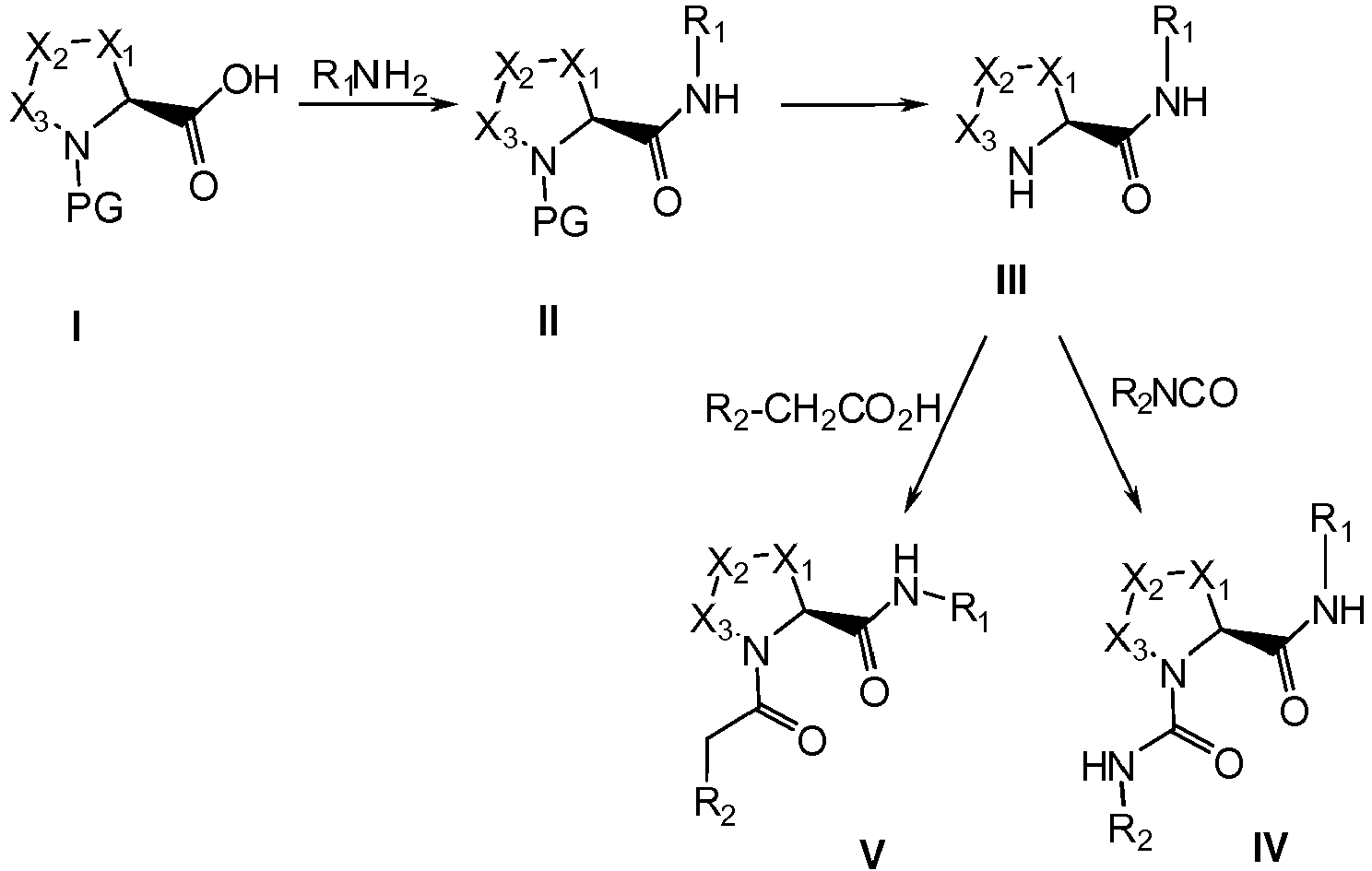
- By reacting an N-protected aminoacid I wherein PG is a protecting group or a reactive derivative thereof with an amino compound, under condensation conditions to obtain a compound of the formula II. Removing the protecting group and reacting the compound of the formula III with an isocyanate to obtain a compound of the formula IV or with an acid or a reactive derivative thereof under condensation conditions to obtain a compound of the formula V.
- A compound of the formula IV or V can, for example, be prepared from a corresponding protected aminoacid as described below:

- The invention further describes any variant of the present processes, in which an intermediate product obtainable at any stage thereof is used as starting material and the remaining steps are carried out, or in which the starting materials are formed in situ under the reaction conditions, or in which the reaction components are used in the form of their salts or optically pure materials.
- Compounds of the invention and intermediates can also be converted into each other according to methods generally known to those skilled in the art.
- In another aspect, the present invention provides a pharmaceutical composition comprising a compound of the present invention and a pharmaceutically acceptable carrier. The pharmaceutical composition can be formulated for particular routes of administration such as oral administration, parenteral administration, and ophthalmic administration, etc. In addition, the pharmaceutical compositions of the present invention can be made up in a solid form (including without limitation capsules, tablets, pills, granules, powders or suppositories), or in a liquid form (including without limitation solutions, suspensions, emulsions, each of which may be suitable for ophthalmic administration). The pharmaceutical compositions can be subjected to conventional pharmaceutical operations such as sterilization and/or can contain conventional inert diluents, lubricating agents, or buffering agents, as well as adjuvants, such as preservatives, stabilizers, wetting agents, emulsifers and buffers, etc.
- Typically, the pharmaceutical compositions are tablets or gelatin capsules comprising the active ingredient together with
- a) diluents, e.g., lactose, dextrose, sucrose, mannitol, sorbitol, cellulose and/or glycine;
- b) lubricants, e.g., silica, talcum, stearic acid, its magnesium or calcium salt and/or polyethyleneglycol; for tablets also
- c) binders, e.g., magnesium aluminum silicate, starch paste, gelatin, tragacanth, methylcellulose, sodium carboxymethylcellulose and/or polyvinylpyrrolidone; if desired
- d) disintegrants, e.g., starches, agar, alginic acid or its sodium salt, or effervescent mixtures; and/or
- e) absorbents, colorants, flavors and sweeteners.
- Tablets may be either film coated or enteric coated according to methods known in the art.
- Suitable compositions for oral administration include an effective amount of a compound of the invention in the form of tablets, lozenges, aqueous or oily suspensions, dispersible powders or granules, emulsion, hard or soft capsules, or syrups or elixirs. Compositions intended for oral use are prepared according to any method known in the art for the manufacture of pharmaceutical compositions and such compositions can contain one or more agents selected from the group consisting of sweetening agents, flavoring agents, coloring agents and preserving agents in order to provide pharmaceutically elegant and palatable preparations. Tablets may contain the active ingredient in admixture with nontoxic pharmaceutically acceptable excipients which are suitable for the manufacture of tablets. These excipients are, for example, inert diluents, such as calcium carbonate, sodium carbonate, lactose, calcium phosphate or sodium phosphate; granulating and disintegrating agents, for example, corn starch, or alginic acid; binding agents, for example, starch, gelatin or acacia; and lubricating agents, for example magnesium stearate, stearic acid or talc. The tablets are uncoated or coated by known techniques to delay disintegration and absorption in the gastrointestinal tract and thereby provide a sustained action over a longer period. For example, a time delay material such as glyceryl monostearate or glyceryl distearate can be employed. Formulations for oral use can be presented as hard gelatin capsules wherein the active ingredient is mixed with an inert solid diluent, for example, calcium carbonate, calcium phosphate or kaolin, or as soft gelatin capsules wherein the active ingredient is mixed with water or an oil medium, for example, peanut oil, liquid paraffin or olive oil.
- Certain injectable compositions are aqueous isotonic solutions or suspensions, and suppositories are advantageously prepared from fatty emulsions or suspensions. Said compositions may be sterilized and/or contain adjuvants, such as preserving, stabilizing, wetting or emulsifying agents, solution promoters, salts for regulating the osmotic pressure and/or buffers. In addition, they may also contain other therapeutically valuable substances. Said compositions are prepared according to conventional mixing, granulating or coating methods, respectively, and contain about 0.1-75%, or contain about 1-50%, of the active ingredient.
- Suitable compositions for transdermal application include an effective amount of a compound of the invention with a suitable carrier. Carriers suitable for transdermal delivery include absorbable pharmacologically acceptable solvents to assist passage through the skin of the host. For example, transdermal devices are in the form of a bandage comprising a backing member, a reservoir containing the compound optionally with carriers, optionally a rate controlling barrier to deliver the compound of the skin of the host at a controlled and predetermined rate over a prolonged period of time, and means to secure the device to the skin.
- Suitable compositions for topical application, e.g., to the skin and eyes, include aqueous solutions, suspensions, ointments, creams, gels or sprayable formulations, e.g., for delivery by aerosol or the like. Such topical delivery systems will in particular be appropriate for ophthalmic application, e.g., for the treatment of eye diseases e.g., for therapeutic or prophylactic use in treating age related macular degeneration and other complement mediated ophthalmic disorders. Such may contain solubilizers, stabilizers, tonicity enhancing agents, buffers and preservatives.
- As used herein a topical application may also pertain to an inhalation or to an intranasal application. They may be conveniently delivered in the form of a dry powder (either alone, as a mixture, for example a dry blend with lactose, or a mixed component particle, for example with phospholipids) from a dry powder inhaler or an aerosol spray presentation from a pressurised container, pump, spray, atomizer or nebuliser, with or without the use of a suitable propellant.
- Dosage forms for the topical or transdermal administration of a compound of this invention include powders, sprays, ointments, pastes, creams, lotions, gels, solutions, patches and inhalants. The active compound may be mixed under sterile conditions with a pharmaceutically acceptable carrier, and with any preservatives, buffers, or propellants that may be desirable.
- The ointments, pastes, creams and gels may contain, in addition to an active compound of this invention, excipients, such as animal and vegetable fats, oils, waxes, paraffins, starch, tragacanth, cellulose derivatives, polyethylene glycols, silicones, bentonites, silicic acid, talc and zinc oxide, or mixtures thereof.
- Powders and sprays can contain, in addition to a compound of this invention, excipients such as lactose, talc, silicic acid, aluminum hydroxide, calcium silicates and polyamide powder, or mixtures of these substances. Sprays can additionally contain customary propellants, such as chlorofluorohydrocarbons and volatile unsubstituted hydrocarbons, such as butane and propane.
- Transdermal patches have the added advantage of providing controlled delivery of a compound of the present invention to the body. Such dosage forms can be made by dissolving or dispersing the compound in the proper medium. Absorption enhancers can also be used to increase the flux of the compound across the skin. The rate of such flux can be controlled by either providing a rate controlling membrane or dispersing the active compound in a polymer matrix or gel.
- Ophthalmic formulations, eye ointments, powders, solutions and the like, are also contemplated as being within the scope of this invention.
- The present invention further provides anhydrous pharmaceutical compositions and dosage forms comprising the compounds of the present invention as active ingredients, since water may facilitate the degradation of certain compounds.
- Anhydrous pharmaceutical compositions and dosage forms of the invention can be prepared using anhydrous or low moisture containing ingredients and low moisture or low humidity conditions. An anhydrous pharmaceutical composition may be prepared and stored such that its anhydrous nature is maintained. Accordingly, anhydrous compositions are packaged using materials known to prevent exposure to water such that they can be included in suitable formulary kits. Examples of suitable packaging include, but are not limited to, hermetically sealed foils, plastics, unit dose containers (e. g., vials), blister packs, and strip packs.
- The invention further provides pharmaceutical compositions and dosage forms that comprise one or more agents that reduce the rate by which the compound of the present invention as an active ingredient will decompose. Such agents, which are referred to herein as "stabilizers," include, but are not limited to, antioxidants such as ascorbic acid, pH buffers, or salt buffers, etc.
- The compounds of the invention in free form or in pharmaceutically acceptable salt form, exhibit valuable pharmacological properties, e.g. Factor D modulating properties, complement pathway modulating properties and modulation of the complement alternative pathway properties, e.g. as indicated in in vitro and in vivo tests as provided in the next sections and are therefore indicated for therapy.
- In other embodiments, the compounds of the invention are suitable for use in the treatment of diseases and disorders associated with fatty acid metabolism, including obesity and other metabolic disorders.
- In another embodiment, the compounds of the invention may be used in blood ampules, diagnostic kits and other equipment used in the collection and sampling of blood. The use of the compounds of the invention in such diagnostic kits may inhibit the ex vivo activation of the complement pathway associated with blood sampling.
- The pharmaceutical composition or combination of the present invention can be in unit dosage of about 1-1000 mg of active ingredient(s) for a subject of about 50-70 kg, or about 1-500 mg or about 1-250 mg or about 1-150 mg or about 0.5-100 mg, or about 1-50 mg of active ingredients. The therapeutically effective dosage of a compound, the pharmaceutical composition, or the combinations thereof, is dependent on the species of the subject, the body weight, age and individual condition, the disorder or disease or the severity thereof being treated. A physician, clinician or veterinarian of ordinary skill can readily determine the effective amount of each of the active ingredients necessary to prevent, treat or inhibit the progress of the disorder or disease.
- The above-cited dosage properties are demonstrable in vitro and in vivo tests using advantageously mammals, e.g., mice, rats, dogs, monkeys or isolated organs, tissues and preparations thereof. The compounds of the present invention can be applied in vitro in the form of solutions, e.g., aqueous solutions, and in vivo either enterally, parenterally, advantageously intravenously, e.g., as a suspension or in aqueous solution. The dosage in vitro may range between about 10-3 molar and 10-9 molar concentrations. A therapeutically effective amount in vivo may range depending on the route of administration, between about 0.1-500 mg/kg, or between about 1-100 mg/kg.
- The activity of a compound according to the present invention can be assessed by the following in vitro & in vivo methods.
- The compound of the present invention may be administered either simultaneously with, or before or after, one or more other therapeutic agent. The compound of the present invention may be administered separately, by the same or different route of administration, or together in the same pharmaceutical composition as the other agents.
- In one embodiment, the invention provides a product comprising a compound of the invention and at least one other therapeutic agent as a combined preparation for simultaneous, separate or sequential use in therapy. In one embodiment, the therapy is the treatment of a disease or condition mediated by alternative complement pathway. Products provided as a combined preparation include a composition comprising the compound of the invention and the other therapeutic agent(s) together in the same pharmaceutical composition, or the compound of the invention and the other therapeutic agent(s) in separate form, e.g. in the form of a kit.
- In one embodiment, the invention provides a pharmaceutical composition comprising a compound of the invention and another therapeutic agent(s). Optionally, the pharmaceutical composition may comprise a pharmaceutically acceptable excipient, as described above.
- In one embodiment, the invention provides a kit comprising two or more separate pharmaceutical compositions, at least one of which contains a compound of the invention In one embodiment, the kit comprises means for separately retaining said compositions, such as a container, divided bottle, or divided foil packet. An example of such a kit is a blister pack, as typically used for the packaging of tablets, capsules and the like.
- The kit of the invention may be used for administering different dosage forms, for example, oral and parenteral, for administering the separate compositions at different dosage intervals, or for titrating the separate compositions against one another. To assist compliance, the kit of the invention typically comprises directions for administration.
- In the combination therapies of the invention, the compound of the invention and the other therapeutic agent may be manufactured and/or formulated by the same or different manufacturers. Moreover, the compound of the invention and the other therapeutic may be brought together into a combination therapy: (i) prior to release of the combination product to physicians (e.g. in the case of a kit comprising the compound of the invention and the other therapeutic agent); (ii) by the physician themselves (or under the guidance of the physician) shortly before administration; (iii) in the patient themselves, e.g. during sequential administration of the compound of the invention and the other therapeutic agent.
- Accordingly, the invention provides a compound of the invention for use in treating a disease or condition mediated by the complement alternative pathway, wherein the medicament is prepared for administration with another therapeutic agent. The invention also provides the use of another therapeutic agent for treating a disease or condition mediated by the complement alternative pathway, wherein the medicament is administered with a compound of the invention.
- The invention also provides a compound of the invention for use in a method of treating a disease or condition mediated by the complement alternative pathway, wherein the compound of the invention is prepared for administration with another therapeutic agent. The invention also provides another therapeutic agent for use in a method of treating a disease or condition mediated by the complement alternative pathway and/or Factor D, wherein the other therapeutic agent is prepared for administration with a compound of the invention. The invention also provides a compound of the invention for use in a method of treating a disease or condition mediated by the complement alternative pathway and/or Factor D, wherein the compound of the invention is administered with another therapeutic agent. The invention also provides another therapeutic agent for use in a method of treating a disease or condition mediated by the complement alternative pathway and/or Factor D, wherein the other therapeutic agent is administered with a compound of the invention.
- The invention also provides the compound of the invention for treating a disease or condition mediated by the complement alternative pathway and/or Factor D, wherein the patient has previously (e.g. within 24 hours) been treated with another therapeutic agent. The invention also provides the use of another therapeutic agent for treating a disease or condition mediated by the complement alternative pathway and/or Factor D wherein the patient has previously (e.g. within 24 hours) been treated with a compound of the invention.
- The pharmaceutical compositions can be administered alone or in combination with other molecules known to have a beneficial effect on retinal attachment or damaged retinal tissue, including molecules capable of tissue repair and regeneration and/or inhibiting inflammation. Examples of useful, cofactors include anti-VEGF agents (such as an antibody or FAB against VEGF, e.g., Lucentis or Avastin), basic fibroblast growth factor (bFGF), ciliary neurotrophic factor (CNTF), axokine (a mutein of CNTF), leukemia inhibitory factor (LIF), neutrotrophin 3 (NT-3), neurotrophin-4 (NT-4), nerve growth factor (NGF), insulin-like growth factor II, prostaglandin E2, 30 kD survival factor, taurine, and vitamin A. Other useful cofactors include symptom-alleviating cofactors, including antiseptics, antibiotics, antiviral and antifungal agents and analgesics and anestheticsSuitable agents for combination treatment with the compounds of the invention include agents known in the art that are able to modulate the activities of complement components.
- A combination therapy regimen may be additive, or it may produce synergistic results (e.g., reductions in complement pathway activity more than expected for the combined use of the two agents). In some embodiments, the present invention provide a combination therapy for preventing and/or treating AMD or another complement related ocular disease as described above with a compound of the invention and an anti-angiogenic, such as anti-VEGF agent (including Lucentis and Avastin) or photodynamic therapy (such as verteporfin).
- In some embodiments, the present invention provide a combination therapy for preventing and/or treating autoimmune disease as described above with a compound of the invention and a B-Cell or T-Cell modulating agent (for example cyclosporine or analogs thereof, rapamycin, RAD001 or analogs thereof, and the like). In particular, for multimple sclerosis therapy may include the combination of a compound of the invention and a second MS agent selected from fingolimod, cladribine, tysarbi, laquinimod, rebif, avonex and the like.
- In one embodiment, the invention provides compounds of the invention for use in a method of modulating activity of the complement alternative pathway in a subject. The invention further provides compounds of the invention for use in methods of modulating the activity of the complement alternative pathway in a subject by modulating the activity of Factor D.
- In one embodiment, the invention provides a compound of the invention for use as a medicament.
- In one embodiment, the invention provides a compound according to the invention for use in the treatment of a disorder or disease in a subject mediated by complement activation. In particular, the invention provides the compound according to the invention for use in the treatment of a disorder or disease mediated by activation of the complement alternative pathway.
- In one embodiment, the invention provides a compound according to the invention for use in the treatment of a disorder or disease in a subject characterized by activation of the complement system. More particularly, the invention provides the compounds provided herein for use in the treatment of a disease or disorder characterized by over activiation of the complement alternative pathway or the C3 amplification loop of the alternative pathway. In certain embodiments, the use is in the treatment of a disease or disorder is selected from retinal diseases (such as age-related macular degeneration).
- The present invention provides the compounds of the invention for use in treating a disease or disorder associated with increased complement activity. In certain aspects, the compounds of the invention for use are provided for the treatment of diseases associated with increased activity of the C3 amplification loop of the complement pathway. In certain embodiments, the compounds of the invention for use are provided for treating or preventing complement mediated diseases are provided in which the complement activation is induced by antibody-antigen interactions, by a component of an autoimmune disease, or by ischemic damage.
- In a specific embodiment, the present invention provides the compounds of the invention for use in treating or preventing age-related macular degeneration (AMD). In certain embodiments, patients who are currently asymptomatic but are at risk of developing a symptomatic macular degeneration related disorder are suitable for administration with a compound of the invention. The compounds of the invention for use in treating or preventing AMD include, but are not limited to, uses in treating or preventing one or more symptoms or aspects of AMD selected from formation of ocular drusen, inflammation of the eye or eye tissue, loss of photoreceptor cells, loss of vision (including loss of visual acuity or visual field), neovascularization (including CNV), retinal detachment, photoreceptor degeneration, RPE degeneration, retinal degeneration, chorioretinal degeneration, cone degeneration, retinal dysfunction, retinal damage in response to light exposure, damage of the Bruch's membrane, and/ or loss of RPE function.
- The compound of the invention can be used, inter alia, to prevent the onset of AMD, to prevent the progression of early AMD to advanced forms of AMD including neovascular AMD or geographic atrophy, to slow and/or prevent progression of geographic atrophy, to treat or prevent macular edema from AMD or other conditions (such as diabetic retinopathy, uveitis, or post surgical or non-surgical trauma), to prevent or reduce the loss of vision from AMD, and to improve vision lost due to pre-existing early or advanced AMD. It can also be used in combination with anti-VEGF therapies for the treatment of neovascular AMD patients or for the prevention of neovascular AMD. The present invention further provides compounds of the invention for use in treating a complement related disease or disorder by administering to a subject in need thereof an effective amount of the compound(s) of the invention, wherein said disease or disorder is selected from uveitis, adult macuar degeneration, diabetic retinopathy, retinitis pigmentosa, macular edema, Behcet's uveitis, multifocal choroiditis, Vogt-Koyangi-Harada syndrome, imtermediate uveitis, birdshot retino-chorioditis, sympathetic ophthalmia, ocular dicatricial pemphigoid, ocular pemphigus, nonartertic ischemic optic neuropathy, postoperative inflammation, and retinal vein occlusion.
- In some embodiments, the present invention provides compounds of the invention for use in treating a complement related disease or disorder. Examples of known complement related diseases or disorders include: neurological disorders, multiple sclerosis, stroke, Guillain Barre Syndrome, traumatic brain injury, Parkinson's disease, disorders of inappropriate or undesirable complement activation, hemodialysis complications, hyperacute allograft rejection, xenograft rejection, interleukin-2 induced toxicity during IL-2 therapy, inflammatory disorders, inflammation of autoimmune diseases, Crohn's disease, adult respiratory distress syndrome, thermal injury including burns or frostbite, myocarditis, post-ischemic reperfusion conditions, myocardial infarction, balloon angioplasty, post-pump syndrome in cardiopulmonary bypass or renal bypass, atherosclerosis, hemodialysis, renal ischemia, mesenteric artery reperfusion after aortic reconstruction, infectious disease or sepsis, immune complex disorders and autoimmune diseases, rheumatoid arthritis, systemic lupus erythematosus (SLE), SLE nephritis, proliferative nephritis, liver fibrosis, hemolytic anemia, myasthenia gravis, tissue regeneration and neural regeneration. In addition, other known complement related disease are lung disease and disorders such as dyspnea, hemoptysis, ARDS, asthma, chronic obstructive pulmonary disease (COPD), emphysema, pulmonary embolisms and infarcts, pneumonia, fibrogenic dust diseases, inert dusts and minerals (e.g., silicon, coal dust, beryllium, and asbestos), pulmonary fibrosis, organic dust diseases, chemical injury (due to irritant gases and chemicals, e.g., chlorine, phosgene, sulfur dioxide, hydrogen sulfide, nitrogen dioxide, ammonia, and hydrochloric acid), smoke injury, thermal injury (e.g., burn, freeze), asthma, allergy, bronchoconstriction, hypersensitivity pneumonitis, parasitic diseases, Goodpasture's Syndrome, pulmonary vasculitis, Pauci-immune vasculitis, immune complex-associated inflammation, uveitis (including Behcet's disease and other sub-types of uveitis), antiphospholipid syndrome.
- In a specific embodiment, the present invention provides the compounds of the invention for use in treating a complement related disease or disorder, wherein said disease or disorder is asthma, arthritis (e.g., rheumatoid arthritis), autoimmune heart disease, multiple sclerosis, inflammatory bowel disease, ischemia-reperfusion injuries, Barraquer-Simons Syndrome, hemodialysis, systemic lupus, lupus erythematosus, psoriasis, multiple sclerosis, transplantation, diseases of the central nervous system such as Alzheimer's disease and other neurodegenerative conditions, atypicaly hemolytic uremic syndrome (aHUS), glomerulonephritis (including membrane proliferative glomerulonephritis), blistering cutaneous diseases (including bullous pemphigoid, pemphigus, and epidermolysis bullosa), ocular cicatrical pemphigoid or MPGN II.
- In a specific embodiment, the present invention provides the compounds of the invention for use in treating glomerulonephritis. Symptoms of glomerulonephritis include, but not limited to, proteinuria; reduced glomerular filtration rate (GFR); serum electrolyte changes including azotemia (uremia, excessive blood urea nitrogen--BUN) and salt retention, leading to water retention resulting in hypertension and edema; hematuria and abnormal urinary sediments including red cell casts; hypoalbuminemia; hyperlipidemia; and lipiduria. In a specific embodiment, the present invention provides the compounds of the invention for use in treating paroxysmal nocturnal hemoglobinuria (PNH), with or without concomitent administration of a complement C5 inhibitor or C5 convertase inhibitor such as Soliris.
- In a specific embodiment, the present invention provides the compounds of the invention for use in reducing the dysfunction of the immune and/or hemostatic systems associated with extracorporeal circulation. The compounds of the present invention can be used in any procedure which involves circulating the patient's blood from a blood vessel of the patient, through a conduit, and back to a blood vessel of the patient, the conduit having a luminal surface comprising a material capable of causing at least one of complement activation, platelet activation, leukocyte activation, or platelet-leukocyte adhesion. Such procedures include, but are not limited to, all forms of ECC, as well as procedures involving the introduction of an artificial or foreign organ, tissue, or vessel into the blood circuit of a patient. More particularly, such procedures include, but are not limited to, transplantation procedures including kidney, liver, lung or heart transplant procedures and islet cell transplant procedures.
- The following examples are intended to illustrate the invention and are not to be construed as being limitations thereon. Temperatures are given in degrees centrigrade (°C). If not mentioned otherwise, all evaporations are performed under reduced pressure, typically between about 15 mm Hg and 100 mm Hg (= 20-133 mbar). The structure of final products, intermediates and starting materials is confirmed by standard analytical methods, e.g., microanalysis and spectroscopic characteristics, e.g., MS, IR, NMR. Abbreviations used are those conventional in the art.
All starting materials, building blocks, reagents, acids, bases, dehydrating agents, solvents, and catalysts utilized to synthesis the compounds of the present invention are either commercially available or can be produced by organic synthesis methods known to one of ordinary skill in the art (Houben-Weyl 4th Ed. 1952, Methods of Organic Synthesis, Thieme, Volume 21). Further, the compounds of the present invention can be produced by organic synthesis methods known to one of ordinary skill in the art as shown in the following examples.
Inter Alia the following in vitro tests may be used - Recombinant human factor D (expressed in E. coli and purified using standard methods) at 10 nM concentration is incubated with test compound at various concentrations for 1 hour at room temperature in 0.1 M Hepes buffer, pH 7.5, containing 1 mM MgCl2, 1 M NaCl and 0.05 % CHAPS. A synthetic substrate Z-Lys-thiobenzyl and 2,4-dinitrobenzenesulfonyl-fluoresceine are added to final concentrations of 200 µM and 25 µM, respectively. The increase in fluorescence is recorded at excitation of 485 nm and emission at 535 nm in a microplate spectrofluorimeter. IC50 values are calculated from percentage of inhibition of complement factor D-activity as a function of test compound concentration.
- Recombinant human factor D (expressed in E. coli and purified using standard methods) at a 10 nM concentration is incubated with test compound at various concentrations for 1 hour at room temperature in 0.1 M PBS pH 7.4 containing 7.5 mM MgCl2 and 0.075% (w/v) CHAPS. Cobra venom factor and human complement factor B substrate complex is added to a final concentration of 200 nM. After 1 hour incubation at room temperature, the enzyme reaction was stopped by addition of 0.1 M sodium carbonate buffer pH 9.0 containing 0.15 M NaCl and 40 mM EDTA. The product of the reaction, Ba, was quantified by means of an enzyme-linked-immunosorbent assay. IC50 values are calculated from percentage of inhibition of factor D-activity as a function of test compound concentration.
- The following Examples, while representing preferred embodiments of the invention, serve to illustrate the invention without limiting its scope.
-
- AcOH
- acetic acid
- aq.
- aqueous
- c-hexane
- cyclohexane
- DAST
- diethylaminosulfur trifluoride
- DIPEA
- N,N-diisopropylethylamine
- DIBALH
- diisobutylaluminium hydride
- DMAP
- 4-dimethylaminopyridine
- DME
- dimethoxy ethane
- DMF
- dimethylformamide
- DMSO
- dimethylsulfoxide
- DPPA
- diphenylphosphoryl azide
- EDCI
- 1-(3-dimethylaminopropyl)-3-ethylcarbodiimide hydrochloride
- Ether/ Et2O
- diethylether
- Et3N
- triethylamine
- EtOAc
- ethyl acetate
- EtOH
- ethanol
- Flow
- flow rate
- h
- hour(s)
- HBTU
- 2-(1H-benzotriazol-1-yl)-1,1,3,3-tetramethyluronium tetrafluoroborate
- HPLC
- High Performance Liquid Chromatography
- iPrOH
- isopropanol
- L
- liter(s)
- LC-MS
- Liquid Chromatography/Mass Spectrometry
- Mel
- methyl iodide
- MeOH
- methanol
- MesCl
- Mesyl Chloride
- min
- minute(s)
- mL
- milliliter
- MS
- Mass Spectrometry
- NaH
- sodium hydride
- NMR
- Nuclear Magnetic Resonance
- Pd/C
- palladium on charcoal
- Prep.
- Preparative
- Rf
- retention factor
- RP
- reverse phase
- RT
- room temperature
- sat.
- saturated
- TBAF
- etra-butylammonium fluoride
- TFA
- trifluoroacetic acid
- THF
- tetrahydrofurane
- TLC
- Thin Layer Chromatography
- T3P
- Propylphosphonic anhydride
- tr
- retention time
- UPLC
- ultra performance liquid chromatography
- Trademarks Celite
- = Celite® (The Celite Corporation) = filtering aid based on diatomaceous earth
- Nucleosil
- = Nucleosil®, trademark of Machery & Nagel, Düren, FRG for HPLC materials
- PL Thiol Cartridge
- = Stratosphere® SPE, PL-Thiol MP SPE+, 500mg per 6 mL tube, 1.5 mmol (nominal)
- Temperatures are measured in degrees Celsius. Unless otherwise indicated, the reactions were performed RT.
- Phase separator: Biotage - Isolute Phase separator (Part Nr: 120-1908-F for 70 mL and Part Nr: 120-1909-J for 150 mL)
- TLC conditions: Rf values for TLC are measured on 5 x 10 cm TLC plates, silica gel F254, Merck, Darmstadt, Germany.
- HPLC conditions:
- HPLC were performed using an Agilent 1100 or 1200 series instrument. Mass spectra and LC/MS were determined using an Agilent 1100 series instrument.
- a: Waters Symmetry C18, 3.5 µm, 2.1x50mm, 20-95% CH3CN/H2O/3.5 min, 95% CH3CN/2 min, CH3CN and H2O containing 0.1% TFA, flow: 0.6 mL/min
- b: Waters Sunfire C18, 2.5 µm, 3x30mm, 0-10% in 0.5 min, 10-98% CH3CN in H2O in 2.5 min, 98% CH3CN in H2O for 0.7 min, CH3CN and H2O containing 0.1% TFA, flow: 1.4 mL/min
- c: Agilent Eclipse XDB-C18; 1.8 µm; 2.1x30mm 20-100% CH3CN/H2O/3 min, 100% CH3CN/0.75 min, CH3CN and H2O containing 0.1% of TFA, flow: 0.6 mL/min
- d: Agilent Eclipse XDB-C18; 1.8 µm; 2.1x30mm 5-100% CH3CN/H2O/3 min, 100% CH3CN/0.75 min, CH3CN and H2O containing 0.1% of TFA, flow: 0.6 mL/min
- e: Agilent Eclipse XDB-C18, 1.8 µm, 4.6x50mm, 5-100% CH3CN/H2O/6 min, 100% CH3CN/1.5 min, CH3CN and H2O containing 0.1% TFA, flow: 1 mL/min
- f: Waters X-Bridge C18, 2.5 µm, 3x50mm, 10-98% CH3CN/H2O/8.6 min, 98% CH3CN/H2O/1.4 min, CH3CN and H2O both containing 0.73 mM NH4OH, flow: 1 mL/min, T = 30°C
- HPLC were performed using an Agilent 1100 or 1200 series instrument. Mass spectra and LC/MS were determined using an Agilent 1100 series instrument.
-

- To a solution of 1H-indole-3-carboxylic acid (5 g, 31 mmol) in DMF (70 mL) under a nitrogen atmosphere at 0°C was added cesium carbonate (11 g, 31 mmol) and benzyl bromide (4.05 mL, 34.1 mmol). The reaction mixture was stirred at RT for 48 h and poured into water. EtOAc was added and the layers were separated and the aqueous layer was extracted with EtOAc (x3). The combined organic layers were washed with water, dried over Na2SO4, filtered and concentrated.
- The residue was taken up in Et2O and the resulting precipitate was filtered-off to give the title compound. TLC, Rf (c-hexane/EtOAc 1:1) = 0.55; MS (LC-MS): 252.1 [M+H]+, 274.0 [M+Na]+, 525.1 [2M+Na]+, 250.1 [M-H]-; tR (HPLC conditions a) 3.77 min.
- To a solution of 1H-indole-3-carboxylic acid benzyl ester (3.5 g, 13.9 mmol) in THF (70 mL) at 5°C, was added NaH (60 % in mineral oil, 557 mg, 13.9 mmol). The mixture was stirred at 5°C for 30 min before slow dropwise addition of chlorosulfonyl isocyanate (2.42 mL, 27.9 mmol) maintaining the temperature between 5°C and 10°C. The pale yellow solution was further stirred at RT for 3.5 h. Acetic acid (22.5 mL) was added (exothermic), and the resulting solution was stirred at RT for 1.5 h before addition of ice and water (100 mL). The white thick suspension was stirred at RT for 30 min and the precipitate was filtered-off, taken up in MeOH and filtered-off again to afford the desired compound. 1H-NMR (400 MHz, DMSO): δ (ppm) 8.64 (s, 1H), 8.29 (d, 1H), 8.04 (d, 1H), 7.90 (m, 2H), 7.50 (d, 2H), 7.42 (t, 2H), 7.36-7.30 (m, 3H), 5.38 (s, 2H).
- 1-Carbamoyl-1H-indole-3-carboxylic acid benzyl ester (1.33 g, 4.52 mmol) was dissolved in a mixture of DMF/THF 1:1 (28 mL), Pd/C (10 %, 250 mg) was added and the solution was degassed 3 times replacing air with nitrogen then nitrogen with hydrogen. The reaction mixture was further stirred under hydrogen atmosphere overnight and the catalyst was removed through a pad of Celite and washed with THF. The solvents were concentrated under high vacuum to give a yellow solid which was taken up in Et2O and filtered-off to afford the title compound. 1 H-NMR (400 MHz, DMSO): δ (ppm) 12.6 (m, 1H), 8.54 (bs, 1H), 8.28 (d, 1H), 8.05 (d, 1H), 7.85 (m, 2H), 7.34-7.27 (m, 2H).
- To a suspension of 1-carbamoyl-1H-indole-3-carboxylic acid (1.31 g, 6.42 mmol) in toluene (30 mL, CH2Cl2 can also be used instead of toluene) under a nitrogen atmosphere was added Et3N (893 µl, 6.42 mmol). After 15 min DPPA (1.54 mL, 6.42 mmol) was added and the reaction mixture was further stirred at RT overnight. The solvent was evaporated, the residue was taken up in CH2Cl2 and the precipitate was filtered-off to give the acyl azide intermediate (565 mg). Toluene (20 mL) was added and the suspension refluxed for 1.5 h under disapearance of the acyl azide observed by TLC. Toluene was evaporated under vacuum and the desired isocyanate was directly used in the next step without further purification. 1 H-NMR (400 MHz, CDCl3): δ (ppm) 8.18 (d, 1H), 7.61 (d, 1H), 7.44 (t, 1H), 7.35 (t, 1H), 7.23 (s, 1H), 5.39 (bs, 2H).
-
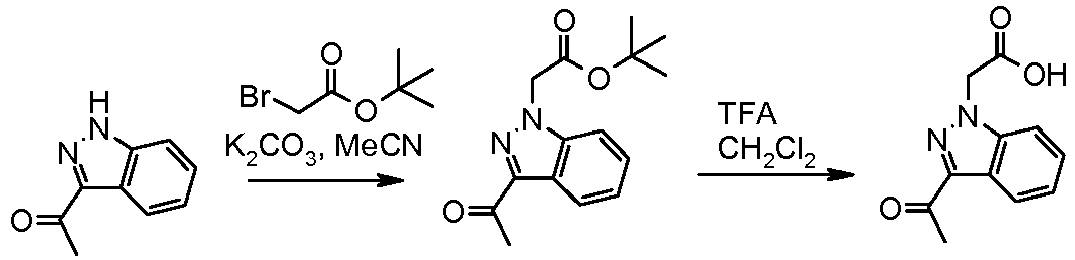
- To a solution of 1-(1H-indazol-3-yl)ethanone [4498-72-0] (2 g, 12.46 mmol) in CH3CN (50 mL) was added K2CO3 (3.97 g, 28.7 mmol) and tert-butyl 2-bromoacetate (2.58 mL, 17.48 mmol). The reaction mixture was stirred at 90°C overnight. The reaction mixture was filtered, the residue was washed with CH3CN and the filtrate was concentrated under vacuum. The material thus obtained was used directly in the next step without further purification. MS: 275 [M+H]+; tR (HPLC conditions d): 3.78 min.
- To a solution of tert-butyl 2-(3-acetyl-1H-indazol-1-yl)acetate (4 g, 12.4 mmol) in CH2Cl2 (45 mL) was added TFA (15 mL, 195.0 mmol), and the reaction mixture was stirred at RT overnight. Then was then diluted with CH2Cl2 and MeOH, and volatiles were evaporated under reduced pressure to afford the title compound : MS: 219 [M+H]+; tR (HPLC conditions d): 2.78 min.
-

- To a solution of 1-(1H-pyrazolo[3,4-c]pyridin-3-yl)-ethanone (Sphinx Scientific laboratory LLC, catalog number: PPY-1-CS01) (2.45 g 14.44 mmol) in CH3CN (50 mL) were added potassium carbonate (3.99 g, 28.9 mmol) and tert-butyl bromoacetate (2.34 mL, 15.88 mmol). The reaction mixture was stirred at RT overnight. The crude mixture was poured into water and extracted with EtOAc (x3). The combined organic extracts were dried (Na2SO4), filtered and concentrated. The crude residue was purified by flash column chromatography on silica gel (c-hexane/EtOAc 1:0 to 0:1) to give the title compound. TLC, Rf (EtOAc) = 0.7; MS: 276 [M+H]+; tR (HPLC conditions c): 2.06 min.
- The title compound was prepared from (3-acetyl-pyrazolo[3,4-c]pyridin-1-yl)-acetic acid tert-butyl ester in a similar manner as described in step B Scheme A2 for the preparation of 2-(3-acetyl-1H-indazol-1-yl)acetic acid. MS : 220 [M+H]+; tR (HPLC conditions c): 0.69 min.
-

-

- The title compound was prepared in a similar manner as described by F. Crestey et al., Tetrahedron 2007, 63, 419-428. To 5-(benzyloxy)-1H-indazole-3-carboxylic acid [177941-16-1] (3.50 g, 13.1 mmol) in THF (70 mL) was added N,O-dimethylhydroxylamine (1.40 g, 14.4 mmol). The mixture was cooled to 0°C before the addition of pyridine (2.30 mL, 28.7 mmol). The solution was stirred at 0°C for 1.5 h, and then at RT for 1 h. Pyridine (2.10 mL, 26.1 mmol) and EDCI (5.00 g, 26.1 mmol) were added and the mixture was stirred at RT overnight. Water was added to the reaction mixture followed by extraction (x3) with CH2Cl2. The combined organics were washed with saturated aqueous NaHCO3 solution, dried (Phase separator) and concentrated to give the title compound. MS (LC/MS): 312.0 [M+H]+, 334.0 [M+Na]+, 645.1 [2M+Na]+, 310.0 [M-H]-; tR (HPLC conditions e): 4.44 min.
- The title compound was prepared in a similar manner as described by F. Crestey et al., Tetrahedron 2007, 63, 419-428. To a solution of 5-(benzyloxy)-N-methoxy-N-methyl-1H-indazole-3-carboxamide (3.40 g, 10.9 mmol) in CH2Cl2 (70 mL) was added DMAP (0.13 g, 1.09 mmol), Et3N (1.67 mL, 12.0 mmol) and Boc-anhydride (3.80 mL, 16.4 mmol) at 0°C. The reaction mixture was stirred at 0°C for 1 h and allowed to return to RT overnight. The reaction mixture was diluted with CH2Cl2 and washed with 50 mL of 0.1 M aqueous HCl solution and water. The organic phase was dried (Phase separator) and concentrated to give the title compound. MS (LC/MS): 434.0 [M+Na]+, 845.0 [2M+Na]+; tR (HPLC conditions e): 5.79 min.
- The title compound was prepared in a similar manner as described by F. Crestey et al., Tetrahedron 2007, 63, 419-428. To tert-butyl 5-(benzyloxy)-3-(methoxy(methyl)carbamoyl)-1H-indazole-1-carboxylate (4.70 g, 11.4 mmol) in THF (60 mL), cooled to -78°C, was added MeMgBr (3 M solution in Et2O, 22.9 mL, 68.5 mmol). The reaction mixture was stirred at - 78°C for 1 h. A saturated aqueous NH4Cl solution was added to the reaction mixture and temperature was allowed to raise to RT. The mixture was extracted twice with CH2Cl2, the combined organics were dried (Phase separator) and concentrated to give the title mixture which was used without purification in the next step. 1-(5-(Benzyloxy)-1 H-indazol-3-yl)ethanone: MS (LC/MS): 267.0 [M+H]+, 289.0 [M+Na]+, 265.1 [M-H]-; tR (HPLC conditions e): 4.72 min. Tert-butyl 3-acetyl-5-(benzyloxy)-1H-indazole-1-carboxylate: MS (LC/MS): 389.0 [M+Na]+, 310.9 [M-tBu]+, 267.1 [M-Boc]+; tR (HPLC conditions e): 6.12 min.
- To the mixture of tert-butyl 3-acetyl-5-(benzyloxy)-1H-indazole-1-carboxylate and 1-(5-(benzyloxy)-1H-indazol-3-yl)ethanone (3.80 g, 10.4 mmol) in CH2Cl2 (50 mL) was added TFA (7.99 mL, 104 mmol). The reaction mixture was stirred at RT overnight, then was diluted with CH2Cl2 and washed with 100 mL of 2N aqueous NaOH solution. The aqueous layer was extracted twice with CH2Cl2. The combined organic phases were dried (Phase separator) and concentrated to give the title compound. MS (LC/MS): 267.0 [M+H]+, 289.0 [M+Na]+, 265.1 [M-H]-; tR (HPLC conditions e): 4.71 min.
- To 1-(5-(benzyloxy)-1H-indazol-3-yl)ethanone (3.50 g, 13.1 mmol) in CH3CN (100 mL) was added K2CO3 (4.54 g, 32.9 mmol) and methyl 2-bromoacetate (1.33 mL, 14.5 mmol). The reaction mixture was stirred at 90°C for 90 min. Then was filtered and the residue was washed with CH3CN. Volatiles were evaporated and the crude mixture was purified by flash column chromatography on silica gel (c-hexane/EtOAc 1:1 to 1:3). TLC, Rf (c-hexane/EtOAc 1:3) = 0.64; MS (LC/MS): 339.0 [M+H]+, 361.0 [M+Na]+; tR (HPLC conditions e): 5.09 min.
- To methyl 2-(3-acetyl-5-(benzyloxy)-1H-indazol-1-yl)acetate (3.70 g, 10.9 mmol) in THF (80 mL) was added Pd/C (10%, 400 mg). The reaction mixture was stirred at 50°C overnight under a H2 atmosphere. Then was filtered over a pad of Celite and the residue washed with CH2Cl2. Solvents were removed under reduced pressure to give the title compound. MS (LC/MS): 248.9 [M+H]+, 271.0 [M+Na]+; tR (HPLC conditions e): 3.36 min.
- To methyl 2-(3-acetyl-5-hydroxy-1H-indazol-1-yl)acetate (1.80 g, 7.25 mmol) in CH3CN (75 mL) was added 2-(chloromethyl)pyrimidine hydrochloride (1.32 g, 7.98 mmol) and Cs2CO3 (5.91 g, 18.13 mmol). The reaction mixture was stirred at 70°C for 2 h. The reaction mixture was filtered and washed with CH3CN. The solvent was removed under reduced pressure and the crude residue was purified by flash column chromatography on silica gel (c-hexane/EtOAc 1:1 to 1:3). TLC, Rf (c-hexane/EtOAc 1:3) = 0.35; MS (LC/MS): 340.9 [M+H]+, 363.0 [M+Na]+; tR (HPLC conditions e): 3.64 min.
- To methyl 2-(3-acetyl-5-(pyrimidin-2-ylmethoxy)-1H-indazol-1-yl)acetate (1.93 g, 5.67 mmol) in THF (15 mL) and water (15 mL) was added LiOH.H2O (0.25 g, 5.95 mmol). The reaction mixture was stirred at RT for 1.5 h. Volatiles were evaporated and the residue was freeze-dried overnight to give the title compound as a lithium salt. MS (LC/MS): 327.0 [M+H]+, 325.1 [M+H]+; tR (HPLC conditions e): 3.24 min.
-
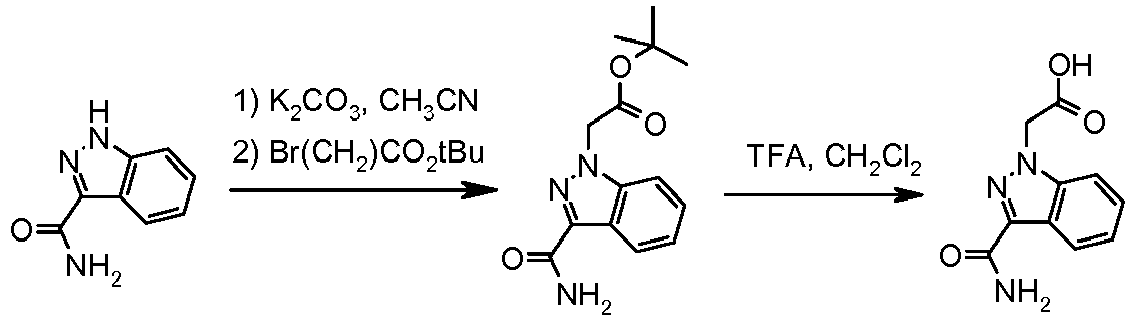
- To a suspension of 1H-indazole-3-carboxamide [90004-04-9] (2.00 g, 12.4 mmol) and potassium carbonate (4.12 g, 29.8 mmol) in CH3CN (60 mL) was added tert-butyl bromoacetate (2.20 mL, 14.9 mmol) dropwise at RT, and the resulting mixture was refluxed for 16 h. The mixture was then cooled to RT and filtered, the solid was washed with CH3CN and the filtrate was concentrated under vacuum. The residual oil was used directly in the next step without further purification. MS (LC/MS): 276.0 [M+H]+; tR (HPLC conditions d): 3.22 min.
- To a solution of tert-butyl 2-(3-carbamoyl-1H-indazol-1-yl)acetate (3.42 g, 12.4 mmol) in CH2Cl2 (20 mL) was added TFA (10 mL, 130 mmol) and the resulting mixture was stirred at RT for 16 h. The reaction mixture was concentrated in vacuo, the residual solid was suspended in MeOH and concentrated again in vacuo to give the title compound. MS (LC/MS): 220 [M+H]+; tR (HPLC conditions d): 1.79 min.
-

- To a solution of 1H-pyrazolo[3,4-c]pyridine [271-47-6] (4.00 g, 33.6 mmol) in DMF (50 mL) were added iodine (12.8 g, 50.4 mmol) and potassium hydroxide (4.70 g, 84.0 mmol). The reaction mixture was stirred at RT for 16 h. The mixture was diluted with 10% sodium thiosulfate and water, then extracted (3x) with EtOAc. The combined organic extracts were washed with brine, dried (Phase separator) and concentrated under vacuum. MS (LC/MS): 246.0 [M+H]+; tR (HPLC conditions d): 0.48 min.
- To a suspension of 3-iodo-1H-pyrazolo[3,4-c]pyridine (6.24 g, 22.9 mmol) and potassium carbonate (7.29 g, 52.7 mmol) in CH3CN (50 mL) was added tert-butyl bromoacetate (4.06 mL, 27.5 mmol) dropwise at RT and the resulting mixture was heated to reflux for 2 h. The mixture was cooled to RT and filtered, the solid was washed with CH3CN and the filtrate was concentrated under vacuum. The residual oil was purified by flash column chromatography on silica gel (EtOAc/c-hexane 1:4, to 1:2, to 1:1) to give the title compound. MS (LC/MS): 360.0 [M+H]+; tR (HPLC conditions d): 2.93 min.
- A mixture of tert-butyl 2-(3-iodo-1H-pyrazolo[3,4-c]pyridin-1-yl)acetate (3.76 g, 10.5 mmol), Zn(CN)2 (1.35 g, 11.5 mmol), Pd(dppf)Cl2 (855 mg, 1.05 mmol), Pd2(dba)3 (959 mg, 1.05 mmol), water (4 mL) and DMF (30 mL) was stirred at 100°C for 16 h under argon. The reaction mixture was diluted with EtOAc and then was successively washed with water, sat. aq. NaHCO3 (2x) and brine, dried (Phase separator) and concentrated under vacuum. The residual oil was purified by flash column chromatography on silica gel (EtOAc/c-hexane 1:1 then 100% EtOAc). MS (LC/MS): 259.0 [M+H]+; tR (HPLC conditions k): 3.10 min. Further elution of the column with CH2Cl2/MeOH 8:2 and subsequent purification by preparative HPLC (Macherey-Nagel Nucleosil 100-10 C18, 5 µm, 40x250 mm, flow: 40 mL/min, eluent: 5-100% CH3CN/H2O/20 min, 100% CH3CN/2 min, CH3CN and H2O containing 0.1% TFA) afforded tert-butyl 2-(3-carbamoyl-1H-pyrazolo[3,4-c]pyridin-1-yl)acetate as a side-product. MS (LC/MS): 277.0 [M+H]+; tR (HPLC conditions d): 2.39 min.
- A solution of tert-butyl 2-(3-cyano-1H-pyrazolo[3,4-c]pyridin-1-yl)acetate (663 mg, 2.40 mmol) in TFA (6 mL) was subjected to microwave irradiation at 140°C for 90 min. The reaction mixture was concentrated in vacuo, the residual solid was suspended in MeOH and volatiles were removed again in vacuo. MS: 221.0 [M+H]+; tR (HPLC conditions d): 0.23 min.
- From tert-butyl 2-(3-carbamoyl-1H-pyrazolo[3,4-c]pyridin-1-yl)acetate:
- To a solution of tert-butyl 2-(3-carbamoyl-1H-pyrazolo[3,4-c]pyridin-1-yl)acetate (663 mg, 2.40 mmol) in CH2Cl2 (20 mL) was added TFA (10 mL, 130 mmol), and the resulting mixture was stirred at RT for 6 h. The reaction mixture was concentrated in vacuo, the residual solid was suspended in MeOH and volatiles were removed again in vacuo to give the title compound.
-

- To a solution of 5-methyl-1H-pyrazolo[3,4-c]pyridine [76006-06-9] (1.00 g, 7.51 mmol) in DMF (15 mL) were added iodine (2.86 g, 11.3 mmol) and potassium hydroxide (1.05 g, 18.8 mmol). The reaction mixture was stirred at RT for 60 h. The mixture was diluted with 10% sodium thiosulfate and water, the resulting suspension was filtered. The solid was washed with water and dried under vacuum. MS (LC/MS): 260.0 [M+H]+; tR (HPLC conditions d): 0.28 min.
- To a suspension of 3-iodo-5-methyl-1H-pyrazolo[3,4-c]pyridine (1.00 g, 3.86 mmol), and potassium carbonate (1.28 g, 9.26 mmol) in CH3CN (40 mL) was added tert-butyl bromoacetate (0.685 mL, 4.63 mmol) dropwise at RT and the resulting mixture was refluxed for 16 h. The mixture was cooled to RT and filtered, the solid was washed with CH3CN and the filtrate was concentrated under vacuum. The residual oil was used directly in the next step without further purification. MS (LC/MS): 374.0 [M+H]+; tR (HPLC conditions d): 2.96 min.
- A mixture of tert-butyl 2-(3-iodo-5-methyl-1H-pyrazolo[3,4-c]pyridin-1-yl)acetate (1.00 g, 2.55 mmol), Zn(CN)2 (329 mg, 2.55 mmol), Pd(dppf)Cl2 (208 mg, 0.25 mmol), Pd2(dba)3 (233 mg, 0.25 mmol), water (2.7 mL) and DMF (20 mL) was subjected to microwave irradiation at 120°C for 30 min under argon. The reaction mixture was filtered through a pad of Celite and the filtrate was diluted with water and EtOAc. The layers were separated and the aqueous layer was extracted with EtOAc. The combined organic extracts were washed with brine, dried (Phase separator) and concentrated under vacuum. The residual oil was purified by flash chromatography on silica gel (EtOAc/c-hexane 1:2 then 1:1) to give the title compound. MS (LC/MS): 273.0 [M+H]+; tR (HPLC conditions d): 3.04 min.
- A solution of tert-butyl 2-(3-cyano-5-methyl-1H-pyrazolo[3,4-c]pyridin-1-yl)acetate (250 mg, 0.92 mmol) in TFA (4 mL) was subjected to microwave irradiation at 140°C for 90 min. The reaction mixture was concentrated in vacuo, the residual solid was suspended in MeOH and concentrated again in vacuo. MS: 235.0 [M+H]+; tR (HPLC conditions d): 0.24 min.
-

- The title compound was prepared from 5-(benzyloxy)-1H-indazole [78299-75-9] in a similar manner as described in steps A to C of Scheme A6 for the preparation of tert-butyl 2-(3-cyano-1H-pyrazolo[3,4-c]pyridin-1-yl)acetate. MS (LC-MS): 307.9 [M-tBu]+, 749.0 [2M+Na]+, tR (HPLC conditions e): 5.75 min.
- To a solution of (5-benzyloxy-3-cyano-indazol-1-yl)-acetic acid tert-butyl ester (4 g, 11.01 mmol) in THF (400 mL) was added Pd/Al2O3 (5%) (4.10 g, 38.5 mmol). The reaction mixture was stirred at 40°C for 16 h under H2 atmosphere (4 bars). The reaction mixture was filtered through a pad of Celite, which was then washed with CH2Cl2. The combined organics were concentrated under vacuum to give the title compound as a yellow solid. MS (LC/MS): 296.0 [M+Na]+; tR (conditions e): 4.46 min.
- The title compound was prepared from tert-butyl (3-cyano-5-hydroxy-indazol-1-yl)-acetic acid tert-butyl ester in a similar manner as described in step G of Scheme A4 for the preparation of methyl 2-(3-acetyl-5-(pyrimidin-2-ylmethoxy)-1H-indazol-1-yl)acetate. MS (LC-MS): 366.0 [M+H]+, tR (HPLC conditions e): 4.63 min.
- The title compound was prepared from tert-butyl 2-(3-cyano-5-(pyrimidin-2-ylmethoxy)-1H-indazol-1-yl)acetate in a similar manner as described in step D of Scheme A6 for the preparation of 2-(3-carbamoyl-1H-pyrazolo[3,4-c]pyridin-1-yl)acetic acid. MS (LC-MS): 328.2 [M+H]+, 326.3 [M-H]-, tR (HPLC conditions e): 2.77 min.
-
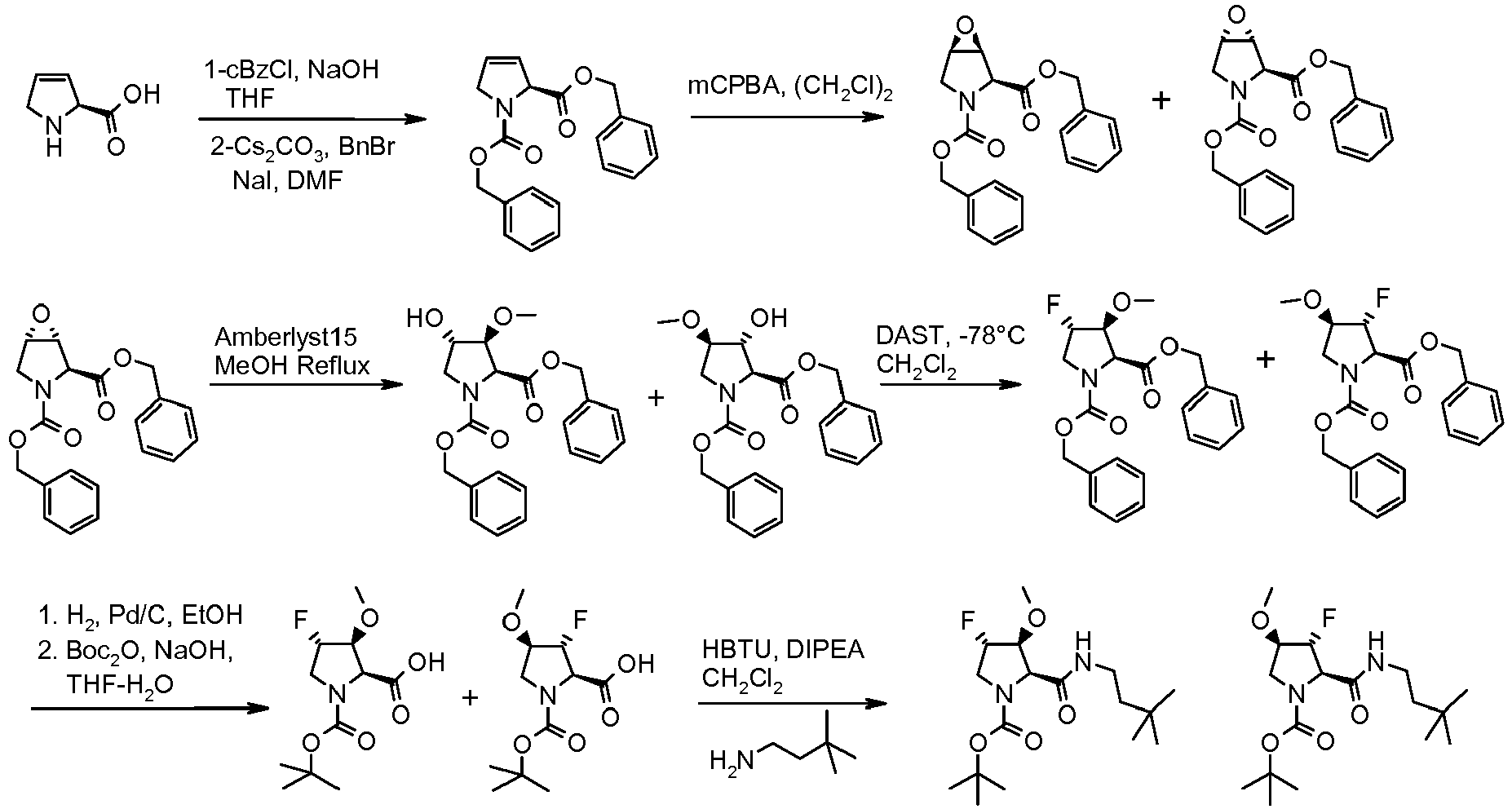
- To a solution of (S)-2,5-dihydro-1H-pyrrole-2-carboxylic acid (15 g, 133 mmol) and sodium hydroxide (10.6 g, 265 mmol) in THF (150 mL) cooled at 0°C was added benzylchloroformate (32.0 mL, 166 mmol). The mixture was allowed to reach RT overnight. The reaction mixture was concentrated, water was added and the aqueous layer was extracted with Et2O (2 x 200 mL), acidified (6N HCl) and extracted with AcOEt (2 x 200 mL). The combined organic extracts were dried (Na2SO4), filtered and concentrated. The crude residue was used in the next step without purification. MS (UPLC/MS): 248 [M+H]+; tR (HPLC conditions b): 1.66 min.
- To a solution of (S)-2,5-dihydro-pyrrole-1,2-dicarboxylic acid 1-benzyl ester (29.6 g, 120 mmol) in DMF (250 mL) were added cesium carbonate (42.9 g, 132 mmol) followed by benzyl bromide (17.09 mL, 144 mmol) and sodium iodide (2.15 g, 14.37 mmol) and the mixture was was stirred at RT for 48 h. The reaction mixture was quenched with water (500 mL) and extracted with EtOAc (3 x 200 mL). The organic extracts were combined and washed with brine, dried (Na2SO4), filtered and concentrated. The crude residue was purified by flash column chromatography on silica gel (c-hexane/EtOAc 4:1) to give the desired material. MS (UPLC/MS): 338 [MH-Boc]+; tR (HPLC conditions b): 2.31 min.
- Were prepared according to the procedure described in Tetrahedron, 1998, 54, 981-986 from (S)-2,5-dihydro-pyrrole-1,2-dicarboxylic acid dibenzyl ester. To a solution of (S)-2,5-dihydropyrrole-1,2-dicarboxylic acid dibenzyl ester (7.5 g, 22.23 mmol) in DCE (80 mL) were added mCPBA (7.67 g, 44.5 mmol) and 4,4'-thiobis(6-tert-butyl-m-cresol) (0.797 g, 2.22 mmol). The reaction mixture was then heated to 90°C overnight. Then was concentrated. The crude residue was diluted in CH2Cl2 (200 mL) and washed with an aq. solution of Na2S2O5 5% and with a sat. aq. solution of NaHCO3. The organic layer was dried (Na2SO4), filtered and concentrated. The crude residue was purified by flash column chromatography on silica gel (c-hexane/EtOAc 10:0 to 8:2) give (1S,2S,5S)-6-oxa-3-aza-bicyclo[3.1.0]hexane-2,3-dicarboxylic acid dibenzyl ester: MS (UPLC/MS): 354 [M+H]+, tR (HPLC conditions b): 2.24 min and (1S,2S,5R)-6-oxa-3-aza-bicyclo[3.1.0]hexane-2,3-dicarboxylic acid dibenzyl ester: MS (UPLC/MS): 354 [M+H]+, tR (HPLC conditions b): 2.15 min.
- To a solution of (1R,2S,5S)-6-oxa-3-aza-bicyclo[3.1.0]hexane-2,3-dicarboxylic acid dibenzyl ester (30 g, 85 mmol) in MeOH (150 mL) was added Amberlyst 15 (30 g). The reaction mixture was heated overnight at 65°C, then allowed to cool to RT and filtered. Amberlyst 15 residue was washed with MeOH. The combined filtrates concentrated and the crude residue was purified by flash column chromatography on silica gel (c-hexane 100% to EtOAc 100%) to give a mixture of the 2 regioisomers as a yellow oil. Rf, TLC (c-hexane/EtOAc 1:1) = 0.5; MS (UPLC/MS): 386.2 [M+H]+, 430.2 [M+HCOO]-; tR (HPLC conditions a): 1.93 min.
- A solution of (2S,3S,4S)-4-hydroxy-3-methoxy-pyrrolidine-1,2-dicarboxylic acid dibenzyl ester and (2S,3R,4R)-3-hydroxy-4-methoxy-pyrrolidine-1,2-dicarboxylic acid dibenzyl ester (17.8 g, 46.2 mmol) in CH2Cl2 (250 mL) was cooled under Argon at -78°C and DAST (12.2 mL, 92 mmol) was added dropwise. The reaction mixture was allowed to reach RT and further stirred for 16 h. The reaction mixture was diluted with CH2Cl2 and carefully quenched with a sat. aq. solution of NaHCO3. The layers were separated, the aqueous layer extracted twice with CH2Cl2, the combined organic extracts were dried over Na2SO4, filtered and concentrated. Purification by flash column chromatography on silica gel (c-hexane/EtOAc 10:0 to 0:10) gave a mixture of the 2 regioisomers as a yellow solid. Rf, TLC (EtOAc) = 0.5; MS (UPLC/MS): 388.3 [M+H]+, 405.3 [M+NH4]+; tR (HPLC conditions b): 2.15 min.
- To a solution of (2S,3S,4S)-4-fluoro-3-methoxy-pyrrolidine-1,2-dicarboxylic acid dibenzyl ester and (2R,3R,4R)-3-fluoro-4-methoxy-pyrrolidine-1,2-dicarboxylic acid dibenzyl ester (13.6 g, 35.1 mmol) in MeOH (110 mL) was added Pd/C 10% (1.3 g). The reaction was placed under hydrogen atmosphere (by degassing 3 times replacing air with nitrogen then nitrogen with hydrogen) and was stirred for 16 h. The mixture was placed under a nitrogen atmosphere and the catalyst was removed through a pad of Celite and washed with MeOH. After concentration, the residue was dissolved in a mixture of THF (110 mL) and water (55 mL) then aq. 1 N NaOH (70.2 mL) and Boc anhydride (16.3 mL , 70.2 mmol) were added and the reaction mixture was stirred at RT for 72 h. After concentration, the crude residue was dissolved in water and extracted twice with Et2O. The aqueous layer was acidified to pH = 1 by addition of HCl 2N and extracted twice with EtOAc. The combined organic extracts were dried (Na2SO4), filtered and concentrated to give the desired mixture of regioisomers which was used without further purification in the next step. Rf, TLC (EtOAc) = 0.1; MS (UPLC/MS): 264 [M+H]+.
- To a solution of (2S,3S,4S)-4-fluoro-3-methoxy-pyrrolidine-1,2-dicarboxylic acid 1-tert-butyl ester and (2R,3R,4R)-3-fluoro-4-methoxy-pyrrolidine-1,2-dicarboxylic acid 1-tert-butyl ester (300 mg, 1.14 mmol), 3,3-dimethylbutylamine (115 mg, 1.14 mmol) and HBTU (648 mg, 1.71 mmol) in CH2Cl2 (7 mL) was added DIPEA (0.60 mL, 3.42 mmol). The reaction mixture was stirred at RT under nitrogen atmosphere overnight and concentrated. The crude residue was taken-up in EtOAc, washed with 0.1 N HCl (x2), dried (Na2SO4), filtered and concentrated. The crude residue was purified by flash column chromatography on silica gel (c-hexane to c-hexane/EtOAc 6:4 in 40 min) to give (2S,3S,4S)-2-(3,3-dimethyl-butylcarbamoyl)-4-fluoro-3-methoxy-pyrrolidine-1-carboxylic acid tert-butyl ester: Rf, TLC (EtOAc) = 0.5; 1H NMR (400 MHz, DMSO-d 6) δ (ppm): 7.92 (m, 1H), 5.16 (dq, 1H), 4.29 -4.37 (m, 1H), 4.15 (m, 1H), 3.72 (m, 1H), 3.39 (m, 1H), 3.35 (s, 3H), 3.08 (m, 2H), 1.32-1.40 (m, 11H), 0.90 (s, 9H) and (2R,3R,4R)-2-(3,3-dimethyl-butylcarbamoyl)-3-fluoro-4-methoxy-pyrrolidine-1-carboxylic acid tert-butyl ester: Rf, TLC (EtOAc) = 0.6; 1H NMR (400 MHz, DMSO-d 6) δ (ppm): 7.90 (m, 1H), 5.05 (m, 1H), 4.20 (t, 1H), 4.02 (m, 1H), 3.70 (m, 1H), 3.39 (m, 1H), 3.33 (overlap with DMSO, m, 1H); 3.27 (s, 3H), 3.06 (m, 2H), 1.36-1.43 (m, 11H), 0.89 (s, 9H)
-

- To a solution of (1R,3S,5R)-2-azabicyclo[3.1.0]hexane-2,3-dicarboxylic acid 2-tert-butyl ester (1.5 g, 3.6 mmol) and Cs2CO3 (2.26 g, 6.9 mmol) in DMF (20 mL), allyl bromide (0.6 mL, 3.9 mmol) was added under nitrogen atmosphere. The reaction mixture was stirred for 40 h at RT. DMF was evaporated. The residue was dissolved in EtOAc and washed with aq. HCl 1 N, dried over Na2SO4, filtered and concentrated. The crude residue was purified by flash column chromatography on silica gel (c-hexane to c-hexane/EtOAc 4:6) to give the title compound. MS (LCMS):167.9 [MH-Boc]+, 290.0 [M+Na]+.
- To (1R,3S,5R)-2-azabicyclo[3.1.0]hexane-2,3-dicarboxylic acid 3-allyl ester 2-tert-butyl ester (1.69 g, 6.32 mmol) was added HCl 4N in dioxane (15.8 mL, 63.2 mmol). The reaction mixture was stirred for 6 h at RT and subsequently lyophilized to afford the desired material. MS:168.0 [M+H]+.
- To a solution of (1R,3S,5R)-2-azabicyclo[3.1.0]hexane-2,3-dicarboxylic acid 3-allyl ester hydrochloride (1.03 g, 6.43 mmol), (3-acetyl-pyrazolo[3,4-b]pyridin-1-yl)-acetic acid (prepared as described in Part A, 1.3 g, 5.93 mmol) and HBTU (2.70 g, 7.12 mmol) in DMF (19.7 mL) was added DIPEA (3.11 mL, 17.8 mmol). The reaction mixture was stirred for 16 h at RT. DMF was evaporated. The residue was poured into NH4Cl (sat. aq. solution) and extracted with EtOAc (3 x 50 mL). The organic layers were combined, dried over Na2SO4, filtered and concentrated. The crude residue was purified by flash column chromatography on silica gel (c-hexane to c-hexane/EtOAc 0:10) to give the title compound. Rf, TLC (EtOAc) = 0.6; MS (LCMS): 369.0 [M+H]+, 391.0 [MH+Na]+; tR (HPLC conditions d): 2.78 min.
- Allyl palladium chloride dimer (0.084 g, 0.231 mmol) and 2-di-tert-butylphosphino-2'-methylbiphenyl (0.288 g, 0.923 mmol) were dissolved in DMF (7.69 mL) under an argon atmosphere. The reaction mixture was stirred at RT for 10 min. After cooling the reaction mixture to 10°C, formic acid (0.513 mL, 13.38 mmol) was added followed by Et3N (1.86 mL, 13.38 mmol) and a solution of (1R,3S,5R)-2-[2-(3-acetyl-pyrazolo[3,4-b]pyridin-1-yl)acetyl]-2-azabicyclo[3.1.0]hexane-3-carboxylic acid allyl ester (1 g, 2.3 mmol) in DMF (15.4 mL). The reaction mixture was stirred at 10°C for 1 h. DMF was evaporated. The residue was poured into NH4Cl (sat. aq. solution) and extracted with EtOAc (3 x 50 mL). The organic layers were combined, dried over Na2SO4, filtered and concentrated. The residue was dissolved in MeOH and filtered over a PL-Thiol cartridge. The filtrate was concentrated and the crude residue was purified by preparative HPLC (Waters Sunfire C18-OBD, 5 µm, 30x100mm, flow: 40 mL/min, eluent: 5% to 80% CH3CN in H2O in 20 min, CH3CN and H2O containing 0.1% TFA) and the pure fractions were combined and lyophilized. White solid. MS (LCMS): 328.9 [M+H]+, 351.0 [MH+Na]; tR (HPLC conditions c): 1.84 min. 1H NMR (400 MHz, DMSO-d 6): δ (ppm) 8.66 (dd, J=4.52, 1.59 Hz, 1 H), 8.58 (m, J=6.36 Hz, 1 H), 7.35 - 7.50 (m, 1 H), 8.54 - 8.61 (m, 1 H), 5.88 (d, J=16.87 Hz, 1 H), 5.55 (d, J=17.12 Hz, 1 H), 4.14 - 4.24 (m, 1 H), 3.75 - 3.83 (m, 1 H), 2.64 (s, 3 H), 2.26 - 2.36 (m, 1 H), 2.10 - 2.23 (m, 1 H), 1.80 - 1.95 (m, 1 H), 0.95 - 1.07 (m, 1 H), 0.67 - 0.81 (m, 1 H).
-

- To a solution of (1R,3S,5R)-2-aza-bicyclo[3.1.0]hexane-2,3-dicarboxylic acid 2-tert-butyl ester (2 g, 8.8 mmol) cooled at 0°C was added a solution of Cs2CO3 (2.87 g, 8.8 mmol) in water (12.3 mL). After 30 min stirring, the resulting mixture was concentrated and the residue was suspended in DMF (41 mL). The suspension was cooled to 0°C and benzylbromide (1.045 mL, 8.8 mmol) was added under nitrogen atmosphere. The reaction mixture was stirred at RT for 16 h. DMF was evaporated, the residue was poured in water and extracted with EtOAc (3 x 50 mL). The combined organic extracts were dried (Phase separator) and concentrated under reduced pressure. The residual oil was purified by flash column chromatography on silica gel (c-hexane/EtOAc 10:0 to 8:2) to give the title compound. TLC, Rf (c-hexane/EtOAc 8:2) = 0.45; MS (UPLC-MS): 318 [M+H]+; tR (HPLC conditions d): 3.89 min.
- To a solution of (1R,3S,5R)-2-aza-bicyclo[3.1.0]hexane-2,3-dicarboxylic acid 3-benzyl ester 2-tert-butyl ester (2.69 g, 8.48 mmol) in dioxane was added HCl (4N in dioxane, 10.6 mL, 42.4 mmol). The reaction mixture was stirred at RT overnight and subsequently lyophilized. MS (LC/MS): 218 [M+H]+.
- To a solution of (1R,3S,5R)-2-aza-bicyclo[3.1.0]hexane-3-carboxylic acid benzyl ester hydrochloride (2.98 g, 9.06 mmol), (3-acetyl-pyrazolo[3,4-c]pyridin-1-yl)-acetic acid (prepared as described in Part A, 3.2 g, 9.06 mmol) and HBTU (5.15 g, 13.59 mmol) in DMF (30.2 mL) was added DIPEA (4.75 mL, 27.2 mmol). The reaction mixture was stirred for 16 h at RT under a nitrogen atmosphere. DMF was evaporated. The residue was diluted in EtOAc and washed with aq. HCl 1N then with NaHCO3 (5% in water). The organic layer was dried (Phase separator) and concentrated. The residual oil was purified by flash column chromatography on silica gel (c-hexane/EtOAc 10:0 to 0:10) to give the title compound. TLC, Rf (EtOAc) = 0.33; MS (UPLC-MS): 419 [M+H]+; tR (HPLC conditions d): 2.97 min.
- To a solution of (1R,3S,5R)-2-[2-(3-acetyl-pyrazolo[3,4-c]pyridin-1-yl)-acetyl]-2-aza-bicyclo[3.1.0] hexane-3-carboxylic acid benzyl ester (2.26 g, 5.4 mmol) in THF (20 mL) was added Pd/C 10% (60 mg). The reaction was placed under hydrogen atmosphere and was stirred for 72 h. The catalyst was removed by filtration through a pad of Celite and washed with MeOH. Solvents were concentrated to give the title compound. MS (UPLC-MS): 329 [M+H]+; tR (HPLC conditions d): 2.29 min.
-

- To a solution of (1R,3S,5R)-2-azabicyclo[3.1.0]hexane-2,3-dicarboxylic acid 2-tert-butyl ester (2.5 g, 11.0 mmol) and Cs2CO3 (3.94 g, 12.1 mmol) in DMF (50 mL) at 0°C benzylbromide (2.26 g, 13.2 mmol) was added dropwise. The reaction mixture was stirred overnight at RT under a nitrogen atmosphere. DMF was evaporated. The residue was dissolved in EtOAc and washed with a sat. aq. solution of NaHCO3, the layers were separated and the aqueous phase was extracted with EtOAc (x2). The combined organic extracts were dried over Na2SO4, filtered and concentrated. The crude residue was purified by flash column chromatography on silica gel (c-hexane/EtOAc 100:0 to 0:100) to give the desired material as a colorless oil. MS (LCMS): 318.2 [M+H]+; tR (HPLC conditions b): 2.23 min.
- To (1R,3S,5R)-2-aza-bicyclo[3.1.0]hexane-2,3-dicarboxylic acid 3-benzyl ester 2-tert-butyl ester (3.27 g, 9.79 mmol) in CH2Cl2 (50 mL) was added was added TFA (7.54 mL, 98 mmol). The reaction mixture was stirred overnight at RT and subsequently concentrated under reduced pressure to give the desired material as a yellow oil. MS (UPLC): 218.1 [M+H]+; tR (HPLC conditions b): 1.24 min.
- To a solution of (1R,3S,5R)-2-aza-bicyclo[3.1.0]hexane-3-carboxylic acid benzyl ester trifluoroacetate (3.9 g, 9.77 mmol), (3-carbamoyl-indazol-1-yl)-acetic acid (prepared as described in Part A, 2.26 g, 9.77 mmol), HBTU (5.56 g, 14.66 mmol) in CH2Cl2 (60 mL) was added DIPEA (5.12 mL, 29.3 mmol). The reaction mixture was stirred for 48 h at RT under a nitrogen atmosphere. The reaction mixture was poured into water and extracted with CH2Cl2 (x3). The combined organic extracts were dried over Na2SO4, filtered and concentrated. The crude residue was purified by flash column chromatography on silica gel (c-hexane/EtOAc 10:0 to 0:10) to afford the title compound. Rf, TLC (EtOAc) = 0.85; MS (UPLC): 436.3 [M+NH4]+, 463.2 [M+HCOO]-; tR (HPLC conditions b): 1.82 min.
- (1R,3S,5R)-2-[2-(3-carbamoyl-indazol-1-yl)-acetyl]-2-aza-bicyclo[3.1.0]hexane-3-carboxylic acid benzyl ester (3.9 g, 8.85 mmol) was dissolved in THF (120 mL) and EtOAc (120 mL). Air was removed from the flask and replaced with nitrogen three times. Pd/C 10 % (390 mg) was added to the solution which was again degassed, placed under a hydrogen atmosphere, and stirred at RT for 4 h. The catalyst was removed through a pad of Celite and washed with EtOAc. Solvents were removed under reduced pressure and the foam thus obtained was used without further purification in the next step. MS (LCMS): 346.2 [M+NH4]+, 327.1 [M-H]-; tR (HPLC conditions b): 1.12 min.
-

- To a solution of (S)-2-tert-tutoxycarbonylamino-4,4-dimethyl-pentanoic acid (500 mg, 2.04 mmol) in THF (10 mL) at -10°C under a nitrogen atmosphere was added N-methylmorpholine (0.224 mL, 2.04 mmol), followed by ethylchloroformate (0.196 ml, 2.04 mmol). The mixture was stirred for 10 min at 0°C before addition of NaBH4 (231 mg, 6.11 mmol) followed by dropwise addition of MeOH (20 mL) over a period of 20 min. (Gaz evolution and exothermic) The solution was stirred for 30 min at 0°C and neutralized with HCl (1 N, 4 mL, 4.00 mmol). The solvents were removed under reduced pressure and the residue was extracted with EtOAc (3x). The combined organic extracts were washed with aq. HCl 1N, water (2x), sat. aq. NaHCO3 and water, dried (Na2SO4), filtered. The crude residue was purified by flash column chromatography on silica gel (c-hexane to c-hexane/EtOAc 1:1) to give the desired material as a colorless oil. TLC, Rf (EtOAc): 0.50; 1H NMR (400 MHz, DMSO-d 6) δ (ppm): 6.45 (d, 1H), 4.59 (t, 1H), 3.47 (m, 1H), 3.22 (m, 1H), 3.08 (m, 1H), 1.38 (s, 9H), 1.17-1.25 (m, 2H), 0.88 (s, 9H).
- To a solution of ((S)-1-hydroxymethyl-3,3-dimethyl-butyl)-carbamic acid tert-butyl ester (250 mg, 0.756 mmol) and triethylamine (0.116 mL, 0.832 mmol) in CH2Cl2 (4 mL) cooled at -10°C was added under nitrogen atmosphere mesylchloride (0.065 mL, 0.832 mmol) and the reaction mixture was stirred at 0°C for 1.5 h. The reaction mixture was quenched with ice and water then extracted twice with EtOAc. The combined organic layers were washed with water, dried (Na2SO4), filtered and concentrated. The crude material (colorless oil) was used without purification in the next step. TLC, Rf (c-hexane/EtOAc 1:1): 0.46.
- To a solution of methanesulfonic acid (S)-2-tert-butoxycarbonylamino-4,4-dimethyl-pentyl ester (250 mg, 0.380 mmol) under nitrogen atmosphere in DME (4 mL) were added successively sodium iodide (569 mg, 3.80 mmol) and zinc powder (248 mg, 3.80 mmol). The dark mixture was stirred at RT overnight. After completion of the reaction a saturated aqueous solution of NH4Cl (3 mL) was slowly added, followed by CH2Cl2 (3 mL) and the resulting biphasic mixture was stirred at RT for 30 min. Few crystals of Na2S were added and the mixture was further stirred for 1 h. The mixture was filtered through a pad of celite, the organic layer was separated, washed with brine, dried (Na2SO4), filtered and concentrated. The crude mixture was purified by flash chromatography on silica gel (c-hexane to c-hexane/EtOAc 8:2) the desired material as a white powder. TLC, Rf (c-hexane/EtOAc 1:1): 0.50; 1H NMR (400 MHz, DMSO-d 6) δ (ppm): 6.60 (d, 1H), 3.61 (m, 1H), 1.42 (dd, 1H), 1.38 (s, 9H), 1.15 (dd, 1H), 1.00 (d, 3H), 0.88 (s, 9H).
- To a solution of ((R)-1,3,3-trimethyl-butyl)-carbamic acid tert-butyl ester (35 mg, 0.163 mmol) in CH2Cl2 (1 mL) was added TFA (0.125 mL, 1.625 mmol). The reaction mixture was stirred at RT for 2 h and concentrated to give the desired material which was used without further purification in the next step. 1H NMR (400 MHz, DMSO-d 6) δ (ppm): 7.66 (bs, 3H), 3.25 (m, 1H), 1.50 (dd, 1H), 1.38 (dd, 1H), 1.23 (d, 3H), 0.93 (s, 9H).
-

- To a solution of ((S)-1-hydroxymethyl-3,3-dimethyl-butyl)-carbamic acid tert-butyl ester (200 mg, 0.605 mmol) in dioxane (4 mL) was added HCl (4N in dioxane, 6.05 mL, 24.21 mmol). The reaction mixture was stirred at RT overnight and concentrated to give the desired material as a white powder which was used without further purification in the next. 1H NMR (400 MHz, DMSO-d 6) δ (ppm): 7.79 (bs, 3H), 5.37 (m, 1H), 3.60 (m, 1H), 3.40 (overlap with water, m, 1H), 3.09 (m, 1H), 1.47 (dd, 1H), 1.33 (dd, 1H), 0.92 (s, 9H).
-

- The title compound was obtained from (R)-2-tert-tutoxycarbonylamino-4,4-dimethyl-pentanoic acid using the same protocols as described for the preparation of (S)-2-Amino-4,4-dimethyl-pentan-1-ol hydrochloride. 1H NMR (400 MHz, DMSO-d 6) δ (ppm): 7.79 (bs, 3H), 5.37 (m, 1H), 3.60 (m, 1H), 3.40 (overlap with water, m, 1H), 3.09 (m, 1H), 1.47 (dd, 1H), 1.33 (dd, 1H), 0.92 (s, 9H).
-

- To a solution of ((S)-1-methoxymethyl-3,3-dimethyl-butyl)-carbamic acid tert-butyl ester (193 mg, 0.787 mmol) in CH2Cl2 (6 mL) was added TFA (0.606 mL, 7.87 mmol). The reaction mixture was stirred at RT for 2 h and concentrated to give the desired material which was used without further purification in the next step. 1H NMR (400 MHz, DMSO-d 6) δ (ppm): 7.83 (bs, 3H), 3.50 (m, 1H), 3.35 (m, 1H), 3,35 8s, 3H), 3.28 (m, 1H), 1.48 (dd, 1H), 1.36 (dd, 1H), 0.92 (s, 9H).
- To a suspension of NaH (51.3 mg, 1.284 mmol) in THF (10 mL) cooled at 0°C under Argon atmosphere was slowly added ((S)-1-hydroxymethyl-3,3-dimethyl-butyl)-carbamic acid tert-butyl ester (300 mg, 1.167 mmol). The mixture was stirred at 0°C for 30 min and iodomethane (0.095 ml, 1.517 mmol) was added. The reaction mixture was allowed to reach RT and further stirred overnight. To complete the reaction, NaH (24 mg, 0.584 mmol) was again added at 0°C followed 30 min later by the addition of iodomethane (36 µL, 0.584 mmol). The reaction mixture was stirred at RT for 6 h, then poured into a a sat. aq. solution of NaHCO3 and extracted twice with CH2Cl2. The combined organic extracts were dried (Na2SO4), filtered and concentrated. The crude material was purified by flash chromatography on silica gel (c-hexane to c-hexane/EtOAc 8:2) to give the desired material as a white powder. 1H NMR (400 MHz, DMSO-d 6) δ (ppm): 6.60 (m, 1H), 3.66 (m, 1H), 3.23 (s, 3H), 3.14 (m, 1H), 3.05 (m, 1H), 1.38 (s, 9H), 1.30 (m, 2H), 0.88 (s, 9H).
- 1H NMR data for selected compounds can be found at the end of Part D.
-

- To a solution of (1R,3S,5R)-2-aza-bicyclo[3.1.0]hexane-2,3-dicarboxylic acid 2-tert-butyl ester (300 mg, 1.32 mmol), 3,3-dimethyl-butylamine (134 mg, 1.32 mmol) and HBTU (751 mg, 1.98 mmol) in CH2Cl2 (9 mL) under a nitrogen atmosphere was added DIPEA (0.922 mL, 5.28 mmol). The reaction mixture was stirred at RT for 16 h. CH2Cl2 and water were added, the phases were separated and the aqueous layer extracted with CH2Cl2 (x2). The combined organic extracts were dried (Na2SO4), filtered and concentrated in vacuo. The residual material was purified by flash chromatography on silica gel (c-hexane/ AcOEt 1-0 to 0-1) to give the title compound. TLC, Rf (EtOAc) = 0.85.
- DMF can also be used instead of Dichloromethane.
- To a solution of (1R,3S,5R)-3-(3,3-dimethyl-butylcarbamoyl)-2-aza-bicyclo[3.1.0]hexane 2-carboxylic acid tert-butyl ester (310 mg, 1 mmol) in CH2Cl2 (8 mL) was added TFA (0.769 mL, 10 mmol) and the solution was stirred at RT for 2 h. The crude reaction mixture was concentrated under vacuum and was used without further purification in the next step. UPLC/MS : 211.3 [M+H]+; tR (HPLC conditions b): 1.07 min.
- To a solution of (3-carbamoyl-indazol-1-yl)-acetic acid (prepared as described in part A, 25.3 mg, 0.116 mmol), (1R,3S,5R)-2-aza-bicyclo[3.1.0]hexane-3-carboxylic acid (3,3-dimethyl-butyl)-amide trifluoroacetate (50 mg, 0.116 mmol) and HBTU (65.8 mg, 0.173 mmol) in DMF (0.5 mL) under a nitrogen atmosphere was added DIPEA (0.081 ml, 0.462 mmol). The reaction mixture was stirred at RT for 2 h and poured into water. EtOAc was added, the layers were separated and the aqueous layer extracted with EtOAc (x2). The combined organic extracts were dried (Na2SO4), filtered and concentrated in vacuo. The residual material was purified by preparative HPLC (Waters Sunfire C18-ODB, 5 µm, 30x100 mm, eluent: 5% to 100% CH3CN in H2O in 25 min, CH3CN and H2O containing 0.1% TFA, flow: 40 mL/min). The pure HPLC fractions were neutralized with an aqueous saturated solution of Na2CO3, extracted with EtOAc (x2), dried (Na2SO4), filtered and concentrated to give the desired material. TLC, Rf (EtOAc) = 0.2; UPLC/MS (LC/MS): 412.4 [M+H]+, 429.3 [M+18]+, 456.3 [M+HCOO]-; tR (HPLC conditions b): 1.61 min.
- The examples below were prepared according to the general procedure described in Scheme D1 for the preparation of Example 1 from building blocks described in Part A, B and C or commercially available :
Table 1: Example Structure Name Characterization (end-table notes), TLC, Rf (eluent); MS (LC/MS); tR (HPLC conditions) 2 
(1R,3S,5R)-2-[2-(3-Acetyl-indazol-1-yl)-acetyl]-2-aza-bicyclo[3.1.0]hexane-3-carboxylic acid (3-trifluoromethoxy-propyl)-amide (1) 453 [M+H]+, 470 [M+18]+; tR (d): 3.43 min. 3 
1-{2-[(2S,3S,4S)-2-(3,3-Dimethyl-butylcarbamoyl)-4-fluoro-3-methoxy-pyrrolidin-1-yl]-2-oxo-ethyl}-1H-indazole-3-carboxylic acid amide Rf (EtOAc) = 0.3; 448.3 [M+H]+, 465.3 [M+18]+, 492.3 [M+HCOO]-; tR (a): 2.48 min. 4 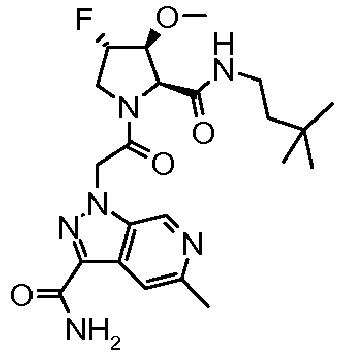
1-{2-[(2S,3S,4S)-2-(3,3-Dimethyl-butylcarbamoyl)-4-fluoro-3-methoxy-pyrrolidin-1-yl]-2-oxo-ethyl}-5-methy l-1H-pyrazolo[3,4-c]pyridine-3-carboxylic acid amide Rf (EtOAc) = 0.05; 463.3 [M+H]+, 507.3 [M+HCOO]-; tR (a): 1.72 min. 5 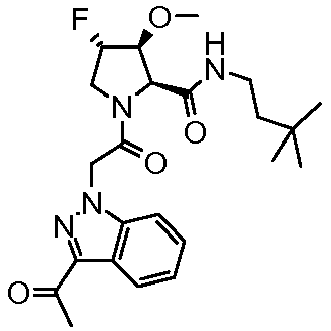
(2S,3S,4S)-1-[2-(3-Acetyl-indazol-1-yl)-acetyl]-4-fluoro-3-methoxy-pyrrolidine-2-carboxylic acid (3,3-dimethyl-butyl)-amide Rf (EtOAc) = 0.7; 447.3 [M+H]+, 464.3 [M+18]+, 491.3 [M+HCOO]-; tR (a): 2.92 min. 6 
1-{2-[(1R,3S,5R)-3-(3,3-Dimethyl-butylcarbamoyl)-2-aza-bicyclo[3.1.0]hex-2-yl]-2-oxoethyl}-1H-pyrazolo[3,4-c] pyridine-3-carboxylic acid amide Rf (EtOAc) = 0.05; 413.3 [M+H]+, 457.4 [M+HCOO]-; tR (a): 1.63 min. 7 
(1R,3S,5R)-2-[2-(3-Acetyl-pyrazolo[3,4-c]pyridin-1-yl)-acetyl]-2-aza-bicyclo[3.1.0] hexane-3-carboxylic acid (3,3-dimethyl-butyl)-amide Rf (EtOAc) = 0.10; 412.3 [M+H]+, 434.3 [M+Na]+, 556.3 [M+HCOO]-; tR (f): 2.68 min. 8 
(1R,3S,5R)-2-{2-[3-Acetyl-5-(pyrimidin-2-ylmethoxy)-indazol-1-yl]-acetyl}-2-aza-bicyclo[3.1.0]hexane-3-carboxylic acid (3,3-dimethylbutyl)-amide 519.4 [M+H]+, 536.4 [M+18]+, 563.4 [M+HCOO]-; tR (f): 1.77 min. 9 
1-{2-Oxo-2-[(1R,3S,5R)-3-(2-trimethylsilanyl-ethylcarbamoyl)-2-aza-bicyclo[3.1.0]hex-2-yl]-ethyl}-1H-pyrazolo[3,4-c]pyridine-3-carboxylic acid amide Rf (EtOAc) = 0.05; 429.2 [M+H]+, 473.2 [M+HCOO]-; tR (f): 2.56 min. 10 
1-{2-[(1R,3S,5R)-3-(3-Hydroxy-3-methyl-butylcarbamoyl)-2-aza-bicyclo[3.1.0]hex-2-yl]-2-oxoethyl}-1H-pyrazolo[3,4-c] pyridine-3-carboxylic acid amide trifluoroacetate (2) 415.3 [M+H]+, tR (b): 1.64 min. 11 
1-{2-[(2R,3R,4R)-2-(3,3-Dimethyl-butylcarbamoyl)-3-fluoro-4-methoxy-pyrrolidin-1-yl]-2-oxo-ethyl}-1H-inda zole-3-carboxylic acid amide Rf (EtOAc) = 0.4; 448.3 [M+H]+, 465.3 [M+18]+, 492.3 [M+HCOO]-; tR (a): 2.57 min. 12 
1-[2-((1 R,3S,5R)-3-Ethyl carbamoyl-2-aza-bicyclo [3.1.0]hex-2-yl)-2-oxo-ethyl]-1H-pyrazolo[3,4-c]pyridine-3-carboxylic acid amide 357.1 [M+H]+; tR (e): 1.99 min. 13 
(1R,3S,5R)-2-{2-[3-Acetyl-5-(pyrimidin-2-ylmethoxy)-indazol-1-yl]-acetyl}-2-aza-bicyclo[3.1.0]hexane-3-carboxylic acid ethylamide (3) 485.2 [M+Na]+; tR (e): 3.47 min. 14 
(1R,3S,5R)-2-{2-[3-Acetyl-5-(pyrimidin-2-ylmethoxy)-indazol-1-yl]-acetyl}-2-aza-bicyclo[3.1.0]hexane-3-carboxylic acid (3-trifluoro methoxy-propyl)-amide (1) 561.2 [M+H]+, 583.1 [M+Na]+; tR (f): 3.43 min. 15 
(1R,3S,5R)-2-{2-[3-Acetyl-5-(pyrimidin-2-ylmethoxy)-indazol-1-yl]-acetyl}-2-aza-bicyclo[3.1.0]hexane-3-carboxylic acid (2-trifluoro methoxy-ethyl)-amide (1) 569.3 [M+Na]+, 591.2 [M+HCOO]-; tR (f): 3.25 min. 16 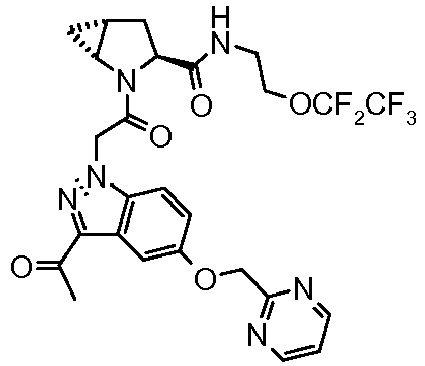
(1R,3S,5R)-2-{2-[3-Acetyl-5-(pyrimidin-2-ylmethoxy)-indazol-1-yl]-acetyl}-2-aza-bicyclo[3.1.0]hexane-3-carboxylic acid (2-penta fluoroethyloxy-ethyl)-amide (1) 597.2 [M+H]+, 619.2 [M+Na]+; tR (f): 3.84 min. 17 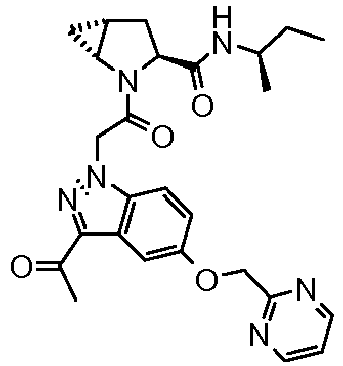
(1R,3S,5R)-2-{2-[3-Acetyl-5-(pyrimidin-2-ylmethoxy)-indazol-1-yl]-acetyl}-2-aza-bicyclo[3.1.0]hexane-3-carboxylic acid ((R)-sec-butyl)-amide 491 [M+H]+; tR (f): 2.97 min. 18 
1-[2-((1 R,3S,5R)-3-Ethylcarbamoyl-2-aza-bicyclo[3.1.0]hex-2-yl)-2-oxoethyl]-5-(pyrimidin-2-ylmethoxy)-1H-indazole-3-carboxylic acid amide 464.2 [M+H]+, 486.1 [M+Na]+; tR (f): 1.77 min. 19 
(1R,3S,5R)-2-{2-[3-Acetyl-5-(pyrimidin-2-ylmethoxy)-indazol-1-yl]-acetyl}-2-aza-bicyclo[3.1.0]hexane-3-carboxylic acid ((S)-sec-butyl)-amide 491 [M+H]+; tR (f): 2.93 min. 20 
(1R,3S,5R)-2-{2-[3-Acetyl-5-(pyrimidin-2-ylmethoxy)-indazol-1-yl]-acetyl}-2-aza-bicyclo[3.1.0]hexane-3-carboxylic acid isopropyl amide 477 [M+H]+; tR (f): 2.64 min. (1) Step A was performed in DMF instead of CH2Cl2; (2) T3P was used instead of HBTU in step A and C and the reactions were performed in DMF; (3) Step C was performed in THF instead of DMF. -

- To a solution of (1R,3S,5R)-2-aza-bicyclo[3.1.0]hexane-3-carboxylic acid (3,3-dimethyl-butyl)-amide trifluoroacetate (prepared as described in Scheme D1 steps A and B, 35 mg, 0.08 mmol) and Et3N (45 µl, 0.32 mmol) in THF (0.4 mL) was added a suspension of 3-isocyanato-indole-1-carboxylic acid amide (25.5 mg, 0.08 mmol, prepared as described in Part A) in THF (0.8 mL). The resulting solution was stirred at RT under a nitrogen atmosphere for 3 h, poured into brine and the mixture was extracted twice with EtOAc. The combined organic layers were dried over Na2SO4, filtered and concentrated. The crude residue was purified by preparative HPLC (Waters SunFire C18-ODB, 5 µm, 30x100 mm, 20% to 100 % CH3CN in H2O in 25 min, CH3CN and H2O containing 0.1 % TFA, flow: 40 mL/min). The pure HPLC fractions were neutralized with an aqueous saturated solution of Na2CO3, extracted with CH2Cl2 (x2), dried (Na2SO4), filtered and concentrated to give the desired material. TLC, Rf (CH2Cl2/MeOH) = 0.5; UPLC/MS: 412.3 [M+H]+, 823.6 [2M+H]+, 456.3 [M+HCOO]-; tR (HPLC conditions b): 1.80 min.
- The examples below were prepared according to the general procedure described in Scheme D2 for the preparation of Example 21 from commercially available building blocks:
Table 2: Example Structure Name Characterization (end-table notes), TLC, Rf (eluent); MS (LC/MS); tR (HPLC conditions): 22 
(1R,3S,5R)-2-Aza-bicyclo [3.1.0]hexane-2,3-dicarboxylic acid 2-[(1-carbamoyl-1H-indol-3-yl)-amide] 3-[(2-trimethylsilanyl-ethyl)-amide] (1) Rf (EtOAc) = 0.3; 428.3 [M+H]+, 426.1 [M-H]-; tR (e): 3.34 min. 23 
(1R,3S,5R)-2-Aza-bicyclo [3.1.0]hexane-2,3-dicarboxylic acid 2-[(1-carbamoyl-1H-indol-3-yl)-amide] 3-[(2-trifluoromethoxy-ethyl)-amide] (2) 440 [M+H]+; tR (d): 3.10 min. 24 
(1R,3S,5R)-2-Aza-bicyclo [3.1.0]hexane-2,3-dicarboxylic acid 2-[(1-carbamoyl-1H-indol-3-yl)-amide] 3-ethylamide (1) 356.0 [M+H]+, 354.1 [M-H]-; tR (f): 2.20 min. 25 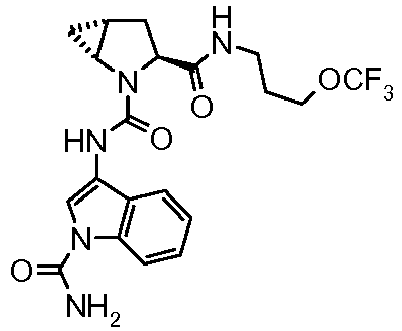
(1R,3S,5R)-2-Aza-bicyclo [3.1.0]hexane-2,3-dicarboxylic acid 2-[(1-carbamoyl-1H-indol-3-yl)-amide] 3-[(3-trifluoromethoxy-propyl)-amide] (2) 454 [M+H]+; tR (d): 3.57 min. 26 
(1R,3S,5R)-2-Aza-bicyclo [3.1.0]hexane-2,3-dicarboxylic acid 2-[(1-carbamoyl-1H-indol-3-yl)-amide] 3-[(4-trifluoromethoxy-butyl)-amide] (1) 468 [M+H]+, 467.2 [M-H]-; tR (e): 4.33 min. 27 
(1R,3S,5R)-2-Aza-bicyclo [3.1.0]hexane-2,3-di arboxylic acid 2-[(1-carbamoyl-1H-indol-3-yl)-amide] 3-[(2-pentafluoroethyloxy-ethyl)-amide] (2) 490 [M+H]+; tR (d): 3.30 min. (1) The starting material was prepared according to Scheme D1 step A and B. (2) The starting material was prepared according to Scheme D1 step A and B, using DMF in step A. -
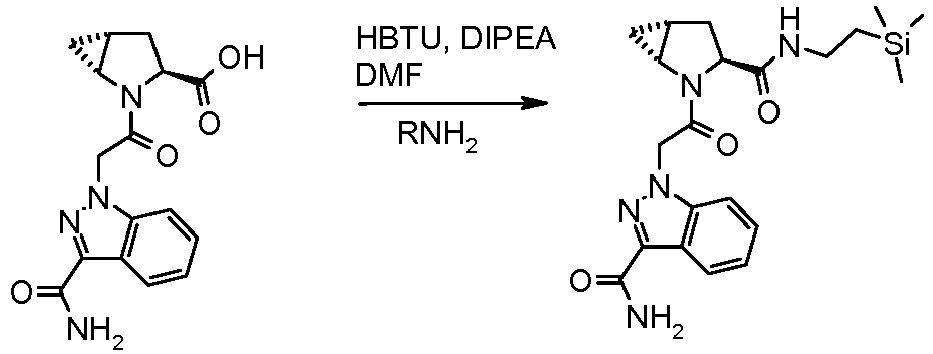
- To a mixture of (1R,3S,5R)-2-[2-(3-carbamoyl-indazol-1-yl)-acetyl]-2-aza-bicyclo[3.1.0]hexane-3-carboxylic acid (40 mg, 0.117 mmol, prepared as described in Part B), 2-trimethylsilanyl-ethylamine hydrochloride (Rarechem AL BW 0194, 17.98 mg, 0.117 mmol), and HBTU (66.5 mg, 0.175 mmol) in DMF (0.8 mL) DIPEA (82 µl, 0.462 mmol) was added and the reaction mixture was stirred at 25°C for 2 h. After completion of the reaction, water was added and the mixture was extracted with EtOAc (x2). The combined organic extracts were dried (Na2SO4), filtered and concentrated. The crude material was purified by preparative HPLC (Waters Sunfire C18-ODB, 5um, 30x100mm, flow: 40 mL/min, gradient: 0-0.5 min 5% CH3CN, 0.5-18.5 min 5 to 100% CH3CN, 18.5-20 min 100% CH3CN, H2O and CH3CN containing 0.1%TFA). The pure HPLC fractions were neutralized with an aq. sat. solution of Na2CO3, extracted with CH2Cl2 (x2), dried (Na2SO4), filtered and concentrated to give the desired material. TLC, Rf (EtOAc): 0.25; UPLC/MS:428.3 [M+H]+, 445.3 [M+18]+, 472.2 [M+HCOO]-; tR (HPLC conditions a): 2.63 min.
- The examples below were prepared according to the general procedure described in Scheme D3 for Example 28 using building blocks prepared in part B, C or commercially available:
Table 3: Example Structure Name Characterization TLC, Rf (eluent); MS (LC/MS); tR (HPLC conditions) 29 
(1R,3S,5R)-2-[2-(3-Acetyl-pyrazolo[3,4-b]pyridin-1-yl)-acetyl]-2-aza-bicyclo[3.1.0] hexane-3-carboxylic acid (3,3-dimethyl-butyl)-amide Rf (EtOAc) = 0.4; 412.4 [M+H]+, 456.4 [M+HCOO]-; tR (a): 3.20 min. 30 
(1R,3S,5R)-2-[2-(3-Acetyl-pyrazolo[3,4-b]pyridin-1-yl)-acetyl]-2-aza-bicyclo[3.1.0] hexane-3-carboxylic acid (3-methyl-butyl)-amide Rf (EtOAc) = 0.5; 398.3 [M+H]+, 442.4 [M+HCOO]-; tR (a): 3.30 min. 31 
(1R,3S,5R)-2-[2-(3-Acetyl-pyrazolo[3,4-b]pyridin-1-yl)-acetyl]-2-aza-bicyclo[3.1.0] hexane-3-carboxylic acid (4,4,4-trifluoro-butyl)-amide Rf (EtOAc) = 0.2; 338.3 [M+H]+, 482.4 [M+HCOO]-; tR (a): 2.47 min. 32 
1-{2-[(1R,3S,5R)-3-(2,2-Difluoro-ethylcarbamoyl)-2-aza-bicyclo[3.1.0]hex-2-yl]-2-oxo-ethyl}-1H-indazole-3 -carboxylic acid amide Rf (EtOAc) = 0.15; 392.2 [M+H]+, 390.4 [M-H]-, 436.2 [M+HCOO]-; tR (a): 1.63 min. 33 
1-{2-[(1R,3S,5R)-3-(2-Hydroxy-3,3-dimethyl-butylcarbamoyl)-2-aza-bicyc lo[3.1.0]hex-2-yl]-2-oxo-ethyl}-1H-indazole-3-carboxylic acid amide Rf (EtOAc) = 0.10; 428.3 [M+H]+, 445.3 [M+18]+, 472.2 [M+HCOO]-; tR (a): 2.02 min. 34 
1-{2-[(1R,3S,5R)-3-(3,3-Dimethyl-2-oxobutylcarbamoyl)-2-aza-bicyclo[3.1.0]hex-2-yl]-2-oxoethyl}-1H-indazole-3-carboxylic acid amide Rf (EtOAc) = 0.25; 426.2 [M+H]+, 443.3 [M+18]+, 470.3 [M+HCOO]-; tR (a): 2.16 min. 35 
1-{2-[(1R,3S,5R)-3-((S)-1-Hydroxymethyl-3,3-dimethyl-butylcarbamoyl)-2-aza-bicyclo[3.1.0]hex-2-yl]-2-oxoethyl}-1H-indazole-3-carboxylic acid amide Rf (EtOAc) = 0.05; 442.3 [M+H]+, 459.3 [M+18]+, 486.2 [M+HCOO]-; tR (f): 2.72 min. 36 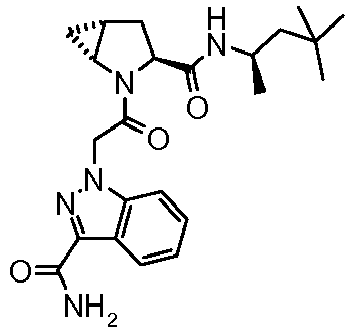
1-{2-Oxo-2-[(1R,3S,5R)-3-((R)-1,3,3-trimethyl-butylcarbamoyl)-2-aza-bicyclo[3.1.0]hex-2-yl]-ethyl}-1H-indazole-3-carboxylic acid amide Rf (EtOAc) = 0.20; 426.3 [M+H]+, 443.3 [M+18]+, 470.3 [M+HCOO]-; tR (f): 3.46 min. 37 
1-{2-[(1R,3S,5R)-3-((S)-1-Methoxymethyl-3,3-dimethyl-butylcarbamoyl)-2-aza-bicyclo[3.1.0]hex-2-yl]-2-oxoethyl}-1H-indazole-3-carboxylic acid amide Rf (EtOAc) = 0.15; 456.3 [M+H]+, 473.3 [M+18]+, 500.3 [M+HCOO]-; tR (f): 3.32 min. 38 
1-{2-[(1R,3S,5R)-3-(3,3-Difluoro-butylcarbamoyl)-2-aza-bicyclo[3.1.0]hex-2-yl]-2-oxo-ethyl}-1H-indazole-3-carboxylic acid amide Rf (EtOAc) = 0.25; 406.2 [M+H]+, 404.3 [M-H]-, 423.2 [M+18]+, 450.2 [M+HCOO]-; tR (a): 1.85 min. 39 
(1R,3S,5R)-2-[2-(3-Acetyl-pyrazolo[3,4-c]pyridin-1-yl)-acetyl]-2-aza-bicyclo [3.1.0]hexane-3-carboxylic acid (3,3,3-trifluoro-propyl)-amide 424.0 [M+H]+, 445.9 [M+Na]+; tR (d): 2.59 min. 40 
(1R,3S,5R)-2-[2-(3-Acetyl-pyrazolo[3,4-b]pyridin-1-yl)-acetyl]-2-aza-bicyclo [3.1.0]hexane-3-carboxylic acid (3,3,3-trifluoro-2-hydroxypropyl)-amide 440.1 [M+H]+, 462.1 [M+Na]+, 484.0 [M+HCOO]-. 41 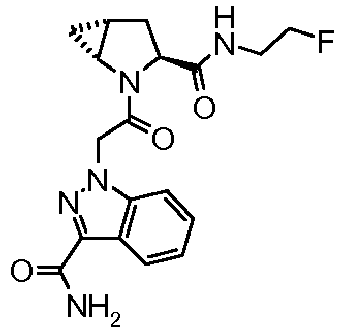
1-{2-[(1R,3S,5R)-3-(2-Fluoro-ethylcarbamoyl)-2-aza-bicyclo[3.1.0]hex-2-yl]-2-oxoethyl}-1H-indazole-3-carboxylic acid amide Rf (EtOAc) = 0.10; 391.2 [M+18]+, 418.2 [M+HCOO]-; tR (a): 1.25 min. 42 
1-{2-[(1R,3S,5R)-3-((R)-1-Hydroxymethyl-3,3-dimethyl-butylcarbamoyl)-2-aza-bicyclo[3.1.0]hex-2-yl]-2-oxoethyl}-1H-indazole-3-carboxylic acid amide Rf (EtOAc) = 0.05; 442.3 [M+H]+ 459.3 [M+18]+ 486.3 [M+HCOO]-; tR (f): 2.69 min. 43 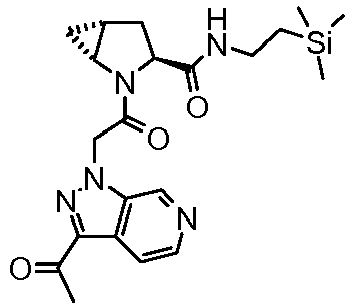
(1R,3S,5R)-2-[2-(3-Acetyl-pyrazolo[3,4-c]pyridin-1-yl)-acetyl]-2-aza-bicyclo[3.1.0]hexane-3-carboxylic acid (2-trimethylsilanyl-ethyl)-amide Rf (EtOAc) = 0.15; 428.2 [M+H]+, 472.2 [M+HCOO]-; tR (f): 3.10 min. -

- To a solution of 1-{2-[(1R,3S,5R)-3-(2-hydroxy-3,3-dimethyl-butylcarbamoyl)-2-aza-bicyclo [3.1.0]hex-2-yl]-2-oxo-ethyl}-1H-indazole-3-carboxylic acid amide Example 33 (40 mg, 0.094 mmol) in CH2Cl2 (1 mL) at -78°C under a nitrogen atmosphere was added DAST (27 µL, 0.187 mmol) and the solution was allowed to reach RT and stirred for 3 h. The reaction mixture was poured into an aqueous saturated solution of NaHCO3 and extracted twice with CH2Cl2. The combined organic layers were dried (Na2SO4), filtered and concentrated. The crude residue was purified by preparative HPLC (Waters Sunfire C18-ODB, 5µm, 30x100mm, gradient: 0-0.5 min 5% CH3CN in H2O flow: 5mL/min, 0.5-18.5 min 5 to 100% CH3CN in H2O flow: 40mL/min, 18.5-20 min 100% CH3CN, CH3CN and H2O containing 0.1% TFA). The pure HPLC fractions were neutralized with an aqueous saturated solution of Na2CO3, extracted with CH2Cl2 (x2), dried (Na2SO4), filtered and concentrated to give the desired material. TLC, Rf (EtOAc): 0.10; UPLC/MS: 430.5 [M+H]+, 447.5 [M+18]+, 474.4 [M+HCOO]-; tR (HPLC conditions a): 2.27 min.
-
- Example 1: 1H NMR (400 MHz, DMSO-d6 ) δ (ppm): 1H NMR (400 MHz, DMSO-d6 ): δ (ppm): 8.19 (d, 1 H), 7.74 (t, 1 H), 7.65 (m, 2H), 7.44 (t, 1 H), 7.39 (bs, 1 H), 7.28 (t, 1 H), 5.74 (d, 1 H), 5.45 (d, 1 H), 4.17 (dd, 1 H), 3.68 (m, 1 H), 3.11-2.98 (m, 2H), 2.19 (m, 1 H), 2.13 (m, 1 H), 1.83 (m, 1 H), 1.29 (m, 2H), 1.02 (m, 1 H), 0.88 (s, 9H), 0.70 (m, 1 H).
- Example 4: 1H NMR (400 MHz, DMSO-d6 ) δ (ppm): 1H NMR (400 MHz, DMSO-d6 ): 0.75:0.25 mixture of rotamers δ (ppm): 9.01 (s, 0.75H), 8.97 (s, 0.25H), 8.36 (m, 0.25H), 7.95 (m, 0.75H), 7.89 (bs, 1 H), 7.81 (m, 0.25H), 7.78 (m, 0.75H), 7.50 (bs, 1 H), 5.68 (d, 0.75H), 5.63 (d, 0.25H), 5.55 (d, 0.75H), 5.45-5.22 (m, 1H), 5.06 (m, 0.25H), 4.97 (d, 0.25H), 4.56 (d, 0.75H), 4.38-4.32 (m, 0.25H), 4.22-4.12 (m, 1.5H), 4.00-3.91 (m, 0.75H), 3.75-3.67 (m, 0.5H), 3.43 (s, 0.75H), 3.39 (s, 2.25H), 3.28-2.92 (m, 2H), 2.60 (s, 3H), 1.41 (t, 0.5H), 1.27 (t, 1.5H), 0.92 (s, 2.25H), 0.87 (s, 6.75H).
- Example 8: 1H NMR (400 MHz, DMSO-d6 ) δ (ppm): 8.85 (d, 2H), 7.74 (t, 1H), 7.63 (d, 1H), 7.57 (m, 1H), 7.47 (t, 1H), 7.22 (dd, 1H), 5.79 (d, 1H), 5.49 (d, 1H), 5.36 (s, 2H), 4.18 (dd, 1H), 3.67 (m, 1 H), 3.05 (m, 2H), 2.58 (s, 3H), 2.23-2.09 (m, 2H), 1.82 (m, 1 H), 1.29 (m, 2H), 1.02 (m, 1 H), 0.88 (s, 9H), 0.77 (m, 1 H).
- Example 16: 1H NMR (400 MHz, DMSO-d6 ) δ (ppm): 8.85 (d, 2H), 8.13 (t, 1H), 7.62 (ds, 1H), 7.56 (d, 1 H), 7.48 (t, 1 H), 7.23 (dd, 1 H), 5.79 (d, 1 H), 5.50 (d, 1 H), 5.36 (s, 2H), 4.23 (dd, 1 H), 4.12 (t, 2H), 3.68 (m, 1H), 3.38 (m, 2H), 2.58 (s, 3H), 2.23 (m, 1H), 2.11 (m, 1H), 1.81 (m, 1H), 1.02 (m, 1H), 0.80 (m, 1 H).
- Example 21: 1H NMR (400 MHz, DMSO-d6 ) δ (ppm): 1H NMR (400 MHz, DMSO-d6 ): δ (ppm): 8.46 (s, 1 H), 8.28 (d, 1 H), 8.00 (s, 1 H), 7.79 (d, 1 H), 7.70 (m, 1 H), 7.40 (m, 2H), 7.27 (t, 1 H), 7.19 (t, 1H), 4.09 (m, 1H), 3.77 (m, 1H), 3.07 (m, 2H), 2.25 (dd, 1H), 2.10 (m, 1H), 1.74 (m, 1H), 1.33 (m, 2H), 0.90 (s, 9H), 0.85 (m, 1 H), 0.50 (m, 1 H).
- Example 22: 1H NMR (400 MHz, DMSO-d6 ) δ (ppm): 1H NMR (400 MHz, DMSO-d6 ): δ (ppm): 8.48 (s, 1H), 8.28 (d, 1H), 8.00 (s, 1H), 7.79 (d, 1H), 7.73 (m, 1H), 7.41 (m, 2H), 7.27 (t, 1H), 7.19 (t, 1 H), 4.09 (m, 1 H), 3.77 (m, 1 H), 3.11 (m, 2H), 2.24 (m, 1 H), 2.11 (m, 1 H), 1.74 (m, 1 H), 0.84 (m, 1 H), 0.76 (m, 2H), 0.50 (m, 1 H), 0.01 (s, 9H).
- Example 31: 1H NMR (400 MHz, DMSO-d6 ) δ (ppm): 1H NMR (400 MHz, DMSO-d6 ): δ (ppm): 8.66 (dd, 1 H), 8.59 (dd, 1 H), 7.95 (bt, 1 H), 7.47 (dd, 1 H), 5.85 (d, 1 H), 5.60 (d, 1 H), 4.15 (dd, 1H), 3.74 (m, 1H), 3.11 (m, 2H), 2.65 (s, 3H), 2.25-2.11 (m, 4H), 1.86 (m, 1H), 1.58 (m, 2H), 1.05 (m, 1H), 0.70 (m, 1 H).
- Example 35: 1H NMR (400 MHz, DMSO-d6 ) δ (ppm): 1H NMR (400 MHz, DMSO-d6 ): δ (ppm): 8.20 (d, 1 H), 7.67 (bs, 1 H), 7.64 (d, 1 H), 7.44 (t, 1 H), 7.39 (bs, 1 H), 7.37 (d, 1 H), 7.28 (t, 1 H), 5.75 (d, 1 H), 5.45 (d, 1 H), 4.53 (t, 1 H), 4.22 (dd, 1 H), 3.78 (m, 1 H), 3.66 (m, 1 H), 3.18 (m, 1 H), 3.08 (m, 1H), 2.23-2.10 (m, 2H), 1.81 (m, 1H), 1.47 (m, 1H), 1.27 (dd, 1H), 1.02 (m, 1H), 0.85 (s, 3H), 0.71 (m, 1 H).
-
Example IC50 (µM) Example IC50 (µM) 1 0.061 30 0.324 2 0.605 31 1.144 3 0.103 32 0.874 4 0.161 33 0.271 5 0.088 34 0.192 6 0.168 35 0.593 7 0.068 36 0.113 8 0.009 37 0.443 9 0.153 38 1.046 10 5.674 39 5.319 11 14.635 40 10.791 12 7.216 41 1.352 13 0.504 42 5.357 14 0.127 43 0.323 15 0.021 44 0.384 16 0.152 17 0.333 18 2.893 19 0.929 20 0.328 21 0.058 22 0.057 23 0.427 24 1.750 25 0.912 26 1.387 27 1.967 28 0.065 29 0.227
Claims (6)
- The compound, or a salt thereof, selected from the group consisting of1-{2-[(1R,3S,5R)-3-(3,3-dimethyl-butylcarbamoyl)-2-aza-bicyclo[3.1.0]hex-2-yl]-2-oxoethyl}-1H-indazole-3-carboxylic acid amide;(1R,3S,5R)-2-[2-(3-Acetyl-indazol-1-yl)-acetyl]-2-aza-bicyclo[3.1.0]hexane-3-carboxylic acid (3-trifluoromethoxy-propyl)-amide;1-{2-[(2S,3S,4S)-2-(3,3-Dimethyl-butylcarbamoyl)-4-fluoro-3-methoxy-pyrrolidin-1-yl]-2-oxo-ethyl}-1H-indazole-3-carboxylic acid amide;1-{2-[(2S,3S,4S)-2-(3,3-Dimethyl-butylcarbamoyl)-4-fluoro-3-methoxy-pyrrolidin-1-yl]-2-oxo-ethyl}-5-methyl-1H-pyrazolo[3,4-c]pyridine-3-carboxylic acid amide;(2S,3S,4S)-1-[2-(3-Acetyl-indazol-1-yl)-acetyl]-4-fluoro-3-methoxy-pyrrolidine-2-carboxylic acid (3,3-dimethyl-butyl)-amide;1-{2-[(1R,3S,5R)-3-(3,3-Dimethyl-butylcarbamoyl)-2-aza-bicyclo[3.1.0]hex-2-yl]-2-oxoethyl}-1H-pyrazolo[3,4-c]pyridine-3-carboxylic acid amide;(1 R,3S,5R)-2-[2-(3-Acetyl-pyrazolo[3,4-c]pyridin-1-yl)-acetyl]-2-aza-bicyclo[3.1.0]hexane-3-carboxylic acid (3,3-dimethyl-butyl)-amide;(1R,3S,5R)-2-{2-[3-Acetyl-5-(pyrimidin-2-ylmethoxy)-indazol-1-yl]-acetyl}-2-aza-bicyclo[3.1.0]hexane-3-carboxylic acid (3,3-dimethyl-butyl)-amide;1-{2-Oxo-2-[(1R,3S,5R)-3-(2-trimethylsilanyl-ethylcarbamoyl)-2-aza-bicyclo[3.1.0]hex-2-yl]-ethyl}-1H-pyrazolo[3,4-c]pyridine-3-carboxylic acid amide;1-{2-[(1R,3S,5R)-3-(3-Hydroxy-3-methyl-butylcarbamoyl)-2-aza-bicyclo[3.1.0]hex-2-yl]-2-oxo-ethyl}-1H-pyrazolo[3,4-c] pyridine-3-carboxylic acid amide trifluoroacetate;1-{2-[(2R,3R,4R)-2-(3,3-Dimethyl-butylcarbamoyl)-3-fluoro-4-methoxy-pyrrolidin-1-yl]-2-oxo-ethyl}-1H-indazole-3-carboxylic acid amide;1-[2-((1R,3S,5R)-3-Ethyl carbamoyl-2-aza-bicyclo [3.1.0]hex-2-yl)-2-oxo-ethyl]-1H-pyrazolo[3,4-c]pyridine-3-carboxylic acid amide;(1R,3S,5R)-2-{2-[3-Acetyl-5-(pyrimidin-2-ylmethoxy)-indazol-1-yl]-acetyl}-2-aza-bicyclo[3.1.0]hexane-3-carboxylic acid ethylamide;(1R,3S,5R)-2-{2-[3-Acetyl-5-(pyrimidin-2-ylmethoxy)-indazol-1-yl]-acetyl}-2-aza-bicyclo[3.1.0] hexane-3-carboxylic acid (3-trifluoro methoxy-propyl)-amide;(1R,3S,5R)-2-{2-[3-Acetyl-5-(pyrimidin-2-ylmethoxy)-indazol-1-yl]-acetyl}-2-aza-bicyclo[3.1.0]hexane-3-carboxylic acid (2-trifluoro methoxy-ethyl)-amide;(1R,3S,5R)-2-{2-[3-Acetyl-5-(pyrimidin-2-ylmethoxy)-indazol-1-yl]-acetyl}-2-aza-bicyclo[3.1.0] hexane-3-carboxylic acid (2-penta fluoroethyloxy-ethyl)-amide;(1R,3S,5R)-2-{2-[3-Acetyl-5-(pyrimidin-2-ylmethoxy)-indazol-1-yl]-acetyl}-2-aza-bicyclo[3.1.0] hexane-3-carboxylic acid ((R)-sec-butyl)-amide;1-[2-((1R,3S,5R)-3-Ethylcarbamoyl-2-aza-bicyclo[3.1.0]hex-2-yl)-2-oxo-ethyl]-5-(pyrimidin-2-ylmethoxy)-1 H-indazole-3-carboxylic acid amide;(1R,3S,5R)-2-{2-[3-Acetyl-5-(pyrimidin-2-ylmethoxy)-indazol-1-yl]-acetyl}-2-aza-bicyclo[3.1.0] hexane-3-carboxylic acid ((S)-sec-butyl)-amide;(1R,3S,5R)-2-{2-[3-Acetyl-5-(pyrimidin-2-ylmethoxy)-indazol-1-yl]-acetyl}-2-aza-bicyclo[3.1.0] hexane-3-carboxylic acid isopropyl amide;(1R,3S,5R)-2-Aza-bicyclo[3.1.0]hexane-2,3-dicarboxylic acid 2-[(1-carbamoyl-1H-indol-3-yl)-amide] 3-[(3,3-dimethyl-butyl)-amide];(1R,3S,5R)-2-Aza-bicyclo [3.1.0]hexane-2,3-dicarboxylic acid 2-[(1-carbamoyl-1H-indol-3-yl)-amide] 3-[(2-trimethylsilanyl-ethyl)-amide];(1R,3S,5R)-2-Aza-bicyclo [3.1.0]hexane-2,3-dicarboxylic acid 2-[(1-carbamoyl-1H-indol-3-yl)-amide] 3-[(2-trifluoromethoxy-ethyl)-amide];(1R,3S,5R)-2-Aza-bicyclo [3.1.0]hexane-2,3-dicarboxylic acid 2-[(1-carbamoyl-1H-indol-3-yl)-amide] 3-ethylamide;(1R,3S,5R)-2-Aza-bicyclo [3.1.0]hexane-2,3-dicarboxylic acid 2-[(1-carbamoyl-1H-indol-3-yl)-amide] 3-[(3-trifluoromethoxy-propyl)-amide];(1R,3S,5R)-2-Aza-bicyclo [3.1.0]hexane-2,3-dicarboxylic acid 2-[(1-carbamoyl-1H-indol-3-yl)-amide] 3-[(4-trifluoromethoxy-butyl)-amide];(1R,3S,5R)-2-Aza-bicyclo [3.1.0]hexane-2,3-di arboxylic acid 2-[(1-carbamoyl-1H-indol-3-yl)-amide] 3-[(2-pentafluoroethyloxy-ethyl)-amide];1-{2-oxo-2-[(1R,3S,5R)-3-(2-trimethylsilanyl-ethylcarbamoyl)-2-aza-bicyclo[3.1.0]hex-2-yl]-ethyl}-1H-indazole-3-carboxylic acid amide;(1R,3S,5R)-2-[2-(3-Acetyl-pyrazolo[3,4-b]pyridin-1-yl)-acetyl]-2-aza-bicyclo[3.1.0] hexane-3-carboxylic acid (3,3-dimethyl-butyl)-amide;(1R,3S,5R)-2-[2-(3-Acetyl-pyrazolo[3,4-b]pyridin-1-yl)-acetyl]-2-aza-bicyclo[3.1.0] hexane-3-carboxylic acid (3-methyl-butyl)-amide;(1R,3S,5R)-2-[2-(3-Acetyl-pyrazolo[3,4-b]pyridin-1-yl)-acetyl]-2-aza-bicyclo[3.1.0] hexane-3-carboxylic acid (4,4,4-trifluoro-butyl)-amide;1-{2-[(1R,3S,5R)-3-(2,2-Difluoro-ethylcarbamoyl)-2-aza-bicyclo[3.1.0]hex-2-yl]-2-oxoethyl}-1H-indazole-3-carboxylic acid amide;1-{2-[(1R,3S,5R)-3-(2-Hydroxy-3,3-dimethyl-butylcarbamoyl)-2-aza-bicyclo[3.1.0]hex-2-yl]-2-oxo-ethyl}-1H-indazole-3-carboxylic acid amide;1-{2-[(1R,3S,5R)-3-(3,3-Dimethyl-2-oxo-butylcarbamoyl)-2-aza-bicyclo[3.1.0]hex-2-yl]-2-oxo-ethyl}-1H-indazole-3-carboxylic acid amide;1-{2-[(1R,3S,5R)-3-((S)-1-Hydroxymethyl-3,3-dimethyl-butylcarbamoyl)-2-aza-bicyclo[3.1.0] hex-2-yl]-2-oxo-ethyl}-1H-indazole-3-carboxylic acid amide;1-{2-Oxo-2-[(1R,3S,5R)-3-((R)-1,3,3-trimethyl-butylcarbamoyl)-2-aza-bicyclo[3.1.0]hex-2-yl]-ethyl}-1H-indazole-3-carboxylic acid amide;1-{2-[(1R,3S,5R)-3-((S)-1-Methoxymethyl-3,3-dimethyl-butylcarbamoyl)-2-aza-bicyclo[3.1.0] hex-2-yl]-2-oxo-ethyl}-1H-indazole-3-carboxylic acid amide;1-{2-[(1R,3S,5R)-3-(3,3-Difluoro-butylcarbamoyl)-2-aza-bicyclo[3.1.0]hex-2-yl]-2-oxoethyl}-1H-indazole-3-carboxylic acid amide;(1 R,3S,5R)-2-[2-(3-Acetyl-pyrazolo[3,4-c]pyridin-1-yl)-acetyl]-2-aza-bicyclo [3.1.0]hexane-3-carboxylic acid (3,3,3-trifluoro-propyl)-amide;(1 R,3S,5R)-2-[2-(3-Acetyl-pyrazolo[3,4-b]pyridin-1-yl)-acetyl]-2-aza-bicyclo [3.1.0]hexane-3-carboxylic acid (3,3,3-trifluoro-2-hydroxy-propyl)-amide;1-{2-[(1R,3S,5R)-3-(2-Fluoro-ethylcarbamoyl)-2-aza-bicyclo[3.1.0]hex-2-yl]-2-oxo-ethyl}-1H-indazole-3-carboxylic acid amide;1-{2-[(1R,3S,5R)-3-((R)-1-Hydroxymethyl-3,3-dimethyl-butylcarbamoyl)-2-aza-bicyclo[3.1.0] hex-2-yl]-2-oxo-ethyl}-1H-indazole-3-carboxylic acid amide;(1 R,3S,5R)-2-[2-(3-Acetyl-pyrazolo[3,4-c]pyridin-1-yl)-acetyl]-2-aza-bicyclo[3.1.0]hexane-3-carboxylic acid (2-trimethylsilanyl-ethyl)-amide; and1-{2-[(1R,3S,5R)-3-(2-Fluoro-3,3-dimethyl-butylcarbamoyl)-2-aza-bicyclo[3.1.0]hex-2-yl]-2-oxo-ethyl}-1H-indazole-3-carboxylic acid amide.
- A pharmaceutical composition comprising one or more pharmaceutically acceptable carriers and a therapeutically effective amount of a compound of claim 1.
- A combination, in particular a pharmaceutical combination, comprising a therapeutically effective amount of the compound according to claim 1 and a second therapeutically active agent.
- A compound according to claim 1 for use as a medicament.
- A compound according to claim 1 for use in the treatment of a disorder or disease in a subject mediated by complement activation or activation of the complement alternative pathway, in which the disease or disorder is selected from the group consisting of age-related macular degeneration, geographic atrophy, diabetic retinopathy, uveitis, retinitis pigmentosa, macular edema, Behcet's uveitis, multifocal choroiditis, Vogt-Koyangi-Harada syndrome, imtermediate uveitis, birdshot retino-chorioditis, sympathetic ophthalmia, ocular dicatricial pemphigoid, ocular pemphigus, nonartertic ischemic optic neuropathy, post-operative inflammation, retinal vein occlusion, neurological disorders, multiple sclerosis, stroke, Guillain Barre Syndrome, traumatic brain injury, Parkinson's disease, disorders of inappropriate or undesirable complement activation, hemodialysis complications, hyperacute allograft rejection, xenograft rejection, interleukin-2 induced toxicity during IL-2 therapy, inflammatory disorders, inflammation of autoimmune diseases, Crohn's disease, adult respiratory distress syndrome, myocarditis, post-ischemic reperfusion conditions, myocardial infarction, balloon angioplasty, post-pump syndrome in cardiopulmonary bypass or renal bypass, atherosclerosis, hemodialysis, renal ischemia, mesenteric artery reperfusion after aortic reconstruction, infectious disease or sepsis, immune complex disorders and autoimmune diseases, rheumatoid arthritis, systemic lupus erythematosus (SLE), SLE nephritis, proliferative nephritis, liver fibrosis, hemolytic anemia, myasthenia gravis, tissue regeneration, neural regeneration, dyspnea, hemoptysis, ARDS, asthma, chronic obstructive pulmonary disease (COPD), emphysema, pulmonary embolisms and infarcts, pneumonia, fibrogenic dust diseases, pulmonary fibrosis, asthma, allergy, bronchoconstriction, hypersensitivity pneumonitis, parasitic diseases, Goodpasture's Syndrome, pulmonary vasculitis, Pauci-immune vasculitis, immune complex-associated inflammation, antiphospholipid syndrome, glomerulonephritis and obesity.
- A compound for use according to claim 5, in which the disease or disorder is age-related macular degeneration.
Applications Claiming Priority (2)
| Application Number | Priority Date | Filing Date | Title |
|---|---|---|---|
| US201261665474P | 2012-06-28 | 2012-06-28 | |
| PCT/IB2013/055294 WO2014002053A1 (en) | 2012-06-28 | 2013-06-27 | Pyrrolidine derivatives and their use as complement pathway modulators |
Publications (2)
| Publication Number | Publication Date |
|---|---|
| EP2867224A1 EP2867224A1 (en) | 2015-05-06 |
| EP2867224B1 true EP2867224B1 (en) | 2017-07-26 |
Family
ID=49170750
Family Applications (1)
| Application Number | Title | Priority Date | Filing Date |
|---|---|---|---|
| EP13762560.4A Not-in-force EP2867224B1 (en) | 2012-06-28 | 2013-06-27 | Pyrrolidine derivatives and their use as complement pathway modulators |
Country Status (6)
| Country | Link |
|---|---|
| US (1) | US9388199B2 (en) |
| EP (1) | EP2867224B1 (en) |
| JP (1) | JP6209605B2 (en) |
| CN (1) | CN104603126B (en) |
| ES (1) | ES2644700T3 (en) |
| WO (1) | WO2014002053A1 (en) |
Families Citing this family (40)
| Publication number | Priority date | Publication date | Assignee | Title |
|---|---|---|---|---|
| CA2940769A1 (en) | 2014-02-25 | 2015-09-03 | Achillion Pharmaceuticals, Inc. | Amino compounds for treatment of complement mediated disorders |
| AR105808A1 (en) | 2015-08-26 | 2017-11-08 | Achillion Pharmaceuticals Inc | AMIDA COMPOUNDS FOR THE TREATMENT OF MEDICAL DISORDERS |
| WO2017035405A1 (en) | 2015-08-26 | 2017-03-02 | Achillion Pharmaceuticals, Inc. | Amino compounds for treatment of immune and inflammatory disorders |
| ES2908479T3 (en) | 2015-08-26 | 2022-04-29 | Achillion Pharmaceuticals Inc | Compounds for the treatment of immune and inflammatory disorders |
| US10385097B2 (en) | 2015-08-26 | 2019-08-20 | Achillion Pharmaceuticals, Inc. | Ether compounds for treatment of medical disorders |
| AR105809A1 (en) | 2015-08-26 | 2017-11-08 | Achillion Pharmaceuticals Inc | COMPOUNDS FOR THE TREATMENT OF MEDICAL DISORDERS |
| WO2017035361A1 (en) | 2015-08-26 | 2017-03-02 | Achillion Pharmaceuticals, Inc. | Disubstituted compounds for the treatment of medical disorders |
| WO2017035357A1 (en) | 2015-08-26 | 2017-03-02 | Achillion Pharmaceuticals, Inc. | Phosphonate compounds for treatment of medical disorders |
| AR106018A1 (en) | 2015-08-26 | 2017-12-06 | Achillion Pharmaceuticals Inc | ARYL, HETEROARYL AND HETEROCYCLIC COMPOUNDS FOR THE TREATMENT OF MEDICAL DISORDERS |
| WO2017035409A1 (en) | 2015-08-26 | 2017-03-02 | Achillion Pharmaceuticals, Inc. | Aryl, heteroaryl, and heterocyclic compounds for treatment of immune and inflammatory disorders |
| WO2017035351A1 (en) | 2015-08-26 | 2017-03-02 | Achillion Pharmaceuticals, Inc. | Amino compounds for treatment of medical disorders |
| WO2017035401A1 (en) | 2015-08-26 | 2017-03-02 | Achillion Pharmaceuticals, Inc. | Amide compounds for treatment of immune and inflammatory disorders |
| TWI854164B (en) | 2016-02-01 | 2024-09-01 | 美商百歐克斯製藥公司 | Benzopyrazole compounds and analogues thereof |
| HK1257565A1 (en) | 2016-03-04 | 2019-10-25 | 豪夫迈‧罗氏有限公司 | New trifluoromethylpropanamide derivatives as htra1 inhibitors |
| CN108699105A (en) | 2016-03-04 | 2018-10-23 | 豪夫迈·罗氏有限公司 | Novel difluoro keto acyl amine derivative as HTRA1 inhibitor |
| EP3448389B1 (en) | 2016-06-27 | 2021-09-29 | Achillion Pharmaceuticals, Inc. | Quinazoline and indole compounds to treat medical disorders |
| CN109415330A (en) | 2016-07-18 | 2019-03-01 | 豪夫迈·罗氏有限公司 | Novel difluoroketoamide derivatives as HTRA1 inhibitors |
| JP2019526564A (en) * | 2016-08-23 | 2019-09-19 | エフ.ホフマン−ラ ロシュ アーゲーF. Hoffmann−La Roche Aktiengesellschaft | Novel trifluoromethylpropanamide derivatives as HTRA1 inhibitors |
| WO2018036942A1 (en) | 2016-08-23 | 2018-03-01 | F. Hoffmann-La Roche Ag | New difluoroketamide derivatives as htra1 inhibitors |
| ES2933513T3 (en) | 2017-03-01 | 2023-02-09 | Achillion Pharmaceuticals Inc | Macrocyclic compounds for the treatment of medical disorders |
| WO2018160891A1 (en) | 2017-03-01 | 2018-09-07 | Achillion Pharmaceutical, Inc. | Pharmaceutical compounds for treatment of medical disorders |
| PL3985002T3 (en) | 2017-03-01 | 2025-09-15 | Achillion Pharmaceuticals, Inc. | Aryl, heteroaryl, and heterocyclic pharmaceutical compounds for treatment of medical disorders |
| US20190038623A1 (en) | 2017-08-02 | 2019-02-07 | Achillion Pharmaceuticals, Inc. | Therapeutic regimens for treatment of paroxysmal nocturnal hemoglobinuria |
| CN112839648B (en) | 2018-06-07 | 2025-04-04 | 达萨玛治疗公司 | SARM1 inhibitors |
| US20230022157A1 (en) | 2018-08-20 | 2023-01-26 | Achillion Pharmaceuticals, Inc. | Pharmaceutical compounds for the treatment of complement factor d medical disorders |
| WO2020051538A1 (en) | 2018-09-06 | 2020-03-12 | Achillion Pharmaceuticals, Inc. | Morphic forms of complement factor d inhibitors |
| WO2020051532A2 (en) | 2018-09-06 | 2020-03-12 | Achillion Pharmaceuticals, Inc. | Macrocyclic compounds for the treatment of medical disorders |
| AU2019346464A1 (en) | 2018-09-25 | 2021-04-08 | Achillion Pharmaceuticals, Inc. | Morphic forms of complement factor D inhibitors |
| SG11202105025VA (en) * | 2018-11-14 | 2021-06-29 | Zhuhai Qiwei Bio Tech Ltd | Animal models, screening methods, and treatment methods for intraocular diseases or disorders |
| CA3123583A1 (en) | 2018-12-17 | 2020-06-25 | Achillion Pharmaceuticals, Inc. | Targeted dosing for the treatment of complement mediated disorders |
| JP7212781B2 (en) | 2018-12-19 | 2023-01-25 | ディスアーム セラピューティクス, インコーポレイテッド | Inhibitors of SARM1 in combination with neuroprotective agents |
| KR20220004024A (en) | 2019-03-22 | 2022-01-11 | 아칠리온 파르마세우티칼스 인코포레이티드 | Pharmaceutical compositions for the treatment of complement mediated disorders |
| WO2021116446A1 (en) * | 2019-12-11 | 2021-06-17 | Ryvu Therapeutics S.A. | Functionalized heterocyclic compounds as modulators of stimulator of interferon genes (sting) |
| US20250197403A1 (en) | 2020-02-20 | 2025-06-19 | Achillion Pharmaceuticals, Inc. | Heteroaryl compounds for treatment of complement factor d mediated disorders |
| BR112022022980A2 (en) | 2020-05-12 | 2022-12-20 | Alexion Pharma Inc | USE OF COMPLEMENT FACTOR D INHIBITORS ALONE OR IN COMBINATION WITH ANTI-C5 ANTIBODIES FOR TREATMENT OF PAROXYSTIC NOCTURNAL HEMOGLOBINURIA |
| WO2021231720A1 (en) | 2020-05-15 | 2021-11-18 | Alexion Pharmaceuticals, Inc. | Method of using extracellular vesicles to detect complement activation, and uses thereof to assess and/or monitor treatment of a complement-mediated disease |
| US20250171423A1 (en) | 2020-09-23 | 2025-05-29 | Achillion Pharmaceuticals, Inc. | Pharmaceutical compounds for the treatment of complement mediated disorders |
| WO2023023227A1 (en) | 2021-08-20 | 2023-02-23 | Alexion Pharmaceuticals, Inc. | Methods for treating sickle cell disease or beta thalassemia using complement alternative pathway inhibitors |
| WO2024238422A1 (en) | 2023-05-12 | 2024-11-21 | Alexion Pharmaceuticals, Inc. | Use of a panel of lectins for detection of complement biomarkers in urine extracellular vesicles |
| WO2025199107A1 (en) | 2024-03-19 | 2025-09-25 | Alexion Pharmaceuticals, Inc. | Risk evaluation and management strategy involving patient follow-ups relating to the use or discontinuation of a complement inhibitor |
Family Cites Families (47)
| Publication number | Priority date | Publication date | Assignee | Title |
|---|---|---|---|---|
| PT72878B (en) | 1980-04-24 | 1983-03-29 | Merck & Co Inc | Process for preparing mannich-base hydroxamic acid pro-drugs for the improved delivery of non-steroidal anti-inflammatory agents |
| US5164372A (en) | 1989-04-28 | 1992-11-17 | Fujisawa Pharmaceutical Company, Ltd. | Peptide compounds having substance p antagonism, processes for preparation thereof and pharmaceutical composition comprising the same |
| GB9206757D0 (en) | 1992-03-27 | 1992-05-13 | Ferring Bv | Novel peptide receptor ligands |
| ES2137998T3 (en) | 1992-09-03 | 2000-01-01 | Boehringer Ingelheim Pharma | NEW AMINO ACID DERIVATIVES, PROCEDURE FOR THE PREPARATION AND PHARMACEUTICAL COMPOSITIONS CONTAINED IN THESE COMPOUNDS. |
| US5661161A (en) | 1994-09-29 | 1997-08-26 | Merck & Co., Inc. | Inhibitors of farnesyl-protein transferase |
| US5756528A (en) | 1995-06-06 | 1998-05-26 | Merck & Co., Inc. | Inhibitors of farnesyl-protein transferase |
| EP1083875A1 (en) | 1998-06-03 | 2001-03-21 | GPI NIL Holdings, Inc. | Small molecule carbamate or urea hair growth compositions and uses |
| EP1082301A1 (en) | 1998-06-03 | 2001-03-14 | GPI NIL Holdings, Inc. | Ureas and carbamates of n-heterocyclic carboxylic acids and carboxylic acid isosteres |
| EP1085853A1 (en) | 1998-06-03 | 2001-03-28 | GPI NIL Holdings, Inc. | Heterocyclic ester and amide hair growth compositions and uses |
| US7338976B1 (en) | 1998-08-14 | 2008-03-04 | Gpi Nil Holdings, Inc. | Heterocyclic esters or amides for vision and memory disorders |
| CA2321348A1 (en) | 2000-09-27 | 2002-03-27 | Blaise Magloire N'zemba | Aromatic derivatives with hiv integrase inhibitory properties |
| US20040024000A1 (en) | 2000-10-19 | 2004-02-05 | Rajeshwar Singh | Dihydropyrimidine derivatives as cysteine protease inhibitors |
| US7030141B2 (en) | 2001-11-29 | 2006-04-18 | Christopher Franklin Bigge | Inhibitors of factor Xa and other serine proteases involved in the coagulation cascade |
| US6933316B2 (en) | 2001-12-13 | 2005-08-23 | National Health Research Institutes | Indole compounds |
| NL1021590C1 (en) | 2002-10-05 | 2004-04-06 | Johannes Antonius Josep Visser | Harvesting device for harvesting crops and sorting device. |
| WO2004043354A2 (en) | 2002-11-08 | 2004-05-27 | Merck & Co., Inc. | Ophthalmic compositions for treating ocular hypertension |
| EP1567487A4 (en) | 2002-11-15 | 2005-11-16 | Bristol Myers Squibb Co | Open chain prolyl urea-related modulators of androgen receptor function |
| SG2012000667A (en) | 2003-01-08 | 2015-03-30 | Univ Washington | Antibacterial agents |
| WO2004062607A2 (en) | 2003-01-13 | 2004-07-29 | Ying Zhang | Use of weak acids or their precursors for the treatment of tuberculosis (tb) and drug resistant tb |
| US7223785B2 (en) | 2003-01-22 | 2007-05-29 | Boehringer Ingelheim International Gmbh | Viral polymerase inhibitors |
| JP2007524596A (en) | 2003-02-28 | 2007-08-30 | トランスフォーム・ファーマシューティカルズ・インコーポレイテッド | Co-crystal pharmaceutical composition |
| US7122557B2 (en) | 2003-03-18 | 2006-10-17 | Bristol-Myers Squibb Company | Sulfonyl-amidino-containing and tetrahydropyrimidino-containing compounds as factor Xa inhibitors |
| NZ543366A (en) | 2003-04-03 | 2008-11-28 | Merck Patent Gmbh | Carbonyl compounds |
| US7959919B2 (en) | 2003-11-19 | 2011-06-14 | Novelmed Therapeutics, Inc. | Method of inhibiting factor B-mediated complement activation |
| CA2561531C (en) | 2004-02-10 | 2017-05-02 | The Regents Of The University Of Colorado | Inhibition of factor b, the alternative complement pathway and methods related thereto |
| US7417063B2 (en) | 2004-04-13 | 2008-08-26 | Bristol-Myers Squibb Company | Bicyclic heterocycles useful as serine protease inhibitors |
| DE102004045796A1 (en) | 2004-09-22 | 2006-03-23 | Merck Patent Gmbh | Medicaments containing carbonyl compounds and their use |
| FR2876692B1 (en) | 2004-10-19 | 2007-02-23 | Sanofi Aventis Sa | 2-AMIDO-4-PHENYLTHIAZOLE DERIVATIVES, THEIR PREPARATION AND THEIR THERAPEUTIC USE |
| EP1856102B1 (en) | 2005-02-28 | 2009-06-17 | Tseti, Ioulia | Medicaments for alzheimer |
| GB0510139D0 (en) | 2005-05-18 | 2005-06-22 | Addex Pharmaceuticals Sa | Novel compounds B1 |
| WO2006127550A1 (en) | 2005-05-23 | 2006-11-30 | Merck & Co., Inc. | Proline bis-amide orexin receptor antagonists |
| EP2256113A1 (en) | 2005-08-02 | 2010-12-01 | Vertex Pharmaceuticals Incorporated | Inhibitors of serine proteases |
| CN101325963B (en) | 2005-10-08 | 2016-01-27 | 博泰迪亚制药公司 | Compstatin and its analogs for ocular disorders |
| AU2006326443A1 (en) | 2005-12-12 | 2007-06-21 | Genelabs Technologies, Inc. | N-(5-membered heteroaromatic ring)-amido anti-viral compounds |
| CA3148917A1 (en) | 2006-03-08 | 2007-09-13 | Archemix Llc | Complement binding aptamers and anti-c5 agents useful in the treatment of ocular disorders |
| WO2008011392A2 (en) * | 2006-07-20 | 2008-01-24 | Ligand Pharmacueticals Incorporated | Proline urea ccr1 antagonists for the treatment of autoimmune diseases or inflammation |
| WO2008036967A2 (en) | 2006-09-22 | 2008-03-27 | Reddy Us Therapeutics, Inc. | Novel heterocyclic compounds as lasy activators |
| MY157948A (en) | 2006-11-02 | 2016-08-30 | Genentech Inc | Humanized anti-factor d antibodies |
| WO2008064218A2 (en) | 2006-11-21 | 2008-05-29 | Smithkline Beecham Corporation | Amido anti-viral compounds |
| CN101686665B (en) * | 2007-04-20 | 2014-04-23 | 奥克塞拉有限公司 | Styrenyl derivative compounds for treating ophthalmic diseases and disorders |
| EP1988098A1 (en) | 2007-04-27 | 2008-11-05 | AEterna Zentaris GmbH | Novel Tetrahydrocarbazole Derivatives as Ligands of G-protein Coupled Receptors |
| AR066660A1 (en) | 2007-05-23 | 2009-09-02 | Genentech Inc | PREVENTION AND TREATMENT OF EYE CONDITIONS ASSOCIATED WITH THEIR COMPLEMENT |
| WO2009106980A2 (en) | 2008-02-29 | 2009-09-03 | Pfizer Inc. | Indazole derivatives |
| PL2331547T3 (en) | 2008-08-22 | 2015-01-30 | Novartis Ag | Pyrrolopyrimidine compounds as cdk inhibitors |
| JO3265B1 (en) * | 2008-12-09 | 2018-09-16 | Novartis Ag | Pyridyloxyindoles Inhibitors of VEGF-R2 and Use Thereof for Treatment of Disease |
| US8362020B2 (en) | 2009-12-30 | 2013-01-29 | Bristol-Myers Squibb Company | Hepatitis C virus inhibitors |
| AU2012204920B2 (en) * | 2011-01-04 | 2014-08-07 | Novartis Ag | Indole compounds or analogues thereof useful for the treatment of age-related macular degeneration (AMD) |
-
2013
- 2013-06-27 EP EP13762560.4A patent/EP2867224B1/en not_active Not-in-force
- 2013-06-27 CN CN201380033213.8A patent/CN104603126B/en not_active Expired - Fee Related
- 2013-06-27 WO PCT/IB2013/055294 patent/WO2014002053A1/en not_active Ceased
- 2013-06-27 ES ES13762560.4T patent/ES2644700T3/en active Active
- 2013-06-27 JP JP2015519454A patent/JP6209605B2/en not_active Expired - Fee Related
- 2013-06-27 US US14/409,882 patent/US9388199B2/en not_active Expired - Fee Related
Non-Patent Citations (1)
| Title |
|---|
| None * |
Also Published As
| Publication number | Publication date |
|---|---|
| ES2644700T3 (en) | 2017-11-30 |
| EP2867224A1 (en) | 2015-05-06 |
| CN104603126A (en) | 2015-05-06 |
| US20150166578A1 (en) | 2015-06-18 |
| WO2014002053A1 (en) | 2014-01-03 |
| JP2015526406A (en) | 2015-09-10 |
| JP6209605B2 (en) | 2017-10-04 |
| CN104603126B (en) | 2017-05-31 |
| US9388199B2 (en) | 2016-07-12 |
Similar Documents
| Publication | Publication Date | Title |
|---|---|---|
| EP2867224B1 (en) | Pyrrolidine derivatives and their use as complement pathway modulators | |
| EP2867229B1 (en) | Pyrrolidine derivatives and their use as complement pathway modulators | |
| EP2872503B1 (en) | Complement pathway modulators and uses thereof | |
| US9815819B2 (en) | Complement pathway modulators and uses thereof | |
| EP2867225B1 (en) | Pyrrolidine derivatives and their use as complement pathway modulators | |
| US9487483B2 (en) | Complement pathway modulators and uses thereof | |
| US20150191462A1 (en) | Pyrrolidine derivatives and their use as complement pathway modulators | |
| WO2014143638A1 (en) | 2-(1h-indol-4-ylmethyl)-3h-imidazo[4,5-b]pyridine-6-carbonitrile derivatives as complement factor b inhibitors useful for the treatment of ophthalmic diseases | |
| EP2864322A1 (en) | Complement pathway modulators and uses thereof |
Legal Events
| Date | Code | Title | Description |
|---|---|---|---|
| PUAI | Public reference made under article 153(3) epc to a published international application that has entered the european phase |
Free format text: ORIGINAL CODE: 0009012 |
|
| 17P | Request for examination filed |
Effective date: 20150128 |
|
| AK | Designated contracting states |
Kind code of ref document: A1 Designated state(s): AL AT BE BG CH CY CZ DE DK EE ES FI FR GB GR HR HU IE IS IT LI LT LU LV MC MK MT NL NO PL PT RO RS SE SI SK SM TR |
|
| AX | Request for extension of the european patent |
Extension state: BA ME |
|
| DAX | Request for extension of the european patent (deleted) | ||
| 17Q | First examination report despatched |
Effective date: 20160122 |
|
| GRAP | Despatch of communication of intention to grant a patent |
Free format text: ORIGINAL CODE: EPIDOSNIGR1 |
|
| INTG | Intention to grant announced |
Effective date: 20170302 |
|
| GRAS | Grant fee paid |
Free format text: ORIGINAL CODE: EPIDOSNIGR3 |
|
| GRAA | (expected) grant |
Free format text: ORIGINAL CODE: 0009210 |
|
| AK | Designated contracting states |
Kind code of ref document: B1 Designated state(s): AL AT BE BG CH CY CZ DE DK EE ES FI FR GB GR HR HU IE IS IT LI LT LU LV MC MK MT NL NO PL PT RO RS SE SI SK SM TR |
|
| REG | Reference to a national code |
Ref country code: GB Ref legal event code: FG4D |
|
| REG | Reference to a national code |
Ref country code: CH Ref legal event code: EP |
|
| REG | Reference to a national code |
Ref country code: AT Ref legal event code: REF Ref document number: 912250 Country of ref document: AT Kind code of ref document: T Effective date: 20170815 |
|
| REG | Reference to a national code |
Ref country code: IE Ref legal event code: FG4D |
|
| REG | Reference to a national code |
Ref country code: DE Ref legal event code: R096 Ref document number: 602013024082 Country of ref document: DE |
|
| REG | Reference to a national code |
Ref country code: NL Ref legal event code: MP Effective date: 20170726 |
|
| REG | Reference to a national code |
Ref country code: ES Ref legal event code: FG2A Ref document number: 2644700 Country of ref document: ES Kind code of ref document: T3 Effective date: 20171130 |
|
| REG | Reference to a national code |
Ref country code: LT Ref legal event code: MG4D |
|
| REG | Reference to a national code |
Ref country code: AT Ref legal event code: MK05 Ref document number: 912250 Country of ref document: AT Kind code of ref document: T Effective date: 20170726 |
|
| PG25 | Lapsed in a contracting state [announced via postgrant information from national office to epo] |
Ref country code: AT Free format text: LAPSE BECAUSE OF FAILURE TO SUBMIT A TRANSLATION OF THE DESCRIPTION OR TO PAY THE FEE WITHIN THE PRESCRIBED TIME-LIMIT Effective date: 20170726 Ref country code: NO Free format text: LAPSE BECAUSE OF FAILURE TO SUBMIT A TRANSLATION OF THE DESCRIPTION OR TO PAY THE FEE WITHIN THE PRESCRIBED TIME-LIMIT Effective date: 20171026 Ref country code: HR Free format text: LAPSE BECAUSE OF FAILURE TO SUBMIT A TRANSLATION OF THE DESCRIPTION OR TO PAY THE FEE WITHIN THE PRESCRIBED TIME-LIMIT Effective date: 20170726 Ref country code: LT Free format text: LAPSE BECAUSE OF FAILURE TO SUBMIT A TRANSLATION OF THE DESCRIPTION OR TO PAY THE FEE WITHIN THE PRESCRIBED TIME-LIMIT Effective date: 20170726 Ref country code: NL Free format text: LAPSE BECAUSE OF FAILURE TO SUBMIT A TRANSLATION OF THE DESCRIPTION OR TO PAY THE FEE WITHIN THE PRESCRIBED TIME-LIMIT Effective date: 20170726 Ref country code: SE Free format text: LAPSE BECAUSE OF FAILURE TO SUBMIT A TRANSLATION OF THE DESCRIPTION OR TO PAY THE FEE WITHIN THE PRESCRIBED TIME-LIMIT Effective date: 20170726 Ref country code: FI Free format text: LAPSE BECAUSE OF FAILURE TO SUBMIT A TRANSLATION OF THE DESCRIPTION OR TO PAY THE FEE WITHIN THE PRESCRIBED TIME-LIMIT Effective date: 20170726 |
|
| PG25 | Lapsed in a contracting state [announced via postgrant information from national office to epo] |
Ref country code: BG Free format text: LAPSE BECAUSE OF FAILURE TO SUBMIT A TRANSLATION OF THE DESCRIPTION OR TO PAY THE FEE WITHIN THE PRESCRIBED TIME-LIMIT Effective date: 20171026 Ref country code: RS Free format text: LAPSE BECAUSE OF FAILURE TO SUBMIT A TRANSLATION OF THE DESCRIPTION OR TO PAY THE FEE WITHIN THE PRESCRIBED TIME-LIMIT Effective date: 20170726 Ref country code: LV Free format text: LAPSE BECAUSE OF FAILURE TO SUBMIT A TRANSLATION OF THE DESCRIPTION OR TO PAY THE FEE WITHIN THE PRESCRIBED TIME-LIMIT Effective date: 20170726 Ref country code: GR Free format text: LAPSE BECAUSE OF FAILURE TO SUBMIT A TRANSLATION OF THE DESCRIPTION OR TO PAY THE FEE WITHIN THE PRESCRIBED TIME-LIMIT Effective date: 20171027 Ref country code: PL Free format text: LAPSE BECAUSE OF FAILURE TO SUBMIT A TRANSLATION OF THE DESCRIPTION OR TO PAY THE FEE WITHIN THE PRESCRIBED TIME-LIMIT Effective date: 20170726 Ref country code: IS Free format text: LAPSE BECAUSE OF FAILURE TO SUBMIT A TRANSLATION OF THE DESCRIPTION OR TO PAY THE FEE WITHIN THE PRESCRIBED TIME-LIMIT Effective date: 20171126 |
|
| PG25 | Lapsed in a contracting state [announced via postgrant information from national office to epo] |
Ref country code: CZ Free format text: LAPSE BECAUSE OF FAILURE TO SUBMIT A TRANSLATION OF THE DESCRIPTION OR TO PAY THE FEE WITHIN THE PRESCRIBED TIME-LIMIT Effective date: 20170726 Ref country code: RO Free format text: LAPSE BECAUSE OF FAILURE TO SUBMIT A TRANSLATION OF THE DESCRIPTION OR TO PAY THE FEE WITHIN THE PRESCRIBED TIME-LIMIT Effective date: 20170726 Ref country code: DK Free format text: LAPSE BECAUSE OF FAILURE TO SUBMIT A TRANSLATION OF THE DESCRIPTION OR TO PAY THE FEE WITHIN THE PRESCRIBED TIME-LIMIT Effective date: 20170726 |
|
| REG | Reference to a national code |
Ref country code: DE Ref legal event code: R097 Ref document number: 602013024082 Country of ref document: DE |
|
| REG | Reference to a national code |
Ref country code: FR Ref legal event code: PLFP Year of fee payment: 6 |
|
| PG25 | Lapsed in a contracting state [announced via postgrant information from national office to epo] |
Ref country code: SK Free format text: LAPSE BECAUSE OF FAILURE TO SUBMIT A TRANSLATION OF THE DESCRIPTION OR TO PAY THE FEE WITHIN THE PRESCRIBED TIME-LIMIT Effective date: 20170726 Ref country code: SM Free format text: LAPSE BECAUSE OF FAILURE TO SUBMIT A TRANSLATION OF THE DESCRIPTION OR TO PAY THE FEE WITHIN THE PRESCRIBED TIME-LIMIT Effective date: 20170726 Ref country code: EE Free format text: LAPSE BECAUSE OF FAILURE TO SUBMIT A TRANSLATION OF THE DESCRIPTION OR TO PAY THE FEE WITHIN THE PRESCRIBED TIME-LIMIT Effective date: 20170726 |
|
| PLBE | No opposition filed within time limit |
Free format text: ORIGINAL CODE: 0009261 |
|
| STAA | Information on the status of an ep patent application or granted ep patent |
Free format text: STATUS: NO OPPOSITION FILED WITHIN TIME LIMIT |
|
| 26N | No opposition filed |
Effective date: 20180430 |
|
| PGFP | Annual fee paid to national office [announced via postgrant information from national office to epo] |
Ref country code: DE Payment date: 20180612 Year of fee payment: 6 |
|
| PG25 | Lapsed in a contracting state [announced via postgrant information from national office to epo] |
Ref country code: SI Free format text: LAPSE BECAUSE OF FAILURE TO SUBMIT A TRANSLATION OF THE DESCRIPTION OR TO PAY THE FEE WITHIN THE PRESCRIBED TIME-LIMIT Effective date: 20170726 |
|
| PGFP | Annual fee paid to national office [announced via postgrant information from national office to epo] |
Ref country code: FR Payment date: 20180529 Year of fee payment: 6 |
|
| PGFP | Annual fee paid to national office [announced via postgrant information from national office to epo] |
Ref country code: GB Payment date: 20180627 Year of fee payment: 6 Ref country code: ES Payment date: 20180702 Year of fee payment: 6 Ref country code: IT Payment date: 20180625 Year of fee payment: 6 |
|
| REG | Reference to a national code |
Ref country code: CH Ref legal event code: PL |
|
| REG | Reference to a national code |
Ref country code: BE Ref legal event code: MM Effective date: 20180630 |
|
| PG25 | Lapsed in a contracting state [announced via postgrant information from national office to epo] |
Ref country code: LU Free format text: LAPSE BECAUSE OF NON-PAYMENT OF DUE FEES Effective date: 20180627 Ref country code: MC Free format text: LAPSE BECAUSE OF FAILURE TO SUBMIT A TRANSLATION OF THE DESCRIPTION OR TO PAY THE FEE WITHIN THE PRESCRIBED TIME-LIMIT Effective date: 20170726 |
|
| REG | Reference to a national code |
Ref country code: IE Ref legal event code: MM4A |
|
| PG25 | Lapsed in a contracting state [announced via postgrant information from national office to epo] |
Ref country code: IE Free format text: LAPSE BECAUSE OF NON-PAYMENT OF DUE FEES Effective date: 20180627 Ref country code: LI Free format text: LAPSE BECAUSE OF NON-PAYMENT OF DUE FEES Effective date: 20180630 Ref country code: CH Free format text: LAPSE BECAUSE OF NON-PAYMENT OF DUE FEES Effective date: 20180630 |
|
| PG25 | Lapsed in a contracting state [announced via postgrant information from national office to epo] |
Ref country code: BE Free format text: LAPSE BECAUSE OF NON-PAYMENT OF DUE FEES Effective date: 20180630 |
|
| REG | Reference to a national code |
Ref country code: DE Ref legal event code: R119 Ref document number: 602013024082 Country of ref document: DE |
|
| PG25 | Lapsed in a contracting state [announced via postgrant information from national office to epo] |
Ref country code: MT Free format text: LAPSE BECAUSE OF NON-PAYMENT OF DUE FEES Effective date: 20180627 |
|
| GBPC | Gb: european patent ceased through non-payment of renewal fee |
Effective date: 20190627 |
|
| PG25 | Lapsed in a contracting state [announced via postgrant information from national office to epo] |
Ref country code: TR Free format text: LAPSE BECAUSE OF FAILURE TO SUBMIT A TRANSLATION OF THE DESCRIPTION OR TO PAY THE FEE WITHIN THE PRESCRIBED TIME-LIMIT Effective date: 20170726 |
|
| PG25 | Lapsed in a contracting state [announced via postgrant information from national office to epo] |
Ref country code: DE Free format text: LAPSE BECAUSE OF NON-PAYMENT OF DUE FEES Effective date: 20200101 Ref country code: IT Free format text: LAPSE BECAUSE OF NON-PAYMENT OF DUE FEES Effective date: 20190627 Ref country code: GB Free format text: LAPSE BECAUSE OF NON-PAYMENT OF DUE FEES Effective date: 20190627 |
|
| PG25 | Lapsed in a contracting state [announced via postgrant information from national office to epo] |
Ref country code: PT Free format text: LAPSE BECAUSE OF FAILURE TO SUBMIT A TRANSLATION OF THE DESCRIPTION OR TO PAY THE FEE WITHIN THE PRESCRIBED TIME-LIMIT Effective date: 20170726 |
|
| PG25 | Lapsed in a contracting state [announced via postgrant information from national office to epo] |
Ref country code: CY Free format text: LAPSE BECAUSE OF FAILURE TO SUBMIT A TRANSLATION OF THE DESCRIPTION OR TO PAY THE FEE WITHIN THE PRESCRIBED TIME-LIMIT Effective date: 20170726 Ref country code: MK Free format text: LAPSE BECAUSE OF NON-PAYMENT OF DUE FEES Effective date: 20170726 Ref country code: FR Free format text: LAPSE BECAUSE OF NON-PAYMENT OF DUE FEES Effective date: 20190630 Ref country code: HU Free format text: LAPSE BECAUSE OF FAILURE TO SUBMIT A TRANSLATION OF THE DESCRIPTION OR TO PAY THE FEE WITHIN THE PRESCRIBED TIME-LIMIT; INVALID AB INITIO Effective date: 20130627 |
|
| PG25 | Lapsed in a contracting state [announced via postgrant information from national office to epo] |
Ref country code: AL Free format text: LAPSE BECAUSE OF FAILURE TO SUBMIT A TRANSLATION OF THE DESCRIPTION OR TO PAY THE FEE WITHIN THE PRESCRIBED TIME-LIMIT Effective date: 20170726 |
|
| REG | Reference to a national code |
Ref country code: ES Ref legal event code: FD2A Effective date: 20201028 |
|
| PG25 | Lapsed in a contracting state [announced via postgrant information from national office to epo] |
Ref country code: ES Free format text: LAPSE BECAUSE OF NON-PAYMENT OF DUE FEES Effective date: 20190628 |