EP2812323B1 - Tetrahydro-quinazolinone derivatives as tank and parp inhibitors - Google Patents
Tetrahydro-quinazolinone derivatives as tank and parp inhibitors Download PDFInfo
- Publication number
- EP2812323B1 EP2812323B1 EP13701703.4A EP13701703A EP2812323B1 EP 2812323 B1 EP2812323 B1 EP 2812323B1 EP 13701703 A EP13701703 A EP 13701703A EP 2812323 B1 EP2812323 B1 EP 2812323B1
- Authority
- EP
- European Patent Office
- Prior art keywords
- tetrahydro
- quinazolin
- piperazin
- phenyl
- oxo
- Prior art date
- Legal status (The legal status is an assumption and is not a legal conclusion. Google has not performed a legal analysis and makes no representation as to the accuracy of the status listed.)
- Active
Links
- QKTHKSILGINQML-UHFFFAOYSA-N CC(C)Oc(cc1)ccc1N(CC1)CCN1C(N1)=NC(CCCC2)=C2C1=O Chemical compound CC(C)Oc(cc1)ccc1N(CC1)CCN1C(N1)=NC(CCCC2)=C2C1=O QKTHKSILGINQML-UHFFFAOYSA-N 0.000 description 1
- YCTYRBMYTWPGMI-UHFFFAOYSA-N COc(cc1)cc(Cl)c1N(CC1)CCN1C(N1)=NC(CCCC2)=C2C1=O Chemical compound COc(cc1)cc(Cl)c1N(CC1)CCN1C(N1)=NC(CCCC2)=C2C1=O YCTYRBMYTWPGMI-UHFFFAOYSA-N 0.000 description 1
- LZRIFVAXCBGOEP-UHFFFAOYSA-N COc(cc1)nnc1N(CC1)CCN1C(N1)=NC(CCCC2)=C2C1=O Chemical compound COc(cc1)nnc1N(CC1)CCN1C(N1)=NC(CCCC2)=C2C1=O LZRIFVAXCBGOEP-UHFFFAOYSA-N 0.000 description 1
- NZACQNDULVRYOX-UHFFFAOYSA-N COc1ccc(C(CC2)CCN2C(N2)=NC(CCCC3)C3C2=O)cc1 Chemical compound COc1ccc(C(CC2)CCN2C(N2)=NC(CCCC3)C3C2=O)cc1 NZACQNDULVRYOX-UHFFFAOYSA-N 0.000 description 1
- LNMPLWGXZCBUEY-UHFFFAOYSA-N N#CCc(cc1)ccc1N(CC1)CCN1C(N1)=NC(CCCC2)=C2C1=O Chemical compound N#CCc(cc1)ccc1N(CC1)CCN1C(N1)=NC(CCCC2)=C2C1=O LNMPLWGXZCBUEY-UHFFFAOYSA-N 0.000 description 1
- DPNRIOMGRSQOES-UHFFFAOYSA-N NC(C(C1)NCCN1C(N1)=NC(CCCC2)=C2C1=O)=O Chemical compound NC(C(C1)NCCN1C(N1)=NC(CCCC2)=C2C1=O)=O DPNRIOMGRSQOES-UHFFFAOYSA-N 0.000 description 1
Classifications
-
- A—HUMAN NECESSITIES
- A61—MEDICAL OR VETERINARY SCIENCE; HYGIENE
- A61K—PREPARATIONS FOR MEDICAL, DENTAL OR TOILETRY PURPOSES
- A61K31/00—Medicinal preparations containing organic active ingredients
- A61K31/33—Heterocyclic compounds
- A61K31/395—Heterocyclic compounds having nitrogen as a ring hetero atom, e.g. guanethidine or rifamycins
- A61K31/495—Heterocyclic compounds having nitrogen as a ring hetero atom, e.g. guanethidine or rifamycins having six-membered rings with two or more nitrogen atoms as the only ring heteroatoms, e.g. piperazine or tetrazines
- A61K31/505—Pyrimidines; Hydrogenated pyrimidines, e.g. trimethoprim
- A61K31/517—Pyrimidines; Hydrogenated pyrimidines, e.g. trimethoprim ortho- or peri-condensed with carbocyclic ring systems, e.g. quinazoline, perimidine
-
- A—HUMAN NECESSITIES
- A61—MEDICAL OR VETERINARY SCIENCE; HYGIENE
- A61K—PREPARATIONS FOR MEDICAL, DENTAL OR TOILETRY PURPOSES
- A61K31/00—Medicinal preparations containing organic active ingredients
- A61K31/33—Heterocyclic compounds
- A61K31/395—Heterocyclic compounds having nitrogen as a ring hetero atom, e.g. guanethidine or rifamycins
- A61K31/535—Heterocyclic compounds having nitrogen as a ring hetero atom, e.g. guanethidine or rifamycins having six-membered rings with at least one nitrogen and one oxygen as the ring hetero atoms, e.g. 1,2-oxazines
- A61K31/5375—1,4-Oxazines, e.g. morpholine
- A61K31/5377—1,4-Oxazines, e.g. morpholine not condensed and containing further heterocyclic rings, e.g. timolol
-
- A—HUMAN NECESSITIES
- A61—MEDICAL OR VETERINARY SCIENCE; HYGIENE
- A61P—SPECIFIC THERAPEUTIC ACTIVITY OF CHEMICAL COMPOUNDS OR MEDICINAL PREPARATIONS
- A61P25/00—Drugs for disorders of the nervous system
-
- A—HUMAN NECESSITIES
- A61—MEDICAL OR VETERINARY SCIENCE; HYGIENE
- A61P—SPECIFIC THERAPEUTIC ACTIVITY OF CHEMICAL COMPOUNDS OR MEDICINAL PREPARATIONS
- A61P29/00—Non-central analgesic, antipyretic or antiinflammatory agents, e.g. antirheumatic agents; Non-steroidal antiinflammatory drugs [NSAID]
-
- A—HUMAN NECESSITIES
- A61—MEDICAL OR VETERINARY SCIENCE; HYGIENE
- A61P—SPECIFIC THERAPEUTIC ACTIVITY OF CHEMICAL COMPOUNDS OR MEDICINAL PREPARATIONS
- A61P35/00—Antineoplastic agents
-
- A—HUMAN NECESSITIES
- A61—MEDICAL OR VETERINARY SCIENCE; HYGIENE
- A61P—SPECIFIC THERAPEUTIC ACTIVITY OF CHEMICAL COMPOUNDS OR MEDICINAL PREPARATIONS
- A61P35/00—Antineoplastic agents
- A61P35/02—Antineoplastic agents specific for leukemia
-
- A—HUMAN NECESSITIES
- A61—MEDICAL OR VETERINARY SCIENCE; HYGIENE
- A61P—SPECIFIC THERAPEUTIC ACTIVITY OF CHEMICAL COMPOUNDS OR MEDICINAL PREPARATIONS
- A61P43/00—Drugs for specific purposes, not provided for in groups A61P1/00-A61P41/00
-
- A—HUMAN NECESSITIES
- A61—MEDICAL OR VETERINARY SCIENCE; HYGIENE
- A61P—SPECIFIC THERAPEUTIC ACTIVITY OF CHEMICAL COMPOUNDS OR MEDICINAL PREPARATIONS
- A61P9/00—Drugs for disorders of the cardiovascular system
-
- C—CHEMISTRY; METALLURGY
- C07—ORGANIC CHEMISTRY
- C07D—HETEROCYCLIC COMPOUNDS
- C07D239/00—Heterocyclic compounds containing 1,3-diazine or hydrogenated 1,3-diazine rings
- C07D239/70—Heterocyclic compounds containing 1,3-diazine or hydrogenated 1,3-diazine rings condensed with carbocyclic rings or ring systems
- C07D239/72—Quinazolines; Hydrogenated quinazolines
- C07D239/95—Quinazolines; Hydrogenated quinazolines with hetero atoms directly attached in positions 2 and 4
-
- C—CHEMISTRY; METALLURGY
- C07—ORGANIC CHEMISTRY
- C07D—HETEROCYCLIC COMPOUNDS
- C07D401/00—Heterocyclic compounds containing two or more hetero rings, having nitrogen atoms as the only ring hetero atoms, at least one ring being a six-membered ring with only one nitrogen atom
- C07D401/02—Heterocyclic compounds containing two or more hetero rings, having nitrogen atoms as the only ring hetero atoms, at least one ring being a six-membered ring with only one nitrogen atom containing two hetero rings
- C07D401/04—Heterocyclic compounds containing two or more hetero rings, having nitrogen atoms as the only ring hetero atoms, at least one ring being a six-membered ring with only one nitrogen atom containing two hetero rings directly linked by a ring-member-to-ring-member bond
-
- C—CHEMISTRY; METALLURGY
- C07—ORGANIC CHEMISTRY
- C07D—HETEROCYCLIC COMPOUNDS
- C07D401/00—Heterocyclic compounds containing two or more hetero rings, having nitrogen atoms as the only ring hetero atoms, at least one ring being a six-membered ring with only one nitrogen atom
- C07D401/02—Heterocyclic compounds containing two or more hetero rings, having nitrogen atoms as the only ring hetero atoms, at least one ring being a six-membered ring with only one nitrogen atom containing two hetero rings
- C07D401/12—Heterocyclic compounds containing two or more hetero rings, having nitrogen atoms as the only ring hetero atoms, at least one ring being a six-membered ring with only one nitrogen atom containing two hetero rings linked by a chain containing hetero atoms as chain links
-
- C—CHEMISTRY; METALLURGY
- C07—ORGANIC CHEMISTRY
- C07D—HETEROCYCLIC COMPOUNDS
- C07D403/00—Heterocyclic compounds containing two or more hetero rings, having nitrogen atoms as the only ring hetero atoms, not provided for by group C07D401/00
- C07D403/02—Heterocyclic compounds containing two or more hetero rings, having nitrogen atoms as the only ring hetero atoms, not provided for by group C07D401/00 containing two hetero rings
- C07D403/12—Heterocyclic compounds containing two or more hetero rings, having nitrogen atoms as the only ring hetero atoms, not provided for by group C07D401/00 containing two hetero rings linked by a chain containing hetero atoms as chain links
Definitions
- the invention had the object of finding novel compounds having valuable properties, in particular those which can be used for the preparation of medicaments.
- the present invention relates to tetrahydro-quinazoline derivatives which inhibit the activity of Tankyrases (TANKs) and poly(ADP-ribose)polymerase PARP-1.
- TANKs Tankyrases
- PARP-1 poly(ADP-ribose)polymerase PARP-1.
- the compounds of this invention are therefore useful in treating diseases such as cancer, multiple sclerosis, cardiovascular diseases, central nervous system injury and different forms of inflammation.
- the present invention also provides methods for preparing these compounds, pharmaceutical compositions comprising these compounds, and compounds for use in methods of treating diseases utilizing pharmaceutical compositions comprising these compounds.
- the nuclear enzyme poly(ADP-ribose) polymerase-1 (PARP-1) is a member of the PARP enzyme family.
- PARPs such as, for example: PARP-1, PARP-2, PARP-3 and Vault-PARP; and Tankyrases (TANKs), such as, for example: TANK-1 and TANK-2.
- PARP is also referred to as poly(adenosine 5'-diphospho-ribose) polymerase or PARS (poly(ADP-ribose) synthetase).
- TANK-1 seems to be required for the polymerization of mitotic spindle-associated poly(ADP-ribose).
- the poly(ADP-ribosyl)ation activity of TANK-1 might be crucial for the accurate formation and maintenance of spindle bipolarity.
- PARP activity of TANK-1 has been shown to be required for normal telomere separation before anaphase. Interference with tankyrase PARP activity results in aberrant mitosis, which engenders a transient cell cycle arrest, probably due to spindle checkpoint activation, followed by cell death. Inhibition of tankyrases is therefore expected to have a cytotoxic effect on proliferating tumor cells ( WO 2008/107478 ).
- PARP inhibitors are described by M. Rouleau et al. in Nature Reviews, Volume 10, 293-301 in clinical cancer studies (Table 2, page 298).
- PARP inhibitors enhance the cancer cell death primarily because they interfere with DNA repair on various levels. More recent studies have also demonstrated that PARP inhibitors inhibit angiogenesis, either by inhibiting growth factor expression, or by inhibiting growth factor-induced cellular proliferative responses. These findings might also have implications on the mode of PARP inhibitors' anticancer effects in vivo.
- the Wnt pathway is a target for anti-cancer therapy.
- a key feature of the Wnt pathway is the regulated proteolysis (degradation) of ⁇ -catenin by the ⁇ -catenin destruction complex. Proteins like WTX, APC or Axin are involved in the degradation process. A proper degradation of ⁇ -catenin is important to avoid an inappropriate activation of the Wnt pathway which has been observed in many cancers. Tankyrases inhibit activity of Axin and hence inhibit the degradation of ⁇ -catenin.
- XAV939 regulates AXIN levels via inhibition of tankyrases 1 and 2 (TNKS1 and TNKS2), both of which are members of the poly(ADP-ribose) polymerase (PARP) protein family ( S.J. Hsiao et al., Biochimie 90, 2008, 83-92 ).
- PARP poly(ADP-ribose) polymerase
- the present invention specifically relates to compounds of the formula I according to claim 1 which inhibit Tankyrase 1 and 2, to compositions which comprise these compounds, and to processes for the use thereof for the treatment of TANK-induced diseases and complaints.
- the compounds of the formula I according to claim 1 can furthermore be used for the isolation and investigation of the activity or expression of TANKs. In addition, they are particularly suitable for use in diagnostic methods for diseases in connection with unregulated or disturbed TANK activity.
- the host or patient can belong to any mammalian species, for example a primate species, particularly humans; rodents, including mice, rats and hamsters; rabbits; horses, cows, dogs, cats, etc. Animal models are of interest for experimental investigations, providing a model for treatment of human disease.
- the susceptibility of a particular cell to treatment with the compounds according to the invention can be determined by in vitro tests.
- a culture of the cell is combined with a compound according to the invention at various concentrations for a period of time which is sufficient to allow active agents such as anti IgM to induce a cellular response such as expression of a surface marker, usually between about one hour and one week.
- In vitro testing can be carried out using cultivated cells from blood or from a biopsy sample.
- the amount of surface marker expressed are assessed by flow cytometry using specific antibodies recognising the marker.
- the dose varies depending on the specific compound used, the specific disease, the patient status, etc.
- a therapeutic dose is typically sufficient considerably to reduce the undesired cell population in the target tissue while the viability of the patient is maintained.
- the treatment is generally continued until a considerable reduction has occurred, for example an at least about 50% reduction in the cell burden, and may be continued until essentially no more undesired cells are detected in the body.
- tetrahydro-quinazoline derivatives with histamine H4 receptor modulating activity are described in WO 2011/078143 .
- Other tetrahydro-quinazoline derivatives with antitumor activity are described in WO 2006/094604 .
- WO2008/107478 discloses quinolinone derivatives as PARP and TANK inhibitors.
- the invention relates to single compounds according to claim 1 covered by formula I in which
- solvates of the compounds is taken to mean adductions of inert solvent molecules onto the compounds which form owing to their mutual attractive force. Solvates are, for example, mono- or dihydrates or alkoxides. It is understood, that the invention also relates to the solvates of the salts.
- pharmaceutically acceptable derivatives is taken to mean, for example, the salts of the compounds according to the invention.
- effective amount denotes the amount of a medicament or of a pharmaceutical active ingredient which causes in a tissue, system, animal or human a biological or medical response which is sought or desired, for example, by a researcher or physician.
- therapeutically effective amount denotes an amount which, compared with a corresponding subject who has not received this amount, has the following consequence:
- terapéuticaally effective amount also encompasses the amounts which are effective for increasing normal physiological function.
- the invention also relates to the use of mixtures of the compounds of the formula I according to claim 1, for example mixtures of two diastereomers, for example in the ratio 1:1, 1:2, 1:3, 1:4, 1:5, 1:10, 1:100 or 1:1000. These are particularly preferably mixtures of stereoisomeric compounds.
- Tautomers refers to isomeric forms of a compound that are in equilibrium with each other. The concentrations of the isomeric forms will depend on the environment the compound is found in and may be different depending upon, for example, whether the compound is a solid or is in an organic or aqueous solution.
- the invention relates to the compounds of the formula I according to claim 1 and salts thereof and to a process for the preparation of compounds of the formula I according to claim 1 and pharmaceutically usable salts, solvates, tautomers and stereoisomers thereof, characterised in that a compound of the formula II is reacted with a compound of the formula III in which U, V and W have the meanings according to Claim 1, and/or
- A denotes alkyl, this is unbranched (linear) or branched, and has 1, 2, 3, 4, 5, 6, 7, 8, 9 or 10 C atoms.
- A preferably denotes methyl, furthermore ethyl, propyl, isopropyl, butyl, isobutyl, sec-butyl or tert-butyl, furthermore also pentyl, 1-, 2- or 3-methylbutyl, 1,1-, 1,2- or 2,2-dimethylpropyl, 1-ethylpropyl, hexyl, 1- , 2- , 3- or 4-methylpentyl, 1,1- , 1,2-, 1,3- , 2,2- , 2,3- or 3,3-dimethylbutyl, 1- or 2-ethylbutyl, 1-ethyl-1-methylpropyl, 1-ethyl-2-methylpropyl, 1,1,2- or 1,2,2-trimethylpropyl, furthermore preferably, for example, trifluoromethyl.
- Cyc denotes cyclic alkyl having 3-7 C atoms, preferably denotes cyclopropyl, cyclobutyl, cyclopentyl, cyclohexyl or cycloheptyl.
- Alk denotes unbranched or branched alkenyl or alkinyl having 2, 3, 4, 5 or 6 C-atoms, preferably denotes isopropenyl, prop-2-inyl, vinyl oder allyl.
- U denotes preferably CH 2 .
- V denotes preferably CH 2 .
- W denotes preferably NR 1 or denotes NH, if U or V denote CHR 2 . W very particularly preferably denotes NR 1 .
- R 2 denotes preferably A, Ar 1 , CONR 4 R 5 or (CH 2 ) n OH.
- R 4 denotes preferably H, Methyl, Ethyl, Propyl oder Butyl.
- R 5 denotes preferably H, Methyl, Ethyl, Propyl oder Butyl.
- Ar denotes preferably o-, m- or p-tolyl, o-, m- or p-ethylphenyl, o-, m- or p-propylphenyl, o-, m- or p-isopropylphenyl, o-, m- or p-tert-butylphenyl, o-, m- or p-hydroxyphenyl, o-, m- or p-nitrophenyl, o-, m- or p-aminophenyl, o-, m- or p-(N-methylamino)phenyl, o-, m- or p-(N-methylaminocarbonyl)-phenyl, o-, m- or p-methoxyphenyl, o-, m- or p-ethoxyphenyl, o-, m- or p-ethoxycarbonylpheny
- Ar furthermore preferably denotes phenyl, which is mono-, di- or trisubstituted by Hal, (CH 2 ) n OH, (CH 2 ) n OA, (CH 2 ) n CN, (CH 2 ) n CONH 2 , (CH 2 ) n CONHA and/or (CH 2 ) n CONA 2 .
- Ar 1 denotes preferably phenyl.
- Ar 3 denotes preferably phenyl.
- Het denotes preferably 2- or 3-furyl, 2-or 3-thienyl, 1-, 2- or 3-pyrrolyl, 1-, 2, 4- or 5-imidazolyl, 1-, 3-, 4- or 5-pyrazolyl, 2-, 4- or 5-oxazolyl, 3-, 4- or 5-isoxazolyl, 2-, 4- or 5-thiazolyl, 3-, 4- or 5-isothiazolyl, 2-, 3- or 4-pyridyl, 2-, 4-, 5- or 6-pyrimidinyl, furthermore preferably 1,2,3-triazol-1-, -4- or -5-yl, 1,2,4-triazol-1-, -3- or 5-yl, 1-or 5-tetrazolyl, 1,2,3-oxadiazol-4- or -5-yl, 1,2,4-oxadiazol-3- or -5-yl, 1,3,4-thiadiazol-2- or -5-yl, 1,2,4-thiadiazol-3- or -5-yl, 1,2,4-thiadiazol-3- or
- heterocyclic radicals may also be partially or fully hydrogenated.
- Het can thus also denote, preferably, 2,3-dihydro-2-, -3-, -4- or -5-furyl, 2,5-dihydro-2-, -3-, -4- or 5-furyl, tetrahydro-2- or -3-furyl, 1,3-dioxolan-4-yl, tetrahydro-2- or -3-thienyl, 2,3-dihydro-1-, -2-, -3-, -4- or -5-pyrrolyl, 2,5-dihydro-1-, -2-, -3-, -4- or -5-pyrrolyl, 1-, 2- or 3-pyrrolidinyl, tetrahydro-1-, -2- or -4-imidazolyl, 2,3-dihydro-1-, -2-, -3-, -4- or -5-pyrazolyl,
- Het preferably denotes piperidinyl, piperazinyl, pyrrolidinyl, morpholinyl, dihydro-pyrazolyl, dihydro-pyridyl, dihydropyranyl, furyl, thienyl, pyrrolyl, imidazolyl, pyrazolyl, oxazolyl, isoxazolyl, thiazolyl, isothiazolyl, pyridyl, pyrimidinyl, triazolyl, tetrazolyl, oxadiazolyl, thiadiazolyl, pyridazinyl, pyrazinyl, quinolyl, isoquinolyl, benzimidazolyl, benzotriazolyl, indolyl, benzo-1,3-dioxolyl, 2,3-dihydro-benzo[1,4]dioxinyl, indazolyl or benzothiadiazolyl, each of
- Het 3 denotes preferably 2- or 3-furyl, 2-or 3-thienyl, 1-, 2- or 3-pyrrolyl, 1-, 2, 4- or 5-imidazolyl, 1-, 3-, 4- or 5-pyrazolyl, 2-, 4- or 5-oxazolyl, 3-, 4- or 5-isoxazolyl, 2-, 4- or 5-thiazolyl, 3-, 4- or 5-isothiazolyl, 2-, 3- or 4-pyridyl, 2-, 4-, 5- or 6-pyrimidinyl, furthermore preferably 1,2,3-triazol-1-, -4- or -5-yl, 1,2,4-triazol-1-, -3- or 5-yl, 1-or 5-tetrazolyl, 1,2,3-oxadiazol-4- or -5-yl, 1,2,4-oxadiazol-3- or -5-yl, 1,3,4-thiadiazol-2- or -5-yl, 1,2,4-thiadiazol-3- or -5-yl, 1,2,4-thiadiazol-3- or
- heterocyclic radicals may also be partially or fully hydrogenated.
- Het can thus also denote, preferably, 2,3-dihydro-2-, -3-, -4- or -5-furyl, 2,5-dihydro-2-, -3-, -4- or 5-furyl, tetrahydro-2- or -3-furyl, 1,3-dioxolan-4-yl, tetrahydro-2- or -3-thienyl, 2,3-dihydro-1-, -2-, -3-, -4- or -5-pyrrolyl, 2,5-dihydro-1-, -2-, -3-, -4- or -5-pyrrolyl, 1-, 2- or 3-pyrrolidinyl, tetrahydro-1-, -2- or -4-imidazolyl, 2,3-dihydro-1-, -2-, -3-, -4- or -5-pyrazolyl,
- Het 3 preferably denotes piperidinyl, piperazinyl, pyrrolidinyl, morpholinyl, 2,3-dihydro-pyrazolyl, 1,2-dihydro-pyridyl, furyl, thienyl, pyrrolyl, imidazolyl, pyrazolyl, oxazolyl, isoxazolyl, thiazolyl, isothiazolyl, pyridyl, pyrimidinyl, triazolyl, 4,5-dihydro-1H-[1,2,4]triazolyl, tetrazolyl, oxadiazolyl, thiadiazolyl, tetrahydro-benzothiophenyl, pyridazinyl or pyrazinyl, each of which is unsubstituted or mono-, di-, tri- or tetrasubstituted by A, (CH 2 ) n OH, (CH 2 )
- Hal preferably denotes F, Cl or Br, but also I, particularly preferably For Cl.
- the compounds of the formula I and also the starting materials for their preparation are, in addition, prepared by methods known per se, as described in the literature (for example in the standard works, such as Houben-Weyl, Methoden der organischen Chemie [Methods of Organic Chemistry], Georg-Thieme-Verlag, Stuttgart), to be precise under reaction conditions which are known and suitable for the said reactions. Use can also be made here of variants known per se which are not mentioned here in greater detail.
- the starting compounds of the formulae II and III are generally known. If they are novel, however, they can be prepared by methods known per se.
- Compounds of the formula I can preferably be obtained by reacting in a first step the compound of the formula II with a compound of the formula III.
- the reaction time is between a few minutes and 14 days
- the reaction temperature is between about -10° and 180°, normally between 30° and 170°, in particular between about 60° and about 160°.
- suitable inert solvents are hydrocarbons, such as hexane, petroleum ether, benzene, toluene or xylene; chlorinated hydrocarbons, such as trichloroethylene, 1,2-dichloroethane, carbon tetrachloride, chloroform or dichloromethane; alcohols, such as methanol, ethanol, isopropanol, n-propanol, n-butanol or tert-butanol; ethers, such as diethyl ether, diisopropyl ether, tetrahydrofuran (THF) or dioxane; glycol ethers, such as ethylene glycol monomethyl or monoethyl ether, ethylene glycol dimethyl ether (diglyme); ketones, such as acetone or butanone; amides, such as acetamide, dimethylacetamide or dimethylformamide (DMF); nitriles, such as acet
- Free amino groups can furthermore be acylated in a conventional manner using an acid chloride or anhydride or alkylated using an unsubstituted or substituted alkyl halide, advantageously in an inert solvent, such as dichloromethane or THF, and/or in the presence of a base, such as triethylamine or pyridine, at temperatures between -60 and +30°.
- an inert solvent such as dichloromethane or THF
- a base such as triethylamine or pyridine
- the said compounds according to the invention can be used in their final non-salt form.
- the present invention also encompasses the use of these compounds in the form of their pharmaceutically acceptable salts, which can be derived from various organic and inorganic acids and bases by procedures known in the art.
- Pharmaceutically acceptable salt forms of the compounds of the formula I according to claim 1 are for the most part prepared by conventional methods. If the compound of the formula I according to claim 1 contains a carboxyl group, one of its suitable salts can be formed by reacting the compound with a suitable base to give the corresponding base-addition salt.
- Such bases are, for example, alkali metal hydroxides, including potassium hydroxide, sodium hydroxide and lithium hydroxide; alkaline earth metal hydroxides, such as barium hydroxide and calcium hydroxide; alkali metal alkoxides, for example potassium ethoxide and sodium propoxide; and various organic bases, such as piperidine, diethanolamine and N-methylglutamine.
- alkali metal hydroxides including potassium hydroxide, sodium hydroxide and lithium hydroxide
- alkaline earth metal hydroxides such as barium hydroxide and calcium hydroxide
- alkali metal alkoxides for example potassium ethoxide and sodium propoxide
- organic bases such as piperidine, diethanolamine and N-methylglutamine.
- acid-addition salts can be formed by treating these compounds with pharmaceutically acceptable organic and inorganic acids, for example hydrogen halides, such as hydrogen chloride, hydrogen bromide or hydrogen iodide, other mineral acids and corresponding salts thereof, such as sulfate, nitrate or phosphate and the like, and alkyl- and monoaryl-sulfonates, such as ethanesulfonate, toluenesulfonate and benzenesulfonate, and other organic acids and corresponding salts thereof, such as acetate, trifluoroacetate, tartrate, maleate, succinate, citrate, benzoate, salicylate, ascorbate and the like.
- organic and inorganic acids for example hydrogen halides, such as hydrogen chloride, hydrogen bromide or hydrogen iodide, other mineral acids and corresponding salts thereof, such as sulfate, nitrate or phosphate and the like, and alkyl- and monoaryl-
- pharmaceutically acceptable acid-addition salts of the compounds of the formula I according to claim 1 include the following: acetate, adipate, alginate, arginate, aspartate, benzoate, benzenesulfonate (besylate), bisulfate, bisulfite, bromide, butyrate, camphorate, camphorsulfonate, caprylate, chloride, chlorobenzoate, citrate, cyclopentanepropionate, digluconate, dihydrogenphosphate, dinitrobenzoate, dodecylsulfate, ethanesulfonate, fumarate, galacterate (from mucic acid), galacturonate, glucoheptanoate, gluconate, glutamate, glycerophosphate, hemisuccinate, hemisulfate, heptanoate, hexanoate, hippurate, hydrochloride, hydrobromide, hydroiodide, 2-
- the base salts of the compounds according to the invention include aluminium, ammonium, calcium, copper, iron(III), iron(II), lithium, magnesium, manganese(III), manganese(II), potassium, sodium and zinc salts, but this is not intended to represent a restriction.
- Salts of the compounds of the formula I according to claim 1 which are derived from pharmaceutically acceptable organic non-toxic bases include salts of primary, secondary and tertiary amines, substituted amines, also including naturally occurring substituted amines, cyclic amines, and basic ion exchanger resins, for example arginine, betaine, caffeine, chloroprocaine, choline, N,N'-dibenzylethylenediamine (benzathine), dicyclohexylamine, diethanolamine, diethylamine, 2-diethylaminoethanol, 2-dimethylaminoethanol, ethanolamine, ethylenediamine, N-ethylmorpholine, N-ethylpiperidine, glucamine, glucosamine, histidine, hydrabamine, isopropylamine, lidocaine, lysine, meglumine, N-methyl-D-glucamine, morpholine, piperazine, piperidine, polyamine resins
- Compounds of the present invention which contain basic nitrogen-containing groups can be quaternised using agents such as (C 1 -C 4 )alkyl halides, for example methyl, ethyl, isopropyl and tert-butyl chloride, bromide and iodide; di(C 1 -C 4 )alkyl sulfates, for example dimethyl, diethyl and diamyl sulfate; (C 10 -C 18 )alkyl halides, for example decyl, dodecyl, lauryl, myristyl and stearyl chloride, bromide and iodide; and aryl(C 1 -C 4 )alkyl halides, for example benzyl chloride and phenethyl bromide. Both water- and oil-soluble compounds according to the invention can be prepared using such salts.
- the above-mentioned pharmaceutical salts which are preferred include acetate, trifluoroacetate, besylate, citrate, fumarate, gluconate, hemisuccinate, hippurate, hydrochloride, hydrobromide, isethionate, mandelate, meglumine, nitrate, oleate, phosphonate, pivalate, sodium phosphate, stearate, sulfate, sulfosalicylate, tartrate, thiomalate, tosylate and tromethamine, but this is not intended to represent a restriction.
- hydrochloride dihydrochloride, hydrobromide, maleate, mesylate, phosphate, sulfate and succinate.
- the acid-addition salts of basic compounds of the formula I according to claim 1 are prepared by bringing the free base form into contact with a sufficient amount of the desired acid, causing the formation of the salt in a conventional manner.
- the free base can be regenerated by bringing the salt form into contact with a base and isolating the free base in a conventional manner.
- the free base forms differ in a certain respect from the corresponding salt forms thereof with respect to certain physical properties, such as solubility in polar solvents; for the purposes of the invention, however, the salts otherwise correspond to the respective free base forms thereof.
- the pharmaceutically acceptable base-addition salts of the compounds of the formula I according to claim 1 are formed with metals or amines, such as alkali metals and alkaline earth metals or organic amines.
- metals are sodium, potassium, magnesium and calcium.
- Preferred organic amines are N,N'-dibenzylethylenediamine, chloroprocaine, choline, diethanolamine, ethylenediamine, N-methyl-D-glucamine and procaine.
- the base-addition salts of acidic compounds according to the invention are prepared by bringing the free acid form into contact with a sufficient amount of the desired base, causing the formation of the salt in a conventional manner.
- the free acid can be regenerated by bringing the salt form into contact with an acid and isolating the free acid in a conventional manner.
- the free acid forms differ in a certain respect from the corresponding salt forms thereof with respect to certain physical properties, such as solubility in polar solvents; for the purposes of the invention, however, the salts otherwise correspond to the respective free acid forms thereof.
- a compound according to the invention contains more than one group which is capable of forming pharmaceutically acceptable salts of this type, the invention also encompasses multiple salts.
- Typical multiple salt forms include, for example, bitartrate, diacetate, difumarate, dimeglumine, diphosphate, disodium and trihydrochloride, but this is not intended to represent a restriction.
- the expression "pharmaceutically acceptable salt” in the present connection is taken to mean an active ingredient which comprises a compound of the formula I in the form of one of its salts, in particular if this salt form imparts improved pharmacokinetic properties on the active ingredient compared with the free form of the active ingredient or any other salt form of the active ingredient used earlier.
- the pharmaceutically acceptable salt form of the active ingredient can also provide this active ingredient for the first time with a desired pharmacokinetic property which it did not have earlier and can even have a positive influence on the pharmacodynamics of this active ingredient with respect to its therapeutic efficacy in the body.
- a compound of the formula I according to claim 1 includes isotope-labelled forms thereof.
- An isotope-labelled form of a compound of the formula I according to claim 1 is identical to this compound apart from the fact that one or more atoms of the compound have been replaced by an atom or atoms having an atomic mass or mass number which differs from the atomic mass or mass number of the atom which usually occurs naturally.
- isotopes which are readily commercially available and which can be incorporated into a compound of the formula I according to claim 1 by well-known methods include isotopes of hydrogen, carbon, nitrogen, oxygen, phos-phorus, fluo-rine and chlorine, for example 2 H, 3 H, 13 C, 14 C, 15 N, 18 O, 17 O, 31 P, 32 P, 35 S, 18 F and 36 Cl, respectively.
- a compound of the formula I according to claim 1 or a pharmaceutically acceptable salt of either which contains one or more of the above-mentioned isotopes and/or other iso-topes of other atoms is intended to be part of the present invention.
- An isotope-labelled compound of the formula I according to claim 1 can be used in a number of beneficial ways.
- an isotope-labelled compound of the formula I according to claim 1 into which, for example, a radioisotope, such as 3 H or 14 C , has been incorporated is suitable for medicament and/or substrate tissue distribution assays.
- radioisotopes i.e. tritium ( 3 H) and carbon-14 ( 14 C)
- 3 H tritium
- 14 C carbon-14
- Incorporation of heavier isotopes, for example deuterium ( 2 H) into a compound of the formula I according to claim 1 has therapeutic advantages owing to the higher metabolic stability of this isotope-labelled compound.
- An isotope-labelled compound of the formula I according to claim 1 can usually be prepared by carrying out the procedures disclosed in the synthesis schemes and the related description, in the example part and in the preparation part in the present text, replacing a non-isotope-labelled reactant by a readily available isotope-labelled reactant.
- Deuterium ( 2 H) can also be incorporated into a compound of the formula I according to claim 1 for the purpose in order to manipulate the oxidative metabolism of the compound by way of the primary kinetic isotope effect.
- the primary kinetic isotope effect is a change of the rate for a chemical reaction that results from exchange of isotopic nuclei, which in turn is caused by the change in ground state energies necessary for covalent bond formation after this isotopic exchange.
- Exchange of a heavier isotope usually results in a lowering of the ground state energy for a chemical bond and thus cause a reduction in the rate in rate-limiting bond breakage.
- the product distribution ratios can be altered substantially.
- a compound of the formula I according to claim 1 which has multiple potential sites of attack for oxidative metabolism, for example benzylic hydrogen atoms and hydrogen atoms bonded to a nitrogen atom, is prepared as a series of analogues in which various combinations of hydrogen atoms are replaced by deuterium atoms, so that some, most or all of these hydrogen atoms have been replaced by deuterium atoms.
- Half-life determinations enable favourable and accurate determination of the extent of the extent to which the improve-ment in resistance to oxidative metabolism has improved. In this way, it is deter-mined that the half-life of the parent compound can be extended by up to 100% as the result of deuterium-hydrogen exchange of this type.
- Deuterium-hydrogen exchange in a compound of the formula I according to claim 1 can also be used to achieve a favourable modification of the metabolite spectrum of the starting compound in order to diminish or eliminate undesired toxic metabolites.
- a toxic metabolite arises through oxidative carbon-hydrogen (C-H) bond cleavage
- C-H oxidative carbon-hydrogen
- the deuterated analogue will greatly diminish or eliminate production of the unwanted metabolite, even if the particular oxidation is not a rate-determining step.
- Further information on the state of the art with respect to deuterium-hydrogen exchange may be found, for example in Hanzlik et al., J. Org. Chem.
- the invention furthermore relates to medicaments comprising at least one compound of the formula I according to claim 1 and/or pharmaceutically acceptable salts, solvates and stereoisomers thereof, including mixtures thereof in all ratios, and optionally excipients and/or adjuvants.
- compositions can be administered in the form of dosage units which comprise a predetermined amount of active ingredient per dosage unit.
- a unit can comprise, for example, 0.5 mg to 1 g, preferably 1 mg to 700 mg, particularly preferably 5 mg to 100 mg, of a compound according to the invention, depending on the condition treated, the method of administration and the age, weight and condition of the patient, or pharmaceutical formulations can be administered in the form of dosage units which comprise a predetermined amount of active ingredient per dosage unit.
- Preferred dosage unit formulations are those which comprise a daily dose or part-dose, as indicated above, or a corresponding fraction thereof of an active ingredient.
- pharmaceutical formulations of this type can be prepared using a process which is generally known in the pharmaceutical art.
- compositions can be adapted for administration via any desired suitable method, for example by oral (including buccal or sublingual), rectal, nasal, topical (including buccal, sublingual or transdermal), vaginal or parenteral (including subcutaneous, intramuscular, intravenous or intradermal) methods.
- oral including buccal or sublingual
- rectal nasal
- topical including buccal, sublingual or transdermal
- vaginal or parenteral including subcutaneous, intramuscular, intravenous or intradermal
- parenteral including subcutaneous, intramuscular, intravenous or intradermal
- compositions adapted for oral administration can be administered as separate units, such as, for example, capsules or tablets; powders or granules; solutions or suspensions in aqueous or non-aqueous liquids; edible foams or foam foods; or oil-in-water liquid emulsions or water-in-oil liquid emulsions.
- the active-ingredient component in the case of oral administration in the form of a tablet or capsule, can be combined with an oral, non-toxic and pharmaceutically acceptable inert excipient, such as, for example, ethanol, glycerol, water and the like.
- an oral, non-toxic and pharmaceutically acceptable inert excipient such as, for example, ethanol, glycerol, water and the like.
- Powders are prepared by comminuting the compound to a suitable fine size and mixing it with a pharmaceutical excipient comminuted in a similar manner, such as, for example, an edible carbohydrate, such as, for example, starch or mannitol.
- a flavour, preservative, dispersant and dye may likewise be present.
- Capsules are produced by preparing a powder mixture as described above and filling shaped gelatine shells therewith.
- Glidants and lubricants such as, for example, highly disperse silicic acid, talc, magnesium stearate, calcium stearate or polyethylene glycol in solid form, can be added to the powder mixture before the filling operation.
- a disintegrant or solubiliser such as, for example, agar-agar, calcium carbonate or sodium carbonate, may likewise be added in order to improve the availability of the medicament after the capsule has been taken.
- suitable binders include starch, gelatine, natural sugars, such as, for example, glucose or beta-lactose, sweeteners made from maize, natural and synthetic rubber, such as, for example, acacia, tragacanth or sodium alginate, carboxymethylcellulose, polyethylene glycol, waxes, and the like.
- the lubricants used in these dosage forms include sodium oleate, sodium stearate, magnesium stearate, sodium benzoate, sodium acetate, sodium chloride and the like.
- the disintegrants include, without being restricted thereto, starch, methylcellulose, agar, bentonite, xanthan gum and the like.
- the tablets are formulated by, for example, preparing a powder mixture, granulating or dry-pressing the mixture, adding a lubricant and a disintegrant and pressing the entire mixture to give tablets.
- a powder mixture is prepared by mixing the compound comminuted in a suitable manner with a diluent or a base, as described above, and optionally with a binder, such as, for example, carboxymethylcellulose, an alginate, gelatine or polyvinylpyrrolidone, a dissolution retardant, such as, for example, paraffin, an absorption accelerator, such as, for example, a quaternary salt, and/or an absorbant, such as, for example, bentonite, kaolin or dicalcium phosphate.
- a binder such as, for example, carboxymethylcellulose, an alginate, gelatine or polyvinylpyrrolidone
- a dissolution retardant such as, for example, paraffin
- an absorption accelerator such as, for example, a quaternary salt
- an absorbant such as, for example, bentonite, kaolin or dicalcium phosphate.
- the powder mixture can be granulated by wetting it with a binder, such as, for example, syrup, starch paste, acadia mucilage or solutions of cellulose or polymer materials and pressing it through a sieve.
- a binder such as, for example, syrup, starch paste, acadia mucilage or solutions of cellulose or polymer materials
- the powder mixture can be run through a tabletting machine, giving lumps of non-uniform shape, which are broken up to form granules.
- the granules can be lubricated by addition of stearic acid, a stearate salt, talc or mineral oil in order to prevent sticking to the tablet casting moulds. The lubricated mixture is then pressed to give tablets.
- the compounds according to the invention can also be combined with a free-flowing inert excipient and then pressed directly to give tablets without carrying out the granulation or dry-pressing steps.
- a transparent or opaque protective layer consisting of a shellac sealing layer, a layer of sugar or polymer material and a gloss layer of wax may be present. Dyes can be added to these coatings in order to be able to differentiate between different dosage units.
- Oral liquids such as, for example, solution, syrups and elixirs, can be prepared in the form of dosage units so that a given quantity comprises a prespecified amount of the compound.
- Syrups can be prepared by dissolving the compound in an aqueous solution with a suitable flavour, while elixirs are prepared using a non-toxic alcoholic vehicle.
- Suspensions can be formulated by dispersion of the compound in a non-toxic vehicle.
- Solubilisers and emulsifiers such as, for example, ethoxylated isostearyl alcohols and polyoxyethylene sorbitol ethers, preservatives, flavour additives, such as, for example, peppermint oil or natural sweeteners or saccharin, or other artificial sweeteners and the like, can likewise be added.
- the dosage unit formulations for oral administration can, if desired, be encapsulated in microcapsules.
- the formulation can also be prepared in such a way that the release is extended or retarded, such as, for example, by coating or embedding of particulate material in polymers, wax and the like.
- the compounds of the formula I according to claim 1 and salts and solvates thereof can also be administered in the form of liposome delivery systems, such as, for example, small unilamellar vesicles, large unilamellar vesicles and multilamellar vesicles.
- liposomes can be formed from various phospholipids, such as, for example, cholesterol, stearylamine or phosphatidylcholines.
- the compounds of the formula I according to claim 1 and the salts and solvates thereof can also be delivered using monoclonal antibodies as individual carriers to which the compound molecules are coupled.
- the compounds can also be coupled to soluble polymers as targeted medicament carriers.
- Such polymers may encompass polyvinylpyrrolidone, pyran copolymer, polyhydroxypropylmethacrylamidophenol, polyhydroxyethylaspartamidophenol or polyethylene oxide polylysine, substituted by palmitoyl radicals.
- the compounds may furthermore be coupled to a class of biodegradable polymers which are suitable for achieving controlled release of a medicament, for example polylactic acid, poly-epsilon-caprolactone, polyhydroxybutyric acid, polyorthoesters, polyacetals, polydihydroxypyrans, polycyanoacrylates and crosslinked or amphipathic block copolymers of hydrogels.
- a class of biodegradable polymers which are suitable for achieving controlled release of a medicament, for example polylactic acid, poly-epsilon-caprolactone, polyhydroxybutyric acid, polyorthoesters, polyacetals, polydihydroxypyrans, polycyanoacrylates and crosslinked or amphipathic block copolymers of hydrogels.
- compositions adapted for transdermal administration can be administered as independent plasters for extended, close contact with the epidermis of the recipient.
- the active ingredient can be delivered from the plaster by iontophoresis, as described in general terms in Pharmaceutical Research, 3(6), 318 (1986 ).
- Pharmaceutical compounds adapted for topical administration can be formulated as ointments, creams, suspensions, lotions, powders, solutions, pastes, gels, sprays, aerosols or oils.
- the formulations are preferably applied as topical ointment or cream.
- the active ingredient can be employed either with a paraffinic or a water-miscible cream base.
- the active ingredient can be formulated to give a cream with an oil-in-water cream base or a water-in-oil base.
- compositions adapted for topical application to the eye include eye drops, in which the active ingredient is dissolved or suspended in a suitable carrier, in particular an aqueous solvent.
- compositions adapted for topical application in the mouth encompass lozenges, pastilles and mouthwashes.
- compositions adapted for rectal administration can be administered in the form of suppositories or enemas.
- compositions adapted for nasal administration in which the carrier substance is a solid comprise a coarse powder having a particle size, for example, in the range 20-500 microns, which is administered in the manner in which snuff is taken, i.e. by rapid inhalation via the nasal passages from a container containing the powder held close to the nose.
- suitable formulations for administration as nasal spray or nose drops with a liquid as carrier substance encompass active-ingredient solutions in water or oil.
- compositions adapted for administration by inhalation encompass finely particulate dusts or mists, which can be generated by various types of pressurised dispensers with aerosols, nebulisers or insufflators.
- compositions adapted for vaginal administration can be administered as pessaries, tampons, creams, gels, pastes, foams or spray formulations.
- compositions adapted for parenteral administration include aqueous and non-aqueous sterile injection solutions comprising antioxidants, buffers, bacteriostatics and solutes, by means of which the formulation is rendered isotonic with the blood of the recipient to be treated; and aqueous and non-aqueous sterile suspensions, which may comprise suspension media and thickeners.
- the formulations can be administered in single-dose or multidose containers, for example sealed ampoules and vials, and stored in freeze-dried (lyophilised) state, so that only the addition of the sterile carrier liquid, for example water for injection purposes, immediately before use is necessary.
- Injection solutions and suspensions prepared in accordance with the recipe can be prepared from sterile powders, granules and tablets.
- formulations may also comprise other agents usual in the art with respect to the particular type of formulation; thus, for example, formulations which are suitable for oral administration may comprise flavours.
- a therapeutically effective amount of a compound of the formula I according to claim 1 depends on a number of factors, including, for example, the age and weight of the animal, the precise condition that requires treatment, and its severity, the nature of the formulation and the method of administration, and is ultimately determined by the treating doctor or vet.
- an effective amount of a compound according to the invention is generally in the range from 0.1 to 100 mg/kg of body weight of the recipient (mammal) per day and particularly typically in the range from 1 to 10 mg/kg of body weight per day.
- the actual amount per day for an adult mammal weighing 70 kg is usually between 70 and 700 mg, where this amount can be administered as a single dose per day or usually in a series of part-doses (such as, for example, two, three, four, five or six) per day, so that the total daily dose is the same.
- An effective amount of a salt or solvate or of a physiologically functional derivative thereof can be determined as the fraction of the effective amount of the compound according to the invention per se . It can be assumed that similar doses are suitable for the treatment of other conditions mentioned above.
- a combined treatment of this type can be achieved with the aid of simultaneous, consecutive or separate dispensing of the individual components of the treatment.
- Combination products of this type employ the compounds according to the invention.
- the invention furthermore relates to medicaments comprising at least one compound of the formula I according to claim 1 and/or pharmaceutically acceptable salts, solvates and stereoisomers thereof, including mixtures thereof in all ratios, and at least one further medicament active ingredient.
- the invention also relates to a set (kit) consisting of separate packs of
- the set comprises suitable containers, such as boxes, individual bottles, bags or ampoules.
- the set may, for example, comprise separate ampoules, each containing an effective amount of a compound of the formula I according to claim 1 and/or pharmaceutically acceptable salts, solvates and stereoisomers thereof, including mixtures thereof in all ratios, and an effective amount of a further medicament active ingredient in dissolved or lyophilised form.
- Treating means an alleviation, in whole or in part, of symptoms associated with a disorder or disease, or slowing, or halting of further progression or worsening of those symptoms, or prevention or prophylaxis of the disease or disorder in a subject at risk for developing the disease or disorder.
- ⁇ ективное amount in connection with a compound of formula (I) according to claim 1 can mean an amount capable of alleviating, in whole or in part, symptoms associated with a disorder or disease, or slowing or halting further progression or worsening of those symptoms, or preventing or providing prophylaxis for the disease or disorder in a subject having or at risk for developing a disease disclosed herein, such as inflammatory conditions, immunological conditions, cancer or metabolic conditions.
- an effective amount of a compound of formula (I) according to claim 1 is an amount that inhibits a tankyrase in a cell, such as, for example, in vitro or in vivo. In some embodiments, the effective amount of the compound of formula (I) according to claim 1 inhibits tankyrase in a cell by 10%, 20%, 30%, 40%, 50%, 60%, 70%, 80%, 90% or 99%, compared to the activity of tankyrase in an untreated cell.
- the effective amount of the compound of formula (I) according to claim 1, for example in a pharmaceutical composition may be at a level that will exercise the desired effect; for example, about 0.005 mg/kg of a subject's body weight to about 10 mg/kg of a subject's body weight in unit dosage for both oral and parenteral administration.
- the present compounds are suitable as pharmaceutical active ingredients for mammals, especially for humans, in the treatment of cancer, multiple sclerosis, cardiovascular diseases, central nervous system injury and different forms of inflammation.
- the present invention encompasses the use of the compounds of the formula I according to claim 1 and/or physiologically acceptable salts and solvates thereof for the preparation of a medicament for the treatment or prevention of cancer, multiple sclerosis, cardiovascular diseases, central nervous system injury and different forms of inflammation.
- inflammatory diseases include rheumatoid arthritis, psoriasis, contact dermatitis, delayed hypersensitivity reaction and the like.
- the therapeutic amount varies according to the specific disease and can be determined by the person skilled in the art without undue effort.
- the expression "tankyrase-induced diseases or conditions” refers to pathological conditions that depend on the activity of one or more tankyrases. Diseases associated with tankyrase activity include cancer, multiple sclerosis, cardiovascular diseases, central nervous system injury and different forms of inflammation.
- the present invention specifically relates to compounds of the formula I according to claim 1 and pharmaceutically acceptable salts, solvates, tautomers and stereoisomers thereof, including mixtures thereof in all ratios, for the use for the treatment of diseases in which the inhibition, regulation and/or modulation inhibition of tankyrase plays a role.
- the present invention specifically relates to compounds of the formula I according to claim 1 and pharmaceutically acceptable salts, solvates, tautomers and stereoisomers thereof, including mixtures thereof in all ratios, for the use for the inhibition of tankyrase.
- the present invention specifically relates to compounds of the formula I according to claim 1 and pharmaceutically acceptable salts, solvates, tautomers and stereoisomers thereof, including mixtures thereof in all ratios, for the use for the treatment of cancer, multiple sclerosis, cardiovascular diseases, central nervous system injury and different forms of inflammation.
- the present invention specifically relates to compounds for use in methods for treating or preventing cancer, multiple sclerosis, cardiovascular diseases, central nervous system injury and different forms of inflammation, comprising administering to a subject in need thereof an effective amount of a compound of formula I according to claim 1 or a pharmaceutically acceptable salt, tautomer, stereoisomer or solvate thereof.
- compounds for use in methods of inhibiting tankyrase in a cell expressing said kinase comprising contacting said cell with an effective amount of a compound of formula I according to claim 1 or a pharmaceutically acceptable salt, tautomer, stereoisomer or solvate thereof.
- Representative inflammatory conditions that compounds of formula I according to claim 1 are useful for treating or preventing include, but are not limited to, non-ANCA (anti-neutrophil cytoplasmic autoantibody) vasculitis (e.g., wherein Syk function is associated with neutrophil adhesion, diapedesis and/or activation), psoriasis, asthma, allergic rhinitis, allergic conjunctivitis, chronic urticaria, hives, anaphylaxis, bronchitis, chronic obstructive pulmonary disease, cystic fibrosis, inflammatory bowel disease, irritable bowel syndrome, gout, Crohn's disease, mucous colitis, ulcerative colitis, allergy to intestinal antigens (such as gluten enteropathy), diabetes (e.g., Type I diabetes and Type II diabetes) and obesity.
- non-ANCA anti-neutrophil cytoplasmic autoantibody
- vasculitis e.g., wherein Syk function is associated with neutrophil adhe
- the inflammatory condition is a dermatologic condition, such as, for example, psoriasis, urticaria, hives, eczema, scleroderma, or dermatitis.
- the inflammatory condition is an inflammatory pulmonary condition, such as, for example, asthma, bronchitis, chronic obstructive pulmonary disease (COPD), or adult/acute respiratory distress syndrome (ARDS).
- the inflammatory condition is a gastrointestinal condition, such as, for example, inflammatory bowel disease, ulcerative colitis, Crohn's disease, idiopathic inflammatory bowel disease, irritable bowel syndrome, or spastic colon.
- cancers that compounds of formula I according to claim 1 are useful for treating or preventing include, but are not limited to, cancer of the head, neck, eye, mouth, throat, esophagus, bronchus, larynx, pharynx, chest, bone, lung, colon, rectum, stomach, prostate, urinary bladder, uterine, cervix, breast, ovaries, testicles or other reproductive organs, skin, thyroid, blood, lymph nodes, kidney, liver, pancreas, brain, central nervous system, solid tumors and blood-borne tumors.
- cardiovascular diseases that compounds of formula I according to claim 1 are useful for treating or preventing include, but are not limited to, restenosis, atherosclerosis and its consequences such as stroke, myocardial infarction, ischemic damage to the heart, lung, gut, kidney, liver, pancreas, spleen or brain.
- the present invention relates to compounds for use in a method of treating a proliferative, autoimmune, anti inflammatory or infectious disease disorder that comprises administering to a subject in need thereof a therapeutically effective amount of a compound of formula I according to claim 1.
- the present invention relates to a method wherein the disease is a cancer.
- the present invention relates to a compound for use in a method wherein the disease is a cancer, wherein administration is simultaneous, sequential or in alternation with administration of at least one other active drug agent.
- the disclosed compounds of the formula I according to claim 1 can be administered in combination with other known therapeutic agents, including anticancer agents.
- anticancer agent relates to any agent which is administered to a patient with cancer for the purposes of treating the cancer.
- the anti-cancer treatment defined herein may be applied as a sole therapy or may involve, in addition to the compound of the invention, conventional surgery or radiotherapy or chemotherapy.
- Such chemotherapy may include one or more of the following categories of anti- tumour agents: (i) antiproliferative/antineoplastic/DNA-damaging agents and combinations thereof, as used in medical oncology, such as alkylating agents (for example cis-platin, carboplatin, cyclophosphamide, nitrogen mustard, melphalan, chloroambucil, busulphan and nitrosoureas); antimetabolites (for example antifolates such as fluoropyrimidines like 5-fluorouracil and tegafur, raltitrexed, methotrexate, cytosine arabinoside, hydroxyurea and gemcitabine); antitumour antibiotics (for example anthracyclines, like adriamycin, bleomycin, doxorubicin, daunomycin, epirubicin, idarubicin, mitomycin-C, dactinomycin and mithramycin) ; antimitotic agents (for example vin
- the medicaments from Table 1 below are preferably, but not exclusively, combined with the compounds of the formula I according to claim 1.
- Table 1. Alkylating agents Cyclophosphamide Lomustine Busulfan Procarbazine Ifosfamide Altretamine Melphalan Estramustine phosphate Hexamethylmelamine Mechloroethamine Thiotepa Streptozocin chloroambucil Temozolomide dacarbazine Semustine Carmustine Platinum agents Cisplatin Carboplatin Oxaliplatin ZD-0473 (AnorMED) Spiroplatin Lobaplatin (Aetema) Carboxyphthalatoplatinum Satraplatin (Johnson Matthey) Tetraplatin Ormiplatin BBR-3464 (Hoffrnann-La Roche) Iproplatin SM-11355 (Sumitomo) AP-5280 (Access) Antimetabolites Azacytidine Tomudex Gemcitabine Trimetrexate Capecitabine Deoxycoformycin 5-fluorouracil
- the autoparsylation assay was run in two steps: the enzymatic reaction in which GST-tagged Tankyrase-1, resp Tankyrase-2 transferred biotinylated ADP-ribose to itself from biotinylated NAD as co-substrate and the detection reaction where a time resolved FRET between cryptate labelled anti-GST bound to the GST tag of the enzyme and Xlent® labelled-streptavidin bound the biotin-parsylation residue was analysed.
- the autoparsylation activity was detectable directly via the increase in HTRF signal.
- the autoparsylation assay was performed as 384-well HTRF® (Cisbio, Codolet, France) assay format in Greiner low volume nb 384-well microtiter plates and was used for high throughput screen.
- 250 nM GST-tagged Tankyrase-1 (1023-1327 aa) were incubated in a total volume of 5 ⁇ l (50 mM HEPES, 4 mM Mg-chloride, 0.05 % Pluronic F-68, 1.4 mM DTT, 0.5 % DMSO, pH 7.7) in the absence or presence of the test compound (10 dilution concentrations) for 90 min at 30°C.
- the reaction was stopped by the addition of 1 ⁇ l 50 mM EDTA solution.
- 2 ⁇ l of the detection solution (1.6 ⁇ M SA-Xlent® (Cisbio, Codolet, France), 7.4 nM Anti-GST-K® (Eulabelled anti-GST, Cisbio, Codolet, France) in 50 mM HEPES, 800 mM KF, 0.1 % BSA, 20 mM EDTA, 0.1 % CHAPS, pH 7.0) were added.
- the HTRF was measured with an Envision multimode reader (Perkin Elmer LAS Germany GmbH) at excitation wavelength 340 nm (laser mode) and emission wavelengths 615 nm and 665 nm.
- the ratio of the emission signals was determined.
- the full value used was the inhibitor-free reaction.
- the pharmacological zero value used was XAV-939 (Tocris) in a final concentration of 5 ⁇ M.
- the inhibitory values (IC50) were determined using either the program Symyx Assay Explorer® or Condosseo® from GeneData.
- Tankyrases have been described to modulate cellular level of Axin2 (Huang et al., 2009; Nature) the increase of Axin2 level is used as read-out for determination of cellular inhibition of Tankyrases in a Luminex based assay.
- Cells of the colon carcinoma cell line DLD1 are plated in 96 well plates with 1.5x10 4 cells per well. Next day, cells are treated with a serial-dilution of test compound in seven steps as triplicates with a final DMSO concentration of 0.3%.
- Axin2 protein is isolated from cell lysates by incubation with a monoclonal anti-Axin2 antibody (R&D Systems #MAB6078) that is bound to fluorescent carboxybeads. Then, bound Axin2 is specifically detected with a polyclonal anti-Axin2 antibody (Cell Signaling #2151) and an appropriate PE-fluorescent secondary antibody.
- the amount of isolated Axin2 protein is determined in a Luminex 200 machine (Luminex Corporation) according to the manufacturer's instruction by counting 100 events per well. Inhibition of Tankyrase by test compounds results in higher levels of Axin2 which directly correlates with an increase of detectable fluorescence. As controls cells are treated with solvent alone (neutral control) and with a Tankyrase reference inhibitor IWR-2 (3E-06 M) which refers as control for maximum increase of Axin2. For analysis, the obtained data were normalized against the untreated solvent control and fitted for determination of the EC 50 values using the Assay Explorer software (Accelrys).
- the autoparsylation assay was run in two steps: the enzymatic reaction in which His-tagged Parp-1 transferred biotinylated ADP-ribose/ADP-ribose to itself from biotinylated NAD/NAD as co-substrate and the detection reaction where a time resolved FRET between cryptate labelled anti-His antibody bound to the His tag of the enzyme and Xlent® labelled-streptavidin bound the biotin-parsylation residue was analysed.
- the autoparsylation activity was detectable directly via the increase in HTRF signal.
- the autoparsylation assay was performed as 384-well HTRF® (Cisbio, Codolet, France) assay format in Greiner low volume nb 384-well microtiter plates.
- 35 nM His-tagged Parp-1 human, recombinant, Enzo Life Sciences GmbH, Lörrach, Germany
- a mixture of 125 nM bio-NAD Biolog, Life science Inst., Bremen, Germany
- 800 nM NAD as co-substrate were incubated in a total volume of 6 ⁇ l (100 mM Tris/HCl, 4 mM Mg-chloride, 0.01 % IGEPAL® CA630, 1mM DTT, 0.5 % DMSO, pH 8, 13 ng/ ⁇ l activated DNA (BPS Bioscience, San Diego, US)) in the absence or presence of the test compound (10 dilution concentrations) for 150 min at 23°C.
- the reaction was stopped by the addition of 4 ⁇ l of the Stop/detection solution (70 nM SA-Xlent® (Cisbio, Codolet, France), 2.5 nM Anti-His-K® (Eu-labelled anti-His, Cisbio, Codolet, France) in 50 mM HEPES, 400 mM KF, 0.1 % BSA, 20 mM EDTA, pH 7.0). After 1h incubation at room temperature the HTRF was measured with an Envision multimode reader (Perkin Elmer LAS Germany GmbH) at excitation wavelength 340 nm (laser mode) and emission wavelengths 615 nm and 665 nm. The ratio of the emission signals was determined. The full value used was the inhibitor-free reaction.
- the pharmacological zero value used was Olaparib (LClabs, Woburn, US) in a final concentration of 1 ⁇ M.
- the inhibitory values (IC50) were determined using either the program Symyx Assay Explorer® or Condosseo® from GeneData.
- an activity ELISA was performed: In the first step GST tagged TNKS was captured on a Glutathione coated plate. Then the activity assay with biotinylated NAD was performed in the absence/presence of the compounds. During the enzymatic reaction GST tagged TNKS transferred biotinylated ADP-ribose to itself from biotinylated NAD as co-substrate. For the detection streptavidin-HRP conjugate was added that bound to the biotinylated TNKS and was thereby captured to the plates. The amount of biotinylated resp autoparsylated TNKS was detected with a luminescence substrate for HRP.
- the level of the luminescence signal correlated directly with the amount of autoparsylated TNKS and therefore with activity of TNKS.
- the acitivity ELISA was performed in 384 well Glutathione coated microtiter plates (Express capture Glutathione coated plate, Biocat, Heidelberg, Germany). The plates were pre-equilibrated with PBS.
- the enzymatic reaction was performed in 50 ⁇ l reaction solution (50 mM HEPES, 4 mM Mg-chloride, 0.05 % Pluronic F-68, 1.4 mM DTT, 0.5 % DMSO, pH 7.7) with10 ⁇ M bio-NAD (Biolog, Life science Inst., Bremen, Germany) as co-substrate in the absence or presence of the test compound (10 dilution concentrations) for 1 hour at 30°C. The reaction was stopped by 3 times washing with PBS-Tween-20.
- Mass spectrometry EI (electron impact ionisation) M + FAB (fast atom bombardment) (M+H) + ESI (electrospray ionisation) (M+H) + APCI-MS (atmospheric pressure chemical ionisation - mass spectrometry) (M+H) + .
- Mass spectrometry (MS): EI (electron impact ionisation) M + FAB (fast atom bombardment) (M+H) + ESI (electrospray ionisation) (M+H) + APCI-MS (atmospheric pressure chemical ionisation - mass spectrometry) (M+H) + . m.p. melting point
- the microwave chemistry is performed on a single mode microwave reactor EmrysTM Optimiser from Personal Chemistry.
- the aqueous phase is separated off and back-extracted once with dichloromethane, NaCl is subsequently added, and the mixture is extracted again with ethyl acetate.
- the combined organic phases are dried over Na 2 SO 4 , filtered and evaporated.
- the crude product obtained in this way is adsorbed onto sorbent and purified by chromatography on a SI50 silica-gel column of a Combiflash Companion XL. After evaporation of the product fractions, the crystalline residue is triturated with diethyl ether, filtered off by suction and dried in vacuo; yield: 2.0 g (57%), crystals.
- a solution of 100 g of an active ingredient of the formula I according to claim 1 and 5 g of disodium hydrogenphosphate in 3 I of bidistilled water is adjusted to pH 6.5 using 2 N hydrochloric acid, sterile filtered, transferred into injection vials, lyophilised under sterile conditions and sealed under sterile conditions. Each injection vial contains 5 mg of active ingredient.
- a mixture of 20 g of an active ingredient of the formula I according to claim 1 with 100 g of soya lecithin and 1400 g of cocoa butter is melted, poured into moulds and allowed to cool.
- Each suppository contains 20 mg of active ingredient.
- a solution is prepared from 1 g of an active ingredient of the formula I according to claim 1, 9.38 g of NaH 2 PO 4 ⁇ 2 H 2 O, 28.48 g of Na 2 HPO 4 ⁇ 12 H 2 O and 0.1 g of benzalkonium chloride in 940 ml of bidistilled water. The pH is adjusted to 6.8, and the solution is made up to 1 I and sterilised by irradiation. This solution can be used in the form of eye drops.
- 500 mg of an active ingredient of the formula I according to claim 1 are mixed with 99.5 g of Vaseline under aseptic conditions.
- a mixture of 1 kg of active ingredient of the formula I according to claim 1, 4 kg of lactose, 1.2 kg of potato starch, 0.2 kg of talc and 0.1 kg of magnesium stearate is pressed in a conventional manner to give tablets in such a way that each tablet contains 10 mg of active ingredient.
- Tablets are pressed analogously to Example E and subsequently coated in a conventional manner with a coating of sucrose, potato starch, talc, tragacanth and dye.
- a solution of 1 kg of active ingredient of the formula I according to claim 1 in 60 I of bidistilled water is sterile filtered, transferred into ampoules, lyophilised under sterile conditions and sealed under sterile conditions. Each ampoule contains 10 mg of active ingredient.
Landscapes
- Chemical & Material Sciences (AREA)
- Organic Chemistry (AREA)
- Health & Medical Sciences (AREA)
- General Health & Medical Sciences (AREA)
- Veterinary Medicine (AREA)
- Public Health (AREA)
- Medicinal Chemistry (AREA)
- Animal Behavior & Ethology (AREA)
- Life Sciences & Earth Sciences (AREA)
- Pharmacology & Pharmacy (AREA)
- Nuclear Medicine, Radiotherapy & Molecular Imaging (AREA)
- General Chemical & Material Sciences (AREA)
- Chemical Kinetics & Catalysis (AREA)
- Epidemiology (AREA)
- Bioinformatics & Cheminformatics (AREA)
- Engineering & Computer Science (AREA)
- Oncology (AREA)
- Hematology (AREA)
- Heart & Thoracic Surgery (AREA)
- Pain & Pain Management (AREA)
- Rheumatology (AREA)
- Biomedical Technology (AREA)
- Neurology (AREA)
- Neurosurgery (AREA)
- Cardiology (AREA)
- Pharmaceuticals Containing Other Organic And Inorganic Compounds (AREA)
- Plural Heterocyclic Compounds (AREA)
Description
- The invention had the object of finding novel compounds having valuable properties, in particular those which can be used for the preparation of medicaments.
- The present invention relates to tetrahydro-quinazoline derivatives which inhibit the activity of Tankyrases (TANKs) and poly(ADP-ribose)polymerase PARP-1. The compounds of this invention are therefore useful in treating diseases such as cancer, multiple sclerosis, cardiovascular diseases, central nervous system injury and different forms of inflammation. The present invention also provides methods for preparing these compounds, pharmaceutical compositions comprising these compounds, and compounds for use in methods of treating diseases utilizing pharmaceutical compositions comprising these compounds.
- The nuclear enzyme poly(ADP-ribose) polymerase-1 (PARP-1) is a member of the PARP enzyme family. This growing family of enzymes consist of PARPs such as, for example: PARP-1, PARP-2, PARP-3 and Vault-PARP; and Tankyrases (TANKs), such as, for example: TANK-1 and TANK-2. PARP is also referred to as poly(adenosine 5'-diphospho-ribose) polymerase or PARS (poly(ADP-ribose) synthetase).
TANK-1 seems to be required for the polymerization of mitotic spindle-associated poly(ADP-ribose). The poly(ADP-ribosyl)ation activity of TANK-1 might be crucial for the accurate formation and maintenance of spindle bipolarity. Furthermore, PARP activity of TANK-1 has been shown to be required for normal telomere separation before anaphase. Interference with tankyrase PARP activity results in aberrant mitosis, which engenders a transient cell cycle arrest, probably due to spindle checkpoint activation, followed by cell death. Inhibition of tankyrases is therefore expected to have a cytotoxic effect on proliferating tumor cells (WO 2008/107478 ). - PARP inhibitors are described by M. Rouleau et al. in Nature Reviews, Volume 10, 293-301 in clinical cancer studies (Table 2, page 298).
- According to a review by Horvath and Szabo (Drug News Perspect 20(3), April 2007, 171-181) most recent studies demonstrated that PARP inhibitors enhance the cancer cell death primarily because they interfere with DNA repair on various levels. More recent studies have also demonstrated that PARP inhibitors inhibit angiogenesis, either by inhibiting growth factor expression, or by inhibiting growth factor-induced cellular proliferative responses. These findings might also have implications on the mode of PARP inhibitors' anticancer effects in vivo.
- Also a study by Tentori et al. (Eur. J. Cancer, 2007, 43 (14) 2124-2133) shows that PARP inhibitors abrogate VEGF or placental growth factor-induced migration and prevent formation of tubule-like networks in cell-based systems, and impair angiogenesis in vivo. The study also demonstrates that growth factor-induced angiogenesis is deficient in PARP-1 knock-out mice. The results of the study provide evidence for targetting PARP for anti-angiogenesis, adding novel therapeutic implications to the use of PARP inhibitors in cancer treatment.
- Defects in conserved signaling pathways are well known to play key roles in the origins and behavior of essentially all cancers (E.A.Fearon, Cancer Cell, Vol. 16, Issue 5, 2009, 366-368). The Wnt pathway is a target for anti-cancer therapy. A key feature of the Wnt pathway is the regulated proteolysis (degradation) of β-catenin by the β-catenin destruction complex. Proteins like WTX, APC or Axin are involved in the degradation process. A proper degradation of β-catenin is important to avoid an inappropriate activation of the Wnt pathway which has been observed in many cancers. Tankyrases inhibit activity of Axin and hence inhibit the degradation of β-catenin. Consequently, tankyrase inhibitors increase degradation of β-catenin. A recent paper in the journal Nature not only offers important new insights into proteins regulating Wnt signaling but also further supports the approach to antagonize β-catenin levels and localization via small molecules (Huang et al., 2009; Nature, Vol 461, 614-620). The compound XAV939 inhibits growth of DLD-1-cancer cells. They found that XAV9393 blocked Wnt-stimulated accumulation of β-catenin by increasing the levels of the AXIN1 and AXIN2 proteins. Subsequent work by the authors established that XAV939 regulates AXIN levels via inhibition of tankyrases 1 and 2 (TNKS1 and TNKS2), both of which are members of the poly(ADP-ribose) polymerase (PARP) protein family (S.J. Hsiao et al., Biochimie 90, 2008, 83-92).
- It has been found that the compounds according to the invention and salts thereof have very valuable pharmacological properties while being well tolerated.
- The present invention specifically relates to compounds of the formula I according to claim 1 which inhibit Tankyrase 1 and 2, to compositions which comprise these compounds, and to processes for the use thereof for the treatment of TANK-induced diseases and complaints.
- The compounds of the formula I according to claim 1 can furthermore be used for the isolation and investigation of the activity or expression of TANKs. In addition, they are particularly suitable for use in diagnostic methods for diseases in connection with unregulated or disturbed TANK activity.
- The host or patient can belong to any mammalian species, for example a primate species, particularly humans; rodents, including mice, rats and hamsters; rabbits; horses, cows, dogs, cats, etc. Animal models are of interest for experimental investigations, providing a model for treatment of human disease.
- The susceptibility of a particular cell to treatment with the compounds according to the invention can be determined by in vitro tests. Typically, a culture of the cell is combined with a compound according to the invention at various concentrations for a period of time which is sufficient to allow active agents such as anti IgM to induce a cellular response such as expression of a surface marker, usually between about one hour and one week. In vitro testing can be carried out using cultivated cells from blood or from a biopsy sample. The amount of surface marker expressed are assessed by flow cytometry using specific antibodies recognising the marker.
The dose varies depending on the specific compound used, the specific disease, the patient status, etc. A therapeutic dose is typically sufficient considerably to reduce the undesired cell population in the target tissue while the viability of the patient is maintained. The treatment is generally continued until a considerable reduction has occurred, for example an at least about 50% reduction in the cell burden, and may be continued until essentially no more undesired cells are detected in the body. - Other tetrahydro-quinazoline derivatives with histamine H4 receptor modulating activity are described in
WO 2011/078143 .
Other tetrahydro-quinazoline derivatives with antitumor activity are described inWO 2006/094604 . -
WO2008/107478 discloses quinolinone derivatives as PARP and TANK inhibitors. - Syntheses of other tetrahydro-quinazoline derivatives are described by Sekiya et al. in Chem. Pharm. Bull. 29(4), 948-954 (1981).
- The invention relates to single compounds according to claim 1 covered by formula I

- U
- denotes CH2 or CHR2,
- V
- denotes CH2, CHR2 or CO,
- W
- denotes NR1 or CR3R6, or denotes NH, if U or V denote CHR2,
- R1
- denotes Ar, Het, COA, COAr1, COHet, CO(CH2)nNR4R5, (CH2)nHet, (CH2)nCONHAr, (CH2)nCONHHet, (CH2)nCONR4R5, (CH2)nOH, (CH2)nOA or (CH2)nNR4R5,
- R2
- denotes A, Ar1, Hal, CN, COA, COOH, COOA, CONR4R5, SO2NR4R5, (CH2)nOH or (CH2)nNR4R5,
- R3
- denotes H, OH or OA,
- R4, R5
- each, independently of one another, denote H or A,
- R6
- denotes A or Ar1,
- Ar
- denotes phenyl, which is mono-, di- or trisubstituted by Hal, A, O(CH2)pCyc, Alk, (CH2)nOH, (CH2)nOA, (CH2)nCOOH, (CH2)nCOOA, S(O)mA, phenoxy, benzyloxy, (CH2)nNH2, (CH2)nNHA, (CH2)nNA2, (CH2)nCN, NO2, (CH2)nCONH2, (CH2)nCONHA, (CH2)nCONA2, SO2NH2, SO2NHA, SO2NA2, NHCONH2, (CH2)nNHCOA, (CH2)nNHCOAlk, NHCOCH=CH(CH2)pNA2, CHO, COA, SO3H, O(CH2)pNH2, O(CH2)pNHCOOA, O(CH2)pNHA, O(CH2)pNA2, NH(CH2)pNH2, NH(CH2)pNHCOOA, NH(CH2)pNHA, NH(CH2)pNA2, NHCOHet3, COHet3, (CH2)nHet3, O(CH2)nHet3 and/or O(CH2)nCH(OH)(CH2),
- Ar1
- denotes phenyl, which is unsubstituted or mono-, di- or trisubstituted by Hal, A, (CH2)nOH, (CH2)nOA, (CH2)nCOOH, (CH2)nCOOA, S(O)mA, phenoxy, benzyloxy, (CH2)nNH2, (CH2)nNHA, (CH2)nNA2, (CH2)nCN, NO2, (CH2)nCONH2, (CH2)nCONHA, (CH2)nCONA2, SO2NH2, SO2NHA, SO2NA2, NHCONH2, (CH2)nNHCOA, CHO, COA and/or SO3H,
- Het
- denotes a mono- or bicyclic saturated, unsaturated or aromatic heterocycle having 1 to 4 N, O and/or S atoms, which may be unsubstituted or mono-, di-, tri- or tetra-substituted by Hal, A, (CH2)nHet3, OHet3, NH(CH2)nHet3, (CH2)nCOOH, (CH2)nCOOA, phenyl, benzyl, CHO, COA, (CH2)nNH2, (CH2)nNHA, (CH2)nNA2, CN, (CH2)nOH, (CH2)nOA, (CH2)pCH(OH)(CH2)pOH, (CH2)pCH(OH)(CH2)pOA, NH(CH2)pNH2, NHSO2A, NASO2A, SO2A, (CH2)nCONR4R5, (CH2)nSO2NR4R5 and/or =O,
- Het3
- denotes a mono- or bicyclic saturated, unsaturated or aromatic heterocycle having 1 to 4 N, O and/or S atoms, which may be unsubstituted or mono-, di-, tri- or tetrasubstituted by A, Hal, (CH2)nNH2, (CH2)nNHA, (CH2)nNA2, (CH2)nOH, (CH2)nOA, COOA, Ar3 and/or =O,
- A
- denotes unbranched or branched alkyl having 1-10 C atoms, in which 1-7 H atoms may be replaced by F and/or Cl and/or in which one or two non-adjacent CH2 groups may be replaced by O, NH, S, SO, SO2 and/or by CH=CH groups, Cyc denotes cyclic alkyl having 3-7 C atoms,
- Alk
- denotes alkenyl or alkinyl having 2, 3, 4, 5 or 6 C-atoms,
- Ar3
- denotes phenyl, which is unsubstituted or mono-, di- or trisubstituted by Hal and/or A,
- Hal
- denotes F, Cl, Br or I,
- m
- denotes 0, 1 or 2,
- n
- denotes 0, 1, 2, 3 or 4,
- p
- denotes 1, 2, 3 or 4,
- Moreover, the disclosure relates to pharmaceutically acceptable derivatives of compounds of formula I according to claim 1.
The term solvates of the compounds is taken to mean adductions of inert solvent molecules onto the compounds which form owing to their mutual attractive force. Solvates are, for example, mono- or dihydrates or alkoxides.
It is understood, that the invention also relates to the solvates of the salts. The term pharmaceutically acceptable derivatives is taken to mean, for example, the salts of the compounds according to the invention.
The expression "effective amount" denotes the amount of a medicament or of a pharmaceutical active ingredient which causes in a tissue, system, animal or human a biological or medical response which is sought or desired, for example, by a researcher or physician.
In addition, the expression "therapeutically effective amount" denotes an amount which, compared with a corresponding subject who has not received this amount, has the following consequence: - improved treatment, healing, prevention or elimination of a disease, syndrome, condition, complaint, disorder or side-effects or also the reduction in the advance of a disease, complaint or disorder.
- The expression "therapeutically effective amount" also encompasses the amounts which are effective for increasing normal physiological function.
- The invention also relates to the use of mixtures of the compounds of the formula I according to claim 1, for example mixtures of two diastereomers, for example in the ratio 1:1, 1:2, 1:3, 1:4, 1:5, 1:10, 1:100 or 1:1000. These are particularly preferably mixtures of stereoisomeric compounds.
- "Tautomers" refers to isomeric forms of a compound that are in equilibrium with each other. The concentrations of the isomeric forms will depend on the environment the compound is found in and may be different depending upon, for example, whether the compound is a solid or is in an organic or aqueous solution.
- The invention relates to the compounds of the formula I according to claim 1 and salts thereof and to a process for the preparation of compounds of the formula I according to claim 1 and pharmaceutically usable salts, solvates, tautomers and stereoisomers thereof, characterised in that a compound of the formula II


and/or - a base or acid of the formula I is converted into one of its salts.
- Above and below, the radicals U, V and W have the meanings indicated for the formula I, unless expressly stated otherwise.
- A denotes alkyl, this is unbranched (linear) or branched, and has 1, 2, 3, 4, 5, 6, 7, 8, 9 or 10 C atoms. A preferably denotes methyl, furthermore ethyl, propyl, isopropyl, butyl, isobutyl, sec-butyl or tert-butyl, furthermore also pentyl, 1-, 2- or 3-methylbutyl, 1,1-, 1,2- or 2,2-dimethylpropyl, 1-ethylpropyl, hexyl, 1- , 2- , 3- or 4-methylpentyl, 1,1- , 1,2-, 1,3- , 2,2- , 2,3- or 3,3-dimethylbutyl, 1- or 2-ethylbutyl, 1-ethyl-1-methylpropyl, 1-ethyl-2-methylpropyl, 1,1,2- or 1,2,2-trimethylpropyl, furthermore preferably, for example, trifluoromethyl.
A very particularly preferably denotes alkyl having 1, 2, 3, 4, 5 or 6 C atoms, preferably methyl, ethyl, propyl, isopropyl, butyl, isobutyl, sec-butyl, tert-butyl, pentyl, hexyl, trifluoromethyl, pentafluoroethyl or 1,1,1-trifluoroethyl.
Moreover, A denotes preferably CH2OCH3, CH2CH2OH, CH2NHCH2 or NHCH2CH3.
Cyc denotes cyclic alkyl having 3-7 C atoms, preferably denotes cyclopropyl, cyclobutyl, cyclopentyl, cyclohexyl or cycloheptyl. - Alk denotes unbranched or branched alkenyl or alkinyl having 2, 3, 4, 5 or 6 C-atoms, preferably denotes isopropenyl, prop-2-inyl, vinyl oder allyl.
- U denotes preferably CH2.
V denotes preferably CH2.
W denotes preferably NR1 or denotes NH, if U or V denote CHR2.
W very particularly preferably denotes NR1.
R2 denotes preferably A, Ar1, CONR4R5 or (CH2)nOH.
R4 denotes preferably H, Methyl, Ethyl, Propyl oder Butyl.
R5 denotes preferably H, Methyl, Ethyl, Propyl oder Butyl. - Ar denotes preferably o-, m- or p-tolyl, o-, m- or p-ethylphenyl, o-, m- or p-propylphenyl, o-, m- or p-isopropylphenyl, o-, m- or p-tert-butylphenyl, o-, m- or p-hydroxyphenyl, o-, m- or p-nitrophenyl, o-, m- or p-aminophenyl, o-, m- or p-(N-methylamino)phenyl, o-, m- or p-(N-methylaminocarbonyl)-phenyl, o-, m- or p-methoxyphenyl, o-, m- or p-ethoxyphenyl, o-, m- or p-ethoxycarbonylphenyl, o-, m- or p-(N,N-dimethylamino)phenyl, o-, m- or p-(N,N-dimethylaminocarbonyl)phenyl, o-, m- or p-(N-ethylamino)phenyl, o-, m- or p-(N,N-diethylamino)phenyl, o-, m- or p-fluorophenyl, o-, m- or p-bromophenyl, o-, m- or p-chlorophenyl, o-, m- or p-(methylsulfonamido)-phenyl, o-, m- or p-(methylsulfonyl)phenyl, o-, m- or p-cyanophenyl, o-, m-or p-carboxyphenyl, o-, m- or p-methoxycarbonylphenyl, o-, m- or p-formylphenyl, o-, m- or p-acetylphenyl, o-, m- or p-aminosulfonylphenyl, o-, m- or p-[2-(morpholin-4-yl)ethoxy]phenyl, o-, m- or p-[3-(N,N-diethylamino)propoxy]phenyl, furthermore preferably 2,3-, 2,4-, 2,5-, 2,6-, 3,4- or 3,5-difluorophenyl, 2,3-, 2,4-, 2,5-, 2,6-, 3,4- or 3,5-dichlorophenyl, 2,3-, 2,4-, 2,5-, 2,6-, 3,4- or 3,5-dibromophenyl, 2,4- or 2,5-dinitrophenyl, 2,5- or 3,4-dimethoxyphenyl, 3-nitro-4-chlorophenyl, 3-amino-4-chloro-, 2-amino-3-chloro-, 2-amino-4-chloro-, 2-amino-5-chloro- or 2-amino-6-chlorophenyl, 2-nitro-4-N,N-dimethylamino- or 3-nitro-4-N,N-dimethylaminophenyl, 2,3-diaminophenyl, 2,3,4-, 2,3,5-, 2,3,6-, 2,4,6- or 3,4,5-trichlorophenyl, 2,4,6-trimethoxyphenyl, 2-hydroxy-3,5-dichlorophenyl, p-iodophenyl, 3,6-dichloro-4-aminophenyl, 4-fluoro-3-chlorophenyl, 2-fluoro-4-bromophenyl, 2,5-difluoro-4-bromophenyl, 3-bromo-6-methoxyphenyl, 3-chloro-6-methoxyphenyl, 3-chloro-4-acetamidophenyl, 3-fluoro-4-methoxyphenyl, 3-amino-6-methylphenyl, 3-chloro-4-acetamidophenyl or 2,5-dimethyl-4-chlorophenyl.
Ar furthermore preferably denotes phenyl, which is mono-, di- or trisubstituted by Hal, (CH2)nOH, (CH2)nOA, (CH2)nCN, (CH2)nCONH2, (CH2)nCONHA and/or (CH2)nCONA2.
Ar1 denotes preferably phenyl.
Ar3 denotes preferably phenyl. - Irrespective of further substitutions, Het denotes preferably 2- or 3-furyl, 2-or 3-thienyl, 1-, 2- or 3-pyrrolyl, 1-, 2, 4- or 5-imidazolyl, 1-, 3-, 4- or 5-pyrazolyl, 2-, 4- or 5-oxazolyl, 3-, 4- or 5-isoxazolyl, 2-, 4- or 5-thiazolyl, 3-, 4- or 5-isothiazolyl, 2-, 3- or 4-pyridyl, 2-, 4-, 5- or 6-pyrimidinyl, furthermore preferably 1,2,3-triazol-1-, -4- or -5-yl, 1,2,4-triazol-1-, -3- or 5-yl, 1-or 5-tetrazolyl, 1,2,3-oxadiazol-4- or -5-yl, 1,2,4-oxadiazol-3- or -5-yl, 1,3,4-thiadiazol-2- or -5-yl, 1,2,4-thiadiazol-3- or -5-yl, 1,2,3-thiadiazol-4- or -5-yl, 3- or 4-pyridazinyl, pyrazinyl, 1-, 2-, 3-, 4-, 5-, 6- or 7-indolyl, 4- or 5-isoindolyl, indazolyl, 1-, 2-, 4- or 5-benzimidazolyl, 1-, 3-, 4-, 5-, 6- or 7-benzopyrazolyl, 2-, 4-, 5-, 6- or 7-benzoxazolyl, 3-, 4-, 5-, 6- or 7- benzisoxazolyl, 2-, 4-, 5-, 6- or 7-benzothiazolyl, 2-, 4-, 5-, 6- or 7-benzisothiazolyl, 4-, 5-, 6- or 7-benz-2,1,3-oxadiazolyl, 2-, 3-, 4-, 5-, 6-, 7- or 8-quinolyl, 1-, 3-, 4-, 5-, 6-, 7- or 8-isoquinolyl, 3-, 4-, 5-, 6-, 7- or 8-cinnolinyl, 2-, 4-, 5-, 6-, 7- or 8-quinazolinyl, 5- or 6-quinoxalinyl, 2-, 3-, 5-, 6-, 7- or 8-2H-benzo-1,4-oxazinyl, further preferably 1,3-benzodioxol-5-yl, 1,4-benzodioxan-6-yl, 2,1,3-benzothiadiazol-4-, -5-yl or 2,1,3-benzoxadiazol-5-yl, azabicyclo-[3.2.1]octyl or dibenzofuranyl.
The heterocyclic radicals may also be partially or fully hydrogenated. Irrespective of further substitutions, Het can thus also denote, preferably, 2,3-dihydro-2-, -3-, -4- or -5-furyl, 2,5-dihydro-2-, -3-, -4- or 5-furyl, tetrahydro-2- or -3-furyl, 1,3-dioxolan-4-yl, tetrahydro-2- or -3-thienyl, 2,3-dihydro-1-, -2-, -3-, -4- or -5-pyrrolyl, 2,5-dihydro-1-, -2-, -3-, -4- or -5-pyrrolyl, 1-, 2- or 3-pyrrolidinyl, tetrahydro-1-, -2- or -4-imidazolyl, 2,3-dihydro-1-, -2-, -3-, -4- or -5-pyrazolyl, tetrahydro-1-, -3- or -4-pyrazolyl, 1,4-dihydro-1-, -2-, -3- or -4-pyridyl, 1,2,3,4-tetrahydro-1-, -2-, -3-, -4-, -5- or -6-pyridyl, 1-, 2-, 3- or 4-piperidinyl, 2-, 3- or 4-morpholinyl, tetrahydro-2-, -3- or -4-pyranyl, 1,4-dioxanyl, 1,3-dioxan-2-, -4- or -5-yl, hexahydro-1-, -3- for-4-pyridazinyl, hexahydro-1-, -2-, -4- or -5-pyrimidinyl, 1-, 2- or 3-piperazinyl, 1,2,3,4-tetrahydro-1-, -2-, -3-, -4-, -5-, -6-, -7- or -8-quinolyl, 1,2,3,4-tetrahydro-1-,-2-,-3-, -4-, -5-, -6-, -7- or -8-isoquinolyl, 2-, 3-, 5-, 6-, 7- or 8- 3,4-dihydro-2H-benzo-1,4-oxazinyl, furthermore preferably 2,3-methylenedioxyphenyl, 3,4-methylenedioxyphenyl, 2,3-ethylenedioxyphenyl, 3,4-ethylenedioxyphenyl, 3,4-(difluoromethylenedioxy)phenyl, 2,3-dihydrobenzofuran-5- or 6-yl, 2,3-(2-oxomethylenedioxy)phenyl or also 3,4-dihydro-2H-1,5-benzodioxepin-6- or -7-yl, furthermore preferably 2,3-dihydrobenzofuranyl, 2,3-dihydro-2-oxofuranyl, 3,4-dihydro-2-oxo-1H-quinazolinyl, 2,3-dihydrobenzoxazolyl, 2-oxo-2,3-dihydrobenzoxazolyl, 2,3-dihydrobenzimidazolyl, 1,3-dihydroindole, 2-oxo-1,3-dihydroindole or 2-oxo-2,3-dihydrobenzimidazolyl. - Het preferably denotes piperidinyl, piperazinyl, pyrrolidinyl, morpholinyl, dihydro-pyrazolyl, dihydro-pyridyl, dihydropyranyl, furyl, thienyl, pyrrolyl, imidazolyl, pyrazolyl, oxazolyl, isoxazolyl, thiazolyl, isothiazolyl, pyridyl, pyrimidinyl, triazolyl, tetrazolyl, oxadiazolyl, thiadiazolyl, pyridazinyl, pyrazinyl, quinolyl, isoquinolyl, benzimidazolyl, benzotriazolyl, indolyl, benzo-1,3-dioxolyl, 2,3-dihydro-benzo[1,4]dioxinyl, indazolyl or benzothiadiazolyl, each of which is unsubstituted or mono-, di- or trisubstituted by (CH2)nOH, (CH2)nOA, (CH2)nCONR4R5, (CH2)nSO2NR4R5 and/or =O.
- Irrespective of further substitutions, Het3 denotes preferably 2- or 3-furyl, 2-or 3-thienyl, 1-, 2- or 3-pyrrolyl, 1-, 2, 4- or 5-imidazolyl, 1-, 3-, 4- or 5-pyrazolyl, 2-, 4- or 5-oxazolyl, 3-, 4- or 5-isoxazolyl, 2-, 4- or 5-thiazolyl, 3-, 4- or 5-isothiazolyl, 2-, 3- or 4-pyridyl, 2-, 4-, 5- or 6-pyrimidinyl, furthermore preferably 1,2,3-triazol-1-, -4- or -5-yl, 1,2,4-triazol-1-, -3- or 5-yl, 1-or 5-tetrazolyl, 1,2,3-oxadiazol-4- or -5-yl, 1,2,4-oxadiazol-3- or -5-yl, 1,3,4-thiadiazol-2- or -5-yl, 1,2,4-thiadiazol-3- or -5-yl, 1,2,3-thiadiazol-4- or -5-yl, 3- or 4-pyridazinyl, pyrazinyl, 1-, 2-, 3-, 4-, 5-, 6- or 7-indolyl, 4- or 5-iso-indolyl, indazolyl, 1-, 2-, 4- or 5-benzimidazolyl, 1-, 3-, 4-, 5-, 6- or 7-benzo-pyrazolyl, 2-, 4-, 5-, 6- or 7-benzoxazolyl, 3-, 4-, 5-, 6- or 7- benzisoxazolyl, 2-, 4-, 5-, 6- or 7-benzothiazolyl, 2-, 4-, 5-, 6- or 7-benzisothiazolyl, 4-, 5-, 6- or 7-benz-2,1,3-oxadiazolyl, 2-, 3-, 4-, 5-, 6-, 7- or 8-quinolyl, 1-, 3-, 4-, 5-, 6-, 7- or 8-isoquinolyl, 3-, 4-, 5-, 6-, 7- or 8-cinnolinyl, 2-, 4-, 5-, 6-, 7- or 8-quinazolinyl, 5- or 6-quinoxalinyl, 2-, 3-, 5-, 6-, 7- or 8-2H-benzo-1,4-oxazinyl, further preferably 1,3-benzodioxol-5-yl, 1,4-benzodioxan-6-yl, 2,1,3-benzothiadiazol-4-, -5-yl or 2,1,3-benzoxadiazol-5-yl, azabicyclo-[3.2.1]octyl or dibenzofuranyl.
The heterocyclic radicals may also be partially or fully hydrogenated. Irrespective of further substitutions, Het can thus also denote, preferably, 2,3-dihydro-2-, -3-, -4- or -5-furyl, 2,5-dihydro-2-, -3-, -4- or 5-furyl, tetrahydro-2- or -3-furyl, 1,3-dioxolan-4-yl, tetrahydro-2- or -3-thienyl, 2,3-dihydro-1-, -2-, -3-, -4- or -5-pyrrolyl, 2,5-dihydro-1-, -2-, -3-, -4- or -5-pyrrolyl, 1-, 2- or 3-pyrrolidinyl, tetrahydro-1-, -2- or -4-imidazolyl, 2,3-dihydro-1-, -2-, -3-, -4- or -5-pyrazolyl, tetrahydro-1-, -3- or -4-pyrazolyl, 1,4-dihydro-1-, -2-, -3- or -4-pyridyl, 1,2,3,4-tetrahydro-1-, -2-, -3-, -4-, -5- or -6-pyridyl, 1-, 2-, 3- or 4-piperidinyl, 2-, 3- or 4-morpholinyl, tetrahydro-2-, -3- or -4-pyranyl, 1,4-dioxanyl, 1,3-dioxan-2-, -4- or -5-yl, hexahydro-1-, -3- or -4-pyridazinyl, hexahydro-1-, -2-, -4- or -5-pyrimidinyl, 1-, 2- or 3-piperazinyl, 1,2,3,4-tetrahydro-1-, -2-, -3-, -4-, -5-, -6-, -7- or-8-quinolyl, 1,2,3,4-tetrahydro-1-,-2-,-3-, -4-, -5-, -6-, -7- or -8-isoquinolyl, 2-, 3-, 5-, 6-, 7- or 8- 3,4-dihydro-2H-benzo-1,4-oxazinyl, furthermore preferably 2,3-methylenedioxyphenyl, 3,4-methylenedioxyphenyl, 2,3-ethylenedioxyphenyl, 3,4-ethylenedioxyphenyl, 3,4-(difluoromethylenedioxy)phenyl, 2,3-dihydro-benzofuran-5- or 6-yl, 2,3-(2-oxomethylenedioxy)phenyl or also 3,4-dihydro-2H-1,5-benzodioxepin-6- or -7-yl, furthermore preferably 2,3-dihydrobenzofuranyl, 2,3-dihydro-2-oxofuranyl, 3,4-dihydro-2-oxo-1H-quinazolinyl, 2,3-dihydrobenzoxazolyl, 2-oxo-2,3-dihydrobenzoxazolyl, 2,3-dihydrobenzimidazolyl, 1,3-dihydroindole, 2-oxo-1,3-dihydroindole or 2-oxo-2,3-dihydrobenzimidazolyl. - Het3 preferably denotes piperidinyl, piperazinyl, pyrrolidinyl, morpholinyl, 2,3-dihydro-pyrazolyl, 1,2-dihydro-pyridyl, furyl, thienyl, pyrrolyl, imidazolyl, pyrazolyl, oxazolyl, isoxazolyl, thiazolyl, isothiazolyl, pyridyl, pyrimidinyl, triazolyl, 4,5-dihydro-1H-[1,2,4]triazolyl, tetrazolyl, oxadiazolyl, thiadiazolyl, tetrahydro-benzothiophenyl, pyridazinyl or pyrazinyl, each of which is unsubstituted or mono-, di-, tri- or tetrasubstituted by A, (CH2)nOH, (CH2)nOA and/or =O.
- Hal preferably denotes F, Cl or Br, but also I, particularly preferably For Cl.
- Throughout the invention, all radicals which occur more than once may be identical or different, i.e. are independent of one another.
The compounds of the formula I may have one or more chiral centres and can therefore occur in various stereoisomeric forms. The formula I encompasses all these forms. - The compounds of the formula I and also the starting materials for their preparation are, in addition, prepared by methods known per se, as described in the literature (for example in the standard works, such as Houben-Weyl, Methoden der organischen Chemie [Methods of Organic Chemistry], Georg-Thieme-Verlag, Stuttgart), to be precise under reaction conditions which are known and suitable for the said reactions. Use can also be made here of variants known per se which are not mentioned here in greater detail.
- The starting compounds of the formulae II and III are generally known. If they are novel, however, they can be prepared by methods known per se.
- Compounds of the formula I can preferably be obtained by reacting in a first step the compound of the formula II with a compound of the formula III.
Depending on the conditions used, the reaction time is between a few minutes and 14 days, the reaction temperature is between about -10° and 180°, normally between 30° and 170°, in particular between about 60° and about 160°.
Examples of suitable inert solvents are hydrocarbons, such as hexane, petroleum ether, benzene, toluene or xylene; chlorinated hydrocarbons, such as trichloroethylene, 1,2-dichloroethane, carbon tetrachloride, chloroform or dichloromethane; alcohols, such as methanol, ethanol, isopropanol, n-propanol, n-butanol or tert-butanol; ethers, such as diethyl ether, diisopropyl ether, tetrahydrofuran (THF) or dioxane; glycol ethers, such as ethylene glycol monomethyl or monoethyl ether, ethylene glycol dimethyl ether (diglyme); ketones, such as acetone or butanone; amides, such as acetamide, dimethylacetamide or dimethylformamide (DMF); nitriles, such as acetonitrile; sulfoxides, such as dimethyl sulfoxide (DMSO); carbon disulfide; carboxylic acids, such as formic acid or acetic acid; nitro compounds, such as nitromethane or nitrobenzene; esters, such as ethyl acetate, or mixtures of the said solvents.
Particular preference is given to isoamylalcohol. - Free amino groups can furthermore be acylated in a conventional manner using an acid chloride or anhydride or alkylated using an unsubstituted or substituted alkyl halide, advantageously in an inert solvent, such as dichloromethane or THF, and/or in the presence of a base, such as triethylamine or pyridine, at temperatures between -60 and +30°.
- The said compounds according to the invention can be used in their final non-salt form. On the other hand, the present invention also encompasses the use of these compounds in the form of their pharmaceutically acceptable salts, which can be derived from various organic and inorganic acids and bases by procedures known in the art. Pharmaceutically acceptable salt forms of the compounds of the formula I according to claim 1 are for the most part prepared by conventional methods. If the compound of the formula I according to claim 1 contains a carboxyl group, one of its suitable salts can be formed by reacting the compound with a suitable base to give the corresponding base-addition salt. Such bases are, for example, alkali metal hydroxides, including potassium hydroxide, sodium hydroxide and lithium hydroxide; alkaline earth metal hydroxides, such as barium hydroxide and calcium hydroxide; alkali metal alkoxides, for example potassium ethoxide and sodium propoxide; and various organic bases, such as piperidine, diethanolamine and N-methylglutamine. The aluminium salts of the compounds of the formula I according to claim 1 are likewise included. In the case of certain compounds of the formula I according to claim 1, acid-addition salts can be formed by treating these compounds with pharmaceutically acceptable organic and inorganic acids, for example hydrogen halides, such as hydrogen chloride, hydrogen bromide or hydrogen iodide, other mineral acids and corresponding salts thereof, such as sulfate, nitrate or phosphate and the like, and alkyl- and monoaryl-sulfonates, such as ethanesulfonate, toluenesulfonate and benzenesulfonate, and other organic acids and corresponding salts thereof, such as acetate, trifluoroacetate, tartrate, maleate, succinate, citrate, benzoate, salicylate, ascorbate and the like. Accordingly, pharmaceutically acceptable acid-addition salts of the compounds of the formula I according to claim 1 include the following: acetate, adipate, alginate, arginate, aspartate, benzoate, benzenesulfonate (besylate), bisulfate, bisulfite, bromide, butyrate, camphorate, camphorsulfonate, caprylate, chloride, chlorobenzoate, citrate, cyclopentanepropionate, digluconate, dihydrogenphosphate, dinitrobenzoate, dodecylsulfate, ethanesulfonate, fumarate, galacterate (from mucic acid), galacturonate, glucoheptanoate, gluconate, glutamate, glycerophosphate, hemisuccinate, hemisulfate, heptanoate, hexanoate, hippurate, hydrochloride, hydrobromide, hydroiodide, 2-hydroxyethanesulfonate, iodide, isethionate, isobutyrate, lactate, lactobionate, malate, maleate, malonate, mandelate, metaphosphate, methanesulfonate, methylbenzoate, monohydrogenphosphate, 2-naphthalenesulfonate, nicotinate, nitrate, oxalate, oleate, palmoate, pectinate, persulfate, phenylacetate, 3-phenylpropionate, phosphate, phosphonate, phthalate, but this does not represent a restriction.
- Furthermore, the base salts of the compounds according to the invention include aluminium, ammonium, calcium, copper, iron(III), iron(II), lithium, magnesium, manganese(III), manganese(II), potassium, sodium and zinc salts, but this is not intended to represent a restriction. Of the above-mentioned salts, preference is given to ammonium; the alkali metal salts sodium and potassium, and the alkaline earth metal salts calcium and magnesium. Salts of the compounds of the formula I according to claim 1 which are derived from pharmaceutically acceptable organic non-toxic bases include salts of primary, secondary and tertiary amines, substituted amines, also including naturally occurring substituted amines, cyclic amines, and basic ion exchanger resins, for example arginine, betaine, caffeine, chloroprocaine, choline, N,N'-dibenzylethylenediamine (benzathine), dicyclohexylamine, diethanolamine, diethylamine, 2-diethylaminoethanol, 2-dimethylaminoethanol, ethanolamine, ethylenediamine, N-ethylmorpholine, N-ethylpiperidine, glucamine, glucosamine, histidine, hydrabamine, isopropylamine, lidocaine, lysine, meglumine, N-methyl-D-glucamine, morpholine, piperazine, piperidine, polyamine resins, procaine, purines, theobromine, triethanolamine, triethylamine, trimethylamine, tripropylamine and tris(hydroxymethyl)methylamine (tromethamine), but this is not intended to represent a restriction.
- Compounds of the present invention which contain basic nitrogen-containing groups can be quaternised using agents such as (C1-C4)alkyl halides, for example methyl, ethyl, isopropyl and tert-butyl chloride, bromide and iodide; di(C1-C4)alkyl sulfates, for example dimethyl, diethyl and diamyl sulfate; (C10-C18)alkyl halides, for example decyl, dodecyl, lauryl, myristyl and stearyl chloride, bromide and iodide; and aryl(C1-C4)alkyl halides, for example benzyl chloride and phenethyl bromide. Both water- and oil-soluble compounds according to the invention can be prepared using such salts.
- The above-mentioned pharmaceutical salts which are preferred include acetate, trifluoroacetate, besylate, citrate, fumarate, gluconate, hemisuccinate, hippurate, hydrochloride, hydrobromide, isethionate, mandelate, meglumine, nitrate, oleate, phosphonate, pivalate, sodium phosphate, stearate, sulfate, sulfosalicylate, tartrate, thiomalate, tosylate and tromethamine, but this is not intended to represent a restriction.
- Particular preference is given to hydrochloride, dihydrochloride, hydrobromide, maleate, mesylate, phosphate, sulfate and succinate.
- The acid-addition salts of basic compounds of the formula I according to claim 1 are prepared by bringing the free base form into contact with a sufficient amount of the desired acid, causing the formation of the salt in a conventional manner. The free base can be regenerated by bringing the salt form into contact with a base and isolating the free base in a conventional manner. The free base forms differ in a certain respect from the corresponding salt forms thereof with respect to certain physical properties, such as solubility in polar solvents; for the purposes of the invention, however, the salts otherwise correspond to the respective free base forms thereof.
- As mentioned, the pharmaceutically acceptable base-addition salts of the compounds of the formula I according to claim 1 are formed with metals or amines, such as alkali metals and alkaline earth metals or organic amines. Preferred metals are sodium, potassium, magnesium and calcium. Preferred organic amines are N,N'-dibenzylethylenediamine, chloroprocaine, choline, diethanolamine, ethylenediamine, N-methyl-D-glucamine and procaine.
- The base-addition salts of acidic compounds according to the invention are prepared by bringing the free acid form into contact with a sufficient amount of the desired base, causing the formation of the salt in a conventional manner. The free acid can be regenerated by bringing the salt form into contact with an acid and isolating the free acid in a conventional manner. The free acid forms differ in a certain respect from the corresponding salt forms thereof with respect to certain physical properties, such as solubility in polar solvents; for the purposes of the invention, however, the salts otherwise correspond to the respective free acid forms thereof.
- If a compound according to the invention contains more than one group which is capable of forming pharmaceutically acceptable salts of this type, the invention also encompasses multiple salts. Typical multiple salt forms include, for example, bitartrate, diacetate, difumarate, dimeglumine, diphosphate, disodium and trihydrochloride, but this is not intended to represent a restriction.
- With regard to that stated above, it can be seen that the expression "pharmaceutically acceptable salt" in the present connection is taken to mean an active ingredient which comprises a compound of the formula I in the form of one of its salts, in particular if this salt form imparts improved pharmacokinetic properties on the active ingredient compared with the free form of the active ingredient or any other salt form of the active ingredient used earlier. The pharmaceutically acceptable salt form of the active ingredient can also provide this active ingredient for the first time with a desired pharmacokinetic property which it did not have earlier and can even have a positive influence on the pharmacodynamics of this active ingredient with respect to its therapeutic efficacy in the body.
- There is furthermore intended that a compound of the formula I according to claim 1 includes isotope-labelled forms thereof. An isotope-labelled form of a compound of the formula I according to claim 1 is identical to this compound apart from the fact that one or more atoms of the compound have been replaced by an atom or atoms having an atomic mass or mass number which differs from the atomic mass or mass number of the atom which usually occurs naturally. Examples of isotopes which are readily commercially available and which can be incorporated into a compound of the formula I according to claim 1 by well-known methods include isotopes of hydrogen, carbon, nitrogen, oxygen, phos-phorus, fluo-rine and chlorine, for example 2H, 3H, 13C, 14C, 15N, 18O, 17O, 31P, 32P, 35S, 18F and 36Cl, respectively. A compound of the formula I according to claim 1 or a pharmaceutically acceptable salt of either which contains one or more of the above-mentioned isotopes and/or other iso-topes of other atoms is intended to be part of the present invention. An isotope-labelled compound of the formula I according to claim 1 can be used in a number of beneficial ways. For example, an isotope-labelled compound of the formula I according to claim 1 into which, for example, a radioisotope, such as 3H or 14C , has been incorporated is suitable for medicament and/or substrate tissue distribution assays. These radioisotopes, i.e. tritium (3H) and carbon-14 (14C), are particularly preferred owing to simple preparation and excellent detectability. Incorporation of heavier isotopes, for example deuterium (2H), into a compound of the formula I according to claim 1 has therapeutic advantages owing to the higher metabolic stability of this isotope-labelled compound. Higher metabolic stability translates directly into an increased in vivo half-life or lower dosages, which under most circumstances would represent a preferred embodiment of the present invention. An isotope-labelled compound of the formula I according to claim 1 can usually be prepared by carrying out the procedures disclosed in the synthesis schemes and the related description, in the example part and in the preparation part in the present text, replacing a non-isotope-labelled reactant by a readily available isotope-labelled reactant.
- Deuterium (2H) can also be incorporated into a compound of the formula I according to claim 1 for the purpose in order to manipulate the oxidative metabolism of the compound by way of the primary kinetic isotope effect. The primary kinetic isotope effect is a change of the rate for a chemical reaction that results from exchange of isotopic nuclei, which in turn is caused by the change in ground state energies necessary for covalent bond formation after this isotopic exchange. Exchange of a heavier isotope usually results in a lowering of the ground state energy for a chemical bond and thus cause a reduction in the rate in rate-limiting bond breakage. If the bond breakage occurs in or in the vicinity of a saddle-point region along the coordinate of a multi-product reaction, the product distribution ratios can be altered substantially. For explanation: if deuterium is bonded to a carbon atom at a non-exchangeable position, rate differences of kM/kD = 2-7 are typical. If this rate difference is successfully applied to a compound of the formula I according to claim 1 that is susceptible to oxidation, the profile of this compound in vivo can be drastically modified and result in improved pharmacokinetic properties.
- When discovering and developing therapeutic agents, the person skilled in the art attempts to optimise pharmacokinetic parameters while retaining desirable in vitro properties. It is reasonable to assume that many compounds with poor pharmacokinetic profiles are susceptible to oxidative metabolism. In vitro liver microsomal assays currently available provide valuable information on the course of oxidative metabolism of this type, which in turn permits the rational design of deuterated compounds of the formula I according to claim 1 with improved stability through resistance to such oxidative meta-bolism. Significant improvements in the pharmacokinetic profiles of compounds of the formula I according to claim 1 are thereby obtained, and can be expressed quantitatively in terms of increases in the in vivo half-life (t/2), concentration at maximum therapeutic effect (Cmax), area under the dose response curve (AUC), and F; and in terms of reduced clearance, dose and materi-als costs.
- The following is intended to illustrate the above: a compound of the formula I according to claim 1 which has multiple potential sites of attack for oxidative metabolism, for example benzylic hydrogen atoms and hydrogen atoms bonded to a nitrogen atom, is prepared as a series of analogues in which various combinations of hydrogen atoms are replaced by deuterium atoms, so that some, most or all of these hydrogen atoms have been replaced by deuterium atoms. Half-life determinations enable favourable and accurate determination of the extent of the extent to which the improve-ment in resistance to oxidative metabolism has improved. In this way, it is deter-mined that the half-life of the parent compound can be extended by up to 100% as the result of deuterium-hydrogen exchange of this type.
- Deuterium-hydrogen exchange in a compound of the formula I according to claim 1 can also be used to achieve a favourable modification of the metabolite spectrum of the starting compound in order to diminish or eliminate undesired toxic metabolites. For example, if a toxic metabolite arises through oxidative carbon-hydrogen (C-H) bond cleavage, it can reasonably be assumed that the deuterated analogue will greatly diminish or eliminate production of the unwanted metabolite, even if the particular oxidation is not a rate-determining step. Further information on the state of the art with respect to deuterium-hydrogen exchange may be found, for example in Hanzlik et al., J. Org. Chem. 55, 3992-3997, 1990, Reider et al., J. Org. Chem. 52, 3326-3334, 1987, Foster, Adv. Drug Res. 14, 1-40, 1985, Gillette et al, Biochemistry 33(10) 2927-2937, 1994, and Jarman et al. Carcinogenesis 16(4), 683-688, 1993.
- The invention furthermore relates to medicaments comprising at least one compound of the formula I according to claim 1 and/or pharmaceutically acceptable salts, solvates and stereoisomers thereof, including mixtures thereof in all ratios, and optionally excipients and/or adjuvants.
- Pharmaceutical formulations can be administered in the form of dosage units which comprise a predetermined amount of active ingredient per dosage unit. Such a unit can comprise, for example, 0.5 mg to 1 g, preferably 1 mg to 700 mg, particularly preferably 5 mg to 100 mg, of a compound according to the invention, depending on the condition treated, the method of administration and the age, weight and condition of the patient, or pharmaceutical formulations can be administered in the form of dosage units which comprise a predetermined amount of active ingredient per dosage unit. Preferred dosage unit formulations are those which comprise a daily dose or part-dose, as indicated above, or a corresponding fraction thereof of an active ingredient. Furthermore, pharmaceutical formulations of this type can be prepared using a process which is generally known in the pharmaceutical art.
- Pharmaceutical formulations can be adapted for administration via any desired suitable method, for example by oral (including buccal or sublingual), rectal, nasal, topical (including buccal, sublingual or transdermal), vaginal or parenteral (including subcutaneous, intramuscular, intravenous or intradermal) methods. Such formulations can be prepared using all processes known in the pharmaceutical art by, for example, combining the active ingredient with the excipient(s) or adjuvant(s).
- Pharmaceutical formulations adapted for oral administration can be administered as separate units, such as, for example, capsules or tablets; powders or granules; solutions or suspensions in aqueous or non-aqueous liquids; edible foams or foam foods; or oil-in-water liquid emulsions or water-in-oil liquid emulsions.
- Thus, for example, in the case of oral administration in the form of a tablet or capsule, the active-ingredient component can be combined with an oral, non-toxic and pharmaceutically acceptable inert excipient, such as, for example, ethanol, glycerol, water and the like. Powders are prepared by comminuting the compound to a suitable fine size and mixing it with a pharmaceutical excipient comminuted in a similar manner, such as, for example, an edible carbohydrate, such as, for example, starch or mannitol. A flavour, preservative, dispersant and dye may likewise be present.
- Capsules are produced by preparing a powder mixture as described above and filling shaped gelatine shells therewith. Glidants and lubricants, such as, for example, highly disperse silicic acid, talc, magnesium stearate, calcium stearate or polyethylene glycol in solid form, can be added to the powder mixture before the filling operation. A disintegrant or solubiliser, such as, for example, agar-agar, calcium carbonate or sodium carbonate, may likewise be added in order to improve the availability of the medicament after the capsule has been taken.
- In addition, if desired or necessary, suitable binders, lubricants and disintegrants as well as dyes can likewise be incorporated into the mixture. Suitable binders include starch, gelatine, natural sugars, such as, for example, glucose or beta-lactose, sweeteners made from maize, natural and synthetic rubber, such as, for example, acacia, tragacanth or sodium alginate, carboxymethylcellulose, polyethylene glycol, waxes, and the like. The lubricants used in these dosage forms include sodium oleate, sodium stearate, magnesium stearate, sodium benzoate, sodium acetate, sodium chloride and the like. The disintegrants include, without being restricted thereto, starch, methylcellulose, agar, bentonite, xanthan gum and the like. The tablets are formulated by, for example, preparing a powder mixture, granulating or dry-pressing the mixture, adding a lubricant and a disintegrant and pressing the entire mixture to give tablets. A powder mixture is prepared by mixing the compound comminuted in a suitable manner with a diluent or a base, as described above, and optionally with a binder, such as, for example, carboxymethylcellulose, an alginate, gelatine or polyvinylpyrrolidone, a dissolution retardant, such as, for example, paraffin, an absorption accelerator, such as, for example, a quaternary salt, and/or an absorbant, such as, for example, bentonite, kaolin or dicalcium phosphate. The powder mixture can be granulated by wetting it with a binder, such as, for example, syrup, starch paste, acadia mucilage or solutions of cellulose or polymer materials and pressing it through a sieve. As an alternative to granulation, the powder mixture can be run through a tabletting machine, giving lumps of non-uniform shape, which are broken up to form granules. The granules can be lubricated by addition of stearic acid, a stearate salt, talc or mineral oil in order to prevent sticking to the tablet casting moulds. The lubricated mixture is then pressed to give tablets. The compounds according to the invention can also be combined with a free-flowing inert excipient and then pressed directly to give tablets without carrying out the granulation or dry-pressing steps. A transparent or opaque protective layer consisting of a shellac sealing layer, a layer of sugar or polymer material and a gloss layer of wax may be present. Dyes can be added to these coatings in order to be able to differentiate between different dosage units.
- Oral liquids, such as, for example, solution, syrups and elixirs, can be prepared in the form of dosage units so that a given quantity comprises a prespecified amount of the compound. Syrups can be prepared by dissolving the compound in an aqueous solution with a suitable flavour, while elixirs are prepared using a non-toxic alcoholic vehicle. Suspensions can be formulated by dispersion of the compound in a non-toxic vehicle. Solubilisers and emulsifiers, such as, for example, ethoxylated isostearyl alcohols and polyoxyethylene sorbitol ethers, preservatives, flavour additives, such as, for example, peppermint oil or natural sweeteners or saccharin, or other artificial sweeteners and the like, can likewise be added.
- The dosage unit formulations for oral administration can, if desired, be encapsulated in microcapsules. The formulation can also be prepared in such a way that the release is extended or retarded, such as, for example, by coating or embedding of particulate material in polymers, wax and the like.
- The compounds of the formula I according to claim 1 and salts and solvates thereof can also be administered in the form of liposome delivery systems, such as, for example, small unilamellar vesicles, large unilamellar vesicles and multilamellar vesicles. Liposomes can be formed from various phospholipids, such as, for example, cholesterol, stearylamine or phosphatidylcholines.
- The compounds of the formula I according to claim 1 and the salts and solvates thereof can also be delivered using monoclonal antibodies as individual carriers to which the compound molecules are coupled. The compounds can also be coupled to soluble polymers as targeted medicament carriers. Such polymers may encompass polyvinylpyrrolidone, pyran copolymer, polyhydroxypropylmethacrylamidophenol, polyhydroxyethylaspartamidophenol or polyethylene oxide polylysine, substituted by palmitoyl radicals. The compounds may furthermore be coupled to a class of biodegradable polymers which are suitable for achieving controlled release of a medicament, for example polylactic acid, poly-epsilon-caprolactone, polyhydroxybutyric acid, polyorthoesters, polyacetals, polydihydroxypyrans, polycyanoacrylates and crosslinked or amphipathic block copolymers of hydrogels.
- Pharmaceutical formulations adapted for transdermal administration can be administered as independent plasters for extended, close contact with the epidermis of the recipient. Thus, for example, the active ingredient can be delivered from the plaster by iontophoresis, as described in general terms in Pharmaceutical Research, 3(6), 318 (1986).
- Pharmaceutical compounds adapted for topical administration can be formulated as ointments, creams, suspensions, lotions, powders, solutions, pastes, gels, sprays, aerosols or oils.
- For the treatment of the eye or other external tissue, for example mouth and skin, the formulations are preferably applied as topical ointment or cream. In the case of formulation to give an ointment, the active ingredient can be employed either with a paraffinic or a water-miscible cream base. Alternatively, the active ingredient can be formulated to give a cream with an oil-in-water cream base or a water-in-oil base.
- Pharmaceutical formulations adapted for topical application to the eye include eye drops, in which the active ingredient is dissolved or suspended in a suitable carrier, in particular an aqueous solvent.
- Pharmaceutical formulations adapted for topical application in the mouth encompass lozenges, pastilles and mouthwashes.
- Pharmaceutical formulations adapted for rectal administration can be administered in the form of suppositories or enemas.
- Pharmaceutical formulations adapted for nasal administration in which the carrier substance is a solid comprise a coarse powder having a particle size, for example, in the range 20-500 microns, which is administered in the manner in which snuff is taken, i.e. by rapid inhalation via the nasal passages from a container containing the powder held close to the nose. Suitable formulations for administration as nasal spray or nose drops with a liquid as carrier substance encompass active-ingredient solutions in water or oil.
- Pharmaceutical formulations adapted for administration by inhalation encompass finely particulate dusts or mists, which can be generated by various types of pressurised dispensers with aerosols, nebulisers or insufflators.
- Pharmaceutical formulations adapted for vaginal administration can be administered as pessaries, tampons, creams, gels, pastes, foams or spray formulations.
- Pharmaceutical formulations adapted for parenteral administration include aqueous and non-aqueous sterile injection solutions comprising antioxidants, buffers, bacteriostatics and solutes, by means of which the formulation is rendered isotonic with the blood of the recipient to be treated; and aqueous and non-aqueous sterile suspensions, which may comprise suspension media and thickeners. The formulations can be administered in single-dose or multidose containers, for example sealed ampoules and vials, and stored in freeze-dried (lyophilised) state, so that only the addition of the sterile carrier liquid, for example water for injection purposes, immediately before use is necessary. Injection solutions and suspensions prepared in accordance with the recipe can be prepared from sterile powders, granules and tablets.
- It goes without saying that, in addition to the above particularly mentioned constituents, the formulations may also comprise other agents usual in the art with respect to the particular type of formulation; thus, for example, formulations which are suitable for oral administration may comprise flavours. A therapeutically effective amount of a compound of the formula I according to claim 1 depends on a number of factors, including, for example, the age and weight of the animal, the precise condition that requires treatment, and its severity, the nature of the formulation and the method of administration, and is ultimately determined by the treating doctor or vet. However, an effective amount of a compound according to the invention is generally in the range from 0.1 to 100 mg/kg of body weight of the recipient (mammal) per day and particularly typically in the range from 1 to 10 mg/kg of body weight per day. Thus, the actual amount per day for an adult mammal weighing 70 kg is usually between 70 and 700 mg, where this amount can be administered as a single dose per day or usually in a series of part-doses (such as, for example, two, three, four, five or six) per day, so that the total daily dose is the same. An effective amount of a salt or solvate or of a physiologically functional derivative thereof can be determined as the fraction of the effective amount of the compound according to the invention per se. It can be assumed that similar doses are suitable for the treatment of other conditions mentioned above.
- A combined treatment of this type can be achieved with the aid of simultaneous, consecutive or separate dispensing of the individual components of the treatment. Combination products of this type employ the compounds according to the invention.
- The invention furthermore relates to medicaments comprising at least one compound of the formula I according to claim 1 and/or pharmaceutically acceptable salts, solvates and stereoisomers thereof, including mixtures thereof in all ratios, and at least one further medicament active ingredient.
- The invention also relates to a set (kit) consisting of separate packs of
- (a) an effective amount of a compound of the formula I according to claim 1 and/or pharmaceutically acceptable salts, solvates and stereoisomers thereof, including mixtures thereof in all ratios,
and - (b) an effective amount of a further medicament active ingredient.
- The set comprises suitable containers, such as boxes, individual bottles, bags or ampoules. The set may, for example, comprise separate ampoules, each containing an effective amount of a compound of the formula I according to claim 1 and/or pharmaceutically acceptable salts, solvates and stereoisomers thereof, including mixtures thereof in all ratios, and an effective amount of a further medicament active ingredient in dissolved or lyophilised form.
- "Treating" as used herein, means an alleviation, in whole or in part, of symptoms associated with a disorder or disease, or slowing, or halting of further progression or worsening of those symptoms, or prevention or prophylaxis of the disease or disorder in a subject at risk for developing the disease or disorder.
- The term "effective amount" in connection with a compound of formula (I) according to claim 1 can mean an amount capable of alleviating, in whole or in part, symptoms associated with a disorder or disease, or slowing or halting further progression or worsening of those symptoms, or preventing or providing prophylaxis for the disease or disorder in a subject having or at risk for developing a disease disclosed herein, such as inflammatory conditions, immunological conditions, cancer or metabolic conditions.
- In one embodiment an effective amount of a compound of formula (I) according to claim 1 is an amount that inhibits a tankyrase in a cell, such as, for example, in vitro or in vivo. In some embodiments, the effective amount of the compound of formula (I) according to claim 1 inhibits tankyrase in a cell by 10%, 20%, 30%, 40%, 50%, 60%, 70%, 80%, 90% or 99%, compared to the activity of tankyrase in an untreated cell. The effective amount of the compound of formula (I) according to claim 1, for example in a pharmaceutical composition, may be at a level that will exercise the desired effect; for example, about 0.005 mg/kg of a subject's body weight to about 10 mg/kg of a subject's body weight in unit dosage for both oral and parenteral administration.
- The present compounds are suitable as pharmaceutical active ingredients for mammals, especially for humans, in the treatment of cancer, multiple sclerosis, cardiovascular diseases, central nervous system injury and different forms of inflammation.
- The present invention encompasses the use of the compounds of the formula I according to claim 1 and/or physiologically acceptable salts and solvates thereof for the preparation of a medicament for the treatment or prevention of cancer, multiple sclerosis, cardiovascular diseases, central nervous system injury and different forms of inflammation.
- Examples of inflammatory diseases include rheumatoid arthritis, psoriasis, contact dermatitis, delayed hypersensitivity reaction and the like.
- Also encompassed is the use of the compounds of the formula I according to claim 1 and/or physiologically acceptable salts and solvates thereof for the preparation of a medicament for the treatment or prevention of a tankyrase-induced disease or a tankyrase-induced condition in a mammal, in which to this method a therapeutically effective amount of a compound according to the invention is administered to a sick mammal in need of such treatment. The therapeutic amount varies according to the specific disease and can be determined by the person skilled in the art without undue effort.
The expression "tankyrase-induced diseases or conditions" refers to pathological conditions that depend on the activity of one or more tankyrases. Diseases associated with tankyrase activity include cancer, multiple sclerosis, cardiovascular diseases, central nervous system injury and different forms of inflammation. - The present invention specifically relates to compounds of the formula I according to claim 1 and pharmaceutically acceptable salts, solvates, tautomers and stereoisomers thereof, including mixtures thereof in all ratios, for the use for the treatment of diseases in which the inhibition, regulation and/or modulation inhibition of tankyrase plays a role.
The present invention specifically relates to compounds of the formula I according to claim 1 and pharmaceutically acceptable salts, solvates, tautomers and stereoisomers thereof, including mixtures thereof in all ratios, for the use for the inhibition of tankyrase.
The present invention specifically relates to compounds of the formula I according to claim 1 and pharmaceutically acceptable salts, solvates, tautomers and stereoisomers thereof, including mixtures thereof in all ratios, for the use for the treatment of cancer, multiple sclerosis, cardiovascular diseases, central nervous system injury and different forms of inflammation. - The present invention specifically relates to compounds for use in methods for treating or preventing cancer, multiple sclerosis, cardiovascular diseases, central nervous system injury and different forms of inflammation, comprising administering to a subject in need thereof an effective amount of a compound of formula I according to claim 1 or a pharmaceutically acceptable salt, tautomer, stereoisomer or solvate thereof.
- In another aspect provided herein are compounds for use in methods of inhibiting tankyrase in a cell expressing said kinase, comprising contacting said cell with an effective amount of a compound of formula I according to claim 1 or a pharmaceutically acceptable salt, tautomer, stereoisomer or solvate thereof.
Representative inflammatory conditions that compounds of formula I according to claim 1 are useful for treating or preventing include, but are not limited to, non-ANCA (anti-neutrophil cytoplasmic autoantibody) vasculitis (e.g., wherein Syk function is associated with neutrophil adhesion, diapedesis and/or activation), psoriasis, asthma, allergic rhinitis, allergic conjunctivitis, chronic urticaria, hives, anaphylaxis, bronchitis, chronic obstructive pulmonary disease, cystic fibrosis, inflammatory bowel disease, irritable bowel syndrome, gout, Crohn's disease, mucous colitis, ulcerative colitis, allergy to intestinal antigens (such as gluten enteropathy), diabetes (e.g., Type I diabetes and Type II diabetes) and obesity. In some embodiments, the inflammatory condition is a dermatologic condition, such as, for example, psoriasis, urticaria, hives, eczema, scleroderma, or dermatitis. In other embodiments, the inflammatory condition is an inflammatory pulmonary condition, such as, for example, asthma, bronchitis, chronic obstructive pulmonary disease (COPD), or adult/acute respiratory distress syndrome (ARDS). In other embodiments, the inflammatory condition is a gastrointestinal condition, such as, for example, inflammatory bowel disease, ulcerative colitis, Crohn's disease, idiopathic inflammatory bowel disease, irritable bowel syndrome, or spastic colon.
Representative cancers that compounds of formula I according to claim 1 are useful for treating or preventing include, but are not limited to, cancer of the head, neck, eye, mouth, throat, esophagus, bronchus, larynx, pharynx, chest, bone, lung, colon, rectum, stomach, prostate, urinary bladder, uterine, cervix, breast, ovaries, testicles or other reproductive organs, skin, thyroid, blood, lymph nodes, kidney, liver, pancreas, brain, central nervous system, solid tumors and blood-borne tumors.
Representative cardiovascular diseases that compounds of formula I according to claim 1 are useful for treating or preventing include, but are not limited to, restenosis, atherosclerosis and its consequences such as stroke, myocardial infarction, ischemic damage to the heart, lung, gut, kidney, liver, pancreas, spleen or brain.
The present invention relates to compounds for use in a method of treating a proliferative, autoimmune, anti inflammatory or infectious disease disorder that comprises administering to a subject in need thereof a therapeutically effective amount of a compound of formula I according to claim 1. Preferably, the present invention relates to a method wherein the disease is a cancer.
Particularly preferable, the present invention relates to a compound for use in a method wherein the disease is a cancer, wherein administration is simultaneous, sequential or in alternation with administration of at least one other active drug agent.
The disclosed compounds of the formula I according to claim 1 can be administered in combination with other known therapeutic agents, including anticancer agents. As used here, the term "anticancer agent" relates to any agent which is administered to a patient with cancer for the purposes of treating the cancer.
The anti-cancer treatment defined herein may be applied as a sole therapy or may involve, in addition to the compound of the invention, conventional surgery or radiotherapy or chemotherapy. Such chemotherapy may include one or more of the following categories of anti- tumour agents:
(i) antiproliferative/antineoplastic/DNA-damaging agents and combinations thereof, as used in medical oncology, such as alkylating agents (for example cis-platin, carboplatin, cyclophosphamide, nitrogen mustard, melphalan, chloroambucil, busulphan and nitrosoureas); antimetabolites (for example antifolates such as fluoropyrimidines like 5-fluorouracil and tegafur, raltitrexed, methotrexate, cytosine arabinoside, hydroxyurea and gemcitabine); antitumour antibiotics (for example anthracyclines, like adriamycin, bleomycin, doxorubicin, daunomycin, epirubicin, idarubicin, mitomycin-C, dactinomycin and mithramycin) ; antimitotic agents (for example vinca alkaloids, like vincristine, vinblastine, vindesine and vinorelbine, and taxoids, like taxol and taxotere) ; topoisomerase inhibitors (for example epipodophyllotoxins, like etoposide and teniposide, amsacrine, topotecan, irinotecan and camptothecin) and cell-differentiating agents (for example all-trans-retinoic acid, 13-cis-retinoic acid and fenretinide);
(ii) cytostatic agents, such as antioestrogens (for example tamoxifen, toremifene, raloxifene, droloxifene and iodoxyfene), oestrogen receptor downregulators (for example fulvestrant), antiandrogens (for example bicalutamide, flutamide, nilutamide and cyproterone acetate), LHRH antagonists or LHRH agonists (for example goserelin, leuprorelin and buserelin), progesterones (for example megestrol acetate), aromatase inhibitors (for example as anastrozole, letrozole, vorazole and exemestane) and inhibitors of 5α-reductase, such as finasteride;
(iii) agents which inhibit cancer cell invasion (for example metalloproteinase inhibitors, like marimastat, and inhibitors of urokinase plasminogen activator receptor function);
(iv) inhibitors of growth factor function, for example such inhibitors include growth factor antibodies, growth factor receptor antibodies (for example the anti-erbb2 antibody trastuzumab [Herceptin™] and the anti-erbbl antibody cetuximab [C225]), farnesyl transferase inhibitors, tyrosine kinase inhibitors and serine/threonine kinase inhibitors, for example inhibitors of the epidermal growth factor family (for example EGFR family tyrosine kinase inhibitors, such as N-(3-chloro-4-fluorophenyl)-7-methoxy-6- (3-morpholinopropoxy) quinazolin-4-amine (gefitinib, AZD1839), N-(3-ethynylphenyl)-6,7-bis (2-methoxyethoxy)quinazolin-4-amine (erlotinib, OSI-774) and 6-acrylamido-N-(3-chloro-4-fluorophenyl)-7-(3-morpholinopropoxy)-quinazolin-4-amine (Cl 1033) ), for example inhibitors of the platelet-derived growth factor family and for example inhibitors of the hepatocyte growth factor family;
(v)antiangiogenic agents, such as those which inhibit the effects of vascular endothelial growth factor, (for example the anti-vascular endothelial cell growth factor antibody bevacizumab [Avastin™], compounds such as those disclosed in published international patent applicationsWO 97/22596 WO 97/30035 WO 97/32856 WO 98/13354
(vi) vessel-damaging agents, such as combretastatin A4 and compounds disclosed in international patent applicationsWO 99/02166 WO 00/40529 WO 00/41669 WO 01/92224 WO 02/04434 WO 02/08213
(vii) antisense therapies, for example those which are directed to the targets listed above, such as ISIS 2503, an anti-Ras antisense;
(viii) gene therapy approaches, including, for example, approaches for replacement of aberrant genes, such as aberrant p53 or aberrant BRCA1 or BRCA2, GDEPT (gene-directed enzyme pro-drug therapy) approaches, such as those using cytosine deaminase, thymidine kinase or a bacterial nitroreductase enzyme, and approaches for increasing patient tolerance to chemotherapy or radiotherapy, such as multi-drug resistance gene therapy; and
(ix) immunotherapy approaches, including, for example, ex-vivo and in-vivo approaches for increasing the immunogenicity of patient tumour cells, such as transfection with cytokines, such as interleukin 2, interleukin 4 or granulocyte-macrophage colony stimulating factor, approaches for decreasing T-cell anergy, approaches using transfected immune cells, such as cytokine-transfected dendritic cells, approaches using cytokine-transfected tumour cell lines, and approaches using anti-idiotypic antibodies.
The medicaments from Table 1 below are preferably, but not exclusively, combined with the compounds of the formula I according to claim 1.Table 1. Alkylating agents Cyclophosphamide Lomustine Busulfan Procarbazine Ifosfamide Altretamine Melphalan Estramustine phosphate Hexamethylmelamine Mechloroethamine Thiotepa Streptozocin chloroambucil Temozolomide Dacarbazine Semustine Carmustine Platinum agents Cisplatin Carboplatin Oxaliplatin ZD-0473 (AnorMED) Spiroplatin Lobaplatin (Aetema) Carboxyphthalatoplatinum Satraplatin (Johnson Matthey) Tetraplatin Ormiplatin BBR-3464 (Hoffrnann-La Roche) Iproplatin SM-11355 (Sumitomo) AP-5280 (Access) Antimetabolites Azacytidine Tomudex Gemcitabine Trimetrexate Capecitabine Deoxycoformycin 5-fluorouracil Fludarabine Floxuridine Pentostatin 2-chlorodesoxyadenosine Raltitrexed 6-Mercaptopurine Hydroxyurea 6-Thioguanine Decitabine (SuperGen) Cytarabine Clofarabine (Bioenvision) 2-fluorodesoxycytidine Irofulven (MGI Pharrna) Methotrexate DMDC (Hoffmann-La Roche) Idatrexate Ethynylcytidine (Taiho) Topoisomerase inhibitors Amsacrine Rubitecan (SuperGen) Epirubicin Exatecan mesylate (Daiichi) Etoposide Teniposide or Quinamed (ChemGenex) mitoxantrone Gimatecan (Sigma- Tau) Irinotecan (CPT-11) Diflomotecan (Beaufour-Ipsen) 7-ethyl-10-hydroxycamptothecin TAS-103 (Taiho) Topotecan Elsamitrucin (Spectrum) Dexrazoxanet (TopoTarget) J-107088 (Merck & Co) BNP-1350 (BioNumerik) Pixantrone (Novuspharrna) CKD-602 (Chong Kun Dang) Rebeccamycin analogue (Exelixis) KW-2170 (Kyowa Hakko) BBR-3576 (Novuspharrna) Antitumour antibiotics Dactinomycin (Actinomycin D) Amonafide Azonafide Doxorubicin (Adriamycin) Anthrapyrazole Deoxyrubicin Oxantrazole Valrubicin Losoxantrone Daunorubicin (Daunomycin) Bleomycin sulfate (Blenoxan) Epirubicin Bleomycinic acid Therarubicin Bleomycin A Idarubicin Bleomycin B Rubidazon Mitomycin C Plicamycinp MEN-10755 (Menarini) Porfiromycin GPX-100 (Gem Pharmaceuticals) Cyanomorpholinodoxorubicin Mitoxantron (Novantron) Antimitotic agents Paclitaxel SB 408075 Docetaxel (GlaxoSmithKline) Colchicine E7010 (Abbott) Vinblastine PG-TXL (Cell Vincristine Therapeutics) Vinorelbine IDN 5109 (Bayer) Vindesine A 105972 (Abbott) Dolastatin 10 (NCI) A 204197 (Abbott) Rhizoxin (Fujisawa) LU 223651 (BASF) Mivobulin (Warner-Lambert) D 24851 (ASTA Medica) ER-86526 (Eisai) Cemadotin (BASF) Combretastatin A4 (BMS) RPR 109881A (Aventis) Isohomohalichondrin-B (PharmaMar) TXD 258 (Aventis) Epothilone B (Novartis) ZD 6126 (AstraZeneca) T 900607 (Tularik) PEG-Paclitaxel (Enzon) T 138067 (Tularik) AZ10992 (Asahi) Cryptophycin 52 (Eli Lilly) !DN-5109 (Indena) Vinflunine (Fabre) AVLB (Prescient NeuroPharma) Auristatin PE (Teikoku Hormone) Azaepothilon B (BMS) BMS 247550 (BMS) BNP- 7787 (BioNumerik) BMS 184476 (BMS) CA-4-prodrug (OXiGENE) BMS 188797 (BMS) Dolastatin-10 (NrH) Taxoprexin (Protarga) CA-4 (OXiGENE) Aromatase inhibitors Aminoglutethimide Exemestan Letrozole Atamestan (BioMedicines) Anastrazole YM-511 (Yamanouchi) Formestan Thymidylate synthase inhibitors Pemetrexed (Eli Lilly) Nolatrexed (Eximias) ZD-9331 (BTG) CoFactor™ (BioKeys) DNA antagonists Trabectedin (PharmaMar) Mafosfamide (Baxter International) Glufosfamide (Baxter International) Apaziquone (Spectrum Pharmaceuticals) Albumin + 32P (Isotope Solutions) O6-benzylguanine (Paligent) Thymectacin (NewBiotics) Edotreotid (Novartis) Farnesyl transferase inhibitors Arglabin (NuOncology Labs) Tipifarnib (Johnson & Johnson) lonafarnib (Schering-Plough) Perillyl alcohol (DOR BioPharma) BAY-43-9006 (Bayer) Pump inhibitors CBT-1 (CBA Pharma) Zosuquidar Tariquidar (Xenova) trihydrochloride (Eli Lilly) MS-209 (Schering AG) Biricodar dicitrate (Vertex) Histone acetyl transferase inhibitors Tacedinaline (Pfizer) Pivaloyloxymethyl butyrate (Titan) SAHA (Aton Pharma) MS-275 (Schering AG) Depsipeptide (Fujisawa) Metalloproteinase inhibitors Ribonucleoside reductase inhibitors Neovastat (Aeterna Laboratories) CMT -3 (CollaGenex) BMS-275291 (Celltech) Marimastat (British Biotech) Tezacitabine (Aventis) Didox (Molecules for Health) Gallium maltolate (Titan) Triapin (Vion) TNF-alpha agonists/ antagonists Virulizin (Lorus Therapeutics Revimid (Celgene) CDC-394 (Celgene) Endothelin-A receptor antagonists Atrasentan (Abbot) YM-598 (Yamanouchi) ZD-4054 (AstraZeneca) Retinoic acid receptor agonists Fenretinide (Johnson & Johnson) Alitretinoin (Ligand) LGD-1550 (Ligand) Immunomodulators Interferon Dexosome therapy (Anosys) Oncophage (Antigenics) GMK (Progenics) Pentrix (Australian Cancer Technology) Adenocarcinoma vaccine (Biomira) JSF-154 (Tragen) CTP-37 (AVI BioPharma) Cancer vaccine (Intercell) JRX-2 (Immuno-Rx) Norelin (Biostar) PEP-005 (Peplin Biotech) BLP-25 (Biomira) Synchrovax vaccines (CTL Immuno) MGV (Progenics) ß-Alethin (Dovetail) Melanoma vaccine (CTL Immuno) CLL-Thera (Vasogen) p21-RAS vaccine (Gem-Vax) Hormonal and antihormonal agents Oestrogens Prednisone Conjugated oestrogens Methylprednisolone Ethynyloestradiol Prednisolone chlorotrianisene Aminoglutethimide Idenestrol Leuprolide Hydroxyprogesterone Goserelin caproate Leuporelin Medroxyprogesterone Bicalutamide Testosterone Flutamide Testosterone propionate Octreotide Fluoxymesterone Nilutamide Methyltestosterone Mitotan Diethylstilbestrol P-04 (Novogen) Megestrol 2-Methoxyoestradiol (EntreMed) Tamoxifen Toremofin Arzoxifen (Eli Lilly) Dexamethasone Photodynamic agents Talaporfin (Light Sciences) Pd-Bacteriopheophorbid (Yeda) Theralux (Theratechnologies) Lutetium-Texaphyrin Motexafin-Gadolinium (Pharmacyclics) (Pharmacyclics) Hypericin Tyrosine kinase inhibitors Imatinib (Novartis) Kahalide F (PharmaMar) Leflunomide(Sugen/Pharmacia) CEP- 701 (Cephalon) CEP-751 (Cephalon) ZDI839 (AstraZeneca) MLN518 (Millenium) Erlotinib (Oncogene Science) PKC412 (Novartis) Phenoxodiol O Trastuzumab (Genentech) Canertjnib (Pfizer) Squalamine (Genaera) C225 (ImClone) SU5416 (Pharmacia) rhu-Mab (Genentech) SU6668 (Pharmacia) MDX-H210 (Medarex) ZD4190 (AstraZeneca) 2C4 (Genentech) ZD6474 (AstraZeneca) MDX-447 (Medarex) Vatalanib (Novartis) ABX-EGF (Abgenix) PKI166 (Novartis) IMC-1C11 (ImClone) GW2016 (GlaxoSmith-Kline) EKB-509 (Wyeth) EKB-569 (Wyeth) Various agents SR-27897 (CCK-A inhibitor, Sanofi-Synthelabo) BCX-1777 (PNP inhibitor, BioCryst) Tocladesine (cyclic AMP agonist, Ribapharm) Ranpirnase (ribonuclease stimulant, Alfacell) Alvocidib (CDK inhibitor, Aventis) Galarubicin (RNA synthesis inhibitor, Dong-A) CV-247 (COX-2 inhibitor, Ivy Medical) Tirapazamine (reducing agent, SRI International) P54 (COX-2 inhibitor, Phytopharm) N-Acetylcysteine (reducing agent, Zambon) CapCell™ (CYP450 stimulant, Bavarian Nordic) R-Flurbiprofen (NF-kappaB inhibitor, Encore) GCS-IOO (gal3 antagonist, GlycoGenesys) 3CPA (NF-kappaB inhibitor, Active Biotech) G17DT immunogen (gastrin inhibitor, Aphton) Seocalcitol (vitamin D receptor agonist, Leo) Efaproxiral (oxygenator, Allos Therapeutics) 131-I-TM-601 (DNA antagonist, TransMolecular) PI-88 (heparanase inhibitor, Progen) Eflornithin (ODC inhibitor, Tesmilifen (histamine antagonist, YM BioSciences) ILEX Oncology) Minodronic acid (osteoclast inhibitor, Yamanouchi) Histamine (histamine H2 receptor agonist, Maxim) Tiazofurin (IMPDH inhibitor, Ribapharm) Indisulam (p53 stimulant, Eisai) Cilengitide (integrin an-tagonist, Merck KGaA) Aplidin (PPT inhibitor, PharmaMar) SR-31747 (IL-1 antagonist, Sanofi-Synthelabo) Rituximab (CD20 antibody, Genentech) CCI-779 (mTOR kinase inhibitor, Wyeth) Gemtuzumab (CD33 antibody, Wyeth Ayerst) Exisulind (PDE-V inhibitor, Cell Pathways) PG2 (haematopoiesis promoter, Pharmagenesis) CP-461 (PDE-V inhibitor, Cell Pathways) Immunol™ (triclosan mouthwash, Endo) AG-2037 (GART inhibitor, Pfizer) Triacetyluridine (uridine prodrug, Wellstat) WX-UK1 (plasminogen activator inhibitor, Wilex) SN-4071 (sarcoma agent, Signature BioScience) PBI-1402 (PMN stimulant, ProMetic LifeSciences) TransMID-107™ (immunotoxin, KS Biomedix) Bortezomib (proteasome inhibitor, Millennium) PCK-3145 (apoptosis promoter, Procyon) SRL-172 (T-cell stimulant, SR Pharma) Doranidazole (apoptosis promoter, Pola) TLK-286 (glutathione-S transferase inhibitor, Telik) CHS-828 (cytotoxic agent, Leo) PT-100 (growth factor agonist, Point Therapeutics) Trans-retinic acid (differentiator, NIH) Midostaurin (PKC inhibitor, Novartis) MX6 (apoptosis promoter, MAXIA) Bryostatin-1 (PKC stimulant, GPC Biotech) Apomine (apoptosis promoter, ILEX Oncology) CDA-II (apoptosis promoter, Everlife) Urocidin (apoptosis promoter, Bioniche) SDX-101 (apoptosis promoter, Salmedix) Ro-31-7453 (apoptosis promoter, La Roche) Ceflatonin (apoptosis promoter, ChemGenex) Brostallicin (apoptosis promoter, Pharmacia) - The disclosed compounds of the formula I according to claim 1 and pharmaceutically acceptable solvates, salts, tautomers and stereoisomers thereof, including mixtures thereof in all ratios, preferably can be administered in combination with immunmodulators, preferably with anti-PDL-1- or IL-12.
- The following abbreviations refer respectively to the definitions below: aq (aqueous), h (hour), g (gram), L (liter), mg (milligram), MHz (Megahertz), min. (minute), mm (millimeter), mmol (millimole), mM (millimolar), m.p. (melting point), eq (equivalent), mL (milliliter), L (microliter), ACN (acetonitrile), AcOH (acetic acid), CDCl3 (deuterated chloroform), CD3OD (deuterated methanol), CH3CN (acetonitrile), c-hex (cyclohexane), DCC (dicyclohexyl carbodiimide), DCM (dichloromethane), DIC (diisopropyl carbodiimide), DIEA (diisopropylethyl-amine), DMF (dimethylformamide), DMSO (dimethylsulfoxide), DMSO-d6 (deuterated dimethylsulfoxide), EDC (1-(3-dimethyl-amino-propyl)-3-ethylcarbodiimide), ESI (Electro-spray ionization), EtOAc (ethyl acetate), Et2O (diethyl ether), EtOH (ethanol), HATU (dimethylamino-([1,2,3]triazolo[4,5-b]pyridin-3-yloxy)-methylene]-dimethylammonium hexafluorophosphate), HPLC (High Performance Liquid Chromatography), i-PrOH (2-propanol), K2CO3 (potassium carbonate), LC (Liquid Chromatography), MeOH (methanol), MgSO4 (magnesium sulfate), MS (mass spectrometry), MTBE (Methyl tert-butyl ether), NaHCO3 (sodium bicarbonate), NaBH4 (sodium borohydride), NMM (N-methyl morpholine), NMR (Nuclear Magnetic Resonance), PyBOP (benzotriazole-1-yl-oxy-tris-pyrrolidino-phosphonium hexafluorophosphate), RT (room temperature), Rt (retention time), SPE (solid phase extraction), TBTU (2-(1-H-benzotriazole-1-yl)-1,1,3,3-tetramethyluromium tetrafluoro borate), TEA (triethylamine), TFA (trifluoroacetic acid), THF (tetrahydrofuran), TLC (Thin Layer Chromatography), UV (Ultraviolet).
- Abbreviations:
- GST = Glutathione-S-transferase
- FRET= Fluorescence resonance energy transfer
- HTRF® = (homogenous time resolved fluorescence)
- HEPES = 4-(2-hydroxyethyl)-1-piperazine ethanesulfonic acid buffer
- DTT = Dithiothreitol
- BSA = bovine serum albumin
- CHAPS = detergent;
- CHAPS = 3-[(3-cholamidopropyl)dimethylammonio]-1-propanesulfonate
- Streptavidin-XLent® is a high grade streptavidin-XL665 conjugate for which the coupling conditions have been optimized to yield a conjugate with enhanced performances for some assays, particularly those requiring high sensitivity.
- Biochemical activity testing of Tankyrase 1 and 2: Autoparsylation assay
- The autoparsylation assay was run in two steps: the enzymatic reaction in which GST-tagged Tankyrase-1, resp Tankyrase-2 transferred biotinylated ADP-ribose to itself from biotinylated NAD as co-substrate and the detection reaction where a time resolved FRET between cryptate labelled anti-GST bound to the GST tag of the enzyme and Xlent® labelled-streptavidin bound the biotin-parsylation residue was analysed. The autoparsylation activity was detectable directly via the increase in HTRF signal.
The autoparsylation assay was performed as 384-well HTRF® (Cisbio, Codolet, France) assay format in Greiner low volume nb 384-well microtiter plates and was used for high throughput screen. 250 nM GST-tagged Tankyrase-1 (1023-1327 aa), respectively about 250 nM GST-tagged Tankyrase-2 (873-1166 aa) and 5 µM bio-NAD (Biolog, Life science Inst., Bremen, Germany) as co-substrate were incubated in a total volume of 5 µl (50 mM HEPES, 4 mM Mg-chloride, 0.05 % Pluronic F-68, 1.4 mM DTT, 0.5 % DMSO, pH 7.7) in the absence or presence of the test compound (10 dilution concentrations) for 90 min at 30°C. The reaction was stopped by the addition of 1 µl 50 mM EDTA solution. 2 µl of the detection solution (1.6 µM SA-Xlent® (Cisbio, Codolet, France), 7.4 nM Anti-GST-K® (Eulabelled anti-GST, Cisbio, Codolet, France) in 50 mM HEPES, 800 mM KF, 0.1 % BSA, 20 mM EDTA, 0.1 % CHAPS, pH 7.0) were added. After 1 h incubation at room temperature the HTRF was measured with an Envision multimode reader (Perkin Elmer LAS Germany GmbH) at excitation wavelength 340 nm (laser mode) and emission wavelengths 615 nm and 665 nm. The ratio of the emission signals was determined. The full value used was the inhibitor-free reaction. The pharmacological zero value used was XAV-939 (Tocris) in a final concentration of 5 µM. The inhibitory values (IC50) were determined using either the program Symyx Assay Explorer® or Condosseo® from GeneData. - Since Tankyrases have been described to modulate cellular level of Axin2 (Huang et al., 2009; Nature) the increase of Axin2 level is used as read-out for determination of cellular inhibition of Tankyrases in a Luminex based assay.
Cells of the colon carcinoma cell line DLD1 are plated in 96 well plates with 1.5x10⁴ cells per well. Next day, cells are treated with a serial-dilution of test compound in seven steps as triplicates with a final DMSO concentration of 0.3%. After 24 hours, cells are lysed in lysis buffer (20mM Tris/HCl pH 8.0, 150mM NaCl, 1% NP40, 10% Glycerol) and lysates are cleared by centrifugation through a 96 well filter plate (0.65µm). Axin2 protein is isolated from cell lysates by incubation with a monoclonal anti-Axin2 antibody (R&D Systems #MAB6078) that is bound to fluorescent carboxybeads. Then, bound Axin2 is specifically detected with a polyclonal anti-Axin2 antibody (Cell Signaling #2151) and an appropriate PE-fluorescent secondary antibody. The amount of isolated Axin2 protein is determined in a Luminex200 machine (Luminex Corporation) according to the manufacturer's instruction by counting 100 events per well. Inhibition of Tankyrase by test compounds results in higher levels of Axin2 which directly correlates with an increase of detectable fluorescence. As controls cells are treated with solvent alone (neutral control) and with a Tankyrase reference inhibitor IWR-2 (3E-06 M) which refers as control for maximum increase of Axin2. For analysis, the obtained data were normalized against the untreated solvent control and fitted for determination of the EC50 values using the Assay Explorer software (Accelrys). - The autoparsylation assay was run in two steps: the enzymatic reaction in which His-tagged Parp-1 transferred biotinylated ADP-ribose/ADP-ribose to itself from biotinylated NAD/NAD as co-substrate and the detection reaction where a time resolved FRET between cryptate labelled anti-His antibody bound to the His tag of the enzyme and Xlent® labelled-streptavidin bound the biotin-parsylation residue was analysed. The autoparsylation activity was detectable directly via the increase in HTRF signal.
The autoparsylation assay was performed as 384-well HTRF® (Cisbio, Codolet, France) assay format in Greiner low volume nb 384-well microtiter plates. 35 nM His-tagged Parp-1 (human, recombinant, Enzo Life Sciences GmbH, Lörrach, Germany) and a mixture of 125 nM bio-NAD (Biolog, Life science Inst., Bremen, Germany) and 800 nM NAD as co-substrate were incubated in a total volume of 6 µl (100 mM Tris/HCl, 4 mM Mg-chloride, 0.01 % IGEPAL® CA630, 1mM DTT, 0.5 % DMSO, pH 8, 13 ng/µl activated DNA (BPS Bioscience, San Diego, US)) in the absence or presence of the test compound (10 dilution concentrations) for 150 min at 23°C. The reaction was stopped by the addition of 4 µl of the Stop/detection solution (70 nM SA-Xlent® (Cisbio, Codolet, France), 2.5 nM Anti-His-K® (Eu-labelled anti-His, Cisbio, Codolet, France) in 50 mM HEPES, 400 mM KF, 0.1 % BSA, 20 mM EDTA, pH 7.0). After 1h incubation at room temperature the HTRF was measured with an Envision multimode reader (Perkin Elmer LAS Germany GmbH) at excitation wavelength 340 nm (laser mode) and emission wavelengths 615 nm and 665 nm. The ratio of the emission signals was determined. The full value used was the inhibitor-free reaction. The pharmacological zero value used was Olaparib (LClabs, Woburn, US) in a final concentration of 1 µM. The inhibitory values (IC50) were determined using either the program Symyx Assay Explorer® or Condosseo® from GeneData. - For analysis of autoparsylation activity of TNKS 1 and 2 an activity ELISA was performed: In the first step GST tagged TNKS was captured on a Glutathione coated plate. Then the activity assay with biotinylated NAD was performed in the absence/presence of the compounds.During the enzymatic reaction GST tagged TNKS transferred biotinylated ADP-ribose to itself from biotinylated NAD as co-substrate. For the detection streptavidin-HRP conjugate was added that bound to the biotinylated TNKS and was thereby captured to the plates. The amount of biotinylated resp autoparsylated TNKS was detected with a luminescence substrate for HRP. The level of the luminescence signal correlated directly with the amount of autoparsylated TNKS and therefore with activity of TNKS.
The acitivity ELISA was performed in 384 well Glutathione coated microtiter plates (Express capture Glutathione coated plate, Biocat, Heidelberg, Germany). The plates were pre-equilibrated with PBS. Then the plates were incubated with 50 µl 20 ng/well GST-tagged Tnks-1 (1023-1327 aa, prepared in-house), respectively GST-tagged Tnks-2 (873-1166 aa, prepared in-house) in assay buffer (50 mM HEPES, 4 mM Mg-chloride, 0.05 % Pluronic F-68, 2 mM DTT, pH 7.7) overnight at 4°C. The plates were washed 3 times with PBS-Tween-20. The wells were blocked by incubation at room temperature for 20 minutes with 50 µl blocking buffer (PBS, 0.05 % Tween-20, 0.5 % BSA). Afterwards the plates were washed 3 times with PBS-Tween-20. The enzymatic reaction was performed in 50 µl reaction solution (50 mM HEPES, 4 mM Mg-chloride, 0.05 % Pluronic F-68, 1.4 mM DTT, 0.5 % DMSO, pH 7.7) with10 µM bio-NAD (Biolog, Life science Inst., Bremen, Germany) as co-substrate in the absence or presence of the test compound (10 dilution concentrations) for 1 hour at 30°C. The reaction was stopped by 3 times washing with PBS-Tween-20. For the detection 50 µl of 20ng/µl Streptavidin, HRP conjugate (MoBiTec, Göttingen, Germany) in PBS/0.05%Tween-20/0.01%BSA were added and the plates were incubated for 30 minutes at room temperature. After three times washing with PBS-Tween-20 50 µl of SuperSignal ELISA Femto Maximum sensitivity substrate solution (ThermoFisherScientific (Pierce), Bonn, Germany) were added. Following a 1 minute incubation at room temperature luminescence signals were measured with an Envision multimode reader (Perkin Elmer LAS Germany GmbH) at 700 nm. The full value used was the inhibitor-free reaction. The pharmacological zero value used was XAV-939 (Tocris) in a final concentration of 5 µM. The inhibitory values (IC50) were determined using either the program Symyx Assay Explorer® or Condosseo® from GeneData. - Above and below, all temperatures are indicated in°C. In the following examples, "conventional work-up" means: water is added if necessary, the pH is adjusted, if necessary, to values between 2 and 10, depending on the constitution of the end product, the mixture is extracted with ethyl acetate or dichloromethane, the phases are separated, the organic phase is dried over sodium sulfate and evaporated, and the residue is purified by chromatography on silica gel and/or by crystallisation. Rf values on silica gel; eluent: ethyl acetate/methanol 9:1.
Mass spectrometry (MS): EI (electron impact ionisation) M+ FAB (fast atom bombardment) (M+H)+ ESI (electrospray ionisation) (M+H)+ Mass spectrometry (MS): EI (electron impact ionisation) M+ FAB (fast atom bombardment) (M+H)+ ESI (electrospray ionisation) (M+H)+
m.p. = melting point - HPLC data provided in the examples described below (retention time given) were obtained as followed:
- P: HPLC method:
- gradient: 5.5 min; flow : 2.75 ml/min from 99:1 to 0:100 H2O/acetonitril water + TFA (0.01 % vol.); acetonitril + TFA (0.01 % vol.)
- column: Chromolith SpeedROD
- RP 18e 50-4.6
- wavelength: 220 nm
- Merck Hitachi La Chrome instrument
- N: HPLC-method:
- gradient: 5.5 min; flow.: 2.75ml/min from 90:10 toh - 0:100 H2O/ACN water + TFA(0.01%Vol.); acetonitril + TFA (0.01 %Vol.)
- column: Chromolith SpeedROD RP 18e 50-4.6
- wavelength: 220 nm
- Merck Hitachi La Chrome instrument
- 1H NMR was recorded on Bruker DPX-300, DRX-400 or AVII-400 spectrometer, using residual signal of deuterated solvent as internal reference. Chemical shifts (δ) are reported in ppm relative to the residual solvent signal (δ = 2.49 ppm for 1H NMR in DMSO-d6). 1H NMR data are reported as follows: chemical shift (multiplicity, coupling constants, and number of hydrogens). Multiplicity is abbreviated as follows: s (singlet), d (doublet), t (triplet), q (quartet), m (multiplet), br (broad).
- The microwave chemistry is performed on a single mode microwave reactor EmrysTM Optimiser from Personal Chemistry.
-

- A mixture of N-cyano-S-methylisothiourea (10 g; 86.84 mmol), cyclohexanone (90.7 ml; 868.37 mmol) and pyrrolidine (0.36 ml; 4.34 mmol) is stirred at 150°C for 30 min, and the pale-yellow reaction mixture is stirred at 150°C for a further 60 h. The reaction mixture is evaporated to dryness. The residue is dissolved in MeOH and purified by chromatography on an RP18ec silica-gel column of a Combiflash Companion; yield: 5.09 g (27%), oil (purity: 88%).
-

- 2-Methylsulfanyl-5,6,7,8-tetrahydroquinazolin-4-ylamine (5.09 g; 23.145 mmol), 3-methyl-1-nitrosooxybutane (11.6 ml; 86.79 mmol) and trifluoroacetic acid (23.2 ml; 300.89 mmol) are dissolved in chloroform (300 ml), the pale-yellow solution is warmed to 60°C and stirred for 2 h. The reaction mixture is diluted with dichloromethane and extracted with 10% K2CO3. The aqueous phase is separated off and back-extracted once with dichloromethane, NaCl is subsequently added, and the mixture is extracted again with ethyl acetate. The combined organic phases are dried over Na2SO4, filtered and evaporated. The crude product obtained in this way is adsorbed onto sorbent and purified by chromatography on a SI50 silica-gel column of a Combiflash Companion XL. After evaporation of the product fractions, the crystalline residue is triturated with diethyl ether, filtered off by suction and dried in vacuo; yield: 2.0 g (57%), crystals.
-

- 2-Methylsulfanyl-5,6,7,8-tetrahydro-3H-quinazolin-4-one (100 mg; 0.51 mmol) and 1-(4-fluorophenyl)piperazine (91.8 µl; 0.51 mmol) are suspended in isoamyl alcohol (1 ml), and the mixture is irradiated in the microwave (CEM Discover) at 150°C for 2 h with stirring. The precipitated crystals are filtered off with suction, rinsed thoroughly with ethanol and diethyl ether and filtered off with suction. The crude product obtained in this way is rinsed again with hot ethanol and diethyl ether, filtered off with suction and dried in vacuo at 50°C; yield: 86 mg (50%), crystals;
1H NMR (400 MHz, DMSO-d6) δ [ppm] 11.09 (bs, 1 H), 7.13 - 6.92 (m, 4H), 3.73 - 3.61 (m, 4H), 3.15 - 3.03 (m, 4H), 2.42 - 2.35 (m, 2H), 2.29 - 2.20 (m, 2H), 1.73 - 1.54 (m, 4H). -

- 2-Methylsulfanyl-5,6,7,8-tetrahydro-3H-quinazolin-4-one (100 mg; 0.51 mmol) and 1-(3-fluorophenyl)piperazine (82.6 µl; 0.51 mmol) are reacted in isoamyl alcohol (1 ml) in accordance with the procedure for Example 1 and worked up; yield: 54 mg (32%), crystals;
1H NMR (400 MHz, DMSO-d6) δ [ppm] 11.0 (bs, 1 H), 7.28 - 7.16 (m, 1 H), 6.84 - 6.72 (m, 2H), 6.60 - 6.50 (m, 1 H), 3.70 - 3.62 (m, 4H), 3.26 - 3.18 (m, 4H), 2.43 - 2.35 (m, 2H), 2.28 - 2.19 (m, 2H), 1.73 - 1.56 (m, 4H). -
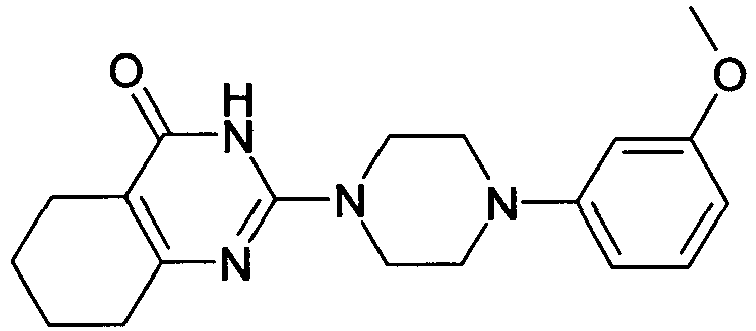
- 2-Methylsulfanyl-5,6,7,8-tetrahydro-3H-quinazolin-4-one (100 mg; 0.51 mmol), 1-(3-methoxyphenyl)piperazine hydrochloride (116.5 mg; 0.51 mmol) and triethylamine (141.3 µl; 1.02 mmol) are reacted in isoamyl alcohol (1 ml) in accordance with the procedure for Example 1 (reaction time 4 h) and worked up; yield: 79 mg (45%), crystals;
1H NMR (400 MHz, DMSO-d6) δ [ppm] 11.13 (bs, 1 H), 7.17 - 7.05 (m, 1 H), 6.58 - 6.52 (m, 1 H), 6.48 (t, J = 2.3 Hz, 1 H), 6.42 - 6.36 (m, 1 H), 3.76 - 3.69 (s, 3H), 3.71 - 3.61 (m, 4H), 3.21 - 3.09 (m, 4H), 2.43 - 2.33 (m, 2H), 2.31 - 2.18 (m, 2H), 1.73 - 1.54 (m, 4H). -

- 2-Methylsulfanyl-5,6,7,8-tetrahydro-3H-quinazolin-4-one (100 mg; 0.51 mmol) and 1-(4-chlorophenyl)piperazine (100.2 mg; 0.51 mmol) are reacted in isoamyl alcohol (1 ml) in accordance with the procedure for Example 1 and worked up; yield: 83 mg (47%), crystals;
1H NMR (500 MHz, DMSO-d6) δ [ppm] 11.14 (bs, 1H), 7.29 - 7.19 (m, 2H), 7.04 - 6.91 (m, 2H), 3.75 - 3.58 (m, 4H), 3.23 - 3.11 (m, 4H), 2.43 - 2.32 (m, 2H), 2.31 - 2.18 (m, 2H), 1.72 - 1.56 (m, 4H). -

- 2-Methylsulfanyl-5,6,7,8-tetrahydro-3H-quinazolin-4-one (100 mg; 0.51 mmol) and 1-(2-chlorophenyl)piperazine (84.9 µl; 0.51 mmol) are reacted in isoamyl alcohol (1 ml) in accordance with the procedure for Example 1 and worked up; yield: 65 mg (37%), crystals;
1H NMR (500 MHz, DMSO-d6) δ [ppm] 11.12 (bs, 1 H), 7.42 (dd, J = 7.9, 1.6 Hz, 1H), 7.35 - 7.26 (m, 1H), 7.23 - 7.13 (m, 1H), 7.11 - 7.01 (m, 1H), 3.78 - 3.63 (m, 4H), 3.06 - 2.95 (m, 4H), 2.43 - 2.33 (m, 2H), 2.32 - 2.20 (m, 2H), 1.74 - 1.57 (m, 4H). -
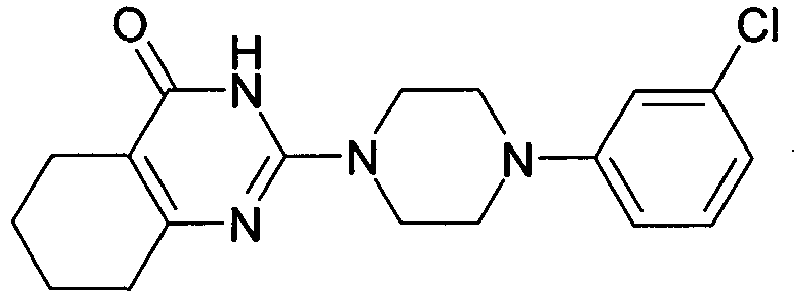
- 2-Methylsulfanyl-5,6,7,8-tetrahydro-3H-quinazolin-4-one (100 mg; 0.51 mmol), 1-(3-chlorophenyl)piperazine hydrochloride (118.8 mg; 0.51 mmol) and triethylamine (141.3 µl; 1.02 mmol) are reacted in isoamyl alcohol (1 ml) in accordance with the procedure for Example 1 (reaction time 4 h) and worked up; yield: 51 mg (29%), crystals;
1H NMR (400 MHz, DMSO-d6) δ [ppm] 11.13 (bs, 1H), 7.29 - 7.14 (m, 1 H), 7.04 - 6.87 (m, 2H), 6.86 - 6.74 (m, 1 H), 3.77 - 3.56 (m, 4H), 3.26 - 3.13 (m, 3H), 2.43 - 2.32 (m, 2H), 2.30 - 2.17 (m, 2H), 1.76 - 1.49 (m, 4H). -
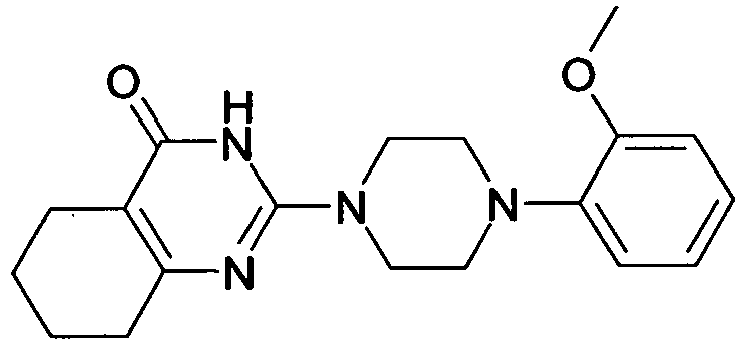
- 2-Methylsulfanyl-5,6,7,8-tetrahydro-3H-quinazolin-4-one (100 mg; 0.51 mmol) and 1-(2-methoxyphenyl)piperazine (98 mg; 0.51 mmol) are reacted in isoamyl alcohol (1 ml) in accordance with the procedure for Example 1 (reaction time 4 h) and worked up; yield: 52 mg (30%), crystals;
1H NMR (400 MHz, DMSO-d6) δ [ppm] 11.07 (bs, 1 H), 7.03 - 6.83 (m, 4H), 3.79 (s, 3H), 3.70 - 3.61 (m, 4H), 3.01 - 2.92 (m, 4H), 2.42 - 2.33 (m, 2H), 2.30 - 2.20 (m, 2H), 1.73 - 1.56 (m, 4H). -

- 2-Methylsulfanyl-5,6,7,8-tetrahydro-3H-quinazolin-4-one (100 mg; 0.51 mmol) and 1-tert-butylpiperazine (72.5 mg; 0.51 mmol) are reacted in isoamyl alcohol (1 ml) in accordance with the procedure for Example 1 and worked up; yield: 42 mg (28%), crystals.
-
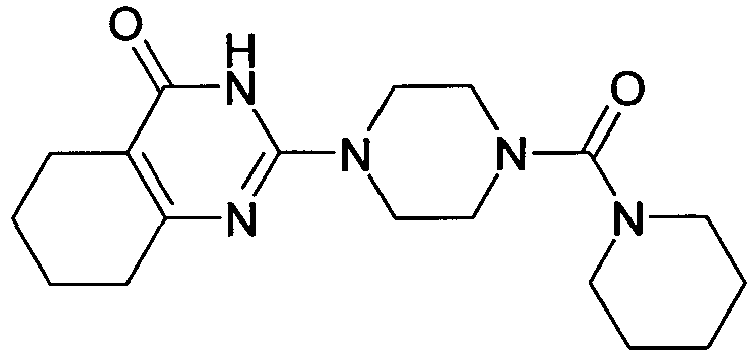
- 2-Methylsulfanyl-5,6,7,8-tetrahydro-3H-quinazolin-4-one (100 mg; 0.51 mmol) and piperazin-1-ylpiperidin-1-ylmethanone (100.5 mg; 0.51 mmol) are reacted in isoamyl alcohol (1 ml) in accordance with the procedure for Example 1. After a reaction time of 4 h, piperazin-1-ylpiperidin-1-ylmethanone (50.3 mg; 0.26 mmol) and isoamyl alcohol (0.5 ml) are again added, and the mixture is again irradiated in the microwave for 4 h. The crystals obtained after conventional work-up are dissolved in acetonitrile and water and freeze-dried; yield: 17 mg (9%), crystals;
1H NMR (500 MHz, DMSO-d6) δ [ppm] 3.81 - 3.74 (m, 4H), 3.36 - 3.29 (m, 4H), 3.25 - 3.15 (m, 4H), 2.67 - 2.61 (m, 2H), 2.38 - 2.31 (m, 2H), 1.81 - 1.67 (m, 4H), 1.63 - 1.47 (m, 6H). -

- 2-Methylsulfanyl-5,6,7,8-tetrahydro-3H-quinazolin-4-one (100 mg; 0.51 mmol) and 6-piperazin-1-ylpyridin-2-ol (91.3 mg; 0.51 mmol) are reacted in isoamyl alcohol (1 ml) in accordance with the procedure for Example 9 and worked up. The crude product obtained after conventional work-up is purified by column chromatography, triturated with diethyl ether, filtered off with suction and dried; yield: 17 mg (10%), crystals;
1H NMR (500 MHz, DMSO-d6) δ [ppm] 11.04 (bs, 1H), 10.38 (bs, 1H), 7.43 - 7.28 (m, 1 H), 6.21 - 6.05 (m, 1 H), 5.88 (d, J = 7.9 Hz, 1 H), 3.67 - 3.57 (m, 4H), 3.50 - 3.37 (m, 4H), 2.43 - 2.33 (m, 2H), 2.29 - 2.17 (m, 2H), 1.72 - 1.56 (m, 4H). -

- 2-Methylsulfanyl-5,6,7,8-tetrahydro-3H-quinazolin-4-one (100 mg; 0.51 mmol), phenylpiperazin-1-ylmethanone hydrochloride (115.5 mg; 0.51 mmol) and triethylamine (141.3 µl; 1.02 mmol) are reacted in isoamyl alcohol (1 ml) in accordance with the procedure for Example 9 (reaction time 6 h) and worked up. The crystals obtained after purification by column chromatography are dissolved in acetonitrile and water and freeze-dried; yield: 47 mg (27%), crystals;
1H NMR (400 MHz, DMSO-d6) δ [ppm] 11.12 (bs, 1 H), 7.52 - 7.36 (m, 5H), 3.84 - 3.32 (m, 8H), 2.43 - 2.31 (m, 2H), 2.31 - 2.16 (m, 2H), 1.74 - 1.54 (m, 4H). -
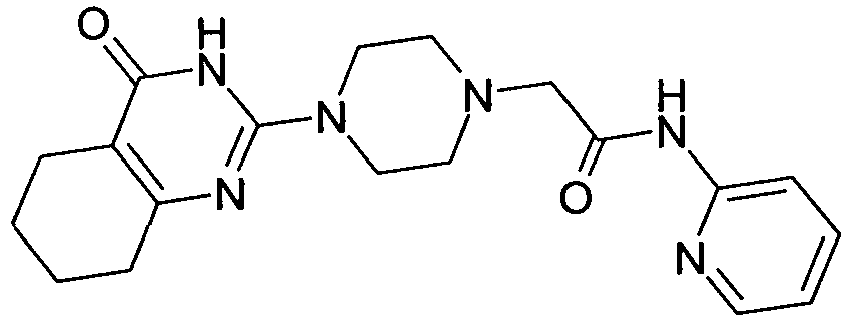
- 2-Methylsulfanyl-5,6,7,8-tetrahydro-3H-quinazolin-4-one (100 mg; 0.51 mmol), N-(2-pyridyl)-2-(piperazin-1-yl)acetamide * 3HCl * 2H2O (279.5 mg; 0.76 mmol) and triethylamine (282.5 µl; 2.04 mmol) are reacted in isoamyl alcohol (2 ml) in accordance with the procedure for Example 9 (reaction time 8 h) and worked up. The crystals obtained are dissolved in acetonitrile and water and freeze-dried; yield: 19 mg (10%), crystals;
1H NMR (500 MHz, DMSO-d6) δ [ppm] 11.06 (bs, 1H), 9.97 (bs, 1H), 8.36 - 8.28 (m, 1 H), 8.09 (d, J = 8.3 Hz, 1 H), 7.85 - 7.74 (m, 1 H), 7.16 - 7.07 (m, 1 H), 3.65 - 3.53 (m, 4H), 3.23 (s, 2H), 2.61 - 2.54 (m, 4H), 2.40 - 2.31 (m, 2H), 2.27 - 2.19 (m, 2H), 1.72 - 1.53 (m, 4H). -

- 2-Methylsulfanyl-5,6,7,8-tetrahydro-3H-quinazolin-4-one (100 mg; 0.51 mmol) and N-acetylpiperazine (98 mg; 0.76 mmol) are reacted in isoamyl alcohol (1 ml) in accordance with the procedure for Example 1 (reaction time 8 h) and worked up. The crude product obtained in this way is purified by column chromatography; yield: 12 mg (8%), crystals;
1H NMR (500 MHz, DMSO-d6) δ [ppm] 11.11 (bs, 1 H), 3.61 - 3.40 (m, 8H), 2.41 - 2.32 (m, 2H), 2.28 - 2.20 (m, 2H), 2.02 (s, 3H), 1.70 - 1.57 (m, 4H). -

- 2-Methylsulfanyl-5,6,7,8-tetrahydro-3H-quinazolin-4-one (100 mg; 0.51 mmol) and piperazinocarboxylic acid morpholide (152.3 mg; 0.76 mmol) are reacted in isoamyl alcohol (1.5 ml) in accordance with the procedure for Example 1 (reaction time 8 h) and worked up. The crystals obtained are dissolved in acetonitrile and water and freeze-dried; yield: 38 mg (21%), crystals;
1H NMR (500 MHz, DMSO-d6) δ [ppm] 11.11 (bs, 1 H), 3.66 - 3.45 (m, 8H), 3.24 - 3.07 (m, 8H), 2.42 - 2.32 (m, 2H), 2.31 - 2.17 (m, 2H), 1.74 - 1.54 (m, 4H). -

- 2-Methylsulfanyl-5,6,7,8-tetrahydro-3H-quinazolin-4-one (100 mg; 0.51 mmol), N-(3-pyridyl)-2-(piperazin-1-yl)acetamide * 3HCl (251.9 mg; 0.76 mmol) and triethylamine (282.5 µl; 2.04 mmol) are reacted in isoamyl alcohol (2 ml) in accordance with the procedure for Example 1 (reaction time 4 h) and worked up.
-

- 2-Methylsulfanyl-5,6,7,8-tetrahydro-3H-quinazolin-4-one (100 mg; 0.51 mmol), 4-trifluoromethylpiperidine * HCl (97 mg; 0.51 mmol) and triethylamine (141.3 µl; 1.02 mmol) are reacted in isoamyl alcohol (1 ml) in accordance with the procedure for Example 1 (reaction time 4 h) and worked up. The crude product obtained in this way is purified by column chromatography; yield: 43 mg (28%), crystals;
1H NMR (400 MHz, DMSO-d6) δ [ppm] 11.06 (bs, 1H), 4.38 (d, J = 12.5 Hz, 2H), 2.94 - 2.73 (m, 2H), 2.67 - 2.45 (m, 1 H), 2.43 - 2.30 (m, 2H), 2.30 - 2.17 (m, 2H), 1.81 (d, J = 12.7 Hz, 2H), 1.74 - 1.52 (m, 4H), 1.46 - 1.24 (m, 2H). -
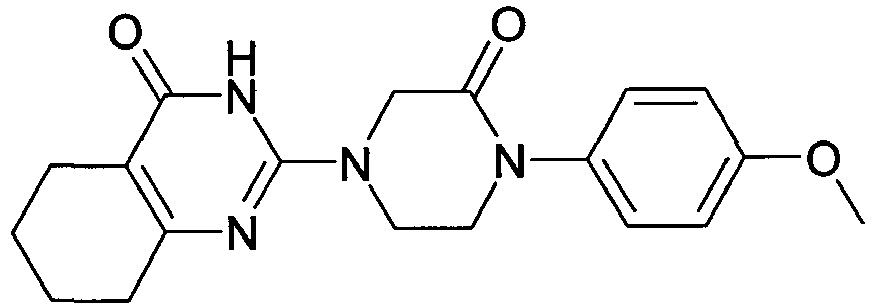
- 2-Methylsulfanyl-5,6,7,8-tetrahydro-3H-quinazolin-4-one (100 mg; 0.51 mmol) and 1-(4-methoxyphenyl)piperazin-2-one (105 mg; 0.51 mmol) are reacted in isoamyl alcohol (1 ml) in accordance with the procedure for Example 1 (reaction time 4 h) and worked up. The crude product obtained in this way is purified by column chromatography; yield: 8 mg (4%), crystals;
HPLC method P; RT/min 2,87. - Analogously, the following compounds are obtained
compound nr. name and/or structure HPLC method; RT/min "A3" reference 2-[4-(4-methoxy-phenyl)-piperazin-1-yl]-5,6,7,8-tetrahydro-3H-quinazolin-4-one P; 2,93 
1H NMR (500 MHz, DMSO-d6) δ [ppm] 11.10 (s, 1H), 6.99 - 6.89 (m, 2H), 6.87 - 6.77 (m, 2H), 3.74 - 3.60 (m, 7H), 3.08 - 2.94 (m, 4H), 2.43 - 2.31 (m, 2H), 2.29 - 2.18 (m, 2H), 1.74 - 1.55 (m, 4H) "A22" 2-[4-(4-oxo-5,6,7,8-tetrahydro-3H-quinazolin-2-yl)piperazin-1-yl]pyridine-3-carboxamide 
"A24" 2-[4-(2,2-dimethylpropanoyl)piperazin-1-yl]-5,6,7,8-tetrahydro-3H-quinazolin-4-one 
"A26" 2-[4-[2-(2-pyridyl)ethyl]piperazin-1-yl]-5,6,7,8-tetrahydro-3H-quinazolin-4-one P; 2,46 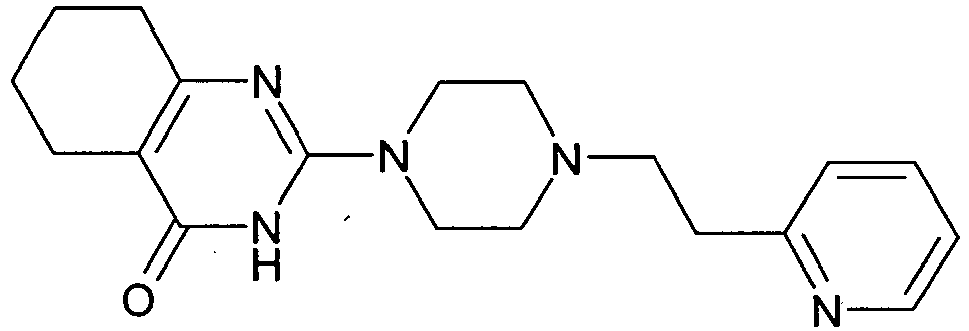
trifluoroacetate 1H NMR (400 MHz, DMSO-d6 + TFA-d1) δ [ppm] 9.00 - 8.92 (m, 1H), 8.62 - 8.54 (m, 1H), 8.12 - 8.06 (m, 1H), 8.04 - 7.95 (m, 1H), 4.18 - 3.99 (s, 4H), 3.73 - 3.65 (m, 2H), 3.64 - 3.51 (m, 6H), 2.73 - 2.65 (m, 2H), 2.44 - 2.34 (m, 2H), 1.85 - 1.67 (m, 4H) "A27" 2-[4-(piperidine-2-carbonyl)piperazin-1-yl]-5,6,7,8-tetrahydro-3H-quinazolin-4-one 
"A28" 4-(4-oxo-5,6,7,8-tetrahydro-3H-quinazolin-2-yl)piperazine-2-carboxamide 
"A30" (2R)-1-(4-oxo-5,6,7,8-tetrahydro-3H-quinazolin-2-yl)piperazine-2-carboxamide 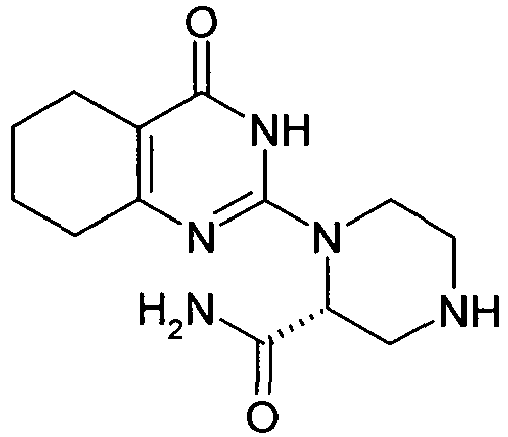
"A32" 2-[4-(3-pyridyl)piperazin-1-yl]-5,6,7,8-tetrahydro-3H-quinazolin-4-one P; 2,49 
1H NMR (400 MHz, DMSO-d6) δ [ppm] 11.17 (s, 1H), 8.33 (d, J = 2.9 Hz, 1H), 8.05 - 7.97 (m, 1H), 7.42 - 7.32 (m, 1H), 7.26 - 7.18 (m, 1H), 3.76 - 3.61 (m, 4H), 3.27- 3.20 (m, 4H), 2.43 - 2.34 (m, 2H), 2.31 - 2.19 (m, 2H), 1.73 - 1.55 (m, 4H) "A33" 2-[4-(4-oxo-5,6,7,8-tetrahydro-3H-quinazolin-2-yl)piperazin-1-yl]benzonitrile P; 3,03 
1H NMR (500 MHz, DMSO-d6) δ [ppm] 11.13 (s, 1 H), 7.76 - 7.67 (m, 1 H), 7.65 - 7.56 (m, 1H), 7.20 (d, J = 8.3 Hz, 1 H), 7.16 - 7.06 (m, 1 H), 3.77 - 3.66 (m, 4H), 3.23 - 3.13 (m, 4H), 2.44 - 2.33 (m, 2H), 2.30 - 2.19 (m, 2H), 1.73 - 1.56 (m, 4H) "A34" 2-[4-(4-oxo-5,6,7,8-tetrahydro-3H-quinazolin-2-yl)piperazin-1-yl]benzamide 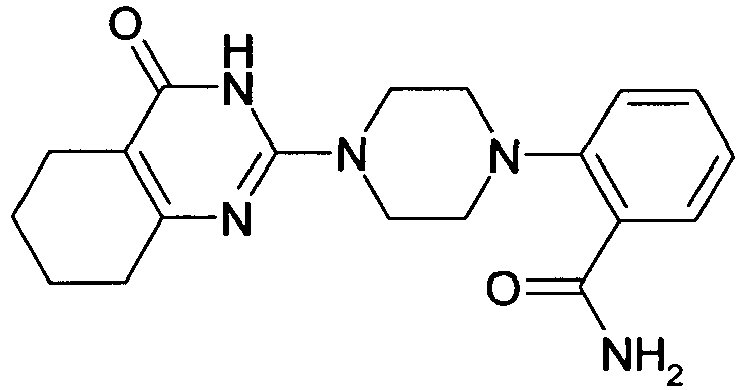
1H NMR (500 MHz, DMSO-d6) δ [ppm] 11.11 (s, 1H), 8.35 (s, 1H), 7.69 (dd, J = 7.7, 1.7 Hz, 1H), 7.48 (s, 1H), 7.42 (ddd, J = 8.1, 7.3, 1.8 Hz, 1H), 7.21-7.16 (m, 1H), 7.13 (td, J = 7.5, 1.1 Hz, 1H), 3.70 (t, J = 4.8 Hz, 4H), 2.96 (t, J = 5.0 Hz, 4H), 2.42 - 2.34 (m, 2H), 2.29 - 2.21 (m, 2H), 1.72-1.57 (m, 4H) "A35" 2-(4-hydroxy-4-phenyl-1-piperidyl)-5,6,7,8-tetrahydro-3H-quinazolin-4-one P; 2,83 
1H NMR (500 MHz, DMSO-d6) δ [ppm] 10.96 (s, 1H), 7.52 - 7.43 (m, 2H), 7.36 - 7.27 (m, 2H), 7.25 - 7.14 (m, 1H), 5.07 (s, 1H), 4.29 - 4.13 (m, 2H), 3.30 - 3.14 (m, 2H), 2.41 - 2.31 (m, 2H), 2.31 - 2.17 (m, 2H), 1.93 - 1.80 (m, 2H), 1.73 - 1.55 (m, 6H) "A36" 2-[4-(4-fluoro-2-methoxy-phenyl)piperazin-1-yl]-5,6,7,8-tetrahydro-3H-quinazolin-4-one 
1H NMR (400 MHz, DMSO-d6) δ [ppm] 11.06 (s, 1H), 6.96 - 6.83 (m, 2H), 6.75 - 6.63 (m, 1H), 3.82 (s, 3H), 3.66 (t, J = 4.7 Hz, 4H), 2.93 (t, J = 4.7 Hz, 4H), 2.43 - 2.35 (m, 2H), 2.31 - 2.20 (m, 2H), 1.76 -1.57 (m, 4H) "A37" 2-[4-(2,4-dimethoxyphenyl)piperazin-1-yl]-5,6,7,8-tetrahydro-3H-quinazolin-4-one P; 2,89 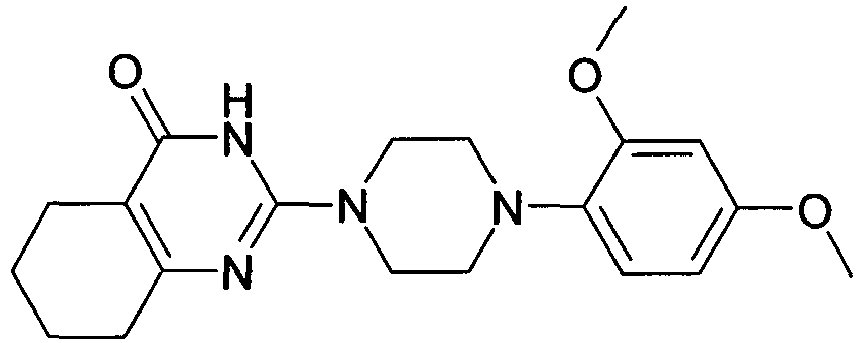
1H NMR (500 MHz, DMSO-d6) δ [ppm] 11.14 (s, 1H), 6.83 (d, J = 8.6 Hz, 1H), 6.54 (s, 1H), 6.44 (d, J = 8.7 Hz, 1H), 3.78 (s, 3H), 3.71 (s, 3H), 3.69 - 3.58 (m, 4H), 2.93 - 2.80 (m, 4H), 2.42 - 2.32 (m, 2H), 2.30 - 2.19 (m, 2H), 1.71 - 1.56 (m, 4H) "A38" 2-[4-(2-chloro-4-methoxy-phenyl)piperazin-1-yl]-5,6,7,8-tetrahydro-3H-quinazolin-4-one 
"A39" 2-[4-(2-chloro-4-fluoro-phenyl)piperazin-1-yl]-5,6,7,8-tetrahydro-3H-quinazolin-4-one 
1H NMR (500 MHz, DMSO-d6) δ [ppm] 11.10 (s, 1 H), 7.42 (dd, J = 8.6, 2.9 Hz, 1 H), 7.27 - 7.11 (m, 2H), 3.69 (t, J = 4.7 Hz, 4H), 2.96 (t, J = 4.9 Hz, 4H), 2.43 - 2.35 (m, 2H), 2.31 - 2.21 (m, 2H), 1.73 - 1.58 (m, 4H) "A40" 2-[4-(4-oxo-5,6,7,8-tetrahydro-3H-quinazolin-2-yl)piperazin-1-yl]acetamide 
"A42" 2-[4-(2-isopropoxyphenyl)piperazin-1-yl]-5,6,7,8-tetrahydro-3H-quinazolin-4-one P; 3,15 
1H NMR (500 MHz, DMSO-d6) δ [ppm] 11.07 (s, 1 H), 6.97 - 6.84 (m, 4H), 4.60 (hept, J = 6.1 Hz, 1 H), 3.71 - 3.60 (m, 4H), 3.05 - 2.95 (m, 4H), 2.41 - 2.32 (m, 2H), 2.30 - 2.19 (m, 2H), 1.72 - 1.56 (m, 4H), 1.30 - 1.24 (d, J = 6.0 Hz, 6H) "A43" 2-[4-[2-(trifluoromethoxy)phenyl]piperazin-1-yl]-5,6,7,8-tetrahydro-3H-quinazolin-4-one 
1H NMR (500 MHz, DMSO-d6) δ [ppm] 11.10 (s, 1H), 7.37 - 7.26 (m, 2H), 7.18 (dd, J= 8.1, 1.6 Hz, 1H), 7.10 (ddd, J = 8.1, 7.3, 1.6 Hz, 1H), 3.66 (t, J = 4.9 Hz, 4H), 3.02 (t, J = 4.9 Hz, 4H), 2.42 - 2.34 (m, 2H), 2.29 - 2.20 (m, 2H), 1.73 -1.55 (m, 4H) "A44" 2-[4-(6-methoxypyridazin-3-yl)piperazin-1-yl]-5,6,7,8-tetrahydro-3H-quinazolin-4-one P; 2,55 
1H NMR (500 MHz, DMSO-d6) δ [ppm] 11.12 (s, 1H), 7.43 (d, J = 9.6 Hz, 1H), 7.05 (d, J = 9.6 Hz, 1H), 3.90 (s, 3H), 3.66 (t, 4H), 3.49 (t, 4H), 2.43 - 2.34 (m, 2H), 2.29 - 2.20 (m, 2H), 1.72 - 1.55 (m, 4H) "A45" 4-[4-(4-oxo-5,6,7,8-tetrahydro-3H-quinazolin-2-yl)piperazin-1-yl]benzonitrile 
"A46" 2-[4-[4-(4-oxo-5,6,7,8-tetrahydro-3H-quinazolin-2-yl)piperazin-1-yl]phenyl]acetonitrile P; 2,95 
1H NMR (400 MHz, DMSO-d6) δ [ppm] 11.1 (brs, 1 H), 7.24 - 7.16 (m, 2H), 7.02 - 6.95 (m, 2H), 3.88 (s, 2H), 3.67 (t, J = 5.2 Hz, 4H), 3.17 (t, J = 5.2 Hz, 4H), 2.45 - 2.35 (m, 2H), 2.28 - 2.20 (m, 2H), 1.72 - 1.56 (m, 4H) "A47" 2-[4-[4-(trifluoromethoxy)phenyl]piperazin-1-yl]-5,6,7,8-tetrahydro-3H-quinazolin-4-one 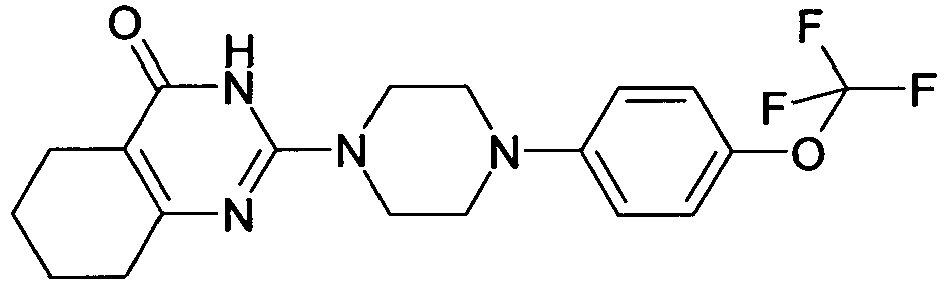
"A48" 2-[4-(4-ethoxyphenyl)piperazin-1-yl]-5,6,7,8-tetrahydro-3H-quinazolin-4-one P; 3,02 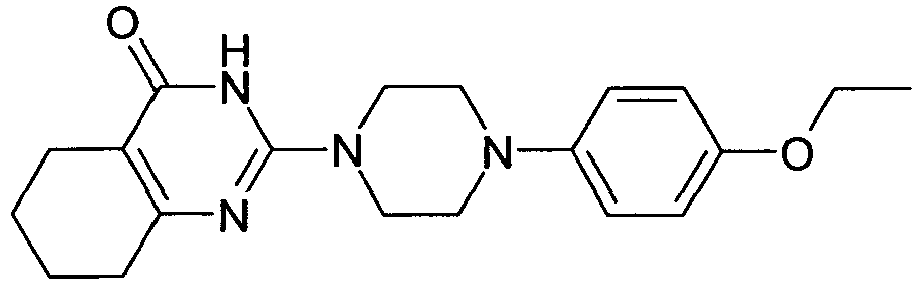
1H NMR (400 MHz, DMSO-d6) δ [ppm] 11.09 (s, 1 H), 6.96 - 6.87 (m, 2H), 6.86 - 6.76 (m, 2H), 3.94 (q, J = 6.9 Hz, 2H), 3.66 (t, J = 5.0 Hz, 4H), 3.02 (t, J = 5.1 Hz, 4H), 2.44 - 2.34 (m, 2H), 2.19 - 2.28 (m, 2H), 1.73 - 1.56 (m, 4H), 1.29 (t, J = 7.0 Hz, 3H) "A49" 2-[4-(4-isopropoxyphenyl)piperazin-1-yl]-5,6,7,8-tetrahydro-3H-quinazolin-4-one 
"A50" 2-[4-(4-trifluoromethylphenyl)piperazin-1-yl]-5,6,7,8-tetrahydro-3H-quinazolin-4-one P; 3,29 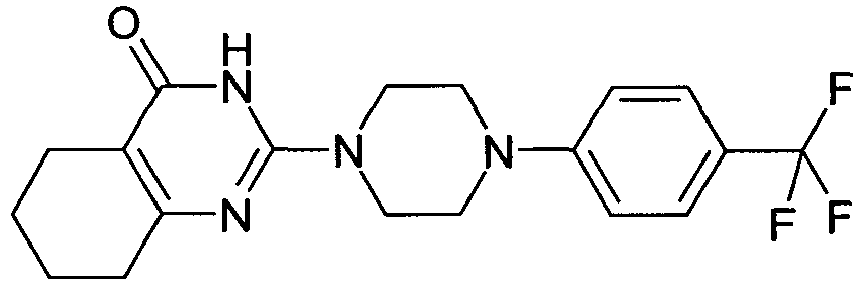
1H NMR (400 MHz, DMSO-d6) δ [ppm] 11.13 (s, 1H), 7.52 (d, J = 8.7 Hz, 2H), 7.09 (d, J = 8.7 Hz, 2H), 3.68 (t, 4H), 3.34 (t, 4H), 2.43 - 2.35 (m, 2H), 2.29 - 2.20 (m, 2H), 1.74 - 1.56 (m, 4H) "A51" 2-[4-(6-methoxy-3-pyridyl)piperazin-1-yl]-5,6,7,8-tetrahydro-3H-quinazolin-4-one N; 1,82 
1H NMR (500 MHz, DMSO-d6) δ [ppm] 7.81 (d, J = 3.0 Hz, 1H), 7.48 (dd, J = 9.0, 3.1 Hz, 1H), 6.72 (d, J = 9.0 Hz, 1H), 3.78 (s, 3H), 3.68 (t, J = 5.1 Hz, 4H), 3.06 (t, J = 5.1 Hz, 4H), 2.43 - 2.33 (m, 2H), 2.29 - 2.19 (m, 2H), 1.74 - 1.56 (m, 4H) "A52" 2-[4-(5-methoxy-2-pyridyl)piperazin-1-yl]-5,6,7,8-tetrahydro-3H-quinazolin-4-one 
"A21" 2-[4-(3-aminopropanoyl)piperazin-1-yl]-5,6,7,8-tetrahydro-3H-quinazolin-4-one 
"A25" 2-[4-(2-hydroxyethyl)piperazin-1-yl]-5,6,7,8-tetrahydro-3H-quinazolin-4-one P; 2,37 
1H NMR (400 MHz, DMSO-d6) δ [ppm] 10.96 (s, 1H), 4.38 (t, 1H), 3.56 - 3.45 (m, 6H), 2.47 - 2.29 (m, 8H), 2.28 - 2.17 (m, 2H), 1.71 - 1.54 (m, 4H) "A29" 2-[3-(hydroxymethyl)piperazin-1-yl]-5,6,7,8-tetrahydro-3H-quinazolin-4-one 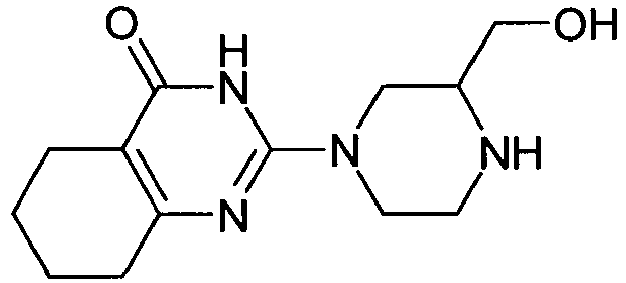
"A31" 2-[(2R)-2-(hydroxymethyl)piperazin-1-yl]-5,6,7,8-tetrahydro-3H-quinazolin-4-one 
"A41" 2-(3-phenylpiperazin-1-yl)-5,6,7,8-tetrahydro-3H-quinazolin-4-one 
"B1" 2-(4-tert-butyl-piperazin-1-yl)-5,6,7,8-tetrahydro-3H-quinazolin-4-one P; 2,48 
1H NMR (500 MHz, DMSO-d6 +TFA-d1) δ [ppm] 4.67 (d, J = 14.6 Hz, 2H), 3.71 (d, J = 12.1 Hz, 2H), 3.64 - 3.46 (m, 2H), 3.31 - 3.15 (m, 2H), 2.79 - 2.67 (m, 2H), 2.48 - 2.30 (m, 2H), 1.86 - 1.67 (m, 4H), 1.41 (s, 9H) "A53" 2-[4-hydroxy-4-(4-methoxy-phenyl)-piperidin-1-yl]-5,6,7,8-tetrahydro-3H-quinazolin-4-one P; 2,82 
1H NMR (500 MHz, DMSO-d6) δ [ppm] 10.93 (s, 1H), 7.42 - 7.32 (m, 2H), 6.90 - 6.81 (m, 2H), 4.96 (s, 1H), 4.25 - 4.10 (m, 2H), 3.72 (s, 3H), 3.29 - 3.13 (m, 2H), 2.41 - 2.31 (m, 2H), 2.29 - 2.19 (m, 2H), 1.76 - 1.87 (m, 2H), 1.72 - 1.54 (m, 6H) "A54" 2-[4-(2-methoxy-phenyl)-piperidin-1-yl]-5,6,7,8-tetrahydro-3H-quinazolin-4-one P; 3,09 
1H NMR (500 MHz, DMSO-d6) δ [ppm] 10.97 (s, 1H), 7.22 - 7.09 (m, 2H), 6.96 (dd, J = 8.2, 1.1 Hz, 1H), 6.89 (td, J = 7.5, 1.1 Hz, 1H), 4.45 - 4.34 (m, 2H), 3.79 (s, 3H), 3.18 - 3.06 (m, 1H), 2.96 - 2.81 (m, 2H), 2.41 - 2.31 (m, 2H), 2.29 - 2.17 (m, 2H), 1.79 - 1.45 (m, 8H) "A55" 2-[4-(4-methoxy-phenyl)-piperidin-1-yl]-5,6,7,8-tetrahydro-3H-quinazolin-4-one P; 3,03 
1H NMR (500 MHz, DMSO-d6) δ [ppm] 10.98 (s, 1H), 7.18 - 7.11 (m, 2H), 6.88 - 6.81 (m, 2H), 4.43 (d, J=11.8, 2H), 3.71 (s, 3H), 2.91 - 2.81 (m, 2H), 2.75 - 2.64 (m, 1H), 2.41 - 2.33 (m, 2H), 2.27 - 2.21 (m, 2H), 1.79-1.72 (m, 2H), 1.72 - 1.57 (m, 4H), 1.57 - 1.45 (m, 2H) "A56" 2-[4-(2-trifluoromethyl-phenyl)-piperazin-1-yl]-5,6,7,8-tetrahydro-3H-quinazolin-4-one P; 3,30 
1H NMR (500 MHz, DMSO-d6) δ [ppm] 11.10 (s, 1H), 7.66 (m, 2H), 7.58 (d, J = 8.0 Hz, 1H), 7.41 - 7.31 (m, 1H), 3.66 (t, J = 4.6 Hz, 4H), 2.88 (t, J = 4.9 Hz, 4H), 2.43 - 2.33 (m, 2H), 2.20 - 2.30 (m, 2H), 1.73 - 1.57 (m, 4H) "A57" 2-[4-[2-(1-hydroxy-1-methylethyl)phenyl]piperazin-1-yl]-5,6,7,8-tetrahydro-3H-quinazolin-4-one 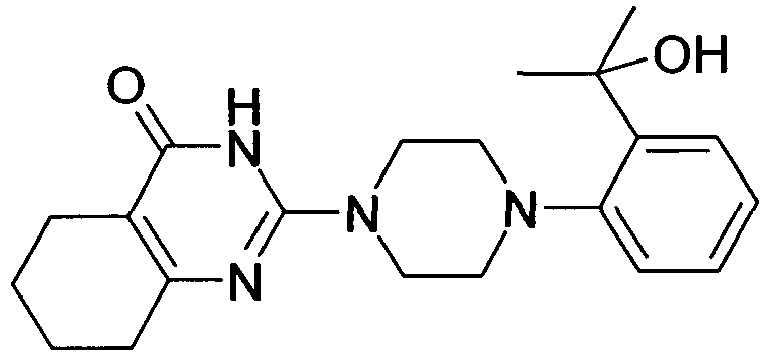
1H NMR (500 MHz, DMSO-d6) δ [ppm]11.13 (s, 1H), 7.48 (dd, J= 7.8, 1.7 Hz, 1H), 7.43 (dd, J = 7.9, 1.4 Hz, 1H), 7.24 (td, J = 7.5, 1.7 Hz, 1H), 7.18 (td, J = 7.5, 1.4 Hz, 1H), 7.10 (s, 1H), 4.55 - 4.25 (m, 2H), 3.05 - 2.75 (m, 6H), 2.44 - 2.32 (m, 2H), 2.30 - 2.21 (m, 2H), 1.73 - 1.57 (m, 4H), 1.51 (s, 6H). -
Table 2 Inhibition of tankyrases of some representative compounds of the formula I according to claim 1 Compound No. EC50 tankyrase 1/2 (cell assay) IC50 tankyrase 1 (enzyme assay) IC50 tankyrase 2 (enzyme assay) "A5" C B B "A6" B B B "A8" C B B "A9" B A B "A10" C B B "A11" B B B "A13" C B B "A14" C C C "A15" C C C "A16" C C C "A18" C B B "A19" C C C "A20" C C C "A25" C C "A26" B B "A32" B B "A33" B A B "A34" A B "A35" B B B "A36" B A B "A37" B B B "A39" B B B "A42" B B "A43" B C "A46" B B "A48" B B "A50" B B "A51" B B B "A53" B B B "A54" B A B "A55" C A B "A56" B A B IC50: < 0.3 µM = A 0.3 - 3 µM = B 3-50 µM = C - The compounds shown in Table 2 are particularly preferred compounds according to the invention.
Table 3 Inhibition of tankyrases and PARP1 of some representative compounds of the formula I according to claim 1 Compound No. IC50 tankyrase 1 (ELISA assay) IC50 tankyrase 2 (ELISA assay) IC50 PARP1 "A5" A A "A6" A A B "A8" A A "A9" A A B "A10" A A "A11" A A "A33" A A B "A34" A A A "A36" A A B "A37" A A "A39" A A "A48" A A "A50" "A51" B B "A53" "A54" A A "A55" A A "A56" A A IC50: < 0.3 µM = A 0.3 - 3 µM = B 3-50 µM = C - The following examples relate to medicaments:
- A solution of 100 g of an active ingredient of the formula I according to claim 1 and 5 g of disodium hydrogenphosphate in 3 I of bidistilled water is adjusted to pH 6.5 using 2 N hydrochloric acid, sterile filtered, transferred into injection vials, lyophilised under sterile conditions and sealed under sterile conditions. Each injection vial contains 5 mg of active ingredient.
- A mixture of 20 g of an active ingredient of the formula I according to claim 1 with 100 g of soya lecithin and 1400 g of cocoa butter is melted, poured into moulds and allowed to cool. Each suppository contains 20 mg of active ingredient.
- A solution is prepared from 1 g of an active ingredient of the formula I according to claim 1, 9.38 g of NaH2PO4 · 2 H2O, 28.48 g of Na2HPO4 · 12 H2O and 0.1 g of benzalkonium chloride in 940 ml of bidistilled water. The pH is adjusted to 6.8, and the solution is made up to 1 I and sterilised by irradiation. This solution can be used in the form of eye drops.
- 500 mg of an active ingredient of the formula I according to claim 1 are mixed with 99.5 g of Vaseline under aseptic conditions.
- A mixture of 1 kg of active ingredient of the formula I according to claim 1, 4 kg of lactose, 1.2 kg of potato starch, 0.2 kg of talc and 0.1 kg of magnesium stearate is pressed in a conventional manner to give tablets in such a way that each tablet contains 10 mg of active ingredient.
- Tablets are pressed analogously to Example E and subsequently coated in a conventional manner with a coating of sucrose, potato starch, talc, tragacanth and dye.
- 2 kg of active ingredient of the formula I according to claim 1 are introduced into hard gelatine capsules in a conventional manner in such a way that each capsule contains 20 mg of the active ingredient.
- A solution of 1 kg of active ingredient of the formula I according to claim 1 in 60 I of bidistilled water is sterile filtered, transferred into ampoules, lyophilised under sterile conditions and sealed under sterile conditions. Each ampoule contains 10 mg of active ingredient.
Subject matter presently claimed relates to the definition of the claims; all disclosure, which goes beyond the scope of the claims, only serves as information purposes.
The invention also relates to the optically active forms (stereoisomers), the enantiomers, the racemates, the diastereomers and the hydrates and solvates of these compounds.
The invention relates to compounds of formula I according to claim 1 and their tautomers of formula la

Claims (7)
- Compounds selected from the group
No. Name and/or structure "A5" 2-[4-(3-fluorophenyl)piperazin-1-yl]-5,6,7,8-tetrahydro-3H-quinazolin-4-one "A6" 2-[4-(4-fluorophenyl)piperazin-1-yl]-5,6,7,8-tetrahydro-3H-quinazolin-4-one "A8" 2-[4-(4-chlorophenyl)piperazin-1-yl]-5,6,7,8-tetrahydro-3H-quinazolin-4-one "A9" 2-[4-(2-chlorophenyl)piperazin-1-yl]-5,6,7,8-tetrahydro-3H-quinazolin-4-one "A10" 2-(4-trifluoromethylpiperidin-1-yl)-5,6,7,8-tetrahydro-3H-quinazolin-4-one "A11" 2-[4-(3-chlorophenyl)piperazin-1-yl]-5,6,7,8-tetrahydro-3H-quinazolin-4-one "A13" 2-(4-tert-butylpiperazin-1-yl)-5,6,7,8-tetrahydro-3H-quinazolin-4-one "A14" 2-[4-(4-methoxyphenyl)-3-oxopiperazin-1-yl]-5,6,7,8-tetrahydro-3H-quinazolin-4-one "A15" 2-[4-(piperidine-1-carbonyl)piperazin-1-yl]-5,6,7,8-tetrahydro-3H-quinazolin-4-one "A16" 2-[4-(6-hydroxypyridin-2-yl)piperazin-1-yl]-5,6,7,8-tetrahydro-3H-quinazolin-4-one "A18" N-pyridin-2-yl-2-[4-(4-oxo-3,4,5,6,7,8-hexahydroquinazolin-2-yl)piperazin-1-yl]acetamide "A19" 2-(4-acetylpiperazin-1-yl)-5,6,7,8-tetrahydro-3H-quinazolin-4-one "A20" 2-[4-(morpholine-4-carbonyl)piperazin-1-yl]-5,6,7,8-tetrahydro-3H-quinazolin-4-one "A21" 2-[4-(3-aminopropanoyl)piperazin-1-yl]-5,6,7,8-tetrahydro-3H-quinazolin-4-one "A22" 2-[4-(4-oxo-5,6,7,8-tetrahydro-3H-quinazolin-2-yl)piperazin-1-yl]pyridine-3-carboxamide "A23" 2-[4-(4-oxo-3,4,5,6,7,8-hexahydroquinazolin-2-yl)piperazin-1-yl]-N-pyridin-3-ylacetamide "A24" 2-[4-(2,2-dimethylpropanoyl)piperazin-1-yl]-5,6,7,8-tetrahydro-3H-quinazolin-4-one "A25" 2-[4-(2-hydroxyethyl)piperazin-1-yl]-5,6,7,8-tetrahydro-3H-quinazolin-4-one "A26" 2-[4-[2-(2-pyridyl)ethyl]piperazin-1-yl]-5,6,7,8-tetrahydro-3H-quinazolin-4-one "A27" 2-[4-(piperidine-2-carbonyl)piperazin-1-yl]-5,6,7,8-tetrahydro-3H-quinazolin-4-one "A28" 4-(4-oxo-5,6,7,8-tetrahydro-3H-quinazolin-2-yl)piperazine-2-carboxamide "A29" 2-[3-(hydroxymethyl)piperazin-1-yl]-5,6,7,8-tetrahydro-3H-quinazolin-4-one "A30" (2R)-1-(4-oxo-5,6,7,8-tetrahydro-3H-quinazolin-2-yl)piperazine-2-carboxamide "A31" 2-[(2R)-2-(hydroxymethyl)piperazin-1-yl]-5,6,7,8-tetrahydro-3H-quinazolin-4-one "A32" 2-[4-(3-pyridyl)piperazin-1-yl]-5,6,7,8-tetrahydro-3H-quinazolin-4-one "A33" 2-[4-(4-oxo-5,6,7,8-tetrahydro-3H-quinazolin-2-yl)piperazin-1-yl]benzonitrile "A34" 2-[4-(4-oxo-5,6,7,8-tetrahydro-3H-quinazolin-2-yl)piperazin-1-yl]benzamide "A35" 2-(4-hydroxy-4-phenyl-1-piperidyl)-5,6,7,8-tetrahydro-3H-quinazolin-4-one "A36" 2-[4-(4-fluoro-2-methoxy-phenyl)piperazin-1-yl]-5,6,7,8-tetrahydro-3H-quinazolin-4-one "A37" 2-[4-(2,4-dimethoxyphenyl)piperazin-1-yl]-5,6,7,8-tetrahydro-3H-quinazolin-4-one "A38" 2-[4-(2-chloro-4-methoxy-phenyl)piperazin-1-yl]-5,6,7,8-tetrahydro-3H-quinazolin-4-one "A39" 2-[4-(2-chloro-4-fluoro-phenyl)piperazin-1-yl]-5,6,7,8-tetrahydro-3H-quinazolin-4-one "A40" 2-[4-(4-oxo-5,6,7,8-tetrahydro-3H-quinazolin-2-yl)piperazin-1-yl]acetamide "A41" 2-(3-phenylpiperazin-1-yl)-5,6,7,8-tetrahydro-3H-quinazolin-4-one "A42" 2-[4-(2-isopropoxyphenyl)piperazin-1-yl]-5,6,7,8-tetrahydro-3H-quinazolin-4-one "A43" 2-[4-[2-(trifluoromethoxy)phenyl]piperazin-1-yl]-5,6,7,8-tetrahydro-3H-quinazolin-4-one "A44" 2-[4-(6-methoxypyridazin-3-yl)piperazin-1-yl]-5,6,7,8-tetrahydro-3H-quinazolin-4-one "A45" 4-[4-(4-oxo-5,6,7,8-tetrahydro-3H-quinazolin-2-yl)piperazin-1-yl]benzonitrile "A46" 2-[4-[4-(4-oxo-5,6,7,8-tetrahydro-3H-quinazolin-2-yl)piperazin-1-yl]phenyl]acetonitrile "A47" 2-[4-[4-(trifluoromethoxy)phenyl]piperazin-1-yl]-5,6,7,8-tetrahydro-3H-quinazolin-4-one "A48" 2-[4-(4-ethoxyphenyl)piperazin-1-yl]-5,6,7,8-tetrahydro-3H-quinazolin-4-one "A49" 2-[4-(4-isopropoxyphenyl)piperazin-1-yl]-5,6,7,8-tetrahydro-3H-quinazolin-4-one "A50" 2-[4-(4-trifluoromethylphenyl)piperazin-1-yl]-5,6,7,8-tetrahydro-3H-quinazolin-4-one "A51" 2-[4-(6-methoxy-3-pyridyl)piperazin-1-yl]-5,6,7,8-tetrahydro-3H-quinazolin-4-one "A52" 2-[4-(5-methoxy-2-pyridyl)piperazin-1-yl]-5,6,7,8-tetrahydro-3H-quinazolin-4-one "A53" 2-[4-hydroxy-4-(4-methoxy-phenyl)-piperidin-1-yl]-5,6,7,8-tetrahydro-3H-quinazolin-4-one "A54" 2-[4-(2-methoxy-phenyl)-piperidin-1-yl]-5,6,7,8-tetrahydro-3H-quinazolin-4-one "A55" 2-[4-(4-methoxy-phenyl)-piperidin-1-yl]-5,6,7,8-tetrahydro-3H-quinazolin-4-one "A56" 2-[4-(2-trifluoromethyl-phenyl)-piperazin-1-yl]-5,6,7,8-tetrahydro-3H-quinazolin-4-one "A57" 2-[4-[2-(1-hydroxy-1-methyl-ethyl)phenyl]piperazin-1-yl]-5,6,7,8-tetrahydro-3H-quinazolin-4-one - Medicaments comprising at least one compound according to claim 1 and/or pharmaceutically acceptable salts, solvates, tautomers and stereoisomers thereof, including mixtures thereof in all ratios, and optionally an pharmaceutically acceptable carrier, excipient or vehicle.
- Compounds according to claim 1 and pharmaceutically acceptable salts, solvates, tautomers and stereoisomers thereof, including mixtures thereof in all ratios, for the use for the treatment and/or prevention of cancer, multiple sclerosis, cardiovascular diseases, central nervous system injury and different forms of inflammation.
- Compounds for use according to claim 3 for the treatment and/or prevention of diseases selected from the group cancer of head, neck, eye, mouth, throat, esophagus, bronchus, larynx, pharynx, chest, bone, lung, colon, rectum, stomach, prostate, urinary bladder, uterine, cervix, breast, ovaries, testicles or other reproductive organs, skin, thyroid, blood, lymph nodes, kidney, liver, pancreas, brain, central nervous system, solid tumors and blood-borne tumors.
- Medicaments comprising at least one compound according to claim 1 and/or pharmaceutically acceptable salts, solvates and stereoisomers thereof, including mixtures thereof in all ratios, and at least one further medicament active ingredient.
- Set (kit) consisting of separate packs of(a) an effective amount of a compound according to claim 1 and/or pharmaceutically acceptable salts, solvates, salts and stereoisomers thereof, including mixtures thereof in all ratios, and(b) an effective amount of a further medicament active ingredient.
- The compound according to claim 1 2-(4-tert-butyl-piperazin-1-yl)-5,6,7,8-tetrahydro-3H-quinazolin-4-one "A13"), and/or pharmaceutically acceptable salts, solvates, tautomers and stereoisomers thereof, including mixtures thereof in all ratios.
Priority Applications (4)
| Application Number | Priority Date | Filing Date | Title |
|---|---|---|---|
| HRP20160735TT HRP20160735T1 (en) | 2012-02-09 | 2013-01-14 | TETRAHYDRO-KINAZOLINONE DERIVATIVES AS TANK AND PARP INHIBITORS |
| RS20160507A RS55377B1 (en) | 2012-02-09 | 2013-01-14 | TETRAHYDRO-HINAZOLINONE DERIVATIVES AS TANK AND PARP INHIBITORS |
| EP13701703.4A EP2812323B1 (en) | 2012-02-09 | 2013-01-14 | Tetrahydro-quinazolinone derivatives as tank and parp inhibitors |
| SI201330228A SI2812323T1 (en) | 2012-02-09 | 2013-01-14 | Tetrahydro-quinazolinone derivatives as tank and parp inhibitors |
Applications Claiming Priority (3)
| Application Number | Priority Date | Filing Date | Title |
|---|---|---|---|
| EP12000841 | 2012-02-09 | ||
| PCT/EP2013/000078 WO2013117288A1 (en) | 2012-02-09 | 2013-01-14 | Tetrahydro-quinazolinone derivatives as tank and parp inhibitors |
| EP13701703.4A EP2812323B1 (en) | 2012-02-09 | 2013-01-14 | Tetrahydro-quinazolinone derivatives as tank and parp inhibitors |
Publications (2)
| Publication Number | Publication Date |
|---|---|
| EP2812323A1 EP2812323A1 (en) | 2014-12-17 |
| EP2812323B1 true EP2812323B1 (en) | 2016-04-06 |
Family
ID=47628092
Family Applications (1)
| Application Number | Title | Priority Date | Filing Date |
|---|---|---|---|
| EP13701703.4A Active EP2812323B1 (en) | 2012-02-09 | 2013-01-14 | Tetrahydro-quinazolinone derivatives as tank and parp inhibitors |
Country Status (31)
| Country | Link |
|---|---|
| US (1) | US9339503B2 (en) |
| EP (1) | EP2812323B1 (en) |
| JP (1) | JP6116592B2 (en) |
| KR (1) | KR20140121477A (en) |
| CN (1) | CN104093714B (en) |
| AR (1) | AR089944A1 (en) |
| AU (1) | AU2013218357B2 (en) |
| BR (1) | BR112014019357A8 (en) |
| CA (1) | CA2863991C (en) |
| CL (1) | CL2014002097A1 (en) |
| CO (1) | CO7020919A2 (en) |
| DK (1) | DK2812323T3 (en) |
| EA (1) | EA026611B1 (en) |
| EC (1) | ECSP14017586A (en) |
| ES (1) | ES2579980T3 (en) |
| HR (1) | HRP20160735T1 (en) |
| HU (1) | HUE029717T2 (en) |
| IL (1) | IL233984A (en) |
| MX (1) | MX349736B (en) |
| NZ (1) | NZ630170A (en) |
| PE (1) | PE20141823A1 (en) |
| PH (1) | PH12014501581A1 (en) |
| PL (1) | PL2812323T3 (en) |
| PT (1) | PT2812323T (en) |
| RS (1) | RS55377B1 (en) |
| SG (1) | SG11201404654SA (en) |
| SI (1) | SI2812323T1 (en) |
| TW (1) | TWI572593B (en) |
| UA (1) | UA116627C2 (en) |
| WO (1) | WO2013117288A1 (en) |
| ZA (1) | ZA201406579B (en) |
Families Citing this family (13)
| Publication number | Priority date | Publication date | Assignee | Title |
|---|---|---|---|---|
| RU2696572C2 (en) | 2012-03-07 | 2019-08-05 | Инститьют Оф Кансер Ресёрч: Ройял Кансер Хоспитал (Зе) | 3-aryl-5-substituted isoquinolin-1-one compounds and their therapeutic application |
| US9505749B2 (en) | 2012-08-29 | 2016-11-29 | Amgen Inc. | Quinazolinone compounds and derivatives thereof |
| SG11201503670YA (en) | 2012-12-31 | 2015-07-30 | Cadila Healthcare Ltd | Substituted phthalazin-1 (2h)-one derivatives as selective inhibitors of poly (adp-ribose) polymerase-1 |
| JP6456392B2 (en) | 2013-09-11 | 2019-01-23 | インスティチュート オブ キャンサー リサーチ:ロイヤル キャンサー ホスピタル | 3-Aryl-5-substituted isoquinolin-1-one compounds and therapeutic uses thereof |
| BR112016008994A2 (en) | 2013-11-07 | 2017-09-19 | Lilly Co Eli | PYRIDO[2,3-D]PYRIMIDIN-4-ONE COMPOUNDS AS TANCHIRASE INHIBITORS |
| WO2016192657A1 (en) | 2015-06-03 | 2016-12-08 | Sunshine Lake Pharma Co., Ltd. | Substituted piperazine compounds and methods of use and use thereof |
| KR101777475B1 (en) * | 2015-12-08 | 2017-09-11 | 에스티팜 주식회사 | Novel dihydropyranopyrimidinone derivatives, and use thereof |
| WO2017156350A1 (en) | 2016-03-09 | 2017-09-14 | K-Gen, Inc. | Methods of cancer treatment |
| JP6923138B2 (en) * | 2016-06-30 | 2021-08-18 | 国立研究開発法人理化学研究所 | New compound or pharmacologically acceptable salt thereof |
| CN108727302A (en) * | 2017-10-23 | 2018-11-02 | 科迈化工股份有限公司 | A kind of environment-friendly type N tert butyl benzothiazole 2 sulfenamide(NS)Synthesis technology |
| ES2998084T3 (en) | 2017-12-27 | 2025-02-19 | Japanese Found For Cancer Res | Novel dihydroquinazolinone compound or pharmacologically acceptable salt, and cell growth inhibitor |
| US20210060016A1 (en) | 2017-12-27 | 2021-03-04 | Japanese Foundation For Cancer Research | Anticancer agent |
| WO2020035031A1 (en) | 2018-08-16 | 2020-02-20 | Genentech, Inc. | Fused ring compounds |
Family Cites Families (18)
| Publication number | Priority date | Publication date | Assignee | Title |
|---|---|---|---|---|
| GB9624482D0 (en) | 1995-12-18 | 1997-01-15 | Zeneca Phaema S A | Chemical compounds |
| AU719434B2 (en) | 1996-02-13 | 2000-05-11 | Astrazeneca Ab | Quinazoline derivatives as VEGF inhibitors |
| ES2169355T3 (en) | 1996-03-05 | 2002-07-01 | Astrazeneca Ab | DERIVATIVES OF 4-ANILINOQUINAZOLINA. |
| GB9718972D0 (en) | 1996-09-25 | 1997-11-12 | Zeneca Ltd | Chemical compounds |
| GB9714249D0 (en) | 1997-07-08 | 1997-09-10 | Angiogene Pharm Ltd | Vascular damaging agents |
| GB9900334D0 (en) | 1999-01-07 | 1999-02-24 | Angiogene Pharm Ltd | Tricylic vascular damaging agents |
| GB9900752D0 (en) | 1999-01-15 | 1999-03-03 | Angiogene Pharm Ltd | Benzimidazole vascular damaging agents |
| EP1289952A1 (en) | 2000-05-31 | 2003-03-12 | AstraZeneca AB | Indole derivatives with vascular damaging activity |
| CA2411160A1 (en) | 2000-07-07 | 2002-01-17 | Angiogene Pharmaceuticals Limited | Colchinol derivatives as vascular damaging agents |
| MXPA02012903A (en) | 2000-07-07 | 2004-07-30 | Angiogene Pharm Ltd | Colchinol derivatives as angiogenesis inhibitors. |
| AUPR201600A0 (en) * | 2000-12-11 | 2001-01-11 | Fujisawa Pharmaceutical Co., Ltd. | Quinazolinone derivative |
| AUPR975601A0 (en) * | 2001-12-24 | 2002-01-31 | Fujisawa Pharmaceutical Co., Ltd. | Quinazolinone derivatives |
| AUPS019702A0 (en) * | 2002-01-29 | 2002-02-21 | Fujisawa Pharmaceutical Co., Ltd. | Condensed heterocyclic compounds |
| MXPA06014933A (en) * | 2004-06-30 | 2007-02-28 | Janssen Pharmaceutica Nv | Substituted 2-alkyl quinazolinone derivatives as parp inhibitors. |
| JP5102196B2 (en) | 2005-03-11 | 2012-12-19 | メルク パテント ゲゼルシャフト ミット ベシュレンクテル ハフツング | Tetrahydroquinazolinone and dihydroquinazolinone |
| EP2134691B1 (en) | 2007-03-08 | 2012-01-25 | Janssen Pharmaceutica, N.V. | Quinolinone derivatives as parp and tank inhibitors |
| WO2011078143A1 (en) | 2009-12-22 | 2011-06-30 | 塩野義製薬株式会社 | Pyrimidine derivatives and pharmaceutical composition containing same |
| WO2011111880A1 (en) * | 2010-03-08 | 2011-09-15 | 주식회사 메디젠텍 | Pharmaceutical composition for treating or preventing diseases caused by the nuclear export of gsk3, including a compound for inhibiting the nuclear export of gsk3 |
-
2013
- 2013-01-14 EP EP13701703.4A patent/EP2812323B1/en active Active
- 2013-01-14 RS RS20160507A patent/RS55377B1/en unknown
- 2013-01-14 MX MX2014009491A patent/MX349736B/en active IP Right Grant
- 2013-01-14 EA EA201400879A patent/EA026611B1/en not_active IP Right Cessation
- 2013-01-14 SI SI201330228A patent/SI2812323T1/en unknown
- 2013-01-14 HU HUE13701703A patent/HUE029717T2/en unknown
- 2013-01-14 SG SG11201404654SA patent/SG11201404654SA/en unknown
- 2013-01-14 BR BR112014019357A patent/BR112014019357A8/en not_active Application Discontinuation
- 2013-01-14 JP JP2014555963A patent/JP6116592B2/en active Active
- 2013-01-14 AU AU2013218357A patent/AU2013218357B2/en active Active
- 2013-01-14 US US14/378,009 patent/US9339503B2/en active Active
- 2013-01-14 ES ES13701703.4T patent/ES2579980T3/en active Active
- 2013-01-14 DK DK13701703.4T patent/DK2812323T3/en active
- 2013-01-14 CA CA2863991A patent/CA2863991C/en active Active
- 2013-01-14 HR HRP20160735TT patent/HRP20160735T1/en unknown
- 2013-01-14 NZ NZ630170A patent/NZ630170A/en not_active IP Right Cessation
- 2013-01-14 PL PL13701703.4T patent/PL2812323T3/en unknown
- 2013-01-14 PT PT137017034T patent/PT2812323T/en unknown
- 2013-01-14 CN CN201380008647.2A patent/CN104093714B/en active Active
- 2013-01-14 UA UAA201409705A patent/UA116627C2/en unknown
- 2013-01-14 PE PE2014001242A patent/PE20141823A1/en not_active Application Discontinuation
- 2013-01-14 KR KR1020147024967A patent/KR20140121477A/en not_active Ceased
- 2013-01-14 WO PCT/EP2013/000078 patent/WO2013117288A1/en not_active Ceased
- 2013-02-08 TW TW102105039A patent/TWI572593B/en not_active IP Right Cessation
- 2013-02-08 AR ARP130100401A patent/AR089944A1/en unknown
-
2014
- 2014-07-09 PH PH12014501581A patent/PH12014501581A1/en unknown
- 2014-07-30 CO CO14165918A patent/CO7020919A2/en unknown
- 2014-08-06 IL IL233984A patent/IL233984A/en active IP Right Grant
- 2014-08-07 CL CL2014002097A patent/CL2014002097A1/en unknown
- 2014-09-05 EC ECIEPI201417586A patent/ECSP14017586A/en unknown
- 2014-09-08 ZA ZA2014/06579A patent/ZA201406579B/en unknown
Also Published As
Similar Documents
| Publication | Publication Date | Title |
|---|---|---|
| EP2812323B1 (en) | Tetrahydro-quinazolinone derivatives as tank and parp inhibitors | |
| EP2897958B1 (en) | Hydropyrrolopyrrole derivatives for use as fatty acid synthase inhibitors | |
| EP2882714B1 (en) | (aza-)isoquinolinone derivatives | |
| EP2844659B1 (en) | Pyrrolotriazinone derivatives | |
| EP2831077B1 (en) | Bicyclic pyrazinone derivatives | |
| US9388142B2 (en) | Quinazolinone derivatives as PARP inhibitors | |
| US8436186B2 (en) | Thiazolyl piperidine derivatives | |
| EP2976328B1 (en) | Piperazine derivatives as fasn inhibitors | |
| US20080234266A1 (en) | Squaric Acid Derivatives II | |
| EP2920146B1 (en) | 3-aminocyclopentane carboxamide derivatives | |
| US20080312244A1 (en) | Squaric Acid Derivatives as Protein Kinase Inhibitors |
Legal Events
| Date | Code | Title | Description |
|---|---|---|---|
| PUAI | Public reference made under article 153(3) epc to a published international application that has entered the european phase |
Free format text: ORIGINAL CODE: 0009012 |
|
| 17P | Request for examination filed |
Effective date: 20140603 |
|
| AK | Designated contracting states |
Kind code of ref document: A1 Designated state(s): AL AT BE BG CH CY CZ DE DK EE ES FI FR GB GR HR HU IE IS IT LI LT LU LV MC MK MT NL NO PL PT RO RS SE SI SK SM TR |
|
| AX | Request for extension of the european patent |
Extension state: BA ME |
|
| DAX | Request for extension of the european patent (deleted) | ||
| 17Q | First examination report despatched |
Effective date: 20150521 |
|
| GRAP | Despatch of communication of intention to grant a patent |
Free format text: ORIGINAL CODE: EPIDOSNIGR1 |
|
| INTG | Intention to grant announced |
Effective date: 20151112 |
|
| GRAS | Grant fee paid |
Free format text: ORIGINAL CODE: EPIDOSNIGR3 |
|
| GRAA | (expected) grant |
Free format text: ORIGINAL CODE: 0009210 |
|
| AK | Designated contracting states |
Kind code of ref document: B1 Designated state(s): AL AT BE BG CH CY CZ DE DK EE ES FI FR GB GR HR HU IE IS IT LI LT LU LV MC MK MT NL NO PL PT RO RS SE SI SK SM TR |
|
| REG | Reference to a national code |
Ref country code: GB Ref legal event code: FG4D |
|
| REG | Reference to a national code |
Ref country code: AT Ref legal event code: REF Ref document number: 787680 Country of ref document: AT Kind code of ref document: T Effective date: 20160415 Ref country code: CH Ref legal event code: EP |
|
| REG | Reference to a national code |
Ref country code: IE Ref legal event code: FG4D |
|
| REG | Reference to a national code |
Ref country code: DK Ref legal event code: T3 Effective date: 20160503 |
|
| REG | Reference to a national code |
Ref country code: DE Ref legal event code: R096 Ref document number: 602013006199 Country of ref document: DE |
|
| REG | Reference to a national code |
Ref country code: HR Ref legal event code: TUEP Ref document number: P20160735 Country of ref document: HR |
|
| REG | Reference to a national code |
Ref country code: RO Ref legal event code: EPE |
|
| REG | Reference to a national code |
Ref country code: PT Ref legal event code: SC4A Ref document number: 2812323 Country of ref document: PT Date of ref document: 20160713 Kind code of ref document: T Free format text: AVAILABILITY OF NATIONAL TRANSLATION Effective date: 20160705 |
|
| REG | Reference to a national code |
Ref country code: SE Ref legal event code: TRGR |
|
| REG | Reference to a national code |
Ref country code: NL Ref legal event code: FP |
|
| REG | Reference to a national code |
Ref country code: HR Ref legal event code: T1PR Ref document number: P20160735 Country of ref document: HR |
|
| REG | Reference to a national code |
Ref country code: EE Ref legal event code: FG4A Ref document number: E012069 Country of ref document: EE Effective date: 20160701 |
|
| REG | Reference to a national code |
Ref country code: ES Ref legal event code: FG2A Ref document number: 2579980 Country of ref document: ES Kind code of ref document: T3 Effective date: 20160818 |
|
| REG | Reference to a national code |
Ref country code: NO Ref legal event code: T2 Effective date: 20160406 |
|
| PG25 | Lapsed in a contracting state [announced via postgrant information from national office to epo] |
Ref country code: GR Free format text: LAPSE BECAUSE OF FAILURE TO SUBMIT A TRANSLATION OF THE DESCRIPTION OR TO PAY THE FEE WITHIN THE PRESCRIBED TIME-LIMIT Effective date: 20160707 |
|
| REG | Reference to a national code |
Ref country code: SK Ref legal event code: T3 Ref document number: E 21437 Country of ref document: SK |
|
| REG | Reference to a national code |
Ref country code: FR Ref legal event code: PLFP Year of fee payment: 5 |
|
| REG | Reference to a national code |
Ref country code: DE Ref legal event code: R097 Ref document number: 602013006199 Country of ref document: DE |
|
| PLBE | No opposition filed within time limit |
Free format text: ORIGINAL CODE: 0009261 |
|
| STAA | Information on the status of an ep patent application or granted ep patent |
Free format text: STATUS: NO OPPOSITION FILED WITHIN TIME LIMIT |
|
| PG25 | Lapsed in a contracting state [announced via postgrant information from national office to epo] |
Ref country code: SM Free format text: LAPSE BECAUSE OF FAILURE TO SUBMIT A TRANSLATION OF THE DESCRIPTION OR TO PAY THE FEE WITHIN THE PRESCRIBED TIME-LIMIT Effective date: 20160406 |
|
| 26N | No opposition filed |
Effective date: 20170110 |
|
| REG | Reference to a national code |
Ref country code: HU Ref legal event code: AG4A Ref document number: E029717 Country of ref document: HU |
|
| PG25 | Lapsed in a contracting state [announced via postgrant information from national office to epo] |
Ref country code: MC Free format text: LAPSE BECAUSE OF FAILURE TO SUBMIT A TRANSLATION OF THE DESCRIPTION OR TO PAY THE FEE WITHIN THE PRESCRIBED TIME-LIMIT Effective date: 20160406 |
|
| REG | Reference to a national code |
Ref country code: FR Ref legal event code: PLFP Year of fee payment: 6 |
|
| REG | Reference to a national code |
Ref country code: HR Ref legal event code: ODRP Ref document number: P20160735 Country of ref document: HR Payment date: 20171219 Year of fee payment: 6 |
|
| PGFP | Annual fee paid to national office [announced via postgrant information from national office to epo] |
Ref country code: EE Payment date: 20171227 Year of fee payment: 6 Ref country code: RO Payment date: 20171227 Year of fee payment: 6 Ref country code: SK Payment date: 20171213 Year of fee payment: 6 Ref country code: LT Payment date: 20171219 Year of fee payment: 6 Ref country code: NL Payment date: 20171213 Year of fee payment: 6 |
|
| PGFP | Annual fee paid to national office [announced via postgrant information from national office to epo] |
Ref country code: LU Payment date: 20171228 Year of fee payment: 6 Ref country code: HR Payment date: 20171219 Year of fee payment: 6 Ref country code: BE Payment date: 20171213 Year of fee payment: 6 Ref country code: RS Payment date: 20171212 Year of fee payment: 6 Ref country code: PL Payment date: 20171201 Year of fee payment: 6 Ref country code: IS Payment date: 20171212 Year of fee payment: 6 |
|
| PGFP | Annual fee paid to national office [announced via postgrant information from national office to epo] |
Ref country code: DK Payment date: 20180110 Year of fee payment: 6 Ref country code: FI Payment date: 20180110 Year of fee payment: 6 Ref country code: NO Payment date: 20180109 Year of fee payment: 6 Ref country code: CZ Payment date: 20180103 Year of fee payment: 6 |
|
| PGFP | Annual fee paid to national office [announced via postgrant information from national office to epo] |
Ref country code: PT Payment date: 20180112 Year of fee payment: 6 Ref country code: HU Payment date: 20171218 Year of fee payment: 6 Ref country code: IE Payment date: 20180110 Year of fee payment: 6 Ref country code: LV Payment date: 20180109 Year of fee payment: 6 Ref country code: AT Payment date: 20171228 Year of fee payment: 6 Ref country code: SI Payment date: 20171221 Year of fee payment: 6 Ref country code: SE Payment date: 20180213 Year of fee payment: 6 Ref country code: TR Payment date: 20180111 Year of fee payment: 6 |
|
| PGFP | Annual fee paid to national office [announced via postgrant information from national office to epo] |
Ref country code: MT Payment date: 20180116 Year of fee payment: 6 |
|
| PG25 | Lapsed in a contracting state [announced via postgrant information from national office to epo] |
Ref country code: AL Free format text: LAPSE BECAUSE OF FAILURE TO SUBMIT A TRANSLATION OF THE DESCRIPTION OR TO PAY THE FEE WITHIN THE PRESCRIBED TIME-LIMIT Effective date: 20160406 |
|
| PGFP | Annual fee paid to national office [announced via postgrant information from national office to epo] |
Ref country code: MK Payment date: 20171213 Year of fee payment: 6 |
|
| REG | Reference to a national code |
Ref country code: AT Ref legal event code: UEP Ref document number: 787680 Country of ref document: AT Kind code of ref document: T Effective date: 20160406 |
|
| REG | Reference to a national code |
Ref country code: HR Ref legal event code: PBON Ref document number: P20160735 Country of ref document: HR Effective date: 20190114 |
|
| REG | Reference to a national code |
Ref country code: LT Ref legal event code: MM4D Effective date: 20190114 |
|
| REG | Reference to a national code |
Ref country code: EE Ref legal event code: MM4A Ref document number: E012069 Country of ref document: EE Effective date: 20190131 |
|
| REG | Reference to a national code |
Ref country code: DK Ref legal event code: EBP Effective date: 20190131 Ref country code: NO Ref legal event code: MMEP |
|
| PG25 | Lapsed in a contracting state [announced via postgrant information from national office to epo] |
Ref country code: BG Free format text: LAPSE BECAUSE OF FAILURE TO SUBMIT A TRANSLATION OF THE DESCRIPTION OR TO PAY THE FEE WITHIN THE PRESCRIBED TIME-LIMIT Effective date: 20160406 |
|
| REG | Reference to a national code |
Ref country code: NL Ref legal event code: MM Effective date: 20190201 |
|
| REG | Reference to a national code |
Ref country code: AT Ref legal event code: MM01 Ref document number: 787680 Country of ref document: AT Kind code of ref document: T Effective date: 20190114 |
|
| PG25 | Lapsed in a contracting state [announced via postgrant information from national office to epo] |
Ref country code: LU Free format text: LAPSE BECAUSE OF NON-PAYMENT OF DUE FEES Effective date: 20190114 |
|
| REG | Reference to a national code |
Ref country code: SK Ref legal event code: MM4A Ref document number: E 21437 Country of ref document: SK Effective date: 20190114 |
|
| REG | Reference to a national code |
Ref country code: BE Ref legal event code: MM Effective date: 20190131 |
|
| REG | Reference to a national code |
Ref country code: SI Ref legal event code: KO00 Effective date: 20190926 Ref country code: IE Ref legal event code: MM4A |
|
| PG25 | Lapsed in a contracting state [announced via postgrant information from national office to epo] |
Ref country code: CY Free format text: LAPSE BECAUSE OF FAILURE TO SUBMIT A TRANSLATION OF THE DESCRIPTION OR TO PAY THE FEE WITHIN THE PRESCRIBED TIME-LIMIT Effective date: 20160406 Ref country code: LT Free format text: LAPSE BECAUSE OF NON-PAYMENT OF DUE FEES Effective date: 20190114 Ref country code: CZ Free format text: LAPSE BECAUSE OF NON-PAYMENT OF DUE FEES Effective date: 20190114 Ref country code: NO Free format text: LAPSE BECAUSE OF NON-PAYMENT OF DUE FEES Effective date: 20190131 Ref country code: EE Free format text: LAPSE BECAUSE OF NON-PAYMENT OF DUE FEES Effective date: 20190131 Ref country code: HR Free format text: LAPSE BECAUSE OF NON-PAYMENT OF DUE FEES Effective date: 20190114 Ref country code: RO Free format text: LAPSE BECAUSE OF NON-PAYMENT OF DUE FEES Effective date: 20190114 Ref country code: SE Free format text: LAPSE BECAUSE OF NON-PAYMENT OF DUE FEES Effective date: 20190115 Ref country code: SI Free format text: LAPSE BECAUSE OF NON-PAYMENT OF DUE FEES Effective date: 20190115 Ref country code: FI Free format text: LAPSE BECAUSE OF NON-PAYMENT OF DUE FEES Effective date: 20190114 Ref country code: SK Free format text: LAPSE BECAUSE OF NON-PAYMENT OF DUE FEES Effective date: 20190114 Ref country code: NL Free format text: LAPSE BECAUSE OF NON-PAYMENT OF DUE FEES Effective date: 20190201 Ref country code: PT Free format text: LAPSE BECAUSE OF NON-PAYMENT OF DUE FEES Effective date: 20190715 |
|
| PG25 | Lapsed in a contracting state [announced via postgrant information from national office to epo] |
Ref country code: BE Free format text: LAPSE BECAUSE OF NON-PAYMENT OF DUE FEES Effective date: 20190131 Ref country code: HU Free format text: LAPSE BECAUSE OF NON-PAYMENT OF DUE FEES Effective date: 20190115 Ref country code: LV Free format text: LAPSE BECAUSE OF NON-PAYMENT OF DUE FEES Effective date: 20190114 Ref country code: RS Free format text: LAPSE BECAUSE OF NON-PAYMENT OF DUE FEES Effective date: 20190716 |
|
| PG25 | Lapsed in a contracting state [announced via postgrant information from national office to epo] |
Ref country code: AT Free format text: LAPSE BECAUSE OF NON-PAYMENT OF DUE FEES Effective date: 20190114 Ref country code: IS Free format text: LAPSE BECAUSE OF FAILURE TO SUBMIT A TRANSLATION OF THE DESCRIPTION OR TO PAY THE FEE WITHIN THE PRESCRIBED TIME-LIMIT Effective date: 20190801 |
|
| PG25 | Lapsed in a contracting state [announced via postgrant information from national office to epo] |
Ref country code: DK Free format text: LAPSE BECAUSE OF NON-PAYMENT OF DUE FEES Effective date: 20190131 Ref country code: IE Free format text: LAPSE BECAUSE OF NON-PAYMENT OF DUE FEES Effective date: 20190114 |
|
| PG25 | Lapsed in a contracting state [announced via postgrant information from national office to epo] |
Ref country code: PL Free format text: LAPSE BECAUSE OF NON-PAYMENT OF DUE FEES Effective date: 20190114 |
|
| PG25 | Lapsed in a contracting state [announced via postgrant information from national office to epo] |
Ref country code: MT Free format text: LAPSE BECAUSE OF FAILURE TO SUBMIT A TRANSLATION OF THE DESCRIPTION OR TO PAY THE FEE WITHIN THE PRESCRIBED TIME-LIMIT Effective date: 20190114 |
|
| PG25 | Lapsed in a contracting state [announced via postgrant information from national office to epo] |
Ref country code: TR Free format text: LAPSE BECAUSE OF NON-PAYMENT OF DUE FEES Effective date: 20190114 |
|
| P01 | Opt-out of the competence of the unified patent court (upc) registered |
Effective date: 20230518 |
|
| PGFP | Annual fee paid to national office [announced via postgrant information from national office to epo] |
Ref country code: DE Payment date: 20241203 Year of fee payment: 13 |
|
| PGFP | Annual fee paid to national office [announced via postgrant information from national office to epo] |
Ref country code: ES Payment date: 20250204 Year of fee payment: 13 |
|
| PGFP | Annual fee paid to national office [announced via postgrant information from national office to epo] |
Ref country code: CH Payment date: 20250201 Year of fee payment: 13 |
|
| PGFP | Annual fee paid to national office [announced via postgrant information from national office to epo] |
Ref country code: IT Payment date: 20241210 Year of fee payment: 13 |
|
| PGFP | Annual fee paid to national office [announced via postgrant information from national office to epo] |
Ref country code: GB Payment date: 20251220 Year of fee payment: 14 |
|
| PGFP | Annual fee paid to national office [announced via postgrant information from national office to epo] |
Ref country code: FR Payment date: 20251217 Year of fee payment: 14 |
|
| REG | Reference to a national code |
Ref country code: CH Ref legal event code: U11 Free format text: ST27 STATUS EVENT CODE: U-0-0-U10-U11 (AS PROVIDED BY THE NATIONAL OFFICE) Effective date: 20260201 |