EP2550283B1 - Preparation of bleaching catalysts - Google Patents
Preparation of bleaching catalysts Download PDFInfo
- Publication number
- EP2550283B1 EP2550283B1 EP10846825.7A EP10846825A EP2550283B1 EP 2550283 B1 EP2550283 B1 EP 2550283B1 EP 10846825 A EP10846825 A EP 10846825A EP 2550283 B1 EP2550283 B1 EP 2550283B1
- Authority
- EP
- European Patent Office
- Prior art keywords
- solution
- manganese
- water
- salt
- solvent
- Prior art date
- Legal status (The legal status is an assumption and is not a legal conclusion. Google has not performed a legal analysis and makes no representation as to the accuracy of the status listed.)
- Active
Links
Classifications
-
- C—CHEMISTRY; METALLURGY
- C07—ORGANIC CHEMISTRY
- C07F—ACYCLIC, CARBOCYCLIC OR HETEROCYCLIC COMPOUNDS CONTAINING ELEMENTS OTHER THAN CARBON, HYDROGEN, HALOGEN, OXYGEN, NITROGEN, SULFUR, SELENIUM OR TELLURIUM
- C07F13/00—Compounds containing elements of Groups 7 or 17 of the Periodic Table
- C07F13/005—Compounds without a metal-carbon linkage
-
- B—PERFORMING OPERATIONS; TRANSPORTING
- B01—PHYSICAL OR CHEMICAL PROCESSES OR APPARATUS IN GENERAL
- B01D—SEPARATION
- B01D53/00—Separation of gases or vapours; Recovering vapours of volatile solvents from gases; Chemical or biological purification of waste gases, e.g. engine exhaust gases, smoke, fumes, flue gases, aerosols
- B01D53/34—Chemical or biological purification of waste gases
- B01D53/74—General processes for purification of waste gases; Apparatus or devices specially adapted therefor
- B01D53/86—Catalytic processes
-
- B—PERFORMING OPERATIONS; TRANSPORTING
- B01—PHYSICAL OR CHEMICAL PROCESSES OR APPARATUS IN GENERAL
- B01J—CHEMICAL OR PHYSICAL PROCESSES, e.g. CATALYSIS OR COLLOID CHEMISTRY; THEIR RELEVANT APPARATUS
- B01J23/00—Catalysts comprising metals or metal oxides or hydroxides, not provided for in group B01J21/00
- B01J23/16—Catalysts comprising metals or metal oxides or hydroxides, not provided for in group B01J21/00 of arsenic, antimony, bismuth, vanadium, niobium, tantalum, polonium, chromium, molybdenum, tungsten, manganese, technetium or rhenium
- B01J23/32—Manganese, technetium or rhenium
- B01J23/34—Manganese
Definitions
- the invention concerns the synthesis of bleach and oxidation catalysts in non-aqueous solutions.
- WO96/06154 describes the synthesis of [Mn IV Mn III ( ⁇ -O) 2 ( ⁇ - OAc) (Me 4 -DTNE)](PF 6 ) 2 by reacting Mn (II) acetate tetrahydrate in ethanol/water in the presence of KPF 6 , after which hydrogen peroxide/NaOH was added and subsequently neutralised using acetic acid.
- WO2006/125517 discloses the preparation in aqueous media and use of manganese complexes with 1,4,7-Trimethyl-1,4,7-triazacyclononane (Me 3 -TACN) and 1,2-bis-(4,7-dimethyl-1,4,7-triazacyclonon-1-yl)-ethane (Me 4 -DTNE) as highly-water soluble salts in bleaching.
- Me 3 -TACN 1,4,7-Trimethyl-1,4,7-triazacyclononane
- Me 4 -DTNE 1,2-bis-(4,7-dimethyl-1,4,7-triazacyclonon-1-yl)-ethane
- WO 2005/033070 discloses the addition of an aqueous solution of Mn(II)acetate to an aqueous solution of Me 3 -TACN followed by addition of a organic substrate followed by addition of hydrogen peroxide.
- a further advantage is that using low-water containing media allows easy drying of the metal complex salts, even if non-coordinating anions are used that give rise to complexes that do not easily crystallize from water, such as found for PF 6 -containing complexes.
- non-coordinating counter ions include, but are not limiting to, chloride, nitrate, benzoate, sulfate, and acetate.
- the preferred complexes also contain co-ordinating counter-ions.
- the co-ordinating counter ions are three O 2- and for Me 4 -DTNE the co-ordinating counter ions are two O 2- and one carboxylate ion, with acetate being the preferred one.
- the present invention provides a solid material obtainable by a method of synthesising a dinuclear Mn(III) and/or Mn(IV) catalyst salt from a ligand of formula (I) :
- the present invention provides a method of synthesising a dinuclear Mn(III) and/or Mn(IV) catalysts salt from a ligand of formula (I) :
- the solution after completion of step (iv) contains from 0 to 20 vol % water, preferably from 0 to 10 vol % water.
- the formation of a transition metal catalyst from Me 3 -TACN ligand is typically complete within 5 min.
- the complexation mixture is left, optionally under stirring, for at least 20 minutes at a temperature in the range from 20 °C to 80 °C before step (ii) is undertaken.
- the formation of a transition metal catalyst from Me 4 -DTNE ligand requires about 20 to 30 min for optimal complexation.
- H 2 O 2 /base may be slowly added to form a desired Mn(IV)/Mn(IV) or Mn(IV)/Mn(III) species (steps (ii), (iii) and (iv)).
- This second step the oxidation step, provides a sufficiently stable complex for storage as solid material or dissolved in an aqueous or non-aqueous solution.
- the preformed transition metal catalyst salt as defined herein may be formed by a contact and oxidation step that is carried out at least 24 hours previously, preferably 7 days previously, and is stored in a closed, preferably sealed, container.
- the ligand of the transition metal catalyst is of formula (I):
- Co-ordinating counter ions for the transition metal complexes are O 2- and/or carboxylate (preferably acetate). It is preferred that the transition metal complexes have at least one O 2- co-ordinating counter ion. In particular, for Me 3 -TACN three O 2- co-ordinating counter ions are preferred or one O 2- co-ordinating counter ion and two carboxylate co-ordinating counter ions are preferred, with two acetate moieties as co-ordinating counter ions being most preferred.
- the non-coordinating anion of the transition metal catalyst salt is preferably selected from the group consisting of chloride, acetate, benzoate, sulphate, and nitrate, perchlorate, hexafluorophosphate.
- the first step of the complexation process entails dissolution of the ligand in an non-aqueous solvent, after which the manganese salt is added.
- Suitable and preferred solvents include, but are not limited to, methanol, ethanol, acetonitrile, toluene, acetone, dimethylsulfoxide, dimethylformamide, dichloromethane, tetrahydrofuran, dioxane, ethylene glycol, propylene glycol, 1-propanol, 2-propanol, 1-butanol, 2-butanol, and iso-butanol.
- OH-containing solvents are preferred, such as methanol, ethanol, 1-propanol, 2-propanol, 1-butanol, 2-butanol, iso-butanol, ethylene glycol, 1,3-propylene glycol, and 1,2-propylene glycol.
- Manganese salts to be employed for the complexation steps are selected from manganese(II)chloride, manganese(II)sulphate, manganese(II)acetate and manganese(II)nitrate.
- Me 4 -DTNE type complexes are synthesised and the starting material is not manganese(II) acetate, additionally carboxylic acid or its alkali salt thereof needs to be added in a slight excess of molar equivalent to the ligand.
- carboxylic acid or its alkali salt thereof needs to be added in a slight excess of molar equivalent to the ligand.
- the alkali carboxylate For Me 4 -DTNE two O 2- co-ordinating counter ions and one acetate co-ordinating counter ion are preferred.
- the non-coordinating anion of the transition metal catalyst salt is preferably selected from the group consisting of chloride, acetate, benzoate, sulphate, and nitrate, perchlorate, hexafluorophosphate.
- the first step of the complexation process entails dissolution of the ligand in an non-aqueous solvent, after which the manganese salt is added.
- Suitable and preferred solvents include, but are not limited to, methanol, ethanol, acetonitrile, toluene, acetone, dimethylsulfoxide, dimethylformamide, dichloromethane, tetrahydrofuran, dioxane, ethylene glycol, propylene glycol, 1-propanol, 2-propanol, 1-butanol, 2-butanol, and iso-butanol.
- OH-containing solvents are preferred, such as methanol, ethanol, 1-propanol, 2-propanol, 1-butanol, 2-butanol, iso-butanol, ethylene glycol, 1,3-propylene glycol, and 1,2-propylene glycol.
- Manganese salts to be employed for the complexation steps are selected from manganese(II)chloride, manganese(II)sulphate, manganese(II)acetate, manganese(III)acetate, manganese(II)nitrate.
- carboxylic acid or its alkali salt thereof needs to be added in a slight excess of molar equivalent to the ligand.
- the alkali carboxylate is selected from sodium acetate, potassium acetate, sodium formate, potassium formate, sodium benzoate, sodium propionate and the carboxylic acid is selected from acetic acid, formic acid, benzoic acid, and propionic acid. Most preferred are sodium acetate and acetic acid.
- hydrogen peroxide needs to be added.
- Different sources of hydrogen peroxide can be used, such as aqueous hydrogen peroxide, from 3 to 70%, alkali peroxide, urea-hydrogen peroxide, sodium perborate and sodium percarbonate.
- the optimal amount of peroxide is molar equivalent to the ligand, but applying a slight excess to this amount will not cause major reduction in yields.
- additional base needs to be added to allow hydrogen peroxide to oxidise the manganese ions.
- the molar amount of base is approximately similar to the molar amount of peroxide added.
- NaOH, KOH, and other alkali hydroxides can be employed, with NaOH and KOH being most preferred.
- Aqueous solutions can be employed (e.g. 5 M solutions) to be added dropwise to the reaction mixtures.
- solutions of e.g. KOH in ethanol can be used, to lower the amount of water being present in the reaction medium.
- Na or K can be added to the neat alcohol solutions, generating the alkali salts of alcohols, which is then slowly added to the reaction medium.
- a neutral solution (pH of from 4 to 9).
- any organic or inorganic acid will be employable, it is preferred to use the same acid as the salt of the intended complex, for example, when the chloride salt is prepared, one uses hydrochloric acid, etc
- an additional counterion salt or acid to generate the complex with larger non-coordinating counter ions.
- These compounds are selected from benzoate salts, benzoic acid, NaPF 6 , KPF 6 , HPF 6 , and NaClO 4 , with sodium benzoate and KPF 6 being preferred.
- reaction medium Various sources of water can be still found in the reaction medium, such as aqueous hydrogen peroxide (from 3 to 70% H 2 O 2 is used), base added (eg 5 M NaOH in water), acid added (eg 37% HCl in water).
- base added eg 5 M NaOH in water
- acid added eg 37% HCl in water
- concentrated acid solutions to neutralise the solutions eg pure acetic acid
- the reaction medium contains less than 20% water and more preferably less than 10% water.
- the solvent needs to be removed from the solution containing the catalyst salt. Different manners to achieve this can be used, i.e.
- the catalyst salt in solution and not isolate it as solid material.
- the level of catalyst salt will be then from 0.01 to 50 wt %, more preferably from 0.1 to 20 wt %, and most preferably from 0.5 to 10 wt % of the catalyst.
- solvents having a not very low boiling point are used if the catalyst is to remain in the solution.
- Non-limiting examples include ethylene glycol, propylene glycol, 1-propanol, 2-propanol, 1-butanol, 2-butanol, and iso-butanol.
- the catalysts in a non-aqueous solvent that is poorly miscible with water (the non-aqueous solvent has a solubility in water of less than 20 g/L at 20 °C).
- water is added and mixed thoroughly to dissolve the catalyst in the aqueous phase.
- the aqueous phase containing the catalyst is then removed from the solvent.
- the amount of water applied for the extraction of the catalyst determines the concentration of the catalyst in the aqueous solution after separation from the organic phase.
- Preferred ranges of catalyst in water are from 0.01 to 50 wt%, more preferably from 0.1 to 20 % and even more preferably from 0.5 to 10 %.
- the solubility of water in dichloromethane is 13 g/L and solubility of water in toluene is 0.47 g/L (both at 20 °C).
- the aqueous catalyst solution comprises from 0.1 and 20 wt % of the dinuclear manganese catalyst salt, preferably 0.5 to 10 wt %.
- the solution containing the catalyst contains from 0.01 to 50 wt % of the catalyst, preferably from 0.1 to 20 wt %, more preferably from 0.5 to 10 wt %.
- the complexation is carried in oxygen-free atmospheres, preferably under nitrogen or argon. Also it is preferred to store the solid material or the solution containing the catalyst under nitrogen or argon gas.
- the substrate is contacted with from 0.1 to 100 micromolar of the preformed transition metal catalyst and from 5 to 1500 mM of hydrogen peroxide.
- the preformed transition metal catalyst salt and hydrogen peroxide are mixed just before introduction to the substrate.
- UV-Vis spectrum ( ⁇ : mol -1 ⁇ L ⁇ cm -1 , in water, Mw: 630): 271 nm (11794), 554 nm (258), 639 nm (275).
- IR (KBr pellet): 3421 br, 2921w, 1604m, 1568m, 1499w, 1463s, 1395s, 1337w, 1286w, 1159w, 1076w, 1057w, 1032w, 1004w, 985w, 912w, 779w, 744w, 678m, 614m cm -1 .
- Total chloride amount was 13.10 %.
- Demineralised water 40 mL; yielding a green powder, UV-Vis purity of 63.8 %, and the yield of 54 %.
- UV-Vis spectrum ( ⁇ : : mol -1 ⁇ L ⁇ cm -1 , in water, Mw: 630) : 271 nm (8100), 554 nm (209), 639 nm (208).
- IR (KBr pellet): 3425 br, 2921m, 1604m, 1567m, 1497w, 1463s, 1394s, 1338m, 1293w, 1159w, 1076w, 1057w, 1032w, 1004m, 985w, 912w, 779w, 744w, 678m, 613m cm -1 .
- UPLC analysis confirmed the amount of free [H 2 (Me 4 -DTNE)]Cl 2 was 6.79 %.
- Total chloride amount was 12.22 %.
- the solid material contains significant amounts of uncomplexed ligand and water. Furthermore, the yield leaves room for improvement.
- the mixture was stirred for 20 min in an ice water bath and then for 20 min at room temperature. Glacial acetic acid (2.5 mmol) was added. After stirring for another 20 min, the mixture was filtered to remove brown solid and the filtering bed was washed with ethanol. In each case, the solvent in the green solution were evaporated (the water bath temperature ⁇ 45 °C), with obtaining dark green oil, which were taken up in ethanol (20 mL). The insoluble white salts separated by filtration were washed with ethanol. After removing all ethanol, the dark green oil was obtained again. The small amount of ethanol was added and stirred for 2 min. Then the large amount of ethyl acetate was added. The green solid was precipitated immediately.
- Ethanol 10 mL: a green powder was isolated having a UV-Vis purity of 100 %, and the yield of 96.3 %.
- UV-Vis spectrum ( ⁇ : mol -1 ⁇ L ⁇ cm -1 , in water, Mw: 630): 271 nm (13332), 554 nm (317), 639 nm (327).
- IR (KBr pellet): 3419 br, 2923m, 1606m, 1565m, 1499w, 1461s, 1396s, 1340m, 1288w, 1159w, 1076w, 1057w, 1036m, 1007m, 915w, 778w, 744w, 682m, 613m cm -1 .
- Methanol 10 mL: a green powder was obtained showing UV-Vis purity of 99 %, and the yield of 102.9 %.
- UV-Vis spectrum ( ⁇ : mol -1 ⁇ L ⁇ cm -1 , in water, Mw: 630) : 271 nm (13388), 554 nm (308), 639 nm (318).
- IR (KBr pellet): 3425 br, 2923m, 1642m, 1568m, 1499w, 1462s, 1395s, 1337m, 1286w, 1159w, 1076m, 1055m, 1033m, 1004m, 912w, 780w, 744w, 678m, 613m cm -1 .
- Dichloromethane 20 mL: a green powder was obtaining of a UV-Vis purity of 101 %, and the yield of 95.6 %.
- UV-Vis spectrum ( ⁇ : mol -1 ⁇ L ⁇ cm -1 , in water, Mw: 630) : 271 nm (13114), 554 nm (314), 639 nm (340).
- IR (KBr pellet): 3426 br, 2926m, 1636m, 1564s, 1499w, 1462s, 1397s, 1341m, 1288w, 1159w, 1076m, 1055m, 1038m, 1001m, 916w, 778w, 744w, 682m, 614m cm -1 .
- Total chloride amount was 10.19 %.
- Acetonitrile 10 mL: a green powder was isolated having a UV-Vis purity of 85.3 %, and the isolated yield of 87.2 %.
- UV-Vis spectrum ( ⁇ : mol -1 ⁇ L ⁇ cm -1 , in water, Mw: 630): 271 nm (11345), 554 nm (265), 639 nm (280).
- IR (KBr pellet): 3433 br, 2923m, 1642m, 1567m, 1499w, 1460m, 1396m, 1341w, 1058m, 1033m, 1004w, 912w, 780w, 744w, 678w, 613w cm -1 .
- Total chloride amount was 14.07 %.
- Acetone 30 mL: yielding a green powder having a UV-Vis purity of 88.1 %, and the isolated yield of 83.6 %.
- UV-Vis spectrum ( ⁇ : mol -1 ⁇ L ⁇ cm -1 , in water, Mw: 630) : 271 nm (11977), 554 nm (289), 639 nm (266).
- IR (KBr pellet): 3426 br, 2924m, 1635s, 1560s, 1499w, 1458s, 1395s, 1338m, 1286w, 1183w, 1075m, 1056m, 1033m, 1003m, 985m, 913w, 780w, 744w, 678m, 616m cm -1 .
- Total chloride amount was 9.49 %.
- THF 40 mL: yielding a green powder of a UV-Vis purity of 70.8 %, and the isolated yield of 62.3 %.
- UV-Vis spectrum ( ⁇ : mol -1 ⁇ L ⁇ cm -1 , in water, Mw: 630): 271 nm (8921), 554 nm (231), 639 nm (233).
- IR (KBr pellet): 3422 br, 2924m, 1604s, 1567s, 1498w, 1463s, 1395s, 1337m, 1294w, 1159w, 1057m, 1032m, 1004m, 986m, 911w, 779w, 744w, 677m, 613m cm -1 .
- Total chloride amount was 10.51 %.
- Ethylene glycol 10 mL; the volume of the solution contained catalyst: 28 mL; diluted times: 50 times and 2000 times; UV-vis extinction: 271 nm: 1.052 554 nm: 0.905 639 nm: 0.869
- the average UV-Vis conversion was 101.4 %; the solution contained 8.01 % (wt%) of the catalyst with the density of 1.112 g/mL.
- Total chloride amount was 1.89 %.
- 1,2-Propylene glycol 10 mL; the volume of the solution contained catalyst: 40 mL; diluted times: 40 times and 1600 times; UV-vis extinction: 271 nm: 0.937 554 nm: 0.832 639 nm: 0.860
- the average UV-Vis conversion was 107.1 %; the solution contained 6.18 % (wt%) of the catalyst with the density of 1.074 g/mL.
- Total chloride amount was 1.35 %.
- 1,3-Propylene glycol 10 mL; the volume of the solution contained catalyst: 35 mL; diluted times: 40 times and 1600 times; UV-vis extinction: 271 nm: 1.048 554 nm: 0.990 639 nm: 1.040
- the average UV-Vis conversion was 110.5 %; the solution contained 7.23 % (wt%) of the catalyst with the density of 1.075 g/mL.
- Total chloride amount was 1.60 %.
- the average UV-Vis conversion was 109.4 %; the solution contained 8.66 % (wt%) of the catalyst with the density of 1.039 g/mL.
- Total chloride amount was 1.80 %.
- DMSO 20 mL; the volume of the solution contained catalyst: 40 mL; diluted times: 40 times and 1600 times; UV-vis extinction: 271 nm: 0.625 554 nm: 0.744 639 nm: 0.680
- the average UV-Vis conversion was 82.9 %; the solution contained 4.60 % (wt%) of the catalyst with the density of 1.125 g/mL.
- Total chloride amount was 1.12 %.
- ethylene glycol, 1,2-propylene glycol and 1,3-propylene glycol can be readily used to mix with other solutions (e.g. water, surfactant containing formulations, for various applications, such as domestic and industrial cleaning, textile treatment, etc.
- solutions e.g. water, surfactant containing formulations, for various applications, such as domestic and industrial cleaning, textile treatment, etc.
- the mixture was stirred for 20 min in an ice water bath and then for 20 min at room temperature. Glacial acetic acid (2.5 mmol) was added. After stirring for another 20 min, the mixture was filtered to remove brown solid and the filtering bed was washed with water. The filtrate divided into two layers. The water layer was then separated directly through a separating funnel. Trace volatile was removed for 20 min in vacuum. The mixture reached 25 mL by adding millipore water.
- Toluene 30 mL; the volume of the solution contained catalyst: 25 mL; diluted times: 50 times and 2000 times; UV-vis extinction: 271 nm: 0.924 554 nm: 0.883 639 nm: 0.901
- the average UV-Vis conversion was 86.1 %; the aqueous solution contained 8.21 % (wt %) of the catalyst with the density of 1.041 g/mL.
- Total chloride amount was 2.19 %.
- the average UV-Vis conversion was 106.4 %; the aqueous solution contained 10.43 % (wt %) of the catalyst with the density of 1.043 g/mL.
- Total chloride amount was 2.51 %.
- Glacial acetic acid (6.25 mmol) was added. After stirring for another 20 min, an aqueous of KPF 6 (30 mmol) in 75 mL of mQ water was added. 50 mL of acetonitrile was added to dissolve the green precipitate 5 min later. After stirring for another 10 -15 min, the mixture was filtered to remove brown solid and the filtering bed was washed with acetonitrile. Then the mixture reached 260 mL or 170 mL by adding acetonitrile. All solvents in the green solution were evaporated (the water bath temperature ⁇ 45 °C). The dark green residue was coevaporated with ethanol and ethyl acetate to facilitate the removal of most of the remaining water.
- IR (KBr pellet): 3441 br, 2933m, 1633m, 1561m, 1499w, 1467m, 1384m, 1341m, 1287w, 1159w, 1077m, 1057m, 1035m, 1005m, 985m, 840vs, 780w, 743w, 692m, 679m, 608m, 558m cm -1 .
- the water amount was 1.78% by Karl-Fischer method.
- Ethanol 25 mL; green powder isolated, UV-Vis purity of 98.6 %, and the isolated yield of 85.9 %.
- UV-Vis spectrum ( ⁇ : mol -1 ⁇ L ⁇ cm -1 , in acetonitrile, Mw: 831) : 271 nm (16041), 554 nm (351), 639 nm (396).
- IR (KBr pellet): 3441 br, 2933m, 1633m, 1562m, 1499w, 1467m, 1384m, 1342m, 1287w, 1159w, 1078m, 1058m, 1036m, 1005m, 986m, 840vs, 780w, 743w, 692m, 679m, 608m, 558m cm -1 .
- the water amount was 0.55% by Karl-Fischer method.
- Example 5.2 shows that in ethanol as solvent a higher yield/purity of solid [Mn 2 ( ⁇ -O) 2 ( ⁇ -OAc)(Me 4 -DTNE)](PF 6 ) 2 has been obtained as compared to the product isolated from the water/ethanol mixture (comparative example 5.1).
- the red-wine mixture was filtered to remove brown solid and the filtering bed was washed with ethanol.
- the filtrate was reduced in vacuo (water bath: 35 °C -40 °C) to afford a red-oil.
- the residue was dissolved in ethanol, and the insoluble white salts separated by filtration were washed with ethanol.
- the ethanol filtrate combined was evaporated to dryness obtaining a red-oil.
- the red-oil was washed with acetonitrile and ethyl acetate until obtaining red solid, which was dried in vacuum at 45 °C for 6 hrs to afford red solid as [Mn 2 ( ⁇ -O) 3 (Me 3 -TACN) 2 ]Cl 2 ⁇ 3H 2 O.
- Red powder Red powder, UV-Vis purity of 92.7 %, and the yield of 88 %.
- UV-Vis spectrum ( ⁇ : mol -1 ⁇ L ⁇ cm -1 , in water, Mw 625): 244 nm (18016), 278 nm (17190), 313 nm (11069), 389 nm (949), 485 nm (355).
- Total chloride amount was 12.35 %.
- Red powder Red powder, UV-Vis purity of 92.9 %, and the yield of 82 %.
- UV-Vis spectrum ( ⁇ : mol -1 ⁇ L ⁇ cm -1 , in water, Mw 625) : 244 nm (18048), 278 nm (17231), 313 nm (11113), 389 nm (979), 485 nm (370).
- Total chloride amount was 11.83 %.
Landscapes
- Chemical & Material Sciences (AREA)
- Organic Chemistry (AREA)
- Engineering & Computer Science (AREA)
- Environmental & Geological Engineering (AREA)
- Chemical Kinetics & Catalysis (AREA)
- Health & Medical Sciences (AREA)
- Materials Engineering (AREA)
- Biomedical Technology (AREA)
- Analytical Chemistry (AREA)
- General Chemical & Material Sciences (AREA)
- Oil, Petroleum & Natural Gas (AREA)
- Organic Low-Molecular-Weight Compounds And Preparation Thereof (AREA)
- Catalysts (AREA)
Description
- The invention concerns the synthesis of bleach and oxidation catalysts in non-aqueous solutions.
- Wieghardt et al, in JACS, 110, 7398 (1988) describe the synthesis of [MnIV 2(µ-O)3(Me3-TACN2)](PF6)2 by reacting a dinuclear bis-carboxylate bridged Me3-TACN manganese (III) complex in ethanol/ water mixture and air (dioxygen) (Me3-TACN = 1,4,7-trimethyl-1,4,7-triazacyclononane).
- Wieghardt et al, in JACS, 120, 13104 (1998) describe the synthesis of [MnIVMnIII (µ-O)2(µ-OAc)(Me4-DTNE)](ClO4)2 by reacting Mn(III) acetate in methanol and allow slow aerial oxidation to form the complex (Me4-DTNE = 1,2-bis-(4,7-dimethyl-1,4,7-triazacyclonon-1-yl)-ethane).
- Koek et al., in Inorg Chim Acta, 295, 189 (1999) describe the synthesis of dinuclear Mn(IV) complexes based on TACN derivatives using water/ethanol mixtures.
-
WO96/06154 -
WO2006/125517 discloses the preparation in aqueous media and use of manganese complexes with 1,4,7-Trimethyl-1,4,7-triazacyclononane (Me3-TACN) and 1,2-bis-(4,7-dimethyl-1,4,7-triazacyclonon-1-yl)-ethane (Me4-DTNE) as highly-water soluble salts in bleaching. -
US5274147 , to Unilever, discloses the formation of tri-mu-oxo bridged manganese complexes containing Me3-TACN carried by treatment of dinuclear bis-carboxylate bridged complexes in aqueous ethanol solutions. -
US5153161 , to Unilever, discloses the formation of tri-mu-oxo bridged manganese complexes containing Me3-TACN carried by treatment of aqueous solutions of ligand with manganese salts and hydrogen peroxide. -
US5256779 , to Unilever, discloses the formation of tri-mu-oxo bridged manganese complexes containing Me3-TACN carried by treatment of aqueous solutions of ligand with manganese salts and hydrogen peroxide. -
WO 2005/033070 , to BASF, discloses the addition of an aqueous solution of Mn(II)acetate to an aqueous solution of Me3-TACN followed by addition of a organic substrate followed by addition of hydrogen peroxide. - J. H. Koek et al. (J. Chem. Soc. Dalton Trans, 353-363 (1996)) describe syntheses, structures, spectral and electrochemical properties of [MnIII 2(µ-O)(µ-O2CMe2)L2]2+ and [MnIV 2(µ-O3)L2]2+ complexes derived from a series of eight N-substituted 1,4,7-triazacyclononanes L.
- Dinuclear manganese complexes with MnIII and MnIV ions and triazacyclononane ligands are formed by allowing the manganese salts (often as MnII salts) to react with the ligand in non-aqueous solvents under inert conditions (nitrogen or argon atmosphere), after which hydrogen peroxide is added to form the high-valent MnIII and/or MnIV species.
- We have found that there is an advantage in both yield and purity of making these dinuclear manganese complexes with TACN moieties using non-aqueous solvents rather than using alcohol/water mixtures as taught in the prior art.
- A further advantage is that using low-water containing media allows easy drying of the metal complex salts, even if non-coordinating anions are used that give rise to complexes that do not easily crystallize from water, such as found for PF6-containing complexes. Examples of such non-coordinating counter ions include, but are not limiting to, chloride, nitrate, benzoate, sulfate, and acetate. Apart from non-coordinating, the preferred complexes also contain co-ordinating counter-ions. For (Me3-TACN) the co-ordinating counter ions are three O2- and for Me4-DTNE the co-ordinating counter ions are two O2- and one carboxylate ion, with acetate being the preferred one.
- In one aspect, the present invention provides a solid material obtainable by a method of synthesising a dinuclear Mn(III) and/or Mn(IV) catalyst salt from a ligand of formula (I) :
- wherein:


- p is 3;
- R is independently selected from: hydrogen, C1-C6-alkyl, CH2CH2OH, and CH2COOH, or one of R is linked to the N of another Q via an ethylene bridge; R1, R2, R3, and R4 are independently selected from: H, C1-C4-alkyl, and C1-C4-alkylhydroxy, the salt comprising a non-coordinating anion selected from the group consisting of chloride, nitrate, benzoate, sulfate and acetate,
- the method comprising the following steps:
- (i) treating a 0.03 mmol/ml to 4 mmol/ml solution of the ligand in a non-aqueous solvent, with a manganese (II) salt to form a complexation mixture, wherein the ratio of three nitrogen ring per ligand to a manganese salt is from 0.8:2 and the complexation mixture contains from 0 to 6 wt% of water;
- (ii) treating the solution of step (i) with hydrogen peroxide or a source of hydrogen peroxide to provide from 1 to 10 mole H2O2 per mole of the manganese salt;
- (iii) treating the solution of step (ii) with base to provide a solution having a pH of from 8 to 13;
- (iv) treating the solution of step (iii) with acid to provide a solution having a pH of from 4 to 9; and
- (v) removing solvent via spray drying or via freeze drying from the solution resultant from step (iv) to provide the solid material.
- In a further aspect, the present invention provides a method of synthesising a dinuclear Mn(III) and/or Mn(IV) catalysts salt from a ligand of formula (I) :
- wherein:


- p is 3;
- R is independently selected from: hydrogen, C1-C6-alkyl, CH2CH2OH, and CH2COOH, or one of R is linked to the N of another Q via an ethylene bridge; R1, R2, R3, and R4 are independently selected from: H, C1-C4-alkyl, and C1-C4-alkylhydroxy, the method comprising the following steps:
- (i) treating a 0.03 mmol/ml to 4 mmol/ml solution of the ligand in a non-aqueous solvent, with a manganese (II) salt to form a complexation mixture, wherein the ratio of three nitrogen ring per ligand to a manganese salt is from 0.8:2 and the complexation mixture contains from 0 to 6 wt % of water;
- (ii) treating the solution of step (i) with hydrogen peroxide or a source of hydrogen peroxide to provide from 1 to 10 mole H2O2 per mole of the manganese salt;
- (iii) treating the solution of step (ii) with base to provide a solution having a pH of from 8 to 13;
- (iv) treating the solution of step (iii) with acid to provide a solution having a pH of from 4 to 9.
- It is preferred that the solution after completion of step (iv) contains from 0 to 20 vol % water, preferably from 0 to 10 vol % water.
- The rate of formation of the transition metal catalyst as described in steps (i), (ii) and (iii) above, depends upon the ligand. The formation of a transition metal catalyst from Me3-TACN ligand is typically complete within 5 min. Preferably the complexation mixture is left, optionally under stirring, for at least 20 minutes at a temperature in the range from 20 °C to 80 °C before step (ii) is undertaken. The formation of a transition metal catalyst from Me4-DTNE ligand requires about 20 to 30 min for optimal complexation. After complex formation H2O2/base may be slowly added to form a desired Mn(IV)/Mn(IV) or Mn(IV)/Mn(III) species (steps (ii), (iii) and (iv)). This second step, the oxidation step, provides a sufficiently stable complex for storage as solid material or dissolved in an aqueous or non-aqueous solution.
- The preformed transition metal catalyst salt as defined herein may be formed by a contact and oxidation step that is carried out at least 24 hours previously, preferably 7 days previously, and is stored in a closed, preferably sealed, container.
- The ligand of the transition metal catalyst is of formula (I):
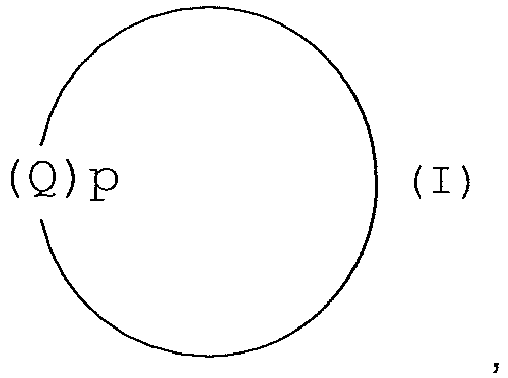
- wherein:

- Preferably R is independently selected from: hydrogen, CH3, C2H5, CH2CH2OH and CH2COOH; least preferred of this group is hydrogen. Most preferably R is Me and/or one of R is an ethylene bridge linking the N of Q to the N of another Q. Preferably R1, R2, R3, and R4 are independently selected from: H and Me. Preferred ligands are 1,4,7-trimethyl-1,4,7-triazacyclononane (Me3-TACN) and 1,2,-bis-(4,7-dimethyl-1,4,7,-triazacyclonon-1-yl)-ethane (Me4-DTNE) of which Me3-TACN is most preferred. The manganese ion is Mn(III) and/or Mn(IV).
- Co-ordinating counter ions for the transition metal complexes are O2- and/or carboxylate (preferably acetate). It is preferred that the transition metal complexes have at least one O2- co-ordinating counter ion. In particular, for Me3-TACN three O2- co-ordinating counter ions are preferred or one O2- co-ordinating counter ion and two carboxylate co-ordinating counter ions are preferred, with two acetate moieties as co-ordinating counter ions being most preferred.
- For Me4-DTNE two O2- co-ordinating counter ions and one acetate co-ordinating counter ion are preferred.
- The non-coordinating anion of the transition metal catalyst salt is preferably selected from the group consisting of chloride, acetate, benzoate, sulphate, and nitrate, perchlorate, hexafluorophosphate.
- The first step of the complexation process entails dissolution of the ligand in an non-aqueous solvent, after which the manganese salt is added. Suitable and preferred solvents include, but are not limited to, methanol, ethanol, acetonitrile, toluene, acetone, dimethylsulfoxide, dimethylformamide, dichloromethane, tetrahydrofuran, dioxane, ethylene glycol, propylene glycol, 1-propanol, 2-propanol, 1-butanol, 2-butanol, and iso-butanol. OH-containing solvents are preferred, such as methanol, ethanol, 1-propanol, 2-propanol, 1-butanol, 2-butanol, iso-butanol, ethylene glycol, 1,3-propylene glycol, and 1,2-propylene glycol.
- Manganese salts to be employed for the complexation steps are selected from manganese(II)chloride, manganese(II)sulphate, manganese(II)acetate and manganese(II)nitrate.
- When Me4-DTNE type complexes are synthesised and the starting material is not manganese(II) acetate, additionally carboxylic acid or its alkali salt thereof needs to be added in a slight excess of molar equivalent to the ligand. Preferably the alkali carboxylate For Me4-DTNE two O2- co-ordinating counter ions and one acetate co-ordinating counter ion are preferred.
- The non-coordinating anion of the transition metal catalyst salt is preferably selected from the group consisting of chloride, acetate, benzoate, sulphate, and nitrate, perchlorate, hexafluorophosphate.
- The first step of the complexation process entails dissolution of the ligand in an non-aqueous solvent, after which the manganese salt is added. Suitable and preferred solvents include, but are not limited to, methanol, ethanol, acetonitrile, toluene, acetone, dimethylsulfoxide, dimethylformamide, dichloromethane, tetrahydrofuran, dioxane, ethylene glycol, propylene glycol, 1-propanol, 2-propanol, 1-butanol, 2-butanol, and iso-butanol. OH-containing solvents are preferred, such as methanol, ethanol, 1-propanol, 2-propanol, 1-butanol, 2-butanol, iso-butanol, ethylene glycol, 1,3-propylene glycol, and 1,2-propylene glycol.
- Manganese salts to be employed for the complexation steps are selected from manganese(II)chloride, manganese(II)sulphate, manganese(II)acetate, manganese(III)acetate, manganese(II)nitrate.
- When Me4-DTNE type complexes are synthesised and the starting material is not manganese(II) acetate or manganese(III) acetate, additionally carboxylic acid or its alkali salt thereof needs to be added in a slight excess of molar equivalent to the ligand. Preferably the alkali carboxylate is selected from sodium acetate, potassium acetate, sodium formate, potassium formate, sodium benzoate, sodium propionate and the carboxylic acid is selected from acetic acid, formic acid, benzoic acid, and propionic acid. Most preferred are sodium acetate and acetic acid.
- In the subsequent step hydrogen peroxide needs to be added. Different sources of hydrogen peroxide can be used, such as aqueous hydrogen peroxide, from 3 to 70%, alkali peroxide, urea-hydrogen peroxide, sodium perborate and sodium percarbonate.
- The optimal amount of peroxide is molar equivalent to the ligand, but applying a slight excess to this amount will not cause major reduction in yields.
- It should be noted that introduction of water upon addition of aqueous hydrogen peroxide is essentially unavoidable. However, using concentrated hydrogen peroxide (more than 30%), will result in a level of water that is less than 10 volume %. For this reason the most preferred range of hydrogen peroxide is from 20 to 55% but hydrogen peroxide is aqueous hydrogen peroxide of from 3 and 70 wt% is acceptable.
- Also additional base needs to be added to allow hydrogen peroxide to oxidise the manganese ions. The molar amount of base is approximately similar to the molar amount of peroxide added. NaOH, KOH, and other alkali hydroxides can be employed, with NaOH and KOH being most preferred. Aqueous solutions can be employed (e.g. 5 M solutions) to be added dropwise to the reaction mixtures. Alternatively, solutions of e.g. KOH in ethanol can be used, to lower the amount of water being present in the reaction medium. Furthermore, Na or K can be added to the neat alcohol solutions, generating the alkali salts of alcohols, which is then slowly added to the reaction medium.
- After this process, an acid needs to be added to obtain a neutral solution (pH of from 4 to 9). Although any organic or inorganic acid will be employable, it is preferred to use the same acid as the salt of the intended complex, for example, when the chloride salt is prepared, one uses hydrochloric acid, etc
- Finally, one could opt to add an additional counterion salt or acid to generate the complex with larger non-coordinating counter ions. These compounds are selected from benzoate salts, benzoic acid, NaPF6, KPF6, HPF6, and NaClO4, with sodium benzoate and KPF6 being preferred.
- Various sources of water can be still found in the reaction medium, such as aqueous hydrogen peroxide (from 3 to 70% H2O2 is used), base added (eg 5 M NaOH in water), acid added (eg 37% HCl in water). Using the more concentrated solutions (eg more than 30% H2O2, KOH dissolved in ethanol or sodium ethanoate), concentrated acid solutions to neutralise the solutions (eg pure acetic acid), will render the water level low. Preferably the reaction medium contains less than 20% water and more preferably less than 10% water.
After the reaction is completed and one wishes to obtain a solid material, the solvent needs to be removed from the solution containing the catalyst salt. Different manners to achieve this can be used, i.e. via evaporation at ambient pressure, via removal via evaporation at reduced pressure, via freeze drying, via spray drying. It will be clear for the skilled person in the art, that lower levels of water in the reaction medium will facilitate the removal of the solvent, thereby reducing the temperature and time needed to dry the material. Apart from economical reasons, also decreased change of decomposition of some of the complex will be obtained. - Alternatively one could produce the catalyst salt in solution and not isolate it as solid material. The level of catalyst salt will be then from 0.01 to 50 wt %, more preferably from 0.1 to 20 wt %, and most preferably from 0.5 to 10 wt % of the catalyst. Preferably solvents having a not very low boiling point are used if the catalyst is to remain in the solution. Non-limiting examples include ethylene glycol, propylene glycol, 1-propanol, 2-propanol, 1-butanol, 2-butanol, and iso-butanol.
- Alternatively, one could produce the catalysts in a non-aqueous solvent that is poorly miscible with water (the non-aqueous solvent has a solubility in water of less than 20 g/L at 20 °C). After the complexation procedure as described in detail above to form the dinuclear complexes, water is added and mixed thoroughly to dissolve the catalyst in the aqueous phase. The aqueous phase containing the catalyst is then removed from the solvent. The amount of water applied for the extraction of the catalyst determines the concentration of the catalyst in the aqueous solution after separation from the organic phase. Preferred ranges of catalyst in water (w/w %) are from 0.01 to 50 wt%, more preferably from 0.1 to 20 % and even more preferably from 0.5 to 10 %. The solubility of water in dichloromethane is 13 g/L and solubility of water in toluene is 0.47 g/L (both at 20 °C).
- Where the catalyst is produced in a non-aqueous solvent that is poorly miscible with water, toluene and dichloromethane are preferred. After addition of water it is preferred that the aqueous catalyst solution comprises from 0.1 and 20 wt % of the dinuclear manganese catalyst salt, preferably 0.5 to 10 wt %.
- It is preferred that the solution containing the catalyst contains from 0.01 to 50 wt % of the catalyst, preferably from 0.1 to 20 wt %, more preferably from 0.5 to 10 wt %.
- Although not strictly necessary, it is preferred that the complexation is carried in oxygen-free atmospheres, preferably under nitrogen or argon. Also it is preferred to store the solid material or the solution containing the catalyst under nitrogen or argon gas.
- In the bleaching process it is preferred that the substrate is contacted with from 0.1 to 100 micromolar of the preformed transition metal catalyst and from 5 to 1500 mM of hydrogen peroxide.
- Preferably the preformed transition metal catalyst salt and hydrogen peroxide are mixed just before introduction to the substrate.
- Under N2, to Me4-DTNE (95% purity, 4 mmol) in different solvents (40 mL), solid mixture of MnCl2·4H2O (99% purity, 8.8 mmol) and sodium acetate(99% purity, 2 mmol) were added. The mixture was stirred for 30 min at 58°C. After another stirring for 10 min cooled in an ice water bath, the freshly prepared mixture of 1 M of H2O2 in water (9 mL, 9 mmol) and 1.5 M of NaOH (4.5 mL, 6.75 mmol) was added drop-wise over 5 min. The mixture turned immediately dark green-brown. The mixture was stirred for 20 min in an ice water bath and then for 20 min at room temperature. 1 M of acetic acid (2.5 mmol) was added. After stirring for another 20 min, the mixture was filtered to remove brown solid and the filtering bed was washed with ethanol. Then the green filtrate was evaporated (the water bath temperature < 45 °C). The residual dark green oil was co-evaporated with ethanol and ethyl acetate to facilitate the removal of most of the remaining water. Dark green oils were taken up in ethanol (20 mL), and the insoluble white salts separated by filtration were washed with ethanol. After removing all ethanol, the dark green oil was obtained again. The small amount of ethanol was added and stirred for 2 min. Then the large amount of ethyl acetate was added. The green solid was precipitated immediately. After 3 hours at -20 °C, the suspension was filtered off, with obtaining a green solid, which was washed with ethyl acetate, n-hexane, and dried under vacuum at 45 °C for 5 hrs to afford dark green powder as [(Mn2(µ-O)2(µ-OAc) (Me4-DTNE)]Cl2·H2O.
- Ethanol/water (2:1, v/v): 40 mL; yielding a green powder, UV-Vis purity of 85.3%, and the yield of 88 %.
- UV-Vis spectrum (ε: mol-1·L·cm-1, in water, Mw: 630): 271 nm (11794), 554 nm (258), 639 nm (275).
- IR (KBr pellet): 3421 br, 2921w, 1604m, 1568m, 1499w, 1463s, 1395s, 1337w, 1286w, 1159w, 1076w, 1057w, 1032w, 1004w, 985w, 912w, 779w, 744w, 678m, 614m cm-1.
- UPLC analysis confirmed the 12.45 % of free [H2(Me4-DTNE)]Cl2.
- Total chloride amount was 13.10 %.
- Water analysis (Karl-Fischer method): Anal. calcd. for [(Mn2(µ-O)2(µ-OAc)(Me4-DTNE)]Cl2·H2O: 2.86%; Found: 4.10%.
- This example shows that the complex can be synthesised in a reasonable yield and purity, but it does contain a significant amount of uncomplexed ligand and water. This shows that the complexation procedure was not optimal.
- Demineralised water: 40 mL; yielding a green powder, UV-Vis purity of 63.8 %, and the yield of 54 %.
- UV-Vis spectrum (ε : : mol-1·L·cm-1, in water, Mw: 630) : 271 nm (8100), 554 nm (209), 639 nm (208).
- IR (KBr pellet): 3425 br, 2921m, 1604m, 1567m, 1497w, 1463s, 1394s, 1338m, 1293w, 1159w, 1076w, 1057w, 1032w, 1004m, 985w, 912w, 779w, 744w, 678m, 613m cm-1.
UPLC analysis confirmed the amount of free [H2(Me4-DTNE)]Cl2 was 6.79 %. - Total chloride amount was 12.22 %.
- Water analysis (Karl-Fischer method): Anal. calcd. for [(Mn2(µ-O)2(µ-OAc)(Me4-DTNE)]Cl2·H2O: 2.86%; Found: 4.30%.
- Similar to example 1.1, the solid material contains significant amounts of uncomplexed ligand and water. Furthermore, the yield leaves room for improvement.
- Under N2, to Me4-DTNE (95% purity, 4 mmol) in different solvents (10 mL to 40 mL), solid mixture of MnCl2 (99% purity, 8.8 mmol) and sodium acetate (99% purity, 2 mmol) were added. The mixture was stirred for 30 min at 58°C (as for CH2Cl2, 40°C for 30 min). After another stirring for 10 min cooled in an ice water bath, the freshly prepared mixture of 1 M of H2O2 in water (9 mL, 9 mmol) and 5 M of NaOH (1.35 mL, 6.75 mmol) was added drop-wise over 5 min. The mixture turned immediately dark green-brown. The mixture was stirred for 20 min in an ice water bath and then for 20 min at room temperature. Glacial acetic acid (2.5 mmol) was added. After stirring for another 20 min, the mixture was filtered to remove brown solid and the filtering bed was washed with ethanol. In each case, the solvent in the green solution were evaporated (the water bath temperature < 45 °C), with obtaining dark green oil, which were taken up in ethanol (20 mL). The insoluble white salts separated by filtration were washed with ethanol. After removing all ethanol, the dark green oil was obtained again. The small amount of ethanol was added and stirred for 2 min. Then the large amount of ethyl acetate was added. The green solid was precipitated immediately. After 3 hours at -20 °C, the suspension was filtered off, with obtaining a green solid, which was washed with ethyl acetate, n-hexane, and dried under vacuum at 45 °C for 5 hrs to afford dark green powder as [Mn2 (µ-O)2(µ-CH3COO)(Me4-DTNE)]Cl2·H2O.
- Ethanol: 10 mL: a green powder was isolated having a UV-Vis purity of 100 %, and the yield of 96.3 %.
- UV-Vis spectrum (ε : mol-1·L·cm-1, in water, Mw: 630): 271 nm (13332), 554 nm (317), 639 nm (327).
- IR (KBr pellet): 3419 br, 2923m, 1606m, 1565m, 1499w, 1461s, 1396s, 1340m, 1288w, 1159w, 1076w, 1057w, 1036m, 1007m, 915w, 778w, 744w, 682m, 613m cm-1.
- UPLC analysis confirmed the trace amount of free [H2(Me4-DTNE)]Cl2.
- Water analysis (Karl-Fischer method): Anal. calcd. for [(Mn2(µ-O)2(µ-OAc)(Me4-DTNE)]Cl2·H2O: 2.86%; Found: 4.71%.
- Methanol: 10 mL: a green powder was obtained showing UV-Vis purity of 99 %, and the yield of 102.9 %.
- UV-Vis spectrum (ε: mol-1·L·cm-1, in water, Mw: 630) : 271 nm (13388), 554 nm (308), 639 nm (318).
- Anal. calcd. for [Mn2O2(CH3COO)(C18H40N6)]Cl2·H2O (C20H45Cl2Mn2N6O5): C 38.11, H 7.20, N 13.33; Found: C 38.33, H 7.63, N 12.57 %.
- IR (KBr pellet): 3425 br, 2923m, 1642m, 1568m, 1499w, 1462s, 1395s, 1337m, 1286w, 1159w, 1076m, 1055m, 1033m, 1004m, 912w, 780w, 744w, 678m, 613m cm-1.
- MS-ES+: m/e 270.6.
- UPLC analysis confirmed the trace amount of free [H2(Me4-DTNE)]Cl2 in the Mn complex.
- Total chloride amount was 11.07%.
- Water analysis (Karl-Fischer method): Anal. calcd. for [(Mn2(µ-O)2(µ-OAc)(Me4-DTNE)]Cl2·H2O: 2.86%; Found: 3.80%.
- Dichloromethane: 20 mL: a green powder was obtaining of a UV-Vis purity of 101 %, and the yield of 95.6 %.
- UV-Vis spectrum (ε: mol-1·L·cm-1, in water, Mw: 630) : 271 nm (13114), 554 nm (314), 639 nm (340).
- IR (KBr pellet): 3426 br, 2926m, 1636m, 1564s, 1499w, 1462s, 1397s, 1341m, 1288w, 1159w, 1076m, 1055m, 1038m, 1001m, 916w, 778w, 744w, 682m, 614m cm-1.
- UPLC analysis confirmed the trace amount of free [H2(Me4-DTNE)]Cl2 in the Mn complex.
- Total chloride amount was 10.19 %.
- Water analysis (Karl-Fischer method): Anal. calcd. for [(Mn2(µ-O)2(µ-OAc)(Me4-DTNE)]Cl2·H2O: 2.86%; Found: 1.92%.
- Acetonitrile: 10 mL: a green powder was isolated having a UV-Vis purity of 85.3 %, and the isolated yield of 87.2 %.
- UV-Vis spectrum (ε: mol-1·L·cm-1, in water, Mw: 630): 271 nm (11345), 554 nm (265), 639 nm (280).
- IR (KBr pellet): 3433 br, 2923m, 1642m, 1567m, 1499w, 1460m, 1396m, 1341w, 1058m, 1033m, 1004w, 912w, 780w, 744w, 678w, 613w cm-1.
- UPLC analysis confirmed the trace amount of free [H2(Me4-DTNE)]Cl2 in the Mn complex.
- Total chloride amount was 14.07 %.
- Water analysis (Karl-Fischer method): Anal. calcd. for [(Mn2(µ-O)2(µ-OAc)(Me4-DTNE)]Cl2·H2O: 2.86%; Found: 1.39%.
- Acetone: 30 mL: yielding a green powder having a UV-Vis purity of 88.1 %, and the isolated yield of 83.6 %.
- UV-Vis spectrum (ε: mol-1·L·cm-1, in water, Mw: 630) : 271 nm (11977), 554 nm (289), 639 nm (266).
- IR (KBr pellet): 3426 br, 2924m, 1635s, 1560s, 1499w, 1458s, 1395s, 1338m, 1286w, 1183w, 1075m, 1056m, 1033m, 1003m, 985m, 913w, 780w, 744w, 678m, 616m cm-1.
- UPLC analysis confirmed the trace amount of free [H2(Me4-DTNE)]Cl2 in the Mn complex.
- Total chloride amount was 9.49 %.
- Water analysis (Karl-Fischer method): Anal. calcd. for [(Mn2(µ-O)2(µ-OAc)(Me4-DTNE)]Cl2·H2O: 2.86%; Found: 2.66%.
- THF: 40 mL: yielding a green powder of a UV-Vis purity of 70.8 %, and the isolated yield of 62.3 %.
- UV-Vis spectrum (ε: mol-1·L·cm-1, in water, Mw: 630): 271 nm (8921), 554 nm (231), 639 nm (233).
- IR (KBr pellet): 3422 br, 2924m, 1604s, 1567s, 1498w, 1463s, 1395s, 1337m, 1294w, 1159w, 1057m, 1032m, 1004m, 986m, 911w, 779w, 744w, 677m, 613m cm-1.
- UPLC analysis confirmed the trace amount of free [H2(Me4-DTNE)]Cl2 in the Mn complex.
- Total chloride amount was 10.51 %.
- Water analysis (Karl-Fischer method): Anal. calcd. for [(Mn2(µ-O)2(µ-OAc)(Me4-DTNE)]Cl2·H2O: 2.86%; Found: 1.53%.
- In all examples 2.1-2.6, the level of uncomplexed free ligand is below detection limit. Especially in ethanol, methanol and dichloromethane, the isolated yields and purities are much higher than the benchmarks (1.1 and 1.2). In all cases the removal of the solvent was much easier than in the benchmark experiments, facilitating the isolation of solid material.
- Under N2, to Me4-DTNE (95% purity, 4 mmol) in different solvents (10 mL to 20 mL), solid mixture of MnCl2 (99% purity, 8.8 mmol) and sodium acetate (99% purity, 2 mmol) were added. The mixture was stirred for 30 min at 58°C. After another stirring for 10 min cooled in an ice water bath, the freshly prepared mixture of 1 M of H2O2 in water (9 mL, 9 mmol) and 5 M of NaOH (1.35 mL, 6.75 mmol) was added drop-wise over 10 min. The mixture turned immediately dark green-brown. The mixture was stirred for 20 min in an ice water bath and then for 20 min at room temperature. Glacial acetic acid (2.5 mmol) was added. After stirring for another 20 min, the mixture was filtered to remove brown solid and the filtering bed was washed with solvents. Then the mixture reached 20 mL to 40 mL by adding solvents. From this green solution, a 40 (or 50) times dilution and a 1600 (or 2000) times dilution were made; and from the absorption in the UV-Vis spectrum at the wavelengths of 244 nm, 554 nm, and 639 nm, the concentration in the stock and the conversion were calculated, based on the molar extinction coefficient of [Mn2(µ-O)2(µ-OAc)(Me4-DTNE)]Cl2 with Mw 612) in water for 100% pure, ε (mol-1·L·cm-1): 271 nm (13200 mol-1·L·cm-1), 554 nm (315 mol-1·L·cm-1), 639 nm (325 mol-1·L·cm-1).
- Ethylene glycol: 10 mL; the volume of the solution contained catalyst: 28 mL; diluted times: 50 times and 2000 times; UV-vis extinction:
271 nm: 1.052 554 nm: 0.905 639 nm: 0.869 - So, the average UV-Vis conversion was 101.4 %; the solution contained 8.01 % (wt%) of the catalyst with the density of 1.112 g/mL.
- UPLC analysis confirmed the trace amount of free [H2(Me4-DTNE)]Cl2 in the Mn complex.
- Total chloride amount was 1.89 %.
- 1,2-Propylene glycol: 10 mL; the volume of the solution contained catalyst: 40 mL; diluted times: 40 times and 1600 times; UV-vis extinction:
271 nm: 0.937 554 nm: 0.832 639 nm: 0.860 - So, the average UV-Vis conversion was 107.1 %; the solution contained 6.18 % (wt%) of the catalyst with the density of 1.074 g/mL.
- UPLC analysis confirmed the trace amount of free [H2(Me4-DTNE)]Cl2 in the Mn complex.
- Total chloride amount was 1.35 %.
- 1,3-Propylene glycol: 10 mL; the volume of the solution contained catalyst: 35 mL; diluted times: 40 times and 1600 times; UV-vis extinction:
271 nm: 1.048 554 nm: 0.990 639 nm: 1.040 - So, the average UV-Vis conversion was 110.5 %; the solution contained 7.23 % (wt%) of the catalyst with the density of 1.075 g/mL.
- UPLC analysis confirmed the trace amount of free [H2(Me4-DTNE)]Cl2 in the Mn complex.
- Total chloride amount was 1.60 %.
- DMF: 10 mL; the volume of the solution contained catalyst: 30 mL; diluted times: 40 times and 1600 times; UV-vis extinction:
271 nm: 1.295 554 nm: 1.152 639 nm: 1.120 - So, the average UV-Vis conversion was 109.4 %; the solution contained 8.66 % (wt%) of the catalyst with the density of 1.039 g/mL.
- UPLC analysis confirmed the trace amount of free [H2(Me4-DTNE)]Cl2 in the Mn complex.
- Total chloride amount was 1.80 %.
- DMSO: 20 mL; the volume of the solution contained catalyst: 40 mL; diluted times: 40 times and 1600 times; UV-vis extinction:
271 nm: 0.625 554 nm: 0.744 639 nm: 0.680 - So, the average UV-Vis conversion was 82.9 %; the solution contained 4.60 % (wt%) of the catalyst with the density of 1.125 g/mL.
- UPLC analysis confirmed the trace amount of free [H2(Me4-DTNE)]Cl2 in the [Mn2(µ-O)2(µ-OAc)(Me4-DTNE)]Cl2 solutions.
- Total chloride amount was 1.12 %.
- In all examples 3.1-3.5, the complex dissolved in an organic solvent was prepared readily. The level of uncomplexed free ligand was in all cases below the detection limit.
- The most preferred solvents, ethylene glycol, 1,2-propylene glycol and 1,3-propylene glycol can be readily used to mix with other solutions (e.g. water, surfactant containing formulations, for various applications, such as domestic and industrial cleaning, textile treatment, etc.
- Under N2, to Me4-DTNE (95% purity, 4 mmol) in different solvents, solid mixture of MnCl2 (99% purity, 8.8 mmol) and sodium acetate (99% purity, 2 mmol) were added. The mixture was stirred for 30 min at 58°C for toluene or 40°C for CH2Cl2. The mixture was then cooled in an ice water bath and stirred for another 10 min. The freshly prepared mixture of 1 M of H2O2 in water (9 mL, 9 mmol) and 5 M of NaOH (1.35 mL, 6.75 mmol) was added drop-wise over 10 min. The mixture turned immediately dark green-brown. The mixture was stirred for 20 min in an ice water bath and then for 20 min at room temperature. Glacial acetic acid (2.5 mmol) was added. After stirring for another 20 min, the mixture was filtered to remove brown solid and the filtering bed was washed with water. The filtrate divided into two layers. The water layer was then separated directly through a separating funnel. Trace volatile was removed for 20 min in vacuum. The mixture reached 25 mL by adding millipore water. From this green solution, a 50 times dilution and a 2000 times dilution were made; and from the absorption in the UV-Vis spectrum at the wavelengths of 244 nm, 554 nm, and 639 nm, the concentration in the stock and the conversion were calculated, based on the molar extinction coefficient of [(Mn2(µ-O)2(µ-OAc)(Me4-DTNE)]Cl2 with Mw 612 in water for 100% pure, ε (mol-1·L·cm-1): 271 nm (13200 mol-1·L·cm-1), 554 nm (315 mol-1·L·cm-1), 639 nm (325 mol-1·L·cm-1).
- Toluene: 30 mL; the volume of the solution contained catalyst: 25 mL; diluted times: 50 times and 2000 times; UV-vis extinction:
271 nm: 0.924 554 nm: 0.883 639 nm: 0.901 - So, the average UV-Vis conversion was 86.1 %; the aqueous solution contained 8.21 % (wt %) of the catalyst with the density of 1.041 g/mL.
- UPLC analysis confirmed the trace amount of free [H2(Me4-DTNE)]Cl2.
- Total chloride amount was 2.19 %.
- CH2Cl2: 30 mL; the volume of the solution contained catalyst: 25 mL; diluted times: 50 times and 2000 times; UV-vis extinction:
271 nm: 1.162 554 nm: 1.059 639 nm: 1.090 - So, the average UV-Vis conversion was 106.4 %; the aqueous solution contained 10.43 % (wt %) of the catalyst with the density of 1.043 g/mL.
- UPLC analysis confirmed the trace amount of free [H2(Me4-DTNE)]Cl2.
- Total chloride amount was 2.51 %.
- Both examples above show that complexation in a non-aqueous solvent that is poorly miscible with water, and then extracting the complex into water, furnishes the desired complex, again with low level of uncomplexed ligand present. Especially dichloromethane proved to be a suitable solvent, similar to what has been shown already in example 2.3.
- Under N2, to Me4-DTNE (95% purity, 10 mmol) in solvents, solid mixture of MnCl2·4H2O (22 mmol) and NaAc (5 mmol) were added. The mixture was stirred for 30 min at 58°C. After another stirring for 10 min cooled in an ice water bath, the freshly prepared mixture of 1 M of H2O2 in water (22.5 mL, 22.5 mmol) and 5 M of NaOH (3.375 mL, 16.875 mmol) was added drop-wise over 5 min. The mixture turned immediately dark green-brown. The mixture was then stirred for 20 min in an ice water bath and then for 20 min at room temperature. Glacial acetic acid (6.25 mmol) was added..After stirring for another 20 min, an aqueous of KPF6 (30 mmol) in 75 mL of mQ water was added. 50 mL of acetonitrile was added to dissolve the green precipitate 5 min later. After stirring for another 10 -15 min, the mixture was filtered to remove brown solid and the filtering bed was washed with acetonitrile. Then the mixture reached 260 mL or 170 mL by adding acetonitrile. All solvents in the green solution were evaporated (the water bath temperature < 45 °C). The dark green residue was coevaporated with ethanol and ethyl acetate to facilitate the removal of most of the remaining water. The dark green residue was taken up in acetonitrile (125 mL), and the insoluble white salts separated by filtration were washed with acetonitrile. The partial evaporation of acetonitrile, water (50 mL) was added, and then the remainder of acetonitrile evaporated to leave a green solid and a little bit water. The suspension was put in a -25°C fridge overnight, and was filtered off. The green solid was washed with cold water, ethanol, and n-hexane, and dried under vacuum at 45 °C for 5 hrs to afford dark green powder as [(Mn2(µ-O)2(µ-OAc)(Me4-DTNE)](PF6)2.
- Ethanol/water (2:1, v/v): 100 mL. Green powder isolated, UV-Vis purity of 95.9 %, and the isolated yield of 72.3 %. UV-Vis spectrum (ε: mol-1·L·cm-1, in acetonitrile, Mw 831): 271 nm (15442), 554 nm (342), 639 nm (387).
- Anal. calcd. for C20H43F12Mn2N6O4P2: C 28.89, H 5.21, N 10.11; Found: C 28.79, H 5.21, N 10.25 %.
- IR (KBr pellet): 3441 br, 2933m, 1633m, 1561m, 1499w, 1467m, 1384m, 1341m, 1287w, 1159w, 1077m, 1057m, 1035m, 1005m, 985m, 840vs, 780w, 743w, 692m, 679m, 608m, 558m cm-1.
- UPLC analysis confirmed the trace amount of free [H2(Me4-DTNE)](PF6)2.
- The water amount was 1.78% by Karl-Fischer method.
- Ethanol: 25 mL; green powder isolated, UV-Vis purity of 98.6 %, and the isolated yield of 85.9 %.
- UV-Vis spectrum (ε : mol-1·L·cm-1, in acetonitrile, Mw: 831) : 271 nm (16041), 554 nm (351), 639 nm (396).
- Anal. calcd. for C20H43F12Mn2N6O4P2: C 28.89, H 5.21, N 10.11; Found: C 28.77, H 5.22, N 10.19 %.
- IR (KBr pellet): 3441 br, 2933m, 1633m, 1562m, 1499w, 1467m, 1384m, 1342m, 1287w, 1159w, 1078m, 1058m, 1036m, 1005m, 986m, 840vs, 780w, 743w, 692m, 679m, 608m, 558m cm-1.
- MS-ES+: m/e 270.6.
- UPLC analysis confirmed the trace amount of free [H2(Me4-DTNE)](PF6)2.
- The water amount was 0.55% by Karl-Fischer method.
- Example 5.2 shows that in ethanol as solvent a higher yield/purity of solid [Mn2(µ-O)2(µ-OAc)(Me4-DTNE)](PF6)2 has been obtained as compared to the product isolated from the water/ethanol mixture (comparative example 5.1).
- Under N2, the mixture of Me3-TACN (99% purity, 10 mmol), manganese(II)chloride (11 mmol) in either 20 mL water (6.1) or 20 mL ethanol (6.2) was stirred for 20 min at 35°C. After another stirring for 10 min cooled in an ice water bath, a freshly prepared mixture of 1 M H2O2 (12.5 mmol) and 5 M NaOH (15 mmol) was added dropwise over 5-10 min. The mixture turned immediately dark brown/red. The mixture was further stirred for 20 min in an ice bath and for another 40 min at room temperature. 1 M HCl (5.2 mmol) was added and stirred for 30 min in order to adjust pH value to 5. The red-wine mixture was filtered to remove brown solid and the filtering bed was washed with ethanol. The filtrate was reduced in vacuo (water bath: 35 °C -40 °C) to afford a red-oil. The residue was dissolved in ethanol, and the insoluble white salts separated by filtration were washed with ethanol. The ethanol filtrate combined was evaporated to dryness obtaining a red-oil. The red-oil was washed with acetonitrile and ethyl acetate until obtaining red solid, which was dried in vacuum at 45 °C for 6 hrs to afford red solid as [Mn2(µ-O)3(Me3-TACN)2]Cl2 ·3H2O.
- Red powder, UV-Vis purity of 92.7 %, and the yield of 88 %.
- UV-Vis spectrum (ε : mol-1·L·cm-1, in water, Mw 625): 244 nm (18016), 278 nm (17190), 313 nm (11069), 389 nm (949), 485 nm (355).
- UPLC analysis confirmed the trace amounts of free [H2(Me3-TACN)]Cl2.
- Total chloride amount was 12.35 %.
- Red powder, UV-Vis purity of 92.9 %, and the yield of 82 %.
- UV-Vis spectrum (ε : mol-1·L·cm-1, in water, Mw 625) : 244 nm (18048), 278 nm (17231), 313 nm (11113), 389 nm (979), 485 nm (370).
- UPLC analysis confirmed the trace amounts of free [H2(Me3-TACN)]Cl2.
- Total chloride amount was 11.83 %.
- The results shown in sections 6.1 and 6.2 indicated that both solvents (aqueous vs non-aqueous solvents) are suitable to form complex, whilst the non-aqueous solvent exhibits the advantage that the non-aqueous solvent may be easier removed by evaporated than the aqueous solvent.
Claims (15)
- A solid material obtainable by a method of synthesising a dinuclear Mn(III) and/or Mn(IV) catalyst salt from a ligand of formula (I):
 wherein:
 p is 3;R is independently selected from: hydrogen, C1-C6-alkyl, CH2CH2OH, and CH2COOH, or one of R is linked to the N of another Q via an ethylene bridge; R1, R2, R3, and R4 are independently selected from: H, C1-C4-alkyl, and C1-C4-alkylhydroxy, the salt comprising a non-coordinating anion selected from the group consisting of chloride, nitrate, benzoate, sulfate and acetate,the method comprising the following steps:(i) treating a 0.03 mmol/ml to 4 mmol/ml solution of the ligand in a non-aqueous solvent, with a manganese (II) salt to form a complexation mixture, wherein the ratio of three nitrogen ring per ligand to a manganese salt is from 0.8:2 and the complexation mixture contains from 0 to 6 wt% of water;(ii) treating the solution of step (i) with hydrogen peroxide or a source of hydrogen peroxide to provide from 1 to 10 mole H2O2 per mole of the manganese salt;(iii) treating the solution of step (ii) with base to provide a solution having a pH of from 8 to 13;(iv) treating the solution of step (iii) with acid to provide a solution having a pH of from 4 to 9; and(v) removing solvent via spray drying or via freeze drying from the solution resultant from step (iv) to provide the solid material.
 - The solid material according to claim 1, wherein R is independently selected from: CH3, C2H5, CH2CH2OH and CH2COOH.
- The solid material according to claim 1 or claim 2, wherein R1, R2, R3, and R4 are independently selected from: H and Me.
- The solid material according to claim 1, wherein the catalyst is derived from a ligand selected from the group consisting 1,4,7-trimethyl-1,4,7-triazacyclononane (Me3-TACN) and 1,2,-bis-(4,7,-dimethyl-1,4,7,-triazacyclonon-1-yl)-ethane (Me4-DTNE).
- A method of synthesising a dinuclear Mn(III) and/or Mn(IV) catalyst salt from a ligand of formula (I):
 wherein:
 p is 3;R is independently selected from: hydrogen, C1-C6-alkyl, CH2CH2OH, and CH2COOH, or one of R is linked to the N of another Q via an ethylene bridge; R1, R2, R3, and R4 are independently selected from: H, C1-C4-alkyl, and C1-C4-alkylhydroxy, the method comprising the following steps:(i) treating a 0.03 mmol/ml to 4 mmol/ml solution of the ligand in a non-aqueous solvent, with a manganese (II) salt to form a complexation mixture, wherein the ratio of three nitrogen ring per ligand to a manganese salt is from 0.8:2 and the complexation mixture contains from 0 to 6 wt% of water;(ii) treating the solution of step (i) with hydrogen peroxide or a source of hydrogen peroxide to provide from 1 to 10 mole H2O2 per mole of the manganese salt;(iii) treating the solution of step (ii) with base to provide a solution having a pH of from 8 to 13;(iv) treating the solution of step (iii) with acidto provide a solution having a pH of from 4 to 9.
 - The method according to claim 5, wherein the ligand of formula (I) is as defined in any one of claims 2 to 4.
- The method according to claim 5, wherein the non-aqueous solvent contains at least one OH group, for example wherein the non-aqueous protic solvent is selected from methanol, ethanol, 1-propanol, 2-propanol, 1-butanol, 2-butanol, iso-butanol, ethylene glycol, 1,3-propylene glycol, 1,2-propylene glycol.
- The method according to claim 5, wherein:(i) the non-aqueous solvent is selected from: dichloromethane; toluene; acetonitrile; acetone; dimethylsulfoxide; dichloromethane; and, dimethylformamide; or(ii) the manganese salt is selected from: manganese(II)chloride; manganese(II)sulphate; manganese(II)acetate; and manganese(II)nitrate.
- The method according to claim 5, wherein the solution after completion of step (iv) contains less than 20 vol % water, for example wherein the solution after completion of step (iv) contains less than 10 vol % water.
- The method according to claim 5, wherein the salt comprises a non-coordinating counterion selected from: chloride; nitrate; sulfate; acetate; benzoate; and, hexafluorophosphate, for example chloride; nitrate; sulfate; acetate; and benzoate.
- The method according to any one of claims 5 to 10, wherein the method further comprises removing solvent from the solution resultant from step (iv) to provide a solid material, for example wherein the solvent is removed via spray drying, via freeze drying, or via evaporation at ambient or reduced pressure, such as wherein the solvent is removed via spray drying or via freeze drying.
- The method according to any one of claims 5 to 10, wherein after the complexation process of step (iv) water is added to the solution and the dinuclear manganese catalyst salt is extracted into the water to provide an aqueous catalyst solution and the solvent has a water miscibility in the range used from 0 to 20 g/L at 20 °C, for example wherein the solvent for complexation is selected from toluene and dichloromethane.
- The method according claim 12, in which the solvent for complexation is selected from toluene and dichloromethane, wherein the aqueous catalyst solution comprises from 0.1 and 20 wt % of the dinuclear manganese catalyst salt, for example wherein the aqueous solution comprises from 0.5 to 10 wt % of the dinuclear manganese catalyst salt.
- The method according to any one of claims 5 to 13, wherein when one of R is linked to the N of another Q via an ethylene bridge an alkali carboxylate or carboxylic acid is added before addition of hydrogen peroxide after step (i) and before step (ii), for example wherein the alkali carboxylate is selected from sodium acetate, potassium acetate, sodium formate, potassium formate, sodium benzoate, sodium propionate and the carboxylic acid is selected from acetic acid, formic acid, benzoic acid, and propionic acid.
- The method according to any one of claims 5 to 14, wherein:(i) the source of hydrogen peroxide is aqueous hydrogen peroxide of from 3 and 70 wt% for example wherein the source of hydrogen peroxide is aqueous hydrogen peroxide of from 20 and 55 wt %; and/or(ii) the reaction is carried out under an inert gas selected from: nitrogen and argon.
Applications Claiming Priority (1)
| Application Number | Priority Date | Filing Date | Title |
|---|---|---|---|
| PCT/CN2010/000256 WO2011106906A1 (en) | 2010-03-03 | 2010-03-03 | Preparation of bleaching catalysts |
Publications (3)
| Publication Number | Publication Date |
|---|---|
| EP2550283A1 EP2550283A1 (en) | 2013-01-30 |
| EP2550283A4 EP2550283A4 (en) | 2013-10-23 |
| EP2550283B1 true EP2550283B1 (en) | 2016-05-11 |
Family
ID=44541597
Family Applications (1)
| Application Number | Title | Priority Date | Filing Date |
|---|---|---|---|
| EP10846825.7A Active EP2550283B1 (en) | 2010-03-03 | 2010-03-03 | Preparation of bleaching catalysts |
Country Status (10)
| Country | Link |
|---|---|
| US (1) | US9469666B2 (en) |
| EP (1) | EP2550283B1 (en) |
| JP (1) | JP2013521235A (en) |
| KR (1) | KR101735087B1 (en) |
| BR (1) | BR112012022168B1 (en) |
| CA (1) | CA2791423C (en) |
| ES (1) | ES2586570T3 (en) |
| HU (1) | HUE028836T2 (en) |
| PT (1) | PT2550283T (en) |
| WO (1) | WO2011106906A1 (en) |
Families Citing this family (11)
| Publication number | Priority date | Publication date | Assignee | Title |
|---|---|---|---|---|
| CN115501912A (en) | 2011-09-08 | 2022-12-23 | 卡特克塞尔科技有限公司 | Catalyst and process for producing the same |
| EP2607434A1 (en) | 2011-12-20 | 2013-06-26 | Akzo Nobel Coatings International B.V. | Drier for auto-oxidisable coating composition |
| EP2607435A1 (en) | 2011-12-20 | 2013-06-26 | Akzo Nobel Coatings International B.V. | Drier for autoxidisable coating composition |
| MA38343B1 (en) | 2013-02-11 | 2018-03-30 | Chemsenti Ltd | Oxidation curable coating composition |
| WO2014122433A1 (en) | 2013-02-11 | 2014-08-14 | Chemsenti Limited | Drier for alykd-based coating |
| DK3011004T3 (en) | 2013-06-20 | 2017-10-30 | Chemsenti Ltd | WHITE AND OXIDATION CATALYST |
| AU2014307707B2 (en) | 2013-08-16 | 2018-08-02 | Chemsenti Limited | Composition |
| US20230095399A1 (en) | 2020-02-28 | 2023-03-30 | Catexel Technologies Limited | Degradative method |
| EP3967742A1 (en) | 2020-09-15 | 2022-03-16 | WeylChem Performance Products GmbH | Compositions comprising bleaching catalyst, manufacturing process thereof, and bleaching and cleaning agent comprising same |
| WO2025191283A1 (en) | 2024-03-15 | 2025-09-18 | Catexel Gmbh | Oxidative method |
| EP4678725A1 (en) | 2024-07-11 | 2026-01-14 | Catexel GmbH | Co-granules comprising bleaching catalyst, bleaching activator, binder and zinc or bismuth salt, and bleaching and cleaning agent comprising same |
Family Cites Families (36)
| Publication number | Priority date | Publication date | Assignee | Title |
|---|---|---|---|---|
| EP0458398B1 (en) | 1990-05-21 | 1997-03-26 | Unilever N.V. | Bleach activation |
| FR2675165B1 (en) | 1991-04-15 | 1993-08-06 | Rhone Poulenc Chimie | AQUEOUS COMPOSITION FOR COATING PAPER COMPRISING A SUBSTANTIALLY INSOLUBLE ALKALIGONFLANT LATEX. |
| GB9108136D0 (en) * | 1991-04-17 | 1991-06-05 | Unilever Plc | Concentrated detergent powder compositions |
| EP0522817A1 (en) * | 1991-07-11 | 1993-01-13 | Unilever Plc | Process for preparing manganese complexes |
| GB9118242D0 (en) | 1991-08-23 | 1991-10-09 | Unilever Plc | Machine dishwashing composition |
| GB9124581D0 (en) | 1991-11-20 | 1992-01-08 | Unilever Plc | Bleach catalyst composition,manufacture and use thereof in detergent and/or bleach compositions |
| US5153161A (en) | 1991-11-26 | 1992-10-06 | Lever Brothers Company, Division Of Conopco, Inc. | Synthesis of manganese oxidation catalyst |
| CA2083661A1 (en) | 1991-11-26 | 1993-05-27 | Rudolf J. Martens | Detergent bleach compositions |
| US5256779A (en) | 1992-06-18 | 1993-10-26 | Lever Brothers Company, Division Of Conopco, Inc. | Synthesis of manganese oxidation catalyst |
| US5280117A (en) | 1992-09-09 | 1994-01-18 | Lever Brothers Company, A Division Of Conopco, Inc. | Process for the preparation of manganese bleach catalyst |
| US5329024A (en) | 1993-03-30 | 1994-07-12 | National Starch And Chemical Investment Holding Corporation | Epoxidation of olefins via certain manganese complexes |
| US5429769A (en) | 1993-07-26 | 1995-07-04 | Lever Brothers Company, Division Of Conopco, Inc. | Peroxycarboxylic acids and manganese complex catalysts |
| CA2187176C (en) | 1994-04-07 | 2000-07-04 | Michael Eugene Burns | Bleach compositions comprising bleach activators and bleach catalysts |
| AU2524495A (en) | 1994-05-09 | 1995-11-29 | Unilever Plc | Bleach catalyst composition |
| AU3077495A (en) | 1994-08-19 | 1996-03-14 | Unilever Plc | Detergent bleach composition |
| DE19523891C1 (en) | 1995-06-30 | 1996-11-21 | Hoechst Ag | Chiral manganese-triazanonane complexes and process for their preparation |
| DE19620241A1 (en) | 1996-05-20 | 1997-11-27 | Patt R Prof Dr | Process for delignifying pulps and using a catalyst |
| US6087312A (en) | 1996-09-13 | 2000-07-11 | The Procter & Gamble Company | Laundry bleaching processes and compositions |
| BR0013745A (en) | 1999-09-01 | 2002-05-14 | Unilever Nv | Bleaching composition for a textile |
| US6743761B2 (en) | 2000-02-15 | 2004-06-01 | The Procter & Gamble Company | Method for the one step preparation of textiles |
| GB0004852D0 (en) | 2000-02-29 | 2000-04-19 | Unilever Plc | Ligand and complex for catalytically bleaching a substrate |
| EP1259588A2 (en) | 2000-02-29 | 2002-11-27 | Unilever Plc | Composition and method for bleaching a substrate |
| DE10051317A1 (en) | 2000-10-17 | 2002-04-18 | Degussa | Catalysis of peroxy compound delignification or bleaching of fibrous materials in aqueous suspension uses transition metal complexes, some of which are novel compounds |
| US20030040459A1 (en) | 2001-02-05 | 2003-02-27 | Unilever Home & Pesonal Care Usa | Cleaning compositions |
| GB0103526D0 (en) | 2001-02-13 | 2001-03-28 | Unilever Plc | Composition and method for bleaching a substrate |
| EP1385812A1 (en) | 2001-04-27 | 2004-02-04 | Lonza Ag | Process for the production of ketones |
| DE10343252A1 (en) | 2003-09-17 | 2005-04-21 | Basf Ag | Process for the preparation of bisepoxides and dithiols |
| US7393450B2 (en) | 2003-11-26 | 2008-07-01 | Silveri Michael A | System for maintaining pH and sanitizing agent levels of water in a water feature |
| US20050137105A1 (en) | 2003-12-18 | 2005-06-23 | Griese Gregory G. | Acidic detergent and a method of cleaning articles in a dish machine using an acidic detergent |
| AU2006251406B9 (en) | 2005-05-27 | 2009-09-24 | Unilever Plc | Process of bleaching |
| CN101331260B (en) | 2005-10-12 | 2012-05-30 | 荷兰联合利华有限公司 | Bleaching of substrates |
| JP2007112761A (en) | 2005-10-21 | 2007-05-10 | Sun Medical Co Ltd | Bleach composition for teeth |
| BRPI0720978B1 (en) | 2007-01-16 | 2017-09-12 | Unilever N.V | METHOD OF BRANDING A CELLULOSE MATERIAL |
| PL2477740T3 (en) | 2009-09-18 | 2015-06-30 | Weylchem Lamotte | Method of preparing bridged manganese complexes of triazacyclononane |
| DE102009057220A1 (en) | 2009-12-05 | 2011-06-09 | Clariant International Ltd. | Non-hygroscopic transition metal complexes, process for their preparation and their use |
| DE102009057222A1 (en) | 2009-12-05 | 2011-06-09 | Clariant International Ltd. | Bleach catalyst compounds, process for their preparation and their use |
-
2010
- 2010-03-03 KR KR1020127025853A patent/KR101735087B1/en not_active Expired - Fee Related
- 2010-03-03 BR BR112012022168-0A patent/BR112012022168B1/en not_active IP Right Cessation
- 2010-03-03 JP JP2012555271A patent/JP2013521235A/en active Pending
- 2010-03-03 PT PT108468257T patent/PT2550283T/en unknown
- 2010-03-03 US US13/582,040 patent/US9469666B2/en active Active
- 2010-03-03 CA CA2791423A patent/CA2791423C/en not_active Expired - Fee Related
- 2010-03-03 EP EP10846825.7A patent/EP2550283B1/en active Active
- 2010-03-03 WO PCT/CN2010/000256 patent/WO2011106906A1/en not_active Ceased
- 2010-03-03 HU HUE10846825A patent/HUE028836T2/en unknown
- 2010-03-03 ES ES10846825.7T patent/ES2586570T3/en active Active
Also Published As
| Publication number | Publication date |
|---|---|
| KR20130037673A (en) | 2013-04-16 |
| WO2011106906A1 (en) | 2011-09-09 |
| US9469666B2 (en) | 2016-10-18 |
| KR101735087B1 (en) | 2017-05-24 |
| EP2550283A1 (en) | 2013-01-30 |
| BR112012022168A2 (en) | 2016-10-25 |
| EP2550283A4 (en) | 2013-10-23 |
| HUE028836T2 (en) | 2017-01-30 |
| JP2013521235A (en) | 2013-06-10 |
| US20130053554A1 (en) | 2013-02-28 |
| CA2791423C (en) | 2017-06-20 |
| PT2550283T (en) | 2016-08-16 |
| CA2791423A1 (en) | 2011-09-09 |
| ES2586570T3 (en) | 2016-10-17 |
| BR112012022168B1 (en) | 2018-06-26 |
Similar Documents
| Publication | Publication Date | Title |
|---|---|---|
| EP2550283B1 (en) | Preparation of bleaching catalysts | |
| US5274147A (en) | Process for preparing manganese complexes | |
| JP5648815B2 (en) | Method for producing 3,7-diaza-bicyclo [3.3.1] nonane-metal complex | |
| JPH11500052A (en) | Synthesis of manganese oxidation catalyst | |
| JP5688413B2 (en) | Method for producing bridged manganese complex of triazacyclononane | |
| US20120302490A1 (en) | Bleach Catalyst Compounds, Method For The Production Thereof And Use Thereof | |
| WO2011066934A1 (en) | Nonhygroscopic transition metal complexes, process for preparation thereof and use thereof | |
| US20190134619A1 (en) | Catalysts | |
| JP4822253B2 (en) | Method for producing formate from carbon dioxide and hydrogen | |
| US6008387A (en) | Process for the oxidation of organic compounds in the presence of bis- and tris- (μ-oxo)-dimanganese complex salts as catalyst | |
| KR101895559B1 (en) | Method for producing 3,7-diaza-bicyclo[3.3.1]nonane metal complexes | |
| Nawi et al. | Model complexes for amavadine, a vanadium natural product | |
| US12036540B1 (en) | Selective hydrogenation catalyst of α,β-unsaturated ketone using electronically weakly coupled 4,4′-divinylazoarylene-bridged diruthenium complex bearing two Ru(CO)(2-mercaptopyridine)(PiPr3)2 moieties | |
| BE1012987A6 (en) | Improved method for the synthesis of hydrogen peroxide. |
Legal Events
| Date | Code | Title | Description |
|---|---|---|---|
| PUAI | Public reference made under article 153(3) epc to a published international application that has entered the european phase |
Free format text: ORIGINAL CODE: 0009012 |
|
| 17P | Request for examination filed |
Effective date: 20120822 |
|
| AK | Designated contracting states |
Kind code of ref document: A1 Designated state(s): AT BE BG CH CY CZ DE DK EE ES FI FR GB GR HR HU IE IS IT LI LT LU LV MC MK MT NL NO PL PT RO SE SI SK SM TR |
|
| DAX | Request for extension of the european patent (deleted) | ||
| A4 | Supplementary search report drawn up and despatched |
Effective date: 20130923 |
|
| RIC1 | Information provided on ipc code assigned before grant |
Ipc: C07F 13/00 20060101AFI20130917BHEP |
|
| 17Q | First examination report despatched |
Effective date: 20140604 |
|
| GRAP | Despatch of communication of intention to grant a patent |
Free format text: ORIGINAL CODE: EPIDOSNIGR1 |
|
| INTG | Intention to grant announced |
Effective date: 20151104 |
|
| RIN1 | Information on inventor provided before grant (corrected) |
Inventor name: ZHAO, WEI Inventor name: ZHANG, JIANRONG Inventor name: HAGE, RONALD |
|
| GRAS | Grant fee paid |
Free format text: ORIGINAL CODE: EPIDOSNIGR3 |
|
| GRAA | (expected) grant |
Free format text: ORIGINAL CODE: 0009210 |
|
| AK | Designated contracting states |
Kind code of ref document: B1 Designated state(s): AT BE BG CH CY CZ DE DK EE ES FI FR GB GR HR HU IE IS IT LI LT LU LV MC MK MT NL NO PL PT RO SE SI SK SM TR |
|
| REG | Reference to a national code |
Ref country code: GB Ref legal event code: FG4D |
|
| REG | Reference to a national code |
Ref country code: CH Ref legal event code: EP |
|
| REG | Reference to a national code |
Ref country code: AT Ref legal event code: REF Ref document number: 798585 Country of ref document: AT Kind code of ref document: T Effective date: 20160515 |
|
| REG | Reference to a national code |
Ref country code: IE Ref legal event code: FG4D |
|
| REG | Reference to a national code |
Ref country code: DE Ref legal event code: R096 Ref document number: 602010033393 Country of ref document: DE |
|
| REG | Reference to a national code |
Ref country code: CH Ref legal event code: NV Representative=s name: SERVOPATENT GMBH, CH |
|
| REG | Reference to a national code |
Ref country code: PT Ref legal event code: SC4A Ref document number: 2550283 Country of ref document: PT Date of ref document: 20160816 Kind code of ref document: T Free format text: AVAILABILITY OF NATIONAL TRANSLATION Effective date: 20160808 |
|
| REG | Reference to a national code |
Ref country code: NL Ref legal event code: FP |
|
| REG | Reference to a national code |
Ref country code: SE Ref legal event code: TRGR |
|
| REG | Reference to a national code |
Ref country code: LT Ref legal event code: MG4D |
|
| REG | Reference to a national code |
Ref country code: ES Ref legal event code: FG2A Ref document number: 2586570 Country of ref document: ES Kind code of ref document: T3 Effective date: 20161017 |
|
| PG25 | Lapsed in a contracting state [announced via postgrant information from national office to epo] |
Ref country code: NO Free format text: LAPSE BECAUSE OF FAILURE TO SUBMIT A TRANSLATION OF THE DESCRIPTION OR TO PAY THE FEE WITHIN THE PRESCRIBED TIME-LIMIT Effective date: 20160811 Ref country code: LT Free format text: LAPSE BECAUSE OF FAILURE TO SUBMIT A TRANSLATION OF THE DESCRIPTION OR TO PAY THE FEE WITHIN THE PRESCRIBED TIME-LIMIT Effective date: 20160511 |
|
| PG25 | Lapsed in a contracting state [announced via postgrant information from national office to epo] |
Ref country code: GR Free format text: LAPSE BECAUSE OF FAILURE TO SUBMIT A TRANSLATION OF THE DESCRIPTION OR TO PAY THE FEE WITHIN THE PRESCRIBED TIME-LIMIT Effective date: 20160812 Ref country code: LV Free format text: LAPSE BECAUSE OF FAILURE TO SUBMIT A TRANSLATION OF THE DESCRIPTION OR TO PAY THE FEE WITHIN THE PRESCRIBED TIME-LIMIT Effective date: 20160511 Ref country code: HR Free format text: LAPSE BECAUSE OF FAILURE TO SUBMIT A TRANSLATION OF THE DESCRIPTION OR TO PAY THE FEE WITHIN THE PRESCRIBED TIME-LIMIT Effective date: 20160511 |
|
| REG | Reference to a national code |
Ref country code: HU Ref legal event code: AG4A Ref document number: E028836 Country of ref document: HU |
|
| PG25 | Lapsed in a contracting state [announced via postgrant information from national office to epo] |
Ref country code: DK Free format text: LAPSE BECAUSE OF FAILURE TO SUBMIT A TRANSLATION OF THE DESCRIPTION OR TO PAY THE FEE WITHIN THE PRESCRIBED TIME-LIMIT Effective date: 20160511 Ref country code: EE Free format text: LAPSE BECAUSE OF FAILURE TO SUBMIT A TRANSLATION OF THE DESCRIPTION OR TO PAY THE FEE WITHIN THE PRESCRIBED TIME-LIMIT Effective date: 20160511 Ref country code: SK Free format text: LAPSE BECAUSE OF FAILURE TO SUBMIT A TRANSLATION OF THE DESCRIPTION OR TO PAY THE FEE WITHIN THE PRESCRIBED TIME-LIMIT Effective date: 20160511 Ref country code: RO Free format text: LAPSE BECAUSE OF FAILURE TO SUBMIT A TRANSLATION OF THE DESCRIPTION OR TO PAY THE FEE WITHIN THE PRESCRIBED TIME-LIMIT Effective date: 20160511 Ref country code: CZ Free format text: LAPSE BECAUSE OF FAILURE TO SUBMIT A TRANSLATION OF THE DESCRIPTION OR TO PAY THE FEE WITHIN THE PRESCRIBED TIME-LIMIT Effective date: 20160511 |
|
| REG | Reference to a national code |
Ref country code: DE Ref legal event code: R097 Ref document number: 602010033393 Country of ref document: DE |
|
| PG25 | Lapsed in a contracting state [announced via postgrant information from national office to epo] |
Ref country code: PL Free format text: LAPSE BECAUSE OF FAILURE TO SUBMIT A TRANSLATION OF THE DESCRIPTION OR TO PAY THE FEE WITHIN THE PRESCRIBED TIME-LIMIT Effective date: 20160511 Ref country code: SM Free format text: LAPSE BECAUSE OF FAILURE TO SUBMIT A TRANSLATION OF THE DESCRIPTION OR TO PAY THE FEE WITHIN THE PRESCRIBED TIME-LIMIT Effective date: 20160511 |
|
| REG | Reference to a national code |
Ref country code: FR Ref legal event code: PLFP Year of fee payment: 8 |
|
| PLBE | No opposition filed within time limit |
Free format text: ORIGINAL CODE: 0009261 |
|
| STAA | Information on the status of an ep patent application or granted ep patent |
Free format text: STATUS: NO OPPOSITION FILED WITHIN TIME LIMIT |
|
| 26N | No opposition filed |
Effective date: 20170214 |
|
| PG25 | Lapsed in a contracting state [announced via postgrant information from national office to epo] |
Ref country code: SI Free format text: LAPSE BECAUSE OF FAILURE TO SUBMIT A TRANSLATION OF THE DESCRIPTION OR TO PAY THE FEE WITHIN THE PRESCRIBED TIME-LIMIT Effective date: 20160511 |
|
| PG25 | Lapsed in a contracting state [announced via postgrant information from national office to epo] |
Ref country code: MC Free format text: LAPSE BECAUSE OF FAILURE TO SUBMIT A TRANSLATION OF THE DESCRIPTION OR TO PAY THE FEE WITHIN THE PRESCRIBED TIME-LIMIT Effective date: 20160511 |
|
| REG | Reference to a national code |
Ref country code: IE Ref legal event code: MM4A |
|
| PG25 | Lapsed in a contracting state [announced via postgrant information from national office to epo] |
Ref country code: LU Free format text: LAPSE BECAUSE OF NON-PAYMENT OF DUE FEES Effective date: 20170303 |
|
| PG25 | Lapsed in a contracting state [announced via postgrant information from national office to epo] |
Ref country code: IE Free format text: LAPSE BECAUSE OF NON-PAYMENT OF DUE FEES Effective date: 20170303 |
|
| REG | Reference to a national code |
Ref country code: FR Ref legal event code: PLFP Year of fee payment: 9 |
|
| PG25 | Lapsed in a contracting state [announced via postgrant information from national office to epo] |
Ref country code: MT Free format text: LAPSE BECAUSE OF NON-PAYMENT OF DUE FEES Effective date: 20170303 |
|
| REG | Reference to a national code |
Ref country code: AT Ref legal event code: UEP Ref document number: 798585 Country of ref document: AT Kind code of ref document: T Effective date: 20160511 |
|
| PGFP | Annual fee paid to national office [announced via postgrant information from national office to epo] |
Ref country code: NL Payment date: 20190515 Year of fee payment: 10 |
|
| PG25 | Lapsed in a contracting state [announced via postgrant information from national office to epo] |
Ref country code: BG Free format text: LAPSE BECAUSE OF FAILURE TO SUBMIT A TRANSLATION OF THE DESCRIPTION OR TO PAY THE FEE WITHIN THE PRESCRIBED TIME-LIMIT Effective date: 20160511 |
|
| PGFP | Annual fee paid to national office [announced via postgrant information from national office to epo] |
Ref country code: BE Payment date: 20190516 Year of fee payment: 10 Ref country code: TR Payment date: 20190426 Year of fee payment: 10 |
|
| PG25 | Lapsed in a contracting state [announced via postgrant information from national office to epo] |
Ref country code: CY Free format text: LAPSE BECAUSE OF NON-PAYMENT OF DUE FEES Effective date: 20160511 |
|
| PG25 | Lapsed in a contracting state [announced via postgrant information from national office to epo] |
Ref country code: MK Free format text: LAPSE BECAUSE OF FAILURE TO SUBMIT A TRANSLATION OF THE DESCRIPTION OR TO PAY THE FEE WITHIN THE PRESCRIBED TIME-LIMIT Effective date: 20160511 |
|
| PGFP | Annual fee paid to national office [announced via postgrant information from national office to epo] |
Ref country code: FI Payment date: 20200309 Year of fee payment: 11 Ref country code: SE Payment date: 20200310 Year of fee payment: 11 Ref country code: PT Payment date: 20200303 Year of fee payment: 11 Ref country code: AT Payment date: 20200225 Year of fee payment: 11 Ref country code: GB Payment date: 20200219 Year of fee payment: 11 |
|
| PGFP | Annual fee paid to national office [announced via postgrant information from national office to epo] |
Ref country code: CH Payment date: 20200313 Year of fee payment: 11 |
|
| REG | Reference to a national code |
Ref country code: CH Ref legal event code: PCAR Free format text: NEW ADDRESS: WANNERSTRASSE 9/1, 8045 ZUERICH (CH) |
|
| PG25 | Lapsed in a contracting state [announced via postgrant information from national office to epo] |
Ref country code: IS Free format text: LAPSE BECAUSE OF FAILURE TO SUBMIT A TRANSLATION OF THE DESCRIPTION OR TO PAY THE FEE WITHIN THE PRESCRIBED TIME-LIMIT Effective date: 20160911 |
|
| REG | Reference to a national code |
Ref country code: NL Ref legal event code: MM Effective date: 20200401 |
|
| REG | Reference to a national code |
Ref country code: BE Ref legal event code: MM Effective date: 20200331 |
|
| PG25 | Lapsed in a contracting state [announced via postgrant information from national office to epo] |
Ref country code: NL Free format text: LAPSE BECAUSE OF NON-PAYMENT OF DUE FEES Effective date: 20200401 |
|
| PG25 | Lapsed in a contracting state [announced via postgrant information from national office to epo] |
Ref country code: BE Free format text: LAPSE BECAUSE OF NON-PAYMENT OF DUE FEES Effective date: 20200331 |
|
| REG | Reference to a national code |
Ref country code: FI Ref legal event code: MAE |
|
| PG25 | Lapsed in a contracting state [announced via postgrant information from national office to epo] |
Ref country code: FI Free format text: LAPSE BECAUSE OF NON-PAYMENT OF DUE FEES Effective date: 20210303 |
|
| REG | Reference to a national code |
Ref country code: CH Ref legal event code: PL |
|
| REG | Reference to a national code |
Ref country code: AT Ref legal event code: MM01 Ref document number: 798585 Country of ref document: AT Kind code of ref document: T Effective date: 20210303 |
|
| GBPC | Gb: european patent ceased through non-payment of renewal fee |
Effective date: 20210303 |
|
| PG25 | Lapsed in a contracting state [announced via postgrant information from national office to epo] |
Ref country code: PT Free format text: LAPSE BECAUSE OF NON-PAYMENT OF DUE FEES Effective date: 20210903 |
|
| PG25 | Lapsed in a contracting state [announced via postgrant information from national office to epo] |
Ref country code: LI Free format text: LAPSE BECAUSE OF NON-PAYMENT OF DUE FEES Effective date: 20210331 Ref country code: AT Free format text: LAPSE BECAUSE OF NON-PAYMENT OF DUE FEES Effective date: 20210303 Ref country code: CH Free format text: LAPSE BECAUSE OF NON-PAYMENT OF DUE FEES Effective date: 20210331 Ref country code: GB Free format text: LAPSE BECAUSE OF NON-PAYMENT OF DUE FEES Effective date: 20210303 Ref country code: SE Free format text: LAPSE BECAUSE OF NON-PAYMENT OF DUE FEES Effective date: 20210304 |
|
| PG25 | Lapsed in a contracting state [announced via postgrant information from national office to epo] |
Ref country code: TR Free format text: LAPSE BECAUSE OF NON-PAYMENT OF DUE FEES Effective date: 20200303 |
|
| PGFP | Annual fee paid to national office [announced via postgrant information from national office to epo] |
Ref country code: HU Payment date: 20230118 Year of fee payment: 14 |
|
| PGFP | Annual fee paid to national office [announced via postgrant information from national office to epo] |
Ref country code: IT Payment date: 20240212 Year of fee payment: 15 |
|
| PG25 | Lapsed in a contracting state [announced via postgrant information from national office to epo] |
Ref country code: HU Free format text: LAPSE BECAUSE OF NON-PAYMENT OF DUE FEES Effective date: 20240304 |
|
| PG25 | Lapsed in a contracting state [announced via postgrant information from national office to epo] |
Ref country code: HU Free format text: LAPSE BECAUSE OF NON-PAYMENT OF DUE FEES Effective date: 20240304 |
|
| PGFP | Annual fee paid to national office [announced via postgrant information from national office to epo] |
Ref country code: DE Payment date: 20241231 Year of fee payment: 16 |
|
| PGFP | Annual fee paid to national office [announced via postgrant information from national office to epo] |
Ref country code: ES Payment date: 20250410 Year of fee payment: 16 |
|
| PG25 | Lapsed in a contracting state [announced via postgrant information from national office to epo] |
Ref country code: IT Free format text: LAPSE BECAUSE OF NON-PAYMENT OF DUE FEES Effective date: 20250303 |
|
| PGFP | Annual fee paid to national office [announced via postgrant information from national office to epo] |
Ref country code: FR Payment date: 20251231 Year of fee payment: 17 |