EP0522817A1 - Process for preparing manganese complexes - Google Patents
Process for preparing manganese complexes Download PDFInfo
- Publication number
- EP0522817A1 EP0522817A1 EP92306196A EP92306196A EP0522817A1 EP 0522817 A1 EP0522817 A1 EP 0522817A1 EP 92306196 A EP92306196 A EP 92306196A EP 92306196 A EP92306196 A EP 92306196A EP 0522817 A1 EP0522817 A1 EP 0522817A1
- Authority
- EP
- European Patent Office
- Prior art keywords
- iii
- process according
- complex
- ligand
- manganese
- Prior art date
- Legal status (The legal status is an assumption and is not a legal conclusion. Google has not performed a legal analysis and makes no representation as to the accuracy of the status listed.)
- Withdrawn
Links
- 238000004519 manufacturing process Methods 0.000 title claims abstract description 6
- 150000002696 manganese Chemical class 0.000 title description 8
- 239000011572 manganese Substances 0.000 claims abstract description 57
- 238000006243 chemical reaction Methods 0.000 claims abstract description 32
- 239000003446 ligand Substances 0.000 claims abstract description 28
- PWHULOQIROXLJO-UHFFFAOYSA-N Manganese Chemical compound [Mn] PWHULOQIROXLJO-UHFFFAOYSA-N 0.000 claims abstract description 26
- 238000000034 method Methods 0.000 claims abstract description 24
- 229910052748 manganese Inorganic materials 0.000 claims abstract description 21
- 230000003647 oxidation Effects 0.000 claims abstract description 14
- 238000007254 oxidation reaction Methods 0.000 claims abstract description 14
- 239000007800 oxidant agent Substances 0.000 claims abstract description 9
- 239000003125 aqueous solvent Substances 0.000 claims abstract description 7
- 150000001875 compounds Chemical class 0.000 claims abstract description 7
- 125000003118 aryl group Chemical group 0.000 claims abstract description 6
- 125000004433 nitrogen atom Chemical group N* 0.000 claims abstract description 6
- 125000000217 alkyl group Chemical group 0.000 claims abstract description 5
- 239000001257 hydrogen Substances 0.000 claims abstract description 5
- 229910052739 hydrogen Inorganic materials 0.000 claims abstract description 5
- WAEMQWOKJMHJLA-UHFFFAOYSA-N Manganese(2+) Chemical class [Mn+2] WAEMQWOKJMHJLA-UHFFFAOYSA-N 0.000 claims abstract description 4
- 230000001419 dependent effect Effects 0.000 claims abstract description 3
- 125000004435 hydrogen atom Chemical group [H]* 0.000 claims abstract 2
- WEVYAHXRMPXWCK-UHFFFAOYSA-N Acetonitrile Chemical group CC#N WEVYAHXRMPXWCK-UHFFFAOYSA-N 0.000 claims description 76
- XLYOFNOQVPJJNP-UHFFFAOYSA-N water Substances O XLYOFNOQVPJJNP-UHFFFAOYSA-N 0.000 claims description 23
- MMIPFLVOWGHZQD-UHFFFAOYSA-N manganese(3+) Chemical class [Mn+3] MMIPFLVOWGHZQD-UHFFFAOYSA-N 0.000 claims description 21
- 239000002253 acid Substances 0.000 claims description 11
- MHAJPDPJQMAIIY-UHFFFAOYSA-N Hydrogen peroxide Chemical group OO MHAJPDPJQMAIIY-UHFFFAOYSA-N 0.000 claims description 10
- 150000003839 salts Chemical class 0.000 claims description 9
- MYMOFIZGZYHOMD-UHFFFAOYSA-N Dioxygen Chemical compound O=O MYMOFIZGZYHOMD-UHFFFAOYSA-N 0.000 claims description 4
- 229910052500 inorganic mineral Inorganic materials 0.000 claims description 3
- 239000011707 mineral Substances 0.000 claims description 3
- 239000002798 polar solvent Substances 0.000 claims description 2
- 239000002516 radical scavenger Substances 0.000 claims description 2
- 239000003381 stabilizer Substances 0.000 claims description 2
- LFQSCWFLJHTTHZ-UHFFFAOYSA-N Ethanol Chemical compound CCO LFQSCWFLJHTTHZ-UHFFFAOYSA-N 0.000 description 32
- XKRFYHLGVUSROY-UHFFFAOYSA-N Argon Chemical compound [Ar] XKRFYHLGVUSROY-UHFFFAOYSA-N 0.000 description 30
- 229910016884 MnIII Inorganic materials 0.000 description 22
- 239000000047 product Substances 0.000 description 21
- 238000002360 preparation method Methods 0.000 description 19
- 239000000243 solution Substances 0.000 description 19
- 229910052786 argon Inorganic materials 0.000 description 15
- 239000000706 filtrate Substances 0.000 description 15
- 239000011541 reaction mixture Substances 0.000 description 14
- XLYOFNOQVPJJNP-ZSJDYOACSA-N heavy water Substances [2H]O[2H] XLYOFNOQVPJJNP-ZSJDYOACSA-N 0.000 description 13
- 238000003756 stirring Methods 0.000 description 13
- UIIMBOGNXHQVGW-UHFFFAOYSA-M Sodium bicarbonate Chemical compound [Na+].OC([O-])=O UIIMBOGNXHQVGW-UHFFFAOYSA-M 0.000 description 12
- ZMANZCXQSJIPKH-UHFFFAOYSA-N Triethylamine Chemical compound CCN(CC)CC ZMANZCXQSJIPKH-UHFFFAOYSA-N 0.000 description 12
- NUJOXMJBOLGQSY-UHFFFAOYSA-N manganese dioxide Chemical compound O=[Mn]=O NUJOXMJBOLGQSY-UHFFFAOYSA-N 0.000 description 11
- 239000000203 mixture Substances 0.000 description 9
- RTZKZFJDLAIYFH-UHFFFAOYSA-N Diethyl ether Chemical compound CCOCC RTZKZFJDLAIYFH-UHFFFAOYSA-N 0.000 description 8
- 239000002904 solvent Substances 0.000 description 8
- 229910021135 KPF6 Inorganic materials 0.000 description 7
- VMHLLURERBWHNL-UHFFFAOYSA-M Sodium acetate Chemical compound [Na+].CC([O-])=O VMHLLURERBWHNL-UHFFFAOYSA-M 0.000 description 7
- QAOWNCQODCNURD-UHFFFAOYSA-N Sulfuric acid Chemical compound OS(O)(=O)=O QAOWNCQODCNURD-UHFFFAOYSA-N 0.000 description 7
- 230000008033 biological extinction Effects 0.000 description 7
- 238000010668 complexation reaction Methods 0.000 description 7
- 238000001704 evaporation Methods 0.000 description 7
- 229910000030 sodium bicarbonate Inorganic materials 0.000 description 7
- 235000011149 sulphuric acid Nutrition 0.000 description 7
- ITWBWJFEJCHKSN-UHFFFAOYSA-N 1,4,7-triazonane Chemical compound C1CNCCNCCN1 ITWBWJFEJCHKSN-UHFFFAOYSA-N 0.000 description 6
- WLDGDTPNAKWAIR-UHFFFAOYSA-N 1,4,7-trimethyl-1,4,7-triazonane Chemical compound CN1CCN(C)CCN(C)CC1 WLDGDTPNAKWAIR-UHFFFAOYSA-N 0.000 description 6
- 229910016887 MnIV Inorganic materials 0.000 description 6
- 239000013078 crystal Substances 0.000 description 6
- 230000008020 evaporation Effects 0.000 description 6
- 238000001914 filtration Methods 0.000 description 6
- 230000035484 reaction time Effects 0.000 description 6
- QTBSBXVTEAMEQO-UHFFFAOYSA-N Acetic acid Chemical compound CC(O)=O QTBSBXVTEAMEQO-UHFFFAOYSA-N 0.000 description 5
- QVGXLLKOCUKJST-UHFFFAOYSA-N atomic oxygen Chemical compound [O] QVGXLLKOCUKJST-UHFFFAOYSA-N 0.000 description 5
- 230000015572 biosynthetic process Effects 0.000 description 5
- 229910052760 oxygen Inorganic materials 0.000 description 5
- 239000001301 oxygen Substances 0.000 description 5
- 239000012286 potassium permanganate Substances 0.000 description 5
- 235000017557 sodium bicarbonate Nutrition 0.000 description 5
- BAZAXWOYCMUHIX-UHFFFAOYSA-M sodium perchlorate Chemical compound [Na+].[O-]Cl(=O)(=O)=O BAZAXWOYCMUHIX-UHFFFAOYSA-M 0.000 description 5
- 229910001488 sodium perchlorate Inorganic materials 0.000 description 5
- 239000000725 suspension Substances 0.000 description 5
- ILJSQTXMGCGYMG-UHFFFAOYSA-N triacetic acid Chemical compound CC(=O)CC(=O)CC(O)=O ILJSQTXMGCGYMG-UHFFFAOYSA-N 0.000 description 5
- 238000000870 ultraviolet spectroscopy Methods 0.000 description 5
- 238000002371 ultraviolet--visible spectrum Methods 0.000 description 5
- 238000002425 crystallisation Methods 0.000 description 4
- 239000011521 glass Substances 0.000 description 4
- 239000000463 material Substances 0.000 description 4
- 239000002244 precipitate Substances 0.000 description 4
- 239000007787 solid Substances 0.000 description 4
- QTBSBXVTEAMEQO-UHFFFAOYSA-M Acetate Chemical compound CC([O-])=O QTBSBXVTEAMEQO-UHFFFAOYSA-M 0.000 description 3
- UFHFLCQGNIYNRP-UHFFFAOYSA-N Hydrogen Chemical compound [H][H] UFHFLCQGNIYNRP-UHFFFAOYSA-N 0.000 description 3
- OKKJLVBELUTLKV-UHFFFAOYSA-N Methanol Chemical compound OC OKKJLVBELUTLKV-UHFFFAOYSA-N 0.000 description 3
- -1 alkyl sulphates Chemical class 0.000 description 3
- 230000008901 benefit Effects 0.000 description 3
- 229910001914 chlorine tetroxide Inorganic materials 0.000 description 3
- 230000008025 crystallization Effects 0.000 description 3
- 238000001035 drying Methods 0.000 description 3
- VLTRZXGMWDSKGL-UHFFFAOYSA-M perchlorate Chemical compound [O-]Cl(=O)(=O)=O VLTRZXGMWDSKGL-UHFFFAOYSA-M 0.000 description 3
- VLTRZXGMWDSKGL-UHFFFAOYSA-N perchloric acid Chemical class OCl(=O)(=O)=O VLTRZXGMWDSKGL-UHFFFAOYSA-N 0.000 description 3
- 239000000843 powder Substances 0.000 description 3
- 239000000126 substance Substances 0.000 description 3
- 125000004178 (C1-C4) alkyl group Chemical group 0.000 description 2
- ITIURFCAPKNNCK-UHFFFAOYSA-N 1,4,7-triazecane Chemical compound C1CNCCNCCNC1 ITIURFCAPKNNCK-UHFFFAOYSA-N 0.000 description 2
- 0 C*1(*)CC(C2)(***2(*)CC2)C2=C(*)CC1 Chemical compound C*1(*)CC(C2)(***2(*)CC2)C2=C(*)CC1 0.000 description 2
- 229910003177 MnII Inorganic materials 0.000 description 2
- 239000012736 aqueous medium Substances 0.000 description 2
- 239000003054 catalyst Substances 0.000 description 2
- 150000001923 cyclic compounds Chemical class 0.000 description 2
- 238000000354 decomposition reaction Methods 0.000 description 2
- 238000002955 isolation Methods 0.000 description 2
- 125000002496 methyl group Chemical group [H]C([H])([H])* 0.000 description 2
- 229910052757 nitrogen Inorganic materials 0.000 description 2
- 238000010926 purge Methods 0.000 description 2
- 241000894007 species Species 0.000 description 2
- 150000003467 sulfuric acid derivatives Chemical class 0.000 description 2
- 239000004094 surface-active agent Substances 0.000 description 2
- 238000003786 synthesis reaction Methods 0.000 description 2
- UYXFOIMFLBVYDL-UHFFFAOYSA-N 1,2,4,7-tetramethyl-1,4,7-triazonane Chemical compound CC1CN(C)CCN(C)CCN1C UYXFOIMFLBVYDL-UHFFFAOYSA-N 0.000 description 1
- DEKIYHATMYCZIN-UHFFFAOYSA-N 1,4,7-trimethyl-1,4,7-triazecane Chemical compound CN1CCCN(C)CCN(C)CC1 DEKIYHATMYCZIN-UHFFFAOYSA-N 0.000 description 1
- WXOJYXXWQZRWHB-UHFFFAOYSA-N 1,4,8-trimethyl-1,4,8-triazacycloundecane Chemical compound CN1CCCN(C)CCN(C)CCC1 WXOJYXXWQZRWHB-UHFFFAOYSA-N 0.000 description 1
- LRPVVAOGGZFVFO-UHFFFAOYSA-N 1,5,9-trimethyl-1,5,9-triazacyclododecane Chemical compound CN1CCCN(C)CCCN(C)CCC1 LRPVVAOGGZFVFO-UHFFFAOYSA-N 0.000 description 1
- RCVIVMHARRVYSK-UHFFFAOYSA-N 1-(1h-imidazol-2-yl)-n-(1h-imidazol-2-ylmethyl)methanamine Chemical compound N=1C=CNC=1CNCC1=NC=CN1 RCVIVMHARRVYSK-UHFFFAOYSA-N 0.000 description 1
- UVDILVNKZOLFGL-UHFFFAOYSA-N 1-(triazol-1-yl)-n-(triazol-1-ylmethyl)methanamine Chemical compound C1=CN=NN1CNCN1C=CN=N1 UVDILVNKZOLFGL-UHFFFAOYSA-N 0.000 description 1
- CLDUIVDUCSZOAA-UHFFFAOYSA-N 1-[bis(triazol-1-yl)methyl]triazole Chemical compound N1=NC=CN1C(N1N=NC=C1)N1N=NC=C1 CLDUIVDUCSZOAA-UHFFFAOYSA-N 0.000 description 1
- QOHVIMQQEFHOLE-UHFFFAOYSA-N 1-[di(pyrazol-1-yl)methyl]pyrazole Chemical compound C1=CC=NN1C(N1N=CC=C1)N1N=CC=C1 QOHVIMQQEFHOLE-UHFFFAOYSA-N 0.000 description 1
- QEOYDYNHLQPZDW-UHFFFAOYSA-N 1-ethyl-4,7-dimethyl-1,4,7-triazonane Chemical compound CCN1CCN(C)CCN(C)CC1 QEOYDYNHLQPZDW-UHFFFAOYSA-N 0.000 description 1
- KJYFLKGZJHSMBW-UHFFFAOYSA-N 1-n,1-n',1-n"-trimethylethane-1,1,1-triamine Chemical compound CNC(C)(NC)NC KJYFLKGZJHSMBW-UHFFFAOYSA-N 0.000 description 1
- BFFGZNZAFWHIJQ-UHFFFAOYSA-N 1-pyrazol-1-yl-n-(pyrazol-1-ylmethyl)methanamine Chemical compound C1=CC=NN1CNCN1C=CC=N1 BFFGZNZAFWHIJQ-UHFFFAOYSA-N 0.000 description 1
- KXZQYLBVMZGIKC-UHFFFAOYSA-N 1-pyridin-2-yl-n-(pyridin-2-ylmethyl)methanamine Chemical compound C=1C=CC=NC=1CNCC1=CC=CC=N1 KXZQYLBVMZGIKC-UHFFFAOYSA-N 0.000 description 1
- 238000005160 1H NMR spectroscopy Methods 0.000 description 1
- QSFWYZTZYVIPGD-UHFFFAOYSA-N 2-(4-methylphenyl)sulfonyloxypropyl 4-methylbenzenesulfonate Chemical compound C=1C=C(C)C=CC=1S(=O)(=O)OC(C)COS(=O)(=O)C1=CC=C(C)C=C1 QSFWYZTZYVIPGD-UHFFFAOYSA-N 0.000 description 1
- KOGZGHWZQGNJAJ-UHFFFAOYSA-N 2-(dipyridin-2-ylmethyl)pyridine Chemical compound N1=CC=CC=C1C(C=1N=CC=CC=1)C1=CC=CC=N1 KOGZGHWZQGNJAJ-UHFFFAOYSA-N 0.000 description 1
- HHPPJYFDKGABES-UHFFFAOYSA-N 2-[bis(1h-imidazol-2-yl)methyl]-1h-imidazole Chemical compound C1=CNC(C(C=2NC=CN=2)C=2NC=CN=2)=N1 HHPPJYFDKGABES-UHFFFAOYSA-N 0.000 description 1
- QGZKDVFQNNGYKY-UHFFFAOYSA-N Ammonia Chemical compound N QGZKDVFQNNGYKY-UHFFFAOYSA-N 0.000 description 1
- BTBUEUYNUDRHOZ-UHFFFAOYSA-N Borate Chemical compound [O-]B([O-])[O-] BTBUEUYNUDRHOZ-UHFFFAOYSA-N 0.000 description 1
- VEXZGXHMUGYJMC-UHFFFAOYSA-M Chloride anion Chemical compound [Cl-] VEXZGXHMUGYJMC-UHFFFAOYSA-M 0.000 description 1
- VEXZGXHMUGYJMC-UHFFFAOYSA-N Hydrochloric acid Chemical compound Cl VEXZGXHMUGYJMC-UHFFFAOYSA-N 0.000 description 1
- DGAQECJNVWCQMB-PUAWFVPOSA-M Ilexoside XXIX Chemical compound C[C@@H]1CC[C@@]2(CC[C@@]3(C(=CC[C@H]4[C@]3(CC[C@@H]5[C@@]4(CC[C@@H](C5(C)C)OS(=O)(=O)[O-])C)C)[C@@H]2[C@]1(C)O)C)C(=O)O[C@H]6[C@@H]([C@H]([C@@H]([C@H](O6)CO)O)O)O.[Na+] DGAQECJNVWCQMB-PUAWFVPOSA-M 0.000 description 1
- NBIIXXVUZAFLBC-UHFFFAOYSA-N Phosphoric acid Chemical compound OP(O)(O)=O NBIIXXVUZAFLBC-UHFFFAOYSA-N 0.000 description 1
- ZBYOVMSGYWGTNQ-UHFFFAOYSA-N S(=O)(=O)(O)C1=CC=C(C)C=C1.S(=O)(=O)(O)C1=CC=C(C)C=C1.S(=O)(=O)(O)C1=CC=C(C)C=C1.C(O)CN.C(O)CN Chemical compound S(=O)(=O)(O)C1=CC=C(C)C=C1.S(=O)(=O)(O)C1=CC=C(C)C=C1.S(=O)(=O)(O)C1=CC=C(C)C=C1.C(O)CN.C(O)CN ZBYOVMSGYWGTNQ-UHFFFAOYSA-N 0.000 description 1
- 239000007983 Tris buffer Substances 0.000 description 1
- XSQUKJJJFZCRTK-UHFFFAOYSA-N Urea Chemical compound NC(N)=O XSQUKJJJFZCRTK-UHFFFAOYSA-N 0.000 description 1
- 150000001412 amines Chemical class 0.000 description 1
- 239000003637 basic solution Substances 0.000 description 1
- 238000004061 bleaching Methods 0.000 description 1
- 239000007844 bleaching agent Substances 0.000 description 1
- 238000009835 boiling Methods 0.000 description 1
- 239000000872 buffer Substances 0.000 description 1
- 239000006227 byproduct Substances 0.000 description 1
- 238000001311 chemical methods and process Methods 0.000 description 1
- 150000001805 chlorine compounds Chemical class 0.000 description 1
- 230000000052 comparative effect Effects 0.000 description 1
- 230000009918 complex formation Effects 0.000 description 1
- 239000012141 concentrate Substances 0.000 description 1
- 239000003599 detergent Substances 0.000 description 1
- 238000005881 detosylation reaction Methods 0.000 description 1
- 238000000921 elemental analysis Methods 0.000 description 1
- 125000001495 ethyl group Chemical group [H]C([H])([H])C([H])([H])* 0.000 description 1
- 230000006203 ethylation Effects 0.000 description 1
- 238000006200 ethylation reaction Methods 0.000 description 1
- 239000002360 explosive Substances 0.000 description 1
- 239000012065 filter cake Substances 0.000 description 1
- 239000012467 final product Substances 0.000 description 1
- 244000144992 flock Species 0.000 description 1
- 238000011010 flushing procedure Methods 0.000 description 1
- 238000005187 foaming Methods 0.000 description 1
- 238000009472 formulation Methods 0.000 description 1
- 239000007789 gas Substances 0.000 description 1
- 238000004128 high performance liquid chromatography Methods 0.000 description 1
- 238000010348 incorporation Methods 0.000 description 1
- 238000002347 injection Methods 0.000 description 1
- 239000007924 injection Substances 0.000 description 1
- 150000002605 large molecules Chemical class 0.000 description 1
- 239000007788 liquid Substances 0.000 description 1
- 229920002521 macromolecule Polymers 0.000 description 1
- JZMJDSHXVKJFKW-UHFFFAOYSA-N methyl sulfate Chemical class COS(O)(=O)=O JZMJDSHXVKJFKW-UHFFFAOYSA-N 0.000 description 1
- 230000011987 methylation Effects 0.000 description 1
- 238000007069 methylation reaction Methods 0.000 description 1
- 235000010755 mineral Nutrition 0.000 description 1
- 238000012544 monitoring process Methods 0.000 description 1
- 230000007935 neutral effect Effects 0.000 description 1
- 150000002823 nitrates Chemical class 0.000 description 1
- QJGQUHMNIGDVPM-UHFFFAOYSA-N nitrogen group Chemical group [N] QJGQUHMNIGDVPM-UHFFFAOYSA-N 0.000 description 1
- 230000001590 oxidative effect Effects 0.000 description 1
- 235000011007 phosphoric acid Nutrition 0.000 description 1
- 238000001556 precipitation Methods 0.000 description 1
- 150000003141 primary amines Chemical group 0.000 description 1
- 238000000746 purification Methods 0.000 description 1
- 150000003217 pyrazoles Chemical class 0.000 description 1
- 150000003222 pyridines Chemical class 0.000 description 1
- 238000005057 refrigeration Methods 0.000 description 1
- 239000012047 saturated solution Substances 0.000 description 1
- 150000003335 secondary amines Chemical class 0.000 description 1
- 238000000926 separation method Methods 0.000 description 1
- 239000011734 sodium Substances 0.000 description 1
- 229910052708 sodium Inorganic materials 0.000 description 1
- 239000001632 sodium acetate Substances 0.000 description 1
- 235000017281 sodium acetate Nutrition 0.000 description 1
- QDRKDTQENPPHOJ-UHFFFAOYSA-N sodium ethoxide Chemical compound [Na+].CC[O-] QDRKDTQENPPHOJ-UHFFFAOYSA-N 0.000 description 1
- 239000012258 stirred mixture Substances 0.000 description 1
- 239000011550 stock solution Substances 0.000 description 1
- 239000000758 substrate Substances 0.000 description 1
- 239000001117 sulphuric acid Substances 0.000 description 1
- 150000003512 tertiary amines Chemical class 0.000 description 1
- 238000009210 therapy by ultrasound Methods 0.000 description 1
- 125000005490 tosylate group Chemical group 0.000 description 1
- ITMCEJHCFYSIIV-UHFFFAOYSA-N triflic acid Chemical class OS(=O)(=O)C(F)(F)F ITMCEJHCFYSIIV-UHFFFAOYSA-N 0.000 description 1
- ABZXVOOVPSZQRN-UHFFFAOYSA-N tripyridin-2-yl borate Chemical compound C=1C=CC=NC=1OB(OC=1N=CC=CC=1)OC1=CC=CC=N1 ABZXVOOVPSZQRN-UHFFFAOYSA-N 0.000 description 1
- LENZDBCJOHFCAS-UHFFFAOYSA-N tris Chemical compound OCC(N)(CO)CO LENZDBCJOHFCAS-UHFFFAOYSA-N 0.000 description 1
- LBDVZFHBNFGYDL-UHFFFAOYSA-N tris(1h-imidazol-2-yl) borate Chemical compound N=1C=CNC=1OB(OC=1NC=CN=1)OC1=NC=CN1 LBDVZFHBNFGYDL-UHFFFAOYSA-N 0.000 description 1
- LCORTBULURHQHJ-UHFFFAOYSA-N tris(1h-imidazol-2-yl)phosphane Chemical compound C1=CNC(P(C=2NC=CN=2)C=2NC=CN=2)=N1 LCORTBULURHQHJ-UHFFFAOYSA-N 0.000 description 1
- 238000005406 washing Methods 0.000 description 1
- 239000002699 waste material Substances 0.000 description 1
Classifications
-
- C—CHEMISTRY; METALLURGY
- C07—ORGANIC CHEMISTRY
- C07F—ACYCLIC, CARBOCYCLIC OR HETEROCYCLIC COMPOUNDS CONTAINING ELEMENTS OTHER THAN CARBON, HYDROGEN, HALOGEN, OXYGEN, NITROGEN, SULFUR, SELENIUM OR TELLURIUM
- C07F13/00—Compounds containing elements of Groups 7 or 17 of the Periodic Table
- C07F13/005—Compounds without a metal-carbon linkage
Definitions
- This invention relates to a process for preparing dinuclear manganese complexes.
- it relates to a process for preparing manganese(III)- and manganese(IV)-dinuclear complexes usable as bleach catalysts.
- the synthetic route described in the above art involves reaction, in aqueous medium, of a manganese(III)-compound, for example Mn(III)-triacetate, with a coordinating nitrogen-containing ligand, for example 1,4,7-trimethyl-1,4,7- triazacyclononane, using an ethanol/water mixture as solvent, referred to hereinafter as the complexation step.
- a manganese(III)-compound for example Mn(III)-triacetate
- a coordinating nitrogen-containing ligand for example 1,4,7-trimethyl-1,4,7- triazacyclononane
- a disadvantage of the aforementioned route is that it results in low yields of the dinuclear Mn(III)-complex.
- a further disadvantage is that, owing to slow crystallization of the desired product, long reaction times are necessary.
- a more specific object of the present invention is to provide an improved method for preparing dinuclear manganese(III)-complexes of high purity in high yields, which complexes may be converted into the corresponding dinuclear manganese(IV)-complexes by oxidation.
- X is preferably a combination of O2 ⁇ and OAc, where Ac is acetate and, most preferably, one X is O2 ⁇ and the other two X species are both OAc.
- each X is preferably O2 ⁇ .
- the counter-ion Y needed for charge neutrality of the complex is generally provided by carrying out the complexation step (ie. reaction of a Mn salt with a compound comprising ligand L) in the presence of a counter-ion-forming salt.
- a counter-ion-forming salt examples of which include chlorides; sulphates; nitrates; methylsulphates; surfactants, such as alkyl sulphates, alkyl sulphonates, alkylbenzene sulphonates, tosylates; trifluoromethyl sulphonates, perchlorates, NaBPh4 and KPF6, is not critical for the conversion, some salts are more preferred because of product properties or for safety reasons.
- counter-ions will produce oily liquids and perchlorates are potentially explosive and could become a severe hazard upon large-scale preparations.
- Preferred counter-ions are the large molecules for example surfactants, especially the tosylate ion.
- a particularly preferred counter-ion is PF6 ⁇ , which is conveniently obtained from KPF6. Dinuclear manganese(III)- and manganese(IV)- complexes having PF6 ⁇ as the counter-ion are solid crystalline products which are easy to handle and to form into a granulated catalyst product.
- the process of the invention comprises formation of an Mn(III)-salt from oxidation of a corresponding Mn(II)-salt with a suitable oxidizing agent, for example a permanganate, such as KMnO4 or hydrogen peroxide, prior to or during the complexation step.
- a suitable oxidizing agent for example a permanganate, such as KMnO4 or hydrogen peroxide
- Mn(III) and Mn(II) salts examples are respectively Mn(III) triacetate and Mn(II) diacetate.
- the ligand is an organic cyclic compound containing at least three nitrogen atoms which form part of or are attached to the ring structure.
- the organic cyclic compound is a macrocyclic structure and, most preferably, at least three nitrogen atoms form part of said macrocyclic structure.
- the nitrogen atoms in the ligand may be part of tertiary, secondary or primary amine groups, or part of aromatic ring systems, e.g. pyridines, pyrazoles etc. or combinations thereof.
- They may be substituted on amine nitrogen atoms and/or CH2 carbon atoms and/or aromatic rings.
- R is independantly hydrogen or a C1-C4 alkyl group, preferably ethyl most preferably methyl
- R′ and R ⁇ are independently hydrogen or a C1-C4 alkyl group.
- - R may each independently be H, alkyl, or aryl, optionally substituted; and R′ may each independently be hydrogen or alkyl.
- a particularly preferred ligand is 1,4,7-trimethyl-1,4,7-triazacyclononane (Me-TACN), which may, for example, form Mn(III)- and Mn(IV)-dinuclear complexes of the following structural formulae:
- a further particularly preferred ligand is 1,2,4,7-tetramethyl-1,4,7-triazacyclononane (1,2,4,7-Me4TACN)
- any non-aqueous solvent can be used, polar solvents are preferred.
- a particularly suitable solvent is acetonitrile.
- the solvent used should be “substantially dry”.
- substantially dry is meant the solvent should contain less than 0.5% by weight of water, preferably less than 0.3% by weight and, most preferably, less than 0.1% by weight.
- the temperature at which the reaction is carried out will depend upon the type of ligand and may vary within the range of from about 20°C up to the boiling temperature of the solvent under the conditions employed, and preferably will be from 20°C to about 60°C, with a particular preference for a range of 50-60°C. It has been found the reaction clearly benefits from a higher temperature since higher conversions can be achieved with a shorter reaction time.
- an advantage of the invention is that the reaction produces manganese(III)-dinuclear complexes of high purity in high yields, which may, either directly or after isolation, be converted with a suitable oxidizing agent, for example with air oxygen, to the corresponding manganese(IV)- dinuclear complexes having the same high levels of purity.
- a suitable oxidizing agent for example with air oxygen
- the solvent can be regenerated and recycled for re-use. This is particularly advantageous now there is a need to reduce the amount of waste products produced during any chemical process.
- manganese (IV)-dinuclear complexes e.g. [Mn IV 2 ( ⁇ -O)3 (1,4,7-Me3TACN)2] (PF6)2, which will herein-after be referred to as Mn(IV) 1,4,7-Me3TACN complex, are more stable than the corresponding Mn (III) complexes and hence are more suitable for incorporation into bleaching and detergent formulations.
- Oxidation of the Mn (III)-dinuclear complex to the corresponding Mn (IV)-complex may be performed by purging air through the reaction system for 18-24 hours followed by filtration and isolation of the Mn (IV)-complex, in about 70% yield.
- a significant improvement of this oxidation step may be achieved if, instead of air oxygen, pure oxygen or H2O2 (hydrogen peroxide) is used as oxidizing agent.
- H2O2 hydrogen peroxide
- an Mn(III) complex is oxidised to an Mn(IV) complex using substantially pure oxygen or hydrogen peroxide as the oxidising agent.
- a Mn(III)-salt is reacted with a ligand to form a Mn(III)-dinuclear complex.
- the ligand used in this complexation step may be in its "free form", that is the ligand as such.
- the complexation step is carried out in the presence of an effective amount of a strong mineral acid having a pKa ⁇ O such as, for example, HCI or H2SO4, which appears to further enhance the conversion.
- Sulphuric acid is particularly preferred as it will given an even higher yield of final product.
- the effective amount of strong acid will be from about 0.1:10 equivalent acid to the ligand, preferably from 0.5:5 equivalent acid to ligand. Most preferably, an amount of at least one up to three equivalent acid to ligand is used and immediate addition to the reaction mixture is recommended.
- 1,4,7-Me3TACN an amount of acid to give 1,4,7-Me3TACN.3HCl or 1,4,7-Me3TACN.1/2H2SO4 is preferred, whereby conversions can be increased from about 55% to at least 90%.
- reaction incorporates sodium acetate and sodium bicarbonate as an Mn(III) stabilizer and acid scavenger respectively (HCl or H2SO4 comes free during reaction of the chloride or sulphate salts of the ligands with the Mn salt).
- 1,4,7-Me3TACN is 1,4,7-trimethyl-1,4,7-triazacyclononane.
- the resulting reaction mixture was stirred and refluxed for 30′ (After 15′, % conversion to Mn III 2 complex was measured using UV/VIS spectroscopy. A figure of 80% was obtained.
- the mixture was allowed to cool to 25°C, filtered and the filtrate evaporated to 4 ml (10% of its original volume). To this concentrate, 50 ml of water was added and the product crystallized. Upon filtration, the product was isolated and after drying 0.77 g (86%) yield of purple powder was obtained which, according to UV/VIS spectroscopy, was 90% pure.
- IR (KBr): 3600 & 34000 cm ⁇ 1 (water); 2900 - 3000 cm ⁇ 1 (C-H); 1640 & 840 cm ⁇ 1 (PF6-); 1010 cm ⁇ 1 (C-N); 750 cm ⁇ 1 (Mn-O-Mn).
- reaction mixture was cooled down to about 20°C and filtered into a graduated cylindrical flask. A conversion of 88.3% was measured.
- Example II was repeated except the 1,4,7-Me3TACN.3HCl was replaced by 589 mg (2mmol) of 1,2,4,7-Me4TACN.3HCl e) .
- Example II was repeated except the 1,4,7-Me3TACN.3HCl was replaced by 617 mg (2mmol) of 1,2,2,4,7-Me3TACN.3HCl f) .
- UV/Vis in CH3CN lambda max (nm)/( ⁇ ): 230 (9030), 274 (10.250), 300 (sh), 372 (sh), 484 (375), 518 (290), 541 (sh), 560 (sh) and 660 (120).
- the resulting precipitate in ethanol was (re) crystallized by adding small amounts of acetonitrile to dissolve it and, subsequently, adding a solution of NaClO4 in ethanol. In this way 288 mg (38%) of the compound was obtained.
- UV/Vis in CH3CN lambda max(nm)/( ⁇ ): 241 (9600), 282 (sh), 298 (130000), 386 (sh), 484 (485), 517 (410), 542 (sh), 560 (sh) and 680 (110).
- Example II was repeated except the 1,4,7-Me3TACN.3HCl was replaced by 645 mg (2mmol) of 1,4,7-Et3TACN.3HCl h) . A much longer reaction time (about 2 days) was required.
- Example X was repeated except TACN.2.3HBr was replaced by 589 mg (2mmol) of TACD.3HCl b) .
- Example II was repeated except the 1,4,7-Me3TACN.3HCl was replaced by 645 mg (2mmol) of 1,4,-Me2-7-EtTACN.3CHl i) .
- Example XV was repeated except [Mn2 III ( ⁇ -0) ( ⁇ -OAc)2(1,4,7-Et3TACN)2] (PF6)2H2O was used.
- Example VII was repeated except [Mn2 III ( ⁇ -O) ( ⁇ -OAc)2(1,2,4,7-Me4TACN)2] 2+ (PF6)2H2O was used.
- Example XV was repeated except [Mn2 III ( ⁇ -O) ( ⁇ -OAc)2(1,4,-Me2-7-EtTACN)2](PF6)2H2O was used.
Landscapes
- Chemical & Material Sciences (AREA)
- Organic Chemistry (AREA)
Abstract
A process for preparing a dinuclear manganese complex of formula (A)

wherein:-
Mn represents manganese in the III or IV oxidation state, each X is independently a co-ordinating or bridging
species selected from H₂O, O₂⁻, O²⁻, OH⁻, SH⁻, S²⁻, 〉S=O,
Cl⁻, N₃⁻, SCN⁻, N³⁻, RCOO⁻, NH₂⁻ and NR₃ where R is hydrogen, alkyl or aryl (optionally substituted);
L is a ligand which is an organic molecule containing at least three nitrogen atoms which coordinate to a manganese centre; Z represents the charge of the complex and is an integer which may be positive or negative;
Y is a monovalent or multivalent counter-ion leading to charge neutrality, which is dependent upon the charge Z of the complex; and
q = z/[charge Y], the process comprising the steps of:-
wherein:-
Mn represents manganese in the III or IV oxidation state, each X is independently a co-ordinating or bridging
species selected from H₂O, O₂⁻, O²⁻, OH⁻, SH⁻, S²⁻, 〉S=O,
Cl⁻, N₃⁻, SCN⁻, N³⁻, RCOO⁻, NH₂⁻ and NR₃ where R is hydrogen, alkyl or aryl (optionally substituted);
L is a ligand which is an organic molecule containing at least three nitrogen atoms which coordinate to a manganese centre; Z represents the charge of the complex and is an integer which may be positive or negative;
Y is a monovalent or multivalent counter-ion leading to charge neutrality, which is dependent upon the charge Z of the complex; and
q = z/[charge Y], the process comprising the steps of:-
- (i) reacting an Mn(II) salt with at least an equivalent amount of a compound comprising the ligand L to form said manganese complex characterised in that the reaction is carried out in a non-aqueous solvent; and
- (ii) optionally, oxidising the manganese complex formed in step (i) with an oxidising agent.
Description
- This invention relates to a process for preparing dinuclear manganese complexes. In particular, it relates to a process for preparing manganese(III)- and manganese(IV)-dinuclear complexes usable as bleach catalysts.
- Dinuclear complexes of manganese(III) and (IV) and the synthesis thereof have been reported by Karl Wieghardt in the "Journal of the American Chemical Society", 1988, Vol. 110, N° 22, pages 7398-7411; and in the "Journal of Chemical Society - Chemical Communications", 1985, pages 347-349. Copending European Patent Specification Nos 458 397 and 458 398 describe dinuclear manganese complexes made by routes similar to those described by Wieghardt.
- The synthetic route described in the above art involves reaction, in aqueous medium, of a manganese(III)-compound, for example Mn(III)-triacetate, with a coordinating nitrogen-containing ligand, for example 1,4,7-trimethyl-1,4,7- triazacyclononane, using an ethanol/water mixture as solvent, referred to hereinafter as the complexation step.
- A disadvantage of the aforementioned route is that it results in low yields of the dinuclear Mn(III)-complex. A further disadvantage is that, owing to slow crystallization of the desired product, long reaction times are necessary.
- Yet a further disadvantage is that decomposition occurs during crystallisation of the desired product yielding manganese dioxide, which contaminates the desired product. Thus, a purification process is required.
- Accordingly, it is an object of the present invention to provide an improved method for preparing manganese(III)and manganese(IV)-dinuclear complexes of the type disclosed in European Patent Specification Nos 458 397 and 458 398.
- A more specific object of the present invention is to provide an improved method for preparing dinuclear manganese(III)-complexes of high purity in high yields, which complexes may be converted into the corresponding dinuclear manganese(IV)-complexes by oxidation.
- These and other objects of the present invention will become more readily apparent from the detailed description and examples given hereafter.
- It has now been found that high yields of dinuclear Mn(III)- complexes of relatively high purity may be obtained at a much shorter reaction times if the complexation step is carried out under substantially dry conditions.
- Accordingly, in its broadest aspect the invention provides a process for preparing dinuclear manganese complexes of the formula (A):

wherein:-
Mn represents manganese in the III or IV oxidation state; each X is independently a co-ordinating or bridging species, such as H₂O, O₂⁻, O²⁻, OH⁻, HO₂⁻, SH⁻, S²⁻, 〉SO, Cl⁻, N₃⁻, SCN⁻, N³⁻, RCOO⁻, NH₂⁻ or NR₃, where R is H, alkyl, or aryl (optionally substituted);
L is a ligand which is an organic molecule comprising at least three nitrogen atoms, which coordinate to a manganese centre;
z represents the charge of the complex and is an integer which can be positive or negative;
Y is a monovalent or multivalent counter-ion, leading to charge neutrality, which is dependent upon the charge z of the complex; and
q = z/[charge Y],
the process comprising the step of (i) reaction of an Mn(III)-salt with at least an equimolar amount of a compound containing ligand L, characterized in that the reaction is carried out in a non-aqueous solvent, to form a dinuclear Mn(III)-complex, and, (ii) optionally, followed by oxidation of said dinuclear Mn(III)-complex to form the corresponding dinuclear Mn(IV)-complex. - When Mn is manganese in the III oxidation state, X is preferably a combination of O²⁻ and OAc, where Ac is acetate and, most preferably, one X is O²⁻ and the other two X species are both OAc.
- When Mn is manganese in the IV oxidation state, each X is preferably O²⁻.
- The counter-ion Y needed for charge neutrality of the complex is generally provided by carrying out the complexation step (ie. reaction of a Mn salt with a compound comprising ligand L) in the presence of a counter-ion-forming salt. Whilst the type of the counter-ion-forming salt, examples of which include chlorides; sulphates; nitrates; methylsulphates; surfactants, such as alkyl sulphates, alkyl sulphonates, alkylbenzene sulphonates, tosylates; trifluoromethyl sulphonates, perchlorates, NaBPh₄ and KPF₆, is not critical for the conversion, some salts are more preferred because of product properties or for safety reasons. For example, small counter-ions will produce oily liquids and perchlorates are potentially explosive and could become a severe hazard upon large-scale preparations. Preferred counter-ions are the large molecules for example surfactants, especially the tosylate ion. A particularly preferred counter-ion is PF₆⁻, which is conveniently obtained from KPF₆. Dinuclear manganese(III)- and manganese(IV)- complexes having PF₆⁻ as the counter-ion are solid crystalline products which are easy to handle and to form into a granulated catalyst product.
- In a preferred embodiment, the process of the invention comprises formation of an Mn(III)-salt from oxidation of a corresponding Mn(II)-salt with a suitable oxidizing agent, for example a permanganate, such as KMnO₄ or hydrogen peroxide, prior to or during the complexation step.
- Examples of suitable and preferred Mn(III) and Mn(II) salts are respectively Mn(III) triacetate and Mn(II) diacetate.
- Preferably the ligand is an organic cyclic compound containing at least three nitrogen atoms which form part of or are attached to the ring structure.
- More preferably, the organic cyclic compound is a macrocyclic structure and, most preferably, at least three nitrogen atoms form part of said macrocyclic structure.
- The nitrogen atoms in the ligand may be part of tertiary, secondary or primary amine groups, or part of aromatic ring systems, e.g. pyridines, pyrazoles etc. or combinations thereof.
- Examples of suitable ligands in their simplest forms are:
- i) 1,4,7-triazacyclononane;
1-,4,7-triazacyclodecane;
1,4,7-trimethyl-1,4,7-triazacyclononane;
1,4,7-trimethyl-1,4,7-triazacyclodecane;
1,4,8-trimethyl-1,4,8-triazacycloundecane;
1,5,9-trimethyl-1,5,9-triazacyclododecane;
1,4-dimethyl-7-ethyl-1,4,7-triazacyclononane. - ii) Tris(pyridin-2-yl)methane;
Tris(pyrazol-1-yl)methane;
Tris(imidazol-2-yl)methane;
Tris(triazol-1-yl) methane; - iii) Tris(pyridin-2-yl)borate;
Tris(triazol)-1-yl)borate;
Tris(imidazol-2-yl)phosphine;
Tris(imidazol-2-yl)borate. - iv) cis-cis-1,3,5-trisamino-cyclohexane;
1,1,1-tris(methylamino)ethane. - v) Bis(pyridin-2-yl-methyl)amine;
Bis(pyrazol-1-yl-methyl)amine;
Bis(triazol-1-yl-methyl)amine;
Bis(imidazol-2-yl-methyl)amine, - They may be substituted on amine nitrogen atoms and/or CH₂ carbon atoms and/or aromatic rings.
- Some examples of preferred ligands are :

wherein each R is independantly hydrogen or a C₁-C₄ alkyl group, preferably ethyl most preferably methyl, and R′ and R˝ are independently hydrogen or a C₁-C₄ alkyl group.

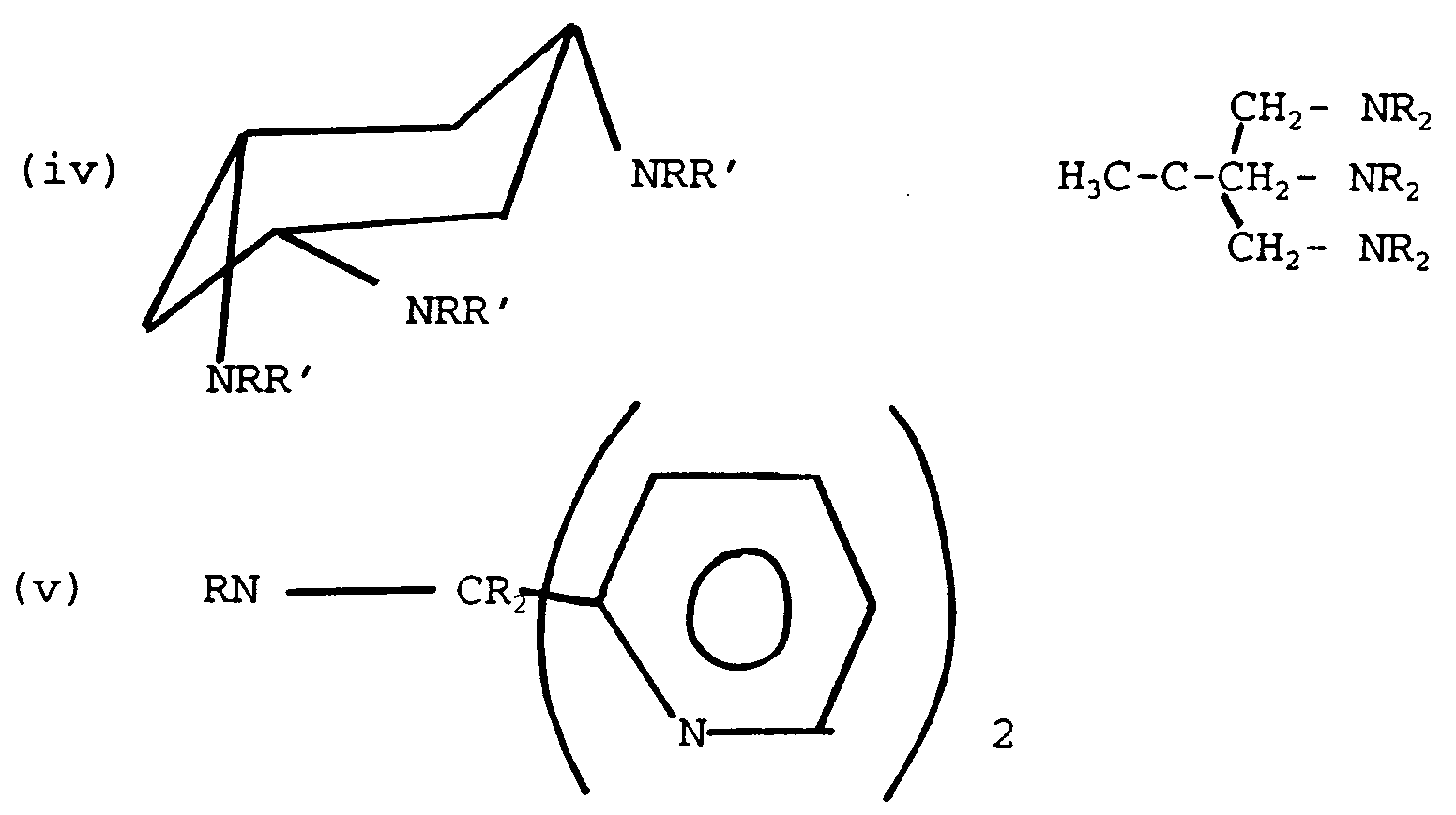
wherein:- R may each independently be H, alkyl, or aryl, optionally substituted; and R′ may each independently be hydrogen or alkyl. - A particularly preferred ligand is 1,4,7-trimethyl-1,4,7-triazacyclononane (Me-TACN), which may, for example, form Mn(III)- and Mn(IV)-dinuclear complexes of the following structural formulae:

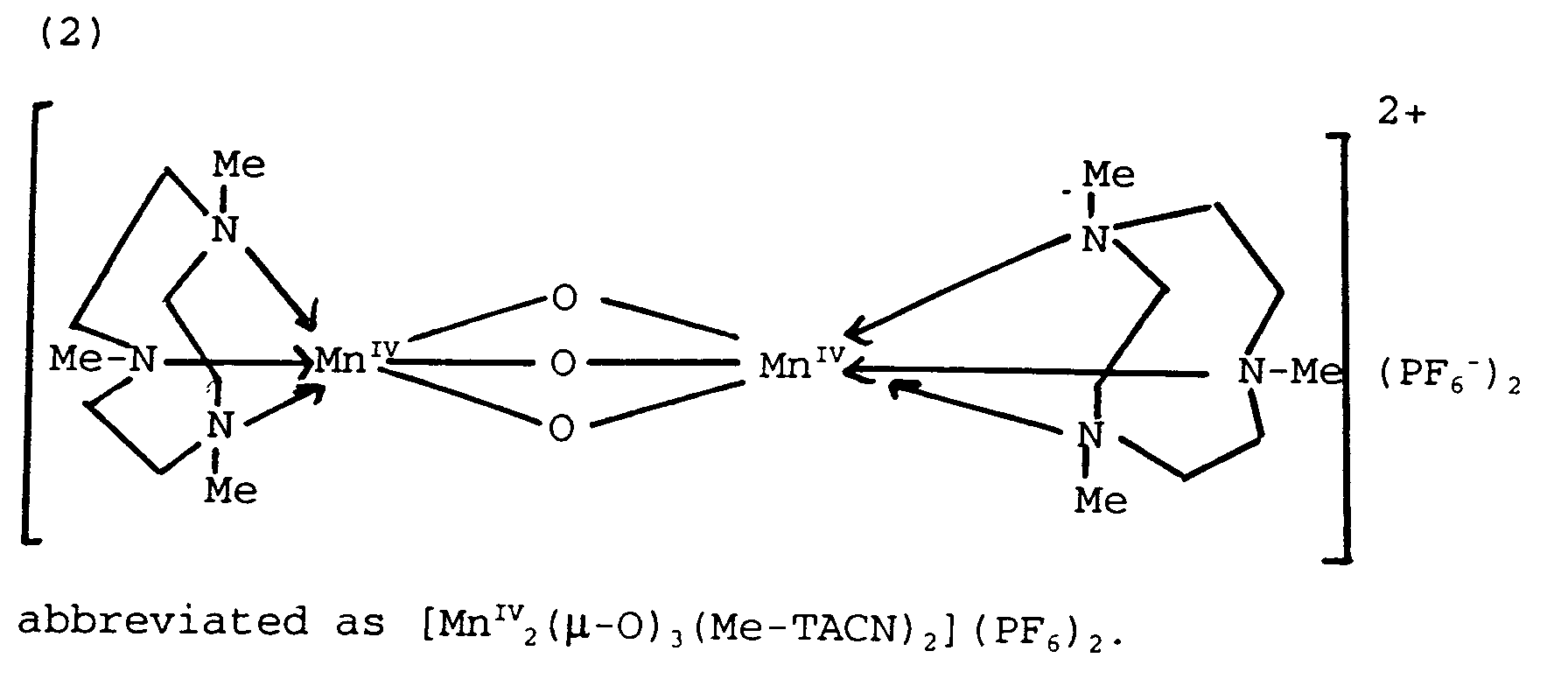
- A further particularly preferred ligand is 1,2,4,7-tetramethyl-1,4,7-triazacyclononane (1,2,4,7-Me₄TACN)
- Though, in principle, any non-aqueous solvent can be used, polar solvents are preferred. A particularly suitable solvent is acetonitrile.
- Preferably the solvent used should be "substantially dry". By "substantially dry", is meant the solvent should contain less than 0.5% by weight of water, preferably less than 0.3% by weight and, most preferably, less than 0.1% by weight.
- The temperature at which the reaction is carried out will depend upon the type of ligand and may vary within the range of from about 20°C up to the boiling temperature of the solvent under the conditions employed, and preferably will be from 20°C to about 60°C, with a particular preference for a range of 50-60°C. It has been found the reaction clearly benefits from a higher temperature since higher conversions can be achieved with a shorter reaction time.
- As explained, an advantage of the invention is that the reaction produces manganese(III)-dinuclear complexes of high purity in high yields, which may, either directly or after isolation, be converted with a suitable oxidizing agent, for example with air oxygen, to the corresponding manganese(IV)- dinuclear complexes having the same high levels of purity. A further advantage is that, in contrast with the aqueous process of the art, the solvent can be regenerated and recycled for re-use. This is particularly advantageous now there is a need to reduce the amount of waste products produced during any chemical process.
- It is of note that the manganese (IV)-dinuclear complexes e.g. [MnIV₂ (µ-O)₃ (1,4,7-Me₃TACN)₂] (PF₆)₂, which will herein-after be referred to as Mn(IV) 1,4,7-Me₃TACN complex, are more stable than the corresponding Mn (III) complexes and hence are more suitable for incorporation into bleaching and detergent formulations.
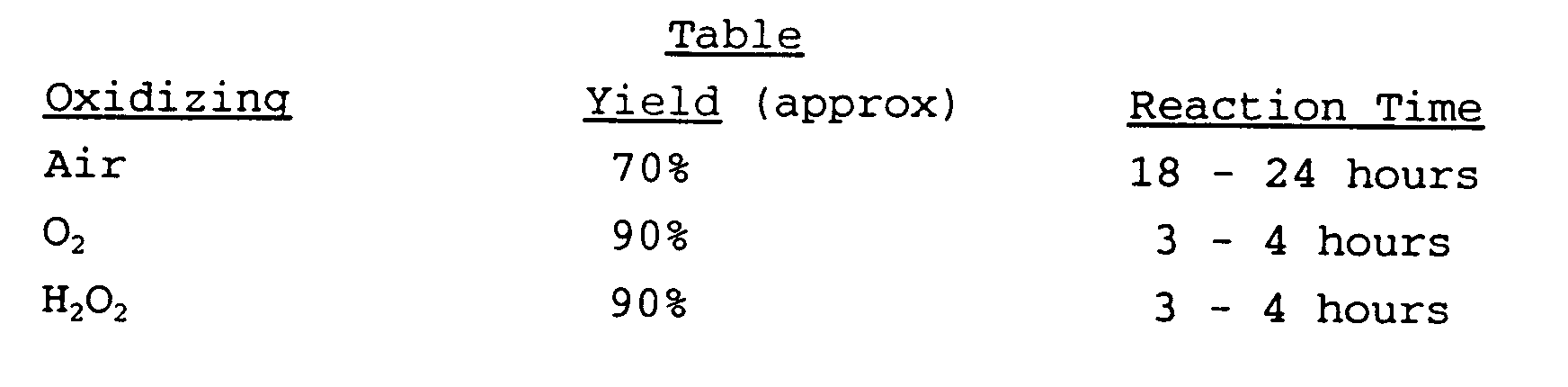
- Oxidation of the Mn (III)-dinuclear complex to the corresponding Mn (IV)-complex may be performed by purging air through the reaction system for 18-24 hours followed by filtration and isolation of the Mn (IV)-complex, in about 70% yield. A significant improvement of this oxidation step may be achieved if, instead of air oxygen, pure oxygen or H₂O₂ (hydrogen peroxide) is used as oxidizing agent. An increased yield is obtained after a much shorter reaction time. The result of oxidizing Mn(III) 1,4,7-Me₃TACN-complex to Mn(IV) 1,4,7-Me₃TACN complex using different oxidizing agents is illustrated in the following table:
- According to a preferred embodiment an Mn(III) complex is oxidised to an Mn(IV) complex using substantially pure oxygen or hydrogen peroxide as the oxidising agent.
- In the process of the invention a Mn(III)-salt is reacted with a ligand to form a Mn(III)-dinuclear complex. The ligand used in this complexation step may be in its "free form", that is the ligand as such.
- It is preferable if the complexation step is carried out in the presence of an effective amount of a strong mineral acid having a pKa <O such as, for example, HCI or H₂SO₄, which appears to further enhance the conversion. Sulphuric acid is particularly preferred as it will given an even higher yield of final product. The effective amount of strong acid will be from about 0.1:10 equivalent acid to the ligand, preferably from 0.5:5 equivalent acid to ligand. Most preferably, an amount of at least one up to three equivalent acid to ligand is used and immediate addition to the reaction mixture is recommended. Where the ligand is 1,4,7-Me₃TACN an amount of acid to give 1,4,7-Me₃TACN.3HCl or 1,4,7-Me₃TACN.1/2H₂SO₄ is preferred, whereby conversions can be increased from about 55% to at least 90%. Alternatively, one may start the complexation step with the salt of the ligand, for example 1,4,7-Me₃TACN.3HCl.
- In a further preferred embodiment the reaction incorporates sodium acetate and sodium bicarbonate as an Mn(III) stabilizer and acid scavenger respectively (HCl or H₂SO₄ comes free during reaction of the chloride or sulphate salts of the ligands with the Mn salt).
- The following Examples will more fully illustrate the embodiments of the invention.
- All solvents were degassed prior to use to exclude oxygen, which oxidizes MnII to MnIV and causes the formation of Mn(IV)O₂. (Solvent was placed in a vessel and a vacuum applied for 5 minutes. Thereafter, argon gas was introduced into the vessel. This procedure was repeated three times.)
- All reactions were carried out at room temperature, under argon, unless otherwise stated.
- In the examples 1,4,7-Me₃TACN is 1,4,7-trimethyl-1,4,7-triazacyclononane.
- In this example the synthetic route described in the art involving reaction in aqueous medium was used to synthesis:
[MnIII₂ (µ-O)₁(µ-OAc)₂ (1,4,7-Me₃-TACN)₂] (ClO₄)₂.H₂O
- In a 25 ml round-bottomed flask, equipped with a magnetic stirrer, 500 mg (2.91 mmol) 1,4,7-trimethyl-1,4,7-triazacyclononane was dissolved in 15 ml ethanol/water (85/15). This gave a clear, colourless solution (pH >11). 0.45 g (1.80 mmol) MnIII(OAc)₃.2aq was then added and a cloudy, dark-brown solution was obtained. After addition of 1.00 g (7.29 mmol) NaOAc.3aq, the pH fell to 8. Thereafter about 15 drops of 70% HClO₄ solution were added with the result the pH of the reaction mixture fell to 5.0.
- After addition of 1.50 g (12.24 mmol) NaClO₄, the colour of the reaction mixture changed from brown to red within about 30 minutes. After allowing the reaction mixture to stand for one week at room temperature, the product precipitated in the form of red crystals. The precipitate was filtered over a glass filter, washed with ethanol/water (85/15) and dried in a dessicator over KOH. No further product could be isolated from the filtrate. Yield of MnIII₂ complex : 360 mg (= 30% based on 1,4,7-Me₃-TACN).
-
[MnIII₂ (µ-O)₁(µ-OAc)₂(1,4,7-Me₃-TACN)₂] (PF₆)₂.H₂O,
under substantially dry conditions starting from Mn(III) acetate and 1,4,7 Me₃-TACN. - To a stirred mixture of 420 mg (5 mmol) NaHCO₃c), 410 mg (5 mmol) NaOAc c) (Na-acetate), 460 mg (2.5 mmol) KPF₆ and 536 mg (2 mmol) MnIII(OAc)₃.2H₂O in 25 ml acetonitrile in a graduated Schlenk tube under argon; 2 mmol 1,4,7-Me₃TACNa) (0.5 mmol/ml in acetonitrile) was added. Stirring at 60°C (bath) was continued for 1 hour. 55% conversion was obtainedd). The reaction mixture was cooled down and filtered. After evaporation (30°C, vacuum) of the filtrate a viscous dark red brown product was obtained. Upon addition of about 25 ml water with stirring and while evacuating, the residue turned into a crystalline product, which was collected on a glass fritt, washed with water and dried (vacuum and argon stream) until constant weight. Yield: 701 mg (78%); Purity (UV/VIS) 77%, giving a corrected yield of 61%.
- a) Obtained by adding 0.235 mol EtONa, dissolved in 200 ml EtOH, to a stirred suspension of 21.0 g (75 mmol) 1,4,7-Me₃-TACN.3.HClb) at room temperature under argon. After stirring for 2 hours the reaction mixture was filtered and the resulting filtercake washed with methanol and dicholormethane. After evaporation of the combined filtrates the residue was distilled. Yield 7.36 g (57%) with b.p. 55-57°/0.1 mmHg. ¹H-NMR: 2.35 (s), N-CH₃ and 2.63 (s), N-CH₂CH₂-N. The remainder was transferred to a graduated Schlenk tube and dissolved in acetonitrile (c=0.5 mmol/ml) and stored in a refrigerator under argon.
- b) Prepared according to K Wieghardt, Chem. Ber, 112, page 2228, 1979.
- c) Finely powdered.
- d) The conversion was measured by UV/Vis spectroscopy. An aliquot (usually 250 or 300 µl) was filtered directly into a 50 ml standard flask with acetonitrile (by pressuring with argon). The resulting solution was used for measuring and calculating the conversion by taking the molar extinction coefficient of the MnIII₂- complex at 310nm as 14000.
- e) From 1,2-propyleneglycol-ditosylate (prepared according R W Hay; J Chem Soc Dalton Trans. 1441-1445 (1979) and diethylenetriamine-N,N′,N˝ tritosylate (prepared via R W Hay idem) the 2-methyl-1,4,7-tritosyl-TACN was prepared and detosylated giving 2-Me-TACN according to the method of K Weighardt, Chem Ber. 112, p 2220-2230. The 2-Me-TACN was methylated giving 1,2,4,7-Me₄TACN using Weighardt's method, Inorg. Chem. 21, 3086-3090 (1979).
- f) From 2-methyl-1,2-diaminopropane-N,N′-ditosylate and diethanolamine-N,O,O′-tritosylate the 2,2-dimethyl-1,4,7-Tos₃TACN was prepared. Subsequent detosylation (according D D Dischino, Inorg. Chem. 30, 1265-1269 (1991) using dissolving sodium in liquid ammonia in the presence of ureum gave the 2,2-Me₂-TACN. The latter was converted to 1,2,2,4,7-Me₅TACN using the methylation method described in e) above.
- g) 1,4-Me₂TACN.2HBr; prepared according to C Flassbeck and K Wieghardt. Z. Anorg. Allg. Chem 608, 60-68 (1992).
- h) Prepared from TACN.3HBr using the method described by G W Gribble, P D Lord, J Skotnicki, S E Dietz, J T Eaton and J L Johnson; J. Am. Chem. Soc. 96, 7812 (1974).
- i) Via the ethylation procedure described above in h) using as substrate 1,4-Me₂TACN.3HBr.
- [MnIII₂ (µ-O)₁(µ-OAc)₂(1,4,7-Me₃TACN)₂] (PF₆)₂.H₂O, where Me-TACN is 1,4,7-trimethyl-1,4,7-triazacyclononane, under substantially anhydrous conditions from Mn(III)-triacetate and 1,4,7-Me₃TACN.3HCl.
- 561 mg (2 mmol) 1,4,7-Me₃-TACN.3HClb), 420 mg (5 mmol) NaHCO₃, 410 mg (5 mmol) NaOAc, 460 mg (2.5 mmol) KPF₆ were stirred with 30 ml acetonitrile (degassed) under argon. After addition of 536 mg (2 mmol) MnIII(OAc)₃2H₂O, the temperature was raised gradually to 55°C over a period of 30 minutes and stirring was continued for 2.5 hours at that temperature. Within a few minutes, the brownish coloured suspension turned to brownish purple, via dark-greyish brown. After filtration, the conversion, as measured by UV/VIS, proved to be 95%. Evaporation (30°C, vacuum) of the filtrate, stirring the residue with water, collecting the solidified products on a glass funnel, washing with water and drying (vacuum and argon) yielded 659 mg (74%) of the MnIII₂ complex.
- Purity 100% (UV/VIS extinction 14,000 at 310 nm). On evaporation of the green-coloured filtrate and flushing the residue (275 mg) with argon overnight, the reddish colour reappeared. Upon stirring this residue with water an additional portion of the complex was obtained (60 mg; 7%; purity 65%), giving a total yield of 79%.
- [MnIII₂ (µ-O)₁(µ-OAc)₂(1,4,7-Me₃-TACN)₂] (PF₆)₂.H₂O using KMnO₄, and Mn(II)-diacetate in dry acetonitrile.
- Amounts of 392 mg (1.6 mmol) MnII(OAc)₂.4H₂O, 63 mg (0.4 mmol) KMnO₄ and 0.16 ml (6 mmol) acetic acid were stirred and refluxed for 0.5 hours in 40 ml of acetonitrile. The mixture was intensely brown-coloured (formation of MnIII(OAc)₃). It was allowed to cool to 25°C. Then a mixture of 561 mg (2 mmol) 1,4,7-Me₃-TACN.3HClb), 420 mg (5 mmol) NaHCO₃, 410 mg (5 mmol) NaOAc and 460 mg (2.5 mmol) KPF₆ was added in one batch to the reaction mixture. The resulting reaction mixture was stirred and refluxed for 30′ (After 15′, % conversion to MnIII₂ complex was measured using UV/VIS spectroscopy. A figure of 80% was obtained. The mixture was allowed to cool to 25°C, filtered and the filtrate evaporated to 4 ml (10% of its original volume). To this concentrate, 50 ml of water was added and the product crystallized. Upon filtration, the product was isolated and after drying 0.77 g (86%) yield of purple powder was obtained which, according to UV/VIS spectroscopy, was 90% pure.
- Dinuclear Mn(III) 1,4,7-Me₃-TACN complex starting from Mn(III) acetate and Me-TACN in presence of H₂SO₄. 2 mmol Me-TACN (0.5 mmol/ml in acetonitrile)a) was added to 25 ml acetonitrile in a graduated Schlenk tube under argon. Thereafter, 110 µl (2 mmol) H₂SO₄ was added by means of a syringe. Initially a sticky precipitate formed but this then went into solution. After stirring for 10 minutes 420 mg (5 mmol) NaHCO₃c), 410 mg (5 mmol) NaOAcc), 460 mg (2.5 mmol) KPF₆ and 536 mg (2 mmol) Mn(OAc)₃.2 H₂O were added simultaneously while stirring at room temperature. During stirring at 60° (bath) the conversion was monitored by UV/VIS spectroscopyd). After 0.5 h and 1 h conversions of 96 and 92% respectively were determined! The reaction mixture was then cooled down and filtered into a graduated flask or a standard flask and the conversion again measured. This gave a figure of 90%. After evaporation (30°C, vacuum) of the filtrate a viscous dark red brown product was obtained. About 25 ml water was added with stirring. While evacuating, the residue turned into a crystalline product, which was collected on a glass fritt, washed with water and dried (vacuum and argon stream) until constant weight. Yield: 767 mg (86%); Purity (UV/VIS): 100%.
-
[MnIV₂ (µ-0)₃(1,4,7-Me₃-TACN)₂] (PF₆)₂.H₂O
- In a 50 ml round bottomed flask provided with a magnetic stirrer, 661.4 mg of the dinuclear Mn(III) 1,4,7 Me₃-TACN complex crystals as obtained from Example I (0.823 mmol) pulverized as a purple powder, were dissolved in 40 ml of a 1:1 ethanol/water mixture. After five minutes ultrasonic treatment and 15 minutes stirring at room temperature, all the powder was dissolved giving rise to a dark red coloured neutral solution. 4 ml of triethylamine was added and the reaction mixture turned to a dark brown colour (pH>11). After 15 minutes of stirring at room temperature in the presence of air the mixture was filtered to remove some manganese dioxide and the filtrate was allowed to stand overnight. A mixture of MnO₂ and red crystals were formed. The solids were collected by filtration and washed with ethanol. The red needle-like crystals were isolated by adding a few ml of acetonitrile to the filter. The crystals easily dissolved, while MnO₂, insoluble in acetonitrile, remained on the filter. Evaporation of the acetonitrile solution gave a product as red flocks. The ethanol/water filtrate was evaporated a little and kept in a refrigeration overnight eventually giving more product. This procedure was repeated a few times until no more product crystallized from the filtrate. The overall yield was 450 mg (68%). The UV/Vis spectra of the product in acetonitrile and water was measured.
- UV (CH₃CN): lambda max. (extinction; extinction coeficient according literature (JACS, 1988, vol 110, No 22, pages 7398-7411); 213 nm (sh); 235 mn (18300, 18000); 270 nm (15300, 16000); 313 nm (8600, 9400); 394 nm (817, 1300); 492 nm (491, sh).
- UV (H₂O): lambda max. (extinction):
200 nm (18600); 244 nm (19300); 278 nm (18600); 313 nm (12000); 389 nm (1100); 483 nm (465). - IR (KBr): 3600 & 34000 cm⁻¹ (water); 2900 - 3000 cm⁻¹ (C-H); 1640 & 840 cm⁻¹ (PF₆-); 1010 cm⁻¹ (C-N); 750 cm⁻¹ (Mn-O-Mn).
- Elemental analysis of [L₂MnIV₂(µ-O)₃](PF₆)₂.H₂O
- C:
- 26.90% (calcd. 26.74%)
- H:
- 5.49% (calcd. 5.50%)
- N:
- 10.26% (calcd. 10.40%)
- Mn:
- 13.7% (calcd. 13.59%)
- P:
- 7.77% (calcd. 7.66%)
- F:
- 28.73% (calcd. 28.20%)
- [MnIII₂ (µ-O)₁(µ-OAc)₂(1,4,7-Me₃-TACN)₂] (PF₆)₂. H₂O, using Mn (II)-diacetate/KMnO₄, Me-TACN (H₂SO₄)1/2.
- To a magnetically stirred 2-necked reaction flask, provided with a jacket that enabled temperature control, containing a suspension of 1025 mg (12.5 mmol) NaOAc and 1078 mg (4.4 mmol) Mn(OAc)₂.4 H₂O in 25 ml acetonitrile was added 503 µl (8.8 mmol) AcOH followed by 174 mg (1.1 mmol) KMnO₄. After stirring for 45 min at room temperature 1150 mg (6.25 mmol) KPF₆ and 420 mg (5 mmol) NaHCO₃ was added. Meanwhile a solution of 140 µl (2.5 mmol) H₂SO₄-96% in 15 ml acetonitrile, prepared in a Schlenk tube, was transferred to a second Schlenk tube that contained a stirred solution of 5 mmol 1,4,7 Me₃-TACN a) in 20 ml acetonitrile. When the resulting thready and sticky precipitate had been dissolved, the 1,4,7-Me₃-TACN (H₂SO₄)1/2 containing solution obtained was transferred immediately to the Mn(III)-acetate containing reaction flask. Subsequently the reaction mixture was stirred thermostatically at 55° for 3 hours while monitoring the progress of the complex formation by UV/VIS spectroscopy (see Example IV). The data obtained showing the variation of % conversion with time is as follows:- 20′: 76%; 40′: 89%; 1h: 91.5%; 2h: 90.5%; 2.5h: 91% and 3h: 92%.
- After 3 hours, the reaction mixture was cooled down to about 20°C and filtered into a graduated cylindrical flask. A conversion of 88.3% was measured.
- Upon rota-evaporation (30°C, vacuum) of the filtrate the dark reddish brown coloured viscous product was stirred with about 25 ml water and again evacuated. In this way the residue turned into a dark purple solid which was collected on a fritt, washed with small portions of water (three times) and ether. Drying until constant weight (vacuum and argon stream overnight).
- Yield:
- 1976 mg (88.4%)
- Purity (UV/VIS):
- 94%.
- To a 4 ml acetonitrile solution of (MnIII₂(µ-O) (µ-OAc)₂(1,4,7-Me₃-TACN)₂](PF₆)₂.H₂O (7.79 mmol) in a 250 ml flask was added 160 ml of ethanol/water (50:50) followed by the addition of 30 ml triethylamine. The reaction mixture turned brown upon addition of the amine. To the resulting suspension was slowly added 2.34 ml 30% H₂O₂(23.23 mmol). (Slow addition is required to prevent excessive foaming) and the reaction mixture was stirred at room temperature for 5 hours.¹ The red solution was then immediately filtered to remove brown MnO₂ byproduct, and the filtrate was concentrated to 1/10 volume in vacuo causing precipitation of the red crystalline (MnIV₂(µ-O)₃ (1,4,7-Me₃-TACN)₂] (PF₆)₂.H₂O. The crystals were then isolated by filtration and washed with ethanol and ether. The red solid was dried in vacuo (40-50°C) yielding 5.15 g (82% yield based on Mn (III) complex). The solution can be further concentrated to yield more Mn(IV)₂ complex in lower purity. (Purity is lowered by the presence of excess salts).
- UV/Vis (CH₃CN - 1.2e-4M) lambdamax (extinction, extinction - lit.):
235 nm (18370, 18000), 270 nm (15920, 1600), 313nm (9510, 9400), 385nm (955, 1300), 490 nm (sh). - HPLC Separation: C-18 Reverse Phase Column - 15 cm (Regis)
Mobile Phase 85:15 pH3 buffer: CH₃CN
pH3 Buffer-20 ml stock solution diluted to 1 litre
Flow Solution - 8ml H₃PO₄(conc.)
- 10 ml Et₃N
- water to 100 ml
- 1. The oxidation can be performed by purging the solution with pure oxygen or air with reaction time of 3.5 hours or 18-24 hours, respectively. The yield of the oxygen oxidation was 86-90%. The yield for the air oxidation was only about 70% possibly due to decomposition of the Mn(IV) complex which occurs due to the instability of the complex in basic solutions (over several hours).
- [MnIII₂ (µ-O) (µ-OAc)₂(1,2,4,7-Me₄TACN)₂] (PF₆)₂H₂O, under substantially anhydrous conditions from MnIII triacetate and 1,2,4,7-Me₄TACN.3HCl.
- Example II was repeated except the 1,4,7-Me₃TACN.3HCl was replaced by 589 mg (2mmol) of 1,2,4,7-Me₄TACN.3HCle).
- The UV/Vis spectrum of the material obtained was measured:

- [Mn₂III (µ-O) (µ-OAc)₂(1,2,2,4,7-Me₅TACN) ₂] (PF₆)₂.H₂O under substantially anhydrous conditions from MnIII triacetate and 1, 2, 2, 4, 7 -Me₅TACN. 3HCl.
- Example II was repeated except the 1,4,7-Me₃TACN.3HCl was replaced by 617 mg (2mmol) of 1,2,2,4,7-Me₃TACN.3HClf).
- The UV/Vis spectrum of the material obtained was measured:

- [Mn₂III (µ-0) (µ-OAc)₂(TACN)₂]. (C10₄)₂.H₂O under substantially anhydrous conditions from MnIII triacetate and TACN. 3HBr.
- 630 mg (2 mmol) TACN.3HBrb), 386 mg (4.6 mmol), NaHCO₃ c), 410 mg (5 mmol) AcONa, 1224 mg (10 mmol) NaClO₄, and 536 mg (2 mmol), Mn(OAc)₃.2H₂O in 30 ml acetonitrile were stirred under argon at 55°C. Within a few minutes the brown coloured mixture darkened while the suspension grew thinner. After 1 hour the flask contents were cooled and filtrated. Then the filtrate was evaporated partly (vacuum). Subsequently ethanol was evaporated partly. Addition of a saturated solution of NaClO₄ in ethanol initiated crystallization. After standing overnight the resulting complex was collected on a frit, washed with ethanol and ether, and dried under argon. Yield: 512 mg (73%).
- UV/Vis in CH₃CN, lambda max (nm)/(ε): 230 (9030), 274 (10.250), 300 (sh), 372 (sh), 484 (375), 518 (290), 541 (sh), 560 (sh) and 660 (120).
- [Mn₂III (µ-O) (µ-Oac)₂(1,4-Me₂TACN)₂] (ClO₄) ₂H₂O under substantially anhydrous conditions from MnIIItriacetate and 1,4-Me₂TACN.3HBr.
- Example X was repeated except:-
- i) 900 mg 1,4-dimethyl-TACN.3HBrg) was used in replace of the TACN.3HBr;
- ii) the reaction was carried out at room temperature for 2.5 hours.
- The resulting precipitate in ethanol was (re) crystallized by adding small amounts of acetonitrile to dissolve it and, subsequently, adding a solution of NaClO₄ in ethanol. In this way 288 mg (38%) of the compound was obtained.
- UV/Vis in CH₃CN, lambda max(nm)/(ε): 241 (9600), 282 (sh), 298 (130000), 386 (sh), 484 (485), 517 (410), 542 (sh), 560 (sh) and 680 (110).
- [Mn₂III (µ-O) (µ-Oac) ₂ (1,4,7-Et₃TACN) ₂] (PF₆)₂H₂O under substantially anhydrous conditions from MnIIItriacetate and 1,4,7-Et₃TACN.3HCl.
- Example II was repeated except the 1,4,7-Me₃TACN.3HCl was replaced by 645 mg (2mmol) of 1,4,7-Et₃TACN.3HClh). A much longer reaction time (about 2 days) was required.
- The UV/Vis spectrum of the material obtained was measured:
- lambdamax (ε):
- 318 nm (13300); 485 nm (702);
522 nm (716); 729 nm (130). - [Mn₂III(µ-O)(µ-OAc)₂(TACD)₂](ClO₄)₂).H₂O under substantially anhydrous conditions from MnIIItriacetate andTACD.3HBr, where TACD is 1,4,7-triazacyclodecane.
- Example X was repeated except TACN.2.3HBr was replaced by 589 mg (2mmol) of TACD.3HClb).
- UV/Vis in CH₃CN:
- lambdamax (ε):
- 278 nm (9700); 483 nm (320);
515 nm (716); 640 nm (160). - [Mn₂III(µ-O)(µ-OAc)₂ (1,4-Me₂-7-EtTACN)₂] (PF₆)₂H₂O under substantially anhydrous conditions from MnIII triacetate and 1,4-Me₃-7-EtTACN.3HCl.
- Example II was repeated except the 1,4,7-Me₃TACN.3HCl was replaced by 645 mg (2mmol) of 1,4,-Me₂-7-EtTACN.3CHli).
- The UV/Vis spectrum of the material obtained was measured:
- lambdamax (ε):
- 311 nm (14200); 485 nm (741);
521 nm (719); 725 nm (100). -
[MnIV₂(µ-O)₃(1,2,2,4,7-Me₅TACN)₂] (PF₆)₂H₂O.
- To a solution of 202 mg (0.217 mmol) [(1,2,2,4,7-pentamethyl-TACN)₂Mn₂III(µ-O) (µ-OAc)₂] (PF₆)₂ in 4.2 ml ethanol/water (1:1) was added 745 µl (5.35 mmol) triethylamine. Oxygen was then bubbled through the solution for 4.5 h at room temperature. After filtration, the filtrate was evaporated, the residue dissolved in acetonitrile/water (2:1) and again filtrated. Upon addition of ethanol and ether the complex crystallized. Yield: 12 mg (6.4%).
- UV/Vis in CH₃CN:-
- lambdamax (ε):
- 239 nm (15950) 275nm (14050)
316 nm (9340) 391nm (890)
494 nm (400). - Crystallization of the concentrated filtrate from an ethanolic solution of NaClO₄ yielded a second crop of 9 mg (5.4%) of Mn₂IV-complex.
-
[MnIV₂(µ-0)₃(1,4,7-Et₃TACN)₂] (PF₆)₂H₂O.
- Example XV was repeated except [Mn₂III(µ-0) (µ-OAc)₂(1,4,7-Et₃TACN)₂] (PF₆)₂H₂O was used.
- UV/Vis in CH₃CN:-
- lambdamax (ε):
- 245 nm (13500); 279 nm (12900);
317 nm (9200); 387 nm (shoulder, 1000)
488 nm (350). -
[Mn₂IV(µ-O)₃(1,2,4,7-Me₄TACN)₂] (PF₆)₂H₂O.
- Example VII was repeated except [Mn₂III(µ-O) (µ-OAc)₂(1,2,4,7-Me₄TACN)₂] ²⁺ (PF₆)₂H₂O was used.
- UV/Vis in CH₃CN:
- lambdamax (ε):
- 238 nm (18800); 272 nm (16700);
314 nm (9700);
396 nm (770); 495 nm (330) -
[Mn₂IV(µ-O)₃(1,4-Me₂-7-EtTACN)₂] (PF₆)₂H₂O.
- Example XV was repeated except [Mn₂III(µ-O) (µ-OAc)₂(1,4,-Me₂-7-EtTACN)₂](PF₆)₂H₂O was used.
- UV/Vis in CH₃CN:-
- lambdamax (ε):
- 238 nm (17200); 273 nm (15350);
314 nm (9070); 395 nm (865);
492 nm (345).
Flow rate - 1ml/min (20 µl injection vol.)
Diode Array Detector - 230, 240 and 313 nm
Sample Concentration - 25-1000 ppm.
Claims (11)
- A process for preparing a dinuclear manganese complex of formula (A).

Mn represents manganese in the III or IV oxidation state, each X is independently a co-ordinating or bridging species selected from H₂O, O₂⁻, O²⁻, OH⁻, SH⁻, S²⁻, 〉S=O, Cl⁻, N₃⁻, SCN⁻, N³⁻, RCOO⁻, NH₂⁻ and NR₃, where R is hydrogen, alkyl or aryl (optionally substituted); L is a ligand which is an organic molecule containing at least three nitrogen atoms which coordinate to a manganese centre; Z represents the charge of the complex and is an integer which may be positive or negative;
Y is a monovalent or multivalent counter-ion leading to charge neutrality, which is dependent upon the charge Z of the complex; and q = z/[charge Y],
the process comprising the step of(i) reacting a Mn (III) salt with at least an equivalent amount of a compound comprising the ligand L to form said manganese complex characterised in that the reaction is carried out in a non-aqueous solvent. - A process according to claim 1 comprising oxidising the manganese complex formed in step (i) with an oxidising agent.
- A process according to claim 2 wherein the oxidising agent is selected from hydrogen peroxide and pure oxygen.
- A process according to claim 1 wherein the non-aqueous solvent used in step (i) contains less than 0.5% by weight of water.
- A process according to claim 1 wherein the non-aqueous solvent used in step (i) is a polar solvent.
- A process according to claim 5 wherein the non-aqueous solvent is acetonitrile.
- A process according to claim 1 wherein step (i) is carried out in the presence of a mineral acid having a pKa <0.
- A process according to claim 7 wherein the ratio of mineral acid to the ligand, in the ligand containing compound, is from 0.1:10 to 0.5 to 5.
- A process according to claim 1 wherein the compound comprising the ligand and used in step (i) is in the form an acid salt of the ligand.
- A process according to claim 1 wherein a stabiliser for Mn(III) compounds and an acid scavenger are added to the reaction.
- A process according to claim 1 wherein the Mn(III) salt used in step (i) is obtained by oxidation of a corresponding Mn(II) salt with an oxidising agent prior to or during said step (i).
Applications Claiming Priority (4)
| Application Number | Priority Date | Filing Date | Title |
|---|---|---|---|
| GB9115012 | 1991-07-11 | ||
| GB919115012A GB9115012D0 (en) | 1991-07-11 | 1991-07-11 | Process for preparing manganese complexes |
| GB9124474 | 1991-11-18 | ||
| GB919124474A GB9124474D0 (en) | 1991-11-18 | 1991-11-18 | Process for preparing manganese complexes |
Publications (1)
| Publication Number | Publication Date |
|---|---|
| EP0522817A1 true EP0522817A1 (en) | 1993-01-13 |
Family
ID=26299223
Family Applications (1)
| Application Number | Title | Priority Date | Filing Date |
|---|---|---|---|
| EP92306196A Withdrawn EP0522817A1 (en) | 1991-07-11 | 1992-07-06 | Process for preparing manganese complexes |
Country Status (5)
| Country | Link |
|---|---|
| US (1) | US5274147A (en) |
| EP (1) | EP0522817A1 (en) |
| JP (1) | JPH05186487A (en) |
| BR (1) | BR9202536A (en) |
| CA (1) | CA2073393A1 (en) |
Cited By (6)
| Publication number | Priority date | Publication date | Assignee | Title |
|---|---|---|---|---|
| EP0544491A3 (en) * | 1991-11-26 | 1993-09-29 | Unilever Plc | Synthesis of manganese oxidation catalyst |
| WO1993025562A1 (en) * | 1992-06-18 | 1993-12-23 | Unilever Plc | Synthesis of manganese oxidation catalyst |
| WO1994019445A1 (en) * | 1993-02-22 | 1994-09-01 | Unilever N.V. | Machine dishwashing composition |
| EP0751142A3 (en) * | 1995-06-30 | 1998-08-19 | Hoechst Aktiengesellschaft | Chiral manganese-triazanonane complexes and process for their preparation |
| EP1304776A3 (en) * | 2001-10-05 | 2005-03-02 | Xerox Corporation | Terahertz generation processes and imaging process thereof |
| WO2011032666A1 (en) | 2009-09-18 | 2011-03-24 | Clariant International Ltd | Method for producing bridged manganese complexes of triazacyclononane |
Families Citing this family (112)
| Publication number | Priority date | Publication date | Assignee | Title |
|---|---|---|---|---|
| CA2072934C (en) * | 1991-07-19 | 2007-08-28 | Karl William Aston | Manganese complexes of nitrogen-containing macrocyclic ligands effective as catalysts for dismutating superoxide |
| US5686014A (en) * | 1994-04-07 | 1997-11-11 | The Procter & Gamble Company | Bleach compositions comprising manganese-containing bleach catalysts |
| EP0754218B1 (en) * | 1994-04-07 | 1998-09-02 | The Procter & Gamble Company | Bleach compositions comprising metal-containing bleach catalysts and antioxidants |
| US5560748A (en) * | 1994-06-10 | 1996-10-01 | The Procter & Gamble Company | Detergent compositions comprising large pore size redox catalysts |
| US5578136A (en) | 1994-08-31 | 1996-11-26 | The Procter & Gamble Company | Automatic dishwashing compositions comprising quaternary substituted bleach activators |
| US5968881A (en) * | 1995-02-02 | 1999-10-19 | The Procter & Gamble Company | Phosphate built automatic dishwashing compositions comprising catalysts |
| CA2211717C (en) * | 1995-02-02 | 2001-04-03 | The Procter & Gamble Company | Automatic dishwashing compositions comprising cobalt (iii) catalysts |
| AU711960B2 (en) * | 1995-02-02 | 1999-10-28 | Procter & Gamble Company, The | Automatic dishwashing compositions comprising cobalt chelated catalysts |
| GB2297978A (en) | 1995-02-15 | 1996-08-21 | Procter & Gamble | Detergent compositions containing amylase |
| CA2224559A1 (en) * | 1995-06-16 | 1997-01-03 | The Procter & Gamble Company | Bleach compositions comprising cobalt catalysts |
| BR9609284A (en) * | 1995-06-16 | 1999-05-11 | Procter & Gamble | Automatic dishwashing compositions comprising cobalt catalysts |
| US5703034A (en) * | 1995-10-30 | 1997-12-30 | The Procter & Gamble Company | Bleach catalyst particles |
| US6066612A (en) | 1996-05-03 | 2000-05-23 | The Procter & Gamble Company | Detergent compositions comprising polyamine polymers with improved soil dispersancy |
| DE19726141A1 (en) * | 1997-06-19 | 1999-01-28 | Daum Gmbh | Device for inserting medical instrument into neuronal part of head |
| MA25044A1 (en) | 1997-10-23 | 2000-10-01 | Procter & Gamble | WASHING COMPOSITIONS CONTAINING MULTISUBSTITUTED PROTEASE VARIANTS. |
| BR0012517B1 (en) | 1999-07-16 | 2010-12-28 | laundry detergent compositions comprising zwitterionic polyamines and branched intermediate chain surfactants. | |
| US6812198B2 (en) | 1999-11-09 | 2004-11-02 | The Procter & Gamble Company | Laundry detergent compositions comprising hydrophobically modified polyamines |
| US6696401B1 (en) * | 1999-11-09 | 2004-02-24 | The Procter & Gamble Company | Laundry detergent compositions comprising zwitterionic polyamines |
| ATE359262T1 (en) | 1999-11-09 | 2007-05-15 | Procter & Gamble | DETERGENT FORMULATIONS WITH HYDROPHOBIC MODIFIED POLYAMINES |
| US6602836B2 (en) | 2000-05-11 | 2003-08-05 | Unilever Home & Personal Care Usa, A Division Of Conopco, Inc. | Machine dishwashing compositions containing cationic bleaching agents and water-soluble polymers incorporating cationic groups |
| AU2002239475A1 (en) | 2000-10-27 | 2002-05-27 | The Procter And Gamble Company | Stabilized liquid compositions |
| US6492312B1 (en) | 2001-03-16 | 2002-12-10 | Unilever Home & Personal Care Usa, Division Of Conopco, Inc. | Water soluble sachet with a dishwashing enhancing particle |
| US6475977B1 (en) | 2001-03-16 | 2002-11-05 | Unilever Home & Personal Care Usa, Division Of Conopco, Inc. | Water soluble sachet with a dishwasher composition |
| EP1590426B1 (en) | 2003-02-03 | 2014-01-08 | Unilever PLC | Laundry cleansing and conditioning compositions |
| AU2006251406B9 (en) | 2005-05-27 | 2009-09-24 | Unilever Plc | Process of bleaching |
| US20080177089A1 (en) | 2007-01-19 | 2008-07-24 | Eugene Steven Sadlowski | Novel whitening agents for cellulosic substrates |
| US8558051B2 (en) | 2007-07-18 | 2013-10-15 | The Procter & Gamble Company | Disposable absorbent article having odor control system |
| US8198503B2 (en) * | 2007-11-19 | 2012-06-12 | The Procter & Gamble Company | Disposable absorbent articles comprising odor controlling materials |
| EP2149569A1 (en) * | 2008-08-01 | 2010-02-03 | Hexion Specialty Chemicals Research Belgium S.A. | Process for the manufacture of a 1,2-Epoxide |
| EP2149570A1 (en) * | 2008-08-01 | 2010-02-03 | Hexion Specialty Chemicals Research Belgium S.A. | Process for the manufacture of epichlorohydrin using hydrogen peroxide and a manganese komplex |
| WO2011005623A1 (en) | 2009-07-09 | 2011-01-13 | The Procter & Gamble Company | Laundry detergent composition comprising low level of bleach |
| WO2011005730A1 (en) | 2009-07-09 | 2011-01-13 | The Procter & Gamble Company | A catalytic laundry detergent composition comprising relatively low levels of water-soluble electrolyte |
| WO2011005804A1 (en) | 2009-07-09 | 2011-01-13 | The Procter & Gamble Company | Method of laundering fabric using a liquid laundry detergent composition |
| WO2011005913A1 (en) | 2009-07-09 | 2011-01-13 | The Procter & Gamble Company | A catalytic laundry detergent composition comprising relatively low levels of water-soluble electrolyte |
| EP2451925A1 (en) | 2009-07-09 | 2012-05-16 | The Procter & Gamble Company | Method of laundering fabric using a compacted laundry detergent composition |
| HUE029942T2 (en) | 2009-08-13 | 2017-04-28 | Procter & Gamble | Method of laundering fabrics at low temperature |
| EP2343288A1 (en) | 2009-11-27 | 2011-07-13 | Momentive Specialty Chemicals Research Belgium S.A. | Process for the manufacture of propylene oxide |
| DE102009057222A1 (en) | 2009-12-05 | 2011-06-09 | Clariant International Ltd. | Bleach catalyst compounds, process for their preparation and their use |
| DE102009057220A1 (en) | 2009-12-05 | 2011-06-09 | Clariant International Ltd. | Non-hygroscopic transition metal complexes, process for their preparation and their use |
| US20110166370A1 (en) | 2010-01-12 | 2011-07-07 | Charles Winston Saunders | Scattered Branched-Chain Fatty Acids And Biological Production Thereof |
| EP2354130A1 (en) | 2010-02-02 | 2011-08-10 | Momentive Specialty Chemicals Research Belgium | Manufacture of an epoxyethyl carboxylate or glycidyl carboxylate |
| EP2354129A1 (en) | 2010-02-02 | 2011-08-10 | Momentive Specialty Chemicals Research Belgium S.A. | Epoxidation process |
| EP2354131A1 (en) | 2010-02-02 | 2011-08-10 | Momentive Specialty Chemicals Research Belgium | Process for the manufacture of a 1,2-epoxide and a device for carrying out said process |
| EP2357180A1 (en) | 2010-02-02 | 2011-08-17 | Momentive Specialty Chemicals Research Belgium S.A. | Manufacture of epoxyethyl ethers or glycidyl ethers |
| US9534139B2 (en) | 2010-02-11 | 2017-01-03 | Dsm Ip Assets B.V. | Manganese salt complex as drier for coating compositions |
| KR101735087B1 (en) * | 2010-03-03 | 2017-05-24 | 카텍셀 리미티드 | Preparation of bleaching catalysts |
| BR112012029133A2 (en) | 2010-05-18 | 2016-09-13 | Milliken & Co | optical brighteners and compositions comprising the same |
| BR112012029188B1 (en) | 2010-05-18 | 2020-12-08 | Milliken & Company | optical whitening compounds and compositions comprising the same |
| US8476216B2 (en) | 2010-05-28 | 2013-07-02 | Milliken & Company | Colored speckles having delayed release properties |
| JP5759544B2 (en) | 2010-07-02 | 2015-08-05 | ザ プロクター アンド ギャンブルカンパニー | Methods for delivering active agents |
| MX345025B (en) | 2010-07-02 | 2017-01-12 | Procter & Gamble | Detergent product. |
| BR112013000099A2 (en) | 2010-07-02 | 2016-05-17 | Procter & Gamble | filaments comprising non-woven non-scent active agent fabrics and methods of manufacture thereof |
| RU2541949C2 (en) | 2010-07-02 | 2015-02-20 | Дзе Проктер Энд Гэмбл Компани | Filaments, containing active agent, non-woven cloths and methods of obtaining them |
| ES2560218T3 (en) | 2010-07-02 | 2016-02-17 | The Procter & Gamble Company | Process for making films from bands of nonwoven material |
| US20120172281A1 (en) | 2010-07-15 | 2012-07-05 | Jeffrey John Scheibel | Detergent compositions comprising microbially produced fatty alcohols and derivatives thereof |
| JP5763762B2 (en) | 2010-07-15 | 2015-08-12 | ザ プロクター アンド ギャンブルカンパニー | Hair washing method |
| US8715368B2 (en) | 2010-11-12 | 2014-05-06 | The Procter & Gamble Company | Thiophene azo dyes and laundry care compositions containing the same |
| WO2012112828A1 (en) | 2011-02-17 | 2012-08-23 | The Procter & Gamble Company | Bio-based linear alkylphenyl sulfonates |
| EP2678410B1 (en) | 2011-02-17 | 2017-09-13 | The Procter and Gamble Company | Composiitons comprising mixtures of c10-c13 alkylphenyl sulfonates |
| EP2678101A1 (en) | 2011-02-25 | 2014-01-01 | Milliken & Company | Capsules and compositions comprising the same |
| EP2537836A1 (en) | 2011-06-22 | 2012-12-26 | Momentive Specialty Chemicals Research Belgium S.A. | Apparatus and methods to preserve catalyst activity in an epoxidation process |
| US20140141126A1 (en) | 2011-06-29 | 2014-05-22 | Solae Llc | Baked food compositions comprising soy whey proteins that have been isolated from processing streams |
| CN115501912A (en) | 2011-09-08 | 2022-12-23 | 卡特克塞尔科技有限公司 | Catalyst and process for producing the same |
| US20130072416A1 (en) | 2011-09-20 | 2013-03-21 | The Procter & Gamble Company | High suds detergent compositions comprising isoprenoid-based surfactants |
| MX2014003278A (en) | 2011-09-20 | 2014-05-21 | Procter & Gamble | Detergent compositions comprising primary surfactant systems comprising highly branched surfactants especially isoprenoid - based surfactants. |
| AR088758A1 (en) | 2011-09-20 | 2014-07-02 | Procter & Gamble | EASY DETERGENT COMPOSITIONS RINSE THAT UNDERSTAND ISOPRENOID BASED SURFACTANTS |
| US20130072415A1 (en) | 2011-09-20 | 2013-03-21 | The Procter & Gamble Company | DETERGENT COMPOSITIONS COMPRISING SPECIFIC BLEND RATIOS of ISOPRENOID-BASED SURFACTANTS |
| MX2014003280A (en) | 2011-09-20 | 2014-05-13 | Procter & Gamble | Detergent compositions comprising sustainable surfactant systems comprising isoprenoid-derived surfactants. |
| CA2860647C (en) | 2012-01-04 | 2022-06-14 | The Procter & Gamble Company | Active containing fibrous structures with multiple regions having differing densities |
| RU2605065C2 (en) | 2012-01-04 | 2016-12-20 | Дзе Проктер Энд Гэмбл Компани | Fibrous structures comprising particles |
| EP2800803A1 (en) | 2012-01-04 | 2014-11-12 | The Procter and Gamble Company | Active containing fibrous structures with multiple regions |
| BR112015001137A2 (en) | 2012-07-26 | 2017-06-27 | Procter & Gamble | low enzymatic liquid cleaning compositions |
| AU2014241193B2 (en) | 2013-03-28 | 2016-10-20 | The Procter And Gamble Company | Cleaning compositions containing a polyetheramine |
| WO2015088826A1 (en) | 2013-12-09 | 2015-06-18 | The Procter & Gamble Company | Fibrous structures including an active agent and having a graphic printed thereon |
| EP3122850A1 (en) | 2014-03-27 | 2017-02-01 | The Procter & Gamble Company | Cleaning compositions containing a polyetheramine |
| EP3122849B1 (en) | 2014-03-27 | 2021-07-21 | The Procter & Gamble Company | Cleaning compositions containing a polyetheramine |
| WO2015187757A1 (en) | 2014-06-06 | 2015-12-10 | The Procter & Gamble Company | Detergent composition comprising polyalkyleneimine polymers |
| DK2966161T3 (en) | 2014-07-08 | 2019-02-25 | Dalli Werke Gmbh & Co Kg | ENZYME BLENDIC CATALYST CATEGRANULATE SUITABLE FOR DETERGENT COMPOSITIONS |
| EP3075832B1 (en) | 2015-03-30 | 2021-04-14 | Dalli-Werke GmbH & Co. KG | Manganese-amino acid compounds in cleaning compositions |
| CN107683326B (en) | 2015-05-07 | 2021-10-08 | 诺维信公司 | Manganese bleach catalyst/enzyme granules for dishwashing detergents |
| US10155868B2 (en) | 2015-10-13 | 2018-12-18 | Milliken & Company | Whitening agents for cellulosic substrates |
| US9745544B2 (en) | 2015-10-13 | 2017-08-29 | The Procter & Gamble Company | Whitening agents for cellulosic substrates |
| US9976035B2 (en) | 2015-10-13 | 2018-05-22 | Milliken & Company | Whitening agents for cellulosic substrates |
| US9902923B2 (en) | 2015-10-13 | 2018-02-27 | The Procter & Gamble Company | Polyglycerol dye whitening agents for cellulosic substrates |
| US10597614B2 (en) | 2015-10-13 | 2020-03-24 | The Procter & Gamble Company | Whitening agents for cellulosic substrates |
| US9777250B2 (en) | 2015-10-13 | 2017-10-03 | Milliken & Company | Whitening agents for cellulosic substrates |
| US10308900B2 (en) | 2015-12-22 | 2019-06-04 | Milliken & Company | Occult particles for use in granular laundry care compositions |
| DK3190168T3 (en) | 2016-01-06 | 2019-07-15 | Dalli Werke Gmbh & Co Kg | COATING CLEANER CATALYST |
| AR107530A1 (en) | 2016-02-05 | 2018-05-09 | Catexel Ltd | METHOD FOR PREPARING A FORMULATION FOR A CURABLE OXIDATION COATING |
| US11697906B2 (en) | 2017-01-27 | 2023-07-11 | The Procter & Gamble Company | Active agent-containing articles and product-shipping assemblies for containing the same |
| US11697904B2 (en) | 2017-01-27 | 2023-07-11 | The Procter & Gamble Company | Active agent-containing articles that exhibit consumer acceptable article in-use properties |
| US11697905B2 (en) | 2017-01-27 | 2023-07-11 | The Procter & Gamble Company | Active agent-containing articles that exhibit consumer acceptable article in-use properties |
| CN110177600B (en) | 2017-01-27 | 2023-01-13 | 宝洁公司 | Active agent-containing articles exhibiting consumer acceptable article application characteristics |
| US20200123472A1 (en) | 2018-10-18 | 2020-04-23 | Milliken & Company | Polyethyleneimine compounds containing n-halamine and derivatives thereof |
| US20200123319A1 (en) | 2018-10-18 | 2020-04-23 | Milliken & Company | Polyethyleneimine compounds containing n-halamine and derivatives thereof |
| US11518963B2 (en) | 2018-10-18 | 2022-12-06 | Milliken & Company | Polyethyleneimine compounds containing N-halamine and derivatives thereof |
| US11466122B2 (en) | 2018-10-18 | 2022-10-11 | Milliken & Company | Polyethyleneimine compounds containing N-halamine and derivatives thereof |
| US11299591B2 (en) | 2018-10-18 | 2022-04-12 | Milliken & Company | Polyethyleneimine compounds containing N-halamine and derivatives thereof |
| US11732218B2 (en) | 2018-10-18 | 2023-08-22 | Milliken & Company | Polyethyleneimine compounds containing N-halamine and derivatives thereof |
| US20200123475A1 (en) | 2018-10-18 | 2020-04-23 | Milliken & Company | Polyethyleneimine compounds containing n-halamine and derivatives thereof |
| WO2020123889A1 (en) | 2018-12-14 | 2020-06-18 | The Procter & Gamble Company | Foaming fibrous structures comprising particles and methods for making same |
| US11485934B2 (en) | 2019-08-02 | 2022-11-01 | The Procter & Gamble Company | Foaming compositions for producing a stable foam and methods for making same |
| US20210148044A1 (en) | 2019-11-15 | 2021-05-20 | The Procter & Gamble Company | Graphic-Containing Soluble Articles and Methods for Making Same |
| US11718814B2 (en) | 2020-03-02 | 2023-08-08 | Milliken & Company | Composition comprising hueing agent |
| US12195703B2 (en) | 2020-03-02 | 2025-01-14 | Milliken & Company | Composition comprising hueing agent |
| US12031113B2 (en) | 2020-03-02 | 2024-07-09 | Milliken & Company | Composition comprising hueing agent |
| US20220079862A1 (en) | 2020-09-14 | 2022-03-17 | Milliken & Company | Hair care composition containing polymeric colorant |
| US11351106B2 (en) | 2020-09-14 | 2022-06-07 | Milliken & Company | Oxidative hair cream composition containing thiophene azo colorant |
| US11344492B2 (en) | 2020-09-14 | 2022-05-31 | Milliken & Company | Oxidative hair cream composition containing polymeric colorant |
| EP3967742A1 (en) * | 2020-09-15 | 2022-03-16 | WeylChem Performance Products GmbH | Compositions comprising bleaching catalyst, manufacturing process thereof, and bleaching and cleaning agent comprising same |
| WO2022197295A1 (en) | 2021-03-17 | 2022-09-22 | Milliken & Company | Polymeric colorants with reduced staining |
| WO2022251838A1 (en) | 2021-05-28 | 2022-12-01 | The Procter & Gamble Company | Natural polymer-based fibrous elements comprising a surfactant and methods for making same |
Citations (2)
| Publication number | Priority date | Publication date | Assignee | Title |
|---|---|---|---|---|
| EP0306089A2 (en) * | 1987-09-04 | 1989-03-08 | Unilever N.V. | Metallo-porphirins as bleach catalyst and process for cleaning fabrics |
| EP0458397B1 (en) * | 1990-05-21 | 1997-03-26 | Unilever N.V. | Bleach activation |
Family Cites Families (3)
| Publication number | Priority date | Publication date | Assignee | Title |
|---|---|---|---|---|
| US4728455A (en) * | 1986-03-07 | 1988-03-01 | Lever Brothers Company | Detergent bleach compositions, bleaching agents and bleach activators |
| ES2008833A6 (en) * | 1988-10-25 | 1989-08-01 | Camp Jabones | Textile bleaching compositions effective at low temperatures. |
| US5153161A (en) * | 1991-11-26 | 1992-10-06 | Lever Brothers Company, Division Of Conopco, Inc. | Synthesis of manganese oxidation catalyst |
-
1992
- 1992-07-06 EP EP92306196A patent/EP0522817A1/en not_active Withdrawn
- 1992-07-06 US US07/909,358 patent/US5274147A/en not_active Expired - Fee Related
- 1992-07-08 CA CA002073393A patent/CA2073393A1/en not_active Abandoned
- 1992-07-09 BR BR929202536A patent/BR9202536A/en not_active Application Discontinuation
- 1992-07-10 JP JP4184181A patent/JPH05186487A/en active Pending
Patent Citations (3)
| Publication number | Priority date | Publication date | Assignee | Title |
|---|---|---|---|---|
| EP0306089A2 (en) * | 1987-09-04 | 1989-03-08 | Unilever N.V. | Metallo-porphirins as bleach catalyst and process for cleaning fabrics |
| EP0458397B1 (en) * | 1990-05-21 | 1997-03-26 | Unilever N.V. | Bleach activation |
| EP0458398B1 (en) * | 1990-05-21 | 1997-03-26 | Unilever N.V. | Bleach activation |
Non-Patent Citations (1)
| Title |
|---|
| JOURNAL OF THE AMERICAN CHEMICAL SOCIETY vol. 110, no. 22, 1988, pages 7398 - 7411; K. WIEGHARDT ET AL: 'Synthesis, crystal structures, reactivity, and magnetochemistry of binuclear complexes of manganese(II), -(III), and (IV) ...' * |
Cited By (7)
| Publication number | Priority date | Publication date | Assignee | Title |
|---|---|---|---|---|
| EP0544491A3 (en) * | 1991-11-26 | 1993-09-29 | Unilever Plc | Synthesis of manganese oxidation catalyst |
| WO1993025562A1 (en) * | 1992-06-18 | 1993-12-23 | Unilever Plc | Synthesis of manganese oxidation catalyst |
| WO1994019445A1 (en) * | 1993-02-22 | 1994-09-01 | Unilever N.V. | Machine dishwashing composition |
| EP0751142A3 (en) * | 1995-06-30 | 1998-08-19 | Hoechst Aktiengesellschaft | Chiral manganese-triazanonane complexes and process for their preparation |
| EP1304776A3 (en) * | 2001-10-05 | 2005-03-02 | Xerox Corporation | Terahertz generation processes and imaging process thereof |
| US6999487B2 (en) | 2001-10-05 | 2006-02-14 | Xerox Corporation | Terahertz generation processes and imaging process thereof |
| WO2011032666A1 (en) | 2009-09-18 | 2011-03-24 | Clariant International Ltd | Method for producing bridged manganese complexes of triazacyclononane |
Also Published As
| Publication number | Publication date |
|---|---|
| JPH05186487A (en) | 1993-07-27 |
| US5274147A (en) | 1993-12-28 |
| CA2073393A1 (en) | 1993-01-12 |
| BR9202536A (en) | 1993-03-16 |
Similar Documents
| Publication | Publication Date | Title |
|---|---|---|
| US5274147A (en) | Process for preparing manganese complexes | |
| US5153161A (en) | Synthesis of manganese oxidation catalyst | |
| Michelin et al. | Alkoxo and hydroxo complexes of platinum (II). Novel insertion reactions into platinum oxygen bonds and condensations with compound containing active hydrogen atoms | |
| Goedken et al. | Facile promotion of oxidative dehydrogenation by iron ions and the synthesis of new complexes of iron with highly unsaturated tetraaza macrocycles | |
| Lawrance | Coordinated trifluoromethanesulfonate and fluorosulfate | |
| EP2550283B1 (en) | Preparation of bleaching catalysts | |
| Kitajima et al. | A monomeric side-on peroxo manganese (III) complex: Mn (O2)(3, 5-iPr2pzH)(HB (3, 5-iPr2pz) 3) | |
| Tanaka et al. | Comparative study on crystal structures of ruthenium bipyridine carbonyl complexes [Ru (bpy) 2 (CO) 2](PF6) 2,[Ru (bpy) 2 (CO)(C (O) OCH3)] B (C6H5) 4. cntdot. CH3CN, and [Ru (bpy) 2 (CO)(. eta. 1-CO2)]. cntdot. 3H2O (bpy= 2, 2'-bipyridyl) | |
| JPH11500052A (en) | Synthesis of manganese oxidation catalyst | |
| Uson et al. | Synthesis and reactivity of [NBu4]+[Pt (III)(C6Cl5) 4]-: molecular structures of [NBu4] 2+[Pt (C6Cl5) 4] 2-. cntdot. 2CH2Cl2,[NBu4]+[Pt (III)(C6Cl5) 4]-and [NBu4]+[Pt (C6Cl5) 4 (NO)]- | |
| EP0659106A1 (en) | Synthesis of manganese bleach catalyst | |
| FI92484B (en) | Process for the preparation of cyclic sulfates | |
| DavidáGarner | A convenient synthesis of tetrakis [thiolato-Á 3-sulphido-iron](2–) clusters | |
| Krämer et al. | Construction of copper chains with new fluorescent guanidino-functionalized naphthyridine ligands | |
| WO2011066934A1 (en) | Nonhygroscopic transition metal complexes, process for preparation thereof and use thereof | |
| US20190134619A1 (en) | Catalysts | |
| Kumagai et al. | Preparation of novel selenacrown ethers and their complexing abilities with transition metal and heavy metal cations. | |
| Dobson et al. | Coordination chemistry and redox properties of polypyridyl complexes of vanadium (II) | |
| McEwen et al. | Preparation of hydridonickel phosphites | |
| Matachek et al. | Dinuclear iron, ruthenium, and cobalt complexes with carbon-and sulfur-bonded bridging C (SR) 2 carbene ligands | |
| US6008387A (en) | Process for the oxidation of organic compounds in the presence of bis- and tris- (μ-oxo)-dimanganese complex salts as catalyst | |
| Ciriano et al. | Bimetallic reactivity: unusual change in the coordination mode of the bridging ligands arising from an oxidative addition process | |
| Wang et al. | Synthesis and molecular and electronic structure of stable salts containing the radical anions [Fe4 (CO) 12CC (O) R] 2-(R= CH3, CH2C6H5) | |
| Cunningham et al. | A simple route to FeCpCp′ | |
| Bottomley et al. | Electrophilic behaviour of co-ordinated nitrogen mono-oxide: preparation and reactions of halogenonitrosylbis [o-phenylenebis (dimethylarsine)] osmium complexes |
Legal Events
| Date | Code | Title | Description |
|---|---|---|---|
| PUAI | Public reference made under article 153(3) epc to a published international application that has entered the european phase |
Free format text: ORIGINAL CODE: 0009012 |
|
| AK | Designated contracting states |
Kind code of ref document: A1 Designated state(s): CH DE ES FR GB IT LI NL SE |
|
| 17P | Request for examination filed |
Effective date: 19930713 |
|
| STAA | Information on the status of an ep patent application or granted ep patent |
Free format text: STATUS: THE APPLICATION HAS BEEN WITHDRAWN |
|
| 18W | Application withdrawn |
Withdrawal date: 19950322 |