EP2497080B1 - Method for producing a holographic film - Google Patents
Method for producing a holographic film Download PDFInfo
- Publication number
- EP2497080B1 EP2497080B1 EP10771476.8A EP10771476A EP2497080B1 EP 2497080 B1 EP2497080 B1 EP 2497080B1 EP 10771476 A EP10771476 A EP 10771476A EP 2497080 B1 EP2497080 B1 EP 2497080B1
- Authority
- EP
- European Patent Office
- Prior art keywords
- process according
- mpa
- film
- photopolymer
- component
- Prior art date
- Legal status (The legal status is an assumption and is not a legal conclusion. Google has not performed a legal analysis and makes no representation as to the accuracy of the status listed.)
- Active
Links
Images


Classifications
-
- G—PHYSICS
- G11—INFORMATION STORAGE
- G11B—INFORMATION STORAGE BASED ON RELATIVE MOVEMENT BETWEEN RECORD CARRIER AND TRANSDUCER
- G11B7/00—Recording or reproducing by optical means, e.g. recording using a thermal beam of optical radiation by modifying optical properties or the physical structure, reproducing using an optical beam at lower power by sensing optical properties; Record carriers therefor
- G11B7/24—Record carriers characterised by shape, structure or physical properties, or by the selection of the material
- G11B7/2403—Layers; Shape, structure or physical properties thereof
- G11B7/24035—Recording layers
- G11B7/24044—Recording layers for storing optical interference patterns, e.g. holograms; for storing data in three dimensions, e.g. volume storage
-
- G—PHYSICS
- G11—INFORMATION STORAGE
- G11B—INFORMATION STORAGE BASED ON RELATIVE MOVEMENT BETWEEN RECORD CARRIER AND TRANSDUCER
- G11B7/00—Recording or reproducing by optical means, e.g. recording using a thermal beam of optical radiation by modifying optical properties or the physical structure, reproducing using an optical beam at lower power by sensing optical properties; Record carriers therefor
- G11B7/24—Record carriers characterised by shape, structure or physical properties, or by the selection of the material
- G11B7/241—Record carriers characterised by shape, structure or physical properties, or by the selection of the material characterised by the selection of the material
- G11B7/242—Record carriers characterised by shape, structure or physical properties, or by the selection of the material characterised by the selection of the material of recording layers
- G11B7/244—Record carriers characterised by shape, structure or physical properties, or by the selection of the material characterised by the selection of the material of recording layers comprising organic materials only
- G11B7/245—Record carriers characterised by shape, structure or physical properties, or by the selection of the material characterised by the selection of the material of recording layers comprising organic materials only containing a polymeric component
-
- G—PHYSICS
- G11—INFORMATION STORAGE
- G11B—INFORMATION STORAGE BASED ON RELATIVE MOVEMENT BETWEEN RECORD CARRIER AND TRANSDUCER
- G11B7/00—Recording or reproducing by optical means, e.g. recording using a thermal beam of optical radiation by modifying optical properties or the physical structure, reproducing using an optical beam at lower power by sensing optical properties; Record carriers therefor
- G11B7/24—Record carriers characterised by shape, structure or physical properties, or by the selection of the material
- G11B7/26—Apparatus or processes specially adapted for the manufacture of record carriers
-
- G—PHYSICS
- G03—PHOTOGRAPHY; CINEMATOGRAPHY; ANALOGOUS TECHNIQUES USING WAVES OTHER THAN OPTICAL WAVES; ELECTROGRAPHY; HOLOGRAPHY
- G03H—HOLOGRAPHIC PROCESSES OR APPARATUS
- G03H2260/00—Recording materials or recording processes
- G03H2260/12—Photopolymer
-
- G—PHYSICS
- G03—PHOTOGRAPHY; CINEMATOGRAPHY; ANALOGOUS TECHNIQUES USING WAVES OTHER THAN OPTICAL WAVES; ELECTROGRAPHY; HOLOGRAPHY
- G03H—HOLOGRAPHIC PROCESSES OR APPARATUS
- G03H2260/00—Recording materials or recording processes
- G03H2260/30—Details of photosensitive recording material not otherwise provided for
Definitions
- the invention relates to a method for producing a holographic film and holographic film obtainable by the method.
- holographic films can be made using special photopolymer formulations. So is about in the WO 2008/125199 A1 describes a photopolymer formulation containing polyurethane-based matrix polymers, an acrylate-based writing monomer, and photoinitiators. If a layer is cured from the photopolymer formulation, the writing monomer and the photoinitiators are spatially distributed isotropically embedded in the resulting polyurethane matrix. In this way you get a movie in which holograms can be imprinted.
- holograms which can also be described as diffractive optical elements. It depends on the specific exposure, which optical functions such a hologram forms.
- the refractive index modulation ⁇ n produced by the holographic exposure in the photopolymer plays the crucial role.
- the interference field of signal and reference light beam in the simplest case the two plane waves
- the refractive index grating in the photopolymer contains all the information of the signal light beam.
- the strength of the thus reconstructed signal in relation to the intensity of the incident reference light is called diffraction efficiency, hereinafter DE as Diffraction Efficiency.
- DE diffraction Efficiency
- the DE results from the quotient of the intensity of the light diffracted during the reconstruction and the sum of the intensities of the radiated reference light and the diffracted light.
- High refractive index acrylates are capable of producing high amplitude refractive index gratings between low refractive index regions and high refractive index regions, thereby enabling high DE and high ⁇ n holograms in photopolymer formulations.
- DE depends on the product of ⁇ n and the photopolymer layer thickness d.
- the width of the angular range at which the hologram is e.g. when monochromatic illumination is visible (reconstructed) depends only on the layer thickness d. When the hologram is illuminated with e.g. white light, the width of the spectral range which contributes to the reconstruction of the hologram depends also only on the layer thickness d. In this case, the smaller the d the greater the acceptance widths.
- Such a large-scale manufacturing method is, for example, in the not yet disclosed European patent application with the application number 09001952.2 described.
- a photopolymer formulation is applied to a substrate and then dried at elevated temperature.
- holographic media in the form of films can be obtained.
- films in which the photopolymer formulation does not have sufficient mechanical stability are obtained in many cases. This is particularly disadvantageous because the films can not be wound up as rolls. For example, a shift of the photopolymer may occur when printing by the protective film or the tackiness of the photopolymer is so great that when removing the protective film, as may be necessary for holographic exposure, the photopolymer layer or at least its surface is destroyed.
- the object of the present invention was therefore to specify a (large-scale) process with the aid of which holographic films with a sufficient mechanical stability can be produced, which can be wound up in particular as rolls.
- plateau modulus is understood to mean the real part of the complex shear modulus (also called storage modulus) of the unexposed photopolymer formulation.
- a photopolymer formulation having a plateau modulus of ⁇ 0.03 MPa and ⁇ 1 MPa, preferably 0.05 MPa and ⁇ 1 MPa, more preferably 0.1 MPa and ⁇ 1 MPa and most preferably 0 , 1 MPa and ⁇ 0.6 MPa.
- a laminating film is applied to the film.
- the film may preferably be rolled up together with the laminating film.
- the plateau modulus of the photopolymer formulation can be determined by measuring the complex shear modulus of the photopolymer formulation in a plate-plate geometry oscillatory rheometer.
- the matrix component A consists of reactive components (eg a 2K system)
- the temporal development of the shear modulus of the photopolymer formulation can be followed over the time of curing of the matrix component, at the end of which the plateau modulus is the real part of the self-assembling complex shear modulus results.
- the photoinitiator system component C
- the matrix polymers (component A)) may preferably be polyurethanes obtainable in particular by reacting an isocyanate component a) with an isocyanate-reactive component b).
- the isocyanate component a) preferably comprises polyisocyanates.
- polyisocyanates it is possible to use all compounds known per se to the person skilled in the art or mixtures thereof which on average have two or more NCO functions per molecule. These may be aromatic, araliphatic, aliphatic or cycloaliphatic. In minor amounts, it is also possible to use monoisocyanates and / or polyisocyanates containing unsaturated groups.
- the polyisocyanates of component a) are particularly preferably di- or oligomerized aliphatic and / or cycloaliphatic di- or triisocyanates.
- NCO-functional prepolymers with urethane, allophanate, biuret and / or amide groups are obtained in a manner well-known to the person skilled in the art by reacting monomeric, oligomeric or polyisocyanates a1) with isocyanate-reactive compounds a2) in suitable stoichiometry with the optional use of catalysts and solvents.
- Suitable polyisocyanates a1) are all aliphatic, cycloaliphatic, aromatic or araliphatic di- and triisocyanates known to the person skilled in the art, it being immaterial whether these were obtained by phosgenation or by phosgene-free processes.
- the higher molecular weight secondary products of monomeric di- and / or triisocyanates with urethane, urea, carbodiimide, acylurea, isocyanurate, allophanate, biuret, oxadiazinetrione, uretdione, iminooxadiazinedione structure, which are well known per se, can also be used individually or be used in any mixtures with each other.
- Suitable monomeric di- or triisocyanates which can be used as component a1) are butylene diisocyanate, hexamethylene diisocyanate (HDI), isophorone diisocyanate (IPDI), trimethylhexamethylene diisocyanate (TMDI), 1,8-diisocyanato-4- (isocyanatomethyl ) octane, isocyanatomethyl-1,8-octane diisocyanate (TIN), 2,4- and / or 2,6-toluene diisocyanate.
- HDI hexamethylene diisocyanate
- IPDI isophorone diisocyanate
- TMDI trimethylhexamethylene diisocyanate
- TIN isocyanatomethyl-1,8-octane diisocyanate
- 2,4- and / or 2,6-toluene diisocyanate 2,4- and / or 2,6-toluene diis
- OH-functional compounds are preferably used. These are analogous to the OH-functional compounds as described below for component b).
- Allophanates can also be used in a mixture with other prepolymers or oligomers of component a1). In these cases, the use of OH-functional compounds with
- Functionalities of 1 to 3.1 are advantageous. When monofunctional alcohols are used, those having 3 to 20 carbon atoms are preferred.
- amines for prepolymer production.
- Isocyanate is reacted in excess with amine to produce prepolymers containing biuret phenomenon, resulting in a biuret.
- Suitable amines in this case for the reaction with the di-, tri- and polyisocyanates mentioned are all oligomeric or polymeric primary or secondary difunctional amines of the abovementioned type. Examples are aliphatic biurets based on aliphatic amines and aliphatic isocyanates, in particular HDI and TMDI.
- Preferred prepolymers are urethanes, allophanates or biurets of aliphatic isocyanate-functional compounds and oligomeric or polymeric isocyanate-reactive compounds having number average molecular weights of 200 to 10,000 g / mol.
- the prepolymers described above have residual contents of free monomeric isocyanate of less than 2 wt .-%, more preferably less than 1.0 wt .-%, most preferably less than 0.5 wt.% On.
- the isocyanate component may contain proportionate addition to the described prepolymers further isocyanate components. If appropriate, it is also possible that the isocyanate component a) contains proportionate isocyanates which are partially reacted with isocyanate-reactive ethylenically unsaturated compounds.
- isocyanate component a) may comprise complete or proportionate isocyanates which have been completely or partially reacted with blocking agents known to the person skilled in the art from coating technology.
- blocking agents which may be mentioned are: alcohols, lactams, oximes, malonic esters, alkylacetoacetates, triazoles, phenols, imidazoles, pyrazoles and amines, for example butanone oxime, diisopropylamine, 1,2,4-triazole, dimethyl-1,2,4-triazole , Imidazole, diethyl malonate, acetoacetic ester, acetone oxime, 3,5-dimethylpyrazole, ⁇ -caprolactam, N-tert-butylbenzylamine, cyclopentanonecarboxyethyl ester or any mixtures of these blocking agents.
- all polyfunctional, isocyanate-reactive compounds can be used per se, which have on average at least 1.5 isocyanate-reactive groups per molecule.
- Isocyanate-reactive groups in the context of the present invention are preferably hydroxy, amino or thio groups, particularly preferred are hydroxy compounds.
- Suitable polyfunctional, isocyanate-reactive compounds are, for example, polyester, polyether, polycarbonate, poly (meth) acrylate and / or polyurethane polyols.
- component b) as polyfunctional, isocyanate-reactive compounds and low molecular weight, i. with molecular weights less than 500 g / mol, short chain, i. 2 to 20 carbon atoms containing aliphatic, araliphatic or cycloaliphatic di, tri or polyfunctional alcohols suitable.
- These may, for example, be ethylene glycol, diethylene glycol, triethylene glycol, tetraethylene glycol, dipropylene glycol, tripropylene glycol, 1,2-propanediol, 1,3-propanediol, 1,4-butanediol, neopentyl glycol, 2-ethyl-2-butylpropanediol, trimethylpentanediol, positionally isomeric diethyloctanediols, 1 , 3-butylene glycol, cyclohexanediol, 1,4-cyclohexanedimethanol, 1,6-hexanediol, 1,2- and 1,4-cyclohexanediol, hydrogenated bisphenol A (2,2-bis (4-hydroxycyclohexyl) propane), 2,2 Dimethyl 3-hydroxypropionic acid (2,2-dimethyl-3-hydroxypropyl ester).
- triols examples are trimethylolethane, trimethylolpropane or glycerol.
- Suitable higher-functionality alcohols are ditrimethylolpropane, pentaerythritol, dipentaerythritol or sorbitol.
- Suitable polyester polyols are, for example, linear polyester diols or branched polyester polyols, as obtained in known manner from aliphatic, cycloaliphatic or aromatic di- or polycarboxylic acids or their anhydrides with polyhydric alcohols having an OH functionality ⁇ 2.
- Preferred polyester polyols are based on aliphatic alcohols and mixtures of aliphatic and aromatic acids and have number average molecular weights between 500 and 10,000 g / mol and functionalities between 1.8 and 6.1.
- the polyester polyols can also be based on natural raw materials such as castor oil. It is also possible that the polyester polyols are based on homopolymers or copolymers of lactones, as preferred by addition of lactones or lactone mixtures in the context of a ring-opening lactone polymerization such as butyrolactone, ⁇ -caprolactone and / or methyl- ⁇ -caprolactone to hydroxy-functional compounds such as polyhydric alcohols having an OH functionality ⁇ 2 or polyols a functionality of greater than 1.8, for example of the aforementioned type can be obtained.
- polyols used here as initiators are polyether polyols having a functionality of 1.8 to 3.1 with number average molar masses of 200 to 4000 g / mol, preferred are poly (tetrahydrofurans) having a functionality of 1.9 to 2.2 and number average molecular weights from 500 to 2000 g / mol.
- polyether polyols having a functionality of 1.8 to 3.1 with number average molar masses of 200 to 4000 g / mol
- poly (tetrahydrofurans) having a functionality of 1.9 to 2.2 and number average molecular weights from 500 to 2000 g / mol.
- poly (tetrahydrofurans) having a functionality of 1.9 to 2.2 and number average molecular weights from 500 to 2000 g / mol.
- Suitable polycarbonate polyols are obtainable in a manner known per se by reacting organic carbonates or phosgene with diols or diol mixtures.
- Suitable organic carbonates are dimethyl, diethyl and diphenyl carbonate.
- Suitable diols or mixtures include the polyhydric alcohols of an OH functionality ⁇ 2, preferably 1,4-butanediol, 1,6-hexanediol and / or 3-methylpentanediol, which are per se in the context of the polyester segments, or else polyester polyols can be worked into polycarbonate polyols ,
- Suitable polyether polyols are optionally block-formed polyaddition of cyclic ethers to OH or NH-functional starter molecules.
- Suitable cyclic ethers are, for example, styrene oxides, ethylene oxide, propylene oxide, tetrahydrofuran, butylene oxide, epichlorohydrin, and also any desired mixtures thereof.
- the starter used may be the polyhydric alcohols of an OH functionality ⁇ 2, which are known per se in the context of the polyesterpolyols, as well as primary or secondary amines and aminoalcohols.
- Preferred polyether polyols are those of the aforementioned type based solely on propylene oxide or random or block copolymers based on propylene oxide with further 1-alkylene oxides, wherein the 1-Alykenoxidanteil is not higher than 80 wt .-%.
- Particular preference is given to propylene oxide homopolymers and also random or block copolymers which contain oxyethylene, oxypropylene and / or oxybutylene units, the proportion of oxypropylene units, based on the total amount of all oxyethylene, oxypropylene and oxybutylene units, being at least 20% by weight at least 45% by weight.
- Oxypropylene and oxybutylene herein include all respective linear and branched C3 and C4 isomers.
- R is preferably a hydrogen, a methyl, butyl, hexyl or octyl group or an ether group-containing alkyl radical.
- Preferred ether group-containing alkyl radicals are those based on oxyalkylene units.
- the multiblock copolymers Y (X i -H) n preferably have number-average molecular weights of more than 1200 g / mol, particularly preferably more than 1950 g / mol, but preferably not more than 12000 g / mol, particularly preferably not more than 8000 g / mol ,
- Preferably used block copolymers of the structure Y (X i -H) n consist of more than 50 percent by weight of the blocks X i described above according to the invention and have a number-average total molar mass of greater than 1200 g / mol.
- Component (B) used is one or more different compounds which have polymerization-reactive groups (radiation-curing groups) on exposure to actinic radiation with ethylenically unsaturated compounds and are themselves free of NCO groups.
- component B) compounds such as ⁇ , ⁇ -unsaturated carboxylic acid derivatives such as acrylates, methacrylates, maleinates, fumarates, maleimides, acrylamides, furthermore vinyl ethers, propenyl ethers, allyl ethers and dicyclopentadienyl units containing compounds and olefinically unsaturated compounds such.
- Styrene, ⁇ -methylstyrene, vinyltoluene, olefins, e.g. 1-octene and / or 1-decene, vinyl esters, (meth) acrylonitrile, (meth) acrylamide, methacrylic acid, acrylic acid can be used. Preference is given to acrylates and methacrylates.
- Acrylates or methacrylates are generally esters of acrylic acid or methacrylic acid.
- useful acrylates and methacrylates are methyl acrylate, methyl methacrylate, ethyl acrylate, ethyl methacrylate, ethoxyethyl acrylate, ethoxyethyl methacrylate, n-butyl acrylate, n-butyl methacrylate, tert-butyl acrylate, tert-butyl methacrylate, hexyl acrylate, hexyl methacrylate, 2-ethylhexyl acrylate, 2-ethylhexyl methacrylate, butoxyethyl acrylate, Butoxyethyl methacrylate, lauryl acrylate, lauryl methacrylate, isobornyl acrylate, isobornyl methacrylate, phenyl acrylate, phenyl methacrylate,
- Urethane acrylates can also be used as component B).
- Urethane acrylates are compounds having at least one acrylic acid ester group which additionally have at least one urethane bond. It is known that such compounds can be obtained by reacting a hydroxy-functional acrylic ester with an isocyanate-functional compound.
- urethane acrylates and / or urethane methacrylates used as component B) are the addition products of aromatic triisocyanates (very particularly preferably tris (4-phenylisocyanato) thiophosphate or trimers of aromatic diisocyanates such as tolylene diisocyanate) with hydroxyethyl acrylate, hydroxypropyl acrylate, 4-hydroxybutyl acrylate, the addition products of 3-Thiomethyl-phenyl isocyanate with hydroxyethyl acrylate, hydroxypropyl acrylate, 4-hydroxy-butyl acrylate and unsaturated Glycidyletheracrylaturethane (as in the applications WO 2008/125229 A1 and in the non-prepublished application EP 09009651.2 described) or any mixtures thereof.
- aromatic triisocyanates very particularly preferably tris (4-phenylisocyanato) thiophosphate or trimers of aromatic diisocyanates such as tolylene diisocyan
- the unsaturated glycidyl ether acrylate urethanes of the formula IIa or IIb can be prepared in a 2-step synthesis.
- an unsaturated carboxylic acid is reacted with an epoxide to form a mixture of two alcohols.
- unsaturated epoxides can be reacted with any carboxylic acids to the analogous intermediate.
- this alcohol mixture is urethanized by means of a di- or polyisocyanate R "'(NCO) n of the functionality n to Glycidyletheracrylaturethan (as in the non-prepublished application EP 09002180.9 described).
- Methacrylic acid and acrylic acid or their derivatives or aromatic carboxylic acids are preferably used for the reaction with an unsaturated epoxide; epoxides are preferably aromatic or unsaturated epoxides, such as phenyl, dibromophenyl, naphthyl or biphenyl glycidyl ether or glydidyl (meth) acrylate
- Isocyanate component is preferably used toluene diisocyanate (TDI), hexamethylene diisocyanate (HDI) or Triisocyanatononan (TIN).
- the combinations of (acrylic acid, biphenyl glycidyl ether and TDI), (acrylic acid, phenyl glycidyl ether and TDI) and (acrylic acid, biphenyl glycidyl ether and HDI) are used.
- the monofunctional writing monomer can in particular have the general formula (III) in which R 1 , R 2 , R 3 , R 4 , R 5 each independently represent a hydrogen or halogen atom or a C 1 -C 6 -alkyl, trifluoromethyl, C 1 -C 6 -alkylthio, C 1 -C 6 -alkylseleno , C1-C6-Alkyltelluro- or nitro group, provided that at least one substituent of the group R 1 , R 2 , R 3 , R 4 , R 5 is not hydrogen, R 6 , R 7 are each individually hydrogen or a C 1 -C 6 alkyl group and A is a saturated or unsaturated or linear or branched C 1 -C 6 -alkyl radical or a polyethylene oxide radical or a polypropylene oxide radical having in each case 2 to 6 repeat units in the polymer chain, and the monofunctional writing monomer preferably has a glass transition temperature T G ⁇ 0
- the multifunctional Schreibmonomer can in particular the general formula (IV) have in which n ⁇ 2 and n ⁇ 4 and R 8 , R 9 are hydrogen and / or independently of one another are linear, branched, cyclic or heterocyclic unsubstituted or optionally also substituted by hetero atoms organic radicals. Furthermore, the multifunctional writing monomer may preferably have a refractive index> 1.50 at 589 nm.
- the photoinitiator system used may preferably comprise an anionic, cationic or neutral dye and a coinitiator.
- examples are mixtures of tetrabutylammonium triphenylhexylborate, tetrabutylammonium triphenylbutylborate, tetrabutylammonium trinapthylbutylborate, tetrabutylammonium tris- (4-tert-butyl) -phenylbutylborate, tetrabutylammonium tris- (3-fluorophenyl) -hexylborate and tetrabutylammonium tris- (3-chloro-4-methylphenyl) -hexylborate with dyes such as Astrazon Orange G, Methylene Blue, New Methylene Blue, Azure A, Pyrillium I, Safranine O, Cyanine, Gallocyanine, Brilliant Green
- the photopolymer formulation contains special non-photopolymerizable additives (component D)).
- additives may in particular be urethanes, wherein the urethanes may preferably be substituted by at least one fluorine atom.
- component D) urethanes of the general formula (V) be used, in which n ⁇ 1 and n ⁇ 8 and R 10 , R 11 , R 12 are hydrogen and / or independently of one another are linear, branched, cyclic or heterocyclic unsubstituted or optionally also substituted by hetero atoms organic radicals, preferably at least one R 10 , R 11 , R 12 is substituted by at least one fluorine atom and more preferably R 10 is an organic radical having at least one fluorine atom.
- constituents of the photopolymer formulation may be (components E)): radical stabilizers, if appropriate catalysts or other auxiliaries and additives.
- radical stabilizers are inhibitors and antioxidants such as in " Methods of Organic Chemistry "(Houben-Weyl), 4th Edition, Volume XIV / 1, p 433ff, Georg Thieme Verlag, Stuttgart 1961 , are suitable. Suitable classes are, for example, phenols such as 2,6-di-tert-butyl-4-methylphenol, cresols, hydroquinones, benzyl alcohols such as benzhydrol, possibly also quinones such. B. 2,5-di-tert-butyl quinone, possibly also aromatic amines such as diisopropylamine or phenothiazine.
- one or more catalysts can be used. These are catalysts for accelerating urethane formation.
- catalysts for this purpose are, for example, tin octoate, zinc octoate, dibutyltin dilaurate, dimethylbis [(1-oxoneodecyl) oxy] stannane, dimethyltin dicarboxylate, zirconium bis (ethylhexanoate), zirconium lactoeylacetonate or tertiary amines such as 1,4-diazabicyclo [2.2.2] octane, diazabicyclononane , Diazabicycloundecane, 1,1,3,3-tetramethylguanidine, 1,3,4,6,7,8-hexahydro-1-methyl-2H-pyrimido (1,2-a) pyrimidine.
- dibutyltin dilaurate dimethylbis [(1-oxoneodecyl) oxy] stannane, dimethyltin dicarboxylate, 1,4-diazabicyclo [2.2.2] octane, diazabicyclononane, diazabicycloundecane, 1,1,3,3-tetramethylguanidine, 1,3,4,6 , 7,8-hexahydro-1-methyl-2H-pyrimido (1,2-a) pyrimidine.
- further auxiliaries or additives can be used (also components E)).
- additives customary in the field of coating technology such as solvents, plasticizers, leveling agents or adhesion promoters. It may also be advantageous to simultaneously use several additives of one type. Of course, it may also be advantageous to use several additives of several types.
- a film of the photopolymer formulation can be applied to a carrier film, for example with the aid of a roller coater.
- a coating equipment e.g. Slit nozzles and doctor systems have, are suitable for the application of liquid photopolymer formulations on moving substrates and are characterized by a high accuracy in the application layer thickness.
- the metering of the starting materials takes place either by gear pumps or eccentric screw pumps.
- centrifugal deaerator and for filtering plate filters are used for degassing the feedstock centrifugal deaerator and for filtering plate filters.
- the mixture of the individual components takes place via a static mixer with correspondingly designed mixing geometries, such as e.g. Length and diameter.
- a slot nozzle is used as a preferred coating unit.
- the coated material is dried over air dryers with the desired air temperature and moisture content over a defined period of time.
- FIG. 4 shows a schematic structure of a typical coating system, including arrangement of the pretreatment of the coating material (1-5), schematic course of the carrier film (8 + 9), coating device for application to the carrier film (6) and subsequent drying process (7).
- photopolymer formulations can be applied to moving support materials in a high layer thickness accuracy.
- the holographic media may be film composites consisting of one or more carrier films, one or more Photopolymer layers and one or more protective films may consist in any order.
- Preferred materials or composite materials of the carrier layer are based on polycarbonate (PC), polyethylene terephthalate (PET), polybutylene terephthalate, polyethylene, polypropylene, cellulose acetate, cellulose hydrate, cellulose nitrate, cycloolefin polymers, polystyrene, polyepoxides, polysulfone, cellulose triacetate (CTA), polyamide, polymethyl methacrylate, polyvinyl chloride, polyvinyl butyral or polydicyclopentadiene or mixtures thereof.
- material composites such as film laminates or coextrudates can be used as carrier film.
- PC and PET are particularly preferably used as a carrier film.
- constituents can have one or more cover layers on the photopolymer layer for the film composite in order to protect them from dirt and environmental influences.
- cover layers plastic films or composite film systems, but also clearcoats can be used.
- Another object of the invention is a holographic medium obtainable by the process according to the invention.
- Still another object of the present invention is the use of holographic films for recording visual holograms, for making optical elements, images, representations and a method of recording holograms using the holographic films.
- holograms for optical applications in the entire visible range and in the near UV range (300-800 nm) can be produced by appropriate exposure processes.
- Visual holograms include all holograms that can be recorded by methods known to those skilled in the art, including, but are not limited to, in-line (gabor) holograms, off-axis holograms, full-aperture transfer holograms, white-light transmission holograms ("hologram holograms”), denisyuk holograms, Off axis reflection holograms, edge-lit holograms and holographic stereograms, preferred are reflection holograms, Denisyuk holograms, transmission holograms.
- optical elements such as lenses, mirrors, deflection mirrors, filters, diffusers, diffractive elements, light guides, waveguides, projection screens and / or masks. Frequently, these optical elements exhibit frequency selectivity depending on how the holograms were exposed and the dimensions of the hologram.
- the holographic films can also be used to produce holographic images or representations, such as personal portraits, biometric representations in security documents, or generally images or image structures for advertising, security labels, trademark protection, branding, labels, design elements, decorations, illustrations, trading cards , Images and the like, as well as images that can represent digital data, including in combination with the previously presented products.
- Holographic images can have the impression of a three-dimensional image, but they can also represent image sequences, short films or a number of different objects, depending on which angle, with which (even moving) light source, etc., this is illuminated. Due to these diverse design possibilities, holograms, in particular volume holograms, represent an attractive technical solution for the above-mentioned application.
- the refractive index n as a function of the wavelength of the samples was obtained from the transmission and reflection spectra. To this end, about 100-300 ⁇ m thick films of the samples were spun onto silica glass carrier from dilute solution in butyl acetate. The transmission and reflection spectrum of this layer package was measured with a spectrometer from STEAG ETA Optics, CD-Measurement System ETA-RT and then the layer thickness and the spectral curve of n to the measured transmission and reflection spectra in the range of 380-850 nm customized. This is done with the internal software of the spectrometer and additionally requires the refractive index data of the quartz glass substrate, which were determined in advance in a blind measurement.
- the refractive indices for the photopolymerizable monomers B) refer to the wavelength of 405 nm and thus correspond to n D 20 .
- holographic media photopolymer films prepared as described below were then measured by means of a measuring arrangement according to FIG. 1 tested for holographic properties as follows:
- the protective film of the holographic film media (M) is peeled off and the holographic film with the photopolymer side is laminated on a 1 mm thick glass plate of suitable length and width with a rubber roller under slight pressure.
- This sandwich of glass and photopolymer film can now be used to determine the holographic performance parameters DE and ⁇ n.
- the beam of a He-Ne laser (emission wavelength 633 nm) was converted into a parallel homogeneous beam by means of the spatial filter (SF) and together with the collimation lens (CL).
- the final cross sections of the signal and reference beam are defined by the iris diaphragms (I).
- the diameter of the iris aperture is 0.4 cm.
- the polarization-dependent beam splitters (PBS) divide the laser beam into two coherent identically polarized beams. Through the ⁇ / 2 plates, the power of the reference beam was set to 0.5 mW and the power of the signal beam to 0.65 mW. The performances were determined with the semiconductor detectors (D) with the sample removed.
- the angle of incidence ( ⁇ 0 ) of the reference beam is -21.8 °
- the angle of incidence ( ⁇ 0 ) of the signal beam is 41.8 °.
- the angles are measured from the sample standard to the beam direction. According to FIG. 1 Therefore, ⁇ 0 has a negative sign and ⁇ 0 has a positive sign.
- the interference field of the two overlapping beams produced a grid of bright and dark stripes perpendicular to the bisector of the two beams incident on the sample (reflection hologram).
- the stripe distance A, also called the grating period, in the medium is - 225 nm (the refractive index of the medium assumed to be ⁇ 1.504).
- RD reference direction of the turntable.
- the written holograms have now been read out in the following way.
- the shutter of the signal beam remained closed.
- the shutter of the reference beam was open.
- the iris diaphragm of the reference beam was closed to a diameter ⁇ 1 mm. It was thus achieved that for all rotation angles ( ⁇ ) of the medium, the beam was always located completely in the previously written hologram.
- the turntable computer controlled the angular range from ⁇ min to ⁇ max with an angle increment of 0.05 °.
- ⁇ is measured from the sample standard to the reference direction of the turntable.
- ⁇ 0 -31.8 °.
- the powers of the beam transmitted in the zeroth order were measured by means of the corresponding detector D and the powers of the beam deflected to the first order by means of the detector D.
- P D is the power in the detector of the diffracted beam and P T is the power in the detector of the transmitted beam.
- the Bragg curve was described, it describes the diffraction efficiency ⁇ as a function of the rotation angle ⁇ of the written hologram measured and stored in a computer.
- the intensity transmitted in the zeroth order was also recorded against the angle of rotation ⁇ and stored in a computer.
- the maximum diffraction efficiency (DE ⁇ max ) of the hologram, ie its peak value, was determined during ⁇ reconstruction . It may be necessary to change the position of the detector of the diffracted beam to determine this maximum value.
- the refractive index contrast ⁇ n and the thickness d of the photopolymer layer has now been determined by means of the coupled wave theory (cf. H. Kogelnik, The Bell System Technical Journal, Volume 48, November 1969, Number 9 Page 2909 - Page 2947 ) to the measured Bragg curve and the angle profile of the transmitted intensity. It should be noted that due to the thickness shrinkage occurring due to the photopolymerization, the strip spacing A 'of the hologram and the orientation of the strips (slant) may deviate from the strip spacing A of the interference pattern and its orientation.
- ⁇ is the lattice strength
- ⁇ is the detuning parameter
- ⁇ ' is the orientation (slant) of the refractive index lattice that was written.
- ⁇ 'and ⁇ ' correspond to the angles ⁇ 0 and ⁇ 0 of the interference field when writing the hologram, but measured in the medium and valid for the lattice of the hologram (after thickness shrinkage).
- n is the average refractive index of the photopolymer and was set to 1,504.
- ⁇ is the wavelength of the laser light in a vacuum.
- FIG. 2 shows the measured transmitted power P T (right y -axis) plotted against the angular detection ⁇ as a solid line, the measured diffraction efficiency ⁇ (left y- axis) plotted as solid circles against the angular detection ⁇ (as far as the finite size of the detector allowed) and the adaptation of the Kogelnik theory as a dashed line (left y- axis).
- FIG. 2 shows the representation of the Bragg curve ⁇ according to the Coupled Wave Theory (dashed line), the measured diffraction efficiency (filled circles) and the transmitted power (black solid line) against the Winkelduning ⁇ .
- this procedure may be repeated several times for different exposure times t on different media to determine at which average absorbed dose of the incident laser beam is going to saturate upon writing the hologram DE.
- the powers of the partial beams have been adjusted so that the same power density is achieved in the medium at the angles ⁇ 0 and ⁇ 0 used.
- FIG. 1 shown construction equivalent test performed with a green laser with the emission wavelength ⁇ in a vacuum of 532 nm.
- This value of the module is regarded as the plateau module G 0 to be determined. Examples of typical measurement curves can be found in FIG. 3 ,
- FIG. 3 shows the course of hardening of the matrix network (left) and testing for plateau behavior (G 'independent of ⁇ ) (right).
- Component a1) is a product of Bayer MaterialScience AG, Leverkusen, DE, hexane diisocyanate-based polyisocyanate, proportion of iminooxadiazinedione at least 30%, NCO content: 23.5%.
- Component a2) is a test product of Bayer MaterialScience AG, Leverkusen, DE, aliphatic polyisocyanate based on hexane diisocyanate, NCO content about 20%.
- Component a3) is a product of Bayer MaterialScience AG, Leverkusen, DE, full allophanate of hexane diisocyanate on polypropylene glycol having a number-average molecular weight of about 280 g / mol, NCO content: 16.5-17.3%.
- Component a4) is a commercial product of Bayer MaterialScience AG, Leverkusen, Germany, mixture of 29.4 mol% isocyanurate based on HDI with 70.6 mol% of the urethane of poly ( ⁇ -caprolactone) of the number average molecular weight 650 g / Mol with HDI, NCO content 10.5 - 11.5%.
- Component a5) is a commercial product of Bayer MaterialScience AG, Leverkusen, Germany, aliphatic biuret type based on hexamethylene diisocyanate, NCO content: 22.5-23.5%.
- Polyol b1) is an experimental product of Bayer MaterialScience AG, Leverkusen, Germany, the preparation is described below.
- Polyol b2 is an experimental product of Bayer MaterialScience AG, Leverkusen, Germany, the preparation is described below.
- Polyol b3) is an experimental product of Bayer MaterialScience AG, Leverkusen, DE, the preparation is described below.
- Polyol b4) is an experimental product of Bayer MaterialScience AG, Leverkusen, Germany, the preparation is described below.
- Component E1 urethanization catalyst, dimethylbis [(1-oxoneodecl) oxy] stannane, commercial product of the company Momentive Performance Chemicals, Wilton, CT, USA.
- Component B1) is an experimental product of Bayer MaterialScience AG, Leverkusen, Germany, the preparation is described below.
- Component B2 is an experimental product of Bayer MaterialScience AG, Leverkusen, Germany, the preparation is described below.
- Component B3 is an experimental product of Bayer MaterialScience AG, Leverkusen, Germany, the preparation is described below.
- Co-initiator 1 tetrabutylammonium tris (3-chloro-4-methylphenyl) (hexyl) borate, [1147315-11-4]) is a trial product manufactured by Ciba Inc., Basel, Switzerland.
- Dye 1 is New Methylene Blue (CAS 1934-16-3) and was obtained from SIGMA-ALDRICH CHEMIE GmbH, Steinlzeim, Germany.
- Dye 2 is safranine O (CAS 477-73-6) and was obtained from SIGMA-ALDRICH CHEMIE GmbH, Steinheim, Germany.
- Dye 3 is ethyl violet (CAS 2390-59-2) and was purchased in 80% purity from SIGMA-ALDRICH CHEMIE GmbH, Steinheim, Germany and so used.
- Dye 4 is Astrazon Orange G (CAS 3056-93-7) and was obtained from SIGMA-ALDRICH CHEMIE GmbH, Steinheim, Germany.
- TMDI 2,4,4-trimethylhexane-1,6-diisocyanate
- DMC Catalyst Zinc hexacyanocobaltate (III) double metal cyanide catalyst, obtainable after the in EP-A 700 949 described method.
- Irganox 1076 is octadecyl 3,5-di- (tert) -butyl-4-hydroxyhydrocinnamate (CAS 2082-79-3).
- Byk ® 310 silicone-based surface additive from BYK-Chemie GmbH, Wesel, 25% solution in xylene.
- the product was stabilized by the addition of 7.5 g Irganox 1076 and obtained as a slightly cloudy, viscous liquid (OH number 27.1 mg KOH / g, viscosity at 25 ° C: 1636 mPas).
- component B3 (mixture of (4-methylbenzene-1,3-diyl) bis [carbamoyloxy-3- (biphenyl-2-yloxy) propane-2,1-diyl] bisacrylate and (4-methylbenzene-1, 3-diyl) bis [carbamoyloxy-3- (biphenyl-2-yloxy) propane-1,2-diyl] bisacrylate and analogous isomers):
- the various writing monomers (components B), and optionally additives (parts of component E) in the isocyanate-reactive component b) are optionally dissolved at 60 ° C. If necessary, it is heated to 60 ° C. in the drying oven for a maximum of 10 minutes. Then, isocyanate component a) (other part of component A) is added and mixed in the speed mixer for 1 minute. In the following, a solution of component E1) in butyl acetate is added and mixed again in the speed mixer for 1 minute (further parts of component E). The concentration of component E1) in butyl acetate is 10% by weight. From this solution, the amounts described in Table 2 were used.
- Table 2 lists the examples of photopolymer formulations without photoinitiator system C) prepared in this way for the determination of the plateau modulus G 0 of the photopolymers.
- the components polyol (component b)) are reacted stepwise with the photopolymerizable writing monomers (component B1) + B2)), optionally with the non-polymerisable components D) and the uretahation catalyst (component E1)) in N-ethylpyrrolidone ( 10% by weight), then Byk® 310 (part of component E)) is added and mixed. Subsequently, a solution of the component C) of the photopolymer solution is added in the dark and mixed to obtain a clear solution.
- the formulation may be heated at 60 ° C for a short time to aid solubility of the feeds.
- the corresponding isocyanate component a) is added at 30 ° C. and mixed again.
- the liquid mass obtained is then applied by means of doctor blade or slot die to a 36 ⁇ m thick polyethylene terephthalate film, and dried for 4.5 minutes at a drying temperature of 80 ° C in a circulating air dryer. Subsequently, the photopolymer layer is covered with a 40 micron thick polyethylene film and wound up.
- the desired target layer thickness of the dried photopolymers is preferably between 10 and 20 ⁇ m.
- the production rates are preferably in the range of 0.2 m / min to 300 m / min and more preferably in the range of 1.0 m / min to 50 m / min.
- Table 3 lists the investigated examples of the photopolymer formulations used for the continuous production of holographic films in their composition.
- G 0 should preferably be> 0.05 MPa, and very particularly preferably> 0.1 MPa.
- the homogeneity of the photopolymer layer thickness is assessed visually.
- the edge regions of the photopolymer in the running direction of the web are particularly conspicuous and easy to assess.
- usually slight unevenness in the layer thicknesses by the coloring of the Photopolymer can be observed, which can be caused by a shift of the material when printed by the protective film.
- the tackiness of the photopolymer layer is evaluated.
- the protective film is peeled off the photopolymer.
- the tackiness can be determined empirically by the force applied to peel off and observe the photopolymer-protective film interface.
- the possible destruction of the photopolymer during stripping is a particularly strong indication of a very good adhesion between photopolymer and protective film, which in turn is caused by too low a blocking resistance of the polymer.
Landscapes
- Engineering & Computer Science (AREA)
- Manufacturing & Machinery (AREA)
- Polyurethanes Or Polyureas (AREA)
- Holo Graphy (AREA)
- Diffracting Gratings Or Hologram Optical Elements (AREA)
- Laminated Bodies (AREA)
Abstract
Description
Die Erfindung betrifft ein Verfahren zur Herstellung eines holographischen Films sowie nach dem Verfahren erhältlichen holographischen Film.The invention relates to a method for producing a holographic film and holographic film obtainable by the method.
Holographische Filme können beispielsweise mit Hilfe von speziellen Photopolymer-Formulierungen hergestellt werden. So ist etwa in der
Dies kann mittels der Überlagerung zweier kohärenter Lichtquellen erfolgen, wobei sich eine dreidimensionale Struktur in dem Medium ausbildet, die sich im allgemeinen durch eine regionale Änderung des Brechungsindexes (Brechungsindexmodulation Δn) beschreiben lässt. Derartige Strukturen werden Hologramme genannt, die auch als diffraktive optische Elemente beschrieben werden können. Dabei hängt es von der speziellen Belichtung ab, welche optischen Funktionen ein solches Hologramm ausbildet.This can be done by superposition of two coherent light sources, forming a three-dimensional structure in the medium, which can generally be described by a regional change in the refractive index (refractive index modulation Δn). Such structures are called holograms, which can also be described as diffractive optical elements. It depends on the specific exposure, which optical functions such a hologram forms.
Für die Verwendungen von Photopolymer-Formulierungen spielt die durch die holographische Belichtung im Photopolymer erzeugte Brechungsindexmodulation Δn die entscheidende Rolle. Bei der holographischen Belichtung wird das Interferenzfeld aus Signal- und Referenzlichtstrahl (im einfachsten Fall das zweier ebenen Wellen) durch die lokale Photopolymerisation von z.B. hochbrechenden Acrylate an Orten hoher Intensität im Interferenzfeld in ein Brechungsindexgitter abgebildet. Das Brechungsindexgitter im Photopolymeren (das Hologramm) enthält alle Information des Signallichtstrahls. Durch Beleuchtung des Hologramms nur mit dem Referenzlichtstrahl kann dann das Signal wieder rekonstruiert werden. Die Stärke des so rekonstruieten Signals im Verhältnis zur Stärke des eingestrahlten Referenzlichts wird Beugungseffizienz genannt, im folgenden DE wie Diffraction Efficiency. Im einfachsten Fall eines Hologramms, das aus der Überlagerung zweier ebener Wellen entsteht ergibt sich die DE aus dem Quotienten der Intensität des bei der Rekonstruktion abgebeugten Lichtes und der Summe der Intensitäten aus eingestrahltem Referenzlicht und abgebeugtem Licht. Je höher die DE desto effizienter ist ein Hologramm in Bezug auf die Lichtmenge des Referenzlichtes die notwendig ist, um das Signal mit einer festen Helligkeit sichtbar zu machen.For the uses of photopolymer formulations, the refractive index modulation Δn produced by the holographic exposure in the photopolymer plays the crucial role. In holographic exposure, the interference field of signal and reference light beam (in the simplest case the two plane waves) is imaged by the local photopolymerization of, for example, high-index acrylates in high-intensity locations in the interference field in a refractive index grating. The refractive index grating in the photopolymer (the hologram) contains all the information of the signal light beam. By illuminating the hologram only with the reference light beam, the signal can then be reconstructed. The strength of the thus reconstructed signal in relation to the intensity of the incident reference light is called diffraction efficiency, hereinafter DE as Diffraction Efficiency. In the simplest case of a hologram, which results from the superposition of two plane waves, the DE results from the quotient of the intensity of the light diffracted during the reconstruction and the sum of the intensities of the radiated reference light and the diffracted light. The higher the DE, the more efficient a hologram is in terms of the amount of light of the reference light that is necessary to make the signal visible with a fixed brightness.
Hochbrechende Acrylate sind in der Lage, Brechungsindexgitter mit hoher Amplitude zwischen Bereichen mit niedrigem Brechungsindex und Bereichen mit hohem Brechungsindex zu erzeugen und damit in Photopolymer-Formulierungen Hologramme mit hohem DE und hohem Δn zu ermöglichen. Dabei ist zu beachten, dass DE vom Produkt aus Δn und der Photopolymerschichtdicke d abhängt. Je größer das Produkt desto größer die mögliche DE (für Reflexionshologramme). Die Breite des Winkelbereiches bei dem das Hologramm z.B. bei monochromatischer Beleuchtung sichtbar wird (rekonstruiert) hängt nur von der Schichtdicke d ab. Bei Beleuchtung des Hologramms mit z.B. weißem Licht hängt die Breite des spektralen Bereiches der zur Rekonstruktion des Hologramms beitragen kann ebenfalls nur von der Schichtdicke d ab. Dabei gilt je kleiner d desto größer die jeweiligen Akzeptanzbreiten.High refractive index acrylates are capable of producing high amplitude refractive index gratings between low refractive index regions and high refractive index regions, thereby enabling high DE and high Δn holograms in photopolymer formulations. It should be noted that DE depends on the product of Δn and the photopolymer layer thickness d. The larger the product, the larger the potential DE (for reflection holograms). The width of the angular range at which the hologram is e.g. when monochromatic illumination is visible (reconstructed) depends only on the layer thickness d. When the hologram is illuminated with e.g. white light, the width of the spectral range which contributes to the reconstruction of the hologram depends also only on the layer thickness d. In this case, the smaller the d the greater the acceptance widths.
Will man helle und leicht sichtbare Hologramme herstellen, ist ein hohes Δn und eine geringe Dicke d anzustreben und zwar so das DE möglichst groß wird. Das heißt je höher Δn wird, desto mehr Freiraum zur Gestaltung der Schichtdicke d für helle Hologramme erreicht man ohne Verlust an DE. Daher kommt der Optimierung von Δn bei der Optimierung von Photopolymerformulierungen eine herausragenden Bedeutung zu (
Es ist daher bisher versucht worden, durch Veränderung der Zusammensetzung der zur Herstellung der holographischen Filme verwendeten Photopolymer-Formulierungen ein möglichst hohes Δn zu realisieren. Allerdings hat sich gezeigt, dass die im Laborversuch entwickelten Photopolymer-Formulierungen nicht ohne teils erhebliche Probleme für die großtechnische Herstellung von holographischen Filmen eingesetzt werden können.It has therefore hitherto been attempted to realize the highest possible Δn by changing the composition of the photopolymer formulations used to produce the holographic films. However, it has been shown that the photopolymer formulations developed in the laboratory experiment can not be used without major problems for the large-scale production of holographic films.
Ein derartiges großteclmisches Herstellungsverfahren ist beispielsweise in der noch nicht offengelegten europäischen Patentanmeldung mit der Anmeldenummer
Wenn die im Laborversuch für ein hohes Δn optimierten Photopolymer-Formulierungen bei dem vorstehend beschriebenen Verfahren eingesetzt werden, erhält man in vielen Fällen Filme, auf denen die Photopolymer-Formulierung keine ausreichende mechanische Stabilität aufweist. Dies ist insbesondere nachteilig, da die Filme nicht als Rollen aufgewickelt werden können. So kann beispielsweise eine Verschiebung des Photopolymers bei Druckaufgabe durch die Schutzfolie auftreten oder die Klebrigkeit des Photopolymers ist so groß, dass beim Abziehen der Schutzfolie, wie es zum holographischen Belichten notwendig sein kann, die Photopolymerschicht oder zumindest deren Oberfläche zerstört wird.When the high Δn-optimized photopolymer formulations in the laboratory test are used in the method described above, films in which the photopolymer formulation does not have sufficient mechanical stability are obtained in many cases. This is particularly disadvantageous because the films can not be wound up as rolls. For example, a shift of the photopolymer may occur when printing by the protective film or the tackiness of the photopolymer is so great that when removing the protective film, as may be necessary for holographic exposure, the photopolymer layer or at least its surface is destroyed.
Es ist somit bisher nicht ohne weiters möglich, Laborformulierungen für die großtechnische Herstellung von holgt-aphischen Filmen einzusetzen.It is thus far not readily possible to use laboratory formulations for the large-scale production of holgt-aphischen films.
Aufgabe der vorliegenden Erfindung war daher ein (großtechnisches) Verfahren anzugeben, mit dessen Hilfe holographische Filme mit einer ausreichenden mechanischen Stabilität hergestellt werden können, die insbesondere als Rollen aufgewickelt werden können.The object of the present invention was therefore to specify a (large-scale) process with the aid of which holographic films with a sufficient mechanical stability can be produced, which can be wound up in particular as rolls.
Diese Aufgabe ist durch ein Verfahren zur Herstellung eines holographischen Films gelöst, bei dem
- i) eine Photopolymer-Formulierung umfassend
- A) Matrixpolymere als amorphes Netzwerk
- B) eine Kombination eines monofunktionellen Schreibmonomers und eines multifunktionellen Schreibmonomers
- C) ein Photoinitiatorsystem
- D) optional eine nicht photopolymerisierbare Komponente
- E) gegebenenfalls Katalysatoren, Radikalstabilisatoren, Lösungsmittel, Additive sowie andere Hilfs- und / oder Zusatzstoffe
bereit gestellt,
- ii) die Photopolymer-Formulierung als Film flächig auf ein Substrat aufgebracht und
- iii) der Film getrocknet wird,
- i) comprising a photopolymer formulation
- A) Matrix polymers as an amorphous network
- B) a combination of a monofunctional writing monomer and a multifunctional writing monomer
- C) a photoinitiator system
- D) optionally a non-photopolymerizable component
- E) optionally catalysts, radical stabilizers, solvents, additives and other auxiliaries and / or additives
provided,
- ii) the photopolymer formulation is applied as a film surface on a substrate and
- iii) the film is dried,
Es wurde gefunden, dass sich mechanisch stabile, wickelfähige holographische Filme herstellen lassen, wenn eine Photopolymer-Formulierung verwendet wird, die ein Plateaumodul von ≥ 0,03 MPa aufweist.It has been found that mechanically stable, windable holographic films can be made using a photopolymer formulation having a plateau modulus of ≥ 0.03 MPa.
Unter Plateaumodul im Sinne der vorliegenden Anmeldung wird der Realteil des komplexen Schermoduls (auch Speichermodul genannt) der nicht belichteten Photopolymer-Formulierung verstanden.For the purposes of the present application, plateau modulus is understood to mean the real part of the complex shear modulus (also called storage modulus) of the unexposed photopolymer formulation.
Vorzugsweise kann eine Photopolymer-Formulierung mit einem Plateaumodul von ≥ 0,03 MPa und ≤ 1 MPa, bevorzugt von ≥ 0,05 MPa und ≤ 1 MPa, besonders bevorzugt von ≥ 0,1 MPa und ≤ 1 MPa und insbesondere bevorzugt von ≥ 0,1 MPa und ≤ 0,6 MPa verwendet werden.Preferably, a photopolymer formulation having a plateau modulus of ≥ 0.03 MPa and ≦ 1 MPa, preferably 0.05 MPa and ≦ 1 MPa, more preferably 0.1 MPa and ≦ 1 MPa and most preferably 0 , 1 MPa and ≤ 0.6 MPa.
Gemäß einer weiteren bevorzugten Ausführungsform der Erfindung ist vorgesehen, dass nach dem Trocknen im Schritt iii) auf den Film eine Kaschierfolie aufgebracht wird. Anschließend kann der Film vorzugsweise zusammen mit der Kaschierfolie aufgerollt werden.According to a further preferred embodiment of the invention, it is provided that, after drying in step iii), a laminating film is applied to the film. Subsequently, the film may preferably be rolled up together with the laminating film.
Der Plateaumodul der Photopolymer-Formulierung kann insbesondere bestimmt werden, indem man den komplexen Schermodul der Photopolymerformulierung in einem Oszillationsrheometer in Platte-Platte Geometrie vermisst. Insbesondere wenn die Matrixkomponente A aus reaktiven Komponenten (z. B. einem 2K-System) besteht, kann damit die zeitliche Entwicklung des Schermoduls der Photopolymerformulierung über der Zeit der Aushärtung der Matrixkomponente verfolgt werden, an deren Ende sich der Plateaumodul als Realteil des sich einstellenden komplexen Schermoduls ergibt. Aus Gründen der einfacheren Durchführung der Messung des Plateaumoduls kann dabei auf das Photoinitiatorsystem (Komponente C)) in der Photopolymerformulierung verzichtet werden.In particular, the plateau modulus of the photopolymer formulation can be determined by measuring the complex shear modulus of the photopolymer formulation in a plate-plate geometry oscillatory rheometer. In particular, if the matrix component A consists of reactive components (eg a 2K system), the temporal development of the shear modulus of the photopolymer formulation can be followed over the time of curing of the matrix component, at the end of which the plateau modulus is the real part of the self-assembling complex shear modulus results. For the sake of simplifying the measurement of the plateau modulus, it is possible to dispense with the photoinitiator system (component C)) in the photopolymer formulation.
Bei den Matrixpolymeren (Komponente A)) kann es sich vorzugsweise um Polyurethane handeln, die insbesondere durch Umsetzung einer Isocyanatkomponente a) mit einer Isocyanat-reaktiven Komponente b) erhältlich sind.The matrix polymers (component A)) may preferably be polyurethanes obtainable in particular by reacting an isocyanate component a) with an isocyanate-reactive component b).
Die Isocyanatkomponente a) umfasst bevorzugt Polyisocyanate. Als Polyisocyanate können alle dem Fachmann an sich bekannten Verbindungen oder deren Mischungen eingesetzt werden, die im Mittel zwei oder mehr NCO-Funktionen pro Molekül aufweisen. Diese können auf aromatischer, araliphatischer, aliphatischer oder cycloaliphatischer Basis sein. In untergeordneten Mengen können auch Monoisocyanate und/oder ungesättigte Gruppen enthaltende Polyisocyanate mitverwendet werden.The isocyanate component a) preferably comprises polyisocyanates. As polyisocyanates, it is possible to use all compounds known per se to the person skilled in the art or mixtures thereof which on average have two or more NCO functions per molecule. These may be aromatic, araliphatic, aliphatic or cycloaliphatic. In minor amounts, it is also possible to use monoisocyanates and / or polyisocyanates containing unsaturated groups.
Beispielsweise geeignet sind Butylendiisocyanat, Hexamethylendiisocyanat (HDl), Isophorondiisocyanat (IPDI), 1,8-Diisocyanato-4-(isocyanatomethyl)-octan, 2,2,4- und/oder 2,4,4-Trimethylhexamethylendiisocyanat, die isomeren Bis-(4,4'-isocyanatocyclohexyl)methan und deren Mischungen beliebigen Isomerengehalts, Isocyanatomethyl-1,8-octandiisocyanat, 1,4-Cyclohexylendiisocyanat, die isomeren Cyclohexandimethylendiisocyanate, 1,4-Phenylendiisocyanat, 2,4- und/oder 2,6-Toluylendiisocyanat, 1,5-Naphthylendiisocyanat, 2,4'- oder 4,4'-Diphenylmethandiisocyanat und/oder Triphenylmethan-4,4',4"-triisocyanat.For example, suitable are butylene diisocyanate, hexamethylene diisocyanate (HDI), isophorone diisocyanate (IPDI), 1,8-diisocyanato-4- (isocyanatomethyl) octane, 2,2,4- and / or 2,4,4-trimethylhexamethylene diisocyanate, the isomeric bis- (4,4'-isocyanatocyclohexyl) methane and mixtures thereof of any isomer content, isocyanatomethyl-1,8-octane diisocyanate, 1,4-cyclohexylene diisocyanate, the isomeric cyclohexanedimethylene diisocyanates, 1,4-phenylene diisocyanate, 2,4- and / or 2,6- Toluylene diisocyanate, 1,5-naphthylene diisocyanate, 2,4'- or 4,4'-diphenylmethane diisocyanate and / or triphenylmethane-4,4 ', 4 "-triisocyanat.
Ebenfalls möglich ist der Einsatz von Derivaten monomerer Di- oder Triisocyanate mit Urethan-, Hartstoff-, Carbodiimid-, Acylharnstoff-, Isocyanurat-, Allophanat-, Biuret-, Oxadiazintrion-, Uretdion- und/oder Iminooxadiazindionstrukturen.It is likewise possible to use derivatives of monomeric di- or triisocyanates with urethane, hard material, carbodiimide, acylurea, isocyanurate, allophanate, biuret, oxadiazinetrione, uretdione and / or iminooxadiazinedione structures.
Bevorzugt ist der Einsatz von Polyisocyanaten auf Basis aliphatischer und/oder cycloaliphatischer Di- oder Triisocyanate.Preference is given to the use of polyisocyanates based on aliphatic and / or cycloaliphatic di- or triisocyanates.
Besonders bevorzugt handelt es sich bei den Polyisocyanaten der Komponente a) um di- oder oligomerisierte aliphatische und/oder cycloaliphatische Di- oder Triisocyanate.The polyisocyanates of component a) are particularly preferably di- or oligomerized aliphatic and / or cycloaliphatic di- or triisocyanates.
Ganz besonders bevorzugt sind Isocyanurate, Uretdione und/oder Iminooxadiazindione basierend auf HDI sowie 1,8-Diisocyanato-4-(isocyanatomethyl)-octan oder deren Mischungen.Very particular preference is given to isocyanurates, uretdiones and / or iminooxadiazinediones based on HDI and 1,8-diisocyanato-4- (isocyanatomethyl) octane or mixtures thereof.
Ebenfalls können als Komponente a) NCO-funktionelle Prepolymere mit Urethan-, Allophanat-, Biuret- und/oder Amidgruppen eingesetzt werden. Prepolymere der Komponente a) werden in dem Fachmann an sich gut bekannter Art und Weise durch Umsetzung von monomeren, oligomeren oder Polyisocyanaten a1) mit isocyanatreaktiven Verbindungen a2) in geeigneter Stöchiometrie unter optionalem Einsatz von Katalysatoren und Lösemitteln erhalten.It is likewise possible to use NCO-functional prepolymers with urethane, allophanate, biuret and / or amide groups as component a). Prepolymers of component a) are obtained in a manner well-known to the person skilled in the art by reacting monomeric, oligomeric or polyisocyanates a1) with isocyanate-reactive compounds a2) in suitable stoichiometry with the optional use of catalysts and solvents.
Als Polyisocyanate a1) eignen sich alle dem Fachmann an sich bekannten aliphatischen, cycloaliphatischen, aromatischen oder araliphatischen Di- und Triisocyanate, wobei es unerheblich ist, ob diese mittels Phosgenierung oder nach phosgenfreien Verfahren erhalten wurden. Daneben können auch die diem Fachmann an sich gut bekannten höhermolekularen Folgeprodukte monomerer Di- und/oder Triisocyanate mit Urethan-, Harnstoff-, Carbodiimid-, Acylhamstoff-, Isocyanurat-, Allophanat-, Biuret-, Oxadiazintrion-, Uretdion-, Iminooxadiazindionstruktur jeweils einzeln oder in beliebigen Mischungen untereinander eingesetzt werden.Suitable polyisocyanates a1) are all aliphatic, cycloaliphatic, aromatic or araliphatic di- and triisocyanates known to the person skilled in the art, it being immaterial whether these were obtained by phosgenation or by phosgene-free processes. In addition, the higher molecular weight secondary products of monomeric di- and / or triisocyanates with urethane, urea, carbodiimide, acylurea, isocyanurate, allophanate, biuret, oxadiazinetrione, uretdione, iminooxadiazinedione structure, which are well known per se, can also be used individually or be used in any mixtures with each other.
Beispiele für geeignete monomere Di- oder Triisocyanate, die als Komponente a1) eingesetzt werden können, sind Butylendiisocyanat, Hexamethylendiisocyanat (HDI), Isophorondiisocyanat (IPDI), Trimethyl-hexamethylen-diisocyanat (TMDI), 1,8-Diisocyanato-4-(isocyanatomethyl)-octan, Isocyanatomethyl-1,8-octandiisocyanat (TIN), 2,4- und/oder 2,6-Toluen-diisocyanat.Examples of suitable monomeric di- or triisocyanates which can be used as component a1) are butylene diisocyanate, hexamethylene diisocyanate (HDI), isophorone diisocyanate (IPDI), trimethylhexamethylene diisocyanate (TMDI), 1,8-diisocyanato-4- (isocyanatomethyl ) octane, isocyanatomethyl-1,8-octane diisocyanate (TIN), 2,4- and / or 2,6-toluene diisocyanate.
Als isocyanatreaktive Verbindungen a2) zum Aufbau der Prepolymere werden bevorzugt OH-funktionelle Verbindungen eingesetzt. Diese sind analog den OH-funktionellen Verbindungen wie sie nachfolgend für die Komponente b) beschrieben sind.As isocyanate-reactive compounds a2) for the construction of the prepolymers OH-functional compounds are preferably used. These are analogous to the OH-functional compounds as described below for component b).
Allophanate können auch im Gemisch mit anderen Prepolymeren oder Oligomeren der Komponente a1) eingesetzt werden. In diesen Fällen ist der Einsatz von OH-funktionellen Verbindungen mitAllophanates can also be used in a mixture with other prepolymers or oligomers of component a1). In these cases, the use of OH-functional compounds with
Funktionalitäten von 1 bis 3,1 vorteilhaft. Beim Einsatz monofunktioneller Alkohole sind solche mit 3 bis 20 Kohlenstoffatomen bevorzugt.Functionalities of 1 to 3.1 are advantageous. When monofunctional alcohols are used, those having 3 to 20 carbon atoms are preferred.
Ebenfalls möglich ist der Einsatz von Aminen zur Prepolymerherstellung. Beispielsweise geeignet sind Ethylendiamin, Diethylentriamin, Triethylentetramin, Propylendiamin, Diaminocyclohexan, Diaminobenzol, Diaminobisphenyl, difunktionelle Polyamine wie z.B. die Jeffamine aminterminierte Polymere mit zahlenmittleren Molmassen bis 10000 g/Mol oder deren beliebige Gemische untereinander.Also possible is the use of amines for prepolymer production. For example, ethylenediamine, diethylenetriamine, triethylenetetramine, propylenediamine, diaminocyclohexane, diaminobenzene, diaminobisphenyl, difunctional polyamines, e.g. the Jeffamine amine-terminated polymers having number average molecular weights of up to 10,000 g / mol or any mixtures thereof.
Zur Herstellung von biuretgruppenhaltigen Prepolymeren wird Isocyanat im Überschuss mit Amin umgesetzt, wobei eine Biuretgruppe entsteht. Als Amine eignen sich in diesem Falle für die Umsetzung mit den erwähnten Di-, Tri- und Polyisocyanaten alle oligomeren oder polymeren, primären oder sekundären, difunktionellen Amine der vorstehend genannten Art. Beispiele sind aliphatische Biurete auf Basis aliphatischer Amine und aliphatischer Isocyanate, insbesondere HDI und TMDI.Isocyanate is reacted in excess with amine to produce prepolymers containing biuretgruppen, resulting in a biuret. Suitable amines in this case for the reaction with the di-, tri- and polyisocyanates mentioned are all oligomeric or polymeric primary or secondary difunctional amines of the abovementioned type. Examples are aliphatic biurets based on aliphatic amines and aliphatic isocyanates, in particular HDI and TMDI.
Bevorzugte Prepolymere sind Urethane, Allophanate oder Biurete aus aliphatischen Isocyanatfunktionellen Verbindungen und oligomeren oder polymeren Isocyanat-reaktiven Verbindungen mit zahlenmittleren Molmassen von 200 bis 10000 g/Mol.Preferred prepolymers are urethanes, allophanates or biurets of aliphatic isocyanate-functional compounds and oligomeric or polymeric isocyanate-reactive compounds having number average molecular weights of 200 to 10,000 g / mol.
Bevorzugt weisen die vorstehend beschriebenen Prepolymere Restgehalte an freiem monomeren Isocyanat von weniger als 2 Gew.-%, besonders bevorzugt weniger als 1,0 Gew.-%, ganz besonders bevorzugt weniger als 0,5 Gew.% auf.Preferably, the prepolymers described above have residual contents of free monomeric isocyanate of less than 2 wt .-%, more preferably less than 1.0 wt .-%, most preferably less than 0.5 wt.% On.
Selbstverständlich kann die Isocyanatkomponente anteilsmäßig neben den beschriebenen Prepolymeren weitere Isocyanatkomponenten enthalten. Es ist gegebenenfalls auch möglich, dass die Isocyanatkomponente a) anteilsmäßig Isocyanate enthält, die teilweise mit isocyanat-reaktiven ethylenisch ungesättigten Verbindungen umgesetzt sind.Of course, the isocyanate component may contain proportionate addition to the described prepolymers further isocyanate components. If appropriate, it is also possible that the isocyanate component a) contains proportionate isocyanates which are partially reacted with isocyanate-reactive ethylenically unsaturated compounds.
Es ist gegebenenfalls auch möglich, dass die vorgenannten Isocyanatkomponente a) vollständig oder anteilsmäßig Isocyanate enthält, die ganz oder teilweise mit dem Fachmann aus der Beschichtungstechnologie bekannten Blockierungsmitteln umgesetzt sind. Als Beispiel für Blockierungsmittel seien genannt: Alkohole, Lactame, Oxime, Malonester, Alkylacetoacetate, Triazole, Phenole, Imidazole, Pyrazole sowie Amine, wie z.B. Butanonoxim, Diisopropylamin, 1,2,4-Triazol, Dimethyl-1,2,4-triazol, Imidazol, Malonsäurediethylester, Acetessigester, Acetonoxim, 3,5-Dimethylpyrazol, ε-Caprolactam, N-tert.-Butyl-benzylamin, Cyclopentanoncarboxyethylester oder beliebige Gemische dieser Blockierungsmittel.If appropriate, it is also possible for the abovementioned isocyanate component a) to comprise complete or proportionate isocyanates which have been completely or partially reacted with blocking agents known to the person skilled in the art from coating technology. Examples of blocking agents which may be mentioned are: alcohols, lactams, oximes, malonic esters, alkylacetoacetates, triazoles, phenols, imidazoles, pyrazoles and amines, for example butanone oxime, diisopropylamine, 1,2,4-triazole, dimethyl-1,2,4-triazole , Imidazole, diethyl malonate, acetoacetic ester, acetone oxime, 3,5-dimethylpyrazole, ε-caprolactam, N-tert-butylbenzylamine, cyclopentanonecarboxyethyl ester or any mixtures of these blocking agents.
Als Komponente b) können an sich alle polyfunktionellen, isocyanatreaktiven Verbindungen eingesetzt werden, die im Mittel wenigstens 1.5 isocyanatreaktive-Gruppen pro Molekül aufweisen.As component b), all polyfunctional, isocyanate-reactive compounds can be used per se, which have on average at least 1.5 isocyanate-reactive groups per molecule.
Isocyanatreaktive Gruppen im Rahmen der vorliegenden Erfindung sind bevorzugt Hydroxy-, Amino- oder Thiogruppen, besonders bevorzugt sind Hydroxyverbindungen.Isocyanate-reactive groups in the context of the present invention are preferably hydroxy, amino or thio groups, particularly preferred are hydroxy compounds.
Geeignete polyfunktionelle, isocyanatreaktive Verbindungen sind beispielsweise Polyester-, Polyether-, Polycarbonat-, Poly(meth)acrylat- und/oder Polyurethanpolyole.Suitable polyfunctional, isocyanate-reactive compounds are, for example, polyester, polyether, polycarbonate, poly (meth) acrylate and / or polyurethane polyols.
Daneben sind als Bestandteile der Komponente b) als polyfunktionelle, isocyanatreaktive Verbindungen auch niedermolekulare, d.h. mit Molekulargewichten kleiner 500 g/mol, kurzkettige, d.h. 2 bis 20 Kohlenstoffatome enthaltende aliphatische, araliphatische oder cycloaliphatische di, tri oder polyfunktionelle Alkohole geeignet.In addition, as components of component b) as polyfunctional, isocyanate-reactive compounds and low molecular weight, i. with molecular weights less than 500 g / mol, short chain, i. 2 to 20 carbon atoms containing aliphatic, araliphatic or cycloaliphatic di, tri or polyfunctional alcohols suitable.
Dies können beispielsweise sein Ethylenglykol, Diethylenglykol, Triethylenglykol, Tetraethylenglykol, Dipropylenglykol, Tripropylenglykol, 1,2-Propandiol, 1,3-Propandiol, 1,4-Butandiol, Neopentylglykol, 2-Ethyl-2-butylpropandiol, Trimethylpentandiol, stellungsisomere Diethyloctandiole, 1,3-Butylenglykol, Cyclohexandiol, 1,4-Cyclohexandimethanol, 1,6-Hexandiol, 1,2- und 1,4-Cyclohexandiol, hydriertes Bisphenol A (2,2-Bis(4-hydroxycyclohexyl)propan), 2,2-Dimethyl-3-hydroxypropionsäure (2,2-dimethyl-3-hydroxypropylester). Beispiele geeigneter Triole sind Trimethylolethan, Trimethylolpropan oder Glycerin. Geeignete höherfunktionelle Alkohole sind Ditrimethylolpropan, Pentaerythrit, Dipentaerythrit oder Sorbit.These may, for example, be ethylene glycol, diethylene glycol, triethylene glycol, tetraethylene glycol, dipropylene glycol, tripropylene glycol, 1,2-propanediol, 1,3-propanediol, 1,4-butanediol, neopentyl glycol, 2-ethyl-2-butylpropanediol, trimethylpentanediol, positionally isomeric diethyloctanediols, 1 , 3-butylene glycol, cyclohexanediol, 1,4-cyclohexanedimethanol, 1,6-hexanediol, 1,2- and 1,4-cyclohexanediol, hydrogenated bisphenol A (2,2-bis (4-hydroxycyclohexyl) propane), 2,2 Dimethyl 3-hydroxypropionic acid (2,2-dimethyl-3-hydroxypropyl ester). Examples of suitable triols are trimethylolethane, trimethylolpropane or glycerol. Suitable higher-functionality alcohols are ditrimethylolpropane, pentaerythritol, dipentaerythritol or sorbitol.
Als Polyesterpolyole sind beispielsweise lineare Polyesterdiole oder verzweigte Polyesterpolyole geeignet, wie sie in bekannter Weise aus aliphatischen, cycloaliphatischen oder aromatischen Di- bzw. Polycarbonsäuren bzw. ihren Anhydriden mit mehrwertigen Alkoholen einer OH-Funktionalität ≥ 2 erhalten werden. Bevorzugte Polyesterpolyole basieren auf aliphatischen Alkoholen und Mischungen aus aliphatischen und aromatischen Säuren und haben zahlenmittlere Molmassen zwischen 500 und 10000 g/Mol und Funktionalitäten zwischen 1,8 und 6,1.Suitable polyester polyols are, for example, linear polyester diols or branched polyester polyols, as obtained in known manner from aliphatic, cycloaliphatic or aromatic di- or polycarboxylic acids or their anhydrides with polyhydric alcohols having an OH functionality ≥ 2. Preferred polyester polyols are based on aliphatic alcohols and mixtures of aliphatic and aromatic acids and have number average molecular weights between 500 and 10,000 g / mol and functionalities between 1.8 and 6.1.
Die Polyesterpolyole können auch auf natürlichen Rohstoffen wie Rizinusöl basieren. Ebenfalls möglich ist, dass die Polyesterpolyole auf Homo- oder Mischpolymerisaten von Lactonen basieren, wie sie bevorzugt durch Anlagerung von Lactonen bzw. Lactongemischen im Rahmen einer ringöffnenden Lacton-Polymerisation wie Butyrolacton, ε-Caprolacton und/oder Methyl-ε-caprolacton an hydroxyfunktionelle Verbindungen wie mehrwertige Alkohole einer OH-Funktionalität ≥ 2 oder Polyole eine Funktionalität von größer 1,8 beispielsweise der vorstehend genannten Art erhalten werden können.The polyester polyols can also be based on natural raw materials such as castor oil. It is also possible that the polyester polyols are based on homopolymers or copolymers of lactones, as preferred by addition of lactones or lactone mixtures in the context of a ring-opening lactone polymerization such as butyrolactone, ε-caprolactone and / or methyl-ε-caprolactone to hydroxy-functional compounds such as polyhydric alcohols having an OH functionality ≥ 2 or polyols a functionality of greater than 1.8, for example of the aforementioned type can be obtained.
Beispiele für hier als Starter eingesetzte Polyole sind Polyetherpolyole einer Funktionalität von 1,8 bis 3,1 mit zahlenmittleren Molmassen von 200 bis 4000 g/mol, bevorzugt sind Poly(tetrahydrofurane) mit einer Funktionalität von 1,9 bis 2,2 und zahlenmittleren Molmassen von 500 bis 2000 g/mol. Als Anlagerungsprodukte sind Butyrolacton, ε-Caprolacton und/oder Methyl-ε-caprolacton, ε-Caprolacton ist besonders bevorzugt.Examples of polyols used here as initiators are polyether polyols having a functionality of 1.8 to 3.1 with number average molar masses of 200 to 4000 g / mol, preferred are poly (tetrahydrofurans) having a functionality of 1.9 to 2.2 and number average molecular weights from 500 to 2000 g / mol. As addition products are butyrolactone, ε-caprolactone and / or methyl-ε-caprolactone, ε-caprolactone is particularly preferred.
Geeignete Polycarbonatpolyole sind in an sich bekannter Weise durch Umsetzung von organischen Carbonaten oder Phosgen mit Diolen oder Diol-Mischungen zugänglich.Suitable polycarbonate polyols are obtainable in a manner known per se by reacting organic carbonates or phosgene with diols or diol mixtures.
Geeignete organische Carbonate sind Dimethyl-, Diethyl- und Diphenylcarbonat.Suitable organic carbonates are dimethyl, diethyl and diphenyl carbonate.
Geeignete Diole bzw. Mischungen umfassen die an sich im Rahmen der Polyestersegmente genannten mehrwertigen Alkoholen einer OH-Funktionalität ≥ 2, bevorzugt 1,4-Butandiol, 1,6-Hexandiol und/oder 3-Methylpentandiol, oder auch Polyesterpolyole können zu Polycarbonatpolyolen umgearbeitet werden.Suitable diols or mixtures include the polyhydric alcohols of an OH functionality ≥ 2, preferably 1,4-butanediol, 1,6-hexanediol and / or 3-methylpentanediol, which are per se in the context of the polyester segments, or else polyester polyols can be worked into polycarbonate polyols ,
Geeignete Polyetherpolyole sind gegebenenfalls blockweise aufgebaute Polyadditionsprodukte cyclischer Ether an OH- oder NH-funktionelle Startermoleküle.Suitable polyether polyols are optionally block-formed polyaddition of cyclic ethers to OH or NH-functional starter molecules.
Geeignete cyclische Ether sind beispielsweise Styroloxide, Ethylenoxid, Propylenoxid, Tetrahydrofuran, Butylenoxid, Epichlorhydrin, sowie ihre beliebigen Mischungen.Suitable cyclic ethers are, for example, styrene oxides, ethylene oxide, propylene oxide, tetrahydrofuran, butylene oxide, epichlorohydrin, and also any desired mixtures thereof.
Als Starter können die an sich im Rahmen der Polyesterpolyole genannten mehrweitigen Alkohole einer OH-Funktionalität ≥ 2 sowie primäre oder sekundäre Amine und Aminoalkohole verwendet werden.The starter used may be the polyhydric alcohols of an OH functionality ≥ 2, which are known per se in the context of the polyesterpolyols, as well as primary or secondary amines and aminoalcohols.
Bevorzugte Polyetherpolyole sind solche der vorgenannten Art ausschließlich basierend auf Propylenoxid oder statistische oder Block-Copolymere basierend auf Propylenoxid mit weiteren 1-Alkylenoxiden, wobei der 1-Alykenoxidanteil nicht höher als 80 Gew.-% ist. Besonders bevorzugt sind Propylenoxid-homopolymere sowie statistische oder Block-Copolymere, die Oxyethylen-, Oxypropylen- und/oder Oxybutyleneinheiten aufweisen, wobei der Anteil der Oxypropyleneiheiten bezogen auf die Gesamtmenge aller Oxyethylen-, Oxypropylen- und Oxybutyleneiheiten mindestens 20 Gew.-%, bevorzugt mindestens 45 Gew.% ausmacht. Oxypropylen- und Oxybutylen- umfasst hierbei alle jeweiligen linearen und verzweigten C3- und C4-Isomere.Preferred polyether polyols are those of the aforementioned type based solely on propylene oxide or random or block copolymers based on propylene oxide with further 1-alkylene oxides, wherein the 1-Alykenoxidanteil is not higher than 80 wt .-%. Particular preference is given to propylene oxide homopolymers and also random or block copolymers which contain oxyethylene, oxypropylene and / or oxybutylene units, the proportion of oxypropylene units, based on the total amount of all oxyethylene, oxypropylene and oxybutylene units, being at least 20% by weight at least 45% by weight. Oxypropylene and oxybutylene herein include all respective linear and branched C3 and C4 isomers.
Als spezielle Polyetherpolyole werden bevorzugt solche eingesetzt, die aus einer isocyanatreaktiven Komponente umfassend hydroxyfunktionelle Multiblockcopolymere des Typs Y(Xi-H)n mit i = 1 bis 10 und n = 2 bis 8 und zahlenmittleren Molekulargewichten von größer 1500 g/Mol bestehen, wobei die Segmente xi jeweils aus Oxyalkyleneinheiten der Formel (I) aufgebaut sind,
-CH2-CH(R)-O- Formel (I)
wobei R ein Wasserstoff-, Alkyl-, oder Arylrest, ist, der auch substituiert oder durch Heteroatome (wie Ethersauerstoffe) unterbrochen sein kann, Y der zugrundeliegende Starter ist und der Anteil der Segmente Xi bezogen auf die Gesamtmenge der Segmente Xi und Y wenigstens 50 Gew.-% ausmacht.Preferred polyether polyols used are those which consist of an isocyanate-reactive component comprising hydroxy-functional multiblock copolymers of the Y (Xi-H) n type with i = 1 to 10 and n = 2 to 8 and number average molecular weights of greater than 1500 g / mole, wherein the segments xi are each composed of oxyalkylene units of the formula (I),
-CH 2 -CH (R) -O- formula (I)
wherein R is a hydrogen, alkyl, or aryl radical, which may also be substituted or interrupted by heteroatoms (such as ether oxygens), Y is the underlying starter and the proportion of the segments Xi based on the total amount of the segments Xi and Y at least 50 Wt .-% makes up.
In Formel (I) ist R bevorzugt ein Wasserstoff, eine Methyl-, Butyl-, Hexyl- oder Octylgruppe oder ein ethergruppenhaltiger Alkylrest. Bevorzugte ethergruppenhaltiger Alkylreste sind solche basierend auf Oxyalkyleneinheiten.In formula (I), R is preferably a hydrogen, a methyl, butyl, hexyl or octyl group or an ether group-containing alkyl radical. Preferred ether group-containing alkyl radicals are those based on oxyalkylene units.
Die Multiblockcopolymere Y(Xi-H)n haben bevorzugt zahlenmittlere Molekulargewichte von mehr als 1200 g/Mol, besonders bevorzugt mehr als 1950 g/Mol, jedoch bevorzugt nicht mehr als 12000 g/Mol, besonders bevorzugt nicht mehr als 8000 g/Mol.The multiblock copolymers Y (X i -H) n preferably have number-average molecular weights of more than 1200 g / mol, particularly preferably more than 1950 g / mol, but preferably not more than 12000 g / mol, particularly preferably not more than 8000 g / mol ,
Bevorzugt eingesetzte Blockcopolymere der Struktur Y(Xi-H)n bestehen zu mehr als 50 Gewichtsprozent aus den oben als erfindungsgemäß beschriebenen Blöcken Xi und haben eine zahlenmittlere Gesamtmolmasse von größer 1200 g/Mol.Preferably used block copolymers of the structure Y (X i -H) n consist of more than 50 percent by weight of the blocks X i described above according to the invention and have a number-average total molar mass of greater than 1200 g / mol.
Bevorzugte Kombinationen aus Komponente a) und b) bei der Herstellung der Matrixpolymere sind:
- α) Additionsprodukte von Butyrolacton, ε-Caprolacton und/oder methyl-ε-caprolacton an Polyetherpolyolen
einer Funktionalität von 1,8bis Funktionalität von bis von 1000 bis 3000 g/Mol liegt in Verbindung mit Oligomeren, Isocyanuraten und/oder Iminooxadiazindionen basierend auf HDI. - β) Polyetherpolyole mit zahlenmittlere Molmassen von 500 bis 8500 g/Mol und OH-
Funktionalitäten von 1,8bis Funktionalitäten von bis - y) Polyetherblock- oder -multiblockcopolymere der Formel (I), wobei Y ein rein aliphatisches Polycarbonatpolyol oder ein Polymer des Tetrahydrofurans mit jeweils einer OH-
Funktionalität von 1,8bis oder 2 und R = Methyl oder H ist, mit einer gesamten zahlenmittleren Molmasse von 1950 bis 9000 g/mol in Verbindung mit Urethanen, Allophanaten oder Biureten aus aliphatischen Isocyanat-funktionellen Verbindungen und oligomeren oder polymeren Isocyanat-reaktiven Verbindungen mit zahlenmittleren Molmassen von 200 bis 6000 g/Mol oder in Verbindung mit Isocyanuraten, Uretdionen, Iminooxadiazindionen und/oder anderen Oligomeren basierend auf HDI. Besonders bevorzugt sind Polyetherblock- oder -multiblockcopolymere der Formel (I), wobei Y ein rein aliphatisches Polycarbonatpolyol auf Basis 1,4-Butandiol und/oder 1,6-Hexandiol mit Dimethyl- oder Diethylcarbonat oder ein Polymer des Tetrahydrofurans mit einer OH-Funktionalität von 1,8 bis 2,2 und einer zahlenmittlere Molmassen von 600 bis 1400 g/Mol (insbesondere bis 1000 g/Mol) ist, n = 2, i = 1 oder 2 und R = Methyl oder H ist, wobei der Anteil der Ethylenoxideinheiten an der Gesamtmasse von Xi nicht höher als 60 Gew.-% ist, in Verbindung mit Allophanaten aus HDI oder TMDI und difunktionellen Polyetherpolyolen (insbesondere Polypropylenglykolen) mit zahlenmittleren Molmassen von 200 bis 2100 g/Mol, in Verbindung mit Biureten mit zahlenmittleren Molmassen von 200 bis 1400 g/Mol (insbesondere auch im Gemisch mit anderen Oligomeren difunktioneller aliphatischer Isocyanate) basierend auf aliphatischer Diaminen oder Polyaminen und aliphatischen Diisocyanaten, insbesondere HDI und TMDI, in Verbindung mit Urethanen aus HDI oder TMDI auf Basis von Additionsprodukten von Butyrolacton, ε-Caprolacton und/oder Methyl-ε-caprolacton (insbesondere ε-Caprolacton) an 2 bis 20 Kohlenstoffatome enthaltende aliphatische, araliphatische oder cycloaliphatische di-, tri- oder polyfunktionelle Alkohole (insbesondere an difunktionelle aliphatische Alkohole mit 3 bis 12 Kohlenstoffatomen) mit zahlenmittleren Molmassen von 200 bis 3000 g/Mol, insbesondere bevorzugt von 1000 bis 2000 g/Mol (insbesondere im Gemisch mit anderen Oligomeren difunktioneller aliphatischer Isocyanate) oder in Verbindung mit Isocyanuraten, Iminooxadiazindionen und/oder anderen Oligomeren basierend auf HDI.
- α) Addition products of butyrolactone, ε-caprolactone and / or methyl-ε-caprolactone to polyether polyols having a functionality of 1.8 to 3.1 with number average molecular weights of 200 to 4000 g / mol in conjunction with isocyanurates, uretdiones, Iminooxadiazindionen and / or other oligomers based on HDI. Particularly preferred addition products of ε-caprolactone to poly (tetrahydrofurans) having a functionality of 1.9 to 2.2 and number average molecular weights of 500 to 2000 g / mol (in particular 600 to 1400 g / mol), whose number average total molecular weight of 800 to 4500 g / mol, in particular from 1000 to 3000 g / mol, is associated with oligomers, isocyanurates and / or iminooxadiazinediones based on HDI.
- β) polyether polyols having number average molecular weights of 500 to 8500 g / mol and OH functionalities of 1.8 to 3.2, based solely on propylene oxide or random or block copolyols based on propylene oxide and ethylene oxide, wherein the ethylene oxide not higher than 60 wt .-% is associated with urethanes, allophanates or biurets of aliphatic isocyanate-functional compounds and oligomeric or polymeric isocyanate-reactive compounds number-average molar masses of 200 to 6000 g / mol. Particular preference is given to propylene oxide homopolymers having number-average molar masses of from 1800 to 4500 g / mol and oil functionalities of from 1.9 to 2.2 in conjunction with allophanates of HDI or TMDI and difunctional polyether polyols (in particular polypropylene glycols) having number-average molar masses of from 200 to 2100 g / mole.
- y) Polyetherblock- or -multiblockcopolymere of formula (I), wherein Y is a purely aliphatic polycarbonate polyol or a polymer of tetrahydrofuran having in each case an OH functionality of 1.8 to 3.1 and a number average molecular weights of 400 to 2000 g / mol , n = 2, i = 1 or 2 and R = methyl or H, having a total number average molecular weight from 1950 to 9000 g / mol in combination with urethanes, allophanates or biurets of aliphatic isocyanate-functional compounds and oligomeric or polymeric isocyanate reactive compounds having number average molecular weights of 200 to 6000 g / mol or in combination with isocyanurates, uretdiones, iminooxadiazinediones and / or other oligomers based on HDI. Particular preference is given to polyether block or multiblock copolymers of the formula (I) where Y is a purely aliphatic polycarbonate polyol based on 1,4-butanediol and / or 1,6-hexanediol with dimethyl or diethyl carbonate or a polymer of tetrahydrofuran having an OH functionality from 1.8 to 2.2 and a number average molecular weight of 600 to 1400 g / mol (in particular to 1000 g / mol), n = 2, i = 1 or 2 and R = methyl or H, wherein the proportion of Ethylene oxide units on the total mass of X i not higher than 60 wt .-%, in conjunction with allophanates of HDI or TMDI and difunctional polyether polyols (especially polypropylene glycols) having number average molecular weights of 200 to 2100 g / mol, in combination with biurets with number average molecular weights from 200 to 1400 g / mol (in particular also mixed with other oligomers of difunctional aliphatic isocyanates) based on aliphatic diamines or polyamines and aliphatic diisocyanates, in particular HDI and T. MDI, in combination with urethanes of HDI or TMDI based on addition products of butyrolactone, ε-caprolactone and / or methyl-ε-caprolactone (in particular ε-caprolactone) to aliphatic, araliphatic or cycloaliphatic di-, tri-carbon atoms containing 2 to 20 carbon atoms or polyfunctional alcohols (especially difunctional aliphatic alcohols having 3 to 12 carbon atoms) having number average molecular weights of 200 to 3000 g / mol, more preferably from 1000 to 2000 g / mol (especially in admixture with other oligomers of difunctional aliphatic isocyanates) or in conjunction with Isocyanurates, iminooxadiazinediones and / or other oligomers based on HDI.
Als Komponente B) werden ein oder mehrere verschiedene Verbindungen, die unter Einwirkung aktinischer Strahlung mit ethylenisch ungesättigten Verbindungen unter Polymerisation reagierende Gruppen (strahlenhärtende Gruppen) aufweisen und selbst frei von NCO-Gruppen sind, eingesetzt.Component (B) used is one or more different compounds which have polymerization-reactive groups (radiation-curing groups) on exposure to actinic radiation with ethylenically unsaturated compounds and are themselves free of NCO groups.
In Komponente B) können Verbindungen wie α,β-ungesättigte Carbonsäuredetivate wie Acrylate, Methacrylate, Maleinate, Fumarate, Maleimide, Acrylamide, weiterhin Vinylether, Propenylether, Allylether und Dicyclopentadienyl-Einheiten enthaltende Verbindungen sowie olefinisch ungesättigte Verbindungen wie z.B. Styrol, α-Methylstyrol, Vinyltoluol, Olefine, wie z.B. 1-Octen und/oder 1-Decen, Vinylestern, (Meth)acrylnitril, (Meth)acrylamid, Methacrylsäure, Acrylsäure eingesetzt werden. Bevorzugt sind Acrylate und Methacrylate.In component B) compounds such as α, β-unsaturated carboxylic acid derivatives such as acrylates, methacrylates, maleinates, fumarates, maleimides, acrylamides, furthermore vinyl ethers, propenyl ethers, allyl ethers and dicyclopentadienyl units containing compounds and olefinically unsaturated compounds such. Styrene, α-methylstyrene, vinyltoluene, olefins, e.g. 1-octene and / or 1-decene, vinyl esters, (meth) acrylonitrile, (meth) acrylamide, methacrylic acid, acrylic acid can be used. Preference is given to acrylates and methacrylates.
Als Acrylate bzw. Methacrylate werden allgemein Ester der Acrylsäure bzw. Methacrylsäure bezeichnet. Beispiele verwendbarer Acrylate und Methacrylate sind Methylacrylat, Methylmethacrylat, Ethylacrylat, Ethylmethacrylat, Ethoxyethylacrylat, Ethoxyethylmethacrylat, n-Butylacrylat, n-Butylmethacrylat, tert.-Butylacrylat, tert.-Butylmethacrylat, Hexylacrylat, Hexylmethacrylat, 2-Ethylhexylacrylat, 2-Ethylhexylmethacrylat, Butoxyethylacrylat, Butoxyethylmethacrylat, Laurylacrylat, Laurylmethacrylat, Isobornylacrylat, Isobornylmethacrylat, Phenylacrylat, Phenylmethacrylat, p-Chlorphenylacrylat, p-Chlorphenylmethacrylat, p-Bromphenylacrylat, p-Bromphenyl-methacrylat, 2,4,6-Trichlorphenylacrylat, 2,4,6-Trichlorphenylmethacrylat, 2,4,6-Tribromphenyl-acrylat, 2,4,6-Tribromphenylmethacrylat, Pentachlorphenylacrylat, Pentachlorphenylmethacrylat, Pentabromphenylacrylat, Pentabromphenylmethacrylat, Pentabrombenzylacrylat, Pentabrombenzylmethacrylat, Phenoxyethylacrylat, Phenoxyethylmethacrylat, Phenoxyethoxyethylacrylat, Phenoxyethoxyethylmethacrylat, 2-Naphthylacrylat, 2-Naphthylmethacrylat, 1,4-Bis-(2-thionaphthyl)-2-butylacrylat, 1,4-Bis-(2-thionaphthyl)-2-butylmethacrylat, Propan-2,2-diylbis[(2,6-dibrom-4,1-phenylen)oxy(2-{[3,3,3-tris(4-chlorphenyl)-propanoyl]-oxy}propan-3,1-diyl)oxyethan-2,1-diyl]-diacrylat, Bisphenol A Diacrylat, Bisphenol A Dimethacrylat, Tetrabromobisphenol A Diacrylat, Tetrabromobisphenol A Dimethacrylat sowie deren ethoxylierte Analogverbindungen, N-Carbazolylacrylate um nur eine Auswahl verwendbarer Acrylate und Methacrylate zu nennen.Acrylates or methacrylates are generally esters of acrylic acid or methacrylic acid. Examples of useful acrylates and methacrylates are methyl acrylate, methyl methacrylate, ethyl acrylate, ethyl methacrylate, ethoxyethyl acrylate, ethoxyethyl methacrylate, n-butyl acrylate, n-butyl methacrylate, tert-butyl acrylate, tert-butyl methacrylate, hexyl acrylate, hexyl methacrylate, 2-ethylhexyl acrylate, 2-ethylhexyl methacrylate, butoxyethyl acrylate, Butoxyethyl methacrylate, lauryl acrylate, lauryl methacrylate, isobornyl acrylate, isobornyl methacrylate, phenyl acrylate, phenyl methacrylate, p-chlorophenyl acrylate, p-chlorophenyl methacrylate, p-bromophenyl acrylate, p-bromophenyl methacrylate, 2,4,6-trichlorophenyl acrylate, 2,4,6-trichlorophenyl methacrylate, 2, 4,6-tribromophenyl acrylate, 2,4,6-tribromophenyl methacrylate, pentachlorophenyl acrylate, pentachlorophenyl methacrylate, pentabromophenyl acrylate, pentabromophenyl methacrylate, pentabromobenzyl acrylate, pentabromobenzyl methacrylate, phenoxyethyl acrylate, phenoxyethyl methacrylate, phenoxyethoxyethyl acrylate, phenoxyethoxyethyl methacrylate, 2-naphthyl acrylate, 2-naphthyl methacrylate, 1,4- Bis (2-thionaphthyl) -2-butyl acrylate, 1,4-bis (2-thionaphthyl) -2-butyl methacrylate, propane-2,2-diylbis [(2,6-dibromo-4,1-phenylene) oxy (2 - {[3,3,3-tris (4-chlorophenyl) propanoyl] oxy} propane-3,1-diyl) oxyethane-2,1-diyl] diacrylate, bisphenol A diacrylate, bisphenol A dimethacrylate, Tetrabromobisphenol A diacrylate, tetrabromobisphenol A dimethacrylate and their ethoxylated analogues, N-carbazolyl acrylates to name only a selection of usable acrylates and methacrylates.
Selbstverständlich können auch Urethanacrylate als Komponente B) verwendet werden. Unter Urethanacrylaten versteht man Verbindungen mit mindestens einer Acrylsäureestergruppe die zusätzlich über mindestens eine Urethanbindung verfügen. Es ist bekannt, dass solche Verbindungen durch Umsetzung eines Hydroxy-funktionellen Acrylsäureesters mit einer Isocyanat-funktionellen Verbindung erhalten werden können.Of course, urethane acrylates can also be used as component B). Urethane acrylates are compounds having at least one acrylic acid ester group which additionally have at least one urethane bond. It is known that such compounds can be obtained by reacting a hydroxy-functional acrylic ester with an isocyanate-functional compound.
Bevorzugt werden dabei Acrylate und Methacrylate mit einem Brechungsindex nD 20 (gemessen bei einer Wellenlänge von 405 nm) von größer 1,450 eingesetzt. Besonders bevorzugt werden Acrylate eingesetzt, die mindestens eine aromatische Struktureinheit enthalten und einen Brechungsindex nD 20 von größer 1,500 haben. Als besonders geeignete Beispiele hierfür sind Acrylate und Methacrylate auf Basis von Bisphenol A oder dessen Derivate zu nennen sowie solche Acrylate und Methacrylate, die eine Thioarylgruppe enthalten.Preference is given to using acrylates and methacrylates having a refractive index n D 20 (measured at a wavelength of 405 nm) of greater than 1.450. Particular preference is given to using acrylates which contain at least one aromatic structural unit and have a refractive index n D 20 of greater than 1.500. Particularly suitable examples of these are acrylates and methacrylates based on bisphenol A or its derivatives, as well as those acrylates and methacrylates which contain a thioaryl group.
Beispiele für die als Komponente B) verwendeten Urethanacrylate und/ oder Urethanmethacrylate sind die Additionsprodukte aromatischer Triisocyanate (ganz besonders bevorzugt Tris-(4-phenylisocyanato)-thiophosphat oder Trimere aromatischer Diisocyanate wie Toluylendiisocyanat) mit Hydroxyethylacrylat, Hydroxypropylacrylat, 4-Hydroxybutylacrylat, die Additionsprodukte von 3-Thiomethyl-phenylisocyanat mit Hydroxyethylacrylat, Hydroxypropylacrylat, 4-Hydroxy-butylacrylat sowie ungesättigte Glycidyletheracrylaturethane (wie in den Anmeldungen
Weiterhin ist die Verwendung von Glycidyletheracrylaturethanen als Schreibmonomere bevorzugt. Diese gehorchen der allgemeinen Formel (IIa) oder (IIb) oder Mischungen aus (IIa) und (IIb)

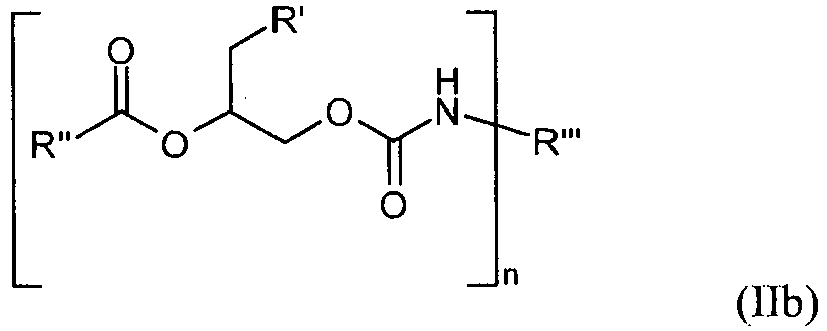
- n
- eine natürliche
Zahl von 2bis 6 ist - R'
- ein ein- oder mehrkerniger Aromatengruppen haltiger organischer
Rest mit 4 bis 36 Kohlenstoffatomen ist, - R"
- ein olefinisch
ungesättigter Rest mit 3 bis 30 Kohlenstoffatomen ist und - R'"
- ein von einem aliphatischen oder aromatischen Di- oder Polyisocyanat abgeleiteter organischer
Rest mit 2 bis 30 Kohlenstoffatomen ist.
- n
- is a natural number from 2 to 6
- R '
- is a mononuclear or polynuclear aromatic group-containing organic radical having 4 to 36 carbon atoms,
- R "
- an olefinically unsaturated radical having 3 to 30 carbon atoms and
- R '"
- is an organic radical having 2 to 30 carbon atoms derived from an aliphatic or aromatic di- or polyisocyanate.
Die ungesättigten Glycidyletheracrylaturethane der Formel IIa bzw. IIb können in einer 2-Stufen Synthese hergestellt werden. In der ersten Umsetzung wird eine ungesättigte Carbonäure mit einem Epoxid zur Reaktion gebracht, wobei ein Gemisch zweier Alkohole gebildet wird. Selbstverständlich können in diesem Reaktionsschritt auch ungesättigte Epoxide mit beliebigen Carbonsäuren zum analogen Zwischenprodukt umgesetzt werden. In einem zweiten Reaktionsschritt wird dieses Alkoholgemisch mittels eines Di- oder Polyisocyanats R"'(NCO)n der Funktionalität n zum Glycidyletheracrylaturethan urethanisiert (wie in der nicht vorveröffentlichten Anmeldung
In einer ganz besonders bevorzugten Ausführungsform werden die Kombinationen aus (Acrylsäure, Biphenylglycidether und TDI), (Acrylsäure, Phenylglycidether und TDI) sowie (Acrylsäure, Biphenylglycidether und HDI) verwendet.In a very particularly preferred embodiment, the combinations of (acrylic acid, biphenyl glycidyl ether and TDI), (acrylic acid, phenyl glycidyl ether and TDI) and (acrylic acid, biphenyl glycidyl ether and HDI) are used.
Das monofunktionelle Schreibmonomer kann insbesondere die allgemeine Formel (III)

Das multifunktionelle Schreibmonomer kann insbesondere die allgemeine Formel (IV)
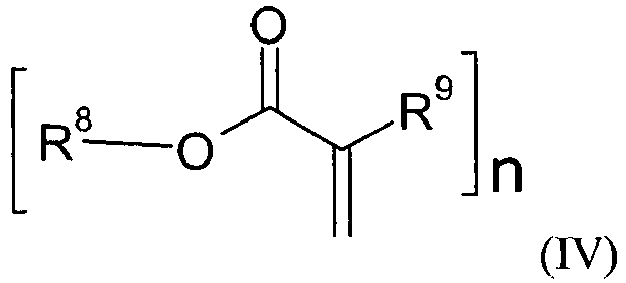
Als Komponente C) werden ein oder mehrere Photoinitiatoren eingesetzt. Das verwendete Photoinitiatorsystem kann vorzugsweise einen anionischen, kationischen oder neutralen Farbstoff und einen Coinitiator umfassen. Beispiele sind Mischungen aus Tetrabutylammonium Triphenylhexylborat, Tetrabutylammonium Triphenylbutylborat, Tetrabutylammonium Trinapthylbutylborat, Tetrabutylammonium Tris-(4-tert.-butyl)-phenylbutylborat, Tetrabutylammonium Tris-(3-fluorphenyl)-hexylborat und Tetrabutylammonium Tris-(3-Chlor-4-methylphenyl)-hexylborat mit Farbstoffen wie beispielsweise Astrazon Orange G, Methylenblau, Neu Methylenblau, Azur A, Pyrillium I, Safranin O, Cyanin, Gallocyanin, Brilliant Grün, Kristallviolett, Ethylviolett und Thionin.As component C) one or more photoinitiators are used. The photoinitiator system used may preferably comprise an anionic, cationic or neutral dye and a coinitiator. Examples are mixtures of tetrabutylammonium triphenylhexylborate, tetrabutylammonium triphenylbutylborate, tetrabutylammonium trinapthylbutylborate, tetrabutylammonium tris- (4-tert-butyl) -phenylbutylborate, tetrabutylammonium tris- (3-fluorophenyl) -hexylborate and tetrabutylammonium tris- (3-chloro-4-methylphenyl) -hexylborate with dyes such as Astrazon Orange G, Methylene Blue, New Methylene Blue, Azure A, Pyrillium I, Safranine O, Cyanine, Gallocyanine, Brilliant Green, Crystal Violet, Ethyl Violet and Thionin.
Bevorzugt ist vorgesehen, das die Photopolymer-Formulierung spezielle nicht photopolymerisierbare Additive enthält (Komponente D)). Bei diesen Additiven kann es sich insbesondere um Urethane handeln, wobei die Urethane bevorzugt mit wenigstens einem Fluoratom substituiert sein können.It is preferably provided that the photopolymer formulation contains special non-photopolymerizable additives (component D)). These additives may in particular be urethanes, wherein the urethanes may preferably be substituted by at least one fluorine atom.
Besonders bevorzugt können als Komponente D) Urethane der allgemeinen Formel (V)

Weitere Bestandteile der Photopolymer-Formulierung können sein (Komponenten E)): Radikalstabilisatoren, gegebenenfalls Katalysatoren oder andere Hilfs- und Zusatzstoffe.Further constituents of the photopolymer formulation may be (components E)): radical stabilizers, if appropriate catalysts or other auxiliaries and additives.
Als Beispiele für Radikalstabilisatoren sind Inhibitoren und Antioxidantien wie sie z.B. in "
Bevorzugt sind 2,6-Di-tert.-butyl-4-methylphenol, Phenothiazin, p-Methyoxyphenol, 2-Methoxy-p-hydrochinon und Benzhydrol.Preference is given to 2,6-di-tert-butyl-4-methylphenol, phenothiazine, p-methyoxyphenol, 2-methoxy-p-hydroquinone and benzhydrol.
Gegebenenfalls können ein oder mehrere Katalysatoren eingesetzt werden. Dabei handelt es sich um Katalysatoren zur Beschleunigung der Urethanbildung. Bekannte Katalysatoren hierfür sind beispielsweise Zinnoctoat, Zinkoktoat, Dibutylzinndilaurat, Dimethylbis[(1-oxoneodecyl)oxy]stannan, Dimethylzinndicarboxylat, Zirkonium-bis(ethylhexanoat), Zirconiumacteylacetonat oder tertiäre Aminen wie beispielsweise 1,4-Diazabicyclo[2.2.2]octan, Diazabicyclononan, Diazabicycloundecan, 1,1,3,3-Tetramethylguanidin, 1,3,4,6,7,8-Hexahydro-1-methyl-2H-pyrimido(1,2-a)pyrimidin.Optionally, one or more catalysts can be used. These are catalysts for accelerating urethane formation. Known catalysts for this purpose are, for example, tin octoate, zinc octoate, dibutyltin dilaurate, dimethylbis [(1-oxoneodecyl) oxy] stannane, dimethyltin dicarboxylate, zirconium bis (ethylhexanoate), zirconium lactoeylacetonate or tertiary amines such as 1,4-diazabicyclo [2.2.2] octane, diazabicyclononane , Diazabicycloundecane, 1,1,3,3-tetramethylguanidine, 1,3,4,6,7,8-hexahydro-1-methyl-2H-pyrimido (1,2-a) pyrimidine.
Bevorzugt sind Dibutylzinndilaurat, Dimethylbis[(1-oxoneodecyl)oxy]stannan, Dimethylzinndicarboxylat, 1,4-Diazabicyclo[2.2.2]octan, Diazabicyclononan, Diazabicycloundecan, 1,1,3,3-Tetramethylguanidin, 1,3,4,6,7,8-Hexahydro-1-methyl-2H-pyrimido(1,2-a)pyrimidin. Selbstverständlich können gegebenenfalls weitere Hilfs- oder Zusatzstoffe eingesetzt werden (auch Komponenten E)). Dabei kann es sich beispielsweise um im Bereich der Lacktechnologie gängige Zusatzstoffe wie Lösemittel, Weichmacher, Verlaufsmittel oder Haftvermittler handeln. Es kann auch von Vorteil sein, gleichzeitig mehrere Zusatzstoffe eines Typs zu verwenden. Selbstverständlich kann es ebenfalls von Vorteil sein, mehrere Zusatzstoffe mehrerer Typen zu verwenden.Preferred are dibutyltin dilaurate, dimethylbis [(1-oxoneodecyl) oxy] stannane, dimethyltin dicarboxylate, 1,4-diazabicyclo [2.2.2] octane, diazabicyclononane, diazabicycloundecane, 1,1,3,3-tetramethylguanidine, 1,3,4,6 , 7,8-hexahydro-1-methyl-2H-pyrimido (1,2-a) pyrimidine. Of course, if appropriate, further auxiliaries or additives can be used (also components E)). These may be, for example, additives customary in the field of coating technology, such as solvents, plasticizers, leveling agents or adhesion promoters. It may also be advantageous to simultaneously use several additives of one type. Of course, it may also be advantageous to use several additives of several types.
Fü r die Beschichtung oben genannter Photopolymerzusammensetzungen auf einer Rollenbeschichtungsanlage muss gewährleistet sein, dass die Gesamtformulierung nach Aushärtung der Matrix (Komponente A)) und vor der Belichtung einen Plateaumodul G0 von mindestens 0,03 MPa aufweist.For the coating of the above-mentioned photopolymer compositions on a roll coater, it must be ensured that the overall formulation has a plateau modulus G 0 of at least 0.03 MPa after curing of the matrix (component A)) and before exposure.
Ein Film aus der Photopolymer-Formulierung kann beispielsweise mit Hilfe einer Rollenbeschichtungsanlage auf einer Trägerfolie aufgebracht werden.A film of the photopolymer formulation can be applied to a carrier film, for example with the aid of a roller coater.
Dies kann durch eine Kombination verschiedener Prozessschritte erfolgen, bei denen dem Fachmann bekannte Zwangsdosierpumpen, Vakuumentgaser, Plattenfilter, Statische Mischer, Schlitzdüsen oder verschiedene Rakelsysteme, Ein-Rollenabwickler, Lufttrockner, Trockenkaschiereinrichtung und eine Ein-Rollenaufwickeleinrichtung, eingesetzt werden. Speziell eine Beschichtungseinrichtungen, die z.B. Schlitzdüsen und Rakelsysteme aufweisen, sind für die Applikation von flüssigen Photopolymer-Formulierungen auf bewegende Trägermaterialien geeignet und zeichnen sich durch eine hohe Genauigkeit in der Applikationsschichtdicke aus.This can be done by a combination of different process steps, in which the known compulsory metering pumps, vacuum degassers, plate filters, static mixers, slot dies or various doctor blade systems, one-roll unwinders, air dryers, dry coater and a single reel take-up device are used. Specifically, a coating equipment, e.g. Slit nozzles and doctor systems have, are suitable for the application of liquid photopolymer formulations on moving substrates and are characterized by a high accuracy in the application layer thickness.
In einer bevorzugten Ausführungsform umfasst der Beschichtungsprozess der Trägerfolie die nachfolgenden Einzelschritte zur Behandlung vorgenannten Photopolymer-Formulierungen:
- I. Fördern und Dosieren zum einen der Komponente a) gegebenenfalls gemischt mit einer oder mehrerer der Komponenten B), C), D) und E) sowie zum anderen separat dazu der Komponente b) gegebenenfalls gemischt mit einer oder mehrerer der Komponenten B), C), D) und E)
- II. Entgasen der gemäß I) geförderten, dosierten und gegebenenfalls vorvermischten Ströme
- III. Filtrieren der nach II) erhaltenen Mischung
- IV. Homogenisieren der nach III) erhaltenen Mischung
- V. Abwicklung und Vorbehandlung der Trägerfolie
- VI. Beschichten der Trägerfolie mit der nach Schritt IV) erhaltenen Mischung
- VII. Trocknung des nach VI) beschichteten Films
- VIII. Kaschieren des nach VII) erhaltenen beschichteten Films
- IX. Aufwicklung des nach VIII) erhaltenen kaschierten Films
- I. conveying and metering, on the one hand, component a) optionally mixed with one or more of components B), C), D) and E) and, secondly, separately of component b) optionally mixed with one or more of components B), C), D) and E)
- II. Degassing the according to I) promoted, metered and possibly premixed streams
- III. Filter the mixture obtained according to II)
- IV. Homogenizing the mixture obtained according to III)
- V. Processing and pretreatment of the carrier film
- VI. Coating the carrier film with the mixture obtained after step IV)
- VII. Drying of the film coated according to VI)
- VIII. Laminating the coated film obtained according to VII)
- IX. Winding of the laminated film obtained according to VIII)
In einer besonders bevorzugten Ausführung erfolgt dabei die Dosierung der Einsatzstoffe entweder durch Zahnrad- oder Excenterschneckenpumpen. Zur Entgasung der Einsatzstoffe werden Zentrifugalentgaser und zur Filterung Plattenfilter eingesetzt. Die Mischung der Einzelkomponenten erfolgt über einen statischen Mischer mit entsprechend ausgelegten Mischgeometrien, wie z.B. Länge und Durchmesser. Als bevorzugte Beschichtungseinheit wird eine Schlitzdüse eingesetzt. Das beschichtete Material wird über Lufttrockner mit der gewünschten Lufttemperatur und Feuchtgehalt über einen definierten Zeitraum getrocknet.In a particularly preferred embodiment, the metering of the starting materials takes place either by gear pumps or eccentric screw pumps. For degassing the feedstock centrifugal deaerator and for filtering plate filters are used. The mixture of the individual components takes place via a static mixer with correspondingly designed mixing geometries, such as e.g. Length and diameter. As a preferred coating unit, a slot nozzle is used. The coated material is dried over air dryers with the desired air temperature and moisture content over a defined period of time.
In der
- 1
- Vorratsbehälter
- 2
- Dosiereinrichtung
- 3
- Vakuumentgasung
- 4
- Filter
- 5
- Statischer Mischer
- 6
- Beschichtungseinrichtung
- 7
- Trockner
- 8
- Bahnlauf
- 9
- Produkt-Kaschierung
- 1
- reservoir
- 2
- metering
- 3
- Vacuum degassing
- 4
- filter
- 5
- Static mixer
- 6
- coater
- 7
- dryer
- 8th
- Web guiding
- 9
- Product lamination
Durch die Kombination der beschriebenen Prozessschritte wie in
Gemäß einer weiteren bevorzugten Ausführungsform können die holographischen Medien Folienverbunde sein, die aus einer oder mehreren Trägerfolien, einer oder mehreren Photopolymerschichten und einer oder mehrer Schutzfolien in beliebiger Anordnung bestehen können.According to a further preferred embodiment, the holographic media may be film composites consisting of one or more carrier films, one or more Photopolymer layers and one or more protective films may consist in any order.
Bevorzugte Materialien oder Materialverbünde der Trägerschicht basieren auf Polycarbonat (PC), Polyethylenterephthalat (PET), Polybutylenterephthalat, Polyethylen, Polypropylen, Celluloseacetat, Cellulosehydrat, Cellulosenitrat, Cycloolefinpolymere, Polystyrol, Polyepoxide, Polysulfon, Cellulosetriacetat (CTA), Polyamid, Polymethylmethacrylat, Polyvinylchlorid, Polyvinylbutyral oder Polydicyclopentadien oder deren Mischungen. Daneben können Materialverbünde wie Folienlaminate oder Coextrudate als Trägerfolie Anwendung finden. Beispiele für Materialverbünde sind Duplex- und Triplexfolien aufgebaut nach einem der Schemata A/B, A/B/A oder A/B/C wie PC/PET, PET/PC/PET und PC/TPU (TPU = Thermoplastisches Polyurethan). Besonders bevorzugt wird PC und PET als Trägerfolie verwendet.Preferred materials or composite materials of the carrier layer are based on polycarbonate (PC), polyethylene terephthalate (PET), polybutylene terephthalate, polyethylene, polypropylene, cellulose acetate, cellulose hydrate, cellulose nitrate, cycloolefin polymers, polystyrene, polyepoxides, polysulfone, cellulose triacetate (CTA), polyamide, polymethyl methacrylate, polyvinyl chloride, polyvinyl butyral or polydicyclopentadiene or mixtures thereof. In addition, material composites such as film laminates or coextrudates can be used as carrier film. Examples of composite materials are duplex and triplex films constructed according to one of the schemes A / B, A / B / A or A / B / C such as PC / PET, PET / PC / PET and PC / TPU (TPU = thermoplastic polyurethane). PC and PET are particularly preferably used as a carrier film.
Zusätzlich zu den Bestandteilen und können für den Folienverbund ein oder mehrere Abdeckschichten auf der Photopolymerschicht aufweisen, um diese vor Schmutz und Umwelteinflüssen zu schützen. Hierzu können Kunststofffolien oder Folienverbundsysteme, aber auch Klarlacke verwendet werden.In addition to the constituents and can have one or more cover layers on the photopolymer layer for the film composite in order to protect them from dirt and environmental influences. For this purpose, plastic films or composite film systems, but also clearcoats can be used.
Außerdem können weitere Schutzschichten, so z.B. eine untere Kaschierung der Trägerfolie Anwendung finden.In addition, further protective layers, e.g. find a lower lamination of the carrier film application.
Ein weiterer Gegenstand der Erfindung ist ein nach dem erfindungsgemäßen Verfahren erhältliches holographisches Medium.Another object of the invention is a holographic medium obtainable by the process according to the invention.
Noch ein weiterer Gegenstand der vorliegenden Erfindung ist die Verwendung der holographischen Filme zur Aufzeichnung visueller Hologramme, zur Herstellung von optischen Elementen, Bildern, Darstellungen sowie ein Verfahren zur Aufzeichnung von Hologrammen unter Verwendung der holographischen Filme.Still another object of the present invention is the use of holographic films for recording visual holograms, for making optical elements, images, representations and a method of recording holograms using the holographic films.
Mit den holographischen Filmen können durch entsprechende Belichtungsprozesse Hologramme für optische Anwendungen im gesamten sichtbaren Bereich sowie im nahen UV-Bereich (300 - 800 nm) hergestellt werden. Visuelle Hologramme umfassen alle Hologramme, die nach dem Fachmann bekannten Verfahren aufgezeichnet werden können, darunter fallen unter anderem In-Line (Gabor) Hologramme, Off-Axis Hologramme, Full-Aperture Transfer Hologramme, Weißlicht-Transmissionshologramme ("Regenbogenhologramme"), Denisyukhologramme, Off Axis Reflektionshologramme, Edge-Lit Hologramme sowie Holographische Stereogramme, bevorzugt sind Reflexionshologramme, Denisyukhologramme, Transmissionshologramme. Bevorzugt sind optische Elemente wie Linsen, Spiegel, Umlenkspiegel, Filter, Streuscheiben, Beugungselemente, Lichtleiter, Lichtlenker (waveguides), Projektionsscheiben und/oder Masken haben. Häufig zeigen diese optischen Elemente eine Frequenzselektivität je nachdem wie die Hologramme belichtet wurden und welche Dimensionen das Holgramm hat.With the holographic films holograms for optical applications in the entire visible range and in the near UV range (300-800 nm) can be produced by appropriate exposure processes. Visual holograms include all holograms that can be recorded by methods known to those skilled in the art, including, but are not limited to, in-line (gabor) holograms, off-axis holograms, full-aperture transfer holograms, white-light transmission holograms ("hologram holograms"), denisyuk holograms, Off axis reflection holograms, edge-lit holograms and holographic stereograms, preferred are reflection holograms, Denisyuk holograms, transmission holograms. Preference is given to optical elements such as lenses, mirrors, deflection mirrors, filters, diffusers, diffractive elements, light guides, waveguides, projection screens and / or masks. Frequently, these optical elements exhibit frequency selectivity depending on how the holograms were exposed and the dimensions of the hologram.
Zudem können mittels der holographischen Filme auch holographische Bilder oder Darstellungen hergestellt werden, wie zum Beispiel für persönliche Portraits, biometrische Darstellungen in Sicherheitsdokumenten, oder allgemein von Bilder oder Bildstrukturen für Werbung, Sicherheitslabels, Markenschutz, Markenbranding, Etiketten, Designelementen, Dekorationen, Illustrationen, Sammelkarten, Bilder und dergleichen sowie Bilder, die digitale Daten repräsentieren können u.a. auch in Kombination mit den zuvor dargestellten Produkten. Holographische Bilder können den Eindruck eines dreidimensionalen Bildes haben, sie können aber auch Bildsequenzen, kurze Filme oder eine Anzahl von verschiedenen Objekten darstellen, je nachdem aus welchem Winkel, mit welcher (auch bewegten) Lichtquelle etc. diese beleuchtet wird. Aufgrund dieser vielfältigen Designmöglichkeiten stellen Hologramme, insbesondere Volumenhologramme, eine attraktive technische Lösung für die oben genannten Anwendung dar.In addition, the holographic films can also be used to produce holographic images or representations, such as personal portraits, biometric representations in security documents, or generally images or image structures for advertising, security labels, trademark protection, branding, labels, design elements, decorations, illustrations, trading cards , Images and the like, as well as images that can represent digital data, including in combination with the previously presented products. Holographic images can have the impression of a three-dimensional image, but they can also represent image sequences, short films or a number of different objects, depending on which angle, with which (even moving) light source, etc., this is illuminated. Due to these diverse design possibilities, holograms, in particular volume holograms, represent an attractive technical solution for the above-mentioned application.
Die Erfindung wird im Folgenden anhand von Beispielen näher erläutert.The invention will be explained in more detail below with reference to examples.
Photopolymer-Formulierungen umfassend:
- Dreidimensional vernetzte Matrixpolymere A). Besonders bevorzugt sind solche dreidimensional vernetzte organische Polymere, welche als Vorstufen aus
- o einer Isocyanatkomponente a)
- o und einer Isocyanat-reaktiven Komponente b) aufgebaut sind und
- o mit Hilfe einer Katalysator Komponente E) vernetzt werden, der in der Regel in Lösung zugegeben wird,
- Schreibmonomere B), die unter Einwirkung aktinischer Strahlung mit ethylenisch ungesättigten Verbindungen unter Polymerisation reagierende Gruppen (strahlenhärtende Gruppen) aufweisen und in dieser Matrix gelöst oder verteilt vorliegen
- wenigstens einen Photoinitiatorsystem C).
- optional eine nicht photopolymerisierbare Komponente D).
- gegebenenfalls Katalysatoren, Radikalstabilisatoren, Lösungsmittel, Additive sowie andere Hilfs- und / oder Zusatzstoffe E)
- F bezeichnet die Photopolymer-Formulierung ohne Photoinitiatorsystem C), die für die Bestimmung des Plateaumoduls G0 verwendet wird.
- M bezeichnet den holographischen Film aus der entsprechenden Photopolymer-Formulierung F, der aber mit dem entsprechenden Photoinitiatorsystem C) für den sichtbaren Bereich hergestellt wurde.
- Three-dimensionally crosslinked matrix polymers A). Particular preference is given to those three-dimensionally crosslinked organic polymers which are precursors
- o an isocyanate component a)
- o and an isocyanate-reactive component b) are constructed and
- o be crosslinked with the aid of a catalyst component E), which is usually added in solution,
- Writing monomers B) which exhibit polymerization-reactive groups (radiation-curing groups) under the action of actinic radiation with ethylenically unsaturated compounds and are present dissolved or distributed in this matrix
- at least one photoinitiator system C).
- optionally a non-photopolymerizable component D).
- if appropriate, catalysts, radical stabilizers, solvents, additives and other auxiliaries and / or additives E)
- F denotes the photopolymer formulation without photoinitiator system C), which is used for the determination of the plateau modulus G 0 .
- M denotes the holographic film of the corresponding photopolymer formulation F, but which was prepared with the corresponding visible-range photoinitiator system C).
Sofern nicht abweichend vermerkt beziehen sich alle Prozentangaben auf Gewichtsprozent.Unless otherwise noted, all percentages are by weight.
Die angegebenen OH-Zahlen wurden gemäß DIN 53240-2 bestimmt.The indicated OH numbers were determined according to DIN 53240-2.
Die angegebenen NCO-Werte (Isocyanat-Gehalte) wurden gemäß DIN EN ISO 11909 bestimmt.The indicated NCO values (isocyanate contents) were determined in accordance with DIN EN ISO 11909.
Für die Bestimmung der Viskosität wurde die zu untersuchende Komponente oder Mischung bei 20°C in einem Kegel Platte Messsystem eines Rheometers (Firma Anton Paar Physica Modell MCR 51) aufgetragen. Die Messung wird bei folgenden Bedingungen durchgeführt:
- Messkörper: Kegel CP 25, d = 25mm, Winkel = 1°
- Messspalt als Abstand zwischen Kegel und Platte: 0,047 mm
- Messdauer: 10 sec.
- Bestimmung der Viskosität bei einer Scherrate von 250 1/sec.
- Measuring body: Cone CP 25, d = 25mm, angle = 1 °
- Measurement gap as distance between cone and plate: 0.047 mm
- Measuring time: 10 sec.
- Determination of viscosity at a shear rate of 250 1 / sec.
Der Brechungsindex n in Abhängigkeit von der Wellenlänge der Proben wurde aus den Transmissions- und Reflexionsspektren erhalten. Dazu wurden ca. 100 - 300 um dicke Filme der Proben auf Quarzglasträger aus verdünnter Lösung in Butylacetat aufgeschleudert. Das Transmissions- und Reflexionsspektrum dieses Schichtpaketes wurde mit einem Spektrometer der Firma STEAG ETA-Optik, CD-Measurement System ETA-RT gemessen und danach die Schichtdicke und der spektrale Verlauf von n an die gemessenen Transmissions- und Reflexionsspektren im Bereich von 380 - 850 nm angepasst. Dies geschieht mit der internen Software des Spektrometers und erfordert zusätzlich die Brechungsindexdaten des Quarzglassubstrates, die in einer Blindmessung vorab bestimmt wurden. Die Brechungsindizes für die photopolymerisierbaren Monomere B) beziehen sich auf die Wellenlänge von 405 nm und entsprechen damit nD 20.The refractive index n as a function of the wavelength of the samples was obtained from the transmission and reflection spectra. To this end, about 100-300 μm thick films of the samples were spun onto silica glass carrier from dilute solution in butyl acetate. The transmission and reflection spectrum of this layer package was measured with a spectrometer from STEAG ETA Optics, CD-Measurement System ETA-RT and then the layer thickness and the spectral curve of n to the measured transmission and reflection spectra in the range of 380-850 nm customized. This is done with the internal software of the spectrometer and additionally requires the refractive index data of the quartz glass substrate, which were determined in advance in a blind measurement. The refractive indices for the photopolymerizable monomers B) refer to the wavelength of 405 nm and thus correspond to n D 20 .
Die wie unten beschrieben hergestellten holographischen Medien (Photopolymerfilme) wurden anschließend mittels einer Messanordnung gemäß
Zur Messung der holographischen Performance wird die Schutzfolie des holographischen Filmmedien (M) abgezogen und der holographische Film mit der Photopolymerseite auf eine 1 mm dicke Glasplatte geeigneter Länge und Breite mit einer Gummiwalze unter leichtem Druck auflaminiert. Dieser Sandwich aus Glas und Photopolymerfolie kann nun verwendet werden, um die holographischen Performanceparameter DE und Δn zu bestimmen.To measure the holographic performance, the protective film of the holographic film media (M) is peeled off and the holographic film with the photopolymer side is laminated on a 1 mm thick glass plate of suitable length and width with a rubber roller under slight pressure. This sandwich of glass and photopolymer film can now be used to determine the holographic performance parameters DE and Δn.
Der Strahl eines He-Ne Lasers (Emissionswellenlänge 633 nm) wurde mit Hilfe des Raumfilter (SF) und zusammen mit der Kollimationslinse (CL) in einen parallelen homogenen Strahl umgewandelt. Die finalen Querschnitte des Signal und Referenzstrahls werden durch die Irisblenden (I) festgelegt. Der Durchmesser der Irisblendenöffnung beträgt 0.4 cm. Die polarisationsabhängigen Strahlteiler (PBS) teilen den Laserstrahl in zwei kohärente gleich polarisierte Strahlen. Über die λ/2 Plättchen wurden die Leistung des Referenzstrahls auf 0.5 mW und die Leistung des Signalstrahls auf 0.65 mW eingestellt. Die Leistungen wurden mit den Halbleiterdetektoren (D) bei ausgebauter Probe bestimmt. Der Einfallswinkel (α0) des Referenzstrahls beträgt -21.8°, der Einfallswinkel (β0) des Signalstrahls beträgt 41.8°. Die Winkel werden ausgehend von der Probennormale zur Strahlrichtung gemessen. Gemäß
Mit einem holographischen Versuchsaufbau wie in
Es wurden auf folgende Weise Hologramme in das Medium geschrieben:
- Beide Shutter (S) sind für die Belichtungszeit t geöffnet.
- Danach wurde bei geschlossenen Shuttern (S)
dem Medium 5 Minuten Zeit für die Diffusion der noch nicht polymerisierten Schreibmonomere gelassen.
- Both shutters (S) are open for the exposure time t .
- Thereafter, with closed shutters (S), the medium was allowed 5 minutes for the diffusion of the unpolymerized writing monomers.
Die geschriebenen Hologramme wurden nun auf folgende Weise ausgelesen. Der Shutter des Signalstrahls blieb geschlossen. Der Shutter des Referenzstrahls war geöffnet. Die Irisblende des Referenzstrahls wurde auf einen Durchmesser < 1 mm geschlossen. Damit erreichte man, dass für alle Drehwinkel (Ω) des Mediums der Strahl immer vollständig im zuvor geschriebenen Hologramm lag. Der Drehtisch überstrich nun computergesteuert den Winkelbereich von Ωmin bis Ωmax mit einer Winkelschrittweite von 0.05°. Ω wird von der Probennormale zur Referenzrichtung des Drehtisches gemessen. Die Referenzrichtung des Drehtisches ergibt sich dann wenn beim Schreiben des Hologramms der Einfallswinkel des Referenz- und des Signalstrahls betragsmäßig gleich sind also α0 = -31.8° und β0 = 31.8° gilt. Dann beträgt Ωrecording = 0°. Für α0 = -21.8° und β0 = 41.8° beträgt Ωrecording daher 10°. Allgemein gilt für das Interferenzfeld beim Schreiben ("recording") des Hologramms: 
θ0 ist der Halbwinkel im Laborsystem außerhalb des Mediums und es gilt beim Schreiben des Hologramms: 
In diesem Fall gilt also θ0 = -31.8°. An jedem angefahrenen Drehwinkel Ω wurden die Leistungen des in der nullten Ordnung transmittierten Strahls mittels des entsprechenden Detektors D und die Leistungen des in die erste Ordnung abgebeugten Strahls mittels des Detektors D gemessen. Die Beugungseffizienz ergab sich bei jedem angefahrenen Winkel Ω als der Quotient aus: 
PD ist die Leistung im Detektor des abgebeugten Strahls und PT ist die Leistung im Detektor des transmittierten Strahls. P D is the power in the detector of the diffracted beam and P T is the power in the detector of the transmitted beam.
Mittels des oben beschriebenen Verfahrens wurde die Braggkurve, sie beschreibt den Beugungswirkungsgrad η in Abhängigkeit des Drehwinkels Ω des geschriebenen Hologramms gemessen und in einem Computer gespeichert. Zusätzlich wurde auch die in die nullte Ordnung transmittierte Intensität gegen den Drehwinkel Ω aufgezeichnet und in einem Computer gespeichert.By means of the method described above, the Bragg curve was described, it describes the diffraction efficiency η as a function of the rotation angle Ω of the written hologram measured and stored in a computer. In addition, the intensity transmitted in the zeroth order was also recorded against the angle of rotation Ω and stored in a computer.
Die maximale Beugungseffizienz (DE = ηmax) des Hologramms, also sein Spitzenwert, wurde bei Ωreconstruction ermittelt. Eventuell musste dazu die Position des Detektors des abgebeugten Strahls verändert werden, um diesen maximalen Wert zu bestimmen.The maximum diffraction efficiency (DE = η max ) of the hologram, ie its peak value, was determined during Ω reconstruction . It may be necessary to change the position of the detector of the diffracted beam to determine this maximum value.
Der Brechungsindexkontrast Δn und die Dicke d der Photopolymerschicht wurde nun mittels der Coupled Wave Theorie (siehe;
Alle geometrischen Größen, die sich auf das geschriebene Hologramm beziehen und nicht auf das Interferenzmuster werden als gestrichene Größen dargestellt.All geometrical quantities related to the written hologram and not to the interference pattern are shown as primed quantities.
Für die Braggkurve η(Ω) eines Reflexionshologramms gilt nach Kogelnik: 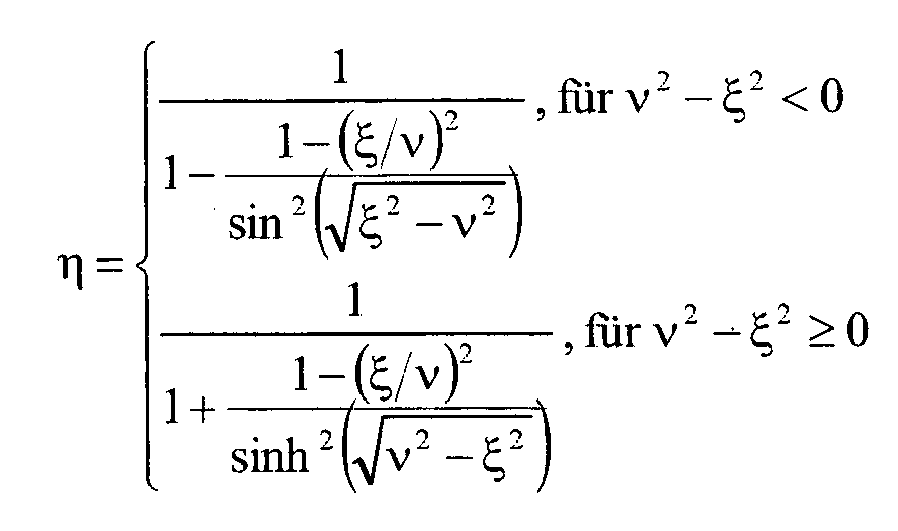

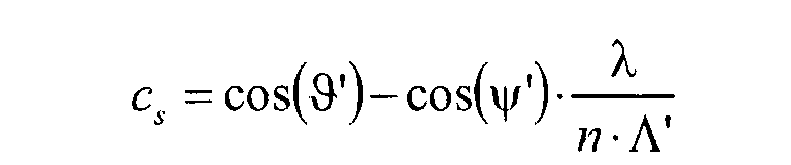


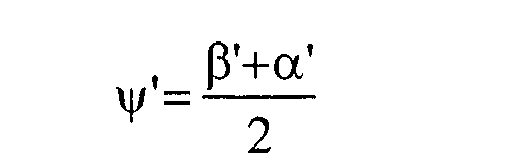

Beim Auslesen des Hologramms ("reconstruction") gilt wie analog oben dargestellt: 

An der Bragg-Bedingung ist das "Dephasing" DP = 0. Und es folgt entsprechend: 

Der noch unbekannt Winkel β' kann aus dem Vergleich der Bragg-Bedingung des Interferenzfeldes beim Schreiben des Hologramms und der Bragg-Bedingung beim Auslesen des Hologramms ermittelt werden unter der Annahme, dass nur Dickenschwindung stattfindet. Dann folgt: 
ν ist die Gitterstärke, ξ ist der Detuning Parameter und ψ' die Orientierung (Slant) des Brechungsindexgitters das geschrieben wurde. α' und β' entsprechen den Winkeln α0 und β0 des Interferenzfeldes beim Schreiben des Hologramms, aber im Medium gemessen und für das Gitter des Hologramms gültig (nach Dickenschwindung). n ist der mittlere Brechungsindex des Photopolymers und wurde zu 1.504 gesetzt. λ ist die Wellenlänge des Laserlichts im Vakuum.ν is the lattice strength, ξ is the detuning parameter and ψ 'is the orientation (slant) of the refractive index lattice that was written. α 'and β' correspond to the angles α 0 and β 0 of the interference field when writing the hologram, but measured in the medium and valid for the lattice of the hologram (after thickness shrinkage). n is the average refractive index of the photopolymer and was set to 1,504. λ is the wavelength of the laser light in a vacuum.
Die maximale Beugungseffizienz (DE = ηmax) ergibt sich dann für ξ = 0 zu: 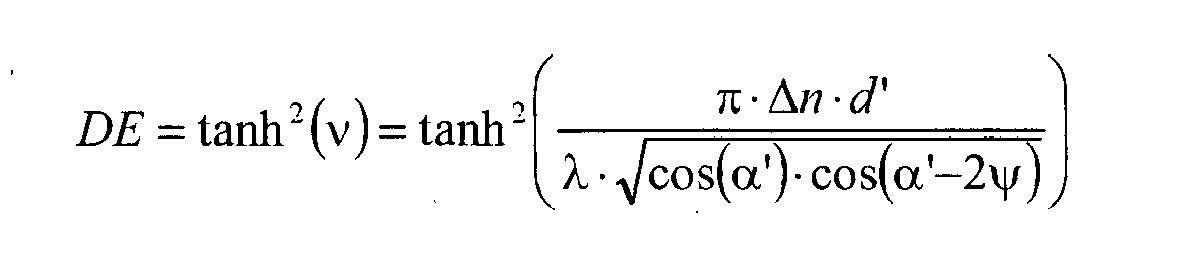
Die Messdaten der Beugungseffizienz, die theoretische Braggkurve und die transmittierte Intensität werden wie in
Da DE bekannt ist wird die Form der theoretischen Braggkurve nach Kogelnik nur noch durch die Dicke d' der Photopolymerschicht bestimmt. Δn wird über DE für gegebene Dicke d' so nachkorrigiert, dass Messung und Theorie von DE immer übereinstimmen. d' wird nun solange angepasst bis die Winkelpositionen der ersten Nebenminima der theoretischen Braggkurve mit den Winkelpositionen der ersten Nebenmaxima der transmittierten Intensität übereinstimmen und zudem die volle Breite bei halber Höhe (FWHM) für die theoretische Braggkurve und für die transmittierte Intensität übereinstimmen.Since DE is known, the shape of the theoretical Bragg curve according to Kogelnik is determined only by the thickness d 'of the photopolymer layer. Δn is corrected over DE for a given thickness d 'so that the measurement and theory of DE are always the same. d 'is now adjusted until the angular positions of the first secondary minima of the theoretical Bragg curve coincide with the angular positions of the first secondary maxima of the transmitted intensity and, moreover, the full width at half height (FWHM) for the theoretical Bragg curve and for the transmitted intensity coincide.
Da die Richtung in der ein Reflexionshologramm bei der Rekonstruktion mittels eines Ω-Scans mitrotiert, der Detektor für das abgebeugte Licht aber nur einen endlichen Winkelbereich erfassen kann, wird die Braggkurve von breiten Hologrammen (kleines d') bei einem Ω-Scan nicht vollständig erfasst, sondern nur der zentrale Bereich, bei geeigneter Detektoipositionierung. Daher wird die zur Braggkurve komplementäre Form der transmittierten Intensität zur Anpassung der Schichtdicke d' zusätzlich herangezogen.Since the direction in which a reflection hologram co-rotates during the reconstruction by means of an Ω scan, but the detector for the diffracted light can detect only a finite angular range, the Bragg curve of broad holograms (small d ') in an Ω-scan is not fully detected but only the central area, with appropriate Detektoipositionierung. Therefore, the complementary to the Bragg curve shape of the transmitted intensity to adjust the layer thickness d 'is additionally used.
Für eine Formulierung wurde diese Prozedur eventuell mehrfach für verschiedene Belichtungszeiten t an verschiedenen Medien wiederholt, um festzustellen bei welcher mittleren Energiedosis des einfallenden Laserstrahls beim Schreiben des Hologramms DE in den Sättigungswert übergeht. Die mittlere Energiedosis E ergibt sich wie folgt aus den Leistungen der zwei den Winkeln α0 und β0 zugeordneten Teilstrahlen (Referenzstrahl mit Pr = 0.50 mW und Signalstrahl mit Ps = 0.63 mW), der Belichtungszeit t und dem Durchmesser der Irisblende (0.4 cm): 
Die Leistungen der Teilstrahlen wurden so angepasst, dass in dem Medium bei den verwendeten Winkeln α0 und β0, die gleiche Leistungsdichte erreicht wird.The powers of the partial beams have been adjusted so that the same power density is achieved in the medium at the angles α 0 and β 0 used.
Als Alternative wurde auch ein dem in
Die wie unten beschrieben zusammengesetzte, noch flüssige Formulierung wird in das Platte - Platte Messsystem eines Rheometers (Firma Anton Paar Physica Modell MCR 301 ausgerüstet mit dem Ofenmodel CTD 450 der auf 50°C vorgeheizt war) eingebracht. Dann wird die Aushärtung der Matrix der Photopolymerformulierung über die Zeit unter folgenden Bedingungen gemessen:
- Plattenabstand 250µm.
- Messmodus Oszillation bei einer konstanten Kreisfrequenz ω0
von 10 rad/s und einer geregeltenDeformationsamplitude von 1 %. - Temperatur 50°C,
Normalkraftregelung auf 0 Newton eingestellt - Aufzeichnung des Speichermoduls G' über der Messzeit bis ein konstanter Wert Gmax von G' erreicht wurde oder für höchstens 3 Stunden.
- Plate distance 250μm.
- Measuring mode Oscillation at a constant angular frequency ω 0 of 10 rad / s and a controlled deformation amplitude of 1%.
-
Temperature 50 ° C, normal force control set to 0 Newton - Recording the memory module G 'over the measuring time until a constant value G max of G' has been reached or for a maximum of 3 hours.
Dieser Wert des Moduls wird als der zu bestimmende Plateaumodul G0 aufgefasst. Beispiele für typische Messkurven finden sich in
Komponente a1) ist ein Produkt der Bayer MaterialScience AG, Leverkusen, DE, Hexandiisocyanat-basiertes Polyisocyanat, Anteil an Iminooxadiazindion mindestens 30 %, NCO-Gehalt: 23,5 %. Component a1) is a product of Bayer MaterialScience AG, Leverkusen, DE, hexane diisocyanate-based polyisocyanate, proportion of iminooxadiazinedione at least 30%, NCO content: 23.5%.
Komponente a2) ist ein Versuchsprodukt der Bayer MaterialScience AG, Leverkusen, DE, aliphatisches Polyisocyanat auf Basis von Hexandiisocyanat, NCO-Gehalt ca. 20 %. Component a2) is a test product of Bayer MaterialScience AG, Leverkusen, DE, aliphatic polyisocyanate based on hexane diisocyanate, NCO content about 20%.
Komponente a3) ist ein Produkt der Bayer MaterialScience AG, Leverkusen, DE, Vollallophanat von Hexandiisocyanat auf Polypropylenglykol mit zahlenmittlerer Molmasse von ca. 280 g/mol, NCO-Gehalt: 16,5-17,3%. Component a3) is a product of Bayer MaterialScience AG, Leverkusen, DE, full allophanate of hexane diisocyanate on polypropylene glycol having a number-average molecular weight of about 280 g / mol, NCO content: 16.5-17.3%.
Komponente a4) ist ein Handelsprodukt der Bayer MaterialScience AG, Leverkusen, Deutschland, Mischung aus 29,4 mol-% Isocyanurats auf Basis von HDI mit 70,6 mol-% des Urethans aus Poly(ε-Caprolacton) der zahlenmittleren Molmasse 650 g/Mol mit HDI, NCO-Gehalt 10,5 - 11,5 %. Component a4) is a commercial product of Bayer MaterialScience AG, Leverkusen, Germany, mixture of 29.4 mol% isocyanurate based on HDI with 70.6 mol% of the urethane of poly (ε-caprolactone) of the number average molecular weight 650 g / Mol with HDI, NCO content 10.5 - 11.5%.
Komponente a5) ist ein Handelsprodukt der Bayer MaterialScience AG, Leverkusen, Deutschland, aliphatisches Biuret-Typ auf Basis Hexamethylendiisocyanat, NCO-Gehalt: 22,5 - 23,5 %. Component a5) is a commercial product of Bayer MaterialScience AG, Leverkusen, Germany, aliphatic biuret type based on hexamethylene diisocyanate, NCO content: 22.5-23.5%.
Polyol b1) ist ein experimentelles Produkt der Bayer MaterialScience AG, Leverkusen, Deutschland, die Herstellung ist unten beschrieben. Polyol b1) is an experimental product of Bayer MaterialScience AG, Leverkusen, Germany, the preparation is described below.
Polyol b2) ist ein experimentelles Produkt der Bayer MaterialScience AG, Leverkusen, Deutschland, die Herstellung ist unten beschrieben. Polyol b2) is an experimental product of Bayer MaterialScience AG, Leverkusen, Germany, the preparation is described below.
Polyol b3) ist ein experimentelles Produkt der Bayer MaterialScience AG, Leverkusen, DE, die Herstellung ist unten beschrieben. Polyol b3) is an experimental product of Bayer MaterialScience AG, Leverkusen, DE, the preparation is described below.
Polyol b4) ist ein experimentelles Produkt der Bayer MaterialScience AG, Leverkusen, Deutschland, die Herstellung ist unten beschrieben. Polyol b4) is an experimental product of Bayer MaterialScience AG, Leverkusen, Germany, the preparation is described below.
Komponente E1): Urethanisierungskatalysator, Dimethylbis[(1-oxoneodecl)oxy]stannan, Handelsprodukt der Fa. Momentive Performance Chemicals, Wilton, CT, USA. Component E1): urethanization catalyst, dimethylbis [(1-oxoneodecl) oxy] stannane, commercial product of the company Momentive Performance Chemicals, Wilton, CT, USA.
Komponente B1) ist ein experimentelles Produkt der Bayer MaterialScience AG, Leverkusen, Deutschland, die Herstellung ist unten beschrieben. Component B1) is an experimental product of Bayer MaterialScience AG, Leverkusen, Germany, the preparation is described below.
Komponente B2) ist ein experimentelles Produkt der Bayer MaterialScience AG, Leverkusen, Deutschland, die Herstellung ist unten beschrieben. Component B2) is an experimental product of Bayer MaterialScience AG, Leverkusen, Germany, the preparation is described below.
Komponente B3) ist ein experimentelles Produkt der Bayer MaterialScience AG, Leverkusen, Deutschland, die Herstellung ist unten beschrieben. Component B3) is an experimental product of Bayer MaterialScience AG, Leverkusen, Germany, the preparation is described below.
Coinitiator 1: Tetrabutylammonium-tris(3-chlor-4-methylphenyl)(hexyl)borat, [1147315-11-4]) ist ein von der Ciba Inc., Basel, Schweiz, hergestelltes Versuchsprodukt.Co-initiator 1: tetrabutylammonium tris (3-chloro-4-methylphenyl) (hexyl) borate, [1147315-11-4]) is a trial product manufactured by Ciba Inc., Basel, Switzerland.
Farbstoff 1 ist Neu Methylenblau (CAS 1934-16-3) und wurde von SIGMA-ALDRICH CHEMIE GmbH, Steinlzeim, Deutschland bezogen.
Farbstoff 2 ist Safranin O (CAS 477-73-6) und wurde von SIGMA-ALDRICH CHEMIE GmbH, Steinheim, Deutschland bezogen.
Farbstoff 3 ist Ethylviolett (CAS 2390-59-2) und wurde in 80%-iger Reinheit von SIGMA-ALDRICH CHEMIE GmbH, Steinheim, Deutschland bezogen und so eingesetzt.
Farbstoff 4 ist Astrazon Orange G (CAS 3056-93-7) und wurde von SIGMA-ALDRICH CHEMIE GmbH, Steinheim, Deutschland bezogen.
Beschreibung der Komponente C1):Description of component C1 ):
In einem Becherglas werden im Dunkeln oder unter geeigneter Beleuchtung 0.05 g Farbstoff 1, 0.05 g Farbstoff 3, 0.05 g Farbstoff 4 und 1.50 g Coninitiator 1 in 3.50 g N-Ethylpyrolidon gelöst. Von dieser Lösung werden die entsprechenden Gewichtsprozente zur Erstellung der Beispielmedien verwendet.In a beaker, in the dark or under suitable illumination, 0.05 g of
In einem Becherglas werden im Dunkeln oder unter geeigneter Beleuchtung 0.05 g Farbstoff 1, 0.05 g Farbstoff 2, 0.05 g Farbstoff 4 und 1.50 gr Coinitiator 1 in 3.50 g N-Ethylpyrolidon gelöst. Von dieser Lösung werden die entsprechenden Gewichtsprozente zur Erstellung der Beispielmedien verwendet.In a beaker, in the dark or under suitable illumination, 0.05 g of
Beschreibung von Komponente D1) Bis(2,2,3,3,4,4,5,5,6,6,7,7-dodecafluorheptyl)-(2,2,4-trimethylhexan-1,6-diyl)biscarbamatDescription of Component D1 ) Bis (2,2,3,3,4,4,5,5,6,6,7,7-dodecafluoroheptyl) - (2,2,4-trimethylhexane-1,6-diyl) biscarbamate
In einem 50 mL Rundkolben wurden 0.02 g Desmorapid Z und 3.6 g 2,4,4-Trimethylhexane-1,6-diisocyanat (TMDI) vorgelegt und auf 60 °C erwärmt. Anschließend wurden 11.9 g 2,2,3,3,4,4,5,5,6,6,7,7-Dodecafluorheptan-1-ol zugetropft und die Mischung weiter auf 60 °C gehalten, bis der Isocyanatgehalt unter 0.1 % gesunken war. Danach wurde abgekühlt. Das Produkt wurde als farbloses Öl erhalten.0.02 g of Desmorapid Z and 3.6 g of 2,4,4-trimethylhexane-1,6-diisocyanate (TMDI) were placed in a 50 mL round-bottomed flask and heated to 60.degree. Subsequently, 11.9 g of 2,2,3,3,4,4,5,5,6,6,7,7-dodecafluoroheptan-1-ol were added dropwise and the mixture was kept at 60 ° C until the isocyanate content was below 0.1%. had sunk. It was then cooled. The product was obtained as a colorless oil.
In einem 1 L Rundkolben wurden 0.50 g Desmorapid Z und 186 g n-Butylisocyanat vorgelegt und auf 60 °C erwärmt. Anschließend wurden 813 g 2,2,3,3,4,4,5,5,6,6,7,7,8,8,9,9-Hexadecafluornonanol zugetropft und die Mischung weiter auf 60 °C gehalten, bis der Isocyanatgehalt unter 0.1 % gesunken war. Danach wurde abgekühlt. Das Produkt wurde als farbloses Öl erhalten.0.50 g of Desmorapid Z and 186 g of n-butyl isocyanate were placed in a 1 L round bottom flask and heated to 60.degree. Subsequently, 813 g of 2,2,3,3,4,4,5,5,6,6,7,7,8,8,9,9-Hexadecafluornonanol were added dropwise and the mixture was kept at 60 ° C until the Isocyanate content had dropped below 0.1%. It was then cooled. The product was obtained as a colorless oil.
DMC-Katalysator: Doppelmetallcyanid-Katalysator auf Basis Zinkhexacyanocobaltat (III), erhältlich nach dem in
Irganox 1076 ist Octadecyl 3,5-di-(tert)-butyl-4-hydroxyhydrocinnamate (CAS 2082-79-3).Irganox 1076 is
Byk® 310: silikonbasiertes Oberflächenadditiv der Firma BYK-Chemie GmbH, Wesel, 25%ige Lösung in Xylol.Byk ® 310: silicone-based surface additive from BYK-Chemie GmbH, Wesel, 25% solution in xylene.
In einen mit Rührwerk ausgestatteten 20 1 - Reaktionskessel wurden 3,621 kg eines difunktionellen Polytetrahydrofuranpolyetherpolyols (Equivalentgewicht 500 g/Mol OH) eingewogen und 525 mg DMC-Katalysator zugegeben. Dann wurde unter Rühren bei ca. 70 U/min. auf 105 °C erhitzt. Durch dreimaliges Anlegen von Vakuum und Entspannen mit Stickstoff wurde Luft gegen Stickstoff ausgetauscht. Nach Erhöhung der Rührerdrehzahl auf 300 U/min.wurde für 54 Minuten bei laufender Vakuumpumpe und einem Druck von etwa 0,1 bar von unten Stickstoff durch die Mischung geleitet. Danach wurden mittels Stickstoff ein Druck von 0,2 bar eingestellt und 363 g Propylenoxid (PO) zum Start der Polymerisation eingeleitet. Hierbei stieg der Druck auf 2,42 bar. Nach 7 Minuten war der Druck wieder auf 0,34 bar abgefallen und es wurden über einen Zeitraum von 2h 29 min. weitere 11,379 kg PO bei 2,9 bar eindosiert. 47 Minuten nach Ende der PO-Dosierung wurde bei einem Restdruck von 1,9 bar Vakuum angelegt und vollständig entgast. Der Produkt wurde durch Zugabe von 7,5 g Irganox 1076 stabilisiert und als farblose, viskose Flüssigkeit erhalten (OH-Zahl: 27,6 mg KOH/g, Viskosität bei 25 °C: 1498 mPas).In a equipped with stirrer 20 1 - reaction vessel 3.621 kg of a difunctional Polytetrahydrofuranpolyetherpolyols (equivalent weight 500 g / mol OH) were weighed and added 525 mg of DMC catalyst. Then, with stirring at about 70 U / min. heated to 105 ° C. By applying vacuum three times and relaxing with nitrogen, air was exchanged for nitrogen. After increasing the stirrer speed to 300 rpm, nitrogen was passed through the mixture from below for 54 minutes while the vacuum pump was running at a pressure of about 0.1 bar. Thereafter, a pressure of 0.2 bar was set by means of nitrogen and 363 g of propylene oxide (PO) initiated to start the polymerization. Here, the pressure rose to 2.42 bar. After 7 minutes, the pressure had fallen back to 0.34 bar and it was over a period of 2h 29 min. another 11.379 kg of PO metered in at 2.9 bar. 47 minutes after the end of the PO metering, vacuum was applied at a residual pressure of 1.9 bar and completely degassed. The product was stabilized by addition of 7.5 g Irganox 1076 and obtained as a colorless, viscous liquid (OH number: 27.6 mg KOH / g, viscosity at 25 ° C: 1498 mPas).
In einen mit Rührwerk ausgestatteten 20 1 - Reaktionskessel wurden 2475 g eines difunktionellen Polytetrahydrofuranpolyetherpolyols (Equivalentgewicht 325 g/Mol OH) eingewogen und 452,6 mg DMC-Katalysator zugegeben. Dann wurde unter Rühren bei ca. 70 U/min. auf 105 °C erhitzt. Durch dreimaliges Anlegen von Vakuum und Entspannen mit Stickstoff wurde Luft gegen Stickstoff ausgetauscht. Nach Erhöhung der Rührerdrehzahl auf 300 U/min.wurde für 57 Minuten bei laufender Vakuumpumpe und einem Druck von etwa 0,1 bar von unten Stickstoff durch die Mischung geleitet. Danach wurden mittels Stickstoff ein Druck von 0,5 bar eingestellt und 100 g Ethylenoxid (EO) und 150 g PO parallel zum Start der Polymerisation eingeleitet. Hierbei stieg der Druck auf 2,07 bar. Nach 10 Minuten war der Druck wieder auf 0,68 bar abgefallen und es wurden über einen Zeitraum von 1h 53 min. weitere 5,116 kg EO und 7,558 kg PO als Gemisch bei 2,34 bar zugeleitet. 31 Minuten nach Ende der Epoxiddosierung wurde bei einem Restdruck von 2,16 bar Vakuum angelegt und vollständig entgast. Der Produkt wurde durch Zugabe von 7,5 g Irganox 1076 stabilisiert und als leicht trübe, viskose Flüssigkeit erhalten (OH-Zahl 27,1 mg KOH/g, Viskosität bei 25 °C: 1636 mPas).Into a 20 l reaction vessel equipped with a stirrer, 2475 g of a difunctional polytetrahydrofuran polyether polyol (equivalent weight 325 g / mol OH) were weighed out and 452.6 mg of DMC catalyst were added. Then, with stirring at about 70 U / min. heated to 105 ° C. By applying vacuum three times and relaxing with nitrogen, air was exchanged for nitrogen. After increasing the stirrer speed to 300 rpm, nitrogen was passed from below through the mixture for 57 minutes while the vacuum pump was running at a pressure of about 0.1 bar. Thereafter, a pressure of 0.5 bar were set by means of nitrogen and 100 g Ethylene oxide (EO) and 150 g PO initiated in parallel to the start of the polymerization. Here, the pressure rose to 2.07 bar. After 10 minutes, the pressure had fallen back to 0.68 bar and it was over a period of 1h 53 min. a further 5.166 kg of EO and 7.558 kg of PO were introduced as a mixture at 2.34 bar. 31 minutes after the end of the epoxide dosing, vacuum was applied at a residual pressure of 2.16 bar and completely degassed. The product was stabilized by the addition of 7.5 g Irganox 1076 and obtained as a slightly cloudy, viscous liquid (OH number 27.1 mg KOH / g, viscosity at 25 ° C: 1636 mPas).
In einem 1 L Kolben wurden 0.18 g Zinnoktoat, 374.8 g ε-Caprolacton und 374.8 g eines difunktionellen Polytetrahydrofuranpolyetherpolyols (Equivalentgewicht 500 g/Mol OH) vorgelegt und auf 120 °C aufgeheizt und so lange auf dieser Temperatur gehalten, bis der Festgehalt (Anteil der nicht-flüchtigen Bestandteile) bei 99.5 Gew.-% oder darüber lag. Anschließend wurde abgekühlt und das Produkt als wachsiger Feststoff erhalten.0.18 g of tin octoate, 374.8 g of ε-caprolactone and 374.8 g of a difunctional polytetrahydrofuranpolyether polyol (equivalent weight 500 g / mol OH) were placed in a 1 l flask and heated to 120 ° C. and held at this temperature until the solids content (fraction of non-volatile ingredients) was 99.5% by weight or above. It was then cooled and the product obtained as a waxy solid.
In einen mit Rührwerk ausgestatteten 20 1 - Reaktionskessel wurden 2465 g eines difunktionellen Polytetrahydrofuranpolyetherpolyols (Equivalentgewicht 325 g/Mol OH) eingewogen und 450,5 mg DMC-Katalysator zugegeben. Dann wurde unter Rühren bei ca. 70 U/min. auf 105 °C erhitzt. Durch dreimaliges Anlegen von Vakuum und Entspannen mit Stickstoff wurde Luft gegen Stickstoff ausgetauscht. Nach Erhöhung der Rührerdrehzahl auf 300 U/min.wurde für 72 Minuten bei laufender Vakuumpumpe und einem Druck von etwa 0,1 bar von unten Stickstoff durch die Mischung geleitet. Danach wurden mittels Stickstoff ein Druck von 0,3 bar eingestellt und 242 g Propylenoxid (PO) zum Start der Polymerisation eingeleitet. Hierbei stieg der Druck auf 2,03 bar. Nach 8 Minuten war der Druck wieder auf 0,5 bar abgefallen und es wurden über einen Zeitraum von 2h 11 min. weitere 12,538 kg PO bei 2,34 bar eindosiert. 17 Minuten nach Ende der PO-Dosierung wurde bei einem Restdruck von 1,29 bar Vakuum angelegt und vollständig entgast. Der Produkt wurde durch Zugabe von 7,5 g Irganox 1076 stabilisiert und als farblose, viskose Flüssigkeit erhalten (OH-Zahl: 27,8 mg KOH/g, Viskosität bei 25 °C: 1165 mPas).Into a 20 l reaction vessel equipped with a stirrer, 2465 g of a difunctional polytetrahydrofuran polyether polyol (equivalent weight 325 g / mol OH) were weighed out and 450.5 mg of DMC catalyst were added. Then, with stirring at about 70 U / min. heated to 105 ° C. By applying vacuum three times and relaxing with nitrogen, air was exchanged for nitrogen. After increasing the stirrer speed to 300 rpm, nitrogen was passed through the mixture from below for 72 minutes while the vacuum pump was running at a pressure of about 0.1 bar. Thereafter, a pressure of 0.3 bar was adjusted by means of nitrogen and 242 g of propylene oxide (PO) were introduced to start the polymerization. Here, the pressure rose to 2.03 bar. After 8 minutes, the pressure had fallen back to 0.5 bar and it was over a period of 2h 11 min. another 12.538 kg of PO metered in at 2.34 bar. 17 minutes after the end of the PO metering, vacuum was applied at a residual pressure of 1.29 bar and completely degassed. The product was stabilized by addition of 7.5 g Irganox 1076 and obtained as a colorless, viscous liquid (OH number: 27.8 mg KOH / g, viscosity at 25 ° C: 1165 mPas).
In einem 500 mL Rundkolben wurden 0.1 g 2,6-Di-tert.-butyl-4-methylphenol, 0.05 g Dibutylzinndilaurat (Desmorapid® Z, Bayer MaterialScience AG, Leverkusen, Deutschland) sowie und 213.07 g einer 27 %-igen Lösung von Tris(p-isocyanatophenyl)thiophosphat in Ethylacetat (Desmodur® RFE, Produkt der Bayer MaterialScience AG, Leverkusen, Deutschland) vorgelegt und auf 60 °C erwärmt. Anschließend wurden 42.37 g 2-Hydroxyethylacrylat zugetropft und die Mischung weiter auf 60 °C gehalten, bis der Isocyanatgehalt unter 0.1 % gesunken war. Danach wurde abgekühlt und im Vakuum das Ethylacetat vollständig entfernt. Das Produkt wurde als teilkristalliner Feststoff erhalten. nD 20: 1,610.In a 500 ml round bottom flask 0.1 g of 2,6-di-tert-butyl-4-methylphenol were 0.05g of dibutyltin dilaurate (Desmorapid Z ®, Bayer MaterialScience AG, Leverkusen, Germany) and and 213.07 g of a 27% solution of Tris (p-isocyanatophenyl) thiophosphate in ethyl acetate (Desmodur ® RFE, product of Bayer MaterialScience AG, Leverkusen, Germany) and heated to 60 ° C. Subsequently, 42.37 g of 2-hydroxyethyl acrylate were added dropwise and the mixture was kept at 60 ° C until the isocyanate content had dropped below 0.1%. It was then cooled and the ethyl acetate was completely removed in vacuo. The product was obtained as a partially crystalline solid. n D 20 : 1.610.
In einem 100 mL Rundkolben wurden 0.02 g 2,6-Di-tert.-butyl-4-methylphenol, 0.01 g Desmorapid® Z, 11.7 g 3-(Methylthio)phenylisocyanat vorgelegt und vorgelegt und auf 60 °C erwärmt. Anschließend wurden 8.2 g 2-Hydroxyethylacrylat zugetropft und die Mischung weiter auf 60 °C gehalten, bis der Isocyanatgehalt unter 0.1 % gesunken war. Danach wurde abgekühlt. Das Produkt wurde als hellgelbe Flüssigkeit erhalten. nD 20: 1,626.In a 100 mL round bottom flask, 0.02
430,2g Denacol EX 142 (Nagase-Chemtex, Japan), 129,7g Acrylsäure, 1,18g Triphenylphosphin und 0,0056g 2,6-Di-t.-butyl-4-methylphenol wurden in einem Dreihalskolben mit Rückflusskühler und Rührwerk vorgelegt. Zudem wurde Luft langsam durchgeleitet und auf 60 °C temperiert. Anschließend wird für 24 Stunden bei 90 °C gerührt. Man erhielt eine klare Flüssigkeit mit OHZ=157,8 mg KOH/g. 21,3g dieses Zwischenprodukts und 5,2g eines Gemischs aus 2,4 und 2,6-Toluidendiisocyanat (Desmodur T80, Bayer MaterialScience AG, Leverkusen, Germany) wurden in einem Dreihalskolben mit Rückflusskühler und Rührwerk vorgelegt. Zudem wurde Luft langsam durchgeleitet und auf 60 °C temperiert. Nach anfänglicher Exothermie das Produkt für 24 Stunden bei 60 °C gerührt. Es wurde ein klares, farbloses, gläsernes Produkt mit NCO = 0% erhalten. nD 20: 1,643.430.2 g of Denacol EX 142 (Nagase-Chemtex, Japan), 129.7 g of acrylic acid, 1.18 g of triphenylphosphine and 0.0056 g of 2,6-di-t-butyl-4-methylphenol were placed in a three-necked flask with reflux condenser and stirrer , In addition, air was passed slowly and tempered to 60 ° C. The mixture is then stirred for 24 hours at 90 ° C. A clear liquid was obtained with OH = 157.8 mg KOH / g. 21.3 g of this intermediate and 5.2 g of a mixture of 2,4 and 2,6-toluene diisocyanate (Desmodur T80, Bayer MaterialScience AG, Leverkusen, Germany) were placed in a three-necked flask with reflux condenser and stirrer. In addition, air was passed slowly and tempered to 60 ° C. After initial exotherm, the product for 24 hours stirred at 60 ° C. A clear, colorless, glassy product with NCO = 0% was obtained. n D 20 : 1,643.
Zur Herstellung der Photopolymer-Formulierung zur Bestimmung des Moduls G0 werden die verschiedenen Schreibmonomere (Komponenten B), sowie gegebenenfalls Additive (Teile der Komponente E) in der isocyanatreaktiven Komponente b) (als Teil der Komponente A) gegebenenfalls bei 60 °C gelöst. Gegebenenfalls wird maximal 10 Minuten im Trockenschrank auf 60 °C erhitzt. Dann wird Isocyanat Komponente a) (anderer Teil der Komponente A) zugegeben und im Speedmixer 1 Minute gemischt. Im Folgenden wird eine Lösung der Komponente E1) in Butylacetat zugegeben und im Speedmixer erneut 1 Minute gemischt (weitere Teile der Komponente E). Die Konzentration der Komponente E1) in Butylacetat beträgt 10 Gewichtsprozent. Von dieser Lösung wurden die in Tabelle 2 beschriebenen Mengen eingesetzt.To prepare the photopolymer formulation for determining the modulus G 0 , the various writing monomers (components B), and optionally additives (parts of component E) in the isocyanate-reactive component b) (as part of component A) are optionally dissolved at 60 ° C. If necessary, it is heated to 60 ° C. in the drying oven for a maximum of 10 minutes. Then, isocyanate component a) (other part of component A) is added and mixed in the speed mixer for 1 minute. In the following, a solution of component E1) in butyl acetate is added and mixed again in the speed mixer for 1 minute (further parts of component E). The concentration of component E1) in butyl acetate is 10% by weight. From this solution, the amounts described in Table 2 were used.
Tabelle 2 listet die so hergestellten, untersuchten Beispiele der Photopolymerformullerungen ohne Photoinitiatorsystem C) zur Bestimmung des Plateaumoduls G0 der Photopolymeren auf.

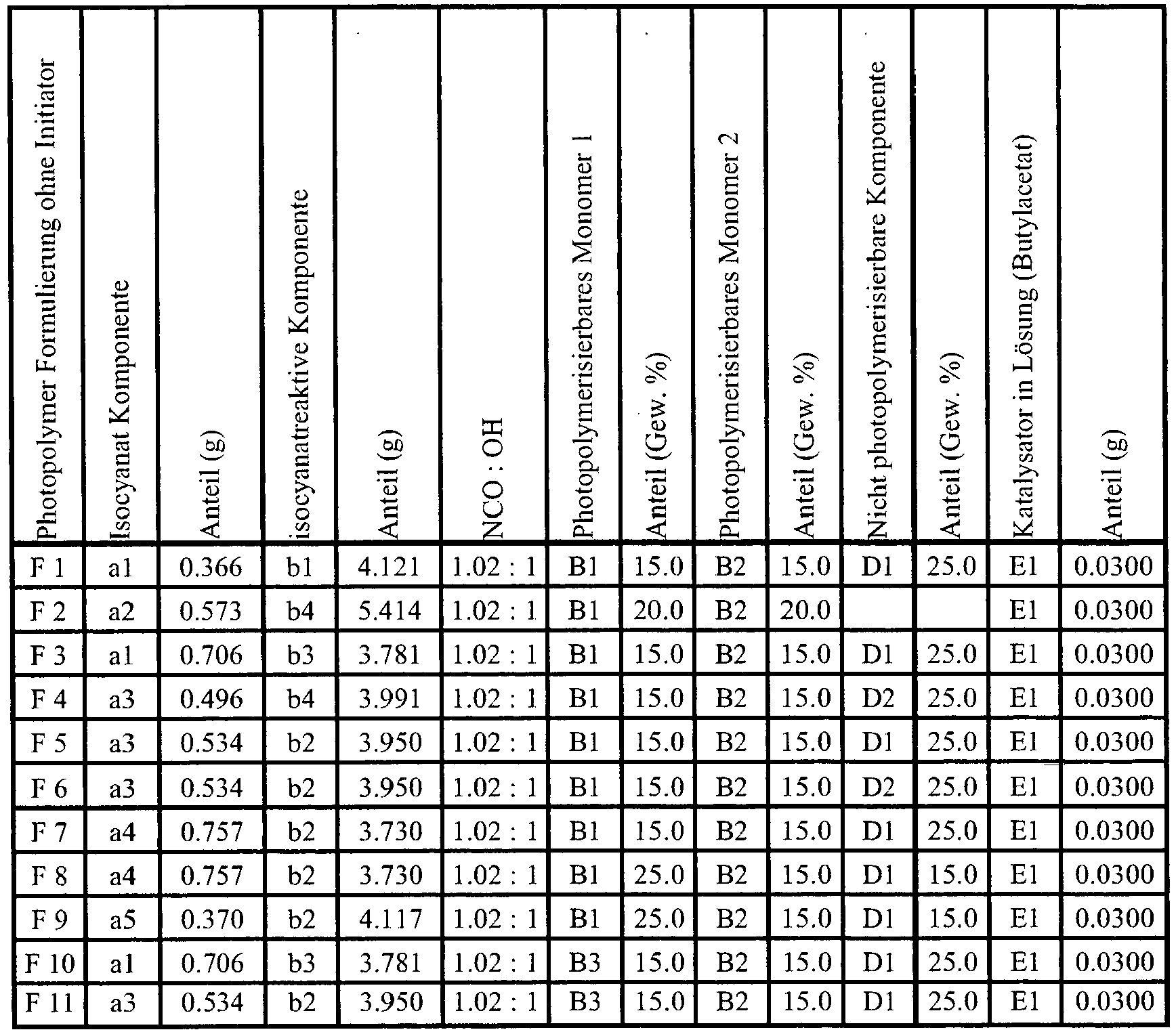
Zur Herstellung der Photopolymer-Formulierung werden die Komponenten Polyol (Komponente b)) schrittweise mit den photopolymerisierbaren Schreibmonomeren (Komponente B1) + B2)), optional mit den nicht polymerisierbaren Komponenten D) sowie dem Uretahnisierungskatalysator (Komponente E1)) in N-Ethylpyrrolidon (10 Gew.%) gelöst, danach wird Byk® 310 (Teil der Komponente E)) zugesetzt und gemischt. Anschließend wird eine Lösung der Komponente C) der Photopolymerlösung im Dunklen hinzugefügt und vermischt, so dass eine klare Lösung erhalten wurde. Gegebenenfalls kann die Formulierung für kurze Zeit bei 60°C erwärmt werden, um die Löslichkeit der Einsatzstoffe zu unterstützen. Zuletzt wird bei 30°C die entsprechende Isocyanat Komponente a) zugegeben und erneut gemischt. Die erhaltene, flüssige Masse wird dann mittels Rakel oder Schlitzdüse auf eine 36 µm dicke Polyethylenterephthalatfolie appliziert, und für 4,5 Minuten bei einer Trocknungstemperatur von 80°C in einem Umlufttrockner getrocknet. Anschließend wird die Photopolymerschicht mit einer 40 µm dicken Polyethylenfolie abgedeckt und aufgewickelt.To prepare the photopolymer formulation, the components polyol (component b)) are reacted stepwise with the photopolymerizable writing monomers (component B1) + B2)), optionally with the non-polymerisable components D) and the uretahation catalyst (component E1)) in N-ethylpyrrolidone ( 10% by weight), then Byk® 310 (part of component E)) is added and mixed. Subsequently, a solution of the component C) of the photopolymer solution is added in the dark and mixed to obtain a clear solution. Optionally, the formulation may be heated at 60 ° C for a short time to aid solubility of the feeds. Finally, the corresponding isocyanate component a) is added at 30 ° C. and mixed again. The liquid mass obtained is then applied by means of doctor blade or slot die to a 36 μm thick polyethylene terephthalate film, and dried for 4.5 minutes at a drying temperature of 80 ° C in a circulating air dryer. Subsequently, the photopolymer layer is covered with a 40 micron thick polyethylene film and wound up.
Die gewünschte Zielschichtdicke der getrockneten Photopolymere liegen vorzugsweise zwischen 10 bis 20 µm..The desired target layer thickness of the dried photopolymers is preferably between 10 and 20 μm.
Die Herstellgeschwindigkeiten liegen bevorzugt im Bereich von 0,2 m/min bis 300 m/min und besonders bevorzugt im Bereich vom 1,0 m/min bis 50 m/min.The production rates are preferably in the range of 0.2 m / min to 300 m / min and more preferably in the range of 1.0 m / min to 50 m / min.
Tabelle 3 listet die untersuchten Beispiele der Photopolymer-Formulierungen, die für die kontinuierliche Herstellung von holographischen Filmen eingesetzt werden, in ihrer Zusammensetzung auf.
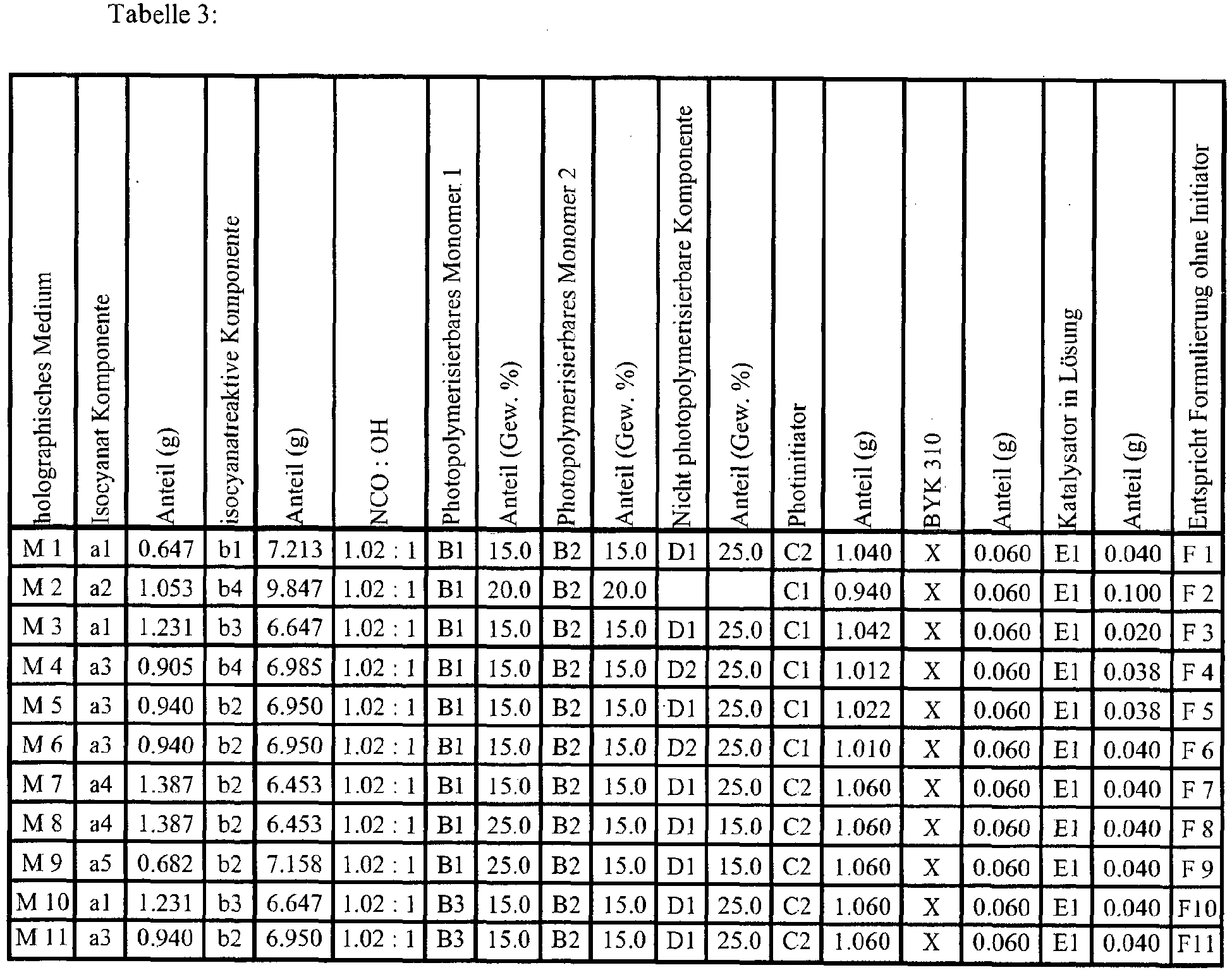
Ergebnisse aus G0, Wickelfähigkeit und Δn kombiniert.Results from G 0 , coilability and Δn combined.
Folgende Messwerte für G0 (MPa), der Qualität der Wickelfähigkeit und von Δn bei der Dosis E (mJ-/cm2) wurden erhalten und sind in Tabelle 4 dargestellt. Dabei gilt das die mit * gekennzeichneten Werte von Δn statt mit λ = 633 nm mit λ = 532 nm gemessen.

Es ergibt sich eine gute Block- und Wickelfähigkeit bei Werten von G0 > 0,03 MPa. G0 sollte bevorzugt > 0,05 MPa betragen und ganz besonders bevorzugt > 0,1 MPa.The result is a good blocking and winding capacity at values of G 0 > 0.03 MPa. G 0 should preferably be> 0.05 MPa, and very particularly preferably> 0.1 MPa.
Für die Bewertung der Wickelfähigkeit sind zwei Merkmale beim fertigen Produkt zu beurteilen. Zum Einen wird die Homogenität der Photopolymerschichtdicke visuell bewertet. Die Randbereiche des Photopolymers in Laufrichtung der Bahn sind hierbei besonders auffällig und gut zu beurteilen. Hier können zumeist leichte Unebenheiten in den Schichtdicken durch die Einfärbung des Photopolymers beobachtet werden, die durch eine Verschiebung des Materials bei Druckaufgabe durch die Schutzfolie entstehen können.For the evaluation of the windability, two characteristics of the finished product are to be assessed. On the one hand, the homogeneity of the photopolymer layer thickness is assessed visually. The edge regions of the photopolymer in the running direction of the web are particularly conspicuous and easy to assess. Here, usually slight unevenness in the layer thicknesses by the coloring of the Photopolymer can be observed, which can be caused by a shift of the material when printed by the protective film.
Als weiterer Aspekt wird die Klebrigkeit der Photopolymerschicht bewertet. Bei dieser Beurteilung wird die Schutzfolie von dem Photopolymer abgezogen. Während des Vorgangs kann über die aufgebrachte Kraft zum Abziehen und der Beobachtung der Grenzfläche zwischen Photopolymer und Schutzfolie die Klebrigkeit empirisch ermittelt werden. Hierbei ist die mögliche Zerstörung des Photopolymer beim Abziehen ein besonders starkes Anzeichen für eine sehr gute Haftung zwischen Photopolymer und Schutzfolie, das wiederum durch eine zu geringe Blockfestigkeit des Polymers hervorgerufen wird.As another aspect, the tackiness of the photopolymer layer is evaluated. In this evaluation, the protective film is peeled off the photopolymer. During the process, the tackiness can be determined empirically by the force applied to peel off and observe the photopolymer-protective film interface. In this case, the possible destruction of the photopolymer during stripping is a particularly strong indication of a very good adhesion between photopolymer and protective film, which in turn is caused by too low a blocking resistance of the polymer.
Im Folgenden werden die Bewertungen der einzelnen Qualitäten der Wickelfähigkeit erläutert:
- + + keine Verschiebung der Schichtdicken, sehr lockeres Ablösen der Schutzfolie ohne Störungen im Film
- + keine Verschiebung der Schichtdicken, leichtes Ablösen der Schutzfolie ohne Störungen im Film
- - leichte Schichtdickenvariation im Randbereich, schweres Abziehen der Schutzfolie ohne Zerstörung der Oberfläche
- -- signifikante Schichtdickenvariationen im Randbereich, starkes "ausfransen" des Beschichtungsrandes, schweres Abziehen der Schutzfolie mit auftretenden Störungen im Photopolymer
- + + no shift of the layer thicknesses, very loose detachment of the protective film without disturbances in the film
- + no shift of the layer thicknesses, easy peeling off of the protective film without disturbances in the film
- - slight layer thickness variation in the edge area, heavy stripping of the protective film without destruction of the surface
- Significant layer thickness variations in the edge area, strong fringing of the coating edge, heavy stripping off of the protective film with occurring disruptions in the photopolymer
Claims (14)
- Process for producing holographic films in whichi)photopolymer formulation comprisingA) matrix polymers as amorphous networkB) a combination of a monofunctional writing monomer and of a polyfunctional writing monomerC) a photoinitiator systemD) optionally a non-photopolymerizable componentE) optionally catalysts, free radical stabilizers, solvents, additives and other auxiliaries and/or additives is provided,ii) the photopolymer formulation is applied as a film extensively to a substrate andiii) the film is dried,
characterized in that a photopolymer formulation having a plateau modulus G0 of ≥ 0.03 MPa is used. - Process according to Claim 1, characterized in that a photopolymer formulation having a plateau modulus of ≥ 0.03 MPa and ≤ 1 MPa, preferably of ≥ 0.05 MPa and ≤ 1 MPa, particularly preferably of ≥ 0.1 MPa and ≤ 1 MPa and especially preferably of ≥ 0.1 MPa and ≤ 0.6 MPa is used.
- Process according to either of Claims 1 and 2, characterized in that a laminating film is applied to the film after the drying in step iii).
- Process according to Claim 3, characterized in that the film is rolled up together with the laminating film.
- Process according to any of Claims 1 to 4, characterized in that the plateau modulus of the photopolymer formulation is determined by measuring the curing of the matrix in an oscillation rheometer, as follows:• Oscillation measuring mode at a constant circular frequency ω0 of 10 rad/s and a regulated deformation amplitude of 1%.• Temperature 50°C, normal force regulation set at 0 Newton• Recording of the storage modulus G' over the measuring time up to a constant value Gmax of G' was reached or for not more than 3 hours. This value is taken as plateau modulus G0.
- Process according to any of Claims 1 to 5, characterized in that the matrix polymers are polyurethanes.
- Process according to any of Claims 1 to 6, characterized in that the writing monomers are acrylates and/or meth(acrylates).
- Process according to Claim 7, characterized in that a combination of a monofunctional and a polyfunctional writing monomer is used as writing monomers.
- Process according to Claim 8, characterized in that the monofunctional writing monomer has the general formula (III)

- Process according to either of Claims 8 and 9, characterized in that the polyfunctional writing monomer has the general formula (IV)

- Process according to any of Claims 1 to 10, characterized in that the photopolymer formulation contains, as a plasticizer, urethanes, the urethanes preferably being substituted by at least one fluorine atom.
- Process according to Claim 11, characterized in that, as a plasticizer, urethanes of the general formula (V)

- Process according to any of Claims 1 to 12, characterized in that the photoinitiator system comprises an anionic, cationic or neutral dye and a coinitiator.
- Holographic medium obtainable by a process according to any of Claims 1 to 13.
Priority Applications (1)
| Application Number | Priority Date | Filing Date | Title |
|---|---|---|---|
| EP10771476.8A EP2497080B1 (en) | 2009-11-03 | 2010-11-02 | Method for producing a holographic film |
Applications Claiming Priority (3)
| Application Number | Priority Date | Filing Date | Title |
|---|---|---|---|
| EP09013768 | 2009-11-03 | ||
| EP10771476.8A EP2497080B1 (en) | 2009-11-03 | 2010-11-02 | Method for producing a holographic film |
| PCT/EP2010/066587 WO2011054791A1 (en) | 2009-11-03 | 2010-11-02 | Method for producing a holographic film |
Publications (2)
| Publication Number | Publication Date |
|---|---|
| EP2497080A1 EP2497080A1 (en) | 2012-09-12 |
| EP2497080B1 true EP2497080B1 (en) | 2013-12-25 |
Family
ID=41401821
Family Applications (1)
| Application Number | Title | Priority Date | Filing Date |
|---|---|---|---|
| EP10771476.8A Active EP2497080B1 (en) | 2009-11-03 | 2010-11-02 | Method for producing a holographic film |
Country Status (9)
| Country | Link |
|---|---|
| US (1) | US8889321B2 (en) |
| EP (1) | EP2497080B1 (en) |
| JP (1) | JP5925686B2 (en) |
| KR (1) | KR101746883B1 (en) |
| CN (1) | CN102741925B (en) |
| ES (1) | ES2446344T3 (en) |
| IN (1) | IN2012DN03891A (en) |
| TW (1) | TWI488908B (en) |
| WO (1) | WO2011054791A1 (en) |
Families Citing this family (20)
| Publication number | Priority date | Publication date | Assignee | Title |
|---|---|---|---|---|
| IL200996A0 (en) * | 2008-10-01 | 2010-06-30 | Bayer Materialscience Ag | Photopolymer formulations having a low crosslinking density |
| TWI489209B (en) * | 2009-11-03 | 2015-06-21 | Bayer Materialscience Ag | Urethanes as additives in a photopolymer formulation |
| EP2497083B1 (en) * | 2009-11-03 | 2013-12-25 | Bayer Intellectual Property GmbH | Photopolymer formulation with various comonomers |
| US8771903B2 (en) * | 2009-11-03 | 2014-07-08 | Bayer Materialscience Ag | Method for producing a holographic film |
| EP2496588B1 (en) * | 2009-11-03 | 2017-01-11 | Covestro Deutschland AG | Urethaneacrylate with high refraction index and reduced double-bond density |
| TWI488908B (en) * | 2009-11-03 | 2015-06-21 | Bayer Materialscience Ag | Process for producing a holographic film |
| TW201133264A (en) * | 2009-11-03 | 2011-10-01 | Bayer Materialscience Ag | Method for selecting additives in photopolymers |
| RU2542981C9 (en) * | 2009-11-03 | 2015-12-10 | Байер Матириальсайенс Аг | Method of producing holographic media |
| RU2570662C9 (en) * | 2009-11-03 | 2016-07-20 | Байер Матириальсайенс Аг | Fluorourethanes as additive in photopolymer composition |
| ATE548730T1 (en) * | 2009-11-03 | 2012-03-15 | Bayer Materialscience Ag | PHOTOPOLYMER FORMULATIONS WITH ADJUSTABLE MECHANICAL MODULE GUV |
| KR101804591B1 (en) * | 2010-02-02 | 2017-12-04 | 바이엘 인텔렉쳐 프로퍼티 게엠베하 | Photopolymer formulation having ester-based writing monomers |
| EP2372454A1 (en) * | 2010-03-29 | 2011-10-05 | Bayer MaterialScience AG | Photopolymer formulation for producing visible holograms |
| EP2450893A1 (en) | 2010-11-08 | 2012-05-09 | Bayer MaterialScience AG | Photopolymer formula for producing of holographic media with highly networked matrix polymers |
| US9195215B2 (en) | 2011-11-29 | 2015-11-24 | Bayer Intellectual Property Gmbh | Holographic medium having a protective layer |
| PL2613318T3 (en) * | 2012-01-05 | 2014-12-31 | Bayer Ip Gmbh | Layer construction with a protective coating and an exposed photopolymer layer |
| US20140302425A1 (en) * | 2012-04-30 | 2014-10-09 | Bayer Intellectual Property Gmbh | Method for producing holographic media |
| TWI640428B (en) * | 2013-02-27 | 2018-11-11 | 拜耳材料科學股份有限公司 | Protective coatings and adhesives based on acrylate |
| KR102244648B1 (en) | 2017-12-08 | 2021-04-26 | 주식회사 엘지화학 | Photopolymer composition |
| KR102166846B1 (en) * | 2017-12-11 | 2020-10-16 | 주식회사 엘지화학 | Photopolymer composition |
| KR102239212B1 (en) | 2018-12-14 | 2021-04-12 | 주식회사 엘지화학 | Photopolymer composition |
Family Cites Families (53)
| Publication number | Priority date | Publication date | Assignee | Title |
|---|---|---|---|---|
| EP0134861B1 (en) * | 1983-09-22 | 1987-12-09 | Toray Industries, Inc. | Resin material for plastic lens and lens composed thereof |
| GB9410578D0 (en) * | 1994-05-26 | 1994-07-13 | London Hospital Med Coll | Novel (meth)acrylate monomers and denture base compositions prepared therefrom |
| US5482908A (en) | 1994-09-08 | 1996-01-09 | Arco Chemical Technology, L.P. | Highly active double metal cyanide catalysts |
| US5679710A (en) * | 1994-11-01 | 1997-10-21 | London Hospital Medical College | High refractive index and/or radio-opaque resins systems |
| US5725970A (en) * | 1994-11-07 | 1998-03-10 | E. I. Du Pont De Nemours And Company | Broad band reflection holograms and a dry process for making same |
| US6482551B1 (en) * | 1998-03-24 | 2002-11-19 | Inphase Technologies | Optical article and process for forming article |
| US6432498B1 (en) * | 1998-04-10 | 2002-08-13 | Dai Nippon Printing Co., Ltd. | Volume hologram laminate |
| EP2309339B1 (en) * | 1999-01-19 | 2016-11-30 | Dai Nippon Printing Co., Ltd. | Relief hologram or diffraction grating sheet and forgery-preventing sheet comprising the same |
| US6627354B1 (en) * | 1999-03-01 | 2003-09-30 | Lucent Technologies Inc. | Photorecording medium, process for fabricating medium, and process for holography using medium |
| US6403702B1 (en) * | 1999-12-03 | 2002-06-11 | Bayer Corporation | Diurethane plasticizer containing one-shot polyurethane cast elastomers |
| US6743552B2 (en) * | 2001-08-07 | 2004-06-01 | Inphase Technologies, Inc. | Process and composition for rapid mass production of holographic recording article |
| ATE355317T1 (en) | 2002-07-30 | 2006-03-15 | Toagosei Co Ltd | COMPOSITION FOR HOLOGRAPHY, METHOD FOR HARDENING SAME AND HARDENED ARTICLE |
| JP2005181709A (en) | 2003-12-19 | 2005-07-07 | Nitto Denko Corp | Optical recording method using organic photorefractive material |
| EP1731975A1 (en) * | 2004-02-13 | 2006-12-13 | Toagosei Co., Ltd. | Volume hologram recording material and volume hologram recording medium |
| WO2006064431A2 (en) * | 2004-12-14 | 2006-06-22 | Dutch Polymer Institute | Porous holographic film |
| JP4248020B2 (en) * | 2005-04-08 | 2009-04-02 | 日東電工株式会社 | Hologram recording material |
| US8941904B2 (en) * | 2005-07-04 | 2015-01-27 | Dai Nippon Printing Co., Ltd. | Hologram sheet and hologram observation sheet using same, and blinding device |
| TW200702954A (en) * | 2005-07-11 | 2007-01-16 | Toagosei Co Ltd | Volume hologram recording material, the method of processing thereof and the recording medium |
| JP2008081726A (en) * | 2006-08-30 | 2008-04-10 | Sanyo Electric Co Ltd | Material for forming organic-inorganic composite, organic-inorganic composite, and optical element using it |
| JP2008076674A (en) * | 2006-09-20 | 2008-04-03 | Fujifilm Corp | Hologram recording medium composition, hologram recording medium and method for producing the same |
| KR101451265B1 (en) * | 2007-02-05 | 2014-10-15 | 신닛테츠 수미킨 가가쿠 가부시키가이샤 | Volume phase hologram recording material and optical information recording medium |
| WO2008123303A1 (en) * | 2007-03-30 | 2008-10-16 | Daikin Industries, Ltd. | Composition for fluorine-containing volume hologram optical information recording material and fluorine-containing volume hologram optical information recording medium using the same |
| RU2009141367A (en) * | 2007-04-11 | 2011-05-20 | Байер МатириальСайенс АГ (DE) | AROMATIC URETHANACRYLATES HAVING A HIGH REFRACTION |
| CN101711410B (en) | 2007-04-11 | 2012-12-12 | 拜尔材料科学股份公司 | Advantageous recording media for holographic applications |
| US20090012202A1 (en) * | 2007-07-03 | 2009-01-08 | Henkel Corporation | Acrylated Urethanes, Processes for Making the Same and Curable Compositions Including the Same |
| CN101320208B (en) * | 2008-07-21 | 2011-06-01 | 上海复旦天臣新技术有限公司 | Reflection holography thin film and preparation method thereof |
| DE502008002161D1 (en) | 2008-08-08 | 2011-02-10 | Bayer Materialscience Ag | Phenylisocyanate-based high refractive index urethane acrylates |
| IL200996A0 (en) * | 2008-10-01 | 2010-06-30 | Bayer Materialscience Ag | Photopolymer formulations having a low crosslinking density |
| IL200995A0 (en) * | 2008-10-01 | 2010-06-30 | Bayer Materialscience Ag | Polyether-based polyurethane formulations for the production of holographic media |
| IL200997A0 (en) * | 2008-10-01 | 2010-06-30 | Bayer Materialscience Ag | Special polyether-based polyurethane formulations for the production of holographic media |
| US8852829B2 (en) * | 2008-10-01 | 2014-10-07 | Bayer Materialscience Ag | Prepolymer-based polyurethane formulations for producing holographic media |
| IL200722A0 (en) * | 2008-10-01 | 2010-06-30 | Bayer Materialscience Ag | Photopolymer compositions for optical elements and visual displays |
| WO2010037515A1 (en) * | 2008-10-01 | 2010-04-08 | Bayer Materialscience Ag | Media for volume-holographic recording based on self-developing polymer |
| EP2218742A1 (en) * | 2009-02-12 | 2010-08-18 | Bayer MaterialScience AG | Photopolymer compounds as compressible formulations |
| EP2218744A1 (en) | 2009-02-12 | 2010-08-18 | Bayer MaterialScience AG | Method of manufacturing holographic photopolymers on polymer films |
| EP2218743A1 (en) * | 2009-02-12 | 2010-08-18 | Bayer MaterialScience AG | Prepolymer-based polyurethane formulations for producing holographic films |
| EP2219073B1 (en) | 2009-02-17 | 2020-06-03 | Covestro Deutschland AG | Holographic media and photopolymer compositions |
| JP2010230911A (en) * | 2009-03-26 | 2010-10-14 | Tdk Corp | Optical device |
| TWI488908B (en) * | 2009-11-03 | 2015-06-21 | Bayer Materialscience Ag | Process for producing a holographic film |
| TWI489209B (en) * | 2009-11-03 | 2015-06-21 | Bayer Materialscience Ag | Urethanes as additives in a photopolymer formulation |
| WO2011054818A2 (en) * | 2009-11-03 | 2011-05-12 | Bayer Materialscience Ag | Novel non-crystallizing methacrylates, production and use thereof |
| RU2570662C9 (en) * | 2009-11-03 | 2016-07-20 | Байер Матириальсайенс Аг | Fluorourethanes as additive in photopolymer composition |
| ATE548730T1 (en) * | 2009-11-03 | 2012-03-15 | Bayer Materialscience Ag | PHOTOPOLYMER FORMULATIONS WITH ADJUSTABLE MECHANICAL MODULE GUV |
| RU2542981C9 (en) * | 2009-11-03 | 2015-12-10 | Байер Матириальсайенс Аг | Method of producing holographic media |
| TW201133264A (en) * | 2009-11-03 | 2011-10-01 | Bayer Materialscience Ag | Method for selecting additives in photopolymers |
| US8771903B2 (en) * | 2009-11-03 | 2014-07-08 | Bayer Materialscience Ag | Method for producing a holographic film |
| EP2497083B1 (en) * | 2009-11-03 | 2013-12-25 | Bayer Intellectual Property GmbH | Photopolymer formulation with various comonomers |
| EP2496588B1 (en) * | 2009-11-03 | 2017-01-11 | Covestro Deutschland AG | Urethaneacrylate with high refraction index and reduced double-bond density |
| KR20120125270A (en) * | 2010-02-02 | 2012-11-14 | 바이엘 인텔렉쳐 프로퍼티 게엠베하 | Photopolymer formulation having triazine-based writing monomers |
| KR101804591B1 (en) * | 2010-02-02 | 2017-12-04 | 바이엘 인텔렉쳐 프로퍼티 게엠베하 | Photopolymer formulation having ester-based writing monomers |
| EP2372454A1 (en) * | 2010-03-29 | 2011-10-05 | Bayer MaterialScience AG | Photopolymer formulation for producing visible holograms |
| BR112013003243A2 (en) * | 2010-08-11 | 2017-06-13 | Bayer Ip Gmbh | difunctional (methyl) acrylate writing monomers |
| EP2450893A1 (en) * | 2010-11-08 | 2012-05-09 | Bayer MaterialScience AG | Photopolymer formula for producing of holographic media with highly networked matrix polymers |
-
2010
- 2010-11-02 TW TW099137561A patent/TWI488908B/en not_active IP Right Cessation
- 2010-11-02 US US13/504,402 patent/US8889321B2/en active Active
- 2010-11-02 ES ES10771476.8T patent/ES2446344T3/en active Active
- 2010-11-02 WO PCT/EP2010/066587 patent/WO2011054791A1/en not_active Ceased
- 2010-11-02 EP EP10771476.8A patent/EP2497080B1/en active Active
- 2010-11-02 KR KR1020127011405A patent/KR101746883B1/en active Active
- 2010-11-02 IN IN3891DEN2012 patent/IN2012DN03891A/en unknown
- 2010-11-02 JP JP2012537363A patent/JP5925686B2/en active Active
- 2010-11-02 CN CN201080061628.2A patent/CN102741925B/en active Active
Also Published As
| Publication number | Publication date |
|---|---|
| CN102741925A (en) | 2012-10-17 |
| KR101746883B1 (en) | 2017-06-27 |
| JP2013510334A (en) | 2013-03-21 |
| TW201132696A (en) | 2011-10-01 |
| ES2446344T3 (en) | 2014-03-07 |
| TWI488908B (en) | 2015-06-21 |
| IN2012DN03891A (en) | 2015-09-04 |
| KR20120101643A (en) | 2012-09-14 |
| EP2497080A1 (en) | 2012-09-12 |
| US8889321B2 (en) | 2014-11-18 |
| US20120219883A1 (en) | 2012-08-30 |
| JP5925686B2 (en) | 2016-05-25 |
| WO2011054791A1 (en) | 2011-05-12 |
| CN102741925B (en) | 2015-12-16 |
Similar Documents
| Publication | Publication Date | Title |
|---|---|---|
| EP2497080B1 (en) | Method for producing a holographic film | |
| EP2497085B1 (en) | Method for producing a holographic film | |
| EP2497081B1 (en) | Method for producing holographic media | |
| EP2317511B1 (en) | Photopolymer formulations with adjustable mechanical module Guv | |
| EP2638089B1 (en) | Photopolymer formulation for producing holographic media | |
| EP2497083B1 (en) | Photopolymer formulation with various comonomers | |
| EP2531892B1 (en) | Use of a photopolymer formulation with triazine-based writing monomers | |
| EP2531889B1 (en) | Use of a photopolymer formulation with ester-based writing monomers for the fabrication of holographic media | |
| EP2172504B1 (en) | Photopolymer formulations with low interlacing density | |
| EP2496588B1 (en) | Urethaneacrylate with high refraction index and reduced double-bond density | |
| EP2342249B1 (en) | Prepolymer-based polyurethane formulations for producing holographic media | |
| EP2218745B1 (en) | Prepolymer-based polyurethane formulations for producing holographic films | |
| EP2172503B1 (en) | Special polyether-based polyurethane formulations for producing holographic media | |
| EP3230261B1 (en) | Naphthyl acrylate as write monomers for photopolymers | |
| EP2372454A1 (en) | Photopolymer formulation for producing visible holograms | |
| EP2354845B1 (en) | Photopolymer Composition for the Manufacturing of Holographic Media | |
| EP2218742A1 (en) | Photopolymer compounds as compressible formulations | |
| EP2496617A2 (en) | Urethanes used as additives in a photopolymer formulation | |
| EP3175297B1 (en) | Layer structure comprising a photo polymer and a substrate layer | |
| EP4483366A1 (en) | Photopolymer compositions for thermostable photopolymers in the visible spectral range |
Legal Events
| Date | Code | Title | Description |
|---|---|---|---|
| PUAI | Public reference made under article 153(3) epc to a published international application that has entered the european phase |
Free format text: ORIGINAL CODE: 0009012 |
|
| 17P | Request for examination filed |
Effective date: 20120604 |
|
| AK | Designated contracting states |
Kind code of ref document: A1 Designated state(s): AL AT BE BG CH CY CZ DE DK EE ES FI FR GB GR HR HU IE IS IT LI LT LU LV MC MK MT NL NO PL PT RO RS SE SI SK SM TR |
|
| DAX | Request for extension of the european patent (deleted) | ||
| RAP1 | Party data changed (applicant data changed or rights of an application transferred) |
Owner name: BAYER INTELLECTUAL PROPERTY GMBH |
|
| GRAP | Despatch of communication of intention to grant a patent |
Free format text: ORIGINAL CODE: EPIDOSNIGR1 |
|
| INTG | Intention to grant announced |
Effective date: 20130812 |
|
| GRAS | Grant fee paid |
Free format text: ORIGINAL CODE: EPIDOSNIGR3 |
|
| GRAA | (expected) grant |
Free format text: ORIGINAL CODE: 0009210 |
|
| AK | Designated contracting states |
Kind code of ref document: B1 Designated state(s): AL AT BE BG CH CY CZ DE DK EE ES FI FR GB GR HR HU IE IS IT LI LT LU LV MC MK MT NL NO PL PT RO RS SE SI SK SM TR |
|
| REG | Reference to a national code |
Ref country code: GB Ref legal event code: FG4D Free format text: NOT ENGLISH |
|
| REG | Reference to a national code |
Ref country code: CH Ref legal event code: EP |
|
| REG | Reference to a national code |
Ref country code: AT Ref legal event code: REF Ref document number: 646969 Country of ref document: AT Kind code of ref document: T Effective date: 20140115 |
|
| REG | Reference to a national code |
Ref country code: IE Ref legal event code: FG4D Free format text: LANGUAGE OF EP DOCUMENT: GERMAN |
|
| REG | Reference to a national code |
Ref country code: DE Ref legal event code: R096 Ref document number: 502010005780 Country of ref document: DE Effective date: 20140213 |
|
| REG | Reference to a national code |
Ref country code: ES Ref legal event code: FG2A Ref document number: 2446344 Country of ref document: ES Kind code of ref document: T3 Effective date: 20140307 |
|
| PG25 | Lapsed in a contracting state [announced via postgrant information from national office to epo] |
Ref country code: FI Free format text: LAPSE BECAUSE OF FAILURE TO SUBMIT A TRANSLATION OF THE DESCRIPTION OR TO PAY THE FEE WITHIN THE PRESCRIBED TIME-LIMIT Effective date: 20131225 Ref country code: LT Free format text: LAPSE BECAUSE OF FAILURE TO SUBMIT A TRANSLATION OF THE DESCRIPTION OR TO PAY THE FEE WITHIN THE PRESCRIBED TIME-LIMIT Effective date: 20131225 Ref country code: SE Free format text: LAPSE BECAUSE OF FAILURE TO SUBMIT A TRANSLATION OF THE DESCRIPTION OR TO PAY THE FEE WITHIN THE PRESCRIBED TIME-LIMIT Effective date: 20131225 Ref country code: NO Free format text: LAPSE BECAUSE OF FAILURE TO SUBMIT A TRANSLATION OF THE DESCRIPTION OR TO PAY THE FEE WITHIN THE PRESCRIBED TIME-LIMIT Effective date: 20140325 Ref country code: HR Free format text: LAPSE BECAUSE OF FAILURE TO SUBMIT A TRANSLATION OF THE DESCRIPTION OR TO PAY THE FEE WITHIN THE PRESCRIBED TIME-LIMIT Effective date: 20131225 |
|
| REG | Reference to a national code |
Ref country code: NL Ref legal event code: VDEP Effective date: 20131225 |
|
| REG | Reference to a national code |
Ref country code: LT Ref legal event code: MG4D |
|
| PG25 | Lapsed in a contracting state [announced via postgrant information from national office to epo] |
Ref country code: LV Free format text: LAPSE BECAUSE OF FAILURE TO SUBMIT A TRANSLATION OF THE DESCRIPTION OR TO PAY THE FEE WITHIN THE PRESCRIBED TIME-LIMIT Effective date: 20131225 Ref country code: RS Free format text: LAPSE BECAUSE OF FAILURE TO SUBMIT A TRANSLATION OF THE DESCRIPTION OR TO PAY THE FEE WITHIN THE PRESCRIBED TIME-LIMIT Effective date: 20131225 |
|
| PG25 | Lapsed in a contracting state [announced via postgrant information from national office to epo] |
Ref country code: IS Free format text: LAPSE BECAUSE OF FAILURE TO SUBMIT A TRANSLATION OF THE DESCRIPTION OR TO PAY THE FEE WITHIN THE PRESCRIBED TIME-LIMIT Effective date: 20140425 Ref country code: EE Free format text: LAPSE BECAUSE OF FAILURE TO SUBMIT A TRANSLATION OF THE DESCRIPTION OR TO PAY THE FEE WITHIN THE PRESCRIBED TIME-LIMIT Effective date: 20131225 |
|
| PG25 | Lapsed in a contracting state [announced via postgrant information from national office to epo] |
Ref country code: RO Free format text: LAPSE BECAUSE OF FAILURE TO SUBMIT A TRANSLATION OF THE DESCRIPTION OR TO PAY THE FEE WITHIN THE PRESCRIBED TIME-LIMIT Effective date: 20131225 Ref country code: SK Free format text: LAPSE BECAUSE OF FAILURE TO SUBMIT A TRANSLATION OF THE DESCRIPTION OR TO PAY THE FEE WITHIN THE PRESCRIBED TIME-LIMIT Effective date: 20131225 Ref country code: CZ Free format text: LAPSE BECAUSE OF FAILURE TO SUBMIT A TRANSLATION OF THE DESCRIPTION OR TO PAY THE FEE WITHIN THE PRESCRIBED TIME-LIMIT Effective date: 20131225 Ref country code: NL Free format text: LAPSE BECAUSE OF FAILURE TO SUBMIT A TRANSLATION OF THE DESCRIPTION OR TO PAY THE FEE WITHIN THE PRESCRIBED TIME-LIMIT Effective date: 20131225 Ref country code: PT Free format text: LAPSE BECAUSE OF FAILURE TO SUBMIT A TRANSLATION OF THE DESCRIPTION OR TO PAY THE FEE WITHIN THE PRESCRIBED TIME-LIMIT Effective date: 20140428 Ref country code: CY Free format text: LAPSE BECAUSE OF FAILURE TO SUBMIT A TRANSLATION OF THE DESCRIPTION OR TO PAY THE FEE WITHIN THE PRESCRIBED TIME-LIMIT Effective date: 20131225 |
|
| REG | Reference to a national code |
Ref country code: DE Ref legal event code: R097 Ref document number: 502010005780 Country of ref document: DE |
|
| PG25 | Lapsed in a contracting state [announced via postgrant information from national office to epo] |
Ref country code: DK Free format text: LAPSE BECAUSE OF FAILURE TO SUBMIT A TRANSLATION OF THE DESCRIPTION OR TO PAY THE FEE WITHIN THE PRESCRIBED TIME-LIMIT Effective date: 20131225 |
|
| PLBE | No opposition filed within time limit |
Free format text: ORIGINAL CODE: 0009261 |
|
| STAA | Information on the status of an ep patent application or granted ep patent |
Free format text: STATUS: NO OPPOSITION FILED WITHIN TIME LIMIT |
|
| PG25 | Lapsed in a contracting state [announced via postgrant information from national office to epo] |
Ref country code: PL Free format text: LAPSE BECAUSE OF FAILURE TO SUBMIT A TRANSLATION OF THE DESCRIPTION OR TO PAY THE FEE WITHIN THE PRESCRIBED TIME-LIMIT Effective date: 20131225 |
|
| 26N | No opposition filed |
Effective date: 20140926 |
|
| REG | Reference to a national code |
Ref country code: DE Ref legal event code: R097 Ref document number: 502010005780 Country of ref document: DE Effective date: 20140926 |
|
| PGFP | Annual fee paid to national office [announced via postgrant information from national office to epo] |
Ref country code: ES Payment date: 20141028 Year of fee payment: 5 |
|
| PGFP | Annual fee paid to national office [announced via postgrant information from national office to epo] |
Ref country code: IT Payment date: 20141110 Year of fee payment: 5 |
|
| PG25 | Lapsed in a contracting state [announced via postgrant information from national office to epo] |
Ref country code: SI Free format text: LAPSE BECAUSE OF FAILURE TO SUBMIT A TRANSLATION OF THE DESCRIPTION OR TO PAY THE FEE WITHIN THE PRESCRIBED TIME-LIMIT Effective date: 20131225 |
|
| PG25 | Lapsed in a contracting state [announced via postgrant information from national office to epo] |
Ref country code: LU Free format text: LAPSE BECAUSE OF FAILURE TO SUBMIT A TRANSLATION OF THE DESCRIPTION OR TO PAY THE FEE WITHIN THE PRESCRIBED TIME-LIMIT Effective date: 20141102 Ref country code: MC Free format text: LAPSE BECAUSE OF FAILURE TO SUBMIT A TRANSLATION OF THE DESCRIPTION OR TO PAY THE FEE WITHIN THE PRESCRIBED TIME-LIMIT Effective date: 20131225 Ref country code: BE Free format text: LAPSE BECAUSE OF NON-PAYMENT OF DUE FEES Effective date: 20141130 |
|
| REG | Reference to a national code |
Ref country code: IE Ref legal event code: MM4A |
|
| REG | Reference to a national code |
Ref country code: FR Ref legal event code: PLFP Year of fee payment: 6 |
|
| PG25 | Lapsed in a contracting state [announced via postgrant information from national office to epo] |
Ref country code: IE Free format text: LAPSE BECAUSE OF NON-PAYMENT OF DUE FEES Effective date: 20141102 |
|
| REG | Reference to a national code |
Ref country code: DE Ref legal event code: R081 Ref document number: 502010005780 Country of ref document: DE Owner name: COVESTRO DEUTSCHLAND AG, DE Free format text: FORMER OWNER: BAYER INTELLECTUAL PROPERTY GMBH, 40789 MONHEIM, DE |
|
| PG25 | Lapsed in a contracting state [announced via postgrant information from national office to epo] |
Ref country code: SM Free format text: LAPSE BECAUSE OF FAILURE TO SUBMIT A TRANSLATION OF THE DESCRIPTION OR TO PAY THE FEE WITHIN THE PRESCRIBED TIME-LIMIT Effective date: 20131225 |
|
| PG25 | Lapsed in a contracting state [announced via postgrant information from national office to epo] |
Ref country code: GR Free format text: LAPSE BECAUSE OF FAILURE TO SUBMIT A TRANSLATION OF THE DESCRIPTION OR TO PAY THE FEE WITHIN THE PRESCRIBED TIME-LIMIT Effective date: 20140326 Ref country code: BG Free format text: LAPSE BECAUSE OF FAILURE TO SUBMIT A TRANSLATION OF THE DESCRIPTION OR TO PAY THE FEE WITHIN THE PRESCRIBED TIME-LIMIT Effective date: 20131225 |
|
| PG25 | Lapsed in a contracting state [announced via postgrant information from national office to epo] |
Ref country code: MT Free format text: LAPSE BECAUSE OF FAILURE TO SUBMIT A TRANSLATION OF THE DESCRIPTION OR TO PAY THE FEE WITHIN THE PRESCRIBED TIME-LIMIT Effective date: 20131225 Ref country code: HU Free format text: LAPSE BECAUSE OF FAILURE TO SUBMIT A TRANSLATION OF THE DESCRIPTION OR TO PAY THE FEE WITHIN THE PRESCRIBED TIME-LIMIT; INVALID AB INITIO Effective date: 20101102 Ref country code: IT Free format text: LAPSE BECAUSE OF NON-PAYMENT OF DUE FEES Effective date: 20151102 Ref country code: TR Free format text: LAPSE BECAUSE OF FAILURE TO SUBMIT A TRANSLATION OF THE DESCRIPTION OR TO PAY THE FEE WITHIN THE PRESCRIBED TIME-LIMIT Effective date: 20131225 |
|
| REG | Reference to a national code |
Ref country code: GB Ref legal event code: 732E Free format text: REGISTERED BETWEEN 20160922 AND 20160928 |
|
| REG | Reference to a national code |
Ref country code: FR Ref legal event code: PLFP Year of fee payment: 7 |
|
| REG | Reference to a national code |
Ref country code: FR Ref legal event code: TP Owner name: COVESTRO DEUTSCHLAND AG, DE Effective date: 20161115 |
|
| REG | Reference to a national code |
Ref country code: ES Ref legal event code: FD2A Effective date: 20161227 |
|
| REG | Reference to a national code |
Ref country code: AT Ref legal event code: MM01 Ref document number: 646969 Country of ref document: AT Kind code of ref document: T Effective date: 20151102 |
|
| PG25 | Lapsed in a contracting state [announced via postgrant information from national office to epo] |
Ref country code: AT Free format text: LAPSE BECAUSE OF NON-PAYMENT OF DUE FEES Effective date: 20151102 Ref country code: ES Free format text: LAPSE BECAUSE OF NON-PAYMENT OF DUE FEES Effective date: 20151103 |
|
| REG | Reference to a national code |
Ref country code: FR Ref legal event code: PLFP Year of fee payment: 8 |
|
| PG25 | Lapsed in a contracting state [announced via postgrant information from national office to epo] |
Ref country code: MK Free format text: LAPSE BECAUSE OF FAILURE TO SUBMIT A TRANSLATION OF THE DESCRIPTION OR TO PAY THE FEE WITHIN THE PRESCRIBED TIME-LIMIT Effective date: 20131225 |
|
| REG | Reference to a national code |
Ref country code: FR Ref legal event code: PLFP Year of fee payment: 9 |
|
| PG25 | Lapsed in a contracting state [announced via postgrant information from national office to epo] |
Ref country code: AL Free format text: LAPSE BECAUSE OF FAILURE TO SUBMIT A TRANSLATION OF THE DESCRIPTION OR TO PAY THE FEE WITHIN THE PRESCRIBED TIME-LIMIT Effective date: 20131225 |
|
| PGFP | Annual fee paid to national office [announced via postgrant information from national office to epo] |
Ref country code: FR Payment date: 20191029 Year of fee payment: 10 |
|
| PGFP | Annual fee paid to national office [announced via postgrant information from national office to epo] |
Ref country code: CH Payment date: 20191116 Year of fee payment: 10 |
|
| PGFP | Annual fee paid to national office [announced via postgrant information from national office to epo] |
Ref country code: GB Payment date: 20191031 Year of fee payment: 10 |
|
| REG | Reference to a national code |
Ref country code: CH Ref legal event code: PL |
|
| GBPC | Gb: european patent ceased through non-payment of renewal fee |
Effective date: 20201102 |
|
| PG25 | Lapsed in a contracting state [announced via postgrant information from national office to epo] |
Ref country code: LI Free format text: LAPSE BECAUSE OF NON-PAYMENT OF DUE FEES Effective date: 20201130 Ref country code: CH Free format text: LAPSE BECAUSE OF NON-PAYMENT OF DUE FEES Effective date: 20201130 |
|
| PG25 | Lapsed in a contracting state [announced via postgrant information from national office to epo] |
Ref country code: FR Free format text: LAPSE BECAUSE OF NON-PAYMENT OF DUE FEES Effective date: 20201130 |
|
| PG25 | Lapsed in a contracting state [announced via postgrant information from national office to epo] |
Ref country code: GB Free format text: LAPSE BECAUSE OF NON-PAYMENT OF DUE FEES Effective date: 20201102 |
|
| PGFP | Annual fee paid to national office [announced via postgrant information from national office to epo] |
Ref country code: DE Payment date: 20251022 Year of fee payment: 16 |