EP2386559A1 - Cytotoxiv agents comprising new tomaymycin derivatives and their therapeutic use - Google Patents
Cytotoxiv agents comprising new tomaymycin derivatives and their therapeutic use Download PDFInfo
- Publication number
- EP2386559A1 EP2386559A1 EP10180637A EP10180637A EP2386559A1 EP 2386559 A1 EP2386559 A1 EP 2386559A1 EP 10180637 A EP10180637 A EP 10180637A EP 10180637 A EP10180637 A EP 10180637A EP 2386559 A1 EP2386559 A1 EP 2386559A1
- Authority
- EP
- European Patent Office
- Prior art keywords
- ethoxy
- bis
- methyl
- compound
- tetrahydro
- Prior art date
- Legal status (The legal status is an assumption and is not a legal conclusion. Google has not performed a legal analysis and makes no representation as to the accuracy of the status listed.)
- Withdrawn
Links
- UQVNRKBFAXNOGA-LWTNMJDUSA-N (E)-tomaymycin Chemical class CO[C@H]1NC2=CC(O)=C(OC)C=C2C(=O)N2C\C(=C\C)C[C@@H]12 UQVNRKBFAXNOGA-LWTNMJDUSA-N 0.000 title abstract description 66
- 230000001225 therapeutic effect Effects 0.000 title abstract description 9
- 238000000034 method Methods 0.000 claims abstract description 197
- 238000002360 preparation method Methods 0.000 claims abstract description 63
- 230000008569 process Effects 0.000 claims abstract description 17
- 150000001875 compounds Chemical class 0.000 claims description 159
- -1 cyclic amine Chemical class 0.000 claims description 83
- 125000005647 linker group Chemical group 0.000 claims description 61
- 239000011230 binding agent Substances 0.000 claims description 60
- 125000000217 alkyl group Chemical group 0.000 claims description 48
- 125000003118 aryl group Chemical group 0.000 claims description 37
- 239000003814 drug Substances 0.000 claims description 31
- 229910052721 tungsten Inorganic materials 0.000 claims description 30
- 238000011282 treatment Methods 0.000 claims description 24
- 229910052727 yttrium Inorganic materials 0.000 claims description 23
- 229910052770 Uranium Inorganic materials 0.000 claims description 22
- 125000000623 heterocyclic group Chemical group 0.000 claims description 22
- 238000004128 high performance liquid chromatography Methods 0.000 claims description 22
- 150000003839 salts Chemical class 0.000 claims description 22
- 125000003396 thiol group Chemical group [H]S* 0.000 claims description 22
- 206010028980 Neoplasm Diseases 0.000 claims description 17
- 201000011510 cancer Diseases 0.000 claims description 16
- 125000001072 heteroaryl group Chemical group 0.000 claims description 16
- BWGNESOTFCXPMA-UHFFFAOYSA-N Dihydrogen disulfide Chemical compound SS BWGNESOTFCXPMA-UHFFFAOYSA-N 0.000 claims description 15
- 241000282414 Homo sapiens Species 0.000 claims description 15
- UCKMPCXJQFINFW-UHFFFAOYSA-N Sulphide Chemical compound [S-2] UCKMPCXJQFINFW-UHFFFAOYSA-N 0.000 claims description 14
- 108090000765 processed proteins & peptides Proteins 0.000 claims description 14
- 125000003342 alkenyl group Chemical group 0.000 claims description 12
- 239000002243 precursor Substances 0.000 claims description 12
- JJAHTWIKCUJRDK-UHFFFAOYSA-N succinimidyl 4-(N-maleimidomethyl)cyclohexane-1-carboxylate Chemical compound C1CC(CN2C(C=CC2=O)=O)CCC1C(=O)ON1C(=O)CCC1=O JJAHTWIKCUJRDK-UHFFFAOYSA-N 0.000 claims description 12
- 239000000637 Melanocyte-Stimulating Hormone Substances 0.000 claims description 10
- 108010007013 Melanocyte-Stimulating Hormones Proteins 0.000 claims description 10
- 125000004122 cyclic group Chemical group 0.000 claims description 9
- 239000000126 substance Substances 0.000 claims description 9
- HJVJLAOFAYPFHL-UHFFFAOYSA-N (2,5-dioxopyrrolidin-1-yl) 2-pyridin-2-ylpropanedithioate Chemical compound C=1C=CC=NC=1C(C)C(=S)SN1C(=O)CCC1=O HJVJLAOFAYPFHL-UHFFFAOYSA-N 0.000 claims description 8
- KXDHJXZQYSOELW-UHFFFAOYSA-M Carbamate Chemical compound NC([O-])=O KXDHJXZQYSOELW-UHFFFAOYSA-M 0.000 claims description 7
- GNVMUORYQLCPJZ-UHFFFAOYSA-M Thiocarbamate Chemical compound NC([S-])=O GNVMUORYQLCPJZ-UHFFFAOYSA-M 0.000 claims description 7
- 229910052739 hydrogen Inorganic materials 0.000 claims description 7
- 125000002496 methyl group Chemical group [H]C([H])([H])* 0.000 claims description 7
- 102000011923 Thyrotropin Human genes 0.000 claims description 6
- 108010061174 Thyrotropin Proteins 0.000 claims description 6
- 238000004587 chromatography analysis Methods 0.000 claims description 6
- 239000003431 cross linking reagent Substances 0.000 claims description 6
- 150000002148 esters Chemical class 0.000 claims description 6
- 239000008194 pharmaceutical composition Substances 0.000 claims description 6
- 125000001997 phenyl group Chemical group [H]C1=C([H])C([H])=C(*)C([H])=C1[H] 0.000 claims description 6
- 102000004196 processed proteins & peptides Human genes 0.000 claims description 6
- HBAQYPYDRFILMT-UHFFFAOYSA-N 8-[3-(1-cyclopropylpyrazol-4-yl)-1H-pyrazolo[4,3-d]pyrimidin-5-yl]-3-methyl-3,8-diazabicyclo[3.2.1]octan-2-one Chemical class C1(CC1)N1N=CC(=C1)C1=NNC2=C1N=C(N=C2)N1C2C(N(CC1CC2)C)=O HBAQYPYDRFILMT-UHFFFAOYSA-N 0.000 claims description 5
- 239000003102 growth factor Substances 0.000 claims description 5
- 125000005843 halogen group Chemical group 0.000 claims description 5
- 150000004677 hydrates Chemical class 0.000 claims description 5
- 230000003287 optical effect Effects 0.000 claims description 5
- 206010007134 Candida infections Diseases 0.000 claims description 4
- 108010017213 Granulocyte-Macrophage Colony-Stimulating Factor Proteins 0.000 claims description 4
- 102000004457 Granulocyte-Macrophage Colony-Stimulating Factor Human genes 0.000 claims description 4
- 108090000723 Insulin-Like Growth Factor I Proteins 0.000 claims description 4
- 108010002350 Interleukin-2 Proteins 0.000 claims description 4
- 108010074338 Lymphokines Proteins 0.000 claims description 4
- 102000008072 Lymphokines Human genes 0.000 claims description 4
- 239000002246 antineoplastic agent Substances 0.000 claims description 4
- 125000004093 cyano group Chemical group *C#N 0.000 claims description 4
- 125000000753 cycloalkyl group Chemical group 0.000 claims description 4
- 239000012634 fragment Substances 0.000 claims description 4
- 229940088597 hormone Drugs 0.000 claims description 4
- 239000005556 hormone Substances 0.000 claims description 4
- NOESYZHRGYRDHS-UHFFFAOYSA-N insulin Chemical compound N1C(=O)C(NC(=O)C(CCC(N)=O)NC(=O)C(CCC(O)=O)NC(=O)C(C(C)C)NC(=O)C(NC(=O)CN)C(C)CC)CSSCC(C(NC(CO)C(=O)NC(CC(C)C)C(=O)NC(CC=2C=CC(O)=CC=2)C(=O)NC(CCC(N)=O)C(=O)NC(CC(C)C)C(=O)NC(CCC(O)=O)C(=O)NC(CC(N)=O)C(=O)NC(CC=2C=CC(O)=CC=2)C(=O)NC(CSSCC(NC(=O)C(C(C)C)NC(=O)C(CC(C)C)NC(=O)C(CC=2C=CC(O)=CC=2)NC(=O)C(CC(C)C)NC(=O)C(C)NC(=O)C(CCC(O)=O)NC(=O)C(C(C)C)NC(=O)C(CC(C)C)NC(=O)C(CC=2NC=NC=2)NC(=O)C(CO)NC(=O)CNC2=O)C(=O)NCC(=O)NC(CCC(O)=O)C(=O)NC(CCCNC(N)=N)C(=O)NCC(=O)NC(CC=3C=CC=CC=3)C(=O)NC(CC=3C=CC=CC=3)C(=O)NC(CC=3C=CC(O)=CC=3)C(=O)NC(C(C)O)C(=O)N3C(CCC3)C(=O)NC(CCCCN)C(=O)NC(C)C(O)=O)C(=O)NC(CC(N)=O)C(O)=O)=O)NC(=O)C(C(C)CC)NC(=O)C(CO)NC(=O)C(C(C)O)NC(=O)C1CSSCC2NC(=O)C(CC(C)C)NC(=O)C(NC(=O)C(CCC(N)=O)NC(=O)C(CC(N)=O)NC(=O)C(NC(=O)C(N)CC=1C=CC=CC=1)C(C)C)CC1=CN=CN1 NOESYZHRGYRDHS-UHFFFAOYSA-N 0.000 claims description 4
- 125000004076 pyridyl group Chemical group 0.000 claims description 4
- 150000003568 thioethers Chemical class 0.000 claims description 4
- NKUZQMZWTZAPSN-UHFFFAOYSA-N (2,5-dioxopyrrolidin-1-yl) 2-bromoacetate Chemical compound BrCC(=O)ON1C(=O)CCC1=O NKUZQMZWTZAPSN-UHFFFAOYSA-N 0.000 claims description 3
- VRDGQQTWSGDXCU-UHFFFAOYSA-N (2,5-dioxopyrrolidin-1-yl) 2-iodoacetate Chemical compound ICC(=O)ON1C(=O)CCC1=O VRDGQQTWSGDXCU-UHFFFAOYSA-N 0.000 claims description 3
- VQZYZXLBKBUOHE-UHFFFAOYSA-N (2,5-dioxopyrrolidin-1-yl) 3-(pyridin-2-yldisulfanyl)butanoate Chemical compound C=1C=CC=NC=1SSC(C)CC(=O)ON1C(=O)CCC1=O VQZYZXLBKBUOHE-UHFFFAOYSA-N 0.000 claims description 3
- WGMMKWFUXPMTRW-UHFFFAOYSA-N (2,5-dioxopyrrolidin-1-yl) 3-[(2-bromoacetyl)amino]propanoate Chemical compound BrCC(=O)NCCC(=O)ON1C(=O)CCC1=O WGMMKWFUXPMTRW-UHFFFAOYSA-N 0.000 claims description 3
- GTBCXYYVWHFQRS-UHFFFAOYSA-N (2,5-dioxopyrrolidin-1-yl) 4-(pyridin-2-yldisulfanyl)pentanoate Chemical compound C=1C=CC=NC=1SSC(C)CCC(=O)ON1C(=O)CCC1=O GTBCXYYVWHFQRS-UHFFFAOYSA-N 0.000 claims description 3
- GKSPIZSKQWTXQG-UHFFFAOYSA-N (2,5-dioxopyrrolidin-1-yl) 4-[1-(pyridin-2-yldisulfanyl)ethyl]benzoate Chemical compound C=1C=C(C(=O)ON2C(CCC2=O)=O)C=CC=1C(C)SSC1=CC=CC=N1 GKSPIZSKQWTXQG-UHFFFAOYSA-N 0.000 claims description 3
- FERIUCNNQQJTOY-UHFFFAOYSA-M Butyrate Chemical compound CCCC([O-])=O FERIUCNNQQJTOY-UHFFFAOYSA-M 0.000 claims description 3
- 102000004338 Transferrin Human genes 0.000 claims description 3
- 108090000901 Transferrin Proteins 0.000 claims description 3
- 239000003937 drug carrier Substances 0.000 claims description 3
- 150000004820 halides Chemical class 0.000 claims description 3
- 125000004430 oxygen atom Chemical group O* 0.000 claims description 3
- 125000005346 substituted cycloalkyl group Chemical group 0.000 claims description 3
- 125000005413 thiopyridyl group Chemical group 0.000 claims description 3
- 239000012581 transferrin Substances 0.000 claims description 3
- JWDFQMWEFLOOED-UHFFFAOYSA-N (2,5-dioxopyrrolidin-1-yl) 3-(pyridin-2-yldisulfanyl)propanoate Chemical group O=C1CCC(=O)N1OC(=O)CCSSC1=CC=CC=N1 JWDFQMWEFLOOED-UHFFFAOYSA-N 0.000 claims description 2
- OWDQCSBZQVISPN-UHFFFAOYSA-N 2-[(2,5-dioxopyrrolidin-1-yl)amino]-4-(2-iodoacetyl)benzoic acid Chemical compound OC(=O)C1=CC=C(C(=O)CI)C=C1NN1C(=O)CCC1=O OWDQCSBZQVISPN-UHFFFAOYSA-N 0.000 claims description 2
- SLMVEZKWNOGJPD-UHFFFAOYSA-N 4-(pyridin-2-yldisulfanyl)butanoic acid Chemical compound OC(=O)CCCSSC1=CC=CC=N1 SLMVEZKWNOGJPD-UHFFFAOYSA-N 0.000 claims description 2
- LQILVUYCDHSGEU-UHFFFAOYSA-N 4-[(2,5-dioxopyrrol-1-yl)methyl]cyclohexane-1-carboxylic acid Chemical compound C1CC(C(=O)O)CCC1CN1C(=O)C=CC1=O LQILVUYCDHSGEU-UHFFFAOYSA-N 0.000 claims description 2
- FERIUCNNQQJTOY-UHFFFAOYSA-N Butyric acid Natural products CCCC(O)=O FERIUCNNQQJTOY-UHFFFAOYSA-N 0.000 claims description 2
- 108010071942 Colony-Stimulating Factors Proteins 0.000 claims description 2
- 102000007644 Colony-Stimulating Factors Human genes 0.000 claims description 2
- 108010017080 Granulocyte Colony-Stimulating Factor Proteins 0.000 claims description 2
- 102000004269 Granulocyte Colony-Stimulating Factor Human genes 0.000 claims description 2
- 102000004877 Insulin Human genes 0.000 claims description 2
- 108090001061 Insulin Proteins 0.000 claims description 2
- 102000004218 Insulin-Like Growth Factor I Human genes 0.000 claims description 2
- 108090001117 Insulin-Like Growth Factor II Proteins 0.000 claims description 2
- 102000048143 Insulin-Like Growth Factor II Human genes 0.000 claims description 2
- 102000014150 Interferons Human genes 0.000 claims description 2
- 108010050904 Interferons Proteins 0.000 claims description 2
- 108010002386 Interleukin-3 Proteins 0.000 claims description 2
- 108090000978 Interleukin-4 Proteins 0.000 claims description 2
- 108090001005 Interleukin-6 Proteins 0.000 claims description 2
- 108010046938 Macrophage Colony-Stimulating Factor Proteins 0.000 claims description 2
- 102000007651 Macrophage Colony-Stimulating Factor Human genes 0.000 claims description 2
- 102000006747 Transforming Growth Factor alpha Human genes 0.000 claims description 2
- 101800004564 Transforming growth factor alpha Proteins 0.000 claims description 2
- 238000005377 adsorption chromatography Methods 0.000 claims description 2
- 238000001042 affinity chromatography Methods 0.000 claims description 2
- 229940094957 androgens and estrogen Drugs 0.000 claims description 2
- 150000008064 anhydrides Chemical class 0.000 claims description 2
- 239000000919 ceramic Substances 0.000 claims description 2
- 229940047120 colony stimulating factors Drugs 0.000 claims description 2
- 238000011026 diafiltration Methods 0.000 claims description 2
- 238000000502 dialysis Methods 0.000 claims description 2
- 229940014144 folate Drugs 0.000 claims description 2
- 239000011724 folic acid Substances 0.000 claims description 2
- OVBPIULPVIDEAO-LBPRGKRZSA-N folic acid Chemical compound C=1N=C2NC(N)=NC(=O)C2=NC=1CNC1=CC=C(C(=O)N[C@@H](CCC(O)=O)C(O)=O)C=C1 OVBPIULPVIDEAO-LBPRGKRZSA-N 0.000 claims description 2
- 235000019152 folic acid Nutrition 0.000 claims description 2
- 238000004191 hydrophobic interaction chromatography Methods 0.000 claims description 2
- 229940125396 insulin Drugs 0.000 claims description 2
- 229940047124 interferons Drugs 0.000 claims description 2
- 239000003488 releasing hormone Substances 0.000 claims description 2
- 239000003270 steroid hormone Substances 0.000 claims description 2
- 125000001424 substituent group Chemical group 0.000 claims description 2
- CNHYKKNIIGEXAY-UHFFFAOYSA-N thiolan-2-imine Chemical compound N=C1CCCS1 CNHYKKNIIGEXAY-UHFFFAOYSA-N 0.000 claims description 2
- 229960000874 thyrotropin Drugs 0.000 claims description 2
- 230000001748 thyrotropin Effects 0.000 claims description 2
- 239000011782 vitamin Substances 0.000 claims description 2
- 235000013343 vitamin Nutrition 0.000 claims description 2
- 229940088594 vitamin Drugs 0.000 claims description 2
- 229930003231 vitamin Natural products 0.000 claims description 2
- 102000009024 Epidermal Growth Factor Human genes 0.000 claims 1
- 102000014429 Insulin-like growth factor Human genes 0.000 claims 1
- 101710098940 Pro-epidermal growth factor Proteins 0.000 claims 1
- 125000002910 aryl thiol group Chemical group 0.000 claims 1
- 238000004255 ion exchange chromatography Methods 0.000 claims 1
- 238000001542 size-exclusion chromatography Methods 0.000 claims 1
- YMWUJEATGCHHMB-UHFFFAOYSA-N Dichloromethane Chemical compound ClCCl YMWUJEATGCHHMB-UHFFFAOYSA-N 0.000 description 256
- OKKJLVBELUTLKV-UHFFFAOYSA-N Methanol Chemical compound OC OKKJLVBELUTLKV-UHFFFAOYSA-N 0.000 description 167
- 239000000243 solution Substances 0.000 description 161
- XEKOWRVHYACXOJ-UHFFFAOYSA-N Ethyl acetate Chemical compound CCOC(C)=O XEKOWRVHYACXOJ-UHFFFAOYSA-N 0.000 description 142
- 210000004027 cell Anatomy 0.000 description 136
- ZMXDDKWLCZADIW-UHFFFAOYSA-N N,N-Dimethylformamide Chemical compound CN(C)C=O ZMXDDKWLCZADIW-UHFFFAOYSA-N 0.000 description 130
- XLYOFNOQVPJJNP-UHFFFAOYSA-N water Substances O XLYOFNOQVPJJNP-UHFFFAOYSA-N 0.000 description 125
- 229910001868 water Inorganic materials 0.000 description 120
- WYURNTSHIVDZCO-UHFFFAOYSA-N Tetrahydrofuran Chemical compound C1CCOC1 WYURNTSHIVDZCO-UHFFFAOYSA-N 0.000 description 86
- 239000000203 mixture Substances 0.000 description 86
- 238000004895 liquid chromatography mass spectrometry Methods 0.000 description 68
- 239000000562 conjugate Substances 0.000 description 67
- CSNNHWWHGAXBCP-UHFFFAOYSA-L Magnesium sulfate Chemical compound [Mg+2].[O-][S+2]([O-])([O-])[O-] CSNNHWWHGAXBCP-UHFFFAOYSA-L 0.000 description 59
- 230000014759 maintenance of location Effects 0.000 description 59
- IAZDPXIOMUYVGZ-WFGJKAKNSA-N Dimethyl sulfoxide Chemical compound [2H]C([2H])([2H])S(=O)C([2H])([2H])[2H] IAZDPXIOMUYVGZ-WFGJKAKNSA-N 0.000 description 54
- 239000007787 solid Substances 0.000 description 52
- 235000019439 ethyl acetate Nutrition 0.000 description 51
- 238000006243 chemical reaction Methods 0.000 description 49
- HEDRZPFGACZZDS-MICDWDOJSA-N Trichloro(2H)methane Chemical compound [2H]C(Cl)(Cl)Cl HEDRZPFGACZZDS-MICDWDOJSA-N 0.000 description 48
- ZMANZCXQSJIPKH-UHFFFAOYSA-N Triethylamine Chemical compound CCN(CC)CC ZMANZCXQSJIPKH-UHFFFAOYSA-N 0.000 description 48
- 239000002904 solvent Substances 0.000 description 45
- WEVYAHXRMPXWCK-UHFFFAOYSA-N Acetonitrile Chemical compound CC#N WEVYAHXRMPXWCK-UHFFFAOYSA-N 0.000 description 44
- VLKZOEOYAKHREP-UHFFFAOYSA-N n-Hexane Chemical compound CCCCCC VLKZOEOYAKHREP-UHFFFAOYSA-N 0.000 description 43
- 239000010410 layer Substances 0.000 description 39
- BWHMMNNQKKPAPP-UHFFFAOYSA-L potassium carbonate Chemical compound [K+].[K+].[O-]C([O-])=O BWHMMNNQKKPAPP-UHFFFAOYSA-L 0.000 description 38
- 239000011541 reaction mixture Substances 0.000 description 37
- 125000005699 methyleneoxy group Chemical group [H]C([H])([*:1])O[*:2] 0.000 description 36
- 239000000427 antigen Substances 0.000 description 35
- 108091007433 antigens Proteins 0.000 description 35
- 102000036639 antigens Human genes 0.000 description 35
- FAPWRFPIFSIZLT-UHFFFAOYSA-M Sodium chloride Chemical compound [Na+].[Cl-] FAPWRFPIFSIZLT-UHFFFAOYSA-M 0.000 description 32
- 238000000746 purification Methods 0.000 description 32
- 239000000872 buffer Substances 0.000 description 29
- 229910052943 magnesium sulfate Inorganic materials 0.000 description 29
- FXHOOIRPVKKKFG-UHFFFAOYSA-N N,N-Dimethylacetamide Chemical compound CN(C)C(C)=O FXHOOIRPVKKKFG-UHFFFAOYSA-N 0.000 description 28
- 229940079593 drug Drugs 0.000 description 28
- RIOQSEWOXXDEQQ-UHFFFAOYSA-N triphenylphosphine Chemical compound C1=CC=CC=C1P(C=1C=CC=CC=1)C1=CC=CC=C1 RIOQSEWOXXDEQQ-UHFFFAOYSA-N 0.000 description 28
- YXFVVABEGXRONW-UHFFFAOYSA-N Toluene Chemical compound CC1=CC=CC=C1 YXFVVABEGXRONW-UHFFFAOYSA-N 0.000 description 27
- NLKNQRATVPKPDG-UHFFFAOYSA-M potassium iodide Chemical compound [K+].[I-] NLKNQRATVPKPDG-UHFFFAOYSA-M 0.000 description 27
- 150000003573 thiols Chemical class 0.000 description 27
- 238000005160 1H NMR spectroscopy Methods 0.000 description 26
- 229940093499 ethyl acetate Drugs 0.000 description 26
- 239000011734 sodium Substances 0.000 description 26
- 238000003818 flash chromatography Methods 0.000 description 25
- UHOVQNZJYSORNB-UHFFFAOYSA-N Benzene Chemical compound C1=CC=CC=C1 UHOVQNZJYSORNB-UHFFFAOYSA-N 0.000 description 24
- LWIHDJKSTIGBAC-UHFFFAOYSA-K tripotassium phosphate Chemical compound [K+].[K+].[K+].[O-]P([O-])([O-])=O LWIHDJKSTIGBAC-UHFFFAOYSA-K 0.000 description 24
- 238000003756 stirring Methods 0.000 description 23
- 239000012044 organic layer Substances 0.000 description 22
- 238000010898 silica gel chromatography Methods 0.000 description 22
- 238000000338 in vitro Methods 0.000 description 21
- 239000007864 aqueous solution Substances 0.000 description 20
- 239000012267 brine Substances 0.000 description 20
- BDAGIHXWWSANSR-UHFFFAOYSA-N methanoic acid Natural products OC=O BDAGIHXWWSANSR-UHFFFAOYSA-N 0.000 description 20
- HPALAKNZSZLMCH-UHFFFAOYSA-M sodium;chloride;hydrate Chemical compound O.[Na+].[Cl-] HPALAKNZSZLMCH-UHFFFAOYSA-M 0.000 description 20
- VYPSYNLAJGMNEJ-UHFFFAOYSA-N Silicium dioxide Chemical compound O=[Si]=O VYPSYNLAJGMNEJ-UHFFFAOYSA-N 0.000 description 19
- 229910000027 potassium carbonate Inorganic materials 0.000 description 19
- RTZKZFJDLAIYFH-UHFFFAOYSA-N Diethyl ether Chemical compound CCOCC RTZKZFJDLAIYFH-UHFFFAOYSA-N 0.000 description 18
- KCXVZYZYPLLWCC-UHFFFAOYSA-N EDTA Chemical compound OC(=O)CN(CC(O)=O)CCN(CC(O)=O)CC(O)=O KCXVZYZYPLLWCC-UHFFFAOYSA-N 0.000 description 17
- UIIMBOGNXHQVGW-UHFFFAOYSA-M Sodium bicarbonate Chemical class [Na+].OC([O-])=O UIIMBOGNXHQVGW-UHFFFAOYSA-M 0.000 description 17
- 125000004432 carbon atom Chemical group C* 0.000 description 17
- 229960001484 edetic acid Drugs 0.000 description 17
- 235000019341 magnesium sulphate Nutrition 0.000 description 17
- 208000037265 diseases, disorders, signs and symptoms Diseases 0.000 description 16
- LFQSCWFLJHTTHZ-UHFFFAOYSA-N Ethanol Chemical compound CCO LFQSCWFLJHTTHZ-UHFFFAOYSA-N 0.000 description 15
- VEXZGXHMUGYJMC-UHFFFAOYSA-N Hydrochloric acid Chemical compound Cl VEXZGXHMUGYJMC-UHFFFAOYSA-N 0.000 description 15
- 230000021615 conjugation Effects 0.000 description 15
- 239000000741 silica gel Substances 0.000 description 14
- 229910002027 silica gel Inorganic materials 0.000 description 14
- PMZURENOXWZQFD-UHFFFAOYSA-L Sodium Sulfate Chemical compound [Na+].[Na+].[O-]S([O-])(=O)=O PMZURENOXWZQFD-UHFFFAOYSA-L 0.000 description 13
- 239000002253 acid Substances 0.000 description 13
- 201000010099 disease Diseases 0.000 description 13
- 239000000706 filtrate Substances 0.000 description 13
- 238000002390 rotary evaporation Methods 0.000 description 13
- 239000011780 sodium chloride Substances 0.000 description 13
- 239000012062 aqueous buffer Substances 0.000 description 12
- 238000010828 elution Methods 0.000 description 12
- 238000002523 gelfiltration Methods 0.000 description 12
- 239000003921 oil Substances 0.000 description 12
- 235000019198 oils Nutrition 0.000 description 12
- CTSLXHKWHWQRSH-UHFFFAOYSA-N oxalyl chloride Chemical compound ClC(=O)C(Cl)=O CTSLXHKWHWQRSH-UHFFFAOYSA-N 0.000 description 12
- 229910000160 potassium phosphate Inorganic materials 0.000 description 12
- 235000011009 potassium phosphates Nutrition 0.000 description 12
- 239000003795 chemical substances by application Substances 0.000 description 11
- LOKCTEFSRHRXRJ-UHFFFAOYSA-I dipotassium trisodium dihydrogen phosphate hydrogen phosphate dichloride Chemical compound P(=O)(O)(O)[O-].[K+].P(=O)(O)([O-])[O-].[Na+].[Na+].[Cl-].[K+].[Cl-].[Na+] LOKCTEFSRHRXRJ-UHFFFAOYSA-I 0.000 description 11
- LJGDVVRRCYVQKF-LURJTMIESA-N methyl (2s)-4-methylidenepyrrolidine-2-carboxylate Chemical compound COC(=O)[C@@H]1CC(=C)CN1 LJGDVVRRCYVQKF-LURJTMIESA-N 0.000 description 11
- 239000002953 phosphate buffered saline Substances 0.000 description 11
- 230000002829 reductive effect Effects 0.000 description 11
- OSWFIVFLDKOXQC-UHFFFAOYSA-N 4-(3-methoxyphenyl)aniline Chemical compound COC1=CC=CC(C=2C=CC(N)=CC=2)=C1 OSWFIVFLDKOXQC-UHFFFAOYSA-N 0.000 description 10
- IJGRMHOSHXDMSA-UHFFFAOYSA-N Atomic nitrogen Chemical compound N#N IJGRMHOSHXDMSA-UHFFFAOYSA-N 0.000 description 10
- HEDRZPFGACZZDS-UHFFFAOYSA-N Chloroform Chemical compound ClC(Cl)Cl HEDRZPFGACZZDS-UHFFFAOYSA-N 0.000 description 10
- JUJWROOIHBZHMG-UHFFFAOYSA-N Pyridine Chemical compound C1=CC=NC=C1 JUJWROOIHBZHMG-UHFFFAOYSA-N 0.000 description 10
- 229920005654 Sephadex Polymers 0.000 description 10
- 239000012507 Sephadex™ Substances 0.000 description 10
- 239000002585 base Substances 0.000 description 10
- 239000000460 chlorine Substances 0.000 description 10
- 230000001472 cytotoxic effect Effects 0.000 description 10
- 238000002451 electron ionisation mass spectrometry Methods 0.000 description 10
- 235000019253 formic acid Nutrition 0.000 description 10
- 239000000843 powder Substances 0.000 description 10
- 235000018102 proteins Nutrition 0.000 description 10
- 102000004169 proteins and genes Human genes 0.000 description 10
- 108090000623 proteins and genes Proteins 0.000 description 10
- 239000000725 suspension Substances 0.000 description 10
- AUQDNWZOPTWWQL-UHFFFAOYSA-N tert-butyl n-[3-[2,6-bis(hydroxymethyl)pyridin-4-yl]oxypropyl]carbamate Chemical compound CC(C)(C)OC(=O)NCCCOC1=CC(CO)=NC(CO)=C1 AUQDNWZOPTWWQL-UHFFFAOYSA-N 0.000 description 10
- 150000001412 amines Chemical class 0.000 description 9
- 239000003153 chemical reaction reagent Substances 0.000 description 9
- 231100000433 cytotoxic Toxicity 0.000 description 9
- 229940127089 cytotoxic agent Drugs 0.000 description 9
- 239000002254 cytotoxic agent Substances 0.000 description 9
- 231100000599 cytotoxic agent Toxicity 0.000 description 9
- 238000009472 formulation Methods 0.000 description 9
- JSHOVKSMJRQOGY-UHFFFAOYSA-N (2,5-dioxopyrrolidin-1-yl) 4-(pyridin-2-yldisulfanyl)butanoate Chemical compound O=C1CCC(=O)N1OC(=O)CCCSSC1=CC=CC=N1 JSHOVKSMJRQOGY-UHFFFAOYSA-N 0.000 description 8
- MQCBKXNWUKLOOH-OQFOIZHKSA-N (8z)-8-ethylidene-3-hydroxy-2-methoxy-7,9-dihydro-6ah-pyrrolo[2,1-c][1,4]benzodiazepin-11-one Chemical compound N1=CC2C\C(=C\C)CN2C(=O)C2=C1C=C(O)C(OC)=C2 MQCBKXNWUKLOOH-OQFOIZHKSA-N 0.000 description 8
- MRCNTSNUPOPSOQ-UHFFFAOYSA-N 4-(5-bromopentoxy)-5-methoxy-2-nitrobenzoic acid Chemical compound COC1=CC(C(O)=O)=C([N+]([O-])=O)C=C1OCCCCCBr MRCNTSNUPOPSOQ-UHFFFAOYSA-N 0.000 description 8
- 0 C*c(cc(c(N=C[C@](C[C@@](C1)CC2)CC1=CC)c1)C2=O)c1OCCC(C)CCOc(cc(c1c2)N=C[C@](CC(C3)=CC)[N+]13[O-])c2OC Chemical compound C*c(cc(c(N=C[C@](C[C@@](C1)CC2)CC1=CC)c1)C2=O)c1OCCC(C)CCOc(cc(c1c2)N=C[C@](CC(C3)=CC)[N+]13[O-])c2OC 0.000 description 8
- IMNFDUFMRHMDMM-UHFFFAOYSA-N N-Heptane Chemical compound CCCCCCC IMNFDUFMRHMDMM-UHFFFAOYSA-N 0.000 description 8
- MQCBKXNWUKLOOH-UHFFFAOYSA-N Pretomaymycin Natural products N1=CC2CC(=CC)CN2C(=O)C2=C1C=C(O)C(OC)=C2 MQCBKXNWUKLOOH-UHFFFAOYSA-N 0.000 description 8
- XSQUKJJJFZCRTK-UHFFFAOYSA-N Urea Chemical compound NC(N)=O XSQUKJJJFZCRTK-UHFFFAOYSA-N 0.000 description 8
- CEHGTMRENGGPCG-UHFFFAOYSA-N methyl 4-(5-bromopentoxy)-5-methoxy-2-nitrobenzoate Chemical compound COC(=O)C1=CC(OC)=C(OCCCCCBr)C=C1[N+]([O-])=O CEHGTMRENGGPCG-UHFFFAOYSA-N 0.000 description 8
- UMJSCPRVCHMLSP-UHFFFAOYSA-N pyridine Natural products COC1=CC=CN=C1 UMJSCPRVCHMLSP-UHFFFAOYSA-N 0.000 description 8
- 102100024222 B-lymphocyte antigen CD19 Human genes 0.000 description 7
- 101000980825 Homo sapiens B-lymphocyte antigen CD19 Proteins 0.000 description 7
- 239000012359 Methanesulfonyl chloride Substances 0.000 description 7
- 229910020175 SiOH Inorganic materials 0.000 description 7
- WETWJCDKMRHUPV-UHFFFAOYSA-N acetyl chloride Chemical compound CC(Cl)=O WETWJCDKMRHUPV-UHFFFAOYSA-N 0.000 description 7
- 125000003277 amino group Chemical group 0.000 description 7
- 230000008878 coupling Effects 0.000 description 7
- 230000003013 cytotoxicity Effects 0.000 description 7
- 231100000135 cytotoxicity Toxicity 0.000 description 7
- QARBMVPHQWIHKH-UHFFFAOYSA-N methanesulfonyl chloride Chemical compound CS(Cl)(=O)=O QARBMVPHQWIHKH-UHFFFAOYSA-N 0.000 description 7
- 239000000546 pharmaceutical excipient Substances 0.000 description 7
- 239000002244 precipitate Substances 0.000 description 7
- 239000000047 product Substances 0.000 description 7
- 230000002441 reversible effect Effects 0.000 description 7
- 239000007858 starting material Substances 0.000 description 7
- NOQHKWBNAHEQEP-UHFFFAOYSA-N 1-[4-[3-[2,6-bis(hydroxymethyl)pyridin-4-yl]propyl]piperazin-1-yl]-4-methyl-4-(methyldisulfanyl)pentan-1-one Chemical compound C1CN(C(=O)CCC(C)(C)SSC)CCN1CCCC1=CC(CO)=NC(CO)=C1 NOQHKWBNAHEQEP-UHFFFAOYSA-N 0.000 description 6
- STQGQHZAVUOBTE-UHFFFAOYSA-N 7-Cyan-hept-2t-en-4,6-diinsaeure Natural products C1=2C(O)=C3C(=O)C=4C(OC)=CC=CC=4C(=O)C3=C(O)C=2CC(O)(C(C)=O)CC1OC1CC(N)C(O)C(C)O1 STQGQHZAVUOBTE-UHFFFAOYSA-N 0.000 description 6
- WFDIJRYMOXRFFG-UHFFFAOYSA-N Acetic anhydride Chemical compound CC(=O)OC(C)=O WFDIJRYMOXRFFG-UHFFFAOYSA-N 0.000 description 6
- CSCPPACGZOOCGX-UHFFFAOYSA-N Acetone Chemical compound CC(C)=O CSCPPACGZOOCGX-UHFFFAOYSA-N 0.000 description 6
- 208000031261 Acute myeloid leukaemia Diseases 0.000 description 6
- XKRFYHLGVUSROY-UHFFFAOYSA-N Argon Chemical compound [Ar] XKRFYHLGVUSROY-UHFFFAOYSA-N 0.000 description 6
- WSFSSNUMVMOOMR-UHFFFAOYSA-N Formaldehyde Chemical compound O=C WSFSSNUMVMOOMR-UHFFFAOYSA-N 0.000 description 6
- 208000009329 Graft vs Host Disease Diseases 0.000 description 6
- 241001529936 Murinae Species 0.000 description 6
- 208000033776 Myeloid Acute Leukemia Diseases 0.000 description 6
- KDLHZDBZIXYQEI-UHFFFAOYSA-N Palladium Chemical compound [Pd] KDLHZDBZIXYQEI-UHFFFAOYSA-N 0.000 description 6
- 108091005804 Peptidases Proteins 0.000 description 6
- 102000035195 Peptidases Human genes 0.000 description 6
- KWYUFKZDYYNOTN-UHFFFAOYSA-M Potassium hydroxide Chemical compound [OH-].[K+] KWYUFKZDYYNOTN-UHFFFAOYSA-M 0.000 description 6
- HEMHJVSKTPXQMS-UHFFFAOYSA-M Sodium hydroxide Chemical compound [OH-].[Na+] HEMHJVSKTPXQMS-UHFFFAOYSA-M 0.000 description 6
- PZBFGYYEXUXCOF-UHFFFAOYSA-N TCEP Chemical compound OC(=O)CCP(CCC(O)=O)CCC(O)=O PZBFGYYEXUXCOF-UHFFFAOYSA-N 0.000 description 6
- 230000006978 adaptation Effects 0.000 description 6
- HAXFWIACAGNFHA-UHFFFAOYSA-N aldrithiol Chemical group C=1C=CC=NC=1SSC1=CC=CC=N1 HAXFWIACAGNFHA-UHFFFAOYSA-N 0.000 description 6
- 230000015572 biosynthetic process Effects 0.000 description 6
- 238000001023 centrifugal evaporation Methods 0.000 description 6
- 230000000295 complement effect Effects 0.000 description 6
- 238000005859 coupling reaction Methods 0.000 description 6
- STQGQHZAVUOBTE-VGBVRHCVSA-N daunorubicin Chemical compound O([C@H]1C[C@@](O)(CC=2C(O)=C3C(=O)C=4C=CC=C(C=4C(=O)C3=C(O)C=21)OC)C(C)=O)[C@H]1C[C@H](N)[C@H](O)[C@H](C)O1 STQGQHZAVUOBTE-VGBVRHCVSA-N 0.000 description 6
- 229960000975 daunorubicin Drugs 0.000 description 6
- 125000002228 disulfide group Chemical group 0.000 description 6
- VHJLVAABSRFDPM-QWWZWVQMSA-N dithiothreitol Chemical compound SC[C@@H](O)[C@H](O)CS VHJLVAABSRFDPM-QWWZWVQMSA-N 0.000 description 6
- 239000006196 drop Substances 0.000 description 6
- 230000006870 function Effects 0.000 description 6
- 208000024908 graft versus host disease Diseases 0.000 description 6
- 230000003834 intracellular effect Effects 0.000 description 6
- 235000019833 protease Nutrition 0.000 description 6
- 125000006239 protecting group Chemical group 0.000 description 6
- JVBXVOWTABLYPX-UHFFFAOYSA-L sodium dithionite Chemical compound [Na+].[Na+].[O-]S(=O)S([O-])=O JVBXVOWTABLYPX-UHFFFAOYSA-L 0.000 description 6
- HJUGFYREWKUQJT-UHFFFAOYSA-N tetrabromomethane Chemical compound BrC(Br)(Br)Br HJUGFYREWKUQJT-UHFFFAOYSA-N 0.000 description 6
- 210000004881 tumor cell Anatomy 0.000 description 6
- IBZMDXNONVWXOC-AWEZNQCLSA-N (2s)-1-[4-(5-bromopentoxy)-5-methoxy-2-nitrobenzoyl]-4-methylidenepyrrolidine-2-carbaldehyde Chemical compound C1=C(OCCCCCBr)C(OC)=CC(C(=O)N2[C@@H](CC(=C)C2)C=O)=C1[N+]([O-])=O IBZMDXNONVWXOC-AWEZNQCLSA-N 0.000 description 5
- 108090000371 Esterases Proteins 0.000 description 5
- PMMYEEVYMWASQN-DMTCNVIQSA-N Hydroxyproline Chemical compound O[C@H]1CN[C@H](C(O)=O)C1 PMMYEEVYMWASQN-DMTCNVIQSA-N 0.000 description 5
- 206010025323 Lymphomas Diseases 0.000 description 5
- 241001465754 Metazoa Species 0.000 description 5
- 206010052779 Transplant rejections Diseases 0.000 description 5
- 238000004458 analytical method Methods 0.000 description 5
- 239000000611 antibody drug conjugate Substances 0.000 description 5
- 238000003556 assay Methods 0.000 description 5
- 210000001185 bone marrow Anatomy 0.000 description 5
- 239000002775 capsule Substances 0.000 description 5
- 239000012230 colorless oil Substances 0.000 description 5
- 238000010168 coupling process Methods 0.000 description 5
- PMMYEEVYMWASQN-UHFFFAOYSA-N dl-hydroxyproline Natural products OC1C[NH2+]C(C([O-])=O)C1 PMMYEEVYMWASQN-UHFFFAOYSA-N 0.000 description 5
- 125000001495 ethyl group Chemical group [H]C([H])([H])C([H])([H])* 0.000 description 5
- 238000001914 filtration Methods 0.000 description 5
- XLYOFNOQVPJJNP-ZSJDYOACSA-N heavy water Substances [2H]O[2H] XLYOFNOQVPJJNP-ZSJDYOACSA-N 0.000 description 5
- NPZTUJOABDZTLV-UHFFFAOYSA-N hydroxybenzotriazole Substances O=C1C=CC=C2NNN=C12 NPZTUJOABDZTLV-UHFFFAOYSA-N 0.000 description 5
- 238000001727 in vivo Methods 0.000 description 5
- 238000011534 incubation Methods 0.000 description 5
- 230000002147 killing effect Effects 0.000 description 5
- 238000001819 mass spectrum Methods 0.000 description 5
- RVQPBCBFVAGPST-UHFFFAOYSA-N methyl 4-(5-bromopentoxy)-3-methoxybenzoate Chemical compound COC(=O)C1=CC=C(OCCCCCBr)C(OC)=C1 RVQPBCBFVAGPST-UHFFFAOYSA-N 0.000 description 5
- 229910052757 nitrogen Inorganic materials 0.000 description 5
- 229910000030 sodium bicarbonate Inorganic materials 0.000 description 5
- 125000006850 spacer group Chemical group 0.000 description 5
- 229910052717 sulfur Inorganic materials 0.000 description 5
- 238000004809 thin layer chromatography Methods 0.000 description 5
- PMMYEEVYMWASQN-IMJSIDKUSA-N trans-4-Hydroxy-L-proline Natural products O[C@@H]1CN[C@H](C(O)=O)C1 PMMYEEVYMWASQN-IMJSIDKUSA-N 0.000 description 5
- CIAABEWIYGZOAQ-AWEZNQCLSA-N (6as)-2-(5-bromopentoxy)-8-methylidene-7,9-dihydro-6ah-pyrrolo[2,1-c][1,4]benzodiazepin-11-one Chemical compound N1=C[C@@H]2CC(=C)CN2C(=O)C2=CC(OCCCCCBr)=CC=C21 CIAABEWIYGZOAQ-AWEZNQCLSA-N 0.000 description 4
- AWDJJRYSNCNHMB-DQEYMECFSA-N (6as)-3-[5-[[(6as)-8-ethylidene-2-methoxy-11-oxo-7,9-dihydro-6ah-pyrrolo[2,1-c][1,4]benzodiazepin-3-yl]oxy]pentoxy]-8-ethylidene-2-methoxy-7,9-dihydro-6ah-pyrrolo[2,1-c][1,4]benzodiazepin-11-one Chemical compound N1=C[C@@H]2CC(=CC)CN2C(=O)C(C=C2OC)=C1C=C2OCCCCCOC1=CC(N=C[C@H]2N(CC(C2)=CC)C2=O)=C2C=C1OC AWDJJRYSNCNHMB-DQEYMECFSA-N 0.000 description 4
- GIZYYMFERSUGFY-NSOVKSMOSA-N (6as)-3-[[3-[[(6as)-8-ethylidene-2-methoxy-11-oxo-7,9-dihydro-6ah-pyrrolo[2,1-c][1,4]benzodiazepin-3-yl]oxymethyl]phenyl]methoxy]-8-ethylidene-2-methoxy-7,9-dihydro-6ah-pyrrolo[2,1-c][1,4]benzodiazepin-11-one Chemical compound N1=C[C@@H]2CC(=CC)CN2C(=O)C(C=C2OC)=C1C=C2OCC1=CC(COC2=CC3=C(C(N4CC(C[C@H]4C=N3)=CC)=O)C=C2OC)=CC=C1 GIZYYMFERSUGFY-NSOVKSMOSA-N 0.000 description 4
- RYHBNJHYFVUHQT-UHFFFAOYSA-N 1,4-Dioxane Chemical compound C1COCCO1 RYHBNJHYFVUHQT-UHFFFAOYSA-N 0.000 description 4
- WMZYAQQKYLKWGI-UHFFFAOYSA-N 1-hydroxypyrrolidine-2,5-dione 4-(pyridin-2-yldisulfanyl)butanoic acid Chemical compound ON1C(=O)CCC1=O.OC(=O)CCCSSC1=CC=CC=N1 WMZYAQQKYLKWGI-UHFFFAOYSA-N 0.000 description 4
- 238000001644 13C nuclear magnetic resonance spectroscopy Methods 0.000 description 4
- FPRPONXNHGIZBW-UHFFFAOYSA-N 2,2,2-trifluoro-n,n-bis(2-hydroxyethyl)acetamide Chemical compound OCCN(CCO)C(=O)C(F)(F)F FPRPONXNHGIZBW-UHFFFAOYSA-N 0.000 description 4
- JKMHFZQWWAIEOD-UHFFFAOYSA-N 2-[4-(2-hydroxyethyl)piperazin-1-yl]ethanesulfonic acid Chemical compound OCC[NH+]1CCN(CCS([O-])(=O)=O)CC1 JKMHFZQWWAIEOD-UHFFFAOYSA-N 0.000 description 4
- GXKVYHPROGIVCL-UHFFFAOYSA-N 3-hydroxy-2-methoxy-8-methylidene-7,9-dihydro-6ah-pyrrolo[2,1-c][1,4]benzodiazepin-11-one Chemical compound N1=CC2CC(=C)CN2C(=O)C2=C1C=C(O)C(OC)=C2 GXKVYHPROGIVCL-UHFFFAOYSA-N 0.000 description 4
- GANZODCWZFAEGN-UHFFFAOYSA-N 5-mercapto-2-nitro-benzoic acid Chemical compound OC(=O)C1=CC(S)=CC=C1[N+]([O-])=O GANZODCWZFAEGN-UHFFFAOYSA-N 0.000 description 4
- NLXLAEXVIDQMFP-UHFFFAOYSA-N Ammonia chloride Chemical class [NH4+].[Cl-] NLXLAEXVIDQMFP-UHFFFAOYSA-N 0.000 description 4
- JGUSZGXOOCZYMD-UHFFFAOYSA-N C[S+](C)SCCCC(COC1=CC(CO)=CC(CO)=C1)N Chemical compound C[S+](C)SCCCC(COC1=CC(CO)=CC(CO)=C1)N JGUSZGXOOCZYMD-UHFFFAOYSA-N 0.000 description 4
- 239000007995 HEPES buffer Substances 0.000 description 4
- UFHFLCQGNIYNRP-UHFFFAOYSA-N Hydrogen Chemical compound [H][H] UFHFLCQGNIYNRP-UHFFFAOYSA-N 0.000 description 4
- WMFOQBRAJBCJND-UHFFFAOYSA-M Lithium hydroxide Chemical compound [Li+].[OH-] WMFOQBRAJBCJND-UHFFFAOYSA-M 0.000 description 4
- PEEHTFAAVSWFBL-UHFFFAOYSA-N Maleimide Chemical compound O=C1NC(=O)C=C1 PEEHTFAAVSWFBL-UHFFFAOYSA-N 0.000 description 4
- 210000001744 T-lymphocyte Anatomy 0.000 description 4
- BVTAFNXHLLNQMW-UHFFFAOYSA-N [3-[2-[2-[2-[2-[2-(2-aminoethoxy)ethoxy]ethoxy]ethoxy]ethoxy]ethoxy]-5-(hydroxymethyl)phenyl]methanol Chemical compound NCCOCCOCCOCCOCCOCCOC1=CC(CO)=CC(CO)=C1 BVTAFNXHLLNQMW-UHFFFAOYSA-N 0.000 description 4
- 150000001298 alcohols Chemical class 0.000 description 4
- 125000001931 aliphatic group Chemical group 0.000 description 4
- 150000001408 amides Chemical class 0.000 description 4
- 229940049595 antibody-drug conjugate Drugs 0.000 description 4
- 239000012300 argon atmosphere Substances 0.000 description 4
- 239000012298 atmosphere Substances 0.000 description 4
- QVGXLLKOCUKJST-UHFFFAOYSA-N atomic oxygen Chemical compound [O] QVGXLLKOCUKJST-UHFFFAOYSA-N 0.000 description 4
- JXLHNMVSKXFWAO-UHFFFAOYSA-N azane;7-fluoro-2,1,3-benzoxadiazole-4-sulfonic acid Chemical compound N.OS(=O)(=O)C1=CC=C(F)C2=NON=C12 JXLHNMVSKXFWAO-UHFFFAOYSA-N 0.000 description 4
- 210000003719 b-lymphocyte Anatomy 0.000 description 4
- 230000037396 body weight Effects 0.000 description 4
- 239000004202 carbamide Substances 0.000 description 4
- 239000000969 carrier Substances 0.000 description 4
- 238000007385 chemical modification Methods 0.000 description 4
- XTVVROIMIGLXTD-UHFFFAOYSA-N copper(II) nitrate Chemical compound [Cu+2].[O-][N+]([O-])=O.[O-][N+]([O-])=O XTVVROIMIGLXTD-UHFFFAOYSA-N 0.000 description 4
- KYNYXLWVCFQONF-UHFFFAOYSA-N diethyl 4-[2-[2-[2-[(2-methylpropan-2-yl)oxycarbonylamino]ethoxy]ethoxy]ethoxy]pyridine-2,6-dicarboxylate Chemical compound CCOC(=O)C1=CC(OCCOCCOCCNC(=O)OC(C)(C)C)=CC(C(=O)OCC)=N1 KYNYXLWVCFQONF-UHFFFAOYSA-N 0.000 description 4
- FGDHWRMGKPKCJB-UHFFFAOYSA-N diethyl 4-[3-[(2-methylpropan-2-yl)oxycarbonylamino]propoxy]pyridine-2,6-dicarboxylate Chemical compound CCOC(=O)C1=CC(OCCCNC(=O)OC(C)(C)C)=CC(C(=O)OCC)=N1 FGDHWRMGKPKCJB-UHFFFAOYSA-N 0.000 description 4
- PMSNSJOQSCYAMY-UHFFFAOYSA-N diethyl 4-[3-[4-[(2-methylpropan-2-yl)oxycarbonyl]piperazin-1-yl]prop-1-ynyl]pyridine-2,6-dicarboxylate Chemical compound CCOC(=O)C1=NC(C(=O)OCC)=CC(C#CCN2CCN(CC2)C(=O)OC(C)(C)C)=C1 PMSNSJOQSCYAMY-UHFFFAOYSA-N 0.000 description 4
- 239000003085 diluting agent Substances 0.000 description 4
- 230000000694 effects Effects 0.000 description 4
- 238000000105 evaporative light scattering detection Methods 0.000 description 4
- 239000000499 gel Substances 0.000 description 4
- 239000001257 hydrogen Substances 0.000 description 4
- 229940127121 immunoconjugate Drugs 0.000 description 4
- 239000000543 intermediate Substances 0.000 description 4
- HQKMJHAJHXVSDF-UHFFFAOYSA-L magnesium stearate Chemical compound [Mg+2].CCCCCCCCCCCCCCCCCC([O-])=O.CCCCCCCCCCCCCCCCCC([O-])=O HQKMJHAJHXVSDF-UHFFFAOYSA-L 0.000 description 4
- 125000005439 maleimidyl group Chemical group C1(C=CC(N1*)=O)=O 0.000 description 4
- BVWTXUYLKBHMOX-UHFFFAOYSA-N methyl vanillate Chemical compound COC(=O)C1=CC=C(O)C(OC)=C1 BVWTXUYLKBHMOX-UHFFFAOYSA-N 0.000 description 4
- 230000004048 modification Effects 0.000 description 4
- 238000012986 modification Methods 0.000 description 4
- 229910052760 oxygen Inorganic materials 0.000 description 4
- 239000001301 oxygen Substances 0.000 description 4
- NFHFRUOZVGFOOS-UHFFFAOYSA-N palladium;triphenylphosphane Chemical compound [Pd].C1=CC=CC=C1P(C=1C=CC=CC=1)C1=CC=CC=C1.C1=CC=CC=C1P(C=1C=CC=CC=1)C1=CC=CC=C1.C1=CC=CC=C1P(C=1C=CC=CC=1)C1=CC=CC=C1.C1=CC=CC=C1P(C=1C=CC=CC=1)C1=CC=CC=C1 NFHFRUOZVGFOOS-UHFFFAOYSA-N 0.000 description 4
- 239000008363 phosphate buffer Substances 0.000 description 4
- 229920001223 polyethylene glycol Polymers 0.000 description 4
- 230000002265 prevention Effects 0.000 description 4
- 238000003786 synthesis reaction Methods 0.000 description 4
- GWDTXOWMGYCEJC-UHFFFAOYSA-N tert-butyl n-[4-[2,6-bis(hydroxymethyl)pyridin-4-yl]oxybutyl]carbamate Chemical compound CC(C)(C)OC(=O)NCCCCOC1=CC(CO)=NC(CO)=C1 GWDTXOWMGYCEJC-UHFFFAOYSA-N 0.000 description 4
- 125000000101 thioether group Chemical group 0.000 description 4
- 210000001519 tissue Anatomy 0.000 description 4
- 231100000331 toxic Toxicity 0.000 description 4
- 230000002588 toxic effect Effects 0.000 description 4
- 238000004704 ultra performance liquid chromatography Methods 0.000 description 4
- VBEQCZHXXJYVRD-GACYYNSASA-N uroanthelone Chemical compound C([C@@H](C(=O)N[C@H](C(=O)N[C@@H](CS)C(=O)N[C@@H](CC(N)=O)C(=O)N[C@@H](CS)C(=O)N[C@H](C(=O)N[C@@H]([C@@H](C)CC)C(=O)NCC(=O)N[C@@H](CC=1C=CC(O)=CC=1)C(=O)N[C@@H](CO)C(=O)NCC(=O)N[C@@H](CC(O)=O)C(=O)N[C@@H](CCCNC(N)=N)C(=O)N[C@@H](CS)C(=O)N[C@@H](CCC(N)=O)C(=O)N[C@@H]([C@@H](C)O)C(=O)N[C@@H](CCCNC(N)=N)C(=O)N[C@@H](CC(O)=O)C(=O)N[C@@H](CC(C)C)C(=O)N[C@@H](CCCNC(N)=N)C(=O)N[C@@H](CC=1C2=CC=CC=C2NC=1)C(=O)N[C@@H](CC=1C2=CC=CC=C2NC=1)C(=O)N[C@@H](CCC(O)=O)C(=O)N[C@@H](CC(C)C)C(=O)N[C@@H](CCCNC(N)=N)C(O)=O)C(C)C)[C@@H](C)O)NC(=O)[C@H](CO)NC(=O)[C@H](CC(O)=O)NC(=O)[C@H](CC(C)C)NC(=O)[C@H](CO)NC(=O)[C@H](CCC(O)=O)NC(=O)[C@@H](NC(=O)[C@H](CC=1NC=NC=1)NC(=O)[C@H](CCSC)NC(=O)[C@H](CS)NC(=O)[C@@H](NC(=O)CNC(=O)CNC(=O)[C@H](CC(N)=O)NC(=O)[C@H](CC(C)C)NC(=O)[C@H](CS)NC(=O)[C@H](CC=1C=CC(O)=CC=1)NC(=O)CNC(=O)[C@H](CC(O)=O)NC(=O)[C@H](CC=1C=CC(O)=CC=1)NC(=O)[C@H](CO)NC(=O)[C@H](CO)NC(=O)[C@H]1N(CCC1)C(=O)[C@H](CS)NC(=O)CNC(=O)[C@H]1N(CCC1)C(=O)[C@H](CC=1C=CC(O)=CC=1)NC(=O)[C@H](CO)NC(=O)[C@@H](N)CC(N)=O)C(C)C)[C@@H](C)CC)C1=CC=C(O)C=C1 VBEQCZHXXJYVRD-GACYYNSASA-N 0.000 description 4
- OVBIUSMBDMRWFA-DDZRMCBLSA-N (6as)-3-[5-[[(6as)-8-ethylidene-2-methoxy-11-oxo-7,9-dihydro-6ah-pyrrolo[2,1-c][1,4]benzodiazepin-3-yl]oxy]-3-methylpentoxy]-8-ethylidene-2-methoxy-7,9-dihydro-6ah-pyrrolo[2,1-c][1,4]benzodiazepin-11-one Chemical compound N1=C[C@@H]2CC(=CC)CN2C(=O)C(C=C2OC)=C1C=C2OCCC(C)CCOC1=CC(N=C[C@H]2N(CC(C2)=CC)C2=O)=C2C=C1OC OVBIUSMBDMRWFA-DDZRMCBLSA-N 0.000 description 3
- CVVHKXFSQMXJCM-GOTSBHOMSA-N (6as)-3-[6-[[(6as)-8-ethylidene-2-methoxy-11-oxo-7,9-dihydro-6ah-pyrrolo[2,1-c][1,4]benzodiazepin-3-yl]oxy]pyridin-2-yl]oxy-8-ethylidene-2-methoxy-7,9-dihydro-6ah-pyrrolo[2,1-c][1,4]benzodiazepin-11-one Chemical compound N1=C[C@@H]2CC(=CC)CN2C(=O)C(C=C2OC)=C1C=C2OC1=NC(OC2=CC3=C(C(N4CC(C[C@H]4C=N3)=CC)=O)C=C2OC)=CC=C1 CVVHKXFSQMXJCM-GOTSBHOMSA-N 0.000 description 3
- XXPXGGWQRLEFSK-UHFFFAOYSA-N 1,3-bis(bromomethyl)-5-methoxybenzene Chemical compound COC1=CC(CBr)=CC(CBr)=C1 XXPXGGWQRLEFSK-UHFFFAOYSA-N 0.000 description 3
- BDNKZNFMNDZQMI-UHFFFAOYSA-N 1,3-diisopropylcarbodiimide Chemical compound CC(C)N=C=NC(C)C BDNKZNFMNDZQMI-UHFFFAOYSA-N 0.000 description 3
- MINCVIOPOPQKOP-UHFFFAOYSA-N 1-[4-[3-[3,5-bis(hydroxymethyl)phenyl]propyl]piperazin-1-yl]-4-methyl-4-(methyldisulfanyl)pentan-1-one Chemical compound C1CN(C(=O)CCC(C)(C)SSC)CCN1CCCC1=CC(CO)=CC(CO)=C1 MINCVIOPOPQKOP-UHFFFAOYSA-N 0.000 description 3
- PJUPKRYGDFTMTM-UHFFFAOYSA-N 1-hydroxybenzotriazole;hydrate Chemical compound O.C1=CC=C2N(O)N=NC2=C1 PJUPKRYGDFTMTM-UHFFFAOYSA-N 0.000 description 3
- DPRULTZUGLDCPZ-UHFFFAOYSA-N 2-[2-[2-[2-[2-(2-azidoethoxy)ethoxy]ethoxy]ethoxy]ethoxy]ethanol Chemical compound OCCOCCOCCOCCOCCOCCN=[N+]=[N-] DPRULTZUGLDCPZ-UHFFFAOYSA-N 0.000 description 3
- PBVAJRFEEOIAGW-UHFFFAOYSA-N 3-[bis(2-carboxyethyl)phosphanyl]propanoic acid;hydrochloride Chemical compound Cl.OC(=O)CCP(CCC(O)=O)CCC(O)=O PBVAJRFEEOIAGW-UHFFFAOYSA-N 0.000 description 3
- GYFCEVXCVFNSCL-UHFFFAOYSA-N 4-methyl-4-(methyldisulfanyl)pentanoic acid Chemical compound CSSC(C)(C)CCC(O)=O GYFCEVXCVFNSCL-UHFFFAOYSA-N 0.000 description 3
- XTLJJHGQACAZMS-UHFFFAOYSA-N 4-oxo-1h-pyridine-2,6-dicarboxylic acid Chemical compound OC(=O)C1=CC(=O)C=C(C(O)=O)N1 XTLJJHGQACAZMS-UHFFFAOYSA-N 0.000 description 3
- QTBSBXVTEAMEQO-UHFFFAOYSA-M Acetate Chemical compound CC([O-])=O QTBSBXVTEAMEQO-UHFFFAOYSA-M 0.000 description 3
- VHUUQVKOLVNVRT-UHFFFAOYSA-N Ammonium hydroxide Chemical compound [NH4+].[OH-] VHUUQVKOLVNVRT-UHFFFAOYSA-N 0.000 description 3
- MQCBKXNWUKLOOH-YCRREMRBSA-N C/C=C(\CC1C=Nc(c2c3)cc(O)c3OC)/CN1C2=O Chemical compound C/C=C(\CC1C=Nc(c2c3)cc(O)c3OC)/CN1C2=O MQCBKXNWUKLOOH-YCRREMRBSA-N 0.000 description 3
- CKRSXFLGRKMVMU-UHFFFAOYSA-N CN(CCCC1=CC(CO)=NC(CO)=C1)CCCS[S+](C)C Chemical compound CN(CCCC1=CC(CO)=NC(CO)=C1)CCCS[S+](C)C CKRSXFLGRKMVMU-UHFFFAOYSA-N 0.000 description 3
- JGOGTRXVNWSBFV-UHFFFAOYSA-N CN(CCCS[S+](C)C)CCOC1=CC(CO)=CC(CO)=C1 Chemical compound CN(CCCS[S+](C)C)CCOC1=CC(CO)=CC(CO)=C1 JGOGTRXVNWSBFV-UHFFFAOYSA-N 0.000 description 3
- BVKZGUZCCUSVTD-UHFFFAOYSA-L Carbonate Chemical compound [O-]C([O-])=O BVKZGUZCCUSVTD-UHFFFAOYSA-L 0.000 description 3
- 241000282412 Homo Species 0.000 description 3
- 102000008394 Immunoglobulin Fragments Human genes 0.000 description 3
- 108010021625 Immunoglobulin Fragments Proteins 0.000 description 3
- FBOZXECLQNJBKD-ZDUSSCGKSA-N L-methotrexate Chemical compound C=1N=C2N=C(N)N=C(N)C2=NC=1CN(C)C1=CC=C(C(=O)N[C@@H](CCC(O)=O)C(O)=O)C=C1 FBOZXECLQNJBKD-ZDUSSCGKSA-N 0.000 description 3
- 229910004878 Na2S2O4 Inorganic materials 0.000 description 3
- ATTZFSUZZUNHBP-UHFFFAOYSA-N Piperonyl sulfoxide Chemical compound CCCCCCCCS(=O)C(C)CC1=CC=C2OCOC2=C1 ATTZFSUZZUNHBP-UHFFFAOYSA-N 0.000 description 3
- 239000002202 Polyethylene glycol Substances 0.000 description 3
- DNIAPMSPPWPWGF-UHFFFAOYSA-N Propylene glycol Chemical compound CC(O)CO DNIAPMSPPWPWGF-UHFFFAOYSA-N 0.000 description 3
- RWRDLPDLKQPQOW-UHFFFAOYSA-N Pyrrolidine Chemical compound C1CCNC1 RWRDLPDLKQPQOW-UHFFFAOYSA-N 0.000 description 3
- 229920002472 Starch Polymers 0.000 description 3
- UQVNRKBFAXNOGA-IUODEOHRSA-N Tomaymycin Natural products CO[C@H]1Nc2cc(O)c(OC)cc2C(=O)N3CC(=CC)C[C@H]13 UQVNRKBFAXNOGA-IUODEOHRSA-N 0.000 description 3
- LVTGGKXMJNUTAC-UHFFFAOYSA-N [3-(bromomethyl)-5-methoxyphenyl]methanol Chemical compound COC1=CC(CO)=CC(CBr)=C1 LVTGGKXMJNUTAC-UHFFFAOYSA-N 0.000 description 3
- IFGIVSUTMRTFSJ-UHFFFAOYSA-N [3-[2-[2-(2-aminoethoxy)ethoxy]ethoxy]-5-(hydroxymethyl)phenyl]methanol Chemical compound NCCOCCOCCOC1=CC(CO)=CC(CO)=C1 IFGIVSUTMRTFSJ-UHFFFAOYSA-N 0.000 description 3
- VCFBQAJLGQOAGG-UHFFFAOYSA-N [3-[2-[2-[2-[2-[2-(2-azidoethoxy)ethoxy]ethoxy]ethoxy]ethoxy]ethoxy]-5-(hydroxymethyl)phenyl]methanol Chemical compound OCC1=CC(CO)=CC(OCCOCCOCCOCCOCCOCCN=[N+]=[N-])=C1 VCFBQAJLGQOAGG-UHFFFAOYSA-N 0.000 description 3
- IDCDZWOZRRMTDO-UHFFFAOYSA-N [6-[(4-methylphenyl)sulfonyloxymethyl]-4-[3-[(2-methylpropan-2-yl)oxycarbonylamino]propoxy]pyridin-2-yl]methyl 4-methylbenzenesulfonate Chemical compound C1=CC(C)=CC=C1S(=O)(=O)OCC1=CC(OCCCNC(=O)OC(C)(C)C)=CC(COS(=O)(=O)C=2C=CC(C)=CC=2)=N1 IDCDZWOZRRMTDO-UHFFFAOYSA-N 0.000 description 3
- 239000012346 acetyl chloride Substances 0.000 description 3
- 239000000443 aerosol Substances 0.000 description 3
- 125000000304 alkynyl group Chemical group 0.000 description 3
- 229940024606 amino acid Drugs 0.000 description 3
- 235000001014 amino acid Nutrition 0.000 description 3
- 150000001413 amino acids Chemical class 0.000 description 3
- 239000003098 androgen Substances 0.000 description 3
- 230000000259 anti-tumor effect Effects 0.000 description 3
- 229910052786 argon Inorganic materials 0.000 description 3
- 125000000852 azido group Chemical group *N=[N+]=[N-] 0.000 description 3
- 230000008033 biological extinction Effects 0.000 description 3
- 229910052799 carbon Inorganic materials 0.000 description 3
- 229940125773 compound 10 Drugs 0.000 description 3
- 231100000050 cytotoxic potential Toxicity 0.000 description 3
- 238000010511 deprotection reaction Methods 0.000 description 3
- DIJYSHNAPSHDNK-UHFFFAOYSA-N diethyl 4-(trifluoromethylsulfonyloxy)pyridine-2,6-dicarboxylate Chemical compound CCOC(=O)C1=CC(OS(=O)(=O)C(F)(F)F)=CC(C(=O)OCC)=N1 DIJYSHNAPSHDNK-UHFFFAOYSA-N 0.000 description 3
- LSSHZRKGYTYZNG-UHFFFAOYSA-N diethyl 4-[2-[2-[2-[2-[2-(2-azidoethoxy)ethoxy]ethoxy]ethoxy]ethoxy]ethoxy]pyridine-2,6-dicarboxylate Chemical compound CCOC(=O)C1=CC(OCCOCCOCCOCCOCCOCCN=[N+]=[N-])=CC(C(=O)OCC)=N1 LSSHZRKGYTYZNG-UHFFFAOYSA-N 0.000 description 3
- MYMYDXLBCCVZNQ-UHFFFAOYSA-N diethyl 4-[2-[2-[2-[2-[2-[2-[(2-methylpropan-2-yl)oxycarbonylamino]ethoxy]ethoxy]ethoxy]ethoxy]ethoxy]ethoxy]pyridine-2,6-dicarboxylate Chemical compound CCOC(=O)C1=CC(OCCOCCOCCOCCOCCOCCNC(=O)OC(C)(C)C)=CC(C(=O)OCC)=N1 MYMYDXLBCCVZNQ-UHFFFAOYSA-N 0.000 description 3
- XYLRCQYWJKPOCW-UHFFFAOYSA-N diethyl 4-[3-[4-[(2-methylpropan-2-yl)oxycarbonyl]piperazin-1-yl]propyl]pyridine-2,6-dicarboxylate Chemical compound CCOC(=O)C1=NC(C(=O)OCC)=CC(CCCN2CCN(CC2)C(=O)OC(C)(C)C)=C1 XYLRCQYWJKPOCW-UHFFFAOYSA-N 0.000 description 3
- LKRVXENXKSDQGI-UHFFFAOYSA-N diethyl 4-[3-[methyl-[(2-methylpropan-2-yl)oxycarbonyl]amino]prop-1-ynyl]pyridine-2,6-dicarboxylate Chemical compound CCOC(=O)C1=CC(C#CCN(C)C(=O)OC(C)(C)C)=CC(C(=O)OCC)=N1 LKRVXENXKSDQGI-UHFFFAOYSA-N 0.000 description 3
- SPZVGGGLACFPRF-UHFFFAOYSA-N diethyl 4-[4-[(2-methylpropan-2-yl)oxycarbonylamino]butoxy]pyridine-2,6-dicarboxylate Chemical compound CCOC(=O)C1=CC(OCCCCNC(=O)OC(C)(C)C)=CC(C(=O)OCC)=N1 SPZVGGGLACFPRF-UHFFFAOYSA-N 0.000 description 3
- PKHPWKLTBYVNCQ-UHFFFAOYSA-N diethyl 5-[3-(methylamino)-4-[(2-methylpropan-2-yl)oxy]-4-oxobut-1-ynyl]benzene-1,3-dicarboxylate Chemical compound CCOC(=O)C1=CC(C#CC(NC)C(=O)OC(C)(C)C)=CC(C(=O)OCC)=C1 PKHPWKLTBYVNCQ-UHFFFAOYSA-N 0.000 description 3
- LBPVMDRASARADY-UHFFFAOYSA-N diethyl 5-[3-[methyl-[(2-methylpropan-2-yl)oxycarbonyl]amino]prop-1-ynyl]benzene-1,3-dicarboxylate Chemical compound CCOC(=O)C1=CC(C#CCN(C)C(=O)OC(C)(C)C)=CC(C(=O)OCC)=C1 LBPVMDRASARADY-UHFFFAOYSA-N 0.000 description 3
- VGWOCWYUCGNCDC-UHFFFAOYSA-N diethyl 5-[3-[methyl-[(2-methylpropan-2-yl)oxycarbonyl]amino]propyl]benzene-1,3-dicarboxylate Chemical compound CCOC(=O)C1=CC(CCCN(C)C(=O)OC(C)(C)C)=CC(C(=O)OCC)=C1 VGWOCWYUCGNCDC-UHFFFAOYSA-N 0.000 description 3
- FAMRKDQNMBBFBR-BQYQJAHWSA-N diethyl azodicarboxylate Substances CCOC(=O)\N=N\C(=O)OCC FAMRKDQNMBBFBR-BQYQJAHWSA-N 0.000 description 3
- 238000010790 dilution Methods 0.000 description 3
- 239000012895 dilution Substances 0.000 description 3
- GQCVMBMELXWKEJ-UHFFFAOYSA-N dimethyl 5-[3-[4-[(2-methylpropan-2-yl)oxycarbonyl]piperazin-1-yl]prop-1-ynyl]benzene-1,3-dicarboxylate Chemical compound COC(=O)C1=CC(C(=O)OC)=CC(C#CCN2CCN(CC2)C(=O)OC(C)(C)C)=C1 GQCVMBMELXWKEJ-UHFFFAOYSA-N 0.000 description 3
- 208000035475 disorder Diseases 0.000 description 3
- 238000004090 dissolution Methods 0.000 description 3
- FAMRKDQNMBBFBR-UHFFFAOYSA-N ethyl n-ethoxycarbonyliminocarbamate Chemical compound CCOC(=O)N=NC(=O)OCC FAMRKDQNMBBFBR-UHFFFAOYSA-N 0.000 description 3
- 125000005842 heteroatom Chemical group 0.000 description 3
- 150000002430 hydrocarbons Chemical group 0.000 description 3
- 150000002443 hydroxylamines Chemical class 0.000 description 3
- 238000001802 infusion Methods 0.000 description 3
- 230000002401 inhibitory effect Effects 0.000 description 3
- ZLVXBBHTMQJRSX-VMGNSXQWSA-N jdtic Chemical compound C1([C@]2(C)CCN(C[C@@H]2C)C[C@H](C(C)C)NC(=O)[C@@H]2NCC3=CC(O)=CC=C3C2)=CC=CC(O)=C1 ZLVXBBHTMQJRSX-VMGNSXQWSA-N 0.000 description 3
- 239000007788 liquid Substances 0.000 description 3
- 239000000463 material Substances 0.000 description 3
- 230000001404 mediated effect Effects 0.000 description 3
- 201000001441 melanoma Diseases 0.000 description 3
- 229960000485 methotrexate Drugs 0.000 description 3
- SHSQYBSHELIYHI-UHFFFAOYSA-N n-[2-[2-[2-[2,6-bis(hydroxymethyl)pyridin-4-yl]oxyethoxy]ethoxy]ethyl]-4-methyl-4-(methyldisulfanyl)pentanamide Chemical compound CSSC(C)(C)CCC(=O)NCCOCCOCCOC1=CC(CO)=NC(CO)=C1 SHSQYBSHELIYHI-UHFFFAOYSA-N 0.000 description 3
- QMNDYJKYERHIRT-UHFFFAOYSA-N n-[2-[2-[2-[2-[2-[2-[2,6-bis(hydroxymethyl)pyridin-4-yl]oxyethoxy]ethoxy]ethoxy]ethoxy]ethoxy]ethyl]-4-methyl-4-(methyldisulfanyl)pentanamide Chemical compound CSSC(C)(C)CCC(=O)NCCOCCOCCOCCOCCOCCOC1=CC(CO)=NC(CO)=C1 QMNDYJKYERHIRT-UHFFFAOYSA-N 0.000 description 3
- OLRXRZFTRMTILT-UHFFFAOYSA-N n-[3-[2,6-bis(hydroxymethyl)pyridin-4-yl]propyl]-n,4-dimethyl-4-(methyldisulfanyl)pentanamide Chemical compound CSSC(C)(C)CCC(=O)N(C)CCCC1=CC(CO)=NC(CO)=C1 OLRXRZFTRMTILT-UHFFFAOYSA-N 0.000 description 3
- VXACRSQERRFOST-PXLJZGITSA-N n-[3-[3,5-bis[[(6as)-8-ethylidene-2-methoxy-11-oxo-7,9-dihydro-6ah-pyrrolo[2,1-c][1,4]benzodiazepin-3-yl]oxymethyl]phenoxy]propyl]-4-methyl-4-(methyldisulfanyl)pentanamide Chemical compound N1=C[C@@H]2CC(=CC)CN2C(=O)C(C=C2OC)=C1C=C2OCC1=CC(OCCCNC(=O)CCC(C)(C)SSC)=CC(COC2=CC3=C(C(N4CC(C[C@H]4C=N3)=CC)=O)C=C2OC)=C1 VXACRSQERRFOST-PXLJZGITSA-N 0.000 description 3
- 231100000252 nontoxic Toxicity 0.000 description 3
- 230000003000 nontoxic effect Effects 0.000 description 3
- 238000007911 parenteral administration Methods 0.000 description 3
- 230000003389 potentiating effect Effects 0.000 description 3
- 239000003755 preservative agent Substances 0.000 description 3
- BLGCSUDASOCWKG-UHFFFAOYSA-N prop-2-enyl n-[3-[3,5-bis(bromomethyl)phenoxy]propyl]carbamate Chemical compound BrCC1=CC(CBr)=CC(OCCCNC(=O)OCC=C)=C1 BLGCSUDASOCWKG-UHFFFAOYSA-N 0.000 description 3
- DNUGKPYIWBCLHP-SVBPBHIXSA-N s-[5-[[(6as)-2-methoxy-8-methylidene-11-oxo-7,9-dihydro-6ah-pyrrolo[2,1-c][1,4]benzodiazepin-3-yl]oxy]-3-[2-[[(6as)-2-methoxy-8-methylidene-11-oxo-7,9-dihydro-6ah-pyrrolo[2,1-c][1,4]benzodiazepin-3-yl]oxy]ethyl]pentyl] ethanethioate Chemical compound N1=C[C@@H]2CC(=C)CN2C(=O)C(C=C2OC)=C1C=C2OCCC(CCSC(C)=O)CCOC1=CC(N=C[C@H]2N(CC(=C)C2)C2=O)=C2C=C1OC DNUGKPYIWBCLHP-SVBPBHIXSA-N 0.000 description 3
- 238000004062 sedimentation Methods 0.000 description 3
- 210000002966 serum Anatomy 0.000 description 3
- 239000008107 starch Substances 0.000 description 3
- 235000019698 starch Nutrition 0.000 description 3
- 229940124530 sulfonamide Drugs 0.000 description 3
- 150000003456 sulfonamides Chemical class 0.000 description 3
- 150000003457 sulfones Chemical class 0.000 description 3
- 125000004434 sulfur atom Chemical group 0.000 description 3
- 239000006228 supernatant Substances 0.000 description 3
- 239000003765 sweetening agent Substances 0.000 description 3
- 208000024891 symptom Diseases 0.000 description 3
- 239000003826 tablet Substances 0.000 description 3
- SGPAMXYTWIQYQJ-UHFFFAOYSA-N tert-butyl 4-[3-[2,6-bis(hydroxymethyl)pyridin-4-yl]propyl]piperazine-1-carboxylate Chemical compound C1CN(C(=O)OC(C)(C)C)CCN1CCCC1=CC(CO)=NC(CO)=C1 SGPAMXYTWIQYQJ-UHFFFAOYSA-N 0.000 description 3
- HVWAPHMASLANJL-UHFFFAOYSA-N tert-butyl 4-[3-[3,5-bis(hydroxymethyl)phenyl]propyl]piperazine-1-carboxylate Chemical compound C1CN(C(=O)OC(C)(C)C)CCN1CCCC1=CC(CO)=CC(CO)=C1 HVWAPHMASLANJL-UHFFFAOYSA-N 0.000 description 3
- OAXARSVKYJPDPA-UHFFFAOYSA-N tert-butyl 4-prop-2-ynylpiperazine-1-carboxylate Chemical compound CC(C)(C)OC(=O)N1CCN(CC#C)CC1 OAXARSVKYJPDPA-UHFFFAOYSA-N 0.000 description 3
- 125000000999 tert-butyl group Chemical group [H]C([H])([H])C(*)(C([H])([H])[H])C([H])([H])[H] 0.000 description 3
- TTYOAOPEDUBXLN-UHFFFAOYSA-N tert-butyl n-[2-[2,6-bis(hydroxymethyl)pyridin-4-yl]oxyethyl]carbamate Chemical compound CC(C)(C)OC(=O)NCCOC1=CC(CO)=NC(CO)=C1 TTYOAOPEDUBXLN-UHFFFAOYSA-N 0.000 description 3
- FVUULMNRVCMTDX-UHFFFAOYSA-N tert-butyl n-[2-[2-[2-[2,6-bis(hydroxymethyl)pyridin-4-yl]oxyethoxy]ethoxy]ethyl]carbamate Chemical compound CC(C)(C)OC(=O)NCCOCCOCCOC1=CC(CO)=NC(CO)=C1 FVUULMNRVCMTDX-UHFFFAOYSA-N 0.000 description 3
- ILXNSUPREMJEQE-UHFFFAOYSA-N tert-butyl n-[2-[2-[2-[2-[2-[2-[2,6-bis(hydroxymethyl)pyridin-4-yl]oxyethoxy]ethoxy]ethoxy]ethoxy]ethoxy]ethyl]carbamate Chemical compound CC(C)(C)OC(=O)NCCOCCOCCOCCOCCOCCOC1=CC(CO)=NC(CO)=C1 ILXNSUPREMJEQE-UHFFFAOYSA-N 0.000 description 3
- LNSGVMRZPDGDOC-UHFFFAOYSA-N tert-butyl n-[2-[3,5-bis(hydroxymethyl)phenoxy]ethyl]carbamate Chemical compound CC(C)(C)OC(=O)NCCOC1=CC(CO)=CC(CO)=C1 LNSGVMRZPDGDOC-UHFFFAOYSA-N 0.000 description 3
- OCERLUWYBUDDBK-UHFFFAOYSA-N tert-butyl n-[3-[2,6-bis(hydroxymethyl)pyridin-4-yl]propyl]-n-methylcarbamate Chemical compound CC(C)(C)OC(=O)N(C)CCCC1=CC(CO)=NC(CO)=C1 OCERLUWYBUDDBK-UHFFFAOYSA-N 0.000 description 3
- LSRGGYZDWIEQIN-UHFFFAOYSA-N tert-butyl n-[3-[3,5-bis(hydroxymethyl)phenyl]propyl]-n-methylcarbamate Chemical compound CC(C)(C)OC(=O)N(C)CCCC1=CC(CO)=CC(CO)=C1 LSRGGYZDWIEQIN-UHFFFAOYSA-N 0.000 description 3
- YLQBMQCUIZJEEH-UHFFFAOYSA-N tetrahydrofuran Natural products C=1C=COC=1 YLQBMQCUIZJEEH-UHFFFAOYSA-N 0.000 description 3
- 125000003831 tetrazolyl group Chemical group 0.000 description 3
- PKQCQTSEYZBNTA-INIZCTEOSA-N (2s)-1-(5-methoxy-2-nitro-4-phenylmethoxybenzoyl)-4-methylidenepyrrolidine-2-carbaldehyde Chemical compound [O-][N+](=O)C=1C=C(OCC=2C=CC=CC=2)C(OC)=CC=1C(=O)N1CC(=C)C[C@H]1C=O PKQCQTSEYZBNTA-INIZCTEOSA-N 0.000 description 2
- QFLWZFQWSBQYPS-AWRAUJHKSA-N (3S)-3-[[(2S)-2-[[(2S)-2-[5-[(3aS,6aR)-2-oxo-1,3,3a,4,6,6a-hexahydrothieno[3,4-d]imidazol-4-yl]pentanoylamino]-3-methylbutanoyl]amino]-3-(4-hydroxyphenyl)propanoyl]amino]-4-[1-bis(4-chlorophenoxy)phosphorylbutylamino]-4-oxobutanoic acid Chemical compound CCCC(NC(=O)[C@H](CC(O)=O)NC(=O)[C@H](Cc1ccc(O)cc1)NC(=O)[C@@H](NC(=O)CCCCC1SC[C@@H]2NC(=O)N[C@H]12)C(C)C)P(=O)(Oc1ccc(Cl)cc1)Oc1ccc(Cl)cc1 QFLWZFQWSBQYPS-AWRAUJHKSA-N 0.000 description 2
- IDQIPJZFVPUDLI-INIZCTEOSA-N (6as)-2-methoxy-8-methylidene-3-phenylmethoxy-7,9-dihydro-6ah-pyrrolo[2,1-c][1,4]benzodiazepin-11-one Chemical compound COC1=CC(C(N2CC(=C)C[C@H]2C=N2)=O)=C2C=C1OCC1=CC=CC=C1 IDQIPJZFVPUDLI-INIZCTEOSA-N 0.000 description 2
- OTKZCOMUBOYQNW-NSOVKSMOSA-N (6as)-3-[[3-[[(6as)-8-ethylidene-2-methoxy-11-oxo-7,9-dihydro-6ah-pyrrolo[2,1-c][1,4]benzodiazepin-3-yl]oxymethyl]-5-methoxyphenyl]methoxy]-8-ethylidene-2-methoxy-7,9-dihydro-6ah-pyrrolo[2,1-c][1,4]benzodiazepin-11-one Chemical compound N1=C[C@@H]2CC(=CC)CN2C(=O)C(C=C2OC)=C1C=C2OCC1=CC(OC)=CC(COC=2C(=CC=3C(=O)N4CC(C[C@H]4C=NC=3C=2)=CC)OC)=C1 OTKZCOMUBOYQNW-NSOVKSMOSA-N 0.000 description 2
- GXKVYHPROGIVCL-VIFPVBQESA-N (6as)-3-hydroxy-2-methoxy-8-methylidene-7,9-dihydro-6ah-pyrrolo[2,1-c][1,4]benzodiazepin-11-one Chemical compound N1=C[C@@H]2CC(=C)CN2C(=O)C2=C1C=C(O)C(OC)=C2 GXKVYHPROGIVCL-VIFPVBQESA-N 0.000 description 2
- YDPZWUMQKMLLHC-UHFFFAOYSA-N 1,5-dibromo-3-methylpentane Chemical compound BrCCC(C)CCBr YDPZWUMQKMLLHC-UHFFFAOYSA-N 0.000 description 2
- ONBQEOIKXPHGMB-VBSBHUPXSA-N 1-[2-[(2s,3r,4s,5r)-3,4-dihydroxy-5-(hydroxymethyl)oxolan-2-yl]oxy-4,6-dihydroxyphenyl]-3-(4-hydroxyphenyl)propan-1-one Chemical compound O[C@@H]1[C@H](O)[C@@H](CO)O[C@H]1OC1=CC(O)=CC(O)=C1C(=O)CCC1=CC=C(O)C=C1 ONBQEOIKXPHGMB-VBSBHUPXSA-N 0.000 description 2
- LDHMAVIPBRSVRG-UHFFFAOYSA-O 1-methylnicotinamide Chemical compound C[N+]1=CC=CC(C(N)=O)=C1 LDHMAVIPBRSVRG-UHFFFAOYSA-O 0.000 description 2
- VLBWEJJOETYCSE-UHFFFAOYSA-N 2-Methyl-2-(methyldithio)propanal Chemical compound CSSC(C)(C)C=O VLBWEJJOETYCSE-UHFFFAOYSA-N 0.000 description 2
- YEDUAINPPJYDJZ-UHFFFAOYSA-N 2-hydroxybenzothiazole Chemical compound C1=CC=C2SC(O)=NC2=C1 YEDUAINPPJYDJZ-UHFFFAOYSA-N 0.000 description 2
- KIUMMUBSPKGMOY-UHFFFAOYSA-N 3,3'-Dithiobis(6-nitrobenzoic acid) Chemical compound C1=C([N+]([O-])=O)C(C(=O)O)=CC(SSC=2C=C(C(=CC=2)[N+]([O-])=O)C(O)=O)=C1 KIUMMUBSPKGMOY-UHFFFAOYSA-N 0.000 description 2
- IKFWPXJYAIJZES-UHFFFAOYSA-N 3,5-bis(hydroxymethyl)phenol Chemical compound OCC1=CC(O)=CC(CO)=C1 IKFWPXJYAIJZES-UHFFFAOYSA-N 0.000 description 2
- FPQQSJJWHUJYPU-UHFFFAOYSA-N 3-(dimethylamino)propyliminomethylidene-ethylazanium;chloride Chemical compound Cl.CCN=C=NCCCN(C)C FPQQSJJWHUJYPU-UHFFFAOYSA-N 0.000 description 2
- QHSXWDVVFHXHHB-UHFFFAOYSA-N 3-nitro-2-[(3-nitropyridin-2-yl)disulfanyl]pyridine Chemical compound [O-][N+](=O)C1=CC=CN=C1SSC1=NC=CC=C1[N+]([O-])=O QHSXWDVVFHXHHB-UHFFFAOYSA-N 0.000 description 2
- VHYFNPMBLIVWCW-UHFFFAOYSA-N 4-Dimethylaminopyridine Chemical compound CN(C)C1=CC=NC=C1 VHYFNPMBLIVWCW-UHFFFAOYSA-N 0.000 description 2
- HFXAFXVXPMUQCQ-BYPYZUCNSA-N 4-oxo-L-proline Chemical compound OC(=O)[C@@H]1CC(=O)CN1 HFXAFXVXPMUQCQ-BYPYZUCNSA-N 0.000 description 2
- YYROPELSRYBVMQ-UHFFFAOYSA-N 4-toluenesulfonyl chloride Chemical compound CC1=CC=C(S(Cl)(=O)=O)C=C1 YYROPELSRYBVMQ-UHFFFAOYSA-N 0.000 description 2
- QGZKDVFQNNGYKY-UHFFFAOYSA-N Ammonia Chemical compound N QGZKDVFQNNGYKY-UHFFFAOYSA-N 0.000 description 2
- 101100377807 Arabidopsis thaliana ABCI1 gene Proteins 0.000 description 2
- 208000023275 Autoimmune disease Diseases 0.000 description 2
- OKTJSMMVPCPJKN-UHFFFAOYSA-N Carbon Chemical compound [C] OKTJSMMVPCPJKN-UHFFFAOYSA-N 0.000 description 2
- CURLTUGMZLYLDI-UHFFFAOYSA-N Carbon dioxide Chemical compound O=C=O CURLTUGMZLYLDI-UHFFFAOYSA-N 0.000 description 2
- AOJJSUZBOXZQNB-TZSSRYMLSA-N Doxorubicin Chemical compound O([C@H]1C[C@@](O)(CC=2C(O)=C3C(=O)C=4C=CC=C(C=4C(=O)C3=C(O)C=21)OC)C(=O)CO)[C@H]1C[C@H](N)[C@H](O)[C@H](C)O1 AOJJSUZBOXZQNB-TZSSRYMLSA-N 0.000 description 2
- 101800003838 Epidermal growth factor Proteins 0.000 description 2
- 102400001368 Epidermal growth factor Human genes 0.000 description 2
- PXGOKWXKJXAPGV-UHFFFAOYSA-N Fluorine Chemical compound FF PXGOKWXKJXAPGV-UHFFFAOYSA-N 0.000 description 2
- 108010007979 Glycocholic Acid Proteins 0.000 description 2
- 101000934338 Homo sapiens Myeloid cell surface antigen CD33 Proteins 0.000 description 2
- 102000008100 Human Serum Albumin Human genes 0.000 description 2
- 108091006905 Human Serum Albumin Proteins 0.000 description 2
- KFZMGEQAYNKOFK-UHFFFAOYSA-N Isopropanol Chemical compound CC(C)O KFZMGEQAYNKOFK-UHFFFAOYSA-N 0.000 description 2
- GUBGYTABKSRVRQ-QKKXKWKRSA-N Lactose Natural products OC[C@H]1O[C@@H](O[C@H]2[C@H](O)[C@@H](O)C(O)O[C@@H]2CO)[C@H](O)[C@@H](O)[C@H]1O GUBGYTABKSRVRQ-QKKXKWKRSA-N 0.000 description 2
- 208000031422 Lymphocytic Chronic B-Cell Leukemia Diseases 0.000 description 2
- FYYHWMGAXLPEAU-UHFFFAOYSA-N Magnesium Chemical compound [Mg] FYYHWMGAXLPEAU-UHFFFAOYSA-N 0.000 description 2
- AFVFQIVMOAPDHO-UHFFFAOYSA-N Methanesulfonic acid Chemical compound CS(O)(=O)=O AFVFQIVMOAPDHO-UHFFFAOYSA-N 0.000 description 2
- 238000006751 Mitsunobu reaction Methods 0.000 description 2
- 102100025243 Myeloid cell surface antigen CD33 Human genes 0.000 description 2
- NWIBSHFKIJFRCO-WUDYKRTCSA-N Mytomycin Chemical compound C1N2C(C(C(C)=C(N)C3=O)=O)=C3[C@@H](COC(N)=O)[C@@]2(OC)[C@@H]2[C@H]1N2 NWIBSHFKIJFRCO-WUDYKRTCSA-N 0.000 description 2
- JGFZNNIVVJXRND-UHFFFAOYSA-N N,N-Diisopropylethylamine (DIPEA) Chemical compound CCN(C(C)C)C(C)C JGFZNNIVVJXRND-UHFFFAOYSA-N 0.000 description 2
- MZRVEZGGRBJDDB-UHFFFAOYSA-N N-Butyllithium Chemical compound [Li]CCCC MZRVEZGGRBJDDB-UHFFFAOYSA-N 0.000 description 2
- NQTADLQHYWFPDB-UHFFFAOYSA-N N-Hydroxysuccinimide Chemical compound ON1C(=O)CCC1=O NQTADLQHYWFPDB-UHFFFAOYSA-N 0.000 description 2
- BKAYIFDRRZZKNF-VIFPVBQESA-N N-acetylcarnosine Chemical compound CC(=O)NCCC(=O)N[C@H](C(O)=O)CC1=CN=CN1 BKAYIFDRRZZKNF-VIFPVBQESA-N 0.000 description 2
- 238000005481 NMR spectroscopy Methods 0.000 description 2
- 208000015914 Non-Hodgkin lymphomas Diseases 0.000 description 2
- NBIIXXVUZAFLBC-UHFFFAOYSA-N Phosphoric acid Chemical compound OP(O)(O)=O NBIIXXVUZAFLBC-UHFFFAOYSA-N 0.000 description 2
- 208000009052 Precursor T-Cell Lymphoblastic Leukemia-Lymphoma Diseases 0.000 description 2
- 239000012506 Sephacryl® Substances 0.000 description 2
- 108010029180 Sialic Acid Binding Ig-like Lectin 3 Proteins 0.000 description 2
- 102000001555 Sialic Acid Binding Ig-like Lectin 3 Human genes 0.000 description 2
- CDBYLPFSWZWCQE-UHFFFAOYSA-L Sodium Carbonate Chemical compound [Na+].[Na+].[O-]C([O-])=O CDBYLPFSWZWCQE-UHFFFAOYSA-L 0.000 description 2
- PXIPVTKHYLBLMZ-UHFFFAOYSA-N Sodium azide Chemical compound [Na+].[N-]=[N+]=[N-] PXIPVTKHYLBLMZ-UHFFFAOYSA-N 0.000 description 2
- WQDUMFSSJAZKTM-UHFFFAOYSA-N Sodium methoxide Chemical compound [Na+].[O-]C WQDUMFSSJAZKTM-UHFFFAOYSA-N 0.000 description 2
- 241000187747 Streptomyces Species 0.000 description 2
- 229930006000 Sucrose Natural products 0.000 description 2
- CZMRCDWAGMRECN-UGDNZRGBSA-N Sucrose Chemical compound O[C@H]1[C@H](O)[C@@H](CO)O[C@@]1(CO)O[C@@H]1[C@H](O)[C@@H](O)[C@H](O)[C@@H](CO)O1 CZMRCDWAGMRECN-UGDNZRGBSA-N 0.000 description 2
- NINIDFKCEFEMDL-UHFFFAOYSA-N Sulfur Chemical compound [S] NINIDFKCEFEMDL-UHFFFAOYSA-N 0.000 description 2
- 208000029052 T-cell acute lymphoblastic leukemia Diseases 0.000 description 2
- STSCVKRWJPWALQ-UHFFFAOYSA-N TRIFLUOROACETIC ACID ETHYL ESTER Chemical compound CCOC(=O)C(F)(F)F STSCVKRWJPWALQ-UHFFFAOYSA-N 0.000 description 2
- DTQVDTLACAAQTR-UHFFFAOYSA-N Trifluoroacetic acid Chemical compound OC(=O)C(F)(F)F DTQVDTLACAAQTR-UHFFFAOYSA-N 0.000 description 2
- 241000700605 Viruses Species 0.000 description 2
- SWECNSWVZPFOAW-UHFFFAOYSA-N [3-(3-aminopropoxy)-5-(hydroxymethyl)phenyl]methanol Chemical compound NCCCOC1=CC(CO)=CC(CO)=C1 SWECNSWVZPFOAW-UHFFFAOYSA-N 0.000 description 2
- DXOSUSOWBVSOFJ-UHFFFAOYSA-N [3-[2-[2-(2-azidoethoxy)ethoxy]ethoxy]-5-(hydroxymethyl)phenyl]methanol Chemical compound OCC1=CC(CO)=CC(OCCOCCOCCN=[N+]=[N-])=C1 DXOSUSOWBVSOFJ-UHFFFAOYSA-N 0.000 description 2
- YZRLJOVKGWVBHP-UHFFFAOYSA-N [3-amino-5-(hydroxymethyl)phenyl]methanol Chemical compound NC1=CC(CO)=CC(CO)=C1 YZRLJOVKGWVBHP-UHFFFAOYSA-N 0.000 description 2
- 238000002835 absorbance Methods 0.000 description 2
- 125000002777 acetyl group Chemical group [H]C([H])([H])C(*)=O 0.000 description 2
- 230000002378 acidificating effect Effects 0.000 description 2
- 239000004480 active ingredient Substances 0.000 description 2
- 201000011186 acute T cell leukemia Diseases 0.000 description 2
- 150000001336 alkenes Chemical class 0.000 description 2
- 150000001345 alkine derivatives Chemical class 0.000 description 2
- 239000003242 anti bacterial agent Substances 0.000 description 2
- 125000005604 azodicarboxylate group Chemical group 0.000 description 2
- 230000008901 benefit Effects 0.000 description 2
- 125000003236 benzoyl group Chemical group [H]C1=C([H])C([H])=C(C([H])=C1[H])C(*)=O 0.000 description 2
- 230000004071 biological effect Effects 0.000 description 2
- GDTBXPJZTBHREO-UHFFFAOYSA-N bromine Chemical compound BrBr GDTBXPJZTBHREO-UHFFFAOYSA-N 0.000 description 2
- 239000011203 carbon fibre reinforced carbon Substances 0.000 description 2
- 125000003178 carboxy group Chemical group [H]OC(*)=O 0.000 description 2
- 230000003197 catalytic effect Effects 0.000 description 2
- 238000012412 chemical coupling Methods 0.000 description 2
- 238000002512 chemotherapy Methods 0.000 description 2
- 229910052801 chlorine Inorganic materials 0.000 description 2
- 238000000576 coating method Methods 0.000 description 2
- 229940126142 compound 16 Drugs 0.000 description 2
- 229940125782 compound 2 Drugs 0.000 description 2
- 229940125810 compound 20 Drugs 0.000 description 2
- 229940125898 compound 5 Drugs 0.000 description 2
- 239000012141 concentrate Substances 0.000 description 2
- 235000008504 concentrate Nutrition 0.000 description 2
- 238000009833 condensation Methods 0.000 description 2
- 230000005494 condensation Effects 0.000 description 2
- 238000007796 conventional method Methods 0.000 description 2
- 238000001816 cooling Methods 0.000 description 2
- 239000006071 cream Substances 0.000 description 2
- 239000012043 crude product Substances 0.000 description 2
- NKLCNNUWBJBICK-UHFFFAOYSA-N dess–martin periodinane Chemical compound C1=CC=C2I(OC(=O)C)(OC(C)=O)(OC(C)=O)OC(=O)C2=C1 NKLCNNUWBJBICK-UHFFFAOYSA-N 0.000 description 2
- PXBRQCKWGAHEHS-UHFFFAOYSA-N dichlorodifluoromethane Chemical compound FC(F)(Cl)Cl PXBRQCKWGAHEHS-UHFFFAOYSA-N 0.000 description 2
- CWHVUDPGBRWSOX-UHFFFAOYSA-N diethyl 4-[2-[(2-methylpropan-2-yl)oxycarbonylamino]ethoxy]pyridine-2,6-dicarboxylate Chemical compound CCOC(=O)C1=CC(OCCNC(=O)OC(C)(C)C)=CC(C(=O)OCC)=N1 CWHVUDPGBRWSOX-UHFFFAOYSA-N 0.000 description 2
- LIGHQMWZZBQNHQ-UHFFFAOYSA-N diethyl 5-[3-(methylamino)-4-[(2-methylpropan-2-yl)oxy]-4-oxobutyl]benzene-1,3-dicarboxylate Chemical compound CCOC(=O)C1=CC(CCC(NC)C(=O)OC(C)(C)C)=CC(C(=O)OCC)=C1 LIGHQMWZZBQNHQ-UHFFFAOYSA-N 0.000 description 2
- 125000005043 dihydropyranyl group Chemical group O1C(CCC=C1)* 0.000 description 2
- POCFBDFTJMJWLG-UHFFFAOYSA-N dihydrosinapic acid methyl ester Natural products COC(=O)CCC1=CC(OC)=C(O)C(OC)=C1 POCFBDFTJMJWLG-UHFFFAOYSA-N 0.000 description 2
- ANKLWLACTJHGRR-UHFFFAOYSA-N dimethyl 5-[3-[4-[(2-methylpropan-2-yl)oxycarbonyl]piperazin-1-yl]propyl]benzene-1,3-dicarboxylate Chemical compound COC(=O)C1=CC(C(=O)OC)=CC(CCCN2CCN(CC2)C(=O)OC(C)(C)C)=C1 ANKLWLACTJHGRR-UHFFFAOYSA-N 0.000 description 2
- 230000003467 diminishing effect Effects 0.000 description 2
- 125000005879 dioxolanyl group Chemical group 0.000 description 2
- BNIILDVGGAEEIG-UHFFFAOYSA-L disodium hydrogen phosphate Chemical compound [Na+].[Na+].OP([O-])([O-])=O BNIILDVGGAEEIG-UHFFFAOYSA-L 0.000 description 2
- 229910000397 disodium phosphate Inorganic materials 0.000 description 2
- 239000002552 dosage form Substances 0.000 description 2
- 230000008030 elimination Effects 0.000 description 2
- 238000003379 elimination reaction Methods 0.000 description 2
- 239000000839 emulsion Substances 0.000 description 2
- 238000005516 engineering process Methods 0.000 description 2
- 229940116977 epidermal growth factor Drugs 0.000 description 2
- 229940011871 estrogen Drugs 0.000 description 2
- 239000000262 estrogen Substances 0.000 description 2
- 239000000796 flavoring agent Substances 0.000 description 2
- 229910052731 fluorine Inorganic materials 0.000 description 2
- 239000011737 fluorine Substances 0.000 description 2
- 235000003599 food sweetener Nutrition 0.000 description 2
- 125000000524 functional group Chemical group 0.000 description 2
- RWSXRVCMGQZWBV-WDSKDSINSA-N glutathione Chemical compound OC(=O)[C@@H](N)CCC(=O)N[C@@H](CS)C(=O)NCC(O)=O RWSXRVCMGQZWBV-WDSKDSINSA-N 0.000 description 2
- RFDAIACWWDREDC-FRVQLJSFSA-N glycocholic acid Chemical compound C([C@H]1C[C@H]2O)[C@H](O)CC[C@]1(C)[C@@H]1[C@@H]2[C@@H]2CC[C@H]([C@@H](CCC(=O)NCC(O)=O)C)[C@@]2(C)[C@@H](O)C1 RFDAIACWWDREDC-FRVQLJSFSA-N 0.000 description 2
- 230000005484 gravity Effects 0.000 description 2
- JAXFJECJQZDFJS-XHEPKHHKSA-N gtpl8555 Chemical compound OC(=O)C[C@H](N)C(=O)N[C@@H](CCC(O)=O)C(=O)N[C@@H](C(C)C)C(=O)N[C@@H](C(C)C)C(=O)N1CCC[C@@H]1C(=O)N[C@H](B1O[C@@]2(C)[C@H]3C[C@H](C3(C)C)C[C@H]2O1)CCC1=CC=C(F)C=C1 JAXFJECJQZDFJS-XHEPKHHKSA-N 0.000 description 2
- UYTPUPDQBNUYGX-UHFFFAOYSA-N guanine Chemical compound O=C1NC(N)=NC2=C1N=CN2 UYTPUPDQBNUYGX-UHFFFAOYSA-N 0.000 description 2
- 125000005179 haloacetyl group Chemical group 0.000 description 2
- 229910052736 halogen Inorganic materials 0.000 description 2
- 150000002367 halogens Chemical class 0.000 description 2
- 229930195733 hydrocarbon Natural products 0.000 description 2
- 125000002887 hydroxy group Chemical group [H]O* 0.000 description 2
- 239000005457 ice water Substances 0.000 description 2
- 229940051026 immunotoxin Drugs 0.000 description 2
- 239000002596 immunotoxin Substances 0.000 description 2
- 230000002637 immunotoxin Effects 0.000 description 2
- 231100000608 immunotoxin Toxicity 0.000 description 2
- 238000001990 intravenous administration Methods 0.000 description 2
- 150000002500 ions Chemical class 0.000 description 2
- JJTUDXZGHPGLLC-UHFFFAOYSA-N lactide Chemical compound CC1OC(=O)C(C)OC1=O JJTUDXZGHPGLLC-UHFFFAOYSA-N 0.000 description 2
- 239000008101 lactose Substances 0.000 description 2
- 208000032839 leukemia Diseases 0.000 description 2
- 239000012280 lithium aluminium hydride Substances 0.000 description 2
- 238000011068 loading method Methods 0.000 description 2
- 239000006210 lotion Substances 0.000 description 2
- 210000004698 lymphocyte Anatomy 0.000 description 2
- 239000011777 magnesium Substances 0.000 description 2
- 229910052749 magnesium Inorganic materials 0.000 description 2
- 235000019359 magnesium stearate Nutrition 0.000 description 2
- 239000002609 medium Substances 0.000 description 2
- 210000002752 melanocyte Anatomy 0.000 description 2
- SPAKMVQVTSVXES-UHFFFAOYSA-N methanol;oxolane;hydrate Chemical compound O.OC.C1CCOC1 SPAKMVQVTSVXES-UHFFFAOYSA-N 0.000 description 2
- GIGGWIBXHCRWSW-UHFFFAOYSA-N methyl 5-methoxy-4-[2-[2-(2-methoxy-4-methoxycarbonyl-5-nitrophenoxy)ethyl-[(2-methylpropan-2-yl)oxycarbonyl]amino]ethoxy]-2-nitrobenzoate Chemical compound C1=C([N+]([O-])=O)C(C(=O)OC)=CC(OC)=C1OCCN(C(=O)OC(C)(C)C)CCOC1=CC([N+]([O-])=O)=C(C(=O)OC)C=C1OC GIGGWIBXHCRWSW-UHFFFAOYSA-N 0.000 description 2
- ZTVSJYXLEBVYCB-UHFFFAOYSA-N methyl 5-methoxy-4-[2-[2-(2-methoxy-4-methoxycarbonyl-5-nitrophenoxy)ethylamino]ethoxy]-2-nitrobenzoate Chemical compound C1=C([N+]([O-])=O)C(C(=O)OC)=CC(OC)=C1OCCNCCOC1=CC([N+]([O-])=O)=C(C(=O)OC)C=C1OC ZTVSJYXLEBVYCB-UHFFFAOYSA-N 0.000 description 2
- OSWPMRLSEDHDFF-UHFFFAOYSA-N methyl salicylate Chemical compound COC(=O)C1=CC=CC=C1O OSWPMRLSEDHDFF-UHFFFAOYSA-N 0.000 description 2
- 125000004170 methylsulfonyl group Chemical group [H]C([H])([H])S(*)(=O)=O 0.000 description 2
- 150000007522 mineralic acids Chemical class 0.000 description 2
- 210000000066 myeloid cell Anatomy 0.000 description 2
- SGOOKLHTFHAUMP-UHFFFAOYSA-N n-[2-[2-[2-[2-[2-[2-[3,5-bis(hydroxymethyl)phenoxy]ethoxy]ethoxy]ethoxy]ethoxy]ethoxy]ethyl]-4-methyl-4-(methyldisulfanyl)pentanamide Chemical compound CSSC(C)(C)CCC(=O)NCCOCCOCCOCCOCCOCCOC1=CC(CO)=CC(CO)=C1 SGOOKLHTFHAUMP-UHFFFAOYSA-N 0.000 description 2
- NEVWUXDSGFDQRD-UHFFFAOYSA-N n-[2-[2-[2-[3,5-bis(hydroxymethyl)phenoxy]ethoxy]ethoxy]ethyl]-4-methyl-4-(methyldisulfanyl)pentanamide Chemical compound CSSC(C)(C)CCC(=O)NCCOCCOCCOC1=CC(CO)=CC(CO)=C1 NEVWUXDSGFDQRD-UHFFFAOYSA-N 0.000 description 2
- NNWJBYXNJNRMQH-UHFFFAOYSA-N n-[3-[3,5-bis(hydroxymethyl)phenoxy]propyl]-4-methyl-4-(methyldisulfanyl)pentanamide Chemical compound CSSC(C)(C)CCC(=O)NCCCOC1=CC(CO)=CC(CO)=C1 NNWJBYXNJNRMQH-UHFFFAOYSA-N 0.000 description 2
- 239000007923 nasal drop Substances 0.000 description 2
- 229940100662 nasal drops Drugs 0.000 description 2
- 231100000989 no adverse effect Toxicity 0.000 description 2
- 239000012457 nonaqueous media Substances 0.000 description 2
- 238000000655 nuclear magnetic resonance spectrum Methods 0.000 description 2
- 239000002674 ointment Substances 0.000 description 2
- 150000007524 organic acids Chemical class 0.000 description 2
- 235000005985 organic acids Nutrition 0.000 description 2
- 239000003960 organic solvent Substances 0.000 description 2
- 229910052763 palladium Inorganic materials 0.000 description 2
- 230000001575 pathological effect Effects 0.000 description 2
- 229920000642 polymer Polymers 0.000 description 2
- 238000012746 preparative thin layer chromatography Methods 0.000 description 2
- 125000002924 primary amino group Chemical group [H]N([H])* 0.000 description 2
- 230000002062 proliferating effect Effects 0.000 description 2
- KOUKXHPPRFNWPP-UHFFFAOYSA-N pyrazine-2,5-dicarboxylic acid;hydrate Chemical compound O.OC(=O)C1=CN=C(C(O)=O)C=N1 KOUKXHPPRFNWPP-UHFFFAOYSA-N 0.000 description 2
- 125000003226 pyrazolyl group Chemical group 0.000 description 2
- 238000001953 recrystallisation Methods 0.000 description 2
- 238000010992 reflux Methods 0.000 description 2
- QEVHRUUCFGRFIF-MDEJGZGSSA-N reserpine Chemical compound O([C@H]1[C@@H]([C@H]([C@H]2C[C@@H]3C4=C(C5=CC=C(OC)C=C5N4)CCN3C[C@H]2C1)C(=O)OC)OC)C(=O)C1=CC(OC)=C(OC)C(OC)=C1 QEVHRUUCFGRFIF-MDEJGZGSSA-N 0.000 description 2
- SHPUJLXRUABYLU-UHFFFAOYSA-N s-[[3,5-bis(hydroxymethyl)phenyl]methyl] ethanethioate Chemical compound CC(=O)SCC1=CC(CO)=CC(CO)=C1 SHPUJLXRUABYLU-UHFFFAOYSA-N 0.000 description 2
- QAYDGUYIPAVYPB-VMPREFPWSA-N s-[[3,5-bis[[(6as)-2-methoxy-8-methylidene-11-oxo-7,9-dihydro-6ah-pyrrolo[2,1-c][1,4]benzodiazepin-3-yl]oxymethyl]phenyl]methyl] ethanethioate Chemical compound N1=C[C@@H]2CC(=C)CN2C(=O)C(C=C2OC)=C1C=C2OCC1=CC(CSC(C)=O)=CC(COC2=CC3=C(C(N4CC(=C)C[C@H]4C=N3)=O)C=C2OC)=C1 QAYDGUYIPAVYPB-VMPREFPWSA-N 0.000 description 2
- 238000013207 serial dilution Methods 0.000 description 2
- 239000012279 sodium borohydride Substances 0.000 description 2
- 229910000033 sodium borohydride Inorganic materials 0.000 description 2
- 239000012453 solvate Substances 0.000 description 2
- 241000894007 species Species 0.000 description 2
- 239000007921 spray Substances 0.000 description 2
- 125000003107 substituted aryl group Chemical group 0.000 description 2
- 239000005720 sucrose Substances 0.000 description 2
- 239000011593 sulfur Substances 0.000 description 2
- 230000008685 targeting Effects 0.000 description 2
- DYHSDKLCOJIUFX-UHFFFAOYSA-N tert-butoxycarbonyl anhydride Chemical compound CC(C)(C)OC(=O)OC(=O)OC(C)(C)C DYHSDKLCOJIUFX-UHFFFAOYSA-N 0.000 description 2
- TZRQZPMQUXEZMC-UHFFFAOYSA-N tert-butyl n-(2-bromoethyl)carbamate Chemical compound CC(C)(C)OC(=O)NCCBr TZRQZPMQUXEZMC-UHFFFAOYSA-N 0.000 description 2
- 238000012360 testing method Methods 0.000 description 2
- DPKBAXPHAYBPRL-UHFFFAOYSA-M tetrabutylazanium;iodide Chemical compound [I-].CCCC[N+](CCCC)(CCCC)CCCC DPKBAXPHAYBPRL-UHFFFAOYSA-M 0.000 description 2
- 125000001412 tetrahydropyranyl group Chemical group 0.000 description 2
- 238000002560 therapeutic procedure Methods 0.000 description 2
- 125000001544 thienyl group Chemical group 0.000 description 2
- FYSNRJHAOHDILO-UHFFFAOYSA-N thionyl chloride Chemical compound ClS(Cl)=O FYSNRJHAOHDILO-UHFFFAOYSA-N 0.000 description 2
- 238000006257 total synthesis reaction Methods 0.000 description 2
- 230000001988 toxicity Effects 0.000 description 2
- 231100000419 toxicity Toxicity 0.000 description 2
- 108700012359 toxins Proteins 0.000 description 2
- 230000009466 transformation Effects 0.000 description 2
- 238000002054 transplantation Methods 0.000 description 2
- 125000000025 triisopropylsilyl group Chemical group C(C)(C)[Si](C(C)C)(C(C)C)* 0.000 description 2
- 239000003981 vehicle Substances 0.000 description 2
- OGWKCGZFUXNPDA-XQKSVPLYSA-N vincristine Chemical compound C([N@]1C[C@@H](C[C@]2(C(=O)OC)C=3C(=CC4=C([C@]56[C@H]([C@@]([C@H](OC(C)=O)[C@]7(CC)C=CCN([C@H]67)CC5)(O)C(=O)OC)N4C=O)C=3)OC)C[C@@](C1)(O)CC)CC1=C2NC2=CC=CC=C12 OGWKCGZFUXNPDA-XQKSVPLYSA-N 0.000 description 2
- 229960004528 vincristine Drugs 0.000 description 2
- OGWKCGZFUXNPDA-UHFFFAOYSA-N vincristine Natural products C1C(CC)(O)CC(CC2(C(=O)OC)C=3C(=CC4=C(C56C(C(C(OC(C)=O)C7(CC)C=CCN(C67)CC5)(O)C(=O)OC)N4C=O)C=3)OC)CN1CCC1=C2NC2=CC=CC=C12 OGWKCGZFUXNPDA-UHFFFAOYSA-N 0.000 description 2
- 239000003643 water by type Substances 0.000 description 2
- 238000010626 work up procedure Methods 0.000 description 2
- 229910009112 xH2O Inorganic materials 0.000 description 2
- AOSZTAHDEDLTLQ-AZKQZHLXSA-N (1S,2S,4R,8S,9S,11S,12R,13S,19S)-6-[(3-chlorophenyl)methyl]-12,19-difluoro-11-hydroxy-8-(2-hydroxyacetyl)-9,13-dimethyl-6-azapentacyclo[10.8.0.02,9.04,8.013,18]icosa-14,17-dien-16-one Chemical compound C([C@@H]1C[C@H]2[C@H]3[C@]([C@]4(C=CC(=O)C=C4[C@@H](F)C3)C)(F)[C@@H](O)C[C@@]2([C@@]1(C1)C(=O)CO)C)N1CC1=CC=CC(Cl)=C1 AOSZTAHDEDLTLQ-AZKQZHLXSA-N 0.000 description 1
- GLGNXYJARSMNGJ-VKTIVEEGSA-N (1s,2s,3r,4r)-3-[[5-chloro-2-[(1-ethyl-6-methoxy-2-oxo-4,5-dihydro-3h-1-benzazepin-7-yl)amino]pyrimidin-4-yl]amino]bicyclo[2.2.1]hept-5-ene-2-carboxamide Chemical compound CCN1C(=O)CCCC2=C(OC)C(NC=3N=C(C(=CN=3)Cl)N[C@H]3[C@H]([C@@]4([H])C[C@@]3(C=C4)[H])C(N)=O)=CC=C21 GLGNXYJARSMNGJ-VKTIVEEGSA-N 0.000 description 1
- SZUVGFMDDVSKSI-WIFOCOSTSA-N (1s,2s,3s,5r)-1-(carboxymethyl)-3,5-bis[(4-phenoxyphenyl)methyl-propylcarbamoyl]cyclopentane-1,2-dicarboxylic acid Chemical compound O=C([C@@H]1[C@@H]([C@](CC(O)=O)([C@H](C(=O)N(CCC)CC=2C=CC(OC=3C=CC=CC=3)=CC=2)C1)C(O)=O)C(O)=O)N(CCC)CC(C=C1)=CC=C1OC1=CC=CC=C1 SZUVGFMDDVSKSI-WIFOCOSTSA-N 0.000 description 1
- GHYOCDFICYLMRF-UTIIJYGPSA-N (2S,3R)-N-[(2S)-3-(cyclopenten-1-yl)-1-[(2R)-2-methyloxiran-2-yl]-1-oxopropan-2-yl]-3-hydroxy-3-(4-methoxyphenyl)-2-[[(2S)-2-[(2-morpholin-4-ylacetyl)amino]propanoyl]amino]propanamide Chemical compound C1(=CCCC1)C[C@@H](C(=O)[C@@]1(OC1)C)NC([C@H]([C@@H](C1=CC=C(C=C1)OC)O)NC([C@H](C)NC(CN1CCOCC1)=O)=O)=O GHYOCDFICYLMRF-UTIIJYGPSA-N 0.000 description 1
- NWZSZGALRFJKBT-KNIFDHDWSA-N (2s)-2,6-diaminohexanoic acid;(2s)-2-hydroxybutanedioic acid Chemical compound OC(=O)[C@@H](O)CC(O)=O.NCCCC[C@H](N)C(O)=O NWZSZGALRFJKBT-KNIFDHDWSA-N 0.000 description 1
- IWZSHWBGHQBIML-ZGGLMWTQSA-N (3S,8S,10R,13S,14S,17S)-17-isoquinolin-7-yl-N,N,10,13-tetramethyl-2,3,4,7,8,9,11,12,14,15,16,17-dodecahydro-1H-cyclopenta[a]phenanthren-3-amine Chemical compound CN(C)[C@H]1CC[C@]2(C)C3CC[C@@]4(C)[C@@H](CC[C@@H]4c4ccc5ccncc5c4)[C@@H]3CC=C2C1 IWZSHWBGHQBIML-ZGGLMWTQSA-N 0.000 description 1
- DIDBZTUJQCLLMN-ZEQRLZLVSA-N (6as)-3-[4-[[(6as)-8-ethylidene-2-methoxy-11-oxo-7,9-dihydro-6ah-pyrrolo[2,1-c][1,4]benzodiazepin-3-yl]oxy]butoxy]-8-ethylidene-2-methoxy-7,9-dihydro-6ah-pyrrolo[2,1-c][1,4]benzodiazepin-11-one Chemical compound N1=C[C@@H]2CC(=CC)CN2C(=O)C(C=C2OC)=C1C=C2OCCCCOC1=CC(N=C[C@H]2N(CC(C2)=CC)C2=O)=C2C=C1OC DIDBZTUJQCLLMN-ZEQRLZLVSA-N 0.000 description 1
- POVMPWRYMPKDCR-KYJUHHDHSA-N (6as)-3-[[3-[[(6as)-8-ethylidene-2-methoxy-11-oxo-7,9-dihydro-6ah-pyrrolo[2,1-c][1,4]benzodiazepin-3-yl]oxymethyl]-5-(3-aminopropoxy)phenyl]methoxy]-8-ethylidene-2-methoxy-7,9-dihydro-6ah-pyrrolo[2,1-c][1,4]benzodiazepin-11-one Chemical compound N1=C[C@@H]2CC(=CC)CN2C(=O)C(C=C2OC)=C1C=C2OCC1=CC(OCCCN)=CC(COC2=CC3=C(C(N4CC(C[C@H]4C=N3)=CC)=O)C=C2OC)=C1 POVMPWRYMPKDCR-KYJUHHDHSA-N 0.000 description 1
- LQDGLTOVYOUCRG-QMMMGPOBSA-N (6as)-3-hydroxy-2-methoxy-6a,7,8,9-tetrahydropyrrolo[2,1-c][1,4]benzodiazepin-11-one Chemical compound N1=C[C@@H]2CCCN2C(=O)C2=C1C=C(O)C(OC)=C2 LQDGLTOVYOUCRG-QMMMGPOBSA-N 0.000 description 1
- VZXKCQPTJVFPAB-RGURZIINSA-N (6as)-3-hydroxy-2-methoxy-8-methylidene-7,9,11,11a-tetrahydro-6ah-pyrrolo[2,1-c][1,4]benzodiazepin-1-one Chemical compound N1=C[C@@H]2CC(=C)CN2CC2C(=O)C(OC)=C(O)C=C21 VZXKCQPTJVFPAB-RGURZIINSA-N 0.000 description 1
- 125000004514 1,2,4-thiadiazolyl group Chemical group 0.000 description 1
- OXHOPZLBSSTTBU-UHFFFAOYSA-N 1,3-bis(bromomethyl)benzene Chemical group BrCC1=CC=CC(CBr)=C1 OXHOPZLBSSTTBU-UHFFFAOYSA-N 0.000 description 1
- ROUYUBHVBIKMQO-UHFFFAOYSA-N 1,4-diiodobutane Chemical compound ICCCCI ROUYUBHVBIKMQO-UHFFFAOYSA-N 0.000 description 1
- IBODDUNKEPPBKW-UHFFFAOYSA-N 1,5-dibromopentane Chemical compound BrCCCCCBr IBODDUNKEPPBKW-UHFFFAOYSA-N 0.000 description 1
- IAEOYUUPFYJXHN-UHFFFAOYSA-N 1,5-diiodopentane Chemical compound ICCCCCI IAEOYUUPFYJXHN-UHFFFAOYSA-N 0.000 description 1
- UNILWMWFPHPYOR-KXEYIPSPSA-M 1-[6-[2-[3-[3-[3-[2-[2-[3-[[2-[2-[[(2r)-1-[[2-[[(2r)-1-[3-[2-[2-[3-[[2-(2-amino-2-oxoethoxy)acetyl]amino]propoxy]ethoxy]ethoxy]propylamino]-3-hydroxy-1-oxopropan-2-yl]amino]-2-oxoethyl]amino]-3-[(2r)-2,3-di(hexadecanoyloxy)propyl]sulfanyl-1-oxopropan-2-yl Chemical compound O=C1C(SCCC(=O)NCCCOCCOCCOCCCNC(=O)COCC(=O)N[C@@H](CSC[C@@H](COC(=O)CCCCCCCCCCCCCCC)OC(=O)CCCCCCCCCCCCCCC)C(=O)NCC(=O)N[C@H](CO)C(=O)NCCCOCCOCCOCCCNC(=O)COCC(N)=O)CC(=O)N1CCNC(=O)CCCCCN\1C2=CC=C(S([O-])(=O)=O)C=C2CC/1=C/C=C/C=C/C1=[N+](CC)C2=CC=C(S([O-])(=O)=O)C=C2C1 UNILWMWFPHPYOR-KXEYIPSPSA-M 0.000 description 1
- QUTSYCOAZVHGGT-UHFFFAOYSA-N 2,6-bis(bromomethyl)pyridine Chemical compound BrCC1=CC=CC(CBr)=N1 QUTSYCOAZVHGGT-UHFFFAOYSA-N 0.000 description 1
- VKJCJJYNVIYVQR-UHFFFAOYSA-N 2-(3-bromopropyl)isoindole-1,3-dione Chemical compound C1=CC=C2C(=O)N(CCCBr)C(=O)C2=C1 VKJCJJYNVIYVQR-UHFFFAOYSA-N 0.000 description 1
- LRQWVXZTIVYYHE-UHFFFAOYSA-N 2-(5-nitropyridin-2-yl)butanedithioic acid Chemical compound CCC(C1=NC=C(C=C1)[N+](=O)[O-])C(=S)S LRQWVXZTIVYYHE-UHFFFAOYSA-N 0.000 description 1
- FALRKNHUBBKYCC-UHFFFAOYSA-N 2-(chloromethyl)pyridine-3-carbonitrile Chemical compound ClCC1=NC=CC=C1C#N FALRKNHUBBKYCC-UHFFFAOYSA-N 0.000 description 1
- IUVCFHHAEHNCFT-INIZCTEOSA-N 2-[(1s)-1-[4-amino-3-(3-fluoro-4-propan-2-yloxyphenyl)pyrazolo[3,4-d]pyrimidin-1-yl]ethyl]-6-fluoro-3-(3-fluorophenyl)chromen-4-one Chemical compound C1=C(F)C(OC(C)C)=CC=C1C(C1=C(N)N=CN=C11)=NN1[C@@H](C)C1=C(C=2C=C(F)C=CC=2)C(=O)C2=CC(F)=CC=C2O1 IUVCFHHAEHNCFT-INIZCTEOSA-N 0.000 description 1
- PMNIHDBMMDOUPD-UHFFFAOYSA-N 2-[2-(2-azidoethoxy)ethoxy]ethanol Chemical compound OCCOCCOCCN=[N+]=[N-] PMNIHDBMMDOUPD-UHFFFAOYSA-N 0.000 description 1
- VSSFOIKXGWLEBU-UHFFFAOYSA-N 2-[2-[2-[2-[2-(2-azidoethoxy)ethoxy]ethoxy]ethoxy]ethoxy]ethyl methanesulfonate Chemical compound CS(=O)(=O)OCCOCCOCCOCCOCCOCCN=[N+]=[N-] VSSFOIKXGWLEBU-UHFFFAOYSA-N 0.000 description 1
- WMUDQALOCQRYOE-UHFFFAOYSA-N 2-[2-[2-[2-[2-(2-hydroxyethoxy)ethoxy]ethoxy]ethoxy]ethoxy]ethyl 4-methylbenzenesulfonate Chemical compound CC1=CC=C(S(=O)(=O)OCCOCCOCCOCCOCCOCCO)C=C1 WMUDQALOCQRYOE-UHFFFAOYSA-N 0.000 description 1
- 125000000022 2-aminoethyl group Chemical group [H]C([*])([H])C([H])([H])N([H])[H] 0.000 description 1
- 125000000069 2-butynyl group Chemical group [H]C([H])([H])C#CC([H])([H])* 0.000 description 1
- FXMOIYLVKOALHC-UHFFFAOYSA-N 3,9-dihydroxy-2-methoxy-6a,7,8,9-tetrahydropyrrolo[2,1-c][1,4]benzodiazepin-11-one Chemical compound N1=CC2CCC(O)N2C(=O)C2=C1C=C(O)C(OC)=C2 FXMOIYLVKOALHC-UHFFFAOYSA-N 0.000 description 1
- ZICHXHRTBFGJFH-UHFFFAOYSA-N 3-(2-hydroxyethyl)pentane-1,5-diol Chemical compound OCCC(CCO)CCO ZICHXHRTBFGJFH-UHFFFAOYSA-N 0.000 description 1
- VGUWZCUCNQXGBU-UHFFFAOYSA-N 3-[(4-methylpiperazin-1-yl)methyl]-5-nitro-1h-indole Chemical compound C1CN(C)CCN1CC1=CNC2=CC=C([N+]([O-])=O)C=C12 VGUWZCUCNQXGBU-UHFFFAOYSA-N 0.000 description 1
- RRIUBPNXJSOLOM-UHFFFAOYSA-N 3-bromo-n-[(2-methylpropan-2-yl)oxy]propan-1-amine Chemical compound CC(C)(C)ONCCCBr RRIUBPNXJSOLOM-UHFFFAOYSA-N 0.000 description 1
- LKNPLDRVWHXGKZ-UHFFFAOYSA-N 3-nitro-1h-pyridine-2-thione Chemical compound [O-][N+](=O)C1=CC=CN=C1S LKNPLDRVWHXGKZ-UHFFFAOYSA-N 0.000 description 1
- LYPFMWLZWKNRRA-UHFFFAOYSA-N 4-[(2-methylpropan-2-yl)oxycarbonylamino]butyl methanesulfonate Chemical compound CC(C)(C)OC(=O)NCCCCOS(C)(=O)=O LYPFMWLZWKNRRA-UHFFFAOYSA-N 0.000 description 1
- DENQYRGEDXWOHB-UHFFFAOYSA-N 4-[2-[2-(4-carboxy-2-methoxy-5-nitrophenoxy)ethyl-[(2-methylpropan-2-yl)oxycarbonyl]amino]ethoxy]-5-methoxy-2-nitrobenzoic acid Chemical compound COC1=CC(C(O)=O)=C([N+]([O-])=O)C=C1OCCN(C(=O)OC(C)(C)C)CCOC1=CC([N+]([O-])=O)=C(C(O)=O)C=C1OC DENQYRGEDXWOHB-UHFFFAOYSA-N 0.000 description 1
- KGZGHPSCNCWUOQ-UHFFFAOYSA-N 4-methyl-4-(methyldisulfanyl)-1-[4-(3-phenylpropyl)piperazin-1-yl]pentan-1-one Chemical compound CC(CCC(=O)N1CCN(CC1)CCCC1=CC=CC=C1)(C)SSC KGZGHPSCNCWUOQ-UHFFFAOYSA-N 0.000 description 1
- DDFHBQSCUXNBSA-UHFFFAOYSA-N 5-(5-carboxythiophen-2-yl)thiophene-2-carboxylic acid Chemical compound S1C(C(=O)O)=CC=C1C1=CC=C(C(O)=O)S1 DDFHBQSCUXNBSA-UHFFFAOYSA-N 0.000 description 1
- ZCYVEMRRCGMTRW-UHFFFAOYSA-N 7553-56-2 Chemical group [I] ZCYVEMRRCGMTRW-UHFFFAOYSA-N 0.000 description 1
- 208000030507 AIDS Diseases 0.000 description 1
- 208000004881 Amebiasis Diseases 0.000 description 1
- 206010001980 Amoebiasis Diseases 0.000 description 1
- 241000416162 Astragalus gummifer Species 0.000 description 1
- 208000035143 Bacterial infection Diseases 0.000 description 1
- 206010048396 Bone marrow transplant rejection Diseases 0.000 description 1
- 208000026310 Breast neoplasm Diseases 0.000 description 1
- 208000011691 Burkitt lymphomas Diseases 0.000 description 1
- COVZYZSDYWQREU-UHFFFAOYSA-N Busulfan Chemical compound CS(=O)(=O)OCCCCOS(C)(=O)=O COVZYZSDYWQREU-UHFFFAOYSA-N 0.000 description 1
- ZPBXQZBRQDRRSE-YCRREMRBSA-N C/C=C(\CC1C=NC(CC2O)=C3CC2OC)/CN1C3=O Chemical compound C/C=C(\CC1C=NC(CC2O)=C3CC2OC)/CN1C3=O ZPBXQZBRQDRRSE-YCRREMRBSA-N 0.000 description 1
- LNJOAZVXOOOVIS-UHFFFAOYSA-N CC(C)(CCC(C1C(CCCCOC2C=C(CO)N=C(CO)C2)C1)=O)SSC Chemical compound CC(C)(CCC(C1C(CCCCOC2C=C(CO)N=C(CO)C2)C1)=O)SSC LNJOAZVXOOOVIS-UHFFFAOYSA-N 0.000 description 1
- LNDAPEOXECOBKA-UHFFFAOYSA-N CC(C)(CCC(NCCCOc1cc(CO)nc(CN=O)c1)=O)SSC Chemical compound CC(C)(CCC(NCCCOc1cc(CO)nc(CN=O)c1)=O)SSC LNDAPEOXECOBKA-UHFFFAOYSA-N 0.000 description 1
- ZQNBKZRLUKPGCF-UHFFFAOYSA-N CCOC(c1nc(C(OCC)=O)cc(O)c1)=O Chemical compound CCOC(c1nc(C(OCC)=O)cc(O)c1)=O ZQNBKZRLUKPGCF-UHFFFAOYSA-N 0.000 description 1
- WODNFCXCOFBOSS-PXLJZGITSA-N CN(CCCC=1C=C(C=C(C=1)COC1=CC\2=C(C(N3[C@H](/C=N/2)CC(C3)=CC)=O)C=C1OC)COC1=CC\2=C(C(N3[C@H](/C=N/2)CC(C3)=CC)=O)C=C1OC)C(=O)OC(C)(C)C Chemical compound CN(CCCC=1C=C(C=C(C=1)COC1=CC\2=C(C(N3[C@H](/C=N/2)CC(C3)=CC)=O)C=C1OC)COC1=CC\2=C(C(N3[C@H](/C=N/2)CC(C3)=CC)=O)C=C1OC)C(=O)OC(C)(C)C WODNFCXCOFBOSS-PXLJZGITSA-N 0.000 description 1
- OISRLIGQCGMRNC-UHFFFAOYSA-N COC(C([N+]1=NC(C(C(S(O)(=O)=O)=C2)=CC=C2S([O-])(=O)=O)=NN1C(C=C1)=CC=C1[N+]([O-])=O)=CC=C1)=C1[N+]([O-])=O Chemical compound COC(C([N+]1=NC(C(C(S(O)(=O)=O)=C2)=CC=C2S([O-])(=O)=O)=NN1C(C=C1)=CC=C1[N+]([O-])=O)=CC=C1)=C1[N+]([O-])=O OISRLIGQCGMRNC-UHFFFAOYSA-N 0.000 description 1
- OYPRJOBELJOOCE-UHFFFAOYSA-N Calcium Chemical compound [Ca] OYPRJOBELJOOCE-UHFFFAOYSA-N 0.000 description 1
- UXVMQQNJUSDDNG-UHFFFAOYSA-L Calcium chloride Chemical compound [Cl-].[Cl-].[Ca+2] UXVMQQNJUSDDNG-UHFFFAOYSA-L 0.000 description 1
- 108090000565 Capsid Proteins Proteins 0.000 description 1
- KZBUYRJDOAKODT-UHFFFAOYSA-N Chlorine Chemical compound ClCl KZBUYRJDOAKODT-UHFFFAOYSA-N 0.000 description 1
- 229940126657 Compound 17 Drugs 0.000 description 1
- 229940126062 Compound A Drugs 0.000 description 1
- 229920002261 Corn starch Polymers 0.000 description 1
- 241000699800 Cricetinae Species 0.000 description 1
- 229920002785 Croscarmellose sodium Polymers 0.000 description 1
- XDTMQSROBMDMFD-UHFFFAOYSA-N Cyclohexane Chemical compound C1CCCCC1 XDTMQSROBMDMFD-UHFFFAOYSA-N 0.000 description 1
- 206010011831 Cytomegalovirus infection Diseases 0.000 description 1
- KDXKERNSBIXSRK-RXMQYKEDSA-N D-lysine Chemical compound NCCCC[C@@H](N)C(O)=O KDXKERNSBIXSRK-RXMQYKEDSA-N 0.000 description 1
- 229920002307 Dextran Polymers 0.000 description 1
- LVGKNOAMLMIIKO-UHFFFAOYSA-N Elaidinsaeure-aethylester Natural products CCCCCCCCC=CCCCCCCCC(=O)OCC LVGKNOAMLMIIKO-UHFFFAOYSA-N 0.000 description 1
- 108010010803 Gelatin Proteins 0.000 description 1
- WQZGKKKJIJFFOK-GASJEMHNSA-N Glucose Natural products OC[C@H]1OC(O)[C@H](O)[C@@H](O)[C@@H]1O WQZGKKKJIJFFOK-GASJEMHNSA-N 0.000 description 1
- 108010024636 Glutathione Proteins 0.000 description 1
- 208000031886 HIV Infections Diseases 0.000 description 1
- 208000037357 HIV infectious disease Diseases 0.000 description 1
- NLDMNSXOCDLTTB-UHFFFAOYSA-N Heterophylliin A Natural products O1C2COC(=O)C3=CC(O)=C(O)C(O)=C3C3=C(O)C(O)=C(O)C=C3C(=O)OC2C(OC(=O)C=2C=C(O)C(O)=C(O)C=2)C(O)C1OC(=O)C1=CC(O)=C(O)C(O)=C1 NLDMNSXOCDLTTB-UHFFFAOYSA-N 0.000 description 1
- DGAQECJNVWCQMB-PUAWFVPOSA-M Ilexoside XXIX Chemical compound C[C@@H]1CC[C@@]2(CC[C@@]3(C(=CC[C@H]4[C@]3(CC[C@@H]5[C@@]4(CC[C@@H](C5(C)C)OS(=O)(=O)[O-])C)C)[C@@H]2[C@]1(C)O)C)C(=O)O[C@H]6[C@@H]([C@H]([C@@H]([C@H](O6)CO)O)O)O.[Na+] DGAQECJNVWCQMB-PUAWFVPOSA-M 0.000 description 1
- 208000008839 Kidney Neoplasms Diseases 0.000 description 1
- 239000004166 Lanolin Substances 0.000 description 1
- 240000007472 Leucaena leucocephala Species 0.000 description 1
- 235000010643 Leucaena leucocephala Nutrition 0.000 description 1
- 206010024715 Liver transplant rejection Diseases 0.000 description 1
- 206010051604 Lung transplant rejection Diseases 0.000 description 1
- 241000124008 Mammalia Species 0.000 description 1
- 244000246386 Mentha pulegium Species 0.000 description 1
- 235000016257 Mentha pulegium Nutrition 0.000 description 1
- 235000004357 Mentha x piperita Nutrition 0.000 description 1
- 229920000168 Microcrystalline cellulose Polymers 0.000 description 1
- 241000699670 Mus sp. Species 0.000 description 1
- WHNWPMSKXPGLAX-UHFFFAOYSA-N N-Vinyl-2-pyrrolidone Chemical compound C=CN1CCCC1=O WHNWPMSKXPGLAX-UHFFFAOYSA-N 0.000 description 1
- MBBZMMPHUWSWHV-BDVNFPICSA-N N-methylglucamine Chemical compound CNC[C@H](O)[C@@H](O)[C@H](O)[C@H](O)CO MBBZMMPHUWSWHV-BDVNFPICSA-N 0.000 description 1
- CTQNGGLPUBDAKN-UHFFFAOYSA-N O-Xylene Chemical compound CC1=CC=CC=C1C CTQNGGLPUBDAKN-UHFFFAOYSA-N 0.000 description 1
- 206010033128 Ovarian cancer Diseases 0.000 description 1
- 206010061535 Ovarian neoplasm Diseases 0.000 description 1
- 206010061902 Pancreatic neoplasm Diseases 0.000 description 1
- 208000030852 Parasitic disease Diseases 0.000 description 1
- ALQSHHUCVQOPAS-UHFFFAOYSA-N Pentane-1,5-diol Chemical compound OCCCCCO ALQSHHUCVQOPAS-UHFFFAOYSA-N 0.000 description 1
- 108010020346 Polyglutamic Acid Proteins 0.000 description 1
- ZLMJMSJWJFRBEC-UHFFFAOYSA-N Potassium Chemical compound [K] ZLMJMSJWJFRBEC-UHFFFAOYSA-N 0.000 description 1
- XBDQKXXYIPTUBI-UHFFFAOYSA-M Propionate Chemical compound CCC([O-])=O XBDQKXXYIPTUBI-UHFFFAOYSA-M 0.000 description 1
- 208000000236 Prostatic Neoplasms Diseases 0.000 description 1
- 241000700159 Rattus Species 0.000 description 1
- BUGBHKTXTAQXES-UHFFFAOYSA-N Selenium Chemical compound [Se] BUGBHKTXTAQXES-UHFFFAOYSA-N 0.000 description 1
- 102000007562 Serum Albumin Human genes 0.000 description 1
- 108010071390 Serum Albumin Proteins 0.000 description 1
- 229920001800 Shellac Polymers 0.000 description 1
- KEAYESYHFKHZAL-UHFFFAOYSA-N Sodium Chemical compound [Na] KEAYESYHFKHZAL-UHFFFAOYSA-N 0.000 description 1
- 102000013275 Somatomedins Human genes 0.000 description 1
- RTAQQCXQSZGOHL-UHFFFAOYSA-N Titanium Chemical compound [Ti] RTAQQCXQSZGOHL-UHFFFAOYSA-N 0.000 description 1
- 229920001615 Tragacanth Polymers 0.000 description 1
- XSTXAVWGXDQKEL-UHFFFAOYSA-N Trichloroethylene Chemical compound ClC=C(Cl)Cl XSTXAVWGXDQKEL-UHFFFAOYSA-N 0.000 description 1
- OKJPEAGHQZHRQV-UHFFFAOYSA-N Triiodomethane Natural products IC(I)I OKJPEAGHQZHRQV-UHFFFAOYSA-N 0.000 description 1
- VGQOVCHZGQWAOI-UHFFFAOYSA-N UNPD55612 Natural products N1C(O)C2CC(C=CC(N)=O)=CN2C(=O)C2=CC=C(C)C(O)=C12 VGQOVCHZGQWAOI-UHFFFAOYSA-N 0.000 description 1
- JXLYSJRDGCGARV-WWYNWVTFSA-N Vinblastine Natural products O=C(O[C@H]1[C@](O)(C(=O)OC)[C@@H]2N(C)c3c(cc(c(OC)c3)[C@]3(C(=O)OC)c4[nH]c5c(c4CCN4C[C@](O)(CC)C[C@H](C3)C4)cccc5)[C@@]32[C@H]2[C@@]1(CC)C=CCN2CC3)C JXLYSJRDGCGARV-WWYNWVTFSA-N 0.000 description 1
- 108010067390 Viral Proteins Proteins 0.000 description 1
- 208000036142 Viral infection Diseases 0.000 description 1
- HCHKCACWOHOZIP-UHFFFAOYSA-N Zinc Chemical compound [Zn] HCHKCACWOHOZIP-UHFFFAOYSA-N 0.000 description 1
- LNUFLCYMSVYYNW-ZPJMAFJPSA-N [(2r,3r,4s,5r,6r)-2-[(2r,3r,4s,5r,6r)-6-[(2r,3r,4s,5r,6r)-6-[(2r,3r,4s,5r,6r)-6-[[(3s,5s,8r,9s,10s,13r,14s,17r)-10,13-dimethyl-17-[(2r)-6-methylheptan-2-yl]-2,3,4,5,6,7,8,9,11,12,14,15,16,17-tetradecahydro-1h-cyclopenta[a]phenanthren-3-yl]oxy]-4,5-disulfo Chemical compound O([C@@H]1[C@@H](COS(O)(=O)=O)O[C@@H]([C@@H]([C@H]1OS(O)(=O)=O)OS(O)(=O)=O)O[C@@H]1[C@@H](COS(O)(=O)=O)O[C@@H]([C@@H]([C@H]1OS(O)(=O)=O)OS(O)(=O)=O)O[C@@H]1[C@@H](COS(O)(=O)=O)O[C@H]([C@@H]([C@H]1OS(O)(=O)=O)OS(O)(=O)=O)O[C@@H]1C[C@@H]2CC[C@H]3[C@@H]4CC[C@@H]([C@]4(CC[C@@H]3[C@@]2(C)CC1)C)[C@H](C)CCCC(C)C)[C@H]1O[C@H](COS(O)(=O)=O)[C@@H](OS(O)(=O)=O)[C@H](OS(O)(=O)=O)[C@H]1OS(O)(=O)=O LNUFLCYMSVYYNW-ZPJMAFJPSA-N 0.000 description 1
- SQAMZFDWYRVIMG-UHFFFAOYSA-N [3,5-bis(hydroxymethyl)phenyl]methanol Chemical compound OCC1=CC(CO)=CC(CO)=C1 SQAMZFDWYRVIMG-UHFFFAOYSA-N 0.000 description 1
- BTRVRQXAYLFRRO-UHFFFAOYSA-N [3-(2-aminoethoxy)-5-(hydroxymethyl)phenyl]methanol;hydrochloride Chemical compound Cl.NCCOC1=CC(CO)=CC(CO)=C1 BTRVRQXAYLFRRO-UHFFFAOYSA-N 0.000 description 1
- KOJGDBGFQJISPU-UHFFFAOYSA-N [3-(hydroxymethyl)-4-methoxyphenyl]methanol Chemical compound COC1=CC=C(CO)C=C1CO KOJGDBGFQJISPU-UHFFFAOYSA-N 0.000 description 1
- FTLFITNFXXERLN-UHFFFAOYSA-N [3-(hydroxymethyl)-5-nitrophenyl]methanol Chemical compound OCC1=CC(CO)=CC([N+]([O-])=O)=C1 FTLFITNFXXERLN-UHFFFAOYSA-N 0.000 description 1
- BUYRSFDZGDGGGY-UHFFFAOYSA-N [6-(hydroxymethyl)-4-[3-(methylamino)propyl]pyridin-2-yl]methanol Chemical compound CNCCCC1=CC(CO)=NC(CO)=C1 BUYRSFDZGDGGGY-UHFFFAOYSA-N 0.000 description 1
- 230000002159 abnormal effect Effects 0.000 description 1
- 239000003070 absorption delaying agent Substances 0.000 description 1
- DPXJVFZANSGRMM-UHFFFAOYSA-N acetic acid;2,3,4,5,6-pentahydroxyhexanal;sodium Chemical compound [Na].CC(O)=O.OCC(O)C(O)C(O)C(O)C=O DPXJVFZANSGRMM-UHFFFAOYSA-N 0.000 description 1
- 230000009471 action Effects 0.000 description 1
- 239000013543 active substance Substances 0.000 description 1
- 230000001464 adherent effect Effects 0.000 description 1
- 239000000853 adhesive Substances 0.000 description 1
- 230000001070 adhesive effect Effects 0.000 description 1
- 239000002671 adjuvant Substances 0.000 description 1
- 238000012382 advanced drug delivery Methods 0.000 description 1
- 230000002411 adverse Effects 0.000 description 1
- NDAUXUAQIAJITI-UHFFFAOYSA-N albuterol Chemical compound CC(C)(C)NCC(O)C1=CC=C(O)C(CO)=C1 NDAUXUAQIAJITI-UHFFFAOYSA-N 0.000 description 1
- 150000001299 aldehydes Chemical class 0.000 description 1
- 229910052783 alkali metal Inorganic materials 0.000 description 1
- 229910000102 alkali metal hydride Inorganic materials 0.000 description 1
- 150000008046 alkali metal hydrides Chemical class 0.000 description 1
- 125000004450 alkenylene group Chemical group 0.000 description 1
- 125000002877 alkyl aryl group Chemical group 0.000 description 1
- 125000002947 alkylene group Chemical group 0.000 description 1
- 125000004419 alkynylene group Chemical group 0.000 description 1
- 208000026935 allergic disease Diseases 0.000 description 1
- 230000000172 allergic effect Effects 0.000 description 1
- 230000000735 allogeneic effect Effects 0.000 description 1
- HSFWRNGVRCDJHI-UHFFFAOYSA-N alpha-acetylene Natural products C#C HSFWRNGVRCDJHI-UHFFFAOYSA-N 0.000 description 1
- 229910021529 ammonia Inorganic materials 0.000 description 1
- 235000019270 ammonium chloride Nutrition 0.000 description 1
- VZTDIZULWFCMLS-UHFFFAOYSA-N ammonium formate Chemical compound [NH4+].[O-]C=O VZTDIZULWFCMLS-UHFFFAOYSA-N 0.000 description 1
- 239000000908 ammonium hydroxide Substances 0.000 description 1
- 150000003863 ammonium salts Chemical class 0.000 description 1
- VGQOVCHZGQWAOI-HYUHUPJXSA-N anthramycin Chemical compound N1[C@@H](O)[C@@H]2CC(\C=C\C(N)=O)=CN2C(=O)C2=CC=C(C)C(O)=C12 VGQOVCHZGQWAOI-HYUHUPJXSA-N 0.000 description 1
- 230000000844 anti-bacterial effect Effects 0.000 description 1
- 230000003127 anti-melanomic effect Effects 0.000 description 1
- 229940088710 antibiotic agent Drugs 0.000 description 1
- 239000003429 antifungal agent Substances 0.000 description 1
- 229940121375 antifungal agent Drugs 0.000 description 1
- 229940041181 antineoplastic drug Drugs 0.000 description 1
- 239000003963 antioxidant agent Substances 0.000 description 1
- 238000013459 approach Methods 0.000 description 1
- 239000008365 aqueous carrier Substances 0.000 description 1
- 239000003125 aqueous solvent Substances 0.000 description 1
- 125000006615 aromatic heterocyclic group Chemical group 0.000 description 1
- 150000001504 aryl thiols Chemical class 0.000 description 1
- 125000000732 arylene group Chemical group 0.000 description 1
- 208000010668 atopic eczema Diseases 0.000 description 1
- 230000002238 attenuated effect Effects 0.000 description 1
- 125000003725 azepanyl group Chemical group 0.000 description 1
- 208000022362 bacterial infectious disease Diseases 0.000 description 1
- 125000003785 benzimidazolyl group Chemical group N1=C(NC2=C1C=CC=C2)* 0.000 description 1
- 125000000499 benzofuranyl group Chemical group O1C(=CC2=C1C=CC=C2)* 0.000 description 1
- WPYMKLBDIGXBTP-UHFFFAOYSA-N benzoic acid group Chemical group C(C1=CC=CC=C1)(=O)O WPYMKLBDIGXBTP-UHFFFAOYSA-N 0.000 description 1
- 125000001164 benzothiazolyl group Chemical group S1C(=NC2=C1C=CC=C2)* 0.000 description 1
- 125000004196 benzothienyl group Chemical group S1C(=CC2=C1C=CC=C2)* 0.000 description 1
- 230000002902 bimodal effect Effects 0.000 description 1
- 230000003115 biocidal effect Effects 0.000 description 1
- SIPUZPBQZHNSDW-UHFFFAOYSA-N bis(2-methylpropyl)aluminum Chemical compound CC(C)C[Al]CC(C)C SIPUZPBQZHNSDW-UHFFFAOYSA-N 0.000 description 1
- 210000004369 blood Anatomy 0.000 description 1
- 239000008280 blood Substances 0.000 description 1
- 210000000988 bone and bone Anatomy 0.000 description 1
- 210000002798 bone marrow cell Anatomy 0.000 description 1
- 210000000481 breast Anatomy 0.000 description 1
- 238000009395 breeding Methods 0.000 description 1
- 230000001488 breeding effect Effects 0.000 description 1
- 229910052794 bromium Inorganic materials 0.000 description 1
- 239000007853 buffer solution Substances 0.000 description 1
- 239000011575 calcium Substances 0.000 description 1
- 229910052791 calcium Inorganic materials 0.000 description 1
- 239000001110 calcium chloride Substances 0.000 description 1
- 229910001628 calcium chloride Inorganic materials 0.000 description 1
- 230000003327 cancerostatic effect Effects 0.000 description 1
- 125000000609 carbazolyl group Chemical group C1(=CC=CC=2C3=CC=CC=C3NC12)* 0.000 description 1
- 150000001720 carbohydrates Chemical class 0.000 description 1
- 235000014633 carbohydrates Nutrition 0.000 description 1
- 150000001721 carbon Chemical group 0.000 description 1
- 235000011089 carbon dioxide Nutrition 0.000 description 1
- 230000000747 cardiac effect Effects 0.000 description 1
- 238000004113 cell culture Methods 0.000 description 1
- 230000010261 cell growth Effects 0.000 description 1
- 230000004663 cell proliferation Effects 0.000 description 1
- 239000001913 cellulose Substances 0.000 description 1
- 235000010980 cellulose Nutrition 0.000 description 1
- 229920002678 cellulose Polymers 0.000 description 1
- 239000002738 chelating agent Substances 0.000 description 1
- 239000003638 chemical reducing agent Substances 0.000 description 1
- JCKYGMPEJWAADB-UHFFFAOYSA-N chlorambucil Chemical compound OC(=O)CCCC1=CC=C(N(CCCl)CCCl)C=C1 JCKYGMPEJWAADB-UHFFFAOYSA-N 0.000 description 1
- 229960004630 chlorambucil Drugs 0.000 description 1
- 125000001309 chloro group Chemical group Cl* 0.000 description 1
- XTHPWXDJESJLNJ-UHFFFAOYSA-M chlorosulfate Chemical compound [O-]S(Cl)(=O)=O XTHPWXDJESJLNJ-UHFFFAOYSA-M 0.000 description 1
- GTZCVFVGUGFEME-HNQUOIGGSA-N cis-Aconitic acid Natural products OC(=O)C\C(C(O)=O)=C/C(O)=O GTZCVFVGUGFEME-HNQUOIGGSA-N 0.000 description 1
- GTZCVFVGUGFEME-IWQZZHSRSA-N cis-aconitic acid Chemical compound OC(=O)C\C(C(O)=O)=C\C(O)=O GTZCVFVGUGFEME-IWQZZHSRSA-N 0.000 description 1
- 238000003776 cleavage reaction Methods 0.000 description 1
- 231100000096 clonogenic assay Toxicity 0.000 description 1
- 238000009643 clonogenic assay Methods 0.000 description 1
- 229940110456 cocoa butter Drugs 0.000 description 1
- 235000019868 cocoa butter Nutrition 0.000 description 1
- 229910052681 coesite Inorganic materials 0.000 description 1
- 229940075614 colloidal silicon dioxide Drugs 0.000 description 1
- 210000001072 colon Anatomy 0.000 description 1
- 208000029742 colonic neoplasm Diseases 0.000 description 1
- 239000003086 colorant Substances 0.000 description 1
- 238000004040 coloring Methods 0.000 description 1
- 238000004440 column chromatography Methods 0.000 description 1
- 229940125797 compound 12 Drugs 0.000 description 1
- 229940126543 compound 14 Drugs 0.000 description 1
- 229940125758 compound 15 Drugs 0.000 description 1
- 229940126214 compound 3 Drugs 0.000 description 1
- 229940124301 concurrent medication Drugs 0.000 description 1
- 229920001577 copolymer Polymers 0.000 description 1
- GBRBMTNGQBKBQE-UHFFFAOYSA-L copper;diiodide Chemical compound I[Cu]I GBRBMTNGQBKBQE-UHFFFAOYSA-L 0.000 description 1
- 239000008120 corn starch Substances 0.000 description 1
- 229940099112 cornstarch Drugs 0.000 description 1
- 229910052906 cristobalite Inorganic materials 0.000 description 1
- 229960001681 croscarmellose sodium Drugs 0.000 description 1
- 235000010947 crosslinked sodium carboxy methyl cellulose Nutrition 0.000 description 1
- 125000002993 cycloalkylene group Chemical group 0.000 description 1
- 125000000113 cyclohexyl group Chemical group [H]C1([H])C([H])([H])C([H])([H])C([H])(*)C([H])([H])C1([H])[H] 0.000 description 1
- 125000001511 cyclopentyl group Chemical group [H]C1([H])C([H])([H])C([H])([H])C([H])(*)C1([H])[H] 0.000 description 1
- UFULAYFCSOUIOV-UHFFFAOYSA-N cysteamine Chemical class NCCS UFULAYFCSOUIOV-UHFFFAOYSA-N 0.000 description 1
- 231100000263 cytotoxicity test Toxicity 0.000 description 1
- 230000006378 damage Effects 0.000 description 1
- 125000003493 decenyl group Chemical group [H]C([*])=C([H])C([H])([H])C([H])([H])C([H])([H])C([H])([H])C([H])([H])C([H])([H])C([H])([H])C([H])([H])[H] 0.000 description 1
- 125000002704 decyl group Chemical group [H]C([H])([H])C([H])([H])C([H])([H])C([H])([H])C([H])([H])C([H])([H])C([H])([H])C([H])([H])C([H])([H])C([H])([H])* 0.000 description 1
- 125000005070 decynyl group Chemical group [H]C([H])([H])C([H])([H])C([H])([H])C([H])([H])C([H])([H])C([H])([H])C([H])([H])C([H])([H])C#C* 0.000 description 1
- 239000012024 dehydrating agents Substances 0.000 description 1
- 239000003405 delayed action preparation Substances 0.000 description 1
- 229940009976 deoxycholate Drugs 0.000 description 1
- KXGVEGMKQFWNSR-LLQZFEROSA-N deoxycholic acid Chemical compound C([C@H]1CC2)[C@H](O)CC[C@]1(C)[C@@H]1[C@@H]2[C@@H]2CC[C@H]([C@@H](CCC(O)=O)C)[C@@]2(C)[C@@H](O)C1 KXGVEGMKQFWNSR-LLQZFEROSA-N 0.000 description 1
- 239000007933 dermal patch Substances 0.000 description 1
- 239000008121 dextrose Substances 0.000 description 1
- 238000002405 diagnostic procedure Methods 0.000 description 1
- MWPIIMNHWGOFBL-UHFFFAOYSA-N dichloromethane;toluene Chemical compound ClCCl.CC1=CC=CC=C1 MWPIIMNHWGOFBL-UHFFFAOYSA-N 0.000 description 1
- YNHIGQDRGKUECZ-UHFFFAOYSA-N dichloropalladium;triphenylphosphanium Chemical compound Cl[Pd]Cl.C1=CC=CC=C1[PH+](C=1C=CC=CC=1)C1=CC=CC=C1.C1=CC=CC=C1[PH+](C=1C=CC=CC=1)C1=CC=CC=C1 YNHIGQDRGKUECZ-UHFFFAOYSA-N 0.000 description 1
- ZBCBWPMODOFKDW-UHFFFAOYSA-N diethanolamine Chemical compound OCCNCCO ZBCBWPMODOFKDW-UHFFFAOYSA-N 0.000 description 1
- GZRNRIINTZCYCD-UHFFFAOYSA-N diethyl 4-[2-[2-(2-azidoethoxy)ethoxy]ethoxy]pyridine-2,6-dicarboxylate Chemical compound CCOC(=O)C1=CC(OCCOCCOCCN=[N+]=[N-])=CC(C(=O)OCC)=N1 GZRNRIINTZCYCD-UHFFFAOYSA-N 0.000 description 1
- 125000004925 dihydropyridyl group Chemical group N1(CC=CC=C1)* 0.000 description 1
- 125000005072 dihydrothiopyranyl group Chemical group S1C(CCC=C1)* 0.000 description 1
- FSBVERYRVPGNGG-UHFFFAOYSA-N dimagnesium dioxido-bis[[oxido(oxo)silyl]oxy]silane hydrate Chemical compound O.[Mg+2].[Mg+2].[O-][Si](=O)O[Si]([O-])([O-])O[Si]([O-])=O FSBVERYRVPGNGG-UHFFFAOYSA-N 0.000 description 1
- 125000000532 dioxanyl group Chemical group 0.000 description 1
- 239000007884 disintegrant Substances 0.000 description 1
- 239000002612 dispersion medium Substances 0.000 description 1
- 238000006073 displacement reaction Methods 0.000 description 1
- 125000005883 dithianyl group Chemical group 0.000 description 1
- 125000005414 dithiopyridyl group Chemical group 0.000 description 1
- 229960004679 doxorubicin Drugs 0.000 description 1
- 238000012377 drug delivery Methods 0.000 description 1
- 238000009510 drug design Methods 0.000 description 1
- 239000000975 dye Substances 0.000 description 1
- 239000003792 electrolyte Substances 0.000 description 1
- 239000003995 emulsifying agent Substances 0.000 description 1
- 238000003821 enantio-separation Methods 0.000 description 1
- 210000001163 endosome Anatomy 0.000 description 1
- 239000002158 endotoxin Substances 0.000 description 1
- XBRDBODLCHKXHI-UHFFFAOYSA-N epolamine Chemical compound OCCN1CCCC1 XBRDBODLCHKXHI-UHFFFAOYSA-N 0.000 description 1
- 229950008932 epolamine Drugs 0.000 description 1
- 239000003687 estradiol congener Substances 0.000 description 1
- 150000002170 ethers Chemical class 0.000 description 1
- LVGKNOAMLMIIKO-QXMHVHEDSA-N ethyl oleate Chemical compound CCCCCCCC\C=C/CCCCCCCC(=O)OCC LVGKNOAMLMIIKO-QXMHVHEDSA-N 0.000 description 1
- 229940093471 ethyl oleate Drugs 0.000 description 1
- 239000005038 ethylene vinyl acetate Substances 0.000 description 1
- 125000002534 ethynyl group Chemical group [H]C#C* 0.000 description 1
- 238000001704 evaporation Methods 0.000 description 1
- 230000008020 evaporation Effects 0.000 description 1
- 230000001747 exhibiting effect Effects 0.000 description 1
- 238000000605 extraction Methods 0.000 description 1
- 238000013213 extrapolation Methods 0.000 description 1
- 239000012467 final product Substances 0.000 description 1
- 239000012530 fluid Substances 0.000 description 1
- 239000006260 foam Substances 0.000 description 1
- 235000013355 food flavoring agent Nutrition 0.000 description 1
- 238000004108 freeze drying Methods 0.000 description 1
- 125000002541 furyl group Chemical group 0.000 description 1
- 239000007789 gas Substances 0.000 description 1
- 239000008273 gelatin Substances 0.000 description 1
- 229920000159 gelatin Polymers 0.000 description 1
- 235000019322 gelatine Nutrition 0.000 description 1
- 235000011852 gelatine desserts Nutrition 0.000 description 1
- 201000006592 giardiasis Diseases 0.000 description 1
- 229960003180 glutathione Drugs 0.000 description 1
- PCHJSUWPFVWCPO-UHFFFAOYSA-N gold Chemical compound [Au] PCHJSUWPFVWCPO-UHFFFAOYSA-N 0.000 description 1
- 229910052737 gold Inorganic materials 0.000 description 1
- 239000010931 gold Substances 0.000 description 1
- 230000012010 growth Effects 0.000 description 1
- 239000007902 hard capsule Substances 0.000 description 1
- 238000003306 harvesting Methods 0.000 description 1
- 230000036541 health Effects 0.000 description 1
- 230000003862 health status Effects 0.000 description 1
- 125000005549 heteroarylene group Chemical group 0.000 description 1
- 239000008241 heterogeneous mixture Substances 0.000 description 1
- 235000001050 hortel pimenta Nutrition 0.000 description 1
- 208000033519 human immunodeficiency virus infectious disease Diseases 0.000 description 1
- IKDUDTNKRLTJSI-UHFFFAOYSA-N hydrazine monohydrate Substances O.NN IKDUDTNKRLTJSI-UHFFFAOYSA-N 0.000 description 1
- 125000004435 hydrogen atom Chemical group [H]* 0.000 description 1
- 125000002768 hydroxyalkyl group Chemical group 0.000 description 1
- 229910052588 hydroxylapatite Inorganic materials 0.000 description 1
- 125000002632 imidazolidinyl group Chemical group 0.000 description 1
- 125000002636 imidazolinyl group Chemical group 0.000 description 1
- 125000002883 imidazolyl group Chemical group 0.000 description 1
- 150000002466 imines Chemical class 0.000 description 1
- 230000003053 immunization Effects 0.000 description 1
- 230000001771 impaired effect Effects 0.000 description 1
- 125000001041 indolyl group Chemical group 0.000 description 1
- 230000036512 infertility Effects 0.000 description 1
- 239000004615 ingredient Substances 0.000 description 1
- 239000007924 injection Substances 0.000 description 1
- 238000002347 injection Methods 0.000 description 1
- 238000007918 intramuscular administration Methods 0.000 description 1
- 229910052740 iodine Inorganic materials 0.000 description 1
- INQOMBQAUSQDDS-UHFFFAOYSA-N iodomethane Chemical compound IC INQOMBQAUSQDDS-UHFFFAOYSA-N 0.000 description 1
- 238000005342 ion exchange Methods 0.000 description 1
- 230000007794 irritation Effects 0.000 description 1
- 125000001449 isopropyl group Chemical group [H]C([H])([H])C([H])(*)C([H])([H])[H] 0.000 description 1
- 125000005956 isoquinolyl group Chemical group 0.000 description 1
- 125000001786 isothiazolyl group Chemical group 0.000 description 1
- 239000007951 isotonicity adjuster Substances 0.000 description 1
- 125000000842 isoxazolyl group Chemical group 0.000 description 1
- 210000003734 kidney Anatomy 0.000 description 1
- 229960001375 lactose Drugs 0.000 description 1
- 235000019388 lanolin Nutrition 0.000 description 1
- 229940039717 lanolin Drugs 0.000 description 1
- 230000000670 limiting effect Effects 0.000 description 1
- 239000002502 liposome Substances 0.000 description 1
- 239000007937 lozenge Substances 0.000 description 1
- 239000000314 lubricant Substances 0.000 description 1
- 208000020816 lung neoplasm Diseases 0.000 description 1
- 206010025135 lupus erythematosus Diseases 0.000 description 1
- 230000001926 lymphatic effect Effects 0.000 description 1
- 230000002132 lysosomal effect Effects 0.000 description 1
- 210000003712 lysosome Anatomy 0.000 description 1
- 230000001868 lysosomic effect Effects 0.000 description 1
- 229920002521 macromolecule Polymers 0.000 description 1
- 239000000391 magnesium silicate Substances 0.000 description 1
- 235000019792 magnesium silicate Nutrition 0.000 description 1
- 229910052919 magnesium silicate Inorganic materials 0.000 description 1
- 229960002366 magnesium silicate Drugs 0.000 description 1
- 229940057948 magnesium stearate Drugs 0.000 description 1
- 230000036210 malignancy Effects 0.000 description 1
- 230000003211 malignant effect Effects 0.000 description 1
- 238000004519 manufacturing process Methods 0.000 description 1
- 230000007246 mechanism Effects 0.000 description 1
- 229960003194 meglumine Drugs 0.000 description 1
- SGDBTWWWUNNDEQ-LBPRGKRZSA-N melphalan Chemical compound OC(=O)[C@@H](N)CC1=CC=C(N(CCCl)CCCl)C=C1 SGDBTWWWUNNDEQ-LBPRGKRZSA-N 0.000 description 1
- 229960001924 melphalan Drugs 0.000 description 1
- 229910052751 metal Inorganic materials 0.000 description 1
- 239000002184 metal Substances 0.000 description 1
- 229940098779 methanesulfonic acid Drugs 0.000 description 1
- GRWIABMEEKERFV-UHFFFAOYSA-N methanol;oxolane Chemical compound OC.C1CCOC1 GRWIABMEEKERFV-UHFFFAOYSA-N 0.000 description 1
- WOIYFLSYELCEPS-SFHVURJKSA-N methyl (2s)-1-(5-methoxy-2-nitro-4-phenylmethoxybenzoyl)-4-methylidenepyrrolidine-2-carboxylate Chemical compound COC(=O)[C@@H]1CC(=C)CN1C(=O)C(C(=C1)[N+]([O-])=O)=CC(OC)=C1OCC1=CC=CC=C1 WOIYFLSYELCEPS-SFHVURJKSA-N 0.000 description 1
- OJURWUUOVGOHJZ-UHFFFAOYSA-N methyl 2-[(2-acetyloxyphenyl)methyl-[2-[(2-acetyloxyphenyl)methyl-(2-methoxy-2-oxoethyl)amino]ethyl]amino]acetate Chemical compound C=1C=CC=C(OC(C)=O)C=1CN(CC(=O)OC)CCN(CC(=O)OC)CC1=CC=CC=C1OC(C)=O OJURWUUOVGOHJZ-UHFFFAOYSA-N 0.000 description 1
- 229960001047 methyl salicylate Drugs 0.000 description 1
- LSEFCHWGJNHZNT-UHFFFAOYSA-M methyl(triphenyl)phosphanium;bromide Chemical compound [Br-].C=1C=CC=CC=1[P+](C=1C=CC=CC=1)(C)C1=CC=CC=C1 LSEFCHWGJNHZNT-UHFFFAOYSA-M 0.000 description 1
- DVSDBMFJEQPWNO-UHFFFAOYSA-N methyllithium Chemical compound C[Li] DVSDBMFJEQPWNO-UHFFFAOYSA-N 0.000 description 1
- 125000002816 methylsulfanyl group Chemical group [H]C([H])([H])S[*] 0.000 description 1
- 229940016286 microcrystalline cellulose Drugs 0.000 description 1
- 235000019813 microcrystalline cellulose Nutrition 0.000 description 1
- 239000008108 microcrystalline cellulose Substances 0.000 description 1
- 229960004857 mitomycin Drugs 0.000 description 1
- 239000011259 mixed solution Substances 0.000 description 1
- 229940125645 monoclonal antibody drug Drugs 0.000 description 1
- 239000000178 monomer Substances 0.000 description 1
- 125000002757 morpholinyl group Chemical group 0.000 description 1
- 238000006452 multicomponent reaction Methods 0.000 description 1
- 201000006417 multiple sclerosis Diseases 0.000 description 1
- AXJKIIKEESRTOO-UHFFFAOYSA-N n-[2-[2-[2-[2-[2-[2-[2,5-bis(hydroxymethyl)phenoxy]ethoxy]ethoxy]ethoxy]ethoxy]ethoxy]ethyl]-4-methyl-4-(methyldisulfanyl)pentanamide Chemical compound CSSC(C)(C)CCC(=O)NCCOCCOCCOCCOCCOCCOC1=CC(CO)=CC=C1CO AXJKIIKEESRTOO-UHFFFAOYSA-N 0.000 description 1
- MCULKUFUNVPFNL-UHFFFAOYSA-N n-[3,5-bis(hydroxymethyl)phenyl]-4-methyl-4-(methyldisulfanyl)pentanamide Chemical compound CSSC(C)(C)CCC(=O)NC1=CC(CO)=CC(CO)=C1 MCULKUFUNVPFNL-UHFFFAOYSA-N 0.000 description 1
- 125000004370 n-butenyl group Chemical group [H]\C([H])=C(/[H])C([H])([H])C([H])([H])* 0.000 description 1
- 125000004108 n-butyl group Chemical group [H]C([H])([H])C([H])([H])C([H])([H])C([H])([H])* 0.000 description 1
- 125000000740 n-pentyl group Chemical group [H]C([H])([H])C([H])([H])C([H])([H])C([H])([H])C([H])([H])* 0.000 description 1
- 125000004123 n-propyl group Chemical group [H]C([H])([H])C([H])([H])C([H])([H])* 0.000 description 1
- 125000001624 naphthyl group Chemical group 0.000 description 1
- 229930188317 neothramycin Natural products 0.000 description 1
- 125000005187 nonenyl group Chemical group C(=CCCCCCCC)* 0.000 description 1
- 125000001400 nonyl group Chemical group [H]C([*])([H])C([H])([H])C([H])([H])C([H])([H])C([H])([H])C([H])([H])C([H])([H])C([H])([H])C([H])([H])[H] 0.000 description 1
- 239000012038 nucleophile Substances 0.000 description 1
- 235000015097 nutrients Nutrition 0.000 description 1
- 125000004365 octenyl group Chemical group C(=CCCCCCC)* 0.000 description 1
- 125000002347 octyl group Chemical group [H]C([*])([H])C([H])([H])C([H])([H])C([H])([H])C([H])([H])C([H])([H])C([H])([H])C([H])([H])[H] 0.000 description 1
- 125000005069 octynyl group Chemical group [H]C([H])([H])C([H])([H])C([H])([H])C([H])([H])C([H])([H])C([H])([H])C#C* 0.000 description 1
- 235000008390 olive oil Nutrition 0.000 description 1
- 239000004006 olive oil Substances 0.000 description 1
- 238000005580 one pot reaction Methods 0.000 description 1
- 239000006186 oral dosage form Substances 0.000 description 1
- 210000000056 organ Anatomy 0.000 description 1
- 150000002895 organic esters Chemical class 0.000 description 1
- 230000003204 osmotic effect Effects 0.000 description 1
- 210000001672 ovary Anatomy 0.000 description 1
- AICOOMRHRUFYCM-ZRRPKQBOSA-N oxazine, 1 Chemical compound C([C@@H]1[C@H](C(C[C@]2(C)[C@@H]([C@H](C)N(C)C)[C@H](O)C[C@]21C)=O)CC1=CC2)C[C@H]1[C@@]1(C)[C@H]2N=C(C(C)C)OC1 AICOOMRHRUFYCM-ZRRPKQBOSA-N 0.000 description 1
- 125000000466 oxiranyl group Chemical group 0.000 description 1
- 210000000496 pancreas Anatomy 0.000 description 1
- 230000036281 parasite infection Effects 0.000 description 1
- 239000002245 particle Substances 0.000 description 1
- 239000006072 paste Substances 0.000 description 1
- 235000010603 pastilles Nutrition 0.000 description 1
- XYJRXVWERLGGKC-UHFFFAOYSA-D pentacalcium;hydroxide;triphosphate Chemical compound [OH-].[Ca+2].[Ca+2].[Ca+2].[Ca+2].[Ca+2].[O-]P([O-])([O-])=O.[O-]P([O-])([O-])=O.[O-]P([O-])([O-])=O XYJRXVWERLGGKC-UHFFFAOYSA-D 0.000 description 1
- 125000003538 pentan-3-yl group Chemical group [H]C([H])([H])C([H])([H])C([H])(*)C([H])([H])C([H])([H])[H] 0.000 description 1
- 239000000813 peptide hormone Substances 0.000 description 1
- 235000019271 petrolatum Nutrition 0.000 description 1
- 125000004437 phosphorous atom Chemical group 0.000 description 1
- 230000000886 photobiology Effects 0.000 description 1
- 239000006187 pill Substances 0.000 description 1
- 125000004193 piperazinyl group Chemical group 0.000 description 1
- 125000005936 piperidyl group Chemical group 0.000 description 1
- 239000004014 plasticizer Substances 0.000 description 1
- 229920001200 poly(ethylene-vinyl acetate) Polymers 0.000 description 1
- 229920002643 polyglutamic acid Polymers 0.000 description 1
- 229920002503 polyoxyethylene-polyoxypropylene Polymers 0.000 description 1
- 229920000036 polyvinylpyrrolidone Polymers 0.000 description 1
- 235000013855 polyvinylpyrrolidone Nutrition 0.000 description 1
- 239000011591 potassium Substances 0.000 description 1
- 229910052700 potassium Inorganic materials 0.000 description 1
- 229910000105 potassium hydride Inorganic materials 0.000 description 1
- NTTOTNSKUYCDAV-UHFFFAOYSA-N potassium hydride Chemical compound [KH] NTTOTNSKUYCDAV-UHFFFAOYSA-N 0.000 description 1
- 239000008057 potassium phosphate buffer Substances 0.000 description 1
- LPNYRYFBWFDTMA-UHFFFAOYSA-N potassium tert-butoxide Chemical compound [K+].CC(C)(C)[O-] LPNYRYFBWFDTMA-UHFFFAOYSA-N 0.000 description 1
- 229940069328 povidone Drugs 0.000 description 1
- 238000002953 preparative HPLC Methods 0.000 description 1
- 238000004321 preservation Methods 0.000 description 1
- CAEWJEXPFKNBQL-UHFFFAOYSA-N prop-2-enyl carbonochloridate Chemical compound ClC(=O)OCC=C CAEWJEXPFKNBQL-UHFFFAOYSA-N 0.000 description 1
- 125000004368 propenyl group Chemical group C(=CC)* 0.000 description 1
- 238000011321 prophylaxis Methods 0.000 description 1
- 125000002572 propoxy group Chemical group [*]OC([H])([H])C(C([H])([H])[H])([H])[H] 0.000 description 1
- 125000001436 propyl group Chemical group [H]C([*])([H])C([H])([H])C([H])([H])[H] 0.000 description 1
- 125000002568 propynyl group Chemical group [*]C#CC([H])([H])[H] 0.000 description 1
- 210000002307 prostate Anatomy 0.000 description 1
- 201000001514 prostate carcinoma Diseases 0.000 description 1
- 238000000159 protein binding assay Methods 0.000 description 1
- 231100000654 protein toxin Toxicity 0.000 description 1
- 238000000425 proton nuclear magnetic resonance spectrum Methods 0.000 description 1
- 125000000561 purinyl group Chemical group N1=C(N=C2N=CNC2=C1)* 0.000 description 1
- 125000004309 pyranyl group Chemical group O1C(C=CC=C1)* 0.000 description 1
- 125000003373 pyrazinyl group Chemical group 0.000 description 1
- 125000003072 pyrazolidinyl group Chemical group 0.000 description 1
- 125000002755 pyrazolinyl group Chemical group 0.000 description 1
- 125000000714 pyrimidinyl group Chemical group 0.000 description 1
- HNJBEVLQSNELDL-UHFFFAOYSA-N pyrrolidin-2-one Chemical compound O=C1CCCN1 HNJBEVLQSNELDL-UHFFFAOYSA-N 0.000 description 1
- 125000000719 pyrrolidinyl group Chemical group 0.000 description 1
- 125000001422 pyrrolinyl group Chemical group 0.000 description 1
- IFOHPTVCEBWEEQ-UHFFFAOYSA-N pyrrolo[2,3-i][1,4]benzodiazepine Chemical class N1=CC=NC2=C3C=CN=C3C=CC2=C1 IFOHPTVCEBWEEQ-UHFFFAOYSA-N 0.000 description 1
- 125000000168 pyrrolyl group Chemical group 0.000 description 1
- 150000003242 quaternary ammonium salts Chemical class 0.000 description 1
- 125000002943 quinolinyl group Chemical group N1=C(C=CC2=CC=CC=C12)* 0.000 description 1
- 230000009257 reactivity Effects 0.000 description 1
- 230000010837 receptor-mediated endocytosis Effects 0.000 description 1
- 238000011084 recovery Methods 0.000 description 1
- 230000009467 reduction Effects 0.000 description 1
- 238000001226 reprecipitation Methods 0.000 description 1
- 230000004044 response Effects 0.000 description 1
- 239000011369 resultant mixture Substances 0.000 description 1
- 238000004366 reverse phase liquid chromatography Methods 0.000 description 1
- 238000012552 review Methods 0.000 description 1
- 206010039073 rheumatoid arthritis Diseases 0.000 description 1
- CVHZOJJKTDOEJC-UHFFFAOYSA-N saccharin Chemical compound C1=CC=C2C(=O)NS(=O)(=O)C2=C1 CVHZOJJKTDOEJC-UHFFFAOYSA-N 0.000 description 1
- 229940081974 saccharin Drugs 0.000 description 1
- 235000019204 saccharin Nutrition 0.000 description 1
- 239000000901 saccharin and its Na,K and Ca salt Substances 0.000 description 1
- YGSDEFSMJLZEOE-UHFFFAOYSA-M salicylate Chemical compound OC1=CC=CC=C1C([O-])=O YGSDEFSMJLZEOE-UHFFFAOYSA-M 0.000 description 1
- 229960001860 salicylate Drugs 0.000 description 1
- 229920006395 saturated elastomer Polymers 0.000 description 1
- 201000004409 schistosomiasis Diseases 0.000 description 1
- 230000007017 scission Effects 0.000 description 1
- 150000003335 secondary amines Chemical class 0.000 description 1
- 239000011669 selenium Substances 0.000 description 1
- 229910052711 selenium Inorganic materials 0.000 description 1
- 239000004208 shellac Substances 0.000 description 1
- 229940113147 shellac Drugs 0.000 description 1
- ZLGIYFNHBLSMPS-ATJNOEHPSA-N shellac Chemical compound OCCCCCC(O)C(O)CCCCCCCC(O)=O.C1C23[C@H](C(O)=O)CCC2[C@](C)(CO)[C@@H]1C(C(O)=O)=C[C@@H]3O ZLGIYFNHBLSMPS-ATJNOEHPSA-N 0.000 description 1
- 235000013874 shellac Nutrition 0.000 description 1
- 239000000377 silicon dioxide Substances 0.000 description 1
- 210000003491 skin Anatomy 0.000 description 1
- 229910052708 sodium Inorganic materials 0.000 description 1
- 235000017557 sodium bicarbonate Nutrition 0.000 description 1
- WBHQBSYUUJJSRZ-UHFFFAOYSA-M sodium bisulfate Chemical compound [Na+].OS([O-])(=O)=O WBHQBSYUUJJSRZ-UHFFFAOYSA-M 0.000 description 1
- 229910000029 sodium carbonate Inorganic materials 0.000 description 1
- BEOOHQFXGBMRKU-UHFFFAOYSA-N sodium cyanoborohydride Chemical compound [Na+].[B-]C#N BEOOHQFXGBMRKU-UHFFFAOYSA-N 0.000 description 1
- QDRKDTQENPPHOJ-UHFFFAOYSA-N sodium ethoxide Chemical compound [Na+].CC[O-] QDRKDTQENPPHOJ-UHFFFAOYSA-N 0.000 description 1
- 239000012312 sodium hydride Substances 0.000 description 1
- 229910000104 sodium hydride Inorganic materials 0.000 description 1
- RSIJVJUOQBWMIM-UHFFFAOYSA-L sodium sulfate decahydrate Chemical compound O.O.O.O.O.O.O.O.O.O.[Na+].[Na+].[O-]S([O-])(=O)=O RSIJVJUOQBWMIM-UHFFFAOYSA-L 0.000 description 1
- AKHNMLFCWUSKQB-UHFFFAOYSA-L sodium thiosulfate Chemical compound [Na+].[Na+].[O-]S([O-])(=O)=S AKHNMLFCWUSKQB-UHFFFAOYSA-L 0.000 description 1
- VSIVTUIKYVGDCX-UHFFFAOYSA-M sodium;4-[2-(2-methoxy-4-nitrophenyl)-3-(4-nitrophenyl)tetrazol-2-ium-5-yl]benzene-1,3-disulfonate Chemical compound [Na+].COC1=CC([N+]([O-])=O)=CC=C1[N+]1=NC(C=2C(=CC(=CC=2)S([O-])(=O)=O)S([O-])(=O)=O)=NN1C1=CC=C([N+]([O-])=O)C=C1 VSIVTUIKYVGDCX-UHFFFAOYSA-M 0.000 description 1
- 239000007901 soft capsule Substances 0.000 description 1
- 238000001228 spectrum Methods 0.000 description 1
- 238000010561 standard procedure Methods 0.000 description 1
- 239000008227 sterile water for injection Substances 0.000 description 1
- 229910052682 stishovite Inorganic materials 0.000 description 1
- 238000006467 substitution reaction Methods 0.000 description 1
- 229940014800 succinic anhydride Drugs 0.000 description 1
- 235000000346 sugar Nutrition 0.000 description 1
- 239000000829 suppository Substances 0.000 description 1
- 239000000375 suspending agent Substances 0.000 description 1
- 238000013268 sustained release Methods 0.000 description 1
- 239000012730 sustained-release form Substances 0.000 description 1
- 239000006188 syrup Substances 0.000 description 1
- 235000020357 syrup Nutrition 0.000 description 1
- 230000009885 systemic effect Effects 0.000 description 1
- 239000000454 talc Substances 0.000 description 1
- 229910052623 talc Inorganic materials 0.000 description 1
- 229940033134 talc Drugs 0.000 description 1
- 235000012222 talc Nutrition 0.000 description 1
- CAEVFSBAUOBIMH-UHFFFAOYSA-N tert-butyl 4-[3,5-bis(hydroxymethyl)phenyl]-2-(methylamino)butanoate Chemical compound CC(C)(C)OC(=O)C(NC)CCC1=CC(CO)=CC(CO)=C1 CAEVFSBAUOBIMH-UHFFFAOYSA-N 0.000 description 1
- XSIXXACWIYMCKZ-ACHIHNKUSA-N tert-butyl N-[3-[2,6-bis[[(6aS)-8-ethylidene-2-methoxy-11-oxo-7,9-dihydro-6aH-pyrrolo[2,1-c][1,4]benzodiazepin-3-yl]oxymethyl]pyridin-4-yl]oxypropyl]carbamate Chemical compound C(C)(C)(C)OC(=O)NCCCOC1=CC(=NC(=C1)COC1=CC\2=C(C(N3[C@H](/C=N/2)CC(C3)=CC)=O)C=C1OC)COC1=CC\2=C(C(N3[C@H](/C=N/2)CC(C3)=CC)=O)C=C1OC XSIXXACWIYMCKZ-ACHIHNKUSA-N 0.000 description 1
- QVMLIHFGUIRVKU-UHFFFAOYSA-N tert-butyl n-methyl-n-prop-2-ynylcarbamate Chemical compound C#CCN(C)C(=O)OC(C)(C)C QVMLIHFGUIRVKU-UHFFFAOYSA-N 0.000 description 1
- 125000003718 tetrahydrofuranyl group Chemical group 0.000 description 1
- 125000005942 tetrahydropyridyl group Chemical group 0.000 description 1
- 125000004632 tetrahydrothiopyranyl group Chemical group S1C(CCCC1)* 0.000 description 1
- 125000001984 thiazolidinyl group Chemical group 0.000 description 1
- 125000000335 thiazolyl group Chemical group 0.000 description 1
- 125000004568 thiomorpholinyl group Chemical group 0.000 description 1
- 239000010936 titanium Substances 0.000 description 1
- 229910052719 titanium Inorganic materials 0.000 description 1
- 230000000699 topical effect Effects 0.000 description 1
- 239000003053 toxin Substances 0.000 description 1
- 231100000765 toxin Toxicity 0.000 description 1
- GTZCVFVGUGFEME-UHFFFAOYSA-N trans-aconitic acid Natural products OC(=O)CC(C(O)=O)=CC(O)=O GTZCVFVGUGFEME-UHFFFAOYSA-N 0.000 description 1
- 238000000844 transformation Methods 0.000 description 1
- 229910052905 tridymite Inorganic materials 0.000 description 1
- GRGCWBWNLSTIEN-UHFFFAOYSA-N trifluoromethanesulfonyl chloride Chemical compound FC(F)(F)S(Cl)(=O)=O GRGCWBWNLSTIEN-UHFFFAOYSA-N 0.000 description 1
- RGCHNYAILFZUPL-UHFFFAOYSA-N trimethyl benzene-1,3,5-tricarboxylate Chemical compound COC(=O)C1=CC(C(=O)OC)=CC(C(=O)OC)=C1 RGCHNYAILFZUPL-UHFFFAOYSA-N 0.000 description 1
- LENZDBCJOHFCAS-UHFFFAOYSA-N tris Chemical compound OCC(N)(CO)CO LENZDBCJOHFCAS-UHFFFAOYSA-N 0.000 description 1
- 229960000281 trometamol Drugs 0.000 description 1
- 235000015112 vegetable and seed oil Nutrition 0.000 description 1
- 239000008158 vegetable oil Substances 0.000 description 1
- 229960003048 vinblastine Drugs 0.000 description 1
- JXLYSJRDGCGARV-XQKSVPLYSA-N vincaleukoblastine Chemical compound C([C@@H](C[C@]1(C(=O)OC)C=2C(=CC3=C([C@]45[C@H]([C@@]([C@H](OC(C)=O)[C@]6(CC)C=CCN([C@H]56)CC4)(O)C(=O)OC)N3C)C=2)OC)C[C@@](C2)(O)CC)N2CCC2=C1NC1=CC=CC=C21 JXLYSJRDGCGARV-XQKSVPLYSA-N 0.000 description 1
- 125000000391 vinyl group Chemical group [H]C([*])=C([H])[H] 0.000 description 1
- 230000009385 viral infection Effects 0.000 description 1
- 230000003442 weekly effect Effects 0.000 description 1
- 239000000080 wetting agent Substances 0.000 description 1
- 239000008096 xylene Substances 0.000 description 1
- 229910052725 zinc Inorganic materials 0.000 description 1
- 239000011701 zinc Substances 0.000 description 1
- DGVVWUTYPXICAM-UHFFFAOYSA-N β‐Mercaptoethanol Chemical compound OCCS DGVVWUTYPXICAM-UHFFFAOYSA-N 0.000 description 1
Images


Classifications
-
- C—CHEMISTRY; METALLURGY
- C07—ORGANIC CHEMISTRY
- C07D—HETEROCYCLIC COMPOUNDS
- C07D487/00—Heterocyclic compounds containing nitrogen atoms as the only ring hetero atoms in the condensed system, not provided for by groups C07D451/00 - C07D477/00
- C07D487/02—Heterocyclic compounds containing nitrogen atoms as the only ring hetero atoms in the condensed system, not provided for by groups C07D451/00 - C07D477/00 in which the condensed system contains two hetero rings
- C07D487/04—Ortho-condensed systems
-
- A—HUMAN NECESSITIES
- A61—MEDICAL OR VETERINARY SCIENCE; HYGIENE
- A61K—PREPARATIONS FOR MEDICAL, DENTAL OR TOILETRY PURPOSES
- A61K31/00—Medicinal preparations containing organic active ingredients
- A61K31/33—Heterocyclic compounds
- A61K31/395—Heterocyclic compounds having nitrogen as a ring hetero atom, e.g. guanethidine or rifamycins
- A61K31/55—Heterocyclic compounds having nitrogen as a ring hetero atom, e.g. guanethidine or rifamycins having seven-membered rings, e.g. azelastine, pentylenetetrazole
- A61K31/551—Heterocyclic compounds having nitrogen as a ring hetero atom, e.g. guanethidine or rifamycins having seven-membered rings, e.g. azelastine, pentylenetetrazole having two nitrogen atoms, e.g. dilazep
- A61K31/5513—1,4-Benzodiazepines, e.g. diazepam or clozapine
- A61K31/5517—1,4-Benzodiazepines, e.g. diazepam or clozapine condensed with five-membered rings having nitrogen as a ring hetero atom, e.g. imidazobenzodiazepines, triazolam
-
- A—HUMAN NECESSITIES
- A61—MEDICAL OR VETERINARY SCIENCE; HYGIENE
- A61P—SPECIFIC THERAPEUTIC ACTIVITY OF CHEMICAL COMPOUNDS OR MEDICINAL PREPARATIONS
- A61P35/00—Antineoplastic agents
-
- A—HUMAN NECESSITIES
- A61—MEDICAL OR VETERINARY SCIENCE; HYGIENE
- A61P—SPECIFIC THERAPEUTIC ACTIVITY OF CHEMICAL COMPOUNDS OR MEDICINAL PREPARATIONS
- A61P35/00—Antineoplastic agents
- A61P35/04—Antineoplastic agents specific for metastasis
Definitions
- the present invention relates to novel cytotoxic agents and their therapeutic use. More specifically, the invention relates to novel cytotoxic agents comprising tomaymycin derivatives and their therapeutic use. These novel cytotoxic agents have therapeutic use as a result of delivering the tomaymycin derivatives to a specific cell population in a targeted fashion by chemically linking the tomaymycin derivative to a cell binding agent.
- Cytotoxic drugs such as methotrexate, daunorubicin, doxorubicin, vincristine, vinblastine, melphalan, mitomycin C, and chlorambucil have been conjugated to a variety of murine monoclonal antibodies.
- the drug molecules were linked to the antibody molecules through an intermediary carrier molecule such as serum albumin ( Garnett et al, 46, Cancer Res. 2407-2412 (1986 ); Ohkawa et al 23, Cancer Immunol. Immunother. 81-86 (1986 ); Endo et al, 47 Cancer Res. 1076-1080 (1980 )), dextran ( Hurwitz et al, 2 Appl. Biochem.
- One of the cleavable linkers that has been employed for the preparation of antibody-drug conjugates is an acid-labile linker based on cis-aconitic acid that takes advantage of the acidic environment of different intracellular compartments such as the endosomes encountered during receptor mediated endocytosis and the lysosomes
- Shen and Ryser introduced this method for the preparation of conjugates of daunorubicin with macromolecular carriers ( 102 Biochem. Biophys. Res. Commun., 1048-1054 (1981 )).
- Yang and Reisfeld used the same technique to conjugate daunorubicin to an anti-melanoma antibody ( 80 J. Natl. Canc. Inst. 1154-1159 (1988 )).
- Dillman et al. also used an acid-labile linker in a similar fashion to prepare conjugates of daunorubicin with an anti-T cell antibody ( 48 Cancer Res. 6097-6102 (1988 )).
- Another major drawback with existing antibody-drug conjugates is their inability to deliver a sufficient concentration of drug to the target site because of the limited number of targeted antigens and the relatively moderate cytotoxicity of cancerostatic drugs like methotrexate, daunorubicin, and vincristine.
- cancerostatic drugs like methotrexate, daunorubicin, and vincristine.
- linkage of a large number of drug molecules, either directly to the antibody or through a polymeric carrier molecule becomes necessary.
- such heavily modified antibodies often display impaired binding to the target antigen and fast in vivo clearance from the blood stream.
- Tomaymycin derivatives are pyrrolo[1,4]benzodiazepines (PBDs), a known class of compounds exerting their biological properties by covalently binding to the N2 of guanine in the minor groove of DNA.
- PBDs include a number of minor groove binders such as anthramycin, neothramycin and DC-81.
- Tomaymycin antitumor activity is however limited because of its non-specific toxicity towards normal cells.
- the present inventors have shown that this need can be met by targeted delivery of tomaymcin compounds by linking them to cell binding agents. Additionally, there is a need to develop tomaymycin derivatives that are soluble and stable in aqueous solutions. Further, tomaymycin is not sufficiently potent to be used in conjugates of cell binding agents.
- one object of the present invention is to provide tomaymycin derivatives that are highly toxic and that can still be effectively used in the treatment of many diseases.
- Another object of the present invention is to provide novel tomaymycin derivatives, optionally linkable or linked to a cell binding agent.
- the present invention provides a therapeutic composition comprising:
- the present invention provides a method of killing selected cell populations comprising contacting target cells or tissue containing target cells, with a cytotoxic amount of a cytotoxic agent comprising one or more tomaymycin derivatives, optionally linkable or linked to a cell binding agent.
- This invention is based on the synthesis of novel tomaymycin derivatives that retain high cytotoxicity and that can be effectively linked to cell binding agents. It has previously been shown that the linkage of highly cytotoxic drugs to antibodies using a cleavable link, such as a disulfide bond, ensures the release of fully active drugs inside the cell, and such conjugates are cytotoxic in an antigen specific manner ( US 6,340,701 ; US 6,372,738 ; US 6,436,931 ). However, the art reveals that it is extremely difficult to modify existing drugs without diminishing their cytotoxic potential. The disclosed invention overcomes this problem by modifying the disclosed tomaymycin derivatives with chemical moieties.
- the disclosed novel tomaymycin derivatives preserve, and in some cases could even enhance the cytotoxic potency of tomaymycin derivatives.
- the cell binding agent-tomaymycin derivative complexes permit the full measure of the cytotoxic action of the tomaymycin derivatives to be applied in a targeted fashion against unwanted cells only, therefore, avoiding side effects due to damage to non-targeted healthy cells.
- the invention provides useful agents for the elimination of diseased or abnormal cells that are to be killed or lysed such as tumor cells (particularly solid tumor cells).
- the cytotoxic agent according to the present invention comprises one or more tomaymycin derivatives, optionally linkable or linked to a cell binding agent via a linking group.
- the linking group is part of a chemical moiety that is covalently bound to a tomaymycin derivative through conventional methods.
- the chemical moiety can be covalently bound to the tomaymycin derivative via a disulfide bond.
- the tomaymycin derivatives useful in the present invention have the formula (I) shown below: wherein
- T is a 4 to 10-membered aryl or heteroaryl, more preferably phenyl or pyridyl, optionally substituted by one or more linker(s).
- Said linker comprises a linking group.
- Suitable linking groups are well known in the art and include thiol, sulfide, disulfide groups, thioether groups, acid labile groups, photolabile groups, peptidase labile groups and esterase labile groups. Preferred are disulfide groups and thioether groups.
- the linking group is a thiol-, sulfide (or so-called thioether -S-) or disulfide (-S-S-) -containing group
- the side chain carrying the thiol, the sulfide or disulfide group can be linear or branched, aromatic or heterocyclic.
- suitable side chains One of ordinary skill in the art can readily identify suitable side chains.
- said linker is of formula: -G-D-(Z)p-S-Z' where
- thiol-, sulfide- or disulfide-containing linkers include
- compound of formula (I) is in the form of a ion (eg. sulphonate)
- the counter ion may be present (eg. Na + or K + ).
- compounds of the invention are selected from the group consisting in:
- Preferred compounds are those of formula: or where X, X', A, A', Y, Y'; T, n, n' are defined as above.
- heterocycle refers to a saturated, partially unsaturated or unsaturated, non aromatic stable 3 to 14, preferably 5 to 10 membered mono, bi or multicyclic rings wherein at least one member of the ring is a hetero atom.
- heteroatoms include, but are not limited to, oxygen, nitrogen, sulfur, selenium, and phosphorus atoms.
- Preferable heteroatoms are oxygen, nitrogen and sulfur.
- Suitable heterocycles are also disclosed in The Handbook of Chemistry and Physics, 76th Edition, CRC Press, Inc., 1995-1996, p. 2-25 to 2-26 , the disclosure of which is hereby incorporated by reference.
- Preferred non aromatic heterocyclic include, but are not limited to pyrrolidinyl, pyrazolidinyl, imidazolidinyl, oxiranyl, tetrahydrofuranyl, dioxolanyl, tetrahydropyranyl, dioxanyl, dioxolanyl, piperidyl, piperazinyl, morpholinyl, pyranyl, imidazolinyl, pyrrolinyl, pyrazolinyl, thiazolidinyl, tetrahydrothiopyranyl, dithianyl, thiomorpholinyl, dihydro-pyranyl, tetrahydropyranyl, dihydropyranyl, tetrahydropyridyl, dihydropyridyl, tetrahydropyrinidinyl, dihydrothiopyranyl, azepanyl, as well as the fused systems resulting from the condensation with a
- heteroaryl refers to a 5 to 14, preferably 5 to 10 membered aromatic hetero, mono-, bi- or multicyclic ring.
- examples include pyrrolyl, pyridyl, pyrazolyl, thienyl, pyrimidinyl, pyrazinyl, tetrazolyl, indolyl, quinolinyl, purinyl, imidazolyl, thienyl, thiazolyl, benzothiazolyl, furanyl, benzofuranyl, 1,2,4-thiadiazolyl, isothiazolyl, triazoyl, tetrazolyl, isoquinolyl, benzothienyl, isobenzofuryl, pyrazolyl, carbazolyl, benzimidazolyl, isoxazolyl, pyridyl-N-oxide, as well as the fused systems resulting from the condensation with a
- Alkyl refers also to the corresponding "alkylene”, “cycloalkylene”, “alkenylene”, “alkynylene”, “arylene”, “heteroarylene”, “heterocyclene” and the likes which are formed by the removal of two hydrogen atoms.
- linkable to a cell binding agent refers to the tomaymycin derivatives comprising at least one linking group, or a precursor thereof, suitable to bond said derivatives to a cell binding agent; preferred linking groups are thiol, sulfide or disulfide bonds, or precursors thereof.
- the expression "linked to a cell binding agent” refers to the conjugate molecule comprising at least one tomaymycin derivative bound to a cell binding agent via a suitable linking group, or a precursor thereof; preferred linking groups are thiol or disulfide bonds, or precursors thereof.
- precursor of a given group refers to any group which may lead to that group by any deprotection, chemical modification, or coupling reaction.
- the term "patient” refers to either an animal, such as a valuable animal for breeding, company or preservation purposes, or preferably a human or a human child, which is afflicted with, or has the potential to be afflicted with one or more diseases and conditions described herein.
- a "therapeutically effective amount” refers to an amount of a compound of the present invention which is effective in preventing, reducing, eliminating, treating or controlling the symptoms of the herein-described diseases and conditions.
- controlling is intended to refer to all processes wherein there may be a slowing, interrupting, arresting, or stopping of the progression of the diseases and conditions described herein, but does not necessarily indicate a total elimination of all disease and condition symptoms, and is intended to include prophylactic treatment
- the term "pharmaceutically acceptable” refers to those compounds, materials, excipients, compositions or dosage forms which are, within the scope of sound medical judgment, suitable for contact with the tissues of human beings and animals without excessive toxicity, irritation, allergic response or other problem complications commensurate with a reasonable benefit/risk ratio.
- pharmaceutically acceptable salts refer to derivatives of the disclosed compounds wherein the parent compound is modified by making acid or base salts thereof.
- the pharmaceutically acceptable salts include the conventional non-toxic salts or the quaternary ammonium salts of the parent compound formed, for example, from non-toxic inorganic or organic acids.
- such conventional non-toxic salts include those derived from inorganic acids such as hydrochloric, hydrobromic, sulfuric, sulfamic, phosphoric, nitric and the like; and the salts prepared from organic acids such as acetic, propionic, succinic, tartaric, citric, methanesulfonic, benzenesulfonic, glucoronic, glutamic, benzoic, salicylic, toluenesulfonic, oxalic, fumaric, maleic, lactic and the like.
- Further addition salts include ammonium salts such as tromethamine, meglumine, epolamine, etc., metal salts such as sodium, potassium, calcium, zinc or magnesium.
- the pharmaceutically acceptable salts of the present invention can be synthesized from the parent compound which contains a basic or acidic moiety by conventional chemical methods.
- such salts can be prepared by reacting the free acid or base forms of these compounds with a stoichiometric amount of the appropriate base or acid in water or in an organic solvent, or in a mixture of the two.
- non-aqueous media like ether, ethyl acetate, ethanol, isopropanol, or acetonitrile are preferred. Lists of suitable salts are found in Remington's Pharmaceutical Sciences, 17th ed., Mack Publishing Company, Easton, PA, 1985, p. 1418 , the disclosure of which is hereby incorporated by reference.
- N-10, C-11 double bond of tomaymycin derivatives of formula (I) is known to be readily convertible in a reversible manner to corresponding imine adducts in the presence of water, an alcohol, a thiol, a primary or secondary amine, urea and other nucleophiles.
- This process is reversible and can easily regenerate the corresponding tomaymycin derivatives in the presence of a dehydrating agent, in a non-protic organic solvant, in vacuum or at high temperatures ( Z. Tozuka, 36, J. Antibiotics, 276 (1983 ).
- this invention provides also for reversible derivatives of tomaymycin derivatives of general formula (II): where A, X, Y, n, T, A', X', Y', n', R1, R2, R1', R2' are defined as in formula (I) and W, W' are the same or different and are selected from the group consisting of OH, an ether such as -OR, an ester (e.g.
- an acetate such as -OCOR, -COOR, a carbonate such as -OCOOR, a carbamate such as -OCONRR', a cyclic carbamate, such that N10 and C11 are a part of the cycle, a urea such as -NRCONRR', a thiocarbamate such as -OCSNHR, a cyclic thiocarbamate such that N10 and C11 are a part of the cycle, -SH, a sulfide such as -SR, a sulphoxide such as -SOR, a sulfone such as -SOOR, a sulphonate such as -SO 3 - , a sulfonamide such as -NRSOOR, an amine such as -NRR', optionally cyclic amine such that N10 and C11 are a part of the cycle, a hydroxylamine derivative such as -NROR', an amide such as
- Compounds of formula (II) may thus be considered as solvates, including water when the solvent is water; these solvates can be particularly useful.
- the present invention is also concerned with the process of preparation of the compounds of formula (I).
- the compounds and process of the present invention may be prepared in a number of ways well known to those skilled in the art.
- the compounds can be synthesized, for example, by application or adaptation of the methods described below, or variations thereon as appreciated by the skilled artisan.
- the appropriate modifications and substitutions will be readily apparent and well known or readily obtainable from the scientific literature to those skilled in the art.
- the compounds of the present invention may contain one or more asymmetrically substituted carbon atoms, and may be isolated in optically active or racemic forms.
- optically active or racemic forms all chiral, diastereomeric, racemic forms and all geometric isomeric forms of a structure are intended, unless the specific stereochemistry or isomeric form is specifically indicated.
- optically active forms mixtures of stereoisomers may be separated by standard techniques including, but not limited to, resolution of racemic forms, normal, reverse-phase, and chiral chromatography, preferential salt formation, recrystallization, and the like, or by chiral synthesis either from chiral starting materials or by deliberate synthesis of target chiral centers.
- Some reactions may be carried out in the presence of a base.
- a base There is no particular restriction on the nature of the base to be used in this reaction, and any base conventionally used in reactions of this type may equally be used here, provided that it has no adverse effect on other parts of the molecule.
- suitable bases include: sodium hydroxide, potassium carbonate, triethylamine, alkali metal hydrides, such as sodium hydride and potassium hydride; alkyllithium compounds, such as methyllithium and butyllithium; and alkali metal alkoxides, such as sodium methoxide and sodium ethoxide.
- solvents may be used, provided that it has no adverse effect on the reaction or on the reagents involved.
- suitable solvents include: hydrocarbons, which may be aromatic, aliphatic or cycloaliphatic hydrocarbons, such as hexane, cyclohexane, benzene, toluene and xylene; amides, such as dimethylformamide; alcohols such as ethanol and methanol and ethers, such as diethyl ether and tetrahydrofuran.
- the reactions can take place over a wide range of temperatures. In general, we find it convenient to carry out the reaction at a temperature of from -20°C to 150°C (more preferably from about room temperature to 100°C).
- the time required for the reaction may also vary widely, depending on many factors, notably the reaction temperature and the nature of the reagents. However, provided that the reaction is effected under the preferred conditions outlined above, a period of from 3 hours to 20 hours will usually suffice.
- the compound thus prepared may be recovered from the reaction mixture by conventional means.
- the compounds may be recovered by distilling off the solvent from the reaction mixture or, if necessary after distilling off the solvent from the reaction mixture, pouring the residue into water followed by extraction with a water-immiscible organic solvent and distilling off the solvent from the extract.
- the product can, if desired, be further purified by various well known techniques, such as recrystallization, reprecipitation or the various chromatography techniques, notably column chromatography or preparative thin layer chromatography.
- the process of preparation of the compounds of formula (I) comprises the step of deprotecting corresponding compounds of formula (III): where Y, Y', X, A, A', X', n, n', W, W, U, U', -, R1, R2, R1', R2', are defined as in formula (I) and T' corresponds to T where the functional group(s) has(ve) been protected.
- the SH function is protected and preferably the protecting group is acetyl, benzoyl, methanesulfonyl, methylthio, pyridylthio, nitropyridylthio, triisopropylsilyl (TIPS).
- the deprotection step is carried out using classical conditions such a base to remove the acetyl, benzoyl and methanesulfonyl protective groups, a reducing agent such as dithiothreitol or tris(2-carboxyethyl)phosphine (TCEP) to cleave a methylthio protective group or known by reacting the compounds with an ammonium fluoride to remove the TIPS.
- TCEP tris(2-carboxyethyl)phosphine
- the compounds of formula (II) may be obtained from coupling corresponding compounds of formulae (IV), (IV') and (V): where Y, Y', A, A', n, n', T, W, W', U, U', -----, , R1, R2, R1', R2' are defined as in formula (III), and Lg is a leaving group such as a halogen, OMs, OTs or OPPh 3 + (intermediate formed in a Mitsunobu reaction)
- the compounds of formula (IV) and (IV') are generally known, as disclosed for instance in patent applications WO 00/12508 , WW00/12507 , WO 2005/040170 , WO 2005/085260 ,or commercially available, and/or are available by total synthesis ( M. Mori et al, 42 Tetrahedron, 3793-3806, 1986 ) or produced by Streptomyces species, in particular, following French patent Fr. 1,516,743 pocedure or may be prepared by application or adaptation of the illustrative procedures given in the examples.
- the compounds of formula (V) may be obtained from corresponding compounds of formula (VI) : HO-An-T'-A'n'-OH (VI) where A, A', n, n', T' are defined as in formula (III).
- This reaction is generally carried out in the presence of PPh 3 and CHal 4 or by reaction with a chlorosulfonate in the presence of a base such a triethylamine or potassium hydroxide, preferably triethylamine.
- the compounds of formula (VI) may be obtained from corresponding compounds of formula (VII): HO-An-T"-A'h'-OH (VII) where A, A', n, n' are defined as in formula (III) and T" is a precursor group of T.
- a precursor group of T refers to any group which may lead to T by any deprotection, chemical modification, or coupling.
- T is obtained by coupling T' with the complementary portion, where T' and the complementary portion comprise functions which are reactive to each other, eg. T' comprising an amine function and the complementary portion comprising an acid function.
- this reaction is carried out in the presence of N-hydroxysuccinimide and HOBT.
- the compounds of formula (VII) may be commercially available or made by adaptation or application of known methods or according to the examples.
- the compound of formula (I) may be obtained from the corresponding compound of formula (III'): where Y, Y', X, A, A', X', n, n', W, W', U, U', —-, , R1, R2, R1', R2' are defined as in formula (I) and T' is an optionally protected precursor group of T.
- a precursor group of T refers to any group which may lead to T by chemical modification, or coupling.
- T is obtained by coupling T' with the corresponding complementary portion, where T' and the complementary portion comprise functions which are reactive to each other, eg. T' comprising an amine function and the complementary portion comprising an acid function.
- this reaction is carried out in the presence of: N-hydroxysuccinimide and HOBT.
- the compound of formula (III') may be obtained from coupling the corresponding compound of formulae (IV), (IV') and (V'): where Y, Y', A, A', n, n', W, W, U, U', ----, , R1, R2, R1', R2' are defined as in formula (III'), T" is an optionally protected precursor group of T and Lg is a leaving group, such as halogen or OMs, OTs or PPh 3 + (intermediate formed in a Mitsunobu reaction).
- the compounds of formula (IV) and (IV') are generally known and are available by total synthesis ( M. Mori et al, 42 Tetrahedron, 3793-3806, 1986 ) or produced by Streptomyces species, in particular, following French patent Fr. 1,516,743 procedure.
- the compounds of formula (V') may be obtained from corresponding compounds of formula (VII): HO-An-T"-A'n'-OH (VII) where A, A', n, n' are defined as in formula (I), T" is an optionally protected precursor group of T'.
- This reaction is generally carried out in the presence of PPh 3 and CHal 4 .
- the compounds of formula (VII) may be commercially available or made by adaptation or application of known methods or according to the examples.
- the process of preparation of the compound of formula (I) comprises the step of cyclizing the corresponding compound of formula (VIII): where Y, Y', X, A, A', X', n, n', R1, R2, R1', R2', T are defined as in formula (I).
- this reaction is carried out in the presence of a reagent such as sodium hydrosulfite (Na 2 S 2 O 4 ), in an appropriate solvent such as a mixture of THF and water, followed by addition of methanol and AcCl.
- the compound of formula (VIII) may be obtained from the corresponding compound of formula (IX): where Y, Y', A, A', n, n', R1, R2, R1', R2', T are defined as in formula (I). Generally, this reaction is carried out in the presence of a reagent such as DIBAL-H in an appropriate solvent, such as toluene.
- a reagent such as DIBAL-H in an appropriate solvent, such as toluene.
- the compound of formula (IX) may be obtained from coupling the corresponding compounds of formula (X) and (XI): where Y, Y', A, A', n, n', R1, R2, R1', R2', T are defined as in formula (I).
- this reaction is carried out by adding to (X) a reagent such as oxalyl chloride in an appropriate solvent, such as DMF, followed by adding (XI) in an appropriate solvent, such as THF.
- a reagent such as oxalyl chloride in an appropriate solvent, such as DMF
- process of the invention may also comprise the additional step of isolating the compound of formula (I) and (II). This can be done by the skilled person by any of the known conventional means, such as the recovery methods described above.
- the starting products are commercially available or may be obtained by applying or adapting any known methods or those described in the examples.
- the synthesis may also be carried out in one pot as a multicomponent reaction.
- the present invention concerns a conjugate molecule comprising at least one tomaymycin derivative covalently bonded to a cell binding agent through a linking group.
- Said conjugate comprises one or more tomaymycin derivative according to the invention exhibiting a linker comprising a linking group, such as -S- or -S-S-.
- Said linking group covalently links the cell binding agent with the linker of the tomaymycin derivative
- said tomaymycin derivative is of formula (I'): where
- T is a 4 to 10-membered aryl or heteroaryl, more preferably phenyl or pyridyl substituted by one or more linker(s).
- Said linker comprises a linking group.
- Suitable linking groups are well known in the art and include thiol, sulfide, disulfide groups, thioether groups, acid labile groups, photolabile groups, peptidase labile groups and esterase labile groups. Preferred are disulfide groups and thioether groups.
- the linking group is a thiol-, sulfide or disulfide-containing group
- the side chain carrying the thiol or disulfide group can be linear or branched, aromatic or heterocyclic.
- said linker is of formula: -G-D-(Z)p-S-Z' where
- the linker is linked to the cell binding agent via a function reactive towards thiol, sulfide or disulfide bond.
- thiol-, sulfide- or disulfide-containing linkers include
- Cell binding agents may be of any kind and include peptides and non-peptides. Generally, these can be antibodies (especially monoclonal antibodies) or a fragment of an antibody that contains at least one binding site, lymphokines, hormones, growth factors, nutrient-transport molecules (such as transferrin), or any other cell binding molecule or substance. More specific examples of cell binding agents that can be used include: monoclonal antibodies; chimeric antibodies; humanized antibodies; fully human antibodies; single chain antibodies; fragments of antibodies such as Fab, Fab', F(ab') 2 and F v ⁇ Parham, 131 J. Immunol. 2895-2902 (1983 ); Spring et al, 113 J. Immunol.
- cell binding agent included herein also includes modified cell binding agents, wherein said cell binding agent is modified by a modifying agent to improve the reactivity of said cell binding agent towards the linking group of the linker of the tomaymycin derivative.
- Said modifying agents include N-sulfosuccinimidyl-4-(5-nitro-2-pyridyldithio)butanoate (SSNPB), Succinimidyl 4-[N-maleimidomethyl]cyclohexane-1-carboxylate (SMCC), 4-(2-pyridyldithio)butanoic acid N-hydroxysuccinimide ester (SPDB), and so on as discussed below,
- Monoclonal antibody technology permits the production of extremely selective cell binding agents in the form of specific monoclonal antibodies.
- Particularly well known in the art are techniques for creating monoclonal antibodies produced by immunizing mice, rats, hamsters or any other mammal with the antigen of interest such as the intact target cell, antigens isolated from the target cell, whole virus, attenuated whole virus, and viral proteins such as viral coat proteins.
- the monoclonal antibody MY9 is a murine IgG 1 antibody that binds specifically to the CD33 Antigen ⁇ J.D. Griffin et al 8 Leukemia Res., 521 (1984 ) ⁇ and can be used if the target cells express CD33 as in the disease of acute myelogenous leukemia (AML).
- the monoclonal antibody anti-B4 is a murine IgG 1 , that binds to the CD19 antigen on B cells ⁇ Nadler et al, 131 J. Immunol.
- the target cells are B cells or diseased cells that express this antigen such as in non-Hodgkin's lymphoma or chronic lymphoblastic leukemia.
- the MY9 and anti-B4 antibodies may be murine, chimeric, humanized or fully human.
- GM-CSF which binds to myeloid cells can be used as a cell binding agent to diseased cells from acute myelogenous leukemia.
- IL-2 which binds to activated T-cells, can be used for prevention of transplant graft rejection, for therapy and prevention of graft-versus-host disease, and for the treatment of acute T-cell leukemia.
- MSH which binds to melanocytes, can be used for the treatment of melanoma.
- the conjugate molecules of the invention may be formed using any techniques.
- the tomaymycin derivatives of the invention may be linked to an antibody or other cell binding agent via an acid labile linker, or by a photolabile linker.
- the derivatives can be condensed with a peptide having a suitable sequence and subsequently linked to a cell binding agent to produce a peptidase labile linker.
- the conjugates can be prepared to contain a primary hydroxyl group, which can be succinylated and linked to a cell binding agent to produce a conjugate that can be cleaved by intracellular esterases to liberate free derivative.
- the derivatives are synthesized to contain a free or protected thiol group, and then one or more disulfide or thiol-containing derivatives are each covalently linked to the cell binding agent via a disulfide bond or a thioether link.
- the tomaymycin derivatives can be modified to yield a free amino group and then linked to an antibody or other cell binding agent via an acid labile linker or a photolabile linker.
- the tomaymycin derivatives with a free amino or carboxyl group can be condensed with a peptide and subsequently linked to a cell binding agent to produce a peptidase labile linker.
- the tomaymycin derivatives with a free hydroxyl group on the linker can be succinylated and linked to a cell binding agent to produce a conjugate that can be cleaved by intracellular esterases to liberate free drug.
- the tomaymycin derivatives are treated to create a free or protected thiol group, and then the disulfide- or thiol-containing tomaymycin dimers are linked to the cell binding agent via disulfide bonds.
- Representative conjugates of the invention are antibody-tomaymycin derivative, antibody fragment-tomaymycin derivative epidermal growth factor (EGF)-tomaymycin derivative, melanocyte stimulating hormone (MSH)-tomaymycin derivative, thyroid stimulating hormone (TSH)-tomaymycin derivative, estrogen-tomaymycin derivative, estrogen analogue-tomaymycin derivative, androgen-tomaymycin derivative, androgen analogue-tomaymycin derivative, and folate-tomaymycin derivative.
- EGF epidermal growth factor
- MSH melanocyte stimulating hormone
- TSH thyroid stimulating hormone
- Tomaymycin derivative conjugates of antibodies, antibody fragments, protein or peptide hormones, protein or peptide growth factors and other proteins are made in the same way by known methods.
- peptides and antibodies can be modified with cross linking reagents such as N-succinimidyl 3-(2-pyridyldithio)propionate, N -succinimidyl 4-(2-pyridyldithio)pentanoate (SPP), 4-succinimidyl-oxycarbonyl- ⁇ -methyl- ⁇ -(2-pyridyl dithio)-toluene (SMPT), N-succinimidyl-3-(2-pyridyldithio) butyrate (SDPB), succinimidyl pyridyl-dithiopropionate (SPDP), 4-(2-pyridyldithio)butanoic acid N-hydrosuccinimide ester (SPDB), succinimidyl 4-[N
- monoclonal antibody- or cell binding agent-tomaymycin derivative conjugates are those that are joined via a disulfide bond, as discussed above, that are capable of delivering tomaymycin derivatives.
- Such cell binding conjugates are prepared by known methods such as by modifying monoclonal antibodies with succinimidyl pyridyl-dithiopropionate (SPDP) ( Carlsson et al, 173 Biochem. J. 723-737 (1978 )). The resulting thiopyridyl group is then displaced by treatment with thiol-containing tomaymycin derivatives to produce disulfide linked conjugates.
- SPDP succinimidyl pyridyl-dithiopropionate
- the formation of the cell binding conjugate is effected by direct displacement of the aryl-thiol of the tomaymycin derivative by sulfhydryl groups previously introduced into antibody molecules.
- Conjugates containing 1 to 10 tomaymycin derivative drugs linked via a disulfide bridge are readily prepared by either method.
- a solution of the dithio-nitropyridyl modified antibody at a concentration of 2.5 mg/ml in 0.05 M potassium phosphate buffer, at pH 7.5 containing 2 mM EDTA is treated with the thiol-containing tomaymycin derivative (1.3 molar eq./dithiopyridyl group).
- the release of thio-nitropyridine from the modified antibody is monitored spectrophotometrically at 325 nm and is complete in about 16 hours.
- the antibody-tomaymycin derivative conjugate is purified and freed of unreacted drug and other low molecular weight material by gel filtration through a column of Sephadex G-25 or Sephacryl S300.
- the number of tomaymycin derivative moieties bound per antibody molecule can be determined by measuring the ratio of the absorbance at 230 nm and 275 nm. An average of 1-10 tomaymycin derivative molecules/antibody molecule can be linked via disulfide bonds by this method.
- the effect of conjugation on binding affinity towards the antigen-expressing cells can be determined using the methods previously described by Liu et al., 93 Proc. Natl. Acad. Sci 8618-8623 (1996 ). Cytotoxicity of the tomaymycin derivatives and their antibody conjugates to cell lines can be measured by back-extrapolation of cell proliferation curves as described in Goldmacher et al, 135 J. Immunol. 3648-3651 (1985 ). Cytotoxicity of these compounds to adherent cell lines can be determined by clonogenic assays as described in Goldmacher et al, 102 J. Cell Biol. 1312-1319 (1986 ).
- Representative conjugates of the invention are conjugates of tomaymycin derivatives with antibodies, antibody fragments, epidermal growth factor (EGF), melanocyte stimulating hormone (MSH), thyroid stimulating hormone (TSH), estrogen, estrogen analogs, androgen, and androgen analogs.
- EGF epidermal growth factor
- MSH melanocyte stimulating hormone
- TSH thyroid stimulating hormone
- estrogen estrogen analogs
- androgen analogs androgen analogs.
- the monoclonal antibody MY9 is a murine IgG 1 antibody that binds specifically to the CD33 Antigen ⁇ J.D. Griffin et al 8 Leukemia Res., 521 (1984 ) ⁇ and can be used if the target cells express CD33 as in the disease of acute myelogenous leukemia (AML).
- the monoclonal antibody anti-B4 is a murine IgG 1 , that binds to the CD19 antigen on B cells ⁇ Nadler et al, 131 J. Immunol. 244-250 (1983 ) ⁇ and can be used if the target cells are B cells or diseased cells that express this antigen such as in non-Hodgkin's lymphoma or chronic lymphoblastic leukemia.
- GM-CSF which binds to myeloid cells can be used as a cell binding agent to diseased cells from acute myelogenous leukemia.
- IL-2 which binds to activated T-cells, can be used for prevention of transplant graft rejection, for therapy and prevention of graft-versus-host disease, and for the treatment of acute T-cell leukemia.
- MSH which binds to melanocytes, can be used for the treatment of melanoma.
- the antibody or other cell binding agent is modified with N-succinimidyl-3-pyridyidithio propionate as previously described ⁇ J. Carlsson, H. Drevin & R. Axen, Biochem. J., 173:723 (1978 ) ⁇ to introduce, on the average, 4 pyridyldithio groups per antibody molecule.
- the modified antibody is reacted with the thiol-containing derivative to produce a disulfide-linked conjugate.
- the conjugates may be prepared by application and/or adaptation of the method disclosed in WO2004/103272 , whose teaching is included herein by reference.
- Thioether linkers Thiol-containing derivatives of the present invention can be linked to antibodies and other cell binding agents via a thioether link as previously described ( U.S. Pat No. 5,208,020 ).
- the antibody or other cell binding agent can be modified with the commercially available compound such as N -succinimidyl 4-(maleimidomethyl)cyclohexanecarboxylate (SMCC), N -succinimidyl-4-( N -maleimidomethyl)-cyclohexane-1-carboxy-(6-amido-caproate), which is a "long chain" analog of SMCC (LC-SMCC), These crosslinking reagents form non-cleavable linkers derived from maleimido-based moieties.
- SMCC N -succinimidyl 4-(maleimidomethyl)cyclohexanecarboxylate
- LC-SMCC N -maleimidomethyl-cyclohexane
- Crosslinking reagents comprising a haloacetyl-based moiety include N- succinimidyl-4-(iodoacetyl)-aminobenzoate (SIAB), N -succinimidyl iodoacetate (SIA), N -succinimidyl bromoacetate (SBA) and N -succinimidyl 3-(bromo-acetamido)propionate (SBAP). These crosslinking reagents form non-cleavable linkers derived from haloacetyl-based moieties.
- SIAB N- succinimidyl-4-(iodoacetyl)-aminobenzoate
- SIA N -succinimidyl iodoacetate
- SBA N -succinimidyl bromoacetate
- SBAP N -succinimidyl 3-(bromo-acetamido)propionat
- Acid-Labile Linkers Amino group-containing derivatives of the present invention can be linked to antibodies and other cell binding agents via an acid labile linker as previously described ⁇ W. A. Blattler et al, Biochemistry 24, 1517-1524 (1985 ); U.S. Pat. N° 4,542,225 , 4,569,789 , 4,618,492 , 4,764,368 ⁇ .
- an hydrazido group-containing derivative of the present invention can be linked to the carbohydrate portion of antibodies and other cell binding agents via an acid labile hydrazone linker ⁇ for examples of hydrazone linkers see B. C. Laguzza et al, J. Med. Chem., 32, 548-555 (1989 ); R. S. Greenfield et al, Cancer Res., 50, 6600-6607 (1990 ) ⁇ .
- Photo-Labile Linkers Amine group containing derivatives of the present invention may be linked to antibodies and other cell binding agents via a photolabile linker as previously described ⁇ P. Senter et al, Photochemistry and Photobiology, 42, 231-237 (1985 ); U.S. Pat No. 4,625,014 ⁇ .
- Peptidase-Labile Linkers Amine group containing derivatives of the present invention may also be linked to cell binding agents via peptide spacers. It has been previously shown that short peptide spacers between drugs and macromolecular protein carriers are stable in serum but are readily hydrolyzed by intracellular peptidases ⁇ A. Trouet et al, Proc. Natl. Acad. Sci., 79, 626-629 (1982 ) ⁇ .
- the amino group containing containing derivatives may be condensed with peptides using condensing agents such as 1-ethyl-3-(3-dimethylaminopropyl)carbodiimide-HCl (EDC-HCl) to give a peptide derivative that can be linked to cell binding agents.
- condensing agents such as 1-ethyl-3-(3-dimethylaminopropyl)carbodiimide-HCl (EDC-HCl) to give a peptide derivative that can be linked to cell binding agents.
- Esterase-Labile Linkers Derivatives of the present invention bearing a hydroxy alkyl group may be succinylated with succinic anhydride and then linked to a cell binding agent to produce a conjugate that can be cleaved by intracellular esterases to liberate free drug. ⁇ For examples see E. Aboud-Pirak et al, Biochem Pharmacol., 38, 641-648 (1989 ) ⁇ .
- the conjugates made by the above methods can be purified by standard chromatography techniques such as size-exclusion, adsorption chromatography including, but not limited to, ion exchange, hydrophobic interaction chromatography, affinity chromatography, chromatography on ceramic hydroxyapatite or on Porapak, or by HPLC. Purification by dialysis or diafiltration may also be used.
- standard chromatography techniques such as size-exclusion, adsorption chromatography including, but not limited to, ion exchange, hydrophobic interaction chromatography, affinity chromatography, chromatography on ceramic hydroxyapatite or on Porapak, or by HPLC. Purification by dialysis or diafiltration may also be used.
- conjugates between monoclonal antibodies or cell binding agents and derivatives of the present invention are those that are joined via a disulfide bond, as discussed above.
- Such cell binding conjugates are prepared by known methods such as modifying monoclonal antibodies with succinimidyl pyridyl-dithiopropionate (SPDP) ⁇ Carlsson et al, 173 Biochem. J. 723-737 (1978 ) ⁇ .
- SPDP succinimidyl pyridyl-dithiopropionate
- the resulting thiopyridyl group is then displaced by treatment with thiol containing derivative to produce disulfide linked conjugates.
- Conjugates containing 1 to 10 derivatives linked via a disulfide bridge are readily prepared by this method. Conjugation by this method is fully described in U.S. Patent 5,585,499 , which is incorporated by reference.
- the cell binding agent is an antibody, in particular a monoclonal antibody.
- the cell binding agent is an antigen specific antibody fragment, such as sFV, Fab, Fab', or F(ab') 2 .
- the present invention also concerns pharmaceutical compositions comprising a conjugate molecule of the invention or a compound of formula (I) as defined above together with a pharmaceutically acceptable carrier.
- the present invention also concerns a method of killing or inhibiting growth of cells, preferably selected cell populations comprising contacting target cells or tissue containing target cells with an effective amount of the pharmaceutical composition according to the invention.
- the selected cell population are those cancerous and/or proliferative cells.
- the present invention also concerns a method for treatment, preferably selective treatment, of cancer comprising administering an effective amount of the pharmaceutical composition according to the invention to a patient in need thereof.
- selective treatment of cancer refers to killing cancerous and/or proliverative cells substantially without killing normal and/or non-proliferative cells.
- the present invention also concerns the use of a conjugate molecule of the invention or a compound of formula (I) as defined above for the preparation of a medicament for treating cancer.
- the method for inhibiting the growth of selected cell populations can be practiced in vitro, in vivo, or ex vivo .
- Examples of in vitro uses include treatments of cell cultures in order to kill all cells except for desired variants that do not express the target antigen; or to kill variants that express undesired antigen.
- Examples of ex vivo uses include treatments of autologous bone marrow prior to their transplant into the same patient in order to kill diseased or malignant cells: treatments of bone marrow prior to their transplantation in order to kill competent T cells and prevent graft-versus-host-disease (GVHD).
- treatments of autologous bone marrow prior to their transplant into the same patient in order to kill diseased or malignant cells treatments of bone marrow prior to their transplantation in order to kill competent T cells and prevent graft-versus-host-disease (GVHD).
- GVHD graft-versus-host-disease
- the bone marrow cells After incubation the bone marrow cells are washed with medium containing serum and returned to the patient by i.v. infusion according to known methods. In circumstances where the patient receives other treatment such as a course of ablative chemotherapy or total-body irradiation between the time of harvest of the marrow and reinfusion of the treated cells, the treated marrow cells are stored frozen in liquid nitrogen using standard medical equipment.
- the cytotoxic agent of the invention will be supplied as solutions that are tested for sterility and for endotoxin levels or as a lyophilized solid that can be redisolved in sterile water for injection.
- suitable protocols of conjugate administration are as follows. Conjugates are given weekly for 6 weeks as an i.v. bolus. Bolus doses are given in 50 to 400 ml of normal saline to which human serum albumin (e.g. 0.5 to 1 mL of a concentrated solution of human serum albumin, 100 mg/mL) can be added. Dosages will be about 50 ⁇ g to 10 mg/kg of body weight per week, i.v.
- Examples of medical conditions that can be treated according to the in vivo or ex vivo methods of killing selected cell populations include malignancy of any type including, for example, cancer of the lung, breast, colon, prostate, kidney, pancreas, ovary, and lymphatic organs; melanomas; autoimmune diseases, such as systemic lupus, rheumatoid arthritis, and multiple sclerosis; graft rejections, such as renal transplant rejection, liver transplant rejection, lung transplant rejection, cardiac transplant rejection, and bone marrow transplant rejection; graft versus host disease; viral infections, such as CMV infection, HIV infection, AIDS, etc.; bacterial infection; and parasite infections, such as giardiasis, amoebiasis, schistosomiasis, and others as determined by one skilled in the art.
- malignancy of any type including, for example, cancer of the lung, breast, colon, prostate, kidney, pancreas, ovary, and lymphatic organs; melanomas; autoimmune diseases
- a therapeutically effective amount can be readily determined by the attending diagnostician, as one skilled in the art, by the use of conventional techniques and by observing results obtained under analogous circumstances.
- determining the therapeutically effective amount a number of factors are considered by the attending diagnostician, including, but not limited to: the species of subject; its size, age, and general health; the specific disease involved; the degree of involvement or the severity of the disease; the response of the individual subject; the particular compound administered; the mode of administration; the bioavailability characteristic of the preparation administered; the dose regimen selected; the use of concomitant medication; and other relevant circumstances.
- the amount of a compound of formula (I) or conjugate, which is required to achieve the desired biological effect will vary depending upon a number of factors, including the chemical characteristics (e.g. hydrophobicity) of the compounds employed, the potency of the compounds, the type of disease, the species to which the patient belongs, the diseased state of the patient, the route of administration, the bioavailability of the compound by the chosen route, all factors which dictate the required dose amounts, delivery and regimen to be administered.
- chemical characteristics e.g. hydrophobicity
- “Pharmaceutically” or “pharmaceutically acceptable” refer to molecular entities and compositions that do not produce an adverse, allergic or other untoward reaction when administered to an animal, or a human, as appropriate.
- pharmaceutically acceptable excipient includes any carriers, diluents, adjuvants, or vehicles, such as preserving or antioxidant agents, filters, disintegrating agents, wetting agents, emulsifying agents, suspending agents, solvents, dispersion media, coatings, antibacterial and antifungal agents, isotonic and absorption delaying agents and the like.
- preserving or antioxidant agents filters, disintegrating agents, wetting agents, emulsifying agents, suspending agents, solvents, dispersion media, coatings, antibacterial and antifungal agents, isotonic and absorption delaying agents and the like.
- filters disintegrating agents, wetting agents, emulsifying agents, suspending agents, solvents, dispersion media, coatings, antibacterial and antifungal agents, isotonic and absorption delaying agents and the like.
- emulsifying agents suspending agents
- solvents solvents
- dispersion media coatings
- antibacterial and antifungal agents isotonic and absorption delaying agents and the like.
- treating means reversing, alleviating, inhibiting the progress of, or preventing the disorder or condition to which such term applies, or one or more symptoms of such disorder or condition.
- “Therapeutically effective amount” means an amount of a compound/medicament according to the present invention effective in preventing or treating the herein referred pathological condition.
- the term "patient”, or “patient in need thereof”, is intended for an animal or a human being affected or likely to be affected with the herein referred pathological condition.
- the patient is human.
- the compounds of this invention may be provided in an aqueous physiological buffer solution containing 0.1 to 10 % w/v compound for parenteral administration.
- Typical dose ranges are from 1 ⁇ g/kg to 0.1 g/kg of body weight per day; a preferred dose range is from 0.01 mg/kg to 10 mg/kg of body weight per day or an equivalent dose in a human child.
- the preferred dosage of drug to be administered is likely to depend on such variables as the type and extent of progression of the disease or disorder, the overall health status of the particular patient, the relative biological efficacy of the compound selected, the formulation of the compound, the route of administration (intravenous, intramuscular, or other), the pharmacokinetic properties of the compound by the chosen delivery route, and the speed (bolus or continuous infusion) and schedule of administrations (number of repetitions in a given period of time).
- unit doses means a single dose which is capable of being administered to a patient, and which can be readily handled and packaged, remaining as a physically and chemically stable unit dose comprising either the active compound itself, or as a pharmaceutically acceptable composition, as described hereinafter.
- typical total daily dose ranges are from 0.01 to 100 mg/kg of body weight.
- unit doses for humans range from 1 mg to 3000 mg per day.
- the unit dose range is from 1 to 500 mg administered one to six times a day, and even more preferably from 10 mg to 500 mg, once a day.
- compositions can be formulated into pharmaceutical compositions by admixture with one or more pharmaceutically acceptable excipients.
- unit dose compositions may be prepared for use by oral administration, particularly in the form of tablets, simple capsules or soft gel capsules; or intranasally, particularly in the form of powders, nasal drops, or aerosols; or dermally, for example, topically in ointments, creams, lotions, gels or sprays, or via trans-dermal patches.
- compositions may conveniently be administered in unit dosage form and may be prepared by any of the methods well known in the pharmaceutical art, for example, as described in Remington: The Science and Practice of Pharmacy, 20th ed.; Gennaro, A. R., Ed.; Lippincott Williams & Wilkins: Philadelphia, PA, 2000 .
- Preferred formulations include pharmaceutical compositions in which a compound of the present invention is formulated for oral or parenteral administration.
- tablets, pills, powders, capsules, troches and the like can contain one or more of any of the following ingredients, or compounds of a similar nature: a binder such as microcrystalline cellulose, or gum tragacanth; a diluent such as starch or lactose; a disintegrant such as starch and cellulose derivatives; a lubricant such as magnesium stearate; a glidant such as colloidal silicon dioxide; a sweetening agent such as sucrose or saccharin; or a flavoring agent such as peppermint, or methyl salicylate.
- a binder such as microcrystalline cellulose, or gum tragacanth
- a diluent such as starch or lactose
- a disintegrant such as starch and cellulose derivatives
- a lubricant such as magnesium stearate
- a glidant such as colloidal silicon dioxide
- a sweetening agent such as sucrose or saccharin
- a flavoring agent such
- Capsules can be in the form of a hard capsule or soft capsule, which are generally made from gelatin blends optionally blended with plasticizers, as well as a starch capsule.
- dosage unit forms can contain various other materials that modify the physical form of the dosage unit, for example, coatings of sugar, shellac, or enteric agents.
- Other oral dosage forms syrup or elixir may contain sweetening agents, preservatives, dyes, colorings, and flavorings.
- the active compounds may be incorporated into fast dissolve, modified-release or sustained-release preparations and formulations, and wherein such sustained-release formulations are preferably bimodal.
- Preferred tablets contain lactose, cornstarch, magnesium silicate, croscarmellose sodium, povidone, magnesium stearate, or talc in any combination.
- Liquid preparations for parenteral administration include sterile aqueous or non-aqueous solutions, suspensions, and emulsions.
- the liquid compositions may also include binders, buffers, preservatives, chelating agents, sweetening, flavoring and coloring agents, and the like.
- Non-aqueous solvents include alcohols, propylene glycol, polyethylene glycol, vegetable oils such as olive oil, and organic esters such as ethyl oleate.
- Aqueous carriers include mixtures of alcohols and water, buffered media, and saline.
- biocompatible, biodegradable lactide polymer, lactide/glycolide copolymer, or polyoxyethylene-polyoxypropylene copolymers may be useful excipients to control the release of the active compounds.
- Intravenous vehicles can include fluid and nutrient replenishers, electrolyte replenishers, such as those based on Ringer's dextrose, and the like.
- Other potentially useful parenteral delivery systems for these active compounds include ethylene-vinyl acetate copolymer particles, osmotic pumps, implantable infusion systems, and liposomes.
- formulations for inhalation which include such means as dry powder, aerosol, or drops. They may be aqueous solutions containing, for example, polyoxyethylene-9-lauryl ether, glycocholate and deoxycholate, or oily solutions for administration in the form of nasal drops, or as a gel to be applied intranasally.
- Formulations for buccal administration include, for example, lozenges or pastilles and may also include a flavored base, such as sucrose or acacia, and other excipients such as glycocholate.
- Formulations suitable for rectal administration are preferably presented as unit-dose suppositories, with a solid based carrier, such as cocoa butter, and may include a salicylate.
- Formulations for topical application to the skin preferably take the form of an ointment, cream, lotion, paste, gel, spray, aerosol, or oil.
- Carriers which can be used include petroleum jelly, lanolin, polyethylene glycols, alcohols, or their combinations.
- Formulations suitable for transdermal administration can be presented as discrete patches and can be lipophilic emulsions or buffered, aqueous solutions, dissolved and/or dispersed in a polymer or an adhesive.
- a Micromass MassLynx software is used and the analysis is performed on a Agilent 1100 series HPLC with a THERMO Hypersil Gold C18 3 ⁇ m column (50 x 3 mm) using gradient elution with a mixture of (A) acetonitrile and (B) water /0.1% formic acid (gradient: 5% A : 95% B up to 95% A : 5% B over 5 minutes, 95% A : 5% B for 0.5 minutes, 95% A : 5% B down to 5°/a A : 95% B over 1 minute, 5% A : 95% B for 0.5 minutes) with a 0.8 mL/minute flow rate ; Waters-Micromass Platform I, Platform II or ZQ spectrometer with Electrospray (positive and negative ionisation) ; in line Diode Array (190-490 nm) ; auxiliary detector Sedere (France) Model SEDEX 65 Evaporative Light Scattering (ELS) detector
- a Micromass MassLynx software is used and the analysis is performed on a Waters Alliance HPLC with a WATERS XBridge C18 3,5 ⁇ m column (100 x 3 mm) using gradient elution with a mixture of (A) methanol and (B) water / 0,1% formic acid (gradient : 5% A : 95% B up to 95% A : 5% B over 10 minutes, 95% A : 5% B down to 5% A : 95% B over 1 minute, 5% A : 95% B for 2 minutes) with a 1.1 mL/minute flow rate ; Waters-Micromass Platform II spectrometer with Electrospray (positive and negative ionisation) ; in line Diode Array (190-500 nm) ; auxiliary detector Sedere (France) Model SEDEX 85 Evaporative Light Scattering (ELS) detector.
- ELS Evaporative Light Scattering
- a Micromass MassLynx software is used and the analysis is performed on a Agilent 1100 series HPLC with a XBridge C18 2.5 ⁇ m column (50 x 3 mm) using gradient elution with a mixture of (A) acetonitrile and (B) water / 0.1% formic acid (gradient : 5% A : 95% B up to 100% A over 5 minutes, 100% A for 0.5 minutes, 100% A down to 5% A : 95% B over 1 minute, 5% A : 95% B for 0.5 minutes) with a 1.1 mL/minute flow rate ; Waters-Micromass ZQ spectrometer with Electrospray; in line Diode Array (210-254 nm)
- HPLC purification was performed on a Macherey Nagel Nucleodur C18 Gravity 5 ⁇ M column (21x100 mm, catalogue number 762101), eluting with a mixture of (A) acetonitrile and (B) water (gradient : 5% A : 95% B for 5 minutes, 5% A : 95% B up to 100% A over 20 minutes, 100% A for 8 minutes, 100% A to 5% A : 95% B over 1 minute, 5% A : 95% B for 11 minutes) with a 15 mL/minute flow rate (Method B1) or 20 mL/minute (Method B2).
- HPLC purification was performed on a Macherey Nagel VP 250/40mm NUCLEODUR GRAVITY 100 - 10 C18 (catalog number 762250), eluting with a mixture of (A) acetonitrile and (B) water / HCOONH 4 0,01M / NH 4 OH pH9-10 (gradient : 10% A : 90% B for 3 minutes, 10% A : 90% B up to 95% A : 5%B over 37 minutes, 95% A : 5%B for 8 minutes, 95% A : 5%B to 10% A : 90% B over 1 minute, 10% A : 90% B for 1 minute) with a 70 mL/minute flow rate.
- a Micromass MassLynx software is used and the analysis is performed on a Acquity UPLC with a Acquity UPLC BEH C18 1,7 ⁇ m column (2.1x100 mm) using gradient elution with a mixture of (A) acetonitrile and (B) water / 0.1% formic acid (gradient : 5% A : 95% B up to 95% A : 5% B over 4.7 minutes, 95% A : 5% B down to 5% A : 95% B over 0.5 minute, 5% A : 95% B for 0.8 minutes) with a 1.1 mL/minute flow rate ; Quattro Premier spectrometer with Electrospray ; in line Diode Array (210-400 nm).
- a Micromass MassLynx software is used and the analysis is performed on a Acquity UPLC with a Acquity UPLC BEH C18 1,7 ⁇ m column (2.1x100 mm) using gradient elution with a mixture of (A) acetonitrile and (B) water / 0.1% formic acid (gradient : 5% A : 95% B up to 95% A : 5% B over 10 minutes, 95% A : 5% B down to 5% A : 95% B over 1 minutes, 5% A : 95% B for 2 minutes) with a 0.6 mL/minute flow rate ; Quattro Premier spectrometer with Electrospray ; in line Diode Array (210-400 nm).
- HPLC purification was performed on a Varian HPLC using a Kromasil 16 ⁇ m C18 column (250 x 21.2 mm, PN A0490-250x212, Lot. No. DT0259, SN 9772196), eluting with a mixture of (A) water and (B) acetonitrile with a 20 mL/minute flow rate. The collection size was 80 seconds. Mass spectra of the compounds were obtained on a Bruker Esquire 3000 instrument. NMR spectra were recorded on a Bruker Avance spectrometer operating at 400 MHz..
- 1,3-bis-bromomethyl-5-methoxy-benzene may be prepared as follows :
- Carbon tetrabromide (663 mg) was added to a stirred solution of 1-bromomethyl-3-hydroxymethyl-5-methoxy-benzene (420 mg) in anhydrous dichloromethane (10 mL) under argon. After cooling the resulting solution at 0°C, a solution of triphenylphosphine (500 mg) in anhydrous dichloromethane (10 mL) was added dropwise. The reaction mixture was stirred at room temperature for 20 h and then concentrated in vacuo to a residue.
- Carbon tetrabromide (3.47 g) was added to a stirred solution of 1,3-dihydroxymethyl-6-methoxy-benzene (800 mg) in anhydrous dichloromethane (16 mL) under argon. After cooling the resulting solution at 0°C, a solution of triphenylphosphine (2.68 g) in anhydrous dichloromethane (16 mL) was added dropwise. The reaction mixture was stirred at room temperature for 20 h and then concentrated in vacuo to a residue.
- 4-(3-tert-butoxycarbonylamino-propoxy)-2,6-bis-(tosyloxymethyl)-pyridine may be prepared as follows :
- 4-(3-tert-butoxycarbonylamino-propoxy)-pyridine-2,6-diearboxylic acid diethyl ester may be prepared as follows :
- the diethyl ester of chelidamic acid ( Scrimin, P.; Tecilia, P.; Tonellato, U.; Vendrame, T. J. Org. Chem. 1989, 54, 5988 ) (150mg) was dissolved in dry dimethylformamide (2 mL). 3-(tert-Butoxy-amino)-propyl bromide (164 mg) and potassium carbonate (130 mg) were added. The resulting mixture was stirred for 15h at 70°C. The reaction was quenched with a saturated ammonium chloride aqueous solution and then washed into separatory funnel using ethyl acetate. The layers were separated, and the aqueous layer was extracted 3 times with ethyl acetate.
- 1-(3-allyloxycarbonylamino-propyloxy)-3,5-bis-(bromomethyl)-benzene may be prepared as follows :
- 1-(3-allyloxycarbonylamino-propyloxy)-3,5-bis-(hydroxymethyl)-benzene may be prepared as follows:
- 5-(3-phtalimido-propyloxy)-1,3-bis-(hydroxymethyl)-benzene may be prepared as follows :
- Example 9 8,8'-[5-(N-methyl-3-tert-butoxycarbonylaminopropyl)-1,3-benzenelylbis(methyleneoxy)]-bis[(S)-2-eth-(E)-ylidene-7-methoxy-1,2,3,11a-tetrahydro-5H-pyrrolo[2,1-c][1,4]benzodiazepin-6-one] may be prepared as follows :
- 5-(N-methyl-3-tert-butoxycarbonylaminopropyl)-1,3-bis-(hydroxymethyl)-benzene may be prepared as follows :
- 5-(N-methyl-3 tert-butoxycarbonylaminopropyl)-benzene-1,3-dicarboxylic acid diethyl ester may be prepared as follows :
- 5-(N-methyl-3-tert-butoxycarbonylaminopropyn-1-yl)-benzene-1,3-dicarboxylic acid diethyl ester may be prepared as follows:
- the dry ice/acetone bath was removed and the mixture was warmed to 0°C and stirred for 15 minutes.
- the aqueous layer was extracted with AcOEt twice and the combined organic layers were washed with cold 5% HCl and brine, dried over anhydrous sodium sulfate. It was filtered through celite and the solvents were removed.
- the solvents were removed by rotary evaporation in vacuo (temperature ⁇ 40°C) and the remainder solid was put on high vacuum to make it completely dry.
- the solid was suspended in anhydrous methanol (0.03 M) and AcCI (8 ⁇ 10 equivalent) was added dropwise at room temperature. After stirred for 15 minutes, the cloudy solution was filtered and the solid was washed with anhydrous methanol. The clear yellow filtrate was stirred at room temperature for 1 to 2 hours and was quenched with saturated sodium bicarbonate. After most of the methanol was removed by rotary evaporation, the remainder was diluted with dichloromethane and water. The aqueous layer was extracted with AcOEt.
- Example 16 8,8'-[5-(N-4-mercapto-4,4-dimethylbutanoyl)amino-1,3-benzenediylbis(methyleneoxy)]-bis[7-methoxy-2-methylene-1 ,2,3,11 a-tetrahydro-5H-pyrrolo[2,1-c][1,4]benzodiazepin-5-one] may be prepared as follows :
- Tris(2-carboxyethyl)phosphine hydrochloride 52 mg, 0.18 mmol
- saturated sodium bicarbonate ⁇ 0.6 mL
- a phosphate buffer pH 7.0, 10 mM, Na 2 HPO 4 /H 3 PO 4 . 0.5 mL
- 5-(N-4-methyldfthio-4,4-dimethylbutanoyl)amino-1,3-bis-(mesyloxymethyl)-benzene may be prepared as follows:
- 5-(N-4-methyldithio-4,4-dimethylbutanoyl)-amino-1,3-bis-(hydroxymethyl)-benzene may be prepared as follows:
- Tris(2-carboxyethyl)phosphine hydrochloride 64 mg, 0.22 mmol
- saturated sodium bicarbonate ⁇ 0.7 mL
- a phosphate buffer pH 7.0, 10 mM, Na 2 HPO 4 /H 3 PO 4 , 0.8 mL
- 5-(N-methyl-N-(2-methyldithio-2,2-dimethylethyl)amino-1,3-bis-(hydroxymethyl)-benzene may be prepared as follows:
- 5-(N-(2-methyldithio-2,2-dimethylethyl)amino-1,3-bis-(hydroxymethyl)-benzene may be prepared as follows :
- 4-(2-(4-methyl-4-methyldisulfanyl)-pentanamido-ethoxy)-2,6-bis-(hydroxymethyl)-pyridine may be prepared as follows :
- 1-(2-(4-methyl-4-methyldisulfanyl)-pentanamido-ethoxy)-3,5-bis-(hydroxymethyl)-benzene may be prepared following the procedure for the preparation of 4-(2-(4-methyl-4-methyldisulfanyl)-pentanamido-ethoxy)-2,6-bis-(hydroxymethyl)-pyridine, using 1-(2- tert-butoxycarbonylamino-ethoxy)-3,5-bis-(hydroxymethyl)-benzene :
- 4-(4-tert-Butoxycarbonylamino-butoxy)-pyridine-2,6-dicarboxylic acid diethyl ester may be prepared following the procedure for the preparation of 4-(3-tert-butoxycarbonylamino-propoxy)-pyridine-2,6-dicarboxylic acid diethyl ester, using methane sulfonic acid 4-tert butoxycarbonylamino-butyl ester ( Cazenave Gassiot, A.; Charton, J.; Girault-Mizzi, S.; Gilleron, P.; Debreu-Fontaine, M-A.; Sergheraert, C.; Melnyk, P. Bioorg. Med. Chem. Lett.
- 4-(3-[4-(4-methyl-4-methyldisulfanyl-pentanoyl)-piperazin-1-yl]-propyl)-2,6-bis-(hydroxymethyl)-pyridine may be prepared as follows :
- 4-[3-(4-tert-Butoxycarbonyl-piperazin-1-yl)-prop-1-ynyl]-pyridine-2,6-dicarboxylic acid diethyl ester may be prepared following the procedure for the preparation of 5-(3-tert-butoxycarbonyl-N-methyl-amino-propyn-1-yl)-benzene-1,3-dicarboxylic acid diethyl ester, starting with 4-trifluoromethanesulfonyloxy-pyridine-2,6-dicarboxylic acid diethyl ester and tert-butyl-4-propargyl-piperazine-1-carboxylate ( Zheng, H.; Weiner, L.M.; Bar-Am, O.; Epsztejn, S.; Cabantchik, Z.I.; Warshawsky, A.; Youdim, M.B.H.
- 4-trifluoromethanesulfonyloxy-pyridine-2,6-dicarboxylic acid diethyl ester may be prepared as follows:
- 4-(2- ⁇ 2-[2-tert-butoxycarbonylamino-ethoxy]-ethoxy ⁇ -ethoxy)-pyridine-2,6-dicarboxylic acid diethyl ester may be prepared as follows :
- 2-[2-(2- ⁇ 2-[2-(2-Azido-ethoxy)-ethoxy]-ethoxy ⁇ -ethoxy)-ethoxy]-ethanol may be prepared as follows :
- 4- ⁇ 2-[2-(2- ⁇ 2-[2-(2-Azido-ethoxy)-ethoxy]-ethoxy ⁇ -ethoxy)-ethoxy]-ethoxy ⁇ -pyridine-2,6-dicarboxylic acid diethyl ester may be prepared as follows :
- 1-(2-(2-methyl-2-methyldisulfanyl-propyl)-amino-ethoxy)-3,5-bis-(hydroxymethyl)-benzene may be prepared as follows :
- Anti-B4 antibody that binds to the CD19 antigen preferentially expressed on the surface of human lymphoma cells is selected for conjugation of tomaymycin derivatives.
- the antibody is reacted with the modifying agent N-sulfosuccinimidyl 5-nitro-2-pyridyldithiobutanoate (SSNPB) to introduce nitropyridyldithio groups.
- SSNPB N-sulfosuccinimidyl 5-nitro-2-pyridyldithiobutanoate
- a solution of huC242 antibody at a concentration of 8 mg/mL in an aqueous buffer containing 0.05 M potassium phosphate, 0.05 M sodium chloride and 2 mM ethylenediaminetetra-acetic acid (EDTA), pH 6.5 (65.6 mL) is treated with a 8-fold molar excess of a solution of SSNPB in dimethylacetamide (DMA). The reaction mixture is stirred at room temperature for 90 min.
- DMA dimethylacetamide
- An average of 4 to 6 nitro-pyridyldisulfide molecules are typically linked per molecule of antibody.
- the modified antibody is diluted to 2.5 mg/mL in the above buffer at pH 7.5 and then treated with a solution of the tomaymycin derivative in DMA, such that the final concentration of DMA in the buffer is 20%.
- the conjugation mixture is stirred at room temperature for 16 h.
- the reaction mixture is purified by passage through a Sephacryl S300 gel filtration column (50 mm x 42 cm, column that has been previously equilibrated in a phosphate-buffered saline (PBS) buffer at pH 6.5. Fractions containing monomeric antibody-tomaymycin derivative conjugate are pooled and dialyzed into the PBS buffer.
- the final conjugate is assayed spectrophotometrically using the extinction coefficients that are determined separately for each tomaymycin derivative.
- Anti-B4 antibody that binds to the CD19 antigen preferentially expressed on the surface of human lymphoma cells is selected for conjugation of tomaymycin derivatives.
- the antibody was first modified with 4-(2-pyridyldithio)butanoic acid N-hydroxysuccinimide ester (SPDB) to introduce pyridyldithio groups.
- SPDB 4-(2-pyridyldithio)butanoic acid N-hydroxysuccinimide ester
- a 4.5-fold molar excess of SPDB (0.25 ⁇ mol, 81.1 ⁇ g,) in dimethylacetamide (DMA) (50 ⁇ L) was added to a solution of huB4 (8 mg, 0.055 ⁇ mol) in aqueous buffer containing 50 mM potassium phosphate, 50 mM sodium chloride and 2 mM ethylenediaminetetra-acetic acid (EDTA), pH 6.5 (0.95 mL).
- DMA dimethylacetamide
- EDTA ethylenediaminetetra-acetic acid
- the modification was allowed to rotate at room temperature for 90 minutes, and was then purified on a Sephadex G25 gel filtration column equilibrated in an aqueous buffer containing 50 mM potassium phosphate, 50 mM sodium chloride and 2 mM EDTA, pH 7.5. A small aliquot of the modified antibody was treated with dithiothreitol (DTT) to cleave the pyridyldisulfide groups.
- DTT dithiothreitol
- An average of 3.36 pyridyldisulfide molecules per molecule of antibody were linked.
- the modified antibody (2.29 mg, 0.016 ⁇ mol) was diluted in the above buffer at pH 7.5 (732.8 ⁇ L) and DMA (91.6 uL, 10% v/v) and then treated with a solution of 8,8'-[5-(N-4-mercapto-4,4-dimethylbutanoyl)amino-1,3-benzene-iylbis (methyleneoxy)]-bis[7-methoxy-2-methylene-1,2,3,11a-tetrahydro-5H-pyrrolo[2,1-c][1,4]benzodiazepin-5-one] (Compound of example 16) (0.157 ⁇ mol, 0.12 mg) in DMA (91.6 ⁇ l, 10% v/v).
- the final protein concentration was 2.5 mg/mL with 20% DMA in buffer.
- the conjugation was allowed to rotate at room temperature overnight and then clarified by sedimentation (13,200 RPM for 4 min).
- the supernatant was then purified on a Sephadex G25 gel filtration column equilibrated in a phosphate-buffered saline (PBS) buffer at pH 6.5.
- PBS phosphate-buffered saline
- An average of 1.76 PBD molecules (Compound of example 16) per molecule of antibody were linked.
- Anti-B4 antibody that binds to the CD19 antigen preferentially expressed on the surface of human lymphoma cells is selected for conjugation of tomaymycin derivatives.
- the antibody is reacted with the modifying agent Succinimidyl 4-[N-maleimidomethyl]cyclohexane-1-carboxylate (SMCC) to introduce maleimide groups.
- SMCC Succinimidyl 4-[N-maleimidomethyl]cyclohexane-1-carboxylate
- a solution of huB4 antibody at a concentration of 6 mg/mL in an aqueous buffer containing 0.05 M potassium phosphate, 0.05 M sodium chloride and 2 mM ethylenediaminetetra-acetic acid (EDTA), pH 6.7 (1 mL) is treated with a 6.5-fold molar excess of a solution of SMCC in dimethylacetamide (DMA). The reaction mixture is stirred at room temperature for 90 min.
- DMA dimethylacetamide
- NAP10 Sephadex G25 gel filtration column
- HEPES N-(2-hydroxyethyl)-piperazine-N'-2-ethanesulfonic acid
- the modified antibody (3 mg, 0.021 ⁇ mol) is diluted to 3.0 mg/mL in HEPES buffer at pH 8.0 and then treated with a solution of compound of example 16 in DMA (5 mM), such that the final concentration of DMA in the buffer is 15 %.
- DMA dimethyl methoxyethyl
- Three molar equivalents of 8,8'-[5-(N-4-mercapto-4,4-dimethylbutanoyl)amino-1,3-benzenediylbis(methyleneoxy)]-bis[7-methoxy-2-methylene-1,2,3,11a-tetrahydro-5H-pyrrolo[2,1-c][1,4]benzodiazepin-5-one] (Compound of example 16) were added per linker (9.6 eq.
- the conjugation mixture is stirred at room temperature for 20 h.
- the reaction mixture is purified by passage through a G25 column (NAP 5) that has been previously equilibrated in 0.05 potassium phosphate (KPi), 0.05 M NaCl, 0.002 M EDTA buffer at pH 6.7. Fractions containing huB4-compound of example 16 conjugate are pooled and dialyzed into the KPi buffer for 3 exchanges (24 hr).
- An average of 2.8 PBD molecules (Compound of example 16) per molecule of antibody were linked.
- Anti-B4 antibody that binds to the CD19 antigen preferentially expressed on the surface of human lymphoma cells is selected for conjugation of tomaymycin derivatives.
- the antibody was first modified with 4-(2-pyridyldithio)butanoic acid N-hydroxysuccinimide ester (SPDB) to introduce pyridyldithio groups.
- SPDB 4-(2-pyridyldithio)butanoic acid N-hydroxysuccinimide ester
- a 4.5-fold molar excess of SPDB (0.124 ⁇ mol, 40.6 ⁇ g,) in DMA (25 ⁇ L) was added to solution of huB4 (4 mg, 0.028 ⁇ mol) in aqueous buffer containing 50 mM potassium phosphate, 50 mM sodium chloride and 2 mM EDTA, pH 6.5 (0.475 mL).
- the final protein concentration was 8 mg/mL with 5% DMA in buffer.
- the modification was allowed to rotate at room temperature for 90 minutes, and then purified on a Sephadex G25 gel filtration column equilibrated in an aqueous buffer containing 50 mM potassium phosphate, 50 mM sodium chloride and 2 mM EDTA, pH 7.5. A small aliquot of the modified antibody was treated with DTT to cleave the pyridyldisulfide groups.
- An average of 3.31 pyridyldisulfide molecules per molecule of antibody were linked.
- the modified antibody (3.06 mg, 0.021 ⁇ mol) was diluted in the above buffer at pH 7.5 (0.976 mL) and DMA (122 uL, 10% v/v) and then treated with a solution of 8,8'-[5-(N-methyl-N-(2-mercapto-2,2-dimethylethyl)amino-1,3-benzenediyl (methyleneoxy)]-bis[7-methoxy-2-methylene-1,2,3,11a-tetrahydro-5H-pyrrolo[2,1-c][1,4]benzodiazepin-5-one] (Compound of example 17) (0.209 ⁇ mol, 0.154 mg) in DMA (122 ⁇ l, 10% v/v).
- the final protein concentration was 2.5 mg/mL with 20% DMA in buffer.
- the conjugation was allowed to rotate at room temperature overnight and then clarified by sedimentation (13,200 RPM for 4 min).
- the supernatant was then purified on a Sephadex G25 gel filtration column equilibrated in a PBS buffer at pH 6.5.
- the purified conjugate was dialyzed into PBS pH 6.5 buffer ( ⁇ 1:1200 dilution) with three buffer exchanges.
- An average of 3.05 PBD molecules (compound of example 17) per molecule of antibody were linked.
- Anti-B4 antibody that binds to the CD19 antigen preferentially expressed on the surface of human lymphoma cells is selected for conjugation of tomaymycin derivatives.
- the antibody is reacted with the modifying agent Succinimidyl 4-[N-maleimidomethyl]cyclohexane-1-carboxylate (SMCC) to introduce maleimide groups.
- SMCC Succinimidyl 4-[N-maleimidomethyl]cyclohexane-1-carboxylate
- a solution of huB4 antibody at a concentration of 6 mg/mL in an aqueous buffer containing 0.05 M potassium phosphate, 0.05 M sodium chloride and 2 mM ethylenediaminetetra-acetic acid (EDTA), pH 6.7 (1 mL) is treated with a 7-fold molar excess of a solution of SMCC in dimethylacetamide (DMA). The reaction mixture is stirred at room temperature for 90 min.
- DMA dimethylacetamide
- NAP10 Sephadex G25 gel filtration column
- HEPES N-(2-hydroxyethyl)-piperazine-N'-2-ethanesulfonic acid
- DTNB 5,5-dithiobis-2-nitrobenzoic acid
- the amount of thiol consumed in the reaction with maleimide on the antibody is equal to the moles of maleimide attached to the antibody (subtractive Ellman's assay). Approximately 3.7 reactive maleimide groups per antibody were linked.
- the modified antibody (4.4 mg, 0.03 ⁇ mol) is diluted to 8.7 mg/mL in HEPES buffer at pH 8.0 and then treated with a solution of compound of example 17 in DMA (5.4 mM), such that the final concentration of DMA in the buffer is 20 %.
- the conjugation mixture is stirred at room temperature for 20 h.
- the reaction mixture is purified by passage through a G25 column (NAP 5) that has been previously equilibrated in 0.05 potassium phosphate (KPi), 0.05 M NaCl. 0.002 M EDTA buffer at pH 6.7. Fractions containing huB4-compound of example 17 conjugate are pooled and dialyzed into the KPi buffer for 3 exchanges (24 hr).
- An average of 2.8 PBD molecules (Compound of example 17) per molecule of antibody were linked.
- Example A5 The antibody was first modified with 4-(2-pyridyldithio)butanoic acid N-hydroxysuccinimide ester (SPDB) to introduce pyridyldithio groups.
- SPDB 4-(2-pyridyldithio)butanoic acid N-hydroxysuccinimide ester
- a 4.5-fold molar excess SPDB (0.246 ⁇ mol, 80.1 ⁇ g,) in DMA (50 ⁇ L) was added to solution of huMy9-6 (8 mg, 0.055 ⁇ mol) in aqueous buffer containing 50 mM potassium phosphate, 50 mM sodium chloride and 2 mM EDTA, pH 6.5 (0.950 mL).
- the final protein concentration was 8 mg/mL with 5% DMA in buffer.
- the modification was allowed to rotate at room temperature for 90 minutes, and then purified on a Sephadex G25 gel filtration column equilibrated in an aqueous buffer containing 50 mM potassium phosphate, 50 mM sodium chloride and 2 mM EDTA, pH 8.5. A small aliquot of the modified antibody was treated with DTT to cleave the pyridyldisulfide groups.
- An average of 3.32 pyridyldisulfide molecules per molecule of antibody were linked.
- the modified antibody (3.05 mg, 0.0208 ⁇ mol) was diluted in the above buffer at pH 8.5 (976 ⁇ L) and DMA (122 uL, 10% v/v) and then treated with a solution of 8,8'-[5-(N-4-mercepto-4,4-dimethylbutanoyl)amino-1,3-benzene-iylbis (methyleneoxy)]-bis[7-methoxy-2-methylene-1,2,3,11a-tetrahydro-5H-pyrrolo[2,1-c][1,4]benzodiazepin-5-one] (Compound of example 16) (0.207 ⁇ mol, 0.158 mg) in DMA (122 ⁇ l, 10% v/v).
- the final protein concentration was 2.5 mg/mL with 20% DMA in buffer.
- the conjugation was allowed to rotate at room temperature overnight and then clarified by sedimentation (13,200 RPM for 4 min).
- the supernatant was then purified on a Sephadex G25 gel filtration column equilibrated in a PBS buffer at pH 6.5.
- the purified conjugate was dialyzed into PBS pH 6.5 buffer ( ⁇ 1:600 dilution) with three buffer exchanges.
- An average of 2.58 PBD molecules (Compound of example 16) per molecule of antibody were linked.
- the relative binding affinities of the anti-B4 antibody and its tomaymycin conjugate on antigen-expressing Ramos cells is determined using a fluorescence-based assay.
- the antibody-tomaymycin conjugate and naked antibody at starting concentrations of 1 a 10 -7 M are added to 96-well round bottom plates and titrated using 3-fold serial dilutions so that there are duplicates for each concentration.
- Ramos cells are added at 50,000 cells per well to each well containing various concentrations of the antibody or conjugate, as well as to control wells. The plates are incubated on ice for 3 hours.
- the cells in the plate are washed, and a fluorescence labeled secondary antibody that binds to a humanized IgG, like anti-B4, is added, and the plates are incubated for 1 hour on ice.
- the plates are washed again after the incubation period, and the cells are fixed with 1% formaldehyde/PBS solution.
- the fluorescence in each well of the plates is read using a Becton Dickinson FACSCalibur fluorescence analyzer. Data are plotted as a percent of the maximum fluorescence obtained at the highest concentration of antibody or conjugate.
- Example C In vitro potency and specificity of tomaymycin derivative or tomaymycin derivative conjugates.
- Samples of free tomaymycin derivative or tomaymycin derivative conjugate are added to a 96-well flat bottomed tissue culture plate and titrated using serial dilutions ranging from 1 x 10 -12 M to 3 x 10 -7 M., Antigen positive tumor cells or antigen negative tumor cells are added to the wells in such a way that there are triplicate samples for each drug concentration for each cell line.
- the plates are incubated at 37°C in an atmosphere of 5 % CO 2 for 4 days.
- Example D In vivo efficacy of tomaymycin derivative or tomaymycin derivative conjugates.
- the tests can be carried out by application and/or adaptation of the protocol described in WO 2004/103272 , with huB4 as the antibody and appropriate antigen positive cell lines, such as Ramos and Rajii Burkitt's Lymphoma cell lines.
Landscapes
- Chemical & Material Sciences (AREA)
- Organic Chemistry (AREA)
- Health & Medical Sciences (AREA)
- Animal Behavior & Ethology (AREA)
- Public Health (AREA)
- Medicinal Chemistry (AREA)
- Veterinary Medicine (AREA)
- General Health & Medical Sciences (AREA)
- Pharmacology & Pharmacy (AREA)
- Life Sciences & Earth Sciences (AREA)
- Chemical Kinetics & Catalysis (AREA)
- General Chemical & Material Sciences (AREA)
- Nuclear Medicine, Radiotherapy & Molecular Imaging (AREA)
- Oncology (AREA)
- Epidemiology (AREA)
- Pharmaceuticals Containing Other Organic And Inorganic Compounds (AREA)
- Nitrogen And Oxygen Or Sulfur-Condensed Heterocyclic Ring Systems (AREA)
- Nitrogen Condensed Heterocyclic Rings (AREA)
- Medicinal Preparation (AREA)
- Peptides Or Proteins (AREA)
Abstract
Description
- The present invention relates to novel cytotoxic agents and their therapeutic use. More specifically, the invention relates to novel cytotoxic agents comprising tomaymycin derivatives and their therapeutic use. These novel cytotoxic agents have therapeutic use as a result of delivering the tomaymycin derivatives to a specific cell population in a targeted fashion by chemically linking the tomaymycin derivative to a cell binding agent.
- Many reports have appeared on the attempted specific targeting of tumor cells with monoclonal antibody-drug conjugates (Sela et al, in Immunoconjugates, 189-216 (C. Vogel, ed. 1987); Ghose et al, in Targeted Drugs 1-22 (E. Goldberg, ed. 1983); Diener et al, in Antibody mediated delivery systems, 1-23 (J. Rodwell, ed. 1988); Pietersz et al, in Antibody mediated delivery systems, 25-53 (J. Rodwell, ed. 1988); Bumol et al, in Antibody mediated delivery systems, 55-79 (J. Rodwell, ed. 1988); G.A. Pietersz & K. Krauer, 2, J. Drug Targeting, 183-215 (1994); R. V. J. Chari, 31 Adv. Drug Delivery Revs., 89-104 (1998); W.A. Blattler & R.V.J. Chari, in Anticancer Agents, Frontiers in Cancer Chemotherapy, 317-338, ACS Symposium Series 796; and I. Ojima et al eds, American Chemical Society 2001}. All references and patents cited herein are incorporated by reference.
- Cytotoxic drugs such as methotrexate, daunorubicin, doxorubicin, vincristine, vinblastine, melphalan, mitomycin C, and chlorambucil have been conjugated to a variety of murine monoclonal antibodies. In some cases, the drug molecules were linked to the antibody molecules through an intermediary carrier molecule such as serum albumin (Garnett et al, 46, Cancer Res. 2407-2412 (1986); Ohkawa et al 23, Cancer Immunol. Immunother. 81-86 (1986); Endo et al, 47 Cancer Res. 1076-1080 (1980)), dextran (Hurwitz et al, 2 Appl. Biochem. 25-35 (1980); Manabi et al, 34 Biochem. Pharmacol. 289-291 (1985); Dillman et al, 46 Cancer Res., 4886-4891 (1986); Shoval et al , 85, Proc. Natl. Acad. Sci., 8276-8280 (1988)), or polyglutamic acid (Tsukada et al, 73, J. Natl. Canc. Inst., 721-729 (1984); Kato et al 27 J. Med. Chem., 1602-1607 (1984); Tsukada et al, 52, Br. J. Cancer, 111-116 (1985)).
- A wide array of linker technologies has been employed for the preparation of such immunoconjugates and both cleavable and non-cleavable linkers have been investigated. In most cases, the full cytotoxic potential of the drugs could only be observed, however, if the drug molecules could be released from the conjugates in unmodifed form at the target site.
- One of the cleavable linkers that has been employed for the preparation of antibody-drug conjugates is an acid-labile linker based on cis-aconitic acid that takes advantage of the acidic environment of different intracellular compartments such as the endosomes encountered during receptor mediated endocytosis and the lysosomes, Shen and Ryser introduced this method for the preparation of conjugates of daunorubicin with macromolecular carriers (102 Biochem. Biophys. Res. Commun., 1048-1054 (1981)). Yang and Reisfeld used the same technique to conjugate daunorubicin to an anti-melanoma antibody (80 J. Natl. Canc. Inst. 1154-1159 (1988)). Dillman et al. also used an acid-labile linker in a similar fashion to prepare conjugates of daunorubicin with an anti-T cell antibody (48 Cancer Res. 6097-6102 (1988)).
- An alternative approach, explored by Trouet et al, involved linking daunorubicin to an antibody via a peptide spacer arm (79 Proc. Natl. Acad. Sci. 626-629 (1982)). This was done under the premise that free drug could be released from such a conjugate by the action of lysosomal peptidases,
- In vitro cytotoxicity tests, however, have revealed that antibody-drug conjugates rarely achieved the same cytotoxic potency as the free unconjugated drugs. This suggested that mechanisms by which drug molecules are released from the antibodies could be very inefficient. In the area of immunotoxins, conjugates formed via disulfide bridges between monoclonal antibodies and catalytically active protein toxins were shown to be more cytotoxic than conjugates containing other linkers. See, Lambert et al, 260 J. Biol. Chem. 12035-12041 (1985); Lambert et al, in Immunotoxins 175-209 (A. Frankel, ed. 1988); Ghetie et al, 48, Cancer Res. 2610-2617 (1988). This was attributed to the high intracellular concentration of glutathione contributing to the efficient cleavage of the disulfide bond between an antibody molecule and a toxin. Despite this, there are only a few reported examples of the use of disulfide bridges for the preparation of conjugates between drugs and macromolecules. Shen et al (260, J. Biol. Chem. 10905-10908 (1985)) described the conversion of methotrexate into a mercaptoethylamide derivative followed by conjugation with poly-D-lysine via a disulfide bond. Another report described the preparation of a conjugate of the trisulfide containing toxic drug calicheamycin with an antibody (Hinman et al., 53 Cancer Res. 3336-3342 (1993)).
- One reason for the lack of disulfide linked antibody-drug conjugates is the unavailability of cytotoxic drugs possessing a sulfur atom containing moiety that can be readily used to link the drug to an antibody via a disulfide bridge. Furthermore, chemical modification of existing drugs is difficult without diminishing their cytotoxic potential.
- Another major drawback with existing antibody-drug conjugates is their inability to deliver a sufficient concentration of drug to the target site because of the limited number of targeted antigens and the relatively moderate cytotoxicity of cancerostatic drugs like methotrexate, daunorubicin, and vincristine. In order to achieve significant cytotoxicity, linkage of a large number of drug molecules, either directly to the antibody or through a polymeric carrier molecule, becomes necessary. However, such heavily modified antibodies often display impaired binding to the target antigen and fast in vivo clearance from the blood stream.
- In spite of the above-described difficulties, useful cytotoxic agents comprising cell binding moieties and the group of cytotoxic drugs known as maytansinoids have been reported (
USP 5,208,020 ,USP 5,416,064 , and R. V. J. Chari, 31 Advanced Drug Delivery Reviews 89-104 (1998)). Similarly, useful cytotoxic agents comprising cell binding moieties and analogues and derivatives of the potent antitumor antibotic CC-1065 have also been reported (USP 5,475,092 ,USP 5,585,499 andUSP 6,756,397 ). - Tomaymycin derivatives are pyrrolo[1,4]benzodiazepines (PBDs), a known class of compounds exerting their biological properties by covalently binding to the N2 of guanine in the minor groove of DNA. PBDs include a number of minor groove binders such as anthramycin, neothramycin and DC-81. Tomaymycin antitumor activity is however limited because of its non-specific toxicity towards normal cells. Thus there is a need to increase the therapeutic activity, and diminish the non-specific toxic effects of tomaymycin compounds. The present inventors have shown that this need can be met by targeted delivery of tomaymcin compounds by linking them to cell binding agents. Additionally, there is a need to develop tomaymycin derivatives that are soluble and stable in aqueous solutions. Further, tomaymycin is not sufficiently potent to be used in conjugates of cell binding agents.
- Recently, a few new PBD derivatives and their anti-tumour activity in preclinical models have been disclosed (
WO 00/12508 WO2005/085260 ). However, initial clinical trials in humans indicate that compounds of this class are severely toxic, based on the very low dose that can be administered to humans (I. Puzanov, Proc. AACR-NCI-EORTC International Conference, Philadelphia, USA 2005, Abstract #B117). Thus, it is desired to provide alternative derivatives that are more potent and/or may be bonded to cell binding agents. - Accordingly, a method of treating diseases with tomaymycin derivatives wherein their side effects are reduced without compromising their cytotoxicity is greatly needed.
- As disclosed in a first embodiment, one object of the present invention is to provide tomaymycin derivatives that are highly toxic and that can still be effectively used in the treatment of many diseases.
- Another object of the present invention is to provide novel tomaymycin derivatives, optionally linkable or linked to a cell binding agent.
- In a second embodiment, the present invention provides a therapeutic composition comprising:
- (A) an effective amount of one or more tomaymycin derivatives optionally linkable or linked to a cell binding agent, and
- (B) a pharmaceutically acceptable carrier, diluent, or excipient
- In a third embodiment, the present invention provides a method of killing selected cell populations comprising contacting target cells or tissue containing target cells, with a cytotoxic amount of a cytotoxic agent comprising one or more tomaymycin derivatives, optionally linkable or linked to a cell binding agent.
- This invention is based on the synthesis of novel tomaymycin derivatives that retain high cytotoxicity and that can be effectively linked to cell binding agents. It has previously been shown that the linkage of highly cytotoxic drugs to antibodies using a cleavable link, such as a disulfide bond, ensures the release of fully active drugs inside the cell, and such conjugates are cytotoxic in an antigen specific manner (
US 6,340,701 ;US 6,372,738 ;US 6,436,931 ). However, the art reveals that it is extremely difficult to modify existing drugs without diminishing their cytotoxic potential. The disclosed invention overcomes this problem by modifying the disclosed tomaymycin derivatives with chemical moieties. As a result, the disclosed novel tomaymycin derivatives preserve, and in some cases could even enhance the cytotoxic potency of tomaymycin derivatives. The cell binding agent-tomaymycin derivative complexes permit the full measure of the cytotoxic action of the tomaymycin derivatives to be applied in a targeted fashion against unwanted cells only, therefore, avoiding side effects due to damage to non-targeted healthy cells. Thus, the invention provides useful agents for the elimination of diseased or abnormal cells that are to be killed or lysed such as tumor cells (particularly solid tumor cells). - The cytotoxic agent according to the present invention comprises one or more tomaymycin derivatives, optionally linkable or linked to a cell binding agent via a linking group. The linking group is part of a chemical moiety that is covalently bound to a tomaymycin derivative through conventional methods. In a preferred embodiment, the chemical moiety can be covalently bound to the tomaymycin derivative via a disulfide bond.
- The tomaymycin derivatives useful in the present invention have the formula (I) shown below:

- ---- represents an optional single bond;
- represents either a single bond or a double bond ;

provided that whenrepresents a single bond, U and U', the same or different, independently represent H, and W and W', the same or different, are independently selected from the group consisting of OH, an ether such as -OR, an ester (e.g. an acetate), such as -OCOR, a carbonate such as -OCOOR, a carbamate such as -OCONRR', a cyclic carbamate, such that N10 and C11 are a part of the cycle, a urea such as -NRCONRR', a thiocarbamate such as -OCSNHR, a cyclic thiocarbamate such that N10 and C11 are a part of the cycle, -SH, a sulfide such as -SR, a sulphoxide such as -SOR, a sulfone such as -SOOR, a sulphonate such as -SO3 -, a sulfonamide such as -NRSOOR, an amine such as -NRR', optionally cyclic amine such that N10 and C11 are a part of the cycle, a hydroxylamine derivative such as -NROR', an amide such as -NRCOR, an azido such as -N3, a cyano, a halo, a trialkyl or triarylphosphonium, an aminoacid-derived group; Preferably W and W' are the same or different and are OH, OMe, OEt, NHCONH2, SMe;
- and when represents a double bond, U and U' are absent and W and W' represent H;

- ■ R1, R2, R1', R2' are the same or different and independently chosen from Halide or Alkyl optionally substituted by one or more Hal, CN, NRR', CF3, OR, Aryl, Het, S(O)qR, or R1 and R2 and R1' and R2' form together a double bond containing group =B and =B' respectively.
- Preferably, R1 and R2 and R1' and R2' form together a double bond containing group =B and =B' respectively.
- ■ B and B' are the same or different and independently chosen from Alkenyl being optionally substituted by one or more Hal, CN, NRR', CF3, OR, Aryl, Het, S(O)qR or B and B' represent an oxygen atom.
Preferably, B=B'.
More preferably, B=B'= =CH2 or =CH-CH3, - ■ X, X' are the same or different and independently chosen from one or more -O-, -NR-, -(C=O)-, -S(O)q-.
Preferably, X=X'.
More preferably, X=X'=O. - ■ A, A' are the same or different and independently chosen from Alkyl or Alkenyl optionally containing an oxygen, a nitrogen or a sulfur atom, each being optionally substituted by one or more Hal, CN, NRR', CF3, OR, S(O)qR, Aryl, Het, Alkyl, Alkenyl.
Preferably, A=A'.
More preferably, A=A'=linear unsubstituted alkyl. - ■ Y, Y' are the same or different and independently chosen from H, OR;
Preferably, Y=Y'.
More preferably, Y=Y'=OAlkyl, more preferably OMethyl. - ■ T is -NR-, -O-, -S(O)q-, or a 4 to 10-membered aryl, cycloalkyl, heterocyclic or heteroaryl, each being optionally substituted by one or more Hal, CN, NRR', CF3, R, OR, S(O)qR, and/or linker(s), or a branched Alkyl, optionally substituted by one or more Hal, CN, NRR', CF3, OR, S(O)qR and/or linker(s), or a linear Alkyl substituted by one or more Hal, CN, NRR', CF3, OR, S(O)qR and/or linker(s).
- Preferably, T is a 4 to 10-membered aryl or heteroaryl, more preferably phenyl or pyridyl, optionally substituted by one or more linker(s).
- Said linker comprises a linking group. Suitable linking groups are well known in the art and include thiol, sulfide, disulfide groups, thioether groups, acid labile groups, photolabile groups, peptidase labile groups and esterase labile groups. Preferred are disulfide groups and thioether groups.
- When the linking group is a thiol-, sulfide (or so-called thioether -S-) or disulfide (-S-S-) -containing group, the side chain carrying the thiol, the sulfide or disulfide group can be linear or branched, aromatic or heterocyclic. One of ordinary skill in the art can readily identify suitable side chains.
- Preferably, said linker is of formula:
-G-D-(Z)p-S-Z'
where - G is a single or double bond, -O-, -S- or -NR-;
- D is a single bond or -E-, -E-NR-, -E-NR-F-, -E-O-, -E-O-F-, -E-NR-CO-, -E-NR-CO-F-, -E-CO-, -CO-E-, -E-CO-F, -E-S-, -E-S-F-, -E-NR-C-S-, -E-NR-CS-F-;
- where E and F are the same or different and are independently chosen from linear or branched -(OCH2CH2)iAlkyl(OCH2CH2)j-, -Alkyl(OCH2CH2)i-Alkyl-, -(OCH2CH2)i-, -(OCH2CH2)iCycloalkyl(OCH2CH2)j-, -(OCH2CH2)iHeterocyclic(OCH2CH2)j-, -(OCH2CH2)iAryl(OCH2CH2)j-, -(OCH2CH2)iHeteroaryl(OCH2CH2)j-, -Alkyl-(OCH2CH2)iAlkyl(OCH2CH2)j-, -Alkyl-(OCH2CH2)i-, -Alkyl-(OCH2CH2)iCycloalkyl(OCH2CH2)j-, -Alkyl(OCH2CH2)iHeterocyclic(OCH2CH2)j-, -Alkyl-(OCH2CH2)iAryl(OCH2CH2)j-, -Alkyl(OCH2CH2)iHeteroaryl(OCH2CH2)j-, -Cycloalkyl-Alkyl-, -Alkyl-Cycloalkyl-, -Heterocyclic-Alkyl-, -Alkyl-Heterocyclic-, Alkyl-Aryl-, -Aryl-Alkyl-, -Alkyl-Heteroaryl-, -Heteroaryl-Alkyl-;
- where i and j, identical or different are integers and independently chosen from 0, 1 to 2000;
- Z is linear or branched Alkyl-;
- p is 0 or 1;
- Z' represents H, a thiol protecting group such as COR, R20 or SR20, wherein R20 represents H, methyl, Alkyl, optionally substituted Cycloalkyl, aryl, heteroaryl or heterocyclic, provided that when Z' is H, said compound is in equilibrium with the corresponding compound formed by intramolecular cyclisation resulting from addition of the thiol group -SH on the imine bond -NH= of one of the PBD moieties.
- ■ n, n', equal or different are 0 or 1.
- ■ q is 0, 1 or 2.
- ■ R, R' are equal or different and independently chosen from H, Alkyl, Aryl, each being optionally substituted by Hal, CN, NRR', CF3, R, OR, S(O)qR, Aryl, Het;
- The present invention refers to following preferred embodiments or any combination of any of them:
- G is a single bond or -O- or -NR-;
- G is -0-;
- D is a single bond or -E-, -E-NR-CO-, -ECO-, -CO-E-;
- D is -E-, -E-NR-CO-;.
- D is -E-NR-CO-;
- E is linear or branched Alkyl-, -(OCH2CH2)i- or Alkyl-heterocyclic;
- E is linear or branched Alkyl-;
- Z is -(CH2)2-C(CH3)2-;
- p is 0 or 1,
- Z' is H or SR20, wherein R20 represents Alkyl, aryl, heterocyclic or heteroaryl;
- Z' is H or SR20, wherein R20 represents Alkyl.
- Specific examples of the thiol-, sulfide- or disulfide-containing linkers include
- -(CR13R14)t(CR16R16)u(OCH2CH2)ySZ',
- -(CR13R14)t(CR17=CR18)(CR15R16)y(OCH2CH2)ySZ',
- -(CR13R14)t(NR19CO)(CR15R16)u(OCH2CH2)ySZ',
- -(CR13R14)t(OCO)(R15R16)u(OCH2CH2)ySZ',
- -(CR13R14)t(CO)(CR15R16)u(OCH2CH2)ySZ',
- -(CR13R14)t(CONR19)(CR15R16)u(OCH2CH2)ySZ',
- -(CR13R14)t-phenyl-CO(CR15R16)uSZ', -(CR13R14)t-furyl-CO(CR15R16)uSZ',
- -(CR13R14)t-oxazolyl-CO(CR15R16)uSZ', -(CR13R14)t-thiazolyl-CO(CR15R16)uSZ',
- -(CR13R14)t-thienyl-CO(CR15R16)uSZ', -(CR13R14)t-imidazolyl-CO(CR15R16)uSZ',
- -(CR13R14)t-morpholino-CO(CR15R16)uSZ', -(CR13R14)tpiperazino-CO(CR15R16)uSZ', -(CR13R14)t-N-methylpiperazin-CO(CR15R16)uSZ',
- -(CR13R14)t-phenyl-QSZ', -(CR13R14)t-furil-QSZ', -(CR13R14)t-oxazolyl-QSZ',
- -(CR13R14)t-thiazolyl-QSZ', -(CR13R14)t-thienyl-QSZ, -(CR13R14)t-imidazolyl-QSZ', -(CR13R14)t-morpholino-QSZ', -(CR13R14)t-piperazino-QSZ',
- -(CR13R14)t-N-methylpiperazino-QSZ', or
- -O(CR13R14)t(CR15R16)u(OCH2CH2)ySZ',
- -O(CR13R14)t(NR19CO)(CR15R16)u(OCH2CH2)ySZ',
- -O(CR13R14)t (CR17=CR18)(CR15R16)t (OCH2CH2)ySZ',
- -O-phenyl-QSZ', -O-furyl-QSZ', -O-oxazolyl-QSZ', -O-thiazolyl-QSZ',
- -O-thienyl-QSZ', -O-imidazolyl-QSZ', -O-morpholino-QSZ', -O-piperazino-QSZ',
- -O-N-methylpiperazino-QSZ',
- -OCO(CR13R14)t(NR19CO)v(CR15R16)u (OCH2CH2)y SZ',
- -OCO-(CR13R14)t (CR17=CR18)(CR15R16)u(OCH2CH2)ySZ',
- -OCONR12(CR13R14)t(CR16R16)u (OCH2CH2)ySZ',
- -OCO-phenyl-QSZ', -OCO-furyl-QSZ', -OCO-oxazolyl-QSZ', -OCO-thiazolyl-QSZ', -OCO-thienyl-QSZ', -OCO-imidazolyl-QSZ', -OCO-morpholino-QSZ', -OCO-piperazino-QSZ', -OCO-N-methylpiperazino-QSZ', or
- -CO(CR13R14)t(CR15R16)u (OCH2CH2)y SZ',
- -CO-(CR13R14)t (CR17=CR18)(CR15R16)u(OCH2CH2)ySZ',
- -CONR12(CR13R14)t(CR15R16)u (OCH2CH2)ySZ',
- -CO-phenyl-QSZ', -CO-furyl-QSZ, -CO-oxazolyl-QSZ', -CO-thiazolyl-QSZ',
- -CO-thienyl-QSZ', -CO-imidazolyl-QSZ', -CO-morpholino-QSZ', -CO-piperazino-QSZ', -CO-piperidino-QSZ', -CO-N-methylpiperazino-QSZ,
- -NR19(CR13R14)t(CR15R16)u(OCH2CH2)ySZ',
- -NR19CO(CR13R14)t(CR15R16)u(OCH2CH2)ySZ',
- -NR19(CR13R14)t (CR17=CR18)(CR15R16)t (OCH2CH2)ySZ',
- -NR19CO(CR13R14)t (CR17=CR18)(CR15R16)t (OCH2CH2)ySZ',
- -NR19CONR12(CR13R14)t(CR15R16)u (OCH2CH2)ySZ',
- -NR19CO NR12 (CR13R14)t (CR17=CR18)(CR15R16)t (OCH2CH2)ySZ',
- -NR19CO-phenyl-QSZ', -NR19CO-furyl-QSZ', -NR19CO-oxazolyl-QSZ',
- -NR19CO-thiazolyl-QSZ', -NR19CO-thienyl-QSZ', -NR19CO-imidazolyl-QSZ',
- -NR19CO-morpholino-QSZ', -NR19CO-piperazino-QSZ', -NR19CO-piperidino-QSZ', -NR19CO-N-methylpiperazino-QSZ',
- -NR19-phenyl-QSZ', -NR19-furyl-QSZ', -NR19-oxazolyl-QSZ', -NR19-thiazolyl-QSZ', -NR19-thienyl-QSZ', -NR19-imidazolyl-QSZ', -NR19-morpholino-QSZ', -NR19-piperazino-QSZ', -NR19-piperidino-QSZ',
- -NR19-N-methylpiperazino-QSZ',
- -NR19CO-NR12-phenyl-QSZ', -NR19CO-NR12-oxazolyl-QSZ', -NR19CO-NR12-thiazolyl-QSZ', -NR19CO-NR12-thienyl-QSZ', -NR19CO-NR12-piperidino-QSZ',
- -S(O)q(CR13R14)t(CR15R16)u(OCH2CH2)ySZ',
- -S(O)q(CR13R14)t(CR17=CR18)(CR15R16)t(OCH2CH2)ySZ',
- -SCONR12(CR13R14)t(CR15R16)u (OCH2CH2)ySZ',
- -SCO-morpholino-QSZ', -SCO-piperazino-QSZ', -SCO-piperidino-QSZ', and
- -SCO-N-methytpiperazino-QSZ`, wherein:
- Z' is H, a thiol protecting group such as COR, R20' or SR20' wherein R20' represents H, alkyl, aryl, heterocyclic or heteroaryl,
- wherein Q is a direct link or a linear alkyl or branched alkyl having from 1-10 carbon atoms or a polyethylene glycol spacer with 2 to 20 repeating ethylene oxy units;
- R1 and R12 are the same or different and are linear alkyl, branched alkyl or cyclic alkyl having from 1 to 10 carbon atoms, or simple or substituted aryl or heterocyclic, and R12 can in addition be H,
- R13, R14, R15 and R16 are the same or different and are H or a linear or branched alkyl having from 1 to 4 carbon atoms,
- R17 and R18 are H or alkyl,
- u is an integer from 1 to 10 and can also be 0,
- t is an integer from 1 to 10 and can also be 0,
- y is an integer from 1 to 20 and can also be 0.
- When compound of formula (I) is in the form of a ion (eg. sulphonate), the counter ion may be present (eg. Na+ or K+).
- According to a preferred aspect, compounds of the invention are those of formula (I) where T= aryl optionally substituted by one or more Hal, CN, NRR', CF3, R, OR, S(O)qR, and/or linker(s) and A, A', X, X', U, U', W, W, m, m', n, n',----,are defined as above.

- According to another preferred aspect, compounds of the invention are selected from the group consisting in:
- 8,8'-[1,3-benzenediylbis(methyleneoxy)]-bis[(S)-2-eth-(E)-ylidene-7-methoxy-1,2,3,11a-tetrahydro-5H-pyrrolo[2,1-c][1,4]benzodiazepin-5-one]
- 8,8'-[5-methoxy-1,3-benzenediylbis(methyleneoxy)]-bis[(S)-2-eth-(E)-ylidene-7-methoxy-1,2,3,11a-tetrahydro-5H-pyrrolo[2,1-c][1,4]benzodiazepin-5-one]
- 8,8'-[1,5-pentanediylbis(oxy)]-bis[(S)-2-eth-(E)-ylidene-7-methoxy-1,2,3,11a-tetrahydro-5H-pyrrolo[2,1-c][1,4]benzodiazepin-5-one]
- 8,8'-[1,4-butanediylbis(oxy)]-bis[(S)-2-eth-(E)-ylidene-7-methoxy-1,2,3,11a-tetrahydro-5H-pyrrolo[2,1-c][1,4]benzodiazepin-5-one]
- 8,8'-[3-methyl-1,5-pentanediylbis(oxy)]-bis[(S)-2-eth-(E)-ylidene-7-methoxy-1,2,3,11a-tetrahydro-5H-pyrrolo[2,1-c][1,4]benzodiazepin-5-one]
- 8,8'-[2,6-pyridinediylbis(oxy)]-bis[(S)-2-eth-(E)-ylidene-7-methoxy-1,2,3,11a-tetrahydro-5H-pyrrolo[2,1-c][1,4]benzodiazepin-5-one]
- 8,8'-[4-(3-tert-butoxycarbonylaminopropyloxy)-2,6-pyridinediylbis-(methyleneoxy)]-bis[(S)-2-eth-(E)-ylidene-7-methoxy-1,2,3,11a-tetrahydro-5H-pyrrolo[2,1-c][1,4]benzodiazepin-5-one]
- 8, 8'-[5-(3-ami nopropyloxy)-1, 3-benzened iylbis(methyleneoxy)]-bis[(S)-2-eth-(E)-ylidene-7-methoxy-1,2,3,11a-tetrahydro-5H-pyrroly[2,1-c][1,4]benzodiazepin-5-one]
- 8,8'-[5-(N-methyl-3-tert-butoxycarbonylaminopropyl)-1,3-benzenediylbis-(methyleneoxy)]-bis[(S)-2-eth-(E)-ylidene-7-methoxy-1,2,3,11a-tetrahydro-5H-pyrrolo[2,1-c][1,4]benzodiazepin-5-one)
- 8,8'-{5-[3-(4-methyl-4-methyldisulfanyl-pentanoylamino)propyloxy]-1,3-benzenediylbis(methyleneoxy)}-bis[(S)-2-eth-(E)-ylidene-7-methoxy-1,2,3,11a-tetrahydro-5H-pyrrolo[2,1-c][1,4]benzodiazepin-5-one]
- 8,8'-[5-acetylthiomethyl-1,3-benzenediylbis(methyleneoxy)]-bis[(S)-2-methylene-7-methoxy-1,2,3,11a-tetrahydro-5H-pyrrolo[2,1-c][1,4]benzodiazepin-5-one)
- bis-{2-[(S)-2-methylene-7-methoxy-5-oxo-1,3,,11a-tetrahydro-5H-pyrrolo[2,1-c][1,4]benzodiazepin-8-yloxy]-ethyl}-carbamic acid tert-butyl ester
- 8,8'-[3-(2-acetylthioethyl)-1,5-pentanediylbis(oxy)]-bis[(S)-2-methylene-7-methoxy-1,2,3,11a-tetrahydro-5H-pyrrolo[2,1-c][1,4]benzodiazepin-5-one]
- 8,8'-[5-(N-4-mercapto-4,4-dimethylbutanoyl)amino-1,3-benzenediylbis(methyleneoxy)]-bis[7-methoxy-2-methylene-1,2,3,11a-tetrahydro-5H-pyrrolo[2,1-c][1,4]benzodiazepin-5-one]
- 8,8'-[5-(N-4-methyldithio-4,4-dimethylbutanoyl)-amino-1,3-benzenediylbis(methyleneoxy)]-bis[7-methoxy-2-methylene-1,2,3,11 a-tetrahydro-5H-pyrrolo[2,1-c][1,4]benzodiazepin-5-one]
- 8,8'-[5-(N-methyl-N-(2-mercapto-2,2-dimethylethyl)amino-1,3-benzenediyl(methyleneoxy)]-bis[7-methoxy-2-methylene-1,2,3,11a-tetrahydro-5H-pyrrolo[2,1-c][1,4]benzodiazepin-5-one]
- 8,8'-[5-(N-methyl-N-(2-methyldithio-2,2-dimethylethyl)amino-1,3-benzenediyl(methyleneoxy)]-bis[7-methoxy-2-methylene-1,2,3,11a-tetrahydro-5H-pyrrolo[2,1-c][1,4jbenzodiazepin-5-one]
- 8,8'-[(4-(2-(4-mercapto-4-methyl)-pentanamido-ethoxy)-pyridin-2,6-dimethyl)-dioxy]-bis[(S)-2-eth-(E)-ylidene-7-dimethoxy-1,2,3,11a-tetrahydro-pyrrolo[2,1-c][1,4]benzodiazepin-5-one]
- 8,8'-[(1-(2-(4-methyl-4-methyldisulfanyl)-pentanamido-ethoxy)-benzene-3,5-dimethyl)-dioxy]-bis[(S)-2-eth-(E)-ylidene-7-dimethoxy-1,2,3,11a-tetrahydro-pyrrolo[2,1-c][1,4]benzodiazepin-5-one]
- 8,8'-[(4-(3-(4-methyl-4-methyldisulfanyl)-pentanamido-propoxy)-pyridin-2,6-dimethyl)-dioxy]-bis[(S)-2-eth-(E)-ylidene-7-dimethoxy-1,2,3,11a-tetrahydro-pyrrolo[2,1-c][1,4] benzodiazepin-5-one]
- 8,8'-[(4-(4-(4-methyl-4-methyldisulfanyl)-pentanamido-butoxy)-pyridin-2,6-dimethyl)-dioxy]-bis[(S)-2-eth-(E)-ylidene-7-dimethoxy-1,2,3,11a-tetrahydro-pyrrolo[2,1-c][1,4]benzodiazepin-5-one]
- 8,8'-[(4-(3-[4-(4-methyl-4-methyldisulfanyl-pentanoyl)-piperazin-1-yl]-propyl)-pyridin-2,6-dimethyl)-dioxy]-bis((S)-2-eth-(E)-ylidene-7-dimethoxy-1,2,3,11a-tetrahydro-pyrrolo[2,1-c][1,4]benzodiazepin-5-one]
- 8,8'-[(1-(3-[4-(4-methyl-4-methyldisulfanyl-pentanoyl)-piperazin-1-yl]-propyl)-benzene-3,5-dimethyl)-dioxy]-bis[(S)-2-eth-(E)-ylidene-7-dimethoxy-1,2,3,11a-tetrahydro-pyrrolo[2,1-c][1,4]benzodiazepin-5-one]
- 8,8'-[(4-(2-{2-[2-(4-methyl-4-methyldisulfanyl-pentanoylamino)-ethoxy]-ethoxy}-ethoxy)-pyridin-2,6-dimethyl)-dioxy]-bis[(S)-2-eth-(E)-ylidene-7-dimethoxy-1,2,3,11a-tetrahydro-pyrrolo[2,1-c][1,4]benzodiazepin-5-one]
- 8,8'-[(1-(2-{2-[2-(2-{2-[2-(4-methyl-4-methyldisulfanyl-pentanoylamino)-ethoxy]-ethoxy}-ethoxy)-ethoxy]-ethoxy}-ethoxy)-benzene-3,5-dimethyl)-dioxy]-bis[(S)-2-eth-(E)-ylidene-7-dimethoxy-1,2,3,11a-tetrahydro-pyrrolo[2,1-c][1,4]benzodiazepin-5-one]
- 8,8'-[(1-(2-{2-[2-(4-methyl-4-methyldisulfanyl-pentanoylamino)-ethoxy]-ethoxy}-ethoxy)-benzene-3,5-dimethyl)-dioxy]-bis[(S)-2-eth-(E)-ylidene-7-dimethoxy-1,2,3,11a-tetrahydro-pyrrolo[2,1-c][1,4]benzodiazepin-5-one]
- 8,8'-[(4-(2-{2-[2-(2-{2-[2-(4-methyl-4-methyldisulfanyl-pentanoylamino)-ethoxy]-ethoxy}-ethoxy)-ethoxy]-ethoxy}-ethoxy)-pyridin-2,6-dimethyl)-dioxy]-bis[(S)-2-eth-(E)-ylidene-7-dimethoxy-1,2,3,11a-tetrahydro-pyrrolo[2,1-c][1,4]benzodiazepin-5-one]
- 8,8'-[(1-(2-[methyl-(2-methyl-2-methyldisulfanyl-propyl)-amino]-ethoxy)-benzene-3,5-dimethyl)-dioxy]-bis[(S)-2-eth-(E)-ylidene-7-dimethoxy-1,2,3,11a-tetrahydro-pyrrolo[2,1-c][1,4]benzodiazepin-5-one]
- 8,8'-[(4-(3-[methyl-(4-methyl-4-methyldisulfanyl-pentanoyl)-amino]-propyl)-pyridin-2,6-dimethyl)-dioxy]-bis[(S)-2-eth-(E)-ylidene-7-dimethoxy-1,2,3,11a-tetrahydro-pyrrolo[2,1-c][1,4]benzodiazepin-5-one]
- 8,8'-[(4-(3-[methyl-(2-methyl-(2-methyldisulfanyl-propyl)-amino]-propyl)-pyridin-2,6-dimethyl)-dioxy]-bis[(S)-2-eth-(E)-ylidene-7-dimethoxy-1,2,3,11a-tetrahydro-pyrrolo[2,1-c][1,4]benzodiazepin-5-one]
- 8,8'-[(1-(4-methyl-4-methyldisulfanyl)-pentanamido)-benzene-3,5-dimethyl)-dioxy]-bis[(S)-2-eth-(E)-ylidene-7-dimethoxy-1,2,3,11a-tetrahydro-pyrrolo[2,1-c][1,4]benzodiazepin-5-one]
- Preferred compounds are those of formula:


- As used hereabove or hereafter:
- Alk represents alkyl, alkene or alkyne.
- "Alkyl" means an aliphatic hydrocarbon group which may be straight or branched having 1 to 20 carbon atoms in the chain or cyclic having 3 to 10 carbon atom. Preferred alkyl groups have 1 to 12 carbon atoms in the chain. "Branched" means that one or more lower alkyl groups such as methyl, ethyl or propyl are attached to a linear alkyl chain. Exemplary alkyl groups include methyl, ethyl, n-propyl, i-propyl, n-butyl, t-butyl, n-pentyl, 3-pentyl, octyl, nonyl, decyl, cyclopentyl and cyclohexyl.
- "Alkene" means an aliphatic hydrocarbon group containing a carbon-carbon double bond and which may be straight or branched having 2 to 15 carbon atoms in the chain. Preferred alkenyl groups have 2 to 12 carbon atoms in the chain; and more preferably about 2 to 4 carbon atoms in the chain. Exemplary alkenyl groups include ethenyl, propenyl, n-butenyl, i-butenyl, 3-methylbut-2-enyl, n-pentenyl, heptenyl, octenyl, nonenyl, decenyl.
- "Alkyne" means an aliphatic hydrocarbon group containing a carbon-carbon triple bond and which may be straight or branched having 2 to 15 carbon atoms in the chain. Preferred alkynyl groups have 2 to12 carbon atoms in the chain; and more preferably 2 to 4 carbon atoms in the chain. Exemplary alkynyl groups include ethynyl, propynyl, n-butynyl, 2-butynyl, 3-methylbutynyl, n-pentynyl, heptynyl, octynyl and decynyl.
- "Halogen atom" refers to fluorine, chlorine, bromine or iodine atom; preferably fluorine and chlorine atom.
- "Aryl" means an aromatic monocyclic or multicyclic hydrocarbon ring system of 6 to 14 carbon atoms, preferably of 6 to 10 carbon atoms. Exemplary aryl groups include phenyl or naphthyl.
- "Het" means heterocycle or heteroaryl.
- As used herein, the terms "heterocycle" or "heterocyclic, refer to a saturated, partially unsaturated or unsaturated, non aromatic stable 3 to 14, preferably 5 to 10 membered mono, bi or multicyclic rings wherein at least one member of the ring is a hetero atom. Typically, heteroatoms include, but are not limited to, oxygen, nitrogen, sulfur, selenium, and phosphorus atoms. Preferable heteroatoms are oxygen, nitrogen and sulfur.
- Suitable heterocycles are also disclosed in The Handbook of Chemistry and Physics, 76th Edition, CRC Press, Inc., 1995-1996, p. 2-25 to 2-26, the disclosure of which is hereby incorporated by reference.
- Preferred non aromatic heterocyclic include, but are not limited to pyrrolidinyl, pyrazolidinyl, imidazolidinyl, oxiranyl, tetrahydrofuranyl, dioxolanyl, tetrahydropyranyl, dioxanyl, dioxolanyl, piperidyl, piperazinyl, morpholinyl, pyranyl, imidazolinyl, pyrrolinyl, pyrazolinyl, thiazolidinyl, tetrahydrothiopyranyl, dithianyl, thiomorpholinyl, dihydro-pyranyl, tetrahydropyranyl, dihydropyranyl, tetrahydropyridyl, dihydropyridyl, tetrahydropyrinidinyl, dihydrothiopyranyl, azepanyl, as well as the fused systems resulting from the condensation with a phenyl group.
- As used herein, the term "heteroaryl" or aromatic heterocycles refers to a 5 to 14, preferably 5 to 10 membered aromatic hetero, mono-, bi- or multicyclic ring. Examples include pyrrolyl, pyridyl, pyrazolyl, thienyl, pyrimidinyl, pyrazinyl, tetrazolyl, indolyl, quinolinyl, purinyl, imidazolyl, thienyl, thiazolyl, benzothiazolyl, furanyl, benzofuranyl, 1,2,4-thiadiazolyl, isothiazolyl, triazoyl, tetrazolyl, isoquinolyl, benzothienyl, isobenzofuryl, pyrazolyl, carbazolyl, benzimidazolyl, isoxazolyl, pyridyl-N-oxide, as well as the fused systems resulting from the condensation with a phenyl group.
- "Alkyl", "cycloalkyl", "alkenyl", "alkynyl", "aryl", "heteroaryl", "heterocycle" and the like refer also to the corresponding "alkylene", "cycloalkylene", "alkenylene", "alkynylene", "arylene", "heteroarylene", "heterocyclene" and the likes which are formed by the removal of two hydrogen atoms.
- As used therein, the expression "linkable to a cell binding agent" refers to the tomaymycin derivatives comprising at least one linking group, or a precursor thereof, suitable to bond said derivatives to a cell binding agent; preferred linking groups are thiol, sulfide or disulfide bonds, or precursors thereof.
- As used therein, the expression "linked to a cell binding agent" refers to the conjugate molecule comprising at least one tomaymycin derivative bound to a cell binding agent via a suitable linking group, or a precursor thereof; preferred linking groups are thiol or disulfide bonds, or precursors thereof.
- As used therein, "precursor" of a given group refers to any group which may lead to that group by any deprotection, chemical modification, or coupling reaction.
- As used herein, the term "patient" refers to either an animal, such as a valuable animal for breeding, company or preservation purposes, or preferably a human or a human child, which is afflicted with, or has the potential to be afflicted with one or more diseases and conditions described herein.
- As used herein, a "therapeutically effective amount" refers to an amount of a compound of the present invention which is effective in preventing, reducing, eliminating, treating or controlling the symptoms of the herein-described diseases and conditions. The term "controlling" is intended to refer to all processes wherein there may be a slowing, interrupting, arresting, or stopping of the progression of the diseases and conditions described herein, but does not necessarily indicate a total elimination of all disease and condition symptoms, and is intended to include prophylactic treatment
- As used herein, the term "pharmaceutically acceptable" refers to those compounds, materials, excipients, compositions or dosage forms which are, within the scope of sound medical judgment, suitable for contact with the tissues of human beings and animals without excessive toxicity, irritation, allergic response or other problem complications commensurate with a reasonable benefit/risk ratio.
- As used herein, "pharmaceutically acceptable salts" refer to derivatives of the disclosed compounds wherein the parent compound is modified by making acid or base salts thereof. The pharmaceutically acceptable salts include the conventional non-toxic salts or the quaternary ammonium salts of the parent compound formed, for example, from non-toxic inorganic or organic acids. For example, such conventional non-toxic salts include those derived from inorganic acids such as hydrochloric, hydrobromic, sulfuric, sulfamic, phosphoric, nitric and the like; and the salts prepared from organic acids such as acetic, propionic, succinic, tartaric, citric, methanesulfonic, benzenesulfonic, glucoronic, glutamic, benzoic, salicylic, toluenesulfonic, oxalic, fumaric, maleic, lactic and the like. Further addition salts include ammonium salts such as tromethamine, meglumine, epolamine, etc., metal salts such as sodium, potassium, calcium, zinc or magnesium.
- The pharmaceutically acceptable salts of the present invention can be synthesized from the parent compound which contains a basic or acidic moiety by conventional chemical methods. Generally, such salts can be prepared by reacting the free acid or base forms of these compounds with a stoichiometric amount of the appropriate base or acid in water or in an organic solvent, or in a mixture of the two. Generally, non-aqueous media like ether, ethyl acetate, ethanol, isopropanol, or acetonitrile are preferred. Lists of suitable salts are found in Remington's Pharmaceutical Sciences, 17th ed., Mack Publishing Company, Easton, PA, 1985, p. 1418, the disclosure of which is hereby incorporated by reference.
- The compounds of the general formula (I) having geometrical and stereoisomers are also a part of the invention.
- The N-10, C-11 double bond of tomaymycin derivatives of formula (I) is known to be readily convertible in a reversible manner to corresponding imine adducts in the presence of water, an alcohol, a thiol, a primary or secondary amine, urea and other nucleophiles. This process is reversible and can easily regenerate the corresponding tomaymycin derivatives in the presence of a dehydrating agent, in a non-protic organic solvant, in vacuum or at high temperatures (Z. Tozuka, 36, J. Antibiotics, 276 (1983).
- Thus, this invention provides also for reversible derivatives of tomaymycin derivatives of general formula (II):

- Compounds of formula (II) may thus be considered as solvates, including water when the solvent is water; these solvates can be particularly useful.
- According to a still further object, the present invention is also concerned with the process of preparation of the compounds of formula (I).
- The compounds and process of the present invention may be prepared in a number of ways well known to those skilled in the art. The compounds can be synthesized, for example, by application or adaptation of the methods described below, or variations thereon as appreciated by the skilled artisan. The appropriate modifications and substitutions will be readily apparent and well known or readily obtainable from the scientific literature to those skilled in the art.
- In particular, such methods can be found in R.C. Larock, Comprehensive Organic Transformations, Wiley-VCH Publishers, 1999.
- It will be appreciated that the compounds of the present invention may contain one or more asymmetrically substituted carbon atoms, and may be isolated in optically active or racemic forms. Thus, all chiral, diastereomeric, racemic forms and all geometric isomeric forms of a structure are intended, unless the specific stereochemistry or isomeric form is specifically indicated. It is well known in the art how to prepare and isolate such optically active forms. For example, mixtures of stereoisomers may be separated by standard techniques including, but not limited to, resolution of racemic forms, normal, reverse-phase, and chiral chromatography, preferential salt formation, recrystallization, and the like, or by chiral synthesis either from chiral starting materials or by deliberate synthesis of target chiral centers.
- Compounds of the present invention may be prepared by a variety of synthetic routes. The reagents and starting materials are commercially available, or readily synthesized by well-known techniques by one of ordinary skill in the arts. All substituents, unless otherwise indicated, are as previously defined.
- In the reactions described hereinafter, it may be necessary to protect reactive functional groups, for example hydroxy, amino, imino, thio or carboxy groups, where these are desired in the final product, to avoid their unwanted participation in the reactions. Conventional protecting groups may be used in accordance with standard practice, for examples see T.W. Greene and P. G. M. Wuts in Protective Groups in Organic Chemistry, 3rd ed., John Wiley and Sons, 1999; J. F. W. McOmie in Protective Groups in Organic Chemistry, Plenum Press, 1973.
- Some reactions may be carried out in the presence of a base. There is no particular restriction on the nature of the base to be used in this reaction, and any base conventionally used in reactions of this type may equally be used here, provided that it has no adverse effect on other parts of the molecule. Examples of suitable bases include: sodium hydroxide, potassium carbonate, triethylamine, alkali metal hydrides, such as sodium hydride and potassium hydride; alkyllithium compounds, such as methyllithium and butyllithium; and alkali metal alkoxides, such as sodium methoxide and sodium ethoxide.
- Usually, reactions are carried out in a suitable solvent A variety of solvents may be used, provided that it has no adverse effect on the reaction or on the reagents involved. Examples of suitable solvents include: hydrocarbons, which may be aromatic, aliphatic or cycloaliphatic hydrocarbons, such as hexane, cyclohexane, benzene, toluene and xylene; amides, such as dimethylformamide; alcohols such as ethanol and methanol and ethers, such as diethyl ether and tetrahydrofuran.
- The reactions can take place over a wide range of temperatures. In general, we find it convenient to carry out the reaction at a temperature of from -20°C to 150°C (more preferably from about room temperature to 100°C). The time required for the reaction may also vary widely, depending on many factors, notably the reaction temperature and the nature of the reagents. However, provided that the reaction is effected under the preferred conditions outlined above, a period of from 3 hours to 20 hours will usually suffice.
- The compound thus prepared may be recovered from the reaction mixture by conventional means. For example, the compounds may be recovered by distilling off the solvent from the reaction mixture or, if necessary after distilling off the solvent from the reaction mixture, pouring the residue into water followed by extraction with a water-immiscible organic solvent and distilling off the solvent from the extract. Additionally, the product can, if desired, be further purified by various well known techniques, such as recrystallization, reprecipitation or the various chromatography techniques, notably column chromatography or preparative thin layer chromatography.
- The process of preparation of a compound of formula (I) of the invention is a further object of the present invention.
- According to a first aspect, the process of preparation of the compounds of formula (I) comprises the step of deprotecting corresponding compounds of formula (III):
 are defined as in formula (I) and T' corresponds to T where the functional group(s) has(ve) been protected.
- Preferably, the SH function is protected and preferably the protecting group is acetyl, benzoyl, methanesulfonyl, methylthio, pyridylthio, nitropyridylthio, triisopropylsilyl (TIPS). Generally, the deprotection step is carried out using classical conditions such a base to remove the acetyl, benzoyl and methanesulfonyl protective groups, a reducing agent such as dithiothreitol or tris(2-carboxyethyl)phosphine (TCEP) to cleave a methylthio protective group or known by reacting the compounds with an ammonium fluoride to remove the TIPS.
- The compounds of formula (II) may be obtained from coupling corresponding compounds of formulae (IV), (IV') and (V):
 , R1, R2, R1', R2' are defined as in formula (III), and Lg is a leaving group such as a halogen, OMs, OTs or OPPh3 + (intermediate formed in a Mitsunobu reaction)
- The compounds of formula (IV) and (IV') are generally known, as disclosed for instance in patent applications
WO 00/12508 WW00/12507 WO 2005/040170 ,WO 2005/085260 ,or commercially available, and/or are available by total synthesis (M. Mori et al, 42 Tetrahedron, 3793-3806, 1986) or produced by Streptomyces species, in particular, following French patent Fr.1,516,743 - The compounds of formula (V) may be obtained from corresponding compounds of formula (VI) :
HO-An-T'-A'n'-OH (VI)
where A, A', n, n', T' are defined as in formula (III). - This reaction is generally carried out in the presence of PPh3 and CHal4 or by reaction with a chlorosulfonate in the presence of a base such a triethylamine or potassium hydroxide, preferably triethylamine.
- The compounds of formula (VI) may be obtained from corresponding compounds of formula (VII):
HO-An-T"-A'h'-OH (VII)
where A, A', n, n' are defined as in formula (III) and T" is a precursor group of T. A precursor group of T refers to any group which may lead to T by any deprotection, chemical modification, or coupling. Preferably, T is obtained by coupling T' with the complementary portion, where T' and the complementary portion comprise functions which are reactive to each other, eg. T' comprising an amine function and the complementary portion comprising an acid function. - A representative example for this reaction is:
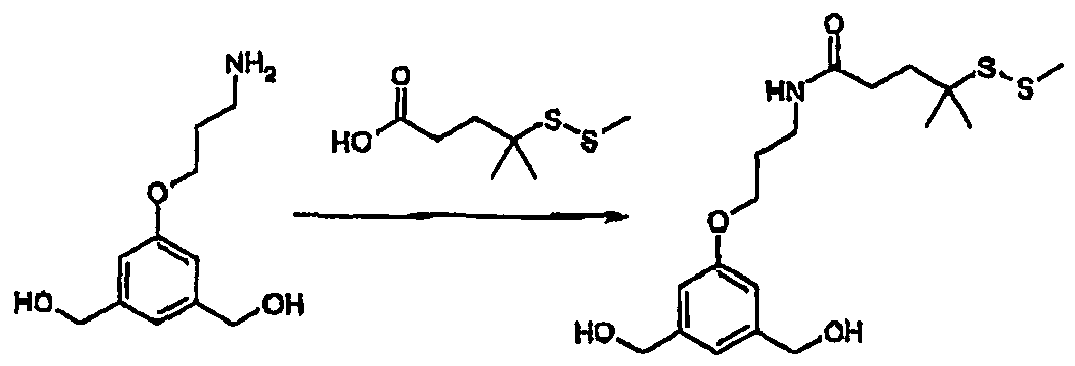
- Generally, this reaction is carried out in the presence of N-hydroxysuccinimide and HOBT.
- The compounds of formula (VII) may be commercially available or made by adaptation or application of known methods or according to the examples.
- Exemplary non-limiting scheme for this embodiment of the process of the invention is given below:

- According to a second aspect, the compound of formula (I) may be obtained from the corresponding compound of formula (III'):
 , R1, R2, R1', R2' are defined as in formula (I) and T' is an optionally protected precursor group of T.
- A precursor group of T refers to any group which may lead to T by chemical modification, or coupling. Preferably, T is obtained by coupling T' with the corresponding complementary portion, where T' and the complementary portion comprise functions which are reactive to each other, eg. T' comprising an amine function and the complementary portion comprising an acid function.
- Generally, this reaction is carried out in the presence of: N-hydroxysuccinimide and HOBT.
- The compound of formula (III') may be obtained from coupling the corresponding compound of formulae (IV), (IV') and (V'):
 , R1, R2, R1', R2' are defined as in formula (III'), T" is an optionally protected precursor group of T and Lg is a leaving group, such as halogen or OMs, OTs or PPh3 + (intermediate formed in a Mitsunobu reaction).
- The compounds of formula (IV) and (IV') are generally known and are available by total synthesis (M. Mori et al, 42 Tetrahedron, 3793-3806, 1986) or produced by Streptomyces species, in particular, following French patent Fr.
1,516,743 - The compounds of formula (V') may be obtained from corresponding compounds of formula (VII):
HO-An-T"-A'n'-OH (VII)
where A, A', n, n' are defined as in formula (I), T" is an optionally protected precursor group of T'. - This reaction is generally carried out in the presence of PPh3 and CHal4.
- The compounds of formula (VII) may be commercially available or made by adaptation or application of known methods or according to the examples.
- According to a third aspect, the process of preparation of the compound of formula (I) comprises the step of cyclizing the corresponding compound of formula (VIII):

- The compound of formula (VIII) may be obtained from the corresponding compound of formula (IX):

- The compound of formula (IX) may be obtained from coupling the corresponding compounds of formula (X) and (XI):

- Generally, this reaction is carried out by adding to (X) a reagent such as oxalyl chloride in an appropriate solvent, such as DMF, followed by adding (XI) in an appropriate solvent, such as THF.
- A representative scheme is given below:

- The above reactions can be carried out by the skilled person by applying or adapting the methods illustrated in the examples hereinafter.
- Further, the process of the invention may also comprise the additional step of isolating the compound of formula (I) and (II). This can be done by the skilled person by any of the known conventional means, such as the recovery methods described above.
- The starting products are commercially available or may be obtained by applying or adapting any known methods or those described in the examples.
- The synthesis may also be carried out in one pot as a multicomponent reaction.
- According to a further object, the present invention concerns a conjugate molecule comprising at least one tomaymycin derivative covalently bonded to a cell binding agent through a linking group. Said conjugate comprises one or more tomaymycin derivative according to the invention exhibiting a linker comprising a linking group, such as -S- or -S-S-. Said linking group covalently links the cell binding agent with the linker of the tomaymycin derivative According to a preferred aspect, said tomaymycin derivative is of formula (I'):

- ---- represents an optional single bond;
- represents either a single bond or a double bond ;

- provided that when represents a single bond, U and U', the same or different, independently represent H, and W and W', the same or different, are independently selected from the group consisting of OH, an ether such as -OR, an ester (e.g. an acetate), such as -OCOR, a carbonate such as -OCOOR, a carbamate such as -OCONRR', a cyclic carbamate, such that N10 and C11 are a part of the cycle, a urea such as -NRCONRR', a thiocarbamate such as -OCSNHR, a cyclic thiocarbamate such that N10 and C11 are a part of the cycle, -SH, a sulfide such as -SR, a sulphoxide such as -SOR, a sulfone such as -SOOR, a sulphonate such as -SO3 -, a sulfonamide such as -NRSOOR, an amine such as -NRR', optionally cyclic amine such that N10 and C11 are a part of the cycle, a hydroxylamine derivative such as -NROR', an amide such as -NRCOR, an azido such as -N3, a cyano, a halo, a trialkyl or triarylphosphonium, an aminoacid-derived group; Preferably W and W' are the same or different and are OH, OMe, OEt, NHCONH2, SMe;

- and when represents a double bond, U and U' are absent and W and W' represent H;

- ■ R1, R2, R1', R2' are the same or different and independently chosen from Halide or Alkyl optionally substituted by one or more Hal, CN, NRR', CF3, OR, Aryl, Het, S(O)qR, or R1 and R2 and R1' and R2' form together a double bond containing group =B and =B' respectively.
- Preferably, R1 and R2 and R1' and R2' form together a double bond containing group =B and =B' respectively.
- ■ B and B' are the same or different and independently chosen from Alkenyl being optionally substituted by one or more Hal, CN, NRR', CF3, OR, Aryl, Het, S(O)qR or B and B' represent an oxygen atom.
Preferably, B=B'.
More preferably, B=B'= =CH2 or =CH-CH3, - ■ X, X' are the same or different and independently chosen from one or more -O-, -NR-, -(C=O)-, -S(O)q-.
Preferably, X=X'.
More preferably, X=X'=O. - - A, A' are the same or different and independently chosen from Alkyl or Alkenyl, each being optionally containing an oxygen, a nitrogen or a sulfur atom and optionally substituted by one or more Hal, CN, NRR', CF3, OR, S(O)qR, Aryl, Het, Alkyl, Alkenyl.
Preferably, A=A'.
More preferably, A=A'=linear unsubstituted alkyl. - ■ Y, Y' are the same or different and independently chosen from H, OR;
Preferably, Y=Y'.
More preferably, Y=Y'=OAlkyl, more preferably OMethyl. - - T is Alkyl-, -NR-, -O-, -S(O)q-, or a 4 to 10-membered aryl, cycloalkyl, heterocyclic or heteroaryl, each being optionally substituted by one or more Hal, CN, NRR', CF3, R, OR, S(O)qR, and substituted by one or more linker.
- Preferably, T is a 4 to 10-membered aryl or heteroaryl, more preferably phenyl or pyridyl substituted by one or more linker(s).
- Said linker comprises a linking group. Suitable linking groups are well known in the art and include thiol, sulfide, disulfide groups, thioether groups, acid labile groups, photolabile groups, peptidase labile groups and esterase labile groups. Preferred are disulfide groups and thioether groups.
- When the linking group is a thiol-, sulfide or disulfide-containing group, the side chain carrying the thiol or disulfide group can be linear or branched, aromatic or heterocyclic. One of ordinary skill in the art can readily identify suitable side chains. Preferably, said linker is of formula:
-G-D-(Z)p-S-Z'
where - G is a single or double bond, -O-, -S- or -NR-;
- D is a single bond or -E-, -E-NR-, -E-NR-F-, -E-O-, -E-O-F-, -E-NR-CO-, -E-NR-CO-F-, -E-CO-, -CO-E-, -E-CO-F, -E-S-, -E-S-F-, -E-NR-C-S-, -E-NR-CS-F-;
- where E and F are the same or different and are independently chosen from linear or branched -(OCH2CH2)iAlkyl(OCH2CH2)j-, -Alkyl(OCH2CH2)i-Alkyl-, -(OCH2CH2)i-, -(OCH2CH2)iCycloalkyl(OCH2CH2)j-, -(OCH2CH2)¡Heterocyclic(OCH2CH2)j-, -(OCH2CH2)Aryl(OCH2CH2)j-, -(OCH2CH2)iHeteroaryl(OCH2CH2)j-, -alkyl-(OCH2CH2)iAlkyl(OCH2CH2)j-, Alkyl-(OCH2CH2)i-, -Alkyl-(OCH2CH2)iCycloalkyl(OCH2CH2)j-, -Alkyl(OCH2CH2)¡Heterocyclic(OCH2CH2)j-, -Alkyl-(OCH2CH2)iAryl(OCH2CH2)j-, -Alkyl(OCH2CH2)iHeteroaryl(OCH2CH2)j-, -Cycloalkyl-Alkyl-, -Alkyl-Cycloalkyl-, -Heterocyclic-Alkyl-, -Alkyl-Heterocyclic-, -Alkyl-Aryl-, -Aryl-Alkyl-, -Alkyl-Heteroaryl-, -Heteroaryl-Alkyl-;
- where i and j, identical or different are integers and independently chosen from 0,1 to 2000;
- Z is linear or branched Alkyl-;
- p is 0 or 1;
- Z' represents H, a thiol protecting group such as COR, R20 or SR20, wherein R20 represents H, methyl, Alkyl, optionally substituted Cycloalkyl, aryl, heteroaryl or heterocyclic, provided that when Z' is H, said compound is in equilibrium with the corresponding compound formed by intramolecular cyclisation resulting from addition of the thiol group -SH on the imine bond -NH= of one of the PBD moieties.
- ■ n, n', equal or different are 0 or 1, with m=m' and n=n'.
- ■ q is 0, 1 or 2.
- ■ R, R' are equal or different and independently chosen from H, Alkyl, Aryl, each being optionally substituted by Hal, CN, NRR', CF3, R, OR, S(O)qR, Aryl, Het;
- Preferably, the linker is linked to the cell binding agent via a function reactive towards thiol, sulfide or disulfide bond.
- The present invention refers to following preferred embodiments or any combination of any of them:
- G is a single bond or -O- or -NR-;
- G is -O-;
- D is a single bond or -E-, -E-NR-, -E-NR-CO-, -E-CO-, -CO-E-;.
- D is -E-, -E-NR-CO-, -CO-E-, -E-CO-;.
- D is -E-NR-CO-;
- E is linear or branched -Alkyl,-, -(OCH2CH2)i- or -Alkyl-heterocyclic;
- E is linear or branched -Alkyl-;
- Z is -(CH2)2-C(CH3)2-;
- p is 0 or 1;
- Z' is H or SR20, wherein R20 represents Alkyl, aryl, heterocyclic or heteroaryl;
- Z' is H or SR20, wherein R20 represents Alkyl.
- Specific examples of the thiol-, sulfide- or disulfide-containing linkers include
- -(CR13R14)t(CR15R16)u(OCH2CH2)ySZ',
- -(CR13R14)t(CR17=CR18)(CR15R16)y(OCH2CH2)ySZ',
- -(CR13Rl4)t(NR19CO)(CR,sR,6)u(OCH2CH2)ySz',
- -(CR13R14)t(OCO)(R15R16)u(OCH2CH2)ySZ',
- -(CR13R14)t(CO)(CR15R16)u(OCH2CH2)ySZ',
- -(CR13R14)t(CONR19)(CR15R16)u(OCH2CH2)ySZ',
- -(CR13R14)t-phenyl-CO(CR15R16)uSZ', -(CR13R14)t-furyl-CO(CR15R16)uSZ',
- -(CR13R14)t-oxazolyl-CO(CR15R16)uSZ', -(CR13R14)t-thiazolyl-CO(CR15R16)uSZ',
- -(CR13R14)t-thienyl-CO(CR15R16)uSZ', -(CR13R14)t-imidazolyl-CO(CR15R16)uSZ',
- -(CR13R14)t-morpholino-CO(CR15R16)uSZ', -(CR13R14)tpiperazino-CO(CR16R16)uSZ', -(CR13R14)t-N-methylplperazino-CO(CR15R16)uSZ',
- -(CR13R14)t-phenyl-QSZ', -(CR13R14)t-furyl-QSZ', -(CR13R14)t-oxazolyl-QSZ',
- -(CR13R14)t-thiazolyl-QSZ', -(CR13R14)t-thienyl-QSZ', -(CR13R14)t-imidazolyl-QSZ', -(CR13R14)t-morpholino-QSZ', -(CR13R14)t-piperazino-QSZ',
- -(CR13R14)t-N-methylpiperazino-QSZ', or
- -O(CR13R14)t(CR15R16)u(OCH2CH2)ySZ',
- -O(CR13R14)t(NR19CO)(CR15R16)u(OCH2CH2)ySZ',
- -O(CR13R14)t (CR17=CR18)(CR15R16)t (OCH2CH2)ySZ',
- -O-phenyl-QSZ', -O-furyl-QSZ', -O-oxazolyl-QSZ', -O-thiazolyl-QSZ',
- -O-thienyl-QSZ', -O-imidazolyl-QSZ', -O-morpholino-QSZ', -O-piperazino-QSZ',
- -O-N-methylpiperazino-QSZ',
- -OCO(CR13R14)t(NR19CO)v(CR15R16)u(OCH2CH2)y SZ',
- -OCO-(CR13R14)t (CR17=CR18)(CR15R16)u(OCH2CH2)ySZ',
- -OCONR12(CR13R14)t(CR13R16)u(OCH2CH2)ySZ',
- -OCO-phenyl-QSZ', -OCO-furyl-QSZ', -OCO-oxazolyl-QSZ', -OCO-thiazolyl-QSZ', -OCO-thienyl-QSZ, -OCO-imidazolyl-QSZ', -OCO-morpholino-QSZ', -OCO-piperazino-Q5Z', -OCO-N-methylpiperazino-QSZ', or
- -CO(CR13R14)t(CR15R16)u (OCH2CH2)ySZ',
- -CO-(CR13R14)t(CR17=CR18)(CR15R16)u(OCH2CH2)ySZ',
- -CONR12(CR13R14)t(R15R16)u (OCH2CH2)ySZ',
- -CO-phenyl-QSZ', -CO-furyl-QSZ', -CO-oxazolyl-QSZ', -CO-thiazolyl-QSZ',
- -CO-thienyl-QSZ', -CO-imidazolyl-QSZ', -CO-morpholino-QSZ', -CO-piperazino-QSZ', -CO-piperidino-QSZ', -CO-N-methylpiperazino-QSZ',
- -NR19(CR13R14)t(CR15R16)u(OCH2CH2)ySZ',
- - NR19CO(CR13R14)t(CR15R16)u(OCH2CH2)ySZ',
- -NR19(CR13R14)t(CR17=CR18)(CR15R16)t(OCH2CH2)ySZ',
- -NR19CO(CR13R14)t(CR11=CR18)(CR15R16)t(OCH2CH2)ySZ',
- -NR19CONR12(CR13R14)t(CR15R16)u(OCH2CH2)ySZ',
- -NR19CO NR12 (CR13R14)t (CR17=CR18)(CR15R16)t (OCH2CH2)ySZ',
- -NR19CO-phenyl-QSZ', -NR19CO-furyl-QSZ', -NR19CO-oxazolyl-QSZ',
- -NR19CO-thiazolyl-QSZ', -NR19CO-thienyl-QSZ', -NR19CO-imidazolyl-QSZ',
- -NR19CO-morpholino-QSZ', -NR19CO-piperazino-QSZ', -NR19CO-piperidino-QSZ', -NR19CO-N-methylpiperazino-QSZ',
- -NR19-phenyl-QSZ', -NR19-furyl-QSZ', -NR19-oxazolyl-QSZ', -NR19-thiazolyl-QSZ', -NR19-thienyl-QSZ', -NR19-imidazolyl-QSZ', -NR19-morpholino-QSZ', -NR19-piperazino-QSZ', -NR19-piperidino-QSZ',
- -NR19-N-methylpiperazino-QSZ',
- -NR19CO-NR12-phenyl-QSZ', -NR19CO-NR12-oxazolyl-QSZ', -NR19CO-NR12-thiazolyl-QSZ', -NR19CO-NR12-thienyl-QSZ', -NR19CO-NR12-piperidino-QSZ',
- -S(O)q(CR13R14)t(CR15R16)u(OCH2CH2)ySZ',
- -S(O)q(CR13R14)t(CR17=CR18)(CR15R16)t(OCH2CH2)ySZ',
- -SCONR12(CR13R14)t(CR15R16)u (OCH2CH2)ySZ',
- -SCO-morpholino-QSZ', -SCO-piperazino-QSZ', -SCO-piperidino-QSZ', and
- -SCO-N-methylpiperazino-QSZ', wherein:
- Z' is H, a thiol protecting group such as COR, R20' or SR20' wherein R20' represents alkyl, aryl, heterocyclic, or heteroaryl;
- wherein Q is a direct link or a linear alkyl or branched alkyl having from 1-10 carbon atoms or a polyethylene glycol spacer with 2 to 20 repeating ethylene oxy units;
- R19 and R12 are the same or different and are linear alkyl, branched alkyl or cyclic alkyl having from 1 to 10 carbon atoms, or simple or substituted aryl or heterocyclic, and R12 can in addition be H,
- R13, R14, R15 and R18 are the same or different and are H or a linear or branched alkyl having from 1 to 4 carbon atoms,
- R17, and R18 are H or alkyl,
- u is an integer from 1 to 10 and can also be 0,
- t is an integer from 1 to 10 and can also be 0,
- y is an integer from 1 to 20 and can also be 0.
- According to this object, representative compounds of formula (I') are:
- 8,8'-{5-[3-(4-methyl-4-methyldisulfanyl-pentanoylamino)propyloxy]-1,3-benzenediylbis(methyleneoxy)}-bis[(S)-2-eth-(E)-ylidene-7-methoxy-1,2,3,11a-tetrahydro-5H-pyrrolo[2,1-c][1,4]benzodiazepin-5-one]
- 8,8'-[5-acetylthiomethyl-1,3-benzenediylbis(methyleneoxy)]-bis[(S)-2-methylene-7-methoxy-1,2,3,11a-tetrahydro-5H-pyrrolo[2,1-c][1,4]benzodiazepin-5-one]
- 8,8'-[3-(2-acetylthioethyl)-1,5-pentanediylbis(oxy)]-bis[(S)-2-methylene-7-methoxy-1,2,3,11a-tetrahydro-5H-pyrrolo[2,10][1,4]benzodiazepin-5-one]
- 8'-[5-(N-4-mercapto-4,4-dimethylbutanoyl)amino-1,3-benzenediylbis(methyleneoxy)]-bis[7-methoxy-2-methylene-1,2,3,11a-tetrahydro-5H-pyrrolo[2,1-c][1,4]benzodiazepin-5-one]
- 8,8'-[5-(N-4-methyldithio-4,4-dimethylbutanoyl)-amino-1,3-benzenediylbis(methyleneoxy)]-bis[7-methoxy-2-methylene-1,2,3,11a-tetrahydro-5H-pyrrolo[2,1-c][1,4]benzodiazepin-5-one]
- 8,8'-[5-(N-methyl-N-(2-mercapto-2,2-dimethylethyl)amino-1,3-benzenediyl(methyleneoxy)]-bis[7-methoxy-2-methylene-1,2,3,11a-tetrahydro-5H-pyrrolo[2,1-c][1,4]benzodiazepin-5-one]
- 8,8'-[5-(N-methyl-N-(2-methyldithio-2,2-dimethylethyl)amino-1,3-benzenediyl(methyleneoxy)]-bis[7-methoxy-2-methylene-1,2,3,11a-tetrahydro-5H-pyrrolo[2,1-c][1,4]benzodiazepin-5-one]
- 8,8'-[(4-(2-(4-mercapto-4-methyl)-pentanamido-ethoxy)-pyridin-2,6-dimethyl)-dioxy]-bis[(S)-2-eth-(E)-ylidene-7-dimethoxy-1,2,3,11a-tetrahydro-pyrrolo[2,1-c][1,4]benzodiazepin-5-one]
- 8,8'-[(1-(2-(4-methyl-4-methyldisulfanyl)-pentanamido-ethoxy)-benzene-3,5-dimethyl)-dioxy]-bis[(S)-2-eth-(E)-ylidene-7-dimethoxy-1,2,3,11a-tetrahydro-pyrrolo[2,1-c][1,4]benzodiazepin-5-one]
- 8,8'-1(4-(3-(4-methyl-4-methyldisulfanyl)-pentanamido-propoxy)-pyridin-2,6-dimethyl)-dioxy]-bis[(S)-2-eth-(E)-ylidene-7-dimethoxy-1,2,3,11a-tetrahydro-pyrrolo[2,1-c][1,4] benzodiazepin-5-one]
- 8,8'-[(4-(4-(4-methyl-4-methyldisulfanyl)-pentanamido-butoxy)-pyridin-2,6-dimethyl)-dioxy]-bis[(S)-2-eth-(S)-ylidene-7-dimethoxy-1,2,3,11a-tetrahydro-pyrrolo[2,1-c][1,4]benzodiazepin-5-one]
- 8,8'-[(4-(3-[4-(4-methyl-4-methyldisulfanyl-pentanoyl)-piperazin-1-yl]-propyl)-pyridin-2,6-dimethyl)-dioxy]-bis[(S)-2-eth-(E)-ylidene-7-dimethoxy-1,2,3,11a-tetrahydro-pyrrolo[2,1-c][1,4]benzodiazepin-5-one]
- 8,8'-[(1-(3-[4-(4-methyl-4-methyldisulfanyl-pentanoyl)-piperazin-1-yl]-propyl)-benzene-3,5-dimethyl)-dioxyl-bis[(S)-2-eth-(E)-ylidene-7-dimethoxy-1,2,3,11a-tetrahydro-pyrrolo[2,1-c][1,4]benzodiazepin-5-one]
- 8,8'-[(4-(2-{2-[2-(4-methyl-4-methyldisulfanyl-pentanoylamino)-ethoxy]-ethoxy}-ethoxy)-pyridin-2,6-dimethyl)-dioxy]-bis[(S)-2-eth-(E)-ylidene-7-dimethoxy-1,2,3,11a-tetrahydro-pyrrolo[2,1-c][1,4]benzodiazepin-5-one]
- 8,8'-[(1-(2-{2-[2-(2-{2-[2-(4-methyl-4-methyldisulfanyl-pentanoylamino)-ethoxy]-ethoxy}-ethoxy)-ethoxy]-ethoxy}-ethoxy)-benzene-3,5-dimethyl)-dioxy]-bis[(S)-2-eth-(E)-ylidene-7-dimethoxy-1,2,3,11a-tetrahydro-pyrrolo[2,1-c][1,4]benzodiazepin-5-one]
- 8,8'-[(1-(2-{2-[2-(4-methyl-4-methyldisulfanyl-pentanoylamino)-ethoxy]-ethoxy}-ethoxy)-benzene-3,5-dimethyl)-dioxy]-bis[(S)-2-eth-(E)-ylidene-7-dimethoxy-1,2,3,11a-tetrahydro-pyrroto[2,1c][1,4]benzodiazepin-5-one]
- 8,8'-[(4-(2-{2-[2-(2-{2-[2-(4-methyl-4-methyldisulfanyl-pentanoylamino)-ethoxy]-ethoxy}-ethoxy)-ethoxy]-ethoxy}-ethoxy)-pyrridin-2,6-dimethyl)-dioxy]-bis[(S)-2-eth-(E)-ylidene-7-dimethoxy-1,2,3,11a-tetrahydro-pyrrolo[2,1-c][1,4]benzodiazepin-5-one]
- 8,8'-[(1-(2-[methyl-(2-methyl-2-methyldisulfanyl-propyl)-amino]-ethoxy)-benzene-3,5-dimethyl)-dioxy]-bis[(S)-2-eth-(E)-ylidene-7-dimethoxy-1,2,3,11a-tetrahydro-pyrrolo[2,1-c][1,4]benzodiazepin-5-one]
- 8,8'-[(4-(3-[methyl-(4-methyl-4-methyldisulfanyl-pentanoyl)-amino]-propyl)-pyridin-2,6-dimethyl)-dioxy]-bis[(S)-2-eth-(E)-ylidene-7-dimethoxy-1,2,3,11 a-tetrahydro-pyrrolo[2,1-c][1,4]benzodiazepin-5-one]
- 8,8'-[(4-(3-[methyl-(2-methyl-2-methyldisulfanyl-propyl)-amino]-propyl)-pyridin-2,6-dimethyl)-dioxyl-bis[(S)-2-eth-(E)-ylidene-7-dimethoxy-1,2,3,1 a-tetrahydro-pyrrolo[2,1-c][1,4]benzodiazepin-5-one]
- 8,8'-[(1-(4-methyl-4-methyldisulfanyl)-pentanamido)-benzene-3,5-dimethyl)-dioxy]-bis[(S)-2-eth-(E)-ylidene-7-dimethoxy-1,2,3,11a-tetrahydro-pyrrolo[2,1-c][1,4]benzodiazepin-5-one]
- Cell binding agents may be of any kind and include peptides and non-peptides. Generally, these can be antibodies (especially monoclonal antibodies) or a fragment of an antibody that contains at least one binding site, lymphokines, hormones, growth factors, nutrient-transport molecules (such as transferrin), or any other cell binding molecule or substance. More specific examples of cell binding agents that can be used include: monoclonal antibodies; chimeric antibodies; humanized antibodies; fully human antibodies; single chain antibodies; fragments of antibodies such as Fab, Fab', F(ab')2 and Fv {Parham, 131 J. Immunol. 2895-2902 (1983); Spring et al, 113 J. Immunol. 470-478 (1974); Nisonoff et al, 89 Arch. Biochem. Biophys. 230-244 (1960)}; interferons; peptides; lymphokines such as IL-2, IL-3, IL-4, IL-6; hormones such as insulin, TRH (thyrotropin releasing hormones), MSH (melanocyte-stimulating hormone), steroid hormones, such as androgens and estrogens; growth factors and colony-stimulating factors such as EGF, TGFα, insulin like growth factor (IGF-I, IGF-II) G-CSF, M-CSF and GM-CSF {Burgess, 5 Immunology Today 155-158 (1984)}; vitamins, such as folate and transferrin {O'Keefe et al, 260 J. Biol. Chem. 932-937 (1985)}.
- The expression "cell binding agent" included herein also includes modified cell binding agents, wherein said cell binding agent is modified by a modifying agent to improve the reactivity of said cell binding agent towards the linking group of the linker of the tomaymycin derivative. Said modifying agents include N-sulfosuccinimidyl-4-(5-nitro-2-pyridyldithio)butanoate (SSNPB), Succinimidyl 4-[N-maleimidomethyl]cyclohexane-1-carboxylate (SMCC), 4-(2-pyridyldithio)butanoic acid N-hydroxysuccinimide ester (SPDB), and so on as discussed below,
- Monoclonal antibody technology permits the production of extremely selective cell binding agents in the form of specific monoclonal antibodies. Particularly well known in the art are techniques for creating monoclonal antibodies produced by immunizing mice, rats, hamsters or any other mammal with the antigen of interest such as the intact target cell, antigens isolated from the target cell, whole virus, attenuated whole virus, and viral proteins such as viral coat proteins.
- Selection of the appropriate cell binding agent is a matter of choice that depends upon the particular cell population that is to be targeted, but in general monoclonal antibodies are preferred if an appropriate one is available.
- For example, the monoclonal antibody MY9 is a murine IgG1 antibody that binds specifically to the CD33 Antigen {J.D. Griffin et al 8 Leukemia Res., 521 (1984)} and can be used if the target cells express CD33 as in the disease of acute myelogenous leukemia (AML). Similarly, the monoclonal antibody anti-B4 is a murine IgG1, that binds to the CD19 antigen on B cells {Nadler et al, 131 J. Immunol. 244-250 (1983)} and can be used if the target cells are B cells or diseased cells that express this antigen such as in non-Hodgkin's lymphoma or chronic lymphoblastic leukemia. As stated above, the MY9 and anti-B4 antibodies may be murine, chimeric, humanized or fully human.
- Additionally, GM-CSF which binds to myeloid cells can be used as a cell binding agent to diseased cells from acute myelogenous leukemia. IL-2, which binds to activated T-cells, can be used for prevention of transplant graft rejection, for therapy and prevention of graft-versus-host disease, and for the treatment of acute T-cell leukemia. MSH, which binds to melanocytes, can be used for the treatment of melanoma.
- The conjugate molecules of the invention may be formed using any techniques. The tomaymycin derivatives of the invention may be linked to an antibody or other cell binding agent via an acid labile linker, or by a photolabile linker. The derivatives can be condensed with a peptide having a suitable sequence and subsequently linked to a cell binding agent to produce a peptidase labile linker. The conjugates can be prepared to contain a primary hydroxyl group, which can be succinylated and linked to a cell binding agent to produce a conjugate that can be cleaved by intracellular esterases to liberate free derivative. Preferably, the derivatives are synthesized to contain a free or protected thiol group, and then one or more disulfide or thiol-containing derivatives are each covalently linked to the cell binding agent via a disulfide bond or a thioether link.
- Numerous methods of conjugation are taught in
USP 5,416,064 andUSP 6,475,092 . The tomaymycin derivatives can be modified to yield a free amino group and then linked to an antibody or other cell binding agent via an acid labile linker or a photolabile linker. The tomaymycin derivatives with a free amino or carboxyl group can be condensed with a peptide and subsequently linked to a cell binding agent to produce a peptidase labile linker. The tomaymycin derivatives with a free hydroxyl group on the linker can be succinylated and linked to a cell binding agent to produce a conjugate that can be cleaved by intracellular esterases to liberate free drug. Most preferably, the tomaymycin derivatives are treated to create a free or protected thiol group, and then the disulfide- or thiol-containing tomaymycin dimers are linked to the cell binding agent via disulfide bonds. - Representative conjugates of the invention are antibody-tomaymycin derivative, antibody fragment-tomaymycin derivative epidermal growth factor (EGF)-tomaymycin derivative, melanocyte stimulating hormone (MSH)-tomaymycin derivative, thyroid stimulating hormone (TSH)-tomaymycin derivative, estrogen-tomaymycin derivative, estrogen analogue-tomaymycin derivative, androgen-tomaymycin derivative, androgen analogue-tomaymycin derivative, and folate-tomaymycin derivative.
- Tomaymycin derivative conjugates of antibodies, antibody fragments, protein or peptide hormones, protein or peptide growth factors and other proteins are made in the same way by known methods. For example, peptides and antibodies can be modified with cross linking reagents such as N-succinimidyl 3-(2-pyridyldithio)propionate, N-succinimidyl 4-(2-pyridyldithio)pentanoate (SPP), 4-succinimidyl-oxycarbonyl-α-methyl-α-(2-pyridyl dithio)-toluene (SMPT), N-succinimidyl-3-(2-pyridyldithio) butyrate (SDPB), succinimidyl pyridyl-dithiopropionate (SPDP), 4-(2-pyridyldithio)butanoic acid N-hydrosuccinimide ester (SPDB), succinimidyl 4-[N-maleimidomethyl]cyclohexane-1-caboxylate (SMCC), N-sulfosuccinimidyl-3-(2-(5-nitro-pyridyldithio) butyrate (SSNPB), 2-iminothiolane, or S-acetylsuccinic anhydride by known methods. See, Carlsson et al, 173 Biochem. J. 723-737 (1978); Blattler et al, 24 Biochem. 1517-1524 (1985); Lambert et al, 22 Biochem. 3913-3920 (1983); Klotz et al, 96 Arch. Biochem. Biophys. 605 (1962); and Liu et al, 18 Biochem. 690 (1979), Blakey and Thorpe, 1 Antibody, Immunoconjugates & Radio-pharmaceutica/s, 1-16 (1988), Worrell et al 1 Anti-Cancer Drug Design 179-184 (1986). The free or protected thiol-containing cell binding agent thus derived is then reacted with a disulfide- or thiol-containing tomaymycin derivative to produce conjugates. The conjugates can be purified by HPLC or by gel filtration.
- Preferably, monoclonal antibody- or cell binding agent-tomaymycin derivative conjugates are those that are joined via a disulfide bond, as discussed above, that are capable of delivering tomaymycin derivatives. Such cell binding conjugates are prepared by known methods such as by modifying monoclonal antibodies with succinimidyl pyridyl-dithiopropionate (SPDP) (Carlsson et al, 173 Biochem. J. 723-737 (1978)). The resulting thiopyridyl group is then displaced by treatment with thiol-containing tomaymycin derivatives to produce disulfide linked conjugates. Alternatively, in the case of the aryldithio- tomaymycin derivatives, the formation of the cell binding conjugate is effected by direct displacement of the aryl-thiol of the tomaymycin derivative by sulfhydryl groups previously introduced into antibody molecules. Conjugates containing 1 to 10 tomaymycin derivative drugs linked via a disulfide bridge are readily prepared by either method.
- More specifically, a solution of the dithio-nitropyridyl modified antibody at a concentration of 2.5 mg/ml in 0.05 M potassium phosphate buffer, at pH 7.5 containing 2 mM EDTA is treated with the thiol-containing tomaymycin derivative (1.3 molar eq./dithiopyridyl group). The release of thio-nitropyridine from the modified antibody is monitored spectrophotometrically at 325 nm and is complete in about 16 hours. The antibody-tomaymycin derivative conjugate is purified and freed of unreacted drug and other low molecular weight material by gel filtration through a column of Sephadex G-25 or Sephacryl S300. The number of tomaymycin derivative moieties bound per antibody molecule can be determined by measuring the ratio of the absorbance at 230 nm and 275 nm. An average of 1-10 tomaymycin derivative molecules/antibody molecule can be linked via disulfide bonds by this method.
- The effect of conjugation on binding affinity towards the antigen-expressing cells can be determined using the methods previously described by Liu et al., 93 Proc. Natl. Acad. Sci 8618-8623 (1996). Cytotoxicity of the tomaymycin derivatives and their antibody conjugates to cell lines can be measured by back-extrapolation of cell proliferation curves as described in Goldmacher et al, 135 J. Immunol. 3648-3651 (1985). Cytotoxicity of these compounds to adherent cell lines can be determined by clonogenic assays as described in Goldmacher et al, 102 J. Cell Biol. 1312-1319 (1986).
- Representative conjugates of the invention are conjugates of tomaymycin derivatives with antibodies, antibody fragments, epidermal growth factor (EGF), melanocyte stimulating hormone (MSH), thyroid stimulating hormone (TSH), estrogen, estrogen analogs, androgen, and androgen analogs.
- Representative examples of the preparation of various conjugates of derivatives and cell binding agents are described below.
- Disulfide linkers: For example, the monoclonal antibody MY9 is a murine IgG1 antibody that binds specifically to the CD33 Antigen {J.D. Griffin et al 8 Leukemia Res., 521 (1984)} and can be used if the target cells express CD33 as in the disease of acute myelogenous leukemia (AML). Similarly, the monoclonal antibody anti-B4 is a murine IgG1, that binds to the CD19 antigen on B cells {Nadler et al, 131 J. Immunol. 244-250 (1983)} and can be used if the target cells are B cells or diseased cells that express this antigen such as in non-Hodgkin's lymphoma or chronic lymphoblastic leukemia.
- Additionally, GM-CSF which binds to myeloid cells can be used as a cell binding agent to diseased cells from acute myelogenous leukemia. IL-2, which binds to activated T-cells, can be used for prevention of transplant graft rejection, for therapy and prevention of graft-versus-host disease, and for the treatment of acute T-cell leukemia. MSH, which binds to melanocytes, can be used for the treatment of melanoma.
- The antibody or other cell binding agent is modified with N-succinimidyl-3-pyridyidithio propionate as previously described {J. Carlsson, H. Drevin & R. Axen, Biochem. J., 173:723 (1978)} to introduce, on the average, 4 pyridyldithio groups per antibody molecule. The modified antibody is reacted with the thiol-containing derivative to produce a disulfide-linked conjugate.
- Alternatively, the conjugates may be prepared by application and/or adaptation of the method disclosed in
WO2004/103272 , whose teaching is included herein by reference. - Thioether linkers: Thiol-containing derivatives of the present invention can be linked to antibodies and other cell binding agents via a thioether link as previously described (
U.S. Pat No. 5,208,020 ). The antibody or other cell binding agent can be modified with the commercially available compound such as N-succinimidyl 4-(maleimidomethyl)cyclohexanecarboxylate (SMCC), N-succinimidyl-4-(N-maleimidomethyl)-cyclohexane-1-carboxy-(6-amido-caproate), which is a "long chain" analog of SMCC (LC-SMCC), These crosslinking reagents form non-cleavable linkers derived from maleimido-based moieties. - Crosslinking reagents comprising a haloacetyl-based moiety include N-succinimidyl-4-(iodoacetyl)-aminobenzoate (SIAB), N-succinimidyl iodoacetate (SIA), N-succinimidyl bromoacetate (SBA) and N-succinimidyl 3-(bromo-acetamido)propionate (SBAP). These crosslinking reagents form non-cleavable linkers derived from haloacetyl-based moieties.
- Acid-Labile Linkers: Amino group-containing derivatives of the present invention can be linked to antibodies and other cell binding agents via an acid labile linker as previously described {W. A. Blattler et al, Biochemistry 24, 1517-1524 (1985);
U.S. Pat. N° 4,542,225 ,4,569,789 ,4,618,492 ,4,764,368 }. - Similarly, an hydrazido group-containing derivative of the present invention can be linked to the carbohydrate portion of antibodies and other cell binding agents via an acid labile hydrazone linker {for examples of hydrazone linkers see B. C. Laguzza et al, J. Med. Chem., 32, 548-555 (1989); R. S. Greenfield et al, Cancer Res., 50, 6600-6607 (1990)}.
- Photo-Labile Linkers: Amine group containing derivatives of the present invention may be linked to antibodies and other cell binding agents via a photolabile linker as previously described {P. Senter et al, Photochemistry and Photobiology, 42, 231-237 (1985);
U.S. Pat No. 4,625,014 }. - Peptidase-Labile Linkers: Amine group containing derivatives of the present invention may also be linked to cell binding agents via peptide spacers. It has been previously shown that short peptide spacers between drugs and macromolecular protein carriers are stable in serum but are readily hydrolyzed by intracellular peptidases {A. Trouet et al, Proc. Natl. Acad. Sci., 79, 626-629 (1982)}. The amino group containing containing derivatives may be condensed with peptides using condensing agents such as 1-ethyl-3-(3-dimethylaminopropyl)carbodiimide-HCl (EDC-HCl) to give a peptide derivative that can be linked to cell binding agents.
- Esterase-Labile Linkers: Derivatives of the present invention bearing a hydroxy alkyl group may be succinylated with succinic anhydride and then linked to a cell binding agent to produce a conjugate that can be cleaved by intracellular esterases to liberate free drug. {For examples see E. Aboud-Pirak et al, Biochem Pharmacol., 38, 641-648 (1989)}.
- The conjugates made by the above methods can be purified by standard chromatography techniques such as size-exclusion, adsorption chromatography including, but not limited to, ion exchange, hydrophobic interaction chromatography, affinity chromatography, chromatography on ceramic hydroxyapatite or on Porapak, or by HPLC. Purification by dialysis or diafiltration may also be used.
- Preferably, conjugates between monoclonal antibodies or cell binding agents and derivatives of the present invention are those that are joined via a disulfide bond, as discussed above. Such cell binding conjugates are prepared by known methods such as modifying monoclonal antibodies with succinimidyl pyridyl-dithiopropionate (SPDP) {Carlsson et al, 173 Biochem. J. 723-737 (1978)}. The resulting thiopyridyl group is then displaced by treatment with thiol containing derivative to produce disulfide linked conjugates. Conjugates containing 1 to 10 derivatives linked via a disulfide bridge are readily prepared by this method. Conjugation by this method is fully described in
U.S. Patent 5,585,499 , which is incorporated by reference. - According to a preferred aspect, the cell binding agent is an antibody, in particular a monoclonal antibody.
- According to another preferred aspect, the cell binding agent is an antigen specific antibody fragment, such as sFV, Fab, Fab', or F(ab')2.
- According to a further object, the present invention also concerns pharmaceutical compositions comprising a conjugate molecule of the invention or a compound of formula (I) as defined above together with a pharmaceutically acceptable carrier.
- According to a further object, the present invention also concerns a method of killing or inhibiting growth of cells, preferably selected cell populations comprising contacting target cells or tissue containing target cells with an effective amount of the pharmaceutical composition according to the invention.
- The selected cell population are those cancerous and/or proliferative cells.
- According to a further object, the present invention also concerns a method for treatment, preferably selective treatment, of cancer comprising administering an effective amount of the pharmaceutical composition according to the invention to a patient in need thereof.
- According to the present invention, "selective treatment of cancer" refers to killing cancerous and/or proliverative cells substantially without killing normal and/or non-proliferative cells.
- According to a further object, the present invention also concerns the use of a conjugate molecule of the invention or a compound of formula (I) as defined above for the preparation of a medicament for treating cancer.
- The method for inhibiting the growth of selected cell populations can be practiced in vitro, in vivo, or ex vivo.
- Examples of in vitro uses include treatments of cell cultures in order to kill all cells except for desired variants that do not express the target antigen; or to kill variants that express undesired antigen.
- The conditions of non-clinical in vitro use are readily determined by the skilled artisan.
- Examples of ex vivo uses include treatments of autologous bone marrow prior to their transplant into the same patient in order to kill diseased or malignant cells: treatments of bone marrow prior to their transplantation in order to kill competent T cells and prevent graft-versus-host-disease (GVHD).
- Clinical ex vivo treatment to remove tumor cells or lymphoid cells from bone marrow prior to autologous transplantation in cancer treatment or in treatment of autoimmune disease, or to remove T cells and other lymphoid cells from allogeneic bone marrow or tissue prior to transplant in order to prevent GVHD, can be carried out as follows. Bone marrow is harvested from the patient or other individual and then incubated in medium containing serum to which is added the cytotoxic agent of the invention, concentrations range from about 10 µM to 1 pM, for about 30 minutes to about 48 hours at about 37 °C. The exact conditions of concentration and time of incubation (=dose) are readily determined by the skilled artisan. After incubation the bone marrow cells are washed with medium containing serum and returned to the patient by i.v. infusion according to known methods. In circumstances where the patient receives other treatment such as a course of ablative chemotherapy or total-body irradiation between the time of harvest of the marrow and reinfusion of the treated cells, the treated marrow cells are stored frozen in liquid nitrogen using standard medical equipment.
- For clinical in vivo use, the cytotoxic agent of the invention will be supplied as solutions that are tested for sterility and for endotoxin levels or as a lyophilized solid that can be redisolved in sterile water for injection. Examples of suitable protocols of conjugate administration are as follows. Conjugates are given weekly for 6 weeks as an i.v. bolus. Bolus doses are given in 50 to 400 ml of normal saline to which human serum albumin (e.g. 0.5 to 1 mL of a concentrated solution of human serum albumin, 100 mg/mL) can be added. Dosages will be about 50 µg to 10 mg/kg of body weight per week, i.v. (range of 10 µg to 100 mg/kg per injection). Six weeks after treatment, the patient may receive a second course of treatment. Specific clinical protocols with regard to route of administration, excipients, diluents, dosages, times, etc., can be determined by the skilled artisan as the clinical situation warrants.
- Examples of medical conditions that can be treated according to the in vivo or ex vivo methods of killing selected cell populations include malignancy of any type including, for example, cancer of the lung, breast, colon, prostate, kidney, pancreas, ovary, and lymphatic organs; melanomas; autoimmune diseases, such as systemic lupus, rheumatoid arthritis, and multiple sclerosis; graft rejections, such as renal transplant rejection, liver transplant rejection, lung transplant rejection, cardiac transplant rejection, and bone marrow transplant rejection; graft versus host disease; viral infections, such as CMV infection, HIV infection, AIDS, etc.; bacterial infection; and parasite infections, such as giardiasis, amoebiasis, schistosomiasis, and others as determined by one skilled in the art.
- The identification of those subjects who are in need of treatment of herein-described diseases and conditions is well within the ability and knowledge of one skilled in the art. A veterinarian or a physician skilled in the art can readily identify, by the use of clinical tests, physical examination, medical/family history or biological and diagnostic tests, those subjects who are in need of such treatment
- A therapeutically effective amount can be readily determined by the attending diagnostician, as one skilled in the art, by the use of conventional techniques and by observing results obtained under analogous circumstances. In determining the therapeutically effective amount, a number of factors are considered by the attending diagnostician, including, but not limited to: the species of subject; its size, age, and general health; the specific disease involved; the degree of involvement or the severity of the disease; the response of the individual subject; the particular compound administered; the mode of administration; the bioavailability characteristic of the preparation administered; the dose regimen selected; the use of concomitant medication; and other relevant circumstances.
- The amount of a compound of formula (I) or conjugate, which is required to achieve the desired biological effect, will vary depending upon a number of factors, including the chemical characteristics (e.g. hydrophobicity) of the compounds employed, the potency of the compounds, the type of disease, the species to which the patient belongs, the diseased state of the patient, the route of administration, the bioavailability of the compound by the chosen route, all factors which dictate the required dose amounts, delivery and regimen to be administered.
- "Pharmaceutically" or "pharmaceutically acceptable" refer to molecular entities and compositions that do not produce an adverse, allergic or other untoward reaction when administered to an animal, or a human, as appropriate.
- As used herein, "pharmaceutically acceptable excipient" includes any carriers, diluents, adjuvants, or vehicles, such as preserving or antioxidant agents, filters, disintegrating agents, wetting agents, emulsifying agents, suspending agents, solvents, dispersion media, coatings, antibacterial and antifungal agents, isotonic and absorption delaying agents and the like. The use of such media and agents for pharmaceutical active substances is well known in the art. Except insofar as any conventional media or agent is incompatible with the active ingredient, its use in the therapeutic compositions is contemplated. Supplementary active ingredients can also be incorporated into the compositions as suitable therapeutic combinations.
- In the context of the invention, the term "treating" or "treatment", as used herein, means reversing, alleviating, inhibiting the progress of, or preventing the disorder or condition to which such term applies, or one or more symptoms of such disorder or condition.
- "Therapeutically effective amount" means an amount of a compound/medicament according to the present invention effective in preventing or treating the herein referred pathological condition.
- According to the invention, the term "patient", or "patient in need thereof", is intended for an animal or a human being affected or likely to be affected with the herein referred pathological condition. Preferably, the patient is human.
- In general terms, the compounds of this invention may be provided in an aqueous physiological buffer solution containing 0.1 to 10 % w/v compound for parenteral administration. Typical dose ranges are from 1 µg/kg to 0.1 g/kg of body weight per day; a preferred dose range is from 0.01 mg/kg to 10 mg/kg of body weight per day or an equivalent dose in a human child. The preferred dosage of drug to be administered is likely to depend on such variables as the type and extent of progression of the disease or disorder, the overall health status of the particular patient, the relative biological efficacy of the compound selected, the formulation of the compound, the route of administration (intravenous, intramuscular, or other), the pharmacokinetic properties of the compound by the chosen delivery route, and the speed (bolus or continuous infusion) and schedule of administrations (number of repetitions in a given period of time).
- The compounds of the present invention are also capable of being administered in unit dose forms, wherein the term "unit doses means a single dose which is capable of being administered to a patient, and which can be readily handled and packaged, remaining as a physically and chemically stable unit dose comprising either the active compound itself, or as a pharmaceutically acceptable composition, as described hereinafter. As such, typical total daily dose ranges are from 0.01 to 100 mg/kg of body weight. By way of general guidance, unit doses for humans range from 1 mg to 3000 mg per day. Preferably the unit dose range is from 1 to 500 mg administered one to six times a day, and even more preferably from 10 mg to 500 mg, once a day. Compounds provided herein can be formulated into pharmaceutical compositions by admixture with one or more pharmaceutically acceptable excipients. Such unit dose compositions may be prepared for use by oral administration, particularly in the form of tablets, simple capsules or soft gel capsules; or intranasally, particularly in the form of powders, nasal drops, or aerosols; or dermally, for example, topically in ointments, creams, lotions, gels or sprays, or via trans-dermal patches.
- The compositions may conveniently be administered in unit dosage form and may be prepared by any of the methods well known in the pharmaceutical art, for example, as described in Remington: The Science and Practice of Pharmacy, 20th ed.; Gennaro, A. R., Ed.; Lippincott Williams & Wilkins: Philadelphia, PA, 2000.
- Preferred formulations include pharmaceutical compositions in which a compound of the present invention is formulated for oral or parenteral administration.
- For oral administration, tablets, pills, powders, capsules, troches and the like can contain one or more of any of the following ingredients, or compounds of a similar nature: a binder such as microcrystalline cellulose, or gum tragacanth; a diluent such as starch or lactose; a disintegrant such as starch and cellulose derivatives; a lubricant such as magnesium stearate; a glidant such as colloidal silicon dioxide; a sweetening agent such as sucrose or saccharin; or a flavoring agent such as peppermint, or methyl salicylate. Capsules can be in the form of a hard capsule or soft capsule, which are generally made from gelatin blends optionally blended with plasticizers, as well as a starch capsule. In addition, dosage unit forms can contain various other materials that modify the physical form of the dosage unit, for example, coatings of sugar, shellac, or enteric agents. Other oral dosage forms syrup or elixir may contain sweetening agents, preservatives, dyes, colorings, and flavorings. In addition, the active compounds may be incorporated into fast dissolve, modified-release or sustained-release preparations and formulations, and wherein such sustained-release formulations are preferably bimodal. Preferred tablets contain lactose, cornstarch, magnesium silicate, croscarmellose sodium, povidone, magnesium stearate, or talc in any combination.
- Liquid preparations for parenteral administration include sterile aqueous or non-aqueous solutions, suspensions, and emulsions. The liquid compositions may also include binders, buffers, preservatives, chelating agents, sweetening, flavoring and coloring agents, and the like, Non-aqueous solvents include alcohols, propylene glycol, polyethylene glycol, vegetable oils such as olive oil, and organic esters such as ethyl oleate. Aqueous carriers include mixtures of alcohols and water, buffered media, and saline. In particular, biocompatible, biodegradable lactide polymer, lactide/glycolide copolymer, or polyoxyethylene-polyoxypropylene copolymers may be useful excipients to control the release of the active compounds. Intravenous vehicles can include fluid and nutrient replenishers, electrolyte replenishers, such as those based on Ringer's dextrose, and the like. Other potentially useful parenteral delivery systems for these active compounds include ethylene-vinyl acetate copolymer particles, osmotic pumps, implantable infusion systems, and liposomes.
- Alternative modes of administration include formulations for inhalation, which include such means as dry powder, aerosol, or drops. They may be aqueous solutions containing, for example, polyoxyethylene-9-lauryl ether, glycocholate and deoxycholate, or oily solutions for administration in the form of nasal drops, or as a gel to be applied intranasally. Formulations for buccal administration include, for example, lozenges or pastilles and may also include a flavored base, such as sucrose or acacia, and other excipients such as glycocholate. Formulations suitable for rectal administration are preferably presented as unit-dose suppositories, with a solid based carrier, such as cocoa butter, and may include a salicylate. Formulations for topical application to the skin preferably take the form of an ointment, cream, lotion, paste, gel, spray, aerosol, or oil. Carriers which can be used include petroleum jelly, lanolin, polyethylene glycols, alcohols, or their combinations. Formulations suitable for transdermal administration can be presented as discrete patches and can be lipophilic emulsions or buffered, aqueous solutions, dissolved and/or dispersed in a polymer or an adhesive.
-
-
Figure 1a represents in vitro potency of huB4-SPDB - compound of example 16 towards antigen positive BJAB cells and antigen negative MOLT-4 cells. -
Figure 1b represents in vitro potency of huB4-SMCC - compound of example 16 towards antigen positive BJAB cells and antigen negative MOLT-4 cells. -
Figure 1c represents in vitro potency of free compound of example 16 towards BJAB and MOLT-4 cells. -
Figure 2a represents in vitro potency of huB4-SPDB - Compound of example 17 towards antigen positive BJAB cells and antigen negative MOLT-4 cells. -
Figure 2b represents in vitro potency of huB4-SMCC- Compound of example 17 towards antigen positive BJAB cells and antigen negative MOLT-4 cells. -
Figure 2c represents in vitro potency of free compound of example 17 towards BJAB and MOLT-4 cells. -
Figure 3a represents in vitro potency of huMy9-6-SPDB- compound of example 16 towards antigen positive HL60/GC cells and antigen negative Ramos cells. -
Figure 3b represents in vitro potency of free compound of example 16 towards HL60/GC and Ramos cells. - The invention is further illustrated but not restricted by the description in the following examples,
- A Micromass MassLynx software is used and the analysis is performed on a Agilent 1100 series HPLC with a THERMO Hypersil Gold C18 3µm column (50 x 3 mm) using gradient elution with a mixture of (A) acetonitrile and (B) water /0.1% formic acid (gradient: 5% A : 95% B up to 95% A : 5% B over 5 minutes, 95% A : 5% B for 0.5 minutes, 95% A : 5% B down to 5°/a A : 95% B over 1 minute, 5% A : 95% B for 0.5 minutes) with a 0.8 mL/minute flow rate ; Waters-Micromass Platform I, Platform II or ZQ spectrometer with Electrospray (positive and negative ionisation) ; in line Diode Array (190-490 nm) ; auxiliary detector Sedere (France) Model SEDEX 65 Evaporative Light Scattering (ELS) detector.
- A Micromass MassLynx software is used and the analysis is performed on a Waters Alliance HPLC with a WATERS XBridge C18 3,5 µm column (100 x 3 mm) using gradient elution with a mixture of (A) methanol and (B) water / 0,1% formic acid (gradient : 5% A : 95% B up to 95% A : 5% B over 10 minutes, 95% A : 5% B down to 5% A : 95% B over 1 minute, 5% A : 95% B for 2 minutes) with a 1.1 mL/minute flow rate ; Waters-Micromass Platform II spectrometer with Electrospray (positive and negative ionisation) ; in line Diode Array (190-500 nm) ; auxiliary detector Sedere (France) Model SEDEX 85 Evaporative Light Scattering (ELS) detector.
- A Micromass MassLynx software is used and the analysis is performed on a Agilent 1100 series HPLC with a XBridge C18 2.5µm column (50 x 3 mm) using gradient elution with a mixture of (A) acetonitrile and (B) water / 0.1% formic acid (gradient : 5% A : 95% B up to 100% A over 5 minutes, 100% A for 0.5 minutes, 100% A down to 5% A : 95% B over 1 minute, 5% A : 95% B for 0.5 minutes) with a 1.1 mL/minute flow rate ; Waters-Micromass ZQ spectrometer with Electrospray; in line Diode Array (210-254 nm)
- HPLC purification was performed on a Macherey Nagel Nucleodur C18 Gravity 5µM column (21x100 mm, catalogue number 762101), eluting with a mixture of (A) acetonitrile and (B) water (gradient : 5% A : 95% B for 5 minutes, 5% A : 95% B up to 100% A over 20 minutes, 100% A for 8 minutes, 100% A to 5% A : 95% B over 1 minute, 5% A : 95% B for 11 minutes) with a 15 mL/minute flow rate (Method B1) or 20 mL/minute (Method B2).
- EI mass spectra were recorded using a Finnigan SSQ 7000 mass spectrometer (EI mode: 70 eV, source temperature = 150°C, direct introduction)
- Cl mass spectra were recorded using a Finnigan SSQ 7000 mass spectrometer (ammonia)
- 1H NMR spectra were recorded on either a Bruker Avance Drx-500, A Bruker Avance Drx-400 or A Bruker Avance DRX-300 spectrometer.
- HPLC purification was performed on a Macherey Nagel VP 250/40mm NUCLEODUR GRAVITY 100 - 10 C18 (catalog number 762250), eluting with a mixture of (A) acetonitrile and (B) water / HCOONH4 0,01M / NH4OH pH9-10 (gradient : 10% A : 90% B for 3 minutes, 10% A : 90% B up to 95% A : 5%B over 37 minutes, 95% A : 5%B for 8 minutes, 95% A : 5%B to 10% A : 90% B over 1 minute, 10% A : 90% B for 1 minute) with a 70 mL/minute flow rate.
- A Micromass MassLynx software is used and the analysis is performed on a Acquity UPLC with a Acquity UPLC BEH C18 1,7 µm column (2.1x100 mm) using gradient elution with a mixture of (A) acetonitrile and (B) water / 0.1% formic acid (gradient : 5% A : 95% B up to 95% A : 5% B over 4.7 minutes, 95% A : 5% B down to 5% A : 95% B over 0.5 minute, 5% A : 95% B for 0.8 minutes) with a 1.1 mL/minute flow rate ; Quattro Premier spectrometer with Electrospray ; in line Diode Array (210-400 nm).
- A Micromass MassLynx software is used and the analysis is performed on a Acquity UPLC with a Acquity UPLC BEH C18 1,7 µm column (2.1x100 mm) using gradient elution with a mixture of (A) acetonitrile and (B) water / 0.1% formic acid (gradient : 5% A : 95% B up to 95% A : 5% B over 10 minutes, 95% A : 5% B down to 5% A : 95% B over 1 minutes, 5% A : 95% B for 2 minutes) with a 0.6 mL/minute flow rate ; Quattro Premier spectrometer with Electrospray ; in line Diode Array (210-400 nm).
- HPLC purification was performed on a Varian HPLC using a Kromasil 16 µm C18 column (250 x 21.2 mm, PN A0490-250x212, Lot. No. DT0259, SN 9772196), eluting with a mixture of (A) water and (B) acetonitrile with a 20 mL/minute flow rate. The collection size was 80 seconds. Mass spectra of the compounds were obtained on a Bruker Esquire 3000 instrument. NMR spectra were recorded on a Bruker Avance spectrometer operating at 400 MHz..
-
- 1. Purification of 8,8'-[5-(N-4-methyldithio-4,4-dimethylbutanoyl)amino-1,3-benzenediylbis(methyleneoxy)]-bis[7-methoxy-2-methylene-1,2,3,11a-tetrahydro-5H-pyrrolo[2,1-c][1,4]benzodiazepin-5-one]
55% A : 45% B for 8 minutes, 55% A : 45% B to 50% A : 50% B over 14 minutes, 50% A : 50% B to 10% A : 90% B over 4 minutes, 10% A : 90% B for 5 minutes, 10% A : 90% B to 55% A : 45% B over 1 minute, 55% A : 45% B for 3 minutes. - 2. Purification of 8,8'-[5-(N-4-mercapto-4,4-dimethylbutanoyl)amino-1,3-benzenediylbis(methyleneoxy)]-bis[7-methoxy-2-methylene-1,2,3,11a-tetrahydro-5H-pyrrolo[2,1-c][1,4]benzodiazepin-5-one]
60% A : 40% B for 4 minutes, 60% A : 40% B to 55% A : 45% B over 5 minutes, 55% A : 45% B for 4 minutes, 55% A : 45% B to 50% A : 50% B over 13 minutes, 50% A : 50% B to 10% A : 90% B over 10 seconds, 10% A : 90% B for 5 minutes, 10% A : 90% B to 60% A : 40% B over 10 seconds, 60% A : 40% B for 3 minutes. - 3. Purification of 8,8'-[5-(N-methyl-N-(2-methyldithio-2,2-dimethylethyl)amino-1,3-benzenediyl(methyleneoxy)]-bis[7-methoxy-2-methylene-1,2,3,11a-tetrahydro-5H-pyrrolo[2,1-c][1,4]benzodiazepin-5-one]
60% A : 40% B for 8 minutes, 60% A : 40% B to 45% A : 55% B over 16 minutes, 45% A : 55% B to 10% A : 90% B over 2 minutes, 10% A : 90% B for 5 minutes, 10% A : 90% B to 60% A : 40% B over 1 minute, 60% A : 40% B for 3 minutes. - 4. Purification of 8,8'-[5-(N-methyl-N-(2-mercapto-2,2-dimethylethyl)amino-1,3-benzenediyl(methyleneoxy)]-bis[7-methoxy-2-methylene-1,2,3,11a-tetrahydro-5H-pyrrolo[2,1-c][1,4]benzodiazepin-5-onej
65% A : 35% B to 60% A : 40% B over 8 minutes, 60% A : 40% B to 50% A : 50% B over 19 minutes, 50% A : 50% B to 10% A : 90% B over 10 seconds, 10% A : 90% B for 5 minutes, 10% A : 90% B to 65% A : 35% B over 10 seconds, 65% A : 35% B for 3 minutes. -

- Potassium carbonate (22.8 mg), α,α'-dibromo-m-xylene (7.3 mg) and potassium iodide (9.1 mg) were added to a stirred solution of pre-tomaymycin (15 mg) in dimethylformamide (0.5 mL). The reaction was stirred for 20 h at 30°C.
Solids were filtered off, washed twice with dimethylformamide (0.2 mL) then discarded. Water (0.4 mL) was added to the combined dimethylformamide solution and the resulting solution was injected for HPLC purification according to method B9. The appropriate fractions were combined and concentrated by centrifugal evaporation over a Jouan Model RC10.10. apparatus to afford 8,8'-[1,3-benzenediylbis(methyleneoxy)]-bis[(S)-2-oth-(E)-ylidene-7-methoxy-1,2,3,11a-tetrahydro-5H-pyrrolo[2,1-c][1,4]benzodiazepin-5-one] as a white powder (3.33 mg):LC/MS (Method A1, Platform II) : ES : m/z=647 MH+ Retention time = 3.53 minutes - 1H N.M.R. (500 MHz, CDCl3-d1, δ in ppm): 1,75 (d, J = 7,0 Hz, 6H) ; 2,96 (m, 4H) ; 3,89 (m, 2H) ; 3,96 (s, 6H) ; 4,27 (s broad, 4H) ; 5,17 (d, J = 12,5 Hz, 2H) ; 5,23 (d, J = 12,5 Hz, 2H) ; 5,60 (m, 2H) ; 6,85 (s, 2H) ; from 7,36 to 7,43 (m, 3H); 7, 51 (s broad, 1 H) ; 7,53 (s, 2H) ; 7,63 (d, J = 4,5 Hz, 2H).
-

- 8,8'-[5-methoxy-1,3-benzenediylbis(methyleneoxy)]-bis[(S)-2-eth-(E)-ylidene-7-methoxy-1,2,3,11a-tetrahydro-5H-pyrrolo[2,1-c][1,4]benzodiazepin-5-one] may be prepared following the procedure for the preparation of 8,8'-[1,3-benzenediylbis(methyleneoxy)]-bis[(S)-2-eth-(E)-ylidene-7-methoxy-1,2,3,11a-tetrahydro-5H-pyrrolo[2,1-cJ[1,4]benzodiazepin-5-one] (Example 1), starting with 1,3-bis-bromomethyl-5-methoxy-benzene :
LC/MS (Method A1, Platform II) : ES : m/z=677 MH+ Retention time = 4.17 minutes - 1H N.M.R. (300 MHz, CDCl3-d1, δ in ppm) : 1,75 (d, J = 7,0 Hz, 6H) ; 2,96 (m, 4H) ; 3,81 (s, 3H) ; 3,89 (m, 2H) ; 3,96 (s, 6H); 4,26 (s broad, 4H) ; 5,14 (d, J = 12,5 Hz, 2H) ; 5,21 (d, J = 12,5 Hz, 2H) ; 5,60 (m, 2H) ; 6,82 (s, ZH) ; 6,95 (s broad, 2H) ; 7,07 (s broad, 1 H): 7,53 (s, 2H) ; 7,63 (d, J = 4,5 Hz, 2H) .
-
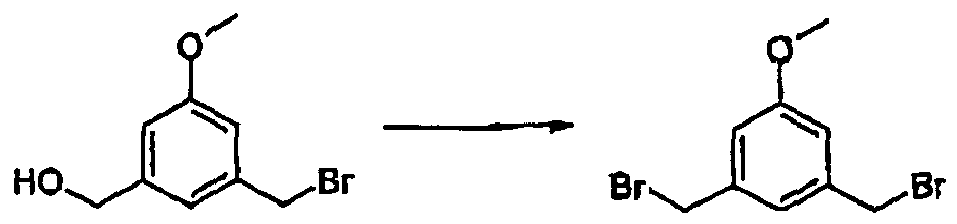
- Carbon tetrabromide (663 mg) was added to a stirred solution of 1-bromomethyl-3-hydroxymethyl-5-methoxy-benzene (420 mg) in anhydrous dichloromethane (10 mL) under argon. After cooling the resulting solution at 0°C, a solution of triphenylphosphine (500 mg) in anhydrous dichloromethane (10 mL) was added dropwise. The reaction mixture was stirred at room temperature for 20 h and then concentrated in vacuo to a residue. The residue was purified by silica gel chromatography (Merck SuperVarioFlash 30g column, Si60 15-40µm, eluted with dichloromethane / heptane, 40:60) to give 1,3-bis-bromomethyl-5-methoxy-benzene (170 mg) :
EI (Method C) : m/z=292 M+. m/z=213 [M - Br]+. m/z=134 [213 - Br]+. - 1H N.M.R. (400 MHz, DMSO-d6, δ in ppm) : 3,77 (s, 3H) ; 4,65 (s, 4H) ; 6,98 (s broad, 2H) ; 7,10 (s broad, 1H)
-

- Carbon tetrabromide (3.47 g) was added to a stirred solution of 1,3-dihydroxymethyl-6-methoxy-benzene (800 mg) in anhydrous dichloromethane (16 mL) under argon. After cooling the resulting solution at 0°C, a solution of triphenylphosphine (2.68 g) in anhydrous dichloromethane (16 mL) was added dropwise. The reaction mixture was stirred at room temperature for 20 h and then concentrated in vacuo to a residue. The residue was purified by silica gel chromatography (Merck SuperVarioPrep 90g column, Si60 15-40µm, eluted with methanol / dichloromethane, 4:96) to give 1-bromomethyl-3-hydroxymethyl-5-methoxy-benzene (420 mg) :
EI (Method C) : m/z=230 M+. m/z=151 [M - Br]+. - 1H N.M.R. (400 MHz, DMSO-d6, δ in ppm) : 3,75 (s, 3H) ; 4,46 (d broad, J = 5,5 Hz, 2H) ; 4,65 (s, 2H) ; 5,22 (t broad, J = 5,5 Hz, 1H) ; 6,83 (s broad, 1H) ; 6,88 (s broad, 1H) ; 6,97 (s broad, 1 H)
-

- Potassium carbonate (22.8 mg) and 1,5-diiodopentane (8.2 µL) were added to a stirred solution of pre-tomaymycin (15 mg) in dimethylformamide (0.6 mL). The reaction was stirred for 20 h at room temperature and an additional portion of potassium carbonate (8 mg) was added. The reaction was stirred for another 20 h at room temperature.
Solids were filtered off and the dimethylformamide solution was injected for HPLC purification according to method B2- The appropriate fractions were combined and concentrated by centrifugal evaporation over a Jouan Model RC10.10. apparatus to afford 8,8'-[1,5-pentanediylbis(oxy)]-bis[(S)-2-eth-(E)-ylidene-7-methoxy-1,2,3,11a-tetrahydro-5H-pyrrolo[2,1-c][1,4]benzodiazepin-5-one] as a white powder (4 mg):LC/MS (Method A2) : ES: m/z=613 MH+ Retention time = 9.04 minutes - 1H N.M.R. (500 MHz, CDCl3-d1, δ in ppm): 1,66 (m partially masked, 2H) ; 1,75 (d broad, J = 7,0 Hz, 6H) ; 1,96 (m, 4H); 2,97 (d broad, J = 7,0 Hz, 4H); 3,89 (m, 2H) ; 3,94 (s, 6H) ; 4,06 (m, 2H) ; 4,13 (m, 2H) ; 4,26 (s broad, 4H) ; 5,60 (m, 2H) ; 6,80 (s, 2H) ; 7,50 (s, 2H) ; 7,66 (d, J = 4,5 Hz, 2H)
-

- 8,8'-[1,4-butanediylbis(oxy)]-bis[(S)-2-eth-(E)-ylidene-7-methoxy-1,2,3,11a-tetrahydro-5H-pyrrolo[2,1-c][1,4]benzodtazepin-5-one] may be prepared following the procedure for the preparation of 8,8'-[1,5-pentanediylbis(oxy)]-bis[(S)-2-eth-(E)-ylidene-7-methoxy-1,2,3,11a-tetrahydro-5H-pyrrolo[2,1-c][1,4]benzodiazepin-5-one] (Example 3), starting with 1,4-diiodobutane :
LC/MS (Method A1, Platform II): ES: m/z=599 MH+ m/z-318,5 (M + H + K)2+ / 2 Retention time = 3.23 minutes - 1H N.M.R. (500 MHz, CDCl3-d1, δ in ppm): 1,75 (d broad, J = 7,0 Hz, 6H); 2,10 (m, 4H) ; 2,98 (d broad, J = 7,0 Hz, 4H) ; 3,90 (m, 2H) ; 3,93 (s, 6H) ; 4,11 (m, 2H) ; 4,20 (m, 2H) ; 4,27 (s broad, 4H) ; 5,60 (m, 2H) ; 6,82 (s, 2H) ; 7,50 (s, 2H); 7,66 (d, J = 4,5 Hz, 2H)
-

- 8,8'-[3-methyl-1,5-pentanediylbis(oxy)]-bis[(S)-2-eth-(E)-ylidene-7-methoxy-1,2,3,11a-tetrahydro-5H-pyrrolo[2,1-c][1,4]benzodiazepin-5-one] may be prepared following the procedure for the preparation of 8,8'-[1,3-benzenediylbis(methyleneoxy)]-bis[(S)-2-eth-(E)-ylidene-7-methoxy-1,2,3,11a-tetrahydro-5H-pyrrolo[2,1-c][1,4]benzodiazepin-5-one] (Example 1), starting with 1,5-dibromo-3-methylpentane :
LC/MS (Method A1, Platform II): ES: m/z-627 MH Retention time = 3.92 minutes -

- 8,8'-[2,6-pyridinediylbis(oxy)]-bis[(S)-2-eth-(E)-ylidene-7-methoxy-1,2,3,11a-tetrahydro-5H-pyrrolo[2,1-c][1,4]benzodiazepin-5-one] may be prepared following the procedure for the preparation of 8,8'-[1,3-benzene-diylbis(methyleneoxy)]-bis[(S)-2-eth-(E)-ylidene-7-methoxy-1,2,3,11a-tetrahydro-5H-pyrrolo[2,1-c][1,4]benzodiazepin-5-one] (Example 1), starting with 2,6-bis-bromomethyl-pyridine:
LC/MS (Method A1, ZQ) : ES : m/z=648 MH+ Retention time = 3.21 minutes - 1H N.M.R. (400 MHz, CDCl3-d1, δ in ppm): 1,75 (d broad, J = 6,5 Hz, 6H); from 2,94 to 2,99 (m, 4H) ; 3,90 (m, 2H) ; 3,99 (s, 6H) ; 4,27 (s broad, 4H) ; 5,32 (s, 4H) ; 5,60 (m, 2H) ; 6,86 (s, 2H) ; 7,48 (d, J = 8,0 Hz, 2H) ; 7,56 (s, 2H) ; 7,64 (d, J = 4,5 Hz, 2H) ; 7,74 (t, J = 8,0 Hz, 1H)
-

- To a stirred solution of pre-tomaymycin (30 mg) in dimethylformamide (0.5 mL), were added potassium carbonate (45.7 mg), a solution of 4-(3-tert-butoxycarbonylamino-propoxy)-2,6-bis-(tosyloxymethyl)-pyridine (41 mg) in dimethylformamide (0.5 mL) and potassium iodide (18.3 mg). The reaction was stirred for 20 h at 30°C. Solids were filtered off and washed with dimethylformamide (0.2 mL). Water (0.5 mL) was added to the combined dimethylformamide solution and formic acid was added until complete dissolution of the precipitate. The resulting solution was injected for HPLC purification according to method B1. The appropriate fractions were combined and concentrated by centrifugal evaporation over a Jouan Model RC10.10. apparatus to afford 8,8'-[4-(3-tert-butoxycarbonylaminopropyloxy)-2,6-pyridine-diylbis(methyleneoxy)]-bis[(S)-2-eth-(E)-ylidene-7-methoxy-1,2,3,11a-tetrahydro-5H-pyrrolo[2,1-c][1,4]benzodiazepin-5-onel (8.3 mg).
LC/MS (Method A1, Platform I): ES : m/z=857 MH+ + 2 H2O m/z=839 MH+ + H2O m/z=821 MH+ m/z=721 [M-C5O2H8] + H+ Retention time = 3.67 minutes - 1H N.M.R. (500 MHz, CD3CO2D-d4, δ in ppm) : 1,41 (s, 9H) ; 1,71 (d, J = 6,5 Hz, 6H) ; 2,08 (m, 2H) ; 2,95 (m, 4H) ; 3,34 (m, 2H) ; 3,90 (s, 6H) ; 4,06 (m, 2H); 4,18 (m, 2H) ; from 4,24 to 4,36 (m, 4H) ; 4,43 (t, J = 6,0 Hz, 2H) ; 5,50 (s broad, 4H) ; 5,61 (m, 2H) ; from 6,80 to 7,70 (m very broad, 2H) ; 6,95 (s broad, 2H) ; from 7,48 to 7,58 (m, 4H).
-

- To a precooled (0°C) solution of 4-(3-tert-butoxycarbonylamino-propoxy)-2,6-bis-(hydroxymethyl)-pyridine (76 mg) in dichloromethane (0.7 mL), was added a solution of potassium hydroxide (30 mg) in water (0.3 mL). Tosyl chloride (93.7 mg) was added, and the resulting heterogenous mixture was shaken vigorously for 1 h and then washed into separatory funnel using dichloromethane and water. The layers were separated, and the aqueous layer was extracted three times with dichloromethane. The combined organic solutions were dried over magnesium sulfate, and concentrated in vacuo to a residue. The residue was purified by silica gel chromatography (Interchrom Puriflash 10g column, SiOH 15-35µm), using gradient elution with a mixture of heptane (A) and ethyl acetate (B) (gradient : 90% A : 10% B up to 50% A : 50% B) to give 4-(3-tert-butoxycarbonylamino-propoxy)-2,6-bis-(tosyloxymethyl) pyridine (56 mg) :
LC/MS (Method A1, Platform 1) : ES : m/z=621 MH+ Retention time = 4.90 minutes -

- To a solution of 4-(3-tert-butoxycarbonylamino-propoxy)-pyridine-2,6-dicarboxylic acid diethyl ester (150 mg) in absolute ethanol (5 mL) was added sodium borohydride (43 mg) and calcium chloride (128 mg). After stirring for 4 h, hydrogen evolution ceased, and reaction was quenched with water. Solvent was evaporated under reduced pressure. The residue was then washed into separatory funnel using dichloromethane and water. The layers were separated, and the aqueous layer was extracted three times with dichloromethane. The combined organic solutions were dried over magnesium sulphate, and concentrated in vacuo to give 4-(3-tert-butoxycarbonylamino-propoxy)-2,6-bis-(hydroxymethyl) pyridine (80 mg) :
LC/MS (Method A1, ZQ) : ES m/z=313 MH+ Retention time = 1.90 minutes - 1H N.M.R. (400 MHz, DMSO-d6, δ in ppm): 1,37 (s, 9H); 1,84 (m, 2H); 3,08 (q, J = 6,5 Hz, 2H) ; 4,05 (t, J = 6,5 Hz, 2H) ; 4,45 (d, J = 6,0 Hz, 4H) ; 5,32 (t, J = 6,0 Hz, 2H) ; 6,84 (s, 2H) ; 6,90 (t broad, J = 6,5 Hz, 1H).
-

- The diethyl ester of chelidamic acid (Scrimin, P.; Tecilia, P.; Tonellato, U.; Vendrame, T. J. Org. Chem. 1989, 54, 5988) (150mg) was dissolved in dry dimethylformamide (2 mL). 3-(tert-Butoxy-amino)-propyl bromide (164 mg) and potassium carbonate (130 mg) were added. The resulting mixture was stirred for 15h at 70°C. The reaction was quenched with a saturated ammonium chloride aqueous solution and then washed into separatory funnel using ethyl acetate. The layers were separated, and the aqueous layer was extracted 3 times with ethyl acetate. The combined organic solutions were dried over magnesium sulfate, and concentrated in vacuo to a residue. The residue was purified by silica gel chromatography (Merck SuperVarioFlash 30g column, Si60 15-40µm), using gradient elution with a mixture of heptane (A) and ethyl acetate (B) (gradient : 60% A : 40% B up to 50% A : 50% B) to give 4-(3-tert-butoxycarbonylamino-propoxy)-pyridine-2,6-dicarboxylic acid diethyl ester (150 mg) :
Cl (Method D) : m/z=397 MH+ - 1H N.M.R. (400 MHz, DMSO-d6, δ in ppm): 1,34 (t, J = 7,0 Hz, 6H) ; 1,36 (s, 9H) ; 1,86 (m, 2H) ; 3,10 (q, J = 6,5 Hz, 2H) ; 4,21 (t, J = 6,5 Hz, 2H); 4,37 (q, J = 7,0 Hz, 4H) ; 6,89 (m broad, 1 H) ; 7,71 (s, 2H)
-

- To a stirred solution of pre-tomaymycin (21 mg) in dimethylformamide (0.7 mL), were added potassium carbonate (32 mg), 1-(3-allyloxycarbonylamino-propyloxy)-3,5-bis-(bromomethyl)-benzene (16.2 mg) and potassium iodide (12.8 mg). The reaction was stirred for 20 h at 30°C. Solids were filtered off, washed twice with dimethylformamide (0.2 mL) then discarded. Water (0.5 mL) was added to the combined dimethylformamide solution and the resulting precipitate was filtered off, washed with water and dried by centrifugal evaporation over a Jouan Model RC10.10 apparatus.
- To the crude compound (27 mg) dissolved in dimethylformamide (0.8 mL), tetrakis(triphenylphosphine) palladium (2 mg), triphenylphosphine (0.9 mg) and pyrrolidine (5.6 µL) were added. After stirring for 15 h at 30°C, tetrakis(triphenylphosphine) palladium (2 mg), triphenylphosphine (1 mg) and pyrrolidone (2.8 µL) were added and the reaction mixture was stirred at room temperature for another 15 h. Water (0.4 mL) was added to the dimethylformamide solution and formic acid was added until complete dissolution of the precipitate. The resulting solution was injected for HPLC purification according to method B1. The appropriate fractions were combined and concentrated by centrifugal evaporation over a Jouan Model RC10.10. apparatus to afford 8,8'-[5-(3-aminopropyloxy)-1,3-benzenediylbis-(methyleneoxy)]-bis[(S)-2-eth-(E)-ylidene-7-methoxy-1,2,3,11a-tetrahydro-5H-pyrrolo[2,1-c][1,4][benzodiazepin-5-one] (0.2 mg).
LC/MS (Method A1, Platform II): ES: m/z=800 MH+ Retention time = 2.84 minutes -

- To a suspension of 1-(3-allyloxycarbonylamino-propyloxy)-3,5-bis-(hydroxymethyl)-benzene (70 mg) in dichloromethane (3 mL) were added carbon tetrabromide (248 mg) and a solution of triphenylphosphine (199 mg) in dichloromethane (2 mL). After refluxing for 3 h, the reaction mixture was purified by silica gel chromatography (Merck SuperVarioFlash 25g column, Si60 15-40µm), eluted with dichloromethane to give 1-(3-allyloxycarbonylamino-propyloxy)-3,5-bis-(bromomethyl)-benzene (52 mg) :
LC/MS (Method A1, Platform II) : ES m/z=420 MH+ Retention time = 4.50 minutes - 1H N.M.R. (400 MHz, DMSO-d6, δ in ppm) : 1.85 (m, 2H) ; 3,15 (q, J = 6,5 Hz, 2H) ; 3,99 (t, J = 6,5 Hz, 2H) ; 4,46 (d broad, J = 5,5 Hz, 2H) ; 4,65 (s, 4H) ; 5,16 (d broad, J = 11,0 Hz, 1H); 5,26 (d broad, J = 17,5 Hz, 1H) ; 5,90 (m, 1H) ; 6,96 (d, J = 1,5 Hz, 2H) ; 7,09 (t, J = 1,5 Hz, 1H); 7,29 (t broad, J = 6,5 Hz, 1H).
-

- Hydrazine hydrate (0.62 mL) was added and the reaction mixture was refluxed for 1 h. The solvent was removed in vacuo and the residue dissolved in dichloromethane. The insoluble residue was filtered off and purified by silica gel chromatography (Merck SuperVarioPrep 70g column, Si60 15-40µm), eluted with methanol / dichloromethane, 20:80 then ammonium hydroxide / methanol /dichloromethane, 0.5:25:75 to give 1-(3-amino-propyloxy)-3,5-bis-(hydroxymethyl)-benzene (1g) suitable for further transformation.
- A sample of 1-(3-amino-propyluxy)-3,5-bis-(hydroxymethyl)-benzene (100 mg) was dissolved in methanol (5 mL). To the cooled solution (0°C) was added a solution of sodium carbonate (120 mg) in water (5 mL) and allyl chloroformate (42 µL). After stirring for 30 minutes at 0°C, the reaction mixture was steered at room temperature for another 15 h. Solvent was removed in vacuo The residue was then washed into separatory funnel using ethyl acetate and water. The layers were separated, and the aqueous layer was extracted twice with ethyl acetate. The combined organic solutions were dried over magnesium sulphate, and concentrated in vacuo to give 5-(3-allyloxycarbonylamino-propyloxy)-2,6-bis-(hydroxymethyl) benzene (75 mg):
EI (Method C) : m/z=295 M+. m/z=142 (M-C8H9O3)+ m/z=41 C3H6 + - 1H N.M.R. (300 MHz, DMSO-d6, δ in ppm): 1,85 (m, 2H); 3,14 (q, J = 6,5 Hz, 2H) ; 3,96 (t, J = 6,5 Hz, 2H) ; from 4,41 to 4,48 (m, 6H) ; 5,11 (t partially masked, J = 5,5 Hz, 2H) ; 5,16 (qd, J = 1,5 et 10,5 Hz, 1H) ; 5,26 (qd, J = 1,5 et 17,0 Hz, 1H); 5,90 (m, 1H) ; 6,72 (s broad, 2H) ; 6,83 (s broad, 1H); 7,26 (t broad, J = 6,5 Hz, 1H)
-

- 3,5-Bis-hydroxymethylphenol (Felder, D.; Gutiérrez Nava, M.; del Pilar Carreon, M.; Eckert, J.F.; Luccisano, M.; Schall, C.; Masson, P.; Gallani, J.L.; Heinrich, B.; Guillon, D.; Nierengarten, J.F. Helv Chimica Acta 2002, 85, 288) (2.35 g), N-(3-bromo-propyl)-phtalimide (4.49 g) and potassium carbonate (10.53 g) were mixed in acetonitrile (25 mL) and refluxed for 12h. The reaction mixture was cooled to room temperature and the solvent removed under reduced pressure. The residue was redissolved in dichloromethane and the insoluble residue filtered off. The filtrate was washed with water, dried over magnesium sulfate, and concentrated in vacuo to a residue. The residue was purified by silica gel chromatography (Merck SuperVarioPrep 90g column, Si60 15-40µm), eluted with methanol / dichloromethane, 4:96 to give 5-(3-phtalimido-propyloxy)-1,3-bis-(hydroxymethyl) benzene (1,45 g) :
LC/MS (Method A1, Platform II) : ES m/z-342 MH+ m/z=324 (MH+ - H2O) Retention time = 2.90 minutes - 1H N.M.R. (300 MHz, DMSO-d6, δ in ppm) : 2,05 (m, 2H) ; 3,76 (t, J = 6,5 Hz, 2H) ; 3,99 (t, J = 6,5 Hz, 2H) ; 4,40 (d, J = 5,5 Hz, 4H) ; 5,09 (t, J = 5,5 Hz, 2H) ; 6,59 (s broad, 2H) ; 6,82 (s broad, 1H) ; from 7,80 to 7,90 (m, 4H)
-

- To a cooled (0°C) solution of 5-(N-methyl-3-tert-butoxycarbonylaminopropyl)-1,3-bis-(hydroxymethyl)-benzene (50 mg) and triethylamine (113 µL) in dichloromethane (2 mL), was added methanesulfonyl chloride (26 µL). After 30 minutes, the reaction mixture was washed twice with water and the resulting dichloromethane solution was dried over magnesium sulfate, and concentrated in vacuo to a viscous oil (50.3 mg).
- A solution of pre-tomaymycin (15 mg) in dimethylformamide (0.5 mL) was added to a mixture of the crude compound (13 mg), potassium carbonate (23 mg) and potassium iodide (9 mg). The reaction mixture was stirred for 20 h at 30°C. Another sample of the crude compound was added (6 mg), and the reaction mixture was stirred for another 20 h at 30°C. Solids were filtered off, washed with dimethylformamide (0.2 mL) then discarded. Water (0.4 mL), one drop of formic acid and another water (1.5 mL) were added to the combined dimethylformamide solution.
- A sample of the resulting suspension (2 mL) was filtered and the resulting solid was dried under vacuo to give 8,8'-[5-(N-methyl-3-tert-butoxycarbonylaminopropyl)-1,3-benzenediylbis(methyleneoxy)]-bis[(S)-2-eth-(E)-ylidene-7-methoxy-1,2,3,11a-tetrahydro-5H-pyrrolo[2,1-c][1,4]benzodiazepin-5-one] (3.1mg):
LC/MS (Method A1, Platform II) : ES : m/z=818 MH+ Retention time = 4.11 minutes -

- To a cooled solution (-5°C) of 5-(N-methyl-3-tert-butoxycarbonylaminopropyl)-benzene-1,3-dicarboxylic acid diethyl ester (100 mg) in tetrahydrofuran (2 mL) was slowly added a 1 M solution of lithium aluminium hydride in diethyl ether (0.55 mL). 10 minutes after the end of the addition, sodium sulfate decahydrate was added until gas evolution ceased. The solid was filtered off, washed twice with ethyl acetate and the combined organic solutions were concentrated in vacuo to give 5-(N-methyl-3-tert-butoxycarbonylaminopropyl)-1,3-bis-(hydroxymethyl)-benzene (66.8 mg) as a viscous oil :
Cl (Method D) : m/z=327 MNH4 + m/z=310 MH+ m/z=271 (MNH4 + - C4H8) - 1H N.M.R. (300 MHz, DMSO-d6, δ in ppm) : 1, 37 (s broad, 9H) ; 1,75 (m, 2H) ; from 2,45 to 2,64 (m masked, 2H); 2,77 (s, 3H); 3,18 (t, J = 7,0 Hz, 2H) ; 4,45 (d, J = 5,5 Hz, 4H); 5,08 (t, J = 5,5 Hz, 2H); 7,00 (s broad, 2H); 7,08 (s broad, 1H)
-

- To a solution of 5-(N-methyl-3-tert-butoxycarbonylaminopropyn-1-yl)-benzene-1,3-dicarboxylic acid diethyl ester (890 mg) in methanol (10 mL) was added
palladium 10% on carbon (89 mg) and the solution was stirred at room temperature under an hydrogen atmosphere (1bar) for 18h. The solid was filtered off and solvent was removed in vacuo to afford 5-(N-methyl-3-tert-butoxycarbonylaminopropyl)-benzene-1,3-dicarboxylic acid diethyl ester (767mg) as a yellow oil :EI (Method C): m/z=365 M+. m/z=309 (M - C4H8)+. m/z=265 (m/z=309 - CO2)+. m/z=57 C4H9 + m/z=44 C2H6N+ - 1H N.M.R. (400 MHz, DMSO-d6, δ in ppm) : 1,32 (s broad, 9H) ; 1,79 (m, 2H) ; 2,70 (t, J = 7,0 Hz, 2H) ; 2,76 (s, 3H) ; 3,16 (m, 2H) ; 3,87 (s, 6H) ; 8,06 (d, J = 2,0 Hz, 2H) ; 8,32 (t, J = 2,0 Hz, 1H)
-

- 5-Trifluoromethanesulfonyloxy-isophthalic acid dimethyl ester (Bodwell, G.J. ; Fleming, J.J. ; Mannion, M.R. ; Miller, D.O. J. Org. Chem. 2000, 65 (17), 5360) (1g) was dissolved in 2 mL of acetonitrile. N-Methyl-N-tert-butoxycarbonyl-propargylamine (Bradbury, B.J. ; Baumgold, J. ; Jacobsen, K.A. J. Med. Chem. 1990, 33 (2), 741) (643 mg), bis(triphenylphosphine)palladium chloride (205 mg), copper iodide (56 mg) and triethylamine (591 mg) were added. The resultant mixture was stirred for 15h at room temperature. The solvent was removed by evaporation under reduced pressure and the residue was then washed into separatory funnel using ethyl acetate and water. The layers were separated, and the aqueous layer was extracted once with ethyl acetate. The combined organic solutions were washed with a saturated sodium chloride aqueous solution, dried over magnesium sulphate, and concentrated in vacuo to a residue. The residue was purified by silica gel chromatography (Biotage FLASH 40+M 100g column, SiOH 32-63µm, eluted with ethyl acetate / heptane, 20:80) to give 5-(N-methyl-3-tert-butoxycarbonylaminopropyn-1-yl)-benzene-1,3-dicarboxylic acid diethyl ester (896 mg) :
- 1H N.M.R. (300 MHz, DMSO-d6, δ in ppm) : 1,43 (s, 9H) ; 2,90 (s, 3H) ; 3,90 (s, 6H); 4,30 (s, 2H) ; 8,16 (d, J = 1,5 Hz, 2H) ; 8,42 (t, J = 1,5 Hz, 1H)
-

- To a cooled (0°C) solution of 1-[3-(4-methyl-4-methyldisulfanyl-pentanoylamino)-propyloxy]-3,5-bis-(hydroxymethyl)-benzene (45 mg) and triethylamine (49 µL) in dichloromethane (1.5 mL), was added methanesulfonyl chloride (19 µL). After 30 minutes, the reaction mixture was washed twice with water and the resulting dichloromethane solution was dried over magnesium sulfate, and concentrated in vacuo to a viscous oil (39 mg).
- To a solution of pre-tomaymycin (26 mg) in dimethylformamide (0.9 mL) was added potassium carbonate (40 mg), potassium iodide (16 mg) and a sample of the crude compound (31 mg). The reaction mixture was stirred for 20 h at 30°C. Another sample of the crude compound was added (6 mg), and the reaction mixture was stirred for another 20 h at 30°C. Solids were filtered off, washed with dimethylformamide (0.3 mL) then discarded. Water (1.8 mL) was added to the combined dimethylformamide solution and the resulting solid was filtered, washed with water and dried in vacuo to give a residue. The residue was purified by silica gel chromatography (Interchrom Puriflash 2g column, SiOH 15-35µm, eluted with dichloromethane / methanol, 95:5) then another purification by silica gel chromatography (Chromabond OH 2g column, 45ym, eluted with dichloromethane to give 8,8'-{5-[3-(4-methyl-4-methyldisulfanylpentanoyl-amino)propyloxy]-1,3-benzenediylbis(methyleneoxy)}-bis[(S)-2-eth-(E)-ylidene-7-methoxy-1,2,3,11a-tetrahydro-5H-pyrrolo[2,1-c][1,4]benzo-diazepin-5-one] (0.2 mg) :
LC/MS (Method A1, Platform I): ES: m/z=896 MH+ Retention time = 4.09 minutes - 1H N.M.R. (500 MHz, CDCl3-d1, δ in ppm): 1,29 (s, 6H) ; 1,75 (d, J = 6,6 Hz. 6H) ; from 1,92 to 2,03 (m, 4H) ; 2,28 (m, 2H) ; 2,39 (s, 3H) ; 2,97 (m, 4H) ; 3,45 (q, J = 6,0 Hz, 2H) ; 3,89 (q, J = 5,5 Hz, 2H) ; 3,96 (s. 6H) ; 4,04 (t, J = 5,0 Hz, 2H) ; 4,27 (s broad, 4H) ; 5,14 (d, J = 12,5 Hz, 2H) ; 5,20 (d, J = 12,5 Hz, 2H): 5,60 (m, 2H) ; 5,84 (t broad, J = 6,0 Hz, 1 H) ; 6,83 (s, 2H) ; 6,94 (s, 2H); 7,09 (s, 1 H) ; 7,53 (s, 2H) ; 7,64 (d, J = 5,0 Hz, 2H).
-

- To a solution of 1-(3-amino-propyloxy)-3,5-bis-(hydroxymethyl)-benzene (50 mg) in dimethylformamide (1 mL) was added 4-methyl-4-methyldisulfanyl-pentanoic acid (44 mg), N,N'-diisopropylcarbodiimide (35 mL) and 1-hydroxybenzotriazole hydrate (5.8 mg). After 15 h at room temperature, water was added to the reaction mixture and the aqueous solution was extracted twice with ethyl acetate. The combined organic solutions were washed with a saturated sodium chloride aqueous solution, dried over magnesium sulfate and concentrated in vacuo to a residue. The residue was purified by silica gel chromatography (Interchrom Puriflash 5g column, SiOH 15-35 µm), eluted with methanol / dichloromethane, 5:95 to give 1-[3-(4-methyl-4-methyldisulfanyl-pentanoylamino)-propyloxy]-3,5-bis-(hydroxymethyl)-benzene (48 mg):
LC/MS (Method A1, ZQ): ES m/z=388 MH+ Retention time = 3.03 minutes - 1H N.M.R. (300 MHz, DMSO-d6, δ in ppm) : 1,24 (s, 6H) ; from 1,76 to 1,87 (m, 4H) ; 2,16 (m, 2H) ; 2,40 (s, 3H) ; 3,19 (q, J = 6,5 Hz, 2H) ; 3,95 (t, J = 6,5 Hz, 2H) ; 4,44 (d broad, J = 5,5 Hz, 4H) ; 5,12 (d, J = 5,5 Hz, 2H) ; 6,73 (s broad, 2H) ; 6,83 (s broad, 1H); 7,92 (t broad, J = 5,5 Hz, 1H)
-
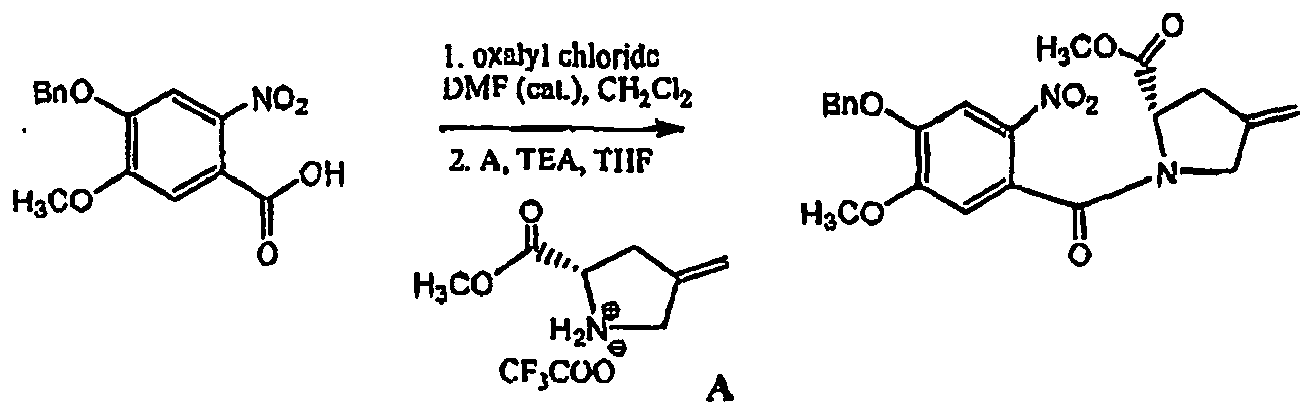
- To a solution of 4-benryloxy-5-methoxy-2-nitroloenzoic acid (4.8 g, 16 mmol) in anhydrous dichloromethane (80 mL) and THF (5 mL) was added oxalyl chloride (2.8 mL, 32 mmol) and DMF (30 µL, 0.38 mmol) at room temperature- Large amounts of bubble formed after the addition of DMF. The mixture was stirred overnight then the solvents were removed by rotary evaporation in vacuo. The residue was co-evaporated one more time by addition of anhydrous dichloromethane to give the acetyl chloride as a yellow solid.
- To a solution of 4-methylene-L-proline methyl ester, compound A, (3.95 g, 15.5 mmol) in anhydrous THF (80 mL) was added triethylamine (6.7 mL, 48 mmol) at 0°C. After 2 minutes the above acetyl chloride in anhydrous THF (80 mL) was added quickly in 10 minutes via a canula at the same temperature. The obtained yellow cloudy solution was stirred at 0 - 5°C for 30 minutes then at room temperature for 4 hours. The reaction solution was diluted with ethyl acetate and water. The aqueous layer was extracted with ethyl acetate twice and the combined organic layers were washed with 2% HCl solution and brine, dried over anhydrous magnesium sulfate, It was filtered and the solvents were removed. The residue was purified by flash chromatography (Hexanes/AcOEt, 1:1, 1:1.5) to give (2S)-4-(methylene)-1-[5-methoxy-2-nitro-4-(phenylmethoxy)-benzoyl]-2-pyrrolidinecarboxylic acid methyl ester as a yellow solid (5.6 g, y = 85%). 1H NMR (400 Hz, CDCl3): the compound appears as a pair of distinct rotomers. δ 7.76 (s, 0.7H), 7.73 (s, 0.3H), 7.43-7.29 (m, 5H), 6.83 (s, 0.7H), 6.80 (s, 0.3H), 5.17 (s, 1.4H), 5.16 (s, 0.6H), 5.10-4.89 (m, 2.7H), 4.57 (d, J = 16 Hz, 0,3H), 4.19-4.12 (m, 0.7H), 3.95-3.77 (m, 6.3H), 3.57 (s, 1H), 3.06-2.96 (m, 1H), 2.73-2.62 (m, 1H); 13C NMR (400 Hz, CDCl3): 171.8, 171.7, 166.5, 166.2, 154.9, 154.4, 148.25, 148.18, 141.7, 141.3, 137.19, 137.13, 135.3, 135.2, 128.7, 128.43, 128.41, 127.5, 127.3, 109.5, 109.1, 109.0, 108.9, 71.3, 60.6, 58.1, 56.7, 56.5, 52.39, 52.37, 52.0, 50.2, 37.1, 35.5; MS (ESI): m/z 449.3 (M + Na)+.

- To a solution of the ester (3.15 g, 7.39 mmol) in anhydrous dichloromethane (9 mL) and toluene (27 mL) was added dibal-H (15 mL, 1.0 M in toluene) dropwise via a syringe pump in 30 minutes at -78°C. The mixture was continued to stir at -78°C for 2 hours and TLC (hexanes/AcOEt, 1:1.5) showed all the starting material consumed. The reaction was quenched with methanol (0.3 mL, 7.4 mmol) at -78°C and 5% HCl (20 mL) was added followed by addition of AcOEt (50 mL). The dry ice/acetone bath was removed and the mixture was warmed to 0°C and stirred for 15 minutes. The aqueous layer was extracted with AcOEt twice and the combined organic layers were washed with cold 5% HCl and brine, dried over anhydrous sodium sulfate. It was filtered through celite and the solvents were removed. The residue was purified by flash chromatography (Hexanes/AcOEt, 1:1, 1:1.5, 1:2, 1:3, 1:5, 100% AcOEt) to give 2S-4-(methylene)-1-[5-methoxy-2-nitro-4-(phenylmethoxy)benzoyl]-2-pyrrolidinecarboxaldehyde as a fluffy yellow solid (2.69 g, y = 92%). 1H NMR (400 Hz, CDCl3): the compound appears as a pair of distinct rotomers. δ 9.75 (s, 0.7H), 9.32 (s, 0.3H), 7.76 (s, 0.7H). 7.69 (s, 0.3H), 7.45-7.31 (m, 5H), 6.85 (s, 0.7H), 6.80 (s, 0.3H), 5.19-4.82 (m, 4.7H), 4.56 (d, J = 16 Hz, 0.3H), 4.14-3.79 (m, 5H), 2.99-2.68 (m, 2H); 13C NMR (400 Hz, CDCl3): 198.3, 197.1, 167.1, 155.0, 154.6, 148,4, 141.3, 140.4, 137.2, 135.2, 128.7, 128.5, 128.4, 127.5, 126.9, 126.6, 109.8, 109.4, 109.3, 109.2, 109.1. 71.3, 66.6, 64.3, 56.7, 56.6, 52.2, 50.6, 33.2, 31.9; MS (ESI), m/z 419.2 (M + Na)+.

- Procedure 1: To a solution of (2S)-4-(methylene)-1-[5-methoxy-2-nitro-4-(phenylmethoxy)benzoyl]-2-pyrrolidinecarboxaldehyde (1.0 equivalent) in THF/H2O (v/v, 1.7:1, 0.03 M) was added sodium hydrosulfite (5∼8 equivalent) in portions within 2 minutes at room temperature. The mixture was further stirred for 6-20 hours and monitored by TLC (hexanes/AcOEt 1:2 and CH2Cl2/MeOH 5:1). After the aldehyde was almost consumed, the reaction was quenched with methanol (about same volume as THF used). The solvents were removed by rotary evaporation in vacuo (temperature < 40°C) and the remainder solid was put on high vacuum to make it completely dry. The solid was suspended in anhydrous methanol (0.03 M) and AcCI (8~10 equivalent) was added dropwise at room temperature. After stirred for 15 minutes, the cloudy solution was filtered and the solid was washed with anhydrous methanol. The clear yellow filtrate was stirred at room temperature for 1 to 2 hours and was quenched with saturated sodium bicarbonate. After most of the methanol was removed by rotary evaporation, the remainder was diluted with dichloromethane and water. The aqueous layer was extracted with AcOEt. The combined organic layers were dried over anhydrous sodium sulfate and filtered. The solvents were removed and the residue was purified by flash chromatography (hexanes/AcOEt, 1:3, 1:5) to give (11aS)-7-methoxy-2-methylene-8-(phenylmethoxy)-1,2,3,11a-tetrahydro-5H-pyrrolo[2,1-c][1,4]benzodiazepin-5-one in 70% to 85% yield. The NMR spectra are consistent with the literature reported. MS (ESI): m/z 371.2 (M + Na)+. MS (ESI, with CH3OH): m/z 403.3 (M + CH3OH + Na)+. MS (ESI, with H2O): m/z 389.2 (M + H2O + Na)+.
- Procedure 2: To a solution of (2S)-4-(methylene)-1-[5-methoxy-2-nitro-4-(phenylmethoxy)benzoyl]-2-pyrrolidinecarboxaldehyde (1.0 equivalent) in MeOH/H2O (v/v, 3.2:1, 0.03 M) was added sodium hydrosulfite (6~8 equivalent) in portions within 2 minutes at room temperature, followed by addition of sodium hydrosulfate (0.5~1.0 equivalent). The mixture was further stirred for 12~20 hours and monitored by TLC (hexanes/AcOEt 1:2 and CH2Cl2/MeOH 5:1). After the intermediate [MS (ESI): 459.0 (M - H)-] was almost consumed, the reaction was quenched with saturated sodium bicarbonate to pH 5~6. The solvents were removed by rotary evaporation in vacuo (temperature < 40°C) and the remainder solid was put on high vacuum to make it completely dry. The solid was suspended in anhydrous methanol (0.03 M) and AcCI (8∼10 equivalent) was added dropwise at room temperature. After stirred for 15 minutes, the cloudy solution was filtered and the solid was washed with anhydrous methanol. The clear yellow filtrate was stirred at room temperature for 1 to 2 hours and was quenched with saturated sodium bicarbonate. After most of the methanol was removed by rotary evaporation, the remainder was diluted with dichloromethane and water. The aqueous layer was extracted with AcOEt. The combined organic layers were dried over anhydrous sodium sulfate and filtered. The solvents were removed and the residue was purified by flash chromatography (hexanes/AcOEt. 1:3, 1:5) to give (11aS)-7-methoxy-2-methylene-8-(phenylmethoxy)-1,2,3,11a-tetrahydro-5H-pyrrolo[2,1-c][1,4]benzodiazepin-5-one in 65% to 80% yield.

- To a solution of the starting material (98 mg, 0.28 mmol) in anhydrous dichloromethane (2 mL) was added a freshly mixed solution of methanesulfonic acid (2 mL) in anhydrous dichloromethane (4 mL) at room temperature. The mixture was stirred at room temperature for 1.5 hours and was poured on ice (~30 g), quenched with saturated NaHCO3 and diluted with dichloromethane. The aqueous layer was extracted with dichloromethane once and the combined organic layers were dried over anhydrous sodium sulfate, filtered and the solvents were removed. The residue was purified by flash chromatography (CH2Cl2/MeOH, 15:1) to give the product as a yellow solid (29 mg). The above aqueous layer was stirred at room temperature overnight and extracted with dichloromethane and AcOEt subsequently. The combined dichloromethane and AcOEt were dried over anhydrous sodium sulfate, filtered and the solvents were removed to give (11aS)-8-hydroxy-7-methoxy-2-methylene-1,2,3,11a-tetrahydro-5H-pyrrolo[2,1-c][1,4]benzodiazepin-6-one (25 mg). The total yield is 74%. 1H NMR (400 Hz, CDCl3): δ 7.65 (d, J = 4.8 Hz, 1H), 7.48 (s, 1H), 6.87 (s, 1H), 6.35 (bs, 1H), 5.17 (t, J = 1.6 Hz, 1H), 5.14 (7. J =1.6Hz, 1H), 4.26 (s, 2H), 3.93 (s, 3H), 3.87-3.83 (m, 1H), 3.12-3.05 (m, 1H), 2.91 (d, J = 16 Hz, 1H); MS (ESI): m/z 281.0 (M + Na)+. MS (ESI, with water): m/z 258.9 (M + H)+, m/z 299.1 (M + H2O + Na)+.
-

- To a solution of triphenylphosphine (577 mg, 2.2 mmol) in anhydrous THF (5 mL) was added diethyl azodicarboxylate (22 M in toluene, 791 µL, 1.7 mmol) dropwise at 0°C. After stirred at 0°C for 50 minutes, a solution of 1,3,5-tri(hydroxymethyl)benzene (269 mg, 1.6 mmol, prepared by reduction of trimethyl 1,3,5-benzenetricarboxylate with lithium aluminum hydride in THF, co-evaporated with dry benzene and dried on high vacuum for couple hours before use) and thioacetic acid (108 µL, 1.45 mmol) in dry THF (4 mL) was added dropwise. After 1 hour, the ice/water bath was removed and the reaction was stirred at room temperature for 15 hours. The solvents were removed by rotary evaporation in vacuo. The residue was purified by flash chromatography to give 5-acetylthiomethyl-1,3-bis(hydroxymethyl)-benzene as colorless solid (110 mg). 1H NMR (400 Hz, CDCl3): δ 7.13-6.99 (m, 3H), 4.45 (apt, J = 20.4 Hz, 4H), 3.98 (apt, J = 20.4 Hz, 4H), 3.73 (bs, 2H), 2.24 (apt, J = 20.4 Hz, 3H); MS (ESI): m/z 249.0 (M + Na)+.

- To a solution of triphenylphosphine (28 mg, 0.1 mmol) in anhydrous THF (0.3 mL) was added disopropyl azodicarboxylate (19 µL, 0.09 mmol) dropwise at 0°C. After stirred at 0°C for 35 minutes, a solution of (11aS)-8-hydroxy-7-methoxy-2-methylene-1,2,3,11a-tetrahydro-5H-pyrrolo[2,1-c][1,4]benzodiazepin-5-one, compound 5, (18 mg, 0.07 mmol, co-evaporated with dry benzene and dried on high vacuum for couple hours before use) in dry THF (0.2 mL) was added. The mixture was continued to stir for 10 minutes before 5-acetylthiomethyl-1,3-bis(hydroxymethyl)-benzene, compound 6, (6.6 mg, 0.03 mmol, co-evaporated with dry benzene and dried on high vacuum for couple hours before use) in dry THF (0.2 mL) was added. The reaction mixture was allowed to stir at 0°C for 35 minutes. The ice/water bath was removed and the solution was stirred at room temperature for 21 hours. The solvents were removed by rotary evaporation in vacuo. The residue was purified by flash chromatography to furnish the crude product which was further purified by preparative HPLC (C18 column, CH3CN/H2O) to give 0.7 mg of 8,8'-[5-acetylthiomethyl-1,3-benzenediylbis(methyloneoxy)]-bis[(S)-2-methylene-7-methoxy-1,2,3,11a-tetrahydro-5H-pyrrolo[2,1-c][1,4]benzodiazepin-5-one], compound 7. MS (ESI, with H2O): mlz 765.3 (M + 2H2O + Na)+, 747.3 (M + H2O + Na)+, 729.2 (M + Na)+, 707.3 (M + H)+, 663.2 (M - Ac)-.
-


- Compound 1. Thionyl chloride (5.6 mL, 76.3 mmol) was added dropwise to dry methanol (76 mL) at -20 °C, following by addition of trans-4-hydroxy-L-proline (5.0 g, 38.1 mmol). The resulting mixture was allowed to warm to rt and stirred for 20 h. The solvent was removed under reduced pressure, and the residue was further dried under high vacuum to provide trans-4-hydroxy-L-proline methyl ester 1 as a white solid: 1HNMR (300 MHz, DMSO-d 6) δ 2.18 - 2.23 (m, 2H), 3.06 (m, 1H), 3.32 - 3.36 (m, 2H), 3.76 (s, 3H), 4.42 (br. s, 1H), 4.48 (dd, J = 5-4, 8.1 Hz, 1H), 5.56 (br. s, 1H); EIMS m/z 146 ([M]++1).
- Compound 2. To a solution of trans-4-hydroxy-L-proline methyl ester 1 (4.48 g, 30.9 mmol) and sodium bicarbonate (1.56 g, 18.5 mmol) in anhydrous DMF (42 mL) was added solution of (BOC)2O in DMF (20 mL) at 0°C under argon. After stirring for an overnight at rt, the reaction was quenched by the addition of 100 mL H2O at 0°C, and extracted with EtOAc (4 x 80 mL). The combined organic layer was washed with brine (100 mL), dried (MgSO4), filtered and concentrated with rotavapor. The residue was purified by flash chromatography (silica gel, 1:1 hexanes/EtOAc) to give N-BOC protected trans 4-hydroxy-L-proline methyl ester 2 as colorless oil: 1HNMR (300 MHz, CDCl3, rotamers) δ 1.38 and 1.43 (2 x s, 9H), 2.04 - 2.07 (m, 1H), 2.23 - 2.27 (m, 2H), 3.54 - 3.63 (m, 2H), 3.70 (s, 3H), 4.34 - 4.38 (m, 1H), 4.46 (br. s, 1H).
- Compound 3. (Franco Manfre, Jean-Marc Kern, and Jean-Francois Biellmann J. Orgr. Chem. 1992, 57, 2060-2065). N-BOC protected trans-4-hydroxy-L-proline methyl ester compound 2 (3.24 g, 13.2 mmol) was dissolved in CH2Cl2 (132 mL) and cooled to 0°C. Pyridine and Dess-Martin periodinane were added and stirring was continued until TLC showed no SM left. The reaction mixture was diluted with CH2Cl2, washed with 10% aq. Na2S2O3 (3 x 50 mL), 1N aq. HCl (50 mL), sat. aq. NaHCO3 (50 mL), brine (50 mL), dried over MgSO4, filtered and concentrated. Purification of the residue by flash chromatography (silica gel, 7:3 hexanes/EtOAc) gave N-BOC protected 4-oxo-L-proline methyl ester 3 as light yellow oil: 1HNMR (300 MHz, CDCl3, rotamers) δ 1.44 (s, 9H), 2.53 - 2.57 (m, 1H), 2.85 - 2.96 (m, 1H), 3.72 and 3.74 (2 x s, 3H), 3.85 - 3.87 (m, 2H), 4.67 - 4.77 (m, 1H).
- Compound 4. (
Kuei-Ying Lin, Mark Matteucci US 5414077 ) A solution of potassium-t-butoxide (2.51 g, 22.3 mmol) in anhydrous THF (40 mL) was added to a suspension of methyltriphenylphosphonium bromide (7.99 g, 22.3 mmol) in THF (40 mL) at 0°C. The resulting yellow ylide suspension was stirred at 0°C for 2 h before the addition of the solution of N-BOC protected 4-oxo-L-proline methyl ester 3 (2.72 g, 11.2 mmol) in THF (32 mL). After stirring at rt for 1 h, the reaction mixture was diluted with EtOAc (100 mL), washed with H2O (80 mL), brine (80 mL), dried (MgSO4), and concentrated. Purification of the residue by flash chromatography (silica gel, 9:1 hexanes/EtOAc) yielded N-BOC protected 4-methylene-L-proline methyl ester, compound 4, as colorless oil: 1HNMR (300 MHz, CDCl3, rotamers) δ 1.40 and 1.45 (2 x s, 9H), 2.58 - 2.62 (m, 1H), 2.88 - 2.98 (m, 1H), 3.69 and 3.70 (2 x s, 3H), 4.03 - 4.06 (m, 2H), 4.36 - 4.49 (m, 1H), 4.97 - 4.99 (m, 2H); EIMS m/z 264 ([M]++Na). - Compound 5. N-BOC protected 4-methylene-L-proline methyl ester, compound 4, (0.8 g, 3.31 mmol) was dissolved in CH2Cl2 (6.5 mL) and cooled to 0 °C. A solution of trifluoroacetic acid (6.5 mL) in CH2Cl2 (6.5 mL) was added dropwise and the resulting mixture was stirred at rt for 1.5 h. After removal of volatile solvents with rotavapor, the brown residue was dissolved in 10 mL H2O, washed with Et2O (3 x 5 mL). Aqueous solution was concentrated, which was further dried under high vacuum to yield 4-methylene-L-proline methyl ester 5 as TFA salt 1HNMR (300 MHz, CDCl3, rotamers) δ 2.83 - 2.87 (m, 1H), 3.05 - 3.11 (m, 1H), 3.80 and 3.81 (2 x s, 3H), 4.00 - 4.10 (m, 2H), 4.55 (dd, J = 5.7, 5.7 Hz, 1H), 5.17-5.21 (m, 2H); 13CNMR δ 34.0, 49.1, 53.8, 59.3, 111.7, 137.6, 169.8; EIMS m/z 142 ([M]++1).
- Compound 6.(Kamal, A.; et al J. Med. Chem. 2002, 45, 4679-4688) Diethanolamine (3.57 g, 34 mmol) was dissolved in methanol (20 ml) and treated with Et3N (4.7 mL, 34 mmol) and ethyl trifluoroacetate (4.90 g, 34 mmol) for 20 h at rt, followed by adding another 1 mL CF3COOEt. After another 20 h, removal of volatile solvents under high vacuum yielded N-trifluoroacetyl-diethanolamine compound 6 as light yellow oil, which was used without further purification.
- Compound 7. Diethyl azodicarboxylate (7.66 g, 44 mmol) was added dropwise to a stirred solution of methyl vanillate (7.30 g, 40.1 mmol) and triphenylphosphine (15.67 g, 59.7 mmol) in anhydrous THF (57 mL) at 0 °C, and the resulting mixture was stirred for 1 h at this temperature followed by addition of a solution of N-trifluoroacetyl-diethanolamine 6 (7.30 g, 40.1 mmol) in anhydrous THF (20 mL). After stirring for an overnight at rt, the reaction was quenched with H2O (100 mL), and extracted with Et2O (3 x 80 mL). The combined Et2O layers were washed with brine (100 mL), dried (MgSO4), and concentrated. Purification of the residue by flash chromatography (silica gel, 8:2 to 7:3 hexanes/EtOAc) yielded N-trifluorocetyl-N,N-di[2-(4-methoxycarbonyl-2-methoxy-phenoxy)ethyl]amine, compound 7, as a white solid, 1HNMR (300 MHz, CDCl3) δ 3.81 (s, 3H), 3.84 (s, 3H), 3.87 (s, 3H), 3.88 (s, 3H), 4.04 - 4.08 (m, 4H), 4.28 - 4.32 (m, 4H), 6.84 and 6.85 (2 x d, J = 6.3 Hz, 2H), 7.50 and 7.51 (2 x d, J = 1.5 Hz, 2H), 7.61 (dd, J = 1.5, 6.3 Hz, 2H).
- Compound 8. Solid Cu(NO3)2.xH2O (2.33 g, 12.41 mmol) was added to a stirred solution of N-trifluorocetyl-N,N-di[2-(4-methoxycarbonyl-2-methoxy-phenoxy)ethyl]amine 7 (2.62 g, 4.96 mmol) in acetic anhydride (50 mL) at 0 °C. The reaction mixture was stirred at 0 °C for 1 h and rt for 2 h, then poured into 200 mL ice-water. Stirring was continued for another 1 h. The resulting yellow precipitate was collected by filtration. Further purification with flash chromatography (silica gel, 6:4 hexanes/EtOAc) yielded N-trifluorocetyl-N,N-di[2-(4-methoxycarbonyl-2-methoxy-5-nitro-phenyloxy)ethyl]amine, compound 8, as light yellow solid: 1HNMR (300 MHz, CDCl3) δ 3.86 (s, 3H), 3.88 (s, 3H), 3.886 (s, 3H), 3.890 (s, 3H), 4.04 - 4.09 (m, 4H), 4.30 - 4.35 (m, 4H), 6.98 and 6.99 (2 x s, 2H), 7.37 and 7.40 (2 x s, 2H).
- Compound 9. A solution of N-trifluorocetyl-N,N-di[2-(4-methoxycarbonyl-2-methoxy-5-nitro-phenyloxy)ethyl]amine 8 (2.58 g, 4.16 mmol) in THF-MeOH (1:2, 48 mL) was treated with 10% aq. K2CO3 (16 mL) at rt for 12 h. After removal of volatile with rotavapor, the residue was diluted with 100 mL H2O, extracted with EtOAc (3 x 100 mL). The combined EtOAc layers were washed with brine (100 mL), dried (MgSO4), and concentrated yielding N,N-di[2-(4-methoxycarbonyl-2-methoxy-5-nitro-phenyloxy)ethyl]amine, compound 9, at yellow solid, which was used without further purification: 1HNMR (300 MHz, CDCl3) δ 3.17 (t, J = 3.9 Hz, 4H), 3.89 (s, 6H), 3.93 (s, 6H), 4.19 (t, J = 3.9 Hz, 4H), 7.05 (s, 2H), 7.47 (s, 2H).
-
Compound 10. N,N-di[2-(4-methoxycarbonyl-2-methoxy-5-nitrophenyl-oxy)ethyl]amine, compound 9, (crude, 4.16 mmol) and NaHCO3 (210 mg, 2.50 mmol) was suspended in THF, and treated with (BOC)2O (999 mg, 4.58 mmol) at 0 °C and stirring was continued at rt for 3 h. After removal of THF, the residue was partitioned between H2O and EtOAc (100/100 mL). Aqueous layer was further extracted with EtOAc (2 x 50 mL). The combined EtOAc layers were washed with brine (80 mL), dried (MgSO4), and concentrated. Purification of the residue by flash chromatography (silica gel, 6:4 hexanes/EtOAc) yielded N-tert-butoxycarbonyl-N,N-di[2-(4-methoxycarbonyl-2-methoxy-5-nitro-phenyloxy)ethyl]amine,compound 10, as light yellow solid, 1HNMR (300 MHz, CDCl3) δ 1.44 (s, 9H), 3.77 (m, 4H), 3.83, 3.86 and 3.87(3 x s, 12H), 4.20 and 4.26 (2 x t, J = 3.9 Hz, 4H), 6.97 and 6.99 (2 x s, 2H), 7.36 and 7.40 (2 x s, 2H); EIMS m/z 646 ([M]++Na), - Compound 11. N-tert-butoxycarbonyl-N,N-di[2-(4-methoxycarbonyl-2-methoxy-5-nitro-phenyloxy)ethyl]amine, compound 10 (2.11 g, 3.39 mmol) was suspended in THF-MeOH-H2O (3:1:1, 65 mL) and treated with 1 M aq. LiOH (14 mL) at rt for 3 h. After removal of volatile solvents, the residue was diluted with H2O (25 mL). The resulting aqueous solution was acidified to pH - 1 with concentrate HCl. The precipitated N-tert-butoxycarbonyl-N,N-di[2-(4-carboxy-2-methoxy-5-nitro-phenyloxy)ethyl]amine, compound 11, was collected by filtration, washed with H2O, and further dried under high vacuum: 1HNMR (300 MHz, CDCl3, rotamers) δ 1.39 (s, 9H), 3.70 (m, 4H), 3.88 and 3.89(2 x s, 6H), 4.29 (m, 4H), 7.29 and 7.31 (2 x s, 2H), 7.63 (s, 2H), 13.60 (br. s, 2H); 13CNMR δ 27.8, 46.2 and 46.6, 56.3 and 56.4, 67.2, 79.2, 107.9 and 108.0, 111.3, 141.4 and 141.5, 149.1, 151.7, 154.5, 165.9; HRMS m/z calcd for C25H29N3O14Na 618.1547, found 618.1552 ([M]++Na).
- Compound 12. A catalytic amount of DMF (2 drops) was added to a solution of N-tert-but4xycarbonyf-N,N-di[2-(4-carboxy-2-methoxy-5-nitro-phenyloxy)ethyl]amine 11 (194 mg, 0.33 mmol) and oxalyl chloride (72.7 □L, 0.81 mmol) in anhydrous THF (6.5 mL) and the resulting mixture was stirred at rt for an overnight. Excess THF and oxalyl chloride was removed with rotavapor. The actyl chloride was resuspended in fresh THF (4 mL) and was added dropwise to a solution of 4-methytene-L-proline methyl ester 5 (206.7 mg, 0.81 mmol), Et3N (0.19 mL, 1.39 mmol), and H2O (0.4 mL) in THF (1 mL) at 0°C under argon atmosphere. The reaction mixture was allowed to warm to rt and stirring was continued for 2 h. After removal of THF, the residue was partitioned between H2O and EtOAc (10/10 mL). The aqueous layer was further extracted with EtOAc (2 x 8 mL). The combined organic layers were washed with brine (10 mL), dried (MgSO4) and concentrated. Purification of the residue by flash chromatography (silica gel, 2:8 hexanes/EtOAc) yielded bis{2-[5-methoxy-2-nitro-4-[(S)-4-methylene-2-methoxycarbonyl-1-pyrrolidinylcarbonyl]-phenyloxy]-ethyl}-carbamic acid tert-butyl ester 12 as light yellow oil (rotamers): 1HNMR (300 MHz, CDCl3, rotamers) δ 1.46 (s, 9H), 2.68 - 2.75 (m, 2H), 2.99 - 3.10 (m, 2H), 3.60 - 4.28 (m, 24H), 4.56 - 5.12 (m, 6H), 6.78 - 6.83 (m, 2H), 7.63 - 7.71 (m, 2H); EIMS m/z 864 ([M]++Na).
- Compound 13. To a vigorously stirred solution of bis{2-[5-methoxy-2-nitro-4-[(S)-4-methylone-2-methoxycarbonyl-1-pyrrolidinylcarbonyl]phenyloxy]-ethyl}-carbamic acid tert-butyl ester 12 (100 mg, 0.12 mmol) in anhydrous toluene (2.4 mL) was added dropwise solution of DIBAL-H (480 µL of a 1M solution in toluene) at -78 °C under argon atmosphere. After the mixture was stirred for an additional 45 min, excess reagent was decomposed by addition of five drops of methanol followed by 5% HCl (4 mL). The resulting mixture was allowed to warm to 0°C. Layers were separated and the aqueous layer was further extracted with CH2Cl2 (3 x 3 mL). Combined organic layers were washed with brine, dried (MgSO4) and concentrated. Purification of the residue by flash chromatography (silica gel, 95:5 CHCl3/MeOH) yielded bis{2-[5-methoxy-2-nkro-4-[(S)-4-methylene-2-formyl-1-pyrrolidinylcarbonyl]phenyloxy]-ethyl}-carbamic acid tert-butyl ester 13 as light yellow oil (84 mg, 91%).
- Compound 14. A mixture of bis{2-[5-methoxy-.2-nitro-4-[(S)-4-methylene-2-formyl-1-pyrrolidinylcarbonyl]phenyloxy]-ethyl}-carbamic acid tert-butyl ester 13 (180 mg, 0.23 mmol), Na2S2O4 (1.84 mmol, 8 equiv), 3.5 mL THF, and 2.2 mL H2O was stirred at rt for 20 h. Solvents were removed under high vacuum. The residue was re-suspended in MeOH (30 mL), and AcCl was added dropwise until pH ~ 2. The resulting mixture was stirred at rt for 1 h. The reaction was work-up by removing most of MeOH, then diluted with EtOAc (25 mL). The EtOAc solution was washed with sat. aq. NaHCO3, brine, dried (MgSO4) and concentrated. Purification of the residue by flash chromatography (silica gel, 97:3 CHCl3/MeOH) yielded bis-{2-[(S)-2-methylene-7-methoxy-5-oxo-1,3,,11a-tetrahydro-5H-pyrrolo[2,1-c][1,4]benzodiazepin-8-yloxy]-ethyl}-carbamic acid tert-butyl ester 14 as white solid (86 mg, 50%).
-

- Compound 15. To a solution of methyl vanillate (9.109 g, 50 mmol) in acetone (200 mL) were added K2CO3 (27.64 g, 200 mmol) and 1,5-dibromopentane (20.4 mL, 150 mmol). The resulting mixture was heated to reflux. After 6h, TLC showed no starting material left. The mixture was cooled to rt, and the solid was removed by filtration. The filtrate was concentrated. Purification by flash chromatography (silica gel, 8:2 hexanes/EtOAc) afforded 4-(5-bromopentyloxy)-3-methoxy-benzoic acid methyl ester 15 as white solid (13.65 g, 82%): 1HNMR (300 MHz, CDCl3) δ 1.60 - 1.66 (m, 2H), 1.85 - 1.97 (m, 4H), 3.42 (t, J = 5.0 Hz, 2H), 3.87 (s, 3H), 3.89 (s, 3H), 4.06 (t, J = 5.0 Hz, 2H), 6.85 (d, J = 6.3 Hz, 1H), 7.52 (d, J = 1.5 Hz, 1H), 7.63 (dd, J = 6.3, 1.5 Hz, 1H); EIMS m/z 353 and 355 ([M]++Na).
- Compound 16. Solid Cu(NO3)2.xH2O (3.64 g, 19.42 mmol) was added to a stirred solution of 4-(5-bromopentyloxy)-3-methoxy-benzoic acid methyl ester 15 (5.36 g, 16.18 mmol) in acetic anhydride (81 mL) at 0 °C. The reaction mixture was stirred at 0 °C for 1 h and rt for 2 h, then poured into 200 mL ice-water. Stirring was continued for another 1 h. The resulting yellow precipitate was collected by filtration and washed with water. Further dried under high vacuum yielded 4-(5-bromopentyloxy)-5-methoxy-2-nitro-benzoic acid methyl ester compound 16 as light yellow solid (5.98 g), which was used directly to the next step: 1HNMR (300 MHz, CDCl3) δ 1.59 - 1.70 (m, 2H), 1.85 - 1.98 (m, 4H), 3.43 (t, J = 5.1 Hz, 2H), 3.89 (s, 3H), 3.94 (s, 3H), 4.08 (t, J = 4.8 Hz, 2H). 7.05 (s, 1 H), 7.42 (s, 1H). EIMS m/z 398 and 400 ([M]++Na).
- Compound 17. 4-(5-Bromopentyloxy)-5-methoxy-2-nitro-benzoic acid methyl ester 16 (5.98 g, 15.9 mmol) was suspended in THF-MeOH-H2O (3:1:1, 157 mL) and treated with 1 M aq. LiOH (31 mL) at rt for 5 h. After removal of volatile solvents, the residue was diluted with H2O (70 mL). The resulting aqueous solution was acidified to pH - 2 with concentrate HCl. The precipitated 4-(5-bromopentyloxy)-5-methoxy-2-nitro-benzoic acid 17 was collected by filtration, washed with H2O, and further dried under high vacuum(5.47 g): 1HNMR (300 MHz, CDCl3) δ 1.64 - 1.68 (m, 2H), 1.87 -1.98 (m, 4H), 3.43 (t, J = 4.8 Hz, 2H), 4.08 (s, 3H), 4.10 (t, J = 5.1 Hz, 2H), 7.21 (s, 1H), 7.35 (s, 1H), 13.60 (br. s, 1H); EIMS m/z 384 and 386 ([M]++Na).
- Compound 18. A catalytic amount of DMF (2 drops) was added to a solution of 4-(5-bromopentyloxy)-5-methoxy-2-nitro-benzoic acid 17 (270 mg, 0.74 mmol) and oxalyl chloride (80 µL, 0.89 mmol) in anhydrous THF (7.5 mL) and the resulting mixture was stirred at rt for an overnight. Excess THF and oxalyl chloride were removed with rotavapor. The acetyl chloride was resuspended in fresh THF (6 mL) and was added dropwise to a solution of 4-methylene-L-proline methyl ester 5 (228 mg, 0.89 mmol), Et3N (0.32 mL, 2.31 mmol), and H2O (0.15 mL) in THF (1.5 mL) at 0 °C under argon atmosphere. The reaction mixture was allowed to warm to rt and stirring was continued for 4 h. After removal of THF, the residue was partitioned between H2O and EtOAc (20/20 mL). The aqueous layer was further extracted with EtOAc (3 x 10 mL). The combined organic layers were washed with brine (20 mL), dried (MgSO4) and concentrated. Purification of the residue by flash chromatography (silica gel, 6:4 hexanes/EtOAc) yielded 1-[4-(5-bromopentyloxy)-5-methoxy-2-nitr-o-benzoyl]-4-methylene-L-proline methyl ester 18 as light yellow oil (rotamers): 1HNMR (300 MHz, CDCl3, rotamers) δ.62 -1.68 (m, 2H), 1.86 -1.98 (m, 4H), 2.64 - 2.75 (m, 1H), 2.99 - 3.08 (m, 1H), 3.43 (t, J = 5.1 Hz, 2H), 3.59 - 3.96 (m, 7H), 4.05 - 4.21 (m, 3H), 4.57 - 4.61 and 4.90 - 5.12 (m, 3H), 6.80 and 6.83 (2 s, 1H), 7.64 and 7.67 (2 s, 1H); EIMS m/z 507 and 509 ([M]++Na).
- Compound 19. To a vigorously stirred solution of 1-[4-(5-bromopentyloxy)-5-methoxy-2-nitro-benzoyl]-4-methylene-L-proline methyl ester 18 (61 mg, 0.12 mmol) in anhydrous toluene - CH2Cl2 (3:1, 2.5 mL) was added dropwise solution of DIBAL-H (188 µL of a 1M solution in toluene) at -78 °C under argon atmosphere. After the mixture was stirred for an additional 45 min, excess reagent was decomposed by addition of three drops of methanol followed by 5% HCl (2 mL). The resulting mixture was allowed to warm to 0 °C. Layers were separated and the aqueous layer was further extracted with CH2Cl2 (3 x 2 mL). Combined organic layers were washed with brine, and dried (MgSO4) and concentrated. Purification of the residue by flash chromatography (silica gel, 1:1 hexanes/EtOAc) yielded (S)-1-[4-(5-bromopentyloxy)-5-methoxy-2-nitrobenzoyl]-4-methylene-2-pyrrolidinecarboxaldehyde 19 as light yellow oil (44 mg, 80%).
- Compound 20. A mixture of (S)-I-[4-(5-bromopentyloxy)-5-methoxy-2-nitro-benzoyl]-4-methylene-2-pyrrolidinecarboxaldehyde 19 (43.7 mg, 0.096 mmol), Na2S2O4 (0.58 mmol, 6 equiv), 1.5 mL THF, and 0.9 mL H2O was stirred at rt for 18 h. Solvents were removed under high vacuum. The residue was resuspended in MeOH (6 mL), and AcCl was added dropwise until pH ~ 2. The resulting mixture was stirred at rt for 1 h. The reaction was work-up by removing most of MeOH, then diluted with EtOAc (20 mL). The EtOAc solution was washed with sat. aq. NaHCO3, brine, and dried (MgSO4) and concentrated. Purification of the residue by flash chromatography (silica gel, 98:2 CHCl3/MeOH) yielded (11aS)-7-(5-bromopentyloxy)-2-methylene-1,2,3,11a-tetrahydro-5H-pyrrolo[2,1-c][1,4]benzodiazepin-5-one 20 as light yellow oil (31 mg, 74%): 1HNMR (300 MHz, CDCl3) δ1.58 1.66 (m, 2H), 1.84 - 1.99 (m, 4H), 2.91 - 2.95 (m, 1H), 3.08 - 3.14 (m, 1H), 3.42 (t, J = 5.1 Hz, 2H), 3.93 (s, 3H), 3.87 - 4.27 (m, 5H), 5.15 (br s, 1H), 5.18 (br s, 1H), 6.84 (s, 1H), 7.49 (s, 1H), 7.71 (d, J = 4.0 Hz, 1H); EIMS m/z 429 and 431 ([M]++Na).
Compound 20 can then be coupled to a PBD moiety prepared as in example 11 to form a compound of the invention. -

- To a solution of triphenylphosphine (1.77 g, 6.8 mmol) in anhydrous THF (15 mL) was added diethyl azodicarboxylate (2.2 M in toluene, 2.4 mL, 5.4 mmol) dropwise at 0°C. After stirred at 0°C for 55 minutes, a solution of 3-(2-hydroxyethyl)pentane-1,5-diol (740 mg, 5 mmol) and thioacetic acid (335 µL, 4.5 mmol) in dry THF (7 mL) was added dropwise. After 1 hour the ice/water bath was removed and the reaction was stirred at room temperature for 16 hours. The solvents were removed by rotary evaporation in vacuo. The residue was purified by flash chromatography (CHCl3/MeOH, 20:1, 15:1, 10:1, 4:1) to give 3-(2-acetyfthioethyl)pentane-1,5-diol as white solid (350 mg) and recovered starting material triol (406 mg). 1H NMR (400 Hz, CDCl3): δ 3.65-3.63 (m, 4H), 3.45 (bs, 2H), 2.84-2.80 (m, 2H), 2.28 (s, 3H), 1.73-1.C7 (m, 1H). 1.55-1.49 (m, 6H). MS (ESI): m/z 229.0 (M + Na)+.

- To a solution of triphenylphosphine (53 mg, 0.2 mmol) in anhydrous THF (0.4 mL) was added disopropyl azodicarboxylate (36 µL, 0.17 mmol) dropwise at 0°C. After stirred at 0°C for 25 minutes, a solution of (11aS)-8-hydroxy-7-methoxy-2-methylene-1,2,3,11a-tetrahydro-5H-pyrrolo[2,1-c][1,4]benzodiazepin-5-one, the PBD monomer, (38 mg, 0.14 mmol, co-evaporated with dry benzene and dried on high vacuum for couple hours before use) in dry THF (0.2 mL) was added. The mixture was continued to stir for 10 minutes before the thioacetate compound (12 mg, 0.058 mmol, co-evaporated with dry benzene and dried on high vacuum for couple hours before use) in dry THF (0.2 mL) was added. The reaction mixture was allowed to stir at 0°C for 35 minutes. The ice/water bath was removed and the solution was stirred at room temperature for 12 hours. The solvents were removed by rotary evaporation in vacuo. The residue was purified by flash chromatography (CHCl3/MeOH, 100:1, 50:1, 25:1, 20:1) to furnish 8,8'-[3-(2-acetylthioethyl)-1,5-pentanediylbis(oxy)]-bis[(S)-2-methylene-7-methoxy-1,2,3,11a-tetrahydro-5H-pyrrolo[2,1-c][1,4]benzodiazepin-5-one] (19 mg, y = 47%). 1H NMR (400 Hz, CDCl3): δ 7.66 (d, J = 4.4 Hz, 2H), 7.46 (s, 2H), 6.78 (s, 2H), 5.17 (s, 2H), 5.14 (s, 2H), 4.26 (s, 4H), 4.17-4.09 (m, 4H), 3.88 (s, 6H), 3.87-3.83 (m, 2H), 3.13-3.06 (m, 2H), 2.94-2.90 (m, 4H), 2.29 (s, 3H), 1.95 (bs, 3H), 1.68 (bs, 4H). MS (ESI, with H2O): m/z 745.3 (M + 2H2O + Na)+, 727.3 (M + H2O + Na)+, 709.2 (M + Na)+.
-

- To a suspension of Tris(2-carboxyethyl)phosphine hydrochloride (TCEP, 52 mg, 0.18 mmol) in water (0.3 mL) was added saturated sodium bicarbonate (~0.6 mL) dropwise to adjust the pH to 6-7. A phosphate buffer (pH 7.0, 10 mM, Na2HPO4/H3PO4. 0.5 mL) was then added to it. This obtained TCEP solution was added to a mixture of 8,8'-[5-(N-4-methyldithio-4,4-dimethylbutanoyl)-amino-1,3-benzenediylbis(methyleneoxy)]-bis[7-methoxy-2-methylene-1,2,3,11a-tetrahydro-5H-pyrrolo[2,1-c][1,4]benzodiazepin-5-one] (29 mg, 0.036 mmol) in methanol (2.2 mL) and stirred at room temperature for 3 hours. The reaction was quenched with a phosphate buffer (pH 6.5) and extracted with dichloromethane. The combined organic layers were washed with brine, dried over anhydrous sodium sulfate, filtered and the solvents were removed under reduced pressure to give a white solid. The solid was dissolved in dichloromethane/MeOH (2:1) and evaporated again. Dichloromethane was added and evaporated. The residue was high vacuumed and purified by reverse phase C18 column {CH3CN/H2O, the solid was dissolved in CH3CN/H2O (3:1, 2 mL) and stirred for 30 minutes before loading on column} to furnish 8,8'-[5-(N-4-mercapto-4,4-dimethylbutanoate)-amino-1,3-benzenediylbis (methyleneoxy)]-bis[7-methoxy-2-methylene-1,2,3,11a-tetrahydro-5H-pyrrolo[2,1-c][1,4]benzodiazepin-5-one] (11 mg) as a white solid (method H).
MS (ESI): m/z=786.3 MNa+ m/z=804.2 MNa+ + H2O -

- To a solution of 5-(N-4-methyldithio-4,4-dimethylbutanoyl)-amino-1,3-bis-(mesyloxymethyl)-benzene (89 mg, 0.18 mmol) dissolved in anhydrous DMF (2 mL) was added 8-hydroxy-7-methoxy-2-methylene-1,2,3,11a-tetrahydro-5H-pyrrolo[2,1-c][1,4]benzodiazepin-5-one (93 mg, 0.36 mmol), potassium carbonate powder (100 mg, 0.72 mmol), potassium iodide powder (15 mg, 0.09 mmol) and tetrabutylammonium iodide (13 mg, 0.036 mmol) at room temperature. After the mixture was stirred for one hour, a second portion of 8-hydroxy-7-methoxy-2-methylene-1,2,3,11a-tetrahydro-5H-pyrrolo[2,1-c][1,4]benzodiazepin-5-one was added (22 mg, 0.085 mmol). The solution continued to stir at room temperature for another 3 hours. The reaction was then quenched with water and diluted with dichloromethane. The organic layer was separated and the aqueous layer was extracted with dichloromethane. The combined organic layers were washed with brine, dried over anhydrous sodium sulfate. It was filtered and the filtrate was evaporated under reduced pressure followed by high vacuum to remove the residual DMF. The residue was then purified by reverse phase C18 column (CH3CN/H2O) to furnish 8,8'-[5-(N-4-methyldithio-4,4-dimethylbutanoyl)amino-1,3-benzenediylbis(methyleneoxy)]-bis[7-methoxy-2-methylene-1,2,3,11a-tetrahydro-5H-pyrrolo[2,1-c][1,4]benzodiazepin-5-one] (29 mg) as a white solid (method H).
MS (ESI): m/z=832.2 MNa+ m/z=850.2 MNa+ + H2O - 1H NMR (400 Hz, CDCl3-d1, in δ ppm): 7.67 (bs, 2H), 7.58-7.26 (m, 5H), 6.82 (s, 2H), 5.21-5.14 (m, 8H), 4.30 (s, 4H), 4.02-3.88 (m, 9H), 3.16-3.10 (m, 2H), 2.97-2.93 (m, 2H), 2.45-2.40 (m, 5H), 2.09-2.03 (m, 2H), 1.34 (s, 6H)
-

- To a suspension of 5-(N-4-methyldithio-4,4-dimethylbutanoyl)-amino-1,3-bis-(hydroxymethyl)-benzene (329 mg, 1.0 mmol) in anhydrous dichloromethane (7 mL) was added triethylamine (348 µL, 2.5 mmol) followed by methanesulfonyl chloride (193 µL, 2.5 mmol) dropwise over 10 minutes at -2 °C. The solution was stirred at 0 °C for another 30 minutes and was then quenched with a mixture of ice and water. The mixture was extracted with cold dichloromethane and the combined dichloromethane layers were washed with cold water, dried over anhydrous sodium sulfate. It was filtered and the filtrate was evaporated by rotary evaporation in vacuo. The residue was quickly purified by a short silica gel column (Dichloromethane/Hexanes/Ethylacetate, 1:2:4) to furnish 5-(N-4-methyldithio-4,4-dimethylbutanoyl)-amino-1,3-bis-(mesyloxymethyl)-benzene as a colorless oil (410 mg).
MS (ESI): m/z=508.0 MNa+ m/z=483.9 M-H m/z=519.9 M-H + 2H2O -

- To a solution of 5-Nitro-m-xylene-α,α'-diol (890 mg, 5.4 mmol) in methanol (50 mL) was added Pd/C (10%, 287 mg). A hydrogen atmosphere was introduced and the mixture was hydrogenated under pressure (H2, 5-8 psi) for 5 hours at room temperature. The solution was filtered through celite and the filtrate was evaporated by rotary evaporation in vacuo to give 5-amino-m-xylene-α,α'-diol, which was then dissolved in THF (10 mL)/DMF (15 ml). 4-methyldithio-4,4-dimethyl butanoic acid (1.05 g, 5.4 mmol) dissolved in THF (5 ml) was added at room temperature followed by the addition of 1-(3-dimethylaminopropyl)-3-ethyloarbodilmide hydrochloride (2.1 g, 10.8 mmol) and 4-dimethylamino pyridine (66 mg, 0.54 mmol). The obtained mixture was stirred at room temperature overnight then quenched with 10% ammonium chloride, extracted with ethylacetate, washed and dried. It was filtered and the solvents were removed by rotary evaporation in vacuo. The residue was purified by flash chromatography (CH2Cl2/MeOH, 95:1, 10:1, 7:1) to furnish 5-(N-4-methyldithio-4,4-dimethylbutanoyl)-amino-1,3-bis-(hydroxymethyl)-benzene as a white solid (729 mg).
MS (ESI): m/z=352.1 MNa+ -

- To a suspension of Tris(2-carboxyethyl)phosphine hydrochloride (TCEP, 64 mg, 0.22 mmol) in water (0.05 mL) was added saturated sodium bicarbonate (~0.7 mL) dropwise to adjust the pH to 6~7. A phosphate buffer (pH 7.0, 10 mM, Na2HPO4/H3PO4, 0.8 mL) was then added to it. This obtained TCEP solution was added to a mixture of 8,8'-[5-(N-methyl-N-(2-methyldithio-2,2-dimethylethyl)amino-1,3-benzenediyl(methyleneoxy)]-bis[7-methoxy-2-methylene-1,2,3,11a-tetrahydro-5H-pyrrolo[2,1-c][1,4]benzodiazepin-5-one] (35 mg, 0.045 mmol) in methanol (5 mL) and stirred at room temperature for 4.5 hours. The reaction was quenched with a phosphate buffer (pH 6.5) and extracted with dichloromethane. The combined organic layers were washed with brine, dried over anhydrous sodium sulfate, filtered and the solvents were removed under reduced pressure to give a white solid. The solid was dissolved in dichloromethane/MeOH (2:1) and evaporated again. Dichloromethane was added and evaporated. The residue was high vacuumed and purified by reverse phase C18 column {CH3CN/H2O, the solid was dissolved in CH3CN/H2O (3:1, 2 mL) and stirred for 30 minutes before loading on column} to furnish 8,8'-[5-(N-methyl-N-(2-mercapto-2,2-dimethylethyl)amino-1,3-benzenediyl(methyleneoxy)]-bis[7-methoxy-2-methylene-1,2,3,11a-tetrahydro-5H-pyrrolo[2,1-c][1,4]benzodiazepin-5-one] (10.5 mg, y = 32%) as a white solid (method H).
MS (ESI): m/z=758.2 MNa+ m/z=776.2 MNa++ H2O m/z=794.3 MNa++ 2H2O -

- To a solution of 5-(N-methyl-N-(2-methyldithio-2,2-dimethylethyl)amino-1,3-bis-(mesyloxymethyl)-benzene (105 mg, 0.23 mmol) in anhydrous DMF (2.5 mL) was added 8-hydroxy-7-methoxy-2-methylene-1,2,3,11a-tetrahydro-5H-pyrrolo[2,1-c][1,4]benzodiazepin-5-one (119 mg, 0.46 mmol), potassium carbonate powder (127 mg, 0.92 mmol), potassium iodide powder (20 mg, 0.12 mmol) and tetrabutylammonium iodide (17 mg, 0.046 mmol) at room temperature. After the mixture was stirred for 1.5 hours, the second portion of 8-hydroxy-7-methoxy-2-methylene-1,2,3,11a-tetrahydro-5H-pyrrolo[2,1-c][1,4]benzodiazepin-5-one was added (23 mg, 0.089 mmol). The solution continued to stir at room temperature for 4.5 hours. The reaction was then quenched with water and diluted with dichloromethane. The organic layer was separated and the aqueous layer was extracted with dichloromethane. The combined organic layers were washed with brine, and dried over anhydrous sodium sulfate. The solution was filtered and the filtrate was evaporated under reduced pressure, then submitted to high vacuum to remove the residual DMF. The residue was suspended in CH3CN/H2O (10:1) and filtered. The filtrate was evaporated and the crude product was purified by reverse phase C18 column (CH3CN/H2O) to furnish 8,8'-[5-(N-methyl-N-(2-methyldithio-2,2-dimethylethyl)-amino-1,3-benzenediyl(methyleneoxy)]-bis[7-methoxy-2-methylene-1,2,3,11a-tetrahydro-5H-pyrrolo[2,1-c][1,4jbenzodiazepin-5-one] (39 mg) as a white solid (method H).
MS (ESI): m/z=804.2 MNa+ m/z=822.2 MNa+ + H2O m/z=840.2 MNa+ + 2H2O - 1H NMR (400 Hz, CDCl3-d1, in δ ppm): 7.64 (bs, 2H), 7.50 (s, 2H), 6.83-6.76 (m, 5H), 5.18-5.10 (m, 8H), 4.27 (s, 4H), 3.95 (s, 6H), 3.90-3.84 (m, 3H), 3.51 (s, 2H), 3.13-3.07 (m, 2H), 3.01 (s, 3H), 2.94-2.90 (m, 2H), 2.41 (s, 3H), 1.30 (s, 6H)
-

- To a solution of 5-(N-methyl-N-(2-methyldithio-2,2-dimethylethyl)amino-1,3-bis-(hydroxymethyl)-benzene (135 mg, 0.45 mmol) in anhydrous dichloromethane (3 mL) was added triethylamine (153 µL, 1.1 mmol) followed by methanesulfonyl chloride (87 µL, 9.1 mmol) dropwise over 10 minutes at -2 °C. The solution was stirred at 0 °C for another 30 minutes and was then quenched with ice/water. The mixture was extracted with cold dichloromethane and the combined dichloromethane layers were washed with cold water, and dried over anhydrous sodium sulfate. It was then filtered and the filtrate was evaporated by rotary evaporation in vacuo. The residue was purified by a preparative TLC plate (hexanes/ethylacetate, 1:1.5) to furnish 5-(N-methyl-N-(2-methyldithio-2,2- , dimethylethyl)amino-1,3-bis-(mesyloxymethyl)-benzene as a colorless oil (105 mg)
MS (ESI): m/z=480.0 MNa+ -

- To a solution of 5-(N-(2-methyldithio-2,2-dimethylethyl)amino-1,3-bis-(hydroxymethyl)-benzene (226 mg, 0.78 mmol) in DMF (4 mL) was added iodomethane (149 µL, 2.4 mmol) followed by potassium carbonate powder (108 mg, 0.78 mmol). After stirring at room temperature for 4 days the mixture was quenched with saturated ammonium chloride and then diluted with dichloromethane. The organic layer was separated and the aqueous layer was extracted with dichloromethane. The combined organic layers were washed with brine, dried over anhydrous sodium sulfate. The solution was filtered and the filtrate was evaporated under reduced pressure. The residue was purified by flash chromatography (hexanes/ethylacetate, 1:2) to furnish 5-(N-methyl-N-(2-methyldithio-2,2-dimethylethyl)amino-1,3-bis-(hydroxymethyl)-benzene as colorless foam (152 mg)
MS (ESI): m/z=324.1 MNa+ - 1H NMR (400 Hz, CDCl3-d1, in δ ppm): 6.70 (s, 2H), 6.66 (s, 1H), 4.06 (s, 4H), 3.54 (s, 2H), 3.04 (s, 3H), 2.46 (s, 3H), 1.37 (s, 6H)
-

- To a solution of 5-amino-1,3-bis-hydroxylmethyl-benzene (765 mg, 5 mmol) in absolute ethanol (25 mL) was added 2-(methyldithio)-isobutyraldehyde (751 mg, 5 mmol). After stirring at room temperature for 4 hours the solution was cooled to 0 °C with an ice/water bath and sodium borohydride (220 mg, 5.8 mmol) was added. The mixture continued to stir at 0 °C for one hour and then was quenched with cold 5% hydrochloric acid and diluted with dichloromethane. Saturated sodium bicarbonate was added to make the solution slightly basic. The organic layer was separated and the aqueous layer was extracted with dichloromethane. The combined organic layers were washed with brine, dried over anhydrous sodium sulfate. The solution was filtered and the filtrate was evaporated under reduced pressure. The residue was purified by flash chromatography (CH2Cl2/MeOH, 15:1, 10:1) to furnish 5-(N-(2-methyldithio-2,2-dimethylethyl)amino-1,3-bis-(hydroxymethyl)-benzene as colorless oil (832 mg)
MS (ESI): m/z=310.0 MNa+ -

- To a solution of 8,8'-[(4-(2-(4-methyl-4-methyldisulfanyl)-pentanamido-ethoxy)-pyridin-2,6-dimethyl)-dioxy]-bis[(S)-2-eth-(E)-ylidene-7-dimethoxy-1,2,3,11a tetrahydro-pyrrolo[2,1-c][1,4]benzodiazepin-5-one] (60mg) in methanol (1.6 mL) was added DMF (0.2mL) and a solution of tris(2-carboxyethyl)phosphine hydrochloride (48 mg) in water 0.2mL. The reaction mixture was stirred for 18h at room temperature and the solvent was removed in vacuo to give a residue that was purified by silica gel chromatography (Merck SuperVarioFlash 10g column, Si60 15-40□m), using gradient elution with a mixture of methanol (A) /dichloromethane / acetonitrile 9:1 (B), (gradient : 100% B down to 10% A : 90% B) to give 8,8-[(4-(2-(4-mercapto-4-methyl)-pentanamido-othoxy)-pyridin-2,6-dimethyl)-dioxy]-bis[(S)-2-eth-(E)-ylidene-7-dimethoxy-1,2,3,11a-tetrahydro-pyrrolo[2,1-c][1,4]benzodiazepin-5-one] (17mg) :
LC/MS (Method A1, ZQ) : ES ; m/z=855 MH+ + H2O m/z=837 MH+ Retention time = 3.70 minutes -

- To a cooled (0°C) solution of 4-(2-(4-methyl-4-methyldisulfanyl)-pentanamido-ethoxy)-2,6-bis-(hydroxymethyl)-pyridine (360 mg) and triethylamine (810 µL) in dichloromethane (4 mL), was added a solution of methanesulfonyl chloride (298 µL) in dichloromethane (4 mL). After 2 hours, water was added. The layers were separated, and the aqueous layer was extracted twice dichloromethane. The combined organic solutions were dried over magnesium sulfate, and concentrated in vacuo to a residue. The residue was purified by silica gel chromatography (Interchrom Puriflash 20g column, SiOH 15-35 µm), using gradient elution with a mixture of methanol (A) / dichloromethane (B), (gradient: 100% B down to 3%A : 97%B) to give 280 mg of mesylate compound.
- To a solution of pre-tomaymycin (120 mg) in dimethylformamide (4 mL) was added potassium carbonate (244 mg), potassium iodide (147 mg) and a sample of the mesylate compound (137 mg). The reaction mixture was stirred for 20 h at 30°C. Water (20 mL) was added and the resulting solid was filtered, washed with water and dried in vacuo to give a residue. The residue was purified by silica gel chromatography (Interchrom Puriflash 20g column, SiOH 15-35 □m), using gradient elution with a mixture of methanol (A) / dichloromethane (B), (gradient: 100% B down to 6%A : 94%B) to give crude compound, which was dissolved in water / acetonitrile 1:1 then concentrated in vacuo to give 8,8'-[(4-(2-(4-methyl-4-methyldisulfanyl)-pentanamido-ethoxy)-pyridin-2,6-dimethyl)-dioxy]-bis[(S)-2-eth-(E)-ylidene-7-dimethoxy-1,2,3,11a-tetrahydro-pyrrolo[2,1-c][1,4]benzodiazepin-5-one] (120 mg):
LC/MS (Method A1, ZQ) : ES : m/z=919 MH+ + 2 H2O m/z=901 MH+ + H2O m/z=883 MH+ Retention time = 3.82 minutes - 1H N.M.R. (500 MHz, CDCl3-d1, δ in ppm): δ = 1,28 (s, 6H) ; 1,75 (d, J = 6,5 Hz, 6H) ; 1,94 (m, 2H) ; 2,29 (m, 2H) ; 2,39 (s, 3H) ; 2,97 (m, 4H) ; from 3,50 to 4,20 (m, 6H) ; 4,00 (s, 6H) ; 4,27 (s, 4H) ; 5,27 (m, 4H) ; 5,61 (m, 2H) ; 5,87 (t broad, J = 5,5 Hz, 1H) ; 6,83 (s, 2H) ; 6,97 (s, 2H) ; 7,55 (s, 2H) ; 7,64 (d, J = 4,5 Hz, 2H).
-

- To a solution of 4-(2-tert-butoxycarbonylamino-ethoxy)-2,6-bis-(hydroxymethyl)-pyridine (656 mg) in dioxane (3.5 mL) was added a solution of hydrochloric acid 4N in dioxane (5.5 mL). After 20h at room temperature, the reaction mixture was concentrated in vacuo to a residue (603 mg).
- To a solution of a sample of the previous residue (150 mg) in dimethylformamide (3.5 mL) was added triethylamine (267 µL), 4-methyl-4-methyldisulfanyl-pentanoic acid (149 mg), N,N'-diisopropylcarbodiimide (119 µL) and 1-hydroxybenzotriazole hydrate (49 mg). After 15 h at room temperature, water was added to the reaction mixture and the aqueous solution was extracted three times with ethyl acetate. The combined organic solutions were washed with a saturated sodium chloride aqueous solution, dried over magnesium sulfate and concentrated in vacuo to a residue. The residue was purified by silica gel chromatography (Interchrom Puriflash 20g column, SiOH 15-35 µm), using gradient elution with a mixture of methanol (A) /dichloromethane (B), (gradient: 100% B down to 10%A : 90%B) to give 4-(2-(4-methyl-4-methyldisulfanyl)-pentanamido-ethoxy)-2,6-bis-(hydroxymethyl)-pyridine (81 mg):
LC/MS (Method A3) : ES m/z=375 MH+ m/z=156 C7H10NO3 + Retention time = 2.2 minutes - 1H N.M.R. (400 MHz, DMSO-d6, δ in ppm) : δ = 1,22 (s, 6H); 1,79 (m, 2H) ; 2,19 (m, 2H) ; 2,39 (s, 3H) ; 3,43 (q, J = 5,5 Hz, 2H) ; 4,06 (t, J = 5,5 Hz, 2H): 4,45 (d broad, J = 6,0 Hz, 4H) ; 5,33 (d, J = 6,0 Hz, 2H) ; 6,84 (s, 2H) ; 8,13 (t broad, J = 5,5 Hz, 1H).
-

- 4-(2-tert-butoxycarbonylamino-ethoxy)-2,6-bis-(hydroxymethyl)-pyridine may be prepared following the procedure for the preparation of 4-(3-tert-butoxycarbonylamino-propoxy)-2,6-bis-(hydroxymethyl) pyridine, starting with 4-(2-tert-Butoxycarbonylamino-ethoxy)-pyridine-2,6-dicarboxylic acid diethyl ester
LC/MS (Method A3): ES m/z=299 MH+ m/z=156 C7H10NO3 + Retention time =1.7 minutes - 1H N.M.R. (300 MHz, DMSO-d6, δ in ppm) : δ = 1,39 (s, 9H) ; 3,32 (m partially masked, 2H); 4,03 (t, J = 6,0 Hz, 2H) ; 4,46 (d, J = 6,0 Hz, 4H) ; 5,30 (t, J = 6,0 Hz, 2H) ; 6,83 (s, 2H); 7,00 (t broad, J = 6,0 Hz, 1H).
-

- 4-(2-tert-Butoxycarbonylamino-ethoxy)-pyddine-2,6-dicarboxylic acid diethyl ester may be prepared following the procedure for the preparation of 4-(3-tert-butoxycarbonylamino-propoxy)-pyridine-2,6-dicarboxylic acid diethyl ester, using 2-tert-butoxycarbonylamino-ethyl bromide:
LC/MS (Method A3) : ES m/z=383 MH+ m/z=240 C11H14NO5 + Retention time = 3.6 minutes - 1H N.M.R. (300 MHz, DMSO-d6, δ in ppm): δ = 1,23 (t, J = 7,0 Hz, 6H); 1,37 (s, 9H) ; 3,33 (m partially masked, 2H) ; 4,22 (t, J = 5,5 Hz, 2H) ; 4,38 (q, J = 7,0 Hz, 4H) ; 7,01 (t broad, J = 5,5 Hz, 1H); 7,71 (s, 2H).
-

- 8,8'-[(1-(2-(4-methyl-4-methyldisulfanyl)-pentanamido-ethoxy)-benzene-3,5-dimethyl)-dioxyl-bis[(S)-2-eth-(E)-ylidene-7-dimethoxy-1,2,3,11a-tetrahydro-pyrrolo[2,1-c][1,4]benzodiazepin-5-one] may be prepared following the procedure for the preparation of 8,8'-[(4-(2-(4-methyl-4-methyldisulfanyl)-pentanamido-ethoxy)-pyridin-2,6-dimethyl)-dioxy]-bis[(S)-2-eth-(E)-ylidene-7-dimethoxy-1,2,3,11a-tetrahydro-pyrrolo[2,1-c][1,4] benzodiazepin-5-one], starting with 1-(2-(4-methyl-4-methyldisulfanyl)-pentanamido-ethoxy)-3,5-bis-(hydroxymethyl)-benzene :
LC/M5 (Method A1, Platform I) : ES : m/z=882 MH+ Retention time =4.13 minutes - 1H N.M.R. (500 MHz, CDCl3-d1, δ in ppm): 1,30 (s, 6H); 1,75 (d, J = 6,5 Hz, 6H) ; 1,96 (m, 2H); 2,31 (m, 2H) ; 2,40 (s, 3H); 2,97 (m, 4H) ; 3,66 (m, 2H) ; 3,89 (m, 2H) ; 3,97 (s, 6H) ; 4,04 (t, J = 5,5 Hz, 2H) ; 4,27 (s broad, 4H) ; 5,14 (d, J = 12,5 Hz, 2H) ; 5,19 (d, J = 12,5 Hz, 2H); 5,61 (m, 2H) ; 5,93 (t, J = 6,0 Hz, 1H) ; 6,82 (s, 2H) ; 6,94 (s broad, 2H) ; 7,09 (s broad, 1H) ; 7,53 (s, 2H) ; 7,64 (d, J = 4,5 Hz, 2H).
-

- 1-(2-(4-methyl-4-methyldisulfanyl)-pentanamido-ethoxy)-3,5-bis-(hydroxymethyl)-benzene may be prepared following the procedure for the preparation of 4-(2-(4-methyl-4-methyldisulfanyl)-pentanamido-ethoxy)-2,6-bis-(hydroxymethyl)-pyridine, using 1-(2- tert-butoxycarbonylamino-ethoxy)-3,5-bis-(hydroxymethyl)-benzene :
- 1H N.M.R. (400 MHz, CDCl3-d1, δ in ppm) : δ = 1,22 (s, 6H); 1,80 (m, 2H) ; 2,20 (m, 2H) ; 2,39 (s, 3H) ; 3,40 (q, J = 6,0 Hz, 2H) ; 3,95 (t, J = 6,0 Hz, 2H) ; 4,44 (d, J = 6,0 Hz, 4H) ; 5,11 (t broad, J = 6,0 Hz, 2H) ; 6,73 (s broad, 2H) ; 6,84 (s broad, 1H); 8,09 (t broad, 1 H) .
-

- 1-(2- tert-butoxycarbonylamino-ethoxy)-3,5-bis-(hydroxymethyl)-benzene may be prepared following the procedure for the preparation of 5-(3-phtalimido-propoxy)-1,3-bis-(hydroxymethyl)-benzene, using 2-tert-butoxycarbonylamino-ethyl bromide:
LC/MS (Method A3) : ES m/z=298 MH+ m/z=242 (M + 2H - tBu)+ m/z=224 (m/z=242 - H2O)+ m/z=206 (m/z=224 - H2O)+ m/z=162 (m/z=206 - CO2)+ Retention time = 2.7 minutes - 1H N.M.R. (500 MHz, DMSO-d6, δ in ppm) : δ = 1,39 (s, 9H); 3,28 (q, J = 6,0 Hz, 2H) ; 3,91 (t, J = 6,0 Hz, 2H) ; 4,44 (d, J = 6,0 Hz, 4H); 5,14 (t, J = 6,0 Hz, 2H) ; 6,72 (s broad, 2H) ; 6,83 (s broad, 1H) ; 7,01 (t broad, J = 7,0 Hz, 1H).
-

- To a cooled (0°C) solution of 4-(3-(4-methyl-4-methyldisulfanyl)-pentanamido-propoxy)-2,6-bis-(hydroxymethyl)-pyridine (55 mg) and triethylamine (99 µL) in dichloromethane (2 mL), was added methanesulfonyl chloride (36 µL). After 30 minutes, water was added. The layers were separated, and the aqueous layer was extracted twice with dichloromethane. The combined organic solutions were dried over magnesium sulfate, and concentrated in vacuo to a residue (95 mg).
- To a stirred solution of pre-tomaymycin (50 mg) in dimethylformamide (0.75 mL), were added potassium carbonate (114 mg), a solution of the previous residue (55 mg) in dimethylformamide (1 mL) and potassium iodide (46 mg). The reaction was stirred for 20 h at 30°C. Solids were filtered off and washed with dimethylformamide. Water was added to the combined dimethylformamide solution and formic acid was added until complete dissolution of the precipitate.
- The resulting solution was injected for HPLC purification according to method B. The appropriate fractions were combined and concentrated by centrifugal evaporation over a Jouan Model RC10.10. apparatus to afford 8,8'-[(4-(3-(4-methyl-4-tnethyldisulfanyl)-pentanamido-propoxy)-pyridin-2,6-dimethyl)-dioxy]-bis[(S)-2-eth-(E)-ylidene-7-dimethoxy-1,2,3,11 a-tetrahydro-pyrrolo[2,1-c][1,4] benzodiazepin-5-one] (13.5mg).
LC/MS (Method A3) : ES m/z=897 MH* m/z=664 (M - C10H20NOS2 + 2H)+ m/z=234 C10H20NOS2 + Retention time = 3.7 minutes - 1H N.M.R. (500 MHz, CD3COOD-d4, δ in ppm) : δ = 1,25 (s, 6H) ; from 1,60 to 2,20 (m partially masked, 10H); 2,35 (m, 5H) ; from 2,80 to 4,44 (m, 14H) ; 3,91 (s, 6H) ; 5,40 (s, 4H) ; 5,62 (m, 2H) ; from 6,83 to 7,95 (m, 8H).
-

- 4-(3-(4-methyl-4-methyldisulfanyl)-pentanamido-propoxy)-2,6-bis-(hydroxymethyl)-pyridine may be prepared following the procedure for the preparation of 4-(2-(4-methyl-4-methyldisulfanyl)-pentanamido-ethoxy)-2,6-bis-(hydroxymethyl)-pyridine, using 4-(3-tert-butoxycarbonylamino-propoxy)-2,6-bis-(hydroxymethyl)-pyridine :
LC/MS (Method A3) : ES m/z=389 MH+ m/z=234 (M - C7H8NO3)+ m/z=156 C7H10NO3 + Retention time = 2.3 minutes - The thiol (SH) derivative deriving from compound of example 20 is in equilibrium with the compound of formula :

-

- 8,8'-[(4-(4-(4-methyl-4-methyldisulfanyl)-pentanamido-butoxy)-pyridin-2,6-dimethyl)-dioxy]-bis[(S)-2-eth-(E)-ylidene-7-dimethoxy-1,2,3,11a-tetrahydro-pyrrolo[2,1-c][1,4] benzodiazepin-5-one] may be prepared following the procedure for the preparation of 8,8'-[(4-(3-(4-methyl-4-methyldisulfanyl)-pentanamido-propoxy)-pyridin-2,6-dimethyl)-dioxy]-bis[(S)-2-eth-(E)-ylidene-7-dimethoxy-1,2,3,11a-tetrahydro-pyrrolo[2,1-c][1,4] benzodiazepin-5-one], using 4-(4-(4-methyl-4-methyldisulfanyl)-pentanamido-butoxy)-2,6-bis-(hydroxymethyl)-pyridine :
LC/MS (Method A1, Platform II): ES : m/z=947 MH+ + 2 H2O m/z=929 MH+ + H2O m/z=911 MH+ Retention time = 3.74 minutes - 1H N.M.R. (500 MHz, CD3COOD-d4, δ in ppm): δ = 1,26 (s, 6H) ; from 1,59 to 1,76 (m, 8H) ; from 1,81 to 1,94 (m, 4H) ; 2,35 (m, 5H) ; from 2,80 to 4,40 (m, 14H) ; 3,92 (s, 6H) ; 5,39 (m, 4H) ; 5,50 (m, 2H) ; from 6,72 to 7,95 (m, 8H).
-

- 4-(4-(4-methyl-4-methyldisulfanyl)-pentanamido-butoxy)-2,6-bis-(hydroxymethyl)-pyridine may be prepared following the procedure for the preparation of 4-(2-(4-methyl-4-methyldisulfanyl)-pentanamido-ethoxy)-2,6-bis-(hydroxymethyl)-pyridine, using 4-(4-tert-Butoxycarbonylamino-butoxy)-2,6-bis-(hydroxymethyl)-pyridine :
LC/MS (Method A3) : ES m/z=403 MH+ m/z=248 (M - C7H8NO3)+ m/z=156 C7H10NO3 + Retention time = 2.3 minutes -

- 4-(4-tert-Butoxycarbonylamino-butoxy)-2,6-bis-(hydroxymethyl)-pyridine may be prepared following the procedure for the preparation of 4-(3-tert-butoxycarbonylamino-propoxy)-2,6-bis-(hydroxymethyl) pyridine, starting with 4-(4-tert-Butoxycarbonylamino-butoxy)-pyridine-2,6-dicarboxylic acid diethyl ester:
LC/MS (Method A3) : ES m/z=411 MH+ m/z=355 (M + 2H - tBu)+ m/z=240 C11H14NO5 + Retention time = 3.9 minutes -

- 4-(4-tert-Butoxycarbonylamino-butoxy)-pyridine-2,6-dicarboxylic acid diethyl ester may be prepared following the procedure for the preparation of 4-(3-tert-butoxycarbonylamino-propoxy)-pyridine-2,6-dicarboxylic acid diethyl ester, using methane sulfonic acid 4-tert butoxycarbonylamino-butyl ester (Cazenave Gassiot, A.; Charton, J.; Girault-Mizzi, S.; Gilleron, P.; Debreu-Fontaine, M-A.; Sergheraert, C.; Melnyk, P. Bioorg. Med. Chem. Lett. 2005, 15(21), 4828):
LC/MS (Method A3) : ES m/z=327 MH+ m/z=271 (M + 2H - tBu)+ m/z=156 C7H10NO3 + Retention time = 2.0 minutes -

- 8,8'-[(4-(3-[4-(4-methyl-4-methyldisulfanyl-pentanoyl)-piperazin-1-yl]-propyl)-pyridin-2,6-dimethyl)-dioxy]-bis[(S)-2-eth-(E)-ylidene-7-dimethoxy-1,2,3,11a-tetrahydro-pyrrolo[2,1-c][1,4]benzodiazepin-5-one] may be prepared following the procedure for the preparation of 8,8'-[(4-(3-(4-methyl-4-methyldisulfanyl)-pentanamido-propoxy)-pyridin-2,6-dimethyl)-dioxy]-bis[(S)-2-eth-(E)-ylidene-7-dimethoxy-1,2,3,11a-tetrahydro-pyrrolo[2,1-c][1,4] benzodiazepin-5-one], using 4-(3-(4-(4-methyl-4-methyldisulfanyl-pentanoyl)-piperazin-1-yl]-propyl)-2,6-bis-(hydroxymethyl)-pyridine :
LC/MS (Method A1, Platform II) : ES : m/z=950 MH+ Retention time = 3.32 minutes - 1H N.M.R. (500 MHz, CDCl3, δ in ppm): δ = 1,32 (s, 6H) ; 1,76 (d, J = 6,5 Hz, 6H) ; 1,80 (m, 2H) ; 1,94 (m, 2H) ; from 2,27 to 2,46 (m, 11H) ; 2,67 (m, 2H) ; 2,97 (m, 4H); from 3,40 to 3,70 (m, 4H) ; 3,90 (m, 2H) ; 4,00 (s, 6H); 4,27 (s broad, 4H) ; 5,29 (s broad, 4H) ; 5,60 (q broad, J = 6,5 Hz, 2H) ; 6,86 (s, 2H) ; 7,30 (s, 2H) ; 7,56 (s, 2H) ; 7,65 (d, J = 4,5 Hz, 2H).
-

- To a solution of 4-(3-(4-tert-Butoxycarbonyl-piperazin-1-yl)-propyl)-2,6-bis-(hydroxymethyl)-pyridine (610 mg) in dioxane (10 mL) was added a solution of hydrochloric acid 4N in dioxane (2.5 mL). After 4h at room temperature, the reaction mixture was concentrated in vacuo to a residue (560 mg).
- To a solution of a sample of the previous residue (160 mg) in dimethylformamide (2.5 mL) was added N,N-diisopropylethylamine (181 µL), 4-methyl-4-methyldisulfanyl-pentanoic acid (158 mg), N,N'-diisopropylcarbodiimide (88 µL) and 1-hydroxybenzotriazole hydrate (15 mg). After 15 h at room temperature, solids were filtered off and the dimethylformamide solution was injected for HPLC purification according to method F. The appropriate fractions were combined and concentrated by freeze-drying to afford 4-(3-[4-(4-methyl-4-methyldisulfanyl-pentanoyl)-piperazin-1-yl]-propyl)-2,6-bis-(hydroxymethyl)-pyridine (105 mg) :
LC/MS (Method A3) : ES m/z=442 MH+ m/z=266 (M + 2H - C7H13OS2)+ Retention time = 2.3 minutes - 1H N.M.R. (400 MHz, DMSO-d6, δ in ppm) : δ = 1,27 (s, 6H) ; from 1,70 to 1,83 (m, 4H) ; from 2,25 to 2,39 (m, 8H) ; 2,40 (s, 3H) ; 2,63 (m, 2H) ; 3,43 (m, 4H) ; 4,49 (s, 4H) ; 5,28 (m broad, 2H) ; 7,18 (s, 2H).
-

- 4-(3-(4-tert-Butoxycarbonyl-piperazin-1-yl)-propyl)-2,6-bis-(hydroxymethyl)-pyridine may be prepared following the procedure for the preparation of 4-(3-tert-butoxycarbonylamino-propoxy)-2,6-bis-(hydroxymethyl) pyridine, starting with 4-[3-(4-tert-Butoxycarbonyl-piperazin-1-yl)-propyl]-pyridine-2,6-dicarboxylic acid diethyl ester:
LC/MS (Method A3) : ES m/z=366 MH+ m/z=310 (M + 2H - tBu)+ m/z=266 (M + 2H - CO2tBu)+ Retention time = 0.5 minutes - 1H N.M.R. (400 MHz, DMSO-d6, δ in ppm): δ = 1,39 (s, 9H); 1,73 (m, 2H) ; 2,29 (m, 6H) ; 2,61 (m, 2H) ; 3,30 (m partially masked, 4H) ; 4,49 (d, J = 6,0 Hz, 4H) ; 5,30 (t broad, J = 6,0 Hz, 2H) ; 7,18 (s, 2H).
-

- 4-[3-(4-tert-Butoxycarbonyl-piperazin-1-yl)-propyl]-pyridine-2,6-dicarboxylic acid diethyl ester may be prepared following the procedure for the preparation of 5-(3-tert-butoxycarbonyl-N-methyl-amino-propyl)-benzene-1,3-dicarboxylic acid diethyl ester, starting with 4-[3-(4-tert-Butoxycarbonyl-piperazin-1-yl)-prop-1-ynyl]-pyridine-2,6-dicarboxylic acid diethyl ester:
LC/MS (Method A3) : ES m/z=450 MH+ m/z=394 (M + 2H - tBu)+ m/z=350 (M + 2H - CO2tBu)+ Retention time = 2.4 minutes - 1H N.M.R. (400 MHz, DMSO-d6, δ in ppm): δ = 1,35 (t, J = 7,0 Hz, 6H); 1,39 (s, 9H) ; 1,79 (m, 2H) ; 2,27 (m, 6H) ; 2,80 (m, 2H) ; 3,29 (m, 4H) ; 4,39 (q, J = 7,0 Hz, 4H) ; 8,12 (s, 2H).
-

- 4-[3-(4-tert-Butoxycarbonyl-piperazin-1-yl)-prop-1-ynyl]-pyridine-2,6-dicarboxylic acid diethyl ester may be prepared following the procedure for the preparation of 5-(3-tert-butoxycarbonyl-N-methyl-amino-propyn-1-yl)-benzene-1,3-dicarboxylic acid diethyl ester, starting with 4-trifluoromethanesulfonyloxy-pyridine-2,6-dicarboxylic acid diethyl ester and tert-butyl-4-propargyl-piperazine-1-carboxylate (Zheng, H.; Weiner, L.M.; Bar-Am, O.; Epsztejn, S.; Cabantchik, Z.I.; Warshawsky, A.; Youdim, M.B.H. ; and Fridkin, M. Bioorg. Med. Chem. 2005, 3, 773)
EI (Method C) m/z=445 M+. m/z=388 (M - C4H9)+ m/z=344 (m/z=388 - CO2)+ m/z=57 C4H9 + - 1H N.M.R. (400 MHz, CDCI3-d1, δ in ppm): δ = 1,46 (t, J = 7,0 Hz, 6H); 1,48 (s, 9H) ; 2,60 (m broad, 4H) ; 3,52 (m broad, 4H) ; 3,62 (s broad, 2H) ; 4,49 (q, J = 7,0 Hz, 4H) ; 8,23 (s, 2H).
-

- To a cooled (0°C) solution of chelidamic acid diethyl ester (Chaubet, F.; Nguyen van duong, M.; Gref, A.; Courtieu, J.; Crumbliss, A.L.; Gaudemer, A. Tetrahedron Lett. 1990, 31(40), 5729-5732) (3.5 g) in pyridine (35 mL), was added dropwise trifluoromethanesulfonyl chloride (2.6 mL). The reaction was then stirred at room temperature for 3 hours. Water and ethyl acetate were added. The layers were separated, and the aqueous layer was extracted twice ethyl acetate. The combined organic solutions were dried over magnesium sulfate, and concentrated in vacuo to a residue. The residue was purified by silica gel chromatography (Merck SuperVarioPrep 90g column, Si60 15-40µm), eluted with dichloromethane to give 4-trifluoromethanesulfonyloxy-pyridine-2,6-dicarboxylic acid diethyl ester (4.2g).
LC/MS (Method A1, Platform I) : ES m/z=372 MH+ Retention time = 4.38 minutes -

- 8,8'-[(1-(3-[4-(4-methyl-4-methyldisulfanyl-pentanoyl)-piperazin-1-yl]-propyl)-benzene -3,6-dimethyl)-dioxy]-bis[(S)-2-eth-(E)-ylidene-7-dimethoxy-1,2,3,11a-tetrahydro-pyrrolo[2,1-c][1,4]benzodiazepin-5-one] may be prepared following the procedure for the preparation of 8,8'-[(4-(3-(4-methyl-4-methyldisulfanyl)-pentanamido-propoxy)-pyridin-2,6-dimethyl)-dioxy]-bis[(S)-2-eth-(E)-ylidene-7-dimethoxy-1,2,3,11a-tetrahydro-pyrrolo[2,1-c][1,4] benzodiazepin-5-one], using 1-(3-[4-(4-methyl-4-methyldisulfanyl-pentanoyl)-piperazin-1-yl]-propyl)-3,5-bis-(hydroxymethyl)-benzene:
LC/MS (Method A3) : ES m/z=949 MH+ m/z=475,3 (M + 2H)2+ /2 Retention time = 3.3 minutes -

- 1-(3-[4-(4-methyl-4-methyldisulfanyl-pentanoyl)-piperazin-1-yl]-propyl)-3,5-bis-(hydroxymethyl)-benzene may be prepared following the procedure for the preparation of 4-(3-[4-(4-methyl-4-methyldisulfanyl-pentanoyl)-piperazin-1-yl]-propyl)-2,6-bis-(hydroxymethyl)-pyridine, starting with 1-(3-(4-tert-Butoxycarbonyl-piperazin-1-yl)-propyl)-3,5-bis-(hydroxymethyl)-benzene:
LC/MS (Method A3) : ES m/z=441 MH+ Retention time = 2.4 minutes - 1H N.M.R. (400 MHz, DMSO-d6, δ in ppm) : δ = 1,26 (s, 6H) ; 1,71 (m, 2H) ; 1,79 (m, 2H) ; from 2,22 to 2,40 (m, 8H) ; 2,39 (s, 3H) ; 2,58 (m, 2H) ; 3,44 (m, 4H) ; 4,45 (d, J = 6,0 Hz, 4H) ; 5,09 (t, J = 6,0 Hz, 2H) ; 7,00 (s broad, 2H) ; 7,08 (s broad, 1H).
-

- 1-(3-(4-tert-Butoxycarbonyl-piperazin-1-yl)-propyl)-3,5-bis-(hydroxymethyl)-benzene may be prepared following the procedure for the preparation of 5-(3-tert-butoxycarbonyl-N-methyl-amino-propyl)-1,3-bis-(hydroxymethyl)-benzene, starting with 5-[3-(4-tert-Butoxycarbonyl-piperazin-1-yl)-propyl]-isophthalic acid dimethyl ester:
LC/MS (Method A3) : ES m/z=365 MH+ m/z=309 (M + 2H - tBu)+ Retention time = 2.0 minutes - 1H N.M.R. (300 MHz, DMSO-d6, δ in ppm) : δ = 1,39 (s, 9H) ; 1,71 (m, 2H) ; 2,28 (m, 6H) ; 2,57 (m, 2H) ; 3,29 (m partially masked, 4H) ; 4,44 (d, J = 6,0 Hz, 4H) ; 5,08 (t, J = 6,0 Hz, 2H) ; 7,00 (s broad, 2H) ; 7,08 (s broad, 1H).
-

- 5-[3-(4-tert-Butoxycarbonyl-piperazin-1-yl)-propyl]-sophthalic acid dimethyl ester may be prepared following the procedure for the preparation of 5-(3-tert-butoxycarbonyl-N-methyl-amino-propyl)-banzene-1,3-dicarboxylic acid diethyl ester, starting with 5-[3-(4-tert-Butoxycarbonyl-piperazin-1-yl)-prop-1-ynyl]-isophthalic acid dimethyl ester:
LC/MS (Method A3): ES m/z=421 MH+ m/Z=365 (M + 2H - tBu)+ m/z=321 (M + 2H - CO2tBu)+ Retention time = 2.7 minutes - 1H N.M.R. (400 MHz, DMSO-d6, δ in ppm): δ = 1,39 (s, 9H) ; 1,74 (m, 2H); 2,28 (m, 6H) ; 2,75 (m, 2H) ; 3,30 (m partially masked, 4H) ; 3,89 (s, 6H) ; 8,08 (d, J = 2,0 Hz, 2H) ; 8,32 (t, J = 2,0 Hz, 1H) .
-

- 5-[3-(4-tert-Butoxycarbonyl-piperazin-1-yl)-prop-1-ynyl]-isophthalic acid dimethyl ester may be prepared following the procedure for the preparation of 5-(3-tert-butoxycarbonyl-N-methyl-amino-propyn-1-yl)-benzene-1,3-dicarboxylic acid diethyl ester, starting with tert-butyl-4-propargyl-piperazine-1-carboxylate :
LC/MS (Method A3) : ES m/z=417 MH+ m/z=361 (M + 2H - tBu)+ m/z=317 (M + 2H - CO2tBu)+ Retention time = 3.1 minutes - 1H N.M.R. (400 MHz, DMSO-d6, δ in ppm) : δ = 1,40 (s, 9H) ; 2,50 (m masked, 4N) ; 3,35 (m, 4H) ; 3,61 (s, 2H) ; 3,90 (s, 6H) ; 8,14 (s broad, 2H) ; 8,40 (s broad, 1H) .
-

- 8,8'-[(4-(2-{2-[2-(4-methyl-4-methyldisulfanyl-pentanoylamino)-ethoxy]-ethoxy}-ethoxy)-pyridin-2,6-dimethyl)-dioxy]-bis[(S)-2-eth-(E)-ylidene-7-dimethoxy-1,2,3,11a-tetrahydro-pyrrolo[2,1-c][1,4]benzodiazepin-5-one] may be prepared following the procedure for the preparation of 8,8'-[(4-(3-{4-methyl-4-methyldisulfanyl)-pentanamido-propoxy)-pyridin-2,6-dimethyl)-dioxy]-bis[(S)-2-eth-(E)-ylidene-7-dimethoxy-1,2,3,11a-tetrahydro-pyrrolo[2,1-c][1,4] benzodiazepin-5-one], using 4-(2-{2-[2-(4-methyl-4-methyldisulfanyl-pentanoylamino)-ethoxy]-ethoxy}-ethoxy)-2,6-bis-(hydroxymethyl)-pyridine :
LC/MS (Method A3) : ES m/z=971 MH+ m/z=486,3 (M + 2H)2+ /2 Retention time = 3.60 minutes - 1H N.M.R. (500 MHz, CDCl3-d1, δ in ppm) : δ = 1,28 (s, 6H) ; 1,76 (d, J = 6,5 Hz, 6H) ; 1,94 (m, 2H) ; 2,26 (m, 2H) ; 2,40 (s, 3H) ; 2,98 (m, 4H) ; from 3,36 to 3,95 (m, 12H) ; 4,00 (s, 6H) ; 4,18 (m, 2H); 4,28 (s broad, 4H) ; 5,27 (m, 4H) ; 5,61 (m, 2H) ; 5,97 (m broad, 1H) ; 6,84 (s, 2H) ; 7,01 (s broad, 2H) ; 7,56 (s, 2H) ; 7,64 (d, J = 4,5 Hz, 2H).
-

- 4-(2-{2-[2-(4-methyl-4-methyldisulfanyl-pentanoylamino)-ethoxy]-ethoxy}-ethoxy)-2,6-bis-(hydroxymethyl)-pyridine may be prepared following the procedure for the preparation of 4-(3-[4-(4-methyl-4-methyldisulfanyl-pentanoyl)-piperazin-1-yl]-propyl)-2,6-bis-(hydroxymethyl)-pyridine, starting with 4-(2-{2-[2-tert-butoxycarbonylamino-ethoxy]-ethoxy}-ethoxy)-2,6-bis-(hydroxymethyl)-pyridine :
LC/MS (Method A3) : ES m/z=463 MH+ Retention time = 2.3 minutes - 1H N.M.R. (400 MHz, DMSO-d6, δ in ppm): δ = 1,22 (s, 6H) ; 1,79 (m, 2H); 2,15 (m, 2H) ; 2,39 (s, 3H) ; 3,18 (q, J = 6,0 Hz, 2H) ; 3,40 (t, J = 6,0 Hz, 2H) ; 3,52 (m, 2H) ; 3,60 (m, 2H) ; 3,76 (m, 2H) ; 4,18 (m, 2H) ; 4,45 (s, 4H) ; 5,32 (m broad, 2H) ; 6,85 (s, 2H) ; 7,90 (t broad, J = 6,0 Hz, 1H).
-

- 4-(2-{2-[2-tert-butoxycarbonylamino-ethoxy]-ethoxy}-ethoxy)-2,6-bis-(hydroxymethyl)-pyridine may be prepared following the procedure for the preparation of 4-(3-tert-butoxycarbonylamino-propoxy)-2,6-bis-(hydroxymethyl) pyridine, starting with 4-(2-{2-[2-tert-butoxycarbonylamino-ethoxy]-ethoxy}-ethoxy)-pyridine-2,6-dicarboxylic acid diethyl ester:
LC/MS (Method A3) : ES m/z=387 MH+ m/z=331 (M + 2H - tBu)+ Retention time = 2.0 minutes - 1H N.M.R. (400 MHz, DMSO-d6, δ in ppm) : δ = 1,37 (s, 9H) ; 3,07 (q, J = 6,0 Hz, 2H) ; 3,39 (t, J = 6,0 Hz, 2H) ; 3,51 (m, 2H) ; 3,59 (m, 2H) ; 3,73 (m, 2H) ; 4,18 (m, 2H) ; 4,45 (d, J = 6,0 Hz, 4H); 5,31 (t, J = 6,0 Hz, 2H); 6,73 (t broad, J = 6,0 Hz, 1H); 6,85 (s, 2H).
-

- To a solution of 4-(2-{2-[2-azido-ethoxy]-ethoxy}-ethoxy)-pyridine-2,6-dicarboxylic acid diethyl ester (Roy, B.C.; Santos, M.; Mallik, S.; D. Campiglia, A.D. J. Org. Chem. 2003, 68(10), 3999) (900 mg) in ethyl acetate (18 mL) were added di-tert-butyl-dicarbonate (545mg) and
palladium 10% on carbon (73 mg). The solution was stirred at room temperature under an hydrogen atmosphere (2 bar) for 18h. The solid was filtered off and solvent was removed in vacuo to a residue. The residue was purified by silica gel chromatography (Analogix Super Flash SiO2 SF25-34g), using gradient elution with a mixture of dichloromethane (A) and methanol (B) (gradient: 100% A down to 97.5% A : 2.5% B) to give 4-(2-{2-[2-tert-butoxycarbonylamino-ethoxy]-ethoxy}-ethoxy)-pyridine-2,6 dicarboxylic acid diethyl ester (760mg) :LC/MS (Method A3) : ES m/z=471 MH+ m/z=415 (M + 2H - tBu)+ m/z=371 (M + 2H - CO2tBu)+ Retention time = 3.6 minutes - 1H N.M.R. (300 MHz, DMSO-d6, δ in ppm) : δ = 1,32 (t, J = 7,0 Hz, 6H) ; 1,36 (s, 9H) ; 3,04 (q, J = 6,0 Hz, 2H) ; 3,38 (t, J = 6,0 Hz, 2H) ; 3,51 (m, 2H) ; 3,59 (m, 2H) ; 3,79 (m, 2H) ; 4,25 (m masked, 2H) ; 4,29 (q, J = 7,0 Hz, 4H) ; 6,70 (t broad, J = 6,0 Hz, 1H) ; 7,73 (s, 2H).
-

- 8,8'-[(1-(2-{2-[2-(2-{2-[2-(4-methyl-4-methyldisulfanyl-pentanoylamino)-ethoxy]-ethoxy}-ethoxy)-ethoxy]-ethoxy}-ethoxy)-benzene-3,5-dimethyl)-dioxy]-bis[(S)-2-eth-(E)-ylidene-7-dimethoxy-1,2,3,11a-tetrahydro-pyrrolo[2,1-c][1,4]benzodiazepin-5-one] may be prepared following the procedure for the preparation of 8,8'-[(4-(3-(4-methyl-4-methyldisulfanyl)-pentanamido-propoxy)-pyridin-2,6-dimethyl)-dioxy]-bis[(S)-2-eth-(E)-ylidene-7-dimethoxy-1,2,3,11a-tetrahydro-pyrrolo[2,1-c][1,4] benzodiazepin-5-one], using 1-(2-{2-[2-(2-{2-[2-(4-methyl-4-methyldisulfanyl-pentanoylamino)-ethoxy]-ethoxy}-ethoxy)-ethoxy]-ethoxy}-ethoxy)-3,5-bis-(hydroxymethyl)-benzene:
LC/MS (Method A1, Platform II) : ES : m/z=1102 MH+ Retention time = 4.49 minutes - 1H N.M.R. (500 MHz, CDCl3-d1, δ in ppm): δ = 1,30 (s, 6H) ; 1,75 (d, J = 6,5 Hz, 6H) ; 1,95 (m, 2H) ; 2,28 (m, 2H) ; 2,41 (s, 3H) ; 2,97 (m, 4H) ; from 3,33 to 3,96 (m, 24H) ; 3,96 (s, 6H) ; 4,12 (m, 2H) ; 4,27 (s broad, 4H) ; from 5,07 to 5,24 (m, 4H) ; 5,60 (m, 2H) ; 6,21 (m broad, 1H); 6,81 (s, 2H) ; 6,96 (s, 2H) ; 7,07 (s, 1H) ; 7,51 (s, 2H) ; 7,65 (d, J = 4,5 Hz, 2H) .
-

- 1-(2-{2-[2-(2-{2-[2-(4-methyl-4-methyldisulfanyl-pentanoylamino)-ethoxy]-ethoxy}-ethoxy)-ethoxy]-ethoxy}-ethoxy)-3,6-bis-(hydroxymethyl)-benzene may be prepared following the procedure for the preparation of 1-(3-(4-methyl-4-methyldisulfanyl)-pentanamido-propoxy)-3,5-bis-(hydroxymethyl)-benzene, starting with 1-(2-{2-[2-(2-{2-[2-amino-ethoxy]-ethoxy}-ethoxy)-ethoxy]-ethoxy} ethoxy)-3,5-bis-(hydroxymethyl)-benzene :
LC/MS (Method G1) : ES m/z=594 MH+ Retention time = 1.9 minutes. -

- To a solution of 1-(2-{2-[2-(2-{2-[2-azido-ethoxy]-ethoxy}-ethoxy)-ethoxy]-ethooy}-ethoxy)-3,5-bis-(hydroxymethyl)-benzene (540 mg) in THF (5.5 mL) were added triphenylphosphine (320 mg) and water (22 □L). The solution was stirred at room temperature for 18h and solvent was removed in vacuo to a residue. The residue was purified by silica gel chromatography (Merck SuperVarioFlash 30g column, Si60 15-40□m, eluted with dichloromethane /methanol 95:5, then dichloromethane / methanol / NH4OH 75:25:2.5 to give 1-(2-{2-[2-(2-{2-[2-amino-ethoxy]-ethoxy}-ethoxy)-ethoxy]-ethoxy}-ethoxy)-3,5-bis-(hydroxymethyl)-benzene (430 mg) :
LC/MS (Method A3) : ES: m/z=418 MH+ Retention time = 1.3 and 1.7 minutes -

- To a cooled (0°C) solution of 2-[2-(2-{2-[2-(2-Azido-ethoxy)-ethoxy]-ethoxy}-ethoxy)-ethoxy]-ethanol (1.6 g) and triethylamine (1.45 mL) in dichloromethane (40 mL), was added methanesulfonyl chloride (617 □L). After 1 hour, water was added. The layers were separated and the organic layer was dried over magnesium sulfate, and concentrated in vacuo to a residue (1.83g).
- A sample of the residue (1.4g), 3,5-bis-hydroxymethylphenol (510 mg) and potassium carbonate (686 mg) were mixed in dimethylformamide (8mL) and heated at 70°C for 15h. The reaction mixture was cooled to room temperature, water was added and the aqueous solution was extracted three times with ethyl acetate.The combined organic solutions were washed with a saturated sodium chloride aqueous solution, dried over magnesium sulfate and concentrated in vacuo to a residue. The residue was purified by silica gel chromatography (Merck SuperVarioPrep 70g column, Si60 15-40□m), eluted with a mixture of methanol (A) / dichloromethane (B), (gradient : 2%A : 98%B to 10%A : 90%B) to give 1-(2-{2-[2-(2-{2-[2-azido-ethoxy]-ethoxy}-ethoxy)-ethoxy]-ethoxy}-ethoxy)-3,5-bis-(hydroxymethyl)-benzene (540 mg):
Cl (Method D): m/z=461 MNH4 + -

- To a solution of 2-[2-(2-{2-[2-(2-tosyloxy-ethoxy)-ethoxy]-ethoxy}-ethoxy)-ethoxy]-ethanol (Loiseau, F. A. ; Hii, K. K. ; Hill, A. M. J. Org. Chem. 2004, 69, 639) (4.5 g) in dimethylformamide (30 mL), was added sodium azide (0.89 g). The solution was stirred at 70°C for 18h and solvent was then removed in vacuo to a residue. Dichloromethane was added and the resulting precipitate was filtered off. The organic layer was concentrated in vacuo to give 2-[2-(2-{2-[2-(2-Azido-ethoxy)-ethoxy]-ethoxy}-ethoxy)-ethoxy]-ethanol (3.1 g) :
Cl (Method D): m/z=325 MNH4 + -

- 8,8'-[(1-(2-{2-[2-(4-methyl-4-methyldisulfanyl-pentanoylamino)-ethoxy]-ethoxy}-ethoxy)-benzene-3,5-dimethyl)-dioxy]-bis[(S)-2-eth-(E)-ylidene-7-dimethoxy-1,2,3,11a-tetrahydro-pyrrolo[2,1-c][1,4]benzodiazepin-5-one] may be prepared following the procedure for the preparation of 8,8'-[(4-(3-(4-methyl-4-methyldisulfanyl)-pentanamido-propoxy)-pyridin-2,6-dimethyl)-dioxy]-bis[(S)-2-eth-(E)-ylidene-7-dimethoxy-1,2,3,11a-tetrahydro-pyrrolo[2,1-c][1,4] benzodiazepin-5-one], using 1-(2-{2-(2-(4-methyl-4-methyldisulfanyl-pentanoylamino)-ethoxy]-ethoxy}-ethoxy)-3,5-bis-(hydroxymethyl)-benzene :
LC/MS (Method A1, Platform II) : ES : m/z=970 MH+ Retention time = 3.89 minutes - 1H N.M.R. (500 MHz, CDCl3-d1, δ in ppm): δ = 1,27 (s, 6H); 1,75 (d, J = 6,5 Hz, 6H) ; 1,94 (m, 2H) ; 2,26 (m, 2H) ; 2,40 (s, 3H) ; 2,98 (m, 4H) ; from 3,35 to 3,92 (m, 12H) ; 3,96 (s, 6H) ; 4,15 (m, 2H) ; 4,28 (s broad, 4H) ; from 5,10 to 5,23 (m, 4H) ; 5,60 (q broad, J = 6,5 Hz, 2H) ; 6,05 (t broad, J = 6,0 Hz, 1H) ; 6,81 (s, 2H) ; 6,98 (s, 2H) ; 7,09 (s, 1H) ; 7,53 (s, 2H) ; 7,64 (d, J = 4,5 Hz, 2H).
-

- 1-(2-{2-[2-(4-methyl-4-methyldisulfanyl-pentanoylamino)-ethoxy]-ethoxy}-ethoxy)-3,5-bis-(hydroxymethyl)-benzene may be prepared following the procedure for the preparation of 1-(3-(4-methyl-4-methyldisulfanyl)-pentanamido-propoxy)-3,5-bis-(hydroxymethyl)-benzene, starting with 1-(2-{2-[2-amino-ethoxy]-ethoxy}-ethoxy)-3,5-bis-(hydroxymethyl)-benzene :
LC/MS (Method A3) : ES : m/z=462 MH+ m/z=444 (M + H - H2O)+ Retention time = 3.0 minutes -

- 1-(2-{2-[2-amino-ethoxy]-ethoxy}-ethoxy)-3,5-bis-(hydroxymethyl)-benzene may be prepared following the procedure for the preparation of 1-(2-{2-[2-(2-{2-[2-amino-ethoxy]-ethoxy}-ethoxy)-ethoxy]-ethoxy}-ethoxy)-3,5-bis-(hydroxymethyl)-benzene, starting with 1-(2-{2-[2-azido-ethoxy]-ethoxy}-ethoxy)-3,5-bis-(hydroxymethyl)-benzene :
LC/MS (Method A3) : ES : m/z=286 MH+ m/z=268 (M + H - H2O)+ Retention time = 0.8 minutes -

- 1-(2-{2-[2-azido-ethoxy]-ethoxy}-ethoxy)-3,5-bis-(hydroxymethyl)-benzene may be prepared following the procedure for the preparation of 1-(2-{2-[2-(2-{2-[2-azido-ethoxy]-ethoxy}ethoxy)ethoxy]-ethoxy}ethoxy)-3,5-bis-(hydroxymethyl)-benzene, starting with 2-[2-(2-Azido-ethoxy)-ethoxy]-ethanol (Roy, B.C ; Santos, M. ; Mallik, S. ; Campiglia, A.D. J. Org. Chem. 2003, 68(10), 3999) :
Cl (Method D): m/z=329 MNH4 + -

- 8,8'-[(4-(2-{2-[2-(2-{2-[2-(4-methyl-4-methyldisulfanyl-pentanoylamino)-ethoxy]-ethoxy}ethoxy)-ethoxy]-ethoxy}-ethoxy)-pyridin-2,6-dimethyl)-dioxy]-bis[(S)-2-eth-(E)-ylidene-7-dimethoxy-1,2,3,11a-tetrahydro-pyrrolo[2,1-c][1,4]benzodiazepin-5-one] may be prepared following the procedure for the preparation of 8,8'-[(4-(3-(4-methyl-4-methyldisulfanyl)-pentanamido-propoxy)-pyridin-2,6-dimethyl)-dioxy]-bis[(S)-2-eth-(E)-ylidene-7-dimethoxy-1,2,3,11a-tetrahydro-pyrrolo[2,1-c][1,4]benzodiazepin-5-one], using 4-(2-{2-[2-(2-{2-[2-(4-methyl-4-methyldisulfanyl-pentanoylamino)-ethoxy]-ethoxy}-ethoxy)-ethoxy]-ethoxy}-ethoxy)-2,6-bis-(hydroxymethyl)-pyridine :
LC/MS (Method A3) : ES : m/z=1103 MH+ m/z=552 (M + 2H)2+ /2 Retention time = 3.7 minutes - 1H N.M.R. (500 MHz, CDCl3-d1, δ in ppm) : δ = 1,29 (s, 6H) ; 1,75 (d, J = 6,5 Hz, 6H) ; 1,94 (m, 2H) ; 2,28 (m, 2H) ; 2,40 (s, 3H) ; 2,97 (m, 4H) ; from 3,33 to 3,95 (m, 24H) ; 3,99 (s, 6H) ; 4,18 (m, 2H) ; 4,28 (s broad, 4H) ; 5,27 (m, 4H) ; 5,60 (m, 2H) ; 6,19 (m broad, 1H) ; 6,82 (s, 2H) ; 7,00 (s broad, 2H) ; 7,55 (s, 2H) ; 7,64 (d, J = 4,5 Hz, 2H) .
-

- 4-(2-{2-[2-(2-{2-[2-(4-methyl-4-methyldisulfanyl-pentanoylamino)-ethoxy]-ethoxy}-ethoxy)-ethoxy]-ethoxy}-ethoxy)-2,6-bis-(hydroxymethyl)-pyridine may be prepared following the procedure for the preparation of 4-(3-[4-(4-methyl-4-methyldisulfanyl-pentanoyl)-piperazin-1-yl]-propyl)-2,6-bis-(hydroxymethyl)-pyridine, starting with 4-(2-{2-[2-(2-{2-[2-tert-butoxycarbonylamino-ethoxy]-ethoxy}-ethoxy)-ethoxy]-ethoxy}-ethoxy)-2,6-bis-(hydroxymethyl)-pyridine :
LC/MS (Method A3) : ES : m/z=596 MH+ Retention time = 2.4 minutes -

- 4-(2-{2-[2-(2-{2-[2-tert-butoxycarbonylamino-ethoxy]-ethoxy}-ethoxy)-ethoxy]-ethoxy}-ethoxy)-2,6-bis-(hydroxymethyl)-pyridine may be prepared following the procedure for the preparation of 4-(3-tert-butoxycarbonylamino-propoxy)-2,6-bis-(hydroxymethyl) pyridine, starting with 4-{2-[2-(2-{2-[2-(2-tert-Butoxycarbonylamino-ethoxy)-ethoxy]-ethoxy}-ethoxy)-ethoxy]-ethoxy}-pyridine-2,6-dicarboxylic acid diethyl ester:
LC/MS (Method A3): ES : m/z=519 MH+ Retention time = 2.2 minutes -

- 4-{2-[2-(2-{2-[2-(2-tert-Butoxycarbonylamino-ethoxy)-ethoxy]-ethoxy}-ethoxy)-ethoxy]-ethoxy}-pyridine-2,6-dicarboxylic acid diethyl ester may be prepared following the procedure for the preparation of 4-(2-{2-[2-tert-butoxycarbonylamino-ethoxy]-ethoxy}-ethoxy)-pyridine-2,6-dicarboxylic acid diethyl ester, starting with 4-{2-[2-(2-{2-[2-(2-Azido-ethoxy)-ethoxy]-ethoxy}-ethoxy)-ethoxy]-ethoxy}-pyridine-2,6-dicarboxylic acid diethyl ester:
LC/MS (Method A3) : ES: m/z=603 MH+ m/z=271 (M + 2H - CO2tBu)+ Retention time = 3.6 minutes -

- To a solution of chelidamic acid diethyl ester (1.03g) in dimethylformamide (10mL) were added methanesulfonic acid 2-[2-(2-{2-[2-(2-azido-ethoxy)-ethoxy]-ethoxy}-ethoxy)-ethoxy]-ethyl ester (1.82g) and potassium carbonate (893 mg). The resulting mixture was heated at 70°C for 15h, then was cooled to room temperature. Water was added and the aqueous solution was extracted three times with ethyl acetate. The combined organic solutions were washed with a saturated sodium chloride aqueous solution, dried over magnesium sulfate and concentrated in vacuo to a residue. The residue was purified by silica gel chromatography (Merck SuperVarioPrep 70g column, Si60 15-40µm), eluted with a mixture of methanol (A) / dichloromethane (B), (gradient: 3%A : 97%B to 5%A : 95%B) to give 4-{2-[2-(2-{2-[2-(2-Azido-ethoxy)-ethoxy]-ethoxy}-ethoxy)-ethoxy]-ethoxy}-pyridine-2,6-dicarboxylic acid diethyl ester (2.19 g) :
LC/MS (Method A3) : ES : m/z=529 MH+ Retention time = 3.4 minutes -

- 8,8'-[(1-(2-[methyl-(2-methyl-2-methyldisulfanyl-propyl)-amino]-ethoxy)-benzene-3,5-dimethyl)-dioxy]-bis[(S)-2-eth-(E)-ylidene-7-dimethoxy-1,2,3,11a-tetrahydro-pyrrolo[2,1-c][1,4]benzodiazepin-5-one] may be prepared following the procedure for the preparation of 8,8'-[(4-(3-(4-methyl-4-methyldisulfanyl)-pentanamido-propoxy)-pyridin-2,6-dimethyl)-dioxy]-bis[(S)-2-eth-(E)-ylidene-7-dimethoxy-1,2,3,11a-tetrahydro-pyrrolo[2,9-c][1,4] benzodiazepin-5-one], using 1-(2-[methyl-(2-methyl-2-methyldisulfanyl-propyl)-amino]-ethoxy)-3,5-bis-(hydroxymethyl)-benzene :
LC/MS (Method A1, Platform I) : ES : m/z=872 MH+ + H2O m/z=854 MH+ Retention time = 3.40 minutes - 1H N.M.R. (500 MHz, CDCl3-d1, δ in ppm) : δ = 1,31 (s, 6H) ; 1,75 (d, J = 6,5 Hz, 6H) ; 2,39 (s, 3H) ; 2,45 (s, 3H) ; 2,62 (s, 2H) ; 2,92 (t, J = 6,5 Hz, 2H) ; 2,97 (m, 4H) ; 3,89 (m, 2H) ; 3,96 (s, 6H) ; 4,06 (t, J = 6,5 Hz, 2H) ; 4,26 (s broad, 4H) ; 5,12 (d, J = 12,5 Hz, 2H) ; 5,19 (d, J = 12,5 Hz, 2H) ; 5,60 (q broad, J = 6,5 Hz, 2H) ; 6,82 (s, 2H) ; 6,95 (s broad, 2H) ; 7,06 (s broad, 1H) ; 7,52 (s, 2H) ; 7,64 (d, J = 4,5 Hz, 2H).
-

- To a cooled (5°C) suspension of 1-(2-(2-methyl-2-methyldisulfanyl-propyl)-amino-ethoxy)-3,5-bis-(hydroxymethyl)-benzene (280 mg) in formaldehyde (228 □L), was added formic acid (319µL). The resulting mixture was heated at 100°C for 1h15mn, then was cooled to room temperature. Water and ice were added, followed by an aqueous solution of sodium hydroxide until pH=12. The resulting aqueous solution was extracted three times with ethyl acetate and the combined organic solutions were dried over magnesium sulfate and concentrated in vacuo to a residue. The residue was purified by silica gel chromatography (Merck SuperVarioFlash 25g column, Si60 15-40□m), eluted with a mixture of methanol (A) / dichloromethane (B), (gradient: 2%A : 98%B to 5%A : 95%B) to give 1-(2-[methyl-(2-methyl-2-methyldisulfanyl-propyl)-amino]-ethoxy)-3,5-bis-(hydroxymethyl)-benzene (210 mg) :
LC/MS (Method A3) : ES: m/z=346 MH+ m/z=212 (M + 2H - C5H11S2)+ m/z=135 C5H11S2 + Retention time = 2.1 minutes - 1H N.M.R. (400 MHz, DMSO-d6, δ in ppm) : δ = 1,27 (s, 6H) ; 2,39 (s, 3H) ; 2,40 (s, 3H) ; 2,60 (s, 2H) ; 2,85 (t, J = 6,0 Hz, 2H) ; 4,02 (t, J = 6,0 Hz, 2H) ; 4,44 (d, J = 6,0 Hz, 4H) ; 5,10 (t, J = 6,0 Hz, 2H); 6,72 (s broad, 2H) ; 6,82 (s broad, 1H) .
-

- To a suspension of 1-(2-amino-ethoxy)-3,5-bis-(hydroxymethyl)-benzene hydrochloride (900 mg) in tetrahydrofuran (4.5mL) was added triethylamine (1,07mL). After stirring for 15min, 2-(methyldithio)isobutyraldehyde (530 □L) and titanium isopropoxyde (1.42 mg) were added and the resulting mixture was stirred at room temperature for 2h. Ethanol (9mL) and sodium cyanoborohydride (242 mg) were added and the new mixture was stirred at room temperature for 18h. Solids were filtered off and the filtrate was concentrated in vacuo to a residue. The residue was then diluted in ethyl acetate and the resulting solids were filtered off. The organic solution was then washed with water and with a saturated sodium chloride aqueous solution, dried over magnesium and concentrated in vacuo to a new residue that was purified by silica gel chromatography (Merck SuperVarioFlash 30g column, Si60 15-40□m), eluted with a mixture of methanol (A) / dichloromethane (B), (gradient : 4%A : 96%B to 10%A: 90%B) to give 1-(2-(2-methyl-2-methyldisulfanyl-propyl)-amino-ethoxy)-3,5-bis-(hydroxymethyl)-benzene (290mg) :
- 1H N.M.R. (400 MHz, DMSO-d6, δ in ppm) : δ = 1,27 (s, 6H) ; 1,82 (m broad, 1H): 2,39 (s, 3H) ; 2,67 (s, 2H) ; 2,91 (t, J = 6,0 Hz, 2H) ; 4,00 (t, J = 6,0 Hz, 2H) ; 4,43 (d, J = 6,0 Hz, 4H) ; 5,10 (t, J = 6,0 Hz, 2H) ; 6,73 (s broad, 2H) ; 6,83 (s broad, 1H).
-

- 8,8'-[(4-(3-[methyl-(4-methyl-4-methyldisulfanyl-pentanoyl)-amino]-propyl)-pyridin-2,6-dimethyl)-dioxy]-bis[(S)-2-eth-(E)-ylidene-7-dimethoxy-1,2,3,11a-tetrahydro-pyrrolo[2,1-c][1,4]benzodiazopin-5-one] may be prepared following the procedure for the preparation of 8,8'-[(4-(3-(4-methyl-4-methyldisulfanyl)-pentanamido-propoxy)-pyridin-2,6-dimethyl)-dioxy]-bis[(S)-2-eth-(E)-ylidene-7-dimethoxy-1,2,3,11a-tetrahydro-pyrrolo[2,1-c][1,4] benzodiazepin-5-one], using 4-(3-[methyl-(4-methyl-4-methyldisulfanyl-pentanoyl)-amino]-propyl)-2,6-bis-(hydroxymethyl)-pyridine :
- 1H N.M.R. (500 MHz, CDCl3-d1, δ in ppm): δ = 1,32 (s, 6H) ; 1,75 (d, J = 6,5 Hz, 6H) ; 1,94 (m, 4H) ; from 2,20 to 4,30 (m, 18H) ; 4,00 (s, 6H) ; 4,27 (s broad, 4H) ; from 5,21 to 5,68 (m, 6H) ; from 6,80 to 7,70 (m, 8H) .
-

- 4-(3-[methyl-(4-methyl-4-methyldisulfanyl-pentanoyl)-amino]-propyl)-2,6-bis-(hydroxymethyl)-pyridine may be prepared following the procedure for the preparation of 4-(2-(4-methyl-4-methyldisulfanyl)-pentanamido-ethoxy)-2,6-bis-(hydroxymethyl)-pyridine, using 4-(3-(tert-Butoxycarbonyl-methyl-amino)-propyl)-2,6-bis-(hydroxymethyl)-pyridine:
LC/MS (Method A3) : ES: m/z=387 MH+ Retention time = 2.5 minutes -

- 4-(3-(tert-Butoxycarbonyl-methyl-amino)-propyl)-2,6-bis-(hydroxymethyl)-pyridine may be prepared following the procedure for the preparation of 4-(3-tert-butoxycarbonylamino-propoxy)-2,6-bis-(hydroxymethyl) pyridine, using 4-(3-(tert-butoxycarbonyl-methyl-amino)-propyl)-pyridine-2,6-bis-dicarboxylic acid diethyl ester:
Cl (Method D): m/z=311 MH+ -

- 4-(3-(tert-Butoxycarbonyl-methyl-amino)-propyl)-pyridine-2,6-bis-dicarboxylic acid diethyl ester may be prepared following the procedure for the preparation of 5-(3-tert-butoxycarbonyl-N-methyl-amino-propyl)-benzene-1,3-dicarboxylic acid diethyl ester, starting with 4-[3-(tert-Butoxycarbonyl-methyl-amino)-prop-1-ynyl]-pyridine-2,6-dicarboxylic acid diethyl ester:
LC/MS (Method G2) : ES : m/z=395 MH+ m/z=339 (M + 2H - tBu)+ Retention time = 7.5 minutes -

- 4-[3-(tert-Butoxycarbonyl-methyl-amino)-prop-1-ynyl]-pyridine-2,6-dicarboxylic acid diethyl ester may be prepared following the procedure for the preparation of 5-(3-tert-butoxycarbonyl-N-methyl-amino-propyn-1-yl)-benzene-1,3-dicarboxylic acid diethyl ester, starting with tert-butoxycarbonyl-N-methyl-propargylamine.
Cl (Method D): m/z=391 MH+ -

- 8,8'-[(4-(3-[methyl-(2-methyl-2-methyldisulfanyl-propyl)-amino]-propyl)-pyridin-2,6-dimethyl)-dioxy]-bis[(S)-2-eth-(E)-ylidene-7-dimethoxy-1,2,3,11a-tetrahydro-pyrrolo[2,1-c][1,4]benzodiazepin-5-one] may be prepared following the procedure for the preparation of 8,8'-[(4-(3-(4-methyl-4-methyldisulfanyl)-pentanamido-propoxy)-pyridin-2,6-dimethyl)-dioxy]-bis[(S)-2-eth-(E)-ylidene-7-dimethoxy-1,2,3,11a-tetrahydro-pyrrolo[2,1-c][1,4] benzodiazepin-5-one], using 4-{3-[methyl-(2-methyl-2-methyldisulfanyl-propyl)-amino]-propyl}-2,6-bis-(hydroxy methyl)-pyridine :
- 1H N.M.R. (500 MHz, CDCl3-d1, δ in ppm): δ = 1,28 (s, 6H) ; 1,65 (m partially masked, 2H) ; 1,75 (d, J = 6,5 Hz, 6H) ; 2,29 (s, 3H) ; 2,38 (s, 3H) ; 2,46 (m, 4H) ; 2,65 (m, 2H) ; 2,97 (m, 4H) ; 3,89 (m, 2H) ; 4,00 (s, 6H) ; 4,27 (s broad, 4H) ; 5,29 (s, 4H) ; 5,60 (q broad, J = 6,5 Hz, 2H) ; 6,86 (s, 2H) ; 7,30 (s, 2H) ; 7,55 (s, 2H) ; 7,64 (d, J = 4,5 Hz, 2H) .
-

- 4-{3-[methyl-(2-methyl-2-methyldisulfanyl-propyl)-amino]-propyl}-2,6-bis-(hydroxy methyl)-pyridine may be prepared following the procedure for the preparation of 1-(2-(2-methyl-2-methyldisulfanyl-propyl)-amino-ethoxy)-3,5-bis-(hydroxymethyl)-benzene, using 4-{3-[methyl-amino]-propyl}-2,6-bis-(hydroxy methyl)-pyridine :
LC/MS (Method A1, Platform II) : ES m/z=345 MH+ Retention time = 1.15 minutes -

- 8,8'-[(1-(4-methyl-4-methyldisulfanyl)-pentanamido)-benzene-3,5-dimethyl)-dioxy]-bis[(S)-2-eth-(E)-ylidene-7-dimethoxy-1,2,3,11a-tetrahydro-pyrrolo[2,1-c][1,4]benzodiazepin-5-one] may be prepared following the procedure for the preparation of 8,8'-[(4-(2-(4-methyl-4-methyldisulfanyl)-pentanamido-ethoxy)-pyridin-2,6-dimethyl)-dioxy]-bis[(S)-2-eth-(E)-ylidene-7-dimethoxy-1,2,3,11a-tetrahydro-pyrrolo[2,1-c][1,4]benzodiazepin-5-one], starting with (1-(4-methyl-4-methyldisulfanyl)-pentanamido)-3,5-bis-(hydroxymethyl)-benzene:
LC/MS (Method A1, Platform I) : ES : m/z=838 MH+ Retention time = 4.11 minutes - 1H N.M.R. (500 MHz, CDCl3-d1, δ in ppm): δ = 1,33 (s, 6H); 1,76 (d, J = 6,5 Hz, 6H) ; 2,03 (m, 2H) ; 2,43 (s, 3H); 2,46 (m, 2H) ; 2,97 (m, 4H) ; 3,89 (m, 2H) ; 3,95 (s, 6H) ; 4,27 (s broad, 4H) ; 5,14 (d, J = 12,5 Hz, 2H) ; 5,19 (d, J = 12,5 Hz, 2H) ; 5,60 (q, J = 6,5 Hz, 2H) ; 6, 81 (s, 2H) ; from 7,20 to 7,60 (m, 6H) ; 7,64 (d, J = 4,5 Hz, 2H)
- The corresponding mercapto derivatives of compounds of examples 19-31 may be prepared by application of the procedure described in example 18.
- Anti-B4 antibody that binds to the CD19 antigen preferentially expressed on the surface of human lymphoma cells is selected for conjugation of tomaymycin derivatives.
- In the first step, the antibody is reacted with the modifying agent N-sulfosuccinimidyl 5-nitro-2-pyridyldithiobutanoate (SSNPB) to introduce nitropyridyldithio groups. A solution of huC242 antibody at a concentration of 8 mg/mL in an aqueous buffer containing 0.05 M potassium phosphate, 0.05 M sodium chloride and 2 mM ethylenediaminetetra-acetic acid (EDTA), pH 6.5 (65.6 mL) is treated with a 8-fold molar excess of a solution of SSNPB in dimethylacetamide (DMA). The reaction mixture is stirred at room temperature for 90 min. and then loaded on to a Sephadex G25 gel filtration column (50 mm x 35.5 mm, column) that has been previously equilibrated into an aqueous buffer containing 0.05 M potassium phosphate, 0.05 M sodium chloride and 2 mM EDTA, pH 7.5.The modified antibody-containing fractions are collected and pooled to yield product. A small aliquot of the modified antibody is treated with dithiothreitol to cleave the nitro-pyridyl disulfide and the released nitro-pyridine-2-thione is assayed spectrophotometrically (ε323nm = 4,299 M-1cm-1, ε280nm = 565 M-1cm-1 for the compound, and ε280nm = 217,560 M-1cm-1 for the antibody). An average of 4 to 6 nitro-pyridyldisulfide molecules are typically linked per molecule of antibody.
- The modified antibody is diluted to 2.5 mg/mL in the above buffer at pH 7.5 and then treated with a solution of the tomaymycin derivative in DMA, such that the final concentration of DMA in the buffer is 20%. The conjugation mixture is stirred at room temperature for 16 h. The reaction mixture is purified by passage through a Sephacryl S300 gel filtration column (50 mm x 42 cm, column that has been previously equilibrated in a phosphate-buffered saline (PBS) buffer at pH 6.5. Fractions containing monomeric antibody-tomaymycin derivative conjugate are pooled and dialyzed into the PBS buffer. The final conjugate is assayed spectrophotometrically using the extinction coefficients that are determined separately for each tomaymycin derivative.
- The antibody was first modified with 4-(2-pyridyldithio)butanoic acid N-hydroxysuccinimide ester (SPDB) to introduce pyridyldithio groups. A 4.5-fold molar excess of SPDB (0.25 µmol, 81.1 µg,) in dimethylacetamide (DMA) (50 µL) was added to a solution of huB4 (8 mg, 0.055 µmol) in aqueous buffer containing 50 mM potassium phosphate, 50 mM sodium chloride and 2 mM ethylenediaminetetra-acetic acid (EDTA), pH 6.5 (0.95 mL). The final protein concentration was 8 mg/mL with 5% DMA in buffer. The modification was allowed to rotate at room temperature for 90 minutes, and was then purified on a Sephadex G25 gel filtration column equilibrated in an aqueous buffer containing 50 mM potassium phosphate, 50 mM sodium chloride and 2 mM EDTA, pH 7.5. A small aliquot of the modified antibody was treated with dithiothreitol (DTT) to cleave the pyridyldisulfide groups. The modified antibody and released pyridine thiol were assayed spectrophotometrically (ε343 = 8,080 M-1cm-1 for the released pyridine thiol, ε280 = 5100 M-1cm-1 for the modified pyridyldithio groups and ε280 = 222,960 M-1cm-1 for antibody). An average of 3.36 pyridyldisulfide molecules per molecule of antibody were linked.
- The modified antibody (2.29 mg, 0.016 µmol) was diluted in the above buffer at pH 7.5 (732.8 µL) and DMA (91.6 uL, 10% v/v) and then treated with a solution of 8,8'-[5-(N-4-mercapto-4,4-dimethylbutanoyl)amino-1,3-benzene-iylbis (methyleneoxy)]-bis[7-methoxy-2-methylene-1,2,3,11a-tetrahydro-5H-pyrrolo[2,1-c][1,4]benzodiazepin-5-one] (Compound of example 16) (0.157 µmol, 0.12 mg) in DMA (91.6 µl, 10% v/v). The final protein concentration was 2.5 mg/mL with 20% DMA in buffer. The conjugation was allowed to rotate at room temperature overnight and then clarified by sedimentation (13,200 RPM for 4 min). The supernatant was then purified on a Sephadex G25 gel filtration column equilibrated in a phosphate-buffered saline (PBS) buffer at pH 6.5. The purified conjugate was dialyzed into PBS pH 6.5 buffer (∼1:650 dilution) with four buffer exchanges. The conjugate was clarified through a 0.22 µm syringe filter and assayed spectrophotometrically (ε280 = 7743 M-1cm-1, ε318 = 9137 M-1cm-1 for the PBD, and ε280 = 222,960 M-1cm-1 for antibody). An average of 1.76 PBD molecules (Compound of example 16) per molecule of antibody were linked.
- In the first step, the antibody is reacted with the modifying agent Succinimidyl 4-[N-maleimidomethyl]cyclohexane-1-carboxylate (SMCC) to introduce maleimide groups. A solution of huB4 antibody at a concentration of 6 mg/mL in an aqueous buffer containing 0.05 M potassium phosphate, 0.05 M sodium chloride and 2 mM ethylenediaminetetra-acetic acid (EDTA), pH 6.7 (1 mL) is treated with a 6.5-fold molar excess of a solution of SMCC in dimethylacetamide (DMA). The reaction mixture is stirred at room temperature for 90 min. and then loaded on to a Sephadex G25 gel filtration column (NAP10) that has been previously equilibrated into an aqueous buffer containing 0.10 M N-(2-hydroxyethyl)-piperazine-N'-2-ethanesulfonic acid (HEPES), pH 8.0. The modified antibody-containing fractions are collected and pooled to yield product. A small aliquot of the modified antibody is treated with □-mercapto ethanol for 10 min followed by addition of 5,5'-dithiobis-2-nitrobenzoic acid (DTNB) to assay remaining thiol (ε412nm = 14,150 M-1cm-1 for 5-thio-2-nitro benzoic acid (TNB) , and ε280nm = 222,960 M-1cm-1 for the antibody). The amount of thiol consumed in the reaction with maleimide on the antibody (compared to a control without antibody) is equal to the moles of maleimide attached to the antibody (subtractive Ellman's assay). Approximately 3.2 reactive maleimide groups per antibody were linked.
- The modified antibody (3 mg, 0.021 µmol) is diluted to 3.0 mg/mL in HEPES buffer at pH 8.0 and then treated with a solution of compound of example 16 in DMA (5 mM), such that the final concentration of DMA in the buffer is 15 %. Three molar equivalents of 8,8'-[5-(N-4-mercapto-4,4-dimethylbutanoyl)amino-1,3-benzenediylbis(methyleneoxy)]-bis[7-methoxy-2-methylene-1,2,3,11a-tetrahydro-5H-pyrrolo[2,1-c][1,4]benzodiazepin-5-one] (Compound of example 16) were added per linker (9.6 eq. per antibody, 0.202 µmol, 149 µg). The conjugation mixture is stirred at room temperature for 20 h. The reaction mixture is purified by passage through a G25 column (NAP 5) that has been previously equilibrated in 0.05 potassium phosphate (KPi), 0.05 M NaCl, 0.002 M EDTA buffer at pH 6.7. Fractions containing huB4-compound of example 16 conjugate are pooled and dialyzed into the KPi buffer for 3 exchanges (24 hr). The final conjugate (2.2 mg, 2.3 mg/ml) is assayed spectrophotometrically using the extinction coefficients that are determined for compound of example 16 (ε318nm = 9,137 M-1cm-1, ε280nm = 7,743 M-1cm-1) and B4 antibody (ε280nm = 222,960 M-1cm-1). An average of 2.8 PBD molecules (Compound of example 16) per molecule of antibody were linked.
- The antibody was first modified with 4-(2-pyridyldithio)butanoic acid N-hydroxysuccinimide ester (SPDB) to introduce pyridyldithio groups. A 4.5-fold molar excess of SPDB (0.124 µmol, 40.6 µg,) in DMA (25 µL) was added to solution of huB4 (4 mg, 0.028 µmol) in aqueous buffer containing 50 mM potassium phosphate, 50 mM sodium chloride and 2 mM EDTA, pH 6.5 (0.475 mL). The final protein concentration was 8 mg/mL with 5% DMA in buffer. The modification was allowed to rotate at room temperature for 90 minutes, and then purified on a Sephadex G25 gel filtration column equilibrated in an aqueous buffer containing 50 mM potassium phosphate, 50 mM sodium chloride and 2 mM EDTA, pH 7.5. A small aliquot of the modified antibody was treated with DTT to cleave the pyridyldisulfide groups. The modified antibody and released pyridine thiol were assayed spectrophotometrically (ε343 = 8,080 M-1cm-1 for the released pyridine thiol, ε280 = 5100 M-1cm-1 for the modified pyridyldithio groups and ε280 = 222,960 M-1cm-1 for antibody). An average of 3.31 pyridyldisulfide molecules per molecule of antibody were linked.
- The modified antibody (3.06 mg, 0.021 µmol) was diluted in the above buffer at pH 7.5 (0.976 mL) and DMA (122 uL, 10% v/v) and then treated with a solution of 8,8'-[5-(N-methyl-N-(2-mercapto-2,2-dimethylethyl)amino-1,3-benzenediyl (methyleneoxy)]-bis[7-methoxy-2-methylene-1,2,3,11a-tetrahydro-5H-pyrrolo[2,1-c][1,4]benzodiazepin-5-one] (Compound of example 17) (0.209 µmol, 0.154 mg) in DMA (122 µl, 10% v/v). The final protein concentration was 2.5 mg/mL with 20% DMA in buffer. The conjugation was allowed to rotate at room temperature overnight and then clarified by sedimentation (13,200 RPM for 4 min). The supernatant was then purified on a Sephadex G25 gel filtration column equilibrated in a PBS buffer at pH 6.5. The purified conjugate was dialyzed into PBS pH 6.5 buffer (∼1:1200 dilution) with three buffer exchanges. The conjugate was clarified through a 0.22 µm syringe filter and assayed spectrophotometrically (ε280 = 10736 M-1cm-1, ε318 = 12053 M-1cm-1 for the PBD, and ε280 = 222,960 M-1cm-1 for antibody). An average of 3.05 PBD molecules (compound of example 17) per molecule of antibody were linked.
- In the first step, the antibody is reacted with the modifying agent Succinimidyl 4-[N-maleimidomethyl]cyclohexane-1-carboxylate (SMCC) to introduce maleimide groups. A solution of huB4 antibody at a concentration of 6 mg/mL in an aqueous buffer containing 0.05 M potassium phosphate, 0.05 M sodium chloride and 2 mM ethylenediaminetetra-acetic acid (EDTA), pH 6.7 (1 mL) is treated with a 7-fold molar excess of a solution of SMCC in dimethylacetamide (DMA). The reaction mixture is stirred at room temperature for 90 min. and then loaded on to a Sephadex G25 gel filtration column (NAP10) that has been previously equilibrated into an aqueous buffer containing 0.10 M N-(2-hydroxyethyl)-piperazine-N'-2-ethanesulfonic acid (HEPES), pH 8.0. The modified antibody-containing fractions are collected and pooled to yield product. A small aliquot of the modified antibody is treated with β-mercapto ethanol for 10 min followed by addition of 5,5-dithiobis-2-nitrobenzoic acid (DTNB) to assay remaining thiol (ε412nm = 14,150 M-1cm-1 for 5-thio-2-nitro benzoic acid (TNB), and ε280nm = 222,960 M-1cm-1 for the antibody). The amount of thiol consumed in the reaction with maleimide on the antibody (compared to a control without antibody) is equal to the moles of maleimide attached to the antibody (subtractive Ellman's assay). Approximately 3.7 reactive maleimide groups per antibody were linked.
- The modified antibody (4.4 mg, 0.03 µmol) is diluted to 8.7 mg/mL in HEPES buffer at pH 8.0 and then treated with a solution of compound of example 17 in DMA (5.4 mM), such that the final concentration of DMA in the buffer is 20 %. Two molar equivalents of 8,8'-[5-(N-methyl-N-(2-mercapto-2,2-dimethylethyl)amino-1,3-benzenediyl(methyleneoxy)]-bis[7-methoxy-2-methylene-1,2,3,11a-tetrahydro-5H-pyrrolo[2,1-c][1,4]benzodiazepin-5-one] (Compound of example 17) were added per linker (7.4 eq. per antibody, 0.222 µmol, 164 µg). The conjugation mixture is stirred at room temperature for 20 h. The reaction mixture is purified by passage through a G25 column (NAP 5) that has been previously equilibrated in 0.05 potassium phosphate (KPi), 0.05 M NaCl. 0.002 M EDTA buffer at pH 6.7. Fractions containing huB4-compound of example 17 conjugate are pooled and dialyzed into the KPi buffer for 3 exchanges (24 hr). The final conjugate (2.25 mg, 2.25 mg/ml) is assayed spectrophotometrically using the extinction coefficients that are determined for compound of example 17 (ε318nm =12,053 M-1cm-1, ε280nm = 10,736 M-1cm-1) and B4 antibody (ε280nm = 222,960 M-1cm-1). An average of 2.8 PBD molecules (Compound of example 17) per molecule of antibody were linked.
- Example A5 : The antibody was first modified with 4-(2-pyridyldithio)butanoic acid N-hydroxysuccinimide ester (SPDB) to introduce pyridyldithio groups. A 4.5-fold molar excess SPDB (0.246 µmol, 80.1 µg,) in DMA (50 µL) was added to solution of huMy9-6 (8 mg, 0.055 µmol) in aqueous buffer containing 50 mM potassium phosphate, 50 mM sodium chloride and 2 mM EDTA, pH 6.5 (0.950 mL). The final protein concentration was 8 mg/mL with 5% DMA in buffer. The modification was allowed to rotate at room temperature for 90 minutes, and then purified on a Sephadex G25 gel filtration column equilibrated in an aqueous buffer containing 50 mM potassium phosphate, 50 mM sodium chloride and 2 mM EDTA, pH 8.5. A small aliquot of the modified antibody was treated with DTT to cleave the pyridyldisulfide groups. The modified antibody and released pyridine thiol were assayed spectrophotometrically (ε343 = 8,080 M-1cm-1 for the released pyridine thiol, ε280 = 5100 M-1cm-1 for the modified pyridyldithio groups and ε280 = 206,460 M-1cm-1 for antibody). An average of 3.32 pyridyldisulfide molecules per molecule of antibody were linked.
- The modified antibody (3.05 mg, 0.0208 µmol) was diluted in the above buffer at pH 8.5 (976 µL) and DMA (122 uL, 10% v/v) and then treated with a solution of 8,8'-[5-(N-4-mercepto-4,4-dimethylbutanoyl)amino-1,3-benzene-iylbis (methyleneoxy)]-bis[7-methoxy-2-methylene-1,2,3,11a-tetrahydro-5H-pyrrolo[2,1-c][1,4]benzodiazepin-5-one] (Compound of example 16) (0.207 µmol, 0.158 mg) in DMA (122 µl, 10% v/v). The final protein concentration was 2.5 mg/mL with 20% DMA in buffer. The conjugation was allowed to rotate at room temperature overnight and then clarified by sedimentation (13,200 RPM for 4 min). The supernatant was then purified on a Sephadex G25 gel filtration column equilibrated in a PBS buffer at pH 6.5. The purified conjugate was dialyzed into PBS pH 6.5 buffer (∼1:600 dilution) with three buffer exchanges. The conjugate was clarified through a 0.22 µm syringe filter and assayed spectrophotometrically (ε280 = 7743 M-1cm-1, ε318 = 9137 M-1cm-1 for the PBD, and ε280 = 206,460 M-1cm-1 for antibody). An average of 2.58 PBD molecules (Compound of example 16) per molecule of antibody were linked.
- The relative binding affinities of the anti-B4 antibody and its tomaymycin conjugate on antigen-expressing Ramos cells is determined using a fluorescence-based assay. The antibody-tomaymycin conjugate and naked antibody at starting concentrations of 1 a 10-7 M are added to 96-well round bottom plates and titrated using 3-fold serial dilutions so that there are duplicates for each concentration. Ramos cells are added at 50,000 cells per well to each well containing various concentrations of the antibody or conjugate, as well as to control wells. The plates are incubated on ice for 3 hours. After the incubation period, the cells in the plate are washed, and a fluorescence labeled secondary antibody that binds to a humanized IgG, like anti-B4, is added, and the plates are incubated for 1 hour on ice. The plates are washed again after the incubation period, and the cells are fixed with 1% formaldehyde/PBS solution. The fluorescence in each well of the plates is read using a Becton Dickinson FACSCalibur fluorescence analyzer. Data are plotted as a percent of the maximum fluorescence obtained at the highest concentration of antibody or conjugate.
- Samples of free tomaymycin derivative or tomaymycin derivative conjugate are added to a 96-well flat bottomed tissue culture plate and titrated using serial dilutions ranging from 1 x 10-12 M to 3 x 10⁻⁷ M., Antigen positive tumor cells or antigen negative tumor cells are added to the wells in such a way that there are triplicate samples for each drug concentration for each cell line. The plates are incubated at 37°C in an atmosphere of 5 % CO2 for 4 days.
- At the end of the incubation period, 20 µl of the tetrazolium reagent WST-8 (2-(2-methoxy-nitrophenyl)-3-(4-nitrophenyl)-5-(2,4-disulfophenyl)-2-tetrazolium, monosodium salt) is added to each well, and the plates are returned to the incubator for 2 hours. The absorbance in each well of the plates is then measured using the Molecular Devices plate reader at 450 nm. Surviving fraction of cells at each concentration of tomaymycin derivative or conjugate are plotted.
Compounds A549 (IC50) KB (IC50) MCF7 (IC50) Example 5 7x10-11M 1x10⁻¹⁰M 1x10⁻¹⁰M Example 1 <10-12 M <10-12 M <10-12 M Example 2 <10-12 M <10-12 M <10-12 M - The specific cytotoxicity of the compounds vs. the conjugates of the invention against MOLT-4 and BJAB or HL60/GC and Ramos cell lines were tested. Results are illustrated in
figures 1a-c ,2a-c and3a-b . -
Figure 1a represents in vitro potency of huB4-SPDB - compound of example 16 towards antigen positive BJAB cells and antigen negative MOLT-4 cells. -
Figure 1b represents in vitro potency of huB4-SMCC - compound of example 16 towards antigen positive BJAB cells and antigen negative MOLT-4 cells. -
Figure 1c represents in vitro potency of free compound of example 16 towards BJAB and MOLT-4 cells. -
Figure 2a represents in vitro potency of huB4-SPDB - Compound of example 17 towards antigen positive BJAB cells and antigen negative MOLT-4 cells. -
Figure 2b represents in vitro potency of huB4-SMCC- Compound of example 17 towards antigen positive BJAB cells and antigen negative MOLT-4 cells. -
Figure 2c represents in vitro potency of free compound of example 17 towards BJAB and MOLT-4 cells. -
Figure 3a represents in vitro potency of huMy9-6-SPDB- compound of example 16 towards antigen positive HL60/GC cells and antigen negative Ramos cells. -
Figure 3b represents in vitro potency of free compound of example 16 towards HL60/GC and Ramos cells. - The tests can be carried out by application and/or adaptation of the protocol described in
WO 2004/103272 , with huB4 as the antibody and appropriate antigen positive cell lines, such as Ramos and Rajii Burkitt's Lymphoma cell lines.
or their pharmaceutically acceptable salts, hydrates, or hydrated salts, or the polymorphic crystalline structures of these compounds or their optical isomers, racemates, diastereomers or enantiomers.
said derivative being covalently bonded to a cell binding agent through said linker.
or their pharmaceutically acceptable salts, hydrates, or hydrated salts, or the polymorphic crystalline structures of these compounds or their optical isomers, racemates, diastereomers or enantiomers.
Claims (27)
- Compounds of formula (I)
 ---- represents an optional single bond;---- represents either a single bond or a double bond ;provided that when ---- represents a single bond, U and U', the same or different, independently represent H and W and W', the same or different, are independently selected from the group consisting of OH, -OR, -OCOR, -OCOOR,-OCONRR', a cyclic carbamate, such that N10 and C11 are a part of the cycle,-NRCONRR', -OCSNHR, a cyclic thiocarbamate such that N10 and C11 are a part of the cycle, -SH, -SR, -SOR, -SOOR, -SO3 -, -NRSOOR, -NRR', optionally cyclic amine such that N10 and C11 are a part of the cycle, - NROR',-NRCOR, -N3, a cyano, a halo, a trialkyl or triarylphosphonium ;and when ---- represents a double bond, U and U' are absent and W and W' represent H ;■ R1, R2, R1', R2' are the same or different and independently chosen from Halide or Alkyl optionally substituted by one or more Hal, CN, NRR', CF3, OR, Aryl, Het, S(O)qR, or R1 and R2 and R1' and R2 ' form together a double bond containing group =B and =B' respectively ;■ B and B' are the same or different and independently chosen from Alkenyl being optionally substituted by one or more Hal, CN, R, , CF3, OR, Aryl, Het, S(O)qR or B and B' represent an oxygen atom ;■ A, A' are the same or different and independently chosen from Alkyl or Alkenyl optionally substituted by one or more Hal, CN, NRR', CF3, OR, S(O)qR, Aryl, Het, Alkyl, Alkenyl ;■ Y, Y' are the same or different and independently chosen from H, OR;■ T is -NR- or a 4 to 10-membered aryl, cycloalkyl, heterocyclic or heteroaryl, each being optionally substituted by one or more Hal, CN, NRR', CF3, OR, S(O)qR, and one or more linker(s) ;■ n, n', equal or different are 0 or 1 ;■ q is 0, 1 or 2 ;■ R, R' are equal or different and independently chosen from H, Alkyl, Aryl, each being optionally substituted by Hal, CN, NRR', CF3, R, OR, S(O)qR, Aryl, Het ;said linker comprising thiol-, sulfide or disulfide-containing substituents and being of formula :or their pharmaceutically acceptable salts, hydrates, or hydrated salts, or the polymorphic crystalline structures of these compounds or their optical isomers, racemates, diastereomers or enantiomers.
-O-D-Z-SZ'
wherein :■ D is -E-NR- ;■ E is a linear or branched -Alkyl-, -(OCH2CH2)i- or -Alkyl-heterocyclic ;■ i is an integer chosen from 0, 1 to 2000 ;■ Z is a linear or branched -Alkyl- ;■ Z' represents H, a thiol protecting group such as COR, R20 or SR20 , wherein R20 represents H, methyl, alkyl, optionally substituted cycloalkyl, aryl, heteroaryl or heterocyclic, provided that when Z' is H, said compound is in equilibrium with the corresponding compound formed by intramolecular cyclisation resulting from addition of the thiol group -SH on the imine bond -NH= of one of the PBD moieties ; - Compounds according to claim 1 of formula :

- Compounds according to claim 1 or 2 of formula:


- Compounds according to any one of the preceding claims wherein n=n'=1.
- Compounds according to any one of the preceding claims wherein A=A'.
- Compounds according to any one of the preceding claims wherein A=A'=linear unsubstituted alkyl.
- Compounds according to any one of the preceding claims wherein Y=Y'.
- Compounds according to any one of the preceding claims wherein Y=Y'=OAlkyl.
- Compounds according to claim 8 wherein Y=Y'= OMe.
- Compounds according to any one of the preceding claims wherein T is a phenyl or pyridyl.
- Compounds according to any one of the preceding claims wherein Z is
-(CH2)2-C(CH3)2-.
- Compounds according to any one of the preceding claims wherein Z' is H or SR20, wherein R20 represents Alkyl, aryl, heterocyclic or heteroaryl.
- Compounds according to claim 1 of formula :

- A conjugate comprising one or more compounds of any one of claims 1 to 13 covalently bonded to a cell binding agent through the linker comprising a thiol, sulfide or disulfide as a linking group.
- A conjugate according to claim 14 wherein said cell binding agent is chosen from antibodies or a fragment of an antibody that contains at least one binding site, lymphokines, hormones, growth factors, nutrient-transport molecules, or any other cell binding molecule or substance.
- A conjugate according to claim 15 wherein said cell binding agent is chosen from monoclonal antibodies; chimeric antibodies; humanized antibodies; fully human antibodies; single chain antibodies; fragments of antibodies such as Fab, Fab', F(ab') 2 and Fv, interferons; peptides; lymphokines such as IL-2, IL-3, IL-4, IL-6; hormones such as insulin, TRH (thyrotropin releasing hormones), MSH (melanocyte-stimulating hormone), steroid hormones, such as androgens and estrogens; growth factors and colony-stimulating factors such as EGF, TGFα, insulin like growth factor (IGF-I, IGF-II) G-CSF, M-CSF and GM-CSF; vitamins, such as folate and transferrin.
- Process of preparation of a conjugate according to any one of claims 14 to 16 comprising the step where a compound of formula (I) as defined in claim 1 in which T comprises a sulfide, disulfide or thiol group, or a precursor thereof, is reacted with a cell binding agent comprising a function reactive towards disulfide or thiol so that the compound and the cell binding agent are linked together via a sulfide or disulfide bond.
- Process to prepare a conjugate wherein a free or protected-thiol containing cell-binding agent is reacted with a disulfide- or thiol-containing compound of any one of claims 1 to 13, the cell-binding agent being a peptide or an antibody modified by a cross-linking reagent.
- Process according to claim 18 wherein the cross-linking reagent is N-succinimidyl 3-(2-pyridyldithio)propionate, N-succinimidyl 4-(2-pyridyldithio)pentanoate, 4-succinimidyl-oxycarbonyl-α-methyl-α-(2-pyridyl dithio)-toluene, N-succinimidyl-3-(2-pyridyldithio) butyrate, succinimidyl pyridyl-dithiopropionate, 4-(2-pyridyldithio)butanoic acid N-hydrosuccinimide ester, succinimidyl 4-[N-maleimidomethyl]cyclohexane-1-carboxylate, N-sulfosuccinimidyl-3-(2-(5-nitro-pyridyldithio) butyrate, 2-iminothiolane, or S-acetylsuccinic anhydride.
- Process according to claim 17 wherein :- the thiopyridyl group of a monoclonal antibody modified by succinimidyl pyridyl-dithiopropionate is displaced by treatment with a thiol-containing compound according to any one of claims 1 to 13 to produce a disulfide linked conjugate ;- the aryl-thiol group of a compound according to any one of claims 1 to 13 is displaced by sulfhydryl groups previously introduced into an antibody to produce a disulfide linked conjugate.
- Process according to claim 17 wherein a thiol-containing compound of any one of claims 1 to 13 is linked via a thioether link, to an antibody or a cell binding agent modified by N-succinimidyl 4-(maleimidométhyl)cyclohexanecarboxylate, N-succinimidyl-4-(N-maleimidomethyl)-cyclohexane-1-carboxy-(6-amidocaproate), N-succinimidyl-4-(iodoacetyl)-aminobenzoate, N-succinimidyl iodoacetate, N-succinimidyl bromoacetate or N-succinimidyl 3-(bromo-acetamido)propionate.
- Process according to claims 17 to 21 wherein the conjugate is purified by a chromatography technique or by dialysis or diafiltration.
- Process according to claim 22 wherein the chromatographic technique is HPLC, size-exclusion chromatography, adsorption chromatography, ion exchange chromatography, hydrophobic interaction chromatography or affinity chromatography, chromatography on ceramic hydroapatite.
- A pharmaceutical composition comprising a conjugate molecule as defined in any one of claims 14 to 16, or a compound as defined in any one of claims 1 to 13 together with a pharmaceutically acceptable carrier.
- Use of an effective amount of a conjugate molecule as defined in any one of claims 14 to 16 or a compound as defined in any one of claims 1 to 13 for the preparation of a medicament for the treatment of cancer.
- A conjugate molecule as defined in any one of claims 14 to 16 for use as an anticancer agent.
- A compound as defined in any one of claims 1 to 13 for use as an anticancer agent.
Priority Applications (1)
| Application Number | Priority Date | Filing Date | Title |
|---|---|---|---|
| EP10180637A EP2386559A1 (en) | 2006-01-25 | 2007-01-22 | Cytotoxiv agents comprising new tomaymycin derivatives and their therapeutic use |
Applications Claiming Priority (3)
| Application Number | Priority Date | Filing Date | Title |
|---|---|---|---|
| EP06290154A EP1813614B1 (en) | 2006-01-25 | 2006-01-25 | Cytotoxic agents comprising new tomaymycin derivatives |
| EP10180637A EP2386559A1 (en) | 2006-01-25 | 2007-01-22 | Cytotoxiv agents comprising new tomaymycin derivatives and their therapeutic use |
| EP07700505.6A EP1981889B1 (en) | 2006-01-25 | 2007-01-22 | Cytotoxic agents comprising new tomaymycin derivatives and their therapeutic use |
Related Parent Applications (3)
| Application Number | Title | Priority Date | Filing Date |
|---|---|---|---|
| EP07700505.6A Division-Into EP1981889B1 (en) | 2006-01-25 | 2007-01-22 | Cytotoxic agents comprising new tomaymycin derivatives and their therapeutic use |
| EP07700505 Previously-Filed-Application | 2007-01-22 | ||
| EP07700505.6 Division | 2007-01-22 |
Publications (1)
| Publication Number | Publication Date |
|---|---|
| EP2386559A1 true EP2386559A1 (en) | 2011-11-16 |
Family
ID=35953949
Family Applications (4)
| Application Number | Title | Priority Date | Filing Date |
|---|---|---|---|
| EP06290154A Expired - Lifetime EP1813614B1 (en) | 2006-01-25 | 2006-01-25 | Cytotoxic agents comprising new tomaymycin derivatives |
| EP10180643A Withdrawn EP2371827A1 (en) | 2006-01-25 | 2007-01-22 | Cytotoxic agents comprising new tomaymycin derivatives and their therapeutic use |
| EP10180637A Withdrawn EP2386559A1 (en) | 2006-01-25 | 2007-01-22 | Cytotoxiv agents comprising new tomaymycin derivatives and their therapeutic use |
| EP07700505.6A Active EP1981889B1 (en) | 2006-01-25 | 2007-01-22 | Cytotoxic agents comprising new tomaymycin derivatives and their therapeutic use |
Family Applications Before (2)
| Application Number | Title | Priority Date | Filing Date |
|---|---|---|---|
| EP06290154A Expired - Lifetime EP1813614B1 (en) | 2006-01-25 | 2006-01-25 | Cytotoxic agents comprising new tomaymycin derivatives |
| EP10180643A Withdrawn EP2371827A1 (en) | 2006-01-25 | 2007-01-22 | Cytotoxic agents comprising new tomaymycin derivatives and their therapeutic use |
Family Applications After (1)
| Application Number | Title | Priority Date | Filing Date |
|---|---|---|---|
| EP07700505.6A Active EP1981889B1 (en) | 2006-01-25 | 2007-01-22 | Cytotoxic agents comprising new tomaymycin derivatives and their therapeutic use |
Country Status (39)
| Country | Link |
|---|---|
| US (1) | US8163736B2 (en) |
| EP (4) | EP1813614B1 (en) |
| JP (1) | JP5116696B2 (en) |
| KR (1) | KR101428112B1 (en) |
| CN (1) | CN101374846B (en) |
| AR (1) | AR059201A1 (en) |
| AT (1) | ATE527262T1 (en) |
| AU (1) | AU2007209072C1 (en) |
| BR (1) | BRPI0707264A2 (en) |
| CA (1) | CA2635482C (en) |
| CR (1) | CR10149A (en) |
| CY (2) | CY1112495T1 (en) |
| DK (2) | DK1813614T3 (en) |
| DO (1) | DOP2007000016A (en) |
| EA (1) | EA017196B1 (en) |
| EC (1) | ECSP088632A (en) |
| ES (2) | ES2374964T3 (en) |
| GT (1) | GT200800147A (en) |
| HN (1) | HN2008001103A (en) |
| HR (2) | HRP20140307T1 (en) |
| IL (1) | IL192472A0 (en) |
| MA (1) | MA30226B1 (en) |
| ME (1) | ME01814B (en) |
| MX (1) | MX2008009582A (en) |
| MY (1) | MY157715A (en) |
| NI (1) | NI200800207A (en) |
| NO (1) | NO341074B1 (en) |
| NZ (1) | NZ569789A (en) |
| PE (1) | PE20071110A1 (en) |
| PH (1) | PH12011502704A1 (en) |
| PL (2) | PL1813614T3 (en) |
| PT (2) | PT1813614E (en) |
| RS (2) | RS52060B (en) |
| SI (2) | SI1813614T1 (en) |
| TN (1) | TNSN08283A1 (en) |
| TW (1) | TWI389909B (en) |
| UA (1) | UA97794C2 (en) |
| WO (1) | WO2007085930A1 (en) |
| ZA (1) | ZA200805649B (en) |
Families Citing this family (190)
| Publication number | Priority date | Publication date | Assignee | Title |
|---|---|---|---|---|
| WO2008010101A2 (en) | 2006-07-18 | 2008-01-24 | Sanofi-Aventis | Antagonist antibody against epha2 for the treatment of cancer |
| EP1914242A1 (en) | 2006-10-19 | 2008-04-23 | Sanofi-Aventis | Novel anti-CD38 antibodies for the treatment of cancer |
| PT2019104E (en) * | 2007-07-19 | 2013-12-03 | Sanofi Sa | Cytotoxic agents comprising new tomaymycin derivatives and their therapeutic use |
| GB0819097D0 (en) | 2008-10-17 | 2008-11-26 | Spirogen Ltd | Pyrrolobenzodiazepines |
| AU2010210646B2 (en) | 2009-02-05 | 2015-10-29 | Immunogen, Inc. | Novel benzodiazepine derivatives |
| FR2947269B1 (en) | 2009-06-29 | 2013-01-18 | Sanofi Aventis | NEW ANTICANCER COMPOUNDS |
| FR2949469A1 (en) * | 2009-08-25 | 2011-03-04 | Sanofi Aventis | ANTICANCER DERIVATIVES, THEIR PREPARATION AND THEIR THERAPEUTIC APPLICATION |
| TW201116297A (en) | 2009-10-02 | 2011-05-16 | Sanofi Aventis | Antibodies that specifically bind to the EphA2 receptor |
| KR20130009760A (en) | 2010-02-10 | 2013-01-23 | 이뮤노젠 아이엔씨 | Cd20 antibodies and uses thereof |
| NZ602933A (en) | 2010-04-15 | 2014-09-26 | Seattle Genetics Inc | Pyrrolobenzodiazepines used to treat proliferative diseases |
| MA34277B1 (en) * | 2010-04-15 | 2013-06-01 | Spirogen Developments Sarl | PYRROLOBENZODIAZEPINES AND CONJUGATES THEREOF |
| JP5870400B2 (en) * | 2010-04-15 | 2016-03-01 | シアトル ジェネティクス,インコーポレーテッド | Targeted pyrrolobenzodiazepine conjugates |
| FR2963007B1 (en) | 2010-07-26 | 2013-04-05 | Sanofi Aventis | ANTICANCER DERIVATIVES, THEIR PREPARATION AND THEIR THERAPEUTIC APPLICATION |
| MY183977A (en) | 2011-02-15 | 2021-03-17 | Immunogen Inc | Cytotoxic benzodiazepine derivatives |
| WO2012145112A2 (en) * | 2011-04-18 | 2012-10-26 | Immunogen, Inc. | Novel maytansinoid derivatives with sulfoxide linker |
| US20130058947A1 (en) | 2011-09-02 | 2013-03-07 | Stem Centrx, Inc | Novel Modulators and Methods of Use |
| WO2013041606A1 (en) | 2011-09-20 | 2013-03-28 | Spirogen Sàrl | Pyrrolobenzodiazepines as unsymmetrical dimeric pbd compounds for inclusion in targeted conjugates |
| WO2013053871A1 (en) | 2011-10-14 | 2013-04-18 | Spirogen Sàrl | Pyrrolobenzodiazepines |
| AU2012322613B2 (en) | 2011-10-14 | 2016-04-21 | Medimmune Limited | Pyrrolobenzodiazepines and targeted conjugates |
| EP2751111B1 (en) | 2011-10-14 | 2017-04-26 | MedImmune Limited | Asymmetrical bis-(5H-Pyrrolo[2,1-c][1,4]benzodiazepin-5-one) derivatives for the treatment of proliferative or autoimmune diseases |
| JP6393617B2 (en) | 2011-10-14 | 2018-09-19 | シアトル ジェネティクス,インコーポレーテッド | Pyrrolobenzodiazepine and target conjugates |
| DK2750713T3 (en) * | 2011-10-14 | 2015-12-21 | Medimmune Ltd | PYRROLOBENZODIAZEPINS AND CONJUGATES THEREOF |
| PH12020500604A1 (en) | 2012-02-24 | 2023-06-14 | Abbvie Stemcentrx Llc | Anti sez6 antibodies and methods of use |
| JP6089047B2 (en) | 2012-02-24 | 2017-03-01 | アッヴィ・ステムセントルクス・エル・エル・シー | DLL3 modulator and method of use |
| AR090549A1 (en) | 2012-03-30 | 2014-11-19 | Genentech Inc | ANTI-LGR5 AND IMMUNOCATE PLAYERS |
| AU2013256596A1 (en) | 2012-05-01 | 2014-10-09 | Genentech, Inc. | Anti-PMEL17 antibodies and immunoconjugates |
| HK1207388A1 (en) | 2012-05-15 | 2016-01-29 | Seattle Genetics, Inc. | Self-stabilizing linker conjugates |
| WO2013177481A1 (en) | 2012-05-25 | 2013-11-28 | Immunogen, Inc. | Benzodiazepines and conjugates thereof |
| KR20150027829A (en) | 2012-07-09 | 2015-03-12 | 제넨테크, 인크. | Immunoconjucates comprising anti-CD22 antibodies |
| SG11201500093TA (en) | 2012-07-09 | 2015-02-27 | Genentech Inc | Immunoconjugates comprising anti-cd79b antibodies |
| US9464141B2 (en) | 2012-08-02 | 2016-10-11 | Genentech, Inc. | Anti-ETBR antibodies and immunoconjugates |
| HK1211208A1 (en) | 2012-08-22 | 2016-05-20 | Immunogen, Inc. | Cytotoxic benzodiazepine derivative |
| WO2014057114A1 (en) | 2012-10-12 | 2014-04-17 | Adc Therapeutics Sàrl | Pyrrolobenzodiazepine-anti-psma antibody conjugates |
| EP2906296B1 (en) | 2012-10-12 | 2018-03-21 | ADC Therapeutics SA | Pyrrolobenzodiazepine-antibody conjugates |
| KR101995621B1 (en) | 2012-10-12 | 2019-07-03 | 에이디씨 테라퓨틱스 에스에이 | Pyrrolobenzodiazepine-anti-cd22 antibody conjugates |
| JP6270859B2 (en) | 2012-10-12 | 2018-01-31 | エイディーシー・セラピューティクス・エス・アー・エール・エルAdc Therapeutics Sarl | Pyrrolobenzodiazepine-antibody conjugate |
| EP2906249B1 (en) | 2012-10-12 | 2018-06-27 | MedImmune Limited | Synthesis and intermediates of pyrrolobenzodiazepine derivatives for conjugation |
| DK2906248T3 (en) | 2012-10-12 | 2019-03-04 | Medimmune Ltd | Pyrrolobenzodiazepines and their conjugates |
| US9931414B2 (en) | 2012-10-12 | 2018-04-03 | Medimmune Limited | Pyrrolobenzodiazepine-antibody conjugates |
| JP5993093B2 (en) | 2012-10-12 | 2016-09-14 | メドイミューン・リミテッドMedImmune Limited | Pyrrolobenzodiazepines and their complexes |
| US10695433B2 (en) | 2012-10-12 | 2020-06-30 | Medimmune Limited | Pyrrolobenzodiazepine-antibody conjugates |
| JP6133431B2 (en) | 2012-11-24 | 2017-05-24 | ハンジョウ ディーエーシー バイオテック シーオー.,エルティディ.Hangzhou Dac Biotech Co.,Ltd. | Use of hydrophilic conjugates and conjugation reactions between drug molecules and cell binding molecules |
| HK1216176A1 (en) | 2012-12-21 | 2016-10-21 | Medlmmune Limited | Unsymmetrical pyrrolobenzodiazepines-dimers for use in the treatment of proliferative and autoimmune diseases |
| EP2745876A1 (en) | 2012-12-21 | 2014-06-25 | Prous Institute for Biomedical Research, S.A. | Hydroxy aliphatic substituted phenyl aminoalkyl ether derivatives |
| AU2013366493B2 (en) | 2012-12-21 | 2017-08-24 | Medimmune Limited | Pyrrolobenzodiazepines and conjugates thereof |
| SMT201900339T1 (en) | 2013-02-22 | 2019-07-11 | Medimmune Ltd | Antidll3-antibody-pbd conjugates and uses thereof |
| AU2014229529B2 (en) | 2013-03-13 | 2018-02-15 | Medimmune Limited | Pyrrolobenzodiazepines and conjugates thereof |
| WO2014159981A2 (en) | 2013-03-13 | 2014-10-02 | Spirogen Sarl | Pyrrolobenzodiazepines and conjugates thereof |
| AU2014230735B2 (en) | 2013-03-13 | 2018-03-15 | Medimmune Limited | Pyrrolobenzodiazepines and conjugates thereof |
| EP3299391B1 (en) | 2013-03-14 | 2019-12-04 | Genentech, Inc. | Anti-b7-h4 antibodies and immunoconjugates |
| US9562099B2 (en) | 2013-03-14 | 2017-02-07 | Genentech, Inc. | Anti-B7-H4 antibodies and immunoconjugates |
| US10442836B2 (en) | 2013-08-12 | 2019-10-15 | Genentech, Inc. | 1-(chloromethyl)-2,3-dihydro-1H-benzo[E]indole dimer antibody-drug conjugate compounds, and methods of use and treatment |
| JP2016538318A (en) | 2013-08-28 | 2016-12-08 | ステムセントリックス, インコーポレイテッド | New SEZ6 modulator and method of use |
| EP3892294A1 (en) | 2013-08-28 | 2021-10-13 | AbbVie Stemcentrx LLC | Site-specific antibody conjugation methods and compositions |
| NZ717003A (en) | 2013-09-02 | 2019-05-31 | Hangzhou Dac Biotech Co Ltd | Novel cytotoxic agents for conjugation of drugs to cell binding molecule |
| JP2016537399A (en) | 2013-09-17 | 2016-12-01 | ジェネンテック, インコーポレイテッド | Method using anti-LGR5 antibody |
| GB201317981D0 (en) | 2013-10-11 | 2013-11-27 | Spirogen Sarl | Pyrrolobenzodiazepines and conjugates thereof |
| GB201317982D0 (en) | 2013-10-11 | 2013-11-27 | Spirogen Sarl | Pyrrolobenzodiazepines and conjugates thereof |
| EP3054985B1 (en) | 2013-10-11 | 2018-12-26 | Medimmune Limited | Pyrrolobenzodiazepine-antibody conjugates |
| US10010624B2 (en) | 2013-10-11 | 2018-07-03 | Medimmune Limited | Pyrrolobenzodiazepine-antibody conjugates |
| US9956299B2 (en) | 2013-10-11 | 2018-05-01 | Medimmune Limited | Pyrrolobenzodiazepine—antibody conjugates |
| MX2021008464A (en) | 2013-10-15 | 2023-03-03 | Seattle Genetics Inc | Pegylated drug-linkers for improved ligand-drug conjugate pharmacokinetics. |
| JP6515111B2 (en) | 2013-11-06 | 2019-05-22 | アッヴィ・ステムセントルクス・エル・エル・シー | Novel anti-claudin antibodies and methods of use |
| CA2932476A1 (en) | 2013-12-12 | 2015-06-18 | Stemcentrx, Inc. | Novel anti-dpep3 antibodies and methods of use |
| SG11201604784XA (en) | 2013-12-13 | 2016-07-28 | Genentech Inc | Anti-cd33 antibodies and immunoconjugates |
| BR112016013258A2 (en) | 2013-12-16 | 2018-01-16 | Genentech Inc | antibody-drug conjugate, pharmaceutical composition, method for treating cancer and kit |
| CN106456725B9 (en) | 2014-02-11 | 2022-08-09 | 西雅图基因公司 | Selective reduction of proteins |
| BR112016018891A2 (en) | 2014-02-21 | 2017-10-10 | Abbvie Stemcentrx Llc | anti-dll3 antibodies and drug conjugates for use in melanoma |
| US10464955B2 (en) | 2014-02-28 | 2019-11-05 | Hangzhou Dac Biotech Co., Ltd. | Charged linkers and their uses for conjugation |
| GB201406767D0 (en) | 2014-04-15 | 2014-05-28 | Cancer Rec Tech Ltd | Humanized anti-Tn-MUC1 antibodies anf their conjugates |
| GB201407816D0 (en) | 2014-05-02 | 2014-06-18 | King S College London | Pyrrolobenzodiazepine Compounds |
| WO2015179658A2 (en) | 2014-05-22 | 2015-11-26 | Genentech, Inc. | Anti-gpc3 antibodies and immunoconjugates |
| WO2016008112A1 (en) | 2014-07-16 | 2016-01-21 | Medshine Discovery Inc. | Linkers and application towards adc thereof |
| MX2017002605A (en) | 2014-08-28 | 2017-05-19 | Bioatla Llc | Conditionally active chimeric antigen receptors for modified t-cells. |
| CN109147874A (en) * | 2014-09-02 | 2019-01-04 | 伊缪诺金公司 | Method for preparing antibody drug conjugate composition |
| TW201613930A (en) | 2014-09-03 | 2016-04-16 | Immunogen Inc | Cytotoxic benzodiazepine derivatives |
| SG11201701455SA (en) | 2014-09-03 | 2017-03-30 | Immunogen Inc | Cytotoxic benzodiazepine derivatives |
| TW201617368A (en) | 2014-09-05 | 2016-05-16 | 史坦森特瑞斯公司 | Novel anti-MFI2 antibody and method of use |
| CN106687141A (en) | 2014-09-10 | 2017-05-17 | 麦迪穆有限责任公司 | Pyrrolobenzodiazepines and conjugates thereof |
| PE20170935A1 (en) | 2014-09-12 | 2017-07-13 | Genentech Inc | ANTI-HER2 AND IMMUNOCONJUGATED ANTIBODIES |
| GB201416112D0 (en) | 2014-09-12 | 2014-10-29 | Medimmune Ltd | Pyrrolobenzodiazepines and conjugates thereof |
| BR112017004802A2 (en) | 2014-09-12 | 2017-12-12 | Genentech Inc | anti-cll-1 and immunoconjugate antibodies |
| CN113698485A (en) | 2014-09-12 | 2021-11-26 | 基因泰克公司 | anti-B7-H4 antibodies and immunoconjugates |
| MX2017003123A (en) | 2014-09-12 | 2017-05-12 | Genentech Inc | Cysteine engineered antibodies and conjugates. |
| BR112017004953A2 (en) * | 2014-09-17 | 2017-12-05 | Genentech Inc | immunoconjugate, pharmaceutical formulation, method of treatment and method of inhibiting cell proliferation |
| SG11201702079UA (en) | 2014-09-17 | 2017-04-27 | Genentech Inc | Pyrrolobenzodiazepines and antibody disulfide conjugates thereof |
| BR112017011111A2 (en) | 2014-11-25 | 2017-12-26 | Adc Therapeutics Sa | pyrrolobenzodiazepine-antibody conjugates |
| CN107428780B (en) | 2015-01-14 | 2020-09-04 | 百时美施贵宝公司 | Benzodiazepine* dimers, their conjugates and methods of making and using them |
| JP6676058B2 (en) | 2015-01-14 | 2020-04-08 | ブリストル−マイヤーズ スクイブ カンパニーBristol−Myers Squibb Company | Heteroarylene-bridged benzodiazepine dimers, conjugates thereof, and methods of making and using |
| US9504694B2 (en) * | 2015-03-19 | 2016-11-29 | Cellerant Therapeutics, Inc. | Isoquinolidinobenzodiazepines |
| US10206942B2 (en) | 2015-04-10 | 2019-02-19 | Thomas Jefferson University | Methods and compositions for treating cancers and enhancing therapeutic immunity by selectively reducing immunomodulatory M2 monocytes |
| GB201506389D0 (en) | 2015-04-15 | 2015-05-27 | Berkel Patricius H C Van And Howard Philip W | Site-specific antibody-drug conjugates |
| GB201506411D0 (en) | 2015-04-15 | 2015-05-27 | Bergenbio As | Humanized anti-axl antibodies |
| GB201506402D0 (en) | 2015-04-15 | 2015-05-27 | Berkel Patricius H C Van And Howard Philip W | Site-specific antibody-drug conjugates |
| CA2989269C (en) | 2015-06-15 | 2020-09-22 | Robert Yongxin Zhao | Hydrophilic linkers for conjugation of a cytotoxic agent or chromophore molecule to a cell-binding molecule |
| CN108391434A (en) | 2015-06-23 | 2018-08-10 | 百时美施贵宝公司 | Macrocyclic benzodiazepine* dimers, their conjugates, preparation and use |
| EP3319936B1 (en) | 2015-07-12 | 2025-12-17 | Hangzhou Dac Biotech Co., Ltd. | Bridge linkers for conjugation of cell-binding molecules |
| US9839687B2 (en) | 2015-07-15 | 2017-12-12 | Suzhou M-Conj Biotech Co., Ltd. | Acetylenedicarboxyl linkers and their uses in specific conjugation of a cell-binding molecule |
| IL286788B2 (en) | 2015-07-21 | 2024-01-01 | Immunogen Inc | Methods for the preparation of cytotoxic benzodiazepine compounds |
| US11078286B2 (en) | 2015-09-20 | 2021-08-03 | The United States Of America, As Represented By The Secretary, Department Of Health And Human Services | Monoclonal antibodies specific for fibroblast growth factor receptor 4 (FGFR4) and methods of their use |
| MA43345A (en) | 2015-10-02 | 2018-08-08 | Hoffmann La Roche | PYRROLOBENZODIAZEPINE ANTIBODY-DRUG CONJUGATES AND METHODS OF USE |
| MA43354A (en) | 2015-10-16 | 2018-08-22 | Genentech Inc | CONJUGATE DRUG CONJUGATES WITH CLOUDY DISULPHIDE |
| GB201601431D0 (en) | 2016-01-26 | 2016-03-09 | Medimmune Ltd | Pyrrolobenzodiazepines |
| GB201602356D0 (en) | 2016-02-10 | 2016-03-23 | Medimmune Ltd | Pyrrolobenzodiazepine Conjugates |
| GB201602359D0 (en) | 2016-02-10 | 2016-03-23 | Medimmune Ltd | Pyrrolobenzodiazepine Conjugates |
| CN109843919A (en) | 2016-03-25 | 2019-06-04 | 西雅图基因公司 | The method for being used to prepare the agent-linker and its intermediate of Pegylation |
| MA45328A (en) | 2016-04-01 | 2019-02-06 | Avidity Biosciences Llc | NUCLEIC ACID-POLYPEPTIDE COMPOSITIONS AND USES THEREOF |
| MX395074B (en) | 2016-04-15 | 2025-03-24 | Bioatla Llc | Anti-AXL antibodies, antibody fragments and their immunoconjugates and their uses |
| CA3021098A1 (en) | 2016-04-21 | 2017-10-26 | Abbvie Stemcentrx Llc | Novel anti-bmpr1b antibodies and methods of use |
| GB201607478D0 (en) | 2016-04-29 | 2016-06-15 | Medimmune Ltd | Pyrrolobenzodiazepine Conjugates |
| WO2017196847A1 (en) | 2016-05-10 | 2017-11-16 | The United States Of America, As Represented By The Secretary, Department Of Health And Human Services | Variable new antigen receptor (vnar) antibodies and antibody conjugates targeting tumor and viral antigens |
| TW201808336A (en) | 2016-05-11 | 2018-03-16 | 賽諾菲公司 | Treatment regimen using anti-MUC1 maytansinoid immunoconjugate antibody for the treatment of tumors |
| PL3455261T3 (en) | 2016-05-13 | 2022-12-12 | Bioatla, Inc. | ANTI-ROR2 ANTIBODY, ANTIBODY FRAGMENTS, THEIR IMMUNOCJUGATES AND THEIR APPLICATIONS |
| JP7022080B2 (en) | 2016-05-27 | 2022-02-17 | ジェネンテック, インコーポレイテッド | Biochemical analytical methods for the characterization of site-specific antibody-drug conjugates |
| WO2017214182A1 (en) | 2016-06-07 | 2017-12-14 | The United States Of America. As Represented By The Secretary, Department Of Health & Human Services | Fully human antibody targeting pdi for cancer immunotherapy |
| EP3494135A1 (en) | 2016-08-02 | 2019-06-12 | The United States of America, as represented by The Secretary, Department of Health and Human Services | Monoclonal antibodies targeting glypican-2 (gpc2) and use thereof |
| TWI851531B (en) | 2016-08-09 | 2024-08-11 | 美商思進公司 | Drug conjugates with self-stabilizing linkers having improved physiochemical properties |
| JP7093767B2 (en) | 2016-08-11 | 2022-06-30 | ジェネンテック, インコーポレイテッド | Pyrrolobenzodiazepine prodrug and its antibody conjugate |
| GB201617466D0 (en) | 2016-10-14 | 2016-11-30 | Medimmune Ltd | Pyrrolobenzodiazepine conjugates |
| KR20220147721A (en) | 2016-11-14 | 2022-11-03 | 항저우 디에이씨 바이오테크 씨오, 엘티디 | Conjugation linkers, cell binding molecule-drug conjugates containing the likers, methods of making and uses such conjugates with the linkers |
| JP7313684B2 (en) | 2016-11-21 | 2023-07-25 | キュレアブ ゲーエムベーハー | Anti-GP73 antibodies and immunoconjugates |
| JP7244987B2 (en) | 2016-12-14 | 2023-03-23 | シージェン インコーポレイテッド | Multidrug Antibody Drug Conjugates |
| AU2017382883B2 (en) | 2016-12-21 | 2024-07-04 | The United States Of America, As Represented By The Secretary, Department Of Health And Human Services | Human monoclonal antibodies specific for FLT3 and uses thereof |
| UA123889C2 (en) | 2017-02-08 | 2021-06-16 | Ейдісі Терапьютікс Са | PYROLOBENZODIAZEPINE-ANTIBODY CONJUGATES |
| HUE054689T2 (en) | 2017-02-08 | 2021-09-28 | Adc Therapeutics Sa | Pyrrolobenzodiazepine antibody conjugates |
| GB201702031D0 (en) | 2017-02-08 | 2017-03-22 | Medlmmune Ltd | Pyrrolobenzodiazepine-antibody conjugates |
| CN110430901B (en) | 2017-03-24 | 2024-08-16 | 西雅图基因公司 | Method for preparing glucuronide drug-linker and intermediates thereof |
| SI3612537T1 (en) | 2017-04-18 | 2022-10-28 | Medimmune Limited | Pyrrolobenzodiazepine conjugates |
| EP3612234B1 (en) | 2017-04-20 | 2024-03-13 | ADC Therapeutics SA | Combination therapy with an anti-axl antibody-drug conjugate |
| TW201839001A (en) | 2017-04-20 | 2018-11-01 | 美商伊繆諾金公司 | Cytotoxic benzodiazepine derivatives and conjugates thereof |
| EP3625256A1 (en) | 2017-05-19 | 2020-03-25 | The U.S.A. as represented by the Secretary, Department of Health and Human Services | Human monoclonal antibody targeting tnfr2 for cancer immunotherapy |
| CA3064804A1 (en) | 2017-06-14 | 2018-12-20 | Adc Therapeutics Sa | Dosage regimes for the administration of an anti-cd19 adc |
| CA3066953A1 (en) | 2017-06-30 | 2019-01-03 | Lentigen Technology, Inc. | Human monoclonal antibodies specific for cd33 and methods of their use |
| WO2019005208A1 (en) | 2017-06-30 | 2019-01-03 | The United States Of America, As Represented By The Secretary, Department Of Health And Human Services | Human mesothelin antibodies and uses in cancer therapy |
| EP3658172A4 (en) | 2017-07-25 | 2021-05-05 | TrueBinding, Inc. | CANCER TREATMENT BY BLOCKING THE INTERACTION OF TIM-3 AND ITS LIGAND |
| SG11202000358YA (en) | 2017-08-18 | 2020-02-27 | Medimmune Ltd | Pyrrolobenzodiazepine conjugates |
| IL273387B2 (en) | 2017-09-20 | 2023-10-01 | Ph Pharma Co Ltd | Thailanstatin analogs |
| TWI885539B (en) | 2017-09-29 | 2025-06-01 | 日商第一三共股份有限公司 | Antibody-pyrrolobenzodiazepine derivative complex |
| EP3705471A4 (en) * | 2017-11-02 | 2021-08-11 | UBE Industries, Ltd. | DOUBLE-HEADED PROTEASE INHIBITOR |
| JP2021502969A (en) | 2017-11-14 | 2021-02-04 | メドイミューン・リミテッドMedImmune Limited | Pyrrolobenzodiazepine complex |
| TWI827575B (en) | 2017-12-28 | 2024-01-01 | 美商伊繆諾金公司 | Benzodiazepine derivatives |
| GB201803342D0 (en) | 2018-03-01 | 2018-04-18 | Medimmune Ltd | Methods |
| GB201806022D0 (en) * | 2018-04-12 | 2018-05-30 | Medimmune Ltd | Pyrrolobenzodiazepines and conjugates thereof |
| EP3801630A1 (en) | 2018-05-25 | 2021-04-14 | Medimmune Limited | Pyrrolobenzodiazepine conjugates |
| WO2020014482A1 (en) | 2018-07-12 | 2020-01-16 | The United States Of America, As Represented By The Secretary, Department Of Health And Human Services | Affinity matured cd22-specific monoclonal antibody and uses thereof |
| US12377164B2 (en) | 2018-07-31 | 2025-08-05 | Astrazeneca Ab | Linkers and conjugates |
| CA3106544A1 (en) | 2018-08-08 | 2020-02-13 | Mitchell Ho | High affinity monoclonal antibodies targeting glypican-2 and uses thereof |
| KR20210081350A (en) | 2018-10-19 | 2021-07-01 | 메드임뮨 리미티드 | pyrrolobenzodiazepine conjugate |
| EP3866857A1 (en) | 2018-10-19 | 2021-08-25 | MedImmune Limited | Pyrrolobenzodiazepine conjugates |
| GB201820725D0 (en) | 2018-12-19 | 2019-01-30 | Adc Therapeutics Sarl | Pyrrolobenzodiazepine resistance |
| US20220347309A1 (en) | 2018-12-19 | 2022-11-03 | Adc Therapeutics Sa | Pyrrolobenzodiazepine resistance |
| IL319265A (en) | 2018-12-21 | 2025-04-01 | Avidity Biosciences Inc | Anti-transferrin receptor antibodies and uses thereof |
| WO2020141923A2 (en) * | 2019-01-03 | 2020-07-09 | 주식회사 레고켐 바이오사이언스 | Pyrrolobenzodiazepine dimer compound with improved safety and use thereof |
| CA3125484A1 (en) | 2019-01-08 | 2020-07-16 | The United States Of America, As Represented By The Secretary, Department Of Health And Human Services | Cross-species single domain antibodies targeting mesothelin for treating solid tumors |
| EP3883971A1 (en) | 2019-01-22 | 2021-09-29 | The United States of America, as represented by the Secretary, Department of Health and Human Services | High affinity monoclonal antibodies targeting glypican-1 and methods of use |
| CN120058944A (en) | 2019-01-30 | 2025-05-30 | 真和制药有限公司 | Anti-GAL3 antibodies and uses thereof |
| MX2021010477A (en) | 2019-03-15 | 2021-10-01 | Medimmune Ltd | Azetidobenzodiazepine dimers and conjugates comprising them for use in the treatment of cancer. |
| KR102679892B1 (en) | 2019-03-29 | 2024-07-02 | 메디뮨 리미티드 | Compounds and conjugates thereof |
| TW202102506A (en) | 2019-03-29 | 2021-01-16 | 美商伊繆諾金公司 | Benzodiazepine derivatives |
| GB201908128D0 (en) | 2019-06-07 | 2019-07-24 | Adc Therapeutics Sa | Pyrrolobenzodiazepine-antibody conjugates |
| CN110483504B (en) * | 2019-08-02 | 2022-04-26 | 桂林理工大学 | Novel method for constructing 2- (2-naphthyl) imidazole [1,2-a ] pyridine-3-aldehyde by using DMF (dimethyl formamide) as formylation reagent |
| WO2021074392A1 (en) * | 2019-10-16 | 2021-04-22 | INSERM (Institut National de la Santé et de la Recherche Médicale) | Visual detection of pbd induced dna crosslinks |
| CN119899265A (en) | 2019-10-22 | 2025-04-29 | 美国政府(由卫生和人类服务部的部长所代表) | High-affinity nanobodies targeting B7H3 (CD276) for the treatment of various solid tumors |
| WO2021080608A1 (en) | 2019-10-25 | 2021-04-29 | Medimmune, Llc | Branched moiety for use in conjugates |
| AU2020402752A1 (en) | 2019-12-12 | 2022-06-30 | The United States Of America, As Represented By The Secretary, Department Of Health And Human Services | Antibody-drug conjugates specific for CD276 and uses thereof |
| WO2021148500A1 (en) | 2020-01-22 | 2021-07-29 | Medimmune Limited | Compounds and conjugates thereof |
| TW202140076A (en) | 2020-01-22 | 2021-11-01 | 英商梅迪繆思有限公司 | Compounds and conjugates thereof |
| TW202144572A (en) | 2020-03-19 | 2021-12-01 | 美商亞維代堤生物科學公司 | Compositions and methods of treating facioscapulohumeral muscular dystrophy |
| BR112022019137A2 (en) | 2020-03-27 | 2023-01-31 | Avidity Biosciences Inc | COMPOSITIONS AND METHODS OF TREATMENT OF MUSCULAR DYSTROPHY |
| BR112022020332A2 (en) | 2020-04-10 | 2022-12-13 | Seagen Inc | ANTIBODY-DRUG CONJUGATE COMPOUND, COMPOSITION, METHOD OF TREATMENT OF CANCER AND AN AUTOIMMUNE DISORDER |
| MX2022014786A (en) | 2020-05-26 | 2023-01-16 | Truebinding Inc | Methods of treating inflammatory diseases by blocking galectin-3. |
| WO2022093745A1 (en) | 2020-10-26 | 2022-05-05 | The United States Of America, As Represented By The Secretary, Department Of Health And Human Services | Single domain antibodies targeting sars coronavirus spike protein and uses thereof |
| JP2024511360A (en) | 2021-03-18 | 2024-03-13 | シージェン インコーポレイテッド | Selective drug release from internalization complexes of bioactive compounds |
| AU2022238571A1 (en) | 2021-03-18 | 2023-09-14 | Seagen Inc. | Selective drug release from internalized conjugates of biologically active compounds |
| GB202105187D0 (en) | 2021-04-12 | 2021-05-26 | Medimmune Ltd | Pyrrolobenzodiazepine conjugates |
| GB202105186D0 (en) | 2021-04-12 | 2021-05-26 | Medimmune Ltd | Pyrrolobenzodiazepine conjugates |
| WO2022232612A1 (en) | 2021-04-29 | 2022-11-03 | The United States Of America, As Represented By The Secretary, Department Of Health And Human Services | Lassa virus-specific nanobodies and methods of their use |
| US20240270851A1 (en) | 2021-06-09 | 2024-08-15 | The U.S.A., As Represented By The Secretary, Department Of Health And Human Services | Cross species single domain antibodies targeting pd-l1 for treating solid tumors |
| WO2023288252A1 (en) | 2021-07-13 | 2023-01-19 | Truebinding, Inc. | Methods of preventing protein aggregation |
| GB202110726D0 (en) | 2021-07-26 | 2021-09-08 | Cambridge Entpr Ltd | Conjugating reagents and conjugates thereof |
| CA3231330A1 (en) | 2021-09-16 | 2023-03-23 | Avidity Biosciences, Inc. | Compositions and methods of treating facioscapulohumeral muscular dystrophy |
| AU2021362997A1 (en) | 2021-11-03 | 2024-05-16 | Hangzhou Dac Biotech Co., Ltd. | Specific conjugation of an antibody |
| AU2022388722A1 (en) | 2021-11-09 | 2024-05-23 | Truebinding, Inc. | Methods of treating or inhibiting cardiovascular diseases |
| CN119137157A (en) | 2022-05-03 | 2024-12-13 | 基因泰克公司 | Anti-Ly6E antibodies, immunoconjugates and uses thereof |
| GB202207691D0 (en) | 2022-05-25 | 2022-07-06 | Cambridge Entpr Ltd | Quinone protected forms and conjugates |
| WO2024129756A1 (en) | 2022-12-13 | 2024-06-20 | Seagen Inc. | Site-specific engineered cysteine antibody drug conjugates |
| WO2025019228A1 (en) | 2023-07-20 | 2025-01-23 | The United States Of America, As Represented By The Secretary, Department Of Health And Human Services | Fully human monoclonal antibodies and chimeric antigen receptors against cd276 for the treatment of solid tumors |
| EP4509142A1 (en) | 2023-08-16 | 2025-02-19 | Ona Therapeutics S.L. | Fgfr4 as target in cancer treatment |
| WO2025149947A1 (en) | 2024-01-12 | 2025-07-17 | Seagen Inc. | Antibody-drug conjugates |
| WO2025171238A1 (en) | 2024-02-07 | 2025-08-14 | The United States Of America, As Represented By The Secretary, Department Of Health And Human Services | Monoclonal antibodies that bind the juxta-membrane region of mesothelin and uses thereof |
Citations (16)
| Publication number | Priority date | Publication date | Assignee | Title |
|---|---|---|---|---|
| FR1516743A (en) | 1966-04-01 | 1968-02-05 | Rhone Poulenc Sa | New antibiotic and its method of preparation by culture of streptomyces croceus |
| US4542225A (en) | 1984-08-29 | 1985-09-17 | Dana-Farber Cancer Institute, Inc. | Acid-cleavable compound |
| US4625014A (en) | 1984-07-10 | 1986-11-25 | Dana-Farber Cancer Institute, Inc. | Cell-delivery agent |
| US4764368A (en) | 1984-08-29 | 1988-08-16 | Dana-Farber Cancer Institute, Inc. | Acid-cleavable compound |
| US5208020A (en) | 1989-10-25 | 1993-05-04 | Immunogen Inc. | Cytotoxic agents comprising maytansinoids and their therapeutic use |
| US5414077A (en) | 1990-02-20 | 1995-05-09 | Gilead Sciences | Non-nucleoside linkers for convenient attachment of labels to oligonucleotides using standard synthetic methods |
| US5475092A (en) | 1992-03-25 | 1995-12-12 | Immunogen Inc. | Cell binding agent conjugates of analogues and derivatives of CC-1065 |
| WO2000012508A2 (en) | 1998-08-27 | 2000-03-09 | Spirogen Limited | Pyrrolbenzodiazepines |
| WO2001002507A1 (en) | 1999-07-06 | 2001-01-11 | Northwest Coatings Corp. | Radiation-cured, laminate flexible packaging material and radiation-curable, adhesive composition |
| US6340701B1 (en) | 1999-11-24 | 2002-01-22 | Immunogen Inc | Cytotoxic agents comprising taxanes and their therapeutic use |
| US6756397B2 (en) | 2002-04-05 | 2004-06-29 | Immunogen, Inc. | Prodrugs of CC-1065 analogs |
| WO2004103272A2 (en) | 2003-05-20 | 2004-12-02 | Immunogen, Inc. | Improved cytotoxic agents comprising new maytansinoids |
| WO2005040170A2 (en) | 2003-10-22 | 2005-05-06 | Government Of The United States Of America, Represented By The Secretary, Department Of Health And Human Services | Pyrrolobenzodiazepine derivatives, compositions comprising the same and methods related thereto |
| WO2005085260A1 (en) | 2004-03-09 | 2005-09-15 | Spirogen Limited | Pyrrolobenzodiazepines |
| WO2005085259A2 (en) * | 2004-03-01 | 2005-09-15 | Spirogen Limited | Pyrrolobenzodiazepines as key intermediates in the synthesis of dimeric cytotoxic pyrrolobenzodiazepines |
| WO2005110423A2 (en) * | 2004-05-13 | 2005-11-24 | Spirogen Limited | Pyrrolobenzodiazepine therapeutic agents useful in the treatment of leukaemias |
Family Cites Families (5)
| Publication number | Priority date | Publication date | Assignee | Title |
|---|---|---|---|---|
| GB9818731D0 (en) | 1998-08-27 | 1998-10-21 | Univ Portsmouth | Compounds |
| WO2001095857A2 (en) * | 2000-06-16 | 2001-12-20 | Mitra Medical Technology Ab | Reusable extracorporeal colums loaded with ligand-dibiotin conjugates |
| EP1608663B1 (en) * | 2003-03-31 | 2008-11-05 | Council of Scientific and Industrial Research | Pyrrolo (2,1-c)(1,4) benzodiazepines dimers as antitumour agents and process thereof |
| GB0416511D0 (en) * | 2003-10-22 | 2004-08-25 | Spirogen Ltd | Pyrrolobenzodiazepines |
| GB0404578D0 (en) * | 2004-03-01 | 2004-04-07 | Spirogen Ltd | Pyrrolobenzodiazepines |
-
2006
- 2006-01-25 EP EP06290154A patent/EP1813614B1/en not_active Expired - Lifetime
- 2006-01-25 PT PT06290154T patent/PT1813614E/en unknown
- 2006-01-25 DK DK06290154.1T patent/DK1813614T3/en active
- 2006-01-25 AT AT06290154T patent/ATE527262T1/en active
- 2006-01-25 SI SI200631216T patent/SI1813614T1/en unknown
- 2006-01-25 PL PL06290154T patent/PL1813614T3/en unknown
- 2006-01-25 ES ES06290154T patent/ES2374964T3/en not_active Expired - Lifetime
- 2006-01-25 RS RS20110579A patent/RS52060B/en unknown
-
2007
- 2007-01-19 DO DO2007P000016A patent/DOP2007000016A/en unknown
- 2007-01-22 NZ NZ569789A patent/NZ569789A/en not_active IP Right Cessation
- 2007-01-22 CA CA2635482A patent/CA2635482C/en not_active Expired - Fee Related
- 2007-01-22 MY MYPI20082798A patent/MY157715A/en unknown
- 2007-01-22 BR BRPI0707264-3A patent/BRPI0707264A2/en not_active IP Right Cessation
- 2007-01-22 ME MEP-2014-39A patent/ME01814B/en unknown
- 2007-01-22 RS RS20140168A patent/RS53293B/en unknown
- 2007-01-22 PH PH1/2011/502704A patent/PH12011502704A1/en unknown
- 2007-01-22 AU AU2007209072A patent/AU2007209072C1/en not_active Ceased
- 2007-01-22 DK DK07700505.6T patent/DK1981889T3/en active
- 2007-01-22 ZA ZA200805649A patent/ZA200805649B/en unknown
- 2007-01-22 CN CN200780003379XA patent/CN101374846B/en active Active
- 2007-01-22 EP EP10180643A patent/EP2371827A1/en not_active Withdrawn
- 2007-01-22 UA UAA200810591A patent/UA97794C2/en unknown
- 2007-01-22 PL PL07700505T patent/PL1981889T3/en unknown
- 2007-01-22 JP JP2008551898A patent/JP5116696B2/en active Active
- 2007-01-22 ES ES07700505.6T patent/ES2457525T3/en active Active
- 2007-01-22 EP EP10180637A patent/EP2386559A1/en not_active Withdrawn
- 2007-01-22 WO PCT/IB2007/000142 patent/WO2007085930A1/en not_active Ceased
- 2007-01-22 MX MX2008009582A patent/MX2008009582A/en active IP Right Grant
- 2007-01-22 SI SI200731435T patent/SI1981889T1/en unknown
- 2007-01-22 KR KR1020087020594A patent/KR101428112B1/en not_active Expired - Fee Related
- 2007-01-22 EA EA200870193A patent/EA017196B1/en not_active IP Right Cessation
- 2007-01-22 EP EP07700505.6A patent/EP1981889B1/en active Active
- 2007-01-22 HR HRP20140307TT patent/HRP20140307T1/en unknown
- 2007-01-22 TW TW096102368A patent/TWI389909B/en not_active IP Right Cessation
- 2007-01-22 PT PT77005056T patent/PT1981889E/en unknown
- 2007-01-24 PE PE2007000074A patent/PE20071110A1/en not_active Application Discontinuation
- 2007-01-24 AR ARP070100311A patent/AR059201A1/en not_active Application Discontinuation
-
2008
- 2008-06-23 TN TNP2008000283A patent/TNSN08283A1/en unknown
- 2008-06-26 IL IL192472A patent/IL192472A0/en not_active IP Right Cessation
- 2008-07-14 HN HN2008001103A patent/HN2008001103A/en unknown
- 2008-07-16 US US12/174,195 patent/US8163736B2/en active Active
- 2008-07-16 CR CR10149A patent/CR10149A/en not_active Application Discontinuation
- 2008-07-18 EC EC2008008632A patent/ECSP088632A/en unknown
- 2008-07-22 GT GT200800147A patent/GT200800147A/en unknown
- 2008-07-24 NI NI200800207A patent/NI200800207A/en unknown
- 2008-08-05 NO NO20083427A patent/NO341074B1/en not_active IP Right Cessation
- 2008-08-19 MA MA31188A patent/MA30226B1/en unknown
-
2011
- 2011-12-19 HR HR20110955T patent/HRP20110955T1/en unknown
- 2011-12-29 CY CY20111101291T patent/CY1112495T1/en unknown
-
2014
- 2014-04-14 CY CY20141100277T patent/CY1115199T1/en unknown
Patent Citations (22)
| Publication number | Priority date | Publication date | Assignee | Title |
|---|---|---|---|---|
| FR1516743A (en) | 1966-04-01 | 1968-02-05 | Rhone Poulenc Sa | New antibiotic and its method of preparation by culture of streptomyces croceus |
| US4625014A (en) | 1984-07-10 | 1986-11-25 | Dana-Farber Cancer Institute, Inc. | Cell-delivery agent |
| US4542225A (en) | 1984-08-29 | 1985-09-17 | Dana-Farber Cancer Institute, Inc. | Acid-cleavable compound |
| US4569789A (en) | 1984-08-29 | 1986-02-11 | Dana-Farber Cancer Institute, Inc. | Acid-cleavable compound, use in protein conjugates and drug delivery systems |
| US4618492A (en) | 1984-08-29 | 1986-10-21 | Dana-Farber Cancer Institute, Inc. | Acid-cleavable compound |
| US4764368A (en) | 1984-08-29 | 1988-08-16 | Dana-Farber Cancer Institute, Inc. | Acid-cleavable compound |
| US5208020A (en) | 1989-10-25 | 1993-05-04 | Immunogen Inc. | Cytotoxic agents comprising maytansinoids and their therapeutic use |
| US5416064A (en) | 1989-10-25 | 1995-05-16 | Immunogen, Inc. | Cytotoxic agents comprising maytansinoids and their therapeutic use |
| US5414077A (en) | 1990-02-20 | 1995-05-09 | Gilead Sciences | Non-nucleoside linkers for convenient attachment of labels to oligonucleotides using standard synthetic methods |
| US5585499A (en) | 1992-03-25 | 1996-12-17 | Immunogen Inc. | Cyclopropylbenzindole-containing cytotoxic drugs |
| US5475092A (en) | 1992-03-25 | 1995-12-12 | Immunogen Inc. | Cell binding agent conjugates of analogues and derivatives of CC-1065 |
| WO2000012508A2 (en) | 1998-08-27 | 2000-03-09 | Spirogen Limited | Pyrrolbenzodiazepines |
| WO2001002507A1 (en) | 1999-07-06 | 2001-01-11 | Northwest Coatings Corp. | Radiation-cured, laminate flexible packaging material and radiation-curable, adhesive composition |
| US6340701B1 (en) | 1999-11-24 | 2002-01-22 | Immunogen Inc | Cytotoxic agents comprising taxanes and their therapeutic use |
| US6372738B2 (en) | 1999-11-24 | 2002-04-16 | Immunogen Inc. | Cytotoxic agents comprising taxanes and their therapeutic use |
| US6436931B1 (en) | 1999-11-24 | 2002-08-20 | Immunogen Inc. | Cytotoxic agents comprising taxanes and their therapeutic use |
| US6756397B2 (en) | 2002-04-05 | 2004-06-29 | Immunogen, Inc. | Prodrugs of CC-1065 analogs |
| WO2004103272A2 (en) | 2003-05-20 | 2004-12-02 | Immunogen, Inc. | Improved cytotoxic agents comprising new maytansinoids |
| WO2005040170A2 (en) | 2003-10-22 | 2005-05-06 | Government Of The United States Of America, Represented By The Secretary, Department Of Health And Human Services | Pyrrolobenzodiazepine derivatives, compositions comprising the same and methods related thereto |
| WO2005085259A2 (en) * | 2004-03-01 | 2005-09-15 | Spirogen Limited | Pyrrolobenzodiazepines as key intermediates in the synthesis of dimeric cytotoxic pyrrolobenzodiazepines |
| WO2005085260A1 (en) | 2004-03-09 | 2005-09-15 | Spirogen Limited | Pyrrolobenzodiazepines |
| WO2005110423A2 (en) * | 2004-05-13 | 2005-11-24 | Spirogen Limited | Pyrrolobenzodiazepine therapeutic agents useful in the treatment of leukaemias |
Non-Patent Citations (76)
| Title |
|---|
| "American Chemical Society", 2001 |
| "Remington: The Science and Practice of Phatmacy", 2000, LIPPINCOTT WILLIAMS & WILKINS |
| "Remington's Pharmaceutical Sciences", 1985, MACK PUBLISHING COMPANY, pages: 1418 |
| "The Handbook of Chemistry and Physics", vol. 1996, 1995, CRC PRESS, INC., pages: 2 - 25,2-26 |
| A. TROUET ET AL., PROC. NATL. ACAD. SCI., vol. 79, 1982, pages 626 - 629 |
| B. C. LAGUZZA ET AL., J. MED. CHEM., vol. 32, 1989, pages 548 - 555 |
| BLAKEY, THORPE, ANTIBODY, LMMUNOCONJUGATES & RADIO-PHARMACEUTICALS, vol. 1, 1988, pages 1 - 16 |
| BLATTLER ET AL., BIOCHEM., vol. 24, 1985, pages 1517 - 1524 |
| BODWELL, G.J., FLEMING, J.J., MANNION, M.R., MILLER, D.O., J. ORG. CHEM., vol. 65, no. 17, 2000, pages 5360 |
| BRADBURY, B.J., BAUMGOLD, J., JACOBSEN, K.A., J. MED. CHEM., vol. 33, no. 2, 1990, pages 741 |
| BUMOL ET AL.: "Antibody mediated delivery systems", 1988, pages: 55 - 79 |
| BURGESS, IMMUNOLOGY TODAY, vol. 5, 1984, pages 155 - 158 |
| CARLSSON ET AL., BIOCHEM. J., vol. 173, 1978, pages 723 - 737 |
| CARLSSON, BIOCHEM. J., vol. 173, 1978, pages 723 - 737 |
| CAZENAVE GASSIOT, A., CHARTON, J., GIRAULT-MIZZI, S., GILLERON, P., DEBREU-FONTAINE, M-A., SERGHERAERT, C., MELNYK, P., BIOORG. MED. CHEM. LETT., vol. 15, no. 29, 2005, pages 4828 |
| CHAUBET, F., NGUYEN VAN DUONG, M., GREF, A., COURTIEU, J., CRUMBLISS, A.L., GAUDEMER, A., TETRAHEDRON LETT, vol. 31, no. 40, 1990, pages 5729 - 5732 |
| DIENER ET AL.: "Antibody mediated delivery systems", 1988, pages: 1 - 23 |
| DILLMAN ET AL., CANCER RES., vol. 46, 1986, pages 4886 - 4891 |
| DILLMAN ET AL., CANCER RES., vol. 48, 1988, pages 6097 - 6102 |
| E. ABOUD-PIRAK ET AL., BIOCHEM PHARMACOL., vol. 38, 1989, pages 641 - 648 |
| ENDO ET AL., CANCER RES., vol. 47, 1980, pages 1076 - 1080 |
| FARMER J D ET AL: "SYNTHESIS AND DNA CROSSLINKING ABILITY OF A DIMERIC ANTHRAMYCIN ANALOG", TETRAHEDRON LETTERS, ELSEVIER, AMSTERDAM, NL, vol. 29, no. 40, 1 January 1988 (1988-01-01), pages 5105 - 5108, XP000196344, ISSN: 0040-4039, DOI: 10.1016/S0040-4039(00)80691-7 * |
| FELDER, D., GUTIÉRREZ NAVA, M., DEL PILAR CARREON, M., ECKERT, J.F., LUCCISANO, M., SCHALL, C., MASSON, P., GALLANI, J.L., HEINRI, HELV. CHIMICA ACTA, vol. 85, 2002, pages 288 |
| FRANCO MANFRE, JEAN-MARC KEM, JEAN-FRANCOIS BIELLMANN, J. ORG. CHEM., vol. 57, 1992, pages 2060 - 2065 |
| G.A. PIETERSZ, K. KRAUER, J. DRUG TARGETING, vol. 2, 1994, pages 183 - 215 |
| GARNETT, CANCER RES., vol. 46, 1986, pages 2407 - 2412 |
| GHETIE ET AL., CANCER RES., vol. 48, 1988, pages 2610 - 2617 |
| GHOSE ET AL.: "Targeted Drugs", 1983, pages: 1 - 22 |
| GOLDMACHER ET AL., J. CELL BIOL., vol. 102, 1986, pages 1312 - 1319 |
| GOLDMACHER, J. IMMUNOL., vol. 135, 1985, pages 3648 - 3651 |
| HINMAN ET AL., CANCER RES., vol. 53, 1993, pages 3336 - 3342 |
| HURWITZ ET AL., APPL. BIOCHEM., vol. 2, 1980, pages 25 - 35 |
| I. PUZANOV, PROC. AACR-NCI-EORTC INTEMATIONAL CONFERENCE, 2005 |
| J. CARLSSON, H. DREVIN, R. AXEN, BIOCHEM. J., vol. 173, 1978, pages 723 |
| J. F. W. MCOMIE: "Protective Groups in Organic Chemistry", 1973, PLENUM PRESS |
| J.D. GRIFFIN ET AL., LEUKEMIA RES., vol. 8, 1984, pages 521 |
| KAMAL A ET AL: "DNA binding potential and cytotoxicity of newly designed pyrrolobenzodiazepine dimers linked through a piperazine side-armed-alkane spacer", BIOORGANIC & MEDICINAL CHEMISTRY, PERGAMON, GB, vol. 14, no. 2, 15 January 2006 (2006-01-15), pages 385 - 394, XP025132916, ISSN: 0968-0896, [retrieved on 20060115], DOI: 10.1016/J.BMC.2005.08.020 * |
| KAMAL, A. ET AL., J. MED. CHEM., vol. 45, 2002, pages 4679 - 4688 |
| KATO ET AL., J. MED. CHEM., vol. 27, 1984, pages 1602 - 1607 |
| KLOTZ, ARCH. BIOCHEM. BIOPHYS., vol. 96, 1962, pages 605 |
| KUMAR R ET AL: "Design, synthesis and in vitro cytotoxic studies of novel bis-pyrrolo[2,1][1,4] benzodiazepine-pyrrole and imidazole polyamide conjugates", EUROPEAN JOURNAL OF MEDICINAL CHEMISTRY, EDITIONS SCIENTIFIQUE ELSEVIER, PARIS, FR, vol. 40, no. 7, 1 July 2005 (2005-07-01), pages 641 - 654, XP004921371, ISSN: 0223-5234, DOI: 10.1016/J.EJMECH.2005.02.005 * |
| LAMBERT ET AL., BIOCHEM., vol. 22, 1983, pages 3913 - 3920 |
| LAMBERT ET AL., J. BIOL. CHEM., vol. 260, 1985, pages 12035 - 12041 |
| LAMBERT ET AL.: "Immunotoxins", 1988, pages: 175 - 209 |
| LIU ET AL., BIOCHEM., vol. 18, 1979, pages 690 |
| LIU ET AL., PROC. NATL. ACAD. SCI, vol. 93, 1996, pages 8618 - 8623 |
| LOISEAU, F. A., HII, K. K., HILL, A. M., J. ORG. CHEM., vol. 69, 2004, pages 639 |
| M. MORI ET AL., TETRAHEDRON, vol. 42, 1986, pages 3793 - 3806 |
| MANABI ET AL., BIOCHEM. PHARMACOL., vol. 34, 1985, pages 289 - 291 |
| NADLER ET AL., J. LMMUNOL., vol. 131, 1983, pages 244 - 250 |
| NISONOFF ET AL., ARCH. BIOCHEM. BIOPHYS, vol. 89, 1960, pages 230 - 244 |
| OHKAWA ET AL., CANCER IMMUNOL. IMMUNOTHER., vol. 23, 1986, pages 81 - 86 |
| O'KEEFE ET AL., J. BIOL. CHEM., vol. 260, 1985, pages 932 - 937 |
| P. SENTER ET AL., PHOTOCHEMISTRY AND PHOTOBIOLOGY, vol. 42, 1985, pages 231 - 237 |
| PARHAM, J. IMMUNOL., vol. 131, 1983, pages 2895 - 2902 |
| PIETERSZ ET AL.: "Antibody mediated delivery systems", 1988, pages: 25 - 53 |
| R. S. GREENFIELD ET AL., CANCER RES., vol. 50, 1990, pages 6600 - 6607 |
| R. V. J. CHARI, ADV. DRUG DELIVERY REVS., vol. 31, 1998, pages 89 - 104 |
| R. V. J. CHARI, ADVANCED DRUG DELIVERY REVIEWS, vol. 31, 1998, pages 89 - 104 |
| R.C. LAROCK: "Comprehensive Organic Transfonnations", 1999, WILEY-VCH PUBLISHERS |
| ROY, B.C, SANTOS, M., MALLIK, S., CAMPIGLIA, A.D., J. ORG. CHEM., vol. 68, no. 10, 2003, pages 3999 |
| SCRIMIN, P., TECILLA, P., TONELLATO, U., VENDRAME, T., J. ORG. CHEM., vol. 54, 1989, pages 5988 |
| SELA ET AL.: "Immunoconjugates", 1987, pages: 189 - 216 |
| SHEN ET AL., J. BIOL. CHEM., vol. 260, 1985, pages 10905 - 10908 |
| SHEN, RYSER, BIOCHEM. BIOPHYS. RES. COMMUN, 1981, pages 1048 - 1054 |
| SHOVAL ET AL., PROC. NATL. ACAD. SCI., vol. 85, 1988, pages 8276 - 8280 |
| SPRING ET AL., J. IMMUNOL., vol. 113, 1974, pages 470 - 478 |
| T.W. GREENE, P. G. M. WUTS: "Protective Groups in Organic Chemistry", 1999, JOHN WILEY AND SONS |
| TROUET ET AL., PROC. NATL. ACAD. SCI., vol. 79, 1982, pages 626 - 629 |
| TSUKADA ET AL., BR. J. CANCER, vol. 52, 1985, pages 111 - 116 |
| TSUKADA ET AL., J. NATL. CANC. INST., vol. 73, 1984, pages 721 - 729 |
| W. A. BLATTLER ET AL., BIOCHEMISTRY, vol. 24, 1985, pages 1517 - 1524 |
| W.A. BLATTLER, R.V.J. CHARI, ANTICANCER AGENTS, FRONTIERS IN CANCER CHEMOTHERAPY, pages 317 - 338 |
| WORRELL ET AL., ANTI-CANCER DRUG DESIGN, vol. 1, 1986, pages 179 - 184 |
| YANG, REISFELD, J. NATL. CANC. INST., vol. 80, 1988, pages 1154 - 1159 |
| Z. TOZUKA, J. ANTIBIOTICS, vol. 36, 1983, pages 276 |
Also Published As
Similar Documents
| Publication | Publication Date | Title |
|---|---|---|
| EP1981889B1 (en) | Cytotoxic agents comprising new tomaymycin derivatives and their therapeutic use | |
| EP2019104B1 (en) | Cytotoxic agents comprising new tomaymycin derivatives and their therapeutic use | |
| HK1129106B (en) | Cytotoxic agents comprising new tomaymycin derivatives and their therapeutic use |
Legal Events
| Date | Code | Title | Description |
|---|---|---|---|
| AC | Divisional application: reference to earlier application |
Ref document number: 1981889 Country of ref document: EP Kind code of ref document: P |
|
| AK | Designated contracting states |
Kind code of ref document: A1 Designated state(s): AT BE BG CH CY CZ DE DK EE ES FI FR GB GR HU IE IS IT LI LT LU LV MC NL PL PT RO SE SI SK TR |
|
| AX | Request for extension of the european patent |
Extension state: AL BA HR MK RS |
|
| PUAI | Public reference made under article 153(3) epc to a published international application that has entered the european phase |
Free format text: ORIGINAL CODE: 0009012 |
|
| RAP1 | Party data changed (applicant data changed or rights of an application transferred) |
Owner name: SANOFI |
|
| RAP1 | Party data changed (applicant data changed or rights of an application transferred) |
Owner name: SANOFI |
|
| 17P | Request for examination filed |
Effective date: 20120516 |
|
| 17Q | First examination report despatched |
Effective date: 20130429 |
|
| RIC1 | Information provided on ipc code assigned before grant |
Ipc: C07D 487/04 20060101AFI20130419BHEP Ipc: A61K 31/5513 20060101ALI20130419BHEP Ipc: A61P 35/00 20060101ALI20130419BHEP |
|
| STAA | Information on the status of an ep patent application or granted ep patent |
Free format text: STATUS: THE APPLICATION IS DEEMED TO BE WITHDRAWN |
|
| 18D | Application deemed to be withdrawn |
Effective date: 20160503 |