EP1813614B1 - Cytotoxic agents comprising new tomaymycin derivatives - Google Patents
Cytotoxic agents comprising new tomaymycin derivatives Download PDFInfo
- Publication number
- EP1813614B1 EP1813614B1 EP06290154A EP06290154A EP1813614B1 EP 1813614 B1 EP1813614 B1 EP 1813614B1 EP 06290154 A EP06290154 A EP 06290154A EP 06290154 A EP06290154 A EP 06290154A EP 1813614 B1 EP1813614 B1 EP 1813614B1
- Authority
- EP
- European Patent Office
- Prior art keywords
- qsz
- och
- alkyl
- oco
- piperazino
- Prior art date
- Legal status (The legal status is an assumption and is not a legal conclusion. Google has not performed a legal analysis and makes no representation as to the accuracy of the status listed.)
- Expired - Lifetime
Links
- 0 CN=*Cc1cc(COC*#C)cc(OCCCN*=C)c1 Chemical compound CN=*Cc1cc(COC*#C)cc(OCCCN*=C)c1 0.000 description 16
- BGQPPOVXAXQTIA-UHFFFAOYSA-N CCC(C)=C1CCCCC1 Chemical compound CCC(C)=C1CCCCC1 BGQPPOVXAXQTIA-UHFFFAOYSA-N 0.000 description 1
- NQTADLQHYWFPDB-UHFFFAOYSA-N ON(C(CC1)=O)C1=O Chemical compound ON(C(CC1)=O)C1=O NQTADLQHYWFPDB-UHFFFAOYSA-N 0.000 description 1
Classifications
-
- C—CHEMISTRY; METALLURGY
- C07—ORGANIC CHEMISTRY
- C07D—HETEROCYCLIC COMPOUNDS
- C07D487/00—Heterocyclic compounds containing nitrogen atoms as the only ring hetero atoms in the condensed system, not provided for by groups C07D451/00 - C07D477/00
- C07D487/02—Heterocyclic compounds containing nitrogen atoms as the only ring hetero atoms in the condensed system, not provided for by groups C07D451/00 - C07D477/00 in which the condensed system contains two hetero rings
- C07D487/04—Ortho-condensed systems
-
- A—HUMAN NECESSITIES
- A61—MEDICAL OR VETERINARY SCIENCE; HYGIENE
- A61K—PREPARATIONS FOR MEDICAL, DENTAL OR TOILETRY PURPOSES
- A61K31/00—Medicinal preparations containing organic active ingredients
- A61K31/33—Heterocyclic compounds
- A61K31/395—Heterocyclic compounds having nitrogen as a ring hetero atom, e.g. guanethidine or rifamycins
- A61K31/55—Heterocyclic compounds having nitrogen as a ring hetero atom, e.g. guanethidine or rifamycins having seven-membered rings, e.g. azelastine, pentylenetetrazole
- A61K31/551—Heterocyclic compounds having nitrogen as a ring hetero atom, e.g. guanethidine or rifamycins having seven-membered rings, e.g. azelastine, pentylenetetrazole having two nitrogen atoms, e.g. dilazep
- A61K31/5513—1,4-Benzodiazepines, e.g. diazepam or clozapine
- A61K31/5517—1,4-Benzodiazepines, e.g. diazepam or clozapine condensed with five-membered rings having nitrogen as a ring hetero atom, e.g. imidazobenzodiazepines, triazolam
-
- A—HUMAN NECESSITIES
- A61—MEDICAL OR VETERINARY SCIENCE; HYGIENE
- A61P—SPECIFIC THERAPEUTIC ACTIVITY OF CHEMICAL COMPOUNDS OR MEDICINAL PREPARATIONS
- A61P35/00—Antineoplastic agents
-
- A—HUMAN NECESSITIES
- A61—MEDICAL OR VETERINARY SCIENCE; HYGIENE
- A61P—SPECIFIC THERAPEUTIC ACTIVITY OF CHEMICAL COMPOUNDS OR MEDICINAL PREPARATIONS
- A61P35/00—Antineoplastic agents
- A61P35/04—Antineoplastic agents specific for metastasis
Definitions
- the present invention relates to novel cytotoxic agents and their therapeutic use. More specifically, the invention relates to novel cytotoxic agents comprising tomaymycin derivatives and their therapeutic use. These novel cytotoxic agents have therapeutic use as a result of delivering the tomaymycin derivatives to a specific cell population in a targeted fashion by chemically linking the tomaymycin derivative to a cell binding agent.
- Cytotoxic drugs such as methotrexate, daunorubicin, doxorubicin, vincristine, vinblastine, melphalan, mitomycin C, and chlorambucil have been conjugated to a variety of murine monoclonal antibodies.
- the drug molecules were linked to the antibody molecules through an intermediary carrier molecule such as serum albumin ( Garnett et al, 46, Cancer Res. 2407-2412 (1986 ) ; Ohkawa et al 23, Cancer Immunol. Immunother. 81-86 (1986 ); Endo et al, 47 Cancer Res. 1076-1080 (1980 )), dextran ( Hurwitz et al, 2 Appl. Biochem.
- One of the cleavable linkers that has been employed for the preparation of antibody-drug conjugates is an acid-labile linker based on cis-aconitic acid that takes advantage of the acidic environment of different intracellular compartments such as the endosomes encountered during receptor mediated endocytosis and the lysosomes.
- Shen and Ryser introduced this method for the preparation of conjugates of daunorubicin with macromolecular carriers ( 102 Biochem. Biophys. Res. Commun., 1048-1054 (1981 )).
- Yang and Reisfeld used the same technique to conjugate daunorubicin to an anti-melanoma antibody ( 80 J. Natl. Canc. Inst. 1154-1159 (1988 )).
- Dillman et al. also used an acid-labile linker in a similar fashion to prepare conjugates of daunorubicin with an anti-T cell antibody ( 48 Cancer Res. 6097-6102 (1988 )).
- Another major drawback with existing antibody-drug conjugates is their inability to deliver a sufficient concentration of drug to the target site because of the limited number of targeted antigens and the relatively moderate cytotoxicity of cancerostatic drugs like methotrexate, daunorubicin, and vincristine.
- cancerostatic drugs like methotrexate, daunorubicin, and vincristine.
- linkage of a large number of drug molecules, either directly to the antibody or through a polymeric carrier molecule becomes necessary.
- such heavily modified antibodies often display impaired binding to the target antigen and fast in vivo clearance from the blood stream.
- Tomaymycin derivatives are pyrrolo[1,4]benzodiazepines (PBDs), a known class of compounds exerting their biological properties by covalently binding to the N2 of guanine in the minor groove of DNA.
- PBDs include a number of minor groove binders such as anthramycin, neothramycin and DC-81.
- Tomaymycin antitumor activity is however limited because of its non-specific toxicity towards normal cells.
- the present inventors have shown that this need can be met by targeted delivery of tomaymcin compounds by linking them to cell binding agents. Additionally, there is a need to develop tomaymycin derivatives that are soluble and stable in aqueous solutions. Further, tomaymycin is not sufficiently potent to be used in conjugates of cell binding agents.
- Q is a divalent radical derived from an optionally substituted (C 1 -C 7 )alkyl group, (C 3 -C 20 )heterocycle group or (C 5 -C 20 )aryl group.
- WO 200508250 does not disclose the preparation of conjugates.
- WO 2005/110423 describes compounds of formula :
- WO 20051110423 does not disclose any conjugate.
- WO2005040170 describes compounds of formula : wherein Z is a divalent group alkane, alkene or alkyne, substituted or unsubstituted (see claim 1).
- the substituent can halogen, nitro, amino, hydroxyl, alkoxy, aralkoxy, ester, amide, sulfhydril, alkyl sulphide, aryl sulphide, alkyl sulfoxide, aryl sulfoxide, alkyl sulfonyl, aryl sulfonyl, keto, thioketo, alkyl, cyano and the like (see page 6 of the application).
- WO 2004087716 describes compounds of formula : but does not disclose any conjugate.
- one object of the present invention is to provide tomaymycin derivatives that are highly toxic and that can still be effectively used in the treatment of many diseases.
- Another object of the present invention is to provide novel tomaymycin derivatives, optionally linkable or linked to a cell binding agent.
- the present invention provides a therapeutic composition comprising:
- This invention is based on the synthesis of novel tomaymycin derivatives that retain high cytotoxicity and that can be effectively linked to cell binding agents. It has previously been shown that the linkage of highly cytotoxic drugs to antibodies using a cleavable link, such as a disulfide bond, ensures the release of fully active drugs inside the cell, and such conjugates are cytotoxic in an antigen specific manner ( US 6,340,701 ; US 6,372,738 ; US 6,436,931 ). However, the art reveals that it is extremely difficult to modify existing drugs without diminishing their cytotoxic potential. The disclosed invention overcomes this problem by modifying the disclosed tomaymycin derivatives with chemical moieties.
- the disclosed novel tomaymycin derivatives preserve, and in some cases could even enhance the cytotoxic potency of tomaymycin derivatives.
- the cell binding agent-tomaymycin derivative complexes permit the full measure of the cytotoxic action of the tomaymycin derivatives to be applied in a targeted fashion against unwanted cells only, therefore, avoiding side effects due to damage to non-targeted healthy cells.
- the invention provides useful agents for the elimination of diseased or abnormal cells that are to be killed or lysed such as tumor cells (particularly solid tumor cells).
- the cytotoxic agent according to the present invention comprises one or more tomaymycin derivatives, optionally linkable or linked to a cell binding agent via a linking group.
- the linking group is part of a chemical moiety that is covalently bound to a tomaymycin derivative through conventional methods.
- the chemical moiety can be covalently bound to the tomaymycin derivative via a disulfide bond.
- the tomaymycin derivatives useful in the present invention have the formula (I) shown below:
- linking groups are well known in the art and include thiol, sulfide, disulfide groups, thioether groups, acid labile groups, photolabile groups, peptidase labile groups and esterase labile groups. Preferred are disulfide groups and thioether groups.
- the linking group is a thiol-, sulfide (or so-called thioether -S-) or disulfide (-S-S-) -containing group
- the side chain carrying the thiol, the sulfide or disulfide group can be linear or branched, aromatic or heterocyclic.
- the thiol-, sulfide- or disulfide-containing substituents include
- Preferred compounds are those of formula : or where X, X', A, A', Y, Y', T, n, n', m, m' are defined as above.
- Alkyl means an aliphatic hydrocarbon group which may be straight or branched having 1 to 20 carbon atoms in the chain or cyclic having 3 to 10 carbon atom. Preferred alkyl groups have 1 to 12 carbon atoms in the chain. "Branched” means that one or more lower alkyl groups such as methyl, ethyl or propyl are attached to a linear alkyl chain.
- Exemplary alkyl groups include methyl, ethyl, n -propyl, i -propyl, n -butyl, t -butyl, n -pentyl, 3-pentyl, octyl, nonyl, decyl, cyclopentyl and cyclohexyl.
- Alkene means an aliphatic hydrocarbon group containing a carbon-carbon double bond and which may be straight or branched having 2 to 15 carbon atoms in the chain.
- Preferred alkenyl groups have 2 to 12 carbon atoms in the chain; and more preferably about 2 to 4 carbon atoms in the chain.
- Exemplary alkenyl groups include ethenyl, propenyl, n -butenyl, i -butenyl, 3-methylbut-2-enyl, n -pentenyl, heptenyl, octenyl, nonenyl, decenyl.
- Alkyne means an aliphatic hydrocarbon group containing a carbon-carbon triple bond and which may be straight or branched having 2 to 15 carbon atoms in the chain.
- Preferred alkynyl groups have 2 to 12 carbon atoms in the chain; and more preferably 2 to 4 carbon atoms in the chain.
- Exemplary alkynyl groups include ethynyl, propynyl, n -butynyl, 2-butynyl, 3-methylbutynyl, n-pentynyl, heptynyl, octynyl and decynyl.
- Halogen atom refers to fluorine, chlorine, bromine or iodine atom; preferably fluorine and chlorine atom.
- Aryl means an aromatic monocyclic or multicyclic hydrocarbon ring system of 6 to 14 carbon atoms, preferably of 6 to 10 carbon atoms.
- exemplary aryl groups include phenyl or naphthyl.
- Het means heterocycle or heteroaryl.
- heterocycle or “heterocyclic” refer to a saturated, partially unsaturated or unsaturated, non aromatic stable 3 to 14, preferably 5 to 10 membered mono, bi or multicyclic rings wherein at least one member of the ring is a hetero atom.
- heteroatoms include, but are not limited to, oxygen, nitrogen, sulfur, selenium, and phosphorus atoms.
- Preferable heteroatoms are oxygen, nitrogen and sulfur.
- Suitable heterocycles are also disclosed in The Handbook of Chemistry and Physics, 76th Edition, CRC Press, Inc., 1995-1996, p. 2-25 to 2-26 , the disclosure of which is hereby incorporated by reference.
- Preferred non aromatic heterocyclic include, but are not limited to pyrrolidinyl, pyrazolidinyl, imidazolidinyl, oxiranyl, tetrahydrofuranyl, dioxolanyl, tetrahydropyranyl, dioxanyl, dioxolanyl, piperidyl, piperazinyl, morpholinyl, pyranyl, imidazolinyl, pyrrolinyl, pyrazolinyl, thiazolidinyl, tetrahydrothiopyranyl, dithianyl, thiomorpholinyl, dihydro-pyranyl, tetrahydropyranyl, dihydropyranyl, tetrahydropyridyl, dihydropyridyl, tetrahydropyrinidinyl, dihydrothiopyranyl, azepanyl, as well as the fused systems resulting from the condensation with a
- heteroaryl refers to a 5 to 14, preferably 5 to 10 membered aromatic hetero, mono-, bi- or multicyclic ring.
- examples include pyrrolyl, pyridyl, pyrazolyl, thienyl, pyrimidinyl, pyrazinyl, tetrazolyl, indolyl, quinolinyl, purinyl, imidazolyl, thienyl, thiazolyl, benzothiazolyl, furanyl, benzofuranyl, 1,2,4-thiadiazolyl, isothiazolyl, triazoyl, tetrazolyl, isoquinolyl, benzothienyl, isobenzofuryl, pyrazolyl, carbazolyl, benzimidazolyl, isoxazolyl, pyridyl-N-oxide, as well as the fused systems resulting from the condensation with a
- Alkyl refers also to the corresponding "alkylene”, “cycloalkylene”, “alkenylene”, “alkynylene”, “arylene”, “heteroarylene”, “heterocyclene” and the likes which are formed by the removal of two hydrogen atoms.
- linkable to a cell binding agent refers to the tomaymycin derivatives comprising at least one linking group, or a precursor thereof, suitable to bond said derivatives to a cell binding agent; preferred linking groups are thiol or disulfide bonds, or precursors thereof.
- the expression "linked to a cell binding agent” refers to the conjugate molecule comprising at least one tomaymycin derivative bound to a cell binding agent via a suitable linking group, or a precursor thereof; preferred linking groups are thiol or disulfide bonds, or precursors thereof.
- precursor of a given group refers to any group which may lead to that group by any deprotection, chemical modification, or coupling reaction.
- the term "patient” refers to either an animal, such as a valuable animal for breeding, company or preservation purposes, or preferably a human or a human child, which is afflicted with, or has the potential to be afflicted with one or more diseases and conditions described herein.
- a "therapeutically effective amount” refers to an amount of a compound of the present invention which is effective in preventing, reducing, eliminating, treating or controlling the symptoms of the herein-described diseases and conditions.
- controlling is intended to refer to all processes wherein there may be a slowing, interrupting, arresting, or stopping of the progression of the diseases and conditions described herein, but does not necessarily indicate a total elimination of all disease and condition symptoms, and is intended to include prophylactic treatment.
- the term "pharmaceutically acceptable” refers to those compounds, materials, excipients, compositions or dosage forms which are, within the scope of sound medical judgment, suitable for contact with the tissues of human beings and animals without excessive toxicity, irritation, allergic response or other problem complications commensurate with a reasonable benefit/risk ratio.
- pharmaceutically acceptable salts refer to derivatives of the disclosed compounds wherein the parent compound is modified by making acid or base salts thereof.
- the pharmaceutically acceptable salts include the conventional non-toxic salts or the quaternary ammonium salts of the parent compound formed, for example, from non-toxic inorganic or organic acids.
- such conventional non-toxic salts include those derived from inorganic acids such as hydrochloric, hydrobromic, sulfuric, sulfamic, phosphoric, nitric and the like; and the salts prepared from organic acids such as acetic, propionic, succinic, tartaric, citric, methanesulfonic, benzenesulfonic, glucoronic, glutamic, benzoic, salicylic, toluenesulfonic, oxalic, fumaric, maleic, lactic and the like.
- Further addition salts include ammonium salts such as tromethamine, meglumine, epolamine, etc., metal salts such as sodium, potassium, calcium, zinc or magnesium.
- the pharmaceutically acceptable salts of the present invention can be synthesized from the parent compound which contains a basic or acidic moiety by conventional chemical methods.
- such salts can be prepared by reacting the free acid or base forms of these compounds with a stoichiometric amount of the appropriate base or acid in water or in an organic solvent, or in a mixture of the two.
- non-aqueous media like ether, ethyl acetate, ethanol, isopropanol, or acetonitrile are preferred. Lists of suitable salts are found in Remington's Pharmaceutical Sciences, 17th ed., Mack Publishing Company, Easton, PA, 1985, p. 1418 , the disclosure of which is hereby incorporated by reference.
- N-10, C-11 double bond of tomaymycin derivatives of formula (I) is known to be readily convertible in a reversible manner to corresponding imine adducts in the presence of water, an alcohol, a thiol, a primary or secondary amine, urea and other nucleophiles.
- This process is reversible and can easily regenerate the corresponding tomaymycin derivatives in the presence of a dehydrating agent, in a non-protic organic solvant, in vacuum or at high temperatures ( Z. Tozuka, 36, J. Antibiotics, 276 (1983 ).
- this invention provides also for reversible derivatives of tomaymycin derivatives of general formula (II): where A, X, Y, m, n, T, A', X', Y', m', n', R1, R2, R1', R2' are defined as in formula (I) and W, W' are the same or different and are selected from the group consisting of OH, an ether such as -OR, an ester (e.g.
- Compounds of formula (II) may thus be considered as solvates, including water when the solvent is water; these solvates can be particularly useful.
- the present invention is also concerned with the process of preparation of the compounds of formula (I).
- the compounds and process of the present invention may be prepared in a number of ways well known to those skilled in the art.
- the compounds can be synthesized, for example, by application or adaptation of the methods described below, or variations thereon as appreciated by the skilled artisan.
- the appropriate modifications and substitutions will be readily apparent and well known or readily obtainable from the scientific literature to those skilled in the art.
- the compounds of the present invention may contain one or more asymmetrically substituted carbon atoms, and may be isolated in optically active or racemic forms.
- optically active or racemic forms all chiral, diastereomeric, racemic forms and all geometric isomeric forms of a structure are intended, unless the specific stereochemistry or isomeric form is specifically indicated.
- optically active forms mixtures of stereoisomers may be separated by standard techniques including, but not limited to, resolution of racemic forms, normal, reverse-phase, and chiral chromatography, preferential salt formation, recrystallization, and the like, or by chiral synthesis either from chiral starting materials or by deliberate synthesis of target chiral centers.
- Some reactions may be carried out in the presence of a base.
- a base There is no particular restriction on the nature of the base to be used in this reaction, and any base conventionally used in reactions of this type may equally be used here, provided that it has no adverse effect on other parts of the molecule.
- suitable bases include: sodium hydroxide, potassium carbonate, triethylamine, alkali metal hydrides, such as sodium hydride and potassium hydride; alkyllithium compounds, such as methyllithium and butyllithium; and alkali metal alkoxides, such as sodium methoxide and sodium ethoxide.
- Suitable solvents include: hydrocarbons, which may be aromatic, aliphatic or cycloaliphatic hydrocarbons, such as hexane, cyclohexane, benzene, toluene and xylene; amides, such as dimethylformamide; alcohols such as ethanol and methanol and ethers, such as diethyl ether and tetrahydrofuran.
- hydrocarbons which may be aromatic, aliphatic or cycloaliphatic hydrocarbons, such as hexane, cyclohexane, benzene, toluene and xylene
- amides such as dimethylformamide
- alcohols such as ethanol and methanol and ethers, such as diethyl ether and tetrahydrofuran.
- the reactions can take place over a wide range of temperatures. In general, we find it convenient to carry out the reaction at a temperature of from 0°C to 150°C (more preferably from about room temperature to 100°C).
- the time required for the reaction may also vary widely, depending on many factors, notably the reaction temperature and the nature of the reagents. However, provided that the reaction is effected under the preferred conditions outlined above, a period of from 3 hours to 20 hours will usually suffice.
- the compound thus prepared may be recovered from the reaction mixture by conventional means.
- the compounds may be recovered by distilling off the solvent from the reaction mixture or, if necessary after distilling off the solvent from the reaction mixture, pouring the residue into water followed by extraction with a water-immiscible organic solvent and distilling off the solvent from the extract.
- the product can, if desired, be further purified by various well known techniques, such as recrystallization, reprecipitation or the various chromatography techniques, notably column chromatography or preparative thin layer chromatography.
- the process of preparation of the compounds of formula (I) comprises the step of deprotecting corresponding compounds of formula (III): where Y, Y', X, A, A', X', m, n, m', n', W, W', U, U', - - - -, R1, R2, R1', R2', are defined as in formula (I) and T' corresponds to T where the functional group(s) has(ve) been protected.
- the SH function is protected and preferably the protecting group is acetyl, benzoyl, methanesulfonyl, methylthio, pyridylthio, nitropyridylthio, triisopropylsilyl (TIPS).
- the deprotection step is carried out using classical conditions such a base to remove the acetyl, benzoyl and methanesulfonyl protective groups, a reducing agent such as dithiothreitol or tris(2-carboxyethyl)phosphine (TCEP) to cleave a methylthio protective group or known by reacting the compounds with an ammonium fluoride to remove the TIPS.
- TCEP tris(2-carboxyethyl)phosphine
- the compounds of formula (II) may be obtained from coupling corresponding compounds of formulae (IV), (IV') and (V): where Y, Y', A, A', n, n', T', W, W', U, U', - - - -, , R1, R2, R1', R2' are defined as in formula (III), and Lg is a leaving group such as a halogen or OMs, OTs.
- the compounds of formula (IV) and (IV') are generally known, as disclosed for instance in patent applications WO 00/12508 , WW00/12507 , WO 2005/040170 , WO 2005/085260 ,or commercially available, and/or are available by total synthesis ( M. Mori et al, 42 Tetrahedron, 3793-3806, 1986 ) or produced by Streptomyces species, in particular, following French patent Fr. 1,516,743 pocedure or may be prepared by application or adaptation of the illustrative procedures given in the examples.
- the compounds of formula (V) may be obtained from corresponding compounds of formula (VI) : HO-An-T'-A'n'-OH (VI) where A, A', n, n', T' are defined as in formula (III).
- This reaction is generally carried out in the presence of PPh 3 and CHal 4 or by reaction with a chlorosulfonate in the presence of a base such a potassium hydroxide.
- the compounds of formula (VI) may be obtained from corresponding compounds of formula (VII): HO-An-T"-A'n'-OH (VII) where A, A', n, n' are defined as in formula (III) and T" is a precursor group of T.
- a precursor group of T refers to any group which may lead to T by any deprotection, chemical modification, or coupling.
- T is obtained by coupling T' with the complementary portion, where T' and the complementary portion comprise functions which are reactive toeach other, eg. T' comprising an amine function and the complementary portion comprising an acid function.
- this reaction is carried out in the presence of N-hydroxysuccinimide and HOBT.
- the compounds of formula (VII) may be commercially available or made by adaptation or application of known methods or according to the examples.
- the compound of formula (I) may be obtained from the corresponding compound of formula (III'): where Y, Y', X, A, A', X', m, n, m', n', W, W', U, U', - - - -, , R1, R2, R1', R2' are defined as in formula (I) and T" is an optionally protected precursor group of T.
- a precursor group of T refers to any group which may lead to T by chemical modification, or coupling.
- T is obtained by coupling T' with the corresponding complementary portion, where T' and the complementary portion comprise functions which are reactive toeach other, eg. T' comprising an amine function and the complementary portion comprising an acid function.
- this reaction is carried out in the presence of: N-hydroxysuccinimide and HOBT.
- the compound of formula (III') may be obtained from coupling the corresponding compound of formulae (IV), (IV') and (V'): where Y, Y', A, A', n, n', W, W', U, U', - - - -, , R1, R2, R1', R2' are defined as in formula (III'), T" is an optionally protected precursor group of T and Lg is a leaving group, such as halogen or OMs, OTs.
- the compounds of formula (IV) and (IV') are generally known and are available by total synthesis ( M. Mori et al, 42 Tetrahedron, 3793-3806, 1986 ) or produced by Streptomyces species, in particular, following French patent Fr. 1,516,743 procedure.
- the compounds of formula (V') may be obtained from corresponding compounds of formula (VII): HO-An-T"-A'n'-OH (VII) where A, A', n, n' are defined as in formula (I), T" is an optionally protected precursor group of T'.
- This reaction is generally carried out in the presence of PPh 3 and CHal 4 .
- the compounds of formula (VII) may be commercially available or made by adaptation or application of known methods or according to the examples.
- the process of preparation of the compound of formula (I) comprises the step of cyclizing the corresponding compound of formula (VIII): where Y, Y', X, A, A', X', m, n, m', n', R1, R2, R1', R2', T are defined as in formula (I).
- this reaction is carried out in the presence of a reagent such as sodium hydrosulfite (Na 2 S 2 O 4 ), in an appropriate solvent such as a mixture of THF and water, followed by addition of methanol and AcCl.
- the compound of formula (VIII) may be obtained from the corresponding compound of formula (IX): where Y, Y', A, A', n, n', R1, R2, R1', R2', T are defined as in formula (I). Generally, this reaction is carried out in the presence of a reagent such as DIBAL-H in an appropriate solvent, such as toluene.
- a reagent such as DIBAL-H in an appropriate solvent, such as toluene.
- the compound of formula (IX) may be obtained from coupling the corresponding compounds of formula(X) and (XI): where Y, Y', A, A', n, n', R1, R2, R1', R2', T are defined as in formula (I). Generally, this reaction is carried out by adding to (X) a reagent such as oxalyl chloride in an appropriate solvent, such as DMF, followed by adding (XI) in an appropriate solvent, such as THF.
- a reagent such as oxalyl chloride in an appropriate solvent, such as DMF
- process of the invention may also comprise the additional step of isolating the compound of formula (I) and (II). This can be done by the skilled person by any of the known conventional means, such as the recovery methods described above.
- the starting products are commercially available or may be obtained by applying or adapting any known methods or those described in the examples.
- the synthesis may also be carried out in one pot as a multicomponent reaction.
- the present invention concerns a conjugate molecule comprising at least one tomaymycin derivative covalently bonded to a cell binding agent through a linking group, wherein said tomaymycin derivative is of formula (I'): where
- T is a 4 to 10-membered aryl or heteroaryl, more preferably phenyl or pyridyl substituted by one or more linker(s).
- Suitable linking groups are well known in the art and include thiol, sulfide, disulfide groups, thioether groups, acid labile groups, photolabile groups, peptidase labile groups and esterase labile groups. Preferred are disulfide groups and thioether groups.
- the side chain carrying the thiol or disulfide group can be linear or branched, aromatic or heterocyclic.
- suitable side chains One of ordinary skill in the art can readily identify suitable side chains.
- the thiol-, sulfide- or disulfide-containing substituents include
- Cell binding agents may be of any kind and include peptides and non-peptides. Generally, these can be antibodies (especially monoclonal antibodies) or a fragment of an antibody that contains at least one binding site, lymphokines, hormones, growth factors, nutrient-transport molecules (such as transferrin), or any other cell binding molecule or substance. More specific examples of cell binding agents that can be used include: monoclonal antibodies; single chain antibodies; fragments of antibodies such as Fab, Fab', F(ab') 2 and F v ⁇ Parham, 131 J. Immunol. 2895-2902 (1983 ); Spring et al, 113 J. Immunol. 470-478 (1974 ); Nisonoff et al, 89 Arch. Biochem.
- Monoclonal antibody technology permits the production of extremely selective cell binding agents in the form of specific monoclonal antibodies.
- Particularly well known in the art are techniques for creating monoclonal antibodies produced by immunizing mice, rats, hamsters or any other mammal with the antigen of interest such as the intact target cell, antigens isolated from the target cell, whole virus, attenuated whole virus, and viral proteins such as viral coat proteins.
- the monoclonal antibody MY9 is a murine IgG 1 antibody that binds specifically to the CD33 Antigen ⁇ J.D. Griffin et al 8 Leukemia Res., 521 (1984 ) ⁇ and can be used if the target cells express CD33 as in the disease of acute myelogenous leukemia (AML).
- the monoclonal antibody anti-B4 is a murine IgG 1 , that binds to the CD19 antigen on B cells ⁇ Nadler et al, 131 J. Immunol. 244-250 (1983 ) ⁇ and can be used if the target cells are B cells or diseased cells that express this antigen such as in non-Hodgkin's lymphoma or chronic lymphoblastic leukemia.
- GM-CSF which binds to myeloid cells can be used as a cell binding agent to diseased cells from acute myelogenous leukemia.
- IL-2 which binds to activated T-cells, can be used for prevention of transplant graft rejection, for therapy and prevention of graft-versus-host disease, and for the treatment of acute T-cell leukemia.
- MSH which binds to melanocytes, can be used for the treatment of melanoma.
- the conjugate molecules of the invention may be formed using any techniques.
- the derivatives are synthesized to contain a free or protected thiol group, and then one or more disulfide or thiol-containing derivatives are each covalently linked to the cell binding agent via a disulfide bond or a thioether link.
- tomaymycin derivatives are treated to create a free or protected thiol group, and then the disulfide- or thiol-containing tomaymycin dimers are linked to the cell binding agent via disulfide bonds.
- Representative conjugates of the invention are antibody-tomaymycin derivative, antibody fragment-tomaymycin derivative epidermal growth factor (EGF)-tomaymycin derivative, melanocyte stimulating hormone (MSH)-tomaymycin derivative, thyroid stimulating hormone (TSH)-tomaymycin derivative, estrogen-tomaymycin derivative, estrogen analogue-tomaymycin derivative, androgen-tomaymycin derivative, androgen analogue-tomaymycin derivative, and folate-tomaymycin derivative.
- EGF epidermal growth factor
- MSH melanocyte stimulating hormone
- TSH thyroid stimulating hormone
- Tomaymycin derivative conjugates of antibodies, antibody fragments, protein or peptide hormones, protein or peptide growth factors and other proteins are made in the same way by known methods.
- peptides and antibodies can be modified with cross linking reagents such as N-succinimidyl 3-(2-pyridyldithio)propionate, N -succinimidyl 4-(2-pyridyldithio)pentanoate (SPP), 4-succinimidyl-oxycarbonyl- ⁇ -methyl- ⁇ -(2-pyridyl dithio)-toluene (SMPT), N-succinimidyl-3-(2-pyridyldithio) butyrate (SDPB), N-sulfosuccinimidyl-3-(2-(5-nitropyridyldithio) butyrate (SSNPB), 2-iminothiolane, or S-acetylsuccinic anhydride by known methods
- monoclonal antibody- or cell binding agent-tomaymycin derivative conjugates are those that are joined via a disulfide bond, as discussed above, that are capable of delivering tomaymycin derivatives.
- Such cell binding conjugates are prepared by known methods such as by modifying monoclonal antibodies with succinimidyl pyridyl-dithiopropionate (SPDP) ( Carlsson et al, 173 Biochem. J. 723-737 (1978 )). The resulting thiopyridyl group is then displaced by treatment with thiol-containing tomaymycin derivatives to produce disulfide linked conjugates.
- SPDP succinimidyl pyridyl-dithiopropionate
- the formation of the cell binding conjugate is effected by direct displacement of the aryl-thiol of the tomaymycin derivative by sulfhydryl groups previously introduced into antibody molecules.
- Conjugates containing 1 to 10 tomaymycin derivative drugs linked via a disulfide bridge are readily prepared by either method.
- a solution of the dithio-nitropyridyl modified antibody at a concentration of 2.5 mg/ml in 0.05 M potassium phosphate buffer, at pH 7.5 containing 2 mM EDTA is treated with the thiol-containing tomaymycin derivative (1.3 molar eq./dithiopyridyl group).
- the release of thio-nitropyridine from the modified antibody is monitored spectrophotometrically at 325 nm and is complete in about 16 hours.
- the antibody-tomaymycin derivative conjugate is purified and freed of unreacted drug and other low molecular weight material by gel filtration through a column of Sephadex G-25 or Sephacryl S300.
- the number of tomaymycin derivative moieties bound per antibody molecule can be determined by measuring the ratio of the absorbance at 230 nm and 275 nm. An average of 1-10 tomaymycin derivative molecules/antibody molecule can be linked via disulfide bonds by this method.
- the effect of conjugation on binding affinity towards the antigen-expressing cells can be determined using the methods previously described by Liu et al., 93 Proc. Natl. Acad. Sci 8618-8623 (1996 ). Cytotoxicity of the tomaymycin derivatives and their antibody conjugates to cell lines can be measured by back-extrapolation of cell proliferation curves as described in Goldmacher et al, 135 J. Immunol. 3648-3651 (1985 ). Cytotoxicity of these compounds to adherent cell lines can be determined by clonogenic assays as described in Goldmacher et al, 102 J. Cell Biol. 1312-1319 (1986 ).
- Representative conjugates of the invention are conjugates of tomaymycin derivatives with antibodies, antibody fragments, epidermal growth factor (EGF), melanocyte stimulating hormone (MSH), thyroid stimulating hormone (TSH), estrogen, estrogen analogs, androgen, and androgen analogs.
- EGF epidermal growth factor
- MSH melanocyte stimulating hormone
- TSH thyroid stimulating hormone
- estrogen estrogen analogs
- androgen analogs androgen analogs.
- the monoclonal antibody MY9 is a murine IgG 1 antibody that binds specifically to the CD33 Antigen ⁇ J.D. Griffin et al 8 Leukemia Res., 521 (1984 ) ⁇ and can be used if the target cells express CD33 as in the disease of acute myelogenous leukemia (AML).
- the monoclonal antibody anti-B4 is a murine IgG 1 , that binds to the CD19 antigen on B cells ⁇ Nadler et al, 131 J. lmmunol. 244-250 (1983 ) ⁇ and can be used if the target cells are B cells or diseased cells that express this antigen such as in non-Hodgkin's lymphoma or chronic lymphoblastic leukemia.
- GM-CSF which binds to myeloid cells can be used as a cell binding agent to diseased cells from acute myelogenous leukemia.
- IL-2 which binds to activated T-cells, can be used for prevention of transplant graft rejection, for therapy and prevention of graft-versus-host disease, and for the treatment of acute T-cell leukemia.
- MSH which binds to melanocytes, can be used for the treatment of melanoma.
- the antibody or other cell binding agent is modified with N-succinimidyl-3-pyridyldithio propionate as previously described ⁇ J. Carlsson, H. Drevin & R. Axen, Biochem. J., 173:723 (1978 ) ⁇ to introduce, on the average, 4 pyridyldithio groups per antibody molecule.
- the modified antibody is reacted with the thiol-containing derivative to produce a disulfide-linked conjugate.
- the conjugates may be prepared by application and/or adaptation of the method disclosed in WO2004/103272 .
- Thioether linkers Thiol-containing derivatives of the present invention can be linked to antibodies and other cell binding agents via a thioether link as previously described ( U.S. Pat No. 5,208,020 ).
- the antibiody or other cell binding agent can be modified with the commercially available compound such as N -succinimidyl 4-(maleimidomethyl)cyclohexanecarboxylate (SMCC), N-succinimidyl-4-( N -maleimidomethyl)-cyclohexane-1-carboxy-(6-amidocaproate), which is a "long chain" analog of SMCC (LC-SMCC), These crosslinking reagents form non-cleavable linkers derived from maleimido-based moieties.
- SMCC N -succinimidyl 4-(maleimidomethyl)cyclohexanecarboxylate
- LC-SMCC N-maleimidomethyl-cyclohexane-1
- Crosslinking reagents comprising a haloacetyl-based moiety include N-succinimidyl-4-(iodoacetyl)-aminobenzoate (SIAB), N -succinimidyl iodoacetate (SIA), N -succinimidyl bromoacetate (SBA) and N -succinimidyl 3-(bromo-acetamido)propionate (SBAP). These crosslinking reagents form non-cleavable linkers derived from haloacetyl-based moieties.
- SIAB N-succinimidyl-4-(iodoacetyl)-aminobenzoate
- SIA N -succinimidyl iodoacetate
- SBA N -succinimidyl bromoacetate
- SBAP N -succinimidyl 3-(bromo-acetamid
- the conjugates made by the above methods can be purified by standard chromatography techniques such as size-exclusion, adsorption chromatography including, but not limited to, ion exchange, hydrophobic interaction chromatography, affinity chromatography, chromatography on ceramic hydroxyapatite or on Porapak, or by HPLC. Purification by dialysis or diafiltration may also be used.
- standard chromatography techniques such as size-exclusion, adsorption chromatography including, but not limited to, ion exchange, hydrophobic interaction chromatography, affinity chromatography, chromatography on ceramic hydroxyapatite or on Porapak, or by HPLC. Purification by dialysis or diafiltration may also be used.
- conjugates between monoclonal antibodies or cell binding agents and derivatives of the present invention are those that are joined via a disulfide bond, as discussed above.
- Such cell binding conjugates are prepared by known methods such as modifying monoclonal antibodies with succinimidyl pyridyl-dithiopropionate (SPDP) ⁇ Carlsson et al, 173 Biochem. J. 723-737 (1978 ) ⁇ .
- SPDP succinimidyl pyridyl-dithiopropionate
- the resulting thiopyridyl group is then displaced by treatment with thiol containing derivative to produce disulfide linked conjugates.
- Conjugates containing 1 to 10 derivatives linked via a disulfide bridge are readily prepared by this method. Conjugation by this method is fully described in U.S. Patent 5,585,499 , which is incorporated by reference.
- the cell binding agent is an antibody, in particular a monoclonal antibody.
- the cell binding agent is an antigen specific antibody fragment, such as sFV, Fab, Fab', or F(ab') 2 .
- the present invention also concerns pharmaceutical compositions comprising a conjugate molecule of the invention or a compound of formula (I) as defined above together with a pharmaceutically acceptable carrier.
- the present invention also concerns a method of killing or inhibiting growth of cells, preferably selected cell populations comprising contacting target cells or tissue containing target cells with an effective amount of the pharmaceutical composition according to the invention.
- the selected cell population are those cancerous and/or proliferative cells.
- selective treatment of cancer refers to killing cancerous and/or proliverative cells substantially without killing normal and/or non-proliferative cells.
- the present invention also concerns the use of a conjugate molecule of the invention or a compound of formula (I) as defined above for the preparation of a medicament for treating cancer.
- the method for inhibiting the growth of selected cell populations can be practiced in vitro or ex vivo.
- Examples of in vitro uses include treatments of cell cultures in order to kill all cells except for desired variants that do not express the target antigen; or to kill variants that express undesired antigen.
- Examples of ex vivo uses include treatments of autologous bone marrow prior to their transplant into the same patient in order to kill diseased or malignant cells: treatments of bone marrow prior to their transplantation in order to kill competent T cells and prevent graft-versus-host-disease (GVHD).
- treatments of autologous bone marrow prior to their transplant into the same patient in order to kill diseased or malignant cells treatments of bone marrow prior to their transplantation in order to kill competent T cells and prevent graft-versus-host-disease (GVHD).
- GVHD graft-versus-host-disease
- the bone marrow cells After incubation the bone marrow cells are washed with medium containing serum and returned to the patient by i.v. infusion according to known methods. In circumstances where the patient receives other treatment such as a course of ablative chemotherapy or total-body irradiation between the time of harvest of the marrow and reinfusion of the treated cells, the treated marrow cells are stored frozen in liquid nitrogen using standard medical equipment.
- the cytotoxic agent of the invention will be supplied as solutions that are tested for sterility and for endotoxin levels or as a lyophilized solid that can be redisolved in sterile water for injection.
- suitable protocols of conjugate administration are as follows. Conjugates are given weekly for 6 weeks as an i.v. bolus. Bolus doses are given in 50 to 400 ml of normal saline to which human serum albumin (e.g. 0.5 to 1 mL of a concentrated solution of human serum albumin, 100 mg/mL) can be added. Dosages will be about 50 ⁇ g to 10 mg/kg of body weight per week, i.v.
- Examples of medical conditions that can be treated according to the in vivo or ex vivo methods of killing selected cell populations include malignancy of any type including, for example, cancer of the lung, breast, colon, prostate, kidney, pancreas, ovary, and lymphatic organs; melanomas; autoimmune diseases, such as systemic lupus, rheumatoid arthritis, and multiple sclerosis; graft rejections, such as renal transplant rejection, liver transplant rejection, lung transplant rejection, cardiac transplant rejection, and bone marrow transplant rejection; graft versus host disease; viral infections, such as CMV infection, HIV infection, AIDS, etc.; bacterial infection; and parasite infections, such as giardiasis, amoebiasis, schistosomiasis, and others as determined by one skilled in the art.
- malignancy of any type including, for example, cancer of the lung, breast, colon, prostate, kidney, pancreas, ovary, and lymphatic organs; melanomas; autoimmune diseases
- a therapeutically effective amount can be readily determined by the attending diagnostician, as one skilled in the art, by the use of conventional techniques and by observing results obtained under analogous circumstances.
- determining the therapeutically effective amount a number of factors are considered by the attending diagnostician, including, but not limited to: the species of subject; its size, age, and general health; the specific disease involved; the degree of involvement or the severity of the disease; the response of the individual subject; the particular compound administered; the mode of administration; the bioavailability characteristic of the preparation administered; the dose regimen selected; the use of concomitant medication; and other relevant circumstances.
- the amount of a compound of formula (I) or conjugate, which is required to achieve the desired biological effect will vary depending upon a number of factors, including the chemical characteristics (e.g. hydrophobicity) of the compounds employed, the potency of the compounds, the type of disease, the species to which the patient belongs, the diseased state of the patient, the route of administration, the bioavailability of the compound by the chosen route, all factors which dictate the required dose amounts, delivery and regimen to be administered.
- chemical characteristics e.g. hydrophobicity
- “Pharmaceutically” or “pharmaceutically acceptable” refer to molecular entities and compositions that do not produce an adverse, allergic or other untoward reaction when administered to an animal, or a human, as appropriate.
- pharmaceutically acceptable excipient includes any carriers, diluents, adjuvants, or vehicles, such as preserving or antioxidant agents, fillers, disintegrating agents, wetting agents, emulsifying agents, suspending agents, solvents, dispersion media, coatings, antibacterial and antifungal agents, isotonic and absorption delaying agents and the like.
- preserving or antioxidant agents such as preserving or antioxidant agents, fillers, disintegrating agents, wetting agents, emulsifying agents, suspending agents, solvents, dispersion media, coatings, antibacterial and antifungal agents, isotonic and absorption delaying agents and the like.
- disintegrating agents such as preserving or antioxidant agents, fillers, disintegrating agents, wetting agents, emulsifying agents, suspending agents, solvents, dispersion media, coatings, antibacterial and antifungal agents, isotonic and absorption delaying agents and the like.
- emulsifying agents such as preserving or antioxidant agents, fillers, disintegrating agents, wetting agents,
- treating means reversing, alleviating, inhibiting the progress of, or preventing the disorder or condition to which such term applies, or one or more symptoms of such disorder or condition.
- “Therapeutically effective amount” means an amount of a compound/ medicament according to the present invention effective in preventing or treating the herein referred pathological condition.
- the term "patient”, or “patient in need thereof', is intended for an animal or a human being affected or likely to be affected with the herein referred pathological condition.
- the patient is human.
- the compounds of this invention may be provided in an aqueous physiological buffer solution containing 0.1 to 10 % w/v compound for parenteral administration.
- Typical dose ranges are from 1 ⁇ g/kg to 0.1 g/kg of body weight per day; a preferred dose range is from 0.01 mg/kg to 10 mg/kg of body weight per day or an equivalent dose in a human child.
- the preferred dosage of drug to be administered is likely to depend on such variables as the type and extent of progression of the disease or disorder, the overall health status of the particular patient, the relative biological efficacy of the compound selected, the formulation of the compound, the route of administration (intravenous, intramuscular, or other), the pharmacokinetic properties of the compound by the chosen delivery route, and the speed (bolus or continuous infusion) and schedule of administrations (number of repetitions in a given period of time).
- unit dose means a single dose which is capable of being administered to a patient, and which can be readily handled and packaged, remaining as a physically and chemically stable unit dose comprising either the active compound itself, or as a pharmaceutically acceptable composition, as described hereinafter.
- typical total daily dose ranges are from 0.01 to 100 mg/kg of body weight.
- unit doses for humans range from 1 mg to 3000 mg per day.
- the unit dose range is from 1 to 500 mg administered one to six times a day, and even more preferably from 10 mg to 500 mg, once a day.
- compositions can be formulated into pharmaceutical compositions by admixture with one or more pharmaceutically acceptable excipients.
- unit dose compositions may be prepared for use by oral administration, particularly in the form of tablets, simple capsules or soft gel capsules; or intranasally, particularly in the form of powders, nasal drops, or aerosols; or dermally, for example, topically in ointments, creams, lotions, gels or sprays, or via trans-dermal patches.
- compositions may conveniently be administered in unit dosage form and may be prepared by any of the methods well known in the pharmaceutical art, for example, as described in Remington: The Science and Practice of Pharmacy, 20th ed.; Gennaro, A. R., Ed.; Lippincott Williams & Wilkins: Philadelphia, PA, 2000 .
- Preferred formulations include pharmaceutical compositions in which a compound of the present invention is formulated for oral or parenteral administration.
- tablets, pills, powders, capsules, troches and the like can contain one or more of any of the following ingredients, or compounds of a similar nature: a binder such as microcrystalline cellulose, or gum tragacanth; a diluent such as starch or lactose; a disintegrant such as starch and cellulose derivatives; a lubricant such as magnesium stearate; a glidant such as colloidal silicon dioxide; a sweetening agent such as sucrose or saccharin; or a flavoring agent such as peppermint, or methyl salicylate.
- a binder such as microcrystalline cellulose, or gum tragacanth
- a diluent such as starch or lactose
- a disintegrant such as starch and cellulose derivatives
- a lubricant such as magnesium stearate
- a glidant such as colloidal silicon dioxide
- a sweetening agent such as sucrose or saccharin
- a flavoring agent such
- Capsules can be in the form of a hard capsule or soft capsule, which are generally made from gelatin blends optionally blended with plasticizers, as well as a starch capsule.
- dosage unit forms can contain various other materials that modify the physical form of the dosage unit, for example, coatings of sugar, shellac, or enteric agents.
- Other oral dosage forms syrup or elixir may contain sweetening agents, preservatives, dyes, colorings, and flavorings.
- the active compounds may be incorporated into fast dissolve, modified-release or sustained-release preparations and formulations, and wherein such sustained-release formulations are preferably bimodal.
- Preferred tablets contain lactose, cornstarch, magnesium silicate, croscarmellose sodium, povidone, magnesium stearate, or talc in any combination.
- Liquid preparations for parenteral administration include sterile aqueous or non-aqueous solutions, suspensions, and emulsions.
- the liquid compositions may also include binders, buffers, preservatives, chelating agents, sweetening, flavoring and coloring agents, and the like.
- Non-aqueous solvents include alcohols, propylene glycol, polyethylene glycol, vegetable oils such as olive oil, and organic esters such as ethyl oleate.
- Aqueous carriers include mixtures of alcohols and water, buffered media, and saline.
- biocompatible, biodegradable lactide polymer, lactide/glycolide copolymer, or polyoxyethylene-polyoxypropylene copolymers may be useful excipients to control the release of the active compounds.
- Intravenous vehicles can include fluid and nutrient replenishers, electrolyte replenishers, such as those based on Ringer's dextrose, and the like.
- Other potentially useful parenteral delivery systems for these active compounds include ethylene-vinyl acetate copolymer particles, osmotic pumps, implantable infusion systems, and liposomes.
- formulations for inhalation which include such means as dry powder, aerosol, or drops. They may be aqueous solutions containing, for example, polyoxyethylene-9-lauryl ether, glycocholate and deoxycholate, or oily solutions for administration in the form of nasal drops, or as a gel to be applied intranasally.
- Formulations for buccal administration include, for example, lozenges or pastilles and may also include a flavored base, such as sucrose or acacia, and other excipients such as glycocholate.
- Formulations suitable for rectal administration are preferably presented as unit-dose suppositories, with a solid based carrier, such as cocoa butter, and may include a salicylate.
- Formulations for topical application to the skin preferably take the form of an ointment, cream, lotion, paste, gel, spray, aerosol, or oil.
- Carriers which can be used include petroleum jelly, lanolin, polyethylene glycols, alcohols, or their combinations.
- Formulations suitable for transdermal administration can be presented as discrete patches and can be lipophilic emulsions or buffered, aqueous solutions, dissolved and/or dispersed in a polymer or an adhesive.
- a Micromass MassLynx software is used and the analysis is performed on a Agilent 1100 series HPLC with a THERMO Hypersil Gold C18 3 ⁇ m column (50 x 3 mm) using gradient elution with a mixture of (A) acetonitrile and (B) water / 0.1% formic acid (gradient: 5% A : 95% B up to 95% A : 5% B over 5 minutes, 95% A : 5% B for 0.5 minutes, 95% A : 5% B down to 5% A : 95% B over 1 minute, 5% A : 95% B for 0.5 minutes) with a 0.8 mL/minute flow rate ; Waters-Micromass Platform I, Platform II or ZQ spectrometer with Electrospray (positive and negative ionisation) ; in line Diode Array (190-490 nm) ; auxiliary detector Sedere (France) Model SEDEX 65 Evaporative Light Scattering (ELS) detector.
- a Micromass MassLynx software is used and the analysis is performed on a Waters Alliance HPLC with a WATERS XBridge C18 3,5 ⁇ m column (100 x 3 mm) using gradient elution with a mixture of (A) methanol and (B) water / 0.1 % formic acid (gradient : 5% A : 95% B up to 95% A : 5% B over 10 minutes, 95% A : 5% B down to 5% A : 95% B over 1 minute, 5% A : 95% B for 2 minutes) with a 1.1 mL/minute flow rate ; Waters-Micromass Platform II spectrometer with Electrospray (positive and negative ionisation) ; in line Diode Array (190-500 nm) ; auxiliary detector Sedere (France) Model SEDEX 85 Evaporative Light Scattering (ELS) detector.
- ELS Evaporative Light Scattering
- HPLC purification was performed on a Macherey Nagel Nucleodur C18 Gravity 5 ⁇ M column (21x100 mm, catalogue number 762101), eluting with a mixture of (A) acetonitrile and (B) water (gradient : 5% A : 95% B for 5 minutes, 5% A : 95% B up to 100% A over 20 minutes, 100% A for 8 minutes, 100% A to 5% A : 95% B over 1 minute, 5% A : 95% B for 11 minutes) with a 15 mL/minute flow rate (Method B1) or 20 mL/minute (Method B2).
- 1,3-bis-bromomethyl-5-methoxy-benzene may be prepared as follows : Carbon tetrabromide (663 mg) was added to a stirred solution of 1-bromomethyl-3-hydroxymethyl-5-methoxy-benzene (420 mg) in anhydrous dichloromethane (10mL) under argon. After cooling the resulting solution at 0°C, a solution of triphenylphosphine (500 mg) in anhydrous dichloromethane (10 mL) was added dropwise. The reaction mixture was stirred at room temperature for 20 h and then concentrated in vacuo to a residue.
- 1-bromomethyl-3-hydroxymethyl-5-methoxy-benzene may be prepared as follows: Carbon tetrabromide (3.47 g) was added to a stirred solution of 1,3-dihydroxymethyl-5-methoxy-benzene (800 mg) in anhydrous dichloromethane (16 mL) under argon. After cooling the resulting solution at 0°C, a solution of triphenylphosphine (2.68 g) in anhydrous dichloromethane (16 mL) was added dropwise. The reaction mixture was stirred at room temperature for 20 h and then concentrated in vacuo to a residue.
- 4-(3-tert-butoxycarbonylamino-propoxy)-2,6-bis-(tosyloxymethyl)-pyridine may be prepared as follows : To a precooled (0°C) solution of 4-(3-tert-butoxycarbonylamino-propoxy)-2,6-bis-(hydroxymethyl)-pyridine (76 mg) in dichloromethane (0.7 mL), was added a solution of potassium hydroxide (30 mg) in water (0.3 mL). Tosyl chloride (93.7 mg) was added, and the resulting heterogenous mixture was shaken vigorously for 1 h and then washed into separatory funnel using dichloromethane and water.
- 4-(3-tert-butoxycarbonylamino-propoxy)-2,6-bis-(hydroxymethyl)-pyridine may be prepared as follows :
- 4-(3-tert-butoxycarbonylamino-propoxy)-pyridine-2,6-dicarboxylic acid diethyl ester may be prepared as follows : The diethyl ester of chelidamic acid ( Scrimin, P.; Tecilla, P.; Tonellato, U.; Vendrame, T. J. Org. Chem. 1989, 54, 5988 ) (150mg) was dissolved in dry dimethylformamide (2 mL). 3-(tert-Butoxy-amino)-propyl bromide (164 mg) and potassium carbonate (130 mg) were added. The resulting mixture was stirred for 15h at 70°C.
- reaction was quenched with a saturated ammonium chloride aqueous solution and then washed into separatory funnel using ethyl acetate. The layers were separated, and the aqueous layer was extracted 3 times with ethyl acetate. The combined organic solutions were dried over magnesium sulfate, and concentrated in vacuo to a residue.
- 1-(3-allyloxycarbonylamino-propyloxy)-3,5-bis-(bromomethyl)-benzene may be prepared as follows :
- 5-(3-phtalimido-propyloxy)-1,3-bis-(hydroxymethyl)-benzene may be prepared as follows : 3,5-Bis-hydroxymethylphenol ( Felder, D.; Gutiérrez Nava, M.; del Pilar Carreon, M.; Eckert, J.F.; Luccisano, M.; Schall, C.; Masson, P.; Gallani, J.L.; Heinrich, B.; Guillon, D.; Nierengarten, J.F. Helv.
- 5-(N-methyl-3-tert-butoxycarbonylaminopropyl)-1,3-bis-(hydroxymethyl)-benzene may be prepared as follows :
- 5-(N-methyl-3-tert-butoxycarbonylaminopropyl)-benzene-1,3-dicarboxylic acid diethyl ester may be prepared as follows :
- 5-(N-methyl-3-tert-butoxycarbonylaminopropyn-1-yl)-benzene-1,3-dicarboxylic acid diethyl ester may be prepared as follows :
- the dry ice/acetone bath was removed and the mixture was warmed to 0°C and stirred for 15 minutes.
- the aqueous layer was extracted with AcOEt twice and the combined organic layers were washed with cold 5% HCl and brine, dried over anhydrous sodium sulfate. It was filtered through celite and the solvents were removed.
- the solvents were removed by rotary evaporation in vacuo (temperature ⁇ 40°C) and the remainder solid was put on high vacuum to make it completely dry.
- the solid was suspended in anhydrous methanol (0.03 M) and AcCl (8 ⁇ 10 equivalent) was added dropwise at room temperature. After stirred for 15 minutes, the cloudy solution was filtered and the solid was washed with anhydrous methanol. The clear yellow filtrate was stirred at room temperature for 1 to 2 hours and was quenched with saturated sodium bicarbonate. After most of the methanol was removed by rotary evaporation, the remainder was diluted with dichloromethane and water. The aqueous layer was extracted with AcOEt.
- Anti-B4 antibody that binds to the CD19 antigen preferentially expressed on the surface of human lymphoma cells is selected for conjugation of tomaymycin derivatives.
- the antibody is reacted with the modifying agent N-sulfosuccinimidyl 5-nitro-2-pyridyldithiobutanoate (SSNPB) to introduce nitropyridyldithio groups.
- SSNPB N-sulfosuccinimidyl 5-nitro-2-pyridyldithiobutanoate
- a solution of huC242 antibody at a concentration of 8 mg/mL in an aqueous buffer containing 0.05 M potassium phosphate, 0.05 M sodium chloride and 2 mM ethylenediaminetetra-acetic acid (EDTA), pH 6.5 (65.6 mL) is treated with a 8-fold molar excess of a solution of SSNPB in dimethylacetamide (DMA). The reaction mixture is stirred at room temperature for 90 min.
- DMA dimethylacetamide
- An average of 4 to 6 nitro-pyridyldisulfide molecules are typically linked per molecule of antibody.
- the modified antibody is diluted to 2.5 mg/mL in the above buffer at pH 7.5 and then treated with a solution of the tomaymycin derivative in DMA, such that the final concentration of DMA in the buffer is 20%.
- the conjugation mixture is stirred at room temperature for 16 h.
- the reaction mixture is purified by passage through a Sephacryl S300 gel filtration column (50 mm x 42 cm, column that has been previously equilibrated in a phosphate-buffered saline (PBS) buffer at pH 6.5. Fractions containing monomeric antibody-tomaymycin derivative conjugate are pooled and dialyzed into the PBS buffer.
- the final conjugate is assayed spectrophotometrically using the extinction coefficients that are determined separately for each tomaymycin derivative.
- the relative binding affinities of the anti-B4 antibody and its tomaymycin conjugate on antigen-expressing Ramos cells is determined using a fluorescence-based assay.
- the antibody-tomaymycin conjugate and naked antibody at starting concentrations of 1 a 10 -7 M are added to 96-well round bottom plates and titrated using 3-fold serial dilutions so that there are duplicates for each concentration.
- Ramos cells are added at 50,000 cells per well to each well containing various concentrations of the antibody or conjugate, as well as to control wells. The plates are incubated on ice for 3 hours.
- the cells in the plate are washed, and a fluorescence labeled secondary antibody that binds to a humanized lgG, like anti-B4, is added, and the plates are incubated for 1 hour on ice.
- the plates are washed again after the incubation period, and the cells are fixed with 1% formaldehyde/PBS solution.
- the fluorescence in each well of the plates is read using a Becton Dickinson FACSCalibur fluorescence analyzer. Data are plotted as a percent of the maximum fluorescence obtained at the highest concentration of antibody or conjugate.
- Example 18 In vitro potency and specificity of tomaymycin derivative or tomaymycin derivative conjugates.
- Samples of free tomaymycin derivative or tomaymycin derivative conjugate are added to a 96-well flat bottomed tissue culture plate and titrated using serial dilutions ranging from 1 x 10 -12 M to 3 x 10 -7 M..
- Antigen positive tumor cells or antigen negative tumor cells are added to the wells in such a way that there are triplicate samples for each drug concentration for each cell line.
- the plates are incubated at 37°C in an atmosphere of 5 % CO 2 for 4 days.
- Example 19 In vivo efficacy of tomaymycin derivative or tomaymycin derivative conjugates.
- the tests can be carried out by application and/or adaptation of the protocol described in WO 2004/103272 , with huB4 as the antibody and appropriate antigen positive cell lines, such as Ramos and Rajii Burkitt's Lymphoma cell lines.
Landscapes
- Chemical & Material Sciences (AREA)
- Organic Chemistry (AREA)
- Health & Medical Sciences (AREA)
- Animal Behavior & Ethology (AREA)
- Public Health (AREA)
- Medicinal Chemistry (AREA)
- Veterinary Medicine (AREA)
- General Health & Medical Sciences (AREA)
- Pharmacology & Pharmacy (AREA)
- Life Sciences & Earth Sciences (AREA)
- Chemical Kinetics & Catalysis (AREA)
- General Chemical & Material Sciences (AREA)
- Nuclear Medicine, Radiotherapy & Molecular Imaging (AREA)
- Oncology (AREA)
- Epidemiology (AREA)
- Pharmaceuticals Containing Other Organic And Inorganic Compounds (AREA)
- Nitrogen And Oxygen Or Sulfur-Condensed Heterocyclic Ring Systems (AREA)
- Nitrogen Condensed Heterocyclic Rings (AREA)
- Medicinal Preparation (AREA)
- Peptides Or Proteins (AREA)
Description
- The present invention relates to novel cytotoxic agents and their therapeutic use. More specifically, the invention relates to novel cytotoxic agents comprising tomaymycin derivatives and their therapeutic use. These novel cytotoxic agents have therapeutic use as a result of delivering the tomaymycin derivatives to a specific cell population in a targeted fashion by chemically linking the tomaymycin derivative to a cell binding agent.
- Many reports have appeared on the attempted specific targeting of tumor cells with monoclonal antibody-drug conjugates (Sela et al, in Immunoconjugates, 189-216 (C. Vogel, ed. 1987); Ghose et al, in Targeted Drugs 1-22 (E. Goldberg, ed. 1983); Diener et al, in Antibody mediated delivery systems, 1-23 (J. Rodwell, ed. 1988); Pietersz et al, in Antibody mediated delivery systems, 25-53 (J. Rodwell, ed. 1988); Bumol et al, in Antibody mediated delivery systems, 55-79 (J. Rodwell, ed. 1988); G.A. Pietersz & K. Krauer, 2, J. Drug Targeting, 183-215 (1994); R. V. J. Chari, 31 Adv. Drug Delivery Revs., 89-104 (1998); W.A. Blattler & R.V.J. Chari, in Anticancer Agents, Frontiers in Cancer Chemotherapy, 317-338, ACS Symposium Series 796; and I. Ojima et al eds, American Chemical Society 2001}. All references and patents cited herein are incorporated by reference.
- Cytotoxic drugs such as methotrexate, daunorubicin, doxorubicin, vincristine, vinblastine, melphalan, mitomycin C, and chlorambucil have been conjugated to a variety of murine monoclonal antibodies. In some cases, the drug molecules were linked to the antibody molecules through an intermediary carrier molecule such as serum albumin (Garnett et al, 46, Cancer Res. 2407-2412 (1986) ; Ohkawa et al 23, Cancer Immunol. Immunother. 81-86 (1986); Endo et al, 47 Cancer Res. 1076-1080 (1980)), dextran (Hurwitz et al, 2 Appl. Biochem. 25-35 (1980); Manabi et al, 34 Biochem. Pharmacol. 289-291 (1985); Dillman et al, 46 Cancer Res., 4886-4891 (1986); Shoval et al, 85, Proc. Natl. Acad. Sci., 8276-8280 (1988)), or polyglutamic acid (Tsukada et al, 73, J. Natl. Canc. Inst., 721-729 (1984); Kato et al 27 J. Med. Chem., 1602-1607 (1984); Tsukada et al, 52, Br. J. Cancer, 111-116 (1985)).
- A wide array of linker technologies has been employed for the preparation of such immunoconjugates and both cleavable and non-cleavable linkers have been investigated. In most cases, the full cytotoxic potential of the drugs could only be observed, however, if the drug molecules could be released from the conjugates in unmodified form at the target site.
- One of the cleavable linkers that has been employed for the preparation of antibody-drug conjugates is an acid-labile linker based on cis-aconitic acid that takes advantage of the acidic environment of different intracellular compartments such as the endosomes encountered during receptor mediated endocytosis and the lysosomes. Shen and Ryser introduced this method for the preparation of conjugates of daunorubicin with macromolecular carriers (102 Biochem. Biophys. Res. Commun., 1048-1054 (1981)). Yang and Reisfeld used the same technique to conjugate daunorubicin to an anti-melanoma antibody (80 J. Natl. Canc. Inst. 1154-1159 (1988)). Dillman et al. also used an acid-labile linker in a similar fashion to prepare conjugates of daunorubicin with an anti-T cell antibody (48 Cancer Res. 6097-6102 (1988)).
- An alternative approach, explored by Trouet et al, involved linking daunorubicin to an antibody via a peptide spacer arm (79 Proc. Natl. Acad. Sci. 626-629 (1982)). This was done under the premise that free drug could be released from such a conjugate by the action of lysosomal peptidases.
- In vitro cytotoxicity tests, however, have revealed that antibody-drug conjugates rarely achieved the same cytotoxic potency as the free unconjugated drugs. This suggested that mechanisms by which drug molecules are released from the antibodies are very inefficient. In the area of immunotoxins, conjugates formed via disulfide bridges between monoclonal antibodies and catalytically active protein toxins were shown to be more cytotoxic than conjugates containing other linkers. See, Lambert et al, 260 J. Biol. Chem. 12035-12041 (1985); Lambert et al, in Immunotoxins 175-209 (A. Frankel, ed. 1988); Ghetie et al, 48, Cancer Res. 2610-2617 (1988). This was attributed to the high intracellular concentration of glutathione contributing to the efficient cleavage of the disulfide bond between an antibody molecule and a toxin. Despite this, there are only a few reported examples of the use of disulfide bridges for the preparation of conjugates between drugs and macromolecules. Shen et al (260, J. Biol. Chem. 10905-10908 (1985)) described the conversion of methotrexate into a mercaptoethylamide derivative followed by conjugation with poly-D-lysine via a disulfide bond. Another report described the preparation of a conjugate of the trisulfide containing toxic drug calicheamycin with an antibody (Hinman et al., 53 Cancer Res. 3336-3342 (1993)).
- One reason for the lack of disulfide linked antibody-drug conjugates is the unavailability of cytotoxic drugs possessing a sulfur atom containing moiety that can be readily used to link the drug to an antibody via a disulfide bridge. Furthermore, chemical modification of existing drugs is difficult without diminishing their cytotoxic potential.
- Another major drawback with existing antibody-drug conjugates is their inability to deliver a sufficient concentration of drug to the target site because of the limited number of targeted antigens and the relatively moderate cytotoxicity of cancerostatic drugs like methotrexate, daunorubicin, and vincristine. In order to achieve significant cytotoxicity, linkage of a large number of drug molecules, either directly to the antibody or through a polymeric carrier molecule, becomes necessary. However, such heavily modified antibodies often display impaired binding to the target antigen and fast in vivo clearance from the blood stream.
- In spite of the above-described difficulties, useful cytotoxic agents comprising cell binding moieties and the group of cytotoxic drugs known as maytansinoids have been reported (
USP 5,208,020 ,USP 5,416,064 , and R. V. J. Chari, 31 Advanced Drug Delivery Reviews 89-104 (1998)). Similarly, useful cytotoxic agents comprising cell binding moieties and analogues and derivatives of the potent antitumor antibotic CC-1065 have also been reported (USP 5,475,092 ,USP 5,585,499 andUSP 6,756,397 ). - Tomaymycin derivatives are pyrrolo[1,4]benzodiazepines (PBDs), a known class of compounds exerting their biological properties by covalently binding to the N2 of guanine in the minor groove of DNA. PBDs include a number of minor groove binders such as anthramycin, neothramycin and DC-81. Tomaymycin antitumor activity is however limited because of its non-specific toxicity towards normal cells. Thus there is a need to increase the therapeutic activity, and diminish the non-specific toxic effects of tomaymycin compounds. The present inventors have shown that this need can be met by targeted delivery of tomaymcin compounds by linking them to cell binding agents. Additionally, there is a need to develop tomaymycin derivatives that are soluble and stable in aqueous solutions. Further, tomaymycin is not sufficiently potent to be used in conjugates of cell binding agents.
- Recently, a few new PBD derivatives and their anti-tumour activity in preclinical models have been disclosed (
WO 00/12508 W02005/085260 ). However, initial clinical trials in humans indicate that this class of compounds are severely toxic, based on the very low dose that can be administered to humans (I. Puzanov, Proc. AACR-NCI-EORTC International Conference, Philadelphia, USA 2005, Abstract #B117). Thus, it is desired to provide alternative derivatives that are more potent and/or may be bonded to cell binding agents. -
WO 200508250
PBD-A-Y-X-(Het)na-L-(Het)nb-L-(Het)nc-T-(Het')nd-L-(Het)ne-L-(Het)nf-X'-Y'-A'-PBD' wherein X and X' are NH or C(=O) and T is -NH-Q-NH- or -C(=O)-Q-C(=O)-. Q is a divalent radical derived from an optionally substituted (C1-C7)alkyl group, (C3-C20)heterocycle group or (C5-C20)aryl group.WO 200508250 -
WO 2005/110423 describes compounds of formula :
-
WO 20051110423 -
WO2005040170 describes compounds of formula :
WO 2004087716 describes compounds of formula :
- J. Chem. Soc., Chem. Comm. 1999, 797-798 (issn=0022-4936), Bioorganic & Med.Chem. Let. 2004, 14(10), 2669-2672 (issn=0960-894X), J. Med. Chem. 2004, 47, 1161-1174 (issn=0022-2623), Bioorganic & Med.Chem. Let. 2004, 14(22), 5699-5702 (issn=0960-894X) disclose dimers with the links -O-(CH2)n-O-. Tetrahedron Lett. 1988, 29(40), 5105-5108 (issn=0040-4039) describes dimers with the links -S(CH2)6S- (compound 13), -O(CH2)2N(CH3)(CH2)2O- (compound 14), NH(CH2)3N(CH3)(CH2)3NH- (compound 15).
- None of these documents discloses the compounds as claimed.
- Accordingly, a method of treating diseases with tomaymycin derivatives wherein their side effects are reduced without compromising their cytotoxicity is greatly needed.
- As disclosed in a first embodiment, one object of the present invention is to provide tomaymycin derivatives that are highly toxic and that can still be effectively used in the treatment of many diseases.
- Another object of the present invention is to provide novel tomaymycin derivatives, optionally linkable or linked to a cell binding agent.
- In a second embodiment, the present invention provides a therapeutic composition comprising:
- (A) an effective amount of one or more tomaymycin derivatives optionally linkable or linked to a cell binding agent, and
- (B) a pharmaceutically acceptable carrier, diluent, or excipient
- This invention is based on the synthesis of novel tomaymycin derivatives that retain high cytotoxicity and that can be effectively linked to cell binding agents. It has previously been shown that the linkage of highly cytotoxic drugs to antibodies using a cleavable link, such as a disulfide bond, ensures the release of fully active drugs inside the cell, and such conjugates are cytotoxic in an antigen specific manner (
US 6,340,701 ;US 6,372,738 ;US 6,436,931 ). However, the art reveals that it is extremely difficult to modify existing drugs without diminishing their cytotoxic potential. The disclosed invention overcomes this problem by modifying the disclosed tomaymycin derivatives with chemical moieties. As a result, the disclosed novel tomaymycin derivatives preserve, and in some cases could even enhance the cytotoxic potency of tomaymycin derivatives. The cell binding agent-tomaymycin derivative complexes permit the full measure of the cytotoxic action of the tomaymycin derivatives to be applied in a targeted fashion against unwanted cells only, therefore, avoiding side effects due to damage to non-targeted healthy cells. Thus, the invention provides useful agents for the elimination of diseased or abnormal cells that are to be killed or lysed such as tumor cells (particularly solid tumor cells). - The cytotoxic agent according to the present invention comprises one or more tomaymycin derivatives, optionally linkable or linked to a cell binding agent via a linking group. The linking group is part of a chemical moiety that is covalently bound to a tomaymycin derivative through conventional methods. In a preferred embodiment, the chemical moiety can be covalently bound to the tomaymycin derivative via a disulfide bond.
- The tomaymycin derivatives are described in claims 1-11.
- The tomaymycin derivatives useful in the present invention have the formula (I) shown below:

- - - - - represents an optional single bond;
- represents either a single bond or a double bond ;

- provided that when represents a single bond, U and U', the same or different, independently represent H, and W and W', the same or different, are independently selected from the group consisting of OH, an ether such as -OR, an ester (e.g. an acetate), such as -OCOR, a carbonate such as -OCOOR, a carbamate such as -OCONRR', a cyclic carbamate, such that N10 and C11 are a part of the cycle, a urea such as -NRCONRR', a thiocarbamate such as -OCSNHR, a cyclic thiocarbamate such that N10 and C11 are a part of the cycle, -SH, a sulfide such as -SR, a sulphoxide such as -SOR, a sulfone such as -SOOR, a sulphite such as -SO3, a bisulphite such as -OSO3, a sulfonamide such as -NRSOOR, an amine such as -NRR', optionally cyclic amine such that N10 and C11 are a part of the cycle, a hydroxylamine derivative such as -NROR', an amide such as -NRCOR, an azido such as -N3, a cyano, a halo, a trialkyl or triarylphosphonium. Preferably W and W' are the same or different and are OH, OMe, OEt, NHCONH2, SMe;

- and when represents a double bond, U and U' are absent and W and W' represent H;

- ■ R1, R2, R1', R2' are the same or different and independently chosen from Halide or Alkyl optionally substituted by one or more Hal, CN, NRR', CF3, OR, Aryl, Het, S(O)qR, or R1 and R2 and R1' and R2' form together a double bond containing group =B and =B' respectively.
Preferably, R1= R2= R1'= R2'= H, or more preferably R1 and R2 and R1' and R2' form together a double bond containing group =B and =B' respectively. - ■ B and B' are the same or different and independently chosen from Alkyl being optionally substituted by one or more Hal, CN, NRR', CF3, OR, Aryl, Het, S(O)qR
Preferably, B=B'.
More preferably, B=B'= CH2 or =CH-CH3, - X=X'=O.
- ■ A, A' are the same or different and independently chosen from Alkyl or Alkenyl optionally substituted by one or more Hal, CN, NRR', CF3, OR, S(O)qR, Aryl, Het, Alkyl, Alkenyl.
Preferably, A=A'.
More preferably, A=A'=linear unsubstituted alkyl. - ■ Y, Y' are the same or different and independently chosen from H, OR;
Preferably, Y=Y'.
More preferably, Y=Y'=OAlkyl, more preferably OMethyl. - ■ T is -NR-, or a 4 to 10-membered aryl or heteroaryl, all being optionally substituted by one or more Hal, CN, NRR', CF3, OR, S(O)qR, Alkyl, and substituted by one or more linker(s).
Preferably, T is a 4 to 10-membered aryl or heteroaryl, more preferably phenyl or pyridyl, substituted by one or more linker(s). - Suitable linking groups are well known in the art and include thiol, sulfide, disulfide groups, thioether groups, acid labile groups, photolabile groups, peptidase labile groups and esterase labile groups. Preferred are disulfide groups and thioether groups.
When the linking group is a thiol-, sulfide (or so-called thioether -S-) or disulfide (-S-S-) -containing group, the side chain carrying the thiol, the sulfide or disulfide group can be linear or branched, aromatic or heterocyclic. One of ordinary skill in the art can readily identify suitable side chains.
The thiol-, sulfide- or disulfide-containing substituents include - -(CR13R14)t(CR15R16)u(OCH2CH2)ySZ',
- -(CR13R14)t(CR17=CR18)(CR15R16)y(OCH2CH2)ySZ',
- -(CR13R14)t(NR19CO)(CR15R16)u(OCH2CH2)y SZ',
- -(CR13R14)t(OCO)(R15R16)u(OCH2CH2)ySZ',
- -(CR13R14)t(CO)(CR15R16)u(OCH2CH2)ySZ',
- -(CR13R14)t(CONR19)(CR15R16)u(OCH2CH2)ySZ',
- -(CR13R14)t-phenyl-CO(CR15R16)uSZ', -(CR13R14)t-furyl-CO(CR15R16)uSZ',
- -(CR13R14)t-oxazolyl-CO(CR15R16)uSZ', -(CR13R14)t-thiazolyl-CO(CR15R16)uSZ',
- -(CR13R14)t-thienyl-CO(CR15R16)uSZ', -(CR13R14)t-imidazolyl-CO(CR15R16)uSZ',
- -(CR13R14)t-morpholino-CO(CR15R16)uSZ', -(CR13R14)tpiperazino-
- CO(CR15R16)USZ', -(CR13R14)t-N-methylpiperazin-CO(CR15R16)uSZ',
- -(CR13R14)t-phenyl-QSZ', -(CR13R14)t-furyl-QSZ', -(CR13R14)t-oxazolyl-QSZ',
- -(CR13R14)t-thiazolyl-QSZ', -(CR13R14)t-thienyl-QSZ', -(CR13R14)t-imidazolyl-
- QSZ', -(CR13R14)t-morpholino-QSZ', -(CR13R14)t-piperazino-QSZ',
- -(CR13R14)t-N-methylpiperazino-QSZ', or
- -O(CR13R14)t(CR15R16)u(OCH2CH2)ySZ',
- -O(CR13R14)t(NR19CO)(CR15R16)u(OCH2CH2)ySZ',
- -O(CR13R14)t (CR17=CR18)(CR15R16)t (OCH2CH2)ySZ',
- -O-phenyl-QSZ', -O-furyl-QSZ', -O-oxazolyl-QSZ', -O-thiazolyl-QSZ',
- -O-thienyl-QSZ', -O-imidazolyl-QSZ', -O-morpholino-QSZ', -O-piperazino-QSZ',
- -O-N-methylpiperazino-QSZ',
- -OCO-(CR13R14)t (CR17=CR18)(CR15R16)u(OCH2CH2)ySZ',
- -OCONR12(CR13R14)t(CR15R16)u (OCH2CH2)ySZ',
- -OCO-phenyl-QSZ', -OCO-furyl-QSZ', -OCO-oxazolyl-QSZ', -OCO-
- thiazolyl-QSZ', -OCO-thienyl-QSZ', -OCO-imidazolyl-QSZ', -OCO-
- morpholino-QSZ', -OCO-piperazino-QSZ', -OCO-N-methylpiperazino-QSZ', or
- -CO(CR13R14)t(CR15R16)u (OCH2CH2)y SZ',
- -CO-(CR13R14)t (CR17=CR18)(CR15R16)u(OCH2CH2)ySZ',
- -CONR12(CR13R14)t(CR15R16)u (OCH2CH2)ySZ',
- -CO-phenyl-QSZ', -CO-furyl-QSZ', -CO-oxazolyl-QSZ', -CO-thiazolyl-QSZ',
- -CO-thienyl-QSZ', -CO-imidazolyl-QSZ', -CO-morpholino-QSZ', -CO-
- piperazino-QSZ', -CO-piperidino-QSZ', -CO-N-methylpiperazino-QSZ',
- -NR19(CR13R14)t(CR15R16)u(OCH2CH2)ySZ',
- -NR19CO(CR13R14)t(CR15R16)u(OCH2CH2)ySZ',
- -NR19(CR13R14)t (CR17=CR18)(CR15R16)t (OCH2CH2)ySZ',
- -NR19CO(CR13R14)t (CR17=CR18)(CR15R16)t(OCH2CH2)ySZ',
- -NR19CONR12(CR13R14)t(CR15R16)u (OCH2CH2)ySZ',
- -NR19CO NR12 (CR13R14)t (CR17=CR18)(CR15R16)t (OCH2CH2)ySZ',
- -NR19CO-phenyl-QSZ', -NR19CO-furyl-QSZ', -NR19CO-oxazolyl-QSZ',
- -NR19CO-thiazolyl-QSZ', -NR19CO-thienyl-QSZ', -NR19CO-imidazolyl-QSZ',
- -NR19CO-morpholino-QSZ', -NR19CO-piperazino-QSZ', -NR19CO-
- piperidino-QSZ', -NR19CO-N-methylpiperazino-QSZ',
- -NR19-phenyl-QSZ', -NR19-furyl-QSZ', -NR19-oxazolyl-QSZ', -NR19-
- thiazolyl-QSZ', -NR19-thienyl-QSZ', -NR19-imidazolyl-QSZ', -NR19-
- morpholino-QSZ', -NR19-piperazino-QSZ', -NR19-piperidino-QSZ',
- -N R19-N-methylpiperazino-QSZ',
- -NR19CO-NR12-phenyl-QSZ', -NR19CO-NR12-oxazolyl-QSZ', -NR19CO-NR12-
- thiazolyl-QSZ', -NR19CO-NR12-thienyl-QSZ', -NR19CO-NR12-piperidino-QSZ',
- -S(O)q(CR13R14)t(CR15R16)u(OCH2CH2)ySZ',
- -S(O)q(CR13R14)t(CR17=CR18)(CR15R16)t(OCH2CH2)ySZ',
- -SCONR12(CR13R14)t(CR15R16)u (OCH2CH2)ySZ',
- -SCO-morpholino-QSZ', -SCO-piperazino-QSZ', -SCO-piperidino-QSZ', and
- -SCO-N-methylpiperazino-QSZ', wherein:
- Z' is H, a thiol protecting group such as Ac, R19' or SR19',
wherein Q is a direct link or a linear alkyl or branched alkyl having from 1-10 carbon atoms or a polyethylene glycol spacer with 2 to 20 repeating ethylene oxy units; - R19' and R12 are the same or different and are linear alkyl, branched alkyl or cyclic alkyl having from 1 to 10 carbon atoms, or simple or substituted aryl or heterocyclic, and R12 can in addition be H,
- R13, R14, R15 and R16 are the same or different and are H or a linear or branched alkyl having from 1 to 4 carbon atoms,
- R17, R18 and R19 are H or alkyl,
- u is an integer from 1 to 10 and can also be 0,
- t is an integer from 1 to 10 and can also be 0,
- y is an integer from 1 to 20 and can also be 0.
- Z' is H, a thiol protecting group such as Ac, R19' or SR19',
- ■ n, n', equal or different are 0 or 1. and n=n'=1.
- ■ q is 0, 1 or 2.
- ■ R, R' are equal or different and independently chosen from H, Alkyl, Aryl, optionally substituted by Hal, CN, NRR', CF3, OR, Aryl, Het;
- According to a preferred aspect, compounds of the invention are those of formula (I) where T= aryl optionally substituted by one or more Hal, CN, NRR', CF3, OR, S(O)qR, Alkyl, and substituted by one or more linker(s). and A, A', X, X', U, U', W, W', m, m', n, n', - - - -,are defined as above.

- In particular, n=n'=1.
- Preferred compounds are those of formula :
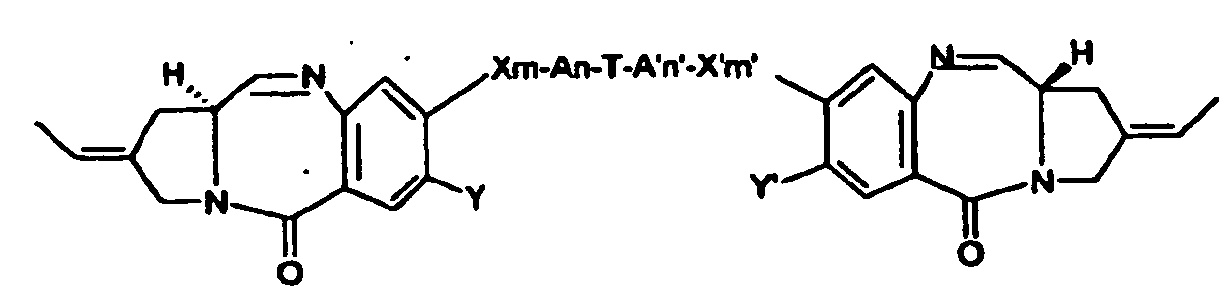

- As used hereabove or hereafter:
- Alk represents alkyl, alkene or alkyne.
- "Alkyl" means an aliphatic hydrocarbon group which may be straight or branched having 1 to 20 carbon atoms in the chain or cyclic having 3 to 10 carbon atom. Preferred alkyl groups have 1 to 12 carbon atoms in the chain. "Branched" means that one or more lower alkyl groups such as methyl, ethyl or propyl are attached to a linear alkyl chain. Exemplary alkyl groups include methyl, ethyl, n-propyl, i-propyl, n-butyl, t-butyl, n-pentyl, 3-pentyl, octyl, nonyl, decyl, cyclopentyl and cyclohexyl.
- "Alkene" means an aliphatic hydrocarbon group containing a carbon-carbon double bond and which may be straight or branched having 2 to 15 carbon atoms in the chain. Preferred alkenyl groups have 2 to 12 carbon atoms in the chain; and more preferably about 2 to 4 carbon atoms in the chain. Exemplary alkenyl groups include ethenyl, propenyl, n-butenyl, i-butenyl, 3-methylbut-2-enyl, n-pentenyl, heptenyl, octenyl, nonenyl, decenyl.
- "Alkyne" means an aliphatic hydrocarbon group containing a carbon-carbon triple bond and which may be straight or branched having 2 to 15 carbon atoms in the chain. Preferred alkynyl groups have 2 to 12 carbon atoms in the chain; and more preferably 2 to 4 carbon atoms in the chain. Exemplary alkynyl groups include ethynyl, propynyl, n-butynyl, 2-butynyl, 3-methylbutynyl, n-pentynyl, heptynyl, octynyl and decynyl.
- "Halogen atom" refers to fluorine, chlorine, bromine or iodine atom; preferably fluorine and chlorine atom.
- "Aryl" means an aromatic monocyclic or multicyclic hydrocarbon ring system of 6 to 14 carbon atoms, preferably of 6 to 10 carbon atoms. Exemplary aryl groups include phenyl or naphthyl.
- "Het" means heterocycle or heteroaryl.
- As used herein, the terms "heterocycle" or "heterocyclic" refer to a saturated, partially unsaturated or unsaturated, non aromatic stable 3 to 14, preferably 5 to 10 membered mono, bi or multicyclic rings wherein at least one member of the ring is a hetero atom. Typically, heteroatoms include, but are not limited to, oxygen, nitrogen, sulfur, selenium, and phosphorus atoms. Preferable heteroatoms are oxygen, nitrogen and sulfur.
- Suitable heterocycles are also disclosed in The Handbook of Chemistry and Physics, 76th Edition, CRC Press, Inc., 1995-1996, p. 2-25 to 2-26, the disclosure of which is hereby incorporated by reference.
- Preferred non aromatic heterocyclic include, but are not limited to pyrrolidinyl, pyrazolidinyl, imidazolidinyl, oxiranyl, tetrahydrofuranyl, dioxolanyl, tetrahydropyranyl, dioxanyl, dioxolanyl, piperidyl, piperazinyl, morpholinyl, pyranyl, imidazolinyl, pyrrolinyl, pyrazolinyl, thiazolidinyl, tetrahydrothiopyranyl, dithianyl, thiomorpholinyl, dihydro-pyranyl, tetrahydropyranyl, dihydropyranyl, tetrahydropyridyl, dihydropyridyl, tetrahydropyrinidinyl, dihydrothiopyranyl, azepanyl, as well as the fused systems resulting from the condensation with a phenyl group.
- As used herein, the term "heteroaryl" or aromatic heterocycles refers to a 5 to 14, preferably 5 to 10 membered aromatic hetero, mono-, bi- or multicyclic ring. Examples include pyrrolyl, pyridyl, pyrazolyl, thienyl, pyrimidinyl, pyrazinyl, tetrazolyl, indolyl, quinolinyl, purinyl, imidazolyl, thienyl, thiazolyl, benzothiazolyl, furanyl, benzofuranyl, 1,2,4-thiadiazolyl, isothiazolyl, triazoyl, tetrazolyl, isoquinolyl, benzothienyl, isobenzofuryl, pyrazolyl, carbazolyl, benzimidazolyl, isoxazolyl, pyridyl-N-oxide, as well as the fused systems resulting from the condensation with a phenyl group.
- "Alkyl", "cycloalkyl", "alkenyl", "alkynyl", "aryl", "heteroaryl", "heterocycle" and the like refer also to the corresponding "alkylene", "cycloalkylene", "alkenylene", "alkynylene", "arylene", "heteroarylene", "heterocyclene" and the likes which are formed by the removal of two hydrogen atoms.
- As used therein, the expression "linkable to a cell binding agent" refers to the tomaymycin derivatives comprising at least one linking group, or a precursor thereof, suitable to bond said derivatives to a cell binding agent; preferred linking groups are thiol or disulfide bonds, or precursors thereof.
- As used therein, the expression "linked to a cell binding agent" refers to the conjugate molecule comprising at least one tomaymycin derivative bound to a cell binding agent via a suitable linking group, or a precursor thereof; preferred linking groups are thiol or disulfide bonds, or precursors thereof.
- As used therein, "precursor" of a given group refers to any group which may lead to that group by any deprotection, chemical modification, or coupling reaction.
- As used herein, the term "patient" refers to either an animal, such as a valuable animal for breeding, company or preservation purposes, or preferably a human or a human child, which is afflicted with, or has the potential to be afflicted with one or more diseases and conditions described herein.
- As used herein, a "therapeutically effective amount" refers to an amount of a compound of the present invention which is effective in preventing, reducing, eliminating, treating or controlling the symptoms of the herein-described diseases and conditions. The term "controlling" is intended to refer to all processes wherein there may be a slowing, interrupting, arresting, or stopping of the progression of the diseases and conditions described herein, but does not necessarily indicate a total elimination of all disease and condition symptoms, and is intended to include prophylactic treatment.
- As used herein, the term "pharmaceutically acceptable" refers to those compounds, materials, excipients, compositions or dosage forms which are, within the scope of sound medical judgment, suitable for contact with the tissues of human beings and animals without excessive toxicity, irritation, allergic response or other problem complications commensurate with a reasonable benefit/risk ratio.
- As used herein, "pharmaceutically acceptable salts" refer to derivatives of the disclosed compounds wherein the parent compound is modified by making acid or base salts thereof. The pharmaceutically acceptable salts include the conventional non-toxic salts or the quaternary ammonium salts of the parent compound formed, for example, from non-toxic inorganic or organic acids. For example, such conventional non-toxic salts include those derived from inorganic acids such as hydrochloric, hydrobromic, sulfuric, sulfamic, phosphoric, nitric and the like; and the salts prepared from organic acids such as acetic, propionic, succinic, tartaric, citric, methanesulfonic, benzenesulfonic, glucoronic, glutamic, benzoic, salicylic, toluenesulfonic, oxalic, fumaric, maleic, lactic and the like. Further addition salts include ammonium salts such as tromethamine, meglumine, epolamine, etc., metal salts such as sodium, potassium, calcium, zinc or magnesium.
- The pharmaceutically acceptable salts of the present invention can be synthesized from the parent compound which contains a basic or acidic moiety by conventional chemical methods. Generally, such salts can be prepared by reacting the free acid or base forms of these compounds with a stoichiometric amount of the appropriate base or acid in water or in an organic solvent, or in a mixture of the two. Generally, non-aqueous media like ether, ethyl acetate, ethanol, isopropanol, or acetonitrile are preferred. Lists of suitable salts are found in Remington's Pharmaceutical Sciences, 17th ed., Mack Publishing Company, Easton, PA, 1985, p. 1418, the disclosure of which is hereby incorporated by reference.
- The compounds of the general formula (I) having geometrical and stereoisomers are also a part of the invention.
- The N-10, C-11 double bond of tomaymycin derivatives of formula (I) is known to be readily convertible in a reversible manner to corresponding imine adducts in the presence of water, an alcohol, a thiol, a primary or secondary amine, urea and other nucleophiles. This process is reversible and can easily regenerate the corresponding tomaymycin derivatives in the presence of a dehydrating agent, in a non-protic organic solvant, in vacuum or at high temperatures (Z. Tozuka, 36, J. Antibiotics, 276 (1983).
- Thus, this invention provides also for reversible derivatives of tomaymycin derivatives of general formula (II):

- Compounds of formula (II) may thus be considered as solvates, including water when the solvent is water; these solvates can be particularly useful.
- According to a still further object, the present invention is also concerned with the process of preparation of the compounds of formula (I).
- The compounds and process of the present invention may be prepared in a number of ways well known to those skilled in the art. The compounds can be synthesized, for example, by application or adaptation of the methods described below, or variations thereon as appreciated by the skilled artisan. The appropriate modifications and substitutions will be readily apparent and well known or readily obtainable from the scientific literature to those skilled in the art.
- In particular, such methods can be found in R.C. Larock, Comprehensive Organic Transformations, Wiley-VCH Publishers, 1999.
- It will be appreciated that the compounds of the present invention may contain one or more asymmetrically substituted carbon atoms, and may be isolated in optically active or racemic forms. Thus, all chiral, diastereomeric, racemic forms and all geometric isomeric forms of a structure are intended, unless the specific stereochemistry or isomeric form is specifically indicated. It is well known in the art how to prepare and isolate such optically active forms. For example, mixtures of stereoisomers may be separated by standard techniques including, but not limited to, resolution of racemic forms, normal, reverse-phase, and chiral chromatography, preferential salt formation, recrystallization, and the like, or by chiral synthesis either from chiral starting materials or by deliberate synthesis of target chiral centers.
- Compounds of the present invention may be prepared by a variety of synthetic routes. The reagents and starting materials are commercially available, or readily synthesized by well-known techniques by one of ordinary skill in the arts. All substituents, unless otherwise indicated, are as previously defined.
- In the reactions described hereinafter, it may be necessary to protect reactive functional groups, for example hydroxy, amino, imino, thio or carboxy groups, where these are desired in the final product, to avoid their unwanted participation in the reactions. Conventional protecting groups may be used in accordance with standard practice, for examples see T.W. Greene and P. G. M. Wuts in Protective Groups in Organic Chemistry, 3rd ed., John Wiley and Sons, 1999; J. F. W. McOmie in Protective Groups in Organic Chemistry, Plenum Press, 1973.
- Some reactions may be carried out in the presence of a base. There is no particular restriction on the nature of the base to be used in this reaction, and any base conventionally used in reactions of this type may equally be used here, provided that it has no adverse effect on other parts of the molecule. Examples of suitable bases include: sodium hydroxide, potassium carbonate, triethylamine, alkali metal hydrides, such as sodium hydride and potassium hydride; alkyllithium compounds, such as methyllithium and butyllithium; and alkali metal alkoxides, such as sodium methoxide and sodium ethoxide.
- Usually, reactions are carried out in a suitable solvent. A variety of solvents may be used, provided that it has no adverse effect on the reaction or on the reagents involved. Examples of suitable solvents include: hydrocarbons, which may be aromatic, aliphatic or cycloaliphatic hydrocarbons, such as hexane, cyclohexane, benzene, toluene and xylene; amides, such as dimethylformamide; alcohols such as ethanol and methanol and ethers, such as diethyl ether and tetrahydrofuran.
- The reactions can take place over a wide range of temperatures. In general, we find it convenient to carry out the reaction at a temperature of from 0°C to 150°C (more preferably from about room temperature to 100°C). The time required for the reaction may also vary widely, depending on many factors, notably the reaction temperature and the nature of the reagents. However, provided that the reaction is effected under the preferred conditions outlined above, a period of from 3 hours to 20 hours will usually suffice.
- The compound thus prepared may be recovered from the reaction mixture by conventional means. For example, the compounds may be recovered by distilling off the solvent from the reaction mixture or, if necessary after distilling off the solvent from the reaction mixture, pouring the residue into water followed by extraction with a water-immiscible organic solvent and distilling off the solvent from the extract. Additionally, the product can, if desired, be further purified by various well known techniques, such as recrystallization, reprecipitation or the various chromatography techniques, notably column chromatography or preparative thin layer chromatography.
- The process of preparation of a compound of formula (I) of the invention is a further object of the present invention.
- According to a first aspect, the process of preparation of the compounds of formula (I) comprises the step of deprotecting corresponding compounds of formula (III):
 are defined as in formula (I) and T' corresponds to T where the functional group(s) has(ve) been protected.
Preferably, the SH function is protected and preferably the protecting group is acetyl, benzoyl, methanesulfonyl, methylthio, pyridylthio, nitropyridylthio, triisopropylsilyl (TIPS). Generally, the deprotection step is carried out using classical conditions such a base to remove the acetyl, benzoyl and methanesulfonyl protective groups, a reducing agent such as dithiothreitol or tris(2-carboxyethyl)phosphine (TCEP) to cleave a methylthio protective group or known by reacting the compounds with an ammonium fluoride to remove the TIPS. - The compounds of formula (II) may be obtained from coupling corresponding compounds of formulae (IV), (IV') and (V):
 , R1, R2, R1', R2' are defined as in formula (III), and Lg is a leaving group such as a halogen or OMs, OTs.
- The compounds of formula (IV) and (IV') are generally known, as disclosed for instance in
patent applications WO 00/12508 WW00/12507 WO 2005/040170 ,WO 2005/085260 ,or commercially available, and/or are available by total synthesis (M. Mori et al, 42 Tetrahedron, 3793-3806, 1986) or produced by Streptomyces species, in particular, followingFrench patent Fr. 1,516,743 - The compounds of formula (V) may be obtained from corresponding compounds of formula (VI) :
HO-An-T'-A'n'-OH (VI)
where A, A', n, n', T' are defined as in formula (III). - This reaction is generally carried out in the presence of PPh3 and CHal4 or by reaction with a chlorosulfonate in the presence of a base such a potassium hydroxide.
- The compounds of formula (VI) may be obtained from corresponding compounds of formula (VII):
HO-An-T"-A'n'-OH (VII)
where A, A', n, n' are defined as in formula (III) and T" is a precursor group of T. A precursor group of T refers to any group which may lead to T by any deprotection, chemical modification, or coupling. Preferably, T is obtained by coupling T' with the complementary portion, where T' and the complementary portion comprise functions which are reactive toeach other, eg. T' comprising an amine function and the complementary portion comprising an acid function. - A representative example for this reaction is :

- Generally, this reaction is carried out in the presence of N-hydroxysuccinimide and HOBT.
- The compounds of formula (VII) may be commercially available or made by adaptation or application of known methods or according to the examples.
- Exemplary non-limiting scheme for this embodiment of the process of the invention is given below:
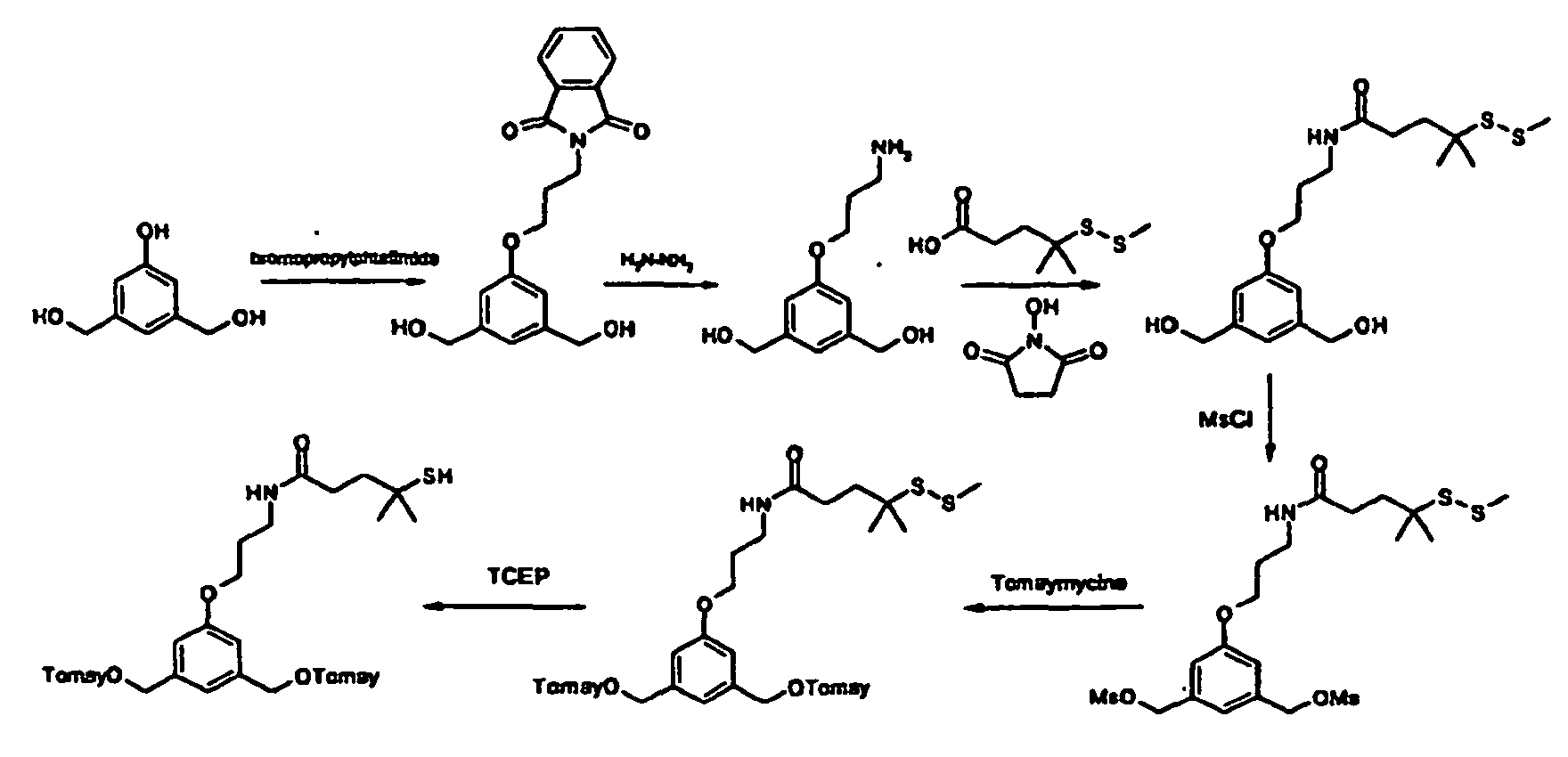
- According to a second aspect, the compound of formula (I) may be obtained from the corresponding compound of formula (III'):
 , R1, R2, R1', R2' are defined as in formula (I) and T" is an optionally protected precursor group of T.
- A precursor group of T refers to any group which may lead to T by chemical modification, or coupling. Preferably, T is obtained by coupling T' with the corresponding complementary portion, where T' and the complementary portion comprise functions which are reactive toeach other, eg. T' comprising an amine function and the complementary portion comprising an acid function.
- A representative example of this reaction is:
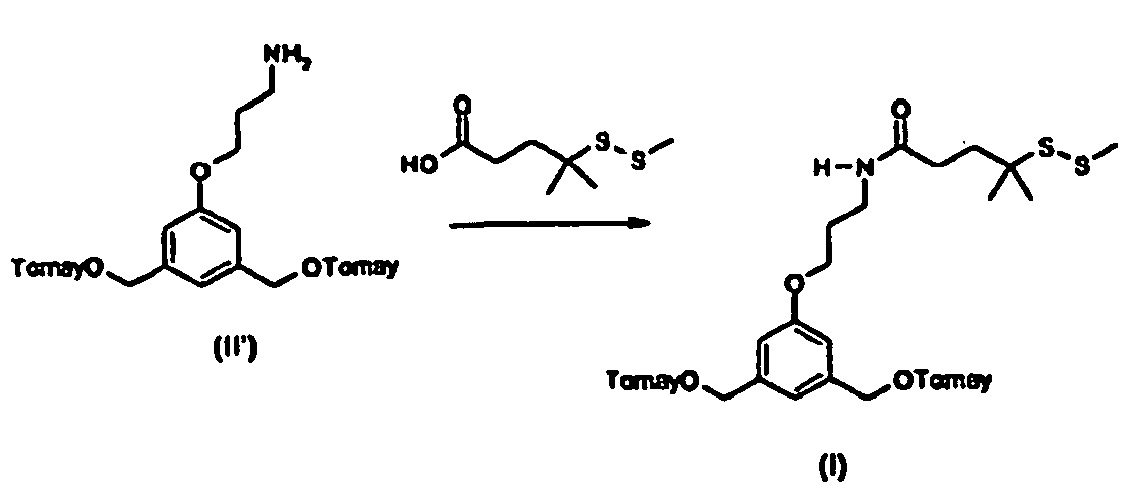

- Generally, this reaction is carried out in the presence of: N-hydroxysuccinimide and HOBT.
- The compound of formula (III') may be obtained from coupling the corresponding compound of formulae (IV), (IV') and (V'):
 , R1, R2, R1', R2' are defined as in formula (III'), T" is an optionally protected precursor group of T and Lg is a leaving group, such as halogen or OMs, OTs.
- The compounds of formula (IV) and (IV') are generally known and are available by total synthesis (M. Mori et al, 42 Tetrahedron, 3793-3806, 1986) or produced by Streptomyces species, in particular, following
French patent Fr. 1,516,743 - The compounds of formula (V') may be obtained from corresponding compounds of formula (VII):
HO-An-T"-A'n'-OH (VII)
where A, A', n, n' are defined as in formula (I), T" is an optionally protected precursor group of T'. - This reaction is generally carried out in the presence of PPh3 and CHal4.
- The compounds of formula (VII) may be commercially available or made by adaptation or application of known methods or according to the examples.
- Exemplary non-limiting scheme for this embodiment of the process of the invention is given below:
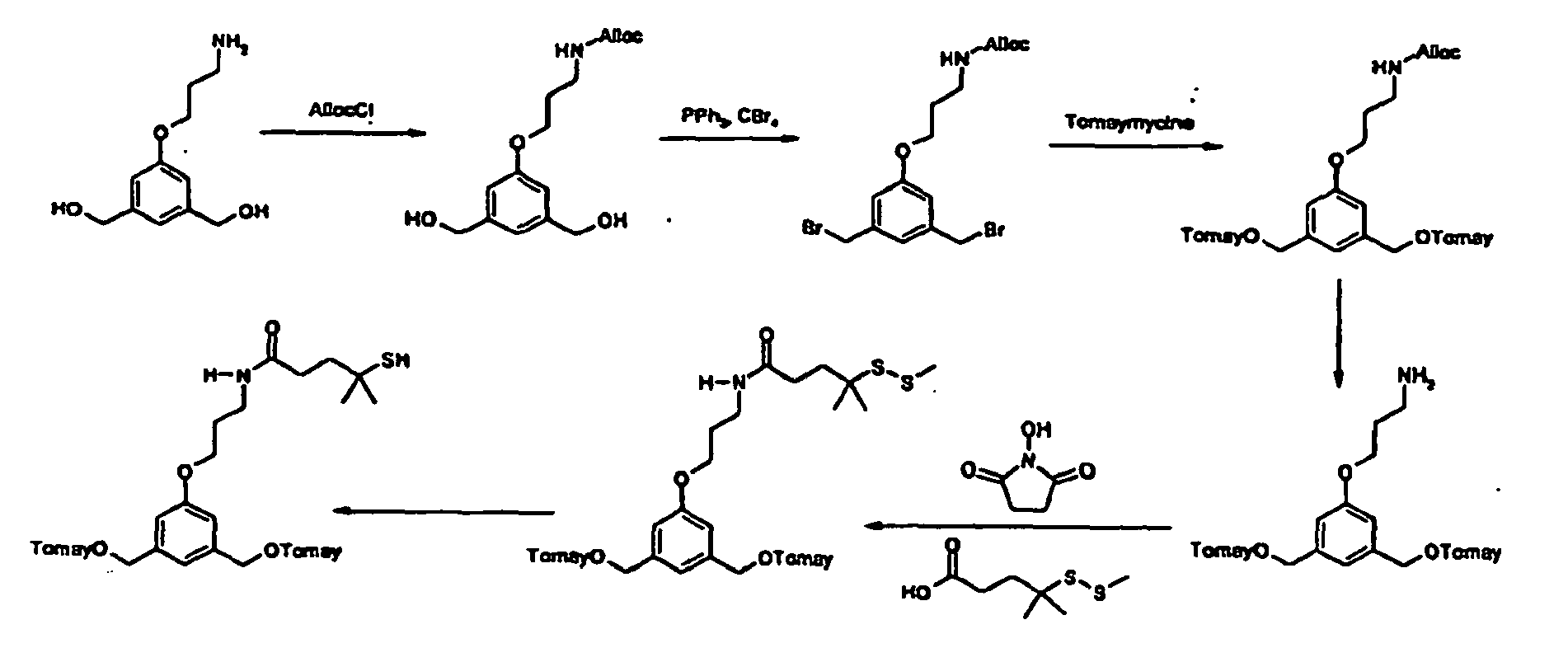
- According to a third aspect, the process of preparation of the compound of formula (I) comprises the step of cyclizing the corresponding compound of formula (VIII):

- The compound of formula (VIII) may be obtained from the corresponding compound of formula (IX):
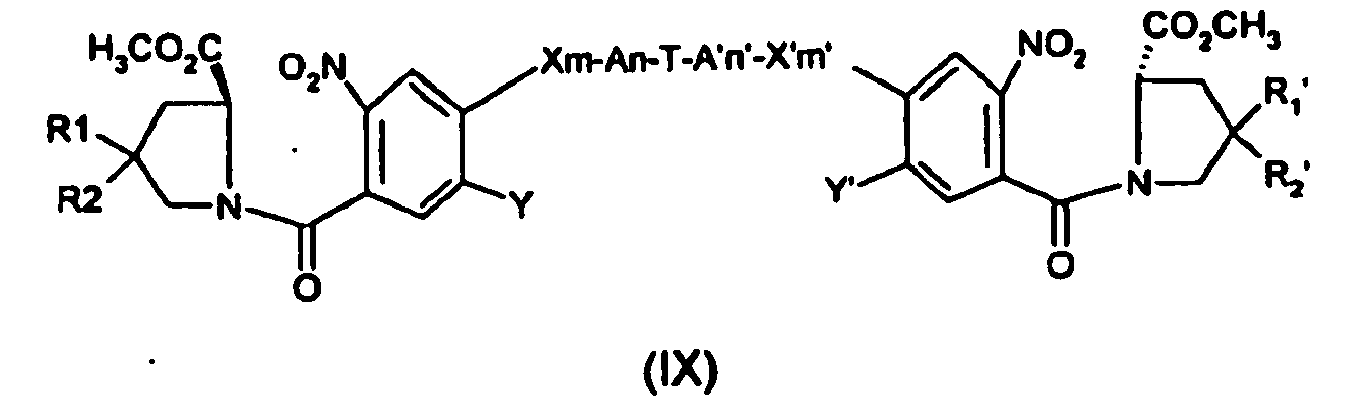
- The compound of formula (IX) may be obtained from coupling the corresponding compounds of formula(X) and (XI):

- A representative scheme is given below:

- The above reactions can be carried out by the skilled person by applying or adapting the methods illustrated in the examples hereinafter.
- Further, the process of the invention may also comprise the additional step of isolating the compound of formula (I) and (II). This can be done by the skilled person by any of the known conventional means, such as the recovery methods described above.
- The starting products are commercially available or may be obtained by applying or adapting any known methods or those described in the examples.
- The synthesis may also be carried out in one pot as a multicomponent reaction.
- According to a further object, the present invention concerns a conjugate molecule comprising at least one tomaymycin derivative covalently bonded to a cell binding agent through a linking group, wherein said tomaymycin derivative is of formula (I'):

- - - - - represents an optional single bond;
- represents either a single bond or a double bond;

- provided that whenrepresents a single bond, U and U', the same or different, independently represent H, and W and W', the same or different, are independently selected from the group consisting of OH, an ether such as -OR, an ester (e.g. an acetate), such as -OCOR, a carbonate such as -OCOOR, a carbamate such as -OCONRR', a cyclic carbamate, such that N10 and C11 are a part of the cycle, a urea such as -NRCONRR', a thiocarbamate such as -OCSNHR, a cyclic thiocarbamate such that N10 and C11 are a part of the cycle, -SH, a sulfide such as -SR, a sulphoxide such as -SOR, a sulfone such as -SOOR, a sulphite such as -SO3, a bisulphite such as -OSO3, a sulfonamide such as -NRSOOR, an amine such as -NRR', optionally cyclic amine such that N10 and C11 are a part of the cycle, a hydroxylamine derivative such as -NROR', an amide such as -NRCOR, an azido such as -N3, a cyano, a halo, a trialkyl or triarylphosphonium. Preferably W and W' are the same or different and are OH, OMe, OEt, NHCONH2, SMe;

- and whenrepresents a double bond, U and U' are absent and W and W' represent H;

- ■ R1, R2, R1', R2' are the same or different and independently chosen from Halide or Alkyl optionally substituted by one or more Hal, CN, NRR', CF3, OR, Aryl, Het, S(O)qR, or R1 and R2 and R1' and R2' form together a double bond containing group =B and =B' respectively.
Preferably, R1= R2= R1'= R2'= H, or more preferably R1 and R2 and R1' and R2' form together a double bond containing group =B and =B' respectively. - ■ B and B' are the same or different and independently chosen from Alkyl being optionally substituted by one or more Hal, CN, NRR', CF3, OR, Aryl, Het, S(O)qR
Preferably, B=B'.
More preferably, B=B'= CH2 or =CH-CH3, - X=X'=O.
- ■ A, A' are the same or different and independently chosen from Alkyl or Alkenyl optionally substituted by one or more Hal, CN, NRR', CF3, OR, S(O)qR, Aryl, Het, Alkyl, Alkenyl.
Preferably, A=A'.
More preferably, A=A'=linear unsubstituted alkyl. - ■ Y, Y' are the same or different and independently chosen from H, OR;
Preferably, Y=Y'.
More preferably, Y=Y'=OAlkyl, more preferably OMethyl. - ■T is NR-, or a 4 to 10-membered aryl or heteroaryl all being optionally substituted by one or more Hal, CN, NRR', CF3, OR, S(O)qR, Alkyl, and substituted by one or more linker.
- Preferably, T is a 4 to 10-membered aryl or heteroaryl, more preferably phenyl or pyridyl substituted by one or more linker(s).
- The conjugate is described in claims 12-15.
- Suitable linking groups are well known in the art and include thiol, sulfide, disulfide groups, thioether groups, acid labile groups, photolabile groups, peptidase labile groups and esterase labile groups. Preferred are disulfide groups and thioether groups.
- When the linking group is a thiol-, sulfide or disulfide-containing group, the side chain carrying the thiol or disulfide group can be linear or branched, aromatic or heterocyclic. One of ordinary skill in the art can readily identify suitable side chains.
- The thiol-, sulfide- or disulfide-containing substituents include
- -(CR13R14)t(CR15R16)u(OCH2CH2)ySZ',
- -(CR13R14)t(CR17=CR18)(CR15R16)y(OCH2CH2)ySZ',
- -(CR13R14)t(NR19CO)(CR15R16)u(OCH2CH2)y SZ',
- -(CR13R14)t(OCO)(R15R16)u(OCH2CH2)ySZ',
- -(CR13R14)t(CO)(CR15R16)u(OCH2CH2)ySZ',
- -(CR13R14)t(CONR19)(CR15R16)u(OCH2CH2)ySZ',
- -(CR13R14)t-phenyl-CO(CR15R16)uSZ', -(CR13R14)t-furyl-CO(CR15R16)uSZ',
- -(CR13R14)t-oxazolyl-CO(CR15R16)uSZ', -(CR13R14)t-thiazolyl-CO(CR15R16)uSZ',
- -(CR13R14)t-thienyl-CO(CR15R16)uSZ', -(CR13R14)t-imidazolyl-CO(CR15R16)uSZ',
- -(CR13R14)t-morpholino-CO(CR15R16)uSZ', -(CR13R14)tpiperazino-
- CO(CR15R16)uSZ', -(CR13R14)t-N-methylpiperazino-CO(CR15R16)uSZ',
- -(CR13R14)t-phenyl-QSZ', -(CR13R14)t-furyl-QSZ', -(CR13R14)t-oxazolyl-QSZ',
- -(CR13R14)t-thiazolyl-QSZ', -(CR13R14)t-thienyl-QSZ', -(CR13R14)t-imidazolyl-
- QSZ', -(CR13R14)t-morpholino-QSZ', -(CR13R14)t-piperazino-QSZ',
- -(CR13R14)t-N-methylpiperazino-QSZ', or
- -O(CR13R14)t(CR15R16)u(OCH2CH2)ySZ',
- -O(CR13R14)t(NR19CO)(CR15R16)u(OCH2CH2)ySZ',
- -O(CR13R14)t (CR17=CR18)(CR15R16)t (OCH2CH2)ySZ',
- -O-phenyl-QSZ', -O-furyl-QSZ', -O-oxazolyl-QSZ', -O-thiazolyl-QSZ',
- -O-thienyl-QSZ', -O-imidazolyl-QSZ', -O-morpholino-QSZ', -O-piperazino-QSZ',
- -O-N-methylpiperazino-QSZ',
- -OCO-(CR13R14)t (CR17=CR18)(CR15R16)u(OCH2CH2)ySZ',
- -OCONR12(CR13R14)t(CR15R16)u (OCH2CH2)ySZ',
- -OCO-phenyl-QSZ', -OCO-furyl-QSZ', -OCO-oxazolyl-QSZ', -OCO-
- thiazolyl-QSZ', -OCO-thienyl-QSZ', -OCO-imidazolyl-QSZ', -OCO-
- morpholino-QSZ', -OCO-piperazino-QSZ', -OCO-N-methylpiperazino-QSZ', or
- -CO(CR13R14)t(CR15R16)u (OCH2CH2)y SZ',
- -CO-(CR13R14)t (CR17=CR18)(CR15R16)u(OCH2CH2)ySZ',
- -CONR12(CR13R14)t(CR15R16)u (OCH2CH2)ySZ',
- -CO-phenyl-QSZ', -CO-furyl-QSZ', -CO-oxazolyl-QSZ', -CO-thiazolyl-QSZ',
- -CO-thienyl-QSZ', -CO-imidazolyl-QSZ', -CO-morpholino-QSZ', -CO-
- piperazino-QSZ', -CO-piperidino-QSZ', -CO-N-methylpiperazino-QSZ',
- -NR19(CR13R14)t(CR15R16)u(OCH2CH2)ySZ',
- - NR19CO(CR13R14)t(CR15R16)u(OCH2CH2)ySZ',
- -NR19(CR13R14)t (CR17=CR18)(CR15R16)t (OCH2CH2)ySZ',
- -NR19CO(CR13R14)t (CR17=CR18)(CR15R16)t (OCH2CH2)ySZ',
- -NR19CONR12(CR13R14)t(CR15R16)u (OCH2CH2)ySZ',
- -NR19CO NR12 (CR13R14)t (CR17=CR18)(CR15R16)t (OCH2CH2)ySZ',
- -NR19CO-phenyl-QSZ', -NR19CO-furyl-QSZ', -NR19CO-oxazolyl-QSZ',
- -NR19CO-thiazolyl-QSZ', -NR19CO-thienyl-QSZ', -NR19CO-imidazolyl-QSZ',
- -NR19CO-morpholino-QSZ', -NR19CO-piperazino-QSZ', -NR19CO-
- piperidino-QSZ', -NR19CO-N-methylpiperazino-QSZ',
- -NR19-phenyl-QSZ', -NR19-furyl-QSZ', -NR19-oxazolyl-QSZ', -NR19-
- thiazolyl-QSZ', -NR19-thienyl-QSZ', -NR19-imidazolyl-QSZ', -NR19-
- morpholino-QSZ', -NR19-piperazino-QSZ', -NR19-piperidino-QSZ',
- -NR19-N-methylpiperazino-QSZ',
- -NR19CO-NR12-phenyl-QSZ', -NR19CO-NR12-oxazolyl-QSZ', -NR19CO-NR12-
- thiazolyl-QSZ', -NR19CO-NR12-thienyl-QSZ', -NR19CO-NR12-piperidino-QSZ',
- -S(O)q(CR13R14)t(CR15R16)u(OCH2CH2)ySZ',
- -S(O)q(CR13R14)t(CR17=CR18)(CR15R16)t(OCH2CH2)ySZ',
- -SCONR12(CR13R14)tCR15R16)u (OCH2CH2)ySZ',
- -SCO-morpholino-QSZ', -SCO-piperazino-QSZ', -SCO-piperidino-QSZ', and
- -SCO-N-methylpiperazino-QSZ', wherein:
- Z' is H, a thiol protecting group such as Ac, R19' or SR19',
wherein Q is a direct link or a linear alkyl or branched alkyl having from 1-10 carbon atoms or a polyethylene glycol spacer with 2 to 20 repeating ethylene oxy units; - R19' and R12 are the same or different and are linear alkyl, branched alkyl or cyclic alkyl having from 1 to 10 carbon atoms, or simple or substituted aryl or heterocyclic, and R12 can in addition be H,
- R13, R14, R15 and R16 are the same or different and are H or a linear or branched alkyl having from 1 to 4 carbon atoms,
- R17, R18 and R19 are H or alkyl,
- u is an integer from 1 to 10 and can also be 0,
- t is an integer from 1 to 10 and can also be 0,
- y is an integer from 1 to 20 and can also be 0.
- ■ n, n', equal or different are 0 or 1. and n=n'=1.
- ■ q is 0, 1 or 2.
- R, R' are equal or different and independently chosen from H, Alkyl, Aryl, optionally substituted by Hal, CN, NRR', CF3, OR, Aryl, Het;
or their pharmaceutically acceptable salts, hydrates, or hydrated salts, or the polymorphic crystalline structures of these compounds or their optical isomers, racemates, diastereomers or enantiomers,
said derivative being covalently bonded to a cell binding agent through said linker. - In particular, n=n'=1.
- Cell binding agents may be of any kind and include peptides and non-peptides. Generally, these can be antibodies (especially monoclonal antibodies) or a fragment of an antibody that contains at least one binding site, lymphokines, hormones, growth factors, nutrient-transport molecules (such as transferrin), or any other cell binding molecule or substance. More specific examples of cell binding agents that can be used include: monoclonal antibodies; single chain antibodies; fragments of antibodies such as Fab, Fab', F(ab')2 and Fv {Parham, 131 J. Immunol. 2895-2902 (1983); Spring et al, 113 J. Immunol. 470-478 (1974); Nisonoff et al, 89 Arch. Biochem. Biophys. 230-244 (1960)}; interferons; peptides; lymphokines such as IL-2, IL-3, IL-4, IL-6; hormones such as insulin, TRH (thyrotropin releasing hormones), MSH (melanocyte-stimulating hormone), steroid hormones, such as androgens and estrogens; growth factors and colony-stimulating factors such as EGF, TGFα, insulin like growth factor (IGF-I, IGF-II) G-CSF, M-CSF and GM-CSF { Burgess, 5 Immunology Today 155-158 (1984)}; vitamins, such as folate and transferrin {O'Keefe et al, 260 J. Biol. Chem. 932-937 (1985)}.
- Monoclonal antibody technology permits the production of extremely selective cell binding agents in the form of specific monoclonal antibodies. Particularly well known in the art are techniques for creating monoclonal antibodies produced by immunizing mice, rats, hamsters or any other mammal with the antigen of interest such as the intact target cell, antigens isolated from the target cell, whole virus, attenuated whole virus, and viral proteins such as viral coat proteins.
- Selection of the appropriate cell binding agent is a matter of choice that depends upon the particular cell population that is to be targeted, but in general monoclonal antibodies are preferred if an appropriate one is available.
- For example, the monoclonal antibody MY9 is a murine IgG1 antibody that binds specifically to the CD33 Antigen {J.D. Griffin et al 8 Leukemia Res., 521 (1984)} and can be used if the target cells express CD33 as in the disease of acute myelogenous leukemia (AML). Similarly, the monoclonal antibody anti-B4 is a murine IgG1, that binds to the CD19 antigen on B cells {Nadler et al, 131 J. Immunol. 244-250 (1983)} and can be used if the target cells are B cells or diseased cells that express this antigen such as in non-Hodgkin's lymphoma or chronic lymphoblastic leukemia.
- Additionally, GM-CSF which binds to myeloid cells can be used as a cell binding agent to diseased cells from acute myelogenous leukemia. IL-2, which binds to activated T-cells, can be used for prevention of transplant graft rejection, for therapy and prevention of graft-versus-host disease, and for the treatment of acute T-cell leukemia. MSH, which binds to melanocytes, can be used for the treatment of melanoma.
- The conjugate molecules of the invention may be formed using any techniques. Preferably, the derivatives are synthesized to contain a free or protected thiol group, and then one or more disulfide or thiol-containing derivatives are each covalently linked to the cell binding agent via a disulfide bond or a thioether link.
- Numerous methods of conjugation are taught in
USP 5,416,064 andUSP 5,475,092 . Most preferably, the tomaymycin derivatives are treated to create a free or protected thiol group, and then the disulfide- or thiol-containing tomaymycin dimers are linked to the cell binding agent via disulfide bonds. - Representative conjugates of the invention are antibody-tomaymycin derivative, antibody fragment-tomaymycin derivative epidermal growth factor (EGF)-tomaymycin derivative, melanocyte stimulating hormone (MSH)-tomaymycin derivative, thyroid stimulating hormone (TSH)-tomaymycin derivative, estrogen-tomaymycin derivative, estrogen analogue-tomaymycin derivative, androgen-tomaymycin derivative, androgen analogue-tomaymycin derivative, and folate-tomaymycin derivative.
- Tomaymycin derivative conjugates of antibodies, antibody fragments, protein or peptide hormones, protein or peptide growth factors and other proteins are made in the same way by known methods. For example, peptides and antibodies can be modified with cross linking reagents such as N-succinimidyl 3-(2-pyridyldithio)propionate, N-succinimidyl 4-(2-pyridyldithio)pentanoate (SPP), 4-succinimidyl-oxycarbonyl-α-methyl-α-(2-pyridyl dithio)-toluene (SMPT), N-succinimidyl-3-(2-pyridyldithio) butyrate (SDPB), N-sulfosuccinimidyl-3-(2-(5-nitropyridyldithio) butyrate (SSNPB), 2-iminothiolane, or S-acetylsuccinic anhydride by known methods. See, Carlsson et al, 173 Biochem. J. 723-737 (1978); Blattler et al, 24 Biochem. 1517-1524 (1985); Lambert et al, 22 Biochem. 3913-3920 (1983); Klotz et al, 96 Arch. Biochem. Biophys. 605 (1962); and Liu et al, 18 Biochem. 690 (1979), Blakey and Thorpe, 1 Antibody, Immunoconjugates & Radiopharmaceuticals, 1-16 (1988), Worrell et al 1 Anti-Cancer Drug Design 179-184 (1986). The free or protected thiol-containing cell binding agent thus derived is then reacted with a disulfide- or thiol-containing tomaymycin derivative to produce conjugates. The conjugates can be purified by HPLC or by gel filtration.
- Preferably, monoclonal antibody- or cell binding agent-tomaymycin derivative conjugates are those that are joined via a disulfide bond, as discussed above, that are capable of delivering tomaymycin derivatives. Such cell binding conjugates are prepared by known methods such as by modifying monoclonal antibodies with succinimidyl pyridyl-dithiopropionate (SPDP) (Carlsson et al, 173 Biochem. J. 723-737 (1978)). The resulting thiopyridyl group is then displaced by treatment with thiol-containing tomaymycin derivatives to produce disulfide linked conjugates. Alternatively, in the case of the aryldithio- tomaymycin derivatives, the formation of the cell binding conjugate is effected by direct displacement of the aryl-thiol of the tomaymycin derivative by sulfhydryl groups previously introduced into antibody molecules. Conjugates containing 1 to 10 tomaymycin derivative drugs linked via a disulfide bridge are readily prepared by either method.
- More specifically, a solution of the dithio-nitropyridyl modified antibody at a concentration of 2.5 mg/ml in 0.05 M potassium phosphate buffer, at pH 7.5 containing 2 mM EDTA is treated with the thiol-containing tomaymycin derivative (1.3 molar eq./dithiopyridyl group). The release of thio-nitropyridine from the modified antibody is monitored spectrophotometrically at 325 nm and is complete in about 16 hours. The antibody-tomaymycin derivative conjugate is purified and freed of unreacted drug and other low molecular weight material by gel filtration through a column of Sephadex G-25 or Sephacryl S300. The number of tomaymycin derivative moieties bound per antibody molecule can be determined by measuring the ratio of the absorbance at 230 nm and 275 nm. An average of 1-10 tomaymycin derivative molecules/antibody molecule can be linked via disulfide bonds by this method.
- The effect of conjugation on binding affinity towards the antigen-expressing cells can be determined using the methods previously described by Liu et al., 93 Proc. Natl. Acad. Sci 8618-8623 (1996). Cytotoxicity of the tomaymycin derivatives and their antibody conjugates to cell lines can be measured by back-extrapolation of cell proliferation curves as described in Goldmacher et al, 135 J. Immunol. 3648-3651 (1985). Cytotoxicity of these compounds to adherent cell lines can be determined by clonogenic assays as described in Goldmacher et al, 102 J. Cell Biol. 1312-1319 (1986).
- Representative conjugates of the invention are conjugates of tomaymycin derivatives with antibodies, antibody fragments, epidermal growth factor (EGF), melanocyte stimulating hormone (MSH), thyroid stimulating hormone (TSH), estrogen, estrogen analogs, androgen, and androgen analogs.
- Representative examples of the preparation of various conjugates of derivatives and cell binding agents are described below.
- Disulfide linkers: For example, the monoclonal antibody MY9 is a murine IgG1 antibody that binds specifically to the CD33 Antigen {J.D. Griffin et al 8 Leukemia Res., 521 (1984)} and can be used if the target cells express CD33 as in the disease of acute myelogenous leukemia (AML). Similarly, the monoclonal antibody anti-B4 is a murine IgG1, that binds to the CD19 antigen on B cells {Nadler et al, 131 J. lmmunol. 244-250 (1983)} and can be used if the target cells are B cells or diseased cells that express this antigen such as in non-Hodgkin's lymphoma or chronic lymphoblastic leukemia.
- Additionally, GM-CSF which binds to myeloid cells can be used as a cell binding agent to diseased cells from acute myelogenous leukemia. IL-2, which binds to activated T-cells, can be used for prevention of transplant graft rejection, for therapy and prevention of graft-versus-host disease, and for the treatment of acute T-cell leukemia. MSH, which binds to melanocytes, can be used for the treatment of melanoma.
- The antibody or other cell binding agent is modified with N-succinimidyl-3-pyridyldithio propionate as previously described {J. Carlsson, H. Drevin & R. Axen, Biochem. J., 173:723 (1978)} to introduce, on the average, 4 pyridyldithio groups per antibody molecule. The modified antibody is reacted with the thiol-containing derivative to produce a disulfide-linked conjugate.
- Alternatively, the conjugates may be prepared by application and/or adaptation of the method disclosed in
WO2004/103272 . - Thioether linkers: Thiol-containing derivatives of the present invention can be linked to antibodies and other cell binding agents via a thioether link as previously described (
U.S. Pat No. 5,208,020 ). The antibiody or other cell binding agent can be modified with the commercially available compound such as N-succinimidyl 4-(maleimidomethyl)cyclohexanecarboxylate (SMCC), N-succinimidyl-4-(N-maleimidomethyl)-cyclohexane-1-carboxy-(6-amidocaproate), which is a "long chain" analog of SMCC (LC-SMCC), These crosslinking reagents form non-cleavable linkers derived from maleimido-based moieties. - Crosslinking reagents comprising a haloacetyl-based moiety include N-succinimidyl-4-(iodoacetyl)-aminobenzoate (SIAB), N-succinimidyl iodoacetate (SIA), N-succinimidyl bromoacetate (SBA) and N-succinimidyl 3-(bromo-acetamido)propionate (SBAP). These crosslinking reagents form non-cleavable linkers derived from haloacetyl-based moieties.
- .
- The conjugates made by the above methods can be purified by standard chromatography techniques such as size-exclusion, adsorption chromatography including, but not limited to, ion exchange, hydrophobic interaction chromatography, affinity chromatography, chromatography on ceramic hydroxyapatite or on Porapak, or by HPLC. Purification by dialysis or diafiltration may also be used.
- Preferably, conjugates between monoclonal antibodies or cell binding agents and derivatives of the present invention are those that are joined via a disulfide bond, as discussed above. Such cell binding conjugates are prepared by known methods such as modifying monoclonal antibodies with succinimidyl pyridyl-dithiopropionate (SPDP) {Carlsson et al, 173 Biochem. J. 723-737 (1978)}. The resulting thiopyridyl group is then displaced by treatment with thiol containing derivative to produce disulfide linked conjugates. Conjugates containing 1 to 10 derivatives linked via a disulfide bridge are readily prepared by this method. Conjugation by this method is fully described in
U.S. Patent 5,585,499 , which is incorporated by reference. - According to a preferred aspect, the cell binding agent is an antibody, in particular a monoclonal antibody.
- According to another preferred aspect, the cell binding agent is an antigen specific antibody fragment, such as sFV, Fab, Fab', or F(ab')2.
- According to a further object, the present invention also concerns pharmaceutical compositions comprising a conjugate molecule of the invention or a compound of formula (I) as defined above together with a pharmaceutically acceptable carrier.
- According to a further object, the present invention also concerns a method of killing or inhibiting growth of cells, preferably selected cell populations comprising contacting target cells or tissue containing target cells with an effective amount of the pharmaceutical composition according to the invention.
- The selected cell population are those cancerous and/or proliferative cells.
- According to the present invention, "selective treatment of cancer" refers to killing cancerous and/or proliverative cells substantially without killing normal and/or non-proliferative cells.
- According to a further object, the present invention also concerns the use of a conjugate molecule of the invention or a compound of formula (I) as defined above for the preparation of a medicament for treating cancer.
- The method for inhibiting the growth of selected cell populations can be practiced in vitro or ex vivo.
- Examples of in vitro uses include treatments of cell cultures in order to kill all cells except for desired variants that do not express the target antigen; or to kill variants that express undesired antigen.
- The conditions of non-clinical in vitro use are readily determined by the skilled artisan.
- Examples of ex vivo uses include treatments of autologous bone marrow prior to their transplant into the same patient in order to kill diseased or malignant cells: treatments of bone marrow prior to their transplantation in order to kill competent T cells and prevent graft-versus-host-disease (GVHD).
- Clinical ex vivo treatment to remove tumor cells or lymphoid cells from bone marrow prior to autologous transplantation in cancer treatment or in treatment of autoimmune disease, or to remove T cells and other lymphoid cells from allogeneic bone marrow or tissue prior to transplant in order to prevent GVHD, can be carried out as follows. Bone marrow is harvested from the patient or other individual and then incubated in medium containing serum to which is added the cytotoxic agent of the invention, concentrations range from about 10 µM to 1 pM, for about 30 minutes to about 48 hours at about 37 °C. The exact conditions of concentration and time of incubation (=dose) are readily determined by the skilled artisan. After incubation the bone marrow cells are washed with medium containing serum and returned to the patient by i.v. infusion according to known methods. In circumstances where the patient receives other treatment such as a course of ablative chemotherapy or total-body irradiation between the time of harvest of the marrow and reinfusion of the treated cells, the treated marrow cells are stored frozen in liquid nitrogen using standard medical equipment.
- For clinical in vivo use, the cytotoxic agent of the invention will be supplied as solutions that are tested for sterility and for endotoxin levels or as a lyophilized solid that can be redisolved in sterile water for injection. Examples of suitable protocols of conjugate administration are as follows. Conjugates are given weekly for 6 weeks as an i.v. bolus. Bolus doses are given in 50 to 400 ml of normal saline to which human serum albumin (e.g. 0.5 to 1 mL of a concentrated solution of human serum albumin, 100 mg/mL) can be added. Dosages will be about 50 µg to 10 mg/kg of body weight per week, i.v. (range of 10 µg to 100 mg/kg per injection). Six weeks after treatment, the patient may receive a second course of treatment. Specific clinical protocols with regard to route of administration, excipients, diluents, dosages, times, etc., can be determined by the skilled artisan as the clinical situation warrants.
- Examples of medical conditions that can be treated according to the in vivo or ex vivo methods of killing selected cell populations include malignancy of any type including, for example, cancer of the lung, breast, colon, prostate, kidney, pancreas, ovary, and lymphatic organs; melanomas; autoimmune diseases, such as systemic lupus, rheumatoid arthritis, and multiple sclerosis; graft rejections, such as renal transplant rejection, liver transplant rejection, lung transplant rejection, cardiac transplant rejection, and bone marrow transplant rejection; graft versus host disease; viral infections, such as CMV infection, HIV infection, AIDS, etc.; bacterial infection; and parasite infections, such as giardiasis, amoebiasis, schistosomiasis, and others as determined by one skilled in the art.
- The identification of those subjects who are in need of treatment of herein-described diseases and conditions is well within the ability and knowledge of one skilled in the art. A veterinarian or a physician skilled in the art can readily identify, by the use of clinical tests, physical examination, medical/family history or biological and diagnostic tests, those subjects who are in need of such treatment.
- A therapeutically effective amount can be readily determined by the attending diagnostician, as one skilled in the art, by the use of conventional techniques and by observing results obtained under analogous circumstances. In determining the therapeutically effective amount, a number of factors are considered by the attending diagnostician, including, but not limited to: the species of subject; its size, age, and general health; the specific disease involved; the degree of involvement or the severity of the disease; the response of the individual subject; the particular compound administered; the mode of administration; the bioavailability characteristic of the preparation administered; the dose regimen selected; the use of concomitant medication; and other relevant circumstances.
- The amount of a compound of formula (I) or conjugate, which is required to achieve the desired biological effect, will vary depending upon a number of factors, including the chemical characteristics (e.g. hydrophobicity) of the compounds employed, the potency of the compounds, the type of disease, the species to which the patient belongs, the diseased state of the patient, the route of administration, the bioavailability of the compound by the chosen route, all factors which dictate the required dose amounts, delivery and regimen to be administered.
- "Pharmaceutically" or "pharmaceutically acceptable" refer to molecular entities and compositions that do not produce an adverse, allergic or other untoward reaction when administered to an animal, or a human, as appropriate.
- As used herein, "pharmaceutically acceptable excipient" includes any carriers, diluents, adjuvants, or vehicles, such as preserving or antioxidant agents, fillers, disintegrating agents, wetting agents, emulsifying agents, suspending agents, solvents, dispersion media, coatings, antibacterial and antifungal agents, isotonic and absorption delaying agents and the like. The use of such media and agents for pharmaceutical active substances is well known in the art. Except insofar as any conventional media or agent is incompatible with the active ingredient, its use in the therapeutic compositions is contemplated. Supplementary active ingredients can also be incorporated into the compositions as suitable therapeutic combinations.
- In the context of the invention, the term "treating" or "treatment", as used herein, means reversing, alleviating, inhibiting the progress of, or preventing the disorder or condition to which such term applies, or one or more symptoms of such disorder or condition.
- "Therapeutically effective amount" means an amount of a compound/ medicament according to the present invention effective in preventing or treating the herein referred pathological condition.
- According to the invention, the term "patient", or "patient in need thereof', is intended for an animal or a human being affected or likely to be affected with the herein referred pathological condition. Preferably, the patient is human.
- In general terms, the compounds of this invention may be provided in an aqueous physiological buffer solution containing 0.1 to 10 % w/v compound for parenteral administration. Typical dose ranges are from 1 µg/kg to 0.1 g/kg of body weight per day; a preferred dose range is from 0.01 mg/kg to 10 mg/kg of body weight per day or an equivalent dose in a human child. The preferred dosage of drug to be administered is likely to depend on such variables as the type and extent of progression of the disease or disorder, the overall health status of the particular patient, the relative biological efficacy of the compound selected, the formulation of the compound, the route of administration (intravenous, intramuscular, or other), the pharmacokinetic properties of the compound by the chosen delivery route, and the speed (bolus or continuous infusion) and schedule of administrations (number of repetitions in a given period of time).
- The compounds of the present invention are also capable of being administered in unit dose forms, wherein the term "unit dose" means a single dose which is capable of being administered to a patient, and which can be readily handled and packaged, remaining as a physically and chemically stable unit dose comprising either the active compound itself, or as a pharmaceutically acceptable composition, as described hereinafter. As such, typical total daily dose ranges are from 0.01 to 100 mg/kg of body weight. By way of general guidance, unit doses for humans range from 1 mg to 3000 mg per day. Preferably the unit dose range is from 1 to 500 mg administered one to six times a day, and even more preferably from 10 mg to 500 mg, once a day. Compounds provided herein can be formulated into pharmaceutical compositions by admixture with one or more pharmaceutically acceptable excipients. Such unit dose compositions may be prepared for use by oral administration, particularly in the form of tablets, simple capsules or soft gel capsules; or intranasally, particularly in the form of powders, nasal drops, or aerosols; or dermally, for example, topically in ointments, creams, lotions, gels or sprays, or via trans-dermal patches.
- The compositions may conveniently be administered in unit dosage form and may be prepared by any of the methods well known in the pharmaceutical art, for example, as described in Remington: The Science and Practice of Pharmacy, 20th ed.; Gennaro, A. R., Ed.; Lippincott Williams & Wilkins: Philadelphia, PA, 2000.
- Preferred formulations include pharmaceutical compositions in which a compound of the present invention is formulated for oral or parenteral administration.
- For oral administration, tablets, pills, powders, capsules, troches and the like can contain one or more of any of the following ingredients, or compounds of a similar nature: a binder such as microcrystalline cellulose, or gum tragacanth; a diluent such as starch or lactose; a disintegrant such as starch and cellulose derivatives; a lubricant such as magnesium stearate; a glidant such as colloidal silicon dioxide; a sweetening agent such as sucrose or saccharin; or a flavoring agent such as peppermint, or methyl salicylate. Capsules can be in the form of a hard capsule or soft capsule, which are generally made from gelatin blends optionally blended with plasticizers, as well as a starch capsule. In addition, dosage unit forms can contain various other materials that modify the physical form of the dosage unit, for example, coatings of sugar, shellac, or enteric agents. Other oral dosage forms syrup or elixir may contain sweetening agents, preservatives, dyes, colorings, and flavorings. In addition, the active compounds may be incorporated into fast dissolve, modified-release or sustained-release preparations and formulations, and wherein such sustained-release formulations are preferably bimodal. Preferred tablets contain lactose, cornstarch, magnesium silicate, croscarmellose sodium, povidone, magnesium stearate, or talc in any combination.
- Liquid preparations for parenteral administration include sterile aqueous or non-aqueous solutions, suspensions, and emulsions. The liquid compositions may also include binders, buffers, preservatives, chelating agents, sweetening, flavoring and coloring agents, and the like. Non-aqueous solvents include alcohols, propylene glycol, polyethylene glycol, vegetable oils such as olive oil, and organic esters such as ethyl oleate. Aqueous carriers include mixtures of alcohols and water, buffered media, and saline. In particular, biocompatible, biodegradable lactide polymer, lactide/glycolide copolymer, or polyoxyethylene-polyoxypropylene copolymers may be useful excipients to control the release of the active compounds. Intravenous vehicles can include fluid and nutrient replenishers, electrolyte replenishers, such as those based on Ringer's dextrose, and the like. Other potentially useful parenteral delivery systems for these active compounds include ethylene-vinyl acetate copolymer particles, osmotic pumps, implantable infusion systems, and liposomes.
- Alternative modes of administration include formulations for inhalation, which include such means as dry powder, aerosol, or drops. They may be aqueous solutions containing, for example, polyoxyethylene-9-lauryl ether, glycocholate and deoxycholate, or oily solutions for administration in the form of nasal drops, or as a gel to be applied intranasally. Formulations for buccal administration include, for example, lozenges or pastilles and may also include a flavored base, such as sucrose or acacia, and other excipients such as glycocholate. Formulations suitable for rectal administration are preferably presented as unit-dose suppositories, with a solid based carrier, such as cocoa butter, and may include a salicylate. Formulations for topical application to the skin preferably take the form of an ointment, cream, lotion, paste, gel, spray, aerosol, or oil. Carriers which can be used include petroleum jelly, lanolin, polyethylene glycols, alcohols, or their combinations. Formulations suitable for transdermal administration can be presented as discrete patches and can be lipophilic emulsions or buffered, aqueous solutions, dissolved and/or dispersed in a polymer or an adhesive.
- The invention is further illustrated but not restricted by the description in the following examples.
- A Micromass MassLynx software is used and the analysis is performed on a Agilent 1100 series HPLC with a THERMO Hypersil Gold C18 3µm column (50 x 3 mm) using gradient elution with a mixture of (A) acetonitrile and (B) water / 0.1% formic acid (gradient: 5% A : 95% B up to 95% A : 5% B over 5 minutes, 95% A : 5% B for 0.5 minutes, 95% A : 5% B down to 5% A : 95% B over 1 minute, 5% A : 95% B for 0.5 minutes) with a 0.8 mL/minute flow rate ; Waters-Micromass Platform I, Platform II or ZQ spectrometer with Electrospray (positive and negative ionisation) ; in line Diode Array (190-490 nm) ; auxiliary detector Sedere (France) Model SEDEX 65 Evaporative Light Scattering (ELS) detector.
- A Micromass MassLynx software is used and the analysis is performed on a Waters Alliance HPLC with a WATERS XBridge C18 3,5 µm column (100 x 3 mm) using gradient elution with a mixture of (A) methanol and (B) water / 0.1 % formic acid (gradient : 5% A : 95% B up to 95% A : 5% B over 10 minutes, 95% A : 5% B down to 5% A : 95% B over 1 minute, 5% A : 95% B for 2 minutes) with a 1.1 mL/minute flow rate ; Waters-Micromass Platform II spectrometer with Electrospray (positive and negative ionisation) ; in line Diode Array (190-500 nm) ; auxiliary detector Sedere (France) Model SEDEX 85 Evaporative Light Scattering (ELS) detector.
- HPLC purification was performed on a Macherey Nagel Nucleodur C18 Gravity 5µM column (21x100 mm, catalogue number 762101), eluting with a mixture of (A) acetonitrile and (B) water (gradient : 5% A : 95% B for 5 minutes, 5% A : 95% B up to 100% A over 20 minutes, 100% A for 8 minutes, 100% A to 5% A : 95% B over 1 minute, 5% A : 95% B for 11 minutes) with a 15 mL/minute flow rate (Method B1) or 20 mL/minute (Method B2).
- EI mass spectra were recorded using a Finnigan SSQ 7000 mass spectrometer (EI mode: 70 eV, source temperature = 150°C, direct introduction)
- CI mass spectra were recorded using a Finnigan SSQ 7000 mass spectrometer (ammonia)
- 1H NMR spectra were recorded on either a Bruker Avance Drx-500, A Bruker Avance Drx-400 or A Bruker Avance DRX-300 spectrometer.
-

- Potassium carbonate (22.8 mg), α,α'-dibromo-m-xylene (7.3 mg) and potassium iodide (9.1 mg) were added to a stirred solution of tomaymycine (15 mg) in dimethylformamide (0.5 mL). The reaction was stirred for 20 h at 30°C.
- Solids were filtered off, washed twice with dimethylformamide (0.2 mL) then discarded. Water (0.4 mL) was added to the combined dimethylformamide solution and the resulting solution was injected for HPLC purification according to method B1. The appropriate fractions were combined and concentrated by centrifugal evaporation over a Jouan Model RC10.10. apparatus to afford 8,8'-[1,3-benzenediylbis(methyleneoxy)]-bis[(S)-2-eth-(E)-ylidene-7-methoxy-1,2,3,11 a-tetrahydro-5H-pyrrolo[2,1-c][1,4]benzodiazepin-5-one] as a white powder (3.33 mg):
LC/MS (Method A1, Platform II) : ES : m/z=647 MH+ Retention time = 3.53 minutes - 1H N.M.R. (500 MHz, CDCl3-d1, δ in ppm) : 1,75 (d, J = 7,0 Hz, 6H) ; 2,96 (m, 4H) ; 3,89 (m, 2H) ; 3,96 (s, 6H) ; 4,27 (s broad, 4H) ; 5,17 (d, J = 12,5 Hz, 2H) ; 5,23 (d, J = 12,5 Hz, 2H) ; 5,60 (m, 2H) ; 6,85 (s, 2H) ; from 7,36 to 7,43 (m, 3H); 7, 51 (s broad, 1 H) ; 7,53 (s, 2H) ; 7,63 (d, J = 4,5 Hz, 2H).
-

- 8,8'-[5-methoxy-1,3-benzenediylbis(methyleneoxy)]-bis[(S)-2-eth-(E)-ylidene-7-methoxy-1,2,3,11a-tetrahydro-5H-pyrrolo[2,1-c][1,4]benzodiazepin-5-one] may be prepared following the procedure for the preparation of 8,8'-[1,3-benzenediylbis(methyleneoxy)]-bis[(S)-2-eth-(E)-ylidene-7-methoxy-1,2,3,11 a-tetrahydro-5H-pyrrolo[2,1-c][1,4]benzodiazepin-5-one] (Example 1), starting with 1,3-bis-bromomethyl-5-methoxy-benzene :
LC/MS (Method A1, Platform II): ES : m/z=677 MH+ Retention time = 4.17 minutes - 1,3-bis-bromomethyl-5-methoxy-benzene may be prepared as follows :
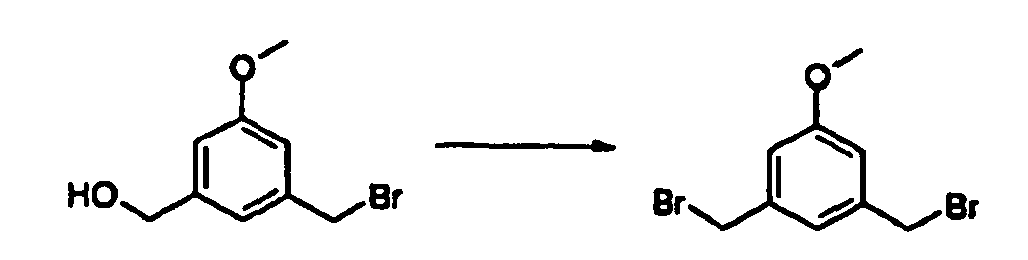
El (Method C) : m/z=292 M+. m/z=213 [M - Br]+. m/z=134 [213 - Br]+. - 1-bromomethyl-3-hydroxymethyl-5-methoxy-benzene may be prepared as follows:
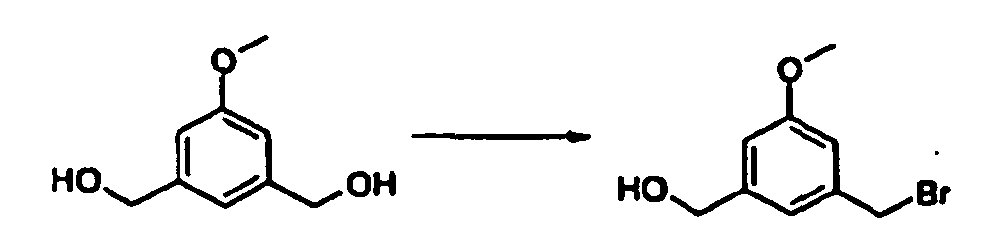
EI (Method C) : m/z=230 M+. m/z=151 [M - Br]+. -

- Potassium carbonate (22.8 mg) and 1,5-diiodopentane (8.2 µL) were added to a stirred solution of tomaymycine (15 mg) in dimethylformamide (0.5 mL). The reaction was stirred for 20 h at room temperature and an additional portion of potassium carbonate (8 mg) was added. The reaction was stirred for another 20 h at room temperature.
- Solids were filtered off and the dimethylformamide solution was injected for HPLC purification according to method B2. The appropriate fractions were combined and concentrated by centrifugal evaporation over a Jouan Model RC10.10. apparatus to afford 8,8'-[1,5-pentanediylbis(oxy)]-bis[(S)-2-eth-(E)-ylidene-7-methoxy-1,2,3,11 a-tetrahydro-5H-pyrrolo[2,1-c][1,4]benzodiazepin-5-one] as a white.powder (4 mg) :
LC/MS (Method A2) : ES: m/z=613 MH+ Retention time = 9.04 minutes -

- 8,8'-[1,4-butanediylbis(oxy)]-bis[(S)-2-eth-(E)-ylidene-7-methoxy-1,2,3,11a-tetrahydro-5H-pyrrolo[2,1-c][1,4]benzodiazepin-5-one] may be prepared following the procedure for the preparation of 8,8'-[1,5-pentanediylbis(oxy)]-bis[(S)-2-eth-(E)-ylidene-7-methoxy-1,2,3,11a-tetrahydro-5H-pyrrolo[2,1-c][1,4]benzodiazepin-5-one] (Example 3), starting with 1,4-diiodobutane :
LC/MS (Method A1, Platform II): ES: m/z=599 MH+ m/z=318,5 (M+H+K)2+/2 Retention time = 3.23 minutes -

LC/MS (Method A1, Platform II) : ES : m/z=627 MH+ Retention time = 3.92 minutes -

- 8,8'-[2,6-pyridinediylbis(oxy)]-bis[(S)-2-eth-(E)-ylidene-7-methoxy-1,2,3,11a-tetrahydro-5H-pyrrolo[2,1-c][1,4]benzodiazepin-5-one] may be prepared following the procedure for the preparation of 8,8'-[1,3-benzenediylbis(methyleneoxy)]-bis[(S)-2-eth-(E)-ylidene-7-methoxy-1,2,3,11 a-tetrahydro-5H-pyrrolo[2,1-c][1,4]benzodiazepin-5-one] (Example 1), starting with 2,6-bis-bromomethyl-pyridine :
LC/MS (Method A1, ZQ) : ES: m/z=648 MH+ Retention time = 3.21 minutes -

LC/MS (Method A1, Platform I) : ES : m/z=857 MH+ + 2 H2O m/z=839 MH+ + H2O m/z=821 MH+ m/z=721 [M-C5O2H8] + H+ Retention time = 3.67 minutes 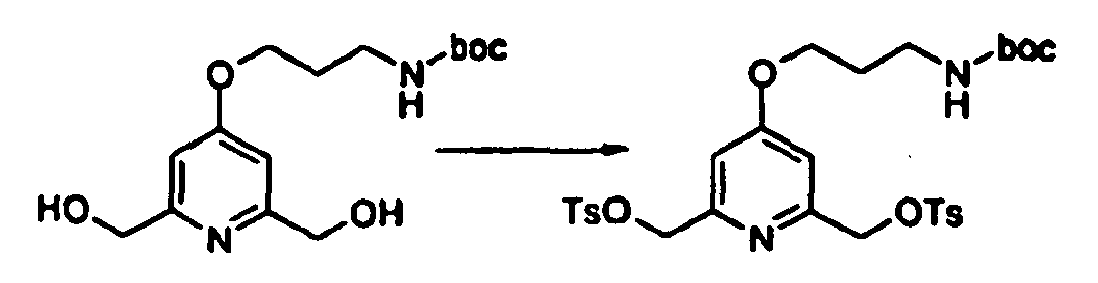
LC/MS (Method A1, Platform I): ES : m/z=621 MH+ Retention time = 4.90 minutes - 4-(3-tert-butoxycarbonylamino-propoxy)-2,6-bis-(hydroxymethyl)-pyridine may be prepared as follows :
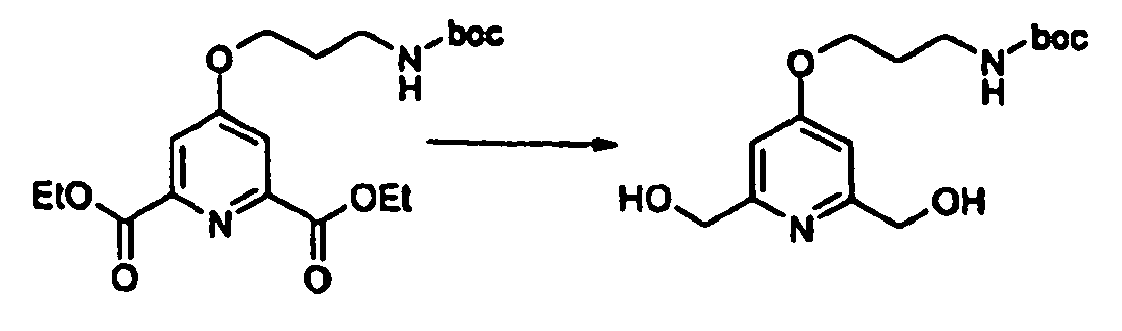
- To a solution of 4-(3-tert-butoxycarbonylamino-propoxy)-pyridine-2,6-dicarboxylic acid diethyl ester (150 mg) in absolute ethanol (5 mL) was added sodium borohydride (43 mg) and calcium chloride (128 mg). After stirring for 4 h, hydrogen evolution ceased, and reaction was quenched with water. Solvent was evaporated under reduced pressure. The residue was then washed into separatory funnel using dichloromethane and water. The layers were separated, and the aqueous layer was extracted three times with dichloromethane. The combined organic solutions were dried over magnesium sulphate, and concentrated in vacuo to give 4-(3-tert-butoxycarbonylamino-propoxy)-2,6-bis-(hydroxymethyl) pyridine (80 mg) :
LC/MS (Method A1, ZQ) : ES m/z=313 MH+ Retention time = 1.90 minutes - 4-(3-tert-butoxycarbonylamino-propoxy)-pyridine-2,6-dicarboxylic acid diethyl ester may be prepared as follows :

Cl (Method D) : m/z=397 MH+ -

- To the crude compound (27 mg) dissolved in dimethylformamide (0.8 mL), tetrakis(triphenylphosphine) palladium (2 mg), triphenylphosphine (0.9 mg) and pyrrolidine (5.6 µL) were added. After stirring for 15h at 30°C, tetrakis(triphenylphosphine) palladium (2 mg), triphenylphosphine (1 mg) and pyrrolidine (2.8 µL) were added and the reaction mixture was stirred at room temperature for another 15 h. Water (0.4 mL) was added to the dimethylformamide solution and formic acid was added until complete dissolution of the precipitate. The resulting solution was injected for HPLC purification according to method B1. The appropriate fractions were combined and concentrated by centrifugal evaporation over a Jouan Model RC10.10. apparatus to afford 8,8'-[5-(3-aminopropyloxy)-1,3-benzenediylbis-(methyleneoxy)]-bis[(S)-2-eth-(E)-ylidene-7-methoxy-1,2,3,11a-tetrahydro-5H-pyrrolo[2,1-c][1,4]benzodiazepin-5-one] (0.2 mg).
LC/MS (Method A1, Platform II) : ES : m/z=800 MH+ Retention time = 2.84 minutes - 1-(3-allyloxycarbonylamino-propyloxy)-3,5-bis-(bromomethyl)-benzene may be prepared as follows :

- To a suspension of 1-(3-allyloxycarbonylamino-propyloxy)-3,5-bis-(hydroxymethyl)-benzene (70 mg) in dichloromethane (3 mL) were added carbon tetrabromide (248 mg) and a solution of triphenylphosphine (199 mg) in dichloromethane (2 mL). After refluxing for 3 h, the reaction mixture was purified by silica gel chromatography (Merck SuperVarioFlash 25g column, Si60 15-40µm), eluted with dichloromethane to give 1-(3-allyloxycarbonylaminopropyloxy)-3,5-bis-(bromomethyl)-benzene (52 mg) :
LC/MS (Method A1, Platform II) : ES m/z=420 MH+ Retention time = 4.50 minutes 
- 5-(3-Phtalimido-propyloxy)-1,3-bis-(hydroxymethyl)-benzene (1.45 g) was dissolved in a mixture of dichloromethane and ethanol (25 mL, 25 : 75). Hydrazine hydrate (0.62 mL) was added and the reaction mixture was refluxed for 1 h. The solvent was removed in vacuo and the residue dissolved in dichloromethane. The insoluble residue was filtered off and purified by silica gel chromatography (Merck SuperVarioPrep 70g column, Si60 15-40µm), eluted with methanol / dichloromethane, 20:80 then ammonium hydroxide / methanol / dichloromethane, 0.5:25:75 to give 1-(3-amino-propyloxy)-3,5-bis-(hydroxymethyl)-benzene (1 g) suitable for further transformation.
- A sample of 1-(3-amino-propyloxy)-3,5-bis-(hydroxymethyl)-benzene (100 mg) was dissolved in methanol (5 mL). To the cooled solution (0°C) was added a solution of sodium carbonate (120 mg) in water (5 mL) and allyl chloroformate (42 µL). After stirring for 30 minutes at 0°C, the reaction mixture was steered at room temperature for another 15 h. Solvent was removed in vacuo The residue was then washed into separatory funnel using ethyl acetate and water. The layers were separated, and the aqueous layer was extracted twice with ethyl acetate. The combined organic solutions were dried over magnesium sulphate, and concentrated in vacuo to give 5-(3-allyloxycarbonylamino-propyloxy)-2,6-bis-(hydroxymethyl) benzene (75 mg) :
El (Method C) : m/z=295 M+ m/z=142 (M - C8H9O3)+ m/z=41 C3H5 + - 5-(3-phtalimido-propyloxy)-1,3-bis-(hydroxymethyl)-benzene may be prepared as follows :

LC/MS (Method A1, Platform II) : ES m/z=342 MH+ m/z=324 (MH+ - H2O Retention time = 2.90 minutes -

- To a cooled (0°C) solution of 5-(N-methyl-3-tert-butoxycarbonylaminopropyl)-1,3-bis-(hydroxymethyl)-benzene (50 mg) and triethylamine (113 µL) in dichloromethane (2 mL), was added methanesulfonyl chloride (26 µL). After 30 minutes, the reaction mixture was washed twice with water and the resulting dichloromethane solution was dried over magnesium sulfate, and concentrated in vacuo to a viscous oil (50.3 mg).
- A solution of tomaymycine (15 mg) in dimethylformamide (0.5 mL) was added to a mixture of the crude compound (13 mg), potassium carbonate (23 mg) and potassium iodide (9 mg). The reaction mixture was stirred for 20 h at 30°C. Another sample of the crude compound was added (6 mg), and the reaction mixture was stirred for another 20 h at 30°C. Solids were filtered off, washed with dimethylformamide (0.2 mL) then discarded. Water (0.4 mL), one drop of formic acid and another water (1.5 mL) were added to the combined dimethylformamide solution.
- A sample of the resulting suspension (2 mL) was filtered and the resulting solid was dried under vacuo to give 8,8'-[5-(N-methyl-3-tert-butoxycarbonylaminopropyl)-1,3-benzenediylbis(methyleneoxy)]-bis[(S)-2-eth-(E)-ylidene-7-methoxy-1,2,3,11a-tetrahydro-5H-pyrrolo[2,1-c][1,4]benzodiazepin-5-one] (3.1mg):
LC/MS (Method A1, Platform II) : ES : m/z=818 MH+ Retention time = 4.11 minutes - 5-(N-methyl-3-tert-butoxycarbonylaminopropyl)-1,3-bis-(hydroxymethyl)-benzene may be prepared as follows :

- To a cooled solution (-5°C) of 5-(N-methyl-3-tert-butoxycarbonylaminopropyl)-benzene-1,3-dicarboxylic acid diethyl ester (100 mg) in tetrahydrofuran (2 mL) was slowly added a 1M solution of lithium aluminium hydride in diethyl ether (0.55 mL). 10 minutes after the end of the addition, sodium sulfate decahydrate was added until gas evolution ceased. The solid was filtered off, washed twice with ethyl acetate and the combined organic solutions were concentrated in vacuo to give 5-(N-methyl-3-tert-butoxycarbonylaminopropyl)-1,3-bis-(hydroxymethyl)-benzene (66.8 mg) as a viscous oil :
Cl (Method D) : m/z=327 MNH4 + m/z=310 MH+ m/z=271 (MNH4 +- C4H8) - 5-(N-methyl-3-tert-butoxycarbonylaminopropyl)-benzene-1,3-dicarboxylic acid diethyl ester may be prepared as follows :

- To a solution of 5-(N-methyl-3-tert-butoxycarbonylaminopropyn-1-yl)-benzene-1,3-dicarboxylic acid diethyl ester (890 mg) in methanol (10 mL) was added palladium 10% on carbon (89 mg) and the solution was stirred at room temperature under an hydrogen atmosphere (1 bar) for 18h. The solid was filtered off and solvent was removed in vacuo to afford 5-(N-methyl-3-tert-butoxycarbonylaminopropyl)-benzene-1,3-dicarboxylic acid diethyl ester (767mg) as a yellow oil :
El (Method C) : m/z=365 M+. m/z=309 (M - C4H8)+. m/z=265 (m/z=309 - CO2)+. m/z=57 C4H9 + m/z=44 C2H6N+ - 5-(N-methyl-3-tert-butoxycarbonylaminopropyn-1-yl)-benzene-1,3-dicarboxylic acid diethyl ester may be prepared as follows :

- 5-Trifluoromethanesulfonyloxy-isophthalic acid dimethyl ester (Bodwell, G.J. ; Fleming, J.J. ; Mannion, M.R. ; Miller, D.O. J. Org. Chem. 2000, 65 (17), 5360) (1g) was dissolved in 2 mL of acetonitrile. N-Methyl-N-tert-butoxycarbonylpropargylamine (Bradbury, B.J. ; Baumgold, J. ; Jacobsen, K.A. J. Med. Chem. 1990, 33 (2), 741) (643 mg), bis(triphenylphosphine)palladium chloride (205 mg), copper iodide (56 mg) and triethylamine (591 mg) were added. The resultant mixture was stirred for 15h at room temperature. The solvent was removed by evaporation under reduced pressure and the residue was then washed into separatory funnel using ethyl acetate and water. The layers were separated, and the aqueous layer was extracted once with ethyl acetate. The combined organic solutions were washed with a saturated sodium chloride aqueous solution, dried over magnesium sulphate, and concentrated in vacuo to a residue. The residue was purified by silica gel chromatography (Biotage FLASH 40+M 100g column, SiOH 32-63µm, eluted with ethyl acetate / heptane, 20:80) to give 5-(N-methyl-3-tert-butoxycarbonylaminopropyn-1-yl)-benzene-1,3-dicarboxylic acid diethyl ester (896 mg) :
1H N.M.R. (300 MHz, DMSO-d6, δ in ppm) : 1,43 (s, 9H) ; 2,90 (s, 3H) ; 3,90 (s, 6H) ; 4,30 (s, 2H) ; 8,16 (d, J = 1,5 Hz, 2H) ; 8,42 (t, J = 1,5 Hz, 1H) -

- To a cooled (0°C) solution of 1-[3-(4-methyl-4-methyldisulfanyl-pentanoylamino)-propyloxy]-3,5-bis-(hydroxymethyl)-benzene (45 mg) and triethylamine (49 µL) in dichloromethane (1.5 mL), was added methanesulfonyl chloride (19 µL). After 30 minutes, the reaction mixture was washed twice with water and the resulting dichloromethane solution was dried over magnesium sulfate, and concentrated in vacuo to a viscous oil (39 mg).
- To a solution of tomaymycine (26 mg) in dimethylformamide (0.9 mL) was added potassium carbonate (40 mg), potassium iodide (16 mg) and a sample of the crude compound (31 mg). The reaction mixture was stirred for 20 h at 30°C. Another sample of the crude compound was added (6 mg), and the reaction mixture was stirred for another 20 h at 30°C. Solids were filtered off, washed with dimethylformamide (0.3 mL) then discarded. Water (1.6 mL) was added to the combined dimethylformamide solution and the resulting solid was filtered, washed with water and dried in vacuo to give a residue. The residue was purified by silica gel chromatography (Interchrom Puriflash 2g column, SiOH 15-35µm, eluted with dichloromethane / methanol, 95:5) then another purification by silica gel chromatography (Chromabond OH 2g column, 45µm, eluted with dichloromethane to give 8,8'-{5-[3-(4-methyl-4-methyldisulfanylpentanoylamino)propyloxy]-1,3-benzenediylbis(methyleneoxy)}-bis[(S)-2-eth-(E)-ylidene-7-methoxy-1,2,3,11a-tetrahydro-5H-pyrrolo[2,1-c][1,4]benzo-diazepin-5-one] (0.2 mg) :
LC/MS (Method A1, Platform I): ES : m/z=896 MH+ Retention time = 4.09 minutes - 1-[3-(4-methyl-4-methyldisulfanyl-pentanoylamino)-propyloxy]-3,5-bis-(hydroxymethyl)-benzene

- To a solution of 1-(3-amino-propyloxy)-3,5-bis-(hydroxymethyl)-benzene (50 mg) in dimethylformamide (1 mL) was added 4-methyl-4-methyldisulfanylpentanoic acid (44 mg), N,N'-diisopropylcarbodiimide (35 mL) and 1-hydroxybenzotriazole hydrate (5.8 mg). After 15 h at room temperature, water was added to the reaction mixture and the aqueous solution was extracted twice with ethyl acetate. The combined organic solutions were washed with a saturated sodium chloride aqueous solution, dried over magnesium sulfate and concentrated in vacuo to a residue. The residue was purified by silica gel chromatography (Interchrom Puriflash 5g column, SiOH 15-35 µm), eluted with methanol / dichloromethane, 5:95 to give 1-[3-(4-methyl-4-methyldisulfanylpentanoylamino)-propyloxy]-3,5-bis-(hydroxymethyl)-benzene (48 mg):
LC/MS (Method A1, ZQ) : ES m/z=388 MH+ Retention time = 3.03 minutes -

- To a solution of 4-benzyloxy-5-methoxy-2-nitrobenzoic acid (4.8 g, 16 mmol) in anhydrous dichloromethane (80 mL) and THF (5 mL) was added oxalyl chloride (2.8 mL, 32 mmol) and DMF (30 µL, 0.38 mmol) at room temperature. Large amounts of bubble formed after the addition of DMF. The mixture was stirred overnight then the solvents were removed by rotary evaporation in vacuo. The residue was co-evaporated one more time by addition of anhydrous dichloromethane to give the acetyl chloride as a yellow solid.
- To a solution of 4-methylene-L-proline methyl ester, compound A, (3.95 g, 15.5 mmol) in anhydrous THF (80 mL) was added triethylamine (6.7 mL, 48 mmol) at 0°C. After 2 minutes the above acetyl chloride in anhydrous THF (80 mL) was added quickly in 10 minutes via a canula at the same temperature. The obtained yellow cloudy solution was stirred at 0 ~ 5°C for 30 minutes then at room temperature for 4 hours. The reaction solution was diluted with ethyl acetate and water. The aqueous layer was extracted with ethyl acetate twice and the combined organic layers were washed with 2% HCl solution and brine, dried over anhydrous magnesium sulfate. It was filtered and the solvents were removed. The residue was purified by flash chromatography (Hexanes/AcOEt, 1:1, 1:1.5) to give (2S)-4-(methylene)-1-[5-methoxy-2-nitro-4-(phenylmethoxy)-benzoyl]-2-pyrrolidinecarboxylic acid methyl ester as a yellow solid (5.6 g, y = 85%). 1H NMR (400 Hz, CDCl3): the compound appears as a pair of distinct rotomers. δ 7.76 (s, 0.7H), 7.73 (s, 0.3H), 7.43-7.29 (m, 5H), 6.83 (s, 0.7H), 6.80 (s, 0.3H), 5.17 (s, 1.4H), 5.16 (s, 0.6H), 5.10-4.89 (m, 2.7H), 4.57 (d, J = 16 Hz, 0.3H), 4.19-4.12 (m, 0.7H), 3.95-3.77 (m, 6.3H), 3.57 (s, 1H), 3.06-2.96 (m, 1 H), 2.73-2.62 (m, 1 H); 13C NMR (400 Hz, CDCl3): 171.8, 171.7, 166.5, 166.2, 154.9, 154.4, 148.25, 148.18, 141.7, 141.3, 137.19, 137.13, 135.3, 135.2, 128.7, 128.43, 128.41, 127.5, 127.3, 109.5, 109.1, 109.0, 108.9, 71.3, 60.6, 58.1, 56.7, 56.5, 52.39, 52.37, 52.0, 50.2, 37.1, 35.5; MS (ESI): m/z 449.3 (M + Na)+.

- To a solution of the ester (3.15 g, 7.39 mmol) in anhydrous dichloromethane (9 mL) and toluene (27 mL) was added dibal-H (15 mL, 1.0 M in toluene) dropwise via a syringe pump in 30 minutes at -78°C. The mixture was continued to stir at -78°C for 2 hours and TLC (hexanes/AcOEt, 1:1.5) showed all the starting material consumed. The reaction was quenched with methanol (0.3 mL, 7.4 mmol) at -78°C and 5% HCI (20 mL) was added followed by addition of AcOEt (50 mL). The dry ice/acetone bath was removed and the mixture was warmed to 0°C and stirred for 15 minutes. The aqueous layer was extracted with AcOEt twice and the combined organic layers were washed with cold 5% HCl and brine, dried over anhydrous sodium sulfate. It was filtered through celite and the solvents were removed. The residue was purified by flash chromatography (Hexanes/AcOEt, 1:1, 1:1.5, 1:2, 1:3, 1:5, 100% AcOEt) to give (2S)-4-(methylene)-1-[5-methoxy-2-nitro-4-(phenylmethoxy)benzoyl]-2-pyrrolidinecarboxaldehyde as a fluffy yellow solid (2.69 g, y = 92%). 1H NMR (400 Hz, CDCl3): the compound appears as a pair of distinct rotomers. δ 9.75 (s, 0.7H), 9.32 (s, 0.3H), 7.76 (s, 0.7H), 7.69 (s, 0.3H), 7.45-7.31 (m, 5H), 6.85 (s, 0.7H), 6.80 (s, 0.3H), 5.19-4.82 (m, 4.7H), 4.56 (d, J = 16 Hz, 0.3H), 4.14-3.79 (m, 5H), 2.99-2.68 (m, 2H); 13C NMR (400 Hz, CDCl3):198.3, 197.1, 167.1, 155.0, 154.6, 148.4, 141.3, 140.4, 137.2, 135.2, 128.7, 128.5, 128.4, 127.5, 126.9, 126.6, 109.8, 109.4, 109.3, 109.2, 109.1. 71.3, 66.6, 64.3, 56.7, 56.6, 52.2, 50.6, 33.2, 31.9; MS (ESI): m/z 419.2 (M + Na)+.

- Procedure 1: To a solution of (2S)-4-(methylene)-1-[5-methoxy-2-nitro-4-(phenylmethoxy)benzoyl]-2-pyrrolidinecarboxaldehyde (1.0 equivalent) in THF/H2O (v/v, 1.7:1, 0.03 M) was added sodium hydrosulfite (5~8 equivalent) in portions within 2 minutes at room temperature. The mixture was further stirred for 6~20 hours and monitored by TLC (hexanes/AcOEt 1:2 and CH2Cl2/MeOH 5:1). After the aldehyde was almost consumed, the reaction was quenched with methanol (about same volume as THF used). The solvents were removed by rotary evaporation in vacuo (temperature < 40°C) and the remainder solid was put on high vacuum to make it completely dry. The solid was suspended in anhydrous methanol (0.03 M) and AcCl (8~10 equivalent) was added dropwise at room temperature. After stirred for 15 minutes, the cloudy solution was filtered and the solid was washed with anhydrous methanol. The clear yellow filtrate was stirred at room temperature for 1 to 2 hours and was quenched with saturated sodium bicarbonate. After most of the methanol was removed by rotary evaporation, the remainder was diluted with dichloromethane and water. The aqueous layer was extracted with AcOEt. The combined organic layers were dried over anhydrous sodium sulfate and filtered. The solvents were removed and the residue was purified by flash chromatography (hexanes/AcOEt, 1:3, 1:5) to give (11aS)-7-methoxy-2-methylene-8-(phenylmethoxy)-1,2,3,11a-tetrahydro-5H-pyrrolo[2,1-c][1,4]benzodiazepin-5-one in 70% to 85% yield. The NMR spectra are consistent with the literature reported. MS (ESI): m/z 371.2 (M + Na)+. MS (ESI, with CH3OH): m/z 403.3 (M + CH3OH + Na)+. MS (ESI, with H2O): m/z 389.2 (M + H2O + Na)+.
- Procedure 2: To a solution of (2S)-4-(methylene)-1-[5-methoxy-2-nitro-4-(phenylmethoxy)benzoyl]-2-pyrrolidinecarboxaldehyde (1.0 equivalent) in MeOH/H2O (v/v, 3.2:1, 0.03 M) was added sodium hydrosulfite (6~8 equivalent) in portions within 2 minutes at room temperature, followed by addition of sodium hydrosulfate (0.5~1.0 equivalent). The mixture was further stirred for 12~20 hours and monitored by TLC (hexanes/AcOEt 1:2 and CH2Cl2/MeOH 5:1). After the intermediate [MS (ESI): 459.0 (M - H)-] was almost consumed, the reaction was quenched with saturated sodium bicarbonate to pH 5~6. The solvents were removed by rotary evaporation in vacuo (temperature < 40°C) and the remainder solid was put on high vacuum to make it completely dry. The solid was suspended in anhydrous methanol (0.03 M) and AcCl (8~10 equivalent) was added dropwise at room temperature. After stirred for 15 minutes, the cloudy solution was filtered and the solid was washed with anhydrous methanol. The clear yellow filtrate was stirred at room temperature for 1 to 2 hours and was quenched with saturated sodium bicarbonate. After most of the methanol was removed by rotary evaporation, the remainder was diluted with dichloromethane and water. The aqueous layer was extracted with AcOEt. The combined organic layers were dried over anhydrous sodium sulfate and filtered. The solvents were removed and the residue was purified by flash chromatography (hexanes/AcOEt, 1:3, 1:5) to give (11aS)-7-methoxy-2-methylene-8-(phenylmethoxy)-1,2,3,11 1a-tetrahydro-5H-pyrrolo[2,1 - c][1,4]benzodiazepin-5-one in 65% to 80% yield.

- To a solution of the starting material (98 mg, 0.28 mmol) in anhydrous dichloromethane (2 mL) was added a freshly mixed solution of methanesulfonic acid (2 mL) in anhydrous dichloromethane (4 mL) at room temperature. The mixture was stirred at room temperature for 1.5 hours and was poured on ice (~30 g), quenched with saturated NaHCO3 and diluted with dichloromethane. The aqueous layer was extracted with dichloromethane once and the combined organic layers were dried over anhydrous sodium sulfate, filtered and the solvents were removed. The residue was purified by flash chromatography (CH2Cl2/MeOH, 15:1) to give the product as a yellow solid (29 mg). The above aqueous layer was stirred at room temperature overnight and extracted with dichloromethane and AcOEt subsequently. The combined dichloromethane and AcOEt were dried over anhydrous sodium sulfate, filtered and the solvents were removed to give (11aS)-8-hydroxy-7-methoxy-2-methylene-1,2,3,11a-tetrahydro-5H-pyrrolo[2,1-c][1,4]benzodiazepin-5-one (25 mg). The total yield is 74%. 1H NMR (400 Hz, CDCl3): δ 7.65 (d, J = 4.8 Hz, 1 H), 7.48 (s, 1 H), 6.87 (s, 1 H), 6.35 (bs, 1 H), 5.17 (t, J = 1.6 Hz, 1 H), 5.14 (7, J = 1.6Hz, 1 H), 4.26 (s, 2H), 3.93 (s, 3H), 3.87-3.83 (m, 1 H), 3.12-3.05 (m, 1 H), 2.91 (d, J = 16 Hz, 1 H); MS (ESI): m/z 281.0 (M + Na)+. MS (ESI, with water): m/z 258.9 (M + H)+, m/z 299.1 (M + H2O + Na)+.

- To a solution of 4,4'-[1,5-pentanediylbis(oxy)]-bis[(5-methoxy-2-nitro)-benzoic acid], compound 1, (494 mg, 1.0 mmol) in anhydrous THF (5 mL) was added oxalyl chloride (356 µL, 4 mmol) and DMF (10 µL, 0.1 mmol) at room temperature. Large amounts of bubble formed after the addition of DMF. After the mixture was stirred for 18 hours at room temperature, the solvents were removed by rotary evaporation in vacuo. The residue was co-evaporated one more time by addition of anhydrous dichloromethane to give the acid chloride as a yellow solid.
- To a solution of 4-methylene-L-proline methyl ester, compound A, (510 mg, 2 mmol) in anhydrous THF (6 mL) was added triethylamine (836 µL, 6 mmol) at 0°C. After 2 minutes the above acetyl chloride in anhydrous THF (4 mL) was added quickly in 5 minutes via a canula at the same temperature. The obtained orange cloudy solution was stirred at 0° ~ 5°C for 1 hour then at room temperature for 3 hours. Part of the solvent was removed by rotary evaporation in vacuo (temperature < 30°C). The remainder was diluted with ethyl acetate and water. The aqueous layer was extracted with ethyl acetate twice and the combined organic layers were washed with 2% HCl solution and brine, dried over anhydrous magnesium sulfate. It was filtered and the solvents were removed. The residue was purified by flash chromatography (Hexanes/AcOEt, 1:1, 1:2, 1:3) to give 1,1'-{1,5-pentanediylbis[oxy(5-methoxy-2-nitro-4,1-phenylene)carbonyl]}-bis-(4-methylene-L-proline methyl ester), compound 2, as a yellow solid (619 mg, y = 84%). 1H NMR (400 Hz, CDCl3): the compound appears as a pair of distinct rotomers. δ 7.67 (s, 1.4H), 7.64 (s, 0.6H), 6.82 (s, 1.4H), 6.79 (s, 0.6H), 5.11-4.89 (m, 5.4H), 4.57 (d, J = 16 Hz, 0.6H), 4.19-4.10 (m, 5.4H), 3.95-3.78 (m, 12.6H), 3.58 (s, 2H), 3.07-2.98 (m, 2H), 2.74-2.62 (m, 2H), 2.01-1.04 (m, 4H), 1.73-1.67 (m, 2H); MS (ESI): m/z 763.4 (M + Na)+.
- To a solution of compound 2 (345 mg, 0.47 mmol) in anhydrous dichloromethane (0.7 mL) and toluene (1.5 mL) was added dibal-H (1.9 mL, 1.0 M in toluene) dropwise via a syringe pump in 15 minutes at -78°C. The mixture was continued to stir at -78°C for 2 hours and TLC (hexanes/AcOEt, 1:4) showed all the starting material consumed. The reaction was quenched with methanol at -78°C and 5% HCl was added followed by addition of AcOEt. The dry ice/acetone bath was removed and the mixture was warmed to 0°C and stirred for 15 minutes. The aqueous layer was extracted with AcOEt twice and the combined organic layers were washed with cold 5% HCl and brine, dried over anhydrous sodium sulfate. It was filtered through celite and the solvents were removed. The residue was purified by flash chromatography (Hexanes/AcOEt, 1:1, 1:5, 1:10, 100% AcOEt) to give 1,1'-{1,5-pentanediylbis[oxy(5-methoxy-2-nitro-4,1-phenylene)carbonyl]}-bis-[(S)-4-methylene-2-pyrrolidinecarboxaldehyde], compound 3, as a yellow solid (297 mg, y = 93%). 1H NMR (400 Hz, CDCl3): the compound appears as a pair of distinct rotomers. δ 9.70 (s, 1.4H), 9.28 (s, 0.6H), 7.65-7.58 (m, 2H), 6.81-6.73 (m, 2H), 5.08-4.72 (m, 5.4H), 4.53-4.49 (m, 0.6H), 4.11-3.63 (m, 14H), 2.91-2.59 (m, 4H), 1.98-1.87 (m, 4H), 1.70-1.61 (m, 2H); MS (ESI): m/z 703.2 (M + Na)+.
- To a solution of the compound 3 (34 mg, 0.05 mmol) in THF (1.6 mL) and H2O (1.0 mL) was added sodium hydrosulfite (82 mg, 0.4 mmol) at room temperature. The mixture was stirred at room temperature for 19 hours and the reaction was quenched with methanol (~5 mL). The solvents were removed by rotary evaporation in vacuo (temperature < 40°C) and the remainder solid was put on high vacuum to make it completely dry. The solid was suspended in MeOH (10 mL) and AcCl (0.1 mL) was added dropwise at room temperature. The mixture was stirred at room temperature for 1 hour and was quenched with saturated sodium bicarbonate. It was filtered and washed with MeOH/CH2Cl2. The filtrate was evaporated and the residue was purified by flash chromatography (CHCl3/MeOH, 20:1, 9:1, 5:1, 1:1) to give 5.0 mg of 8,8'-[1,5-pentanediylbis(oxy)]-bis[(S)-2-methylene-7-methoxy-1,2,3,11 a-tetrahydro-5H-pyrrolo[2,1-c][1,4]benzodiazepin-5-one], compound 4. The very polar fractions from the column were collected and the solvents were removed. The residue was dissolved in MeOH (~10 mL) and AcCl (0.1 mL) was added. After stirred at room temperature for 2 hours the reaction was quenched with saturated sodium bicarbonate and concentrated by rotary evaporation. The remainder was diluted with water and extracted with dichloromethane. The organic layers were dried over anhydrous magnesium sulfate and filtered. The solvents were removed to give 7.2 mg of compound 4 as colorless foam. The total yield (12.2 mg) is 41%. The 1H NMR spectrum is consistent with the literature reported. MS (ESI): m/z 583.2 (M - H)-. MS (ESI, with CH3OH): m/z 671.3 (M + 2CH3OH + Na)+, 639.3 (M + H + Na)+, 607.2 (M + Na)+. MS (ESI, with H2O): m/z 643.3 (M + 2H2O + Na)+, 625.3 (M + H2O + Na)+, 607.3 (M + Na)+.
-
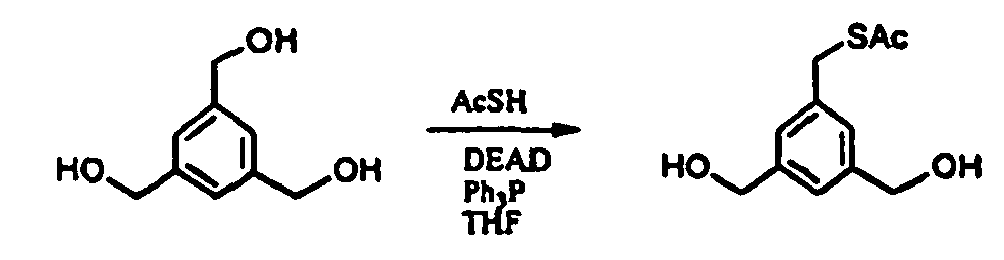
- To a solution of triphenylphosphine (577 mg, 2.2 mmol) in anhydrous THF (5 mL) was added diethyl azodicarboxylate (2.2 M in toluene, 791 µL, 1.7 mmol) dropwise at 0°C. After stirred at 0°C for 50 minutes, a solution of 1,3,5-tri(hydroxymethyl)benzene (269 mg, 1.6 mmol, prepared by reduction of trimethyl 1,3,5-benzenetricarboxylate with lithium aluminum hydride in THF, co-evaporated with dry benzene and dried on high vacuum for couple hours before use) and thioacetic acid (108 µL, 1.45 mmol) in dry THF (4 mL) was added dropwise. After 1 hour, the ice/water bath was removed and the reaction was stirred at room temperature for 15 hours. The solvents were removed by rotary evaporation in vacuo. The residue was purified by flash chromatography to give 5-acetylthiomethyl-1,3-bis(hydroxymethyl)-benzene as colorless solid (110 mg). 1H NMR (400 Hz, CDCl3): δ 7.13-6.99 (m, 3H), 4.45 (apt, J = 20.4 Hz, 4H), 3.98 (apt, J = 20.4 Hz, 4H), 3.73 (bs, 2H), 2.24 (apt, J = 20.4 Hz, 3H); MS (ESI): m/z 249.0 (M + Na)+.

- To a solution of triphenylphosphine (28 mg, 0.1 mmol) in anhydrous THF (0.3 mL) was added disopropyl azodicarboxylate (19 µL, 0.09 mmol) dropwise at 0°C. After stirred at 0°C for 35 minutes, a solution of (11aS)-8-hydroxy-7-methoxy-2-methylene-1,2,3,11 a-tetrahydro-5H-pyrrolo[2,1-c][1,4]benzodiazepin-5-one, compound 5, (18 mg, 0.07 mmol, co-evaporated with dry benzene and dried on high vacuum for couple hours before use) in dry THF (0.2 mL) was added. The mixture was continued to stir for 10 minutes before 5-acetylthiomethyl-1,3-bis(hydroxymethyl)-benzene, compound 6, (6.6 mg, 0.03 mmol, co-evaporated with dry benzene and dried on high vacuum for couple hours before use) in dry THF (0.2 mL) was added. The reaction mixture was allowed to stir at 0°C for 35 minutes. The ice/water bath was removed and the solution was stirred at room temperature for 21 hours. The solvents were removed by rotary evaporation in vacuo. The residue was purified by flash chromatography to furnish the crude product which was further purified by preparative HPLC (C18 column, CH3CN/H2O) to give 0.7 mg of 8,8'-[5-acetylthiomethyl-1,3-benzenediylbis(methyleneoxy)]-bis[(S)-2-methylene-7-methoxy-1,2,3,11a-tetrahydro-5H-pyrrolo[2,1-c][1,4]benzodiazepin-5-one], compound 7. MS (ESI, with H2O): m/z 765.3 (M + 2H2O + Na)+, 747.3 (M + H2O + Na)+, 729.2 (M + Na)+, 707.3 (M + H)+, 663.2 (M- Ac)-.
-

- Compound 1. Thionyl chloride (5.6 mL, 76.3 mmol) was added dropwise to dry methanol (76 mL) at -20 °C, following by addition of trans-4-hydroxy-L-proline (5.0 g, 38.1 mmol). The resulting mixture was allowed to warm to rt and stirred for 20 h. The solvent was removed under reduced pressure, and the residue was further dried under high vacuum to provide trans-4-hydroxy-L-proline methyl ester 1 as a white solid: 1HNMR (300 MHz, DMSO-d6 ) δ 2.18 - 2.23 (m, 2H), 3.06 (m, 1 H), 3.32 - 3.36 (m, 2H), 3.76 (s, 3H), 4.42 (br. s, 1 H), 4.48 (dd, J = 5.4, 8.1 Hz, 1H), 5.56 (br. s, 1 H); EIMS m/z 146 ([M]++1).
- Compound 2. To a solution of trans-4-hydroxy-L-proline methyl ester 1 (4.48 g, 30.9 mmol) and sodium bicarbonate (1.56 g, 18.5 mmol) in anhydrous DMF (42 mL) was added solution of (BOC)2O in DMF (20 mL) at 0°C under argon. After stirring for an overnight at rt, the reaction was quenched by the addition of 100 mL H2O at 0°C, and extracted with EtOAc (4 x 80 mL). The combined organic layer was washed with brine (100 mL), dried (MgSO4), filtered and concentrated with rotavapor. The residue was purified by flash chromatography (silica gel, 1:1 hexanes/EtOAc) to give N-BOC protected trans-4-hydroxy-L-proline methyl ester 2 as colorless oil: 1HNMR (300 MHz, CDCl3, rotamers) δ 1.38 and 1.43 (2 x s, 9H), 2.04 - 2.07 (m, 1 H), 2.23 - 2.27 (m, 2H), 3.54 - 3.63 (m, 2H), 3.70 (s, 3H), 4.34 - 4.38 (m, 1 H), 4.46 (br. s, 1 H).
- Compound 3. (Franco Manfre, Jean-Marc Kern, and Jean-Francois Biellmann J. Org. Chem. 1992, 57, 2060-2065). N-BOC protected trans-4-hydroxy-L-proline methyl ester compound 2 (3.24 g, 13.2 mmol) was dissolved in CH2Cl2 (132 mL) and cooled to 0°C. Pyridine and Dess-Martin periodinane were added and stirring was continued until TLC showed no SM left. The reaction mixture was diluted with CH2Cl2, washed with 10% aq. Na2S2O3 (3 x 50 mL), 1 N aq. HCl (50 mL), sat. aq. NaHCO3 (50 mL), brine (50 mL), dried over MgSO4, filtered and concentrated. Purification of the residue by flash chromatography (silica gel, 7:3 hexanes/EtOAc) gave N-BOC protected 4-oxo-L-proline methyl ester 3 as light yellow oil: 1HNMR (300 MHz, CDCl3, rotamers) δ 1.44 (s, 9H), 2.53 - 2.57 (m, 1 H), 2.85 - 2.96 (m, 1 H), 3.72 and 3.74 (2 x s, 3H), 3.85 - 3.87 (m, 2H), 4.67 - 4.77 (m, 1 H).
- Compound 4. (Kuei-Ying Lin, Mark Matteucci
US 5414077 ) A solution of potassium-t-butoxide (2.51 g, 22.3 mmol) in anhydrous THF (40 mL) was added to a suspension of methyltriphenylphosphonium bromide (7.99 g, 22.3 mmol) in THF (40 mL) at 0°C. The resulting yellow ylide suspension was stirred at 0°C for 2 h before the addition of the solution of N-BOC protected 4-oxo-L-proline methyl ester 3 (2.72 g, 11.2 mmol) in THF (32 mL). After stirring at rt for 1 h, the reaction mixture was diluted with EtOAc (100 mL), washed with H2O (80 mL), brine (80 mL), dried (MgSO4), and concentrated. Purification of the residue by flash chromatography (silica gel, 9:1 hexanes/EtOAc) yielded N-BOC protected 4-methylene-L-proline methyl ester, compound 4, as colorless oil: 1HNMR (300 MHz, CDCl3, rotamers) δ 1.40 and 1.45 (2 x s, 9H), 2.58 - 2.62 (m, 1 H), 2.88 - 2.98 (m, 1 H), 3.69 and 3.70 (2 x s, 3H), 4.03 - 4.06 (m, 2H), 4.36 - 4.49 (m, 1 H), 4.97 - 4.99 (m, 2H); EIMS m/z 264 ([M]++Na). - Compound 5. N-BOC protected 4-methylene-L-proline methyl ester, compound 4, (0.8 g, 3.31 mmol) was dissolved in CH2Cl2 (6.5 mL) and cooled to 0 °C. A solution of trifluoroacetic acid (6.5 mL) in CH2Cl2 (6.5 mL) was added dropwise and the resulting mixture was stirred at rt for 1.5 h. After removal of volatile solvents with rotavapor, the brown residue was dissolved in 10 mL H2O, washed with Et2O (3 x 5 mL). Aqueous solution was concentrated, which was further dried under high vacuum to yield 4-methylene-L-proline methyl ester 5 as TFA salt: 1HNMR (300 MHz, CDCl3, rotamers) δ 2.83 - 2.87 (m, 1H), 3.05 - 3.11 (m, 1 H), 3.80 and 3.81 (2 x s, 3H), 4.00 - 4.10 (m, 2H), 4.55 (dd, J = 5.7, 5.7 Hz, 1H), 5.17-5.21 (m, 2H); 13CNMR δ 34.0, 49.1, 53.8, 59.3, 111.7, 137.6, 169.8; EIMS m/z 142 ([M]++1).
- Compound 6.(Kamal, A.; et al J. Med. Chem. 2002, 45, 4679-4688) Diethanolamine (3.57 g, 34 mmol) was dissolved in methanol (20 mL) and treated with Et3N (4.7 mL, 34 mmol) and ethyl trifluoroacetate (4.90 g, 34 mmol) for 20 h at rt, followed by adding another 1 mL CF3COOEt. After another 20 h, removal of volatile solvents under high vacuum yielded N-trifluoroacetyl-diethanolamine compound 6 as light yellow oil, which was used without further purification.
- Compound 7. Diethyl azodicarboxylate (7.66 g, 44 mmol) was added dropwise to a stirred solution of methyl vanillate (7.30 g, 40.1 mmol) and triphenylphosphine (15.67 g, 59.7 mmol) in anhydrous THF (57 mL) at 0 °C, and the resulting mixture was stirred for 1 h at this temperature followed by addition of a solution of N-trifluoroacetyl-diethanolamine 6 (7.30 g, 40.1 mmol) in anhydrous THF (20 mL). After stirring for an overnight at rt, the reaction was quenched with H2O (100 mL), and extracted with Et2O (3 x 80 mL). The combined Et2O layers were washed with brine (100 mL), dried (MgSO4), and concentrated. Purification of the residue by flash chromatography (silica gel, 8:2 to 7:3 hexanes/EtOAc) yielded N-trifluorocetyl-N,N-di[2-(4-methoxycarbonyl-2-methoxy-phenoxy)ethyl]amine, compound 7, as a white solid: 1HNMR (300 MHz, CDCl3) δ 3.81 (s, 3H), 3.84 (s, 3H), 3.87 (s, 3H), 3.88 (s, 3H), 4.04 - 4.08 (m, 4H), 4.28 - 4.32 (m, 4H), 6.84 and 6.85 (2 x d, J = 6.3 Hz, 2H), 7.50 and 7.51 (2 x d, J = 1.5 Hz, 2H), 7.61 (dd, J = 1.5, 6.3 Hz, 2H).
- Compound 8. Solid Cu(NO3)2.xH2O (2.33 g, 12.41 mmol) was added to a stirred solution of N-trifluorocetyl-N,N-di[2-(4-methoxycarbonyl-2-methoxy-phenoxy)ethyl]amine 7 (2.62 g, 4.96 mmol) in acetic anhydride (50 mL) at 0 °C. The reaction mixture was stirred at 0 °C for 1 h and rt for 2 h, then poured into 200 mL ice-water. Stirring was continued for another 1 h. The resulting yellow precipitate was collected by filtration. Further purification with flash chromatography (silica gel, 6:4 hexanes/EtOAc) yielded N-trifluorocetyl-N,N-di[2-(4-methoxycarbonyl-2-methoxy-5-nitro-phenyloxy)ethyl]amine, compound 8, as light yellow solid: 1HNMR (300 MHz, CDCl3) δ 3.86 (s, 3H), 3.88 (s, 3H), 3.886 (s, 3H), 3.890 (s, 3H), 4.04 - 4.09 (m, 4H), 4.30 - 4.35 (m, 4H), 6.98 and 6.99 (2 x s, 2H), 7.37 and 7.40 (2 x s, 2H).
- Compound 9. A solution of N-trifluorocetyl-N,N-di[2-(4-methoxycarbonyl-2-methoxy-5-nitro-phenyloxy)ethyl]amine 8 (2.58 g, 4.16 mmol) in THF-MeOH (1:2, 48 mL) was treated with 10% aq. K2CO3 (16 mL) at rt for 12 h. After removal of volatile with rotavapor, the residue was diluted with 100 mL H2O, extracted with EtOAc (3 x 100 mL). The combined EtOAc layers were washed with brine (100 mL), dried (MgSO4), and concentrated yielding N,N-di[2-(4-methoxycarbonyl-2-methoxy-5-nitro-phenyloxy)ethyl]amine, compound 9, at yellow solid, which was used without further purification: 1HNMR (300 MHz, CDCl3) δ 3.17 (t, J = 3.9 Hz, 4H), 3.89 (s, 6H), 3.93 (s, 6H), 4.19 (t, J = 3.9 Hz, 4H), 7.05 (s, 2H), 7.47 (s, 2H).
- Compound 10. N,N-di[2-(4-methoxycarbonyl-2-methoxy-5-nitrophenyl-oxy)ethyl]amine, compound 9, (crude, 4.16 mmol) and NaHCO3 (210 mg, 2.50 mmol) was suspended in THF, and treated with (BOC)2O (999 mg, 4.58 mmol) at 0 °C and stirring was continued at rt for 3 h. After removal of THF, the residue was partitioned between H2O and EtOAc (100/100 mL). Aqueous layer was further extracted with EtOAc (2 x 50 mL). The combined EtOAc layers were washed with brine (80 mL), dried (MgSO4), and concentrated. Purification of the residue by flash chromatography (silica gel, 6:4 hexanes/EtOAc) yielded N-tert-butoxycarbonyl-N,N-di[2-(4-methoxycarbonyl-2-methoxy-5-nitrophenyloxy)ethyl]amine, compound 10, as light yellow solid: 1HNMR (300 MHz, CDCl3) δ1.44 (s, 9H), 3.77 (m, 4H), 3.83, 3.86 and 3.87(3 x s, 12H), 4.20 and 4.26 (2 x t, J = 3.9 Hz, 4H), 6,97 and 6.99 (2 x s, 2H), 7.36 and 7.40 (2 x s, 2H); EIMS m/z 646 ([M]++Na).
- Compound 11. N-tert-butoxycarbonyl-N,N-di[2-(4-methoxycarbonyl-2-methoxy-5-nitro-phenyloxy)ethyl]amine, compound 10 (2.11 g, 3.39 mmol) was suspended in THF-MeOH-H2O (3:1:1, 65 mL) and treated with 1 M aq. LiOH (14 mL) at rt for 3 h. After removal of volatile solvents, the residue was diluted with H2O (25 mL). The resulting aqueous solution was acidified to pH ~ 1 with concentrate HCl. The precipitated N-tert-butoxycarbonyl-N,N-di[2-(4-carboxy-2-methoxy-5-nitro-phenyloxy)ethyl]amine, compound 11, was collected by filtration, washed with H2O, and further dried under high vacuum: 1HNMR (300 MHz, CDCl3, rotamers) δ 1.39 (s, 9H), 3.70 (m, 4H), 3.88 and 3.89(2 x s, 6H), 4.29 (m, 4H), 7.29 and 7.31 (2 x s, 2H), 7.63 (s, 2H), 13.60 (br. s, 2H); 13 CNMR δ27.8, 46.2 and 46.6, 56.3 and 56.4, 67.2, 79.2, 107.9 and 108.0, 111.3, 141.4 and 141.5, 149.1, 151.7, 154.5, 165.9; HRMS m/z calcd for C25H29N3O14Na 618.1547, found 618.1552 ([M]++Na).
- Compound 12. A catalytic amount of DMF (2 drops) was added to a solution of N-tert-butoxycarbonyl-N,N-di[2-(4-carboxy-2-methoxy-5-nitrophenyloxy)ethyl]amine 11 (194 mg, 0.33 mmol) and oxalyl chloride (72.7 □L, 0.81 mmol) in anhydrous THF (6.5 mL) and the resulting mixture was stirred at rt for an overnight. Excess THF and oxalyl chloride was removed with rotavapor. The actyl chloride was resuspended in fresh THF (4 mL) and was added dropwise to a solution of 4-methylene-L-proline methyl ester 5 (206.7 mg, 0.81 mmol), Et3N (0.19 mL, 1.39 mmol), and H2O (0.4 mL) in THF (1 mL) at 0°C under argon atmosphere. The reaction mixture was allowed to warm to rt and stirring was continued for 2 h. After removal of THF, the residue was partitioned between H2O and EtOAc (10/10 mL). The aqueous layer was further extracted with EtOAc (2 x 8 mL). The combined organic layers were washed with brine (10 mL), dried (MgSO4) and concentrated. Purification of the residue by flash chromatography (silica gel, 2:8 hexanes/EtOAc) yielded bis{2-[5-methoxy-2-nitro-4-[(S)-4-methylene-2-methoxycarbonyl-1-pyrrolidinylcarbonyl]phenyloxy]-ethyl}-carbamic acid tert-butyl ester 12 as light yellow oil (rotamers): 1HNMR (300 MHz, CDCl3, rotamers) δ 1.46 (s, 9H), 2.68 - 2.75 (m, 2H), 2.99 - 3.10 (m, 2H), 3.60 - 4.28 (m, 24H), 4.56 - 5.12 (m, 6H), 6.78 - 6.83 (m, 2H), 7.63 - 7.71 (m, 2H); EIMS m/z 864 ([M]++Na).
- Compound 13. To a vigorously stirred solution of bis{2-[5-methoxy-2-nitro-4-[(S)-4-methylene-2-methoxycarbonyl-1-pyrrolidinylcarbonyl]phenyloxy]-ethyl}-carbamic acid tert-butyl ester 12 (100 mg, 0.12 mmol) in anhydrous toluene (2.4 mL) was added dropwise solution of DIBAL-H (480 µL of a 1 M solution in toluene) at -78 °C under argon atmosphere. After the mixture was stirred for an additional 45 min, excess reagent was decomposed by addition of five drops of methanol followed by 5% HCl (4 mL). The resulting mixture was allowed to warm to 0°C. Layers were separated and the aqueous layer was further extracted with CH2Cl2 (3 x 3 mL). Combined organic layers were washed with brine, dried (MgSO4) and concentrated. Purification of the residue by flash chromatography (silica gel, 95:5 CHCl3/MeOH) yielded bis{2-[5-methoxy-2-nitro-4-[(S)-4-methylene-2-formyl-1-pyrrolidinylcarbonyl]phenyloxy]-ethyl}-carbamic acid tert-butyl ester 13 as light yellow oil (84 mg, 91%).
- Compound 14. A mixture of bis{2-[5-methoxy-2-nitro-4-[(S)-4-methylene-2-formyl-1-pyrrolidinylcarbonyl]phenyloxy]-ethyl}-carbamic acid tert-butyl ester 13 (180 mg, 0.23 mmol), Na2S2O4 (1.84 mmol, 8 equiv), 3.5 mL THF, and 2.2 mL H2O was stirred at rt for 20 h. Solvents were removed under high vacuum. The residue was re-suspended in MeOH (30 mL), and AcCl was added dropwise until pH ~ 2. The resulting mixture was stirred at rt for 1 h. The reaction was work-up by removing most of MeOH, then diluted with EtOAc (25 mL). The EtOAc solution was washed with sat. aq. NaHCO3, brine, dried (MgSO4), and concentrated. Purification of the residue by flash chromatography (silica gel, 97:3 CHCl3/MeOH) yielded bis-{2-[(S)-2-methylene-7-methoxy-5-oxo-1,3,,11a-tetrahydro-5H-pyrrolo[2,1-c][1,4]benzodiazepin-8-yloxy]-ethyl}-carbamic acid tert-butyl ester 14 as white solid (86 mg, 50%).
-

- Compound 15. To a solution of methyl vanillate (9.109 g, 50 mmol) in acetone (200 mL) were added K2CO3 (27.64 g, 200 mmol) and 1,5-dibromopentane (20.4 mL, 150 mmol). The resulting mixture was heated to reflux. After 6h, TLC showed no starting material left. The mixture was cooled to rt, and the solid was removed by filtration. The filtrate was concentrated. Purification by flash chromatography (silica gel, 8:2 hexanes/EtOAc) afforded 4-(5-bromopentyloxy)-3-methoxy-benzoic acid methyl ester 15 as white solid (13.65 g, 82%): 1HNMR (300 MHz, CDCl3) δ 1.60 - 1.66 (m, 2H), 1.85 - 1.97 (m, 4H), 3.42 (t, J = 5.0 Hz, 2H), 3.87 (s, 3H), 3.89 (s, 3H), 4.06 (t, J = 5.0 Hz, 2H), 6.85 (d, J = 6.3 Hz, 1 H), 7.52 (d, J = 1.5 Hz, 1 H), 7.63 (dd, J = 6.3, 1.5 Hz, 1H); EIMS m/z 353 and 355 ([M]++Na).
- Compound 16. Solid Cu(NO3)2.xH2O (3.64 g, 19.42 mmol) was added to a stirred solution of 4-(5-bromopentyloxy)-3-methoxy-benzoic acid methyl ester 15 (5.36 g, 16.18 mmol) in acetic anhydride (81 mL) at 0 °C. The reaction mixture was stirred at 0 °C for 1 h and rt for 2 h, then poured into 200 mL ice-water. Stirring was continued for another 1 h. The resulting yellow precipitate was collected by filtration and washed with water. Further dried under high vacuum yielded 4-(5-bromopentyloxy)-5-methoxy-2-nitro-benzoic acid methyl ester compound 16 as light yellow solid (5.98 g), which was used directly to the next step:1HNMR (300 MHz, CDCl3) δ1.59- 1.70 (m, 2H), 1.85 - 1.98 (m, 4H), 3.43 (t, J = 5.1 Hz, 2H), 3.89 (s, 3H), 3.94 (s, 3H), 4.08 (t, J = 4.8 Hz, 2H), 7.05 (s, 1 H), 7.42 (s, 1H). EIMS m/z 398 and 400 ([M]++Na).
- Compound 17. 4-(5-Bromopentyloxy)-5-methoxy-2-nitro-benzoic acid methyl ester 16 (5.98 g, 15.9 mmol) was suspended in THF-MeOH-H2O (3:1:1, 157 mL) and treated with 1 M aq. LiOH (31 mL) at rt for 5 h. After removal of volatile solvents, the residue was diluted with H2O (70 mL). The resulting aqueous solution was acidified to pH~ 2 with concentrate HCl. The precipitated 4-(5-bromopentyloxy)-5-methoxy-2-nitro-benzoic acid 17 was collected by filtration, washed with H2O and further dried under high vacuum(5.47 g): 1HNMR (300 MHz, CDCl3) δ 1.64 - 1.68 (m, 2H), 1.87 - 1.98 (m, 4H), 3.43 (t, J = 4.8 Hz, 2H), 4.08 (s, 3H), 4.10 (t, J = 5.1 Hz, 2H), 7.21 (s, 1 H), 7.35 (s, 1 H), 13.60 (br. s, 1 H); ElMS m/z 384 and 386 ([M]++Na).
- Compound 18. A catalytic amount of DMF (2 drops) was added to a solution of 4-(5-bromopentyloxy)-5-methoxy-2-nitro-benzoic acid 17 (270 mg, 0.74 mmol) and oxalyl chloride (80 µL, 0.89 mmol) in anhydrous THF (7.5 mL) and the resulting mixture was stirred at rt for an overnight. Excess THF and oxalyl chloride were removed with rotavapor. The acetyl chloride was resuspended in fresh THF (6 mL) and was added dropwise to a solution of 4-methylene-L-proline methyl ester 5 (228 mg, 0.89 mmol), Et3N (0.32 mL, 2.31 mmol), and H2O (0.15 mL) in THF (1.5 mL) at 0 °C under argon atmosphere. The reaction mixture was allowed to warm to rt and stirring was continued for 4 h. After removal of THF, the residue was partitioned between H2O and EtOAc (20/20 mL). The aqueous layer was further extracted with EtOAc (3 x 10 mL). The combined organic layers were washed with brine (20 mL), dried (MgSO4) and concentrated. Purification of the residue by flash chromatography (silica gel, 6:4 hexanes/EtOAc) yielded 1-[4-(5-bromopentyloxy)-5-methoxy-2-nitrobenzoyl]-4-methylene-L-proline methyl ester 18 as light yellow oil (rotamers): 1HNMR (300 MHz, CDCl3, rotamers) δ1.62-1.68 (m, 2H), 1.86-1.98 (m, 4H), 2.64 - 2.75 (m, 1 H), 2.99 - 3.08 (m, 1 H), 3.43 (t, J = 5.1 Hz, 2H), 3.59 - 3.96 (m, 7H), 4.05 - 4.21 (m, 3H), 4.57 - 4.61 and 4.90 - 5.12 (m, 3H), 6.80 and 6.83 (2 s, 1 H), 7.64 and 7.67 (2 s, 1 H); EIMS m/z 507 and 509 ([M]++Na).
- Compound 19. To a vigorously stirred solution of 1-[4-(5-bromopentyloxy)-5-methoxy-2-nitro-benzoyl]-4-methylene-L-proline methyl ester 18 (61 mg, 0.12 mmol) in anhydrous toluene - CH2Cl2 (3:1, 2.5 mL) was added dropwise solution of DIBAL-H (188 µL of a 1 M solution in toluene) at -78 °C under argon atmosphere. After the mixture was stirred for an additional 45 min, excess reagent was decomposed by addition of three drops of methanol followed by 5% HCl (2 mL). The resulting mixture was allowed to warm to 0 °C. Layers were separated and the aqueous layer was further extracted with CH2Cl2 (3 x 2 mL). Combined organic layers were washed with brine, and dried (MgSO4) and concentrated. Purification of the residue by flash chromatography (silica gel, 1:1 hexanes/EtOAc) yielded (S)-1-[4-(5-bromopentyloxy)-5-methoxy-2-nitrobenzoyl]-4-methylene-2-pyrrolidinecarboxaldehyde 19 as light yellow oil (44 mg, 80%).
- Compound 20. A mixture of (S)-1-[4-(5-bromopentyloxy)-5-methoxy-2-nitro-benzoyl]-4-methylene-2-pyrrolidinecarboxaldehyde 19 (43.7 mg, 0.096 mmol), Na2S2O4 (0.58 mmol, 6 equiv), 1.5 mL THF, and 0.9 mL H2O was stirred at rt for 18 h. Solvents were removed under high vacuum. The residue was resuspended in MeOH (6 mL), and AcCl was added dropwise until pH ~ 2. The resulting mixture was stirred at rt for 1 h. The reaction was work-up by removing most of MeOH, then diluted with EtOAc (20 mL). The EtOAc solution was washed with sat. aq. NaHCO3, brine, and dried (MgSO4) and concentrated. Purification of the residue by flash chromatography (silica gel, 98:2 CHCl3/MeOH) yielded (11 aS)-7-(5-bromopentyloxy)-2-methylene-1,2,3,11 a-tetrahydro-5H-pyrrolo[2,1-c][1,4]benzodiazepin-5-one 20 as light yellow oil (31 mg, 74%): 1HNMR (300 MHz, CDCl3) .δ1.58- 1.66 (m, 2H), 1.84-1.99 (m, 4H), 2.91- 2.95 (m, 1 H), 3.08 - 3.14 (m, 1 H), 3.42 (t, J = 5.1 Hz, 2H), 3.93 (s, 3H), 3.87- 4.27 (m, 5H), 5.15 (br s, 1 H), 5.18 (br s, 1 H), 6.84 (s, 1 H), 7.49 (s, 1 H), 7.71 (d, J = 4.0 Hz, 1 H); EIMS m/z 429 and 431 ([M]++Na).
- Compound 20 can then be coupled to (11aS)-8-hydroxy-7-methoxy-2-methylene-1,2,3,11a-tetrahydro-5H-pyrrolo[2,1-c][1,4]benzodiazepin-5-one :

-

- To a solution of triphenylphosphine (1.77 g, 6.8 mmol) in anhydrous THF (15 mL) was added diethyl azodicarboxylate (2.2 M in toluene, 2.4 mL, 5.4 mmol) dropwise at 0°C. After stirred at 0°C for 55 minutes, a solution of 3-(2-hydroxyethyl)pentane-1,5-diol (740 mg, 5 mmol) and thioacetic acid (335 µL, 4.5 mmol) in dry THF (7 mL) was added dropwise. After 1 hour the ice/water bath was removed and the reaction was stirred at room temperature for 16 hours. The solvents were removed by rotary evaporation in vacuo. The residue was purified by flash chromatography (CHCl3/MeOH, 20:1, 15:1, 10:1, 4:1) to give 3-(2-acetylthioethyl)pentane-1,5-diol as white solid (350 mg) and recovered starting material triol (406 mg). 1H NMR (400 Hz, CDCl3): δ 3.65-3.63 (m, 4H), 3.45 (bs, 2H), 2.84-2.80 (m, 2H), 2.28 (s, 3H), 1.73-1.67 (m, 1 H), 1.55-1.49 (m, 6H). MS (ESI): m/z 229.0 (M + Na)+.

- To a solution of triphenylphosphine (53 mg, 0.2 mmol) in anhydrous THF (0.4 mL) was added disopropyl azodicarboxylate (36 µL, 0.17 mmol) dropwise at 0°C. After stirred at 0°C for 25 minutes, a solution of (11aS)-8-hydroxy-7-methoxy-2-methylene-1,2,3,11a-tetrahydro-5H-pyrrolo[2,1-c][1,4]benzodiazepin-5-one, the PBD monomer, (38 mg, 0.14 mmol, co-evaporated with dry benzene and dried on high vacuum for couple hours before use) in dry THF (0.2 mL) was added. The mixture was continued to stir for 10 minutes before the thioacetate compound (12 mg, 0.058 mmol, co-evaporated with dry benzene and dried on high vacuum for couple hours before use) in dry THF (0.2 mL) was added. The reaction mixture was allowed to stir at 0°C for 35 minutes. The ice/water bath was removed and the solution was stirred at room temperature for 12 hours. The solvents were removed by rotary evaporation in vacuo. The residue was purified by flash chromatography (CHCl3/MeOH, 100:1, 50:1, 25:1, 20:1) to furnish 8,8'-[3-(2-acetylthioethyl)-1,5-pentanediylbis(oxy)]-bis[(S)-2-methylene-7-methoxy-1,2,3,11 a-tetrahydro-5H-pyrrolo[2,1-c][1,4]benzodiazepin-5-one] (19 mg, y = 47%). 1H NMR (400 Hz, CDCl3): δ 7.66 (d, J = 4.4 Hz, 2H), 7.46 (s, 2H), 6.78 (s, 2H), 5.17 (s, 2H), 5.14 (s, 2H), 4.26 (s, 4H), 4.17-4.09 (m, 4H), 3.88 (s, 6H), 3.87-3.83 (m, 2H), 3.13-3.06 (m, 2H), 2.94-2.90,(m, 4H), 2.29 (s, 3H), 1.95 (bs, 3H), 1.68 (bs, 4H). MS (ESI, with H2O): m/z 745.3 (M + 2H2O + Na)+, 727.3 (M + H2O + Na)+, 709.2 (M + Na)+.
- Anti-B4 antibody that binds to the CD19 antigen preferentially expressed on the surface of human lymphoma cells is selected for conjugation of tomaymycin derivatives.
- In the first step, the antibody is reacted with the modifying agent N-sulfosuccinimidyl 5-nitro-2-pyridyldithiobutanoate (SSNPB) to introduce nitropyridyldithio groups. A solution of huC242 antibody at a concentration of 8 mg/mL in an aqueous buffer containing 0.05 M potassium phosphate, 0.05 M sodium chloride and 2 mM ethylenediaminetetra-acetic acid (EDTA), pH 6.5 (65.6 mL) is treated with a 8-fold molar excess of a solution of SSNPB in dimethylacetamide (DMA). The reaction mixture is stirred at room temperature for 90 min. and then loaded on to a Sephadex G25 gel filtration column (50 mm x 35.5 mm, column) that has been previously equilibrated into an aqueous buffer containing 0.05 M potassium phosphate, 0.05 M sodium chloride and 2 mM EDTA, pH 7.5.The modified antibody-containing fractions are collected and pooled to yield product. A small aliquot of the modified antibody is treated with dithiothreitol to cleave the nitro-pyridyl disulfide and the released nitro-pyridine-2-thione is assayed spectrophotometrically (ε323nm = 4,299 M-1cm-1, ε280nm = 565 M-1cm-1 for the compound, and ε280nm = 217,560 M-1cm-1 for the antibody). An average of 4 to 6 nitro-pyridyldisulfide molecules are typically linked per molecule of antibody.
- The modified antibody is diluted to 2.5 mg/mL in the above buffer at pH 7.5 and then treated with a solution of the tomaymycin derivative in DMA, such that the final concentration of DMA in the buffer is 20%. The conjugation mixture is stirred at room temperature for 16 h. The reaction mixture is purified by passage through a Sephacryl S300 gel filtration column (50 mm x 42 cm, column that has been previously equilibrated in a phosphate-buffered saline (PBS) buffer at pH 6.5. Fractions containing monomeric antibody-tomaymycin derivative conjugate are pooled and dialyzed into the PBS buffer. The final conjugate is assayed spectrophotometrically using the extinction coefficients that are determined separately for each tomaymycin derivative.
- The relative binding affinities of the anti-B4 antibody and its tomaymycin conjugate on antigen-expressing Ramos cells is determined using a fluorescence-based assay. The antibody-tomaymycin conjugate and naked antibody at starting concentrations of 1 a 10-7 M are added to 96-well round bottom plates and titrated using 3-fold serial dilutions so that there are duplicates for each concentration. Ramos cells, are added at 50,000 cells per well to each well containing various concentrations of the antibody or conjugate, as well as to control wells. The plates are incubated on ice for 3 hours. After the incubation period, the cells in the plate are washed, and a fluorescence labeled secondary antibody that binds to a humanized lgG, like anti-B4, is added, and the plates are incubated for 1 hour on ice. The plates are washed again after the incubation period, and the cells are fixed with 1% formaldehyde/PBS solution. The fluorescence in each well of the plates is read using a Becton Dickinson FACSCalibur fluorescence analyzer. Data are plotted as a percent of the maximum fluorescence obtained at the highest concentration of antibody or conjugate.
- Samples of free tomaymycin derivative or tomaymycin derivative conjugate are added to a 96-well flat bottomed tissue culture plate and titrated using serial dilutions ranging from 1 x 10-12 M to 3 x 10⁻⁷ M.. Antigen positive tumor cells or antigen negative tumor cells are added to the wells in such a way that there are triplicate samples for each drug concentration for each cell line. The plates are incubated at 37°C in an atmosphere of 5 % CO2 for 4 days.
- At the end of the incubation period, 20 µl of the tetrazolium reagent WST-8 (2-(2-methoxy-nitrophenyl)-3-(4-nitrophenyl)-5-(2,4-disulfophenyl)-2-tetrazolium, monosodium salt]) is added to each well, and the plates are returned to the incubator for 2 hours. The absorbance in each well of the plates is then measured using the Molecular Devices plate reader at 450 nm. Surviving fraction of cells at each concentration of tomaymycin derivative or conjugate are plotted.
Compounds A549 (IC50) KB (IC50) MCF7 (IC50) Example 5 7x10-11M 1x10⁻¹⁰M 1x10⁻¹⁰M Example 1 <10-12 M <10-12 M <10-12 M Example 2 <10-12 M <10-12 M <10-12 M - The tests can be carried out by application and/or adaptation of the protocol described in
WO 2004/103272 , with huB4 as the antibody and appropriate antigen positive cell lines, such as Ramos and Rajii Burkitt's Lymphoma cell lines.
Claims (26)
- Compounds of formula (I) :
 ---- represents an optional single bond;---- represents either a single bond or a double bond ;provided that when ---- represents a single bond, U and U', the same or different, independently represent H and W and W, the same or different, are independently selected from the group consisting of OH, -OR, -OCOR, -OCOOR, -OCONRR', a cyclic carbamate such that N10 and C11 are a part of the cycle, -NRCONRR', -OCSNHR, a cyclic thiocarbamate such that N10 and C11 are a part of the cycle, -SH, -SR, -SOR, -SOOR, -SO3, -OSO3, -NRSOOR, -NRR', optionally cyclic amine such that N10 and C11 are a part of the cycle, - NROR', -NRCOR, -N3, a cyano, a halo, a trialkyl or triarylphosphonium ;and when ---- represents a double bond, U and U' are absent and W and W represent H;R 1, R 2, R 1', R 2' are the same or different and independently chosen from halide or alkyl optionally substituted by one or more Hal, CN, NRR', CF3, OR, aryl, het, S(O)qR, or R1 and R 2 and R 1' and R 2' form together a double bond containing group =B and =B' respectively ;B and B' are the same or different and independently chosen from alkyl being optionally substituted by one or more Hal, CN, NRR', CF3, OR, S(O)qR, aryl, Het ;- A and A' are the same or different and independently chosen from alkyl or alkenyl each being optionally substituted by one or more Hal, CN, NRR', CF3, OR, S(O)qR, aryl, het, alkyl, alkenyl ;Y and Y' are the same or different and independently chosen from H, OR ;- q is 0, 1 or 2;n, n' equal or different are 0 or 1 ;R and R' are equal or different and independently chosen from H, alkyl, aryl, each being optionally substituted by hal, CN, NRR', CF3, OR, aryl, het ;- T is -NR- or a 4 to 10-membered aryl or heteroaryl, each being optionally substituted by one or more Hal, CN, NRR', CF3, OR, S(O)qR, alkyl and substituted by one or more of thiol-, sulfide- or disulfide-containing substituent(s) of formula:wherein :-(CR13R14)t(CR15R16)u(OCH2CH2)ySZ' ;-(CR13R14)t(CR17=CR18)(CR15R16)y(OCH2CH2)ySZ';-(CR13R14)t(NT19CO)(CR15R18)u(OCH2CH2)ySZ';-(CR13R14)t(OCO)(R15R16)u(OCH2CH2)ySZ';-(CR13R14)t(CO)(CR15R16)u(OCH2CH2)ySZ' :-(CR13R14)t(CONR19)(CR15R16)u(OCH2CH2)ySZ' ;-(CR13R14)t-phenyl-CO(CR15R16)uSZ'; -(CR13R14)t-furyl-CO(CR15R16)uSZ';-(CR13R14)t-oxazolyl-CO(CR15R16)uSZ'; -(CR13R14)t-thiazolyl- CO(CR15R16)uSZ';-(CR13R14)t-thienyl-CO(CR15R16)uSZ'; -(CR13R14)t-imidazolyl-CO(CR15R16)uSZ',-(CR13R14)t-morpholino-CO(CR15R16)uSZ';-(CR13R14)t-piperazino-CO(CR15R16)uSZ';-(CR13R14)t-N-methyl-piperazino-CO(CR15R16)uSZ';-(CR13R14)t-phenyl-QSZ'; -(CR13R14)t-furyl-QSZ'; -(CR13R14)t-oxazolyl-QSZ';-(CR13R14)t-thiazolyl-QSZ'; -(CR13R14)t-thienyl-QSZ'; -(CR13R14)t-imidazolyl-QSZ';-(CR13R14)t-morpholino-QSZ'; -(CR13R14)t-piperazino-QSZ';-(CR13R14)t-N-methylpiperazino-QSZ';-O(CR13R14)t(CR15R16)u(OCH2CH2)ySZ';-O(CR13R14)t-NR19CO)(CR15R16)u(OCH2CH2)ySZ';-O(CR13R14)t (CR17=CR18)(CR15R16)t (OCH2CH2)ySZ';-O-phenyl-OSZ'; -O-furyl-QSZ'; -O-oxazolyl-QSZ'; -O-thiazolyl-QSZ'; -O-thienyl-QSZ';-O-imidazolyl-QSZ'; -O-morpholino-QSZ';-O-piperazino-QSZ'; -O-N-methylpiperazino-QSZ';-OCO-(CR13R14)t(CR17=CR18)(CR15R16)u(OCH2CH2)ySZ';-OCONR12(CR13R14)t(CR15R16)u(OCH2CH2)ySZ';-OCO-phenyl-QSZ'; -OCO-furyl-QSZ'; -OCO-oxazolyl-QSZ'; -OCO-thiazolyl-QSZ';-OCO-thienyl-QSZ'; -OCO-imidazolyl-QSZ'; -OCO-morpholino-QSZ' ;-OCO-piperazino-QSZ'; -OCO-N-methylpiperazino-QSZ';-CO(CR13R14)t(CR15R16)u (OCH2CH2)y SZ';-CO-(CR13R14)t(CR17=CR18)(CR15R16)u(OCH2CH2)ySZ';-CONR12(CR13R14)tCR15R16)u (OCH2CH2)ySZ';-CO-phenyl-QSZ'; -CO-furyl-QSZ'; -CO-oxazolyl-QSZ'; -CO-thiazolyl-QSZ';-CO-thienyl-QSZ'; -CO-imidazolyl-QSZ'; -CO-morpholino-QSZ' ; -CO-piperazino-QSZ';-CO-piperidino-QSZ'; -CO-N-methylpiperazino-QSZ';-NR19(CR13R14)t(CR15R16)u(OCH2CH2)ySZ';- NR19CO(CR13R14)t(CR15R16)u(OCH2CH2)ySZ';-NR19(CR13R14)t(CR17=CR18)(CR15R16)t(OCH2CH2)ySZ';-NR19CO(CR13R14)t(CR17=CR18)(CR15R16)t(OCH2CH2)ySZ';-NR19CONR12(CR13R14)t(CR15R16)u(OCH2CH2)ySZ';-NR19CONR12(CR13R14)t(CR17=CR18)(CR15R16)t(OCH2CH2)ySZ';-NR19CO-phenyl-QSZ'; -NR19CO-furyl-OSZ'; -NR19CO-oxazolyl-QSZ';-NR19CO-thiazolyl-QSZ'; -NR19CO-thianyl-QSZ'; -NR19CO-imidazolyl-QSZ';-NR19CO-morpholino-QSZ'; -NR19CO-piperazino-QSZ';-NR19CO-piperidino-QSZ'; -NR19CO-N-methylpiperazino-QSZ';-NR19-phenyl-QSZ'; -NR19-furyl-QSZ'; -NR19-oxazolyl-QSZ'; -NR19-thiazolyl-QSZ';-NR19-thienyl-QSZ'; -NR19-imidazolyl-QSZ'; -NR19-morpholino-QSZ';-NR19-piperazino-QSZ'; -NR19-piperidino-QSZ'; -NR19-N-methylpiperazino-QSZ';-NR19CO-NR12-phenyl-QSZ'; -NR19CO-NR12-oxazolyl-QSZ';-NR19CO-NR12-thiazolyl-QSZ'; -NR19CO-NR12-thienyl-QSZ';-NR19CO-NR12-piperidino-QSZ';-S(O)q(CR13R14)t(CR15R16)u(OCH2CH2)ySZ';-S(O)q(CR13R14)t(CR17=CR18)(CR15R16)t(OCH2CH2)ySZ';-SCONR12(CR13R14)t(CR15R16)u (OCH2CH2)ySZ';-SCO-morpholino-QSZ'; -SCO-piperazino-QSZ';-SCO-piperidino-QSZ'; -SCO-N-methylpiperazino-QSZ'• Z' is H, Ac, R 19' or SR 19' ;• Q is a direct link or a linear alkyl or branched alkyl having from 1-10 carbon atoms or a polyethylene glycol spacer with 2 to 20 repeating ethylene oxy units ;• R 19' and R 12 are the same or different and are linear alkyl, branched alkyl or cyclic alkyl having from 1 to 10 carbon atoms, or simple or substituted aryl or heterocyclic, and R 12 can in addition be H ;• R 13, R 14, R 15 and R 16 are the same or different and are H or a linear or branched alkyl having from 1 to 4 carbon atoms ;• R 17, R 18 and R 19 are H or alkyl ;• u is an integer from 1 to 10 and can also be 0,• t is an integer from 1 to 10 and can also be 0,• y is an integer from 1 to 20 and can also be 0 ;or their pharmaceutically acceptable salts, hydrates, or hydrated salts, or the polymorphic crystalline structures of these compounds or their optical isomers, racemates, diastereomers or enantiomers.
 - Compounds according to claim 1 wherein n=n'=1.
- Compounds according to claim 1 or 2 of formula (II) :
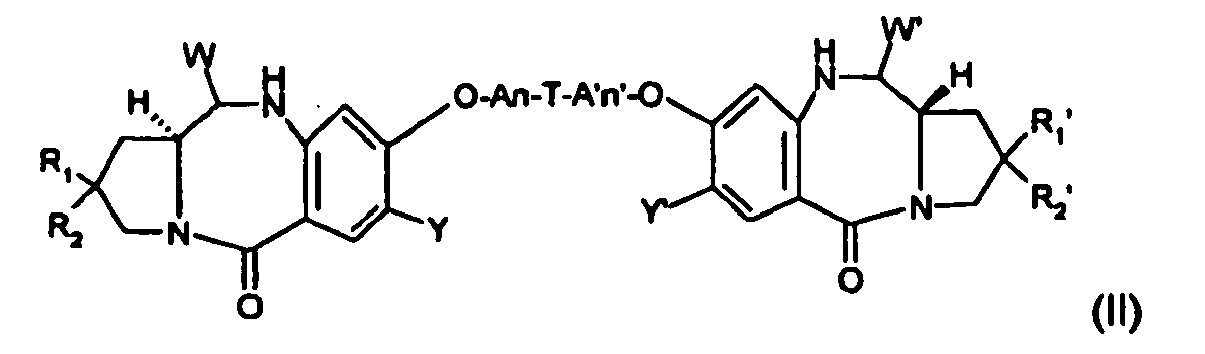
- Compounds according to claims 1 to 3 wherein W and W' are the same or different and are OH, OMe, OEt, NHCONH2, SMe.
- Compounds according to claim 1 or 2 of formula :


- Compounds according to any one of the preceding claims wherein A=A'.
- Compounds according to any one of the preceding claims wherein A=A'=linear unsubstituted alkyl.
- Compounds according to any one of the preceding claims wherein Y=Y'.
- Compounds according to any one of the preceding claims wherein Y=Y'=OAlkyl.
- Compounds according to any one of the preceding claims wherein Y=Y'=OMe.
- Compounds according to any one of the preceding claims wherein T is a phenyl or pyridyl.
- A conjugate comprising at least one compound of formula :
 - represents an optional single bond;---- represents either a single bond or a double bond ;provided that when ---- represents a single bond, U and U', the same or different, independently represent H and W and W, the same or different, are independently selected from the group consisting of OH, -OR, -OCOR, -OCOOR, -OCONRR', a cyclic carbamate such that N10 and C11 are a part of the cycle, -NRCONRR', -OCSNHR, a cyclic thiocarbamate such that N10 and C11 are a part of the cycle, -SH, -SR, -SOR, -SOOR, -SO3, -OSO3, -NRSOOR, -NRR', optionally cyclic amine such that N10 and C11 are a part of the cycle, - NROR', -NRCOR, -N3, a cyano, a halo, a trialkyl or triarylphosphonium ;and when ---- represents a double bond, U and U' are absent and W and W' represent H;- R 1, R 2, R 1', R 2' are the same or different and independently chosen from halide or alkyl optionally substituted by one or more Hal, CN, NRR', CF3, OR, aryl, het, S(O)qR, or R 1 and R 2 and R 1' and R 2' form together a double bond containing group =B and =B' respectively ;• B and B' are the same or different and independently chosen from alkyl being optionally substituted by one or more Hal, CN, NRR', CF3, OR, S(O)qR, aryl, Het;• A and A' are the same or different and independently chosen from alkyl or alkenyl each being optionally substituted by one or more Hal, CN, NRR', CF3, OR, S(O)qR, aryl, het, alkyl, alkenyl ;- Y and Y' are the same or different and independently chosen from H, OR ;- q is 0, 1 or 2 ;- n, n' equal or different are 0 or 1 ;- R and R' are equal or different and independently chosen from H, alkyl, aryl, each being optionally substituted by hal, CN, NRR', CF3, OR, aryl, het ;- T is -NR- or a 4 to 10-membered aryl or heteroaryl, each being optionally substituted by one or more Hal, CN, NRR', CF3, OR, S(O)qR, alkyl and substituted by one or more of thiol-, sulfide- or disulfide-containing linker(s) of formula:wherein :-(CR13R14)t(CR15R16)u(OCH2CH2)ySZ';-(CR13R14)t(CR17=CR18)(CR15R16)y(OCH2CH2)ySZ';-(CR13R14)t(NR19CO)(CR15R16)u(OCH2CH2)y SZ';-(CR13R14)t(OCO)(R15R16)u(OCH2CH2)ySZ';-(CR13R14)t(CO)(CR15R16)u(OCH2CH2)ySZ';-(CR13R14)t(CONR19)(CR15R16)u(OCH2CH2)ySZ';-(CR13R14)t-phenyl-CO(CR15R16)uSZ'; -(CR13R14)t-furyl-CO(CR15R16)uSZ';-(CR13R14)t-oxazolyl-CO(CR15R16)uSZ'; -(CR13R14)t-thiazolyl- CO(CR15R16)uSZ';-(CR13R14)t-thienyl-CO(CR15R16)uSZ'; -(CR13R14)t-imidazolyl-CO(CR15R16)uSZ',-(CR13R14)t-morpholino-CO(CR15R16)uSZ';-(CR13R14)t-piperazino-CO(CR15R16)uSZ';-(CR13R14)t-N-methyl-piperazino-CO(CR15R16)uSZ';-(CR13R14)t-phenyl-QSZ'; -(CR13R14)t-furyl-QSZ'; -(CR13R14)roxazolyl-QSZ';-(CR13R14)t-thiazolyl-QSZ'; -(CR13R14)t-thienyl-QSZ'; -(CR13R14)t-imidazolyl-QSZ';-(CR13R14)t-morpholino-QSZ'; -(CR13R14)t-piperazino-QSZ';-(CR13R14)t-methylpiperazino-QSZ';-O(CR13R14)t(CR15R16)u(OCH2CH2)ySZ';-O(CR13R14)t(NR19CO)(CR15R16)u(OCH2CH2)ySZ';-O(CR13R14)t(CR17=CR18)(CR15R16)t(OCH2CH2)ySZ';-O-phenyl-QSZ'; -O-furyl-QSZ'; -O-oxazolyl-QSZ'; -O-thiazolyl-QSZ'; -O-thienyl-OSZ';-O-imidazolyl-QSZ'; -O-morpholino-OSZ';-O-piperazino-QSZ'; -O-N-methylpiperazino-QSZ';-OCO-(CR13R14)t(CR17=CR18)(CR15R16)u(OCH2CH2)ySZ';-OCONR12(CR13R14)t(CR15R16)u (OCH2CH2)ySZ';-OCO-phenyl-QSZ'; -OCO-furyl-QSZ'; -OCO-oxazolyl-QSZ'; -OCO-thiazolyl-OSZ';-OCO-thienyl-QSZ'; -OCO-imidazolyl-QSZ'; -OCO-morpholino-QSZ';-OCO-piperazino-QSZ'; -OCO-N-methylpiperazino-QSZ';-CO(CR13R14)t(CR15R16)u(OCH2CH2)ySZ';-CO-(CR13R14)t(CR17=CR18)(CR15R16)u(OCH2CH2)ySZ';-CONR12(CR13R14)t(CR15R16)u(OCH2CH2)ySZ';-CO-phenyl-QSZ'; -CO-furyl-QSZ'; -CO-oxazolyl-QSZ'; -CO-thiazolyl-QSZ';-CO-thienyl-QSZ'; -CO-imidazolyl-QSZ'; -CO-morpholino-QSZ'; -CO-piperazino-OSZ';-CO-piperidino-QSZ'; -CO-N-methylpiperazino-QSZ';-NR19(CR13R14)t(CR15R16)u(OCH2CH2)ySZ';- NR19CO(CR13R14)t(CR15R16)u(OCH2CH2)ySZ';-NR19(CR13R14)t(CR17=CR18)(CR15R16)t(OCH2CH2)ySZ';-NR19CO(CR13R14)t (CR17=CR18)(CR15R16)t (OCH2CH2)ySZ';-NR19CONR12(CR13R14)t(CR15R16)u(OCH2CH2)ySZ';-NR19CO NR12(CR13R14)t(CR17=CR18)(CR15R18)t (OCH2CH2)ySZ';-NR19CO-phenyl-QSZ'; -NR19CO-furyl-QSZ'; -NR19CO-oxazolyl-QSZ';-NR19CO-thiazolyl-QSZ'; -NR18CO-thienyl-QSZ'; -NR19CO-imidazolyl-QSZ';-NR19CO-morpholino-QSZ'; -NR19CO-piperazino-QSZ';-NR19CO-piperidino-QSZ'; -NR19CO-N-methylpiperazino-QSZ';-NR19-phenyl-QSZ'; -NR19-furyl-QSZ'; -NR19-oxazolyl-QSZ'; -NR19-thiazolyl-QSZ';-NR19-thienyl-QSZ'; -NR19-imidazolyl-QSZ'; -NR19-morpholino-QSZ';-NR19-piperazino-QSZ'; -NR19-piperidino-QSZ'; -NR19-N-methylpiperazino-QSZ';-NR19CO-NR12-phenyl-QSZ'; -NR19CO-NR12-oxazolyl-QSZ';-NR19CO-NR12-thiazolyl-QSZ'; -NR19CO-NR12-thienyl-QSZ';-NR19CO-NR12-piperidino-QSZ';-S(O)q(CR13R14)t(CR15R16)u(OCH2CH2)ySZ';-S(O)q(CR13R14)t(CR17=CR18)(CR15R16)t(OCH2CH2)ySZ';-SCONR12(CR13R14)t(CR15R16)u(OCH2CH2)ySZ';-SCO-morpholino-QSZ'; -SCO-piperazino-QSZ';-SCO-piperidino-QSZ'; -SCO-N-methylpiperazino-QSZ'• Z' is H, Ac, R 19' or SR 19' ;• Q is a direct link or a linear alkyl or branched alkyl having from 1-10 carbon atoms or a polyethylene glycol spacer with 2 to 20 repeating ethylene oxy units;• R 19' and R 12 are the same or different and are linear alkyl, branched alkyl or cyclic alkyl having from 1 to 10 carbon atoms, or simple or substituted aryl or heterocyclic, and R 12 can in addition be H ;• R 13, R 14, R 15 and R 16 are the same or different and are H or a linear or branched alkyl having from 1 to 4 carbon atoms ;• R 17, R 18 and R 19 are H or alkyl ;• u is an integer from 1 to 10 and can also be 0,• t is an integer from 1 to 10 and can also be 0,• y is an integer from 1 to 20 and can also be 0 ;or their pharmaceutically acceptable salts, hydrates, or hydrated salts, or the polymorphic crystalline structures of these compounds or their optical isomers, racemates, diastereomers or enantiomers,
said compound being covalently bonded to a cell binding agent through said linker. - A conjugate according to claim 12 wherein U, U', W, W, T, R1, R2, R1', R2', Y, Y', A, A', n, n', -, ---- are as defined in claims 2 to 11.
- A conjugate according to claim 12 or 13 wherein said cell binding agent is chosen from antibodies, fragment of an antibody that contains at least one binding site, lymphokines, hormones, growth factors, nutrient-transport molecules.
- A conjugate according to claims 12 to 14 wherein the cell binding agent is chosen from monoclonal antibodies; single chain antibodies; Fab, Fab', F(ab')2 and Fv, interferons; peptides; IL-2, IL-3, IL-4, IL-6; insulin, TRH (thyrotropin releasing hormones), MSH (melanocyte-stimulating hormone), steroid hormones, androgens, estrogens; EGF, TGFα, insulin like growth factor (IGF-I, IGF-II) G-CSF, M-CSF, GM-CSF; folate, transferrin.
- A pharmaceutical composition comprising a conjugate as defined in claims 12 to 15 or a compound as defined in claims 1 to 11 together with a pharmaceutically acceptable carrier.
- Process of preparation of a conjugate according to claims 12 to 15 comprising the step where a compound of formula (I) as defined in claim 1 in which T comprises a sulfide, disulfide or thiol group, or a precursor thereof, is reacted with a cell binding agent comprising a function reactive towards disulfide or thiol so that the compound and the cell binding agent are linked together via a covalent bond.
- Process to prepare a conjugate wherein a free or protected-thiol containing cell-binding agent is reacted with a disulfide- or thiol-containing compound of any one of claims 1 to 11, the cell-binding agent being a peptide or an antibody modified by a cross-linking reagent.
- Process according to claim 18 wherein the cross-linking reagent is N-succinimidyl 3-(2-pyridyldithio)propionate, N-succinimidyl 4-(2-pyridyldithio)pentanoate, 4-succinimidyl-oxycarbonyl-α-methyl-α-(2-pyridyl dithio)-toluene, N-succinimidyl-3-(2-pyridyldithio) butyrate, N-sulfosuccinimidyl-3-(2-(5-nitro-pyridyldithio) butyrate, 2-iminothiolane, or S-acetylsuccinic anhydride.
- Process according to claim 17 wherein :- the thiopyridyl group of a monoclonal antibody modified by succinimidyl pyridyldithiopropionate is displaced by treatment with a thiol-containing compound according to any one of claims 1 to 11 to produce a disulfide linked conjugate ;- the aryl-thiol group of a compound according to any one of claims 1 to 11 is displaced by sulfhydryl groups previously introduced into an antibody to produce a disulfide linked conjugate.
- Process according to claim 17 wherein a thiol-containing compound of any one of claims 1 to 11 is linked via a thioether link, to an antibody or a cell binding agent modified by N-succinimidyl 4-(maleimidomethyl)cyclohexanecarboxylate, N-succinimidyl-4-(N-maleimidomethyl)-cyclohexane-1-carboxy-(6-amidocaproate).
- Process according to claim 17 wherein the cross-linking reagent comprises a haloacetyl-based moiety and is chosen among succinimidyl-4-(iodoacetyl)-aminobenzoate, N-succinimidyl iodoacetate, N-succinimidyl bromoacetate or N-succinimidyl 3-(bromo-acetamido)propionate.
- Process according to claims 17 to 22 wherein the conjugate is purified :- by a standard chromatography technique selected among HPLC, size-exclusion chromatography, adsorption chromatography, ion exchange chromatography, hydrophobic interaction chromatography or affinity chromatography, chromatography on ceramic hydroapatite ;■ or by dialysis ;■ or by diafiltration.
- Use of an effective amount of a conjugate as defined in any one of claims 12 to 15 or a compound as defined in any one of claims 1 to 11 for the preparation of a medicament for the treatment of cancer.
- A compound according to any one of claims 1 to 11 to for use as an anticancer agent.
- A conjugate according to any one of claims 12 to 15 for use as an anticancer agent.
Priority Applications (51)
| Application Number | Priority Date | Filing Date | Title |
|---|---|---|---|
| PL06290154T PL1813614T3 (en) | 2006-01-25 | 2006-01-25 | Cytotoxic agents comprising new tomaymycin derivatives |
| DK06290154.1T DK1813614T3 (en) | 2006-01-25 | 2006-01-25 | Cytotoxic agents comprising novel tomaymycin derivatives |
| AT06290154T ATE527262T1 (en) | 2006-01-25 | 2006-01-25 | NEW CYTOTOXIC AGENTS CONTAINING TOMAYMYCIN DERIVATIVES |
| RS20110579A RS52060B (en) | 2006-01-25 | 2006-01-25 | CYTOTOXIC AGENTS CONTAINING NEW TOMAIMYCIN DERIVATIVES |
| SI200631216T SI1813614T1 (en) | 2006-01-25 | 2006-01-25 | Cytotoxic agents comprising new tomaymycin derivatives |
| PT06290154T PT1813614E (en) | 2006-01-25 | 2006-01-25 | Cytotoxic agents comprising new tomaymycin derivatives |
| EP06290154A EP1813614B1 (en) | 2006-01-25 | 2006-01-25 | Cytotoxic agents comprising new tomaymycin derivatives |
| ES06290154T ES2374964T3 (en) | 2006-01-25 | 2006-01-25 | CYTOTOXIC AGENTS UNDERSTANDING NEW TOMAIMYCIN DERIVATIVES. |
| DO2007P000016A DOP2007000016A (en) | 2006-01-25 | 2007-01-19 | CYTOTOXIC AGENTS THAT INCLUDE NEW TOMAIMYCIN DERIVATIVES. |
| RS20140168A RS53293B (en) | 2006-01-25 | 2007-01-22 | CYTOTOXIC AGENTS CONTAINING NEW TOMAIMYCIN DERIVATIVES AND THEIR THERAPY |
| AU2007209072A AU2007209072C1 (en) | 2006-01-25 | 2007-01-22 | Cytotoxic agents comprising new tomaymycin derivatives and their therapeutic use |
| EP10180643A EP2371827A1 (en) | 2006-01-25 | 2007-01-22 | Cytotoxic agents comprising new tomaymycin derivatives and their therapeutic use |
| BRPI0707264-3A BRPI0707264A2 (en) | 2006-01-25 | 2007-01-22 | cytotoxic agents comprising tomaimycin derivatives and their therapeutic use |
| ES07700505.6T ES2457525T3 (en) | 2006-01-25 | 2007-01-22 | Cytotoxic agents comprising new tomaimycin derivatives and their therapeutic use |
| KR1020087020594A KR101428112B1 (en) | 2006-01-25 | 2007-01-22 | Cytotoxic agents comprising new tomaymycin derivatives and their therapeutic use |
| EP10180637A EP2386559A1 (en) | 2006-01-25 | 2007-01-22 | Cytotoxiv agents comprising new tomaymycin derivatives and their therapeutic use |
| PT77005056T PT1981889E (en) | 2006-01-25 | 2007-01-22 | Cytotoxic agents comprising new tomaymycin derivatives and their therapeutic use |
| PH1/2011/502704A PH12011502704A1 (en) | 2006-01-25 | 2007-01-22 | Cytotoxic agents comprising new tomaymycin derivatives and their therapeutic use |
| CA2635482A CA2635482C (en) | 2006-01-25 | 2007-01-22 | Cytotoxic agents comprising new tomaymycin derivatives and their therapeutic use |
| NZ569789A NZ569789A (en) | 2006-01-25 | 2007-01-22 | Cytotoxic agents comprising new tomaymycin derivatives and their therapeutic use |
| HK09107327.0A HK1129106B (en) | 2006-01-25 | 2007-01-22 | Cytotoxic agents comprising new tomaymycin derivatives and their therapeutic use |
| ZA200805649A ZA200805649B (en) | 2006-01-25 | 2007-01-22 | Cytotoxic agents comprising new tomaymycin derivatives and their therapeutic use |
| TW096102368A TWI389909B (en) | 2006-01-25 | 2007-01-22 | Cytotoxic agent comprising novel tomaymycin derivative and therapeutic use thereof |
| MEP-2014-39A ME01814B (en) | 2006-01-25 | 2007-01-22 | CYTOTOXIC AGENTS CONTAINING NEW TOMAIMYCIN DERIVATIVES AND THEIR THERAPY |
| SI200731435T SI1981889T1 (en) | 2006-01-25 | 2007-01-22 | Cytotoxic agents comprising new tomaymycin derivatives and their therapeutic use |
| PCT/IB2007/000142 WO2007085930A1 (en) | 2006-01-25 | 2007-01-22 | Cytotoxic agents comprising new tomaymycin derivatives and their therapeutic use |
| JP2008551898A JP5116696B2 (en) | 2006-01-25 | 2007-01-22 | Cytotoxic agents containing novel tomaymycin derivatives and their therapeutic use |
| MYPI20082798A MY157715A (en) | 2006-01-25 | 2007-01-22 | Cytotoxic agents comprising new tomaymycin derivatives and their therapeutic use |
| DK07700505.6T DK1981889T3 (en) | 2006-01-25 | 2007-01-22 | CYTOTOXIC AGENTS INCLUDING NEW TOMAYMYCIN DERIVATIVES AND THERAPEUTIC APPLICATION THEREOF |
| CN200780003379XA CN101374846B (en) | 2006-01-25 | 2007-01-22 | Cytotoxic drugs containing new tomayamycin derivatives and their therapeutic use |
| EA200870193A EA017196B1 (en) | 2006-01-25 | 2007-01-22 | Cytotoxic agents comprising new tomaymycin derivatives, conjugates, process for preparation thereof, pharmaceutical composition comprising conjugates and their therapeutic use |
| PL07700505T PL1981889T3 (en) | 2006-01-25 | 2007-01-22 | Cytotoxic agents comprising new tomaymycin derivatives and their therapeutic use |
| EP07700505.6A EP1981889B1 (en) | 2006-01-25 | 2007-01-22 | Cytotoxic agents comprising new tomaymycin derivatives and their therapeutic use |
| MX2008009582A MX2008009582A (en) | 2006-01-25 | 2007-01-22 | Cytotoxic agents comprising new tomaymycin derivatives and their therapeutic use. |
| HRP20140307TT HRP20140307T1 (en) | 2006-01-25 | 2007-01-22 | Cytotoxic agents containing novel tomomycin derivatives and their use in therapy |
| UAA200810591A UA97794C2 (en) | 2006-01-25 | 2007-01-22 | Cytotoxic agents comprising new tomaymycin derivatives and their therapeutic use |
| PE2007000074A PE20071110A1 (en) | 2006-01-25 | 2007-01-24 | CYTOTOXIC AGENTS INCLUDING TOMAIMYCIN DERIVATIVES |
| ARP070100311A AR059201A1 (en) | 2006-01-25 | 2007-01-24 | CYTOTOXIC COMPOUNDS DERIVED FROM TOMAIMYCIN |
| TNP2008000283A TNSN08283A1 (en) | 2006-01-25 | 2008-06-23 | Cytotoxic agents comprising new tomaymycin derivatives and their therapeutic use |
| IL192472A IL192472A0 (en) | 2006-01-25 | 2008-06-26 | Cytotoxic agents comprising new tomaymycin derivatives and their therapeutic use |
| HN2008001103A HN2008001103A (en) | 2006-01-25 | 2008-07-14 | CYTOTOXIC AGENTS UNDERSTANDING NEW TOMAIMYCIN DERIVATIVES |
| CR10149A CR10149A (en) | 2006-01-25 | 2008-07-16 | CYTOTOXIC AGENTS UNDERSTANDING NEW TOMAIMYCIN DERIVATIVES AND THERAPEUTIC USE |
| US12/174,195 US8163736B2 (en) | 2006-01-25 | 2008-07-16 | Cytotoxic agents comprising new tomaymycin derivatives |
| EC2008008632A ECSP088632A (en) | 2006-01-25 | 2008-07-18 | CYTOTOXIC AGENTS UNDERSTANDING NEW TOMAIMYCIN DERIVATIVES |
| GT200800147A GT200800147A (en) | 2006-01-25 | 2008-07-22 | CYTOTOXIC AGENTS UNDERSTANDING NEW TOMAIMYCIN DERIVATIVES |
| NI200800207A NI200800207A (en) | 2006-01-25 | 2008-07-24 | CYTOTOXIC AGENTS INCLUDING NEW DERIVATIVES OF TOMAIMYCIN |
| NO20083427A NO341074B1 (en) | 2006-01-25 | 2008-08-05 | Cytotoxic agents which include novel tomaymycin derivatives and their therapeutic use |
| MA31188A MA30226B1 (en) | 2006-01-25 | 2008-08-19 | CYTOTOXIC AGENTS COMPRISING NOVEL TOMAYMYCIN DERIVATIVES AND THEIR THERAPEUTIC USE. |
| HR20110955T HRP20110955T1 (en) | 2006-01-25 | 2011-12-19 | Cytotoxic agents comprising new tomaymycin derivatives |
| CY20111101291T CY1112495T1 (en) | 2006-01-25 | 2011-12-29 | CYTAROTOXIC FACTORS INCLUDING NEW TOMAIMYKIN PRODUCERS |
| CY20141100277T CY1115199T1 (en) | 2006-01-25 | 2014-04-14 | Cytotoxic agents containing novel tomomycin derivatives and their therapeutic use |
Applications Claiming Priority (1)
| Application Number | Priority Date | Filing Date | Title |
|---|---|---|---|
| EP06290154A EP1813614B1 (en) | 2006-01-25 | 2006-01-25 | Cytotoxic agents comprising new tomaymycin derivatives |
Publications (2)
| Publication Number | Publication Date |
|---|---|
| EP1813614A1 EP1813614A1 (en) | 2007-08-01 |
| EP1813614B1 true EP1813614B1 (en) | 2011-10-05 |
Family
ID=35953949
Family Applications (4)
| Application Number | Title | Priority Date | Filing Date |
|---|---|---|---|
| EP06290154A Expired - Lifetime EP1813614B1 (en) | 2006-01-25 | 2006-01-25 | Cytotoxic agents comprising new tomaymycin derivatives |
| EP10180643A Withdrawn EP2371827A1 (en) | 2006-01-25 | 2007-01-22 | Cytotoxic agents comprising new tomaymycin derivatives and their therapeutic use |
| EP10180637A Withdrawn EP2386559A1 (en) | 2006-01-25 | 2007-01-22 | Cytotoxiv agents comprising new tomaymycin derivatives and their therapeutic use |
| EP07700505.6A Active EP1981889B1 (en) | 2006-01-25 | 2007-01-22 | Cytotoxic agents comprising new tomaymycin derivatives and their therapeutic use |
Family Applications After (3)
| Application Number | Title | Priority Date | Filing Date |
|---|---|---|---|
| EP10180643A Withdrawn EP2371827A1 (en) | 2006-01-25 | 2007-01-22 | Cytotoxic agents comprising new tomaymycin derivatives and their therapeutic use |
| EP10180637A Withdrawn EP2386559A1 (en) | 2006-01-25 | 2007-01-22 | Cytotoxiv agents comprising new tomaymycin derivatives and their therapeutic use |
| EP07700505.6A Active EP1981889B1 (en) | 2006-01-25 | 2007-01-22 | Cytotoxic agents comprising new tomaymycin derivatives and their therapeutic use |
Country Status (39)
| Country | Link |
|---|---|
| US (1) | US8163736B2 (en) |
| EP (4) | EP1813614B1 (en) |
| JP (1) | JP5116696B2 (en) |
| KR (1) | KR101428112B1 (en) |
| CN (1) | CN101374846B (en) |
| AR (1) | AR059201A1 (en) |
| AT (1) | ATE527262T1 (en) |
| AU (1) | AU2007209072C1 (en) |
| BR (1) | BRPI0707264A2 (en) |
| CA (1) | CA2635482C (en) |
| CR (1) | CR10149A (en) |
| CY (2) | CY1112495T1 (en) |
| DK (2) | DK1813614T3 (en) |
| DO (1) | DOP2007000016A (en) |
| EA (1) | EA017196B1 (en) |
| EC (1) | ECSP088632A (en) |
| ES (2) | ES2374964T3 (en) |
| GT (1) | GT200800147A (en) |
| HN (1) | HN2008001103A (en) |
| HR (2) | HRP20140307T1 (en) |
| IL (1) | IL192472A0 (en) |
| MA (1) | MA30226B1 (en) |
| ME (1) | ME01814B (en) |
| MX (1) | MX2008009582A (en) |
| MY (1) | MY157715A (en) |
| NI (1) | NI200800207A (en) |
| NO (1) | NO341074B1 (en) |
| NZ (1) | NZ569789A (en) |
| PE (1) | PE20071110A1 (en) |
| PH (1) | PH12011502704A1 (en) |
| PL (2) | PL1813614T3 (en) |
| PT (2) | PT1813614E (en) |
| RS (2) | RS52060B (en) |
| SI (2) | SI1813614T1 (en) |
| TN (1) | TNSN08283A1 (en) |
| TW (1) | TWI389909B (en) |
| UA (1) | UA97794C2 (en) |
| WO (1) | WO2007085930A1 (en) |
| ZA (1) | ZA200805649B (en) |
Cited By (1)
| Publication number | Priority date | Publication date | Assignee | Title |
|---|---|---|---|---|
| US9415117B2 (en) | 2012-10-12 | 2016-08-16 | Medimmune Limited | Pyrrolobenzodiazepines and conjugates thereof |
Families Citing this family (189)
| Publication number | Priority date | Publication date | Assignee | Title |
|---|---|---|---|---|
| WO2008010101A2 (en) | 2006-07-18 | 2008-01-24 | Sanofi-Aventis | Antagonist antibody against epha2 for the treatment of cancer |
| EP1914242A1 (en) | 2006-10-19 | 2008-04-23 | Sanofi-Aventis | Novel anti-CD38 antibodies for the treatment of cancer |
| PT2019104E (en) * | 2007-07-19 | 2013-12-03 | Sanofi Sa | Cytotoxic agents comprising new tomaymycin derivatives and their therapeutic use |
| GB0819097D0 (en) | 2008-10-17 | 2008-11-26 | Spirogen Ltd | Pyrrolobenzodiazepines |
| AU2010210646B2 (en) | 2009-02-05 | 2015-10-29 | Immunogen, Inc. | Novel benzodiazepine derivatives |
| FR2947269B1 (en) | 2009-06-29 | 2013-01-18 | Sanofi Aventis | NEW ANTICANCER COMPOUNDS |
| FR2949469A1 (en) * | 2009-08-25 | 2011-03-04 | Sanofi Aventis | ANTICANCER DERIVATIVES, THEIR PREPARATION AND THEIR THERAPEUTIC APPLICATION |
| TW201116297A (en) | 2009-10-02 | 2011-05-16 | Sanofi Aventis | Antibodies that specifically bind to the EphA2 receptor |
| KR20130009760A (en) | 2010-02-10 | 2013-01-23 | 이뮤노젠 아이엔씨 | Cd20 antibodies and uses thereof |
| NZ602933A (en) | 2010-04-15 | 2014-09-26 | Seattle Genetics Inc | Pyrrolobenzodiazepines used to treat proliferative diseases |
| MA34277B1 (en) * | 2010-04-15 | 2013-06-01 | Spirogen Developments Sarl | PYRROLOBENZODIAZEPINES AND CONJUGATES THEREOF |
| JP5870400B2 (en) * | 2010-04-15 | 2016-03-01 | シアトル ジェネティクス,インコーポレーテッド | Targeted pyrrolobenzodiazepine conjugates |
| FR2963007B1 (en) | 2010-07-26 | 2013-04-05 | Sanofi Aventis | ANTICANCER DERIVATIVES, THEIR PREPARATION AND THEIR THERAPEUTIC APPLICATION |
| MY183977A (en) | 2011-02-15 | 2021-03-17 | Immunogen Inc | Cytotoxic benzodiazepine derivatives |
| WO2012145112A2 (en) * | 2011-04-18 | 2012-10-26 | Immunogen, Inc. | Novel maytansinoid derivatives with sulfoxide linker |
| US20130058947A1 (en) | 2011-09-02 | 2013-03-07 | Stem Centrx, Inc | Novel Modulators and Methods of Use |
| WO2013041606A1 (en) | 2011-09-20 | 2013-03-28 | Spirogen Sàrl | Pyrrolobenzodiazepines as unsymmetrical dimeric pbd compounds for inclusion in targeted conjugates |
| WO2013053871A1 (en) | 2011-10-14 | 2013-04-18 | Spirogen Sàrl | Pyrrolobenzodiazepines |
| AU2012322613B2 (en) | 2011-10-14 | 2016-04-21 | Medimmune Limited | Pyrrolobenzodiazepines and targeted conjugates |
| EP2751111B1 (en) | 2011-10-14 | 2017-04-26 | MedImmune Limited | Asymmetrical bis-(5H-Pyrrolo[2,1-c][1,4]benzodiazepin-5-one) derivatives for the treatment of proliferative or autoimmune diseases |
| JP6393617B2 (en) | 2011-10-14 | 2018-09-19 | シアトル ジェネティクス,インコーポレーテッド | Pyrrolobenzodiazepine and target conjugates |
| DK2750713T3 (en) * | 2011-10-14 | 2015-12-21 | Medimmune Ltd | PYRROLOBENZODIAZEPINS AND CONJUGATES THEREOF |
| PH12020500604A1 (en) | 2012-02-24 | 2023-06-14 | Abbvie Stemcentrx Llc | Anti sez6 antibodies and methods of use |
| JP6089047B2 (en) | 2012-02-24 | 2017-03-01 | アッヴィ・ステムセントルクス・エル・エル・シー | DLL3 modulator and method of use |
| AR090549A1 (en) | 2012-03-30 | 2014-11-19 | Genentech Inc | ANTI-LGR5 AND IMMUNOCATE PLAYERS |
| AU2013256596A1 (en) | 2012-05-01 | 2014-10-09 | Genentech, Inc. | Anti-PMEL17 antibodies and immunoconjugates |
| HK1207388A1 (en) | 2012-05-15 | 2016-01-29 | Seattle Genetics, Inc. | Self-stabilizing linker conjugates |
| WO2013177481A1 (en) | 2012-05-25 | 2013-11-28 | Immunogen, Inc. | Benzodiazepines and conjugates thereof |
| KR20150027829A (en) | 2012-07-09 | 2015-03-12 | 제넨테크, 인크. | Immunoconjucates comprising anti-CD22 antibodies |
| SG11201500093TA (en) | 2012-07-09 | 2015-02-27 | Genentech Inc | Immunoconjugates comprising anti-cd79b antibodies |
| US9464141B2 (en) | 2012-08-02 | 2016-10-11 | Genentech, Inc. | Anti-ETBR antibodies and immunoconjugates |
| HK1211208A1 (en) | 2012-08-22 | 2016-05-20 | Immunogen, Inc. | Cytotoxic benzodiazepine derivative |
| WO2014057114A1 (en) | 2012-10-12 | 2014-04-17 | Adc Therapeutics Sàrl | Pyrrolobenzodiazepine-anti-psma antibody conjugates |
| EP2906296B1 (en) | 2012-10-12 | 2018-03-21 | ADC Therapeutics SA | Pyrrolobenzodiazepine-antibody conjugates |
| KR101995621B1 (en) | 2012-10-12 | 2019-07-03 | 에이디씨 테라퓨틱스 에스에이 | Pyrrolobenzodiazepine-anti-cd22 antibody conjugates |
| JP6270859B2 (en) | 2012-10-12 | 2018-01-31 | エイディーシー・セラピューティクス・エス・アー・エール・エルAdc Therapeutics Sarl | Pyrrolobenzodiazepine-antibody conjugate |
| EP2906249B1 (en) | 2012-10-12 | 2018-06-27 | MedImmune Limited | Synthesis and intermediates of pyrrolobenzodiazepine derivatives for conjugation |
| US9931414B2 (en) | 2012-10-12 | 2018-04-03 | Medimmune Limited | Pyrrolobenzodiazepine-antibody conjugates |
| JP5993093B2 (en) | 2012-10-12 | 2016-09-14 | メドイミューン・リミテッドMedImmune Limited | Pyrrolobenzodiazepines and their complexes |
| US10695433B2 (en) | 2012-10-12 | 2020-06-30 | Medimmune Limited | Pyrrolobenzodiazepine-antibody conjugates |
| JP6133431B2 (en) | 2012-11-24 | 2017-05-24 | ハンジョウ ディーエーシー バイオテック シーオー.,エルティディ.Hangzhou Dac Biotech Co.,Ltd. | Use of hydrophilic conjugates and conjugation reactions between drug molecules and cell binding molecules |
| HK1216176A1 (en) | 2012-12-21 | 2016-10-21 | Medlmmune Limited | Unsymmetrical pyrrolobenzodiazepines-dimers for use in the treatment of proliferative and autoimmune diseases |
| EP2745876A1 (en) | 2012-12-21 | 2014-06-25 | Prous Institute for Biomedical Research, S.A. | Hydroxy aliphatic substituted phenyl aminoalkyl ether derivatives |
| AU2013366493B2 (en) | 2012-12-21 | 2017-08-24 | Medimmune Limited | Pyrrolobenzodiazepines and conjugates thereof |
| SMT201900339T1 (en) | 2013-02-22 | 2019-07-11 | Medimmune Ltd | Antidll3-antibody-pbd conjugates and uses thereof |
| AU2014229529B2 (en) | 2013-03-13 | 2018-02-15 | Medimmune Limited | Pyrrolobenzodiazepines and conjugates thereof |
| WO2014159981A2 (en) | 2013-03-13 | 2014-10-02 | Spirogen Sarl | Pyrrolobenzodiazepines and conjugates thereof |
| AU2014230735B2 (en) | 2013-03-13 | 2018-03-15 | Medimmune Limited | Pyrrolobenzodiazepines and conjugates thereof |
| EP3299391B1 (en) | 2013-03-14 | 2019-12-04 | Genentech, Inc. | Anti-b7-h4 antibodies and immunoconjugates |
| US9562099B2 (en) | 2013-03-14 | 2017-02-07 | Genentech, Inc. | Anti-B7-H4 antibodies and immunoconjugates |
| US10442836B2 (en) | 2013-08-12 | 2019-10-15 | Genentech, Inc. | 1-(chloromethyl)-2,3-dihydro-1H-benzo[E]indole dimer antibody-drug conjugate compounds, and methods of use and treatment |
| JP2016538318A (en) | 2013-08-28 | 2016-12-08 | ステムセントリックス, インコーポレイテッド | New SEZ6 modulator and method of use |
| EP3892294A1 (en) | 2013-08-28 | 2021-10-13 | AbbVie Stemcentrx LLC | Site-specific antibody conjugation methods and compositions |
| NZ717003A (en) | 2013-09-02 | 2019-05-31 | Hangzhou Dac Biotech Co Ltd | Novel cytotoxic agents for conjugation of drugs to cell binding molecule |
| JP2016537399A (en) | 2013-09-17 | 2016-12-01 | ジェネンテック, インコーポレイテッド | Method using anti-LGR5 antibody |
| GB201317981D0 (en) | 2013-10-11 | 2013-11-27 | Spirogen Sarl | Pyrrolobenzodiazepines and conjugates thereof |
| GB201317982D0 (en) | 2013-10-11 | 2013-11-27 | Spirogen Sarl | Pyrrolobenzodiazepines and conjugates thereof |
| EP3054985B1 (en) | 2013-10-11 | 2018-12-26 | Medimmune Limited | Pyrrolobenzodiazepine-antibody conjugates |
| US10010624B2 (en) | 2013-10-11 | 2018-07-03 | Medimmune Limited | Pyrrolobenzodiazepine-antibody conjugates |
| US9956299B2 (en) | 2013-10-11 | 2018-05-01 | Medimmune Limited | Pyrrolobenzodiazepine—antibody conjugates |
| MX2021008464A (en) | 2013-10-15 | 2023-03-03 | Seattle Genetics Inc | Pegylated drug-linkers for improved ligand-drug conjugate pharmacokinetics. |
| JP6515111B2 (en) | 2013-11-06 | 2019-05-22 | アッヴィ・ステムセントルクス・エル・エル・シー | Novel anti-claudin antibodies and methods of use |
| CA2932476A1 (en) | 2013-12-12 | 2015-06-18 | Stemcentrx, Inc. | Novel anti-dpep3 antibodies and methods of use |
| SG11201604784XA (en) | 2013-12-13 | 2016-07-28 | Genentech Inc | Anti-cd33 antibodies and immunoconjugates |
| BR112016013258A2 (en) | 2013-12-16 | 2018-01-16 | Genentech Inc | antibody-drug conjugate, pharmaceutical composition, method for treating cancer and kit |
| CN106456725B9 (en) | 2014-02-11 | 2022-08-09 | 西雅图基因公司 | Selective reduction of proteins |
| BR112016018891A2 (en) | 2014-02-21 | 2017-10-10 | Abbvie Stemcentrx Llc | anti-dll3 antibodies and drug conjugates for use in melanoma |
| US10464955B2 (en) | 2014-02-28 | 2019-11-05 | Hangzhou Dac Biotech Co., Ltd. | Charged linkers and their uses for conjugation |
| GB201406767D0 (en) | 2014-04-15 | 2014-05-28 | Cancer Rec Tech Ltd | Humanized anti-Tn-MUC1 antibodies anf their conjugates |
| GB201407816D0 (en) | 2014-05-02 | 2014-06-18 | King S College London | Pyrrolobenzodiazepine Compounds |
| WO2015179658A2 (en) | 2014-05-22 | 2015-11-26 | Genentech, Inc. | Anti-gpc3 antibodies and immunoconjugates |
| WO2016008112A1 (en) | 2014-07-16 | 2016-01-21 | Medshine Discovery Inc. | Linkers and application towards adc thereof |
| MX2017002605A (en) | 2014-08-28 | 2017-05-19 | Bioatla Llc | Conditionally active chimeric antigen receptors for modified t-cells. |
| CN109147874A (en) * | 2014-09-02 | 2019-01-04 | 伊缪诺金公司 | Method for preparing antibody drug conjugate composition |
| TW201613930A (en) | 2014-09-03 | 2016-04-16 | Immunogen Inc | Cytotoxic benzodiazepine derivatives |
| SG11201701455SA (en) | 2014-09-03 | 2017-03-30 | Immunogen Inc | Cytotoxic benzodiazepine derivatives |
| TW201617368A (en) | 2014-09-05 | 2016-05-16 | 史坦森特瑞斯公司 | Novel anti-MFI2 antibody and method of use |
| CN106687141A (en) | 2014-09-10 | 2017-05-17 | 麦迪穆有限责任公司 | Pyrrolobenzodiazepines and conjugates thereof |
| PE20170935A1 (en) | 2014-09-12 | 2017-07-13 | Genentech Inc | ANTI-HER2 AND IMMUNOCONJUGATED ANTIBODIES |
| GB201416112D0 (en) | 2014-09-12 | 2014-10-29 | Medimmune Ltd | Pyrrolobenzodiazepines and conjugates thereof |
| BR112017004802A2 (en) | 2014-09-12 | 2017-12-12 | Genentech Inc | anti-cll-1 and immunoconjugate antibodies |
| CN113698485A (en) | 2014-09-12 | 2021-11-26 | 基因泰克公司 | anti-B7-H4 antibodies and immunoconjugates |
| MX2017003123A (en) | 2014-09-12 | 2017-05-12 | Genentech Inc | Cysteine engineered antibodies and conjugates. |
| BR112017004953A2 (en) * | 2014-09-17 | 2017-12-05 | Genentech Inc | immunoconjugate, pharmaceutical formulation, method of treatment and method of inhibiting cell proliferation |
| SG11201702079UA (en) | 2014-09-17 | 2017-04-27 | Genentech Inc | Pyrrolobenzodiazepines and antibody disulfide conjugates thereof |
| BR112017011111A2 (en) | 2014-11-25 | 2017-12-26 | Adc Therapeutics Sa | pyrrolobenzodiazepine-antibody conjugates |
| CN107428780B (en) | 2015-01-14 | 2020-09-04 | 百时美施贵宝公司 | Benzodiazepine* dimers, their conjugates and methods of making and using them |
| JP6676058B2 (en) | 2015-01-14 | 2020-04-08 | ブリストル−マイヤーズ スクイブ カンパニーBristol−Myers Squibb Company | Heteroarylene-bridged benzodiazepine dimers, conjugates thereof, and methods of making and using |
| US9504694B2 (en) * | 2015-03-19 | 2016-11-29 | Cellerant Therapeutics, Inc. | Isoquinolidinobenzodiazepines |
| US10206942B2 (en) | 2015-04-10 | 2019-02-19 | Thomas Jefferson University | Methods and compositions for treating cancers and enhancing therapeutic immunity by selectively reducing immunomodulatory M2 monocytes |
| GB201506389D0 (en) | 2015-04-15 | 2015-05-27 | Berkel Patricius H C Van And Howard Philip W | Site-specific antibody-drug conjugates |
| GB201506411D0 (en) | 2015-04-15 | 2015-05-27 | Bergenbio As | Humanized anti-axl antibodies |
| GB201506402D0 (en) | 2015-04-15 | 2015-05-27 | Berkel Patricius H C Van And Howard Philip W | Site-specific antibody-drug conjugates |
| CA2989269C (en) | 2015-06-15 | 2020-09-22 | Robert Yongxin Zhao | Hydrophilic linkers for conjugation of a cytotoxic agent or chromophore molecule to a cell-binding molecule |
| CN108391434A (en) | 2015-06-23 | 2018-08-10 | 百时美施贵宝公司 | Macrocyclic benzodiazepine* dimers, their conjugates, preparation and use |
| EP3319936B1 (en) | 2015-07-12 | 2025-12-17 | Hangzhou Dac Biotech Co., Ltd. | Bridge linkers for conjugation of cell-binding molecules |
| US9839687B2 (en) | 2015-07-15 | 2017-12-12 | Suzhou M-Conj Biotech Co., Ltd. | Acetylenedicarboxyl linkers and their uses in specific conjugation of a cell-binding molecule |
| IL286788B2 (en) | 2015-07-21 | 2024-01-01 | Immunogen Inc | Methods for the preparation of cytotoxic benzodiazepine compounds |
| US11078286B2 (en) | 2015-09-20 | 2021-08-03 | The United States Of America, As Represented By The Secretary, Department Of Health And Human Services | Monoclonal antibodies specific for fibroblast growth factor receptor 4 (FGFR4) and methods of their use |
| MA43345A (en) | 2015-10-02 | 2018-08-08 | Hoffmann La Roche | PYRROLOBENZODIAZEPINE ANTIBODY-DRUG CONJUGATES AND METHODS OF USE |
| MA43354A (en) | 2015-10-16 | 2018-08-22 | Genentech Inc | CONJUGATE DRUG CONJUGATES WITH CLOUDY DISULPHIDE |
| GB201601431D0 (en) | 2016-01-26 | 2016-03-09 | Medimmune Ltd | Pyrrolobenzodiazepines |
| GB201602356D0 (en) | 2016-02-10 | 2016-03-23 | Medimmune Ltd | Pyrrolobenzodiazepine Conjugates |
| GB201602359D0 (en) | 2016-02-10 | 2016-03-23 | Medimmune Ltd | Pyrrolobenzodiazepine Conjugates |
| CN109843919A (en) | 2016-03-25 | 2019-06-04 | 西雅图基因公司 | The method for being used to prepare the agent-linker and its intermediate of Pegylation |
| MA45328A (en) | 2016-04-01 | 2019-02-06 | Avidity Biosciences Llc | NUCLEIC ACID-POLYPEPTIDE COMPOSITIONS AND USES THEREOF |
| MX395074B (en) | 2016-04-15 | 2025-03-24 | Bioatla Llc | Anti-AXL antibodies, antibody fragments and their immunoconjugates and their uses |
| CA3021098A1 (en) | 2016-04-21 | 2017-10-26 | Abbvie Stemcentrx Llc | Novel anti-bmpr1b antibodies and methods of use |
| GB201607478D0 (en) | 2016-04-29 | 2016-06-15 | Medimmune Ltd | Pyrrolobenzodiazepine Conjugates |
| WO2017196847A1 (en) | 2016-05-10 | 2017-11-16 | The United States Of America, As Represented By The Secretary, Department Of Health And Human Services | Variable new antigen receptor (vnar) antibodies and antibody conjugates targeting tumor and viral antigens |
| TW201808336A (en) | 2016-05-11 | 2018-03-16 | 賽諾菲公司 | Treatment regimen using anti-MUC1 maytansinoid immunoconjugate antibody for the treatment of tumors |
| PL3455261T3 (en) | 2016-05-13 | 2022-12-12 | Bioatla, Inc. | ANTI-ROR2 ANTIBODY, ANTIBODY FRAGMENTS, THEIR IMMUNOCJUGATES AND THEIR APPLICATIONS |
| JP7022080B2 (en) | 2016-05-27 | 2022-02-17 | ジェネンテック, インコーポレイテッド | Biochemical analytical methods for the characterization of site-specific antibody-drug conjugates |
| WO2017214182A1 (en) | 2016-06-07 | 2017-12-14 | The United States Of America. As Represented By The Secretary, Department Of Health & Human Services | Fully human antibody targeting pdi for cancer immunotherapy |
| EP3494135A1 (en) | 2016-08-02 | 2019-06-12 | The United States of America, as represented by The Secretary, Department of Health and Human Services | Monoclonal antibodies targeting glypican-2 (gpc2) and use thereof |
| TWI851531B (en) | 2016-08-09 | 2024-08-11 | 美商思進公司 | Drug conjugates with self-stabilizing linkers having improved physiochemical properties |
| JP7093767B2 (en) | 2016-08-11 | 2022-06-30 | ジェネンテック, インコーポレイテッド | Pyrrolobenzodiazepine prodrug and its antibody conjugate |
| GB201617466D0 (en) | 2016-10-14 | 2016-11-30 | Medimmune Ltd | Pyrrolobenzodiazepine conjugates |
| KR20220147721A (en) | 2016-11-14 | 2022-11-03 | 항저우 디에이씨 바이오테크 씨오, 엘티디 | Conjugation linkers, cell binding molecule-drug conjugates containing the likers, methods of making and uses such conjugates with the linkers |
| JP7313684B2 (en) | 2016-11-21 | 2023-07-25 | キュレアブ ゲーエムベーハー | Anti-GP73 antibodies and immunoconjugates |
| JP7244987B2 (en) | 2016-12-14 | 2023-03-23 | シージェン インコーポレイテッド | Multidrug Antibody Drug Conjugates |
| AU2017382883B2 (en) | 2016-12-21 | 2024-07-04 | The United States Of America, As Represented By The Secretary, Department Of Health And Human Services | Human monoclonal antibodies specific for FLT3 and uses thereof |
| UA123889C2 (en) | 2017-02-08 | 2021-06-16 | Ейдісі Терапьютікс Са | PYROLOBENZODIAZEPINE-ANTIBODY CONJUGATES |
| HUE054689T2 (en) | 2017-02-08 | 2021-09-28 | Adc Therapeutics Sa | Pyrrolobenzodiazepine antibody conjugates |
| GB201702031D0 (en) | 2017-02-08 | 2017-03-22 | Medlmmune Ltd | Pyrrolobenzodiazepine-antibody conjugates |
| CN110430901B (en) | 2017-03-24 | 2024-08-16 | 西雅图基因公司 | Method for preparing glucuronide drug-linker and intermediates thereof |
| SI3612537T1 (en) | 2017-04-18 | 2022-10-28 | Medimmune Limited | Pyrrolobenzodiazepine conjugates |
| EP3612234B1 (en) | 2017-04-20 | 2024-03-13 | ADC Therapeutics SA | Combination therapy with an anti-axl antibody-drug conjugate |
| TW201839001A (en) | 2017-04-20 | 2018-11-01 | 美商伊繆諾金公司 | Cytotoxic benzodiazepine derivatives and conjugates thereof |
| EP3625256A1 (en) | 2017-05-19 | 2020-03-25 | The U.S.A. as represented by the Secretary, Department of Health and Human Services | Human monoclonal antibody targeting tnfr2 for cancer immunotherapy |
| CA3064804A1 (en) | 2017-06-14 | 2018-12-20 | Adc Therapeutics Sa | Dosage regimes for the administration of an anti-cd19 adc |
| CA3066953A1 (en) | 2017-06-30 | 2019-01-03 | Lentigen Technology, Inc. | Human monoclonal antibodies specific for cd33 and methods of their use |
| WO2019005208A1 (en) | 2017-06-30 | 2019-01-03 | The United States Of America, As Represented By The Secretary, Department Of Health And Human Services | Human mesothelin antibodies and uses in cancer therapy |
| EP3658172A4 (en) | 2017-07-25 | 2021-05-05 | TrueBinding, Inc. | CANCER TREATMENT BY BLOCKING THE INTERACTION OF TIM-3 AND ITS LIGAND |
| SG11202000358YA (en) | 2017-08-18 | 2020-02-27 | Medimmune Ltd | Pyrrolobenzodiazepine conjugates |
| IL273387B2 (en) | 2017-09-20 | 2023-10-01 | Ph Pharma Co Ltd | Thailanstatin analogs |
| TWI885539B (en) | 2017-09-29 | 2025-06-01 | 日商第一三共股份有限公司 | Antibody-pyrrolobenzodiazepine derivative complex |
| EP3705471A4 (en) * | 2017-11-02 | 2021-08-11 | UBE Industries, Ltd. | DOUBLE-HEADED PROTEASE INHIBITOR |
| JP2021502969A (en) | 2017-11-14 | 2021-02-04 | メドイミューン・リミテッドMedImmune Limited | Pyrrolobenzodiazepine complex |
| TWI827575B (en) | 2017-12-28 | 2024-01-01 | 美商伊繆諾金公司 | Benzodiazepine derivatives |
| GB201803342D0 (en) | 2018-03-01 | 2018-04-18 | Medimmune Ltd | Methods |
| GB201806022D0 (en) * | 2018-04-12 | 2018-05-30 | Medimmune Ltd | Pyrrolobenzodiazepines and conjugates thereof |
| EP3801630A1 (en) | 2018-05-25 | 2021-04-14 | Medimmune Limited | Pyrrolobenzodiazepine conjugates |
| WO2020014482A1 (en) | 2018-07-12 | 2020-01-16 | The United States Of America, As Represented By The Secretary, Department Of Health And Human Services | Affinity matured cd22-specific monoclonal antibody and uses thereof |
| US12377164B2 (en) | 2018-07-31 | 2025-08-05 | Astrazeneca Ab | Linkers and conjugates |
| CA3106544A1 (en) | 2018-08-08 | 2020-02-13 | Mitchell Ho | High affinity monoclonal antibodies targeting glypican-2 and uses thereof |
| KR20210081350A (en) | 2018-10-19 | 2021-07-01 | 메드임뮨 리미티드 | pyrrolobenzodiazepine conjugate |
| EP3866857A1 (en) | 2018-10-19 | 2021-08-25 | MedImmune Limited | Pyrrolobenzodiazepine conjugates |
| GB201820725D0 (en) | 2018-12-19 | 2019-01-30 | Adc Therapeutics Sarl | Pyrrolobenzodiazepine resistance |
| US20220347309A1 (en) | 2018-12-19 | 2022-11-03 | Adc Therapeutics Sa | Pyrrolobenzodiazepine resistance |
| IL319265A (en) | 2018-12-21 | 2025-04-01 | Avidity Biosciences Inc | Anti-transferrin receptor antibodies and uses thereof |
| WO2020141923A2 (en) * | 2019-01-03 | 2020-07-09 | 주식회사 레고켐 바이오사이언스 | Pyrrolobenzodiazepine dimer compound with improved safety and use thereof |
| CA3125484A1 (en) | 2019-01-08 | 2020-07-16 | The United States Of America, As Represented By The Secretary, Department Of Health And Human Services | Cross-species single domain antibodies targeting mesothelin for treating solid tumors |
| EP3883971A1 (en) | 2019-01-22 | 2021-09-29 | The United States of America, as represented by the Secretary, Department of Health and Human Services | High affinity monoclonal antibodies targeting glypican-1 and methods of use |
| CN120058944A (en) | 2019-01-30 | 2025-05-30 | 真和制药有限公司 | Anti-GAL3 antibodies and uses thereof |
| MX2021010477A (en) | 2019-03-15 | 2021-10-01 | Medimmune Ltd | Azetidobenzodiazepine dimers and conjugates comprising them for use in the treatment of cancer. |
| KR102679892B1 (en) | 2019-03-29 | 2024-07-02 | 메디뮨 리미티드 | Compounds and conjugates thereof |
| TW202102506A (en) | 2019-03-29 | 2021-01-16 | 美商伊繆諾金公司 | Benzodiazepine derivatives |
| GB201908128D0 (en) | 2019-06-07 | 2019-07-24 | Adc Therapeutics Sa | Pyrrolobenzodiazepine-antibody conjugates |
| CN110483504B (en) * | 2019-08-02 | 2022-04-26 | 桂林理工大学 | Novel method for constructing 2- (2-naphthyl) imidazole [1,2-a ] pyridine-3-aldehyde by using DMF (dimethyl formamide) as formylation reagent |
| WO2021074392A1 (en) * | 2019-10-16 | 2021-04-22 | INSERM (Institut National de la Santé et de la Recherche Médicale) | Visual detection of pbd induced dna crosslinks |
| CN119899265A (en) | 2019-10-22 | 2025-04-29 | 美国政府(由卫生和人类服务部的部长所代表) | High-affinity nanobodies targeting B7H3 (CD276) for the treatment of various solid tumors |
| WO2021080608A1 (en) | 2019-10-25 | 2021-04-29 | Medimmune, Llc | Branched moiety for use in conjugates |
| AU2020402752A1 (en) | 2019-12-12 | 2022-06-30 | The United States Of America, As Represented By The Secretary, Department Of Health And Human Services | Antibody-drug conjugates specific for CD276 and uses thereof |
| WO2021148500A1 (en) | 2020-01-22 | 2021-07-29 | Medimmune Limited | Compounds and conjugates thereof |
| TW202140076A (en) | 2020-01-22 | 2021-11-01 | 英商梅迪繆思有限公司 | Compounds and conjugates thereof |
| TW202144572A (en) | 2020-03-19 | 2021-12-01 | 美商亞維代堤生物科學公司 | Compositions and methods of treating facioscapulohumeral muscular dystrophy |
| BR112022019137A2 (en) | 2020-03-27 | 2023-01-31 | Avidity Biosciences Inc | COMPOSITIONS AND METHODS OF TREATMENT OF MUSCULAR DYSTROPHY |
| BR112022020332A2 (en) | 2020-04-10 | 2022-12-13 | Seagen Inc | ANTIBODY-DRUG CONJUGATE COMPOUND, COMPOSITION, METHOD OF TREATMENT OF CANCER AND AN AUTOIMMUNE DISORDER |
| MX2022014786A (en) | 2020-05-26 | 2023-01-16 | Truebinding Inc | Methods of treating inflammatory diseases by blocking galectin-3. |
| WO2022093745A1 (en) | 2020-10-26 | 2022-05-05 | The United States Of America, As Represented By The Secretary, Department Of Health And Human Services | Single domain antibodies targeting sars coronavirus spike protein and uses thereof |
| JP2024511360A (en) | 2021-03-18 | 2024-03-13 | シージェン インコーポレイテッド | Selective drug release from internalization complexes of bioactive compounds |
| AU2022238571A1 (en) | 2021-03-18 | 2023-09-14 | Seagen Inc. | Selective drug release from internalized conjugates of biologically active compounds |
| GB202105187D0 (en) | 2021-04-12 | 2021-05-26 | Medimmune Ltd | Pyrrolobenzodiazepine conjugates |
| GB202105186D0 (en) | 2021-04-12 | 2021-05-26 | Medimmune Ltd | Pyrrolobenzodiazepine conjugates |
| WO2022232612A1 (en) | 2021-04-29 | 2022-11-03 | The United States Of America, As Represented By The Secretary, Department Of Health And Human Services | Lassa virus-specific nanobodies and methods of their use |
| US20240270851A1 (en) | 2021-06-09 | 2024-08-15 | The U.S.A., As Represented By The Secretary, Department Of Health And Human Services | Cross species single domain antibodies targeting pd-l1 for treating solid tumors |
| WO2023288252A1 (en) | 2021-07-13 | 2023-01-19 | Truebinding, Inc. | Methods of preventing protein aggregation |
| GB202110726D0 (en) | 2021-07-26 | 2021-09-08 | Cambridge Entpr Ltd | Conjugating reagents and conjugates thereof |
| CA3231330A1 (en) | 2021-09-16 | 2023-03-23 | Avidity Biosciences, Inc. | Compositions and methods of treating facioscapulohumeral muscular dystrophy |
| AU2021362997A1 (en) | 2021-11-03 | 2024-05-16 | Hangzhou Dac Biotech Co., Ltd. | Specific conjugation of an antibody |
| AU2022388722A1 (en) | 2021-11-09 | 2024-05-23 | Truebinding, Inc. | Methods of treating or inhibiting cardiovascular diseases |
| CN119137157A (en) | 2022-05-03 | 2024-12-13 | 基因泰克公司 | Anti-Ly6E antibodies, immunoconjugates and uses thereof |
| GB202207691D0 (en) | 2022-05-25 | 2022-07-06 | Cambridge Entpr Ltd | Quinone protected forms and conjugates |
| WO2024129756A1 (en) | 2022-12-13 | 2024-06-20 | Seagen Inc. | Site-specific engineered cysteine antibody drug conjugates |
| WO2025019228A1 (en) | 2023-07-20 | 2025-01-23 | The United States Of America, As Represented By The Secretary, Department Of Health And Human Services | Fully human monoclonal antibodies and chimeric antigen receptors against cd276 for the treatment of solid tumors |
| EP4509142A1 (en) | 2023-08-16 | 2025-02-19 | Ona Therapeutics S.L. | Fgfr4 as target in cancer treatment |
| WO2025149947A1 (en) | 2024-01-12 | 2025-07-17 | Seagen Inc. | Antibody-drug conjugates |
| WO2025171238A1 (en) | 2024-02-07 | 2025-08-14 | The United States Of America, As Represented By The Secretary, Department Of Health And Human Services | Monoclonal antibodies that bind the juxta-membrane region of mesothelin and uses thereof |
Family Cites Families (21)
| Publication number | Priority date | Publication date | Assignee | Title |
|---|---|---|---|---|
| FR1516743A (en) | 1966-04-01 | 1968-02-05 | Rhone Poulenc Sa | New antibiotic and its method of preparation by culture of streptomyces croceus |
| US4625014A (en) | 1984-07-10 | 1986-11-25 | Dana-Farber Cancer Institute, Inc. | Cell-delivery agent |
| US4764368A (en) | 1984-08-29 | 1988-08-16 | Dana-Farber Cancer Institute, Inc. | Acid-cleavable compound |
| US4542225A (en) | 1984-08-29 | 1985-09-17 | Dana-Farber Cancer Institute, Inc. | Acid-cleavable compound |
| US5208020A (en) | 1989-10-25 | 1993-05-04 | Immunogen Inc. | Cytotoxic agents comprising maytansinoids and their therapeutic use |
| AU7579991A (en) | 1990-02-20 | 1991-09-18 | Gilead Sciences, Inc. | Pseudonucleosides and pseudonucleotides and their polymers |
| ES2149768T3 (en) | 1992-03-25 | 2000-11-16 | Immunogen Inc | CONJUGATES OF BINDING AGENTS OF CELLS DERIVED FROM CC-1065. |
| DE69907977T2 (en) * | 1998-08-27 | 2004-07-22 | Spirogen Ltd., Ryde | Pyrrolobenzodiazepine |
| GB9818731D0 (en) | 1998-08-27 | 1998-10-21 | Univ Portsmouth | Compounds |
| US6472056B1 (en) | 1999-07-06 | 2002-10-29 | Northwest Coatings Corp. | Radiation-cured laminate label |
| HK1049997B (en) | 1999-11-24 | 2007-02-23 | Immunogen, Inc. | Cytotoxic agents comprising taxanes and their therapeutic use |
| WO2001095857A2 (en) * | 2000-06-16 | 2001-12-20 | Mitra Medical Technology Ab | Reusable extracorporeal colums loaded with ligand-dibiotin conjugates |
| US6756397B2 (en) | 2002-04-05 | 2004-06-29 | Immunogen, Inc. | Prodrugs of CC-1065 analogs |
| EP1608663B1 (en) * | 2003-03-31 | 2008-11-05 | Council of Scientific and Industrial Research | Pyrrolo (2,1-c)(1,4) benzodiazepines dimers as antitumour agents and process thereof |
| CA2525130C (en) | 2003-05-20 | 2014-04-15 | Immunogen, Inc. | Improved cytotoxic agents comprising new maytansinoids |
| ATE516288T1 (en) | 2003-10-22 | 2011-07-15 | Us Gov Health & Human Serv | PYRROLOBENZODIAZEPINE DERIVATIVES, COMPOSITIONS CONTAINING SAME AND RELATED METHODS |
| GB0416511D0 (en) * | 2003-10-22 | 2004-08-25 | Spirogen Ltd | Pyrrolobenzodiazepines |
| GB0404578D0 (en) * | 2004-03-01 | 2004-04-07 | Spirogen Ltd | Pyrrolobenzodiazepines |
| GB0404577D0 (en) | 2004-03-01 | 2004-04-07 | Spirogen Ltd | Pyrrolobenzodiazepines |
| US7528126B2 (en) | 2004-03-09 | 2009-05-05 | Spirogen Limited | Pyrrolobenzodiazepines |
| GB0410725D0 (en) * | 2004-05-13 | 2004-06-16 | Spirogen Ltd | Pyrrolobenzodiazepine therapeutic agents |
-
2006
- 2006-01-25 EP EP06290154A patent/EP1813614B1/en not_active Expired - Lifetime
- 2006-01-25 PT PT06290154T patent/PT1813614E/en unknown
- 2006-01-25 DK DK06290154.1T patent/DK1813614T3/en active
- 2006-01-25 AT AT06290154T patent/ATE527262T1/en active
- 2006-01-25 SI SI200631216T patent/SI1813614T1/en unknown
- 2006-01-25 PL PL06290154T patent/PL1813614T3/en unknown
- 2006-01-25 ES ES06290154T patent/ES2374964T3/en not_active Expired - Lifetime
- 2006-01-25 RS RS20110579A patent/RS52060B/en unknown
-
2007
- 2007-01-19 DO DO2007P000016A patent/DOP2007000016A/en unknown
- 2007-01-22 NZ NZ569789A patent/NZ569789A/en not_active IP Right Cessation
- 2007-01-22 CA CA2635482A patent/CA2635482C/en not_active Expired - Fee Related
- 2007-01-22 MY MYPI20082798A patent/MY157715A/en unknown
- 2007-01-22 BR BRPI0707264-3A patent/BRPI0707264A2/en not_active IP Right Cessation
- 2007-01-22 ME MEP-2014-39A patent/ME01814B/en unknown
- 2007-01-22 RS RS20140168A patent/RS53293B/en unknown
- 2007-01-22 PH PH1/2011/502704A patent/PH12011502704A1/en unknown
- 2007-01-22 AU AU2007209072A patent/AU2007209072C1/en not_active Ceased
- 2007-01-22 DK DK07700505.6T patent/DK1981889T3/en active
- 2007-01-22 ZA ZA200805649A patent/ZA200805649B/en unknown
- 2007-01-22 CN CN200780003379XA patent/CN101374846B/en active Active
- 2007-01-22 EP EP10180643A patent/EP2371827A1/en not_active Withdrawn
- 2007-01-22 UA UAA200810591A patent/UA97794C2/en unknown
- 2007-01-22 PL PL07700505T patent/PL1981889T3/en unknown
- 2007-01-22 JP JP2008551898A patent/JP5116696B2/en active Active
- 2007-01-22 ES ES07700505.6T patent/ES2457525T3/en active Active
- 2007-01-22 EP EP10180637A patent/EP2386559A1/en not_active Withdrawn
- 2007-01-22 WO PCT/IB2007/000142 patent/WO2007085930A1/en not_active Ceased
- 2007-01-22 MX MX2008009582A patent/MX2008009582A/en active IP Right Grant
- 2007-01-22 SI SI200731435T patent/SI1981889T1/en unknown
- 2007-01-22 KR KR1020087020594A patent/KR101428112B1/en not_active Expired - Fee Related
- 2007-01-22 EA EA200870193A patent/EA017196B1/en not_active IP Right Cessation
- 2007-01-22 EP EP07700505.6A patent/EP1981889B1/en active Active
- 2007-01-22 HR HRP20140307TT patent/HRP20140307T1/en unknown
- 2007-01-22 TW TW096102368A patent/TWI389909B/en not_active IP Right Cessation
- 2007-01-22 PT PT77005056T patent/PT1981889E/en unknown
- 2007-01-24 PE PE2007000074A patent/PE20071110A1/en not_active Application Discontinuation
- 2007-01-24 AR ARP070100311A patent/AR059201A1/en not_active Application Discontinuation
-
2008
- 2008-06-23 TN TNP2008000283A patent/TNSN08283A1/en unknown
- 2008-06-26 IL IL192472A patent/IL192472A0/en not_active IP Right Cessation
- 2008-07-14 HN HN2008001103A patent/HN2008001103A/en unknown
- 2008-07-16 US US12/174,195 patent/US8163736B2/en active Active
- 2008-07-16 CR CR10149A patent/CR10149A/en not_active Application Discontinuation
- 2008-07-18 EC EC2008008632A patent/ECSP088632A/en unknown
- 2008-07-22 GT GT200800147A patent/GT200800147A/en unknown
- 2008-07-24 NI NI200800207A patent/NI200800207A/en unknown
- 2008-08-05 NO NO20083427A patent/NO341074B1/en not_active IP Right Cessation
- 2008-08-19 MA MA31188A patent/MA30226B1/en unknown
-
2011
- 2011-12-19 HR HR20110955T patent/HRP20110955T1/en unknown
- 2011-12-29 CY CY20111101291T patent/CY1112495T1/en unknown
-
2014
- 2014-04-14 CY CY20141100277T patent/CY1115199T1/en unknown
Cited By (1)
| Publication number | Priority date | Publication date | Assignee | Title |
|---|---|---|---|---|
| US9415117B2 (en) | 2012-10-12 | 2016-08-16 | Medimmune Limited | Pyrrolobenzodiazepines and conjugates thereof |
Also Published As
Similar Documents
| Publication | Publication Date | Title |
|---|---|---|
| EP1813614B1 (en) | Cytotoxic agents comprising new tomaymycin derivatives | |
| EP2019104B1 (en) | Cytotoxic agents comprising new tomaymycin derivatives and their therapeutic use | |
| HK1129106B (en) | Cytotoxic agents comprising new tomaymycin derivatives and their therapeutic use |
Legal Events
| Date | Code | Title | Description |
|---|---|---|---|
| PUAI | Public reference made under article 153(3) epc to a published international application that has entered the european phase |
Free format text: ORIGINAL CODE: 0009012 |
|
| AK | Designated contracting states |
Kind code of ref document: A1 Designated state(s): AT BE BG CH CY CZ DE DK EE ES FI FR GB GR HU IE IS IT LI LT LU LV MC NL PL PT RO SE SI SK TR |
|
| AX | Request for extension of the european patent |
Extension state: AL BA HR MK YU |
|
| 17P | Request for examination filed |
Effective date: 20071222 |
|
| 17Q | First examination report despatched |
Effective date: 20080205 |
|
| AKX | Designation fees paid |
Designated state(s): AT BE BG CH CY CZ DE DK EE ES FI FR GB GR HU IE IS IT LI LT LU LV MC NL PL PT RO SE SI SK TR |
|
| AXX | Extension fees paid |
Extension state: AL Payment date: 20071222 Extension state: MK Payment date: 20071222 Extension state: BA Payment date: 20071222 Extension state: YU Payment date: 20071222 Extension state: HR Payment date: 20071222 |
|
| GRAP | Despatch of communication of intention to grant a patent |
Free format text: ORIGINAL CODE: EPIDOSNIGR1 |
|
| RIN1 | Information on inventor provided before grant (corrected) |
Inventor name: BOUCHARD, HERVE Inventor name: CHARI, RAVI V.J. Inventor name: LI,WEI Inventor name: GAUZY, LAURENCE Inventor name: ZHAO, ROBERT Inventor name: COMMERCON, ALAIN Inventor name: DENG, YONGHONG |
|
| RAP1 | Party data changed (applicant data changed or rights of an application transferred) |
Owner name: SANOFI |
|
| GRAS | Grant fee paid |
Free format text: ORIGINAL CODE: EPIDOSNIGR3 |
|
| GRAA | (expected) grant |
Free format text: ORIGINAL CODE: 0009210 |
|
| AK | Designated contracting states |
Kind code of ref document: B1 Designated state(s): AT BE BG CH CY CZ DE DK EE ES FI FR GB GR HU IE IS IT LI LT LU LV MC NL PL PT RO SE SI SK TR |
|
| AX | Request for extension of the european patent |
Extension state: AL BA HR MK YU |
|
| REG | Reference to a national code |
Ref country code: GB Ref legal event code: FG4D |
|
| REG | Reference to a national code |
Ref country code: CH Ref legal event code: EP |
|
| REG | Reference to a national code |
Ref country code: IE Ref legal event code: FG4D |
|
| REG | Reference to a national code |
Ref country code: DE Ref legal event code: R096 Ref document number: 602006024850 Country of ref document: DE Effective date: 20111215 |
|
| REG | Reference to a national code |
Ref country code: HR Ref legal event code: TUEP Ref document number: P20110955 Country of ref document: HR |
|
| REG | Reference to a national code |
Ref country code: PT Ref legal event code: SC4A Free format text: AVAILABILITY OF NATIONAL TRANSLATION Effective date: 20111221 |
|
| REG | Reference to a national code |
Ref country code: RO Ref legal event code: EPE |
|
| REG | Reference to a national code |
Ref country code: SE Ref legal event code: TRGR |
|
| REG | Reference to a national code |
Ref country code: NL Ref legal event code: T3 |
|
| REG | Reference to a national code |
Ref country code: DK Ref legal event code: T3 |
|
| REG | Reference to a national code |
Ref country code: HR Ref legal event code: T1PR Ref document number: P20110955 Country of ref document: HR |
|
| REG | Reference to a national code |
Ref country code: EE Ref legal event code: FG4A Ref document number: E006146 Country of ref document: EE Effective date: 20111220 |
|
| REG | Reference to a national code |
Ref country code: ES Ref legal event code: FG2A Ref document number: 2374964 Country of ref document: ES Kind code of ref document: T3 Effective date: 20120223 |
|
| REG | Reference to a national code |
Ref country code: GR Ref legal event code: EP Ref document number: 20110403070 Country of ref document: GR Effective date: 20120206 |
|
| REG | Reference to a national code |
Ref country code: PL Ref legal event code: T3 |
|
| REG | Reference to a national code |
Ref country code: SK Ref legal event code: T3 Ref document number: E 10839 Country of ref document: SK |
|
| REG | Reference to a national code |
Ref country code: CH Ref legal event code: PFA Owner name: SANOFI Free format text: SANOFI#174, AVENUE DE FRANCE#75013 PARIS (FR) -TRANSFER TO- SANOFI#54, RUE DE LA BOETIE#75008 PARIS (FR) |
|
| RAP2 | Party data changed (patent owner data changed or rights of a patent transferred) |
Owner name: SANOFI |
|
| RAP2 | Party data changed (patent owner data changed or rights of a patent transferred) |
Owner name: SANOFI |
|
| PLBE | No opposition filed within time limit |
Free format text: ORIGINAL CODE: 0009261 |
|
| STAA | Information on the status of an ep patent application or granted ep patent |
Free format text: STATUS: NO OPPOSITION FILED WITHIN TIME LIMIT |
|
| 26N | No opposition filed |
Effective date: 20120706 |
|
| REG | Reference to a national code |
Ref country code: HU Ref legal event code: AG4A Ref document number: E013964 Country of ref document: HU |
|
| REG | Reference to a national code |
Ref country code: DE Ref legal event code: R097 Ref document number: 602006024850 Country of ref document: DE Effective date: 20120706 |
|
| REG | Reference to a national code |
Ref country code: FR Ref legal event code: PLFP Year of fee payment: 11 |
|
| REG | Reference to a national code |
Ref country code: FR Ref legal event code: PLFP Year of fee payment: 12 |
|
| REG | Reference to a national code |
Ref country code: FR Ref legal event code: PLFP Year of fee payment: 13 |
|
| REG | Reference to a national code |
Ref country code: HR Ref legal event code: ODRP Ref document number: P20110955 Country of ref document: HR Payment date: 20171220 Year of fee payment: 13 |
|
| PGFP | Annual fee paid to national office [announced via postgrant information from national office to epo] |
Ref country code: SK Payment date: 20171213 Year of fee payment: 13 Ref country code: LT Payment date: 20171214 Year of fee payment: 13 Ref country code: RO Payment date: 20171227 Year of fee payment: 13 Ref country code: EE Payment date: 20171204 Year of fee payment: 13 |
|
| PGFP | Annual fee paid to national office [announced via postgrant information from national office to epo] |
Ref country code: PL Payment date: 20171213 Year of fee payment: 13 Ref country code: BE Payment date: 20171213 Year of fee payment: 13 Ref country code: IS Payment date: 20171212 Year of fee payment: 13 Ref country code: LU Payment date: 20180108 Year of fee payment: 13 |
|
| PGFP | Annual fee paid to national office [announced via postgrant information from national office to epo] |
Ref country code: CY Payment date: 20171212 Year of fee payment: 13 Ref country code: FI Payment date: 20180110 Year of fee payment: 13 Ref country code: DK Payment date: 20180110 Year of fee payment: 13 Ref country code: CZ Payment date: 20180103 Year of fee payment: 13 Ref country code: CH Payment date: 20180115 Year of fee payment: 13 |
|
| PGFP | Annual fee paid to national office [announced via postgrant information from national office to epo] |
Ref country code: TR Payment date: 20180124 Year of fee payment: 13 Ref country code: SE Payment date: 20180213 Year of fee payment: 13 Ref country code: BG Payment date: 20171229 Year of fee payment: 13 Ref country code: SI Payment date: 20171227 Year of fee payment: 13 Ref country code: IE Payment date: 20180110 Year of fee payment: 13 Ref country code: PT Payment date: 20180124 Year of fee payment: 13 Ref country code: GR Payment date: 20180103 Year of fee payment: 13 Ref country code: AT Payment date: 20171228 Year of fee payment: 13 Ref country code: LV Payment date: 20180119 Year of fee payment: 13 Ref country code: HU Payment date: 20180116 Year of fee payment: 13 Ref country code: MC Payment date: 20180124 Year of fee payment: 13 |
|
| REG | Reference to a national code |
Ref country code: HR Ref legal event code: PBON Ref document number: P20110955 Country of ref document: HR Effective date: 20190125 |
|
| REG | Reference to a national code |
Ref country code: EE Ref legal event code: MM4A Ref document number: E006146 Country of ref document: EE Effective date: 20190131 |
|
| REG | Reference to a national code |
Ref country code: DK Ref legal event code: EBP Effective date: 20190131 Ref country code: LT Ref legal event code: MM4D Effective date: 20190125 |
|
| PG25 | Lapsed in a contracting state [announced via postgrant information from national office to epo] |
Ref country code: MC Free format text: LAPSE BECAUSE OF NON-PAYMENT OF DUE FEES Effective date: 20190131 |
|
| REG | Reference to a national code |
Ref country code: CH Ref legal event code: PL |
|
| REG | Reference to a national code |
Ref country code: AT Ref legal event code: MM01 Ref document number: 527262 Country of ref document: AT Kind code of ref document: T Effective date: 20190125 |
|
| PG25 | Lapsed in a contracting state [announced via postgrant information from national office to epo] |
Ref country code: LU Free format text: LAPSE BECAUSE OF NON-PAYMENT OF DUE FEES Effective date: 20190125 |
|
| REG | Reference to a national code |
Ref country code: SK Ref legal event code: MM4A Ref document number: E 10839 Country of ref document: SK Effective date: 20190125 |
|
| REG | Reference to a national code |
Ref country code: BE Ref legal event code: MM Effective date: 20190131 |
|
| REG | Reference to a national code |
Ref country code: IE Ref legal event code: MM4A |
|
| PG25 | Lapsed in a contracting state [announced via postgrant information from national office to epo] |
Ref country code: RO Free format text: LAPSE BECAUSE OF NON-PAYMENT OF DUE FEES Effective date: 20190125 Ref country code: SI Free format text: LAPSE BECAUSE OF NON-PAYMENT OF DUE FEES Effective date: 20190126 Ref country code: CZ Free format text: LAPSE BECAUSE OF NON-PAYMENT OF DUE FEES Effective date: 20190125 Ref country code: CY Free format text: LAPSE BECAUSE OF NON-PAYMENT OF DUE FEES Effective date: 20190125 Ref country code: FI Free format text: LAPSE BECAUSE OF NON-PAYMENT OF DUE FEES Effective date: 20190125 Ref country code: EE Free format text: LAPSE BECAUSE OF NON-PAYMENT OF DUE FEES Effective date: 20190131 Ref country code: SK Free format text: LAPSE BECAUSE OF NON-PAYMENT OF DUE FEES Effective date: 20190125 Ref country code: LT Free format text: LAPSE BECAUSE OF NON-PAYMENT OF DUE FEES Effective date: 20190125 Ref country code: PT Free format text: LAPSE BECAUSE OF NON-PAYMENT OF DUE FEES Effective date: 20190725 Ref country code: SE Free format text: LAPSE BECAUSE OF NON-PAYMENT OF DUE FEES Effective date: 20190126 |
|
| PG25 | Lapsed in a contracting state [announced via postgrant information from national office to epo] |
Ref country code: BG Free format text: LAPSE BECAUSE OF NON-PAYMENT OF DUE FEES Effective date: 20190731 Ref country code: LV Free format text: LAPSE BECAUSE OF NON-PAYMENT OF DUE FEES Effective date: 20190125 Ref country code: GR Free format text: LAPSE BECAUSE OF NON-PAYMENT OF DUE FEES Effective date: 20190802 Ref country code: BE Free format text: LAPSE BECAUSE OF NON-PAYMENT OF DUE FEES Effective date: 20190131 Ref country code: HU Free format text: LAPSE BECAUSE OF NON-PAYMENT OF DUE FEES Effective date: 20190126 |
|
| PG25 | Lapsed in a contracting state [announced via postgrant information from national office to epo] |
Ref country code: CH Free format text: LAPSE BECAUSE OF NON-PAYMENT OF DUE FEES Effective date: 20190131 Ref country code: LI Free format text: LAPSE BECAUSE OF NON-PAYMENT OF DUE FEES Effective date: 20190131 Ref country code: AT Free format text: LAPSE BECAUSE OF NON-PAYMENT OF DUE FEES Effective date: 20190125 Ref country code: IS Free format text: LAPSE BECAUSE OF FAILURE TO SUBMIT A TRANSLATION OF THE DESCRIPTION OR TO PAY THE FEE WITHIN THE PRESCRIBED TIME-LIMIT Effective date: 20190801 |
|
| REG | Reference to a national code |
Ref country code: SI Ref legal event code: KO00 Effective date: 20190926 |
|
| PG25 | Lapsed in a contracting state [announced via postgrant information from national office to epo] |
Ref country code: IE Free format text: LAPSE BECAUSE OF NON-PAYMENT OF DUE FEES Effective date: 20190125 Ref country code: DK Free format text: LAPSE BECAUSE OF NON-PAYMENT OF DUE FEES Effective date: 20190131 |
|
| PGFP | Annual fee paid to national office [announced via postgrant information from national office to epo] |
Ref country code: NL Payment date: 20200130 Year of fee payment: 15 Ref country code: ES Payment date: 20200203 Year of fee payment: 15 |
|
| PG25 | Lapsed in a contracting state [announced via postgrant information from national office to epo] |
Ref country code: PL Free format text: LAPSE BECAUSE OF NON-PAYMENT OF DUE FEES Effective date: 20190125 |
|
| PGFP | Annual fee paid to national office [announced via postgrant information from national office to epo] |
Ref country code: IT Payment date: 20201211 Year of fee payment: 16 |
|
| REG | Reference to a national code |
Ref country code: NL Ref legal event code: MM Effective date: 20210201 |
|
| PG25 | Lapsed in a contracting state [announced via postgrant information from national office to epo] |
Ref country code: NL Free format text: LAPSE BECAUSE OF NON-PAYMENT OF DUE FEES Effective date: 20210201 |
|
| REG | Reference to a national code |
Ref country code: ES Ref legal event code: FD2A Effective date: 20220427 |
|
| PG25 | Lapsed in a contracting state [announced via postgrant information from national office to epo] |
Ref country code: TR Free format text: LAPSE BECAUSE OF NON-PAYMENT OF DUE FEES Effective date: 20190125 |
|
| PG25 | Lapsed in a contracting state [announced via postgrant information from national office to epo] |
Ref country code: ES Free format text: LAPSE BECAUSE OF NON-PAYMENT OF DUE FEES Effective date: 20210126 |
|
| PG25 | Lapsed in a contracting state [announced via postgrant information from national office to epo] |
Ref country code: IT Free format text: LAPSE BECAUSE OF NON-PAYMENT OF DUE FEES Effective date: 20220125 |
|
| PGFP | Annual fee paid to national office [announced via postgrant information from national office to epo] |
Ref country code: GB Payment date: 20241205 Year of fee payment: 20 |
|
| PGFP | Annual fee paid to national office [announced via postgrant information from national office to epo] |
Ref country code: FR Payment date: 20241209 Year of fee payment: 20 |
|
| PGFP | Annual fee paid to national office [announced via postgrant information from national office to epo] |
Ref country code: DE Payment date: 20241203 Year of fee payment: 20 |
|
| REG | Reference to a national code |
Ref country code: DE Ref legal event code: R071 Ref document number: 602006024850 Country of ref document: DE |