EP2350098B1 - Pyrrolobenzodiazepines - Google Patents
Pyrrolobenzodiazepines Download PDFInfo
- Publication number
- EP2350098B1 EP2350098B1 EP09745087.8A EP09745087A EP2350098B1 EP 2350098 B1 EP2350098 B1 EP 2350098B1 EP 09745087 A EP09745087 A EP 09745087A EP 2350098 B1 EP2350098 B1 EP 2350098B1
- Authority
- EP
- European Patent Office
- Prior art keywords
- compound
- formula
- preparation
- reaction
- compounds
- Prior art date
- Legal status (The legal status is an assumption and is not a legal conclusion. Google has not performed a legal analysis and makes no representation as to the accuracy of the status listed.)
- Not-in-force
Links
- YUOCYTRGANSSRY-UHFFFAOYSA-N pyrrolo[2,3-i][1,2]benzodiazepine Chemical class C1=CN=NC2=C3C=CN=C3C=CC2=C1 YUOCYTRGANSSRY-UHFFFAOYSA-N 0.000 title description 7
- 150000001875 compounds Chemical class 0.000 claims description 481
- 238000002360 preparation method Methods 0.000 claims description 93
- 238000000034 method Methods 0.000 claims description 91
- 125000003118 aryl group Chemical group 0.000 claims description 58
- 125000000623 heterocyclic group Chemical group 0.000 claims description 47
- 230000008569 process Effects 0.000 claims description 42
- 239000003153 chemical reaction reagent Substances 0.000 claims description 20
- 239000003638 chemical reducing agent Substances 0.000 claims description 17
- 125000002947 alkylene group Chemical group 0.000 claims description 16
- 150000003839 salts Chemical class 0.000 claims description 13
- MEKOFIRRDATTAG-UHFFFAOYSA-N 2,2,5,8-tetramethyl-3,4-dihydrochromen-6-ol Chemical compound C1CC(C)(C)OC2=C1C(C)=C(O)C=C2C MEKOFIRRDATTAG-UHFFFAOYSA-N 0.000 claims description 12
- 125000005842 heteroatom Chemical group 0.000 claims description 9
- BPXKZEMBEZGUAH-UHFFFAOYSA-N 2-(chloromethoxy)ethyl-trimethylsilane Chemical compound C[Si](C)(C)CCOCCl BPXKZEMBEZGUAH-UHFFFAOYSA-N 0.000 claims description 7
- 229910052760 oxygen Inorganic materials 0.000 claims description 6
- 229910052717 sulfur Inorganic materials 0.000 claims description 6
- 125000003178 carboxy group Chemical group [H]OC(*)=O 0.000 claims description 5
- 125000004400 (C1-C12) alkyl group Chemical group 0.000 claims description 4
- 125000002485 formyl group Chemical group [H]C(*)=O 0.000 claims description 4
- 125000005843 halogen group Chemical group 0.000 claims 3
- 150000001336 alkenes Chemical class 0.000 claims 2
- 238000006243 chemical reaction Methods 0.000 description 79
- 125000006701 (C1-C7) alkyl group Chemical group 0.000 description 70
- HEDRZPFGACZZDS-UHFFFAOYSA-N Chloroform Chemical compound ClC(Cl)Cl HEDRZPFGACZZDS-UHFFFAOYSA-N 0.000 description 63
- RWZVMMQNDHPRQD-SFTDATJTSA-N (6as)-3-[3-[[(6as)-2-methoxy-8-methylidene-11-oxo-7,9-dihydro-6ah-pyrrolo[2,1-c][1,4]benzodiazepin-3-yl]oxy]propoxy]-2-methoxy-8-methylidene-7,9-dihydro-6ah-pyrrolo[2,1-c][1,4]benzodiazepin-11-one Chemical compound N1=C[C@@H]2CC(=C)CN2C(=O)C(C=C2OC)=C1C=C2OCCCOC1=CC(N=C[C@H]2N(CC(=C)C2)C2=O)=C2C=C1OC RWZVMMQNDHPRQD-SFTDATJTSA-N 0.000 description 61
- -1 pyrrolobenzodiazepine compound Chemical class 0.000 description 59
- 230000015572 biosynthetic process Effects 0.000 description 55
- 238000003786 synthesis reaction Methods 0.000 description 46
- RTZKZFJDLAIYFH-UHFFFAOYSA-N Diethyl ether Chemical compound CCOCC RTZKZFJDLAIYFH-UHFFFAOYSA-N 0.000 description 40
- WYURNTSHIVDZCO-UHFFFAOYSA-N Tetrahydrofuran Chemical compound C1CCOC1 WYURNTSHIVDZCO-UHFFFAOYSA-N 0.000 description 39
- XEKOWRVHYACXOJ-UHFFFAOYSA-N Ethyl acetate Chemical compound CCOC(C)=O XEKOWRVHYACXOJ-UHFFFAOYSA-N 0.000 description 34
- OKKJLVBELUTLKV-UHFFFAOYSA-N Methanol Chemical compound OC OKKJLVBELUTLKV-UHFFFAOYSA-N 0.000 description 33
- 239000000047 product Substances 0.000 description 32
- 238000013459 approach Methods 0.000 description 30
- 239000011541 reaction mixture Substances 0.000 description 30
- 238000004895 liquid chromatography mass spectrometry Methods 0.000 description 29
- 239000000243 solution Substances 0.000 description 28
- HEDRZPFGACZZDS-MICDWDOJSA-N Trichloro(2H)methane Chemical compound [2H]C(Cl)(Cl)Cl HEDRZPFGACZZDS-MICDWDOJSA-N 0.000 description 24
- 239000000203 mixture Substances 0.000 description 24
- XLYOFNOQVPJJNP-UHFFFAOYSA-N water Substances O XLYOFNOQVPJJNP-UHFFFAOYSA-N 0.000 description 24
- 238000000524 positive electrospray ionisation mass spectrometry Methods 0.000 description 23
- 125000001424 substituent group Chemical group 0.000 description 23
- CSNNHWWHGAXBCP-UHFFFAOYSA-L Magnesium sulfate Chemical compound [Mg+2].[O-][S+2]([O-])([O-])[O-] CSNNHWWHGAXBCP-UHFFFAOYSA-L 0.000 description 22
- 150000001408 amides Chemical class 0.000 description 20
- 229910052739 hydrogen Inorganic materials 0.000 description 20
- 239000001257 hydrogen Substances 0.000 description 20
- WEVYAHXRMPXWCK-UHFFFAOYSA-N Acetonitrile Chemical compound CC#N WEVYAHXRMPXWCK-UHFFFAOYSA-N 0.000 description 19
- LFQSCWFLJHTTHZ-UHFFFAOYSA-N Ethanol Chemical compound CCO LFQSCWFLJHTTHZ-UHFFFAOYSA-N 0.000 description 18
- ZMXDDKWLCZADIW-UHFFFAOYSA-N N,N-Dimethylformamide Chemical compound CN(C)C=O ZMXDDKWLCZADIW-UHFFFAOYSA-N 0.000 description 18
- 239000003242 anti bacterial agent Substances 0.000 description 18
- 229940088710 antibiotic agent Drugs 0.000 description 18
- 125000000956 methoxy group Chemical group [H]C([H])([H])O* 0.000 description 18
- JUJWROOIHBZHMG-UHFFFAOYSA-N Pyridine Chemical compound C1=CC=NC=C1 JUJWROOIHBZHMG-UHFFFAOYSA-N 0.000 description 17
- ZMANZCXQSJIPKH-UHFFFAOYSA-N Triethylamine Chemical compound CCN(CC)CC ZMANZCXQSJIPKH-UHFFFAOYSA-N 0.000 description 17
- 238000001914 filtration Methods 0.000 description 17
- 125000003277 amino group Chemical group 0.000 description 16
- 125000006413 ring segment Chemical group 0.000 description 16
- 238000003756 stirring Methods 0.000 description 16
- 239000000725 suspension Substances 0.000 description 16
- IAZDPXIOMUYVGZ-UHFFFAOYSA-N Dimethylsulphoxide Chemical group CS(C)=O IAZDPXIOMUYVGZ-UHFFFAOYSA-N 0.000 description 15
- 235000019439 ethyl acetate Nutrition 0.000 description 15
- VLKZOEOYAKHREP-UHFFFAOYSA-N n-Hexane Chemical compound CCCCCC VLKZOEOYAKHREP-UHFFFAOYSA-N 0.000 description 15
- 239000002904 solvent Substances 0.000 description 15
- KDLHZDBZIXYQEI-UHFFFAOYSA-N Palladium Chemical compound [Pd] KDLHZDBZIXYQEI-UHFFFAOYSA-N 0.000 description 14
- 125000002496 methyl group Chemical group [H]C([H])([H])* 0.000 description 14
- VYPSYNLAJGMNEJ-UHFFFAOYSA-N Silicium dioxide Chemical compound O=[Si]=O VYPSYNLAJGMNEJ-UHFFFAOYSA-N 0.000 description 13
- UHOVQNZJYSORNB-UHFFFAOYSA-N Benzene Chemical compound C1=CC=CC=C1 UHOVQNZJYSORNB-UHFFFAOYSA-N 0.000 description 12
- VEXZGXHMUGYJMC-UHFFFAOYSA-N Hydrochloric acid Chemical compound Cl VEXZGXHMUGYJMC-UHFFFAOYSA-N 0.000 description 12
- UFHFLCQGNIYNRP-UHFFFAOYSA-N Hydrogen Chemical compound [H][H] UFHFLCQGNIYNRP-UHFFFAOYSA-N 0.000 description 12
- 239000002253 acid Substances 0.000 description 12
- 125000000217 alkyl group Chemical group 0.000 description 12
- YMWUJEATGCHHMB-UHFFFAOYSA-N dichloromethane Natural products ClCCl YMWUJEATGCHHMB-UHFFFAOYSA-N 0.000 description 12
- CTSLXHKWHWQRSH-UHFFFAOYSA-N oxalyl chloride Chemical compound ClC(=O)C(Cl)=O CTSLXHKWHWQRSH-UHFFFAOYSA-N 0.000 description 12
- HPALAKNZSZLMCH-UHFFFAOYSA-M sodium;chloride;hydrate Chemical compound O.[Na+].[Cl-] HPALAKNZSZLMCH-UHFFFAOYSA-M 0.000 description 12
- 239000007787 solid Substances 0.000 description 12
- 239000012267 brine Substances 0.000 description 11
- 239000003054 catalyst Substances 0.000 description 11
- 239000007819 coupling partner Substances 0.000 description 11
- 239000000539 dimer Substances 0.000 description 11
- 125000001495 ethyl group Chemical group [H]C([H])([H])C([H])([H])* 0.000 description 11
- 125000001475 halogen functional group Chemical group 0.000 description 11
- 229910052943 magnesium sulfate Inorganic materials 0.000 description 11
- 229910052757 nitrogen Inorganic materials 0.000 description 11
- 238000010992 reflux Methods 0.000 description 11
- KPUWHANPEXNPJT-UHFFFAOYSA-N disiloxane Chemical compound [SiH3]O[SiH3] KPUWHANPEXNPJT-UHFFFAOYSA-N 0.000 description 10
- BDAGIHXWWSANSR-UHFFFAOYSA-N methanoic acid Natural products OC=O BDAGIHXWWSANSR-UHFFFAOYSA-N 0.000 description 10
- 238000004809 thin layer chromatography Methods 0.000 description 10
- 238000003818 flash chromatography Methods 0.000 description 9
- 239000000543 intermediate Substances 0.000 description 9
- 239000002244 precipitate Substances 0.000 description 9
- 238000005160 1H NMR spectroscopy Methods 0.000 description 8
- IJGRMHOSHXDMSA-UHFFFAOYSA-N Atomic nitrogen Chemical compound N#N IJGRMHOSHXDMSA-UHFFFAOYSA-N 0.000 description 8
- OAKJQQAXSVQMHS-UHFFFAOYSA-N Hydrazine Chemical compound NN OAKJQQAXSVQMHS-UHFFFAOYSA-N 0.000 description 8
- 238000005859 coupling reaction Methods 0.000 description 8
- 238000001704 evaporation Methods 0.000 description 8
- 230000008020 evaporation Effects 0.000 description 8
- 150000002431 hydrogen Chemical class 0.000 description 8
- 229960002429 proline Drugs 0.000 description 8
- UMJSCPRVCHMLSP-UHFFFAOYSA-N pyridine Natural products COC1=CC=CN=C1 UMJSCPRVCHMLSP-UHFFFAOYSA-N 0.000 description 8
- 125000004169 (C1-C6) alkyl group Chemical group 0.000 description 7
- 238000001644 13C nuclear magnetic resonance spectroscopy Methods 0.000 description 7
- ONIBWKKTOPOVIA-BYPYZUCNSA-N L-Proline Chemical compound OC(=O)[C@@H]1CCCN1 ONIBWKKTOPOVIA-BYPYZUCNSA-N 0.000 description 7
- JGFZNNIVVJXRND-UHFFFAOYSA-N N,N-Diisopropylethylamine (DIPEA) Chemical compound CCN(C(C)C)C(C)C JGFZNNIVVJXRND-UHFFFAOYSA-N 0.000 description 7
- ONIBWKKTOPOVIA-UHFFFAOYSA-N Proline Natural products OC(=O)C1CCCN1 ONIBWKKTOPOVIA-UHFFFAOYSA-N 0.000 description 7
- 239000000706 filtrate Substances 0.000 description 7
- GDOPTJXRTPNYNR-UHFFFAOYSA-N methyl-cyclopentane Natural products CC1CCCC1 GDOPTJXRTPNYNR-UHFFFAOYSA-N 0.000 description 7
- 239000000178 monomer Substances 0.000 description 7
- 239000012299 nitrogen atmosphere Substances 0.000 description 7
- 238000000746 purification Methods 0.000 description 7
- 238000006722 reduction reaction Methods 0.000 description 7
- 229920006395 saturated elastomer Polymers 0.000 description 7
- 239000012453 solvate Substances 0.000 description 7
- UCPYLLCMEDAXFR-UHFFFAOYSA-N triphosgene Chemical compound ClC(Cl)(Cl)OC(=O)OC(Cl)(Cl)Cl UCPYLLCMEDAXFR-UHFFFAOYSA-N 0.000 description 7
- SVUOLADPCWQTTE-UHFFFAOYSA-N 1h-1,2-benzodiazepine Chemical compound N1N=CC=CC2=CC=CC=C12 SVUOLADPCWQTTE-UHFFFAOYSA-N 0.000 description 6
- IAZDPXIOMUYVGZ-WFGJKAKNSA-N Dimethyl sulfoxide Chemical compound [2H]C([2H])([2H])S(=O)C([2H])([2H])[2H] IAZDPXIOMUYVGZ-WFGJKAKNSA-N 0.000 description 6
- 241000790917 Dioxys <bee> Species 0.000 description 6
- LYCAIKOWRPUZTN-UHFFFAOYSA-N Ethylene glycol Chemical compound OCCO LYCAIKOWRPUZTN-UHFFFAOYSA-N 0.000 description 6
- JCXJVPUVTGWSNB-UHFFFAOYSA-N Nitrogen dioxide Chemical compound O=[N]=O JCXJVPUVTGWSNB-UHFFFAOYSA-N 0.000 description 6
- ABLZXFCXXLZCGV-UHFFFAOYSA-N Phosphorous acid Chemical compound OP(O)=O ABLZXFCXXLZCGV-UHFFFAOYSA-N 0.000 description 6
- UIIMBOGNXHQVGW-UHFFFAOYSA-M Sodium bicarbonate Chemical compound [Na+].OC([O-])=O UIIMBOGNXHQVGW-UHFFFAOYSA-M 0.000 description 6
- 229940049706 benzodiazepine Drugs 0.000 description 6
- 239000006227 byproduct Substances 0.000 description 6
- 125000004432 carbon atom Chemical group C* 0.000 description 6
- KRKNYBCHXYNGOX-UHFFFAOYSA-N citric acid Chemical compound OC(=O)CC(O)(C(O)=O)CC(O)=O KRKNYBCHXYNGOX-UHFFFAOYSA-N 0.000 description 6
- 239000012043 crude product Substances 0.000 description 6
- 125000004122 cyclic group Chemical group 0.000 description 6
- 125000002147 dimethylamino group Chemical group [H]C([H])([H])N(*)C([H])([H])[H] 0.000 description 6
- 150000002148 esters Chemical class 0.000 description 6
- 125000002887 hydroxy group Chemical group [H]O* 0.000 description 6
- RAXXELZNTBOGNW-UHFFFAOYSA-N imidazole Natural products C1=CNC=N1 RAXXELZNTBOGNW-UHFFFAOYSA-N 0.000 description 6
- 150000002466 imines Chemical class 0.000 description 6
- MZRVEZGGRBJDDB-UHFFFAOYSA-N n-Butyllithium Substances [Li]CCCC MZRVEZGGRBJDDB-UHFFFAOYSA-N 0.000 description 6
- 125000000449 nitro group Chemical group [O-][N+](*)=O 0.000 description 6
- LPNYRYFBWFDTMA-UHFFFAOYSA-N potassium tert-butoxide Chemical compound [K+].CC(C)(C)[O-] LPNYRYFBWFDTMA-UHFFFAOYSA-N 0.000 description 6
- 230000009467 reduction Effects 0.000 description 6
- 239000011734 sodium Substances 0.000 description 6
- 125000003258 trimethylene group Chemical group [H]C([H])([*:2])C([H])([H])C([H])([H])[*:1] 0.000 description 6
- NGNBDVOYPDDBFK-UHFFFAOYSA-N 2-[2,4-di(pentan-2-yl)phenoxy]acetyl chloride Chemical compound CCCC(C)C1=CC=C(OCC(Cl)=O)C(C(C)CCC)=C1 NGNBDVOYPDDBFK-UHFFFAOYSA-N 0.000 description 5
- OSWFIVFLDKOXQC-UHFFFAOYSA-N 4-(3-methoxyphenyl)aniline Chemical compound COC1=CC=CC(C=2C=CC(N)=CC=2)=C1 OSWFIVFLDKOXQC-UHFFFAOYSA-N 0.000 description 5
- QCQCHGYLTSGIGX-GHXANHINSA-N 4-[[(3ar,5ar,5br,7ar,9s,11ar,11br,13as)-5a,5b,8,8,11a-pentamethyl-3a-[(5-methylpyridine-3-carbonyl)amino]-2-oxo-1-propan-2-yl-4,5,6,7,7a,9,10,11,11b,12,13,13a-dodecahydro-3h-cyclopenta[a]chrysen-9-yl]oxy]-2,2-dimethyl-4-oxobutanoic acid Chemical compound N([C@@]12CC[C@@]3(C)[C@]4(C)CC[C@H]5C(C)(C)[C@@H](OC(=O)CC(C)(C)C(O)=O)CC[C@]5(C)[C@H]4CC[C@@H]3C1=C(C(C2)=O)C(C)C)C(=O)C1=CN=CC(C)=C1 QCQCHGYLTSGIGX-GHXANHINSA-N 0.000 description 5
- PXHVJJICTQNCMI-UHFFFAOYSA-N Nickel Chemical compound [Ni] PXHVJJICTQNCMI-UHFFFAOYSA-N 0.000 description 5
- LSNNMFCWUKXFEE-UHFFFAOYSA-N Sulfurous acid Chemical class OS(O)=O LSNNMFCWUKXFEE-UHFFFAOYSA-N 0.000 description 5
- 125000003545 alkoxy group Chemical group 0.000 description 5
- 125000003368 amide group Chemical group 0.000 description 5
- 125000003310 benzodiazepinyl group Chemical group N1N=C(C=CC2=C1C=CC=C2)* 0.000 description 5
- 229910052799 carbon Inorganic materials 0.000 description 5
- 230000008878 coupling Effects 0.000 description 5
- 238000010168 coupling process Methods 0.000 description 5
- 235000019253 formic acid Nutrition 0.000 description 5
- 238000005984 hydrogenation reaction Methods 0.000 description 5
- 125000001841 imino group Chemical group [H]N=* 0.000 description 5
- DLEDOFVPSDKWEF-UHFFFAOYSA-N lithium butane Chemical compound [Li+].CCC[CH2-] DLEDOFVPSDKWEF-UHFFFAOYSA-N 0.000 description 5
- LSEFCHWGJNHZNT-UHFFFAOYSA-M methyl(triphenyl)phosphanium;bromide Chemical compound [Br-].C=1C=CC=CC=1[P+](C=1C=CC=CC=1)(C)C1=CC=CC=C1 LSEFCHWGJNHZNT-UHFFFAOYSA-M 0.000 description 5
- 239000003921 oil Substances 0.000 description 5
- 238000007254 oxidation reaction Methods 0.000 description 5
- 125000001997 phenyl group Chemical group [H]C1=C([H])C([H])=C(*)C([H])=C1[H] 0.000 description 5
- 230000002829 reductive effect Effects 0.000 description 5
- 238000002390 rotary evaporation Methods 0.000 description 5
- 229910001925 ruthenium oxide Inorganic materials 0.000 description 5
- WOCIAKWEIIZHES-UHFFFAOYSA-N ruthenium(iv) oxide Chemical compound O=[Ru]=O WOCIAKWEIIZHES-UHFFFAOYSA-N 0.000 description 5
- 125000000999 tert-butyl group Chemical group [H]C([H])([H])C(*)(C([H])([H])[H])C([H])([H])[H] 0.000 description 5
- YRIZYWQGELRKNT-UHFFFAOYSA-N 1,3,5-trichloro-1,3,5-triazinane-2,4,6-trione Chemical compound ClN1C(=O)N(Cl)C(=O)N(Cl)C1=O YRIZYWQGELRKNT-UHFFFAOYSA-N 0.000 description 4
- CURLTUGMZLYLDI-UHFFFAOYSA-N Carbon dioxide Chemical compound O=C=O CURLTUGMZLYLDI-UHFFFAOYSA-N 0.000 description 4
- 108020004414 DNA Proteins 0.000 description 4
- PMMYEEVYMWASQN-DMTCNVIQSA-N Hydroxyproline Chemical compound O[C@H]1CN[C@H](C(O)=O)C1 PMMYEEVYMWASQN-DMTCNVIQSA-N 0.000 description 4
- 239000012448 Lithium borohydride Substances 0.000 description 4
- DKGAVHZHDRPRBM-UHFFFAOYSA-N Tert-Butanol Chemical class CC(C)(C)O DKGAVHZHDRPRBM-UHFFFAOYSA-N 0.000 description 4
- 125000003342 alkenyl group Chemical group 0.000 description 4
- 125000000304 alkynyl group Chemical group 0.000 description 4
- 230000008901 benefit Effects 0.000 description 4
- 235000011089 carbon dioxide Nutrition 0.000 description 4
- 150000007942 carboxylates Chemical class 0.000 description 4
- 239000003795 chemical substances by application Substances 0.000 description 4
- 238000010828 elution Methods 0.000 description 4
- 125000004435 hydrogen atom Chemical group [H]* 0.000 description 4
- PQNFLJBBNBOBRQ-UHFFFAOYSA-N indane Chemical compound C1=CC=C2CCCC2=C1 PQNFLJBBNBOBRQ-UHFFFAOYSA-N 0.000 description 4
- 235000019341 magnesium sulphate Nutrition 0.000 description 4
- 125000001570 methylene group Chemical group [H]C([H])([*:1])[*:2] 0.000 description 4
- 150000007530 organic bases Chemical class 0.000 description 4
- 239000002243 precursor Substances 0.000 description 4
- 125000006239 protecting group Chemical group 0.000 description 4
- CXWXQJXEFPUFDZ-UHFFFAOYSA-N tetralin Chemical compound C1=CC=C2CCCCC2=C1 CXWXQJXEFPUFDZ-UHFFFAOYSA-N 0.000 description 4
- 125000000391 vinyl group Chemical group [H]C([*])=C([H])[H] 0.000 description 4
- NWZSZGALRFJKBT-KNIFDHDWSA-N (2s)-2,6-diaminohexanoic acid;(2s)-2-hydroxybutanedioic acid Chemical compound OC(=O)[C@@H](O)CC(O)=O.NCCCC[C@H](N)C(O)=O NWZSZGALRFJKBT-KNIFDHDWSA-N 0.000 description 3
- CSCPPACGZOOCGX-UHFFFAOYSA-N Acetone Chemical compound CC(C)=O CSCPPACGZOOCGX-UHFFFAOYSA-N 0.000 description 3
- 0 C*c(c(*)c1C(N(C2)C3CC2=*)=O)c(***c(c(*)c2*)c(*)c(NC([C@@](C4)N5CC4=*)=O)c2C5=O)c(*)c1NC3=O Chemical compound C*c(c(*)c1C(N(C2)C3CC2=*)=O)c(***c(c(*)c2*)c(*)c(NC([C@@](C4)N5CC4=*)=O)c2C5=O)c(*)c1NC3=O 0.000 description 3
- RGSFGYAAUTVSQA-UHFFFAOYSA-N Cyclopentane Chemical compound C1CCCC1 RGSFGYAAUTVSQA-UHFFFAOYSA-N 0.000 description 3
- SIKJAQJRHWYJAI-UHFFFAOYSA-N Indole Chemical compound C1=CC=C2NC=CC2=C1 SIKJAQJRHWYJAI-UHFFFAOYSA-N 0.000 description 3
- KFZMGEQAYNKOFK-UHFFFAOYSA-N Isopropanol Chemical compound CC(C)O KFZMGEQAYNKOFK-UHFFFAOYSA-N 0.000 description 3
- FSNCEEGOMTYXKY-JTQLQIEISA-N Lycoperodine 1 Natural products N1C2=CC=CC=C2C2=C1CN[C@H](C(=O)O)C2 FSNCEEGOMTYXKY-JTQLQIEISA-N 0.000 description 3
- HEMHJVSKTPXQMS-UHFFFAOYSA-M Sodium hydroxide Chemical compound [OH-].[Na+] HEMHJVSKTPXQMS-UHFFFAOYSA-M 0.000 description 3
- QAOWNCQODCNURD-UHFFFAOYSA-L Sulfate Chemical compound [O-]S([O-])(=O)=O QAOWNCQODCNURD-UHFFFAOYSA-L 0.000 description 3
- 150000001241 acetals Chemical class 0.000 description 3
- 230000003213 activating effect Effects 0.000 description 3
- 125000002252 acyl group Chemical group 0.000 description 3
- 125000004423 acyloxy group Chemical group 0.000 description 3
- 125000004397 aminosulfonyl group Chemical group NS(=O)(=O)* 0.000 description 3
- 239000007844 bleaching agent Substances 0.000 description 3
- 125000003917 carbamoyl group Chemical group [H]N([H])C(*)=O 0.000 description 3
- 125000005488 carboaryl group Chemical group 0.000 description 3
- 239000007795 chemical reaction product Substances 0.000 description 3
- 125000004093 cyano group Chemical group *C#N 0.000 description 3
- 125000000753 cycloalkyl group Chemical group 0.000 description 3
- PMMYEEVYMWASQN-UHFFFAOYSA-N dl-hydroxyproline Natural products OC1C[NH2+]C(C([O-])=O)C1 PMMYEEVYMWASQN-UHFFFAOYSA-N 0.000 description 3
- 125000004185 ester group Chemical group 0.000 description 3
- 239000006260 foam Substances 0.000 description 3
- 125000001976 hemiacetal group Chemical group 0.000 description 3
- DMEGYFMYUHOHGS-UHFFFAOYSA-N heptamethylene Natural products C1CCCCCC1 DMEGYFMYUHOHGS-UHFFFAOYSA-N 0.000 description 3
- 125000001072 heteroaryl group Chemical group 0.000 description 3
- 238000004128 high performance liquid chromatography Methods 0.000 description 3
- IKDUDTNKRLTJSI-UHFFFAOYSA-N hydrazine monohydrate Substances O.NN IKDUDTNKRLTJSI-UHFFFAOYSA-N 0.000 description 3
- DOUHZFSGSXMPIE-UHFFFAOYSA-N hydroxidooxidosulfur(.) Chemical compound [O]SO DOUHZFSGSXMPIE-UHFFFAOYSA-N 0.000 description 3
- 239000000463 material Substances 0.000 description 3
- 230000001404 mediated effect Effects 0.000 description 3
- XMYQHJDBLRZMLW-UHFFFAOYSA-N methanolamine Chemical compound NCO XMYQHJDBLRZMLW-UHFFFAOYSA-N 0.000 description 3
- ZORHSASAYVIBLY-UHFFFAOYSA-N methyl 4-hydroxypyrrolidine-2-carboxylate Chemical compound COC(=O)C1CC(O)CN1 ZORHSASAYVIBLY-UHFFFAOYSA-N 0.000 description 3
- 125000002950 monocyclic group Chemical group 0.000 description 3
- 125000004433 nitrogen atom Chemical group N* 0.000 description 3
- 150000007524 organic acids Chemical class 0.000 description 3
- 239000012044 organic layer Substances 0.000 description 3
- 230000003647 oxidation Effects 0.000 description 3
- MPQXHAGKBWFSNV-UHFFFAOYSA-N oxidophosphanium Chemical compound [PH3]=O MPQXHAGKBWFSNV-UHFFFAOYSA-N 0.000 description 3
- 239000012071 phase Substances 0.000 description 3
- 125000002467 phosphate group Chemical group [H]OP(=O)(O[H])O[*] 0.000 description 3
- XYFCBTPGUUZFHI-UHFFFAOYSA-O phosphonium Chemical compound [PH4+] XYFCBTPGUUZFHI-UHFFFAOYSA-O 0.000 description 3
- XSCHRSMBECNVNS-UHFFFAOYSA-N quinoxaline Chemical compound N1=CC=NC2=CC=CC=C21 XSCHRSMBECNVNS-UHFFFAOYSA-N 0.000 description 3
- 239000000741 silica gel Substances 0.000 description 3
- 229910002027 silica gel Inorganic materials 0.000 description 3
- 239000000377 silicon dioxide Substances 0.000 description 3
- 239000012279 sodium borohydride Substances 0.000 description 3
- 229910000033 sodium borohydride Inorganic materials 0.000 description 3
- 239000000126 substance Substances 0.000 description 3
- 239000000758 substrate Substances 0.000 description 3
- IWOKCMBOJXYDEE-UHFFFAOYSA-N sulfinylmethane Chemical compound C=S=O IWOKCMBOJXYDEE-UHFFFAOYSA-N 0.000 description 3
- FPGGTKZVZWFYPV-UHFFFAOYSA-M tetrabutylammonium fluoride Chemical compound [F-].CCCC[N+](CCCC)(CCCC)CCCC FPGGTKZVZWFYPV-UHFFFAOYSA-M 0.000 description 3
- DLYUQMMRRRQYAE-UHFFFAOYSA-N tetraphosphorus decaoxide Chemical compound O1P(O2)(=O)OP3(=O)OP1(=O)OP2(=O)O3 DLYUQMMRRRQYAE-UHFFFAOYSA-N 0.000 description 3
- 125000003396 thiol group Chemical group [H]S* 0.000 description 3
- PMMYEEVYMWASQN-IMJSIDKUSA-N trans-4-Hydroxy-L-proline Natural products O[C@@H]1CN[C@H](C(O)=O)C1 PMMYEEVYMWASQN-IMJSIDKUSA-N 0.000 description 3
- 238000001665 trituration Methods 0.000 description 3
- BENKAPCDIOILGV-RQJHMYQMSA-N (2s,4r)-4-hydroxy-1-[(2-methylpropan-2-yl)oxycarbonyl]pyrrolidine-2-carboxylic acid Chemical compound CC(C)(C)OC(=O)N1C[C@H](O)C[C@H]1C(O)=O BENKAPCDIOILGV-RQJHMYQMSA-N 0.000 description 2
- 125000006272 (C3-C7) cycloalkyl group Chemical group 0.000 description 2
- RYHBNJHYFVUHQT-UHFFFAOYSA-N 1,4-Dioxane Chemical compound C1COCCO1 RYHBNJHYFVUHQT-UHFFFAOYSA-N 0.000 description 2
- IANQTJSKSUMEQM-UHFFFAOYSA-N 1-benzofuran Chemical compound C1=CC=C2OC=CC2=C1 IANQTJSKSUMEQM-UHFFFAOYSA-N 0.000 description 2
- FCEHBMOGCRZNNI-UHFFFAOYSA-N 1-benzothiophene Chemical compound C1=CC=C2SC=CC2=C1 FCEHBMOGCRZNNI-UHFFFAOYSA-N 0.000 description 2
- CTMHWPIWNRWQEG-UHFFFAOYSA-N 1-methylcyclohexene Chemical compound CC1=CCCCC1 CTMHWPIWNRWQEG-UHFFFAOYSA-N 0.000 description 2
- YBYIRNPNPLQARY-UHFFFAOYSA-N 1H-indene Chemical compound C1=CC=C2CC=CC2=C1 YBYIRNPNPLQARY-UHFFFAOYSA-N 0.000 description 2
- VEPOHXYIFQMVHW-XOZOLZJESA-N 2,3-dihydroxybutanedioic acid (2S,3S)-3,4-dimethyl-2-phenylmorpholine Chemical compound OC(C(O)C(O)=O)C(O)=O.C[C@H]1[C@@H](OCCN1C)c1ccccc1 VEPOHXYIFQMVHW-XOZOLZJESA-N 0.000 description 2
- 125000003903 2-propenyl group Chemical group [H]C([*])([H])C([H])=C([H])[H] 0.000 description 2
- 125000001494 2-propynyl group Chemical group [H]C#CC([H])([H])* 0.000 description 2
- JZIBVTUXIVIFGC-UHFFFAOYSA-N 2H-pyrrole Chemical compound C1C=CC=N1 JZIBVTUXIVIFGC-UHFFFAOYSA-N 0.000 description 2
- QCHPKSFMDHPSNR-UHFFFAOYSA-N 3-aminoisobutyric acid Chemical compound NCC(C)C(O)=O QCHPKSFMDHPSNR-UHFFFAOYSA-N 0.000 description 2
- JVQIKJMSUIMUDI-UHFFFAOYSA-N 3-pyrroline Chemical compound C1NCC=C1 JVQIKJMSUIMUDI-UHFFFAOYSA-N 0.000 description 2
- KDCGOANMDULRCW-UHFFFAOYSA-N 7H-purine Chemical compound N1=CNC2=NC=NC2=C1 KDCGOANMDULRCW-UHFFFAOYSA-N 0.000 description 2
- UJOBWOGCFQCDNV-UHFFFAOYSA-N 9H-carbazole Chemical compound C1=CC=C2C3=CC=CC=C3NC2=C1 UJOBWOGCFQCDNV-UHFFFAOYSA-N 0.000 description 2
- LSNNMFCWUKXFEE-UHFFFAOYSA-M Bisulfite Chemical compound OS([O-])=O LSNNMFCWUKXFEE-UHFFFAOYSA-M 0.000 description 2
- 229930194542 Keto Natural products 0.000 description 2
- YNAVUWVOSKDBBP-UHFFFAOYSA-N Morpholine Chemical compound C1COCCN1 YNAVUWVOSKDBBP-UHFFFAOYSA-N 0.000 description 2
- UFWIBTONFRDIAS-UHFFFAOYSA-N Naphthalene Chemical compound C1=CC=CC2=CC=CC=C21 UFWIBTONFRDIAS-UHFFFAOYSA-N 0.000 description 2
- PCNDJXKNXGMECE-UHFFFAOYSA-N Phenazine Natural products C1=CC=CC2=NC3=CC=CC=C3N=C21 PCNDJXKNXGMECE-UHFFFAOYSA-N 0.000 description 2
- XYFCBTPGUUZFHI-UHFFFAOYSA-N Phosphine Chemical compound P XYFCBTPGUUZFHI-UHFFFAOYSA-N 0.000 description 2
- NBIIXXVUZAFLBC-UHFFFAOYSA-N Phosphoric acid Chemical compound OP(O)(O)=O NBIIXXVUZAFLBC-UHFFFAOYSA-N 0.000 description 2
- GLUUGHFHXGJENI-UHFFFAOYSA-N Piperazine Chemical compound C1CNCCN1 GLUUGHFHXGJENI-UHFFFAOYSA-N 0.000 description 2
- NQRYJNQNLNOLGT-UHFFFAOYSA-N Piperidine Chemical compound C1CCNCC1 NQRYJNQNLNOLGT-UHFFFAOYSA-N 0.000 description 2
- SMWDFEZZVXVKRB-UHFFFAOYSA-N Quinoline Chemical compound N1=CC=CC2=CC=CC=C21 SMWDFEZZVXVKRB-UHFFFAOYSA-N 0.000 description 2
- 229910000564 Raney nickel Inorganic materials 0.000 description 2
- YPWFISCTZQNZAU-UHFFFAOYSA-N Thiane Chemical compound C1CCSCC1 YPWFISCTZQNZAU-UHFFFAOYSA-N 0.000 description 2
- ISAKRJDGNUQOIC-UHFFFAOYSA-N Uracil Chemical compound O=C1C=CNC(=O)N1 ISAKRJDGNUQOIC-UHFFFAOYSA-N 0.000 description 2
- CWRYPZZKDGJXCA-UHFFFAOYSA-N acenaphthene Chemical compound C1=CC(CC2)=C3C2=CC=CC3=C1 CWRYPZZKDGJXCA-UHFFFAOYSA-N 0.000 description 2
- 125000004036 acetal group Chemical group 0.000 description 2
- DZBUGLKDJFMEHC-UHFFFAOYSA-N acridine Chemical compound C1=CC=CC2=CC3=CC=CC=C3N=C21 DZBUGLKDJFMEHC-UHFFFAOYSA-N 0.000 description 2
- 125000001931 aliphatic group Chemical group 0.000 description 2
- 125000003282 alkyl amino group Chemical group 0.000 description 2
- 150000001409 amidines Chemical class 0.000 description 2
- 125000000129 anionic group Chemical group 0.000 description 2
- MWPLVEDNUUSJAV-UHFFFAOYSA-N anthracene Chemical compound C1=CC=CC2=CC3=CC=CC=C3C=C21 MWPLVEDNUUSJAV-UHFFFAOYSA-N 0.000 description 2
- RWZYAGGXGHYGMB-UHFFFAOYSA-N anthranilic acid Chemical compound NC1=CC=CC=C1C(O)=O RWZYAGGXGHYGMB-UHFFFAOYSA-N 0.000 description 2
- 230000000259 anti-tumor effect Effects 0.000 description 2
- CUFNKYGDVFVPHO-UHFFFAOYSA-N azulene Chemical compound C1=CC=CC2=CC=CC2=C1 CUFNKYGDVFVPHO-UHFFFAOYSA-N 0.000 description 2
- IOJUPLGTWVMSFF-UHFFFAOYSA-N benzothiazole Chemical compound C1=CC=C2SC=NC2=C1 IOJUPLGTWVMSFF-UHFFFAOYSA-N 0.000 description 2
- 125000001797 benzyl group Chemical group [H]C1=C([H])C([H])=C(C([H])=C1[H])C([H])([H])* 0.000 description 2
- 125000001951 carbamoylamino group Chemical group C(N)(=O)N* 0.000 description 2
- 150000001721 carbon Chemical group 0.000 description 2
- 239000011203 carbon fibre reinforced carbon Substances 0.000 description 2
- 239000007810 chemical reaction solvent Substances 0.000 description 2
- 238000004587 chromatography analysis Methods 0.000 description 2
- WCZVZNOTHYJIEI-UHFFFAOYSA-N cinnoline Chemical compound N1=NC=CC2=CC=CC=C21 WCZVZNOTHYJIEI-UHFFFAOYSA-N 0.000 description 2
- HGCIXCUEYOPUTN-UHFFFAOYSA-N cyclohexene Chemical compound C1CCC=CC1 HGCIXCUEYOPUTN-UHFFFAOYSA-N 0.000 description 2
- LPIQUOYDBNQMRZ-UHFFFAOYSA-N cyclopentene Chemical compound C1CC=CC1 LPIQUOYDBNQMRZ-UHFFFAOYSA-N 0.000 description 2
- OPTASPLRGRRNAP-UHFFFAOYSA-N cytosine Chemical compound NC=1C=CNC(=O)N=1 OPTASPLRGRRNAP-UHFFFAOYSA-N 0.000 description 2
- TXCDCPKCNAJMEE-UHFFFAOYSA-N dibenzofuran Chemical compound C1=CC=C2C3=CC=CC=C3OC2=C1 TXCDCPKCNAJMEE-UHFFFAOYSA-N 0.000 description 2
- IYYZUPMFVPLQIF-UHFFFAOYSA-N dibenzothiophene Chemical compound C1=CC=C2C3=CC=CC=C3SC2=C1 IYYZUPMFVPLQIF-UHFFFAOYSA-N 0.000 description 2
- QWHNJUXXYKPLQM-UHFFFAOYSA-N dimethyl cyclopentane Natural products CC1(C)CCCC1 QWHNJUXXYKPLQM-UHFFFAOYSA-N 0.000 description 2
- 125000002228 disulfide group Chemical group 0.000 description 2
- 238000001035 drying Methods 0.000 description 2
- CCIVGXIOQKPBKL-UHFFFAOYSA-M ethanesulfonate Chemical compound CCS([O-])(=O)=O CCIVGXIOQKPBKL-UHFFFAOYSA-M 0.000 description 2
- 125000002534 ethynyl group Chemical group [H]C#C* 0.000 description 2
- 239000012467 final product Substances 0.000 description 2
- 125000000524 functional group Chemical group 0.000 description 2
- 239000007789 gas Substances 0.000 description 2
- UYTPUPDQBNUYGX-UHFFFAOYSA-N guanine Chemical compound O=C1NC(N)=NC2=C1N=CN2 UYTPUPDQBNUYGX-UHFFFAOYSA-N 0.000 description 2
- 150000002373 hemiacetals Chemical class 0.000 description 2
- KLGSHNXEUZOKHH-JBUOLDKXSA-N hydron;methyl (2s,4r)-4-hydroxypyrrolidine-2-carboxylate;chloride Chemical compound Cl.COC(=O)[C@@H]1C[C@@H](O)CN1 KLGSHNXEUZOKHH-JBUOLDKXSA-N 0.000 description 2
- QWPPOHNGKGFGJK-UHFFFAOYSA-N hypochlorous acid Chemical class ClO QWPPOHNGKGFGJK-UHFFFAOYSA-N 0.000 description 2
- 230000006872 improvement Effects 0.000 description 2
- 238000002955 isolation Methods 0.000 description 2
- 125000001449 isopropyl group Chemical group [H]C([H])([H])C([H])(*)C([H])([H])[H] 0.000 description 2
- AWJUIBRHMBBTKR-UHFFFAOYSA-N isoquinoline Chemical compound C1=NC=CC2=CC=CC=C21 AWJUIBRHMBBTKR-UHFFFAOYSA-N 0.000 description 2
- 125000000468 ketone group Chemical group 0.000 description 2
- 238000004519 manufacturing process Methods 0.000 description 2
- 238000005259 measurement Methods 0.000 description 2
- BDJAEZRIGNCQBZ-UHFFFAOYSA-N methylcyclobutane Chemical compound CC1CCC1 BDJAEZRIGNCQBZ-UHFFFAOYSA-N 0.000 description 2
- UAEPNZWRGJTJPN-UHFFFAOYSA-N methylcyclohexane Chemical compound CC1CCCCC1 UAEPNZWRGJTJPN-UHFFFAOYSA-N 0.000 description 2
- 125000004170 methylsulfonyl group Chemical group [H]C([H])([H])S(*)(=O)=O 0.000 description 2
- 238000007040 multi-step synthesis reaction Methods 0.000 description 2
- 125000004108 n-butyl group Chemical group [H]C([H])([H])C([H])([H])C([H])([H])C([H])([H])* 0.000 description 2
- 125000004123 n-propyl group Chemical group [H]C([H])([H])C([H])([H])C([H])([H])* 0.000 description 2
- WPHGSKGZRAQSGP-UHFFFAOYSA-N norcarane Chemical compound C1CCCC2CC21 WPHGSKGZRAQSGP-UHFFFAOYSA-N 0.000 description 2
- KHIWWQKSHDUIBK-UHFFFAOYSA-N periodic acid Chemical compound OI(=O)(=O)=O KHIWWQKSHDUIBK-UHFFFAOYSA-N 0.000 description 2
- YNPNZTXNASCQKK-UHFFFAOYSA-N phenanthrene Chemical compound C1=CC=C2C3=CC=CC=C3C=CC2=C1 YNPNZTXNASCQKK-UHFFFAOYSA-N 0.000 description 2
- RDOWQLZANAYVLL-UHFFFAOYSA-N phenanthridine Chemical compound C1=CC=C2C3=CC=CC=C3C=NC2=C1 RDOWQLZANAYVLL-UHFFFAOYSA-N 0.000 description 2
- 125000005328 phosphinyl group Chemical group [PH2](=O)* 0.000 description 2
- PTMHPRAIXMAOOB-UHFFFAOYSA-N phosphoramidic acid Chemical group NP(O)(O)=O PTMHPRAIXMAOOB-UHFFFAOYSA-N 0.000 description 2
- SXADIBFZNXBEGI-UHFFFAOYSA-N phosphoramidous acid Chemical group NP(O)O SXADIBFZNXBEGI-UHFFFAOYSA-N 0.000 description 2
- 125000002924 primary amino group Chemical group [H]N([H])* 0.000 description 2
- BBEAQIROQSPTKN-UHFFFAOYSA-N pyrene Chemical compound C1=CC=C2C=CC3=CC=CC4=CC=C1C2=C43 BBEAQIROQSPTKN-UHFFFAOYSA-N 0.000 description 2
- 238000007363 ring formation reaction Methods 0.000 description 2
- 239000002002 slurry Substances 0.000 description 2
- 229910000030 sodium bicarbonate Inorganic materials 0.000 description 2
- JVBXVOWTABLYPX-UHFFFAOYSA-L sodium dithionite Chemical compound [Na+].[Na+].[O-]S(=O)S([O-])=O JVBXVOWTABLYPX-UHFFFAOYSA-L 0.000 description 2
- JQWHASGSAFIOCM-UHFFFAOYSA-M sodium periodate Chemical compound [Na+].[O-]I(=O)(=O)=O JQWHASGSAFIOCM-UHFFFAOYSA-M 0.000 description 2
- 239000007858 starting material Substances 0.000 description 2
- 125000000020 sulfo group Chemical group O=S(=O)([*])O[H] 0.000 description 2
- 125000005420 sulfonamido group Chemical group S(=O)(=O)(N*)* 0.000 description 2
- 125000001273 sulfonato group Chemical group [O-]S(*)(=O)=O 0.000 description 2
- 150000003457 sulfones Chemical class 0.000 description 2
- YLQBMQCUIZJEEH-UHFFFAOYSA-N tetrahydrofuran Natural products C=1C=COC=1 YLQBMQCUIZJEEH-UHFFFAOYSA-N 0.000 description 2
- 150000003568 thioethers Chemical class 0.000 description 2
- RWQNBRDOKXIBIV-UHFFFAOYSA-N thymine Chemical compound CC1=CNC(=O)NC1=O RWQNBRDOKXIBIV-UHFFFAOYSA-N 0.000 description 2
- 230000009466 transformation Effects 0.000 description 2
- 125000001889 triflyl group Chemical group FC(F)(F)S(*)(=O)=O 0.000 description 2
- IFZGIKKJCFEPQV-PYPURIEFSA-N (2S,4R)-1-[4-[3-[4-[(2S,4R)-2-carboxy-4-hydroxy-2-methylpyrrolidine-1-carbonyl]-5-methoxy-2-nitrophenoxy]propoxy]-2-methoxy-5-nitrobenzoyl]-4-hydroxy-2-methylpyrrolidine-2-carboxylic acid Chemical compound [O-][N+](=O)C=1C=C(C(=O)N2[C@](C[C@@H](O)C2)(C)C(O)=O)C(OC)=CC=1OCCCOC(C(=C1)[N+]([O-])=O)=CC(OC)=C1C(=O)N1C[C@H](O)C[C@@]1(C)C(O)=O IFZGIKKJCFEPQV-PYPURIEFSA-N 0.000 description 1
- NAWXUBYGYWOOIX-SFHVURJKSA-N (2s)-2-[[4-[2-(2,4-diaminoquinazolin-6-yl)ethyl]benzoyl]amino]-4-methylidenepentanedioic acid Chemical compound C1=CC2=NC(N)=NC(N)=C2C=C1CCC1=CC=C(C(=O)N[C@@H](CC(=C)C(O)=O)C(O)=O)C=C1 NAWXUBYGYWOOIX-SFHVURJKSA-N 0.000 description 1
- RNJMREZPKRJXJI-JEDNCBNOSA-N (2s)-4-methylidenepyrrolidine-2-carboxylic acid;hydrochloride Chemical compound Cl.OC(=O)[C@@H]1CC(=C)CN1 RNJMREZPKRJXJI-JEDNCBNOSA-N 0.000 description 1
- VIMMECPCYZXUCI-MIMFYIINSA-N (4s,6r)-6-[(1e)-4,4-bis(4-fluorophenyl)-3-(1-methyltetrazol-5-yl)buta-1,3-dienyl]-4-hydroxyoxan-2-one Chemical compound CN1N=NN=C1C(\C=C\[C@@H]1OC(=O)C[C@@H](O)C1)=C(C=1C=CC(F)=CC=1)C1=CC=C(F)C=C1 VIMMECPCYZXUCI-MIMFYIINSA-N 0.000 description 1
- QUPMLOPURZYNIR-ZZHLBHSGSA-N (6aS)-7-[3-[[(6aS)-2-methoxy-6,8,11-trioxo-5-(2-trimethylsilylethoxymethyl)-7,9-dihydro-6aH-pyrrolo[2,1-c][1,4]benzodiazepin-7-yl]oxy]propoxy]-2-methoxy-5-(2-trimethylsilylethoxymethyl)-7,9-dihydro-6aH-pyrrolo[2,1-c][1,4]benzodiazepine-6,8,11-trione Chemical compound C(CCOC1C(CN2[C@@H]1C(N(C1=C(C2=O)C=C(C=C1)OC)COCC[Si](C)(C)C)=O)=O)OC1C(CN2[C@@H]1C(N(C1=C(C2=O)C=C(C=C1)OC)COCC[Si](C)(C)C)=O)=O QUPMLOPURZYNIR-ZZHLBHSGSA-N 0.000 description 1
- JAZOMMFSJFFPOV-QEYWNGHMSA-N (6as)-7-[3-[[(6as)-2-methoxy-8-methylidene-11-oxo-7,9-dihydro-6ah-pyrrolo[2,1-c][1,4]benzodiazepin-7-yl]oxy]propoxy]-2-methoxy-8-methylidene-7,9-dihydro-6ah-pyrrolo[2,1-c][1,4]benzodiazepin-11-one Chemical compound C([C@H]12)=NC3=CC=C(OC)C=C3C(=O)N1CC(=C)C2OCCCOC1[C@@H]2C=NC3=CC=C(OC)C=C3C(=O)N2CC1=C JAZOMMFSJFFPOV-QEYWNGHMSA-N 0.000 description 1
- GYUDGZRJHSDPLH-KJQCOJPZSA-N (6as,8e)-8-ethylidene-7,9-dihydro-6ah-pyrrolo[2,1-c][1,4]benzodiazepin-11-one Chemical compound C1=NC2=CC=CC=C2C(=O)N2CC(=C/C)/C[C@H]21 GYUDGZRJHSDPLH-KJQCOJPZSA-N 0.000 description 1
- DIPVWSTVQDONTF-NUAZBEIESA-N (8E)-2-[(2S,3R,4R,5R,6S)-3,4-dihydroxy-6-methyl-5-(methylamino)oxan-2-yl]oxy-6-methoxy-8-propylidene-6,6a,7,9-tetrahydro-5H-pyrrolo[2,1-c][1,4]benzodiazepin-11-one Chemical compound CC\C=C1/CC2C(Nc3ccc(O[C@@H]4O[C@@H](C)[C@H](NC)[C@@H](O)[C@H]4O)cc3C(=O)N2C1)OC DIPVWSTVQDONTF-NUAZBEIESA-N 0.000 description 1
- JEZZKSQFJNWDCY-NSIKDUERSA-N (8z)-2-[3,4-dihydroxy-4,6-dimethyl-5-(methylamino)oxan-2-yl]oxy-8-propylidene-7,9-dihydro-6ah-pyrrolo[2,1-c][1,4]benzodiazepin-11-one Chemical compound C1=C2C(=O)N3CC(=C/CC)\CC3C=NC2=CC=C1OC1OC(C)C(NC)C(C)(O)C1O JEZZKSQFJNWDCY-NSIKDUERSA-N 0.000 description 1
- UQVNRKBFAXNOGA-OHLDGCSVSA-N (Z)-tomaymycin Chemical compound CO[C@H]1NC2=CC(O)=C(OC)C=C2C(=O)N2C\C(=C/C)C[C@@H]12 UQVNRKBFAXNOGA-OHLDGCSVSA-N 0.000 description 1
- OQMYRVPMCIOFHL-GCOHUWJYSA-N (e)-3-[(6r)-6-hydroxy-4-methoxy-11-oxo-5,6,6a,7-tetrahydropyrrolo[2,1-c][1,4]benzodiazepin-8-yl]-n,n-dimethylprop-2-enamide Chemical compound N1[C@H](O)C2CC(\C=C\C(=O)N(C)C)=CN2C(=O)C2=C1C(OC)=CC=C2 OQMYRVPMCIOFHL-GCOHUWJYSA-N 0.000 description 1
- OFZYBEBWCZBCPM-UHFFFAOYSA-N 1,1-dimethylcyclobutane Chemical compound CC1(C)CCC1 OFZYBEBWCZBCPM-UHFFFAOYSA-N 0.000 description 1
- PBIJFSCPEFQXBB-UHFFFAOYSA-N 1,1-dimethylcyclopropane Chemical compound CC1(C)CC1 PBIJFSCPEFQXBB-UHFFFAOYSA-N 0.000 description 1
- FNQJDLTXOVEEFB-UHFFFAOYSA-N 1,2,3-benzothiadiazole Chemical compound C1=CC=C2SN=NC2=C1 FNQJDLTXOVEEFB-UHFFFAOYSA-N 0.000 description 1
- JYEUMXHLPRZUAT-UHFFFAOYSA-N 1,2,3-triazine Chemical compound C1=CN=NN=C1 JYEUMXHLPRZUAT-UHFFFAOYSA-N 0.000 description 1
- KTZQTRPPVKQPFO-UHFFFAOYSA-N 1,2-benzoxazole Chemical compound C1=CC=C2C=NOC2=C1 KTZQTRPPVKQPFO-UHFFFAOYSA-N 0.000 description 1
- PUAKTHBSHFXVAG-UHFFFAOYSA-N 1,2-dimethylcyclobutene Chemical compound CC1=C(C)CC1 PUAKTHBSHFXVAG-UHFFFAOYSA-N 0.000 description 1
- SZZWLAZADBEDQP-UHFFFAOYSA-N 1,2-dimethylcyclopentene Chemical compound CC1=C(C)CCC1 SZZWLAZADBEDQP-UHFFFAOYSA-N 0.000 description 1
- CIISBYKBBMFLEZ-UHFFFAOYSA-N 1,2-oxazolidine Chemical compound C1CNOC1 CIISBYKBBMFLEZ-UHFFFAOYSA-N 0.000 description 1
- BGJSXRVXTHVRSN-UHFFFAOYSA-N 1,3,5-trioxane Chemical compound C1OCOCO1 BGJSXRVXTHVRSN-UHFFFAOYSA-N 0.000 description 1
- FTNJQNQLEGKTGD-UHFFFAOYSA-N 1,3-benzodioxole Chemical compound C1=CC=C2OCOC2=C1 FTNJQNQLEGKTGD-UHFFFAOYSA-N 0.000 description 1
- BCMCBBGGLRIHSE-UHFFFAOYSA-N 1,3-benzoxazole Chemical compound C1=CC=C2OC=NC2=C1 BCMCBBGGLRIHSE-UHFFFAOYSA-N 0.000 description 1
- WNXJIVFYUVYPPR-UHFFFAOYSA-N 1,3-dioxolane Chemical compound C1COCO1 WNXJIVFYUVYPPR-UHFFFAOYSA-N 0.000 description 1
- OGYGFUAIIOPWQD-UHFFFAOYSA-N 1,3-thiazolidine Chemical compound C1CSCN1 OGYGFUAIIOPWQD-UHFFFAOYSA-N 0.000 description 1
- YNGDWRXWKFWCJY-UHFFFAOYSA-N 1,4-Dihydropyridine Chemical compound C1C=CNC=C1 YNGDWRXWKFWCJY-UHFFFAOYSA-N 0.000 description 1
- VMLKTERJLVWEJJ-UHFFFAOYSA-N 1,5-naphthyridine Chemical compound C1=CC=NC2=CC=CN=C21 VMLKTERJLVWEJJ-UHFFFAOYSA-N 0.000 description 1
- FLBAYUMRQUHISI-UHFFFAOYSA-N 1,8-naphthyridine Chemical compound N1=CC=CC2=CC=CN=C21 FLBAYUMRQUHISI-UHFFFAOYSA-N 0.000 description 1
- BHKKSKOHRFHHIN-MRVPVSSYSA-N 1-[[2-[(1R)-1-aminoethyl]-4-chlorophenyl]methyl]-2-sulfanylidene-5H-pyrrolo[3,2-d]pyrimidin-4-one Chemical compound N[C@H](C)C1=C(CN2C(NC(C3=C2C=CN3)=O)=S)C=CC(=C1)Cl BHKKSKOHRFHHIN-MRVPVSSYSA-N 0.000 description 1
- MUPYMRJBEZFVMT-UHFFFAOYSA-N 1-chloro-4-dimethoxyphosphorylsulfanylbenzene Chemical compound COP(=O)(OC)SC1=CC=C(Cl)C=C1 MUPYMRJBEZFVMT-UHFFFAOYSA-N 0.000 description 1
- AVPHQXWAMGTQPF-UHFFFAOYSA-N 1-methylcyclobutene Chemical compound CC1=CCC1 AVPHQXWAMGTQPF-UHFFFAOYSA-N 0.000 description 1
- ATQUFXWBVZUTKO-UHFFFAOYSA-N 1-methylcyclopentene Chemical compound CC1=CCCC1 ATQUFXWBVZUTKO-UHFFFAOYSA-N 0.000 description 1
- SHDPRTQPPWIEJG-UHFFFAOYSA-N 1-methylcyclopropene Chemical compound CC1=CC1 SHDPRTQPPWIEJG-UHFFFAOYSA-N 0.000 description 1
- 125000006017 1-propenyl group Chemical group 0.000 description 1
- WJFKNYWRSNBZNX-UHFFFAOYSA-N 10H-phenothiazine Chemical compound C1=CC=C2NC3=CC=CC=C3SC2=C1 WJFKNYWRSNBZNX-UHFFFAOYSA-N 0.000 description 1
- TZMSYXZUNZXBOL-UHFFFAOYSA-N 10H-phenoxazine Chemical compound C1=CC=C2NC3=CC=CC=C3OC2=C1 TZMSYXZUNZXBOL-UHFFFAOYSA-N 0.000 description 1
- HYZJCKYKOHLVJF-UHFFFAOYSA-N 1H-benzimidazole Chemical compound C1=CC=C2NC=NC2=C1 HYZJCKYKOHLVJF-UHFFFAOYSA-N 0.000 description 1
- BAXOFTOLAUCFNW-UHFFFAOYSA-N 1H-indazole Chemical compound C1=CC=C2C=NNC2=C1 BAXOFTOLAUCFNW-UHFFFAOYSA-N 0.000 description 1
- MFJCPDOGFAYSTF-UHFFFAOYSA-N 1H-isochromene Chemical compound C1=CC=C2COC=CC2=C1 MFJCPDOGFAYSTF-UHFFFAOYSA-N 0.000 description 1
- AAQTWLBJPNLKHT-UHFFFAOYSA-N 1H-perimidine Chemical compound N1C=NC2=CC=CC3=CC=CC1=C32 AAQTWLBJPNLKHT-UHFFFAOYSA-N 0.000 description 1
- IEMAOEFPZAIMCN-UHFFFAOYSA-N 1H-pyrazole Chemical compound C=1C=NNC=1.C=1C=NNC=1 IEMAOEFPZAIMCN-UHFFFAOYSA-N 0.000 description 1
- MREIFUWKYMNYTK-UHFFFAOYSA-N 1H-pyrrole Chemical compound C=1C=CNC=1.C=1C=CNC=1 MREIFUWKYMNYTK-UHFFFAOYSA-N 0.000 description 1
- HUEXNHSMABCRTH-UHFFFAOYSA-N 1h-imidazole Chemical compound C1=CNC=N1.C1=CNC=N1 HUEXNHSMABCRTH-UHFFFAOYSA-N 0.000 description 1
- AWBOSXFRPFZLOP-UHFFFAOYSA-N 2,1,3-benzoxadiazole Chemical compound C1=CC=CC2=NON=C21 AWBOSXFRPFZLOP-UHFFFAOYSA-N 0.000 description 1
- FJRPOHLDJUJARI-UHFFFAOYSA-N 2,3-dihydro-1,2-oxazole Chemical compound C1NOC=C1 FJRPOHLDJUJARI-UHFFFAOYSA-N 0.000 description 1
- ZABMHLDQFJHDSC-UHFFFAOYSA-N 2,3-dihydro-1,3-oxazole Chemical compound C1NC=CO1 ZABMHLDQFJHDSC-UHFFFAOYSA-N 0.000 description 1
- FLNPFFMWAPTGOT-UHFFFAOYSA-N 2,3-dihydro-1h-pyrazole Chemical compound C1NNC=C1.C1NNC=C1 FLNPFFMWAPTGOT-UHFFFAOYSA-N 0.000 description 1
- JKTCBAGSMQIFNL-UHFFFAOYSA-N 2,3-dihydrofuran Chemical compound C1CC=CO1 JKTCBAGSMQIFNL-UHFFFAOYSA-N 0.000 description 1
- GPWNWKWQOLEVEQ-UHFFFAOYSA-N 2,4-diaminopyrimidine-5-carbaldehyde Chemical compound NC1=NC=C(C=O)C(N)=N1 GPWNWKWQOLEVEQ-UHFFFAOYSA-N 0.000 description 1
- ZZDQGMPTUGPQOX-UHFFFAOYSA-N 2-amino-4-[3-(5-amino-4-carboxy-2-methoxyphenoxy)propoxy]-5-methoxybenzoic acid Chemical compound COC1=CC(C(O)=O)=C(N)C=C1OCCCOC1=CC(N)=C(C(O)=O)C=C1OC ZZDQGMPTUGPQOX-UHFFFAOYSA-N 0.000 description 1
- UXGVMFHEKMGWMA-UHFFFAOYSA-N 2-benzofuran Chemical compound C1=CC=CC2=COC=C21 UXGVMFHEKMGWMA-UHFFFAOYSA-N 0.000 description 1
- NEAQRZUHTPSBBM-UHFFFAOYSA-N 2-hydroxy-3,3-dimethyl-7-nitro-4h-isoquinolin-1-one Chemical compound C1=C([N+]([O-])=O)C=C2C(=O)N(O)C(C)(C)CC2=C1 NEAQRZUHTPSBBM-UHFFFAOYSA-N 0.000 description 1
- 229940080296 2-naphthalenesulfonate Drugs 0.000 description 1
- VSWICNJIUPRZIK-UHFFFAOYSA-N 2-piperideine Chemical compound C1CNC=CC1 VSWICNJIUPRZIK-UHFFFAOYSA-N 0.000 description 1
- RSEBUVRVKCANEP-UHFFFAOYSA-N 2-pyrroline Chemical compound C1CC=CN1 RSEBUVRVKCANEP-UHFFFAOYSA-N 0.000 description 1
- BQTJMKIHKULPCZ-UHFFFAOYSA-N 2H-indene Chemical compound C1=CC=CC2=CCC=C21 BQTJMKIHKULPCZ-UHFFFAOYSA-N 0.000 description 1
- VHMICKWLTGFITH-UHFFFAOYSA-N 2H-isoindole Chemical compound C1=CC=CC2=CNC=C21 VHMICKWLTGFITH-UHFFFAOYSA-N 0.000 description 1
- MGADZUXDNSDTHW-UHFFFAOYSA-N 2H-pyran Chemical compound C1OC=CC=C1 MGADZUXDNSDTHW-UHFFFAOYSA-N 0.000 description 1
- CMLFRMDBDNHMRA-UHFFFAOYSA-N 2h-1,2-benzoxazine Chemical compound C1=CC=C2C=CNOC2=C1 CMLFRMDBDNHMRA-UHFFFAOYSA-N 0.000 description 1
- QMEQBOSUJUOXMX-UHFFFAOYSA-N 2h-oxadiazine Chemical compound N1OC=CC=N1 QMEQBOSUJUOXMX-UHFFFAOYSA-N 0.000 description 1
- BCHZICNRHXRCHY-UHFFFAOYSA-N 2h-oxazine Chemical compound N1OC=CC=C1 BCHZICNRHXRCHY-UHFFFAOYSA-N 0.000 description 1
- BOLMDIXLULGTBD-UHFFFAOYSA-N 3,4-dihydro-2h-oxazine Chemical compound C1CC=CON1 BOLMDIXLULGTBD-UHFFFAOYSA-N 0.000 description 1
- FXMOIYLVKOALHC-UHFFFAOYSA-N 3,9-dihydroxy-2-methoxy-6a,7,8,9-tetrahydropyrrolo[2,1-c][1,4]benzodiazepin-11-one Chemical class N1=CC2CCC(O)N2C(=O)C2=C1C=C(O)C(OC)=C2 FXMOIYLVKOALHC-UHFFFAOYSA-N 0.000 description 1
- VXIKDBJPBRMXBP-UHFFFAOYSA-N 3H-pyrrole Chemical compound C1C=CN=C1 VXIKDBJPBRMXBP-UHFFFAOYSA-N 0.000 description 1
- RELAJOWOFXGXHI-UHFFFAOYSA-N 3h-oxathiole Chemical compound C1SOC=C1 RELAJOWOFXGXHI-UHFFFAOYSA-N 0.000 description 1
- ZBWXZZIIMVVCNZ-UHFFFAOYSA-N 4,5-dihydroacephenanthrylene Chemical compound C1=CC(CC2)=C3C2=CC2=CC=CC=C2C3=C1 ZBWXZZIIMVVCNZ-UHFFFAOYSA-N 0.000 description 1
- MBVFRSJFKMJRHA-UHFFFAOYSA-N 4-fluoro-1-benzofuran-7-carbaldehyde Chemical compound FC1=CC=C(C=O)C2=C1C=CO2 MBVFRSJFKMJRHA-UHFFFAOYSA-N 0.000 description 1
- 125000006418 4-methylphenylsulfonyl group Chemical group 0.000 description 1
- GDRVFDDBLLKWRI-UHFFFAOYSA-N 4H-quinolizine Chemical compound C1=CC=CN2CC=CC=C21 GDRVFDDBLLKWRI-UHFFFAOYSA-N 0.000 description 1
- BBEQQKBWUHCIOU-UHFFFAOYSA-N 5-(dimethylamino)-1-naphthalenesulfonic acid(dansyl acid) Chemical compound C1=CC=C2C(N(C)C)=CC=CC2=C1S(O)(=O)=O BBEQQKBWUHCIOU-UHFFFAOYSA-N 0.000 description 1
- LHAYMWLBBQQGKN-UHFFFAOYSA-N 6-methoxy-7-[3-[(6-methoxy-2,4-dioxo-1h-3,1-benzoxazin-7-yl)oxy]propoxy]-1h-3,1-benzoxazine-2,4-dione Chemical compound N1C(=O)OC(=O)C(C=C2OC)=C1C=C2OCCCOC1=CC(NC(=O)OC2=O)=C2C=C1OC LHAYMWLBBQQGKN-UHFFFAOYSA-N 0.000 description 1
- NJBMMMJOXRZENQ-UHFFFAOYSA-N 6H-pyrrolo[2,3-f]quinoline Chemical compound c1cc2ccc3[nH]cccc3c2n1 NJBMMMJOXRZENQ-UHFFFAOYSA-N 0.000 description 1
- ZCYVEMRRCGMTRW-UHFFFAOYSA-N 7553-56-2 Chemical compound [I] ZCYVEMRRCGMTRW-UHFFFAOYSA-N 0.000 description 1
- PQJUJGAVDBINPI-UHFFFAOYSA-N 9H-thioxanthene Chemical compound C1=CC=C2CC3=CC=CC=C3SC2=C1 PQJUJGAVDBINPI-UHFFFAOYSA-N 0.000 description 1
- GJCOSYZMQJWQCA-UHFFFAOYSA-N 9H-xanthene Chemical compound C1=CC=C2CC3=CC=CC=C3OC2=C1 GJCOSYZMQJWQCA-UHFFFAOYSA-N 0.000 description 1
- 239000005964 Acibenzolar-S-methyl Substances 0.000 description 1
- GFFGJBXGBJISGV-UHFFFAOYSA-N Adenine Chemical compound NC1=NC=NC2=C1N=CN2 GFFGJBXGBJISGV-UHFFFAOYSA-N 0.000 description 1
- 229930024421 Adenine Natural products 0.000 description 1
- NLXLAEXVIDQMFP-UHFFFAOYSA-N Ammonia chloride Chemical class [NH4+].[Cl-] NLXLAEXVIDQMFP-UHFFFAOYSA-N 0.000 description 1
- NOWKCMXCCJGMRR-UHFFFAOYSA-N Aziridine Chemical compound C1CN1 NOWKCMXCCJGMRR-UHFFFAOYSA-N 0.000 description 1
- 108020003591 B-Form DNA Proteins 0.000 description 1
- CKYGSXRXTIKGAJ-ZETCQYMHSA-N Boc-L-Pro(4-oxo) Chemical compound CC(C)(C)OC(=O)N1CC(=O)C[C@H]1C(O)=O CKYGSXRXTIKGAJ-ZETCQYMHSA-N 0.000 description 1
- DMNWHNSCXXFDJJ-MYDTUXCISA-N CC(O[C@H](C[C@H]1CO)CN1C(c(c(N)c1)cc(OC)c1OCCCOc(c(OC)c1)cc(N)c1C(N(C1)[C@H](CO)C[C@H]1OC(C)=O)=O)=O)=O Chemical compound CC(O[C@H](C[C@H]1CO)CN1C(c(c(N)c1)cc(OC)c1OCCCOc(c(OC)c1)cc(N)c1C(N(C1)[C@H](CO)C[C@H]1OC(C)=O)=O)=O)=O DMNWHNSCXXFDJJ-MYDTUXCISA-N 0.000 description 1
- XZGLNCKSNVGDNX-UHFFFAOYSA-N Cc1nnn[nH]1 Chemical compound Cc1nnn[nH]1 XZGLNCKSNVGDNX-UHFFFAOYSA-N 0.000 description 1
- 229930184471 Chicamycin Natural products 0.000 description 1
- PMPVIKIVABFJJI-UHFFFAOYSA-N Cyclobutane Chemical compound C1CCC1 PMPVIKIVABFJJI-UHFFFAOYSA-N 0.000 description 1
- XDTMQSROBMDMFD-UHFFFAOYSA-N Cyclohexane Chemical compound C1CCCCC1 XDTMQSROBMDMFD-UHFFFAOYSA-N 0.000 description 1
- LVZWSLJZHVFIQJ-UHFFFAOYSA-N Cyclopropane Chemical compound C1CC1 LVZWSLJZHVFIQJ-UHFFFAOYSA-N 0.000 description 1
- WQZGKKKJIJFFOK-CBPJZXOFSA-N D-Gulose Chemical compound OC[C@H]1OC(O)[C@H](O)[C@H](O)[C@H]1O WQZGKKKJIJFFOK-CBPJZXOFSA-N 0.000 description 1
- WQZGKKKJIJFFOK-WHZQZERISA-N D-aldose Chemical compound OC[C@H]1OC(O)[C@@H](O)[C@@H](O)[C@H]1O WQZGKKKJIJFFOK-WHZQZERISA-N 0.000 description 1
- WQZGKKKJIJFFOK-IVMDWMLBSA-N D-allopyranose Chemical compound OC[C@H]1OC(O)[C@H](O)[C@H](O)[C@@H]1O WQZGKKKJIJFFOK-IVMDWMLBSA-N 0.000 description 1
- HMFHBZSHGGEWLO-AGQMPKSLSA-N D-lyxofuranose Chemical compound OC[C@H]1OC(O)[C@@H](O)[C@H]1O HMFHBZSHGGEWLO-AGQMPKSLSA-N 0.000 description 1
- WQZGKKKJIJFFOK-QTVWNMPRSA-N D-mannopyranose Chemical compound OC[C@H]1OC(O)[C@@H](O)[C@@H](O)[C@@H]1O WQZGKKKJIJFFOK-QTVWNMPRSA-N 0.000 description 1
- HMFHBZSHGGEWLO-SOOFDHNKSA-N D-ribofuranose Chemical compound OC[C@H]1OC(O)[C@H](O)[C@@H]1O HMFHBZSHGGEWLO-SOOFDHNKSA-N 0.000 description 1
- XTAHYROJKCXMOF-UHFFFAOYSA-N Dihydroaceanthrylene Chemical compound C1=CC=C2C(CCC3=CC=C4)=C3C4=CC2=C1 XTAHYROJKCXMOF-UHFFFAOYSA-N 0.000 description 1
- BWGNESOTFCXPMA-UHFFFAOYSA-N Dihydrogen disulfide Chemical compound SS BWGNESOTFCXPMA-UHFFFAOYSA-N 0.000 description 1
- BUDQDWGNQVEFAC-UHFFFAOYSA-N Dihydropyran Chemical compound C1COC=CC1 BUDQDWGNQVEFAC-UHFFFAOYSA-N 0.000 description 1
- LCGLNKUTAGEVQW-UHFFFAOYSA-N Dimethyl ether Chemical compound COC LCGLNKUTAGEVQW-UHFFFAOYSA-N 0.000 description 1
- IAYPIBMASNFSPL-UHFFFAOYSA-N Ethylene oxide Chemical compound C1CO1 IAYPIBMASNFSPL-UHFFFAOYSA-N 0.000 description 1
- WQZGKKKJIJFFOK-GASJEMHNSA-N Glucose Chemical compound OC[C@H]1OC(O)[C@H](O)[C@@H](O)[C@@H]1O WQZGKKKJIJFFOK-GASJEMHNSA-N 0.000 description 1
- 238000006130 Horner-Wadsworth-Emmons olefination reaction Methods 0.000 description 1
- LELOWRISYMNNSU-UHFFFAOYSA-N Hydrocyanic acid Natural products N#C LELOWRISYMNNSU-UHFFFAOYSA-N 0.000 description 1
- WQZGKKKJIJFFOK-YIDFTEPTSA-N IDOSE Chemical compound OC[C@H]1OC(O)[C@@H](O)[C@H](O)[C@H]1O WQZGKKKJIJFFOK-YIDFTEPTSA-N 0.000 description 1
- WRYCSMQKUKOKBP-UHFFFAOYSA-N Imidazolidine Chemical compound C1CNCN1 WRYCSMQKUKOKBP-UHFFFAOYSA-N 0.000 description 1
- WQZGKKKJIJFFOK-VSOAQEOCSA-N L-altropyranose Chemical compound OC[C@@H]1OC(O)[C@H](O)[C@@H](O)[C@H]1O WQZGKKKJIJFFOK-VSOAQEOCSA-N 0.000 description 1
- HMFHBZSHGGEWLO-HWQSCIPKSA-N L-arabinofuranose Chemical compound OC[C@@H]1OC(O)[C@H](O)[C@H]1O HMFHBZSHGGEWLO-HWQSCIPKSA-N 0.000 description 1
- 229930184247 Mazethramycin Natural products 0.000 description 1
- AFVFQIVMOAPDHO-UHFFFAOYSA-M Methanesulfonate Chemical compound CS([O-])(=O)=O AFVFQIVMOAPDHO-UHFFFAOYSA-M 0.000 description 1
- AFVFQIVMOAPDHO-UHFFFAOYSA-N Methanesulfonic acid Chemical compound CS(O)(=O)=O AFVFQIVMOAPDHO-UHFFFAOYSA-N 0.000 description 1
- MUBZPKHOEPUJKR-UHFFFAOYSA-N Oxalic acid Chemical compound OC(=O)C(O)=O MUBZPKHOEPUJKR-UHFFFAOYSA-N 0.000 description 1
- ZCQWOFVYLHDMMC-UHFFFAOYSA-N Oxazole Chemical compound C1=COC=N1 ZCQWOFVYLHDMMC-UHFFFAOYSA-N 0.000 description 1
- WYNCHZVNFNFDNH-UHFFFAOYSA-N Oxazolidine Chemical compound C1COCN1 WYNCHZVNFNFDNH-UHFFFAOYSA-N 0.000 description 1
- 229910019142 PO4 Inorganic materials 0.000 description 1
- 229930187104 Porothramycin Natural products 0.000 description 1
- GYUDGZRJHSDPLH-UHFFFAOYSA-N Prothracarcin Natural products C1=NC2=CC=CC=C2C(=O)N2CC(=CC)CC21 GYUDGZRJHSDPLH-UHFFFAOYSA-N 0.000 description 1
- 239000007868 Raney catalyst Substances 0.000 description 1
- NPXOKRUENSOPAO-UHFFFAOYSA-N Raney nickel Chemical compound [Al].[Ni] NPXOKRUENSOPAO-UHFFFAOYSA-N 0.000 description 1
- GNSXDDLDAGAXTL-UHFFFAOYSA-N S1OCCCC1.O1SCCCC1 Chemical compound S1OCCCC1.O1SCCCC1 GNSXDDLDAGAXTL-UHFFFAOYSA-N 0.000 description 1
- 229910006069 SO3H Inorganic materials 0.000 description 1
- JEZZKSQFJNWDCY-UHFFFAOYSA-N Sibanomicin Natural products C1=C2C(=O)N3CC(=CCC)CC3C=NC2=CC=C1OC1OC(C)C(NC)C(C)(O)C1O JEZZKSQFJNWDCY-UHFFFAOYSA-N 0.000 description 1
- 239000005708 Sodium hypochlorite Substances 0.000 description 1
- UCKMPCXJQFINFW-UHFFFAOYSA-N Sulphide Chemical compound [S-2] UCKMPCXJQFINFW-UHFFFAOYSA-N 0.000 description 1
- QYTDEUPAUMOIOP-UHFFFAOYSA-N TEMPO Chemical group CC1(C)CCCC(C)(C)N1[O] QYTDEUPAUMOIOP-UHFFFAOYSA-N 0.000 description 1
- FZWLAAWBMGSTSO-UHFFFAOYSA-N Thiazole Chemical compound C1=CSC=N1 FZWLAAWBMGSTSO-UHFFFAOYSA-N 0.000 description 1
- 241001061127 Thione Species 0.000 description 1
- VGQOVCHZGQWAOI-UHFFFAOYSA-N UNPD55612 Natural products N1C(O)C2CC(C=CC(N)=O)=CN2C(=O)C2=CC=C(C)C(O)=C12 VGQOVCHZGQWAOI-UHFFFAOYSA-N 0.000 description 1
- DGEZNRSVGBDHLK-UHFFFAOYSA-N [1,10]phenanthroline Chemical compound C1=CN=C2C3=NC=CC=C3C=CC2=C1 DGEZNRSVGBDHLK-UHFFFAOYSA-N 0.000 description 1
- ZBIKORITPGTTGI-UHFFFAOYSA-N [acetyloxy(phenyl)-$l^{3}-iodanyl] acetate Chemical compound CC(=O)OI(OC(C)=O)C1=CC=CC=C1 ZBIKORITPGTTGI-UHFFFAOYSA-N 0.000 description 1
- GXVKHKJETWAWRR-UHFFFAOYSA-N a805143 Chemical compound C1CCNC1.C1CCNC1 GXVKHKJETWAWRR-UHFFFAOYSA-N 0.000 description 1
- SSMFXCDUJJPFBJ-UWJYBYFXSA-N abbeymycin Chemical compound CO[C@@H]1NC2=CC=CC=C2C(=O)N2C[C@@H](O)C[C@@H]12 SSMFXCDUJJPFBJ-UWJYBYFXSA-N 0.000 description 1
- DHKHKXVYLBGOIT-UHFFFAOYSA-N acetaldehyde Diethyl Acetal Natural products CCOC(C)OCC DHKHKXVYLBGOIT-UHFFFAOYSA-N 0.000 description 1
- HXGDTGSAIMULJN-UHFFFAOYSA-N acetnaphthylene Natural products C1=CC(C=C2)=C3C2=CC=CC3=C1 HXGDTGSAIMULJN-UHFFFAOYSA-N 0.000 description 1
- 125000002777 acetyl group Chemical group [H]C([H])([H])C(*)=O 0.000 description 1
- 125000003668 acetyloxy group Chemical group [H]C([H])([H])C(=O)O[*] 0.000 description 1
- 125000004442 acylamino group Chemical group 0.000 description 1
- 229960000643 adenine Drugs 0.000 description 1
- 125000002723 alicyclic group Chemical group 0.000 description 1
- 125000005257 alkyl acyl group Chemical group 0.000 description 1
- 125000004414 alkyl thio group Chemical group 0.000 description 1
- 230000002152 alkylating effect Effects 0.000 description 1
- WQZGKKKJIJFFOK-PHYPRBDBSA-N alpha-D-galactose Chemical compound OC[C@H]1O[C@H](O)[C@H](O)[C@@H](O)[C@H]1O WQZGKKKJIJFFOK-PHYPRBDBSA-N 0.000 description 1
- HSFWRNGVRCDJHI-UHFFFAOYSA-N alpha-acetylene Natural products C#C HSFWRNGVRCDJHI-UHFFFAOYSA-N 0.000 description 1
- 239000004411 aluminium Substances 0.000 description 1
- 229910052782 aluminium Inorganic materials 0.000 description 1
- XAGFODPZIPBFFR-UHFFFAOYSA-N aluminium Chemical compound [Al] XAGFODPZIPBFFR-UHFFFAOYSA-N 0.000 description 1
- 229910000147 aluminium phosphate Inorganic materials 0.000 description 1
- 125000000320 amidine group Chemical group 0.000 description 1
- MDFFNEOEWAXZRQ-UHFFFAOYSA-N aminyl Chemical compound [NH2] MDFFNEOEWAXZRQ-UHFFFAOYSA-N 0.000 description 1
- 238000004458 analytical method Methods 0.000 description 1
- 125000002490 anilino group Chemical group [H]N(*)C1=C([H])C([H])=C([H])C([H])=C1[H] 0.000 description 1
- VGQOVCHZGQWAOI-HYUHUPJXSA-N anthramycin Chemical compound N1[C@@H](O)[C@@H]2CC(\C=C\C(N)=O)=CN2C(=O)C2=CC=C(C)C(O)=C12 VGQOVCHZGQWAOI-HYUHUPJXSA-N 0.000 description 1
- 239000006286 aqueous extract Substances 0.000 description 1
- 239000007864 aqueous solution Substances 0.000 description 1
- 150000001491 aromatic compounds Chemical class 0.000 description 1
- 125000005251 aryl acyl group Chemical group 0.000 description 1
- 125000004104 aryloxy group Chemical group 0.000 description 1
- XYOVOXDWRFGKEX-UHFFFAOYSA-N azepine Chemical compound N1C=CC=CC=C1 XYOVOXDWRFGKEX-UHFFFAOYSA-N 0.000 description 1
- HONIICLYMWZJFZ-UHFFFAOYSA-N azetidine Chemical compound C1CNC1 HONIICLYMWZJFZ-UHFFFAOYSA-N 0.000 description 1
- 125000000852 azido group Chemical group *N=[N+]=[N-] 0.000 description 1
- BNBQRQQYDMDJAH-UHFFFAOYSA-N benzodioxan Chemical compound C1=CC=C2OCCOC2=C1 BNBQRQQYDMDJAH-UHFFFAOYSA-N 0.000 description 1
- QRUDEWIWKLJBPS-UHFFFAOYSA-N benzotriazole Chemical compound C1=CC=C2N[N][N]C2=C1 QRUDEWIWKLJBPS-UHFFFAOYSA-N 0.000 description 1
- 239000012964 benzotriazole Substances 0.000 description 1
- 125000003236 benzoyl group Chemical group [H]C1=C([H])C([H])=C(C([H])=C1[H])C(*)=O 0.000 description 1
- SHOMMGQAMRXRRK-UHFFFAOYSA-N bicyclo[3.1.1]heptane Chemical compound C1C2CC1CCC2 SHOMMGQAMRXRRK-UHFFFAOYSA-N 0.000 description 1
- 230000003115 biocidal effect Effects 0.000 description 1
- 239000012455 biphasic mixture Substances 0.000 description 1
- 125000003865 brosyl group Chemical group [H]C1=C([H])C(=C([H])C([H])=C1Br)S(*)(=O)=O 0.000 description 1
- 125000004369 butenyl group Chemical group C(=CCC)* 0.000 description 1
- 125000000484 butyl group Chemical group [H]C([*])([H])C([H])([H])C([H])([H])C([H])([H])[H] 0.000 description 1
- 125000003739 carbamimidoyl group Chemical group C(N)(=N)* 0.000 description 1
- JJNHBFYGCSOONU-UHFFFAOYSA-M carbanide;cyclopenta-1,3-diene;dimethylaluminum;titanium(4+);chloride Chemical compound [CH3-].[Ti+3]Cl.C[Al]C.C=1C=C[CH-]C=1.C=1C=C[CH-]C=1 JJNHBFYGCSOONU-UHFFFAOYSA-M 0.000 description 1
- 125000002837 carbocyclic group Chemical group 0.000 description 1
- 150000001720 carbohydrates Chemical class 0.000 description 1
- 238000001460 carbon-13 nuclear magnetic resonance spectrum Methods 0.000 description 1
- SKOLWUPSYHWYAM-UHFFFAOYSA-N carbonodithioic O,S-acid Chemical compound SC(S)=O SKOLWUPSYHWYAM-UHFFFAOYSA-N 0.000 description 1
- 150000003857 carboxamides Chemical class 0.000 description 1
- 150000001732 carboxylic acid derivatives Chemical class 0.000 description 1
- 150000001733 carboxylic acid esters Chemical class 0.000 description 1
- 230000003197 catalytic effect Effects 0.000 description 1
- 125000002091 cationic group Chemical group 0.000 description 1
- 239000003610 charcoal Substances 0.000 description 1
- 150000001793 charged compounds Chemical class 0.000 description 1
- VZWXIQHBIQLMPN-UHFFFAOYSA-N chromane Chemical compound C1=CC=C2CCCOC2=C1 VZWXIQHBIQLMPN-UHFFFAOYSA-N 0.000 description 1
- QZHPTGXQGDFGEN-UHFFFAOYSA-N chromene Chemical compound C1=CC=C2C=C[CH]OC2=C1 QZHPTGXQGDFGEN-UHFFFAOYSA-N 0.000 description 1
- 239000012230 colorless oil Substances 0.000 description 1
- 229940125904 compound 1 Drugs 0.000 description 1
- 238000001816 cooling Methods 0.000 description 1
- 239000013078 crystal Substances 0.000 description 1
- 238000002425 crystallisation Methods 0.000 description 1
- 125000001651 cyanato group Chemical class [*]OC#N 0.000 description 1
- CFBGXYDUODCMNS-UHFFFAOYSA-N cyclobutene Chemical compound C1CC=C1 CFBGXYDUODCMNS-UHFFFAOYSA-N 0.000 description 1
- OOXWYYGXTJLWHA-UHFFFAOYSA-N cyclopropene Chemical compound C1C=C1 OOXWYYGXTJLWHA-UHFFFAOYSA-N 0.000 description 1
- 229940104302 cytosine Drugs 0.000 description 1
- 230000003013 cytotoxicity Effects 0.000 description 1
- 231100000135 cytotoxicity Toxicity 0.000 description 1
- 125000001295 dansyl group Chemical group [H]C1=C([H])C(N(C([H])([H])[H])C([H])([H])[H])=C2C([H])=C([H])C([H])=C(C2=C1[H])S(*)(=O)=O 0.000 description 1
- DEZRYPDIMOWBDS-UHFFFAOYSA-N dcm dichloromethane Chemical compound ClCCl.ClCCl DEZRYPDIMOWBDS-UHFFFAOYSA-N 0.000 description 1
- 230000003247 decreasing effect Effects 0.000 description 1
- 239000002274 desiccant Substances 0.000 description 1
- 238000001514 detection method Methods 0.000 description 1
- 230000029087 digestion Effects 0.000 description 1
- LDCRTTXIJACKKU-ONEGZZNKSA-N dimethyl fumarate Chemical compound COC(=O)\C=C\C(=O)OC LDCRTTXIJACKKU-ONEGZZNKSA-N 0.000 description 1
- UXGNZZKBCMGWAZ-UHFFFAOYSA-N dimethylformamide dmf Chemical compound CN(C)C=O.CN(C)C=O UXGNZZKBCMGWAZ-UHFFFAOYSA-N 0.000 description 1
- HGGNZMUHOHGHBJ-UHFFFAOYSA-N dioxepane Chemical compound C1CCOOCC1 HGGNZMUHOHGHBJ-UHFFFAOYSA-N 0.000 description 1
- 238000004090 dissolution Methods 0.000 description 1
- CETRZFQIITUQQL-UHFFFAOYSA-N dmso dimethylsulfoxide Chemical compound CS(C)=O.CS(C)=O CETRZFQIITUQQL-UHFFFAOYSA-N 0.000 description 1
- 238000000132 electrospray ionisation Methods 0.000 description 1
- RQIFXTOWUNAUJC-UHFFFAOYSA-N ethanesulfinic acid Chemical compound CCS(O)=O RQIFXTOWUNAUJC-UHFFFAOYSA-N 0.000 description 1
- 125000001033 ether group Chemical group 0.000 description 1
- 125000001301 ethoxy group Chemical group [H]C([H])([H])C([H])([H])O* 0.000 description 1
- 125000004705 ethylthio group Chemical group C(C)S* 0.000 description 1
- 238000000605 extraction Methods 0.000 description 1
- 230000002349 favourable effect Effects 0.000 description 1
- GVEPBJHOBDJJJI-UHFFFAOYSA-N fluoranthrene Natural products C1=CC(C2=CC=CC=C22)=C3C2=CC=CC3=C1 GVEPBJHOBDJJJI-UHFFFAOYSA-N 0.000 description 1
- RMBPEFMHABBEKP-UHFFFAOYSA-N fluorene Chemical compound C1=CC=C2C3=C[CH]C=CC3=CC2=C1 RMBPEFMHABBEKP-UHFFFAOYSA-N 0.000 description 1
- 239000003269 fluorescent indicator Substances 0.000 description 1
- 238000009472 formulation Methods 0.000 description 1
- WCVXAYSKMJJPLO-UHFFFAOYSA-N furan Chemical compound C=1C=COC=1.C=1C=COC=1 WCVXAYSKMJJPLO-UHFFFAOYSA-N 0.000 description 1
- 150000002243 furanoses Chemical class 0.000 description 1
- 229960003082 galactose Drugs 0.000 description 1
- 239000011521 glass Substances 0.000 description 1
- 238000000227 grinding Methods 0.000 description 1
- 125000002795 guanidino group Chemical group C(N)(=N)N* 0.000 description 1
- 150000004820 halides Chemical class 0.000 description 1
- 125000003187 heptyl group Chemical group [H]C([*])([H])C([H])([H])C([H])([H])C([H])([H])C([H])([H])C([H])([H])C([H])([H])[H] 0.000 description 1
- 150000002391 heterocyclic compounds Chemical class 0.000 description 1
- 125000005844 heterocyclyloxy group Chemical group 0.000 description 1
- 125000006038 hexenyl group Chemical group 0.000 description 1
- 125000004051 hexyl group Chemical group [H]C([H])([H])C([H])([H])C([H])([H])C([H])([H])C([H])([H])C([H])([H])* 0.000 description 1
- 150000002430 hydrocarbons Chemical class 0.000 description 1
- 230000007062 hydrolysis Effects 0.000 description 1
- 238000006460 hydrolysis reaction Methods 0.000 description 1
- MTNDZQHUAFNZQY-UHFFFAOYSA-N imidazoline Chemical compound C1CN=CN1 MTNDZQHUAFNZQY-UHFFFAOYSA-N 0.000 description 1
- PZOUSPYUWWUPPK-UHFFFAOYSA-N indole Natural products CC1=CC=CC2=C1C=CN2 PZOUSPYUWWUPPK-UHFFFAOYSA-N 0.000 description 1
- RKJUIXBNRJVNHR-UHFFFAOYSA-N indolenine Natural products C1=CC=C2CC=NC2=C1 RKJUIXBNRJVNHR-UHFFFAOYSA-N 0.000 description 1
- HOBCFUWDNJPFHB-UHFFFAOYSA-N indolizine Chemical compound C1=CC=CN2C=CC=C21 HOBCFUWDNJPFHB-UHFFFAOYSA-N 0.000 description 1
- 238000002329 infrared spectrum Methods 0.000 description 1
- 229910052740 iodine Inorganic materials 0.000 description 1
- 239000011630 iodine Substances 0.000 description 1
- 125000002510 isobutoxy group Chemical group [H]C([H])([H])C([H])(C([H])([H])[H])C([H])([H])O* 0.000 description 1
- 125000000959 isobutyl group Chemical group [H]C([H])([H])C([H])(C([H])([H])[H])C([H])([H])* 0.000 description 1
- HEBMCVBCEDMUOF-UHFFFAOYSA-N isochromane Chemical compound C1=CC=C2COCCC2=C1 HEBMCVBCEDMUOF-UHFFFAOYSA-N 0.000 description 1
- 125000001261 isocyanato group Chemical group *N=C=O 0.000 description 1
- 125000002462 isocyano group Chemical group *[N+]#[C-] 0.000 description 1
- GWVMLCQWXVFZCN-UHFFFAOYSA-N isoindoline Chemical compound C1=CC=C2CNCC2=C1 GWVMLCQWXVFZCN-UHFFFAOYSA-N 0.000 description 1
- 125000001972 isopentyl group Chemical group [H]C([H])([H])C([H])(C([H])([H])[H])C([H])([H])C([H])([H])* 0.000 description 1
- 229960004592 isopropanol Drugs 0.000 description 1
- 125000000555 isopropenyl group Chemical group [H]\C([H])=C(\*)C([H])([H])[H] 0.000 description 1
- 125000003253 isopropoxy group Chemical group [H]C([H])([H])C([H])(O*)C([H])([H])[H] 0.000 description 1
- ZLTPDFXIESTBQG-UHFFFAOYSA-N isothiazole Chemical compound C=1C=NSC=1 ZLTPDFXIESTBQG-UHFFFAOYSA-N 0.000 description 1
- 125000001810 isothiocyanato group Chemical group *N=C=S 0.000 description 1
- CTAPFRYPJLPFDF-UHFFFAOYSA-N isoxazole Chemical compound C=1C=NOC=1 CTAPFRYPJLPFDF-UHFFFAOYSA-N 0.000 description 1
- 238000005304 joining Methods 0.000 description 1
- 150000002576 ketones Chemical class 0.000 description 1
- 239000010410 layer Substances 0.000 description 1
- QDLAGTHXVHQKRE-UHFFFAOYSA-N lichenxanthone Natural products COC1=CC(O)=C2C(=O)C3=C(C)C=C(OC)C=C3OC2=C1 QDLAGTHXVHQKRE-UHFFFAOYSA-N 0.000 description 1
- 239000007788 liquid Substances 0.000 description 1
- 125000005439 maleimidyl group Chemical group C1(C=CC(N1*)=O)=O 0.000 description 1
- 238000004949 mass spectrometry Methods 0.000 description 1
- PRRWHBNSRJELFG-GQCTYLIASA-N mazethramycin Chemical compound OC1NC2=C(O)C(C)=CC=C2C(=O)N2C=C(/C=C/C(=O)NC)CC21 PRRWHBNSRJELFG-GQCTYLIASA-N 0.000 description 1
- 229910052751 metal Inorganic materials 0.000 description 1
- 239000002184 metal Substances 0.000 description 1
- XNEFVTBPCXGIRX-UHFFFAOYSA-N methanesulfinic acid Chemical compound CS(O)=O XNEFVTBPCXGIRX-UHFFFAOYSA-N 0.000 description 1
- ZORHSASAYVIBLY-UHNVWZDZSA-N methyl (2s,4r)-4-hydroxypyrrolidine-2-carboxylate Chemical group COC(=O)[C@@H]1C[C@@H](O)CN1 ZORHSASAYVIBLY-UHNVWZDZSA-N 0.000 description 1
- 150000004702 methyl esters Chemical class 0.000 description 1
- GYNNXHKOJHMOHS-UHFFFAOYSA-N methyl-cycloheptane Natural products CC1CCCCCC1 GYNNXHKOJHMOHS-UHFFFAOYSA-N 0.000 description 1
- VNXBKJFUJUWOCW-UHFFFAOYSA-N methylcyclopropane Chemical compound CC1CC1 VNXBKJFUJUWOCW-UHFFFAOYSA-N 0.000 description 1
- 125000002816 methylsulfanyl group Chemical group [H]C([H])([H])S[*] 0.000 description 1
- 238000012986 modification Methods 0.000 description 1
- 230000004048 modification Effects 0.000 description 1
- 238000012544 monitoring process Methods 0.000 description 1
- 125000006518 morpholino carbonyl group Chemical group [H]C1([H])OC([H])([H])C([H])([H])N(C(*)=O)C1([H])[H] 0.000 description 1
- 125000006606 n-butoxy group Chemical group 0.000 description 1
- 125000003136 n-heptyl group Chemical group [H]C([H])([H])C([H])([H])C([H])([H])C([H])([H])C([H])([H])C([H])([H])C([H])([H])* 0.000 description 1
- 125000001280 n-hexyl group Chemical group C(CCCCC)* 0.000 description 1
- 125000003506 n-propoxy group Chemical group [H]C([H])([H])C([H])([H])C([H])([H])O* 0.000 description 1
- KVBGVZZKJNLNJU-UHFFFAOYSA-M naphthalene-2-sulfonate Chemical compound C1=CC=CC2=CC(S(=O)(=O)[O-])=CC=C21 KVBGVZZKJNLNJU-UHFFFAOYSA-M 0.000 description 1
- 229930014626 natural product Natural products 0.000 description 1
- 125000001971 neopentyl group Chemical group [H]C([*])([H])C(C([H])([H])[H])(C([H])([H])[H])C([H])([H])[H] 0.000 description 1
- 229930188317 neothramycin Natural products 0.000 description 1
- 229910052759 nickel Inorganic materials 0.000 description 1
- 238000006396 nitration reaction Methods 0.000 description 1
- 150000002825 nitriles Chemical class 0.000 description 1
- 150000002828 nitro derivatives Chemical class 0.000 description 1
- QJGQUHMNIGDVPM-UHFFFAOYSA-N nitrogen group Chemical group [N] QJGQUHMNIGDVPM-UHFFFAOYSA-N 0.000 description 1
- 125000000018 nitroso group Chemical group N(=O)* 0.000 description 1
- UMRZSTCPUPJPOJ-KNVOCYPGSA-N norbornane Chemical compound C1C[C@H]2CC[C@@H]1C2 UMRZSTCPUPJPOJ-KNVOCYPGSA-N 0.000 description 1
- 125000001736 nosyl group Chemical group S(=O)(=O)(C1=CC=C([N+](=O)[O-])C=C1)* 0.000 description 1
- NIHNNTQXNPWCJQ-UHFFFAOYSA-N o-biphenylenemethane Natural products C1=CC=C2CC3=CC=CC=C3C2=C1 NIHNNTQXNPWCJQ-UHFFFAOYSA-N 0.000 description 1
- 230000003287 optical effect Effects 0.000 description 1
- 239000012074 organic phase Substances 0.000 description 1
- 125000001181 organosilyl group Chemical group [SiH3]* 0.000 description 1
- GHCAUEMXBSLMGU-UHFFFAOYSA-N oxadiazole;1,2,5-oxadiazole Chemical compound C=1C=NON=1.C1=CON=N1 GHCAUEMXBSLMGU-UHFFFAOYSA-N 0.000 description 1
- GUVKYQNSMXSMMU-UHFFFAOYSA-N oxane Chemical compound C1CCOCC1.C1CCOCC1 GUVKYQNSMXSMMU-UHFFFAOYSA-N 0.000 description 1
- NFBOHOGPQUYFRF-UHFFFAOYSA-N oxanthrene Chemical compound C1=CC=C2OC3=CC=CC=C3OC2=C1 NFBOHOGPQUYFRF-UHFFFAOYSA-N 0.000 description 1
- AZHVQJLDOFKHPZ-UHFFFAOYSA-N oxathiazine Chemical compound O1SN=CC=C1 AZHVQJLDOFKHPZ-UHFFFAOYSA-N 0.000 description 1
- CQDAMYNQINDRQC-UHFFFAOYSA-N oxatriazole Chemical compound C1=NN=NO1 CQDAMYNQINDRQC-UHFFFAOYSA-N 0.000 description 1
- ATYBXHSAIOKLMG-UHFFFAOYSA-N oxepin Chemical compound O1C=CC=CC=C1 ATYBXHSAIOKLMG-UHFFFAOYSA-N 0.000 description 1
- AHHWIHXENZJRFG-UHFFFAOYSA-N oxetane Chemical compound C1COC1 AHHWIHXENZJRFG-UHFFFAOYSA-N 0.000 description 1
- TWNQGVIAIRXVLR-UHFFFAOYSA-N oxo(oxoalumanyloxy)alumane Chemical compound O=[Al]O[Al]=O TWNQGVIAIRXVLR-UHFFFAOYSA-N 0.000 description 1
- AUONHKJOIZSQGR-UHFFFAOYSA-N oxophosphane Chemical compound P=O AUONHKJOIZSQGR-UHFFFAOYSA-N 0.000 description 1
- 125000005740 oxycarbonyl group Chemical group [*:1]OC([*:2])=O 0.000 description 1
- 125000004430 oxygen atom Chemical group O* 0.000 description 1
- 125000000636 p-nitrophenyl group Chemical group [H]C1=C([H])C(=C([H])C([H])=C1*)[N+]([O-])=O 0.000 description 1
- 125000002255 pentenyl group Chemical group C(=CCCC)* 0.000 description 1
- 125000001147 pentyl group Chemical group C(CCCC)* 0.000 description 1
- KHIWWQKSHDUIBK-UHFFFAOYSA-M periodate Chemical compound [O-]I(=O)(=O)=O KHIWWQKSHDUIBK-UHFFFAOYSA-M 0.000 description 1
- XDJOIMJURHQYDW-UHFFFAOYSA-N phenalene Chemical compound C1=CC(CC=C2)=C3C2=CC=CC3=C1 XDJOIMJURHQYDW-UHFFFAOYSA-N 0.000 description 1
- 229950000688 phenothiazine Drugs 0.000 description 1
- GJSGGHOYGKMUPT-UHFFFAOYSA-N phenoxathiine Chemical compound C1=CC=C2OC3=CC=CC=C3SC2=C1 GJSGGHOYGKMUPT-UHFFFAOYSA-N 0.000 description 1
- 125000003170 phenylsulfonyl group Chemical group C1(=CC=CC=C1)S(=O)(=O)* 0.000 description 1
- FVZVCSNXTFCBQU-UHFFFAOYSA-N phosphanyl Chemical group [PH2] FVZVCSNXTFCBQU-UHFFFAOYSA-N 0.000 description 1
- NBIIXXVUZAFLBC-UHFFFAOYSA-K phosphate Chemical compound [O-]P([O-])([O-])=O NBIIXXVUZAFLBC-UHFFFAOYSA-K 0.000 description 1
- 239000010452 phosphate Substances 0.000 description 1
- UEZVMMHDMIWARA-UHFFFAOYSA-M phosphonate Chemical compound [O-]P(=O)=O UEZVMMHDMIWARA-UHFFFAOYSA-M 0.000 description 1
- 125000001476 phosphono group Chemical group [H]OP(*)(=O)O[H] 0.000 description 1
- PTMHPRAIXMAOOB-UHFFFAOYSA-L phosphoramidate Chemical compound NP([O-])([O-])=O PTMHPRAIXMAOOB-UHFFFAOYSA-L 0.000 description 1
- 150000008300 phosphoramidites Chemical class 0.000 description 1
- 229910000073 phosphorus hydride Inorganic materials 0.000 description 1
- LFSXCDWNBUNEEM-UHFFFAOYSA-N phthalazine Chemical compound C1=NN=CC2=CC=CC=C21 LFSXCDWNBUNEEM-UHFFFAOYSA-N 0.000 description 1
- 125000005545 phthalimidyl group Chemical group 0.000 description 1
- 238000000711 polarimetry Methods 0.000 description 1
- 239000000843 powder Substances 0.000 description 1
- 238000012545 processing Methods 0.000 description 1
- 150000003147 proline derivatives Chemical class 0.000 description 1
- 125000006238 prop-1-en-1-yl group Chemical group [H]\C(*)=C(/[H])C([H])([H])[H] 0.000 description 1
- 125000001501 propionyl group Chemical group O=C([*])C([H])([H])C([H])([H])[H] 0.000 description 1
- 125000001436 propyl group Chemical group [H]C([*])([H])C([H])([H])C([H])([H])[H] 0.000 description 1
- 238000000425 proton nuclear magnetic resonance spectrum Methods 0.000 description 1
- CPNGPNLZQNNVQM-UHFFFAOYSA-N pteridine Chemical compound N1=CN=CC2=NC=CN=C21 CPNGPNLZQNNVQM-UHFFFAOYSA-N 0.000 description 1
- 150000003215 pyranoses Chemical class 0.000 description 1
- CRTBNOWPBHJICM-UHFFFAOYSA-N pyrazine Chemical compound C1=CN=CC=N1.C1=CN=CC=N1 CRTBNOWPBHJICM-UHFFFAOYSA-N 0.000 description 1
- UBRJWPDONDYLLX-UHFFFAOYSA-N pyrazolidine Chemical compound C1CNNC1.C1CNNC1 UBRJWPDONDYLLX-UHFFFAOYSA-N 0.000 description 1
- IOXGEAHHEGTLMQ-UHFFFAOYSA-N pyridazine Chemical compound C1=CC=NN=C1.C1=CC=NN=C1 IOXGEAHHEGTLMQ-UHFFFAOYSA-N 0.000 description 1
- YMXFJTUQQVLJEN-UHFFFAOYSA-N pyrimidine Chemical compound C1=CN=CN=C1.C1=CN=CN=C1 YMXFJTUQQVLJEN-UHFFFAOYSA-N 0.000 description 1
- ZVJHJDDKYZXRJI-UHFFFAOYSA-N pyrroline Natural products C1CC=NC1 ZVJHJDDKYZXRJI-UHFFFAOYSA-N 0.000 description 1
- JWVCLYRUEFBMGU-UHFFFAOYSA-N quinazoline Chemical compound N1=CN=CC2=CC=CC=C21 JWVCLYRUEFBMGU-UHFFFAOYSA-N 0.000 description 1
- 238000001953 recrystallisation Methods 0.000 description 1
- 125000005920 sec-butoxy group Chemical group 0.000 description 1
- 125000002914 sec-butyl group Chemical group [H]C([H])([H])C([H])([H])C([H])(*)C([H])([H])[H] 0.000 description 1
- RAGFPHFDFVNLCG-INYQBOQCSA-N sibiromycin Chemical compound O[C@@H]1[C@@](O)(C)[C@@H](NC)[C@H](C)O[C@H]1OC(C(=C1O)C)=CC(C2=O)=C1N[C@H](O)[C@H]1N2C=C(\C=C\C)C1 RAGFPHFDFVNLCG-INYQBOQCSA-N 0.000 description 1
- RAGFPHFDFVNLCG-UHFFFAOYSA-N sibiromycin Natural products OC1C(O)(C)C(NC)C(C)OC1OC(C(=C1O)C)=CC(C2=O)=C1NC(O)C1N2C=C(C=CC)C1 RAGFPHFDFVNLCG-UHFFFAOYSA-N 0.000 description 1
- SUKJFIGYRHOWBL-UHFFFAOYSA-N sodium hypochlorite Chemical compound [Na+].Cl[O-] SUKJFIGYRHOWBL-UHFFFAOYSA-N 0.000 description 1
- 239000011973 solid acid Substances 0.000 description 1
- 239000011949 solid catalyst Substances 0.000 description 1
- 238000001228 spectrum Methods 0.000 description 1
- 239000005315 stained glass Substances 0.000 description 1
- 239000012258 stirred mixture Substances 0.000 description 1
- 238000006467 substitution reaction Methods 0.000 description 1
- BUUPQKDIAURBJP-UHFFFAOYSA-N sulfinic acid Chemical compound OS=O BUUPQKDIAURBJP-UHFFFAOYSA-N 0.000 description 1
- 125000001010 sulfinic acid amide group Chemical group 0.000 description 1
- 150000003451 sulfinic acid amides Chemical class 0.000 description 1
- 150000003453 sulfinic acid esters Chemical class 0.000 description 1
- 125000000213 sulfino group Chemical group [H]OS(*)=O 0.000 description 1
- 125000000475 sulfinyl group Chemical group [*:2]S([*:1])=O 0.000 description 1
- 229940124530 sulfonamide Drugs 0.000 description 1
- 150000003456 sulfonamides Chemical class 0.000 description 1
- BDHFUVZGWQCTTF-UHFFFAOYSA-M sulfonate Chemical compound [O-]S(=O)=O BDHFUVZGWQCTTF-UHFFFAOYSA-M 0.000 description 1
- 125000001174 sulfone group Chemical group 0.000 description 1
- 150000003459 sulfonic acid esters Chemical class 0.000 description 1
- 125000000472 sulfonyl group Chemical group *S(*)(=O)=O 0.000 description 1
- 150000003462 sulfoxides Chemical class 0.000 description 1
- 229950009390 symclosene Drugs 0.000 description 1
- 125000003666 tauryl group Chemical group [H]N([H])C([H])([H])C([H])([H])S(*)(=O)=O 0.000 description 1
- 125000004213 tert-butoxy group Chemical group [H]C([H])([H])C(O*)(C([H])([H])[H])C([H])([H])[H] 0.000 description 1
- ISIJQEHRDSCQIU-UHFFFAOYSA-N tert-butyl 2,7-diazaspiro[4.5]decane-7-carboxylate Chemical compound C1N(C(=O)OC(C)(C)C)CCCC11CNCC1 ISIJQEHRDSCQIU-UHFFFAOYSA-N 0.000 description 1
- BCNZYOJHNLTNEZ-UHFFFAOYSA-N tert-butyldimethylsilyl chloride Chemical compound CC(C)(C)[Si](C)(C)Cl BCNZYOJHNLTNEZ-UHFFFAOYSA-N 0.000 description 1
- 125000001981 tert-butyldimethylsilyl group Chemical group [H]C([H])([H])[Si]([H])(C([H])([H])[H])[*]C(C([H])([H])[H])(C([H])([H])[H])C([H])([H])[H] 0.000 description 1
- IFLREYGFSNHWGE-UHFFFAOYSA-N tetracene Chemical compound C1=CC=CC2=CC3=CC4=CC=CC=C4C=C3C=C21 IFLREYGFSNHWGE-UHFFFAOYSA-N 0.000 description 1
- KHVCOYGKHDJPBZ-WDCZJNDASA-N tetrahydrooxazine Chemical compound OC[C@H]1ONC[C@@H](O)[C@@H]1O KHVCOYGKHDJPBZ-WDCZJNDASA-N 0.000 description 1
- CZDYPVPMEAXLPK-UHFFFAOYSA-N tetramethylsilane Chemical compound C[Si](C)(C)C CZDYPVPMEAXLPK-UHFFFAOYSA-N 0.000 description 1
- 150000003536 tetrazoles Chemical class 0.000 description 1
- 125000003831 tetrazolyl group Chemical group 0.000 description 1
- GVIJJXMXTUZIOD-UHFFFAOYSA-N thianthrene Chemical compound C1=CC=C2SC3=CC=CC=C3SC2=C1 GVIJJXMXTUZIOD-UHFFFAOYSA-N 0.000 description 1
- CBDKQYKMCICBOF-UHFFFAOYSA-N thiazoline Chemical compound C1CN=CS1 CBDKQYKMCICBOF-UHFFFAOYSA-N 0.000 description 1
- JWCVYQRPINPYQJ-UHFFFAOYSA-N thiepane Chemical compound C1CCCSCC1 JWCVYQRPINPYQJ-UHFFFAOYSA-N 0.000 description 1
- XSROQCDVUIHRSI-UHFFFAOYSA-N thietane Chemical compound C1CSC1 XSROQCDVUIHRSI-UHFFFAOYSA-N 0.000 description 1
- VOVUARRWDCVURC-UHFFFAOYSA-N thiirane Chemical compound C1CS1 VOVUARRWDCVURC-UHFFFAOYSA-N 0.000 description 1
- 125000005300 thiocarboxy group Chemical group C(=S)(O)* 0.000 description 1
- 150000003566 thiocarboxylic acids Chemical class 0.000 description 1
- 125000000858 thiocyanato group Chemical group *SC#N 0.000 description 1
- 125000005031 thiocyano group Chemical group S(C#N)* 0.000 description 1
- BQAJJINKFRRSFO-UHFFFAOYSA-N thiolane Chemical compound C1CCSC1.C1CCSC1 BQAJJINKFRRSFO-UHFFFAOYSA-N 0.000 description 1
- BRNULMACUQOKMR-UHFFFAOYSA-N thiomorpholine Chemical compound C1CSCCN1 BRNULMACUQOKMR-UHFFFAOYSA-N 0.000 description 1
- 125000005505 thiomorpholino group Chemical group 0.000 description 1
- WEMNATFLVGEPEW-UHFFFAOYSA-N thiophene Chemical compound C=1C=CSC=1.C=1C=CSC=1 WEMNATFLVGEPEW-UHFFFAOYSA-N 0.000 description 1
- 229940113082 thymine Drugs 0.000 description 1
- JOXIMZWYDAKGHI-UHFFFAOYSA-M toluene-4-sulfonate Chemical compound CC1=CC=C(S([O-])(=O)=O)C=C1 JOXIMZWYDAKGHI-UHFFFAOYSA-M 0.000 description 1
- 125000002088 tosyl group Chemical group [H]C1=C([H])C(=C([H])C([H])=C1C([H])([H])[H])S(*)(=O)=O 0.000 description 1
- 238000000844 transformation Methods 0.000 description 1
- 150000003852 triazoles Chemical class 0.000 description 1
- ITMCEJHCFYSIIV-UHFFFAOYSA-M triflate Chemical compound [O-]S(=O)(=O)C(F)(F)F ITMCEJHCFYSIIV-UHFFFAOYSA-M 0.000 description 1
- 238000000825 ultraviolet detection Methods 0.000 description 1
- 229940035893 uracil Drugs 0.000 description 1
- 238000003828 vacuum filtration Methods 0.000 description 1
- 229920002554 vinyl polymer Polymers 0.000 description 1
- 238000012800 visualization Methods 0.000 description 1
- 239000003643 water by type Substances 0.000 description 1
- 238000010626 work up procedure Methods 0.000 description 1
Classifications
-
- C—CHEMISTRY; METALLURGY
- C07—ORGANIC CHEMISTRY
- C07D—HETEROCYCLIC COMPOUNDS
- C07D519/00—Heterocyclic compounds containing more than one system of two or more relevant hetero rings condensed among themselves or condensed with a common carbocyclic ring system not provided for in groups C07D453/00 or C07D455/00
- C07D519/02—Ergot alkaloids of the cyclic peptide type
-
- C—CHEMISTRY; METALLURGY
- C07—ORGANIC CHEMISTRY
- C07D—HETEROCYCLIC COMPOUNDS
- C07D519/00—Heterocyclic compounds containing more than one system of two or more relevant hetero rings condensed among themselves or condensed with a common carbocyclic ring system not provided for in groups C07D453/00 or C07D455/00
-
- C—CHEMISTRY; METALLURGY
- C07—ORGANIC CHEMISTRY
- C07D—HETEROCYCLIC COMPOUNDS
- C07D495/00—Heterocyclic compounds containing in the condensed system at least one hetero ring having sulfur atoms as the only ring hetero atoms
- C07D495/02—Heterocyclic compounds containing in the condensed system at least one hetero ring having sulfur atoms as the only ring hetero atoms in which the condensed system contains two hetero rings
- C07D495/04—Ortho-condensed systems
-
- C—CHEMISTRY; METALLURGY
- C07—ORGANIC CHEMISTRY
- C07D—HETEROCYCLIC COMPOUNDS
- C07D519/00—Heterocyclic compounds containing more than one system of two or more relevant hetero rings condensed among themselves or condensed with a common carbocyclic ring system not provided for in groups C07D453/00 or C07D455/00
- C07D519/04—Dimeric indole alkaloids, e.g. vincaleucoblastine
Definitions
- the present invention relates to pyrrolobenzodiazepines (PBDs), and in particular pyrrolobenzodiazepine dimers bearing C2 substitutions.
- PBDs pyrrolobenzodiazepines
- C2 substitutions C2 substitutions
- PBDs pyrrolobenzodiazepines
- Family members include abbeymycin ( Hochlowski, et al., J. Antibiotics, 40, 145-148 (1987 )), chicamycin ( Konishi, et al., J. Antibiotics, 37, 200-206 (1984 )), DC-81 (Japanese Patent 58-180 487 ; Thurston, et al., Chem. Brit., 26, 767-772 (1990 ); Bose, et al., Tetrahedron, 48, 751-758 (1992 )), mazethramycin ( Kuminoto, et a/., J.
- PBDs are of the general structure:
- Dimeric pyrrolobenzodiazepines offer advantages over monomeric pyrrolobenzodiazepines in that they possess the ability to cross-link DNA in the minor groove, which can lead to an increase in cytotoxicity.
- a particularly advantageous pyrrolobenzodiazepine compound is described by Gregson et al. (Chem. Commun. 1999, 797-798 ) as compound 1, and by Gregson et al. (J. Med. Chem. 2001, 44, 1161-1174 ) as compound 4a.
- This compound also known as SJG-136, is shown below:
- SJG-136 is also described in WO 00/12508 by some of the present inventors, and the corresponding bis-bisulfite adducts (such as SJG-720) are described in WO 2005/042535 by some of the present inventors.
- (M) is a compound of formula (A): wherein R 2' , R 6' , R 7' , R 9' , and X' are independently selected from the same groups as R 2 , R 6 , R 7 , R 9 , and X respectively.
- the present invention provides novel intermediates for use in the preparation of SJG-136 and the precursors thereof.
- (T) is a compound of formula (S): wherein R 2' , R 6' , R 7' , R 9' , and X' are independently selected from the same groups as R 2 , R 6 , R 7 , R 9 , and X respectively.
- (T) is compound (8):
- a compound of formula (O) wherein R 2 , R 6 , R 7 , R 8 , and R 9 are as defined according to the compounds of formula (M), and salts and solvates thereof.
- (O) finds use as a precursor in processes for the preparation of (M), preferably via (T), and processes for the preparation of (T).
- (O) is a compound of formula (B): wherein R 2' , R 6' , R 7' , R 9' , and X' are independently selected from the same groups as R 2 , R 6 , R 7 , R 9 , and X respectively.
- (O) is compound (7):
- the present invention provides a process for the preparation of a compound of formula (M), the process comprising the step of reacting a compound of formula (T) with a reducing agent.
- the process comprises the steps of reacting a compound of formula (T) with a reducing agent and then reacting the reduction product with silica or an organic acid.
- the present invention provides a process for the preparation of a compound of formula (T), the process comprising the step of protecting the amide nitrogens of (O) with SEM.
- the present invention provides a process for the preparation of a compound formula (O), the process comprising the step of reacting a compound of formula (X) with a compound of formula (N), where (X) and (N) are: and R 2 , R 6 , R 7 , R 8 , and R 9 are as defined according to the compounds of formula (M).
- the present invention provides a process for the preparation of a compound of formula (T), the process comprising the step of reacting (V) with a ylide comprising a group R 2 and/or R 2' , wherein (V) is: and R 6 , R 7 , R 8 , and R 9 are as defined according to the compounds of formula (M).
- (V) is a compound of formula (W): wherein R 6' , R 7' , R 9' , and X' are independently selected from the same groups as R 6 , R 7 , R 9 , and X respectively.
- the present invention provides improved processes for the synthesis of SJG-136 and its analogues.
- the invention also provides novel intermediates for use in such processes. These methods allow SJG-136 to be prepared in higher yield and in less time compared to the processes that have been previously described for the preparation of this compound.
- the methods of the invention may also be used to prepare SJG-720 via SJG-136.
- the methods have general applicability to the preparation of compounds of formula (M) and (P).
- the present invention provides methods for the preparation of compounds of formula (M) and compounds of formula (O), and also compounds of formula (T).
- the compound of formula (M) is prepared by the reaction of compound (N) with compound (X). This reaction may be referred to as the coupling of partner (X) with partner (N).
- the invention also provides the use of compounds (X) and (N) in processes for the preparation of compounds (T) and (P), as described below.
- compound (M) is coupled with compound (N) to form compound (O).
- compound (O) is then protected with a SEM group to give compound (T), which may then be converted to compound (M).
- compound (M) may be reacted with a bisulfite salt to yield compound (P).
- Compound (X) may be referred to as a C-ring coupling partner as it is the source of the C-ring in the PBD target molecule.
- Compound (N) may be referred to as an A-ring coupling partner as it is the source of the A-ring in the PBD target molecule.
- a coupling-partner is that compound which is used in a coupling reaction to, at least, link an A-ring source and a C-ring source together.
- compounds of formula (M) may be obtained in greater yield, in fewer steps and in less time compared to the methods that have been previously described in the art.
- compound (A) a preferred structure of compound (M) may be obtained in greater yield, in fewer steps and in less time compared to the methods that have been previously described in the art.
- the proline-based compound of formula (X) may be used as a source for the C-ring in a PBD structure, such as compound (M) or compound (O).
- compound (X) includes the substituent that will later form the C2 substituent in the C-ring of the PBD target structure. Consequently, once the A- and C-rings have been joined, and the B-ring formed, no modification need be made at the PBD C2 position because the functionality here has been "pre installed". This approach may be referred to as a convergent approach to PBD synthesis.
- This approach which may be generally referred to as a linear approach, requires the introduction of a C2 substituent at a later stage of the synthesis, which may be synthetically complicated. Furthermore, the convergent approach may allow compounds (M) and (O) to be prepared in higher yield compared to a linear approach.
- compound (X) may be used to prepare a PBD compound of formula (O) in one step. This step links the A- and C-rings together at the same time as the B-ring is formed.
- Previous approaches to the preparation of the B-ring of the PBD compound have proceeded in a greater number of steps, typically comprising the step of joining the A- and C-rings, undertaking a functional group transformation (including the removal of protecting groups), followed then by the formation of the B-ring.
- the present invention provides a route to compounds (M) and (O) that reduces the complexity and length of the overall synthesis.
- Compound (O) may be converted to compound (M).
- compound (O) is converted to compound (M) via compound (T): wherein R 2 , R 6 , R 7 , R 8 , and R 9 are as defined according to the compounds of formula (O).
- Compound (T) is provided as a useful precursor in processes for the preparation of compounds (M) and (P).
- the present invention also provides processes for the preparation of (T).
- the inventors have established that compound (T), which includes a SEM protecting group, may be used to access compound (M) in good yield and with excellent reproducibility.
- Compound (T) also finds use as a common intermediate in the linear and convergent strategies described herein.
- Compound (T) may be prepared from compound (O) by protecting the amide nitrogen atoms of compound (O) with SEM.
- Compound (O) may be reacted with a SEM halide, for example SEM-Cl.
- a base may be used.
- the base may be n-BuLi.
- compound (T) is a compound of formula (S), as described above.
- compound (S) is compound (8), as described above.
- Compound (M) may be prepared from compound (T).
- compound (T) is reacted with a reducing agent.
- the reducing agent may be a borohydride salt.
- the reducing agent is lithium borohydride.
- the reducing agent is sodium borohydride.
- the product of the reduction may be treated with silica or an organic acid, such as citric acid or formic acid, thereby to yield (M).
- the compound (X) is particularly suitable as a building block in the synthesis of PBD compounds, as compound (X) allows compounds (M) and (O) to be prepared by a convergent synthesis approach and, additionally, allows the A- and C-rings to be linked at the same time as the B-ring is formed.
- a suitably activated coupling partner is compound (N).
- compound (N) is compound (C):
- compound (C) is compound (6):
- compound (N) in a process for the preparation of compound (M) or compound (O). It is preferred that compound (N) is reacted with compound (X).
- the present invention combines the advantages of a convergent synthesis with a novel, combined A- and C-ring linking and B-ring forming step.
- Compound (X) is an alternative proline-based coupling partner to those proline-based compounds that have been previously reported for use in the synthesis of PBD compounds.
- the use of compound (X) is particularly advantageous as it requires very few steps to prepare. From commercially available Boc-protected trans -4-hydroxy-L-proline (compound (1)), compound (X) may be prepared in only two steps via compound (2), as described herein.
- Compound (2) may be treated with an appropriate alkene-forming reagent, such as a Wittig-type reagent, to give, after an acid work up, compound (X), including for example compound (3).
- an appropriate alkene-forming reagent such as a Wittig-type reagent
- Suitable alkene-forming reagents are well known to those of skill in the art.
- WO 00/12508 discloses compound proline derivative (58) for use in the synthesis of PBD compounds.
- Compound (58) is coupled with an A-ring-containing partner.
- WO 2007/085930 describes the preparation of dimer PBD-based compounds from a proline-derivative of formula (22).
- Compound (22) is coupled with an A-ring-containing partner.
- Compound (22) is produced in five steps from trans -4-hydroxy-L-proline (see example 13). The overall yield is not given.
- the present invention provides the C-ring coupling partner in fewer steps and in less time compared to the sequence described in WO 2007/085930 .
- the invention provides compounds of formula (O) and compounds of formula (T).
- the compound of formula (M) is (A).
- the compound of formula (N) is (C).
- the compound of formula (O) is (B).
- the compound of formula (T) is (S).
- the compound of formula (X) is (3).
- the present invention provides methods for the preparation of compounds of formula (A) compounds of formula (B), and also compounds of formula (Q).
- a compound of formula (X) in a process for the preparation of a compound of formula (A). In one embodiment of the invention there is provided the use of a compound of formula (X) in a process for the preparation of a compound of formula (B).
- a compound of formula (X) in a process for the preparation of a compound of formula (Q).
- Compound (Q) is typically formed from compound (A).
- compound (A) is SJG-136.
- a preferred synthesis of SJG-136 using compound (3) is shown in Scheme 2 below.
- compound (3) is coupled with compound (6) to form compound (7).
- the amide nitrogen atom of compound (7) is then protected with a SEM group to give compound (8), which may then be converted to compound SJG-136.
- SJG-136 may be reacted with a bisulfite salt to yield SJG-720.
- the compound of formula (A) is prepared by the reaction of compound (C) with compound (X). This reaction may be referred to as the coupling of partner (X) with partner (C).
- compound (C) in a process for the preparation of compound (A) or compound (B). It is preferred that compound (C) is reacted with compound (X).
- the compound of formula (A) is SJG-136.
- the compound of formula (B) is compound (7).
- the compound of formula (C) is compound (6).
- the compound of formula (X) is compound (3).
- compound (7) is prepared by reacting a compound of formula (3) with a compound of formula (6).
- the present invention provides the use of compounds of formula (V) in processes for the preparation of compounds of formula (T) and also of formula (M).
- compound (M) is shown in Scheme 2a below.
- compound (V) is treated with an appropriate alkene-forming reagent, such as a Wittig-type reagent, to give compound (T).
- an appropriate alkene-forming reagent such as a Wittig-type reagent
- Suitable alkene-forming reagents are well known to those of skill in the art.
- the alkene-forming reagent is a ylide comprising a group R 2 .
- Compound (T) may then may then be converted to compound (M). If required, compound (M) may be reacted with a bisulfite salt to yield compound (P).
- Compound (V) is reacted with an appropriate alkene-forming reagent to provide compound (T).
- Suitable alkene-forming reagents include Wittig reagents (such as ylides), the Tebbe reagent, and Horner-Wadsworth-Emmons reagents.
- alkene-forming reagent is a ylide.
- the ylide may be a phosphonium methylene ylide, and the resulting product is a compound (V) where R 2 is CH 2 .
- the phosphonium methylene ylide may be generated from methyltriphenylphosphonium halide and a base, such as a tert -butoxide salt.
- a base such as a tert -butoxide salt.
- methyltriphenylphosphonium bromide is used in combination with potassium tert -butoxide.
- Alternative products of formula (V), where R 2 is other than CH 2 may be prepared using the appropriate ylide form, as is known to a person of skill in the art, or using altertnvie reagents , such as those discussed above.
- the base used in the ylide forming step is freshly prepared.
- the methyltriphenylphosphonium halide is in excess to the base.
- the reaction product mixture is purified to remove by-products, such as the phosphonium oxide by-products that are generated through use of phosphonium-based ylides.
- the compound of formula (V) is (W).
- W comprises groups R 2 and R 2 ', which may be the same.
- compound (V) is (17).
- the present invention provides compounds of formula (V) with the proviso that the compound is not compound (17). In one embodiment, there is a further proviso that the compound of formula (V) is not compound (17a).
- R 2 is CHR 2A , and R 2A is independently selected from H, R, CO 2 R, COR, CHO, CO 2 H, and halo.
- R 2A is independently selected from H and R.
- R 2A is independently selected from H, optionally substituted saturated C 1-6 alkyl and optionally substituted C 5-20 aryl.
- R 2A is independently selected from H and unsubstituted saturated C 1-6 alkyl.
- R 2A is independently selected from H and CH 3 .
- R 2A is independently selected from H.
- the group R 2 may have either configuration shown below:
- the configuration is configuration (I).
- the group R 2A in compound (X) may be similarly located about the exo-double bond.
- R 2 The preferences for R 2 are also applicable to R 2 '.
- R 2 is the same as R 2 '.
- R 6 is independently selected from H, R, OH, OR, SH, SR, NH 2 , NHR, NRR', NO 2 , Me 3 Sn- and Halo.
- R 6 is independently selected from H, OH, OR, SH, NH 2 , NO 2 and Halo.
- R 6 is independently selected from H and Halo.
- R 6 is independently selected from H.
- R 6 The preferences for R 6 are also applicable to R 6 '.
- R 6 is the same as R 6 '.
- R 7 is independently OR.
- R 7 is independently OR, where R is optionally substituted saturated C 1-6 alkyl.
- R 7 is independently OMe.
- R 7 is independently OCH 2 Ph.
- R 7 The preferences for R 7 are also applicable to R 7 '.
- R 7 is the same as R 7 '.
- the compound is a dimer where the R 7 groups of each monomers form together a dimer bridge having the formula X-R"-X linking the monomers.
- R 8 is independently OR.
- R 8 is OR, where R is independently optionally substituted saturated C 1-6 alkyl.
- R 3 is independently OMe.
- R 8 is independently OCH 2 Ph.
- R 8 The preferences for R 8 are also applicable to R 8 '.
- R 8 is the same as R 8 '.
- the compound is a dimer where the R 8 groups of each monomers form together a dimer bridge having the formula X-R"-X linking the monomers.
- R 9 is independently selected from H, R, OH, OR, SH, SR, NH 2 , NHR, NRR', NO 2 , Me 3 Sn- and Halo.
- R 9 is H.
- R 9 The preferences for R 9 are also applicable to R 9 '.
- R 9 is the same as R 9 '.
- R" is a C 3-12 alkylene group, which chain may be interrupted by one or more heteroatoms, e.g. O, S, N(H), and/or aromatic rings, e.g. benzene or pyridine.
- R" is a C 3-12 alkylene group.
- R" is selected from a C 3 , C 5 , C 7 , C 9 and a C 11 alkylene group.
- R" is selected from a C 3 , C 5 and a C 7 alkylene group.
- R" is selected from a C 3 and a C 5 alkylene group.
- R" is a C 3 alkylene group.
- R" is a C 5 alkylene group.
- alkylene groups listed above may be optionally interrupted by one or more heteroatoms, e.g. O, S, N(H), and/or aromatic rings, e.g. benzene or pyridine.
- heteroatoms e.g. O, S, N(H)
- aromatic rings e.g. benzene or pyridine.
- alkylene groups listed above may be unsubstituted linear aliphatic alkylene groups.
- X is selected from O, S, or N(H).
- X is O.
- X and X' are the same.
- R and R' are each independently selected from optionally substituted C 1-12 alkyl, C 3-20 heterocyclyl and C 5-20 aryl groups.
- R and R' are each optionally substituted C 1-12 alkyl.
- R and R' are each optionally substituted C 1-6 alkyl.
- R and R' are each optionally substituted saturated C 1-6 alkyl.
- R and R' are each optionally substituted saturated linear C 1-6 alkyl.
- R and R' are each selected from CH 3 and CH 2 CH 3 .
- R and R' are each CH 3 .
- R and R' are each optionally substituted C 3-20 heterocyclyl.
- R and R' are each optionally substituted C 3-7 heterocyclyl.
- R and R' are each optionally substituted C 5-20 aryl groups.
- R and R' are each optionally substituted C 5-6 heteroaryaryl groups.
- R and R' are each optionally substituted C 6-10 carboaryl groups.
- R and R' are each optionally substituted phenyl.
- R and R' are each phenyl substituted with one or more groups selected from C 1-7 alkyl, halo, hydroxy, alkoxy, carboxy, ester, acyloxy, amino, amido, nitro, and sulfo.
- R and R' are each phenyl substituted with alkoxy.
- R and R' are the same.
- the preferred R and R' groups listed above may be unsubstituted.
- Compound (M) may be prepared from compound (X) and compound (N).
- Compound (O) may be prepared by the reaction of compound (X) with compound (N).
- Compound (M) may be prepared from compound (O).
- Compound (M) may be prepared from compound (O).
- compound (M) is prepared from compound (O) via compound (T).
- Compound (B) may be prepared by the reaction of compound (X) with compound (C).
- reaction is performed at elevated temperature, as described below.
- Compound (A) may be prepared from compound (B).
- compound (A) is prepared from compound (B) via compound (S).
- SJG-136 may be prepared from compound (8).
- compound (8) is reacted with a reducing agent.
- the reducing agent may be a borohydride salt.
- the reducing agent is lithium borohydride.
- the reducing agent is sodium borohydride.
- the reaction may be driven to completion by the addition of excess reducing agent.
- the amount of reducing agent used may be 3, equivalents or more, 5 equivalents or more, or 10 equivalents or more.
- the reducing agent may be added in one batch, or portionwise, over the course of the reaction.
- compound (24) may be recovered from the product mixture following chromatography. It is preferred that intermediate (24) is not isolated, and is treated with a SEM deprotecting reagent after the reduction step to yield the imine product (SJG-136). Preferably compound (24) is used within 24 hours of its preparation or isolation. Most preferably, intermediate (24) is used within 4 hours, within 2 hours or within 1 hour of its preparation or isolation.
- Lithium borohydride is a stronger reducing agent than sodium borohydride and therefore allows the reduction reaction to proceed at a faster rate. As a consequence, the product may be isolated sooner before it is converted to an imine form which is highly susceptible to over reduction.
- the product of the reduction step may be treated with a reagent capable of removing the nitrogen SEM protecting groups.
- Silica may be used.
- an organic acid may be used, such as citric acid or formic acid.
- the present invention provides compounds of formula (8) for use in a process for the preparation of SJG-136.
- Compound (8) may be prepared from compound (7) by protecting the amide nitrogen atoms of compound (7) with SEM.
- Compound (7) may be treated with SEM-Cl in the presence of base.
- the base may be n -BuLi.
- reaction of compound (7) to form compound (8) is moisture sensitive. The highest yields are obtained in this reaction where fresh reagents are used, along with dry solvents and dry glassware. The yield is also increased when compound (7) is thoroughly dried.
- compound (8) may be prepared from compound (18).
- Compound (18) may be treated with a methylene ylide.
- the ylide may be a phosphonium methylene ylide.
- the ylide may be generated from methyltriphenylphosphonium halide and a base, such as tert -butoxide salts.
- methyltriphenylphosphonium bromide is used in combination with potassium tert -butoxide.
- the base used in the ylide forming step is freshly prepared.
- the methyltriphenylphosphonium halide is in excess to the base.
- the reaction product mixture is purified to remove by-products, such as the phosphonium oxide by-products that are generated through use of phosphonium-based ylides.
- the present invention provides compounds of formula (7) for use in the preparation of SJG-136.
- Compound (7) may also find use in the preparation of compounds of formula (8).
- Compound (7) may be prepared by reacting a compound of formula (3) with a compound of formula (6).
- the reaction is performed at elevated temperature.
- the reaction may be performed at 50°C or more, 80°C or more, 100°C or more, or 110°C or more.
- the reaction is performed at 110°C or more.
- a suitable reaction solvent is DMSO.
- a base may be used in the reaction.
- the base may be an organic base, such as DIPEA.
- Reaction progression may be monitored by LC-MS.
- the inventors have found that the reaction goes to completion after around 30 minutes at the preferred reaction temperature of 110°C or more.
- the product of the reaction may be further purified by trituration in an appropriate solvent.
- Acetonitrile may be used. This step is not essential however, as the inventors have found that the filtered and washed product may be used directly in the preparation of compound (8).
- the product may be washed. Diethyl ether may be used.
- Compound (7) should be thoroughly dried before use in the preparation of compound (8), as the formation of (8) is moisture sensitive.
- the present invention provides the use of compounds of formula (6) in the preparation of SJG-136.
- Compound (6) may also find use in the preparation of compounds of formula (7), and (8).
- Compound (6) may be prepared from compound (5).
- Compound (5) may be reacted with triphosgene in the presence of base.
- the base may be pyridine or TEA.
- pyridine is used.
- Compound (5) may be reacted with triphosgene at reflux.
- the reaction may be performed under reflux.
- the reflux reaction is performed for at least 2 hours, at least 4 hours, at least 6 hours, at least 12 hours or at least 24 hours.
- the present invention provides the use of compounds of formula (5) in the preparation of SJG-136.
- Compound (5) may also find use in the preparation of compounds of formula (6), (7), and (8).
- Compound (5) may be prepared from compound (4).
- Compound (5) may be prepared by reducing the nitro groups of compound (4).
- Compound (4) may be reduced using hydrogen and a metal catalyst.
- the reaction may be performed under pressure using, for example, a Parr apparatus.
- the catalyst may be a palladium on carbon catalyst.
- the reaction may be performed at 40 psi or more (around 275 kPa or more), preferably about 45 psi (about 310 kPa).
- compound (4) is treated with an aqueous base prior to hydrogenation.
- the reaction may be performed under aqueous conditions.
- DMF may be used as a reaction solvent. However, care must be taken to remove this solvent from the final product, as the use of the product in the preparation of compound (6) involves the use of triphosgene, which will react with any contaminating DMF.
- the catalyst may be removed by filtration.
- the filtrate may then be acidified, with aqueous HCl for example, and the resulting precipitate collected and dried in vaccuo.
- Phosphorus pentoxide may be as a drying reagent during.
- the preparation of any one of compounds (4), (8) and (13) to (18), and SJG-136 comprises any one of the steps described above, and disclosed in WO 2006/111759 and WO 00/012508 .
- the present invention provides the use of compounds of formula (3) in the preparation of SJG-136.
- Compound (2) may also find use in the preparation of compounds (7) and (8).
- Compound (3) may be used as a salt.
- a hydrochloride salt may be used.
- Compound (3) may be prepared from compound (2).
- Compound (2) may be treated with a methylene ylide. Subsequently the amino-protecting group may be removed from the product of the initial reaction.
- the ylide may be a phosphonium methylene ylide.
- the ylide may be generated from methyltriphenylphosphonium halide and a base, such as tert -butoxide salts.
- a base such as tert -butoxide salts.
- methyltriphenylphosphonium bromide is used in combination with potassium tert -butoxide.
- the base used in the ylide forming step is freshly prepared.
- the methyltriphenylphosphonium halide is in excess to the base.
- the reaction product mixture is purified to remove by-products, such as the phosphonium oxide by-products that are generated through use of phosphonium-based ylides.
- the present inventors have found that the use of BuLi, as described by Narukawa et al., to generate the ylide was sensitive to the reaction conditions, and particularly to moisture and temperature.
- the present inventors have found that tert -butoxide salts are more managable, and advantageously provide greater yields.
- potassium tert -butoxide may be used to generate the ylide.
- Compound (23) is treated with acid to remove the nitrogen protecting group.
- hydrochloric acid is used, the product of the reaction is the hydrochloric acid salt of compound (3).
- Compound (23) may be obtained from commercial sources, if required (CAS number 84348-38-9).
- the present invention provides the use of compounds of formula (2) in the preparation of SJG-136.
- Compound (2) may also find use in the preparation of compounds (3), (7), and (8).
- Compound (2) may be prepared from compound (1).
- Compound (2) may be prepared from compound (1) by oxidising the hydroxyl group of compound (1).
- Compound (1) may be oxidised with ruthenium oxide and periodate, preferably metaperiodate.
- the equivalency is expressed in relation to the molar amount of compound (1) used in the reaction.
- the inventors have also found that increasing the temperature of the oxidation reaction increases the rate of reaction to an acceptable level.
- the reaction may be performed at temperature of 35°C in comparison to the room temperature reaction described in Narukawa.
- the product of the reaction may be purified by recrystallisation.
- the inventors have found that the crude product obtained after trituration is sufficiently pure to be used, for example, in the preparation of compound (3). In this way, the yield of product (65%) is comparable to that reported by Narukawa (also 65%).
- the reaction may be monitored by LC-MS. Whilst UV detection methods are not generally helpful here given the relative invisibly of the product and starting material under UV light, the inventors have found that nevertheless the ES - trace produced by the MS is useful in determining reaction progression and reaction completion.
- Compound (1) is commercially available.
- Compound (2) may also be obtained from commercial sources.
- the present invention provides the use of compounds of formula (17) in the preparation of SJG-136.
- Compound (17) may also find use in the preparation of compound (8).
- Compound (17) may be prepared by oxidising compound (16).
- compound (16) is oxidised with TEMPO.
- the TEMPO-mediated oxidation reaction may be performed in the presence of bleach.
- the bleach is TCCA.
- the bleach is a hypochlorite salt, most preferably sodium hypochlorite.
- hypochlorite salt When hypochlorite salt is added to the reaction mixture, the temperature of the reaction mixture is held in the range 0 to 5°C.
- Compound (16) may be oxidised under Swern-type oxidation conditions.
- compound (16) may be treated with a mixture of oxalyl chloride and DMSO.
- the oxalyl chloride and DMSO may be combined prior to the addition of compound (16).
- a base may be added to the reaction mixture.
- the base may be an organic base, and is most preferably TEA.
- the present invention provides the use of compounds of formula (16) in the preparation of SJG-136.
- Compound (16) may also find use in the preparation of compounds (8) and (17).
- Compound (16) may be prepared by removing the hydroxy-protecting group of compound (15). Preferably compound (15) is deprotected with TBAF.
- the present invention provides the use of compounds of formula (15) in the preparation of SJG-136.
- Compound (15) may also find use in the preparation of compounds (8), (16), and (17).
- Compound (15) may be prepared by protecting the amide nitrogen atoms of compound (14) with SEM.
- Compound (14) may be treated with SEM-Cl in the presence of a base.
- the base may be n -BuLi.
- Compound (14) may be first treated with base. SEM-Cl may then be subsequently added. Alternatively, the base and SEM-Cl may be added to compound (14) at around the same time.
- the reaction may be performed in an ether solvent, preferably THF.
- the present invention provides the use of compounds of formula (14) in the preparation of SJG-136.
- Compound (14) may also find use in the preparation of compounds (8), (15), (16) and (17).
- Compound (14) may be prepared from compound (13).
- the method of preparing compound (14) comprises the step of protecting the hydroxy groups of compound (13) with TBS.
- compound (13) is treated with TBS-Cl in the presence of base.
- the base is an organic base.
- the base may be imidazole.
- the present invention provides the use of compounds of formula (13) in the preparation of SJG-136.
- Compound (13) may also find use in the preparation of compounds (8), (14), (15), (16), and (17).
- Compound (13) may be prepared from compound (12).
- the method of preparing compound (13) comprises the step of cyclising compound (12).
- compound (12) may be treated with hydrogen in the presence of a catalyst.
- the catalyst may be a Pd/C catalyst.
- the reaction may be performed at greater than atmospheric pressure. Preferably the reaction is performed at 50 psi ( ⁇ 345 kPa).
- a Parr hydrogenation apparatus may be used.
- Compound (12) may be first treated with hydrogen in the presence of the catalyst. Subsequently, hydrazine may be added. In one embodiment, the reaction mixture is purified to remove the catalyst before hydrazine is added to the reaction material. Typically, the reaction mixture is filtered to remove solid catalyst. A double filtration may be required to remove the majority of the catalyst material.
- Hydrazine hydrate may be used in the reaction.
- the reaction may be performed at reflux.
- Ethanol may be used as a solvent for the reaction. It is preferred that the initial filtration of the reaction mixture is performed hot.
- compound (12) may be treated with hydrazine in the presence of a Raney nickel catalyst.
- reaction temperature is from 30 to 85°C, more preferably from 45 to 75°C, and most preferably 50 to 65°C.
- Methanol may be used as a solvent in the reaction, in which case the reaction may be performed under reflux ( ⁇ 65°C).
- the inventors have established that the Raney nickel and hydrazine combination provides superior results compared to hydrogen with a Pd/C catalyst alone. Both methods provide improved yields compared to the sodium dithionite-mediated reaction described in WO 2006/111759 on an analogous nitro compound. A sodium dithionite-mediated reduction may find use in the present invention, though the methods described above are most preferred.
- the present invention provides the use of compounds of formula (12) in the preparation of SJG-136.
- Compound (12) may also find use in the preparation of compounds of formula (8), (13), (14), (15), (16), and (17).
- Compound (12) may be prepared from compound (4).
- Compound (12) may be prepared by coupling compound (4) with methyl-4-hydroxypyrrolidine-2-carboxylate.
- the carboxylate is (2S,4R)-methyl-4-hydroxypyrrolidine-2-carboxylate.
- the hydrochloride salt of the carboxylate is used.
- the para-toluenesulfonate (p-TSOH) salt may also be used, though this is less preferred.
- Compound (12) may be first treated with an activating agent to give the corresponding acid chloride compound. This compound may be isolated and stored for later use. The acid chloride may then be added to methyl-4-hydroxypyrrolidine-2-carboxylate.
- the activating agent is added to generate the active ester form of compound (4).
- the activating agent is oxalyl chloride.
- the coupling reaction is performed in the presence of base.
- the base may be an organic base.
- TEA may be used.
- compound (12) may be used advantageously in the preparation of benzodiazepine-containing compounds from compound (11).
- Compound (12) may be used as an intermediate for the synthesis of compound (14) and its analogues.
- the benzodiazepine-containing compound of formula (14) may be accessed in two steps from compound (12) via compound (13).
- WO 2006/111759 describes a preparation of a benzodiazepine-containing compound in five steps from compound (4).
- SJG-720 finds use as an alternative to SJG-136 owing to its resistance to interconversion as described in WO 2005/042535 . It is therefore suitable for formulation.
- the preparation of SJG-720 from SJG-136 is described in detail in WO 2005/042535 , which is incorporated by reference herein in its entirety. In particular, Example 1 is referred to.
- SJG-720 involves the addition of a solution of the appropriate bisulfite salt to a solution of SJG-136, or their analogues, which is usually followed by a purification step.
- the present invention provides improved methods for the preparation of compounds of formula (M) and in particular SJG-136.
- the invention also allows the preparation of a benzodiazepine ring in fewer steps compared to those methods described previously in the art.
- the B-ring may be formed at the same time as the A- and C-rings are linked together.
- the B-ring may be formed after the A- and C-rings are linked together.
- WO 2006/111759 describes the preparation of a benzodiazepine ring in a dimer structure. The initial preparation of the ring starts from compound (4) which is coupled with compound (18) to give compound (19).
- Compound (21) is then converted to the benzodiazepine dimer compound of formula (22) by treatment with TEMPO and BAIB.
- Compound (22) is described for use in the preparation of PBD compounds having a range of substituents at the C2 position.
- a dimer comprising a pair of benzodiazepine rings may be prepared from compound (4) in greater yield and in fewer steps compared to the method described in WO 2006/111759 .
- the preferred linear method described herein allows the benzodiazepine-containing compound of formula (13) to be prepared from compound (4) in two steps and 79% overall yield.
- the first benzodiazepine-containing compound described in WO 2006/111759 is compound (22) which is obtained from compound (4) in five steps and 15% overall yield.
- the present invention provides a method for the preparation of a B-ring in a PBD compound at the same time as the A- and C-rings are linked together.
- the yield for this single step is 50% as reported herein. Combining these steps in one procedure reduces the complexity of the overall synthesis of compounds (M) and (O), and reduces the overall time needed to prepare these PBD compounds.
- the present invention provides methods for the preparation of PBD compounds, and in particular SJG-136, using a convergent approach to the PBD core and the C-ring C2 substituent. This approach may provide the target PBD compound in less time and in fewer steps compared to other routes.
- SJG-136 may be prepared using a linear approach to the PBD core and the C-ring C2 substituent, as described in more detail below.
- SJG-136 may be prepared using a linear approach to the PBD core and the C-ring C2 substituent.
- the key strategy in the linear approach is the formation of the exo-double bond at the C2 position after the A- and C-rings have been linked, and either before or after the B-ring has been formed.
- the present invention provides a method where the B-ring is formed prior to the introduction of the required C2 functionality.
- the substituent required at the C2 position may be introduced after the A- and C-rings are connected.
- the B-ring is then formed at a later stage in the synthesis.
- the advantage of the linear approach is that is allows an advanced reactive substrate to be prepared, such as compound (18), which can be converted into a range of different C2 functionalised products e.g. by appropriate choice of Wittig coupling partner.
- the convergent approach in contrast, requires the preparation of a different proline-based residue for each C2 functionalised product that is to be prepared. Consequently, the convergent approach is best suited to a targeted preparation, whilst the linear approach allows a more expansive structural area to be explored.
- a process of preparing SJG-136 comprising one or more of the steps described above.
- the preparation of SJG-136 comprises two or more of the steps described above.
- SJG-136 may be prepared in a multi-step synthesis.
- the intermediates in the synthesis may be one or more of the compounds discussed above.
- the process comprises one or more of the following methods:
- steps (i) to (vi), and (xiii) may be used in combination to prepare SJG-136. This combination may be referred to as the convergent approach to SJG-136.
- steps (vii) to (xiii) may be used in combination to prepare SJG-136. This combination may be referred to as the linear approach to SJG-136.
- SJG-720 may be prepared in a multi-step synthesis.
- the intermediates in the synthesis may be one or more of the compounds discussed above.
- the process comprises one or more of the steps (i) to (xiii) described above and step (xiv):
- steps (i) to (vi), (xiii) and (xiv) may be used in combination to prepare SJG-720.
- steps (vii) to (xiv) may be used in combination to prepare SJG-720.
- SJG-136 may be prepared in fewer steps and in greater yield compared to those methods described in the art.
- SJG-720 which is prepared directly from SJG-136, may be similarly obtained in fewer steps and in greater yield compared to those methods described in the art.
- substituted refers to a parent group which bears one or more substituents.
- substituted is used herein in the conventional sense and refers to a chemical moiety which is covalently attached to, or if appropriate, fused to, a parent group.
- substituents are well known, and methods for their formation and introduction into a variety of parent groups are also well known.
- C 1-7 alkyl refers to a monovalent moiety obtained by removing a hydrogen atom from a carbon atom of a hydrocarbon compound having from 1 to 7 carbon atoms, which may be aliphatic or alicyclic, and which may be saturated or unsaturated (e.g. partially unsaturated, fully unsaturated).
- alkyl includes the sub-classes alkenyl, alkynyl, cycloalkyl, etc., discussed below.
- saturated alkyl groups include, but are not limited to, methyl (C 1 ), ethyl (C 2 ), propyl (C 3 ), butyl (C 4 ), pentyl (C 5 ), hexyl (C 6 ) and heptyl (C 7 ).
- saturated linear alkyl groups include, but are not limited to, methyl (C 1 ), ethyl (C 2 ), n-propyl (C 3 ), n-butyl (C 4 ), n-pentyl (amyl) (C 5 ), n-hexyl (C 6 ) and n-heptyl (C 7 ).
- saturated branched alkyl groups include iso-propyl (C 3 ), iso-butyl (C 4 ), sec-butyl (C 4 ), tert-butyl (C 4 ), iso-pentyl (C 5 ), and neo-pentyl (C 5 ).
- C 2-7 Alkenyl The term "C 2-7 alkenyl" as used herein, pertains to an alkyl group having one or more carbon-carbon double bonds.
- C 2-7 alkynyl The term "C 2-7 alkynyl" as used herein, pertains to an alkyl group having one or more carbon-carbon triple bonds.
- unsaturated alkynyl groups include, but are not limited to, ethynyl (ethinyl, -C ⁇ CH) and 2-propynyl (propargyl, -CH 2 -C ⁇ CH).
- C 3-7 cycloalkyl refers to an alkyl group which is also a cyclyl group; that is, a monovalent moiety obtained by removing a hydrogen atom from an alicyclic ring atom of a cyclic hydrocarbon (carbocyclic) compound, which moiety has from 3 to 7 carbon atoms, including from 3 to 7 ring atoms.
- cycloalkyl groups include, but are not limited to, those derived from:
- C 3-20 heterocyclyl refers to a monovalent moiety obtained by removing a hydrogen atom from a ring atom of a heterocyclic compound, which moiety has from 3 to 20 ring atoms, of which from 1 to 10 are ring heteroatoms.
- each ring has from 3 to 7 ring atoms, of which from 1 to 4 are ring heteroatoms.
- the prefixes e.g. C 3-20 , C 3-7 , C 5-6 , etc.
- the term "C 5-6 heterocyclyl”, as used herein, pertains to a heterocyclyl group having 5 or 6 ring atoms.
- monocyclic heterocyclyl groups include, but are not limited to, those derived from:
- substituted monocyclic heterocyclyl groups include those derived from saccharides, in cyclic form, for example, furanoses (C 5 ), such as arabinofuranose, lyxofuranose, ribofuranose, and xylofuranse, and pyranoses (C 6 ), such as allopyranose, altropyranose, glucopyranose, mannopyranose, gulopyranose, idopyranose, galactopyranose, and talopyranose.
- furanoses C 5
- arabinofuranose such as arabinofuranose, lyxofuranose, ribofuranose, and xylofuranse
- pyranoses C 6
- allopyranose altropyranose
- glucopyranose glucopyranose
- mannopyranose gulopyranose
- idopyranose galactopyranose
- C 5-20 aryl refers to a monovalent moiety obtained by removing a hydrogen atom from an aromatic ring atom of an aromatic compound, which moiety has from 3 to 20 ring atoms. Preferably, each ring has from 5 to 7 ring atoms.
- the prefixes e.g. C 3-20 , C 5-7 , C 5-6 , etc.
- the term "C 5-6 aryl” as used herein, pertains to an aryl group having 5 or 6 ring atoms.
- the ring atoms may be all carbon atoms, as in "carboaryl groups".
- carboaryl groups include, but are not limited to, those derived from benzene (i.e. phenyl) (C 6 ), naphthalene (C 10 ), azulene (C 10 ), anthracene (C 14 ), phenanthrene (C 14 ), naphthacene (C 18 ), and pyrene (C 16 ).
- benzene i.e. phenyl
- C 10 naphthalene
- azulene C 10
- anthracene C 14
- phenanthrene C 14
- naphthacene C 18
- pyrene C 16
- aryl groups which comprise fused rings include, but are not limited to, groups derived from indane (e.g. 2,3-dihydro-1H-indene) (C 9 ), indene (C 9 ), isoindene (C 9 ), tetraline (1,2,3,4-tetrahydronaphthalene (C 10 ), acenaphthene (C 12 ), fluorene (C 13 ), phenalene (C 13 ), acephenanthrene (C 15 ), and aceanthrene (C 16 ).
- indane e.g. 2,3-dihydro-1H-indene
- indene C 9
- isoindene C 9
- tetraline (1,2,3,4-tetrahydronaphthalene C 10
- acenaphthene C 12
- fluorene C 13
- phenalene C 13
- acephenanthrene C 15
- aceanthrene
- the ring atoms may include one or more heteroatoms, as in "heteroaryl groups".
- heteroaryl groups include, but are not limited to, those derived from:
- heteroaryl which comprise fused rings, include, but are not limited to:
- a reference to carboxylic acid (-COOH) also includes the anionic (carboxylate) form (-COO - ), a salt or solvate thereof, as well as conventional protected forms.
- a reference to an amino group includes the protonated form (-N + HR 1 R 2 ), a salt or solvate of the amino group, for example, a hydrochloride salt, as well as conventional protected forms of an amino group.
- a reference to a hydroxyl group also includes the anionic form (-O - ), a salt or solvate thereof, as well as conventional protected forms.
- compound (X) is used as a salt in the methods described herein.
- Compound (X) may be used as hydrochloride salt or a TFA salt, most preferably a hydrochloride salt.
- TLC thin-layer chromatography
- Merck Kieselgel 60 F254 silica gel with fluorescent indicator on aluminium plates. Visualisation of TLC was achieved with UV light or iodine vapour unless otherwise stated. Flash chromatography was performed using Merck Kieselgel 60 F254 silica gel. Extraction and chromatography solvents were bought and used without further purification from Fisher Scientific, U.K. All chemicals were purchased from Aldrich, Lancaster or BDH.
- Optical Rotations were measured at ambient temperature using a Bellingham and Stanley ADP 220 polarimeter. Mass spectrometry was performed on a ThermoQuest Navigator from Thermo Electron, Electrospray (ES) spectra were obtained at 20 to 30 V. Accurate mass measurements were performed using Micromass Q-TOF global tandem. All samples were run under electrospray ionization mode using 50% acetonitrile in water and 0.1 % formic acid as a solvent. Samples were run on W mode which gives a typical resolution of 19000 at FWHH. The instrument was calibrated with [Glu]-Fibrinopeptide B immediately prior to measurement.
- the LC/MS conditions were as follows: The HPLC (Waters Alliance 2695) was run using a mobile phase of water (A) (formic acid 0.1%) and acetonitrile (B) (formic acid 0.1%). Gradient: initial composition 5% B over 1.0 min then 5% B to 95% B within 3 min. The composition was held for 0.5 min at 95% B, and then returned to 5% B in 0.3 minutes. Total gradient run time equals 5 min. Flow rate 3.0 mL/min, 400 ⁇ L was split via a zero dead volume tee piece which passes into the mass spectrometer. Wavelength detection range: 220 to 400 nm. Function type: diode array (535 scans). Column: Phenomenex ® Onyx Monolithic C18 50 x 4.60 mm.
- the reaction mixture was extracted with saturated aqueous NaHCO 3 (150 mL) and washed with diethyl ether (2 x 200 mL).
- the aqueous extract was acidified with 1 N HCl to pH 1.
- the product was extracted diethyl ether and dried with brine and MgSO 4 .
- Evaporation of diethyl ether gave the pure Boc protected acid as a colorless oil. This oil was immediately taken up in a 4N solution of HCl in dioxane (20 mL) and warmed gently with a hairdryer. A gas evolution was observed, followed by crystallisation of the product. Diethyl ether (150 mL) was added with stirring and the product 3 was retrieved by filtration, washed with diethyl ether, and dried in a desiccator under vacuum (2.75 g, 91%).
- DIPEA 3.12 mL, 17.9 mmol
- DMSO DMSO
- the mixture was heated to 120°C (internal temperature) for 30 min. A vigorous gas evolution was initially observed, followed by dissolution of the reagents. After 30 min, LC/MS monitoring showed no improvement over time and the reaction mixture was worked-up by pouring in cold water (200 mL). The tan precipitate was retrieved by filtration and washed with water.
- the wet cake was further purified by digestion in refluxing acetonitrile (75 mL) followed by cooling to room temperature.
- the pale tan solid was retrieved by filtration, washed a small volume of diethyl ether, and dried in a vacuum oven at 40°C (2.0 g, 50 %).
- Method A Solid bis-dilactam 7 (100 mg, 0.17 mmol) dried in a vacuum oven at 40°C was suspended in anhydrous THF (10 mL) in an oven-dried 50 mL round-bottom flask, equipped with a dried septum and a nitrogen balloon. The suspension was cooled at -40°C (acetonitrile/dry ice bath) and n-BuLi (1.6 M in hexane, 0.32 mL, 0.51 mmol) was added via syringe dropwise. A purple colour was observed. The suspension was allowed to stir for 1 h.
- Method B A solution of potassium- t -butoxide in anhydrous THF (0.5 M, 4.86 mL, 2.34 mmol, 4 eq) was added dropwise to a suspension of methyltriphenylphosphonium bromide (0.86 g, 2.4 mmol, 4.1 eq) in anhydrous THF (10 mL) at 0°C under a Nitrogen atmosphere. The resultant yellow suspension was stirred at 0°C for 1.5 h. The bis-ketone 17 (0.5 g, 0.59 mmol, 1 eq) in anhydrous THF (10 mL) was added dropwise to the yellow suspension and the mixture was allowed to reach room temperature with stirring over a period of 1 h.
- Solid bis-SEM-dilactam 8 (100 mg, 0.12 mmol) was dissolved in a mixture of ethanol (3 mL) and THF (3 mL). Lithium borohydride (22 mg, 2.3 mmol) was added in one portion and the reaction mixture was allowed to stir for 1 h under nitrogen. LC/MS revealed completion of the reaction. The reaction mixture was partitioned between water (35 mL) and chloroform (50 mL). The organic phase was washed with water (35 mL), brine (35 mL), dried over magnesium sulphate and concentrated by rotary evaporation under vacuum.
- Method A A catalytic amount of DMF (2 drops) was added (effervescence!) to a stirred solution of the nitro-acid 4 (1.0 g, 2.15 mmol) and oxalyl chloride (0.95 mL, 1.36 g, 10.7 mmol) in dry THF (20 mL). The reaction mixture was allowed to stir for 16 hours at room temperature and the solvent was removed by evaporation in vacuo.
- Method B Oxalyl chloride (9.75 mL, 14.2 g, 111 mmol) was added to a stirred suspension of the nitro-acid 4 (17.3 g, 37.1 mmol) and DMF (2 mL) in anhydrous DCM (200 mL). Following initial effervescence the reaction suspension became a solution and the mixture was allowed to stir at room temperature for 16 hours. Conversion to the acid chloride was confirmed by treating a sample of the reaction mixture with MeOH and the resulting bis-methyl ester was observed by LC/MS. The majority of solvent was removed by evaporation in vacuo, the resulting concentrated solution was re-dissolved in a minimum amount of dry DCM and triturated with diethyl ether.
- Method A A suspension of 10% Pd/C (7.5 g, 10% w/w) in DMF (40 mL) was added to a solution of the nitro-ester 12 (75 g, 104 mmol) in DMF (360 mL). The suspension was hydrogenated in a Parr hydrogenation apparatus over 8 h. Progress of the reaction was monitored by LC/MS (2.12 min (ES+) m / z (relative intensity) 597 ([ M + H] +. , 100), (ES-) m / z (relative intensity) 595 ([ M + H] +. , 100) after the hydrogen uptake had stopped.
- Method B A solution of the nitro-ester 12 (6.80 g, 9.44 mmol) in MeOH (300 mL) was added to RaneyTM nickel (4 large spatula ends of a ⁇ 50% slurry in H 2 O) and anti-bumping granules in a 3-neck round bottomed flask. The mixture was heated at reflux and then treated dropwise with a solution of hydrazine hydrate (5.88 mL, 6.05 g, 188 mmol) in MeOH (50 mL) at which point vigorous effervescence was observed. When the addition was complete ( ⁇ 30 minutes) additional RaneyTM nickel was added carefully until effervescence had ceased and the initial yellow colour of the reaction mixture was discharged.
- Method A Solid TCCA (10.6 g, 45.6 mmol) was added portionwise to a stirred solution of the alcohol 16 (18.05 g, 21.1 mmol) and TEMPO (123 mg, 0.78 mmol) in anhydrous DCM (700 mL) at 0 °C (ice/acetone). The reaction mixture was stirred at 0 °C under a nitrogen atmosphere for 15 min after which time TLC (EtOAc) and LC/MS [3.57 min (ES+) m / z (relative intensity) 875 ([M + Na] +. , 50)] revealed completion of reaction.
- Method B A solution of anhydrous DMSO (0.72 mL, 0.84 g, 10.5 mmol) in dry DCM (18 mL) was added dropwise over a period of 25 min to a stirred solution of oxalyl chloride (2.63 mL of a 2.0 M solution in DCM, 5.26 mmol) under a nitrogen atmosphere at -60 °C (liq N 2 /CHCl 3 ). After stirring at -55°C for 20 min, a slurry of the substrate 16 (1.5 g, 1.75 mmol) in dry DCM (36 mL) was added dropwise over a period of 30 min to the reaction mixture.
Landscapes
- Chemical & Material Sciences (AREA)
- Organic Chemistry (AREA)
- Pharmaceuticals Containing Other Organic And Inorganic Compounds (AREA)
- Nitrogen Condensed Heterocyclic Rings (AREA)
- Nitrogen And Oxygen Or Sulfur-Condensed Heterocyclic Ring Systems (AREA)
Description
- The present invention relates to pyrrolobenzodiazepines (PBDs), and in particular pyrrolobenzodiazepine dimers bearing C2 substitutions.
- This application claims priority to
GB 0819097.7 filed 17 October 2008 - Some pyrrolobenzodiazepines (PBDs) have the ability to recognise and bond to specific sequences of DNA; the preferred sequence is PuGPu. The first PBD antitumour antibiotic, anthramycin, was discovered in 1965 (Leimgruber, et al., J. Am. Chem. Soc., 87, 5793-5795 (1965); Leimgruber, et al., J. Am. Chem. Soc., 87, 5791-5793 (1965)). Since then, a number of naturally occurring PBDs have been reported, and over 10 synthetic routes have been developed to a variety of analogues (Thurston, et al., Chem. Rev. 1994, 433-465 (1994)). Family members include abbeymycin (Hochlowski, et al., J. Antibiotics, 40, 145-148 (1987)), chicamycin (Konishi, et al., J. Antibiotics, 37, 200-206 (1984)), DC-81 (Japanese Patent
58-180 487 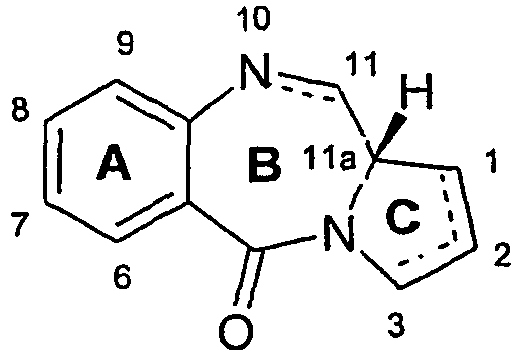
- They differ in the number, type and position of substituents, in both their aromatic A rings and pyrrolo C rings, and in the degree of saturation of the C ring. In the B-ring there is either an imine (N=C), a carbinolamine(NH-CH(OH)), or a carbinolamine methyl ether (NH-CH(OMe)) at the N10-C11 position which is the electrophilic centre responsible for alkylating DNA. All of the known natural products have an (S)-configuration at the chiral C11a position which provides them with a right-handed twist when viewed from the C ring towards the A ring. This gives them the appropriate three-dimensional shape for isohelicity with the minor groove of B-form DNA, leading to a snug fit at the binding site (Kohn, In Antibiotics III. Springer-Verlag, New York, pp. 3-11 (1975); Hurley and Needham-VanDevanter, Acc. Chem. Res., 19, 230-237 (1986)). Their ability to form an adduct in the minor groove, enables them to interfere with DNA processing, hence their use as antitumour agents.
- Dimeric pyrrolobenzodiazepines offer advantages over monomeric pyrrolobenzodiazepines in that they possess the ability to cross-link DNA in the minor groove, which can lead to an increase in cytotoxicity.
- A particularly advantageous pyrrolobenzodiazepine compound is described by Gregson et al. (Chem. Commun. 1999, 797-798) as compound 1, and by Gregson et al. (J. Med. Chem. 2001, 44, 1161-1174) as compound 4a. This compound, also known as SJG-136, is shown below:

- SJG-136 is also described in
WO 00/12508 WO 2005/042535 by some of the present inventors.
- However, the present inventors have found difficulties with the syntheses of SJG-136 as described in the references cited above. For example, in
WO 2006/111759 the synthesis comprised a very large number of steps, which decreased the potential yield as well as adding to the experimental difficulty of synthesising the product.WO 2005 085259 discloses pyrrolobenzodiazepines dimers. - There is a need therefore for an improved method of preparing SJG-136, and also SJG-720, as well as related compounds, which has fewer steps and/or provides an increased yield of the final product.
- In a general aspect the present invention provides novel intermediates for use in the preparation of compound (M):

- R2 is CHR2A, and R2A is independently selected from H, R, CO2R, COR, CHO, CO2H, and halo;
- R6 and R9 are independently selected from H, R, OH, OR, SH, SR, NH2, NHR, NRR', NO2, Me3Sn and halo;
- R7 is independently selected from H, R, OH, OR, SH, SR, NH2, NHR, NRR', NO2, Me3Sn and halo;
- R8 is independently selected from H, R, OH, OR, SH, SR, NH2, NHR, NRR', NO2, Me3Sn and halo;
- R is independently selected from optionally substituted C1-12 alkyl, C3-20 heterocyclyl and C5-20 aryl groups;
- In a preferred embodiment, (M) is a compound of formula (A):

- In one embodiment, the present invention provides novel intermediates for use in the preparation of SJG-136 and the precursors thereof.

- In one aspect of the invention there is provided a compound of formula (T):

- In a preferred embodiment, (T) is a compound of formula (S):

- In one embodiment, (T) is compound (8):
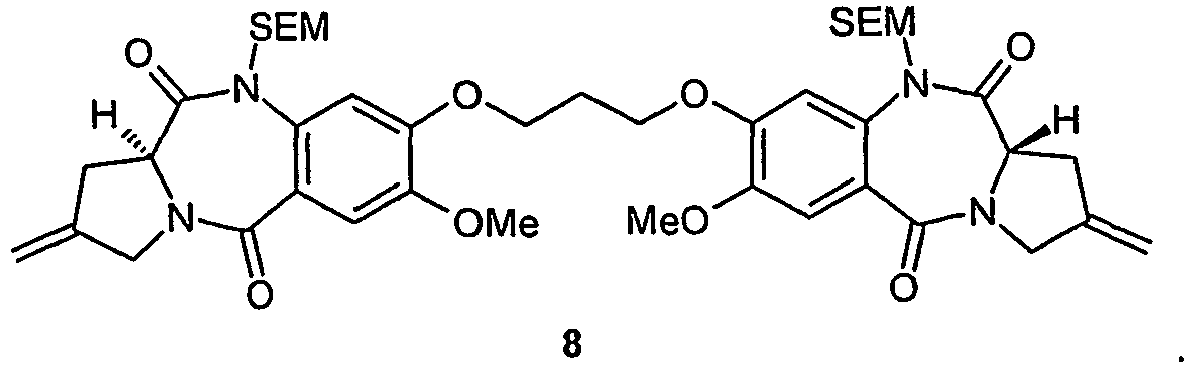
- In one aspect of the invention there is provided a compound of formula (O):

- In a preferred embodiment, (O) is a compound of formula (B):

- In one embodiment, (O) is compound (7):

- In one aspect, the present invention provides a process for the preparation of a compound of formula (M), the process comprising the step of reacting a compound of formula (T) with a reducing agent. In one embodiment, the process comprises the steps of reacting a compound of formula (T) with a reducing agent and then reacting the reduction product with silica or an organic acid.
- In another aspect, the present invention provides a process for the preparation of a compound of formula (T), the process comprising the step of protecting the amide nitrogens of (O) with SEM.
- In a further aspect, the present invention provides a process for the preparation of a compound formula (O), the process comprising the step of reacting a compound of formula (X) with a compound of formula (N), where (X) and (N) are:

- In another aspect, the present invention provides a process for the preparation of a compound of formula (T), the process comprising the step of reacting (V) with a ylide comprising a group R2 and/or R2', wherein (V) is:

- In a preferred embodiment, (V) is a compound of formula (W):
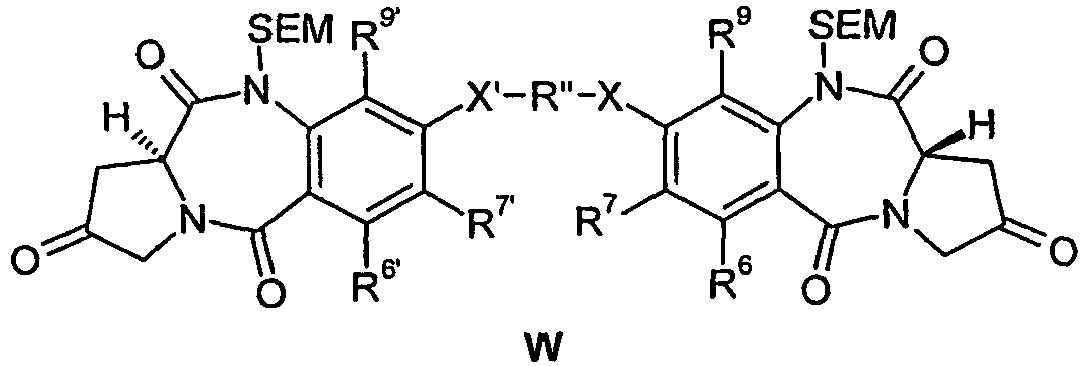
- In one aspect of the invention there is provided a process for preparing (M), the process comprising one or more of the processes of the invention, as described above.
- In another aspect of the invention there is provided a process for preparing a compound of formula (P) from compound (M):

- The present invention provides improved processes for the synthesis of SJG-136 and its analogues. The invention also provides novel intermediates for use in such processes. These methods allow SJG-136 to be prepared in higher yield and in less time compared to the processes that have been previously described for the preparation of this compound. The methods of the invention may also be used to prepare SJG-720 via SJG-136. The methods have general applicability to the preparation of compounds of formula (M) and (P).
- The present invention provides methods for the preparation of compounds of formula (M) and compounds of formula (O), and also compounds of formula (T).
- In one embodiment of the invention there is provided the use of a compound of formula (X) in a process for the preparation of a compound of formula (M) or a compound of formula (O).
- In one embodiment, the compound of formula (M) is prepared by the reaction of compound (N) with compound (X). This reaction may be referred to as the coupling of partner (X) with partner (N).
- The invention also provides the use of compounds (X) and (N) in processes for the preparation of compounds (T) and (P), as described below.
- The preferred synthesis of compound (M) using compound (X) is shown in Scheme 1 below. Typically, compound (X) is coupled with compound (N) to form compound (O). The amide nitrogen atom of compound (O) is then protected with a SEM group to give compound (T), which may then be converted to compound (M). If required, compound (M) may be reacted with a bisulfite salt to yield compound (P).
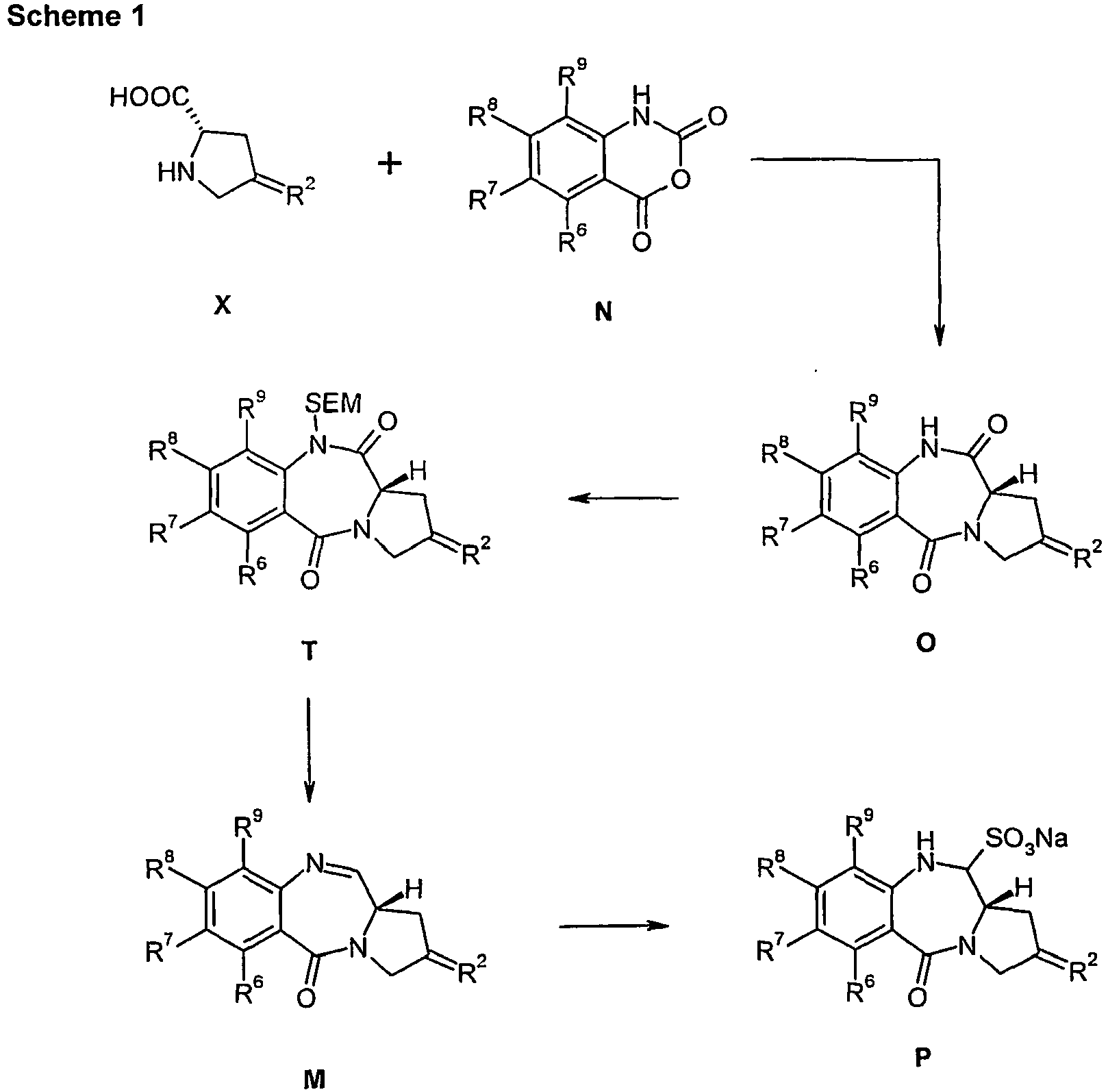
- Compound (X) may be referred to as a C-ring coupling partner as it is the source of the C-ring in the PBD target molecule. Compound (N) may be referred to as an A-ring coupling partner as it is the source of the A-ring in the PBD target molecule. A coupling-partner is that compound which is used in a coupling reaction to, at least, link an A-ring source and a C-ring source together.
- The inventors have established that compounds of formula (M) may be obtained in greater yield, in fewer steps and in less time compared to the methods that have been previously described in the art. In particular, the inventors have established that compound (A), a preferred structure of compound (M), may be obtained in greater yield, in fewer steps and in less time compared to the methods that have been previously described in the art.
- The inventors have found that the proline-based compound of formula (X) may be used as a source for the C-ring in a PBD structure, such as compound (M) or compound (O). Advantageously, compound (X) includes the substituent that will later form the C2 substituent in the C-ring of the PBD target structure. Consequently, once the A- and C-rings have been joined, and the B-ring formed, no modification need be made at the PBD C2 position because the functionality here has been "pre installed". This approach may be referred to as a convergent approach to PBD synthesis.
- Many of the previous approaches to the synthesis of compounds of formula (M), and in particular compounds of general formula (A), have introduced the required C2 substituent at a later stage of the synthesis. The methods described in the art typically involve the connection of the A- and C-rings followed later, as a separate step, by formation of the B-ring. In one approach, such as described in Gregson et al. (J. Med. Chem. 2001, 44, 1161-1174), the substituent required at the C2 position is introduced after the A- and C-rings are connected. The B-ring is then formed at a later stage in the synthesis. This approach, which may be generally referred to as a linear approach, requires the introduction of a C2 substituent at a later stage of the synthesis, which may be synthetically complicated. Furthermore, the convergent approach may allow compounds (M) and (O) to be prepared in higher yield compared to a linear approach.
- However, in the linear synthesis, between the introduction of the required C2 substituent and the formation of the B-ring, a number of functional group transformations must be performed, such as protecting group addition and removal. These steps add to the overall complexity and length of the synthesis.
- The uses and methods of the present invention have further advantages which are not taught in the art. The present inventors have found that compound (X) may be used to prepare a PBD compound of formula (O) in one step. This step links the A- and C-rings together at the same time as the B-ring is formed. Previous approaches to the preparation of the B-ring of the PBD compound have proceeded in a greater number of steps, typically comprising the step of joining the A- and C-rings, undertaking a functional group transformation (including the removal of protecting groups), followed then by the formation of the B-ring. Thus, the present invention provides a route to compounds (M) and (O) that reduces the complexity and length of the overall synthesis.
- *Compound (O) may be converted to compound (M). In one embodiment, compound (O) is converted to compound (M) via compound (T):

- Compound (T) is provided as a useful precursor in processes for the preparation of compounds (M) and (P). The present invention also provides processes for the preparation of (T). The inventors have established that compound (T), which includes a SEM protecting group, may be used to access compound (M) in good yield and with excellent reproducibility. Compound (T) also finds use as a common intermediate in the linear and convergent strategies described herein.
- Compound (T) may be prepared from compound (O) by protecting the amide nitrogen atoms of compound (O) with SEM. Compound (O) may be reacted with a SEM halide, for example SEM-Cl. A base may be used. The base may be n-BuLi.
- In one embodiment, compound (T) is a compound of formula (S), as described above.
- In one embodiment, compound (S) is compound (8), as described above.
- Compound (M) may be prepared from compound (T). Preferably compound (T) is reacted with a reducing agent. The reducing agent may be a borohydride salt. Preferably the reducing agent is lithium borohydride. Alternatively, the reducing agent is sodium borohydride.
- After treatment with the reducing agent, the product of the reduction may be treated with silica or an organic acid, such as citric acid or formic acid, thereby to yield (M).
- The inventors have found that the compound (X) is particularly suitable as a building block in the synthesis of PBD compounds, as compound (X) allows compounds (M) and (O) to be prepared by a convergent synthesis approach and, additionally, allows the A- and C-rings to be linked at the same time as the B-ring is formed.
- Compound (X), which comprises a C-ring source, is reacted with a suitably activated coupling partner comprising an A-ring source. A suitably activated coupling partner is compound (N). In a preferred embodiment, compound (N) is compound (C):

- In a preferred embodiment, compound (C) is compound (6):

- In other aspects of the invention there is provided the use of compound (N) in a process for the preparation of compound (M) or compound (O). It is preferred that compound (N) is reacted with compound (X).
- Thus, in some aspects, the present invention combines the advantages of a convergent synthesis with a novel, combined A- and C-ring linking and B-ring forming step.
- Compound (X) is an alternative proline-based coupling partner to those proline-based compounds that have been previously reported for use in the synthesis of PBD compounds. The use of compound (X) is particularly advantageous as it requires very few steps to prepare. From commercially available Boc-protected trans-4-hydroxy-L-proline (compound (1)), compound (X) may be prepared in only two steps via compound (2), as described herein.

- Compound (2) may be treated with an appropriate alkene-forming reagent, such as a Wittig-type reagent, to give, after an acid work up, compound (X), including for example compound (3). Suitable alkene-forming reagents are well known to those of skill in the art.
- Some of the proline-based compounds previously reported in the art for use in the preparation of PBD compounds require multi-stage preparations. For example,
WO 00/12508 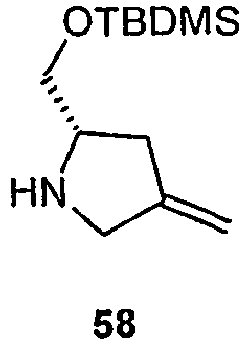
- This compound is obtained in seven steps from commercially available trans-4-hydroxyL-proline. In a series of examples,
WO 00/12508 -
WO 2007/085930 describes the preparation of dimer PBD-based compounds from a proline-derivative of formula (22). Compound (22) is coupled with an A-ring-containing partner. Compound (22) is produced in five steps from trans-4-hydroxy-L-proline (see example 13). The overall yield is not given. The present invention provides the C-ring coupling partner in fewer steps and in less time compared to the sequence described inWO 2007/085930 .
- In one aspect, the invention provides compounds of formula (O) and compounds of formula (T).
- In one embodiment, the compound of formula (M) is (A).
- In one embodiment, the compound of formula (N) is (C).
- In one embodiment, the compound of formula (O) is (B).
- In one embodiment, the compound of formula (T) is (S).
- In one embodiment, the compound of formula (X) is (3).
- The present invention provides methods for the preparation of compounds of formula (A) compounds of formula (B), and also compounds of formula (Q).
- In one embodiment of the invention there is provided the use of a compound of formula (X) in a process for the preparation of a compound of formula (A). In one embodiment of the invention there is provided the use of a compound of formula (X) in a process for the preparation of a compound of formula (B).
- In one embodiment, there is provided the use of a compound of formula (X) in a process for the preparation of a compound of formula (Q). Compound (Q) is typically formed from compound (A).
- In a preferred embodiment, compound (A) is SJG-136. A preferred synthesis of SJG-136 using compound (3) is shown in Scheme 2 below. Typically, compound (3) is coupled with compound (6) to form compound (7). The amide nitrogen atom of compound (7) is then protected with a SEM group to give compound (8), which may then be converted to compound SJG-136. If required, SJG-136 may be reacted with a bisulfite salt to yield SJG-720.
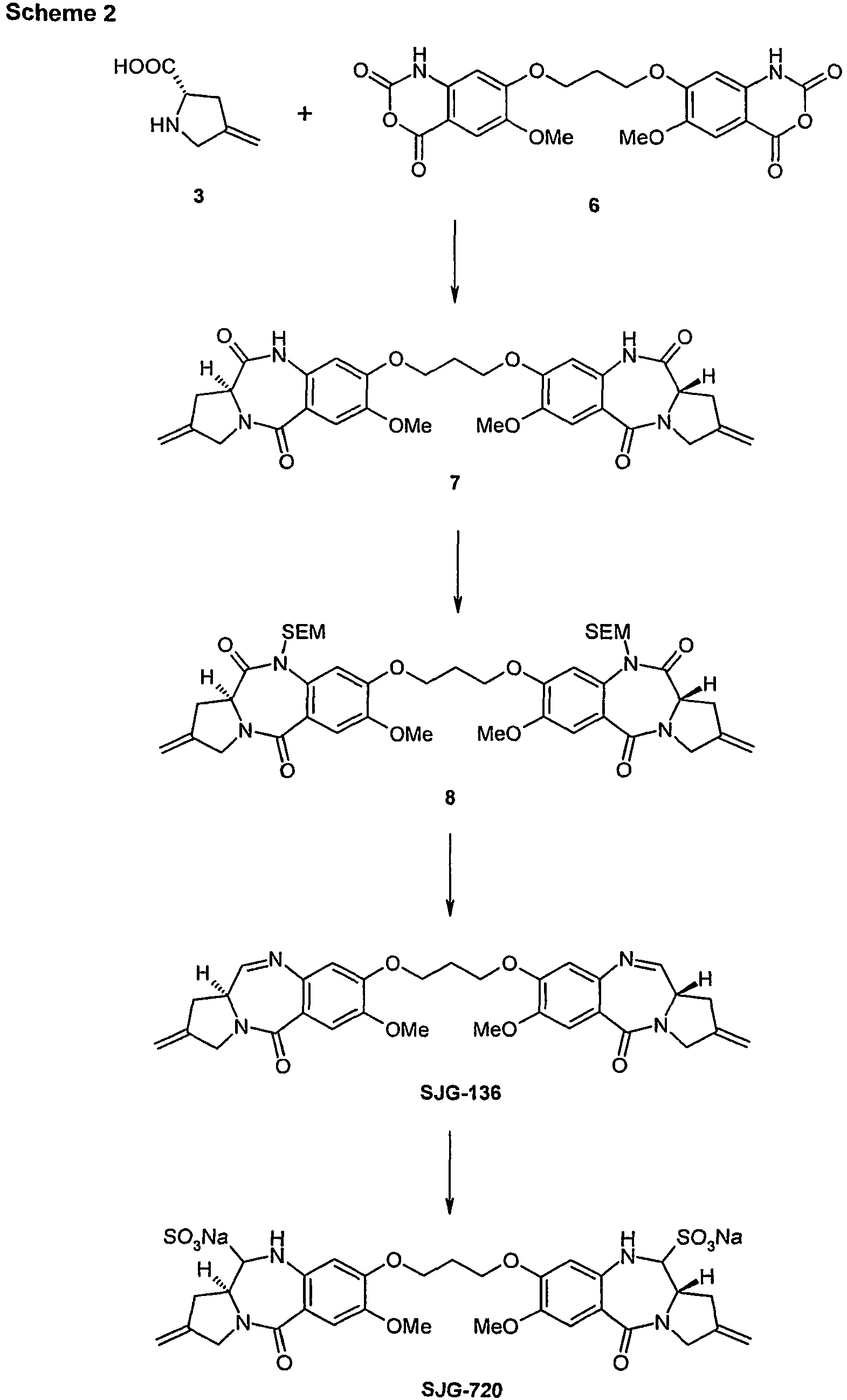
- In another aspect of the invention there are provided compounds of formula (B).
- In other embodiments of the invention there is provided the use of compound (C) in a process for the preparation of compound (A) or compound (B). It is preferred that compound (C) is reacted with compound (X).
- In one embodiment, the compound of formula (A) is SJG-136.
- In one embodiment, the compound of formula (B) is compound (7).
- In one embodiment, the compound of formula (C) is compound (6).
- In one embodiment, the compound of formula (X) is compound (3).
- In one embodiment, compound (7) is prepared by reacting a compound of formula (3) with a compound of formula (6).

- The present invention provides the use of compounds of formula (V) in processes for the preparation of compounds of formula (T) and also of formula (M).
- The synthesis of compound (M) from compound (V) is shown in Scheme 2a below. Typically, compound (V) is treated with an appropriate alkene-forming reagent, such as a Wittig-type reagent, to give compound (T). Suitable alkene-forming reagents are well known to those of skill in the art. In one embodiment, the alkene-forming reagent is a ylide comprising a group R2. Compound (T) may then may then be converted to compound (M). If required, compound (M) may be reacted with a bisulfite salt to yield compound (P).

- Compound (V) is reacted with an appropriate alkene-forming reagent to provide compound (T). Suitable alkene-forming reagents include Wittig reagents (such as ylides), the Tebbe reagent, and Horner-Wadsworth-Emmons reagents.
- In one embodiment alkene-forming reagent is a ylide. The ylide may be a phosphonium methylene ylide, and the resulting product is a compound (V) where R2 is CH2. The phosphonium methylene ylide may be generated from methyltriphenylphosphonium halide and a base, such as a tert-butoxide salt. Preferably methyltriphenylphosphonium bromide is used in combination with potassium tert-butoxide. Alternative products of formula (V), where R2 is other than CH2, may be prepared using the appropriate ylide form, as is known to a person of skill in the art, or using altertnvie reagents , such as those discussed above.
- Preferably the base used in the ylide forming step is freshly prepared. The methyltriphenylphosphonium halide is in excess to the base.
- The reaction product mixture is purified to remove by-products, such as the phosphonium oxide by-products that are generated through use of phosphonium-based ylides.
- In one embodiment, the compound of formula (V) is (W). In this embodiment, W comprises groups R2 and R2', which may be the same.
- In one embodiment, compound (V) is (17).
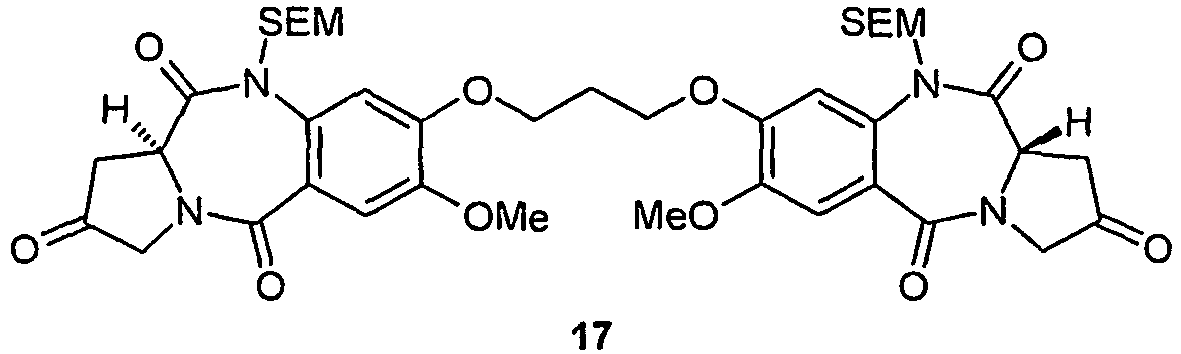
- In one aspect the present invention provides compounds of formula (V) with the proviso that the compound is not compound (17). In one embodiment, there is a further proviso that the compound of formula (V) is not compound (17a).

- The following preferences may apply to all aspects of the invention as described above, or may relate to a single aspect. The preferences may be combined together in any combination.
- R2 is CHR2A, and R2A is independently selected from H, R, CO2R, COR, CHO, CO2H, and halo.
- In one embodiment, R2A is independently selected from H and R.
- In one embodiment, R2A is independently selected from H, optionally substituted saturated C1-6 alkyl and optionally substituted C5-20 aryl.
- In one embodiment, R2A is independently selected from H and unsubstituted saturated C1-6 alkyl.
- In one embodiment, R2A is independently selected from H and CH3.
- In one embodiment, R2A is independently selected from H.
- Within a PBD compound, the group R2 may have either configuration shown below:

- In one embodiment, the configuration is configuration (I).
- The group R2A in compound (X) may be similarly located about the exo-double bond.
- The preferences for R2 are also applicable to R2'.
- In one embodiment, R2 is the same as R2'.
- R6 is independently selected from H, R, OH, OR, SH, SR, NH2, NHR, NRR', NO2, Me3Sn- and Halo.
- In one embodiment R6 is independently selected from H, OH, OR, SH, NH2, NO2 and Halo.
- In one embodiment R6 is independently selected from H and Halo.
- In one embodiment R6 is independently selected from H.
- The preferences for R6 are also applicable to R6'.
- In one embodiment, R6 is the same as R6'.
- In one embodiment, R7 is independently OR.
- In one embodiment, R7 is independently OR, where R is optionally substituted saturated C1-6 alkyl.
- In one embodiment, R7 is independently OMe.
- In one embodiment, R7 is independently OCH2Ph.
- The preferences for R7 are also applicable to R7'.
- In one embodiment, R7 is the same as R7'.
- In one embodiment, the compound is a dimer where the R7 groups of each monomers form together a dimer bridge having the formula X-R"-X linking the monomers.
- In one embodiment, R8 is independently OR.
- In one embodiment, R8 is OR, where R is independently optionally substituted saturated C1-6 alkyl.
- In one embodiment, R3 is independently OMe.
- In one embodiment, R8 is independently OCH2Ph.
- The preferences for R8 are also applicable to R8'.
- In one embodiment, R8 is the same as R8'.
- In one embodiment, the compound is a dimer where the R8 groups of each monomers form together a dimer bridge having the formula X-R"-X linking the monomers.
- R9 is independently selected from H, R, OH, OR, SH, SR, NH2, NHR, NRR', NO2, Me3Sn- and Halo.
- In one embodiment, R9 is H.
- The preferences for R9 are also applicable to R9'.
- In one embodiment, R9 is the same as R9'.
- R" is a C3-12 alkylene group, which chain may be interrupted by one or more heteroatoms, e.g. O, S, N(H), and/or aromatic rings, e.g. benzene or pyridine.
- In one embodiment, R" is a C3-12 alkylene group.
- In one embodiment, R" is selected from a C3, C5, C7, C9 and a C11 alkylene group.
- In one embodiment, R" is selected from a C3, C5 and a C7 alkylene group.
- In one embodiment, R" is selected from a C3 and a C5 alkylene group.
- In one embodiment, R" is a C3 alkylene group.
- In one embodiment, R" is a C5 alkylene group.
- The alkylene groups listed above may be optionally interrupted by one or more heteroatoms, e.g. O, S, N(H), and/or aromatic rings, e.g. benzene or pyridine.
- The alkylene groups listed above may be unsubstituted linear aliphatic alkylene groups.
- X is selected from O, S, or N(H). Preferably, X is O.
- The preferences for X are also applicable to X'.
- In one embodiment, X and X' are the same.
- R and R' are each independently selected from optionally substituted C1-12 alkyl, C3-20 heterocyclyl and C5-20 aryl groups.
- In one embodiment, R and R' are each optionally substituted C1-12 alkyl.
- In one embodiment, R and R' are each optionally substituted C1-6 alkyl.
- In one embodiment, R and R' are each optionally substituted saturated C1-6 alkyl.
- In one embodiment, R and R' are each optionally substituted saturated linear C1-6 alkyl.
- In one embodiment, R and R' are each selected from CH3 and CH2CH3.
- In one embodiment, R and R' are each CH3.
- In one embodiment, R and R' are each optionally substituted C3-20 heterocyclyl.
- In one embodiment, R and R' are each optionally substituted C3-7 heterocyclyl.
- In one embodiment, R and R' are each optionally substituted C5-20 aryl groups.
- In one embodiment, R and R' are each optionally substituted C5-6 heteroaryaryl groups.
- In one embodiment, R and R' are each optionally substituted C6-10 carboaryl groups.
- In one embodiment, R and R' are each optionally substituted phenyl.
- In one embodiment, R and R' are each phenyl substituted with one or more groups selected from C1-7 alkyl, halo, hydroxy, alkoxy, carboxy, ester, acyloxy, amino, amido, nitro, and sulfo.
- In one embodiment, R and R' are each phenyl substituted with alkoxy.
- In one embodiment, R and R' are the same.
- In one embodiment, the preferred R and R' groups listed above may be unsubstituted.
- Compound (M) may be prepared from compound (X) and compound (N). Compound (O) may be prepared by the reaction of compound (X) with compound (N). Compound (M) may be prepared from compound (O).
- Compound (M) may be prepared from compound (O). Preferably compound (M) is prepared from compound (O) via compound (T).
- The preferences set out below for the reaction of compound (7) with (3) are generally applicable to the reaction of compound (X) with compound (N), unless otherwise stated to the contrary. The preferences for the preparation of compound (8) are likewise applicable to the preparation of compound (T) from compound (O).
- Compound (B) may be prepared by the reaction of compound (X) with compound (C).
- The preferences set out below for the reaction of compound (7) with (3) are generally applicable to the reaction of compound (X) with compound (C), unless otherwise stated to the contrary.
- In particular, it is preferred that the reaction is performed at elevated temperature, as described below.
- Compound (A) may be prepared from compound (B). Preferably compound (A) is prepared from compound (B) via compound (S).
- The preferences set out below for the preparation of SJG-136 from compound (7) via compound (8) are generally applicable to the preparation of compound (M) via compound (T), unless otherwise stated to the contrary.
- In one aspect of the present invention there is provided a method of preparing SJG-136.
- SJG-136 may be prepared from compound (8). Preferably compound (8) is reacted with a reducing agent. The reducing agent may be a borohydride salt. Preferably the reducing agent is lithium borohydride. Alternatively, the reducing agent is sodium borohydride.
- The reaction may be driven to completion by the addition of excess reducing agent. The amount of reducing agent used may be 3, equivalents or more, 5 equivalents or more, or 10 equivalents or more. The reducing agent may be added in one batch, or portionwise, over the course of the reaction.
- The reaction is believed to proceed via the SEM carbinolamine compound (24) shown below:

- Small amounts of compound (24) may be recovered from the product mixture following chromatography. It is preferred that intermediate (24) is not isolated, and is treated with a SEM deprotecting reagent after the reduction step to yield the imine product (SJG-136). Preferably compound (24) is used within 24 hours of its preparation or isolation. Most preferably, intermediate (24) is used within 4 hours, within 2 hours or within 1 hour of its preparation or isolation.
- Lithium borohydride is a stronger reducing agent than sodium borohydride and therefore allows the reduction reaction to proceed at a faster rate. As a consequence, the product may be isolated sooner before it is converted to an imine form which is highly susceptible to over reduction.
- The product of the reduction step may be treated with a reagent capable of removing the nitrogen SEM protecting groups. Silica may be used. Alternatively, an organic acid may be used, such as citric acid or formic acid.
- The present invention provides compounds of formula (8) for use in a process for the preparation of SJG-136.
- Compound (8) may be prepared from compound (7) by protecting the amide nitrogen atoms of compound (7) with SEM. Compound (7) may be treated with SEM-Cl in the presence of base. The base may be n-BuLi.
- The reaction of compound (7) to form compound (8) is moisture sensitive. The highest yields are obtained in this reaction where fresh reagents are used, along with dry solvents and dry glassware. The yield is also increased when compound (7) is thoroughly dried.
- Alternatively, compound (8) may be prepared from compound (18). Compound (18) may be treated with a methylene ylide. The ylide may be a phosphonium methylene ylide. The ylide may be generated from methyltriphenylphosphonium halide and a base, such as tert-butoxide salts. Preferably methyltriphenylphosphonium bromide is used in combination with potassium tert-butoxide.
- Preferably the base used in the ylide forming step is freshly prepared. The methyltriphenylphosphonium halide is in excess to the base.
- The reaction product mixture is purified to remove by-products, such as the phosphonium oxide by-products that are generated through use of phosphonium-based ylides.
- The present invention provides compounds of formula (7) for use in the preparation of SJG-136. Compound (7) may also find use in the preparation of compounds of formula (8).
- Compound (7) may be prepared by reacting a compound of formula (3) with a compound of formula (6). Preferably the reaction is performed at elevated temperature. The reaction may be performed at 50°C or more, 80°C or more, 100°C or more, or 110°C or more. Preferably the reaction is performed at 110°C or more. A suitable reaction solvent is DMSO.
- A base may be used in the reaction. The base may be an organic base, such as DIPEA.
- Reaction progression may be monitored by LC-MS.
- The inventors have found that the reaction goes to completion after around 30 minutes at the preferred reaction temperature of 110°C or more.
- Cooper reports a coupling reaction using an alternative proline coupling partner and an analogue of compound (6) having a 5-carbon alkylene linker. The reaction mixture is heated for four hours at 100-120°C, far longer than the time required for the reaction of compounds (3) and (6). Thus, compounds (3) and (6) are more favourable coupling partners for they provide a proline-containing dimer structure in less time than previously reported.
- As a final step, the product of the reaction may be further purified by trituration in an appropriate solvent. Acetonitrile may be used. This step is not essential however, as the inventors have found that the filtered and washed product may be used directly in the preparation of compound (8).
- After the trituration, the product may be washed. Diethyl ether may be used.
- Compound (7) should be thoroughly dried before use in the preparation of compound (8), as the formation of (8) is moisture sensitive.
- The present invention provides the use of compounds of formula (6) in the preparation of SJG-136. Compound (6) may also find use in the preparation of compounds of formula (7), and (8).
- Compound (6) may be prepared from compound (5). Compound (5) may be reacted with triphosgene in the presence of base. The base may be pyridine or TEA. Preferably pyridine is used.
- Compound (5) may be reacted with triphosgene at reflux.
- The inventors have found that the reaction of (5) with triphosgene is optimally performed where compound (5) is used as a fine powder, owing to the relative insolubility of (5). Typically (5) may be prepared for the reaction by very fine grinding of the solids.
- The reaction may be performed under reflux. Preferably the reflux reaction is performed for at least 2 hours, at least 4 hours, at least 6 hours, at least 12 hours or at least 24 hours.
- This reaction is also described by Cooper on a related substrate having a 5-carbon alkylene linker.
- The present invention provides the use of compounds of formula (5) in the preparation of SJG-136. Compound (5) may also find use in the preparation of compounds of formula (6), (7), and (8).

- Compound (5) may be prepared from compound (4). Compound (5) may be prepared by reducing the nitro groups of compound (4).
- Compound (4) may be reduced using hydrogen and a metal catalyst. The reaction may be performed under pressure using, for example, a Parr apparatus. The catalyst may be a palladium on carbon catalyst. The reaction may be performed at 40 psi or more (around 275 kPa or more), preferably about 45 psi (about 310 kPa).
- Preferably compound (4) is treated with an aqueous base prior to hydrogenation. The reaction may be performed under aqueous conditions.
- DMF may be used as a reaction solvent. However, care must be taken to remove this solvent from the final product, as the use of the product in the preparation of compound (6) involves the use of triphosgene, which will react with any contaminating DMF.
- After hydrogen uptake in the reaction ceases, the catalyst may be removed by filtration. The filtrate may then be acidified, with aqueous HCl for example, and the resulting precipitate collected and dried in vaccuo. Phosphorus pentoxide may be as a drying reagent during.
- Cooper has previously reported the hydrogenation of a compound analogous to compound (4) in ethanol and ethyl acetate (Cooper describes a compound having a 5-carbon alkylene linker). However, under these conditions the yield for the reaction was only 15%. In contrast, the methods of the present invention allow compound (5) to be obtained in quantitative yield from compound (4).
- The synthesis of compounds of formula (4) is described in the applicant's earlier application,
WO 2006/111759 . The preparation of compound (4) as described therein is specifically incorporated by reference herein. Example 1 in this earlier application is particularly relevant.WO 00/012508 - Briefly, compound (4), is derived from compound (9).

- Compound (9) is dimerised to give compound (10).
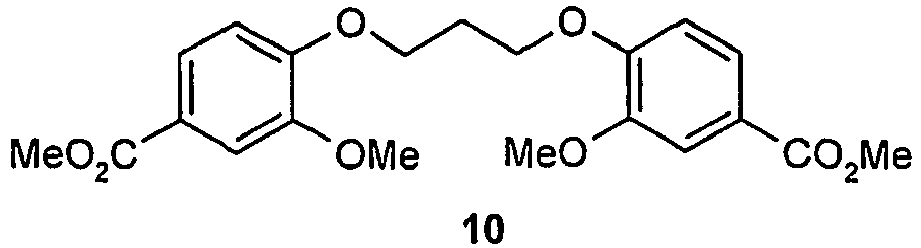
- Nitration of the dimer (10) yields compound (11).
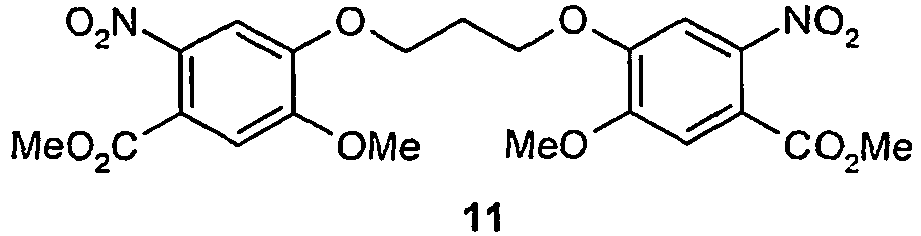
- Compound (4) is obtained from (11) by hydrolysis of the methyl esters of compound (11).
- In one embodiment of the invention, the preparation of any one of compounds (4), (8) and (13) to (18), and SJG-136 comprises any one of the steps described above, and disclosed in
WO 2006/111759 andWO 00/012508 - The present invention provides the use of compounds of formula (3) in the preparation of SJG-136. Compound (2) may also find use in the preparation of compounds (7) and (8).
- Compound (3) may be used as a salt. A hydrochloride salt may be used.
- Compound (3) may be prepared from compound (2). Compound (2) may be treated with a methylene ylide. Subsequently the amino-protecting group may be removed from the product of the initial reaction.
- The ylide may be a phosphonium methylene ylide. The ylide may be generated from methyltriphenylphosphonium halide and a base, such as tert-butoxide salts. Preferably methyltriphenylphosphonium bromide is used in combination with potassium tert-butoxide.
- Preferably the base used in the ylide forming step is freshly prepared. The methyltriphenylphosphonium halide is in excess to the base.
- The reaction product mixture is purified to remove by-products, such as the phosphonium oxide by-products that are generated through use of phosphonium-based ylides.
- The present inventors have found that the use of BuLi, as described by Narukawa et al., to generate the ylide was sensitive to the reaction conditions, and particularly to moisture and temperature. As an alternative, the present inventors have found that tert-butoxide salts are more managable, and advantageously provide greater yields. In particular potassium tert-butoxide may be used to generate the ylide.
- The reaction proceeds via the Boc-protected acid (23) shown below:

- Compound (23) is treated with acid to remove the nitrogen protecting group. Where hydrochloric acid is used, the product of the reaction is the hydrochloric acid salt of compound (3).
- Compound (23) may be obtained from commercial sources, if required (CAS number 84348-38-9).
- Compound (3) is also described in
WO 95/04718 - The present invention provides the use of compounds of formula (2) in the preparation of SJG-136. Compound (2) may also find use in the preparation of compounds (3), (7), and (8).
- Compound (2) may be prepared from compound (1). Compound (2) may be prepared from compound (1) by oxidising the hydroxyl group of compound (1). Compound (1) may be oxidised with ruthenium oxide and periodate, preferably metaperiodate.
- The oxidation of compound (1) with ruthenium oxide and periodate has been previously described in Narukawa Y., Tetrahedron 1997, 53, 539-556. However, under the conditions described, the reaction proceeds at a very slow rate. The inventors have found that increasing the equivalent amount of ruthenium oxide in the reaction increases the rate of reaction to an acceptable level. Thus, the amount of ruthenium oxide may be increased from 0.001 eq, as described in Narukawa, to 0.01 eq.
- For the avoidance of doubt, the equivalency is expressed in relation to the molar amount of compound (1) used in the reaction.
- The inventors have also found that increasing the temperature of the oxidation reaction increases the rate of reaction to an acceptable level. Thus, the reaction may be performed at temperature of 35°C in comparison to the room temperature reaction described in Narukawa.
- The product of the reaction may be purified by recrystallisation. However, the inventors have found that the crude product obtained after trituration is sufficiently pure to be used, for example, in the preparation of compound (3). In this way, the yield of product (65%) is comparable to that reported by Narukawa (also 65%).
- The reaction may be monitored by LC-MS. Whilst UV detection methods are not generally helpful here given the relative invisibly of the product and starting material under UV light, the inventors have found that nevertheless the ES- trace produced by the MS is useful in determining reaction progression and reaction completion.
- An alternative preparation of compound (2) is described in
US 2007/185336 . In particular, the oxidation of N-Boc-L-hydroxyproline to N-Boc-keto-L-proline as described on page 4 is specifically incorporated herein by reference. - Compound (1) is commercially available. Compound (2) may also be obtained from commercial sources.
- The present invention provides the use of compounds of formula (17) in the preparation of SJG-136. Compound (17) may also find use in the preparation of compound (8).
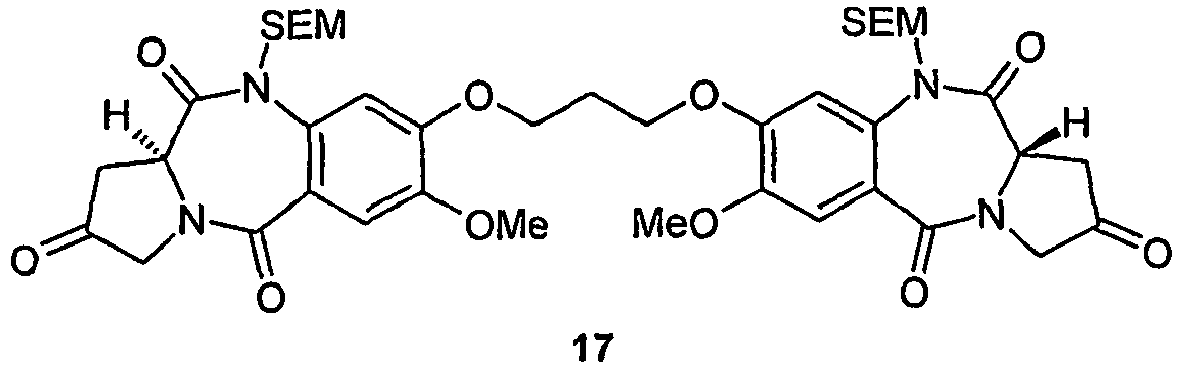
- Compound (17) may be prepared by oxidising compound (16). Preferably compound (16) is oxidised with TEMPO.
- The TEMPO-mediated oxidation reaction may be performed in the presence of bleach. In one embodiment the bleach is TCCA.
- In an alternative embodiment the bleach is a hypochlorite salt, most preferably sodium hypochlorite. When hypochlorite salt is added to the reaction mixture, the temperature of the reaction mixture is held in the range 0 to 5°C.
- Compound (16) may be oxidised under Swern-type oxidation conditions. Thus compound (16) may be treated with a mixture of oxalyl chloride and DMSO. The oxalyl chloride and DMSO may be combined prior to the addition of compound (16). Subsequently a base may be added to the reaction mixture. The base may be an organic base, and is most preferably TEA.
- The present invention provides the use of compounds of formula (16) in the preparation of SJG-136. Compound (16) may also find use in the preparation of compounds (8) and (17).

- Compound (16) may be prepared by removing the hydroxy-protecting group of compound (15). Preferably compound (15) is deprotected with TBAF.
- The present invention provides the use of compounds of formula (15) in the preparation of SJG-136. Compound (15) may also find use in the preparation of compounds (8), (16), and (17).

- The present invention provides the use of compounds of formula (14) in the preparation of SJG-136. Compound (14) may also find use in the preparation of compounds (8), (15), (16) and (17).

- Compound (14) may be prepared from compound (13). The method of preparing compound (14) comprises the step of protecting the hydroxy groups of compound (13) with TBS. Preferably compound (13) is treated with TBS-Cl in the presence of base. Preferably the base is an organic base. The base may be imidazole.
- The present invention provides the use of compounds of formula (13) in the preparation of SJG-136. Compound (13) may also find use in the preparation of compounds (8), (14), (15), (16), and (17).
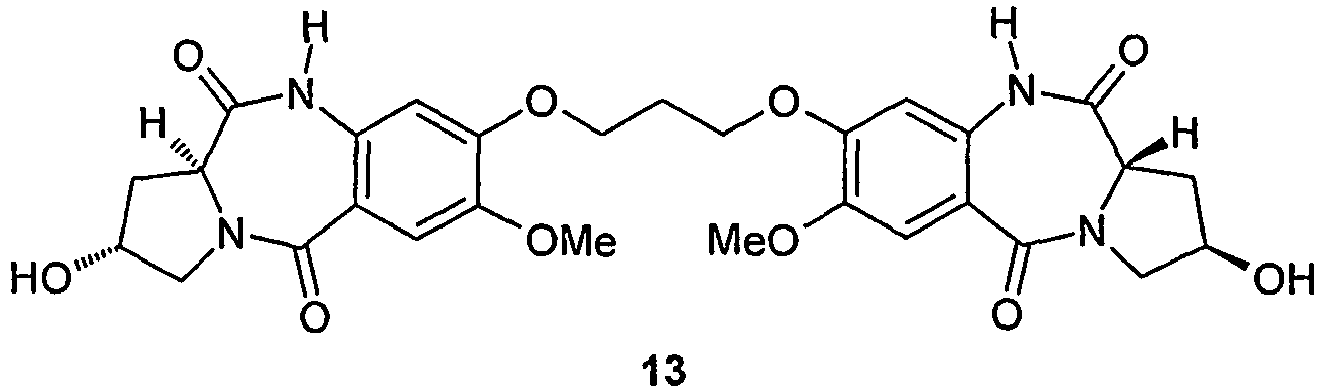
- Compound (13) may be prepared from compound (12). The method of preparing compound (13) comprises the step of cyclising compound (12).
- In a preferred embodiment of the invention, compound (12) may be treated with hydrogen in the presence of a catalyst. The catalyst may be a Pd/C catalyst. The reaction may be performed at greater than atmospheric pressure. Preferably the reaction is performed at 50 psi (~ 345 kPa). A Parr hydrogenation apparatus may be used.
- Compound (12) may be first treated with hydrogen in the presence of the catalyst. Subsequently, hydrazine may be added. In one embodiment, the reaction mixture is purified to remove the catalyst before hydrazine is added to the reaction material. Typically, the reaction mixture is filtered to remove solid catalyst. A double filtration may be required to remove the majority of the catalyst material.
- Hydrazine hydrate may be used in the reaction. The reaction may be performed at reflux. Ethanol may be used as a solvent for the reaction. It is preferred that the initial filtration of the reaction mixture is performed hot.
- Alternatively, compound (12) may be treated with hydrazine in the presence of a Raney nickel catalyst. Preferably the reaction temperature is from 30 to 85°C, more preferably from 45 to 75°C, and most preferably 50 to 65°C.
- Methanol may be used as a solvent in the reaction, in which case the reaction may be performed under reflux (~ 65°C).
- The inventors have established that the Raney nickel and hydrazine combination provides superior results compared to hydrogen with a Pd/C catalyst alone. Both methods provide improved yields compared to the sodium dithionite-mediated reaction described in
WO 2006/111759 on an analogous nitro compound. A sodium dithionite-mediated reduction may find use in the present invention, though the methods described above are most preferred. - Previously, in
WO 2004/04396 - The present invention provides the use of compounds of formula (12) in the preparation of SJG-136. Compound (12) may also find use in the preparation of compounds of formula (8), (13), (14), (15), (16), and (17).
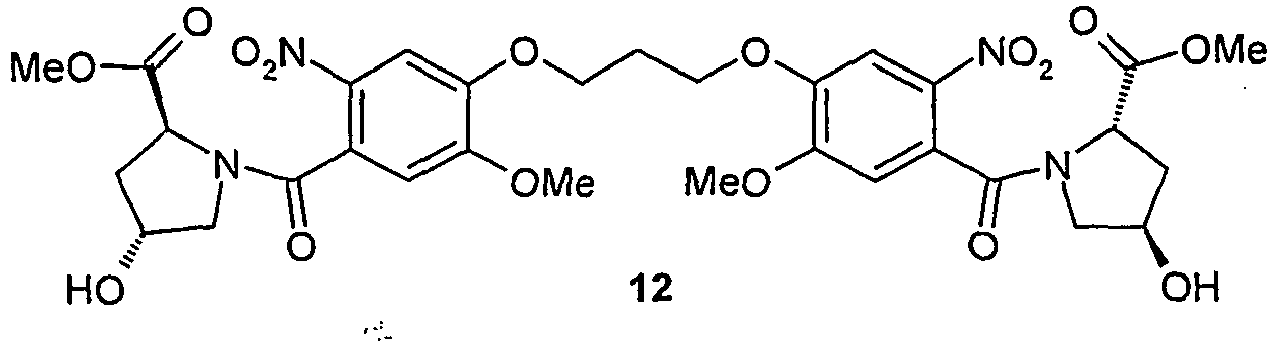
- Compound (12) may be prepared from compound (4).
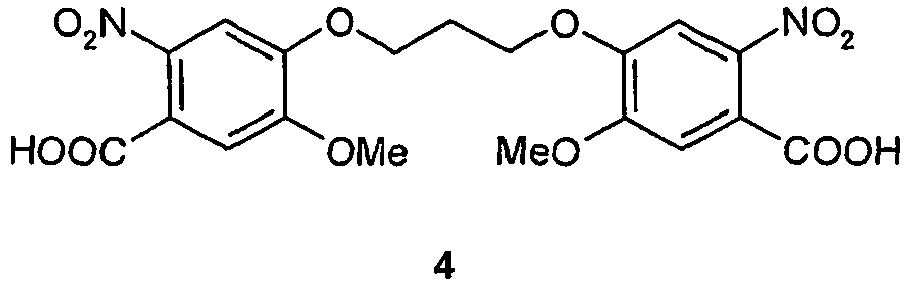
- Compound (12) may be prepared by coupling compound (4) with methyl-4-hydroxypyrrolidine-2-carboxylate. Preferably the carboxylate is (2S,4R)-methyl-4-hydroxypyrrolidine-2-carboxylate. Preferably the hydrochloride salt of the carboxylate is used. The para-toluenesulfonate (p-TSOH) salt may also be used, though this is less preferred.
- Compound (12) may be first treated with an activating agent to give the corresponding acid chloride compound. This compound may be isolated and stored for later use. The acid chloride may then be added to methyl-4-hydroxypyrrolidine-2-carboxylate.
- The activating agent is added to generate the active ester form of compound (4). Preferably the activating agent is oxalyl chloride.
- Preferably the coupling reaction is performed in the presence of base. The base may be an organic base. TEA may be used.
- The inventors have established that compound (12) may be used advantageously in the preparation of benzodiazepine-containing compounds from compound (11). Compound (12) may be used as an intermediate for the synthesis of compound (14) and its analogues. In contrast with the route disclosed in
WO 2006/111759 , the benzodiazepine-containing compound of formula (14) may be accessed in two steps from compound (12) via compound (13). In contrast,WO 2006/111759 describes a preparation of a benzodiazepine-containing compound in five steps from compound (4). - SJG-720 finds use as an alternative to SJG-136 owing to its resistance to interconversion as described in
WO 2005/042535 . It is therefore suitable for formulation. The preparation of SJG-720 from SJG-136 is described in detail inWO 2005/042535 , which is incorporated by reference herein in its entirety. In particular, Example 1 is referred to. - The synthesis of SJG-720 involves the addition of a solution of the appropriate bisulfite salt to a solution of SJG-136, or their analogues, which is usually followed by a purification step.
- The present invention provides improved methods for the preparation of compounds of formula (M) and in particular SJG-136. The invention also allows the preparation of a benzodiazepine ring in fewer steps compared to those methods described previously in the art.
- As described herein, there are two approaches to the formation of the benzodiazepine ring (the B-ring) in a PBD compound. In the convergent approach described herein, the B-ring may be formed at the same time as the A- and C-rings are linked together. In the linear approach descried herein, the B-ring may be formed after the A- and C-rings are linked together.
- Both routes to the formation of the B-ring are improvements on the methods described in the art.
-
WO 2006/111759 describes the preparation of a benzodiazepine ring in a dimer structure. The initial preparation of the ring starts from compound (4) which is coupled with compound (18) to give compound (19).

- The nitro group of compound (19) is then reduced to give compound (20).

- Compound (20) is then treated to remove the silyl protecting groups, to give compound (21).

- Compound (21) is then converted to the benzodiazepine dimer compound of formula (22) by treatment with TEMPO and BAIB.

- Compound (22) is described for use in the preparation of PBD compounds having a range of substituents at the C2 position.
- The inventors have established that the a dimer comprising a pair of benzodiazepine rings may be prepared from compound (4) in greater yield and in fewer steps compared to the method described in
WO 2006/111759 . - Thus, the preferred linear method described herein allows the benzodiazepine-containing compound of formula (13) to be prepared from compound (4) in two steps and 79% overall yield.
- In contrast, the first benzodiazepine-containing compound described in
WO 2006/111759 is compound (22) which is obtained from compound (4) in five steps and 15% overall yield. - The present invention provides a method for the preparation of a B-ring in a PBD compound at the same time as the A- and C-rings are linked together. The yield for this single step is 50% as reported herein. Combining these steps in one procedure reduces the complexity of the overall synthesis of compounds (M) and (O), and reduces the overall time needed to prepare these PBD compounds.
- As described above in relation to compounds (M), (N), (O) and (X) (and in particular compounds (A), (B) and (C)), the present invention provides methods for the preparation of PBD compounds, and in particular SJG-136, using a convergent approach to the PBD core and the C-ring C2 substituent. This approach may provide the target PBD compound in less time and in fewer steps compared to other routes.
- Alternatively, SJG-136 may be prepared using a linear approach to the PBD core and the C-ring C2 substituent, as described in more detail below.
- The convergent and linear approaches may be used to prepare compound (M). The preferences set out here and below are generally applicable to the preparation of compound (M), unless otherwise stated to the contrary.
- SJG-136 may be prepared using a linear approach to the PBD core and the C-ring C2 substituent.
- The key strategy in the linear approach is the formation of the exo-double bond at the C2 position after the A- and C-rings have been linked, and either before or after the B-ring has been formed. The present invention provides a method where the B-ring is formed prior to the introduction of the required C2 functionality. In another approach, such as described in Gregson et al. (J. Med. Chem. 2001, 44, 1161-1174), the substituent required at the C2 position may be introduced after the A- and C-rings are connected. The B-ring is then formed at a later stage in the synthesis.
- The advantage of the linear approach is that is allows an advanced reactive substrate to be prepared, such as compound (18), which can be converted into a range of different C2 functionalised products e.g. by appropriate choice of Wittig coupling partner.
- The convergent approach, in contrast, requires the preparation of a different proline-based residue for each C2 functionalised product that is to be prepared. Consequently, the convergent approach is best suited to a targeted preparation, whilst the linear approach allows a more expansive structural area to be explored.
- In one aspect of the invention there is provided a process of preparing SJG-136 comprising one or more of the steps described above. In a preferred embodiment, the preparation of SJG-136 comprises two or more of the steps described above.
- SJG-136 may be prepared in a multi-step synthesis. The intermediates in the synthesis may be one or more of the compounds discussed above.
- In a preferred process of preparing SJG-136, the process comprises one or more of the following methods:
- (i) the synthesis of compound (8) by protecting the amide nitrogen atoms of compound (7) with SEM as described herein;
- (ii) the synthesis of compound (7) by reacting compound (6) with compound (3) as described herein;
- (iii) the synthesis of compound (3) by reacting compound (2) as described herein;
- (iv) the synthesis of compound (2) oxidising compound (1) as described herein;
- (v) the synthesis of compound (6) by reacting compound (5) as described herein;
- (vi) the synthesis of compound (5) reducing the nitro groups of compound (4) as described herein;
- (vii) the synthesis of compound (8) by reacting compound (17) as described herein;
- (viii) the synthesis of compound (17) by oxidising compound (16) as described herein;
- (ix) the synthesis of compound (16) by removing the hydroxy-protecting groups of compound (15) as described herein;
- (x) the synthesis of compound (15) by protecting the amide nitrogen atoms of compound (14) with SEM as described herein;
- (xi) the synthesis of compound (14) by protecting the hydroxy groups of compound (13) with TBS as described herein;
- (xii) the synthesis of compound (13) by cyclising compound (12) as described herein;
- (xiii) the synthesis of compound (12) by coupling compound (4) with methyl-4-hydroxypyrrolidine-2-carboxylate as described herein.
- (xiii) the synthesis of SJG-136 by reacting compound (8) as described herein.
- In one embodiment, steps (i) to (vi), and (xiii) may be used in combination to prepare SJG-136. This combination may be referred to as the convergent approach to SJG-136.
- In one embodiment, steps (vii) to (xiii) may be used in combination to prepare SJG-136. This combination may be referred to as the linear approach to SJG-136.
- When steps (i) to (vi) and (xiii) are used in combination in the preparation of SJG-136, the overall yield from compound (4) is significantly increased compared to the yields reported in the art. By the convergent approach, the present invention provides SJG-136 in 5 steps from compound (4) and 23.5% overall yield. In comparison,
WO 00/12508 - When steps (vii) to (xiii) are used in combination in the preparation of SJG-136, the overall yield from compound (4) is significantly increased compared to the yields reported in the art. By a linear approach, the present invention provides SJG-136 in 8 steps from compound (4) and 12.2% overall yield. In comparison, Gregson et al. (J. Med. Chem. 2001, 44, 1161-1174) describes the preparation of SJG-136 in 8 steps from compound (4) and 8.6% overall yield.
- In one aspect of the invention there is provided a process of preparing SJG-720 comprising one or more of the steps described above.
- SJG-720 may be prepared in a multi-step synthesis. The intermediates in the synthesis may be one or more of the compounds discussed above.
- In a preferred process of preparing SJG-720, the process comprises one or more of the steps (i) to (xiii) described above and step (xiv):
- (xiv) the synthesis of SJG-720 by treating SJG-136 with a bisulfite salt as described herein.
- In one embodiment, steps (i) to (vi), (xiii) and (xiv) may be used in combination to prepare SJG-720.
- In one embodiment, steps (vii) to (xiv) may be used in combination to prepare SJG-720.
- As described above, SJG-136 may be prepared in fewer steps and in greater yield compared to those methods described in the art. SJG-720, which is prepared directly from SJG-136, may be similarly obtained in fewer steps and in greater yield compared to those methods described in the art.
- The phrase "optionally substituted" as used herein, pertains to a parent group which may be unsubstituted or which may be substituted.
- Unless otherwise specified, the term "substituted" as used herein, pertains to a parent group which bears one or more substituents. The term "substituent" is used herein in the conventional sense and refers to a chemical moiety which is covalently attached to, or if appropriate, fused to, a parent group. A wide variety of substituents are well known, and methods for their formation and introduction into a variety of parent groups are also well known.
- Examples of substituents are described in more detail below.
- C1-7 alkyl: The term "C1-7 alkyl" as used herein, pertains to a monovalent moiety obtained by removing a hydrogen atom from a carbon atom of a hydrocarbon compound having from 1 to 7 carbon atoms, which may be aliphatic or alicyclic, and which may be saturated or unsaturated (e.g. partially unsaturated, fully unsaturated). Thus, the term "alkyl" includes the sub-classes alkenyl, alkynyl, cycloalkyl, etc., discussed below.
- Examples of saturated alkyl groups include, but are not limited to, methyl (C1), ethyl (C2), propyl (C3), butyl (C4), pentyl (C5), hexyl (C6) and heptyl (C7).
- Examples of saturated linear alkyl groups include, but are not limited to, methyl (C1), ethyl (C2), n-propyl (C3), n-butyl (C4), n-pentyl (amyl) (C5), n-hexyl (C6) and n-heptyl (C7).
- Examples of saturated branched alkyl groups include iso-propyl (C3), iso-butyl (C4), sec-butyl (C4), tert-butyl (C4), iso-pentyl (C5), and neo-pentyl (C5).
- C2-7 Alkenyl: The term "C2-7 alkenyl" as used herein, pertains to an alkyl group having one or more carbon-carbon double bonds.
- Examples of unsaturated alkenyl groups include, but are not limited to, ethenyl (vinyl, -CH=CH2), 1-propenyl (-CH=CH-CH3), 2-propenyl (allyl, -CH-CH=CH2), isopropenyl (1-methylvinyl, -C(CH3)=CH2), butenyl (C4), pentenyl (C5), and hexenyl (C6).
- C2-7 alkynyl: The term "C2-7 alkynyl" as used herein, pertains to an alkyl group having one or more carbon-carbon triple bonds.
- Examples of unsaturated alkynyl groups include, but are not limited to, ethynyl (ethinyl, -C≡CH) and 2-propynyl (propargyl, -CH2-C≡CH).
- C3-7 cycloalkyl: The term "C3-7 cycloalkyl" as used herein, pertains to an alkyl group which is also a cyclyl group; that is, a monovalent moiety obtained by removing a hydrogen atom from an alicyclic ring atom of a cyclic hydrocarbon (carbocyclic) compound, which moiety has from 3 to 7 carbon atoms, including from 3 to 7 ring atoms.
- Examples of cycloalkyl groups include, but are not limited to, those derived from:
- saturated monocyclic hydrocarbon compounds:
- cyclopropane (C3), cyclobutane (C4), cyclopentane (C5), cyclohexane (C6), cycloheptane (C7), methylcyclopropane (C4), dimethylcyclopropane (C5), methylcyclobutane (C5), dimethylcyclobutane (C6), methylcyclopentane (C6), dimethylcyclopentane (C7) and methylcyclohexane (C7);
- unsaturated monocyclic hydrocarbon compounds:
- cyclopropene (C3), cyclobutene (C4), cyclopentene (C5), cyclohexene (C6), methylcyclopropene (C4), dimethylcyclopropene (C5), methylcyclobutene (C5), dimethylcyclobutene (C6), methylcyclopentene (C6), dimethylcyclopentene (C7) and methylcyclohexene (C7); and
- saturated polycyclic hydrocarbon compounds:
- norcarane (C7), norpinane (C7), norbornane (C7).
- C3-20 heterocyclyl: The term "C3-20 heterocyclyl" as used herein, pertains to a monovalent moiety obtained by removing a hydrogen atom from a ring atom of a heterocyclic compound, which moiety has from 3 to 20 ring atoms, of which from 1 to 10 are ring heteroatoms. Preferably, each ring has from 3 to 7 ring atoms, of which from 1 to 4 are ring heteroatoms.
- In this context, the prefixes (e.g. C3-20, C3-7, C5-6, etc.) denote the number of ring atoms, or range of number of ring atoms, whether carbon atoms or heteroatoms. For example, the term "C5-6heterocyclyl", as used herein, pertains to a heterocyclyl group having 5 or 6 ring atoms.
- Examples of monocyclic heterocyclyl groups include, but are not limited to, those derived from:
- N1: aziridine (C3), azetidine (C4), pyrrolidine (tetrahydropyrrole) (C5), pyrroline (e.g., 3-pyrroline, 2,5-dihydropyrrole) (C5), 2H-pyrrole or 3H-pyrrole (isopyrrole, isoazole) (C5), piperidine (C5), dihydropyridine (C5), tetrahydropyridine (C5), azepine (C7);
- O1: oxirane (C3), oxetane (C4), oxolane (tetrahydrofuran) (C5), oxole (dihydrofuran) (C5), oxane (tetrahydropyran) (C6), dihydropyran (C6), pyran (C6), oxepin (C7);
- S1: thiirane (C3), thietane (C4), thiolane (tetrahydrothiophene) (C5), thiane (tetrahydrothiopyran) (C6), thiepane (C7);
- O2: dioxolane (C5), dioxane (C6), and dioxepane (C7);
- O3: trioxane (C6);
- N2: imidazolidine (C5), pyrazolidine (diazolidine) (C5), imidazoline (C5), pyrazoline (dihydropyrazole) (C5), piperazine (C6);
- N1O1: tetrahydrooxazole (C5), dihydrooxazole (C5), tetrahydroisoxazole (C5), dihydroisoxazole (C5), morpholine (C6), tetrahydrooxazine (C6), dihydrooxazine (C6), oxazine (C6);
- N1S1: thiazoline (C5), thiazolidine (C5), thiomorpholine (C6);
- N2O1: oxadiazine (C6);
- O1S1: oxathiole (C5) and oxathiane (thioxane) (C6); and,
- N1O1S1: oxathiazine (C6).
- Examples of substituted monocyclic heterocyclyl groups include those derived from saccharides, in cyclic form, for example, furanoses (C5), such as arabinofuranose, lyxofuranose, ribofuranose, and xylofuranse, and pyranoses (C6), such as allopyranose, altropyranose, glucopyranose, mannopyranose, gulopyranose, idopyranose, galactopyranose, and talopyranose.
- C5-20 aryl: The term "C5-20 aryl", as used herein, pertains to a monovalent moiety obtained by removing a hydrogen atom from an aromatic ring atom of an aromatic compound, which moiety has from 3 to 20 ring atoms. Preferably, each ring has from 5 to 7 ring atoms.
- In this context, the prefixes (e.g. C3-20, C5-7, C5-6, etc.) denote the number of ring atoms, or range of number of ring atoms, whether carbon atoms or heteroatoms. For example, the term "C5-6 aryl" as used herein, pertains to an aryl group having 5 or 6 ring atoms.
- The ring atoms may be all carbon atoms, as in "carboaryl groups".
- Examples of carboaryl groups include, but are not limited to, those derived from benzene (i.e. phenyl) (C6), naphthalene (C10), azulene (C10), anthracene (C14), phenanthrene (C14), naphthacene (C18), and pyrene (C16).
- Examples of aryl groups which comprise fused rings, at least one of which is an aromatic ring, include, but are not limited to, groups derived from indane (e.g. 2,3-dihydro-1H-indene) (C9), indene (C9), isoindene (C9), tetraline (1,2,3,4-tetrahydronaphthalene (C10), acenaphthene (C12), fluorene (C13), phenalene (C13), acephenanthrene (C15), and aceanthrene (C16).
- Alternatively, the ring atoms may include one or more heteroatoms, as in "heteroaryl groups". Examples of monocyclic heteroaryl groups include, but are not limited to, those derived from:
- N1: pyrrole (azole) (C5), pyridine (azine) (C6);
- O1: furan (oxole) (C5);
- S1: thiophene (thiole) (C5);
- N1O1: oxazole (C5), isoxazole (C5), isoxazine (C6);
- N2O1: oxadiazole (furazan) (C5);
- N3O1: oxatriazole (C5);
- N1S1: thiazole (C5), isothiazole (C5);
- N2: imidazole (1,3-diazole) (C5), pyrazole (1,2-diazole) (C5), pyridazine (1,2-diazine) (C6), pyrimidine (1,3-diazine) (C6) (e.g., cytosine, thymine, uracil), pyrazine (1,4-diazine) (C6);
- N3: triazole (C5), triazine (C6); and,
- N4: tetrazole (C5).
- Examples of heteroaryl which comprise fused rings, include, but are not limited to:
- C9 (with 2 fused rings) derived from benzofuran (O1), isobenzofuran (O1), indole (N1), isoindole (N1), indolizine (N1), indoline (N1), isoindoline (N1), purine (N4) (e.g., adenine, guanine), benzimidazole (N2), indazole (N2), benzoxazole (N1O1), benzisoxazole (N1O1), benzodioxole (O2), benzofurazan (N2O1), benzotriazole (N3), benzothiofuran (S1), benzothiazole (N1S1), benzothiadiazole (N2S);
- C10 (with 2 fused rings) derived from chromene (O1), isochromene (O1), chroman (O1), isochroman (O1), benzodioxan (O2), quinoline (N1), isoquinoline (N1), quinolizine (N1), benzoxazine (N1O1), benzodiazine (N2), pyridopyridine (N2), quinoxaline (N2), quinazoline (N2), cinnoline (N2), phthalazine (N2), naphthyridine (N2), pteridine (N4);
- C11 (with 2 fused rings) derived from benzodiazepine (N2);
- C13 (with 3 fused rings) derived from carbazole (N1), dibenzofuran (O1), dibenzothiophene (S1), carboline (N2), perimidine (N2), pyridoindole (N2); and,
- C14 (with 3 fused rings) derived from acridine (N1), xanthene (O1), thioxanthene (S1), oxanthrene (O2), phenoxathiin (O1S1), phenazine (N2), phenoxazine (N1O1), phenothiazine (N1S1), thianthrene (S2), phenanthridine (N1), phenanthroline (N2), phenazine (N2).
- The above groups, whether alone or part of another substituent, may themselves optionally be substituted with one or more groups selected from themselves and the additional substituents listed below.
- Halo: -F, -Cl, -Br, and -I.
- Hydroxy: -OH.
- Ether: -OR, wherein R is an ether substituent, for example, a C1-7 alkyl group (also referred to as a C1-7 alkoxy group, discussed below), a C3-20 heterocyclyl group (also referred to as a C3-20 heterocyclyloxy group), or a C5-20 aryl group (also referred to as a C5-20 aryloxy group), preferably a C1-7alkyl group.
- Alkoxy: -OR, wherein R is an alkyl group, for example, a C1-7 alkyl group. Examples of C1-7 alkoxy groups include, but are not limited to, -OMe (methoxy), -OEt (ethoxy), -O(nPr) (n-propoxy), -O(iPr) (isopropoxy), -O(nBu) (n-butoxy), -O(sBu) (sec-butoxy), -O(iBu) (isobutoxy), and -O(tBu) (tert-butoxy).
- Acetal: -CH(OR1)(OR2), wherein R1 and R2 are independently acetal substituents, for example, a C1-7 alkyl group, a C3-20 heterocyclyl group, or a C5-20 aryl group, preferably a C1-7 alkyl group, or, in the case of a "cyclic" acetal group, R1 and R2, taken together with the two oxygen atoms to which they are attached, and the carbon atoms to which they are attached, form a heterocyclic ring having from 4 to 8 ring atoms. Examples of acetal groups include, but are not limited to, -CH(OMe)2, -CH(OEt)2, and -CH(OMe)(OEt).
- Hemiacetal: -CH(OH)(OR1), wherein R1 is a hemiacetal substituent, for example, a C1-7 alkyl group, a C3-20 heterocyclyl group, or a C5-20 aryl group, preferably a C1-7 alkyl group. Examples of hemiacetal groups include, but are not limited to, -CH(OH)(OMe) and -CH(OH)(OEt).
- Ketal: -CR(OR1)(OR2), where R1 and R2 are as defined for acetals, and R is a ketal substituent other than hydrogen, for example, a C1-7 alkyl group, a C3-20 heterocyclyl group, or a C5-20 aryl group, preferably a C1-7 alkyl group. Examples ketal groups include, but are not limited to, -C(Me)(OMe)2, -C(Me)(OEt)2, -C(Me)(OMe)(OEt), -C(Et)(OMe)2, -C(Et)(OEt)2, and -C(Et)(OMe)(OEt).
- Hemiketal: -CR(OH)(OR1), where R1 is as defined for hemiacetals, and R is a hemiketal substituent other than hydrogen, for example, a C1-7 alkyl group, a C3-20 heterocyclyl group, or a C5-20 aryl group, preferably a C1-7 alkyl group. Examples of hemiacetal groups include, but are not limited to, -C(Me)(OH)(OMe), -C(Et)(OH)(OMe), -C(Me)(OH)(OEt), and -C(Et)(OH)(OEt).
- Oxo (keto, -one): =O.
- Thione (thioketone): =S.
- Imino (imine): =NR, wherein R is an imino substituent, for example, hydrogen, C1-7 alkyl group, a C3-20 heterocyclyl group, or a C5-20 aryl group, preferably hydrogen or a C1-7 alkyl group. Examples of ester groups include, but are not limited to, =NH, =NMe, =NEt, and =NPh.
- Formyl (carbaldehyde, carboxaldehyde): -C(=O)H.
- Acyl (keto): -C(=O)R, wherein R is an acyl substituent, for example, a C1-7 alkyl group (also referred to as C1-7 alkylacyl or C1-7 alkanoyl), a C3-20 heterocyclyl group (also referred to as C3-20 heterocyclylacyl), or a C5-20 aryl group (also referred to as C5-20 arylacyl), preferably a C1-7 alkyl group. Examples of acyl groups include, but are not limited to, -C(=O)CH3 (acetyl), -C(=O)CH2CH3 (propionyl), -C(=O)C(CH3)3 (t-butyryl), and -C(=O)Ph (benzoyl, phenone).
- Carboxy (carboxylic acid): -C(=O)OH.
- Thiocarboxy (thiocarboxylic acid): -C(=S)SH.
- Thiolocarboxy (thiolocarboxylic acid): -C(=O)SH.
- Thionocarboxy (thionocarboxylic acid): -C(=S)OH.
- Imidic acid: -C(=NH)OH.
- Hydroxamic acid: -C(=NOH)OH.
- Ester (carboxylate, carboxylic acid ester, oxycarbonyl): -C(=O)OR, wherein R is an ester substituent, for example, a C1-7 alkyl group, a C3-20 heterocyclyl group, or a C5-20 aryl group, preferably a C1-7 alkyl group. Examples of ester groups include, but are not limited to, -C(=O)OCH3, -C(=O)OCH2CH3, -C(=O)OC(CH3)3, and -C(=O)OPh.
- Acyloxy (reverse ester): -OC(=O)R, wherein R is an acyloxy substituent, for example, a C1-7 alkyl group, a C3-20 heterocyclyl group, or a C5-20 aryl group, preferably a C1-7 alkyl group. Examples of acyloxy groups include, but are not limited to, -OC(=O)CH3 (acetoxy), -OC(=O)CH2CH3, -OC(=O)C(CH3)3, -OC(=O)Ph, and -OC(=O)CH2Ph. Oxycarboyloxy: -OC(=O)OR, wherein R is an ester substituent, for example, a C1-7 alkyl group, a C3-20 heterocyclyl group, or a C5-20 aryl group, preferably a C1-7 alkyl group. Examples of ester groups include, but are not limited to, -OC(=O)OCH3, -OC(=O)OCH2CH3, -OC(=O)OC(CH3)3, and -OC(=O)OPh.
- Amino: -NR1R2, wherein R1 and R2 are independently amino substituents, for example, hydrogen, a C1-7 alkyl group (also referred to as C1-7 alkylamino or di-C1-7 alkylamino), a C3-20 heterocyclyl group, or a C5-20 aryl group, preferably H or a C1-7 alkyl group, or, in the case of a "cyclic" amino group, R1 and R2, taken together with the nitrogen atom to which they are attached, form a heterocyclic ring having from 4 to 8 ring atoms. Amino groups may be primary (-NH2), secondary (-NHR1), or tertiary (-NHR1R2), and in cationic form, may be quaternary (-+NR1R2R3). Examples of amino groups include, but are not limited to, -NH2, -NHCH3, -NHC(CH3)2, -N(CH3)2, -N(CH2CH3)2, and -NHPh. Examples of cyclic amino groups include, but are not limited to, aziridino, azetidino, pyrrolidino, piperidino, piperazino, morpholino, and thiomorpholino.
- Amido (carbamoyl, carbamyl, aminocarbonyl, carboxamide): -C(=O)NR1R2, wherein R1 and R2 are independently amino substituents, as defined for amino groups. Examples of amido groups include, but are not limited to, -C(=O)NH2, -C(=O)NHCH3, -C(=O)N(CH3)2, -C(=O)NHCH2CH3, and -C(=O)N(CH2CH3)2, as well as amido groups in which R1 and R2, together with the nitrogen atom to which they are attached, form a heterocyclic structure as in, for example, piperidinocarbonyl, morpholinocarbonyl, thiomorpholinocarbonyl, and piperazinocarbonyl.
- Thioamido (thiocarbamyl): -C(=S)NR1R2, wherein R1 and R2 are independently amino substituents, as defined for amino groups. Examples of amido groups include, but are not limited to, -C(=S)NH2, -C(=S)NHCH3, -C(=S)N(CH3)2, and -C(=S)NHCH2CH3.
- Acylamido (acylamino): -NR1C(=O)R2, wherein R1 is an amide substituent, for example, hydrogen, a C1-7 alkyl group, a C3-20 heterocyclyl group, or a C5-20 aryl group, preferably hydrogen or a C1-7 alkyl group, and R2 is an acyl substituent, for example, a C1-7 alkyl group, a C3-20 heterocyclyl group, or a C5-20aryl group, preferably hydrogen or a C1-7 alkyl group. Examples of acylamide groups include, but are not limited to, -NHC(=O)CH3 , -NHC(=O)CH2CH3, and -NHC(=O)Ph. R1 and R2 may together form a cyclic structure, as in, for example, succinimidyl, maleimidyl, and phthalimidyl:

- Aminocarbonyloxy: -OC(=O)NR1R2, wherein R1 and R2 are independently amino substituents, as defined for amino groups. Examples of aminocarbonyloxy groups include, but are not limited to, -OC(=O)NH2, -OC(=O)NHMe, -OC(=O)NMe2, and -OC(=O)NEt2.
- Ureido: -N(R1)CONR2R3 wherein R2 and R3 are independently amino substituents, as defined for amino groups, and R1 is a ureido substituent, for example, hydrogen, a C1-7 alkyl group, a C3-20 heterocyclyl group, or a C5-20 aryl group, preferably hydrogen or a C1-7 alkyl group. Examples of ureido groups include, but are not limited to, -NHCONH2, -NHCONHMe, -NHCONHEt, -NHCONMe2, -NHCONEt2, -NMeCONH2, -NMeCONHMe, -NMeCONHEt, -NMeCONMe2, and -NMeCONEt2.
- Guanidino: -NH-C(=NH)NH2.
- Tetrazolyl: a five membered aromatic ring having four nitrogen atoms and one carbon atom,

- Imino: =NR, wherein R is an imino substituent, for example, for example, hydrogen, a C1-7 alkyl group, a C3-20 heterocyclyl group, or a C5-20 aryl group, preferably H or a C1-7alkyl group. Examples of imino groups include, but are not limited to, =NH, =NMe, and =NEt.
- Amidine (amidino): -C(=NR)NR2, wherein each R is an amidine substituent, for example, hydrogen, a C1-7 alkyl group, a C3-20 heterocyclyl group, or a C5-20 aryl group, preferably H or a C1-7 alkyl group. Examples of amidine groups include, but are not limited to, -C(=NH)NH2, -C(=NH)NMe2, and -C(=NMe)NMe2.
- Nitro: -NO2.
- Nitroso: -NO.
- Azido: -N3.
- Cyano (nitrile, carbonitrile): -CN.
- Isocyano: -NC.
- Cyanato: -OCN.
- Isocyanato: -NCO.
- Thiocyano (thiocyanato): -SCN.
- Isothiocyano (isothiocyanato): -NCS.
- Sulfhydryl (thiol, mercapto): -SH.
- Thioether (sulfide): -SR, wherein R is a thioether substituent, for example, a C1-7 alkyl group (also referred to as a C1-7alkylthio group), a C3-20 heterocyclyl group, or a C5-20 aryl group, preferably a C1-7 alkyl group. Examples of C1-7 alkylthio groups include, but are not limited to, -SCH3 and -SCH2CH3.
- Disulfide: -SS-R, wherein R is a disulfide substituent, for example, a C1-7 alkyl group, a C3-20 heterocyclyl group, or a C5-20 aryl group, preferably a C1-7 alkyl group (also referred to herein as C1-7 alkyl disulfide). Examples of C1-7 alkyl disulfide groups include, but are not limited to, -SSCH3 and -SSCH2CH3.
- Sulfine (sulfinyl, sulfoxide): -S(=O)R, wherein R is a sulfine substituent, for example, a C1-7 alkyl group, a C3-20 heterocyclyl group, or a C5-20 aryl group, preferably a C1-7 alkyl group. Examples of sulfine groups include, but are not limited to, -S(=O)CH3 and -S(=O)CH2CH3.
- Sulfone (sulfonyl): -S(=O)2R, wherein R is a sulfone substituent, for example, a C1-7 alkyl group, a C3-20 heterocyclyl group, or a C5-20 aryl group, preferably a C1-7 alkyl group, including, for example, a fluorinated or perfluorinated C1-7 alkyl group. Examples of sulfone groups include, but are not limited to, -S(=O)2CH3 (methanesulfonyl, mesyl), -S(=O)2CF3 (triflyl), -S(=O)2CH2CH3 (esyl), -S(=O)2C4F9 (nonaflyl), -S(=O)2CH2CF3 (tresyl), -S(=O)2CH2CH2NH2 (tauryl), -S(=O)2Ph (phenylsulfonyl, besyl), 4-methylphenylsulfonyl (tosyl), 4-chlorophenylsulfonyl (closyl), 4-bromophenylsulfonyl (brosyl), 4-nitrophenyl (nosyl), 2-naphthalenesulfonate (napsyl), and 5-dimethylaminonaphthalen-1-ylsulfonate (dansyl).
- Sulfinic acid (sulfino): -S(=O)OH, -SO2H.
- Sulfonic acid (sulfo): -S(=O)2OH, -SO3H.
- Sulfinate (sulfinic acid ester): -S(=O)OR; wherein R is a sulfinate substituent, for example, a C1-7 alkyl group, a C3-20 heterocyclyl group, or a C5-20 aryl group, preferably a C1-7 alkyl group. Examples of sulfinate groups include, but are not limited to, -S(=O)OCH3 (methoxysulfinyl; methyl sulfinate) and -S(=O)OCH2CH3 (ethoxysulfinyl; ethyl sulfinate).
- Sulfonate (sulfonic acid ester): -S(=O)2OR, wherein R is a sulfonate substituent, for example, a C1-7 alkyl group, a C3-20 heterocyclyl group, or a C5-20 aryl group, preferably a C1-7 alkyl group. Examples of sulfonate groups include, but are not limited to, -S(=O)2OCH3 (methoxysulfonyl; methyl sulfonate) and -S(=O)2OCH2CH3 (ethoxysulfonyl; ethyl sulfonate).
- Sulfinyloxy: -OS(=O)R, wherein R is a sulfinyloxy substituent, for example, a C1-7 alkyl group, a C3-20 heterocyclyl group, or a C5-20 aryl group, preferably a C1-7 alkyl group. Examples of sulfinyloxy groups include, but are not limited to, -OS(=O)CH3 and -OS(=O)CH2CH3.
- Sulfonyloxy: -OS(=O)2R, wherein R is a sulfonyloxy substituent, for example, a C1-7 alkyl group, a C3-20 heterocyclyl group, or a C5-20 aryl group, preferably a C1-7 alkyl group. Examples of sulfonyloxy groups include, but are not limited to, -OS(=O)2CH3 (mesylate) and -OS(=O)2CH2CH3 (esylate).
- Sulfate: -OS(=O)2OR; wherein R is a sulfate substituent, for example, a C1-7 alkyl group, a C3-20 heterocyclyl group, or a C3-20 aryl group, preferably a C1-7 alkyl group. Examples of sulfate groups include, but are not limited to, -OS(=O)2OCH3 and -SO(=O)2OCH2CH3.
- Sulfamyl (sulfamoyl; sulfinic acid amide; sulfinamide): -S(=O)NR1R2, wherein R1 and R2 are independently amino substituents, as defined for amino groups. Examples of sulfamyl groups include, but are not limited to, -S(=O)NH2, -S(=O)NH(CH3), -S(=O)N(CH3)2, -S(=O)NH(CH2CH3), -S(=O)N(CH2CH3)2, and -S(=O)NHPh.
- Sulfonamido (sulfinamoyl; sulfonic acid amide; sulfonamide): -S(=O)2NR1R2, wherein R1 and R2 are independently amino substituents, as defined for amino groups. Examples of sulfonamido groups include, but are not limited to, -S(=O)2NH2, -S(=O)2NH(CH3), -S(=O)2N(CH3)2, -S(=O)2NH(CH2CH3), -S(=O)2N(CH2CH3)2, and -S(=O)2NHPh.
- Sulfamino: -NR1S(=O)2OH, wherein R1 is an amino substituent, as defined for amino groups. Examples of sulfamino groups include, but are not limited to, -NHS(=O)2OH and -N(CH3)S(=O)2OH.
- Sulfonamino: -NR1S(=O)2R, wherein R1 is an amino substituent, as defined for amino groups, and R is a sulfonamino substituent, for example, a C1-7 alkyl group, a C3-20 heterocyclyl group, or a C5-20 aryl group, preferably a C1-7 alkyl group. Examples of sulfonamino groups include, but are not limited to, -NHS(=O)2CH3 and -N(CH3)S(=O)2C6H5.
- Sulfinamino: -NR1S(=O)R, wherein R1 is an amino substituent, as defined for amino groups, and R is a sulfinamino substituent, for example, a C1-7 alkyl group, a C3-20 heterocyclyl group, or a C5-20 aryl group, preferably a C1-7 alkyl group. Examples of sulfinamino groups include, but are not limited to, -NHS(=O)CH3 and -N(CH3)S(=O)C6H5.
- Phosphino (phosphine): -PR2, wherein R is a phosphino substituent, for example, -H, a C1-7 alkyl group, a C3-20 heterocyclyl group, or a C5-20 aryl group, preferably -H, a C1-7 alkyl group, or a C5-20 aryl group. Examples of phosphino groups include, but are not limited to, -PH2, -P(CH3)2, -P(CH2CH3)2, -P(t-Bu)2, and -P(Ph)2.
- Phospho: -P(=O)2.
- Phosphinyl (phosphine oxide): -P(=O)R2, wherein R is a phosphinyl substituent, for example, a C1-7 alkyl group, a C3-20 heterocyclyl group, or a C5-20 aryl group, preferably a C1-7 alkyl group or a C5-20 aryl group. Examples of phosphinyl groups include, but are not limited to, -P(=O)(CH3)2, -P(=O)(CH2CH3)2, -P(=O)(t-Bu)2, and -P(=O)(Ph)2.
- Phosphonic acid (phosphono): -P(=O)(OH)2.
- Phosphonate (phosphono ester): -P(=O)(OR)2, where R is a phosphonate substituent, for example, -H, a C1-7 alkyl group, a C3-20 heterocyclyl group, or a C5-20 aryl group, preferably -H, a C1-7 alkyl group, or a C5-20 aryl group. Examples of phosphonate groups include, but are not limited to, -P(=O)(OCH3)2, -P(=O)(OCH2CH3)2, -P(=O)(O-t-Bu)2, and -P(=O)(OPh)2.
- Phosphoric acid (phosphonooxy): -OP(=O)(OH)2.
- Phosphate (phosphonooxy ester): -OP(=O)(OR)2, where R is a phosphate substituent, for example, -H, a C1-7 alkyl group, a C3-20 heterocyclyl group, or a C5-20 aryl group, preferably -H, a C1-7 alkyl group, or a C5-20 aryl group. Examples of phosphate groups include, but are not limited to, -OP(=O)(OCH3)2, -OP(=O)(OCH2CH3)2, -OP(=O)(O-t-Bu)2, and -OP(=O)(OPh)2.
- Phosphorous acid: -OP(OH)2.
- Phosphite: -OP(OR)2, where R is a phosphite substituent, for example, -H, a C1-7 alkyl group, a C3-20 heterocyclyl group, or a C5-20 aryl group, preferably -H, a C1-7 alkyl group, or a C5-20 aryl group. Examples of phosphite groups include, but are not limited to, -OP(OCH3)2, -OP(OCH2CH3)2, -OP(O-t-Bu)2, and -OP(OPh)2.
- Phosphoramidite: -OP(OR1)-NR2 2, where R1 and R2 are phosphoramidite substituents, for example, -H, a (optionally substituted) C1-7 alkyl group, a C3-20 heterocyclyl group, or a C5-20 aryl group, preferably -H, a C1-7 alkyl group, or a C5-20 aryl group. Examples of phosphoramidite groups include, but are not limited to, -OP(OCH2CH3)-N(CH3)2, -OP(OCH2CH3)-N(i-Pr)2, and -OP(OCH2CH2CN)-N(i-Pr)2.
- Phosphoramidate: -OP(=O)(OR1)-NR2 2, where R1 and R2 are phosphoramidate substituents, for example, -H, a (optionally substituted) C1-7 alkyl group, a C3-20 heterocyclyl group, or a C5-20 aryl group, preferably -H, a C1-7 alkyl group, or a C5-20 aryl group. Examples of phosphoramidate groups include, but are not limited to, -OP(=O)(OCH2CH3)-N(CH3)2, -OP(=O)(OCH2CH3)-N(i-Pr)2, and -OP(=O)(OCH2CH2CN)-N(i-Pr)2.
- Unless otherwise specified, included in the above are the well known ionic, salt, solvate, and protected forms of these substituents. For example, a reference to carboxylic acid (-COOH) also includes the anionic (carboxylate) form (-COO-), a salt or solvate thereof, as well as conventional protected forms. Similarly, a reference to an amino group includes the protonated form (-N+HR1R2), a salt or solvate of the amino group, for example, a hydrochloride salt, as well as conventional protected forms of an amino group. Similarly, a reference to a hydroxyl group also includes the anionic form (-O-), a salt or solvate thereof, as well as conventional protected forms.
- In one embodiment, compound (X) is used as a salt in the methods described herein. Compound (X) may be used as hydrochloride salt or a TFA salt, most preferably a hydrochloride salt.
- The following abbreviations are used in the specification:
- BAIB
- [bis(acetoxy)iodo]benzene
- Bn
- benzyl
- DCM
- dichloromethane
- DIPEA
- di-iso-propylethylamine
- DMF
- N,N-dimethylformamide
- DMSO
- dimethylsulfoxide
- IPA
- iso-propyl alcohol
- SEM
- 2-(trimethylsilyl)ethoxymethyl
- TBAF
- tetrabutylammonium fluoride
- TBS
- tert-butyldimethylsilyl
- TCCA
- trichloroisocyanuric acid
- TEMPO
- 2,2,6,6-tetramethylpiperidine-1-oxyl
- TEA
- triethylamine
- Tf
- triflate; trifluoromethanesulfonyl
- TLC
- thin layer chromatography
- TROC
- 2,2,2-trichloroethoxycarbonyl
- Reaction progress was monitored by thin-layer chromatography (TLC) using Merck Kieselgel 60 F254 silica gel, with fluorescent indicator on aluminium plates. Visualisation of TLC was achieved with UV light or iodine vapour unless otherwise stated. Flash chromatography was performed using Merck Kieselgel 60 F254 silica gel. Extraction and chromatography solvents were bought and used without further purification from Fisher Scientific, U.K. All chemicals were purchased from Aldrich, Lancaster or BDH.
- 1H and 13C NMR spectra were obtained on a Bruker Avance 400 spectrometer. Coupling constants are quoted in hertz (Hz). Chemical shifts are recorded in parts per million (ppm) downfield from tetramethylsilane. Spin multiplicities are described as s (singlet), bs (broad singlet), d (doublet), t (triplet), q (quartet), p (pentuplet) and m (multiplet). IR spectra were recorded on a Perkin-Elmer FT/IR paragon 1000 spectrophotometer by application of the sample in a solution of chloroform using the ATR "golden gate" system. Optical Rotations were measured at ambient temperature using a Bellingham and Stanley ADP 220 polarimeter. Mass spectrometry was performed on a ThermoQuest Navigator from Thermo Electron, Electrospray (ES) spectra were obtained at 20 to 30 V. Accurate mass measurements were performed using Micromass Q-TOF global tandem. All samples were run under electrospray ionization mode using 50% acetonitrile in water and 0.1 % formic acid as a solvent. Samples were run on W mode which gives a typical resolution of 19000 at FWHH. The instrument was calibrated with [Glu]-Fibrinopeptide B immediately prior to measurement.
- The LC/MS conditions were as follows: The HPLC (Waters Alliance 2695) was run using a mobile phase of water (A) (formic acid 0.1%) and acetonitrile (B) (formic acid 0.1%). Gradient: initial composition 5% B over 1.0 min then 5% B to 95% B within 3 min. The composition was held for 0.5 min at 95% B, and then returned to 5% B in 0.3 minutes. Total gradient run time equals 5 min. Flow rate 3.0 mL/min, 400µL was split via a zero dead volume tee piece which passes into the mass spectrometer. Wavelength detection range: 220 to 400 nm. Function type: diode array (535 scans). Column: Phenomenex® Onyx Monolithic C18 50 x 4.60 mm.
-

- Method: To an ice cooled solution of Boc hydroxyproline 1 (20 g, 86.4 mmol) in ethyl acetate (300 mL) were added a saturated aqueous solution of sodium metaperiodate (500 mL) and ruthenium oxide (115 mg, 0.864 mmol). The biphasic mixture was vigorously stirred at 35°C for 6h and monitored by LC/MS. When all the starting material was converted to product, as visible on the ES- trace of the LC/MS, the two phases were allowed to separate. The aqueous layer was extracted with ethyl acetate (2 x 200 mL). The combined organic layers were washed with water (200 mL) and brine (100 mL), dried over magnesium sulfate and concentrated in vacuo. The residue was triturated with diethyl ether, retrieved by filtration and recrystallised in acetonitrile to give pure colorless crystals of the desired product 2 (8.90 g, 45%).
- Analytical Data: LC/MS 2.12 min (ES-) m/z (relative intensity) 228 ([M - H]-, 100).
- Known literature compound reported in: Narukawa Y., Tetrahedron 1997, 53, 539-556.
- Method: Solid potassium tert-butoxide (7.26 g, 64.7 mmol) was added portionwise to a suspension of methyltriphenylphosphonium bromide (26.4 g, 73.9 mmol) in dry THF (170 mL) at 0°C (ice bath), under nitrogen. The yellow mixture was allowed to stir for 2h and the ketone 2 (4.23 g, 18.5 mmol) was added as a solid. An exotherm was observed, and the reaction was found complete by LC/MS (visible only in the ES- trace at 2.58 min showing a molecular ion at 226 ([M + H]-, 100)) after 25 min. The reaction mixture was extracted with saturated aqueous NaHCO3 (150 mL) and washed with diethyl ether (2 x 200 mL). The aqueous extract was acidified with 1 N HCl to pH 1. The product was extracted diethyl ether and dried with brine and MgSO4. Evaporation of diethyl ether gave the pure Boc protected acid as a colorless oil. This oil was immediately taken up in a 4N solution of HCl in dioxane (20 mL) and warmed gently with a hairdryer. A gas evolution was observed, followed by crystallisation of the product. Diethyl ether (150 mL) was added with stirring and the product 3 was retrieved by filtration, washed with diethyl ether, and dried in a desiccator under vacuum (2.75 g, 91%).
- Analytical Data: LC/MS 0.36 min (ES+) m/z (relative intensity) 127.8 ([M + H]+, 100); [α]17 D = - 28° (c = 0.45, water); IR (ATR, neat) 2884, 1736, 1597, 1435, 1390, 1350, 1211, 1064, 973, 913, 834, 670 cm-1; 1H NMR (400 MHz, DMSO-d6 ) δ 11.2-8.8 (m, 2H, NH), 5.28-5.01 (m, 2H), 4.43 (t, 1H, J = 8.01 Hz), 3.82 (q, 2H, J = 15.31 Hz), 2.95 (m, 1H), 2.68 (m, 1H).
-

- Method: The bis-nitro acid 4 (23g, 49.3 mmol) was partially dissolved in 0.5 N aqueous sodium hydroxide (2 x 200 mL in two hydrogenation flasks). Solid palladium on charcoal (10% w/w, 1.15g per flask) was added in water and the reaction mixture was hydrogenated on a Parr apparatus at 45 PSI. When the hydrogen uptake had ceased, Pd/C was removed by filtration. The reaction was found to be complete by LC/MS. The pH of the filtrate was adjusted to 2-3 with 1 N HCl under constant stirring and the resulting precipitate was retrieved by filtration. The solids were dried in a dessicator under vacuum, in the presence of the drying agent phosphorous pentoxide to yield the bis-anthranilic acid 5 (20g, 100%).
- Analytical Data: LC/MS 2.30 min (ES-) m/z (relative intensity) 404.92 ([M - H]-, 100); IR (ATR, neat) 1666, 1591, 1514, 1462, 1420, 1315, 1250, 1222, 1182, 1088, 1022, 967, 871, 758 cm-1.
- Method: Solid triphosgene (10 g, 33.7 mmol) was added portionwise rapidly to a suspension of finely pulverised bis anthranilic acid 5 (20g, 40.6 mmol) in dry THF (100 mL). Pyridine (10 mL, 123 mmol) was added dropwise, the reaction was heated at reflux and progression was monitored by LC/MS. After 1h, more triphosgene (10 g, 33.7 mmol) was added. Further triphosgene (5g, 16.8 mmol) and pyridine (10 mL, 123 mmol) were added after 3h. The reaction was deemed complete by LC/MS after 6h. The product 6 was precipitated in excess water and ice, collected by filtration, washed with water and dried overnight in a desiccator (19.2 g, 85%).
- Analytical Data: LC/MS 2.55 min (ES-) m/z (relative intensity) 457.18 ([M- H]-, 100); IR (ATR, neat) 1783, 1713, 1618, 1512, 1392, 1339, 1284, 1246, 1205, 1139, 1014, 989, 810, 750, 690, 642, 611 cm-1.
-


- Method: DIPEA (3.12 mL, 17.9 mmol) was added to a suspension of finely divided bis-isatoic anhydride 6 (3.12 g, 6.8 mmol) and C-ring hydrochloride 3 (2.5 g, 15.3 mmol) in DMSO (12.5 mL). The mixture was heated to 120°C (internal temperature) for 30 min. A vigorous gas evolution was initially observed, followed by dissolution of the reagents. After 30 min, LC/MS monitoring showed no improvement over time and the reaction mixture was worked-up by pouring in cold water (200 mL). The tan precipitate was retrieved by filtration and washed with water. The wet cake was further purified by digestion in refluxing acetonitrile (75 mL) followed by cooling to room temperature. The pale tan solid was retrieved by filtration, washed a small volume of diethyl ether, and dried in a vacuum oven at 40°C (2.0 g, 50 %).
- Analytical Data: LC/MS 2.62 min (ES-) m/z (relative intensity) 587.27 ([M - H]-, 100); Analytical characteristics identical to previously published (Gregson et al., J. Med. Chem. 2001, 44, 1161-1174). However, the [α]D value was found to be higher: [α]21 D = +398° (c = 0.3, HPLC CHCl3) (lit [α]22 D = +274° (c = 0.06, CHCl3)).
- Method A: Solid bis-dilactam 7 (100 mg, 0.17 mmol) dried in a vacuum oven at 40°C was suspended in anhydrous THF (10 mL) in an oven-dried 50 mL round-bottom flask, equipped with a dried septum and a nitrogen balloon. The suspension was cooled at -40°C (acetonitrile/dry ice bath) and n-BuLi (1.6 M in hexane, 0.32 mL, 0.51 mmol) was added via syringe dropwise. A purple colour was observed. The suspension was allowed to stir for 1 h. Liquid SEM-Cl (0.09 mL, mmol) was syringed in dropwise and the suspension allowed to warm to room temperature slowly (3h, leaving the bath). The reaction seemed almost complete by LC/MS at this point, and the mixture was allowed to stir overnight. The reaction mixture was extracted with DCM (30 mL) and washed with brine, followed by drying with magnesium sulphate. After evaporation of the solvent under vacuum, the crude residue was purified by flash chromatography (eluant 100% ethyl acetate, the product came quickly in the first few fractions) to give the desired product 8 (114 mg, 79%).
- Method B: A solution of potassium-t-butoxide in anhydrous THF (0.5 M, 4.86 mL, 2.34 mmol, 4 eq) was added dropwise to a suspension of methyltriphenylphosphonium bromide (0.86 g, 2.4 mmol, 4.1 eq) in anhydrous THF (10 mL) at 0°C under a Nitrogen atmosphere. The resultant yellow suspension was stirred at 0°C for 1.5 h. The bis-ketone 17 (0.5 g, 0.59 mmol, 1 eq) in anhydrous THF (10 mL) was added dropwise to the yellow suspension and the mixture was allowed to reach room temperature with stirring over a period of 1 h. The reaction mixture was partitioned between EtOAc/H2O (50 mU50 mL) and the aqueous portion separated. The EtOAc portion was washed with saturated brine (50 mL), dried (MgSO4) and evaporated under reduced pressure to give a brown oil. Purification by flash column chromatography (gradient elution: 90:10 v/v CHCl3/EtOAc to 70:30 v/v n-CHCl3/EtOAc) afforded the bis-methylene compound 8 as a colourless glass (0.28 g, 57%).
- Analytical Data: LC/MS 3.90 min (ES+) m/z (relative intensity) 791 ([M + Na]+, 10); 1H NMR (400 MHz, CDCl3) δ 7.333 (s, 2H), 7.327 (s, 2H), 5.48 (d, 2H, J = 10 Hz), 5.17 (s, 2H), 5.10 (s, 2H), 4.69 (d, 2H, J = 10 Hz), 4.4 - 4.14 (m, 10H), 3.89 (s, 6H), 3.8 - 3.7 (m, 2H), 3.7 - 3.6 (m, 2H), 3.45 - 3.4 (m, 2H), 2.85 - 2.75 (m, 2H), 2.43 - 2.39 (m, 2H), 0.99 - 0.93 (m, 4H), 0.005 (s, 18H); 13C NMR (100 MHz, CDCl3) δ 171.08,166.44, 152.61, 148.86, 143.26, 135.25, 123.31, 112.80, 110.20, 108.36, 79.38, 68.49, 66.86, 58.84, 57.51, 52.24, 33.68, 30.26, 19.66, 0.00.
- Method: Solid bis-SEM-dilactam 8 (100 mg, 0.12 mmol) was dissolved in a mixture of ethanol (3 mL) and THF (3 mL). Lithium borohydride (22 mg, 2.3 mmol) was added in one portion and the reaction mixture was allowed to stir for 1 h under nitrogen. LC/MS revealed completion of the reaction. The reaction mixture was partitioned between water (35 mL) and chloroform (50 mL). The organic phase was washed with water (35 mL), brine (35 mL), dried over magnesium sulphate and concentrated by rotary evaporation under vacuum. The residue was redissolved in a mixture of chloroform (2 mL), ethanol (2 mL) and water (2.5 mL). Silica gel (4g) was added and the mixture was allowed to stir for 48h. The mixture was filtered through a sinter funnel and washed with a mixture of chloroform / methanol (90:10 v/v). The filtrate was extracted with chloroform, washed with brine, dried over magnesium sulphate and concentrated by rotary-evaporation under vacuum. The residue was purified by flash chromatography (gradient elution: 100% CHCl3 to 97:3 v/v CHCl3/MeOH). The pure fractions were pulled and the solvent removed by rotary-evaporation under vacuum to give the desired product SJG-136 as a mixture of imine and carbinolamine methyl ethers. (46 mg, 70%).
- Analytical Data: LC/MS 2.50 min (ES-) m/z (relative intensity) 555.06 ([M - H]-, 100); Analytical description identical to previously published by Gregson et al., J. Med. Chem. 2001, 44, 1161-1174. However, the [α]D value was found to be higher than reported: [α]20 D = +766° (c = 0.37, HPLC CHCl3) (lit [α]20 D = +358° (c = 0.07, CHCl3)). This was expected, as the optical rotation measurement is very sensitive to the chloroform purity and the ratio of imine / carbinolamine adducts.
- A method for the synthesis of nitro-acid (4) from compound (9) via the compounds of formula (10) and (11) is disclosed in
WO 00/012508 WO 2006/111759 . The reparation is illustrated below in Scheme 7.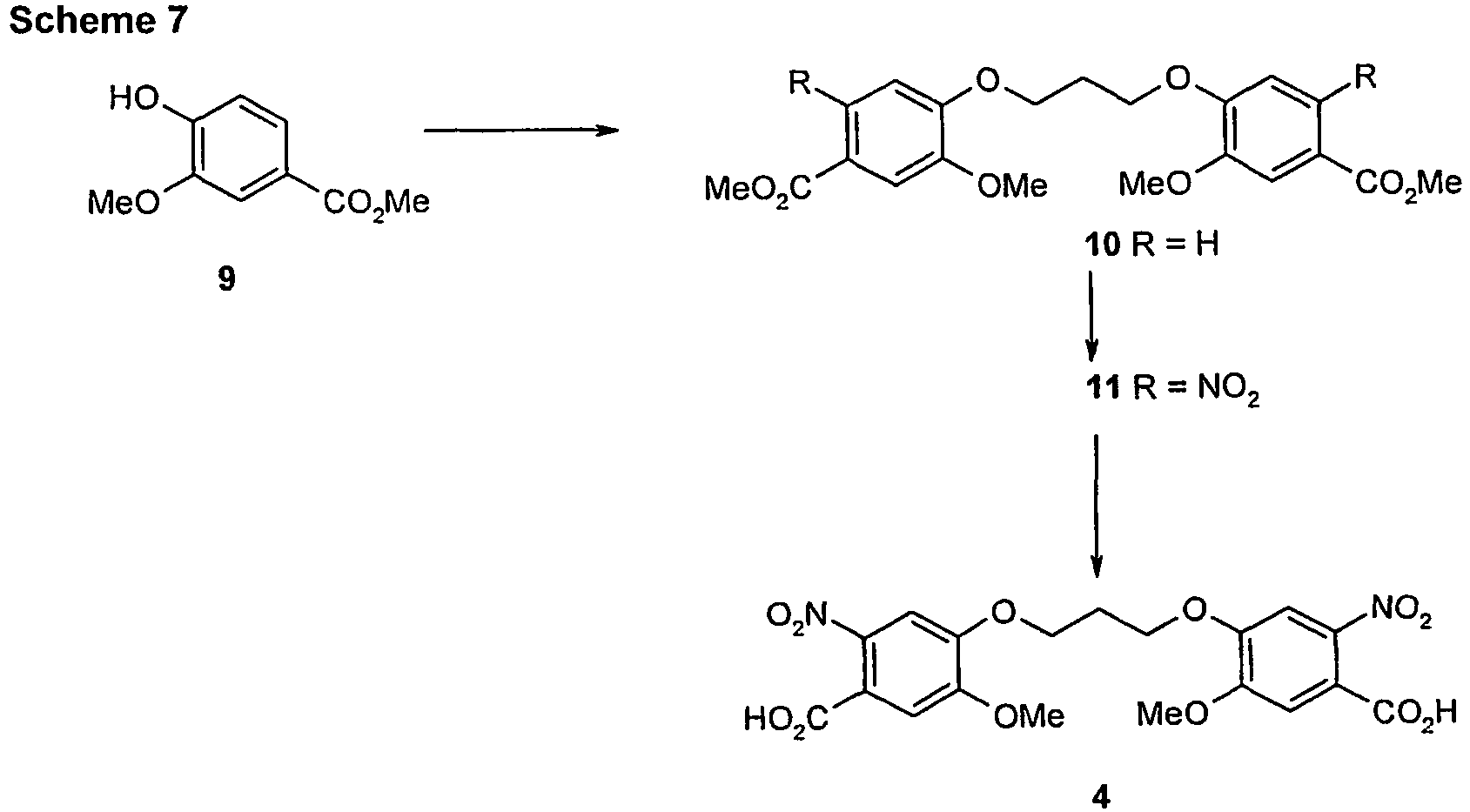
-

- Method A: A catalytic amount of DMF (2 drops) was added (effervescence!) to a stirred solution of the nitro-acid 4 (1.0 g, 2.15 mmol) and oxalyl chloride (0.95 mL, 1.36 g, 10.7 mmol) in dry THF (20 mL). The reaction mixture was allowed to stir for 16 hours at room temperature and the solvent was removed by evaporation in vacuo. The resulting residue was re-dissolved in dry THF (20 mL) and the acid chloride solution was added dropwise to a stirred mixture of (2S,4R)-methyl-4-hydroxypyrrolidine-2-carboxylate hydrochloride (859 mg, 4.73 mmol) and TEA (6.6 mL, 4.79 g, 47.3 mmol) in THF (10 mL) at -30 °C (dry ice/ethylene glycol) under a nitrogen atmosphere. The reaction mixture was allowed to warm to room temperature and stirred for a further 3 hours after which time TLC (95:5 v/v CHCl3/MeOH) and LC/MS (2.45 min (ES+) m/z (relative intensity) 721 ([M + H]+., 20)) revealed formation of product. Excess THF was removed by rotary evaporation and the resulting residue was dissolved in DCM (50 mL). The organic layer was washed with 1 N HCl (2 x 15 mL), saturated NaHCO3 (2 x 15 mL), H2O (20 mL), brine (30 mL) and dried (MgSO4). Filtration and evaporation of the solvent gave the crude product as a dark coloured oil. Purification by flash chromatography (gradient elution: 100% CHCl3 to 96:4 v/v CHCl3/MeOH) isolated the pure amide 12 as an orange coloured glass (840 mg, 54%).
- Method B: Oxalyl chloride (9.75 mL, 14.2 g, 111 mmol) was added to a stirred suspension of the nitro-acid 4 (17.3 g, 37.1 mmol) and DMF (2 mL) in anhydrous DCM (200 mL). Following initial effervescence the reaction suspension became a solution and the mixture was allowed to stir at room temperature for 16 hours. Conversion to the acid chloride was confirmed by treating a sample of the reaction mixture with MeOH and the resulting bis-methyl ester was observed by LC/MS. The majority of solvent was removed by evaporation in vacuo, the resulting concentrated solution was re-dissolved in a minimum amount of dry DCM and triturated with diethyl ether. The resulting yellow precipitate was collected by filtration, washed with cold diethyl ether and dried for 1 hour in a vacuum oven at 40°C. The solid acid chloride was added portionwise over a period of 25 minutes to a stirred suspension of (2S,4R)-methyl-4-hydroxypyrrolidine-2-carboxylate hydrochloride (15.2 g, 84.0 mmol) and TEA (25.7 mL, 18.7 g, 185 mmol) in DCM (150 mL) at -40°C (dry ice/CH3CN). Immediately, the reaction was complete as judged by LC/MS (2.47 min (ES+) m/z (relative intensity) 721 ([M + H]+., 100)). The mixture was diluted with DCM (150 mL) and washed with 1N HCl (300 mL), saturated NaHCO3 (300 mL), brine (300 mL), filtered (through a phase separator) and the solvent evaporated in vacuo to give the pure product 12 as an orange solid (21.8 g, 82%).
- Analytical Data: [α]22 D = -46.1° (c = 0.47, CHCl3); 1H NMR (400 MHz, CDCl3) (rotamers) δ 7.63 (s, 2H), 6.82 (s, 2H), 4.79-4.72 (m, 2H), 4.49-4.28 (m, 6H), 3.96 (s, 6H), 3.79 (s, 6H), 3.46-3.38 (m, 2H), 3.02 (d, 2H, J = 11.1 Hz), 2.48-2.30 (m, 4H), 2.29-2.04 (m, 4H); 13C NMR (100 MHz, CDCl3) (rotamers) δ 172.4, 166.7, 154.6, 148.4, 137.2, 127.0, 109.7, 108.2, 69.7, 65.1, 57.4, 57.0, 56.7, 52.4, 37.8, 29.0; IR (ATR, CHCl3) 3410 (br), 3010, 2953, 1741, 1622, 1577, 1519, 1455, 1429, 1334, 1274, 1211, 1177, 1072, 1050, 1008, 871 cm-1; MS (ES+) m/z (relative intensity) 721 ([M + H]+., 47), 388 (80); HRMS [M + H]+. theoretical C31H36N4O16 m/z 721.2199, found (ES+) m/z 721.2227.
- Method A: A suspension of 10% Pd/C (7.5 g, 10% w/w) in DMF (40 mL) was added to a solution of the nitro-ester 12 (75 g, 104 mmol) in DMF (360 mL). The suspension was hydrogenated in a Parr hydrogenation apparatus over 8 h. Progress of the reaction was monitored by LC/MS (2.12 min (ES+) m/z (relative intensity) 597 ([M + H]+., 100), (ES-) m/z (relative intensity) 595 ([M + H]+., 100) after the hydrogen uptake had stopped. Solid Pd/C was removed by filtration and the filtrate was concentrated by rotary evaporation under vacuum (below 10 mbar) at 40°C to afford a dark oil containing traces of DMF and residual charcoal. The residue was digested in EtOH (500 mL) at 40°C on a water bath (rotary evaporator bath) and the resulting suspension was filtered through celite and washed with ethanol (500 mL) to give a clear filtrate. Hydrazine hydrate (10 mL, 321 mmol) was added to the solution and the reaction mixture was heated at reflux. After 20 minutes the formation of a white precipitate was observed and reflux was allowed to continue for a further 30 minutes. The mixture was allowed to cool down to room temperature and the precipitate was retrieved by filtration, washed with diethyl ether (2* 1 volume of precipitate) and dried in a vacuum desiccator to provide 13 (50 g, 81%).
- Method B: A solution of the nitro-ester 12 (6.80 g, 9.44 mmol) in MeOH (300 mL) was added to Raney™ nickel (4 large spatula ends of a ~ 50% slurry in H2O) and anti-bumping granules in a 3-neck round bottomed flask. The mixture was heated at reflux and then treated dropwise with a solution of hydrazine hydrate (5.88 mL, 6.05 g, 188 mmol) in MeOH (50 mL) at which point vigorous effervescence was observed. When the addition was complete (~ 30 minutes) additional Raney™ nickel was added carefully until effervescence had ceased and the initial yellow colour of the reaction mixture was discharged. The mixture was heated at reflux for a further 30 minutes at which point the reaction was deemed complete by TLC (90:10 v/v CHCl3/MeOH) and LC/MS (2.12 min (ES+) m/z (relative intensity) 597 ([M + H]+., 100)). The reaction mixture was allowed to cool to around 40°C and then excess nickel removed by filtration through a sinter funnel without vacuum suction. The filtrate was reduced in volume by evaporation in vacuo at which point a colourless precipitate formed which was collected by filtration and dried in a vacuum desiccator to provide 13 (5.40 g, 96%).
- Analytical Data: [α]27 D = +404° (c = 0.10, DMF); 1H NMR (400 MHz, DMSO-d6 ) δ 10.2 (s, 2H, NH), 7.26 (s, 2H), 6.73 (s, 2H), 5.11 (d, 2H, J = 3.98 Hz, OH), 4.32-4.27 (m, 2H), 4.19-4.07 (m, 6H), 3.78 (s, 6H), 3.62 (dd, 2H, J = 12.1, 3.60 Hz), 3.43 (dd, 2H, J = 12.0, 4.72 Hz), 2.67-2.57 (m, 2H), 2.26 (p, 2H, J = 5.90 Hz), 1.99-1.89 (m, 2H); 13C NMR (100 MHz, DMSO-d6 ) δ 169.1, 164.0, 149.9, 144.5, 129.8, 117.1, 111.3, 104.5, 54.8, 54.4, 53.1, 33.5, 27.5; IR (ATR, neat) 3438, 1680, 1654, 1610, 1605, 1516, 1490, 1434, 1379, 1263, 1234, 1216, 1177, 1156, 1115, 1089, 1038, 1018, 952, 870 cm-1; MS (ES+) m/z (relative intensity) 619 ([M + Na]+., 10), 597 ([M + H]+., 52), 445 (12), 326 (11); HRMS [M+ H]+. theoretical C29H32N4O10 m/z 597.2191, found (ES+) m/z 597.2205.
- TBSCI (317 mg, 2.1 mmol) and imidazole (342 mg, 5.03 mmol) were added to a cloudy solution of the tetralactam 13 (250 mg, 0.42 mmol) in anhydrous DMF (6 mL). The mixture was allowed to stir under a nitrogen atmosphere for 3 h after which time the reaction was deemed complete as judged by LC/MS (3.90 min (ES+) m/z (relative intensity) 825 ([M + H]+., 100)). The reaction mixture was poured onto ice (- 25 mL) and allowed to warm to room temperature with stirring. The resulting white precipitate was collected by vacuum filtration, washed with H2O, diethyl ether and dried in the vacuum desiccator to provide pure 14 (252 mg, 73%).
- Analytical Data: [α]23 D = +234° (c = 0.41, CHCl3); 1H NMR (400 MHz, CDCl3) δ 8.65 (s, 2H, NH), 7.44 (s, 2H), 6.54 (s, 2H), 4.50 (p, 2H, J = 5.38 Hz), 4.21-4.10 (m, 6H), 3.87 (s, 6H), 3.73-3.63 (m, 4H), 2.85-2.79 (m, 2H), 2.36-2.29 (m, 2H), 2.07-1.99 (m, 2H), 0.86 (s, 18H), 0.08 (s, 12H); 13C NMR (100 MHz, CDCl3) δ 170.4, 165.7, 151.4, 146.6, 129.7, 118.9, 112.8, 105.3, 69.2, 65.4, 56.3, 55.7, 54.2, 35.2, 28.7, 25.7, 18.0, -4.82 and -4.86; IR (ATR, CHCl3) 3235, 2955, 2926, 2855, 1698, 1695, 1603, 1518, 1491, 1446, 1380, 1356, 1251, 1220, 1120, 1099, 1033 cm-1; MS (ES+) m/z (relative intensity) 825 ([M + H]+., 62), 721 (14), 440 (38); HRMS [M + H]+. theoretical C41H60N4O10Si2 m/z 825.3921, found (ES+) m/z 825.3948.
- A solution of n-BuLi (4.17 mL of a 1.6 M solution in hexane, 6.67 mmol) in anhydrous THF (10 mL) was added dropwise to a stirred suspension of the tetralactam 14 (2.20 g, 2.67 mmol) in anhydrous THF (30 mL) at -30°C (dry ice/ethylene glycol) under a nitrogen atmosphere. The reaction mixture was allowed to stir at this temperature for 1 hour (now a reddish orange colour) at which point a solution of SEMCI (1.18 mL, 1.11 g, 6.67 mmol) in anhydrous THF (10 mL) was added dropwise. The reaction mixture was allowed to slowly warm to room temperature and was stirred for 16 hours under a nitrogen atmosphere. The reaction was deemed complete as judged by TLC (EtOAc) and LC/MS (4.77 min (ES+) m/z (relative intensity) 1085 ([M + H]+., 100)). The THF was removed by evaporation in vacuo and the resulting residue dissolved in EtOAc (60 mL), washed with H2O (20 mL), brine (20 mL), dried (MgSO4) filtered and evaporated in vacuo to provide the crude product. Purification by flash chromatography (80:20 v/v Hexane/EtOAc) gave the pure N10-SEM-protected tetralactam 15 as an oil (2.37 g, 82%).
- Analytical Data: [α]23 D = +163° (c = 0.41, CHCl3); 1H NMR (400 MHz, CDCl3) δ 7.33 (s, 2H), 7.22 (s, 2H), 5.47 (d, 2H, J = 9.98 Hz), 4.68 (d, 2H, J = 9.99 Hz), 4.57 (p, 2H, J = 5.77 Hz), 4.29-4.19 (m, 6H), 3.89 (s, 6H), 3.79-3.51 (m, 8H), 2.87-2.81 (m, 2H), 2.41 (p, 2H, J = 5.81 Hz), 2.03-1.90 (m, 2H), 1.02-0.81 (m, 22H), 0.09 (s, 12H), 0.01 (s, 18H); 13C NMR (100 MHz, CDCl3) δ 170.0, 165.7, 151.2, 147.5, 133.8, 121.8, 111.6, 106.9, 78.1, 69.6, 67.1, 65.5, 56.6, 56.3, 53.7, 35.6, 30.0, 25.8, 18.4, 18.1, -1.24, -4.73; IR (ATR, CHCl3) 2951, 1685, 1640, 1606, 1517, 1462, 1433, 1360, 1247, 1127, 1065 cm-1; MS (ES+) m/z (relative intensity) 1113 ([M + Na]+., 48), 1085 ([M + H]+., 100), 1009 (5), 813 (6); HRMS [M + H]+. theoretical C53H88N4O12Si4 m/z 1085.5548, found (ES+) m/z 1085.5542.
- A solution of TBAF (5.24 mL of a 1.0 M solution in THF, 5.24 mmol) was added to a stirred solution of the bis-silyl ether 15 (2.58 g, 2.38 mmol) in THF (40 mL) at room temperature. After stirring for 3.5 hours, analysis of the reaction mixture by TLC (95:5 v/v CHCl3/MeOH) revealed completion of reaction. The reaction mixture was poured into a solution of saturated NH4Cl (100 mL) and extracted with EtOAc (3 x 30 mL). The combined organic layers were washed with brine (60 mL), dried (MgSO4), filtered and evaporated in vacuo to provide the crude product. Purification by flash chromatography (gradient elution: 100% CHCl3 to 96:4 v/v CHCl3/MeOH) gave the pure tetralactam 16 as a white foam (1.78 g, 87%).
- Analytical Data: LC/MS 3.33 min (ES+) m/z (relative intensity) 879 ([M + Na]+., 100), 857 ([M + H]+., 40); [α]23 D = +202° (c = 0.34, CHCl3); 1H NMR (400 MHz, CDCl3) δ 7.28 (s, 2H), 7.20 (s, 2H), 5.44 (d, 2H, J = 10.0 Hz), 4.72 (d, 2H, J = 10.0 Hz), 4.61-4.58 (m, 2H), 4.25 (t, 4H, J = 5.83 Hz), 4.20-4.16 (m, 2H), 3.91-3.85 (m, 8H), 3.77-3.54 (m, 6H), 3.01 (br s, 2H, OH), 2.96-2.90 (m, 2H), 2.38 (p, 2H, J = 5.77 Hz), 2.11-2.05 (m, 2H), 1.00-0.91 (m, 4H), 0.00 (s, 18H); 13C NMR (100 MHz, CDCl3) δ 169.5, 165.9, 151.3, 147.4, 133.7, 121.5, 111.6, 106.9, 79.4, 69.3, 67.2, 65.2, 56.5, 56.2, 54.1, 35.2, 29.1, 18.4, -1.23; IR (ATR, CHCl3) 2956, 1684, 1625, 1604, 1518, 1464, 1434, 1361, 1238, 1058, 1021 cm-1; MS (ES+) m/z (relative intensity) 885 ([M + 29]+., 70), 857 ([M + H]+., 100), 711 (8), 448 (17); HRMS [M + H]+. theoretical C41H60N4O12Si2 m/z 857.3819, found (ES+) m/z 857.3826.
-
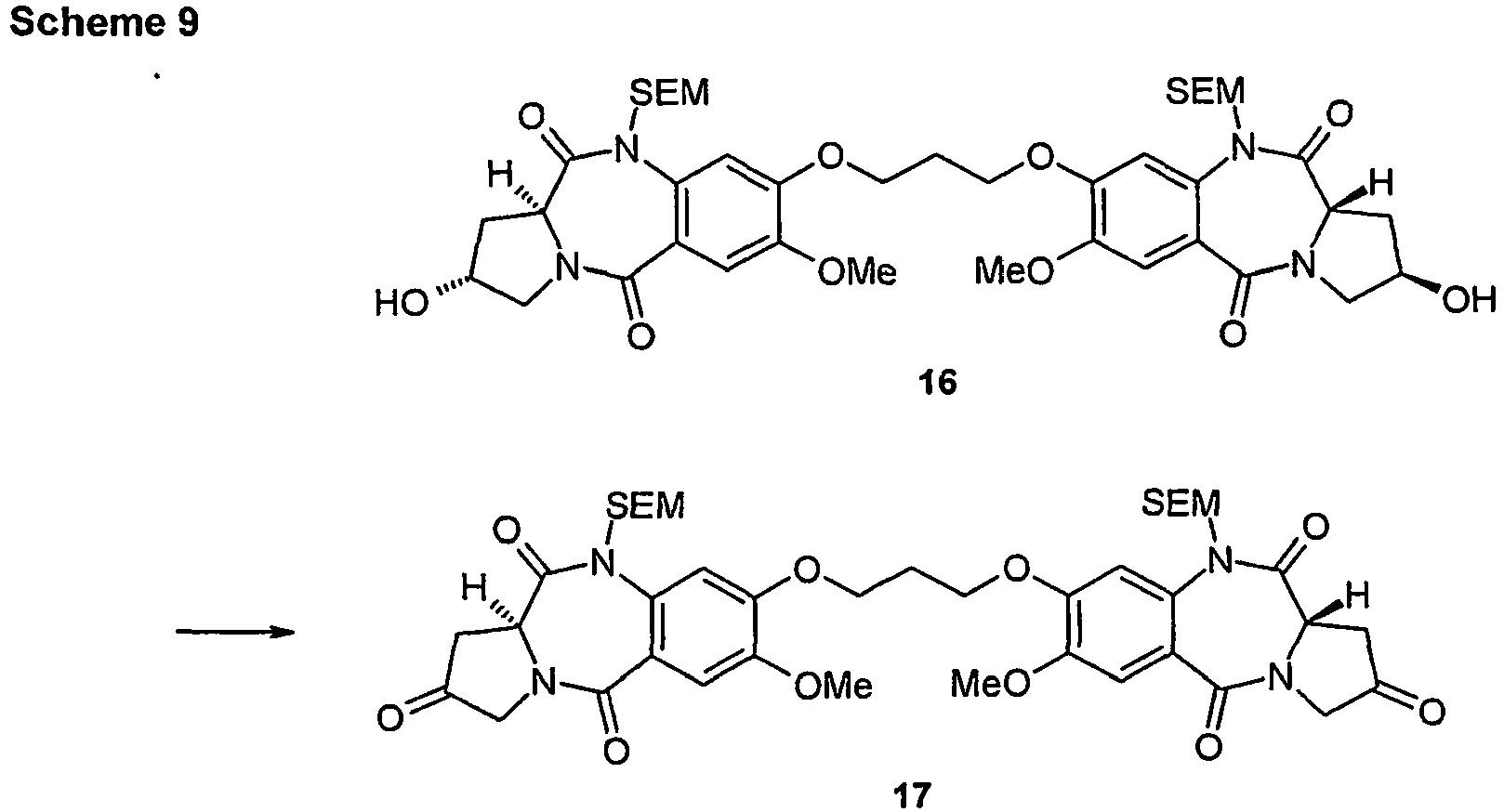
- Method A: Solid TCCA (10.6 g, 45.6 mmol) was added portionwise to a stirred solution of the alcohol 16 (18.05 g, 21.1 mmol) and TEMPO (123 mg, 0.78 mmol) in anhydrous DCM (700 mL) at 0 °C (ice/acetone). The reaction mixture was stirred at 0 °C under a nitrogen atmosphere for 15 min after which time TLC (EtOAc) and LC/MS [3.57 min (ES+) m/z (relative intensity) 875 ([M + Na]+., 50)] revealed completion of reaction. The reaction mixture was filtered through celite and the filtrate was washed with saturated aqueous NaHCO3 (400mL), brine (400mL), dried (MgSO4), filtered and evaporated in vacuo to provide the crude product. Purification by flash column chromatography (80:20 v/v EtOAc/Hexane) afforded the bis-ketone 17 as a foam (11.7 g, 65%).
- Method B: A solution of anhydrous DMSO (0.72 mL, 0.84 g, 10.5 mmol) in dry DCM (18 mL) was added dropwise over a period of 25 min to a stirred solution of oxalyl chloride (2.63 mL of a 2.0 M solution in DCM, 5.26 mmol) under a nitrogen atmosphere at -60 °C (liq N2/CHCl3). After stirring at -55°C for 20 min, a slurry of the substrate 16 (1.5 g, 1.75 mmol) in dry DCM (36 mL) was added dropwise over a period of 30 min to the reaction mixture. After stirring for a further 50 min at -55°C, a solution of TEA (3.42 mL, 2.49 g; 24.6 mmol) in dry DCM (18 mL) was added dropwise over a period of 20 min to the reaction mixture. The stirred reaction mixture was allowed to warm to room temperature (~ 1.5 h) and then diluted with DCM (50 mL). The organic solution was washed with 1 N HCl (2 x 25 mL), H2O (30 mL), brine (30 mL) and dried (MgSO4). Filtration and evaporation of the solvent in vacuo afforded the crude product which was purified by flash column chromatography (80:20 v/v EtOAc/Hexane) to afford bis-ketone 17 as a foam (835 mg, 56%).
- Analytical Data: LC/MS 3.55 min (ES+) m/z (relative intensity) 875 ([M + Na]+., 50); [α]20 D = +291 ° (c = 0.26, CHCl3); 1H NMR (400 MHz, CDCl3) δ 7.32 (s, 2H), 7.25 (s, 2H), 5.50 (d, 2H, J = 10.1 Hz), 4.75 (d, 2H, J = 10.1 Hz), 4.60 (dd, 2H, J = 9.85, 3.07 Hz), 4.31-4.18 (m, 6H), 3.89-3.84 (m, 8H), 3.78-3.62 (m, 4H), 3.55 (dd, 2H, J = 19.2, 2.85 Hz), 2.76 (dd, 2H, J = 19.2, 9.90 Hz), 2.42 (p, 2H, J = 5.77 Hz), 0.98-0.91 (m, 4H), 0.00 (s, 18H); 13C NMR (100 MHz, CDCl3) δ 206.8, 168.8, 165.9, 151.8, 148.0, 133.9, 120.9, 111.6, 107.2, 78.2, 67.3, 65.6, 56.3, 54.9, 52.4, 37.4, 29.0, 18.4, -1.24; IR (ATR, CHCl3) 2957, 1763, 1685, 1644, 1606, 1516, 1457, 1434, 1360, 1247, 1209, 1098, 1066, 1023 cm-1; MS (ES+) m/z (relative intensity) 881 ([M + 29]+., 38), 853 ([M + H]+., 100), 707 (8), 542 (12); HRMS [M+ H]+. theoretical C41H56N4O12Si2 m/z 853.3506, found (ES+) m/z 853.3502.
-
-
WO 95/04718 -
WO 00/12508 -
WO 2004/043963 -
WO 2005/042535 -
WO 2005/085251 -
WO 2006/111759 -
WO 2007/085930 - Japanese Patent
58-180 487 -
US 2007/185336 - Antonow et al J. Comb. Chem., 2007, 9, 437-445.
- Arima, et al., J. Antibiotics, 25, 437-444 (1972).
- Bose, et al., Tetrahedron, 48, 751-758 (1992).
- Cooper, N., Design, Synthesis and Evaluation of Novel C2-Aryl Pyrrolobenzodiazepines as Potential Anticancer Agents, Thesis submitted to School of Pharmacy, University of London, dated 5 October 2006.
- Gregson et a/., Chem. Commun. 1999, 797-798.
- Gregson et al., J. Med. Chem. 2001, 44, 1161-1174.
- Hara, et al., J. Antibiotics, 41, 702-704 (1988).
- Hochlowski, et al., J. Antibiotics, 40, 145-148 (1987).
- Hurley and Needham-VanDevanter, Acc. Chem. Res., 19, 230-237 (1986).
- Itoh, et al., J. Antibiotics, 41, 1281-1284 (1988).
- Kohn, in Antibiotics III. Springer-Verlag, New York, pp. 3-11 (1975).
- Konishi, et al., J. Antibiotics, 37, 200-206 (1984).
- Kuminoto, et al., J. Antibiotics, 33, 665-667 (1980).
- Langley and Thurston, J. Org. Chem., 52, 91-97 (1987).
- Leber, et al., J. Am. Chem. Soc., 110, 2992-2993 (1988).
- Leimgruber, et al., J. Am. Chem. Soc., 87, 5793-5795 (1965).
- Leimgruber, et al., J. Am. Chem. Soc., 87, 5791-5793 (1965).
- Narukawa Y., Tetrahedron 1997, 53, 539-556.
- Shimizu, et al, J. Antibiotics, 29, 2492-2503 (1982).
- Takeuchi, et al., J. Antibiotics, 29, 93-96 (1976).
- Thomas Fey et al, J. Org. Chem., 2001, 66, 8154-8159.
- Thurston, et a/., Chem. Brit., 26, 767-772 (1990).
- Thurston, et a/., Chem. Rev. 1994, 433-465 (1994).
- Tsunakawa, et al., J. Antibiotics, 41, 1366-1373 (1988).
wherein R" is a C1-12 alkylene group, which chain may be interrupted by one or more heteroatoms, e.g. O, S, N(H), and/or aromatic rings, e.g. benzene or pyridine;
and each X is independently selected from O, S, or N(H);
or any pair of adjacent groups from R6 to R9 together form a group -O-(CH2)p-O-, where p is 1 or 2, and salts and solvates thereof.
Claims (11)
- A compound of formula (S):
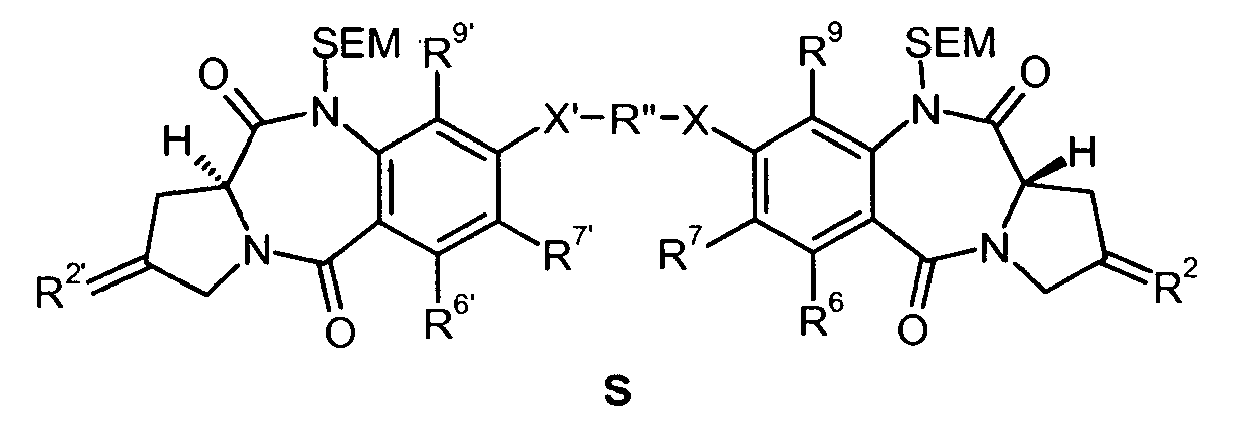 R2 is CHR2A, and R2A is independently selected from H, R, CO2R, COR, CHO, CO2H, and halo;R6 and R9 are independently selected from H, R, OH, OR, SH, SR, NH2, NHR, NRR', NO2, Me3Sn and halo;R7 is independently selected from H, R, OH, OR, SH, SR, NH2, NHR, NRR', NO2, Me3Sn and halo;or the adjacent groups R6 and R7 together form a group -O-(CH2)p-O-, where p is 1 or 2; andR is independently selected from optionally substituted C1-12 alkyl, C3-20 heterocyclyl and C5-20 aryl groups;R" is a C3-12 alkylene group, which chain may be interrupted by one or more heteroatoms and/or aromatic rings;each X is independently selected from O, S, or N(H); andR2', R6', R7', R9', and X' are independently selected from the same groups as R2, R6, R7, R9, and X respectively.
 - The compound according to claim 1, wherein R2A is independently selected from H and R, and is preferably H.
- The compound according to either claim 1 or claim 2, wherein R7 and R7' are each independently OR, and preferably are each independently OMe.
- The compound according to any one of the preceding claims, wherein R6 and R6' are each independently H, and/or R9 and R9' are each independently H.
- The compound according to any one of the preceding claims, wherein X and X' are each independently O.
- The compound according to any one of the preceding claims, wherein R" is a C3-12 alkylene group, preferably selected from a C3 alkylene group and a C5 alkylene group, and most preferably is a C3 alkylene group.
- The compound according to claim 1 of formula (8):

- A process for the preparation of a compound of formula (A), the process comprising the step of reacting a compound of formula (S) with a reducing agent, wherein (S) is as defined in any one of claims 1 to 7, and (A) is a compound:
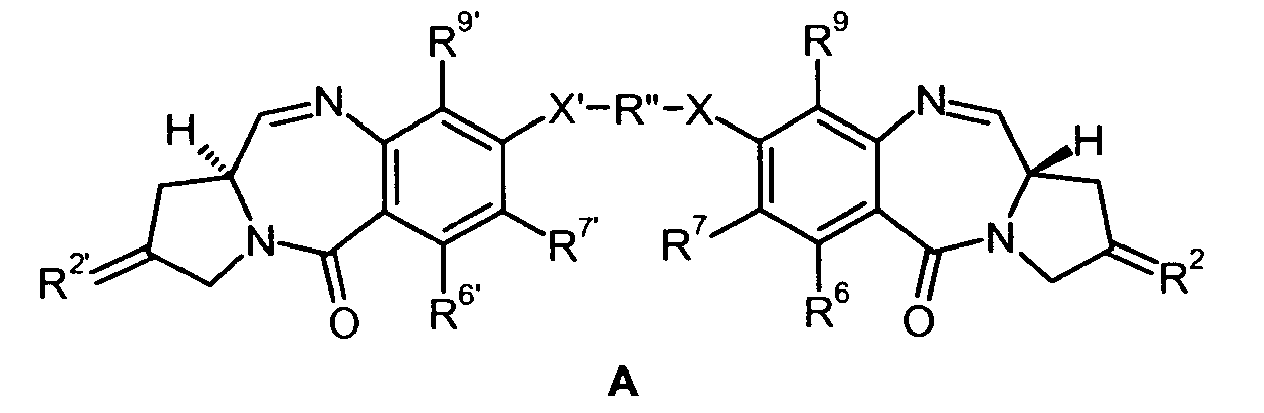
- A process for the preparation of a compound of formula (S), the process comprising the step of protecting the amide nitrogens of (B) with SEM, wherein (S) is as defined in any one of claims 1 to 7, and B is a compound:

- A process for the preparation of a compound formula (B), the process comprising the step of reacting a compound of formula (X) with a compound of formula (C), wherein (B) is as defined in claim 9, and (X) and (C) are:

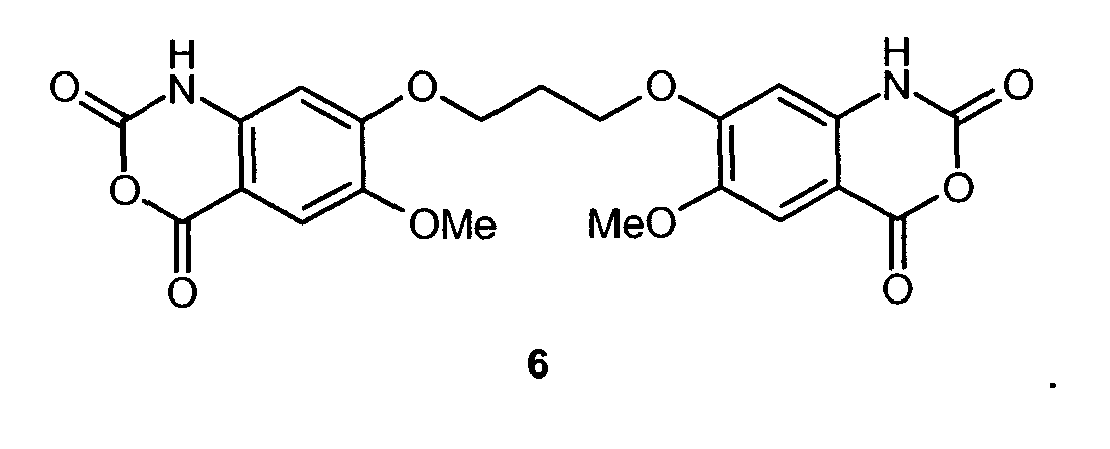

- A process for the preparation of a compound of formula (S), the process comprising the step of reacting (W) with an alkene forming reagent comprising a group R2, wherein (S) is as defined in any one of claims 1 to 8 and (W) is a compound:

Applications Claiming Priority (2)
| Application Number | Priority Date | Filing Date | Title |
|---|---|---|---|
| GBGB0819097.7A GB0819097D0 (en) | 2008-10-17 | 2008-10-17 | Pyrrolobenzodiazepines |
| PCT/GB2009/002495 WO2010043877A1 (en) | 2008-10-17 | 2009-10-16 | Pyrrolobenzodiazepines |
Publications (2)
| Publication Number | Publication Date |
|---|---|
| EP2350098A1 EP2350098A1 (en) | 2011-08-03 |
| EP2350098B1 true EP2350098B1 (en) | 2013-05-15 |
Family
ID=40097623
Family Applications (1)
| Application Number | Title | Priority Date | Filing Date |
|---|---|---|---|
| EP09745087.8A Not-in-force EP2350098B1 (en) | 2008-10-17 | 2009-10-16 | Pyrrolobenzodiazepines |
Country Status (14)
| Country | Link |
|---|---|
| US (1) | US8487092B2 (en) |
| EP (1) | EP2350098B1 (en) |
| JP (1) | JP5669740B2 (en) |
| KR (1) | KR101700460B1 (en) |
| CN (1) | CN102256985B (en) |
| AU (1) | AU2009305187B2 (en) |
| BR (1) | BRPI0920450A2 (en) |
| CA (1) | CA2740713C (en) |
| GB (1) | GB0819097D0 (en) |
| IL (1) | IL212339A (en) |
| MX (1) | MX2011004038A (en) |
| NZ (1) | NZ592284A (en) |
| WO (1) | WO2010043877A1 (en) |
| ZA (1) | ZA201102787B (en) |
Families Citing this family (55)
| Publication number | Priority date | Publication date | Assignee | Title |
|---|---|---|---|---|
| GB0819097D0 (en) * | 2008-10-17 | 2008-11-26 | Spirogen Ltd | Pyrrolobenzodiazepines |
| GB0819095D0 (en) | 2008-10-17 | 2008-11-26 | Spirogen Ltd | Pyrrolobenzodiazepines |
| JP5870400B2 (en) | 2010-04-15 | 2016-03-01 | シアトル ジェネティクス,インコーポレーテッド | Targeted pyrrolobenzodiazepine conjugates |
| NZ602933A (en) | 2010-04-15 | 2014-09-26 | Seattle Genetics Inc | Pyrrolobenzodiazepines used to treat proliferative diseases |
| WO2013041606A1 (en) | 2011-09-20 | 2013-03-28 | Spirogen Sàrl | Pyrrolobenzodiazepines as unsymmetrical dimeric pbd compounds for inclusion in targeted conjugates |
| AU2012322613B2 (en) | 2011-10-14 | 2016-04-21 | Medimmune Limited | Pyrrolobenzodiazepines and targeted conjugates |
| EP2751111B1 (en) | 2011-10-14 | 2017-04-26 | MedImmune Limited | Asymmetrical bis-(5H-Pyrrolo[2,1-c][1,4]benzodiazepin-5-one) derivatives for the treatment of proliferative or autoimmune diseases |
| JP6393617B2 (en) | 2011-10-14 | 2018-09-19 | シアトル ジェネティクス,インコーポレーテッド | Pyrrolobenzodiazepine and target conjugates |
| WO2013053871A1 (en) | 2011-10-14 | 2013-04-18 | Spirogen Sàrl | Pyrrolobenzodiazepines |
| US10695433B2 (en) | 2012-10-12 | 2020-06-30 | Medimmune Limited | Pyrrolobenzodiazepine-antibody conjugates |
| JP6270859B2 (en) | 2012-10-12 | 2018-01-31 | エイディーシー・セラピューティクス・エス・アー・エール・エルAdc Therapeutics Sarl | Pyrrolobenzodiazepine-antibody conjugate |
| DK2906248T3 (en) | 2012-10-12 | 2019-03-04 | Medimmune Ltd | Pyrrolobenzodiazepines and their conjugates |
| EP2906296B1 (en) | 2012-10-12 | 2018-03-21 | ADC Therapeutics SA | Pyrrolobenzodiazepine-antibody conjugates |
| EP2906249B1 (en) | 2012-10-12 | 2018-06-27 | MedImmune Limited | Synthesis and intermediates of pyrrolobenzodiazepine derivatives for conjugation |
| WO2014057114A1 (en) | 2012-10-12 | 2014-04-17 | Adc Therapeutics Sàrl | Pyrrolobenzodiazepine-anti-psma antibody conjugates |
| JP5993093B2 (en) | 2012-10-12 | 2016-09-14 | メドイミューン・リミテッドMedImmune Limited | Pyrrolobenzodiazepines and their complexes |
| KR101995621B1 (en) | 2012-10-12 | 2019-07-03 | 에이디씨 테라퓨틱스 에스에이 | Pyrrolobenzodiazepine-anti-cd22 antibody conjugates |
| US9931414B2 (en) | 2012-10-12 | 2018-04-03 | Medimmune Limited | Pyrrolobenzodiazepine-antibody conjugates |
| AU2013366493B2 (en) | 2012-12-21 | 2017-08-24 | Medimmune Limited | Pyrrolobenzodiazepines and conjugates thereof |
| HK1216176A1 (en) | 2012-12-21 | 2016-10-21 | Medlmmune Limited | Unsymmetrical pyrrolobenzodiazepines-dimers for use in the treatment of proliferative and autoimmune diseases |
| WO2014159981A2 (en) | 2013-03-13 | 2014-10-02 | Spirogen Sarl | Pyrrolobenzodiazepines and conjugates thereof |
| AU2014229529B2 (en) | 2013-03-13 | 2018-02-15 | Medimmune Limited | Pyrrolobenzodiazepines and conjugates thereof |
| EP3054985B1 (en) | 2013-10-11 | 2018-12-26 | Medimmune Limited | Pyrrolobenzodiazepine-antibody conjugates |
| GB201317982D0 (en) | 2013-10-11 | 2013-11-27 | Spirogen Sarl | Pyrrolobenzodiazepines and conjugates thereof |
| US10010624B2 (en) | 2013-10-11 | 2018-07-03 | Medimmune Limited | Pyrrolobenzodiazepine-antibody conjugates |
| GB201317981D0 (en) | 2013-10-11 | 2013-11-27 | Spirogen Sarl | Pyrrolobenzodiazepines and conjugates thereof |
| US9956299B2 (en) | 2013-10-11 | 2018-05-01 | Medimmune Limited | Pyrrolobenzodiazepine—antibody conjugates |
| PE20170935A1 (en) | 2014-09-12 | 2017-07-13 | Genentech Inc | ANTI-HER2 AND IMMUNOCONJUGATED ANTIBODIES |
| GB201416112D0 (en) | 2014-09-12 | 2014-10-29 | Medimmune Ltd | Pyrrolobenzodiazepines and conjugates thereof |
| BR112017011111A2 (en) | 2014-11-25 | 2017-12-26 | Adc Therapeutics Sa | pyrrolobenzodiazepine-antibody conjugates |
| GB201506411D0 (en) | 2015-04-15 | 2015-05-27 | Bergenbio As | Humanized anti-axl antibodies |
| GB201506402D0 (en) | 2015-04-15 | 2015-05-27 | Berkel Patricius H C Van And Howard Philip W | Site-specific antibody-drug conjugates |
| MA43345A (en) | 2015-10-02 | 2018-08-08 | Hoffmann La Roche | PYRROLOBENZODIAZEPINE ANTIBODY-DRUG CONJUGATES AND METHODS OF USE |
| GB201601431D0 (en) | 2016-01-26 | 2016-03-09 | Medimmune Ltd | Pyrrolobenzodiazepines |
| GB201602359D0 (en) | 2016-02-10 | 2016-03-23 | Medimmune Ltd | Pyrrolobenzodiazepine Conjugates |
| GB201602356D0 (en) | 2016-02-10 | 2016-03-23 | Medimmune Ltd | Pyrrolobenzodiazepine Conjugates |
| GB201607478D0 (en) | 2016-04-29 | 2016-06-15 | Medimmune Ltd | Pyrrolobenzodiazepine Conjugates |
| GB201617466D0 (en) | 2016-10-14 | 2016-11-30 | Medimmune Ltd | Pyrrolobenzodiazepine conjugates |
| GB201702031D0 (en) | 2017-02-08 | 2017-03-22 | Medlmmune Ltd | Pyrrolobenzodiazepine-antibody conjugates |
| HUE054689T2 (en) | 2017-02-08 | 2021-09-28 | Adc Therapeutics Sa | Pyrrolobenzodiazepine antibody conjugates |
| JP7664680B2 (en) | 2017-03-29 | 2025-04-18 | リガケム バイオサイエンシズ, インク. | Pyrrolobenzodiazepine dimer precursors and their ligand-linker conjugate compounds |
| SI3612537T1 (en) | 2017-04-18 | 2022-10-28 | Medimmune Limited | Pyrrolobenzodiazepine conjugates |
| EP3612234B1 (en) | 2017-04-20 | 2024-03-13 | ADC Therapeutics SA | Combination therapy with an anti-axl antibody-drug conjugate |
| CA3064804A1 (en) | 2017-06-14 | 2018-12-20 | Adc Therapeutics Sa | Dosage regimes for the administration of an anti-cd19 adc |
| SG11202000358YA (en) | 2017-08-18 | 2020-02-27 | Medimmune Ltd | Pyrrolobenzodiazepine conjugates |
| TWI885539B (en) | 2017-09-29 | 2025-06-01 | 日商第一三共股份有限公司 | Antibody-pyrrolobenzodiazepine derivative complex |
| GB201803342D0 (en) | 2018-03-01 | 2018-04-18 | Medimmune Ltd | Methods |
| US12060427B2 (en) | 2018-03-28 | 2024-08-13 | Mitsubishi Tanabe Pharma Corporat | Drug conjugates of cMET monoclonal binding agents, and uses thereof |
| GB201806022D0 (en) | 2018-04-12 | 2018-05-30 | Medimmune Ltd | Pyrrolobenzodiazepines and conjugates thereof |
| WO2020141923A2 (en) | 2019-01-03 | 2020-07-09 | 주식회사 레고켐 바이오사이언스 | Pyrrolobenzodiazepine dimer compound with improved safety and use thereof |
| KR20200084802A (en) | 2019-01-03 | 2020-07-13 | 주식회사 레고켐 바이오사이언스 | Pyrrolobenzodiazepine dimer compounds with improved safety and its use |
| MX2021010477A (en) | 2019-03-15 | 2021-10-01 | Medimmune Ltd | Azetidobenzodiazepine dimers and conjugates comprising them for use in the treatment of cancer. |
| WO2021074392A1 (en) * | 2019-10-16 | 2021-04-22 | INSERM (Institut National de la Santé et de la Recherche Médicale) | Visual detection of pbd induced dna crosslinks |
| US20250367307A1 (en) | 2022-06-30 | 2025-12-04 | Toray Industries, Inc. | Pharmaceutical composition for cancer treatment and/or prevention |
| WO2024213113A2 (en) * | 2023-04-13 | 2024-10-17 | Beigene Switzerland Gmbh | Targeted pyrrolobenzodiazapine conjugates |
Family Cites Families (15)
| Publication number | Priority date | Publication date | Assignee | Title |
|---|---|---|---|---|
| JPS58180487A (en) | 1982-04-16 | 1983-10-21 | Kyowa Hakko Kogyo Co Ltd | Antibiotic dc-81 and its preparation |
| GB9205051D0 (en) * | 1992-03-09 | 1992-04-22 | Cancer Res Campaign Tech | Pyrrolobenzodiazepine derivatives,their preparation,and compositions containing them |
| GB9316162D0 (en) | 1993-08-04 | 1993-09-22 | Zeneca Ltd | Fungicides |
| JPH09235284A (en) * | 1995-02-23 | 1997-09-09 | Nissan Chem Ind Ltd | Indole-type thiazolidine compound |
| DE69907977T2 (en) * | 1998-08-27 | 2004-07-22 | Spirogen Ltd., Ryde | Pyrrolobenzodiazepine |
| US6660856B2 (en) | 2002-03-08 | 2003-12-09 | Kaohsiung Medical University | Synthesis of pyrrolo[2,1-c][1,4]benzodiazepine analogues |
| GB0226593D0 (en) | 2002-11-14 | 2002-12-24 | Consultants Ltd | Compounds |
| GB0416511D0 (en) | 2003-10-22 | 2004-08-25 | Spirogen Ltd | Pyrrolobenzodiazepines |
| GB0404577D0 (en) * | 2004-03-01 | 2004-04-07 | Spirogen Ltd | Pyrrolobenzodiazepines |
| EP1720881B9 (en) | 2004-03-01 | 2013-04-17 | Spirogen Sàrl | 11-hydroxy-5h-pyrrolo[2,1-c][1,4]benzodiazepin-5-one derivatives as key intermediates for the preparation of c2 substituted pyrrolobenzodiazepins |
| DE102004010943A1 (en) | 2004-03-03 | 2005-09-29 | Degussa Ag | Process for the preparation of N-protected 4-ketproline derivatives |
| US7528126B2 (en) * | 2004-03-09 | 2009-05-05 | Spirogen Limited | Pyrrolobenzodiazepines |
| EP1879901B1 (en) * | 2005-04-21 | 2009-12-23 | Spirogen Limited | Pyrrolobenzodiazepines |
| EP1813614B1 (en) | 2006-01-25 | 2011-10-05 | Sanofi | Cytotoxic agents comprising new tomaymycin derivatives |
| GB0819097D0 (en) * | 2008-10-17 | 2008-11-26 | Spirogen Ltd | Pyrrolobenzodiazepines |
-
2008
- 2008-10-17 GB GBGB0819097.7A patent/GB0819097D0/en active Pending
-
2009
- 2009-10-16 US US13/124,232 patent/US8487092B2/en not_active Expired - Fee Related
- 2009-10-16 NZ NZ592284A patent/NZ592284A/en not_active IP Right Cessation
- 2009-10-16 AU AU2009305187A patent/AU2009305187B2/en not_active Ceased
- 2009-10-16 BR BRPI0920450-4A patent/BRPI0920450A2/en active Search and Examination
- 2009-10-16 CA CA2740713A patent/CA2740713C/en not_active Expired - Fee Related
- 2009-10-16 MX MX2011004038A patent/MX2011004038A/en active IP Right Grant
- 2009-10-16 EP EP09745087.8A patent/EP2350098B1/en not_active Not-in-force
- 2009-10-16 CN CN200980150841.8A patent/CN102256985B/en not_active Expired - Fee Related
- 2009-10-16 KR KR1020117010813A patent/KR101700460B1/en not_active Expired - Fee Related
- 2009-10-16 JP JP2011531557A patent/JP5669740B2/en not_active Expired - Fee Related
- 2009-10-16 WO PCT/GB2009/002495 patent/WO2010043877A1/en not_active Ceased
-
2011
- 2011-04-14 ZA ZA2011/02787A patent/ZA201102787B/en unknown
- 2011-04-14 IL IL212339A patent/IL212339A/en active IP Right Grant
Also Published As
| Publication number | Publication date |
|---|---|
| KR20110069172A (en) | 2011-06-22 |
| KR101700460B1 (en) | 2017-01-26 |
| CN102256985A (en) | 2011-11-23 |
| HK1154576A1 (en) | 2012-04-27 |
| AU2009305187B2 (en) | 2014-09-04 |
| AU2009305187A1 (en) | 2010-04-22 |
| ZA201102787B (en) | 2011-12-28 |
| WO2010043877A1 (en) | 2010-04-22 |
| CN102256985B (en) | 2014-12-03 |
| NZ592284A (en) | 2012-09-28 |
| US20110201803A1 (en) | 2011-08-18 |
| EP2350098A1 (en) | 2011-08-03 |
| CA2740713C (en) | 2016-10-11 |
| GB0819097D0 (en) | 2008-11-26 |
| IL212339A (en) | 2015-09-24 |
| CA2740713A1 (en) | 2010-04-22 |
| MX2011004038A (en) | 2011-05-19 |
| JP5669740B2 (en) | 2015-02-12 |
| US8487092B2 (en) | 2013-07-16 |
| BRPI0920450A2 (en) | 2015-08-04 |
| JP2012505870A (en) | 2012-03-08 |
| IL212339A0 (en) | 2011-06-30 |
Similar Documents
| Publication | Publication Date | Title |
|---|---|---|
| EP2350098B1 (en) | Pyrrolobenzodiazepines | |
| EP1664049B1 (en) | Synthesis of protected pyrrolobenzodiazepines | |
| EP1723151B1 (en) | Pyrrolobenzodiazepines as key intermediates in the synthesis of dimeric cytotoxic pyrrolobenzodiazepines | |
| EP1879901B1 (en) | Pyrrolobenzodiazepines | |
| EP2270010B1 (en) | 11-hydroxy-5h-pyrrolo[2,1-c][1,4]benzodiazepin-5-one derivatives as key intermediates for the preparation of c2 substituted pyrrolobenzodiazepins | |
| EP2751076B1 (en) | Synthesis method and intermediates useful in the preparation of pyrrolobenzodiazepines | |
| EP2350080B1 (en) | Unsymmetrical pyrrolobenzodiazepine-dimers for treatment of proliferative diseases | |
| EP1931671B1 (en) | Alkyl 4- [4- (5-oxo-2, 3, 5, 11a-tetrahyd0-5h-pyrr0l0 [2, 1-c][1, 4]benzodiazepine-8-yloxy) -butyrylamino]-1h-pyrrole-2-carboxylate derivatives and related compounds for the treatment of a proliferative disease | |
| HK1154576B (en) | Pyrrolobenzodiazepines | |
| HK1195072A (en) | Synthesis method and intermediates useful in the preparation of pyrrolobenzodiazepines | |
| HK1195072B (en) | Synthesis method and intermediates useful in the preparation of pyrrolobenzodiazepines | |
| HK1154575B (en) | Unsymmetrical pyrrolobenzodiazepine-dimers for treatment of proliferative diseases |
Legal Events
| Date | Code | Title | Description |
|---|---|---|---|
| PUAI | Public reference made under article 153(3) epc to a published international application that has entered the european phase |
Free format text: ORIGINAL CODE: 0009012 |
|
| 17P | Request for examination filed |
Effective date: 20110505 |
|
| AK | Designated contracting states |
Kind code of ref document: A1 Designated state(s): AT BE BG CH CY CZ DE DK EE ES FI FR GB GR HR HU IE IS IT LI LT LU LV MC MK MT NL NO PL PT RO SE SI SK SM TR |
|
| DAX | Request for extension of the european patent (deleted) | ||
| REG | Reference to a national code |
Ref country code: HK Ref legal event code: DE Ref document number: 1154576 Country of ref document: HK |
|
| GRAP | Despatch of communication of intention to grant a patent |
Free format text: ORIGINAL CODE: EPIDOSNIGR1 |
|
| RAP1 | Party data changed (applicant data changed or rights of an application transferred) |
Owner name: SPIROGEN SARL |
|
| GRAS | Grant fee paid |
Free format text: ORIGINAL CODE: EPIDOSNIGR3 |
|
| GRAA | (expected) grant |
Free format text: ORIGINAL CODE: 0009210 |
|
| AK | Designated contracting states |
Kind code of ref document: B1 Designated state(s): AT BE BG CH CY CZ DE DK EE ES FI FR GB GR HR HU IE IS IT LI LT LU LV MC MK MT NL NO PL PT RO SE SI SK SM TR |
|
| REG | Reference to a national code |
Ref country code: CH Ref legal event code: EP Ref country code: GB Ref legal event code: FG4D |
|
| REG | Reference to a national code |
Ref country code: AT Ref legal event code: REF Ref document number: 612106 Country of ref document: AT Kind code of ref document: T Effective date: 20130615 |
|
| REG | Reference to a national code |
Ref country code: IE Ref legal event code: FG4D |
|
| REG | Reference to a national code |
Ref country code: DE Ref legal event code: R096 Ref document number: 602009015736 Country of ref document: DE Effective date: 20130711 |
|
| REG | Reference to a national code |
Ref country code: NL Ref legal event code: T3 |
|
| REG | Reference to a national code |
Ref country code: AT Ref legal event code: MK05 Ref document number: 612106 Country of ref document: AT Kind code of ref document: T Effective date: 20130515 |
|
| REG | Reference to a national code |
Ref country code: LT Ref legal event code: MG4D |
|
| PG25 | Lapsed in a contracting state [announced via postgrant information from national office to epo] |
Ref country code: SI Free format text: LAPSE BECAUSE OF FAILURE TO SUBMIT A TRANSLATION OF THE DESCRIPTION OR TO PAY THE FEE WITHIN THE PRESCRIBED TIME-LIMIT Effective date: 20130515 Ref country code: ES Free format text: LAPSE BECAUSE OF FAILURE TO SUBMIT A TRANSLATION OF THE DESCRIPTION OR TO PAY THE FEE WITHIN THE PRESCRIBED TIME-LIMIT Effective date: 20130826 Ref country code: PT Free format text: LAPSE BECAUSE OF FAILURE TO SUBMIT A TRANSLATION OF THE DESCRIPTION OR TO PAY THE FEE WITHIN THE PRESCRIBED TIME-LIMIT Effective date: 20130916 Ref country code: FI Free format text: LAPSE BECAUSE OF FAILURE TO SUBMIT A TRANSLATION OF THE DESCRIPTION OR TO PAY THE FEE WITHIN THE PRESCRIBED TIME-LIMIT Effective date: 20130515 Ref country code: AT Free format text: LAPSE BECAUSE OF FAILURE TO SUBMIT A TRANSLATION OF THE DESCRIPTION OR TO PAY THE FEE WITHIN THE PRESCRIBED TIME-LIMIT Effective date: 20130515 Ref country code: GR Free format text: LAPSE BECAUSE OF FAILURE TO SUBMIT A TRANSLATION OF THE DESCRIPTION OR TO PAY THE FEE WITHIN THE PRESCRIBED TIME-LIMIT Effective date: 20130816 Ref country code: NO Free format text: LAPSE BECAUSE OF FAILURE TO SUBMIT A TRANSLATION OF THE DESCRIPTION OR TO PAY THE FEE WITHIN THE PRESCRIBED TIME-LIMIT Effective date: 20130815 Ref country code: SE Free format text: LAPSE BECAUSE OF FAILURE TO SUBMIT A TRANSLATION OF THE DESCRIPTION OR TO PAY THE FEE WITHIN THE PRESCRIBED TIME-LIMIT Effective date: 20130515 Ref country code: LT Free format text: LAPSE BECAUSE OF FAILURE TO SUBMIT A TRANSLATION OF THE DESCRIPTION OR TO PAY THE FEE WITHIN THE PRESCRIBED TIME-LIMIT Effective date: 20130515 Ref country code: IS Free format text: LAPSE BECAUSE OF FAILURE TO SUBMIT A TRANSLATION OF THE DESCRIPTION OR TO PAY THE FEE WITHIN THE PRESCRIBED TIME-LIMIT Effective date: 20130915 |
|
| PG25 | Lapsed in a contracting state [announced via postgrant information from national office to epo] |
Ref country code: HR Free format text: LAPSE BECAUSE OF FAILURE TO SUBMIT A TRANSLATION OF THE DESCRIPTION OR TO PAY THE FEE WITHIN THE PRESCRIBED TIME-LIMIT Effective date: 20130515 Ref country code: PL Free format text: LAPSE BECAUSE OF FAILURE TO SUBMIT A TRANSLATION OF THE DESCRIPTION OR TO PAY THE FEE WITHIN THE PRESCRIBED TIME-LIMIT Effective date: 20130515 Ref country code: BG Free format text: LAPSE BECAUSE OF FAILURE TO SUBMIT A TRANSLATION OF THE DESCRIPTION OR TO PAY THE FEE WITHIN THE PRESCRIBED TIME-LIMIT Effective date: 20130815 |
|
| PG25 | Lapsed in a contracting state [announced via postgrant information from national office to epo] |
Ref country code: LV Free format text: LAPSE BECAUSE OF FAILURE TO SUBMIT A TRANSLATION OF THE DESCRIPTION OR TO PAY THE FEE WITHIN THE PRESCRIBED TIME-LIMIT Effective date: 20130515 |
|
| PG25 | Lapsed in a contracting state [announced via postgrant information from national office to epo] |
Ref country code: BE Free format text: LAPSE BECAUSE OF FAILURE TO SUBMIT A TRANSLATION OF THE DESCRIPTION OR TO PAY THE FEE WITHIN THE PRESCRIBED TIME-LIMIT Effective date: 20130515 Ref country code: EE Free format text: LAPSE BECAUSE OF FAILURE TO SUBMIT A TRANSLATION OF THE DESCRIPTION OR TO PAY THE FEE WITHIN THE PRESCRIBED TIME-LIMIT Effective date: 20130515 Ref country code: DK Free format text: LAPSE BECAUSE OF FAILURE TO SUBMIT A TRANSLATION OF THE DESCRIPTION OR TO PAY THE FEE WITHIN THE PRESCRIBED TIME-LIMIT Effective date: 20130515 Ref country code: CZ Free format text: LAPSE BECAUSE OF FAILURE TO SUBMIT A TRANSLATION OF THE DESCRIPTION OR TO PAY THE FEE WITHIN THE PRESCRIBED TIME-LIMIT Effective date: 20130515 Ref country code: SK Free format text: LAPSE BECAUSE OF FAILURE TO SUBMIT A TRANSLATION OF THE DESCRIPTION OR TO PAY THE FEE WITHIN THE PRESCRIBED TIME-LIMIT Effective date: 20130515 |
|
| REG | Reference to a national code |
Ref country code: HK Ref legal event code: GR Ref document number: 1154576 Country of ref document: HK |
|
| PG25 | Lapsed in a contracting state [announced via postgrant information from national office to epo] |
Ref country code: IT Free format text: LAPSE BECAUSE OF FAILURE TO SUBMIT A TRANSLATION OF THE DESCRIPTION OR TO PAY THE FEE WITHIN THE PRESCRIBED TIME-LIMIT Effective date: 20130515 Ref country code: RO Free format text: LAPSE BECAUSE OF FAILURE TO SUBMIT A TRANSLATION OF THE DESCRIPTION OR TO PAY THE FEE WITHIN THE PRESCRIBED TIME-LIMIT Effective date: 20130515 |
|
| PLBE | No opposition filed within time limit |
Free format text: ORIGINAL CODE: 0009261 |
|
| STAA | Information on the status of an ep patent application or granted ep patent |
Free format text: STATUS: NO OPPOSITION FILED WITHIN TIME LIMIT |
|
| 26N | No opposition filed |
Effective date: 20140218 |
|
| REG | Reference to a national code |
Ref country code: DE Ref legal event code: R097 Ref document number: 602009015736 Country of ref document: DE Effective date: 20140218 |
|
| PG25 | Lapsed in a contracting state [announced via postgrant information from national office to epo] |
Ref country code: MC Free format text: LAPSE BECAUSE OF FAILURE TO SUBMIT A TRANSLATION OF THE DESCRIPTION OR TO PAY THE FEE WITHIN THE PRESCRIBED TIME-LIMIT Effective date: 20130515 |
|
| REG | Reference to a national code |
Ref country code: IE Ref legal event code: MM4A |
|
| PG25 | Lapsed in a contracting state [announced via postgrant information from national office to epo] |
Ref country code: IE Free format text: LAPSE BECAUSE OF NON-PAYMENT OF DUE FEES Effective date: 20131016 |
|
| PG25 | Lapsed in a contracting state [announced via postgrant information from national office to epo] |
Ref country code: SM Free format text: LAPSE BECAUSE OF FAILURE TO SUBMIT A TRANSLATION OF THE DESCRIPTION OR TO PAY THE FEE WITHIN THE PRESCRIBED TIME-LIMIT Effective date: 20130515 |
|
| PG25 | Lapsed in a contracting state [announced via postgrant information from national office to epo] |
Ref country code: TR Free format text: LAPSE BECAUSE OF FAILURE TO SUBMIT A TRANSLATION OF THE DESCRIPTION OR TO PAY THE FEE WITHIN THE PRESCRIBED TIME-LIMIT Effective date: 20130515 Ref country code: CY Free format text: LAPSE BECAUSE OF FAILURE TO SUBMIT A TRANSLATION OF THE DESCRIPTION OR TO PAY THE FEE WITHIN THE PRESCRIBED TIME-LIMIT Effective date: 20130515 |
|
| PG25 | Lapsed in a contracting state [announced via postgrant information from national office to epo] |
Ref country code: LU Free format text: LAPSE BECAUSE OF NON-PAYMENT OF DUE FEES Effective date: 20131016 Ref country code: MK Free format text: LAPSE BECAUSE OF FAILURE TO SUBMIT A TRANSLATION OF THE DESCRIPTION OR TO PAY THE FEE WITHIN THE PRESCRIBED TIME-LIMIT Effective date: 20130515 Ref country code: HU Free format text: LAPSE BECAUSE OF FAILURE TO SUBMIT A TRANSLATION OF THE DESCRIPTION OR TO PAY THE FEE WITHIN THE PRESCRIBED TIME-LIMIT; INVALID AB INITIO Effective date: 20091016 |
|
| PG25 | Lapsed in a contracting state [announced via postgrant information from national office to epo] |
Ref country code: MT Free format text: LAPSE BECAUSE OF FAILURE TO SUBMIT A TRANSLATION OF THE DESCRIPTION OR TO PAY THE FEE WITHIN THE PRESCRIBED TIME-LIMIT Effective date: 20130515 |
|
| REG | Reference to a national code |
Ref country code: GB Ref legal event code: 732E Free format text: REGISTERED BETWEEN 20150827 AND 20150902 |
|
| REG | Reference to a national code |
Ref country code: FR Ref legal event code: PLFP Year of fee payment: 7 |
|
| REG | Reference to a national code |
Ref country code: CH Ref legal event code: PUE Owner name: MEDIMMUNE LIMITED, GB Free format text: FORMER OWNER: SPIROGEN SARL, CH |
|
| REG | Reference to a national code |
Ref country code: DE Ref legal event code: R082 Ref document number: 602009015736 Country of ref document: DE Representative=s name: LEINWEBER & ZIMMERMANN, DE Ref country code: DE Ref legal event code: R081 Ref document number: 602009015736 Country of ref document: DE Owner name: MEDIMMUNE LTD., GB Free format text: FORMER OWNER: SPIROGEN SARL, ST-LEGIER-LA CHIESAZ, CH |
|
| REG | Reference to a national code |
Ref country code: FR Ref legal event code: TP Owner name: MEDIMMUNE LIMITED, GB Effective date: 20160114 Ref country code: FR Ref legal event code: CA Effective date: 20160114 |
|
| REG | Reference to a national code |
Ref country code: NL Ref legal event code: PD Owner name: MEDIMMUNE LLIMITED; GB Free format text: DETAILS ASSIGNMENT: VERANDERING VAN EIGENAAR(S), OVERDRACHT; FORMER OWNER NAME: SPIROGEN SARL Effective date: 20160108 |
|
| REG | Reference to a national code |
Ref country code: FR Ref legal event code: PLFP Year of fee payment: 8 |
|
| REG | Reference to a national code |
Ref country code: FR Ref legal event code: PLFP Year of fee payment: 9 |
|
| REG | Reference to a national code |
Ref country code: FR Ref legal event code: PLFP Year of fee payment: 10 |
|
| PGFP | Annual fee paid to national office [announced via postgrant information from national office to epo] |
Ref country code: FR Payment date: 20190930 Year of fee payment: 11 |
|
| PGFP | Annual fee paid to national office [announced via postgrant information from national office to epo] |
Ref country code: DE Payment date: 20191025 Year of fee payment: 11 Ref country code: NL Payment date: 20191025 Year of fee payment: 11 |
|
| PGFP | Annual fee paid to national office [announced via postgrant information from national office to epo] |
Ref country code: CH Payment date: 20191024 Year of fee payment: 11 |
|
| PGFP | Annual fee paid to national office [announced via postgrant information from national office to epo] |
Ref country code: GB Payment date: 20191007 Year of fee payment: 11 |
|
| REG | Reference to a national code |
Ref country code: DE Ref legal event code: R119 Ref document number: 602009015736 Country of ref document: DE |
|
| REG | Reference to a national code |
Ref country code: CH Ref legal event code: PL |
|
| REG | Reference to a national code |
Ref country code: NL Ref legal event code: MM Effective date: 20201101 |
|
| GBPC | Gb: european patent ceased through non-payment of renewal fee |
Effective date: 20201016 |
|
| PG25 | Lapsed in a contracting state [announced via postgrant information from national office to epo] |
Ref country code: FR Free format text: LAPSE BECAUSE OF NON-PAYMENT OF DUE FEES Effective date: 20201031 Ref country code: NL Free format text: LAPSE BECAUSE OF NON-PAYMENT OF DUE FEES Effective date: 20201101 Ref country code: DE Free format text: LAPSE BECAUSE OF NON-PAYMENT OF DUE FEES Effective date: 20210501 |
|
| PG25 | Lapsed in a contracting state [announced via postgrant information from national office to epo] |
Ref country code: CH Free format text: LAPSE BECAUSE OF NON-PAYMENT OF DUE FEES Effective date: 20201031 Ref country code: GB Free format text: LAPSE BECAUSE OF NON-PAYMENT OF DUE FEES Effective date: 20201016 Ref country code: LI Free format text: LAPSE BECAUSE OF NON-PAYMENT OF DUE FEES Effective date: 20201031 |