EP2338888A1 - Imidazopyridine derivatives as JAK inhibitors - Google Patents
Imidazopyridine derivatives as JAK inhibitors Download PDFInfo
- Publication number
- EP2338888A1 EP2338888A1 EP09382303A EP09382303A EP2338888A1 EP 2338888 A1 EP2338888 A1 EP 2338888A1 EP 09382303 A EP09382303 A EP 09382303A EP 09382303 A EP09382303 A EP 09382303A EP 2338888 A1 EP2338888 A1 EP 2338888A1
- Authority
- EP
- European Patent Office
- Prior art keywords
- group
- alkyl
- branched
- linear
- pyrimidin
- Prior art date
- Legal status (The legal status is an assumption and is not a legal conclusion. Google has not performed a legal analysis and makes no representation as to the accuracy of the status listed.)
- Withdrawn
Links
- 125000004857 imidazopyridinyl group Chemical class N1C(=NC2=C1C=CC=N2)* 0.000 title abstract 2
- 229940122245 Janus kinase inhibitor Drugs 0.000 title description 16
- 102000015617 Janus Kinases Human genes 0.000 claims abstract description 28
- 108010024121 Janus Kinases Proteins 0.000 claims abstract description 28
- 239000003112 inhibitor Substances 0.000 claims abstract description 12
- 238000000034 method Methods 0.000 claims abstract description 7
- 239000008194 pharmaceutical composition Substances 0.000 claims abstract description 5
- 125000000623 heterocyclic group Chemical group 0.000 claims description 212
- 125000004435 hydrogen atom Chemical group [H]* 0.000 claims description 198
- 125000001072 heteroaryl group Chemical group 0.000 claims description 180
- 125000004093 cyano group Chemical group *C#N 0.000 claims description 178
- 125000005843 halogen group Chemical group 0.000 claims description 172
- 150000001875 compounds Chemical class 0.000 claims description 157
- 125000000753 cycloalkyl group Chemical group 0.000 claims description 152
- 125000001997 phenyl group Chemical group [H]C1=C([H])C([H])=C(*)C([H])=C1[H] 0.000 claims description 144
- 125000004169 (C1-C6) alkyl group Chemical group 0.000 claims description 142
- 125000004765 (C1-C4) haloalkyl group Chemical group 0.000 claims description 117
- 125000001424 substituent group Chemical group 0.000 claims description 117
- 125000004433 nitrogen atom Chemical group N* 0.000 claims description 116
- 229910052757 nitrogen Inorganic materials 0.000 claims description 105
- 125000005842 heteroatom Chemical group 0.000 claims description 103
- 229910052760 oxygen Inorganic materials 0.000 claims description 84
- 229910052717 sulfur Inorganic materials 0.000 claims description 84
- 125000002887 hydroxy group Chemical group [H]O* 0.000 claims description 83
- 125000002950 monocyclic group Chemical group 0.000 claims description 79
- 125000000217 alkyl group Chemical group 0.000 claims description 72
- 125000003118 aryl group Chemical group 0.000 claims description 72
- -1 2-cyclopropyl group Chemical group 0.000 claims description 70
- 125000002853 C1-C4 hydroxyalkyl group Chemical group 0.000 claims description 70
- 125000006273 (C1-C3) alkyl group Chemical group 0.000 claims description 59
- 125000004178 (C1-C4) alkyl group Chemical group 0.000 claims description 49
- 229920006395 saturated elastomer Polymers 0.000 claims description 41
- 125000004432 carbon atom Chemical group C* 0.000 claims description 39
- 125000001188 haloalkyl group Chemical group 0.000 claims description 35
- 125000004453 alkoxycarbonyl group Chemical group 0.000 claims description 31
- 125000000229 (C1-C4)alkoxy group Chemical group 0.000 claims description 30
- 208000037265 diseases, disorders, signs and symptoms Diseases 0.000 claims description 26
- 238000011282 treatment Methods 0.000 claims description 26
- 125000000592 heterocycloalkyl group Chemical group 0.000 claims description 25
- 125000000468 ketone group Chemical group 0.000 claims description 25
- 125000004076 pyridyl group Chemical group 0.000 claims description 24
- 125000003545 alkoxy group Chemical group 0.000 claims description 23
- 201000010099 disease Diseases 0.000 claims description 23
- 125000005073 adamantyl group Chemical group C12(CC3CC(CC(C1)C3)C2)* 0.000 claims description 18
- 125000006645 (C3-C4) cycloalkyl group Chemical group 0.000 claims description 17
- LRJOKNYELSECDZ-UHFFFAOYSA-N imidazo[1,2-a]pyridine-6-carbonitrile Chemical compound C1=C(C#N)C=CC2=NC=CN21 LRJOKNYELSECDZ-UHFFFAOYSA-N 0.000 claims description 17
- SSNHGLKFJISNTR-DYSNNVSPSA-N (6ar,10ar)-6,6,9-trimethyl-3-pentyl-6a,7,8,10a-tetrahydrobenzo[c]chromen-1-ol;2-[(1r,6r)-3-methyl-6-prop-1-en-2-ylcyclohex-2-en-1-yl]-5-pentylbenzene-1,3-diol Chemical compound OC1=CC(CCCCC)=CC(O)=C1[C@H]1[C@H](C(C)=C)CCC(C)=C1.C1=C(C)CC[C@H]2C(C)(C)OC3=CC(CCCCC)=CC(O)=C3[C@@H]21 SSNHGLKFJISNTR-DYSNNVSPSA-N 0.000 claims description 15
- FCAHIAUCIUINPL-ZDUSSCGKSA-N 6-(6-chloroimidazo[1,2-a]pyridin-3-yl)-n-[(1s)-1-phenylethyl]pyrazin-2-amine Chemical compound C1([C@@H](NC=2N=C(C=NC=2)C=2N3C=C(Cl)C=CC3=NC=2)C)=CC=CC=C1 FCAHIAUCIUINPL-ZDUSSCGKSA-N 0.000 claims description 15
- 206010028980 Neoplasm Diseases 0.000 claims description 15
- 125000006376 (C3-C10) cycloalkyl group Chemical group 0.000 claims description 14
- 125000002496 methyl group Chemical group [H]C([H])([H])* 0.000 claims description 14
- 125000003367 polycyclic group Chemical group 0.000 claims description 14
- 206010039073 rheumatoid arthritis Diseases 0.000 claims description 14
- 230000005764 inhibitory process Effects 0.000 claims description 13
- 230000001575 pathological effect Effects 0.000 claims description 13
- 102000005962 receptors Human genes 0.000 claims description 13
- 108020003175 receptors Proteins 0.000 claims description 13
- 201000004681 Psoriasis Diseases 0.000 claims description 12
- 125000002924 primary amino group Chemical group [H]N([H])* 0.000 claims description 12
- 125000003226 pyrazolyl group Chemical group 0.000 claims description 11
- 208000022559 Inflammatory bowel disease Diseases 0.000 claims description 10
- 208000014767 Myeloproliferative disease Diseases 0.000 claims description 10
- 125000000392 cycloalkenyl group Chemical group 0.000 claims description 10
- 125000002768 hydroxyalkyl group Chemical group 0.000 claims description 10
- 125000003386 piperidinyl group Chemical group 0.000 claims description 10
- JUJWROOIHBZHMG-UHFFFAOYSA-N Pyridine Chemical group C1=CC=NC=C1 JUJWROOIHBZHMG-UHFFFAOYSA-N 0.000 claims description 9
- 206010052779 Transplant rejections Diseases 0.000 claims description 9
- 206010046851 Uveitis Diseases 0.000 claims description 9
- 208000006673 asthma Diseases 0.000 claims description 9
- 125000000113 cyclohexyl group Chemical group [H]C1([H])C([H])([H])C([H])([H])C([H])(*)C([H])([H])C1([H])[H] 0.000 claims description 9
- 125000001559 cyclopropyl group Chemical group [H]C1([H])C([H])([H])C1([H])* 0.000 claims description 9
- 208000032839 leukemia Diseases 0.000 claims description 9
- 230000001404 mediated effect Effects 0.000 claims description 9
- 201000006417 multiple sclerosis Diseases 0.000 claims description 9
- 125000006570 (C5-C6) heteroaryl group Chemical group 0.000 claims description 8
- 125000001313 C5-C10 heteroaryl group Chemical group 0.000 claims description 8
- 125000000041 C6-C10 aryl group Chemical group 0.000 claims description 8
- GLUUGHFHXGJENI-UHFFFAOYSA-N Piperazine Chemical group C1CNCCN1 GLUUGHFHXGJENI-UHFFFAOYSA-N 0.000 claims description 8
- 125000003342 alkenyl group Chemical group 0.000 claims description 8
- 125000001495 ethyl group Chemical group [H]C([H])([H])C([H])([H])* 0.000 claims description 8
- 125000000719 pyrrolidinyl group Chemical group 0.000 claims description 8
- 150000003839 salts Chemical class 0.000 claims description 8
- 208000006545 Chronic Obstructive Pulmonary Disease Diseases 0.000 claims description 7
- 206010010744 Conjunctivitis allergic Diseases 0.000 claims description 7
- 208000003556 Dry Eye Syndromes Diseases 0.000 claims description 7
- 206010013774 Dry eye Diseases 0.000 claims description 7
- 208000002205 allergic conjunctivitis Diseases 0.000 claims description 7
- 208000024998 atopic conjunctivitis Diseases 0.000 claims description 7
- 125000004309 pyranyl group Chemical group O1C(C=CC=C1)* 0.000 claims description 7
- ATCNYCNFNNXYLF-UHFFFAOYSA-N 3-[4-(2,2-dimethylpropylamino)-5-(2-methoxypyridin-4-yl)pyrimidin-2-yl]imidazo[1,2-a]pyridine-6-carbonitrile Chemical compound C1=NC(OC)=CC(C=2C(=NC(=NC=2)C=2N3C=C(C=CC3=NC=2)C#N)NCC(C)(C)C)=C1 ATCNYCNFNNXYLF-UHFFFAOYSA-N 0.000 claims description 6
- NZOASCIAGZGVKC-UHFFFAOYSA-N 3-[4-[(5-hydroxy-2-adamantyl)amino]pyrimidin-2-yl]imidazo[1,2-a]pyridine-6-carbonitrile Chemical compound C1=CC(C#N)=CN2C(C=3N=CC=C(N=3)NC3C4CC5CC(C4)(CC3C5)O)=CN=C21 NZOASCIAGZGVKC-UHFFFAOYSA-N 0.000 claims description 6
- KPGFSQWASKHKES-UHFFFAOYSA-N 3-[5-bromo-4-(2,2-dimethylpropylamino)pyrimidin-2-yl]imidazo[1,2-a]pyridine-6-carbonitrile Chemical compound C1=C(Br)C(NCC(C)(C)C)=NC(C=2N3C=C(C=CC3=NC=2)C#N)=N1 KPGFSQWASKHKES-UHFFFAOYSA-N 0.000 claims description 6
- 206010012438 Dermatitis atopic Diseases 0.000 claims description 6
- 150000001204 N-oxides Chemical class 0.000 claims description 6
- 125000000304 alkynyl group Chemical group 0.000 claims description 6
- 201000008937 atopic dermatitis Diseases 0.000 claims description 6
- 210000001185 bone marrow Anatomy 0.000 claims description 6
- 125000006527 (C1-C5) alkyl group Chemical group 0.000 claims description 5
- 125000006656 (C2-C4) alkenyl group Chemical group 0.000 claims description 5
- 125000006650 (C2-C4) alkynyl group Chemical group 0.000 claims description 5
- VCPXCJHAUPNQQO-AWEZNQCLSA-N 3-[4-[[(1s)-1-phenylethyl]amino]pyrimidin-2-yl]imidazo[1,2-a]pyridine-6-carbonitrile Chemical compound C1([C@@H](NC=2N=C(N=CC=2)C=2N3C=C(C=CC3=NC=2)C#N)C)=CC=CC=C1 VCPXCJHAUPNQQO-AWEZNQCLSA-N 0.000 claims description 5
- 206010039085 Rhinitis allergic Diseases 0.000 claims description 5
- 201000010105 allergic rhinitis Diseases 0.000 claims description 5
- 125000003016 chromanyl group Chemical group O1C(CCC2=CC=CC=C12)* 0.000 claims description 5
- 239000003814 drug Substances 0.000 claims description 5
- 125000002883 imidazolyl group Chemical group 0.000 claims description 5
- 125000001624 naphthyl group Chemical group 0.000 claims description 5
- 210000000056 organ Anatomy 0.000 claims description 5
- 239000012453 solvate Substances 0.000 claims description 5
- 125000006717 (C3-C10) cycloalkenyl group Chemical group 0.000 claims description 4
- DFVSSUKNZSTAOM-ZDUSSCGKSA-N 2-(6-fluoroimidazo[1,2-a]pyridin-3-yl)-n-[(1s)-1-phenylethyl]pyrimidin-4-amine Chemical compound C1([C@@H](NC=2N=C(N=CC=2)C=2N3C=C(F)C=CC3=NC=2)C)=CC=CC=C1 DFVSSUKNZSTAOM-ZDUSSCGKSA-N 0.000 claims description 4
- OMOYEBFTSROFJD-UHFFFAOYSA-N 3-[4-[(4-fluorophenyl)methylamino]pyrimidin-2-yl]imidazo[1,2-a]pyridine-6-carbonitrile Chemical compound C1=CC(F)=CC=C1CNC1=CC=NC(C=2N3C=C(C=CC3=NC=2)C#N)=N1 OMOYEBFTSROFJD-UHFFFAOYSA-N 0.000 claims description 4
- 230000036210 malignancy Effects 0.000 claims description 4
- LVWZTYCIRDMTEY-UHFFFAOYSA-N metamizole Chemical group O=C1C(N(CS(O)(=O)=O)C)=C(C)N(C)N1C1=CC=CC=C1 LVWZTYCIRDMTEY-UHFFFAOYSA-N 0.000 claims description 4
- XBZUZUSLFNFXKP-UHFFFAOYSA-N n-(2,2-dimethylpropyl)-2-imidazo[1,2-a]pyridin-3-yl-6-pyridin-3-ylpyrimidin-4-amine Chemical compound N=1C(C=2N3C=CC=CC3=NC=2)=NC(NCC(C)(C)C)=CC=1C1=CC=CN=C1 XBZUZUSLFNFXKP-UHFFFAOYSA-N 0.000 claims description 4
- 125000000246 pyrimidin-2-yl group Chemical group [H]C1=NC(*)=NC([H])=C1[H] 0.000 claims description 4
- SJHMBCWAXYIZIZ-UHFFFAOYSA-N tert-butyl 2-[[[2-(6-cyanoimidazo[1,2-a]pyridin-3-yl)pyrimidin-4-yl]amino]methyl]piperidine-1-carboxylate Chemical compound CC(C)(C)OC(=O)N1CCCCC1CNC1=CC=NC(C=2N3C=C(C=CC3=NC=2)C#N)=N1 SJHMBCWAXYIZIZ-UHFFFAOYSA-N 0.000 claims description 4
- WSYKBDCMPJLRQX-OAHLLOKOSA-N (3r)-3-[[2-(6-cyanoimidazo[1,2-a]pyridin-3-yl)pyrimidin-4-yl]amino]-n,n-dimethylpiperidine-1-carboxamide Chemical compound C1N(C(=O)N(C)C)CCC[C@H]1NC1=CC=NC(C=2N3C=C(C=CC3=NC=2)C#N)=N1 WSYKBDCMPJLRQX-OAHLLOKOSA-N 0.000 claims description 3
- 125000006833 (C1-C5) alkylene group Chemical group 0.000 claims description 3
- 125000003161 (C1-C6) alkylene group Chemical group 0.000 claims description 3
- UQXWQOLPSDIYST-UHFFFAOYSA-N 2-[4-(2,2-dimethylpropylamino)quinazolin-2-yl]imidazo[1,2-a]pyridine-6-carbonitrile Chemical compound C1=C(C#N)C=CC2=NC(C=3N=C(C4=CC=CC=C4N=3)NCC(C)(C)C)=CN21 UQXWQOLPSDIYST-UHFFFAOYSA-N 0.000 claims description 3
- WUCKACJQVTUWKC-CQSZACIVSA-N 3,3,3-trifluoro-1-[(3r)-3-[[2-(6-fluoroimidazo[1,2-a]pyridin-3-yl)-5-methylpyrimidin-4-yl]amino]piperidin-1-yl]propan-1-one Chemical compound CC1=CN=C(C=2N3C=C(F)C=CC3=NC=2)N=C1N[C@@H]1CCCN(C(=O)CC(F)(F)F)C1 WUCKACJQVTUWKC-CQSZACIVSA-N 0.000 claims description 3
- WQCXRAXZXOVKEH-CYBMUJFWSA-N 3,3,3-trifluoro-1-[(3r)-3-[[2-(6-fluoroimidazo[1,2-a]pyridin-3-yl)pyrimidin-4-yl]amino]piperidin-1-yl]propan-1-one Chemical compound N12C=C(F)C=CC2=NC=C1C(N=1)=NC=CC=1N[C@@H]1CCCN(C(=O)CC(F)(F)F)C1 WQCXRAXZXOVKEH-CYBMUJFWSA-N 0.000 claims description 3
- LGHSLSUKFHSZPO-GFCCVEGCSA-N 3,3,3-trifluoro-1-[(3r)-3-[[5-fluoro-2-(6-fluoroimidazo[1,2-a]pyridin-3-yl)pyrimidin-4-yl]amino]piperidin-1-yl]propan-1-one Chemical compound N12C=C(F)C=CC2=NC=C1C(N=1)=NC=C(F)C=1N[C@@H]1CCCN(C(=O)CC(F)(F)F)C1 LGHSLSUKFHSZPO-GFCCVEGCSA-N 0.000 claims description 3
- QOQPDCWJMRLGAN-OAHLLOKOSA-N 3-[(3r)-3-[[2-(6-fluoroimidazo[1,2-a]pyridin-3-yl)-5-methylpyrimidin-4-yl]amino]piperidin-1-yl]-3-oxopropanenitrile Chemical compound CC1=CN=C(C=2N3C=C(F)C=CC3=NC=2)N=C1N[C@@H]1CCCN(C(=O)CC#N)C1 QOQPDCWJMRLGAN-OAHLLOKOSA-N 0.000 claims description 3
- BIXPCOXZVWLJBK-OAHLLOKOSA-N 3-[(3r)-3-[[2-(6-fluoroimidazo[1,2-a]pyridin-3-yl)pyrimidin-4-yl]-methylamino]piperidin-1-yl]-3-oxopropanenitrile Chemical compound C=1C=NC(C=2N3C=C(F)C=CC3=NC=2)=NC=1N(C)[C@@H]1CCCN(C(=O)CC#N)C1 BIXPCOXZVWLJBK-OAHLLOKOSA-N 0.000 claims description 3
- KIZZQLRSRBBXEX-CQSZACIVSA-N 3-[(3r)-3-[[2-(6-fluoroimidazo[1,2-a]pyridin-3-yl)pyrimidin-4-yl]amino]piperidin-1-yl]-3-oxopropanenitrile Chemical compound N12C=C(F)C=CC2=NC=C1C(N=1)=NC=CC=1N[C@@H]1CCCN(C(=O)CC#N)C1 KIZZQLRSRBBXEX-CQSZACIVSA-N 0.000 claims description 3
- PKCGHVROIQEKGM-CYBMUJFWSA-N 3-[(3r)-3-[[5-fluoro-2-(6-fluoroimidazo[1,2-a]pyridin-3-yl)pyrimidin-4-yl]amino]piperidin-1-yl]-3-oxopropanenitrile Chemical compound N12C=C(F)C=CC2=NC=C1C(N=1)=NC=C(F)C=1N[C@@H]1CCCN(C(=O)CC#N)C1 PKCGHVROIQEKGM-CYBMUJFWSA-N 0.000 claims description 3
- QJLXVSIVDCDGQU-UHFFFAOYSA-N 3-[4-(1-adamantylmethylamino)pyrimidin-2-yl]imidazo[1,2-a]pyridine-6-carbonitrile Chemical compound C1C(C2)CC(C3)CC2CC13CNC1=NC(C2=CN=C3C=CC(=CN32)C#N)=NC=C1 QJLXVSIVDCDGQU-UHFFFAOYSA-N 0.000 claims description 3
- BJUVMNYHLVPOIG-UHFFFAOYSA-N 3-[4-(2,2-dimethylpropylamino)-5-(2-oxo-1h-pyridin-4-yl)pyrimidin-2-yl]imidazo[1,2-a]pyridine-6-carbonitrile Chemical compound CC(C)(C)CNC1=NC(C=2N3C=C(C=CC3=NC=2)C#N)=NC=C1C=1C=CNC(=O)C=1 BJUVMNYHLVPOIG-UHFFFAOYSA-N 0.000 claims description 3
- YINIYAOWDGOAEY-UHFFFAOYSA-N 3-[4-(2,2-dimethylpropylamino)-5-piperazin-1-ylpyrimidin-2-yl]imidazo[1,2-a]pyridine-6-carbonitrile Chemical compound CC(C)(C)CNC1=NC(C=2N3C=C(C=CC3=NC=2)C#N)=NC=C1N1CCNCC1 YINIYAOWDGOAEY-UHFFFAOYSA-N 0.000 claims description 3
- GMECTIGEFPKLNU-UHFFFAOYSA-N 3-[4-(2,2-dimethylpropylamino)-5-pyridin-3-ylpyrimidin-2-yl]imidazo[1,2-a]pyridine-6-carbonitrile Chemical compound CC(C)(C)CNC1=NC(C=2N3C=C(C=CC3=NC=2)C#N)=NC=C1C1=CC=CN=C1 GMECTIGEFPKLNU-UHFFFAOYSA-N 0.000 claims description 3
- JVPAURGXWZAKBL-UHFFFAOYSA-N 3-[4-(2-methoxyethylamino)pyrimidin-2-yl]imidazo[1,2-a]pyridine-6-carbonitrile Chemical compound COCCNC1=CC=NC(C=2N3C=C(C=CC3=NC=2)C#N)=N1 JVPAURGXWZAKBL-UHFFFAOYSA-N 0.000 claims description 3
- NDPFMVNDGBRWSO-UHFFFAOYSA-N 3-[4-(benzylamino)pyrimidin-2-yl]imidazo[1,2-a]pyridine-6-carbonitrile Chemical compound N12C=C(C#N)C=CC2=NC=C1C(N=1)=NC=CC=1NCC1=CC=CC=C1 NDPFMVNDGBRWSO-UHFFFAOYSA-N 0.000 claims description 3
- XQJKNSGTCUWMEN-UHFFFAOYSA-N 3-[4-(cyclohexylamino)pyrimidin-2-yl]imidazo[1,2-a]pyridine-6-carbonitrile Chemical compound N12C=C(C#N)C=CC2=NC=C1C(N=1)=NC=CC=1NC1CCCCC1 XQJKNSGTCUWMEN-UHFFFAOYSA-N 0.000 claims description 3
- BYBLMIKOGPGCIO-UHFFFAOYSA-N 3-[4-(cyclohexylmethylamino)pyrimidin-2-yl]imidazo[1,2-a]pyridine-6-carbonitrile Chemical compound N12C=C(C#N)C=CC2=NC=C1C(N=1)=NC=CC=1NCC1CCCCC1 BYBLMIKOGPGCIO-UHFFFAOYSA-N 0.000 claims description 3
- FKWHSKZLYLCJJP-UHFFFAOYSA-N 3-[4-(oxan-4-ylamino)pyrimidin-2-yl]imidazo[1,2-a]pyridine-6-carbonitrile Chemical compound N12C=C(C#N)C=CC2=NC=C1C(N=1)=NC=CC=1NC1CCOCC1 FKWHSKZLYLCJJP-UHFFFAOYSA-N 0.000 claims description 3
- SHUFOCJQUHVMPI-UHFFFAOYSA-N 3-[4-[(1-acetylpiperidin-2-yl)methylamino]pyrimidin-2-yl]imidazo[1,2-a]pyridine-6-carbonitrile Chemical compound CC(=O)N1CCCCC1CNC1=CC=NC(C=2N3C=C(C=CC3=NC=2)C#N)=N1 SHUFOCJQUHVMPI-UHFFFAOYSA-N 0.000 claims description 3
- JQNPRUYWNIGVAM-UHFFFAOYSA-N 3-[4-[(2-methylphenyl)methylamino]pyrimidin-2-yl]imidazo[1,2-a]pyridine-6-carbonitrile Chemical compound CC1=CC=CC=C1CNC1=CC=NC(C=2N3C=C(C=CC3=NC=2)C#N)=N1 JQNPRUYWNIGVAM-UHFFFAOYSA-N 0.000 claims description 3
- JIMWEDIPGVNLPG-UHFFFAOYSA-N 3-[4-[(3-fluorophenyl)methylamino]pyrimidin-2-yl]imidazo[1,2-a]pyridine-6-carbonitrile Chemical compound FC1=CC=CC(CNC=2N=C(N=CC=2)C=2N3C=C(C=CC3=NC=2)C#N)=C1 JIMWEDIPGVNLPG-UHFFFAOYSA-N 0.000 claims description 3
- SUQUOHWKSUQBAN-UHFFFAOYSA-N 3-[4-[(8-fluoro-3,4-dihydro-2h-chromen-4-yl)amino]pyrimidin-2-yl]imidazo[1,2-a]pyridine-6-carbonitrile Chemical compound C1=CC(C#N)=CN2C(C=3N=CC=C(N=3)NC3C=4C=CC=C(C=4OCC3)F)=CN=C21 SUQUOHWKSUQBAN-UHFFFAOYSA-N 0.000 claims description 3
- VCPXCJHAUPNQQO-CQSZACIVSA-N 3-[4-[[(1r)-1-phenylethyl]amino]pyrimidin-2-yl]imidazo[1,2-a]pyridine-6-carbonitrile Chemical compound C1([C@H](NC=2N=C(N=CC=2)C=2N3C=C(C=CC3=NC=2)C#N)C)=CC=CC=C1 VCPXCJHAUPNQQO-CQSZACIVSA-N 0.000 claims description 3
- YGIHFENMAHPLRU-NSHDSACASA-N 3-[4-[[(2s)-1-methoxypropan-2-yl]amino]pyrimidin-2-yl]imidazo[1,2-a]pyridine-6-carbonitrile Chemical compound COC[C@H](C)NC1=CC=NC(C=2N3C=C(C=CC3=NC=2)C#N)=N1 YGIHFENMAHPLRU-NSHDSACASA-N 0.000 claims description 3
- LARQIDGJDIYECJ-MRXNPFEDSA-N 3-[4-[[(3r)-1-(1-cyanocyclopropanecarbonyl)piperidin-3-yl]amino]pyrimidin-2-yl]imidazo[1,2-a]pyridine-6-carbonitrile Chemical compound C([C@@H](CCC1)NC=2N=C(N=CC=2)C=2N3C=C(C=CC3=NC=2)C#N)N1C(=O)C1(C#N)CC1 LARQIDGJDIYECJ-MRXNPFEDSA-N 0.000 claims description 3
- HJOPEEWWXLFUMM-MRXNPFEDSA-N 3-[4-[[(3r)-1-(2-cyanoacetyl)piperidin-3-yl]-methylamino]pyrimidin-2-yl]imidazo[1,2-a]pyridine-6-carbonitrile Chemical compound C=1C=NC(C=2N3C=C(C=CC3=NC=2)C#N)=NC=1N(C)[C@@H]1CCCN(C(=O)CC#N)C1 HJOPEEWWXLFUMM-MRXNPFEDSA-N 0.000 claims description 3
- CXALLYCVSOVOCE-OAHLLOKOSA-N 3-[4-[[(3r)-1-(2-cyanoacetyl)piperidin-3-yl]amino]pyrimidin-2-yl]imidazo[1,2-a]pyridine-6-carbonitrile Chemical compound C1N(C(CC#N)=O)CCC[C@H]1NC1=CC=NC(C=2N3C=C(C=CC3=NC=2)C#N)=N1 CXALLYCVSOVOCE-OAHLLOKOSA-N 0.000 claims description 3
- YMXFZRHSUPROLL-OAHLLOKOSA-N 3-[4-[[(3r)-1-(2-methoxyacetyl)piperidin-3-yl]amino]pyrimidin-2-yl]imidazo[1,2-a]pyridine-6-carbonitrile Chemical compound C1N(C(=O)COC)CCC[C@H]1NC1=CC=NC(C=2N3C=C(C=CC3=NC=2)C#N)=N1 YMXFZRHSUPROLL-OAHLLOKOSA-N 0.000 claims description 3
- GFERSWUCYUCWGG-CQSZACIVSA-N 3-[4-[[(3r)-1-(3,3,3-trifluoropropanoyl)piperidin-3-yl]amino]pyrimidin-2-yl]imidazo[1,2-a]pyridine-6-carbonitrile Chemical compound C1N(C(=O)CC(F)(F)F)CCC[C@H]1NC1=CC=NC(C=2N3C=C(C=CC3=NC=2)C#N)=N1 GFERSWUCYUCWGG-CQSZACIVSA-N 0.000 claims description 3
- YTXGOWQJPKZOBU-QGZVFWFLSA-N 3-[4-[[(3r)-1-(3,3-dimethylbutanoyl)piperidin-3-yl]amino]pyrimidin-2-yl]imidazo[1,2-a]pyridine-6-carbonitrile Chemical compound C1N(C(=O)CC(C)(C)C)CCC[C@H]1NC1=CC=NC(C=2N3C=C(C=CC3=NC=2)C#N)=N1 YTXGOWQJPKZOBU-QGZVFWFLSA-N 0.000 claims description 3
- DWWSDELYWFBCTO-MRXNPFEDSA-N 3-[4-[[(3r)-1-(3-hydroxy-3-methylbutanoyl)piperidin-3-yl]amino]pyrimidin-2-yl]imidazo[1,2-a]pyridine-6-carbonitrile Chemical compound C1N(C(=O)CC(C)(O)C)CCC[C@H]1NC1=CC=NC(C=2N3C=C(C=CC3=NC=2)C#N)=N1 DWWSDELYWFBCTO-MRXNPFEDSA-N 0.000 claims description 3
- XERTVYFLPUZRLN-GOSISDBHSA-N 3-[4-[[(3r)-1-(4-cyano-2-fluorophenyl)piperidin-3-yl]amino]pyrimidin-2-yl]imidazo[1,2-a]pyridine-6-carbonitrile Chemical compound FC1=CC(C#N)=CC=C1N1C[C@H](NC=2N=C(N=CC=2)C=2N3C=C(C=CC3=NC=2)C#N)CCC1 XERTVYFLPUZRLN-GOSISDBHSA-N 0.000 claims description 3
- WZBDAVMSFZQCEN-GOSISDBHSA-N 3-[4-[[(3r)-1-(5-cyanopyridin-2-yl)piperidin-3-yl]amino]pyrimidin-2-yl]imidazo[1,2-a]pyridine-6-carbonitrile Chemical compound N1=CC(C#N)=CC=C1N1C[C@H](NC=2N=C(N=CC=2)C=2N3C=C(C=CC3=NC=2)C#N)CCC1 WZBDAVMSFZQCEN-GOSISDBHSA-N 0.000 claims description 3
- ZPFFLSDYSZDFFD-GOSISDBHSA-N 3-[4-[[(3r)-1-(5-cyanopyridine-2-carbonyl)piperidin-3-yl]amino]pyrimidin-2-yl]imidazo[1,2-a]pyridine-6-carbonitrile Chemical compound C([C@@H](CCC1)NC=2N=C(N=CC=2)C=2N3C=C(C=CC3=NC=2)C#N)N1C(=O)C1=CC=C(C#N)C=N1 ZPFFLSDYSZDFFD-GOSISDBHSA-N 0.000 claims description 3
- FBLZUVQAMWYSOQ-KSZLIROESA-N 3-[4-[[(3r)-1-[(2s,4s)-2-cyano-4-fluoropyrrolidine-1-carbonyl]piperidin-3-yl]amino]pyrimidin-2-yl]imidazo[1,2-a]pyridine-6-carbonitrile Chemical compound C1[C@@H](F)C[C@@H](C#N)N1C(=O)N1C[C@H](NC=2N=C(N=CC=2)C=2N3C=C(C=CC3=NC=2)C#N)CCC1 FBLZUVQAMWYSOQ-KSZLIROESA-N 0.000 claims description 3
- WLUPSIQFKSJOSG-OAHLLOKOSA-N 3-[4-[[(3r)-1-ethylsulfonylpiperidin-3-yl]amino]pyrimidin-2-yl]imidazo[1,2-a]pyridine-6-carbonitrile Chemical compound C1N(S(=O)(=O)CC)CCC[C@H]1NC1=CC=NC(C=2N3C=C(C=CC3=NC=2)C#N)=N1 WLUPSIQFKSJOSG-OAHLLOKOSA-N 0.000 claims description 3
- VBFLVIZCUNTARF-MRXNPFEDSA-N 3-[4-[[(3r)-1-propan-2-ylsulfonylpiperidin-3-yl]amino]pyrimidin-2-yl]imidazo[1,2-a]pyridine-6-carbonitrile Chemical compound C1N(S(=O)(=O)C(C)C)CCC[C@H]1NC1=CC=NC(C=2N3C=C(C=CC3=NC=2)C#N)=N1 VBFLVIZCUNTARF-MRXNPFEDSA-N 0.000 claims description 3
- DFILNFREZPCKAJ-OAHLLOKOSA-N 3-[4-[[(3r)-1-propanoylpiperidin-3-yl]amino]pyrimidin-2-yl]imidazo[1,2-a]pyridine-6-carbonitrile Chemical compound C1N(C(=O)CC)CCC[C@H]1NC1=CC=NC(C=2N3C=C(C=CC3=NC=2)C#N)=N1 DFILNFREZPCKAJ-OAHLLOKOSA-N 0.000 claims description 3
- CXALLYCVSOVOCE-HNNXBMFYSA-N 3-[4-[[(3s)-1-(2-cyanoacetyl)piperidin-3-yl]amino]pyrimidin-2-yl]imidazo[1,2-a]pyridine-6-carbonitrile Chemical compound C1N(C(CC#N)=O)CCC[C@@H]1NC1=CC=NC(C=2N3C=C(C=CC3=NC=2)C#N)=N1 CXALLYCVSOVOCE-HNNXBMFYSA-N 0.000 claims description 3
- CXGIOHOUKRXVOX-UHFFFAOYSA-N 3-[6-(cyclohexylmethylamino)pyrazin-2-yl]imidazo[1,2-a]pyridine-6-carbonitrile Chemical compound N12C=C(C#N)C=CC2=NC=C1C(N=1)=CN=CC=1NCC1CCCCC1 CXGIOHOUKRXVOX-UHFFFAOYSA-N 0.000 claims description 3
- NSVWPYCCLMJGDR-AWEZNQCLSA-N 3-[6-[[(1s)-1-phenylethyl]amino]pyrazin-2-yl]imidazo[1,2-a]pyridine-6-carbonitrile Chemical compound C1([C@@H](NC=2N=C(C=NC=2)C=2N3C=C(C=CC3=NC=2)C#N)C)=CC=CC=C1 NSVWPYCCLMJGDR-AWEZNQCLSA-N 0.000 claims description 3
- DUJUUFUVJRDMSZ-HNNXBMFYSA-N 6-(6-cyclopropylimidazo[1,2-a]pyridin-3-yl)-n-[(1s)-1-phenylethyl]pyrazin-2-amine Chemical compound N([C@@H](C)C=1C=CC=CC=1)C(N=1)=CN=CC=1C(N1C=2)=CN=C1C=CC=2C1CC1 DUJUUFUVJRDMSZ-HNNXBMFYSA-N 0.000 claims description 3
- OSFMNRTYASWFNU-ZDUSSCGKSA-N 6-(6-fluoroimidazo[1,2-a]pyridin-3-yl)-n-[(1s)-1-phenylethyl]pyrazin-2-amine Chemical compound C1([C@@H](NC=2N=C(C=NC=2)C=2N3C=C(F)C=CC3=NC=2)C)=CC=CC=C1 OSFMNRTYASWFNU-ZDUSSCGKSA-N 0.000 claims description 3
- BBANROCYIDUBFX-KRWDZBQOSA-N 6-[6-(4-fluorophenyl)imidazo[1,2-a]pyridin-3-yl]-n-[(1s)-1-phenylethyl]pyrazin-2-amine Chemical compound N([C@@H](C)C=1C=CC=CC=1)C(N=1)=CN=CC=1C(N1C=2)=CN=C1C=CC=2C1=CC=C(F)C=C1 BBANROCYIDUBFX-KRWDZBQOSA-N 0.000 claims description 3
- DJVCCPIKXAYQGA-AWEZNQCLSA-N 6-imidazo[1,2-a]pyridin-3-yl-n-[(1s)-1-phenylethyl]pyrazin-2-amine Chemical compound C1([C@@H](NC=2N=C(C=NC=2)C=2N3C=CC=CC3=NC=2)C)=CC=CC=C1 DJVCCPIKXAYQGA-AWEZNQCLSA-N 0.000 claims description 3
- CFULKORJNOQVFQ-HDJSIYSDSA-N C1C[C@@H](O)CC[C@@H]1NC1=CC=NC(C=2N3C=C(C=CC3=NC=2)C#N)=N1 Chemical compound C1C[C@@H](O)CC[C@@H]1NC1=CC=NC(C=2N3C=C(C=CC3=NC=2)C#N)=N1 CFULKORJNOQVFQ-HDJSIYSDSA-N 0.000 claims description 3
- KVNNAJALXYNYSS-JOCQHMNTSA-N C1C[C@@H](O)CC[C@@H]1NC1=CC=NC(C=2N3C=C(F)C=CC3=NC=2)=N1 Chemical compound C1C[C@@H](O)CC[C@@H]1NC1=CC=NC(C=2N3C=C(F)C=CC3=NC=2)=N1 KVNNAJALXYNYSS-JOCQHMNTSA-N 0.000 claims description 3
- 108010047761 Interferon-alpha Proteins 0.000 claims description 3
- 102000006992 Interferon-alpha Human genes 0.000 claims description 3
- 102000014150 Interferons Human genes 0.000 claims description 3
- 108010050904 Interferons Proteins 0.000 claims description 3
- 229940047124 interferons Drugs 0.000 claims description 3
- DZMAVDXJSBOOPD-UHFFFAOYSA-N n-(2,2-dimethylpropyl)-2-imidazo[1,2-a]pyridin-3-ylpyrimidin-4-amine Chemical compound CC(C)(C)CNC1=CC=NC(C=2N3C=CC=CC3=NC=2)=N1 DZMAVDXJSBOOPD-UHFFFAOYSA-N 0.000 claims description 3
- ACMLUCXUTIPYNZ-SFHVURJKSA-N n-[(1s)-1-phenylethyl]-6-(6-phenylimidazo[1,2-a]pyridin-3-yl)pyrazin-2-amine Chemical compound N([C@@H](C)C=1C=CC=CC=1)C(N=1)=CN=CC=1C(N1C=2)=CN=C1C=CC=2C1=CC=CC=C1 ACMLUCXUTIPYNZ-SFHVURJKSA-N 0.000 claims description 3
- UWOBONKIYHUMEC-KRWDZBQOSA-N n-[(1s)-1-phenylethyl]-6-(6-pyridin-3-ylimidazo[1,2-a]pyridin-3-yl)pyrazin-2-amine Chemical compound N([C@@H](C)C=1C=CC=CC=1)C(N=1)=CN=CC=1C(N1C=2)=CN=C1C=CC=2C1=CC=CN=C1 UWOBONKIYHUMEC-KRWDZBQOSA-N 0.000 claims description 3
- FPISQOKZOATVHI-KRWDZBQOSA-N n-[(1s)-1-phenylethyl]-6-(6-pyridin-4-ylimidazo[1,2-a]pyridin-3-yl)pyrazin-2-amine Chemical compound N([C@@H](C)C=1C=CC=CC=1)C(N=1)=CN=CC=1C(N1C=2)=CN=C1C=CC=2C1=CC=NC=C1 FPISQOKZOATVHI-KRWDZBQOSA-N 0.000 claims description 3
- RDTWWBPNEKBHDZ-HNNXBMFYSA-N n-[(1s)-1-phenylethyl]-6-[6-(1h-pyrazol-4-yl)imidazo[1,2-a]pyridin-3-yl]pyrazin-2-amine Chemical compound N([C@@H](C)C=1C=CC=CC=1)C(N=1)=CN=CC=1C(N1C=2)=CN=C1C=CC=2C=1C=NNC=1 RDTWWBPNEKBHDZ-HNNXBMFYSA-N 0.000 claims description 3
- MULQWSVHPNMRNM-OAHLLOKOSA-N (3r)-n-(cyanomethyl)-3-[[2-(6-fluoroimidazo[1,2-a]pyridin-3-yl)pyrimidin-4-yl]amino]-n-methylpiperidine-1-carboxamide Chemical compound C1N(C(=O)N(CC#N)C)CCC[C@H]1NC1=CC=NC(C=2N3C=C(F)C=CC3=NC=2)=N1 MULQWSVHPNMRNM-OAHLLOKOSA-N 0.000 claims description 2
- 125000006526 (C1-C2) alkyl group Chemical group 0.000 claims description 2
- SEWJYNXUWJGNIG-MRXNPFEDSA-N 1-[(3r)-3-[[2-(6-fluoroimidazo[1,2-a]pyridin-3-yl)pyrimidin-4-yl]-methylamino]piperidine-1-carbonyl]cyclopropane-1-carbonitrile Chemical compound C([C@H](C1)N(C)C=2N=C(N=CC=2)C=2N3C=C(F)C=CC3=NC=2)CCN1C(=O)C1(C#N)CC1 SEWJYNXUWJGNIG-MRXNPFEDSA-N 0.000 claims description 2
- SFYAHQIBPPVBJE-OAHLLOKOSA-N 1-[(3r)-3-[[2-(6-fluoroimidazo[1,2-a]pyridin-3-yl)pyrimidin-4-yl]amino]piperidine-1-carbonyl]cyclopropane-1-carbonitrile Chemical compound C([C@H](C1)NC=2C=CN=C(N=2)C2=CN=C3C=CC(=CN32)F)CCN1C(=O)C1(C#N)CC1 SFYAHQIBPPVBJE-OAHLLOKOSA-N 0.000 claims description 2
- UBSLRQONYRAYTP-QGZVFWFLSA-N 1-[(3r)-3-[cyclopropylmethyl-[2-(6-fluoroimidazo[1,2-a]pyridin-3-yl)pyrimidin-4-yl]amino]piperidin-1-yl]-3,3,3-trifluoropropan-1-one Chemical compound N12C=C(F)C=CC2=NC=C1C(N=1)=NC=CC=1N([C@H]1CN(CCC1)C(=O)CC(F)(F)F)CC1CC1 UBSLRQONYRAYTP-QGZVFWFLSA-N 0.000 claims description 2
- AJCYTOLLSJHNCJ-OAHLLOKOSA-N 1-[(3r)-3-[ethyl-[2-(6-fluoroimidazo[1,2-a]pyridin-3-yl)pyrimidin-4-yl]amino]piperidin-1-yl]-3,3,3-trifluoropropan-1-one Chemical compound C=1C=NC(C=2N3C=C(F)C=CC3=NC=2)=NC=1N(CC)[C@@H]1CCCN(C(=O)CC(F)(F)F)C1 AJCYTOLLSJHNCJ-OAHLLOKOSA-N 0.000 claims description 2
- VDFRDRDOYJKLRD-CQSZACIVSA-N 2-[(3r)-3-[[2-(6-fluoroimidazo[1,2-a]pyridin-3-yl)pyrimidin-4-yl]amino]piperidin-1-yl]-2-methylpropanamide Chemical compound C1N(C(C)(C)C(N)=O)CCC[C@H]1NC1=CC=NC(C=2N3C=C(F)C=CC3=NC=2)=N1 VDFRDRDOYJKLRD-CQSZACIVSA-N 0.000 claims description 2
- ZLQNKOOTYKQMRF-CYBMUJFWSA-N 2-[(3r)-3-[[2-(6-fluoroimidazo[1,2-a]pyridin-3-yl)pyrimidin-4-yl]amino]piperidin-1-yl]acetamide Chemical compound C1N(CC(=O)N)CCC[C@H]1NC1=CC=NC(C=2N3C=C(F)C=CC3=NC=2)=N1 ZLQNKOOTYKQMRF-CYBMUJFWSA-N 0.000 claims description 2
- YSZBDKVUCCYTAE-CQSZACIVSA-N 3,3,3-trifluoro-1-[(3r)-3-[[2-(6-fluoroimidazo[1,2-a]pyridin-3-yl)pyrimidin-4-yl]-methylamino]piperidin-1-yl]propan-1-one Chemical compound C=1C=NC(C=2N3C=C(F)C=CC3=NC=2)=NC=1N(C)[C@@H]1CCCN(C(=O)CC(F)(F)F)C1 YSZBDKVUCCYTAE-CQSZACIVSA-N 0.000 claims description 2
- IORLDEQUHZWVEO-CYBMUJFWSA-N 3-[(3r)-3-[[2-(6-fluoroimidazo[1,2-a]pyridin-3-yl)pyrimidin-4-yl]amino]pyrrolidin-1-yl]-3-oxopropanenitrile Chemical compound N12C=C(F)C=CC2=NC=C1C(N=1)=NC=CC=1N[C@@H]1CCN(C(=O)CC#N)C1 IORLDEQUHZWVEO-CYBMUJFWSA-N 0.000 claims description 2
- GNKKGIUKXRUYBX-CYBMUJFWSA-N 3-[(3r)-3-[[5-chloro-2-(6-fluoroimidazo[1,2-a]pyridin-3-yl)pyrimidin-4-yl]amino]piperidin-1-yl]-3-oxopropanenitrile Chemical compound N12C=C(F)C=CC2=NC=C1C(N=1)=NC=C(Cl)C=1N[C@@H]1CCCN(C(=O)CC#N)C1 GNKKGIUKXRUYBX-CYBMUJFWSA-N 0.000 claims description 2
- PRSGLMLBPGDDIM-GOSISDBHSA-N 3-[(3r)-3-[cyclopropylmethyl-[2-(6-fluoroimidazo[1,2-a]pyridin-3-yl)pyrimidin-4-yl]amino]piperidin-1-yl]-3-oxopropanenitrile Chemical compound N12C=C(F)C=CC2=NC=C1C(N=1)=NC=CC=1N([C@H]1CN(CCC1)C(=O)CC#N)CC1CC1 PRSGLMLBPGDDIM-GOSISDBHSA-N 0.000 claims description 2
- BZPWCJFDYMNUAV-MRXNPFEDSA-N 3-[(3r)-3-[ethyl-[2-(6-fluoroimidazo[1,2-a]pyridin-3-yl)pyrimidin-4-yl]amino]piperidin-1-yl]-3-oxopropanenitrile Chemical compound C=1C=NC(C=2N3C=C(F)C=CC3=NC=2)=NC=1N(CC)[C@@H]1CCCN(C(=O)CC#N)C1 BZPWCJFDYMNUAV-MRXNPFEDSA-N 0.000 claims description 2
- ARDUKDWACHPFFP-UHFFFAOYSA-N 3-[4-[(1-ethylsulfonyl-4-methylpiperidin-3-yl)-methylamino]pyrimidin-2-yl]imidazo[1,2-a]pyridine-6-carbonitrile Chemical compound C1N(S(=O)(=O)CC)CCC(C)C1N(C)C1=CC=NC(C=2N3C=C(C=CC3=NC=2)C#N)=N1 ARDUKDWACHPFFP-UHFFFAOYSA-N 0.000 claims description 2
- PMATZTZNYRCHOR-CGLBZJNRSA-N Cyclosporin A Chemical compound CC[C@@H]1NC(=O)[C@H]([C@H](O)[C@H](C)C\C=C\C)N(C)C(=O)[C@H](C(C)C)N(C)C(=O)[C@H](CC(C)C)N(C)C(=O)[C@H](CC(C)C)N(C)C(=O)[C@@H](C)NC(=O)[C@H](C)NC(=O)[C@H](CC(C)C)N(C)C(=O)[C@H](C(C)C)NC(=O)[C@H](CC(C)C)N(C)C(=O)CN(C)C1=O PMATZTZNYRCHOR-CGLBZJNRSA-N 0.000 claims description 2
- 108010036949 Cyclosporine Proteins 0.000 claims description 2
- VZCYOOQTPOCHFL-OWOJBTEDSA-N Fumaric acid Chemical class OC(=O)\C=C\C(O)=O VZCYOOQTPOCHFL-OWOJBTEDSA-N 0.000 claims description 2
- UEINRKMQKLIPJB-OAHLLOKOSA-N [(3r)-3-[[2-(6-fluoroimidazo[1,2-a]pyridin-3-yl)pyrimidin-4-yl]amino]piperidin-1-yl]-(1h-pyrazol-4-yl)methanone Chemical compound C([C@H](C1)NC=2C=CN=C(N=2)C2=CN=C3C=CC(=CN32)F)CCN1C(=O)C=1C=NNC=1 UEINRKMQKLIPJB-OAHLLOKOSA-N 0.000 claims description 2
- 239000013066 combination product Substances 0.000 claims description 2
- 229940127555 combination product Drugs 0.000 claims description 2
- 229960002806 daclizumab Drugs 0.000 claims description 2
- 239000003085 diluting agent Substances 0.000 claims description 2
- 125000001971 neopentyl group Chemical group [H]C([*])([H])C(C([H])([H])[H])(C([H])([H])[H])C([H])([H])[H] 0.000 claims description 2
- 125000004430 oxygen atom Chemical group O* 0.000 claims description 2
- 125000004483 piperidin-3-yl group Chemical group N1CC(CCC1)* 0.000 claims description 2
- 108010005714 Interferon beta-1b Proteins 0.000 claims 3
- 239000005557 antagonist Substances 0.000 claims 3
- 102000019034 Chemokines Human genes 0.000 claims 2
- 108010012236 Chemokines Proteins 0.000 claims 2
- 108010072051 Glatiramer Acetate Proteins 0.000 claims 2
- 108010005716 Interferon beta-1a Proteins 0.000 claims 2
- LWQQLNNNIPYSNX-UROSTWAQSA-N calcipotriol Chemical compound C1([C@H](O)/C=C/[C@@H](C)[C@@H]2[C@]3(CCCC(/[C@@H]3CC2)=C\C=C\2C([C@@H](O)C[C@H](O)C/2)=C)C)CC1 LWQQLNNNIPYSNX-UROSTWAQSA-N 0.000 claims 2
- 229960002882 calcipotriol Drugs 0.000 claims 2
- YLFZHHDVRSYTKT-NRFANRHFSA-N (2s)-2-[(2,6-difluorobenzoyl)amino]-3-[4-[4-(ethoxymethyl)-2,6-dimethoxyphenyl]phenyl]propanoic acid Chemical compound COC1=CC(COCC)=CC(OC)=C1C(C=C1)=CC=C1C[C@@H](C(O)=O)NC(=O)C1=C(F)C=CC=C1F YLFZHHDVRSYTKT-NRFANRHFSA-N 0.000 claims 1
- BQBAVNBXWBYXIF-DMPWYTOCSA-N (3s)-n-(6-chloro-9h-pyrido[3,4-b]indol-8-yl)-4-[2-[(2s,6r)-2,6-dimethylmorpholin-4-yl]-2-oxoethyl]-6,6-dimethylmorpholine-3-carboxamide Chemical compound C1[C@@H](C)O[C@@H](C)CN1C(=O)CN1[C@H](C(=O)NC=2C=3NC4=CN=CC=C4C=3C=C(Cl)C=2)COC(C)(C)C1 BQBAVNBXWBYXIF-DMPWYTOCSA-N 0.000 claims 1
- ZGFJFBOLVLFLLN-MOLVWPNASA-N (4s)-4-(4-chlorophenyl)-1-[(3e)-3-[9-(2-hydroxypropan-2-yl)-5h-[1]benzoxepino[3,4-b]pyridin-11-ylidene]propyl]-3,3-dimethylpiperidin-4-ol Chemical compound C1([C@]2(CCN(CC2(C)C)CC\C=C2/C3=CC=CN=C3COC3=CC=C(C=C32)C(C)(O)C)O)=CC=C(Cl)C=C1 ZGFJFBOLVLFLLN-MOLVWPNASA-N 0.000 claims 1
- LPAUOXUZGSBGDU-ULCCENQXSA-N (5z)-5-[[3-chloro-4-[(2r)-2,3-dihydroxypropoxy]phenyl]methylidene]-3-(2-methylphenyl)-2-propylimino-1,3-thiazolidin-4-one Chemical compound O=C1N(C=2C(=CC=CC=2)C)C(=NCCC)S\C1=C/C1=CC=C(OC[C@H](O)CO)C(Cl)=C1 LPAUOXUZGSBGDU-ULCCENQXSA-N 0.000 claims 1
- JNLIKIBISICTMS-PEJBKAKVSA-N (e)-but-2-enedioic acid;1-[[4-[(e)-n-[[4-cyclohexyl-3-(trifluoromethyl)phenyl]methoxy]-c-methylcarbonimidoyl]-2-ethylphenyl]methyl]azetidine-3-carboxylic acid Chemical compound OC(=O)\C=C\C(O)=O.CCC1=CC(C(\C)=N\OCC=2C=C(C(C3CCCCC3)=CC=2)C(F)(F)F)=CC=C1CN1CC(C(O)=O)C1.CCC1=CC(C(\C)=N\OCC=2C=C(C(C3CCCCC3)=CC=2)C(F)(F)F)=CC=C1CN1CC(C(O)=O)C1 JNLIKIBISICTMS-PEJBKAKVSA-N 0.000 claims 1
- RKFVTVVJOLDFOO-MRXNPFEDSA-N 3-[(3r)-3-[[2-(6-fluoroimidazo[1,2-a]pyridin-3-yl)pyrimidin-4-yl]amino]piperidin-1-yl]-2,2-dimethylpropanenitrile Chemical compound C1N(CC(C)(C)C#N)CCC[C@H]1NC1=CC=NC(C=2N3C=C(F)C=CC3=NC=2)=N1 RKFVTVVJOLDFOO-MRXNPFEDSA-N 0.000 claims 1
- CCIBUKBOBXOPGP-UHFFFAOYSA-N 3-[4-[4-(2-cyanoacetyl)-1,4-diazepan-1-yl]pyrimidin-2-yl]imidazo[1,2-a]pyridine-6-carbonitrile Chemical compound C1CN(C(CC#N)=O)CCCN1C1=CC=NC(C=2N3C=C(C=CC3=NC=2)C#N)=N1 CCIBUKBOBXOPGP-UHFFFAOYSA-N 0.000 claims 1
- WMBHNSPBKWIUEO-RSJBZBQMSA-N 3-[4-[benzyl(methyl)amino]pyrimidin-2-yl]imidazo[1,2-a]pyridine-6-carbonitrile;3-[4-[[(1s)-1-phenylethyl]amino]pyrimidin-2-yl]imidazo[1,2-a]pyridine-6-carboxylic acid Chemical compound C=1C=NC(C=2N3C=C(C=CC3=NC=2)C#N)=NC=1N(C)CC1=CC=CC=C1.C1([C@@H](NC=2N=C(N=CC=2)C=2N3C=C(C=CC3=NC=2)C(O)=O)C)=CC=CC=C1 WMBHNSPBKWIUEO-RSJBZBQMSA-N 0.000 claims 1
- IFGWYHGYNVGVRB-UHFFFAOYSA-N 5-(2,4-difluorophenoxy)-n-[2-(dimethylamino)ethyl]-1-(2-methylpropyl)indazole-6-carboxamide Chemical compound CN(C)CCNC(=O)C=1C=C2N(CC(C)C)N=CC2=CC=1OC1=CC=C(F)C=C1F IFGWYHGYNVGVRB-UHFFFAOYSA-N 0.000 claims 1
- MJZJYWCQPMNPRM-UHFFFAOYSA-N 6,6-dimethyl-1-[3-(2,4,5-trichlorophenoxy)propoxy]-1,6-dihydro-1,3,5-triazine-2,4-diamine Chemical compound CC1(C)N=C(N)N=C(N)N1OCCCOC1=CC(Cl)=C(Cl)C=C1Cl MJZJYWCQPMNPRM-UHFFFAOYSA-N 0.000 claims 1
- 102100031172 C-C chemokine receptor type 1 Human genes 0.000 claims 1
- 101710149814 C-C chemokine receptor type 1 Proteins 0.000 claims 1
- 102100031151 C-C chemokine receptor type 2 Human genes 0.000 claims 1
- 101710149815 C-C chemokine receptor type 2 Proteins 0.000 claims 1
- 229940124292 CD20 monoclonal antibody Drugs 0.000 claims 1
- PTOAARAWEBMLNO-KVQBGUIXSA-N Cladribine Chemical compound C1=NC=2C(N)=NC(Cl)=NC=2N1[C@H]1C[C@H](O)[C@@H](CO)O1 PTOAARAWEBMLNO-KVQBGUIXSA-N 0.000 claims 1
- 229930105110 Cyclosporin A Natural products 0.000 claims 1
- 230000006820 DNA synthesis Effects 0.000 claims 1
- 108010052167 Dihydroorotate Dehydrogenase Proteins 0.000 claims 1
- 102100032823 Dihydroorotate dehydrogenase (quinone), mitochondrial Human genes 0.000 claims 1
- 101000853012 Homo sapiens Interleukin-23 receptor Proteins 0.000 claims 1
- 101710200424 Inosine-5'-monophosphate dehydrogenase Proteins 0.000 claims 1
- 108010041012 Integrin alpha4 Proteins 0.000 claims 1
- 102100036672 Interleukin-23 receptor Human genes 0.000 claims 1
- FBOZXECLQNJBKD-ZDUSSCGKSA-N L-methotrexate Chemical compound C=1N=C2N=C(N)N=C(N)C2=NC=1CN(C)C1=CC=C(C(=O)N[C@@H](CCC(O)=O)C(O)=O)C=C1 FBOZXECLQNJBKD-ZDUSSCGKSA-N 0.000 claims 1
- 229940126083 M3 antagonist Drugs 0.000 claims 1
- FQISKWAFAHGMGT-SGJOWKDISA-M Methylprednisolone sodium succinate Chemical compound [Na+].C([C@@]12C)=CC(=O)C=C1[C@@H](C)C[C@@H]1[C@@H]2[C@@H](O)C[C@]2(C)[C@@](O)(C(=O)COC(=O)CCC([O-])=O)CC[C@H]21 FQISKWAFAHGMGT-SGJOWKDISA-M 0.000 claims 1
- 108090000854 Oxidoreductases Proteins 0.000 claims 1
- 239000012826 P38 inhibitor Substances 0.000 claims 1
- 108700042805 TRU-015 Proteins 0.000 claims 1
- QJJXYPPXXYFBGM-LFZNUXCKSA-N Tacrolimus Chemical compound C1C[C@@H](O)[C@H](OC)C[C@@H]1\C=C(/C)[C@@H]1[C@H](C)[C@@H](O)CC(=O)[C@H](CC=C)/C=C(C)/C[C@H](C)C[C@H](OC)[C@H]([C@H](C[C@H]2C)OC)O[C@@]2(O)C(=O)C(=O)N2CCCC[C@H]2C(=O)O1 QJJXYPPXXYFBGM-LFZNUXCKSA-N 0.000 claims 1
- FHEAIOHRHQGZPC-KIWGSFCNSA-N acetic acid;(2s)-2-amino-3-(4-hydroxyphenyl)propanoic acid;(2s)-2-aminopentanedioic acid;(2s)-2-aminopropanoic acid;(2s)-2,6-diaminohexanoic acid Chemical compound CC(O)=O.C[C@H](N)C(O)=O.NCCCC[C@H](N)C(O)=O.OC(=O)[C@@H](N)CCC(O)=O.OC(=O)[C@@H](N)CC1=CC=C(O)C=C1 FHEAIOHRHQGZPC-KIWGSFCNSA-N 0.000 claims 1
- ASMXXROZKSBQIH-VITNCHFBSA-N aclidinium Chemical compound C([C@@H](C(CC1)CC2)OC(=O)C(O)(C=3SC=CC=3)C=3SC=CC=3)[N+]21CCCOC1=CC=CC=C1 ASMXXROZKSBQIH-VITNCHFBSA-N 0.000 claims 1
- 229940019903 aclidinium Drugs 0.000 claims 1
- 229960002964 adalimumab Drugs 0.000 claims 1
- 239000000808 adrenergic beta-agonist Substances 0.000 claims 1
- 229960000548 alemtuzumab Drugs 0.000 claims 1
- 229940003504 avonex Drugs 0.000 claims 1
- 229960002537 betamethasone Drugs 0.000 claims 1
- UREBDLICKHMUKA-DVTGEIKXSA-N betamethasone Chemical compound C1CC2=CC(=O)C=C[C@]2(C)[C@]2(F)[C@@H]1[C@@H]1C[C@H](C)[C@@](C(=O)CO)(O)[C@@]1(C)C[C@@H]2O UREBDLICKHMUKA-DVTGEIKXSA-N 0.000 claims 1
- 229940021459 betaseron Drugs 0.000 claims 1
- ACWZRVQXLIRSDF-UHFFFAOYSA-N binimetinib Chemical compound OCCONC(=O)C=1C=C2N(C)C=NC2=C(F)C=1NC1=CC=C(Br)C=C1F ACWZRVQXLIRSDF-UHFFFAOYSA-N 0.000 claims 1
- 229940046731 calcineurin inhibitors Drugs 0.000 claims 1
- 229940121376 cannabinoid receptor agonist Drugs 0.000 claims 1
- 239000003537 cannabinoid receptor agonist Substances 0.000 claims 1
- 229960003115 certolizumab pegol Drugs 0.000 claims 1
- 229960002436 cladribine Drugs 0.000 claims 1
- 229940038717 copaxone Drugs 0.000 claims 1
- 229960002224 eculizumab Drugs 0.000 claims 1
- QCYAXXZCQKMTMO-QFIPXVFZSA-N ethyl (2s)-2-[(2-bromo-3-oxospiro[3.5]non-1-en-1-yl)amino]-3-[4-(2,7-naphthyridin-1-ylamino)phenyl]propanoate Chemical compound N([C@@H](CC=1C=CC(NC=2C3=CN=CC=C3C=CN=2)=CC=1)C(=O)OCC)C1=C(Br)C(=O)C11CCCCC1 QCYAXXZCQKMTMO-QFIPXVFZSA-N 0.000 claims 1
- 229960000556 fingolimod Drugs 0.000 claims 1
- KKGQTZUTZRNORY-UHFFFAOYSA-N fingolimod Chemical compound CCCCCCCCC1=CC=C(CCC(N)(CO)CO)C=C1 KKGQTZUTZRNORY-UHFFFAOYSA-N 0.000 claims 1
- 229950005849 firategrast Drugs 0.000 claims 1
- 229960002714 fluticasone Drugs 0.000 claims 1
- MGNNYOODZCAHBA-GQKYHHCASA-N fluticasone Chemical compound C1([C@@H](F)C2)=CC(=O)C=C[C@]1(C)[C@]1(F)[C@@H]2[C@@H]2C[C@@H](C)[C@@](C(=O)SCF)(O)[C@@]2(C)C[C@@H]1O MGNNYOODZCAHBA-GQKYHHCASA-N 0.000 claims 1
- BPZSYCZIITTYBL-UHFFFAOYSA-N formoterol Chemical compound C1=CC(OC)=CC=C1CC(C)NCC(O)C1=CC=C(O)C(NC=O)=C1 BPZSYCZIITTYBL-UHFFFAOYSA-N 0.000 claims 1
- 229960002848 formoterol Drugs 0.000 claims 1
- 229960003776 glatiramer acetate Drugs 0.000 claims 1
- 239000003862 glucocorticoid Substances 0.000 claims 1
- 229960002751 imiquimod Drugs 0.000 claims 1
- DOUYETYNHWVLEO-UHFFFAOYSA-N imiquimod Chemical compound C1=CC=CC2=C3N(CC(C)C)C=NC3=C(N)N=C21 DOUYETYNHWVLEO-UHFFFAOYSA-N 0.000 claims 1
- 239000002955 immunomodulating agent Substances 0.000 claims 1
- 229940121354 immunomodulator Drugs 0.000 claims 1
- 229960000598 infliximab Drugs 0.000 claims 1
- 108010044426 integrins Proteins 0.000 claims 1
- 102000006495 integrins Human genes 0.000 claims 1
- 229960004461 interferon beta-1a Drugs 0.000 claims 1
- 229960003161 interferon beta-1b Drugs 0.000 claims 1
- 229960004577 laquinimod Drugs 0.000 claims 1
- GKWPCEFFIHSJOE-UHFFFAOYSA-N laquinimod Chemical compound OC=1C2=C(Cl)C=CC=C2N(C)C(=O)C=1C(=O)N(CC)C1=CC=CC=C1 GKWPCEFFIHSJOE-UHFFFAOYSA-N 0.000 claims 1
- 229960000681 leflunomide Drugs 0.000 claims 1
- VHOGYURTWQBHIL-UHFFFAOYSA-N leflunomide Chemical compound O1N=CC(C(=O)NC=2C=CC(=CC=2)C(F)(F)F)=C1C VHOGYURTWQBHIL-UHFFFAOYSA-N 0.000 claims 1
- 238000004519 manufacturing process Methods 0.000 claims 1
- 229960000485 methotrexate Drugs 0.000 claims 1
- 229960004584 methylprednisolone Drugs 0.000 claims 1
- HPNSFSBZBAHARI-UHFFFAOYSA-N micophenolic acid Natural products OC1=C(CC=C(C)CCC(O)=O)C(OC)=C(C)C2=C1C(=O)OC2 HPNSFSBZBAHARI-UHFFFAOYSA-N 0.000 claims 1
- 239000002829 mitogen activated protein kinase inhibitor Substances 0.000 claims 1
- KKZJGLLVHKMTCM-UHFFFAOYSA-N mitoxantrone Chemical compound O=C1C2=C(O)C=CC(O)=C2C(=O)C2=C1C(NCCNCCO)=CC=C2NCCNCCO KKZJGLLVHKMTCM-UHFFFAOYSA-N 0.000 claims 1
- 229960001156 mitoxantrone Drugs 0.000 claims 1
- 229960001664 mometasone Drugs 0.000 claims 1
- QLIIKPVHVRXHRI-CXSFZGCWSA-N mometasone Chemical compound C1CC2=CC(=O)C=C[C@]2(C)[C@]2(Cl)[C@@H]1[C@@H]1C[C@@H](C)[C@@](C(=O)CCl)(O)[C@@]1(C)C[C@@H]2O QLIIKPVHVRXHRI-CXSFZGCWSA-N 0.000 claims 1
- 229940014456 mycophenolate Drugs 0.000 claims 1
- HPNSFSBZBAHARI-RUDMXATFSA-N mycophenolic acid Chemical compound OC1=C(C\C=C(/C)CCC(O)=O)C(OC)=C(C)C2=C1C(=O)OC2 HPNSFSBZBAHARI-RUDMXATFSA-N 0.000 claims 1
- CFRXVFRHMZLQBS-UHFFFAOYSA-N n-(3,5-dichloro-1-hydroxypyridin-4-ylidene)-6-(difluoromethoxy)-[1]benzofuro[3,2-c]pyridine-9-carboxamide Chemical compound ClC1=CN(O)C=C(Cl)C1=NC(=O)C1=CC=C(OC(F)F)C2=C1C1=CN=CC=C1O2 CFRXVFRHMZLQBS-UHFFFAOYSA-N 0.000 claims 1
- 229960005027 natalizumab Drugs 0.000 claims 1
- 229950005751 ocrelizumab Drugs 0.000 claims 1
- 229960002450 ofatumumab Drugs 0.000 claims 1
- 230000034190 positive regulation of NF-kappaB transcription factor activity Effects 0.000 claims 1
- 229960004618 prednisone Drugs 0.000 claims 1
- XOFYZVNMUHMLCC-ZPOLXVRWSA-N prednisone Chemical compound O=C1C=C[C@]2(C)[C@H]3C(=O)C[C@](C)([C@@](CC4)(O)C(=O)CO)[C@@H]4[C@@H]3CCC2=C1 XOFYZVNMUHMLCC-ZPOLXVRWSA-N 0.000 claims 1
- 229940038850 rebif Drugs 0.000 claims 1
- 229940044601 receptor agonist Drugs 0.000 claims 1
- 239000000018 receptor agonist Substances 0.000 claims 1
- 229960004641 rituximab Drugs 0.000 claims 1
- MNDBXUUTURYVHR-UHFFFAOYSA-N roflumilast Chemical compound FC(F)OC1=CC=C(C(=O)NC=2C(=CN=CC=2Cl)Cl)C=C1OCC1CC1 MNDBXUUTURYVHR-UHFFFAOYSA-N 0.000 claims 1
- 229960002586 roflumilast Drugs 0.000 claims 1
- CYOHGALHFOKKQC-UHFFFAOYSA-N selumetinib Chemical compound OCCONC(=O)C=1C=C2N(C)C=NC2=C(F)C=1NC1=CC=C(Br)C=C1Cl CYOHGALHFOKKQC-UHFFFAOYSA-N 0.000 claims 1
- VIDRYROWYFWGSY-UHFFFAOYSA-N sotalol hydrochloride Chemical compound Cl.CC(C)NCC(O)C1=CC=C(NS(C)(=O)=O)C=C1 VIDRYROWYFWGSY-UHFFFAOYSA-N 0.000 claims 1
- OAVGBZOFDPFGPJ-UHFFFAOYSA-N sotrastaurin Chemical compound C1CN(C)CCN1C1=NC(C=2C(NC(=O)C=2C=2C3=CC=CC=C3NC=2)=O)=C(C=CC=C2)C2=N1 OAVGBZOFDPFGPJ-UHFFFAOYSA-N 0.000 claims 1
- 229940037128 systemic glucocorticoids Drugs 0.000 claims 1
- 229960001967 tacrolimus Drugs 0.000 claims 1
- QJJXYPPXXYFBGM-SHYZHZOCSA-N tacrolimus Natural products CO[C@H]1C[C@H](CC[C@@H]1O)C=C(C)[C@H]2OC(=O)[C@H]3CCCCN3C(=O)C(=O)[C@@]4(O)O[C@@H]([C@H](C[C@H]4C)OC)[C@@H](C[C@H](C)CC(=C[C@@H](CC=C)C(=O)C[C@H](O)[C@H]2C)C)OC QJJXYPPXXYFBGM-SHYZHZOCSA-N 0.000 claims 1
- 229960000331 teriflunomide Drugs 0.000 claims 1
- UTNUDOFZCWSZMS-YFHOEESVSA-N teriflunomide Chemical compound C\C(O)=C(/C#N)C(=O)NC1=CC=C(C(F)(F)F)C=C1 UTNUDOFZCWSZMS-YFHOEESVSA-N 0.000 claims 1
- LERNTVKEWCAPOY-DZZGSBJMSA-N tiotropium Chemical compound O([C@H]1C[C@@H]2[N+]([C@H](C1)[C@@H]1[C@H]2O1)(C)C)C(=O)C(O)(C=1SC=CC=1)C1=CC=CS1 LERNTVKEWCAPOY-DZZGSBJMSA-N 0.000 claims 1
- 229940110309 tiotropium Drugs 0.000 claims 1
- 229940079023 tysabri Drugs 0.000 claims 1
- 229960003824 ustekinumab Drugs 0.000 claims 1
- 150000003710 vitamin D derivatives Chemical class 0.000 claims 1
- 238000002360 preparation method Methods 0.000 abstract description 233
- 230000008569 process Effects 0.000 abstract description 5
- 238000002560 therapeutic procedure Methods 0.000 abstract description 2
- 239000000126 substance Substances 0.000 abstract 1
- YMWUJEATGCHHMB-UHFFFAOYSA-N Dichloromethane Chemical compound ClCCl YMWUJEATGCHHMB-UHFFFAOYSA-N 0.000 description 264
- OKKJLVBELUTLKV-UHFFFAOYSA-N Methanol Chemical compound OC OKKJLVBELUTLKV-UHFFFAOYSA-N 0.000 description 258
- HEDRZPFGACZZDS-MICDWDOJSA-N Trichloro(2H)methane Chemical compound [2H]C(Cl)(Cl)Cl HEDRZPFGACZZDS-MICDWDOJSA-N 0.000 description 158
- 239000007787 solid Substances 0.000 description 143
- XEKOWRVHYACXOJ-UHFFFAOYSA-N Ethyl acetate Chemical compound CCOC(C)=O XEKOWRVHYACXOJ-UHFFFAOYSA-N 0.000 description 127
- 238000005160 1H NMR spectroscopy Methods 0.000 description 125
- XLYOFNOQVPJJNP-UHFFFAOYSA-N water Substances O XLYOFNOQVPJJNP-UHFFFAOYSA-N 0.000 description 112
- WEVYAHXRMPXWCK-UHFFFAOYSA-N Acetonitrile Chemical compound CC#N WEVYAHXRMPXWCK-UHFFFAOYSA-N 0.000 description 111
- CSNNHWWHGAXBCP-UHFFFAOYSA-L Magnesium sulfate Chemical compound [Mg+2].[O-][S+2]([O-])([O-])[O-] CSNNHWWHGAXBCP-UHFFFAOYSA-L 0.000 description 108
- 239000000203 mixture Substances 0.000 description 99
- 238000002474 experimental method Methods 0.000 description 82
- 239000000243 solution Substances 0.000 description 80
- VYPSYNLAJGMNEJ-UHFFFAOYSA-N Silicium dioxide Chemical compound O=[Si]=O VYPSYNLAJGMNEJ-UHFFFAOYSA-N 0.000 description 71
- BDAGIHXWWSANSR-UHFFFAOYSA-N methanoic acid Natural products OC=O BDAGIHXWWSANSR-UHFFFAOYSA-N 0.000 description 64
- 229910052943 magnesium sulfate Inorganic materials 0.000 description 54
- 238000003818 flash chromatography Methods 0.000 description 49
- 239000012044 organic layer Substances 0.000 description 49
- LFQSCWFLJHTTHZ-UHFFFAOYSA-N Ethanol Chemical compound CCO LFQSCWFLJHTTHZ-UHFFFAOYSA-N 0.000 description 45
- ZMANZCXQSJIPKH-UHFFFAOYSA-N Triethylamine Chemical compound CCN(CC)CC ZMANZCXQSJIPKH-UHFFFAOYSA-N 0.000 description 42
- 239000012043 crude product Substances 0.000 description 42
- IAZDPXIOMUYVGZ-WFGJKAKNSA-N Dimethyl sulfoxide Chemical compound [2H]C([2H])([2H])S(=O)C([2H])([2H])[2H] IAZDPXIOMUYVGZ-WFGJKAKNSA-N 0.000 description 40
- 238000000746 purification Methods 0.000 description 39
- UIIMBOGNXHQVGW-UHFFFAOYSA-M Sodium bicarbonate Chemical compound [Na+].OC([O-])=O UIIMBOGNXHQVGW-UHFFFAOYSA-M 0.000 description 34
- 239000002904 solvent Substances 0.000 description 33
- OSWFIVFLDKOXQC-UHFFFAOYSA-N 4-(3-methoxyphenyl)aniline Chemical compound COC1=CC=CC(C=2C=CC(N)=CC=2)=C1 OSWFIVFLDKOXQC-UHFFFAOYSA-N 0.000 description 32
- VEXZGXHMUGYJMC-UHFFFAOYSA-N Hydrochloric acid Chemical compound Cl VEXZGXHMUGYJMC-UHFFFAOYSA-N 0.000 description 32
- 239000003480 eluent Substances 0.000 description 32
- 235000019253 formic acid Nutrition 0.000 description 32
- 238000004366 reverse phase liquid chromatography Methods 0.000 description 32
- 239000000377 silicon dioxide Substances 0.000 description 32
- 239000003643 water by type Substances 0.000 description 32
- 241000699670 Mus sp. Species 0.000 description 31
- 102000004127 Cytokines Human genes 0.000 description 28
- 108090000695 Cytokines Proteins 0.000 description 28
- 239000012267 brine Substances 0.000 description 28
- HPALAKNZSZLMCH-UHFFFAOYSA-M sodium;chloride;hydrate Chemical compound O.[Na+].[Cl-] HPALAKNZSZLMCH-UHFFFAOYSA-M 0.000 description 28
- 102100025387 Tyrosine-protein kinase JAK3 Human genes 0.000 description 27
- 101000934996 Homo sapiens Tyrosine-protein kinase JAK3 Proteins 0.000 description 26
- 238000006243 chemical reaction Methods 0.000 description 26
- AUCPABFFIVCXNH-UHFFFAOYSA-N 3-(6-oxo-1h-pyrimidin-2-yl)imidazo[1,2-a]pyridine-6-carbonitrile Chemical compound OC1=CC=NC(C=2N3C=C(C=CC3=NC=2)C#N)=N1 AUCPABFFIVCXNH-UHFFFAOYSA-N 0.000 description 24
- HEMHJVSKTPXQMS-UHFFFAOYSA-M Sodium hydroxide Chemical compound [OH-].[Na+] HEMHJVSKTPXQMS-UHFFFAOYSA-M 0.000 description 24
- VLKZOEOYAKHREP-UHFFFAOYSA-N n-Hexane Chemical class CCCCCC VLKZOEOYAKHREP-UHFFFAOYSA-N 0.000 description 23
- ZMXDDKWLCZADIW-UHFFFAOYSA-N N,N-Dimethylformamide Chemical compound CN(C)C=O ZMXDDKWLCZADIW-UHFFFAOYSA-N 0.000 description 22
- 239000003921 oil Substances 0.000 description 22
- 235000019198 oils Nutrition 0.000 description 22
- YXFVVABEGXRONW-UHFFFAOYSA-N Toluene Chemical compound CC1=CC=CC=C1 YXFVVABEGXRONW-UHFFFAOYSA-N 0.000 description 21
- 230000002829 reductive effect Effects 0.000 description 20
- RTZKZFJDLAIYFH-UHFFFAOYSA-N Diethyl ether Chemical compound CCOCC RTZKZFJDLAIYFH-UHFFFAOYSA-N 0.000 description 19
- 210000004027 cell Anatomy 0.000 description 19
- 230000002950 deficient Effects 0.000 description 19
- 239000011541 reaction mixture Substances 0.000 description 18
- 101000997835 Homo sapiens Tyrosine-protein kinase JAK1 Proteins 0.000 description 17
- 229910000030 sodium bicarbonate Inorganic materials 0.000 description 17
- 235000017557 sodium bicarbonate Nutrition 0.000 description 17
- KWYUFKZDYYNOTN-UHFFFAOYSA-M Potassium hydroxide Chemical compound [OH-].[K+] KWYUFKZDYYNOTN-UHFFFAOYSA-M 0.000 description 16
- 210000001744 T-lymphocyte Anatomy 0.000 description 16
- BWHMMNNQKKPAPP-UHFFFAOYSA-L potassium carbonate Substances [K+].[K+].[O-]C([O-])=O BWHMMNNQKKPAPP-UHFFFAOYSA-L 0.000 description 16
- HUTKGUCAXSTUHX-CYBMUJFWSA-N 3-[4-[[(3r)-piperidin-3-yl]amino]pyrimidin-2-yl]imidazo[1,2-a]pyridine-6-carbonitrile Chemical compound N12C=C(C#N)C=CC2=NC=C1C(N=1)=NC=CC=1N[C@@H]1CCCNC1 HUTKGUCAXSTUHX-CYBMUJFWSA-N 0.000 description 15
- 230000011664 signaling Effects 0.000 description 15
- IJGRMHOSHXDMSA-UHFFFAOYSA-N Atomic nitrogen Chemical compound N#N IJGRMHOSHXDMSA-UHFFFAOYSA-N 0.000 description 14
- 102100033438 Tyrosine-protein kinase JAK1 Human genes 0.000 description 14
- SCVFZCLFOSHCOH-UHFFFAOYSA-M potassium acetate Chemical compound [K+].CC([O-])=O SCVFZCLFOSHCOH-UHFFFAOYSA-M 0.000 description 14
- 238000010992 reflux Methods 0.000 description 14
- KDLHZDBZIXYQEI-UHFFFAOYSA-N Palladium Chemical compound [Pd] KDLHZDBZIXYQEI-UHFFFAOYSA-N 0.000 description 13
- 102100033444 Tyrosine-protein kinase JAK2 Human genes 0.000 description 13
- HEDRZPFGACZZDS-UHFFFAOYSA-N Chloroform Chemical compound ClC(Cl)Cl HEDRZPFGACZZDS-UHFFFAOYSA-N 0.000 description 12
- 101000997832 Homo sapiens Tyrosine-protein kinase JAK2 Proteins 0.000 description 12
- 102000004889 Interleukin-6 Human genes 0.000 description 12
- 108090001005 Interleukin-6 Proteins 0.000 description 12
- 108010017324 STAT3 Transcription Factor Proteins 0.000 description 12
- 239000002585 base Substances 0.000 description 12
- NFHFRUOZVGFOOS-UHFFFAOYSA-N palladium;triphenylphosphane Chemical compound [Pd].C1=CC=CC=C1P(C=1C=CC=CC=1)C1=CC=CC=C1.C1=CC=CC=C1P(C=1C=CC=CC=1)C1=CC=CC=C1.C1=CC=CC=C1P(C=1C=CC=CC=1)C1=CC=CC=C1.C1=CC=CC=C1P(C=1C=CC=CC=1)C1=CC=CC=C1 NFHFRUOZVGFOOS-UHFFFAOYSA-N 0.000 description 12
- 108010065805 Interleukin-12 Proteins 0.000 description 11
- 102000013462 Interleukin-12 Human genes 0.000 description 11
- 102100024040 Signal transducer and activator of transcription 3 Human genes 0.000 description 11
- RYHBNJHYFVUHQT-UHFFFAOYSA-N 1,4-Dioxane Chemical compound C1COCCO1 RYHBNJHYFVUHQT-UHFFFAOYSA-N 0.000 description 10
- QTBSBXVTEAMEQO-UHFFFAOYSA-N Acetic acid Chemical compound CC(O)=O QTBSBXVTEAMEQO-UHFFFAOYSA-N 0.000 description 10
- 206010061218 Inflammation Diseases 0.000 description 10
- WQDUMFSSJAZKTM-UHFFFAOYSA-N Sodium methoxide Chemical compound [Na+].[O-]C WQDUMFSSJAZKTM-UHFFFAOYSA-N 0.000 description 10
- 230000036039 immunity Effects 0.000 description 10
- 230000004054 inflammatory process Effects 0.000 description 10
- 239000010410 layer Substances 0.000 description 10
- 108010065637 Interleukin-23 Proteins 0.000 description 9
- 102000013264 Interleukin-23 Human genes 0.000 description 9
- KFZMGEQAYNKOFK-UHFFFAOYSA-N Isopropanol Chemical compound CC(C)O KFZMGEQAYNKOFK-UHFFFAOYSA-N 0.000 description 9
- JGFZNNIVVJXRND-UHFFFAOYSA-N N,N-Diisopropylethylamine (DIPEA) Chemical compound CCN(C(C)C)C(C)C JGFZNNIVVJXRND-UHFFFAOYSA-N 0.000 description 9
- 150000001412 amines Chemical class 0.000 description 9
- 230000035772 mutation Effects 0.000 description 9
- 150000003254 radicals Chemical class 0.000 description 9
- NLXLAEXVIDQMFP-UHFFFAOYSA-N Ammonia chloride Chemical compound [NH4+].[Cl-] NLXLAEXVIDQMFP-UHFFFAOYSA-N 0.000 description 8
- XKRFYHLGVUSROY-UHFFFAOYSA-N Argon Chemical compound [Ar] XKRFYHLGVUSROY-UHFFFAOYSA-N 0.000 description 8
- WYURNTSHIVDZCO-UHFFFAOYSA-N Tetrahydrofuran Chemical compound C1CCOC1 WYURNTSHIVDZCO-UHFFFAOYSA-N 0.000 description 8
- DTQVDTLACAAQTR-UHFFFAOYSA-N Trifluoroacetic acid Chemical compound OC(=O)C(F)(F)F DTQVDTLACAAQTR-UHFFFAOYSA-N 0.000 description 8
- 230000004913 activation Effects 0.000 description 8
- 210000003719 b-lymphocyte Anatomy 0.000 description 8
- 230000007547 defect Effects 0.000 description 8
- 229910000027 potassium carbonate Inorganic materials 0.000 description 8
- 230000004044 response Effects 0.000 description 8
- 102000018682 Interleukin Receptor Common gamma Subunit Human genes 0.000 description 7
- 108010066719 Interleukin Receptor Common gamma Subunit Proteins 0.000 description 7
- 125000004429 atom Chemical group 0.000 description 7
- 239000003054 catalyst Substances 0.000 description 7
- 239000000706 filtrate Substances 0.000 description 7
- 235000011056 potassium acetate Nutrition 0.000 description 7
- 230000019491 signal transduction Effects 0.000 description 7
- UJLAWZDWDVHWOW-YPMHNXCESA-N tofacitinib Chemical compound C[C@@H]1CCN(C(=O)CC#N)C[C@@H]1N(C)C1=NC=NC2=C1C=CN2 UJLAWZDWDVHWOW-YPMHNXCESA-N 0.000 description 7
- YTWCZKWUSMZBKC-UHFFFAOYSA-N 2-(6-fluoroimidazo[1,2-a]pyridin-3-yl)-1h-pyrimidin-6-one Chemical compound OC1=CC=NC(C=2N3C=C(F)C=CC3=NC=2)=N1 YTWCZKWUSMZBKC-UHFFFAOYSA-N 0.000 description 6
- ORLNGHHPODFQRV-UHFFFAOYSA-N 6-fluoroimidazo[1,2-a]pyridine Chemical compound C1=C(F)C=CC2=NC=CN21 ORLNGHHPODFQRV-UHFFFAOYSA-N 0.000 description 6
- 208000011231 Crohn disease Diseases 0.000 description 6
- 102000004388 Interleukin-4 Human genes 0.000 description 6
- 108090000978 Interleukin-4 Proteins 0.000 description 6
- 108010002586 Interleukin-7 Proteins 0.000 description 6
- 102000000704 Interleukin-7 Human genes 0.000 description 6
- 230000004163 JAK-STAT signaling pathway Effects 0.000 description 6
- 208000017733 acquired polycythemia vera Diseases 0.000 description 6
- PFKFTWBEEFSNDU-UHFFFAOYSA-N carbonyldiimidazole Chemical compound C1=CN=CN1C(=O)N1C=CN=C1 PFKFTWBEEFSNDU-UHFFFAOYSA-N 0.000 description 6
- NXQGGXCHGDYOHB-UHFFFAOYSA-L cyclopenta-1,4-dien-1-yl(diphenyl)phosphane;dichloropalladium;iron(2+) Chemical compound [Fe+2].Cl[Pd]Cl.[CH-]1C=CC(P(C=2C=CC=CC=2)C=2C=CC=CC=2)=C1.[CH-]1C=CC(P(C=2C=CC=CC=2)C=2C=CC=CC=2)=C1 NXQGGXCHGDYOHB-UHFFFAOYSA-L 0.000 description 6
- 102000003675 cytokine receptors Human genes 0.000 description 6
- 108010057085 cytokine receptors Proteins 0.000 description 6
- 238000010172 mouse model Methods 0.000 description 6
- 239000012074 organic phase Substances 0.000 description 6
- 239000003960 organic solvent Substances 0.000 description 6
- 230000001717 pathogenic effect Effects 0.000 description 6
- 230000037361 pathway Effects 0.000 description 6
- XHXFXVLFKHQFAL-UHFFFAOYSA-N phosphoryl trichloride Chemical compound ClP(Cl)(Cl)=O XHXFXVLFKHQFAL-UHFFFAOYSA-N 0.000 description 6
- 208000037244 polycythemia vera Diseases 0.000 description 6
- FVAUCKIRQBBSSJ-UHFFFAOYSA-M sodium iodide Chemical compound [Na+].[I-] FVAUCKIRQBBSSJ-UHFFFAOYSA-M 0.000 description 6
- 238000003756 stirring Methods 0.000 description 6
- 230000001225 therapeutic effect Effects 0.000 description 6
- RIOQSEWOXXDEQQ-UHFFFAOYSA-N triphenylphosphine Chemical compound C1=CC=CC=C1P(C=1C=CC=CC=1)C1=CC=CC=C1 RIOQSEWOXXDEQQ-UHFFFAOYSA-N 0.000 description 6
- XDIAMRVROCPPBK-UHFFFAOYSA-N 2,2-dimethylpropan-1-amine Chemical compound CC(C)(C)CN XDIAMRVROCPPBK-UHFFFAOYSA-N 0.000 description 5
- 102000015696 Interleukins Human genes 0.000 description 5
- 108010063738 Interleukins Proteins 0.000 description 5
- 229940121730 Janus kinase 2 inhibitor Drugs 0.000 description 5
- PCLIMKBDDGJMGD-UHFFFAOYSA-N N-bromosuccinimide Chemical compound BrN1C(=O)CCC1=O PCLIMKBDDGJMGD-UHFFFAOYSA-N 0.000 description 5
- 239000007864 aqueous solution Substances 0.000 description 5
- 238000000605 extraction Methods 0.000 description 5
- 230000006870 function Effects 0.000 description 5
- INQOMBQAUSQDDS-UHFFFAOYSA-N iodomethane Chemical compound IC INQOMBQAUSQDDS-UHFFFAOYSA-N 0.000 description 5
- 230000008506 pathogenesis Effects 0.000 description 5
- 230000026731 phosphorylation Effects 0.000 description 5
- 238000006366 phosphorylation reaction Methods 0.000 description 5
- 230000003389 potentiating effect Effects 0.000 description 5
- 239000002244 precipitate Substances 0.000 description 5
- 230000004083 survival effect Effects 0.000 description 5
- AKQXKEBCONUWCL-MRVPVSSYSA-N tert-butyl (3r)-3-aminopiperidine-1-carboxylate Chemical compound CC(C)(C)OC(=O)N1CCC[C@@H](N)C1 AKQXKEBCONUWCL-MRVPVSSYSA-N 0.000 description 5
- 125000000999 tert-butyl group Chemical group [H]C([H])([H])C(*)(C([H])([H])[H])C([H])([H])[H] 0.000 description 5
- 238000005406 washing Methods 0.000 description 5
- CYPYTURSJDMMMP-WVCUSYJESA-N (1e,4e)-1,5-diphenylpenta-1,4-dien-3-one;palladium Chemical compound [Pd].[Pd].C=1C=CC=CC=1\C=C\C(=O)\C=C\C1=CC=CC=C1.C=1C=CC=CC=1\C=C\C(=O)\C=C\C1=CC=CC=C1.C=1C=CC=CC=1\C=C\C(=O)\C=C\C1=CC=CC=C1 CYPYTURSJDMMMP-WVCUSYJESA-N 0.000 description 4
- OZLIBRFWDOSHRS-UHFFFAOYSA-N (2,5-dioxopyrrolidin-1-yl) 2-cyanoacetate Chemical compound N#CCC(=O)ON1C(=O)CCC1=O OZLIBRFWDOSHRS-UHFFFAOYSA-N 0.000 description 4
- 125000005913 (C3-C6) cycloalkyl group Chemical group 0.000 description 4
- GQHTUMJGOHRCHB-UHFFFAOYSA-N 2,3,4,6,7,8,9,10-octahydropyrimido[1,2-a]azepine Chemical compound C1CCCCN2CCCN=C21 GQHTUMJGOHRCHB-UHFFFAOYSA-N 0.000 description 4
- QSKPIOLLBIHNAC-UHFFFAOYSA-N 2-chloro-acetaldehyde Chemical compound ClCC=O QSKPIOLLBIHNAC-UHFFFAOYSA-N 0.000 description 4
- QGZKDVFQNNGYKY-UHFFFAOYSA-N Ammonia Chemical compound N QGZKDVFQNNGYKY-UHFFFAOYSA-N 0.000 description 4
- DGAQECJNVWCQMB-PUAWFVPOSA-M Ilexoside XXIX Chemical compound C[C@@H]1CC[C@@]2(CC[C@@]3(C(=CC[C@H]4[C@]3(CC[C@@H]5[C@@]4(CC[C@@H](C5(C)C)OS(=O)(=O)[O-])C)C)[C@@H]2[C@]1(C)O)C)C(=O)O[C@H]6[C@@H]([C@H]([C@@H]([C@H](O6)CO)O)O)O.[Na+] DGAQECJNVWCQMB-PUAWFVPOSA-M 0.000 description 4
- 102000003812 Interleukin-15 Human genes 0.000 description 4
- 108090000172 Interleukin-15 Proteins 0.000 description 4
- 108010002350 Interleukin-2 Proteins 0.000 description 4
- 102000000588 Interleukin-2 Human genes 0.000 description 4
- 229940123241 Janus kinase 3 inhibitor Drugs 0.000 description 4
- UIARLYUEJFELEN-LROUJFHJSA-N LSM-1231 Chemical compound C12=C3N4C5=CC=CC=C5C3=C3C(=O)NCC3=C2C2=CC=CC=C2N1[C@]1(C)[C@](CO)(O)C[C@H]4O1 UIARLYUEJFELEN-LROUJFHJSA-N 0.000 description 4
- 102000001712 STAT5 Transcription Factor Human genes 0.000 description 4
- 108010029477 STAT5 Transcription Factor Proteins 0.000 description 4
- KEAYESYHFKHZAL-UHFFFAOYSA-N Sodium Chemical compound [Na] KEAYESYHFKHZAL-UHFFFAOYSA-N 0.000 description 4
- CDBYLPFSWZWCQE-UHFFFAOYSA-L Sodium Carbonate Chemical compound [Na+].[Na+].[O-]C([O-])=O CDBYLPFSWZWCQE-UHFFFAOYSA-L 0.000 description 4
- 230000000172 allergic effect Effects 0.000 description 4
- 150000001450 anions Chemical class 0.000 description 4
- 230000006907 apoptotic process Effects 0.000 description 4
- 229910052786 argon Inorganic materials 0.000 description 4
- 208000010668 atopic eczema Diseases 0.000 description 4
- 230000008901 benefit Effects 0.000 description 4
- 239000000460 chlorine Substances 0.000 description 4
- 229910052801 chlorine Inorganic materials 0.000 description 4
- 125000004122 cyclic group Chemical group 0.000 description 4
- 238000011161 development Methods 0.000 description 4
- 230000018109 developmental process Effects 0.000 description 4
- 229940079593 drug Drugs 0.000 description 4
- 210000003979 eosinophil Anatomy 0.000 description 4
- 208000030533 eye disease Diseases 0.000 description 4
- 239000012065 filter cake Substances 0.000 description 4
- XMBWDFGMSWQBCA-UHFFFAOYSA-N hydrogen iodide Chemical compound I XMBWDFGMSWQBCA-UHFFFAOYSA-N 0.000 description 4
- 208000027866 inflammatory disease Diseases 0.000 description 4
- 230000000968 intestinal effect Effects 0.000 description 4
- 229910052763 palladium Inorganic materials 0.000 description 4
- LXNAVEXFUKBNMK-UHFFFAOYSA-N palladium(II) acetate Substances [Pd].CC(O)=O.CC(O)=O LXNAVEXFUKBNMK-UHFFFAOYSA-N 0.000 description 4
- YJVFFLUZDVXJQI-UHFFFAOYSA-L palladium(ii) acetate Chemical compound [Pd+2].CC([O-])=O.CC([O-])=O YJVFFLUZDVXJQI-UHFFFAOYSA-L 0.000 description 4
- 239000000047 product Substances 0.000 description 4
- 210000003491 skin Anatomy 0.000 description 4
- 239000011734 sodium Substances 0.000 description 4
- 229910052708 sodium Inorganic materials 0.000 description 4
- 239000012312 sodium hydride Substances 0.000 description 4
- 229910000104 sodium hydride Inorganic materials 0.000 description 4
- MFRIHAYPQRLWNB-UHFFFAOYSA-N sodium tert-butoxide Chemical compound [Na+].CC(C)(C)[O-] MFRIHAYPQRLWNB-UHFFFAOYSA-N 0.000 description 4
- 239000012258 stirred mixture Substances 0.000 description 4
- DYHSDKLCOJIUFX-UHFFFAOYSA-N tert-butoxycarbonyl anhydride Chemical compound CC(C)(C)OC(=O)OC(=O)OC(C)(C)C DYHSDKLCOJIUFX-UHFFFAOYSA-N 0.000 description 4
- GRWBJXHOTMMMDJ-OAHLLOKOSA-N tert-butyl (3r)-3-[[2-(6-fluoroimidazo[1,2-a]pyridin-3-yl)pyrimidin-4-yl]oxyamino]piperidine-1-carboxylate Chemical compound C1N(C(=O)OC(C)(C)C)CCC[C@H]1NOC1=CC=NC(C=2N3C=C(F)C=CC3=NC=2)=N1 GRWBJXHOTMMMDJ-OAHLLOKOSA-N 0.000 description 4
- YLQBMQCUIZJEEH-UHFFFAOYSA-N tetrahydrofuran Natural products C=1C=COC=1 YLQBMQCUIZJEEH-UHFFFAOYSA-N 0.000 description 4
- RQEUFEKYXDPUSK-ZETCQYMHSA-N (1S)-1-phenylethanamine Chemical compound C[C@H](N)C1=CC=CC=C1 RQEUFEKYXDPUSK-ZETCQYMHSA-N 0.000 description 3
- LLZVTMXYSJAAHV-UHFFFAOYSA-N 2-(6-fluoroimidazo[1,2-a]pyridin-3-yl)-5-methyl-1h-pyrimidin-6-one Chemical compound N1=C(O)C(C)=CN=C1C1=CN=C2N1C=C(F)C=C2 LLZVTMXYSJAAHV-UHFFFAOYSA-N 0.000 description 3
- TVEOQPBJVRQNMT-UHFFFAOYSA-N 2-chloro-4-methoxy-5-pyridin-3-ylpyrimidine Chemical compound COC1=NC(Cl)=NC=C1C1=CC=CN=C1 TVEOQPBJVRQNMT-UHFFFAOYSA-N 0.000 description 3
- BDXYNMVQMBCTDB-UHFFFAOYSA-N 2-chloro-4-methoxypyrimidine Chemical compound COC1=CC=NC(Cl)=N1 BDXYNMVQMBCTDB-UHFFFAOYSA-N 0.000 description 3
- CIAADIPJOLLZFK-UHFFFAOYSA-N 2-chloro-4-methoxyquinazoline Chemical compound C1=CC=C2C(OC)=NC(Cl)=NC2=C1 CIAADIPJOLLZFK-UHFFFAOYSA-N 0.000 description 3
- HLVJKADQILYNGE-UHFFFAOYSA-N 2-chloro-5-fluoro-4-methoxypyrimidine Chemical compound COC1=NC(Cl)=NC=C1F HLVJKADQILYNGE-UHFFFAOYSA-N 0.000 description 3
- CSFUOXDJGSEWBF-HNNXBMFYSA-N 2-chloro-n-[(4-methoxyphenyl)methyl]-n-[(1s)-1-phenylethyl]pyrimidin-4-amine Chemical compound C1=CC(OC)=CC=C1CN(C=1N=C(Cl)N=CC=1)[C@@H](C)C1=CC=CC=C1 CSFUOXDJGSEWBF-HNNXBMFYSA-N 0.000 description 3
- GZPMCMNHLJBMET-UHFFFAOYSA-N 2-imidazo[1,2-a]pyridin-3-yl-1h-pyrimidin-6-one Chemical compound OC1=CC=NC(C=2N3C=CC=CC3=NC=2)=N1 GZPMCMNHLJBMET-UHFFFAOYSA-N 0.000 description 3
- XZAQOWUOWCSSMV-UHFFFAOYSA-N 3-(4,5-dichloropyrimidin-2-yl)-6-fluoroimidazo[1,2-a]pyridine Chemical compound N12C=C(F)C=CC2=NC=C1C1=NC=C(Cl)C(Cl)=N1 XZAQOWUOWCSSMV-UHFFFAOYSA-N 0.000 description 3
- LZWUUXQPCVNHNW-UHFFFAOYSA-N 3-(4-chloro-6-pyridin-3-ylpyrimidin-2-yl)imidazo[1,2-a]pyridine Chemical compound N=1C(C=2N3C=CC=CC3=NC=2)=NC(Cl)=CC=1C1=CC=CN=C1 LZWUUXQPCVNHNW-UHFFFAOYSA-N 0.000 description 3
- LHDHMXWLFXVQCH-UHFFFAOYSA-N 3-(6-oxo-5-pyridin-3-yl-1h-pyrimidin-2-yl)imidazo[1,2-a]pyridine-6-carbonitrile Chemical compound OC1=NC(C=2N3C=C(C=CC3=NC=2)C#N)=NC=C1C1=CC=CN=C1 LHDHMXWLFXVQCH-UHFFFAOYSA-N 0.000 description 3
- ULKILXZOJXXOJO-UHFFFAOYSA-N 3-[4-(2,2-dimethylpropylamino)pyrimidin-2-yl]imidazo[1,2-a]pyridine-6-carbonitrile Chemical compound CC(C)(C)CNC1=CC=NC(C=2N3C=C(C=CC3=NC=2)C#N)=N1 ULKILXZOJXXOJO-UHFFFAOYSA-N 0.000 description 3
- HUTKGUCAXSTUHX-ZDUSSCGKSA-N 3-[4-[[(3s)-piperidin-3-yl]amino]pyrimidin-2-yl]imidazo[1,2-a]pyridine-6-carbonitrile Chemical compound N12C=C(C#N)C=CC2=NC=C1C(N=1)=NC=CC=1N[C@H]1CCCNC1 HUTKGUCAXSTUHX-ZDUSSCGKSA-N 0.000 description 3
- VLHMAAXMHPKAOV-UHFFFAOYSA-N 5-fluoro-2-(6-fluoroimidazo[1,2-a]pyridin-3-yl)-1h-pyrimidin-6-one Chemical compound C1=C(F)C(O)=NC(C=2N3C=C(F)C=CC3=NC=2)=N1 VLHMAAXMHPKAOV-UHFFFAOYSA-N 0.000 description 3
- JZKMKUMKDDCQRK-VIFPVBQESA-N 6-chloro-n-[(1s)-1-phenylethyl]pyrazin-2-amine Chemical compound N([C@@H](C)C=1C=CC=CC=1)C1=CN=CC(Cl)=N1 JZKMKUMKDDCQRK-VIFPVBQESA-N 0.000 description 3
- VHUUQVKOLVNVRT-UHFFFAOYSA-N Ammonium hydroxide Chemical compound [NH4+].[OH-] VHUUQVKOLVNVRT-UHFFFAOYSA-N 0.000 description 3
- CPELXLSAUQHCOX-UHFFFAOYSA-M Bromide Chemical compound [Br-] CPELXLSAUQHCOX-UHFFFAOYSA-M 0.000 description 3
- WKBOTKDWSSQWDR-UHFFFAOYSA-N Bromine atom Chemical compound [Br] WKBOTKDWSSQWDR-UHFFFAOYSA-N 0.000 description 3
- VEXZGXHMUGYJMC-UHFFFAOYSA-M Chloride anion Chemical compound [Cl-] VEXZGXHMUGYJMC-UHFFFAOYSA-M 0.000 description 3
- ZAMOUSCENKQFHK-UHFFFAOYSA-N Chlorine atom Chemical compound [Cl] ZAMOUSCENKQFHK-UHFFFAOYSA-N 0.000 description 3
- 206010009900 Colitis ulcerative Diseases 0.000 description 3
- 201000004624 Dermatitis Diseases 0.000 description 3
- 208000032027 Essential Thrombocythemia Diseases 0.000 description 3
- LYCAIKOWRPUZTN-UHFFFAOYSA-N Ethylene glycol Chemical compound OCCO LYCAIKOWRPUZTN-UHFFFAOYSA-N 0.000 description 3
- 108010017213 Granulocyte-Macrophage Colony-Stimulating Factor Proteins 0.000 description 3
- 102100039620 Granulocyte-macrophage colony-stimulating factor Human genes 0.000 description 3
- 101000959820 Homo sapiens Interferon alpha-1/13 Proteins 0.000 description 3
- 101000844245 Homo sapiens Non-receptor tyrosine-protein kinase TYK2 Proteins 0.000 description 3
- 101000617830 Homo sapiens Sterol O-acyltransferase 1 Proteins 0.000 description 3
- CPELXLSAUQHCOX-UHFFFAOYSA-N Hydrogen bromide Chemical compound Br CPELXLSAUQHCOX-UHFFFAOYSA-N 0.000 description 3
- 101150106931 IFNG gene Proteins 0.000 description 3
- 102100040019 Interferon alpha-1/13 Human genes 0.000 description 3
- 102000003816 Interleukin-13 Human genes 0.000 description 3
- 108090000176 Interleukin-13 Proteins 0.000 description 3
- 102100030703 Interleukin-22 Human genes 0.000 description 3
- 206010025323 Lymphomas Diseases 0.000 description 3
- MUBZPKHOEPUJKR-UHFFFAOYSA-N Oxalic acid Chemical compound OC(=O)C(O)=O MUBZPKHOEPUJKR-UHFFFAOYSA-N 0.000 description 3
- 108091000080 Phosphotransferase Proteins 0.000 description 3
- 102100021993 Sterol O-acyltransferase 1 Human genes 0.000 description 3
- 101000697584 Streptomyces lavendulae Streptothricin acetyltransferase Proteins 0.000 description 3
- 208000000389 T-cell leukemia Diseases 0.000 description 3
- 208000028530 T-cell lymphoblastic leukemia/lymphoma Diseases 0.000 description 3
- 102000000887 Transcription factor STAT Human genes 0.000 description 3
- 108050007918 Transcription factor STAT Proteins 0.000 description 3
- DTQVDTLACAAQTR-UHFFFAOYSA-M Trifluoroacetate Chemical compound [O-]C(=O)C(F)(F)F DTQVDTLACAAQTR-UHFFFAOYSA-M 0.000 description 3
- 201000006704 Ulcerative Colitis Diseases 0.000 description 3
- 239000002253 acid Substances 0.000 description 3
- 230000003213 activating effect Effects 0.000 description 3
- 235000019270 ammonium chloride Nutrition 0.000 description 3
- VZTDIZULWFCMLS-UHFFFAOYSA-N ammonium formate Chemical compound [NH4+].[O-]C=O VZTDIZULWFCMLS-UHFFFAOYSA-N 0.000 description 3
- 235000011114 ammonium hydroxide Nutrition 0.000 description 3
- 239000008346 aqueous phase Substances 0.000 description 3
- 230000001363 autoimmune Effects 0.000 description 3
- 230000015572 biosynthetic process Effects 0.000 description 3
- GDTBXPJZTBHREO-UHFFFAOYSA-N bromine Substances BrBr GDTBXPJZTBHREO-UHFFFAOYSA-N 0.000 description 3
- 201000011510 cancer Diseases 0.000 description 3
- IJOOHPMOJXWVHK-UHFFFAOYSA-N chlorotrimethylsilane Chemical compound C[Si](C)(C)Cl IJOOHPMOJXWVHK-UHFFFAOYSA-N 0.000 description 3
- 230000001419 dependent effect Effects 0.000 description 3
- 239000006185 dispersion Substances 0.000 description 3
- 230000000694 effects Effects 0.000 description 3
- FRYHCSODNHYDPU-UHFFFAOYSA-N ethanesulfonyl chloride Chemical compound CCS(Cl)(=O)=O FRYHCSODNHYDPU-UHFFFAOYSA-N 0.000 description 3
- 229910052731 fluorine Inorganic materials 0.000 description 3
- 239000011737 fluorine Substances 0.000 description 3
- 230000014509 gene expression Effects 0.000 description 3
- 210000003630 histaminocyte Anatomy 0.000 description 3
- 150000005232 imidazopyridines Chemical class 0.000 description 3
- 210000002865 immune cell Anatomy 0.000 description 3
- 208000018615 immunodeficiency 35 Diseases 0.000 description 3
- 230000001771 impaired effect Effects 0.000 description 3
- 239000000543 intermediate Substances 0.000 description 3
- 238000011813 knockout mouse model Methods 0.000 description 3
- VZCYOOQTPOCHFL-UPHRSURJSA-N maleic acid Chemical compound OC(=O)\C=C/C(O)=O VZCYOOQTPOCHFL-UPHRSURJSA-N 0.000 description 3
- 239000002480 mineral oil Substances 0.000 description 3
- 235000010446 mineral oil Nutrition 0.000 description 3
- 230000007935 neutral effect Effects 0.000 description 3
- 239000012038 nucleophile Substances 0.000 description 3
- 102000020233 phosphotransferase Human genes 0.000 description 3
- 201000009732 pulmonary eosinophilia Diseases 0.000 description 3
- ABMYEXAYWZJVOV-UHFFFAOYSA-N pyridin-3-ylboronic acid Chemical compound OB(O)C1=CC=CN=C1 ABMYEXAYWZJVOV-UHFFFAOYSA-N 0.000 description 3
- 125000004527 pyrimidin-4-yl group Chemical group N1=CN=C(C=C1)* 0.000 description 3
- 239000000725 suspension Substances 0.000 description 3
- 238000003786 synthesis reaction Methods 0.000 description 3
- 230000008685 targeting Effects 0.000 description 3
- SHJOPRLZCGLBAI-MRXNPFEDSA-N tert-butyl (3r)-3-[[2-(6-cyanoimidazo[1,2-a]pyridin-3-yl)pyrimidin-4-yl]amino]piperidine-1-carboxylate Chemical compound C1N(C(=O)OC(C)(C)C)CCC[C@H]1NC1=CC=NC(C=2N3C=C(C=CC3=NC=2)C#N)=N1 SHJOPRLZCGLBAI-MRXNPFEDSA-N 0.000 description 3
- SBAAVGHNGCRJNY-DTWKUNHWSA-N tert-butyl n-[(3s,4s)-4-methylpiperidin-3-yl]carbamate Chemical compound C[C@H]1CCNC[C@H]1NC(=O)OC(C)(C)C SBAAVGHNGCRJNY-DTWKUNHWSA-N 0.000 description 3
- VZCYOOQTPOCHFL-UHFFFAOYSA-N trans-butenedioic acid Natural products OC(=O)C=CC(O)=O VZCYOOQTPOCHFL-UHFFFAOYSA-N 0.000 description 3
- 238000002054 transplantation Methods 0.000 description 3
- 102000042287 type II cytokine receptor family Human genes 0.000 description 3
- 108091052254 type II cytokine receptor family Proteins 0.000 description 3
- TWNUYFBHRUAGSI-MRXNPFEDSA-N (2,5-dioxopyrrolidin-1-yl) 2-[(3r)-3-[[2-(6-fluoroimidazo[1,2-a]pyridin-3-yl)pyrimidin-4-yl]amino]piperidin-1-yl]-2-methylpropanoate Chemical compound C([C@@H](CCC1)NC=2N=C(N=CC=2)C=2N3C=C(F)C=CC3=NC=2)N1C(C)(C)C(=O)ON1C(=O)CCC1=O TWNUYFBHRUAGSI-MRXNPFEDSA-N 0.000 description 2
- QOEOXYZJVNSKRP-OZZZDHQUSA-M (2s,4s)-4-fluoro-1-(3-methylimidazol-3-ium-1-carbonyl)pyrrolidine-2-carbonitrile;iodide Chemical compound [I-].C1=[N+](C)C=CN1C(=O)N1[C@H](C#N)C[C@H](F)C1 QOEOXYZJVNSKRP-OZZZDHQUSA-M 0.000 description 2
- IPCRTSDORDQHRO-DUXPYHPUSA-N (e)-3-methoxyprop-2-enenitrile Chemical compound CO\C=C\C#N IPCRTSDORDQHRO-DUXPYHPUSA-N 0.000 description 2
- VBJKKCWCKFPEOW-UHFFFAOYSA-N 1-ethylsulfonyl-n,4-dimethylpiperidin-3-amine Chemical compound CCS(=O)(=O)N1CCC(C)C(NC)C1 VBJKKCWCKFPEOW-UHFFFAOYSA-N 0.000 description 2
- KOPFEFZSAMLEHK-UHFFFAOYSA-N 1h-pyrazole-5-carboxylic acid Chemical compound OC(=O)C=1C=CNN=1 KOPFEFZSAMLEHK-UHFFFAOYSA-N 0.000 description 2
- WHPFEQUEHBULBW-UHFFFAOYSA-N 2,4-dichloro-5-fluoropyrimidine Chemical compound FC1=CN=C(Cl)N=C1Cl WHPFEQUEHBULBW-UHFFFAOYSA-N 0.000 description 2
- BTTNYQZNBZNDOR-UHFFFAOYSA-N 2,4-dichloropyrimidine Chemical compound ClC1=CC=NC(Cl)=N1 BTTNYQZNBZNDOR-UHFFFAOYSA-N 0.000 description 2
- TUQSVSYUEBNNKQ-UHFFFAOYSA-N 2,4-dichloroquinazoline Chemical compound C1=CC=CC2=NC(Cl)=NC(Cl)=C21 TUQSVSYUEBNNKQ-UHFFFAOYSA-N 0.000 description 2
- LSEAAPGIZCDEEH-UHFFFAOYSA-N 2,6-dichloropyrazine Chemical compound ClC1=CN=CC(Cl)=N1 LSEAAPGIZCDEEH-UHFFFAOYSA-N 0.000 description 2
- LHPVBFHYRVXOGE-UHFFFAOYSA-N 2-(4-oxo-1h-quinazolin-2-yl)imidazo[1,2-a]pyridine-6-carbonitrile Chemical compound C1=C(C#N)C=CC2=NC(C=3N=C(C4=CC=CC=C4N=3)O)=CN21 LHPVBFHYRVXOGE-UHFFFAOYSA-N 0.000 description 2
- XUMVKWXLSNSGRP-CYBMUJFWSA-N 2-(6-fluoroimidazo[1,2-a]pyridin-3-yl)-5-methyl-n-[(3r)-piperidin-3-yl]pyrimidin-4-amine Chemical compound CC1=CN=C(C=2N3C=C(F)C=CC3=NC=2)N=C1N[C@@H]1CCCNC1 XUMVKWXLSNSGRP-CYBMUJFWSA-N 0.000 description 2
- LMVYAQICTITNDO-GFCCVEGCSA-N 2-(6-fluoroimidazo[1,2-a]pyridin-3-yl)-n-[(3r)-piperidin-3-yl]pyrimidin-4-amine Chemical compound N12C=C(F)C=CC2=NC=C1C(N=1)=NC=CC=1N[C@@H]1CCCNC1 LMVYAQICTITNDO-GFCCVEGCSA-N 0.000 description 2
- KJVXSCQFPVKMPO-IBGZPJMESA-N 2-(6-fluoroimidazo[1,2-a]pyridin-3-yl)-n-[(4-methoxyphenyl)methyl]-n-[(1s)-1-phenylethyl]pyrimidin-4-amine Chemical compound C1=CC(OC)=CC=C1CN(C=1N=C(N=CC=1)C=1N2C=C(F)C=CC2=NC=1)[C@@H](C)C1=CC=CC=C1 KJVXSCQFPVKMPO-IBGZPJMESA-N 0.000 description 2
- ZBDLMRLCLFVYBT-CYBMUJFWSA-N 2-(6-fluoroimidazo[1,2-a]pyridin-3-yl)-n-methyl-n-[(3r)-piperidin-3-yl]pyrimidin-4-amine Chemical compound C=1C=NC(C=2N3C=C(F)C=CC3=NC=2)=NC=1N(C)[C@@H]1CCCNC1 ZBDLMRLCLFVYBT-CYBMUJFWSA-N 0.000 description 2
- LQRZETOGZVHMNE-UHFFFAOYSA-N 2-(6-fluoroimidazo[1,2-a]pyridin-3-yl)-n-pyrrolidin-3-ylpyrimidin-4-amine Chemical compound N12C=C(F)C=CC2=NC=C1C(N=1)=NC=CC=1NC1CCNC1 LQRZETOGZVHMNE-UHFFFAOYSA-N 0.000 description 2
- NMPVEAUIHMEAQP-UHFFFAOYSA-N 2-Bromoacetaldehyde Chemical compound BrCC=O NMPVEAUIHMEAQP-UHFFFAOYSA-N 0.000 description 2
- BURVNRUMXDSIKP-CQSZACIVSA-N 2-[(3r)-3-[[2-(6-fluoroimidazo[1,2-a]pyridin-3-yl)pyrimidin-4-yl]amino]piperidin-1-yl]-2-methylpropanoic acid Chemical compound C1N(C(C)(C)C(O)=O)CCC[C@H]1NC1=CC=NC(C=2N3C=C(F)C=CC3=NC=2)=N1 BURVNRUMXDSIKP-CQSZACIVSA-N 0.000 description 2
- 150000003930 2-aminopyridines Chemical class 0.000 description 2
- RCJNDDNXUYCUOY-UHFFFAOYSA-N 2-chloro-4-methoxy-5-methylpyrimidine Chemical compound COC1=NC(Cl)=NC=C1C RCJNDDNXUYCUOY-UHFFFAOYSA-N 0.000 description 2
- XNZMNPBNINKIJX-UHFFFAOYSA-N 2-chloro-6-[(4-methoxyphenyl)methoxy]pyrazine Chemical compound C1=CC(OC)=CC=C1COC1=CN=CC(Cl)=N1 XNZMNPBNINKIJX-UHFFFAOYSA-N 0.000 description 2
- ZYGQTBCVYARGGX-VIFPVBQESA-N 2-chloro-n-[(1s)-1-phenylethyl]pyrimidin-4-amine Chemical compound N([C@@H](C)C=1C=CC=CC=1)C1=CC=NC(Cl)=N1 ZYGQTBCVYARGGX-VIFPVBQESA-N 0.000 description 2
- RLHAGSICYJAHMN-UHFFFAOYSA-N 2-methoxy-4-(4,4,5,5-tetramethyl-1,3,2-dioxaborolan-2-yl)pyridine Chemical compound C1=NC(OC)=CC(B2OC(C)(C)C(C)(C)O2)=C1 RLHAGSICYJAHMN-UHFFFAOYSA-N 0.000 description 2
- JIDVSJFDDSJIMO-UHFFFAOYSA-N 3-(4,6-dichloropyrimidin-2-yl)imidazo[1,2-a]pyridine Chemical compound ClC1=CC(Cl)=NC(C=2N3C=CC=CC3=NC=2)=N1 JIDVSJFDDSJIMO-UHFFFAOYSA-N 0.000 description 2
- LIRGZOCICRFASB-UHFFFAOYSA-N 3-(4,6-dimethoxypyrimidin-2-yl)imidazo[1,2-a]pyridine Chemical compound COC1=CC(OC)=NC(C=2N3C=CC=CC3=NC=2)=N1 LIRGZOCICRFASB-UHFFFAOYSA-N 0.000 description 2
- LAQWEMKNJOKGKN-UHFFFAOYSA-N 3-(4-methoxy-5-pyridin-3-ylpyrimidin-2-yl)imidazo[1,2-a]pyridine-6-carbonitrile Chemical compound COC1=NC(C=2N3C=C(C=CC3=NC=2)C#N)=NC=C1C1=CC=CN=C1 LAQWEMKNJOKGKN-UHFFFAOYSA-N 0.000 description 2
- XLRUZWSQVBULES-UHFFFAOYSA-N 3-(4-methoxypyrimidin-2-yl)imidazo[1,2-a]pyridine Chemical compound COC1=CC=NC(C=2N3C=CC=CC3=NC=2)=N1 XLRUZWSQVBULES-UHFFFAOYSA-N 0.000 description 2
- ZAZAMAPUFXLVSG-UHFFFAOYSA-N 3-(4-methoxypyrimidin-2-yl)imidazo[1,2-a]pyridine-6-carbonitrile Chemical compound COC1=CC=NC(C=2N3C=C(C=CC3=NC=2)C#N)=N1 ZAZAMAPUFXLVSG-UHFFFAOYSA-N 0.000 description 2
- XSKIMMKNHDSRGR-UHFFFAOYSA-N 3-(6-oxo-1h-pyrazin-2-yl)imidazo[1,2-a]pyridine-6-carbonitrile Chemical compound OC1=CN=CC(C=2N3C=C(C=CC3=NC=2)C#N)=N1 XSKIMMKNHDSRGR-UHFFFAOYSA-N 0.000 description 2
- RLGIRNKVJGCABX-UHFFFAOYSA-N 3-[4-(1,4-diazepan-1-yl)pyrimidin-2-yl]imidazo[1,2-a]pyridine-6-carbonitrile Chemical compound N12C=C(C#N)C=CC2=NC=C1C(N=1)=NC=CC=1N1CCCNCC1 RLGIRNKVJGCABX-UHFFFAOYSA-N 0.000 description 2
- PBMGSYFFZGWAQH-UHFFFAOYSA-N 3-[4-(piperidin-2-ylmethylamino)pyrimidin-2-yl]imidazo[1,2-a]pyridine-6-carbonitrile Chemical compound N12C=C(C#N)C=CC2=NC=C1C(N=1)=NC=CC=1NCC1CCCCN1 PBMGSYFFZGWAQH-UHFFFAOYSA-N 0.000 description 2
- XLARXDSXBBPZSV-ZDUSSCGKSA-N 3-[4-[[(1s)-1-phenylethyl]amino]pyrimidin-2-yl]imidazo[1,2-a]pyridine-6-carboxylic acid Chemical compound C1([C@@H](NC=2N=C(N=CC=2)C=2N3C=C(C=CC3=NC=2)C(O)=O)C)=CC=CC=C1 XLARXDSXBBPZSV-ZDUSSCGKSA-N 0.000 description 2
- GQIZKYDGWZJEGF-UHFFFAOYSA-N 3-[4-[benzyl(methyl)amino]pyrimidin-2-yl]imidazo[1,2-a]pyridine-6-carbonitrile Chemical compound C=1C=NC(C=2N3C=C(C=CC3=NC=2)C#N)=NC=1N(C)CC1=CC=CC=C1 GQIZKYDGWZJEGF-UHFFFAOYSA-N 0.000 description 2
- AXFYFNCPONWUHW-UHFFFAOYSA-N 3-hydroxyisovaleric acid Chemical compound CC(C)(O)CC(O)=O AXFYFNCPONWUHW-UHFFFAOYSA-N 0.000 description 2
- MSHFRERJPWKJFX-UHFFFAOYSA-N 4-Methoxybenzyl alcohol Chemical compound COC1=CC=C(CO)C=C1 MSHFRERJPWKJFX-UHFFFAOYSA-N 0.000 description 2
- IMLXLGZJLAOKJN-UHFFFAOYSA-N 4-aminocyclohexan-1-ol Chemical compound NC1CCC(O)CC1 IMLXLGZJLAOKJN-UHFFFAOYSA-N 0.000 description 2
- OPYDCFHYZBDPHQ-UHFFFAOYSA-N 4-hydroxy-2-imidazo[1,2-a]pyridin-3-yl-1h-pyrimidin-6-one Chemical compound OC1=CC(O)=NC(C=2N3C=CC=CC3=NC=2)=N1 OPYDCFHYZBDPHQ-UHFFFAOYSA-N 0.000 description 2
- ZPPORMCRNCNFGX-UHFFFAOYSA-N 5-bromo-2-chloro-4-methoxypyrimidine Chemical compound COC1=NC(Cl)=NC=C1Br ZPPORMCRNCNFGX-UHFFFAOYSA-N 0.000 description 2
- XUQSYFNWNSYPPA-UHFFFAOYSA-N 5-chloro-2-(6-fluoroimidazo[1,2-a]pyridin-3-yl)-1h-pyrimidin-6-one Chemical compound C1=C(Cl)C(O)=NC(C=2N3C=C(F)C=CC3=NC=2)=N1 XUQSYFNWNSYPPA-UHFFFAOYSA-N 0.000 description 2
- CKYZEGVIQXCFOF-LLVKDONJSA-N 5-chloro-2-(6-fluoroimidazo[1,2-a]pyridin-3-yl)-n-[(3r)-piperidin-3-yl]pyrimidin-4-amine Chemical compound N12C=C(F)C=CC2=NC=C1C(N=1)=NC=C(Cl)C=1N[C@@H]1CCCNC1 CKYZEGVIQXCFOF-LLVKDONJSA-N 0.000 description 2
- LXWXDTZICRSXAD-LLVKDONJSA-N 5-fluoro-2-(6-fluoroimidazo[1,2-a]pyridin-3-yl)-n-[(3r)-piperidin-3-yl]pyrimidin-4-amine Chemical compound N12C=C(F)C=CC2=NC=C1C(N=1)=NC=C(F)C=1N[C@@H]1CCCNC1 LXWXDTZICRSXAD-LLVKDONJSA-N 0.000 description 2
- YJTXQLYMECWULH-UHFFFAOYSA-N 5-fluoropyridin-2-amine Chemical compound NC1=CC=C(F)C=N1 YJTXQLYMECWULH-UHFFFAOYSA-N 0.000 description 2
- XQEGYCZJSVFGEE-UHFFFAOYSA-N 6-chloroimidazo[1,2-a]pyridine Chemical compound C1=C(Cl)C=CC2=NC=CN21 XQEGYCZJSVFGEE-UHFFFAOYSA-N 0.000 description 2
- LFTNXMUKBPRDQY-UHFFFAOYSA-N 6-fluoro-3-(4-methoxy-5-methylpyrimidin-2-yl)imidazo[1,2-a]pyridine Chemical compound C1=C(C)C(OC)=NC(C=2N3C=C(F)C=CC3=NC=2)=N1 LFTNXMUKBPRDQY-UHFFFAOYSA-N 0.000 description 2
- HDDRATFTLVMPRC-UHFFFAOYSA-N 6-fluoro-3-(4-methoxypyrimidin-2-yl)imidazo[1,2-a]pyridine Chemical compound COC1=CC=NC(C=2N3C=C(F)C=CC3=NC=2)=N1 HDDRATFTLVMPRC-UHFFFAOYSA-N 0.000 description 2
- LYWSPWIDDYFUAE-UHFFFAOYSA-N 6-fluoro-3-(5-fluoro-4-methoxypyrimidin-2-yl)imidazo[1,2-a]pyridine Chemical compound C1=C(F)C(OC)=NC(C=2N3C=C(F)C=CC3=NC=2)=N1 LYWSPWIDDYFUAE-UHFFFAOYSA-N 0.000 description 2
- HTYMSLNVCBNCSJ-UHFFFAOYSA-N 6-fluoroimidazo[1,2-a]pyridine-3-carbonitrile Chemical compound C1=C(F)C=CC2=NC=C(C#N)N21 HTYMSLNVCBNCSJ-UHFFFAOYSA-N 0.000 description 2
- QTBSBXVTEAMEQO-UHFFFAOYSA-M Acetate Chemical compound CC([O-])=O QTBSBXVTEAMEQO-UHFFFAOYSA-M 0.000 description 2
- 208000032116 Autoimmune Experimental Encephalomyelitis Diseases 0.000 description 2
- 208000023275 Autoimmune disease Diseases 0.000 description 2
- 208000009386 Experimental Arthritis Diseases 0.000 description 2
- YCKRFDGAMUMZLT-UHFFFAOYSA-N Fluorine atom Chemical compound [F] YCKRFDGAMUMZLT-UHFFFAOYSA-N 0.000 description 2
- 208000002250 Hematologic Neoplasms Diseases 0.000 description 2
- 241000282412 Homo Species 0.000 description 2
- UFHFLCQGNIYNRP-UHFFFAOYSA-N Hydrogen Chemical compound [H][H] UFHFLCQGNIYNRP-UHFFFAOYSA-N 0.000 description 2
- 206010020751 Hypersensitivity Diseases 0.000 description 2
- 102000009438 IgE Receptors Human genes 0.000 description 2
- 108010073816 IgE Receptors Proteins 0.000 description 2
- 108090000174 Interleukin-10 Proteins 0.000 description 2
- 102000003814 Interleukin-10 Human genes 0.000 description 2
- 108010002616 Interleukin-5 Proteins 0.000 description 2
- 108010038498 Interleukin-7 Receptors Proteins 0.000 description 2
- 102000010782 Interleukin-7 Receptors Human genes 0.000 description 2
- 108010002335 Interleukin-9 Proteins 0.000 description 2
- 102000000585 Interleukin-9 Human genes 0.000 description 2
- 102000042838 JAK family Human genes 0.000 description 2
- 108091082332 JAK family Proteins 0.000 description 2
- 108010019421 Janus Kinase 3 Proteins 0.000 description 2
- 229940116839 Janus kinase 1 inhibitor Drugs 0.000 description 2
- AFVFQIVMOAPDHO-UHFFFAOYSA-M Methanesulfonate Chemical compound CS([O-])(=O)=O AFVFQIVMOAPDHO-UHFFFAOYSA-M 0.000 description 2
- 229910002651 NO3 Inorganic materials 0.000 description 2
- NHNBFGGVMKEFGY-UHFFFAOYSA-N Nitrate Chemical compound [O-][N+]([O-])=O NHNBFGGVMKEFGY-UHFFFAOYSA-N 0.000 description 2
- 208000022873 Ocular disease Diseases 0.000 description 2
- 241000700159 Rattus Species 0.000 description 2
- 108010044012 STAT1 Transcription Factor Proteins 0.000 description 2
- 108010011005 STAT6 Transcription Factor Proteins 0.000 description 2
- 102100029904 Signal transducer and activator of transcription 1-alpha/beta Human genes 0.000 description 2
- 102100023980 Signal transducer and activator of transcription 6 Human genes 0.000 description 2
- FAPWRFPIFSIZLT-UHFFFAOYSA-M Sodium chloride Chemical compound [Na+].[Cl-] FAPWRFPIFSIZLT-UHFFFAOYSA-M 0.000 description 2
- QAOWNCQODCNURD-UHFFFAOYSA-L Sulfate Chemical compound [O-]S([O-])(=O)=O QAOWNCQODCNURD-UHFFFAOYSA-L 0.000 description 2
- 210000000068 Th17 cell Anatomy 0.000 description 2
- 241000700605 Viruses Species 0.000 description 2
- 235000018936 Vitellaria paradoxa Nutrition 0.000 description 2
- 230000002159 abnormal effect Effects 0.000 description 2
- 229940022663 acetate Drugs 0.000 description 2
- 150000007513 acids Chemical class 0.000 description 2
- 239000002168 alkylating agent Substances 0.000 description 2
- 229940100198 alkylating agent Drugs 0.000 description 2
- 230000007815 allergy Effects 0.000 description 2
- 150000001409 amidines Chemical class 0.000 description 2
- 238000010171 animal model Methods 0.000 description 2
- 229940121363 anti-inflammatory agent Drugs 0.000 description 2
- 239000002260 anti-inflammatory agent Substances 0.000 description 2
- 150000005840 aryl radicals Chemical class 0.000 description 2
- 230000033228 biological regulation Effects 0.000 description 2
- 230000008512 biological response Effects 0.000 description 2
- 210000004369 blood Anatomy 0.000 description 2
- 239000008280 blood Substances 0.000 description 2
- ZADPBFCGQRWHPN-UHFFFAOYSA-N boronic acid Chemical compound OBO ZADPBFCGQRWHPN-UHFFFAOYSA-N 0.000 description 2
- 229910052794 bromium Inorganic materials 0.000 description 2
- 229910052799 carbon Inorganic materials 0.000 description 2
- 230000020411 cell activation Effects 0.000 description 2
- 230000011712 cell development Effects 0.000 description 2
- 230000003915 cell function Effects 0.000 description 2
- 230000004663 cell proliferation Effects 0.000 description 2
- 239000003795 chemical substances by application Substances 0.000 description 2
- 230000020800 chemokine (C-C motif) ligand 11 production Effects 0.000 description 2
- 230000006552 constitutive activation Effects 0.000 description 2
- AVKNGPAMCBSNSO-UHFFFAOYSA-N cyclohexylmethanamine Chemical compound NCC1CCCCC1 AVKNGPAMCBSNSO-UHFFFAOYSA-N 0.000 description 2
- 230000006378 damage Effects 0.000 description 2
- 230000006735 deficit Effects 0.000 description 2
- 230000004069 differentiation Effects 0.000 description 2
- CNXMDTWQWLGCPE-UHFFFAOYSA-N ditert-butyl-(2-phenylphenyl)phosphane Chemical compound CC(C)(C)P(C(C)(C)C)C1=CC=CC=C1C1=CC=CC=C1 CNXMDTWQWLGCPE-UHFFFAOYSA-N 0.000 description 2
- 230000008482 dysregulation Effects 0.000 description 2
- 238000001914 filtration Methods 0.000 description 2
- 230000012010 growth Effects 0.000 description 2
- 238000010438 heat treatment Methods 0.000 description 2
- 102000047536 human TYK2 Human genes 0.000 description 2
- 239000001257 hydrogen Substances 0.000 description 2
- 229910052739 hydrogen Inorganic materials 0.000 description 2
- UTCSSFWDNNEEBH-UHFFFAOYSA-N imidazo[1,2-a]pyridine Chemical compound C1=CC=CC2=NC=CN21 UTCSSFWDNNEEBH-UHFFFAOYSA-N 0.000 description 2
- 125000002632 imidazolidinyl group Chemical group 0.000 description 2
- 230000028993 immune response Effects 0.000 description 2
- 238000000338 in vitro Methods 0.000 description 2
- 238000001727 in vivo Methods 0.000 description 2
- 230000006698 induction Effects 0.000 description 2
- 230000008595 infiltration Effects 0.000 description 2
- 238000001764 infiltration Methods 0.000 description 2
- 230000010354 integration Effects 0.000 description 2
- 108010074108 interleukin-21 Proteins 0.000 description 2
- 229940100601 interleukin-6 Drugs 0.000 description 2
- 210000004698 lymphocyte Anatomy 0.000 description 2
- 230000035800 maturation Effects 0.000 description 2
- 229950008814 momelotinib Drugs 0.000 description 2
- IPNATXQRPWRHKD-UHFFFAOYSA-N n-(cyanomethyl)-4-[2-(4-morpholin-4-ium-4-ylanilino)pyrimidin-1-ium-4-yl]benzamide;dichloride Chemical compound Cl.Cl.C1=CC(C(NCC#N)=O)=CC=C1C1=CC=NC(NC=2C=CC(=CC=2)N2CCOCC2)=N1 IPNATXQRPWRHKD-UHFFFAOYSA-N 0.000 description 2
- FBTSVSFXESWAGF-UHFFFAOYSA-N n-(cyanomethyl)-n-methylimidazole-1-carboxamide Chemical compound N#CCN(C)C(=O)N1C=CN=C1 FBTSVSFXESWAGF-UHFFFAOYSA-N 0.000 description 2
- FPXNRTYQCNQRTQ-MRXNPFEDSA-N n-(cyclopropylmethyl)-2-(6-fluoroimidazo[1,2-a]pyridin-3-yl)-n-[(3r)-piperidin-3-yl]pyrimidin-4-amine Chemical compound N12C=C(F)C=CC2=NC=C1C(N=1)=NC=CC=1N([C@H]1CNCCC1)CC1CC1 FPXNRTYQCNQRTQ-MRXNPFEDSA-N 0.000 description 2
- NTDMPTKAKGKWAZ-UHFFFAOYSA-N n-benzyl-2-chloro-n-methylpyrimidin-4-amine Chemical compound C=1C=NC(Cl)=NC=1N(C)CC1=CC=CC=C1 NTDMPTKAKGKWAZ-UHFFFAOYSA-N 0.000 description 2
- JFFWFABZHYIXAL-CQSZACIVSA-N n-ethyl-2-(6-fluoroimidazo[1,2-a]pyridin-3-yl)-n-[(3r)-piperidin-3-yl]pyrimidin-4-amine Chemical compound C=1C=NC(C=2N3C=C(F)C=CC3=NC=2)=NC=1N(CC)[C@@H]1CCCNC1 JFFWFABZHYIXAL-CQSZACIVSA-N 0.000 description 2
- OHDXDNUPVVYWOV-UHFFFAOYSA-N n-methyl-1-(2-naphthalen-1-ylsulfanylphenyl)methanamine Chemical compound CNCC1=CC=CC=C1SC1=CC=CC2=CC=CC=C12 OHDXDNUPVVYWOV-UHFFFAOYSA-N 0.000 description 2
- 150000007524 organic acids Chemical class 0.000 description 2
- 230000036961 partial effect Effects 0.000 description 2
- 230000002093 peripheral effect Effects 0.000 description 2
- HXITXNWTGFUOAU-UHFFFAOYSA-N phenylboronic acid Chemical compound OB(O)C1=CC=CC=C1 HXITXNWTGFUOAU-UHFFFAOYSA-N 0.000 description 2
- UHZYTMXLRWXGPK-UHFFFAOYSA-N phosphorus pentachloride Chemical compound ClP(Cl)(Cl)(Cl)Cl UHZYTMXLRWXGPK-UHFFFAOYSA-N 0.000 description 2
- 125000004193 piperazinyl group Chemical group 0.000 description 2
- 125000005936 piperidyl group Chemical group 0.000 description 2
- 230000002265 prevention Effects 0.000 description 2
- 125000006239 protecting group Chemical group 0.000 description 2
- 230000001185 psoriatic effect Effects 0.000 description 2
- 125000000714 pyrimidinyl group Chemical group 0.000 description 2
- 125000000168 pyrrolyl group Chemical group 0.000 description 2
- 230000007115 recruitment Effects 0.000 description 2
- 230000028327 secretion Effects 0.000 description 2
- 208000002491 severe combined immunodeficiency Diseases 0.000 description 2
- 229910000029 sodium carbonate Inorganic materials 0.000 description 2
- QDRKDTQENPPHOJ-UHFFFAOYSA-N sodium ethoxide Chemical compound [Na+].CC[O-] QDRKDTQENPPHOJ-UHFFFAOYSA-N 0.000 description 2
- 235000009518 sodium iodide Nutrition 0.000 description 2
- AKHNMLFCWUSKQB-UHFFFAOYSA-L sodium thiosulfate Chemical compound [Na+].[Na+].[O-]S([O-])(=O)=S AKHNMLFCWUSKQB-UHFFFAOYSA-L 0.000 description 2
- 230000000638 stimulation Effects 0.000 description 2
- KDYFGRWQOYBRFD-UHFFFAOYSA-L succinate(2-) Chemical compound [O-]C(=O)CCC([O-])=O KDYFGRWQOYBRFD-UHFFFAOYSA-L 0.000 description 2
- 229910021653 sulphate ion Inorganic materials 0.000 description 2
- VEMOMQRXCMFJQV-MRXNPFEDSA-N tert-butyl (3r)-3-[[2-(6-fluoroimidazo[1,2-a]pyridin-3-yl)-5-methylpyrimidin-4-yl]amino]piperidine-1-carboxylate Chemical compound CC1=CN=C(C=2N3C=C(F)C=CC3=NC=2)N=C1N[C@@H]1CCCN(C(=O)OC(C)(C)C)C1 VEMOMQRXCMFJQV-MRXNPFEDSA-N 0.000 description 2
- GTROOOBYLAFIOY-MRXNPFEDSA-N tert-butyl (3r)-3-[[2-(6-fluoroimidazo[1,2-a]pyridin-3-yl)pyrimidin-4-yl]-methylamino]piperidine-1-carboxylate Chemical compound C=1C=NC(C=2N3C=C(F)C=CC3=NC=2)=NC=1N(C)[C@@H]1CCCN(C(=O)OC(C)(C)C)C1 GTROOOBYLAFIOY-MRXNPFEDSA-N 0.000 description 2
- UIMIRKQMZASCEX-CQSZACIVSA-N tert-butyl (3r)-3-[[5-fluoro-2-(6-fluoroimidazo[1,2-a]pyridin-3-yl)pyrimidin-4-yl]amino]piperidine-1-carboxylate Chemical compound C1N(C(=O)OC(C)(C)C)CCC[C@H]1NC1=NC(C=2N3C=C(F)C=CC3=NC=2)=NC=C1F UIMIRKQMZASCEX-CQSZACIVSA-N 0.000 description 2
- FWAKTVVFNBTCIT-QGZVFWFLSA-N tert-butyl (3r)-3-[ethyl-[2-(6-fluoroimidazo[1,2-a]pyridin-3-yl)pyrimidin-4-yl]amino]piperidine-1-carboxylate Chemical compound C=1C=NC(C=2N3C=C(F)C=CC3=NC=2)=NC=1N(CC)[C@@H]1CCCN(C(=O)OC(C)(C)C)C1 FWAKTVVFNBTCIT-QGZVFWFLSA-N 0.000 description 2
- SHJOPRLZCGLBAI-INIZCTEOSA-N tert-butyl (3s)-3-[[2-(6-cyanoimidazo[1,2-a]pyridin-3-yl)pyrimidin-4-yl]amino]piperidine-1-carboxylate Chemical compound C1N(C(=O)OC(C)(C)C)CCC[C@@H]1NC1=CC=NC(C=2N3C=C(C=CC3=NC=2)C#N)=N1 SHJOPRLZCGLBAI-INIZCTEOSA-N 0.000 description 2
- NBCOTFBVUMBXGF-UHFFFAOYSA-N tert-butyl 3-[[2-(6-fluoroimidazo[1,2-a]pyridin-3-yl)pyrimidin-4-yl]amino]pyrrolidine-1-carboxylate Chemical compound C1N(C(=O)OC(C)(C)C)CCC1NC1=CC=NC(C=2N3C=C(F)C=CC3=NC=2)=N1 NBCOTFBVUMBXGF-UHFFFAOYSA-N 0.000 description 2
- AGRJLYKLPKKYMS-UHFFFAOYSA-N tert-butyl 4-[2-(6-cyanoimidazo[1,2-a]pyridin-3-yl)-4-(2,2-dimethylpropylamino)pyrimidin-5-yl]piperazine-1-carboxylate Chemical compound CC(C)(C)CNC1=NC(C=2N3C=C(C=CC3=NC=2)C#N)=NC=C1N1CCN(C(=O)OC(C)(C)C)CC1 AGRJLYKLPKKYMS-UHFFFAOYSA-N 0.000 description 2
- HOTNTBQYYBIGCG-UHFFFAOYSA-N tert-butyl 4-[2-(6-cyanoimidazo[1,2-a]pyridin-3-yl)pyrimidin-4-yl]-1,4-diazepane-1-carboxylate Chemical compound C1CN(C(=O)OC(C)(C)C)CCCN1C1=CC=NC(C=2N3C=C(C=CC3=NC=2)C#N)=N1 HOTNTBQYYBIGCG-UHFFFAOYSA-N 0.000 description 2
- DIHCQPPXAIYZOO-UHFFFAOYSA-N tert-butyl n-(4-methylpyridin-3-yl)carbamate Chemical compound CC1=CC=NC=C1NC(=O)OC(C)(C)C DIHCQPPXAIYZOO-UHFFFAOYSA-N 0.000 description 2
- GBVQCLQTUJCYBQ-UHFFFAOYSA-N tert-butyl n-[(1-benzyl-4-methylpiperidin-3-yl)methyl]carbamate Chemical compound C1C(CNC(=O)OC(C)(C)C)C(C)CCN1CC1=CC=CC=C1 GBVQCLQTUJCYBQ-UHFFFAOYSA-N 0.000 description 2
- GEUGTHQTDCPAHY-UHFFFAOYSA-N tert-butyl n-methyl-n-(4-methylpiperidin-3-yl)carbamate Chemical compound CC1CCNCC1N(C)C(=O)OC(C)(C)C GEUGTHQTDCPAHY-UHFFFAOYSA-N 0.000 description 2
- 210000001519 tissue Anatomy 0.000 description 2
- 229960001350 tofacitinib Drugs 0.000 description 2
- 125000001425 triazolyl group Chemical group 0.000 description 2
- LWIHDJKSTIGBAC-UHFFFAOYSA-K tripotassium phosphate Chemical compound [K+].[K+].[K+].[O-]P([O-])([O-])=O LWIHDJKSTIGBAC-UHFFFAOYSA-K 0.000 description 2
- 229940121358 tyrosine kinase inhibitor Drugs 0.000 description 2
- DTGKSKDOIYIVQL-WEDXCCLWSA-N (+)-borneol Chemical group C1C[C@@]2(C)[C@@H](O)C[C@@H]1C2(C)C DTGKSKDOIYIVQL-WEDXCCLWSA-N 0.000 description 1
- RQEUFEKYXDPUSK-SSDOTTSWSA-N (1R)-1-phenylethanamine Chemical compound C[C@@H](N)C1=CC=CC=C1 RQEUFEKYXDPUSK-SSDOTTSWSA-N 0.000 description 1
- HFVMEOPYDLEHBR-UHFFFAOYSA-N (2-fluorophenyl)-phenylmethanol Chemical compound C=1C=CC=C(F)C=1C(O)C1=CC=CC=C1 HFVMEOPYDLEHBR-UHFFFAOYSA-N 0.000 description 1
- CJAAPVQEZPAQNI-UHFFFAOYSA-N (2-methylphenyl)methanamine Chemical compound CC1=CC=CC=C1CN CJAAPVQEZPAQNI-UHFFFAOYSA-N 0.000 description 1
- NXMXETCTWNXSFG-BYPYZUCNSA-N (2s)-1-methoxypropan-2-amine Chemical compound COC[C@H](C)N NXMXETCTWNXSFG-BYPYZUCNSA-N 0.000 description 1
- ZYUOYGQDKAZENO-YUMQZZPRSA-N (2s,4s)-4-fluoro-1-(imidazole-1-carbonyl)pyrrolidine-2-carbonitrile Chemical compound C1[C@@H](F)C[C@@H](C#N)N1C(=O)N1C=NC=C1 ZYUOYGQDKAZENO-YUMQZZPRSA-N 0.000 description 1
- QVSVMNXRLWSNGS-UHFFFAOYSA-N (3-fluorophenyl)methanamine Chemical compound NCC1=CC=CC(F)=C1 QVSVMNXRLWSNGS-UHFFFAOYSA-N 0.000 description 1
- NVKDDQBZODSEIN-OCCSQVGLSA-N (3r,4r)-1-benzyl-n,4-dimethylpiperidin-3-amine Chemical compound C1C[C@@H](C)[C@@H](NC)CN1CC1=CC=CC=C1 NVKDDQBZODSEIN-OCCSQVGLSA-N 0.000 description 1
- MZOFCQQQCNRIBI-VMXHOPILSA-N (3s)-4-[[(2s)-1-[[(2s)-1-[[(1s)-1-carboxy-2-hydroxyethyl]amino]-4-methyl-1-oxopentan-2-yl]amino]-5-(diaminomethylideneamino)-1-oxopentan-2-yl]amino]-3-[[2-[[(2s)-2,6-diaminohexanoyl]amino]acetyl]amino]-4-oxobutanoic acid Chemical compound OC[C@@H](C(O)=O)NC(=O)[C@H](CC(C)C)NC(=O)[C@H](CCCN=C(N)N)NC(=O)[C@H](CC(O)=O)NC(=O)CNC(=O)[C@@H](N)CCCCN MZOFCQQQCNRIBI-VMXHOPILSA-N 0.000 description 1
- IIFVWLUQBAIPMJ-UHFFFAOYSA-N (4-fluorophenyl)methanamine Chemical compound NCC1=CC=C(F)C=C1 IIFVWLUQBAIPMJ-UHFFFAOYSA-N 0.000 description 1
- BJEPYKJPYRNKOW-REOHCLBHSA-N (S)-malic acid Chemical compound OC(=O)[C@@H](O)CC(O)=O BJEPYKJPYRNKOW-REOHCLBHSA-N 0.000 description 1
- SCYULBFZEHDVBN-UHFFFAOYSA-N 1,1-Dichloroethane Chemical compound CC(Cl)Cl SCYULBFZEHDVBN-UHFFFAOYSA-N 0.000 description 1
- 125000005918 1,2-dimethylbutyl group Chemical group 0.000 description 1
- BDNKZNFMNDZQMI-UHFFFAOYSA-N 1,3-diisopropylcarbodiimide Chemical compound CC(C)N=C=NC(C)C BDNKZNFMNDZQMI-UHFFFAOYSA-N 0.000 description 1
- VAYTZRYEBVHVLE-UHFFFAOYSA-N 1,3-dioxol-2-one Chemical compound O=C1OC=CO1 VAYTZRYEBVHVLE-UHFFFAOYSA-N 0.000 description 1
- MOHYOXXOKFQHDC-UHFFFAOYSA-N 1-(chloromethyl)-4-methoxybenzene Chemical compound COC1=CC=C(CCl)C=C1 MOHYOXXOKFQHDC-UHFFFAOYSA-N 0.000 description 1
- XSOHXMFFSKTSIT-UHFFFAOYSA-N 1-adamantylmethanamine Chemical compound C1C(C2)CC3CC2CC1(CN)C3 XSOHXMFFSKTSIT-UHFFFAOYSA-N 0.000 description 1
- 125000004973 1-butenyl group Chemical group C(=CCC)* 0.000 description 1
- 125000004972 1-butynyl group Chemical group [H]C([H])([H])C([H])([H])C#C* 0.000 description 1
- KSJJMSKNZVXAND-UHFFFAOYSA-N 1-cyanocyclopropane-1-carboxylic acid Chemical compound OC(=O)C1(C#N)CC1 KSJJMSKNZVXAND-UHFFFAOYSA-N 0.000 description 1
- 125000006218 1-ethylbutyl group Chemical group [H]C([H])([H])C([H])([H])C([H])([H])C([H])(*)C([H])([H])C([H])([H])[H] 0.000 description 1
- 125000006017 1-propenyl group Chemical group 0.000 description 1
- 125000000530 1-propynyl group Chemical group [H]C([H])([H])C#C* 0.000 description 1
- DNCYBUMDUBHIJZ-UHFFFAOYSA-N 1h-pyrimidin-6-one Chemical class O=C1C=CN=CN1 DNCYBUMDUBHIJZ-UHFFFAOYSA-N 0.000 description 1
- SDQJTWBNWQABLE-UHFFFAOYSA-N 1h-quinazoline-2,4-dione Chemical compound C1=CC=C2C(=O)NC(=O)NC2=C1 SDQJTWBNWQABLE-UHFFFAOYSA-N 0.000 description 1
- DQXNTSXKIUZJJS-UHFFFAOYSA-N 2,4-dichloro-5-methylpyrimidine Chemical compound CC1=CN=C(Cl)N=C1Cl DQXNTSXKIUZJJS-UHFFFAOYSA-N 0.000 description 1
- YVCXQRVVNQMZEI-UHFFFAOYSA-N 2,6-dibromo-4-[(6,7-dimethoxy-4-quinazolinyl)amino]phenol Chemical compound C=12C=C(OC)C(OC)=CC2=NC=NC=1NC1=CC(Br)=C(O)C(Br)=C1 YVCXQRVVNQMZEI-UHFFFAOYSA-N 0.000 description 1
- WBRZTODRQJGSCC-UHFFFAOYSA-N 2-(4-methoxyquinazolin-2-yl)imidazo[1,2-a]pyridine-6-carbonitrile Chemical compound C1=C(C#N)C=CC2=NC(C=3N=C(C4=CC=CC=C4N=3)OC)=CN21 WBRZTODRQJGSCC-UHFFFAOYSA-N 0.000 description 1
- PVVRRUUMHFWFQV-UHFFFAOYSA-N 2-(methylamino)acetonitrile Chemical compound CNCC#N PVVRRUUMHFWFQV-UHFFFAOYSA-N 0.000 description 1
- WNZQDUSMALZDQF-UHFFFAOYSA-N 2-benzofuran-1(3H)-one Chemical compound C1=CC=C2C(=O)OCC2=C1 WNZQDUSMALZDQF-UHFFFAOYSA-N 0.000 description 1
- 125000004974 2-butenyl group Chemical group C(C=CC)* 0.000 description 1
- 125000000069 2-butynyl group Chemical group [H]C([H])([H])C#CC([H])([H])* 0.000 description 1
- PBEKEFWBLFBSGQ-UHFFFAOYSA-N 2-chloro-4,6-dimethoxypyrimidine Chemical compound COC1=CC(OC)=NC(Cl)=N1 PBEKEFWBLFBSGQ-UHFFFAOYSA-N 0.000 description 1
- ASUDFOJKTJLAIK-UHFFFAOYSA-N 2-methoxyethanamine Chemical compound COCCN ASUDFOJKTJLAIK-UHFFFAOYSA-N 0.000 description 1
- 125000004493 2-methylbut-1-yl group Chemical group CC(C*)CC 0.000 description 1
- 125000005916 2-methylpentyl group Chemical group 0.000 description 1
- 125000003903 2-propenyl group Chemical group [H]C([*])([H])C([H])=C([H])[H] 0.000 description 1
- 125000001494 2-propynyl group Chemical group [H]C#CC([H])([H])* 0.000 description 1
- KSNKQSPJFRQSEI-UHFFFAOYSA-N 3,3,3-trifluoropropanoic acid Chemical compound OC(=O)CC(F)(F)F KSNKQSPJFRQSEI-UHFFFAOYSA-N 0.000 description 1
- MLMQPDHYNJCQAO-UHFFFAOYSA-N 3,3-dimethylbutyric acid Chemical compound CC(C)(C)CC(O)=O MLMQPDHYNJCQAO-UHFFFAOYSA-N 0.000 description 1
- BTBFCBQZFMQBNT-UHFFFAOYSA-N 3,4-difluorobenzonitrile Chemical compound FC1=CC=C(C#N)C=C1F BTBFCBQZFMQBNT-UHFFFAOYSA-N 0.000 description 1
- DGUMPVMGHSGZNB-UHFFFAOYSA-N 3-(4-methoxyquinazolin-2-yl)imidazo[1,2-a]pyridine-6-carbonitrile Chemical compound C1=CC(C#N)=CN2C(C=3N=C(C4=CC=CC=C4N=3)OC)=CN=C21 DGUMPVMGHSGZNB-UHFFFAOYSA-N 0.000 description 1
- ULYORBRPUBIXKT-UHFFFAOYSA-N 3-(4-oxo-1h-quinazolin-2-yl)imidazo[1,2-a]pyridine-6-carbonitrile Chemical compound C1=CC(C#N)=CN2C(C=3N=C(C4=CC=CC=C4N=3)O)=CN=C21 ULYORBRPUBIXKT-UHFFFAOYSA-N 0.000 description 1
- SOYQUSBRGVGPNA-MRXNPFEDSA-N 3-[4-[[(3r)-1-[2-(1h-imidazol-5-yl)acetyl]piperidin-3-yl]amino]pyrimidin-2-yl]imidazo[1,2-a]pyridine-6-carbonitrile Chemical compound C([C@@H](CCC1)NC=2N=C(N=CC=2)C=2N3C=C(C=CC3=NC=2)C#N)N1C(=O)CC1=CNC=N1 SOYQUSBRGVGPNA-MRXNPFEDSA-N 0.000 description 1
- VJKASLHXAURTJS-CQSZACIVSA-N 3-[4-[methyl-[(3r)-piperidin-3-yl]amino]pyrimidin-2-yl]imidazo[1,2-a]pyridine-6-carbonitrile Chemical compound C=1C=NC(C=2N3C=C(C=CC3=NC=2)C#N)=NC=1N(C)[C@@H]1CCCNC1 VJKASLHXAURTJS-CQSZACIVSA-N 0.000 description 1
- BMYNFMYTOJXKLE-UHFFFAOYSA-N 3-azaniumyl-2-hydroxypropanoate Chemical compound NCC(O)C(O)=O BMYNFMYTOJXKLE-UHFFFAOYSA-N 0.000 description 1
- 125000003542 3-methylbutan-2-yl group Chemical group [H]C([H])([H])C([H])(*)C([H])(C([H])([H])[H])C([H])([H])[H] 0.000 description 1
- 125000005917 3-methylpentyl group Chemical group 0.000 description 1
- TVOJIBGZFYMWDT-UHFFFAOYSA-N 4-(4,4,5,5-tetramethyl-1,3,2-dioxaborolan-2-yl)-1h-pyrazole Chemical compound O1C(C)(C)C(C)(C)OB1C1=CNN=C1 TVOJIBGZFYMWDT-UHFFFAOYSA-N 0.000 description 1
- NLTIETZTDSJANS-UHFFFAOYSA-N 4-(4,4,5,5-tetramethyl-1,3,2-dioxaborolan-2-yl)pyridine Chemical compound O1C(C)(C)C(C)(C)OB1C1=CC=NC=C1 NLTIETZTDSJANS-UHFFFAOYSA-N 0.000 description 1
- IWIUIWBGNZMKRT-VDDDUTQTSA-N 4-[[(1r)-1-phenylethyl]amino]adamantan-1-ol Chemical compound C1([C@H](NC2C3CC4CC2CC(O)(C4)C3)C)=CC=CC=C1 IWIUIWBGNZMKRT-VDDDUTQTSA-N 0.000 description 1
- QISOBCMNUJQOJU-UHFFFAOYSA-N 4-bromo-1h-pyrazole-5-carboxylic acid Chemical compound OC(=O)C=1NN=CC=1Br QISOBCMNUJQOJU-UHFFFAOYSA-N 0.000 description 1
- LBUNNMJLXWQQBY-UHFFFAOYSA-N 4-fluorophenylboronic acid Chemical compound OB(O)C1=CC=C(F)C=C1 LBUNNMJLXWQQBY-UHFFFAOYSA-N 0.000 description 1
- JWIBTPMTSDSVQR-UHFFFAOYSA-N 4-iodo-2-methoxypyridine Chemical compound COC1=CC(I)=CC=N1 JWIBTPMTSDSVQR-UHFFFAOYSA-N 0.000 description 1
- IBKMZYWDWWIWEL-UHFFFAOYSA-N 4-methylpyridin-3-amine Chemical compound CC1=CC=NC=C1N IBKMZYWDWWIWEL-UHFFFAOYSA-N 0.000 description 1
- PXRKCOCTEMYUEG-UHFFFAOYSA-N 5-aminoisoindole-1,3-dione Chemical compound NC1=CC=C2C(=O)NC(=O)C2=C1 PXRKCOCTEMYUEG-UHFFFAOYSA-N 0.000 description 1
- SIKXIUWKPGWBBF-UHFFFAOYSA-N 5-bromo-2,4-dichloropyrimidine Chemical compound ClC1=NC=C(Br)C(Cl)=N1 SIKXIUWKPGWBBF-UHFFFAOYSA-N 0.000 description 1
- MAXBVGJEFDMHNV-UHFFFAOYSA-N 5-chloropyridin-2-amine Chemical compound NC1=CC=C(Cl)C=N1 MAXBVGJEFDMHNV-UHFFFAOYSA-N 0.000 description 1
- HRLVPHGCEGTVLK-UHFFFAOYSA-N 5-cyanopyridine-2-carboxylic acid Chemical compound OC(=O)C1=CC=C(C#N)C=N1 HRLVPHGCEGTVLK-UHFFFAOYSA-N 0.000 description 1
- KDVBYUUGYXUXNL-UHFFFAOYSA-N 6-aminopyridine-3-carbonitrile Chemical compound NC1=CC=C(C#N)C=N1 KDVBYUUGYXUXNL-UHFFFAOYSA-N 0.000 description 1
- JZKMKUMKDDCQRK-UHFFFAOYSA-N 6-chloro-n-(1-phenylethyl)pyrazin-2-amine Chemical compound C=1C=CC=CC=1C(C)NC1=CN=CC(Cl)=N1 JZKMKUMKDDCQRK-UHFFFAOYSA-N 0.000 description 1
- ORIQLMBUPMABDV-UHFFFAOYSA-N 6-chloropyridine-3-carbonitrile Chemical compound ClC1=CC=C(C#N)C=N1 ORIQLMBUPMABDV-UHFFFAOYSA-N 0.000 description 1
- AWGIXVPDSDMNPK-UHFFFAOYSA-N 6-fluoroimidazo[1,2-a]pyridine-3-carboximidamide Chemical compound C1=CC(F)=CN2C(C(=N)N)=CN=C21 AWGIXVPDSDMNPK-UHFFFAOYSA-N 0.000 description 1
- ZCYVEMRRCGMTRW-UHFFFAOYSA-N 7553-56-2 Chemical group [I] ZCYVEMRRCGMTRW-UHFFFAOYSA-N 0.000 description 1
- 208000024893 Acute lymphoblastic leukemia Diseases 0.000 description 1
- 208000014697 Acute lymphocytic leukaemia Diseases 0.000 description 1
- 102100034540 Adenomatous polyposis coli protein Human genes 0.000 description 1
- 208000009746 Adult T-Cell Leukemia-Lymphoma Diseases 0.000 description 1
- 208000016683 Adult T-cell leukemia/lymphoma Diseases 0.000 description 1
- 108020000948 Antisense Oligonucleotides Proteins 0.000 description 1
- CIWBSHSKHKDKBQ-JLAZNSOCSA-N Ascorbic acid Chemical compound OC[C@H](O)[C@H]1OC(=O)C(O)=C1O CIWBSHSKHKDKBQ-JLAZNSOCSA-N 0.000 description 1
- 208000030767 Autoimmune encephalitis Diseases 0.000 description 1
- 208000014644 Brain disease Diseases 0.000 description 1
- 125000000172 C5-C10 aryl group Chemical group 0.000 description 1
- GAWIXWVDTYZWAW-UHFFFAOYSA-N C[CH]O Chemical group C[CH]O GAWIXWVDTYZWAW-UHFFFAOYSA-N 0.000 description 1
- OYPRJOBELJOOCE-UHFFFAOYSA-N Calcium Chemical compound [Ca] OYPRJOBELJOOCE-UHFFFAOYSA-N 0.000 description 1
- OKTJSMMVPCPJKN-UHFFFAOYSA-N Carbon Chemical compound [C] OKTJSMMVPCPJKN-UHFFFAOYSA-N 0.000 description 1
- 208000005623 Carcinogenesis Diseases 0.000 description 1
- 241000282693 Cercopithecidae Species 0.000 description 1
- KZBUYRJDOAKODT-UHFFFAOYSA-N Chlorine Chemical compound ClCl KZBUYRJDOAKODT-UHFFFAOYSA-N 0.000 description 1
- 206010061765 Chromosomal mutation Diseases 0.000 description 1
- 108010005939 Ciliary Neurotrophic Factor Proteins 0.000 description 1
- 102100031614 Ciliary neurotrophic factor Human genes 0.000 description 1
- KRKNYBCHXYNGOX-UHFFFAOYSA-K Citrate Chemical compound [O-]C(=O)CC(O)(CC([O-])=O)C([O-])=O KRKNYBCHXYNGOX-UHFFFAOYSA-K 0.000 description 1
- 208000016192 Demyelinating disease Diseases 0.000 description 1
- FEWJPZIEWOKRBE-JCYAYHJZSA-N Dextrotartaric acid Chemical compound OC(=O)[C@H](O)[C@@H](O)C(O)=O FEWJPZIEWOKRBE-JCYAYHJZSA-N 0.000 description 1
- 206010012689 Diabetic retinopathy Diseases 0.000 description 1
- YIIMEMSDCNDGTB-UHFFFAOYSA-N Dimethylcarbamoyl chloride Chemical compound CN(C)C(Cl)=O YIIMEMSDCNDGTB-UHFFFAOYSA-N 0.000 description 1
- 101150002621 EPO gene Proteins 0.000 description 1
- 102100023688 Eotaxin Human genes 0.000 description 1
- 101710139422 Eotaxin Proteins 0.000 description 1
- 101100172469 Escherichia coli (strain K12) envZ gene Proteins 0.000 description 1
- PXGOKWXKJXAPGV-UHFFFAOYSA-N Fluorine Chemical compound FF PXGOKWXKJXAPGV-UHFFFAOYSA-N 0.000 description 1
- GHASVSINZRGABV-UHFFFAOYSA-N Fluorouracil Chemical compound FC1=CNC(=O)NC1=O GHASVSINZRGABV-UHFFFAOYSA-N 0.000 description 1
- 208000034951 Genetic Translocation Diseases 0.000 description 1
- 208000010412 Glaucoma Diseases 0.000 description 1
- 208000009329 Graft vs Host Disease Diseases 0.000 description 1
- 108010017080 Granulocyte Colony-Stimulating Factor Proteins 0.000 description 1
- 102100039619 Granulocyte colony-stimulating factor Human genes 0.000 description 1
- 101000924577 Homo sapiens Adenomatous polyposis coli protein Proteins 0.000 description 1
- 101000935040 Homo sapiens Integrin beta-2 Proteins 0.000 description 1
- 101000652224 Homo sapiens Suppressor of cytokine signaling 5 Proteins 0.000 description 1
- 206010020460 Human T-cell lymphotropic virus type I infection Diseases 0.000 description 1
- 241000714260 Human T-lymphotropic virus 1 Species 0.000 description 1
- 206010058002 Hypoglobulinaemia Diseases 0.000 description 1
- 102000039990 IL-2 family Human genes 0.000 description 1
- 108091069192 IL-2 family Proteins 0.000 description 1
- 108060003951 Immunoglobulin Proteins 0.000 description 1
- 206010062016 Immunosuppression Diseases 0.000 description 1
- 102100025390 Integrin beta-2 Human genes 0.000 description 1
- 102000013691 Interleukin-17 Human genes 0.000 description 1
- 108050003558 Interleukin-17 Proteins 0.000 description 1
- 108010002386 Interleukin-3 Proteins 0.000 description 1
- 108010019437 Janus Kinase 2 Proteins 0.000 description 1
- OUYCCCASQSFEME-QMMMGPOBSA-N L-tyrosine Chemical compound OC(=O)[C@@H](N)CC1=CC=C(O)C=C1 OUYCCCASQSFEME-QMMMGPOBSA-N 0.000 description 1
- 239000002841 Lewis acid Substances 0.000 description 1
- 206010025327 Lymphopenia Diseases 0.000 description 1
- FYYHWMGAXLPEAU-UHFFFAOYSA-N Magnesium Chemical compound [Mg] FYYHWMGAXLPEAU-UHFFFAOYSA-N 0.000 description 1
- AFVFQIVMOAPDHO-UHFFFAOYSA-N Methanesulfonic acid Chemical compound CS(O)(=O)=O AFVFQIVMOAPDHO-UHFFFAOYSA-N 0.000 description 1
- 241001529936 Murinae Species 0.000 description 1
- 201000007224 Myeloproliferative neoplasm Diseases 0.000 description 1
- NQTADLQHYWFPDB-UHFFFAOYSA-N N-Hydroxysuccinimide Chemical compound ON1C(=O)CCC1=O NQTADLQHYWFPDB-UHFFFAOYSA-N 0.000 description 1
- 108010025020 Nerve Growth Factor Proteins 0.000 description 1
- 102000007072 Nerve Growth Factors Human genes 0.000 description 1
- GRYLNZFGIOXLOG-UHFFFAOYSA-N Nitric acid Chemical compound O[N+]([O-])=O GRYLNZFGIOXLOG-UHFFFAOYSA-N 0.000 description 1
- 102100032028 Non-receptor tyrosine-protein kinase TYK2 Human genes 0.000 description 1
- 229910019142 PO4 Inorganic materials 0.000 description 1
- NBIIXXVUZAFLBC-UHFFFAOYSA-N Phosphoric acid Chemical compound OP(O)(O)=O NBIIXXVUZAFLBC-UHFFFAOYSA-N 0.000 description 1
- ZLMJMSJWJFRBEC-UHFFFAOYSA-N Potassium Chemical compound [K] ZLMJMSJWJFRBEC-UHFFFAOYSA-N 0.000 description 1
- 208000006664 Precursor Cell Lymphoblastic Leukemia-Lymphoma Diseases 0.000 description 1
- 102000004022 Protein-Tyrosine Kinases Human genes 0.000 description 1
- 108090000412 Protein-Tyrosine Kinases Proteins 0.000 description 1
- 241000219061 Rheum Species 0.000 description 1
- 108010081691 STAT2 Transcription Factor Proteins 0.000 description 1
- 102000004265 STAT2 Transcription Factor Human genes 0.000 description 1
- 101150099493 STAT3 gene Proteins 0.000 description 1
- 108010019992 STAT4 Transcription Factor Proteins 0.000 description 1
- 102000005886 STAT4 Transcription Factor Human genes 0.000 description 1
- 229940124639 Selective inhibitor Drugs 0.000 description 1
- 239000004133 Sodium thiosulphate Substances 0.000 description 1
- QAOWNCQODCNURD-UHFFFAOYSA-N Sulfuric acid Chemical compound OS(O)(=O)=O QAOWNCQODCNURD-UHFFFAOYSA-N 0.000 description 1
- 102100030523 Suppressor of cytokine signaling 5 Human genes 0.000 description 1
- 238000006161 Suzuki-Miyaura coupling reaction Methods 0.000 description 1
- 201000011176 T-cell adult acute lymphocytic leukemia Diseases 0.000 description 1
- 101150077103 TPO gene Proteins 0.000 description 1
- FEWJPZIEWOKRBE-UHFFFAOYSA-N Tartaric Acid Chemical compound [H+].[H+].[O-]C(=O)C(O)C(O)C([O-])=O FEWJPZIEWOKRBE-UHFFFAOYSA-N 0.000 description 1
- 210000000447 Th1 cell Anatomy 0.000 description 1
- 102000040945 Transcription factor Human genes 0.000 description 1
- 108091023040 Transcription factor Proteins 0.000 description 1
- 108060008682 Tumor Necrosis Factor Proteins 0.000 description 1
- 102100040247 Tumor necrosis factor Human genes 0.000 description 1
- 108700036252 Tyrosine Kinase 2 Deficiency Proteins 0.000 description 1
- WETWJCDKMRHUPV-UHFFFAOYSA-N acetyl chloride Chemical compound CC(Cl)=O WETWJCDKMRHUPV-UHFFFAOYSA-N 0.000 description 1
- 239000012346 acetyl chloride Substances 0.000 description 1
- 239000013543 active substance Substances 0.000 description 1
- 201000006966 adult T-cell leukemia Diseases 0.000 description 1
- 208000014619 adult acute lymphoblastic leukemia Diseases 0.000 description 1
- 206010064930 age-related macular degeneration Diseases 0.000 description 1
- 238000013019 agitation Methods 0.000 description 1
- 230000001476 alcoholic effect Effects 0.000 description 1
- 125000001931 aliphatic group Chemical group 0.000 description 1
- 229910052783 alkali metal Inorganic materials 0.000 description 1
- 150000001340 alkali metals Chemical class 0.000 description 1
- 229910052784 alkaline earth metal Inorganic materials 0.000 description 1
- 150000003973 alkyl amines Chemical class 0.000 description 1
- 125000002947 alkylene group Chemical group 0.000 description 1
- 201000009961 allergic asthma Diseases 0.000 description 1
- 208000026935 allergic disease Diseases 0.000 description 1
- 238000011316 allogeneic transplantation Methods 0.000 description 1
- 150000001408 amides Chemical class 0.000 description 1
- 229910021529 ammonia Inorganic materials 0.000 description 1
- 239000000908 ammonium hydroxide Substances 0.000 description 1
- 230000003321 amplification Effects 0.000 description 1
- 206010002026 amyotrophic lateral sclerosis Diseases 0.000 description 1
- 230000008485 antagonism Effects 0.000 description 1
- 125000005427 anthranyl group Chemical group 0.000 description 1
- 230000003110 anti-inflammatory effect Effects 0.000 description 1
- 230000000719 anti-leukaemic effect Effects 0.000 description 1
- 230000001028 anti-proliverative effect Effects 0.000 description 1
- 230000000840 anti-viral effect Effects 0.000 description 1
- 239000000074 antisense oligonucleotide Substances 0.000 description 1
- 238000012230 antisense oligonucleotides Methods 0.000 description 1
- 210000000709 aorta Anatomy 0.000 description 1
- 238000013459 approach Methods 0.000 description 1
- 239000000010 aprotic solvent Substances 0.000 description 1
- 239000012300 argon atmosphere Substances 0.000 description 1
- 206010003246 arthritis Diseases 0.000 description 1
- 150000003975 aryl alkyl amines Chemical class 0.000 description 1
- 239000012298 atmosphere Substances 0.000 description 1
- 201000004982 autoimmune uveitis Diseases 0.000 description 1
- 230000005784 autoimmunity Effects 0.000 description 1
- SRSXLGNVWSONIS-UHFFFAOYSA-N benzenesulfonic acid Chemical compound OS(=O)(=O)C1=CC=CC=C1 SRSXLGNVWSONIS-UHFFFAOYSA-N 0.000 description 1
- 125000003785 benzimidazolyl group Chemical group N1=C(NC2=C1C=CC=C2)* 0.000 description 1
- 125000000499 benzofuranyl group Chemical group O1C(=CC2=C1C=CC=C2)* 0.000 description 1
- WPYMKLBDIGXBTP-UHFFFAOYSA-N benzoic acid Chemical compound OC(=O)C1=CC=CC=C1 WPYMKLBDIGXBTP-UHFFFAOYSA-N 0.000 description 1
- 125000001164 benzothiazolyl group Chemical group S1C(=NC2=C1C=CC=C2)* 0.000 description 1
- 125000004541 benzoxazolyl group Chemical group O1C(=NC2=C1C=CC=C2)* 0.000 description 1
- WGQKYBSKWIADBV-UHFFFAOYSA-N benzylamine Chemical compound NCC1=CC=CC=C1 WGQKYBSKWIADBV-UHFFFAOYSA-N 0.000 description 1
- 229960000074 biopharmaceutical Drugs 0.000 description 1
- 238000001815 biotherapy Methods 0.000 description 1
- 125000006267 biphenyl group Chemical group 0.000 description 1
- IPWKHHSGDUIRAH-UHFFFAOYSA-N bis(pinacolato)diboron Chemical compound O1C(C)(C)C(C)(C)OB1B1OC(C)(C)C(C)(C)O1 IPWKHHSGDUIRAH-UHFFFAOYSA-N 0.000 description 1
- AEILLAXRDHDKDY-UHFFFAOYSA-N bromomethylcyclopropane Chemical compound BrCC1CC1 AEILLAXRDHDKDY-UHFFFAOYSA-N 0.000 description 1
- 244000309464 bull Species 0.000 description 1
- FJDQFPXHSGXQBY-UHFFFAOYSA-L caesium carbonate Chemical compound [Cs+].[Cs+].[O-]C([O-])=O FJDQFPXHSGXQBY-UHFFFAOYSA-L 0.000 description 1
- 229910000024 caesium carbonate Inorganic materials 0.000 description 1
- 239000011575 calcium Substances 0.000 description 1
- 229910052791 calcium Inorganic materials 0.000 description 1
- 230000036952 cancer formation Effects 0.000 description 1
- 235000013877 carbamide Nutrition 0.000 description 1
- 150000001721 carbon Chemical group 0.000 description 1
- 125000002915 carbonyl group Chemical group [*:2]C([*:1])=O 0.000 description 1
- 231100000504 carcinogenesis Toxicity 0.000 description 1
- 230000000747 cardiac effect Effects 0.000 description 1
- 210000000845 cartilage Anatomy 0.000 description 1
- 230000022131 cell cycle Effects 0.000 description 1
- 230000010261 cell growth Effects 0.000 description 1
- 230000011748 cell maturation Effects 0.000 description 1
- 239000003153 chemical reaction reagent Substances 0.000 description 1
- 239000007810 chemical reaction solvent Substances 0.000 description 1
- 239000012320 chlorinating reagent Substances 0.000 description 1
- 230000001684 chronic effect Effects 0.000 description 1
- 208000037976 chronic inflammation Diseases 0.000 description 1
- 230000006020 chronic inflammation Effects 0.000 description 1
- 229960001265 ciclosporin Drugs 0.000 description 1
- 125000000259 cinnolinyl group Chemical group N1=NC(=CC2=CC=CC=C12)* 0.000 description 1
- 206010009887 colitis Diseases 0.000 description 1
- 238000004440 column chromatography Methods 0.000 description 1
- 230000001276 controlling effect Effects 0.000 description 1
- 230000008878 coupling Effects 0.000 description 1
- 238000010168 coupling process Methods 0.000 description 1
- 238000005859 coupling reaction Methods 0.000 description 1
- 238000005336 cracking Methods 0.000 description 1
- 239000013058 crude material Substances 0.000 description 1
- WZHCOOQXZCIUNC-UHFFFAOYSA-N cyclandelate Chemical compound C1C(C)(C)CC(C)CC1OC(=O)C(O)C1=CC=CC=C1 WZHCOOQXZCIUNC-UHFFFAOYSA-N 0.000 description 1
- 125000001047 cyclobutenyl group Chemical group C1(=CCC1)* 0.000 description 1
- 125000001995 cyclobutyl group Chemical group [H]C1([H])C([H])([H])C([H])(*)C1([H])[H] 0.000 description 1
- 125000001162 cycloheptenyl group Chemical group C1(=CCCCCC1)* 0.000 description 1
- 125000000582 cycloheptyl group Chemical group [H]C1([H])C([H])([H])C([H])([H])C([H])([H])C([H])(*)C([H])([H])C1([H])[H] 0.000 description 1
- 125000000596 cyclohexenyl group Chemical group C1(=CCCCC1)* 0.000 description 1
- PAFZNILMFXTMIY-UHFFFAOYSA-N cyclohexylamine Chemical compound NC1CCCCC1 PAFZNILMFXTMIY-UHFFFAOYSA-N 0.000 description 1
- 125000004090 cyclononenyl group Chemical group C1(=CCCCCCCC1)* 0.000 description 1
- 125000006547 cyclononyl group Chemical group [H]C1([H])C([H])([H])C([H])([H])C([H])([H])C([H])([H])C([H])(*)C([H])([H])C([H])([H])C1([H])[H] 0.000 description 1
- 125000000522 cyclooctenyl group Chemical group C1(=CCCCCCC1)* 0.000 description 1
- 125000000640 cyclooctyl group Chemical group [H]C1([H])C([H])([H])C([H])([H])C([H])([H])C([H])(*)C([H])([H])C([H])([H])C1([H])[H] 0.000 description 1
- 125000002433 cyclopentenyl group Chemical group C1(=CCCC1)* 0.000 description 1
- 125000001511 cyclopentyl group Chemical group [H]C1([H])C([H])([H])C([H])([H])C([H])(*)C1([H])[H] 0.000 description 1
- WLVKDFJTYKELLQ-UHFFFAOYSA-N cyclopropylboronic acid Chemical compound OB(O)C1CC1 WLVKDFJTYKELLQ-UHFFFAOYSA-N 0.000 description 1
- 229930182912 cyclosporin Natural products 0.000 description 1
- MWKFXSUHUHTGQN-UHFFFAOYSA-N decan-1-ol Chemical compound CCCCCCCCCCO MWKFXSUHUHTGQN-UHFFFAOYSA-N 0.000 description 1
- 230000003247 decreasing effect Effects 0.000 description 1
- 238000012217 deletion Methods 0.000 description 1
- 230000037430 deletion Effects 0.000 description 1
- 210000004443 dendritic cell Anatomy 0.000 description 1
- 206010012601 diabetes mellitus Diseases 0.000 description 1
- 239000000539 dimer Substances 0.000 description 1
- 238000006471 dimerization reaction Methods 0.000 description 1
- 125000002147 dimethylamino group Chemical group [H]C([H])([H])N(*)C([H])([H])[H] 0.000 description 1
- XPPKVPWEQAFLFU-UHFFFAOYSA-N diphosphoric acid Chemical compound OP(O)(=O)OP(O)(O)=O XPPKVPWEQAFLFU-UHFFFAOYSA-N 0.000 description 1
- 230000006806 disease prevention Effects 0.000 description 1
- 208000035475 disorder Diseases 0.000 description 1
- 230000002255 enzymatic effect Effects 0.000 description 1
- 210000002615 epidermis Anatomy 0.000 description 1
- 210000002919 epithelial cell Anatomy 0.000 description 1
- 210000000267 erythroid cell Anatomy 0.000 description 1
- 230000010437 erythropoiesis Effects 0.000 description 1
- 230000010856 establishment of protein localization Effects 0.000 description 1
- 150000002148 esters Chemical class 0.000 description 1
- CCIVGXIOQKPBKL-UHFFFAOYSA-N ethanesulfonic acid Chemical compound CCS(O)(=O)=O CCIVGXIOQKPBKL-UHFFFAOYSA-N 0.000 description 1
- KACZQOKEFKFNDB-UHFFFAOYSA-N ethyl 1h-pyrazole-4-carboxylate Chemical compound CCOC(=O)C=1C=NNC=1 KACZQOKEFKFNDB-UHFFFAOYSA-N 0.000 description 1
- KRBRXGYRDIGTDB-MRXNPFEDSA-N ethyl 2-[(3r)-3-[[2-(6-fluoroimidazo[1,2-a]pyridin-3-yl)pyrimidin-4-yl]amino]piperidin-1-yl]-2-methylpropanoate Chemical compound C1N(C(C)(C)C(=O)OCC)CCC[C@H]1NC1=CC=NC(C=2N3C=C(F)C=CC3=NC=2)=N1 KRBRXGYRDIGTDB-MRXNPFEDSA-N 0.000 description 1
- IOLQWGVDEFWYNP-UHFFFAOYSA-N ethyl 2-bromo-2-methylpropanoate Chemical compound CCOC(=O)C(C)(C)Br IOLQWGVDEFWYNP-UHFFFAOYSA-N 0.000 description 1
- DWXKSCKBUSAOKS-UHFFFAOYSA-N ethyl 2-chloro-3-oxopropanoate Chemical compound CCOC(=O)C(Cl)C=O DWXKSCKBUSAOKS-UHFFFAOYSA-N 0.000 description 1
- FCZCIXQGZOUIDN-UHFFFAOYSA-N ethyl 2-diethoxyphosphinothioyloxyacetate Chemical compound CCOC(=O)COP(=S)(OCC)OCC FCZCIXQGZOUIDN-UHFFFAOYSA-N 0.000 description 1
- CEIPQQODRKXDSB-UHFFFAOYSA-N ethyl 3-(6-hydroxynaphthalen-2-yl)-1H-indazole-5-carboximidate dihydrochloride Chemical compound Cl.Cl.C1=C(O)C=CC2=CC(C3=NNC4=CC=C(C=C43)C(=N)OCC)=CC=C21 CEIPQQODRKXDSB-UHFFFAOYSA-N 0.000 description 1
- 208000012997 experimental autoimmune encephalomyelitis Diseases 0.000 description 1
- 125000002541 furyl group Chemical group 0.000 description 1
- 208000024908 graft versus host disease Diseases 0.000 description 1
- 239000003102 growth factor Substances 0.000 description 1
- 230000003394 haemopoietic effect Effects 0.000 description 1
- 230000002140 halogenating effect Effects 0.000 description 1
- 150000002367 halogens Chemical group 0.000 description 1
- 230000002489 hematologic effect Effects 0.000 description 1
- 230000011132 hemopoiesis Effects 0.000 description 1
- 150000002390 heteroarenes Chemical class 0.000 description 1
- 229910000042 hydrogen bromide Inorganic materials 0.000 description 1
- IXCSERBJSXMMFS-UHFFFAOYSA-N hydrogen chloride Substances Cl.Cl IXCSERBJSXMMFS-UHFFFAOYSA-N 0.000 description 1
- 229910000041 hydrogen chloride Inorganic materials 0.000 description 1
- 229940071870 hydroiodic acid Drugs 0.000 description 1
- 150000004679 hydroxides Chemical class 0.000 description 1
- 125000004029 hydroxymethyl group Chemical group [H]OC([H])([H])* 0.000 description 1
- 150000005234 imidazo[1,2-a]pyridines Chemical class 0.000 description 1
- PRJKNHOMHKJCEJ-UHFFFAOYSA-N imidazol-4-ylacetic acid Chemical compound OC(=O)CC1=CN=CN1 PRJKNHOMHKJCEJ-UHFFFAOYSA-N 0.000 description 1
- 150000002466 imines Chemical class 0.000 description 1
- 102000018358 immunoglobulin Human genes 0.000 description 1
- 230000001506 immunosuppresive effect Effects 0.000 description 1
- 229960003444 immunosuppressant agent Drugs 0.000 description 1
- 230000001861 immunosuppressant effect Effects 0.000 description 1
- 239000003018 immunosuppressive agent Substances 0.000 description 1
- 125000003453 indazolyl group Chemical group N1N=C(C2=C1C=CC=C2)* 0.000 description 1
- 125000003387 indolinyl group Chemical group N1(CCC2=CC=CC=C12)* 0.000 description 1
- 125000003406 indolizinyl group Chemical group C=1(C=CN2C=CC=CC12)* 0.000 description 1
- 125000001041 indolyl group Chemical group 0.000 description 1
- 230000001939 inductive effect Effects 0.000 description 1
- 230000002757 inflammatory effect Effects 0.000 description 1
- 229910052500 inorganic mineral Inorganic materials 0.000 description 1
- 230000003993 interaction Effects 0.000 description 1
- 229940047122 interleukins Drugs 0.000 description 1
- HVTICUPFWKNHNG-UHFFFAOYSA-N iodoethane Chemical compound CCI HVTICUPFWKNHNG-UHFFFAOYSA-N 0.000 description 1
- 125000004594 isoindolinyl group Chemical group C1(NCC2=CC=CC=C12)* 0.000 description 1
- 125000000904 isoindolyl group Chemical group C=1(NC=C2C=CC=CC12)* 0.000 description 1
- 125000001972 isopentyl group Chemical group [H]C([H])([H])C([H])(C([H])([H])[H])C([H])([H])C([H])([H])* 0.000 description 1
- 125000000555 isopropenyl group Chemical group [H]\C([H])=C(\*)C([H])([H])[H] 0.000 description 1
- 125000001449 isopropyl group Chemical group [H]C([H])([H])C([H])(*)C([H])([H])[H] 0.000 description 1
- 125000005956 isoquinolyl group Chemical group 0.000 description 1
- 125000000842 isoxazolyl group Chemical group 0.000 description 1
- 229940043355 kinase inhibitor Drugs 0.000 description 1
- 229950001845 lestaurtinib Drugs 0.000 description 1
- 231100000518 lethal Toxicity 0.000 description 1
- 230000001665 lethal effect Effects 0.000 description 1
- 150000002617 leukotrienes Chemical class 0.000 description 1
- 150000007517 lewis acids Chemical class 0.000 description 1
- 230000000670 limiting effect Effects 0.000 description 1
- 231100001023 lymphopenia Toxicity 0.000 description 1
- 208000002780 macular degeneration Diseases 0.000 description 1
- 239000011777 magnesium Substances 0.000 description 1
- 229910052749 magnesium Inorganic materials 0.000 description 1
- 229940049920 malate Drugs 0.000 description 1
- BJEPYKJPYRNKOW-UHFFFAOYSA-N malic acid Chemical compound OC(=O)C(O)CC(O)=O BJEPYKJPYRNKOW-UHFFFAOYSA-N 0.000 description 1
- 230000003211 malignant effect Effects 0.000 description 1
- IWYDHOAUDWTVEP-UHFFFAOYSA-M mandelate Chemical compound [O-]C(=O)C(O)C1=CC=CC=C1 IWYDHOAUDWTVEP-UHFFFAOYSA-M 0.000 description 1
- 125000000956 methoxy group Chemical group [H]C([H])([H])O* 0.000 description 1
- RMIODHQZRUFFFF-UHFFFAOYSA-N methoxyacetic acid Chemical compound COCC(O)=O RMIODHQZRUFFFF-UHFFFAOYSA-N 0.000 description 1
- VTCXEKXMDGMELC-OAHLLOKOSA-N methyl 2-[(3r)-3-[[2-(6-fluoroimidazo[1,2-a]pyridin-3-yl)pyrimidin-4-yl]amino]piperidin-1-yl]-2-methylpropanoate Chemical compound C1N(C(C)(C)C(=O)OC)CCC[C@H]1NC1=CC=NC(C=2N3C=C(F)C=CC3=NC=2)=N1 VTCXEKXMDGMELC-OAHLLOKOSA-N 0.000 description 1
- 235000010755 mineral Nutrition 0.000 description 1
- 239000011707 mineral Substances 0.000 description 1
- 150000007522 mineralic acids Chemical class 0.000 description 1
- 125000002757 morpholinyl group Chemical group 0.000 description 1
- 210000003097 mucus Anatomy 0.000 description 1
- 229940124303 multikinase inhibitor Drugs 0.000 description 1
- MBOKFHBXAYEYCJ-UHFFFAOYSA-M n-(cyanomethyl)-n,3-dimethylimidazol-3-ium-1-carboxamide;iodide Chemical compound [I-].N#CCN(C)C(=O)N1C=C[N+](C)=C1 MBOKFHBXAYEYCJ-UHFFFAOYSA-M 0.000 description 1
- 125000004108 n-butyl group Chemical group [H]C([H])([H])C([H])([H])C([H])([H])C([H])([H])* 0.000 description 1
- 125000001280 n-hexyl group Chemical group C(CCCCC)* 0.000 description 1
- RIWRFSMVIUAEBX-UHFFFAOYSA-N n-methyl-1-phenylmethanamine Chemical compound CNCC1=CC=CC=C1 RIWRFSMVIUAEBX-UHFFFAOYSA-N 0.000 description 1
- 125000000740 n-pentyl group Chemical group [H]C([H])([H])C([H])([H])C([H])([H])C([H])([H])C([H])([H])* 0.000 description 1
- 125000004123 n-propyl group Chemical group [H]C([H])([H])C([H])([H])C([H])([H])* 0.000 description 1
- 125000004593 naphthyridinyl group Chemical group N1=C(C=CC2=CC=CN=C12)* 0.000 description 1
- 210000000822 natural killer cell Anatomy 0.000 description 1
- 230000014399 negative regulation of angiogenesis Effects 0.000 description 1
- 230000006654 negative regulation of apoptotic process Effects 0.000 description 1
- 230000001613 neoplastic effect Effects 0.000 description 1
- 239000003900 neurotrophic factor Substances 0.000 description 1
- 229910017604 nitric acid Inorganic materials 0.000 description 1
- 238000003199 nucleic acid amplification method Methods 0.000 description 1
- 230000000474 nursing effect Effects 0.000 description 1
- 235000005985 organic acids Nutrition 0.000 description 1
- 150000007530 organic bases Chemical class 0.000 description 1
- 125000001715 oxadiazolyl group Chemical group 0.000 description 1
- KWZSCXIYGVEHOB-UHFFFAOYSA-N oxan-4-amine;hydrochloride Chemical compound [Cl-].[NH3+]C1CCOCC1 KWZSCXIYGVEHOB-UHFFFAOYSA-N 0.000 description 1
- 125000002971 oxazolyl group Chemical group 0.000 description 1
- 239000007800 oxidant agent Substances 0.000 description 1
- 125000000466 oxiranyl group Chemical group 0.000 description 1
- 230000007170 pathology Effects 0.000 description 1
- 125000003538 pentan-3-yl group Chemical group [H]C([H])([H])C([H])([H])C([H])(*)C([H])([H])C([H])([H])[H] 0.000 description 1
- 230000009038 pharmacological inhibition Effects 0.000 description 1
- 239000012071 phase Substances 0.000 description 1
- 125000005561 phenanthryl group Chemical group 0.000 description 1
- NBIIXXVUZAFLBC-UHFFFAOYSA-K phosphate Chemical compound [O-]P([O-])([O-])=O NBIIXXVUZAFLBC-UHFFFAOYSA-K 0.000 description 1
- 239000010452 phosphate Substances 0.000 description 1
- 239000003757 phosphotransferase inhibitor Substances 0.000 description 1
- 125000004592 phthalazinyl group Chemical group C1(=NN=CC2=CC=CC=C12)* 0.000 description 1
- 230000007505 plaque formation Effects 0.000 description 1
- 230000004983 pleiotropic effect Effects 0.000 description 1
- 229910052700 potassium Inorganic materials 0.000 description 1
- 239000011591 potassium Substances 0.000 description 1
- 229910000160 potassium phosphate Inorganic materials 0.000 description 1
- 235000011009 potassium phosphates Nutrition 0.000 description 1
- 238000004321 preservation Methods 0.000 description 1
- 230000000770 proinflammatory effect Effects 0.000 description 1
- 230000035755 proliferation Effects 0.000 description 1
- 230000002035 prolonged effect Effects 0.000 description 1
- DRINJBFRTLBHNF-UHFFFAOYSA-N propane-2-sulfonyl chloride Chemical compound CC(C)S(Cl)(=O)=O DRINJBFRTLBHNF-UHFFFAOYSA-N 0.000 description 1
- RZWZRACFZGVKFM-UHFFFAOYSA-N propanoyl chloride Chemical compound CCC(Cl)=O RZWZRACFZGVKFM-UHFFFAOYSA-N 0.000 description 1
- 125000001436 propyl group Chemical group [H]C([*])([H])C([H])([H])C([H])([H])[H] 0.000 description 1
- 230000001681 protective effect Effects 0.000 description 1
- 108090000623 proteins and genes Proteins 0.000 description 1
- 125000001042 pteridinyl group Chemical group N1=C(N=CC2=NC=CN=C12)* 0.000 description 1
- 125000000561 purinyl group Chemical group N1=C(N=C2N=CNC2=C1)* 0.000 description 1
- 125000003373 pyrazinyl group Chemical group 0.000 description 1
- 125000002755 pyrazolinyl group Chemical group 0.000 description 1
- 125000002098 pyridazinyl group Chemical group 0.000 description 1
- UBQKCCHYAOITMY-UHFFFAOYSA-N pyridin-2-ol Chemical group OC1=CC=CC=N1 UBQKCCHYAOITMY-UHFFFAOYSA-N 0.000 description 1
- FVGUUJNEJJPLCS-UHFFFAOYSA-N pyridine-3-carboximidamide Chemical compound NC(=N)C1=CC=CN=C1 FVGUUJNEJJPLCS-UHFFFAOYSA-N 0.000 description 1
- 125000001422 pyrrolinyl group Chemical group 0.000 description 1
- 150000003856 quaternary ammonium compounds Chemical class 0.000 description 1
- 125000004260 quinazolin-2-yl group Chemical group [H]C1=NC(*)=NC2=C1C([H])=C([H])C([H])=C2[H] 0.000 description 1
- 125000002294 quinazolinyl group Chemical group N1=C(N=CC2=CC=CC=C12)* 0.000 description 1
- 125000005493 quinolyl group Chemical group 0.000 description 1
- 125000001567 quinoxalinyl group Chemical group N1=C(C=NC2=CC=CC=C12)* 0.000 description 1
- 125000004621 quinuclidinyl group Chemical group N12C(CC(CC1)CC2)* 0.000 description 1
- 230000001105 regulatory effect Effects 0.000 description 1
- 230000000241 respiratory effect Effects 0.000 description 1
- MHOVAHRLVXNVSD-UHFFFAOYSA-N rhodium atom Chemical compound [Rh] MHOVAHRLVXNVSD-UHFFFAOYSA-N 0.000 description 1
- 238000011808 rodent model Methods 0.000 description 1
- 125000002914 sec-butyl group Chemical group [H]C([H])([H])C([H])([H])C([H])(*)C([H])([H])[H] 0.000 description 1
- 125000003548 sec-pentyl group Chemical group [H]C([H])([H])C([H])([H])C([H])([H])C([H])(*)C([H])([H])[H] 0.000 description 1
- WRIKHQLVHPKCJU-UHFFFAOYSA-N sodium bis(trimethylsilyl)amide Chemical compound C[Si](C)(C)N([Na])[Si](C)(C)C WRIKHQLVHPKCJU-UHFFFAOYSA-N 0.000 description 1
- 239000011780 sodium chloride Substances 0.000 description 1
- 235000019345 sodium thiosulphate Nutrition 0.000 description 1
- 239000011877 solvent mixture Substances 0.000 description 1
- 241000894007 species Species 0.000 description 1
- 238000001228 spectrum Methods 0.000 description 1
- 230000002269 spontaneous effect Effects 0.000 description 1
- 239000007858 starting material Substances 0.000 description 1
- 230000004936 stimulating effect Effects 0.000 description 1
- 125000005017 substituted alkenyl group Chemical group 0.000 description 1
- 125000004426 substituted alkynyl group Chemical group 0.000 description 1
- 150000003456 sulfonamides Chemical class 0.000 description 1
- 230000001629 suppression Effects 0.000 description 1
- 210000002437 synoviocyte Anatomy 0.000 description 1
- 238000007910 systemic administration Methods 0.000 description 1
- 229940095064 tartrate Drugs 0.000 description 1
- NKOADBKTTFHMDR-QGZVFWFLSA-N tert-butyl (3r)-3-[[2-(6-cyanoimidazo[1,2-a]pyridin-3-yl)pyrimidin-4-yl]-methylamino]piperidine-1-carboxylate Chemical compound C=1C=NC(C=2N3C=C(C=CC3=NC=2)C#N)=NC=1N(C)[C@@H]1CCCN(C(=O)OC(C)(C)C)C1 NKOADBKTTFHMDR-QGZVFWFLSA-N 0.000 description 1
- OELUKCROHPFFND-OAHLLOKOSA-N tert-butyl (3r)-3-[[2-(6-fluoroimidazo[1,2-a]pyridin-3-yl)pyrimidin-4-yl]amino]piperidine-1-carboxylate Chemical compound C1N(C(=O)OC(C)(C)C)CCC[C@H]1NC1=CC=NC(C=2N3C=C(F)C=CC3=NC=2)=N1 OELUKCROHPFFND-OAHLLOKOSA-N 0.000 description 1
- CYOVBCBWUPHGFR-CQSZACIVSA-N tert-butyl (3r)-3-[[5-chloro-2-(6-fluoroimidazo[1,2-a]pyridin-3-yl)pyrimidin-4-yl]amino]piperidine-1-carboxylate Chemical compound C1N(C(=O)OC(C)(C)C)CCC[C@H]1NC1=NC(C=2N3C=C(F)C=CC3=NC=2)=NC=C1Cl CYOVBCBWUPHGFR-CQSZACIVSA-N 0.000 description 1
- ZXARNWHHNPJZTE-LJQANCHMSA-N tert-butyl (3r)-3-[cyclopropylmethyl-[2-(6-fluoroimidazo[1,2-a]pyridin-3-yl)pyrimidin-4-yl]amino]piperidine-1-carboxylate Chemical compound C1N(C(=O)OC(C)(C)C)CCC[C@H]1N(C=1N=C(N=CC=1)C=1N2C=C(F)C=CC2=NC=1)CC1CC1 ZXARNWHHNPJZTE-LJQANCHMSA-N 0.000 description 1
- CMIBWIAICVBURI-SSDOTTSWSA-N tert-butyl (3r)-3-aminopyrrolidine-1-carboxylate Chemical compound CC(C)(C)OC(=O)N1CC[C@@H](N)C1 CMIBWIAICVBURI-SSDOTTSWSA-N 0.000 description 1
- AKQXKEBCONUWCL-QMMMGPOBSA-N tert-butyl (3s)-3-aminopiperidine-1-carboxylate Chemical compound CC(C)(C)OC(=O)N1CCC[C@H](N)C1 AKQXKEBCONUWCL-QMMMGPOBSA-N 0.000 description 1
- WDPWEXWMQDRXAL-UHFFFAOYSA-N tert-butyl 1,4-diazepane-1-carboxylate Chemical compound CC(C)(C)OC(=O)N1CCCNCC1 WDPWEXWMQDRXAL-UHFFFAOYSA-N 0.000 description 1
- PTVRCUVHYMGECC-UHFFFAOYSA-N tert-butyl 2-(aminomethyl)piperidine-1-carboxylate Chemical compound CC(C)(C)OC(=O)N1CCCCC1CN PTVRCUVHYMGECC-UHFFFAOYSA-N 0.000 description 1
- IUNQSUKBLWARNF-UHFFFAOYSA-N tert-butyl 3-[[2-(6-cyano-1,8a-dihydroimidazo[1,2-a]pyridin-3-yl)pyrimidin-4-yl]-methylamino]piperidine-1-carboxylate Chemical compound C=1C=NC(C=2N3C=C(C=CC3NC=2)C#N)=NC=1N(C)C1CCCN(C(=O)OC(C)(C)C)C1 IUNQSUKBLWARNF-UHFFFAOYSA-N 0.000 description 1
- DOQJFVYABABOQV-UHFFFAOYSA-N tert-butyl N-[(1-ethylsulfonyl-4-methylpiperidin-3-yl)methyl]carbamate Chemical compound CCS(=O)(=O)N1CCC(C)C(CNC(=O)OC(C)(C)C)C1 DOQJFVYABABOQV-UHFFFAOYSA-N 0.000 description 1
- LEHGPJVULHELLE-UHFFFAOYSA-N tert-butyl n-(1-ethylsulfonyl-4-methylpiperidin-3-yl)-n-methylcarbamate Chemical compound CCS(=O)(=O)N1CCC(C)C(N(C)C(=O)OC(C)(C)C)C1 LEHGPJVULHELLE-UHFFFAOYSA-N 0.000 description 1
- CWXPZXBSDSIRCS-UHFFFAOYSA-N tert-butyl piperazine-1-carboxylate Chemical compound CC(C)(C)OC(=O)N1CCNCC1 CWXPZXBSDSIRCS-UHFFFAOYSA-N 0.000 description 1
- 125000005931 tert-butyloxycarbonyl group Chemical group [H]C([H])([H])C(OC(*)=O)(C([H])([H])[H])C([H])([H])[H] 0.000 description 1
- 125000001973 tert-pentyl group Chemical group [H]C([H])([H])C([H])([H])C(*)(C([H])([H])[H])C([H])([H])[H] 0.000 description 1
- 125000003831 tetrazolyl group Chemical group 0.000 description 1
- 125000001113 thiadiazolyl group Chemical group 0.000 description 1
- 125000004627 thianthrenyl group Chemical group C1(=CC=CC=2SC3=CC=CC=C3SC12)* 0.000 description 1
- 125000000335 thiazolyl group Chemical group 0.000 description 1
- 230000008719 thickening Effects 0.000 description 1
- 125000001544 thienyl group Chemical group 0.000 description 1
- 125000004568 thiomorpholinyl group Chemical group 0.000 description 1
- 230000002992 thymic effect Effects 0.000 description 1
- 210000001541 thymus gland Anatomy 0.000 description 1
- 229960003989 tocilizumab Drugs 0.000 description 1
- JOXIMZWYDAKGHI-UHFFFAOYSA-M toluene-4-sulfonate Chemical compound CC1=CC=C(S([O-])(=O)=O)C=C1 JOXIMZWYDAKGHI-UHFFFAOYSA-M 0.000 description 1
- JOXIMZWYDAKGHI-UHFFFAOYSA-N toluene-4-sulfonic acid Chemical compound CC1=CC=C(S(O)(=O)=O)C=C1 JOXIMZWYDAKGHI-UHFFFAOYSA-N 0.000 description 1
- 238000013518 transcription Methods 0.000 description 1
- 230000035897 transcription Effects 0.000 description 1
- 230000002463 transducing effect Effects 0.000 description 1
- 230000009466 transformation Effects 0.000 description 1
- WLPUWLXVBWGYMZ-UHFFFAOYSA-N tricyclohexylphosphine Chemical compound C1CCCCC1P(C1CCCCC1)C1CCCCC1 WLPUWLXVBWGYMZ-UHFFFAOYSA-N 0.000 description 1
- 230000001960 triggered effect Effects 0.000 description 1
- JLTRXTDYQLMHGR-UHFFFAOYSA-N trimethylaluminium Chemical compound C[Al](C)C JLTRXTDYQLMHGR-UHFFFAOYSA-N 0.000 description 1
- 102000042286 type I cytokine receptor family Human genes 0.000 description 1
- 108091052247 type I cytokine receptor family Proteins 0.000 description 1
- OUYCCCASQSFEME-UHFFFAOYSA-N tyrosine Natural products OC(=O)C(N)CC1=CC=C(O)C=C1 OUYCCCASQSFEME-UHFFFAOYSA-N 0.000 description 1
- TUCIOBMMDDOEMM-RIYZIHGNSA-N tyrphostin B42 Chemical compound C1=C(O)C(O)=CC=C1\C=C(/C#N)C(=O)NCC1=CC=CC=C1 TUCIOBMMDDOEMM-RIYZIHGNSA-N 0.000 description 1
- 230000004222 uncontrolled growth Effects 0.000 description 1
- 230000003827 upregulation Effects 0.000 description 1
- 150000003672 ureas Chemical class 0.000 description 1
- 125000000391 vinyl group Chemical group [H]C([*])=C([H])[H] 0.000 description 1
- 229920002554 vinyl polymer Polymers 0.000 description 1
- 210000004885 white matter Anatomy 0.000 description 1
- 229910052727 yttrium Inorganic materials 0.000 description 1
Classifications
-
- C—CHEMISTRY; METALLURGY
- C07—ORGANIC CHEMISTRY
- C07D—HETEROCYCLIC COMPOUNDS
- C07D471/00—Heterocyclic compounds containing nitrogen atoms as the only ring hetero atoms in the condensed system, at least one ring being a six-membered ring with one nitrogen atom, not provided for by groups C07D451/00 - C07D463/00
- C07D471/02—Heterocyclic compounds containing nitrogen atoms as the only ring hetero atoms in the condensed system, at least one ring being a six-membered ring with one nitrogen atom, not provided for by groups C07D451/00 - C07D463/00 in which the condensed system contains two hetero rings
- C07D471/04—Ortho-condensed systems
-
- A—HUMAN NECESSITIES
- A61—MEDICAL OR VETERINARY SCIENCE; HYGIENE
- A61K—PREPARATIONS FOR MEDICAL, DENTAL OR TOILETRY PURPOSES
- A61K31/00—Medicinal preparations containing organic active ingredients
- A61K31/33—Heterocyclic compounds
- A61K31/395—Heterocyclic compounds having nitrogen as a ring hetero atom, e.g. guanethidine or rifamycins
- A61K31/435—Heterocyclic compounds having nitrogen as a ring hetero atom, e.g. guanethidine or rifamycins having six-membered rings with one nitrogen as the only ring hetero atom
- A61K31/4353—Heterocyclic compounds having nitrogen as a ring hetero atom, e.g. guanethidine or rifamycins having six-membered rings with one nitrogen as the only ring hetero atom ortho- or peri-condensed with heterocyclic ring systems
- A61K31/437—Heterocyclic compounds having nitrogen as a ring hetero atom, e.g. guanethidine or rifamycins having six-membered rings with one nitrogen as the only ring hetero atom ortho- or peri-condensed with heterocyclic ring systems the heterocyclic ring system containing a five-membered ring having nitrogen as a ring hetero atom, e.g. indolizine, beta-carboline
-
- A—HUMAN NECESSITIES
- A61—MEDICAL OR VETERINARY SCIENCE; HYGIENE
- A61K—PREPARATIONS FOR MEDICAL, DENTAL OR TOILETRY PURPOSES
- A61K31/00—Medicinal preparations containing organic active ingredients
- A61K31/33—Heterocyclic compounds
- A61K31/395—Heterocyclic compounds having nitrogen as a ring hetero atom, e.g. guanethidine or rifamycins
- A61K31/495—Heterocyclic compounds having nitrogen as a ring hetero atom, e.g. guanethidine or rifamycins having six-membered rings with two or more nitrogen atoms as the only ring heteroatoms, e.g. piperazine or tetrazines
- A61K31/4965—Non-condensed pyrazines
- A61K31/497—Non-condensed pyrazines containing further heterocyclic rings
-
- A—HUMAN NECESSITIES
- A61—MEDICAL OR VETERINARY SCIENCE; HYGIENE
- A61K—PREPARATIONS FOR MEDICAL, DENTAL OR TOILETRY PURPOSES
- A61K31/00—Medicinal preparations containing organic active ingredients
- A61K31/33—Heterocyclic compounds
- A61K31/395—Heterocyclic compounds having nitrogen as a ring hetero atom, e.g. guanethidine or rifamycins
- A61K31/495—Heterocyclic compounds having nitrogen as a ring hetero atom, e.g. guanethidine or rifamycins having six-membered rings with two or more nitrogen atoms as the only ring heteroatoms, e.g. piperazine or tetrazines
- A61K31/505—Pyrimidines; Hydrogenated pyrimidines, e.g. trimethoprim
- A61K31/506—Pyrimidines; Hydrogenated pyrimidines, e.g. trimethoprim not condensed and containing further heterocyclic rings
-
- A—HUMAN NECESSITIES
- A61—MEDICAL OR VETERINARY SCIENCE; HYGIENE
- A61K—PREPARATIONS FOR MEDICAL, DENTAL OR TOILETRY PURPOSES
- A61K31/00—Medicinal preparations containing organic active ingredients
- A61K31/33—Heterocyclic compounds
- A61K31/395—Heterocyclic compounds having nitrogen as a ring hetero atom, e.g. guanethidine or rifamycins
- A61K31/495—Heterocyclic compounds having nitrogen as a ring hetero atom, e.g. guanethidine or rifamycins having six-membered rings with two or more nitrogen atoms as the only ring heteroatoms, e.g. piperazine or tetrazines
- A61K31/505—Pyrimidines; Hydrogenated pyrimidines, e.g. trimethoprim
- A61K31/513—Pyrimidines; Hydrogenated pyrimidines, e.g. trimethoprim having oxo groups directly attached to the heterocyclic ring, e.g. cytosine
-
- A—HUMAN NECESSITIES
- A61—MEDICAL OR VETERINARY SCIENCE; HYGIENE
- A61K—PREPARATIONS FOR MEDICAL, DENTAL OR TOILETRY PURPOSES
- A61K31/00—Medicinal preparations containing organic active ingredients
- A61K31/33—Heterocyclic compounds
- A61K31/395—Heterocyclic compounds having nitrogen as a ring hetero atom, e.g. guanethidine or rifamycins
- A61K31/495—Heterocyclic compounds having nitrogen as a ring hetero atom, e.g. guanethidine or rifamycins having six-membered rings with two or more nitrogen atoms as the only ring heteroatoms, e.g. piperazine or tetrazines
- A61K31/505—Pyrimidines; Hydrogenated pyrimidines, e.g. trimethoprim
- A61K31/517—Pyrimidines; Hydrogenated pyrimidines, e.g. trimethoprim ortho- or peri-condensed with carbocyclic ring systems, e.g. quinazoline, perimidine
-
- A—HUMAN NECESSITIES
- A61—MEDICAL OR VETERINARY SCIENCE; HYGIENE
- A61K—PREPARATIONS FOR MEDICAL, DENTAL OR TOILETRY PURPOSES
- A61K31/00—Medicinal preparations containing organic active ingredients
- A61K31/33—Heterocyclic compounds
- A61K31/395—Heterocyclic compounds having nitrogen as a ring hetero atom, e.g. guanethidine or rifamycins
- A61K31/535—Heterocyclic compounds having nitrogen as a ring hetero atom, e.g. guanethidine or rifamycins having six-membered rings with at least one nitrogen and one oxygen as the ring hetero atoms, e.g. 1,2-oxazines
- A61K31/5375—1,4-Oxazines, e.g. morpholine
- A61K31/5377—1,4-Oxazines, e.g. morpholine not condensed and containing further heterocyclic rings, e.g. timolol
-
- A—HUMAN NECESSITIES
- A61—MEDICAL OR VETERINARY SCIENCE; HYGIENE
- A61K—PREPARATIONS FOR MEDICAL, DENTAL OR TOILETRY PURPOSES
- A61K31/00—Medicinal preparations containing organic active ingredients
- A61K31/33—Heterocyclic compounds
- A61K31/395—Heterocyclic compounds having nitrogen as a ring hetero atom, e.g. guanethidine or rifamycins
- A61K31/55—Heterocyclic compounds having nitrogen as a ring hetero atom, e.g. guanethidine or rifamycins having seven-membered rings, e.g. azelastine, pentylenetetrazole
- A61K31/551—Heterocyclic compounds having nitrogen as a ring hetero atom, e.g. guanethidine or rifamycins having seven-membered rings, e.g. azelastine, pentylenetetrazole having two nitrogen atoms, e.g. dilazep
-
- A—HUMAN NECESSITIES
- A61—MEDICAL OR VETERINARY SCIENCE; HYGIENE
- A61K—PREPARATIONS FOR MEDICAL, DENTAL OR TOILETRY PURPOSES
- A61K45/00—Medicinal preparations containing active ingredients not provided for in groups A61K31/00 - A61K41/00
- A61K45/06—Mixtures of active ingredients without chemical characterisation, e.g. antiphlogistics and cardiaca
-
- A—HUMAN NECESSITIES
- A61—MEDICAL OR VETERINARY SCIENCE; HYGIENE
- A61P—SPECIFIC THERAPEUTIC ACTIVITY OF CHEMICAL COMPOUNDS OR MEDICINAL PREPARATIONS
- A61P1/00—Drugs for disorders of the alimentary tract or the digestive system
- A61P1/04—Drugs for disorders of the alimentary tract or the digestive system for ulcers, gastritis or reflux esophagitis, e.g. antacids, inhibitors of acid secretion, mucosal protectants
-
- A—HUMAN NECESSITIES
- A61—MEDICAL OR VETERINARY SCIENCE; HYGIENE
- A61P—SPECIFIC THERAPEUTIC ACTIVITY OF CHEMICAL COMPOUNDS OR MEDICINAL PREPARATIONS
- A61P11/00—Drugs for disorders of the respiratory system
-
- A—HUMAN NECESSITIES
- A61—MEDICAL OR VETERINARY SCIENCE; HYGIENE
- A61P—SPECIFIC THERAPEUTIC ACTIVITY OF CHEMICAL COMPOUNDS OR MEDICINAL PREPARATIONS
- A61P11/00—Drugs for disorders of the respiratory system
- A61P11/02—Nasal agents, e.g. decongestants
-
- A—HUMAN NECESSITIES
- A61—MEDICAL OR VETERINARY SCIENCE; HYGIENE
- A61P—SPECIFIC THERAPEUTIC ACTIVITY OF CHEMICAL COMPOUNDS OR MEDICINAL PREPARATIONS
- A61P11/00—Drugs for disorders of the respiratory system
- A61P11/06—Antiasthmatics
-
- A—HUMAN NECESSITIES
- A61—MEDICAL OR VETERINARY SCIENCE; HYGIENE
- A61P—SPECIFIC THERAPEUTIC ACTIVITY OF CHEMICAL COMPOUNDS OR MEDICINAL PREPARATIONS
- A61P17/00—Drugs for dermatological disorders
-
- A—HUMAN NECESSITIES
- A61—MEDICAL OR VETERINARY SCIENCE; HYGIENE
- A61P—SPECIFIC THERAPEUTIC ACTIVITY OF CHEMICAL COMPOUNDS OR MEDICINAL PREPARATIONS
- A61P17/00—Drugs for dermatological disorders
- A61P17/04—Antipruritics
-
- A—HUMAN NECESSITIES
- A61—MEDICAL OR VETERINARY SCIENCE; HYGIENE
- A61P—SPECIFIC THERAPEUTIC ACTIVITY OF CHEMICAL COMPOUNDS OR MEDICINAL PREPARATIONS
- A61P17/00—Drugs for dermatological disorders
- A61P17/06—Antipsoriatics
-
- A—HUMAN NECESSITIES
- A61—MEDICAL OR VETERINARY SCIENCE; HYGIENE
- A61P—SPECIFIC THERAPEUTIC ACTIVITY OF CHEMICAL COMPOUNDS OR MEDICINAL PREPARATIONS
- A61P19/00—Drugs for skeletal disorders
-
- A—HUMAN NECESSITIES
- A61—MEDICAL OR VETERINARY SCIENCE; HYGIENE
- A61P—SPECIFIC THERAPEUTIC ACTIVITY OF CHEMICAL COMPOUNDS OR MEDICINAL PREPARATIONS
- A61P25/00—Drugs for disorders of the nervous system
-
- A—HUMAN NECESSITIES
- A61—MEDICAL OR VETERINARY SCIENCE; HYGIENE
- A61P—SPECIFIC THERAPEUTIC ACTIVITY OF CHEMICAL COMPOUNDS OR MEDICINAL PREPARATIONS
- A61P27/00—Drugs for disorders of the senses
- A61P27/02—Ophthalmic agents
-
- A—HUMAN NECESSITIES
- A61—MEDICAL OR VETERINARY SCIENCE; HYGIENE
- A61P—SPECIFIC THERAPEUTIC ACTIVITY OF CHEMICAL COMPOUNDS OR MEDICINAL PREPARATIONS
- A61P27/00—Drugs for disorders of the senses
- A61P27/02—Ophthalmic agents
- A61P27/14—Decongestants or antiallergics
-
- A—HUMAN NECESSITIES
- A61—MEDICAL OR VETERINARY SCIENCE; HYGIENE
- A61P—SPECIFIC THERAPEUTIC ACTIVITY OF CHEMICAL COMPOUNDS OR MEDICINAL PREPARATIONS
- A61P29/00—Non-central analgesic, antipyretic or antiinflammatory agents, e.g. antirheumatic agents; Non-steroidal antiinflammatory drugs [NSAID]
-
- A—HUMAN NECESSITIES
- A61—MEDICAL OR VETERINARY SCIENCE; HYGIENE
- A61P—SPECIFIC THERAPEUTIC ACTIVITY OF CHEMICAL COMPOUNDS OR MEDICINAL PREPARATIONS
- A61P35/00—Antineoplastic agents
-
- A—HUMAN NECESSITIES
- A61—MEDICAL OR VETERINARY SCIENCE; HYGIENE
- A61P—SPECIFIC THERAPEUTIC ACTIVITY OF CHEMICAL COMPOUNDS OR MEDICINAL PREPARATIONS
- A61P35/00—Antineoplastic agents
- A61P35/02—Antineoplastic agents specific for leukemia
-
- A—HUMAN NECESSITIES
- A61—MEDICAL OR VETERINARY SCIENCE; HYGIENE
- A61P—SPECIFIC THERAPEUTIC ACTIVITY OF CHEMICAL COMPOUNDS OR MEDICINAL PREPARATIONS
- A61P35/00—Antineoplastic agents
- A61P35/04—Antineoplastic agents specific for metastasis
-
- A—HUMAN NECESSITIES
- A61—MEDICAL OR VETERINARY SCIENCE; HYGIENE
- A61P—SPECIFIC THERAPEUTIC ACTIVITY OF CHEMICAL COMPOUNDS OR MEDICINAL PREPARATIONS
- A61P37/00—Drugs for immunological or allergic disorders
-
- A—HUMAN NECESSITIES
- A61—MEDICAL OR VETERINARY SCIENCE; HYGIENE
- A61P—SPECIFIC THERAPEUTIC ACTIVITY OF CHEMICAL COMPOUNDS OR MEDICINAL PREPARATIONS
- A61P37/00—Drugs for immunological or allergic disorders
- A61P37/02—Immunomodulators
- A61P37/06—Immunosuppressants, e.g. drugs for graft rejection
-
- A—HUMAN NECESSITIES
- A61—MEDICAL OR VETERINARY SCIENCE; HYGIENE
- A61P—SPECIFIC THERAPEUTIC ACTIVITY OF CHEMICAL COMPOUNDS OR MEDICINAL PREPARATIONS
- A61P37/00—Drugs for immunological or allergic disorders
- A61P37/08—Antiallergic agents
-
- A—HUMAN NECESSITIES
- A61—MEDICAL OR VETERINARY SCIENCE; HYGIENE
- A61P—SPECIFIC THERAPEUTIC ACTIVITY OF CHEMICAL COMPOUNDS OR MEDICINAL PREPARATIONS
- A61P43/00—Drugs for specific purposes, not provided for in groups A61P1/00-A61P41/00
-
- A—HUMAN NECESSITIES
- A61—MEDICAL OR VETERINARY SCIENCE; HYGIENE
- A61P—SPECIFIC THERAPEUTIC ACTIVITY OF CHEMICAL COMPOUNDS OR MEDICINAL PREPARATIONS
- A61P7/00—Drugs for disorders of the blood or the extracellular fluid
Definitions
- Cytokines have critical functions in regulating many aspects of immunity and inflammation, ranging from the development and differentiation of immune cells to the suppression of immune responses.
- Type I and type II cytokine receptors lack intrinsic enzymatic activity capable of mediating signal transduction, and thus require association with tyrosine kinases for this purpose.
- the JAK family of kinases comprises four different members, namely JAK1, JAK2, JAK3 and TYK2, which bind to type I and type II cytokine receptors for controlling signal transduction ( Murray PJ, (2007).
- the JAK-STAT signalling pathway input and output integration. J Immunol, 178: 2623 ).
- Each of the JAK kinases is selective for the receptors of certain cytokines.
- JAK-deficient cell lines and mice have validated the essential role of each JAK protein in receptor signalling: JAK1 in class II cytokine receptors (IFN and IL-10 family), those sharing the gp130 chain (IL-6 family) and the common gamma chain (IL-2, IL-4, IL-7, IL-9, IL-15 and IL-21) ( Rodig et at. (1998). Disruption of the JAK1 gene demonstrates obligatory and non-redundant roles of the JAKs in cytokine-induced biological response. Cell, 93:373 ; Guschin et at. (1995).
- JAK1 protein tyrosine kinase JAK1 in the JAK/STAT signal transduction pathway in response to interleukin-6.
- Kinase-negative mutants of JAK1 can sustain interferon-gamma-inducible gene expression but not an antiviral state.
- JAK2 is essential for signalling through a variety of cytokine receptors.
- JAK3 in receptors sharing the common gamma chain (IL-2 family)
- IL-2 family common gamma chain
- Park et al. (1995) Developmental defects of lymphoid cells in JAK3 kinase-deficient mice. Immunity, 3:771 ; Thomis et al., (1995) Defects in B lymphocyte maturation and T lymphocyte activation in mice lacking JAK3. Science, 270:794 ; Russell et al, (1995). Mutation of JAK3 in a patient with SCID: Essential role of JAK3 in lymphoid development.
- Receptor stimulation leads sequentially to JAK activation by phosphorylation, receptor phosphorylation, STAT protein recruitment and STAT activation and dimerization.
- the STAT dimer then functions as a transcription factor, translocating to the nucleus and activating the transcription of multiple response genes.
- STAT1, STAT2, STAT3, STAT4, STAT5a, STAT5b and STAT6 Each particular cytokine receptor associates preferentially with a particular STAT protein.
- Some associations are independent of cell type (ex: IFNg- STAT1) while others may be cell type dependent ( Murray PJ, (2007).
- the JAK-STAT signalling pathway input and output integration. J Immunol, 178: 2623 ).
- JAK3 associates exclusively with the common gamma chain of the receptors for IL-2, IL-4, IL-7, IL-9, IL-15 and IL-21 cytokines.
- JAK3 knock out mice and common gamma chain deficient mice have an identical phenotype ( Thomis et al., (1995) Defects in B lymphocyte maturation and T lymphocyte activation in mice lacking JAK3. Science, 270:794 ; DiSanto et at., (1995). Lymphoid development in mice with a targeted deletion of the interleukin 2 receptor gamma chain.
- JAK3 deficient mice are viable but display abnormal lymphopoiesis which leads to a reduced thymus size (10-100 fold smaller than wild type). JAK3-deficient peripheral T cells are unresponsive and have an activated/memory cell phenotype ( Baird et al, (1998) T cell development and activation in JAK3-deficient mice. J. Leuk. Biol.
- mice like SCID humans, have no NK cells, probably due to the absence of IL-15 signalling, a survival factor for these cells.
- JAK3 knockout mice unlike SCID patients, show deficient B cell lymphopoiesis while in human patients, B cells are present in circulation but are not responsive leading to hypoglobulinemia ( O'Shea et al, (2004). JAK3 and the pathogenesis of severe combined immunodeficiency. Mol Immunol, 41: 727 ). This is explained by species-specific differences in IL-7 function in B and T cell development in mice and humans. On the other hand, Grossman et al. (1999. Dysregulated myelopoiesis in mice lacking JAK3.
- JAK2 deficient mice are embrionically lethal, due to the absence of definitive erythropoiesis.
- Myeloid progenitors fail to respond to Epo, Tpo, IL3 or GM-CSF, while G-CSF and IL-6 signallings are not affected.
- JAK2 is not required for the generation, amplification or functional differentiation of lymphoid progenitors ( Parganas et al., (1998). JAK2 is essential for signalling through a variety of cytokine receptors. Cell, 93:385 ).
- JAK1 deficient mice die perinatally due to a nursing defect.
- JAK1 binds exclusively to the gp130 chain shared by the IL6 cytokine family (i.e. LIF, CNTF, OSM, CT-1) and along with JAK3, is an essential component of the receptors sharing the common gamma chain, by binding to the non-shared receptor subunit.
- JAK1 deficient mice show similar hematopoiesis defects as JAK3 deficient mice. In addition, they show defective responses to neurotrophic factors and to all interferons (class II cytokine receptors) ( Rodig et al, (1998). Disruption of the JAK1 gene demonstrates obligatory and non-redundant roles of the Jaks in cytokine-induced biological response. Cell, 93:373 ).
- Tyk2-deficient mice show an impaired response to IL-12 and IL-23 and only partially impaired to IFN-alpha ( Karaghiosoff et al., (2000) Partial impairment of cytokine responses in Tyk2-deficient mice. Immunity, 13:549 ; Shimoda et al., (2000). Tyk2 plays a restricted role in IFNg signalling, although it is required for IL-12-mediated T cell function. Immunity, 13:561 ).
- JAK kinases in transducing the signal from a myriad of cytokines makes them potential targets for the treatment of diseases in which cytokines have a pathogenic role, such as inflammatory diseases, including but not limited to allergies and asthma, chronic obstructive pulmonary disease (COPD), psoriasis, autoimmune diseases such as rheumatoid arthritis, amyotrophic lateral sclerosis and multiple sclerosis, uveitis, transplant rejection, as well as in solid and hematologic malignancies such as myeloproliferative disorders, leukemia and lymphomas.
- COPD chronic obstructive pulmonary disease
- psoriasis psoriasis
- autoimmune diseases such as rheumatoid arthritis, amyotrophic lateral sclerosis and multiple sclerosis
- uveitis uveitis
- transplant rejection as well as in solid and hematologic malignancies such as myeloproliferative disorders, le
- JAK inhibitor CP-690,550 has shown efficacy in several animal models of transplantation (heretotopic heart transplantation in mice, cardiac allografts implanted in the ear of mice, renal allotransplantation in cynomolgous monkeys, aorta and tracheal transplantation in rats) by prolonging the mean survival time of grafts ( West K (2009).
- CP-690550 a JAK3 inhibitor as an immunosuppressant for the treatment of rheumatoid arthritis, transplant rejection, psoriasis and other immune-mediated disorders. Curr. Op. Invest. Drugs 10: 491 ).
- IL-6 rheumatoid arthritis
- RA rheumatoid arthritis
- IL6 activates the transcription factor STAT3, through the use of JAK1 binding to the gp130 receptor chain ( Heinrich et al., (2003) Principles of interleukin (IL)-6-type cytokine signalling and its regulation. Biochem J. 374: 1 ).
- RA synoviocytes Ivashkiv and Hu (2003). The JAK/STAT pathway in rheumatoid arthritis: pathogenic or protective? Arth & Rheum. 48:2092 ).
- Other cytokines that have been implicated in the pathogenesis of arthritis include IL-12 and IL-23, implicated in Th1 and Th17 cell proliferation, respectively; IL-15, and GM-CSF ( Mclnnes and Schett, (2007) Cytokines in the pathogenesis of rheumatoid arthritis. Nature Rew Immunol. 7:429 ).
- JAK inhibitors for signal transduction, making JAK inhibitors potential pleiotropic drugs in this pathology. Consequently, administration of several JAK inhibitors in animal models of murine collagen-induced arthritis and rat adjuvant-induced arthritis has been shown to reduce inflammation, and tissue destruction ( Milici et al., (2008) Cartilage preservation by inhibition of Janus kinase 3 in two rodent models of rheumatoid arthritis. Arth. Res. 10:R14 ).
- IBD Inflammatory bowel disease
- Multiple sclerosis is an autoimmune demyelinating disease characterized by the formation of plaques in the white matter.
- cytokines The role of cytokines in the generation of multiple sclerosis has been long known.
- Potential therapies include blockade of IFN-g, IL-6, IL-12 and IL-23 ( Steinman L. (2008) Nuanced roles of cytokines in three major human brain disorders. J Clin Invest. 118:3557 ), cytokines that signal through the JAK-STAT pathways.
- tyrphostin a JAK inhibitor
- EAE active and passive experimental autoimmune encephalitis
- CEP701 Another multikinase inhibitor, has been shown to reduce secretion of TNF-alpha, IL6 and IL23 as well as the levels of phospho-Stat1, Stat3, and Stat5 in peripheral DCs of mice with EAE, significantly improving the clinical course of EAE in mice ( Skarica et al, (2009). Signal transduction inhibition of APCs diminishes Th17 and Th1 responses in experimental autoimmune encephalomyelitis. J. Immunol. 182:4192 .).
- Psoriasis is an inflammatory skin disease which involves a process of immune cell infiltration and activation that culminates in epithelial remodelling.
- the current theory behind the cause of psoriasis states the existence of a cytokine network that governs the interaction between immune and epithelial cells ( Nickoloff BJ. (2007). Cracking the cytokine code in psoriasis, Nat Med, 13:242 ).
- IL-23 produced by dendritic cells is found elevated in psoriatic skin, along with IL-12.
- IL-23 induces the formation of Th17 cells which in turn produce IL-17 and IL-22, the latter being responsible for epidermis thickening.
- JAK inhibitors may thus be therapeutic in this setting.
- a JAK1/3 inhibitor, R348 has been found to attenuate psoriasiform skin inflammation in a spontaneous T cell dependent mouse model of psoriasis ( Chang et al., (2009) JAK3 inhibition significantly attenuates psoriasiform skin inflammation on CD18 mutant PL/J mice. J Immunol. 183:2183 ). Th2 cytokine-driven diseases such as allergy and asthma could also be a target of JAK inhibitors.
- IL-4 promotes Th2 differentiation, regulates B-cell function and immunoglobulin class switching, regulates eotaxin production, induces expression of IgE receptor and MHC II on B cells, and stimulates mast cells.
- Th2 cytokines like IL5 and IL13 can also contribute to eosinophil recruitment in bronchoalveolar lavage by stimulating eotaxin production.
- Pharmacological inhibition of JAK has been shown to reduce the expression of IgE receptor and MHCII induced by IL-4 stimulation on B cells ( Kudlacz et al., (2008).
- the JAK3 inhibitor CP-690,550 is a potent anti-inflammatory agent in a murine model of pulmonary eosinophilia. European J. Pharm.
- JAK3-deficient mice display poor eosinophil recruitment and mucus secretion to the airway lumen upon OVA challenge, as compared to wild type mice ( Malaviya et al, (2000) Treatment of allergic asthma by targeting Janus kinase 3-dependent leukotriene synthesis in mast cells with 4-(3', 5'- dibromo-4'-hydroxyphenyl)amino-6,7-dimethoxyquinazoline (WHI-P97). JPET 295:912 .).
- mice systemic administration of the CP-690550 JAK inhibitor in mice has been shown to reduce the eosinophil count as well as the levels of eotaxin and IL13 in BAL in a murine model of pulmonary eosinophilia ( Kudlacz et al., (2008).
- the JAK3 inhibitor CP-690,550 is a potent anti-inflammatory agent in a murine model of pulmonary eosinophilia. European J. Pharm. 582:154 ).
- cytokines play a pathogenetic role in ocular inflammatory disease such as uveitis or dry eye syndrome.
- drugs or biologicals that interfere with IL2 signalling such as cyclosporine or anti-IL2 receptor antibody (daclizumab) have shown efficacy in the treatment of keratoconjuctivitis sicca and refractory uveitis, respectively ( Lim et al, (2006). Biologic therapies for inflammatory eye disease. Clin Exp Opht 34:365 ).
- allergic conjunctivitis a common allergic eye disease characterized by conjuctival congestion, mast cell activation and eosinophil infiltration, could benefit from JAK inhibition.
- JAK inhibitor tyrphostin has been shown to induce apoptosis of malignant cells and inhibit cell proliferation in vitro and in vivo ( Meydan et al., (1996). Inhibition of acute lymphoblastic leukemia by a JAK-2 inhibitor. Nature, 379:645 ).
- JAK inhibition Hematological malignancies with dysregulated JAK-STAT pathways may benefit from JAK inhibition.
- Recent studies have implicated dysregulation of JAK2 kinase activity by chromosomal translocations and mutations within the pseudokinase domain (such as the JAK2V617F mutation) in a spectrum of myeloproliferative diseases (Ihle and Gililand, 2007), including polycythemia vera, mielofibrosis and essential thrombocythemia.
- JAK inhibitors that tackle JAK2 potently, such as TG-101209 ( Pardanani et al., (2007).
- TG101209 a small molecular JAK2-selective inhibitor potently inhibits myeloproliferative disorder-associated JAK2V617F and MPLW515L/K mutations Leukemia. 21:1658-68 ), TG101348 ( Wernig et al, (2008). Efficacy of TG101348, a selective JAK2 inhibitor, in treatment of a murine model of JAK2V617F-induced polycythemia vera. Cancer Cell, 13: 311 ), CEP701, ( Hexner et al, (2008).
- Lestaurtinib is a JAK2 inhibitor that suppresses JAK2/STAT5 signalling and the proliferation of primary erythroid cells from patients with myeloproliferative disorders.
- Blood, 111: 5663 CP-690,550 ( Manshouri et al, (2008) The JAk kinase inhibitor CP-690-550 suppresses the growth of human polycythemia vera cells carrying the JAK2V617F mutation.
- T-cell leukemia due to human T-cell leukemia virus (HTLV-1) transformation is associated with JAK3 and STAT5 constitutive activation ( Migone et al, (1995) Constitutively activated Jak-STAT pathway in T cells transformed with HTLV-I. Science, 269: 79 ) and JAK inhibitors may be therapeutic in this setting ( Tomita et al, (2006). Inhibition of constitutively active Jak-Stat pathway suppresses cell growth of human T-cell leukemia virus type I-infected T cell lines and primary adult T-cell leukemia cells. Retrovirology, 3:22 ).
- JAK1 activating mutations have also been identified in adult acute lymphoblastic leukemia of T cell origin ( Flex et al, (2008) Somatically acquired JAK1 mutations in adult acute lymphoblastic leukemia. J. Exp. Med. 205:751-8 ) pointing to this kinase as a target for the development of novel antileukemic drugs.
- Conditions in which targeting of the JAK pathway or modulation of the JAK kinases, particularly JAK1, JAK2 and JAK3 kinases are contemplated to be therapeutically useful for the treatment or prevention of diseases include: neoplastic diseases (e.g. leukemia, lymphomas, solid tumors); transplant rejection, bone marrow transplant applications (e.g., graft- versus-host disease); autoimmune diseases (e.g. diabetes, multiple sclerosis, rheumatoid arthritis, inflammatory bowel disease); respiratory inflammation diseases (e.g. asthma, chronic obstructive pulmonary disease), inflammation-linked ocular diseases or allergic eye diseases (e.g.
- neoplastic diseases e.g. leukemia, lymphomas, solid tumors
- transplant rejection e.g., bone marrow transplant applications (e.g., graft- versus-host disease)
- autoimmune diseases e.g. diabetes, multiple sclerosis, rheumatoid arthritis, inflammatory
- dry eye dry eye, glaucoma, uveitis, diabetic retinopathy, allergic conjunctivitis or age-related macular degeneration
- skin inflammatory diseases e.g., atopic dermatitis or psoriasis
- novel imidazopyridine compounds for use in the treatment of conditions in which targeting of the JAK pathway or inhibition of JAK kinases can be therapeutically useful.
- the compounds described in the present invention are simultaneously potent JAK1, JAK2 and JAK3 inhibitors, i.e. pan-JAK inhibitors.
- This property makes them useful for the treatment or prevention of pathological conditions or diseases such as myeloproliferative disorders (such as polycythemia vera, essential thrombocythemia or mielofibrosis), leukemia, lymphomas and solid tumors; bone marrow and organ transplant rejection; or immune-mediated diseases such as autoimmune and inflammation diseases, including rheumatoid arthritis, multiple sclerosis, inflammatory bowel disease (such as ulcerative colitis or Crohn's disease), inflammation-linked ocular diseases or allergic eye diseases (such as dry eye, uveitis, or allergic conjunctivitis), allergic rhinitis, asthma, chronic obstructive pulmonary disease (COPD), and skin inflammatory diseases (such as atopic dermatitis or psoriasis).
- myeloproliferative disorders such as polycy
- the present invention is directed to new imidazopyridine derivatives of formula (I), or a pharmaceutically acceptable salt, or solvate, or N-oxide or stereoisomer thereof: wherein, m is 0 or an integer from 1 to 3; Z is an oxygen atom or a group NR 5 ; X and Y independently represent a nitrogen atom or a -CR 9 group, with wherein at least one of X and Y represents a nitrogen atom; R 1 , R 2 , R 3 , R 4 and R 9 each independently represent a hydrogen atom, a halogen atom, a cyano group, a linear or branched C 1 -C 6 alkyl group, a C 2 -C 4 alkenyl group, a C 2 -C 4 alkynyl group, a C 1 -C 4 haloalkyl group, a C 1 -C 4 hydroxyalkyl group, a C 3 -C 10 cycloalkyl group, a C 3
- the invention further provides synthetic processes and intermediates described herein, which are useful for preparing said compounds.
- the invention also provides a pharmaceutical composition
- a pharmaceutical composition comprising the compounds of the invention and a pharmaceutically-acceptable diluent or carrier.
- the invention is also directed to the compounds of the invention as described herein, for use in the treatment of a pathological condition or disease susceptible to amelioration by inhibiton of Janus Kinases (JAK), in particular wherein the pathological condition or disease is selected from myeloproliferative disorders, leukemia, lymphoid malignancies and solid tumors; bone marrow and organ transplant rejection; and immune-mediated diseases, more in particular wherein the pathological condition or disease is selected from rheumatoid arthritis, multiple sclerosis, inflammatory bowel disease, dry eye, uveitis, allergic conjunctivitis, allergic rhinitis, asthma, chronic obstructive pulmonary disease (COPD), atopic dermatitis and psoriasis.
- JAK Janus Kinases
- the invention also provides a method of treatment of a pathological condition or disease susceptible to amelioration by inhibiton of Janus Kinases (JAK), in particular wherein the pathological condition or disease is selected from myeloproliferative disorders, leukemia, lymphoid malignancies and solid tumors; bone marrow and organ transplant rejection; and immune-mediated diseases, more in particular wherein the pathological condition or disease is selected from rheumatoid arthritis, multiple sclerosis, inflammatory bowel disease, dry eye, uveitis, allergic conjunctivitis, allergic rhinitis, asthma, chronic obstructive pulmonary disease (COPD), atopic dermatitis and psoriasis; comprising administering a therapeutically effective amount of the compounds of the invention or a pharmaceutical composition of the invention to a subject in need of such treatment.
- JAK Janus Kinases
- the invention also provides a combination product comprising (i) the compounds of the invention as described herein; and (ii) one or more additional active substances which are known to be useful in the treatment of myeloproliferative disorders (such as polycythemia vera, essential thrombocythemia or mielofibrosis), leukemia, lymphoid malignancies and solid tumors; bone marrow and organ transplant rejection; and immune-mediated diseases, more in particular wherein the pathological condition or disease is selected from rheumatoid arthritis, multiple sclerosis, inflammatory bowel disease (such as ulcerative colitis or Crohn's disease), dry eye, uveitis, allergic conjunctivitis, allergic rhinitis, asthma, chronic obstructive pulmonary disease (COPD), atopic dermatitis and psoriasis.
- myeloproliferative disorders such as polycythemia vera, essential thrombocythemia or mielofibrosis
- C 1 -C 6 alkyl embraces optionally substituted, linear or branched radicals having 1 to 6 carbon atoms, preferably 1 to 4 carbon atoms.
- Examples include methyl, ethyl, n-propyl, i-propyl, n-butyl, sec-butyl, t-butyl, n-pentyl, 1-methylbutyl, 2-methylbutyl, isopentyl, 1-ethylpropyl, 1,1-dimethylpropyl, 1,2-dimethylpropyl, n-hexyl, 1-ethylbutyl, 2-ethylbutyl-1,1-dimethylbutyl, 1,2-dimethylbutyl, 1,3-dimethylbutyl, 2,2-dimethylbutyl, 2,3-dimethylbutyl, 2-methylpentyl, 3-methylpentyl and iso-hexyl radicals.
- C 2 -C 4 alkenyl embraces optionally substituted, linear or branched, mono or polyunsaturated radicals having 2 to 4 carbon atoms. Examples include vinyl, allyl, 1-propenyl, isopropenyl, 1-butenyl, 2-butenyl and 3-butenyl radicals.
- C 2 -C 4 alkynyl embraces optionally substituted, linear or branched, mono or polyunsaturated radicals having 2 to 4 carbon atoms. Examples include 1-propynyl, 2-propynyl, 1-butynyl, 2-butynyl and 3-butynyl radicals.
- alkyl, alkenyl or alkynyl radicals may be optionally substituted it is meant to include linear or branched alkyl, alkenyl or alkynyl radicals as defined above, which may be unsubstituted or substituted in any position by one or more substituents, for example by 1, 2 or 3 substituents. When two or more substituents are present, each substituent may be the same or different.
- a said optionally substituted alkenyl group is typically unsubstituted or substituted with 1, 2 or 3 substituents which may be the same or different.
- substituents on an alkenyl group are themselves unsubstituted.
- Preferred substituents on the alkenyl groups are halogen atoms and hydroxy groups, and are more preferably halogen atoms.
- a said optionally substituted alkynyl group is typically unsubstituted or substituted with 1, 2 or 3 substituents which may be the same or different.
- substituents on an alkynyl group are themselves unsubstituted.
- Preferred substituents on the alkynyl groups are halogen atoms and hydroxy groups, and are more preferably halogen atoms
- C 1 -C 4 haloalkyl group is an alkyl group, for example a C 1-4 or C 1-2 alkyl group, which is bonded to one or more, preferably 1, 2 or 3 halogen atoms.
- said haloakyl group is chosen from -CCl 3 and -CF 3 .
- C 1 -C 4 hydroxyalkyl embraces linear or branched alkyl radicals having 1 to 4 carbon atoms, any one of which may be substituted with one or more, preferably 1 or 2, more preferably 1 hydroxyl radicals. Examples of such radicals include hydroxymethyl, hydroxyethyl, hydroxypropyl, and hydroxybutyl.
- C 1 -C 4 alkoxy (or alkyloxy) embraces optionally substituted, linear or branched oxy-containing radicals each having alkyl portions of 1 to 4 carbon atoms.
- An alkoxy group is typically unsubstituted or substituted with 1, 2 or 3 substituents which may be the same or different.
- substituents on an alkoxy group are themselves unsubstituted.
- Preferred alkoxy radicals include methoxy, ethoxy, n-propoxy, i-propoxy, n-butoxy, sec-butoxy, t-butoxy, trifluoromethoxy, difluoromethoxy, hydroxymethoxy, 2-hydroxyethoxy and 2-hydroxypropoxy.
- a C 1 -C 4 alkoxycarbonyl group is typically a said C 1 -C 4 alkoxy group bonded to a carbonyl group.
- C 3 -C 10 cycloalkyl embraces saturated monocyclic or polycyclic carbocyclic radicals having from 3 to 10 carbon atoms, preferably from 3 to 7 carbon atoms.
- a C 3 -C 10 cycloalkyl radical is typically unsubstituted or substituted with 1, 2 or 3 substituents which may be the same or different.
- substituents may be the same or different.
- substituents on a C 3 -C 10 cycloalkyl group are themselves unsubstituted.
- Polycyclic cycloalkyl radicals contains two or more fused cycloalkyl groups, preferably two cycloalkyl groups.
- polycyclic cycloalkyl radicals are selected from decahydronaphthyl (decalyl), bicyclo[2.2.2]octyl, adamantly, camphyl or bornyl groups.
- monocyclic cyclocalkyl groups include cyclopropyl, cyclobutyl, cyclopentyl, cyclohexyl, cycloheptyl, cyclooctyl, cyclononyl and cyclodecyl.
- C 3 -C 10 cycloalkenyl embraces partially unsaturated carbocyclic radicals having from 3 to 10 carbon atoms, preferably from 3 to 7 carbon atoms.
- a C 3 -C 10 cycloalkenyl radical is typically unsubstituted or substituted with 1, 2 or 3 substituents which may be the same or different.
- the substituents may be the same or different.
- the substituents on a cycloalkenyl group are themselves unsubstituted. Examples include cyclobutenyl, cyclopentenyl, cyclohexenyl, cycloheptenyl, cyclooctenyl, cyclononenyl and cyclodecenyl.
- C 5 -C 14 aryl radical embraces typically a C 5 -C 14 , preferably C 6 -C 14 , more preferably C 6 -C 10 monocyclic or polycyclic aryl radical such as phenyl, naphthyl, anthranyl and phenanthryl. Phenyl is preferred.
- a said optionally substituted C 5 -C 14 aryl radical is typically unsubstituted or substituted with 1, 2 or 3 substituents which may be the same or different.
- substituents on a C 5 -C 14 aryl group are typically themselves unsubstituted.
- the term 5- to 14- membered heteroaryl radical embraces typically a 5-to 14- membered ring system, preferably a 5- to 10- membered ring system, more preferably a 5- to 6- membered ring system, comprising at least one heteroaromatic ring and containing at least one heteroatom selected from O, S and N.
- a 5- to 14-membered heteroaryl radical may be a single ring or two or more fused rings wherein at least one ring contains a heteroatom.
- a said optionally substituted 5- to 14- membered heteroaryl radical is typically unsubstituted or substituted with 1, 2 or 3 substituents which may be the same or different.
- substituents may be the same or different.
- the substituents on a 5- to 14- membered heteroaryl radical are typically themselves unsubstituted.
- Examples include pyridyl, pyrazinyl, pyrimidinyl, pyridazinyl, furyl, benzofuranyl, oxadiazolyl, oxazolyl, isoxazolyl, benzoxazolyl, imidazolyl, benzimidazolyl, thiazolyl, thiadiazolyl, thienyl, pyrrolyl, pyridinyl, benzothiazolyl, indolyl, indazolyl, purinyl, quinolyl, isoquinolyl, phthalazinyl, naphthyridinyl, quinoxalinyl, quinazolinyl, quinolizinyl, cinnolinyl, triazolyl, indolizinyl, indolinyl, isoindolinyl, isoindolyl, imidazolidinyl, pteridinyl, thianthrenyl,
- the term 5- to 14-membered heterocyclyl radical embraces typically a non-aromatic, saturated or unsaturated C 5 -C 14 carbocyclic ring system, preferably C 5 -C 10 carbocyclic ring system, more preferably C 5 -C 6 carbocyclic ring system, in which one or more, for example 1, 2, 3 or 4 of the carbon atoms preferably 1 or 2 of the carbon atoms are replaced by a heteroatom selected from N, O and S.
- a heterocyclyl radical may be a single ring or two or more fused rings wherein at least one ring contains a heteroatom. When a 5 to 14-membered heterocyclyl radical carries 2 or more substituents, the substituents may be the same or different.
- a said optionally substituted 5- to 14-membered heterocyclyl radical is typically unsubstituted or substituted with 1, 2 or 3 substituents which may be the same or different. Typically, the substituents on a 5 to 14-membered heterocyclyl radical are themselves unsubstituted.
- Examples of 5- to 14-membered heterocyclyl radicals include piperidyl, pyrrolidyl, pyrrolinyl, piperazinyl, morpholinyl, thiomorpholinyl, pyrrolyl, pyrazolinyl, pirazolidinyl, quinuclidinyl, triazolyl, pyrazolyl, tetrazolyl, imidazolidinyl, imidazolyl, oxiranyl, 4,5-dihydro-oxazolyl, 2-benzofuran-1 (3H)-one, 1,3-dioxol-2-one and 3-aza-tetrahydrofuranyl.
- a 5- to 14-membered heterocyclyl radical carries 2 or more substituents
- the substituents may be the same or different.
- 6-membered saturated N-containing heterocyclic group is a C 6 saturated carbocyclic ring system in which one of the carbon atoms is replaced by N and optionally in which 1, 2, or 3, preferably 1 or 2, further carbon atoms are replaced by heteroatoms selected from N and O.
- a said 6-membered saturated N-containing heterocyclic group is typically unsubstituted or substituted with 1, 2 or 3 substituents which may be the same or different.
- substituents on a 6-membered saturated N-containing heterocyclic group are themselves unsubstituted, unless otherwise specified.
- 6-membered saturated N-containing heterocyclic group examples include piperidyl and piperazinyl.
- Examples include pyridone groups.
- aza-bicycloalkyl group having up to 12 carbon atbms denotes a fused ring system consisting of a cycloalkyl group and a N-containing heterocyclyl group, as defined herein
- aza-bicycloalkenyl group having up to 12 carbon atoms embraces an aza-bicycloalkyl group, as defined herein, containing at least one unsaturated carbon-carbon bond.
- a bicyclyl group containing a monocyclic C 5 -C 9 aryl or heteroaryl group bonded directly to a 5- to 9- membered cycloalkyl or heterocyclyl group typically refers to groups where a monocyclic C 5 -C 9 aryl or heteroaryl group is bonded to a 5- to 9-membered cycloalkyl or heterocyclyl group by a single bond. Examples include biphenyl groups or chromanyl groups.
- atoms, radicals, moieties, chains and cycles present in the general structures of the invention are "optionally substituted".
- substituents can be either unsubstituted or substituted in any position by one or more, for example 1, 2, 3 or 4, substituents, whereby the hydrogen atoms bound to the unsubstituted atoms, radicals, moieties, chains and cycles are replaced by chemically acceptable atoms, radicals, moieties, chains and cycles.
- substituents When two or more substituents are present, each substituent may be the same or different. The substituents are typically themselves unsubstituted.
- the bridging alkylene radical is bonded to the ring at non-adjacent atoms.
- halogen atom embraces chlorine, fluorine, bromine and iodine atoms.
- a halogen atom is typically a fluorine, chlorine or bromine atom, most preferably chlorine or fluorine.
- halo when used as a prefix has the same meaning.
- the term pharmaceutically acceptable salt embraces salts with a pharmaceutically acceptable acid or base.
- Pharmaceutically acceptable acids include both inorganic acids, for example hydrochloric, sulphuric, phosphoric, diphosphoric, hydrobromic, hydroiodic and nitric acid and organic acids, for example citric, fumaric, maleic, malic, mandelic, ascorbic, oxalic, succinic, tartaric, benzoic, acetic, methanesulphonic, ethanesulphonic, benzenesulphonic or p-toluenesulphonic acid.
- Pharmaceutically acceptable bases include alkali metal (e.g. sodium or potassium) and alkali earth metal (e.g. calcium or magnesium) hydroxides and organic bases, for example alkyl amines, arylalkyl amines and heterocyclyl amines.
- X- may be an anion of various mineral acids such as, for example, chloride, bromide, iodide, sulphate, nitrate, phosphate, or an anion of an organic acid such as, for example, acetate, maleate, fumarate, citrate, oxalate, succinate, tartrate, malate, mandelate, trifluoroacetate, methanesulphonate and p -toluenesulphonate.
- mineral acids such as, for example, chloride, bromide, iodide, sulphate, nitrate, phosphate
- organic acid such as, for example, acetate, maleate, fumarate, citrate, oxalate, succinate, tartrate, malate, mandelate, trifluoroacetate, methanesulphonate and p -toluenesulphonate.
- X- is preferably an anion selected from chloride, bromide, iodide, sulphate, nitrate, acetate, maleate, oxalate, succinate or trifluoroacetate. More preferably X- is chloride, bromide, trifluoroacetate or methanesulphonate.
- an N-oxide is formed from the tertiary basic amines or imines present in the molecule, using a convenient oxidising agent.
- R 1 , R 2 and R 4 are the same or different and each represent a hydrogen atom, a halogen atom, a hydroxyl group, a cyano group, a linear or branched C 1 -C 6 alkyl group, a C 1 -C 4 haloalkyl group or C 1 -C 4 hydroxyalkyl group;
- R 3 represents a hydrogen atom, a halogen atom, a hydroxyl group, a cyano group, a linear or branched C 1 -C 6 alkyl group, a C 1 -C 4 haloalkyl group, a C 1 -C 4 hydroxyalkyl group, a C 3 -C 10 cycloalkyl group, a 5- to 10- membered heterocyclyl group, a C 6 -C 10 aryl group, a 5- to 10- membered heteroaryl group, a -C(O)OR' group or a -C(O)NR"R"
- R 1 , R 2 and R 4 are the same or different and each represent a hydrogen atom, a halogen atom, or a hydroxy or linear or branched C 1 -C 4 alkyl group.
- R 1 , R 2 and R 4 are the same and each represents a hydrogen atom.
- R 3 represents a hydrogen atom, a halogen atom, or a hydroxy, cyano, linear or branched C 1 -C 4 alkyl, C 3 -C 6 cycloalkyl, phenyl, 5- to 6-membered heteroaryl, C(O)OR', or-C(O)NR"R"' group, which cycloalkyl, phenyl and heteroaryl groups are unsubstituted or substituted with 1, 2 or 3 halogen atoms or linear or branched C 1 -C 2 alkyl, hydroxy, cyano or C 1 -C 2 alkoxy substituents, wherein R', R" and R'" are the same or different and each represents a hydrogen atom, or a linear or branched C 1 -C 2 alkyl group.
- R 3 represents a hydrogen atom, a halogen atom, or a cyano, C 3 -C 4 cycloalkyl, phenyl, pyridyl, pyrazolyl, or C(O)OR' group, which cycloalkyl, phenyl, pyridyl and pyrazolyl groups are unsubstituted or substituted with 1 or 2 halogen atoms, wherein R' represents a hydrogen atom, or a linear or branched C 1 -C 2 alkyl group.
- R 5 represents a hydrogen atom, a halogen atom, or a hydroxy, linear or branched C 1 -C 4 alkyl, or-(C 1- C4 alkyl)-(C 3 -C 6 cycloalkyl) group, or R 5 together with R 8 and the nitrogen atom to which R 5 is bonded form a 5- to 7- membered, saturated heterocyclyl group, which contains, as heteroatoms, one or two nitrogen atoms and which heterocyclyl ring is unsubstituted or substituted with -C(O)-(CH 2 ) n -R' or -C(O)-(CH 2 ) n -NR"R"', wherein n is 0 or 1, R' represents a hydrogen atom, or a linear or branched C 1 -C 4 alkyl, or a cyano group and R" and R'" are the same or different and each represents a hydrogen atom, or a linear or branched C 1 -
- R 5 represents a hydrogen atom, or a hydroxy, linear or branched C 1 -C 2 alkyl, or -(C 1 -C 2 alkyl)-(C 3 -C 4 cycloalkyl) group, or R 5 together with R 8 and the nitrogen atom to which R 5 is bonded form a 7- membered heterocyclyl ring, which contains as heteroatoms one or two nitrogem atoms, which heterocyclyl ring is unsubstituted or substituted with a -C(O)-CH 2 -R' group wherein R' represents a a linear or branched C 1 C 2 alkyl or cyano group.
- R 6 and R 7 are the same or different and each represent a hydrogen atom, or a linear or branched C 1 -C 4 alkyl group.
- R 6 and R 7 are the same or different and each represent a hydrogen atom, or a C 1 -C 2 alkyl group.
- R 9 is a hydrogen atom, a halogen atom, or a hydroxy, linear or branched C 1 -C 4 alkyl, 5- to 6- membered heterocyclyl, or 5- to 6- membered heteroaryl group, which heterocyclyl and heteroaryl groups are unsubstituted or substituted with 1, 2 or 3 halogen atoms or linear or branched C 1 -C 4 alkyl, or C 1 -C 4 alkoxy substituents, or in the case when two adjacent -CR 9 groups are present, the two adjacent -CR 9 groups and the carbon atoms to which they are bonded optionally form a benzene ring which is unsubstituted or substituted by 1, 2 or 3 substituents selected from a halogen atom, or a linear or branched C 1 -C 2 alkyl, or C 1 -C 2 alkoxy substituents.
- R 9 is a hydrogen atom, a halogen atom, or a C 1 -C 2 alkyl, piperazine, pyridone or pyridine group, which piperazine, pyridone and pyridine groups are unsubstituted or substituted with 1 or 2 halogen atoms or C 1 -C 2 alkoxy substituents, or in the case when two adjacent -CR 9 groups are present, the two adjacent -CR 9 groups and the carbon atoms to which they are bonded optionally form a benzene ring which is unsubstituted.
- L is a linear or branched C 1 -C 6 alkylene group.
- L is a linear or branched C 1 -C 5 alkylene group.
- Het represents O or NR and Het' represents NR, wherein R is a hydrogen atom or a straight or branched C 1 -C 4 alkyl group, preferably a hydrogen atom or a straight or branched C 1 -C 2 alkyl group.
- R is a hydrogen atom or a straight or branched C 1 -C 4 alkyl group, preferably a hydrogen atom or a straight or branched C 1 -C 2 alkyl group.
- Het represents O.
- A, A', A" and A"' are the same or different and each represent a C 3 -C 6 cycloalkyl, 5- to 6- membered heterocyclyl, phenyl, 5- to 6- membered heteroaryl group, the cycloalkyl, heterocyclyl, phenyl and heteroaryl groups being unsubstituted or substituted with 1, 2 or 3 halogen atoms, or hydroxy, cyano, linear or branched C 1 -C 2 alkyl, or C 1 -C 2 alkoxy groups.
- A is a 5- to 6-membered heterocyclyl group, phenyl or C 3 -C 6 cycloalkyl group, said heterocyclyl, phenyl and cycloalkyl groups being unsubstituted or substituted with 1, 2 or 3, preferably 1 or 2, halogen atoms or hydroxy or C 1 -C 2 alkyl groups.
- A is a piperidinyl, phenyl or cyclohexyl group, which piperidinyl, phenyl and cyclohexyl groups are unsubstituted or substituted with one C 1 -C 2 alkyl group.
- A' is phenyl group, which is unsubstituted or substituted with 1, 2 or 3, halogen atoms, or cyano, hydroxy or C 1 -C 2 alkyl groups.
- A' is a phenyl group, which is unsubstituted or substituted with 1 or 2 halogen atoms or cyano groups.
- A" is a 5- to 6-membered heterocyclyl, C 3 -C 6 cycloalkyl or 5- or 6-membered heteroaryl group, which heterocyclyl, cycloalkyl and heteroaryl groups are unsubstituted or substituted with 1, 2 or 3, halogen atoms, or cyano, hydroxy or C 1 -C 2 alkyl groups.
- A" is a pyrrolidinyl, cyclopropyl or pyridinyl group, which pyrrolidinyl, cyclopropyl and pyridinyl groups are unsubstituted or substituted with 1 or 2 halogen atoms or cyano groups.
- A'" is a 5- to 6-membered heteroaryl group, which heteroaryl group is unsubstituted or substituted with 1, 2 or 3, preferably 1 or 2 halogen atoms or hydroxy or C 1 -C 2 alkyl groups.
- A"' is an imidazolyl group.
- R 8 together with R 5 and the nitrogen atom to which R 5 is bonded form a said 5- to 7-membered heterocyclyl ring, or R 8 is a hydrogen atom, or a linear or branched C 1 -C 6 alkyl, C 6 -C 10 cycloalkyl, 5- to 6- membered heterocyclyl, phenyl, 5- to 6-membered heteroaryl group, -L-Het-R"', -L-A, -A-SO 2 -R', -A-A', -A-L-C(O)NR'R", -A-L-CN, -A-C(O)-Het'-L-CN, -A-C(O)-NR'R"
- R 8 together with R 5 and the nitrogen atom to which R 5 is bonded form a said 7-membered heterocyclyl ring , or R 8 is a linear or branched C 1 -C 3 alkyl, cyclohexyl, adamantyl, piperidinyl, phenyl, pyranyl, -L-Het-R"', -L-A, -A-SO 2 -R', -A-A', -A-L-C(O)NR'R", -A-L-CN, -A-C(O)-Het'-L-CN, -A-C(O)-NR'R"
- Z is a group NR 5 .
- X and Y independently represent a nitrogen atom or a -CR 9 group, with the proviso that at least X or Y represent a nitrogen atom, and with a further proviso that when either X or Y represents a nitrogen atom, the remaining group represents a -CR 9 group.
- R 1 represents a hydrogen atom, a halogen atom, a hydroxy group, a cyano group, a linear or branched C 1 -C 6 alkyl group, a C 1 -C 4 haloalkyl group, a C 1 -C 4 hydroxyalkyl group, a C 1 -C 4 alkoxy group, a C 1 -C 4 alkoxycarbonyl group, a C 3 -C 7 cycloalkyl group, a phenyl group, a pyridyl group, a 6 membered, saturated N-containing heterocyclyl ring, a -C(O)OR 13 group, a -C(O)-(CH 2 ) n -R 13 group, a -NR 13 R 14 group, or a -C(O)-(CH 2 ) n -NR 13 R 14 group, wherein n, R 13 and R 14 have the meanings defined
- R 1 represents a hydrogen atom, a halogen atom, a cyano group, a linear or branched C 1 -C 6 alkyl group or a C 3 -C 7 cycloalkyl group or a -NR 13 R 14 group wherein R 13 and R 14 independently represent a hydrogen atom or a linear or branched C 1 -C 3 alkyl group. More preferably R 1 represents a hydrogen atom or a -NR 13 R 14 group wherein R 13 and R 14 independently represent a hydrogen atom or a linear or branched C 1 -C 3 alkyl group. Most preferably R 1 represents a hydrogen atom.
- R 2 represents a hydrogen atom, a halogen atom, a hydroxy group, a cyano group, a linear or branched C 1 -C 6 alkyl group, a C 1 -C 4 haloalkyl group, a C 1 -C 4 alkoxy group, a C 1 -C 4 hydroxyalkyl group, a C 1 -C 4 alkoxycarbonyl group, a C 3 -C 7 cycloalkyl group, a phenyl group, a pyridyl group or a 6 membered, saturated N-containing heterocyclyl ring.
- R 2 represents a hydrogen atom, a halogen atom, a cyano group, a linear or branched C 1 -C 6 alkyl group or a C 3 -C 7 cycloalkyl group. More preferably R 2 represents a hydrogen atom or a halogen atom. Most preferably R 2 represents a hydrogen atom.
- R 3 represents a hydrogen atom, a halogen atom, a cyano group, a linear or branched C 1 -C 6 alkyl group, a C 1 -C 4 haloalkyl group, a C 1 -C 4 hydroxyalkyl group, a C 1 -C 4 alkoxy group, a C 1 -C 4 alkoxycarbonyl group, a C 3 -C 7 cycloalkyl group, a phenyl group, a 5- to 6- membered heteroaryl group containing at least one heteroatom selected from O, S and N, or a 6 membered, saturated N-containing heterocyclyl ring, the haloalkyl, hydroxyalkyl, alkoxycarbonyl, cycloalkyl, phenyl, heteroaryl and heterocyclyl group being unsubstituted or substituted by one or more substituents selected from a halogen atom, a hydroxy
- R 3 represents a hydrogen atom, a halogen atom, a cyano group, a C 1 -C 4 haloalkyl group, a C 3 -C 4 cycloalkyl group, a phenyl group, a 5- to 6- membered monocyclic heteroaryl group containing 1, 2 or 3 heteroatoms selected from N, O and S, being the phenyl or heteroaryl group unsubstituted or substituted by one or more substituents selected from a halogen atom, a hydroxy group, a cyano group or a linear or branched C 1 -C 6 alkyl group; or R 3 represents a -C(O)OR 13 group or a -C(O)-(CH 2 )n-NR 13 R 14 group wherein R 13 and R 14 independently represents a hydrogen atom, a cyano group, a linear or branched C 1 -C 6 alkyl group, a C 1 -C 4 hal
- R 3 represents a hydrogen atom, a halogen atom or a cyano group or a -C(O)-(CH 2 ) n -NR 13 R 14 group wherein n is 0 or 1 and R 13 and R 14 independently represent a hydrogen atom or a linear or branched C 1 -C 3 alkyl group. Most preferably R 3 represents a halogen atom or a cyano group.
- R 4 represents a hydrogen atom, a halogen atom, a hydroxy group, a cyano group, a linear or branched C 1 -C 6 alkyl group, a C 1 -C 4 haloalkyl group, a C 1 -C 4 hydroxyalkyl group, a C 1 -C 4 alkoxy group, a C 1 -C 4 alkoxycarbonyl group, a C 3 -C 7 cycloalkyl group, a phenyl group, a pyridyl group or a 6 membered, saturated N-containing heterocyclyl ring.
- R 4 represents a hydrogen atom, a halogen atom, a cyano group, a linear or branched C 1 -C 6 alkyl group or a C 3 -C 4 cycloalkyl group. More preferably R 4 represents a hydrogen atom.
- R 5 represents a hydrogen atom, a C 1 -C 4 alkyl - C 3 -C 7 cycloalkyl group, a linear or branched C 1 -C 6 alkyl group optionally substituted by one or more substituents selected from a hydroxy group, a cyano group, a linear or branched C 1 -C 6 alkyl group, a C 1 -C 4 haloalkyl group, a C 1 -C 4 hydroxyalkyl group, a C 3 -C 4 cycloalkyl group, a phenyl group or a 6 membered, saturated N-containing heterocyclyl ring.
- R 5 represents a hydrogen atom, a linear or branched C 1 -C 6 alkyl group optionally substituted with a C 3 -C 7 cycloalkyl group. More preferably R 5 represents a hydrogen atom or a linear or branched C 1 -C 3 alkyl group.
- R 6 and R 7 independently represent a hydrogen atom or a linear or branched C 1 -C 6 alkyl group.
- R 6 and R 7 independently represent a hydrogen atom or a linear or branched C 1 -C 3 alkyl group. More preferably R 6 and R 7 independently represent a hydrogen atom, a methyl group or an ethyl group.
- R 8 represents a linear or branched C 1 -C 6 alkyl group, a C 1 -C 4 haloalkyl group, a C 3 -C 7 cycloalkyl group, a phenyl group, a naphthyl group, a 5- to 6-membered monocyclic heteroaryl group containing 1, 2 or 3 heteroatoms selected from N, O and S, a 5- to 7- membered heterocyclyl group containing containing 1, 2 or 3 heteroatoms selected from N, O and S, or a bicyclyl group containing a monocyclic C 5 -C 9 aryl or heteroaryl group bonded directly to a 5- to 9- membered cycloalkyl or heterocyclyl group, said heteroaryl or heterocyclyl group containing at least one heteroatom selected from O, S and N, the alkyl, haloalkyl, alkoxy, cycloalkyl, phenyl, naph
- R 8 represents a linear or branched C 1 -C 6 alkyl group, a C 1 -C 4 haloalkyl group, a C 1 -C 4 alkoxy group, a C 3 -C 7 cycloalkyl group, an adamantyl group, a phenyl group, a 5- to 6-membered monocyclic heteroaryl group containing 1, 2 or 3 heteroatoms selected from N, O and S, a 5- to 7- membered heterocyclyl group containing containing 1, 2 or 3 heteroatoms selected from N, O and S, or a bicyclyl group containing a phenyl group bonded directly to a 5- to 7- membered heterocyclyl group containing at least one heteroatom selected from O, S and N, being the alkyl, haloalkyl, alkoxy, cycloalkyl, adamantyl, phenyl, heteroaryl, heterocyclyl and bicyclyl group unsubsti
- R 9 represents a hydrogen atom, a halogen atom, a hydroxy group, a cyano group, a linear or branched C 1 -C 6 alkyl group, a C 1 -C 4 haloalkyl group, a C 1 -C 4 alkoxy group, a C 3 -C 7 cycloalkyl group, a C 1 -C 4 alkyl - C 3 -C 7 cycloalkyl group, a phenyl group, a 5- to 6-membered monocyclic heteroaryl group containing 1, 2 or 3 heteroatoms selected from N, O and S, a 5- to 7- membered heterocyclyl group containing at least one heteroatom selected from O, S and N, the alkyl, haloalkyl, alkoxy, cycloalkyl, phenyl, heteroaryl and heterocyclyl groups being unsubstituted or substituted by one or more substituents selected
- R 9 represents a hydrogen atom, a halogen atom, a cyano group, a linear or branched C 1 -C 4 alkyl group, a C 1 -C 4 haloalkyl group, a C 3 -C 7 cycloalkyl group, a C 1 -C 3 alkyl - C 3 -C 7 cycloalkyl group, a 5- to 6-membered monocyclic heteroaryl group containing 1, 2 or 3 nitrogen atoms, a 5- to 7- membered heterocyclyl group containing containing 1, 2 or 3 nitrogen atoms, being the alkyl, cycloalkyl, heteroaryl and heterocyclyl group unsubstituted or substituted by one or more substituents selected from a cyano group or a -OR 10 group wherein R 10 represents a hydrogen atom or a C 1 -C 3 alkyl group, or R 9 represents a -S(O) 2 R 13 group, a
- m is 0 or 1
- Z is NR 5
- X is a nitrogen atom and Y is a group CR 9
- Y is a nitrogen atom and X is a group CR 9
- R 1 represents a hydrogen atom, a halogen atom, a cyano group, a linear or branched C 1 -C 6 alkyl group or a C 3 -C 4 cycloalkyl group or a -NR 13 N 14 group wherein R 13 and R 14 independently represent a hydrogen atom or a linear or branched C 1 -C 3 alkyl group
- R 2 represents a hydrogen atom, a halogen atom, a cyano group, a linear or branched C 1 -C 6 alkyl group or a C 3 -C 4 cycloalkyl group
- R 3 represents a hydrogen atom, a halogen atom, a cyano group, a C
- m is 0 or 1
- Z is NR 5
- X is a nitrogen atom and Y is a group CR 9
- Y is a nitrogen atom and X is a group CR 9
- R 1 represents a hydrogen atom
- R 2 represents a hydrogen atom
- R 3 represents a hydrogen atom, a halogen atom, a cyano group, a C 1 -C 4 haloalkyl group, a cyclopropyl group, a phenyl group unsubstituted or substituted by one or more halogen atoms, a 5- to 6- membered monocyclic heteroaryl group containing 1, 2 or 3 heteroatoms selected from N and O
- R 3 represents a -C(O)OR 13 group, a -C(O)-NR 13 R 14 group or a -NR 13 C(O)R 14 group wherein R 13 and R 14 independently represent a hydrogen atom or
- the compound of the invention is of formula (I'), wherein X is a nitrogen atom and Y is a -CR 9 group, or Y is a nitrogen atom and X is a CR 9 group;
- R 3 is a hydrogen atom, a halogen atom, a cyano group, a COOR' group, a C 3 -C 4 cycloalkyl group, a pyridine group, a pyrazole group, or a phenyl group, which phenyl group is unsubstituted or substituted with a halogen atom, wherein R' is a hydrogen atom or a linear or branched C 1 -C 4 alkyl group; R 3 is a hydrogen atom, a halogen atom, a cyano group, a -C(O)OR' group, a C 3 -C 4 cycloalkyl group, a pyridine group, a pyrazole group, or
- Particular individual compounds of the invention include:
- compounds of general formula (I) may be prepared by the following synthetic route as illustrated in Figure 1.
- compounds of formula (II) may first be converted to chlorine-containing heteroaromatic compounds of formula (III), by treatment of (II) with a suitable chlorinating agent, for example phosphorous (V) oxychloride or phosphorous(V) chloride, at temperatures ranging from 25 °C to reflux.
- a suitable chlorinating agent for example phosphorous (V) oxychloride or phosphorous(V) chloride
- Compounds of formula (III) may then be converted to compounds of formula (I) by reaction with an appropriate nucleophile of formula (IV), such as an amine, in the presence of a base such as N , N' -diisopropylethylamine in a solvent such as N , N' -dimethylformamide at temperatures ranging from ambient temperature to reflux with or without the use of microwave irradiation.
- an appropriate nucleophile of formula (IV) such as an amine
- 2-aminopyridines of formula (V) Treatment of 2-aminopyridines of formula (V) with a suitable alkylating agent such as 2-chloro- or 2-bromoacetaldehyde in the presence of a base, for example sodium hydrogen carbonate, in a suitable solvent such as acetonitrile or propan-2-ol at temperatures ranging from ambient temperature to reflux gives rise to imidazo[1,2-a]pyridines of formula (VI).
- a suitable alkylating agent such as 2-chloro- or 2-bromoacetaldehyde
- a base for example sodium hydrogen carbonate
- compounds of formula (II) may be prepared by an alternative synthetic approach as shown in Figure 3: Imidazo[1,2-a]pyridine-3-carbonitriles of formula (IX) may be prepared by treatment of 2-aminopyridines of formula (V) with 3-methoxyacrylonitrile in the presence of N-bromosuccinimide in a suitable solvent such as dioxane or water at temperatures ranging from ambient temperature to reflux.
- a suitable solvent such as dioxane or water
- Cyano derivatives of formula (IX) may be converted to the corresponding amidines of formula (X) by first formation of the corresponding imidate by reaction with alkoxy derivatives such as sodium methoxide or sodium ethoxide in a suitable alcoholic solvent at temperatures ranging from 0 °C to reflux followed by addition of ammonium chloride or ammonium hydroxide or by treatment with a suitable Lewis acid such as trimethylaluminium followed by addition of ammonium chloride in a suitable solvent such as toluene at temperatures ranging from 60 °C to reflux.
- alkoxy derivatives such as sodium methoxide or sodium ethoxide in a suitable alcoholic solvent at temperatures ranging from 0 °C to reflux
- ammonium chloride or ammonium hydroxide or by treatment with a suitable Lewis acid such as trimethylaluminium followed by addition of ammonium chloride in a suitable solvent such as toluene at temperatures ranging from 60 °C to reflux.
- Amidines of formula (X) may be reacted with unsaturated esters of formula (XI) (where R 12 is -OH, -OMe, -OEt or -NMe 2 ) to give pyrimidin-4-ones of formula (II).
- Such reactions may be carried out in the presence of a suitable base such as sodium ethoxide, triethylamine or sodium carbonate in a solvent such as ethanol, isopropanol, tetrahydrofuran, or water at temperatures ranging from ambient temperature to reflux.
- Compounds of general formula (I) may be prepared via another synthetic pathway, as shown in figure 4.
- Such reactions may be catalyzed by a suitable palladium catalyst such as tetrakis(triphenylphospino)palladium (0), in a solvent such as 1,4-dioxane, in the presence of a base such as potassium carbonate, at a temperature ranging from 80-110 °C.
- a suitable palladium catalyst such as tetrakis(triphenylphospino)palladium (0)
- a solvent such as 1,4-dioxane
- a base such as potassium carbonate
- Such reactions may be catalyzed by a suitable palladium catalyst generated from, for example, tris(dibenzylideneacetone)dipalladium(0) and biphenyl-2-yl-di-tert-butylphosphine, in a solvent such as toluene, in the presence of a base such as sodium tert-butoxide, at a temperature ranging from 80-150 °C with or without the use of microwave irradiation.
- a suitable palladium catalyst generated from, for example, tris(dibenzylideneacetone)dipalladium(0) and biphenyl-2-yl-di-tert-butylphosphine, in a solvent such as toluene, in the presence of a base such as sodium tert-butoxide, at a temperature ranging from 80-150 °C with or without the use of microwave irradiation.
- compounds of formula (I) bearing a hydrogen atom at R 9 may be further reacted by treatment with a halogenating agent such as N-bromosuccinimide or molecular bromine in a solvent such as acetic acid or N,N'-dimethylformamide to give compounds of formula (I), where R 9 is now a halogen residue.
- a halogenating agent such as N-bromosuccinimide or molecular bromine
- a solvent such as acetic acid or N,N'-dimethylformamide
- compounds of formula (I), where R 5 is a hydrogen atom may undergo further reaction with a suitable base such as sodium hydride in a solvent such as N,N'-dimethylformamide followed by the addition of an alkylating agent, such as methyl iodide at temperatures ranging from 0 °C to reflux, to furnish compounds of formula (I), where R 5 is now an alkyl group.
- a suitable base such as sodium hydride
- a solvent such as N,N'-dimethylformamide
- an alkylating agent such as methyl iodide
- compounds of formula (I), in which the residue at R 6 , R 7 or R 8 contains, in part, an amine moiety functionalized with an appropriate protecting group such as tert-butoxycarbonyl (BOC), may be deprotected at the amine moiety under standard conditions ( Greene's Protective Groups in Organic Synthesis, ISBN: 0471697540 ).
- BOC tert-butoxycarbonyl
- the corresponding free amine may then be further functionalized under standard conditions to give the corresponding amides, sulphonamides, ureas, and N-alkylated and arylated amines.
- Trifluoroacetic acid (1.0 mL, 12 mmol) was added dropwise to a solution of tert-butyl-(3 R )-3- ⁇ [2-(6-cyanoimidazo[1,2- a ]pyridin-3-yl)pyrimidin-4-yl]amino ⁇ piperidine-1-carboxylate (preparation 5a, 0.25 g, 0.6 mmol) in dichloromethane (5 mL) and the mixture was stirred at ambient temperature for one hour. After the reaction was complete, water was added and the mixture was neutralized with solid sodium hydrogen carbonate and then extracted with dichloromethane.
- N-Hydroxysuccinimide (0.016 g, 0.14 mmol) and 1,3-diisopropylcarbodiimide (0.022 mL, 0.14 mmol) were added sequentially to a cooled (ice-bath), stirred solution of (R)-2-(3-(2-(6-fluoroimidazo[1,2-a]pyridin-3-yl)pyrimidin-4-ylamino)piperidin-1-yl)-2-methylpropanoic acid (preparation 10b, 0.050 g, 0.13 mmol) in N,N '-dimethylformamide (1 mL). After stirring overnight at ambient temperature, water was added to the reaction mixture and the mixture was extracted with dichloromethane. The organic layer was dried (MgSO 4 ) and evaporated to give the crude title compound (0.050 g) as an oil which was used without further purification.
- Nitrogen was bubbled for 5 minutes through a mixture of 5-bromo-2-chloro-4-methoxypyrimidine (preparation 25a, 0.51 g, 2.3 mmol), pyridin-3-yl boronic acid (0.30 g, 2.5 mmol) and potassium carbonate (0.93 g, 6.7 mmol) in toluene (8.0 mL) and N,N'- dimethylformamide (1.0 mL) contained in a microwave vessel.
- N -Methyl-1-phenylmethanamine (0.32 mL, 2.5 mmol) and diisopropylethylamine amine (0.58 mL, 3.3 mmol) were added sequentially to a solution of 2,4-dichloropyrimidine (0.50 g, 3.4 mmol) in N,N' -dimethylformamide (5 mL).
- the mixture was stirred in a sealed tube for 3 hours at 90 °C.
- the mixture was evaporated and the residue was dissolved in ethyl acetate and washed with water, dried (MgSO 4 ) filtered and evaporated.
- Triethylamine (1.72 mL, 12.3 mmol) and di-tert-butyl dicarbonate (2.70 g, 12.4 mmol) were added sequentially to a stirred solution of cis -1-benzyl- N ,4-dimethylpiperidin-3-amine (prepared as described in WO200560972 ; 2.70 g, 12.4 mmol) in dichloromethane (60 mL).
- the mixture was stirred at ambient temperature overnight.
- the mixture was washed with saturated aqueous sodium hydrogencarbonate solution, water, brine, dried (MgSO 4 ) and the solvent was removed under reduced pressure to give the title compound (3.40 g, 86%) as a solid.
- Triethylamine (0.26 mL, 1.8 mmol) and 3-[(2,5-dioxopyrrolidin-1-yl)oxy]-3-oxopropanenitrile (prepared as described in BE875054(A1 ), 0.364 g, 2.0 mmol) were added sequentially to a stirred solution of cis-tert -butyl 4-methylpiperidin-3-ylcarbamate (preparation 34b, 0.36 g, 1.7 mmol) in dichloromethane (6 mL). The mixture was stirred at ambient temperature for 24 hours and then evaporated. Water was added and the mixture was extracted with dichloromethane.
- Trifluoroacetic acid (2.0 mL, 26 mmol) was added dropwise to a solution of cis-tert- butyl [1-(cyanoacetyl)-4-methylpiperidin-3-yl]carbamate (preparation 34c, 0.39 g, 1.4 mmol) in dichloromethane (7 mL) and the mixture was stirred at room temperature for 1 hour. The mixture was then evaporated and taken up in water. The mixture was then taken to neutral pH with saturated aqueous sodium hydrogencarbonate solution and extracted with dichloromethane.
- Triethylamine (0.33 mL, 2.3 mmol) and ethanesulfonyl chloride (0.17 mL, 1.7 mmol) were added sequentially to a cooled (ice-bath) solution of cis-tert-butyl (4- methylpiperidin-3-yl)carbamate (preparation 34b, 0.25 g, 1.2 mmol) in dichloromethane (3 mL).
- the mixture was warmed to ambient temperature and stirred for 18 hours. Water was added and the organic layer was washed with water and brine, dried (MgSO 4 ) and evaporated.
- Cis-tert- butyl [1-(ethylsulfonyl)-4-methylpiperidin-3-yl]carbamate (preparation 35a, 0.305 g, 1.0 mmol) was reacted according to the experimental procedure as described in preparation 34d. The crude mixture was evaporated, water was added and the mixture was then basified with saturated aqueous sodium hydrogencarbonate solution to neutral pH. The aqueous layer was extracted with dichloromethane and the organic layer was dried (MgSO 4 ) and evaporated to give the title compound (0.145 g, 70%) as an oil. LRMS (m/z): 207 (M+1) + .
- tetrakis(triphenylphosphine)palladium (0) (0.026 g, 0.02 mmol) was added and the vessel was sealed and subjected to microwave irradiation for 3 hours at 150 °C. The solvent was removed under reduced pressure and the residue was partitioned between dichloromethane and water. The organic layer was dried (MgSO 4 ) and evaporated and the residue was purified by flash chromatography (98:2 to 96:4 dichloromethane/methanol) to give the title compound (0.040 g, 45%) as a pale green solid. LRMS (m/z): 393 (M+1) + .
- Triethylamine (0.064 mL, 0.46 mmol) and ethanesulfonyl chloride (0.032 mL, 0.34 mmol) were added sequentially to a cooled (ice-bath), stirred solution of 3- ⁇ 4-[(3 R )-piperidin-3-ylamino]pyrimidin-2-yl)imidazo[1,2- a ]pyridine-6-carbonitrile (preparation 5b, 0.072 g, 0.23 mmol) in dichloromethane (3 mL). The mixture was warmed to ambient temperature and stirred for 3 hours. Water was then added and the organic layer was washed with water, brine, dried (MgSO 4 ) and evaporated.
- Triethylamine (0.10 mL, 0.72 mmol) and 3-[(2,5-dioxopyrrolidin-1-yl)oxy]-3-oxopropanenitrile (prepared as described in BE875054(A1), 0.148 g, 0.81 mmol) were added sequentially to a stirred solution of 3- ⁇ 4-[(3 R )-piperidin-3-ylamino]pyrimidin-2-yl ⁇ imidazo[1,2- a ]pyridine-6-carbonitrile (preparation 5b, 0.200 g, 0.63 mmol) in dichloromethane (5 mL). The mixture was stirred at ambient temperature for 24 hours and then was evaporated.
- Triethylamine (0.024 mL, 0.17 mmol) and propionyl chloride (0.036 mL, 0.42 mmol) were added sequentially to a stirred solution of 3- ⁇ 4-[(3 R )-piperidin-3-ylamino]pyrimidin-2-yl ⁇ imidazo[1,2- a ]pyridine-6-carbonitrile (preparation 5b, 0.050 g, 0.16 mmol) in dichloromethane (2 mL). The mixture was stirred at ambient temperature for 16 hours then evaporated in vacuum and the residue was taken up in dichloromethane. The organic layer was washed with water and brine, dried (MgSO 4 ) and evaporated.
- 1,1'-carbonyldiimidazole (0.040 g, 0.25 mmol) was added to a stirred solution of 1-cyanocyclopropanecarboxylic acid (0.041 g, 0.37 mmol) in dichloroethane (1 mL). After stirring 15 minutes at ambient temperature, 3- ⁇ 4-[(3 R )-piperidin-3-ylamino]pyrimidin-2-yl ⁇ imidazo[1,2- a ]pyridine-6-carbonitrile (preparation 5b, 0.040 g, 0.13 mmol) was added and the mixture was stirred overnight.
- Triethylamine (0.15 mL, 1.1 mmol) and 1,1'-carbonyldiimidazole (0.228 g, 1.4 mmol) were added to a stirred solution of 2-(1 H-imidazol-4-yl)acetic acid (0.120 g, 0.95 mmol) in N,N' -dimethylformamide (2mL).
- Triethylamine (0.019 mL, 0.14 mmol) and dimethylcarbamic chloride (0.017 mL, 0.18 mmol) were added to a stirred solution of 3- ⁇ 4-[(3 R )-piperidin-3-ylamino]pyrimidin-2-yl ⁇ imidazo[1,2- a ]pyridine-6-carbonitrile (preparation 5b, 0.040 g, 0.13 mmol) in dichloromethane (1 mL). The mixture was stirred at ambient temperature for 2 hours then the mixture was diluted with dichloromethane and washed with water, brine, dried (MgSO 4 ) and evaporated.
- Triethylamine (0.020 mL, 0.14 mmol) and 6-chloronicotinonitrile (0.050 g, 0.37 mmol) were added to a stirred solution of 3- ⁇ 4-[(3 R )-piperidin-3-ylamino]pyrimidin-2-yl ⁇ imidazo[1,2- a ]pyridine-6-carbonitrile (preparation 5b, 0.045 g, 0.14 mmol) in dichloromethane (2mL). The mixture was heated to 50 °C in a sealed tube and stirred overnight. The mixture was partitioned between dichloromethane and water and the organic layer was washed with water, brine, dried (MgSO 4 ) and evaporated.
- 3,4-Difluorobenzonitrile (0.022 g, 0.16 mmol) and potassium carbonate (0.025 g, 0.18 mmol) were added to a stirred solution of 3- ⁇ 4-[(3 R )-piperidin-3-yiamino]pyrimidin-2-yl ⁇ imidazo[1,2- a ]pyridine-6-carbonitrile (preparation 5b, 0.040 g, 0.13 mmol) in N,N'- dimethylformamide (1 mL). The mixture was heated to 80 °C in a sealed tube and stirred overnight.
- JAK1 human JAK1
- JAK2 aa 826-1132
- JAK3 aa 795-1124
- Tyk2 aa 871-1187
- the enzymatic activity was assayed using as substrate a biotinylated peptide, poly (GT)-Biotin (CisBio).
- the peptide concentration in the reactions was 60 nM for JAK1, 20 nM for JAK2, 140 nM for JAK3 and 50 nM for Tyk2.
- TR-FRET time-resolved fluorescence energy transfer
- IC 50 s of compounds were measured for each kinase in a reaction mixture containing the enzyme, ATP and the peptide in 8 mM MOPS (pH 7.0), 10 mM MgCl 2 , 0.05% ⁇ -mercaptoethanol, 0.45 mg/mL BSA.
- the ATP concentration in the reactions was 3 ⁇ M for JAK1, 0.2 ⁇ M for JAK2, 0.6 ⁇ M for JAK3 and 1.8 ⁇ M for Tyk2.
- the enzymatic reactions took place for 30 minutes at room temperature.
- Table 1 depicts IC 50 values for certain exemplary compounds described in the invention.
- A represents an IC 50 value of less than 0.1 ⁇ M (100 nM)
- B represents an IC 50 value in the range of 0.1 ⁇ M (100 nM) to 1 ⁇ M
- C represents an IC 50 value higher than 1 ⁇ M.
- Table 1 Example No. IC 50 JAK3 ( ⁇ M) IC 50 JAK2 ( ⁇ M) IC 50 JAK1 ( ⁇ M) 1 A A B 6 B B c 13 B B C 21 A A B 22 A A A C 31 B A B 38 B A C 42 C B C 57 A A C 64 A A A A 67 B A B 68 A A B 76 B A C 82 C B C
- imidazopyridine derivatives of the invention may also be combined with other active compounds in the treatment of a pathological condition or disease susceptible to amelioration by inhibition of Janus Kinases.
- the combinations of the invention can optionally comprise one or more additional active substances which are known to be useful in the treatment of myeloproliferative disorders (such as polycythemia vera, essential thrombocythemia or mielofibrosis), leukemia, lymphoid malignancies and solid tumors; bone marrow and organ transplant rejection; and immune-mediated diseases, more in particular wherein the pathological condition or disease is selected from rheumatoid arthritis, multiple sclerosis, inflammatory bowel disease, dry eye, uveitis, allergic conjunctivitis, allergic rhinitis, asthma, chronic obstructive pulmonary disease (COPD), atopic dermatitis and psoriasis, such as (a) Dyhydrofolate reductase inhibitors, such as Methotrexate or CH-1504; (b) DHODH inhibitors such as leflunomide, teriflunomide, or the compounds described in the International Patent Application Nos.
- WO2008/077639 and WO2009021696 WO2008/077639 and WO2009021696 ;
- Immunomodulators such as Glatiramer acetate (Copaxone), Laquinimod or Imiquimod;
- Inhibitors of DNA synthesis and repair such as Mitoxantrone or Cladribine;
- Anti-alpha 4 integrin antibodies such as Natalizumab (Tysabri);
- Alpha 4 integrin antagonists such as R-1295, TBC-4746, CDP-323, ELND-002, Firategrast or TMC-2003;
- Corticoids and glucocorticoids such as prednisone or methylprednisolone, fluticasone, mometasone, or beta-metasone;
- Fumaric acid esters such as BG-12;
- Anti-TNF alpha antibodies such as Infliximab, Adalimumab, or Certolizumab pegol;
- corticoids and glucocorticoids that can be combined with the JAK inhibitors of the present invention are prednisolone, methylprednisolone, dexamethasone, dexamethasone cipecilate, naflocort, deflazacort, halopredone acetate, budesonide, beclomethasone dipropionate, hydrocortisone, triamcinolone acetonide, fluocinolone acetonide, fluocinonide, clocortolone pivalate, methylprednisolone aceponate, dexamethasone palmitoate, tipredane, hydrocortisone aceponate, prednicarbate, alclometasone dipropionate, halometasone, methylprednisolone suleptanate, mometasone furoate, rimexolone, prednisolone farnesylate
- Suitable Syk kinase inhibitors that can be combined with the JAK inhibitors of the present invention are fosfamatinib (from Rigel), R-348 (from Rigel), R-343 (from Rigel), R-112 (from Rigel), piceatannol, 2-(2-Aminoethylamino)-4-[3-(trifluoromethyl)phenylamino] pyrimidine-5-carboxamide, R-091 (from Rigel), 6-[5-Fluoro-2-(3,4,5-trimethoxyphenylamino)pyrimidin-4-ylamino]-2,2-dimethyl-3,4-dihydro-2H-pyrido[3,2-b][1,4]oxazin-3-one benzenesulfonate (R-406 from Rigel), 1-(2,4,6-Trihydroxyphenyl)-2-(4-methoxyphenyl)ethan-1-one, N-[4-[6-(Cyclobutylamin
- M3 antagonists anticholinergics
- suitable M3 antagonists anticholinergics
- tiotropium salts oxitropium salts, flutropium salts, ipratropium salts, glycopyrronium salts, trospium salts, revatropate, espatropate, 3-[2-Hydroxy-2,2-bis(2-thienyl)acetoxy]-1-(3-phenoxypropyl)-1-azoniabicyclo[2.2.2]octane salts (in particular aclidinium salts, more preferably aclidinium bromide), 1-(2-Phenylethyl)-3-(9H-xanthen-9-ylcarbonyloxy)-1-azoniabicyclo[2.2.2]octane salts, 2-oxo-1,2,3,4-tetrahydroquinazoline-3-carboxylic acid endo-8-methyl-8-azabicyclo[3.2.1]oct-3-y
- Suitable long-acting beta adrenergic agonists that can be combined with the JAK inhibitors of the present invention are terbutaline sulphate, eformoterol fumarate, formoterol fumarate, bambuterol, procaterol hydrochloride, sibenadet hydrochloride, mabuterol hydrochloride, albuterol sulphate, salbutamol sulphate, salmeterol xinafoate, carmoterol hydrochloride, (R)-albuterol hydrochloride, Levalbuterol hydrochloride; Levosalbutamol hydrochloride; (-)-Salbutamol hydrochloride, (R,R)-Formoterol tartrate; Arformoterol tartrate, Bedoradrine sulphate, Indacaterol, Trantinterol hydrochloride, AZD-3199, GSK-159802; GSK-597901, G
- Phosphosdiesterase IV inhibitors that can be combined with the JAK inhibitors of the present invention are benafentrine dimaleate, etazolate, denbufylline, rolipram, cipamfylline, zardaverine, arofylline, filaminast, tipelukast, tofimilast, piclamilast, tolafentrine, mesopram, drotaverine hydrochloride, lirimilast, roflumilast, cilomilast, oglemilast, apremilast, tetomilast, filaminast, (R)-(+)-4-[2-(3-Cyclopentyloxy-4-methoxyphenyl)-2-phenylethyl]pyridine (CDP-840), N-(3,5-Dichloro-4-pyridinyl)-2-[1-(4-fluorobenzy
- PI3K ⁇ inhibitors examples include 2-Methyl-2-[4-[3-methyl-2-oxo-8-(3-quinolinyl)-2,3-dihydro-1H-imidazo[4,5-c]quinolin-1-yl]phenyl]propanenitrile (BEZ-235 from Novartis), CAL-101 (from Calistoga Pharmaceuticals) and N-Ethyl-N'-[3-(3,4,5-trimethoxyphenylamino)pyrido[2,3-b]pyrazin-6-yl]thiourea (AEZS-126 from Aeterna Zentaris).
- the compounds of formula (I) and the combinations of the invention may be used in the treatment of myeloproliferative disorders, leukemia, lymphoid malignancies and solid tumors; bone marrow and organ transplant rejection; and immune-mediated diseases, wherein the use of a JAK inhibitor is expected to have a beneficial effect, for example rheumatoid arthritis, multiple sclerosis, inflammatory bowel disease (such as ulcerative colitis or Crohn's disease), dry eye, uveitis, allergic conjunctivitis, allergic rhinitis, asthma, chronic obstructive pulmonary disease (COPD), atopic dermatitis and psoriasis.
- rheumatoid arthritis multiple sclerosis
- inflammatory bowel disease such as ulcerative colitis or Crohn's disease
- COPD chronic obstructive pulmonary disease
- the active compounds in the combination may be administered together in the same pharmaceutical composition or in different compositions intended for separate, simultaneous, concomitant or sequential administration by the same or a different route.
- all active agents would be administered at the same time, or very close in time.
- one or two active agents could be taken in the morning and the other (s) later in the day.
- one or two active agents could be taken twice daily and the other (s) once daily, either at the same time as one of the twice-a-day dosing occurred, or separately.
- at least two, and more preferably all, of the active agents would be taken together at the same time.
- at least two, and more preferably all active agents would be administered as an admixture.
- the invention is also directed to a combination product of the compounds of the invention together with one or more other therapeutic agents for use in the treatment of a pathological condition or disease susceptible to amelioration by inhibiton of Janus Kinases (JAK), in particular wherein the pathological condition or disease is selected from myeloproliferative disorders, leukemia, lymphoid malignancies and solid tumors; bone marrow and organ transplant rejection; and immune-mediated diseases, more in particular wherein the pathological condition or disease is selected from rheumatoid arthritis, multiple sclerosis, inflammatory bowel disease, dry eye, uveitis, allergic conjunctivitis, allergic rhinitis, asthma, chronic obstructive pulmonary disease (COPD), atopic dermatitis and psoriasis.
- JAK Janus Kinases
- the invention also encompasses the use of a combination of the compounds of the invention together with one or more other therapeutic agents for the manufacture of a formulation or medicament for treating these diseases.
- the invention also provides a method of treatment of a pathological condition or disease susceptible to amelioration by inhibiton of Janus Kinases (JAK), in particular wherein the pathological condition or disease is selected from myeloproliferative disorders, leukemia, lymphoid malignancies and solid tumors; bone marrow and organ transplant rejection; and immune-mediated diseases, more in particular wherein the pathological condition or disease is selected from rheumatoid arthritis, multiple sclerosis, inflammatory bowel disease, dry eye, uveitis, allergic conjunctivitis, allergic rhinitis, asthma, chronic obstructive pulmonary disease (COPD), atopic dermatitis and psoriasis; comprising administering a therapeutically effective amount of a combination of the compounds of the invention together with one or more other therapeutic agents.
- JAK Janus Kinases
- the active compounds in the combinations of the invention may be administered by any suitable route, depending on the nature of the disorder to be treated, e.g. orally (as syrups, tablets, capsules, lozenges, controlled-release preparations, fast-dissolving preparations, etc); topically (as creams, ointments, lotions, nasal sprays or aerosols, etc); by injection (subcutaneous, intradermic, intramuscular, intravenous, etc.) or by inhalation (as a dry powder, a solution, a dispersion, etc).
- suitable route e.g. orally (as syrups, tablets, capsules, lozenges, controlled-release preparations, fast-dissolving preparations, etc); topically (as creams, ointments, lotions, nasal sprays or aerosols, etc); by injection (subcutaneous, intradermic, intramuscular, intravenous, etc.) or by inhalation (as a dry powder, a solution, a dispersion,
- the active compounds in the combination i.e. the imidazopyridine derivatives of the invention, and the other optional active compounds may be administered together in the same pharmaceutical composition or in different compositions intended for separate, simultaneous, concomitant or sequential administration by the same or a different route.
- One execution of the present invention consists of a kit of parts comprising a imidazopyridine derivative of the invention together with instructions for simultaneous, concurrent, separate or sequential use in combination with another active compound useful in the treatment of myeloproliferative disorders, leukemia, lymphoid malignancies and solid tumors; bone marrow and organ transplant rejection; and immune-mediated diseases, more in particular useful in the treatment of rheumatoid arthritis, multiple sclerosis, inflammatory bowel disease, dry eye, uveitis, allergic conjunctivitis, allergic rhinitis, asthma, chronic obstructive pulmonary disease (COPD), atopic dermatitis and psoriasis.
- rheumatoid arthritis multiple sclerosis, inflammatory bowel disease, dry eye, uveitis, allergic conjunctivitis, allergic rhinitis, asthma, chronic obstructive pulmonary disease (COPD), atopic dermatitis and psoriasis.
- Another execution of the present invention consists of a package comprising a imidazopyridine derivative of the invention and another active compound useful in the treatment of myeloproliferative disorders, leukemia, lymphoid malignancies and solid tumors; bone marrow and organ transplant rejection; and immune-mediated diseases, more in particular useful in the treatment of rheumatoid arthritis, multiple sclerosis, inflammatory bowel disease, dry eye, uveitis, allergic conjunctivitis, allergic rhinitis, asthma, chronic obstructive pulmonary disease (COPD), atopic dermatitis and psoriasis.
- COPD chronic obstructive pulmonary disease
- compositions according to the present invention comprise the compounds of the invention in association with a pharmaceutically acceptable diluent or carrier.
- the invention further provides pharmaceutical compositions comprising the compounds of the invention in association with a pharmaceutically acceptable diluent or carrier together with one or more other therapeutic agents for use in the treatment of a pathological condition or disease susceptible to amelioration by inhibiton of Janus Kinases (JAK), such as the ones previously described.
- JK Janus Kinases
- the invention is also directed to pharmaceutical compositions of the invention for use in the treatment of a pathological condition or disease susceptible to amelioration by inhibiton of Janus Kinases (JAK), in particular wherein the pathological condition or disease is selected from myeloproliferative disorders, leukemia, lymphoid malignancies and solid tumors; bone marrow and organ transplant rejection; and immune-mediated diseases, more in particular wherein the pathological condition or disease is selected from rheumatoid arthritis, multiple sclerosis, inflammatory bowel disease, dry eye, uveitis, allergic conjunctivitis, allergic rhinitis, asthma, chronic obstructive pulmonary disease (COPD), atopic dermatitis and psoriasis.
- COPD chronic obstructive pulmonary disease
- the invention also encompasses the use of a pharmaceutical composition of the invention for the manufacture of a medicament for treating these diseases.
- the invention also provides a method of treatment of a pathological condition or disease susceptible to amelioration by inhibiton of Janus Kinases (JAK), in particular wherein the pathological condition or disease is selected from myeloproliferative disorders, leukemia, lymphoid malignancies and solid tumors; bone marrow and organ transplant rejection; and immune-mediated diseases, more in particular wherein the pathological condition or disease is selected from rheumatoid arthritis, multiple sclerosis, inflammatory bowel disease, dry eye, uveitis, allergic conjunctivitis, allergic rhinitis, asthma, chronic obstructive pulmonary disease (COPD), atopic dermatitis and psoriasis, comprising administering a therapeutically effective amount of a pharmaceutical composition of the invention.
- JAK Janus Kinases
- the present invention also provides pharmaceutical compositions which comprise, as an active ingredient, at least an imidazopyridine of formula (I) or a pharmaceutically acceptable salt thereof in association with a pharmaceutically acceptable excipient such as a carrier or diluent.
- the active ingredient may comprise 0.001% to 99% by weight, preferably 0.01% to 90% by weight, of the composition depending upon the nature of the formulation and whether further dilution is to be made prior to application.
- the compositions are made up in a form suitable for oral, inhalation, topical, nasal, rectal, percutaneous or injectable administration.
- compositions of this invention are well-known per se and the actual excipients used depend inter alia on the intended method of administering the compositions.
- compositions for oral administration may take the form of tablets, retard tablets, sublingual tablets, capsules, inhalation aerosols, inhalation solutions, dry powder inhalation, or liquid preparations, such as mixtures, elixirs, syrups or suspensions, all containing the compound of the invention; such preparations may be made by methods well-known in the art.
- Tablets or capsules may conveniently contain between 0.01-3000 mg, more preferably 0.5-1000 mg of active ingredient or the equivalent amount of a pharmaceutically acceptable salt thereof.
- the liquid composition adapted for oral use may be in the form of solutions or suspensions.
- the solutions may be aqueous solutions of a soluble salt or other derivative of the active compound in association with, for example, sucrose to form a syrup.
- the suspensions may comprise an insoluble active compound of the invention or a pharmaceutically acceptable salt thereof in association with water, together with a suspending agent or flavouring agent.
- compositions for parenteral injection may be prepared from soluble salts, which may or may not be freeze-dried and which may be dissolved in pyrogen free aqueous media or other appropriate parenteral injection fluid.
- compositions for topical administration may take the form of ointments, creams or lotions, all containing the compound of the invention; such preparations may be made by methods well-known in the art.
- Effective doses are normally in the range of 0.01-3000 mg, more preferably 0.5-1000 mg of active ingredient or the equivalent amount of a pharmaceutically acceptable salt thereof per day.
- Daily dosage may be administered in one or more treatments, preferably from 1 to 4 treatments, per day.
- compositions may conveniently be presented in unit dosage form and may be prepared by any of the methods well known in the art of pharmacy.
- compositions of the present invention suitable for oral administration may be presented as discrete units such as capsules, cachets or tablets each containing a predetermined amount of the active ingredient; as a powder or granules; as a solution or a suspension in an aqueous liquid or a non-aqueous liquid; or as an oil- in-water liquid emulsion or a water-in-oil liquid emulsion.
- the active ingredient may also be presented as a bolus, electuary or paste.
- a syrup formulation will generally consist of a suspension or solution of the compound or salt in a liquid carrier for example, ethanol, peanut oil, olive oil, glycerine or water with flavouring or colouring agent.
- a liquid carrier for example, ethanol, peanut oil, olive oil, glycerine or water with flavouring or colouring agent.
- composition is in the form of a tablet
- any pharmaceutical carrier routinely used for preparing solid formulations may be used.
- examples of such carriers include magnesium stearate, talc, gelatine, acacia, stearic acid, starch, lactose and sucrose.
- a tablet may be made by compression or moulding, optionally with one or more accessory ingredients.
- Compressed tablets may be prepared by compressing in a suitable machine the active ingredient in a free-flowing form such as a powder or granules, optionally mixed with a binder, lubricant, inert diluent, lubricating, surface active or dispersing agent.
- Moulded tablets may be made by moulding in a suitable machine a mixture of the powdered compound moistened with an inert liquid diluent.
- the tablets may optionally be coated or scored and may be formulated so as to provide slow or controlled release of the active ingredient therein.
- composition is in the form of a capsule
- any routine encapsulation is suitable, for example using the aforementioned carriers in a hard gelatine capsule.
- composition is in the form of a soft gelatine capsule
- any pharmaceutical carrier routinely used for preparing dispersions or suspensions may be considered, for example aqueous gums, celluloses, silicates or oils, and are incorporated in a soft gelatine capsule.
- Dry powder compositions for topical delivery to the lung by inhalation may, for example, be presented in capsules and cartridges of for example gelatine or blisters of for example laminated aluminium foil, for use in an inhaler or insufflator.
- Formulations generally contain a powder mix for inhalation of the compound of the invention and a suitable powder base (carrier substance) such as lactose or starch. Use of lactose is preferred.
- a suitable powder base such as lactose or starch.
- lactose is preferred.
- Each capsule or cartridge may generally contain between 2 ⁇ g and 150 ⁇ g of each therapeutically active ingredient.
- the active ingredient (s) may be presented without excipients.
- Packaging of the formulation for inhalation may be carried out by using suitable inhaler devices such as Genuair® (formerly Novolizer® SD2FL) which is described in the following patent applications: WO 97/000703 , WO 03/000325 and WO 03/061742 .
- Genuair® formerly Novolizer® SD2FL
- compositions for nasal delivery include those mentioned above for inhalation and further include non-pressurized compositions in the form of a solution or suspension in an inert vehicle such as water optionally in combination with conventional excipients such as buffers, anti-microbials, tonicity modifying agents and viscosity modifying agents which may be administered by nasal pump.
- an inert vehicle such as water
- excipients such as buffers, anti-microbials, tonicity modifying agents and viscosity modifying agents which may be administered by nasal pump.
- Typical dermal and transdermal formulations comprise a conventional aqueous or non-aqueous vehicle, for example a cream, ointment, lotion or paste or are in the form of a medicated plaster, patch or membrane.
- the composition is in unit dosage form, for example a tablet, capsule or metered aerosol dose, so that the patient may administer a single dose.
- each active which is required to achieve a therapeutic effect will, of course, vary with the particular active, the route of administration, the subject under treatment, and the particular disorder or disease being treated.
- the above ingredients were sieved through a 60 mesh sieve, and were loaded into a suitable mixer and filled into 50,000 gelatine capsules.
- All the powders were passed through a screen with an aperture of 0.6 mm, then mixed in a suitable mixer for 20 minutes and compressed into 300 mg tablets using 9 mm disc and flat bevelled punches.
- the disintegration time of the tablets was about 3 minutes.
Landscapes
- Health & Medical Sciences (AREA)
- Chemical & Material Sciences (AREA)
- Life Sciences & Earth Sciences (AREA)
- Veterinary Medicine (AREA)
- Public Health (AREA)
- General Health & Medical Sciences (AREA)
- Medicinal Chemistry (AREA)
- Animal Behavior & Ethology (AREA)
- Pharmacology & Pharmacy (AREA)
- Organic Chemistry (AREA)
- General Chemical & Material Sciences (AREA)
- Nuclear Medicine, Radiotherapy & Molecular Imaging (AREA)
- Chemical Kinetics & Catalysis (AREA)
- Bioinformatics & Cheminformatics (AREA)
- Engineering & Computer Science (AREA)
- Epidemiology (AREA)
- Pulmonology (AREA)
- Immunology (AREA)
- Dermatology (AREA)
- Oncology (AREA)
- Hematology (AREA)
- Ophthalmology & Optometry (AREA)
- Diabetes (AREA)
- Biomedical Technology (AREA)
- Neurosurgery (AREA)
- Pain & Pain Management (AREA)
- Rheumatology (AREA)
- Otolaryngology (AREA)
- Physical Education & Sports Medicine (AREA)
- Neurology (AREA)
- Transplantation (AREA)
- Pharmaceuticals Containing Other Organic And Inorganic Compounds (AREA)
- Nitrogen Condensed Heterocyclic Rings (AREA)
- Medicines That Contain Protein Lipid Enzymes And Other Medicines (AREA)
- Plural Heterocyclic Compounds (AREA)
- Pyridine Compounds (AREA)
Abstract

New imidazopyridine derivatives having the chemical structure of formula (I) are disclosed; as well as process for their preparation, pharmaceutical compositions comprising them and their use in therapy as inhibitors of Janus Kinases (JAK).
Description
- Cytokines have critical functions in regulating many aspects of immunity and inflammation, ranging from the development and differentiation of immune cells to the suppression of immune responses. Type I and type II cytokine receptors lack intrinsic enzymatic activity capable of mediating signal transduction, and thus require association with tyrosine kinases for this purpose. The JAK family of kinases comprises four different members, namely JAK1, JAK2, JAK3 and TYK2, which bind to type I and type II cytokine receptors for controlling signal transduction (Murray PJ, (2007). The JAK-STAT signalling pathway: input and output integration. J Immunol, 178: 2623). Each of the JAK kinases is selective for the receptors of certain cytokines. In this regard, JAK-deficient cell lines and mice have validated the essential role of each JAK protein in receptor signalling: JAK1 in class II cytokine receptors (IFN and IL-10 family), those sharing the gp130 chain (IL-6 family) and the common gamma chain (IL-2, IL-4, IL-7, IL-9, IL-15 and IL-21) (Rodig et at. (1998). Disruption of the JAK1 gene demonstrates obligatory and non-redundant roles of the JAKs in cytokine-induced biological response. Cell, 93:373; Guschin et at. (1995). A major role for the protein tyrosine kinase JAK1 in the JAK/STAT signal transduction pathway in response to interleukin-6. EMBO J. 14: 1421; Briscoe et at. (1996). Kinase-negative mutants of JAK1 can sustain interferon-gamma-inducible gene expression but not an antiviral state. EMBO J. 15:799); JAK2 in hematopoietic factors (Epo, Tpo, GM-CSF, IL-3, IL-5) and type II IFNs (Parganas et al., (1998). JAK2 is essential for signalling through a variety of cytokine receptors. Cell, 93:385); JAK3 in receptors sharing the common gamma chain (IL-2 family) (Park et al., (1995) Developmental defects of lymphoid cells in JAK3 kinase-deficient mice. Immunity, 3:771; Thomis et al., (1995) Defects in B lymphocyte maturation and T lymphocyte activation in mice lacking JAK3. Science, 270:794; Russell et al, (1995). Mutation of JAK3 in a patient with SCID: Essential role of JAK3 in lymphoid development. Science, 270:797); and Tyk2 in the receptors of IL-12, IL-23, IL-13 and type I IFNs (Karaghiosoff et al., (2000) Partial impairment of cytokine responses in Tyk2-deficient mice. Immunity, 13:549; Shimoda et al., (2000). Tyk2 plays a restricted role in IFNg signalling, although it is required for IL-12-mediated T cell function. Immunity, 13:561; Minegishi et al., (2006) Human Tyrosine kinase 2 deficiency reveals its requisite roles in multiple cytokine signals involved in innate and acquired immunity. Immunity, 25:745).
- Receptor stimulation leads sequentially to JAK activation by phosphorylation, receptor phosphorylation, STAT protein recruitment and STAT activation and dimerization. The STAT dimer then functions as a transcription factor, translocating to the nucleus and activating the transcription of multiple response genes. There are seven STAT proteins identified: STAT1, STAT2, STAT3, STAT4, STAT5a, STAT5b and STAT6. Each particular cytokine receptor associates preferentially with a particular STAT protein. Some associations are independent of cell type (ex: IFNg- STAT1) while others may be cell type dependent (Murray PJ, (2007). The JAK-STAT signalling pathway: input and output integration. J Immunol, 178: 2623).
- The phenotype of deficient mice has provided insights on the function of each JAK and the cytokine receptors signalling through them. JAK3 associates exclusively with the common gamma chain of the receptors for IL-2, IL-4, IL-7, IL-9, IL-15 and IL-21 cytokines. By virtue of this exclusive association, JAK3 knock out mice and common gamma chain deficient mice have an identical phenotype (Thomis et al., (1995) Defects in B lymphocyte maturation and T lymphocyte activation in mice lacking JAK3. Science, 270:794; DiSanto et at., (1995). Lymphoid development in mice with a targeted deletion of the interleukin 2 receptor gamma chain. PNAS, 92:377). Moreover, this phenotype is shared to a great extent with SCID patients that hold mutations/defects in the common gamma chain or JAK3 genes (O'Shea et al, (2004). JAK3 and the pathogenesis of severe combined immunodeficiency. Mol Immunol, 41: 727). JAK3 deficient mice are viable but display abnormal lymphopoiesis which leads to a reduced thymus size (10-100 fold smaller than wild type). JAK3-deficient peripheral T cells are unresponsive and have an activated/memory cell phenotype (Baird et al, (1998) T cell development and activation in JAK3-deficient mice. J. Leuk. Biol. 63: 669). The thymic defect in these mice strongly resembles that seen in IL-7 and IL-7 receptor knockout mice, suggesting that the absence of IL-7 signalling accounts for this defect in JAK3 -/-mice (von Freeden-Jeffry et al, (1995) Lymphopenia in Interleukin (IL)-7 Gene-deleted Mice Identifies IL-7 as a Nonredundant Cytokine. J Exp Med, 181:1519; Peschon et al, (1994). Early lymphocyte expansion is severely impaired in interleukin 7 receptor-deficient mice. J Exp Med, 180: 1955). These mice, like SCID humans, have no NK cells, probably due to the absence of IL-15 signalling, a survival factor for these cells. JAK3 knockout mice, unlike SCID patients, show deficient B cell lymphopoiesis while in human patients, B cells are present in circulation but are not responsive leading to hypoglobulinemia (O'Shea et al, (2004). JAK3 and the pathogenesis of severe combined immunodeficiency. Mol Immunol, 41: 727). This is explained by species-specific differences in IL-7 function in B and T cell development in mice and humans. On the other hand, Grossman et al. (1999. Dysregulated myelopoiesis in mice lacking JAK3. Blood, 94:932:939) have shown that the loss of JAK3 in the T-cell compartment drives the expansion of the myeloid lineages leading to dysregulated myelopoiesis. JAK2 deficient mice are embrionically lethal, due to the absence of definitive erythropoiesis. Myeloid progenitors fail to respond to Epo, Tpo, IL3 or GM-CSF, while G-CSF and IL-6 signallings are not affected. JAK2 is not required for the generation, amplification or functional differentiation of lymphoid progenitors (Parganas et al., (1998). JAK2 is essential for signalling through a variety of cytokine receptors. Cell, 93:385).
- JAK1 deficient mice die perinatally due to a nursing defect. JAK1 binds exclusively to the gp130 chain shared by the IL6 cytokine family (i.e. LIF, CNTF, OSM, CT-1) and along with JAK3, is an essential component of the receptors sharing the common gamma chain, by binding to the non-shared receptor subunit. In this regard, JAK1 deficient mice show similar hematopoiesis defects as JAK3 deficient mice. In addition, they show defective responses to neurotrophic factors and to all interferons (class II cytokine receptors) (Rodig et al, (1998). Disruption of the JAK1 gene demonstrates obligatory and non-redundant roles of the Jaks in cytokine-induced biological response. Cell, 93:373).
- Finally, Tyk2-deficient mice show an impaired response to IL-12 and IL-23 and only partially impaired to IFN-alpha (Karaghiosoff et al., (2000) Partial impairment of cytokine responses in Tyk2-deficient mice. Immunity, 13:549; Shimoda et al., (2000). Tyk2 plays a restricted role in IFNg signalling, although it is required for IL-12-mediated T cell function. Immunity, 13:561). However, human Tyk2 deficiency demonstrates that Tyk2 is involved in the signalling from IFN-α, IL6, IL10, IL12 and IL23 (Minegishi et al., (2006) Human Tyrosine kinase 2 deficiency reveals its requisite roles in multiple cytokine signals involved in innate and acquired immunity. Immunity, 25:745).
- The role of JAK kinases in transducing the signal from a myriad of cytokines makes them potential targets for the treatment of diseases in which cytokines have a pathogenic role, such as inflammatory diseases, including but not limited to allergies and asthma, chronic obstructive pulmonary disease (COPD), psoriasis, autoimmune diseases such as rheumatoid arthritis, amyotrophic lateral sclerosis and multiple sclerosis, uveitis, transplant rejection, as well as in solid and hematologic malignancies such as myeloproliferative disorders, leukemia and lymphomas.
- Inhibition of JAK kinases, especially JAK1 and JAK3, could give rise to potent immunosuppression which could be used therapeutically to prevent transplant rejection. In this regard, the JAK inhibitor CP-690,550 has shown efficacy in several animal models of transplantation (heretotopic heart transplantation in mice, cardiac allografts implanted in the ear of mice, renal allotransplantation in cynomolgous monkeys, aorta and tracheal transplantation in rats) by prolonging the mean survival time of grafts (West K (2009). CP-690550, a JAK3 inhibitor as an immunosuppressant for the treatment of rheumatoid arthritis, transplant rejection, psoriasis and other immune-mediated disorders. Curr. Op. Invest. Drugs 10: 491).
- In rheumatoid joints, an imbalance between pro and anti-inflammatory cytokine activities favours the induction of autoimmunity, followed by chronic inflammation and tissue destruction. In this regard, the pathogenic role of IL-6 in rheumatoid arthritis (RA) has been validated clinically by the use of the anti-IL6R antibody tocilizumab. IL6 activates the transcription factor STAT3, through the use of JAK1 binding to the gp130 receptor chain (Heinrich et al., (2003) Principles of interleukin (IL)-6-type cytokine signalling and its regulation. Biochem J. 374: 1). Constitutive STAT3 mediates the abnormal growth and survival properties of RA synoviocytes (Ivashkiv and Hu (2003). The JAK/STAT pathway in rheumatoid arthritis: pathogenic or protective? Arth & Rheum. 48:2092). Other cytokines that have been implicated in the pathogenesis of arthritis include IL-12 and IL-23, implicated in Th1 and Th17 cell proliferation, respectively; IL-15, and GM-CSF (Mclnnes and Schett, (2007) Cytokines in the pathogenesis of rheumatoid arthritis. Nature Rew Immunol. 7:429). The receptors for these cytokines also utilize JAK proteins for signal transduction, making JAK inhibitors potential pleiotropic drugs in this pathology. Consequently, administration of several JAK inhibitors in animal models of murine collagen-induced arthritis and rat adjuvant-induced arthritis has been shown to reduce inflammation, and tissue destruction (Milici et al., (2008) Cartilage preservation by inhibition of Janus kinase 3 in two rodent models of rheumatoid arthritis. Arth. Res. 10:R14).
- Inflammatory bowel disease (IBD) encloses two major forms of intestinal inflammation: ulcerative colitis and Crohn's disease. Growing evidence has shown that multiple cytokines, including interleukins and interferons, are involved in the pathogenesis of IBD (Strober et al, (2002). The immunology of mucosal models of inflammation. Annu Rev Immunol. 20: 495). Activation of the IL6/STAT3 cascade in lamina propia T cells has been shown to induce prolonged survival of pathogenic T cells (Atreya et al, (2000) Blockade of interleukin 6 trans signalling suppresses T-cell resistance against apoptosis in chronic intestinal inflammation: Evidence in Crohn disease and experimental colitis in vivo. Nature Med. 6:583). Specifically, STAT3 has been shown to be constitutively active in intestinal T cells of Crohn's disease patients and a JAK inhibitor has been shown to block the constitutive activation of STAT3 in these cells (Lovato et al, (2003) Constitutive STAT3 activation in intestinal T cells from patients with Crohn's disease. J Biol Chem. 278:16777). These observations indicate that the JAK-STAT pathway plays a pathogenic role in IBD and that a JAK inhibitor could be therapeutic in this setting.
- Multiple sclerosis is an autoimmune demyelinating disease characterized by the formation of plaques in the white matter. The role of cytokines in the generation of multiple sclerosis has been long known. Potential therapies include blockade of IFN-g, IL-6, IL-12 and IL-23 (Steinman L. (2008) Nuanced roles of cytokines in three major human brain disorders. J Clin Invest. 118:3557), cytokines that signal through the JAK-STAT pathways. Use of tyrphostin, a JAK inhibitor, has been shown to inhibit IL-12 induced phosphorylation of STAT3, and to reduce the incidence and severity of active and passive experimental autoimmune encephalitis (EAE) (Bright et al., (1999) Tyrphostin B42 inhibits IL-12-induced tyrosine phosphorylation and activation of Janus kinase-2 and prevents experimental allergic encephalomyelitis. J Immunol. 162:6255). Another multikinase inhibitor, CEP701, has been shown to reduce secretion of TNF-alpha, IL6 and IL23 as well as the levels of phospho-Stat1, Stat3, and Stat5 in peripheral DCs of mice with EAE, significantly improving the clinical course of EAE in mice (Skarica et al, (2009). Signal transduction inhibition of APCs diminishes Th17 and Th1 responses in experimental autoimmune encephalomyelitis. J. Immunol. 182:4192.).
- Psoriasis is an inflammatory skin disease which involves a process of immune cell infiltration and activation that culminates in epithelial remodelling. The current theory behind the cause of psoriasis states the existence of a cytokine network that governs the interaction between immune and epithelial cells (Nickoloff BJ. (2007). Cracking the cytokine code in psoriasis, Nat Med, 13:242). In this regard, IL-23 produced by dendritic cells is found elevated in psoriatic skin, along with IL-12. IL-23 induces the formation of Th17 cells which in turn produce IL-17 and IL-22, the latter being responsible for epidermis thickening. IL-23 and IL-22 induce the phosphorylation of STAT-3, which is found abundantly in psoriatic skin. JAK inhibitors may thus be therapeutic in this setting. In accordance, a JAK1/3 inhibitor, R348, has been found to attenuate psoriasiform skin inflammation in a spontaneous T cell dependent mouse model of psoriasis (Chang et al., (2009) JAK3 inhibition significantly attenuates psoriasiform skin inflammation on CD18 mutant PL/J mice. J Immunol. 183:2183). Th2 cytokine-driven diseases such as allergy and asthma could also be a target of JAK inhibitors. IL-4 promotes Th2 differentiation, regulates B-cell function and immunoglobulin class switching, regulates eotaxin production, induces expression of IgE receptor and MHC II on B cells, and stimulates mast cells. Other Th2 cytokines like IL5 and IL13 can also contribute to eosinophil recruitment in bronchoalveolar lavage by stimulating eotaxin production. Pharmacological inhibition of JAK has been shown to reduce the expression of IgE receptor and MHCII induced by IL-4 stimulation on B cells (Kudlacz et al., (2008). The JAK3 inhibitor CP-690,550 is a potent anti-inflammatory agent in a murine model of pulmonary eosinophilia. European J. Pharm. 582: 154). Furthermore, JAK3-deficient mice display poor eosinophil recruitment and mucus secretion to the airway lumen upon OVA challenge, as compared to wild type mice (Malaviya et al, (2000) Treatment of allergic asthma by targeting Janus kinase 3-dependent leukotriene synthesis in mast cells with 4-(3', 5'- dibromo-4'-hydroxyphenyl)amino-6,7-dimethoxyquinazoline (WHI-P97). JPET 295:912.). In this regard, systemic administration of the CP-690550 JAK inhibitor in mice has been shown to reduce the eosinophil count as well as the levels of eotaxin and IL13 in BAL in a murine model of pulmonary eosinophilia (Kudlacz et al., (2008). The JAK3 inhibitor CP-690,550 is a potent anti-inflammatory agent in a murine model of pulmonary eosinophilia. European J. Pharm. 582:154).
- There is increasing evidence that cytokines play a pathogenetic role in ocular inflammatory disease such as uveitis or dry eye syndrome. Some cytokines implicated in experimental autoimmune uveitis, such as IL-2, IL-6, IL-12 and IFNg, would be amenable to JAK inhibition (Vallochi et al, (2007) The role of cytokines in the regulation of ocular autoimmune inflammation. Cytok Growth Factors Rev. 18:135). In this regard, drugs or biologicals that interfere with IL2 signalling such as cyclosporine or anti-IL2 receptor antibody (daclizumab) have shown efficacy in the treatment of keratoconjuctivitis sicca and refractory uveitis, respectively (Lim et al, (2006). Biologic therapies for inflammatory eye disease. Clin Exp Opht 34:365). Similarly, allergic conjunctivitis, a common allergic eye disease characterized by conjuctival congestion, mast cell activation and eosinophil infiltration, could benefit from JAK inhibition. STAT6-deficient mice, showing decreased TH2-mediated immune responses which are normally triggered by IL-4, do not develop the classical early and late phase responses, suggesting that IL-4 pathway abrogation through JAK inhibition may be therapeutic in this setting (Ozaki et al, (2005) The control of allergic conjuntivitis by suppressor of cytokine signalling (SOCS)3 and SOCS5 in a murine model. J Immunol, 175:5489). There is growing evidence of the critical role of STAT3 activity in processes involved in tumorigenesis like cell cycle dysregulation, promotion of uncontrolled growth, induction of survival factors and inhibition of apoptosis (Siddiquee et al., (2008) STAT3 as a target for inducing apoptosis in solid and haematological tumors. Cell Res. 18: 254). Antagonism of STAT3 by means of dominant-negative mutants or antisense oligonucleotides has shown to promote apoptosis of cancer cells, inhibition of angiogenesis and up-regulation of host immunocompetence. Inhibition of constitutively active STAT3 in human tumors by means of JAK inhibitors may provide a therapeutic option to the treatment of this disease. In this regard, the use of the JAK inhibitor tyrphostin has been shown to induce apoptosis of malignant cells and inhibit cell proliferation in vitro and in vivo (Meydan et al., (1996). Inhibition of acute lymphoblastic leukemia by a JAK-2 inhibitor. Nature, 379:645).
- Hematological malignancies with dysregulated JAK-STAT pathways may benefit from JAK inhibition. Recent studies have implicated dysregulation of JAK2 kinase activity by chromosomal translocations and mutations within the pseudokinase domain (such as the JAK2V617F mutation) in a spectrum of myeloproliferative diseases (Ihle and Gililand, 2007), including polycythemia vera, mielofibrosis and essential thrombocythemia. In this regard, several JAK inhibitors that tackle JAK2 potently, such as TG-101209 (Pardanani et al., (2007). TG101209, a small molecular JAK2-selective inhibitor potently inhibits myeloproliferative disorder-associated JAK2V617F and MPLW515L/K mutations Leukemia. 21:1658-68), TG101348 (Wernig et al, (2008). Efficacy of TG101348, a selective JAK2 inhibitor, in treatment of a murine model of JAK2V617F-induced polycythemia vera. Cancer Cell, 13: 311), CEP701, (Hexner et al, (2008). Lestaurtinib (CEP701) is a JAK2 inhibitor that suppresses JAK2/STAT5 signalling and the proliferation of primary erythroid cells from patients with myeloproliferative disorders. Blood, 111: 5663), CP-690,550 (Manshouri et al, (2008) The JAk kinase inhibitor CP-690-550 suppresses the growth of human polycythemia vera cells carrying the JAK2V617F mutation. Cancer Sci, 99:1265), and CYT387 (Pardanani et al., (2009) CYT387, a selective JAK1/JAK2 inhibitor: in-vitro assessment of kinase selectivity and preclinical studies using cell lines and primary cells from polycythemia vera patients. Leukemia, 23:1441) have been proposed for treating myeloproliferative diseases on the basis of their antiproliferative activity on cells carrying the JAK2V617F mutation. Similarly, T-cell leukemia due to human T-cell leukemia virus (HTLV-1) transformation is associated with JAK3 and STAT5 constitutive activation (Migone et al, (1995) Constitutively activated Jak-STAT pathway in T cells transformed with HTLV-I. Science, 269: 79) and JAK inhibitors may be therapeutic in this setting (Tomita et al, (2006). Inhibition of constitutively active Jak-Stat pathway suppresses cell growth of human T-cell leukemia virus type I-infected T cell lines and primary adult T-cell leukemia cells. Retrovirology, 3:22). JAK1 activating mutations have also been identified in adult acute lymphoblastic leukemia of T cell origin (Flex et al, (2008) Somatically acquired JAK1 mutations in adult acute lymphoblastic leukemia. J. Exp. Med. 205:751-8) pointing to this kinase as a target for the development of novel antileukemic drugs.
- Conditions in which targeting of the JAK pathway or modulation of the JAK kinases, particularly JAK1, JAK2 and JAK3 kinases are contemplated to be therapeutically useful for the treatment or prevention of diseases include: neoplastic diseases (e.g. leukemia, lymphomas, solid tumors); transplant rejection, bone marrow transplant applications (e.g., graft- versus-host disease); autoimmune diseases (e.g. diabetes, multiple sclerosis, rheumatoid arthritis, inflammatory bowel disease); respiratory inflammation diseases (e.g. asthma, chronic obstructive pulmonary disease), inflammation-linked ocular diseases or allergic eye diseases (e.g. dry eye, glaucoma, uveitis, diabetic retinopathy, allergic conjunctivitis or age-related macular degeneration) and skin inflammatory diseases (e.g., atopic dermatitis or psoriasis).
- In view of the numerous conditions that are contemplated to benefit by treatment involving modulation of the JAK pathway or of the JAK kinases it is immediately apparent that new compounds that modulate JAK pathways and use of these compounds should provide substantial therapeutic benefits to a wide variety of patients.
- Provided herein are novel imidazopyridine compounds for use in the treatment of conditions in which targeting of the JAK pathway or inhibition of JAK kinases can be therapeutically useful.
- The compounds described in the present invention are simultaneously potent JAK1, JAK2 and JAK3 inhibitors, i.e. pan-JAK inhibitors. This property makes them useful for the treatment or prevention of pathological conditions or diseases such as myeloproliferative disorders (such as polycythemia vera, essential thrombocythemia or mielofibrosis), leukemia, lymphomas and solid tumors; bone marrow and organ transplant rejection; or immune-mediated diseases such as autoimmune and inflammation diseases, including rheumatoid arthritis, multiple sclerosis, inflammatory bowel disease (such as ulcerative colitis or Crohn's disease), inflammation-linked ocular diseases or allergic eye diseases (such as dry eye, uveitis, or allergic conjunctivitis), allergic rhinitis, asthma, chronic obstructive pulmonary disease (COPD), and skin inflammatory diseases (such as atopic dermatitis or psoriasis).
- It has now been found that certain imidazopyridine derivatives are novel and potent JAK inhibitors and can therefore be used in the treatment or prevention of these diseases.
- Thus the present invention is directed to new imidazopyridine derivatives of formula (I), or a pharmaceutically acceptable salt, or solvate, or N-oxide or stereoisomer thereof:

m is 0 or an integer from 1 to 3;
Z is an oxygen atom or a group NR5;
X and Y independently represent a nitrogen atom or a -CR9 group, with wherein at least one of X and Y represents a nitrogen atom;
R1, R2, R3, R4 and R9 each independently represent a hydrogen atom, a halogen atom, a cyano group, a linear or branched C1-C6 alkyl group, a C2-C4 alkenyl group, a C2-C4 alkynyl group, a C1-C4 haloalkyl group, a C1-C4 hydroxyalkyl group, a C3-C10 cycloalkyl group, a C3-C10 cycloalkenyl group, a monocyclic or polycyclic C5-C14 aryl group, a 5- to 14- membered heteroaryl group containing at least one heteroatom selected from O, S and N, a 5- to 14- membered heterocyclyl group containing at least one heteroatom selected from O, S and N, a bicyclyl group containing a monocyclic C5-C9 aryl or heteroaryl group bonded directly to a 5- to 9- membered cycloalkyl or heterocyclyl group, said heteroaryl or heterocyclyl group containing at least one heteroatom selected from O, S and N, an aza-bicycloalkyl group having up to 12 carbon atoms or an aza-bicycloalkenyl group having up to 12 carbon atoms, wherein the alkenyl, alkynyl, haloalkyl, hydroxyalkyl, cycloalkyl, cycloalkenyl, aryl, heteroaryl, heterocyclyl, bicyclyl, aza-bicycloalkyl and aza-bicycloalkenyl groups are unsubstituted or substituted by one or more substituents selected from substituents Ra, and the alkyl groups are unsubstituted or substituted with one or more substituents selected from Rb;
or R1, R2, R3, R4 and R9 independently represent a -SR13 group, a -SOR13 group, a -S(O)2R13 group, a -S(O)2NR13R14 group, a -NR13S(O)2R14 group, a -NR13S(O)2NR14 group, a -OR13 group, a -C(O)OR13 group, a -O-C(O)R13 group, a -C(O)-(CH2)n-R13 group, a -NR13R14 group, a -C(O)-(CH2)n-NR13R14 group, a -NR13C(O)-(CH2)n-R14 group or a -NR13C(O)-(CH2)n-NR14R15 group, wherein each n is 0, 1 or 2;
or in the case when two adjacent -CR9 groups are present, two adjacent -CR9 groups and the carbon atoms to which they are bonded optionally form a C5-C12 aryl group or a 4- to 12-membered heteroaryl, cycloalkyl or heterocyclyl group, said heteroaryl and heterocyclyl groups containing at least one heteroatom selected from O, S and N, the aryl, heteroaryl, cycloalkyl and heterocyclyl groups being unsubstituted or substituted by one or more substituents selected from a halogen atom, a linear or branched C1-C6 alkyl group, a monocyclic or polycyclic C5-C14 aryl group, a 5- to 14- membered heteroaryl group containing at least one heteroatom selected from O, S and N, or a 5- to 14- membered heterocyclyl group containing at least one heteroatom selected from O, S and N, wherein the alkyl, the aryl, the heteroaryl and the heterocyclyl substituents are unsubstituted or substituted by one or more substituents selected from a halogen atom, a hydroxy group, a cyano group, a linear or branched C1-C6 alkyl group or a C1-C4 haloalkyl group;
R5 represents a hydrogen atom, a linear or branched C1-C6 alkyl group optionally substituted by one or more substituents selected from a hydroxy group, a cyano group, a C1-C4 haloalkyl group, a C1-C4 hydroxyalkyl group, a C3-C10 cycloalkyl group, a phenyl group or a 6 membered, saturated N-containing heterocyclyl ring, or R5 represents a -S(O)2R10 group, a -S(O)2NR10R11 group, a -C(O)OR10 group, a -C(O)-(CH2)n-R10 group, or a -C(O)-(CH2)n-NR10R11 group;
R6 and R7 each independently represents a hydrogen atom or a linear or branched C1-C6 alkyl group optionally substituted by one or more substituents selected from a hydroxy group, a cyano group, a C1-C4 haloalkyl group, a C1-C4 hydroxyalkyl group, a C1-C4 alkoxycarbonyl group, a C3-C7 cycloalkyl group, a phenyl group or a 6 membered, saturated N-containing heterocyclyl ring;
R8 represents a hydrogen atom, a halogen atom, a cyano group, a linear or branched C1-C6 alkyl group, a C2-C4 alkenyl group, a C2-C4 alkynyl group, a C1-C4 haloalkyl group, a C1-C4 hydroxyalkyl group, a C3-C10 cycloalkyl group, a C3-C10 cycloalkenyl group, a monocyclic or polycyclic C5-C14 aryl group, a 5- to 14- membered heteroaryl group containing at least one heteroatom selected from O, S and N, a 5- to 14-membered heterocyclyl group containing at least one heteroatom selected from O, S and N, a bicyclyl group containing a monocyclic C5-C9 aryl or heteroaryl group bonded directly to a 5- to 9- membered cycloalkyl or heterocyclyl group, said heteroaryl or heterocyclyl group containing at least one heteroatom selected from O, S and N, an aza-bicycloalkyl group having up to 12 carbon atoms or a aza-bicycloalkenyl group having up to 12 carbon atoms, wherein the alkenyl, alkynyl, haloalkyl, hydroxyalkyl, cycloalkyl, cycloalkenyl, aryl, heteroaryl, heterocyclyl, bicyclyl, aza-bicycloalkyl and aza-bicycloalkenyl groups are unsubstituted or substituted by one or more substituents selected from Ra, -(C1-C4 alkyl)-CN groups, or -(C1-C4 alkyl)-C(O)NR'R" groups wherein R' and R" are the same or different and are selected from hydrogen atoms and linear or branched C1-C4 alkyl groups; and the alkyl groups are unsubstituted or substituted by one or more substituents selected from Rb;
or R8 represents a -SR13 group, a -SOR13 group, a -S(O)2R13 group, a -S(O)2NR13R14 group, a -NR13S(O)2R14 group, a -NR13S(O)2NR14 group, a -OR13 group, a -C(O)OR13 group, a -O-C(O)R13 group, a -C(O)-(CH2)n-R13 group, a -NR13R14 group,
a -C(O)-(CH2)n-NR13R14 group; a -NR13C(0)-(CH2)n-R14 group, or a -NR13C(O)-(CH2)n-NR14R15 group, wherein n is 0, 1 or 2,
or R8 together with R5 and the nitrogen atom to which R5 is bonded form a 4- to 10-membered, saturated heterocyclyl group, which contains, as heteroatoms, one or two nitrogen atoms and which is substituted by a linear or branched C1-C6 alkyl group, a monocyclic or polycyclic C5-C14 aryl group, a 5- to 14- membered heteroaryl group containing at least one heteroatom selected from O, S and N, a 5- to 14- membered heterocyclyl group containing at least one heteroatom selected from O, S and N,
a -SOR10 group, a -C(O)-(CH2)n-R10 group, or a -C(O)-(CH2)n-NR10R11 group, wherein each n is 0, 1 or 2, wherein the alkyl, aryl, heteroaryl and heterocyclyl groups are unsubstituted or substituted by one or more substituents selected from a halogen atom, a hydroxy group, a cyano group, a linear or branched C1-C6 alkyl group or a C1-C4 haloalkyl group, and wherein the alkyl groups are unsubstituted or substituted by one or more substituents selected from a halogen atom, a hydroxy group, a cyano group or a C1-C4 haloalkyl group;
provided that when m is zero, R8 is other than a -SR13 group, a -SOR13 group, a -S(O)2R13 group, a -S(O)2NR13R14 group, a -NR13S(O)2R14 group, a -NR13S(O)2NR14 group, a -OR13 group, a -O-C(O)R13 group, a -NR13R14 group, a -NR13C(O)-(CH2)n-R14 group, or a -NR13C(O)-(CH2)n-NR14R15 group,
wherein
Ra is a halogen atom, a cyano group, a hydroxy group, a linear or branched C1-C6 alkyl group, a C1-C4 haloalkyl group, a C1-C4 hydroxyalkyl group, a C3-C7 cycloalkyl or a C3-C7 cycloalkenyl group, a monocyclic or polycyclic C5-C14 aryl group, which aryl group is unsubstituted or substituted by one or more halogen atoms, a 5- to 14- membered heteroaryl group containing at least one heteroatom selected from O, S and N, a 5- to 14- membered heterocyclyl group containing at least one heteroatom selected from O, S and N, a -SR10 group, a -SOR10 group, a -S(O)2R10 group, a -S(O)NR10R11 group, a -NR10S(O)2R11 group, a -NR10S(O)2NR11 group, a -OR10 group, a -C(O)OR10 group, a -O-C(O)R10 group, a -C(O)-(CH2)n-R10 group, a -NR10R11 group, a -C(O)-(CH2)n-NR10R11 group, a -NR10C(O)-(CH2)n-R11 group or a -NR10C(O)-(CH2)n-NR11R12 group, wherein each n is 0, 1 or 2;
Rb is a cyano group, a C1-C4 haloalkyl group, a C1-C4 hydroxyalkyl group, a C3-C7 cycloalkyl or a C3-C7 cycloalkenyl group, a monocyclic or polycyclic C5-C14 aryl group, which aryl group is unsubstituted or substituted by one or more halogen atoms, a 5- to 14- membered heteroaryl group containing at least one heteroatom selected from O, S and N, a 5- to 14- membered heterocyclyl group containing at least one heteroatom selected from O, S and N, a -SR10 group, a -SOR10 group, a -S(O)2R10 group,
a -S(O)NR10R11 group, a -NR10S(O)2R11 group, a -NR10S(O)2NR11 group, a -OR10 group, a -C(O)OR10 group, a -O-C(O)R10 group, a -C(O)-(CH2)n-R10 group, a -NR10R11 group, a -C(O)-(CH2)n-NR10R11 group, a -NR10C(O)-(CH2)n-R11 group or a -NR10C(O)-(CH2)n-NR11R12 group, wherein n is 0, 1 or 2;
R10, R11 and R12 each independently represents a hydrogen atom, a cyano group, a linear or branched C1-C6 alkyl group, a C1-C4 haloalkyl group, a C1-C4 hydroxyalkyl group, a C1-C4 alkoxycarbonyl group, a C3-C7 cycloalkyl group, a phenyl group, a 5- to 6-membered monocyclic heteroaryl group containing 1, 2 or 3 heteroatoms selected from N, O and S, a 5- to 6- membered, heterocyclyl group containing 1, 2 or 3 nitrogen atoms, a bicyclyl group containing a monocyclic C5-C6 aryl or heteroaryl group bonded directly to a 5- to 6- membered cycloalkyl or heterocyclyl group which heteroaryl or heterocyclyl group contains 1, 2 or 3 nitrogen atoms, the haloalkyl, hydroxyalkyl, alkoxycarbonyl, cycloalkyl, phenyl, heteroaryl, heterocyclyl and bicyclyl group being unsubstituted or substituted by one or more substituents selected from substituents Rc, and the alkyl groups being unsubstituted or substituted with one or more substituents selected from substituents Rd;
Rc is a halogen atom, a hydroxy group, a cyano group, a linear or branched C1-C6 alkyl group, a C1-C4 haloalkyl group, a C1-C4 alkoxy group, a C1-C4 hydroxyalkyl group, a C3-C7 cycloalkyl group, a phenyl group, a 5- to 6-membered monocyclic heteroaryl group containing 1, 2 or 3 nitrogen atoms, a 5- to 6-membered heterocyclyl group containing 1, 2 or 3 nitrogen atoms, or a C3-C7 heterocycloalkyl ketone group containing 1, 2 or 3 nitrogen atoms, said phenyl group being unsubstituted or substituted with one or more halogen atoms, and said heteroaryl, heterocyclyl and heterocycloalkyl ketone groups being unsubstituted or substituted by one or more linear or branched C1-C3 alkyl groups;
Rd is a cyano group, a C1-C4 haloalkyl group, a C1-C4 alkoxy group, a C1-C4 hydroxyalkyl group, a C3-C7 cycloalkyl group, a phenyl group, a 5- to 6-membered monocyclic heteroaryl group containing 1, 2 or 3 nitrogen atoms, a 5- to 6-membered heterocyclyl group containing 1, 2 or 3 nitrogen atoms, or a C3-C7 heterocycloalkyl ketone group containing 1, 2 or 3 nitrogen atoms, said phenyl group being unsubstituted or substituted with one or more halogen atoms, and said heteroaryl, heterocyclyl and heterocycloalkyl ketone groups being unsubstituted or substituted by one or more linear or branched C1-C3 alkyl groups;
R13, R14, and R15 each independently represents a hydrogen atom, a cyano group, a linear or branched C1-C6 alkyl group, a C1-C4 haloalkyl group, a C1-C4 hydroxyalkyl group, a C1-C4 alkoxycarbonyl group, a C3-C7 cycloalkyl group, a monocyclic or polycyclic C5-C14 aryl group, a 5- to 14- membered heteroaryl group containing at least one heteroatom selected from O, S and N, or a 5- to 14- membered heterocyclyl group containing at least one heteroatom selected from O, S and N, wherein the haloalkyl, hydroxyalkyl, alkoxycarbonyl, cycloalkyl, aryl, heteroaryl and heterocyclyl groups are unsubstituted or substituted by one or more substituents selected from the substituents Ra, and the alkyl groups are optionally substituted by one or more substitutents selected from Rb. - The invention further provides synthetic processes and intermediates described herein, which are useful for preparing said compounds.
- The invention also provides a pharmaceutical composition comprising the compounds of the invention and a pharmaceutically-acceptable diluent or carrier.
- The invention is also directed to the compounds of the invention as described herein, for use in the treatment of a pathological condition or disease susceptible to amelioration by inhibiton of Janus Kinases (JAK), in particular wherein the pathological condition or disease is selected from myeloproliferative disorders, leukemia, lymphoid malignancies and solid tumors; bone marrow and organ transplant rejection; and immune-mediated diseases, more in particular wherein the pathological condition or disease is selected from rheumatoid arthritis, multiple sclerosis, inflammatory bowel disease, dry eye, uveitis, allergic conjunctivitis, allergic rhinitis, asthma, chronic obstructive pulmonary disease (COPD), atopic dermatitis and psoriasis.
- The invention also provides a method of treatment of a pathological condition or disease susceptible to amelioration by inhibiton of Janus Kinases (JAK), in particular wherein the pathological condition or disease is selected from myeloproliferative disorders, leukemia, lymphoid malignancies and solid tumors; bone marrow and organ transplant rejection; and immune-mediated diseases, more in particular wherein the pathological condition or disease is selected from rheumatoid arthritis, multiple sclerosis, inflammatory bowel disease, dry eye, uveitis, allergic conjunctivitis, allergic rhinitis, asthma, chronic obstructive pulmonary disease (COPD), atopic dermatitis and psoriasis; comprising administering a therapeutically effective amount of the compounds of the invention or a pharmaceutical composition of the invention to a subject in need of such treatment.
- The invention also provides a combination product comprising (i) the compounds of the invention as described herein; and (ii) one or more additional active substances which are known to be useful in the treatment of myeloproliferative disorders (such as polycythemia vera, essential thrombocythemia or mielofibrosis), leukemia, lymphoid malignancies and solid tumors; bone marrow and organ transplant rejection; and immune-mediated diseases, more in particular wherein the pathological condition or disease is selected from rheumatoid arthritis, multiple sclerosis, inflammatory bowel disease (such as ulcerative colitis or Crohn's disease), dry eye, uveitis, allergic conjunctivitis, allergic rhinitis, asthma, chronic obstructive pulmonary disease (COPD), atopic dermatitis and psoriasis.
- As used herein the term C1-C6 alkyl embraces optionally substituted, linear or branched radicals having 1 to 6 carbon atoms, preferably 1 to 4 carbon atoms. Examples include methyl, ethyl, n-propyl, i-propyl, n-butyl, sec-butyl, t-butyl, n-pentyl, 1-methylbutyl, 2-methylbutyl, isopentyl, 1-ethylpropyl, 1,1-dimethylpropyl, 1,2-dimethylpropyl, n-hexyl, 1-ethylbutyl, 2-ethylbutyl-1,1-dimethylbutyl, 1,2-dimethylbutyl, 1,3-dimethylbutyl, 2,2-dimethylbutyl, 2,3-dimethylbutyl, 2-methylpentyl, 3-methylpentyl and iso-hexyl radicals.
- As used herein, the term C2-C4 alkenyl embraces optionally substituted, linear or branched, mono or polyunsaturated radicals having 2 to 4 carbon atoms. Examples include vinyl, allyl, 1-propenyl, isopropenyl, 1-butenyl, 2-butenyl and 3-butenyl radicals.
- As used herein, the term C2-C4 alkynyl embraces optionally substituted, linear or branched, mono or polyunsaturated radicals having 2 to 4 carbon atoms. Examples include 1-propynyl, 2-propynyl, 1-butynyl, 2-butynyl and 3-butynyl radicals.
- When it is mentioned that alkyl, alkenyl or alkynyl radicals may be optionally substituted it is meant to include linear or branched alkyl, alkenyl or alkynyl radicals as defined above, which may be unsubstituted or substituted in any position by one or more substituents, for example by 1, 2 or 3 substituents. When two or more substituents are present, each substituent may be the same or different.
- A said optionally substituted alkenyl group is typically unsubstituted or substituted with 1, 2 or 3 substituents which may be the same or different. Typically, substituents on an alkenyl group are themselves unsubstituted. Preferred substituents on the alkenyl groups are halogen atoms and hydroxy groups, and are more preferably halogen atoms.
- A said optionally substituted alkynyl group is typically unsubstituted or substituted with 1, 2 or 3 substituents which may be the same or different. Typically, substituents on an alkynyl group are themselves unsubstituted. Preferred substituents on the alkynyl groups are halogen atoms and hydroxy groups, and are more preferably halogen atoms
- As used herein, the term C1-C4 haloalkyl group is an alkyl group, for example a C1-4 or C1-2 alkyl group, which is bonded to one or more, preferably 1, 2 or 3 halogen atoms. Preferably, said haloakyl group is chosen from -CCl3 and -CF3.
- As used herein, the term C1-C4 hydroxyalkyl embraces linear or branched alkyl radicals having 1 to 4 carbon atoms, any one of which may be substituted with one or more, preferably 1 or 2, more preferably 1 hydroxyl radicals. Examples of such radicals include hydroxymethyl, hydroxyethyl, hydroxypropyl, and hydroxybutyl.
- As used herein, the term C1-C4 alkoxy (or alkyloxy) embraces optionally substituted, linear or branched oxy-containing radicals each having alkyl portions of 1 to 4 carbon atoms. An alkoxy group is typically unsubstituted or substituted with 1, 2 or 3 substituents which may be the same or different. Typically, the substituents on an alkoxy group are themselves unsubstituted. Preferred alkoxy radicals include methoxy, ethoxy, n-propoxy, i-propoxy, n-butoxy, sec-butoxy, t-butoxy, trifluoromethoxy, difluoromethoxy, hydroxymethoxy, 2-hydroxyethoxy and 2-hydroxypropoxy.
- As used herein, a C1-C4 alkoxycarbonyl group is typically a said C1-C4 alkoxy group bonded to a carbonyl group.
- As used herein, the term C3-C10 cycloalkyl embraces saturated monocyclic or polycyclic carbocyclic radicals having from 3 to 10 carbon atoms, preferably from 3 to 7 carbon atoms. A C3-C10 cycloalkyl radical is typically unsubstituted or substituted with 1, 2 or 3 substituents which may be the same or different. When a C3-C10 cycloalkyl radical carries 2 or more substituents, the substituents may be the same or different. Typically the substituents on a C3-C10 cycloalkyl group are themselves unsubstituted. Polycyclic cycloalkyl radicals contains two or more fused cycloalkyl groups, preferably two cycloalkyl groups. Typically, polycyclic cycloalkyl radicals are selected from decahydronaphthyl (decalyl), bicyclo[2.2.2]octyl, adamantly, camphyl or bornyl groups. Examples of monocyclic cyclocalkyl groups include cyclopropyl, cyclobutyl, cyclopentyl, cyclohexyl, cycloheptyl, cyclooctyl, cyclononyl and cyclodecyl.
- As used herein, the term C3-C10 cycloalkenyl embraces partially unsaturated carbocyclic radicals having from 3 to 10 carbon atoms, preferably from 3 to 7 carbon atoms. A C3-C10 cycloalkenyl radical is typically unsubstituted or substituted with 1, 2 or 3 substituents which may be the same or different. When a C3-C10 cycloalkenyl radical carries 2 or more substituents, the substituents may be the same or different. Typically, the substituents on a cycloalkenyl group are themselves unsubstituted.
Examples include cyclobutenyl, cyclopentenyl, cyclohexenyl, cycloheptenyl, cyclooctenyl, cyclononenyl and cyclodecenyl. - As used herein, the term C5-C14 aryl radical embraces typically a C5-C14, preferably C6-C14, more preferably C6-C10 monocyclic or polycyclic aryl radical such as phenyl, naphthyl, anthranyl and phenanthryl. Phenyl is preferred. A said optionally substituted C5-C14 aryl radical is typically unsubstituted or substituted with 1, 2 or 3 substituents which may be the same or different. When a C5-10 aryl radical carries 2 or more substituents, the substituents may be the same or different. Unless otherwise specified, the substituents on a C5-C14 aryl group are typically themselves unsubstituted.
- As used herein, the term 5- to 14- membered heteroaryl radical embraces typically a 5-to 14- membered ring system, preferably a 5- to 10- membered ring system, more preferably a 5- to 6- membered ring system, comprising at least one heteroaromatic ring and containing at least one heteroatom selected from O, S and N. A 5- to 14-membered heteroaryl radical may be a single ring or two or more fused rings wherein at least one ring contains a heteroatom.
- A said optionally substituted 5- to 14- membered heteroaryl radical is typically unsubstituted or substituted with 1, 2 or 3 substituents which may be the same or different. When a 5- to 14- membered heteroaryl radical carries 2 or more substituents, the substituents may be the same or different. Unless otherwise specified, the substituents on a 5- to 14- membered heteroaryl radical are typically themselves unsubstituted.
- Examples include pyridyl, pyrazinyl, pyrimidinyl, pyridazinyl, furyl, benzofuranyl, oxadiazolyl, oxazolyl, isoxazolyl, benzoxazolyl, imidazolyl, benzimidazolyl, thiazolyl, thiadiazolyl, thienyl, pyrrolyl, pyridinyl, benzothiazolyl, indolyl, indazolyl, purinyl, quinolyl, isoquinolyl, phthalazinyl, naphthyridinyl, quinoxalinyl, quinazolinyl, quinolizinyl, cinnolinyl, triazolyl, indolizinyl, indolinyl, isoindolinyl, isoindolyl, imidazolidinyl, pteridinyl, thianthrenyl, pyrazolyl, 2H-pyrazolo[3,4-d]pyrimidinyl, 1 H-pyrazolo[3,4-d]pyrimidinyl, thieno[2,3-d] pyrimidnyl and the various pyrrolopyridyl radicals.
- As used herein, the term 5- to 14-membered heterocyclyl radical embraces typically a non-aromatic, saturated or unsaturated C5-C14 carbocyclic ring system, preferably C5-C10 carbocyclic ring system, more preferably C5-C6 carbocyclic ring system, in which one or more, for example 1, 2, 3 or 4 of the carbon atoms preferably 1 or 2 of the carbon atoms are replaced by a heteroatom selected from N, O and S. A heterocyclyl radical may be a single ring or two or more fused rings wherein at least one ring contains a heteroatom. When a 5 to 14-membered heterocyclyl radical carries 2 or more substituents, the substituents may be the same or different.
- A said optionally substituted 5- to 14-membered heterocyclyl radical is typically unsubstituted or substituted with 1, 2 or 3 substituents which may be the same or different. Typically, the substituents on a 5 to 14-membered heterocyclyl radical are themselves unsubstituted.
- Examples of 5- to 14-membered heterocyclyl radicals include piperidyl, pyrrolidyl, pyrrolinyl, piperazinyl, morpholinyl, thiomorpholinyl, pyrrolyl, pyrazolinyl, pirazolidinyl, quinuclidinyl, triazolyl, pyrazolyl, tetrazolyl, imidazolidinyl, imidazolyl, oxiranyl, 4,5-dihydro-oxazolyl, 2-benzofuran-1 (3H)-one, 1,3-dioxol-2-one and 3-aza-tetrahydrofuranyl.
- Where a 5- to 14-membered heterocyclyl radical carries 2 or more substituents, the substituents may be the same or different.
- As used herein, the term 6-membered saturated N-containing heterocyclic group is a C6 saturated carbocyclic ring system in which one of the carbon atoms is replaced by N and optionally in which 1, 2, or 3, preferably 1 or 2, further carbon atoms are replaced by heteroatoms selected from N and O.
- A said 6-membered saturated N-containing heterocyclic group is typically unsubstituted or substituted with 1, 2 or 3 substituents which may be the same or different. Typically, the substituents on a 6-membered saturated N-containing heterocyclic group are themselves unsubstituted, unless otherwise specified.
- Examples of 6-membered saturated N-containing heterocyclic group include piperidyl and piperazinyl.
- As used herein, the term C3-C7 heterocycloalkyl ketone group embraces typically a non-aromatic, saturated or unsaturated C3-C7 carbocyclic ring system, in which one of the carbon atoms is replaced by a C=O group and 1, 2 or 3, preferably 1 or 2, more preferably 1, further carbon atoms preferably are replaced by N. Examples include pyridone groups.
- As used herein, the term aza-bicycloalkyl group having up to 12 carbon atbms denotes a fused ring system consisting of a cycloalkyl group and a N-containing heterocyclyl group, as defined herein
- As used herein, the term aza-bicycloalkenyl group having up to 12 carbon atoms embraces an aza-bicycloalkyl group, as defined herein, containing at least one unsaturated carbon-carbon bond.
- As used herein, a bicyclyl group containing a monocyclic C5-C9 aryl or heteroaryl group bonded directly to a 5- to 9- membered cycloalkyl or heterocyclyl group typically refers to groups where a monocyclic C5-C9 aryl or heteroaryl group is bonded to a 5- to 9-membered cycloalkyl or heterocyclyl group by a single bond. Examples include biphenyl groups or chromanyl groups.
- As used herein, some of the atoms, radicals, moieties, chains and cycles present in the general structures of the invention are "optionally substituted". This means that these atoms, radicals, moieties, chains and cycles can be either unsubstituted or substituted in any position by one or more, for example 1, 2, 3 or 4, substituents, whereby the hydrogen atoms bound to the unsubstituted atoms, radicals, moieties, chains and cycles are replaced by chemically acceptable atoms, radicals, moieties, chains and cycles. When two or more substituents are present, each substituent may be the same or different. The substituents are typically themselves unsubstituted.
- Typically when a cyclic radical is bridged by an alkylene or alkylenedioxy radical, the bridging alkylene radical is bonded to the ring at non-adjacent atoms.
- As used herein, the term halogen atom embraces chlorine, fluorine, bromine and iodine atoms. A halogen atom is typically a fluorine, chlorine or bromine atom, most preferably chlorine or fluorine. The term halo when used as a prefix has the same meaning.
- As used herein, the term pharmaceutically acceptable salt embraces salts with a pharmaceutically acceptable acid or base. Pharmaceutically acceptable acids include both inorganic acids, for example hydrochloric, sulphuric, phosphoric, diphosphoric, hydrobromic, hydroiodic and nitric acid and organic acids, for example citric, fumaric, maleic, malic, mandelic, ascorbic, oxalic, succinic, tartaric, benzoic, acetic, methanesulphonic, ethanesulphonic, benzenesulphonic or p-toluenesulphonic acid. Pharmaceutically acceptable bases include alkali metal (e.g. sodium or potassium) and alkali earth metal (e.g. calcium or magnesium) hydroxides and organic bases, for example alkyl amines, arylalkyl amines and heterocyclyl amines.
- Other preferred salts according to the invention are quaternary ammonium compounds wherein an equivalent of an anion (X-) is associated with the positive charge of the N atom. X- may be an anion of various mineral acids such as, for example, chloride, bromide, iodide, sulphate, nitrate, phosphate, or an anion of an organic acid such as, for example, acetate, maleate, fumarate, citrate, oxalate, succinate, tartrate, malate, mandelate, trifluoroacetate, methanesulphonate and p-toluenesulphonate. X- is preferably an anion selected from chloride, bromide, iodide, sulphate, nitrate, acetate, maleate, oxalate, succinate or trifluoroacetate. More preferably X- is chloride, bromide, trifluoroacetate or methanesulphonate.
- As used herein, an N-oxide is formed from the tertiary basic amines or imines present in the molecule, using a convenient oxidising agent.
- Typically, R1, R2 and R4 are the same or different and each represent a hydrogen atom, a halogen atom, a hydroxyl group, a cyano group, a linear or branched C1-C6 alkyl group, a C1-C4 haloalkyl group or C1-C4 hydroxyalkyl group;
R3 represents a hydrogen atom, a halogen atom, a hydroxyl group, a cyano group, a linear or branched C1-C6 alkyl group, a C1-C4 haloalkyl group, a C1-C4 hydroxyalkyl group, a C3-C10 cycloalkyl group, a 5- to 10- membered heterocyclyl group, a C6-C10 aryl group, a 5- to 10- membered heteroaryl group, a -C(O)OR' group or a -C(O)NR"R"' group, which cycloalkyl, heterocyclyl, aryl and heteroaryl groups are unsubstituted or substituted with one or more halogen atoms or a linear or branched C1-C6 alkyl group, a hydroxy group, a cyano group, or a C1-C4 alkoxy group; wherein R', R" and R'" are the same or different and each represents a hydrogen atom, a linear or branched C1-C6 alkyl group, a C1-C4 haloalkyl group or C1-C4 hydroxyalkyl group;
R5 represents a hydrogen atom, a halogen atom, a hydroxyl group, a cyano group, a linear or branched C1-C6 alkyl group, a C1-C4 haloalkyl group, a C1-C4 hydroxyalkyl group or a -(C1-C4alkyl)-(C3-C7 cycloalkyl) group, or R5 together with R8 and the nitrogen atom to which R5 is bonded form a 5- to 9- membered, saturated heterocyclyl group, which contains, as heteroatoms, one or two nitrogen atoms and which heterocyclyl ring is unsubstituted or substituted with a -C(O)-(CH2)n-R' group or a -C(O)-(CH2)n-NR"R"' group, wherein n is 0, 1 or 2, R' represents a hydrogen atom, or a linear or branched C1-C6 alkyl group, a C1-C4 haloalkyl group, a C1-C4 hydroxyalkyl group, or a cyano group and R" and R"' are the same or different and each represents a hydrogen atom, a linear or branched C1-C6 alkyl group, a C1-C4 haloalkyl group, or C1-C4 hydroxyalkyl group;
R6 and R7 are the same or different and each represent a hydrogen atom, a linear or branched C1-C6 alkyl group, or a C1-C4 haloalkyl group or a C1-C4 hydroxyalkyl group;
R9 is a hydrogen atom, a halogen atom, a hydroxyl group, a cyano group, a linear or branched C1-C6 alkyl group, a C1-C4 haloalkyl group, a C1-C4 hydroxyalkyl group, a 5-to 10- membered heterocyclyl group, or a 5- to 10- membered heteroaryl group, which heterocyclyl and heteroaryl groups are unsubstituted or substituted with one or more halogen atoms or a linear or branched C1-C6 alkyl group, a cyano group, a hydroxy group or a C1-C4 alkoxy substituents, or in the case when two adjacent -CR9 groups are present, the two adjacent -CR9 groups and the carbon atoms to which they are bonded optionally form a C6-C10 aryl group which is unsubstituted or substituted by one or more substituents selected from a halogen atom, a linear or branched C1-C6 alkyl group, a hydroxy group or a C1-C4 alkoxy group;
R8 together with R5 and the nitrogen atom to which R5 is bonded form a said 5- to 9-membered heterocyclyl ring, or R8 is a hydrogen atom, a linear or branched C1-C6 alkyl group, a C1-C4 haloalkyl group, a C1-C4 hydroxyalkyl group, a C3-C10 cycloalkyl group, a 5- to 10- membered heterocyclyl group, a C6-C10 aryl group , a 5- to 10- membered heteroaryl group, -L-Het-R"', -L-A, -A-SO2-R', -A-SO-R"', -A-A', -A-L-C(O)NR'R", -A-L-CN, -A-C(O)-Het'-L-CN, -A-C(O)-NR'R", -A-C(O)z-A", -A-C(O)-R"', -A-CO2-R', -A-C(O)z-L-A"', -A-C(O)z-L-CN, or -A-C(O)z-L-Het-R' group, wherein z is 1 or 2, R' and R" are the same or different and each represents a hydrogen atom or linear or a branched C1-C6 alkyl group, a C1-C4 haloalkyl group or a C1-C4 hydroxyalkyl group group, and R'" represents a linear or branched C1-C6 alkyl group, a C1-C4 haloalkyl group or a C1-C4 hydroxyalkyl group, the heterocyclyl and heteroaryl groups being optionally fused to a phenyl group, and wherein the cycloalkyl, heterocyclyl, aryl and heteroaryl groups being unsubstituted or substituted with one or more halogen atoms, a hydroxyl group, a cyano, a linear or branched C1-C4 alkyl group, or C1-C4 alkoxy group, and wherein
L is a linear or branched C1-C6 alkylene group,
Het represents O or NR, and Het' represents NR, wherein R is a hydrogen atom, a straight or branced C1-C4 alkyl group, a C1-C4 haloalkyl group, or C1-C4 hydroxyalkyl group,
A, A', A" and A"' are the same or different and each represent a C3-C10 cycloalkyl group, a 5- to 10- membered heterocyclyl group, a C6-C10 aryl group, or a 5- to 10-membered heteroaryl group, the cycloalkyl, heterocyclyl, aryl and heteroaryl groups being unsubstituted or substituted with one or more halogen atoms, a hydroxyl group, a cyano group, a linear or branched C1-C4 alkyl group, or a C1-C4 alkoxy group. - Typically, R1, R2 and R4 are the same or different and each represent a hydrogen atom, a halogen atom, or a hydroxy or linear or branched C1-C4 alkyl group. Preferably, R1, R2 and R4 are the same and each represents a hydrogen atom.
- Typically, R3 represents a hydrogen atom, a halogen atom, or a hydroxy, cyano, linear or branched C1-C4 alkyl, C3-C6 cycloalkyl, phenyl, 5- to 6-membered heteroaryl, C(O)OR', or-C(O)NR"R"' group, which cycloalkyl, phenyl and heteroaryl groups are unsubstituted or substituted with 1, 2 or 3 halogen atoms or linear or branched C1-C2 alkyl, hydroxy, cyano or C1-C2 alkoxy substituents, wherein R', R" and R'" are the same or different and each represents a hydrogen atom, or a linear or branched C1-C2 alkyl group. Preferably, R3 represents a hydrogen atom, a halogen atom, or a cyano, C3-C4 cycloalkyl, phenyl, pyridyl, pyrazolyl, or C(O)OR' group, which cycloalkyl, phenyl, pyridyl and pyrazolyl groups are unsubstituted or substituted with 1 or 2 halogen atoms, wherein R' represents a hydrogen atom, or a linear or branched C1-C2 alkyl group.
- Typically, R5 represents a hydrogen atom, a halogen atom, or a hydroxy, linear or branched C1-C4 alkyl, or-(C1-C4 alkyl)-(C3-C6 cycloalkyl) group, or R5 together with R8 and the nitrogen atom to which R5 is bonded form a 5- to 7- membered, saturated heterocyclyl group, which contains, as heteroatoms, one or two nitrogen atoms and which heterocyclyl ring is unsubstituted or substituted with -C(O)-(CH2)n-R' or -C(O)-(CH2)n-NR"R"', wherein n is 0 or 1, R' represents a hydrogen atom, or a linear or branched C1-C4 alkyl, or a cyano group and R" and R'" are the same or different and each represents a hydrogen atom, or a linear or branched C1-C4 alkyl group. Preferably, R5 represents a hydrogen atom, or a hydroxy, linear or branched C1-C2 alkyl, or -(C1-C2 alkyl)-(C3-C4 cycloalkyl) group, or R5 together with R8 and the nitrogen atom to which R5 is bonded form a 7- membered heterocyclyl ring, which contains as heteroatoms one or two nitrogem atoms, which heterocyclyl ring is unsubstituted or substituted with a -C(O)-CH2-R' group wherein R' represents a a linear or branched C1 C2 alkyl or cyano group.
- Typically, R6 and R7 are the same or different and each represent a hydrogen atom, or a linear or branched C1-C4 alkyl group. Preferably, R6 and R7 are the same or different and each represent a hydrogen atom, or a C1-C2 alkyl group.
- Typically, R9 is a hydrogen atom, a halogen atom, or a hydroxy, linear or branched C1-C4 alkyl, 5- to 6- membered heterocyclyl, or 5- to 6- membered heteroaryl group, which heterocyclyl and heteroaryl groups are unsubstituted or substituted with 1, 2 or 3 halogen atoms or linear or branched C1-C4 alkyl, or C1-C4 alkoxy substituents, or in the case when two adjacent -CR9 groups are present, the two adjacent -CR9 groups and the carbon atoms to which they are bonded optionally form a benzene ring which is unsubstituted or substituted by 1, 2 or 3 substituents selected from a halogen atom, or a linear or branched C1-C2 alkyl, or C1-C2 alkoxy substituents. Preferably, R9 is a hydrogen atom, a halogen atom, or a C1-C2 alkyl, piperazine, pyridone or pyridine group, which piperazine, pyridone and pyridine groups are unsubstituted or substituted with 1 or 2 halogen atoms or C1-C2 alkoxy substituents, or in the case when two adjacent -CR9 groups are present, the two adjacent -CR9 groups and the carbon atoms to which they are bonded optionally form a benzene ring which is unsubstituted.
- Typically, L is a linear or branched C1-C6 alkylene group. Preferably, L is a linear or branched C1-C5 alkylene group.
- Typically, Het represents O or NR and Het' represents NR, wherein R is a hydrogen atom or a straight or branched C1-C4 alkyl group, preferably a hydrogen atom or a straight or branched C1-C2 alkyl group. Preferably, Het represents O.
- Typically, A, A', A" and A"' are the same or different and each represent a C3-C6 cycloalkyl, 5- to 6- membered heterocyclyl, phenyl, 5- to 6- membered heteroaryl group, the cycloalkyl, heterocyclyl, phenyl and heteroaryl groups being unsubstituted or substituted with 1, 2 or 3 halogen atoms, or hydroxy, cyano, linear or branched C1-C2 alkyl, or C1-C2 alkoxy groups.
- Typically, A is a 5- to 6-membered heterocyclyl group, phenyl or C3-C6 cycloalkyl group, said heterocyclyl, phenyl and cycloalkyl groups being unsubstituted or substituted with 1, 2 or 3, preferably 1 or 2, halogen atoms or hydroxy or C1-C2 alkyl groups. Preferably, A is a piperidinyl, phenyl or cyclohexyl group, which piperidinyl, phenyl and cyclohexyl groups are unsubstituted or substituted with one C1-C2 alkyl group.
- Typically, A' is phenyl group, which is unsubstituted or substituted with 1, 2 or 3, halogen atoms, or cyano, hydroxy or C1-C2 alkyl groups. Preferably, A' is a phenyl group, which is unsubstituted or substituted with 1 or 2 halogen atoms or cyano groups.
- Typically, A" is a 5- to 6-membered heterocyclyl, C3-C6 cycloalkyl or 5- or 6-membered heteroaryl group, which heterocyclyl, cycloalkyl and heteroaryl groups are unsubstituted or substituted with 1, 2 or 3, halogen atoms, or cyano, hydroxy or C1-C2 alkyl groups. Preferably, A" is a pyrrolidinyl, cyclopropyl or pyridinyl group, which pyrrolidinyl, cyclopropyl and pyridinyl groups are unsubstituted or substituted with 1 or 2 halogen atoms or cyano groups.
- Typically, A'" is a 5- to 6-membered heteroaryl group, which heteroaryl group is unsubstituted or substituted with 1, 2 or 3, preferably 1 or 2 halogen atoms or hydroxy or C1-C2 alkyl groups. Preferably, A"' is an imidazolyl group.
- Typically, R8 together with R5 and the nitrogen atom to which R5 is bonded form a said 5- to 7-membered heterocyclyl ring, or R8 is a hydrogen atom, or a linear or branched C1-C6 alkyl, C6-C10 cycloalkyl, 5- to 6- membered heterocyclyl, phenyl, 5- to 6-membered heteroaryl group, -L-Het-R"', -L-A, -A-SO2-R', -A-A', -A-L-C(O)NR'R", -A-L-CN, -A-C(O)-Het'-L-CN, -A-C(O)-NR'R"|, -A-C(O)-A", -A-C(O)-R"', -A-C(O)-L-A"', -A-C(O)-L-CN, or -A-C(O)-L-Het-R' group, wherein R' and R" are the same or different and each represents a hydrogen atom or linear or branched C1-C6 alkyl, C1-C2 haloalkyl or C1-C4 hydroxyalkyl group, R'" represents a linear or branched C1-C6 alkyl, C1-C2 haloalkyl or C1-C4 hydroxyalkyl group, the 5- to 6-membered heterocyclyl group being optionally fused to a phenyl group, and wherein the cycloalkyl, heterocyclyl, phenyl and heteroaryl groups are unsubstituted or substituted with 1, 2 or 3 halogen atoms, or hydroxy, cyano, C1-C2 alkyl, or C1-C2 alkoxy groups, and L, Het, Het', A, A', A" and A"' are as defined above.
- Preferably, R8 together with R5 and the nitrogen atom to which R5 is bonded form a said 7-membered heterocyclyl ring , or R8 is a linear or branched C1-C3 alkyl, cyclohexyl, adamantyl, piperidinyl, phenyl, pyranyl, -L-Het-R"', -L-A, -A-SO2-R', -A-A', -A-L-C(O)NR'R", -A-L-CN, -A-C(O)-Het'-L-CN, -A-C(O)-NR'R"|, -A-C(O)-A", -A-C(O)-R"', -A-C(O)-L-A"', -A-C(O)-L-CN, or -A-C(O)-L-Het-R' group, wherein R' and R" are the same or different and each represents a hydrogen atom or linear or branched C1-C3 alkyl group, and R'" represents a linear or branched C1-C5 alkyl, C1-C2 haloalkyl or C1-C4 hydroxyalkyl group, the pyranyl group being optionally fused to a phenyl group, and wherein the cyclohexyl, adamantyl, piperidinyl, phenyl and pyranyl groups are unsubstituted or substituted with 1 or 2 halogen atoms, or hydroxy, C1-C2 alkyl, or C1 C2 alkoxy groups, and L, Het, Het', A, A', A" and A"' are as defined above.
- Preferably, in the compound of formula (I), Z is a group NR5.
- Preferably, X and Y independently represent a nitrogen atom or a -CR9 group, with the proviso that at least X or Y represent a nitrogen atom, and with a further proviso that when either X or Y represents a nitrogen atom, the remaining group represents a -CR9 group.
- Typically, in the compound of formula (I), R1 represents a hydrogen atom, a halogen atom, a hydroxy group, a cyano group, a linear or branched C1-C6 alkyl group, a C1-C4 haloalkyl group, a C1-C4 hydroxyalkyl group, a C1-C4 alkoxy group, a C1-C4 alkoxycarbonyl group, a C3-C7 cycloalkyl group, a phenyl group, a pyridyl group, a 6 membered, saturated N-containing heterocyclyl ring, a -C(O)OR13 group, a -C(O)-(CH2)n-R13 group, a -NR13R14 group, or a -C(O)-(CH2)n-NR13R14 group, wherein n, R13 and R14 have the meanings defined above. Preferably R1 represents a hydrogen atom, a halogen atom, a cyano group, a linear or branched C1-C6 alkyl group or a C3-C7 cycloalkyl group or a -NR13R14 group wherein R13 and R14 independently represent a hydrogen atom or a linear or branched C1-C3 alkyl group. More preferably R1 represents a hydrogen atom or a -NR13R14 group wherein R13 and R14 independently represent a hydrogen atom or a linear or branched C1-C3 alkyl group. Most preferably R1 represents a hydrogen atom.
- Typically, in the compound of formula (1), R2 represents a hydrogen atom, a halogen atom, a hydroxy group, a cyano group, a linear or branched C1-C6 alkyl group, a C1-C4 haloalkyl group, a C1-C4 alkoxy group, a C1-C4 hydroxyalkyl group, a C1-C4 alkoxycarbonyl group, a C3-C7 cycloalkyl group, a phenyl group, a pyridyl group or a 6 membered, saturated N-containing heterocyclyl ring. Preferably R2 represents a hydrogen atom, a halogen atom, a cyano group, a linear or branched C1-C6 alkyl group or a C3-C7 cycloalkyl group. More preferably R2 represents a hydrogen atom or a halogen atom. Most preferably R2 represents a hydrogen atom.
- Typically, in the compound of formula (1), R3 represents a hydrogen atom, a halogen atom, a cyano group, a linear or branched C1-C6 alkyl group, a C1-C4 haloalkyl group, a C1-C4 hydroxyalkyl group, a C1-C4 alkoxy group, a C1-C4 alkoxycarbonyl group, a C3-C7 cycloalkyl group, a phenyl group, a 5- to 6- membered heteroaryl group containing at least one heteroatom selected from O, S and N, or a 6 membered, saturated N-containing heterocyclyl ring, the haloalkyl, hydroxyalkyl, alkoxycarbonyl, cycloalkyl, phenyl, heteroaryl and heterocyclyl group being unsubstituted or substituted by one or more substituents selected from a halogen atom, a hydroxy group, a cyano group or a linear or branched C1-C6 alkyl group, and the alkyl groups being unsubstituted or substituted by one or more cyano groups; or
R3 represents a -S(O)2NR13R14 group, a -NR13S(O)2NR14 group, a -OR13 group, a -C(O)OR13 group, a -NR13R14 group, a -NC(O)-(CH2)n-R13 group, a -C(O)-(CH2)n-NR13R14 group, a -NR13C(O)-(CH2)n-R14 group or a -NR13C(O)-(CH2)n-NR14R15 group, wherein n is 0 or 1, and R13, R14, and R15 independently represent a hydrogen atom, a cyano group, a linear or branched C1-C6 alkyl group, a C1-C4 haloalkyl group, a C1-C4 hydroxyalkyl group, a C1-C4 alkoxycarbonyl group, a C3-C7 cycloalkyl group, a phenyl group or a 6 membered, saturated N-containing heterocyclyl ring. - Preferably, R3 represents a hydrogen atom, a halogen atom, a cyano group, a C1-C4 haloalkyl group, a C3-C4 cycloalkyl group, a phenyl group, a 5- to 6- membered monocyclic heteroaryl group containing 1, 2 or 3 heteroatoms selected from N, O and S, being the phenyl or heteroaryl group unsubstituted or substituted by one or more substituents selected from a halogen atom, a hydroxy group, a cyano group or a linear or branched C1-C6 alkyl group; or R3 represents a -C(O)OR13 group or a -C(O)-(CH2)n-NR13R14 group wherein R13 and R14 independently represents a hydrogen atom, a cyano group, a linear or branched C1-C6 alkyl group, a C1-C4 haloalkyl group, a C1-C4 hydroxyalkyl group, a C1-C4 alkoxycarbonyl group, a C3-C7 cycloalkyl group, a phenyl group or a 6 membered, saturated N-containing heterocyclyl ring. More preferably R3 represents a hydrogen atom, a halogen atom or a cyano group or a -C(O)-(CH2)n-NR13R14 group wherein n is 0 or 1 and R13 and R14 independently represent a hydrogen atom or a linear or branched C1-C3 alkyl group. Most preferably R3 represents a halogen atom or a cyano group.
- Typically, in the compound of formula (1), R4 represents a hydrogen atom, a halogen atom, a hydroxy group, a cyano group, a linear or branched C1-C6 alkyl group, a C1-C4 haloalkyl group, a C1-C4 hydroxyalkyl group, a C1-C4 alkoxy group, a C1-C4 alkoxycarbonyl group, a C3-C7 cycloalkyl group, a phenyl group, a pyridyl group or a 6 membered, saturated N-containing heterocyclyl ring. Preferably R4 represents a hydrogen atom, a halogen atom, a cyano group, a linear or branched C1-C6 alkyl group or a C3-C4 cycloalkyl group. More preferably R4 represents a hydrogen atom.
- Typically, in the compound of formula (1), R5 represents a hydrogen atom, a C1-C4 alkyl - C3-C7 cycloalkyl group, a linear or branched C1-C6 alkyl group optionally substituted by one or more substituents selected from a hydroxy group, a cyano group, a linear or branched C1-C6 alkyl group, a C1-C4 haloalkyl group, a C1-C4 hydroxyalkyl group, a C3-C4 cycloalkyl group, a phenyl group or a 6 membered, saturated N-containing heterocyclyl ring. Preferably R5 represents a hydrogen atom, a linear or branched C1-C6 alkyl group optionally substituted with a C3-C7 cycloalkyl group. More preferably R5 represents a hydrogen atom or a linear or branched C1-C3 alkyl group.
- Typically, in the compound of formula (1), R6 and R7 independently represent a hydrogen atom or a linear or branched C1-C6 alkyl group. Preferably R6 and R7 independently represent a hydrogen atom or a linear or branched C1-C3 alkyl group. More preferably R6 and R7 independently represent a hydrogen atom, a methyl group or an ethyl group.
- Typically, in the compound of formula (1), R8 represents a linear or branched C1-C6 alkyl group, a C1-C4 haloalkyl group, a C3-C7 cycloalkyl group, a phenyl group, a naphthyl group, a 5- to 6-membered monocyclic heteroaryl group containing 1, 2 or 3 heteroatoms selected from N, O and S, a 5- to 7- membered heterocyclyl group containing containing 1, 2 or 3 heteroatoms selected from N, O and S, or a bicyclyl group containing a monocyclic C5-C9 aryl or heteroaryl group bonded directly to a 5- to 9- membered cycloalkyl or heterocyclyl group, said heteroaryl or heterocyclyl group containing at least one heteroatom selected from O, S and N, the alkyl, haloalkyl, alkoxy, cycloalkyl, phenyl, naphthyl, heteroaryl, heterocyclyl and bicyclyl groups being unsubstituted or substituted by one or more substituents selected from
a halogen atom,
a hydroxy group,
a cyano group,
a linear or branched C1-C6 alkyl group,
a C1-C4 haloalkyl group,
a C3-C7 cycloalkyl group,
a phenyl group unsubstituted or substituted by one or more halogen atoms,
a 5- to 6-membered monocyclic heteroaryl group containing 1, 2 or 3 heteroatoms selected from N, O and S,
a 6 membered, saturated N-containing heterocyclyl ring,
a -S(O)2R10 group, -S(O)2NR10R11 group, a -NR10S(O)2NR11 group,
a -OR10 group, a -C(O)OR10group, a -C(O)-(CH2)n-R10 group, a -NR10R11 group, a -C(0)-(CH2)n-NR10R11 group, a -(C1-C4alkyl)-CN group, or a -(C1-C4 alkyl)-C(O)NR'R" group wherein R' and R" are the same or different and are selected from hydrogen atoms and linear or branched C1-C4 alkyl groups; wherein n is 0 or 1, and
R10 and R11, independently represent a hydrogen atom, a cyano group, a linear or branched C1-C6 alkyl group, a C1-C4 haloalkyl group, a C3-C7 cycloalkyl group, a phenyl group, a 5- to 6-membered monocyclic heteroaryl group containing 1, 2 or 3 heteroatoms selected from N, O and S, a 5- to 6- membered, heterocyclyl group containing 1, 2 or 3 nitrogen atoms, or a bicyclyl group containing a monocyclic C5-C6 aryl or heteroaryl group bonded directly to a 5- to 6- membered cycloalkyl or heterocyclyl group, said heteroaryl or heterocyclyl group containing 1, 2 or 3 nitrogen atoms, being the alkyl, haloalkyl, cycloalkyl, phenyl, heteroaryl, heterocyclyl and bicyclyl group group unsubstituted or substituted by one or more substituents selected from a halogen atom, a hydroxy group, a cyano group, a linear or branched C1-C6 alkyl group, a C1-C4 haloalkyl group, a phenyl group unsubstituted or substituted by one or more halogen atoms, a 5- to 6-membered monocyclic heteroaryl group containing 1, 2 or 3 nitrogen atoms being said heteroaryl group unsubstituted or substituted by one or more C1-C3 alkyl groups, or a C3-C7 heterocycloalkyl ketone group containing 1, 2 or 3 nitrogen atoms being said heterocycloalkyl ketone group unsubstituted or substituted by one or more C1-C3 alkyl groups, or,
R8 represents a -S(O)2NR13R14 group, a -NR13S(O)2NR14 group, a -OR13 group, a -C(O)OR13 group or a -C(O)-(CH2)n-NR13R14 group, wherein n is 0 or 1, and R13 and R14 independently represent a hydrogen atom, a cyano group, a linear or branched C1-C6 alkyl group unsubstituted or substituted by one or more phenyl groups, a C1-C4 haloalkyl group, a C1-C4 hydroxyalkyl group, a C1-C4 alkoxycarbonyl group, a C3-C7 cycloalkyl group, a phenyl group or a 6 membered, saturated N-containing heterocyclyl ring, or
R8 together with the R5 and the nitrogen atom to which they are bonded form a 4- to 9-membered, saturated heterocyclyl group, which contains, as heteroatoms, one or two nitrogen atoms and which is substituted by a -C(O)-(CH2)n-R10 group or a -C(O)-(CH2)n-NR10R11 group, wherein wherein n is 0 or 1, and R10 and R11 independently represent a hydrogen atom, a cyano group, a linear or branched C1-C6 alkyl group, a C1-C4 haloalkyl group, a C1-C4 hydroxyalkyl group, a C1-C4 alkoxycarbonyl group, a C3-C7 cycloalkyl group, a phenyl group or a 6 membered, saturated N-containing heterocyclyl ring,
provided that when m is zero, R8 is other than a -S(O)2NR13R14 group, a -NR13S(O)2NR14 group, or a -OR13 group. - Preferably, R8 represents a linear or branched C1-C6 alkyl group, a C1-C4 haloalkyl group, a C1-C4 alkoxy group, a C3-C7 cycloalkyl group, an adamantyl group, a phenyl group, a 5- to 6-membered monocyclic heteroaryl group containing 1, 2 or 3 heteroatoms selected from N, O and S, a 5- to 7- membered heterocyclyl group containing containing 1, 2 or 3 heteroatoms selected from N, O and S, or a bicyclyl group containing a phenyl group bonded directly to a 5- to 7- membered heterocyclyl group containing at least one heteroatom selected from O, S and N, being the alkyl, haloalkyl, alkoxy, cycloalkyl, adamantyl, phenyl, heteroaryl, heterocyclyl and bicyclyl group unsubstituted or substituted by one or more substituents selected from
a halogen atom,
a hydroxy group,
a linear or branched C1-C6 alkyl group,
a phenyl group,
a pyridyl group,
a -S(O)2R10 group, a -C(O)OR10 group, a -C(O)-(CH2)n-R10 group, a - NR10R11 group, a -C(O)-(CH2)n-NR10R11 group, a -(C1-C4 alkyl)-CN group, or a -(C1C4 alkyl)-C(O)NR'R" group wherein R' and R" are the same or different and are selected from hydrogen atoms and linear or branched C1-C4 alkyl groups; wherein n is 0 or 1, and R10 and R11, independently represent a hydrogen atom, a cyano group, a linear or branched C1-C6 alkyl group, a C1-C4 haloalkyl group, a C3-C7 cycloalkyl group, a phenyl group, a 5- to 6-membered monocyclic heteroaryl group containing 1, 2 or 3 heteroatoms selected from N, O and S, a 5- to 6- membered, heterocyclyl group containing 1, 2 or 3 nitrogen atoms, or a bicyclyl group containing a monocyclic C5-C6 aryl or heteroaryl group bonded directly to a 5- to 6- membered cycloalkyl or heterocyclyl group, said heteroaryl or heterocyclyl group containing 1, 2 or 3 nitrogen atoms, being the alkyl, haloalkyl, cycloalkyl, phenyl, heteroaryl, heterocyclyl and bicyclyl group group unsubstituted or substituted by one or more substituents selected from a halogen atom, a hydroxy group, a cyano group, a linear or branched C1-C6 alkyl group, a C1-C4 haloalkyl group, a phenyl group unsubstituted or substituted by one or more halogen atoms, a 5- to 6-membered monocyclic heteroaryl group containing 1, 2 or 3 nitrogen atoms being said heteroaryl group unsubstituted or substituted by one or more C1-C3 alkyl groups, or a C3-C7 heterocycloalkyl ketone group containing 1, 2 or 3 nitrogen atoms being said heterocycloalkyl ketone group unsubstituted or substituted by one or more linear or branched C1-C3 alkyl groups, or,
R8 represents a -OR13 group wherein R13 represents a linear or branched C1-C3 alkyl group unsubstituted or substituted by one or more phenyl groups, or
R8 together with the R5 and the nitrogen atom to which they are bonded form a 5- to 7-membered, saturated heterocyclyl group, which contains, as heteroatoms, one or two nitrogen atoms and which is substituted by a
-C(O)-(CH2)n-R10 group or a -C(O)-(CH2)n-NR10R11 group, wherein n is 0 or 1, and R10 and R11 independently represent a hydrogen atom, a cyano group, a linear or branched C1-C3 alkyl group or a C1-C4 haloalkyl group,
provided that when m is zero, R8 is other than an -OR13 group. - Typically, in the compound of formula (I), R9 represents a hydrogen atom, a halogen atom, a hydroxy group, a cyano group, a linear or branched C1-C6 alkyl group, a C1-C4 haloalkyl group, a C1-C4 alkoxy group, a C3-C7 cycloalkyl group, a C1-C4 alkyl - C3-C7 cycloalkyl group, a phenyl group, a 5- to 6-membered monocyclic heteroaryl group containing 1, 2 or 3 heteroatoms selected from N, O and S, a 5- to 7- membered heterocyclyl group containing at least one heteroatom selected from O, S and N, the alkyl, haloalkyl, alkoxy, cycloalkyl, phenyl, heteroaryl and heterocyclyl groups being unsubstituted or substituted by one or more substituents selected from
a halogen atom,
a hydroxy group,
a cyano group,
a linear or branched C1-C6 alkyl group,
a -C(O)-(CH2)-R10 group or a -OR10 group, wherein R10 represents a hydrogen atom, a cyano group, C1-C4 alkyl group, a C1-C4 haloalkyl group or a C3-C7 cycloalkyl group,
the alkyl, haloalkyl and cycloalkyl groups being unsubstituted or substituted by one or more substituents selected from a halogen atom, a hydroxy group, a cyano group, a linear or branched C1-C6 alkyl group or a C1-C4 haloalkyl group, or
R9 represents a -S(O)2R13 group, a -C(O)OR13 group, a -NR13R14 group or a -C(O)-(CH2)n-NR13R14 group wherein n is 0 or 1 and R13 and R14 independently represent a hydrogen atom or a linear or branched C1-C6 alkyl group,
or in the case that two -CR9 adjacent groups are present, both -CR9 groups and the carbon atoms to which they are bonded optionally form a 5- to 9-membered aryl or heteroaryl group, said heteroaryl group containing at least one heteroatom selected from O, S and N, being the aryl and heteroaryl group unsubstituted or substituted by one or more substituents selected from a halogen atom or a linear or branched C1-C4 alkyl group. - Preferably, R9 represents a hydrogen atom, a halogen atom, a cyano group, a linear or branched C1-C4 alkyl group, a C1-C4 haloalkyl group, a C3-C7 cycloalkyl group, a C1-C3 alkyl - C3-C7 cycloalkyl group, a 5- to 6-membered monocyclic heteroaryl group containing 1, 2 or 3 nitrogen atoms, a 5- to 7- membered heterocyclyl group containing containing 1, 2 or 3 nitrogen atoms, being the alkyl, cycloalkyl, heteroaryl and heterocyclyl group unsubstituted or substituted by one or more substituents selected from a cyano group or a -OR10 group wherein R10 represents a hydrogen atom or a C1-C3 alkyl group, or R9 represents a -S(O)2R13 group, a -C(O)OR13 group, a -NR13R14 group or a -C(O)-(CH2)n-NR13R14 group wherein n is 0 or 1 and R13 and R14 independently represent a hydrogen atom or a linear or branched C1-C6 alkyl group
- In a particularly preferred embodiment, in the compound of formula (I)
m is 0 or 1,
Z is NR5,
X is a nitrogen atom and Y is a group CR9, or Y is a nitrogen atom and X is a group CR9,
R1 represents a hydrogen atom, a halogen atom, a cyano group, a linear or branched C1-C6 alkyl group or a C3-C4 cycloalkyl group or a -NR13N14 group wherein R13 and R14 independently represent a hydrogen atom or a linear or branched C1-C3 alkyl group,
R2 represents a hydrogen atom, a halogen atom, a cyano group, a linear or branched C1-C6 alkyl group or a C3-C4 cycloalkyl group,
R3 represents a hydrogen atom, a halogen atom, a cyano group, a C3-C4 cycloalkyl group, a 5- to 6- membered monocyclic aryl or heteroaryl group, the heteroaryl group containing 1, 2 or 3 heteroatoms selected from N, O and S, the aryl and heteroaryl groups being unsubstituted or substituted by one or more substituents selected from a halogen atom, a hydroxy group, a cyano group or a linear or branched C1-C6 alkyl group, or
R3 represents a -C(O)OR13 group, a -C(O)-NR13R14 group or a -NR13C(O)R14 group wherein R13 and R14 independently represent a hydrogen atom, a linear or branched C1-C6 alkyl group, a C1-C4 haloalkyl group, a C1-C4 hydroxyalkyl group, a C1-C4 alkoxycarbonyl group, a C3-C7 cycloalkyl group, a phenyl group or a 6 membered, saturated N-containing heterocyclyl ring,
R4 represents a hydrogen atom, a halogen atom, a cyano group, a linear or branched C1-C6 alkyl group or a C3-C4 cycloalkyl group,
R5 represents a hydrogen atom, a linear or branched C1-C3 alkyl group or a -C1-C3 alkyl - C3-C7 cycloalkyl group,
R6 and R7 independently represent a hydrogen atom or or a linear or branched C1-C3 alkyl group,
R8 represents a linear or branched C1-C6 alkyl group, a C1-C4 haloalkyl group, a C1-C4 alkoxy group, a C3-C7 cycloalkyl group, an adamantyl group, a phenyl group, a 5- to 6-membered monocyclic heteroaryl group containing 1, 2 or 3 heteroatoms selected from N, O and S, a 5- to 7- membered heterocyclyl group containing containing 1, 2 or 3 heteroatoms selected from N, O and S, or a bicyclyl group containing a phenyl group bonded directly to a 5- to 7- membered heterocyclyl group containing at least one heteroatom selected from O, S and N, the alkyl, haloalkyl, alkoxy, cycloalkyl, adamantyl, phenyl, heteroaryl, heterocyclyl and bicyclyl groups being unsubstituted or substituted by one or more substituents selected from
a halogen atom,
a hydroxy group,
a linear or branched C1-C6 alkyl group,
a phenyl group,
a pyridyl group,
a -S(O)2R10 group, a -C(O)OR10 group, a -C(O)-(CH2)n-R10 group,
a -NR10R11 group, a -C(O)-(CH2)n-NR10R11 group, a -(C1-C4 alkyl)-CN
group, or a -(C1-C4 alkyl)-C(O)NR'R" group wherein R' and R" are the same or different and are selected from hydrogen atoms and linear or branched C1-C4 alkyl groups; wherein n is 0 or 1, and
R10 and R11, independently represent a hydrogen atom, a cyano group, a linear or branched C1-C6 alkyl group, a C1-C4 haloalkyl group, a C3-C7 cycloalkyl group, a phenyl group, a 5- to 6-membered monocyclic heteroaryl group containing 1, 2 or 3 heteroatoms selected from N, O and S, a 5- to 6- membered, heterocyclyl group containing 1, 2 or 3 nitrogen atoms, or a bicyclyl group containing a monocyclic C5-C6 aryl or heteroaryl group bonded directly to a 5- to 6- membered cycloalkyl or heterocyclyl group, said heteroaryl or heterocyclyl group containing 1, 2 or 3 nitrogen atoms, being the alkyl, haloalkyl, cycloalkyl, phenyl, heteroaryl, heterocyclyl and bicyclyl group group unsubstituted or substituted by one or more substituents selected from a halogen atom, a hydroxy group, a cyano group, a linear or branched C1-C6 alkyl group, a C1-C4 haloalkyl group, a phenyl group unsubstituted or substituted by one or more halogen atoms, a 5- to 6-membered monocyclic heteroaryl group containing 1, 2 or 3 nitrogen atoms being said heteroaryl group unsubstituted or substituted by one or more C1-C3 alkyl groups, or a C3-C7 heterocycloalkyl ketone group containing 1, 2 or 3 nitrogen atoms being said heterocycloalkyl ketone group unsubstituted or substituted by one or more linear or branched C1-C3 alkyl groups, or,
R8 represents a -OR13 group wherein R13 represents a linear or branched C1-C3 alkyl group unsubstituted or substituted by one or more phenyl groups, or
R8 together with R5 and the nitrogen atom to which R5 is bonded form a 5- to 7-membered, saturated heterocyclyl group, which contains, as heteroatoms, one or two nitrogen atoms and which is substituted by a -C(O)-(CH2)n-R10 group or a -C(0)-(CH2)n-NR10R11 group, wherein n is 0 or 1, and R10 and R11 independently represent a hydrogen atom, a cyano group, a linear or branched C1-C3 alkyl group or a C1-C4 haloalkyl group,
R9 represents a hydrogen atom, a halogen atom, a cyano group, a linear or branched C1-C4 alkyl group, a C1-C4 haloalkyl group, a C3-C7 cycloalkyl group, a
-C1-C3 alkyl - C3-C7 cycloalkyl group, a 5- to 6-membered monocyclic heteroaryl group containing 1, 2 or 3 nitrogen atoms, a 5- to 7- membered heterocyclyl group containing containing 1, 2 or 3 nitrogen atoms, the alkyl, cycloalkyl, heteroaryl and heterocyclyl groups being unsubstituted or substituted by one or more substituents selected from a cyano group or a -OR10 group wherein R10 represents a linear or branched C1-C3 alkyl group, or
R9 represents a -S(O)2R13 group, a -C(O)OR13 group or a -NR13R14 group wherein R13 and R14 independently represent a hydrogen atom or a linear or branched C1-C4 alkyl group,
or in the case that two -CR9 adjacent groups are present, both -CR9 groups and the carbon atoms to which they are bonded optionally form a 5- to 9-membered aryl group, being the aryl group unsubstituted or substituted by one or more substituents selected from a halogen atom or a linear or branched C1-C4 alkyl group. - In a further particularly preferred embodiment, in the compound of formula (I)
m is 0 or 1,
Z is NR5,
X is a nitrogen atom and Y is a group CR9, or Y is a nitrogen atom and X is a group CR9,
R1 represents a hydrogen atom,
R2 represents a hydrogen atom,
R3 represents a hydrogen atom, a halogen atom, a cyano group, a C1-C4 haloalkyl group, a cyclopropyl group, a phenyl group unsubstituted or substituted by one or more halogen atoms, a 5- to 6- membered monocyclic heteroaryl group containing 1, 2 or 3 heteroatoms selected from N and O, or
R3 represents a -C(O)OR13 group, a -C(O)-NR13R14 group or a -NR13C(O)R14 group wherein R13 and R14 independently represent a hydrogen atom or a methyl group,
R4 represents a hydrogen atom,
R5 represents a hydrogen atom, a methyl group, an ethyl group or a -C1-C3 alkyl - C3-C4 cycloalkyl group,
R6 and R7 independently represent a hydrogen atom or a methyl group,
R8 represents a linear or branched C1-C6 alkyl group, a C1-C4 haloalkyl group, a C1-C4 alkoxy group, a C3-C7 cycloalkyl group, an adamantyl group, a phenyl group, a 5- to 6-membered monocyclic heteroaryl group containing 1, 2 or 3 heteroatoms selected from N, O and S, a 5- to 7- membered heterocyclyl group containing containing 1, 2 or 3 heteroatoms selected from N, O and S, or a bicyclyl group containing a phenyl group bonded directly to a 5- to 7- membered heterocyclyl group containing at least one heteroatom selected from O, S and N, the alkyl, haloalkyl, alkoxy, cycloalkyl, adamantyl, phenyl, heteroaryl, heterocyclyl and bicyclyl groups being unsubstituted or substituted by one or more substituents selected from
a halogen atom,
a hydroxy group,
a linear or branched C1-C6 alkyl group,
a phenyl group,
a pyridyl group,
a -S(O)2R10 group, a -C(O)OR10 group, a -C(O)-(CH2)n-R10 group,
a -NR10R11 group, a -C(O)-(CH2)n-NR10R11 group or a -R10C(O)-(CH2)n-NR11R12 group; wherein n is 0 or 1, and R10 and R11, independently represent a hydrogen atom, a cyano group, a linear or branched C1-C6 alkyl group, a C1-C4 haloalkyl group, a C3-C7 cycloalkyl group, a phenyl group, a 5- to 6-membered monocyclic heteroaryl group containing 1, 2 or 3 heteroatoms selected from N, O and S, a 5- to 6- membered, heterocyclyl group containing 1, 2 or 3 nitrogen atoms, or a bicyclyl group containing a monocyclic C5-C6 aryl or heteroaryl group bonded directly to a 5- to 6- membered cycloalkyl or heterocyclyl group, said heteroaryl or heterocyclyl group containing 1, 2 or 3 nitrogen atoms, being the alkyl, haloalkyl, cycloalkyl, phenyl, heteroaryl, heterocyclyl and bicyclyl group group unsubstituted or substituted by one or more substituents selected from a halogen atom, a hydroxy group, a cyano group, a linear or branched C1-C6 alkyl group, a C1-C4 haloalkyl group, a phenyl group unsubstituted or substituted by one or more halogen atoms, a 5- to 6-membered monocyclic heteroaryl group containing 1, 2 or 3 nitrogen atoms being said heteroaryl group unsubstituted or substituted by one or more C1-C3 alkyl groups, or a C3-C7 heterocycloalkyl ketone group containing 1, 2 or 3 nitrogen atoms being said heterocycloalkyl ketone group unsubstituted or substituted by one or more linear or branched C1-C3 alkyl groups, or,
R8 represents a -OR13 group wherein R13 represents a linear or branched C1-C3 alkyl group unsubstituted or substituted by one or more phenyl groups, or
R8 together with R5 and the nitrogen atom to which R5 is bonded form a 5- to 7-membered, saturated heterocyclyl group, which contains, as heteroatoms, one or two nitrogen atoms and which is substituted by a -C(O)-(CH2)n-R10 group or a -C(O)-(CH2)n-NR10R11 group, wherein n is 0 or 1, and R10 and R11 independently represent a hydrogen atom, a cyano group, a linear or branched C1-C3 alkyl group or a C1-C4 haloalkyl group,
R9 represents a hydrogen atom, a halogen atom, a cyano group, a linear or branched C1-C4 alkyl group, a C3-C7 cycloalkyl group, a 5- to 6-membered monocyclic heteroaryl group containing 1, 2 or 3 nitrogen atoms, a 5- to 7- membered heterocyclyl group containing containing 1, 2 or 3 nitrogen atoms, being the alkyl, cycloalkyl, heteroaryl, and heterocyclyl, unsubstituted or substituted by one or more substituents selected from a cyano group or a -OR10 group wherein R10 represents a linear or branched C1-C3 alkyl group, or
R9 represents a -S(O)2R13 group, a -C(O)OR13 group or a -NR13R14 group wherein R13 and R14 independently represent a hydrogen atom or a linear or branched C1-C4 alkyl group,
or in the case that two -CR9 adjacent groups are present, both -CR9 groups and the carbon atoms to which they are bonded optionally form a 5- to 6-membered aryl group, being the aryl group unsubstituted or substituted by one or more substituents selected from a halogen atom or a linear or branched C1-C4 alkyl group. - In a particularly preferred embodiment, the compound of the invention is of formula (I'),

R3 is a hydrogen atom, a halogen atom, a cyano group, a COOR' group, a C3-C4 cycloalkyl group, a pyridine group, a pyrazole group, or a phenyl group, which phenyl group is unsubstituted or substituted with a halogen atom, wherein R' is a hydrogen atom or a linear or branched C1-C4 alkyl group;
R3 is a hydrogen atom, a halogen atom, a cyano group, a -C(O)OR' group, a C3-C4 cycloalkyl group, a pyridine group, a pyrazole group, or a phenyl group, which phenyl group is unsubstituted or substituted with a halogen atom, wherein R' is a hydrogen atom or a linear or branched C1-C4 alkyl group;
R5 is a hydrogen atom, a methyl group, an ethyl group, a -CH2-cyclopropyl group, or R5 together with R8 and the nitrogen atom to which R5 is bonded form a 1,4-diazepane-1-yl group, which 1,4-diazepane-1-yl group is unsubstituted or substituted with a -C(O)CH2CN group;
R6 and R7 each independently represent a hydrogen atom or a methyl group;
R9 is a hydrogen atom, halogen atom, or a methyl, ethyl, piperazine, pyridone or pyridine group, which pyridine group is unsubstituted or substituted with a C1-C2 alkoxy group, or when Y is a group R9, the two adjacent R9 groups, together with the carbon atoms to which they are bonded, may form a benzene ring;
R8 together with R5 and the nitrogen atom to which R5 is bonded form a said 1,4-diazepane-1-yl group, or R8 is a hydrogen atom, or a linear or branched C1-C5 alkyl, cyclohexyl, adamantyl, pyranyl, piperidinyl, chromanyl, -(C1-C5 alkyl)-phenyl, -(C1-C5 alkyl)-cyclohexyl, -(C1-C5 alkyl)-(C1-C2 alkoxy), -A-SO2-R', -A-A', -A-L-C(O)NR'R", -A-L-CN, -A-C(O)-N(C1-C2alkyl)-L-CN, -A-C(O)-NR'R", -A-C(O)-A", -A-C(O)-R"', -A-CO2-R', -A-C(O)-L-A'", -A-C(O)-L-CN, or -A-C(O)-L-O-R' group, wherein R' and R" are the same or different and each represents a hydrogen atom or linear or a branched C1-C4 alkyl group, and R'" represents a linear or branched C1-C5 alkyl, C1-C2 haloalkyl or C1-C4 hydroxyalkyl group, the cyclohexyl, adamantyl, pyranyl, piperidinyl and chromanyl groups being unsubstituted or substituted with a halogen atom, or a hydroxy, linear or branched C1-C2 alkyl, or C1-C2 alkoxy group, and wherein
L is a linear or branched C1-C5 alkylene group,
A is a piperidinyl or pyrrolidinyl group, which is unsubstituted or substituted with a C1-C2 alkyl group,
A' is a phenyl or pyridinyl group, which is unsubstituted or substituted with 1 or 2 halogen atoms or CN groups,
A" is a pyrrolidinyl, pyridinyl, pyrazolyl or cyclopropyl group, the pyrrolidinyl, pyridinyl, pyrazolyl and cyclopropyl groups being unsubstituted or substituted with 1 or 2 halogen atoms or cyano groups, and
A"' is an imidazolyl group. - Particular individual compounds of the invention include:
- 3-(4-{[(1S)-1-phenylethyl]amino}pyrimidin-2-yl)imidazo[1,2-a]pyridine-6-carbonitrile;
- 3-(4-{[(1R)-1-phenylethyl]amino}pyrimidin-2-yl)imidazo[1,2-a]pyridine-6-carbonitrile;
- 3-[4-(Benzylamino)pyrimidin-2-yl]imidazo[1,2-a]pyridine-6-carbonitrile;
- 3-(4-{[(1 S)-2-methoxy-1-methylethyl]amino}pyrimidin-2-yl)imidazo[1,2-a]pyridine-6-carbonitrile;
- 3-{4-[(Cyclohexylmethyl)amino]pyrimidin-2-yl}imidazo[1,2-a]pyridine-6-carbonitrile;
- 3-{4-[(2-Methoxyethyl)amino]pyrimidin-2-yl}imidazo[1,2-a]pyridine-6-carbonitrile;
- 3-{4-[(1-Adamantylmethyl)amino]pyrimidin-2-yl}imidazo[1,2-a]pyridine-6-carbonitrile;
- 3-{4-[(2,2-Dimethylpropyl)amino]pyrimidin-2-yl}imidazo[1,2-a]pyridine-6-carbonitrile;
- 3-{5-Bromo-4-[(2,2-dimethylpropyl)amino]pyrimidin-2-yl}midazo[1,2-a]pyridine-6-carbonitrile;
- 3-{4-[(2,2-Dimethylpropyl)amino]-5-piperazin-1-ylpyrimidin-2-yl}imidazo[1,2-a]pyridine-6-carbonitrile;
- 3-[4-[(2,2-Dimethylpropyl)amino]-5-(2-methoxypyridin-4-yl)pyrimidin-2-yl]imidazo[1,2-a]pyridine-6-carbonitrile;
- 3-[4-[(2,2-Dimethylpropyl)amino]-5-(2-oxo-1,2-dihydropyridin-4-yl)pyrimidin-2-yl]imidazo[1,2-a]pyridine-6-carbonitrile;
- 3-{4-[(2,2-Dimethylpropyl)amino]-5-pyridin-3-ylpyrimidin-2-yl}imidazo[1,2-a]pyridine-6-carbonitrile;
- 3-{4-[(3-Fluorobenzyl)amino]pyrimidin-2-yl}imidazo[1,2-a]pyridine-6-carbonitrile;
- 3-{4-[(4-Fluorobenzyl)amino]pyrimidin-2-yl}imidazo[1,2-a]pyridine-6-carbonitrile;
- 3-{4-[(2-Methylbenzyl)amino]pyrimidin-2-yl}imidazo[1,2-a]pyridine-6-carbonitrile; Tert-butyl-2-({[2-(6-cyanoimidazo[1,2-a]pyridin-3-yl)pyrimidin-4-yl]amino}methyl) piperidine-1-carboxylate;
- 3-(4-{[(1-Acetylpiperidin-2-yl)methyl]amino}pyrimidin-2-yl)imidazo[1,2-a]pyridine-6-carbonitrile;
- 3-[4-(Tetrahydro-2H-pyran-4-ylamino)pyrimidin-2-yl]imidazo[1,2-a]pyridine-6-carbonitrile;
- 3-(4-(8-Fluorochroman-4-ylamino)pyrimidin-2-yl)imidazo[1,2-a]pyridine-6-carbonitrile;
- 3-[4-(Cyclohexylamino)pyrimidin-2-yl]imidazo[1,2-a]pyridine-6-carbonitrile;
- 3-{4-[(Trans-4-hydroxycyclohexyl)amino]pyrimidin-2-yl}imidazo[1,2-a]pyridine-6-carbonitrile;
- 3-{4-[(5-Hydroxy-2-adamantyl)amino]pyrimidin-2-yl}imidazo[1,2-a]pyridine-6-carbonitrile;
- 3-{4-[(5-Hydroxy-2-adamantyl)amino]pyrimidin-2-yl}imidazo[1,2-a]pyridine-6-carbonitrile;
- 2-{4-[(2,2-Dimethylpropyl)amino]quinazolin-2-yl}imidazo[1,2-a]pyridine-6-carbonitrile;
- 3-{4-[Benzyl(methyl)amino]pyrimidin-2-yl}imidazo[1,2-a]pyridine-6-carbonitrile;
- 3-(4-{[(1 S)-1-phenylethyl]amino}pyrimidin-2-yl)imidazo[1,2-a]pyridine-6-carboxylic acid;
- 2-(6-Fluoroimidazo[1,2-a]pyridin-3-yl)-N-[(1 S)-1-phenylethyl]pyrimidin-4-amine; Trans-4-{[2-(6-fluoroimidazo[1,2-a]pyridin-3-yl)pyrimidin-4-yl]amino}cyclohexanol;
- 3-(4-{[(2S,7S)-5-hydroxy-2-adamantyl]amino}pyrimidin-2-yl)imidazo[1,2-a]pyridine-6-carbonitrile;
- N-(2,2-dimethylpropyl)-2-imidazo[1,2-a]pyridin-3-ylpyrimidin-4-amine;
- N-(2,2-dimethylpropyl)-2-imidazo[1,2-a]pyridin-3-yl-6-pyridin-3-ylpyrimidin-4-amine;
- 3-(6-{[(1 S)-1-phenylethyl]amino}pyrazin-2-yl)imidazo[1,2-a]pyridine-6-carbonitrile;
- 3-{6-[(Cyclohexylmethyl)amino]pyrazin-2-yl}imidazo[1,2-a]pyridine-6-carbonitrile;
- 6-(6-Fluoroimidazo[1,2-a]pyridin-3-yl)-N-[(1 S)-1-phenylethyl]pyrazin-2-amine;
- 6-(6-Chloroimidazo[1,2-a]pyridin-3-yl)-N-[(1 S)-1-phenylethyl]pyrazin-2-amine;
- (S)-6-(imidazo[1,2-a]pyridin-3-yl)-N-(1-phenylethyl)pyrazin-2-amine;
- 6-(6-Cyclopropylimidazo[1,2-a]pyridin-3-yl)-N-[(1 S)-1-phenylethyl]pyrazin-2-amine;
- N-[(1S)-1-phenylethyl]-6-(6-pyridin-3-ylimidazo[1,2-a ]pyridin-3-yl)pyrazin-2-amine;
- N-[(1S)-l -phenylethyl]-6-(6-pyridin-4-ylimidazo[1,2-a]pyridin-3-yl)pyrazin-2-amine;
- N-[(1S)-1-phenylethyl]-6-[6-(1 H-pyrazol-4-yl)imidazo[1,2-a]pyridin-3-yl]pyrazin-2-amine;
- N-[(1S)-1-phenylethyl]-6-(6-phenylimidazo[1,2-a]pyridin-3-yl)pyrazin-2-amine;
- 6-[6-(4-Fluorophenyl)imidazo[1,2-a]pyridin-3-yl]-N-[(1S)-1-phenylethyl]pyrazin-2-amine;
- 3-(4-{[(3R)-1-(ethylsulfonyl)piperidin-3-yl]amino}pyrimidin-2-yl)imidazo[1,2-a]pyridine-6-carbonitrile;
- 3-(4-{[(3R)-1-(isopropylsulfonyl)piperidin-3-yl]amino}pyrimidin-2-yl)imidazo[1,2-a]pyridine-6-carbonitrile;
- 3-(4-{[(3R)-1-(cyanoacetyl)piperidin-3-yl]amino}pyrimidin-2-yl)imidazo[1,2-a]pyridine-6-carbonitrile;
- 3-(4-{[(3R)-1-propionylpiperidin-3-yl]amino}pyrimidin-2-yl)imidazo[1,2-a]pyridine-6-carbonitrile;
- 3-[4-({(3R)-1-[(1-cyanocyclopropyl)carbonyl]piperidin-3-yl}amino)pyrimidin-2-yl]imidazo[1,2-a]pyridine-6-carbonitrile;
- 3-(4-{[(3R)-1-(methoxyacetyl)piperidin-3-yl]amino}pyrimidin-2-yl)imidazo[1,2-a]pyridine-6-carbonitrile;
- 3-(4-{[(3R)-1-(3-hydroxy-3-methylbutanoyl)piperidin-3-yl]amino}pyrimidin-2-yl)imidazo[1,2-a]pyridine-6-carbonitrile;
- 3-(4-{[(3R)-1-(3,3-dimethylbutanoyl)piperidin-3-yl]amino}pyrimidin-2-yl)imidazo[1,2-a]pyridine-6-carbonitrile;
- 3-(4-([(3R)-1-(1H-imidazol-4-ylacetyl)piperidin-3-yl]aminolpyrimidin-2-yl)imidazo[1,2-a]pyridine-6-carbonitrile;
- 3-[4-({(3R)-1-[(5-cyanopyridin-2-yl)carbonyl]piperidin-3-yl}amino)pyrimidin-2-yl] imidazo[1,2-a]pyridine-6-carbonitrile;
- 3-(4-{[(3R)-1-(3,3,3-trifluoropropanoyl)piperidin-3-yl]amino}pyrimidin-2-yl)imidazo[1,2-a]pyridine-6-carbonitrile;
- (3R)-3-{[2-(6-cyanoimidazo[1,2-a]pyridin-3-yl)pyrimidin-4-yl]amino}-N,N-dimethyl piperidine-1-carboxamide;
- 3-{4-[((3R)-1-{[(2S,4S)-2-cyano-4-fluoropyrrolidin-1-yl]carbonyl}piperidin-3-yl) amino]pyrimidin-2-yl}imidazo[1,2-a]pyridine-6-carbonitrile;
- 3-(4-{[(3R)-1-(5-cyanopyridin-2-yl)piperidin-3-yl]amino}pyrimidin-2-yl)imidazo[1,2-a]pyridine-6-carbonitrile;
- 3-(4-{[(3R)-1-(4-cyano-2-fluorophenyl)piperidin-3-yl]amino}pyrimidin-2-yl)imidazo [1,2-a]pyridine-6-carbonitrile;
- 3-{4-[[(3R)-1-(cyanoacetyl)piperidin-3-yl](methyl)amino]pyrimidin-2-yl}imidazo [1,2-a]pyridine-6-carbonitrile;
- 3-(4-{[(3S)-1-(cyanoacetyl)piperidin-3-yl]amino}pyrimidin-2-yl)imidazo[1,2-a]pyridine-6-carbonitrile;
- Cis-3-(4-{1-(cyanoacetyl)-4-methylpiperidin-3-yl]amino}pyrimidin-2-yl)imidazo[1,2-a]pyridine-6-carbonitrile;
- Cis-3-(4-{1-(ethylsulfonyl)-4-methylpiperidin-3-yl]amino}pyrimidin-2-yl)imidazo[1,2-a]pyridine-6-carbonitrile;
- 3-{4-[[1-(Ethylsulfonyl)-4-methylpiperidin-3-yl](methyl)amino]pyrimidin-2-yl} imidazo[1,2-a]pyridine-6-carbonitrile;
- 3-((3R)-3-{[2-(6-fluoroimidazo[1,2-a]pyridin-3-yl)pyrimidin-4-yl]amino}piperidin-1-yl)-3-oxopropanenitrile;
- (R)-1-(3-(2-(6-fluoroimidazo[1,2-a]pyridin-3-yl)pyrimidin-4-ylamino)piperidine-1-carbonyl)cyclopropanecarbonitrile;
- 2-(6-Fluoroimidazo[1,2-a]pyridin-3-yl)-N-[(3R)-1-(3,3,3-trifluoropropanoyl)piperidin-3-yl]pyrimidin-4-amine;
- 2-(6-Fluoroimidazo[1,2-a]pyridin-3-yl)-N-[(3R)-1-(1H-pyrazol-4ylcarbonyl)piperidin-3-yl]pyrimidin-4-amine;
- (3R)-N-(cyanomethyl)-3-{[2-(6-fluoroimidazo[1,2-a]pyridin-3-yl)pyrimidin-4-yl]amino}-N-methylpiperidine-1-carboxamide;
- 2-((3R)-3-{[2-(6-fluoroimidazo[1,2-a]pyridin-3-yl)pyrimidin-4-yl]amino}piperidin-1-yl)-2-methylpropanamide;
- 2-(6-Fluoroimidazo[1,2-a]pyridin-3-yl)-N-methyl-N-[(3R)-1-(3,3,3-trifluoro propanoyl)piperidin-3-yl]pyrimidin-4-amine;
- (R)-3-(3-((2-(6-fluoroimidazo[1,2-a]pyridin-3-yl)pyrimidin-4-yl)(methyl)amino)piperidin-1-yl)-3-oxopropanenitrile;
- (R)-1-(3-((2-(6-fluoroimidazo[1,2-a]pyridin-3-yl)pyrimidin-4-yl)(methyl)amino)piperidine-1-carbonyl)cyclopropanecarbonitrile;
- 3-((3R)-3-{ethyl[2-(6-fluoroimidazo[1,2-a]pyridin-3-yl)pyrimidin-4-yl]amino}piperidin-1-yl)-3-oxopropanenitrile;
- N-ethyl-2-(6-fluoroimidazo[1,2-a]pyridin-3-yl)-N-[(3R)-1-(3,3,3-trifluoropropanoyl) piperidin-3-yl]pyrimidin-4-amine;
- 3-((3R)-3-{(cyclopropylmethyl)[2-(6-fluoroimidazo[1,2-a]pyridin-3-yl)pyrimidin-4-yl]amino}piperidin-1-yl)-3-oxopropanenitrile;
- N-(cyclopropylmethyl)-2-(6-fluoroimidazo[1,2-a]pyridin-3-yl)-N-[(3R)-1-(3,3,3-trifluoropropanoyl)piperidin-3-yl]pyrimidin-4-amine;
- 3-((3R)-3-{[5-fluoro-2-(6-fluoroimidazo[1,2-a]pyridin-3-yl)pyrimidin-4-yl]amino}piperidin-1-yl)-3-oxopropanenitrile;
- 5-Fluoro-2-(6-fluoroimidazo[1,2-a]pyridin-3-yl)-N-[(3R)-1-(3,3,3-trifluoropropanoyl) piperidin-3-yl]pyrimidin-4-amine;
- 3-((3R)-3-{[2-(6-fluoroimidazo[1,2-a]pyridin-3-yl)-5-methylpyrimidin-4-yl]amino} piperidin-1-yl)-3-oxopropanenitrile;
- 2-(6-fluoroimidazo[1,2-a]pyridin-3-yl)-5-methyl-N-[(3R)-1-(3,3,3-trifluoropropanoyl) piperidin-3-yl]pyrimidin-4-amine;
- 3-((3R)-3-{[2-(6-fluoroimidazo[1,2-a]pyridin-3-yl)pyrimidin-4-yl]amino}pyrrolidin-1-yl)-3-oxopropanenitrile;
- 3-{4-[4-(cyanoacetyl)-1,4-diazepan-1-yl]pyhmidin-2-yl}imidazo[1,2-a]pyridine-6-carbonitrile;
- 3-((3R)-3-{[5-chloro-2-(6-fluoroimidazo[1,2-a]pyridin-3-yl)pyrimidin-4-yl]amino} piperidin-1-yl)-3-oxopropanenitrile;
- 3-((3R)-3-{[2-(6-fluoroimidazo[1,2-a]pyridin-3-yl)pyrimidin-4-yl]aminolpiperidin-1-yl)-2,2-dimethylpropanenitrile;
- 2-((3R)-3-{[2-(6-fluoroimidazo[1,2-a]pyridin-3-yl)pyrimidin-4-yl]amino}piperidin-1-yl)acetamide,
- Of outstanding interest are:
- 3-(4-{[(1S)-1-phenylethyl]amino}pyrimidin-2-yl)imidazo[1,2-a]pyridine-6-carbonitrile;
- 3-{4-[(4-Fluorobenzyl)amino]pyrimidin-2-yl}imidazo[1,2-a]pyridine-6-carbonitrile;
- 2-{4-[(2,2-Dimethyl)propyl)amino]quinazolin-2-yl}imidazo[1,2-a]pyridine-6-carbonitrile;
- 2-(6-Fluoroimidazo[1,2-a]pyridin-3-yl)-N-[(1S)-1-phenylethyl]pyrimidin-4-amine;
- N-(2,2-dimethylpropyl)-2-imidazo[1,2-a]pyridin-3-yl-6-pyridin-3-ylpyrimidin-4-amine;
- 3-((3R)-3-{[2-(6-fluoroimidazo[1,2-a]pyridin-3-yl)pyrimidin-4-yl]amino}piperidin-1-yl)-3-oxopropanenitrile;
- 2-(6-Fluoroimidazo[1,2-a]pyridin-3-yl)-N-[(3R)-1-(3,3,3-trifluoropropanoyl)piperidin -3-yl]pyrimidin-4-amine;
- (R)-3-(3-((2-(6-fluoroimidazo[1,2-a]pyridin-3-yl)pyrimidin-4-yl)(methyl)amino) piperidin-1-yl)-3-oxopropanenitrile;
- 3-((3R)-3-{[5-fluoro-2-(6-fluoroimidazo[1,2-a]pyridin-3-yl)pyrimidin-4-yl]amino} piperidin-1-yl)-3-oxopropanenitrile;
- 5-Fluoro-2-(6-fluoroimidazo[1,2-a]pyridin-3-yl)-N-[(3R)-1-(3,3,3-trifluoropropanoyl) piperidin-3-yl]pyrimidin-4-amine;
- 3-((3R)-3-{[2-(6-fluoroimidazo[1,2-a]pyridin-3-yl)-5-methylpyrimidin-4-yl]amino} piperidin-1-yl)-3-oxopropanenitrile;
- 2-(6-fluoroimidazo[1,2-a]pyridin-3-yl)-5-methyl-N-[(3R)-1-(3,3,3-trifluoropropanoyl) piperidin-3-yl]pyrimidin-4-amine;
- According to one embodiment of the present invention, compounds of general formula (I) may be prepared by the following synthetic route as illustrated in Figure 1.
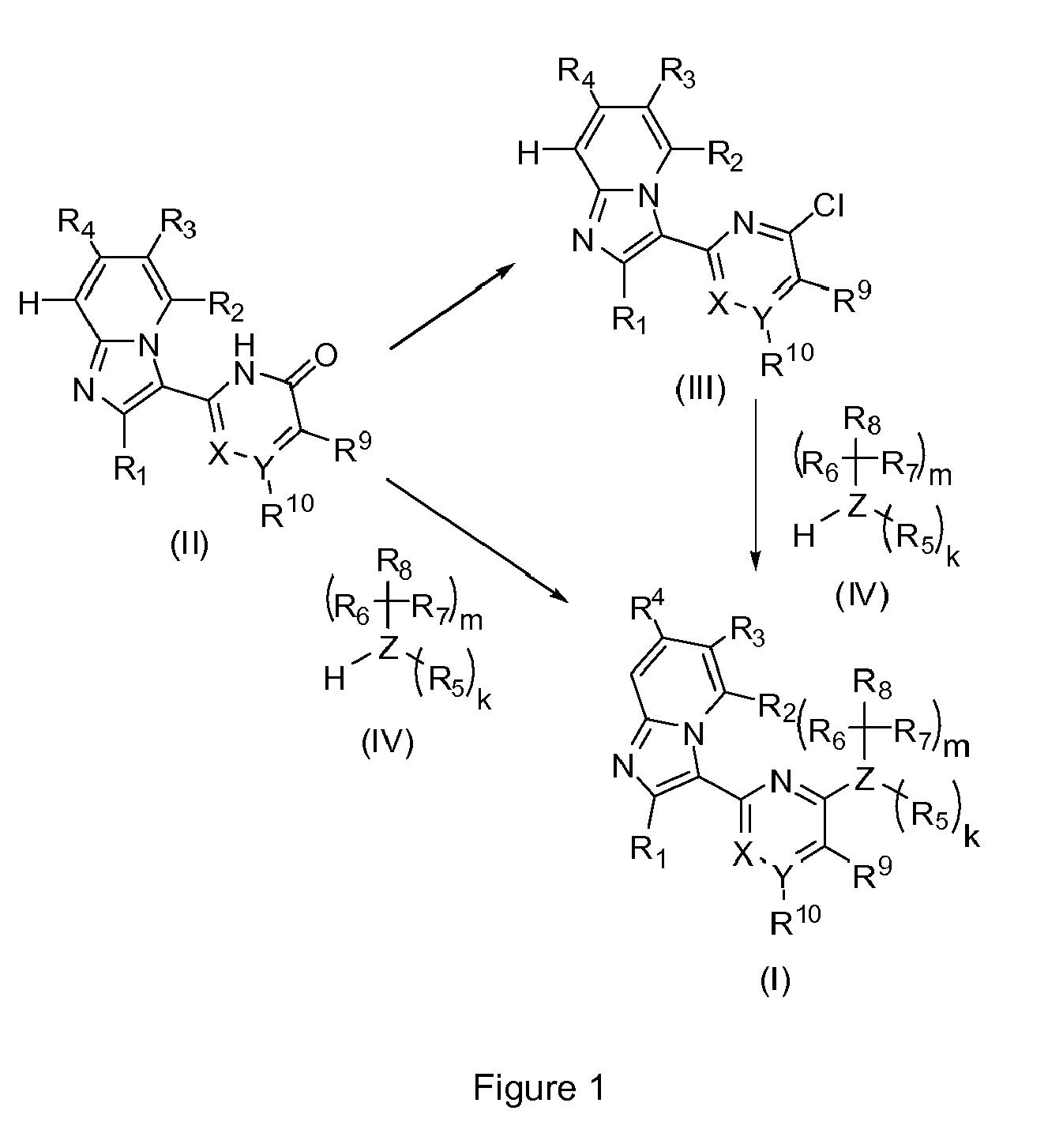
- Compounds of formula (I) (where either X or Y is a nitrogen atom, the remaining atom being a carbon atom) may be obtained directly from compounds of formula (II) by treatment of (II) with an appropriate activating agent such as benzotriazolyloxy-tris-(dimethylamino)phosphonium hexafluorophosphate in the presence of a suitable base such as 1,8-diazabicyclo[5.4.0]undec-7-ene at temperatures ranging from 25 to 80 °C in a suitable solvent such as N,N'-dimethylformamide in the presence of a nucleophile of type (IV), following the protocol as described in the literature (J. Org. Chem., 2007, 72 (26),10194-10210). Alternatively, compounds of formula (II) may first be converted to chlorine-containing heteroaromatic compounds of formula (III), by treatment of (II) with a suitable chlorinating agent, for example phosphorous (V) oxychloride or phosphorous(V) chloride, at temperatures ranging from 25 °C to reflux. Compounds of formula (III) may then be converted to compounds of formula (I) by reaction with an appropriate nucleophile of formula (IV), such as an amine, in the presence of a base such as N,N'-diisopropylethylamine in a solvent such as N,N'-dimethylformamide at temperatures ranging from ambient temperature to reflux with or without the use of microwave irradiation.
- Compounds of general formula (II) may be obtained as illustrated in Figure 2.

- Treatment of 2-aminopyridines of formula (V) with a suitable alkylating agent such as 2-chloro- or 2-bromoacetaldehyde in the presence of a base, for example sodium hydrogen carbonate, in a suitable solvent such as acetonitrile or propan-2-ol at temperatures ranging from ambient temperature to reflux gives rise to imidazo[1,2-a]pyridines of formula (VI). Reaction of compounds of formula (VI) with compounds of formula (VII) under palladium-catalyzed coupling conditions with a suitable catalyst such as tetrakis(triphenylphosphine)palladium(0) or the catalytically active species generated from palladium(II)acetate/triphenylphosphine in the presence of a base, for example potassium acetate or potassium carbonate, in a solvent such as dioxane, ethanol or N,N'-dimethylacetamide or a mixture thereof at temperatures ranging from 100-160 °C with or without microwave irradiation, furnishes compounds of formula (VIII). In the particular case where R11 = Me, treatment of compounds of formula (VIII) with a suitable reagent such as trimethylsilylchloride/sodium iodide in a suitable solvent such as acetonitrile at reflux or with potassium hydroxide in ethanol under microwave heating, gives rise to desired compounds of formula (II).
- In the particular case where R1 = H, X = N and Y = C, compounds of formula (II) may be prepared by an alternative synthetic approach as shown in Figure 3:
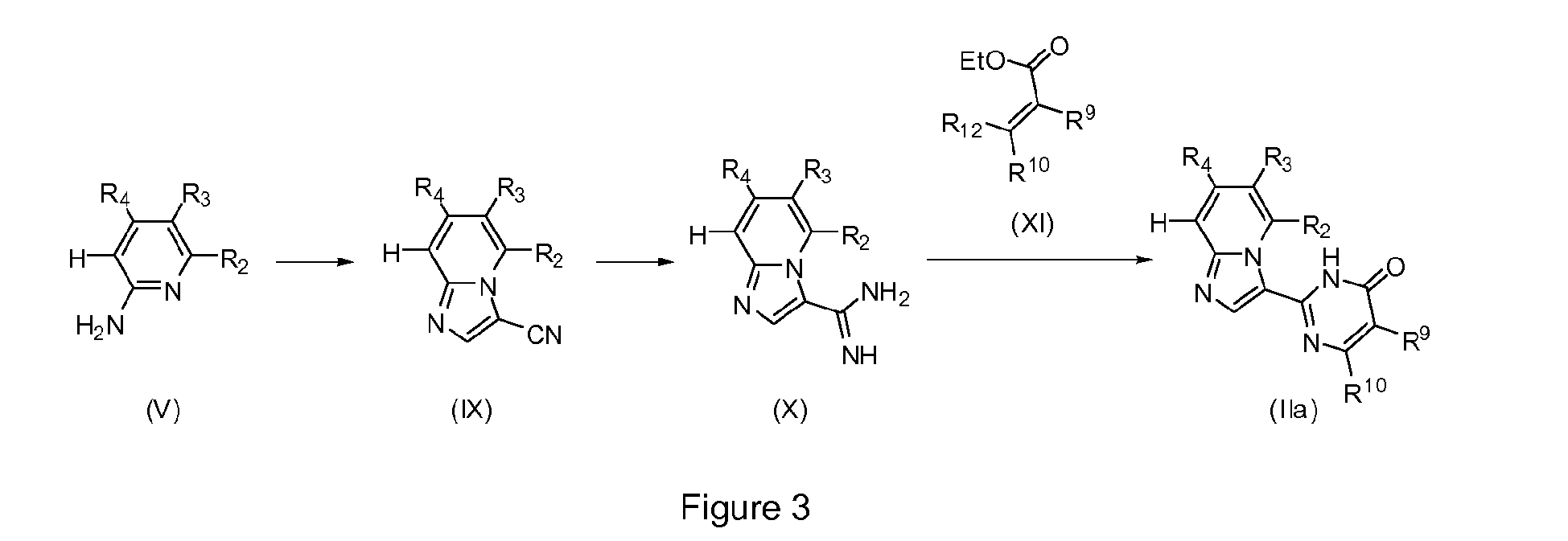
- Compounds of general formula (I) may be prepared via another synthetic pathway, as shown in figure 4.

- Treatment of bis-chloro heteroaromatic compounds of formula (XII) with nucleophiles (IV) in the presence of a base, such as N,N'-diisopropylethylamine, in an aprotic solvent such as N,N'-dimethylformamide at temperatures ranging from ambient temperature to reflux gives rises to compounds of formula (XIII). Reaction of compounds of formula (XIII) with aforementioned intermediates of formula (VI) using a suitable catalyst such as tetrakis(triphenylphosphine)palladium(0) or the catalytically active species generated from palladium(II)acetate/triphenylphosphine in the presence of a base, for example potassium acetate or potassium carbonate, in a solvent such as dioxane, ethanol or N,N'-dimethylacetamide or a solvent mixture thereof at temperatures ranging from 100-160 °C with or without microwave irradiation gives rise to desired compounds of formula (I).
- In the particular cases of compounds of formula (I) bearing a halogen atom at R3, R9 or R10, further reaction with a suitable boronic acid or boronate under Suzuki-Miyaura reaction conditions (Miyaura, N.; Suzuki, A. Chem. Rev. 1995, 95, 2457) gives rise to compounds or formula (I) where the corresponding halogen atom at R3, R9 or R10 has been replaced with an aliphatic, aromatic or heteroaromatic residue. Such reactions may be catalyzed by a suitable palladium catalyst such as tetrakis(triphenylphospino)palladium (0), in a solvent such as 1,4-dioxane, in the presence of a base such as potassium carbonate, at a temperature ranging from 80-110 °C. Alternatively, compounds of formula (I) bearing a halogen atom at R3, R9 or R10, may be further reacted with a suitable amine in the presence of a palladium catalyst to give compounds of formula (I) where the corresponding halogen atom at R3, R9 or R10 has been replaced with an amine residue. Such reactions may be catalyzed by a suitable palladium catalyst generated from, for example, tris(dibenzylideneacetone)dipalladium(0) and biphenyl-2-yl-di-tert-butylphosphine, in a solvent such as toluene, in the presence of a base such as sodium tert-butoxide, at a temperature ranging from 80-150 °C with or without the use of microwave irradiation.
- In another particular case, compounds of formula (I) bearing a hydrogen atom at R9, may be further reacted by treatment with a halogenating agent such as N-bromosuccinimide or molecular bromine in a solvent such as acetic acid or N,N'-dimethylformamide to give compounds of formula (I), where R9 is now a halogen residue.
- In yet another particular case, compounds of formula (I), where R5 is a hydrogen atom, may undergo further reaction with a suitable base such as sodium hydride in a solvent such as N,N'-dimethylformamide followed by the addition of an alkylating agent, such as methyl iodide at temperatures ranging from 0 °C to reflux, to furnish compounds of formula (I), where R5 is now an alkyl group.
- In yet another particular case, compounds of formula (I), in which the residue at R6, R7 or R8 contains, in part, an amine moiety functionalized with an appropriate protecting group such as tert-butoxycarbonyl (BOC), may be deprotected at the amine moiety under standard conditions (Greene's Protective Groups in Organic Synthesis, ISBN: 0471697540). The corresponding free amine may then be further functionalized under standard conditions to give the corresponding amides, sulphonamides, ureas, and N-alkylated and arylated amines.
- The syntheses of the compounds of the invention and of the intermediates for use therein are illustrated by the following Examples (1-85) (including Preparation Examples (Preparations 1-43)) are given in order to provide a person skilled in the art with a sufficiently clear and complete explanation of the present invention, but should not be considered as limiting of the essential aspects of its subject, as set out in the preceding portions of this description.
-

- A solution of 6-aminonicotinonitrile (10 g, 80 mmol) in acetonitrile (300 mL) was treated with a 50% aqueous solution of 2-chloroacetaldehyde (26.4 mL, 210 mmol). The mixture was stirred and heated to reflux. After 6 hours, the mixture was cooled to room temperature. The mixture was concentrated to low bulk (approx. 100 mL), treated with saturated aqueous sodium hydrogencarbonate solution to neutral pH, and then extracted with dichloromethane (2 x 300 mL). The organic layer was dried (MgSO4) and evaporated and the residue was stirred with diethyl ether (200 mL), filtered and dried in vacuum to give the title compound (22.54 g, 94%) as a pale brown solid.
LRMS (m/z): 144 (M+1)+.
1H-NMR δ (CDCI3): 7.29 (dd, 1 H), 7.71 (d, 1 H), 7.73 (d, 1 H), 7.80 (d, 1 H), 8.61-8.62 (m, 1 H). -
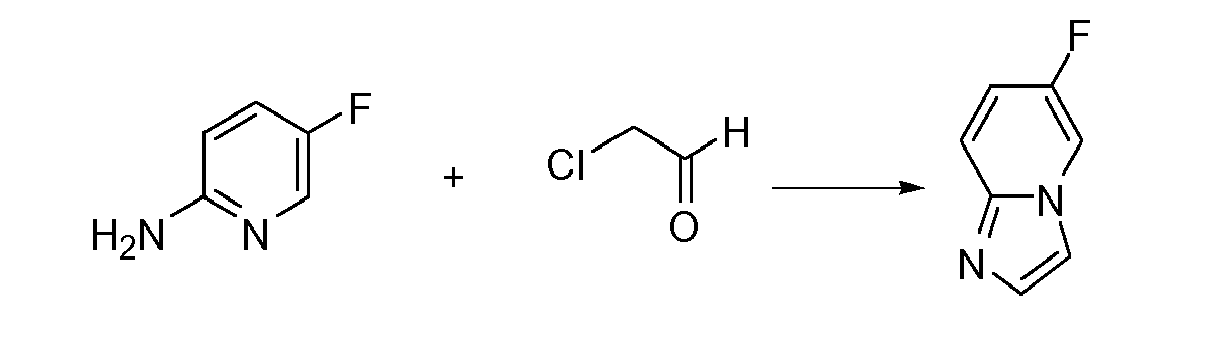
- Obtained as a brown solid (93%) from 5-fluoropyridin-2-amine and 2-chloroacetaldehyde (50% in water) following the experimental procedure as described in preparation 1.
LRMS (m/z): 137 (M+1)+.
1H-NMR δ (CDCI3): 7.12 (m, 1 H), 7.57 - 7.67 (m, 2H), 7.70 (bs, 1 H), 8.04 - 8.13 (m, 1 H). -

- Obtained as a brown solid (71%) from 5-chloropyridin-2-amine and 2-chloroacetaldehyde (50% in water) following the experimental procedure as described in preparation 1 followed by purification of the crude product by flash chromatography (1:1 hexanes/ethyl acetate).
LRMS (m/z): 153 (M+1)+.
1H-NMR δ (CDCI3): 7.13 (d, 1 H), 7.53 - 7.60 (m, 2H), 7.66 (s, 1 H), 8.18 (s, 1 H). -
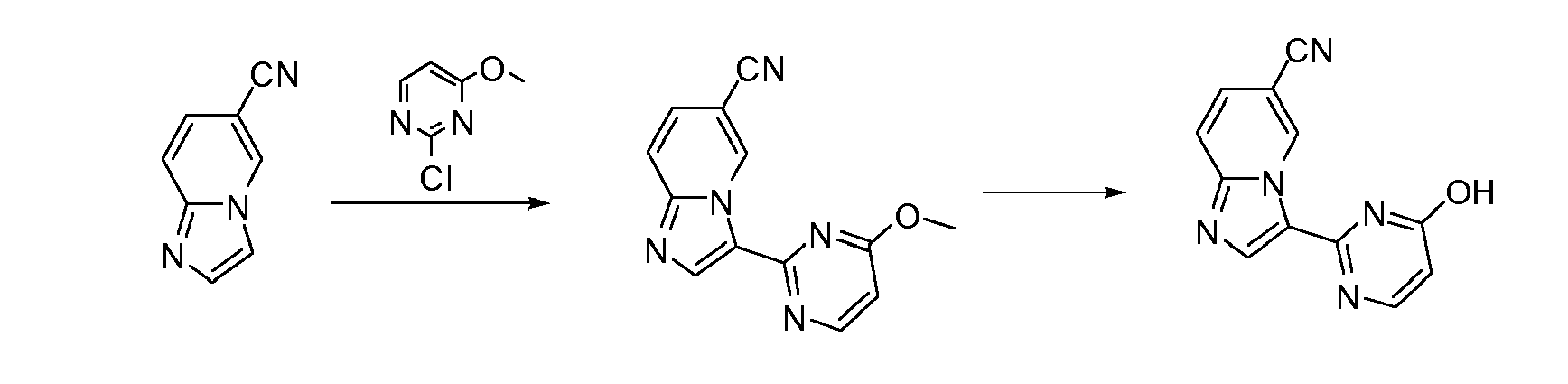
- Nitrogen was bubbled for five minutes into a stirred mixture of 2-chloro-4-methoxypyrimidine (1.14 g, 7.9 mmol), imidazo[1,2-a]pyridine-6-carbonitrile (preparation 1, 0.75 g, 5.2 mmol), potassium carbonate (1.45 g, 10.5 mmol) and triphenylphosphine (0.55 g, 2.1 mmol) in 1,4-dioxane (10 mL) and ethanol (5 mL) in a microwave vessel. Then palladium (II) acetate (0.24 g, 1.1 mmol) was added and the vessel was sealed and subjected to microwave irradiation for 2 hours at 150 °C. The reaction was repeated 5 further times under the same conditions and the six experiments were combined and the solvent was evaporated. The residue was taken up in a mixture of ethyl acetate and water and filtered to remove an insoluble black solid. The organic layer was separated and extracted with 2M aqueous hydrochloric acid (3 x 80 mL). The combined aqueous layer was washed with diethyl ether and then treated with solid sodium hydrogencarbonate until a pH of approximately 6 was reached. The solid that formed was filtered and dried in vacuum to give a first crop of the title compound (2.65 g). The insoluble black solid was treated with 2M aqueous hydrochloric acid (2 x 60 mL) and filtered. The aqueous solution was treated with solid sodium hydrogencarbonate until a pH of approximately 6 was reached. The solid that formed was filtered and dried in vacuum to give a second crop of the title compound (0.77 g). Total yield = 3.42 g (43%).
LRMS (m/z): 252 (M+1)+.
1H-NMR δ(DMSO-d 6): 4.08 (s, 3H), 6.88 (d, 1 H), 7.76 (dd, 1 H), 7.95 (dd, 1 H), 8.63 (s, 1 H), 8.67 (d, 1 H), 10.39 (bs, 1 H). - Sodium iodide (11.8 g, 78.6 mmol) was added to a stirred suspension of 3-(4-methoxypyrimidin-2-yl)imidazo[1,2-a]pyridine-6-carbonitrile (preparation 4a, 3.3 g, 13.1 mmol) in acetonitrile (135 mL). Chlorotrimethylsilane (9.9 mL, 78.0 mmol) was added and the mixture was heated in a sealed tube at 80 °C for 24 hours and then cooled to ambient temperature. The solvent was removed under reduced pressure and the residue was suspended in water. Saturated aqueous sodium thiosulphate solution was added until the dark colour faded and a pale brown solid formed. The solid was filtered, washed with further saturated sodium thiosulphate solution and water and dried in vacuum to give the title compound (3.2 g, 99%) as a pale brown solid.
LRMS (m/z): 238 (M+1)+, 236 (M-1)-.
1H-NMR δ(DMSO-d 6): 6.42 (d, 1 H), 7.82 (d, 1 H), 7.97 (d, 1 H), 8.27 (d, 1 H), 8.78 (s, 1 H), 10.43 (s, 1 H). -

- (Benzotriazol-1-yloxy)tris(dimethylamino)phosphonium hexafluorophosphate (0.480 g, 1.09 mmol) and 1,8-diazabicyclo[5.4.0]undec-7-ene (0.187 mL, 1.25 mmol) were added sequentially to a stirred solution of 3-(4-hydroxypyrimidin-2-yl)imidazo[1,2-a]pyridine-6-carbonitrile (preparation 4b, 0.2 g, 0.84 mmol) in N,N'-dimethylformamide (3 mL). After stirring for 15 minutes at ambient temperature, tert-butyl (3R)-3-aminopiperidine-1-carboxylate (0.418 g, 2.09 mmol) was added dropwise and the mixture was stirred for a further 16 hours at ambient temperature. After addition of water and extraction with ethyl acetate, the organic layer was washed with water, 4% aqueous sodium hydrogen carbonate solution, brine, dried (MgSO4) and evaporated. The residue was purified by flash chromatography (99:1 to 98:2 dichloromethane/methanol) to obtain the title compound (70%) as a yellow solid.
LRMS (m/z): 420 (M+1)+.
1H-NMR δ (DMSO-d 6):0.92 - 1.65 (m, 15H), 3.66 - 4.04 (m, 3H), 6.29 - 6.69 (m, 1 H), 7.91 (d, 2H), 8.12 - 8.33 (m, 1H), 8.40 - 8.68 (m, 1 H), 10.28 - 10.61 (m, 1 H). - Trifluoroacetic acid (1.0 mL, 12 mmol) was added dropwise to a solution of tert-butyl-(3R)-3-{[2-(6-cyanoimidazo[1,2-a]pyridin-3-yl)pyrimidin-4-yl]amino}piperidine-1-carboxylate (preparation 5a, 0.25 g, 0.6 mmol) in dichloromethane (5 mL) and the mixture was stirred at ambient temperature for one hour. After the reaction was complete, water was added and the mixture was neutralized with solid sodium hydrogen carbonate and then extracted with dichloromethane. The organic layer was dried (MgSO4) and evaporated and the residue was purified by flash chromatography (96:4 dichloromethane/methanol) obtaining the title compound (99%) as a pale yellow solid.
LRMS (m/z): 320 (M+1)+.
1H-NMR δ (DMSO-d 6): 1.08 - 1.87 (m, 4H), 2.01 (bs, 1 H), 2.55 - 3.35 (m, 4H), 4.13 (bs, 1 H), 6.45 (d, 1 H), 7.49 - 7.79 (m, 2H), 7.91 (d, 1 H), 8.21 (bs, 1 H), 8.55 (bs, 1 H), 10.44 (bs, 1 H). -

- Sodium hydride (60% dispersion in mineral oil, 0.31 g, 7.75 mmol) was added portionwise to a stirred solution of (R)-tert-butyl 3-(2-(6-cyanoimidazo[1,2-a]pyridin-3-yl)pyrimidin-4-ylamino)piperidine-1-carboxylate (preparation 5a, 1.67 g, 3.9 mmol) in N,N'-dimethylformamide (15 mL). When hydrogen evolution had ceased, methyl iodide (0.48 mL, 7.7 mmol) was added and the reaction mixture was stirred overnight at ambient temperature. The solvent was removed and the residue was partitioned between ethyl acetate and water. The organic layer was dried (MgSO4) and evaporated and the residue was purified by reverse phase chromatography (C-18 silica from Waters, water/acetonitrile/methanol as eluents [0.1% v/v formic acid buffered] 0% to 100%) to give the title compound (0.26 g, 16%) as an oil.
LRMS (m/z): 434 (M+1)+.
1H-NMR δ (CDCI3): 1.39 - 1.65 (m, 9H), 1.64 - 2.08 (m, 4H), 2.64 - 2.89 (m, 1 H), 3.09 (bs, 3H), 4.18 (bs, 2H), 6.41 - 6.48 (m, 1H), 7.40 (dd, 1H), 7.80 (d, 1H), 8.32 (d, 1 H), 8.65 (bs, 1 H), 10.55 (bs, 1 H). - b) (R)-3-(4-(methyl(piperidin-3-yl)amino)pyrimidin-2-yl)imidazo[1,2-a]pyridine-6-Obtained as a solid (60%) from (R)-tert-butyl 3-((2-(6-cyanoimidazo[1,2-a]pyridin-3-yl)pyrimidin-4-yl)(methyl)amino)piperidine-1-carboxylate (preparation 6a) following the experimental procedure as described in preparation 5b.
LRMS (m/z): 334 (M+1)+. -
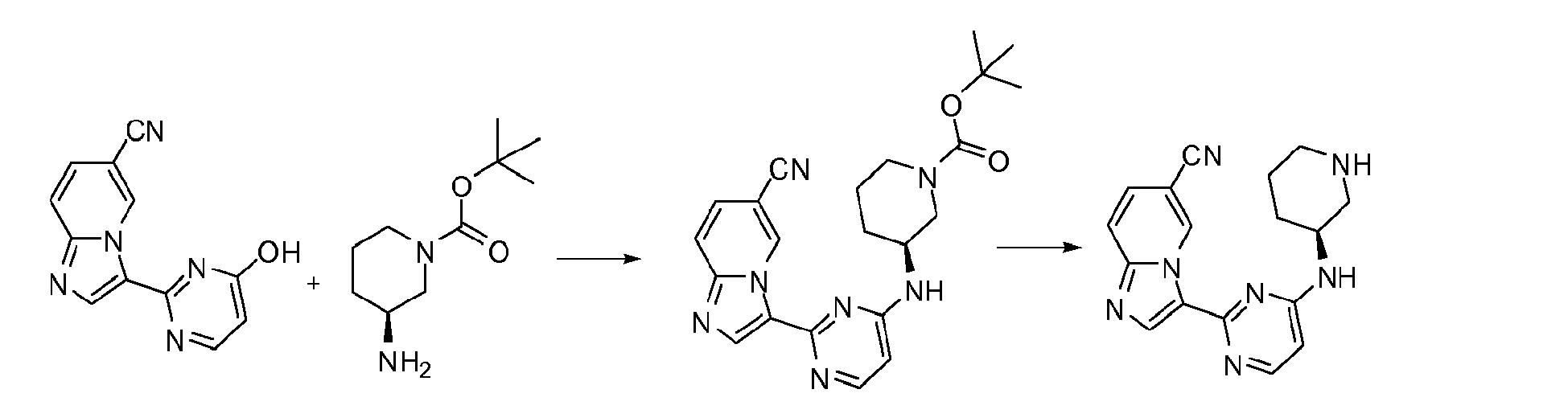
- Obtained as a brown solid (66%) from 3-(4-hydroxypyrimidin-2-yl)imidazo[1,2-a]pyridine-6-carbonitrile (preparation 4b) and tert-butyl (3S)-3-aminopiperidine-l-carboxylate following the experimental procedure as described in preparation 5a. After the reaction was complete the mixture was partitioned between water and ethyl acetate. The organic layer was washed with water, saturated aqueous sodium hydrogen carbonate solution, brine, dried (MgSO4) and evaporated and the residue was purified by flash chromatography (98:2 to 96:4 dichloromethane/methanol).
LRMS (m/z): 420 (M+1)+.
1H-NMR δ(CDCI3): 1.60 (s, 9H), 6.30 (d, 1 H), 7.41 (d, 1 H), 7.78 (d, 1 H), 8.30 (d, 1H),8.61 (s,1H), 10.55 (s, 1H). - b) 3-{4-[(3S)-piperidin-3-ylamino]pyrimidin-2-yl)imidazo[1,2-a]pyridine-6-carbonitrile
- Obtained as a solid (98%) from tert-butyl (3S)-3-{[2-(6-cyanoimidazo[1,2-a]pyridin-3-yl)pyrimidin-4-yl]amino}piperidine-1-carboxylate (preparation 7a) following the experimental procedure as described in preparation 5b
LRMS (m/z): 320 (M+1)+.
1H-NMR δ (CDCI3): 2.91 (s, 2H), 3.23 (dt, 1 H), 5.70 (s, 1 H), 6.40 - 6.12 (m, 1 H), 7.45 - 7.30 (m, 1 H), 7.88 - 7.67 (m, 1 H), 8.25 (s, 1 H), 8.59 (d, 1 H), 10.55 (s, 1 H). -

- 2-chloro-4-methoxypyrimidine (7.0 g, 48 mmol) and 6-fluoroimidazo[1,2-a]pyridine (preparation 2, 4.40 g, 32 mmol) were reacted according to the experimental procedure as described in preparation 4a. Ethyl acetate was added to the crude reaction mixture and the suspension was filtered through Celite®. The filtrate was washed with water and extracted several times with 2M aqueous hydrochloric acid. The combined aqueous layer was washed with diethyl ether and then neutralized with 8M aqueous sodium hydroxide solution. The product was extracted into chloroform and the organic phase was dried (MgSO4 and evaporated to afford the title compound (90%) as a grey solid, which was used without further purification.
LRMS (m/z): 245 (M+1)+.
1H-NMR δ (CDCI3): 4.11 (s, 3H), 6.58 (d, 1 H), 7.60 (q, 1 H), 7.71 (dd, 1 H), 8.49 (d, 1H),8.61 (s, 1H),9.98 (dd, 1 H). - To a solution of 6-fluoro-3-(4-methoxypyrimidin-2-yl)imidazo[1,2-a]pyridine (preparation 8a, 1.5 g, 6.1 mmol) in ethanol (10mL) was added a 35% aqueous solution of potassium hydroxide (9.8 mL, 61.3 mmol). The reaction mixture was subjected to microwave irradiation for 1 hour at 120 °C. The organic solvent was removed under reduced pressure and the aqueous phase was neutralized with 5M hydrochloric acid. The precipitate was filtered, washed with water and dried to afford the title compound (70%) as a white solid, which was used without further purification.
LRMS (m/z): 231 (M+1)+.
1H-NMR δ (DMSO-d 6): 6.31 (s, 1 H), 7.77 (d, 1 H), 8.17 (s, 1 H), 8.73 (bs, 1 H), 9.94 (bs, 1 H), 12.75 (s, 1 H). -

- Obtained as a yellow solid (65%) from 2-(6-fluoroimidazo[1,2-a]pyridin-3-yl)pyrimidin-4-ol (preparation 8b) and (R)-tert-butyl 3-aminopiperidine-l-carboxylate following the experimental procedure as described in preparation 5a. The crude product was purified by reverse phase chromatography (C-18 silica from Waters, water/acetonitrile/methanol as eluents [0.1% v/v formic acid buffered] 0% to 100%).
LRMS (m/z): 413 (M+1)+.
1H-NMR δ (CDCI3): 1.44 (s, 9H), 2.13 - 1.53 (m, 4H), 3.65 - 3.23 (m, 4H), 5.14 (s, 1 H), 6.24 (d, 1 H), 7.23 (ddd, 1 H), 7.68 (dd, 1 H), 8.27 (d, 1 H), 8.54 (s, 1 H), 9.99 (s, 1H ). - Obtained as a yellow solid (70%) from (R)-tert-butyl 3-(2-(6-fluoroimidazo[1,2-a]pyridin-3-yl)pyrimidin-4-ylamino)piperidine-1-carboxylate (preparation 9a) following the experimental procedure as described in preparation 5b.
LRMS (m/z): 313 (M+1)+.
1H-NMR δ (CDCl3): 1.65 (dd, 2H), 1.90 - 1.71 (m, 3H), 2.00 - 1.89 (m, 2H), 2.88 (d, 3H), 5.57 (d, 1 H), 6.22 (d, 1 H), 7.22 (ddd, 1 H), 7.66 (dd, 1 H), 8.22 (d, 1 H), 8.53 (s, 1H),9.98(dd, 1 H). -

- A solution of (R)-2-(6-fluoroimidazo[1,2-a]pyridin-3-yl)-N-(piperidin-3-ylpyrimidin-4-amine (preparation 9b, 0.100 g, 0.32 mmol), ethyl 2-bromo-2-methylpropanoate (0.137 g, 0.70 mmol) and potassium carbonate (0.066 g, 0.48 mmol) in N,N'-dimethylformamide (1 mL) was stirred and heated to 80 °C. After 16 hours, water was added to the reaction mixture and the mixture was extracted with dichloromethane. The organic layer was dried (MgSO4 and evaporated and the residue was purified by reverse phase chromatography (C-18 silica from Waters, water/acetonitrile/methanol as eluents [0.1% v/v formic acid buffered] 0% to 100%) to give the title compound (0.090 g, 66%) as a solid.
LRMS (m/z): 413 (M+1)+. - Potassium hydroxide (0.028 g, 0.42 mmol) was added to a stirred solution of (R)-ethyl 2-(3-(2-(6-fluoroimidazo[1,2-a]pyridin-3-yl)pyrimidin-4-ylamino)piperidin-1-yl)-2-methylpropanoate (preparation 10a, 0.090 g, 0.21 mmol) in methanol (1 mL). The reaction mixture was stirred at room temperature overnight and then heated to 50 °C and stirred a further 24 hours. The mixture was neutralized with 2M aqueous hydrochloric acid and then extracted with chloroform. The organic layer was dried (MgSO4) and evaporated to give the title compound (0.050 g, 60%) as an oil which was used without further purification.
LRMS (m/z): 399 (M+1)+. - N-Hydroxysuccinimide (0.016 g, 0.14 mmol) and 1,3-diisopropylcarbodiimide (0.022 mL, 0.14 mmol) were added sequentially to a cooled (ice-bath), stirred solution of (R)-2-(3-(2-(6-fluoroimidazo[1,2-a]pyridin-3-yl)pyrimidin-4-ylamino)piperidin-1-yl)-2-methylpropanoic acid (preparation 10b, 0.050 g, 0.13 mmol) in N,N'-dimethylformamide (1 mL). After stirring overnight at ambient temperature, water was added to the reaction mixture and the mixture was extracted with dichloromethane. The organic layer was dried (MgSO4) and evaporated to give the crude title compound (0.050 g) as an oil which was used without further purification.
LRMS (m/z): 496 (M+1)+. -

- Obtained from tert-butyl (3R)-3-({[2-(6-fluoroimidazo[1,2-a]pyridin-3-yl)pyrimidin-4-yl]oxy}amino)piperidine-1-carboxylate (preparation 9a) and methyl iodide following the experimental procedure as described in preparation 6a. The crude product was purified by flash chromatography (0-100% ethyl acetate in hexane) to give the title compound (0.52 g, 55%) as an oil.
LRMS (m/z): 427 (M+1)+.
1H-NMR δ (CDCl3): 1.46 (bs, 9H), 1.67 (bs, 1 H), 1.72 - 1.93 (m, 2H), 1.95 - 2.05 (m, 2H), 2.68 (bs, 2H), 2.65 - 2.88 (m, 2H), 3.07 (s, 3H), 6.37 (d, 1H), 7.17 - 7.26 (m, 1 H), 7.68 (dd, 1 H), 8.31 (d, 1 H), 8.54 (s, 1 H), 9.96 (dd, 1 H) - Obtained as a solid (51%) from (R)-tert-butyl 3-((2-(6-fluoroimidazo[1,2-a]pyridin-3-yl)pyrimidin-4-yl)(methyl)amino)piperidine-1-carboxylate (preparation 11a) following the experimental procedure as described in preparation 5b. The crude product was purified by reverse phase chromatography (C-18 silica from Waters, water/acetonitrile/methanol as eluents [0.1% v/v formic acid buffered] 0% to 100%).
LRMS (m/z): 327 (M+1)+.
1H-NMR δ (CDCl3): 1.60 - 2.02 (m, 6H), 2.58 (td, 1 H), 2.79 (t, 1 H), 3.04 (s, 3H), 3.13 (t, 1 H), 5.30 (s, 1 H), 6.33 (d, 1 H), 7.22 (ddd, 1 H), 7.67 (dd, 1 H), 8.27 (d, 1H), 8.54 (s, 1 H), 9.98 (ddd, 1 H) -

- Obtained as a white solid (58%) from tert-butyl (3R)-3-({[2-(6-fluoroimidazo[1,2-a]pyridin-3-yl)pyrimidin-4-yl]oxy}amino)piperidine-1-carboxylate (preparation 9a) and ethyl iodide following the experimental procedure as described in preparation 6a. The crude product was purified by flash chromatography (9:1 dichloromethane/methanol).
LRMS (m/z): 441 (M+1)+. - Obtained as a solid (100%) from (R)-tert-butyl 3-(ethyl(2-(6-fluoroimidazo[1,2-a]pyridin-3-yl)pyrimidin-4-yl)amino)piperidine-1-carboxylate (preparation 12a) following the experimental procedure as described in preparation 5b.
LRMS (m/z): 341 (M+1)+. -

- Obtained as a white solid (47%) from tert-butyl (3R)-3-({[2-(6-fluoroimidazo[1,2-a]pyridin-3-yl)pyrimidin-4-yl]oxy}amino)piperidine-1-carboxylate (preparation 9a) and (bromomethyl)cyclopropane following the experimental procedure as described in preparation 6a. The crude product was purified by flash chromatography (92:8 dichloromethane/methanol).
LRMS (m/z): 467 (M+1)+.
1H-NMR δ (CDCl3): 0.39 (bs, 2H), 0.64 (bs, 2H), 1.12 (bs, 1H), 1.46 (bs, 3H), 1.60 (bs, 6H), 1.87 (bs, 2H), 2.06 (bs, 2H), 2.68 (bs, 1 H), 2.88 (bs, 1 H), 3.37 (bs, 1 H), 3.55 (bs, 2H), 4.02 - 4.43 (m, 2H), 6.48 (bs, 1 H), 7.22 (bs, 1 H), 7.68 (bs, 1 H), 8.30 (bs, 1 H), 8.53 (bs, 1 H), 10.01 (bs, 1 H) - Obtained as a solid (85%) from tert-butyl (3R)-3-{(cydopropylmethyl)[2-(6-fluoroimidazo[1,2-a]pyridin-3-yl)pyrimidin-4-yl]amino}piperidine-1-carboxylate (preparation 13a) following the experimental procedure as described in preparation 5b.
LRMS (m/z): 367 (M+1)+.
1H-NMR δ (CDCl3): 0.39 (d, 2H), 0.63 (d, 2H), 1.12 (bs, 1 H), 1.74 - 1.94 (m, 2H), 2.03 (bs, 2H), 2.53 - 2.63 (m, 1 H), 2.81 (t, 2H), 3.06 - 3.25 (m, 3H), 3.39 (bs, 2H), 3.47 (bs, 2H), 6.44 (d, 1 H), 7.23 (ddd, 1 H), 7.68 (dd, 1 H), 8.27 (d, 1 H), 8.53 (s, 1 H), 10.02 (dd, 1 H) -

- Obtained as an off-white solid (39%) from 2-chloro-4-methoxypyrimidine and imidazo[1,2-a]pyridine following the experimental procedure as described in preparation 4a.
LRMS (m/z): 227 (M+1)+.
1H-NMR δ (DMSO-d6 ): 4.12 (s, 3H), 6.84 (d, 1H), 7.26 (t, 1H), 7.57-7.50 (m, 1 H), 7.83 (dd, 1 H), 8.56 (s, 1 H), 8.65 (dd, 1 H), 9.93 (dd, 1 H). - A stirred mixture of 3-(4-methoxypyrimidin-2-yl)imidazo[1,2-a]pyridine (preparation 14a, 0.38 g, 1.7 mmol) and aqueous 48% hydrogen bromide (25 mL) was heated at 100 °C. After 3 hours, the solvent was evaporated and the residue was treated with isopropyl alcohol. The solid was collected by filtration and dried in vacuum to give the hydrobromide salt of the title compound (0.53 g, 99%) as an off-white solid.
LRMS (m/z): 213 (M+1)+.
1H-NMR δ (DMSO-d6 ): 6.63 (d, 1H), 7.66 (t, 1H), 8.13 - 8.00 (m, 2H), 8.42 (bs, 1 H), 8.96 (s, 1 H), 10.16 (d, 1 H). -

- To a stirred mixture of 5-fluoropyrimidine-2,4(1H,3H)-dione (3.0 g, 23 mmol) and phosphorous pentachloride (14.41 g, 69 mmol) was added phosphorous oxychloride (12.6 mL, 130 mmol). The reaction mixture was heated to reflux, stirred 5 hours and then cooled to ambient temperature and stirred overnight. The mixture was carefully poured onto ice/water (600 mL) and stirred for 1 hour. Sodium chloride was added and the product was extracted into dichloromethane. The combined organic layer was dried (MgSO4), filtered and evaporated to give the title compound (84%) as a yellow solid.
LRMS (m/z): 167 (M+1)+.
1H-NMR δ (CDCl3): 8.49 (s, 1 H) - Sodium (0.45 g, 19.6 mmol) was added in portions to methanol (20 mL). Once all the sodium had reacted, a solution of 2,4-dichloro-5-fluoropyrimidine (preparation 15a, 3.25 g, 19.5 mol) in methanol (10 mL) was added and the mixture was stirred at ambient temperature overnight. The mixture was diluted with water and extracted with diethyl ether. The organic layer was washed with water, brine, dried (MgSO4), filtered and the solvent was removed under reduced pressure to give the title compound (81%) as an orange solid, which was used without further purification.
LRMS (m/z): 163 (M+1)+.
1H-NMR δ (CDCl3): 4.11 (s, 3H), 8.20 (d, 1 H) -
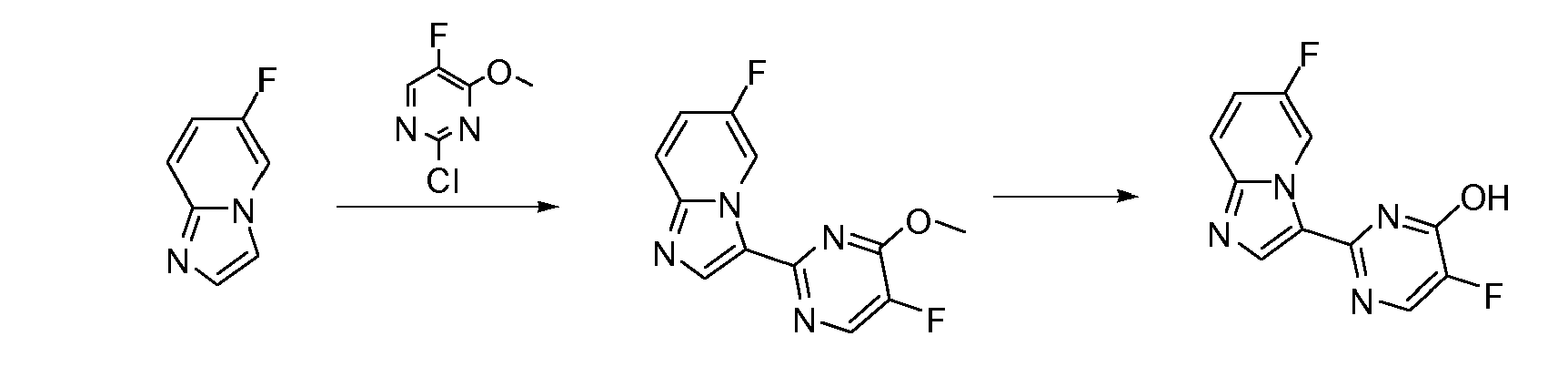
- 2-Chloro-5-fluoro-4-methoxypyrimidine (preparation 15b, 1.10 g, 6.8 mmol) and 6-fluoroimidazo[1,2-a]pyridine (preparation 2, 1.3 g, 9.5 mmol) were reacted according to the experimental procedure as described in preparation 4a. The crude product obtained was purified by flash chromatography (10:1 to 1:4 hexanes/ethyl acetate) to give the title compound (10%) as a grey solid.
LRMS (m/z): 263 (M+1)+.
1H-NMR δ (CDCl3): 4.21 (s, 3H), 7.11 (ddd, 1 H), 7.28 (dd, 1 H), 8.38 (d, 1 H), 8.53 (s, 1 H), 9.87 (dd, 1 H) - To a solution of 6-fluoro-3-(5-fluoro-4-methoxypyrimidin-2-yl)imidazo[1,2-a]pyridine (preparation 16a, 200 mg, 0.76 mmol) in ethanol (4 mL) was added a 35% aqueous solution of potassium hydroxide (1.1 mL, 6.9 mmol). The reaction mixture was subjected to microwave irradiation for 1 hour at 130 °C. The organic solvent was removed under reduced pressure and the aqueous phase was washed with chloroform then neutralized with 5M hydrochloric acid. The precipitate was filtered and discarded and the filtrate was evaporated to dryness. The residue was triturated with several portions of a chloroform/methanol mixture and then dried in vacuum to give the title compound (59%) as a grey solid, which was used without further purification.
LRMS (m/z): 249 (M+1)+. -

- Obtained as a solid (22%) from 5-fluoro-2-(6-fluoroimidazo[1,2-a]pyridin-3-yl)pyrimidin-4-ol (preparation 16b) and (R)-tert-butyl 3-aminopiperidine-1-carboxylate following the experimental procedure as described in preparation 5a. The crude product was purified by flash chromatography (9:1 dichloromethane/methanol).
LRMS (m/z): 431 (M+1)+. - Obtained as a solid (100%) from (R)-tert-butyl 3-(5-fluoro-2-(6-fluoroimidazo[1,2-a]pyridin-3-yl)pyrimidin-4-ylamino)piperidine-1-carboxylate (preparation 17a) following the experimental procedure as described in preparation 5b.
LRMS (m/z): 331 (M+1)+. -

- Obtained as a white solid (100%) from 2,4-dichloro-5-methylpyrimidine and sodium methoxide following the experimental procedure as described in preparation 15b.
LRMS (m/z): 159 (M+1)+.
1H-NMR δ(CDCl3): 2.12 (d, 3H), 4.03 (s, 3H), 8.10 (d, 1 H) -

- 6-fluoroimidazo[1,2-a]pyridine (preparation 2, 1.0 g, 7.3 mmol) and 2-chloro-4-methoxy-5-methylpyrimidine (preparation 18, 1.70 g, 10.7 mmol) were reacted according to the experimental procedure as described in preparation 4a. The crude material obtained was purified by reverse phase chromatography (C-18 silica from Waters, water/acetonitrile/methanol as eluents [0.1% v/v formic acid buffered] 0% to 100%) to give the title compound (24%) as a white solid.
LRMS (m/z): 259 (M+1)+.
1H-NMR δ (CDCl3): 2.18 (s, 3H), 4.12 (s, 3H), 7.24 (dd, 1 H), 7.64 - 7.72 (m, 1 H), 8.29 (d, 1 H), 8.55 (s, 1 H), 9.95 (dt, 1 H) - 6-Fluoro-3-(4-methoxy-5-methylpyrimidin-2-yl)imidazo[1,2-a]pyridine (preparation 19a, 0.45 g, 1.7 mmol) and a 35% aqueous solution of potassium hydroxide (2.79 mL, 17.4 mmol) were reacted according to the experimental procedure as described in preparation 16b. The reaction was concentrated in vacuum and water was added. The solution was neutralized with 2M aqueous hydrochloric acid and the resultant precipitate was filtered and dried to give the title compound (100%) as a white solid.
LRMS (m/z): 243 (M-1)+.
1H NMR δ (DMSO-d6 ): 3.33 (s, 3 H), 7.60 - 7.66 (m, 1 H), 7.87 (dd, , 1 H), 8.03 (brs, 1 H), 8.72 (s, 1 H), 9.91 (bs, 1 H). -
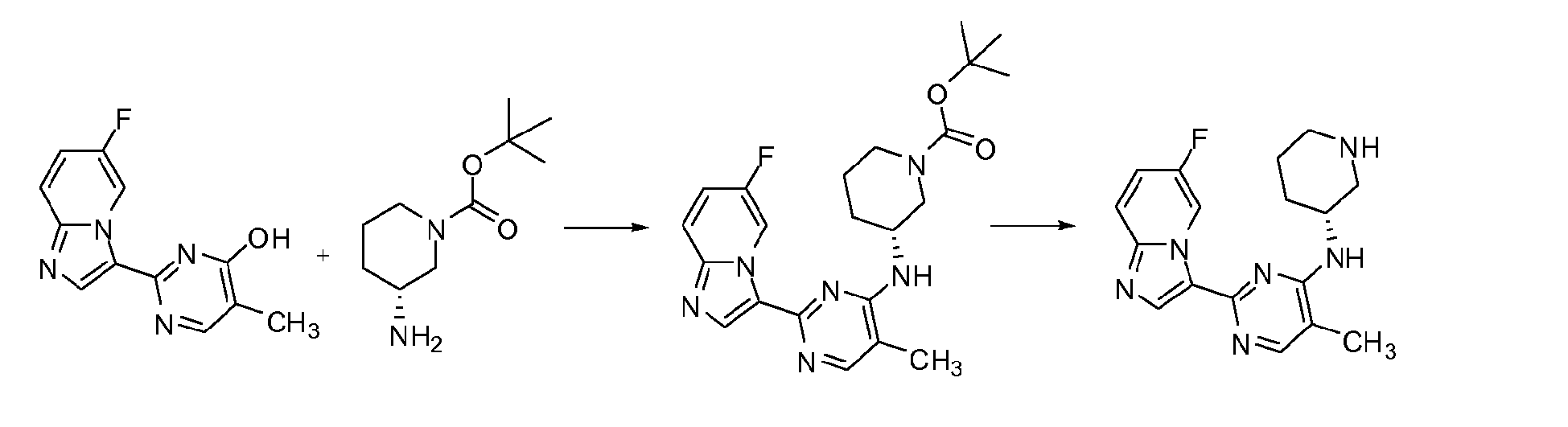
- Obtained as a pale yellow solid (35%) from 2-(6-fluoroimidazo[1,2-a]pyridin-3-yl)-5-methylpyrimidin-4-ol (preparation 19b) and (R)-tert-butyl 3-aminopiperidine-1-carboxylate following the experimental procedure as described in preparation 5a. The crude product was purified by flash chromatography (9:1 dichloromethane/methanol).
LRMS (m/z): 427 (M+1)+.
1H-NMR δ (CDCl3): 1.51 (bs, 2H), 1.72 (bs, 9H), 2.01 - 2.29 (m, 5H), 3.42 (bs, 1 H), 3.56 - 3.83 (m, 3H), 4.37 (bs, 1 H), 7.27 (bs, 1 H), 7.73 (bs, 1 H), 8.13 (bs, 1H), 8.57 (bs, 1 H), 10.02 (bs, 1 H) - Obtained as a white solid (70%) from tert-butyl (3R)-3-{[2-(6-fluoroimidazo[1,2-a]pyridin-3-yl)-5-methylpyrimidin-4-yl]amino}piperidine-1-carboxylate (preparation 20a) following the experimental procedure as described in preparation 5b.
LRMS (m/z): 327 (M+1)+.
1H-NMR δ (CDCl3): 1.69 (bs, 3H), 1.74 - 2.04 (m, 4H), 2.87 (bs, 1 H), 3.21 (bs, 3H), 4.35 (bs, 1 H), 5.23 (bs, 1 H), 7.21 (bs, 1 H), 7.66 (bs, 1 H), 8.05 (bs, 1 H), 8.50 (s, 1H), 9.99 (bs, 1 H) -

- Obtained as an oil (44%) from 2-(6-fluoroimidazo[1,2-a]pyridin-3-yl)pyrimidin-4-ol (preparation 8b) and (R)-tert-butyl 3-aminopyrrolidine-1-carboxylate following the experimental procedure as described in preparation 5a. The crude product was purified by reverse phase chromatography (C-18 silica from Waters, water/acetonitrile/methanol as eluents [0.1 % v/v formic acid buffered] 0% to 100%).
LRMS (m/z): 399 (M+1)+. - Obtained as an oil (77%) from tert-butyl 3-{[2-(6-fluoroimidazo[1,2-a]pyridin-3-yl)pyrimidin-4-yl]amino}pyrrolidine-1-carboxylate (preparation 21a) following the experimental procedure as described in preparation 5b.
LRMS (m/z): 299 (M+1)+.
1H-NMR δ (CDCl3): 0.83 - 0.98 (m, 1 H), 1.82 (ddd, 1 H), 2.30 (dd, 1 H), 2.97 - 3.11 (m, 2H), 3.15 - 3.24 (m, 1H), 3.25 - 3.34 (m, 1 H), 5.31 (d, 1 H), 6.21 (d, 1 H), 7.24 (dd, 1 H), 7.68 (dd, 1 H), 8.26 (d, 1 H), 8.53 (s, 1 H), 10.00 (dd, 1 H) -

- Obtained as a solid (48%) from 3-(4-hydroxypyrimidin-2-yl)imidazo[1,2-a]pyridine-6-carbonitrile (preparation 4b) and tert-butyl 1,4-diazepane-1-carboxylate following the experimental procedure as described in preparation 5a. The crude product was used without further purification.
LRMS (m/z): 420 (M+1)+.
1H-NMR δ (DMSO-d6 ): 1.03 (bs, 3H), 1.26 (bs, 4H), 1.56 - 1.98 (m, 4H), 3.20 - 3.33 (m, 2H), 3.51 - 3.78 (m, 4H), 3.81 - 4.05 (m, 2H), 6.71 (d, 1 H), 7.70 (d, 1 H), 7.91 (d, 1 H), 8.32 (bs, 1 H), 8.51 (s, 1 H), 10.42 (bs, 1 H) - Obtained as a solid (65%) from tert-butyl 4-(2-(6-cyanoimidazo[1,2-a]pyridin-3-yl)pyrimidin-4-yl)-1,4-diazepane-1-carboxylate (preparation 22a) following the experimental procedure as described in preparation 5b.
LRMS (m/z): 320 (M+1)+. -

- Quinazoline-2,4(1H,3H)-dione (5.0 g, 30.8 mmol) was dissolved in phosphorous oxychloride (50 mL, 546 mmol) and the mixture was stirred and heated to 115 °C. After 16 hours, the mixture was evaporated and then co-evaporated with toluene. The residue was dissolved in ethyl acetate and triethylamine (20 mL) was added. After stirring for 5 minutes, water was added. The organic phase was washed with water, brine, dried (MgSO4) and evaporated to give the title compound (6.45 g, 100%) as an off-white solid.
LRMS (m/z): 199 (M+1)+.
1H-NMR δ (CDCl3): 7.76 (ddd, 1 H), 8.03 - 7.99 (m, 2H), 8.28 (dt, 1 H). - To a stirred solution of 2,4-dichloroquinazoline (preparation 23a, 2.0 g, 10.0 mmol) in methanol (100 mL) was added a 5M solution of sodium methoxide in methanol (2.1 mL, 10.5 mmol) and the mixture was stirred at ambient temperature for 48 hours. The solvent was evaporated and the mixture was partitioned between ethyl acetate and water. The organic phase was dried (MgSO4) and evaporated to give the title compound (1.87 g, 96%) as a solid.
LRMS (m/z): 195 (M+1)+.
1H-NMR δ (CDCl3): 4.23 (s, 3H), 7.57 (ddd, 1 H), 7.88 - 7.84 (m, 2H), 8.17 - 8.11 (m, 1 H). -

- 1, 0.15 g, 1.1 mmol) and 2-chloro-4-methoxyquinazoline (preparation 23b, 0.32 g, 1.6 mmol) following the experimental procedure as described in preparation 4a.
LRMS (m/z): 302 (M+1)+.
1H-NMR δ (CDCl3): 4.30 (s, 3H), 7.63 - 7.38 (m, 2H), 7.86 (dd, 1 H), 8.02 (d, 1 H), 8.18 (d, 1 H), 8.76 (s, 1 H), 10.83 (s, 1 H). - Obtained as a brown solid (74%) from 3-(4-methoxyquinazolin-2-yl)imidazo[1,2-a]pyridine-6-carbonitrile (preparation 24a, 0.30 g, 1.0 mmol) following the experimental procedure as described in preparation 4b.
LRMS (m/z): 286 (M+1)+. -
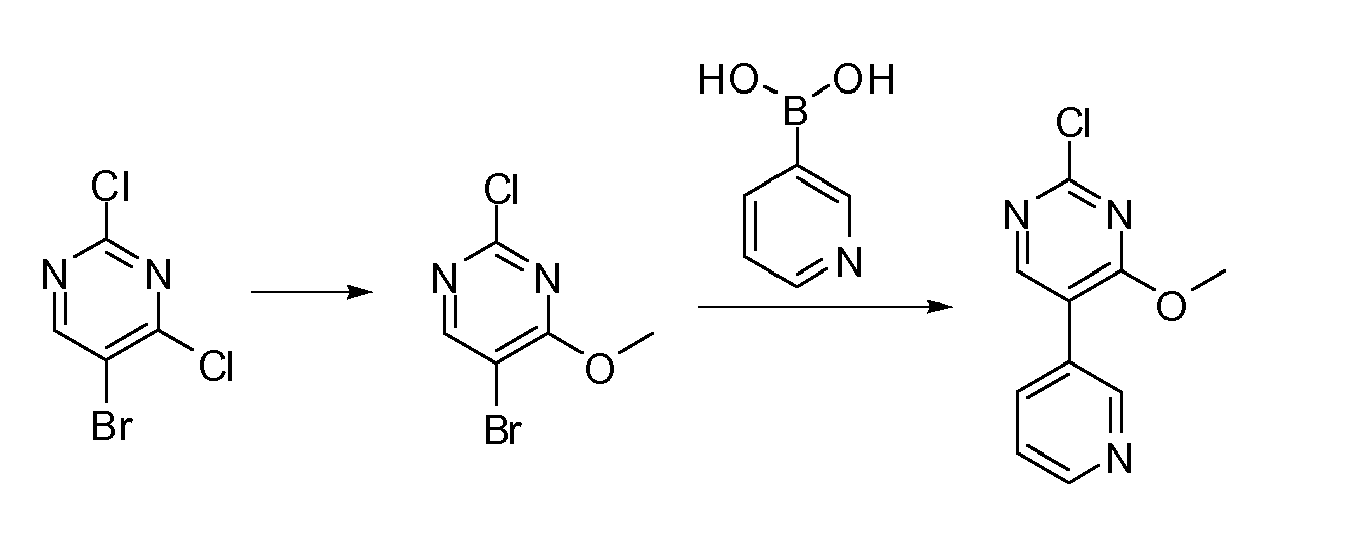
- A 30% solution of sodium methoxide in methanol (8.0 mL, 42.0 mmol) was added dropwise to a cooled (ice-bath) solution of 5-bromo-2,4-dichloropyrimidine (9.85 g, 43.2 mmol) in methanol (100 mL). The mixture was warmed to room temperature and stirred for 4 hours. The solvent was removed under reduced pressure and the residue was partitioned between water and dichloromethane. The organic layer was washed with water, brine, dried (MgSO4) and evaporated to give the title compound (9.40 g, 93%) as a solid.
LRMS (m/z): 222/224 (M+1)+.
1H-NMR δ (CDCl3): 4.11 (s, 3H), 8.44 (s, 1 H). - Nitrogen was bubbled for 5 minutes through a mixture of 5-bromo-2-chloro-4-methoxypyrimidine (preparation 25a, 0.51 g, 2.3 mmol), pyridin-3-yl boronic acid (0.30 g, 2.5 mmol) and potassium carbonate (0.93 g, 6.7 mmol) in toluene (8.0 mL) and N,N'-dimethylformamide (1.0 mL) contained in a microwave vessel. Then [1,1'-bis(diphenylphosphino)ferrocene] dichloropalladium (II) complex with dichloromethane (1:1) (68 mg, 0.11 mmol) was added and the vessel was sealed and subjected to microwave irradiation for 10 minutes at 185 °C. The reaction mixture was filtered through Celite®, washing the filter cake with ethyl acetate. The combined filtrate and washings were evaporated and the residue was purified by flash chromatography (2:1 hexanes/ethyl acetate) to give the title compound (0.066 g, 14%) as a solid.
LRMS (m/z): 222 (M+1)+ -

- 2-Chloro-4-methoxy-5-pyridin-3-yl-pyrimidine (preparation 25b, 0.226 g, 1.0 mmol) and imidazo[1,2-a]pyridine-6-carbonitrile (preparation 1, 0.217 g, 1.5 mmol) were reacted according to the experimental procedure as described in preparation 4a. The crude product was purified by flash chromatography (9:1 ethyl acetate/methanol) to give the title compound (14%) as an off-white solid.
LRMS (m/z): 329 (M+1)+
1H-NMR δ (CDCl3): 4.19 (s, 3H), 6.50 (dd, 1 H), 7.44 (ddd, 1 H), 7.48 (dd, 1 H), 7.85 (dd, 1 H), 7.96 (ddd, 1 H), 8.62 (s, 1 H), 8.67 (dd, 1 H), 8.87 (dd, 1 H), 10.56 (dd, 1H). - Obtained as a brown solid (100%) from 3-(4-methoxy-5-pyridin-3-ylpyrimidin-2-yl)imidazo[1,2-a]pyridine-6-carbonitrile (preparation 26a) following the experimental procedure as described in preparation 4b.
LRMS (m/z): 315 (M+1)+.
1H-NMR δ (CDCl3): 6.86 (d, 1 H), 7.91 (d, 1 H), 8.04 (d, 1 H), 8.19 - 8.10 (m, 1 H), 8.81 (s, 1 H), 9.05 - 8.86 (m, 2H), 9.40 (s, 1 H), 10.43 (s, 1 H). -

- Obtained as a brown solid (50%) from 2-chloro-4,6-dimethoxypyrimidine and imidazo[1,2-a]pyridine following the experimental procedure as described in preparation 4a.
LRMS (m/z): 282 (M+1)+.
1H-NMR δ (CDCl3): 4.03 (s, 6H), 6.12 (s, 1 H), 7.23 (td, 1 H), 7.50 (ddd, 1 H), 7.78 (dt, 1 H), 8.52 (s, 1 H), 9.83 (dt, 1 H). - Obtained as a brown solid (100%) from 3-(4,6-dimethoxypyrimidin-2-yl)imidazo[1,2-a]pyridine (preparation 27a) following the experimental procedure as described in preparation 4b.
1H-NMR δ (DMSO-d6 ): 5.72 (s, 1 H), 7.69 (ddd, 1 H), 8.14 - 8.00 (m, 2H), 8.89 (s, 1 H), 10.30 (d, 1H). - A solution of 2-imidazo[1,2-a]pyridin-3-ylpyrimidine-4,6-diol (preparation 27b, 330 mg, 1.45 mmol) in phosphorous(V) oxychloride (2.8 mL) was heated and stirred to 115 °C. After 18 hours, the mixture was evaporated and the residue was co-evaporated with toluene to give the title compound (154 mg, 40%).
LRMS (m/z): 291 (M+1)+.
1H-NMR δ (CDCl3): 7.48 (s, 1 H), 7.75 (t, 1 H), 8.20 (t, 1 H), 8.48 (d, 1 H), 8.90 (s, 1 H), 10.21 (d, 1 H). - Nitrogen was bubbled for 5 minutes through a mixture of 3-(4,6-dichloropyrimidin-2-yl)imidazo[1,2-a]pyridine (preparation 27c, 0.14 g, 0.54 mmol), pyridin-3-yl boronic acid (0.044 g, 0.36 mmol) and 2M aqueous cesium carbonate solution (0.54 mL, 1.08 mmol) in 1,4-dioxane (6 mL) contained in a Schlenck tube. Then [1,1'-bis(diphenylphosphino) ferrocene] dichloropalladium (II) complex with dichloromethane (1:1) (0.029 g, 0.04 mmol) was added and the vessel was sealed and the contents were stirred and heated to 90 °C. After 18 hours, the reaction mixture was filtered through Celite®, washing the filter cake with ethyl acetate. The filtrate was evaporated and the residue was purified by flash chromatography (20:1 dichloromethane/ethanol) to give the title compound (0.038 g, 32%) as a solid.
LRMS (m/z): 333 (M+1)+. -

- Sodium hydride (60% dispersion in mineral oil, 0.16 g, 4.0 mmol) was added portionwise to a stirred solution of 2,6-dichloropyrazine (0.50 g, 3.4 mmol) and (4-methoxyphenyl)methanol (0.51 g, 3.7 mmol) in N,N'-dimethylformamide. The reaction mixture was stirred at ambient temperature overnight then evaporated in vacuum. The residue was partitioned between ethyl acetate and water and the organic layer was washed with brine, dried (MgSO4) and evaporated. The residue was purified by flash chromatography (9:1 to 4:1 hexanes/ethyl acetate) to give the title compound (0.687 g, 81%) as a solid.
LRMS (m/z): 251 (M+1)+.
1H-NMR δ (CDCl3): 3.83 (s, 3H), 5.32 (s, 2H), 6.93 (d, 2H), 7.40 (d, 2H), 8.14 (s, 1H), 8.15 (s, 1 H) -

- An oven dried resealable Schlenk tube was charged with 2-chloro-6-(4-methoxybenzyloxy)pyrazine (preparation 28, 0.68 g, 2.7 mmol), imidazo[1,2-a]pyridine-6-carbonitrile (preparation 1, 0.59 g, 4.1 mmol), potassium acetate (0.138 g, 1.41 mmol) and N,N'-dimethylacetamide (4 mL). The Schlenk tube was subjected to three cycles of evacuation-backfilling with argon then tetrakis(triphenylphospino)palladium(0) (0.34 g, 0.3 mol) was added. After three further cycles of evacuation-backfilling with argon, the Schlenk tube was capped and placed in an oil bath at 150 °C and the mixture was stirred for 4 hours. The mixture was evaporated in vacuum and the residue was partitioned between ethyl acetate and water. The organic layer was extracted with 2M aqueous hydrochloric acid and the aqueous layer was taken to pH 5-6 with solid sodium hydrogen carbonate and then extracted with ethyl acetate. The organic layer was dried (MgSO4), evaporated and the residue was purified by column chromatography (98:2 to 90:10 dichloromethane/methanol) to give the title compound (0.102 g, 10%).
LRMS (m/z): 238 (M+1)+. -

- A stirred mixture of 2,4-dichloropyrimidine (1.27 g, 8.5 mmol), (S)-1-phenylethanamine (1.0 mL, 7.8 mmol) and diisopropylethylamine (1.6 mL, 8.6 mmol) in N,N'-dimethylformamide (12 mL) was heated to 90 °C in a sealed tube. After 16 hours, the mixture was evaporated in vacuum and then taken up in ethyl acetate. The organic layer was washed with water and brine, dried (MgSO4) and evaporated. Purification by flash chromatography (300:1 dichloromethane/methanol) gave the title compound (0.65 g, 36%) as a pale yellow oil.
LRMS (m/z): 234 (M+1)+.
1H-NMR δ (CDCl3): 1.59 (d, 3H), 5.38 - 5.75 (m, 1H), 6.08 (d, 1H), 7.28 - 7.43 (m, 5H), 7.97 (d, 1 H) - Sodium hydride (60% dispersion in mineral oil, 0.17 g, 4.3 mmol) was added portionwise to a solution of 2-chloro-N-[(1S)-1-phenylethyl]pyrimidin-4-amine (preparation 30a, 0.95 g, 4.1 mmol) in N,N'-dimethylformamide (10 mL). The mixture was stirred for 15 minutes, then 1-(chloromethyl)-4-methoxybenzene (0.58 mL, 4.3 mmol) was added and the reaction was stirred at room temperature for a further 5 hours. Water was added and the mixture was extracted with ethyl acetate. The organic layer was washed with water, brine, dried (MgSO4 and evaporated in vacuum. The residue was triturated with several portions of hexane to give a thick oil. Purification by flash chromatography (5:1 hexanes/ethyl acetate) gave the title compound (0.94 g, 65%) as a white solid.
LRMS (m/z): 354 (M+1)+.
1H-NMR δ (CDCl3): 1.58 (d, 3H), 3.78 (bs, 3H), 4.21 - 4.44 (m, 3H), 6.11 (d, 1 H), 6.80 (d, 2H), 6.99 (d, 2H), 7.15 - 7.42 (m, 5H), 7.92 (d, 1 H) -

- N-Methyl-1-phenylmethanamine (0.32 mL, 2.5 mmol) and diisopropylethylamine amine (0.58 mL, 3.3 mmol) were added sequentially to a solution of 2,4-dichloropyrimidine (0.50 g, 3.4 mmol) in N,N'-dimethylformamide (5 mL). The mixture was stirred in a sealed tube for 3 hours at 90 °C. The mixture was evaporated and the residue was dissolved in ethyl acetate and washed with water, dried (MgSO4) filtered and evaporated. Purification by flash chromatography (3:1 hexanes/ethyl acetate) gave the title compound (0.51 g, 86%) as an oil.
LRMS (m/z): 234 (M+1)+.
1H-NMR δ (CDCl3): 3.08 (bs, 3H), 4.79 (bs, 2H), 6.35 (d, 1 H), 7.14 - 7.41 (m, 5H), 8.04 (d, 1 H) -
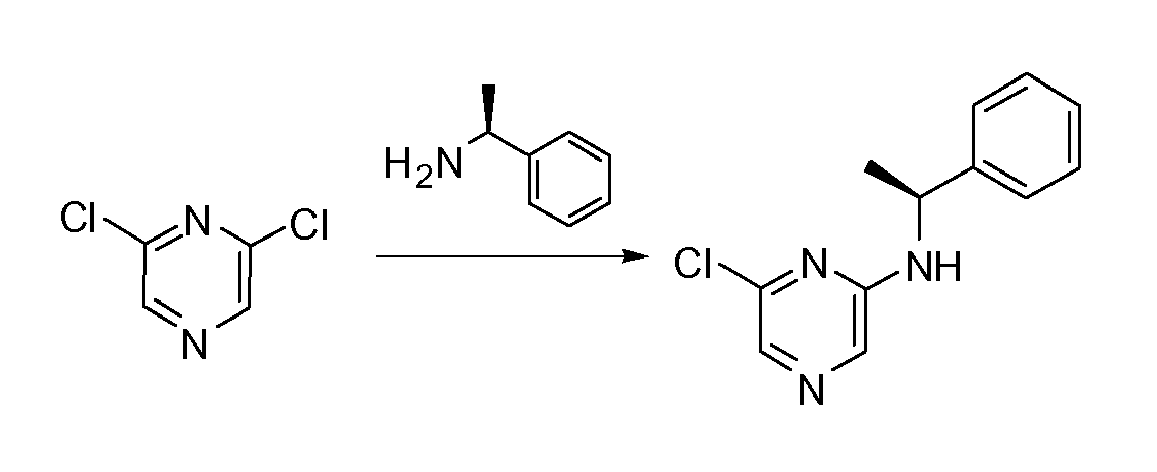
- Obtained as a white solid (37%) from 2,6-dichloropyrazine (1.92 g, 12.9 mmol) and (S)-1-phenylethanamine (1.72 g, 14.2 mmol) following the experimental procedure as described in
W0200399796
LRMS (m/z): 234 (M+1)+.
1H-NMR δ (CDCl3): 1.58 (d, 3H), 4.86 (bs, 1 H), 5.08 (bs, 1 H), 7.24 - 7.32 (m, 5H), 7.60 (s, 1 H), 7.79 (s, 1 H) -
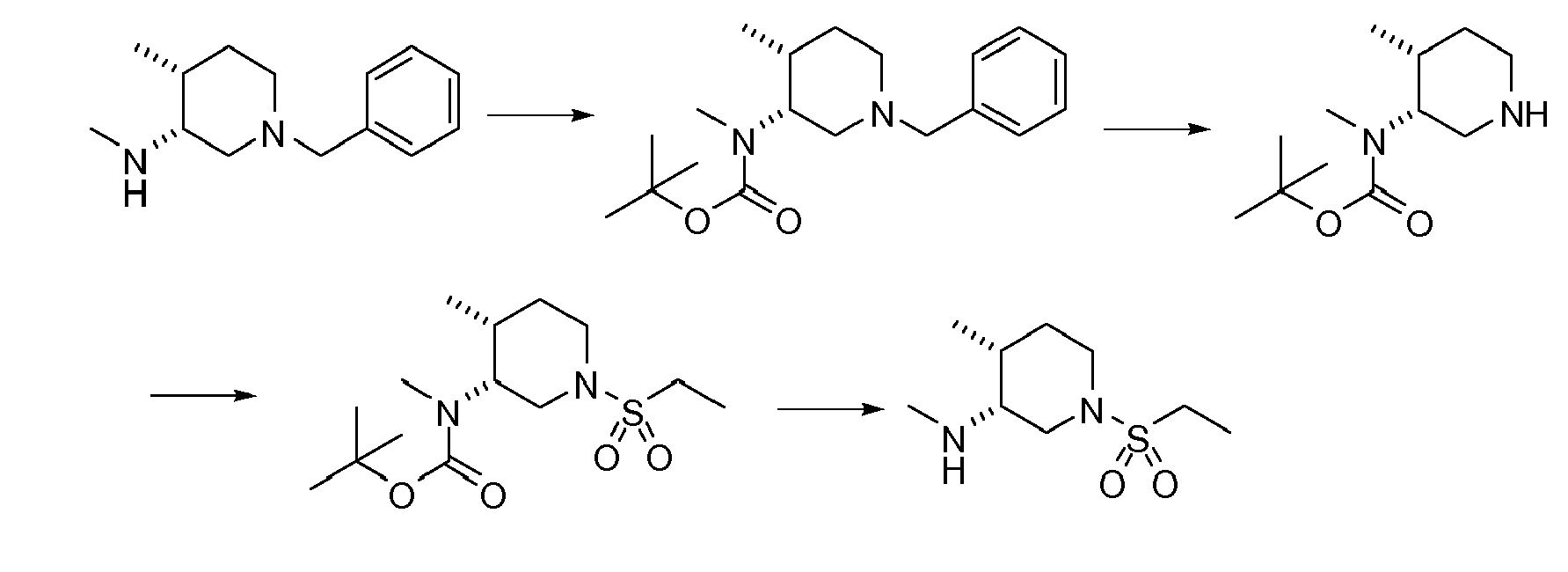
- Triethylamine (1.72 mL, 12.3 mmol) and di-tert-butyl dicarbonate (2.70 g, 12.4 mmol) were added sequentially to a stirred solution of cis-1-benzyl-N,4-dimethylpiperidin-3-amine (prepared as described in
WO200560972
LRMS (m/z): 319 (M+1)+.
1H-NMR δ (CDCl3): 1.00 (d, 3H), 1.51 (s, 9H), 1.64 (bs, 1 H), 1.98 (bs, 2H), 2.24 (bs, 2H), 2.49 (dd, 1 H), 2.77 (bs, 2H), 3.16 (s, 3H), 3.50 (s, 2H), 7.23 - 7.45 (m, 5H) - Palladium on charcoal (10%, 0.30 g) was added to a solution of tert-butyl (1-benzyl-4-methylpiperidin-3-yl)methylcarbamate (preparation 33a, 3.40 g, 10.7 mmol) in methanol (70 mL) and the mixture was stirred under an atmosphere of hydrogen for 20 hours. The catalyst was filtered off and the solvent was removed under reduced pressure to give the title compound (2.38 g, 97%) as an oil.
LRMS (m/z): 229 (M+1)+.
1H-NMR δ (CDCl3): 0.94 (d, 3H), 1.39 (s, 9H), 1.58 - 1.68 (m, 1 H), 2.11 - 2.20 (m, 2H), 2.68 (bs, 1 H), 2.73 - 2.81 (m, 2H), 2.83 (s, 3H), 2.99 (bs, 2H) - A solution of ethanesulfonyl chloride (0.86 mL, 9.1 mmol) in dichloromethane (3 mL) was added dropwise to a stirred, cooled (ice-bath) solution of tert-butyl methyl(4-methylpiperidin-3-yl)carbamate (preparation 33b, 1.89 g, 8.3 mmol) in dichloromethane (60 mL) and triethylamine (1.27 mL, 9.1 mmol). The mixture was warmed to room temperature and stirred overnight. The mixture was washed with saturated aqueous sodium hydrogencarbonate solution, water, brine, dried (MgSO4) and the solvent was removed under reduced pressure to give the title compound (2.20 g, 83%) as a solid.
LRMS (m/z): 321 (M+1)+.
1H-NMR δ (CDCl3): 1.00 (d, 3H), 1.38 (t, 3H), 1.46 (s, 9H), 1.65 - 1.76 (m, 2H), 2.04 - 2.14 (m, 1H), 2.96 (d, 2H), 2.98 (s, 3H), 3.05 - 3.18 (m, 2H), 3.33 (bs, 1H), 3.51 (bs, 1 H), 3.64 (bs, 1 H) - A solution of trifluoroacetic acid (12.25 mL, 159 mmol) in dichloromethane (10 mL) was added to a stirred, cooled (ice-bath) solution of tert-butyl 1-(ethylsulfonyl)-4-methylpiperidin-3-yl(methyl)carbamate (preparation 33c, 3.0 g, 9.4 mmol) in dichloromethane (22 mL). The mixture was warmed to room temperature and stirred overnight. The solvent was evaporated and the residue was taken up in water and basified with 2M aqueous sodium hydroxide solution and then extracted with dichloromethane. The organic solvent was removed under reduced pressure to give the title compound (2.06 g, 97%) as an oil.
LRMS (m/z): 221 (M+1)+.
1H-NMR δ (CDCl3): 1.24 (d, 3H), 1.63 (t, 3H), 1.79 - 1.91 (m, 2H), 2.25 - 2.36 (m, 1 H), 2.81 (bs, 1 H), 2.90 (q, 2H), 3.06 (bs, 1 H), 3.21 - 3.37 (m, 1 H), 3.42 - 3.51 (m, 1 H), 3.68 (bs, 2H), 3.91 (s, 3H) -

- Sodium bis(trimethylsilyl)amide (1M in tetrahydrofuran, 32.0 mL, 32.0 mmol) was added dropwise to a cooled (ice-bath) solution of 4-methylpyridin-3-amine (1.72 g, 15.9 mmol) in tetrahydrofuran (30 mL). The mixture was warmed to ambient temperature and stirred for 5 minutes. The mixture was again cooled to 0 °C and a solution of di-tert-butyl dicarbonate (3.09 g, 14.2 mmol) in tetrahydrofuran was added. The mixture was warmed to ambient temperature and stirred for 18 hours. The pH of the mixture was adjusted to 5-6 using 0.1 M aqueous hydrochloric acid. The organic layer was dried (MgSO4) and evaporated to give the title compound (2.16 g, 70%) as a dark oil.
LRMS (m/z): 209 (M+1)+.
1H-NMR δ (CDCl3): 1.43 (s, 9H), 2.27 (s, 3H), 6.25 (bs, 1 H), 7.10 (d, 1 H), 8.23 (d, 1H), 8.86 (s, 1 H). - To a solution of tert-butyl (4-methylpyridin-3-yl)carbamate (preparation 34a, 1.9 g, 9.2 mmol) in methanol (15 mL) was added 5% rhodium on carbon (1.0 g). The mixture was hydrogenated (pressure of 60 psi) at 50 °C for 48 hours. The catalyst was filtered through Celite® and the filter cake washed with methanol. The filtrate and washings were combined and concentrated under reduced pressure and the residue was purified by flash chromatography (98:2:0.2 to 90:10:1 dichloromethane/methanol/ammonia) to give the title compound (0.60 g, 31%) as a pale yellow solid.
LRMS (m/z): 215 (M+1)+.
1H-NMR δ (CDCl3): 0.91 (d, 3H), 1.28 (d, 2H), 1.45 (s, 9H), 1.71 (bs, 5H), 2.59 (t, 1 H), 2.72 (d, 1 H), 2.96 (d, 2H), 3.68 (d, 1 H), 5.30 (d, 1H). - Triethylamine (0.26 mL, 1.8 mmol) and 3-[(2,5-dioxopyrrolidin-1-yl)oxy]-3-oxopropanenitrile (prepared as described in
BE875054(A1
LRMS (m/z): 282 (M+1)+
1H-NMR δ (CDCl3): 0.99 (d, 3H), 1.29 (qd, 1H), 1.46 (s, 9H), 2.01-1.85 (m, 1H), 2.69 (td, 1 H), 3.17 (d, 1 H), 3.46 (s, 2H), 3.71-3.62 (m, 1 H), 3.87 (d, 1 H), 4.51 (t, 2H). - Trifluoroacetic acid (2.0 mL, 26 mmol) was added dropwise to a solution of cis-tert-butyl [1-(cyanoacetyl)-4-methylpiperidin-3-yl]carbamate (preparation 34c, 0.39 g, 1.4 mmol) in dichloromethane (7 mL) and the mixture was stirred at room temperature for 1 hour. The mixture was then evaporated and taken up in water. The mixture was then taken to neutral pH with saturated aqueous sodium hydrogencarbonate solution and extracted with dichloromethane. The organic layer was dried (MgSO4) and evaporated and the residue was purified by flash chromatography (98:2 to 90:10 dichloromethane/methanol) to give the title compound (0.180 g, 72%) as a pale yellow oil.
LRMS (m/z): 182 (M+1)+.
1H-NMR δ (CDCl3): 0.96 (d, 3H), 1.58 - 1.48 (m, 1H), 1.90 - 1.76 (m, 2H), 2.73 (ddd, 1 H), 3.03 - 2.88 (m, 1 H), 3.32 - 3.24 (m, 1 H), 3.64 (d, 2H), 3.88 - 3.76 (m, 1 H), 4.47 - 4.22 (m, 1 H). -

- Triethylamine (0.33 mL, 2.3 mmol) and ethanesulfonyl chloride (0.17 mL, 1.7 mmol) were added sequentially to a cooled (ice-bath) solution of cis-tert-butyl (4-methylpiperidin-3-yl)carbamate (preparation 34b, 0.25 g, 1.2 mmol) in dichloromethane (3 mL). The mixture was warmed to ambient temperature and stirred for 18 hours. Water was added and the organic layer was washed with water and brine, dried (MgSO4) and evaporated. The residue was purified by flash chromatography (98:2 dichloromethane/methanol) to give the title compound (0.31 g, 85%) as a brown solid.
LRMS (m/z): 307 (M+1)+.
1H-NMR δ (CDCl3): 0.96 (d, 3H), 1.44 (s, 12H), 1.62 (s, 1 H), 1.80 - 1.66 (m, 1 H), 2.74 (t, 1 H), 2.93 (dt, 3H), 3.49 (d, 1 H), 3.80 (dd, 3H), 4.95 (d, 1H). - Cis-tert-butyl [1-(ethylsulfonyl)-4-methylpiperidin-3-yl]carbamate (preparation 35a, 0.305 g, 1.0 mmol) was reacted according to the experimental procedure as described in preparation 34d. The crude mixture was evaporated, water was added and the mixture was then basified with saturated aqueous sodium hydrogencarbonate solution to neutral pH. The aqueous layer was extracted with dichloromethane and the organic layer was dried (MgSO4) and evaporated to give the title compound (0.145 g, 70%) as an oil.
LRMS (m/z): 207 (M+1)+.
1H-NMR δ (CDCl3): 1.01 (d, 3H), 1.45 - 1.22 (m, 3H), 1.60 (d, 4H), 2.85 - 2.73 (m, 1 H), 3.13 - 2.85 (m, 3H), 3.86 - 3.47 (m, 2H). -

- Methyl iodide (0.075 mL, 1.2 mmol) was added to a stirred solution of (2S,4S)-4-fluoro-1-(1H-imidazole-1-carbonyl)pyrrolidine-2-carbonitrile (0.29 mmol, prepared as described in
US2005256310(A1 )) in acetonitrile (1mL) and the reaction mixture was stirred at ambient temperature overnight. The solvent was removed under reduced pressure to give the title compound as a solid (99%), which was used without further purification.
LRMS (m/z): 223 (M-1)-. -

- 2-(Methylamino)acetonitrile (1g, 14.3 mmol) was reacted with 1,1'-carbonyldiimidazole (2.5 g, 15.4 mmol) according to the experimental procedure as described in
US2005256310(A1 ). The crude product was purified by flash chromatography (4:1, dichloromethane/methanol) to give the title compound (0.24 g, 10%) as an oil.
LRMS (m/z): 165 (M+1)+.
1H-NMR δ (CDCl3): 3.28 (s, 3H), 4.37 (s, 2H), 7.15 (s, 1 H), 7.30 (bs, 1 H), 7.97 (s, 1 H) - Obtained as an oil (45%) from N-(cyanomethyl)-N-methyl-1H-imidazole-1-carboxamide (preparation 37a, 0.24g, 1.46 mmol) and methyl iodide (0.36mL, 5.9 mmol) following the experimental procedure as described in preparation 36. The isolated crude product was used without further purification.
LRMS (m/z): 179 (M-1)-.
1H-NMR δ (DMSO-d6 ): 3.34 (s, 3H), 3.91 (s, 2H), 4.64 (s, 3H), 7.06 (bs, 1H), 7.58 (bs, 1H), 8.09 (s, 1 H) -

- Nitrogen was bubbled for 5 minutes through a mixture of 4-iodo-2-methoxypyridine (0.099 g, 0.42 mmol), bis(pinacolato)diboron (0.12 g, 0.47 mmol) and potassium acetate (0.13 g, 1.31 mmol) in N,N'-dimethylformamide (1 mL) contained in a microwave vessel. Then [1,1'-bis(diphenylphosphino)ferrocene] dichloropalladium (II) complex with dichloromethane (1:1) (0.017 g, 0.02 mmol) was added and the vessel was sealed and subjected to microwave irradiation for 4 hours at 80 °C. The reaction mixture was diluted with ethyl acetate and filtered through Celite®. The filtrate was washed with saturated aqueous sodium hydrogencarbonate solution, water, brine, dried (MgSO4) and evaporated to give the title compound (0.128 g, 82%) as a brown oil which was used without further purification.
LRMS (m/z): 236 (M+1)+. -
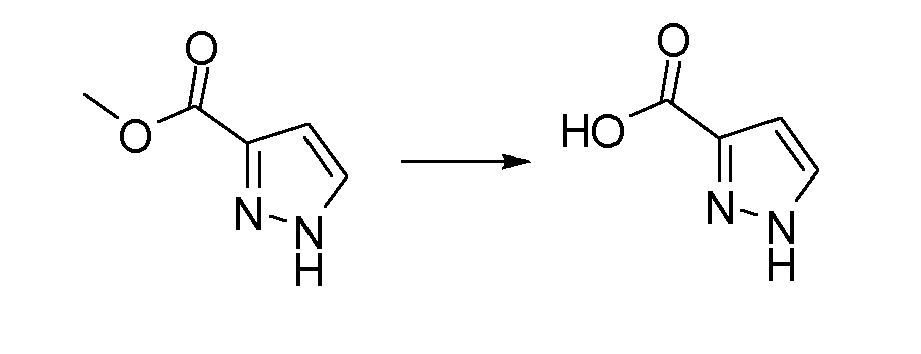
- A 2M aqueous sodium hydroxide solution (1.8 mL, 3.6 mmol) was added to a solution of ethyl 1H-pyrazole-4-carboxylate (0.2g, 1.55 mmol) in ethanol (4 mL). The reaction mixture was stirred at room temperature overnight and at 80 °C for 2 further hours. The ethanol was evaporated and the mixture was neutralized to give a precipitate which was filtered and dried to give the title compound (0.089 g, 51 %) as a white solid.
LRMS (m/z): 113 (M+1)+. -

- To a solution of 4-{[(1R)-1-phenylethyl]amino}adamantan-1-ol (0.400 g, 1.47 mmol; prepared as described in Tetrahedron. Lett. 2006, 47, 8063) in ethanol (58 mL) was added 10% palladium on charcoal (0.033 g) and ammonium formate (0.430 g, 6.82 mmol). The reaction mixture was stirred at 85 °C for one hour then filtered through Celite® and the filtrate was evaporated to dryness to obtain the title compound as a solid (99%) which was used in the next step without further purification.
E-isomer: 1H-NMR δ (CDCl3): 1.17-1.52 (m, 5H), 1.7-1.83 (m, 6H), 1.9 (m, 3H), 1.94 (m, 1 H), 2.09 (m, 1 H), 3.01 (bs, 1 H). -
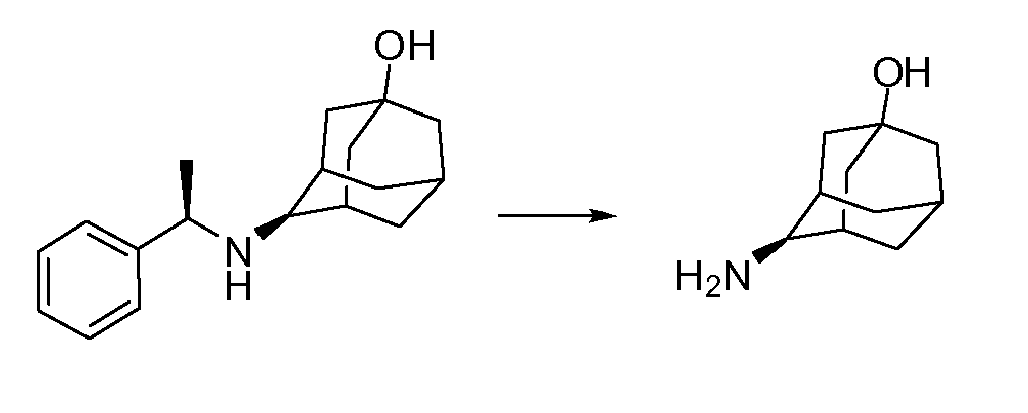
- The title compound was obtained (99%) from the corresponding Z-Isomer (0.102 g, 0.38 mmol; prepared as described in Tetrahedron. Lett. 2006, 47, 8063;) following the experimental procedure as described in preparation 40. The crude product was used in the next step without further purification.
Z-isomer: 1H-NMR δ (CDCl3): 1.51-1.4 (m, 2H), 1.7-1.57 (m, 6H), 1.9-1.8 (m, 4H), 2.09-2.00 (m, 1 H), 2.87 (bs, 1 H). -

- 1-Bromopyrrolidine-2,5-dione (15.8 g, 89.2 mmol) was added portionwise to a cooled (ice-bath), stirred solution of (E)-3-methoxyacrylonitrile (7.49 mL, 89.2 mmol) in 1,4-dioxane/water (3:1, 600 mL). The solution was stirred for 30 minutes at 0 °C and then 5-fluoropyridin-2-amine (5.0 g, 44.6 mmol) was added. The mixture was warmed to ambient temperature over 2 hours and then was heated to 60 °C and stirred for 16 hours at 60 °C. The organic solvent was removed under reduced pressure and the residue was partitioned between ethyl acetate and aqueous sodium hydrogencarbonate solution. The organic phase was dried, filtered and evaporated to dryness. The crude product was purified by flash chromatography (15-50% ethyl acetate/hexane) to give the title compound (94%) as a brown solid.
LRMS (m/z): 162 (M+1)+.
1H-NMR δ (DMSO-d6 ): 7.71 (ddd, 1 H), 7.93 (dd, 1 H), 8.49 (s, 1 H), 8.98 (bs, 1 H). - To a solution of 6-fluoroimidazo[1,2-a]pyridine-3-carbonitrile (5.6g, 34.8 mmol, preparation 42a) in MeOH (80 mL) was added sodium methoxide (0.19 g, 3.4 mmol). The mixture was stirred at ambient temperature for 17 hours, then ammonium chloride (2.05 g, 38.3 mmol) was added and the mixture was refluxed for 4 hours. The solvent was removed under reduced pressure and the resulting solid was washed with ethyl acetate (8x30 mL). The title compound was obtained as a brown solid (58%) and was used in the next step without further purification.
LRMS (m/z): 179 (M+1)+. δ
1H-NMR δ (DMSO-d6 ): 7.70 (dd, 1 H), 7.89 (dd, 1 H), 8.35 (s, 1 H), 8.85 (brs, 1 H). - To a solution of sodium (0.9 g, 39.1 mmol) in methanol (50 mL) was added 6-fluoroimidazo[1,2-a]pyridine-3-carboximidamide (3.5 g, 19.6 mmol, preparation 42b) and ethyl 2-chloro-3-oxopropanoate (5.8 g, 38.5 mmol). The mixture was refluxed under strong agitation for 18 hours. The reaction mixture was cooled to ambient temperature and filtered. The resulting solid was washed with methanol and ether to yield the title compound (70%), which was used in the next step without further purification.
LRMS (m/z): 265 (M+1)+.
1H-NMR δ (DMSO-d6 ): 7.43 (dd, 1 H), 7.73 (dd, 1 H), 7.95 (s, 1 H), 8.26 (s, 1 H), 10.18 (dd, 1H). - A solution of 5-chloro-2-(6-fluoroimidazo[1,2-a]pyridin-3-yl)pyrimidin-4-ol (2.6 g, 9.8 mmol, preparation 42c) in phosphoryl trichloride (26 mL) was stirred at 110 °C for 3 hours. The crude reaction was slowly added onto water, basified with 8N sodium hydroxide and extracted with ethyl acetate. The organic phase was washed with water and brine and the organic solvent was removed under reduced pressure to give the title compound (62%) as a solid.
LRMS (m/z): 284 (M+1)+.
1H-NMR δ +(CDCl3): 7.34 (ddd, 1 H), 7.75 (dd, 1 H), 8.66 (s, 1 H), 8.70 (s, 1 H), 9.75 (dd, 1H). -

- A solution of 3-(4,5-dichloropyrimidin-2-yl)-6-fluoroimidazo[1,2-a]pyridine (0.52 g, 1.84 mmol, preparation 42d) and (R)-tert-butyl 3-aminopiperidine-1-carboxylate (1.12 g, 5.59 mmol) in ethanol (40 mL) was refluxed for 18 hours. The organic solvent was removed under reduced pressure. The residue obtained was triturated with ether and evaporated to dryness to obtain the title compound (99%) as an oil.
LRMS (m/z): 447 (M+1)+. - Obtained as a solid (40%) from tert-butyl (3R)-3-{[5-chloro-2-(6-fluoroimidazo[1,2-a] pyridin-3-yl)pyrimidin-4-yl]aminolpiperidine-1-carboxylate (preparation 43a) following the experimental procedure as described in preparation 5b.
LRMS (m/z): 347 (M+1)+.
1H-NMR δ (CDCl3): 1.64 (bs, 1 H), 1.80 (dd, 2 H), 1.92 - 2.00 (m, 1 H), 2.81 - 2.92 (m, 3 H), 3.24 (dd, 1 H), 4.26 - 4.35 (m, 2 H), 5.92 (bs, 1 H), 7.23 (dd, 1 H), 7.67 (dd, 1 H), 8.22 (s, 1 H), 8.51 (s, 1 H), 9.87 (dd, 1 H). -

- Obtained as a yellow solid (0.102 g, 40%) from 3-(4-hydroxypyrimidin-2-yl)imidazo[1,2-a]pyridine-6-carbonitrile (preparation 4b, 0.175 g, 0.74 mmol) and (S)-1-phenylethylamine (0.48 mL, 3.68 mmol) following the experimental procedure as described in preparation 5a. The solvent was removed in vacuum and the residue was purified by reverse phase chromatography (C-18 silica from Waters, water/acetonitrile/methanol as eluents [0.1% v/v formic acid buffered] 0% to 100%) to give the title compound (0.102 g, 40%) as a yellow solid.
LRMS (m/z): 341 (M+1)+.
1H-NMR δ (DMSO-d6 ): 1.53 (d, 3H), 5.28 (bs, 1 H), 6.52 (bs, 1 H), 7.22 (d, 1 H), 7.36 (d, 2H), 7.48 (d, 2H), 7.67 (d, 1 H), 7.87 (d, 1 H), 8.19 (d, 1 H), 8.26 (bs, 1 H), 8.42 (bs, 1 H), 10.27 (bs, 1 H). -
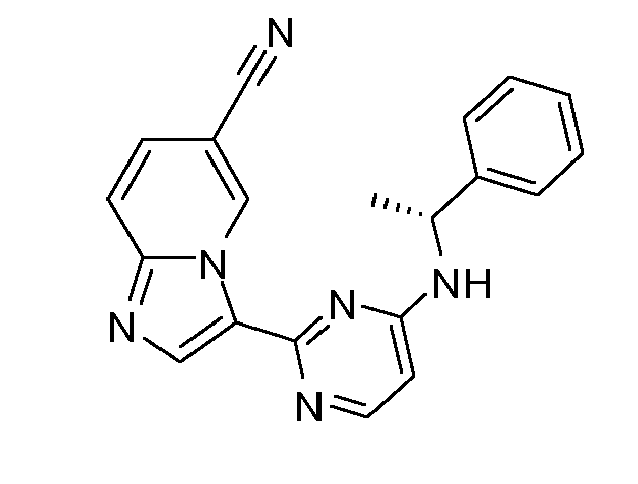
- Obtained as a white solid (70%) from 3-(4-hydroxypyrimidin-2-yl)imidazo[1,2-a] pyridine-6-carbonitrile (preparation 4b) and (R)-1-phenyl-ethylamine following the experimental procedure as described in preparation 5a. After complete reaction, the mixture was partitioned between water and dichloromethane. The organic layer was washed with water, brine, dried (MgSO4) and evaporated and the residue was purified by flash chromatography (98:2 to 96:4 dichloromethane/methanol).
LRMS (m/z): 341 (M+1)+.
1H-NMR δ (DMSO-d6 ): 1.52 (d, 3H), 5.30 (bs, 1 H), 6.52 (d, 1 H), 7.22 (d, 1 H), 7.34 (t, 2H), 7.48 (d, 2H), 7.68 (d, 1 H), 7.88 (d, 1 H), 8.19 (d, 1 H), 8.24 (d, 1 H), 8.43 (s, 1 H), 10.28 (bs, 1 H) -

- Obtained as a yellow solid (60%) from 3-(4-hydroxypyrimidin-2-yl)imidazo[1,2-a]pyridine-6-carbonitrile (preparation 4b) and phenylmethanamine following the experimental procedure as described in preparation 5a. The desired compound was obtained after purification of the reaction crude by reverse phase chromatography (C-18 silica from Waters, water/acetonitrile/methanol as eluents [0.1% v/v formic acid buffered] 0% to 100%).
LRMS (m/z): 327 (M+1)+.
1H-NMR δ (DMSO-d6 ): 5.76 (bs, 2H), 6.61 (bs, 1H), 7.25 - 7.4 (m, 5H), 7.68 (d, 1 H), 7.89 (d, 1 H), 8.17 - 8.36 (m, 2H), 8.48 (s, 1 H), 10.37 (bs, 1 H) -

- Obtained as a white solid (33%) from 3-(4-hydroxypyrimidin-2-yl)imidazo[1,2-a] pyridine-6-carbonitrile (preparation 4b) and (S)-1-methoxypropan-2-amine following the experimental procedure as described in preparation 5a. After complete reaction the mixture was partitioned between water and dichloromethane. The organic layer was washed with water, brine, dried (MgSO4) and evaporated and the residue was purified by flash chromatography (98:2 to 96:4 dichloromethane/methanol).
LRMS (m/z): 307 (M-1)+.
1H-NMR δ (CDCl3): 1.36 (d, 3H), 3.43 (s, 3H), 4.27 (bs, 1H), 5.25 (bs, 1H), 6.26 (d, 1 H), 7.40 (d, 1 H), 7.77 (d, 1 H), 8.24 (d, 1 H), 8.58 (s, 1 H), 10.56 (s, 1 H) -

- Obtained as a white solid (50%) from 3-(4-hydroxypyrimidin-2-yl)imidazo[1,2-a] pyridine-6-carbonitrile (preparation 4b) and cyclohexylmethanamine following the experimental procedure as described in preparation 5a. After complete reaction, the mixture was partitioned between water and dichloromethane. The organic layer was washed with water and then extracted with 2M aqueous hydrochloric acid. The aqueous phase was basified with 6M aqueous sodium hydroxide solution and then extracted with dichloromethane. The organic layer was dried (MgSO4) and evaporated to give the title compound.
LRMS (m/z): 333 (M+1)+.
1H-NMR δ (CDCl3): 0.91 - 1.93 (m, 10H), 1.92 - 2.05 (m, 1 H), 3.13 - 3.33 (bs, 1 H), 3.40 (d, 2H), 6.24 (d, 1 H), 7.40 (d, 1 H), 7.78 (d, 1 H), 8.18 - 8.36 (m, 1 H), 8.59 (bs, 1H), 10.56 (bs, 1 H). -

- Obtained as a white solid (60%) from 3-(4-hydroxypyrimidin-2-yl)imidazo[1,2-a] pyridine-6-carbonitrile (preparation 4b) and 2-methoxyethanamine following the experimental procedure as described in preparation 5a.
LRMS (m/z): 295 (M+1)+.
1H-NMR δ (DMSO-d6 ): 3.08 - 3.76 (m, 4H), 3.36 (s, 3H), 6.50 (d, 1H), 7.73 (d, 1 H), 7.84 (bs, 1 H), 7.94 (d, 1 H), 8.23 (bs, 1 H), 8.52 (s, 1 H), 10.52 (bs, 1 H) -

- Obtained as a white solid (51%) from 3-(4-hydroxypyrimidin-2-yl)imidazo[1,2-a] pyridine-6-carbonitrile (preparation 4b) and 1-(1-adamantyl)methanamine following the experimental procedure as described in preparation 5a. The crude product was purified by flash chromatography (100:8:1 dichloromethane/methanol/aqueous ammonia solution).
LRMS (m/z): 385 (M+1)+.
1H-NMR δ (DMSO-d6 ): 1.60 - 1.66 (m, 12H), 1.86 - 2.03 (m, 3H), 4.67 (s, 2H), 6.48 (d, 1 H), 7.64 (bs, 1 H), 7.68 (d, 1 H), 7.89 (d, 1 H), 8.13 (d, 1 H), 8.48 (bs, H) 10.56 (bs, 1H). -

- Obtained as a white solid (26%) from 3-(4-hydroxypyrimidin-2-yl)imidazo[1,2-a] pyridine-6-carbonitrile (preparation 4b) and 2,2-dimethylpropan-1-amine following the experimental procedure as described in preparation 5a. The crude product was purified by reverse phase chromatography (C-18 silica from Waters, water/acetonitrile/methanol as eluents [0.1% v/v formic acid buffered] 0% to 100%).
LRMS (m/z): 307 (M+1)+.
1H-NMR δ(DMSO-d6 ): 1.03 (s, 9H), 4.17 (d, 2H), 6.54 (d, 1 H), 7.64 - 7.73 (bs, 1 H), 7.72 (d, 1 H), 7.95 (d, 1 H), 8.19 (d, 1 H), 8.53 (s, 1 H), 10.59 (bs, 1 H). -

- To a stirred solution of 3-{4-[(2,2-dimethylpropyl)amino]pyrimidin-2-yl}imidazo[1,2-a] pyridine-6-carbonitrile (example 8, 0.300 g, 1.0 mmol) in acetic acid (3.6 mL) was added potassium acetate (0.104 g, 1.1 mmol). The mixture was cooled (ice-bath) and a solution of bromine (0.050 mL, 1.0 mmol) in acetic acid (0.2 mL) was added dropwise. The reaction was then stirred at ambient temperature for 1 hour. Saturated aqueous sodium carbonate solution (30 mL) was added and the mixture was extracted with ethyl acetate. The organic layer was washed with brine, dried (MgSO4) and evaporated to give the title compound (0.390 g, 98%) as an off-white solid.
LRMS (m/z): 385/387 (M+1)+.
1H-NMR δ (CDCl3): 1.06 (s, 9H), 3.49 (d, 2H), 5.62 (bt, 1 H), 7.42 (ddd, 1 H), 7.80 (ddd, 2H), 8.37 (d, 1 H), 8.60 (d, 1 H), 10.48 (m, 1 H) -

- a) Nitrogen was bubbled for 5 minutes through a mixture 3-{5-bromo-4-[(2,2-dimethyl propyl)amino]pyrimidin-2-yl}imidazo[1,2-a]pyridine-6-carbonitrile (example 9, 0.105 g, 0.27 mmol), tert-butyl piperazine-1-carboxylate (0.152 g, 0.82 mmol), sodium tert-butoxide (0.079 g, 0.82 mmol) and biphenyl-2-yl-di-tert-butylphosphine (0.020 g, 0.07 mmol) in toluene (2.5 mL) contained in a microwave reaction vessel. Tris(dibenzylideneacetone)dipalladium (0) (0.125 g, 0.14 mmol) was then added and the vessel was sealed and subjected to microwave irradiation for 1 hour at 115 °C. Water and ethyl acetate were added to the mixture and the organic layer was dried (MgSO4) and evaporated. Purification of the residue by reverse phase chromatography (C-18 silica from Waters, water/acetonitrile/methanol as eluents [0.1% v/v formic acid buffered] 0% to 100%) gave tert-butyl-4-{2-(6-cyanoimidazo[1,2-a]pyridin-3-yl)-4-[(2,2-dimethylpropyl)amino]pyrimidin-5-yl}piperazine-1-carboxylate (0.023 g, 16%) as a yellow solid.
LRMS (m/z): 491 (M+1)+.
1H-NMR δ (CDCl3): 1.05 (s, 9H), 1.52 (d, 9H), 2.18 (d, 2H), 3.00 - 2.86 (m, 4H), 3.53 - 3.39 (m, 4H), 7.38 (d, 1 H), 7.77 (d, 1 H), 8.00 (s, 1 H), 8.55 (s, 1 H), 10.60 (s, 1 H). - b) To a solution of tert-butyl 4-{2-(6-cyanoimidazo[1,2-a]pyridin-3-yl)-4-[(2,2-dimethyl propyl)amino]pyrimidin-5-yl}piperazine-1-carboxylate (0.022 g, 0.04 mmol) in dioxane (1 mL) was added a 4M solution of hydrogen chloride in 1,4-dioxane (0.140 mL, 0.56 mmol). The mixture was stirred at ambient temperature for 20 hours and then solvent was evaporated and water was added. The aqueous layer was washed with dichloromethane and then basified with concentrated aqueous ammonia solution and extracted with dichloromethane. The organic layer was dried (MgSO4) and evaporated to obtain (0.008 g, 41%) of the title compound as a pale yellow solid.
LRMS (m/z): 391 (M+1)+.
1H-NMR δ (CDCl3): 1.06 (s, 9H), 3.13 - 2.90 (m, 8H), 3.46 - 3.40 (m, 2H), 5.91 (t, 1 H), 7.40 - 7.35 (m, 1 H), 7.77 (d, 1 H), 8.02 (s, 1 H), 8.54 (s, 1 H), 10.61 (s, 1 H). -

- Obtained as a pale yellow solid (54%) from 3-[5-bromo-4-[(2,2-dimethylpropyl)amino] pyrimidin-2-yl}imidazo[1,2-a]pyridine-6-carbonitrile (example 9) and 2-methoxy-4-(4,4,5,5-tetramethyl-1,3,2-dioxaborolan-2-yl)pyridine (preparation 38) following the experimental procedure as described in preparation 27d. The crude product mixture was filtered through Celite® washing the filter cake with ethyl acetate. The solvent was removed under reduced pressure and the residue was purified by reverse phase chromatography (C-18 silica from Waters, water/acetonitrile/methanol as eluents [0.1 % v/v formic acid buffered] 0% to 100%) to yield the desired compound.
LRMS (m/z): 414 (M+1)+.
1H-NMR δ (CDCl3): 1.03 (s, 9H), 3.47 (bs, 2H), 4.04 (s, 3H), 5.31 (d, 1H), 6.86 (s, 1 H), 6.99 (t, 1 H), 7.44 (d, 1 H), 7.82 (d, 1 H), 8.18 (s, 1 H), 8.34 (t, 1 H), 8.67 (s, 1 H), 10.62 (s, 1 H). -

- Obtained as solid (63%) from 3-[4-[(2,2-dimethylpropyl)amino]-5-(2-methoxypyridin-4-yl)pyrimidin-2-yl]imidazo[1,2-a]pyridine-6-carbonitrile (example 11) following the experimental procedure as described in preparation 4b.
LRMS (m/z): 400 (M+1)+.
1H-NMR δ (DMSO-d6 ): 1.05 (s, 9H), 3.47 (d, 2H), 6.34 (d, 1 H), 6.53 (s, 1 H), 7.45 (bs, 1 H), 7.60 (d, 1H), 7.87 (d, 1H), 8.05 (d, 1 H), 8.28 (s, 1H), 8.72 (s, 1 H), 10.54 (s, 1 H). -

- Obtained as a yellow solid (22%) from 3-(4-hydroxy-5-pyridin-3-ylpyrimidin-2-yl)imidazo [1,2-a]pyridine-6-carbonitrile (preparation 26b) and neopentylamine following the experimental procedure as described in preparation 5a followed by purification of the crude product by reverse phase chromatography (C-18 silica from Waters, water/acetonitrile/methanol as eluents [0.1% v/v formic acid buffered] 0% to 100%).
LRMS (m/z): 384 (M+1)+.
1H-NMR δ (CDCl3): 1.00 (s, 9H), 3.47 (d, 2H), 5.10 (t, 1 H), 7.43 (ddd, 1 H), 7.51 (dd, 2H), 7.81 (ddd, 2H), 8.15 (d, 1 H), 8.66 (s, 1 H), 8.78 - 8.71 (m, 2H), 10.63 (dd, 1 H) -

- Obtained as a white solid (17%) from 3-(4-hydroxypyrimidin-2-yl)imidazo[1,2-a]pyridine -6-carbonitrile (preparation 4b) and (3-fluorophenyl)methanamine following the experimental procedure as described in preparation 5a, followed by purification of the crude product by reverse phase chromatography (C-18 silica from Waters, water/acetonitrile/methanol as eluents [0.1 % v/v formic acid buffered] 0% to 100%).
LRMS (m/z): 345 (M+1)+.
1H-NMR δ (DMSO-d6 ): 5.02 (bs, 2H), 6.64 - 6.97 (m, 1H), 7.29 - 7.46 (m, 1H), 7.59 (bs, 2H), 7.64 - 7.81 (m, 1 H), 7.87 - 8.07 (m, 1 H), 8.10 - 8.35 (m, 1 H), 8.57 (m, 2H), 8.79 (bs, 1 H), 10.66 (bs, 1 H) -

- Obtained as a white solid (11%) from 3-(4-hydroxypyrimidin-2-yl)imidazo[1,2-a]pyridine -6-carbonitrile (preparation 4b) and (4-fluorophenyl)methanamine following the experimental procedure as described in preparation 5a, followed by purification of the crude product by reverse phase chromatography (C-18 silica from Waters, water/acetonitrile/methanol as eluents [0.1% v/v formic acid buffered] 0% to 100%).
LRMS (m/z): 345 (M+1)+.
1H-NMR δ (CDCl3): 4.65 (bs, 2H), 6.28 (d, 1 H), 6.95 - 7.13 (m, 2H), 7.26 (s, 1 H), 7.31 - 7.45 (m, 2H), 7.77 (d, 1H), 8.29 (d, 1H), 8.59 (s, 1 H), 10.49 (bs, 1 H) -

- Obtained as a white solid (39%) from 3-(4-hydroxypyrimidin-2-yl)imidazo[1,2-a]pyridine -6-carbonitrile (preparation 4b) and o-tolylmethanamine following the experimental procedure as described in preparation 5a followed by addition of water and extraction with ethyl acetate. The organic layer was washed with water, brine, dried (MgSO4) and evaporated in vacuum and the residue was purified by flash chromatography (99:1 to 98:2 dichloromethane/methanol) to yield the desired compound.
LRMS (m/z): 341 (M+1)+.
1H-NMR δ (DMSO-d6 ): 2.43 (m, 3H), 4.52 - 4.85 (m, 2H), 6.38 - 6.73 (m, 1 H), 7.10 - 7.30 (m, 3H), 7.30 - 7.44 (m, 1 H), 7.60 - 7.82 (m, 1 H), 7.91 - 7.94 (m, 1 H), 8.04 - 8.20 (m, 1 H), 8.20 - 8.36 (m, 1 H), 8.43 - 8.61 (m, 1 H), 10.40 (bs, 1 H). -

- Obtained as a yellow solid (93%) from 3-(4-hydroxypyrimidin-2-yl)imidazo[1,2-a] pyridine-6-carbonitrile (preparation 4b) and tert-butyl 2-(aminomethyl)piperidine-1-carboxylate (prepared as described in Chem Pharm Bull, 1998, 787-796) following the experimental procedure as described in preparation 5a followed by addition of water and extraction with ethyl acetate. The organic layer was washed with water, brine, dried (MgSO4) and evaporated in vacuum and the residue was purified by flash chromatography (98:2 dichloromethane/methanol) to give the title compound.
LRMS (m/z): 434 (M+1)+.
1H-NMR δ (CDCl3): 1.46 (s, 9H), 1.55 - 1.86 (m, 4H), 2.80 - 2.97 (m, 1 H), 3.10 - 3.25 (m, 1 H), 3.44 - 3.59 (m, 1 H), 3.76 - 4.15 (m, 2H), 4.30 - 4.51 (m, 1 H), 4.49
- 4.72 (m, 1 H), 6.24 (bs, 1 H), 7.42 (d, 1 H), 7.78 (d, 1 H), 8.22 (bs, 1 H), 8.59 (s, 1 H), 10.58 (bs, 1 H) -

- a) 3-{4-[(Piperidin-2-ylmethyl)amino]pyrimidin-2-yl}imidazo[1,2-a]pyridine-6-carbonitrile was obtained as a white solid (0.130 g, 80%) from tert-butyl 2-({[2-(6-cyanoimidazo [1,2-a]pyridin-3-yl)pyrimidin-4-yl]amino}methyl)piperidine-1-carboxylate (example 17, 0.213 g, 0.49 mmol) following the experimental procedure as described in preparation 5b. After the reaction was complete, water was added and the mixture was then neutralized with solid sodium hydrogen carbonate. The resultant precipitate was filtered, washed with water and dried in vacuum.
LRMS (m/z): 334 (M+1)+.
1H-NMR δ (DMSO-d6 ): 1.37 - 1.62 (m, 4H), 1.65 - 1.85 (m, 2H), 1.88 - 2.03 (m, 1 H), 2.77 - 2.97 (m, 2H), 3.45 - 3.76 (m, 2H), 6.41 - 6.58 (m, 1 H), 7.64 - 7.77 (m, 1 H), 7.87 (bs, 1 H), 7.90 - 7.98 (m, 1 H), 8.18 - 8.40 (m, 1 H), 8.58 - 8.79 (m, 1 H), 10.46 (bs, 1 H). - b) Triethylamine (0.13 mL, 0.95 mol) and acetyl chloride (0.05 mL, 0.73 mmol) were added sequentially to a stirred solution of 3-{4-[(piperidin-2-ylmethyl)amino]pyrimidin-2-yl}imidazo[1,2-a]pyridine-6-carbonitrile (0.100 g, 0.3 mmol) in dichloromethane (4 mL) and the mixture was stirred at ambient temperature for 16 hours. The mixture was evaporated in vacuum and then taken up in dichloromethane and the organic layer was washed with 4% aqueous sodium hydrogen carbonate solution, water, brine, dried (MgSO4) and evaporated. Purification of the residue by flash chromatography (98:2 to 96:4 dichloromethane/methanol) gave the title compound (0.040 g, 35%) as a white solid.
LRMS (m/z): 376 (M+1)+.
1H-NMR δ (DMSO-d6 ): 1.11 - 1.88 (m, 6H), 2.56 (s, 3H), 3.46 - 3.95 (m, 2H) 4.14 - 4.31 (m, 1 H), 4.29 - 4.51 (m, 1 H), 4.95 (bs, 1 H), 6.26 - 6.60 (m, 1 H), 7.62 - 7.82 (m, 1 H), 7.85 - 8.03 (m, 1 H), 8.11 - 8.35 (m, 1 H), 8.49 - 8.73 (m, 1 H), 10.39 - 10.65 (m, 1 H) -

- Obtained as a white solid (11%) from 3-(4-hydroxypyrimidin-2-yl)imidazo[1,2-a]pyridine -6-carbonitrile (preparation 4b) and tetrahydro-2H-pyran-4-amine hydrochloride following the experimental procedure as described in preparation 5a, followed by purification of the crude product by reverse phase chromatography (C-18 silica from Waters, water/acetonitrile/methanol as eluents [0.1% v/v formic acid buffered] 0% to 100%).
LRMS (m/z): 321 (M+1)+.
1H-NMR δ (CDCl3): 1.65 (d, 2H), 2.12 (d, 2H), 3.64 (d, 2H), 4.07 (d, 2H), 5.03 (bs, 1H), 6.26 (bs, 1H), 7.27 (d,1H), 7.41 (dd, 1H), 7.79 (d, 1H), 8.27 (bs, 1H), 8.58 (bs, 1 H), 10.54 (bs, 1 H) -

- Obtained as a white solid (8%) from 3-(4-hydroxypyrimidin-2-yl)imidazo[1,2-a]pyridine-6-carbonitrile (preparation 4b) and (8-fluoro-3,4-dihydro-2H-chromen-4-yl) amine (prepared as described in
WO2008043019 ) following the experimental procedure as described in preparation 5a, followed by purification of the crude product by reverse phase chromatography (C-18 silica from Waters, water/acetonitrile/methanol as eluents [0.1 % v/v formic acid buffered] 0% to 100%).
LRMS (m/z): 387 (M+1)+.
1H-NMR δ (CDCl3): 1.75 (bs, 1 H), 2.46 - 2.26 (m, 2H), 4.51 - 4.30 (m, 2H), 6.32 (d, 1 H), 6.87 (td, 1 H), 7.11 - 7.02 (m, 2H), 7.42 (dd, 1 H), 7.80 (d, 1 H), 8.34 (d, 1H), 8.61 (s, 1H), 10.57 (s, 1H). -
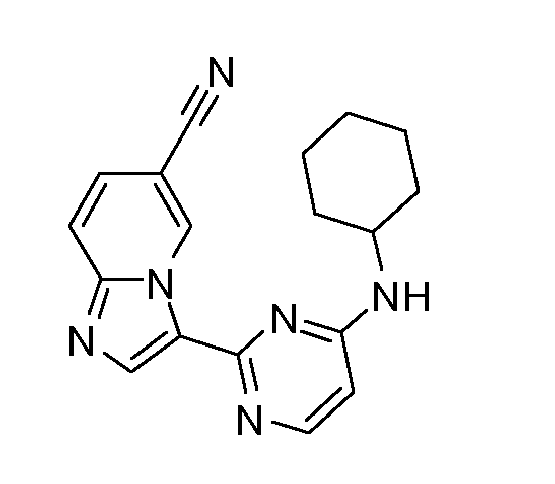
- Obtained as an off-white solid (53%) from 3-(4-hydroxypyrimidin-2-yl)imidazo[1,2-a] pyridine-6-carbonitrile (preparation 4b) and cyclohexanamine following the experimental procedure as described in preparation 5a followed by addition of water and extraction with ethyl acetate. The organic layer was washed with water, brine, dried (MgSO4) and evaporated. The residue was purified by flash chromatography (99:1 to 98:2 dichloromethane/methanol) to give the desired compound.
LRMS (m/z): 319 (M+1)+.
1H-NMR δ (CDCb): 1.13 - 1.40 (m, 6H), 1.39 - 1.51 (m, 1 H), 1.64 - 1.77 (m, 1 H), 1.77 - 1.89 (m, 2H), 1.95 - 2.25 (m, 2H), 6.21 (d, 1 H), 7.41 (d, 1 H), 7.77 (d, 1 H), 8.15 - 8.37 (m, 1H), 8.58 (s, 1 H), 10.54 (s, 1 H) -

- Obtained as a solid (17%) from 3-(4-hydroxypyrimidin-2-yl)imidazo[1,2-a]pyridine-6-carbonitrile (preparation 4b) and trans-4-aminocyclohexanol following the experimental procedure as described in preparation 5a, followed by purification of the crude product by reverse phase chromatography (C-18 silica from Waters, water/acetonitrile/ methanol as eluents [0.1 % v/v formic acid buffered] 0% to 100%).
LRMS (m/z): 335 (M+1)+.
1H-NMR δ (CDCl3): 1.61 - 1.32 (m, 4H), 2.17 (dd, 4H), 2.67 - 2.61 (m, 1 H), 3.73 (ddd, 1 H), 6.23 (d, 1 H), 7.40 (dd, 1 H), 7.79 (d, 1 H), 8.27 (d, 1 H), 8.58 (s, 1 H), 10.54 (s, 1 H). -

- Obtained as a solid (1,6%) from 3-(4-hydroxypyrimidin-2-yl)imidazo[1,2-a]pyridine-6-carbonitrile (preparation 4b) and (E)-4-aminotricyclo[3.3.1.13,7]decan-1-ol (preparation 40) following the experimental procedure as described in preparation 5a, followed by purification by reverse phase chromatography (C-18 silica from Waters, water/acetonitrile/methanol as eluents [0.1 % v/v formic acid buffered] 0% to 100%).
LRMS (m/z): 387 (M+1)+. -

- Obtained as a solid (6%) from 3-(4-hydroxypyrimidin-2-yl)imidazo[1,2-a]pyridine-6-carbonitrile (preparation 4b) and (Z)-4-aminotricyclo[3.3.1.13,7]decan-1-ol (preparation 41) following the experimental procedure as described in preparation 5a, followed by purification by reverse phase chromatography (C-18 silica from Waters, water/acetonitrile/methanol as eluents [0.1% v/v formic acid buffered] 0% to 100%).
LRMS (m/z): 387 (M+1)+.
1H-NMR δ (CDCl3): 2.00 - 1.64 (m, 13H), 6.26 (d, 1H), 7.42 (dd, 1H), 7.82 (d, 1 H), 8.27 (d, 1 H), 8.58 (s, 1 H), 10.51 (s, 1 H). -

- Obtained as a solid (14%) from 3-(4-hydroxyquinazolin-2-yl)imidazo[1,2-a]pyridine-6-carbonitrile (preparation 24b) and 2,2-dimethylpropan-1-amine following the experimental procedure as described in preparation 5a, followed by purification of the crude product by reverse phase chromatography (C-18 silica from Waters, water/acetonitrile/methanol as eluents [0.1% v/v formic acid buffered] 0% to 100%).
LRMS (m/z): 357 (M+1)+.
1H-NMR δ (CDCl3): 1.11 (s, 9H), 3.67 (d, 2H), 5.87 (t, 2H), 7.42 (dd, 1H), 7.49 (ddd, 1 H), 7.75 - 7.70 (m, 1 H), 7.83 - 7.76 (m, 2H), 7.97 - 7.91 (m, 1 H), 8.70 (s, 1 H), 10.88 (dd, 1 H) -

- An oven dried resealable Schlenk tube was charged with imidazo[1,2-a]pyridine-6-carbonitrile (preparation 1, 0.30 g, 2.1 mmol), N-benzyl-2-chloro-N-methylpyrimidin-4-amine (preparation 31, 0.24 g, 1.0 mmol), potassium acetate (0.21 g, 2.1 mmol) and N,N'-dimethylacetamide (3 mL). The Schlenk tube was subjected to three cycles of evacuation-backfilling with argon then tetrakis(triphenylphosphine)palladium (0) (0.12 g, 0.10 mmol) was added. After three further cycles of evacuation-backfilling with argon, the Schlenk tube was capped and placed in an oil bath at 150 °C and the mixture was stirred overnight. The mixture was evaporated in vacuum and the residue was partitioned between ethyl acetate and water. The organic layer was washed with brine, dried (MgSO4) and evaporated and the residue was purified by flash chromatography (99:1 to 98:2 dichloromethane/methanol) to give the title compound (0.105 g, 30%) as a pale brown solid.
LRMS (m/z): 341 (M+1)+.
1H-NMR δ (CDCl3): 3.22 (bs, 3H), 4.91 (bs, 2H), 6.40 (d, 1H), 7.27 - 7.41 (m, 6H), 7.76 (dd, 1 H), 8.31 (d, 1 H), 8.59 (s, 1 H), 10.49 (bs, 1 H) -

- A mixture of 3-[4-((S)-1-Phenyl-ethylamino)-pyrimidin-2-yl]-imidazo[1,2-a]pyridine-6-carbonitrile (example 1, 0.037 g, 0.11 mmol) and potasium hydroxide (0.033 g, 0.59 mmol) in ethylene glycol (0.5 mL) was heated to 150 °C and stirred overnight. The mixture was then cooled to room temperature, water (5 mL) was added and the mixture was extracted with ethyl acetate. The aqueous layer was acidified to a pH of 5 with 5M aqueous hydrochloric acid and the suspension was extracted with chloroform. The organic layer was dried (MgSO4) and evaporated to give the title compound (0.010 g, 25%) as an off-white solid.
LRMS (m/z): 360 (M+1)+, 358 (M-1)-.
1H-NMR δ (DMSO-d 6): 1.51 (d, 3H), 5.43 (bs, 1 H), 6.46 (d, 1 H), 7.20 (d, 1 H), 7.31 (t, 2H), 7.50 (d, 2H), 7.73 (d, 1 H), 7.83 (d, 1 H), 8.13 (d, 1 H), 8.18 (d, 1 H), 8.36 (s, 1 H), 10.63 (bs, 1 H) -

- a) 2-(6-fluoroimidazo[1,2-a]pyridin-3-yl)-N-(4-methoxybenzyl)-N-[(1 S)-1-phenylethyl] pyrimidin-4-amine was obtained as a colourless oil (0.029 g, 8%) from 6-fluoroimidazo [1,2-a]pyridine (preparation 2, 0.127 g, 0.93 mmol), 2-chloro-N-(4-methoxybenzyl)-N-[(1S)-1-phenylethyl]pyrimidin-4-amine (preparation 30b, 0.300 g, 0.85 mmol), potassium acetate (0.138g, 1.41 mmol) and tetrakis(triphenylphosphine)palladium (0) (0.098 g, 0.08 mmol) following the experimental procedure as described in preparation 29. The crude product was purified by flash chromatography (1:1 hexanes/ethyl acetate).
LRMS (m/z): 454 (M+1)+.
1H-NMR δ (CDCl3): 1.68 (d, 3H), 3.78 (s, 3H), 4.41 - 4.69 (m, 3H), 6.20 (d, 1H), 6.84 (d, 2H), 7.11 (d, 2H), 7.14 - 7.24 (m, 1 H), 7.26 - 7.39 (m, 5H), 7.64 - 7.69 (m, 1 H), 8.22 (d, 1 H), 8.52 (s, 1 H), 9.81 (bs, 1 H). - b) A mixture of 2-(6-fluoroimidazo[1,2-a]pyridin-3-yl)-N-(4-methoxybenzyl)-N-[(1S)-1-phenylethyl]pyrimidin-4-amine (0.029 g, 0.06 mmol) and trifluoroacetic acid (4 mL) was stirred and heated to 65 °C in a sealed tube. After 19 hours, the mixture was evaporated in vacuum and 2M aqueous hydrochloric acid and ethyl acetate were added to the residue. The aqueous layer was basified with solid sodium hydrogen carbonate and then extracted with chloroform. The organic layer was dried (MgSO4) evaporated and the residue was purified by flash chromatography (100:1 to 50:1 dichloromethane/methanol), followed by purification by reverse phase chromatography (C-18 silica from Waters, water/acetonitrile/methanol as eluents [0.1% v/v formic acid buffered] 0% to 100%) to give the title compound (0.009 g, 42%) as a white solid.
LRMS (m/z): 334 (M+1)+.
1H-NMR δ (DMSO-d 6): 1.56 (d, 3H), 5.29 (bs, 1 H), 6.52 (bs, 1 H), 7.17 - 7.31 (m, 1 H), 7.30 - 7.43 (m, 2H), 7.49 (d, 2H), 7.52 - 7.61 (m, 1 H), 7.73 - 7.88 (m, 1 H), 8.21 (d, 2H), 8.37 (bs, 1 H), 9.78 (bs, 1 H). -

- Obtained as a yellow solid (70%) from 2-(6-fluoroimidazo[1,2-a]pyridin-3-yl)pyrimidin-4-ol (preparation 8b) and trans-4-aminocyclohexanol following the experimental procedure as described in preparation 5a, followed by purification of the crude product by flash chromatography (dichloromethane/methanol 100:10).
LRMS (m/z): 328 (M+1)+.
1H-NMR δ (CDCl3): 1.38 (dd, 2H), 1.51 (dd, 2H), 2.08 (d, 2H), 2.20 (d, 2H), 3.67 (s, 1 H), 5.74 (d, 1 H), 6.22 (d, 1 H), 7.29 - 7.16 (m, 1 H), 7.73 - 7.59 (m, 1 H), 8.19 (s, 1H), 8.50 (s, 1H), 10.02 (s, 1H). -

- Obtained as a solid (30%) from 2-(6-fluoroimidazo[1,2-a]pyridin-3-yl)pyrimidin-4-ol (preparation 8b) and (4S,7S)-4-aminotricyclo[3.3.1.13,7]decan-1-ol following the same experimental procedure as described in preparation 5a with the exception that the reaction was carried out at 60 °C. The crude product was purified by flash chromatography (9:1 dichloromethane/methanol).
LRMS (m/z): 380 (M+1)+.
1H-NMR δ (DMSO-d 6): 1.09 (bs, 1 H), 1.40 - 2.02 (m, 10 H), 1.63 (bs, 1 H), 2.10 (bs, 1 H), 2.29 (bs, 1 H), 4.07 (bs, 1 H), 4.46 (s, 1 H), 6.56 (d, 1 H), 7.53 (d, 1 H), 7.81 (dd, 1 H), 8.13 (d, 1 H), 8.37 (s, 1 H), 9.96 (bs, 1 H) -
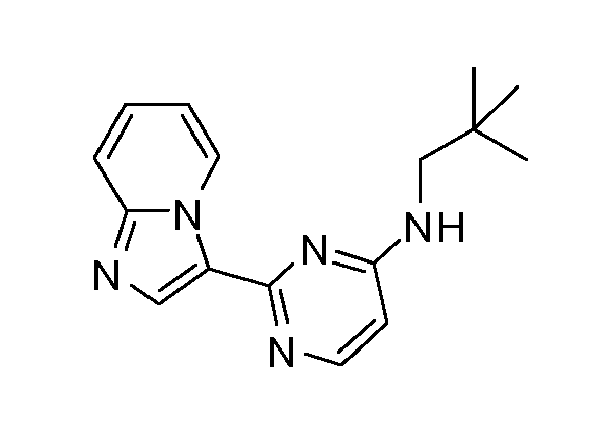
- Obtained as a off-white solid (45%) from 2-imidazo[1,2-a]pyridin-3-ylpyrimidin-4-ol (preparation 14b) and neopentylamine following the experimental procedure as described in preparation 5a followed by addition of water and extraction with ethyl acetate. The organic layer was washed with water, brine, dried (MgSO4) and evaporated. The residue was treated with isopropyl alcohol and the solid was collected by filtration and dried in vacuum to give the title compound.
LRMS (m/z): 282 (M+1)+.
1H-NMR δ (DMSO-d 6): 1.01 (s, 9H), 6.48 (d, 1H), 7.18 (t, 1H), 7.49 - 7.39 (m, 1H), 7.55 (t, 1H), 7.77 (d, 1H), 8.17 (s, 1H), 8.39 (s, 1 H), 10.08 - 9.92 (m, 1 H). -

- Diisopropylethylamine (0.07 mL, 0.40 mmol) and neopentylamine (0.05 mL, 0.42 mmol) were added to a stirred solution of 3-(4-chloro-6-pyridin-3-ylpyrimidin-2-yl)imidazo[1,2-a]pyridine (preparation 27d, 0.037 g, 0.11 mmol) in N,N'-dimethylformamide (1.0 mL) and the mixture was heated to 90 °C under an argon atmosphere. After 16 hours the mixture was evaporated in vacuum and then taken up in dichloromethane. The organic layer was washed with water and brine, dried (MgSO4) and evaporated to give the title compound (0.027 g, 60%).
LRMS (m/z): 359 (M+1)+.
1H-NMR δ (CDCl3): 1.07 (s, 9H), 3.29 (s, 2H), 5.25 (s, 1 H), 6.61 (s, 1 H), 7.00 (t, 1 H), 7.38 - 7.29 (m, 1 H), 7.47 (dd, 1 H), 7.74 (d, 1 H), 8.40 - 8.33 (m, 1 H), 8.61 (s, 1 H), 8.73 (dd, 1 H), 9.28 (s, 1 H), 10.04 (d, 1 H). -

- Obtained as a green solid (73%) from 6-chloro-N-(1-phenylethyl)pyrazin-2-amine (preparation 32) and imidazo[1,2-a]pyridine-6-carbonitrile (preparation 1) following the same experimental procedure as described in example 26 followed by purification of the crude product by flash chromatography (99:1 to 98:2 dichloromethane/methanol).
LRMS (m/z): 341 (M+1)+.
1H-NMR δ (CDCl3): 1.69 (d, 3H), 5.04 (t, 1 H), 5.21 (d, 1 H), 7.27 - 7.32 (m, 1 H), 7.34 - 7.51 (m, 5H), 7.75 (d, 1 H), 7.81 (s, 1 H), 8.25 (s, 1 H), 8.33 (s, 1 H), 10.06 (s, 1 H) -

- Obtained as a solid (26%) from 3-(6-hydroxypyrazin-2-yl)imidazo[1,2-a]pyridine-6-carbonitrile (preparation 29, 0.052 g, 0.22 mmol) and cyclohexylmethanamine (0.11 mL, 0.88 mmol) following the experimental procedure as described in preparation 5a.
LRMS (m/z): 333 (M+1)+.
1H-NMR δ (DMSO-d 6): 0.97 - 1.13 (m, 2H), 1.25 (bs, 4H), 1.74 (bs, 4H), 1.91 (d, 1 H), 3.27 (t, 2H), 7.57 (t, 1 H), 7.69 (d, 1 H), 7.88 - 7.96 (m, 1 H), 8.40 (s, 1 H), 8.61 (s, 1 H), 10.41 (s, 1 H) -

- Obtained as a green solid (25%) from (S)-6-chloro-N-(1-phenylethyl)pyrazin-2-amine (preparation 32) and 6-fluoroimidazo[1,2-a]pyridine (preparation 2) following the experimental procedure as described in example 26 followed by purification of the crude product by reverse phase chromatography (C-18 silica from Waters, water/acetonitrile/methanol as eluents [0.1% v/v formic acid buffered] 0% to 100%).
LRMS (m/z): 334 (M+1)+.
1H-NMR δ (CDCl3): 1.66 (d, 3H), 5.01 - 5.12 (m, 2H), 7.15 - 7.23 (m, 1 H), 7.33 - 7.46 (m, 5H), 7.63 (dd, 1 H), 7.76 (s, 1 H), 8.15 (s, 1 H), 8.28 (s, 1 H), 9.39 (dd, 1 H) -
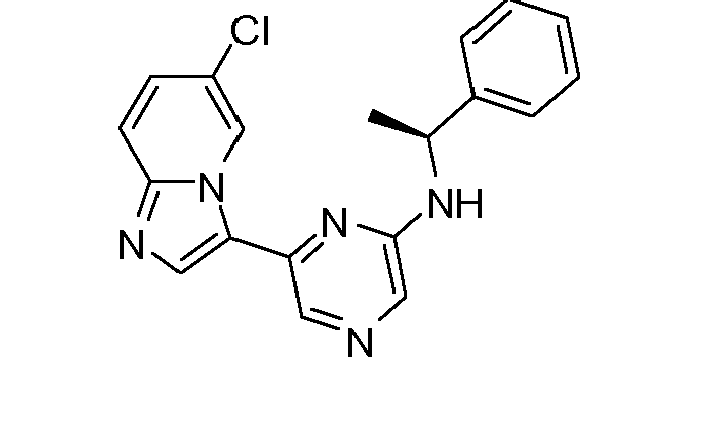
- Obtained as a green solid (71%) from (S)-6-chloro-N-(1-phenylethyl)pyrazin-2-amine (preparation 32) and 6-chloroimidazo[1,2-a]pyridine (preparation 3) following the experimental procedure as described in example 26 followed by purification of the crude product by flash chromatography (99:1 to 97:3 dichloromethane/methanol).
LRMS (m/z): 350 (M+1)+.
1H-NMR δ (CDCl3): 1.60 (s, 3H), 5.08 (bs, 2H), 7.29 (bs, 2H), 7.37 (t, 2H), 7.41 - 7.50 (m, 1 H), 7.64 (d, 1 H), 7.75 (s, 1 H), 8.16 (s, 1 H), 8.30 (s, 1 H), 9.72 (s, 1 H) -

- To a solution of 6-(6-chloroimidazo[1,2-a]pyridin-3-yl)-N-[(1S)-1-phenylethyl]pyrazin-2-amine (example 36, 0.100 g, 0.29 mmol) in ethanol (2 mL) was added 10% palladium on charcoal (0.006 g) and ammonium formate (0.180 g, 2.9 mmol). The mixture was stirred and heated to reflux for 24 hours. Further palladium (0.006 g) and ammonium formate (0.180 g) were added and stirring at reflux was continued for 24 hours. This process was repeated until little starting material remained. The reaction mixture was then filtered, evaporated and the residue was purified by reverse phase chromatography (C-18 silica from Waters, water/acetonitrile/methanol as eluents [0.1 % v/v formic acid buffered] 0% to 100%) to give the title compound (0.023 g, 25%) as a pale green solid.
LRMS (m/z): 316 (M+1)+.
1H-NMR δ (CDCl3): 1.64 (d, 3H), 5.00 (bs, 2H), 6.66 (t, 1 H), 7.28 - 7.34 (m, 0 H), 7.40 (bs, 4H), 7.65 (d, 1 H), 7.78 (s, 1 H), 8.10 (s, 1 H), 8.27 (s, 1 H), 8.95 (d, 1 H) -

- Nitrogen was bubbled for 5 minutes through a mixture of (S)-6-(6-chloroimidazo[1,2-a]pyridin-3-yl)-N-(1-phenylethyl)pyrazin-2-amine (example 36, 0.085 g, 0.24 mmol), cyclopropylboronic acid (0.081 g, 0.94 mmol) and potassium phosphate (0.180 g, 0.85 mmol) in toluene (1.0 mL) and water (0.1 mL) contained in a microwave vessel. Then palladium (II) acetate (0.004 g, 0.01 mmol) and tricyclohexylphosphine (0.014 mg, 0.05 mmol) were added and the vessel was sealed and subjected to microwave irradiation for 7 hours at 150 °C. The reaction was partitioned between dichloromethane and water and the organic phase was dried (MgSO4) and the residue was purified by reverse phase chromatography (C-18 silica from Waters, water/acetonitrile/methanol as eluents [0.1% v/v formic acid buffered] 0% to 100%) to give the title compound (0.025 g, 29%) as a pale green solid.
LRMS (m/z): 356 (M+1)+.
1H-NMR δ (CDCl3): 0.73 (bs, 2H), 0.99 (d, 2H), 1.69 (d, 3H), 1.87 (bs, 1 H), 4.95 (d, 1 H), 5.05 - 5.25 (m, 1 H), 7.00 (d, 1 H), 7.28 - 7.48 (m, 5H), 7.59 (d, 1 H), 7.69 (d, 1 H), 8.10 (d, 1 H), 8.29 (d, 1 H), 9.42 (s, 1 H) -

- Nitrogen was bubbled for 5 minutes through a mixture of (S)-6-(6-chloroimidazo[1,2-a]pyridin-3-yl)-N-(1-phenylethyl)pyrazin-2-amine (example 36, 0.080 g, 0.23 mmol), pyridin-3-yl boronic acid (0.056 g, 0.46 mmol) and potassium carbonate (0.063 g, 0.46 mmol) in 1,4-dioxane (1.0 mL) and ethanol (0.5 mL) contained in a microwave vessel. Then tetrakis(triphenylphosphine)palladium (0) (0.026 g, 0.02 mmol) was added and the vessel was sealed and subjected to microwave irradiation for 3 hours at 150 °C. The solvent was removed under reduced pressure and the residue was partitioned between dichloromethane and water. The organic layer was dried (MgSO4) and evaporated and the residue was purified by flash chromatography (98:2 to 96:4 dichloromethane/methanol) to give the title compound (0.040 g, 45%) as a pale green solid.
LRMS (m/z): 393 (M+1)+.
1H-NMR δ (DMSO-d 6): 1.48 (d, 3H), 5.14 (quintet, 1 H), 7.08 - 7.18 (m, 4H), 7.58 (ddd, 1 H), 7.70 - 7.86 (m, 4H), 7.90 (s, 1 H), 8.16 (ddd, 1 H), 8.41 (d, 2H), 8.70 (dd, 1 H), 8.99 (dd, 1 H), 10.01 (dd, 1 H) -

- Obtained as a solid (36%) from (S)-6-(6-chloroimidazo[1,2-a]pyridin-3-yl)-N-(1-phenylethyl)pyrazin-2-amine (example 36) and 4-(4,4,5,5-tetramethyl-1,3,2-dioxaborolan-2-yl)pyridine following the experimental procedure as described in example 39 followed by purification of the crude product by flash chromatography (98:2 to 95:5 dichloromethane/methanol).
LRMS (m/z): 393 (M+1)+.
1H-NMR δ (CDCl3): 1.65 (d, 3H), 5.00 (d, 1 H), 5.16 (t, 1 H), 7.46 - 7.58 (m, 3H), 7.74 (s, 1 H), 7.82 (d, 1 H), 8.21 (s, 1 H), 8.35 (s, 1 H), 8.69 (d, 2H), 10.00 (s, 1 H) -
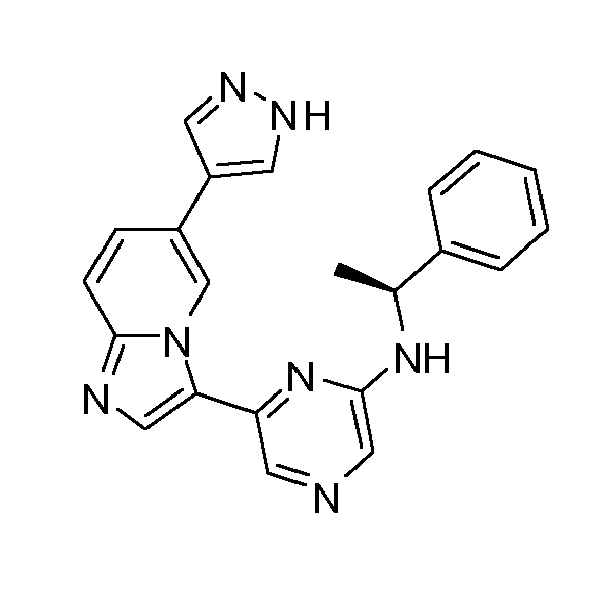
- Obtained as a pale green solid (23%) from (S)-6-(6-chloroimidazo[1,2-a]pyridin-3-yl)-N-(1-phenylethyl)pyrazin-2-amine (example 36) and 4-(4,4,5,5-tetramethyl-1,3,2-dioxaborolan-2-yl)-1 H-pyrazole following the experimental procedure as described in example 39 followed by purification of the crude product by flash chromatography (98:2 to 96:4 dichloromethane/methanol).
LRMS (m/z): 382 (M+1)+.
1H-NMR δ (DMSO-d 6): 1.61 (bs, 3H), 5.26 (bs, 1H), 7.14 - 7.46 (m, 5H), 7.64 - 8.48 (m, 7H), 9.94 (bs, 1 H) -

- Obtained as a pale green solid (38%) from (S)-6-(6-chloroimidazo[1,2-a]pyridin-3-yl)-N-(1-phenylethyl)pyrazin-2-amine (example 36) and phenylboronic acid following the experimental procedure as described in example 39 followed by purification of the crude product by flash chromatography (98:2 to 97:3 dichloromethane/methanol).
LRMS (m/z): 392 (M+1)+.
1H-NMR δ(CDCl3): 1.25 (bs, 3H), 4.96 (bs, 1 H), 5.15 (bs, 1 H), 7.35 (bs, 7H), 7.40 - 7.86 (m, 5H), 8.19 (bs, 1 H), 8.34 (bs, 1 H), 8.76 (bs, 1 H), 9.93 (bs, 1 H) -

- Obtained as a pale green solid (32%) from (S)-6-(6-chloroimidazo[1,2-a]pyridin-3-yl)-N-(1-phenylethyl)pyrazin-2-amine (example 36) and 4-fluorophenylboronic acid following the experimental procedure as described in example 39 followed by purification of the crude product by flash chromatography (98:2 to 97:3 dichloromethane/methanol).
LRMS (m/z): 410 (M+1)+.
1H-NMR δ (CDCl3): 1.58 (s, 3H), 2.18 (s, 1H), 7.17 (t, 1H), 7.22 - 7.30 (m, 9H), 7.46 - 7.60 (m, 1 H), 7.76 (dd, 1 H), 8.19 (s, 1 H), 8.33 (s, 1 H), 9.86 (dd, 1 H) -

- Triethylamine (0.064 mL, 0.46 mmol) and ethanesulfonyl chloride (0.032 mL, 0.34 mmol) were added sequentially to a cooled (ice-bath), stirred solution of 3-{4-[(3R)-piperidin-3-ylamino]pyrimidin-2-yl)imidazo[1,2-a]pyridine-6-carbonitrile (preparation 5b, 0.072 g, 0.23 mmol) in dichloromethane (3 mL). The mixture was warmed to ambient temperature and stirred for 3 hours. Water was then added and the organic layer was washed with water, brine, dried (MgSO4) and evaporated. The residue was purified by flash chromatography (98:2 to 96:4 dichloromethane/methanol) to give the title compound (0.052 g, 56%) as a white solid.
LRMS (m/z): 412 (M+1)+.
1H-NMR δ (CDCl3): 1.47 - 1.27 (m, 4H), 1.94 (s, 4H), 3.08 - 2.87 (m, 3H), 3.49 (s, 3H), 5.33 (s, 1 H), 6.32 (s, 1 H), 7.77 (d, 1 H), 8.27 (s, 1 H), 8.60 (s, 1 H), 10.55 (t, 1H). -

- Obtained as a solid (18%) from 3-{4-[(3R)-piperidin-3-ylamino]pyrimidin-2-yl}imidazo[1,2-a]pyridine-6-carbonitrile (prepraration 5b) and propane-2-sulfonyl chloride following the same experimental procedure described in example 44. The crude product was purified by reverse phase chromatography (C-18 silica from Waters, water/acetonitrile/methanol as eluents [0.1% v/v formic acid buffered] 0% to 100%).
LRMS (m/z): 426 (M+1)+.
1H-NMR δ (CDCl3): 1.37 (dd, 6H), 1.67 - 2.09 (m, 4H), 2.88 - 2.98 (m, 1 H), 3.22 (dt, 1 H), 3.70 (bs, 4H), 5.41 (bs, 1 H), 6.35 (bs, 1 H), 7.40 (d, 1 H), 7.79 (d, 1 H), 8.28 (bs, 1 H), 8.61 (s, 1 H), 10.55 (s, 1 H) -

- Triethylamine (0.10 mL, 0.72 mmol) and 3-[(2,5-dioxopyrrolidin-1-yl)oxy]-3-oxopropanenitrile (prepared as described in BE875054(A1), 0.148 g, 0.81 mmol) were added sequentially to a stirred solution of 3-{4-[(3R)-piperidin-3-ylamino]pyrimidin-2-yl}imidazo[1,2-a]pyridine-6-carbonitrile (preparation 5b, 0.200 g, 0.63 mmol) in dichloromethane (5 mL). The mixture was stirred at ambient temperature for 24 hours and then was evaporated. Water was added and the mixture was extracted with dichloromethane. The organic layer was dried (MgSO4) evaporated and the residue was purified by flash chromatography (98:2 to 95:5 dichloromethane/methanol) to give the title compound (0.200 g, 83%) as an off-white solid.
LRMS (m/z): 387 (M+1)+.
1H-NMR δ (DMSO-d 6): 1.67 - 1.49 (m, 2H), 1.89 - 1.70 (m, 2H), 2.11 - 1.98 (m, 2H), 2.51 (s, 2H), 3.66 (t, 1 H), 3.90 (t, 1 H), 4.66 (d, 1 H), 6.44 (d, 1 H), 7.69 (dt, 1 H), 7.90 (ddd, 1 H), 8.23 (s, 1 H), 8.61 (s, 1 H). -

- Triethylamine (0.024 mL, 0.17 mmol) and propionyl chloride (0.036 mL, 0.42 mmol) were added sequentially to a stirred solution of 3-{4-[(3R)-piperidin-3-ylamino]pyrimidin-2-yl}imidazo[1,2-a]pyridine-6-carbonitrile (preparation 5b, 0.050 g, 0.16 mmol) in dichloromethane (2 mL). The mixture was stirred at ambient temperature for 16 hours then evaporated in vacuum and the residue was taken up in dichloromethane. The organic layer was washed with water and brine, dried (MgSO4) and evaporated. The residue was taken up in 2M aqueous hydrochloric acid and washed with ethyl acetate. The aqueous layer was neutralized with 2M aqueous sodium hydroxide solution and extracted with dichloromethane. The organic layer was dried (MgSO4) and evaporated to give the title compound (0.032 g, 54%) as a white solid.
LRMS (m/z): 376 (M+1)+.
1H-NMR δ (DMSO-d 6): 4.74 (d, 1 H), 6.47 (d, 1 H), 7.72 (s, 2H), 7.91 (d, 1 H), 8.24 (s, 1H), 8.57 (d, 1 H), 10.47 (s, 1 H). -

- 1,1'-carbonyldiimidazole (0.040 g, 0.25 mmol) was added to a stirred solution of 1-cyanocyclopropanecarboxylic acid (0.041 g, 0.37 mmol) in dichloroethane (1 mL). After stirring 15 minutes at ambient temperature, 3-{4-[(3R)-piperidin-3-ylamino]pyrimidin-2-yl}imidazo[1,2-a]pyridine-6-carbonitrile (preparation 5b, 0.040 g, 0.13 mmol) was added and the mixture was stirred overnight. The mixture was evaporated and the residue was purified by flash chromatography (98:2 to 95:5 dichloromethane/methanol) to give the title compound (0.035 g, 68%) as a white solid.
LRMS (m/z): 413 (M+1)+.
1H-NMR δ (CDCl3): 2.04 - 1.44 (m, 8H), 2.20 (s, 1H), 3.73 - 3.50 (m, 1H), 4.44 - 3.88 (m, 2H), 5.08 (bs, 1 H), 6.35 (bs, 1 H), 7.42 (dd, 1 H), 7.79 (dd, 1 H), 8.32 (d, 1 H), 8.64 (s, 1 H), 10.54 (s, 1 H). -
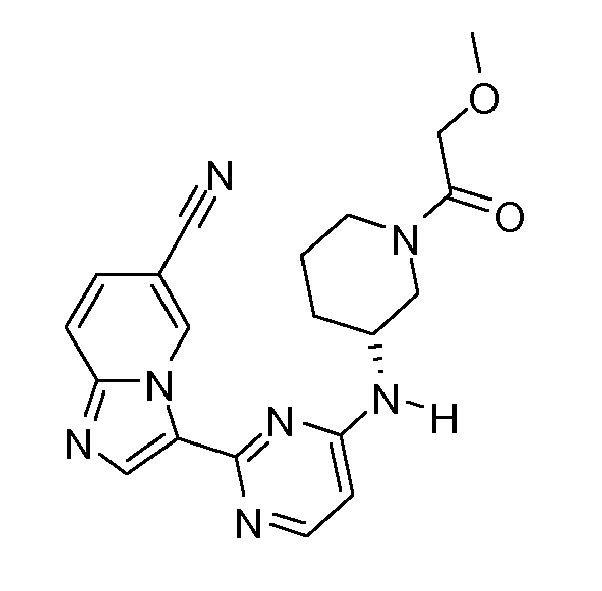
- Obtained as an off white solid (57%) from 3-{4-[(3R)-piperidin-3-ylamino]pyrimidin-2-yl}imidazo[1,2-a]pyridine-6-carbonitrile (preparation 5b) and 2-methoxyacetic acid following the experimental procedure as described in example 48. The crude product was purified by reverse phase chromatography (C-18 silica from Waters, water/acetonitrile/methanol as eluents [0.1% v/v formic acid buffered] 0% to 100%).
LRMS (m/z): 392 (M+1)+.
1H-NMR δ (CDCl3): 1.57 (s, 3H), 2.19 - 1.60 (m, 4H), 2.92 (d, 1 H), 3.43 (s, 2H), 4.14 (d, 2H), 5.54 - 4.96 (m, 1 H), 6.30 (s, 1 H), 7.39 (d, 1 H), 7.77 (d, 1 H), 8.28 (d, 1 H), 8.59 (s, 1 H), 10.52 (s, 1 H). -

- Obtained as an off white solid (23%) from 3-{4-[(3R)-piperidin-3-ylamino]pyrimidin-2-yl}imidazo[1,2-a]pyridine-6-carbonitrile (preparation 5b) and 3-hydroxy-3-methyl butanoic acid following the experimental procedure as described in example 48. The crude product was purified by reverse phase chromatography (C-18 silica from Waters, water/acetonitrile/methanol as eluents [0.1 % v/v formic acid buffered] 0% to 100%).
LRMS (m/z): 420 (M+1)+.
1H-NMR δ (CDCl3): 1.33 (d, 6H), 1.65 - 1.97 (m, 4H), 2.14 (bs, 1 H), 2.55 (s, 2H), 3.31 - 3.96 (m, 2H), 5.04 - 5.18 (m, 2H), 6.29 (d, 1 H), 7.40 (d, 1 H), 7.80 (t, 1 H), 8.30 (d, 1 H), 8.56 (s, 1 H), 8.62 (s, 1 H), 10.54 (s, 1 H) -

- Obtained as an off white solid from 3-{4-[(3R)-piperidin-3-ylamino]pyrimidin-2-yl}imidazo[1,2-a]pyridine-6-carbonitrile (preparation 5b) and 3,3-dimethylbutanoic acid following the experimental procedure as described in example 48. The crude product was purified by reverse phase chromatography (C-18 silica from Waters, water/acetonitrile/methanol as eluents [0.1% v/v formic acid buffered] 0% to 100%).
LRMS (m/z): 418 (M+1)+.
1H-NMR δ (CDCl3): 0.99 (s, 9H), 1.71 (bs, 2H), 1.84 (bs, 2H), 2.13 (bs, 2H), 3.38 (bs, 1 H), 3.65 (bs, 2H), 3.96 (bs, 2H), 5.14 - 5.24 (m, 1 H), 6.26 (d, 1 H), 6.29 - 6.40 (m, 1 H), 7.41 (t, 1 H), 7.79 (s, 1 H), 8.23 - 8.35 (m, 1 H), 8.61 (s, 1 H) -

- Triethylamine (0.15 mL, 1.1 mmol) and 1,1'-carbonyldiimidazole (0.228 g, 1.4 mmol) were added to a stirred solution of 2-(1 H-imidazol-4-yl)acetic acid (0.120 g, 0.95 mmol) in N,N'-dimethylformamide (2mL). After stirring for 20 minutes at ambient temperature a solution of (R)-3-(4-(piperidin-3-ylamino)pyrimidin-2-yl)imidazo[1,2-a]pyridine-6-carbonitrile (preparation 5b, 0.150 g, 0.47 mmol) in N,N'-dimethylformamide (2mL) was added and the reaction mixture was stirred overnight. The solvent was removed under reduced pressure and the residue was purified by reverse phase chromatography (C-18 silica from Waters, water/acetonitrile/methanol as eluents [0.1 % v/v formic acid buffered] 0% to 100%) to give the title compound (0.064 g, 32%) as a solid.
LRMS (m/z): 428 (M+1)+.
1H-NMR δ (DMSO-d 6): 1.55 (bs, 1H), 1.73 (bs, 1H), 2.02 (bs, 2H), 2.52 - 2.66 (m, 1 H), 3.02 - 3.51 (m, 2H), 3.61 (d, 2H), 3.95 (d, 1 H), 4.67 (d, 1 H), 6.38 - 6.55 (m, 1 H), 6.87 (bs, 1H), 7.55 (s, 1 H), 7.69 (d, 1H), 7.90 (d, 1 H), 8.21 (s, 1H), 8.51 (s, 1 H), 8.63 (bs, 1 H), 10.45 (bs, 1 H) -

- Obtained as an off white solid (23%) from 3-{4-[(3)-piperidin-3-ylamino]pyrimidin-2-yl}imidazo[1,2-a]pyridine-6-carbonitrile (preparation 5b) and 5-cyanopyridine-2-carboxylic acid following the experimental procedure as described in example 48 with the exception that N,N'-dimethylformamide was used as the reaction solvent. The crude product was purified by reverse phase chromatography (C-18 silica from Waters, water/acetonitrile/methanol as eluents [0.1% v/v formic acid buffered] 0% to 100%).
LRMS (m/z): 450 (M+1)+.
1H-NMR δ (DMSO-d 6): 1.93 (m, 2H), 3.05 - 2.77 (m, 1H), 3.57 (d, 1H), 4.23 - 3.71 (m, 2H), 5.82 (s, 1 H), 6.51 (d, 1 H), 7.61 - 7.36 (m, 2H), 7.86 (dd, 2H), 8.60 - 8.07 (m, 2H), 10.51 (d, 1 H). -

- N-[(dimethylamino)(3H-[1,2,3]triazolo[4,5-b]pyridin-3-yloxy)methylene]-N-methyl-methanaminium hexafluorophosphate (0.060 g, 0.16 mmol) and diisopropylethylamine (0.028 mL, 0.16 mmol) were added to a stirred solution of 3,3,3-trifluoropropanoic acid (0.015 mL, 0.17 mmol) in N,N'-dimethylformamide (2 mL). The mixture was stirred for 10 minutes at ambient temperature and then 3-{4-[(3R)-piperidin-3-ylamino]pyrimidin-2-yl}imidazo[1,2-a]pyridine-6-carbonitrile (preparation 5b, 0.050 g, 0.16 mmol) was added. The mixture was stirred overnight and then was partitioned between water and dichloromethane. The organic layer was washed with water, brine, dried (MgSO4) and evaporated and the residue was purified by flash chromatography (98:2 to 96:4 dichloromethane/methanol) to give the title compound (0.040 g, 60%) as a white solid.
LRMS (m/z): 430 (M+1)+.
1H-NMR δ (CDCl3): 1.47 - 1.07 (m, 2H), 1.82 (d, 2H), 2.16 (s, 1 H), 3.38 (dt, 2H), 3.93 - 3.54 (m, 1 H), 5.00 (d, 1 H), 6.30 (s, 1 H), 7.40 (d, 1 H), 7.77 (d, 1 H), 8.30 (s, 1 H), 8.58 (d, 1 H), 10.52 (s, 1 H). -

- Triethylamine (0.019 mL, 0.14 mmol) and dimethylcarbamic chloride (0.017 mL, 0.18 mmol) were added to a stirred solution of 3-{4-[(3R)-piperidin-3-ylamino]pyrimidin-2-yl}imidazo[1,2-a]pyridine-6-carbonitrile (preparation 5b, 0.040 g, 0.13 mmol) in dichloromethane (1 mL). The mixture was stirred at ambient temperature for 2 hours then the mixture was diluted with dichloromethane and washed with water, brine, dried (MgSO4) and evaporated. The solid was dissolved in 2M aqueous hydrochloric acid and washed with ethyl acetate. The aqueous layer was basified with 2M aqueous sodium hydroxide solution and the product was extracted into dichloromethane. The organic layer was dried (MgSO4) and evaporated to obtain the title compound (0.032 g, 65%) as a pale yellow solid.
LRMS (m/z): 391 (M+1)+.
1H-NMR δ (CDCl3): 1.61 (bs, 1H), 1.85 (d, 1H), 2.89 (s, 6H), 3.31 (bs, 4H), 6.34 (bs, 1 H), 7.43 - 7.32 (m, 1 H), 7.77 (d, 1 H), 8.20 (s, 1 H), 8.58 (s, 1 H), 10.59 (s, 1 H). -

- A solution of 1-((2S,4S)-2-cyano-4-fluoropyrrolidine-1-carbonyl)-3-methyl-1H-imidazol-3-ium iodide (preparation 36, 0.100 g, 0.29 mmol), (R)-3-(4-(piperidin-3-ylamino)pyrimidin-2-yl)imidazo[1,2-a]pyridine-6-carbonitrile (preparation 5b, 94 mg, 0.29 mmol) and triethylamine (0.075 mL, 0.54 mmol) in a mixture of dichloromethane (2 mL) and N,N'-dimethylformamide (1 mL) was stirred at ambient temperature overnight. The solvent was removed under reduced pressure and the residue was purified by reverse phase chromatography (C-18 silica from Waters, water/acetonitrile/methanol as eluents [0.1% v/v formic acid buffered] 0% to 100%) to obtain the title compound (0.022 g, 17%) as a solid.
LRMS (m/z): 460 (M+1)+.
1H-NMR δ (CDCl3): 1.62 - 2.13 (m, 4H), 2.24 - 2.44 (m, 1 H), 2.56 (bs, 1 H), 3.29 (bs, 1 H), 3.55 (bs, 1 H), 3.66 - 3.95 (m, 3H), 5.09 (bs, 1 H), 5.21 - 5.43 (m, 2H), 6.36 (bs, 1 H), 7.40 (d, 1 H), 7.76 (d, 1 H), 8.25 (bs, 1 H), 8.56 (s, 1 H), 10.53 (s, 1 H) -

- Triethylamine (0.020 mL, 0.14 mmol) and 6-chloronicotinonitrile (0.050 g, 0.37 mmol) were added to a stirred solution of 3-{4-[(3R)-piperidin-3-ylamino]pyrimidin-2-yl}imidazo[1,2-a]pyridine-6-carbonitrile (preparation 5b, 0.045 g, 0.14 mmol) in dichloromethane (2mL). The mixture was heated to 50 °C in a sealed tube and stirred overnight. The mixture was partitioned between dichloromethane and water and the organic layer was washed with water, brine, dried (MgSO4) and evaporated. The residue was purified by flash chromatography (98:2 dichloromethane/methanol) to give a solid that was dissolved in 2M aqueous hydrochloric acid (2.0 mL) and washed with ethyl acetate. The aqueous layer was basified with 2M aqueous sodium hydroxide solution and the product was extracted with dichloromethane. The organic layer was dried (MgSO4) and evaporated to obtain the title compound (0.018 g, 30%) as a white solid.
LRMS (m/z): 422 (M+1)+.
1H-NMR δ (CDCl3): 2.26 - 1.65 (m, 4H), 3.48 - 3.27 (m, 2H), 3.99 (dt, 2H), 4.51 (d, 1 H), 5.12 (s, 1 H), 6.31 (bs, 1 H), 6.69 (d, 1H), 7.41 (dd, 1 H), 7.63 (dd, 1 H), 7.81 (d, 1 H), 8.30 (d, 1 H), 8.41 (d, 1 H), 8.62 (s, 1 H), 10.54 (s, 1 H). -

- 3,4-Difluorobenzonitrile (0.022 g, 0.16 mmol) and potassium carbonate (0.025 g, 0.18 mmol) were added to a stirred solution of 3-{4-[(3R)-piperidin-3-yiamino]pyrimidin-2-yl}imidazo[1,2-a]pyridine-6-carbonitrile (preparation 5b, 0.040 g, 0.13 mmol) in N,N'-dimethylformamide (1 mL). The mixture was heated to 80 °C in a sealed tube and stirred overnight. The mixture was evaporated and the residue was purified by flash chromatography (98:2 dichloromethane/methanol) and the solid obtained was triturated with diethyl ether to give the title compound (0.020 g, 36%) as a white solid.
LRMS (m/z): 439 (M+1)+.
1H-NMR δ (CDCl3) 2.06 - 1.79 (m, 4H), 3.21 (bs, 3H), 3.56 - 3.45 (m, 2H), 5.38 (s, 1 H), 6.31 (d, 1 H), 7.01 (t, 3H), 7.34 - 7.28 (m, 1 H), 7.44 - 7.36 (m, 2H), 7.79 (d, 1 H), 8.29 (d, 1 H), 8.60 (s, 1 H), 10.56 (s, 1 H). -

- 3-[(2,5-Dioxopyrrolidin-1-yl)oxy]-3-oxopropanenitrile (prepared as described in
BE875054(A1
LRMS (m/z): 401 (M+1)+.
1H-NMR δ (CDCl3) 1.90 (bs, 2H), 2.07 (bs, 2H), 2.73 (bs, 1 H), 3.05 (bs, 3H), 3.11 - 3.24 (m, 1 H), 3.68 (bs, 2H), 3.78 (bs, 1 H), 4.74 (bs, 2H), 6.38 (bs, 1 H), 7.39 (bs, 1 H), 7.78 (bs, 1 H), 8.35 (bs, 1 H), 8.64 (bs, 1 H), 10.43 (bs, 1 H) -

- Obtained as a off white solid (62%) from 3-{4-[(3S)-piperidin-3-ylamino]pyrimidin-2-yl}imidazo[1,2-a]pyridine-6-carbonitrile (preparation 7b) and 3-[(2,5-dioxopyrrolidin-1-yl)oxy]-3-oxopropanenitrile (prepared as described in
BE875054(A1
LRMS (m/z): 387 (M+1)+.
1H-NMR δ (DMSO-d 6): 4.11 (s, 2H), 4.72 (d, 1 H), 6.49 (d, 1 H), 7.75 (d, 2H), 7.96 (d, 1 H), 8.29 (s, 1 H), 8.66 (s, 1 H), 10.50 (s, 1 H). -

- Obtained as a white solid (26%) from 3-(4-hydroxypyrimidin-2-yl)imidazo[1,2-a]pyridine-6-carbonitrile (preparation 4b) and cis-3-(3-amino-4-methylpiperidin-1-yl)-3-oxopropanenitrile (preparation 34d) following the experimental procedure as described in preparation 5a followed by heating the reaction to 40 °C for 48 hours. After the reaction was complete the mixture was partitioned between water and ethyl acetate. The organic layer was washed with water, saturated aqueous sodium hydrogen carbonate solution, brine, dried (MgSO4) and evaporated and the residue was purified by reverse phase chromatography (C-18 silica from Waters, water/acetonitrile/ methanol as eluents [0.1 % v/v formic acid buffered] 0% to 100%).
LRMS (m/z): 401 (M+1)+.
1H-NMR δ (CDCl3):1.07 (t, 3H), 2.26 - 2.11 (m, 1 H), 3.31 (d, 2H), 3.58 (d, 1 H), 4.01 (d, 1 H), 4.43 (d, 1 H), 4.63 (d, 1 H), 5.06 - 4.93 (m, 1 H), 6.35 (dd, 1 H), 7.49 - 7.35 (m, 1 H), 7.80 (dd, 1 H), 8.29 (dd, 1 H), 8.57 (s, 1 H), 10.56 (d, 1 H). -

- Obtained as a pale yellow solid (44%) from 3-(4-hydroxypyrimidin-2-yl)imidazo[1,2-a]pyridine-6-carbonitrile (preparation 4b) and cis-1-(ethylsulfonyl)-4-methylpiperidin-3-amine (preparation 35b) following the experimental procedure as described in preparation 5a followed by heating the reaction to 45 °C for 18 hours. After the reaction was complete the mixture was partitioned between water and ethyl acetate. The organic layer was washed with water, saturated aqueous sodium hydrogen carbonate solution, brine, dried (MgSO4) and evaporated and the residue was purified by flash chromatography (98:2 dichloromethane/methanol).
LRMS (m/z): 426 (M+1)+.
1H-NMR δ (CDCl3): 1.04 (d, 3H), 1.38 (t, 3H), 1.75 - 1.52 (bs, 2H), 2.08 - 1.83 (m, 2H), 3.17 - 2.81 (m, 4H), 3.89 (d, 2H), 4.61 (s, 1 H), 5.48 (d, 1 H), 6.35 (d, 1 H), 7.40 (dd, 1 H), 7.77 (d, 1 H), 8.22 (d, 1 H), 8.55 (s, 1 H), 10.54 (s, 1 H). -

- Obtained as a pale yellow solid (31%) from 3-(4-hydroxypyrimidin-2-yl)imidazo[1,2-a]pyridine-6-carbonitrile (preparation 4b) and 1-(ethylsulfonyl)-N,3-dimethylpiperidin-4-amine (preparation 33d) following the experimental procedure as described in preparation 5a followed by heating the reaction to 50 °C for 96 hours. The crude product was purified by flash chromatography (97:3 dichloromethane/methanol) and triturated with methanol to give the pure title compound.
LRMS (m/z): 440 (M+1)+.
1H-NMR δ (DMSO-d 6): 1.03 (d, 3H), 1.24 (bs, 3H), 1.72 (bs, 2H), 1.91 - 2.05 (m,1 H), 2.51 (bs, 3H), 3.10 - 3.21 (m, 1 H), 3.23 - 3.36 (m, 4H), 3.40 - 3.40 (m, 2H), 7.86 - 7.93 (m, 1 H), 8.00 - 8.07 (m, 1 H), 8.41 (d, 1 H), 8.85 (bs, 1 H), 10.19 (bs, 1 H) -

- Obtained as an off white solid (98%) from 2-(6-fluoroimidazo[1,2-a]pyridin-3-yl)-N-(piperidin-3-yl)pyrimidin-4-amine (preparation 9b) and 3-[(2,5-dioxopyrrolidin-1-yl)oxy]-3-oxopropanenitrile (prepared as described in
BE875054(A1
LRMS (m/z): 380 (M+1)+.
1H-NMR δ (CDCl3): 1.80 (bs, 3H), 1.97 (bs, 1 H), 2.16 (bs, 2H), 3.57 (s, 2H), 3.67 (bs, 2H), 5.00 (s, 1 H), 6.28 (dd, 1 H), 7.30 - 7.19 (m, 1 H), 7.69 (td, 1 H), 8.29 (t, 1 H), 8.48 (s, 1 H), 8.55 (s, 1 H), 9.96 (ddd, 1 H). -

- Obtained as a white solid (76%) from (R)-2-(6-fluoroimidazo[1,2-a]pyridin-3-yl)-N-(piperidin-3-yl)pyrimidin-4-amine (preparation 9b) and 1-cyanocyclopropanecarboxylic acid following the experimental procedure as described in example 48. The crude product was purified by flash chromatography (100:8 dichloromethane/methanol).
LRMS (m/z): 406 (M+1)+.
1H-NMR δ (CDCl3): 1.56 (s, 3H), 1.90 (dd, 2H), 2.19 (d, 2H), 4.34 - 4.16 (m, 2H), 4.96 (s, 1 H), 6.28 (s, 1 H), 7.23 (dd, 1 H), 7.68 (dd, 1 H), 8.29 (d, 1 H), 8.55 (s, 1H), 9.96 (d,1H). -

- Obtained as a white solid (59%) from (R)-2-(6-fluoroimidazo[1,2-a]pyridin-3-yl)-N-(piperidin-3-yl)pyrimidin-4-amine (preparation 9b) and 3,3,3-trifluoropropanoic acid following the experimental procedure as described in example 54. The crude product was purified by reverse phase chromatography (C-18 silica from Waters, water/acetonitrile/methanol as eluents [0.1% v/v formic acid buffered] 0% to 100%).
LRMS (m/z): 423 (M+1)+.
1H-NMR δ (CDCl3): 1.25 (s, 2H), 1.73 (bs, 2H), 1.90 (bs, 2H), 2.15 (bs, 2H), 3.42 (bs, 2H), 6.22 (d, 1 H), 6.27 (d, 1 H), 7.25 - 7.19 (m, 1 H), 7.68 (td, 1 H), 8.29 (t, 1 H), 8.49 (s, 1 H), 8.53 (s, 1 H), 9.97 (s, 1 H). -

- Obtained as a solid (33%) from (R)-2-(6-fluoroimidazo[1,2-a]pyridin-3-yl)-N-(piperidin-3-yl)pyrimidin-4-amine (preparation 9b) and 1H-pyrazole-4-carboxylic acid following the experimental procedure as described in example 52. The crude product was purified by reverse phase chromatography (C-18 silica from Waters, water/acetonitrile/methanol as eluents [0.1 % v/v formic acid buffered] 0% to 100%).
LRMS (m/z): 407 (M+1)+.
1H-NMR δ (CDCl3): 2.65 (d, 4H), 3.21 - 3.24 (m, 2H), 3.50 (d, 2H), 3.79 (d, 2H), 6.27 (d, 1 H), 7.00 (bs, 1 H), 7.23 - 7.29 (m, 1 H), 7.71 (dd, 1 H), 7.91 (s, 1 H), 8.28 (d, 1 H), 8.47 (s, 1 H), 9.97 (dd, 1 H) -

- Obtained as a solid (33%) from (R)-2-(6-fluoroimidazo[1,2-a]pyridin-3-yl)-N-(piperidin-3-yl)pyrimidin-4-amine (preparation 9b) and 1-((cyanomethyl)(methyl)carbamoyl)-3-methyl-1H-imidazol-3-ium iodide (preparation 37b) following the experimental procedure as described in example 56. The crude product was purified by reverse phase chromatography (C-18 silica from Waters, water/acetonitrile/methanol as eluents [0.1 % v/v formic acid buffered] 0% to 100%).
LRMS (m/z): 409 (M+1)+.
1H-NMR δ (CDCl3): 1.67 (bs, 1 H), 1.83 (bs, 1 H), 2.01 (bs, 1 H), 2.26 (bs, 2H), 3.00 (s, 3H), 3.30 (bs, 1 H), 3.44 (bs, 2H), 3.66 (bs, 1 H), 3.96 - 4.17 (m, 2H), - 5.75 (bs, 1 H), 6.28 (bs, 1 H), 7.18 - 7.32 (m, 1 H), 7.71 (dd, 1 H), 8.26 (bs, 1 H), 8.50 (s, 1 H), 10.00 (dd, 1 H)
-

- Concentrated aqueous ammonium hydroxide solution (0.01 mL) was added to a stirred solution of (R)-2,5-dioxopyrrolidin-1-yl 2-(3-(2-(6-fluoroimidazo[1,2-a]pyridin-3-yl) pyrimidin-4-ylamino)piperidin-1-yl)-2-methylpropanoate (preparation 10c) in 1,4-dioxane (1 mL) and the mixture was stirred at ambient temperature overnight. The reaction mixture was diluted with water and acidified with 2M aqueous hydrochloric acid and extracted with dichloromethane. The organic phase was washed with 4% aqueous sodium hydrogen carbonate solution and brine. The aqueous phase was extracted with further dichloromethane and the combined organic phase was dried (MgSO4), evaporated and the residue was purified by reverse phase chromatography (C-18 silica from Waters, water/acetonitrile/methanol as eluents [0.1% v/v formic acid buffered] 0% to 100%) to obtain the title compound (0.009 g, 33%) as a solid.
LRMS (m/z): 398 (M+1)+.
1H-NMR δ (CDCl3): 1.15 (d, 6H), 1.90 (bs, 4H), 2.01 - 2.14 (m, 2H), 2.28 - 2.45 (m, 2H), 2.74 (bs, 1 H), 3.76 - 3.87 (m, 2H), 5.53 (bs, 1 H), 6.20 (d, 1 H), 7.27 (dd, 1 H), 7.72 (dd, 1 H), 8.26 (bs, 1 H), 8.52 (s, 1 H), 10.01 (dd, 1 H) -
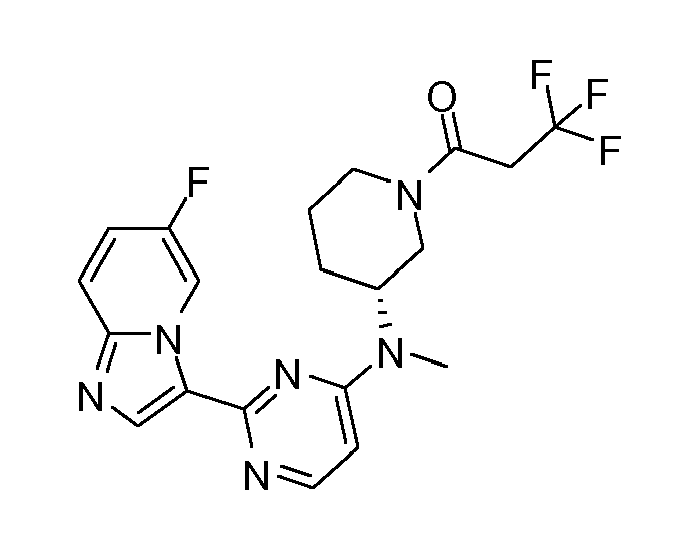
- Obtained as a white solid (83%) from (R)-2-(6-fluoroimidazo[1,2-a]pyridin-3-yl)-N-methyl-N-(piperidin-3-yl)pyrimidin-4-amine (preparation 11b) and 3,3,3-trifluoro propanoic acid following the experimental procedure as described in example 54. The crude product was purified by flash chromatography (0-5% methanol in dichloromethane).
LRMS (m/z): 437 (M+1)+.
1H-NMR δ (CDCl3): 1.83 - 2.14 (m, 4H), 3.05 (s, 2H), 3.07 (s, 3H), 3.12 - 3.41 (m, 3H), 3.78 (bs, 2H), 6.36 (t, 1 H), 7.24 (dd, 1 H), 7.70 (dt, 1 H), 8.30 - 8.40 (m, 1 H), 8.53 (s, 1 H), 9.91 (dd, 1 H) -

BE875054(A1
LRMS (m/z): 394 (M+1)+.
1H-NMR δ (CDCl3): 1.71 - 2.14 (m, 4H), 2.57 - 2.68 (m, 1 H), 2.80 (s, 3H), 3.06 (s, 2H), 3.13 - 3.35 (m, 2H), 3.71 - 3.86 (m, 2H), 4.62 - 4.75 (m, 1 H), 6.37 (dd, 1 H), 7.24 (dt, 1 H), 7.68 (dt, 1 H), 8.31 - 8.40 (m, 1 H), 8.54 (s, 1 H), 9.86 (dd, 1 H) -
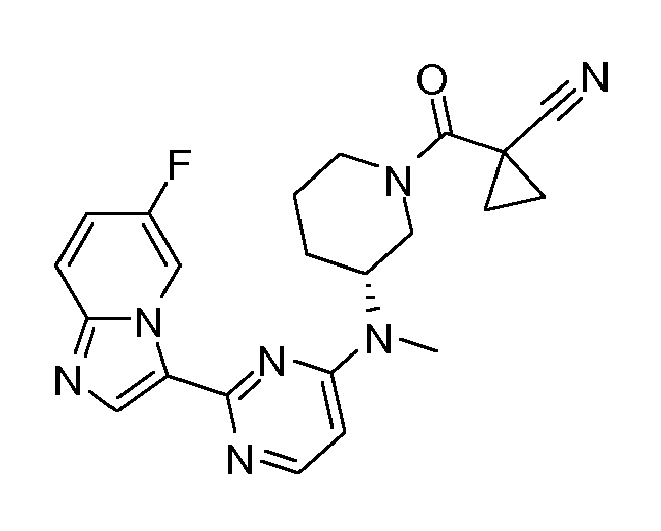
- Obtained as a white solid (47%) from (R)-2-(6-fluoroimidazo[1,2-a]pyridin-3-yl)-N-methyl-N-(piperidin-3-yl)pyrimidin-4-amine (preparation 11b) and 1-cyanocyclopropane carboxylic acid following the experimental procedure as described in example 48. The crude product was purified by flash chromatography (0-8% methanol in dichloromethane) followed by trituration with diethyl ether.
LRMS (m/z): 420 (M+1)+.
1H-NMR δ (CDCl3): 1.55 (bs, 4H), 1.90 - 2.14 (m, 4H), 2.80 - 2.94 (m, 1 H), 3.08 (s, 3H), 3.15 - 3.31 (m, 2H), 4.53 (d, 2H), 6.39 (bs, 1 H), 7.23 (dd, 1 H), 7.68 (dd, 1 H), 8.33 (d, 1 H), 8.51 (bs, 1 H), 9.91 (bs, 1 H) -
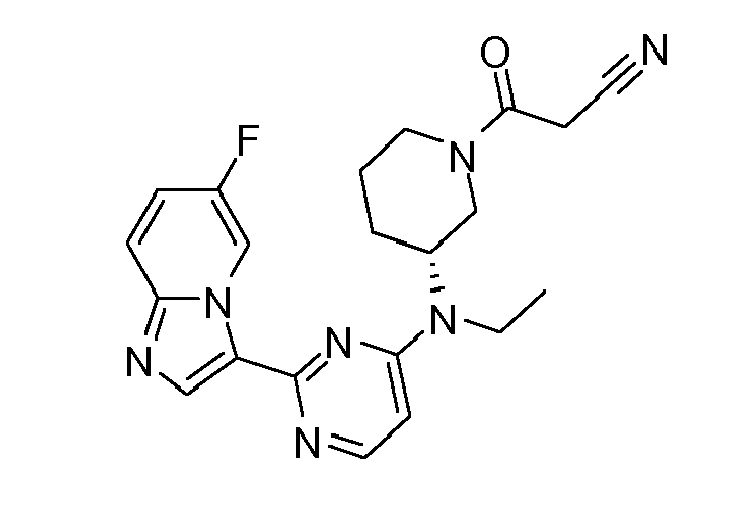
- Obtained as a white solid (77%) from N-ethyl-2-(6-fluoroimidazo[1,2-a]pyridin-3-yl)-N-[(3R)-piperidin-3-yl]pyrimidin-4-amine (preparation 12b) and 3-[(2,5-dioxopyrrolidin-1-yl)oxy]-3-oxopropanenitrile (prepared as described in
BE875054(A1
LRMS (m/z): 408 (M+1)+.
1H-NMR δ (CDCl3): 1.30 (bs, 3H), 1.77 (bs, 2H), 2.02 (bs, 2H), 2.84 (d, 1 H), 3.18 (bs, 2H), 3.39 - 3.59 (m, 4H), 3.79 (bs, 1 H), 4.72 (bs, 1 H), 6.33 (bs, 1 H), 7.23 (bs, 1 H), 7.68 (bs, 1 H), 8.32 (bs, 1 H), 8.37 - 8.55 (m, 1 H), 9.80 - 10.01 (m, 1 H) -

- Obtained as a solid (52%) from N-ethyl-2-(6-fluoroimidazo[1,2-a]pyridin-3-yl)-N-[(3R)-piperidin-3-yl]pyrimidin-4-amine (preparation 12b) and 3,3,3-trifluoropropanoic acid following the experimental procedure as described in example 54. The crude product was purified by flash chromatography (92:8 dichloromethane/methanol).
LRMS (m/z): 451 (M+1)+.
1H-NMR δ (CDCl3): 1.30 (t, 3H), 1.92 - 2.18 (m, 2H), 2.51 - 2.66 (m, 1 H), 2.82 (bs, 1 H), 3.14 (s, 2H), 3.19 - 3.28 (m, 1 H), 3.32 (q, 2H), 3.51 (bs, 2H), 3.74 - 3.92 (m, 1 H), 4.79 (t, 1 H), 6.34 (d, 1 H), 7.23 (d, 1 H), 7.68 (dt, 1 H), 8.29 - 8.36 (m, 1 H), 8.42 - 8.54 (m, 1 H), 9.88 - 9.99 (m, 1 H) -

- Obtained as a white solid (77%) from N-(cyclopropylmethyl)-2-(6-fluoroimidazo[1,2-a]pyridin-3-yl)-N-[(3R)-piperidin-3-yl]pyrimidin-4-amine (preparation 13b) and 3-[(2,5-dioxopyrrolidin-1-yl)oxy]-3-oxopropanenitrile (prepared as described in
BE875054(A1
LRMS (m/z): 434 (M+1)+.
1H-NMR δ (CDCl3): 0.39 (bs, 2H), 0.67 (s, 2H), 1.08 (bs, 1 H), 1.95 - 2.18 (m, 4H), 2.97 (bs, 1 H), 3.14 - 3.36 (m, 2H), 3.21 (s, 2H), 3.57 (s, 2H), 3.79 (bs, 1 H), 4.66 - 4.85 (m, 1 H), 6.48 (dd, 1 H), 7.18 - 7.30 (m, 1 H), 7.68 (dd, 1 H), 8.27 - 8.38 (m, 1 H), 8.51 (s, 1 H), 9.92 (dd, 1 H) -

- Obtained as a white solid (75%) from N-(cyclopropylmethyl)-2-(6-fluoroimidazo[1,2-a]pyridin-3-yl)-N-[(3R)-piperidin-3-yl]pyrimidin-4-amine (preparation 13b) and 3,3,3-trifluoropropanoic acid following the experimental procedure as described in example 54.
LRMS (m/z): 477 (M+1)+.
1H-NMR δ (CDCl3): 0.38 (d, 2H), 0.65 (d, 2H), 1.11 (bs, 1 H), 1.46 (d, 2H), 1.92 - 2.19 (m, 2H), 2.92 (bs, 1 H), 3.09 - 3.28 (m, 3H), 3.47 (bs, 2H), 3.86 (bs, 1 H), 4.72 - 4.91 (m, 2H), 6.47 (t, 1 H), 7.24 (dd, 1 H), 7.68 (dd, 1 H), 8.27 - 8.38 (m, 1H), 8.51 (s, 1 H), 9.97 (ddd, 1 H) -

- Obtained as a white solid (67%) from (R)-5-fluoro-2-(6-fluoroimidazo[1,2-a]pyridin-3-yl)-N-(piperidin-3-yl)pyrimidin-4-amine (preparation 17b) and 3-[(2,5-dioxopyrrolidin-1-yl)oxy]-3-oxopropanenitrile (prepared as described in
BE875054(A1
LRMS (m/z): 398 (M+1)+.
1H-NMR δ (CDCl3): 1.73 - 2.00 (m, 2H), 2.21 (bs, 2H), 3.29 - 3.39 (m, 1 H), 3.45 (s, 2H), 3.48 - 3.68 (m, 2H), 4.24 - 4.41 (m, 2H), 5.18 (bs, 1 H), 7.68 (ddd, 1 H), 8.16 (d, 1 H), 8.40 (s, 1 H), 8.51 (s, 1 H), 9.80 - 9.91 (m, 1 H) -

- Obtained as a white solid (63%) from (R)-5-fluoro-2-(6-fluoroimidazo[1,2-a]pyridin-3-yl)-N-(piperidin-3-yl)pyrimidin-4-amine (preparation 17b) and 3,3,3-trifluoropropanoic acid following the experimental procedure as described in example 54. The crude product was purified by flash chromatography (0-8% methanol in dichloromethane).
LRMS (m/z): 441 (M+1)+.
1H-NMR δ (CDCl3): 1.69 - 2.01 (m, 3H), 2.18 (bs, 1 H), 3.16 - 3.27 (m, 1 H), 3.19 - 3.46 (m, 2H), 3.48 (d, 1 H), 3.54 - 3.65 (m, 1 H), 3.89 - 4.23 (m, 1 H), 4.26 - 4.37 (m, 1 H), 5.04 - 5.27 (m, 1 H), 7.25 (ddd, 1 H), 7.69 (td, 1 H), 8.16 (dd, 1 H), 8.37 - 8.54 (m, 1 H), 9.87 (ddd, 1 H) -

- Obtained as a white solid (66%) from 2-(6-fluoroimidazo[1,2-a]pyridin-3-yl)-5-methyl-N-[(3R)-piperidin-3-yl]pyrimidin-4-amine (preparation 20b) and 3-[(2,5-dioxopyrrolidin-1-yl)oxy]-3-oxopropanenitrile (prepared as described in
BE875054(A1
LRMS (m/z): 394 (M+1)+.
1H-NMR δ (CDCl3): 1.82 (bs, 2H), 2.09 (bs, 5H), 3.40 (bs, 2H), 3.72 - 3.88 (m, 1 H), 4.17 (d, 1 H), 4.34 (bs, 2H), 4.53 - 4.82 (m, 1 H), 5.30 (s, 1 H), 7.22 (bs, 1 H), 7.67 (bs, 1 H), 8.04 - 8.18 (m, 1 H), 8.39 - 8.56 (m, 1H), 9.95 (d, 1 H) -

- Obtained as a white solid (59%) from 2-(6-fluoroimidazo[1,2-a]pyridin-3-yl)-5-methyl-N-[(3R)-piperidin-3-yl]pyrimidin-4-amine (preparation 20b) and 3,3,3-trifluoropropanoic acid following the experimental procedure as described in example 54. The crude product was purified by flash chromatography (0-8% methanol in dichloromethane).
LRMS (m/z): 437 (M+1)+.
1H-NMR δ (CDCl3): 1.68 (s, 3H), 1.77 (bs, 1 H), 1.86 (bs, 2H), 2.07 (d, 2H), 2.19 (bs, 1 H), 3.12 - 3.23 (m, 1 H), 3.62 (bs, 1 H), 3.74 - 3.94 (m, 2H), 4.39 (bs, 1 H), 4.99 (d, 1 H), 7.16 - 7.26 (m, 1 H), 7.62 - 7.73 (m, 1 H), 8.11 (s, 1 H), 8.41 - 8.54 (m, 1 H), 8.48 (s, 1 H), 9.96 (bs, 1 H) -
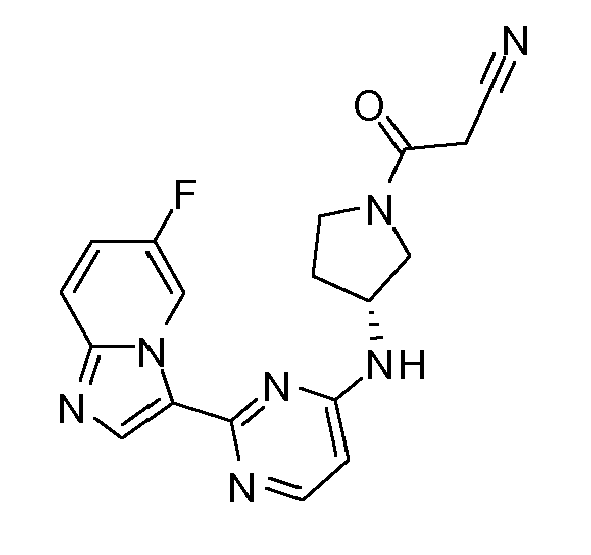
- Obtained as a white solid (15%) from (R)-2-(6-fluoroimidazo[1,2-a]pyridin-3-yl)-N-(pyrrolidin-3-yl)pyrimidin-4-amine (preparation 21 b) and 3-[(2,5-dioxopyrrolidin-1-yl)oxy]-3-oxopropanenitrile (prepared as described in
BE875054(A1
LRMS (m/z): 366 (M+1)+.
1H-NMR δ (CDCl3): 2.03 - 2.17 (m, 1 H), 2.28 - 2.52 (m, 2H), 3.50 (s, 2H), 3.63 - 3.79 (m, 2H), 3.81 - 3.89 (m, 1 H), 3.95 - 4.02 (m, 1 H), 6.26 (dd, 1 H), 7.20 - 7.31 (m, 1 H), 7.69 (ddd, 1 H), 8.28 (d, 1 H), 8.51 (d, 1 H), 9.98 (dd, 1 H) -

- Obtained as a white solid (5%) from 3-(4-(1,4-diazepan-1-yl)pyrimidin-2-yl)imidazo[1,2-a]pyridine-6-carbonitrile (preparation 22b) and 3-[(2,5-dioxopyrrolidin-1-yl)oxy]-3-oxopropanenitrile (prepared as described in
BE875054(A1
LRMS (m/z): 387 (M+1)+.
1H-NMR δ (CDCl3): 1.22 - 1.40 (m, 2H), 3.41 (s, 2H), 3.46 - 3.58 (m, 2H), 3.60 (bs, 2H), 3.65 - 3.94 (m, 2H), 4.26 - 4.38 (m, 2H), 6.41 (dd, 1 H), 7.42 (ddd, 1 H), 7.79 (dd, 1 H), 8.35 (t, 1 H), 8.55 (d, 1 H), 10.55 (d, 1 H) -

- Obtained as a solid (68%) from 5-chloro-2-(6-fluoroimidazo[1,2-a]pyridin-3-yl)-N-[(3R)-piperidin-3-yl]pyrimidin-4-amine (preparation 43b) and 3-[(2,5-dioxopyrrolidin-1-yl)oxy]-3-oxopropanenitrile (prepared as described in
BE875054(A1
LRMS (m/z): 414 (M+1)+.
1H NMR δ (CDCl3): ppm 1.71 - 2.03 (m, 2H), 2.20 (dd, 1 H), 3.29 - 3.52 (m, 2H), 3.57 (s, 2H), 3.59 - 3.70 (m, 1 H), 3.80 - 3.94 (m, 1 H), 4.23 - 4.42 (m, 1 H), 5.33 - 5.49 (m, 1 H), 7.29 (dd, 1 H), 7.73 (dd, 1 H), 8.27 (s, 1 H), 8.56 (s, 1 H), 9.82 (dd, 1 H). -

- (R)-2-(6-fluoroimidazo[1,2-a]pyridin-3-yl)-N-(piperidin-3-yl)pyrimidin-4-amine (0.45 g, 1.44 mmol, preparation 9b) and 2-cyano-2-methylpropyl 4-methylbenzenesulfonate (0.18 g, 0.72 mmol, example 17b from
US2007/299111A1 ) were mixed and stirred at 125 °C for 42 hours. The mixture was dissolved in ethyl acetate and washed with 1 N sodium hydroxide and brine. The organic layer was dried and evaporated and the residue obtained was purified by reverse phase chromatography (C-18 silica from Waters, water/acetonitrile/methanol as eluents [0.1% v/v formic acid buffered] 0% to 100%) to give the title compound (3%) as a solid.
LRMS (m/z): 394 (M+1)+.
1H NMR δ (CDCl3): 1.34 (s, 3H), 1.39 (s, 3H), 1.81 (bs, 4H), 2.39 - 2.53 (m, 2H), 2.60 (bs, 2H), 2.80 (br. s., 2H), 2.92 (bs, 1 H), 5.67 (bs, 1 H), 6.24 (d, 1H), 7.23 (ddd, 1 H), 7.69 (dd, 1 H), 8.21 (bs, 1 H), 8.51 (s, 1 H), 10.00 (dd, 1 H). -

- Triethylamine (0.09 mL) followed by 2-bromoacetamide (0.049 g, 0.36 mmol) were added dropwise to a solution of (R)-2-(6-fluoroimidazo[1,2-a]pyridin-3-yl)-N-(piperidin-3-yl)pyrimidin-4-amine (0.1 g, 0.32 mmol, preparation 9b) in dichloromethane (5 mL). The mixture was stirred at ambient temperature for 18 hours. The solvent was removed under reduced pressure and the residue was purified by reverse phase chromatography (C-18 silica from Waters, water/acetonitrile/methanol as eluents [0.1 % v/v formic acid buffered] 0% to 100%) to obtain the title compound (61 %) as a solid.
LRMS (m/z): 370 (M+1)+.
1H NMR δ (DMSO-d 6): 1.46 (bs, 1 H), 1.62 (bs, 1 H), 1.71 - 1.89 (m, 2H), 2.36 (d, 2H), 2.83 (d, 1H), 3.17 (s, 2H), 4.28 (bs, 2H), 6.43 (d, 1H), 7.17 (bs, 1H), 7.37 (bs, 1 H), 7.52 (ddd, 1 H), 7.60 (d, 1 H), 7.81 (dd, 1 H), 8.29 (s, 1 H), 8.40 (s, 1 H), 9.97 (bs, 1 H). - Compounds were screened for their ability to inhibit JAK1, JAK2 and JAK3 ussing the assays as indicated below.
- The catalytic domains of human JAK1 (aa 850-1154), JAK2 (aa 826-1132), JAK3 (aa 795-1124) and Tyk2 (aa 871-1187) were expressed as N-terminal GST-fusion proteins using a baculovirus expression system and were purchased from Carna Bioscences. The enzymatic activity was assayed using as substrate a biotinylated peptide, poly (GT)-Biotin (CisBio). The peptide concentration in the reactions was 60 nM for JAK1, 20 nM for JAK2, 140 nM for JAK3 and 50 nM for Tyk2. The degree of phosphorylation was detected by TR-FRET (time-resolved fluorescence energy transfer).
- IC50s of compounds were measured for each kinase in a reaction mixture containing the enzyme, ATP and the peptide in 8 mM MOPS (pH 7.0), 10 mM MgCl2, 0.05% β-mercaptoethanol, 0.45 mg/mL BSA. The ATP concentration in the reactions was 3 µM for JAK1, 0.2 µM for JAK2, 0.6 µM for JAK3 and 1.8 µM for Tyk2. The enzymatic reactions took place for 30 minutes at room temperature. Then, the reactions were stopped with 20 µL of quench detection buffer (50 mM HEPES, 0.5 M KF, EDTA 0.25 M, 0.1% (w/v) BSA, pH 7.5) containing 0.115 µg/mL of anti-phosphoTyr (PT66)-Cryptate (CisBio) and a variable concentration of SA-XL665 (CisBio) to keep the SA-B ratio constant. Incubate for 3 h and read on Victor 2V spectrofluorometer (PerkinElmer) set to read fluorescence resonance energy transfer.
- Some of the acronyms used above have the following meaning:
- AA: aminoacids
- GST: glutathione-S-transferase
- MOPS: 3-(N-morpholino)propane sulfonic acid
- BSA: bovine serum albumin
- ATP: adenosine tri-phosphate
- EDTA: ethylenediaminetetraacetic acid
- HEPES: 4-(2-hydroxyethyl)-1-piperazineethanesulfonic acid
- Table 1 depicts IC50 values for certain exemplary compounds described in the invention. In Table 1, "A" represents an IC50 value of less than 0.1 µM (100 nM), "B" represents an IC50 value in the range of 0.1 µM (100 nM) to 1 µM, and C represents an IC50 value higher than 1 µM.
Table 1 Example No. IC50 JAK3 (µM) IC50 JAK2 (µM) IC50 JAK1 (µM) 1 A A B 6 B B c 13 B B C 21 A A B 22 A A C 31 B A B 38 B A C 42 C B C 57 A A C 64 A A A 67 B A B 68 A A B 76 B A C 82 C B C - The imidazopyridine derivatives of the invention may also be combined with other active compounds in the treatment of a pathological condition or disease susceptible to amelioration by inhibition of Janus Kinases.
- The combinations of the invention can optionally comprise one or more additional active substances which are known to be useful in the treatment of myeloproliferative disorders (such as polycythemia vera, essential thrombocythemia or mielofibrosis), leukemia, lymphoid malignancies and solid tumors; bone marrow and organ transplant rejection; and immune-mediated diseases, more in particular wherein the pathological condition or disease is selected from rheumatoid arthritis, multiple sclerosis, inflammatory bowel disease, dry eye, uveitis, allergic conjunctivitis, allergic rhinitis, asthma, chronic obstructive pulmonary disease (COPD), atopic dermatitis and psoriasis, such as (a) Dyhydrofolate reductase inhibitors, such as Methotrexate or CH-1504; (b) DHODH inhibitors such as leflunomide, teriflunomide, or the compounds described in the International Patent Application Nos.
WO2008/077639 andWO2009021696 ; (c) Immunomodulators such as Glatiramer acetate (Copaxone), Laquinimod or Imiquimod; (d) Inhibitors of DNA synthesis and repair, such as Mitoxantrone or Cladribine; (e) Anti-alpha 4 integrin antibodies, such as Natalizumab (Tysabri); (f) Alpha 4 integrin antagonists such as R-1295, TBC-4746, CDP-323, ELND-002, Firategrast or TMC-2003; (g) Corticoids and glucocorticoids such as prednisone or methylprednisolone, fluticasone, mometasone, or beta-metasone; (h) Fumaric acid esters, such as BG-12; (i) Anti-TNF alpha antibodies, such as Infliximab, Adalimumab, or Certolizumab pegol; (j) Soluble TNF alpha receptors such as Ethanercept; (k) Anti-CD20 monoclonal antibodies such as Rituximab, Ocrelizumab Ofatumumab or TRU-015; (I) Anti-CD52 such as alemtuzumab; (m) Anti-CD25 such as daclizumab; (n) Anti-CD88, such as eculizumab or pexilizumab; (o) Anti-IL12R /IL23R, such as ustekinumab; (p) Calcineurin inhibitors such as cyclosporine A or tacrolimus; (q) IMPDH inhibitors, such as mycophenolate mophetyl; (r) Cannabinoid receptor agonists such as Sativex; (s) Chemokine CCR1 antagonists such as MLN-3897 or PS-031291; (t) Chemokine CCR2 antagonists such as INCB-8696; (u) NF-kappaB activation inhibitors such as MLN-0415; (v) S1 P receptor agonists such as fingolimod, BAF-312, or ACT128800; (w) S1P liase inhibitors such as LX2931; (x) Syk inhibitors, such as R-112; (y) PKC inhibitors, such as NVP-AEB071; (z) M3 antagonist such as tiotropium or aclidinium; (aa) Long-acting beta adrenergic agonists such as salmeterol, formoterol or indacaterol; (bb) Vitamin D derivatives like calcipotriol (Daivonex); (cc) Phosphosdiesterase IV inhibitors such as roflumilast or GRC-4039; (dd) p38 Inhibitors such as ARRY-797; (ee) MEK inhibitors, such as ARRY-142886 or ARRY-438162; (ff) PI3Kδγ inhibitors; (gg) Interferons comprising Interferon beta 1 a such as Avonex from Biogen Idec, CinnoVex from CinnaGen and Rebif from EMD Serono, and Interferon beta 1 b such as Betaferon from Schering and Betaseron from Berlex; and (hh) Interferon alpha such as Sumiferon MP. - Specific examples of suitable corticoids and glucocorticoids that can be combined with the JAK inhibitors of the present invention are prednisolone, methylprednisolone, dexamethasone, dexamethasone cipecilate, naflocort, deflazacort, halopredone acetate, budesonide, beclomethasone dipropionate, hydrocortisone, triamcinolone acetonide, fluocinolone acetonide, fluocinonide, clocortolone pivalate, methylprednisolone aceponate, dexamethasone palmitoate, tipredane, hydrocortisone aceponate, prednicarbate, alclometasone dipropionate, halometasone, methylprednisolone suleptanate, mometasone furoate, rimexolone, prednisolone farnesylate, ciclesonide, butixocort propionate, RPR-106541, deprodone propionate, fluticasone propionate, fluticasone furoate, halobetasol propionate, loteprednol etabonate, betamethasone butyrate propionate, flunisolide, prednisone, dexamethasone sodium phosphate, triamcinolone, betamethasone 17-valerate, betamethasone, betamethasone dipropionate, hydrocortisone acetate, hydrocortisone sodium succinate, prednisolone sodium phosphate and hydrocortisone probutate.
- Specific examples of suitable Syk kinase inhibitors that can be combined with the JAK inhibitors of the present invention are fosfamatinib (from Rigel), R-348 (from Rigel), R-343 (from Rigel), R-112 (from Rigel), piceatannol, 2-(2-Aminoethylamino)-4-[3-(trifluoromethyl)phenylamino] pyrimidine-5-carboxamide, R-091 (from Rigel), 6-[5-Fluoro-2-(3,4,5-trimethoxyphenylamino)pyrimidin-4-ylamino]-2,2-dimethyl-3,4-dihydro-2H-pyrido[3,2-b][1,4]oxazin-3-one benzenesulfonate (R-406 from Rigel), 1-(2,4,6-Trihydroxyphenyl)-2-(4-methoxyphenyl)ethan-1-one, N-[4-[6-(Cyclobutylamino)-9H-purin-2-ylamino]phenyl]-N-methylacetamide (QAB-205 from Novartis), 2-[7-(3,4-Dimethoxyphenyl)imidazo[1,2-c]pyrimidin-5-ylamino]pyridine-3-carboxamide dihydrochloride (BAY-61-3606 from Bayer) and AVE-0950 (from Sanofi-Aventis).
- Specific examples of suitable M3 antagonists (anticholinergics) that can be combined with the JAK inhibitors of the present invention are tiotropium salts, oxitropium salts, flutropium salts, ipratropium salts, glycopyrronium salts, trospium salts, revatropate, espatropate, 3-[2-Hydroxy-2,2-bis(2-thienyl)acetoxy]-1-(3-phenoxypropyl)-1-azoniabicyclo[2.2.2]octane salts (in particular aclidinium salts, more preferably aclidinium bromide), 1-(2-Phenylethyl)-3-(9H-xanthen-9-ylcarbonyloxy)-1-azoniabicyclo[2.2.2]octane salts, 2-oxo-1,2,3,4-tetrahydroquinazoline-3-carboxylic acid endo-8-methyl-8-azabicyclo[3.2.1]oct-3-yl ester salts (DAU-5884), 3-(4-Benzylpiperazin-1-yl)-1-cyclobutyl-1-hydroxy-1-phenylpropan-2-one (NPC-14695), N-[1-(6-Aminopyridin-2-ylmethyl)piperidin-4-yl]-2(R)-[3,3-difluoro-1 (R)-cyclopentyl]-2-hydroxy-2-phenylacetamide (J-1 04135), 2(R)-Cyclopentyl-2-hydroxy-N-[1-[4(S)-methylhexyl]piperidin-4-yl]-2-phenylacetamide (J-106366), 2(R)-Cyclopentyl-2-hydroxy-N-[1-(4-methyl-3-pentenyl)-4-piperidinyl]-2-phenylacetamide (J-104129), 1-[4-(2-Aminoethyl)piperidin-1-yl]-2(R)-[3,3-difluorocyclopent-1 (R)-yl]-2-hydroxy-2-phenylethan-1-one (Banyu-280634), N-[N-[2-[N-[1-(Cyclohexylmethyl)piperidin-3(R)-ylmethyl]carbamoyl]ethyl]carbamoylmethyl]-3,3,3-triphenylpropionamide (Banyu CPTP), 2(R)-Cyclopentyl-2-hydroxy-2-phenylacetic acid 4-(3-azabicyclo[3.1.0]hex-3-yl)-2-butynyl ester (Ranbaxy 364057), UCB-101333, Merck's OrM3, 7-endo-(2-hydroxy-2,2-diphenylacetoxy)-9,9-dimethyl-3-oxa-9-azoniatricyclo[3.3.1.0(2,4)]nonane salts, 7-(2,2-diphenylpropionyloxy)-7,9,9-trimethyl-3-oxa-9-azoniatricyclo[3.3.1.0*2,4*]nonane salts, 7-hydroxy-7,9,9-trimethyl-3-oxa-9-azoniatricyclo[3.3.1.0*2,4*]nonane 9-methyl-9H-fluorene-9-carboxylic acid ester salts, all of them optionally in the form of their racemates, their enantiomers, their diastereomers and mixtures thereof, and optionally in the form of their pharmacologically-compatible acid addition salts. Among the salts chlorides, bromides, iodides and methanesulphonates are preferred.
- Specific examples of suitable long-acting beta adrenergic agonists (β2-agonists) that can be combined with the JAK inhibitors of the present invention are terbutaline sulphate, eformoterol fumarate, formoterol fumarate, bambuterol, procaterol hydrochloride, sibenadet hydrochloride, mabuterol hydrochloride, albuterol sulphate, salbutamol sulphate, salmeterol xinafoate, carmoterol hydrochloride, (R)-albuterol hydrochloride, Levalbuterol hydrochloride; Levosalbutamol hydrochloride; (-)-Salbutamol hydrochloride, (R,R)-Formoterol tartrate; Arformoterol tartrate, Bedoradrine sulphate, Indacaterol, Trantinterol hydrochloride, AZD-3199, GSK-159802; GSK-597901, GSK-678007, GSK-642444;GSK-961081; AR-C98955AA, Milveterol hydrochloride, BI-1744-CL, and compounds described in the International Patent Applications Nos.
WO2007/124898 ,W02006/122788A1 ,WO2008/046598 andW02008095720 . - Specific examples of suitable Phosphosdiesterase IV inhibitors that can be combined with the JAK inhibitors of the present invention are benafentrine dimaleate, etazolate, denbufylline, rolipram, cipamfylline, zardaverine, arofylline, filaminast, tipelukast, tofimilast, piclamilast, tolafentrine, mesopram, drotaverine hydrochloride, lirimilast, roflumilast, cilomilast, oglemilast, apremilast, tetomilast, filaminast, (R)-(+)-4-[2-(3-Cyclopentyloxy-4-methoxyphenyl)-2-phenylethyl]pyridine (CDP-840), N-(3,5-Dichloro-4-pyridinyl)-2-[1-(4-fluorobenzyl)-5-hydroxy-1H-indol-3-yl]-2-oxoacetamide (GSK-842470), 9-(2-Fluorobenzyl)-N6-methyl-2-(trifluoromethyl)adenine (NCS-613), N-(3,5-Dichloro-4-pyridinyl)-8-methoxyquinoline-5-carboxamide (D-4418), 3-[3-(Cyclopentyloxy)-4-methoxybenzyl]-6-(ethylamino)-8-isopropyl-3H-purine hydrochloride (V-11294A), 6-[3-(N,N-Dimethylcarbamoyl)phenylsulfonyl]-4-(3-methoxyphenylamino)-8-methylquinoline-3-carboxamide hydrochloride (GSK-256066), 4-[6,7-Diethoxy-2,3-bis(hydroxymethyl)naphthalen-1-yl]-1-(2-methoxyethyl)pyridin-2(1 H)-one (T-440), (-)-trans-2-[3'-[3-(N-Cydopropylcarbamoyl)-4-oxo-1,4-dihydro-1,8-naphthyridin-1-yl]-3-fluorobiphenyl-4-yl]cyclopropanecarboxylic acid (MK-0873), CDC-801, UK-500001, BLX-914, 2-carbomethoxy-4-cyano-4-(3-cyclopropylmethoxy-4-difluroromethoxyphenyl)cyclohexan1-one, cis [4-cyano-4-(3-cyclopropylmethoxy-4-difluoromethoxyphenyl)cyclohexan-1-ol, GRC-4039, CDC-801, 5(S)-[3-(Cyclopentyloxy)-4-methoxyphenyl]-3(S)-(3-methylbenzyl)piperidin-2-one (IPL-455903), ONO-6126 (Eur Respir J 2003, 22(Suppl. 45): Abst 2557) and the salts claimed in the International Patent Applications Nos.
WO03/097613 WO2004/058729 ,WO 2005/049581 ,WO 2005/123693 andWO 2005/123692 - Examples of suitable PI3Kδγ inhibitors that can be combined with the JAK inhibitors of the present invention are 2-Methyl-2-[4-[3-methyl-2-oxo-8-(3-quinolinyl)-2,3-dihydro-1H-imidazo[4,5-c]quinolin-1-yl]phenyl]propanenitrile (BEZ-235 from Novartis), CAL-101 (from Calistoga Pharmaceuticals) and N-Ethyl-N'-[3-(3,4,5-trimethoxyphenylamino)pyrido[2,3-b]pyrazin-6-yl]thiourea (AEZS-126 from Aeterna Zentaris).
- The compounds of formula (I) and the combinations of the invention may be used in the treatment of myeloproliferative disorders, leukemia, lymphoid malignancies and solid tumors; bone marrow and organ transplant rejection; and immune-mediated diseases, wherein the use of a JAK inhibitor is expected to have a beneficial effect, for example rheumatoid arthritis, multiple sclerosis, inflammatory bowel disease (such as ulcerative colitis or Crohn's disease), dry eye, uveitis, allergic conjunctivitis, allergic rhinitis, asthma, chronic obstructive pulmonary disease (COPD), atopic dermatitis and psoriasis.
- The active compounds in the combination may be administered together in the same pharmaceutical composition or in different compositions intended for separate, simultaneous, concomitant or sequential administration by the same or a different route.
- It is contemplated that all active agents would be administered at the same time, or very close in time. Alternatively, one or two active agents could be taken in the morning and the other (s) later in the day. Or in another scenario, one or two active agents could be taken twice daily and the other (s) once daily, either at the same time as one of the twice-a-day dosing occurred, or separately. Preferably at least two, and more preferably all, of the active agents would be taken together at the same time. Preferably, at least two, and more preferably all active agents would be administered as an admixture.
- The invention is also directed to a combination product of the compounds of the invention together with one or more other therapeutic agents for use in the treatment of a pathological condition or disease susceptible to amelioration by inhibiton of Janus Kinases (JAK), in particular wherein the pathological condition or disease is selected from myeloproliferative disorders, leukemia, lymphoid malignancies and solid tumors; bone marrow and organ transplant rejection; and immune-mediated diseases, more in particular wherein the pathological condition or disease is selected from rheumatoid arthritis, multiple sclerosis, inflammatory bowel disease, dry eye, uveitis, allergic conjunctivitis, allergic rhinitis, asthma, chronic obstructive pulmonary disease (COPD), atopic dermatitis and psoriasis.
- The invention also encompasses the use of a combination of the compounds of the invention together with one or more other therapeutic agents for the manufacture of a formulation or medicament for treating these diseases.
- The invention also provides a method of treatment of a pathological condition or disease susceptible to amelioration by inhibiton of Janus Kinases (JAK), in particular wherein the pathological condition or disease is selected from myeloproliferative disorders, leukemia, lymphoid malignancies and solid tumors; bone marrow and organ transplant rejection; and immune-mediated diseases, more in particular wherein the pathological condition or disease is selected from rheumatoid arthritis, multiple sclerosis, inflammatory bowel disease, dry eye, uveitis, allergic conjunctivitis, allergic rhinitis, asthma, chronic obstructive pulmonary disease (COPD), atopic dermatitis and psoriasis; comprising administering a therapeutically effective amount of a combination of the compounds of the invention together with one or more other therapeutic agents.
- The active compounds in the combinations of the invention may be administered by any suitable route, depending on the nature of the disorder to be treated, e.g. orally (as syrups, tablets, capsules, lozenges, controlled-release preparations, fast-dissolving preparations, etc); topically (as creams, ointments, lotions, nasal sprays or aerosols, etc); by injection (subcutaneous, intradermic, intramuscular, intravenous, etc.) or by inhalation (as a dry powder, a solution, a dispersion, etc).
- The active compounds in the combination, i.e. the imidazopyridine derivatives of the invention, and the other optional active compounds may be administered together in the same pharmaceutical composition or in different compositions intended for separate, simultaneous, concomitant or sequential administration by the same or a different route.
- One execution of the present invention consists of a kit of parts comprising a imidazopyridine derivative of the invention together with instructions for simultaneous, concurrent, separate or sequential use in combination with another active compound useful in the treatment of myeloproliferative disorders, leukemia, lymphoid malignancies and solid tumors; bone marrow and organ transplant rejection; and immune-mediated diseases, more in particular useful in the treatment of rheumatoid arthritis, multiple sclerosis, inflammatory bowel disease, dry eye, uveitis, allergic conjunctivitis, allergic rhinitis, asthma, chronic obstructive pulmonary disease (COPD), atopic dermatitis and psoriasis.
- Another execution of the present invention consists of a package comprising a imidazopyridine derivative of the invention and another active compound useful in the treatment of myeloproliferative disorders, leukemia, lymphoid malignancies and solid tumors; bone marrow and organ transplant rejection; and immune-mediated diseases, more in particular useful in the treatment of rheumatoid arthritis, multiple sclerosis, inflammatory bowel disease, dry eye, uveitis, allergic conjunctivitis, allergic rhinitis, asthma, chronic obstructive pulmonary disease (COPD), atopic dermatitis and psoriasis.
- Pharmaceutical compositions according to the present invention comprise the compounds of the invention in association with a pharmaceutically acceptable diluent or carrier.
- The invention further provides pharmaceutical compositions comprising the compounds of the invention in association with a pharmaceutically acceptable diluent or carrier together with one or more other therapeutic agents for use in the treatment of a pathological condition or disease susceptible to amelioration by inhibiton of Janus Kinases (JAK), such as the ones previously described.
- The invention is also directed to pharmaceutical compositions of the invention for use in the treatment of a pathological condition or disease susceptible to amelioration by inhibiton of Janus Kinases (JAK), in particular wherein the pathological condition or disease is selected from myeloproliferative disorders, leukemia, lymphoid malignancies and solid tumors; bone marrow and organ transplant rejection; and immune-mediated diseases, more in particular wherein the pathological condition or disease is selected from rheumatoid arthritis, multiple sclerosis, inflammatory bowel disease, dry eye, uveitis, allergic conjunctivitis, allergic rhinitis, asthma, chronic obstructive pulmonary disease (COPD), atopic dermatitis and psoriasis. The invention also encompasses the use of a pharmaceutical composition of the invention for the manufacture of a medicament for treating these diseases.
- The invention also provides a method of treatment of a pathological condition or disease susceptible to amelioration by inhibiton of Janus Kinases (JAK), in particular wherein the pathological condition or disease is selected from myeloproliferative disorders, leukemia, lymphoid malignancies and solid tumors; bone marrow and organ transplant rejection; and immune-mediated diseases, more in particular wherein the pathological condition or disease is selected from rheumatoid arthritis, multiple sclerosis, inflammatory bowel disease, dry eye, uveitis, allergic conjunctivitis, allergic rhinitis, asthma, chronic obstructive pulmonary disease (COPD), atopic dermatitis and psoriasis, comprising administering a therapeutically effective amount of a pharmaceutical composition of the invention.
- The present invention also provides pharmaceutical compositions which comprise, as an active ingredient, at least an imidazopyridine of formula (I) or a pharmaceutically acceptable salt thereof in association with a pharmaceutically acceptable excipient such as a carrier or diluent. The active ingredient may comprise 0.001% to 99% by weight, preferably 0.01% to 90% by weight, of the composition depending upon the nature of the formulation and whether further dilution is to be made prior to application. Preferably the compositions are made up in a form suitable for oral, inhalation, topical, nasal, rectal, percutaneous or injectable administration.
- The pharmaceutically acceptable excipients which are admixed with the active compound or salts of such compound, to form the compositions of this invention are well-known per se and the actual excipients used depend inter alia on the intended method of administering the compositions.
- Compositions for oral administration may take the form of tablets, retard tablets, sublingual tablets, capsules, inhalation aerosols, inhalation solutions, dry powder inhalation, or liquid preparations, such as mixtures, elixirs, syrups or suspensions, all containing the compound of the invention; such preparations may be made by methods well-known in the art.
- The diluents which may be used in the preparation of the compositions include those liquid and solid diluents which are compatible with the active ingredient, together with colouring or flavouring agents, if desired. Tablets or capsules may conveniently contain between 0.01-3000 mg, more preferably 0.5-1000 mg of active ingredient or the equivalent amount of a pharmaceutically acceptable salt thereof.
- The liquid composition adapted for oral use may be in the form of solutions or suspensions. The solutions may be aqueous solutions of a soluble salt or other derivative of the active compound in association with, for example, sucrose to form a syrup. The suspensions may comprise an insoluble active compound of the invention or a pharmaceutically acceptable salt thereof in association with water, together with a suspending agent or flavouring agent.
- Compositions for parenteral injection may be prepared from soluble salts, which may or may not be freeze-dried and which may be dissolved in pyrogen free aqueous media or other appropriate parenteral injection fluid.
- Compositions for topical administration may take the form of ointments, creams or lotions, all containing the compound of the invention; such preparations may be made by methods well-known in the art.
- Effective doses are normally in the range of 0.01-3000 mg, more preferably 0.5-1000 mg of active ingredient or the equivalent amount of a pharmaceutically acceptable salt thereof per day. Daily dosage may be administered in one or more treatments, preferably from 1 to 4 treatments, per day.
- The pharmaceutical compositions may conveniently be presented in unit dosage form and may be prepared by any of the methods well known in the art of pharmacy.
- The pharmaceutical compositions of the present invention suitable for oral administration may be presented as discrete units such as capsules, cachets or tablets each containing a predetermined amount of the active ingredient; as a powder or granules; as a solution or a suspension in an aqueous liquid or a non-aqueous liquid; or as an oil- in-water liquid emulsion or a water-in-oil liquid emulsion. The active ingredient may also be presented as a bolus, electuary or paste.
- A syrup formulation will generally consist of a suspension or solution of the compound or salt in a liquid carrier for example, ethanol, peanut oil, olive oil, glycerine or water with flavouring or colouring agent.
- Where the composition is in the form of a tablet, any pharmaceutical carrier routinely used for preparing solid formulations may be used. Examples of such carriers include magnesium stearate, talc, gelatine, acacia, stearic acid, starch, lactose and sucrose.
- A tablet may be made by compression or moulding, optionally with one or more accessory ingredients. Compressed tablets may be prepared by compressing in a suitable machine the active ingredient in a free-flowing form such as a powder or granules, optionally mixed with a binder, lubricant, inert diluent, lubricating, surface active or dispersing agent.
- Moulded tablets may be made by moulding in a suitable machine a mixture of the powdered compound moistened with an inert liquid diluent. The tablets may optionally be coated or scored and may be formulated so as to provide slow or controlled release of the active ingredient therein.
- Where the composition is in the form of a capsule, any routine encapsulation is suitable, for example using the aforementioned carriers in a hard gelatine capsule. Where the composition is in the form of a soft gelatine capsule any pharmaceutical carrier routinely used for preparing dispersions or suspensions may be considered, for example aqueous gums, celluloses, silicates or oils, and are incorporated in a soft gelatine capsule.
- Dry powder compositions for topical delivery to the lung by inhalation may, for example, be presented in capsules and cartridges of for example gelatine or blisters of for example laminated aluminium foil, for use in an inhaler or insufflator. Formulations generally contain a powder mix for inhalation of the compound of the invention and a suitable powder base (carrier substance) such as lactose or starch. Use of lactose is preferred. Each capsule or cartridge may generally contain between 2µg and 150 µg of each therapeutically active ingredient. Alternatively, the active ingredient (s) may be presented without excipients.
- Packaging of the formulation for inhalation may be carried out by using suitable inhaler devices such as Genuair® (formerly Novolizer® SD2FL) which is described in the following patent applications:
WO 97/000703 WO 03/000325 WO 03/061742 - Typical compositions for nasal delivery include those mentioned above for inhalation and further include non-pressurized compositions in the form of a solution or suspension in an inert vehicle such as water optionally in combination with conventional excipients such as buffers, anti-microbials, tonicity modifying agents and viscosity modifying agents which may be administered by nasal pump.
- Typical dermal and transdermal formulations comprise a conventional aqueous or non-aqueous vehicle, for example a cream, ointment, lotion or paste or are in the form of a medicated plaster, patch or membrane.
- Preferably the composition is in unit dosage form, for example a tablet, capsule or metered aerosol dose, so that the patient may administer a single dose.
- The amount of each active which is required to achieve a therapeutic effect will, of course, vary with the particular active, the route of administration, the subject under treatment, and the particular disorder or disease being treated.
- The following preparations forms are cited as formulation examples:
- 50,000 capsules, each containing 100 mg of 3-((3R)-3-{[2-(6-fluoroimidazo[1,2-a]pyridin-3-yl)pyrimidin-4-yl]amino}piperidin-1-yl)-3-oxopropanenitrile (active ingredient), were prepared according to the following formulation:
Active ingredient 5 Kg Lactose monohydrate 10 Kg Colloidal silicon dioxide 0.1 Kg Corn starch 1 Kg Magnesium stearate 0.2 Kg - The above ingredients were sieved through a 60 mesh sieve, and were loaded into a suitable mixer and filled into 50,000 gelatine capsules.
- 50,000 tablets, each containing 50 mg of 3-((3R)-3-{[2-(6-fluoroimidazo[1,2-a]pyridin-3-yl)pyrimidin-4-yl]amino}piperidin-1-yl)-3-oxopropanenitrile (active ingredient), were prepared from the following formulation:
Active ingredient 2.5 Kg Microcrystalline cellulose 1.95 Kg Spray dried lactose 9.95 Kg Carboxymethyl starch 0.4 Kg Sodium stearyl fumarate 0.1 Kg Colloidal silicon dioxide 0.1 Kg - All the powders were passed through a screen with an aperture of 0.6 mm, then mixed in a suitable mixer for 20 minutes and compressed into 300 mg tablets using 9 mm disc and flat bevelled punches. The disintegration time of the tablets was about 3 minutes.
- Modifications, which do not affect, alter, change or modify the essential aspects of the compounds, combinations or pharmaceutical compositions described, are included within the scope of the present invention.
Claims (25)
- A compound of formula (I), or a pharmaceutically acceptable salt, or solvate, or N-oxide or stereoisomer thereof:

m is 0 or an integer from 1 to 3;
Z is an oxygen atom or a group NR5;
X and Y independently represent a nitrogen atom or a -CR9 group, with wherein at least one of X and Y represents a nitrogen atom;
R1, R2, R3, R4 and R9 each independently represent a hydrogen atom, a halogen atom, a cyano group, a linear or branched C1-C6 alkyl group, a C2-C4 alkenyl group, a C2-C4 alkynyl group, a C1-C4 haloalkyl group, a C1-C4 hydroxyalkyl group, a C3-C10 cycloalkyl group, a C3-C10 cycloalkenyl group, a monocyclic or polycyclic C5-C14 aryl group,
a 5- to 14- membered heteroaryl group containing at least one heteroatom selected from O, S and N, a 5- to 14- membered heterocyclyl group containing at least one heteroatom selected from O, S and N, a bicyclyl group containing a monocyclic C5-C9 aryl or heteroaryl group bonded directly to a 5- to 9- membered cycloalkyl or heterocyclyl group, said heteroaryl or heterocyclyl group containing at least one heteroatom selected from O, S and N, an aza-bicycloalkyl group having up to 12 carbon atoms or an aza-bicycloalkenyl group having up to 12 carbon atoms,
wherein the alkenyl, alkynyl, haloalkyl, hydroxyalkyl, cycloalkyl, cycloalkenyl, aryl, heteroaryl, heterocyclyl, bicyclyl, aza-bicycloalkyl and aza-bicycloalkenyl groups are unsubstituted or substituted by one or more substituents selected from substituents Ra, and the alkyl groups are unsubstituted or substituted with one or more substituents selected from Rb;
or R1, R2, R3, R4 and R9 independently represent a -SR13 group, a -SOR13 group,
a -S(O)2R13 group, a -S(O)2NR13R14 group, a -NR13S(O)2R14 group, a -NR13S(O)2NR14 group, a -OR13 group, a -C(O)OR13 group, a -O-C(O)R13 group, a -C(O)-(CH2)n-R,3 group, a -NR13R14 group, a -C(O)-(CH2)n-NR13R14 group, a -NR13C(O)-(CH2)n-R14 group or a -NR13C(O)-(CH2)n-NR14R15 group, wherein each n is 0, 1 or 2;
or in the case when two adjacent -CR9 groups are present, two adjacent -CR9 groups and the carbon atoms to which they are bonded optionally form a C5-C12 aryl group or a 4- to 12-membered heteroaryl, cycloalkyl or heterocyclyl group, said heteroaryl and heterocyclyl groups containing at least one heteroatom selected from O, S and N, the aryl, heteroaryl, cycloalkyl and heterocyclyl groups being unsubstituted or substituted by one or more substituents selected from a halogen atom, a linear or branched C1-C6 alkyl group, a monocyclic or polycyclic C5-C14 aryl group, a 5- to 14- membered heteroaryl group containing at least one heteroatom selected from O, S and N, or a 5-to 14- membered heterocyclyl group containing at least one heteroatom selected from O, S and N, wherein the alkyl, the aryl, the heteroaryl and the heterocyclyl substituents are unsubstituted or substituted by one or more substituents selected from a halogen atom, a hydroxy group, a cyano group, a linear or branched C1-C6 alkyl group or a C1-C4 haloalkyl group;
R5 represents a hydrogen atom, a linear or branched C1-C6 alkyl group optionally substituted by one or more substituents selected from a hydroxy group, a cyano group, a C1-C4 haloalkyl group, a C1-C4 hydroxyalkyl group, a C3-C10 cycloalkyl group, a phenyl group or a 6 membered, saturated N-containing heterocyclyl ring, or R5 represents a -S(O)2R10 group, a -S(O)2NR10R11 group, a -C(O)OR10 group,
a -C(O)-(CH2)n-R10 group, or a -C(O)-(CH2)n-NR10R11 group;
R6 and R7 each independently represents a hydrogen atom or a linear or branched C1-C6 alkyl group optionally substituted by one or more substituents selected from a hydroxy group, a cyano group, a C1-C4 haloalkyl group, a C1-C4 hydroxyalkyl group, a C1-C4 alkoxycarbonyl group, a C3-C7 cycloalkyl group, a phenyl group or a 6 membered, saturated N-containing heterocyclyl ring;
R8 represents a hydrogen atom, a halogen atom, a cyano group, a linear or branched C1-C6 alkyl group, a C2-C4 alkenyl group, a C2-C4 alkynyl group, a C1-C4 haloalkyl group, a C1-C4 hydroxyalkyl group, a C3-C10 cycloalkyl group, a C3-C10 cycloalkenyl group, a monocyclic or polycyclic C5-C14 aryl group, a 5- to 14- membered heteroaryl group containing at least one heteroatom selected from O, S and N, a 5- to 14-membered heterocyclyl group containing at least one heteroatom selected from O, S and N, a bicyclyl group containing a monocyclic C5-C9 aryl or heteroaryl group bonded directly to a 5- to 9- membered cycloalkyl or heterocyclyl group, said heteroaryl or heterocyclyl group containing at least one heteroatom selected from O, S and N, an aza-bicycloalkyl group having up to 12 carbon atoms or a aza-bicycloalkenyl group having up to 12 carbon atoms,
wherein the alkenyl, alkynyl, haloalkyl, hydroxyalkyl, cycloalkyl, cycloalkenyl, aryl, heteroaryl, heterocyclyl, bicyclyl, aza-bicycloalkyl and aza-bicycloalkenyl groups are unsubstituted or substituted by one or more substituents selected from Ra, -(C1-C4 alkyl)-CN groups, or -(C1-C4 alkyl)-C(O)NR'R" groups wherein R' and R" are the same or different and are selected from hydrogen atoms and linear or branched C1-C4 alkyl groups; and the alkyl groups are unsubstituted or substituted by one or more substituents selected from Rb;
or R8 represents a -SR13 group, a -SOR13 group, a -S(O)2R13 group, a -S(O)2NR13R14 group, a -NR13S(O)2R14 group, a -NR13S(O)2NR14 group, a -OR13 group, a -C(O)OR13 group, a -O-C(O)R13 group, a -C(O)-(CH2)n-R13 group, a -NR13R14 group,
a -C(O)-(CH2)n-NR13R14 group, a -NR13C(O)-(CH2)n-Rl4 group, or
a -NR13C(O)-(CH2)n-NR14Rl5 group, wherein n is 0, 1 or 2,
or R8 together with R5 and the nitrogen atom to which R5 is bonded form a 4- to 10-membered, saturated heterocyclyl group, which contains, as heteroatoms, one or two nitrogen atoms and which is substituted by a linear or branched C1-C6 alkyl group, a monocyclic or polycyclic C5-C14 aryl group, a 5- to 14- membered heteroaryl group containing at least one heteroatom selected from O, S and N, a 5- to 14- membered heterocyclyl group containing at least one heteroatom selected from O, S and N,
a -SOR10 group, a -C(O)-(CH2)n-R1O group, or a -C(O)-(CH2)n-NR10R11 group, wherein each n is 0, 1 or 2,
wherein the alkyl, aryl, heteroaryl and heterocyclyl groups are unsubstituted or substituted by one or more substituents selected from a halogen atom, a hydroxy group, a cyano group, a linear or branched C1-C6 alkyl group or a C1-C4 haloalkyl group, and wherein the alkyl groups are unsubstituted or substituted by one or more substituents selected from a halogen atom, a hydroxy group, a cyano group or a C1-C4 haloalkyl group;
provided that when m is zero, R8 is other than a -SR13 group, a -SOR13 group, a -S(O)2R13 group, a -S(O)2NR13R14 group, a -NR13S(O)2R14 group, a -NR13S(O)2NR14 group, a -OR13 group, a -O-C(O)R13 group, a -NR13R14 group, a -NR13C(O)-(CH2)n-R14 group, or a -NR13C(O)-(CH2)n-NR14R15 group,
wherein
Ra is a halogen atom, a cyano group, a hydroxy group, a linear or branched C1-C6 alkyl group, a C1-C4 haloalkyl group, a C1-C4 hydroxyalkyl group, a C3-C7 cycloalkyl or a C3-C7 cycloalkenyl group, a monocyclic or polycyclic C5-C14 aryl group, which aryl group is unsubstituted or substituted by one or more halogen atoms, a 5- to 14- membered heteroaryl group containing at least one heteroatom selected from O, S and N, a 5- to 14- membered heterocyclyl group containing at least one heteroatom selected from O, S and N, a -SR10 group, a -SOR10 group, a -S(O)2R10 group, a -S(O)2NR10R11 group,
a -NR10S(O)2R11 group, a -NR10S(O)2NR11 group, a -OR10 group, a -C(O)OR10 group,
a -O-C(O)R10 group, a -C(O)-(CH2)n-R10 group, a -NR10R11 group,
a -C(O)-(CH2)n-NR10R11 group, a -NR10C(O)-(CH2)n-R11 group or
a -NR10C(O)-(CH2)n-NR11R12 group, wherein each n is 0, 1 or 2;
Rb is a cyano group, a C1-C4 haloalkyl group, a C1-C4 hydroxyalkyl group, a C3-C7 cycloalkyl or a C3-C7 cycloalkenyl group, a monocyclic or polycyclic C5-C14 aryl group, which aryl group is unsubstituted or substituted by one or more halogen atoms, a 5- to 14- membered heteroaryl group containing at least one heteroatom selected from O, S and N, a 5- to 14- membered heterocyclyl group containing at least one heteroatom selected from O, S and N, a -SR10 group, a -SOR10 group, a -S(O)2R10 group,
a -S(O)2NR10R11 group, a -NR10S(O)2R11 group, a -NR10S(O)2NR11 group, a -OR10 group, a -C(O)OR10 group, a -O-C(O)R10 group, a -C(O)-(CH2)n-R10 group, a -NR10R11 group, a -C(O)-(CH2)n-NR10R11 group, a -NR10C(O)-(CH2)n-R11 group or
a -NR10C(O)-(CH2)n-NR11R12 group, wherein n is 0, 1 or 2;
R10, R11 and R12 each independently represents a hydrogen atom, a cyano group, a linear or branched C1-C6 alkyl group, a C1-C4 haloalkyl group, a C1-C4 hydroxyalkyl group, a C1-C4 alkoxycarbonyl group, a C3-C7 cycloalkyl group, a phenyl group, a 5- to 6-membered monocyclic heteroaryl group containing 1, 2 or 3 heteroatoms selected from N, O and S, a 5- to 6- membered, heterocyclyl group containing 1, 2 or 3 nitrogen atoms, a bicyclyl group containing a monocyclic C5-C6 aryl or heteroaryl group bonded directly to a 5- to 6- membered cycloalkyl or heterocyclyl group which heteroaryl or heterocyclyl group contains 1, 2 or 3 nitrogen atoms, the haloalkyl, hydroxyalkyl, alkoxycarbonyl, cycloalkyl, phenyl, heteroaryl, heterocyclyl and bicyclyl group being unsubstituted or substituted by one or more substituents selected from substituents Rc, and the alkyl groups being unsubstituted or substituted with one or more substituents selected from substituents Rd;
Rc is a halogen atom, a hydroxy group, a cyano group, a linear or branched C1-C6 alkyl group, a C1-C4 haloalkyl group, a C1-C4 alkoxy group, a C1-C4 hydroxyalkyl group, a C3-C7 cycloalkyl group, a phenyl group, a 5- to 6-membered monocyclic heteroaryl group containing 1, 2 or 3 nitrogen atoms, a 5- to 6-membered heterocyclyl group containing 1, 2 or 3 nitrogen atoms, or a C3-C7 heterocycloalkyl ketone group containing 1, 2 or 3 nitrogen atoms, said phenyl group being unsubstituted or substituted with one or more halogen atoms, and said heteroaryl, heterocyclyl and heterocycloalkyl ketone groups being unsubstituted or substituted by one or more linear or branched C1-C3 alkyl groups;
Rd is a cyano group, a C1-C4 haloalkyl group, a C1-C4 alkoxy group, a C1-C4 hydroxyalkyl group, a C3-C7 cycloalkyl group, a phenyl group, a 5- to 6-membered monocyclic heteroaryl group containing 1, 2 or 3 nitrogen atoms, a 5- to 6-membered heterocyclyl group containing 1, 2 or 3 nitrogen atoms, or a C3-C7 heterocycloalkyl ketone group containing 1, 2 or 3 nitrogen atoms, said phenyl group being unsubstituted or substituted with one or more halogen atoms, and said heteroaryl, heterocyclyl and heterocycloalkyl ketone groups being unsubstituted or substituted by one or more linear or branched C1-C3 alkyl groups;
R13, R14, and R15 each independently represents a hydrogen atom, a cyano group, a linear or branched C1-C6 alkyl group, a C1-C4 haloalkyl group, a C1-C4 hydroxyalkyl group, a C1-C4 alkoxycarbonyl group, a C3-C7 cycloalkyl group, a monocyclic or polycyclic C5-C14 aryl group, a 5- to 14- membered heteroaryl group containing at least one heteroatom selected from O, S and N, or a 5- to 14- membered heterocyclyl group containing at least one heteroatom selected from O, S and N, wherein the haloalkyl, hydroxyalkyl, alkoxycarbonyl, cycloalkyl, aryl, heteroaryl and heterocyclyl groups are unsubstituted or substituted by one or more substituents selected from the substituents Ra, and the alkyl groups are optionally substituted by one or more substitutents selected from Rb. - A compound according to claim 1, wherein
R1, R2 and R4 are the same or different and each represent a hydrogen atom, a halogen atom, a hydroxyl group, a cyano group, a linear or branched C1-C6 alkyl group, a C1-C4 haloalkyl group or C1-C4 hydroxyalkyl group;
R3 represents a hydrogen atom, a halogen atom, a hydroxyl group, a cyano group, a linear or branched C1-C6 alkyl group, a C1-C4 haloalkyl group, a C1-C4 hydroxyalkyl group, a C3-C10cycloalkyl group, a 5- to 10- membered heterocyclyl group, a C6-C10 aryl group, a 5- to 10- membered heteroaryl group, a -C(O)OR' group or a -C(O)NR"R"' group, which cycloalkyl, heterocyclyl, aryl and heteroaryl groups are unsubstituted or substituted with one or more halogen atoms or a linear or branched C1-C6 alkyl group, a hydroxy group, a cyano group, or a C1-C4 alkoxy group; wherein R', R" and R'" are the same or different and each represents a hydrogen atom, a linear or branched C1-C6 alkyl group, a C1-C4 haloalkyl group or C1-C4 hydroxyalkyl group;
R5 represents a hydrogen atom, a halogen atom, a hydroxyl group, a cyano group, a linear or branched C1-C6 alkyl group, a C1-C4 haloalkyl group, a C1-C4 hydroxyalkyl group or a -(C1-C4 alkyl)-(C3-C7 cycloalkyl) group, or R5 together with R8 and the nitrogen atom to which R5 is bonded form a 5- to 9-membered, saturated heterocyclyl group, which contains, as heteroatoms, one or two nitrogen atoms and which heterocyclyl ring is unsubstituted or substituted with a -C(O)-(CH2)n-R' group or a -C(O)-(CH2)n-NR"R"' group, wherein n is 0, 1 or 2, R' represents a hydrogen atom, or a linear or branched C1-C6 alkyl group, a C1-C4 haloalkyl group, a C1-C4 hydroxyalkyl group, or a cyano group and R" and R"' are the same or different and each represents a hydrogen atom, a linear or branched C1-C6 alkyl group, a C1-C4 haloalkyl group, or C1-C4 hydroxyalkyl group;
R6 and R7 are the same or different and each represent a hydrogen atom, a linear or branched C1-C6 alkyl group, or a C1-C4 haloalkyl group or a C1-C4 hydroxyalkyl group;
R9 is a hydrogen atom, a halogen atom, a hydroxyl group, a cyano group, a linear or branched C1-C6 alkyl group, a C1-C4 haloalkyl group, a C1-C4 hydroxyalkyl group, a 5-to 10- membered heterocyclyl group, or a 5- to 10- membered heteroaryl group, which heterocyclyl and heteroaryl groups are unsubstituted or substituted with one or more halogen atoms or a linear or branched C1-C6 alkyl group, a cyano group, a hydroxy group or a C1-C4 alkoxy substituents, or in the case when two adjacent -CR9 groups are present, the two adjacent -CR9 groups and the carbon atoms to which they are bonded optionally form a C6-C10 aryl group which is unsubstituted or substituted by one or more substituents selected from a halogen atom, a linear or branched C1-C6 alkyl group, a hydroxy group or a C1-C4 alkoxy group;
R8 together with R5 and the nitrogen atom to which R5 is bonded form a said 5- to 9-membered heterocyclyl ring, or R8 is a hydrogen atom, a linear or branched C1-C6 alkyl group, a C1-C4 haloalkyl group, a C1-C4 hydroxyalkyl group, a C3-C10 cycloalkyl group, a 5- to 10- membered heterocyclyl group, a C6-C10 aryl group , a 5- to 10- membered heteroaryl group, -L-Het-R"', -L-A, -A-SO2-R', -A-SO-R"', -A-A', -A-L-C(O)NR'R", -A-L-CN, -A-C(O)-Het'-L-CN, -A-C(O)-NR'R", -A-C(O)2-A", -A-C(O)-R"', -A-CO2-R', -A-C(O)z-L-A"', -A-C(O)z-L-CN, or -A-C(O)z-L-Het-R' group, wherein z is 1 or 2, R' and R" are the same or different and each represents a hydrogen atom or linear or a branched C1-C6 alkyl group, a C1-C4 haloalkyl group or a C1-C4 hydroxyalkyl group group, and R"' represents a linear or branched C1-C6 alkyl group, a C1-C4 haloalkyl group or a C1-C4 hydroxyalkyl group, the heterocyclyl and heteroaryl groups being optionally fused to a phenyl group, and wherein the cycloalkyl, heterocyclyl, aryl and heteroaryl groups being unsubstituted or substituted with one or more halogen atoms, a hydroxyl group, a cyano, a linear or branched C1-C4 alkyl group, or C1-C4 alkoxy group, and wherein
L is a linear or branched C1-C6 alkylene group,
Het represents O or NR, and Het' represents NR, wherein R is a hydrogen atom, a straight or branced C1-C4 alkyl group, a C1-C4 haloalkyl group, or C1-C4 hydroxyalkyl group,
A, A', A" and A"' are the same or different and each represent a C3-C10 cycloalkyl group, a 5- to 10- membered heterocyclyl group, a C6-C10 aryl group, or a 5- to 10-membered heteroaryl group, the cycloalkyl, heterocyclyl, aryl and heteroaryl groups being unsubstituted or substituted with one or more halogen atoms, a hydroxyl group, a cyano group, a linear or branched C1-C4 alkyl group, or a C1-C4 alkoxy group. - A compound according to claim 1 or 2, wherein Z is a group NR5, wherein R5 is as defined in claim 1.
- A compound according to any one of the preceding claims, wherein R1 represents a hydrogen atom, a halogen atom, a hydroxy group, a cyano group, a linear or branched C1-C6 alkyl group, a C1-C4 haloalkyl group, a C1-C4 hydroxyalkyl group, a C1-C4 alkoxy group, a C1-C4 alkoxycarbonyl group, a C3-C7 cycloalkyl group, a phenyl group, a pyridyl group, a 6-membered, saturated N-containing heterocyclyl ring, a -C(O)OR13 group, a -C(O)-(CH2)n-R13 group, a -NR13R14 group, or a -C(O)-(CH2)n-NR13R14 group, wherein n, R13 and R14 are as defined in claim 1; and
wherein R1 preferably represents a hydrogen atom, a halogen atom, a cyano group, a linear or branched C1-C6 alkyl group or a C3-C7 cycloalkyl group or a -NR13R14 group wherein R13 and R14 independently represent a hydrogen atom or a linear or branched C1-C3 alkyl group; and
wherein R1 more preferably represents a hydrogen atom or a -NR13R14 group wherein R13 and R14 independently represent a hydrogen atom or a linear or branched C1-C3 alkyl group; and
wherein R1 most preferably represents a hydrogen atom. - A compound according to any one of the preceding claims, wherein R2 represents a hydrogen atom, a halogen atom, a hydroxy group, a cyano group, a linear or branched C1-C6 alkyl group, a C1-C4 haloalkyl group, a C1-C4 alkoxy group, a C1-C4 hydroxyalkyl group, a C1-C4 alkoxycarbonyl group, a C3-C7 cycloalkyl group, a phenyl group, a pyridyl group or a 6 membered, saturated N-containing heterocyclyl ring; and
wherein R2 preferably represents a hydrogen atom, a halogen atom, a cyano group, a linear or branched C1-C6 alkyl group or a C3-C7 cycloalkyl group; and
wherein R2 more preferably represents a hydrogen atom or a halogen atom; and wherein R2 most preferably represents a hydrogen atom. - A compound according to any one of the preceding claims, wherein R3 represents a hydrogen atom, a halogen atom, a cyano group, a linear or branched C1-C6 alkyl group, a C1-C4 haloalkyl group, a C1-C4 hydroxyalkyl group, a C1-C4 alkoxy group, a C1-C4 alkoxycarbonyl group, a C3-C7 cycloalkyl group, a phenyl group, a 5- to 6- membered heteroaryl group containing at least one heteroatom selected from O, S and N, or a 6 membered, saturated N-containing heterocyclyl ring,
the haloalkyl, hydroxyalkyl, alkoxycarbonyl, cycloalkyl, phenyl, heteroaryl and heterocyclyl groups being unsubstituted or substituted by one or more substituents selected from a halogen atom, a hydroxy group, a cyano group or a linear or branched C1-C6 alkyl group, and the alkyl groups being unsubstituted or substituted by one or more cyano groups; or
R3 represents a -S(O)2NR13R14 group, a -NR13S(O)2NR14 group, a-OR13 group,
a -C(O)OR13 group, a -NR13R14 group, a -NC(O)-(CH2)n-R13 group,
a -C(O)-(CH2)n-NR13R14 group, a -NR13C(O)-(CH2)n-R14 group or a -NR13C(O)-(CH2)n-NR14R15 group, wherein n is 0 or 1, and R13, R14, and R15 each independently represent a hydrogen atom, a cyano group, a linear or branched C1-C6 alkyl group, a C1-C4 haloalkyl group, a C1-C4 hydroxyalkyl group, a C1-C4 alkoxycarbonyl group, a C3-C7 cycloalkyl group, a phenyl group or a 6-membered, saturated N-containing heterocyclyl ring. - A compound according to claim 6, wherein R3 represents a hydrogen atom, a halogen atom, a cyano group, a C1-C4 haloalkyl group, a C3-C4 cycloalkyl group, a phenyl group, a 5- to 6- membered monocyclic heteroaryl group containing 1, 2 or 3 heteroatoms selected from N, O and S,
the phenyl and heteroaryl groups being unsubstituted or substituted with one or more substituents selected from a halogen atom, a hydroxy group, a cyano group or a linear or branched C1-C6 alkyl group; or
R3 represents a -C(O)OR13 group or a -C(O)-(CH2)n-NR13R14 group wherein R13 and R14 independently represents a hydrogen atom, a cyano group, a linear or branched C1-C6 alkyl group, a C1-C4 haloalkyl group, a C1-C4 hydroxyalkyl group, a C1-C4 alkoxycarbonyl group, a C3-C7 cycloalkyl group, a phenyl group or a 6 membered, saturated N-containing heterocyclyl ring; and
wherein R3 preferably represents a hydrogen atom, a halogen atom or a cyano group or a -C(O)-(CH2)n-NR13R14 group wherein n is 0 or 1 and R13 and R14 each independently represent a hydrogen atom or a linear or branched C1-C3 alkyl group; and
wherein R3 most preferably represents a halogen atom or a cyano group. - A compound according to any one of the preceding claims, wherein R4 represents a hydrogen atom, a halogen atom, a hydroxy group, a cyano group, a linear or branched C1-C6 alkyl group, a C1-C4 haloalkyl group, a C1-C4 hydroxyalkyl group, a C1-C4 alkoxy group, a C1-C4 alkoxycarbonyl group, a C3-C7 cycloalkyl group, a phenyl group, a pyridyl group or a 6 membered, saturated N-containing heterocyclyl ring; and wherein R4 preferably represents a hydrogen atom, a halogen atom, a cyano group, a linear or branched C1-C6 alkyl group or a C3-C4 cycloalkyl group; and wherein R4 more preferably represents a hydrogen atom.
- A compound according to any one of the preceding claims, wherein R5 represents a hydrogen atom, or a linear or branched C1-C6 alkyl group optionally substituted by one or more substituents selected from a hydroxy group, a cyano group, a linear or branched C1-C6 alkyl group, a C1-C4 haloalkyl group, a C1-C4 hydroxyalkyl group, a C3-C7 cycloalkyl group, a phenyl group or a 6 membered, saturated N-containing heterocyclyl ring; and
wherein R5 preferably represents a hydrogen atom, a linear or branched C1-C6 alkyl group optionally substituted by a C3-C7 cycloalkyl group; and
wherein R5 more preferably represents a hydrogen atom or a linear or branched C1-C3 alkyl group. - A compound according to any one of the preceding claims, wherein R6 and R7 each independently represent a hydrogen atom or a linear or branched C1-C6 alkyl group; and
wherein R6 and R7 preferably each independently represent a hydrogen atom or a linear or branched C1-C3 alkyl group. - A compound according to any one of the preceding claims, wherein R8 represents a linear or branched C1-C6 alkyl group, a C1-C4 haloalkyl group, a C3-C10 cycloalkyl group, a phenyl group, a naphthyl group, a 5- to 6-membered monocyclic heteroaryl group containing 1, 2 or 3 heteroatoms selected from N, O and S, a 5- to 7-membered heterocyclyl group containing 1, 2 or 3 heteroatoms selected from N, O and S, or a bicyclyl group containing a monocyclic C5-C9 aryl or heteroaryl group bonded directly to a 5- to 9- membered cycloalkyl or heterocyclyl group, said heteroaryl or heterocyclyl group containing at least one heteroatom selected from O, S and N,
the alkyl, haloalkyl, alkoxy, cycloalkyl, phenyl, naphthyl, heteroaryl, heterocyclyl and bicyclyl groups being unsubstituted or substituted by one or more substituents selected from a halogen atom, a hydroxy group, a cyano group, a linear or branched C1-C6 alkyl group, a C1-C4 haloalkyl group, a C3-C7 cycloalkyl group, a phenyl group unsubstituted or substituted by one or more halogen atoms, a 5- to 6-membered monocyclic heteroaryl group containing 1, 2 or 3 heteroatoms selected from N, O and S, a 6 membered, saturated N-containing heterocyclyl ring, a -S(O)2R10 group, -S(O)2NR10R11 group, a -NR10S(O)2NR11 group, a -OR10group, a -C(O)OR10 group, a -C(O)-(CH2)n-R10 group, a -NR10R11 group, a -C(O)-(CH2)n-NR10R11 group or a -R10C(O)-(CH2)n-NRnR12 group,
a -(C1-C4 alkyl)-CN group, or a -(C1-C4 alkyl)-C(O)NR'R" group wherein R' and R" are the same or different and are selected from hydrogen atoms and linear or branched C1-C4 alkyl groups; wherein n is 0 or 1, and
R10 and R11 each independently represent a hydrogen atom, a cyano group, a linear or branched C1-C6 alkyl group, a C1-C4 haloalkyl group, a C3-C7 cycloalkyl group, a phenyl group, a 5- to 6-membered monocyclic heteroaryl group containing 1, 2 or 3 heteroatoms selected from N, O and S, a 5- to 6- membered, heterocyclyl group containing 1, 2 or 3 nitrogen atoms, or a bicyclyl group containing a monocyclic C5-C6 aryl or heteroaryl group bonded directly to a 5- to 6- membered cycloalkyl or heterocyclyl group, said heteroaryl or heterocyclyl group containing 1, 2 or 3 nitrogen atoms,
the alkyl, haloalkyl, cycloalkyl, phenyl, heteroaryl, heterocyclyl and bicyclyl groups being unsubstituted or substituted by one or more substituents selected from a halogen atom, a hydroxy group, a cyano group, a linear or branched C1-C6 alkyl group, a C1-C4 haloalkyl group, a phenyl group unsubstituted or substituted by one or more halogen atoms, a 5- to 6-membered monocyclic heteroaryl group containing 1, 2 or 3 nitrogen atoms, said heteroaryl group being unsubstituted or substituted by one or more linear or branched C1-C3 alkyl groups, or a C3-C7 heterocycloalkyl ketone group containing 1, 2 or 3 nitrogen atoms, said heterocycloalkyl ketone group being unsubstituted or substituted by one or more C1-C3 alkyl groups; or
R8 represents a -S(O)2NR13R14 group, a -NR13S(O)2NR14 group, a -OR13 group,
a -C(O)OR13 group or a -C(O)-(CH2)n-NR13R14 group, wherein n is 0 or 1, and R13 and R14 each independently represent a hydrogen atom, a cyano group, a linear or branched C1-C6 alkyl group unsubstituted or substituted by one or more phenyl groups, a C1-C4 haloalkyl group, a C1-C4 hydroxyalkyl group, a C1-C4 alkoxycarbonyl group, a C3-C7 cycloalkyl group, a phenyl group or a 6 membered, saturated N-containing heterocyclyl ring; or
R8 together with R5 and the nitrogen atom to which R5 is bonded form a 5- to 9-membered, saturated heterocyclyl group, which contains, as heteroatoms, one or two nitrogen atoms and which is substituted by a -C(O)-(CH2)n-R10 group or
a -C(O)-(CH2)n-NR10R11 group, wherein wherein n is 0 or 1, and R10 and R11 independently represent a hydrogen atom, a cyano group, a linear or branched C1-C6 alkyl group, a C1-C4 haloalkyl group, a C1-C4 hydroxyalkyl group, a C1-C4 alkoxycarbonyl group, a C3-C7 cycloalkyl group, a phenyl group or a 6 membered, saturated N-containing heterocyclyl ring,
provided that when m is zero, R8 is other than a -S(O)2NR13R14 group,
a -NR13S(O)2NR14 group, or a -OR13 group. - A compound according to claim 11, wherein R8 represents a linear or branched C1-C6 alkyl group, a C1-C4 haloalkyl group, a C1-C4 alkoxy group, a C3-C7 cycloalkyl group, an adamantyl group, a phenyl group, a 5- to 6-membered monocyclic heteroaryl group containing 1, 2 or 3 heteroatoms selected from N, O and S, a 5- to 7- membered heterocyclyl group containing 1, 2 or 3 heteroatoms selected from N, O and S, or a bicyclyl group containing a phenyl group bonded directly to a 5- to 7- membered heterocyclyl group containing at least one heteroatom selected from O, S and N,
the alkyl, haloalkyl, alkoxy, cycloalkyl, adamantyl, phenyl, heteroaryl, heterocyclyl and bicyclyl groups being unsubstituted or substituted by one or more substituents selected from a halogen atom, a hydroxy group, a linear or branched C1-C6 alkyl group, a phenyl group, a pyridyl group, a -S(O)2R10,
a -C(O)OR10, a -C(O)-(CH2)n-R10, a 1-NR1OR11 group,
a -C(O)-(CH2)n-NR10R11group, a -(C1-C4 alkyl)-CN group, or
a -(C1-C4 alkyl)-C(O)NR'R" group wherein R' and R" are the same or different and are selected from hydrogen atoms and linear or branched C1-C4 alkyl groups; wherein n is 0 or 1, and
R10 and R11 each independently represent a hydrogen atom, a cyano group, a linear or branched C1-C6 alkyl group, a C1-C4 haloalkyl group, a C3-C7 cycloalkyl group, a phenyl group, a 5- to 6-membered monocyclic heteroaryl group containing 1, 2 or 3 heteroatoms selected from N, O and S, a 5- to 6- membered, heterocyclyl group containing 1, 2 or 3 nitrogen atoms, or a bicyclyl group containing a monocyclic C5-C6 aryl or heteroaryl group bonded directly to a 5- to 6- membered cycloalkyl or heterocyclyl group, said heteroaryl or heterocyclyl group containing 1, 2 or 3 nitrogen atoms,
the alkyl, haloalkyl, cycloalkyl, phenyl, heteroaryl, heterocyclyl and bicyclyl groups being unsubstituted or substituted by one or more substituents selected from a halogen atom, a hydroxy group, a cyano group, a linear or branched C1-C6 alkyl group, a C1-C4 haloalkyl group, a phenyl group unsubstituted or substituted by one or more halogen atoms, a 5- to 6-membered monocyclic heteroaryl group containing 1, 2 or 3 nitrogen atoms, said heteroaryl group being unsubstituted or substituted by one or more linear or branched C1-C3 alkyl groups, or a C3-C7 heterocycloalkyl ketone group containing 1, 2 or 3 nitrogen atoms, said heterocycloalkyl ketone group being unsubstituted or substituted by one or more linear or branched C1-C3 alkyl groups; or
R8 represents a -OR13 group wherein R13 represents a C1-C3 alkyl group unsubstituted or substituted by one or more phenyl groups, or
R8 together with R5 and the nitrogen atom to which R5 is bonded form a 5- to 7-membered, saturated heterocyclyl group, which contains, as heteroatoms, one or two nitrogen atoms and which is substituted by a -C(O)-(CH2)n-R10 group or
a -C(O)-(CH2)n-NR10R11 group, wherein n is 0 or 1, and R10 and R11 independently represent a hydrogen atom, a cyano group, a linear or branched C1-C3 alkyl group or a C1-C4 haloalkyl group,
provided that when m is zero, R8 is other than an -OR13 group. - A compound according to any one of the preceding claims, wherein R9 represents a hydrogen atom, a halogen atom, a hydroxy group, a cyano group, a linear or branched C1-C6 alkyl group, a C1-C4 haloalkyl group, a C1-C4 alkoxy group, a C3-C7 cycloalkyl group, a -C1-C4 alkyl-C3-C7 cycloalkyl group, a phenyl group, a 5- to 6-membered monocyclic heteroaryl group containing 1, 2 or 3 heteroatoms selected from N, O and S, a 5- to 7- membered heterocyclyl group containing at least one heteroatom selected from O, S and N,
the alkyl, haloalkyl, alkoxy, cycloalkyl, phenyl, heteroaryl and heterocyclyl groups being unsubstituted or substituted by one or more substituents selected from a halogen atom, a hydroxy group, a cyano group, a linear or branched C1-C6 alkyl group, a -C(O)-(CH2)-R10 group or a -OR10 group,
wherein R10 represents a hydrogen atom, a cyano group, linear or branched C1-C4 alkyl group, a C1-C4 haloalkyl group or a C3-C7 cycloalkyl group,
the alkyl, haloalkyl and cycloalkyl groups being unsubstituted or substituted by one or more substituents selected from a halogen atom, a hydroxy group, a cyano group, a linear or branched C1-C6 alkyl group or a C1-C4 haloalkyl group; or
R9 represents a -S(O)2R13 group, a -C(O)OR13 group, a -NR13R14 group or
a -C(O)-(CH2)n-NR13R14 group wherein n is 0 or 1 and R13 and R14 independently represent a hydrogen atom or a linear or branched C1-C6 alkyl group; or
in the case that two ―CR9 adjacent groups are present, two adjacents ―CR9 groups and the carbon atoms to which they are bonded optionally form a 5- to 9- membered aryl or heteroaryl group, said heteroaryl group containing at least one heteroatom selected from O, S and N, the aryl and heteroaryl groups being unsubstituted or substituted by one or more substituents selected from a halogen atom or a linear or branched C1-C4 alkyl group. - A compound according to claim 13, wherein R9 represents a hydrogen atom, a halogen atom, a cyano group, a linear or branched C1-C4 alkyl group, a C1-C4 haloalkyl group, a C3-C7 cycloalkyl group, C1-C3 alkyl - C3-C7 cycloalkyl group, a 5- to 6-membered monocyclic heteroaryl group containing 1, 2 or 3 nitrogen atoms, a 5- to 7-membered heterocyclyl group containing 1, 2 or 3 nitrogen atoms, the alkyl, cycloalkyl, heteroaryl and heterocyclyl group being unsubstituted or substituted by one or more substituents selected from a cyano group or a -OR10 group wherein R10 represents a hydrogen atom or a linear or branched C1-C3 alkyl group, or
R9 represents a -S(O)2R13 group, a -C(O)OR13 group, a -NR13R14 group or
a -C(O)-(CH2)n-NR13R14 group wherein n is 0 or 1 and R13 and R14 independently represent a hydrogen atom or a linear or branched C1-C6 alkyl group. - A compound according to claim 1, wherein:m is 0 or 1;Z is NR5;X is a nitrogen atom and Y is a group -CR9, or Y is a nitrogen atom and X is a group -C R9;R1 represents a hydrogen atom, a halogen atom, a cyano group, a linear or branched C1-C6 alkyl group or a C3-C4 cycloalkyl group or a -NR13N14 group wherein R13 and R14 each independently represent a hydrogen atom or a linear or branched C1-C3 alkyl group;R2 represents a hydrogen atom, a halogen atom, a cyano group, a linear or branched C1-C6 alkyl group or a C3-C4 cycloalkyl group;R3 represents a hydrogen atom, a halogen atom, a cyano group, a C3-C4 cycloalkyl group, a 5- to 6- membered monocyclic aryl or heteroaryl group, the heteroaryl group containing 1, 2 or 3 heteroatoms selected from N, O and S, the aryl and heteroaryl groups being unsubstituted or substituted by one or more substituents selected from a halogen atom, a hydroxy group, a cyano group or a linear or branched C1-C6 alkyl group, orR3 represents a -C(O)OR13 group, a -C(O)-NR13R14 group or a -NR13C(O)R14 group wherein R13 and R14 each independently represent a hydrogen atom, a linear or branched C1-C6 alkyl group, a C1-C4 haloalkyl group, a C1-C4 hydroxyalkyl group, a C1-C4 alkoxycarbonyl group, a C3-C7 cycloalkyl group, a phenyl group or a 6 membered, saturated N-containing heterocyclyl ring;R4 represents a hydrogen atom, a halogen atom, a cyano group, a linear or branched C1-C6 alkyl group or a C3-C4 cycloalkyl group;R5 represents a hydrogen atom, a linear or branched C1-C3 alkyl group or a C1-C3 alkyl - C3-C7 cycloalkyl group;R6 and R7 each independently represent a hydrogen atom or a linear or branched C1-C3 alkyl group;R8 represents a linear or branched C1-C6 alkyl group, a C1-C4 haloalkyl group, a C1-C4 alkoxy group, a C3-C7 cycloalkyl group, an adamantyl group, a phenyl group, a 5- to 6-membered monocyclic heteroaryl group containing 1, 2 or 3 heteroatoms selected from N, O and S, a 5- to 7- membered heterocyclyl group containing containing 1, 2 or 3 heteroatoms selected from N, O and S, or a bicyclyl group containing a phenyl group bonded directly to a 5- to 7- membered heterocyclyl group containing at least one heteroatom selected from O, S and N, the alkyl, haloalkyl, alkoxy, cycloalkyl, adamantyl, phenyl, heteroaryl, heterocyclyl and bicyclyl groups being unsubstituted or substituted by one or more substituents selected from
a halogen atom, a hydroxy group, a linear or branched C1-C6 alkyl group,
a phenyl group, a pyridyl group, a -S(O)2R10, a -C(O)OR10, a -C(O)-(CH2)n-R10, a -NR10R11 group, a -C(O)-(CH2)n-NR10R11 group, a -(C1-C4 alkyl)-CN group, or a -(C1-C4 alkyl)-C(O)NR'R" group wherein R' and R" are the same or different and are selected from hydrogen atoms and linear or branched C1-C4 alkyl groups;
wherein n is 0 or 1, and
R10 and R11 each independently represent a hydrogen atom, a cyano group, a linear or branched C1-C6 alkyl group, a C1-C4 haloalkyl group, a C3-C7 cycloalkyl group, a phenyl group, a 5- to 6-membered monocyclic heteroaryl group containing 1, 2 or 3 heteroatoms selected from N, O and S, a 5- to 6- membered heterocyclyl group containing 1, 2 or 3 nitrogen atoms, or a bicyclyl group containing a monocyclic C5-C6 aryl or heteroaryl group bonded directly to a 5- to 6- membered cycloalkyl or heterocyclyl group, said heteroaryl or heterocyclyl group containing 1, 2 or 3 nitrogen atoms,
the alkyl, haloalkyl, cycloalkyl, phenyl, heteroaryl, heterocyclyl and bicyclyl groups being unsubstituted or substituted by one or more substituents selected from a halogen atom, a hydroxy group, a cyano group, a linear or branched C1-C6 alkyl group, a C1-C4 haloalkyl group, a phenyl group unsubstituted or substituted by one or more halogen atoms, a 5- to 6-membered monocyclic heteroaryl group containing 1, 2 or 3 nitrogen atoms, said heteroaryl group unsubstituted or substituted by one or more linear or branched C1-C3 alkyl groups, or a C3-C7 heterocycloalkyl ketone group containing 1, 2 or 3 nitrogen atoms, said heterocycloalkyl ketone group beingunsubstituted or substituted by one or more linear or branched C1-C3 alkyl groups, orR8 represents a -OR13 group wherein R13 represents a C1-C3 alkyl group unsubstituted or substituted by one or more phenyl groups, orR8 together with R5 and the nitrogen atom to which R5 is bonded form a 5- to 7-membered, saturated heterocyclyl group, which contains, as heteroatoms, one or two nitrogen atoms and which is substituted by a -C(O)-(CH2)n-R10 group or a-C(O)-(CH2)n-NR10R11 group, wherein n is 0 or 1, and R10 and R11 independently represent a hydrogen atom, a cyano group, a linear or branched C1-C3 alkyl group or a C1-C4 haloalkyl group;R9 represents a hydrogen atom, a halogen atom, a cyano group, a linear or branched C1-C4 alkyl group, a C1-C4 haloalkyl group, a C3-C7 cycloalkyl group, a -C1-C3 alkyl-C3-C7 cycloalkyl group, a 5- to 6-membered monocyclic heteroaryl group containing 1, 2 or 3 nitrogen atoms, a 5- to 7- membered heterocyclyl group containing 1, 2 or 3 nitrogen atoms, the alkyl, cycloalkyl, heteroaryl and heterocyclyl groups being unsubstituted or substituted by one or more substituents selected from a cyano group or a -OR10 group, wherein R10 represents a linear or branched C1-C3 alkyl group, orR9 represents a -S(O)2R13 group, a -C(O)OR13 group or a -NR13R14 group wherein R13 and R14 each independently represent a hydrogen atom or a linear or branched C1-C4 alkyl group,
or in the case that two ―CR9 adjacent groups are present, both ―CR9 groups and the carbon atoms to which they are bonded optionally form a 5- to 9-membered aryl group, the aryl group being unsubstituted or substituted by one or more substituents selected from a halogen atom or a linear or branched C1-C4 alkyl group,
provided that when m is zero, R8 is other than an -OR13 group. - A compound according to claim 15, wherein:m is 0 or 1;Z is NR5;X is a nitrogen atom and Y is a group -CR9, or Y is a nitrogen atom and X is a group -CR9;R1 represents a hydrogen atom;R2 represents a hydrogen atom;R3 represents a hydrogen atom, a halogen atom, a cyano group, a C1-C4 haloalkyl group, a cyclopropyl group, a phenyl group unsubstituted or substituted by one or more halogen atoms, a 5- to 6- membered monocyclic heteroaryl group containing 1, 2 or 3 heteroatoms selected from N and O, orR3 represents a -C(O)OR13 group, a -C(O)-NR13R14 group or a -NR13C(O)R14 group wherein R13 and R14 independently represent a hydrogen atom or a methyl group;R4 represents a hydrogen atom;R5 represents a hydrogen atom, a methyl group, an ethyl group or a -C1-C3 alkyl-C3-C4 cycloalkyl group;R6 and R7 each independently represent a hydrogen atom or a methyl group;R8 represents a linear or branched C1-C6 alkyl group, a C1-C4 haloalkyl group, a C1-C4 alkoxy group, a C3-C7 cycloalkyl group, an adamantyl group, a phenyl group, a 5- to 6-membered monocyclic heteroaryl group containing 1, 2 or 3 heteroatoms selected from N, O and S, a 5- to 7- membered heterocyclyl group containing 1, 2 or 3 heteroatoms selected from N, O and S, or a bicyclyl group containing a phenyl group bonded directly to a 5- to 7- membered heterocyclyl group containing at least one heteroatom selected from O, S and N,
the alkyl, haloalkyl, alkoxy, cycloalkyl, adamantyl, phenyl, heteroaryl, heterocyclyl and bicyclyl groups being unsubstituted or substituted by one or more substituents selected from a halogen atom, a hydroxy group, a linear or branched C1-C6 alkyl group, a phenyl group, a pyridyl group, a -S(O)2R10, a -C(O)OR10, a -C(O)-(CH2)n-R10, a -NR10R11 a -C(O)-(CH2)n-NR10R11group, a -(C1C4 alkyl)-CN group, or a -(C1C4 alkyl)-C(O)NR'R" group wherein R' and R" are the same or different and are selected from hydrogen atoms and linear or branched C1-C4 alkyl groups; wherein n is 0 or 1, and
R10 and R11, independently represent a hydrogen atom, a cyano group, a linear or branched C1-C6 alkyl group, a C1-C4 haloalkyl group, a C3-C7 cycloalkyl group, a phenyl group, a 5- to 6-membered monocyclic heteroaryl group containing 1, 2 or 3 heteroatoms selected from N, O and S, a 5- to 6- membered, heterocyclyl group containing 1, 2 or 3 nitrogen atoms, or a bicyclyl group containing a monocyclic C5-C6 aryl or heteroaryl group bonded directly to a 5- to 6- membered cycloalkyl or heterocyclyl group, said heteroaryl or heterocyclyl group containing 1, 2 or 3 nitrogen atoms,
the alkyl, haloalkyl, cycloalkyl, phenyl, heteroaryl, heterocyclyl and bicyclyl groups being unsubstituted or substituted by one or more substituents selected from a halogen atom, a hydroxy group, a cyano group, a linear or branched C1-C6 alkyl group, a C1-C4 haloalkyl group, a phenyl group unsubstituted or substituted by one or more halogen atoms, a 5- to 6-membered monocyclic heteroaryl group containing 1, 2 or 3 nitrogen atoms said heteroaryl group being unsubstituted or substituted by one or more linear or branched C1-C3 alkyl groups, or a C3-C7 heterocycloalkyl ketone group containing 1, 2 or 3 nitrogen atoms, said heterocycloalkyl ketone group being unsubstituted or substituted by one or more linear or branched C1-C3 alkyl groups, orR8 represents a -OR13 group wherein R13 represents a C1-C3 alkyl group unsubstituted or substituted by one or more phenyl groups, orR8 together with the R5 and the nitrogen atom to which R5 is bonded form a 5- to 7-membered, saturated heterocyclyl group, which contains, as heteroatoms, one or two nitrogen atoms and which is substituted by a -C(O)-(CH2)n-R10 group or a -C(O)-(CH2)n-NR10R11group, wherein n is 0 or 1, and R10 and R11 independently represent a hydrogen atom, a cyano group, a linear or branched C1-C3 alkyl group or a C1-C4 haloalkyl group;R9 represents a hydrogen atom, a halogen atom, a cyano group, a linear or branched C1-C4 alkyl group, a C3-C7 cycloalkyl group, a 5- to 6-membered monocyclic heteroaryl group containing 1, 2 or 3 nitrogen atoms, a 5- to 7- membered heterocyclyl group containing 1, 2 or 3 nitrogen atoms, the alkyl, cycloalkyl, heteroaryl, and heterocyclyl groups being unsubstituted or substituted by one or more substituents selected from a cyano group or a -OR10 group wherein R10 represents a linear or branched C1-C3 alkyl group, orR9 represents a -S(O)2R13 group, a -C(O)OR13 group or a -NR13R14 group, wherein R13 and R14 each independently represent a hydrogen atom or a linear or branched C1-C4 alkyl group,
or in the case that two ―CR9 adjacent groups are present, both ―CR9 groups and the carbon atoms to which they are bonded optionally form a 5- to 6-membered aryl group,
the aryl group being unsubstituted or substituted by one or more substituents selected from a halogen atom or a linear or branched C1-C4 alkyl group,
provided that when m is zero, R8 is other than an -OR13 group. - A compound according to claim 1, which is of formula (I'),

R3 is a hydrogen atom, a halogen atom, a cyano group, a ―C(O)OR' group, a C3-C4 cycloalkyl group, a pyridine group, a pyrazole group, or a phenyl group, which phenyl group is unsubstituted or substituted with a halogen atom, wherein R' is a hydrogen atom or a linear or branched C1-C4 alkyl group;
R5 is a hydrogen atom, a methyl group, an ethyl group, a -CH2-cyclopropyl group, or R5 together with R8 and the nitrogen atom to which R5 is bonded form a 1,4-diazepane-1-yl group, which 1,4-diazepane-1-yl group is unsubstituted or substituted with a -C(O)CH2CN group;
R6 and R7 each independently represent a hydrogen atom or a methyl group;
R9 is a hydrogen atom, halogen atom, or a methyl, ethyl, piperazine, pyridone or pyridine group, which pyridine group is unsubstituted or substituted with a C1-C2 alkoxy group, or when Y is a group R9, the two adjacent R9 groups, together with the carbon atoms to which they are attached, may form a benzene ring;
R8 together with R5 and the nitrogen atom to which R5 is bonded form a said 1,4-diazepane-1-yl group, or R8 is a hydrogen atom, or a linear or branched C1-C5 alkyl, cyclohexyl, adamantyl, pyranyl, piperidinyl, chromanyl, -(C1-C5 alkyl)-phenyl, -(C1-C5 alkyl)-cyclohexyl, -(C1-C5 alkyl)-(C1-C2 alkoxy), -A-SO2-R', -A-A', -A-L-C(O)NR'R", -A-L-CN, -A-C(O)-N(C1-C2alkyl)-L-CN, -A-C(O)-NR'R", -A-C(O)-A", -A-C(O)-R"', -A-CO2-R', -A-C(O)-L-A'", -A-C(O)-L-CN, or -A-C(O)-L-O-R' group,
wherein R' and R" are the same or different and each represents a hydrogen atom or linear or a branched C1-C4 alkyl group, and R'" represents a linear or branched C1-C5 alkyl, C1-C2 haloalkyl or C1-C4 hydroxyalkyl group, the cyclohexyl, adamantyl, pyranyl, piperidinyl and chromanyl groups being unsubstituted or substituted with a halogen atom, or a hydroxy, linear or branched C1-C2 alkyl, or C1-C2 alkoxy group, and wherein
L is a linear or branched C1-C5 alkylene group,
A is a piperidinyl or pyrrolidinyl group, which is unsubstituted or substituted with a C1-C2 alkyl group,
A' is a phenyl or pyridinyl group, which is unsubstituted or substituted with 1 or 2 halogen atoms or CN groups,
A" is a pyrrolidinyl, pyridinyl, pyrazolyl or cyclopropyl group, the pyrrolidinyl, pyridinyl, pyrazolyl and cyclopropyl groups being unsubstituted or substituted with 1 or 2 halogen atoms or cyano groups, and
A'" is an imidazolyl group. - A compound according to claim 1 which is one of:3-(4-{[(1S)-1-phenylethyl]amino}pyrimidin-2-yl)imidazo[1,2-a]pyridine-6-carbonitrile;3-(4-{[(1 R)-1-phenylethyl]amino}pyrimidin-2-yl)imidazo[1,2-a]pyridine-6-carbonitrile;3-[4-(Benzylamino)pyrimidin-2-yl]imidazo[1,2-a]pyridine-6-carbonitrile;3-(4-{[(1 S)-2-methoxy-1-methylethyl]amino}pyrimidin-2-yl)imidazo[1,2-a]pyridine-6-carbonitrile;3-{4-[(Cyclohexylmethyl)amino]pyrimidin-2-yl}imidazo[1,2-a]pyridine-6-carbonitrile;3-{4-[(2-Methoxyethyl)amino]pyrimidin-2-yl}imidazo[1,2-a]pyridine-6-carbonitrile;3-{4-[(1-Adamantylmethyl)amino]pyrimidin-2-yl}imidazo[1,2-a]pyridine-6-carbonitrile;3-4-[(2,2-Dimethylpropyl)amino]pyrimidin-2-yl}imidazo[1,2-a]pyridine-6-carbonitrile;3-{5-Bromo-4-[(2,2-dimethylpropyl)amino]pyrimidin-2-yl}imidazo[1,2-a]pyridine-6-carbonitrile;3-{4-[(2,2-Dimethylpropyl)amino]-5-piperazin-1-ylpyrimidin-2-yl}imidazo[1,2-a]pyridine-6-carbonitrile;3-[4-[(2,2-Dimethylpropyl)amino]-5-(2-methoxypyridin-4-yl)pyrimidin-2-yl]imidazo[1,2-a]pyridine-6-carbonitrile;3-[4-[(2,2-Dimethylpropyl)amino]-5-(2-oxo-1,2-dihydropyridin-4-yl)pyrimidin-2-yl]imidazo[1,2-a]pyridine-6-carbonitrile;3-{4-[(2,2-Dimethylpropyl)amino]-5-pyridin-3-ylpyrimidin-2 -yl}imidazo[1,2-a]pyridine-6-carbonitrile;3-{4-[(3-Fluorobenzyl)amino]pyrimidin-2-yl}imidazo[1,2-a]pyridine-6-carbonitrile;3-{4-[(4-Fluorobenzyl)amino]pyrimidin-2-yl}imidazo[1,2-a]pyridine-6-carbonitrile;3-{4-[(2-Methylbenzyl)amino]pyrimidin-2-yl}imidazo[1,2-a]pyridine-6-carbonitrile; Tert-butyl-2-({[2-(6-cyanoimidazo[1,2-a]pyridin-3-yl)pyrimidin-4-yl]amino}methyl) piperidine-1-carboxylate;3-(4-{[(1-Acetylpiperidin-2-yl)methyl]amino}pyrimidin-2-yl)imidazo[1,2-a]pyridine-6-carbonitrile;3-[4-(Tetrahydro-2H-pyran-4-ylamino)pyrimidin-2-yl]imidazo[1,2-a]pyridine-6-carbonitrile;3-(4-(8-Fluorochroman-4-ylamino)pyrimidin-2-yl)imidazo[1,2-a]pyridine-6-carbonitrile;3-[4-(Cyclohexylamino)pyrimidin-2-yl]imidazo[1,2-a]pyridine-6-carbonitrile;3-{4-[(Trans-4-hydroxycyclohexyl)amino]pyrimidin-2-yl}imidazo[1,2-a]pyridine-6-carbonitrile;3-{4-[(5-Hydroxy-2-adamantyl)amino]pyrimidin-2-yl}imidazo[1,2-a]pyridine-6-carbonitrile;3-{4-[(5-Hydroxy-2-adamantyl)amino]pyrimidin-2-yl}imidazo[1,2-a]pyridine-6-carbonitrile;2-{4-[(2,2-Dimethylpropyl)amino]quinazolin-2-yl}imidazo[1,2-a]pyridine-6-carbonitrile;3-{4-[Benzyl(methyl)amino]pyrimidin-2-yl}imidazo[1,2-a]pyridine-6-carbonitrile;3-(4-{[(1 S)-1-phenylethyl]amino}pyrimidin-2-yl)imidazo[1,2-a]pyridine-6-carboxylic acid;2-(6-Fluoroimidazo[1,2-a]pyridin-3-yl)-N-[(1 S)-1-phenylethyl]pyrimidin-4-amine; Trans-4-{[2-(6-fluoroimidazo[1,2-a]pyridin-3-yl)pyrimidin-4-yl]amino}cyclohexanol;3-(4-{[(2S,7S)-5-hydroxy-2-adamantyl]amino}pyrimidin-2-yl)imidazo[1,2-a]pyridine-6-carbonitrile;N-(2,2-dimethylpropyl)-2-imidazo[1,2-a]pyridin-3-ylpyrimidin-4-amine;N-(2,2-dimethylpropyl)-2-imidazo[1,2-a]pyridin-3-yl-6-pyridin-3-ylpyrimidin-4-amine;3-(6-{[(1 S)-1-phenylethyl]amino}pyrazin-2-yl)imidazo[1,2-a]pyridine-6-carbonitrile;3-{6-[(Cyclohexylmethyl)amino]pyrazin-2-yl}imidazo[1,2-a]pyridine-6-carbonitrile;6-(6-Fluoroimidazo[1,2-a]pyridin-3-yl)-N-[(1S)-1-phenylethyl]pyrazin-2-amine;6-(6-Chloroimidazo[1,2-a]pyridin-3-yl)-N-[(1 S)-1-phenylethyl]pyrazin-2-amine;(S)-6-(imidazo[1,2-a]pyridin-3-yl)-N-(1-phenylethyl)pyrazin-2-amine;6-(6-Cyclopropylimidazo[1,2-a]pyridin-3-yl)-N-[(1 S)-1-phenylethyl]pyrazin-2-amine;N-[(1S)-1-phenylethyl]-6-(6-pyridin-3-ylimidazo[1,2-a]pyridin-3-yl)pyrazin-2-amine;N-[(1S)-1-phenylethyl]-6-(6-pyridin-4-ylimidazo[1,2-a]pyridin-3-yl)pyrazin-2-amine;N-[(1S)-1-phenylethyl]-6-[6-(1 H-pyrazol-4-yl)imidazo[1,2-a]pyridin-3-yl]pyrazin-2-amine;N-[(1S)-1-phenylethyl]-6-(6-phenylimidazo[1,2-a]pyridin-3-yl)pyrazin-2-amine;6-[6-(4-Fluorophenyl)imidazo[1,2-a]pyridin-3-yl]-N-[(1 S)-1-phenylethyl]pyrazin-2-amine;3-(4-{[(3R)-1-(ethylsulfonyl)piperidin-3-yl]amino}pyrimidin-2-yl)imidazo[1,2-a]pyridine-6-carbonitrile;3-(4-{[(3R)-1-(isopropylsulfonyl)piperidin-3-yl]amino}pyrimidin-2-yl)imidazo[1,2-a]pyridine-6-carbonitrile;3-(4-{[(3R)-1-(cyanoacetyl)piperidin-3-yl]amino}pyrimidin-2-yl)imidazo[1,2-a]pyridine-6-carbonitrile;3-(4-{[(3R)-1-propionylpiperidin-3-yl]amino}pyrimidin-2-yl)imidazo[1,2-a]pyridine-6-carbonitrile;3-[4-({(3R)-1-[(1-cyanocyclopropyl)carbonyl]piperidin-3-yl}amino)pyrimidin-2-yl]imidazo[1,2-a]pyridine-6-carbonitrile;3-(4-{[(3R)-1-( methoxyacetyl)piperidin-3-yl]amino}pyrimidin-2-yl)imidazo[1,2-a]pyridine-6-carbonitrile;3-(4-{[(3R)-1-(3-hydroxy-3-methylbutanoyl)piperidin-3-yl]amino}pyrimidin-2-yl)imidazo[1,2-a]pyridine-6-carbonitrile;3-(4-{[(3R)-1-(3,3-dimethylbutanoyl)piperidin-3-yl]amino}pyrimidin-2-yl)imidazo[1,2-a]pyridine-6-carbonitrile;3-(4-([(3R)-1-(1H-imidazol-4-ylacetyl)piperidin-3-yl]aminolpyrimidin-2-yl)imidazo[1,2-a]pyridine-6-carbonitrile;3-[4-({(3R)-1-[(5-cyanopyridin-2-yl)carbonyl]piperidin-3-yl}amino)pyrimidin-2-yl] imidazo[1,2-a]pyridine-6-carbonitrile;3-(4-{[(3R)-1-(3,3,3-trifluoropropanoyl)piperidin-3-yl]amino}pyrimidin-2-yl)imidazo[1,2-a]pyridine-6-carbonitrile;(3R)-3-{[2-(6-cyanoimidazo[1,2-a]pyridin-3-yl)pyrimidin-4-yl]amino}-N,N-dimethyl piperidine-1-carboxamide;3-{4-[((3R)-1-{[(2S,4S)-2-cyano-4-fluoropyrrolidin-1-yl]carbonyl}piperidin-3-yl) amino]pyrimidin-2-yl}imidazo[1,2-a]pyridine-6-carbonitrile;3-(4-{[(3R)-1-(5-cyanopyridin-2-yl)piperidin-3-yl]amino}pyrimidin-2-yl)imidazo[1,2-a]pyridine-6-carbonitrile;3-(4-{[(3R)-1-(4-cyano-2-fluorophenyl)piperidin-3-yl]amino}pyrimidin-2-yl)imidazo [1,2-a]pyridine-6-carbonitrile;3-{4-[[(3R)-1-(cyanoacetyl)piperidin-3-yl](methyl)amino]pyrimidin-2-yl}imidazo [1,2-a]pyridine-6-carbonitrile;3-(4-{[(3S)-1-(cyanoacetyl)piperidin-3-yl]amino}pyrimidin-2-yl)imidazo[1,2-a]pyridine-6-carbonitrile;Cis-3-(4-{1-(cyanoacetyl)-4-methylpiperidin-3-yl]amino}pyrimidin-2-yl)imidazo[1,2-a]pyridine-6-carbonitrile;Cis-3-(4-{1-(ethylsulfonyl)-4-methylpiperidin-3-yl]amino}pyrimidin-2-yl)imidazo[1,2-a]pyridine-6-carbonitrile;3-{4-[[1-(Ethylsulfonyl)-4-methylpiperidin-3-yl](methyl)amino]pyrimidin-2-yl} imidazo[1,2-a]pyridine-6-carbonitrile;3-((3R)-3-{[2-(6-fluoroimidazo[1,2-a]pyridin-3-yl)pyrimidin-4-yl]amino}piperidin-1-yl)-3-oxopropanenitrile;(R)-1-(3-(2-(6-fluoroimidazo[1,2-a]pyridin-3-yl)pyrimidin-4-ylamino)piperidine-1-carbonyl)cyclopropanecarbonitrile;2-(6-Fluoroimidazo[1,2-a]pyridin-3-yl)-N-[(3R)-1-(3,3,3-trifluoropropanoyl)piperidin-3-yl]pyrimidin-4-amine;2-(6-Fluoroimidazo[1,2-a]pyridin-3-yl)-N-[(3R)-1-(1H-pyrazol-4ylcarbonyl)piperidin-3-yl]pyrimidin-4-amine;(3R)-N-(cyanomethyl)-3-{[2 -(6-fluoroimidazo[1,2-a]pyridin-3-yl)pyrimidin-4-yl]amino}-N-methylpiperidine-1-carboxamide;2-((3R)-3-{[2-(6-fluoroimidazo[1,2-a]pyridin-3-yl)pyrimidin-4-yl]amino}piperidin-1-yl)-2-methylpropanamide;2-(6-Fluoroimidazo[1,2-a]pyridin-3-yl)-N-methyl-N-[(3R)-1-(3,3,3-trifluoro propanoyl)piperidin-3-yl]pyrimidin-4-amine;(R)-3-(3-((2-(6-fluoroimidazo[1,2-a]pyridin-3-yl)pyrimidin-4-yl)(methyl)amino)piperidin-1-yl)-3-oxopropanenitrile;(R)-1-(3-((2-(6-fluoroimidazo[1,2-a]pyridin-3-yl)pyrimidin-4-yl)(methyl)amino)piperidine-1-carbonyl)cyclopropanecarbonitrile;3-((3R)-3-{ethyl[2-(6-fluoroimidazo[1,2-a]pyridin-3-yl)pyrimidin-4-yl]amino}piperidin-1-yl)-3-oxopropanenitrile;N-ethyl-2-(6-fluoroimidazo[1,2-a]pyridin-3-yl)-N-[(3R)-1-(3,3,3-trifluoropropanoyl) piperidin-3-yl]pyrimidin-4-amine;3-((3R)-3-{(cyclopropylmethyl)[2-(6-fluoroimidazo[1,2-a]pyridin-3-yl)pyrimidin-4-yl]amino}piperidin-1-yl)-3-oxopropanenitrile;N-(cyclopropylmethyl)-2-(6-fluoroimidazo[1,2-a]pyridin-3-yl)-N-[(3R)-1-(3,3,3-trifluoropropanoyl)piperidin-3-yl]pyrimidin-4-amine;3-((3R)-3-{[5-fluoro-2-(6-fluoroimidazo[1,2-a]pyridin-3-yl)pyrimidin-4-yl]amino}piperidin-1-yl)-3-oxopropanenitrile;5-Fluoro-2-(6-fluoroimidazo[1,2-a]pyridin-3-yl)-N-[(3R)-1-(3,3,3-trifluoropropanoyl) piperidin-3-yl]pyrimidin-4-amine;3-((3R)-3-{[2-(6-fluoroimidazo[1,2-a]pyridin-3-yl)-5-methylpyrimidin-4-yl]amino} piperidin-1-yl)-3-oxopropanenitrile;2-(6-fluoroimidazo[1,2-a]pyridin-3-yl)-5-methyl-N-[(3R)-1-(3,3,3-trifluoropropanoyl) piperidin-3-yl]pyrimidin-4-amine;3-((3R)-3-{[2-(6-fluoroimidazo[1,2-a]pyridin-3-yl)pyrimidin-4-yl]amino}pyrrolidin-1-yl)-3-oxopropanenitrile;3-{4-[4-(cyanoacetyl)-1,4-diazepan-1-yl]pyrimidin-2-yl}imidazo[1,2-a]pyridine-6-carbonitrile;3-((3R)-3-{[5-chloro-2-(6-fluoroimidazo[1,2-a]pyridin-3-yl)pyrimidin-4-yl]amino} piperidin-1-yl)-3-oxopropanenitrile;3-((3R)-3-{[2-(6-fluoroimidazo[1,2-a]pyridin-3-yl)pyrimidin-4-yl]amino}piperidin-1-yl)-2,2-dimethylpropanenitrile;2-((3R)-3-{[2-(6-fluoroimidazo[1,2-a]pyridin-3-yl)pyrimidin-4-yl]amino}piperidin-1-yl)acetamide,and pharmaceutically acceptable salts, solvates or N-oxides thereof.
- A compound according to any one of claims 1 to 18, for use in the treatment of a pathological condition or disease susceptible to amelioration by inhibition of Janus Kinases.
- A compound according to claim 19, wherein the pathological condition or disease is selected from myeloproliferative disorders, leukemia, lymphoid malignancies and solid tumors; bone marrow and organ transplant rejection; and immune-mediated diseases.
- A compound according to claims 19 or 20, wherein the pathological condition or disease is selected from rheumatoid arthritis, multiple sclerosis, inflammatory bowel disease, dry eye, uveitis, allergic conjunctivitis, allergic rhinitis, asthma, chronic obstructive pulmonary disease (COPD), atopic dermatitis and psoriasis.
- A pharmaceutical composition comprising a compound as defined in any one of claims 1 to 18 in association with a pharmaceutically acceptable diluent or carrier.
- Use of a compound as defined in any one of claims 1 to 18, for the manufacture of a medicament for the treatment of a pathological condition or disease as defined in any one of claims 19 to 21.
- A method for treating a subject afflicted with a pathological condition or disease as defined in any one of claims 19 to 21, which comprises administering to said subject a therapeutically effective amount of a compound as defined in any one of claims 1 to 18, or a pharmaceutical composition as defined in claim 22.
- A combination product comprising (i) a compound as defined in any one of claims 1 to 18; and (ii) another compound selected from:a) Dyhydrofolate reductase inhibitors, such as Methotrexate or CH-1504,b) DHODH inhibitors such as leflunomide, teriflunomide, or the compounds described in the International Patent Application Nos. WO2008/077639 and WO2009021696,c) Immunomodulators such as Glatiramer acetate (Copaxone), Laquinimod or Imiquimod,d) Inhibitors of DNA synthesis and repair, such as Mitoxantrone or Cladribine,e) Anti-alpha 4 integrin antibodies, such as Natalizumab (Tysabri),f) Alpha 4 integrin antagonists such as R-1295 , TBC-4746, CDP-323, ELND-002, Firategrast or TMC-2003,g) Corticoids and glucocorticoids such as prednisone or methylprednisolone, fluticasone, mometasone, or beta-metasone,h) Fumaric acid esters, such as BG-12,i) Anti-TNF alpha antibodies, such as Infliximab, Adalimumab, or Certolizumab pegol,j) Soluble TNF alpha receptors such as Ethanercept,k) Anti-CD20 monoclonal antibodies such as Rituximab, Ocrelizumab Ofatumumab or TRU-015,l) Anti-CD52 such as alemtuzumab,m) Anti-CD25 such as daclizumab,n) Anti-CD88, such as eculizumab or pexilizumab,o) Anti-IL12R /IL23R, such as ustekinumab,p) Calcineurin inhibitors such as cyclosporine A or tacrolimus,q) IMPDH inhibitors, such as mycophenolate mophetyl,r) Cannabinoid receptor agonists such as Sativex,s) Chemokine CCR1 antagonists such as MLN-3897 or PS-031291,t) Chemokine CCR2 antagonists such as INCB-8696,u) NF-kappaB activation inhibitors such as MLN-0415,v) S1 P receptor agonists such as fingolimod, BAF-312, or ACT128800,w) S1P liase inhibitors such as LX2931,x) Syk inhibitors, such as R-112,y) PKC inhibitors, such as NVP-AEB071,z) M3 antagonist such as tiotropium or aclidinium,
aa) Long-acting beta adrenergic agonist such as formoterol,
bb) Vitamin D derivatives like calcipotriol (Daivonex), cc) Phosphosdiesterase IV inhibitors such as roflumilast or GRC-4039, dd) p38 Inhibitors such as ARRY-797,
ee) MEK inhibitors, such as ARRY-142886 or ARRY-438162,
ff) PI3Kδγ inhibitors,
gg) Interferons comprising Interferon beta 1 a such as Avonex from
Biogen Idec, CinnoVex from CinnaGen and Rebif from EMD Serono, and Interferon beta 1b such as Betaferon from Schering and Betaseron from Berlex, and
hh) Interferon alpha such as Sumiferon MP,
for simultaneous, separate or sequential use in the treatment of the human or animal body.
Priority Applications (28)
| Application Number | Priority Date | Filing Date | Title |
|---|---|---|---|
| EP09382303A EP2338888A1 (en) | 2009-12-24 | 2009-12-24 | Imidazopyridine derivatives as JAK inhibitors |
| TW099144773A TWI481608B (en) | 2009-12-24 | 2010-12-20 | Imidazopyridine derivative as a JAK inhibitor |
| UY0001033130A UY33130A (en) | 2009-12-24 | 2010-12-21 | IMIDAZOPIRIDINE DERIVATIVES AS JAK INHIBITORS |
| ARP100104869A AR079689A1 (en) | 2009-12-24 | 2010-12-22 | IMIDAZO DERIVATIVES [1,2A] PIRIDINE, PHARMACEUTICAL COMPOSITIONS THAT UNDERSTAND AND USE THEMSELVES IN MYELOPROLIFERATIVE DISORDERS, LEUKEMIA AND IMMUNOLOGICAL AND INFLAMMATORY DISEASES. |
| UAA201208894A UA107951C2 (en) | 2009-12-24 | 2010-12-23 | IMIDASOPORIDINE DERIVATIVES AS JAK INHIBITORS |
| EP10803058A EP2516436A1 (en) | 2009-12-24 | 2010-12-23 | Imidazopyridine derivatives as jak inhibitors |
| SG10201407927UA SG10201407927UA (en) | 2009-12-24 | 2010-12-23 | Imidazopyridine derivatives as jak inhibitors |
| US13/518,863 US20130216498A1 (en) | 2009-12-24 | 2010-12-23 | Imidazopyridine derivatives as jak inhibitors |
| SG2012038238A SG181439A1 (en) | 2009-12-24 | 2010-12-23 | Imidazopyridine derivatives as jak inhibitors |
| PCT/EP2010/007913 WO2011076419A1 (en) | 2009-12-24 | 2010-12-23 | Imidazopyridine derivatives as jak inhibitors |
| BR112012015540A BR112012015540A2 (en) | 2009-12-24 | 2010-12-23 | compound, use of compound, method of treating an individual, method of inhibiting janus kinases in an individual, pharmaceutical composition and product combination |
| PH1/2012/501164A PH12012501164A1 (en) | 2009-12-24 | 2010-12-23 | Imidazopyridine derivatives as jak inhibitors |
| AU2010335556A AU2010335556A1 (en) | 2009-12-24 | 2010-12-23 | Imidazopyridine derivatives as JAK inhibitors |
| CN2010800593045A CN102695706A (en) | 2009-12-24 | 2010-12-23 | Imidazopyridine derivatives as JAK inhibitors |
| MX2012007175A MX2012007175A (en) | 2009-12-24 | 2010-12-23 | Imidazopyridine derivatives as jak inhibitors. |
| KR1020127016404A KR20120118459A (en) | 2009-12-24 | 2010-12-23 | Imidazopyridine derivatives as jak inhibitors |
| PE2012000863A PE20121482A1 (en) | 2009-12-24 | 2010-12-23 | DERIVATIVES OF IMIDAZOPYRIDINE AS JAK INHIBITORS |
| CA2785113A CA2785113A1 (en) | 2009-12-24 | 2010-12-23 | Imidazopyridine derivatives as jak inhibitors |
| NZ599932A NZ599932A (en) | 2009-12-24 | 2010-12-23 | Imidazopyridine derivatives as jak inhibitors |
| EA201200938A EA201200938A1 (en) | 2009-12-24 | 2010-12-23 | IMIDAZOPIRIDINE DERIVATIVES AS JAK INHIBITORS |
| JP2012545162A JP2013515688A (en) | 2009-12-24 | 2010-12-23 | Imidazopyridine derivatives as JAK inhibitors |
| ZA2012/03326A ZA201203326B (en) | 2009-12-24 | 2012-05-08 | Imidazopyridine derivatives as jak inhibitors |
| IL219916A IL219916A0 (en) | 2009-12-24 | 2012-05-21 | Imidazopyridine derivatives as jak inhibitor |
| ECSP12011910 ECSP12011910A (en) | 2009-12-24 | 2012-05-27 | IMIDAZOPIRIDINE DERIVATIVES AS JAK INHIBITORS |
| CL2012001379A CL2012001379A1 (en) | 2009-12-24 | 2012-05-29 | Imidazopyridine derived compounds, jak inhibitors; pharmaceutical composition; pharmaceutical combination; and use in myeloproliferative disorders, leukemia, solid tumors, rejection of bone marrow and organ transplants, among others. |
| CR20120334A CR20120334A (en) | 2009-12-24 | 2012-06-19 | IMIDAZOPIRIDINE DERIVATIVES AS JAK INHIBITORS |
| GT201200207A GT201200207A (en) | 2009-12-24 | 2012-06-21 | IMIDAZOPIRIDINE DERIVATIVES AS JAK INHIBITORS |
| CO12104843A CO6541643A2 (en) | 2009-12-24 | 2012-06-22 | IMIDAZOPIRINE DERIVATIVES AS JAK INHIBITORS |
Applications Claiming Priority (1)
| Application Number | Priority Date | Filing Date | Title |
|---|---|---|---|
| EP09382303A EP2338888A1 (en) | 2009-12-24 | 2009-12-24 | Imidazopyridine derivatives as JAK inhibitors |
Publications (1)
| Publication Number | Publication Date |
|---|---|
| EP2338888A1 true EP2338888A1 (en) | 2011-06-29 |
Family
ID=42136251
Family Applications (2)
| Application Number | Title | Priority Date | Filing Date |
|---|---|---|---|
| EP09382303A Withdrawn EP2338888A1 (en) | 2009-12-24 | 2009-12-24 | Imidazopyridine derivatives as JAK inhibitors |
| EP10803058A Withdrawn EP2516436A1 (en) | 2009-12-24 | 2010-12-23 | Imidazopyridine derivatives as jak inhibitors |
Family Applications After (1)
| Application Number | Title | Priority Date | Filing Date |
|---|---|---|---|
| EP10803058A Withdrawn EP2516436A1 (en) | 2009-12-24 | 2010-12-23 | Imidazopyridine derivatives as jak inhibitors |
Country Status (26)
| Country | Link |
|---|---|
| US (1) | US20130216498A1 (en) |
| EP (2) | EP2338888A1 (en) |
| JP (1) | JP2013515688A (en) |
| KR (1) | KR20120118459A (en) |
| CN (1) | CN102695706A (en) |
| AR (1) | AR079689A1 (en) |
| AU (1) | AU2010335556A1 (en) |
| BR (1) | BR112012015540A2 (en) |
| CA (1) | CA2785113A1 (en) |
| CL (1) | CL2012001379A1 (en) |
| CO (1) | CO6541643A2 (en) |
| CR (1) | CR20120334A (en) |
| EA (1) | EA201200938A1 (en) |
| EC (1) | ECSP12011910A (en) |
| GT (1) | GT201200207A (en) |
| IL (1) | IL219916A0 (en) |
| MX (1) | MX2012007175A (en) |
| NZ (1) | NZ599932A (en) |
| PE (1) | PE20121482A1 (en) |
| PH (1) | PH12012501164A1 (en) |
| SG (2) | SG181439A1 (en) |
| TW (1) | TWI481608B (en) |
| UA (1) | UA107951C2 (en) |
| UY (1) | UY33130A (en) |
| WO (1) | WO2011076419A1 (en) |
| ZA (1) | ZA201203326B (en) |
Cited By (6)
| Publication number | Priority date | Publication date | Assignee | Title |
|---|---|---|---|---|
| WO2012143796A3 (en) * | 2011-04-21 | 2013-06-27 | Institut Pasteur Korea | Anti-inflammation compounds |
| WO2015089218A1 (en) * | 2013-12-10 | 2015-06-18 | David Wustrow | Monocyclic pyrimidine/pyridine compounds as inhibitors of p97 complex |
| KR20160110506A (en) * | 2014-01-20 | 2016-09-21 | 클리브 바이오사이언스 인코포레이티드 (클리브) | FUSED PYRIMIDINES AS INHIBITORS OF p97 COMPLEX |
| EP3250572A4 (en) * | 2015-01-28 | 2018-06-20 | JN Therapeutics | Substituted imidazo [1, 2-a]pyridin-2-ylamine compounds, and pharmaceutical compositions and methods of use thereof |
| EP3746071A4 (en) * | 2018-01-29 | 2021-09-01 | Merck Patent GmbH | GCN2 INHIBITORS AND USES THEREOF |
| WO2023239941A1 (en) * | 2022-06-10 | 2023-12-14 | Interline Therapeutics Inc. | Imidazo(1,2-a)pyridine derivatives as ripk2 inhibitors |
Families Citing this family (34)
| Publication number | Priority date | Publication date | Assignee | Title |
|---|---|---|---|---|
| UY33213A (en) | 2010-02-18 | 2011-09-30 | Almirall Sa | PIRAZOL DERIVATIVES AS JAK INHIBITORS |
| BR112012026948A2 (en) * | 2010-04-28 | 2019-09-24 | Daiichi Sankyo Co Ltd | compound, pharmaceutical composition, and methods for improving bone metabolism, for preventing or treating a disease associated with bone metabolism, and for preventing or treating osteoporosis. |
| EP2463289A1 (en) | 2010-11-26 | 2012-06-13 | Almirall, S.A. | Imidazo[1,2-b]pyridazine derivatives as JAK inhibitors |
| EP2554544A1 (en) | 2011-08-01 | 2013-02-06 | Almirall, S.A. | Pyridin-2(1h)-one derivatives as jak inhibitors |
| SG11201505631PA (en) | 2013-01-23 | 2015-08-28 | Astrazeneca Ab | Chemical compounds |
| SG11201507224RA (en) * | 2013-03-14 | 2015-10-29 | Galapagos Nv | Compounds and pharmaceutical compositions thereof for the treatment of inflammatory disorders |
| WO2015091531A1 (en) * | 2013-12-19 | 2015-06-25 | Almirall, S.A. | Imidazolopyrimidin-2-yl derivatives as jak inhibitors |
| US9775839B2 (en) | 2014-03-13 | 2017-10-03 | Merck Sharp & Dohme Corp. | 2-pyrazine carboxamides as spleen tyrosine kinase inhibitors |
| TWI679205B (en) | 2014-09-02 | 2019-12-11 | 日商日本新藥股份有限公司 | Pyrazolothiazole compounds and medicine |
| FR3030521B1 (en) * | 2014-12-23 | 2019-07-26 | Galderma Research & Development | NOVEL HETEROCYCLIC COMPOUNDS AND THEIR USE IN MEDICINE AND COSMETICS |
| TW201705961A (en) | 2015-06-11 | 2017-02-16 | 阿爾米雷爾有限公司 | 2-(pyrazolopyridin-3-yl)pyrimidine derivatives as JAK inhibitors |
| TWI710560B (en) | 2015-11-03 | 2020-11-21 | 美商施萬生物製藥研發Ip有限責任公司 | Jak kinase inhibitor compounds for treatment of respiratory disease |
| TWI712604B (en) | 2016-03-01 | 2020-12-11 | 日商日本新藥股份有限公司 | Crystal of compound with JAK inhibitory effect |
| MA45244A (en) | 2016-06-13 | 2019-04-17 | Cancer Research Tech Ltd | SUBSTITUTED PYRIDINES USED AS DNMT1 INHIBITORS |
| WO2018013430A2 (en) | 2016-07-12 | 2018-01-18 | Arisan Therapeutics Inc. | Heterocyclic compounds for the treatment of arenavirus infection |
| JP7134990B2 (en) | 2017-03-09 | 2022-09-12 | セラヴァンス バイオファーマ アール&ディー アイピー, エルエルシー | Fused imidazo-piperidine JAK inhibitors |
| MX388748B (en) | 2017-05-01 | 2025-03-20 | Theravance Biopharma R&D Ip Llc | TREATMENT METHODS USING A JAK INHIBITOR COMPOUND. |
| WO2020092015A1 (en) | 2018-11-02 | 2020-05-07 | University Of Rochester | Therapeutic mitigation of epithelial infection |
| US12419865B2 (en) | 2018-12-06 | 2025-09-23 | Arisan Therapeutics Inc. | Compounds for the treatment of arenavirus infection |
| CN112739689B (en) * | 2018-12-07 | 2022-06-03 | 优迈特株式会社 | Fluorine-containing pyrimidine compound and method for producing the same |
| JP2022526713A (en) | 2019-03-21 | 2022-05-26 | オンクセオ | Dbait molecule in combination with a kinase inhibitor for the treatment of cancer |
| KR102894509B1 (en) | 2019-07-24 | 2025-12-02 | 메르크 파텐트 게엠베하 | 4-(imidazo[1,2-A]pyridin-3-yl)-pyrimidine derivative |
| WO2021062163A1 (en) | 2019-09-27 | 2021-04-01 | Disc Medicine, Inc. | Methods for treating myelofibrosis and related conditions |
| JP7109684B2 (en) * | 2019-11-01 | 2022-07-29 | ユニマテック株式会社 | Fluorine-containing pyrimidine compound and method for producing the same |
| JP2023500906A (en) | 2019-11-08 | 2023-01-11 | インサーム(インスティテュ ナシオナル ドゥ ラ サンテ エ ドゥ ラ ルシェルシェ メディカル) | Methods of treating cancers with acquired resistance to kinase inhibitors |
| WO2021148581A1 (en) | 2020-01-22 | 2021-07-29 | Onxeo | Novel dbait molecule and its use |
| JP7349551B2 (en) * | 2020-02-12 | 2023-09-22 | ユニマテック株式会社 | Fluorine-containing pyrimidine compound and method for producing the same |
| WO2021193685A1 (en) | 2020-03-25 | 2021-09-30 | ユニマテック株式会社 | Fluorine-containing pyrimidine compound, and method for producing same |
| WO2021231798A1 (en) | 2020-05-13 | 2021-11-18 | Disc Medicine, Inc. | Anti-hemojuvelin (hjv) antibodies for treating myelofibrosis |
| JP7471407B2 (en) | 2020-05-19 | 2024-04-19 | ユニマテック株式会社 | Fluorine-containing pyrimidine compounds and fluorine-containing pyrimidinone compounds |
| JP2024524214A (en) | 2021-06-25 | 2024-07-05 | セラヴァンス バイオファーマ アール&ディー アイピー, エルエルシー | Imidazoloindazole Compounds as JAK Inhibitors |
| WO2023009833A1 (en) * | 2021-07-30 | 2023-02-02 | Children's Hospital Medical Center | Multi-cyclic irak and flt3 inhibiting compounds and uses thereof |
| CN115724839A (en) * | 2021-08-26 | 2023-03-03 | 科辉智药生物科技(深圳)有限公司 | SARM1 enzyme activity inhibitor and application thereof |
| CN120379982A (en) | 2022-12-02 | 2025-07-25 | 纽摩拉治疗公司 | Methods of treating neurological disorders |
Citations (28)
| Publication number | Priority date | Publication date | Assignee | Title |
|---|---|---|---|---|
| BE875054A (en) | 1978-03-25 | 1979-07-16 | Kyowa Hakko Kogyo Kk | COMPOUNDS ANALOGUE TO CEPHALOSPORINS |
| WO1997000703A1 (en) | 1995-06-21 | 1997-01-09 | Asta Medica Aktiengesellschaft | Pharmaceutical powder cartridge with integrated metering device and inhaler for powdered medicaments |
| WO2003000325A1 (en) | 2001-06-22 | 2003-01-03 | Sofotec Gmbh & Co. Kg | Powder formulation disintegrating system and method for dry powder |
| WO2003000682A1 (en) * | 2001-06-25 | 2003-01-03 | Merck & Co., Inc. | (pyrimidyl)(phenyl)substituted fused heteroaryl p38 inhibiting and pkg kinase inhibiting compounds |
| WO2003061742A2 (en) | 2002-01-24 | 2003-07-31 | Sofotec Gmbh & Co. Kg | Humidity-tight cartridge for a powder inhaler |
| WO2003092595A2 (en) * | 2002-05-02 | 2003-11-13 | Merck & Co., Inc | Tyrosine kinase inhibitors |
| WO2003097613A1 (en) | 2002-05-16 | 2003-11-27 | Almirall Prodesfarma Sa | Pyridazin-3(2h)-one derivatives as pde4 inhibitors |
| WO2003099796A1 (en) | 2002-05-23 | 2003-12-04 | Cytopia Pty Ltd | Protein kinase inhibitors |
| EP1382603A1 (en) * | 2001-04-26 | 2004-01-21 | Eisai Co., Ltd. | NITROGENOUS FUSED−RING COMPOUND HAVING PYRAZOLYL GROUP AS SUBSTITUENT AND MEDICINAL COMPOSITION THEREOF |
| WO2004058729A1 (en) | 2002-12-26 | 2004-07-15 | Almirall Prodesfarma Sa | New pyridazin-3(2h)-one derivatives |
| WO2005049581A1 (en) | 2003-11-10 | 2005-06-02 | Almirall Prodesfarma, S.A. | Pyridazin-3 (2h) -one derivatives and their use as pde4 inhibitors |
| WO2005060972A2 (en) | 2003-12-17 | 2005-07-07 | Pfizer Products Inc. | Pyrrolo [2,3-d] pyrimidine compounds for treating transplant rejection |
| US20050256310A1 (en) | 2004-05-12 | 2005-11-17 | Pfizer Inc | Therapeutic compounds |
| WO2005123692A1 (en) | 2004-06-18 | 2005-12-29 | Laboratorios Almirall, S.A. | Pyridazin-3(2h)-one derivatives and their use as pde4 inhibitors |
| WO2005123693A1 (en) | 2004-06-21 | 2005-12-29 | Laboratorios Almirall, S.A. | Pyridazin-3(2h)-one derivatives and their use as pde4 inhibitors |
| WO2006038001A1 (en) * | 2004-10-06 | 2006-04-13 | Celltech R & D Limited | Aminopyrimidine derivatives as jnk inhibitors |
| WO2006122788A1 (en) | 2005-05-20 | 2006-11-23 | Laboratorios Almirall, S.A. | DERIVATIVES OF 4-(2-AMINO-1-HYDROXYETHYL)PHENOL AS AGONISTS OF THE β2 ADRENERGIC RECEPTOR |
| WO2007124898A1 (en) | 2006-04-27 | 2007-11-08 | Laboratorios, Almirall S.A. | DERIVATIVES OF 4-(2-AMINO-1-HYDROXIETHYL)PHENOL AS AGONISTS OF THE β2 ADRENERGIC RECEPTOR |
| US20070299111A1 (en) | 2006-06-08 | 2007-12-27 | Amgen Inc. | Benzamide derivatives and uses related thereto |
| WO2008043019A1 (en) | 2006-10-04 | 2008-04-10 | Pharmacopeia, Inc | 8-substituted 2-(benzimidazolyl) purine derivatives for immunosuppression |
| WO2008045393A2 (en) * | 2006-10-11 | 2008-04-17 | Amgen Inc. | Imidazo- and triazolo-pyridine compounds and methods of use therof |
| WO2008046598A1 (en) | 2006-10-20 | 2008-04-24 | Laboratorios Almirall, S.A. | DERIVATIVES OF 4-(2-AMINO-1-HYDROXYETHYL)PHENOL AS AGONISTS OF THE β2 ADRENERGIC RECEPTOR |
| WO2008077639A1 (en) | 2006-12-22 | 2008-07-03 | Laboratorios Almirall, S.A. | Amino nicotinic and isonicotinic acid derivatives as dhodh inhibitors |
| WO2008095720A1 (en) | 2007-02-09 | 2008-08-14 | Almirall, S.A. | Napadisylate salt of 5-(2-{[6-(2,2-difluoro-2-phenylethoxy)hexyl]amino}-1-hydroxyethyl)-8-hydroxyquinolin-2(1h)-one as agonist of the beta 2 adrenergic receptor |
| WO2009021696A1 (en) | 2007-08-10 | 2009-02-19 | Almirall, S.A. | Azabiphenylaminobenzoic acid derivatives as dhodh inhibitors |
| WO2009026254A1 (en) * | 2007-08-17 | 2009-02-26 | Icagen, Inc. | Heterocycles as potassium channel modulators |
| WO2009086123A1 (en) * | 2007-12-21 | 2009-07-09 | Wyeth | Imidazo [1,2-a] pyridine compounds |
| WO2010016005A1 (en) * | 2008-08-06 | 2010-02-11 | Pfizer Inc. | 6 substituted 2-heterocyclylamino pyrazine compounds as chk-1 inhibitors |
Family Cites Families (12)
| Publication number | Priority date | Publication date | Assignee | Title |
|---|---|---|---|---|
| GB9823873D0 (en) | 1998-10-30 | 1998-12-30 | Pharmacia & Upjohn Spa | 2-ureido-thiazole derivatives,process for their preparation,and their use as antitumour agents |
| AUPS251402A0 (en) * | 2002-05-23 | 2002-06-13 | Cytopia Pty Ltd | Kinase inhibitors |
| DE102004012070A1 (en) | 2004-03-12 | 2005-09-29 | Boehringer Ingelheim Pharma Gmbh & Co. Kg | New cycloalkyl-containing 5-acylindolinones, their preparation and their use as medicaments |
| KR101298951B1 (en) * | 2004-03-30 | 2013-09-30 | 버텍스 파마슈티칼스 인코포레이티드 | Azaindoles useful as inhibitors of JAK and other protein kinases |
| US7723340B2 (en) | 2005-01-13 | 2010-05-25 | Signal Pharmaceuticals, Llc | Haloaryl substituted aminopurines, compositions thereof, and methods of treatment therewith |
| ES2555063T3 (en) | 2005-02-04 | 2015-12-28 | Astrazeneca Ab | Pyrazolilaminopyridine derivatives useful as kinase inhibitors |
| CA2672213C (en) * | 2006-12-22 | 2016-02-16 | Astex Therapeutics Limited | Bicyclic amine derivatives as protein tyrosine kinase inhibitors |
| JP2011500806A (en) * | 2007-10-25 | 2011-01-06 | メルク・シャープ・エンド・ドーム・コーポレイション | Therapeutic compounds |
| CN101932583A (en) * | 2007-12-19 | 2010-12-29 | 沃泰克斯药物股份有限公司 | Pyrazolo[1,5-a]pyrimidines useful as JAK2 inhibitors |
| PL2247592T3 (en) * | 2008-02-25 | 2012-01-31 | Hoffmann La Roche | Pyrrolopyrazine kinase inhibitors |
| FR2928150A1 (en) | 2008-02-29 | 2009-09-04 | Vetoquinol Sa Sa | NOVEL 7-SUBSTITUTED 3-CARBOXY-OXADIAZINO-QUINOLONES DERIVATIVES, THEIR PREPARATION AND APPLICATION AS ANTI-BACTERIANS |
| WO2010002985A1 (en) | 2008-07-01 | 2010-01-07 | Ptc Therapeutics, Inc. | Bmi-1 protein expression modulators |
-
2009
- 2009-12-24 EP EP09382303A patent/EP2338888A1/en not_active Withdrawn
-
2010
- 2010-12-20 TW TW099144773A patent/TWI481608B/en not_active IP Right Cessation
- 2010-12-21 UY UY0001033130A patent/UY33130A/en unknown
- 2010-12-22 AR ARP100104869A patent/AR079689A1/en unknown
- 2010-12-23 JP JP2012545162A patent/JP2013515688A/en active Pending
- 2010-12-23 SG SG2012038238A patent/SG181439A1/en unknown
- 2010-12-23 UA UAA201208894A patent/UA107951C2/en unknown
- 2010-12-23 US US13/518,863 patent/US20130216498A1/en not_active Abandoned
- 2010-12-23 AU AU2010335556A patent/AU2010335556A1/en not_active Abandoned
- 2010-12-23 CN CN2010800593045A patent/CN102695706A/en active Pending
- 2010-12-23 EP EP10803058A patent/EP2516436A1/en not_active Withdrawn
- 2010-12-23 PH PH1/2012/501164A patent/PH12012501164A1/en unknown
- 2010-12-23 SG SG10201407927UA patent/SG10201407927UA/en unknown
- 2010-12-23 CA CA2785113A patent/CA2785113A1/en not_active Abandoned
- 2010-12-23 NZ NZ599932A patent/NZ599932A/en not_active IP Right Cessation
- 2010-12-23 WO PCT/EP2010/007913 patent/WO2011076419A1/en not_active Ceased
- 2010-12-23 BR BR112012015540A patent/BR112012015540A2/en not_active IP Right Cessation
- 2010-12-23 EA EA201200938A patent/EA201200938A1/en unknown
- 2010-12-23 PE PE2012000863A patent/PE20121482A1/en not_active Application Discontinuation
- 2010-12-23 KR KR1020127016404A patent/KR20120118459A/en not_active Withdrawn
- 2010-12-23 MX MX2012007175A patent/MX2012007175A/en not_active Application Discontinuation
-
2012
- 2012-05-08 ZA ZA2012/03326A patent/ZA201203326B/en unknown
- 2012-05-21 IL IL219916A patent/IL219916A0/en unknown
- 2012-05-27 EC ECSP12011910 patent/ECSP12011910A/en unknown
- 2012-05-29 CL CL2012001379A patent/CL2012001379A1/en unknown
- 2012-06-19 CR CR20120334A patent/CR20120334A/en unknown
- 2012-06-21 GT GT201200207A patent/GT201200207A/en unknown
- 2012-06-22 CO CO12104843A patent/CO6541643A2/en active IP Right Grant
Patent Citations (28)
| Publication number | Priority date | Publication date | Assignee | Title |
|---|---|---|---|---|
| BE875054A (en) | 1978-03-25 | 1979-07-16 | Kyowa Hakko Kogyo Kk | COMPOUNDS ANALOGUE TO CEPHALOSPORINS |
| WO1997000703A1 (en) | 1995-06-21 | 1997-01-09 | Asta Medica Aktiengesellschaft | Pharmaceutical powder cartridge with integrated metering device and inhaler for powdered medicaments |
| EP1382603A1 (en) * | 2001-04-26 | 2004-01-21 | Eisai Co., Ltd. | NITROGENOUS FUSED−RING COMPOUND HAVING PYRAZOLYL GROUP AS SUBSTITUENT AND MEDICINAL COMPOSITION THEREOF |
| WO2003000325A1 (en) | 2001-06-22 | 2003-01-03 | Sofotec Gmbh & Co. Kg | Powder formulation disintegrating system and method for dry powder |
| WO2003000682A1 (en) * | 2001-06-25 | 2003-01-03 | Merck & Co., Inc. | (pyrimidyl)(phenyl)substituted fused heteroaryl p38 inhibiting and pkg kinase inhibiting compounds |
| WO2003061742A2 (en) | 2002-01-24 | 2003-07-31 | Sofotec Gmbh & Co. Kg | Humidity-tight cartridge for a powder inhaler |
| WO2003092595A2 (en) * | 2002-05-02 | 2003-11-13 | Merck & Co., Inc | Tyrosine kinase inhibitors |
| WO2003097613A1 (en) | 2002-05-16 | 2003-11-27 | Almirall Prodesfarma Sa | Pyridazin-3(2h)-one derivatives as pde4 inhibitors |
| WO2003099796A1 (en) | 2002-05-23 | 2003-12-04 | Cytopia Pty Ltd | Protein kinase inhibitors |
| WO2004058729A1 (en) | 2002-12-26 | 2004-07-15 | Almirall Prodesfarma Sa | New pyridazin-3(2h)-one derivatives |
| WO2005049581A1 (en) | 2003-11-10 | 2005-06-02 | Almirall Prodesfarma, S.A. | Pyridazin-3 (2h) -one derivatives and their use as pde4 inhibitors |
| WO2005060972A2 (en) | 2003-12-17 | 2005-07-07 | Pfizer Products Inc. | Pyrrolo [2,3-d] pyrimidine compounds for treating transplant rejection |
| US20050256310A1 (en) | 2004-05-12 | 2005-11-17 | Pfizer Inc | Therapeutic compounds |
| WO2005123692A1 (en) | 2004-06-18 | 2005-12-29 | Laboratorios Almirall, S.A. | Pyridazin-3(2h)-one derivatives and their use as pde4 inhibitors |
| WO2005123693A1 (en) | 2004-06-21 | 2005-12-29 | Laboratorios Almirall, S.A. | Pyridazin-3(2h)-one derivatives and their use as pde4 inhibitors |
| WO2006038001A1 (en) * | 2004-10-06 | 2006-04-13 | Celltech R & D Limited | Aminopyrimidine derivatives as jnk inhibitors |
| WO2006122788A1 (en) | 2005-05-20 | 2006-11-23 | Laboratorios Almirall, S.A. | DERIVATIVES OF 4-(2-AMINO-1-HYDROXYETHYL)PHENOL AS AGONISTS OF THE β2 ADRENERGIC RECEPTOR |
| WO2007124898A1 (en) | 2006-04-27 | 2007-11-08 | Laboratorios, Almirall S.A. | DERIVATIVES OF 4-(2-AMINO-1-HYDROXIETHYL)PHENOL AS AGONISTS OF THE β2 ADRENERGIC RECEPTOR |
| US20070299111A1 (en) | 2006-06-08 | 2007-12-27 | Amgen Inc. | Benzamide derivatives and uses related thereto |
| WO2008043019A1 (en) | 2006-10-04 | 2008-04-10 | Pharmacopeia, Inc | 8-substituted 2-(benzimidazolyl) purine derivatives for immunosuppression |
| WO2008045393A2 (en) * | 2006-10-11 | 2008-04-17 | Amgen Inc. | Imidazo- and triazolo-pyridine compounds and methods of use therof |
| WO2008046598A1 (en) | 2006-10-20 | 2008-04-24 | Laboratorios Almirall, S.A. | DERIVATIVES OF 4-(2-AMINO-1-HYDROXYETHYL)PHENOL AS AGONISTS OF THE β2 ADRENERGIC RECEPTOR |
| WO2008077639A1 (en) | 2006-12-22 | 2008-07-03 | Laboratorios Almirall, S.A. | Amino nicotinic and isonicotinic acid derivatives as dhodh inhibitors |
| WO2008095720A1 (en) | 2007-02-09 | 2008-08-14 | Almirall, S.A. | Napadisylate salt of 5-(2-{[6-(2,2-difluoro-2-phenylethoxy)hexyl]amino}-1-hydroxyethyl)-8-hydroxyquinolin-2(1h)-one as agonist of the beta 2 adrenergic receptor |
| WO2009021696A1 (en) | 2007-08-10 | 2009-02-19 | Almirall, S.A. | Azabiphenylaminobenzoic acid derivatives as dhodh inhibitors |
| WO2009026254A1 (en) * | 2007-08-17 | 2009-02-26 | Icagen, Inc. | Heterocycles as potassium channel modulators |
| WO2009086123A1 (en) * | 2007-12-21 | 2009-07-09 | Wyeth | Imidazo [1,2-a] pyridine compounds |
| WO2010016005A1 (en) * | 2008-08-06 | 2010-02-11 | Pfizer Inc. | 6 substituted 2-heterocyclylamino pyrazine compounds as chk-1 inhibitors |
Non-Patent Citations (55)
Cited By (12)
| Publication number | Priority date | Publication date | Assignee | Title |
|---|---|---|---|---|
| WO2012143796A3 (en) * | 2011-04-21 | 2013-06-27 | Institut Pasteur Korea | Anti-inflammation compounds |
| US9029389B2 (en) | 2011-04-21 | 2015-05-12 | Institut Pasteur Korea | Anti-inflammation compounds |
| WO2015089218A1 (en) * | 2013-12-10 | 2015-06-18 | David Wustrow | Monocyclic pyrimidine/pyridine compounds as inhibitors of p97 complex |
| US9868722B2 (en) | 2013-12-10 | 2018-01-16 | Cleave Biosciences, Inc. | Monocyclic pyrimidine/pyridine compounds as inhibitors of P97 complex |
| KR20160110506A (en) * | 2014-01-20 | 2016-09-21 | 클리브 바이오사이언스 인코포레이티드 (클리브) | FUSED PYRIMIDINES AS INHIBITORS OF p97 COMPLEX |
| US9828363B2 (en) | 2014-01-20 | 2017-11-28 | Cleave Biosciences, Inc. | Fused pyrimidines as inhibitors of P97 complex |
| US10174005B2 (en) | 2014-01-20 | 2019-01-08 | Cleave Biosciences, Inc. | Fused pyrimidines as inhibitors of p97 complex |
| EP3250572A4 (en) * | 2015-01-28 | 2018-06-20 | JN Therapeutics | Substituted imidazo [1, 2-a]pyridin-2-ylamine compounds, and pharmaceutical compositions and methods of use thereof |
| EP3746071A4 (en) * | 2018-01-29 | 2021-09-01 | Merck Patent GmbH | GCN2 INHIBITORS AND USES THEREOF |
| US12084438B2 (en) | 2018-01-29 | 2024-09-10 | Merck Patent Gmbh | GCN2 inhibitors and uses thereof |
| AU2019212969B2 (en) * | 2018-01-29 | 2025-01-23 | Merck Patent Gmbh | GCN2 inhibitors and uses thereof |
| WO2023239941A1 (en) * | 2022-06-10 | 2023-12-14 | Interline Therapeutics Inc. | Imidazo(1,2-a)pyridine derivatives as ripk2 inhibitors |
Also Published As
| Publication number | Publication date |
|---|---|
| SG10201407927UA (en) | 2015-01-29 |
| EA201200938A1 (en) | 2013-02-28 |
| WO2011076419A1 (en) | 2011-06-30 |
| CA2785113A1 (en) | 2011-06-30 |
| IL219916A0 (en) | 2012-07-31 |
| JP2013515688A (en) | 2013-05-09 |
| BR112012015540A2 (en) | 2019-09-24 |
| NZ599932A (en) | 2014-08-29 |
| ECSP12011910A (en) | 2012-07-31 |
| UA107951C2 (en) | 2015-03-10 |
| AU2010335556A1 (en) | 2012-05-31 |
| TW201130835A (en) | 2011-09-16 |
| KR20120118459A (en) | 2012-10-26 |
| UY33130A (en) | 2011-06-30 |
| US20130216498A1 (en) | 2013-08-22 |
| GT201200207A (en) | 2015-02-19 |
| CO6541643A2 (en) | 2012-10-16 |
| EP2516436A1 (en) | 2012-10-31 |
| TWI481608B (en) | 2015-04-21 |
| SG181439A1 (en) | 2012-07-30 |
| PH12012501164A1 (en) | 2017-08-23 |
| CL2012001379A1 (en) | 2012-10-12 |
| CN102695706A (en) | 2012-09-26 |
| CR20120334A (en) | 2012-10-05 |
| ZA201203326B (en) | 2013-03-27 |
| PE20121482A1 (en) | 2012-11-05 |
| MX2012007175A (en) | 2012-07-04 |
| AR079689A1 (en) | 2012-02-15 |
Similar Documents
| Publication | Publication Date | Title |
|---|---|---|
| US9206183B2 (en) | Substituted pyrazolo[1,5-a]pyridines as JAK inhibitors | |
| EP2338888A1 (en) | Imidazopyridine derivatives as JAK inhibitors | |
| US9034311B2 (en) | Pyridin-2(1 H)-one derivatives as JAK inhibitors | |
| US20130089512A1 (en) | Heteroaryl imidazolone derivatives as jak inhibitors | |
| KR20140004637A (en) | Imidazo [1,2-b] pyridazine and imidazo [4,5-b] pyridine derivatives as jak inhibitors | |
| WO2012160030A1 (en) | Pyridin-2 (1h) -one derivatives useful as medicaments for the treatment of myeloproliferative disorders, transplant rejection, immune-mediated and inflammatory diseases | |
| EP2360158A1 (en) | Pyrazole derivatives as jak inhibitors | |
| NZ618904B2 (en) | Pyridin-2(1h)-one derivatives as jak inhibitors | |
| TW201309671A (en) | Pyridin-2(1H)-one derivatives as JAK inhibitors |
Legal Events
| Date | Code | Title | Description |
|---|---|---|---|
| PUAI | Public reference made under article 153(3) epc to a published international application that has entered the european phase |
Free format text: ORIGINAL CODE: 0009012 |
|
| AK | Designated contracting states |
Kind code of ref document: A1 Designated state(s): AT BE BG CH CY CZ DE DK EE ES FI FR GB GR HR HU IE IS IT LI LT LU LV MC MK MT NL NO PL PT RO SE SI SK SM TR |
|
| AX | Request for extension of the european patent |
Extension state: AL BA RS |
|
| STAA | Information on the status of an ep patent application or granted ep patent |
Free format text: STATUS: THE APPLICATION IS DEEMED TO BE WITHDRAWN |
|
| 18D | Application deemed to be withdrawn |
Effective date: 20111230 |