EP2332952B1 - Modified 2' and 3'-nucleoside prodrugs for treating flaviridae infections - Google Patents
Modified 2' and 3'-nucleoside prodrugs for treating flaviridae infections Download PDFInfo
- Publication number
- EP2332952B1 EP2332952B1 EP20100183144 EP10183144A EP2332952B1 EP 2332952 B1 EP2332952 B1 EP 2332952B1 EP 20100183144 EP20100183144 EP 20100183144 EP 10183144 A EP10183144 A EP 10183144A EP 2332952 B1 EP2332952 B1 EP 2332952B1
- Authority
- EP
- European Patent Office
- Prior art keywords
- compound
- virus
- hcv
- pharmaceutical composition
- nucleoside
- Prior art date
- Legal status (The legal status is an assumption and is not a legal conclusion. Google has not performed a legal analysis and makes no representation as to the accuracy of the status listed.)
- Revoked
Links
Images


Classifications
-
- C—CHEMISTRY; METALLURGY
- C07—ORGANIC CHEMISTRY
- C07H—SUGARS; DERIVATIVES THEREOF; NUCLEOSIDES; NUCLEOTIDES; NUCLEIC ACIDS
- C07H19/00—Compounds containing a hetero ring sharing one ring hetero atom with a saccharide radical; Nucleosides; Mononucleotides; Anhydro-derivatives thereof
- C07H19/02—Compounds containing a hetero ring sharing one ring hetero atom with a saccharide radical; Nucleosides; Mononucleotides; Anhydro-derivatives thereof sharing nitrogen
- C07H19/04—Heterocyclic radicals containing only nitrogen atoms as ring hetero atom
- C07H19/16—Purine radicals
-
- C—CHEMISTRY; METALLURGY
- C07—ORGANIC CHEMISTRY
- C07H—SUGARS; DERIVATIVES THEREOF; NUCLEOSIDES; NUCLEOTIDES; NUCLEIC ACIDS
- C07H19/00—Compounds containing a hetero ring sharing one ring hetero atom with a saccharide radical; Nucleosides; Mononucleotides; Anhydro-derivatives thereof
- C07H19/02—Compounds containing a hetero ring sharing one ring hetero atom with a saccharide radical; Nucleosides; Mononucleotides; Anhydro-derivatives thereof sharing nitrogen
- C07H19/04—Heterocyclic radicals containing only nitrogen atoms as ring hetero atom
- C07H19/06—Pyrimidine radicals
- C07H19/10—Pyrimidine radicals with the saccharide radical esterified by phosphoric or polyphosphoric acids
-
- A—HUMAN NECESSITIES
- A61—MEDICAL OR VETERINARY SCIENCE; HYGIENE
- A61K—PREPARATIONS FOR MEDICAL, DENTAL OR TOILETRY PURPOSES
- A61K31/00—Medicinal preparations containing organic active ingredients
- A61K31/70—Carbohydrates; Sugars; Derivatives thereof
- A61K31/7042—Compounds having saccharide radicals and heterocyclic rings
- A61K31/7052—Compounds having saccharide radicals and heterocyclic rings having nitrogen as a ring hetero atom, e.g. nucleosides, nucleotides
- A61K31/706—Compounds having saccharide radicals and heterocyclic rings having nitrogen as a ring hetero atom, e.g. nucleosides, nucleotides containing six-membered rings with nitrogen as a ring hetero atom
- A61K31/7064—Compounds having saccharide radicals and heterocyclic rings having nitrogen as a ring hetero atom, e.g. nucleosides, nucleotides containing six-membered rings with nitrogen as a ring hetero atom containing condensed or non-condensed pyrimidines
-
- A—HUMAN NECESSITIES
- A61—MEDICAL OR VETERINARY SCIENCE; HYGIENE
- A61P—SPECIFIC THERAPEUTIC ACTIVITY OF CHEMICAL COMPOUNDS OR MEDICINAL PREPARATIONS
- A61P1/00—Drugs for disorders of the alimentary tract or the digestive system
-
- A—HUMAN NECESSITIES
- A61—MEDICAL OR VETERINARY SCIENCE; HYGIENE
- A61P—SPECIFIC THERAPEUTIC ACTIVITY OF CHEMICAL COMPOUNDS OR MEDICINAL PREPARATIONS
- A61P1/00—Drugs for disorders of the alimentary tract or the digestive system
- A61P1/16—Drugs for disorders of the alimentary tract or the digestive system for liver or gallbladder disorders, e.g. hepatoprotective agents, cholagogues, litholytics
-
- A—HUMAN NECESSITIES
- A61—MEDICAL OR VETERINARY SCIENCE; HYGIENE
- A61P—SPECIFIC THERAPEUTIC ACTIVITY OF CHEMICAL COMPOUNDS OR MEDICINAL PREPARATIONS
- A61P31/00—Antiinfectives, i.e. antibiotics, antiseptics, chemotherapeutics
- A61P31/12—Antivirals
-
- A—HUMAN NECESSITIES
- A61—MEDICAL OR VETERINARY SCIENCE; HYGIENE
- A61P—SPECIFIC THERAPEUTIC ACTIVITY OF CHEMICAL COMPOUNDS OR MEDICINAL PREPARATIONS
- A61P31/00—Antiinfectives, i.e. antibiotics, antiseptics, chemotherapeutics
- A61P31/12—Antivirals
- A61P31/14—Antivirals for RNA viruses
-
- A—HUMAN NECESSITIES
- A61—MEDICAL OR VETERINARY SCIENCE; HYGIENE
- A61P—SPECIFIC THERAPEUTIC ACTIVITY OF CHEMICAL COMPOUNDS OR MEDICINAL PREPARATIONS
- A61P35/00—Antineoplastic agents
-
- A—HUMAN NECESSITIES
- A61—MEDICAL OR VETERINARY SCIENCE; HYGIENE
- A61P—SPECIFIC THERAPEUTIC ACTIVITY OF CHEMICAL COMPOUNDS OR MEDICINAL PREPARATIONS
- A61P43/00—Drugs for specific purposes, not provided for in groups A61P1/00-A61P41/00
-
- C—CHEMISTRY; METALLURGY
- C07—ORGANIC CHEMISTRY
- C07H—SUGARS; DERIVATIVES THEREOF; NUCLEOSIDES; NUCLEOTIDES; NUCLEIC ACIDS
- C07H19/00—Compounds containing a hetero ring sharing one ring hetero atom with a saccharide radical; Nucleosides; Mononucleotides; Anhydro-derivatives thereof
-
- C—CHEMISTRY; METALLURGY
- C07—ORGANIC CHEMISTRY
- C07H—SUGARS; DERIVATIVES THEREOF; NUCLEOSIDES; NUCLEOTIDES; NUCLEIC ACIDS
- C07H19/00—Compounds containing a hetero ring sharing one ring hetero atom with a saccharide radical; Nucleosides; Mononucleotides; Anhydro-derivatives thereof
- C07H19/02—Compounds containing a hetero ring sharing one ring hetero atom with a saccharide radical; Nucleosides; Mononucleotides; Anhydro-derivatives thereof sharing nitrogen
- C07H19/04—Heterocyclic radicals containing only nitrogen atoms as ring hetero atom
-
- C—CHEMISTRY; METALLURGY
- C07—ORGANIC CHEMISTRY
- C07H—SUGARS; DERIVATIVES THEREOF; NUCLEOSIDES; NUCLEOTIDES; NUCLEIC ACIDS
- C07H19/00—Compounds containing a hetero ring sharing one ring hetero atom with a saccharide radical; Nucleosides; Mononucleotides; Anhydro-derivatives thereof
- C07H19/02—Compounds containing a hetero ring sharing one ring hetero atom with a saccharide radical; Nucleosides; Mononucleotides; Anhydro-derivatives thereof sharing nitrogen
- C07H19/04—Heterocyclic radicals containing only nitrogen atoms as ring hetero atom
- C07H19/06—Pyrimidine radicals
-
- C—CHEMISTRY; METALLURGY
- C07—ORGANIC CHEMISTRY
- C07H—SUGARS; DERIVATIVES THEREOF; NUCLEOSIDES; NUCLEOTIDES; NUCLEIC ACIDS
- C07H19/00—Compounds containing a hetero ring sharing one ring hetero atom with a saccharide radical; Nucleosides; Mononucleotides; Anhydro-derivatives thereof
- C07H19/02—Compounds containing a hetero ring sharing one ring hetero atom with a saccharide radical; Nucleosides; Mononucleotides; Anhydro-derivatives thereof sharing nitrogen
- C07H19/04—Heterocyclic radicals containing only nitrogen atoms as ring hetero atom
- C07H19/16—Purine radicals
- C07H19/20—Purine radicals with the saccharide radical esterified by phosphoric or polyphosphoric acids
Definitions
- This invention is in the area of pharmaceutical chemistry, and is in particular, a -branched pyrimidine nucleoside or 2'-branched purine nucleoside as defined in claim 1.
- the invention is also a pharmaceutical composition comprising the said nucleoside.
- the invention is also the said pharmaceutical composition and the said nucleoside for use in a method for the treatment of a Flaviviridae infection, such as a hepatitis C virus infection.
- the Flaviviridae family of viruses comprises at least three distinct genera: pestiviruses , which cause disease in cattle and pigs; flaviviruses , which are the primary cause of diseases such as dengue fever and yellow fever; and hepaciviruses , whose sole member is HCV.
- the flavivirus genus includes more than 68 members separated into groups on the basis of serological relatedness ( Calisher et al., J. Gen. Virol, 1993, 70, 37-43 ). Clinical symptoms vary and include fever, encephalitis and hemorrhagic fever ( Fields Virology, Editors: Fields, B. N., Knipe, D. M., and Howley, P.
- Flaviviruses of global concern that are associated with human disease include the dengue hemorrhagic fever viruses (DHF), yellow fever virus, shock syndrome and Japanese encephalitis virus ( Halstead, S. B., Rev. Infect. Dis., 1984, 6, 251-264 ; Halstead, S. B., Science, 239:476-481, 1988 ; Monath, T. P., New Eng. J. Med., 1988, 319, 641-643 ).
- DHF dengue hemorrhagic fever viruses
- yellow fever virus yellow fever virus
- shock syndrome and Japanese encephalitis virus
- the pestivirus genus includes bovine viral diarrhea virus (BVDV), classical swine fever virus (CSFV, also called hog cholera virus) and border disease virus (BDV) of sheep ( Moennig, V. et al. Adv. Vir. Res. 1992, 41, 53-98 ).
- BVDV bovine viral diarrhea virus
- CSFV classical swine fever virus
- BDV border disease virus
- Pestivirus infections of domesticated livestock (cattle, pigs and sheep) cause significant economic losses worldwide.
- BVDV causes mucosal disease in cattle and is of significant economic importance to the livestock industry ( Meyers, G. and Thiel, H.-J., Advances in Virus Research, 1996, 47, 53-118 ; Moennig V., et al, Adv. Vir. Res. 1992, 41, 53-98 ).
- Human pestiviruses have not been as extensively characterized as the animal pestiviruses. However, serological surveys indicate considerable pestivirus exposure in humans.
- Pestiviruses and hepaciviruses are closely related virus groups within the Flaviviridae family.
- Other closely related viruses in this family include the GB virus A, GB virus A-like agents, GB virus-B and GB virus-C (also called hepatitis G virus, HGV).
- the hepacivirus group (hepatitis C virus; HCV) consists of a number of closely related but genotypically distinguishable viruses that infect humans. There are approximately 6 HCV genotypes and more than 50 subtypes.
- bovine viral diarrhea virus Due to the similarities between pestiviruses and hepaciviruses, combined with the poor ability of hepaciviruses to grow efficiently in cell culture, bovine viral diarrhea virus (BVDV) is often used as a surrogate to study the HCV virus.
- BVDV bovine viral diarrhea virus
- RNA viruses possess a single large open reading frame (ORF) encoding all the viral proteins necessary for virus replication. These proteins are expressed as a polyprotein that is co- and post-translationally processed by both cellular and virus-encoded proteinases to yield the mature viral proteins.
- the viral proteins responsible for the replication of the viral genome RNA are located within approximately the carboxy-terminal. Two-thirds of the ORF are termed nonstructural (NS) proteins.
- NS nonstructural
- the mature nonstructural (NS) proteins in sequential order from the amino-terminus of the nonstructural protein coding region to the carboxy-terminus of the ORF, consist of p7, NS2, NS3, NS4A, NS4B, NS5A, and NS5B.
- the NS proteins of pestiviruses and hepaciviruses share sequence domains that are characteristic of specific protein functions.
- the NS3 proteins of viruses in both groups possess amino acid sequence motifs characteristic of serine proteinases and of helicases ( Gorbalenya et al. (1988) Nature 333:22 ; Bazan and Fletterick (1989) Virology 171:637-639 ; Gorbalenya et al. (1989) Nucleic Acid Res. 17.3889-3897 ).
- the NS5B proteins of pestiviruses and hepaciviruses have the motifs characteristic of RNA-directed RNA polymerases ( Koonin, E.V. and Dolja, V.V. (1993) Crit. Rev. Biochem. Molec. Biol. 28:375-430 ).
- NS3 serine proteinase is responsible for all proteolytic processing of polyprotein precursors downstream of its position in the ORF ( Wiskerchen and Collett (1991) Virology 184:341-350 ; Bartenschlager et al. (1993) J. Virol. 67:3835-3844 ; Eckart et al. (1993) Biochem. Biophys. Res. Comm. 192:399-406 ; Grakoui et al. (1993) J. Virol. 67:2832-2843 ; Grakoui et al.
- the NS4A protein acts as a cofactor with the NS3 serine protease ( Bartenschlager et al. (1994) J. Virol. 68:5045-5055 ; Failla et al. (1994) J. Virol. 68: 3753-3760 ; Lin et al. (1994) 68:8147-8157 ; Xu et al. (1997) J. Virol.
- the NS3 protein of both viruses also functions as a helicase ( Kim et al. (1995) Biochem. Biophys. Res. Comm. 215: 160-166 ; Jin and Peterson (1995) Arch. Biochem. Biophys., 323:47-53 ; Warrener and Collett (1995) J. Virol. 69:1720-1726 ).
- the NS5B proteins of pestiviruses and hepaciviruses have the predicted RNA-directed RNA polymerases activity ( Behrens et al.(1996) EMBO J. 15:12-22 ; Lchmannet al.(1997) J. Virol.
- HCV hepatitis C virus
- HCV Hepatitis B Virus
- HCV is an enveloped virus containing a positive-sense single-stranded RNA genome of approximately 9.4kb.
- the viral genome consists of a 5' untranslated region (UTR), a long open reading frame encoding a polyprotein precursor of approximately 3011 amino acids, and a short 3' UTR.
- the 5' UTR is the most highly conserved part of the HCV genome and is important for the initiation and control of polyprotein translation.
- Translation of the HCV genome is initiated by a cap-independent mechanism known as internal ribosome entry. This mechanism involves the binding of ribosomes to an RNA sequence known as the internal ribosome entry site (IRES).
- IRES internal ribosome entry site
- Viral structural proteins include a nucleocapsid core protein (C) and two envelope glycoproteins, E1 and E2.
- HCV also encodes two proteinases, a zinc-dependent metalloproteinase encoded by the NS2-NS3 region and a serine proteinase encoded in the NS3 region. These proteinases are required for cleavage of specific regions of the precursor polyprotein into mature peptides.
- the carboxyl half of nonstructural protein 5, NS5B contains the RNA-dependent RNA polymerase.
- the function of the remaining nonstructural proteins, NS4A and NS4B, and that of NS5A remain unknown.
- IFNs Interferons
- Flaviviridae including HCV, treatments, using interferon-based therapies.
- U.S. Patent No. 5,980,884 to Blatt et al. discloses methods for retreatment of patients afflicted with HCV using consensus interferon.
- U.S. Patent No. 5,942,223 to Bazer et al. discloses an anti-HCV therapy using ovine or bovine interferon-tau.
- U.S. Patent No. 5,928,636 to Alber et al. discloses the combination therapy of interleukin-12 and interferon alpha for the treatment of infectious diseases including HCV.
- U.S. Patent No. 5,830,455 to Valtuena et al. discloses a combination HCV therapy employing interferon and a free radical scavenger.
- U.S. Patent No. 5,738,845 to Imakawa discloses the use of human interferon tau proteins for treating HCV.
- Other interferon-based treatments for HCV are disclosed in U.S. Patent No. 5,676,942 to Testa et al. , U.S. Patent No. 5,372,808 to Blatt et al. , and U.S. Patent No. 5,849,696 .
- a number of patents also disclose pegylated forms of interferon, such as, U.S. Patent Nos. 5,747,646 , 5,792,834 and 5,834,594 to Hoffmann-La Roche Inc; PCT Publication No. WO 99/32139 and WO 99/32140 to Enzon ; WO 95/13090 and US Patent Nos. 5,738,846 and 5,711,944 to Schering ; and U.S. Patent No. 5,908,621 to Glue et al. .
- Interferon alpha-2a and interferon alpha-2b are currently approved as monotherapy for the treatment of HCV.
- ROFERON®-A (Roche) is the recombinant form of interferon alpha-2a.
- PEGASYS® (Roche) is the pegylated (i.e. polyethylene glycol modified) form of interferon alpha-2a.
- INTRON®A (Schering Corporation) is the recombinant form of Interferon alpha-2b
- PEG-INTRON® Schering Corporation
- interferon alpha as well as interferon beta, gamma, tau and omega are currently in clinical development for the treatment of HCV.
- INFERGEN interferon alphacon-1 by InterMune
- OMNIFERON natural interferon
- ALBUFERON Human Genome Sciences
- REBIF interferon beta-1a
- Ares-Serono Omega Interferon by BioMedicine
- Oral Interferon Alpha by Amarillo Biosciences
- interferon gamma, interferon tau, and interferon gamma- 1b by InterMune are in development.
- Ribavirin (1- ⁇ -D-ribofuranosyl-1-1,2,4-triazole-3-carboxamide) is a synthetic, non-interferon-inducing, broad spectrum antiviral nucleoside analog sold under the trade name, Virazole ( The Merck Index, 11th edition, Editor: Budavari, S., Merck & Co., Inc., Rahway, NJ, p1304, 1989 ). United States Patent No. 3,798,209 and RE29,835 disclose and claim ribavirin. Ribavirin is structurally similar to guanosine, and has in vitro activity against several DNA and RNA viruses including Flaviviridae ( Gary L. Davis. Gastroenterology 118:S104-S114, 2000 ).
- Ribavirin reduces serum amino transferase levels to normal in 40% of patients, but it does not lower serum levels of HCV-RNA ( Gary L. Davis. Gastroenterology 118:S104-S114, 2000 ). Thus, ribavirin alone is not effective in reducing viral RNA levels. Additionally, ribavirin has significant toxicity and is known to induce anemia.
- Ribavirin is not approved fro monotherapy against HCV. It has been approved in combination with interferon alpha-2a or interferon alpha-2b for the treatment of HCV.
- the current standard of care for chronic hepatitis C is combination therapy with an alpha interferon and ribavirin.
- the combination of interferon and ribavirin for the treatment of HCV infection has been reported to be effective in the treatment of interferon na ⁇ ve patients ( Battaglia, A.M. et al., Ann. Pharmacother. 34:487-494, 2000 ), as well as for treatment of patients when histological disease is present ( Berenguer, M. et al. Antivir. Ther. 3(Suppl. 3):125-136, 1998 ).
- PCT Publication Nos. WO 99/59621 , WO 00/37110 , WO 01/81359 , WO 02/32414 and WO 03/024461 by Schering Corporation disclose the use of pegylated interferon alpha and ribavirin combination therapy for the treatment of HCV.
- PCT Publication Nos. WO 99/15194 , WO 99/64016 , and WO 00/24355 by Hoffmann-La Roche Inc also disclose the use of pegylated interferon alpha and ribavirin combination therapy for the treatment of HCV.
- HCV-derived enzymes such as protease, helicase, and polymerase inhibitors are being developed.
- Drugs that inhibit other steps in HCV replication are also in development, for example, drugs that block production of HCV antigens from the RNA (IRES inhibitors), drugs that prevent the normal processing of HCV proteins (inhibitors of glycosylation), drugs that block entry of HCV into cells (by blocking its receptor) and nonspecific cytoprotective agents that block cell injury caused by the virus infection.
- ribozymes which are enzymes that break down specific viral RNA molecules
- antisense oligonucleotides which are small complementary segments of DNA that bind to viral RNA and inhibit viral replication
- Examples of classes of drugs that are being developed to treat Flaviviridae infections include:
- Idenix Pharmaceuticals discloses the use of branched nucleosides in the treatment of flaviviruses (including HCV) and pestiviruses in International Publication Nos. WO 01/90121 and WO 01/92282 .
- a method for the treatment of hepatitis C infection (and flaviviruses and pestiviruses) in humans and other host animals is disclosed in the Idenix publications that includes administering an effective amount of a biologically active 1', 2', 3' or 4'-branched ⁇ -D or ⁇ -L nucleosides or a pharmaceutically acceptable salt or derivative thereof, administered either alone or in combination with another antiviral agent, optionally in a pharmaceutically acceptable carrier.
- Nucleoside prodrugs have been previously described for the treatment of other forms of hepatitis.
- WO 00/09531 (filed August 10, 1999 ) and WO 01/96353 (filed June 15, 2001 ) to Idenix Pharmaceuticals discloses 2'-deoxy- ⁇ -L-nucleosides and their 3'-prodrugs for the treatment of HBV.
- U.S. Patent No. 4,957,924 to Beauchamp discloses various therapeutic esters of acyclovir.
- This invention relates to 2'-branched nucleosides, pharmaceutical composition thereof, and the nucleosides for use in methods as defined in the claims.
- 3'-prodrugs of 2'-branched ⁇ -D or ⁇ -L nucleosides, or their pharmaceutically acceptable salts or pharmaceutically acceptable formulations containing these compounds are useful in the prevention and treatment of Flaviviridae infections and other related conditions such as anti- Flaviviridae antibody positive and Flaviviridae - positive conditions, chronic liver inflammation caused by HCV, cirrhosis, acute hepatitis, fulminant hepatitis, chronic persistent hepatitis, and fatigue. These compounds or formulations can also be used prophylactically to prevent or retard the progression of clinical illness in individuals who are anti- Flaviviridae antibody or Flaviviridae- antigen positive or who have been exposed to a Flaviviridae.
- a method for the treatment of a Flaviviridae viral infection in a host, including a human includes administering an effective amount of a 3'-prodrug of a biologically active 2'-branched ⁇ -D or ⁇ -L nucleoside or a pharmaceutically acceptable salt thereof, administered either alone or in combination or alternation with another anti -Flaviviridae agent, optionally in a pharmaceutically acceptable carrier.
- Pharmaceutically acceptable salts include tosylate, methanesulfonate, acetate, citrate, malonate, tartarate, succinate, benzoate, ascorbate, ⁇ -ketoglutarate, and ⁇ -glycerophosphate, formate, fumarate, propionate, glycolate, lactate, pyruvate, oxalate, maleate, salicyate, sulfate, sulfonate, nitrate, bicarbonate, hydrobromate, hydrobromide, hydroiodide, carbonate, and phosphoric acid salts.
- a particularly preferred embodiment is the mono or dihydrochloride salt.
- the 2'-branched ⁇ -D or ⁇ -L nucleoside can have biologically cleavable moieties at the 2' and/or 5' positions.
- a compound of Formula (IX) or a pharmaceutically acceptable salt thereof is provided, as well as the compound for use in a method for the treatment of a host infected with a Flaviviridae comprising administering an effective treatment amount of the compound of Formula (IX): or a pharmaceutically acceptable salt thereof, wherein:
- the ⁇ -D- and ⁇ -L-nucleosides of this invention may inhibit Flaviviridae polymerase activity.
- Nucleosides can be screened for their ability to inhibit Flaviviridae polymerase activity in vitro according to screening methods set forth more particularly herein. One can readily determine the spectrum of activity by evaluating the compound in the assays described herein or with another confirmatory assay.
- the efficacy of the anti-Flaviviridae compound is measured according to the concentration of compound necessary to reduce the plaque number of the virus in vitro, according to methods set forth more particularly herein, by 50% (i.e. the compound's EC 50 ).
- the parent of the prodrug compound exhibits an EC 50 of less than 25, 15, 10, 5, or 1 micromolar.
- the compound exhibits an EC 50 of less than 15 or 10 micromolar, when measured according to the polymerase assay described in Ferrari et al., Jnl.
- combination and/or alternation therapy are provided.
- an effective dosage of two or more agents are administered together, whereas during alternation therapy an effective dosage of each agent is administered serially.
- the dosages will depend on absorption, inactivation, and excretion rates of the drug as well as other factors known to those of skill in the art. It is to be noted that dosage values will also vary with the severity of the condition to be alleviated. It is to be further understood that for any particular subject, specific dosage regimens and schedules should be adjusted over time according to the individual need and the professional judgment of the person administering or supervising the administration of the compositions.
- the invention provides combinations of at least two of the herein described prodrugs.
- the invention further provides at least one of the described 3'-prodrugs in combination or alternation with a second nucleoside that exhibits activity against a Flaviviridae .
- the 3'-prodrugs can be administered in combination or alternation with other anti- Flaviviridae agent exhibits an EC 50 of less than 10 or 15 micromolar, or their prodrugs or pharmaceutically acceptable salts.
- Nonlimiting examples of antiviral agents that can be used in combination with the compounds disclosed herein include: 1) an interferon and/or ribavirin; (2) Substrate-based NS3 protease inhibitors;. (3) Non-substrate-based inhibitors; (4) Thiazolidine derivatives; (5) Thiazolidines and benzanilides; (6) A phenan-threnequinone; (7) NS3 inhibitors; (8) HCV helicase inhibitors; (9) polymerase inhibitors, including RNA-dependent RNA-polymerase inhibitors; (10) Antisense oligodeoxynucleotides; (11) Inhibitors of IRES-dependent translation; (12) Nuclease-resistant ribozymes; and (13) other compounds that exhibit activity against a flaviviridae.
- the invention further includes administering the prodrug in combination or alternation with an immune modulator or other pharmaceutically active modifer of viral replication, including a biological material such as a protein, peptide, oligonucleotide, or gamma globulin, including but not limited to interfereon, interleukin, or an antisense oligonucleotides to genes which express or regulate Flaviviridae replication.
- an immune modulator or other pharmaceutically active modifer of viral replication including a biological material such as a protein, peptide, oligonucleotide, or gamma globulin, including but not limited to interfereon, interleukin, or an antisense oligonucleotides to genes which express or regulate Flaviviridae replication.
- the prodrug can be administered in combination or alternation with an immune modulator or other pharmaceutically active modifer of viral replication, including a biological material such as a protein, peptide, oligonucleotide, or gamma globulin, including but not limited to interfereon, interleukin, or an antisense oligonucleotides to genes which express or regulate Flaviviridae replication.
- an immune modulator or other pharmaceutically active modifer of viral replication including a biological material such as a protein, peptide, oligonucleotide, or gamma globulin, including but not limited to interfereon, interleukin, or an antisense oligonucleotides to genes which express or regulate Flaviviridae replication.
- the present invention provides the following:
- the invention as disclosed herein is a compound, a composition, and the compound for use in a method for the treatment of a Flaviviridae infection in humans and other host animals.
- the method includes the administration of an effective anti -Flaviviridae treatment amount of a compound as defined in claim 1 or a pharmaceutically acceptable salt thereof, optionally in a pharmaceutically acceptable carrier.
- the compounds of this invention either possesses antiviral (i.e., anti-HCV) activity, or are metabolized to a compound that exhibits such activity.
- HCV is a member of the Flaviviridae family. HCV has been placed in a new monotypic genus, hepacivirus. Therefore, in one embodiment, the Flaviviridae is HCV. In an alternate embodiment, the Flaviviridae is a flavivirus or pestivirus.
- the oral bio-availability of 2'-branched ⁇ -D or ⁇ -L nucleoside as the neutral base and the HCl salt is low in rodents and non-human primates. It has been discovered that there is significant competition of 2'-branched ⁇ -D or ⁇ -L nucleoside with other nucleosides or nucleoside analogs for absorption, or transport, from the gastrointestinal tract and competition of other nucleosides or nucleoside analogs for the absorption with 2'-branched ⁇ -D or ⁇ -L nucleoside.
- 3'-prodrugs of 2'-branched ⁇ -D or ⁇ -L nucleoside were obtained with higher oral bioavailability than the parent molecule and a reduced effect on the bioavailability of other nucleosides or nucleoside analogs used in combination.
- Flaviviridae included within the scope of this invention are discussed generally in Fields Virology, Editors: Fields, B. N., Knipe, D. M., and Howley, P. M., Lippincott-Raven Publishers, Philadelphia, PA, Chapter 31, 1996 .
- the Flaviviridae is HCV.
- the Flaviviridae is a flavivirus or pestivirus.
- flaviviruses include, without limitation: Absettarov, Alfuy, AIN, Aroa, Bagaza, Banzi, Bouboui, Bussuquara, Cacipacore, Carey Island, Dakar bat, Dengue 1, Dengue 2, Dengue 3, Dengue 4, Edge Hill, Entebbe bat, Gadgets Gully, Hanzalova, Hypr, Ilheus, Israel turkey meningoencephalitis, Japanese encephalitis, Jugra, Jutiapa, Kadam, Karshi, Kedougou, Kokobera, Koutango, Kumlinge, Kunjin, Kyasanur Forest disease, Langat, Louping ill, Meaban, Modoc, Montana myotis leukoencephalitis, Murray valley encephalitis, Naranjal, Negishi, Ntaya, Omsk hemorrhagic fever, Phnom-Penh bat, Powassan, Rio Bravo, Rocio, Royal Farm, Russian spring-summer encephalitis, Saboya
- Pestiviruses included within the scope of this invention are discussed generally in Fields Virology, Editors: Fields, B. N., Knipe, D. M., and Howley, P. M., Lippincott-Raven Publishers, Philadelphia, PA, Chapter 33, 1996 .
- Specific pestiviruses include, without limitation: bovine viral diarrhea virus (“BVDV”), classical swine fever virus (“CSFV,” also called hog cholera virus), and border disease virus (“BDV”).
- BVDV bovine viral diarrhea virus
- CSFV classical swine fever virus
- BDV border disease virus
- nucleosides of the present invention have several chiral centers and may exist in and be isolated in optically active and racemic forms. Some compounds may exhibit polymorphism. It is to be understood that the present invention encompasses any racemic, optically-active, diastereomeric, polymorphic, or stereoisomeric form, or mixtures thereof, of a compound of the invention, which possess the useful properties described herein. It being well known in the art how to prepare optically active forms (for example, by resolution of the racemic form by recrystallization techniques, by synthesis from optically-active starting materials, by chiral synthesis, or by chromatographic separation using a chiral stationary phase).
- the 1' and 4' carbons of the nucleoside are chiral, their nonhydrogen substituents (the base and the CHOR groups, respectively) can be either cis (on the same side) or trans (on opposite sides) with respect to the sugar ring system.
- the four optical isomers therefore are represented by the following configurations (when orienting the sugar moiety in a horizontal plane such that the oxygen atom is in the back): cis (with both groups “up”, which corresponds to the configuration of naturally occurring ß-D nucleosides), cis (with both groups “down”, which is a nonnaturally occurring ß-L configuration), trans (with the C2' substituent "up” and the C4' substituent "down”), and trans (with the C2' substituent "down” and the C4' substituent "up”).
- the "D-nucleosides” are cis nucleosides in a natural configuration and the "L-nucleosides” are cis nucleosides in the nonnaturally occurring configuration.
- optically active materials examples include at least the following.
- alkyl refers to a saturated straight, branched, or cyclic, primary, secondary, or tertiary hydrocarbon of typically C 1 to C 10 , and specifically includes methyl, CF 3 , CCl 3 , CFCl 2 , CF 2 Cl, ethyl, CH 2 CF 3 , CF 2 CF 3 , propyl, isopropyl, cyclopropyl, butyl, isobutyl, secbutyl, t -butyl, pentyl, cyclopentyl, isopentyl, neopentyl, hexyl, isohexyl, cyclohexyl, cyclohexylmethyl, 3-methylpentyl, 2,2-dimethylbutyl, and 2,3-dimethylbutyl.
- the term includes both substituted and unsubstituted alkyl groups, and particularly includes halogenated alkyl groups, and even more particularly fluorinated alkyl groups.
- moieties with which the alkyl group can be substituted are selected from the group consisting of halogen (fluoro, chloro, bromo or iodo), hydroxyl, amino, alkylamino, arylamino, alkoxy, aryloxy, nitro, cyano, sulfonic acid, sulfate, phosphonic acid, phosphate, or phosphonate, either unprotected, or protected as necessary, as known to those skilled in the art, for example, as taught in Greene, et al., Protective Groups in Organic Synthesis, John Wiley and Sons, Second Edition, 1991 , hereby incorporated by reference.
- lower alkyl refers to a C 1 to C 4 saturated straight, branched, or if appropriate, a cyclic (for example, cyclopropyl) alkyl group, including both substituted and unsubstituted moieties.
- alkylamino or "arylamino” refers to an amino group that has one or two alkyl or aryl substituents, respectively. Unless otherwise specifically stated in this application, when alkyl is a suitable moiety, lower alkyl is preferred. Similarly, when alkyl or lower alkyl is a suitable moiety, unsubstituted alkyl or lower alkyl is preferred.
- protected refers to a group that is added to an oxygen, nitrogen, or phosphorus atom to prevent its further reaction or for other purposes.
- oxygen and nitrogen protecting groups are known to those skilled in the art of organic synthesis.
- aryl refers to phenyl, biphenyl, or naphthyl, and preferably phenyl.
- the term includes both substituted and unsubstituted moieties.
- the aryl group can be substituted with any described moiety, including, but not limited to,one or more moieties selected from the group consisting of halogen (fluoro, chloro, bromo or iodo), hydroxyl, amino, alkylamino, arylamino, alkoxy, aryloxy, nitro, cyano, sulfonic acid, sulfate, phosphonic acid, phosphate, or phosphonate, either unprotected, or protected as necessary, as known to those skilled in the art, for example, as taught in Greene, et al., Protective Groups in Organic Synthesis, John Wiley and Sons, Second Edition, 1991 .
- alkaryl or “alkylaryl” refers to an alkyl group with an aryl substituent.
- aralkyl or arylalkyl refers to an aryl group with an alkyl substituent.
- halo includes chloro, bromo, iodo, and fluoro.
- purine or "pyrimidine,” base includes, but is not limited to, adenine, N 6 -alkylpurines, N 6 -acylpurines (wherein acyl is C(O)(alkyl, aryl, alkylaryl, or arylalkyl), N 6 -benzylpurine, N 6 -halopurine, N 6 -vinylpurine, N 6 -acetylenic purine, N 6 -acyl purine, N 6 -hydroxyalkyl purine, N 6 -alkylaminopurine, N 6 -thioalkyl purine, N 2 -alkylpurines, N 2 -alkyl-6-thiopurines, thymine, cytosine, 5-fluorocytosine, 5-methylcytosine, 6-azapyrimidine, including 6-azacytosine, 2- and/or 4-mercaptopyrmidine, uracil, 5-halouracil, including 5-fluorouracil, C
- Purine bases include, but are not limited to, guanine, adenine, hypoxanthine, 2,6-diaminopurine, and 6-chloropurine. Functional oxygen and nitrogen groups on the base can be protected as necessary or desired. Suitable protecting groups are well known to those skilled in the art, and include trimethylsilyl, dimethylhexylsilyl, t- butyldimethylsilyl, and t -butyldiphenylsilyl, trityl, alkyl groups, and acyl groups such as acetyl and propionyl, methanesulfonyl, and p-toluenesulfonyl.
- acyl refers to a group of the formula C(O)R', wherein R' is an straight, branched, or cyclic alkyl (including lower alkyl), amino acid, aryl including phenyl, alkaryl, aralkyl including benzyl, alkoxyalkyl including methoxymethyl, aryloxyalkyl such as phenoxymethyl; or substituted alkyl (including lower alkyl), aryl including phenyl optionally substituted with chloro, bromo, fluoro, iodo, C 1 to C 4 alkyl or C 1 to C 4 alkoxy, sulfonate esters such as alkyl or aralkyl sulphonyl including methanesulfonyl, the mono, di or triphosphate ester, trityl or monomethoxy-trityl, substituted benzyl, alkaryl, aralkyl including benzyl,
- Aryl groups in the esters optimally comprise a phenyl group.
- acyl groups include acetyl, trifluoroacetyl, methylacetyl, cyclopropylacetyl, cyclopropyl carboxy, propionyl, butyryl, hexanoyl, heptanoyl, octanoyl, neo-heptanoyl, phenylacetyl, 2-acetoxy-2-phenylacetyl, diphenylacetyl, ⁇ -methoxy- ⁇ -trifluoromethyl-phenylacetyl, bromoacetyl, 2-nitro-benzeneacetyl, 4-chloro-benzeneacetyl, 2-chloro-2,2-diphenylacetyl, 2-chloro-2-phenylacetyl, trimethylacetyl, chlorodifluoroacetyl, perfluoroacetyl, fluoro
- acyl when the term acyl is used, it is meant to be a specific and independent disclosure of acetyl, trifluoroacetyl, methylacetyl, cyclopropylacetyl, propionyl, butyryl, hexanoyl, heptanoyl, octanoyl, neo-heptanoyl, phenylacetyl, diphenylacetyl, ⁇ -trifluoromethyl-phenylacetyl, bromoacetyl, 4-chlorobenzeneacetyl, 2-chloro-2,2-diphenylacetyl, 2-chloro-2-phenylacetyl, trimethylacetyl, chlorodifluoroacetyl, perfluoroacetyl, fluoroacetyl, bromodifluoroacetyl, 2-thiopheneacetyl, tert-butylacetyl, trichlor
- amino acid includes naturally occurring and synthetic ⁇ , ⁇ ⁇ or ⁇ amino acids, and includes but is not limited to, amino acids found in proteins, i.e. glycine, alanine, valine, leucine, isoleucine, methionine, phenylalanine, tryptophan, proline, serine, threonine, cysteine, tyrosine, asparagine, glutamine, aspartate, glutamate, lysine, arginine and histidine.
- the amino acid is in the L-confguration.
- the amino acid can be a derivative of alanyl, valinyl, leucinyl, isoleuccinyl, prolinyl, phenylalaninyl, tryptophanyl, methioninyl, glycinyl, serinyl, threoninyl, cysteinyl, tyrosinyl, asparaginyl, glutaminyl, aspartoyl, glutaroyl, lysinyl, argininyl, histidinyl, ⁇ -alanyl, ⁇ -valinyl, ⁇ -leucinyl, ⁇ -isoleuccinyl, ⁇ -prolinyl, ⁇ -phenylalaninyl, ⁇ -tryptophanyl, ⁇ -methioninyl, ⁇ -glycinyl, ⁇ -serinyl, ⁇ -threoninyl, ⁇ -cysteinyl
- Tables 1-24 set out examples of species within the present invention.
- amino acid it is considered to be a specific and independent disclosure of each of the esters of ⁇ , ⁇ ⁇ or ⁇ glycine, alanine, valine, leucine, isoleucine, methionine, phenylalanine, tryptophan, proline, serine, threonine, cysteine, tyrosine, asparagine, glutamine, aspartate, glutamate, lysine, arginine and histidine in the D and L-configurations.
- the term “substantially free of” or “substantially in the absence of” refers to a nucleoside composition that includes at least 85 or 90% by weight, preferably 95%, 98 %, 99% or 100% by weight, of the designated enantiomer of that nucleoside. In a preferred embodiment, in the methods and compounds of this invention, the compounds are substantially free of enantiomers.
- isolated refers to a nucleoside composition that includes at least 85%, 90%, 95%, 98%, 99%, or 100% by weight, of the nucleoside, the remainder comprising other chemical species or enantiomers.
- the term "host”, as used herein, refers to an unicellular or multicellular organism in which the virus can replicate, including cell lines and animals, and preferably a human. Alternatively, the host can be carrying a part of the Flaviviridae viral genome, whose replication or function can be altered by the compounds of the present invention.
- the term host specifically refers to infected cells, cells transfected with all or part of the Flaviviridae genome and animals, in particular, primates (including chimpanzees) and humans. In most animal applications of the present invention, the host is a human patient. Veterinary applications, in certain indications, however, are clearly anticipated by the present invention (such as chimpanzees).
- pharmaceutically acceptable salt or prodrug is used throughout the specification to describe any pharmaceutically acceptable form (such as an ester, phosphate ester, salt of an ester or a related group) of a nucleoside compound which, upon administration to a patient, provides the nucleoside compound.
- Pharmaceutically acceptable salts include those derived from pharmaceutically acceptable inorganic or organic bases and acids. Suitable salts include those derived from alkali metals such as potassium and sodium, alkaline earth metals such as calcium and magnesium, among numerous other acids well known in the pharmaceutical art.
- Pharmaceutically acceptable prodrugs refer to a compound that is metabolized, for example hydrolyzed or oxidized, in the host to form the compound of the present invention.
- prodrugs include compounds that have biologically labile protecting groups on a functional moiety of the active compound.
- Prodrugs include compounds that can be oxidized, reduced, aminated, deaminated, hydroxylated, dehydroxylated, hydrolyzed, dehydrolyzed, alkylated, dealkylated, acylated, deacylated, phosphorylated, dephosphorylated to produce the active compound.
- the compounds of this invention possess antiviral activity against a Flaviviridae, or are metabolized to a compound that exhibits such activity.
- the active compound can be administered as any salt or prodrug that upon administration to the recipient is capable of providing directly or indirectly the parent compound, or that exhibits activity itself.
- the pharmaceutically acceptable salts (alternatively referred to as “physiologically acceptable salts"), and a compound, which has been alkylated, acylated, or otherwise modified at the 5'-position, or on the purine or pyrimidine base (a type of "pharmaceutically acceptable prodrug"). Further, the modifications can affect the biological activity of the compound, in some cases increasing the activity over the parent compound. This can easily be assessed by preparing the salt or prodrug and testing its antiviral activity according to the methods described herein, or other methods known to those skilled in the art.
- pharmaceutically acceptable salts are organic acid addition salts formed by addition of acids, which form a physiological acceptable anion, for example, tosylate, methanesulfonate, acetate, citrate, malonate, tartarate, succinate, benzoate, ascorate, ⁇ -ketoglutarate, ⁇ -glycerophosphate, formate, fumarate, propionate, glycolate, lactate, pyruvate, oxalate, maleate, and salicylate.
- acids which form a physiological acceptable anion
- Suitable inorganic salts may also be formed, including, sulfate, nitrate, bicarbonate, carbonate salts, hydrobromate and phosphoric acid.
- the salt is a mono- or dihydrochloride salt.
- salts may be obtained using standard procedures well known in the art, for example by reacting a sufficiently basic compound such as an amine with a suitable acid affording a physiologically acceptable anion.
- Alkali metal (for example, sodium, potassium or lithium) or alkaline earth metal (for example calcium) salts of carboxylic acids can also be made.
- the salt is a hydrochloride salt of the compound.
- the pharmaceutically acceptable salt is a dihydrochloride salt.
- nucleosides described herein can be administered as a nucleotide prodrug to increase the activity, bioavailability, stability or otherwise alter the properties of the nucleoside.
- Cyclic and noncyclic phosphonate esters are also provided. Nonlimiting examples are disclosed in Hunston et al., J. Med. Chem. 27: 440-444 (1984 ) and Starrett et al. J. Med. Chem. 37: 1857-1864 (1994 ). Additionally, cyclic 3',5'-phosphate esters are provided. Nonlimiting examples are disclosed in Meier et al. J. Med. Chem. 22: 811-815 (1979 ). Cyclic 1',3'-propanyl phosphonate and phosphate esters, such as ones containing a fused aryl ring, i.e.
- the active compounds of the present invention can be administered in combination or alternation with another anti-flavivirus or pestivirus agent, or in particular an anti-HCV agent to treat any of the conditions described herein.
- effective dosages of two or more agents are administered together, whereas in alternation or sequential-step therapy, an effective dosage of each agent is administered serially or sequentially.
- the dosages given will depend on absorption, inactivation and excretion rates of the drug as well as other factors known to those of skill in the art. It is to be noted that dosage values will also vary with the severity of the condition to be alleviated.
- an anti-HCV (or anti-pestivirus or anti-flavivirus) compound that exhibits an EC 50 of 10-15 ⁇ M, or preferably less than 1-5 ⁇ M, is desirable.
- Hosts including humans, infected with pestivirus, flavivirus, HCV infection, or any other condition described herein, or another organism replicating through a RNA-dependent RNA viral polymerase, or for treating any other disorder described herein, can be treated by administering to the patient an effective amount of the active compound or a pharmaceutically acceptable prodrug or salt thereof in the presence of a pharmaceutically acceptable carrier or dilutent.
- the active materials can be administered by any appropriate route, for example, orally, parenterally, intravenously, intradermally, subcutaneously, or topically, in liquid or solid form.
- a preferred dose of the compound for pestivirus, flavivirus or HCV will be in the range from about 1 to 50 mg/kg, preferably 1 to 20 mg/kg, of body weight per day, more generally 0.1 to about 100 mg per kilogram body weight of the recipient per day. Lower doses may be preferable, for example doses of 0.5-100 mg, 0.5-50 mg, 0.5-10 mg, or 0.5-5 mg per kilogram body weight per day. Even lower doses may be useful, and thus ranges can include from 0.1-0.5 mg per kilogram body weight per day.
- the effective dosage range of the pharmaceutically acceptable salts and prodrugs can be calculated based on the weight of the parent nucleoside to be delivered. If the salt or prodrug exhibits activity in itself, the effective dosage can be estimated as above using the weight of the salt or prodrug, or by other means known to those skilled in the art.
- the compound is conveniently administered in unit any suitable dosage form, including but not limited to one containing 7 to 3000 mg, preferably 70 to 1400 mg of active ingredient per unit dosage form.
- An oral dosage of 50-1000 mg is usually convenient, including in one or multiple dosage forms of 50, 100, 200, 250, 300, 400, 500, 600, 700, 800, 900 or 1000 mgs.
- Lower doses may be preferable, for example from 10-100 or 1-50 mg.
- Also contemplated are doses of 0.1-50 mg, or 0.1-20 mg or 0.1-10.0 mg.
- lower doses may be utilized in the case of administration by a non-oral route, as, for example, by injection or inhalation.
- the active ingredient should be administered to achieve peak plasma concentrations of the active compound of from about 0.2 to 70 ⁇ M, preferably about 1.0 to 10 ⁇ M. This may be achieved, for example, by the intravenous injection of a 0.1 to 5% solution of the active ingredient, optionally in saline, or administered as a bolus of the active ingredient.
- the concentration of active compound in the drug composition will depend on absorption, inactivation and excretion rates of the drug as well as other factors known to those of skill in the art. It is to be noted that dosage values will also vary with the severity of the condition to be alleviated. It is to be further understood that for any particular subject, specific dosage regimens should be adjusted over time according to the individual need and the professional judgment of the person administering or supervising the administration of the compositions, and that the concentration ranges set forth herein are exemplary only and are not intended to limit the scope or practice of the claimed composition.
- the active ingredient may be administered at once, or may be divided into a number of smaller doses to be administered at varying intervals of time.
- Oral compositions will generally include an inert diluent or an edible carrier. They may be enclosed in gelatin capsules or compressed into tablets.
- the active compound can be incorporated with excipients and used in the form of tablets, troches, or capsules. Pharmaceutically compatible binding agents, and/or adjuvant materials can e included as part of the composition.
- the tablets, pills, capsules, troches and the like can contain any of the following ingredients, or compounds of a similar nature: a binder such as microcrystalline cellulose, gum tragacanth or gelatin; an excipient such as starch or lactose, a disintegrating agent such as alginic acid, Primogel, or corn starch; a lubricant such as magnesium stearate or Sterotes; a glidant such as colloidal silicon dioxide; a sweetening agent such as sucrose or saccharin; or a flavoring agent such as peppermint, methyl salicylate, or orange flavoring.
- a binder such as microcrystalline cellulose, gum tragacanth or gelatin
- an excipient such as starch or lactose, a disintegrating agent such as alginic acid, Primogel, or corn starch
- a lubricant such as magnesium stearate or Sterotes
- a glidant such as colloidal silicon dioxide
- the compound can be administered as a component of an elixir, suspension, syrup, wafer, chewing gum or the like.
- a syrup may contain, in addition to the active compounds, sucrose as a sweetening agent and certain preservatives, dyes and colorings and flavors.
- the compound or a pharmaceutically acceptable prodrug or salts thereof can also be mixed with other active materials that do not impair the desired action, or with materials that supplement the desired action, such as antibiotics, antifungals, anti-inflammatories, or other antivirals, including other nucleoside compounds.
- Solutions or suspensions used for parenteral, intradermal, sucutaneous, or topical application can include the following components: a sterile diluent such as water for injection, saline solution, fixed oils, polyethylene glycols, glycerine, propylene glycol or other synthetic solvents; antibacterial agents such as benzyl alcohol or methyl parabens; antioxidants such as ascorbic acid or sodium bisulfite; chelating agents such as ethylenediaminetetraacetic acid; buffers such as acetates, citrates or phosphates and agents for the adjustment of tonicity such as sodium chloride or dextrose.
- the parental preparation can be enclosed in ampoules, disposable syringes or multiple dose vials made of glass or plastic.
- preferred carriers are physiological saline or phosphate buffered saline (PBS).
- the active compounds are prepared with carriers that will protect the compound against rapid elimination from the body, such as a controlled release formulation, including implants and microencapsulated delivery systems biodegradable, biocompatible polymers can be used, such as ethylene vinyl acetate, polyanhydrides, polyglycolic acid, collagen, polyorthoesters and polylactic acid. Methods for preparation of such formulations will be apparent to those skilled in the art. The materials can also be obtained commercially from Alza Corporation.
- Liposomal suspensions are also preferred as pharmaceutically acceptable carriers. These may be prepared according to methods known to those skilled in the art, for example, as described in U.S. Patent No. 4,522,811 .
- liposome formulations may be prepared by dissolving appropriate lipid(s) (such as stearoyl phosphatidyl ethanolamine, stearoyl phosphatidyl choline, arachadoyl phosphatidyl choline, and cholesterol) in an inorganic solvent that is then evaporated, leaving behind a thin film of dried lipid on the surface of the container.
- appropriate lipid(s) such as stearoyl phosphatidyl ethanolamine, stearoyl phosphatidyl choline, arachadoyl phosphatidyl choline, and cholesterol
- aqueous solution of the active compound or its monophosphate, diphosphate, and/or triphosphate derivatives is then introduced into the container.
- the container is then swirled by hand to free lipid material from the sides of the container and to disperse lipid aggregates, thereby forming the liposomal suspension.
- nucleosides of the present invention can be synthesized by any means known in the art.
- the synthesis of the present nucleosides can be achieved by either alkylating the appropriately modified sugar, followed by glycosylation or glycosylation followed by alkylation of the nucleoside.
- the following non-limiting embodiments illustrate some general methodology to obtain the nucleosides of the present invention.
- the key starting material for this process is an appropriately substituted lactone.
- the lactone can be purchased or can be prepared by any known means including standard epimerization, substitution and cyclization techniques.
- the lactone can be optionally protected with a suitable protecting group, preferably with an acyl or silyl group, by methods well known to those skilled in the art, as taught by Greene et al. Protective Groups in Organic Synthesis, John Wiley and Sons, Second Edition, 1991 .
- the protected lactone can then be coupled with a suitable coupling agent, such as an organometallic carbon nucleophile, such as a Grignard reagent, an organolithium, lithium dialkylcopper or R 6 -SiMe 3 in TBAF with the appropriate non-protic solvent at a suitable temperature, to give the 1'-alkylated sugar.
- a suitable coupling agent such as an organometallic carbon nucleophile, such as a Grignard reagent, an organolithium, lithium dialkylcopper or R 6 -SiMe 3 in TBAF with the appropriate non-protic solvent at a suitable temperature, to give the 1'-alkylated sugar.
- the optionally activated sugar can then be coupled to the BASE by methods well known to those skilled in the art, as taught by Townsend Chemistry of Nucleosides and Nucleotides, Plenum Press, 1994 .
- an acylated sugar can be coupled to a silylated base with a Lewis acid, such as tin tetrachloride, titanium tetrachloride or trimethylsilyltriflate in the appropriate solvent at a suitable temperature.
- nucleoside can be deprotected by methods well known to those skilled in the art, as taught by Greene et al. Protective Groups in Organic Synthesis, John Wiley and Sons, Second Edition, 1991 .
- the 1'-C-branched ribonucleoside is desired.
- the synthesis of a ribonucleoside is shown in Scheme 1.
- deoxyribo-nucleoside is desired.
- the formed ribonucleoside can optionally be protected by methods well known to those skilled in the art, as taught by Greene et al. Protective Groups in Organic Synthesis, John Wiley and Sons, Second Edition, 1991 , and then the 2'-OH can be reduced with a suitable reducing agent.
- the 2'-hydroxyl can be activated to facilitate reduction; i.e. via the Barton reduction.
- the key starting material for this process is an appropriately substituted hexose.
- the hexose can be purchased or can be prepared by any known means including standard epimerization (e.g. via alkaline treatment), substitution and coupling techniques.
- the hexose can be selectively protected to give the appropriate hexa-furanose, as taught by Townsend Chemistry of Nucleosides and Nucleotides, Plenum Press, 1994 .
- the 1'-hydroxyl can be optionally activated to a suitable leaving group such as an acyl group or a halogen via acylation or halogenation, respectively.
- the optionally activated sugar can then be coupled to the BASE by methods well known to those skilled in the art, as taught by Townsend Chemistry of Nucleosides and Nucleotides, Plenum Press, 1994 .
- an acylated sugar can be coupled to a silylated base with a Lewis acid, such as tin tetrachloride, titanium tetrachloride or trimethylsilyltriflate in the appropriate solvent at a suitable temperature.
- a halo-sugar can be coupled to a silylated base with the presence of trimethylsilyltriflate.
- the 1'-CH 2 -OH if protected, can be selectively deprotected by methods well known in the art.
- the resultant primary hydroxyl can be functionalized to yield various C-branched nucleosides.
- the primary hydroxyl can be reduced to give the methyl, using a suitable reducing agent.
- the hydroxyl can be activated prior to reduction to facilitate the reaction; i.e. via the Barton reduction.
- the primary hydroxyl can be oxidized to the aldehyde, then coupled with a carbon nucleophile, such as a Grignard reagent, an organolithium, lithium dialkylcopper or R 6 -SiMe 3 in TBAF with the appropriate non-protic solvent at a suitable temperature.
- a carbon nucleophile such as a Grignard reagent, an organolithium, lithium dialkylcopper or R 6 -SiMe 3 in TBAF with the appropriate non-protic solvent at a suitable temperature.
- the 1'-C-branched ribonucleoside is desired.
- the synthesis of a ribonucleoside is shown in Scheme 2.
- deoxyribo-nucleoside is desired.
- the formed ribonucleoside can optionally be protected by methods well known to those skilled in the art, as taught by Greene et al. Protective Groups in Organic Synthesis, John Wiley and Sons, Second Edition, 1991 , and then the 2'-OH can be reduced with a suitable reducing agent.
- the 2'-hydroxyl can be activated to facilitate reduction; i.e. via the Barton reduction.
- L-enantiomers corresponding to the compounds of the invention can be prepared following the same general methods (1 or 2), beginning with the corresponding L-sugar or nucleoside L-enantiomer as starting material.
- the key starting material for this process is an appropriately substituted sugar with a 2'-OH and 2'-H, with the appropriate leaving group (LG), for example an acyl group or a halogen.
- the sugar can be purchased or can be prepared by any known means including standard epimerization, substitution, oxidation and reduction techniques.
- the substituted sugar can then be oxidized with the appropriate oxidizing agent in a compatible solvent at a suitable temperature to yield the 2'-modified sugar.
- Possible oxidizing agents are Jones reagent (a mixture of chromic acid and sulfuric acid), Collins's reagent (dipyridine Cr(VI) oxide, Corey's reagent (pyridinium chlorochromate), pyridinium dichromate, acid dichromate, potassium permanganate, MnO 2 , ruthenium tetroxide, phase transfer catalysts such as chromic acid or permanganate supported on a polymer, Cl 2 -pyridine, H 2 O 2 -ammonium molybdate, NaBrO 2 -CAN, NaOCl in HOAc, copper chromite, copper oxide, Raney nickel, palladium acetate, Meerwin-Pondorf-Verley reagent (aluminum t-butoxide with another ketone) and N-bromosuccinimide.
- Jones reagent a mixture of chromic acid and sulfuric acid
- Collins's reagent dipyridine Cr(VI) oxide
- an organometallic carbon nucleophile such as a Grignard reagent, an organolithium, lithium dialkylcopper or R 6 -SiMe 3 in TBAF with the ketone with the appropriate non-protic solvent at a suitable temperature, yields the 2'-alkylated sugar.
- the alkylated sugar can be optionally protected with a suitable protecting group, preferably with an acyl or silyl group, by methods well known to those skilled in the art, as taught by Greene et al. Protective Groups in Organic Synthesis, John Wiley and Sons, Second Edition, 1991 .
- the optionally protected sugar can then be coupled to the BASE by methods well known to those skilled in the art, as taught by Townsend Chemistry of Nucleosides and Nucleotides, Plenum Press, 1994 .
- an acylated sugar can be coupled to a silylated base with a Lewis acid, such as tin tetrachloride, titanium tetrachloride or trimethylsilyltriflate in the appropriate solvent at a suitable temperature.
- a halo-sugar can be coupled to a silylated base with the presence of trimethylsilyltriflate.
- nucleoside can be deprotected by methods well known to those skilled in the art, as taught by Greene et al. Protective Groups in Organic Synthesis, John Wiley and Sons, Second Edition, 1991 .
- the 2'-C-branched ribonucleoside is desired.
- the synthesis of a ribonucleoside is shown in Scheme 3 .
- deoxyribo-nucleoside is desired.
- the formed ribonucleoside can optionally be protected by methods well known to those skilled in the art, as taught by Greene et al. Protective Groups in Organic Synthesis, John Wiley and Sons, Second Edition, 1991 , and then the 2'-OH can be reduced with a suitable reducing agent.
- the 2'-hydroxyl can be activated to facilitate reduction; i.e. via the Barton reduction.
- the key starting material for this process is an appropriately substituted nucleoside with a 2'-OH and 2'-H.
- the nucleoside can be purchased or can be prepared by any known means including standard coupling techniques.
- the nucleoside can be optionally protected with suitable protecting groups, preferably with acyl or silyl groups, by methods well known to those skilled in the art, as taught by Greene et al. Protective Groups in Organic Synthesis, John Wiley and Sons, Second Edition, 1991 .
- the appropriately protected nucleoside can then be oxidized with the appropriate oxidizing agent in a compatible solvent at a suitable temperature to yield the 2'-modified sugar.
- Possible oxidizing agents are Jones reagent (a mixture of chromic acid and sulfuric acid), Collins's reagent (dipyridine Cr(VI) oxide, Corey's reagent (pyridinium chlorochromate), pyridinium dichromate, acid dichromate, potassium permanganate, MnO 2 , ruthenium tetroxide, phase transfer catalysts such as chromic acid or permanganate supported on a polymer, Cl 2 -pyridine, H 2 O 2 -ammonium molybdate, NaBrO 2 -CAN, NaOCl in HOAc, copper chromite, copper oxide, Raney nickel, palladium acetate, Meerwin-Pondorf-Verley reagent (aluminum t-butoxide with another ketone) and N- bromosuccinimide.
- nucleoside can be deprotected by methods well known to those skilled in the art, as taught by GreeneGreene et al. Protective Groups in Organic Synthesis, John Wiley and Sons, Second Edition, 1991 .
- the 2'-C-branched ribonucleoside is desired.
- the synthesis of a ribonucleoside is shown in Scheme 4.
- deoxyribo-nucleoside is desired.
- the formed ribonucleoside can optionally be protected by methods well known to those skilled in the art, as taught by Greene et al. Protective Groups in Organic Synthesis, John Wiley and Sons, Second Edition, 1991 , and then the 2'-OH can be reduced with a suitable reducing agent.
- the 2'-hydroxyl can be activated to facilitate reduction; i.e. via the Barton reduction.
- the L-enantiomers can be prepared following the same foregoing general methods, beginning with the corresponding L-sugar or nucleoside L-enantiomer as starting material.
- the key starting material for this process is an appropriately substituted sugar with a 3'-OH and 3'-H, with the appropriate leaving group (LG), for example an acyl group or a halogen.
- the sugar can be purchased or can be prepared by any known means including standard epimerization, substitution, oxidation and reduction techniques.
- the substituted sugar can then be oxidized with the appropriate oxidizing agent in a compatible solvent at a suitable temperature to yield the 3'-modified sugar.
- Possible oxidizing agents are Jones reagent (a mixture of chromic acid and sulfuric acid), Collins's reagent (dipyridine Cr(VI) oxide, Corey's reagent (pyridinium chlorochromate), pyridinium dichromate, acid dichromate, potassium permanganate, MnO 2 , ruthenium tetroxide, phase transfer catalysts such as chromic acid or permanganate supported on a polymer, Cl 2 -pyridine, H 2 O 2 -ammonium molybdate, NaBrO 2 -CAN, NaOCl in HOAc, copper chromite, copper oxide, Raney nickel, palladium acetate, Meerwin-Pondorf-Verley reagent (aluminum t -butoxide with another ketone) and N -bromosuccinimide.
- Jones reagent a mixture of chromic acid and sulfuric acid
- Collins's reagent dipyridine Cr(VI) oxide
- an organometallic carbon nucleophile such as a Grignard reagent, an organolithium, lithium dialkylcopper or R 6 -SiMe 3 in TBAF with the ketone with the appropriate non-protic solvent at a suitable temperature, yields the 3'-C-branched sugar.
- the 3'-C-branched sugar can be optionally protected with a suitable protecting group, preferably with an acyl or silyl group, by methods well known to those skilled in the art, as taught by Greene et al. Protective Groups in Organic Synthesis, John Wiley and Sons, Second Edition, 1991 .
- the optionally protected sugar can then be coupled to the BASE by methods well known to those skilled in the art, as taught by Townsend Chemistry of Nucleosides and Nucleotides, Plenum Press, 1994 .
- an acylated sugar can be coupled to a silylated base with a Lewis acid, such as tin tetrachloride, titanium tetrachloride or trimethylsilyltriflate in the appropriate solvent at a suitable temperature.
- a halo-sugar can be coupled to a silylated base with the presence of trimethylsilyltriflate.
- nucleoside can be deprotected by methods well known to those skilled in the art, as taught by Greene et al. Protective Groups in Organic Synthesis, John Wiley and Sons, Second Edition, 1991 .
- the 3'-C-branched ribonucleoside is desired.
- the synthesis of a ribonucleoside is shown in Scheme 5 .
- deoxyribo-nucleoside is desired.
- the formed ribonucleoside can optionally be protected by methods well known to those skilled in the art, as taught by Greene et al. Protective Groups in Organic Synthesis, John Wiley and Sons, Second Edition, 1991 , and then the 2'-OH can be reduced with a suitable reducing agent.
- the 2'-hydroxyl can be activated to facilitate reduction; i.e. via the Barton reduction.
- the key starting material for this process is an appropriately substituted nucleoside with a 3'-OH and 3'-H.
- the nucleoside can be purchased or can be prepared by any known means including standard coupling techniques.
- the nucleoside can be optionally protected with suitable protecting groups, preferably with acyl or silyl groups, by methods well known to those skilled in the art, as taught by Greene et al. Protective Groups in Organic Synthesis, John Wiley and Sons, Second Edition, 1991 .
- the appropriately protected nucleoside can then be oxidized with the appropriate oxidizing agent in a compatible solvent at a suitable temperature to yield the 2'-modified sugar.
- Possible oxidizing agents are Jones reagent (a mixture of chromic acid and sulfuric acid), Collins's reagent (dipyridine Cr(VI) oxide, Corey's reagent (pyridinium chlorochromate), pyridinium dichromate, acid dichromate, potassium permanganate, MnO 2 , ruthenium tetroxide, phase transfer catalysts such as chromic acid or permanganate supported on a polymer, Cl 2 -pyridine, H 2 O 2 -ammonium molybdate, NaBrO 2 -CAN, NaOCl in HOAc, copper chromite, copper oxide, Raney nickel, palladium acetate, Meerwin-Pondorf-Verley reagent (aluminum t-butoxide with another ketone) and N-bromosuccinimide.
- nucleoside can be deprotected by methods well known to those skilled in the art, as taught by Greene et al. Protective Groups in Organic Synthesis, John Wiley and Sons, Second Edition, 1991 .
- the 3'-C-branched ribonucleoside is desired.
- the synthesis of a ribonucleoside is shown in Scheme 6 .
- deoxyribo-nucleoside is desired.
- the formed ribonucleoside can optionally be protected by methods well known to those skilled in the art, as taught by Greene et al. Protective Groups in Organic Synthesis, John Wiley and Sons, Second Edition, 1991 , and then the 2'-OH can be reduced with a suitable reducing agent.
- the 2'-hydroxyl can be activated to facilitate reduction; i.e. via the Barton reduction.
- the L-enantiomers can be corresponding to the compounds of the invention can be prepared following the same foregoing general methods, beginning with the corresponding L-sugar or nucleoside L-enantiomer as starting material.
- the key starting material for this process is an appropriately substituted pentodialdo-furanose.
- the pentodialdo-furanose can be purchased or can be prepared by any known means including standard epimerization, substitution and cyclization techniques.
- the pentodialdo-furanose is prepared from the appropriately substituted hexose.
- the hexose can be purchased or can be prepared by any known means including standard epimerization (e.g. via alkaline treatment), substitution and coupling techniques.
- the hexose can be either in the furanose form, or cyclized via any means known in the art, such as methodology taught by Townsend Chemistry of Nucleosides and Nucleotides, Plenum Press, 1994 , preferably by selectively protecting the hexose, to give the appropriate hexafuranose.
- the 4'-hydroxymethylene of the hexafuranose then can be oxidized with the appropriate oxidizing agent in a compatible solvent at a suitable temperature to yield the 4'-aldo-modified sugar.
- Possible oxidizing agents are Swern reagents, Jones reagent (a mixture of chromic acid and sulfuric acid), Collins's reagent (dipyridine Cr(VI) oxide, Corey's reagent (pyridinium chlorochromate), pyridinium dichromate, acid dichromate, potassium permanganate, MnO 2 , ruthenium tetroxide, phase transfer catalysts such as chromic acid or permanganate supported on a polymer, Cl 2 -pyridine, H 2 O 2 -ammonium molybdate, NaBrO 2 -CAN, NaOCl in HOAc, copper chromite, copper oxide, Raney nickel, palladium acetate, Meerwin-Pondorf-Verley reagent (aluminum
- the pentodialdo-furanose can be optionally protected with a suitable protecting group, preferably with an acyl or silyl group, by methods well known to those skilled in the art, as taught by Greene et al. Protective Groups in Organic Synthesis, John Wiley and Sons, Second Edition, 1991 .
- a suitable protecting group preferably with an acyl or silyl group
- the protected pentodialdo-furanose can then be coupled with a suitable electrophilic alkyl, halogeno-alkyl (i.e. CF 3 ), alkenyl or alkynyl (i.e. allyl), to obtain the 4'-alkylated sugar.
- the protected pentodialdo-furanose can be coupled with the corresponding carbonyl, such as formaldehyde, in the presence of a base, such as sodium hydroxide, with the appropriate polar solvent, such as dioxane, at a suitable temperature, which can then be reduced with an appropriate reducing agent to give the 4'-alkylated sugar.
- the reduction is carried out using PhOC(S)Cl, DMAP, preferably in acetonitrile at room temperature, followed by treatment of ACCN and TMSS refluxed in toluene.
- the optionally activated sugar can then be coupled to the BASE by methods well known to those skilled in the art, as taught by Townsend Chemistry of Nucleosides and Nucleotides, Plenum Press, 1994 .
- an acylated sugar can be coupled to a silylated base with a Lewis acid, such as tin tetrachloride, titanium tetrachloride or trimethylsilyltriflate in the appropriate solvent at a suitable temperature.
- nucleoside can be deprotected by methods well known to those skilled in the art, as taught by Greene et al. Protective Groups in Organic Synthesis, John Wiley and Sons, Second Edition, 1991 .
- the 4'-C-branched ribonucleoside is desired.
- deoxyribonucleoside is desired.
- a formed ribo-nucleoside can optionally be protected by methods well known to those skilled in the art, as taught by Greene et al. Protective Groups in Organic Synthesis, John Wiley and Sons, Second Edition, 1991 , and then the 2'-OH can be reduced with a suitable reducing agent.
- the 2'-hydroxyl can be activated to facilitate reduction; i.e. via the Barton reduction.
- the L-enantiomers can be prepared following the same foregoing general methods, beginning with the corresponding L-pentodialdo-furanose as starting material.
- the key starting material for this process is an appropriately substituted 1', 2', 3' or 4'-branched ⁇ -D or ⁇ -L nucleosides.
- the branched nucleoside can be purchased or can be prepared by any known means including the techniques disclosed herein.
- the branched nucleoside can be optionally protected with a suitable protecting group, preferably with a silyl group, by methods well known to those skilled in the art, as taught by Greene et al. Protective Groups in Organic Synthesis, John Wiley and Sons, Second Edition, 1991 .
- the protected branched nucleoside can then be coupled with a suitable acyl doner, such as an acyl chloride and/or an acyl anhydride with the appropriate protic or aprotic solvent at a suitable temperature, to give the 2' and/or 3' prodrug of 1', 2', 3' or 4'-branched ⁇ -D or ⁇ -L nucleoside.
- a suitable acyl doner such as an acyl chloride and/or an acyl anhydride with the appropriate protic or aprotic solvent at a suitable temperature
- the protected branched nucleoside can then be coupled with a suitable acyl, such as a carboxylic acid, such as alkanoic acid and/or amino acid residue, optionally with a suitable coupling agent, with the appropriate aprotic solvent at a suitable temperature, to give the 2' and/or 3' prodrug of 1', 2', 3' or 4'-branched ⁇ -D or ⁇ -L nucleoside.
- a suitable acyl such as a carboxylic acid, such as alkanoic acid and/or amino acid residue
- a suitable coupling agent with the appropriate aprotic solvent at a suitable temperature
- Possible coupling reagents are any reagents that promote coupling, including but are not limiting to, Mitsunobu reagents (e.g. diisopropyl azodicarboxylate and diethyl azodicarboxylate) with triphenylphosphine or various carbodiimides.
- simple amino-alcohols can be esterified using acid chlorides in refluxing acetonitrile-benzene mixture (See Scheme 7 below: Synthetic Communication, 1978, 8(5), 327-333 ; hereby incorporated by reference).
- esterification can be achieved using an anhydride, as described in J. Am. Chem. Soc., 1999, 121(24), 5661-5664 , which is hereby incorportated by reference. See Figures 2 , 3 and 4 .
- TLC TLC were performed on Uniplates (silica gel) purchased from Analtech Co. Column chromatography was performed using either silica gel-60 (220-440 mesh) for flash chromatography or silica gel G (TLC grade, > 440 mesh) for vacuum flash column chromatography. UV spectra were obtained on a Beckman DU 650 spectrophotometer. Elemental analysis was performed by Atlantic Microlab, Inc., Norcross, GA, or Galbraith Laboratories, Inc., Knoxville, TN. HPLC was performed with a Waters HPLC system (Millipore Corporation, Milford, MA) equipped with a Model 600 controller, a Model 996 photodiode array detector and a Model 717 plus autosampler. Millennium 2010 software was used for system control, data acquisition and processing. A chiralyser polarimetric detector, Perkin-Elmer Model 241MC polarimeter (Wilton, CT), was used for the determination of optical rotations.
- the 3'-prodrug of the 2'-branched nucleoside was prepared according to published procedure ( Synthetic Communications, 1978, 8(5), 327-333 ; J. Am. Chem. Soc., 1999, 121(24), 5661-5664 ).
- the 2'-branched nucleoside can be esterified without protection ( Scheme 9b).
- Carbonyldiimidazole (377 mg, 2.33 mmol) was added to a solution of N-(tert-butoxycarbonyl)-L-valine (507 mg, 2.33 mmol) in 15 mL of anhydrous tetrahydrofuran.
- the title compound can be prepared according to a published procedure ( Leonard, N. J.; Carraway, K. L. "5-Amino-5-deoxyribose derivatives. Synthesis and use in the preparation of "reversed” nucleosides” J. Heterocvcl. Chem. 1966, 3, 485-489 ).
- the title compound can be prepared according to a published procedure ( Jones, G. H.; Moffatt, J. G. Oxidation of carbohydrates by the sulfoxide-carbodiimide and related methods. Oxidation with dicyclohexylcarbodiimide-DMSO, diisopropylcarbodiimide-DMSO, acetic anhydride-DMSO, and phosphorus pentoxide-DMSO: in Methods in Carbohydrate Chemistry; Whisler, R. L. and Moffatt, J. L. Eds; Academic Press: New York, 1972; 315-322 ).
- the title compound can be prepared according to a published procedure ( Leland, D. L.; Kotick, M. P. "Studies on 4-C-(hydroxymethyl)pentofuranoses. Synthesis of 9-[4-C-(hydroxymethyl)- ⁇ -L-threo-pentofuranosyl]adenine" Carbohydr. Res. 1974, 38, C9-C11 ; Jones, G. H.; Taniguchi, M.; Tegg, D.; Moffatt, J. G. "4'-substituted nucleosides. 5. Hydroxylation of nucleoside 5'-aldehydes" J. Org. Chem.
- the title compound can be prepared according to a published procedure ( Gunic, E.; Girardet, J.-L.; Pietrzkowski, Z.; Esler, C.; Wang, G. "Synthesis and cytotoxicity of 4'-C-and 5'-C-substituted Toyocamycins" Bioorg. Med. Chem. 2001, 9, 163-170 ).
- the title compound can be prepared according to a published procedure ( Gunic, E.; Girardet, J.-L.; Pietrzkowski, Z.; Esler, C.; Wang, G. "Synthesis and cytotoxicity of 4'-C-and 5'-C-substituted Toyocamycins" Bioorg. Med. Chem. 2001, 9, 163-170 ).
- the title compound can be prepared according to a published procedure ( Gunic, E.; Girardet, J.-L.; Pietrzkowski, Z.; Esler, C.; Wang, G. "Synthesis and cytotoxicity of 4'-C-and 5'-C-substituted Toyocamycins" Bioorg. Med. Chem. 2001, 9, 163-170 ).
- the solution was then cooled to room temperature and neutralized with a 5% aqueous sodium hydrogen carbonate solution.
- the reaction mixture was diluted with ethyl acetate (200 mL).
- the organic phase was washed with a 5% aqueous sodium hydrogen carbonate solution (150 mL) and with water (2x 150 mL).
- the organic layer was dried over Na 2 SO 4 and evaporated to dryness.
- the residue was purified by silica gel column chromatography [eluent: stepwise gradient of diethyl ether (70-90%) in petroleum ether] to afford 18 .
- the title compound can be prepared according to a published procedure from 18 ( Waga, T.; Nishizaki, T.; Miyakawa, I.; Orhui, H.; Meguro, H. "Synthesis of 4'-C-methylnucleosides” Biosci. Biotechnol. Biochem. 1993, 57, 1433-1438 ).
- the title compound can be prepared according to a published procedure from 20 ( Waga, T.; Nishizaki, T.; Miyakawa, I.; Orhui, H.; Meguro, H. "Synthesis of 4'-C-methylnucleosides” Biosci. Biotechnol. Biochem. 1993, 57, 1433-1438 ).
- the title compound can be prepared according to a published procedure from 8 ( Waga, T.; Nishizaki, T.; Miyakawa, I.; Orhui, H.; Meguro, H. "Synthesis of 4'-C-methylnucleosides” Biosci. Biotechnol. Biochem. 1993, 57, 1433-1438 ).
- Reference EXAMPLE 17 PREPARATION OF 1-(5-O-BENZOYL-4-C-METHYL-2,3-O-ACETYL- ⁇ -D-RIBOFURANOSYL)-4-THIO-6-METHYL-URACIL-(10)
- Lawesson's reagent (926 mg, 2.29 mmol) was added under argon to a solution of 8 in anhydrous 1,2-dichloroethane (65 mL) and the reaction mixture was stirred overnight under reflux. The solvent was evaporated under reduced pressure and the residue was purified by silica gel column chromatography [eluent: stepwise gradient of methanol (1-2%) in chloroform] to give pure 10 .
- the title compound can be prepared according to a published procedure from 13 ( Waga, T.; Nishizaki, T.; Miyakawa, I.; Orhui, H.; Meguro, H. "Synthesis of 4'-C-methylnucleosides” Biosci. Biotechnol. Biochem. 1993, 57, 1433-1438 ).
- Lawesson's reagent (119 mg, 0.29 mmol) was added under argon to a solution of 15 in anhydrous 1,2-dichloroethane (11 mL) and the reaction mixture was stirred overnight under reflux. The solvent was evaporated under reduced pressure and the residue was purified by silica gel column chromatography [eluent: stepwise gradient of methanol (1-2%) in chloroform] to give 16 .
- nucleosides of Formula XXXXVII are prepared, using the appropriate sugar and pyrimidine or purine bases,wherein the substituents are as defined in claim 1.
- EXAMPLE 25 ANTI-FLAVIVIRUS OR PESTIVIRUS ACTIVITY
- Compounds can exhibit anti-flavivirus or pestivirus activity by inhibiting flavivirus or pestivirus polymerase, by inhibiting other enzymes needed in the replication cycle, or by other pathways.
- HepG2 cells are obtained from the American Type Culture Collection (Rockville, MD), and are grown in 225 cm 2 tissue culture flasks in minimal essential medium supplemented with non-essential amino acids, 1% penicillin-streptomycin. The medium is renewed every three days, and the cells are subcultured once a week. After detachment of the adherent monolayer with a 10 minute exposure to 30 mL of trypsin-EDTA and three consecutive washes with medium, confluent HepG2 cells are seeded at a density of 2.5 x 10 6 cells per well in a 6-well plate and exposed to 10 ⁇ M of [ 3 H] labeled active compound (500 dpm/pmol) for the specified time periods.
- the cells are maintained at 37°C under a 5% CO 2 atmosphere. At the selected time points, the cells are washed three times with ice-cold phosphate-buffered saline (PBS). Intracellular active compound and its respective metabolites are extracted by incubating the cell pellet overnight at -20°C with 60% methanol followed by extraction with an additional 20 ⁇ L of cold methanol for one hour in an ice bath. The extracts are then combined, dried under gentle filtered air flow and stored at -20°C until HPLC analysis.
- PBS ice-cold phosphate-buffered saline
- the cynomolgus monkey is surgically implanted with a chronic venous catheter and subcutaneous venous access port (VAP) to facilitate blood collection and underwent a physical examination including hematology and serum chemistry evaluations and the body weight was recorded.
- VAP chronic venous catheter and subcutaneous venous access port
- Each monkey (six total) receives approximately 250 ⁇ Ci of 3 H activity with each dose of active compound at a dose level of 10 mg/kg at a dose concentration of 5 mg/mL, either via an intravenous bolus (3 monkeys, IV), or via oral gavage (3 monkeys, PO).
- Each dosing syringe is weighed before dosing to gravimetrically determine the quantity of formulation administered.
- Urine samples are collected via pan catch at the designated intervals (approximately 18-0 hours pre-dose, 0-4, 4-8 and 8-12 hours post-dosage) and processed. Blood samples are collected as well (pre-dose, 0.25, 0.5, 1, 2, 3, 6, 8, 12 and 24 hours post-dosage) via the chronic venous catheter and VAP or from a peripheral vessel if the chronic venous catheter procedure should not be possible.
- the blood and urine samples are analyzed for the maximum concentration (C max ), time when the maximum concentration is achieved (T max ), area under the curve (AUC), half life of the dosage concentration (T 1 ⁇ 2 ), clearance (CL), steady state volume and distribution (V ss ) and bioavailability (F).
- Human bone marrow cells are collected from normal healthy volunteers and the mononuclear population are separated by Ficoll-Hypaque gradient centrifugation as described previously by Sommadossi J-P, Carlisle R. "Toxicity of 3'-azido-3'-deoxythymidine and 9-(1,3-dihydroxy-2-propoxymethyl)guanine for normal human hematopoietic progenitor cells in vitro" Antimicrobial Agents and Chemotherapy 1987; 31:452-454 ; and Sommadossi J-P, Schinazi RF, Chu CK, Xie M-Y.
- HepG2 cells are cultured in 12-well plates as described above and exposed to various concentrations of drugs as taught by Pan-Zhou X-R, Cui L, Zhou X-J, Sommadossi J-P, Darley-Usmer VM. "Differential effects of antiretroviral nucleoside analogs on mitochondrial function in HepG2 cells" Antimicrob. Agents Chemother. 2000; 44:496-503 . Lactic acid levels in the culture medium after 4 day drug exposure are measured using a Boehringer lactic acid assay kit. Lactic acid levels are normalized by cell number as measured by hemocytometer count.
- Cells are seeded at a rate of between 5 x 10 3 and 5 x 10 4 /well into 96-well plates in growth medium overnight at 37°C in a humidified CO 2 (5%) atmosphere. New growth medium containing serial dilutions of the drugs is then added. After incubation for 4 days, cultures are fixed in 50% TCA and stained with sulforhodamineB. The optical density was read at 550 nm. The cytotoxic concentration was expressed as the concentration required to reduce the cell number by 50% (CC 50 ).
- the assay is performed essentially as described by Baginski, S. G.; Pevear, D. C.; Seipel, M.; Sun, S. C. C.; Benetatos, C. A.; Chunduru, S. K.; Rice, C. M. and M. S. Collett "Mechanism of action of a pestivirus antiviral compound" PNAS USA 2000, 97(14), 7981-7986 .
- MDBK cells ATCC are seeded onto 96-well culture plates (4,000 cells per well) 24 hours before use.
- BVDV strain NADL, ATCC
- MOI multiplicity of infection
- PFU plaque forming units
- the effective concentration is determined in duplicate 24-well plates by plaque reduction assays.
- Cell monolayers are infected with 100 PFU/well of virus.
- serial dilutions of test compounds in MEM supplemented with 2% inactivated serum and 0.75% of methyl cellulose are added to the monolayers.
- Cultures are further incubated at 37°C for 3 days, then fixed with 50% ethanol and 0.8% Crystal Violet, washed and air-dried. Then plaques are counted to determine the concentration to obtain 90% virus suppression.
- the concentration to obtain a 6-log reduction in viral load is determined in duplicate 24-well plates by yield reduction assays.
- the assay is performed as described by Baginski, S. G.; Pevear, D. C.; Seipel, M.; Sun, S. C. C.; Benetatos, C. A.; Chunduru, S. K.; Rice, C. M. and M. S. Collett "Mechanism of action of a pestivirus antiviral compound" PNAS USA 2000, 97(14), 7981-7986 , with minor modifications.
- MDBK cells are seeded onto 24-well plates (2 x 10⁵ cells per well) 24 hours before infection with BVDV (NADL strain) at a multiplicity of infection (MOI) of 0.1 PFU per cell.
- Serial dilutions of test compounds are added to cells in a final concentration of 0.5% DMSO in growth medium. Each dilution is tested in triplicate.
- cell cultures (cell monolayers and supernatants) are lysed by three freeze-thaw cycles, and virus yield is quantified by plaque assay.
- MDBK cells are seeded onto 6-well plates (5 x 10⁵ cells per well) 24 h before use.
- Cells are inoculated with 0.2 mL of test lysates for 1 hour, washed and overlaid with 0.5% agarose in growth medium. After 3 days, cell monolayers are fixed with 3.5% formaldehyde and stained with 1% crystal violet (w/v in 50% ethanol) to visualize plaques. The plaques are counted to determine the concentration to obtain a 6-log reduction in viral load.
- MT-4 for HIV
- Vero 76 African green monkey kidney cells for SARS
- BHK for Bovine Viral Diarrhea Virus
- Sb-1 for poliovirus Sabin type-1
- CVB-2, CVB-3, CVB-4, and CVA-9 for Coxsackieviruses B-2, B-3, B-4 and A-9
- REO-1 for double-stranded RNA viruses.
- BVDV bovine viral diarrhea virus
- YFV yellow fever virus
- DENV dengue virus
- WNV West Nile virus
- CVB-2 Coxsackie B-2 virus
- Sb-1 Sabin type 1 poliomyelitis virus
- REO double-stranded RNA Reovirus.
Landscapes
- Health & Medical Sciences (AREA)
- Chemical & Material Sciences (AREA)
- Organic Chemistry (AREA)
- Life Sciences & Earth Sciences (AREA)
- General Health & Medical Sciences (AREA)
- Engineering & Computer Science (AREA)
- Molecular Biology (AREA)
- Medicinal Chemistry (AREA)
- Veterinary Medicine (AREA)
- Public Health (AREA)
- Animal Behavior & Ethology (AREA)
- Pharmacology & Pharmacy (AREA)
- Nuclear Medicine, Radiotherapy & Molecular Imaging (AREA)
- Chemical Kinetics & Catalysis (AREA)
- Genetics & Genomics (AREA)
- Biotechnology (AREA)
- Biochemistry (AREA)
- General Chemical & Material Sciences (AREA)
- Virology (AREA)
- Bioinformatics & Cheminformatics (AREA)
- Communicable Diseases (AREA)
- Oncology (AREA)
- Gastroenterology & Hepatology (AREA)
- Epidemiology (AREA)
- Pharmaceuticals Containing Other Organic And Inorganic Compounds (AREA)
- Medicines That Contain Protein Lipid Enzymes And Other Medicines (AREA)
- Saccharide Compounds (AREA)
- Medicinal Preparation (AREA)
- Acyclic And Carbocyclic Compounds In Medicinal Compositions (AREA)
Description
- This invention is in the area of pharmaceutical chemistry, and is in particular, a -branched pyrimidine nucleoside or 2'-branched purine nucleoside as defined in
claim 1. The invention is also a pharmaceutical composition comprising the said nucleoside. The invention is also the said pharmaceutical composition and the said nucleoside for use in a method for the treatment of a Flaviviridae infection, such as a hepatitis C virus infection. - The Flaviviridae family of viruses comprises at least three distinct genera: pestiviruses, which cause disease in cattle and pigs; flaviviruses, which are the primary cause of diseases such as dengue fever and yellow fever; and hepaciviruses, whose sole member is HCV. The flavivirus genus includes more than 68 members separated into groups on the basis of serological relatedness (Calisher et al., J. Gen. Virol, 1993, 70, 37-43). Clinical symptoms vary and include fever, encephalitis and hemorrhagic fever (Fields Virology, Editors: Fields, B. N., Knipe, D. M., and Howley, P. M., Lippincott-Raven Publishers, Philadelphia, PA, 1996, Chapter 31, 931-959). Flaviviruses of global concern that are associated with human disease include the dengue hemorrhagic fever viruses (DHF), yellow fever virus, shock syndrome and Japanese encephalitis virus (Halstead, S. B., Rev. Infect. Dis., 1984, 6, 251-264; Halstead, S. B., Science, 239:476-481, 1988; Monath, T. P., New Eng. J. Med., 1988, 319, 641-643).
- The pestivirus genus includes bovine viral diarrhea virus (BVDV), classical swine fever virus (CSFV, also called hog cholera virus) and border disease virus (BDV) of sheep (Moennig, V. et al. Adv. Vir. Res. 1992, 41, 53-98). Pestivirus infections of domesticated livestock (cattle, pigs and sheep) cause significant economic losses worldwide. BVDV causes mucosal disease in cattle and is of significant economic importance to the livestock industry (Meyers, G. and Thiel, H.-J., Advances in Virus Research, 1996, 47, 53-118; Moennig V., et al, Adv. Vir. Res. 1992, 41, 53-98). Human pestiviruses have not been as extensively characterized as the animal pestiviruses. However, serological surveys indicate considerable pestivirus exposure in humans.
- Pestiviruses and hepaciviruses are closely related virus groups within the Flaviviridae family. Other closely related viruses in this family include the GB virus A, GB virus A-like agents, GB virus-B and GB virus-C (also called hepatitis G virus, HGV). The hepacivirus group (hepatitis C virus; HCV) consists of a number of closely related but genotypically distinguishable viruses that infect humans. There are approximately 6 HCV genotypes and more than 50 subtypes. Due to the similarities between pestiviruses and hepaciviruses, combined with the poor ability of hepaciviruses to grow efficiently in cell culture, bovine viral diarrhea virus (BVDV) is often used as a surrogate to study the HCV virus.
- The genetic organization of pestiviruses and hepaciviruses is very similar. These positive stranded RNA viruses possess a single large open reading frame (ORF) encoding all the viral proteins necessary for virus replication. These proteins are expressed as a polyprotein that is co- and post-translationally processed by both cellular and virus-encoded proteinases to yield the mature viral proteins. The viral proteins responsible for the replication of the viral genome RNA are located within approximately the carboxy-terminal. Two-thirds of the ORF are termed nonstructural (NS) proteins. The genetic organization and polyprotein processing of the nonstructural protein portion of the ORF for pestiviruses and hepaciviruses is very similar. For both the pestiviruses and hepaciviruses, the mature nonstructural (NS) proteins, in sequential order from the amino-terminus of the nonstructural protein coding region to the carboxy-terminus of the ORF, consist of p7, NS2, NS3, NS4A, NS4B, NS5A, and NS5B.
- The NS proteins of pestiviruses and hepaciviruses share sequence domains that are characteristic of specific protein functions. For example, the NS3 proteins of viruses in both groups possess amino acid sequence motifs characteristic of serine proteinases and of helicases (Gorbalenya et al. (1988) Nature 333:22; Bazan and Fletterick (1989) Virology 171:637-639; Gorbalenya et al. (1989) Nucleic Acid Res. 17.3889-3897). Similarly, the NS5B proteins of pestiviruses and hepaciviruses have the motifs characteristic of RNA-directed RNA polymerases (Koonin, E.V. and Dolja, V.V. (1993) Crit. Rev. Biochem. Molec. Biol. 28:375-430).
- The actual roles and functions of the NS proteins of pestiviruses and hepaciviruses in the lifecycle of the viruses are directly analogous. In both cases, the NS3 serine proteinase is responsible for all proteolytic processing of polyprotein precursors downstream of its position in the ORF (Wiskerchen and Collett (1991) Virology 184:341-350; Bartenschlager et al. (1993) J. Virol. 67:3835-3844; Eckart et al. (1993) Biochem. Biophys. Res. Comm. 192:399-406; Grakoui et al. (1993) J. Virol. 67:2832-2843; Grakoui et al. (1993) Proc. Natl. Acad. Sci. USA 90:10583-10587; Hijikata et al. (1993) J. Virol. 67:4665-4675; Tome et al. (1993) J. Virol. 67:4017-4026). The NS4A protein, in both cases, acts as a cofactor with the NS3 serine protease (Bartenschlager et al. (1994) J. Virol. 68:5045-5055; Failla et al. (1994) J. Virol. 68: 3753-3760; Lin et al. (1994) 68:8147-8157; Xu et al. (1997) J. Virol. 71:5312-5322). The NS3 protein of both viruses also functions as a helicase (Kim et al. (1995) Biochem. Biophys. Res. Comm. 215: 160-166; Jin and Peterson (1995) Arch. Biochem. Biophys., 323:47-53; Warrener and Collett (1995) J. Virol. 69:1720-1726). Finally, the NS5B proteins of pestiviruses and hepaciviruses have the predicted RNA-directed RNA polymerases activity (Behrens et al.(1996) EMBO J. 15:12-22; Lchmannet al.(1997) J. Virol. 71:8416-8428; Yuan et al.(1997) Biochem. Biophys. Res. Comm. 232:231-235;
Hagedorn, PCT WO 97/12033 - The hepatitis C virus (HCV) is the leading cause of chronic liver disease worldwide. (Boyer, N. et al. J. Hepatol. 32:98-112, 2000). HCV causes a slow growing viral infection and is the major cause of cirrhosis and hepatocellular carcinoma (Di Besceglie, A. M. and Bacon, B. R., Scientific American, Oct.: 80-85, (1999); Boyer, N. et al. J. Hepatol. 32:98-112, 2000). An estimated 170 million persons are infected with HCV worldwide. (Boyer, N. et al. J. Hepatol. 32:98-112, 2000). Cirrhosis caused by chronic hepatitis C infection accounts for 8,000-12,000 deaths per year in the United States, and HCV infection is the leading indication for liver transplantation.
- HCV is known to cause at least 80% of posttransfusion hepatitis and a substantial proportion of sporadic acute hepatitis. Preliminary evidence also implicates HCV in many cases of "idiopathic" chronic hepatitis, "cryptogenic" cirrhosis, and probably hepatocellular carcinoma unrelated to other hepatitis viruses, such as Hepatitis B Virus (HBV). A small proportion of healthy persons appear to be chronic HCV carriers, varying with geography and other epidemiological factors. The numbers may substantially exceed those for HBV, though information is still preliminary; how many of these persons have subclinical chronic liver disease is unclear. (The Merck Manual, ch. 69, p. 901, 16th ed., (1992)).
- HCV is an enveloped virus containing a positive-sense single-stranded RNA genome of approximately 9.4kb. The viral genome consists of a 5' untranslated region (UTR), a long open reading frame encoding a polyprotein precursor of approximately 3011 amino acids, and a short 3' UTR. The 5' UTR is the most highly conserved part of the HCV genome and is important for the initiation and control of polyprotein translation. Translation of the HCV genome is initiated by a cap-independent mechanism known as internal ribosome entry. This mechanism involves the binding of ribosomes to an RNA sequence known as the internal ribosome entry site (IRES). An RNA pseudoknot structure has recently been determined to be an essential structural element of the HCV IRES. Viral structural proteins include a nucleocapsid core protein (C) and two envelope glycoproteins, E1 and E2. HCV also encodes two proteinases, a zinc-dependent metalloproteinase encoded by the NS2-NS3 region and a serine proteinase encoded in the NS3 region. These proteinases are required for cleavage of specific regions of the precursor polyprotein into mature peptides. The carboxyl half of nonstructural protein 5, NS5B, contains the RNA-dependent RNA polymerase. The function of the remaining nonstructural proteins, NS4A and NS4B, and that of NS5A (the amino-terminal half of nonstructural protein 5) remain unknown.
- A significant focus of current antiviral research is directed to the development of improved methods of treatment of chronic HCV infections in humans (Di Besceglie, A. M. and Bacon, B. R., Scientific American, Oct.: 80-85, (1999)).
- Interferons (IFNs) have been commercially available for the treatment of chronic hepatitis for nearly a decade. IFNs are glycoproteins produced by immune cells in response to viral infection. IFNs inhibit replication of a number of viruses, including HCV, and when used as the sole treatment for hepatitis C infection, IFN can in certain cases suppress serum HCV-RNA to undetectable levels. Additionally, IFN can normalize serum amino transferase levels. Unfortunately, the effect of IFN is temporary and a sustained response occurs in only 8%-9% of patients chronically infected with HCV (Gary L. Davis. Gastroenterology 118:S104-S114, 2000). Most patients, however, have difficulty tolerating interferon treatment, which causes severe flu-like symptoms, weight loss, and lack of energy and stamina.
- A number of patents disclose Flaviviridae, including HCV, treatments, using interferon-based therapies. For example,
U.S. Patent No. 5,980,884 to Blatt et al. discloses methods for retreatment of patients afflicted with HCV using consensus interferon.U.S. Patent No. 5,942,223 to Bazer et al. discloses an anti-HCV therapy using ovine or bovine interferon-tau.U.S. Patent No. 5,928,636 to Alber et al. discloses the combination therapy of interleukin-12 and interferon alpha for the treatment of infectious diseases including HCV.U.S. Patent No. 5,849,696 to Chretien et al. discloses the use of thymosins, alone or in combination with interferon, for treating HCV.U.S. Patent No. 5,830,455 to Valtuena et al. discloses a combination HCV therapy employing interferon and a free radical scavenger.U.S. Patent No. 5,738,845 to Imakawa discloses the use of human interferon tau proteins for treating HCV. Other interferon-based treatments for HCV are disclosed inU.S. Patent No. 5,676,942 to Testa et al. ,U.S. Patent No. 5,372,808 to Blatt et al. , andU.S. Patent No. 5,849,696 . A number of patents also disclose pegylated forms of interferon, such as,U.S. Patent Nos. 5,747,646 ,5,792,834 and5,834,594 to Hoffmann-La Roche Inc;PCT Publication No. WO 99/32139 WO 99/32140 to Enzon WO 95/13090 US Patent Nos. 5,738,846 and5,711,944 to Schering ; andU.S. Patent No. 5,908,621 to Glue et al. . - Interferon alpha-2a and interferon alpha-2b are currently approved as monotherapy for the treatment of HCV. ROFERON®-A (Roche) is the recombinant form of interferon alpha-2a. PEGASYS® (Roche) is the pegylated (i.e. polyethylene glycol modified) form of interferon alpha-2a. INTRON®A (Schering Corporation) is the recombinant form of Interferon alpha-2b, and PEG-INTRON® (Schering Corporation) is the pegylated form of interferon alpha-2b.
- Other forms of interferon alpha, as well as interferon beta, gamma, tau and omega are currently in clinical development for the treatment of HCV. For example, INFERGEN (interferon alphacon-1) by InterMune, OMNIFERON (natural interferon) by Viragen, ALBUFERON by Human Genome Sciences, REBIF (interferon beta-1a) by Ares-Serono, Omega Interferon by BioMedicine, Oral Interferon Alpha by Amarillo Biosciences, and interferon gamma, interferon tau, and interferon gamma- 1b by InterMune are in development.
- Ribavirin (1-β-D-ribofuranosyl-1-1,2,4-triazole-3-carboxamide) is a synthetic, non-interferon-inducing, broad spectrum antiviral nucleoside analog sold under the trade name, Virazole (The Merck Index, 11th edition, Editor: Budavari, S., Merck & Co., Inc., Rahway, NJ, p1304, 1989). United States Patent No.
3,798,209 andRE29,835 disclose and claim ribavirin. Ribavirin is structurally similar to guanosine, and has in vitro activity against several DNA and RNA viruses including Flaviviridae (Gary L. Davis. Gastroenterology 118:S104-S114, 2000). - Ribavirin reduces serum amino transferase levels to normal in 40% of patients, but it does not lower serum levels of HCV-RNA (Gary L. Davis. Gastroenterology 118:S104-S114, 2000). Thus, ribavirin alone is not effective in reducing viral RNA levels. Additionally, ribavirin has significant toxicity and is known to induce anemia.
- Ribavirin is not approved fro monotherapy against HCV. It has been approved in combination with interferon alpha-2a or interferon alpha-2b for the treatment of HCV.
- The current standard of care for chronic hepatitis C is combination therapy with an alpha interferon and ribavirin. The combination of interferon and ribavirin for the treatment of HCV infection has been reported to be effective in the treatment of interferon naïve patients (Battaglia, A.M. et al., Ann. Pharmacother. 34:487-494, 2000), as well as for treatment of patients when histological disease is present (Berenguer, M. et al. Antivir. Ther. 3(Suppl. 3):125-136, 1998). Studies have show that more patients with hepatitis C respond to pegylated interferon-alpha/ribavirin combination therapy than to combination therapy with unpegylated interferon alpha. However, as with monotherapy, significant side effects develop during combination therapy, including hemolysis, flu-like symptoms, anemia, and fatigue. (Gary L. Davis. Gastroenterology 118:S104-S114, 2000).
- Combination therapy with PEG-INTRON® (peginterferon alpha-2b) and REBETOL® (Ribavirin, USP) Capsules is available from Schering Corporation. REBETOL® (Schering Corporation) has also been approved in combination with INTRON® A (Interferon alpha-2b, recombinant, Schering Corporation). Roche's PEGASYS® (pegylated interferon alpha-2a) and COPEGUS® (ribavirin) are also approved for the treatment of HCV.
-
PCT Publication Nos. WO 99/59621 WO 00/37110 WO 01/81359 WO 02/32414 WO 03/024461 PCT Publication Nos. WO 99/15194 WO 99/64016 WO 00/24355 - The development of new antiviral agents for flaviviridae infections, especially hepatitis C, is currently underway. Specific inhibitors of HCV-derived enzymes such as protease, helicase, and polymerase inhibitors are being developed. Drugs that inhibit other steps in HCV replication are also in development, for example, drugs that block production of HCV antigens from the RNA (IRES inhibitors), drugs that prevent the normal processing of HCV proteins (inhibitors of glycosylation), drugs that block entry of HCV into cells (by blocking its receptor) and nonspecific cytoprotective agents that block cell injury caused by the virus infection. Further, molecular approaches are also being developed to treat hepatitis C, for example, ribozymes, which are enzymes that break down specific viral RNA molecules, and antisense oligonucleotides, which are small complementary segments of DNA that bind to viral RNA and inhibit viral replication, are under investigation. A number of HCV treatments are reviewed by Bymock et al. in Antiviral Chemistry & Chemotherapy, 11:2; 79-95 (2000) and De Francesco et al. in Antiviral Research, 58: 1-16 (2003).
- Examples of classes of drugs that are being developed to treat Flaviviridae infections include:
- (1) Protease inhibitors
Substrate-based NS3 protease inhibitors (Attwood et al., Antiviral peptide derivatives, PCT WO 98/22496, 1998 DE 19914474 ; Tung et al. Inhibitors of serine proteases, particularly hepatitis C virus NS3 protease,PCT WO 98/17679 PCT WO 99/07734
Non-substrate-based NS3 protease inhibitors such as 2,4,6-trihydroxy-3-nitro-benzamide derivatives (Sudo K. et al., Biochemical and Biophysical Research Communications, 1997, 238, 643-647; Sudo K. et al. Antiviral Chemistry and Chemotherapy, 1998, 9, 186), including RD3-4082 and RD3-4078, the former substituted on the amide with a 14 carbon chain and the latter processing a para-phenoxyphenyl group are also being investigated.
Sch 68631, a phenanthrenequinone, is an HCV protease inhibitor (Chu M. et al., Tetrahedron Letters 37:7229-7232, 1996). In another example by the same authors, Sch 351633, isolated from the fungus Penicillium griseofulvum, was identified as a protease inhibitor (Chu M. et al., Bioorganic and Medicinal Chemistry Letters 9:1949-1952). Nanomolar potency against the HCV NS3 protease enzyme has been achieved by the design of selective inhibitors based on the macromolecule eglin c. Eglin c, isolated from leech, is a potent inhibitor of several serine proteases such as S. griseus proteases A and B, α-chymotrypsin, chymase and subtilisin. Qasim M.A. et al., Biochemistry 36:1598-1607, 1997.
Several U.S. patents disclose protease inhibitors for the treatment of HCV. For example,U.S. Patent No. 6,004,933 to Spruce et al. discloses a class of cysteine protease inhibitors for inhibiting HCV endopeptidase 2.U.S. Patent No. 5,990,276 to Zhang et al. discloses synthetic inhibitors of hepatitis C virus NS3 protease. The inhibitor is a subsequence of a substrate of the NS3 protease or a substrate of the NS4A cofactor. The use of restriction enzymes to treat HCV is disclosed inU.S. Patent No. 5,538,865 to Reyes et al. Peptides as NS3 serine protease inhibitors of HCV are disclosed inWO 02/008251 WO 02/08187 WO 02/008256 US Patent Nos. 6,534,523 ,6,410,531 , and6,420,380 to Boehringer Ingelheim andWO 02/060926 WO 02/48172 WO 02/08198 WO 02/48157 WO 98/17679 WO 02/48116 - (2) Thiazolidine derivatives which show relevant inhibition in a reverse-phase HPLC assay with an NS3/4A fusion protein and NS5A/5B substrate (Sudo K. et. al., Antiviral Research,1996, 32, 9-18), especially compound RD-1-6250, possessing a fused cinnamoyl moiety substituted with a long alkyl chain, RD4 6205 and RD4 6193;
- (3) Thiazolidines and benzanilides identified in Kakiuchi N. et al. J. EBS Letters 421, 217-220; Takeshita N. et al. Analytical Biochemistry, 1997, 247, 242-246;
- (4) A phenan-threnequinone possessing activity against protease in a SDS-PAGE and autoradiography assay isolated from the fermentation culture broth of Streptomyces sp., Sch 68631 (Chu M. et al., Tetrahedron Letters, 1996, 37, 7229-7232), and Sch 351633, isolated from the fungus Penicillium griseofulvum, which demonstrates activity in a scintillation proximity assay (Chu M. et al., Bioorganic and Medicinal Chemistry Letters 9, 1949-1952);
- (5) Helicase inhibitors (for example Diana G.D. et al., Compounds, compositions and methods for treatment of hepatitis C,
U.S. Pat. No. 5,633,358 ; Diana G.D. et al., Piperidine derivatives, pharmaceutical compositions thereof and their use in the treatment of hepatitis C,PCT WO 97/36554 - (6) Nucleotide polymerase inhibitors and gliotoxin (Ferrari R. et al. Journal of Virology, 1999, 73, 1649-1654), and the natural product cerulenin (Lohmann V. et al., Virology, 1998, 249, 108-118);
- (7) Antisense phosphorothioate oligodeoxynucleotides (S-ODN) complementary to sequence stretches in the 5' non-coding region (NCR) of the virus (Alt M. et al., Hepatology, 1995, 22, 707-717), or nucleotides 326-348 comprising the 3' end of the NCR and nucleotides 371-388 located in the core coding region of the HCV RNA (Alt M. et al., Archives of Virology, 1997, 142, 589-599; Galderisi U. et al., Journal of Cellular Physiology, 1999, 181, 251-257);
- (8) Inhibitors of IRES-dependent translation (Ikeda N et al., Agent for the prevention and treatment of hepatitis C, Japanese Patent Pub.
JP-08268890 JP-10101591 - (9) Ribozymes, such as nuclease-resistant ribozymes (Maccjak, D. J. et al., Hepatology 1999, 30, abstract 995) and those disclosed in
U.S. Patent No. 6,043,077 to Barber et al. , andU.S. Patent Nos. 5,869,253 and5,610,054 to Draper et al. ; and - (10) Nucleoside analogs have also been developed for the treatment of Flaviviridae infections.
- Idenix Pharmaceuticals discloses the use of branched nucleosides in the treatment of flaviviruses (including HCV) and pestiviruses in International Publication Nos.
WO 01/90121 WO 01/92282 - Other patent applications disclosing the use of certain nucleoside analogs to treat hepatitis C virus include:
PCT/CA00/01316 (WO 01/32153; filed November 3, 2000 PCT/CA01/00197 (WO 01/60313; filed February 19, 2001 PCT/US02/01531 (WO 02/057425; filed January 18, 2002 PCT/US02/03086 (WO 02/057287; filed January 18, 2002 PCT/EP01/09633 (WO 02/18404; published August 21, 2001 PCT Publication Nos. WO 01/79246 (filed April 13, 2001 WO 02/32920 (filed October 18, 2001 WO 02/48165 -
PCT Publication No. WO 99/43691 - Eldrup et al. (Oral Session V, Hepatitis C Virus, Flaviviridae; 16th International Conference on Antiviral Research (April 27, 2003, Savannah, Ga.)) described the structure activity relationship of 2'-modified nucleosides for inhibition of HCV.
- Bhat et al. (Oral Session V, Hepatitis C Virus, Flaviviridae, 2003 (Oral Session V, Hepatitis C Virus, Flaviviridae; 16th International Conference on Antiviral Research (April 27, 2003, Savannah, Ga.); p A75) describe the synthesis and pharmacokinetic properties of nucleoside analogues as possible inhibitors of HCV RNA replication. The authors report that 2'-modified nucleosides demonstrate potent inhibitory activity in cell-based replicon assays.
- Olsen et al. (Oral Session V, Hepatitis C Virus, Flaviviridae; 16th International Conference on Antiviral Research (April 27, 2003, Savannah, Ga.) p A76) also described the effects of the 2'-modified nucleosides on HCV RNA replication.
- (11) Other miscellaneous compounds including 1-amino-alkylcyclohexanes (
U.S. Patent No. 6,034,134 to Gold et al. ), alkyl lipids (U.S. Pat. No. 5,922,757 to Chojkier et al. ), vitamin E and other antioxidants (U.S. Pat. No. 5,922,757 to Chojkier et al. ), squalene, amantadine, bile acids (U.S. Pat. No. 5,846,964 to Ozeki et al. ), N-(phosphonoacetyl)-L-aspartic acid, (U.S. Pat. No. 5,830,905 to Diana et al. ), benzenedicarboxamides (U.S. Pat. No. 5,633,388 to Diana et al. ), polyadenylic acid derivatives (U.S. Pat. No. 5,496,546 to Wang et al. ), 2',3'-dideoxyinosine (U.S. Pat. No. 5,026,687 to Yarchoan et al. ), benzimidazoles (U.S. Pat. No. 5,891,874 to Colacino et al. ), plant extracts (U.S. Patent No. 5,837,257 to Tsai et al. ,U.S. Patent No. 5,725,859 to Omer et al. , andU.S. Patent No. 6,056,961 ), and piperidenes (U.S. Patent No. 5,830,905 to Diana et al. ). - (12) Other compounds currently in preclinical or clinical development for treatment of hepatitis C virus include: Interleukin-10 by Schering-Plough, IP-501 by Interneuron, Merimebodib (VX-497) by Vertex, AMANTADINE® (Symmetrel) by Endo Labs Solvay, HEPTAZYME® by RPI, IDN-6556 by Idun Pharma., XTL-002 by XTL., HCV/MF59 by Chiron, CIVACIR® (Hepatitis C Immune Globulin) by NABI, LEVOVIRIN® by ICN/Ribapharm, VIRAMIDINE® by ICN/Ribapharm, ZADAXIN® (thymosin alpha-1) by Sci Clone, thymosin plus pegylated interferon by Sci Clone, CEPLENE® (histamine dihydrochloride) by Maxim, VX 950 / LY 570310 by Vertex/Eli Lilly, ISIS 14803 by Isis Pharmaceutical/Elan, IDN-6556 by Idun Pharmaceuticals, Inc., JTK 003 by AKROS Pharma, BILN-2061 by Boehringer Ingelheim, CellCept (mycophenolate mofetil) by Roche, T67, a β-tubulin inhibitor, by Tularik, a therapeutic vaccine directed to E2 by Innogenetics, FK788 by Fujisawa Healthcare, Inc., IdB 1016 (Siliphos, oral silybin-phosphatdylcholine phytosome), RNA replication inhibitors (VP50406) by ViroPharma/Wyeth, therapeutic vaccine by Intercell, therapeutic vaccine by Epimmune/Genencor, IRES inhibitor by Anadys, ANA 245 and ANA 246 by Anadys, immunotherapy (Therapore) by Avant, protease inhibitor by Corvas/SChering, helicase inhibitor by Vertex, fusion inhibitor by Trimeris, T cell therapy by CellExSys, polymerase inhibitor by Biocryst, targeted RNA chemistry by PTC Therapeutics, Dication by Immtech, Int., protease inhibitor by Agouron, protease inhibitor by Chiron/Medivir, antisense therapy by AVI BioPharma, antisense therapy by Hybridon, hemopurifier by Aethlon Medical, therapeutic vaccine by Merix, protease inhibitor by Bristol-Myers Squibb/Axys, Chron-VacC, a therapeutic vaccine, by Tripep, UT 231B by United Therapeutics, protease, helicase and polymerase inhibitors by Genelabs Technologies, IRES inhibitors by Immusol, R803 by Rigel Pharmaceuticals, INFERGEN® (interferon alphacon-1) by InterMune, OMNIFERON® (natural interferon) by Viragen, ALBUFERON® by Human Genome Sciences, REBIF® (interferon beta-1a) by Ares-Serono, Omega Interferon by BioMedicine, Oral Interferon Alpha by Amarillo Biosciences, interferon gamma, interferon tau, and Interferon gamma- 1b by InterMune.
- Nucleoside prodrugs have been previously described for the treatment of other forms of hepatitis.
WO 00/09531 (filed August 10, 1999 WO 01/96353 (filed June 15, 2001 U.S. Patent No. 4,957,924 to Beauchamp discloses various therapeutic esters of acyclovir. - In light of the fact that HCV infection has reached epidemic levels worldwide, and has tragic effects on the infected patient, there remains a strong need to provide new effective pharmaceutical agents to treat hepatitis C that have low toxicity to the host.
- Further, given the rising threat of other flaviviridae infections, there remains a strong need to provide new effective pharmaceutical agents that have low toxicity to the host.
- Therefore, it is an object of the present invention to provide a compound, a pharmaceutical composition and their use in a method for the treatment of a host infected with hepatitis C virus.
- It is another object of the present invention to provide a compound, a pharmaceutical composition and their use in a method for the treatment of patients infected with pestiviruses, flaviviruses, or hepaciviruses.
- This invention relates to 2'-branched nucleosides, pharmaceutical composition thereof, and the nucleosides for use in methods as defined in the claims.
- 3'-prodrugs of 2'-branched β-D or β-L nucleosides, or their pharmaceutically acceptable salts or pharmaceutically acceptable formulations containing these compounds are useful in the prevention and treatment of Flaviviridae infections and other related conditions such as anti- Flaviviridae antibody positive and Flaviviridae - positive conditions, chronic liver inflammation caused by HCV, cirrhosis, acute hepatitis, fulminant hepatitis, chronic persistent hepatitis, and fatigue. These compounds or formulations can also be used prophylactically to prevent or retard the progression of clinical illness in individuals who are anti-Flaviviridae antibody or Flaviviridae-antigen positive or who have been exposed to a Flaviviridae.
- A method for the treatment of a Flaviviridae viral infection in a host, including a human, is also disclosed that includes administering an effective amount of a 3'-prodrug of a biologically active 2'-branched β-D or β-L nucleoside or a pharmaceutically acceptable salt thereof, administered either alone or in combination or alternation with another anti-Flaviviridae agent, optionally in a pharmaceutically acceptable carrier.
- Pharmaceutically acceptable salts include tosylate, methanesulfonate, acetate, citrate, malonate, tartarate, succinate, benzoate, ascorbate, α-ketoglutarate, and α-glycerophosphate, formate, fumarate, propionate, glycolate, lactate, pyruvate, oxalate, maleate, salicyate, sulfate, sulfonate, nitrate, bicarbonate, hydrobromate, hydrobromide, hydroiodide, carbonate, and phosphoric acid salts. A particularly preferred embodiment is the mono or dihydrochloride salt.
- The 2'-branched β-D or β-L nucleoside can have biologically cleavable moieties at the 2' and/or 5' positions.
- In a principal embodiment, a compound of Formula (IX) or a pharmaceutically acceptable salt thereof, is provided, as well as the compound for use in a method for the treatment of a host infected with a Flaviviridae comprising administering an effective treatment amount of the compound of Formula (IX):

- R1, R2, together form a cyclic 3', 5'- phosphate ester; X is O;
- Base* is a purine or pyrimidine base as defined herein;
- R12 is C(Y3)3; Y3 is H; and
- R13 is fluoro.
- The β-D- and β-L-nucleosides of this invention may inhibit Flaviviridae polymerase activity. Nucleosides can be screened for their ability to inhibit Flaviviridae polymerase activity in vitro according to screening methods set forth more particularly herein. One can readily determine the spectrum of activity by evaluating the compound in the assays described herein or with another confirmatory assay.
- In one embodiment the efficacy of the anti-Flaviviridae compound is measured according to the concentration of compound necessary to reduce the plaque number of the virus in vitro, according to methods set forth more particularly herein, by 50% (i.e. the compound's EC50). In preferred embodiments the parent of the prodrug compound exhibits an EC50 of less than 25, 15, 10, 5, or 1 micromolar. In preferred embodiments the compound exhibits an EC50 of less than 15 or 10 micromolar, when measured according to the polymerase assay described in Ferrari et al., Jnl. of Vir., 73:1649-1634, 1999; Ishii et al., Hepatology, 29:1227-1235,1999; Lohmann et al., Jnl. of Bio. Chem., 274:10807-10815, 1999; or Yamashita et al, Jnl. of Bio. Chem., 273:15479-15486, 1998.
- In another embodiment, combination and/or alternation therapy are provided. In combination therapy, an effective dosage of two or more agents are administered together, whereas during alternation therapy an effective dosage of each agent is administered serially. The dosages will depend on absorption, inactivation, and excretion rates of the drug as well as other factors known to those of skill in the art. It is to be noted that dosage values will also vary with the severity of the condition to be alleviated. It is to be further understood that for any particular subject, specific dosage regimens and schedules should be adjusted over time according to the individual need and the professional judgment of the person administering or supervising the administration of the compositions.
- The invention provides combinations of at least two of the herein described prodrugs. The invention further provides at least one of the described 3'-prodrugs in combination or alternation with a second nucleoside that exhibits activity against a Flaviviridae. Alternatively, the 3'-prodrugs can be administered in combination or alternation with other anti-Flaviviridae agent exhibits an EC50 of less than 10 or 15 micromolar, or their prodrugs or pharmaceutically acceptable salts.
- Nonlimiting examples of antiviral agents that can be used in combination with the compounds disclosed herein include: 1) an interferon and/or ribavirin; (2) Substrate-based NS3 protease inhibitors;. (3) Non-substrate-based inhibitors; (4) Thiazolidine derivatives; (5) Thiazolidines and benzanilides; (6) A phenan-threnequinone; (7) NS3 inhibitors; (8) HCV helicase inhibitors; (9) polymerase inhibitors, including RNA-dependent RNA-polymerase inhibitors; (10) Antisense oligodeoxynucleotides; (11) Inhibitors of IRES-dependent translation; (12) Nuclease-resistant ribozymes; and (13) other compounds that exhibit activity against a flaviviridae. The invention further includes administering the prodrug in combination or alternation with an immune modulator or other pharmaceutically active modifer of viral replication, including a biological material such as a protein, peptide, oligonucleotide, or gamma globulin, including but not limited to interfereon, interleukin, or an antisense oligonucleotides to genes which express or regulate Flaviviridae replication.
- The prodrug can be administered in combination or alternation with an immune modulator or other pharmaceutically active modifer of viral replication, including a biological material such as a protein, peptide, oligonucleotide, or gamma globulin, including but not limited to interfereon, interleukin, or an antisense oligonucleotides to genes which express or regulate Flaviviridae replication.
- In particular, the present invention provides the following:
- (a) pharmaceutical compositions for the treatment of a Flaviviridae infection in a host comprising a compound of Formula (IX), or its pharmaceutically acceptable salt thereof, together with a pharmaceutically acceptable carrier or dileuent;
- (b) pharmaceutical compositions for the treatment of a Flaviviridae infection in a host comprising a compound of Formula (IX), or its pharmaceutically acceptable salt thereof, with one or more other effective antiviral agent, optionally with a pharmaceutically acceptable carrier or dileuent;
- (c) a compound of Formula (IX), or its pharmaceutically acceptable salt thereof, optionally with a pharmaceutically acceptable carrier or dileuent for use in methods for the treatment of a Flaviviridae infection in a host
- (d) a compound of Formula (IX), or its pharmaceutically acceptable salt thereof, with one or more other effective antiviral agent, optionally with a pharmaceutically acceptable carrier or dileuent for use in methods for the treatment of a Flaviviridae infection in a host
-
Figure 1 provides as references the structure of various nucleosides, in particular FIAU and ribavirin. -
Figure 2 provides as references the steps involved in esterification of the 1', 2', 3' or 4'-branched β-D or β-L nucleoside to obtain a 2'-prodrug. The same general procedure can be used to obtain the 3'-prodrug by selectively protecting the 2' and 5'-hydroxyl groups or protecting the 2', 3' and 5'-hydroxyl groups and selectively deprotecting the 3'-hydroxyl. -
Figure 3 provides as references the steps involved in esterification of the 1', 2', 3' or 4'-branched β-D or β-L nucleoside to obtain a 3'-prodrug. -
Figure 4 provides as references the steps involved in esterification of the 1', 2', 3' or 4'-branched β-D or β-L nucleoside to obtain a 2',3'-prodrug. - The invention as disclosed herein is a compound, a composition, and the compound for use in a method for the treatment of a Flaviviridae infection in humans and other host animals. The method includes the administration of an effective anti-Flaviviridae treatment amount of a compound as defined in
claim 1 or a pharmaceutically acceptable salt thereof, optionally in a pharmaceutically acceptable carrier. The compounds of this invention either possesses antiviral (i.e., anti-HCV) activity, or are metabolized to a compound that exhibits such activity. HCV is a member of the Flaviviridae family. HCV has been placed in a new monotypic genus, hepacivirus. Therefore, in one embodiment, the Flaviviridae is HCV. In an alternate embodiment, the Flaviviridae is a flavivirus or pestivirus. - The oral bio-availability of 2'-branched β-D or β-L nucleoside as the neutral base and the HCl salt is low in rodents and non-human primates. It has been discovered that there is significant competition of 2'-branched β-D or β-L nucleoside with other nucleosides or nucleoside analogs for absorption, or transport, from the gastrointestinal tract and competition of other nucleosides or nucleoside analogs for the absorption with 2'-branched β-D or β-L nucleoside. In order to improve oral bioavailability and reduce the potential for drug-drug interaction, 3'-prodrugs of 2'-branched β-D or β-L nucleoside were obtained with higher oral bioavailability than the parent molecule and a reduced effect on the bioavailability of other nucleosides or nucleoside analogs used in combination.
- Flaviviridae included within the scope of this invention are discussed generally in Fields Virology, Editors: Fields, B. N., Knipe, D. M., and Howley, P. M., Lippincott-Raven Publishers, Philadelphia, PA, Chapter 31, 1996. In a particular embodiment of the invention, the Flaviviridae is HCV. In an alternate embodiment of the invention, the Flaviviridae is a flavivirus or pestivirus. Specific flaviviruses include, without limitation: Absettarov, Alfuy, Apoi, Aroa, Bagaza, Banzi, Bouboui, Bussuquara, Cacipacore, Carey Island, Dakar bat,
Dengue 1, Dengue 2, Dengue 3, Dengue 4, Edge Hill, Entebbe bat, Gadgets Gully, Hanzalova, Hypr, Ilheus, Israel turkey meningoencephalitis, Japanese encephalitis, Jugra, Jutiapa, Kadam, Karshi, Kedougou, Kokobera, Koutango, Kumlinge, Kunjin, Kyasanur Forest disease, Langat, Louping ill, Meaban, Modoc, Montana myotis leukoencephalitis, Murray valley encephalitis, Naranjal, Negishi, Ntaya, Omsk hemorrhagic fever, Phnom-Penh bat, Powassan, Rio Bravo, Rocio, Royal Farm, Russian spring-summer encephalitis, Saboya, St. Louis encephalitis, Sal Vieja, San Perlita, Saumarez Reef, Sepik, Sokuluk, Spondweni, Stratford, Tembusu, Tyuleniy, Uganda S, Usutu, Wesselsbron, West Nile, Yaounde, Yellow fever, and Zika. - Pestiviruses included within the scope of this invention are discussed generally in Fields Virology, Editors: Fields, B. N., Knipe, D. M., and Howley, P. M., Lippincott-Raven Publishers, Philadelphia, PA, Chapter 33, 1996. Specific pestiviruses include, without limitation: bovine viral diarrhea virus ("BVDV"), classical swine fever virus ("CSFV," also called hog cholera virus), and border disease virus ("BDV").
- It is appreciated that nucleosides of the present invention have several chiral centers and may exist in and be isolated in optically active and racemic forms. Some compounds may exhibit polymorphism. It is to be understood that the present invention encompasses any racemic, optically-active, diastereomeric, polymorphic, or stereoisomeric form, or mixtures thereof, of a compound of the invention, which possess the useful properties described herein. It being well known in the art how to prepare optically active forms (for example, by resolution of the racemic form by recrystallization techniques, by synthesis from optically-active starting materials, by chiral synthesis, or by chromatographic separation using a chiral stationary phase).
- In particular, since the 1' and 4' carbons of the nucleoside are chiral, their nonhydrogen substituents (the base and the CHOR groups, respectively) can be either cis (on the same side) or trans (on opposite sides) with respect to the sugar ring system. The four optical isomers therefore are represented by the following configurations (when orienting the sugar moiety in a horizontal plane such that the oxygen atom is in the back): cis (with both groups "up", which corresponds to the configuration of naturally occurring ß-D nucleosides), cis (with both groups "down", which is a nonnaturally occurring ß-L configuration), trans (with the C2' substituent "up" and the C4' substituent "down"), and trans (with the C2' substituent "down" and the C4' substituent "up"). The "D-nucleosides" are cis nucleosides in a natural configuration and the "L-nucleosides" are cis nucleosides in the nonnaturally occurring configuration.
- Likewise, most amino acids are chiral (designated as L or D, wherein the L enantiomer is the naturally occurring configuration) and can exist as separate enantiomers.
- Examples of methods to obtain optically active materials are known in the art, and include at least the following.
- i) physical separation of crystals - a technique whereby macroscopic crystals of the individual enantiomers are manually separated. This technique can be used if crystals of the separate enantiomers exist, i.e., the material is a conglomerate, and the crystals are visually distinct;
- ii) simultaneous crystallization - a technique whereby the individual enantiomers are separately crystallized from a solution of the racemate, possible only if the latter is a conglomerate in the solid state;
- iii) enzymatic resolutions - a technique whereby partial or complete separation of a racemate by virtue of differing rates of reaction for the enantiomers with an enzyme;
- iv) enzymatic asymmetric synthesis - a synthetic technique whereby at least one step of the synthesis uses an enzymatic reaction to obtain an enantiomerically pure or enriched synthetic precursor of the desired enantiomer;
- v) chemical asymmetric synthesis - a synthetic technique whereby the desired enantiomer is synthesized from an achiral precursor under conditions that produce asymmetry (i.e., chirality) in the product, which may be achieved using chiral catalysts or chiral auxiliaries;
- vi) diastereomer separations - a technique whereby a racemic compound is reacted with an enantiomerically pure reagent (the chiral auxiliary) that converts the individual enantiomers to diastereomers. The resulting diastereomers are then separated by chromatography or crystallization by virtue of their now more distinct structural differences and the chiral auxiliary later removed to obtain the desired enantiomer;
- vii) first- and second-order asymmetric transformations - a technique whereby diastereomers from the racemate equilibrate to yield a preponderance in solution of the diastereomer from the desired enantiomer or where preferential crystallization of the diastereomer from the desired enantiomer perturbs the equilibrium such that eventually in principle all the material is converted to the crystalline diastereomer from the desired enantiomer. The desired enantiomer is then released from the diastereomer;
- viii) kinetic resolutions - this technique refers to the achievement of partial or complete resolution of a racemate (or of a further resolution of a partially resolved compound) by virtue of unequal reaction rates of the enantiomers with a chiral, non-racemic reagent or catalyst under kinetic conditions;
- ix) enantiospecific synthesis from non-racemic precursors - a synthetic technique whereby the desired enantiomer is obtained from non-chiral starting materials and where the stereochemical integrity is not or is only minimally compromised over the course of the synthesis;
- x) chiral liquid chromatography - a technique whereby the enantiomers of a racemate are separated in a liquid mobile phase by virtue of their differing interactions with a stationary phase. The stationary phase can be made of chiral material or the mobile phase can contain an additional chiral material to provoke the differing interactions;
- xi) chiral gas chromatography - a technique whereby the racemate is volatilized and enantiomers are separated by virtue of their differing interactions in the gaseous mobile phase with a column containing a fixed non-racemic chiral adsorbent phase;
- xii) extraction with chiral solvents - a technique whereby the enantiomers are separated by virtue of preferential dissolution of one enantiomer into a particular chiral solvent;
- xiii) transport across chiral membranes - a technique whereby a racemate is placed in contact with a thin membrane barrier. The barrier typically separates two miscible fluids, one containing the racemate, and a driving force such as concentration or pressure differential causes preferential transport across the membrane barrier. Separation occurs as a result of the non-racemic chiral nature of the membrane which allows only one enantiomer of the racemate to pass through.
- The term "alkyl", as used herein, unless otherwise specified, refers to a saturated straight, branched, or cyclic, primary, secondary, or tertiary hydrocarbon of typically C1 to C10, and specifically includes methyl, CF3, CCl3, CFCl2, CF2Cl, ethyl, CH2CF3, CF2CF3, propyl, isopropyl, cyclopropyl, butyl, isobutyl, secbutyl, t-butyl, pentyl, cyclopentyl, isopentyl, neopentyl, hexyl, isohexyl, cyclohexyl, cyclohexylmethyl, 3-methylpentyl, 2,2-dimethylbutyl, and 2,3-dimethylbutyl. The term includes both substituted and unsubstituted alkyl groups, and particularly includes halogenated alkyl groups, and even more particularly fluorinated alkyl groups. Non-limiting examples of moieties with which the alkyl group can be substituted are selected from the group consisting of halogen (fluoro, chloro, bromo or iodo), hydroxyl, amino, alkylamino, arylamino, alkoxy, aryloxy, nitro, cyano, sulfonic acid, sulfate, phosphonic acid, phosphate, or phosphonate, either unprotected, or protected as necessary, as known to those skilled in the art, for example, as taught in Greene, et al., Protective Groups in Organic Synthesis, John Wiley and Sons, Second Edition, 1991, hereby incorporated by reference.
- The term "lower alkyl", as used herein, and unless otherwise specified, refers to a C1 to C4 saturated straight, branched, or if appropriate, a cyclic (for example, cyclopropyl) alkyl group, including both substituted and unsubstituted moieties.
- The term "alkylamino" or "arylamino" refers to an amino group that has one or two alkyl or aryl substituents, respectively. Unless otherwise specifically stated in this application, when alkyl is a suitable moiety, lower alkyl is preferred. Similarly, when alkyl or lower alkyl is a suitable moiety, unsubstituted alkyl or lower alkyl is preferred.
- The term "protected" as used herein and unless otherwise defined refers to a group that is added to an oxygen, nitrogen, or phosphorus atom to prevent its further reaction or for other purposes. A wide variety of oxygen and nitrogen protecting groups are known to those skilled in the art of organic synthesis.
- The term "aryl", as used herein, and unless otherwise specified, refers to phenyl, biphenyl, or naphthyl, and preferably phenyl. The term includes both substituted and unsubstituted moieties. The aryl group can be substituted with any described moiety, including, but not limited to,one or more moieties selected from the group consisting of halogen (fluoro, chloro, bromo or iodo), hydroxyl, amino, alkylamino, arylamino, alkoxy, aryloxy, nitro, cyano, sulfonic acid, sulfate, phosphonic acid, phosphate, or phosphonate, either unprotected, or protected as necessary, as known to those skilled in the art, for example, as taught in Greene, et al., Protective Groups in Organic Synthesis, John Wiley and Sons, Second Edition, 1991.
- The term "alkaryl" or "alkylaryl" refers to an alkyl group with an aryl substituent. The term aralkyl or arylalkyl refers to an aryl group with an alkyl substituent.
- The term "halo", as used herein, includes chloro, bromo, iodo, and fluoro.
- The term "purine" or "pyrimidine," base includes, but is not limited to, adenine, N6-alkylpurines, N6-acylpurines (wherein acyl is C(O)(alkyl, aryl, alkylaryl, or arylalkyl), N6-benzylpurine, N6-halopurine, N6-vinylpurine, N6-acetylenic purine, N6-acyl purine, N6-hydroxyalkyl purine, N6-alkylaminopurine, N6-thioalkyl purine, N2-alkylpurines, N2-alkyl-6-thiopurines, thymine, cytosine, 5-fluorocytosine, 5-methylcytosine, 6-azapyrimidine, including 6-azacytosine, 2- and/or 4-mercaptopyrmidine, uracil, 5-halouracil, including 5-fluorouracil, C5-alkylpyrimidines, C5-benzylpyrimidines, C5-halopyrimidines, C5-vinylpyrimidine, C5-acetylenic pyrimidine, C5-acyl pyrimidine, C5-hydroxyalkyl purine, C5-amidopyrimidine, C5-cyanopyrimidine, ,C5-iodopyrimidine, C6-iodo-pyrimidine, C5-Br-vinyl pyrimidine, C6-Br-vinyl pyrimidine, C5-nitropyrimidine, C5-amino-pyrimidine, N2-alkylpurines, N2-alkyl-6-thiopurines, 5-azacytidinyl, 5-azauracilyl, triazolopyridinyl, imidazolopyridinyl, pyrrolopyrimidinyl, and pyrazolopyrimidinyl. Purine bases include, but are not limited to, guanine, adenine, hypoxanthine, 2,6-diaminopurine, and 6-chloropurine. Functional oxygen and nitrogen groups on the base can be protected as necessary or desired. Suitable protecting groups are well known to those skilled in the art, and include trimethylsilyl, dimethylhexylsilyl, t-butyldimethylsilyl, and t-butyldiphenylsilyl, trityl, alkyl groups, and acyl groups such as acetyl and propionyl, methanesulfonyl, and p-toluenesulfonyl.
- The term "acyl" or "O-linked ester" refers to a group of the formula C(O)R', wherein R' is an straight, branched, or cyclic alkyl (including lower alkyl), amino acid, aryl including phenyl, alkaryl, aralkyl including benzyl, alkoxyalkyl including methoxymethyl, aryloxyalkyl such as phenoxymethyl; or substituted alkyl (including lower alkyl), aryl including phenyl optionally substituted with chloro, bromo, fluoro, iodo, C1 to C4 alkyl or C1 to C4 alkoxy, sulfonate esters such as alkyl or aralkyl sulphonyl including methanesulfonyl, the mono, di or triphosphate ester, trityl or monomethoxy-trityl, substituted benzyl, alkaryl, aralkyl including benzyl, alkoxyalkyl including methoxymethyl, aryloxyalkyl such as phenoxymethyl. Aryl groups in the esters optimally comprise a phenyl group. In particular, acyl groups include acetyl, trifluoroacetyl, methylacetyl, cyclopropylacetyl, cyclopropyl carboxy, propionyl, butyryl, hexanoyl, heptanoyl, octanoyl, neo-heptanoyl, phenylacetyl, 2-acetoxy-2-phenylacetyl, diphenylacetyl, α-methoxy-α-trifluoromethyl-phenylacetyl, bromoacetyl, 2-nitro-benzeneacetyl, 4-chloro-benzeneacetyl, 2-chloro-2,2-diphenylacetyl, 2-chloro-2-phenylacetyl, trimethylacetyl, chlorodifluoroacetyl, perfluoroacetyl, fluoroacetyl, bromodifluoroacetyl, methoxyacetyl, 2-thiopheneacetyl, chlorosulfonylacetyl, 3-methoxyphenylacetyl, phenoxyacetyl, tert-butylacetyl, trichloroacetyl, monochloro-acetyl, dichloroacetyl, 7H-dodecafluoro-heptanoyl, perfluoroheptanoyl, 7H-dodeca-fluoroheptanoyl, 7-chlorododecafluoro-heptanoyl, 7-chlorododecafluoro-heptanoyl, 7H-dodecafluoroheptanoyl, 7H-dodeca-fluoroheptanoyl, nonafluoro-3,6-dioxa-heptanoyl, nonafluoro-3,6-dioxaheptanoyl, perfluoroheptanoyl, methoxybenzoyl, methyl 3-amino-5-phenylthiophene-2-carboxyl, 3,6-dichloro-2-methoxybenzoyl, 4-(1,1,2,2-tetrafluoro-ethoxy)-benzoyl, 2-bromo-propionyl, omega-aminocapryl, decanoyl, n-pentadecanoyl, stearyl, 3-cyclopentyl-propionyl, 1-benzene-carboxyl, O-acetylmandelyl, pivaloyl acetyl, 1-adamantane-carboxyl, cyclohexane-carboxyl, 2,6-pyridinedicarboxyl, cyclopropane-carboxyl, cyclobutane-carboxyl, perfluorocyclohexyl carboxyl, 4-methylbenzoyl, chloromethyl isoxazolyl carbonyl, perfluorocyclohexyl carboxyl, crotonyl, 1-methyl-1H-indazole-3-carbonyl, 2-propenyl, isovaleryl, 1-pyrrolidinecarbonyl, 4-phenylbenzoyl. When the term acyl is used, it is meant to be a specific and independent disclosure of acetyl, trifluoroacetyl, methylacetyl, cyclopropylacetyl, propionyl, butyryl, hexanoyl, heptanoyl, octanoyl, neo-heptanoyl, phenylacetyl, diphenylacetyl, α-trifluoromethyl-phenylacetyl, bromoacetyl, 4-chlorobenzeneacetyl, 2-chloro-2,2-diphenylacetyl, 2-chloro-2-phenylacetyl, trimethylacetyl, chlorodifluoroacetyl, perfluoroacetyl, fluoroacetyl, bromodifluoroacetyl, 2-thiopheneacetyl, tert-butylacetyl, trichloroacetyl, monochloro-acetyl, dichloroacetyl, methoxybenzoyl, 2-bromo-propionyl, decanoyl, n-pentadecanoyl, stearyl, 3-cyclopentyl-propionyl, 1-benzene-carboxyl, pivaloyl acetyl, 1-adamantane-carboxyl, cyclohexane-carboxyl, 2,6-pyridinedicarboxyl, cyclopropane-carboxyl, cyclobutane-carboxyl, 4-methylbenzoyl, crotonyl, 1-methyl-1H-indazole-3-carbonyl, 2-propenyl, isovaleryl, 4-phenylbenzoyl.
- The term "amino acid" includes naturally occurring and synthetic α, β γ or δ amino acids, and includes but is not limited to, amino acids found in proteins, i.e. glycine, alanine, valine, leucine, isoleucine, methionine, phenylalanine, tryptophan, proline, serine, threonine, cysteine, tyrosine, asparagine, glutamine, aspartate, glutamate, lysine, arginine and histidine. In a preferred embodiment, the amino acid is in the L-confguration. Alternatively, the amino acid can be a derivative of alanyl, valinyl, leucinyl, isoleuccinyl, prolinyl, phenylalaninyl, tryptophanyl, methioninyl, glycinyl, serinyl, threoninyl, cysteinyl, tyrosinyl, asparaginyl, glutaminyl, aspartoyl, glutaroyl, lysinyl, argininyl, histidinyl, β-alanyl, β-valinyl, β-leucinyl, β-isoleuccinyl, β-prolinyl, β-phenylalaninyl, β-tryptophanyl, β-methioninyl, β-glycinyl, β-serinyl, β-threoninyl, β-cysteinyl, β-tyrosinyl, β-asparaginyl, β-glutaminyl, β-aspartoyl, β-glutaroyl, β-lysinyl, β-argininyl or β-histidinyl. Tables 1-24 set out examples of species within the present invention. When the term amino acid is used, it is considered to be a specific and independent disclosure of each of the esters of α, β γ or δ glycine, alanine, valine, leucine, isoleucine, methionine, phenylalanine, tryptophan, proline, serine, threonine, cysteine, tyrosine, asparagine, glutamine, aspartate, glutamate, lysine, arginine and histidine in the D and L-configurations.
- As used herein, the term "substantially free of" or "substantially in the absence of" refers to a nucleoside composition that includes at least 85 or 90% by weight, preferably 95%, 98 %, 99% or 100% by weight, of the designated enantiomer of that nucleoside. In a preferred embodiment, in the methods and compounds of this invention, the compounds are substantially free of enantiomers.
- Similarly, the term "isolated" refers to a nucleoside composition that includes at least 85%, 90%, 95%, 98%, 99%, or 100% by weight, of the nucleoside, the remainder comprising other chemical species or enantiomers.
- The term "host", as used herein, refers to an unicellular or multicellular organism in which the virus can replicate, including cell lines and animals, and preferably a human. Alternatively, the host can be carrying a part of the Flaviviridae viral genome, whose replication or function can be altered by the compounds of the present invention. The term host specifically refers to infected cells, cells transfected with all or part of the Flaviviridae genome and animals, in particular, primates (including chimpanzees) and humans. In most animal applications of the present invention, the host is a human patient. Veterinary applications, in certain indications, however, are clearly anticipated by the present invention (such as chimpanzees).
- The term "pharmaceutically acceptable salt or prodrug" is used throughout the specification to describe any pharmaceutically acceptable form (such as an ester, phosphate ester, salt of an ester or a related group) of a nucleoside compound which, upon administration to a patient, provides the nucleoside compound. Pharmaceutically acceptable salts include those derived from pharmaceutically acceptable inorganic or organic bases and acids. Suitable salts include those derived from alkali metals such as potassium and sodium, alkaline earth metals such as calcium and magnesium, among numerous other acids well known in the pharmaceutical art. Pharmaceutically acceptable prodrugs refer to a compound that is metabolized, for example hydrolyzed or oxidized, in the host to form the compound of the present invention. Typical examples of prodrugs include compounds that have biologically labile protecting groups on a functional moiety of the active compound. Prodrugs include compounds that can be oxidized, reduced, aminated, deaminated, hydroxylated, dehydroxylated, hydrolyzed, dehydrolyzed, alkylated, dealkylated, acylated, deacylated, phosphorylated, dephosphorylated to produce the active compound. The compounds of this invention possess antiviral activity against a Flaviviridae, or are metabolized to a compound that exhibits such activity.
- The active compound can be administered as any salt or prodrug that upon administration to the recipient is capable of providing directly or indirectly the parent compound, or that exhibits activity itself. The pharmaceutically acceptable salts (alternatively referred to as "physiologically acceptable salts"), and a compound, which has been alkylated, acylated, or otherwise modified at the 5'-position, or on the purine or pyrimidine base (a type of "pharmaceutically acceptable prodrug"). Further, the modifications can affect the biological activity of the compound, in some cases increasing the activity over the parent compound. This can easily be assessed by preparing the salt or prodrug and testing its antiviral activity according to the methods described herein, or other methods known to those skilled in the art.
- In cases where compounds are sufficiently basic or acidic to form stable nontoxic acid or base salts, administration of the compound as a pharmaceutically acceptable salt may be appropriate. Examples of pharmaceutically acceptable salts are organic acid addition salts formed by addition of acids, which form a physiological acceptable anion, for example, tosylate, methanesulfonate, acetate, citrate, malonate, tartarate, succinate, benzoate, ascorate, α-ketoglutarate, α-glycerophosphate, formate, fumarate, propionate, glycolate, lactate, pyruvate, oxalate, maleate, and salicylate. Suitable inorganic salts may also be formed, including, sulfate, nitrate, bicarbonate, carbonate salts, hydrobromate and phosphoric acid. In a preferred embodiment, the salt is a mono- or dihydrochloride salt.
- Pharmaceutically acceptable salts may be obtained using standard procedures well known in the art, for example by reacting a sufficiently basic compound such as an amine with a suitable acid affording a physiologically acceptable anion. Alkali metal (for example, sodium, potassium or lithium) or alkaline earth metal (for example calcium) salts of carboxylic acids can also be made. In one embodiment, the salt is a hydrochloride salt of the compound. In another embodiment, the pharmaceutically acceptable salt is a dihydrochloride salt.
- The nucleosides described herein can be administered as a nucleotide prodrug to increase the activity, bioavailability, stability or otherwise alter the properties of the nucleoside.
- Cyclic and noncyclic phosphonate esters are also provided. Nonlimiting examples are disclosed in Hunston et al., J. Med. Chem. 27: 440-444 (1984) and Starrett et al. J. Med. Chem. 37: 1857-1864 (1994). Additionally, cyclic 3',5'-phosphate esters are provided. Nonlimiting examples are disclosed in Meier et al. J. Med. Chem. 22: 811-815 (1979). Cyclic 1',3'-propanyl phosphonate and phosphate esters, such as ones containing a fused aryl ring, i.e. the cyclosaligenyl ester, are also provided (Meier et al., Bioorg. Med. Chem. Lett. 7: 99-104 (1997)). Unsubstituted cyclic 1',3'-propanyl esters of the monophosphates are also provided (Farquhar et al., J. Med. Chem. 26: 1153 (1983); Farquhar et al., J. Med. Chem. 28: 1358 (1985)) were prepared. In addition, cyclic 1',3'-propanyl esters substituted with a pivaloyloxy methyloxy group at C-1' are provided (Freed et al., Biochem. Pharmac. 38: 3193 (1989);
Biller et al., U.S. Pat. No. 5,157,027 ). - The active compounds of the present invention can be administered in combination or alternation with another anti-flavivirus or pestivirus agent, or in particular an anti-HCV agent to treat any of the conditions described herein. In combination therapy, effective dosages of two or more agents are administered together, whereas in alternation or sequential-step therapy, an effective dosage of each agent is administered serially or sequentially. The dosages given will depend on absorption, inactivation and excretion rates of the drug as well as other factors known to those of skill in the art. It is to be noted that dosage values will also vary with the severity of the condition to be alleviated. It is to be further understood that for any particular subject, specific dosage regimens and schedules should be adjusted over time according to the individual need and the professional judgment of the person administering or supervising the administration of the compositions. In preferred embodiments, an anti-HCV (or anti-pestivirus or anti-flavivirus) compound that exhibits an EC50 of 10-15 µM, or preferably less than 1-5 µM, is desirable.
- It has been recognized that drug-resistant variants of flaviviruses, pestiviruses or HCV can emerge after prolonged treatment with an antiviral agent. Drug resistance most typically occurs by mutation of a gene that encodes for an enzyme used in viral replication. The efficacy of a drug against the viral infection can be prolonged, augmented, or restored by administering the compound in combination or alternation with a second, and perhaps third, antiviral compound that induces a different mutation from that caused by the principle drug. Alternatively, the pharmacokinetics, biodistribution or other parameter of the drug can be altered by such combination or alternation therapy. In general, combination therapy is typically preferred over alternation therapy because it induces multiple simultaneous stresses on the virus.
- Any of the viral treatments described in the Background of the Invention can be used in combination or alternation with the compounds described in this specification. Nonlimiting examples include:
- 1) Protease inhibitors
Examples include substrate-based NS3 protease inhibitors (Attwood et al., Antiviral peptide derivatives, PCT WO 98/22496, 1998 DE 19914474 ; Tung et al. Inhibitors of serine proteases, particularly hepatitis C virus NS3 protease,PCT WO 98/17679 PCT WO 99/07734
Sch 351633, isolated from the fungus Penicillium griseofulvum, was identified as a protease inhibitor (Chu M. et al., Bioorganic and Medicinal Chemistry Letters 9:1949-1952). Eglin c, isolated from leech, is a potent inhibitor of several serine proteases such as S. griseus proteases A and B, α-chymotrypsin, chymase and subtilisin. Qasim M.A. et al., Biochemistry 36:1598-1607, 1997.
U.S. patents disclosing protease inhibitors for the treatment of HCV include, for example,U.S. Patent No. 6,004,933 to Spruce et al. which discloses a class of cysteine protease inhibitors for inhibiting HCV endopeptidase 2;U.S. Patent No. 5,990,276 to Zhang et al. which discloses synthetic inhibitors of hepatitis C virus NS3 protease;U.S. Patent No. 5,538,865 to Reyes et a;WO 02/008251 WO 02/08187 WO 02/008256 US Patent Nos. 6,534,523 ,6,410,531 , and6,420,380 to Boehringer Ingelheim andWO 02/060926 WO 02/48172 WO 02/08198 WO 02/48157 WO 98/17679 WO 02/48116 - 2) Thiazolidine derivatives which show relevant inhibition in a reverse-phase HPLC assay with an NS3/4A fusion protein and NS5A/5B substrate (Sudo K. et al., Antiviral Research, 1996, 32, 9-18), especially compound RD-1-6250, possessing a fused cinnamoyl moiety substituted with a long alkyl chain, RD4 6205 and RD4 6193;
- 3) Thiazolidines and benzanilides identified in Kakiuchi N. et al. J. EBS Letters 421, 217-220; Takeshita N. et al. Analytical Biochemistry, 1997, 247, 242-246;
- 4) A phenan-threnequinone possessing activity against protease in a SDS-PAGE and autoradiography assay isolated from the fermentation culture broth of Streptomyces sp., Sch 68631 (Chu M. et al., Tetrahedron Letters, 1996, 37, 7229-7232), and Sch 351633, isolated from the fungus Penicillium griseofulvum, which demonstrates activity in a scintillation proximity assay (Chu M. et al., Bioorganic and Medicinal Chemistry Letters 9, 1949-1952);
- 5) Helicase inhibitors (Diana G.D. et al., Compounds, compositions and methods for treatment of hepatitis C,
U.S. Pat. No. 5,633,358 ; Diana G.D. et al., Piperidine derivatives, pharmaceutical compositions thereof and their use in the treatment of hepatitis C,PCT WO 97/36554 - 6) Nucleotide polymerase inhibitors and gliotoxin (Ferrari R. et al. Journal of Virology, 1999, 73, 1649-1654), and the natural product cerulenin (Lohmann V. et al., Virology, 1998, 249, 108-118);
- 7) Antisense phosphorothioate oligodeoxynucleotides (S-ODN) complementary to sequence stretches in the 5' non-coding region (NCR) of the virus (Alt M. et al., Hepatology, 1995, 22, 707-717), or nucleotides 326-348 comprising the 3' end of the NCR and nucleotides 371-388 located in the core coding region of the HCV RNA (Alt M. et al., Archives of Virology, 1997, 142, 589-599; Galderisi U. et al., Journal of Cellular Physiology, 1999, 181, 251-257);
- 8) Inhibitors of IRES-dependent translation (Ikeda N et al., Agent for the prevention and treatment of hepatitis C, Japanese Patent Pub.
JP-08268890 JP-10101591 - 9) Ribozymes, such as nuclease-resistant ribozymes (Maccjak, D. J. et al., Hepatology 1999, 30, abstract 995) and those disclosed in
U.S. Patent No. 6,043,077 to Barber et al. , andU.S. Patent Nos. 5,869,253 and5,610,054 to Draper et al. ; and - 10) Nucleoside analogs have also been developed for the treatment of Flaviviridae infections.
- 11) any of the compounds described by Idenix Pharmaceuticals in International Publication Nos.
WO 01/90121 WO 01/92282 - 12) Compound in other patent applications disclosing the use of certain nucleoside analogs to treat hepatitis C virus include:
PCT/CA00/01316 (WO 01/32153; filed November 3, 2000 PCT/CA01/00197 (WO 01/60315; filed February 19, 2001 PCT/US02/01531 (WO 02/057425; filed January 18, 2002 PCT/US02/03086 (WO 02/057287; filed January 18, 2002 PCT/EP01/09633 (WO 02/18404; published August 21, 2001 PCT Publication Nos. WO 01/79246 (filed April 13, 2001 WO 02/32920 (filed October 18, 2001 WO 02/48165 - 13)
PCT Publication No. WO 99/43691 - 14) Other miscellaneous compounds including 1-amino-alkylcyclohexanes (
U.S. Patent No. 6,034,134 to Gold et al. ), alkyl lipids (U.S. Pat. No. 5,922,757 to Chojkier et al. ), vitamin E and other antioxidants (U.S. Pat. No. 5,922,757 to Chojkier et al. ), squalene, amantadine, bile acids (U.S. Pat. No. 5,846,964 to Ozeki et al. ), N-(phosphonoacetyl)-L-aspartic acid, (U.S. Pat. No. 5,830,905 to Diana et al. ), benzenedicarboxamides (U.S. Pat. No. 5,633,388 to Diana et al. ), polyadenylic acid derivatives (U.S. Pat. No. 5,496,546 to Wang et al. ), 2',3'-dideoxyinosine (U.S. Pat. No. 5,026,687 to Yarchoan et al. ), benzimidazoles (U.S. Pat. No. 5,891,874 to Colacino et al. ), plant extracts (U.S. Patent No. 5,837,257 to Tsai et al. ,U.S. Patent No. 5,725,859 to Omer et al. , andU.S. Patent No. 6,056,961 ), and piperidenes (U.S. Patent No. 5,830,905 to Diana et al. ). - 15) Other compounds currently in preclinical or clinical development for treatment of hepatitis c virus include: Interleukin-10 by Schering-Plough, IP-501 by Interneuron, Merimebodib (VX-497) by Vertex, AMANTADINE® (Symmetrel) by Endo Labs Solvay, HEPTAZYME® by RPI, IDN-6556 by Idun Pharma., XTL-002 by XTL., HCV/MF59 by Chiron, CIVACIR® (Hepatitis C Immune Globulin) by NABI, LEVOVIRIN® by ICN/Ribapharm, VIRAMIDINE® by ICN/Ribapharm, ZADAXIN® (thymosin alpha-1) by Sci Clone, thymosin plus pegylated interferon by Sci Clone, CEPLENE® (histamine dihydrochloride) by Maxim, VX 950 / LY 570310 by Vertex/Eli Lilly, ISIS 14803 by Isis Pharmaceutical/Elan, IDN-6556 by Idun Pharmaceuticals, Inc., JTK 003 by AKROS Pharma, BILN-2061 by Boehringer Ingelheim, CellCept (mycophenolate mofetil) by Roche, T67, a A - tubulin inhibitor, by Tularik, a therapeutic vaccine directed to E2 by Innogenetics, FK788 by Fujisawa Healthcare, Inc., IdB 1016 (Siliphos, oral silybin-phosphatdylcholine phytosome), RNA replication inhibitors (VP50406) by ViroPharma/Wyeth, therapeutic vaccine by Intercell, therapeutic vaccine by Epimmune/Genencor, IRES inhibitor by Anadys, ANA 245 and ANA 246 by Anadys, immunotherapy (Therapore) by Avant, protease inhibitor by Corvas/SChering, helicase inhibitor by Vertex, fusion inhibitor by Trimeris, T cell therapy by CellExSys, polymerase inhibitor by Biocryst, targeted RNA chemistry by PTC Therapeutics, Dication by Immtech, Int., protease inhibitor by Agouron, protease inhibitor by Chiron/Medivir, antisense therapy by AVI BioPharma, antisense therapy by Hybridon, hemopurifier by Aethlon Medical, therapeutic vaccine by Merix, protease inhibitor by Bristol-Myers Squibb/Axys, Chron-VacC, a therapeutic vaccine, by Tripep, UT 231B by United Therapeutics, protease, helicase and polymerase inhibitors by Genelabs Technologies, IRES inhibitors by Immusol, R803 by Rigel Pharmaceuticals, INFERGEN® (interferon alphacon-1) by InterMune, OMNIFERON® (natural interferon) by Viragen, ALBUFERON® by Human Genome Sciences, REBIF® (interferon beta-1a) by Ares-Serono, Omega Interferon by BioMedicine, Oral Interferon Alpha by Amarillo Biosciences, interferon gamma, interferon tau, and Interferon gamma- 1b by InterMune.
- Hosts, including humans, infected with pestivirus, flavivirus, HCV infection, or any other condition described herein, or another organism replicating through a RNA-dependent RNA viral polymerase, or for treating any other disorder described herein, can be treated by administering to the patient an effective amount of the active compound or a pharmaceutically acceptable prodrug or salt thereof in the presence of a pharmaceutically acceptable carrier or dilutent. The active materials can be administered by any appropriate route, for example, orally, parenterally, intravenously, intradermally, subcutaneously, or topically, in liquid or solid form.
- A preferred dose of the compound for pestivirus, flavivirus or HCV will be in the range from about 1 to 50 mg/kg, preferably 1 to 20 mg/kg, of body weight per day, more generally 0.1 to about 100 mg per kilogram body weight of the recipient per day. Lower doses may be preferable, for example doses of 0.5-100 mg, 0.5-50 mg, 0.5-10 mg, or 0.5-5 mg per kilogram body weight per day. Even lower doses may be useful, and thus ranges can include from 0.1-0.5 mg per kilogram body weight per day. The effective dosage range of the pharmaceutically acceptable salts and prodrugs can be calculated based on the weight of the parent nucleoside to be delivered. If the salt or prodrug exhibits activity in itself, the effective dosage can be estimated as above using the weight of the salt or prodrug, or by other means known to those skilled in the art.
- The compound is conveniently administered in unit any suitable dosage form, including but not limited to one containing 7 to 3000 mg, preferably 70 to 1400 mg of active ingredient per unit dosage form. An oral dosage of 50-1000 mg is usually convenient, including in one or multiple dosage forms of 50, 100, 200, 250, 300, 400, 500, 600, 700, 800, 900 or 1000 mgs. Lower doses may be preferable, for example from 10-100 or 1-50 mg. Also contemplated are doses of 0.1-50 mg, or 0.1-20 mg or 0.1-10.0 mg. Furthermore, lower doses may be utilized in the case of administration by a non-oral route, as, for example, by injection or inhalation.
- Ideally the active ingredient should be administered to achieve peak plasma concentrations of the active compound of from about 0.2 to 70 µM, preferably about 1.0 to 10 µM. This may be achieved, for example, by the intravenous injection of a 0.1 to 5% solution of the active ingredient, optionally in saline, or administered as a bolus of the active ingredient.
- The concentration of active compound in the drug composition will depend on absorption, inactivation and excretion rates of the drug as well as other factors known to those of skill in the art. It is to be noted that dosage values will also vary with the severity of the condition to be alleviated. It is to be further understood that for any particular subject, specific dosage regimens should be adjusted over time according to the individual need and the professional judgment of the person administering or supervising the administration of the compositions, and that the concentration ranges set forth herein are exemplary only and are not intended to limit the scope or practice of the claimed composition. The active ingredient may be administered at once, or may be divided into a number of smaller doses to be administered at varying intervals of time.
- A preferred mode of administration of the active compound is oral. Oral compositions will generally include an inert diluent or an edible carrier. They may be enclosed in gelatin capsules or compressed into tablets. For the purpose of oral therapeutic administration, the active compound can be incorporated with excipients and used in the form of tablets, troches, or capsules. Pharmaceutically compatible binding agents, and/or adjuvant materials can e included as part of the composition.
- The tablets, pills, capsules, troches and the like can contain any of the following ingredients, or compounds of a similar nature: a binder such as microcrystalline cellulose, gum tragacanth or gelatin; an excipient such as starch or lactose, a disintegrating agent such as alginic acid, Primogel, or corn starch; a lubricant such as magnesium stearate or Sterotes; a glidant such as colloidal silicon dioxide; a sweetening agent such as sucrose or saccharin; or a flavoring agent such as peppermint, methyl salicylate, or orange flavoring. When the dosage unit form is a capsule, it can contain, in addition to material of the above type, a liquid carrier such as a fatty oil. In addition, dosage unit forms can contain various other materials which modify the physical form of the dosage unit, for example, coatings of sugar, shellac, or other enteric agents.
- The compound can be administered as a component of an elixir, suspension, syrup, wafer, chewing gum or the like. A syrup may contain, in addition to the active compounds, sucrose as a sweetening agent and certain preservatives, dyes and colorings and flavors.
- The compound or a pharmaceutically acceptable prodrug or salts thereof can also be mixed with other active materials that do not impair the desired action, or with materials that supplement the desired action, such as antibiotics, antifungals, anti-inflammatories, or other antivirals, including other nucleoside compounds. Solutions or suspensions used for parenteral, intradermal, sucutaneous, or topical application can include the following components: a sterile diluent such as water for injection, saline solution, fixed oils, polyethylene glycols, glycerine, propylene glycol or other synthetic solvents; antibacterial agents such as benzyl alcohol or methyl parabens; antioxidants such as ascorbic acid or sodium bisulfite; chelating agents such as ethylenediaminetetraacetic acid; buffers such as acetates, citrates or phosphates and agents for the adjustment of tonicity such as sodium chloride or dextrose. The parental preparation can be enclosed in ampoules, disposable syringes or multiple dose vials made of glass or plastic.
- If administered intravenously, preferred carriers are physiological saline or phosphate buffered saline (PBS).
- In a preferred embodiment, the active compounds are prepared with carriers that will protect the compound against rapid elimination from the body, such as a controlled release formulation, including implants and microencapsulated delivery systems biodegradable, biocompatible polymers can be used, such as ethylene vinyl acetate, polyanhydrides, polyglycolic acid, collagen, polyorthoesters and polylactic acid. Methods for preparation of such formulations will be apparent to those skilled in the art. The materials can also be obtained commercially from Alza Corporation.
- Liposomal suspensions (including liposomes targeted to infected cells with monoclonal antibodies to viral antigens) are also preferred as pharmaceutically acceptable carriers. These may be prepared according to methods known to those skilled in the art, for example, as described in
U.S. Patent No. 4,522,811 . For example, liposome formulations may be prepared by dissolving appropriate lipid(s) (such as stearoyl phosphatidyl ethanolamine, stearoyl phosphatidyl choline, arachadoyl phosphatidyl choline, and cholesterol) in an inorganic solvent that is then evaporated, leaving behind a thin film of dried lipid on the surface of the container. An aqueous solution of the active compound or its monophosphate, diphosphate, and/or triphosphate derivatives is then introduced into the container. The container is then swirled by hand to free lipid material from the sides of the container and to disperse lipid aggregates, thereby forming the liposomal suspension. - The nucleosides of the present invention can be synthesized by any means known in the art. In particular, the synthesis of the present nucleosides can be achieved by either alkylating the appropriately modified sugar, followed by glycosylation or glycosylation followed by alkylation of the nucleoside. The following non-limiting embodiments illustrate some general methodology to obtain the nucleosides of the present invention.
- The key starting material for this process is an appropriately substituted lactone. The lactone can be purchased or can be prepared by any known means including standard epimerization, substitution and cyclization techniques. The lactone can be optionally protected with a suitable protecting group, preferably with an acyl or silyl group, by methods well known to those skilled in the art, as taught by Greene et al. Protective Groups in Organic Synthesis, John Wiley and Sons, Second Edition, 1991. The protected lactone can then be coupled with a suitable coupling agent, such as an organometallic carbon nucleophile, such as a Grignard reagent, an organolithium, lithium dialkylcopper or R6-SiMe3 in TBAF with the appropriate non-protic solvent at a suitable temperature, to give the 1'-alkylated sugar.
- The optionally activated sugar can then be coupled to the BASE by methods well known to those skilled in the art, as taught by Townsend Chemistry of Nucleosides and Nucleotides, Plenum Press, 1994. For example, an acylated sugar can be coupled to a silylated base with a Lewis acid, such as tin tetrachloride, titanium tetrachloride or trimethylsilyltriflate in the appropriate solvent at a suitable temperature.
- Subsequently, the nucleoside can be deprotected by methods well known to those skilled in the art, as taught by Greene et al. Protective Groups in Organic Synthesis, John Wiley and Sons, Second Edition, 1991.
- Sometimes the 1'-C-branched ribonucleoside is desired. The synthesis of a ribonucleoside is shown in
Scheme 1. Alternatively, deoxyribo-nucleoside is desired. To obtain these nucleosides, the formed ribonucleoside can optionally be protected by methods well known to those skilled in the art, as taught by Greene et al. Protective Groups in Organic Synthesis, John Wiley and Sons, Second Edition, 1991, and then the 2'-OH can be reduced with a suitable reducing agent. Optionally, the 2'-hydroxyl can be activated to facilitate reduction; i.e. via the Barton reduction.
- The key starting material for this process is an appropriately substituted hexose. The hexose can be purchased or can be prepared by any known means including standard epimerization (e.g. via alkaline treatment), substitution and coupling techniques. The hexose can be selectively protected to give the appropriate hexa-furanose, as taught by Townsend Chemistry of Nucleosides and Nucleotides, Plenum Press, 1994.
- The 1'-hydroxyl can be optionally activated to a suitable leaving group such as an acyl group or a halogen via acylation or halogenation, respectively. The optionally activated sugar can then be coupled to the BASE by methods well known to those skilled in the art, as taught by Townsend Chemistry of Nucleosides and Nucleotides, Plenum Press, 1994. For example, an acylated sugar can be coupled to a silylated base with a Lewis acid, such as tin tetrachloride, titanium tetrachloride or trimethylsilyltriflate in the appropriate solvent at a suitable temperature. Alternatively, a halo-sugar can be coupled to a silylated base with the presence of trimethylsilyltriflate.
- The 1'-CH2-OH, if protected, can be selectively deprotected by methods well known in the art. The resultant primary hydroxyl can be functionalized to yield various C-branched nucleosides. For example, the primary hydroxyl can be reduced to give the methyl, using a suitable reducing agent. Alternatively, the hydroxyl can be activated prior to reduction to facilitate the reaction; i.e. via the Barton reduction. In an alternate embodiment, the primary hydroxyl can be oxidized to the aldehyde, then coupled with a carbon nucleophile, such as a Grignard reagent, an organolithium, lithium dialkylcopper or R6-SiMe3 in TBAF with the appropriate non-protic solvent at a suitable temperature.
- Sometimes the 1'-C-branched ribonucleoside is desired. The synthesis of a ribonucleoside is shown in Scheme 2. Alternatively, deoxyribo-nucleoside is desired. To obtain these nucleosides, the formed ribonucleoside can optionally be protected by methods well known to those skilled in the art, as taught by Greene et al. Protective Groups in Organic Synthesis, John Wiley and Sons, Second Edition, 1991, and then the 2'-OH can be reduced with a suitable reducing agent. Optionally, the 2'-hydroxyl can be activated to facilitate reduction; i.e. via the Barton reduction.
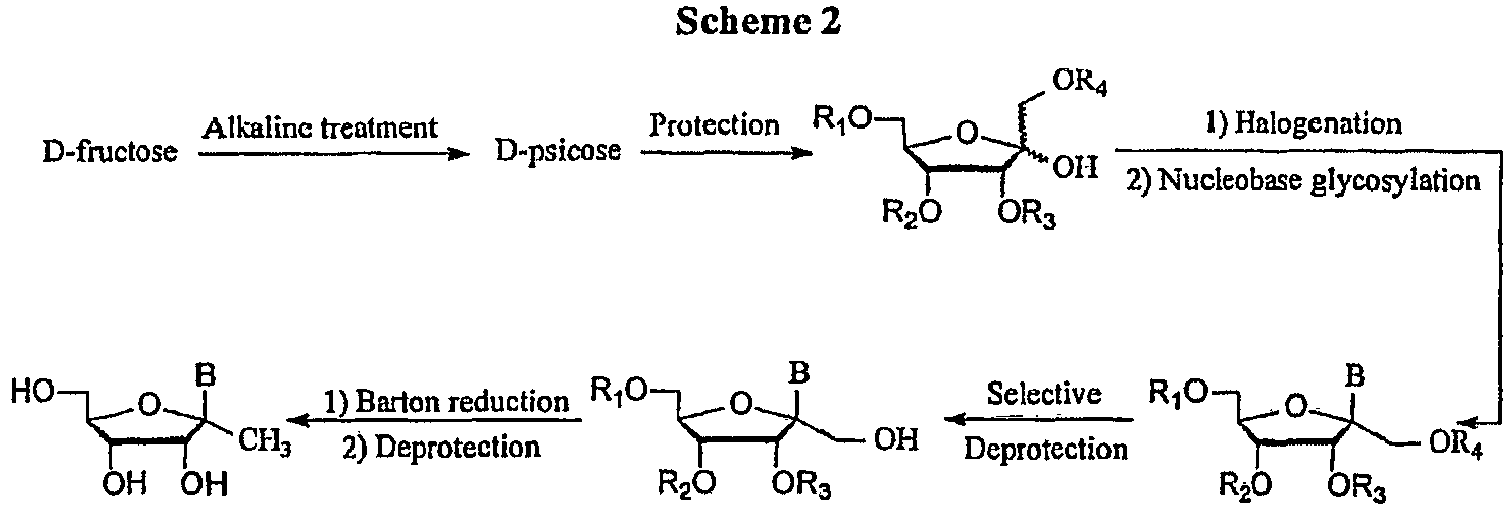
- In addition, the L-enantiomers corresponding to the compounds of the invention can be prepared following the same general methods (1 or 2), beginning with the corresponding L-sugar or nucleoside L-enantiomer as starting material.
- The key starting material for this process is an appropriately substituted sugar with a 2'-OH and 2'-H, with the appropriate leaving group (LG), for example an acyl group or a halogen. The sugar can be purchased or can be prepared by any known means including standard epimerization, substitution, oxidation and reduction techniques. The substituted sugar can then be oxidized with the appropriate oxidizing agent in a compatible solvent at a suitable temperature to yield the 2'-modified sugar. Possible oxidizing agents are Jones reagent (a mixture of chromic acid and sulfuric acid), Collins's reagent (dipyridine Cr(VI) oxide, Corey's reagent (pyridinium chlorochromate), pyridinium dichromate, acid dichromate, potassium permanganate, MnO2, ruthenium tetroxide, phase transfer catalysts such as chromic acid or permanganate supported on a polymer, Cl2-pyridine, H2O2-ammonium molybdate, NaBrO2-CAN, NaOCl in HOAc, copper chromite, copper oxide, Raney nickel, palladium acetate, Meerwin-Pondorf-Verley reagent (aluminum t-butoxide with another ketone) and N-bromosuccinimide.
- Then coupling of an organometallic carbon nucleophile, such as a Grignard reagent, an organolithium, lithium dialkylcopper or R6-SiMe3 in TBAF with the ketone with the appropriate non-protic solvent at a suitable temperature, yields the 2'-alkylated sugar. The alkylated sugar can be optionally protected with a suitable protecting group, preferably with an acyl or silyl group, by methods well known to those skilled in the art, as taught by Greene et al. Protective Groups in Organic Synthesis, John Wiley and Sons, Second Edition, 1991.
- The optionally protected sugar can then be coupled to the BASE by methods well known to those skilled in the art, as taught by Townsend Chemistry of Nucleosides and Nucleotides, Plenum Press, 1994. For example, an acylated sugar can be coupled to a silylated base with a Lewis acid, such as tin tetrachloride, titanium tetrachloride or trimethylsilyltriflate in the appropriate solvent at a suitable temperature. Alternatively, a halo-sugar can be coupled to a silylated base with the presence of trimethylsilyltriflate.
- Subsequently, the nucleoside can be deprotected by methods well known to those skilled in the art, as taught by Greene et al. Protective Groups in Organic Synthesis, John Wiley and Sons, Second Edition, 1991.
- Sometimes the 2'-C-branched ribonucleoside is desired. The synthesis of a ribonucleoside is shown in Scheme 3. Alternatively, deoxyribo-nucleoside is desired. To obtain these nucleosides, the formed ribonucleoside can optionally be protected by methods well known to those skilled in the art, as taught by Greene et al. Protective Groups in Organic Synthesis, John Wiley and Sons, Second Edition, 1991, and then the 2'-OH can be reduced with a suitable reducing agent. Optionally, the 2'-hydroxyl can be activated to facilitate reduction; i.e. via the Barton reduction.
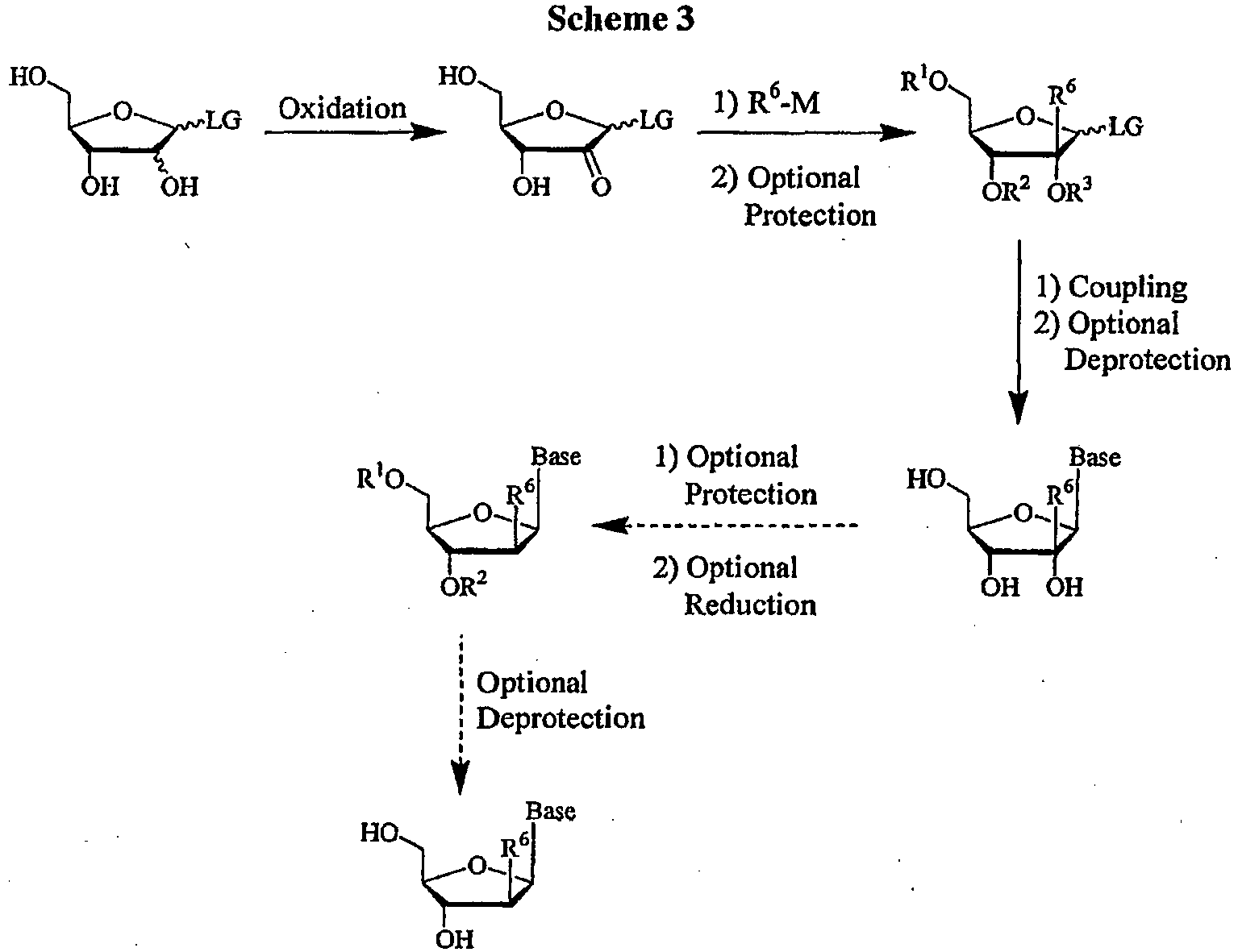
- The key starting material for this process is an appropriately substituted nucleoside with a 2'-OH and 2'-H. The nucleoside can be purchased or can be prepared by any known means including standard coupling techniques. The nucleoside can be optionally protected with suitable protecting groups, preferably with acyl or silyl groups, by methods well known to those skilled in the art, as taught by Greene et al. Protective Groups in Organic Synthesis, John Wiley and Sons, Second Edition, 1991.
- The appropriately protected nucleoside can then be oxidized with the appropriate oxidizing agent in a compatible solvent at a suitable temperature to yield the 2'-modified sugar. Possible oxidizing agents are Jones reagent (a mixture of chromic acid and sulfuric acid), Collins's reagent (dipyridine Cr(VI) oxide, Corey's reagent (pyridinium chlorochromate), pyridinium dichromate, acid dichromate, potassium permanganate, MnO2, ruthenium tetroxide, phase transfer catalysts such as chromic acid or permanganate supported on a polymer, Cl2-pyridine, H2O2-ammonium molybdate, NaBrO2-CAN, NaOCl in HOAc, copper chromite, copper oxide, Raney nickel, palladium acetate, Meerwin-Pondorf-Verley reagent (aluminum t-butoxide with another ketone) and N-bromosuccinimide.
- Subsequently, the nucleoside can be deprotected by methods well known to those skilled in the art, as taught by GreeneGreene et al. Protective Groups in Organic Synthesis, John Wiley and Sons, Second Edition, 1991.
- Sometimes the 2'-C-branched ribonucleoside is desired. The synthesis of a ribonucleoside is shown in Scheme 4. Alternatively, deoxyribo-nucleoside is desired. To obtain these nucleosides, the formed ribonucleoside can optionally be protected by methods well known to those skilled in the art, as taught by Greene et al. Protective Groups in Organic Synthesis, John Wiley and Sons, Second Edition, 1991, and then the 2'-OH can be reduced with a suitable reducing agent. Optionally, the 2'-hydroxyl can be activated to facilitate reduction; i.e. via the Barton reduction.

- Sometimes the L-enantiomers are desired. Therefore, the L-enantiomers can be prepared following the same foregoing general methods, beginning with the corresponding L-sugar or nucleoside L-enantiomer as starting material.
- The key starting material for this process is an appropriately substituted sugar with a 3'-OH and 3'-H, with the appropriate leaving group (LG), for example an acyl group or a halogen. The sugar can be purchased or can be prepared by any known means including standard epimerization, substitution, oxidation and reduction techniques. The substituted sugar can then be oxidized with the appropriate oxidizing agent in a compatible solvent at a suitable temperature to yield the 3'-modified sugar. Possible oxidizing agents are Jones reagent (a mixture of chromic acid and sulfuric acid), Collins's reagent (dipyridine Cr(VI) oxide, Corey's reagent (pyridinium chlorochromate), pyridinium dichromate, acid dichromate, potassium permanganate, MnO2, ruthenium tetroxide, phase transfer catalysts such as chromic acid or permanganate supported on a polymer, Cl2-pyridine, H2O2-ammonium molybdate, NaBrO2-CAN, NaOCl in HOAc, copper chromite, copper oxide, Raney nickel, palladium acetate, Meerwin-Pondorf-Verley reagent (aluminum t-butoxide with another ketone) and N-bromosuccinimide.
- Then coupling of an organometallic carbon nucleophile, such as a Grignard reagent, an organolithium, lithium dialkylcopper or R6-SiMe3 in TBAF with the ketone with the appropriate non-protic solvent at a suitable temperature, yields the 3'-C-branched sugar. The 3'-C-branched sugar can be optionally protected with a suitable protecting group, preferably with an acyl or silyl group, by methods well known to those skilled in the art, as taught by Greene et al. Protective Groups in Organic Synthesis, John Wiley and Sons, Second Edition, 1991.
- The optionally protected sugar can then be coupled to the BASE by methods well known to those skilled in the art, as taught by Townsend Chemistry of Nucleosides and Nucleotides, Plenum Press, 1994. For example, an acylated sugar can be coupled to a silylated base with a Lewis acid, such as tin tetrachloride, titanium tetrachloride or trimethylsilyltriflate in the appropriate solvent at a suitable temperature. Alternatively, a halo-sugar can be coupled to a silylated base with the presence of trimethylsilyltriflate.
- Subsequently, the nucleoside can be deprotected by methods well known to those skilled in the art, as taught by Greene et al. Protective Groups in Organic Synthesis, John Wiley and Sons, Second Edition, 1991.
- Sometimes the 3'-C-branched ribonucleoside is desired. The synthesis of a ribonucleoside is shown in Scheme 5. Alternatively, deoxyribo-nucleoside is desired. To obtain these nucleosides, the formed ribonucleoside can optionally be protected by methods well known to those skilled in the art, as taught by Greene et al. Protective Groups in Organic Synthesis, John Wiley and Sons, Second Edition, 1991, and then the 2'-OH can be reduced with a suitable reducing agent. Optionally, the 2'-hydroxyl can be activated to facilitate reduction; i.e. via the Barton reduction.
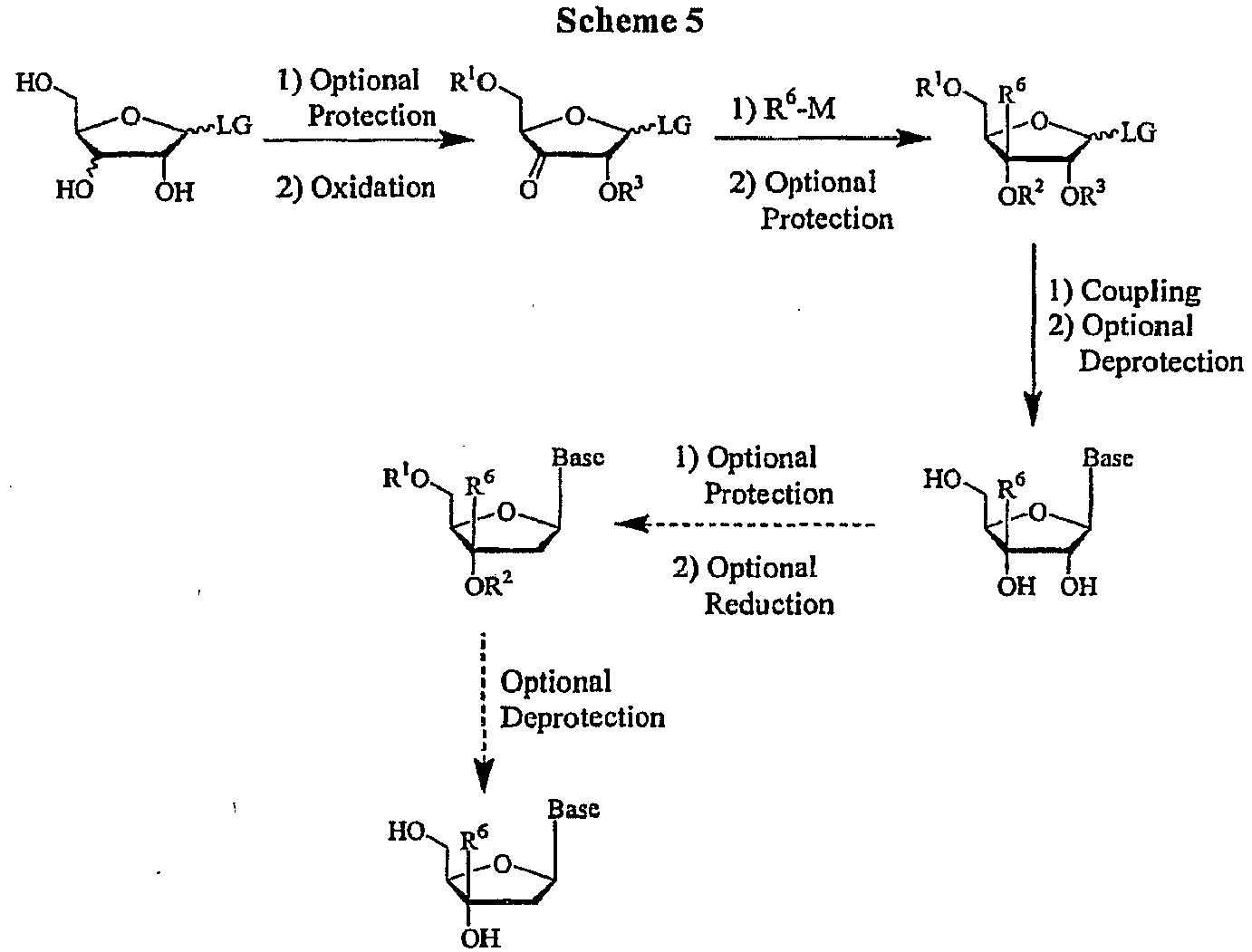
- The key starting material for this process is an appropriately substituted nucleoside with a 3'-OH and 3'-H. The nucleoside can be purchased or can be prepared by any known means including standard coupling techniques. The nucleoside can be optionally protected with suitable protecting groups, preferably with acyl or silyl groups, by methods well known to those skilled in the art, as taught by Greene et al. Protective Groups in Organic Synthesis, John Wiley and Sons, Second Edition, 1991.
- The appropriately protected nucleoside can then be oxidized with the appropriate oxidizing agent in a compatible solvent at a suitable temperature to yield the 2'-modified sugar. Possible oxidizing agents are Jones reagent (a mixture of chromic acid and sulfuric acid), Collins's reagent (dipyridine Cr(VI) oxide, Corey's reagent (pyridinium chlorochromate), pyridinium dichromate, acid dichromate, potassium permanganate, MnO2, ruthenium tetroxide, phase transfer catalysts such as chromic acid or permanganate supported on a polymer, Cl2-pyridine, H2O2-ammonium molybdate, NaBrO2-CAN, NaOCl in HOAc, copper chromite, copper oxide, Raney nickel, palladium acetate, Meerwin-Pondorf-Verley reagent (aluminum t-butoxide with another ketone) and N-bromosuccinimide.
- Subsequently, the nucleoside can be deprotected by methods well known to those skilled in the art, as taught by Greene et al. Protective Groups in Organic Synthesis, John Wiley and Sons, Second Edition, 1991.
- Sometimes the 3'-C-branched ribonucleoside is desired. The synthesis of a ribonucleoside is shown in Scheme 6. Alternatively, deoxyribo-nucleoside is desired. To obtain these nucleosides, the formed ribonucleoside can optionally be protected by methods well known to those skilled in the art, as taught by Greene et al. Protective Groups in Organic Synthesis, John Wiley and Sons, Second Edition, 1991, and then the 2'-OH can be reduced with a suitable reducing agent. Optionally, the 2'-hydroxyl can be activated to facilitate reduction; i.e. via the Barton reduction.

- Sometimes the L-enantiomers are desired. Therefore, the L-enantiomers can be corresponding to the compounds of the invention can be prepared following the same foregoing general methods, beginning with the corresponding L-sugar or nucleoside L-enantiomer as starting material.
- The key starting material for this process is an appropriately substituted pentodialdo-furanose. The pentodialdo-furanose can be purchased or can be prepared by any known means including standard epimerization, substitution and cyclization techniques.
- The pentodialdo-furanose is prepared from the appropriately substituted hexose. The hexose can be purchased or can be prepared by any known means including standard epimerization (e.g. via alkaline treatment), substitution and coupling techniques. The hexose can be either in the furanose form, or cyclized via any means known in the art, such as methodology taught by Townsend Chemistry of Nucleosides and Nucleotides, Plenum Press, 1994, preferably by selectively protecting the hexose, to give the appropriate hexafuranose.
- The 4'-hydroxymethylene of the hexafuranose then can be oxidized with the appropriate oxidizing agent in a compatible solvent at a suitable temperature to yield the 4'-aldo-modified sugar. Possible oxidizing agents are Swern reagents, Jones reagent (a mixture of chromic acid and sulfuric acid), Collins's reagent (dipyridine Cr(VI) oxide, Corey's reagent (pyridinium chlorochromate), pyridinium dichromate, acid dichromate, potassium permanganate, MnO2, ruthenium tetroxide, phase transfer catalysts such as chromic acid or permanganate supported on a polymer, Cl2-pyridine, H2O2-ammonium molybdate, NaBrO2-CAN, NaOCl in HOAc, copper chromite, copper oxide, Raney nickel, palladium acetate, Meerwin-Pondorf-Verley reagent (aluminum t-butoxide with another ketone) and N-bromosuccinimide, though preferably using H3PO4, DMSO and DCC in a mixture of benzene/pyridine at room temperature.
- Then, the pentodialdo-furanose can be optionally protected with a suitable protecting group, preferably with an acyl or silyl group, by methods well known to those skilled in the art, as taught by Greene et al. Protective Groups in Organic Synthesis, John Wiley and Sons, Second Edition, 1991. In the presence of a base, such as sodium hydroxide, the protected pentodialdo-furanose can then be coupled with a suitable electrophilic alkyl, halogeno-alkyl (i.e. CF3), alkenyl or alkynyl (i.e. allyl), to obtain the 4'-alkylated sugar. Alternatively, the protected pentodialdo-furanose can be coupled with the corresponding carbonyl, such as formaldehyde, in the presence of a base, such as sodium hydroxide, with the appropriate polar solvent, such as dioxane, at a suitable temperature, which can then be reduced with an appropriate reducing agent to give the 4'-alkylated sugar. In one embodiment, the reduction is carried out using PhOC(S)Cl, DMAP, preferably in acetonitrile at room temperature, followed by treatment of ACCN and TMSS refluxed in toluene.
- The optionally activated sugar can then be coupled to the BASE by methods well known to those skilled in the art, as taught by Townsend Chemistry of Nucleosides and Nucleotides, Plenum Press, 1994. For example, an acylated sugar can be coupled to a silylated base with a Lewis acid, such as tin tetrachloride, titanium tetrachloride or trimethylsilyltriflate in the appropriate solvent at a suitable temperature.
- Subsequently, the nucleoside can be deprotected by methods well known to those skilled in the art, as taught by Greene et al. Protective Groups in Organic Synthesis, John Wiley and Sons, Second Edition, 1991.
- Sometimes the 4'-C-branched ribonucleoside is desired. Alternatively, deoxyribonucleoside is desired. To obtain these deoxyribo-nucleosides, a formed ribo-nucleoside can optionally be protected by methods well known to those skilled in the art, as taught by Greene et al. Protective Groups in Organic Synthesis, John Wiley and Sons, Second Edition, 1991, and then the 2'-OH can be reduced with a suitable reducing agent. Optionally, the 2'-hydroxyl can be activated to facilitate reduction; i.e. via the Barton reduction.
- Sometimes the L-enantiomers are desired. Therefore, the L-enantiomers can be prepared following the same foregoing general methods, beginning with the corresponding L-pentodialdo-furanose as starting material.
- The key starting material for this process is an appropriately substituted 1', 2', 3' or 4'-branched β-D or β-L nucleosides. The branched nucleoside can be purchased or can be prepared by any known means including the techniques disclosed herein. The branched nucleoside can be optionally protected with a suitable protecting group, preferably with a silyl group, by methods well known to those skilled in the art, as taught by Greene et al. Protective Groups in Organic Synthesis, John Wiley and Sons, Second Edition, 1991. The protected branched nucleoside can then be coupled with a suitable acyl doner, such as an acyl chloride and/or an acyl anhydride with the appropriate protic or aprotic solvent at a suitable temperature, to give the 2' and/or 3' prodrug of 1', 2', 3' or 4'-branched β-D or β-L nucleoside. Alternatively, the protected branched nucleoside can then be coupled with a suitable acyl, such as a carboxylic acid, such as alkanoic acid and/or amino acid residue, optionally with a suitable coupling agent, with the appropriate aprotic solvent at a suitable temperature, to give the 2' and/or 3' prodrug of 1', 2', 3' or 4'-branched β-D or β-L nucleoside. Possible coupling reagents are any reagents that promote coupling, including but are not limiting to, Mitsunobu reagents (e.g. diisopropyl azodicarboxylate and diethyl azodicarboxylate) with triphenylphosphine or various carbodiimides.
- For example, simple amino-alcohols can be esterified using acid chlorides in refluxing acetonitrile-benzene mixture (See Scheme 7 below: Synthetic Communication, 1978, 8(5), 327-333; hereby incorporated by reference). Alternatively, esterification can be achieved using an anhydride, as described in J. Am. Chem. Soc., 1999, 121(24), 5661-5664, which is hereby incorportated by reference. See
Figures 2 ,3 and4 .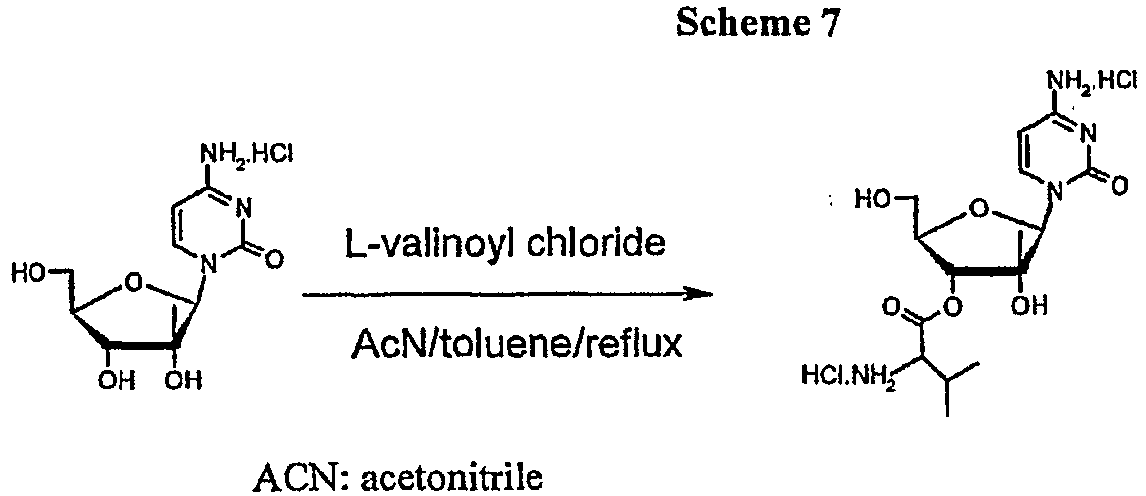
- Melting points were determined on a Mel-temp II apparatus and are uncorrected. NMR spectra were recorded on a Bruker 400 AMX spectrometer at 400 MHz for 1H NMR and 100 MHz for 13C NMR with TMS as internal standard. Chemical shifts (δ) are reported in parts per million (ppm), and signals are reported as s (singlet), d (doublet), t (triplet), q (quartet), m (multiplet), or bs (broad singlet). IR spectra were measured on a Nicolet 510P FT-IR spectrometer. Mass spectra were recorded on a Micromass Autospec high-resolution mass spectrometer. TLC were performed on Uniplates (silica gel) purchased from Analtech Co. Column chromatography was performed using either silica gel-60 (220-440 mesh) for flash chromatography or silica gel G (TLC grade, > 440 mesh) for vacuum flash column chromatography. UV spectra were obtained on a Beckman DU 650 spectrophotometer. Elemental analysis was performed by Atlantic Microlab, Inc., Norcross, GA, or Galbraith Laboratories, Inc., Knoxville, TN. HPLC was performed with a Waters HPLC system (Millipore Corporation, Milford, MA) equipped with a Model 600 controller, a Model 996 photodiode array detector and a Model 717 plus autosampler. Millennium 2010 software was used for system control, data acquisition and processing. A chiralyser polarimetric detector, Perkin-Elmer Model 241MC polarimeter (Wilton, CT), was used for the determination of optical rotations.
- The title compound could also be prepared according to a published procedure (J. Farkas, and F. Sorm, "Nucleic acid components and their analogues. XCIV. Synthesis of 6-amino-9-(1-deoxy-β-D-psicofuranosyl)purine" Collect. Czech. Chem. Commun. 1967, 32, 2663-2667; J. Farkas", Collect. Czech. Chem. Commun. 1966, 31, 1535) (Scheme 8).
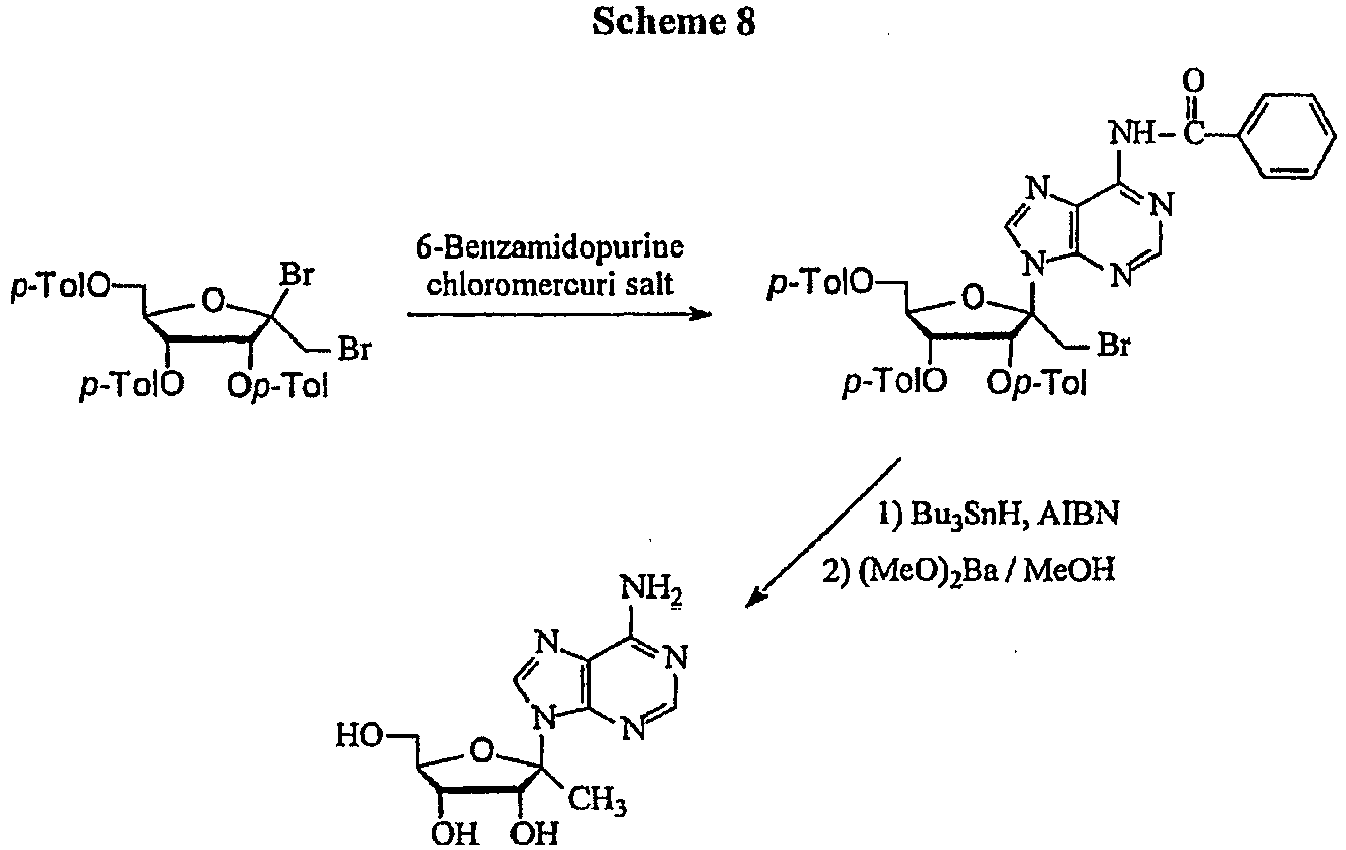
- The title compound was prepared according to a published procedure (R.E. Harry-O'kuru, J.M. Smith, and M.S. Wolfe, "A short, flexible route toward 2'-C-branched ribonucleosides", J.Org. Chem. 1997, 62, 1754-1759) (Scheme 9).
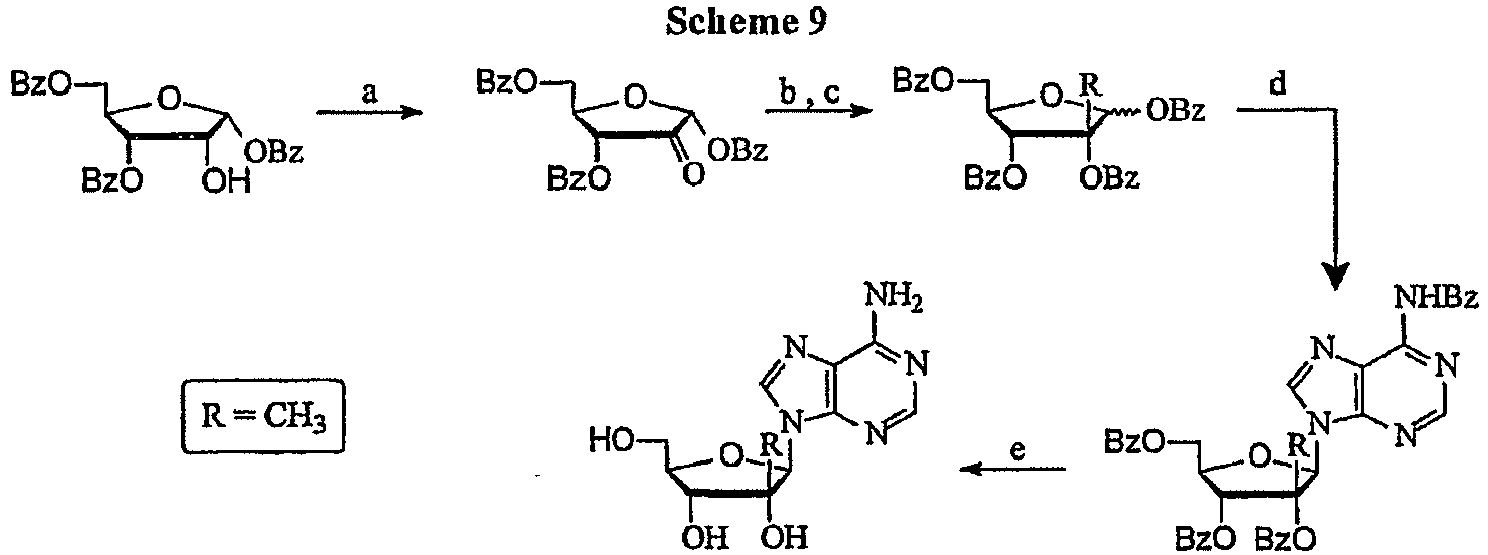
- The 3'-prodrug of the 2'-branched nucleoside was prepared according to published procedure (Synthetic Communications, 1978, 8(5), 327-333; J. Am. Chem. Soc., 1999, 121(24), 5661-5664). Alternatively, the 2'-branched nucleoside can be esterified without protection (Scheme 9b). Carbonyldiimidazole (377 mg, 2.33 mmol) was added to a solution of N-(tert-butoxycarbonyl)-L-valine (507 mg, 2.33 mmol) in 15 mL of anhydrous tetrahydrofuran. The mixture was stirred at 20 °C for one hour and at 50 °C for 10 minutes and then added to a solution of 4-Amino-1-(3,4-dihydroxy-5-hydroxymethyl-3-methyl-tetrahydro-furan-2-yl)-1H-pyrimidine-2-one (500 mg, 1.95 mmol), 4-(dimethylamino)pyridine (25 mg, 0.195 mmol), triethylamine (5 mL) in anhydrous N,N-dimethylformamide (10 mL), which is also stirring at 50 °C. The reaction mixture was stirred at 50 °C for one hour and then examined by HPLC. HPLC analysis indicated the formation of 52% of the desired ester, 17% of starting material in addition to undesired by-products. The 3'-OH of 4-amino-1-(3,4-dihydroxy-5-hydroxymethyl-3-methyl-tetrahydro-furan-2-yl)-1H-pyrimidine-2-one tends to react selectively when coupled with BOC-Val.
- The title compound can be prepared according to a published procedure (R.F. Nutt, M.J. Dickinson, F.W. Holly, and E. Walton, "Branched-chain sugar nucleosides. III. 3'-C-methyladenine", J.Org. Chem. 1968, 33, 1789-1795) (Scheme 10).
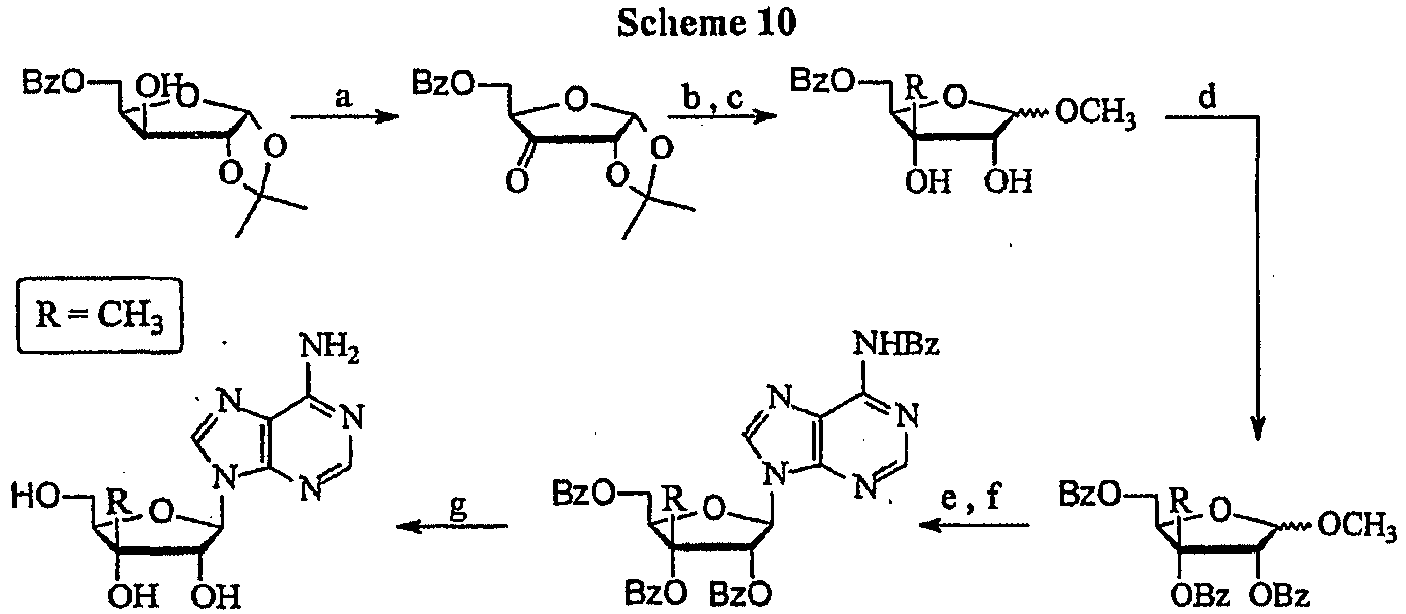
- The title compound can be prepared according to a published procedure (Leonard, N. J.; Carraway, K. L. "5-Amino-5-deoxyribose derivatives. Synthesis and use in the preparation of "reversed" nucleosides" J. Heterocvcl. Chem. 1966, 3, 485-489).
- A solution of 50.0 g (0.34 mole) of dry D-ribose in 1.0 L of acetone, 100 mL of 2,2-dimethoxypropane, 200 mL of methanol containing 20 mL of methanol saturated with hydrogen chloride at 0°C was stirred overnight at room temperature. The resulting solution was neutralized with pyridine and evaporated under reduced pressure. The resulting oil was partitioned between 400 mL of water and 400 mL of methylene chloride. The water layer was extracted twice with methylene chloride (400 mL). The combined organic extracts were dried over sodium sulfate and evaporated under reduced pressure. The residue was purified by silica gel column chromatography [eluent: stepwise gradient of methanol (1-2%) in methylene chloride] to give pure 1 (52.1 g, 75%) as a yellow syrup. 1H-NMR (CDCl3): δ 5.00 (s, 1H, H-1), 4.86 (d, 1H, H-2, J2-3 = 5.9 Hz), 4.61 (d, 1H, H-3, J3-2 = 5.9 Hz), 4.46 (t, 1H, H-4, J4-5 = 2.7 Hz), 3.77-3.61 (m, 2H, H-5 and H-5'), 3.46 (s, 1H, OCH3), 3.0-2.4 (br s, 1H, OH-5), 1.51 (s, 3H CH3), 1.34 (s, 3H CH3); MS (matrix GT): FAB>0 m/z 173 (M-OCH3)+.
- The title compound can be prepared according to a published procedure (Jones, G. H.; Moffatt, J. G. Oxidation of carbohydrates by the sulfoxide-carbodiimide and related methods. Oxidation with dicyclohexylcarbodiimide-DMSO, diisopropylcarbodiimide-DMSO, acetic anhydride-DMSO, and phosphorus pentoxide-DMSO: in Methods in Carbohydrate Chemistry; Whisler, R. L. and Moffatt, J. L. Eds; Academic Press: New York, 1972; 315-322).
-
Compound 1 was co-evaporated twice with anhydrous pyridine. Dicyclohexylcarbodi-imide (DCC, 137.8 g, 0.67 mol) was added to a solution of 1 (68.2 g, 0.33 mole) in anhydrous benzene (670 mL), DMSO (500 mL) and pyridine (13.4 mL). To the resulting solution, cooled to 0°C, was added a solution of anhydrous crystalline orthophosphoric acid (16.4 g, 0.167 mmol) in anhydrous DMSO (30 mL). The mixture was stirred for 1.5 hours at 0°C and 18 hours at room temperature under argon atmosphere, diluted with ethyl acetate (1000 mL). A solution of oxalic acid dihydrate (63.1 g, 038 mol) in DMSO (30 mL) was added and the reaction mixture was stirred at room temperature during 1 hour and then filtered to eliminate precipitated dicyclohexylurea (DCU). The filtrate was concentrated to a volume of about 600 mL under reduced pressure and neutralized with a saturated aqueous sodium hydrogen carbonate solution (400 mL). Brine (200 mL) was added and the organic layer was extracted with ethyl acetate (4x 1000 mL). The combined organic layers were concentrated to a volume of about 2000 mL, washed with a saturated aqueous sodium hydrogen carbonate solution (2x 700 mL), and with brine (2x 700 mL) before being dried over sodium sulfate and evaporated under reduced pressure. A small fraction of the crude residue was purified on silica gel chromatography [eluent: chloroform/ethyl ether, 8:2] in order to confirm the structure of 2 which was obtained as a pale yellow solid. 1H-NMR (CDCl3): δ 9.61 (s, 1H, H-5), 5.12 (s, 1H, H-1), 5.08 (d, 1H, H-2, J2-3 = 5.9 Hz), 4.53 (d, 1H, H-3, J3-2 = 6.0 Hz), 4.51 (s, 1H, H-4), 3.48 (s, 1H, OCH3), 1.56 (s, 3H CH3), 1.36 (s, 3H CH3); MS (matrix GT): FAB>0 m/z 203 (M+H)+, 171 (M-OCH3)+. - The title compound can be prepared according to a published procedure (Leland, D. L.; Kotick, M. P. "Studies on 4-C-(hydroxymethyl)pentofuranoses. Synthesis of 9-[4-C-(hydroxymethyl)-α-L-threo-pentofuranosyl]adenine" Carbohydr. Res. 1974, 38, C9-C11; Jones, G. H.; Taniguchi, M.; Tegg, D.; Moffatt, J. G. "4'-substituted nucleosides. 5. Hydroxylation of nucleoside 5'-aldehydes" J. Org. Chem. 1979, 44, 1309-1317; Gunic, E.; Girardet, J.-L.; Pietrzkowski, Z.; Esler, C.; Wang, G. "Synthesis and cytotoxicity of 4'-C-and 5'-C-substituted Toyocamycins" Bioorg. Med. Chem. 2001, 9, 163-170).
- To a solution of the crude material (2) obtained above and 37% aqueous formaldehyde (167 mL) in dioxane (830 mL) was added aqueous sodium hydroxyde (2N, 300 mL). The mixture was stirred at room temperature for 4 hours and neutralized by addition of Dowex 50 W X 2 (H+ form). The resin was filtered, washed with methanol, and the combined filtrates were concentrated to dryness and coevaporated several times with absolute ethanol. Sodium formate which was precipitated from absolute ethanol was removed by filtration, the filtrate was concentrated to dryness and the residue was purified by silica gel column chromatography [eluent: stepwise gradient of methanol (0-4%) in chloroform] to give pure 3 (42.2 g, 54% from 1), which was recrystallized from cyclohexane. Mp = 94-95 (dec.) (lit.94-96.5; 97-98 : Refs :3,4), 1H-NMR (DMSO-d6): δ 4.65 (s, 1H, H-1), 4.44-4.37 (m, 3H, H-2, H-3 and OH-6), 4.27 (t, 1H, OH-5, J = 5.6 Hz, J = 6.0 Hz), 3.42-3.34 (m, 2H, H-5 and H-6) 3.29 (dd, 1H, H-5', J5'-OH = 5.4 Hz, J5-5' = 11.4 Hz), 3.11 (dd, 1H, H-6', J6'-OH = 5.7 Hz, J6-6' = 10.9 Hz), 3.03 (s, 3H, OCH3), 1.48 (s, 3H CH3), 1.05 (s, 3H CH3); MS (matrix GT): FAB>0 m/z 469 (2M+H)+, 235 (M+H)+, 203 (M-OCH3)+FAB<0 m/z 233 (M-H)-.
- The title compound can be prepared according to a published procedure (Gunic, E.; Girardet, J.-L.; Pietrzkowski, Z.; Esler, C.; Wang, G. "Synthesis and cytotoxicity of 4'-C-and 5'-C-substituted Toyocamycins" Bioorg. Med. Chem. 2001, 9, 163-170).
- To a solution of 3 (41.0 g, 175 mmol) in pyridine (700 ml) was added by portions dimethoxytrityl chloride (60.5 g, 178 mmol) at +4°C. The reaction mixture was stirred for 3 hours at room temperature. After addition of methanol, the reaction mixture was concentrated (200 ml) and then dissolved with ethyl acetate (2 L). The organic layer was washed with a 5% aqueous sodium hydrogen carbonate solution, with water and dried over sodium sulfate and then evaporated to dryness. Purification by silica gel column chromatography [eluent: ethyl acetate / hexane 15/85] afforded pure 4 (63.0 g, 68%) as a syrup. 1H-NMR (CDCl3): δ 7.5-6.9 (m, 13H, MMTr), 4.89 (s, 1H, H-1), 4.72-4.62 (m, 3H, H-2, H-3 and OH-5), 3.82 (dd, 1H, H-5, J5-OH = 5.5 Hz, J5-5' = 10.5 Hz), 3.79 (s, 6H, OCH3), 3.54 (dd, 1H, H-5', J5'-OH = 4.9 Hz, J5'-5 = 10.5 Hz), 3.31 (s, 3H, OCH3), 3.24 (d, 1H, H-6, J6-6' = 9.2 Hz), 3.13 (d, 1H, H-6', J6'-6 = 9.2 Hz), 1.24 (s, 3H CH3), 1.15 (s, 3H CH3); MS (matrix GT): FAB>0 m/z 303 (DMTr)+.
- The title compound can be prepared according to a published procedure (Gunic, E.; Girardet, J.-L.; Pietrzkowski, Z.; Esler, C.; Wang, G. "Synthesis and cytotoxicity of 4'-C-and 5'-C-substituted Toyocamycins" Bioorg. Med. Chem. 2001, 9, 163-170).
- To a solution of 4 (2.51 g, 4.68 mmol) in anhydrous pyridine (37 mL) was added under argon benzoyl chloride (1.09 mL, 9.36 mmol) and the reaction mixture was stirred for 13 hours at to room temperature. Then the reaction was cooled to 0°C and stopped with ice-cold water (100 mL). The water layer was extracted with methylene chloride (3□ 200 mL). The combined organic layers were washed with a saturated aqueous sodium hydrogen carbonate solution (2x 150 mL), with water (1x 150 mL) and then dried over sodium sulfate and evaporated under reduced pressure. The residue was dissolved in 80% acetic acid (70.2 mL) and the mixture was stirred at room temperature for 3hr and concentrated to dryness. Purification by silica gel column chromatography [eluent: chloroform] afforded pure 5 (1.40 g, 88%) as a syrup. 1H-NMR (CDCl3): δ 8.1-7.4 (m, 5H, C6H5CO), 5.08 (s, 1H, H-1), 4.77 (dd, 2H, H-2 and H-3, J = 6.1 Hz, J = 8.2 Hz), 4.51 (q, 2H, H-5 and H-5', J = 11.5 Hz, J5-5' = 23.8 Hz), 3.91 (t, 2H, H-6 and H-6', J = 12.3 Hz), 4.38 (s, 1H, OCH3), 2.2-1.8 (brs, 1H, OH-6), 1.57 (s, 3H CH3), 1.38 (s, 3H CH3); MS (matrix GT): FAB>0 m/z 677 (2M+H)+, 339 (M+H)+, 307 (M-OCH3)+, 105 (C6H5CO)+FAB<0 m/z 121 (C6H5CO2)-.
- The title compound can be prepared according to a published procedure (Gunic, E.; Girardet, J.-L.; Pietrzkowski, Z.; Esler, C.; Wang, G. "Synthesis and cytotoxicity of 4'-C-and 5'-C-substituted Toyocamycins" Bioorg. Med. Chem. 2001, 9, 163-170).
- A solution of 5 (37.6 g, 0.111 mol), 4-dimethylaminopyridine (DMAP, 40.7 g, 0.333 mol) and phenoxythiocarbonyle chloride in anhydrous acetonitrile (1000 mL) was stirred at room temperature for 1 hour and concentrated to dryness. The residue was dissolved in methylene chloride (500 mL) and successively washed with 0.2 M hydrochloric acid (2x 500 mL) and water (500 mL) before being dried over sodium sulfate, evaporated under reduced pressure and coevaporated several times with anhydrous toluene. The crude material was dissolved in anhydrous toluene (880 mL) and tris(trimethylsilyl)silane (TMSS, 42.9 mL, 0.139 mol), and 1,1'-azobis(cyclohexanecarbonitrile) (ACCN, 6.8 g, 27.8 mmol) were added. The reaction mixture was stirred under reflux for 45 minutes, cooled to room temperature and concentrated under reduced pressure. The resulting residue was purified by silica gel column chromatography [eluent: stepwise gradient of diethyl ether (5-20%) in petroleum ether] to give pure 6 (26.4 g, 74%) as a pale yellow syrup. 1H-NMR (DMSO-d 6 ): δ 8.0-7.5 (m, 5H, C6H5CO), 4.85 (s, 1H, H-1), 4.63 (dd, 2H, H-2 and H-3, J = 6.1 Hz, J = 11.6 Hz), 4.24 (d, 1H, H-5, J5-5' = 11.1 Hz), 4.10 (d, 1H, H-5', J5'-5 = 11.1 Hz), 3.17 (s, 1H, OCH3), 1.38 (s, 3H CH3), 1.30 (s, 3H CH3), 1.25 (s, 3H CH3); MS (matrix GT): FAB>0 m/z 291 (M-OCH3)+, 105 (C6H5CO)+ FAB<0 m/z 121 (C6H5CO2)-.
- Compound 6 (22.5 g, 70 mmol) was suspended in a 80% aqueous acetic acid solution (250 mL). The solution was heated at 100°C for 3 hours. The volume was then reduced by half and coevaporated with absolute ethanol and pyridine. The oily residue was dissolved in pyridine (280 mL) and then cooled at 0°C. Acetic anhydride (80 mL) and 4-dimethylamino-pyridine (500 mg) were added. The reaction mixture was stirred at room temperature for 3 hours and then concentrated under reduced pressure. The residue was dissolved with ethyl acetate (1 L) and successively washed with a saturated aqueous sodium hydrogen carbonate solution, a 1 M hydrochloric acid and water. The organic layer was dried over sodium sulfate and evaporated under reduced pressure. The resulting residue was purified by silica gel column chromatography [eluent: stepwise gradient of diethyl ether (30-40%) in petroleum ether] to give pure 7 (16.2 g, 60%) as a pale yellow syrup. A small fraction of the material was re-purified on silica gel chromatography [same eluent: system] in order separate the α and the β anomers.
α anomer: 1H-NMR (DMSO-d6): δ 8.1-7.5 (m, 5H, C6H5CO), 6.34 (pt, 1H, H-1, J = 2.4 Hz, J = 2,1 Hz), 5.49 (m, 2H, H-2 and H-3), 4.33 (q, 2H, H-5 and H-5', J = 11.6 Hz, J = 18.7 Hz), 2.15 (s, 3H, CH3CO2), 2.11 (s, 3H, CH3CO2), 2.07 (s, 3H, CH3CO2), 1.37 (s, 3H, CH3); MS (matrix GT): FAB>0 m/z 335 (M-CH3CO2 -)+, 275 (M-CH3CO2 -+H)+,105 (C6H5CO)+, 43 (CH3CO)+ FAB<0 m/z 121 (C6H5CO2)-, 59 (CH3CO2)-.
β anomer: 1H-NMR (DMSO-d6): δ 8.1-7.5 (m, 5H, C6H5CO), 5.99 (s, 1H, H-1), 5.46 (d, 1H, H-2, J2-3 = 5.3 HZ), 5.30 (d, 1H, H-2, J2-3 = 5.3 Hz), 4.39 (d, 1H, H-5, J5-5' = 11.7 Hz), 4.19 (d, 1H, H-5', J5'-5 = 11.7 Hz), 2.10 (s, 3H, CH3CO2), 2.06 (s, 3H, CH3CO2), 2.02 (s, 3H, CH3CO2), 1.30 (s, 3H, CH3); MS (matrix GT): FAB>0 m/z 335 (M-CH3CO2 -)+, 275 (M-CH3CO2 -+H)+,105 (C6H5CO)+, 43 (CH3CO)+ FAB<0 m/z 121 (C6H5CO2)-, 59 (CH3CO2)-. - To a suspension of O-6-diphenylcarbamoyl-8-methyl-N2-isobutyrylguanine in anhydrous toluene (20 mL) was added N,O-bis(trimethylsilyl)acetamide (1.92 mL, 7.9 mmol). The reaction mixture was allowed to warm under reflux for 1 hour. Compound 7 (1.55 g, 3.93 mmol) was dissolved in toluene (10 mL) and trimethylsilyltrifluoro-methanesulfonate (TMSTf) (915 mL, 4.72 mmol) was added. The mixture was heated under reflux for 30 minutes. The solution was then cooled to room temperature and neutralized with a 5% aqueous sodium hydrogen carbonate solution. The reaction mixture was diluted with ethyl acetate (200 mL). The organic phase was washed with a 5% aqueous sodium hydrogen carbonate solution (150 mL) and with water (2x 150 mL). The organic layer was dried over Na2SO4 and evaporated to dryness. The residue was purified by silica gel column chromatography [eluent: stepwise gradient of diethyl ether (70-90%) in petroleum ether] to afford 18.
- The title compound can be prepared according to a published procedure from 18 (Waga, T.; Nishizaki, T.; Miyakawa, I.; Orhui, H.; Meguro, H. "Synthesis of 4'-C-methylnucleosides" Biosci. Biotechnol. Biochem. 1993, 57, 1433-1438).
- A solution of 18 in methanolic ammonia (previously saturated at -10°C) (20 mL) was stirred at room temperature overnight. The solvent was evaporated under reduced pressure and the residue was partitioned between methylene chloride (60 mL) and water (60 mL). The aqueous layer was washed with methylene chloride (2x 60 mL), concentrated under reduced pressure. The residue was purified by an RP18 column chromatography [eluent water/acetonitrile 95/5] to afford 19.
- A solution of 7 (1.10 g, 2.79 mmol) in anhydrous acetonitrile (50 ml) was treated with 8-methyladenine and stannic chloride (SnCl4, 660 µL, 5.58 mmol) and stirred at room temperature overnight. The solution was concentrated under reduced pressure, diluted with chloroform (100 mL) and treated with a cold saturated aqueous solution of NaHCO3 (100 ml). The mixture was filtered on celite, and the precipitate was washed with hot chloroform. The filtrates were combined, washed with water (100 ml) and brine (100 ml), dried (Na2SO4), and evaporated under reduced pressure. The residue was purified by silica gel column chromatography [eluent: stepwise gradient of methanol (3-5%) in dichloromethane] to afford 20.
- The title compound can be prepared according to a published procedure from 20 (Waga, T.; Nishizaki, T.; Miyakawa, I.; Orhui, H.; Meguro, H. "Synthesis of 4'-C-methylnucleosides" Biosci. Biotechnol. Biochem. 1993, 57, 1433-1438).
- A solution of 20 in methanolic ammonia (previously saturated at -10°C) (50 mL) was stirred at room temperature overnight. The solvent was evaporated under reduced pressure and the residue was partitioned between methylene chloride (100 ml) and water (100 ml). The aqueous layer was washed with methylene chloride (2x 100 mL), and concentrated under reduced pressure. The residue was purified by silica gel column chromatography [eluent: stepwise gradient of methanol (10-30%) in ethyl acetate] to afford 21.
- A suspension of 6-methyluracil was treated with hexamethyldisilazane (HMDS, 21 mL) and a catalytic amount of ammonium sulfate during 17 hours under reflux. After cooling to room temperature, the mixture was evaporated under reduced pressure, and the residue, obtained as a colorless oil, was diluted with
anhydrous 1,2-dichloroethane (7.5 mL). To the resulting solution was added 7 (0.99 g, 2.51 mmol) inanhydrous 1,2-dichloroethane (14 mL), followed by addition of trimethylsilyl trifluoromethanesulfonate (TMSTf, 0.97 mL, 5.02 mmol). The solution was stirred for 2.5 hours at room temperature under argon atmosphere, then diluted with chloroform (150 mL), washed with the same volume of a saturated aqueous sodium hydrogen carbonate solution and finally with water (2x 100 mL). The organic phase was dried over sodium sulfate, then evaporated under reduced pressure. The resulting crude material was purified by silica gel column chromatography [eluent: stepwise gradient of methanol (0-2%) in chloroform] to afford pure 8. - The title compound can be prepared according to a published procedure from 8 (Waga, T.; Nishizaki, T.; Miyakawa, I.; Orhui, H.; Meguro, H. "Synthesis of 4'-C-methylnucleosides" Biosci. Biotechnol. Biochem. 1993, 57, 1433-1438).
- A solution of 8 in methanolic ammonia (previously saturated at -10°C) (27 mL) was stirred at room temperature overnight. The solvent was evaporated under reduced pressure and the residue was partitioned between methylene chloride (40 mL) and water (40 mL). The aqueous layer was washed with methylene chloride (2x 40 mL), concentrated under reduced pressure and coevaporated several times with absolute ethanol. Recrystallization from a mixture absolute ethanol/methanol gave 9.
- Lawesson's reagent (926 mg, 2.29 mmol) was added under argon to a solution of 8 in
anhydrous 1,2-dichloroethane (65 mL) and the reaction mixture was stirred overnight under reflux. The solvent was evaporated under reduced pressure and the residue was purified by silica gel column chromatography [eluent: stepwise gradient of methanol (1-2%) in chloroform] to give pure 10. - A solution of 10 in methanolic ammonia (previously saturated at -10°C) (27 mL) was stirred at room temperature overnight. The solvent was evaporated under reduced pressure and the residue was partitioned between methylene chloride (40 ml) and water (40 mL). The aqueous layer was washed with methylene chloride (2x 40 mL), concentrated under reduced pressure. The crude material was purified by silica gel column chromatography [eluent: stepwise gradient of methanol (5-7%) in methylene chloride] to give 11, which was lyophilized.
- Compound 11 was treated with methanolic ammonia (previously saturated at-10°C), (12 mL) at 100°C in a stainless-steel bomb for 3 hours, then cooled to room temperature. The solvent was evaporated under reduced pressure and the residue was partitioned between methylene chloride (40 mL) and water (40 mL). The aqueous layer was washed with methylene chloride (2x 40 mL), concentrated under reduced pressure. The crude material was purified by silica gel column chromatography [eluent: methylene chloride/ methanol/ammonium hydroxide 65:30:5]. The collected fractions were evaporated under reduced pressure and in absolute ethanol (6.3 mL). To the solution was added a 2N hydrochloric acid solution (1.5 mL) and the mixture was stirred before being concentrated under reduced pressure. The procedure was repeated twice and 12 was precipitated from absolute ethanol.
- A suspension of 6-methylthymine was treated with hexamethyldisilazane (HMDS, 17 mL) and a catalytic amount of ammonium sulfate overnight under reflux. After cooling to room temperature, the mixture was evaporated under reduced pressure, and the residue, obtained as a colorless oil, was diluted with
anhydrous 1,2-dichloroethane (6 mL). To the resulting solution was added 7 (1.0 g, 2.53 mmol) inanhydrous 1,2-dichloroethane (14 mL), followed by addition of trimethylsilyl trifluoromethanesulfonate (TMSTf, 0.98 mL, 5.06 mmol). The solution was stirred for 5 hours at room temperature under argon atmosphere, then diluted with chloroform (150 mL), washed with the same volume of a saturated aqueous sodium hydrogen carbonate solution and finally with water (2x 100 mL). The organic phase was dried over sodium sulfate, then evaporated under reduced pressure. The resulting crude material was purified by silica gel column chromatography [eluent: 2% of methanol in chloroform] to afford pure 13. - The title compound can be prepared according to a published procedure from 13 (Waga, T.; Nishizaki, T.; Miyakawa, I.; Orhui, H.; Meguro, H. "Synthesis of 4'-C-methylnucleosides" Biosci. Biotechnol. Biochem. 1993, 57, 1433-1438).
- A solution of 13 in methanolic ammonia (previously saturated at -10°C) (60 mL) was stirred at room temperature overnight. The solvent was evaporated under reduced pressure and the residue was partitioned between methylene chloride (60 mL) and water (60 mL). The aqueous layer was washed with methylene chloride (2x 60 mL), concentrated under reduced pressure and coevaporated several times with absolute ethanol. Recrystallization from methanol gave 14.
- A solution of 14 in anhydrous pyridine (7.4 mL) was treated with acetic anhydride (1.2 mL) and stirred at room temperature for 3 hours. The solvent was evaporated under reduced pressure, and the residue was purified by silica gel column chromatography [eluent: stepwise gradient of methanol (0-5%) in methylene chloride] to afford 15.
- Lawesson's reagent (119 mg, 0.29 mmol) was added under argon to a solution of 15 in
anhydrous 1,2-dichloroethane (11 mL) and the reaction mixture was stirred overnight under reflux. The solvent was evaporated under reduced pressure and the residue was purified by silica gel column chromatography [eluent: stepwise gradient of methanol (1-2%) in chloroform] to give 16. - Compound 16 was treated with methanolic ammonia (previously saturated at-10°C), (10 mL) at 100°C in a stainless-steel bomb for 3 hours, then cooled to room temperature. The solvent was evaporated under reduced pressure and the residue was partitioned between methylene chloride (30 mL) and water (30 mL). The aqueous layer was washed with methylene chloride (2x 30 mL), concentrated under reduced pressure. The crude material was purified by silica gel column chromatography [eluent: 20% methanol in methylene chloride] to afford 17. This compound was dissolved in EtOH 100 (1.5 mL), treated with a 2N hydrochloric acid solution (0.3 mL), and the mixture was stirred before being concentrated under reduced pressure. The procedure was repeated twice and 17 was precipitated from absolute ethanol.
- Alternatively, the following nucleosides of Formula XXXXVII are prepared, using the appropriate sugar and pyrimidine or purine bases,wherein the substituents are as defined in
claim 1.
- A number of assays are available to determine the potency of test compounds against viruses. Several of these biological assays are described in the examples below.
- Compounds can exhibit anti-flavivirus or pestivirus activity by inhibiting flavivirus or pestivirus polymerase, by inhibiting other enzymes needed in the replication cycle, or by other pathways.
- To determine the cellular metabolism of the compounds, HepG2 cells are obtained from the American Type Culture Collection (Rockville, MD), and are grown in 225 cm2 tissue culture flasks in minimal essential medium supplemented with non-essential amino acids, 1% penicillin-streptomycin. The medium is renewed every three days, and the cells are subcultured once a week. After detachment of the adherent monolayer with a 10 minute exposure to 30 mL of trypsin-EDTA and three consecutive washes with medium, confluent HepG2 cells are seeded at a density of 2.5 x 10⁶ cells per well in a 6-well plate and exposed to 10 µM of [3H] labeled active compound (500 dpm/pmol) for the specified time periods. The cells are maintained at 37°C under a 5% CO2 atmosphere. At the selected time points, the cells are washed three times with ice-cold phosphate-buffered saline (PBS). Intracellular active compound and its respective metabolites are extracted by incubating the cell pellet overnight at -20°C with 60% methanol followed by extraction with an additional 20 µL of cold methanol for one hour in an ice bath. The extracts are then combined, dried under gentle filtered air flow and stored at -20°C until HPLC analysis.
- Within 1 week prior to the study initiation, the cynomolgus monkey is surgically implanted with a chronic venous catheter and subcutaneous venous access port (VAP) to facilitate blood collection and underwent a physical examination including hematology and serum chemistry evaluations and the body weight was recorded. Each monkey (six total) receives approximately 250 µCi of 3H activity with each dose of active compound at a dose level of 10 mg/kg at a dose concentration of 5 mg/mL, either via an intravenous bolus (3 monkeys, IV), or via oral gavage (3 monkeys, PO). Each dosing syringe is weighed before dosing to gravimetrically determine the quantity of formulation administered. Urine samples are collected via pan catch at the designated intervals (approximately 18-0 hours pre-dose, 0-4, 4-8 and 8-12 hours post-dosage) and processed. Blood samples are collected as well (pre-dose, 0.25, 0.5, 1, 2, 3, 6, 8, 12 and 24 hours post-dosage) via the chronic venous catheter and VAP or from a peripheral vessel if the chronic venous catheter procedure should not be possible. The blood and urine samples are analyzed for the maximum concentration (Cmax), time when the maximum concentration is achieved (Tmax), area under the curve (AUC), half life of the dosage concentration (T½), clearance (CL), steady state volume and distribution (Vss) and bioavailability (F).
- Human bone marrow cells are collected from normal healthy volunteers and the mononuclear population are separated by Ficoll-Hypaque gradient centrifugation as described previously by Sommadossi J-P, Carlisle R. "Toxicity of 3'-azido-3'-deoxythymidine and 9-(1,3-dihydroxy-2-propoxymethyl)guanine for normal human hematopoietic progenitor cells in vitro" Antimicrobial Agents and Chemotherapy 1987; 31:452-454; and Sommadossi J-P, Schinazi RF, Chu CK, Xie M-Y. "Comparison of cytotoxicity of the (-)- and (+)-enantiomer of 2',3'-dideoxy-3'-thiacytidine in normal human bone marrow progenitor cells" Biochemical Phamacology 1992; 44:1921-1925. The culture assays for CFU-GM and BFU-E are performed using a bilayer soft agar or methylcellulose method. Drugs are diluted in tissue culture medium and filtered. After 14 to 18 days at 37°C in a humidified atmosphere of 5% CO2 in air, colonies of greater than 50 cells are counted using an inverted microscope. The results are presented as the percent inhibition of colony formation in the presence of drug compared to solvent control cultures.
- HepG2 cells are cultured in 12-well plates as described above and exposed to various concentrations of drugs as taught by Pan-Zhou X-R, Cui L, Zhou X-J, Sommadossi J-P, Darley-Usmer VM. "Differential effects of antiretroviral nucleoside analogs on mitochondrial function in HepG2 cells" Antimicrob. Agents Chemother. 2000; 44:496-503. Lactic acid levels in the culture medium after 4 day drug exposure are measured using a Boehringer lactic acid assay kit. Lactic acid levels are normalized by cell number as measured by hemocytometer count.
- Cells are seeded at a rate of between 5 x 10³ and 5 x 10⁴/well into 96-well plates in growth medium overnight at 37°C in a humidified CO2 (5%) atmosphere. New growth medium containing serial dilutions of the drugs is then added. After incubation for 4 days, cultures are fixed in 50% TCA and stained with sulforhodamineB. The optical density was read at 550 nm. The cytotoxic concentration was expressed as the concentration required to reduce the cell number by 50% (CC50).
- The assay is performed essentially as described by Baginski, S. G.; Pevear, D. C.; Seipel, M.; Sun, S. C. C.; Benetatos, C. A.; Chunduru, S. K.; Rice, C. M. and M. S. Collett "Mechanism of action of a pestivirus antiviral compound" PNAS USA 2000, 97(14), 7981-7986. MDBK cells (ATCC) are seeded onto 96-well culture plates (4,000 cells per well) 24 hours before use. After infection with BVDV (strain NADL, ATCC) at a multiplicity of infection (MOI) of 0.02 plaque forming units (PFU) per cell, serial dilutions of test compounds are added to both infected and uninfected cells in a final concentration of 0.5% DMSO in growth medium. Each dilution is tested in quadruplicate. Cell densities and virus inocula are adjusted to ensure continuous cell growth throughout the experiment and to achieve more than 90% virus-induced cell destruction in the untreated controls after four days post-infection. After four days, plates are fixed with 50% TCA and stained with sulforhodamine B. The optical density of the wells is read in a microplate reader at 550 nm. The 50% effective concentration (EC50) values are defined as the compound concentration that achieved 50% reduction of cytopathic effect of the virus.
- For each compound the effective concentration is determined in duplicate 24-well plates by plaque reduction assays. Cell monolayers are infected with 100 PFU/well of virus. Then, serial dilutions of test compounds in MEM supplemented with 2% inactivated serum and 0.75% of methyl cellulose are added to the monolayers. Cultures are further incubated at 37°C for 3 days, then fixed with 50% ethanol and 0.8% Crystal Violet, washed and air-dried. Then plaques are counted to determine the concentration to obtain 90% virus suppression.
- For each compound the concentration to obtain a 6-log reduction in viral load is determined in duplicate 24-well plates by yield reduction assays. The assay is performed as described by Baginski, S. G.; Pevear, D. C.; Seipel, M.; Sun, S. C. C.; Benetatos, C. A.; Chunduru, S. K.; Rice, C. M. and M. S. Collett "Mechanism of action of a pestivirus antiviral compound" PNAS USA 2000, 97(14), 7981-7986, with minor modifications. Briefly, MDBK cells are seeded onto 24-well plates (2 x 10⁵ cells per well) 24 hours before infection with BVDV (NADL strain) at a multiplicity of infection (MOI) of 0.1 PFU per cell. Serial dilutions of test compounds are added to cells in a final concentration of 0.5% DMSO in growth medium. Each dilution is tested in triplicate. After three days, cell cultures (cell monolayers and supernatants) are lysed by three freeze-thaw cycles, and virus yield is quantified by plaque assay. Briefly, MDBK cells are seeded onto 6-well plates (5 x 10⁵ cells per well) 24 h before use. Cells are inoculated with 0.2 mL of test lysates for 1 hour, washed and overlaid with 0.5% agarose in growth medium. After 3 days, cell monolayers are fixed with 3.5% formaldehyde and stained with 1% crystal violet (w/v in 50% ethanol) to visualize plaques. The plaques are counted to determine the concentration to obtain a 6-log reduction in viral load.
- In vitro anti-viral activity was tested in the following cell lines: MT-4 for HIV; Vero 76, African green monkey kidney cells for SARS; BHK for Bovine Viral Diarrhea Virus; Sb-1 for poliovirus Sabin type-1; CVB-2, CVB-3, CVB-4, and CVA-9 for Coxsackieviruses B-2, B-3, B-4 and A-9; and REO-1 for double-stranded RNA viruses. Note: BVDV = bovine viral diarrhea virus; YFV = yellow fever virus; DENV = dengue virus; WNV = West Nile virus; CVB-2 = Coxsackie B-2 virus; Sb-1 =
Sabin type 1 poliomyelitis virus; and REO = double-stranded RNA Reovirus. -
CC50 CC50 CC50 EC50 EC50 EC50 EC50 EC50 EC50 Compound MT-4 Vero 76 BHK Sb-1 CVB-2 CVB-3 CVB-4 CVA-9 REO-1 F >100 >100 >100 43 37 49 39 60 2 -
CC50 Compound BVDV YFV DENV 2 WNV CVB-2 Sb-1 REO F >100 10 2.5 1.3 1 37 43 2
Claims (12)
- A compound of Formula (IX):
 XisO;R1 and R2 together form a cyclic 3',5'-phosphate ester;Base* is a purine or pyrimidine base;R12 is C(Y3)3;Y3 is H; andR13 is fluoro.
 - A pharmaceutical composition comprising a compound, or a pharmaceutically acceptable salt thereof, of claim I and a pharmaceutically acceptable carrier.
- The pharmaceutical composition of claim 2, wherein the carrier is suitable for oral delivery.
- The pharmaceutical composition of claim 2 or 3, for use in combination with one or more additional anti-viral agents.
- The pharmaceutical composition of claim 4, wherein the one or more additional anti-viral agents are selected from the group consisting of an interferon, a ribavirin, an interleukin, a NS3 protease inhibitor, a cysteine protease inhibitor, a phenan-threnequinone, a thiazolidine derivative, a thiazolidine, a benzanilide, a phenan-threnequinone, a helicase inhibitor, a polymerase inhibitor, a nucleotide analogue, a gliotoxin, a cerulenin, an antisense phosphorothioate oligodeoxynucleotide, an inhibitor of IRES-dependent translation, and a ribozyme.
- The pharmaceutical composition of claim 4, wherein the additional anti-viral agent is an interferon.
- The pharmaceutical composition of claim 4, wherein the additional anti-viral agent is a ribavirin.
- The pharmaceutical composition of claim 4, wherein the additional anti-viral agents are an interferon and a ribavirin.
- A compound or pharmaceutical composition of any one of claims 1-8 for use in treating a host infected with a Flaviviridae virus.
- The compound or pharmaceutical composition of claim 9, wherein the Flaviviridae virus is a hepatitis C virus.
- The compound or pharmaceutical composition of claim 9, wherein the Flaviviridae virus is selected from the group consisting of West Nile Virus, Yellow fever, Dengue Virus or BVDV.
- The compound or pharmaceutical composition of any one of claims 9-11, wherein the host is a human.
Priority Applications (1)
| Application Number | Priority Date | Filing Date | Title |
|---|---|---|---|
| EP14169110.5A EP2799442A1 (en) | 2002-06-28 | 2003-06-27 | Modified 2' and 3' -nucleoside prodrugs for treating flaviridae infections |
Applications Claiming Priority (5)
| Application Number | Priority Date | Filing Date | Title |
|---|---|---|---|
| US39235102P | 2002-06-28 | 2002-06-28 | |
| US39235002P | 2002-06-28 | 2002-06-28 | |
| US46619403P | 2003-04-28 | 2003-04-28 | |
| US47094903P | 2003-05-14 | 2003-05-14 | |
| EP03761744.6A EP1523489B1 (en) | 2002-06-28 | 2003-06-27 | Modified 2' and 3' -nucleoside produgs for treating flaviridae infections |
Related Parent Applications (3)
| Application Number | Title | Priority Date | Filing Date |
|---|---|---|---|
| EP03761744.6A Division-Into EP1523489B1 (en) | 2002-06-28 | 2003-06-27 | Modified 2' and 3' -nucleoside produgs for treating flaviridae infections |
| EP03761744.6A Division EP1523489B1 (en) | 2002-06-28 | 2003-06-27 | Modified 2' and 3' -nucleoside produgs for treating flaviridae infections |
| EP03761744.6 Division | 2003-06-27 |
Related Child Applications (2)
| Application Number | Title | Priority Date | Filing Date |
|---|---|---|---|
| EP14169110.5A Division EP2799442A1 (en) | 2002-06-28 | 2003-06-27 | Modified 2' and 3' -nucleoside prodrugs for treating flaviridae infections |
| EP14169110.5A Division-Into EP2799442A1 (en) | 2002-06-28 | 2003-06-27 | Modified 2' and 3' -nucleoside prodrugs for treating flaviridae infections |
Publications (2)
| Publication Number | Publication Date |
|---|---|
| EP2332952A1 EP2332952A1 (en) | 2011-06-15 |
| EP2332952B1 true EP2332952B1 (en) | 2015-04-29 |
Family
ID=30003988
Family Applications (3)
| Application Number | Title | Priority Date | Filing Date |
|---|---|---|---|
| EP20100183144 Revoked EP2332952B1 (en) | 2002-06-28 | 2003-06-27 | Modified 2' and 3'-nucleoside prodrugs for treating flaviridae infections |
| EP03761744.6A Revoked EP1523489B1 (en) | 2002-06-28 | 2003-06-27 | Modified 2' and 3' -nucleoside produgs for treating flaviridae infections |
| EP14169110.5A Withdrawn EP2799442A1 (en) | 2002-06-28 | 2003-06-27 | Modified 2' and 3' -nucleoside prodrugs for treating flaviridae infections |
Family Applications After (2)
| Application Number | Title | Priority Date | Filing Date |
|---|---|---|---|
| EP03761744.6A Revoked EP1523489B1 (en) | 2002-06-28 | 2003-06-27 | Modified 2' and 3' -nucleoside produgs for treating flaviridae infections |
| EP14169110.5A Withdrawn EP2799442A1 (en) | 2002-06-28 | 2003-06-27 | Modified 2' and 3' -nucleoside prodrugs for treating flaviridae infections |
Country Status (28)
| Country | Link |
|---|---|
| EP (3) | EP2332952B1 (en) |
| JP (7) | JP2005533817A (en) |
| KR (1) | KR20050048544A (en) |
| CN (6) | CN102424698A (en) |
| AP (1) | AP2005003212A0 (en) |
| AR (2) | AR043101A1 (en) |
| AU (1) | AU2003247084B9 (en) |
| BR (2) | BR0312286A (en) |
| CA (1) | CA2490191C (en) |
| CY (2) | CY1115417T1 (en) |
| DE (1) | DE14169110T1 (en) |
| DK (1) | DK1523489T3 (en) |
| ES (1) | ES2469569T3 (en) |
| FR (1) | FR14C0059I1 (en) |
| HK (2) | HK1204624A1 (en) |
| IL (1) | IL165893A0 (en) |
| MA (1) | MA27375A1 (en) |
| MX (1) | MXPA04012709A (en) |
| MY (1) | MY140819A (en) |
| NO (3) | NO330755B1 (en) |
| PE (3) | PE20040634A1 (en) |
| PL (1) | PL374831A1 (en) |
| PT (1) | PT1523489E (en) |
| RS (1) | RS114004A (en) |
| RU (1) | RU2483075C2 (en) |
| TW (3) | TW200500374A (en) |
| UY (3) | UY27876A1 (en) |
| WO (1) | WO2004002999A2 (en) |
Cited By (1)
| Publication number | Priority date | Publication date | Assignee | Title |
|---|---|---|---|---|
| EP2955190B1 (en) | 2003-07-21 | 2018-03-28 | NuCana plc | Chemical compounds |
Families Citing this family (158)
| Publication number | Priority date | Publication date | Assignee | Title |
|---|---|---|---|---|
| MY164523A (en) | 2000-05-23 | 2017-12-29 | Univ Degli Studi Cagliari | Methods and compositions for treating hepatitis c virus |
| MXPA02011691A (en) | 2000-05-26 | 2004-05-17 | Idenix Cayman Ltd | Methods and compositions for treating flaviviruses and pestiviruses. |
| US6875751B2 (en) | 2000-06-15 | 2005-04-05 | Idenix Pharmaceuticals, Inc. | 3′-prodrugs of 2′-deoxy-β-L-nucleosides |
| CN101172993A (en) | 2002-06-28 | 2008-05-07 | 埃迪尼克斯(开曼)有限公司 | 2'-c-methyl-3'-o-l-valine ester ribofuranosyl cytidine for treatment of flaviviridae infections |
| JP2005533824A (en) | 2002-06-28 | 2005-11-10 | イデニクス(ケイマン)リミテツド | 2'-C-methyl-3'-OL-valine ester ribofuranosyl cytidine for the treatment of Flaviviridae infections |
| MY140819A (en) * | 2002-06-28 | 2010-01-29 | Idenix Caymans Ltd | Modified 2' and 3'-nucleoside prodrugs for treating flaviviridae |
| WO2004009020A2 (en) | 2002-07-24 | 2004-01-29 | Merck & Co., Inc. | Pyrrolopyrimidine thionucleoside analogs as antivirals |
| DE10238722A1 (en) | 2002-08-23 | 2004-03-11 | Bayer Ag | Improving attention, concentration, cognition, learning and/or memory performance, using selective phosphodiesterase 9A inhibitors, preferably 4H-pyrazolo-(3,4-d)-pyrimidin-4-one derivatives |
| JP4689274B2 (en) | 2002-10-31 | 2011-05-25 | リガンド・ファーマシューティカルズ・インコーポレイテッド | Novel cytarabine monophosphate prodrug |
| PL377342A1 (en) | 2002-11-15 | 2006-01-23 | Idenix (Cayman) Limited | 2'-branched nucleosides and flaviviridae mutation |
| AU2003300901A1 (en) | 2002-12-12 | 2004-06-30 | Idenix (Cayman) Limited | Process for the production of 2'-branched nucleosides |
| PL2604620T5 (en) | 2003-05-30 | 2024-10-14 | Gilead Pharmasset Llc | Modified fluorinated nucleoside analogues |
| US20050075309A1 (en) | 2003-07-25 | 2005-04-07 | Richard Storer | Purine nucleoside analogues for treating Flaviviridae including hepatitis C |
| US20050182252A1 (en) | 2004-02-13 | 2005-08-18 | Reddy K. R. | Novel 2'-C-methyl nucleoside derivatives |
| UA86962C2 (en) | 2004-02-20 | 2009-06-10 | Бёрингер Ингельхайм Интернациональ Гмбх | Viral polymerase inhibitors |
| WO2005123087A2 (en) | 2004-06-15 | 2005-12-29 | Merck & Co., Inc. | C-purine nucleoside analogs as inhibitors of rna-dependent rna viral polymerase |
| CN101023094B (en) | 2004-07-21 | 2011-05-18 | 法莫赛特股份有限公司 | Preparation of alkyl-substituted 2-deoxy-2-fluoro-d-ribofuranosyl pyrimidines and purines and their derivatives |
| NZ554442A (en) | 2004-09-14 | 2011-05-27 | Pharmasset Inc | Preparation of 2'fluoro-2'-alkyl-substituted or other optionally substituted ribofuranosyl pyrimidines and purines and their derivatives |
| BRPI0515896A (en) * | 2004-09-24 | 2008-08-12 | Idenix Cayman Ltd E Ct Nat De | a compound or a pharmaceutically acceptable salt or ester thereof, a method for treating or prophylaxis a host infected with a flavivirus, pestivirus or hepacivirus infection, and a pharmaceutical composition for treating a host infected with a flavivirus, pestivirus or hepacivirus |
| EP1879607B1 (en) | 2005-05-02 | 2014-11-12 | Merck Sharp & Dohme Corp. | Hcv ns3 protease inhibitors |
| AR057456A1 (en) | 2005-07-20 | 2007-12-05 | Merck & Co Inc | HCV PROTEASA NS3 INHIBITORS |
| WO2007016441A1 (en) | 2005-08-01 | 2007-02-08 | Merck & Co., Inc. | Macrocyclic peptides as hcv ns3 protease inhibitors |
| JP4979710B2 (en) | 2005-12-09 | 2012-07-18 | エフ・ホフマン−ラ・ロシュ・アクチェンゲゼルシャフト | Antiviral nucleoside |
| US8895531B2 (en) | 2006-03-23 | 2014-11-25 | Rfs Pharma Llc | 2′-fluoronucleoside phosphonates as antiviral agents |
| WO2007113159A1 (en) | 2006-04-04 | 2007-10-11 | F. Hoffmann-La Roche Ag | 3',5'-di-o-acylated nucleosides for hcv treatment |
| GB0609178D0 (en) * | 2006-05-09 | 2006-06-21 | Univ Cardiff | Novel compounds |
| GB0609492D0 (en) | 2006-05-15 | 2006-06-21 | Angeletti P Ist Richerche Bio | Therapeutic agents |
| US8058260B2 (en) | 2006-05-22 | 2011-11-15 | Xenoport, Inc. | 2′-C-methyl-ribofuranosyl cytidine prodrugs, pharmaceutical compositions and uses thereof |
| GB0612423D0 (en) | 2006-06-23 | 2006-08-02 | Angeletti P Ist Richerche Bio | Therapeutic agents |
| ATE493428T1 (en) | 2006-10-10 | 2011-01-15 | Medivir Ab | HCV NUCLEOSIDE INHIBITOR |
| ES2429290T3 (en) | 2006-10-10 | 2013-11-14 | Gilead Pharmasset Llc | Preparation of ribofuranosylpyrimidine nucleosides |
| WO2008051475A2 (en) | 2006-10-24 | 2008-05-02 | Merck & Co., Inc. | Hcv ns3 protease inhibitors |
| CA2667266C (en) | 2006-10-24 | 2015-11-24 | Merck & Co., Inc. | Hcv ns3 protease inhibitors |
| JP2010507656A (en) | 2006-10-24 | 2010-03-11 | メルク エンド カムパニー インコーポレーテッド | HCV NS3 protease inhibitor |
| CA2667031C (en) | 2006-10-27 | 2013-01-22 | Merck & Co., Inc. | Hcv ns3 protease inhibitors |
| EP2083844B1 (en) | 2006-10-27 | 2013-11-27 | Merck Sharp & Dohme Corp. | Hcv ns3 protease inhibitors |
| CN101528717B (en) | 2006-11-09 | 2013-04-24 | 弗·哈夫曼-拉罗切有限公司 | Thiazole and oxazole-substituted arylamides |
| GB0625345D0 (en) | 2006-12-20 | 2007-01-31 | Angeletti P Ist Richerche Bio | Therapeutic compounds |
| GB0625349D0 (en) | 2006-12-20 | 2007-01-31 | Angeletti P Ist Richerche Bio | Therapeutic compounds |
| CN103224506A (en) | 2006-12-20 | 2013-07-31 | P.安杰莱蒂分子生物学研究所 | Antiviral indoles |
| US7951789B2 (en) | 2006-12-28 | 2011-05-31 | Idenix Pharmaceuticals, Inc. | Compounds and pharmaceutical compositions for the treatment of viral infections |
| WO2008085508A2 (en) | 2007-01-05 | 2008-07-17 | Merck & Co., Inc. | Nucleoside aryl phosphoramidates for the treatment of rna-dependent rna viral infection |
| US7964580B2 (en) | 2007-03-30 | 2011-06-21 | Pharmasset, Inc. | Nucleoside phosphoramidate prodrugs |
| JP2010533698A (en) | 2007-07-17 | 2010-10-28 | イステイチユート・デイ・リチエルケ・デイ・ビオロジア・モレコラーレ・ピ・アンジエレツテイ・エツセ・ピー・アー | Macrocyclic indole derivatives for the treatment of hepatitis C infection |
| JP5433573B2 (en) | 2007-07-19 | 2014-03-05 | イステイチユート・デイ・リチエルケ・デイ・ビオロジア・モレコラーレ・ピ・アンジエレツテイ・エツセ・エルレ・エルレ | Macrocyclic compounds as antiviral agents |
| CA2706018C (en) | 2007-11-30 | 2015-11-24 | Boehringer Ingelheim International Gmbh | 1, 5-dihydro-pyrazolo [3,4-d]pyrimidin-4-one derivatives and their use as pde9a modulators for the treatment of cns disorders |
| ES2517518T3 (en) | 2007-12-17 | 2014-11-03 | F. Hoffmann-La Roche Ag | Tetrazol substituted arylamide derivatives and their use as antagonists of purinergic receptors P2X3 and / or P2X2 / 3 |
| KR101405746B1 (en) | 2007-12-17 | 2014-06-10 | 에프. 호프만-라 로슈 아게 | Triazole-substituted arylamide derivatives and their use as p2x3 and /or p2x2/3 purinergic receptor antagonists |
| EP2234981B1 (en) | 2007-12-17 | 2016-03-30 | F. Hoffmann-La Roche AG | Novel imidazole-substituted arylamides |
| CA2707988C (en) | 2007-12-17 | 2016-08-30 | F. Hoffmann-La Roche Ag | Novel pyrazole-substituted arylamides |
| US8227431B2 (en) | 2008-03-17 | 2012-07-24 | Hetero Drugs Limited | Nucleoside derivatives |
| TW200946541A (en) | 2008-03-27 | 2009-11-16 | Idenix Pharmaceuticals Inc | Solid forms of an anti-HIV phosphoindole compound |
| UA105362C2 (en) | 2008-04-02 | 2014-05-12 | Бьорингер Ингельхайм Интернациональ Гмбх | 1-heterocyclyl-1, 5-dihydro-pyrazolo [3, 4-d] pyrimidin-4-one derivatives and their use as pde9a modulators |
| US8415321B2 (en) | 2008-04-15 | 2013-04-09 | Raymond F. Schinazi | Nucleoside derivatives for treatment of Caliciviridae infections, including Norovirus infections |
| CA2720850A1 (en) | 2008-04-28 | 2009-11-05 | Merck Sharp & Dohme Corp. | Hcv ns3 protease inhibitors |
| TW201012814A (en) | 2008-07-01 | 2010-04-01 | Centocor Ortho Biotech Products L P | Cyclopropyl polymerase inhibitors |
| EP2476690A1 (en) | 2008-07-02 | 2012-07-18 | IDENIX Pharmaceuticals, Inc. | Compounds and pharmaceutical compositions for the treatment of viral infections |
| EP2540350B1 (en) | 2008-07-22 | 2014-05-21 | Merck Sharp & Dohme Corp. | Combinations of a macrocyclic quinoxaline compound which is an hcv ns3 protease inhibitor with other hcv agents |
| WO2010027935A1 (en) | 2008-09-08 | 2010-03-11 | Merck Sharp & Dohme Corp. | Ahcy hydrolase inhibitors for treatment of hyper homocysteinemia |
| NZ590788A (en) | 2008-09-08 | 2012-11-30 | Boehringer Ingelheim Int | Pyrazolopyrimidines and their use for the treatment of cns disorders |
| PA8852101A1 (en) * | 2008-12-08 | 2010-07-27 | Medivir Ab | URACIL CYCLOPROPYLL NUCLEOTIDES |
| EA201100851A1 (en) | 2008-12-23 | 2012-04-30 | Фармассет, Инк. | NUCLEOSIDE ANALOGUES |
| EA019341B1 (en) | 2008-12-23 | 2014-02-28 | Джилид Фармассет, Ллс. | Nucleoside phosphoramidates |
| US8716263B2 (en) | 2008-12-23 | 2014-05-06 | Gilead Pharmasset Llc | Synthesis of purine nucleosides |
| WO2010082050A1 (en) | 2009-01-16 | 2010-07-22 | Istituto Di Ricerche Di Biologia Molecolare P. Angeletti S.P.A. | Macrocyclic and 7-aminoalkyl-substituted benzoxazocines for treatment of hepatitis c infections |
| GB0900914D0 (en) | 2009-01-20 | 2009-03-04 | Angeletti P Ist Richerche Bio | Antiviral agents |
| EP2403860B1 (en) | 2009-03-04 | 2015-11-04 | IDENIX Pharmaceuticals, Inc. | Phosphothiophene and phosphothiazole as hcv polymerase inhibitors |
| CA2757231A1 (en) | 2009-03-31 | 2010-10-07 | Boehringer Ingelheim International Gmbh | 1-heterocyclyl-1,5-dihydro-pyrazolo [3,4-d] pyrimidin-4-one derivatives and their use as pde9a modulators |
| US8618076B2 (en) | 2009-05-20 | 2013-12-31 | Gilead Pharmasset Llc | Nucleoside phosphoramidates |
| TWI576352B (en) | 2009-05-20 | 2017-04-01 | 基利法瑪席特有限責任公司 | Nucleoside phosphoramidates |
| SG177301A1 (en) | 2009-06-22 | 2012-02-28 | Hoffmann La Roche | Novel indole, indazole and benzimidazole arylamides as p2x3 and/or p2x2/3 antagonists |
| ES2450891T3 (en) | 2009-06-22 | 2014-03-25 | F. Hoffmann-La Roche Ag | Biphenylamides useful as modulators of P2X3 and / or P2X2 / 3 receptors |
| CA2754654A1 (en) | 2009-06-22 | 2010-12-29 | F. Hoffmann-La Roche Ag | Novel oxazolone and pyrrolidinone-substituted arylamides |
| EP2459582B1 (en) | 2009-07-30 | 2015-05-27 | Merck Sharp & Dohme Corp. | Hepatitis c virus ns3 protease inhibitors |
| TW201117812A (en) | 2009-08-05 | 2011-06-01 | Idenix Pharmaceuticals Inc | Macrocyclic serine protease inhibitors |
| CN102713630A (en) | 2009-11-14 | 2012-10-03 | 弗·哈夫曼-拉罗切有限公司 | Biomarkers for predicting rapid response to HCV treatment |
| WO2011063076A1 (en) | 2009-11-19 | 2011-05-26 | Itherx Pharmaceuticals, Inc. | Methods of treating hepatitis c virus with oxoacetamide compounds |
| AU2010326781A1 (en) | 2009-12-02 | 2012-04-19 | F. Hoffmann-La Roche Ag | Biomarkers for predicting sustained response to HCV treatment |
| KR20120118008A (en) | 2009-12-18 | 2012-10-25 | 아이데닉스 파마슈티칼스, 인코포레이티드 | 5,5-fused arylene or heteroarylene hepatitis c virus inhibitors |
| MX2012011171A (en) | 2010-03-31 | 2013-02-01 | Gilead Pharmasset Llc | Nucleoside phosphoramidates. |
| AR094621A1 (en) | 2010-04-01 | 2015-08-19 | Idenix Pharmaceuticals Inc | PHARMACEUTICAL COMPOUNDS AND COMPOSITIONS FOR THE TREATMENT OF VIRAL INFECTIONS |
| GEP20156217B (en) | 2010-08-12 | 2015-01-12 | Boehringer Ingelheim Int | 6-cycloalkyl-1, 5-dihydro-pyrazolo [3, 4-d] pyrimidin-4-one derivatives and their use as pde9a inhibitors |
| CA2812962C (en) | 2010-09-22 | 2020-03-31 | Alios Biopharma, Inc. | Azido nucleosides and nucleotide analogs |
| JP6069215B2 (en) | 2010-11-30 | 2017-02-01 | ギリアド ファーマセット エルエルシー | Compound |
| WO2012080050A1 (en) | 2010-12-14 | 2012-06-21 | F. Hoffmann-La Roche Ag | Solid forms of a phenoxybenzenesulfonyl compound |
| TW201309690A (en) | 2011-02-10 | 2013-03-01 | Idenix Pharmaceuticals Inc | Macrocyclic serine protease inhibitors, pharmaceutical compositions thereof, and their use for treating HCV infections |
| US8809345B2 (en) | 2011-02-15 | 2014-08-19 | Boehringer Ingelheim International Gmbh | 6-cycloalkyl-pyrazolopyrimidinones for the treatment of CNS disorders |
| CN103842369A (en) | 2011-03-31 | 2014-06-04 | 埃迪尼克斯医药公司 | Compounds and pharmaceutical compositions for the treatment of viral infections |
| US20120252721A1 (en) | 2011-03-31 | 2012-10-04 | Idenix Pharmaceuticals, Inc. | Methods for treating drug-resistant hepatitis c virus infection with a 5,5-fused arylene or heteroarylene hepatitis c virus inhibitor |
| EP2697241B1 (en) | 2011-04-13 | 2019-06-12 | Gilead Sciences, Inc. | 1'-substituted pyrimidine n-nucleoside analogs for antiviral treatment |
| US9403863B2 (en) | 2011-09-12 | 2016-08-02 | Idenix Pharmaceuticals Llc | Substituted carbonyloxymethylphosphoramidate compounds and pharmaceutical compositions for the treatment of viral infections |
| CA2847892A1 (en) | 2011-09-12 | 2013-03-21 | Idenix Pharmaceuticals, Inc. | Compounds and pharmaceutical compositions for the treatment of viral infections |
| SG11201400664WA (en) | 2011-09-16 | 2014-04-28 | Gilead Pharmassett Llc | Methods for treating hcv |
| US8507460B2 (en) | 2011-10-14 | 2013-08-13 | Idenix Pharmaceuticals, Inc. | Substituted 3′,5′-cyclic phosphates of purine nucleotide compounds and pharmaceutical compositions for the treatment of viral infections |
| EP2780026B1 (en) | 2011-11-15 | 2019-10-23 | Merck Sharp & Dohme Corp. | Hcv ns3 protease inhibitors |
| US8889159B2 (en) | 2011-11-29 | 2014-11-18 | Gilead Pharmasset Llc | Compositions and methods for treating hepatitis C virus |
| WO2013082476A1 (en) | 2011-11-30 | 2013-06-06 | Emory University | Antiviral jak inhibitors useful in treating or preventing retroviral and other viral infections |
| GEP20166496B (en) | 2011-12-22 | 2016-06-27 | Alios Biopharma Inc | Substituted nucleosides, nucleotides and analogs thereof |
| WO2013133927A1 (en) | 2012-02-13 | 2013-09-12 | Idenix Pharmaceuticals, Inc. | Pharmaceutical compositions of 2'-c-methyl-guanosine, 5'-[2-[(3-hydroxy-2,2-dimethyl-1-oxopropyl)thio]ethyl n-(phenylmethyl)phosphoramidate] |
| US9441007B2 (en) | 2012-03-21 | 2016-09-13 | Alios Biopharma, Inc. | Substituted nucleosides, nucleotides and analogs thereof |
| USRE48171E1 (en) | 2012-03-21 | 2020-08-25 | Janssen Biopharma, Inc. | Substituted nucleosides, nucleotides and analogs thereof |
| US9296778B2 (en) | 2012-05-22 | 2016-03-29 | Idenix Pharmaceuticals, Inc. | 3′,5′-cyclic phosphate prodrugs for HCV infection |
| WO2013177188A1 (en) | 2012-05-22 | 2013-11-28 | Idenix Pharmaceuticals, Inc. | 3',5'-cyclic phosphoramidate prodrugs for hcv infection |
| CN104470939B (en) | 2012-05-22 | 2017-04-26 | 埃迪尼克斯医药有限责任公司 | D-amino acid compounds for liver disease |
| CA2871547C (en) | 2012-05-25 | 2021-05-25 | Janssen R&D Ireland | Uracyl spirooxetane nucleosides |
| EA030189B8 (en) | 2012-10-08 | 2018-10-31 | Иденикс Фармасьютикалз Ллс | 2'-chloro nucleoside analogs for hcv infection |
| WO2014063019A1 (en) | 2012-10-19 | 2014-04-24 | Idenix Pharmaceuticals, Inc. | Dinucleotide compounds for hcv infection |
| EP2909222B1 (en) | 2012-10-22 | 2021-05-26 | Idenix Pharmaceuticals LLC | 2',4'-bridged nucleosides for hcv infection |
| WO2014078427A1 (en) | 2012-11-14 | 2014-05-22 | Idenix Pharmaceuticals, Inc. | D-alanine ester of rp-nucleoside analog |
| WO2014078436A1 (en) | 2012-11-14 | 2014-05-22 | Idenix Pharmaceuticals, Inc. | D-alanine ester of sp-nucleoside analog |
| AU2013344757A1 (en) * | 2012-11-19 | 2015-05-21 | Merck Sharp & Dohme Corp. | 2 -alkynyl substituted nucleoside derivatives for treating viral diseases |
| WO2014099941A1 (en) | 2012-12-19 | 2014-06-26 | Idenix Pharmaceuticals, Inc. | 4'-fluoro nucleosides for the treatment of hcv |
| EP3421482A1 (en) | 2012-12-21 | 2019-01-02 | Alios Biopharma, Inc. | Substituted nucleosides, nucleotides and analogs thereof |
| US20140212491A1 (en) | 2013-01-31 | 2014-07-31 | Gilead Pharmasset Llc | Combination formulation of two antiviral compounds |
| WO2014121418A1 (en) | 2013-02-07 | 2014-08-14 | Merck Sharp & Dohme Corp. | Tetracyclic heterocycle compounds and methods of use thereof for the treatment of hepatitis c |
| WO2014121417A1 (en) | 2013-02-07 | 2014-08-14 | Merck Sharp & Dohme Corp. | Tetracyclic heterocycle compounds and methods of use thereof for the treatment of hepatitis c |
| WO2014137926A1 (en) | 2013-03-04 | 2014-09-12 | Idenix Pharmaceuticals, Inc. | 3'-deoxy nucleosides for the treatment of hcv |
| US9339541B2 (en) | 2013-03-04 | 2016-05-17 | Merck Sharp & Dohme Corp. | Thiophosphate nucleosides for the treatment of HCV |
| RU2534613C2 (en) | 2013-03-22 | 2014-11-27 | Александр Васильевич Иващенко | Alkyl2-{[(2r,3s,5r)-5-(4-amino-2-oxo-2h-pyrimidine-1-yl)- -hydroxy- tetrahydro-furan-2-ylmethoxy]-phenoxy-phosphorylamino}-proptonates, nucleoside inhibitors of rna-polymerase hcv ns5b, methods for producing and using them |
| EP2981542B1 (en) | 2013-04-01 | 2021-09-15 | Idenix Pharmaceuticals LLC | 2',4'-fluoro nucleosides for the treatment of hcv |
| CN105705511A (en) | 2013-04-12 | 2016-06-22 | 艾其林医药公司 | Deuterated nucleoside prodrugs useful for treating HCV |
| EP3004130B1 (en) | 2013-06-05 | 2019-08-07 | Idenix Pharmaceuticals LLC. | 1',4'-thio nucleosides for the treatment of hcv |
| EP3027636B1 (en) | 2013-08-01 | 2022-01-05 | Idenix Pharmaceuticals LLC | D-amino acid phosphoramidate pronucleotides of halogeno pyrimidine compounds for liver disease |
| EP3038601B1 (en) | 2013-08-27 | 2020-04-08 | Gilead Pharmasset LLC | Combination formulation of two antiviral compounds |
| SI3043803T1 (en) | 2013-09-11 | 2022-09-30 | Emory University | Nucleotide and nucleoside compositions and their use |
| EP3046924A1 (en) | 2013-09-20 | 2016-07-27 | IDENIX Pharmaceuticals, Inc. | Hepatitis c virus inhibitors |
| CN113712989A (en) | 2013-10-11 | 2021-11-30 | 艾丽奥斯生物制药有限公司 | Substituted nucleosides, nucleotides and analogs thereof |
| WO2015061683A1 (en) | 2013-10-25 | 2015-04-30 | Idenix Pharmaceuticals, Inc. | D-amino acid phosphoramidate and d-alanine thiophosphoramidate pronucleotides of nucleoside compounds useful for the treatment of hcv |
| EP3063165A1 (en) | 2013-11-01 | 2016-09-07 | Idenix Pharmaceuticals LLC | D-alanine phosphoramidate pronucleotides of 2'-methyl 2'-fluoro guanosine nucleoside compounds for the treatment of hcv |
| US20170198005A1 (en) | 2013-11-27 | 2017-07-13 | Idenix Pharmaceuticals Llc | 2'-dichloro and 2'-fluoro-2'-chloro nucleoside analogues for hcv infection |
| EP3083654A1 (en) | 2013-12-18 | 2016-10-26 | Idenix Pharmaceuticals LLC | 4'-or nucleosides for the treatment of hcv |
| WO2015123352A1 (en) | 2014-02-13 | 2015-08-20 | Ligand Pharmaceuticals, Inc. | Prodrug compounds and their uses |
| WO2015134780A1 (en) | 2014-03-05 | 2015-09-11 | Idenix Pharmaceuticals, Inc. | Solid prodrug forms of 2'-chloro-2'-methyl uridine for hcv |
| WO2015134561A1 (en) | 2014-03-05 | 2015-09-11 | Idenix Pharmaceuticals, Inc. | Pharmaceutical compositions comprising a 5,5-fused heteroarylene flaviviridae inhibitor and their use for treating or preventing flaviviridae infection |
| WO2015134560A1 (en) | 2014-03-05 | 2015-09-11 | Idenix Pharmaceuticals, Inc. | Solid forms of a flaviviridae virus inhibitor compound and salts thereof |
| EP3131914B1 (en) | 2014-04-16 | 2023-05-10 | Idenix Pharmaceuticals LLC | 3'-substituted methyl or alkynyl nucleosides for the treatment of hcv |
| CN103992360A (en) * | 2014-04-21 | 2014-08-20 | 中美华世通生物医药科技(武汉)有限公司 | Reduction method suitable for industrialized production |
| ES2841310T3 (en) * | 2014-06-24 | 2021-07-08 | Janssen Biopharma Inc | Nucleosides, nucleotides and substituted analogues for use in the treatment of viral infections |
| CN106687118A (en) | 2014-07-02 | 2017-05-17 | 配体药物公司 | Prodrug compounds and uses thereof |
| DK3265102T3 (en) | 2015-03-06 | 2025-10-13 | Atea Pharmaceuticals Inc | BETA-D-2'-DEOXY-2'ALPHA-FLUORO-2'-BETA-C-SUBSTITUTED-2-MODIFIED-N6-SUBSTITUTED PURIN NUCLEOTIDES FOR HCV TREATMENT |
| US10202412B2 (en) | 2016-07-08 | 2019-02-12 | Atea Pharmaceuticals, Inc. | β-D-2′-deoxy-2′-substituted-4′-substituted-2-substituted-N6-substituted-6-aminopurinenucleotides for the treatment of paramyxovirus and orthomyxovirus infections |
| BR112019004297A2 (en) | 2016-09-07 | 2019-05-28 | Atea Pharmaceuticals Inc | method, use of an effective amount of a compound, compound, and pharmaceutical composition. |
| HRP20250266T1 (en) | 2017-02-01 | 2025-04-25 | Atea Pharmaceuticals, Inc. | NUCLEOTIDE HEMI-SULFATE SALT FOR THE TREATMENT OF HEPATITIS C VIRUS |
| WO2018217884A1 (en) * | 2017-05-23 | 2018-11-29 | Regents Of The University Of Minnesota | Antibacterial agents including histidine kinase inhibitors |
| CN109748943A (en) * | 2017-11-03 | 2019-05-14 | 中国科学院上海药物研究所 | 2'-C-methyl-substituted nucleoside compounds and their preparation and use |
| EP3773753A4 (en) | 2018-04-10 | 2021-12-22 | ATEA Pharmaceuticals, Inc. | Treatment of hcv infected patients with cirrhosis |
| TWI775313B (en) | 2020-02-18 | 2022-08-21 | 美商基利科學股份有限公司 | Antiviral compounds |
| CN118598916A (en) | 2020-02-18 | 2024-09-06 | 吉利德科学公司 | Antiviral compounds |
| TWI883391B (en) | 2020-02-18 | 2025-05-11 | 美商基利科學股份有限公司 | Antiviral compounds |
| US10874687B1 (en) | 2020-02-27 | 2020-12-29 | Atea Pharmaceuticals, Inc. | Highly active compounds against COVID-19 |
| CN111995649A (en) * | 2020-04-09 | 2020-11-27 | 瀚海新拓(杭州)生物医药有限公司 | Pteridinone nucleotide analogue and pharmaceutical composition, preparation method and medical application thereof |
| WO2021221983A1 (en) * | 2020-04-28 | 2021-11-04 | Southlake Pharmaceuticals, Inc. | Interferon tau as antiviral therapy |
| WO2022008025A1 (en) * | 2020-07-05 | 2022-01-13 | Since & Technology Development Fund Authority | 2-hydroxyiminopyrimidine nucleosides and derivitives and antiviral uses thereto |
| US12274700B1 (en) | 2020-10-30 | 2025-04-15 | Accencio LLC | Methods of treating symptoms of coronavirus infection with RNA polymerase inhibitors |
| CN117120444A (en) | 2021-04-16 | 2023-11-24 | 吉利德科学公司 | Method for preparing carboside using amides |
| CN112979733B (en) * | 2021-04-25 | 2021-09-10 | 南京颐媛生物医学研究院有限公司 | Anti-hepatitis B virus compound and preparation method and application thereof |
| EP4355319A4 (en) | 2021-06-17 | 2025-01-22 | ATEA Pharmaceuticals, Inc. | ADVANTAGEOUS ANTI-HCV COMBINATION THERAPY |
| JP7719954B2 (en) | 2021-08-18 | 2025-08-06 | ギリアード サイエンシーズ, インコーポレイテッド | Phospholipid compounds and methods for producing and using same |
Citations (9)
| Publication number | Priority date | Publication date | Assignee | Title |
|---|---|---|---|---|
| JPH0368564A (en) | 1989-04-27 | 1991-03-25 | Tsumura & Co | Nucleic acid derivative |
| WO1999043691A1 (en) | 1998-02-25 | 1999-09-02 | Emory University | 2'-fluoronucleosides |
| WO2001060315A2 (en) | 2000-02-18 | 2001-08-23 | Shire Biochem Inc. | Method for the treatment or prevention of flavivirus infections using nucleoside analogues |
| WO2001090121A2 (en) | 2000-05-23 | 2001-11-29 | Idenix (Cayman) Limited | Methods and compositions for treating hepatitis c virus |
| WO2001092282A2 (en) | 2000-05-26 | 2001-12-06 | Idenix (Cayman) Limited | Methods and compositions for treating flaviviruses and pestiviruses |
| WO2002018369A2 (en) | 2000-08-31 | 2002-03-07 | Eli Lilly And Company | Peptidomimetic protease inhibitors |
| WO2002018404A2 (en) | 2000-08-30 | 2002-03-07 | F. Hoffmann-La Roche Ag | Nucleoside derivatives for the treatment of hepatitis c |
| WO2002057425A2 (en) | 2001-01-22 | 2002-07-25 | Merck & Co., Inc. | Nucleoside derivatives as inhibitors of rna-dependent rna viral polymerase |
| WO2005003147A2 (en) * | 2003-05-30 | 2005-01-13 | Pharmasset, Inc. | Modified fluorinated nucleoside analogues |
Family Cites Families (107)
| Publication number | Priority date | Publication date | Assignee | Title |
|---|---|---|---|---|
| DE1695411A1 (en) * | 1966-05-02 | 1971-04-15 | Merck & Co Inc | Substituted purine nucleosides and processes for their preparation |
| FR1521076A (en) * | 1966-05-02 | 1968-04-12 | Merck & Co Inc | Substituted purine nucleosides |
| US3480613A (en) * | 1967-07-03 | 1969-11-25 | Merck & Co Inc | 2-c or 3-c-alkylribofuranosyl - 1-substituted compounds and the nucleosides thereof |
| USRE29835E (en) | 1971-06-01 | 1978-11-14 | Icn Pharmaceuticals | 1,2,4-Triazole nucleosides |
| US3798209A (en) | 1971-06-01 | 1974-03-19 | Icn Pharmaceuticals | 1,2,4-triazole nucleosides |
| US4522811A (en) | 1982-07-08 | 1985-06-11 | Syntex (U.S.A.) Inc. | Serial injection of muramyldipeptides and liposomes enhances the anti-infective activity of muramyldipeptides |
| FR2562543B1 (en) | 1984-04-10 | 1987-09-25 | Elf Aquitaine | NOVEL CYCLIC PHOSPHONITES, THEIR PREPARATION AND APPLICATIONS |
| NL8403224A (en) | 1984-10-24 | 1986-05-16 | Oce Andeno Bv | DIOXAPHOSPHORINANS, THEIR PREPARATION AND THE USE FOR SPLITTING OF OPTICALLY ACTIVE COMPOUNDS. |
| US5223263A (en) | 1988-07-07 | 1993-06-29 | Vical, Inc. | Liponucleotide-containing liposomes |
| JP2706666B2 (en) * | 1987-07-31 | 1998-01-28 | 大鵬薬品工業株式会社 | 2'-deoxy-5-fluorouridine derivatives and salts thereof |
| GB8719367D0 (en) | 1987-08-15 | 1987-09-23 | Wellcome Found | Therapeutic compounds |
| JPH03501253A (en) | 1987-09-22 | 1991-03-22 | ザ リージェンツ オブ ザ ユニバーシティ オブ カリフォルニア | Liposome-based nucleoside analogs for the treatment of AIDS |
| EP0346108A3 (en) * | 1988-06-09 | 1991-04-24 | The Wellcome Foundation Limited | Anti-infective nucleosides |
| US5705363A (en) | 1989-03-02 | 1998-01-06 | The Women's Research Institute | Recombinant production of human interferon τ polypeptides and nucleic acids |
| JPH032193A (en) * | 1989-05-30 | 1991-01-08 | Ube Ind Ltd | 5-fluorouridine and 2'-deoxy-5-fluorouridine derivatives |
| US5194654A (en) | 1989-11-22 | 1993-03-16 | Vical, Inc. | Lipid derivatives of phosphonoacids for liposomal incorporation and method of use |
| US5411947A (en) | 1989-06-28 | 1995-05-02 | Vestar, Inc. | Method of converting a drug to an orally available form by covalently bonding a lipid to the drug |
| JPH0383994A (en) * | 1989-08-28 | 1991-04-09 | Kuraray Co Ltd | 2'-deoxy-5-fluorouridine derivative, salt thereof, production thereof and antitumor agent comprising the same derivative as active ingredient |
| US5463092A (en) | 1989-11-22 | 1995-10-31 | Vestar, Inc. | Lipid derivatives of phosphonacids for liposomal incorporation and method of use |
| US5026687A (en) | 1990-01-03 | 1991-06-25 | The United States Of America As Represented By The Department Of Health And Human Services | Treatment of human retroviral infections with 2',3'-dideoxyinosine alone and in combination with other antiviral compounds |
| EP1018558A3 (en) | 1990-04-06 | 2002-06-05 | Genelabs Technologies, Inc. | Hepatitis C Virus Epitopes |
| AU7872491A (en) | 1990-05-07 | 1991-11-27 | Vical, Inc. | Lipid prodrugs of salicylate and nonsteroidal anti-inflammatory drugs |
| JPH05507279A (en) | 1990-05-29 | 1993-10-21 | ネクススター・ファーマシューティカルズ・インコーポレイテッド | Synthesis of glycerol di- and triphosphate derivatives |
| ATE131825T1 (en) | 1990-06-13 | 1996-01-15 | Arnold Glazier | PHOSPHORYLATED PRODRUGS |
| US5372808A (en) | 1990-10-17 | 1994-12-13 | Amgen Inc. | Methods and compositions for the treatment of diseases with consensus interferon while reducing side effect |
| US5543390A (en) | 1990-11-01 | 1996-08-06 | State Of Oregon, Acting By And Through The Oregon State Board Of Higher Education, Acting For And On Behalf Of The Oregon Health Sciences University | Covalent microparticle-drug conjugates for biological targeting |
| US5543389A (en) | 1990-11-01 | 1996-08-06 | State Of Oregon, Acting By And Through The Oregon State Board Of Higher Education On Behalf Of The Oregon Health Sciences University, A Non Profit Organization | Covalent polar lipid-peptide conjugates for use in salves |
| US5149794A (en) | 1990-11-01 | 1992-09-22 | State Of Oregon | Covalent lipid-drug conjugates for drug targeting |
| US5256641A (en) | 1990-11-01 | 1993-10-26 | State Of Oregon | Covalent polar lipid-peptide conjugates for immunological targeting |
| US5595732A (en) | 1991-03-25 | 1997-01-21 | Hoffmann-La Roche Inc. | Polyethylene-protein conjugates |
| US5157027A (en) | 1991-05-13 | 1992-10-20 | E. R. Squibb & Sons, Inc. | Bisphosphonate squalene synthetase inhibitors and method |
| EP0594677A4 (en) | 1991-07-12 | 1997-09-17 | Vical Inc | Antiviral liponucleosides: treatment of hepatitis b |
| US5554728A (en) | 1991-07-23 | 1996-09-10 | Nexstar Pharmaceuticals, Inc. | Lipid conjugates of therapeutic peptides and protease inhibitors |
| TW224053B (en) | 1991-09-13 | 1994-05-21 | Paul B Chretien | |
| JPH0597887A (en) * | 1991-10-02 | 1993-04-20 | Tanabe Seiyaku Co Ltd | Novel 2'-deoxy-5-fluorouridine derivative |
| US5676942A (en) | 1992-02-10 | 1997-10-14 | Interferon Sciences, Inc. | Composition containing human alpha interferon species proteins and method for use thereof |
| US5610054A (en) | 1992-05-14 | 1997-03-11 | Ribozyme Pharmaceuticals, Inc. | Enzymatic RNA molecule targeted against Hepatitis C virus |
| GB9226729D0 (en) | 1992-12-22 | 1993-02-17 | Wellcome Found | Therapeutic combination |
| JPH06211890A (en) * | 1993-01-12 | 1994-08-02 | Yamasa Shoyu Co Ltd | 2'-deoxy-2'@(3754/24)s)-substituted alkylcytidine derivative |
| JPH06228186A (en) * | 1993-01-29 | 1994-08-16 | Yamasa Shoyu Co Ltd | 2'-deoxy- (2'S) -alkylpyrimidine nucleoside derivative |
| AU6247594A (en) | 1993-02-24 | 1994-09-14 | Jui H. Wang | Compositions and methods of application of reactive antiviral polymers |
| AU701574B2 (en) | 1993-05-12 | 1999-02-04 | Karl Y. Hostetler | Acyclovir derivatives for topical use |
| CA2167537A1 (en) | 1993-07-19 | 1995-02-02 | Tsuneo Ozeki | Hepatitis c virus proliferation inhibitor |
| US5951974A (en) | 1993-11-10 | 1999-09-14 | Enzon, Inc. | Interferon polymer conjugates |
| CA2176229C (en) | 1993-11-10 | 2003-05-27 | Carl W. Gilbert | Improved interferon polymer conjugates |
| DE4415539C2 (en) | 1994-05-03 | 1996-08-01 | Osama Dr Dr Med Omer | Plants with virustatic and antiviral effects |
| DE4432623A1 (en) | 1994-09-14 | 1996-03-21 | Huels Chemische Werke Ag | Process for bleaching aqueous surfactant solutions |
| US5738846A (en) | 1994-11-10 | 1998-04-14 | Enzon, Inc. | Interferon polymer conjugates and process for preparing the same |
| US5696277A (en) | 1994-11-15 | 1997-12-09 | Karl Y. Hostetler | Antiviral prodrugs |
| JP3786447B2 (en) | 1995-03-31 | 2006-06-14 | エーザイ株式会社 | Preventive and therapeutic agent for hepatitis C |
| GB9606264D0 (en) * | 1995-07-13 | 1996-05-29 | Hoffmann La Roche | Pyrimidine nucleoside derivatives |
| AU719122B2 (en) | 1995-09-27 | 2000-05-04 | Emory University | Recombinant hepatitis C virus RNA replicase |
| US5908621A (en) | 1995-11-02 | 1999-06-01 | Schering Corporation | Polyethylene glycol modified interferon therapy |
| US5980884A (en) | 1996-02-05 | 1999-11-09 | Amgen, Inc. | Methods for retreatment of patients afflicted with Hepatitis C using consensus interferon |
| AU2064297A (en) | 1996-02-29 | 1997-09-16 | Immusol, Inc | Hepatitis c virus ribozymes |
| US5830905A (en) | 1996-03-29 | 1998-11-03 | Viropharma Incorporated | Compounds, compositions and methods for treatment of hepatitis C |
| US5633388A (en) | 1996-03-29 | 1997-05-27 | Viropharma Incorporated | Compounds, compositions and methods for treatment of hepatitis C |
| US5990276A (en) | 1996-05-10 | 1999-11-23 | Schering Corporation | Synthetic inhibitors of hepatitis C virus NS3 protease |
| GB9609932D0 (en) | 1996-05-13 | 1996-07-17 | Hoffmann La Roche | Use of IL-12 and IFN alpha for the treatment of infectious diseases |
| US5891874A (en) | 1996-06-05 | 1999-04-06 | Eli Lilly And Company | Anti-viral compound |
| US5837257A (en) | 1996-07-09 | 1998-11-17 | Sage R&D | Use of plant extracts for treatment of HIV, HCV and HBV infections |
| JP3927630B2 (en) | 1996-09-27 | 2007-06-13 | エーザイ・アール・アンド・ディー・マネジメント株式会社 | Preventive and therapeutic agents for viral infections |
| US5922757A (en) | 1996-09-30 | 1999-07-13 | The Regents Of The University Of California | Treatment and prevention of hepatic disorders |
| JP2001524936A (en) * | 1996-10-16 | 2001-12-04 | アイ・シー・エヌ・フアーマシユーテイカルズ・インコーポレイテツド | Purine L-nucleosides and uses thereof |
| UA66767C2 (en) | 1996-10-18 | 2004-06-15 | Вертекс Фармасьютикалс Інкорпорейтед | Serine proteases inhibitors, pharmaceutical composition, a method for inhibitining activity and a method for treatment or prevention of viral infection of hepatitis c |
| KR20000053226A (en) * | 1996-11-12 | 2000-08-25 | 요나스 프릭 | Nucleosides |
| GB9623908D0 (en) | 1996-11-18 | 1997-01-08 | Hoffmann La Roche | Amino acid derivatives |
| IL119833A (en) | 1996-12-15 | 2001-01-11 | Lavie David | Hypericum perforatum extracts for the preparation of pharmaceutical compositions for the treatment of hepatitis |
| US6004933A (en) | 1997-04-25 | 1999-12-21 | Cortech Inc. | Cysteine protease inhibitors |
| HU226110B1 (en) | 1997-06-30 | 2008-04-28 | Merz Pharma Gmbh & Co Kgaa | 1-amino-alkylcyclohexane nmda receptor antagonists, pharmaceutical compositions containing and their use |
| AU757072B2 (en) | 1997-08-11 | 2003-01-30 | Boehringer Ingelheim (Canada) Ltd. | Hepatitis C inhibitor peptide analogues |
| DE69810822T2 (en) | 1997-09-21 | 2003-11-20 | Schering Corp., Kenilworth | Combination therapy for the removal of detectable HCV-RNA in patients with chronic hepatitis C infection |
| US5981709A (en) | 1997-12-19 | 1999-11-09 | Enzon, Inc. | α-interferon-polymer-conjugates having enhanced biological activity and methods of preparing the same |
| WO1999045016A2 (en) | 1998-03-06 | 1999-09-10 | Metabasis Therapeutics, Inc. | Novel prodrugs for phosphorus-containing compounds |
| US6312662B1 (en) | 1998-03-06 | 2001-11-06 | Metabasis Therapeutics, Inc. | Prodrugs phosphorus-containing compounds |
| GB9806815D0 (en) | 1998-03-30 | 1998-05-27 | Hoffmann La Roche | Amino acid derivatives |
| ES2172288T3 (en) | 1998-05-15 | 2002-09-16 | Schering Corp | COMBINATION THERAPY THAT UNDERSTANDS RIBAVIRINA AND INTERFERED ALPHA IN PATIENTS WHO HAVE NOT BEEN SUBJECTED TO ANTIVIRAL TREATMENT AND HAVE CHRONIC HEPATITIS C INFECTION. |
| ID29285A (en) | 1998-06-08 | 2001-08-16 | Hoffmann La Roche | USE OF PEG-IFN-α AND RIBAVIRIN FOR TREATMENT OF CHRONIC HEPATITIS C |
| US6323180B1 (en) | 1998-08-10 | 2001-11-27 | Boehringer Ingelheim (Canada) Ltd | Hepatitis C inhibitor tri-peptides |
| ES2579903T3 (en) | 1998-08-10 | 2016-08-17 | Centre National De La Recherche Scientifique (Cnrs) | Beta-L-2'-deoxy-nucleosides for the treatment of hepatitis B |
| FR2784892B1 (en) | 1998-10-23 | 2001-04-06 | Smith & Nephew Kinetec Sa | FOLDABLE PASSIVE MOBILIZATION BRACKET FOR LOWER MEMBER |
| EP1140143A2 (en) | 1998-12-18 | 2001-10-10 | Schering Corporation | Ribavirin-pegylated interferon alfa induction hcv combination therapy |
| HK1043796B (en) | 1999-03-05 | 2007-02-23 | Metabasis Therapeutics, Inc. | Novel phosphorus-containing prodrugs |
| EP1210354A1 (en) | 1999-09-08 | 2002-06-05 | Metabasis Therapeutics, Inc. | Prodrugs for liver specific drug delivery |
| EP1225899A2 (en) | 1999-11-04 | 2002-07-31 | Virochem Pharma Inc. | Method for the treatment or prevention of flaviviridae viral infection using nucleoside analogues |
| WO2001047935A2 (en) | 1999-12-22 | 2001-07-05 | Metabasis Therapeutics, Inc. | Novel bisamidate phosphonate prodrugs |
| ATE414520T1 (en) | 2000-04-13 | 2008-12-15 | Pharmasset Inc | 3 OR 2 HYDROXYMETHYL SUBSTITUTED NUCLEOSIDE DERIVATIVES AND THEIR USE FOR TREATING VIRUS INFECTIONS |
| EP1282632A1 (en) | 2000-04-20 | 2003-02-12 | Schering Corporation | Ribavirin-interferon alfa combination therapy for eradicating detectable hcv-rna in patients having chronic hepatitis c infection |
| IL153078A0 (en) * | 2000-05-26 | 2003-06-24 | Idenix Cayman Ltd | Methods for treating hepatitis delta virus infection with beta-l-2' deoxy nucleosides |
| MY141594A (en) | 2000-06-15 | 2010-05-14 | Novirio Pharmaceuticals Ltd | 3'-PRODRUGS OF 2'-DEOXY-ß-L-NUCLEOSIDES |
| AR029851A1 (en) | 2000-07-21 | 2003-07-16 | Dendreon Corp | NEW PEPTIDES AS INHIBITORS OF NS3-SERINA PROTEASA DEL VIRUS DE HEPATITIS C |
| AR034127A1 (en) | 2000-07-21 | 2004-02-04 | Schering Corp | IMIDAZOLIDINONES AS INHIBITORS OF NS3-SERINA PROTEASA OF THE HEPATITIS C VIRUS, PHARMACEUTICAL COMPOSITION, A METHOD FOR THEIR PREPARATION, AND THE USE OF THE SAME FOR THE MANUFACTURE OF A MEDICINAL PRODUCT |
| JP4452441B2 (en) | 2000-07-21 | 2010-04-21 | シェーリング コーポレイション | Novel peptides as NS3-serine protease inhibitors of hepatitis C virus |
| JP2004504407A (en) | 2000-07-21 | 2004-02-12 | コルバス・インターナショナル・インコーポレイテッド | Novel peptide as NS3-serine protease inhibitor of hepatitis C virus |
| EP2251015B1 (en) * | 2000-10-18 | 2013-02-20 | Gilead Pharmasset LLC | Modified nucleosides for the treatment of viral infections and abnormal cellular proliferation |
| BR0114636A (en) | 2000-10-18 | 2004-02-10 | Schering Corp | Pegylated interferon-alpha / ribavirin hcv combination therapy |
| CA2429359A1 (en) | 2000-11-20 | 2002-08-08 | Bristol-Myers Squibb Company | Hepatitis c tripeptide inhibitors |
| WO2002048172A2 (en) | 2000-12-12 | 2002-06-20 | Schering Corporation | Diaryl peptides as ns3-serine protease inhibitors of hepatits c virus |
| AU2002230764A1 (en) | 2000-12-13 | 2002-06-24 | Bristol-Myers Squibb Pharma Company | Imidazolidinones and their related derivatives as hepatitis c virus ns3 protease inhibitors |
| WO2002048116A2 (en) | 2000-12-13 | 2002-06-20 | Bristol-Myers Squibb Pharma Company | Inhibitors of hepatitis c virus ns3 protease |
| EP1366055A2 (en) | 2000-12-15 | 2003-12-03 | Pharmasset Limited | Antiviral agents for treatment of flaviviridae infections |
| WO2003024461A1 (en) | 2001-09-20 | 2003-03-27 | Schering Corporation | Hcv combination therapy |
| JP2005527499A (en) * | 2002-02-13 | 2005-09-15 | メルク エンド カムパニー インコーポレーテッド | Methods for inhibiting orthopoxvirus replication using nucleoside compounds |
| NZ536123A (en) * | 2002-05-06 | 2006-09-29 | Genelabs Tech Inc | Nucleoside derivatives for treating hepatitis C virus infection |
| CA2488842A1 (en) * | 2002-06-17 | 2003-12-24 | Merck & Co., Inc. | Carbocyclic nucleoside analogs as rna-antivirals |
| MY140819A (en) | 2002-06-28 | 2010-01-29 | Idenix Caymans Ltd | Modified 2' and 3'-nucleoside prodrugs for treating flaviviridae |
| EP1525209B1 (en) * | 2002-06-28 | 2017-11-15 | Idenix Pharmaceuticals LLC | 1'-, 2'- and 3' -modified nucleoside derivatives for treating flaviviridae infections |
-
2003
- 2003-06-27 MY MYPI20032435A patent/MY140819A/en unknown
- 2003-06-27 CN CN2011102533933A patent/CN102424698A/en active Pending
- 2003-06-27 CN CN2013100366386A patent/CN103319554A/en active Pending
- 2003-06-27 KR KR1020047021286A patent/KR20050048544A/en not_active Ceased
- 2003-06-27 EP EP20100183144 patent/EP2332952B1/en not_active Revoked
- 2003-06-27 MX MXPA04012709A patent/MXPA04012709A/en active IP Right Grant
- 2003-06-27 DK DK03761744.6T patent/DK1523489T3/en active
- 2003-06-27 AU AU2003247084A patent/AU2003247084B9/en not_active Expired
- 2003-06-27 BR BRPI0312286-7A patent/BR0312286A/en not_active Application Discontinuation
- 2003-06-27 EP EP03761744.6A patent/EP1523489B1/en not_active Revoked
- 2003-06-27 AP AP2005003212A patent/AP2005003212A0/en unknown
- 2003-06-27 JP JP2004517158A patent/JP2005533817A/en active Pending
- 2003-06-27 TW TW092117542A patent/TW200500374A/en unknown
- 2003-06-27 BR BRPI0312271-9A patent/BR0312271A/en not_active IP Right Cessation
- 2003-06-27 PL PL03374831A patent/PL374831A1/en unknown
- 2003-06-27 ES ES03761744.6T patent/ES2469569T3/en not_active Expired - Lifetime
- 2003-06-27 CN CN2013100374594A patent/CN103275159A/en active Pending
- 2003-06-27 CN CNB038206900A patent/CN100348607C/en not_active Expired - Fee Related
- 2003-06-27 TW TW092117546A patent/TW200500375A/en unknown
- 2003-06-27 EP EP14169110.5A patent/EP2799442A1/en not_active Withdrawn
- 2003-06-27 WO PCT/IB2003/003246 patent/WO2004002999A2/en not_active Ceased
- 2003-06-27 TW TW092117544A patent/TW200500373A/en unknown
- 2003-06-27 CN CN201410321246.9A patent/CN104163841B/en not_active Expired - Lifetime
- 2003-06-27 CA CA2490191A patent/CA2490191C/en not_active Expired - Lifetime
- 2003-06-27 RS YUP-1140/04A patent/RS114004A/en unknown
- 2003-06-27 DE DE14169110.5T patent/DE14169110T1/en active Pending
- 2003-06-27 CN CN201410321326.4A patent/CN104193791A/en active Pending
- 2003-06-27 PT PT37617446T patent/PT1523489E/en unknown
- 2003-06-30 AR ARP030102363A patent/AR043101A1/en not_active Application Discontinuation
- 2003-06-30 PE PE2003000659A patent/PE20040634A1/en not_active Application Discontinuation
- 2003-06-30 UY UY27876A patent/UY27876A1/en not_active Application Discontinuation
- 2003-06-30 UY UY27875A patent/UY27875A1/en not_active Application Discontinuation
- 2003-06-30 AR ARP030102365A patent/AR043298A1/en not_active Application Discontinuation
- 2003-06-30 UY UY27874A patent/UY27874A1/en not_active Application Discontinuation
- 2003-06-30 PE PE2003000661A patent/PE20040636A1/en not_active Application Discontinuation
- 2003-06-30 PE PE2003000660A patent/PE20040635A1/en not_active Application Discontinuation
-
2004
- 2004-12-21 IL IL16589304A patent/IL165893A0/en unknown
-
2005
- 2005-01-26 MA MA28072A patent/MA27375A1/en unknown
- 2005-01-27 NO NO20050465A patent/NO330755B1/en unknown
-
2010
- 2010-06-14 JP JP2010134929A patent/JP2010280660A/en active Pending
-
2011
- 2011-03-04 NO NO20110343A patent/NO20110343A1/en not_active Application Discontinuation
- 2011-07-15 JP JP2011157002A patent/JP5463332B2/en not_active Expired - Fee Related
- 2011-08-10 RU RU2011133741/04A patent/RU2483075C2/en active
-
2013
- 2013-11-01 JP JP2013228381A patent/JP6069169B2/en not_active Expired - Fee Related
-
2014
- 2014-05-16 CY CY20141100346T patent/CY1115417T1/en unknown
- 2014-07-30 NO NO2014019C patent/NO2014019I1/en unknown
- 2014-08-12 FR FR14C0059C patent/FR14C0059I1/en active Active
- 2014-08-12 CY CY2014031C patent/CY2014031I2/en unknown
-
2015
- 2015-05-05 HK HK15104273.3A patent/HK1204624A1/en unknown
- 2015-05-22 JP JP2015104814A patent/JP6069410B2/en not_active Expired - Fee Related
- 2015-06-09 HK HK15105478.3A patent/HK1206361A1/en unknown
-
2016
- 2016-10-25 JP JP2016208365A patent/JP6309590B2/en not_active Expired - Fee Related
-
2017
- 2017-12-12 JP JP2017237804A patent/JP2018076342A/en active Pending
Patent Citations (10)
| Publication number | Priority date | Publication date | Assignee | Title |
|---|---|---|---|---|
| JPH0368564A (en) | 1989-04-27 | 1991-03-25 | Tsumura & Co | Nucleic acid derivative |
| WO1999043691A1 (en) | 1998-02-25 | 1999-09-02 | Emory University | 2'-fluoronucleosides |
| WO2001060315A2 (en) | 2000-02-18 | 2001-08-23 | Shire Biochem Inc. | Method for the treatment or prevention of flavivirus infections using nucleoside analogues |
| WO2001090121A2 (en) | 2000-05-23 | 2001-11-29 | Idenix (Cayman) Limited | Methods and compositions for treating hepatitis c virus |
| WO2001092282A2 (en) | 2000-05-26 | 2001-12-06 | Idenix (Cayman) Limited | Methods and compositions for treating flaviviruses and pestiviruses |
| WO2002018404A2 (en) | 2000-08-30 | 2002-03-07 | F. Hoffmann-La Roche Ag | Nucleoside derivatives for the treatment of hepatitis c |
| WO2002018369A2 (en) | 2000-08-31 | 2002-03-07 | Eli Lilly And Company | Peptidomimetic protease inhibitors |
| WO2002057425A2 (en) | 2001-01-22 | 2002-07-25 | Merck & Co., Inc. | Nucleoside derivatives as inhibitors of rna-dependent rna viral polymerase |
| WO2005003147A2 (en) * | 2003-05-30 | 2005-01-13 | Pharmasset, Inc. | Modified fluorinated nucleoside analogues |
| EP1633766A2 (en) | 2003-05-30 | 2006-03-15 | Pharmasset, Inc. | Modified fluorinated nucleoside analogues |
Non-Patent Citations (40)
| Title |
|---|
| "Advanced Organic Chemistry 4th Edition", 1 January 1992, article JERRY MARCH: "Aliphatic nucleophilic substitution", pages: 432, XP055288398 |
| "Fields Virology", Philadelphia, article LINDENBACH, B.D. ET AL.: "Flaviviridae: the Viruses and their Replication", pages: 991 - 1041, XP003032419 |
| "Fields Virology. Chapter 2", PHILADELPHIA, LIPPINCOTT WILLIAMS G WILKINS, article CONDIT, R.C. ET AL.: "Principles of Virology", pages: 19 - 51, XP055288393 |
| "March's Advanced Organic Chemistry Fifth Edition", article JERRY MARCH: "Aliphatic Nucleophilic Substitution", pages: 518 - 519,634, XP055288409 |
| ANDREA M BATTAGLIA: "Combination Therapy with Interferon and Ribavirin in the Treatment of Chronic Hepatitis C Infection", ANN PHARMACOTHER, vol. 34, no. 4, April 2000 (2000-04-01), pages 487 - 494, XP055283785 |
| ANONYMOUS: "Experimental Hepatitis C Drug PSI-938 Halted In Clinical Trial", HCV NEW DRUGS, 16 December 2011 (2011-12-16), XP055277063, Retrieved from the Internet <URL:http://hepatitiscnewdrugs.blogspot.co.uk/2011/12/experimental-hepatitis-c-drug-psi-938.html> |
| ANONYMOUS: "PSI-938 / PSI-661", 11 February 2011 (2011-02-11), XP055287178, Retrieved from the Internet <URL:http://www.pharmasset.com> |
| BOURNE N ET AL.: "Screening for hepatitis C virus antiviral activity with a cell-based secreted alkaline phosphatase reporter replicon system", ANTIVIRAL RES, vol. 67, no. 2, 1 August 2005 (2005-08-01), pages 76 - 82, XP005010188 |
| CARROLL ET AL.: "Inhibition of hepatitis C virus RNA replication by 2'-modified nucleoside analogs", J. BIOL. CHEM., vol. 278, no. 14, 4 April 2003 (2003-04-04), pages 11979 - 11984, XP002316770 |
| CLARK ET AL.: "Design, synthesis, and antiviral activity of 2'-deoxy-2'-fluoro-2'-C-methylcytidine, a potent inhibitor of hepatitis C virus replication", J. MED. CHEM., vol. 48, 2005, pages 5504 - 5508, XP002415215 |
| CLARK ET AL.: "Synthesis and antiviral activity of 2'-deoxy-2'-fluoro-2'-C-methyl purine nucleosides as inhibitors of hepatitis C virus RNA replication", BIOORG. MED. CHEM. LETT., vol. 16, no. 6, 15 March 2006 (2006-03-15), pages 1712 - 1715, XP005280783 |
| CLARK ET AL.: "Synthesis of 2-deoxy-2-fluoro-2-C-methyl-D-ribofuranoses", J. CARBOHYDRATE CHEM., vol. 25, no. 6, 2006, pages 461 - 470, XP009096828 |
| CODINGTON ET AL.: "Nucleosides. XVIII. Synthesis of 2'-fluorothymidine, 2'-fluorodeoxythymidine and other 2'-halogeno-2'-deoxy nucleosides", J. ORG. CHEM., vol. 29, 1964, pages 558 - 564, XP002175523 |
| DE FRANCE SCO ET AL.: "Approaching a new era for hepatitis C virus therapy: inhibitors of the NS3-4A serine protease and the NS5B RNA-dependent RNA polymerase", ANTIVIRAL RESEARCH, vol. 58, 2003, pages 1 - 16, XP002414639 |
| DE FRANCESCO ET AL.: "New therapies on the horizon for hepatitis C: are we close?", CLIN. LIVER DIS., vol. 7, no. 1, 2003, pages 211 - 242, XP055259285 |
| DHANAK, D. ET AL.: "Identification and Biological Characterization of Heterocyclic Inhibitors of the Hepatitis C Virus RNA-dependent RNA Polymerase", J BIOL CHEM, vol. 277, no. 41, 11 October 2002 (2002-10-11), pages 38322 - 38327, XP008101484 |
| FURMAN ET AL.: "590] INHIBITION OF HCV REPLICATION BY PSI-6130: MECHANISM OF BIOCHEMICAL ACTIVATION AND INHIBITION", J. HEPATOLOGY, vol. 46, no. Supp. 1, 2007, pages S224, XP022087930 |
| GUO, J.-T. ET AL.: "Effect of Alpha Interferon on the Hepatitis C virus Replicon", J VIROLOGY, vol. 75, no. 18, September 2001 (2001-09-01), pages 8516 - 8523, XP002983354 |
| HARRY-O'KURU ET AL ET AL.: "A SHORT, FLEXIBLE ROUTE TOWARD 2'-C-BRANCHED RIBONUCLEOSIDES", J.ORG. CHEM., vol. 62, no. 6, 1997, pages 1754 - 1759, XP002250483 |
| JEONG ET AL.: "Unanticipated Retention of Configuration in the DAST Fluorination of Deoxy-4'-thiopyrimidine Nucleosides with Up Hydroxyl Groups", TETRAHEDRON LETTERS, vol. 35, no. 41, 1994, pages 7569 - 7572, XP001098057 |
| KNIPE, D.M. ET AL, EDS.: "Fields Virology", PHILADELPHIA, LIPPINCOTT WILLIAMS & WILKINS, Philadelphia, article CONDIT, R.C. ET AL.: "Principles of Virology", pages: 25 - 57, XP055288380 |
| KRIEGER, N. ET AL.: "Enhancement of Hepatitis C Virus RNA Replications by Cell Culture- Adaptive Mutations", J VIROL, vol. 75, no. 10, 1 May 2001 (2001-05-01), pages 4614 - 4624, XP001029798 |
| LAL ET AL.: "Electrophilic NF Fluorinating Agents", ELECTROPHILIC, CHEM. REV., vol. 96, 1996, pages 1737 - 1755, XP055277022 |
| LAM ET AL.: "Mechanism of HCV replicon resistance to PSI-352938, a cyclic monophosphate prodrug of 2'alpha-F-2'-beta-C-methylguanosine", 46TH ANNUAL MEETING OF THE EUROPEAN ASSOCIATION FOR THE STUDY OF THE LIVER, EASL, 30 March 2011 (2011-03-30), Berlin, Germany, XP055287174, Retrieved from the Internet <URL:http://www.easl.eu> |
| LOHMANN, V. ET AL.: "Replication of subgenomic hepatitis C virus RNAs in a hepatoma cell line", SCIENCE, vol. 285, 1999, pages 110 - 113, XP00096069 |
| MATSUDA, AKIRA ET AL.: "Alkyl Addition Reaction of Pyrimidine 2'-Ketonucleosides: Synthesis of 2'-Branched-Chain Sugar Pyrimidine Nucleosides", CHEM. PHARM. BULL., vol. 36, no. 3, 1988, pages 945 - 953, XP002189356 |
| MEIER ET AL.: "2'-O-Acyl-6-thioinosine Cyclic 3'5'-Phosphates as Prodrugs of Thioinosinic Acid", J. MED. CHEM., vol. 22, 1979, pages 811 - 815, XP055277025 |
| O'BOYLE II, D.R. ET AL.: "Development of a Cell-Based High-Throughput Specificity Screen Using a Hepatitis C Virus-Bovine Viral Diarrhea Virus Dual Replicon Assay", ANTIMICROB AGENTS CHEMOTHER, vol. 49, no. 4, 1 April 2005 (2005-04-01), pages 1346 - 1353, XP055043289 |
| PANKIEWICZ K.W.: "Fluorinated nucleosides", CARBOHYDRATE RESEARCH, vol. 327, no. 1-2, 10 July 2000 (2000-07-10), pages 87 - 105, XP004215278 |
| SHIM, J. ET AL.: "CANONICAL 3'-DEOXYRIBONUCLEOTIDES AS A CHAIN TERMINATOR FOR HCV NS5B RNA-DEPENDENT RNA POLYMERASE", ANTIVIRAL RES, vol. 58, no. 3, 1 May 2003 (2003-05-01), pages 243 - 251, XP008071383 |
| SINGH ET AL.: "RECENT ADVANCES IN NUCLEOPHILIC FLUORINATION REACTIONS OF ORGANIC COMPOUNDS USING DEOXOFLUOR AND DAST", SYNTHESIS, vol. 17, December 2002 (2002-12-01), pages 2561 - 2578, XP001143690 |
| STUYVER, L.J. ET AL.: "Inhibition of hepatitis C replicon RNA Synthesis by beta-D-2'-deoxy-2'- fluoro-2'-C-methylcytidine: a specific inhibitor of hepatitis C virus replication", ANTIVIRAL CHEM & CHEMOTHERAPY, vol. 17, 2006, pages 79 - 87, XP003032420 |
| STUYVER, L.J. ET AL.: "Inhibition of the Subgenomic Hepatitis C Virus Replicon in Huh-7 Cells by 2′-Deoxy-2′-Fluorocytidine", ANTIMICROB AGENTS CHEMOTHER, vol. 48, no. 2, February 2004 (2004-02-01), pages 651 - 654, XP055288381 |
| STUYVER, L.J. ET AL.: "Ribonucleoside Analogue That Blocks Replication of Bovine Viral Diarrhea and Hepatitis C Viruses in Culture", ANTIMICROB AGENTS CHEMOTHER, vol. 47, no. 1, 2003, pages 244 - 254, XP055169861 |
| TAN, S.L. ET AL.: "HEPATITIS C THERAPEUTICS: CURRENT STATUS AND EMERGING STRATEGIES", NATURE REVIEWS, vol. I, no. 11, November 2002 (2002-11-01), pages 867 - 881, XP001204206 |
| WAKITA, T. ET AL.: "Production of infectious hepatitis C virus in tissue culture from a cloned viral genome", NAT MED, vol. 11, no. 7, 1 July 2005 (2005-07-01), pages 791 - 796,905, XP002993378 |
| WALKER ET AL.: "HCV RNA-DEPENDENT RNA POLYMERASE AS A TARGET FOR ANTIVIRAL DEVELOPMENT", CURRENT OPINION IN PHARMACOLOGY, vol. 2, no. 5, 2002, pages 534 - 540, XP001155567 |
| YANG ET AL.: "Synthesis of dl-1-deoxy-1-fluoro-6-O-methyl-chiro-inositol: confirmation of a structural-DAST fluorination correlation", CARBOHYDRATE RESEARCH, vol. 249, no. 1, 18 October 1993 (1993-10-18), pages 259 - 263, XP026634454 |
| YI ET AL.: "Subgenomic hepatitis C virus replicons inducing expression of a secreted enzymatic reporter protein", VIROLOGY, vol. 304, no. 2, 20 December 2002 (2002-12-20), pages 197 - 210, XP002427338 |
| ZUCK, P. ET AL.: "A cell-based beta-lactamase reporter gene assay for the identification of inhibitors of hepatitis C virus replication", ANALYTICAL BIOCHEMISTRY, vol. 334, no. 2, 15 November 2004 (2004-11-15), pages 344 - 355, XP027187500 |
Cited By (1)
| Publication number | Priority date | Publication date | Assignee | Title |
|---|---|---|---|---|
| EP2955190B1 (en) | 2003-07-21 | 2018-03-28 | NuCana plc | Chemical compounds |
Also Published As
Similar Documents
| Publication | Publication Date | Title |
|---|---|---|
| EP2332952B1 (en) | Modified 2' and 3'-nucleoside prodrugs for treating flaviridae infections | |
| US20210024565A1 (en) | Modified 2' and 3'-nucleoside prodrugs for treating flaviviridae infections | |
| EP1525209B1 (en) | 1'-, 2'- and 3' -modified nucleoside derivatives for treating flaviviridae infections | |
| US7662798B2 (en) | 2′ and 3′-nucleoside prodrugs for treating Flaviviridae infections | |
| RU2437892C2 (en) | Modified 2- and 3-nucleosides and use thereof to produce medicinal agent, having hepatitis c inhibiting activity |
Legal Events
| Date | Code | Title | Description |
|---|---|---|---|
| PUAI | Public reference made under article 153(3) epc to a published international application that has entered the european phase |
Free format text: ORIGINAL CODE: 0009012 |
|
| AC | Divisional application: reference to earlier application |
Ref document number: 1523489 Country of ref document: EP Kind code of ref document: P |
|
| AK | Designated contracting states |
Kind code of ref document: A1 Designated state(s): AT BE BG CH CY CZ DE DK EE ES FI FR GB GR HU IE IT LI LU MC NL PT RO SE SI SK TR |
|
| AX | Request for extension of the european patent |
Extension state: AL LT LV MK |
|
| RIN1 | Information on inventor provided before grant (corrected) |
Inventor name: LA COLLA, POALO Inventor name: SOMMADOSSI, JEAN-PIERRE Inventor name: GOSSELIN, GILLES Inventor name: STORER, RICHARD |
|
| 17P | Request for examination filed |
Effective date: 20111215 |
|
| RAP1 | Party data changed (applicant data changed or rights of an application transferred) |
Owner name: UNIVERSITA DEGLI STUDI DI CAGLIARI Owner name: CENTRE NATIONAL DE LA RECHERCHE SCIENTIFIQUE (CNRS Owner name: IDENIX PHARMACEUTICALS, INC. Owner name: L'UNIVERSITE MONTPELLIER II |
|
| 17Q | First examination report despatched |
Effective date: 20130910 |
|
| GRAP | Despatch of communication of intention to grant a patent |
Free format text: ORIGINAL CODE: EPIDOSNIGR1 |
|
| INTG | Intention to grant announced |
Effective date: 20141107 |
|
| INTG | Intention to grant announced |
Effective date: 20141112 |
|
| GRAS | Grant fee paid |
Free format text: ORIGINAL CODE: EPIDOSNIGR3 |
|
| GRAA | (expected) grant |
Free format text: ORIGINAL CODE: 0009210 |
|
| AC | Divisional application: reference to earlier application |
Ref document number: 1523489 Country of ref document: EP Kind code of ref document: P |
|
| AK | Designated contracting states |
Kind code of ref document: B1 Designated state(s): AT BE BG CH CY CZ DE DK EE ES FI FR GB GR HU IE IT LI LU MC NL PT RO SE SI SK TR |
|
| AX | Request for extension of the european patent |
Extension state: AL LT LV MK |
|
| REG | Reference to a national code |
Ref country code: GB Ref legal event code: FG4D |
|
| REG | Reference to a national code |
Ref country code: CH Ref legal event code: EP |
|
| REG | Reference to a national code |
Ref country code: AT Ref legal event code: REF Ref document number: 724391 Country of ref document: AT Kind code of ref document: T Effective date: 20150515 |
|
| REG | Reference to a national code |
Ref country code: IE Ref legal event code: FG4D |
|
| REG | Reference to a national code |
Ref country code: DE Ref legal event code: R096 Ref document number: 60347588 Country of ref document: DE Effective date: 20150618 |
|
| REG | Reference to a national code |
Ref country code: FR Ref legal event code: PLFP Year of fee payment: 13 |
|
| REG | Reference to a national code |
Ref country code: NL Ref legal event code: VDEP Effective date: 20150429 |
|
| REG | Reference to a national code |
Ref country code: AT Ref legal event code: MK05 Ref document number: 724391 Country of ref document: AT Kind code of ref document: T Effective date: 20150429 |
|
| REG | Reference to a national code |
Ref country code: LT Ref legal event code: MG9D |
|
| PG25 | Lapsed in a contracting state [announced via postgrant information from national office to epo] |
Ref country code: NL Free format text: LAPSE BECAUSE OF FAILURE TO SUBMIT A TRANSLATION OF THE DESCRIPTION OR TO PAY THE FEE WITHIN THE PRESCRIBED TIME-LIMIT Effective date: 20150429 |
|
| PG25 | Lapsed in a contracting state [announced via postgrant information from national office to epo] |
Ref country code: PT Free format text: LAPSE BECAUSE OF FAILURE TO SUBMIT A TRANSLATION OF THE DESCRIPTION OR TO PAY THE FEE WITHIN THE PRESCRIBED TIME-LIMIT Effective date: 20150831 Ref country code: FI Free format text: LAPSE BECAUSE OF FAILURE TO SUBMIT A TRANSLATION OF THE DESCRIPTION OR TO PAY THE FEE WITHIN THE PRESCRIBED TIME-LIMIT Effective date: 20150429 Ref country code: ES Free format text: LAPSE BECAUSE OF FAILURE TO SUBMIT A TRANSLATION OF THE DESCRIPTION OR TO PAY THE FEE WITHIN THE PRESCRIBED TIME-LIMIT Effective date: 20150429 |
|
| PG25 | Lapsed in a contracting state [announced via postgrant information from national office to epo] |
Ref country code: GR Free format text: LAPSE BECAUSE OF FAILURE TO SUBMIT A TRANSLATION OF THE DESCRIPTION OR TO PAY THE FEE WITHIN THE PRESCRIBED TIME-LIMIT Effective date: 20150730 Ref country code: AT Free format text: LAPSE BECAUSE OF FAILURE TO SUBMIT A TRANSLATION OF THE DESCRIPTION OR TO PAY THE FEE WITHIN THE PRESCRIBED TIME-LIMIT Effective date: 20150429 |
|
| REG | Reference to a national code |
Ref country code: DE Ref legal event code: R026 Ref document number: 60347588 Country of ref document: DE |
|
| PG25 | Lapsed in a contracting state [announced via postgrant information from national office to epo] |
Ref country code: IT Free format text: LAPSE BECAUSE OF FAILURE TO SUBMIT A TRANSLATION OF THE DESCRIPTION OR TO PAY THE FEE WITHIN THE PRESCRIBED TIME-LIMIT Effective date: 20150429 Ref country code: EE Free format text: LAPSE BECAUSE OF FAILURE TO SUBMIT A TRANSLATION OF THE DESCRIPTION OR TO PAY THE FEE WITHIN THE PRESCRIBED TIME-LIMIT Effective date: 20150429 Ref country code: DK Free format text: LAPSE BECAUSE OF FAILURE TO SUBMIT A TRANSLATION OF THE DESCRIPTION OR TO PAY THE FEE WITHIN THE PRESCRIBED TIME-LIMIT Effective date: 20150429 Ref country code: MC Free format text: LAPSE BECAUSE OF FAILURE TO SUBMIT A TRANSLATION OF THE DESCRIPTION OR TO PAY THE FEE WITHIN THE PRESCRIBED TIME-LIMIT Effective date: 20150429 |
|
| REG | Reference to a national code |
Ref country code: CH Ref legal event code: PL |
|
| PLBI | Opposition filed |
Free format text: ORIGINAL CODE: 0009260 |
|
| PG25 | Lapsed in a contracting state [announced via postgrant information from national office to epo] |
Ref country code: RO Free format text: LAPSE BECAUSE OF NON-PAYMENT OF DUE FEES Effective date: 20150429 Ref country code: LU Free format text: LAPSE BECAUSE OF FAILURE TO SUBMIT A TRANSLATION OF THE DESCRIPTION OR TO PAY THE FEE WITHIN THE PRESCRIBED TIME-LIMIT Effective date: 20150627 Ref country code: SK Free format text: LAPSE BECAUSE OF FAILURE TO SUBMIT A TRANSLATION OF THE DESCRIPTION OR TO PAY THE FEE WITHIN THE PRESCRIBED TIME-LIMIT Effective date: 20150429 Ref country code: CZ Free format text: LAPSE BECAUSE OF FAILURE TO SUBMIT A TRANSLATION OF THE DESCRIPTION OR TO PAY THE FEE WITHIN THE PRESCRIBED TIME-LIMIT Effective date: 20150429 |
|
| 26 | Opposition filed |
Opponent name: GILEAD SCIENCES, INC. Effective date: 20160128 Opponent name: GENERICS (U.K.) LIMITED Effective date: 20160129 |
|
| PLAX | Notice of opposition and request to file observation + time limit sent |
Free format text: ORIGINAL CODE: EPIDOSNOBS2 |
|
| REG | Reference to a national code |
Ref country code: IE Ref legal event code: MM4A |
|
| PG25 | Lapsed in a contracting state [announced via postgrant information from national office to epo] |
Ref country code: CH Free format text: LAPSE BECAUSE OF NON-PAYMENT OF DUE FEES Effective date: 20150630 Ref country code: IE Free format text: LAPSE BECAUSE OF NON-PAYMENT OF DUE FEES Effective date: 20150627 Ref country code: LI Free format text: LAPSE BECAUSE OF NON-PAYMENT OF DUE FEES Effective date: 20150630 |
|
| PG25 | Lapsed in a contracting state [announced via postgrant information from national office to epo] |
Ref country code: SI Free format text: LAPSE BECAUSE OF FAILURE TO SUBMIT A TRANSLATION OF THE DESCRIPTION OR TO PAY THE FEE WITHIN THE PRESCRIBED TIME-LIMIT Effective date: 20150429 |
|
| REG | Reference to a national code |
Ref country code: FR Ref legal event code: PLFP Year of fee payment: 14 |
|
| PLAF | Information modified related to communication of a notice of opposition and request to file observations + time limit |
Free format text: ORIGINAL CODE: EPIDOSCOBS2 |
|
| PG25 | Lapsed in a contracting state [announced via postgrant information from national office to epo] |
Ref country code: BE Free format text: LAPSE BECAUSE OF FAILURE TO SUBMIT A TRANSLATION OF THE DESCRIPTION OR TO PAY THE FEE WITHIN THE PRESCRIBED TIME-LIMIT Effective date: 20150429 |
|
| PLBB | Reply of patent proprietor to notice(s) of opposition received |
Free format text: ORIGINAL CODE: EPIDOSNOBS3 |
|
| REG | Reference to a national code |
Ref country code: FR Ref legal event code: PLFP Year of fee payment: 15 |
|
| PG25 | Lapsed in a contracting state [announced via postgrant information from national office to epo] |
Ref country code: BG Free format text: LAPSE BECAUSE OF FAILURE TO SUBMIT A TRANSLATION OF THE DESCRIPTION OR TO PAY THE FEE WITHIN THE PRESCRIBED TIME-LIMIT Effective date: 20150429 Ref country code: HU Free format text: LAPSE BECAUSE OF FAILURE TO SUBMIT A TRANSLATION OF THE DESCRIPTION OR TO PAY THE FEE WITHIN THE PRESCRIBED TIME-LIMIT; INVALID AB INITIO Effective date: 20030627 |
|
| PG25 | Lapsed in a contracting state [announced via postgrant information from national office to epo] |
Ref country code: CY Free format text: LAPSE BECAUSE OF FAILURE TO SUBMIT A TRANSLATION OF THE DESCRIPTION OR TO PAY THE FEE WITHIN THE PRESCRIBED TIME-LIMIT Effective date: 20150429 Ref country code: SE Free format text: LAPSE BECAUSE OF FAILURE TO SUBMIT A TRANSLATION OF THE DESCRIPTION OR TO PAY THE FEE WITHIN THE PRESCRIBED TIME-LIMIT Effective date: 20150429 |
|
| PG25 | Lapsed in a contracting state [announced via postgrant information from national office to epo] |
Ref country code: TR Free format text: LAPSE BECAUSE OF FAILURE TO SUBMIT A TRANSLATION OF THE DESCRIPTION OR TO PAY THE FEE WITHIN THE PRESCRIBED TIME-LIMIT Effective date: 20150429 |
|
| PLAB | Opposition data, opponent's data or that of the opponent's representative modified |
Free format text: ORIGINAL CODE: 0009299OPPO |
|
| R26 | Opposition filed (corrected) |
Opponent name: GENERICS (U.K.) LIMITED Effective date: 20160129 |
|
| RDAF | Communication despatched that patent is revoked |
Free format text: ORIGINAL CODE: EPIDOSNREV1 |
|
| STAA | Information on the status of an ep patent application or granted ep patent |
Free format text: STATUS: THE PATENT HAS BEEN GRANTED |
|
| REG | Reference to a national code |
Ref country code: FR Ref legal event code: PLFP Year of fee payment: 16 |
|
| APBM | Appeal reference recorded |
Free format text: ORIGINAL CODE: EPIDOSNREFNO |
|
| APBP | Date of receipt of notice of appeal recorded |
Free format text: ORIGINAL CODE: EPIDOSNNOA2O |
|
| APAH | Appeal reference modified |
Free format text: ORIGINAL CODE: EPIDOSCREFNO |
|
| APBQ | Date of receipt of statement of grounds of appeal recorded |
Free format text: ORIGINAL CODE: EPIDOSNNOA3O |
|
| PGFP | Annual fee paid to national office [announced via postgrant information from national office to epo] |
Ref country code: DE Payment date: 20210512 Year of fee payment: 19 Ref country code: FR Payment date: 20210520 Year of fee payment: 19 |
|
| PGFP | Annual fee paid to national office [announced via postgrant information from national office to epo] |
Ref country code: GB Payment date: 20210528 Year of fee payment: 19 |
|
| REG | Reference to a national code |
Ref country code: DE Ref legal event code: R103 Ref document number: 60347588 Country of ref document: DE Ref country code: DE Ref legal event code: R064 Ref document number: 60347588 Country of ref document: DE |
|
| APBU | Appeal procedure closed |
Free format text: ORIGINAL CODE: EPIDOSNNOA9O |
|
| RDAG | Patent revoked |
Free format text: ORIGINAL CODE: 0009271 |
|
| STAA | Information on the status of an ep patent application or granted ep patent |
Free format text: STATUS: PATENT REVOKED |
|
| REG | Reference to a national code |
Ref country code: FI Ref legal event code: MGE |
|
| 27W | Patent revoked |
Effective date: 20220208 |
|
| GBPR | Gb: patent revoked under art. 102 of the ep convention designating the uk as contracting state |
Effective date: 20220208 |