EP2332917B1 - Compounds for PIM kinase inhibition and for treating malignancy - Google Patents
Compounds for PIM kinase inhibition and for treating malignancy Download PDFInfo
- Publication number
- EP2332917B1 EP2332917B1 EP09014103A EP09014103A EP2332917B1 EP 2332917 B1 EP2332917 B1 EP 2332917B1 EP 09014103 A EP09014103 A EP 09014103A EP 09014103 A EP09014103 A EP 09014103A EP 2332917 B1 EP2332917 B1 EP 2332917B1
- Authority
- EP
- European Patent Office
- Prior art keywords
- compound
- isoquinoline
- methoxy
- chloro
- sulfonyl
- Prior art date
- Legal status (The legal status is an assumption and is not a legal conclusion. Google has not performed a legal analysis and makes no representation as to the accuracy of the status listed.)
- Not-in-force
Links
- 150000001875 compounds Chemical class 0.000 title claims description 96
- 101000595531 Homo sapiens Serine/threonine-protein kinase pim-1 Proteins 0.000 title claims description 21
- 102100036077 Serine/threonine-protein kinase pim-1 Human genes 0.000 title claims description 20
- 206010028980 Neoplasm Diseases 0.000 title description 18
- 201000011510 cancer Diseases 0.000 title description 13
- 230000005764 inhibitory process Effects 0.000 title description 11
- 230000036210 malignancy Effects 0.000 title description 3
- 201000010099 disease Diseases 0.000 claims description 22
- 208000037265 diseases, disorders, signs and symptoms Diseases 0.000 claims description 22
- 108010017121 Proto-Oncogene Proteins c-pim-1 Proteins 0.000 claims description 21
- 102000004433 Proto-Oncogene Proteins c-pim-1 Human genes 0.000 claims description 21
- 238000000034 method Methods 0.000 claims description 16
- LWEVLOFEPSFNHS-UHFFFAOYSA-N 1-chloro-5-(1,4-diazepan-1-ylsulfonyl)-6-methoxyisoquinoline Chemical compound COC1=CC=C2C(Cl)=NC=CC2=C1S(=O)(=O)N1CCCNCC1 LWEVLOFEPSFNHS-UHFFFAOYSA-N 0.000 claims description 14
- 230000000771 oncological effect Effects 0.000 claims description 13
- XOTLFUIJMNDZMP-UHFFFAOYSA-N 5-(1,4-diazepan-1-ylsulfonyl)-8-methoxy-1-methylisoquinoline Chemical compound C12=CC=NC(C)=C2C(OC)=CC=C1S(=O)(=O)N1CCCNCC1 XOTLFUIJMNDZMP-UHFFFAOYSA-N 0.000 claims description 12
- 125000006273 (C1-C3) alkyl group Chemical group 0.000 claims description 10
- 208000014697 Acute lymphocytic leukaemia Diseases 0.000 claims description 9
- 208000031261 Acute myeloid leukaemia Diseases 0.000 claims description 9
- 208000010839 B-cell chronic lymphocytic leukemia Diseases 0.000 claims description 9
- 208000031422 Lymphocytic Chronic B-Cell Leukemia Diseases 0.000 claims description 9
- 208000033776 Myeloid Acute Leukemia Diseases 0.000 claims description 9
- 208000032852 chronic lymphocytic leukemia Diseases 0.000 claims description 9
- 230000002401 inhibitory effect Effects 0.000 claims description 8
- 125000002496 methyl group Chemical group [H]C([H])([H])* 0.000 claims description 8
- WQXFYALLRKRFCQ-UHFFFAOYSA-N 1-chloro-5-(1,4-diazepan-1-ylsulfonyl)-8-propoxyisoquinoline Chemical compound C12=CC=NC(Cl)=C2C(OCCC)=CC=C1S(=O)(=O)N1CCCNCC1 WQXFYALLRKRFCQ-UHFFFAOYSA-N 0.000 claims description 7
- LDXFNWRSYZVPAQ-UHFFFAOYSA-N 1-chloro-8-methoxy-5-piperazin-1-ylsulfonylisoquinoline Chemical compound C12=CC=NC(Cl)=C2C(OC)=CC=C1S(=O)(=O)N1CCNCC1 LDXFNWRSYZVPAQ-UHFFFAOYSA-N 0.000 claims description 7
- 229910052801 chlorine Inorganic materials 0.000 claims description 7
- 125000001309 chloro group Chemical group Cl* 0.000 claims description 7
- 208000032791 BCR-ABL1 positive chronic myelogenous leukemia Diseases 0.000 claims description 6
- 210000000777 hematopoietic system Anatomy 0.000 claims description 6
- 210000004185 liver Anatomy 0.000 claims description 6
- 210000002307 prostate Anatomy 0.000 claims description 6
- 125000006274 (C1-C3)alkoxy group Chemical group 0.000 claims description 5
- 206010060862 Prostate cancer Diseases 0.000 claims description 5
- 239000008194 pharmaceutical composition Substances 0.000 claims description 5
- 201000001514 prostate carcinoma Diseases 0.000 claims description 5
- 125000002183 isoquinolinyl group Chemical group C1(=NC=CC2=CC=CC=C12)* 0.000 claims description 4
- UJNCBZSZFFCJBT-UHFFFAOYSA-N 1-chloro-5-(1,4-diazepan-1-ylsulfonyl)-8-methoxyisoquinoline Chemical compound C12=CC=NC(Cl)=C2C(OC)=CC=C1S(=O)(=O)N1CCCNCC1 UJNCBZSZFFCJBT-UHFFFAOYSA-N 0.000 claims description 3
- 229910052739 hydrogen Inorganic materials 0.000 claims description 2
- 239000001257 hydrogen Substances 0.000 claims description 2
- 125000004435 hydrogen atom Chemical group [H]* 0.000 claims description 2
- 238000000338 in vitro Methods 0.000 claims 1
- LMBFAGIMSUYTBN-MPZNNTNKSA-N teixobactin Chemical compound C([C@H](C(=O)N[C@@H]([C@@H](C)CC)C(=O)N[C@@H](CO)C(=O)N[C@H](CCC(N)=O)C(=O)N[C@H]([C@@H](C)CC)C(=O)N[C@@H]([C@@H](C)CC)C(=O)N[C@@H](CO)C(=O)N[C@H]1C(N[C@@H](C)C(=O)N[C@@H](C[C@@H]2NC(=N)NC2)C(=O)N[C@H](C(=O)O[C@H]1C)[C@@H](C)CC)=O)NC)C1=CC=CC=C1 LMBFAGIMSUYTBN-MPZNNTNKSA-N 0.000 claims 1
- YMWUJEATGCHHMB-UHFFFAOYSA-N Dichloromethane Chemical compound ClCCl YMWUJEATGCHHMB-UHFFFAOYSA-N 0.000 description 48
- 239000000203 mixture Substances 0.000 description 33
- IAZDPXIOMUYVGZ-WFGJKAKNSA-N Dimethyl sulfoxide Chemical compound [2H]C([2H])([2H])S(=O)C([2H])([2H])[2H] IAZDPXIOMUYVGZ-WFGJKAKNSA-N 0.000 description 30
- 238000006243 chemical reaction Methods 0.000 description 28
- 230000015572 biosynthetic process Effects 0.000 description 24
- 238000003786 synthesis reaction Methods 0.000 description 24
- XEKOWRVHYACXOJ-UHFFFAOYSA-N Ethyl acetate Chemical compound CCOC(C)=O XEKOWRVHYACXOJ-UHFFFAOYSA-N 0.000 description 21
- 238000005160 1H NMR spectroscopy Methods 0.000 description 20
- CSNNHWWHGAXBCP-UHFFFAOYSA-L Magnesium sulfate Chemical compound [Mg+2].[O-][S+2]([O-])([O-])[O-] CSNNHWWHGAXBCP-UHFFFAOYSA-L 0.000 description 20
- RTZKZFJDLAIYFH-UHFFFAOYSA-N Diethyl ether Chemical compound CCOCC RTZKZFJDLAIYFH-UHFFFAOYSA-N 0.000 description 19
- 238000003556 assay Methods 0.000 description 19
- XLYOFNOQVPJJNP-UHFFFAOYSA-N water Substances O XLYOFNOQVPJJNP-UHFFFAOYSA-N 0.000 description 17
- 230000000694 effects Effects 0.000 description 15
- 229960002435 fasudil Drugs 0.000 description 14
- 239000007787 solid Substances 0.000 description 14
- 239000012044 organic layer Substances 0.000 description 13
- OKKJLVBELUTLKV-UHFFFAOYSA-N Methanol Chemical compound OC OKKJLVBELUTLKV-UHFFFAOYSA-N 0.000 description 12
- XHXFXVLFKHQFAL-UHFFFAOYSA-N phosphoryl trichloride Chemical compound ClP(Cl)(Cl)=O XHXFXVLFKHQFAL-UHFFFAOYSA-N 0.000 description 12
- 108010083755 proto-oncogene proteins pim Proteins 0.000 description 12
- 125000000956 methoxy group Chemical group [H]C([H])([H])O* 0.000 description 11
- UTZJYSXOFHCSGZ-UHFFFAOYSA-N 1-chloro-6-methoxyisoquinoline Chemical compound ClC1=NC=CC2=CC(OC)=CC=C21 UTZJYSXOFHCSGZ-UHFFFAOYSA-N 0.000 description 10
- FUPQYLCAZVRAGK-UHFFFAOYSA-N 6-methoxy-2-oxidoisoquinolin-2-ium;hydrochloride Chemical compound Cl.C1=[N+]([O-])C=CC2=CC(OC)=CC=C21 FUPQYLCAZVRAGK-UHFFFAOYSA-N 0.000 description 10
- 210000004027 cell Anatomy 0.000 description 10
- 238000003818 flash chromatography Methods 0.000 description 10
- 239000003112 inhibitor Substances 0.000 description 10
- 229910052943 magnesium sulfate Inorganic materials 0.000 description 10
- ZZFLBOTWTCYEJB-UHFFFAOYSA-N 1-chloro-6-methoxyisoquinoline-5-sulfonic acid Chemical compound ClC1=NC=CC2=C(S(O)(=O)=O)C(OC)=CC=C21 ZZFLBOTWTCYEJB-UHFFFAOYSA-N 0.000 description 9
- 235000019439 ethyl acetate Nutrition 0.000 description 9
- NGOGFTYYXHNFQH-UHFFFAOYSA-N fasudil Chemical compound C=1C=CC2=CN=CC=C2C=1S(=O)(=O)N1CCCNCC1 NGOGFTYYXHNFQH-UHFFFAOYSA-N 0.000 description 9
- 239000002244 precipitate Substances 0.000 description 9
- CFLGZVVISUZSMN-UHFFFAOYSA-N 1-chloro-5-(1,4-diazepan-1-ylsulfonyl)-6-methoxyisoquinoline;hydrochloride Chemical compound Cl.COC1=CC=C2C(Cl)=NC=CC2=C1S(=O)(=O)N1CCCNCC1 CFLGZVVISUZSMN-UHFFFAOYSA-N 0.000 description 8
- VWDQQTNERKDLQH-UHFFFAOYSA-N 1-chloro-8-methoxyisoquinoline Chemical compound C1=NC(Cl)=C2C(OC)=CC=CC2=C1 VWDQQTNERKDLQH-UHFFFAOYSA-N 0.000 description 8
- 239000003814 drug Substances 0.000 description 8
- 238000009472 formulation Methods 0.000 description 8
- 230000003389 potentiating effect Effects 0.000 description 8
- 150000003839 salts Chemical class 0.000 description 8
- 238000012360 testing method Methods 0.000 description 8
- FYSNRJHAOHDILO-UHFFFAOYSA-N thionyl chloride Chemical compound ClS(Cl)=O FYSNRJHAOHDILO-UHFFFAOYSA-N 0.000 description 8
- XDTMQSROBMDMFD-UHFFFAOYSA-N Cyclohexane Chemical compound C1CCCCC1 XDTMQSROBMDMFD-UHFFFAOYSA-N 0.000 description 7
- 239000002904 solvent Substances 0.000 description 7
- 238000011282 treatment Methods 0.000 description 7
- ISOOUKKCGXYOGB-UHFFFAOYSA-N 1-chloro-8-methoxyisoquinoline-5-sulfonic acid Chemical compound C1=NC(Cl)=C2C(OC)=CC=C(S(O)(=O)=O)C2=C1 ISOOUKKCGXYOGB-UHFFFAOYSA-N 0.000 description 6
- KRTRYLDNEKLDSZ-UHFFFAOYSA-N 8-methoxy-1-methylisoquinoline Chemical compound C1=NC(C)=C2C(OC)=CC=CC2=C1 KRTRYLDNEKLDSZ-UHFFFAOYSA-N 0.000 description 6
- KNPCGSNJALFTOT-UHFFFAOYSA-N 8-methoxy-1-methylisoquinoline-5-sulfonic acid Chemical compound C1=NC(C)=C2C(OC)=CC=C(S(O)(=O)=O)C2=C1 KNPCGSNJALFTOT-UHFFFAOYSA-N 0.000 description 6
- AXSMCOLELXNGHS-UHFFFAOYSA-N 8-methoxy-2-oxidoisoquinolin-2-ium;hydrochloride Chemical compound Cl.C1=[N+]([O-])C=C2C(OC)=CC=CC2=C1 AXSMCOLELXNGHS-UHFFFAOYSA-N 0.000 description 6
- 229910019213 POCl3 Inorganic materials 0.000 description 6
- UIIMBOGNXHQVGW-UHFFFAOYSA-M Sodium bicarbonate Chemical class [Na+].OC([O-])=O UIIMBOGNXHQVGW-UHFFFAOYSA-M 0.000 description 6
- NDCNIOBABLTQSH-UHFFFAOYSA-N benzyl 4-(1-chloro-8-propoxyisoquinolin-5-yl)sulfonyl-1,4-diazepane-1-carboxylate Chemical compound C12=CC=NC(Cl)=C2C(OCCC)=CC=C1S(=O)(=O)N(CC1)CCCN1C(=O)OCC1=CC=CC=C1 NDCNIOBABLTQSH-UHFFFAOYSA-N 0.000 description 6
- 239000013641 positive control Substances 0.000 description 6
- WNTZJJANDAIIOO-UHFFFAOYSA-N tert-butyl 4-(1-chloro-8-methoxyisoquinolin-5-yl)sulfonylpiperazine-1-carboxylate Chemical compound C12=CC=NC(Cl)=C2C(OC)=CC=C1S(=O)(=O)N1CCN(C(=O)OC(C)(C)C)CC1 WNTZJJANDAIIOO-UHFFFAOYSA-N 0.000 description 6
- 229940126062 Compound A Drugs 0.000 description 5
- NLDMNSXOCDLTTB-UHFFFAOYSA-N Heterophylliin A Natural products O1C2COC(=O)C3=CC(O)=C(O)C(O)=C3C3=C(O)C(O)=C(O)C=C3C(=O)OC2C(OC(=O)C=2C=C(O)C(O)=C(O)C=2)C(O)C1OC(=O)C1=CC(O)=C(O)C(O)=C1 NLDMNSXOCDLTTB-UHFFFAOYSA-N 0.000 description 5
- 241001465754 Metazoa Species 0.000 description 5
- 101001001642 Xenopus laevis Serine/threonine-protein kinase pim-3 Proteins 0.000 description 5
- JNGZXGGOCLZBFB-IVCQMTBJSA-N compound E Chemical compound N([C@@H](C)C(=O)N[C@@H]1C(N(C)C2=CC=CC=C2C(C=2C=CC=CC=2)=N1)=O)C(=O)CC1=CC(F)=CC(F)=C1 JNGZXGGOCLZBFB-IVCQMTBJSA-N 0.000 description 5
- 229940079593 drug Drugs 0.000 description 5
- 150000004677 hydrates Chemical class 0.000 description 5
- 229940043355 kinase inhibitor Drugs 0.000 description 5
- 239000003757 phosphotransferase inhibitor Substances 0.000 description 5
- CBIQEHZZHDAUAC-UHFFFAOYSA-N 5-(1,4-diazepan-1-ylsulfonyl)-8-methoxy-1-methylisoquinoline;hydrochloride Chemical compound Cl.C12=CC=NC(C)=C2C(OC)=CC=C1S(=O)(=O)N1CCCNCC1 CBIQEHZZHDAUAC-UHFFFAOYSA-N 0.000 description 4
- LZIAYBBBPFEUBE-UHFFFAOYSA-N 5-(1,4-diazepan-1-ylsulfonyl)-8-methoxyisoquinoline Chemical compound C12=CC=NC=C2C(OC)=CC=C1S(=O)(=O)N1CCCNCC1 LZIAYBBBPFEUBE-UHFFFAOYSA-N 0.000 description 4
- 102000001253 Protein Kinase Human genes 0.000 description 4
- 229910006124 SOCl2 Inorganic materials 0.000 description 4
- 239000004480 active ingredient Substances 0.000 description 4
- 239000002775 capsule Substances 0.000 description 4
- 239000003795 chemical substances by application Substances 0.000 description 4
- 230000034994 death Effects 0.000 description 4
- 238000000099 in vitro assay Methods 0.000 description 4
- 239000003921 oil Substances 0.000 description 4
- 239000000825 pharmaceutical preparation Substances 0.000 description 4
- LVTJOONKWUXEFR-FZRMHRINSA-N protoneodioscin Natural products O(C[C@@H](CC[C@]1(O)[C@H](C)[C@@H]2[C@]3(C)[C@H]([C@H]4[C@@H]([C@]5(C)C(=CC4)C[C@@H](O[C@@H]4[C@H](O[C@H]6[C@@H](O)[C@@H](O)[C@@H](O)[C@H](C)O6)[C@@H](O)[C@H](O[C@H]6[C@@H](O)[C@@H](O)[C@@H](O)[C@H](C)O6)[C@H](CO)O4)CC5)CC3)C[C@@H]2O1)C)[C@H]1[C@H](O)[C@H](O)[C@H](O)[C@@H](CO)O1 LVTJOONKWUXEFR-FZRMHRINSA-N 0.000 description 4
- 230000002829 reductive effect Effects 0.000 description 4
- 239000012453 solvate Substances 0.000 description 4
- QIXAPJDRWRWTMS-UHFFFAOYSA-N 1-chloro-8-methoxy-5-piperazin-1-ylsulfonylisoquinoline;hydrochloride Chemical compound Cl.C12=CC=NC(Cl)=C2C(OC)=CC=C1S(=O)(=O)N1CCNCC1 QIXAPJDRWRWTMS-UHFFFAOYSA-N 0.000 description 3
- PRAYAINHJLLSCB-UHFFFAOYSA-N 1-chloro-8-propoxyisoquinoline Chemical compound C1=NC(Cl)=C2C(OCCC)=CC=CC2=C1 PRAYAINHJLLSCB-UHFFFAOYSA-N 0.000 description 3
- WVVXTPJNOJWBLP-UHFFFAOYSA-N 1-chloro-8-propoxyisoquinoline-5-sulfonic acid Chemical compound C1=NC(Cl)=C2C(OCCC)=CC=C(S(O)(=O)=O)C2=C1 WVVXTPJNOJWBLP-UHFFFAOYSA-N 0.000 description 3
- TYYFEXSILYRJOD-UHFFFAOYSA-N 2-oxido-8-propoxyisoquinolin-2-ium Chemical compound C1=[N+]([O-])C=C2C(OCCC)=CC=CC2=C1 TYYFEXSILYRJOD-UHFFFAOYSA-N 0.000 description 3
- AXVXSMGICGHCAH-UHFFFAOYSA-N 8-propoxyisoquinoline Chemical compound C1=NC=C2C(OCCC)=CC=CC2=C1 AXVXSMGICGHCAH-UHFFFAOYSA-N 0.000 description 3
- 208000010833 Chronic myeloid leukaemia Diseases 0.000 description 3
- 108010010803 Gelatin Proteins 0.000 description 3
- 208000017604 Hodgkin disease Diseases 0.000 description 3
- 208000021519 Hodgkin lymphoma Diseases 0.000 description 3
- 208000010747 Hodgkins lymphoma Diseases 0.000 description 3
- 241000713772 Human immunodeficiency virus 1 Species 0.000 description 3
- 208000033761 Myelogenous Chronic BCR-ABL Positive Leukemia Diseases 0.000 description 3
- 208000015914 Non-Hodgkin lymphomas Diseases 0.000 description 3
- 229930006000 Sucrose Natural products 0.000 description 3
- CZMRCDWAGMRECN-UGDNZRGBSA-N Sucrose Chemical compound O[C@H]1[C@H](O)[C@@H](CO)O[C@@]1(CO)O[C@@H]1[C@H](O)[C@@H](O)[C@H](O)[C@@H](CO)O1 CZMRCDWAGMRECN-UGDNZRGBSA-N 0.000 description 3
- 239000002552 dosage form Substances 0.000 description 3
- 238000013265 extended release Methods 0.000 description 3
- 229920000159 gelatin Polymers 0.000 description 3
- 239000008273 gelatin Substances 0.000 description 3
- 235000019322 gelatine Nutrition 0.000 description 3
- 235000011852 gelatine desserts Nutrition 0.000 description 3
- 238000011534 incubation Methods 0.000 description 3
- ZIXWTPREILQLAC-UHFFFAOYSA-N isoquinolin-8-ol Chemical compound C1=NC=C2C(O)=CC=CC2=C1 ZIXWTPREILQLAC-UHFFFAOYSA-N 0.000 description 3
- 208000032839 leukemia Diseases 0.000 description 3
- -1 methoxy, ethoxy, n-propoxy Chemical group 0.000 description 3
- 238000002360 preparation method Methods 0.000 description 3
- 230000010076 replication Effects 0.000 description 3
- 239000005720 sucrose Substances 0.000 description 3
- 239000003826 tablet Substances 0.000 description 3
- 230000001225 therapeutic effect Effects 0.000 description 3
- FQUYSHZXSKYCSY-UHFFFAOYSA-N 1,4-diazepane Chemical compound C1CNCCNC1 FQUYSHZXSKYCSY-UHFFFAOYSA-N 0.000 description 2
- HHZGHKIHHIKUHK-UHFFFAOYSA-N 8-methoxyisoquinoline Chemical compound C1=NC=C2C(OC)=CC=CC2=C1 HHZGHKIHHIKUHK-UHFFFAOYSA-N 0.000 description 2
- QTBSBXVTEAMEQO-UHFFFAOYSA-N Acetic acid Chemical compound CC(O)=O QTBSBXVTEAMEQO-UHFFFAOYSA-N 0.000 description 2
- 206010000830 Acute leukaemia Diseases 0.000 description 2
- 206010006187 Breast cancer Diseases 0.000 description 2
- 208000026310 Breast neoplasm Diseases 0.000 description 2
- AOJJSUZBOXZQNB-TZSSRYMLSA-N Doxorubicin Chemical compound O([C@H]1C[C@@](O)(CC=2C(O)=C3C(=O)C=4C=CC=C(C=4C(=O)C3=C(O)C=21)OC)C(=O)CO)[C@H]1C[C@H](N)[C@H](O)[C@H](C)O1 AOJJSUZBOXZQNB-TZSSRYMLSA-N 0.000 description 2
- PEDCQBHIVMGVHV-UHFFFAOYSA-N Glycerine Chemical compound OCC(O)CO PEDCQBHIVMGVHV-UHFFFAOYSA-N 0.000 description 2
- DHCLVCXQIBBOPH-UHFFFAOYSA-N Glycerol 2-phosphate Chemical compound OCC(CO)OP(O)(O)=O DHCLVCXQIBBOPH-UHFFFAOYSA-N 0.000 description 2
- 101001059429 Homo sapiens MAP/microtubule affinity-regulating kinase 3 Proteins 0.000 description 2
- 206010058467 Lung neoplasm malignant Diseases 0.000 description 2
- 102100028920 MAP/microtubule affinity-regulating kinase 3 Human genes 0.000 description 2
- TWRXJAOTZQYOKJ-UHFFFAOYSA-L Magnesium chloride Chemical compound [Mg+2].[Cl-].[Cl-] TWRXJAOTZQYOKJ-UHFFFAOYSA-L 0.000 description 2
- 241000124008 Mammalia Species 0.000 description 2
- 102000008089 Myosin-Light-Chain Kinase Human genes 0.000 description 2
- 108010074596 Myosin-Light-Chain Kinase Proteins 0.000 description 2
- 239000007832 Na2SO4 Substances 0.000 description 2
- 229940122016 Pim kinase inhibitor Drugs 0.000 description 2
- 229940121742 Serine/threonine kinase inhibitor Drugs 0.000 description 2
- VYPSYNLAJGMNEJ-UHFFFAOYSA-N Silicium dioxide Chemical compound O=[Si]=O VYPSYNLAJGMNEJ-UHFFFAOYSA-N 0.000 description 2
- PMZURENOXWZQFD-UHFFFAOYSA-L Sodium Sulfate Chemical compound [Na+].[Na+].[O-]S([O-])(=O)=O PMZURENOXWZQFD-UHFFFAOYSA-L 0.000 description 2
- FAPWRFPIFSIZLT-UHFFFAOYSA-M Sodium chloride Chemical compound [Na+].[Cl-] FAPWRFPIFSIZLT-UHFFFAOYSA-M 0.000 description 2
- MUMGGOZAMZWBJJ-DYKIIFRCSA-N Testostosterone Chemical compound O=C1CC[C@]2(C)[C@H]3CC[C@](C)([C@H](CC4)O)[C@@H]4[C@@H]3CCC2=C1 MUMGGOZAMZWBJJ-DYKIIFRCSA-N 0.000 description 2
- RJURFGZVJUQBHK-UHFFFAOYSA-N actinomycin D Natural products CC1OC(=O)C(C(C)C)N(C)C(=O)CN(C)C(=O)C2CCCN2C(=O)C(C(C)C)NC(=O)C1NC(=O)C1=C(N)C(=O)C(C)=C2OC(C(C)=CC=C3C(=O)NC4C(=O)NC(C(N5CCCC5C(=O)N(C)CC(=O)N(C)C(C(C)C)C(=O)OC4C)=O)C(C)C)=C3N=C21 RJURFGZVJUQBHK-UHFFFAOYSA-N 0.000 description 2
- 239000012190 activator Substances 0.000 description 2
- 230000008901 benefit Effects 0.000 description 2
- 239000000969 carrier Substances 0.000 description 2
- 230000022131 cell cycle Effects 0.000 description 2
- 229940044683 chemotherapy drug Drugs 0.000 description 2
- 208000024207 chronic leukemia Diseases 0.000 description 2
- 239000000032 diagnostic agent Substances 0.000 description 2
- 229940039227 diagnostic agent Drugs 0.000 description 2
- 239000003085 diluting agent Substances 0.000 description 2
- 239000000839 emulsion Substances 0.000 description 2
- 239000000796 flavoring agent Substances 0.000 description 2
- 230000002068 genetic effect Effects 0.000 description 2
- 238000001727 in vivo Methods 0.000 description 2
- 239000007788 liquid Substances 0.000 description 2
- 238000004895 liquid chromatography mass spectrometry Methods 0.000 description 2
- 239000007937 lozenge Substances 0.000 description 2
- 201000005202 lung cancer Diseases 0.000 description 2
- 208000020816 lung neoplasm Diseases 0.000 description 2
- HQKMJHAJHXVSDF-UHFFFAOYSA-L magnesium stearate Chemical compound [Mg+2].CCCCCCCCCCCCCCCCCC([O-])=O.CCCCCCCCCCCCCCCCCC([O-])=O HQKMJHAJHXVSDF-UHFFFAOYSA-L 0.000 description 2
- 238000004519 manufacturing process Methods 0.000 description 2
- 230000035755 proliferation Effects 0.000 description 2
- 230000019491 signal transduction Effects 0.000 description 2
- 229910052938 sodium sulfate Inorganic materials 0.000 description 2
- 230000004083 survival effect Effects 0.000 description 2
- 210000001519 tissue Anatomy 0.000 description 2
- 238000005406 washing Methods 0.000 description 2
- WORJRXHJTUTINR-UHFFFAOYSA-N 1,4-dioxane;hydron;chloride Chemical compound Cl.C1COCCO1 WORJRXHJTUTINR-UHFFFAOYSA-N 0.000 description 1
- CYNYIHKIEHGYOZ-UHFFFAOYSA-N 1-bromopropane Chemical compound CCCBr CYNYIHKIEHGYOZ-UHFFFAOYSA-N 0.000 description 1
- SKZHXTJYDKUJFG-UHFFFAOYSA-N 1-chloro-5-(1,4-diazepan-1-ylsulfonyl)-8-propoxyisoquinoline;hydrochloride Chemical compound Cl.C12=CC=NC(Cl)=C2C(OCCC)=CC=C1S(=O)(=O)N1CCCNCC1 SKZHXTJYDKUJFG-UHFFFAOYSA-N 0.000 description 1
- GQQVWTFHWHALBI-UHFFFAOYSA-N 1-chloro-8-propoxyisoquinoline-7-sulfonic acid Chemical compound C1=NC(Cl)=C2C(OCCC)=C(S(O)(=O)=O)C=CC2=C1 GQQVWTFHWHALBI-UHFFFAOYSA-N 0.000 description 1
- QKNYBSVHEMOAJP-UHFFFAOYSA-N 2-amino-2-(hydroxymethyl)propane-1,3-diol;hydron;chloride Chemical compound Cl.OCC(N)(CO)CO QKNYBSVHEMOAJP-UHFFFAOYSA-N 0.000 description 1
- NDMPLJNOPCLANR-UHFFFAOYSA-N 3,4-dihydroxy-15-(4-hydroxy-18-methoxycarbonyl-5,18-seco-ibogamin-18-yl)-16-methoxy-1-methyl-6,7-didehydro-aspidospermidine-3-carboxylic acid methyl ester Natural products C1C(CC)(O)CC(CC2(C(=O)OC)C=3C(=CC4=C(C56C(C(C(O)C7(CC)C=CCN(C67)CC5)(O)C(=O)OC)N4C)C=3)OC)CN1CCC1=C2NC2=CC=CC=C12 NDMPLJNOPCLANR-UHFFFAOYSA-N 0.000 description 1
- AOJJSUZBOXZQNB-VTZDEGQISA-N 4'-epidoxorubicin Chemical compound O([C@H]1C[C@@](O)(CC=2C(O)=C3C(=O)C=4C=CC=C(C=4C(=O)C3=C(O)C=21)OC)C(=O)CO)[C@H]1C[C@H](N)[C@@H](O)[C@H](C)O1 AOJJSUZBOXZQNB-VTZDEGQISA-N 0.000 description 1
- 208000030507 AIDS Diseases 0.000 description 1
- 229920001817 Agar Polymers 0.000 description 1
- GUBGYTABKSRVRQ-XLOQQCSPSA-N Alpha-Lactose Chemical compound O[C@@H]1[C@@H](O)[C@@H](O)[C@@H](CO)O[C@H]1O[C@@H]1[C@@H](CO)O[C@H](O)[C@H](O)[C@H]1O GUBGYTABKSRVRQ-XLOQQCSPSA-N 0.000 description 1
- 108010006654 Bleomycin Proteins 0.000 description 1
- 241000283690 Bos taurus Species 0.000 description 1
- 208000011691 Burkitt lymphomas Diseases 0.000 description 1
- COVZYZSDYWQREU-UHFFFAOYSA-N Busulfan Chemical compound CS(=O)(=O)OCCCCOS(C)(=O)=O COVZYZSDYWQREU-UHFFFAOYSA-N 0.000 description 1
- 0 CCN(S(c1cccc2c1ccnc2*)(=O)=O)I Chemical compound CCN(S(c1cccc2c1ccnc2*)(=O)=O)I 0.000 description 1
- 108010026870 Calcium-Calmodulin-Dependent Protein Kinases Proteins 0.000 description 1
- 102000019025 Calcium-Calmodulin-Dependent Protein Kinases Human genes 0.000 description 1
- 102100022789 Calcium/calmodulin-dependent protein kinase type IV Human genes 0.000 description 1
- 241000282465 Canis Species 0.000 description 1
- GAGWJHPBXLXJQN-UORFTKCHSA-N Capecitabine Chemical compound C1=C(F)C(NC(=O)OCCCCC)=NC(=O)N1[C@H]1[C@H](O)[C@H](O)[C@@H](C)O1 GAGWJHPBXLXJQN-UORFTKCHSA-N 0.000 description 1
- GAGWJHPBXLXJQN-UHFFFAOYSA-N Capecitabine Natural products C1=C(F)C(NC(=O)OCCCCC)=NC(=O)N1C1C(O)C(O)C(C)O1 GAGWJHPBXLXJQN-UHFFFAOYSA-N 0.000 description 1
- 208000005623 Carcinogenesis Diseases 0.000 description 1
- 201000009030 Carcinoma Diseases 0.000 description 1
- 208000010667 Carcinoma of liver and intrahepatic biliary tract Diseases 0.000 description 1
- 102000003952 Caspase 3 Human genes 0.000 description 1
- 108090000397 Caspase 3 Proteins 0.000 description 1
- 229920002261 Corn starch Polymers 0.000 description 1
- 102100033270 Cyclin-dependent kinase inhibitor 1 Human genes 0.000 description 1
- CMSMOCZEIVJLDB-UHFFFAOYSA-N Cyclophosphamide Chemical compound ClCCN(CCCl)P1(=O)NCCCO1 CMSMOCZEIVJLDB-UHFFFAOYSA-N 0.000 description 1
- FBPFZTCFMRRESA-FSIIMWSLSA-N D-Glucitol Natural products OC[C@H](O)[C@H](O)[C@@H](O)[C@H](O)CO FBPFZTCFMRRESA-FSIIMWSLSA-N 0.000 description 1
- FBPFZTCFMRRESA-KVTDHHQDSA-N D-Mannitol Chemical compound OC[C@@H](O)[C@@H](O)[C@H](O)[C@H](O)CO FBPFZTCFMRRESA-KVTDHHQDSA-N 0.000 description 1
- FBPFZTCFMRRESA-JGWLITMVSA-N D-glucitol Chemical compound OC[C@H](O)[C@@H](O)[C@H](O)[C@H](O)CO FBPFZTCFMRRESA-JGWLITMVSA-N 0.000 description 1
- 108010092160 Dactinomycin Proteins 0.000 description 1
- KCXVZYZYPLLWCC-UHFFFAOYSA-N EDTA Chemical compound OC(=O)CN(CC(O)=O)CCN(CC(O)=O)CC(O)=O KCXVZYZYPLLWCC-UHFFFAOYSA-N 0.000 description 1
- 238000012286 ELISA Assay Methods 0.000 description 1
- HTIJFSOGRVMCQR-UHFFFAOYSA-N Epirubicin Natural products COc1cccc2C(=O)c3c(O)c4CC(O)(CC(OC5CC(N)C(=O)C(C)O5)c4c(O)c3C(=O)c12)C(=O)CO HTIJFSOGRVMCQR-UHFFFAOYSA-N 0.000 description 1
- 241000283073 Equus caballus Species 0.000 description 1
- 241000282324 Felis Species 0.000 description 1
- 201000003741 Gastrointestinal carcinoma Diseases 0.000 description 1
- 208000002250 Hematologic Neoplasms Diseases 0.000 description 1
- 206010073069 Hepatic cancer Diseases 0.000 description 1
- 241000282412 Homo Species 0.000 description 1
- 101100287682 Homo sapiens CAMK2G gene Proteins 0.000 description 1
- 101100126883 Homo sapiens CAMK4 gene Proteins 0.000 description 1
- KFZMGEQAYNKOFK-UHFFFAOYSA-N Isopropanol Chemical compound CC(C)O KFZMGEQAYNKOFK-UHFFFAOYSA-N 0.000 description 1
- OUYCCCASQSFEME-QMMMGPOBSA-N L-tyrosine Chemical compound OC(=O)[C@@H](N)CC1=CC=C(O)C=C1 OUYCCCASQSFEME-QMMMGPOBSA-N 0.000 description 1
- GUBGYTABKSRVRQ-QKKXKWKRSA-N Lactose Natural products OC[C@H]1O[C@@H](O[C@H]2[C@H](O)[C@@H](O)C(O)O[C@@H]2CO)[C@H](O)[C@@H](O)[C@H]1O GUBGYTABKSRVRQ-QKKXKWKRSA-N 0.000 description 1
- 241000283953 Lagomorpha Species 0.000 description 1
- 208000031671 Large B-Cell Diffuse Lymphoma Diseases 0.000 description 1
- 240000007472 Leucaena leucocephala Species 0.000 description 1
- 235000010643 Leucaena leucocephala Nutrition 0.000 description 1
- 108060001084 Luciferase Proteins 0.000 description 1
- 239000005089 Luciferase Substances 0.000 description 1
- 229930195725 Mannitol Natural products 0.000 description 1
- 208000025205 Mantle-Cell Lymphoma Diseases 0.000 description 1
- 229920000168 Microcrystalline cellulose Polymers 0.000 description 1
- 241000713869 Moloney murine leukemia virus Species 0.000 description 1
- 241001529936 Murinae Species 0.000 description 1
- 101710135898 Myc proto-oncogene protein Proteins 0.000 description 1
- 102100038895 Myc proto-oncogene protein Human genes 0.000 description 1
- 208000014767 Myeloproliferative disease Diseases 0.000 description 1
- MHXGEROHKGDZGO-UHFFFAOYSA-N N-[(1-methyl-4-piperidinyl)methyl]-3-[3-(trifluoromethoxy)phenyl]-6-imidazo[1,2-b]pyridazinamine Chemical compound C1CN(C)CCC1CNC1=NN2C(C=3C=C(OC(F)(F)F)C=CC=3)=CN=C2C=C1 MHXGEROHKGDZGO-UHFFFAOYSA-N 0.000 description 1
- 229910020700 Na3VO4 Inorganic materials 0.000 description 1
- 102100034404 Nuclear factor of activated T-cells, cytoplasmic 1 Human genes 0.000 description 1
- 101710151542 Nuclear factor of activated T-cells, cytoplasmic 1 Proteins 0.000 description 1
- 229930012538 Paclitaxel Natural products 0.000 description 1
- 229920002565 Polyethylene Glycol 400 Polymers 0.000 description 1
- 102000009516 Protein Serine-Threonine Kinases Human genes 0.000 description 1
- 108010009341 Protein Serine-Threonine Kinases Proteins 0.000 description 1
- 102000009096 Proto-Oncogene Proteins c-myb Human genes 0.000 description 1
- 108010087776 Proto-Oncogene Proteins c-myb Proteins 0.000 description 1
- 108700008625 Reporter Genes Proteins 0.000 description 1
- 241000283984 Rodentia Species 0.000 description 1
- 108091006627 SLC12A9 Proteins 0.000 description 1
- 235000021355 Stearic acid Nutrition 0.000 description 1
- 208000005718 Stomach Neoplasms Diseases 0.000 description 1
- 108010090804 Streptavidin Proteins 0.000 description 1
- 208000032851 Subarachnoid Hemorrhage Diseases 0.000 description 1
- 206010042971 T-cell lymphoma Diseases 0.000 description 1
- 101710150448 Transcriptional regulator Myc Proteins 0.000 description 1
- 206010047163 Vasospasm Diseases 0.000 description 1
- JXLYSJRDGCGARV-WWYNWVTFSA-N Vinblastine Natural products O=C(O[C@H]1[C@](O)(C(=O)OC)[C@@H]2N(C)c3c(cc(c(OC)c3)[C@]3(C(=O)OC)c4[nH]c5c(c4CCN4C[C@](O)(CC)C[C@H](C3)C4)cccc5)[C@@]32[C@H]2[C@@]1(CC)C=CCN2CC3)C JXLYSJRDGCGARV-WWYNWVTFSA-N 0.000 description 1
- RJURFGZVJUQBHK-IIXSONLDSA-N actinomycin D Chemical compound C[C@H]1OC(=O)[C@H](C(C)C)N(C)C(=O)CN(C)C(=O)[C@@H]2CCCN2C(=O)[C@@H](C(C)C)NC(=O)[C@H]1NC(=O)C1=C(N)C(=O)C(C)=C2OC(C(C)=CC=C3C(=O)N[C@@H]4C(=O)N[C@@H](C(N5CCC[C@H]5C(=O)N(C)CC(=O)N(C)[C@@H](C(C)C)C(=O)O[C@@H]4C)=O)C(C)C)=C3N=C21 RJURFGZVJUQBHK-IIXSONLDSA-N 0.000 description 1
- 230000001154 acute effect Effects 0.000 description 1
- 230000002411 adverse Effects 0.000 description 1
- 239000008272 agar Substances 0.000 description 1
- 125000001931 aliphatic group Chemical group 0.000 description 1
- 125000000217 alkyl group Chemical group 0.000 description 1
- 239000003098 androgen Substances 0.000 description 1
- 229940030486 androgens Drugs 0.000 description 1
- 230000001093 anti-cancer Effects 0.000 description 1
- 239000002246 antineoplastic agent Substances 0.000 description 1
- 239000008346 aqueous phase Substances 0.000 description 1
- 239000012131 assay buffer Substances 0.000 description 1
- VSRXQHXAPYXROS-UHFFFAOYSA-N azanide;cyclobutane-1,1-dicarboxylic acid;platinum(2+) Chemical compound [NH2-].[NH2-].[Pt+2].OC(=O)C1(C(O)=O)CCC1 VSRXQHXAPYXROS-UHFFFAOYSA-N 0.000 description 1
- LMEKQMALGUDUQG-UHFFFAOYSA-N azathioprine Chemical compound CN1C=NC([N+]([O-])=O)=C1SC1=NC=NC2=C1NC=N2 LMEKQMALGUDUQG-UHFFFAOYSA-N 0.000 description 1
- 229960002170 azathioprine Drugs 0.000 description 1
- 230000009286 beneficial effect Effects 0.000 description 1
- BXDQJVDEALOIQW-UHFFFAOYSA-N benzyl 1,4-diazepane-1-carboxylate Chemical compound C1CCNCCN1C(=O)OCC1=CC=CC=C1 BXDQJVDEALOIQW-UHFFFAOYSA-N 0.000 description 1
- 239000011230 binding agent Substances 0.000 description 1
- 238000010256 biochemical assay Methods 0.000 description 1
- 229960001561 bleomycin Drugs 0.000 description 1
- OYVAGSVQBOHSSS-UAPAGMARSA-O bleomycin A2 Chemical compound N([C@H](C(=O)N[C@H](C)[C@@H](O)[C@H](C)C(=O)N[C@@H]([C@H](O)C)C(=O)NCCC=1SC=C(N=1)C=1SC=C(N=1)C(=O)NCCC[S+](C)C)[C@@H](O[C@H]1[C@H]([C@@H](O)[C@H](O)[C@H](CO)O1)O[C@@H]1[C@H]([C@@H](OC(N)=O)[C@H](O)[C@@H](CO)O1)O)C=1N=CNC=1)C(=O)C1=NC([C@H](CC(N)=O)NC[C@H](N)C(N)=O)=NC(N)=C1C OYVAGSVQBOHSSS-UAPAGMARSA-O 0.000 description 1
- 230000000903 blocking effect Effects 0.000 description 1
- 229940045348 brown mixture Drugs 0.000 description 1
- 239000000872 buffer Substances 0.000 description 1
- 239000006172 buffering agent Substances 0.000 description 1
- 229960002092 busulfan Drugs 0.000 description 1
- 239000001506 calcium phosphate Substances 0.000 description 1
- 235000011010 calcium phosphates Nutrition 0.000 description 1
- 230000036952 cancer formation Effects 0.000 description 1
- 229960004117 capecitabine Drugs 0.000 description 1
- 125000004432 carbon atom Chemical group C* 0.000 description 1
- 229960004562 carboplatin Drugs 0.000 description 1
- 231100000504 carcinogenesis Toxicity 0.000 description 1
- 102000007588 cdc25 Phosphatases Human genes 0.000 description 1
- 108010046616 cdc25 Phosphatases Proteins 0.000 description 1
- 238000004113 cell culture Methods 0.000 description 1
- 230000030833 cell death Effects 0.000 description 1
- 230000004663 cell proliferation Effects 0.000 description 1
- 230000005754 cellular signaling Effects 0.000 description 1
- JCKYGMPEJWAADB-UHFFFAOYSA-N chlorambucil Chemical compound OC(=O)CCCC1=CC=C(N(CCCl)CCCl)C=C1 JCKYGMPEJWAADB-UHFFFAOYSA-N 0.000 description 1
- 229960004630 chlorambucil Drugs 0.000 description 1
- DQLATGHUWYMOKM-UHFFFAOYSA-L cisplatin Chemical compound N[Pt](N)(Cl)Cl DQLATGHUWYMOKM-UHFFFAOYSA-L 0.000 description 1
- 229960004316 cisplatin Drugs 0.000 description 1
- 229940075614 colloidal silicon dioxide Drugs 0.000 description 1
- 239000003086 colorant Substances 0.000 description 1
- 239000012230 colorless oil Substances 0.000 description 1
- 239000008120 corn starch Substances 0.000 description 1
- 239000012043 crude product Substances 0.000 description 1
- 229960004397 cyclophosphamide Drugs 0.000 description 1
- 229960000640 dactinomycin Drugs 0.000 description 1
- 230000003247 decreasing effect Effects 0.000 description 1
- 230000001419 dependent effect Effects 0.000 description 1
- 229940000406 drug candidate Drugs 0.000 description 1
- 239000003937 drug carrier Substances 0.000 description 1
- 239000000975 dye Substances 0.000 description 1
- YJGVMLPVUAXIQN-UHFFFAOYSA-N epipodophyllotoxin Natural products COC1=C(OC)C(OC)=CC(C2C3=CC=4OCOC=4C=C3C(O)C3C2C(OC3)=O)=C1 YJGVMLPVUAXIQN-UHFFFAOYSA-N 0.000 description 1
- 229960001904 epirubicin Drugs 0.000 description 1
- 125000001495 ethyl group Chemical group [H]C([H])([H])C([H])([H])* 0.000 description 1
- VJJPUSNTGOMMGY-MRVIYFEKSA-N etoposide Chemical compound COC1=C(O)C(OC)=CC([C@@H]2C3=CC=4OCOC=4C=C3[C@@H](O[C@H]3[C@@H]([C@@H](O)[C@@H]4O[C@H](C)OC[C@H]4O3)O)[C@@H]3[C@@H]2C(OC3)=O)=C1 VJJPUSNTGOMMGY-MRVIYFEKSA-N 0.000 description 1
- 229960005420 etoposide Drugs 0.000 description 1
- 208000021045 exocrine pancreatic carcinoma Diseases 0.000 description 1
- 238000002474 experimental method Methods 0.000 description 1
- 239000000945 filler Substances 0.000 description 1
- 239000000706 filtrate Substances 0.000 description 1
- 235000019634 flavors Nutrition 0.000 description 1
- 235000013355 food flavoring agent Nutrition 0.000 description 1
- 201000006585 gastric adenocarcinoma Diseases 0.000 description 1
- 206010017758 gastric cancer Diseases 0.000 description 1
- 239000000499 gel Substances 0.000 description 1
- 210000004907 gland Anatomy 0.000 description 1
- 235000011187 glycerol Nutrition 0.000 description 1
- 239000008187 granular material Substances 0.000 description 1
- 244000144993 groups of animals Species 0.000 description 1
- 206010073071 hepatocellular carcinoma Diseases 0.000 description 1
- 238000003384 imaging method Methods 0.000 description 1
- 229960003685 imatinib mesylate Drugs 0.000 description 1
- YLMAHDNUQAMNNX-UHFFFAOYSA-N imatinib methanesulfonate Chemical compound CS(O)(=O)=O.C1CN(C)CCN1CC1=CC=C(C(=O)NC=2C=C(NC=3N=C(C=CN=3)C=3C=NC=CC=3)C(C)=CC=2)C=C1 YLMAHDNUQAMNNX-UHFFFAOYSA-N 0.000 description 1
- 230000001900 immune effect Effects 0.000 description 1
- 239000012535 impurity Substances 0.000 description 1
- 238000005462 in vivo assay Methods 0.000 description 1
- 230000006882 induction of apoptosis Effects 0.000 description 1
- 229910017053 inorganic salt Inorganic materials 0.000 description 1
- 201000002313 intestinal cancer Diseases 0.000 description 1
- 230000009545 invasion Effects 0.000 description 1
- 229960004768 irinotecan Drugs 0.000 description 1
- UWKQSNNFCGGAFS-XIFFEERXSA-N irinotecan Chemical compound C1=C2C(CC)=C3CN(C(C4=C([C@@](C(=O)OC4)(O)CC)C=4)=O)C=4C3=NC2=CC=C1OC(=O)N(CC1)CCC1N1CCCCC1 UWKQSNNFCGGAFS-XIFFEERXSA-N 0.000 description 1
- LZKLAOYSENRNKR-LNTINUHCSA-N iron;(z)-4-oxoniumylidenepent-2-en-2-olate Chemical compound [Fe].C\C(O)=C\C(C)=O.C\C(O)=C\C(C)=O.C\C(O)=C\C(C)=O LZKLAOYSENRNKR-LNTINUHCSA-N 0.000 description 1
- 125000003253 isopropoxy group Chemical group [H]C([H])([H])C([H])(O*)C([H])([H])[H] 0.000 description 1
- 125000001449 isopropyl group Chemical group [H]C([H])([H])C([H])(*)C([H])([H])[H] 0.000 description 1
- 238000000021 kinase assay Methods 0.000 description 1
- 238000011813 knockout mouse model Methods 0.000 description 1
- 239000008101 lactose Substances 0.000 description 1
- 239000010410 layer Substances 0.000 description 1
- 239000006193 liquid solution Substances 0.000 description 1
- 201000007270 liver cancer Diseases 0.000 description 1
- 201000002250 liver carcinoma Diseases 0.000 description 1
- 208000014018 liver neoplasm Diseases 0.000 description 1
- 210000004072 lung Anatomy 0.000 description 1
- 210000004324 lymphatic system Anatomy 0.000 description 1
- 229910001629 magnesium chloride Inorganic materials 0.000 description 1
- 235000019359 magnesium stearate Nutrition 0.000 description 1
- NXPHGHWWQRMDIA-UHFFFAOYSA-M magnesium;carbanide;bromide Chemical compound [CH3-].[Mg+2].[Br-] NXPHGHWWQRMDIA-UHFFFAOYSA-M 0.000 description 1
- 238000002595 magnetic resonance imaging Methods 0.000 description 1
- 239000000594 mannitol Substances 0.000 description 1
- 235000010355 mannitol Nutrition 0.000 description 1
- HAWPXGHAZFHHAD-UHFFFAOYSA-N mechlorethamine Chemical compound ClCCN(C)CCCl HAWPXGHAZFHHAD-UHFFFAOYSA-N 0.000 description 1
- 229960004961 mechlorethamine Drugs 0.000 description 1
- 230000001404 mediated effect Effects 0.000 description 1
- 201000001441 melanoma Diseases 0.000 description 1
- SGDBTWWWUNNDEQ-LBPRGKRZSA-N melphalan Chemical compound OC(=O)[C@@H](N)CC1=CC=C(N(CCCl)CCCl)C=C1 SGDBTWWWUNNDEQ-LBPRGKRZSA-N 0.000 description 1
- 229960001924 melphalan Drugs 0.000 description 1
- GLVAUDGFNGKCSF-UHFFFAOYSA-N mercaptopurine Chemical compound S=C1NC=NC2=C1NC=N2 GLVAUDGFNGKCSF-UHFFFAOYSA-N 0.000 description 1
- 229960001428 mercaptopurine Drugs 0.000 description 1
- 238000010603 microCT Methods 0.000 description 1
- 229940016286 microcrystalline cellulose Drugs 0.000 description 1
- 235000019813 microcrystalline cellulose Nutrition 0.000 description 1
- 239000008108 microcrystalline cellulose Substances 0.000 description 1
- 238000012544 monitoring process Methods 0.000 description 1
- 125000004123 n-propyl group Chemical group [H]C([H])([H])C([H])([H])C([H])([H])* 0.000 description 1
- 239000013642 negative control Substances 0.000 description 1
- 230000006654 negative regulation of apoptotic process Effects 0.000 description 1
- QIQXTHQIDYTFRH-UHFFFAOYSA-N octadecanoic acid Chemical compound CCCCCCCCCCCCCCCCCC(O)=O QIQXTHQIDYTFRH-UHFFFAOYSA-N 0.000 description 1
- OQCDKBAXFALNLD-UHFFFAOYSA-N octadecanoic acid Natural products CCCCCCCC(C)CCCCCCCCC(O)=O OQCDKBAXFALNLD-UHFFFAOYSA-N 0.000 description 1
- 239000012074 organic phase Substances 0.000 description 1
- DWAFYCQODLXJNR-BNTLRKBRSA-L oxaliplatin Chemical compound O1C(=O)C(=O)O[Pt]11N[C@@H]2CCCC[C@H]2N1 DWAFYCQODLXJNR-BNTLRKBRSA-L 0.000 description 1
- 229960001756 oxaliplatin Drugs 0.000 description 1
- 229960001592 paclitaxel Drugs 0.000 description 1
- 208000008443 pancreatic carcinoma Diseases 0.000 description 1
- 238000007911 parenteral administration Methods 0.000 description 1
- 235000010603 pastilles Nutrition 0.000 description 1
- 239000000546 pharmaceutical excipient Substances 0.000 description 1
- 239000000902 placebo Substances 0.000 description 1
- 229940068196 placebo Drugs 0.000 description 1
- YJGVMLPVUAXIQN-XVVDYKMHSA-N podophyllotoxin Chemical compound COC1=C(OC)C(OC)=CC([C@@H]2C3=CC=4OCOC=4C=C3[C@H](O)[C@@H]3[C@@H]2C(OC3)=O)=C1 YJGVMLPVUAXIQN-XVVDYKMHSA-N 0.000 description 1
- 229960001237 podophyllotoxin Drugs 0.000 description 1
- YVCVYCSAAZQOJI-UHFFFAOYSA-N podophyllotoxin Natural products COC1=C(O)C(OC)=CC(C2C3=CC=4OCOC=4C=C3C(O)C3C2C(OC3)=O)=C1 YVCVYCSAAZQOJI-UHFFFAOYSA-N 0.000 description 1
- 229920001592 potato starch Polymers 0.000 description 1
- 239000000843 powder Substances 0.000 description 1
- 239000003755 preservative agent Substances 0.000 description 1
- 230000001566 pro-viral effect Effects 0.000 description 1
- 108090000765 processed proteins & peptides Proteins 0.000 description 1
- 238000011321 prophylaxis Methods 0.000 description 1
- 201000005825 prostate adenocarcinoma Diseases 0.000 description 1
- 108090000623 proteins and genes Proteins 0.000 description 1
- 102000004169 proteins and genes Human genes 0.000 description 1
- 102000027426 receptor tyrosine kinases Human genes 0.000 description 1
- 108091008598 receptor tyrosine kinases Proteins 0.000 description 1
- 108020003175 receptors Proteins 0.000 description 1
- 102000005962 receptors Human genes 0.000 description 1
- 239000011435 rock Substances 0.000 description 1
- 229920006395 saturated elastomer Polymers 0.000 description 1
- 230000035945 sensitivity Effects 0.000 description 1
- 239000011780 sodium chloride Substances 0.000 description 1
- 239000000600 sorbitol Substances 0.000 description 1
- 235000010356 sorbitol Nutrition 0.000 description 1
- 230000007480 spreading Effects 0.000 description 1
- 238000003892 spreading Methods 0.000 description 1
- 239000008117 stearic acid Substances 0.000 description 1
- 210000002784 stomach Anatomy 0.000 description 1
- 201000011549 stomach cancer Diseases 0.000 description 1
- 239000000758 substrate Substances 0.000 description 1
- 239000000725 suspension Substances 0.000 description 1
- 238000013268 sustained release Methods 0.000 description 1
- 239000012730 sustained-release form Substances 0.000 description 1
- 208000024891 symptom Diseases 0.000 description 1
- 239000000454 talc Substances 0.000 description 1
- 229910052623 talc Inorganic materials 0.000 description 1
- 235000012222 talc Nutrition 0.000 description 1
- 238000002626 targeted therapy Methods 0.000 description 1
- RCINICONZNJXQF-MZXODVADSA-N taxol Chemical compound O([C@@H]1[C@@]2(C[C@@H](C(C)=C(C2(C)C)[C@H](C([C@]2(C)[C@@H](O)C[C@H]3OC[C@]3([C@H]21)OC(C)=O)=O)OC(=O)C)OC(=O)[C@H](O)[C@@H](NC(=O)C=1C=CC=CC=1)C=1C=CC=CC=1)O)C(=O)C1=CC=CC=C1 RCINICONZNJXQF-MZXODVADSA-N 0.000 description 1
- NRUKOCRGYNPUPR-QBPJDGROSA-N teniposide Chemical compound COC1=C(O)C(OC)=CC([C@@H]2C3=CC=4OCOC=4C=C3[C@@H](O[C@H]3[C@@H]([C@@H](O)[C@@H]4O[C@@H](OC[C@H]4O3)C=3SC=CC=3)O)[C@@H]3[C@@H]2C(OC3)=O)=C1 NRUKOCRGYNPUPR-QBPJDGROSA-N 0.000 description 1
- 229960001278 teniposide Drugs 0.000 description 1
- CWXPZXBSDSIRCS-UHFFFAOYSA-N tert-butyl piperazine-1-carboxylate Chemical compound CC(C)(C)OC(=O)N1CCNCC1 CWXPZXBSDSIRCS-UHFFFAOYSA-N 0.000 description 1
- 229960003604 testosterone Drugs 0.000 description 1
- 229940124597 therapeutic agent Drugs 0.000 description 1
- 230000004797 therapeutic response Effects 0.000 description 1
- 229960000303 topotecan Drugs 0.000 description 1
- UCFGDBYHRUNTLO-QHCPKHFHSA-N topotecan Chemical compound C1=C(O)C(CN(C)C)=C2C=C(CN3C4=CC5=C(C3=O)COC(=O)[C@]5(O)CC)C4=NC2=C1 UCFGDBYHRUNTLO-QHCPKHFHSA-N 0.000 description 1
- 108091006107 transcriptional repressors Proteins 0.000 description 1
- QORWJWZARLRLPR-UHFFFAOYSA-H tricalcium bis(phosphate) Chemical class [Ca+2].[Ca+2].[Ca+2].[O-]P([O-])([O-])=O.[O-]P([O-])([O-])=O QORWJWZARLRLPR-UHFFFAOYSA-H 0.000 description 1
- IHIXIJGXTJIKRB-UHFFFAOYSA-N trisodium vanadate Chemical compound [Na+].[Na+].[Na+].[O-][V]([O-])([O-])=O IHIXIJGXTJIKRB-UHFFFAOYSA-N 0.000 description 1
- 210000004881 tumor cell Anatomy 0.000 description 1
- OUYCCCASQSFEME-UHFFFAOYSA-N tyrosine Natural products OC(=O)C(N)CC1=CC=C(O)C=C1 OUYCCCASQSFEME-UHFFFAOYSA-N 0.000 description 1
- 241001430294 unidentified retrovirus Species 0.000 description 1
- 229960003048 vinblastine Drugs 0.000 description 1
- JXLYSJRDGCGARV-XQKSVPLYSA-N vincaleukoblastine Chemical compound C([C@@H](C[C@]1(C(=O)OC)C=2C(=CC3=C([C@]45[C@H]([C@@]([C@H](OC(C)=O)[C@]6(CC)C=CCN([C@H]56)CC4)(O)C(=O)OC)N3C)C=2)OC)C[C@@](C2)(O)CC)N2CCC2=C1NC1=CC=CC=C21 JXLYSJRDGCGARV-XQKSVPLYSA-N 0.000 description 1
- 229960004528 vincristine Drugs 0.000 description 1
- OGWKCGZFUXNPDA-XQKSVPLYSA-N vincristine Chemical compound C([N@]1C[C@@H](C[C@]2(C(=O)OC)C=3C(=CC4=C([C@]56[C@H]([C@@]([C@H](OC(C)=O)[C@]7(CC)C=CCN([C@H]67)CC5)(O)C(=O)OC)N4C=O)C=3)OC)C[C@@](C1)(O)CC)CC1=C2NC2=CC=CC=C12 OGWKCGZFUXNPDA-XQKSVPLYSA-N 0.000 description 1
- OGWKCGZFUXNPDA-UHFFFAOYSA-N vincristine Natural products C1C(CC)(O)CC(CC2(C(=O)OC)C=3C(=CC4=C(C56C(C(C(OC(C)=O)C7(CC)C=CCN(C67)CC5)(O)C(=O)OC)N4C=O)C=3)OC)CN1CCC1=C2NC2=CC=CC=C12 OGWKCGZFUXNPDA-UHFFFAOYSA-N 0.000 description 1
- 229960004355 vindesine Drugs 0.000 description 1
- UGGWPQSBPIFKDZ-KOTLKJBCSA-N vindesine Chemical compound C([C@@H](C[C@]1(C(=O)OC)C=2C(=CC3=C([C@]45[C@H]([C@@]([C@H](O)[C@]6(CC)C=CCN([C@H]56)CC4)(O)C(N)=O)N3C)C=2)OC)C[C@@](C2)(O)CC)N2CCC2=C1N=C1[C]2C=CC=C1 UGGWPQSBPIFKDZ-KOTLKJBCSA-N 0.000 description 1
- 229960002066 vinorelbine Drugs 0.000 description 1
- GBABOYUKABKIAF-GHYRFKGUSA-N vinorelbine Chemical compound C1N(CC=2C3=CC=CC=C3NC=22)CC(CC)=C[C@H]1C[C@]2(C(=O)OC)C1=CC([C@]23[C@H]([C@]([C@H](OC(C)=O)[C@]4(CC)C=CCN([C@H]34)CC2)(O)C(=O)OC)N2C)=C2C=C1OC GBABOYUKABKIAF-GHYRFKGUSA-N 0.000 description 1
- 238000010451 viral insertion Methods 0.000 description 1
- 230000003442 weekly effect Effects 0.000 description 1
Images


Classifications
-
- C—CHEMISTRY; METALLURGY
- C07—ORGANIC CHEMISTRY
- C07D—HETEROCYCLIC COMPOUNDS
- C07D217/00—Heterocyclic compounds containing isoquinoline or hydrogenated isoquinoline ring systems
- C07D217/22—Heterocyclic compounds containing isoquinoline or hydrogenated isoquinoline ring systems with hetero atoms or with carbon atoms having three bonds to hetero atoms with at the most one bond to halogen, e.g. ester or nitrile radicals, directly attached to carbon atoms of the nitrogen-containing ring
-
- A—HUMAN NECESSITIES
- A61—MEDICAL OR VETERINARY SCIENCE; HYGIENE
- A61P—SPECIFIC THERAPEUTIC ACTIVITY OF CHEMICAL COMPOUNDS OR MEDICINAL PREPARATIONS
- A61P35/00—Antineoplastic agents
-
- C—CHEMISTRY; METALLURGY
- C07—ORGANIC CHEMISTRY
- C07D—HETEROCYCLIC COMPOUNDS
- C07D217/00—Heterocyclic compounds containing isoquinoline or hydrogenated isoquinoline ring systems
- C07D217/02—Heterocyclic compounds containing isoquinoline or hydrogenated isoquinoline ring systems with only hydrogen atoms or radicals containing only carbon and hydrogen atoms, directly attached to carbon atoms of the nitrogen-containing ring; Alkylene-bis-isoquinolines
Definitions
- Oncological diseases belong to the worldwide leading causes of death. In the year 2004 they caused approximately 7.4 million death which was about 13 % of all death.
- the main types are lung, stomach, bowel, liver and breast cancer.
- Leukemia is one type of cancer in which the hematopoietic system is affected. They have been initially described by Rudolf Virchow who also coined the term. Subject to the progression of the disease, it is distinguished between acute and chronic leukemia. Acute leukemia are life-threatening diseases, causes death within few weeks or months if not treated. Chronic leukemia usually proceeds for years and exhibits hardly any symptoms during the initial stage.
- the main important types of leukemia are acute myelogenous leukemia (AML), acute lymphatic leukemia (ALL), chronic lymphatic leukemia (CLL) and chronic myelogenous leukemia (CML).
- Lymphadenomas are tumors of the lymphatic system. Usually it is distinguished between two major types of lymphadenomas, namely the non-Hodgkin and the Hodgkin types. Non-Hodgkin lymphadenomas occur more than seven times more often than Hodgkin lymphadenomas. Non-Hodgkin lymphadenomas are classified into several different subtypes based on microscopic, genetic and immunologic characteristics. The less common Hodgkin lymphadenomas can be also subclassified using microscopic criteria. Subjects aged 15 to 25 years and aged more than 50 years represent the most frequently affected groups of the population.
- the prostate carcinoma is the second leading tumor of the male population aged more than 50 years. It is a malignant tumor of the tissue of the prostate gland and in the majority of the cases it originates in the outer regions of the gland. The causes of this disease are so far mostly unknown. Genetic disposition seems to be relevant for the genesis of this disease. Therefore, the risk for developing a prostate carcinoma is regarded two times increased for men who's father or brother have had this carcinoma. The level of testosterone is considered to be an important factor since the tumor cells are dependent on the stimulus by androgens.
- PIM kinases are of high medical relevance.
- PIM kinases (PIM-1, -2, and -3) are highly conserved serine-threonine kinases belonging to the CAMK (calmodulin-dependent protein kinase-related) group that are key regulators in many signaling pathways implicated in cancer.
- CAMK calmodulin-dependent protein kinase-related
- PIM-1 was first identified with c-myc as a frequent pro viral insertion site in Moloney murine leukemia virus-induced T-cell lymphomas. When expressed, PIM kinases are strong survival factors and can induce progression of the cell cycle, inhibition of apoptosis, and modulation of other signal transduction pathways. Knockout mice for all three PIM genes develop normally but display reduced body size owing to decreased cell number in virtually all tissues.
- PIM kinases contribute to both cell proliferation and survival and thus provide a selective advantage in tumorigenesis.
- a number of proteins are phosphorylated by PIM kinases, such as transcriptional repressors (HP1), activators such as NFATc1 and c-Myb, co-activators (p100), as well as regulators of the cell cycle, such as p21WAF1/CIP1, Cdc25A phosphatase, and the kinase C-TAK1/MARK3/Par1A.
- PIM inhibitors can therefore induce cell death in cancer cells expressing PIM kinases and promote sensitivity of cancer cells to treatment with other targeted and chemotherapy drugs.
- PIM kinases contribute to many malignancies including prostate adenocarcinomas, pancreatic carcinoma, breast cancer, lung cancer, melanoma, liver carcinoma, gastric adenocarcinoma, diffuse large cell lymphomas, as well as several types of leukemias and other hematological malignancies, PIM kinase inhibition is useful for the treatment of a large number of malignancies.
- PIM kinase inhibition is useful for the treatment of leucemias ALL, CLL, AML, or CML, and Hodgkin- and Non-Hodgkin Lymphomas, mantle-cell lymphoma, Burkitt's lymphoma, and myeloproliferative disease
- ALL leucemias
- CLL CLL
- AML AML
- CML CML
- Hodgkin- and Non-Hodgkin Lymphomas mantle-cell lymphoma
- Burkitt's lymphoma and myeloproliferative disease
- Amaravadi et al., J Clin Invest 2005, 115, 2618 Chiang et al, Int J Oral Maxillofac Surg. 2006, 35, 740 ; Dai et al. Acta Pharmacol Sin. 2005, 26, 364 ; Hu et al., J Clin Invest. 2009, 119, 362 ; Popivanova et al., Cancer
- W02008121687 discloses compounds of Formula (I) thereof, which differ from the compounds of the present invention and which are receptor tyrosine inhibitors useful in the treatment of diseases mediated by class 3 and class 5 receptor tyrosine kinases, wherein particular compounds of said Formula (I) have also been found to be inhibitors of Pim-1.
- W02008049919 discloses certain AGC kinase inhibitors, and particularly relates to ROCK inhibitors, compositions, comprising such inhibitors, and to uses of such inhibitors in the treatment and prophylaxis of disease.
- FH fasudil hydrochloride
- PIM kinase inhibitors which are considered for treating oncological diseases, particularly of the hematopoietic system, the liver and the prostate gland.
- the present invention relates to compounds which are particularly potent and highly specific inhibitors of PIM kinases and, thereby, are considered to be suitable for treating oncological diseases, particularly of the hematopoietic system, the liver and the prostate gland.
- the invention relates to compounds, methods and compositions as defined in the claims.
- R 1 is selected from the group consisting of a chlorine atom and a C 1-3 alkyl group
- R 2 is a C 1-3 alkoxy group, such as a methoxy group, at position 6 or 8 of the isoquinoline moiety
- R 3 is a hydrogen or a C 1-3 alkyl group
- n is 1 or 2.
- the compound 1-chloro-5-([1,4]diazepane-1-sulfonyl)-8-methoxy-isoquinoline or the compounds according to the formula are excluded.
- alkyl refers to a straight or branched, saturated, aliphatic group having the number of carbon atoms indicated. Accordingly, “C 1-3 alkyl” refers to methyl, ethyl, n-propyl, and iso-propyl. In the same manner, “C 1-3 alkoxy” refers to methoxy, ethoxy, n-propoxy, and iso-propoxy.
- One embodiment of the invention provides compounds of formula I, wherein R 1 is a chlorine atom.
- Another embodiment of the invention provides compounds of formula I, wherein R 1 is a C 1-3 alkyl group, such as a methyl group.
- the compounds of formula I can also be salts, hydrates and solvates thereof.
- R 1 is selected from the group consisting of a chlorine atom and a C 1-3 alkyl group
- R 2 is a C 1-3 alkoxy group, such as a methoxy group, at position 6 or 8 of the isoquinoline moiety
- n is 1 or 2.
- the compound 1-chloro-5-([1,4]diazepane-l-sulfonyl)-8-methoxy-isoquinoline or the compounds according to the formula are excluded.
- One embodiment of the invention provides compounds of formula II, wherein R 1 is a chlorine atom.
- Another embodiment of the invention provides compounds of formula II, wherein R 1 is a C 1-3 alkyl group, such as a methyl group.
- the compounds of formula II can also be salts, hydrates and solvates thereof.
- Exemplary compounds are selected from the group of 1-chloro-5-([1,4]diazepane-1-sulfonyl)-8-propoxy-isoquinoline, 1-chloro-5-(piperazin-1-sulfonyl)-8-methoxy-isoquinoline, 1-methyl-5-([1,4]diazepane-1-sulfonyl)-8-methoxy-isoquinoline, and 1-chloro-5-([1,4]diazepane-1-sulfonyl)-6-methoxy-isoquinoline. Additionally, these compounds include salts, hydrates and solvates thereof.
- the compounds are selected from the group of 1-chloro-5-([1,4]diazepane-1-sulfonyl)-8-propoxy-isoquinoline, 1-chloro-5-(piperazin-1-sulfonyl)-8-methoxy-isoquinoline, and 1-methyl-5-([1,4]diazepane-1-sulfonyl)-8-methoxy-isoquinoline. Additionally, these compounds include salts, hydrates and solvates thereof.
- the compounds of the invention can be used as selective and potent inhibitor for PIM kinases, particularly for PIM-1 kinase.
- oncological diseases particularly of the hematopoietic system, the liver and the prostate gland.
- oncological diseases are ALL, CLL, AML, or CML, Hodgkin-Lymphoma, Non-Hodgkin Lymphoma and prostate carcinoma.
- a compound of formula I or II for use in a method for inhibiting a PIM kinase as defined in the claims.
- said method is a method for treating PIM kinase related conditions in a subject, the method comprising administering to a patient in need thereof, a therapeutically effective amount of a compound of Formula I.
- the condition is selected from the group consisting of ALL, CLL, AML, or CML, Hodgkin-Lymphoma and Non-Hodgkin Lymphoma.
- a compound of Formula I or II as specified above is provided for treating an oncological disease as defined in the claims.
- said compound is for use in, a method for treating a an oncological disease in a subject suffering from said disease, comprising administering to the subject a therapeutically effective amount of a compound of Formula I or II as specified above.
- said oncological disease is one of the hematopoietic system, the liver or the prostate gland.
- said oncological disease is selected from the group consisting of acute myelogenous leukemia (AML), acute lymphatic leukemia (ALL), chronic lymphatic leukemia (CLL), chronic myelogenous leukemia (CML), Hodgkin lymphadenoma. Non-Hodgkin lymphadenoma, and prostate carcinoma.
- compositions of the present invention can be formulated in a variety of different manners known to one of skill in the art.
- Pharmaceutically acceptable carriers are determined in part by the particular composition being administered, as well as by the particular method used to administer the composition. Accordingly, there are a wide variety of suitable formulations of pharmaceutical compositions of the present invention (see, e.g., Remington's Pharmaceutical Sciences, 20t h ed., 2003, supra). Effective formulations include oral and nasal formulations, formulations for parenteral administration, and compositions formulated for with extended release.
- Formulations suitable for oral administration can consist of (a) liquid solutions, such as an effective amount of a compound of the present invention suspended in diluents, such as water, saline or PEG 400; (b) capsules, sachets, depots or tablets, each containing a predetermined amount of the active ingredient, as liquids, solids, granules or gelatin; (c) suspensions in an appropriate liquid; (d) suitable emulsions; and (e) patches.
- liquid solutions such as an effective amount of a compound of the present invention suspended in diluents, such as water, saline or PEG 400
- capsules, sachets, depots or tablets each containing a predetermined amount of the active ingredient, as liquids, solids, granules or gelatin
- suspensions in an appropriate liquid such as suitable emulsions; and (e) patches.
- the pharmaceutical forms can include one or more of lactose, sucrose, mannitol, sorbitol, calcium phosphates, corn starch, potato starch, microcrystalline cellulose, gelatin, colloidal silicon dioxide, talc, magnesium stearate, stearic acid, and other excipients, colorants, fillers, binders, diluents, buffering agents, moistening agents, preservatives, flavoring agents, dyes, disintegrating agents, and pharmaceutically compatible carriers.
- Lozenge forms can comprise the active ingredient in a flavor, e.g., sucrose, as well as pastilles comprising the active ingredient in an inert base, such as gelatin and glycerin or sucrose and acacia emulsions, gels, and the like containing, in addition to the active ingredient, carriers known in the art.
- a flavor e.g., sucrose
- an inert base such as gelatin and glycerin or sucrose and acacia emulsions, gels, and the like containing, in addition to the active ingredient, carriers known in the art.
- the pharmaceutical preparation typically is in unit dosage form. In such form the preparation is subdivided into unit doses containing appropriate quantities of the active component.
- the unit dosage form can be a packaged preparation, the package containing discrete quantities of preparation, such as packeted tablets, capsules, and powders in vials or ampoules. Also, the unit dosage form can be a capsule, tablet, cachet, or lozenge itself, or it can be the appropriate number of any of these in packaged form.
- the composition can, if desired, also contain other compatible therapeutic agents.
- the pharmaceutical preparations deliver the compounds of the invention in a sustained release formulation.
- compositions useful in the present invention also include extended release formulations.
- extended-release formulations useful in the present invention are described in U.S. Patent No. 6,699,508 , which can be prepared according to U.S. Patent No. 7,125,567 .
- the pharmaceutical preparations are typically delivered to a mammal, including humans and non-human mammals.
- Non-human mammals treated using the present methods include domesticated animals (i.e., canine, feline, murine, rodentia, and lagomorpha) and agricultural animals (bovine, equine, ovine, porcine).
- the compounds of the present invention can be administered as frequently as necessary, including hourly, daily, weekly or monthly.
- the compounds utilized in the pharmaceutical method of the invention are administered at the initial dosage of about 0.0001 mg/kg to about 1000 mg/kg daily.
- a daily dose range of about 0.01 mg/kg to about 500 mg/kg, or about 0.1 mg/kg to about 200 mg/kg, or about 1 mg/kg to about 100 mg/kg, or about 10 mg/kg to about 50 mg/kg, can be used.
- the dosages may be varied depending upon the requirements of the patient, the severity of the condition being treated, and the compound being employed. For example, dosages can be empirically determined considering the type and stage of disease diagnosed in a particular patient.
- the dose administered to a patient should be sufficient to effect a beneficial therapeutic response in the patient over time.
- the size of the dose also will be determined by the existence, nature, and extent of any adverse side-effects that accompany the administration of a particular compound in a particular patient. Determination of the proper dosage for a particular situation is within the skill of the practitioner. Generally, treatment is initiated with smaller dosages which are less than the optimum dose of the compound. Thereafter, the dosage is increased by small increments until the optimum effect under circumstances is reached. For convenience, the total daily dosage may be divided and administered in portions during the day, if desired. Doses can be given daily, or on alternate days, as determined by the treating physician. Doses can also be given on a regular or continuous basis over longer periods of time (weeks, months or years), such as through the use of a subdermal capsule, sachet or depot, implanted micro pump or via a patch.
- compositions can be administered to the patient in a variety of ways, including topically, parenterally, intravenously, intradermally, subcutaneously, intramuscularly, colonically, rectally or intraperitoneally. In some embodiments, the pharmaceutical compositions are administered parenterally, topically, intravenously, intramuscularly, subcutaneously, orally, or nasally, such as via inhalation.
- the pharmaceutical compositions can be used alone, or in combination with other therapeutic or diagnostic agents.
- the additional drugs used in the combination protocols of the present invention can be administered separately or one or more of the drugs used in the combination protocols can be administered together, such as in an admixture. Where one or more drugs are administered separately, the timing and schedule of administration of each drug can vary.
- the other therapeutic or diagnostic agents can be administered at the same time as the compounds of the present invention, separately or at different times.
- 6-methoxy-isoquiniline (1) (2.5 g, 15.7 mmol) in CH 2 Cl 2 (30 ml) at RT was added m CPBA (3.87 g, 18.1 mmol). The reaction was stirred at RT for 2 h 30 min. The volume of solvent was reduced to 15 ml and 22 ml of a saturated HCl solution of Et 2 O was added. The mixture was stirred at RT for 5 min and diluted with Et 2 O. The precipitate was filtered to afford 3.3 g (99%) of 6-methoxy-isoquinoline 2-oxide hydrochloride (2) as yellow solid.
- Example 5 In vitro assay for PIM-1 kinase inhibition
- the in vitro assay for PIM-1 kinase inhibition was performed using the PIM-1 Kinase Assay Kit (Cell Signaling Technology Inc., Boston, USA) according to the manufacture's instruction. Briefly, 1.5 or 2.5 ng PIM-1 kinase has been dissolved in 50 ⁇ l assay buffer (25 mM Tris-Hcl (pH 7.5), 10 mM MgCl 2 , 5 mM beta-glycerophosphate, 0.1 mM Na 3 VO 4 , 2 mM DTT, 200 ⁇ M ATP, and 1.5 ⁇ M peptide substrate) and test compound has been added to a final concentration in a range of 0.1 to 100 ⁇ M.
- assay buffer 25 mM Tris-Hcl (pH 7.5), 10 mM MgCl 2 , 5 mM beta-glycerophosphate, 0.1 mM Na 3 VO 4 , 2 mM DTT, 200 ⁇ M ATP, and 1.5
- Fasudil compound F
- 1-chloro-8-methoxy-Fasudil compound G
- the PIM-1 kinase inhibition of the test compounds (1-chloro-5-([1,4]diazepane-1-sulfonyl)-8-propoxy-isoquinoline (compound A), 1-chloro-5-(piperazin-1-sulfonyl)-8-methoxy-isoquinoline (compound B), 1-methyl-5-([1,4]diazepane-1-sulfonyl)-8-methoxy-isoquinoline (compound C), and 1-chloro-5-([1,4]diazepane-1-sulfonyl)-6-methoxy-isoquinoline (compound D)) was measured in a first series of assays, and the one of the compound 5-([1,4]diazepane-1-sulfonyl)-8-methoxy-isoquinoline (compound E) was measured in a second series of assays.
- the measured PIM-1 kinase activity was normalized in comparison to the positive control (pos) which was defined as 100 % activity.
- the amount of PIM-1 kinase used in each series of assays was adapted in order to attain the same degree of inhibitions for the control compounds Fasudil and 1-chloro-8-methoxy-Fasudil to attain comparability of the inhibition results from separate series of assays.
- Efficacy of PIM inhibitors in cell culture can be tested as effects on proliferation of immortal cancer cell lines, e.g. the HeLa cell line and many others. Proliferation can be measured by counting cell density over time under a microscope, or by a number of biochemical assays. Invasion and spreading of cells can be assessed in soft agar tests, again using a large number of cancer cell lines. Induction of apoptosis in said cancer cells can be tested by assaying caspase 3 expression (e.g. by the Promega Caspase-glow assay). In vivo, anti cancer activity can be tested by transpainting cancer cell lines to animals, e.g.
- tumours after immunosuuppression, and monitoring the growth of those tumours for example by a reporter gene such as luciferase, and bioimaging using life single photon imaging boxes, or radiological assays like magnetic resonance imaging (MRI) or Micro-CT.
- Volume of the tumours also can be assessed post mortem in those animals.
- the experiment is done in two groups of animals, one receiving placebo, and one receiving the drug. Sample sizes are typically 20 per group. In those animals also the lifespan and mortality can be monitored, and provide a clinically meaningful endpoint.
- a broad range of concentrations and application modes is tested in vivo to find an optimal dose range.
Landscapes
- Chemical & Material Sciences (AREA)
- Organic Chemistry (AREA)
- Health & Medical Sciences (AREA)
- Chemical Kinetics & Catalysis (AREA)
- General Chemical & Material Sciences (AREA)
- Medicinal Chemistry (AREA)
- Nuclear Medicine, Radiotherapy & Molecular Imaging (AREA)
- Pharmacology & Pharmacy (AREA)
- Life Sciences & Earth Sciences (AREA)
- Animal Behavior & Ethology (AREA)
- General Health & Medical Sciences (AREA)
- Public Health (AREA)
- Veterinary Medicine (AREA)
- Pharmaceuticals Containing Other Organic And Inorganic Compounds (AREA)
Description
- Oncological diseases belong to the worldwide leading causes of death. In the year 2004 they caused approximately 7.4 million death which was about 13 % of all death. The main types are lung, stomach, bowel, liver and breast cancer. Leukemia is one type of cancer in which the hematopoietic system is affected. They have been initially described by Rudolf Virchow who also coined the term. Subject to the progression of the disease, it is distinguished between acute and chronic leukemia. Acute leukemia are life-threatening diseases, causes death within few weeks or months if not treated. Chronic leukemia usually proceeds for years and exhibits hardly any symptoms during the initial stage. The main important types of leukemia are acute myelogenous leukemia (AML), acute lymphatic leukemia (ALL), chronic lymphatic leukemia (CLL) and chronic myelogenous leukemia (CML).
- Lymphadenomas are tumors of the lymphatic system. Usually it is distinguished between two major types of lymphadenomas, namely the non-Hodgkin and the Hodgkin types. Non-Hodgkin lymphadenomas occur more than seven times more often than Hodgkin lymphadenomas. Non-Hodgkin lymphadenomas are classified into several different subtypes based on microscopic, genetic and immunologic characteristics. The less common Hodgkin lymphadenomas can be also subclassified using microscopic criteria. Subjects aged 15 to 25 years and aged more than 50 years represent the most frequently affected groups of the population.
- The prostate carcinoma is the second leading tumor of the male population aged more than 50 years. It is a malignant tumor of the tissue of the prostate gland and in the majority of the cases it originates in the outer regions of the gland. The causes of this disease are so far mostly unknown. Genetic disposition seems to be relevant for the genesis of this disease. Therefore, the risk for developing a prostate carcinoma is regarded two times increased for men who's father or brother have had this carcinoma. The level of testosterone is considered to be an important factor since the tumor cells are dependent on the stimulus by androgens.
- The PIM kinases are of high medical relevance. PIM kinases (PIM-1, -2, and -3) are highly conserved serine-threonine kinases belonging to the CAMK (calmodulin-dependent protein kinase-related) group that are key regulators in many signaling pathways implicated in cancer. PIM-1 was first identified with c-myc as a frequent pro viral insertion site in Moloney murine leukemia virus-induced T-cell lymphomas. When expressed, PIM kinases are strong survival factors and can induce progression of the cell cycle, inhibition of apoptosis, and modulation of other signal transduction pathways. Knockout mice for all three PIM genes develop normally but display reduced body size owing to decreased cell number in virtually all tissues. PIM kinases contribute to both cell proliferation and survival and thus provide a selective advantage in tumorigenesis. A number of proteins are phosphorylated by PIM kinases, such as transcriptional repressors (HP1), activators such as NFATc1 and c-Myb, co-activators (p100), as well as regulators of the cell cycle, such as p21WAF1/CIP1, Cdc25A phosphatase, and the kinase C-TAK1/MARK3/Par1A. PIM inhibitors can therefore induce cell death in cancer cells expressing PIM kinases and promote sensitivity of cancer cells to treatment with other targeted and chemotherapy drugs.
- As PIM kinases contribute to many malignancies including prostate adenocarcinomas, pancreatic carcinoma, breast cancer, lung cancer, melanoma, liver carcinoma, gastric adenocarcinoma, diffuse large cell lymphomas, as well as several types of leukemias and other hematological malignancies, PIM kinase inhibition is useful for the treatment of a large number of malignancies. In particular, PIM kinase inhibition is useful for the treatment of leucemias ALL, CLL, AML, or CML, and Hodgkin- and Non-Hodgkin Lymphomas, mantle-cell lymphoma, Burkitt's lymphoma, and myeloproliferative disease (Amaravadi et al., J Clin Invest 2005, 115, 2618; Chiang et al, Int J Oral Maxillofac Surg. 2006, 35, 740; Dai et al. Acta Pharmacol Sin. 2005, 26, 364; Hu et al., J Clin Invest. 2009, 119, 362; Popivanova et al., Cancer Sci. 2007, 98, 321; Reiser-Erkan et al., Cancer Biol Ther. 2008, 7, 1352; Shah et al, Eu J Cancer 2008, 44, 2144; Tong et al., Bioorg Med Chem Lett. 2008, 18, 5206; Wang et al., J Vet Sci. 2001, 2, 167; Xia et al., J Med Chem. 2009, 52, 74; Zemskova et al., J Biol Chem. 2008, 283, 20635). Indeed a number of clinical trials are being initiated with compounds that target PIM kinases, such as SGI-1776. Therefore, compounds according to the invention which exhibit a particular specific inhibitory effect on PIM kinases are a new, highly attractive and desirable drug candidate. A specific advantage is the Pan-PIM activity, and the high specificity of the named compounds.
- Besides,
W02008121687 discloses compounds of Formula (I) thereof, which differ from the compounds of the present invention and which are receptor tyrosine inhibitors useful in the treatment of diseases mediated by class 3 and class 5 receptor tyrosine kinases, wherein particular compounds of said Formula (I) have also been found to be inhibitors of Pim-1. - In addition,
W02008049919 discloses certain AGC kinase inhibitors, and particularly relates to ROCK inhibitors, compositions, comprising such inhibitors, and to uses of such inhibitors in the treatment and prophylaxis of disease. - In addition, a publication by Sato Tsuneo et al. ("Inhibition of human ) examines the effect of a newly developed serine/threonine kinase inhibitor, fasudil hydrochloride (FH), on the replication of HIV-1 and describes its efficacy in blocking HIV-1 replication in latently infected patients, although FH was initially developed as a compound that inhibited a myosin light chain kinase (MLCK) and had been approved for clinical use in the treatment of vasospasm after subarachnoid hemorrhage.
- There is a need for additional PIM kinase inhibitors which are considered for treating oncological diseases, particularly of the hematopoietic system, the liver and the prostate gland.
- Accordingly, the present invention relates to compounds which are particularly potent and highly specific inhibitors of PIM kinases and, thereby, are considered to be suitable for treating oncological diseases, particularly of the hematopoietic system, the liver and the prostate gland.
- Specifically, the invention relates to compounds, methods and compositions as defined in the claims.
- In one aspect, compounds of the following formula I are provided:
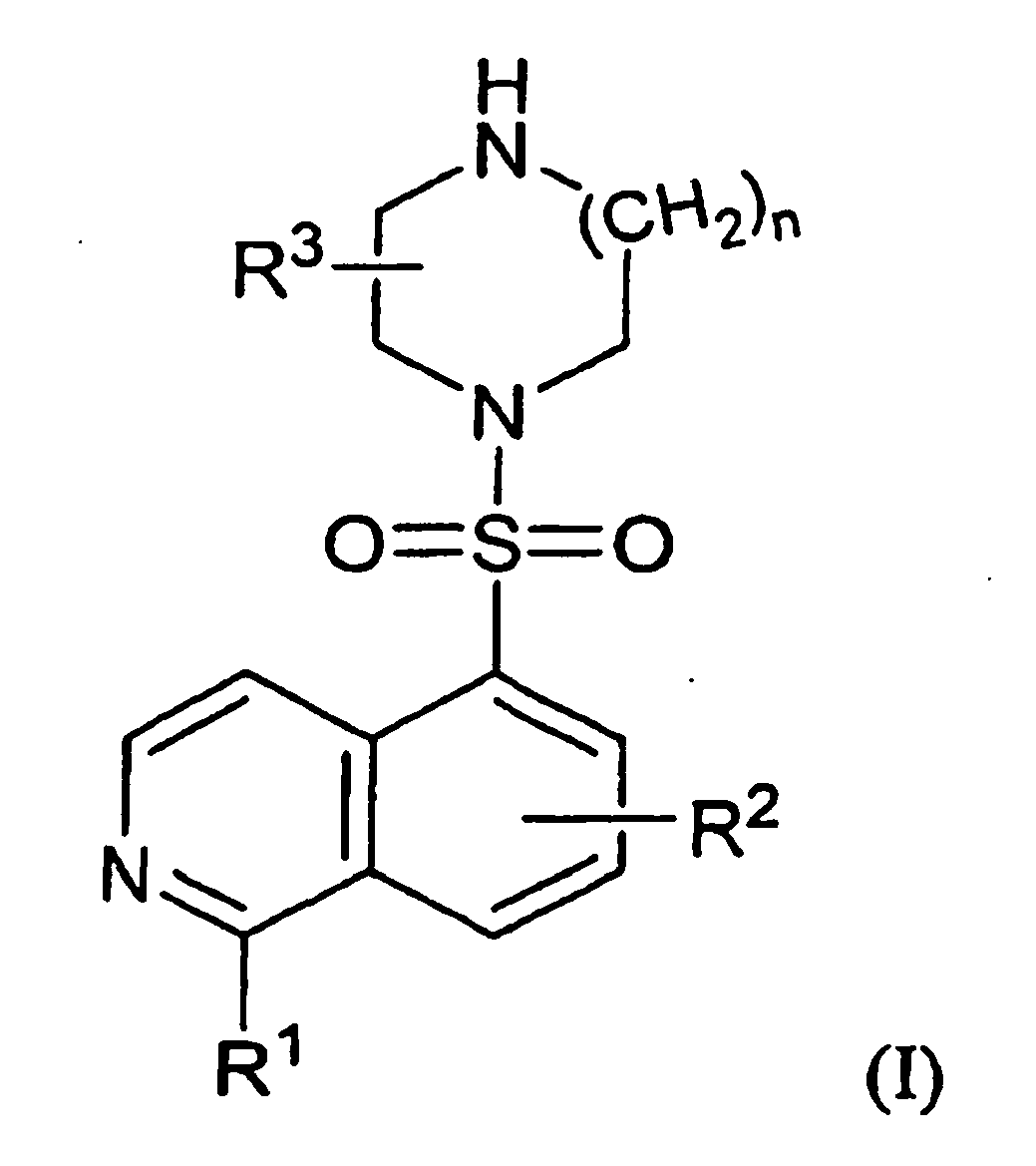

- As used herein, the term "alkyl" refers to a straight or branched, saturated, aliphatic group having the number of carbon atoms indicated. Accordingly, "C1-3 alkyl" refers to methyl, ethyl, n-propyl, and iso-propyl. In the same manner, "C1-3 alkoxy" refers to methoxy, ethoxy, n-propoxy, and iso-propoxy.
- One embodiment of the invention provides compounds of formula I, wherein R1 is a chlorine atom. Another embodiment of the invention provides compounds of formula I, wherein R1 is a C1-3 alkyl group, such as a methyl group.
- The compounds of formula I can also be salts, hydrates and solvates thereof.
- In a further aspect, compounds of the following formula II are provided:


- One embodiment of the invention provides compounds of formula II, wherein R1 is a chlorine atom. Another embodiment of the invention provides compounds of formula II, wherein R1 is a C1-3 alkyl group, such as a methyl group.
- The compounds of formula II can also be salts, hydrates and solvates thereof.
- Exemplary compounds are selected from the group of 1-chloro-5-([1,4]diazepane-1-sulfonyl)-8-propoxy-isoquinoline, 1-chloro-5-(piperazin-1-sulfonyl)-8-methoxy-isoquinoline, 1-methyl-5-([1,4]diazepane-1-sulfonyl)-8-methoxy-isoquinoline, and 1-chloro-5-([1,4]diazepane-1-sulfonyl)-6-methoxy-isoquinoline. Additionally, these compounds include salts, hydrates and solvates thereof.
- In a further embodiment of the invention, the compounds are selected from the group of 1-chloro-5-([1,4]diazepane-1-sulfonyl)-8-propoxy-isoquinoline, 1-chloro-5-(piperazin-1-sulfonyl)-8-methoxy-isoquinoline, and 1-methyl-5-([1,4]diazepane-1-sulfonyl)-8-methoxy-isoquinoline. Additionally, these compounds include salts, hydrates and solvates thereof.
- In general, compounds of Formula I and II, and their salts and hydrates, are prepared using well-established methodologies and are based on the common knowledge of one skilled in the art. These are described, for instance, in
U.S. Patent Nos. 4,678,783 and5,942,505 and European Patent No.187,371 - The compounds of the invention can be used as selective and potent inhibitor for PIM kinases, particularly for PIM-1 kinase.
- Said Compounds of the invention which exhibit a particular specific inhibitory effect on PIM kinases, such as PIM-1 kinase, therefore have broad therapeutic potential as a single agent as well as in combination with other agents (e.g. chemotherapeutic drugs and regimes known to anyone skilled in the art, such as Imatinib mesylate, mechlorethamine, cyclophosphamide, chlorambucil, cisplatin, carboplatin, oxaliplatin, azathioprine, mercaptopurine, doxorubicine, epirubicin, bleomycin, dactinomycin, vincristine, vinblastine, vinorelbine, vindesine, etoposide, teniposide, podophyllotoxin, paclitaxel, irinotecan, topotecan, melphalan, busulfan, capecitabine and combination thereof). They can be used for treating oncological diseases, particularly of the hematopoietic system, the liver and the prostate gland. Examples for such oncological diseases are ALL, CLL, AML, or CML, Hodgkin-Lymphoma, Non-Hodgkin Lymphoma and prostate carcinoma.
- In another aspect, a compound of formula I or II is provided for use in a method for inhibiting a PIM kinase as defined in the claims. In one embodiment, said method is a method for treating PIM kinase related conditions in a subject, the method comprising administering to a patient in need thereof, a therapeutically effective amount of a compound of Formula I. In some embodiments, the condition is selected from the group consisting of ALL, CLL, AML, or CML, Hodgkin-Lymphoma and Non-Hodgkin Lymphoma.
- In another a aspect, a compound of Formula I or II as specified above is provided for treating an oncological disease as defined in the claims.
- In a further embodiment, said compound is for use in, a method for treating a an oncological disease in a subject suffering from said disease, comprising administering to the subject a therapeutically effective amount of a compound of Formula I or II as specified above. In one embodiment, said oncological disease is one of the hematopoietic system, the liver or the prostate gland. In another embodiment, said oncological disease is selected from the group consisting of acute myelogenous leukemia (AML), acute lymphatic leukemia (ALL), chronic lymphatic leukemia (CLL), chronic myelogenous leukemia (CML), Hodgkin lymphadenoma. Non-Hodgkin lymphadenoma, and prostate carcinoma.
- The compounds of the present invention can be formulated in a variety of different manners known to one of skill in the art. Pharmaceutically acceptable carriers are determined in part by the particular composition being administered, as well as by the particular method used to administer the composition. Accordingly, there are a wide variety of suitable formulations of pharmaceutical compositions of the present invention (see, e.g., Remington's Pharmaceutical Sciences, 20t h ed., 2003, supra). Effective formulations include oral and nasal formulations, formulations for parenteral administration, and compositions formulated for with extended release.
- Formulations suitable for oral administration can consist of (a) liquid solutions, such as an effective amount of a compound of the present invention suspended in diluents, such as water, saline or PEG 400; (b) capsules, sachets, depots or tablets, each containing a predetermined amount of the active ingredient, as liquids, solids, granules or gelatin; (c) suspensions in an appropriate liquid; (d) suitable emulsions; and (e) patches. The pharmaceutical forms can include one or more of lactose, sucrose, mannitol, sorbitol, calcium phosphates, corn starch, potato starch, microcrystalline cellulose, gelatin, colloidal silicon dioxide, talc, magnesium stearate, stearic acid, and other excipients, colorants, fillers, binders, diluents, buffering agents, moistening agents, preservatives, flavoring agents, dyes, disintegrating agents, and pharmaceutically compatible carriers. Lozenge forms can comprise the active ingredient in a flavor, e.g., sucrose, as well as pastilles comprising the active ingredient in an inert base, such as gelatin and glycerin or sucrose and acacia emulsions, gels, and the like containing, in addition to the active ingredient, carriers known in the art.
- The pharmaceutical preparation typically is in unit dosage form. In such form the preparation is subdivided into unit doses containing appropriate quantities of the active component. The unit dosage form can be a packaged preparation, the package containing discrete quantities of preparation, such as packeted tablets, capsules, and powders in vials or ampoules. Also, the unit dosage form can be a capsule, tablet, cachet, or lozenge itself, or it can be the appropriate number of any of these in packaged form. The composition can, if desired, also contain other compatible therapeutic agents. In some embodiments, the pharmaceutical preparations deliver the compounds of the invention in a sustained release formulation.
- Pharmaceutical preparations useful in the present invention also include extended release formulations. In some embodiments, extended-release formulations useful in the present invention are described in
U.S. Patent No. 6,699,508 , which can be prepared according toU.S. Patent No. 7,125,567 . - The pharmaceutical preparations are typically delivered to a mammal, including humans and non-human mammals. Non-human mammals treated using the present methods include domesticated animals (i.e., canine, feline, murine, rodentia, and lagomorpha) and agricultural animals (bovine, equine, ovine, porcine).
- The compounds of the present invention can be administered as frequently as necessary, including hourly, daily, weekly or monthly. The compounds utilized in the pharmaceutical method of the invention are administered at the initial dosage of about 0.0001 mg/kg to about 1000 mg/kg daily. A daily dose range of about 0.01 mg/kg to about 500 mg/kg, or about 0.1 mg/kg to about 200 mg/kg, or about 1 mg/kg to about 100 mg/kg, or about 10 mg/kg to about 50 mg/kg, can be used. The dosages, however, may be varied depending upon the requirements of the patient, the severity of the condition being treated, and the compound being employed. For example, dosages can be empirically determined considering the type and stage of disease diagnosed in a particular patient. The dose administered to a patient, in the context of the present invention should be sufficient to effect a beneficial therapeutic response in the patient over time. The size of the dose also will be determined by the existence, nature, and extent of any adverse side-effects that accompany the administration of a particular compound in a particular patient. Determination of the proper dosage for a particular situation is within the skill of the practitioner. Generally, treatment is initiated with smaller dosages which are less than the optimum dose of the compound. Thereafter, the dosage is increased by small increments until the optimum effect under circumstances is reached. For convenience, the total daily dosage may be divided and administered in portions during the day, if desired. Doses can be given daily, or on alternate days, as determined by the treating physician. Doses can also be given on a regular or continuous basis over longer periods of time (weeks, months or years), such as through the use of a subdermal capsule, sachet or depot, implanted micro pump or via a patch.
- The pharmaceutical compositions can be administered to the patient in a variety of ways, including topically, parenterally, intravenously, intradermally, subcutaneously, intramuscularly, colonically, rectally or intraperitoneally. In some embodiments, the pharmaceutical compositions are administered parenterally, topically, intravenously, intramuscularly, subcutaneously, orally, or nasally, such as via inhalation.
- In practicing the methods and uses, respectively, in content of the present invention, the pharmaceutical compositions can be used alone, or in combination with other therapeutic or diagnostic agents. The additional drugs used in the combination protocols of the present invention can be administered separately or one or more of the drugs used in the combination protocols can be administered together, such as in an admixture. Where one or more drugs are administered separately, the timing and schedule of administration of each drug can vary. The other therapeutic or diagnostic agents can be administered at the same time as the compounds of the present invention, separately or at different times.
-
-
Fig. 1 : The compounds 1-chloro-5-([1,4]diazepane-1-sulfonyl)-8-propoxy-isoquinoline (compound A), 1-chloro-5-(piperazin-1-sulfonyl)-8-methoxy-isoquinoline (compound B), 1-methyl-S-([1,4]diazepane-i-sulfonyl)-B-methoxy-isoquinoline (compound C), and 1-chloro-5-([1,4]diazepane-1-sulfonyl)-6-methoxy-isoquinoline (compound D) are potent PIM kinase inhibitors.
In vitro assays of PIM-1 kinase activity (1.5 ng) in the present of increasing concentrations of the compounds A, B, C or D were performed as described within example 5. An assay without additional test compound served as positive control for the assay (pos) and an assay without PIM-1 kinase served as negative assay (neg). The compounds Fasudil (compound F) and potent PIM kinase inhibitor 1-thloro-8-methoxy-Fasudil (compound G) served for comparison. Each assay result was normalized in comparison to the positive control which was defined as 100 % activity. The compounds 1-chloro-5-([1,4]diazepane-1-sulfonyl)-8-propoxy-isoquinoline (compound A), 1-chloro-5-(piperazin-1-sulfonyl)-8-methoxy-isoquinoline (compound B), 1-methyl-5-([1,4]diazepane-1-sulfonyl)-8-methoxy-isoquinoline (compound C), and 1-chloro-5-([1,4]diazepane-1-sulfonyl)-6-methoxy-isoquinoline (compound D) showed potent PIM inhibitory effect comparable to the on of 1-chloro-8-methoxy-Fasudil (compound G). -
Fig. 2 : The compound 5-([1,4]diazepane-1-sulfonyl)-8-methoxy-isoquinoline (compound E) exhibits only a weak inhibitory effect on PIM kinase.
In vitro assays of PIM-1 kinase activity (2.5 ng) in the present of increasing concentrations of the compound E were performed as described within example 5. An assay without additional test compound served as positive control for the assay (pos) and an assay without PIM-1 kinase served as negative assay (neg). The compounds Fasudil (compound F) and potent PIM kinase inhibitor 1-chloro-8-methoxy-Fasudil (compound G) served for comparison. Each assay result was normalized in comparison to the positive control which was defined as 100 % activity. The compound 5-([1,4]diazepane-1-sulfonyl)-8-methoxy-isoquinoline (compound E) showed only weak PIM inhibitory effect slightly stronger than the one of Fasudil (compound F). -

- To a solution of 8-hydroxy-isoquinoline (1) (1.7 g, 11.7 mmol) in DMF (20 ml) at 0 °C was added NaH (940 mg, 23.4 mmol, 2.0 eq.). The mixture was stirred for 30 min. Bromopropane (1.6 ml, 17.6 mmol, 1.5 eq.) was then added. The reaction was allowed to warm to RT and was stirred for 1 h. The reaction was diluted with EtOAc and washed with water. The organic layer was dried over MgSO4 and concentrated. The residue was purified by flash chromatography (cyclohexane/
EtoAc 10/0 to 8/2) to afford 1.4 g (63 %) of 8-propoxy-isoquinoline (2) as red oil. - 1H NMR (300 MHz,DMSO-d6) δ : 9.66 (s, 1H), 8.52 (d, J = 5.8 Hz, 1H), 8.17 (d, J = 7.1 Hz, 1H), 7.8 (t, J = 8.1 Hz, 1H), 7.65 (d, J = 8.2 Hz, 1H), 7.28 (d, J = 7.8 Hz, 1H), 4.02 (s, 3H).
-

- To a solution of 8-propoxy-isoquinoline (2) (1.4 g, 7.48 mmol) in CH2Cl2 (20 ml) at RT was added mCPBA (2.21 g, 8.97 mmol). The reaction was stirred at RT for 4 h. The reaction was dried over MgSO4, filtered and the volume of solvent was reduced to 5 ml. 2 M HCl solution in Et2O (10 ml) was added. The mixture was stirred at RT for 5 min and diluted with Et2O. The precipitate was filtered to afford 1.34 g (74 %) of 8-propoxy-isoquinoline 2-oxide (3) as yellow solid.
- 1H NMR (300 MHz,DMSO-d6) δ : 9.17 (s, 1H), 8.42 (dd, J = 7.1, J = 1.7 Hz, 1H), 8.15 (d, J = 7.1 Hz, 1H), 7.76 (t, J = 8.1, 1H), 7.62 (d, J = 8.2 Hz, 1H), 7.25 (d, J = 7.9 Hz, 1H), 4.18 (t, J = 6.3 Hz, 2H), 1.97 (sex, J = 7.1 Hz, 2H), 1.14 (t, J = 7.3 Hz, 3H).
-

- A solution of 8-propoxy-isoquinoline 2-oxide (3) (1.34 g, 5.59 mmol) in POCl3 (25 ml) was heated at 90 °C for 5 h. The excess of POCl3 was evaporated. The residue was carefully diluted with water and CH2Cl2 and then extracted with CH2Cl2. The combined organic layers were dried over MgSO4 and concentrated. The residue was purified by flash chromatography (cyclohexane/
EtOAc 10/0 to 8/2) to afford 350 mg (28 %) of 1-chloro-8-propoxy-isoquinoline (4) as a white solid. - 1H NMR (300 MHz,DMSO-d6) δ: 8.20 (d, J = 5.6 Hz, 1H), 7.62 (t, J = 8.0 Hz, 1H), 7.50 (d,J=5.6Hz, 1H), 7.36(d,J=8.13, 1H), 6.98(d,J=7.9Hz, 1H), 4.10 (t, J = 6.2 Hz, 2H), 1.99 (sex, J = 7.4 Hz, 2H), 1.17 (t, J = 7.4 Hz, 3H).
-

- To a solution of fuming H2SO4 (20 % of SO3, 4 ml) at 0 °C was added 1-chloro-8-propoxy-isoquinoline (4) portion wise (350 mg, 1.57 mmol). The reaction was stirred at 0 °C for 30 min. The mixture was poured on Et2O. The precipitate was filtered and washed with Et2O to afford 800 mg (quant.) a mixture of 1-chloro-8-propoxy-isoquinoline-5-sulfonic acid (5) plus 1-chloro-B-propoxy-isoquinoline-7-sulfonic acid (6) (3: 1) The crude product was used directly for the next step.
- 1H NMR (300 MHz,DMSO-d6) δ : 8.62 (d, J = 5.8 Hz, 1H), 8.23 (d, J = 5.8 Hz, 1H), 8.10 (d, J = 8.3 Hz, 1H), 7.11 (d, J = 8.3 Hz, 1H), 4.12 (t, J = 6.1 Hz, 2H), 1.86 (sex, J = 7.1 Hz, 2H), 1.08 (t, J = 7.3 Hz, 3H).
-

- A solution of 1-chloro-8-propoxy-isoquinoline-5-sulfonic acid (5) and 1-chloro-8-propoxy-isoquinoline-7-sulfonic acid (6) (476 mg, 1.58 mmol) in SOCl2 (5 ml) and DMF (0.5 ml) was heated at 80 °C for 2 h. The solvent was evaporated. The residue was quenched with H2O and the solution was neutralized (pH = 8) by addition of a saturated NaHCO3 solution. The mixture was extracted with CH2Cl2. The combined organic layers were poured drop wise to a solution of Cbz-homopiperazine (490 mg, 2.09 mmol) in CH2Cl2 (5 ml) at 0 °C. The reaction was stirred at 0 °C for 2 h. The reaction was washed with water. The organic layers were dried over MgSO4, concentrated and purified by flash chromatography (cyclohexane/
EtOAc 10/0 to 8/2) to afford 360 mg (44%) of 4-(1-chloro-8-propoxy-isoquinoline-5-sulfonyl)-[1,4]diazepane-1-carboxylic acid benzyl ester (7) as a yellow oil. - 1H NMR (300 MHz,DMSO-d6) δ : 8.37-8.18 (m, 3H), 7.25 (m, 5H), 6.91 (d, J = 8.6 Hz, 1H), 5.02 (s, 2H), 4.13 (t, J = 6.1 Hz, 2H), 3.54-3.46 (m, 4H), 3.36-3.27 (m, 4H), 1.97-1.80 (m, 4H), 1.19 (t, J = 7.1 Hz, 3H).
-

- To a solution of 4-(1-chloro-8-propoxy-isoquinoline-5-sulfonyl)-[1,4]diazepane-1-carboxylic acid benzyl ester (7) (250 mg, 0.48 mmol) in CH2Cl2 (9 ml) at 0 °C was added 33 % HBr in AcOH. The reaction was stirred at RT for 30 min. The reaction was poured in water and neutralized (pH = 8) by addition of a saturated NaHCO3 solution. The mixture was extracted with AcOEt. The organic layer was dried over MgSO4 and concentrated. The residue was purified by flash chromatography (CH2Cl2/
MeOH 100/0 to 85/15) The combined fractions were dissolved in MeOH and 2 M HCl in Et2O (130 µl) was added. The mixture was concentrated to afford 95 mg (51 %) a white solid. - 1H NMR (300 MHz,DMSO-d6) δ : 8.70 (broad s, 1H), 8.43 (d, J = 5.94 Hz, 1H), 8.34-8.28 (m, 2H), 7.31 (d, J = 8.8 Hz, 1H), 4.24 (t, J = 6.1 Hz, 2H), 3.58-3.55 (m, 2H), 3.42-3.40 (m, 2H), 3.14 (m, 4H), 1.96-1.87 (m, 4H), 1.10 (t, J = 7.3 Hz, 3H).
-

- To a solution 8-methoxy-isoquinoline (9) (5.0 g, 31.4 mmol) in CH2Cl2 (100 ml) at RT was added mCPBA (9.3 g, 53.9 mmol). The reaction was stirred at RT for 2 h 30 min. The reaction was dried over MgSO4 and the volume of solvent was reduced to 20 ml, and 22 ml of 2 M HCl solution in Et2O was added. The mixture was stirred at RT for 5 min and diluted with Et2O. The precipitate was filtered to afford 6.6 g (quant.) of 8-methoxy-isoquinoline 2-oxide hydrochloride (10) as yellow solid.
- 1H NMR (300 MHz,DMSO-d6) δ : 9.20 (s, 1H), 8.45 (dd, J = 7.1, 2 Hz, 1H), 8.17 (d, J = 7.1 Hz, 1H), 7.8 (t, J = 8.1 Hz, 1H), 7.65 (d, J = 8.2 Hz, 1H), 7.28 (d, J = 7.8 Hz, 1H), 4.02 (s, 3H, OCH3).
-

- A solution of 8-methoxy-isoquinoline 2-oxide hydrochloride (10) (6.6 g, 31.2 mmol) in POCl3 (30 ml) was heated at 70 °C for 1 h. The excess of POCl3 was evaporated. The residue was carefully diluted with water and CH2Cl2 and then extracted with CH2Cl2. The combined organic layers were dried over MgSO4 and concentrated. The residue was purified by flash chromatography (cyclohexane/
EtOAc 10/0 to 8/2) to afford 2.8 g (46 %) of 1-chloro-8-methoxy-isoquinoline (11) as a white solid. - 1H NMR (300 MHz.DMSO-d6) δ : 8.20 (d, J = 5.6 Hz, 1H), 7.59 (t, J = 4.3 Hz, 1H), 7.49 (d, J = 5.6 Hz, 1H), 7.37 (d, J = 7.6, 1H), 7.96 (d, J = 6.0 Hz, 1H), 4.00 (s, 3H, OCH3).
-

- To a solution of fuming H2SO4 (20 % of SO3, 10 ml) at 0 °C was added 1-chloro-8-methoxy-isoquinoline (11) portion wise (1.0 g, 5.16 mmol). The reaction was stirred at 0 °C for 1 h. The mixture was poured on Et2O. The precipitate was filtered and washed with Et2O to afford 1.5 g (quant.) of 1-chloro-8-methoxy-isoquinoline-5-sulfonic acid (12) as a yellow solid (mixture with inorganic salt).
- 1H NMR (300 MHz,DMSO-d6) δ : 8.63 (d, J = 5.9 Hz, 1H), 8.24 (d, J = 5.9 Hz, 1H), 8.13 (d, J = 8.3 Hz, 1H), 7.13 (d, J = 8.37 Hz, 1H), 3.96 (s, 3H, OCH3).
-

- A solution of 1-chloro-8-methoxy-isoquinoline-5-sulfonic acid (12) (160 mg, 0.58 mmol) in SOCl2 (5 ml) and DMF (0.1 ml) was heated at 80 °C for 2 h. The solvent was evaporated. The residue was dissolved with CH2Cl2 and ice was added and the solution was neutralized (pH = 6) by addition of a saturated NaHCO3 solution. The mixture was extracted with CH2Cl2. The combined organic layers were poured drop wise to a solution of BOC-piperazine (273 mg, 1.46 mmol, 2.5 eq.) in CH2Cl2 (5 ml) at 0 °C. The reaction was stirred at 0 °C for 2 h. The reaction was washed with water. The organic layers were dried over Na2SO4, concentrated and purified by flash chromatography (cyclohexane/
EtOAc 10/0 to 1/1) to afford 132 mg (51 %) of 4(-1-chloro-8-methoxy-isoquinoline-5-sulfonyl)-piperazine-1-carboxylic acid tert-butyl ester (13) as a white solid.. - 1H NMR (300 MHz,CHCl3-d) δ : 9.09 (broad s, 1H, NH), 8.47-8.37 (m, 3H), 7.42 (d, J = 8.8 Hz, 1H), 4.11 (s, 3H, OCH3), 3.32-3.28 (m, 4H, 2*CH2), 3.10 (broad s, 4H, 2*CH2).
- LC/MS = 100%, m/z = 442.2
-

- To a solution of 4(-1-chloro-8-methoxy-isoquinoline-5-sulfonyl)-piperazine-1-carboxylic acid tert-butyl ester (13) (132 mg, 0.30 mmol) in ethyl acetate (5 ml), was added 4 N HCl dioxan (4 ml), the reaction was stirred at room temperature for 4 h. The white precipitate was filtered and washed with Et2O to afford 1-chloro-8-methoxy-5-(piperazine-1-sulfonyl)-isoquinoline hydrochloride (14) (110 mg) quant, as a white solid.
- 1H NMR (300 MHz,DMSO-d6) δ : 9.09 (broad s, 1H, NH), 8.47-8.37 (m, 3H), 7.42 (d, J = 8.8, 1H Hz,), 4.11 (s, 3H, OCH3), 3.32-3.28 (m, 4H, 2*CH2), 3.10 (broad s, 4H, 2*CH2).
- LC/MS = 100%
-

- To a solution of 1-chloro-8-methoxy-isoquinoline (11) (205 mg, 1.06 mmol) in dry THF (5 ml) were added Fe (acac)3 (38 mg , 0.106 mmol, 0.1 eq.), NMP (0.7 ml, 6.89 mmol, 6.5 eq.) and 3 M MeMgBr in Et2O (0.46 mmol, 1.37 mmol, 1.3 eq.) at RT, the red mixture was stirred at RT for 2 h. The brown mixture was filtered over celite, quenched with a saturated NaCl solution and extracted with EtOAc. The organic phases were dried over Na2SO4 and concentrated. The residue was purified by flash chromatography (cyclohexane/
EtOAc 10/0 to 8/2) to afford 170 mg g (55 %) of 8-Methoxy-1-methyl-isoquinoline (15) as a colorless oil. - 1H NMR (300 MHz,CHCl3-d) δ : 8.33 (d, J = 5.7 Hz, 1H), 7.55 (t, J = 8.0 Hz, 1H), 7.42 (d, J = 5.7 Hz, 1H), 7.34 (d, J = 8.1 Hz, 1H), 6.90 (d, J = 7.9 Hz, 1H), 3.99 (s, 3H, OCH3), 3.11 (s, 3H, CH3).
-

- To a solution of fuming H2SO4 (20 % of SO3, 2.0 ml) at 0 °C was added 8-Methoxy-1-methyl-isoquinoline (15) (170 mg, 0.98 mmol). The reaction was stirred at 0 °C for 1 h. The mixture was poured on Et2O. The precipitate was filtered and washed with Et2O to afford 320 mg (quant.) of 8-methoxy-1-methyl-isoquinoline-5-sulfonic acid (16) as a beige solid (mixture with inorganic salts).
- 1H NMR (300 MHz,D2O) δ : 8.64 (d, J = 7.1 Hz, 1H), 8.48 (d, J = 8.7 Hz, 1H), 8.22 (d, J = 7.1 Hz, 1H), 7.27 (d, J = 8.6 Hz, 1H), 4.05 (s, 3H, OCH3), 3.65 (s, 3H, CH3).
-

- A solution of 8-methoxy-1-methyl-isoquinoline-5-sulfonic acid (16) (278 mg, 0.98 mmol) in SOCl2 (5 ml) and DMF (0.1 ml) was heated at 80 °C for 2 h. The solvent was evaporated. The residue was dissolved CH2Cl2 and ice and the solution was neutralized (pH 6) by addition of a saturated NaHCO3 solution. The mixture was extracted with CH2Cl2. The combined organic layers were poured drop wise to a solution of homopiperazine (392 mg, 3.92 mmol, 4.0 eq.) in CH2Cl2 (5 ml) at 0 °C. The reaction was stirred at 0 °C for 2 h. The reaction was washed with water. The organic layers were dried over MgSO4, concentrated and purified by flash chromatography (CH2Cl2/
MeOH 100/0 to 90/10) to afford 100 mg (30 %) of 5-([1,4]diazepane-1-sulfonyl)-8-methoxy-1-methyl-isoquinoline (17) as a yellow oil. - 1H NMR (300 MHz,CHCl3-d) δ : 8.47 (d, J = 6.1 Hz, 1H), 8.31 (d, J = 8.5 Hz, 1H), 8.19 (d, J = 5.9 Hz, 1H), 6.91 (d, J = 8.6 Hz, 1H), 4.07 (s, 3H, OCH3), 3.44-3.38 (m, 4H, 2*CH2), 3.11 (s, 3H, CH3), 2.97-2.91 (m, 4H, 2*CH2), 1.86-1.77 (m, 2H, CH2).
-

- A solution of 5-([1,4]diazepane-1-sulfonyl)-8-methoxy-1-methyl-isoquinoline (17) (100 mg, 0.29 mmol) in 2 N HCl in Et2O was stirred for 2 h at RT The white precipitate was filtered and washed with Et2O to afford 5-([1,4]diazepane-1-sulfonyl)-8-methoxy-1-methyl-isoquinoline hydrochloride (18) as a yellow solid with 90 % yield.
- 1H NMR (300 MHz,D2O) δ : 8.59 (d, J = 7.1 Hz, 1H), 8.58 (d, J = 8.9 Hz, 1H), 8.29 (d, J = 7.1 Hz, 1H), 7.38 (d, J = 8.9 Hz, 1H), 4.12 (s, 3H, OCH3), 3.67 (t, J = 5.1 Hz, , 2H, CH2), 3.47 (t, J = 6.2 Hz, , 2H, CH2), 3.34-3.31 (m, 4H, 2*CH2), 3.23 (s, 3H, CH3), 2.09-2.03 (m, 2H, CH2).
-

- To a solution of 6-methoxy-isoquiniline (1) (2.5 g, 15.7 mmol) in CH2Cl2 (30 ml) at RT was added mCPBA (3.87 g, 18.1 mmol). The reaction was stirred at RT for 2 h 30 min. The volume of solvent was reduced to 15 ml and 22 ml of a saturated HCl solution of Et2O was added. The mixture was stirred at RT for 5 min and diluted with Et2O. The precipitate was filtered to afford 3.3 g (99%) of 6-methoxy-isoquinoline 2-oxide hydrochloride (2) as yellow solid.
- 1H NMR (300 MHz,DMSO-d6) δ : 9.61 (s, 1H), 8.53 (dd J = 7.2, 2 Hz, 1H), 8.22 (d, J = 9.1 Hz, 1H), 8.21 (d, J = 7.2 Hz, 1H), 7.65 (s, 1H), 7.55 (dd, J = 9.1, 2 Hz, 1H), 3.97 (s, 3H).
-

- A solution of 6-methoxy-isoquinoline 2-oxide hydrochloride (2) (3.3 g, 15.6 mmol) in POCl3 (25 ml) was heated at 90 °C for 5 h 30 min. The excess of POCl3 was evaporated. The residue was carefully diluted with water and CH2Cl2 and then extracted with CH2Cl2. The combined organic layers were dried over MgSO4 and concentrated. The residue was purified by flash chromatography (cyclohexane/
EtOAc 10/0 to 8/2) to afford 1.69 g (56%) of 1-chloro-6-methoxy-isoquinoline (3) as a white solid. - 1H NMR (300 MHz,DMSO-d6) δ : 8.19 (d, J = 5.6 Hz, 1H), 8.15 (d, J = 9.2 Hz, 1H), 7.75 (d, J = 5.6 Hz, 1H), 7.46 (s, 1H), 7.40 (d, J = 9.2 Hz, 1H), 3.92 (s, 3H).
-

- To a solution of fuming H2SO4 (20% of SO3, 15 ml) at 0°C was added 1-chloro-6-methoxy-isoquinoline (3) portion wise (1.85 g, 9.55 mmol). The reaction was heated at 45 °C for 30 min. The mixture was poured on ice cold water and brought to pH 3 by addition of a saturated NaHCO3 solution. The aqueous layer was washed with AcOEt (to remove impurities) and the aqueous phase was concentrated. The residue was triturated with iPrOH and the salts were filtered. The filtrate was concentrated to afford 4.0 g (quant.) of 1-Chloro-6-methoxy-isoquinoline-5-sulfonic acid (4) in mixture with inorganic salts.
- 1H NMR (300 MHz,DMSO-d6) δ: 9.12 (d, J = 6.3 Hz, 1H), 8.28 (d, J = 9.4 Hz, 1H), 8.10 (d, J = 6.3 Hz, 1H), 7.63 (d, J = 9.4 Hz, 1H), 3.91 (s, 3H).
-

- A solution of 1-Chloro-6-methoxy-isoquinoline-5-sulfonic acid (4) (2.0 g) in SOCl2 (25 ml) and DMF (2 ml) was heated at 80 °C for 2 h. The solvent was evaporated. The residue was taken in H2O and the solution was neutralized (pH 8) by addition of a saturated NaHCO3 solution. The mixture was extracted with CH2Cl2. The combined organic layers were poured drop wise to a solution of homopiperazine (1.2 g, 12.0 mmol) in CH2Cl2 (10ml) at 0 °C. The reaction was stirred at 0 °C for 1 h 30 min. The reaction was washed with water. The organic layers were dried over MgSO4, concentrated and purified by flash chromatography (CH2Cl2/MeOH 98/2 to 85/15) to afford 840 mg (49 %) of 1-chloro-S-([1,4]diazepane-1-sulfonyl)-6-methoxy-isoquinoline (5) as a yellow oil.
- 1H NMR (300 MHz,DMSO-d6) δ : 8.89 (d, J = 6.4 Hz, 1H), 8.56 (d, J = 9.5 Hz, 1H), 8.25 (d, J = 6.4 Hz, 1H), 7.44 (d, J = 9.5 Hz, 1H), 4.11 (s, 3H), 3.42 (m, 4H), 3.00 (m, 4H), 1.88 (m, 2H).
-

- To a solution of 1-chloro-5-([1,4]diazepane-1-sulfonyl)-6-methoxy-isoquinoline (5) (1.19 g, 3.35 mmol) in CH2Cl2 (5 ml) was added 2 M HCl in Et2O (1.68 ml, 3.35 mmol). The reaction was stirred at RT for 10 min. The reaction was diluted with Et2O. The precipitate was filtered to afford 1.3 g (99%) of 1-chloro-5-([1,4]diazepane-1-sulfonyl)-6-methoxy-isoquinoline hydrochloride (6) as a yellow solid.
- Mp : 219 - 221 °C
- 1H NMR (300 MHz,DMSO-d6) δ : 9.25 (broad s, NH.HCl), 8.72 (d, J = 6.3 Hz, 1H), 8.61 (d, J = 9.5 Hz, 1H), 8.33 (d, J = 6.3 Hz, 1H), 7.86 (d, J = 9.5 Hz, 1H), 4.15 (s, 3H), 3.69 - 6.65 (m, 2H), 3.38 - 3.31 (m, 2H), 3.23 - 3.17 (m, 4H), 2.07 - 1.99 (m, 2H).
- The in vitro assay for PIM-1 kinase inhibition was performed using the PIM-1 Kinase Assay Kit (Cell Signaling Technology Inc., Boston, USA) according to the manufacture's instruction. Briefly, 1.5 or 2.5 ng PIM-1 kinase has been dissolved in 50 µl assay buffer (25 mM Tris-Hcl (pH 7.5), 10 mM MgCl2, 5 mM beta-glycerophosphate, 0.1 mM Na3VO4, 2 mM DTT, 200 µM ATP, and 1.5 µM peptide substrate) and test compound has been added to a final concentration in a range of 0.1 to 100 µM. After 30 minutes incubation at ambient temperature the reaction was stopped by adding 50 µl Stop buffer (50 mM EDTA, pH 8) per reaction. An aliquot of 25 µl per reaction was diluted each by 75 µl water and transferred to a 96-well streptavidin-coated plate. After 60 minutes incubation and three times washing with PBS, 100 µl/well primary antibody (Phospho-Bad (Ser112) antibody, 1:1000 diluted in PBS) was added. After further 2 h incubation and three times washing with PBS, an usual colorimetric ELISA assay was performed using a HRP labeled second antibody according to the manufacture's instructions. A PIM kinase reaction without addition of a test compound served as positive control (pos) and an assay without PIM kinase served as negative control (neg). Fasudil (compound F) which is exhibit at the most very weak PIM-1 inhibition and 1-chloro-8-methoxy-Fasudil (compound G) which is a very potent PIM-1 inhibitor served as further controls in each series of assays. The PIM-1 kinase inhibition of the test compounds (1-chloro-5-([1,4]diazepane-1-sulfonyl)-8-propoxy-isoquinoline (compound A), 1-chloro-5-(piperazin-1-sulfonyl)-8-methoxy-isoquinoline (compound B), 1-methyl-5-([1,4]diazepane-1-sulfonyl)-8-methoxy-isoquinoline (compound C), and 1-chloro-5-([1,4]diazepane-1-sulfonyl)-6-methoxy-isoquinoline (compound D)) was measured in a first series of assays, and the one of the compound 5-([1,4]diazepane-1-sulfonyl)-8-methoxy-isoquinoline (compound E) was measured in a second series of assays. Within each series of assays the measured PIM-1 kinase activity was normalized in comparison to the positive control (pos) which was defined as 100 % activity. The amount of PIM-1 kinase used in each series of assays was adapted in order to attain the same degree of inhibitions for the control compounds Fasudil and 1-chloro-8-methoxy-Fasudil to attain comparability of the inhibition results from separate series of assays. The compounds 1-chloro-5-([1,4]diazepane-1-sulfonyl)-8-propoxy-isoquinoline (compound A), 1-chloro-5-(piperazin-1-sulfonyl)-8-methoxy-isoquinoline (compound B), 1-methyl-5-([1,4]diazepane-1-sulfonyl)-8-methoxy-isoquinoline (compound C), and 1-chloro-5-([1,4]diazepane-1-sulfonyl)-6-methoxy-isoquinoline (compound D) revealed to be potent PIM-1 kinase inhibitors (
Fig. 1 ), whereas the compound 5-([1,4]diazepane-1-sulfonyl)-8-methoxy-isoquinoline (compound E) exhibits at most a moderate PIM-1 kinase inhibition (Fig. 2 ). The table below summarizes the percentage of the remaining PIM-1 kinase activity in the presence of the test compounds in a final concentration of 100 µM.Percentage of the remaining PIM-1 kinase activity in presence of the test compounds (100 µM) Compound A B C D E F G % remaining PIM-1 kinase activity 23 33 31 29 46 71 17 - Efficacy of PIM inhibitors in cell culture can be tested as effects on proliferation of immortal cancer cell lines, e.g. the HeLa cell line and many others. Proliferation can be measured by counting cell density over time under a microscope, or by a number of biochemical assays. Invasion and spreading of cells can be assessed in soft agar tests, again using a large number of cancer cell lines. Induction of apoptosis in said cancer cells can be tested by assaying caspase 3 expression (e.g. by the Promega Caspase-glow assay). In vivo, anti cancer activity can be tested by transpainting cancer cell lines to animals, e.g. after immunosuuppression, and monitoring the growth of those tumours for example by a reporter gene such as luciferase, and bioimaging using life single photon imaging boxes, or radiological assays like magnetic resonance imaging (MRI) or Micro-CT. Volume of the tumours also can be assessed post mortem in those animals. Typically the experiment is done in two groups of animals, one receiving placebo, and one receiving the drug. Sample sizes are typically 20 per group. In those animals also the lifespan and mortality can be monitored, and provide a clinically meaningful endpoint. Typically, a broad range of concentrations and application modes is tested in vivo to find an optimal dose range.
Claims (15)
- A compound of Formula I

R1 is a chlorine atom or a C1-3 alkyl group,
R2 is a C1-3 alkoxy group at position 6 or 8 of the isoquinoline moiety,
R3 is a hydrogen or a C1-3 alkyl group, and
n is 1 or 2. - A compound of Formula II

R1 is a chlorine atom or a C1-3 alkyl group,
R2 is a C1-3 alkoxy group at position 6 or 8 of the isoquinoline moiety, and
n is 1 or 2. - The compound of claim 1 or 2, wherein the compound 1-chloro-5-([1,4]diazepane-1-sulfonyl)-8-methoxy-isoquinoline is excluded.
- The compound of claim 1 or 2, wherein the compounds according to the formula

- The compound of any one of claims 1 to 4, wherein R1 is a chlorine atom.
- The compound of any one of claims 1 to 4, wherein R1 is a C1-3 alkyl group.
- The compound of claim 6, wherein R1 is a methyl group.
- The compound of claim 1 that is selected from the group consisting of 1-chloro-5-([1,4]diazepane-1-sulfonyl)-8-propoxy-isoquinoline, 1-chloro-5-(piperazin-1-sulfonyl)-8-methoxy-isoquinoline, 1-methyl-5-([1,4]diazepane-1-sulfonyl)-8-methoxy-isoquinoline, and 1-chloro-5-([1,4]diazepane-1-sulfonyl)-6-methoxy-isoquinoline.
- A compound of any one of claims 1 to 8 for use in a method for inhibiting a PIM kinase, comprising contacting the PIM kinase with said compound, particularly wherein the PIM kinase is PIM-1 kinase.
- An in vitro method for inhibiting a PIM kinase, comprising contacting the PIM kinase with a compound of any one of claims 1 to 8, particularly wherein the PIM kinase is PIM-1 kinase.
- A compound of any one of claims 1 to 8 for use in a method of treating an oncological disease.
- The compound for use of claim 11, wherein the oncological disease is one of the hematopoietic system, the liver or the prostate gland.
- The compound for use of claim 11, wherein the oncological disease is selected from the group consisting of acute myelogenous leukemia (AML), acute lymphatic leukemia (ALL), chronic lymphatic leukemia (CLL), chronic myelogenous leukemia (CML), Hodgkin lymphadenoma, Non-Hodgkin lymphadenoma, and prostate carcinoma.
- A pharmaceutical composition containing a compound of any one of claims 1 to 8.
- The compound for use of claim 11 for use in a method for treating an oncological disease in a subject suffering from said disease, comprising administering to the subject a pharmaceutical effective amount of said compound.
Priority Applications (4)
| Application Number | Priority Date | Filing Date | Title |
|---|---|---|---|
| EP09014103A EP2332917B1 (en) | 2009-11-11 | 2009-11-11 | Compounds for PIM kinase inhibition and for treating malignancy |
| CA2776829A CA2776829A1 (en) | 2009-11-11 | 2010-11-11 | Compounds for pim kinase inhibition and for treating malignancy |
| AU2010318312A AU2010318312A1 (en) | 2009-11-11 | 2010-11-11 | Compounds for PIM kinase inhibition and for treating malignancy |
| PCT/EP2010/006876 WO2011057784A1 (en) | 2009-11-11 | 2010-11-11 | Compounds for pim kinase inhibition and for treating malignancy |
Applications Claiming Priority (1)
| Application Number | Priority Date | Filing Date | Title |
|---|---|---|---|
| EP09014103A EP2332917B1 (en) | 2009-11-11 | 2009-11-11 | Compounds for PIM kinase inhibition and for treating malignancy |
Publications (2)
| Publication Number | Publication Date |
|---|---|
| EP2332917A1 EP2332917A1 (en) | 2011-06-15 |
| EP2332917B1 true EP2332917B1 (en) | 2012-08-01 |
Family
ID=41426824
Family Applications (1)
| Application Number | Title | Priority Date | Filing Date |
|---|---|---|---|
| EP09014103A Not-in-force EP2332917B1 (en) | 2009-11-11 | 2009-11-11 | Compounds for PIM kinase inhibition and for treating malignancy |
Country Status (4)
| Country | Link |
|---|---|
| EP (1) | EP2332917B1 (en) |
| AU (1) | AU2010318312A1 (en) |
| CA (1) | CA2776829A1 (en) |
| WO (1) | WO2011057784A1 (en) |
Families Citing this family (33)
| Publication number | Priority date | Publication date | Assignee | Title |
|---|---|---|---|---|
| EP2343298B9 (en) | 2005-12-13 | 2020-05-06 | Incyte Holdings Corporation | Heteroaryl substituted pyrrolo[2,3-b]pyridines and pyrrolo[2,3-b]pyrimidines as Janus kinase inhibitors |
| RS53245B2 (en) | 2007-06-13 | 2022-10-31 | Incyte Holdings Corp | JANUS KINASE INHIBITOR SALTS (R)-3-(4-(7H-PYROLO(2,3-D) PYRIMIDIN-4-YL)-1H-PYRAZOL-1-YL)-3-CYCLOPENTYLPROPANE-NITRILE |
| WO2010135650A1 (en) | 2009-05-22 | 2010-11-25 | Incyte Corporation | N-(HETERO)ARYL-PYRROLIDINE DERIVATIVES OF PYRAZOL-4-YL-PYRROLO[2,3-d]PYRIMIDINES AND PYRROL-3-YL-PYRROLO[2,3-d]PYRIMIDINES AS JANUS KINASE INHIBITORS |
| HRP20192203T1 (en) | 2009-05-22 | 2020-03-06 | Incyte Holdings Corporation | 3-[4-(7h-pyrrolo[2,3-d]pyrimidin-4-yl)-1h-pyrazol-1-yl]octane- or heptane-nitrile as jak inhibitors |
| TW201113285A (en) | 2009-09-01 | 2011-04-16 | Incyte Corp | Heterocyclic derivatives of pyrazol-4-yl-pyrrolo[2,3-d]pyrimidines as janus kinase inhibitors |
| SI3354652T1 (en) | 2010-03-10 | 2020-08-31 | Incyte Holdings Corporation | Piperidin-4-yl azetidine derivatives as jak1 inhibitors |
| MY161078A (en) | 2010-05-21 | 2017-04-14 | Incyte Holdings Corp | Topical formulation for a jak inhibitor |
| JP5917545B2 (en) | 2010-11-19 | 2016-05-18 | インサイト・ホールディングス・コーポレイションIncyte Holdings Corporation | Cyclobutyl substituted pyrrolopyridine and pyrrolopyrimidine derivatives as JAK inhibitors |
| WO2012068440A1 (en) | 2010-11-19 | 2012-05-24 | Incyte Corporation | Heterocyclic-substituted pyrrolopyridines and pyrrolopyrimidines as jak inhibitors |
| PE20140832A1 (en) | 2011-06-20 | 2014-07-14 | Incyte Corp | DERIVATIVES OF AZETIDINYL PHENYL, PYRIDYL OR PYRAZINYL CARBOXAMIDE AS JAK INHIBITORS |
| PT3409278T (en) | 2011-07-21 | 2020-12-18 | Sumitomo Dainippon Pharma Oncology Inc | Heterocyclic protein kinase inhibitors |
| TW201313721A (en) | 2011-08-18 | 2013-04-01 | Incyte Corp | Cyclohexyl azetidine derivatives as JAK inhibitors |
| UA111854C2 (en) | 2011-09-07 | 2016-06-24 | Інсайт Холдінгс Корпорейшн | METHODS AND INTERMEDIATE COMPOUNDS FOR JAK INHIBITORS |
| US9193733B2 (en) | 2012-05-18 | 2015-11-24 | Incyte Holdings Corporation | Piperidinylcyclobutyl substituted pyrrolopyridine and pyrrolopyrimidine derivatives as JAK inhibitors |
| TWI702057B (en) | 2012-11-15 | 2020-08-21 | 美商英塞特控股公司 | Sustained-release dosage forms of ruxolitinib |
| WO2014110574A1 (en) | 2013-01-14 | 2014-07-17 | Incyte Corporation | Bicyclic aromatic carboxamide compounds useful as pim kinase inhibitors |
| ES2790419T3 (en) | 2013-01-15 | 2020-10-27 | Incyte Holdings Corp | Thiazolecarboxamide and pyridinecarboxamide compounds useful as PIM kinase inhibitors |
| ES2900492T3 (en) | 2013-03-06 | 2022-03-17 | Incyte Holdings Corp | Processes and intermediates to make a JAK inhibitor |
| RS60469B1 (en) | 2013-08-07 | 2020-07-31 | Incyte Corp | Sustained release dosage forms for a jak1 inhibitor |
| US9556197B2 (en) | 2013-08-23 | 2017-01-31 | Incyte Corporation | Furo- and thieno-pyridine carboxamide compounds useful as pim kinase inhibitors |
| US9498467B2 (en) | 2014-05-30 | 2016-11-22 | Incyte Corporation | Treatment of chronic neutrophilic leukemia (CNL) and atypical chronic myeloid leukemia (aCML) by inhibitors of JAK1 |
| US9580418B2 (en) | 2014-07-14 | 2017-02-28 | Incyte Corporation | Bicyclic aromatic carboxamide compounds useful as Pim kinase inhibitors |
| WO2016010897A1 (en) | 2014-07-14 | 2016-01-21 | Incyte Corporation | Bicyclic heteroaromatic carboxamide compounds useful as pim kinase inhibitors |
| US9540347B2 (en) | 2015-05-29 | 2017-01-10 | Incyte Corporation | Pyridineamine compounds useful as Pim kinase inhibitors |
| AR105967A1 (en) | 2015-09-09 | 2017-11-29 | Incyte Corp | SALTS OF A PIM QUINASA INHIBITOR |
| WO2017059251A1 (en) | 2015-10-02 | 2017-04-06 | Incyte Corporation | Heterocyclic compounds useful as pim kinase inhibitors |
| TW201924683A (en) | 2017-12-08 | 2019-07-01 | 美商英塞特公司 | Low dose combination therapy for treatment of myeloproliferative neoplasms |
| PT3746429T (en) | 2018-01-30 | 2022-06-20 | Incyte Corp | Processes for preparing (1 -(3-fluoro-2-(trifluoromethyl)isonicotinyl)piperidine-4-one) |
| EP4424328A3 (en) | 2018-03-30 | 2024-12-04 | Incyte Corporation | Treatment of hidradenitis suppurativa using jak inhibitors |
| CN112236139A (en) | 2018-04-13 | 2021-01-15 | 大日本住友制药肿瘤公司 | PIM kinase inhibitors for the treatment of myeloproliferative tumors and cancer-associated fibrosis |
| NZ778055A (en) | 2019-02-12 | 2025-11-28 | Sumitomo Pharma America Inc | Formulations comprising heterocyclic protein kinase inhibitors |
| US11833155B2 (en) | 2020-06-03 | 2023-12-05 | Incyte Corporation | Combination therapy for treatment of myeloproliferative neoplasms |
| AU2023372386A1 (en) | 2022-10-31 | 2025-05-08 | Sumitomo Pharma America, Inc. | Pim1 inhibitor for treating myeloproliferative neoplasms |
Family Cites Families (6)
| Publication number | Priority date | Publication date | Assignee | Title |
|---|---|---|---|---|
| US4678783B1 (en) | 1983-11-04 | 1995-04-04 | Asahi Chemical Ind | Substituted isoquinolinesulfonyl compounds |
| DE3583287D1 (en) | 1984-12-27 | 1991-07-25 | Asahi Chemical Ind | SUBSTITUTED ISOCHINOLINSULFONYL COMPOUNDS. |
| ES2142065T3 (en) | 1995-07-03 | 2000-04-01 | Asahi Chemical Ind | 1- (5-ISOQUINOLEINSULFONIL) HOMOPIPERAZINE HYDRATED CHLORHYDRATES. |
| WO2000009133A1 (en) | 1998-08-10 | 2000-02-24 | Asahi Kasei Kogyo Kabushiki Kaisha | Sustained release oral preparations of fasudil hydrochloride |
| WO2008049919A2 (en) * | 2006-10-26 | 2008-05-02 | Devgen N.V. | Rho kinase inhibitors |
| US20100144751A1 (en) * | 2007-03-28 | 2010-06-10 | Array Biopharma Inc. | IMIDAZO[1,2-a]PYRIDINE COMPOUNDS AS RECEPTOR TYROSINE KINASE INHIBITORS |
-
2009
- 2009-11-11 EP EP09014103A patent/EP2332917B1/en not_active Not-in-force
-
2010
- 2010-11-11 WO PCT/EP2010/006876 patent/WO2011057784A1/en not_active Ceased
- 2010-11-11 AU AU2010318312A patent/AU2010318312A1/en not_active Abandoned
- 2010-11-11 CA CA2776829A patent/CA2776829A1/en not_active Abandoned
Also Published As
| Publication number | Publication date |
|---|---|
| CA2776829A1 (en) | 2011-05-19 |
| EP2332917A1 (en) | 2011-06-15 |
| WO2011057784A1 (en) | 2011-05-19 |
| AU2010318312A1 (en) | 2012-05-03 |
Similar Documents
| Publication | Publication Date | Title |
|---|---|---|
| EP2332917B1 (en) | Compounds for PIM kinase inhibition and for treating malignancy | |
| US20100160297A1 (en) | Compounds for pim kinase inhibition and for treating malignancy | |
| AU2013366513B2 (en) | Novel benzimidazole derivatives as kinase inhibitors | |
| TWI811358B (en) | Erbb receptor inhibitors | |
| RU2649975C2 (en) | Bivalent inhibitors of iap proteins and therapeutic methods of implementation | |
| US20180297964A1 (en) | New compounds inhibitors of the yap/taz-tead interaction and their use in the treatment of malignant mesothelioma | |
| AU2019223168A1 (en) | EGFR dimer disruptors and use of the same | |
| US10919899B2 (en) | Imidazopyrazine compounds, preparation methods and uses thereof | |
| WO2014145642A2 (en) | Nrf2 small molecule inhibitors for cancer therapy | |
| WO2013030218A1 (en) | Selective and reversible inhibitors of ubiquitin specific protease 7 | |
| US8153630B2 (en) | Kinase inhibitors | |
| EA015712B1 (en) | Inhibitors of akt (protein kinase b) | |
| ES2930106T3 (en) | Pyrrole-pyridine derivative compound, process for preparing the same, and pharmaceutical composition containing the same as an active ingredient for the prevention or treatment of protein kinase-related diseases | |
| WO2022217042A1 (en) | Naphthyl-substituted quinoline-4(1h)-ones and related compounds and their use in treating medical conditions | |
| PT1636215E (en) | Furazanobenzimidazoles | |
| ES2958528T3 (en) | Substituted macrocycles useful as kinase inhibitors | |
| EP3497083B1 (en) | Heterocyclic naphthoquinones derivatives for use in the treatment of cancers including cushing disease | |
| EP3527566B1 (en) | Pharmaceutical salt of antitumor heterocyclic imidazole compound | |
| CN119365474A (en) | Prodrugs of STAT3 inhibitors | |
| CN111072640A (en) | Quinazoline derivatives, preparation method and application thereof | |
| KR20140086355A (en) | Compositions for Preventing or Treating Cancer Comprising Colchicine Derivatives | |
| US20220281859A1 (en) | Heterocyclic compounds as kinase inhibitors | |
| AU2024290917A1 (en) | Polo-like kinase 1 inhibitors | |
| CN119013271A (en) | Crk-like (CrkL) adapter protein inhibitors and methods of making and using the same | |
| CN118772113A (en) | Nitrogen-containing heterocyclic compounds as inhibitors of DNA polymerase Theta |
Legal Events
| Date | Code | Title | Description |
|---|---|---|---|
| PUAI | Public reference made under article 153(3) epc to a published international application that has entered the european phase |
Free format text: ORIGINAL CODE: 0009012 |
|
| AK | Designated contracting states |
Kind code of ref document: A1 Designated state(s): AT BE BG CH CY CZ DE DK EE ES FI FR GB GR HR HU IE IS IT LI LT LU LV MC MK MT NL NO PL PT RO SE SI SK SM TR |
|
| AX | Request for extension of the european patent |
Extension state: AL BA RS |
|
| GRAP | Despatch of communication of intention to grant a patent |
Free format text: ORIGINAL CODE: EPIDOSNIGR1 |
|
| 17P | Request for examination filed |
Effective date: 20111215 |
|
| GRAS | Grant fee paid |
Free format text: ORIGINAL CODE: EPIDOSNIGR3 |
|
| GRAA | (expected) grant |
Free format text: ORIGINAL CODE: 0009210 |
|
| AK | Designated contracting states |
Kind code of ref document: B1 Designated state(s): AT BE BG CH CY CZ DE DK EE ES FI FR GB GR HR HU IE IS IT LI LT LU LV MC MK MT NL NO PL PT RO SE SI SK SM TR |
|
| REG | Reference to a national code |
Ref country code: GB Ref legal event code: FG4D |
|
| REG | Reference to a national code |
Ref country code: AT Ref legal event code: REF Ref document number: 568611 Country of ref document: AT Kind code of ref document: T Effective date: 20120815 Ref country code: CH Ref legal event code: EP |
|
| REG | Reference to a national code |
Ref country code: IE Ref legal event code: FG4D |
|
| REG | Reference to a national code |
Ref country code: DE Ref legal event code: R096 Ref document number: 602009008578 Country of ref document: DE Effective date: 20120927 |
|
| REG | Reference to a national code |
Ref country code: CH Ref legal event code: NV Representative=s name: PATENTANWAELTE SCHAAD, BALASS, MENZL & PARTNER AG |
|
| REG | Reference to a national code |
Ref country code: NL Ref legal event code: VDEP Effective date: 20120801 |
|
| REG | Reference to a national code |
Ref country code: AT Ref legal event code: MK05 Ref document number: 568611 Country of ref document: AT Kind code of ref document: T Effective date: 20120801 |
|
| REG | Reference to a national code |
Ref country code: LT Ref legal event code: MG4D Effective date: 20120801 |
|
| PG25 | Lapsed in a contracting state [announced via postgrant information from national office to epo] |
Ref country code: FI Free format text: LAPSE BECAUSE OF FAILURE TO SUBMIT A TRANSLATION OF THE DESCRIPTION OR TO PAY THE FEE WITHIN THE PRESCRIBED TIME-LIMIT Effective date: 20120801 Ref country code: NO Free format text: LAPSE BECAUSE OF FAILURE TO SUBMIT A TRANSLATION OF THE DESCRIPTION OR TO PAY THE FEE WITHIN THE PRESCRIBED TIME-LIMIT Effective date: 20121101 Ref country code: LT Free format text: LAPSE BECAUSE OF FAILURE TO SUBMIT A TRANSLATION OF THE DESCRIPTION OR TO PAY THE FEE WITHIN THE PRESCRIBED TIME-LIMIT Effective date: 20120801 Ref country code: IS Free format text: LAPSE BECAUSE OF FAILURE TO SUBMIT A TRANSLATION OF THE DESCRIPTION OR TO PAY THE FEE WITHIN THE PRESCRIBED TIME-LIMIT Effective date: 20121201 Ref country code: HR Free format text: LAPSE BECAUSE OF FAILURE TO SUBMIT A TRANSLATION OF THE DESCRIPTION OR TO PAY THE FEE WITHIN THE PRESCRIBED TIME-LIMIT Effective date: 20120801 Ref country code: AT Free format text: LAPSE BECAUSE OF FAILURE TO SUBMIT A TRANSLATION OF THE DESCRIPTION OR TO PAY THE FEE WITHIN THE PRESCRIBED TIME-LIMIT Effective date: 20120801 Ref country code: CY Free format text: LAPSE BECAUSE OF FAILURE TO SUBMIT A TRANSLATION OF THE DESCRIPTION OR TO PAY THE FEE WITHIN THE PRESCRIBED TIME-LIMIT Effective date: 20120801 |
|
| PGFP | Annual fee paid to national office [announced via postgrant information from national office to epo] |
Ref country code: IE Payment date: 20121126 Year of fee payment: 4 Ref country code: LU Payment date: 20121218 Year of fee payment: 4 |
|
| PG25 | Lapsed in a contracting state [announced via postgrant information from national office to epo] |
Ref country code: SE Free format text: LAPSE BECAUSE OF FAILURE TO SUBMIT A TRANSLATION OF THE DESCRIPTION OR TO PAY THE FEE WITHIN THE PRESCRIBED TIME-LIMIT Effective date: 20120801 Ref country code: LV Free format text: LAPSE BECAUSE OF FAILURE TO SUBMIT A TRANSLATION OF THE DESCRIPTION OR TO PAY THE FEE WITHIN THE PRESCRIBED TIME-LIMIT Effective date: 20120801 Ref country code: PL Free format text: LAPSE BECAUSE OF FAILURE TO SUBMIT A TRANSLATION OF THE DESCRIPTION OR TO PAY THE FEE WITHIN THE PRESCRIBED TIME-LIMIT Effective date: 20120801 Ref country code: GR Free format text: LAPSE BECAUSE OF FAILURE TO SUBMIT A TRANSLATION OF THE DESCRIPTION OR TO PAY THE FEE WITHIN THE PRESCRIBED TIME-LIMIT Effective date: 20121102 Ref country code: SI Free format text: LAPSE BECAUSE OF FAILURE TO SUBMIT A TRANSLATION OF THE DESCRIPTION OR TO PAY THE FEE WITHIN THE PRESCRIBED TIME-LIMIT Effective date: 20120801 Ref country code: PT Free format text: LAPSE BECAUSE OF FAILURE TO SUBMIT A TRANSLATION OF THE DESCRIPTION OR TO PAY THE FEE WITHIN THE PRESCRIBED TIME-LIMIT Effective date: 20121203 Ref country code: BE Free format text: LAPSE BECAUSE OF FAILURE TO SUBMIT A TRANSLATION OF THE DESCRIPTION OR TO PAY THE FEE WITHIN THE PRESCRIBED TIME-LIMIT Effective date: 20120801 |
|
| PG25 | Lapsed in a contracting state [announced via postgrant information from national office to epo] |
Ref country code: NL Free format text: LAPSE BECAUSE OF FAILURE TO SUBMIT A TRANSLATION OF THE DESCRIPTION OR TO PAY THE FEE WITHIN THE PRESCRIBED TIME-LIMIT Effective date: 20120801 |
|
| PGFP | Annual fee paid to national office [announced via postgrant information from national office to epo] |
Ref country code: FR Payment date: 20121218 Year of fee payment: 4 |
|
| PG25 | Lapsed in a contracting state [announced via postgrant information from national office to epo] |
Ref country code: ES Free format text: LAPSE BECAUSE OF FAILURE TO SUBMIT A TRANSLATION OF THE DESCRIPTION OR TO PAY THE FEE WITHIN THE PRESCRIBED TIME-LIMIT Effective date: 20121112 Ref country code: EE Free format text: LAPSE BECAUSE OF FAILURE TO SUBMIT A TRANSLATION OF THE DESCRIPTION OR TO PAY THE FEE WITHIN THE PRESCRIBED TIME-LIMIT Effective date: 20120801 Ref country code: DK Free format text: LAPSE BECAUSE OF FAILURE TO SUBMIT A TRANSLATION OF THE DESCRIPTION OR TO PAY THE FEE WITHIN THE PRESCRIBED TIME-LIMIT Effective date: 20120801 Ref country code: RO Free format text: LAPSE BECAUSE OF FAILURE TO SUBMIT A TRANSLATION OF THE DESCRIPTION OR TO PAY THE FEE WITHIN THE PRESCRIBED TIME-LIMIT Effective date: 20120801 Ref country code: CZ Free format text: LAPSE BECAUSE OF FAILURE TO SUBMIT A TRANSLATION OF THE DESCRIPTION OR TO PAY THE FEE WITHIN THE PRESCRIBED TIME-LIMIT Effective date: 20120801 |
|
| PG25 | Lapsed in a contracting state [announced via postgrant information from national office to epo] |
Ref country code: IT Free format text: LAPSE BECAUSE OF FAILURE TO SUBMIT A TRANSLATION OF THE DESCRIPTION OR TO PAY THE FEE WITHIN THE PRESCRIBED TIME-LIMIT Effective date: 20120801 Ref country code: SK Free format text: LAPSE BECAUSE OF FAILURE TO SUBMIT A TRANSLATION OF THE DESCRIPTION OR TO PAY THE FEE WITHIN THE PRESCRIBED TIME-LIMIT Effective date: 20120801 |
|
| PLBE | No opposition filed within time limit |
Free format text: ORIGINAL CODE: 0009261 |
|
| STAA | Information on the status of an ep patent application or granted ep patent |
Free format text: STATUS: NO OPPOSITION FILED WITHIN TIME LIMIT |
|
| 26N | No opposition filed |
Effective date: 20130503 |
|
| PG25 | Lapsed in a contracting state [announced via postgrant information from national office to epo] |
Ref country code: BG Free format text: LAPSE BECAUSE OF FAILURE TO SUBMIT A TRANSLATION OF THE DESCRIPTION OR TO PAY THE FEE WITHIN THE PRESCRIBED TIME-LIMIT Effective date: 20121101 |
|
| REG | Reference to a national code |
Ref country code: DE Ref legal event code: R097 Ref document number: 602009008578 Country of ref document: DE Effective date: 20130503 |
|
| PG25 | Lapsed in a contracting state [announced via postgrant information from national office to epo] |
Ref country code: MT Free format text: LAPSE BECAUSE OF FAILURE TO SUBMIT A TRANSLATION OF THE DESCRIPTION OR TO PAY THE FEE WITHIN THE PRESCRIBED TIME-LIMIT Effective date: 20120801 |
|
| PG25 | Lapsed in a contracting state [announced via postgrant information from national office to epo] |
Ref country code: MC Free format text: LAPSE BECAUSE OF NON-PAYMENT OF DUE FEES Effective date: 20121130 Ref country code: TR Free format text: LAPSE BECAUSE OF FAILURE TO SUBMIT A TRANSLATION OF THE DESCRIPTION OR TO PAY THE FEE WITHIN THE PRESCRIBED TIME-LIMIT Effective date: 20120801 |
|
| PG25 | Lapsed in a contracting state [announced via postgrant information from national office to epo] |
Ref country code: SM Free format text: LAPSE BECAUSE OF FAILURE TO SUBMIT A TRANSLATION OF THE DESCRIPTION OR TO PAY THE FEE WITHIN THE PRESCRIBED TIME-LIMIT Effective date: 20120801 |
|
| REG | Reference to a national code |
Ref country code: CH Ref legal event code: PL |
|
| GBPC | Gb: european patent ceased through non-payment of renewal fee |
Effective date: 20131111 |
|
| PG25 | Lapsed in a contracting state [announced via postgrant information from national office to epo] |
Ref country code: CH Free format text: LAPSE BECAUSE OF NON-PAYMENT OF DUE FEES Effective date: 20131130 Ref country code: LI Free format text: LAPSE BECAUSE OF NON-PAYMENT OF DUE FEES Effective date: 20131130 Ref country code: HU Free format text: LAPSE BECAUSE OF FAILURE TO SUBMIT A TRANSLATION OF THE DESCRIPTION OR TO PAY THE FEE WITHIN THE PRESCRIBED TIME-LIMIT Effective date: 20091111 |
|
| REG | Reference to a national code |
Ref country code: FR Ref legal event code: ST Effective date: 20140731 |
|
| REG | Reference to a national code |
Ref country code: IE Ref legal event code: MM4A |
|
| REG | Reference to a national code |
Ref country code: DE Ref legal event code: R119 Ref document number: 602009008578 Country of ref document: DE Effective date: 20140603 |
|
| PG25 | Lapsed in a contracting state [announced via postgrant information from national office to epo] |
Ref country code: DE Free format text: LAPSE BECAUSE OF NON-PAYMENT OF DUE FEES Effective date: 20140603 |
|
| PGFP | Annual fee paid to national office [announced via postgrant information from national office to epo] |
Ref country code: DE Payment date: 20130131 Year of fee payment: 4 |
|
| PG25 | Lapsed in a contracting state [announced via postgrant information from national office to epo] |
Ref country code: IE Free format text: LAPSE BECAUSE OF NON-PAYMENT OF DUE FEES Effective date: 20131111 |
|
| PG25 | Lapsed in a contracting state [announced via postgrant information from national office to epo] |
Ref country code: GB Free format text: LAPSE BECAUSE OF NON-PAYMENT OF DUE FEES Effective date: 20131111 Ref country code: FR Free format text: LAPSE BECAUSE OF NON-PAYMENT OF DUE FEES Effective date: 20131202 |
|
| PG25 | Lapsed in a contracting state [announced via postgrant information from national office to epo] |
Ref country code: MK Free format text: LAPSE BECAUSE OF FAILURE TO SUBMIT A TRANSLATION OF THE DESCRIPTION OR TO PAY THE FEE WITHIN THE PRESCRIBED TIME-LIMIT Effective date: 20120801 Ref country code: LU Free format text: LAPSE BECAUSE OF NON-PAYMENT OF DUE FEES Effective date: 20131111 |