EP2295503A1 - Dibenzorhodamine dyes useful as fluorescent labelling agents - Google Patents
Dibenzorhodamine dyes useful as fluorescent labelling agents Download PDFInfo
- Publication number
- EP2295503A1 EP2295503A1 EP09016133A EP09016133A EP2295503A1 EP 2295503 A1 EP2295503 A1 EP 2295503A1 EP 09016133 A EP09016133 A EP 09016133A EP 09016133 A EP09016133 A EP 09016133A EP 2295503 A1 EP2295503 A1 EP 2295503A1
- Authority
- EP
- European Patent Office
- Prior art keywords
- dye
- compound
- group
- labeled
- item
- Prior art date
- Legal status (The legal status is an assumption and is not a legal conclusion. Google has not performed a legal analysis and makes no representation as to the accuracy of the status listed.)
- Withdrawn
Links
- 239000000975 dye Substances 0.000 title claims abstract description 253
- 239000007850 fluorescent dye Substances 0.000 title description 10
- 239000003795 chemical substances by application Substances 0.000 title description 5
- 238000001215 fluorescent labelling Methods 0.000 title description 3
- 150000001875 compounds Chemical class 0.000 claims abstract description 176
- 239000002777 nucleoside Substances 0.000 claims abstract description 49
- 238000012546 transfer Methods 0.000 claims abstract description 31
- 238000004458 analytical method Methods 0.000 claims abstract description 13
- 238000000034 method Methods 0.000 claims description 112
- 238000003786 synthesis reaction Methods 0.000 claims description 85
- 230000015572 biosynthetic process Effects 0.000 claims description 82
- 239000002157 polynucleotide Substances 0.000 claims description 70
- 125000001424 substituent group Chemical group 0.000 claims description 70
- 108091033319 polynucleotide Proteins 0.000 claims description 68
- 102000040430 polynucleotide Human genes 0.000 claims description 68
- -1 isoimidazole Chemical compound 0.000 claims description 67
- 125000000217 alkyl group Chemical group 0.000 claims description 49
- 150000003833 nucleoside derivatives Chemical class 0.000 claims description 34
- 239000012634 fragment Substances 0.000 claims description 31
- 150000001336 alkenes Chemical class 0.000 claims description 24
- 150000001345 alkine derivatives Chemical class 0.000 claims description 21
- 239000000203 mixture Substances 0.000 claims description 20
- 238000000926 separation method Methods 0.000 claims description 17
- YLQBMQCUIZJEEH-UHFFFAOYSA-N Furan Chemical group C=1C=COC=1 YLQBMQCUIZJEEH-UHFFFAOYSA-N 0.000 claims description 14
- 230000005284 excitation Effects 0.000 claims description 14
- 125000002496 methyl group Chemical group [H]C([H])([H])* 0.000 claims description 14
- KDCGOANMDULRCW-UHFFFAOYSA-N 7H-purine Chemical compound N1=CNC2=NC=NC2=C1 KDCGOANMDULRCW-UHFFFAOYSA-N 0.000 claims description 12
- UHOVQNZJYSORNB-UHFFFAOYSA-N Benzene Chemical compound C1=CC=CC=C1 UHOVQNZJYSORNB-UHFFFAOYSA-N 0.000 claims description 12
- 238000001962 electrophoresis Methods 0.000 claims description 11
- JUJWROOIHBZHMG-UHFFFAOYSA-N Pyridine Chemical compound C1=CC=NC=C1 JUJWROOIHBZHMG-UHFFFAOYSA-N 0.000 claims description 10
- QVGXLLKOCUKJST-UHFFFAOYSA-N atomic oxygen Chemical compound [O] QVGXLLKOCUKJST-UHFFFAOYSA-N 0.000 claims description 9
- SIKJAQJRHWYJAI-UHFFFAOYSA-N Indole Chemical compound C1=CC=C2NC=CC2=C1 SIKJAQJRHWYJAI-UHFFFAOYSA-N 0.000 claims description 8
- KAESVJOAVNADME-UHFFFAOYSA-N Pyrrole Chemical group C=1C=CNC=1 KAESVJOAVNADME-UHFFFAOYSA-N 0.000 claims description 8
- YTPLMLYBLZKORZ-UHFFFAOYSA-N Thiophene Chemical group C=1C=CSC=1 YTPLMLYBLZKORZ-UHFFFAOYSA-N 0.000 claims description 8
- ISAKRJDGNUQOIC-UHFFFAOYSA-N Uracil Chemical compound O=C1C=CNC(=O)N1 ISAKRJDGNUQOIC-UHFFFAOYSA-N 0.000 claims description 8
- OPTASPLRGRRNAP-UHFFFAOYSA-N cytosine Chemical compound NC=1C=CNC(=O)N=1 OPTASPLRGRRNAP-UHFFFAOYSA-N 0.000 claims description 8
- 230000004044 response Effects 0.000 claims description 8
- UFWIBTONFRDIAS-UHFFFAOYSA-N Naphthalene Chemical compound C1=CC=CC2=CC=CC=C21 UFWIBTONFRDIAS-UHFFFAOYSA-N 0.000 claims description 7
- CZPWVGJYEJSRLH-UHFFFAOYSA-N Pyrimidine Chemical compound C1=CN=CN=C1 CZPWVGJYEJSRLH-UHFFFAOYSA-N 0.000 claims description 7
- 125000000524 functional group Chemical group 0.000 claims description 7
- 239000001301 oxygen Substances 0.000 claims description 7
- 229910052760 oxygen Inorganic materials 0.000 claims description 7
- 238000012163 sequencing technique Methods 0.000 claims description 7
- YBYIRNPNPLQARY-UHFFFAOYSA-N 1H-indene Chemical compound C1=CC=C2CC=CC2=C1 YBYIRNPNPLQARY-UHFFFAOYSA-N 0.000 claims description 6
- NINIDFKCEFEMDL-UHFFFAOYSA-N Sulfur Chemical compound [S] NINIDFKCEFEMDL-UHFFFAOYSA-N 0.000 claims description 6
- MGNZXYYWBUKAII-UHFFFAOYSA-N cyclohexa-1,3-diene Chemical group C1CC=CC=C1 MGNZXYYWBUKAII-UHFFFAOYSA-N 0.000 claims description 6
- HGCIXCUEYOPUTN-UHFFFAOYSA-N cyclohexene Chemical group C1CCC=CC1 HGCIXCUEYOPUTN-UHFFFAOYSA-N 0.000 claims description 6
- ZSWFCLXCOIISFI-UHFFFAOYSA-N cyclopentadiene Chemical group C1C=CC=C1 ZSWFCLXCOIISFI-UHFFFAOYSA-N 0.000 claims description 6
- 230000001419 dependent effect Effects 0.000 claims description 6
- 150000001993 dienes Chemical class 0.000 claims description 6
- 125000000561 purinyl group Chemical group N1=C(N=C2N=CNC2=C1)* 0.000 claims description 6
- 125000000714 pyrimidinyl group Chemical group 0.000 claims description 6
- 229910052717 sulfur Inorganic materials 0.000 claims description 6
- 239000011593 sulfur Substances 0.000 claims description 6
- FCEHBMOGCRZNNI-UHFFFAOYSA-N 1-benzothiophene Chemical compound C1=CC=C2SC=CC2=C1 FCEHBMOGCRZNNI-UHFFFAOYSA-N 0.000 claims description 5
- UMJSCPRVCHMLSP-UHFFFAOYSA-N pyridine Natural products COC1=CC=CN=C1 UMJSCPRVCHMLSP-UHFFFAOYSA-N 0.000 claims description 5
- KYQCOXFCLRTKLS-UHFFFAOYSA-N Pyrazine Chemical compound C1=CN=CC=N1 KYQCOXFCLRTKLS-UHFFFAOYSA-N 0.000 claims description 4
- RFRXIWQYSOIBDI-UHFFFAOYSA-N benzarone Chemical compound CCC=1OC2=CC=CC=C2C=1C(=O)C1=CC=C(O)C=C1 RFRXIWQYSOIBDI-UHFFFAOYSA-N 0.000 claims description 4
- LPIQUOYDBNQMRZ-UHFFFAOYSA-N cyclopentenylidene Natural products C1CC=CC1 LPIQUOYDBNQMRZ-UHFFFAOYSA-N 0.000 claims description 4
- 229940104302 cytosine Drugs 0.000 claims description 4
- 238000005286 illumination Methods 0.000 claims description 4
- PZOUSPYUWWUPPK-UHFFFAOYSA-N indole Natural products CC1=CC=CC2=C1C=CN2 PZOUSPYUWWUPPK-UHFFFAOYSA-N 0.000 claims description 4
- RKJUIXBNRJVNHR-UHFFFAOYSA-N indolenine Natural products C1=CC=C2CC=NC2=C1 RKJUIXBNRJVNHR-UHFFFAOYSA-N 0.000 claims description 4
- 229940035893 uracil Drugs 0.000 claims description 4
- MGADZUXDNSDTHW-UHFFFAOYSA-N 2H-pyran Chemical compound C1OC=CC=C1 MGADZUXDNSDTHW-UHFFFAOYSA-N 0.000 claims description 3
- ZPSJGADGUYYRKE-UHFFFAOYSA-N 2H-pyran-2-one Chemical compound O=C1C=CC=CO1 ZPSJGADGUYYRKE-UHFFFAOYSA-N 0.000 claims description 3
- WTKZEGDFNFYCGP-UHFFFAOYSA-N Pyrazole Chemical compound C=1C=NNC=1 WTKZEGDFNFYCGP-UHFFFAOYSA-N 0.000 claims description 3
- VILAVOFMIJHSJA-UHFFFAOYSA-N dicarbon monoxide Chemical group [C]=C=O VILAVOFMIJHSJA-UHFFFAOYSA-N 0.000 claims description 3
- 125000001495 ethyl group Chemical group [H]C([H])([H])C([H])([H])* 0.000 claims description 3
- 238000002189 fluorescence spectrum Methods 0.000 claims description 3
- RGSFGYAAUTVSQA-UHFFFAOYSA-N pentamethylene Natural products C1CCCC1 RGSFGYAAUTVSQA-UHFFFAOYSA-N 0.000 claims description 3
- PBMFSQRYOILNGV-UHFFFAOYSA-N pyridazine Chemical compound C1=CC=NN=C1 PBMFSQRYOILNGV-UHFFFAOYSA-N 0.000 claims description 3
- XKKCQTLDIPIRQD-JGVFFNPUSA-N 1-[(2r,5s)-5-(hydroxymethyl)oxolan-2-yl]-5-methylpyrimidine-2,4-dione Chemical group O=C1NC(=O)C(C)=CN1[C@@H]1O[C@H](CO)CC1 XKKCQTLDIPIRQD-JGVFFNPUSA-N 0.000 claims description 2
- WVXRAFOPTSTNLL-NKWVEPMBSA-N 2',3'-dideoxyadenosine Chemical group C1=NC=2C(N)=NC=NC=2N1[C@H]1CC[C@@H](CO)O1 WVXRAFOPTSTNLL-NKWVEPMBSA-N 0.000 claims description 2
- OCLZPNCLRLDXJC-NTSWFWBYSA-N 2-amino-9-[(2r,5s)-5-(hydroxymethyl)oxolan-2-yl]-3h-purin-6-one Chemical group C1=2NC(N)=NC(=O)C=2N=CN1[C@H]1CC[C@@H](CO)O1 OCLZPNCLRLDXJC-NTSWFWBYSA-N 0.000 claims description 2
- JZIBVTUXIVIFGC-UHFFFAOYSA-N 2H-pyrrole Chemical compound C1C=CC=N1 JZIBVTUXIVIFGC-UHFFFAOYSA-N 0.000 claims description 2
- BCHZICNRHXRCHY-UHFFFAOYSA-N 2h-oxazine Chemical compound N1OC=CC=C1 BCHZICNRHXRCHY-UHFFFAOYSA-N 0.000 claims description 2
- PCNDJXKNXGMECE-UHFFFAOYSA-N Phenazine Natural products C1=CC=CC2=NC3=CC=CC=C3N=C21 PCNDJXKNXGMECE-UHFFFAOYSA-N 0.000 claims description 2
- WREGKURFCTUGRC-POYBYMJQSA-N Zalcitabine Chemical group O=C1N=C(N)C=CN1[C@@H]1O[C@H](CO)CC1 WREGKURFCTUGRC-POYBYMJQSA-N 0.000 claims description 2
- 125000002433 cyclopentenyl group Chemical group C1(=CCCC1)* 0.000 claims description 2
- 229960000523 zalcitabine Drugs 0.000 claims description 2
- 239000000543 intermediate Substances 0.000 abstract description 46
- 102000039446 nucleic acids Human genes 0.000 abstract description 12
- 108020004707 nucleic acids Proteins 0.000 abstract description 12
- 150000007523 nucleic acids Chemical class 0.000 abstract description 12
- 125000003835 nucleoside group Chemical group 0.000 abstract description 11
- 230000002194 synthesizing effect Effects 0.000 abstract description 3
- YMWUJEATGCHHMB-UHFFFAOYSA-N Dichloromethane Chemical compound ClCCl YMWUJEATGCHHMB-UHFFFAOYSA-N 0.000 description 114
- XEKOWRVHYACXOJ-UHFFFAOYSA-N Ethyl acetate Chemical compound CCOC(C)=O XEKOWRVHYACXOJ-UHFFFAOYSA-N 0.000 description 81
- 125000005647 linker group Chemical group 0.000 description 62
- VLKZOEOYAKHREP-UHFFFAOYSA-N n-Hexane Chemical compound CCCCCC VLKZOEOYAKHREP-UHFFFAOYSA-N 0.000 description 60
- OKKJLVBELUTLKV-UHFFFAOYSA-N Methanol Chemical compound OC OKKJLVBELUTLKV-UHFFFAOYSA-N 0.000 description 57
- IJGRMHOSHXDMSA-UHFFFAOYSA-N Atomic nitrogen Chemical compound N#N IJGRMHOSHXDMSA-UHFFFAOYSA-N 0.000 description 53
- 238000006243 chemical reaction Methods 0.000 description 46
- 239000012071 phase Substances 0.000 description 38
- 125000001997 phenyl group Chemical group [H]C1=C([H])C([H])=C(*)C([H])=C1[H] 0.000 description 38
- ILAHWRKJUDSMFH-UHFFFAOYSA-N boron tribromide Chemical compound BrB(Br)Br ILAHWRKJUDSMFH-UHFFFAOYSA-N 0.000 description 34
- 239000000460 chlorine Substances 0.000 description 34
- 125000003118 aryl group Chemical group 0.000 description 32
- 235000019439 ethyl acetate Nutrition 0.000 description 32
- 229910052757 nitrogen Inorganic materials 0.000 description 29
- VSCWAEJMTAWNJL-UHFFFAOYSA-K aluminium trichloride Chemical compound Cl[Al](Cl)Cl VSCWAEJMTAWNJL-UHFFFAOYSA-K 0.000 description 28
- 239000003153 chemical reaction reagent Substances 0.000 description 27
- 239000002773 nucleotide Substances 0.000 description 27
- 125000003729 nucleotide group Chemical group 0.000 description 27
- 239000011541 reaction mixture Substances 0.000 description 25
- 238000003818 flash chromatography Methods 0.000 description 24
- QJGQUHMNIGDVPM-UHFFFAOYSA-N nitrogen group Chemical group [N] QJGQUHMNIGDVPM-UHFFFAOYSA-N 0.000 description 24
- ITMCEJHCFYSIIV-UHFFFAOYSA-M triflate Chemical compound [O-]S(=O)(=O)C(F)(F)F ITMCEJHCFYSIIV-UHFFFAOYSA-M 0.000 description 24
- ZAMOUSCENKQFHK-UHFFFAOYSA-N Chlorine atom Chemical compound [Cl] ZAMOUSCENKQFHK-UHFFFAOYSA-N 0.000 description 21
- 239000002585 base Substances 0.000 description 21
- 229910052801 chlorine Inorganic materials 0.000 description 21
- 238000010511 deprotection reaction Methods 0.000 description 21
- WZJYKHNJTSNBHV-UHFFFAOYSA-N benzo[h]quinoline Chemical class C1=CN=C2C3=CC=CC=C3C=CC2=C1 WZJYKHNJTSNBHV-UHFFFAOYSA-N 0.000 description 20
- BDHFUVZGWQCTTF-UHFFFAOYSA-M sulfonate Chemical compound [O-]S(=O)=O BDHFUVZGWQCTTF-UHFFFAOYSA-M 0.000 description 20
- 125000000623 heterocyclic group Chemical group 0.000 description 19
- 239000000243 solution Substances 0.000 description 19
- XKRFYHLGVUSROY-UHFFFAOYSA-N Argon Chemical compound [Ar] XKRFYHLGVUSROY-UHFFFAOYSA-N 0.000 description 18
- 238000001514 detection method Methods 0.000 description 17
- 108020004414 DNA Proteins 0.000 description 16
- ZMANZCXQSJIPKH-UHFFFAOYSA-N Triethylamine Chemical compound CCN(CC)CC ZMANZCXQSJIPKH-UHFFFAOYSA-N 0.000 description 16
- 150000001412 amines Chemical group 0.000 description 16
- KDLHZDBZIXYQEI-UHFFFAOYSA-N Palladium Chemical compound [Pd] KDLHZDBZIXYQEI-UHFFFAOYSA-N 0.000 description 15
- YXFVVABEGXRONW-UHFFFAOYSA-N Toluene Chemical compound CC1=CC=CC=C1 YXFVVABEGXRONW-UHFFFAOYSA-N 0.000 description 15
- 229910052731 fluorine Inorganic materials 0.000 description 15
- PXGOKWXKJXAPGV-UHFFFAOYSA-N Fluorine Chemical compound FF PXGOKWXKJXAPGV-UHFFFAOYSA-N 0.000 description 14
- VEXZGXHMUGYJMC-UHFFFAOYSA-N Hydrochloric acid Chemical compound Cl VEXZGXHMUGYJMC-UHFFFAOYSA-N 0.000 description 14
- LGRFSURHDFAFJT-UHFFFAOYSA-N Phthalic anhydride Natural products C1=CC=C2C(=O)OC(=O)C2=C1 LGRFSURHDFAFJT-UHFFFAOYSA-N 0.000 description 14
- 239000011737 fluorine Substances 0.000 description 14
- LQNUZADURLCDLV-UHFFFAOYSA-N nitrobenzene Chemical compound [O-][N+](=O)C1=CC=CC=C1 LQNUZADURLCDLV-UHFFFAOYSA-N 0.000 description 14
- 239000003921 oil Substances 0.000 description 14
- 238000012746 preparative thin layer chromatography Methods 0.000 description 14
- 239000002904 solvent Substances 0.000 description 14
- XSIKRUWQXMDIKM-UHFFFAOYSA-N 3,3-dimethyl-1-phenyl-2h-benzo[g]indol-4-ol Chemical compound OC1=CC2=CC=CC=C2C2=C1C(C)(C)CN2C1=CC=CC=C1 XSIKRUWQXMDIKM-UHFFFAOYSA-N 0.000 description 13
- QBWKPGNFQQJGFY-QLFBSQMISA-N 3-[(1r)-1-[(2r,6s)-2,6-dimethylmorpholin-4-yl]ethyl]-n-[6-methyl-3-(1h-pyrazol-4-yl)imidazo[1,2-a]pyrazin-8-yl]-1,2-thiazol-5-amine Chemical compound N1([C@H](C)C2=NSC(NC=3C4=NC=C(N4C=C(C)N=3)C3=CNN=C3)=C2)C[C@H](C)O[C@H](C)C1 QBWKPGNFQQJGFY-QLFBSQMISA-N 0.000 description 13
- 238000001712 DNA sequencing Methods 0.000 description 13
- FAPWRFPIFSIZLT-UHFFFAOYSA-M Sodium chloride Chemical class [Na+].[Cl-] FAPWRFPIFSIZLT-UHFFFAOYSA-M 0.000 description 13
- QAOWNCQODCNURD-UHFFFAOYSA-L Sulfate Chemical group [O-]S([O-])(=O)=O QAOWNCQODCNURD-UHFFFAOYSA-L 0.000 description 13
- 150000001732 carboxylic acid derivatives Chemical class 0.000 description 13
- 229940125846 compound 25 Drugs 0.000 description 13
- XHXFXVLFKHQFAL-UHFFFAOYSA-N phosphoryl trichloride Chemical compound ClP(Cl)(Cl)=O XHXFXVLFKHQFAL-UHFFFAOYSA-N 0.000 description 13
- 239000007787 solid Substances 0.000 description 13
- CSCPPACGZOOCGX-UHFFFAOYSA-N Acetone Chemical compound CC(C)=O CSCPPACGZOOCGX-UHFFFAOYSA-N 0.000 description 12
- IAZDPXIOMUYVGZ-UHFFFAOYSA-N Dimethylsulphoxide Chemical compound CS(C)=O IAZDPXIOMUYVGZ-UHFFFAOYSA-N 0.000 description 12
- 108091034117 Oligonucleotide Proteins 0.000 description 12
- WYURNTSHIVDZCO-UHFFFAOYSA-N Tetrahydrofuran Chemical compound C1CCOC1 WYURNTSHIVDZCO-UHFFFAOYSA-N 0.000 description 12
- 125000000956 methoxy group Chemical group [H]C([H])([H])O* 0.000 description 12
- 238000010626 work up procedure Methods 0.000 description 12
- 125000003178 carboxy group Chemical group [H]OC(*)=O 0.000 description 11
- 238000005859 coupling reaction Methods 0.000 description 11
- 239000001226 triphosphate Substances 0.000 description 11
- NLSDFCULXUNADX-UHFFFAOYSA-N 3-methoxy-n-phenylnaphthalen-1-amine Chemical compound C=12C=CC=CC2=CC(OC)=CC=1NC1=CC=CC=C1 NLSDFCULXUNADX-UHFFFAOYSA-N 0.000 description 10
- 229910019142 PO4 Inorganic materials 0.000 description 10
- VYPSYNLAJGMNEJ-UHFFFAOYSA-N Silicium dioxide Chemical compound O=[Si]=O VYPSYNLAJGMNEJ-UHFFFAOYSA-N 0.000 description 10
- PMZURENOXWZQFD-UHFFFAOYSA-L Sodium Sulfate Chemical compound [Na+].[Na+].[O-]S([O-])(=O)=O PMZURENOXWZQFD-UHFFFAOYSA-L 0.000 description 10
- 125000003545 alkoxy group Chemical group 0.000 description 10
- 150000008064 anhydrides Chemical class 0.000 description 10
- 125000004435 hydrogen atom Chemical group [H]* 0.000 description 10
- 150000002576 ketones Chemical class 0.000 description 10
- 239000010452 phosphate Substances 0.000 description 10
- XLYOFNOQVPJJNP-UHFFFAOYSA-N water Substances O XLYOFNOQVPJJNP-UHFFFAOYSA-N 0.000 description 10
- RFFLAFLAYFXFSW-UHFFFAOYSA-N 1,2-dichlorobenzene Chemical compound ClC1=CC=CC=C1Cl RFFLAFLAYFXFSW-UHFFFAOYSA-N 0.000 description 9
- RCMLKQSZCSYLLS-UHFFFAOYSA-N 1-hydroxy-2,3-dihydroindole Chemical compound C1=CC=C2N(O)CCC2=C1 RCMLKQSZCSYLLS-UHFFFAOYSA-N 0.000 description 9
- 229910052786 argon Inorganic materials 0.000 description 9
- 230000000295 complement effect Effects 0.000 description 9
- 229910052739 hydrogen Inorganic materials 0.000 description 9
- 125000000951 phenoxy group Chemical group [H]C1=C([H])C([H])=C(O*)C([H])=C1[H] 0.000 description 9
- NBIIXXVUZAFLBC-UHFFFAOYSA-K phosphate Chemical compound [O-]P([O-])([O-])=O NBIIXXVUZAFLBC-UHFFFAOYSA-K 0.000 description 9
- 150000008300 phosphoramidites Chemical class 0.000 description 9
- 229910052938 sodium sulfate Inorganic materials 0.000 description 9
- 238000003756 stirring Methods 0.000 description 9
- 235000011178 triphosphate Nutrition 0.000 description 9
- TYPMTKKFJGDISL-UHFFFAOYSA-N 1,3,3-trimethyl-2h-benzo[g]indol-4-ol Chemical compound C12=CC=CC=C2C=C(O)C2=C1N(C)CC2(C)C TYPMTKKFJGDISL-UHFFFAOYSA-N 0.000 description 8
- IIVIXYOATYRQTQ-UHFFFAOYSA-N 3,3-dimethyl-1-phenyl-2h-benzo[g]indol-2-ol Chemical compound C1=CC2=CC=CC=C2C2=C1C(C)(C)C(O)N2C1=CC=CC=C1 IIVIXYOATYRQTQ-UHFFFAOYSA-N 0.000 description 8
- CLFHUFDVJZFIDR-UHFFFAOYSA-N 3-methoxynaphthalen-1-ol Chemical compound C1=CC=CC2=CC(OC)=CC(O)=C21 CLFHUFDVJZFIDR-UHFFFAOYSA-N 0.000 description 8
- QTBSBXVTEAMEQO-UHFFFAOYSA-N Acetic acid Chemical compound CC(O)=O QTBSBXVTEAMEQO-UHFFFAOYSA-N 0.000 description 8
- NLXLAEXVIDQMFP-UHFFFAOYSA-N Ammonia chloride Chemical class [NH4+].[Cl-] NLXLAEXVIDQMFP-UHFFFAOYSA-N 0.000 description 8
- JGFZNNIVVJXRND-UHFFFAOYSA-N N,N-Diisopropylethylamine (DIPEA) Chemical compound CCN(C(C)C)C(C)C JGFZNNIVVJXRND-UHFFFAOYSA-N 0.000 description 8
- SMNRFWMNPDABKZ-WVALLCKVSA-N [[(2R,3S,4R,5S)-5-(2,6-dioxo-3H-pyridin-3-yl)-3,4-dihydroxyoxolan-2-yl]methoxy-hydroxyphosphoryl] [[[(2R,3S,4S,5R,6R)-4-fluoro-3,5-dihydroxy-6-(hydroxymethyl)oxan-2-yl]oxy-hydroxyphosphoryl]oxy-hydroxyphosphoryl] hydrogen phosphate Chemical compound OC[C@H]1O[C@H](OP(O)(=O)OP(O)(=O)OP(O)(=O)OP(O)(=O)OC[C@H]2O[C@H]([C@H](O)[C@@H]2O)C2C=CC(=O)NC2=O)[C@H](O)[C@@H](F)[C@@H]1O SMNRFWMNPDABKZ-WVALLCKVSA-N 0.000 description 8
- 239000002253 acid Substances 0.000 description 8
- 125000003277 amino group Chemical group 0.000 description 8
- 150000007942 carboxylates Chemical class 0.000 description 8
- 239000001257 hydrogen Substances 0.000 description 8
- INQOMBQAUSQDDS-UHFFFAOYSA-N iodomethane Chemical compound IC INQOMBQAUSQDDS-UHFFFAOYSA-N 0.000 description 8
- 239000000047 product Substances 0.000 description 8
- 238000011160 research Methods 0.000 description 8
- 239000000741 silica gel Substances 0.000 description 8
- 229910002027 silica gel Inorganic materials 0.000 description 8
- 229960001866 silicon dioxide Drugs 0.000 description 8
- LMBFAGIMSUYTBN-MPZNNTNKSA-N teixobactin Chemical compound C([C@H](C(=O)N[C@@H]([C@@H](C)CC)C(=O)N[C@@H](CO)C(=O)N[C@H](CCC(N)=O)C(=O)N[C@H]([C@@H](C)CC)C(=O)N[C@@H]([C@@H](C)CC)C(=O)N[C@@H](CO)C(=O)N[C@H]1C(N[C@@H](C)C(=O)N[C@@H](C[C@@H]2NC(=N)NC2)C(=O)N[C@H](C(=O)O[C@H]1C)[C@@H](C)CC)=O)NC)C1=CC=CC=C1 LMBFAGIMSUYTBN-MPZNNTNKSA-N 0.000 description 8
- WJKHJLXJJJATHN-UHFFFAOYSA-N triflic anhydride Chemical compound FC(F)(F)S(=O)(=O)OS(=O)(=O)C(F)(F)F WJKHJLXJJJATHN-UHFFFAOYSA-N 0.000 description 8
- 238000005160 1H NMR spectroscopy Methods 0.000 description 7
- 102000053602 DNA Human genes 0.000 description 7
- 239000002168 alkylating agent Substances 0.000 description 7
- 229940100198 alkylating agent Drugs 0.000 description 7
- 230000029936 alkylation Effects 0.000 description 7
- 238000005804 alkylation reaction Methods 0.000 description 7
- 125000003368 amide group Chemical group 0.000 description 7
- 230000008878 coupling Effects 0.000 description 7
- 238000010168 coupling process Methods 0.000 description 7
- 238000009396 hybridization Methods 0.000 description 7
- 238000002372 labelling Methods 0.000 description 7
- 239000012044 organic layer Substances 0.000 description 7
- 229920003169 water-soluble polymer Polymers 0.000 description 7
- XFJBGINZIMNZBW-CRAIPNDOSA-N 5-chloro-2-[4-[(1r,2s)-2-[2-(5-methylsulfonylpyridin-2-yl)oxyethyl]cyclopropyl]piperidin-1-yl]pyrimidine Chemical compound N1=CC(S(=O)(=O)C)=CC=C1OCC[C@H]1[C@@H](C2CCN(CC2)C=2N=CC(Cl)=CN=2)C1 XFJBGINZIMNZBW-CRAIPNDOSA-N 0.000 description 6
- 102000004190 Enzymes Human genes 0.000 description 6
- 108090000790 Enzymes Proteins 0.000 description 6
- ZHNUHDYFZUAESO-UHFFFAOYSA-N Formamide Chemical compound NC=O ZHNUHDYFZUAESO-UHFFFAOYSA-N 0.000 description 6
- 239000007832 Na2SO4 Substances 0.000 description 6
- XSQUKJJJFZCRTK-UHFFFAOYSA-N Urea Chemical compound NC(N)=O XSQUKJJJFZCRTK-UHFFFAOYSA-N 0.000 description 6
- MUALRAIOVNYAIW-UHFFFAOYSA-N binap Chemical compound C1=CC=CC=C1P(C=1C(=C2C=CC=CC2=CC=1)C=1C2=CC=CC=C2C=CC=1P(C=1C=CC=CC=1)C=1C=CC=CC=1)C1=CC=CC=C1 MUALRAIOVNYAIW-UHFFFAOYSA-N 0.000 description 6
- 150000001721 carbon Chemical class 0.000 description 6
- 239000000178 monomer Substances 0.000 description 6
- 229910052763 palladium Inorganic materials 0.000 description 6
- MFRIHAYPQRLWNB-UHFFFAOYSA-N sodium tert-butoxide Chemical compound [Na+].CC(C)(C)[O-] MFRIHAYPQRLWNB-UHFFFAOYSA-N 0.000 description 6
- 230000003381 solubilizing effect Effects 0.000 description 6
- 239000000126 substance Substances 0.000 description 6
- 238000001308 synthesis method Methods 0.000 description 6
- 150000003511 tertiary amides Chemical class 0.000 description 6
- LZIFSUPXOBOWFA-UHFFFAOYSA-N 1-ethyl-3,3-dimethyl-2h-benzo[g]indol-4-ol Chemical compound C12=CC=CC=C2C=C(O)C2=C1N(CC)CC2(C)C LZIFSUPXOBOWFA-UHFFFAOYSA-N 0.000 description 5
- DHERDILFAYEJAI-UHFFFAOYSA-N 1-hydroxy-2,3-dihydrobenzo[g]indole Chemical compound C1=CC=CC2=C3N(O)CCC3=CC=C21 DHERDILFAYEJAI-UHFFFAOYSA-N 0.000 description 5
- VOWDPYUYJWFHQU-UHFFFAOYSA-N 1-methyl-2h-benzo[h]quinolin-5-ol Chemical compound C1=CC=CC2=C3N(C)CC=CC3=C(O)C=C21 VOWDPYUYJWFHQU-UHFFFAOYSA-N 0.000 description 5
- QOSSAOTZNIDXMA-UHFFFAOYSA-N Dicylcohexylcarbodiimide Chemical compound C1CCCCC1N=C=NC1CCCCC1 QOSSAOTZNIDXMA-UHFFFAOYSA-N 0.000 description 5
- OAKJQQAXSVQMHS-UHFFFAOYSA-N Hydrazine Chemical compound NN OAKJQQAXSVQMHS-UHFFFAOYSA-N 0.000 description 5
- NQTADLQHYWFPDB-UHFFFAOYSA-N N-Hydroxysuccinimide Chemical compound ON1C(=O)CCC1=O NQTADLQHYWFPDB-UHFFFAOYSA-N 0.000 description 5
- 229910019213 POCl3 Inorganic materials 0.000 description 5
- 238000010521 absorption reaction Methods 0.000 description 5
- 239000000872 buffer Substances 0.000 description 5
- 238000004587 chromatography analysis Methods 0.000 description 5
- 238000000295 emission spectrum Methods 0.000 description 5
- 230000002255 enzymatic effect Effects 0.000 description 5
- 239000000284 extract Substances 0.000 description 5
- 125000002887 hydroxy group Chemical group [H]O* 0.000 description 5
- 150000002825 nitriles Chemical class 0.000 description 5
- 108090000623 proteins and genes Proteins 0.000 description 5
- 229920006395 saturated elastomer Polymers 0.000 description 5
- 239000011780 sodium chloride Substances 0.000 description 5
- 125000001273 sulfonato group Chemical group [O-]S(*)(=O)=O 0.000 description 5
- 150000003457 sulfones Chemical class 0.000 description 5
- 238000004809 thin layer chromatography Methods 0.000 description 5
- AVBGNFCMKJOFIN-UHFFFAOYSA-N triethylammonium acetate Chemical compound CC(O)=O.CCN(CC)CC AVBGNFCMKJOFIN-UHFFFAOYSA-N 0.000 description 5
- CYPYTURSJDMMMP-WVCUSYJESA-N (1e,4e)-1,5-diphenylpenta-1,4-dien-3-one;palladium Chemical compound [Pd].[Pd].C=1C=CC=CC=1\C=C\C(=O)\C=C\C1=CC=CC=C1.C=1C=CC=CC=1\C=C\C(=O)\C=C\C1=CC=CC=C1.C=1C=CC=CC=1\C=C\C(=O)\C=C\C1=CC=CC=C1 CYPYTURSJDMMMP-WVCUSYJESA-N 0.000 description 4
- GHYOCDFICYLMRF-UTIIJYGPSA-N (2S,3R)-N-[(2S)-3-(cyclopenten-1-yl)-1-[(2R)-2-methyloxiran-2-yl]-1-oxopropan-2-yl]-3-hydroxy-3-(4-methoxyphenyl)-2-[[(2S)-2-[(2-morpholin-4-ylacetyl)amino]propanoyl]amino]propanamide Chemical compound C1(=CCCC1)C[C@@H](C(=O)[C@@]1(OC1)C)NC([C@H]([C@@H](C1=CC=C(C=C1)OC)O)NC([C@H](C)NC(CN1CCOCC1)=O)=O)=O GHYOCDFICYLMRF-UTIIJYGPSA-N 0.000 description 4
- MYWMPKKBUQBERX-UHFFFAOYSA-N 1,2,2,4-tetramethylbenzo[h]quinolin-5-ol Chemical compound OC1=CC2=CC=CC=C2C2=C1C(C)=CC(C)(C)N2C MYWMPKKBUQBERX-UHFFFAOYSA-N 0.000 description 4
- GSVBRPSYWKCTBW-UHFFFAOYSA-N 1-hydroxy-3,3-dimethyl-2h-benzo[g]indole Chemical compound C1=CC2=CC=CC=C2C2=C1C(C)(C)CN2O GSVBRPSYWKCTBW-UHFFFAOYSA-N 0.000 description 4
- GUKBDDYLNKRZLR-UHFFFAOYSA-N 2-hydroxy-3,3-dimethyl-2-phenylbenzo[g]indole-1-carboxylic acid Chemical compound CC1(C)C2=CC=C3C=CC=CC3=C2N(C(O)=O)C1(O)C1=CC=CC=C1 GUKBDDYLNKRZLR-UHFFFAOYSA-N 0.000 description 4
- LYYPPOSDRLVMIT-UHFFFAOYSA-N 2-methoxybenzo[h]quinoline Chemical compound C1=CC=C2C3=NC(OC)=CC=C3C=CC2=C1 LYYPPOSDRLVMIT-UHFFFAOYSA-N 0.000 description 4
- WAWRSXKSIMLVIK-UHFFFAOYSA-N 3-(5-hydroxy-2h-benzo[h]quinolin-1-yl)propane-1-sulfonic acid Chemical compound OS(=O)(=O)CCCN1CC=CC2=C1C1=CC=CC=C1C=C2O WAWRSXKSIMLVIK-UHFFFAOYSA-N 0.000 description 4
- PAYRUJLWNCNPSJ-UHFFFAOYSA-N Aniline Chemical compound NC1=CC=CC=C1 PAYRUJLWNCNPSJ-UHFFFAOYSA-N 0.000 description 4
- LSNNMFCWUKXFEE-UHFFFAOYSA-M Bisulfite Chemical compound OS([O-])=O LSNNMFCWUKXFEE-UHFFFAOYSA-M 0.000 description 4
- KCBAMQOKOLXLOX-BSZYMOERSA-N CC1=C(SC=N1)C2=CC=C(C=C2)[C@H](C)NC(=O)[C@@H]3C[C@H](CN3C(=O)[C@H](C(C)(C)C)NC(=O)CCCCCCCCCCNCCCONC(=O)C4=C(C(=C(C=C4)F)F)NC5=C(C=C(C=C5)I)F)O Chemical compound CC1=C(SC=N1)C2=CC=C(C=C2)[C@H](C)NC(=O)[C@@H]3C[C@H](CN3C(=O)[C@H](C(C)(C)C)NC(=O)CCCCCCCCCCNCCCONC(=O)C4=C(C(=C(C=C4)F)F)NC5=C(C=C(C=C5)I)F)O KCBAMQOKOLXLOX-BSZYMOERSA-N 0.000 description 4
- OKKJLVBELUTLKV-MZCSYVLQSA-N Deuterated methanol Chemical compound [2H]OC([2H])([2H])[2H] OKKJLVBELUTLKV-MZCSYVLQSA-N 0.000 description 4
- RRSNDVCODIMOFX-MPKOGUQCSA-N Fc1c(Cl)cccc1[C@H]1[C@@H](NC2(CCCCC2)[C@@]11C(=O)Nc2cc(Cl)ccc12)C(=O)Nc1ccc(cc1)C(=O)NCCCCCc1cccc2C(=O)N(Cc12)C1CCC(=O)NC1=O Chemical compound Fc1c(Cl)cccc1[C@H]1[C@@H](NC2(CCCCC2)[C@@]11C(=O)Nc2cc(Cl)ccc12)C(=O)Nc1ccc(cc1)C(=O)NCCCCCc1cccc2C(=O)N(Cc12)C1CCC(=O)NC1=O RRSNDVCODIMOFX-MPKOGUQCSA-N 0.000 description 4
- OFOBLEOULBTSOW-UHFFFAOYSA-N Malonic acid Chemical compound OC(=O)CC(O)=O OFOBLEOULBTSOW-UHFFFAOYSA-N 0.000 description 4
- MZRVEZGGRBJDDB-UHFFFAOYSA-N N-Butyllithium Chemical compound [Li]CCCC MZRVEZGGRBJDDB-UHFFFAOYSA-N 0.000 description 4
- NQRYJNQNLNOLGT-UHFFFAOYSA-N Piperidine Chemical compound C1CCNCC1 NQRYJNQNLNOLGT-UHFFFAOYSA-N 0.000 description 4
- PXIPVTKHYLBLMZ-UHFFFAOYSA-N Sodium azide Chemical compound [Na+].[N-]=[N+]=[N-] PXIPVTKHYLBLMZ-UHFFFAOYSA-N 0.000 description 4
- QAOWNCQODCNURD-UHFFFAOYSA-N Sulfuric acid Chemical compound OS(O)(=O)=O QAOWNCQODCNURD-UHFFFAOYSA-N 0.000 description 4
- 239000004305 biphenyl Substances 0.000 description 4
- 239000012267 brine Substances 0.000 description 4
- JHIWVOJDXOSYLW-UHFFFAOYSA-N butyl 2,2-difluorocyclopropane-1-carboxylate Chemical compound CCCCOC(=O)C1CC1(F)F JHIWVOJDXOSYLW-UHFFFAOYSA-N 0.000 description 4
- 229940125773 compound 10 Drugs 0.000 description 4
- 229940125797 compound 12 Drugs 0.000 description 4
- 229940125833 compound 23 Drugs 0.000 description 4
- 238000009833 condensation Methods 0.000 description 4
- 230000005494 condensation Effects 0.000 description 4
- 239000005546 dideoxynucleotide Substances 0.000 description 4
- ZUOUZKKEUPVFJK-UHFFFAOYSA-N diphenyl Chemical compound C1=CC=CC=C1C1=CC=CC=C1 ZUOUZKKEUPVFJK-UHFFFAOYSA-N 0.000 description 4
- JAXFJECJQZDFJS-XHEPKHHKSA-N gtpl8555 Chemical compound OC(=O)C[C@H](N)C(=O)N[C@@H](CCC(O)=O)C(=O)N[C@@H](C(C)C)C(=O)N[C@@H](C(C)C)C(=O)N1CCC[C@@H]1C(=O)N[C@H](B1O[C@@]2(C)[C@H]3C[C@H](C3(C)C)C[C@H]2O1)CCC1=CC=C(F)C=C1 JAXFJECJQZDFJS-XHEPKHHKSA-N 0.000 description 4
- 229910052740 iodine Inorganic materials 0.000 description 4
- ZLVXBBHTMQJRSX-VMGNSXQWSA-N jdtic Chemical compound C1([C@]2(C)CCN(C[C@@H]2C)C[C@H](C(C)C)NC(=O)[C@@H]2NCC3=CC(O)=CC=C3C2)=CC=CC(O)=C1 ZLVXBBHTMQJRSX-VMGNSXQWSA-N 0.000 description 4
- 239000010410 layer Substances 0.000 description 4
- 238000012986 modification Methods 0.000 description 4
- 238000000746 purification Methods 0.000 description 4
- 239000000523 sample Substances 0.000 description 4
- 150000003335 secondary amines Chemical class 0.000 description 4
- AKHNMLFCWUSKQB-UHFFFAOYSA-L sodium thiosulfate Chemical class [Na+].[Na+].[O-]S([O-])(=O)=S AKHNMLFCWUSKQB-UHFFFAOYSA-L 0.000 description 4
- HPALAKNZSZLMCH-UHFFFAOYSA-M sodium;chloride;hydrate Chemical compound O.[Na+].[Cl-] HPALAKNZSZLMCH-UHFFFAOYSA-M 0.000 description 4
- 229940124530 sulfonamide Drugs 0.000 description 4
- 150000003456 sulfonamides Chemical class 0.000 description 4
- 150000003462 sulfoxides Chemical class 0.000 description 4
- 229940086542 triethylamine Drugs 0.000 description 4
- 125000002264 triphosphate group Chemical class [H]OP(=O)(O[H])OP(=O)(O[H])OP(=O)(O[H])O* 0.000 description 4
- IWZSHWBGHQBIML-ZGGLMWTQSA-N (3S,8S,10R,13S,14S,17S)-17-isoquinolin-7-yl-N,N,10,13-tetramethyl-2,3,4,7,8,9,11,12,14,15,16,17-dodecahydro-1H-cyclopenta[a]phenanthren-3-amine Chemical compound CN(C)[C@H]1CC[C@]2(C)C3CC[C@@]4(C)[C@@H](CC[C@@H]4c4ccc5ccncc5c4)[C@@H]3CC=C2C1 IWZSHWBGHQBIML-ZGGLMWTQSA-N 0.000 description 3
- KKHFRAFPESRGGD-UHFFFAOYSA-N 1,3-dimethyl-7-[3-(n-methylanilino)propyl]purine-2,6-dione Chemical compound C1=NC=2N(C)C(=O)N(C)C(=O)C=2N1CCCN(C)C1=CC=CC=C1 KKHFRAFPESRGGD-UHFFFAOYSA-N 0.000 description 3
- FMKGJQHNYMWDFJ-CVEARBPZSA-N 2-[[4-(2,2-difluoropropoxy)pyrimidin-5-yl]methylamino]-4-[[(1R,4S)-4-hydroxy-3,3-dimethylcyclohexyl]amino]pyrimidine-5-carbonitrile Chemical compound FC(COC1=NC=NC=C1CNC1=NC=C(C(=N1)N[C@H]1CC([C@H](CC1)O)(C)C)C#N)(C)F FMKGJQHNYMWDFJ-CVEARBPZSA-N 0.000 description 3
- VUNWOWKGBXOBGY-UHFFFAOYSA-N 2-bromo-2-methylpropanoyl chloride Chemical compound CC(C)(Br)C(Cl)=O VUNWOWKGBXOBGY-UHFFFAOYSA-N 0.000 description 3
- NSKWVJJFOFLHTC-UHFFFAOYSA-N 4-methoxy-3,3-dimethyl-1,2-dihydrobenzo[g]indole Chemical compound COC1=CC2=CC=CC=C2C2=C1C(C)(C)CN2 NSKWVJJFOFLHTC-UHFFFAOYSA-N 0.000 description 3
- RSIWALKZYXPAGW-NSHDSACASA-N 6-(3-fluorophenyl)-3-methyl-7-[(1s)-1-(7h-purin-6-ylamino)ethyl]-[1,3]thiazolo[3,2-a]pyrimidin-5-one Chemical compound C=1([C@@H](NC=2C=3N=CNC=3N=CN=2)C)N=C2SC=C(C)N2C(=O)C=1C1=CC=CC(F)=C1 RSIWALKZYXPAGW-NSHDSACASA-N 0.000 description 3
- ZCYVEMRRCGMTRW-UHFFFAOYSA-N 7553-56-2 Chemical compound [I] ZCYVEMRRCGMTRW-UHFFFAOYSA-N 0.000 description 3
- WFDIJRYMOXRFFG-UHFFFAOYSA-N Acetic anhydride Chemical compound CC(=O)OC(C)=O WFDIJRYMOXRFFG-UHFFFAOYSA-N 0.000 description 3
- 238000010917 Friedel-Crafts cyclization Methods 0.000 description 3
- 102000003960 Ligases Human genes 0.000 description 3
- 108090000364 Ligases Proteins 0.000 description 3
- 108091092878 Microsatellite Proteins 0.000 description 3
- FZERHIULMFGESH-UHFFFAOYSA-N N-phenylacetamide Chemical compound CC(=O)NC1=CC=CC=C1 FZERHIULMFGESH-UHFFFAOYSA-N 0.000 description 3
- HEMHJVSKTPXQMS-UHFFFAOYSA-M Sodium hydroxide Chemical compound [OH-].[Na+] HEMHJVSKTPXQMS-UHFFFAOYSA-M 0.000 description 3
- HSFWRNGVRCDJHI-UHFFFAOYSA-N alpha-acetylene Natural products C#C HSFWRNGVRCDJHI-UHFFFAOYSA-N 0.000 description 3
- XRWSZZJLZRKHHD-WVWIJVSJSA-N asunaprevir Chemical compound O=C([C@@H]1C[C@H](CN1C(=O)[C@@H](NC(=O)OC(C)(C)C)C(C)(C)C)OC1=NC=C(C2=CC=C(Cl)C=C21)OC)N[C@]1(C(=O)NS(=O)(=O)C2CC2)C[C@H]1C=C XRWSZZJLZRKHHD-WVWIJVSJSA-N 0.000 description 3
- 235000010290 biphenyl Nutrition 0.000 description 3
- 239000004202 carbamide Substances 0.000 description 3
- 125000004432 carbon atom Chemical group C* 0.000 description 3
- 229940125810 compound 20 Drugs 0.000 description 3
- 229940125961 compound 24 Drugs 0.000 description 3
- 229940127113 compound 57 Drugs 0.000 description 3
- 229920001971 elastomer Polymers 0.000 description 3
- 125000002534 ethynyl group Chemical group [H]C#C* 0.000 description 3
- 238000001914 filtration Methods 0.000 description 3
- 239000011630 iodine Substances 0.000 description 3
- 230000004048 modification Effects 0.000 description 3
- 150000002829 nitrogen Chemical class 0.000 description 3
- 230000003647 oxidation Effects 0.000 description 3
- 238000007254 oxidation reaction Methods 0.000 description 3
- 230000037361 pathway Effects 0.000 description 3
- 150000004713 phosphodiesters Chemical class 0.000 description 3
- 150000003013 phosphoric acid derivatives Chemical class 0.000 description 3
- 229920002401 polyacrylamide Polymers 0.000 description 3
- 230000002285 radioactive effect Effects 0.000 description 3
- 235000011152 sodium sulphate Nutrition 0.000 description 3
- 230000003595 spectral effect Effects 0.000 description 3
- XTHPWXDJESJLNJ-UHFFFAOYSA-N sulfurochloridic acid Chemical compound OS(Cl)(=O)=O XTHPWXDJESJLNJ-UHFFFAOYSA-N 0.000 description 3
- 238000010189 synthetic method Methods 0.000 description 3
- 238000013519 translation Methods 0.000 description 3
- UNXRWKVEANCORM-UHFFFAOYSA-N triphosphoric acid Chemical class OP(O)(=O)OP(O)(=O)OP(O)(O)=O UNXRWKVEANCORM-UHFFFAOYSA-N 0.000 description 3
- GCTFTMWXZFLTRR-GFCCVEGCSA-N (2r)-2-amino-n-[3-(difluoromethoxy)-4-(1,3-oxazol-5-yl)phenyl]-4-methylpentanamide Chemical compound FC(F)OC1=CC(NC(=O)[C@H](N)CC(C)C)=CC=C1C1=CN=CO1 GCTFTMWXZFLTRR-GFCCVEGCSA-N 0.000 description 2
- FSSPGSAQUIYDCN-UHFFFAOYSA-N 1,3-Propane sultone Chemical compound O=S1(=O)CCCO1 FSSPGSAQUIYDCN-UHFFFAOYSA-N 0.000 description 2
- RYHBNJHYFVUHQT-UHFFFAOYSA-N 1,4-Dioxane Chemical compound C1COCCO1 RYHBNJHYFVUHQT-UHFFFAOYSA-N 0.000 description 2
- ONBQEOIKXPHGMB-VBSBHUPXSA-N 1-[2-[(2s,3r,4s,5r)-3,4-dihydroxy-5-(hydroxymethyl)oxolan-2-yl]oxy-4,6-dihydroxyphenyl]-3-(4-hydroxyphenyl)propan-1-one Chemical compound O[C@@H]1[C@H](O)[C@@H](CO)O[C@H]1OC1=CC(O)=CC(O)=C1C(=O)CCC1=CC=C(O)C=C1 ONBQEOIKXPHGMB-VBSBHUPXSA-N 0.000 description 2
- LERWIAWNGLRPBF-UHFFFAOYSA-N 1-methoxy-2,3-dihydrobenzo[g]indole Chemical compound C1=CC=CC2=C3N(OC)CCC3=CC=C21 LERWIAWNGLRPBF-UHFFFAOYSA-N 0.000 description 2
- GANWGYPIOOIJHV-UHFFFAOYSA-N 1-methyl-2h-benzo[h]quinolin-2-ol Chemical class C1=CC=CC2=C3N(C)C(O)C=CC3=CC=C21 GANWGYPIOOIJHV-UHFFFAOYSA-N 0.000 description 2
- FAQVDANXTSFXGA-UHFFFAOYSA-N 2,3-dihydro-1h-benzo[g]indole Chemical class C1=CC=CC2=C(NCC3)C3=CC=C21 FAQVDANXTSFXGA-UHFFFAOYSA-N 0.000 description 2
- VCUXVXLUOHDHKK-UHFFFAOYSA-N 2-(2-aminopyrimidin-4-yl)-4-(2-chloro-4-methoxyphenyl)-1,3-thiazole-5-carboxamide Chemical compound ClC1=CC(OC)=CC=C1C1=C(C(N)=O)SC(C=2N=C(N)N=CC=2)=N1 VCUXVXLUOHDHKK-UHFFFAOYSA-N 0.000 description 2
- NGNBDVOYPDDBFK-UHFFFAOYSA-N 2-[2,4-di(pentan-2-yl)phenoxy]acetyl chloride Chemical compound CCCC(C)C1=CC=C(OCC(Cl)=O)C(C(C)CCC)=C1 NGNBDVOYPDDBFK-UHFFFAOYSA-N 0.000 description 2
- YSUIQYOGTINQIN-UZFYAQMZSA-N 2-amino-9-[(1S,6R,8R,9S,10R,15R,17R,18R)-8-(6-aminopurin-9-yl)-9,18-difluoro-3,12-dihydroxy-3,12-bis(sulfanylidene)-2,4,7,11,13,16-hexaoxa-3lambda5,12lambda5-diphosphatricyclo[13.2.1.06,10]octadecan-17-yl]-1H-purin-6-one Chemical compound NC1=NC2=C(N=CN2[C@@H]2O[C@@H]3COP(S)(=O)O[C@@H]4[C@@H](COP(S)(=O)O[C@@H]2[C@@H]3F)O[C@H]([C@H]4F)N2C=NC3=C2N=CN=C3N)C(=O)N1 YSUIQYOGTINQIN-UZFYAQMZSA-N 0.000 description 2
- LFOIDLOIBZFWDO-UHFFFAOYSA-N 2-methoxy-6-[6-methoxy-4-[(3-phenylmethoxyphenyl)methoxy]-1-benzofuran-2-yl]imidazo[2,1-b][1,3,4]thiadiazole Chemical compound N1=C2SC(OC)=NN2C=C1C(OC1=CC(OC)=C2)=CC1=C2OCC(C=1)=CC=CC=1OCC1=CC=CC=C1 LFOIDLOIBZFWDO-UHFFFAOYSA-N 0.000 description 2
- CTHPQNMCYPCRIR-UHFFFAOYSA-N 3-methoxybenzo[h]quinoline Chemical class C1=CC=C2C3=NC=C(OC)C=C3C=CC2=C1 CTHPQNMCYPCRIR-UHFFFAOYSA-N 0.000 description 2
- DQAZPZIYEOGZAF-UHFFFAOYSA-N 4-ethyl-n-[4-(3-ethynylanilino)-7-methoxyquinazolin-6-yl]piperazine-1-carboxamide Chemical compound C1CN(CC)CCN1C(=O)NC(C(=CC1=NC=N2)OC)=CC1=C2NC1=CC=CC(C#C)=C1 DQAZPZIYEOGZAF-UHFFFAOYSA-N 0.000 description 2
- ZUTLUOSRAOLSCY-UHFFFAOYSA-N 4-methoxy-1,3,3-trimethyl-2h-benzo[g]indole Chemical compound COC1=CC2=CC=CC=C2C2=C1C(C)(C)CN2C ZUTLUOSRAOLSCY-UHFFFAOYSA-N 0.000 description 2
- KYYVDCJXYATKKS-UHFFFAOYSA-N 4-methoxy-2,3-dihydro-1h-benzo[g]indole Chemical compound COC1=CC2=CC=CC=C2C2=C1CCN2 KYYVDCJXYATKKS-UHFFFAOYSA-N 0.000 description 2
- UOWNESQBUVAABE-UHFFFAOYSA-N 6-iodo-2-methylhexanoic acid Chemical compound OC(=O)C(C)CCCCI UOWNESQBUVAABE-UHFFFAOYSA-N 0.000 description 2
- VHUUQVKOLVNVRT-UHFFFAOYSA-N Ammonium hydroxide Chemical compound [NH4+].[OH-] VHUUQVKOLVNVRT-UHFFFAOYSA-N 0.000 description 2
- OKTJSMMVPCPJKN-UHFFFAOYSA-N Carbon Chemical compound [C] OKTJSMMVPCPJKN-UHFFFAOYSA-N 0.000 description 2
- 108020003215 DNA Probes Proteins 0.000 description 2
- 239000003298 DNA probe Substances 0.000 description 2
- 102000016928 DNA-directed DNA polymerase Human genes 0.000 description 2
- 108010014303 DNA-directed DNA polymerase Proteins 0.000 description 2
- 102000007260 Deoxyribonuclease I Human genes 0.000 description 2
- 108010008532 Deoxyribonuclease I Proteins 0.000 description 2
- LFQSCWFLJHTTHZ-UHFFFAOYSA-N Ethanol Chemical compound CCO LFQSCWFLJHTTHZ-UHFFFAOYSA-N 0.000 description 2
- 239000002841 Lewis acid Substances 0.000 description 2
- CSNNHWWHGAXBCP-UHFFFAOYSA-L Magnesium sulfate Chemical compound [Mg+2].[O-][S+2]([O-])([O-])[O-] CSNNHWWHGAXBCP-UHFFFAOYSA-L 0.000 description 2
- 108091081062 Repeated sequence (DNA) Proteins 0.000 description 2
- 108020004682 Single-Stranded DNA Proteins 0.000 description 2
- VMHLLURERBWHNL-UHFFFAOYSA-M Sodium acetate Chemical compound [Na+].CC([O-])=O VMHLLURERBWHNL-UHFFFAOYSA-M 0.000 description 2
- UIIMBOGNXHQVGW-UHFFFAOYSA-M Sodium bicarbonate Chemical compound [Na+].OC([O-])=O UIIMBOGNXHQVGW-UHFFFAOYSA-M 0.000 description 2
- IQFYYKKMVGJFEH-XLPZGREQSA-N Thymidine Chemical compound O=C1NC(=O)C(C)=CN1[C@@H]1O[C@H](CO)[C@@H](O)C1 IQFYYKKMVGJFEH-XLPZGREQSA-N 0.000 description 2
- SPXSEZMVRJLHQG-XMMPIXPASA-N [(2R)-1-[[4-[(3-phenylmethoxyphenoxy)methyl]phenyl]methyl]pyrrolidin-2-yl]methanol Chemical compound C(C1=CC=CC=C1)OC=1C=C(OCC2=CC=C(CN3[C@H](CCC3)CO)C=C2)C=CC=1 SPXSEZMVRJLHQG-XMMPIXPASA-N 0.000 description 2
- 238000000862 absorption spectrum Methods 0.000 description 2
- 239000000980 acid dye Substances 0.000 description 2
- OIRDTQYFTABQOQ-KQYNXXCUSA-N adenosine Chemical compound C1=NC=2C(N)=NC=NC=2N1[C@@H]1O[C@H](CO)[C@@H](O)[C@H]1O OIRDTQYFTABQOQ-KQYNXXCUSA-N 0.000 description 2
- 230000002411 adverse Effects 0.000 description 2
- 239000000908 ammonium hydroxide Substances 0.000 description 2
- 239000012491 analyte Substances 0.000 description 2
- MWPLVEDNUUSJAV-UHFFFAOYSA-N anthracene Chemical compound C1=CC=CC2=CC3=CC=CC=C3C=C21 MWPLVEDNUUSJAV-UHFFFAOYSA-N 0.000 description 2
- 239000007864 aqueous solution Substances 0.000 description 2
- 239000012300 argon atmosphere Substances 0.000 description 2
- 238000003556 assay Methods 0.000 description 2
- 150000005347 biaryls Chemical class 0.000 description 2
- QARVLSVVCXYDNA-UHFFFAOYSA-N bromobenzene Chemical compound BrC1=CC=CC=C1 QARVLSVVCXYDNA-UHFFFAOYSA-N 0.000 description 2
- FJDQFPXHSGXQBY-UHFFFAOYSA-L caesium carbonate Chemical compound [Cs+].[Cs+].[O-]C([O-])=O FJDQFPXHSGXQBY-UHFFFAOYSA-L 0.000 description 2
- 229910000024 caesium carbonate Inorganic materials 0.000 description 2
- 229910052799 carbon Inorganic materials 0.000 description 2
- 150000001733 carboxylic acid esters Chemical class 0.000 description 2
- 238000006555 catalytic reaction Methods 0.000 description 2
- 210000000349 chromosome Anatomy 0.000 description 2
- 229940126142 compound 16 Drugs 0.000 description 2
- 229940126214 compound 3 Drugs 0.000 description 2
- 229940127271 compound 49 Drugs 0.000 description 2
- 229940125900 compound 59 Drugs 0.000 description 2
- 239000013078 crystal Substances 0.000 description 2
- 230000017858 demethylation Effects 0.000 description 2
- 238000010520 demethylation reaction Methods 0.000 description 2
- JXTHNDFMNIQAHM-UHFFFAOYSA-N dichloroacetic acid Chemical compound OC(=O)C(Cl)Cl JXTHNDFMNIQAHM-UHFFFAOYSA-N 0.000 description 2
- HPNMFZURTQLUMO-UHFFFAOYSA-N diethylamine Chemical compound CCNCC HPNMFZURTQLUMO-UHFFFAOYSA-N 0.000 description 2
- 230000032050 esterification Effects 0.000 description 2
- 238000005886 esterification reaction Methods 0.000 description 2
- 150000002148 esters Chemical class 0.000 description 2
- 238000000695 excitation spectrum Methods 0.000 description 2
- 239000000706 filtrate Substances 0.000 description 2
- 239000007789 gas Substances 0.000 description 2
- UYTPUPDQBNUYGX-UHFFFAOYSA-N guanine Chemical compound O=C1NC(N)=NC2=C1N=CN2 UYTPUPDQBNUYGX-UHFFFAOYSA-N 0.000 description 2
- 239000008241 heterogeneous mixture Substances 0.000 description 2
- 150000002430 hydrocarbons Chemical class 0.000 description 2
- FDGQSTZJBFJUBT-UHFFFAOYSA-N hypoxanthine Chemical compound O=C1NC=NC2=C1NC=N2 FDGQSTZJBFJUBT-UHFFFAOYSA-N 0.000 description 2
- 238000010348 incorporation Methods 0.000 description 2
- DRAVOWXCEBXPTN-UHFFFAOYSA-N isoguanine Chemical compound NC1=NC(=O)NC2=C1NC=N2 DRAVOWXCEBXPTN-UHFFFAOYSA-N 0.000 description 2
- 150000007517 lewis acids Chemical class 0.000 description 2
- 239000011159 matrix material Substances 0.000 description 2
- 230000001404 mediated effect Effects 0.000 description 2
- 230000008018 melting Effects 0.000 description 2
- 238000002844 melting Methods 0.000 description 2
- 230000037230 mobility Effects 0.000 description 2
- 239000003068 molecular probe Substances 0.000 description 2
- FUZZWVXGSFPDMH-UHFFFAOYSA-N n-hexanoic acid Natural products CCCCCC(O)=O FUZZWVXGSFPDMH-UHFFFAOYSA-N 0.000 description 2
- YNPNZTXNASCQKK-UHFFFAOYSA-N phenanthrene Chemical compound C1=CC=C2C3=CC=CC=C3C=CC2=C1 YNPNZTXNASCQKK-UHFFFAOYSA-N 0.000 description 2
- 229920000642 polymer Polymers 0.000 description 2
- 238000003752 polymerase chain reaction Methods 0.000 description 2
- BWHMMNNQKKPAPP-UHFFFAOYSA-L potassium carbonate Chemical compound [K+].[K+].[O-]C([O-])=O BWHMMNNQKKPAPP-UHFFFAOYSA-L 0.000 description 2
- 125000006239 protecting group Chemical group 0.000 description 2
- 102000004169 proteins and genes Human genes 0.000 description 2
- INCIMLINXXICKS-UHFFFAOYSA-M pyronin Y Chemical compound [Cl-].C1=CC(=[N+](C)C)C=C2OC3=CC(N(C)C)=CC=C3C=C21 INCIMLINXXICKS-UHFFFAOYSA-M 0.000 description 2
- 238000001953 recrystallisation Methods 0.000 description 2
- 230000009467 reduction Effects 0.000 description 2
- 238000004007 reversed phase HPLC Methods 0.000 description 2
- 239000001022 rhodamine dye Substances 0.000 description 2
- 239000008247 solid mixture Substances 0.000 description 2
- 238000010561 standard procedure Methods 0.000 description 2
- 238000006467 substitution reaction Methods 0.000 description 2
- RWQNBRDOKXIBIV-UHFFFAOYSA-N thymine Chemical compound CC1=CNC(=O)NC1=O RWQNBRDOKXIBIV-UHFFFAOYSA-N 0.000 description 2
- YNJBWRMUSHSURL-UHFFFAOYSA-N trichloroacetic acid Chemical compound OC(=O)C(Cl)(Cl)Cl YNJBWRMUSHSURL-UHFFFAOYSA-N 0.000 description 2
- 239000011592 zinc chloride Substances 0.000 description 2
- JIAARYAFYJHUJI-UHFFFAOYSA-L zinc dichloride Chemical compound [Cl-].[Cl-].[Zn+2] JIAARYAFYJHUJI-UHFFFAOYSA-L 0.000 description 2
- UAOUIVVJBYDFKD-XKCDOFEDSA-N (1R,9R,10S,11R,12R,15S,18S,21R)-10,11,21-trihydroxy-8,8-dimethyl-14-methylidene-4-(prop-2-enylamino)-20-oxa-5-thia-3-azahexacyclo[9.7.2.112,15.01,9.02,6.012,18]henicosa-2(6),3-dien-13-one Chemical compound C([C@@H]1[C@@H](O)[C@@]23C(C1=C)=O)C[C@H]2[C@]12C(N=C(NCC=C)S4)=C4CC(C)(C)[C@H]1[C@H](O)[C@]3(O)OC2 UAOUIVVJBYDFKD-XKCDOFEDSA-N 0.000 description 1
- AOSZTAHDEDLTLQ-AZKQZHLXSA-N (1S,2S,4R,8S,9S,11S,12R,13S,19S)-6-[(3-chlorophenyl)methyl]-12,19-difluoro-11-hydroxy-8-(2-hydroxyacetyl)-9,13-dimethyl-6-azapentacyclo[10.8.0.02,9.04,8.013,18]icosa-14,17-dien-16-one Chemical compound C([C@@H]1C[C@H]2[C@H]3[C@]([C@]4(C=CC(=O)C=C4[C@@H](F)C3)C)(F)[C@@H](O)C[C@@]2([C@@]1(C1)C(=O)CO)C)N1CC1=CC=CC(Cl)=C1 AOSZTAHDEDLTLQ-AZKQZHLXSA-N 0.000 description 1
- GLGNXYJARSMNGJ-VKTIVEEGSA-N (1s,2s,3r,4r)-3-[[5-chloro-2-[(1-ethyl-6-methoxy-2-oxo-4,5-dihydro-3h-1-benzazepin-7-yl)amino]pyrimidin-4-yl]amino]bicyclo[2.2.1]hept-5-ene-2-carboxamide Chemical compound CCN1C(=O)CCCC2=C(OC)C(NC=3N=C(C(=CN=3)Cl)N[C@H]3[C@H]([C@@]4([H])C[C@@]3(C=C4)[H])C(N)=O)=CC=C21 GLGNXYJARSMNGJ-VKTIVEEGSA-N 0.000 description 1
- SZUVGFMDDVSKSI-WIFOCOSTSA-N (1s,2s,3s,5r)-1-(carboxymethyl)-3,5-bis[(4-phenoxyphenyl)methyl-propylcarbamoyl]cyclopentane-1,2-dicarboxylic acid Chemical compound O=C([C@@H]1[C@@H]([C@](CC(O)=O)([C@H](C(=O)N(CCC)CC=2C=CC(OC=3C=CC=CC=3)=CC=2)C1)C(O)=O)C(O)=O)N(CCC)CC(C=C1)=CC=C1OC1=CC=CC=C1 SZUVGFMDDVSKSI-WIFOCOSTSA-N 0.000 description 1
- 108091032973 (ribonucleotides)n+m Proteins 0.000 description 1
- JYEUMXHLPRZUAT-UHFFFAOYSA-N 1,2,3-triazine Chemical compound C1=CN=NN=C1 JYEUMXHLPRZUAT-UHFFFAOYSA-N 0.000 description 1
- KEQGZUUPPQEDPF-UHFFFAOYSA-N 1,3-dichloro-5,5-dimethylimidazolidine-2,4-dione Chemical compound CC1(C)N(Cl)C(=O)N(Cl)C1=O KEQGZUUPPQEDPF-UHFFFAOYSA-N 0.000 description 1
- WZZBNLYBHUDSHF-DHLKQENFSA-N 1-[(3s,4s)-4-[8-(2-chloro-4-pyrimidin-2-yloxyphenyl)-7-fluoro-2-methylimidazo[4,5-c]quinolin-1-yl]-3-fluoropiperidin-1-yl]-2-hydroxyethanone Chemical compound CC1=NC2=CN=C3C=C(F)C(C=4C(=CC(OC=5N=CC=CN=5)=CC=4)Cl)=CC3=C2N1[C@H]1CCN(C(=O)CO)C[C@@H]1F WZZBNLYBHUDSHF-DHLKQENFSA-N 0.000 description 1
- QXOGPTXQGKQSJT-UHFFFAOYSA-N 1-amino-4-[4-(3,4-dimethylphenyl)sulfanylanilino]-9,10-dioxoanthracene-2-sulfonic acid Chemical compound Cc1ccc(Sc2ccc(Nc3cc(c(N)c4C(=O)c5ccccc5C(=O)c34)S(O)(=O)=O)cc2)cc1C QXOGPTXQGKQSJT-UHFFFAOYSA-N 0.000 description 1
- KTADSLDAUJLZGL-UHFFFAOYSA-N 1-bromo-2-phenylbenzene Chemical group BrC1=CC=CC=C1C1=CC=CC=C1 KTADSLDAUJLZGL-UHFFFAOYSA-N 0.000 description 1
- PHQJESVCDTZAOL-UHFFFAOYSA-N 1-bromo-2-phenylbenzene propan-2-one Chemical compound CC(C)=O.BrC1=CC=CC=C1C1=CC=CC=C1 PHQJESVCDTZAOL-UHFFFAOYSA-N 0.000 description 1
- PKJBWOWQJHHAHG-UHFFFAOYSA-N 1-bromo-4-phenylbenzene Chemical group C1=CC(Br)=CC=C1C1=CC=CC=C1 PKJBWOWQJHHAHG-UHFFFAOYSA-N 0.000 description 1
- NCDWDKQPNYXVOO-UHFFFAOYSA-N 1-ethyl-4-methoxy-3,3-dimethyl-2h-benzo[g]indole Chemical compound C12=CC=CC=C2C=C(OC)C2=C1N(CC)CC2(C)C NCDWDKQPNYXVOO-UHFFFAOYSA-N 0.000 description 1
- ODGZAAHTGUZDBN-UHFFFAOYSA-N 1-hydroxy-2,5-dioxopyrrolidine-3-carboxylic acid Chemical class ON1C(=O)CC(C(O)=O)C1=O ODGZAAHTGUZDBN-UHFFFAOYSA-N 0.000 description 1
- ZRIKGOFPDBUWRK-UHFFFAOYSA-N 1-methoxy-2,3-dihydroindole Chemical class C1=CC=C2N(OC)CCC2=C1 ZRIKGOFPDBUWRK-UHFFFAOYSA-N 0.000 description 1
- MCTWTZJPVLRJOU-UHFFFAOYSA-N 1-methyl-1H-imidazole Chemical compound CN1C=CN=C1 MCTWTZJPVLRJOU-UHFFFAOYSA-N 0.000 description 1
- SESHSSKUQKLBMQ-UHFFFAOYSA-N 1-phenyl-2,3-dihydrobenzo[g]indole Chemical compound C1CC2=CC=C3C=CC=CC3=C2N1C1=CC=CC=C1 SESHSSKUQKLBMQ-UHFFFAOYSA-N 0.000 description 1
- ULAXCYDPBKHQCG-UHFFFAOYSA-N 1-phenyl-3h-benzo[g]indol-2-one Chemical compound O=C1CC2=CC=C3C=CC=CC3=C2N1C1=CC=CC=C1 ULAXCYDPBKHQCG-UHFFFAOYSA-N 0.000 description 1
- YKBGVTZYEHREMT-KVQBGUIXSA-N 2'-deoxyguanosine Chemical compound C1=NC=2C(=O)NC(N)=NC=2N1[C@H]1C[C@H](O)[C@@H](CO)O1 YKBGVTZYEHREMT-KVQBGUIXSA-N 0.000 description 1
- FFRBMBIXVSCUFS-UHFFFAOYSA-N 2,4-dinitro-1-naphthol Chemical compound C1=CC=C2C(O)=C([N+]([O-])=O)C=C([N+]([O-])=O)C2=C1 FFRBMBIXVSCUFS-UHFFFAOYSA-N 0.000 description 1
- WZIMSXIXZTUBSO-UHFFFAOYSA-N 2-[[bis(carboxymethyl)amino]methyl-(carboxymethyl)amino]acetic acid Chemical compound OC(=O)CN(CC(O)=O)CN(CC(O)=O)CC(O)=O WZIMSXIXZTUBSO-UHFFFAOYSA-N 0.000 description 1
- OSBLTNPMIGYQGY-UHFFFAOYSA-N 2-amino-2-(hydroxymethyl)propane-1,3-diol;2-[2-[bis(carboxymethyl)amino]ethyl-(carboxymethyl)amino]acetic acid;boric acid Chemical compound OB(O)O.OCC(N)(CO)CO.OC(=O)CN(CC(O)=O)CCN(CC(O)=O)CC(O)=O OSBLTNPMIGYQGY-UHFFFAOYSA-N 0.000 description 1
- XQCZBXHVTFVIFE-UHFFFAOYSA-N 2-amino-4-hydroxypyrimidine Chemical compound NC1=NC=CC(O)=N1 XQCZBXHVTFVIFE-UHFFFAOYSA-N 0.000 description 1
- TVTJUIAKQFIXCE-HUKYDQBMSA-N 2-amino-9-[(2R,3S,4S,5R)-4-fluoro-3-hydroxy-5-(hydroxymethyl)oxolan-2-yl]-7-prop-2-ynyl-1H-purine-6,8-dione Chemical compound NC=1NC(C=2N(C(N(C=2N=1)[C@@H]1O[C@@H]([C@H]([C@H]1O)F)CO)=O)CC#C)=O TVTJUIAKQFIXCE-HUKYDQBMSA-N 0.000 description 1
- 125000001731 2-cyanoethyl group Chemical group [H]C([H])(*)C([H])([H])C#N 0.000 description 1
- RHCYXWOKSNPPBR-UHFFFAOYSA-N 2-methoxy-1-methyl-2h-quinoline Chemical compound C1=CC=C2N(C)C(OC)C=CC2=C1 RHCYXWOKSNPPBR-UHFFFAOYSA-N 0.000 description 1
- YWXUDGDVUBAALQ-UHFFFAOYSA-N 2h-oxazine;pyrazine Chemical compound C1=CN=CC=N1.N1OC=CC=C1 YWXUDGDVUBAALQ-UHFFFAOYSA-N 0.000 description 1
- HZBCGZBHYUDCOB-UHFFFAOYSA-N 3-(5-methoxy-2h-benzo[h]quinolin-1-yl)propane-1-sulfonic acid Chemical compound OS(=O)(=O)CCCN1CC=CC2=C1C1=CC=CC=C1C=C2OC HZBCGZBHYUDCOB-UHFFFAOYSA-N 0.000 description 1
- IHXWECHPYNPJRR-UHFFFAOYSA-N 3-hydroxycyclobut-2-en-1-one Chemical compound OC1=CC(=O)C1 IHXWECHPYNPJRR-UHFFFAOYSA-N 0.000 description 1
- BJDDKZDZTHIIJB-UHFFFAOYSA-N 4,5,6,7-tetrafluoro-2-benzofuran-1,3-dione Chemical compound FC1=C(F)C(F)=C2C(=O)OC(=O)C2=C1F BJDDKZDZTHIIJB-UHFFFAOYSA-N 0.000 description 1
- NEQFBGHQPUXOFH-UHFFFAOYSA-N 4-(4-carboxyphenyl)benzoic acid Chemical group C1=CC(C(=O)O)=CC=C1C1=CC=C(C(O)=O)C=C1 NEQFBGHQPUXOFH-UHFFFAOYSA-N 0.000 description 1
- CKTSBUTUHBMZGZ-ULQXZJNLSA-N 4-amino-1-[(2r,4s,5r)-4-hydroxy-5-(hydroxymethyl)oxolan-2-yl]-5-tritiopyrimidin-2-one Chemical compound O=C1N=C(N)C([3H])=CN1[C@@H]1O[C@H](CO)[C@@H](O)C1 CKTSBUTUHBMZGZ-ULQXZJNLSA-N 0.000 description 1
- DNWRLMRKDSGSPL-UHFFFAOYSA-N 5-iodopyrimidine Chemical compound IC1=CN=CN=C1 DNWRLMRKDSGSPL-UHFFFAOYSA-N 0.000 description 1
- GWBGJLHWKDQQSY-UHFFFAOYSA-N 5-methoxy-1,2,2,4-tetramethylbenzo[h]quinoline Chemical compound CN1C(C)(C)C=C(C)C2=C1C1=CC=CC=C1C=C2OC GWBGJLHWKDQQSY-UHFFFAOYSA-N 0.000 description 1
- FMXSYRBHGUMFBA-UHFFFAOYSA-N 6-amino-3-azaniumylidene-9-[2-carboxy-4-[6-[4-[4-[4-[4-[3-carboxy-6-[4-(trifluoromethyl)phenyl]naphthalen-1-yl]phenyl]piperidin-1-yl]butyl]triazol-1-yl]hexylcarbamoyl]phenyl]-5-sulfoxanthene-4-sulfonate Chemical compound Nc1ccc2c(-c3ccc(cc3C(O)=O)C(=O)NCCCCCCn3cc(CCCCN4CCC(CC4)c4ccc(cc4)-c4cc(cc5cc(ccc45)-c4ccc(cc4)C(F)(F)F)C(O)=O)nn3)c3ccc(=[NH2+])c(c3oc2c1S(O)(=O)=O)S([O-])(=O)=O FMXSYRBHGUMFBA-UHFFFAOYSA-N 0.000 description 1
- WDYVUKGVKRZQNM-UHFFFAOYSA-N 6-phosphonohexylphosphonic acid Chemical compound OP(O)(=O)CCCCCCP(O)(O)=O WDYVUKGVKRZQNM-UHFFFAOYSA-N 0.000 description 1
- MSSXOMSJDRHRMC-UHFFFAOYSA-N 9H-purine-2,6-diamine Chemical compound NC1=NC(N)=C2NC=NC2=N1 MSSXOMSJDRHRMC-UHFFFAOYSA-N 0.000 description 1
- GFFGJBXGBJISGV-UHFFFAOYSA-N Adenine Chemical compound NC1=NC=NC2=C1N=CN2 GFFGJBXGBJISGV-UHFFFAOYSA-N 0.000 description 1
- 229930024421 Adenine Natural products 0.000 description 1
- 244000105975 Antidesma platyphyllum Species 0.000 description 1
- 241000894006 Bacteria Species 0.000 description 1
- BVKZGUZCCUSVTD-UHFFFAOYSA-M Bicarbonate Chemical compound OC([O-])=O BVKZGUZCCUSVTD-UHFFFAOYSA-M 0.000 description 1
- BTBUEUYNUDRHOZ-UHFFFAOYSA-N Borate Chemical compound [O-]B([O-])[O-] BTBUEUYNUDRHOZ-UHFFFAOYSA-N 0.000 description 1
- 0 C*C(C=C1)=CC(C)C1c1ccc(*2c3c(cccc4)c4c(C=C(c4ccccc44)C(O5)=C(C(C)(C)C6)C4=*6c(cc4)ccc4-c4ccc(*)cc4)c5c3C(C)(C)C2)cc1 Chemical compound C*C(C=C1)=CC(C)C1c1ccc(*2c3c(cccc4)c4c(C=C(c4ccccc44)C(O5)=C(C(C)(C)C6)C4=*6c(cc4)ccc4-c4ccc(*)cc4)c5c3C(C)(C)C2)cc1 0.000 description 1
- PKMUHQIDVVOXHQ-HXUWFJFHSA-N C[C@H](C1=CC(C2=CC=C(CNC3CCCC3)S2)=CC=C1)NC(C1=C(C)C=CC(NC2CNC2)=C1)=O Chemical compound C[C@H](C1=CC(C2=CC=C(CNC3CCCC3)S2)=CC=C1)NC(C1=C(C)C=CC(NC2CNC2)=C1)=O PKMUHQIDVVOXHQ-HXUWFJFHSA-N 0.000 description 1
- CURLTUGMZLYLDI-UHFFFAOYSA-N Carbon dioxide Chemical compound O=C=O CURLTUGMZLYLDI-UHFFFAOYSA-N 0.000 description 1
- BVKZGUZCCUSVTD-UHFFFAOYSA-L Carbonate Chemical compound [O-]C([O-])=O BVKZGUZCCUSVTD-UHFFFAOYSA-L 0.000 description 1
- VOPWNXZWBYDODV-UHFFFAOYSA-N Chlorodifluoromethane Chemical compound FC(F)Cl VOPWNXZWBYDODV-UHFFFAOYSA-N 0.000 description 1
- 229940126657 Compound 17 Drugs 0.000 description 1
- 229940126639 Compound 33 Drugs 0.000 description 1
- VMQMZMRVKUZKQL-UHFFFAOYSA-N Cu+ Chemical compound [Cu+] VMQMZMRVKUZKQL-UHFFFAOYSA-N 0.000 description 1
- 102000004594 DNA Polymerase I Human genes 0.000 description 1
- 108010017826 DNA Polymerase I Proteins 0.000 description 1
- 230000004543 DNA replication Effects 0.000 description 1
- 230000006820 DNA synthesis Effects 0.000 description 1
- UFHFLCQGNIYNRP-UHFFFAOYSA-N Hydrogen Chemical compound [H][H] UFHFLCQGNIYNRP-UHFFFAOYSA-N 0.000 description 1
- UGQMRVRMYYASKQ-UHFFFAOYSA-N Hypoxanthine nucleoside Natural products OC1C(O)C(CO)OC1N1C(NC=NC2=O)=C2N=C1 UGQMRVRMYYASKQ-UHFFFAOYSA-N 0.000 description 1
- DGAQECJNVWCQMB-PUAWFVPOSA-M Ilexoside XXIX Chemical compound C[C@@H]1CC[C@@]2(CC[C@@]3(C(=CC[C@H]4[C@]3(CC[C@@H]5[C@@]4(CC[C@@H](C5(C)C)OS(=O)(=O)[O-])C)C)[C@@H]2[C@]1(C)O)C)C(=O)O[C@H]6[C@@H]([C@H]([C@@H]([C@H](O6)CO)O)O)O.[Na+] DGAQECJNVWCQMB-PUAWFVPOSA-M 0.000 description 1
- 208000026350 Inborn Genetic disease Diseases 0.000 description 1
- PEEHTFAAVSWFBL-UHFFFAOYSA-N Maleimide Chemical compound O=C1NC(=O)C=C1 PEEHTFAAVSWFBL-UHFFFAOYSA-N 0.000 description 1
- LFZAGIJXANFPFN-UHFFFAOYSA-N N-[3-[4-(3-methyl-5-propan-2-yl-1,2,4-triazol-4-yl)piperidin-1-yl]-1-thiophen-2-ylpropyl]acetamide Chemical compound C(C)(C)C1=NN=C(N1C1CCN(CC1)CCC(C=1SC=CC=1)NC(C)=O)C LFZAGIJXANFPFN-UHFFFAOYSA-N 0.000 description 1
- OPFJDXRVMFKJJO-ZHHKINOHSA-N N-{[3-(2-benzamido-4-methyl-1,3-thiazol-5-yl)-pyrazol-5-yl]carbonyl}-G-dR-G-dD-dD-dD-NH2 Chemical compound S1C(C=2NN=C(C=2)C(=O)NCC(=O)N[C@H](CCCN=C(N)N)C(=O)NCC(=O)N[C@H](CC(O)=O)C(=O)N[C@H](CC(O)=O)C(=O)N[C@H](CC(O)=O)C(N)=O)=C(C)N=C1NC(=O)C1=CC=CC=C1 OPFJDXRVMFKJJO-ZHHKINOHSA-N 0.000 description 1
- 238000005481 NMR spectroscopy Methods 0.000 description 1
- 238000012408 PCR amplification Methods 0.000 description 1
- 239000004721 Polyphenylene oxide Chemical group 0.000 description 1
- ZLMJMSJWJFRBEC-UHFFFAOYSA-N Potassium Chemical compound [K] ZLMJMSJWJFRBEC-UHFFFAOYSA-N 0.000 description 1
- YZCKVEUIGOORGS-IGMARMGPSA-N Protium Chemical compound [1H] YZCKVEUIGOORGS-IGMARMGPSA-N 0.000 description 1
- 229930185560 Pseudouridine Natural products 0.000 description 1
- PTJWIQPHWPFNBW-UHFFFAOYSA-N Pseudouridine C Natural products OC1C(O)C(CO)OC1C1=CNC(=O)NC1=O PTJWIQPHWPFNBW-UHFFFAOYSA-N 0.000 description 1
- 235000014443 Pyrus communis Nutrition 0.000 description 1
- 108091028664 Ribonucleotide Proteins 0.000 description 1
- PNUZDKCDAWUEGK-CYZMBNFOSA-N Sitafloxacin Chemical compound C([C@H]1N)N(C=2C(=C3C(C(C(C(O)=O)=CN3[C@H]3[C@H](C3)F)=O)=CC=2F)Cl)CC11CC1 PNUZDKCDAWUEGK-CYZMBNFOSA-N 0.000 description 1
- 239000008051 TBE buffer Substances 0.000 description 1
- 229910021627 Tin(IV) chloride Inorganic materials 0.000 description 1
- LNUFLCYMSVYYNW-ZPJMAFJPSA-N [(2r,3r,4s,5r,6r)-2-[(2r,3r,4s,5r,6r)-6-[(2r,3r,4s,5r,6r)-6-[(2r,3r,4s,5r,6r)-6-[[(3s,5s,8r,9s,10s,13r,14s,17r)-10,13-dimethyl-17-[(2r)-6-methylheptan-2-yl]-2,3,4,5,6,7,8,9,11,12,14,15,16,17-tetradecahydro-1h-cyclopenta[a]phenanthren-3-yl]oxy]-4,5-disulfo Chemical compound O([C@@H]1[C@@H](COS(O)(=O)=O)O[C@@H]([C@@H]([C@H]1OS(O)(=O)=O)OS(O)(=O)=O)O[C@@H]1[C@@H](COS(O)(=O)=O)O[C@@H]([C@@H]([C@H]1OS(O)(=O)=O)OS(O)(=O)=O)O[C@@H]1[C@@H](COS(O)(=O)=O)O[C@H]([C@@H]([C@H]1OS(O)(=O)=O)OS(O)(=O)=O)O[C@@H]1C[C@@H]2CC[C@H]3[C@@H]4CC[C@@H]([C@]4(CC[C@@H]3[C@@]2(C)CC1)C)[C@H](C)CCCC(C)C)[C@H]1O[C@H](COS(O)(=O)=O)[C@@H](OS(O)(=O)=O)[C@H](OS(O)(=O)=O)[C@H]1OS(O)(=O)=O LNUFLCYMSVYYNW-ZPJMAFJPSA-N 0.000 description 1
- JLCPHMBAVCMARE-UHFFFAOYSA-N [3-[[3-[[3-[[3-[[3-[[3-[[3-[[3-[[3-[[3-[[3-[[5-(2-amino-6-oxo-1H-purin-9-yl)-3-[[3-[[3-[[3-[[3-[[3-[[5-(2-amino-6-oxo-1H-purin-9-yl)-3-[[5-(2-amino-6-oxo-1H-purin-9-yl)-3-hydroxyoxolan-2-yl]methoxy-hydroxyphosphoryl]oxyoxolan-2-yl]methoxy-hydroxyphosphoryl]oxy-5-(5-methyl-2,4-dioxopyrimidin-1-yl)oxolan-2-yl]methoxy-hydroxyphosphoryl]oxy-5-(6-aminopurin-9-yl)oxolan-2-yl]methoxy-hydroxyphosphoryl]oxy-5-(6-aminopurin-9-yl)oxolan-2-yl]methoxy-hydroxyphosphoryl]oxy-5-(6-aminopurin-9-yl)oxolan-2-yl]methoxy-hydroxyphosphoryl]oxy-5-(6-aminopurin-9-yl)oxolan-2-yl]methoxy-hydroxyphosphoryl]oxyoxolan-2-yl]methoxy-hydroxyphosphoryl]oxy-5-(5-methyl-2,4-dioxopyrimidin-1-yl)oxolan-2-yl]methoxy-hydroxyphosphoryl]oxy-5-(4-amino-2-oxopyrimidin-1-yl)oxolan-2-yl]methoxy-hydroxyphosphoryl]oxy-5-(5-methyl-2,4-dioxopyrimidin-1-yl)oxolan-2-yl]methoxy-hydroxyphosphoryl]oxy-5-(5-methyl-2,4-dioxopyrimidin-1-yl)oxolan-2-yl]methoxy-hydroxyphosphoryl]oxy-5-(6-aminopurin-9-yl)oxolan-2-yl]methoxy-hydroxyphosphoryl]oxy-5-(6-aminopurin-9-yl)oxolan-2-yl]methoxy-hydroxyphosphoryl]oxy-5-(4-amino-2-oxopyrimidin-1-yl)oxolan-2-yl]methoxy-hydroxyphosphoryl]oxy-5-(4-amino-2-oxopyrimidin-1-yl)oxolan-2-yl]methoxy-hydroxyphosphoryl]oxy-5-(4-amino-2-oxopyrimidin-1-yl)oxolan-2-yl]methoxy-hydroxyphosphoryl]oxy-5-(6-aminopurin-9-yl)oxolan-2-yl]methoxy-hydroxyphosphoryl]oxy-5-(4-amino-2-oxopyrimidin-1-yl)oxolan-2-yl]methyl [5-(6-aminopurin-9-yl)-2-(hydroxymethyl)oxolan-3-yl] hydrogen phosphate Polymers Cc1cn(C2CC(OP(O)(=O)OCC3OC(CC3OP(O)(=O)OCC3OC(CC3O)n3cnc4c3nc(N)[nH]c4=O)n3cnc4c3nc(N)[nH]c4=O)C(COP(O)(=O)OC3CC(OC3COP(O)(=O)OC3CC(OC3COP(O)(=O)OC3CC(OC3COP(O)(=O)OC3CC(OC3COP(O)(=O)OC3CC(OC3COP(O)(=O)OC3CC(OC3COP(O)(=O)OC3CC(OC3COP(O)(=O)OC3CC(OC3COP(O)(=O)OC3CC(OC3COP(O)(=O)OC3CC(OC3COP(O)(=O)OC3CC(OC3COP(O)(=O)OC3CC(OC3COP(O)(=O)OC3CC(OC3COP(O)(=O)OC3CC(OC3COP(O)(=O)OC3CC(OC3COP(O)(=O)OC3CC(OC3COP(O)(=O)OC3CC(OC3CO)n3cnc4c(N)ncnc34)n3ccc(N)nc3=O)n3cnc4c(N)ncnc34)n3ccc(N)nc3=O)n3ccc(N)nc3=O)n3ccc(N)nc3=O)n3cnc4c(N)ncnc34)n3cnc4c(N)ncnc34)n3cc(C)c(=O)[nH]c3=O)n3cc(C)c(=O)[nH]c3=O)n3ccc(N)nc3=O)n3cc(C)c(=O)[nH]c3=O)n3cnc4c3nc(N)[nH]c4=O)n3cnc4c(N)ncnc34)n3cnc4c(N)ncnc34)n3cnc4c(N)ncnc34)n3cnc4c(N)ncnc34)O2)c(=O)[nH]c1=O JLCPHMBAVCMARE-UHFFFAOYSA-N 0.000 description 1
- 238000004847 absorption spectroscopy Methods 0.000 description 1
- 230000021736 acetylation Effects 0.000 description 1
- 238000006640 acetylation reaction Methods 0.000 description 1
- 238000005903 acid hydrolysis reaction Methods 0.000 description 1
- 230000002378 acidificating effect Effects 0.000 description 1
- 230000010933 acylation Effects 0.000 description 1
- 238000005917 acylation reaction Methods 0.000 description 1
- 229960000643 adenine Drugs 0.000 description 1
- 125000003282 alkyl amino group Chemical group 0.000 description 1
- 125000006319 alkynyl amino group Chemical group 0.000 description 1
- 125000005336 allyloxy group Chemical group 0.000 description 1
- 229910052782 aluminium Inorganic materials 0.000 description 1
- XAGFODPZIPBFFR-UHFFFAOYSA-N aluminium Chemical compound [Al] XAGFODPZIPBFFR-UHFFFAOYSA-N 0.000 description 1
- 150000001408 amides Chemical class 0.000 description 1
- 150000001413 amino acids Chemical class 0.000 description 1
- 235000019270 ammonium chloride Nutrition 0.000 description 1
- 230000003321 amplification Effects 0.000 description 1
- 229910052925 anhydrite Inorganic materials 0.000 description 1
- 239000003957 anion exchange resin Substances 0.000 description 1
- 238000013459 approach Methods 0.000 description 1
- 125000006615 aromatic heterocyclic group Chemical group 0.000 description 1
- 150000004945 aromatic hydrocarbons Chemical class 0.000 description 1
- 238000003491 array Methods 0.000 description 1
- YCOXTKKNXUZSKD-UHFFFAOYSA-N as-o-xylenol Natural products CC1=CC=C(O)C=C1C YCOXTKKNXUZSKD-UHFFFAOYSA-N 0.000 description 1
- JYRBIRVBDJVQIK-UHFFFAOYSA-N benzo[h]quinolin-5-ol Chemical compound C1=CC=C2C(O)=CC3=CC=CC=C3C2=N1 JYRBIRVBDJVQIK-UHFFFAOYSA-N 0.000 description 1
- 239000012965 benzophenone Substances 0.000 description 1
- WGDUUQDYDIIBKT-UHFFFAOYSA-N beta-Pseudouridine Natural products OC1OC(CN2C=CC(=O)NC2=O)C(O)C1O WGDUUQDYDIIBKT-UHFFFAOYSA-N 0.000 description 1
- 230000008033 biological extinction Effects 0.000 description 1
- 229920001222 biopolymer Polymers 0.000 description 1
- 230000000903 blocking effect Effects 0.000 description 1
- ZADPBFCGQRWHPN-UHFFFAOYSA-N boronic acid Chemical compound OBO ZADPBFCGQRWHPN-UHFFFAOYSA-N 0.000 description 1
- 125000001246 bromo group Chemical group Br* 0.000 description 1
- OSGAYBCDTDRGGQ-UHFFFAOYSA-L calcium sulfate Chemical compound [Ca+2].[O-]S([O-])(=O)=O OSGAYBCDTDRGGQ-UHFFFAOYSA-L 0.000 description 1
- 235000011089 carbon dioxide Nutrition 0.000 description 1
- 239000011203 carbon fibre reinforced carbon Substances 0.000 description 1
- BVKZGUZCCUSVTD-UHFFFAOYSA-N carbonic acid Chemical group OC(O)=O BVKZGUZCCUSVTD-UHFFFAOYSA-N 0.000 description 1
- 125000002915 carbonyl group Chemical group [*:2]C([*:1])=O 0.000 description 1
- 239000003054 catalyst Substances 0.000 description 1
- 210000004027 cell Anatomy 0.000 description 1
- 238000005119 centrifugation Methods 0.000 description 1
- 239000007795 chemical reaction product Substances 0.000 description 1
- 125000001309 chloro group Chemical group Cl* 0.000 description 1
- 238000011097 chromatography purification Methods 0.000 description 1
- 238000003776 cleavage reaction Methods 0.000 description 1
- 239000012230 colorless oil Substances 0.000 description 1
- 229940126543 compound 14 Drugs 0.000 description 1
- 229940125758 compound 15 Drugs 0.000 description 1
- 229940125782 compound 2 Drugs 0.000 description 1
- 229940126086 compound 21 Drugs 0.000 description 1
- 229940125851 compound 27 Drugs 0.000 description 1
- 229940127573 compound 38 Drugs 0.000 description 1
- 229940126179 compound 72 Drugs 0.000 description 1
- 239000010779 crude oil Substances 0.000 description 1
- 239000012043 crude product Substances 0.000 description 1
- 150000001923 cyclic compounds Chemical class 0.000 description 1
- SUYVUBYJARFZHO-RRKCRQDMSA-N dATP Chemical compound C1=NC=2C(N)=NC=NC=2N1[C@H]1C[C@H](O)[C@@H](COP(O)(=O)OP(O)(=O)OP(O)(O)=O)O1 SUYVUBYJARFZHO-RRKCRQDMSA-N 0.000 description 1
- SUYVUBYJARFZHO-UHFFFAOYSA-N dATP Natural products C1=NC=2C(N)=NC=NC=2N1C1CC(O)C(COP(O)(=O)OP(O)(=O)OP(O)(O)=O)O1 SUYVUBYJARFZHO-UHFFFAOYSA-N 0.000 description 1
- RGWHQCVHVJXOKC-SHYZEUOFSA-J dCTP(4-) Chemical compound O=C1N=C(N)C=CN1[C@@H]1O[C@H](COP([O-])(=O)OP([O-])(=O)OP([O-])([O-])=O)[C@@H](O)C1 RGWHQCVHVJXOKC-SHYZEUOFSA-J 0.000 description 1
- HAAZLUGHYHWQIW-KVQBGUIXSA-N dGTP Chemical compound C1=NC=2C(=O)NC(N)=NC=2N1[C@H]1C[C@H](O)[C@@H](COP(O)(=O)OP(O)(=O)OP(O)(O)=O)O1 HAAZLUGHYHWQIW-KVQBGUIXSA-N 0.000 description 1
- NHVNXKFIZYSCEB-XLPZGREQSA-N dTTP Chemical compound O=C1NC(=O)C(C)=CN1[C@@H]1O[C@H](COP(O)(=O)OP(O)(=O)OP(O)(O)=O)[C@@H](O)C1 NHVNXKFIZYSCEB-XLPZGREQSA-N 0.000 description 1
- 238000007405 data analysis Methods 0.000 description 1
- 230000001335 demethylating effect Effects 0.000 description 1
- 238000004925 denaturation Methods 0.000 description 1
- 230000036425 denaturation Effects 0.000 description 1
- 239000005547 deoxyribonucleotide Substances 0.000 description 1
- 125000002637 deoxyribonucleotide group Chemical group 0.000 description 1
- 239000002274 desiccant Substances 0.000 description 1
- 229960005215 dichloroacetic acid Drugs 0.000 description 1
- WGLUMOCWFMKWIL-UHFFFAOYSA-N dichloromethane;methanol Chemical compound OC.ClCCl WGLUMOCWFMKWIL-UHFFFAOYSA-N 0.000 description 1
- GRTGGSXWHGKRSB-UHFFFAOYSA-N dichloromethyl methyl ether Chemical compound COC(Cl)Cl GRTGGSXWHGKRSB-UHFFFAOYSA-N 0.000 description 1
- IJKVHSBPTUYDLN-UHFFFAOYSA-N dihydroxy(oxo)silane Chemical compound O[Si](O)=O IJKVHSBPTUYDLN-UHFFFAOYSA-N 0.000 description 1
- PGUYAANYCROBRT-UHFFFAOYSA-N dihydroxy-selanyl-selanylidene-lambda5-phosphane Chemical compound OP(O)([SeH])=[Se] PGUYAANYCROBRT-UHFFFAOYSA-N 0.000 description 1
- NAGJZTKCGNOGPW-UHFFFAOYSA-K dioxido-sulfanylidene-sulfido-$l^{5}-phosphane Chemical compound [O-]P([O-])([S-])=S NAGJZTKCGNOGPW-UHFFFAOYSA-K 0.000 description 1
- SXZIXHOMFPUIRK-UHFFFAOYSA-N diphenylmethanimine Chemical compound C=1C=CC=CC=1C(=N)C1=CC=CC=C1 SXZIXHOMFPUIRK-UHFFFAOYSA-N 0.000 description 1
- 201000010099 disease Diseases 0.000 description 1
- 208000037265 diseases, disorders, signs and symptoms Diseases 0.000 description 1
- 238000001035 drying Methods 0.000 description 1
- 230000000694 effects Effects 0.000 description 1
- 238000010828 elution Methods 0.000 description 1
- 238000005516 engineering process Methods 0.000 description 1
- BJXYHBKEQFQVES-NWDGAFQWSA-N enpatoran Chemical compound N[C@H]1CN(C[C@H](C1)C(F)(F)F)C1=C2C=CC=NC2=C(C=C1)C#N BJXYHBKEQFQVES-NWDGAFQWSA-N 0.000 description 1
- 230000007613 environmental effect Effects 0.000 description 1
- GWNFQAKCJYEJEW-UHFFFAOYSA-N ethyl 3-[8-[[4-methyl-5-[(3-methyl-4-oxophthalazin-1-yl)methyl]-1,2,4-triazol-3-yl]sulfanyl]octanoylamino]benzoate Chemical compound CCOC(=O)C1=CC(NC(=O)CCCCCCCSC2=NN=C(CC3=NN(C)C(=O)C4=CC=CC=C34)N2C)=CC=C1 GWNFQAKCJYEJEW-UHFFFAOYSA-N 0.000 description 1
- 238000001704 evaporation Methods 0.000 description 1
- 230000008020 evaporation Effects 0.000 description 1
- 230000005281 excited state Effects 0.000 description 1
- 230000002349 favourable effect Effects 0.000 description 1
- 238000000684 flow cytometry Methods 0.000 description 1
- GNBHRKFJIUUOQI-UHFFFAOYSA-N fluorescein Chemical compound O1C(=O)C2=CC=CC=C2C21C1=CC=C(O)C=C1OC1=CC(O)=CC=C21 GNBHRKFJIUUOQI-UHFFFAOYSA-N 0.000 description 1
- 238000001917 fluorescence detection Methods 0.000 description 1
- 125000001153 fluoro group Chemical group F* 0.000 description 1
- 238000011010 flushing procedure Methods 0.000 description 1
- 238000005194 fractionation Methods 0.000 description 1
- 230000005021 gait Effects 0.000 description 1
- 239000000499 gel Substances 0.000 description 1
- 238000001502 gel electrophoresis Methods 0.000 description 1
- 238000012252 genetic analysis Methods 0.000 description 1
- 208000016361 genetic disease Diseases 0.000 description 1
- 230000002068 genetic effect Effects 0.000 description 1
- 238000010353 genetic engineering Methods 0.000 description 1
- 150000004676 glycans Chemical class 0.000 description 1
- 235000009424 haa Nutrition 0.000 description 1
- 125000005179 haloacetyl group Chemical group 0.000 description 1
- 238000005911 haloform reaction Methods 0.000 description 1
- 125000005843 halogen group Chemical group 0.000 description 1
- CPBQJMYROZQQJC-UHFFFAOYSA-N helium neon Chemical compound [He].[Ne] CPBQJMYROZQQJC-UHFFFAOYSA-N 0.000 description 1
- 125000005842 heteroatom Chemical group 0.000 description 1
- 238000004128 high performance liquid chromatography Methods 0.000 description 1
- 229930195733 hydrocarbon Natural products 0.000 description 1
- 230000007062 hydrolysis Effects 0.000 description 1
- 238000006460 hydrolysis reaction Methods 0.000 description 1
- 150000002466 imines Chemical class 0.000 description 1
- 238000003018 immunoassay Methods 0.000 description 1
- 238000000338 in vitro Methods 0.000 description 1
- 229920000592 inorganic polymer Polymers 0.000 description 1
- PGLTVOMIXTUURA-UHFFFAOYSA-N iodoacetamide Chemical compound NC(=O)CI PGLTVOMIXTUURA-UHFFFAOYSA-N 0.000 description 1
- SNHMUERNLJLMHN-UHFFFAOYSA-N iodobenzene Chemical compound IC1=CC=CC=C1 SNHMUERNLJLMHN-UHFFFAOYSA-N 0.000 description 1
- HVTICUPFWKNHNG-UHFFFAOYSA-N iodoethane Chemical compound CCI HVTICUPFWKNHNG-UHFFFAOYSA-N 0.000 description 1
- 125000000959 isobutyl group Chemical group [H]C([H])([H])C([H])(C([H])([H])[H])C([H])([H])* 0.000 description 1
- 238000002955 isolation Methods 0.000 description 1
- 125000001449 isopropyl group Chemical group [H]C([H])([H])C([H])(*)C([H])([H])[H] 0.000 description 1
- 150000002540 isothiocyanates Chemical class 0.000 description 1
- 238000001499 laser induced fluorescence spectroscopy Methods 0.000 description 1
- 150000002632 lipids Chemical class 0.000 description 1
- 239000007791 liquid phase Substances 0.000 description 1
- 239000012280 lithium aluminium hydride Substances 0.000 description 1
- 238000004020 luminiscence type Methods 0.000 description 1
- 229910052943 magnesium sulfate Inorganic materials 0.000 description 1
- 235000019341 magnesium sulphate Nutrition 0.000 description 1
- 210000004962 mammalian cell Anatomy 0.000 description 1
- 238000004519 manufacturing process Methods 0.000 description 1
- 239000000463 material Substances 0.000 description 1
- 238000005259 measurement Methods 0.000 description 1
- QSHDDOUJBYECFT-UHFFFAOYSA-N mercury Chemical compound [Hg] QSHDDOUJBYECFT-UHFFFAOYSA-N 0.000 description 1
- SWGQITQOBPXVRC-UHFFFAOYSA-N methyl 2-bromobenzoate Chemical compound COC(=O)C1=CC=CC=C1Br SWGQITQOBPXVRC-UHFFFAOYSA-N 0.000 description 1
- BXXLTVBTDZXPTN-UHFFFAOYSA-N methyl 2-iodobenzoate Chemical compound COC(=O)C1=CC=CC=C1I BXXLTVBTDZXPTN-UHFFFAOYSA-N 0.000 description 1
- 125000000325 methylidene group Chemical group [H]C([H])=* 0.000 description 1
- 244000005700 microbiome Species 0.000 description 1
- 238000010369 molecular cloning Methods 0.000 description 1
- 239000012452 mother liquor Substances 0.000 description 1
- JIKUXBYRTXDNIY-UHFFFAOYSA-N n-methyl-n-phenylformamide Chemical compound O=CN(C)C1=CC=CC=C1 JIKUXBYRTXDNIY-UHFFFAOYSA-N 0.000 description 1
- 125000001971 neopentyl group Chemical group [H]C([*])([H])C(C([H])([H])[H])(C([H])([H])[H])C([H])([H])[H] 0.000 description 1
- 238000000655 nuclear magnetic resonance spectrum Methods 0.000 description 1
- 238000003199 nucleic acid amplification method Methods 0.000 description 1
- 210000004940 nucleus Anatomy 0.000 description 1
- 238000002515 oligonucleotide synthesis Methods 0.000 description 1
- PIDFDZJZLOTZTM-KHVQSSSXSA-N ombitasvir Chemical compound COC(=O)N[C@@H](C(C)C)C(=O)N1CCC[C@H]1C(=O)NC1=CC=C([C@H]2N([C@@H](CC2)C=2C=CC(NC(=O)[C@H]3N(CCC3)C(=O)[C@@H](NC(=O)OC)C(C)C)=CC=2)C=2C=CC(=CC=2)C(C)(C)C)C=C1 PIDFDZJZLOTZTM-KHVQSSSXSA-N 0.000 description 1
- 229920000620 organic polymer Polymers 0.000 description 1
- 239000003960 organic solvent Substances 0.000 description 1
- 239000007800 oxidant agent Substances 0.000 description 1
- 125000004430 oxygen atom Chemical group O* 0.000 description 1
- 150000002972 pentoses Chemical class 0.000 description 1
- 125000001805 pentosyl group Chemical group 0.000 description 1
- NMHMNPHRMNGLLB-UHFFFAOYSA-N phloretic acid Chemical compound OC(=O)CCC1=CC=C(O)C=C1 NMHMNPHRMNGLLB-UHFFFAOYSA-N 0.000 description 1
- 125000002467 phosphate group Chemical group [H]OP(=O)(O[H])O[*] 0.000 description 1
- 125000006245 phosphate protecting group Chemical group 0.000 description 1
- PTMHPRAIXMAOOB-UHFFFAOYSA-L phosphoramidate Chemical compound NP([O-])([O-])=O PTMHPRAIXMAOOB-UHFFFAOYSA-L 0.000 description 1
- OJMIONKXNSYLSR-UHFFFAOYSA-N phosphorous acid Chemical compound OP(O)O OJMIONKXNSYLSR-UHFFFAOYSA-N 0.000 description 1
- 125000004437 phosphorous atom Chemical group 0.000 description 1
- IEQIEDJGQAUEQZ-UHFFFAOYSA-N phthalocyanine Chemical compound N1C(N=C2C3=CC=CC=C3C(N=C3C4=CC=CC=C4C(=N4)N3)=N2)=C(C=CC=C2)C2=C1N=C1C2=CC=CC=C2C4=N1 IEQIEDJGQAUEQZ-UHFFFAOYSA-N 0.000 description 1
- 238000002264 polyacrylamide gel electrophoresis Methods 0.000 description 1
- 125000003367 polycyclic group Chemical group 0.000 description 1
- 229920000570 polyether Chemical group 0.000 description 1
- 238000006116 polymerization reaction Methods 0.000 description 1
- 102000054765 polymorphisms of proteins Human genes 0.000 description 1
- 229920001184 polypeptide Polymers 0.000 description 1
- 239000005017 polysaccharide Substances 0.000 description 1
- 229920001282 polysaccharide Polymers 0.000 description 1
- 239000011591 potassium Substances 0.000 description 1
- 229910052700 potassium Inorganic materials 0.000 description 1
- 229910000027 potassium carbonate Inorganic materials 0.000 description 1
- 239000000843 powder Substances 0.000 description 1
- 150000003141 primary amines Chemical class 0.000 description 1
- 230000008569 process Effects 0.000 description 1
- 102000004196 processed proteins & peptides Human genes 0.000 description 1
- 108090000765 processed proteins & peptides Proteins 0.000 description 1
- 125000001436 propyl group Chemical group [H]C([*])([H])C([H])([H])C([H])([H])[H] 0.000 description 1
- 230000005588 protonation Effects 0.000 description 1
- PTJWIQPHWPFNBW-GBNDHIKLSA-N pseudouridine Chemical compound O[C@@H]1[C@H](O)[C@@H](CO)O[C@H]1C1=CNC(=O)NC1=O PTJWIQPHWPFNBW-GBNDHIKLSA-N 0.000 description 1
- 239000002718 pyrimidine nucleoside Substances 0.000 description 1
- HBCQSNAFLVXVAY-UHFFFAOYSA-N pyrimidine-2-thiol Chemical compound SC1=NC=CC=N1 HBCQSNAFLVXVAY-UHFFFAOYSA-N 0.000 description 1
- 238000006862 quantum yield reaction Methods 0.000 description 1
- 239000012048 reactive intermediate Substances 0.000 description 1
- 238000010992 reflux Methods 0.000 description 1
- 239000011347 resin Substances 0.000 description 1
- 229920005989 resin Polymers 0.000 description 1
- 238000007894 restriction fragment length polymorphism technique Methods 0.000 description 1
- 238000004366 reverse phase liquid chromatography Methods 0.000 description 1
- 238000012552 review Methods 0.000 description 1
- PYWVYCXTNDRMGF-UHFFFAOYSA-N rhodamine B Chemical class [Cl-].C=12C=CC(=[N+](CC)CC)C=C2OC2=CC(N(CC)CC)=CC=C2C=1C1=CC=CC=C1C(O)=O PYWVYCXTNDRMGF-UHFFFAOYSA-N 0.000 description 1
- 239000002336 ribonucleotide Substances 0.000 description 1
- 125000002652 ribonucleotide group Chemical group 0.000 description 1
- 125000006413 ring segment Chemical group 0.000 description 1
- JRPHGDYSKGJTKZ-UHFFFAOYSA-K selenophosphate Chemical compound [O-]P([O-])([O-])=[Se] JRPHGDYSKGJTKZ-UHFFFAOYSA-K 0.000 description 1
- 239000000377 silicon dioxide Substances 0.000 description 1
- 238000001542 size-exclusion chromatography Methods 0.000 description 1
- 239000002002 slurry Substances 0.000 description 1
- 239000011734 sodium Substances 0.000 description 1
- 229910052708 sodium Inorganic materials 0.000 description 1
- URGAHOPLAPQHLN-UHFFFAOYSA-N sodium aluminosilicate Chemical class [Na+].[Al+3].[O-][Si]([O-])=O.[O-][Si]([O-])=O URGAHOPLAPQHLN-UHFFFAOYSA-N 0.000 description 1
- 229910000030 sodium bicarbonate Inorganic materials 0.000 description 1
- 238000001228 spectrum Methods 0.000 description 1
- 108010068698 spleen exonuclease Proteins 0.000 description 1
- 239000007858 starting material Substances 0.000 description 1
- 125000004079 stearyl group Chemical group [H]C([*])([H])C([H])([H])C([H])([H])C([H])([H])C([H])([H])C([H])([H])C([H])([H])C([H])([H])C([H])([H])C([H])([H])C([H])([H])C([H])([H])C([H])([H])C([H])([H])C([H])([H])C([H])([H])C([H])([H])C([H])([H])[H] 0.000 description 1
- YBBRCQOCSYXUOC-UHFFFAOYSA-N sulfuryl dichloride Chemical compound ClS(Cl)(=O)=O YBBRCQOCSYXUOC-UHFFFAOYSA-N 0.000 description 1
- 125000000999 tert-butyl group Chemical group [H]C([H])([H])C(*)(C([H])([H])[H])C([H])([H])[H] 0.000 description 1
- YBRBMKDOPFTVDT-UHFFFAOYSA-N tert-butylamine Chemical compound CC(C)(C)N YBRBMKDOPFTVDT-UHFFFAOYSA-N 0.000 description 1
- 238000012360 testing method Methods 0.000 description 1
- 150000003536 tetrazoles Chemical class 0.000 description 1
- 125000003396 thiol group Chemical group [H]S* 0.000 description 1
- ANRHNWWPFJCPAZ-UHFFFAOYSA-M thionine Chemical group [Cl-].C1=CC(N)=CC2=[S+]C3=CC(N)=CC=C3N=C21 ANRHNWWPFJCPAZ-UHFFFAOYSA-M 0.000 description 1
- 229930192474 thiophene Natural products 0.000 description 1
- RYYWUUFWQRZTIU-UHFFFAOYSA-K thiophosphate Chemical compound [O-]P([O-])([O-])=S RYYWUUFWQRZTIU-UHFFFAOYSA-K 0.000 description 1
- 229940113082 thymine Drugs 0.000 description 1
- HPGGPRDJHPYFRM-UHFFFAOYSA-J tin(iv) chloride Chemical compound Cl[Sn](Cl)(Cl)Cl HPGGPRDJHPYFRM-UHFFFAOYSA-J 0.000 description 1
- 210000001519 tissue Anatomy 0.000 description 1
- LENZDBCJOHFCAS-UHFFFAOYSA-N tris Chemical compound OCC(N)(CO)CO LENZDBCJOHFCAS-UHFFFAOYSA-N 0.000 description 1
- 238000000825 ultraviolet detection Methods 0.000 description 1
- 238000009281 ultraviolet germicidal irradiation Methods 0.000 description 1
- 238000005406 washing Methods 0.000 description 1
Images


Classifications
-
- C—CHEMISTRY; METALLURGY
- C09—DYES; PAINTS; POLISHES; NATURAL RESINS; ADHESIVES; COMPOSITIONS NOT OTHERWISE PROVIDED FOR; APPLICATIONS OF MATERIALS NOT OTHERWISE PROVIDED FOR
- C09B—ORGANIC DYES OR CLOSELY-RELATED COMPOUNDS FOR PRODUCING DYES, e.g. PIGMENTS; MORDANTS; LAKES
- C09B11/00—Diaryl- or thriarylmethane dyes
- C09B11/04—Diaryl- or thriarylmethane dyes derived from triarylmethanes, i.e. central C-atom is substituted by amino, cyano, alkyl
- C09B11/10—Amino derivatives of triarylmethanes
- C09B11/24—Phthaleins containing amino groups ; Phthalanes; Fluoranes; Phthalides; Rhodamine dyes; Phthaleins having heterocyclic aryl rings; Lactone or lactame forms of triarylmethane dyes
-
- C—CHEMISTRY; METALLURGY
- C07—ORGANIC CHEMISTRY
- C07D—HETEROCYCLIC COMPOUNDS
- C07D209/00—Heterocyclic compounds containing five-membered rings, condensed with other rings, with one nitrogen atom as the only ring hetero atom
- C07D209/56—Ring systems containing three or more rings
- C07D209/58—[b]- or [c]-condensed
- C07D209/60—Naphtho [b] pyrroles; Hydrogenated naphtho [b] pyrroles
-
- C—CHEMISTRY; METALLURGY
- C07—ORGANIC CHEMISTRY
- C07D—HETEROCYCLIC COMPOUNDS
- C07D221/00—Heterocyclic compounds containing six-membered rings having one nitrogen atom as the only ring hetero atom, not provided for by groups C07D211/00 - C07D219/00
- C07D221/02—Heterocyclic compounds containing six-membered rings having one nitrogen atom as the only ring hetero atom, not provided for by groups C07D211/00 - C07D219/00 condensed with carbocyclic rings or ring systems
- C07D221/04—Ortho- or peri-condensed ring systems
- C07D221/06—Ring systems of three rings
- C07D221/10—Aza-phenanthrenes
-
- C—CHEMISTRY; METALLURGY
- C07—ORGANIC CHEMISTRY
- C07D—HETEROCYCLIC COMPOUNDS
- C07D311/00—Heterocyclic compounds containing six-membered rings having one oxygen atom as the only hetero atom, condensed with other rings
- C07D311/02—Heterocyclic compounds containing six-membered rings having one oxygen atom as the only hetero atom, condensed with other rings ortho- or peri-condensed with carbocyclic rings or ring systems
- C07D311/78—Ring systems having three or more relevant rings
-
- C—CHEMISTRY; METALLURGY
- C07—ORGANIC CHEMISTRY
- C07D—HETEROCYCLIC COMPOUNDS
- C07D491/00—Heterocyclic compounds containing in the condensed ring system both one or more rings having oxygen atoms as the only ring hetero atoms and one or more rings having nitrogen atoms as the only ring hetero atoms, not provided for by groups C07D451/00 - C07D459/00, C07D463/00, C07D477/00 or C07D489/00
- C07D491/12—Heterocyclic compounds containing in the condensed ring system both one or more rings having oxygen atoms as the only ring hetero atoms and one or more rings having nitrogen atoms as the only ring hetero atoms, not provided for by groups C07D451/00 - C07D459/00, C07D463/00, C07D477/00 or C07D489/00 in which the condensed system contains three hetero rings
- C07D491/14—Ortho-condensed systems
-
- C—CHEMISTRY; METALLURGY
- C07—ORGANIC CHEMISTRY
- C07D—HETEROCYCLIC COMPOUNDS
- C07D491/00—Heterocyclic compounds containing in the condensed ring system both one or more rings having oxygen atoms as the only ring hetero atoms and one or more rings having nitrogen atoms as the only ring hetero atoms, not provided for by groups C07D451/00 - C07D459/00, C07D463/00, C07D477/00 or C07D489/00
- C07D491/12—Heterocyclic compounds containing in the condensed ring system both one or more rings having oxygen atoms as the only ring hetero atoms and one or more rings having nitrogen atoms as the only ring hetero atoms, not provided for by groups C07D451/00 - C07D459/00, C07D463/00, C07D477/00 or C07D489/00 in which the condensed system contains three hetero rings
- C07D491/14—Ortho-condensed systems
- C07D491/147—Ortho-condensed systems the condensed system containing one ring with oxygen as ring hetero atom and two rings with nitrogen as ring hetero atom
-
- C—CHEMISTRY; METALLURGY
- C07—ORGANIC CHEMISTRY
- C07H—SUGARS; DERIVATIVES THEREOF; NUCLEOSIDES; NUCLEOTIDES; NUCLEIC ACIDS
- C07H19/00—Compounds containing a hetero ring sharing one ring hetero atom with a saccharide radical; Nucleosides; Mononucleotides; Anhydro-derivatives thereof
- C07H19/02—Compounds containing a hetero ring sharing one ring hetero atom with a saccharide radical; Nucleosides; Mononucleotides; Anhydro-derivatives thereof sharing nitrogen
- C07H19/04—Heterocyclic radicals containing only nitrogen atoms as ring hetero atom
- C07H19/06—Pyrimidine radicals
- C07H19/10—Pyrimidine radicals with the saccharide radical esterified by phosphoric or polyphosphoric acids
-
- C—CHEMISTRY; METALLURGY
- C07—ORGANIC CHEMISTRY
- C07H—SUGARS; DERIVATIVES THEREOF; NUCLEOSIDES; NUCLEOTIDES; NUCLEIC ACIDS
- C07H19/00—Compounds containing a hetero ring sharing one ring hetero atom with a saccharide radical; Nucleosides; Mononucleotides; Anhydro-derivatives thereof
- C07H19/02—Compounds containing a hetero ring sharing one ring hetero atom with a saccharide radical; Nucleosides; Mononucleotides; Anhydro-derivatives thereof sharing nitrogen
- C07H19/04—Heterocyclic radicals containing only nitrogen atoms as ring hetero atom
- C07H19/16—Purine radicals
- C07H19/20—Purine radicals with the saccharide radical esterified by phosphoric or polyphosphoric acids
-
- C—CHEMISTRY; METALLURGY
- C07—ORGANIC CHEMISTRY
- C07H—SUGARS; DERIVATIVES THEREOF; NUCLEOSIDES; NUCLEOTIDES; NUCLEIC ACIDS
- C07H21/00—Compounds containing two or more mononucleotide units having separate phosphate or polyphosphate groups linked by saccharide radicals of nucleoside groups, e.g. nucleic acids
-
- C—CHEMISTRY; METALLURGY
- C07—ORGANIC CHEMISTRY
- C07H—SUGARS; DERIVATIVES THEREOF; NUCLEOSIDES; NUCLEOTIDES; NUCLEIC ACIDS
- C07H21/00—Compounds containing two or more mononucleotide units having separate phosphate or polyphosphate groups linked by saccharide radicals of nucleoside groups, e.g. nucleic acids
- C07H21/04—Compounds containing two or more mononucleotide units having separate phosphate or polyphosphate groups linked by saccharide radicals of nucleoside groups, e.g. nucleic acids with deoxyribosyl as saccharide radical
-
- C—CHEMISTRY; METALLURGY
- C09—DYES; PAINTS; POLISHES; NATURAL RESINS; ADHESIVES; COMPOSITIONS NOT OTHERWISE PROVIDED FOR; APPLICATIONS OF MATERIALS NOT OTHERWISE PROVIDED FOR
- C09B—ORGANIC DYES OR CLOSELY-RELATED COMPOUNDS FOR PRODUCING DYES, e.g. PIGMENTS; MORDANTS; LAKES
- C09B11/00—Diaryl- or thriarylmethane dyes
- C09B11/02—Diaryl- or thriarylmethane dyes derived from diarylmethanes
-
- C—CHEMISTRY; METALLURGY
- C12—BIOCHEMISTRY; BEER; SPIRITS; WINE; VINEGAR; MICROBIOLOGY; ENZYMOLOGY; MUTATION OR GENETIC ENGINEERING
- C12Q—MEASURING OR TESTING PROCESSES INVOLVING ENZYMES, NUCLEIC ACIDS OR MICROORGANISMS; COMPOSITIONS OR TEST PAPERS THEREFOR; PROCESSES OF PREPARING SUCH COMPOSITIONS; CONDITION-RESPONSIVE CONTROL IN MICROBIOLOGICAL OR ENZYMOLOGICAL PROCESSES
- C12Q1/00—Measuring or testing processes involving enzymes, nucleic acids or microorganisms; Compositions therefor; Processes of preparing such compositions
- C12Q1/68—Measuring or testing processes involving enzymes, nucleic acids or microorganisms; Compositions therefor; Processes of preparing such compositions involving nucleic acids
- C12Q1/6869—Methods for sequencing
-
- Y—GENERAL TAGGING OF NEW TECHNOLOGICAL DEVELOPMENTS; GENERAL TAGGING OF CROSS-SECTIONAL TECHNOLOGIES SPANNING OVER SEVERAL SECTIONS OF THE IPC; TECHNICAL SUBJECTS COVERED BY FORMER USPC CROSS-REFERENCE ART COLLECTIONS [XRACs] AND DIGESTS
- Y10—TECHNICAL SUBJECTS COVERED BY FORMER USPC
- Y10T—TECHNICAL SUBJECTS COVERED BY FORMER US CLASSIFICATION
- Y10T436/00—Chemistry: analytical and immunological testing
- Y10T436/14—Heterocyclic carbon compound [i.e., O, S, N, Se, Te, as only ring hetero atom]
- Y10T436/142222—Hetero-O [e.g., ascorbic acid, etc.]
- Y10T436/143333—Saccharide [e.g., DNA, etc.]
Definitions
- This invention relates generally to fluorescent dye compounds. More specifically, this invention relates to modified rhodamine dyes useful as fluorescent labeling reagents.
- non-radioactive detection of biological analytes utilizing fluorescent labels is an important technology in modem molecular biology. By eliminating the need for radioactive labels, safety is enhanced and the environmental impact and costs associated with reagent disposal is greatly reduced. Examples of methods utilizing such non-radioactive fluorescent detection include 4-color automated DNA sequencing, oligonucleotide hybridization methods, detection of polymerase-chain-reaction products, immunoassays, and the like.
- multiple spectrally distinguishable fluorescent labels in order to achieve independent detection of a plurality of spatially overlapping analytes, e.g., single-tube multiplex DNA probe assays and 4-color automated DNA sequencing methods.
- multiplex DNA probe assays by employing spectrally distinguishable fluorescent labels, the number of reaction tubes may be reduced thereby simplifying experimental protocols and facilitating the production of application-specific reagent kits.
- 4-color automated DNA sequencing multicolor fluorescent labeling allows for the analysis of multiple bases in a single lane thereby increasing throughput over single-color methods and reducing uncertainties associated with inter-lane electrophoretic mobility variations.
- Multi-color fluorescent detection imposes at least six severe constraints on the selection of dye labels, particularly for applications requiring a single excitation light source, an electrophoretic separation, and/or treatment with enzymes, e.g., automated DNA sequencing.
- the fluorescent dyes must be compatible with the chemistry used to create or manipulate the analyte, e.g., DNA synthesis solvents and reagents, buffers, polymerase enzymes, ligase enzymes, and the like. Sixth, the dye must have sufficient photostability to withstand laser excitation.
- the present invention is directed towards our discovery of a class of dibenzorhodamine dye compounds suitable for the creation of sets of spectrally-resolvable fluorescent labels useful for multi-color fluorescent detection.
- the subject dye compounds are particularly well suited for use in automated 4-color DNA sequencing systems using an excitation light source having a wavelength greater than about 630 nm, e.g., a helium-neon gas laser or a solid state diode laser.
- the invention comprises dibenzorhodamine dye compounds having the structure including nitrogen- and aryl-substituted forms thereof.
- the invention comprises intermediates useful for the synthesis of dibenzorhodamine compounds having the structure
- R 1 is H or wherein Y is H, lower alkyl, lower alkene, lower alkyne, aromatic, phenyl, polycyclic aromatic, heterocycle, water-solubilizing group, or linking group, including substituted forms thereof
- R 1 is H
- the C-12-bonded nitrogen and the C-12 and C-13 carbons form a first ring structure having from 4 to 7 members
- the C-12-bonded nitrogen and the C-11 and C-12 carbons form a second ring structure having from 5 to 7 members.
- the compounds of Formula I further include aryl- and nitrogen-substituted forms thereof
- the invention includes energy transfer dye compounds comprising a donor dye, an acceptor dye, and a linker linking the donor and acceptor dyes.
- the donor dye is capable of absorbing light at a first wavelength and emitting excitation energy in response
- the acceptor dye is capable of absorbing the excitation energy emitted by the donor dye and fluorescing at a second wavelength in response.
- the linker serves to facilitate the efficient transfer of energy between the donor dye and the acceptor dye.
- at least one of the donor and acceptor dyes is a dibenzorhodamine dye having the structure set forth above.
- the present invention includes labeled nucleoside/tides having the structure NUC-D wherein NUC is a nucleoside/tide or nucleoside/tide analog and D is a dibenzorhodamine dye compound having the structure set forth above.
- NUC and D are connected by a linkage wherein the linkage is attached to D at one of the substituent positions.
- NUC comprises a purine base
- the linkage is attached to the 8-position of the purine
- NUC comprises a 7-deazapurine base
- the linkage is attached to the 7-position of the 7-deazapurine
- NUC comprises a pyrimidine base
- the linkage is attached to the 5-position of the pyrimidine.
- the invention includes polynucleotide analysis methods comprising the steps of forming a set of labeled polynucleotide fragments labeled with a dibenzorhodamine dye having the structure set forth above, subjecting the labeled polynucleotide fragments to a size-dependent separation process, e.g., electrophoresis, and detecting the labeled polynucleotide fragments subsequent to the separation process.
- a size-dependent separation process e.g., electrophoresis
- the subject dye compounds may be efficiently excited by a low-cost red laser using wavelengths at or above 630 nm; (2) the emission spectra of the subject dye compounds can be modulated by minor variations in the type and location of nitrogen and/or aryl-substituents, allowing for the creation of dye sets having similar absorption characteristics yet spectrally resolvable fluorescence emission spectra; (3) the subject dye compounds may be easily attached to nucleosides/tides or polynucleotides without compromising their favorable fluorescence properties; (4) the subject dye compounds have narrow emission bandwidths, i.e., the emission bandwidth has a full-width at half the maximum emission intensity of below about 70 nm; (5) the subject dye compounds are highly soluble in buffered aqueous solution while retaining a high quantum yield; (6) the subject dye compounds are relatively photostable; and (7) the subject dye compounds have relatively
- the invention also pertains to the following:
- the present invention comprises a novel class of dibenzorhodamine dye compounds useful as fluorescent labels, methods and intermediates for synthesis of such dyes, reagents employing such dyes, and methods utilizing such dyes and reagents in the area of analytical biotechnology.
- the compounds of the present invention find particular application in the area of fluorescent nucleic acid analysis, e.g., automated DNA sequencing and fragment analysis, detection of probe hybridization in hybridization arrays, detection of nucleic acid amplification products, and the like.
- the present invention comprises a novel class of 1-amino-3-hydroxynapthalene compounds useful as intermediates in the synthesis of dibenzorhodamine dyes. These compounds have the general structure shown in Formula I immediately below, including substituted forms thereof.
- R 1 is H or wherein Y is H, lower alkyl, lower alkene, lower alkyne, aromatic, phenyl, polycyclic aromatic, heterocycle, water-solubilizing group, or linking group, including substituted forms thereof
- Y is H, lower alkyl, lower alkene, lower alkyne, aromatic, phenyl, polycyclic aromatic, heterocycle, water-solubilizing group, or linking group, including substituted forms thereof
- the C-12-bonded nitrogen and the C-12 and C-13 carbons form a first ring structure having from 4 to 7 members, and/or the C-12-bonded nitrogen and the C-11 and C-12 carbons form a second ring structure having from 5 to 7 members.
- the compounds of Formula I further include aryl- and nitrogen-substituted forms thereof (Note that all molecular structures provided herein are intended to encompass not only the exact electronic structures presented, but also include all resonant structures, protonation states and associated counterions thereof)
- Y is phenyl or substituted phenyl, the phenyl having the structure
- Substituents at any one of positions C-14 to C-18 may be any suitable substituent.
- the substituents are chlorine, fluorine, lower alkyl, carboxylic acid, sulfonic acid, -CH 2 OH, alkoxy, phenoxy, linking group, water solubilizing group, and substituted forms thereof
- a substituent at position C-18 is selected from the group consisting of carboxylic acid and sulfonate, most preferably carboxylic acid.
- a substituent at positions C-14 and C-17 is chlorine.
- a substituent at positions C-14 to C-17 is chlorine or fluorine.
- a substituent at one of positions C-15 and C-16 is linking group and the other is hydrogen, a substituent at positions C-14 and C-17 is chlorine, and a substituent at position C-18 is carboxy.
- the C-12-bonded nitrogen and the C-12 and C-13 carbons form a first ring structure having from 4 to 7 members, and/or the C-12-bonded nitrogen and the C-11 and C-12 carbons form a second ring structure having from 5 to 7 members.
- the first and/or second ring structure has five members, where preferably the five membered ring structure includes one gem disubstituted carbon.
- the gem substituents are lower alkyl, e.g., methyl.
- the five membered ring is substituted with linking group.
- R 1 may be H or wherein Y is H, lower alkyl, lower alkene, lower alkyne, aromatic, phenyl, polycyclic aromatic, heterocycle, water-solubilizing group, or linking group, including substituted forms thereof
- the compounds include a substituted nitrogen.
- Preferred nitrogen substituents include lower alkyl, lower alkene, lower alkyne, phenyl, aromatic, heterocycle, polycyclic aromatic, water-solubilizing group, linking group, and substituted forms thereof More preferably, the nitrogen substituents are lower alkyl, phenyl, or substituted forms thereof, wherein preferred substituents are linking group, sulfonate or water-solubilizing group.
- Exemplary water-solubilizing groups are carboxylate, sulfonate, phosphate, quaternary amine, sulfate, polyhydroxyl, and water-soluble polymer.
- the nitrogen substituent is -L-R , wherein L may be any linker and R is linking group or water-solubilizing group.
- L is, or -(CH 2 )n- where n ranges from 1 to 8.
- the water solubilizing group is carboxylate, sulfonate, phosphate, quaternary amine, sulfate, polyhydroxyl, and water-soluble polymer.
- the compounds of Formula I include one or more substituents at one or more of positions C-8 to C-11, and C-13.
- Preferred substsituents include fluorine, chlorine, lower alkyl, lower alkene, lower alkyne, sulfate, sulfonate, sulfone, sulfonamide, sulfoxide, amino, ammonium, amido, nitrile, lower alkoxy, phenoxy, aromatic, phenyl, polycyclic aromatic, water-solubilizing group, heterocycle, and linking group, including substituted forms thereof.
- the compound includes a fused aromatic ring bonded across the C-9 and C-10 carbons, or across the C-10 and C-11 carbons, including substituted forms thereof, where a particularly preferred substituent is sulfonate.
- FIGS. 1-3 Several representative 1-amino-3-hydroxynapthalene compounds of the invention are shown in FIGS. 1-3 , i.e., compounds 4, 9, 15, 17, 22, 27 and 29, and FIGS. 10-13 , i.e., compounds 62, 63, 68, 73 and 80.
- FIG. 1 A first preferred synthesis method suitable for the synthesis of 1-substituted-amino-3-hydroxynapthalene compounds , e.g., 1-diethylamino-3-hydroxynapthalene 4, is shown in FIG. 1 .
- a 3-methoxy-1-hydroxy napthalene 1 is reacted with dry triethylamine and trifluoromethanesulfonic anhydride to form a crude 3-methoxynapthalene-1-triflate 2.
- the triflate 2 is then reacted with an amine, e.g., a secondary amine, e.g., diethylamine, using palladium catalyzed triflate/amine coupling to form the substituted amine compound 3.
- Compound 3 is then deprotected using a boron tribromide deprotection procedure to produce the 1-amino-3-hydroxynapthalene product, e.g., 1-diethylamino-3-hydroxynapthalene 4.
- 1-amino-3-hydroxynapthalene product e.g., 1-diethylamino-3-hydroxynapthalene 4.
- FIG. 1 A second preferred synthesis method suitable for the synthesis of benzoindoline compounds, e.g., N-phenyl-3,3-dimethyl-4-hydroxy-benzoindoline 9, is also shown in FIG. 1 .
- the 3-methoxynapthalene-1-triflate 2 is derivatized with a primary amine, e.g., aniline, using a palladium catalyzed triflate coupling reaction to give a secondary amine, e.g., 1-anilino-3-methoxynapthalene 5.
- the secondary amine 5 is acetylated using an acid chloride, e.g., an haloacetylchloride, to give a disubstituted amide, e.g., 1-amido-3-methoxynapthalene 6.
- the tertiary amide 6 is cyclized using a Lewis-acid-catalyzed Friedel-Crafts cyclization procedure to give compound 7, e.g., using AlCl 3 .
- Coumpound 7 is than reduced, e.g., using (lithium aluminum hydride) LAH, to give coumpound 8.
- FIG. 2 A third preferred synthesis method suitable for the synthesis of N-substituted-5-hydroxy-(tetrahydro)benzoquinoline compounds, e.g., N-methyl-5-hydroxy-(tetrahydro)benzoquinoline 15, is shown in FIG. 2 .
- compound 10 is synthesized from methoxy-napthaldehyde by condensation with malonic acid using a piperidine catalyst in pyridine.
- Compound 10 is then reduced with hydrogen, followed by LAH reduction, and reacted with trifluoromethanesulfonic anhydride to give the triflate 11.
- the triflate 11 is reacted with NaN 3 to give compound 12.
- Compound 12 is complexed with a Lewis acid, e.g., AlCl 3 , and refluxed yielding the cyclized benzoquinoline derivative 13.
- a nitrogen substituent is added, e.g., the nitrogen is alkylated using a conventional alkylation procedure, e.g., the benzoquinoline derivative 13 is reacted with with n-butyl lithium and an alkylating agent, e.g., MeI to give compound 14 or propane sultone to give compound 16.
- the methoxy group is then removed by a boron tribromide procedure giving a N-alkylbenzoquinoline derivative, e.g., compound 15 or 17.
- An example of this synthesis is provided in Example 3 below.
- a fourth preferred synthesis method suitable for the synthesis of N-substituted-2,2,4-trimethyl-5-hydroxy-benzoquinoline compounds e.g of N-methyl-2,2,4-trimethyl-5-hydroxy-(tetrahydro)benzoquinoline 22, is shown in FIG. 3 .
- this method following the procedure of A.Rosowsky and E.J.Modest (J.O.C. 30 1832 1965, and references there in), 1-amino-3-methoxynapthalene 18 is reacted with acetone catalyzed by iodine and then quenched with saturated Na 2 S 2 O 3 to give the benzoquinoline compound 19.
- Compound 19 is then alkylated with an alkylating agent, e.g., MeI, according to a general alkylation procedure to give compound 20.
- the alkylated compound 20 is reduced with H 2 catalyzed by Pd/C to give a N-methyl-methoxyquinoline intermediate 21, and subsequent methoxy group deprotection by a general boron tribromide procedure yields the N-substituted-2,2,4-trimethyl-5-hydroxy-benzoquinoline compound, e.g., N-methyl-2,2,4-trimethyl-5-hydroxy-(tetrahydro)benzoquinoline 22.
- An example of this synthesis is provided in Example 4 below.
- a fifth preferred general synthesis method suitable for the synthesis of N-substituted-3,3-dimethyl-4-hydroxy-benzoindoline compounds is also shown in FIG. 3 .
- a 1-amino-3-methoxynapthalene 18 is acetylated with an acid chloride, e.g., 2-bromo-2-methylpropionyl chloride, to give compound 23.
- an acid chloride e.g., 2-bromo-2-methylpropionyl chloride
- Compound 23 is cyclized by reaction with AlCl 3 to give compound 24.
- Compound 24 is then reduced with LAH to give the 3,3-dimethyl-4-methoxybenzoindoline 25.
- Compound 25 is then alkylated with an alkylating agent, e.g., methyl iodide, to give a N-methyl-3,3-dimethyl-4-methoxybenzoindoline, e.g., compound 26. Subsequent methoxy group deprotection by with boron tribromide gives compound 27.
- an alkylating agent e.g., methyl iodide
- the present invention comprises a novel class of dibenzorhodamine dye compounds useful as molecular labels having the general structure shown in Formula II immediately below, including aryl- and nitrogen-substituted forms thereof
- the compound in one preferred embodiment, includes a first bridging group which when taken together with the C-12-bonded nitrogen and the C-12 and C-13 carbons forms a first ring structure having from 4 to 7 members, and/or a second bridging group which when taken together with the C-2-bonded-nitrogen and the C-1 and C-2 carbons forms a second ring structure having from 4 to 7 members. More preferably, one or both of the first and second ring structures has five members.
- the five membered ring structure includes one gem disubstituted carbon, wherein the gem substituents are lower alkyl, e.g., methyl.
- the five membered ring is substituted with linking group.
- the five membered ring includes one or more nitrogen substituents, as described below.
- the compound of Formula II includes a C-7 substituent selected from the group consisting of acetylene, lower alkyl, lower alkene, cyano, phenyl, heterocyclic aromatic, heterocycle, and substituted forms thereof.
- the C-7 substituent is a phenyl or substituted phenyl having the structure wherein aryl substituents at positions C-14 to C-18 taken separately may be selected from the group consisting of hydrogen, chlorine, fluorine, lower alkyl, carboxylic acid, sulfonic acid, -CH 2 OH, alkoxy, phenoxy, linking group, and substituted forms thereof.
- the phenyl substituent at C-18 is selected from the group consisting of carboxylic acid and sulfonate, and is most preferably carboxylic acid.
- substituents at positions C-14 and C-17 are chlorine.
- substsiuents at positions C-14 to C-17 are all chlorine or all fluorine.
- substituents at one of positions C-15 and C-16 is linking group and the other is hydrogen, substituents at positions C-14 and C-17 are chlorine, and a substituent at position C-18 is carboxy.
- the compound of Formula II comprises a hydrogen radical at the C-7 position, i.e., the C-7 position is unsubstituted.
- the compound of Formula II includes one or more nitrogen substituents.
- such substituents are selected from the group consisting of lower alkyl, lower alkene, lower alkyne, phenyl, aromatic, heterocycle, polycyclic aromatic, water-solubilizing group, linking group, and substituted forms thereof
- the nitrogen substituents are selected from the group consisting of lower alkyl, phenyl, polycyclic aromatic, and substituted forms thereof, where exemplary substituents include linking group, and water-solubilizing group.
- the compound of Formula II includes a third bridging group which when taken together with the C-12-bonded nitrogen and the C-11 and C-12 carbons forms a third ring structure having from 5 to 7 members, and/or a fourth bridging group which when taken together with the C-2-bonded nitrogen and the C-2 and C-3 carbons forms a fourth ring structure having from 5 to 7 members.
- the third and fourth ring structures has six members. More preferably, the six membered ring structure includes one gem disubstituted carbon, wherein the gem substituents are lower alkyl, e.g., methyl.
- the compound of Formula II includes aryl substituents at one or more of carbons C-1, C-3 through C-6, C-8 through C-11, and C-13.
- aryl substituents include but are not limited to fluorine, chlorine, lower alkyl, lower alkene, lower alkyne, sulfate, sulfonate, sulfone, sulfonamide, sulfoxide, amino, ammonium, amido, nitrile, lower alkoxy, phenoxy, aromatic, phenyl, polycyclic aromatic, water-solubilizing group, heterocycle, and linking group, including substituted forms thereof.
- at least one substituent is sulfonate.
- the compound of Formula II includes a fused aromatic ring bonded across the C-3 and C-4 carbons, the C-4 and C5 carbons, the C-9 and C-10 carbons, or the C-10 and C-11 carbons, including substituted forms thereof.
- the fused aromatic ring is bonded across the C-3 and C-4 carbons and the C-10 and C11 carbons, or across the C-9 and C-10 carbons and the C-4 and C-5 carbons, including substituted forms thereof.
- FIGS. 7 and 10-13 Several exemplary dye compounds according to this second aspect of the invention are shown in FIGS. 7 and 10-13 , i.e., compounds 41-47 and 67, 72, 76 and 81.
- the dibenzorhodamine dyes of the present invention are synthesized as follows. See FIG. 4 .
- An anhydride derivative 30, e.g., a phthalic anhydride is mixed with 1-amino-3-methoxy intermediates 31 and 32, and Lewis acid, e.g., ZnCl 2 , where the R- substituents in compound 30 may be the same or different, but are preferably the same.
- Exemplary R-substituents include but are not limited to acetylene, lower alkyl, lower alkene, phenyl, heterocycle, and substituted forms thereof. The mixture is heated briefly until melting is observed.
- a solvent e.g., 1,2-dichlorobenzene
- the heterogeneous mixture is heated to about 130°C to about 180°C.
- the crude reaction mixture is cooled and purified by normal phase flash chromatography to yield dye compound 33.
- the anhydride is part of a substituted phthalic anhydride, e.g., compound 34
- two isomers are formed. See FIG 5 .
- the isomers 35 and 36 are separated by PTLC.
- the isomerically pure dyes are identified by single spots on normal and reverse phase TLC and by their UV/Visible absorption spectra and their long wavelength fluorescent excitation and emission spectra.
- FIG. 6 An alternative procedure for the synthesis of asymmetrical dye compounds is shown in FIG. 6 .
- an anhydride derivative e.g., phthalic anhydride 34
- a 1-amino-3-methoxy intermediate 31 is added with stirring and the reaction is heated.
- the reaction is cooled and suspended in EtOAc.
- the organic layer is washed with saturated NH 4 Cl, brine, dried over Na 2 SO 4 , filtered, and the solvent removed in vacuo.
- ketone intermediates 37/38 are purified and separated into distinct isomers 37 and 38 (except where substituents at C-14 and C-17 are the same and substituents at C-15 and C-16 are the same) by flash chromatography or recrystallization.
- the methoxy group of the isomerically pure ketone intermediate 37 or 38 is removed according to a general boron tribromide deprotection procedure.
- compound 38 gives the amino-hydroxynapthalene ketone intermediate 39.
- Amino-hydroxynapthalene ketone intermediate 39 is then reacted with a 1-amino-3-methoxy intermediate 32. The reaction is cooled, giving isomerically pure and asymmetrically substituted product 40 that may be further purified by PTLC.
- the dyes are synthesized from hydroxybenzoindoline intermediates generated from O-protected N-substituted 3-hydroxybenzoindoline compounds following deprotection of the oxygen protecting group, e.g. methyl group deprotection by a demethylating reagent i.e., aluminum chloride, and isolated by normal phase chromatographic purification.
- oxygen protecting group e.g. methyl group deprotection by a demethylating reagent i.e., aluminum chloride
- a hydroxybenzoindoline intermediate corresponding to one half of a dye molecule
- a formylating reagent e.g. methylformanilide/POCl 3
- the ensuing formylated hydroxybenzoindoline intermediate is reacted directly with a different (or same) hydroxybenzoindoline intermediate, corresponding to the other half of the dye molecule.
- the reaction is run under acidic dehydrating conditions, i.e. POCl 3 , and heat, i.e 120-160 °C to give the crude carboxylic acid ester dervatized benzopyronine dye.
- the methoxybenzoindoline intermediate is formylated prior to methyl group deprotection and then the methyl group of the formylated methoxyindoline derivative is deprotected to give the formylated hydroxybenzoindoline intermediate prior to reaction with the second equivalent of hydroxyindoline to give the pyronine dye.
- the pure dye is isolated after aqueous work-up and normal phase chromatography.
- the intermediate dye carboxylic acid ester is then hydrolysed with acid, i.e. HBr, to give the free acid dye derivatives after aqueous work-up and normal phase chromatography.
- N-phenyl substituted dyes may be subsequently sulfonated with a sulfonating agent, e.g., ClSO 3 H to give a final preferred dye derivative after aqueous work-up and normal phase chromatography.
- the present invention comprises energy transfer dye compounds incorporating the dibenzorhodamine dye compounds of Formula I.
- the energy transfer dyes of the present invention include a donor dye which absorbs light at a first wavelength and emits excitation energy in response, an acceptor dye which is capable of absorbing the excitation energy emitted by the donor dye and fluorescing at a second wavelength in response, and a linker which attaches the donor dye to the acceptor dye, the linker being effective to facilitate efficient energy transfer between the donor and acceptor dyes.
- the linker includes a functional group which gives the linker some degree of structural rigidity, such as an alkene, diene, an alkyne, a five and six membered ring having at least one unsaturated bond or a fused ring structure.
- One preferred linker according to the present invention for linking a donor dye to an acceptor dye in an energy transfer fluorescent dye has the general structure where R 21 is a lower alkyl attached to the donor dye, Z 1 is either NH, sulfur or oxygen, R 22 is a substituent which includes an alkene, diene, alkyne, a five and six membered ring having at least one unsaturated bond or a fused ring structure which is attached to the carbonyl carbon, and R 28 includes a functional group which attaches the linker to the acceptor dye.
- the linker has the general structure where R 21 and R 22 are as detailed above, Z 1 and Z 2 are each independently either NH, sulfur or oxygen, R 29 is a lower alkyl, and the terminal carbonyl group is attached to a ring structure of the acceptor dye.
- Z 2 is nitrogen
- the C(O)R 22 R 29 Z 2 subunit forms an amino acid subunit.
- R 22 in the linker include, but are not limited to cyclopentene, cyclohexene, cyclopentadiene, cyclohexadiene, furan, thiofuran, pyrrole, pyrazole, isoimidazole, pyran, pyrone, benzene, pyridine, pyridazine, pyrimidine, triazine, pyrazine and oxazine.
- fused ring structures include, but are not limited to indene, benzofuran, thionaphthene, indole and naphthalene.
- a preferred embodiment of this linker is where R 21 and R 29 are methylene, Z 1 and Z 2 are NH, and R 22 is benzene, as shown below.
- the linker attaches to the dibenzorhodamine dye component of the energy transfer dye at the C-1 or 13 positions, or, alternatively, where the C-7 substituent is phenyl or substituted phenyl, at one of the C-15 or C-16 positions.
- both members of the energy transfer pair are dibenzorhodamine dyes, and the first member is linked through the C-1 position and the second member is linked through one of the C-15 5 or C-16 positions.
- a first member the dye pair is a dibenzorhodamine dye
- a second member of the dye pair is cyanine, phthalocyanine, squaraine, bodipy, fluorescein, or dibenzorhodamine dye having different substitutions than the first member.
- the present invention comprises reagents labeled with the dibenzorhodaminedye dye compounds of Formula I.
- Reagents of the invention can be virtually anything to which the dyes of the invention can be attached.
- the dye is covalently attached to the reagent.
- Reagents may include but are not limited to proteins, polypeptides, polysaccharides, nucleotides, nucleosides, polynucleotides, lipids, solid supports, organic and inorganic polymers, and combinations and assemblages thereof, such as chromosomes, nuclei, living cells, such as bacteria or other microorganisms, mammalian cells, tissues, and the like.
- a preferred class of labeled reagents comprise nucleoside/tides that incorporate the dibenzorhodamine dyes of the invention.
- Such nucleoside/tide reagents are particularly useful in the context of labeling polynucleotides formed by enzymatic synthesis, e.g., nucleotide triphosphates used in the context of PCR amplification, Sanger-type polynucleotide sequencing, and nick-translation reactions.
- the structure of the labeled nucleoside/tide reagent is NUC-D FORMULA III where NUC is a nucleoside/tide or nucleoside/tide analog and D is a dibenzorhodamine dye compound of Formula II.
- the linkage linking the nucleoside/tide and the dye may be attached to the dye at any one of substituent positions C-1 to C-18 or at a C-2 bonded nitrogen or a C-12 bonded nitrogen.
- the dye includes a phenyl or substituted phenyl substituent at the C-7 position and is attached to the nucleoside/tide at one of the C-15 or C-16 substituent positions, the other position being a hydrogen atom.
- NUC includes a purine base
- the linkage between NUC and D is attached to the N 8 -position of the purine
- NUC includes a 7-deazapurine base
- the linkage is attached to the N 7 -position of the 7-deazapurine
- NUC includes a pyrimidine base
- the linkage is attached to the N 5 -position of the pyrimidine.
- Nucleoside labeling can be accomplished using any one of a large number of known nucleoside/tide labeling techniques employing known linkages, linking groups, and associated complementary functionalities.
- the linkage linking the dye and nucleoside should (i) not interfere with oligonucleotide-target hybridization, (ii) be compatible with relevant enzymes, e.g., polymerases, ligases, and the like, and (iii) not adversely affect the fluorescence properties of the dye.
- Exemplary base labeling procedures suitable for use in connection with the present invention include the following: Gibson et al, Nucleic Acids Research, 15:6455-6467 (1987 ); Gebeyehu et al, Nucleic Acids Research, 15: 4513-4535 (1987 ); Haralambidis et al, Nucleic Acids Research, 15: 4856-4876 (1987 ); Nelson et al., Nucleosides and Nucleotides, 5(3): 233-241 (1986 ); Bergstrom, et al., JACS, 111: 374-375 (1989 ); and U.S. Patent Nos. 4,855,225 , 5,231,191 , and 5,449,767 .
- the linkages are acetylenic amido or alkenic amido linkages, the linkage between the dye and the nucleoside/tide base being formed by reacting an activated N-hydroxysuccinimide (NHS) ester of the dye with an alkynylamino- or alkenylamino-derivatized base of a nucleoside/tide. More preferably, the resulting linkage is 3-(carboxy)amino-1-propyn-1-yl having the structure
- Alternative preferred linkages include substituted propargylethoxyamido linkages having the structure NUC-C ⁇ C-CH 2 OCH 2 CH 2 NR 3 X-D wherein X is selected from the group consisting of where n ranges from 1 to 5, where n ranges from 1 to 5, R 1 is selected from the group consisting of -H, lower alkyl and protecting group; and R 3 is selected from the group consisting of -H and lower alkyl. See Khan et al., U.S. Patent Application Serial No. 08/833,854 filed April 10, 1997 .
- alkynylamino-derivatized nucleosides are taught by Hobbs et al. in European Patent Application No. 87305844.0 , and Hobbs et al., J. Org. Chem., 54: 3420 (1989 ). Briefly, the alkynylamino-derivatized nucleotides are formed by placing the appropriate halodideoxynucleoside (usually 5-iodopyrimidine and 7-iodo-7-deazapurine dideoxynucleosides as taught by Hobbs et al.
- halodideoxynucleoside usually 5-iodopyrimidine and 7-iodo-7-deazapurine dideoxynucleosides as taught by Hobbs et al.
- the alkynylamino-nucleoside can be isolated by concentrating the reaction mixture and chromatographing on silica gel using an eluting solvent which contains ammonium hydroxide to neutralize the hydrohalide generated in the coupling reaction.
- methanol/methylene chloride can be added to the reaction mixture, followed by the bicarbonate form of a strongly basic anion exchange resin.
- the slurry can then be stirred for about 45 minutes, filtered, and the resin rinsed with additional methanol/methylene chloride.
- the combined filtrates can be concentrated and purified by flash-chromatography on silica gel using a methanol-methylene chloride gradient.
- the triphosphates are obtained by standard techniques.
- nucleosides/tides of the present invention are shown below in Formula IV wherein B is a nucleoside/tide base, e.g., uracil, cytosine, deazaadenine, or deazaguanosine; W 1 and W 2 taken separately are OH or a group capable of blocking polymerase-mediated template-directed polymerzation, e.g., H, fluorine and the like; W 3 is OH, or mono-, di- or triphosphate or phosphate analog; and D is a dye compound of Formula I.
- B is a nucleoside/tide base, e.g., uracil, cytosine, deazaadenine, or deazaguanosine
- W 1 and W 2 taken separately are OH or a group capable of blocking polymerase-mediated template-directed polymerzation, e.g., H, fluorine and the like
- W 3 is OH, or mono-, di- or triphosphate or phosphate analog
- the nucleotides of the present invention are dideoxynucleotide triphosphates having the structure shown in Formula IV.1 below, including associated counterions if present.
- Labeled dideoxy nucleotides such as that shown in Formula IV.1 find particular application as chain terminating agents in Sanger-type DNA sequencing methods utilizing fluorescent detection.
- the nucleotides of the present invention are deoxynucleotide triphosphates having the structure shown in Formula IV.2 below.
- Labeled deoxynucleotides such as that shown in Formula IV.2 find particular application as reagents for labeling polymerase extension products, e.g., in the polymerase chain reaction or nick-translation.
- Yet another preferred class of reagents of the present invention comprise polynucleotides labeled with the dibenzorhodamine dyes of the invention.
- labeled polynucleotides are useful in a number of important contexts including as DNA sequencing primers, PCR primers, oligonucleotide hybridization probes, oligonucleotide ligation probes, and the like.
- the labeled polynucleotides of the present invention include multiple dyes located such that fluorescence energy transfer takes place between a donor dye and an acceptor dye.
- Such multi-dye energy-transfer polynucleotides find application as spectrally-tunable sequencing primers, e.g., Ju et al., Proc. Natl. Acad Sci. USA 92: 4347-4351 (1995 ), and as hybridization probes, e.g., Lee et al. Nucleic Acids Research, 21: 3761-3766 (1993 ).
- Labeled polynucleotides may be synthesized either enzymatically, e.g., using a DNA polymerase or ligase, e.g., Stryer, Biochemistry, Chapter 24, W.H. Freeman and Company (1981 ), or by chemical synthesis, e.g., by the phosphoramidite method, the phosphite-triester method, and the like, e.g., Gait, Oligonucleotide Synthesis, IRL Press (1990 ).
- a DNA polymerase or ligase e.g., Stryer, Biochemistry, Chapter 24, W.H. Freeman and Company (1981
- chemical synthesis e.g., by the phosphoramidite method, the phosphite-triester method, and the like, e.g., Gait, Oligonucleotide Synthesis, IRL Press (1990 ).
- Labels may be introduced during enzymatic synthesis utilizing labeled nucleotide triphosphate monomers as described above, or introduced during chemical synthesis using labeled non-nucleotide or nucleotide phosphoramidites as described above, or may be introduced subsequent to synthesis.
- the labeled polynucleotide is made using enzymatic synthesis, the following procedure may be used.
- a template DNA is denatured and an oligonucleotide primer is annealed to the template DNA.
- a mixture of deoxynucleotide triphosphates is added to the mixture including dGTP, dATP, dCTP, and dTTP where at least a fraction of the deoxynucleotides is labeled with a dye compound of the invention as described above.
- a polymerase enzyme is added under conditions where the polymerase enzyme is active.
- a labeled polynucleotide is formed by the incorporation of the labeled deoxynucleotides during polymerase-mediated strand synthesis.
- two primers are used instead of one, one primer complementary to the + strand and the other complementary to the - strand of the target, the polymerase is a thermostable polymerase, and the reaction temperature is cycled between a denaturation temperature and an extension temperature, thereby exponentially synthesizing a labeled complement to the target sequence by PCR, e.g., PCR Protocols, Innis et al. eds., Academic Press (1990 ).
- Labeled polynucleotides may be chemically synthesized using the phosphoramidite method.
- Detailed descriptions of the chemistry used to form polynucleotides by the phosphoramidite method are provided elsewhere, e.g., Caruthers et al., U.S. Pat. Nos. 4,458,066 and 4,415,732 ; Caruthers et al., Genetic Engineering, 4: 1-17 (1982 ); Users Manual Model 392 and 394 Polynucleotide Synthesizers, pages 6-1 through 6-22, Applied Biosystems, Part No. 901237 (1991 ).
- the phosphoramidite method of polynucleotide synthesis is the preferred method because of its efficient and rapid coupling and the stability of the starting materials.
- the synthesis is performed with the growing polynucleotide chain attached to a solid support, so that excess reagents, which are in the liquid phase, can be easily removed by filtration, thereby eliminating the need for purification steps between synthesis cycles.
- a solid support including a protected nucleotide monomer is treated with acid, e.g., trichloroacetic acid, to remove a 5'-hydroxyl protecting group, freeing the hydroxyl for a subsequent coupling reaction.
- acid e.g., trichloroacetic acid
- An activated intermediate is then formed by simultaneously adding a protected phosphoramidite nucleoside monomer and a weak acid, e.g., tetrazole, to the reaction.
- the weak acid protonates the nitrogen of the phosphoramidite forming a reactive intermediate. Nucleoside addition is complete within 30 s.
- a capping step is performed which terminates any polynucleotide chains that did not undergo nucleoside addition.
- Capping is preferably done with acetic anhydride and 1-methylimidazole.
- the internucleotide linkage is then converted from the phosphite to the more stable phosphotriester by oxidation using iodine as the preferred oxidizing agent and water as the oxygen donor.
- the hydroxyl protecting group is removed with a protic acid, e.g., trichloroacetic acid or dichloroacetic acid, and the cycle is repeated until chain elongation is complete.
- the polynucleotide chain is cleaved from the support using a base, e.g., ammonium hydroxide or t-butyl amine.
- a base e.g., ammonium hydroxide or t-butyl amine.
- the cleavage reaction also removes any phosphate protecting groups, e.g., cyanoethyl.
- the protecting groups on the exocyclic amines of the bases and the hydroxyl protecting groups on the dyes are removed by treating the polynucleotide solution in base at an elevated temperature, e.g., 55 °C.
- any of the phosphoramidite nucleoside monomers may be dye-labeled phosphoramidites as described above. If the 5'-terminal position of the nucleotide is labeled, a labeled non-nucleotidic phosphoramidite of the invention may be used during the final condensation step. If an internal position of the oligonucleotide is labeled, a labeled nucleotidic phosphoramidite of the invention may be used during any of the condensation steps.
- the polynucleotide may be labeled at a number of positions including the 5'-terminus, e.g., Oligonucleotides and Analogs, Eckstein ed., Chapter 8, IRL Press (1991 ) and Orgel et al., Nucleic Acids Research 11(18): 6513 (1983 ); U.S. Patent No. 5,118,800 ; the phosphodiester backbone, e.g., ibid., Chapter 9; or at the 3'-terminus, e.g., Nelson, Nucleic Acids Research 20(23): 6253-6259 , and U.S. Patent Nos. 5,401,837 and 5,141,813 .
- oligonucleotide labeling procedures see R Haugland in Excited States of Biopolymers, Steiner ed., Plenum Press, NY (1983 ).
- an oligonuleotide is labeled as follows.
- a dye including a carboxy linking group is converted to the N-hydroxysuccinimide ester by reacting with approximately 1 equivalent of 1,3-dicyclohexylcarbodiimide and approximately 3 equivalents of N-hydroxysuccinimide in dry ethyl acetate for 3 hours at room temperature.
- the reaction mixture is washed with 5 % HCl, dried over magnesium sulfate, filtered, and concentrated to a solid which is resuspended in DMSO.
- the DMSO dye stock is then added in excess (10-20 x) to an aminohexyl derivatized oligonucleotide in 0.25 M bicarbonate/carbonate buffer at pH 9.4 and allowed to react for 6 hours, e.g., U.S. Patent No. 4,757,141 .
- the dye labeled oligonucleotide is separated from unreacted dye by passage through a size-exclusion chromatography column eluting with buffer, e.g., 0.1 molar triethylamine acetate (TEAA).
- buffer e.g., 0.1 molar triethylamine acetate (TEAA).
- the fraction containing the crude labeled oligonucleotide is further purified by reverse phase HPLC employing gradient elution.
- the dyes and reagents of the present invention are well suited to any method utilizing fluorescent detection, particularly methods requiring the simultaneous detection of multiple spatially-overlapping analytes.
- Dyes and reagents of the invention are particularly well suited for identifying classes of polynucleotides that have been subjected to a biochemical separation procedure, such as electrophoresis, or that have been distributed among locations in a spatially-addressable hybridization array.
- labeled polynucleotide fragments are generated through template-directed enzymatic synthesis using labeled primers or nucleotides, e.g., by ligation or polymerase-directed primer extension; the fragments are subjected to a size-dependent separation process, e.g., electrophoresis or chromatography; and, the separated fragments are detected subsequent to the separation, e.g., by laser-induced fluorescence.
- a size-dependent separation process e.g., electrophoresis or chromatography
- the separated fragments are detected subsequent to the separation, e.g., by laser-induced fluorescence.
- multiple classes of polynucleotides are separated simultaneously and the different classes are distinguished by spectrally resolvable labels.
- amplified fragment length polymorphisim detection is based on amplified fragment length polymorphisms, i.e., restriction fragment length polymorphisms that are amplified by PCR. These amplified fragments of varying size serve as linked markers for following mutant genes through families. The closer the amplified fragment is to the mutant gene on the chromosome, the higher the linkage correlation. Because genes for many genetic disorders have not been identified, these linkage markers serve to help evaluate disease risk or paternity.
- the polynucleotides may be labeled by using a labeled polynucleotide PCR primer, or by utilizing labeled nucleotide triphosphates in the PCR
- nick translation a reaction is used to replace unlabeled nucleoside triphosphates in a double-stranded DNA molecule with labeled ones. Free 3'-hydroxyl groups are created within the unlabeled DNA by "nicks" caused by deoxyribonuclease I (DNAase I) treatment. DNA polymerase I then catalyzes the addition of a labeled nucleotide to the 3'-hydroxyl terminus of the nick. At the same time, the 5' to 3'-exonuclease activity of this enzyme eliminates the nucleotide unit from the 5'-phosphoryl terminus of the nick.
- DNAase I deoxyribonuclease I
- a new nucleotide with a free 3'-OH group is incorporated at the position of the original excised nucleotide, and the nick is shifted along by one nucleotide unit in the 3' direction. This 3' shift will result in the sequential addition of new labeled nucleotides to the DNA with the removal of existing unlabeled nucleotides.
- the nick-translated polynucleotide is then analyzed using a separation process, e.g., electrophoresis.
- VNTRs are regions of double-stranded DNA that contain adjacent multiple copies of a particular sequence, with the number of repeating units being variable. Examples of VNTR loci are pYNZ22, pMCT118, and Apo B.
- a subset of VNTR methods are those methods based on the detection of microsatellite repeats, or short tandem repeats (STRs), i.e., tandem repeats of DNA characterized by a short (2-4 bases) repeated sequence.
- STRs short tandem repeats
- classes identified in accordance with the invention are defined in terms of terminal nucleotides so that a correspondence is established between the four possible terminal bases and the members of a set of spectrally resolvable dyes.
- Such sets are readily assembled from the dyes of the invention by measuring emission and absorption bandwidths with commercially available spectrophotometers.
- the classes arise in the context of the chemical or chain termination methods of DNA sequencing, and most preferably the classes arise in the context of the chain termination methods, i.e., dideoxy DNA sequencing, or Sanger-type sequencing.
- Sanger-type sequencing involves the synthesis of a DNA strand by a DNA polymerase in vitro using a single-stranded or double-stranded DNA template whose sequence is to be determined. Synthesis is initiated at a defined site based on where an oligonucleotide primer anneals to the template. The synthesis reaction is terminated by incorporation of a nucleotide analog that will not support continued DNA elongation.
- exemplary chain-tenninating nucleotide analogs include the 2',3'-dideoxynucleoside 5'-triphosphates (ddNTPs) which lack the 3'-OH group necessary for 3' to 5' DNA chain elongation.
- dNTPs 2'-deoxynucleoside 5'-triphosphates
- enzyme-catalyzed polymerization will be terminated in a fraction of the population of chains at each site where the ddNTP is incorporated.
- labeled primers or labeled ddNTPs are used for each reaction, the sequence information can be detected by fluorescence after separation by high-resolution electrophoresis.
- dyes of the invention can be attached to either sequencing primers or dideoxynucleotides. Dyes can be linked to a complementary functionality on the 5'-end of the primer, e.g.
- polynucleotides are preferably separated by electrophoretic procedures, e.g. Gould and Matthews, cited above; Rickwood and Hames, Eds., Gel Electrophoresis of Nucleic Acids: A Practical Approach, IRL Press Limited, London, 1981 ; Osterman, Methods of Protein and Nucleic Acid Research, Vol. 1 Springer-Verlag, Berlin, 1984 ; or U.S. Patents 5,374,527 , 5,624,800 and/or 5,552,028 .
- the type of electrophoretic matrix is crosslinked or uncrosslinked polyacrylamide having a concentration (weight to volume) of between about 2-20 weight percent. More preferably, the polyacrylamide concentration is between about 4-8 percent.
- the electrophoresis matrix includes a denaturing agent, e.g., urea, formamide, and the like.
- a denaturing agent e.g., urea, formamide, and the like.
- Detailed procedures for constructing such matrices are given by Maniatis et al., "Fractionation of Low Molecular Weight DNA and RNA in Polyacrylamide Gels Containing 98% Formamide or 7 M Urea," in Methods in Enzymology, 65: 299-305 (1980 ); Maniatis et al., “Chain Length Determination of Small Double- and Single-Stranded DNA Molecules by Polyacrylamide Gel Electrophoresis," Biochemistry, 14: 3787-3794 (1975 ); Maniatis et al., Molecular Cloning: A Laboratory Manual, Cold Spring Harbor Laboratory, New York, pgs.
- the optimal electrophoresis conditions e.g., polymer concentration, pH, temperature, concentration of denaturing agent, employed in a particular separation depends on many factors, including the size range of the nucleic acids to be separated, their base compositions, whether they are single stranded or double stranded, and the nature of the classes for which information is sought by electrophoresis. Accordingly application of the invention may require standard preliminary testing to optimize conditions for particular separations.
- the dye-polynucleotide conjugates are detected by measuring the fluorescence emission from the dye labeled polynucleotides.
- the labeled polynucleotides are illuminated by standard means, e.g. high intensity mercury vapor lamps, lasers, or the like.
- the illumination means is a laser having an illumination beam at a wavelength above about 600 nm.
- the dye-polynucleotides are illuminated by laser light generated by a He-Ne gas laser or a solid-state diode laser.
- the fluorescence is then detected by a light-sensitive detector, e.g., a photomultiplier tube, a charged coupled device, or the like.
- a light-sensitive detector e.g., a photomultiplier tube, a charged coupled device, or the like.
- Exemplary electrophoresis detection systems are described elsewhere, e.g., U.S. Patent Nos. 5,543,026 ; 5,274,240 ; 4,879,012 ; 5,091,652 and 4,811,218 .
- Reverse phase chromatography was performed on octadecyl functionalized silica gel from Aldrich.
- Preparative thin layer chromatography PTLC was performed on 1 and 2 mm pre-made silica gel plates from EM science (VWR).
- TLC was performed on aluminum back silica gel 60 plates from EM science (VWR). Developed spots were visualized with both long and short wavelength UV irradiation.
- Fluorescence detection was performed by a Perkin-Elmer LC 240 fluorescence detector equipped with a red sensitive PMT, and UV detection was performed with a Model LC 295 UV/Vis detector. Pump and detectors were all interfaced with a Perkin-Elmer Model 1022 computer run in two-channel mode. Buffers were made up fresh from the following concentrated stock: 10 x TBE (0.89 M tris-(hydroxymethyl)aminomethane, 0.89 M borate, 0.02 M ethylenediaminetetraacetic acid disodium salt), and 0.1 M TEAA (triethylamine acetate).
- aqueous workup refers to a purification method comprising the following steps: (i) adding a reaction mixture to a saturated aqueous NH 4 Cl solution, a 5% HCl soloution, or a saturated Na 2 S 2 O 3 solution, (ii) extracting the solution three times with an organic solvent, e.g., EtOAc, or CH 2 Cl 2 , (iii) washing the combined organic layer once with saturated NaCl, (iv) drying the solution with Na 2 SO 4 , (v) filtering the drying agent, and (vi) removing the solvent in vacuo.
- an organic solvent e.g., EtOAc, or CH 2 Cl 2
- 3-Methoxy-1-hydroxynapthalene 1 was synthesized from 1,3-dihydroxynapthalene by the method of K.H.Bell and L.F.McCaffery (Aust. J. Chem. 46: 731 (1993 )).
- 1-Amino-3-methoxynapthalene 18 was synthesized according the procedure of G.T.Morgan and E.D.Evans (J. Chem. Soc. 115: 1126 (1919 )), or, as described below in Example 10.
- 3-methoxy-1-hydroxy napthalene 1 (1 gm) was suspended in dry CH 2 Cl 2 (30 mL). Dry triethylamine (1.2 equivalents) was added and the reaction was cooled to -5 °C. Trifluoromethanesulfonic anhydride (1.1 equivalents) suspended in CH 2 Cl 2 (15 mL) was added dropwise with vigorous stirring over a period of 2 hours. The reaction was allowed to come to room temperature and subjected to aqueous work up using 5% HCl and CH 2 Cl 2 . The resulting crude 3-methoxynapthalene-1-triflate 2 was purified by normal phase flash chromatography employing an EtOAc/Hexane (1:10) mobile phase.
- the purified 3-methoxynapthalene-1-triflate 2 was converted to the 1-diethylamino-3-methoxynapthalene 3 using the palladium-catalyzed triflate/amine coupling procedure of Wolfe as follows ( J.P.Wolfe and S.L.Buchwald, JOC, 61: 1133 (1996 )).
- the 3-methoxynapthalene-1-triflate 2 was derivatized with aniline according to the palladium catalyzed triflate/amine coupling reaction described above in Example 1 to give the 1-anilino-3-methoxynapthalene 5.
- the 1-anilino-3-methoxynapthalene 5 was acetylated by an amino group acetylation procedure as follows.
- the 1-amino-3-methoxynapthalene 5 (500 mg) and 1.2 equivalents of dry Et 3 N were suspended in 10 mL of dry CH 2 Cl 2 and cooled to -5 °C using an ice / NaCl bath.
- 1.1 equivalent of 2-bromo-2-methylpropionylchloride was added dropwise and the reaction was stirred for 1 hour at -5 °C and stirred at room temperature for an additional 1 hour.
- reaction was allowed to come to room temperature and subjected to aqueous work up using 5% HCl and EtOAc resulting in the crude intermediate 1-(bromoalkyl)amido-3-methoxy-napthalene 6 , which was purified by normal phase flash chromatography employing EtOAc. hexane (1: 9) as the mobile phase.
- the 1-(bromoalkyl)amido-3-methoxy-napthalene 6 was cyclized using an AlCl 3 catalyzed Friedel-Crafts cyclization procedure as follows. 1 to 3 equivalents of AlCl 3 in nitrobenzene was added to the 1-(bromoalkyl)amido-3-hydroxy-napthalene 6 . The reaction was heated to 130 °C and reacted for 1 hour. Aqueous work-up using NH 4 Cl and EtOAc gave the crude N-phenyl-benzoindolinone intermediate 7 , which was purified by normal phase flash chromatography employing EtOAc: hexane (1 : 4) as the mobile phase.
- Methoxy group deprotection of compound 8 was effected using the boron tribromide deprotection procedure described in Example 1, resulting in the N-phenyl-3,3-dimethyl-hydroxy-benzoindoline 9 .
- Compound 10 was synthesized by condensation of methoxy-napthaldehyde and malonic acid employing piperidine catalysis in pyridine.
- Compound 10 was reduced with hydrogen over 10 % Pd/carbon, followed by LAH reduction, and reacted as outlined for the synthesis of compound 2 above with trifluoromethanesulfonic anhydride to give the triflate 11 .
- Triflate 11 was then reacted with NaN 3 (3 equiv.) in DMF at 100 °C for 6 hours. Then, the reaction was allowed to come to room temperature and subjected to aqueous work up using pure water and EtOAc resulting in pure compound 12 .
- Compound 12 was suspended in dry CH 2 Cl 2 , complexed with 3 to 5 equivalents of solid AlCl 3 , and refluxed for 2 hours yielding compound 13 .
- 1-amino-3-methoxynapthalene 18 (1 gm) was dissolved in dry acetone (50 mL), and 0.01 equivalent of iodine was added to the solution. The reaction was heated and stirred for 16 hours, cooled, and then quenched with saturated Na 2 S 2 O 3 . The reaction mixture was then subjected to aqueous work up using saturated Na 2 S 2 O 3 and EtOAc resulting in the crude methoxybenzoquinoline 19 . The methoxybenzoquinoline 19 was purified by flash chromatography using an EtOAc/hexane 1:9 mobile phase.
- 1-Amino-3-methoxynapthalene 18 was acetylated with 2-bromo-2-methylpropionyl chloride according to the general amino group acylation procedure described above in Example 2 to give compound 23 .
- Compound 23 was cyclized by the Friedel-Crafts cyclization procedure described above in Example 2 to give compond 24 .
- compound 24 was reduced with 3 equivalents LAH in THF to give the 4-methoxybenzoindoline 25.
- the 4-methoxybenzoindoline 25 was synthesized as described above in Example 6.
- the crude reaction mixture was cooled, suspended in a minimal amount of MeOH: CH 2 Cl 2 (1:19), loaded directly onto a normal phase flash chromatography column, and the crude dye was eluted with an MeOH: CH 2 Cl 2 (1:19) mobile phase.
- the dye was purified and separated into distinct isomers 35 and 36 by PTLC developed with MeOH: CH 2 Cl 2 (1:9).
- the isomerically pure dye which migrated as a single spot on silica TLC eluting with 1:9 MeOH:CH 2 Cl 2 , was identified by its UV/Visible absorption spectra and its long wavelength fluorescent excitation and emission spectra.
- ketone intermediate 37/38 was purified and separated into distinct isomers 37 and 38 using normal phase flash chromatography using (MeOH: CH 2 Cl 2 , 1:19) as the mobile phase, or by recrystallization.
- the methoxy group of the isomerically pure intermediate 37 or 38 was removed according to the general boron tribromide deprotection procedure described in Example 1 to give amino-hydroxynapthalene ketone 39 .
- the amino-hydroxynapthalene ketone 39 (100 mg) was then reacted at 130 °C with 1 equivalent of a 1-amino-3-napthalene intermediate 32 in dry 1,2-dichlorobenzene (2 mL) for 2 hours. The reaction was cooled, giving isomerically pure and asymmetrically substituted product 40 that was purified as in General Procedure A above.
- Compound 2 was converted to 1-amino-3-methoxynapthalene 18 using the palladium-catalyzed triflate/imine coupling and hydrolysis procedure of Buchwald ( Buchwald, S.L. et al Tetrahedron Letters, 1997, 38/36, 6367-6370 ) as follows ( FIG. 8 ).
- the 3-methoxy-napthalene-1-triflate 2 (25 g) was mixed with 0.013 equivalents of tris(dibenzylideneacetone)-dipalladium (Pd 2 (dba) 3 ), 0.04 equivalents of racemic 2,2'-bis(diphenylphosphino)-1,1'- binapthyl ( ⁇ BINAP), 1.3 equivalents of potassium carbonate, 1.3 equivalents of cesium carbonate, and 1.5 equivalents of benzophenone imine.
- potassium or sodium t-butoxide (2.6 equivalents) could be used as a substitute base for the reaction.
- the reaction mixture was suspended in 75 mL of dry toluene and 75 mL of dry tetrahydrofuran and stirred for 24 hours at 120 °C in an oil bath.
- a mixture of 75 mL of hexane/ethyl acetate (9:1) was added to the reaction mixture, and the mixture was eluted through silica gel with hexane/ethyl acetate (3:2).
- the elutant was collected and then concentrated under reduced pressure.
- hexane/ethyl acetate (9:1) was added to crystallize out 1-benzophenone imino-3-methoxynapthalene 49 as yellow crystals (20.0 g, 72.6 %).
- the mother liquor was concentrated and hexane/ethyl acetate (9: 1) was added to crystallize out a second crop of 49 as yellow crystals (3.0 g, 10.9 %). (Total yield: 83.5 %).
- Compound 49 was hydrolyzed under acid conditions to give 18 as follows.
- Compound 49 (27 gm) was suspended in 150 mL of 1,4-dioxane and 100 mL of 5% sulfuric acid (H 2 SO 4 ). The reaction was then heated and stirred for 1 hour at 50 °C in an oil bath. The reaction mixture was cooled to room temperature and washed with 150 mL of hexane/ethyl acetate (3:2). The solution was then basified with ice cold aqueous NaOH to pH 10-11, and extracted three times with ethyl acetate. The combined organic extract was dried with sodium sulfate (Na 2 SO 4 ) and evaporated under reduced pressure to give 18 as pale brown oil which crystallized upon standing (13.9 g, 100 %).
- Na 2 SO 4 sodium sulfate
- Compound 25 was employed as a common intermediate to synthesize the N-substituted derivatives 57-61 by either alkylative substitution or palladium catalysed coupling to the secondary amine group ( FIG. 9 ).
- Compound 25 was N-arylated with 54 according to the established procedure ( Buchwald,et al Tetrahedron Letters, 1997, 38/36, 6359-6362 ) as follows: Compound 25 (0.4 g) was mixed with 1.4 equivalents of compound 54, 0.013 equivalents of tris(dibenzylideneacetone)dipalladium (Pd 2 (dba) 3 ), 0.04 equivalents of racemic 2,2'-bis(diphenylphosphino)-1,1'- binapthyl ( ⁇ BINAP), and 3 equivalents of cesium carbonate.
- reaction mixture was suspended in 100 mL of dry toluene and 100 mL of dry tetrahydrofuran , then heated at 130 °C in an oil bath and stirred for 18 hours.
- the reaction was cooled and hexane (30 mL) was added to the crude mixture.
- the crude product was eluted through silica-gel with hexane/ethyl acetate (3:2).
- N-(carboxybiphenyl)-3,3-dimethyl-hydroxy-benzoindoline 59 was purified by normal phase phase flash chromatography eluting with hexane/ethyl acetate: (95:5) (bright yellow solid yield 0.25 g, 32%).
- N-carboxyphenyl-3,3-dimethyl-hydroxy-benzoindoline 61 was N-arylated with methyl iodobenzoate or methyl bromobenzoate as described above for synthesis of compound 59. Pure N-carboxyphenyl-3,3-dimethyl-hydroxy-benzoindoline 61 was isolated after normal phase flash chromatography employing hexane/ethyl acetate: (95:5).
- the pure mono-carboxylated asymmetric dye derivative 65 was then purified from the other two symmetric dye products, the bis-biphenyl and bis-carboxybiphenyl dyes, by normal phase flash chromatography eluting with dichloromethane/methanol (9: 1).
- the purified dye derivative 65 was sulfonated to give Joda-4 dye 67 as follows.
- Dye derivative 65 (30 mg) and 3 equivalents of anhydrous sodium sulfate were suspended in dry dichloromethane (50 mL) at 0 °C under Argon.
- chlorosulfonic acid (ClSO 3 H) were added and the reaction mixture was stirred at room temperature for 18 hours.
- the reaction mixture was quenched with saturated aqueous sodium chloride/5 % HCl and the aqueous layer extracted 3 times with dichloromethane.
- the organic extract was evaporated under reduced pressure to give crude Joda-4 dye 66.
- Crude dye 66 was suspended in a solution of dioxane and 5 % HCl (2: 1) and stirred at room temperature for 20 hours. The solution was then concentrated under reduced pressure, suspended in saturated aqueous sodium chloride and extracted 3 times with dichloromethane. The solvent was evaporated to give crude Joda 4 dye 67. Pure Joda 4 dye 67 was isolated by normal phase preparative thin layer chromatography (PTLC) developed with methanol/dichloromethane (1:4) or flash chromatography eluting with methanol/dichloromethane (1:9).
- PTLC normal phase preparative thin layer chromatography
- the purified dye 71 was then sulfonated and hydrolysed to give crude Joda-3 dye 72 as described above for generation of Joda-4 dye 67 from dye derivative 65.
- Pure Joda-3 dye 72 was isolated by normal phase preparative thin layer chromatography (PTLC) developed with methanol/dichloromethane (1:4) or flash chromatography eluting with methanol/dichloromethane (1:9).
- PTLC normal phase preparative thin layer chromatography
- the purified dye 75 was then sulfonated by the standard procedure described for formation of 67 from 65 to give crude Joda-3 dye 76 .
- Pure Joda-2 dye 76 was isolated by normal phase preparative thin layer chromatography (PTLC) developed with methanol/ dichloromethane (1:4) or flash chromatography eluting with methanol/dichloromethane (1:9).
- PTLC normal phase preparative thin layer chromatography
- compound 77 (0.360 gm) was dissolved in dry dichloromethane (2 ml) and a solution of dichloromethylmethyl ether (2.6 equivalents) and tin tetrachloride ( 4 equivalents). The solution was refluxed for 1.5 hrs. The mixture was extracted with ethyl acetate and 3M hydrochloric acid solution. The organic layer was washed with water and brine, dried over anhydrous Na 2 SO 4 , concentrated to an oil, and used without purification. There was an approximately equimolar mixture of compound 77 and 78 at this point, based on thin layer chromatography. This oil was dissolved in dry dichloromethane (8 ml), and cooled to -78°C.
- the N-hydroxysuccinimide (NHS) derivativatization of the carboxylic acid dyes 67, 72, 76, and 81 was accomplished by one of two methods.
- the preferred method employed O-(N-succinimidyl)-N,N,N',N'-tetramethyluronium tetrafluoroborate reagent
- the preferred method employed dicyclohexylcarbodiimide (DCC) and N-hydroxysuccinimide.
- Method A The dye was suspended in dry DMF (5 mg dye: 300 ul DMF) with 6 equivalents of diisopropyl-ethyl amine. To the dye solution was added 15 equivalents of O-(N-succinimidyl)-N,N,N',N'-tetramethyluronium tetrafluoroborate and the reaction was stirred for 15 minutes at room temperature. The reaction was transferred with dichloromethane into 5% HCl (20 ml). The aqueous layer was made salty by addition of saturated NaCl and extracted 3 times with dichloromethane. The combined organic layers were concentrated to dryness and the crude dye-NHS purified by normal phase flash chromatography eluting with MeOH/CH 2 Cl 2 (1:9).
- Method B The dye and 20 equivalents of N-hydroxysuccinimide were suspended in dry dichloromethane (5 mg: 500 ul CH 2 Cl 2 ). Nine equivalents of dicyclohexylcarbodiimide were added and the reaction was stirred for 1 hour at room temperature. The reaction was quenched and the pure dye-NHS isolated as for Method A.
- Attachment of the NHS derivatives to nucleotides and polynucleotides was performed as follows. Amino group substituted oligomer or terminator was suspended in formamide (5 x 10 -4 M) and 15 equivalents of diisopropylethylamine were added. An excess (5-10 equivalents) of dye-NHS suspended in DMSO (5mg/ 60 ul) were added with stirring at room temperature. The reaction was stirred at room temperature for 4 hours. To the reaction mixture was added 3 M NaOAc to give 0.5 M NaOAc. Four times the reaction volume of EtOH were added and the mixture was cooled. The precipitated dye labeled oliomer was isolated by centrifugation and purified by reverse phase HPLC eluting with 30% AcCN/0.1 x TEAA buffer.
Landscapes
- Chemical & Material Sciences (AREA)
- Organic Chemistry (AREA)
- Life Sciences & Earth Sciences (AREA)
- Health & Medical Sciences (AREA)
- Biochemistry (AREA)
- Molecular Biology (AREA)
- Engineering & Computer Science (AREA)
- Biotechnology (AREA)
- General Health & Medical Sciences (AREA)
- Genetics & Genomics (AREA)
- Proteomics, Peptides & Aminoacids (AREA)
- Wood Science & Technology (AREA)
- Zoology (AREA)
- Bioinformatics & Cheminformatics (AREA)
- Immunology (AREA)
- Microbiology (AREA)
- Physics & Mathematics (AREA)
- Biophysics (AREA)
- General Engineering & Computer Science (AREA)
- Analytical Chemistry (AREA)
- Measuring Or Testing Involving Enzymes Or Micro-Organisms (AREA)
- Nitrogen Condensed Heterocyclic Rings (AREA)
- Plural Heterocyclic Compounds (AREA)
- Saccharide Compounds (AREA)
- Pyrane Compounds (AREA)
- Indole Compounds (AREA)
- Organic Low-Molecular-Weight Compounds And Preparation Thereof (AREA)
- Other In-Based Heterocyclic Compounds (AREA)
- Investigating Or Analysing Materials By The Use Of Chemical Reactions (AREA)
- Preparation Of Compounds By Using Micro-Organisms (AREA)
- Investigating Or Analysing Biological Materials (AREA)
- Heterocyclic Carbon Compounds Containing A Hetero Ring Having Oxygen Or Sulfur (AREA)
- Heterocyclic Carbon Compounds Containing A Hetero Ring Having Nitrogen And Oxygen As The Only Ring Hetero Atoms (AREA)
Abstract
Description
- This invention relates generally to fluorescent dye compounds. More specifically, this invention relates to modified rhodamine dyes useful as fluorescent labeling reagents.
- The non-radioactive detection of biological analytes utilizing fluorescent labels is an important technology in modem molecular biology. By eliminating the need for radioactive labels, safety is enhanced and the environmental impact and costs associated with reagent disposal is greatly reduced. Examples of methods utilizing such non-radioactive fluorescent detection include 4-color automated DNA sequencing, oligonucleotide hybridization methods, detection of polymerase-chain-reaction products, immunoassays, and the like.
- In many applications it is advantageous to employ multiple spectrally distinguishable fluorescent labels in order to achieve independent detection of a plurality of spatially overlapping analytes, e.g., single-tube multiplex DNA probe assays and 4-color automated DNA sequencing methods. In the case of multiplex DNA probe assays, by employing spectrally distinguishable fluorescent labels, the number of reaction tubes may be reduced thereby simplifying experimental protocols and facilitating the production of application-specific reagent kits. In the case of 4-color automated DNA sequencing, multicolor fluorescent labeling allows for the analysis of multiple bases in a single lane thereby increasing throughput over single-color methods and reducing uncertainties associated with inter-lane electrophoretic mobility variations.
- Assembling a set of multiple spectrally distinguishable fluorescent labels is problematic. Multi-color fluorescent detection imposes at least six severe constraints on the selection of dye labels, particularly for applications requiring a single excitation light source, an electrophoretic separation, and/or treatment with enzymes, e.g., automated DNA sequencing. First, it is difficult to find a set of structurally similar dyes whose emission spectra are spectrally resolved, since the typical emission band half-width for organic fluorescent dyes is about 40-80 nanometers (nm). Second, even if dyes with non-overlapping emission spectra are identified, the set may still not be suitable if the respective fluorescent quantum efficiencies are too low. Third, when several fluorescent dyes are used concurrently, simultaneous excitation becomes difficult because the absorption bands of the dyes are usually widely separated. Fourth, the charge, molecular size, and conformation of the dyes must not adversely affect the electrophoretic mobilities of the analyte. Fifth, the fluorescent dyes must be compatible with the chemistry used to create or manipulate the analyte, e.g., DNA synthesis solvents and reagents, buffers, polymerase enzymes, ligase enzymes, and the like. Sixth, the dye must have sufficient photostability to withstand laser excitation.
- Currently available multiplex dye sets suitable in 4-color automated DNA sequencing applications require blue or blue-green laser light to adequately excite fluorescence emissions from all of the dyes making up the set, e.g., argon-ion lasers. Use of Blue or blue-green lasers in commercial automated DNA sequencing systems is disadvantageous because of the high cost and limited lifetime of such lasers.
- The present invention is directed towards our discovery of a class of dibenzorhodamine dye compounds suitable for the creation of sets of spectrally-resolvable fluorescent labels useful for multi-color fluorescent detection. The subject dye compounds are particularly well suited for use in automated 4-color DNA sequencing systems using an excitation light source having a wavelength greater than about 630 nm, e.g., a helium-neon gas laser or a solid state diode laser.
- In a first aspect, the invention comprises dibenzorhodamine dye compounds having the structure

- In a second aspect, the invention comprises intermediates useful for the synthesis of dibenzorhodamine compounds having the structure


- In a third aspect, the invention includes energy transfer dye compounds comprising a donor dye, an acceptor dye, and a linker linking the donor and acceptor dyes. The donor dye is capable of absorbing light at a first wavelength and emitting excitation energy in response, and the acceptor dye is capable of absorbing the excitation energy emitted by the donor dye and fluorescing at a second wavelength in response. The linker serves to facilitate the efficient transfer of energy between the donor dye and the acceptor dye. According to the present invention, at least one of the donor and acceptor dyes is a dibenzorhodamine dye having the structure set forth above.
- In a fourth aspect, the present invention includes labeled nucleoside/tides having the structure
NUC-D
wherein NUC is a nucleoside/tide or nucleoside/tide analog and D is a dibenzorhodamine dye compound having the structure set forth above. According to the invention, NUC and D are connected by a linkage wherein the linkage is attached to D at one of the substituent positions. Furthermore, if NUC comprises a purine base, the linkage is attached to the 8-position of the purine, if NUC comprises a 7-deazapurine base, the linkage is attached to the 7-position of the 7-deazapurine, and if NUC comprises a pyrimidine base, the linkage is attached to the 5-position of the pyrimidine. - In a fifth aspect, the invention includes polynucleotide analysis methods comprising the steps of forming a set of labeled polynucleotide fragments labeled with a dibenzorhodamine dye having the structure set forth above, subjecting the labeled polynucleotide fragments to a size-dependent separation process, e.g., electrophoresis, and detecting the labeled polynucleotide fragments subsequent to the separation process.
- Various aspects of the above-described invention achieve one or more of the following important advantages over known fluorescent dye compounds useful for multiplex fluorescent detection: (1) the subject dye compounds may be efficiently excited by a low-cost red laser using wavelengths at or above 630 nm; (2) the emission spectra of the subject dye compounds can be modulated by minor variations in the type and location of nitrogen and/or aryl-substituents, allowing for the creation of dye sets having similar absorption characteristics yet spectrally resolvable fluorescence emission spectra; (3) the subject dye compounds may be easily attached to nucleosides/tides or polynucleotides without compromising their favorable fluorescence properties; (4) the subject dye compounds have narrow emission bandwidths, i.e., the emission bandwidth has a full-width at half the maximum emission intensity of below about 70 nm; (5) the subject dye compounds are highly soluble in buffered aqueous solution while retaining a high quantum yield; (6) the subject dye compounds are relatively photostable; and (7) the subject dye compounds have relatively large extinction coefficients, i.e., greater than about 50,000.
- The invention also pertains to the following:
- 1. A dibenzorhodamine compound having the structure

- 2. The compound of
item 1 comprising a first bridging group which when taken together with the C-12-bonded nitrogen and the C-12 and C-13 carbons forms a first ring structure having from 4 to 7 members; and/or
a second bridging group which when taken together with the C-2-bonded-nitrogen and the C-1 and C-2 carbons forms a second ring structure having from 4 to 7 members. - 3. The compound of
item 2 wherein one or both of the first and second ring structures has five members. - 4. The compound of
item 3 wherein the five membered ring structure includes one gem disubstituted carbon. - 5. The compound of
item 4 comprising one or more nitrogen substituents selected from the group consisting of lower alkyl, lower alkene, lower alkyne, phenyl, aromatic, heterocycle, polycyclic aromatic, water-solubilizing group, linking group, including substituted forms thereof - 6. The compound of
item 5 wherein the nitrogen substituents are selected from the group consisting of lower alkyl, phenyl, polycyclic aromatic and substituted forms thereof. - 7. The compound of
item 6 wherein the nitrogen substituents are selected from the group consisting of substituted lower alkyl, substituted polycyclic aromatic and substituted phenyl, wherein the substituent is linking group. - 8. The compound of
item 6 wherein the nitrogen substituents are selected from the group consisting of substituted lower alkyl, substituted polycyclic aromatic and substituted phenyl, wherein the substituent is sulfonate. - 9. The compound of
item 5 wherein the nitrogen substituents are water-solubilizing group. - 10. The compound of
item 9 wherein the water-solubilizing group is selected from the group consisting of carboxylate, sulfonate, phosphate, quaternary amine, sulfate, polyhydroxyl, and water-soluble polymer. - 11. The compound of
item 4 wherein the gem substituents are lower alkyl. - 12. The compound of
item 11 wherein the gem substituents are methyl. - 13. The compound of
item 3 wherein the five membered ring is not aromatic. - 14. The compound of
item 3 wherein the five membered ring is substituted with linking group or water-solubilizing group. - 15. The compound of
item 2 wherein the first and second ring structures are the same. - 16. The compound of
item 2 wherein the first and second ring structures are different. - 17. The compound of
item 1 comprising a C-7 substituent selected from the group consisting of acetylene, lower alkyl, lower alkene, cyano, phenyl, heterocycle, and substituted forms thereof. - 18. The compound of
item 17 wherein the C-7 substituent is phenyl having the structure
- 19. The compound of
item 18 wherein substituents at any one of positions C-14 to C-18 are selected from the group consisting of chlorine, fluorine, lower alkyl, carboxylic acid, sulfonic acid, -CH2OH, alkoxy, phenoxy, linking group, water solubilizing group, and substituted forms thereof. - 20. The compound of
item 19 wherein a substituent at position C-18 is selected from the group consisting of carboxylic acid and sulfonate. - 21. The compound of
item 19 wherein a substituent at position C-18 is carboxylic acid. - 22. The compound of
item 19 wherein a substituent at positions C-14 and C-17 is chlorine. - 23. The compound of
item 19 wherein a substituent at positions C-14 to C-17 is chlorine. - 24. The compound of
item 19 wherein a substituent at positions C-14 to C-17 is fluorine. - 25. The compound of
item 19 wherein a substituent at one of positions C-15 and C-16 is linking group and the other is hydrogen, a substituent at positions C-14 and C-17 is chlorine, and a substituent at position C-18 is carboxy. - 26. The compound of
item 1 comprising one or more nitrogen substituents selected from the group consisting of lower alkyl, lower alkene, lower alkyne, phenyl, aromatic, heterocycle, polycyclic aromatic, water-solubilizing group, linking group, including substituted forms thereof - 27. The compound of
item 26 wherein the nitrogen substituents are selected from the group consisting of lower alkyl, phenyl, polycyclic aromatic and substituted forms thereof. - 28. The compound of
item 27 wherein the nitrogen substituents are selected from the group consisting of substituted lower alkyl, substituted polycyclic aromatic and substituted phenyl, wherein the substituent is linking group. - 29. The compound of
item 27 wherein the nitrogen substituents are selected from the group consisting of substituted lower alkyl, substituted polycyclic aromatic and substituted phenyl, wherein the substituent is sulfonate. - 30. The compound of
item 26 wherein the nitrogen substituents are water-solubilizing group. - 31. The compound of
item 30 wherein the water-solubilizing group is selected from the group consisting of sulfonate, phosphate, quaternary amine, sulfate, polyhydroxyl, and water-soluble polymer. - 32. The compound of
item 1 comprising a third bridging group which when taken together with the C-12-bonded nitrogen and the C-11 and C-12 carbons forms a third ring structure having from 5 to 7 members; and/or
a fourth bridging group which when taken together with the C-2-bonded nitrogen and the C-2 and C-3 carbons forms a fourth ring structure having 5 to 7 members. - 33. The compound of
item 32 wherein one or both of the third and fourth ring structures has six members. - 34. The compound of
item 33 wherein the six membered ring structure includes one gem disubstituted carbon. - 35. The compound of
item 34 wherein the gem substituents are lower alkyl. - 36. The compound of
item 35 wherein the gem substituents are methyl. - 37. The compound of
item 33 wherein the six membered ring is not aromatic. - 38. The compound of
item 1 comprising one or more substituents at one or more of positions C-1, C-3 to C-6, C-8 to C-11, and C-13, selected from the group consisting of fluorine, chlorine, lower alkyl, lower alkene, lower alkyne, sulfate, sulfonate, sulfone, sulfonamide, sulfoxide, amino, ammonium, amido, nitrile, lower alkoxy, phenoxy, aromatic, phenyl, polycyclic aromatic, heterocycle, water-solubilizing group, and linking group, including substituted forms thereof - 39. The compound of
item 38 comprising a fused aromatic ring bonded across the C-3 and C-4 carbons, the C-4 and C5 carbons, the C-9 and C-10 carbons, and/or the C-10 and C-11 carbons, including substituted forms thereof - 40. The compound of
item 39 comprising a fused aromatic ring bonded across the C-3 and C-4 carbons and the C-10 and C11 carbons, including substituted forms thereof. - 41. The compound of
item 39 comprising a fused aromatic ring bonded across the C-9 and C-10 carbons and the C-4 and C-5 carbons, including substituted forms thereof. - 42. The compound of
item 38 wherein the one or more substituents are sulfonate. - 43. The compound of
item 1 having the structure
- 44. The compound of
item 1 having the structure
- 45. The compound of
item 1 having the structure
- 46. The compound of
item 1 having the structure
- 47. The compound of
item 1 having the structure
- 48. The compound of
item 1 having the structure
- 49. The compound of
item 1 having the structure
- 50. The compound of
item 1 having the structure
- L1 and L2 are selected from the group consisting of

- R1 and R2 are selected from the group consisting of linking group and water-solubilizing group.
- L1 and L2 are selected from the group consisting of
- 51. The compound of item 50 wherein the water solubilizing group is selected from the group consisting of carboxylate, sulfonate, phosphate, quaternary amine, sulfate, polyhydroxyl, and water-soluble polymer.
- 52. The compound of item 50 comprising a fused aromatic ring bonded across the C-3 and C-4 carbons, the C-4 and C5 carbons, the C-9 and C-10 carbons, or the C-10 and C-11 carbons, including substituted forms thereof.
- 53. The compound of
item 52 comprising a fused aromatic ring bonded across the C-3 and C-4 carbons and the C-10 and C11 carbons, including substituted forms thereof. - 54. The compound of
item 52 comprising a fused aromatic ring bonded across the C-9 and C-10 carbons and the C-4 and C-5 carbons, including substituted forms thereof - 55. The compound of
item 1 having the structure
- 56. The compound of
item 1 having the structure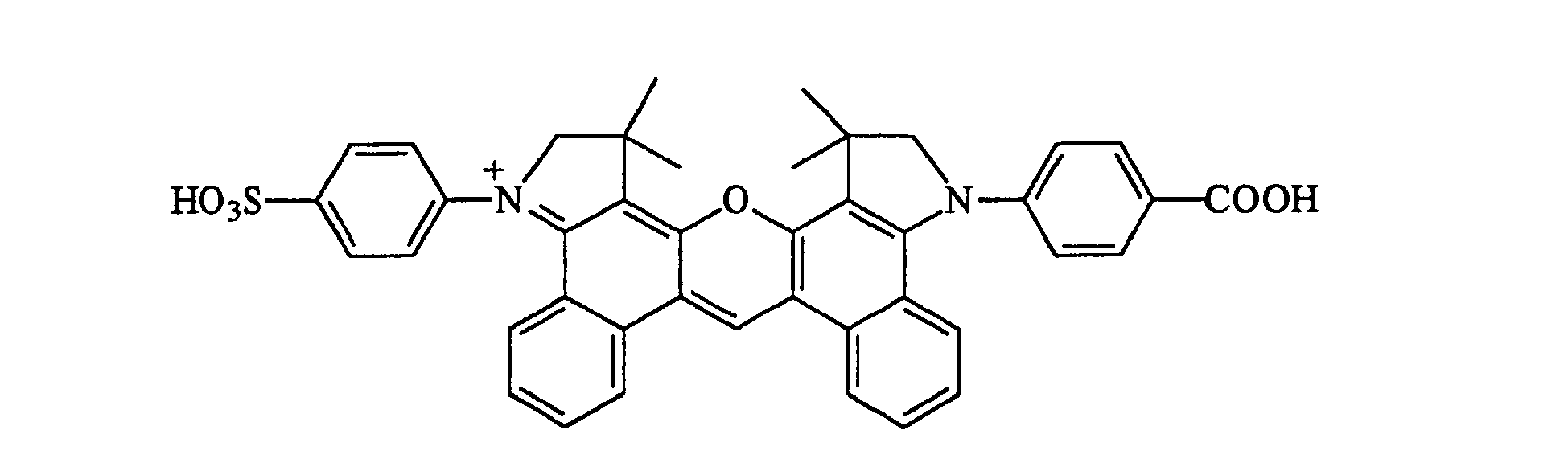
- 57. The compound of
item 1 having the structure
- 58. The compound of
item 1 having the structure
- 59. The compound of
item 1 having the structure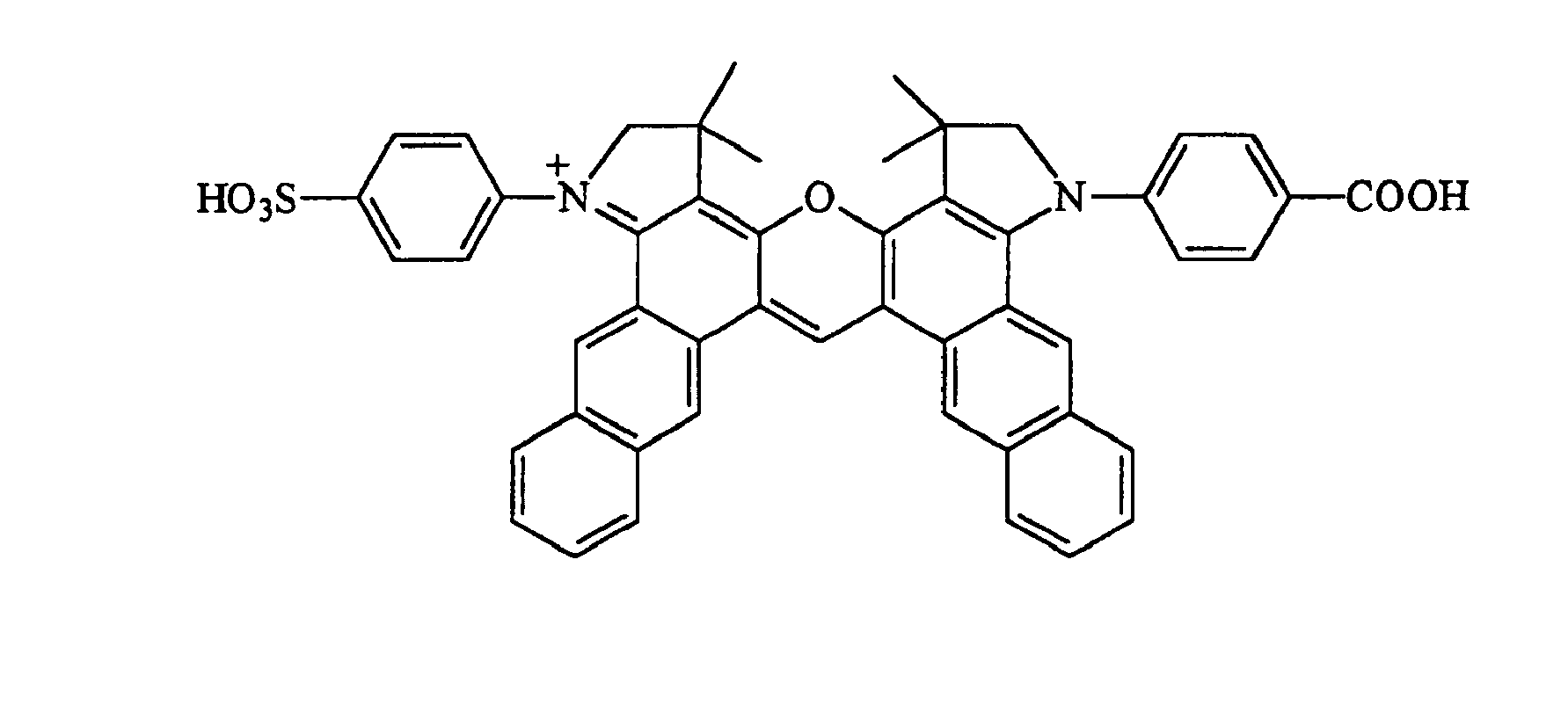
- 60. An intermediate useful for the synthesis of dibenzorhodamine compounds having the structure

- R1 is H or
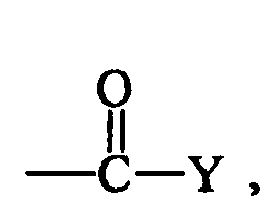
- wherein when R1 is H, the C-12-bonded nitrogen and the C-12 and C-13 carbons form a first ring structure having from 4 to 7 members, and/or the C-12-bonded nitrogen and the C-11 and C-12 carbons form a second ring structure having from 5 to 7 members; and
- including aryl- and nitrogen-substituted forms thereof.
- R1 is H or
- 61. The compound of item 60 wherein Y is

- 62. The compound of
item 61 wherein substituents at any one of positions C-14 to C-18 are selected from the group consisting of chlorine, fluorine, lower alkyl, carboxylic acid, sulfonic acid, -CH2OH, alkoxy, phenoxy, linking group, water solubilizing group, and substituted forms thereof. - 63. The compound of
item 62 wherein a substituent at position C-18 is selected from the group consisting of carboxylic acid and sulfonate. - 64. The compound of
item 63 wherein a substituent at position C-18 is carboxylic acid. - 65. The compound of
item 62 wherein a substituent at positions C-14 and C-17 is chlorine. - 66. The compound of
item 62 wherein a substituent positions C-14 to C-17 is chlorine. - 67. The compound of
item 62 wherein a substituent at positions C-14 to C-17 is fluorine. - 68. The compound of
item 62 wherein a substituent at one of positions C-15 and C-16 is linking group and the other is hydrogen, a substituent at positions C-14 and C-17 is chlorine, and a substituent at position C-18 is carboxy. - 69. The compound of item 60 wherein the C-12-bonded nitrogen and the C-12 and C-13 carbons form a first ring structure having from 4 to 7 members, and/or the C-12-bonded nitrogen and the C-11 and C-12 carbons form a second ring structure having from 5 to 7 members.
- 70. The compound of item 60 wherein the first and/or second ring structure has five members.
- 71. The compound of
item 70 wherein the five membered ring structure includes one gem disubstituted carbon. - 72. The compound of
item 71 wherein the gem substituents are lower alkyl. - 73. The compound of
item 72 wherein the gem substituents are methyl. - 74. The compound of
item 70 wherein the five membered ring is not aromatic. - 75. The compound of
item 70 wherein the five membered ring is substituted with linking group. - 76. The compound of item 60 comprising one or more nitrogen substituents selected from the group consisting of lower alkyl, lower alkene, lower alkyne, phenyl, aromatic, heterocycle, polycyclic aromatic, water-solubilizing group, linking group, and substituted forms thereof
- 77. The compound of
item 76 wherein the nitrogen substituents are selected from the group consisting of lower alkyl, phenyl, and substituted forms thereof. - 78. The compound of
item 77 wherein the nitrogen substituents are selected from the group consisting of substituted lower alkyl and substituted phenyl, wherein the substituent is linking group. - 79. The compound of
item 77 wherein the nitrogen substituents are selected from the group consisting of substituted lower alkyl and substituted phenyl, wherein the substituent is sulfonate. - 80. The compound of
item 76 wherein the nitrogen substituents are water-solubilizing group. - 81. The compound of
item 80 wherein the water-solubilizing group is selected from the group consisting of carboxylate, sulfonate, phosphate, quaternary amine, sulfate, polyhydroxyl, and water-soluble polymer. - 82. The compound of
item 76 wherein the nitrogen substituent is -L-R,
wherein L is selected from the group consisting of
-(CH2)n- where n ranges from 1 to 8; and
R is selected from the group consisting of linking group and water-solubilizing group. - 83. The compound of
item 82 wherein the water solubilizing group is selected from the group consisting of sulfonate, phosphate, quaternary amine, sulfate, polyhydroxyl, and water-soluble polymer. - 84. The compound of item 60 comprising one or more substituents at one or more of positions C-8 to C-11, and C-13, selected from the group consisting of fluorine, chlorine, lower alkyl, lower alkene, lower alkyne, sulfate, sulfonate, sulfone, sulfonamide, sulfoxide, amino, ammonium, amido, nitrile, lower alkoxy, phenoxy, aromatic, phenyl, polycyclic aromatic, water-solubilizing group, heterocycle, and linking group, including substituted forms thereof.
- 85. The compound of item 84 comprising a fused aromatic ring bonded across the C-9 and C-10 carbons, or the C-10 and C-11 carbons, including substituted forms thereof.
- 86. The compound of
item 85 comprising a fused aromatic ring bonded across the C-10 and C11 carbons, including substituted forms thereof. - 87. The compound of item 84 wherein the one or more substituents are sulfonate.
- 88. The compound of item 60 having the structure

- 89. The compound of item 60 having the structure

- 90. The compound of item 60 having the structure

- 91. The compound of item 60 having the structure
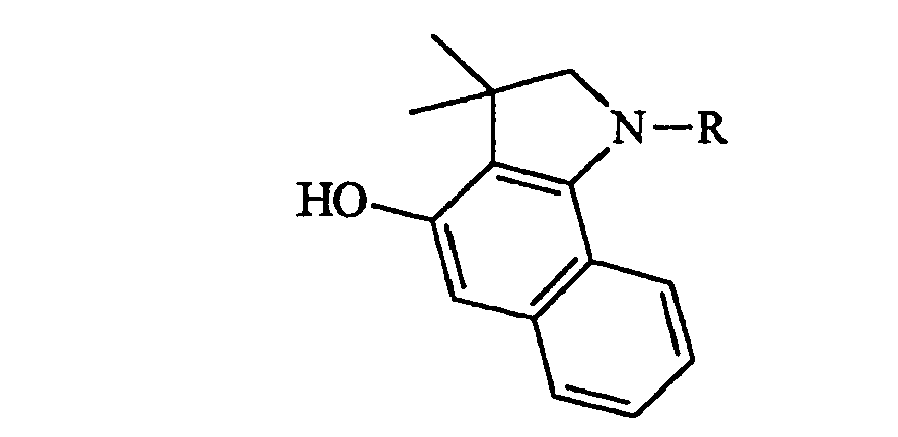
- 92. The compound of item 91 wherein R is selected from the group consisting of methyl or ethyl.
- 93. An energy transfer dye comprising:
- a donor dye capable of absorbing light at a first wavelength and emitting excitation energy in response;
- an acceptor dye capable of absorbing the excitation energy emitted by the donor dye and fluorescing at a second wavelength in response; and
- a linker for linking the donor dye and the acceptor dye, the linker serving to facilitate the efficient transfer of energy between the donor dye and the acceptor dye;
item 1. - 94. The energy transfer dye of item 93 wherein the linker includes a functional group selected from the group consisting of alkene, diene, alkyne, a five and six membered ring having at least one unsaturated bond, and a fused ring structure.
- 95. The energy transfer dye of item 93 wherein the first wavelength is greater than about 600 nm.
- 96. The energy transfer dye of item 93 wherein the linker has the structure

- Z1 is selected from the group consisting of -NH, sulfur and oxygen;
- R21 is a lower alkyl attached to the donor dye;
- R22 is a substituent selected from the group consisting of an alkene, diene, alkyne, a five and six membered ring having at least one unsaturated bond and a fused ring structure which is attached to the carbonyl carbon; and
- R28 includes a functional group which attaches the linker to the acceptor dye.
- 97. The energy transfer dye of item 96 wherein R22 is a five or six membered ring selected from the group consisting of cyclopentene, cyclohexene, cyclopentadiene, cyclohexadiene, furan, thiofuran, pyrrole, isopyrole, isoazole, pyrazole, isoimidazole, pyran, pyrone, benzene, pyridine, pyridazine, pyrimidine, pyrazine oxazine, indene, benzofuran, thionaphthene, indole and naphthalene.
- 98. The energy transfer dye of item 96 wherein the linker has the structure

- Z2 is selected from the group consisting of -NH, sulfur and oxygen; and
- R29 is a lower alkyl.
- 99. The energy transfer dye of item 93 wherein the linker has the structure

- 100. A labeled nucleoside/side having the formula:
NUC-D
wherein- NUC is a nucleoside/tide or nucleoside/tide analog;
- D is a dibenzorhodamine dye compound of
item 1, NUC and D being connected by a linkage;
- 101. The labeled nucleoside/tide of item 100 wherein NUC comprises a base selected from the group consisting of uracil, cytosine, deazaadenine, and deazaguanosine.
- 102. The labeled nucleoside/tide of item 100 wherein the linkage is

- 103. A method of polynucleotide sequencing comprising the steps of:
- forming a mixture of a first, a second, a third, and a forth class of polynucleotides such that:
- each polynucleotide in the first class includes a 3'-terminal dideoxyadenosine and is labeled with a first dye;
- each polynucleotide in the second class includes a 3'-terminal dideoxycytidine and is labeled with a second dye;
- each polynucleotide in the third class includes a 3'-terminal dideoxyguanosine and is labeled with a third dye; and
- each polynucleotide in the forth class includes a 3'-terminal dideoxythymidine and is labeled with a forth dye;
- wherein at least one of the first, second, third, or forth dyes is a dibenzorhodamine compound of
item 1; - the other of the dyes being spectrally resolvable from the dibenzorhodamine dye(s) and from each other;
- electrophoretically separating the polynucleotides thereby forming bands of similarly sized polynucleotides;
- illuminating the bands with an illumination beam capable of causing the dyes to fluoresce; and
- identifying the classes of the polynucleotides in the bands by the fluorescence spectrum of the dyes.
- forming a mixture of a first, a second, a third, and a forth class of polynucleotides such that:
- 104. A method of fragment analysis comprising:
- forming labeled polynucleotide fragments, the fragments being labeled with a dibenzorhodamine compound of
item 1; - subjecting the labeled polynucleotide fragments to a size-dependent separation process; and
- detecting the labeled polynucleotide fragments subsequent to the separation process.
- forming labeled polynucleotide fragments, the fragments being labeled with a dibenzorhodamine compound of
- 105. The method of item 104 wherein the size-dependent separation process is electrophoresis and the labeled polynucleotide fragments are detected by fluorescence.
- These and other features and advantages of the present invention will become better understood with reference to the following description, figures, and appended claims.
-
-
FIGS. 1-3 show exemplary synthetic pathways for the synthesis of the 1-amino-3-hydroxynapthalene intermediates of the invention. -
FIG. 4 shows a generalized synthetic pathway for the synthesis of the dibenzorhodamine dye compounds of the invention. -
FIGS. 5 and6 show exemplary synthetic pathways for the synthesis of the dibenzorhodamine dye compounds of the invention. -
FIG. 7 shows the structures of several exemplary dibenzorhodamine dye compounds of the invention. -
FIG. 8 shows a synthesis ofcompound 18. -
FIG. 9 shows a synthesis of compounds 57-61. -
FIG. 10 shows a synthesis ofcompound 67. -
FIG. 11 shows a synthesis ofcompound 72. -
FIG. 12 shows a synthesis ofcompound 76. -
FIG. 13 shows a synthesis ofcompound 81. -
FIG. 14 shows a synthesis of compounds 82-84. -
FIG. 15 shows a synthesis ofcompound 85. - Reference will now be made in detail to the preferred embodiments of the invention, examples of which are illustrated in the accompanying drawings. While the invention will be described in conjunction with the preferred embodiments, it will be understood that they are not intended to limit the invention to those embodiments. On the contrary, the invention is intended to cover all alternatives, modifications, and equivalents, which may be included within the invention as defined by the appended claims.
- Generally, the present invention comprises a novel class of dibenzorhodamine dye compounds useful as fluorescent labels, methods and intermediates for synthesis of such dyes, reagents employing such dyes, and methods utilizing such dyes and reagents in the area of analytical biotechnology. The compounds of the present invention find particular application in the area of fluorescent nucleic acid analysis, e.g., automated DNA sequencing and fragment analysis, detection of probe hybridization in hybridization arrays, detection of nucleic acid amplification products, and the like.
- Unless stated otherwise, the following terms and phrases as used herein are intended to have the following meanings:
- "Spectral resolution" in reference to a set of dyes means that the fluorescent emission bands of the dyes are sufficiently distinct, i.e., sufficiently non-overlapping, that reagents to which the respective dyes are attached, e.g. polynucleotides, can be distinguished on the basis of a fluorescent signal generated by the respective dyes using standard photodetection systems, e.g. employing a system of band pass filters and photomultiplier tubes, charged-coupled devices and spectrographs, or the like, as exemplified by the systems described in
U.S. Pat. Nos. 4,230,558 ,4,811,218 , or in Wheeless et al, pgs. 21-76, in Flow Cytometry: Instrumentation and Data Analysis (Academic Press, New York, 1985). - "Heterocycle" means cyclic compounds in which one or more ring atoms are not carbon, i.e., are hetero atoms. Exemplary heterocycles include but are not limited to pyrrole, indole, furan, benzofuran, thiophene, benzothiophene and other like structures.
- "Linking group" means a moiety capable of reacting with a "complementary functionality" attached to a reagent or member of an energy transfer dye pair, such reaction forming a "linkage" connecting the dye to the reagent or member of the energy transfer dye pair. Preferred linking groups include isothiocyanate, sulfonyl chloride, 4,6-dichlorotriazinyl, succinimidyl ester, or other activated carboxylates whenever the complementary functionality is amine. Preferably the linking group is maleimide, halo acetyl, or iodoacetamide whenever the complementary functionality is sulfhydryl. See R Haugland, Molecular Probes Handbook of Fluorescent Probes and Research Chemicals, Molecular probes, Inc. (1992). In a particularly preferred embodiment, the linking group is a N-hydroxysuccinimidyl (NHS) ester and the complementary functionality is an amine, where to form the NHS ester, a dye of the invention including a carboxylate group is reacted with dicyclohexylcarbodiimide and N-hydroxysuccinimide.
- "Substituted" as used herein refers to a molecule wherein one or more hydrogen atoms are replaced with one or more non-hydrogen atoms, functional groups or moieties. For example, an unsubstituted nitrogen is -NH2, while a substituted nitrogen is -NHCH3. Exemplary substituents include but are not limited to halo, e.g., fluorine and chlorine, lower alkyl, lower alkene, lower alkyne, sulfate, sulfonate, sulfone, amino, ammonium, amido, nitrile, lower alkoxy, phenoxy, aromatic, phenyl, polycyclic aromatic, heterocycle, water-solubilizing group, and linking group.
- "Polycyclic aromatic" means aromatic hydrocarbons having multiple ring structures including biaryls and condensed benzenoid hydrocarbons. The biaryls are benzenoid compounds where two or more rings are linked together by a single bond. The parent system of this class is biphenyl. The condensed benzenoid compounds are characterized by two or more benzene rings fused together at ortho positions in such a way that each pair of rings shares two carbons. The simplest members of this group are napthalene, with two rings, and anthracene and phenanthrene, each with three rings.
- "Lower alkyl" denotes straight-chain and branched hydrocarbon moieties containing from 1 to 8 carbon atoms, e.g., methyl, ethyl, propyl, isopropyl, tert-butyl, isobutyl, seo-butyl, neopentyl, tert-pentyt, and the like.
- "Lower alkene" denotes a hydocarbon containing from 1 to 8 carbon atoms wherein one or more of the carbon-carbon bonds are double bonds.
- "Lower alkyne" denotes a hydocarbon containing from 1 to 8 carbon atoms wherein one or more of the carbons are bonded with a triple bond.
- "Nucleoside" refers to a compound consisting of a purine, deazapurine, or pyrimidine nucleoside base, e.g., adenine, guanine, cytosine, uracil, thymine, deazaadenine, deazaguanosine, and the like, linked to a pentose at the 1' position. When the nucleoside base is purine or 7-deazapurine, the sugar moiety is attached at the 9-position of the purine or deazapurine, and when the nucleoside base is pyrimidine, the sugar moiety is attached at the 1-position of the pyrimidine, e.g., Kornberg and Baker, DNA Replication, 2nd Ed. (Freeman, San Francisco, 1992). The term "nucleotide" as used herein refers to a phosphate ester of a nucleoside, e.g., triphosphate esters, wherein the most common site of esterification is the hydroxyl group attached to the C-5 position of the pentose. The term "nucleoside/tide" as used herein refers to a set of compounds including both nucleosides and nucleotides. "Analogs" in reference to nucleosides/tides include synthetic analogs having modified base moieties, modified sugar moieties and/or modified phosphate moieties, e.g. described generally by Scheit, Nucleotide Analogs (John Wiley, New York, 1980). Phosphate analogs comprise analogs of phosphate wherein the phosphorous atom is in the +5 oxidation state and one or more of the oxygen atoms is replaced with a non-oxygen moiety. Exemplary analogs include but are not limited to phosphorothioate, phosphorodithioate, phosphoroselenoate, phosphorodiselenoate, phosphoroanilothioate, phosphoranilidate, phosphoramidate, boronophosphates, including associated counterions, e.g., H+, NH4 +, Na+, if such counterions are present. Exemplary base analogs include but are not limited to 2,6-diaminopurine, hypoxanthine, pseudouridine, C-5-propyne, isocytosine, isoguanine, 2-thiopyrimidine, and other like analogs. Exemplary sugar analogs include but are not limited to 2'- or 3'-modifications where the 2'- or 3'-position is hydrogen, hydroxy, alkoxy, e.g., methoxy, ethoxy, allyloxy, isopropoxy, butoxy, isobutoxy and phenoxy, amino or alkylamino, fluoro, chloro and bromo. The term "labeled nucleoside/tide" refers to nucleosides/tides which are covalently attached to the dye compounds of Formula I through a linkage.
- "Water solublizing group" means a substituent which increases the solubility of the compounds of the invention in aqueous solution. Exemplary water-solubilizing groups include but are not limited to quaternary amine, sulfate, sulfonate, carboxylate, phosphate, polyether, polyhydroxyl, and boronate.
- "Polynucleotide" or "oligonucleotide" means polymers of natural nucleotide monomers or analogs thereof, including double and single stranded deoxyribonucleotides, ribonucleotides, α-anomeric forms thereof and the like. Usually the nucleoside monomers are linked by phosphodiester linkages, where as used herein, the term "phosphodiester linkage" refers to phosphodiester bonds or bonds including phosphate analogs thereof, including associated counterions, e.g., H+, NH4 +, Na+, if such counterions are present. Polynucleotides typically range in size from a few monomeric units, e.g. 5-40, to several thousands of monomeric units. Whenever a polynucleotide is represented by a sequence of letters, such as "ATGCCTG," it will be understood that the nucleotides are in 5'->3' order from left to right and that "A" denotes deoxyadenosine, "C" denotes deoxycytidine, "G" denotes deoxyguanosine, and "T" denotes deoxythymidine, unless otherwise noted.
- "Rhodamine dye" refers to dyes including the general polycyclic structure

- In a first aspect, the present invention comprises a novel class of 1-amino-3-hydroxynapthalene compounds useful as intermediates in the synthesis of dibenzorhodamine dyes. These compounds have the general structure shown in Formula I immediately below, including substituted forms thereof. In Formula I, R1 is H or


- In one preferred embodiment of the compounds of Formula I, Y is phenyl or substituted phenyl, the phenyl having the structure

- In another preferred embodiment of the compounds of Formula I, the C-12-bonded nitrogen and the C-12 and C-13 carbons form a first ring structure having from 4 to 7 members, and/or the C-12-bonded nitrogen and the C-11 and C-12 carbons form a second ring structure having from 5 to 7 members. More preferably, the first and/or second ring structure has five members, where preferably the five membered ring structure includes one gem disubstituted carbon. Preferably, the gem substituents are lower alkyl, e.g., methyl. In another preferred embodiment, the five membered ring is substituted with linking group. In this preferred embodiment wherein the C-12-bonded nitrogen and the C-12 and C-13 carbons form a first ring structure having from 4 to 7 members, and/or the C-12-bonded nitrogen and the C-11 and C-12 carbons form a second ring structure having from 5 to 7 members, R1 may be H or

- In yet another preferred embodiment of the compounds of Formula I, the compounds include a substituted nitrogen. Preferred nitrogen substituents include lower alkyl, lower alkene, lower alkyne, phenyl, aromatic, heterocycle, polycyclic aromatic, water-solubilizing group, linking group, and substituted forms thereof More preferably, the nitrogen substituents are lower alkyl, phenyl, or substituted forms thereof, wherein preferred substituents are linking group, sulfonate or water-solubilizing group. Exemplary water-solubilizing groups are carboxylate, sulfonate, phosphate, quaternary amine, sulfate, polyhydroxyl, and water-soluble polymer. In a particularly preferred embodiment, the nitrogen substituent is -L-R , wherein L may be any linker and R is linking group or water-solubilizing group. In a particularly preferred embodiment, L is,

-(CH2)n-
where n ranges from 1 to 8. In another particularly preferred embodiment, the water solubilizing group is carboxylate, sulfonate, phosphate, quaternary amine, sulfate, polyhydroxyl, and water-soluble polymer. - In yet another preferred embodiment, the compounds of Formula I include one or more substituents at one or more of positions C-8 to C-11, and C-13. Preferred substsituents include fluorine, chlorine, lower alkyl, lower alkene, lower alkyne, sulfate, sulfonate, sulfone, sulfonamide, sulfoxide, amino, ammonium, amido, nitrile, lower alkoxy, phenoxy, aromatic, phenyl, polycyclic aromatic, water-solubilizing group, heterocycle, and linking group, including substituted forms thereof. In a particularly preferred embodiment, the compound includes a fused aromatic ring bonded across the C-9 and C-10 carbons, or across the C-10 and C-11 carbons, including substituted forms thereof, where a particularly preferred substituent is sulfonate.
- Several representative 1-amino-3-hydroxynapthalene compounds of the invention are shown in
FIGS. 1-3 , i.e., compounds 4, 9, 15, 17, 22, 27 and 29, andFIGS. 10-13 , i.e., compounds 62, 63, 68, 73 and 80. - Several synthetic methods are available for the synthesis of the 1-amino-3-hydroxynapthalene compounds described above, different methods being preferred depending on the nature of the ring structure and the nitrogen substituents of the particular compound to be synthesized.
- A first preferred synthesis method suitable for the synthesis of 1-substituted-amino-3-hydroxynapthalene compounds , e.g., 1-diethylamino-3-
hydroxynapthalene 4, is shown inFIG. 1 . In this first method, a 3-methoxy-1-hydroxy napthalene 1 is reacted with dry triethylamine and trifluoromethanesulfonic anhydride to form a crude 3-methoxynapthalene-1-triflate 2. Thetriflate 2 is then reacted with an amine, e.g., a secondary amine, e.g., diethylamine, using palladium catalyzed triflate/amine coupling to form the substitutedamine compound 3.Compound 3 is then deprotected using a boron tribromide deprotection procedure to produce the 1-amino-3-hydroxynapthalene product, e.g., 1-diethylamino-3-hydroxynapthalene 4. An example of this synthesis is provided in Example 1 below. - A second preferred synthesis method suitable for the synthesis of benzoindoline compounds, e.g., N-phenyl-3,3-dimethyl-4-hydroxy-
benzoindoline 9, is also shown inFIG. 1 . In this method, the 3-methoxynapthalene-1-triflate 2 is derivatized with a primary amine, e.g., aniline, using a palladium catalyzed triflate coupling reaction to give a secondary amine, e.g., 1-anilino-3-methoxynapthalene 5. Thesecondary amine 5 is acetylated using an acid chloride, e.g., an haloacetylchloride, to give a disubstituted amide, e.g., 1-amido-3-methoxynapthalene 6. Thetertiary amide 6 is cyclized using a Lewis-acid-catalyzed Friedel-Crafts cyclization procedure to givecompound 7, e.g., using AlCl3.Coumpound 7 is than reduced, e.g., using (lithium aluminum hydride) LAH, to givecoumpound 8. Subsequent methoxy group deprotection by a boron tribromide deprotection procedure gives the benzoindoline, e.g., N-phenyl-3,3-dimethyl-4-hydroxy-benzoindoline 9. An example of this synthesis is provided in Example 2 below. - A third preferred synthesis method suitable for the synthesis of N-substituted-5-hydroxy-(tetrahydro)benzoquinoline compounds, e.g., N-methyl-5-hydroxy-(tetrahydro)
benzoquinoline 15, is shown inFIG. 2 . In this method,compound 10 is synthesized from methoxy-napthaldehyde by condensation with malonic acid using a piperidine catalyst in pyridine.Compound 10 is then reduced with hydrogen, followed by LAH reduction, and reacted with trifluoromethanesulfonic anhydride to give thetriflate 11. Thetriflate 11 is reacted with NaN3 to givecompound 12.Compound 12 is complexed with a Lewis acid, e.g., AlCl3, and refluxed yielding the cyclizedbenzoquinoline derivative 13. Next, a nitrogen substituent is added, e.g., the nitrogen is alkylated using a conventional alkylation procedure, e.g., thebenzoquinoline derivative 13 is reacted with with n-butyl lithium and an alkylating agent, e.g., MeI to givecompound 14 or propane sultone to givecompound 16. The methoxy group is then removed by a boron tribromide procedure giving a N-alkylbenzoquinoline derivative, e.g.,compound - A fourth preferred synthesis method suitable for the synthesis of N-substituted-2,2,4-trimethyl-5-hydroxy-benzoquinoline compounds, e.g of N-methyl-2,2,4-trimethyl-5-hydroxy-(tetrahydro)
benzoquinoline 22, is shown inFIG. 3 . In this method, following the procedure of A.Rosowsky and E.J.Modest (J.O.C. 30 1832 1965, and references therein), 1-amino-3-methoxynapthalene 18 is reacted with acetone catalyzed by iodine and then quenched with saturated Na2S2O3 to give thebenzoquinoline compound 19.Compound 19 is then alkylated with an alkylating agent, e.g., MeI, according to a general alkylation procedure to givecompound 20. Thealkylated compound 20 is reduced with H2 catalyzed by Pd/C to give a N-methyl-methoxyquinoline intermediate 21, and subsequent methoxy group deprotection by a general boron tribromide procedure yields the N-substituted-2,2,4-trimethyl-5-hydroxy-benzoquinoline compound, e.g., N-methyl-2,2,4-trimethyl-5-hydroxy-(tetrahydro)benzoquinoline 22. An example of this synthesis is provided in Example 4 below. - A fifth preferred general synthesis method suitable for the synthesis of N-substituted-3,3-dimethyl-4-hydroxy-benzoindoline compounds, e.g N-methyl-3,3-dimethyl-4-hydroxy-
benzoindoline 27, is also shown inFIG. 3 . In this method, a 1-amino-3-methoxynapthalene 18 is acetylated with an acid chloride, e.g., 2-bromo-2-methylpropionyl chloride, to givecompound 23.Compound 23 is cyclized by reaction with AlCl3 to givecompound 24.Compound 24 is then reduced with LAH to give the 3,3-dimethyl-4-methoxybenzoindoline 25.Compound 25 is then alkylated with an alkylating agent, e.g., methyl iodide, to give a N-methyl-3,3-dimethyl-4-methoxybenzoindoline, e.g.,compound 26. Subsequent methoxy group deprotection by with boron tribromide givescompound 27. An example of this synthesis is provided in Example 5 below. - In a second aspect, the present invention comprises a novel class of dibenzorhodamine dye compounds useful as molecular labels having the general structure shown in Formula II immediately below, including aryl- and nitrogen-substituted forms thereof

- In one preferred embodiment of the compound of Formula II, the compound includes a first bridging group which when taken together with the C-12-bonded nitrogen and the C-12 and C-13 carbons forms a first ring structure having from 4 to 7 members, and/or a second bridging group which when taken together with the C-2-bonded-nitrogen and the C-1 and C-2 carbons forms a second ring structure having from 4 to 7 members. More preferably, one or both of the first and second ring structures has five members. In yet a more preferred embodiment, the five membered ring structure includes one gem disubstituted carbon, wherein the gem substituents are lower alkyl, e.g., methyl. In an alternative preferred embodiment, the five membered ring is substituted with linking group. In another preferred embodiment, the five membered ring includes one or more nitrogen substituents, as described below.
- In another preferred embodiment, the compound of Formula II includes a C-7 substituent selected from the group consisting of acetylene, lower alkyl, lower alkene, cyano, phenyl, heterocyclic aromatic, heterocycle, and substituted forms thereof. In a more preferred embodiment, the C-7 substituent is a phenyl or substituted phenyl having the structure
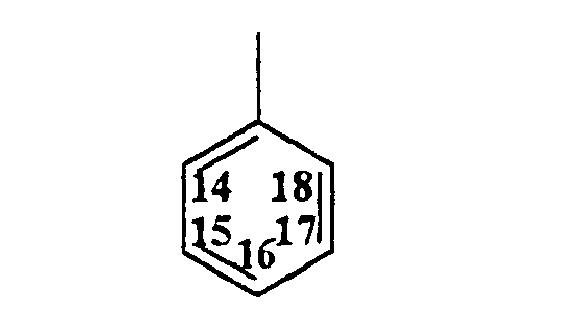
- In an additional preferred embodiment, the compound of Formula II comprises a hydrogen radical at the C-7 position, i.e., the C-7 position is unsubstituted.
- In yet another preferred embodiment of the invention, the compound of Formula II includes one or more nitrogen substituents. Preferably, such substituents are selected from the group consisting of lower alkyl, lower alkene, lower alkyne, phenyl, aromatic, heterocycle, polycyclic aromatic, water-solubilizing group, linking group, and substituted forms thereof More preferably, the nitrogen substituents are selected from the group consisting of lower alkyl, phenyl, polycyclic aromatic, and substituted forms thereof, where exemplary substituents include linking group, and water-solubilizing group.
- In another preferred embodiment of this second aspect of the invention, the compound of Formula II includes a third bridging group which when taken together with the C-12-bonded nitrogen and the C-11 and C-12 carbons forms a third ring structure having from 5 to 7 members, and/or a fourth bridging group which when taken together with the C-2-bonded nitrogen and the C-2 and C-3 carbons forms a fourth ring structure having from 5 to 7 members. Preferably, one or both of the third and fourth ring structures has six members. More preferably, the six membered ring structure includes one gem disubstituted carbon, wherein the gem substituents are lower alkyl, e.g., methyl.
- In another preferred embodiment of the invention, the compound of Formula II includes aryl substituents at one or more of carbons C-1, C-3 through C-6, C-8 through C-11, and C-13. Exemplary aryl substituents include but are not limited to fluorine, chlorine, lower alkyl, lower alkene, lower alkyne, sulfate, sulfonate, sulfone, sulfonamide, sulfoxide, amino, ammonium, amido, nitrile, lower alkoxy, phenoxy, aromatic, phenyl, polycyclic aromatic, water-solubilizing group, heterocycle, and linking group, including substituted forms thereof. In a particularly preferred embodiment, at least one substituent is sulfonate. In another particularly preferred embodiment, the compound of Formula II includes a fused aromatic ring bonded across the C-3 and C-4 carbons, the C-4 and C5 carbons, the C-9 and C-10 carbons, or the C-10 and C-11 carbons, including substituted forms thereof. Most preferably, the fused aromatic ring is bonded across the C-3 and C-4 carbons and the C-10 and C11 carbons, or across the C-9 and C-10 carbons and the C-4 and C-5 carbons, including substituted forms thereof.
- Several exemplary dye compounds according to this second aspect of the invention are shown in
FIGS. 7 and10-13 , i.e., compounds 41-47 and 67, 72, 76 and 81. - Generally, the dibenzorhodamine dyes of the present invention are synthesized as follows. See
FIG. 4 . Ananhydride derivative 30, e.g., a phthalic anhydride, is mixed with 1-amino-3-methoxy intermediates compound 30 may be the same or different, but are preferably the same. Exemplary R-substituents include but are not limited to acetylene, lower alkyl, lower alkene, phenyl, heterocycle, and substituted forms thereof. The mixture is heated briefly until melting is observed. A solvent, e.g., 1,2-dichlorobenzene, is added to the reaction mixture, and the heterogeneous mixture is heated to about 130°C to about 180°C. The crude reaction mixture is cooled and purified by normal phase flash chromatography to yielddye compound 33. When the anhydride is part of a substituted phthalic anhydride, e.g.,compound 34, two isomers are formed. SeeFIG 5 . Theisomers - An alternative procedure for the synthesis of asymmetrical dye compounds is shown in
FIG. 6 . In this process, an anhydride derivative, e.g.,phthalic anhydride 34, is mixed with dry nitrobenzene and heated. The mixture is cooled to room temperature and anhydrous AlCl3 is added with stirring. Subsequently a 1-amino-3-methoxy intermediate 31 is added with stirring and the reaction is heated. The reaction is cooled and suspended in EtOAc. The organic layer is washed with saturated NH4Cl, brine, dried over Na2SO4, filtered, and the solvent removed in vacuo. The resulting ketone intermediates 37/38 are purified and separated intodistinct isomers 37 and 38 (except where substituents at C-14 and C-17 are the same and substituents at C-15 and C-16 are the same) by flash chromatography or recrystallization. The methoxy group of the isomerically pure ketone intermediate 37 or 38 is removed according to a general boron tribromide deprotection procedure. Thus,compound 38 gives the amino-hydroxynapthalene ketone intermediate 39. Amino-hydroxynapthalene ketone intermediate 39 is then reacted with a 1-amino-3-methoxy intermediate 32. The reaction is cooled, giving isomerically pure and asymmetrically substitutedproduct 40 that may be further purified by PTLC. - In another method for synthesizing the dibenzorhodamine dyes of the present invention particularly suited to the synthesis of dyes not substituted at the C-7 position, i.e., pyronine dyes, the dyes are synthesized from hydroxybenzoindoline intermediates generated from O-protected N-substituted 3-hydroxybenzoindoline compounds following deprotection of the oxygen protecting group, e.g. methyl group deprotection by a demethylating reagent i.e., aluminum chloride, and isolated by normal phase chromatographic purification. According to the synthesis, a hydroxybenzoindoline intermediate, corresponding to one half of a dye molecule, is first reacted with a formylating reagent, e.g. methylformanilide/POCl3 , and the ensuing formylated hydroxybenzoindoline intermediate is reacted directly with a different (or same) hydroxybenzoindoline intermediate, corresponding to the other half of the dye molecule. The reaction is run under acidic dehydrating conditions, i.e. POCl3, and heat, i.e 120-160 °C to give the crude carboxylic acid ester dervatized benzopyronine dye. In some cases, the methoxybenzoindoline intermediate is formylated prior to methyl group deprotection and then the methyl group of the formylated methoxyindoline derivative is deprotected to give the formylated hydroxybenzoindoline intermediate prior to reaction with the second equivalent of hydroxyindoline to give the pyronine dye. The pure dye is isolated after aqueous work-up and normal phase chromatography. The intermediate dye carboxylic acid ester is then hydrolysed with acid, i.e. HBr, to give the free acid dye derivatives after aqueous work-up and normal phase chromatography. N-phenyl substituted dyes may be subsequently sulfonated with a sulfonating agent, e.g., ClSO3H to give a final preferred dye derivative after aqueous work-up and normal phase chromatography.
- In another aspect, the present invention comprises energy transfer dye compounds incorporating the dibenzorhodamine dye compounds of Formula I. Generally, the energy transfer dyes of the present invention include a donor dye which absorbs light at a first wavelength and emits excitation energy in response, an acceptor dye which is capable of absorbing the excitation energy emitted by the donor dye and fluorescing at a second wavelength in response, and a linker which attaches the donor dye to the acceptor dye, the linker being effective to facilitate efficient energy transfer between the donor and acceptor dyes. A through discussion of the structure, synthesis and use of such energy transfer dyes is provided by
Lee et al., U.S. Patent No. 5,800,996 , andMathies et al., U.S. Patent No. 5,654,419 . - In a preferred embodiment, the linker includes a functional group which gives the linker some degree of structural rigidity, such as an alkene, diene, an alkyne, a five and six membered ring having at least one unsaturated bond or a fused ring structure.
- One preferred linker according to the present invention for linking a donor dye to an acceptor dye in an energy transfer fluorescent dye has the general structure

- In one embodiment of this linker, illustrated below, the linker has the general structure


- In another preferred embodiment of the energy-transfer-dye aspect of the present invention, the linker attaches to the dibenzorhodamine dye component of the energy transfer dye at the C-1 or 13 positions, or, alternatively, where the C-7 substituent is phenyl or substituted phenyl, at one of the C-15 or C-16 positions. In a particularly preferred embodiment, both members of the energy transfer pair are dibenzorhodamine dyes, and the first member is linked through the C-1 position and the second member is linked through one of the C-15 5 or C-16 positions.
- In yet another preferred embodiment of the energy-transfer-dye aspect of the present invention, a first member the dye pair is a dibenzorhodamine dye, and a second member of the dye pair is cyanine, phthalocyanine, squaraine, bodipy, fluorescein, or dibenzorhodamine dye having different substitutions than the first member.
- In another aspect, the present invention comprises reagents labeled with the dibenzorhodaminedye dye compounds of Formula I. Reagents of the invention can be virtually anything to which the dyes of the invention can be attached. Preferably, the dye is covalently attached to the reagent. Reagents may include but are not limited to proteins, polypeptides, polysaccharides, nucleotides, nucleosides, polynucleotides, lipids, solid supports, organic and inorganic polymers, and combinations and assemblages thereof, such as chromosomes, nuclei, living cells, such as bacteria or other microorganisms, mammalian cells, tissues, and the like.
- A preferred class of labeled reagents comprise nucleoside/tides that incorporate the dibenzorhodamine dyes of the invention. Such nucleoside/tide reagents are particularly useful in the context of labeling polynucleotides formed by enzymatic synthesis, e.g., nucleotide triphosphates used in the context of PCR amplification, Sanger-type polynucleotide sequencing, and nick-translation reactions.
- Generally, the structure of the labeled nucleoside/tide reagent is
NUC-D FORMULA III
where NUC is a nucleoside/tide or nucleoside/tide analog and D is a dibenzorhodamine dye compound of Formula II. - The linkage linking the nucleoside/tide and the dye may be attached to the dye at any one of substituent positions C-1 to C-18 or at a C-2 bonded nitrogen or a C-12 bonded nitrogen. Preferably, the dye includes a phenyl or substituted phenyl substituent at the C-7 position and is attached to the nucleoside/tide at one of the C-15 or C-16 substituent positions, the other position being a hydrogen atom.
- When NUC includes a purine base, the linkage between NUC and D is attached to the N8-position of the purine, when NUC includes a 7-deazapurine base, the linkage is attached to the N7-position of the 7-deazapurine, and when NUC includes a pyrimidine base, the linkage is attached to the N5-position of the pyrimidine.
- Nucleoside labeling can be accomplished using any one of a large number of known nucleoside/tide labeling techniques employing known linkages, linking groups, and associated complementary functionalities. Generally, the linkage linking the dye and nucleoside should (i) not interfere with oligonucleotide-target hybridization, (ii) be compatible with relevant enzymes, e.g., polymerases, ligases, and the like, and (iii) not adversely affect the fluorescence properties of the dye. Exemplary base labeling procedures suitable for use in connection with the present invention include the following: Gibson et al, Nucleic Acids Research, 15:6455-6467 (1987); Gebeyehu et al, Nucleic Acids Research, 15: 4513-4535 (1987); Haralambidis et al, Nucleic Acids Research, 15: 4856-4876 (1987); Nelson et al., Nucleosides and Nucleotides, 5(3): 233-241 (1986); Bergstrom, et al., JACS, 111: 374-375 (1989); and
U.S. Patent Nos. 4,855,225 ,5,231,191 , and5,449,767 . - Preferably, the linkages are acetylenic amido or alkenic amido linkages, the linkage between the dye and the nucleoside/tide base being formed by reacting an activated N-hydroxysuccinimide (NHS) ester of the dye with an alkynylamino- or alkenylamino-derivatized base of a nucleoside/tide. More preferably, the resulting linkage is 3-(carboxy)amino-1-propyn-1-yl having the structure

- Alternative preferred linkages include substituted propargylethoxyamido linkages having the structure
NUC-C≡C-CH2OCH2CH2NR3X-D
wherein X is selected from the group consisting of
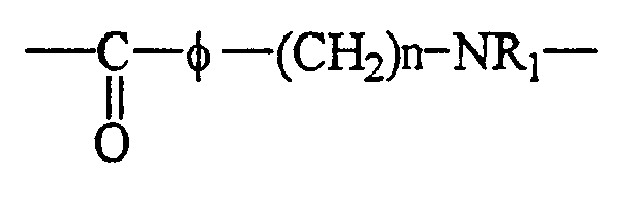

Khan et al., U.S. Patent Application Serial No. 08/833,854 filed April 10, 1997 - The synthesis of alkynylamino-derivatized nucleosides is taught by Hobbs et al. in European Patent Application No.
87305844.0 - Particularly preferred nucleosides/tides of the present invention are shown below in Formula IV wherein

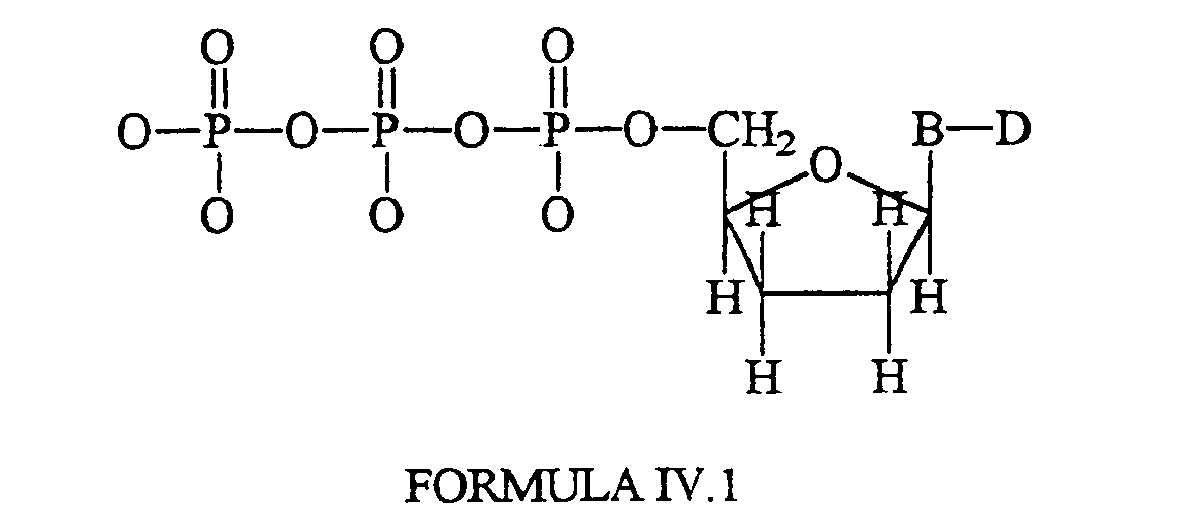
- In a second particularly preferred embodiment, the nucleotides of the present invention are deoxynucleotide triphosphates having the structure shown in Formula IV.2 below.

- Yet another preferred class of reagents of the present invention comprise polynucleotides labeled with the dibenzorhodamine dyes of the invention. Such labeled polynucleotides are useful in a number of important contexts including as DNA sequencing primers, PCR primers, oligonucleotide hybridization probes, oligonucleotide ligation probes, and the like.
- In one preferred embodiment, the labeled polynucleotides of the present invention include multiple dyes located such that fluorescence energy transfer takes place between a donor dye and an acceptor dye. Such multi-dye energy-transfer polynucleotides find application as spectrally-tunable sequencing primers, e.g., Ju et al., Proc. Natl. Acad Sci. USA 92: 4347-4351 (1995), and as hybridization probes, e.g., Lee et al. Nucleic Acids Research, 21: 3761-3766 (1993).
- Labeled polynucleotides may be synthesized either enzymatically, e.g., using a DNA polymerase or ligase, e.g., Stryer, Biochemistry, ), or by chemical synthesis, e.g., by the phosphoramidite method, the phosphite-triester method, and the like, e.g., Gait, Oligonucleotide Synthesis, IRL Press (1990). Labels may be introduced during enzymatic synthesis utilizing labeled nucleotide triphosphate monomers as described above, or introduced during chemical synthesis using labeled non-nucleotide or nucleotide phosphoramidites as described above, or may be introduced subsequent to synthesis.
- Generally, if the labeled polynucleotide is made using enzymatic synthesis, the following procedure may be used. A template DNA is denatured and an oligonucleotide primer is annealed to the template DNA. A mixture of deoxynucleotide triphosphates is added to the mixture including dGTP, dATP, dCTP, and dTTP where at least a fraction of the deoxynucleotides is labeled with a dye compound of the invention as described above. Next, a polymerase enzyme is added under conditions where the polymerase enzyme is active. A labeled polynucleotide is formed by the incorporation of the labeled deoxynucleotides during polymerase-mediated strand synthesis. In an alternative enzymatic synthesis method, two primers are used instead of one, one primer complementary to the + strand and the other complementary to the - strand of the target, the polymerase is a thermostable polymerase, and the reaction temperature is cycled between a denaturation temperature and an extension temperature, thereby exponentially synthesizing a labeled complement to the target sequence by PCR, e.g., PCR Protocols, Innis et al. eds., Academic Press (1990).
- Labeled polynucleotides may be chemically synthesized using the phosphoramidite method. Detailed descriptions of the chemistry used to form polynucleotides by the phosphoramidite method are provided elsewhere, e.g.,
Caruthers et al., U.S. Pat. Nos. 4,458,066 and4,415,732 ; Caruthers et al., Genetic Engineering, 4: 1-17 (1982); Users Manual Model 392 and 394 Polynucleotide Synthesizers, pages 6-1 through 6-22, Applied Biosystems, Part No. 901237 (1991). - The phosphoramidite method of polynucleotide synthesis is the preferred method because of its efficient and rapid coupling and the stability of the starting materials. The synthesis is performed with the growing polynucleotide chain attached to a solid support, so that excess reagents, which are in the liquid phase, can be easily removed by filtration, thereby eliminating the need for purification steps between synthesis cycles.
- The following briefly describes the steps of a typical polynucleotide synthesis cycle using the phosphoramidite method. First, a solid support including a protected nucleotide monomer is treated with acid, e.g., trichloroacetic acid, to remove a 5'-hydroxyl protecting group, freeing the hydroxyl for a subsequent coupling reaction. An activated intermediate is then formed by simultaneously adding a protected phosphoramidite nucleoside monomer and a weak acid, e.g., tetrazole, to the reaction. The weak acid protonates the nitrogen of the phosphoramidite forming a reactive intermediate. Nucleoside addition is complete within 30 s. Next, a capping step is performed which terminates any polynucleotide chains that did not undergo nucleoside addition. Capping is preferably done with acetic anhydride and 1-methylimidazole. The internucleotide linkage is then converted from the phosphite to the more stable phosphotriester by oxidation using iodine as the preferred oxidizing agent and water as the oxygen donor. After oxidation, the hydroxyl protecting group is removed with a protic acid, e.g., trichloroacetic acid or dichloroacetic acid, and the cycle is repeated until chain elongation is complete. After synthesis, the polynucleotide chain is cleaved from the support using a base, e.g., ammonium hydroxide or t-butyl amine. The cleavage reaction also removes any phosphate protecting groups, e.g., cyanoethyl. Finally, the protecting groups on the exocyclic amines of the bases and the hydroxyl protecting groups on the dyes are removed by treating the polynucleotide solution in base at an elevated temperature, e.g., 55 °C.
- Any of the phosphoramidite nucleoside monomers may be dye-labeled phosphoramidites as described above. If the 5'-terminal position of the nucleotide is labeled, a labeled non-nucleotidic phosphoramidite of the invention may be used during the final condensation step. If an internal position of the oligonucleotide is labeled, a labeled nucleotidic phosphoramidite of the invention may be used during any of the condensation steps.
- Subsequent to synthesis, the polynucleotide may be labeled at a number of positions including the 5'-terminus, e.g., Oligonucleotides and Analogs, Eckstein ed., ) and Orgel et al., Nucleic Acids Research 11(18): 6513 (1983);
U.S. Patent No. 5,118,800 ; the phosphodiester backbone, e.g., ibid.,Chapter 9; or at the 3'-terminus, e.g., Nelson, Nucleic Acids Research 20(23): 6253-6259, andU.S. Patent Nos. 5,401,837 and5,141,813 . For a through review of oligonucleotide labeling procedures see R Haugland in Excited States of Biopolymers, Steiner ed., Plenum Press, NY (1983). - As shown in
FIGS. 14 and15 , in one preferred post-synthesis chemical labeling method an oligonuleotide is labeled as follows. A dye including a carboxy linking group is converted to the N-hydroxysuccinimide ester by reacting with approximately 1 equivalent of 1,3-dicyclohexylcarbodiimide and approximately 3 equivalents of N-hydroxysuccinimide in dry ethyl acetate for 3 hours at room temperature. The reaction mixture is washed with 5 % HCl, dried over magnesium sulfate, filtered, and concentrated to a solid which is resuspended in DMSO. The DMSO dye stock is then added in excess (10-20 x) to an aminohexyl derivatized oligonucleotide in 0.25 M bicarbonate/carbonate buffer at pH 9.4 and allowed to react for 6 hours, e.g.,U.S. Patent No. 4,757,141 . The dye labeled oligonucleotide is separated from unreacted dye by passage through a size-exclusion chromatography column eluting with buffer, e.g., 0.1 molar triethylamine acetate (TEAA). The fraction containing the crude labeled oligonucleotide is further purified by reverse phase HPLC employing gradient elution. - The dyes and reagents of the present invention are well suited to any method utilizing fluorescent detection, particularly methods requiring the simultaneous detection of multiple spatially-overlapping analytes. Dyes and reagents of the invention are particularly well suited for identifying classes of polynucleotides that have been subjected to a biochemical separation procedure, such as electrophoresis, or that have been distributed among locations in a spatially-addressable hybridization array.
- In a preferred category of methods referred to herein as "fragment analysis" or "genetic analysis" methods, labeled polynucleotide fragments are generated through template-directed enzymatic synthesis using labeled primers or nucleotides, e.g., by ligation or polymerase-directed primer extension; the fragments are subjected to a size-dependent separation process, e.g., electrophoresis or chromatography; and, the separated fragments are detected subsequent to the separation, e.g., by laser-induced fluorescence. In a particularly preferred embodiment, multiple classes of polynucleotides are separated simultaneously and the different classes are distinguished by spectrally resolvable labels.
- One such fragment analysis method known as amplified fragment length polymorphisim detection (AmpFLP) is based on amplified fragment length polymorphisms, i.e., restriction fragment length polymorphisms that are amplified by PCR. These amplified fragments of varying size serve as linked markers for following mutant genes through families. The closer the amplified fragment is to the mutant gene on the chromosome, the higher the linkage correlation. Because genes for many genetic disorders have not been identified, these linkage markers serve to help evaluate disease risk or paternity. In the AmpFLPs technique, the polynucleotides may be labeled by using a labeled polynucleotide PCR primer, or by utilizing labeled nucleotide triphosphates in the PCR
- In another such fragment analysis method known as nick translation, a reaction is used to replace unlabeled nucleoside triphosphates in a double-stranded DNA molecule with labeled ones. Free 3'-hydroxyl groups are created within the unlabeled DNA by "nicks" caused by deoxyribonuclease I (DNAase I) treatment. DNA polymerase I then catalyzes the addition of a labeled nucleotide to the 3'-hydroxyl terminus of the nick. At the same time, the 5' to 3'-exonuclease activity of this enzyme eliminates the nucleotide unit from the 5'-phosphoryl terminus of the nick. A new nucleotide with a free 3'-OH group is incorporated at the position of the original excised nucleotide, and the nick is shifted along by one nucleotide unit in the 3' direction. This 3' shift will result in the sequential addition of new labeled nucleotides to the DNA with the removal of existing unlabeled nucleotides. The nick-translated polynucleotide is then analyzed using a separation process, e.g., electrophoresis.
- Another exemplary fragment analysis method is based on variable number of tandem repeats, or VNTRs. VNTRs are regions of double-stranded DNA that contain adjacent multiple copies of a particular sequence, with the number of repeating units being variable. Examples of VNTR loci are pYNZ22, pMCT118, and Apo B. A subset of VNTR methods are those methods based on the detection of microsatellite repeats, or short tandem repeats (STRs), i.e., tandem repeats of DNA characterized by a short (2-4 bases) repeated sequence. One of the most abundant interspersed repetitive DNA families in humans is the (dC-dA)n-(dG-dT)n dinucleotide repeat family (also called the (CA)n dinucleotide repeat family). There are thought to be as many as 50,000 to 100,000 (CA)n repeat regions in the human genome, typically with 15-30 repeats per block. Many of these repeat regions are polymorphic in length and can therefore serve as useful genetic markers. Preferably, in VNTR or STR methods, label is introduced into the polynucleotide fragments by using a dye-labeled PCR primer.
- In a particularly preferred fragment analysis method, classes identified in accordance with the invention are defined in terms of terminal nucleotides so that a correspondence is established between the four possible terminal bases and the members of a set of spectrally resolvable dyes. Such sets are readily assembled from the dyes of the invention by measuring emission and absorption bandwidths with commercially available spectrophotometers. More preferably, the classes arise in the context of the chemical or chain termination methods of DNA sequencing, and most preferably the classes arise in the context of the chain termination methods, i.e., dideoxy DNA sequencing, or Sanger-type sequencing.
- Sanger-type sequencing involves the synthesis of a DNA strand by a DNA polymerase in vitro using a single-stranded or double-stranded DNA template whose sequence is to be determined. Synthesis is initiated at a defined site based on where an oligonucleotide primer anneals to the template. The synthesis reaction is terminated by incorporation of a nucleotide analog that will not support continued DNA elongation. Exemplary chain-tenninating nucleotide analogs include the 2',3'-dideoxynucleoside 5'-triphosphates (ddNTPs) which lack the 3'-OH group necessary for 3' to 5' DNA chain elongation. When proper proportions of dNTPs (2'-deoxynucleoside 5'-triphosphates) and one of the four ddNTPs are used, enzyme-catalyzed polymerization will be terminated in a fraction of the population of chains at each site where the ddNTP is incorporated. If labeled primers or labeled ddNTPs are used for each reaction, the sequence information can be detected by fluorescence after separation by high-resolution electrophoresis. In the chain termination method, dyes of the invention can be attached to either sequencing primers or dideoxynucleotides. Dyes can be linked to a complementary functionality on the 5'-end of the primer, e.g. following the teaching in
Fung et al, U.S. Pat. No. 4,757,141 ; on the base of a primer; or on the base of a dideoxynucleotide, e.g. via the alkynylamino linking groups disclosed by Hobbs et al, supra. - In each of the above fragment analysis methods labeled polynucleotides are preferably separated by electrophoretic procedures, e.g. Gould and Matthews, cited above; Rickwood and Hames, Eds., Gel Electrophoresis of Nucleic Acids: A Practical Approach, IRL Press Limited, London, 1981; Osterman, Methods of Protein and Nucleic Acid Research, Vol. 1 Springer-Verlag, Berlin, 1984; or
U.S. Patents 5,374,527 ,5,624,800 and/or5,552,028 . Preferably the type of electrophoretic matrix is crosslinked or uncrosslinked polyacrylamide having a concentration (weight to volume) of between about 2-20 weight percent. More preferably, the polyacrylamide concentration is between about 4-8 percent. Preferably in the context of DNA sequencing in particular, the electrophoresis matrix includes a denaturing agent, e.g., urea, formamide, and the like. Detailed procedures for constructing such matrices are given by Maniatis et al., "Fractionation of Low Molecular Weight DNA and RNA in Polyacrylamide Gels Containing 98% Formamide or 7 M Urea," in Methods in Enzymology, 65: 299-305 (1980); Maniatis et al., "Chain Length Determination of Small Double- and Single-Stranded DNA Molecules by Polyacrylamide Gel Electrophoresis," Biochemistry, 14: 3787-3794 (1975); Maniatis et al., Molecular Cloning: A Laboratory Manual, Cold Spring Harbor Laboratory, New York, pgs. 179-185 (1982); and ABI PRISM™ 377 DNA Sequencer User's Manual, Rev. A, January 1995, Chapter 2 (p/n 903433, The Perkin-Elmer Corporation, Foster City, CA). The optimal electrophoresis conditions, e.g., polymer concentration, pH, temperature, concentration of denaturing agent, employed in a particular separation depends on many factors, including the size range of the nucleic acids to be separated, their base compositions, whether they are single stranded or double stranded, and the nature of the classes for which information is sought by electrophoresis. Accordingly application of the invention may require standard preliminary testing to optimize conditions for particular separations. - Subsequent to electrophoretic separation, the dye-polynucleotide conjugates are detected by measuring the fluorescence emission from the dye labeled polynucleotides. To perform such detection, the labeled polynucleotides are illuminated by standard means, e.g. high intensity mercury vapor lamps, lasers, or the like. Preferably the illumination means is a laser having an illumination beam at a wavelength above about 600 nm. More preferably, the dye-polynucleotides are illuminated by laser light generated by a He-Ne gas laser or a solid-state diode laser. The fluorescence is then detected by a light-sensitive detector, e.g., a photomultiplier tube, a charged coupled device, or the like. Exemplary electrophoresis detection systems are described elsewhere, e.g.,
U.S. Patent Nos. 5,543,026 ;5,274,240 ;4,879,012 ;5,091,652 and4,811,218 . - The invention will be further clarified by a consideration of the following examples, which are intended to be purely exemplary of the invention and not to in any way limit its scope.
- All chemicals were purchased from Aldrich Chemical Company unless otherwise noted. Martius yellow was purchased from Fluka. Acetone was dried over CaSO4 and distilled. Dichloromethane (CH2Cl2) and nitrobenzene were dried over CaH2 and distilled. Tetrahydrofuran (THF) was dried over LAH and distilled as needed. Triethylamine (Et3N) was dried over sodium and distilled. DMSO (99.9%) and N,N-diisopropylethylamine (99.5%) were dried and stored over activated molecular sieves. Silica gel (220-400 mesh) from VWR was used for normal phase flash chromatography. Reverse phase chromatography was performed on octadecyl functionalized silica gel from Aldrich. Preparative thin layer chromatography (PTLC) was performed on 1 and 2 mm pre-made silica gel plates from EM science (VWR). TLC was performed on aluminum back silica gel 60 plates from EM science (VWR). Developed spots were visualized with both long and short wavelength UV irradiation.
- Absorption spectroscopy was performed on a Hewlett Packard model 8451A UV/Vis diode array spectrophotometer. Fluorescence measurements were made on a Perkin-Elmer LS-50B luminescence spectrophotometer. NMR spectra were determined on a Varian 300 MHz NMR referenced relative to a solvent peak at 7.26 ppm in CD3Cl or 3.31 ppm in CD3OD. HPLC purification of oligomer labeled dye fragments was performed on a Perkin-Elmer Series 200 pump, employing a reverse phase C-18 column, with both UV and fluorescence emission detection. Fluorescence detection was performed by a Perkin-Elmer LC 240 fluorescence detector equipped with a red sensitive PMT, and UV detection was performed with a Model LC 295 UV/Vis detector. Pump and detectors were all interfaced with a Perkin-Elmer Model 1022 computer run in two-channel mode. Buffers were made up fresh from the following concentrated stock: 10 x TBE (0.89 M tris-(hydroxymethyl)aminomethane, 0.89 M borate, 0.02 M ethylenediaminetetraacetic acid disodium salt), and 0.1 M TEAA (triethylamine acetate).
- All reactions were run in an oven-dried round bottom flask, under argon atmosphere, and capped with a rubber septum. Anhydrous solvents were manipulated under an argon atmosphere with oven-dried syringes. As used herein, the term "aqueous workup" refers to a purification method comprising the following steps: (i) adding a reaction mixture to a saturated aqueous NH4Cl solution, a 5% HCl soloution, or a saturated Na2S2O3 solution, (ii) extracting the solution three times with an organic solvent, e.g., EtOAc, or CH2Cl2, (iii) washing the combined organic layer once with saturated NaCl, (iv) drying the solution with Na2SO4, (v) filtering the drying agent, and (vi) removing the solvent in vacuo. 3-Methoxy-1-
hydroxynapthalene 1 was synthesized from 1,3-dihydroxynapthalene by the method of K.H.Bell and L.F.McCaffery (Aust. J. Chem. 46: 731 (1993)). 1-Amino-3-methoxynapthalene 18 was synthesized according the procedure of G.T.Morgan and E.D.Evans (J. Chem. Soc. 115: 1126 (1919)), or, as described below in Example 10. - 3-methoxy-1-hydroxy napthalene 1 (1 gm) was suspended in dry CH2Cl2 (30 mL). Dry triethylamine (1.2 equivalents) was added and the reaction was cooled to -5 °C. Trifluoromethanesulfonic anhydride (1.1 equivalents) suspended in CH2Cl2 (15 mL) was added dropwise with vigorous stirring over a period of 2 hours. The reaction was allowed to come to room temperature and subjected to aqueous work up using 5% HCl and CH2Cl2. The resulting crude 3-methoxynapthalene-1-
triflate 2 was purified by normal phase flash chromatography employing an EtOAc/Hexane (1:10) mobile phase. - The purified 3-methoxynapthalene-1-
triflate 2 was converted to the 1-diethylamino-3-methoxynapthalene 3 using the palladium-catalyzed triflate/amine coupling procedure of Wolfe as follows (J.P.Wolfe and S.L.Buchwald, JOC, 61: 1133 (1996)). The 3-methoxy-napthalene-1-triflate 2 (1 gram) was suspended in 100 mL of dry toluene with 0.015 equivalents of (S)-(-)-2,2'-bis(diphenylphosphino)-1,1'-binapthyl (BINAP), 0.005 equivalents of tris(dibenzylideneacetone)dipalladium (Pd2(dba)3), and 3 equivalents of dry diethyl amine. The reaction was purged with argon, and 3.3 equivalents of solid sodium t-butoxide was added with stirring. The reaction was then heated, and stirred for 16 hours at 80 °C in an oil bath. The reaction was allowed to come to room temperature and subjected to aqueous work up using 5% HCl and CH2Cl2 resulting in a crude 1-diethylamino-3-methoxynapthalene 3, which was purified by normal phase flash chromatography employing EtOAc: hexane (1: 49) as the mobile phase (1HNMR: CD3Cl d 8.20 (broad d, 1 H, J = 9 Hz), 7.72(broad d, 1 H, J = 7.8 Hz), 7.43 (dt, 1 H, J = 7.2, 1.2 Hz), 7.34 (dt, 1 H, J = 7.7, 1.2 Hz), 6.88 (d, 1 H, J = 2.4 Hz),), 6.82 (d, 1 H, J = 2.4 Hz), 3.93 (s, 3 H), 3.21 (q, 4 H, J = 7.2 Hz), 1.08 (t, 6 H, J = 7.2 Hz)). - Next, the methyl group of the 1-diethyl--amino-3-methoxy-
napthalene 3 was removed by boron tribromide deprotection as follows. The 1-amino-3-methoxy-napthalene (100 mg) was suspended in dry CH2Cl2 (5 mL) and the mixture was cooled to -70 °C in a dry ice / acetone bath. Boron tribromide (10 equivalents) was added dropwise and the reaction was stirred for 30 minutes, then placed in a refrigerator (0 °C) overnight. The reaction was quenched at -70 °C by careful addition of MeOH (10 mL). Solid NaHCO3 (30 equivalents) was added and the reaction was warmed to room temperature, then briefly heated to reflux. The mixture was cooled and filtered, the filtrate was acidified with AcOH, and the solvent was removed in vacuo to give the crude 1-diethylamino-3-hydroxynapthalene 4, which was purified by normal phase flash chromatography employing EtOAc: hexane (1:4) as the mobile phase. - The 3-methoxynapthalene-1-
triflate 2 was derivatized with aniline according to the palladium catalyzed triflate/amine coupling reaction described above in Example 1 to give the 1-anilino-3-methoxynapthalene 5. - The 1-anilino-3-
methoxynapthalene 5 was acetylated by an amino group acetylation procedure as follows. The 1-amino-3-methoxynapthalene 5 (500 mg) and 1.2 equivalents of dry Et3N were suspended in 10 mL of dry CH2Cl2 and cooled to -5 °C using an ice / NaCl bath. 1.1 equivalent of 2-bromo-2-methylpropionylchloride was added dropwise and the reaction was stirred for 1 hour at -5 °C and stirred at room temperature for an additional 1 hour. The reaction was allowed to come to room temperature and subjected to aqueous work up using 5% HCl and EtOAc resulting in the crude intermediate 1-(bromoalkyl)amido-3-methoxy-napthalene 6, which was purified by normal phase flash chromatography employing EtOAc. hexane (1: 9) as the mobile phase. - The 1-(bromoalkyl)amido-3-methoxy-
napthalene 6 was cyclized using an AlCl3 catalyzed Friedel-Crafts cyclization procedure as follows. 1 to 3 equivalents of AlCl3 in nitrobenzene was added to the 1-(bromoalkyl)amido-3-hydroxy-napthalene 6. The reaction was heated to 130 °C and reacted for 1 hour. Aqueous work-up using NH4Cl and EtOAc gave the crude N-phenyl-benzoindolinone intermediate 7, which was purified by normal phase flash chromatography employing EtOAc: hexane (1 : 4) as the mobile phase. The amide carbonyl group of the N-phenyl-benzoindoline intermediate 7 was then reduced with LAH to give compound 8 (1HNMR: CD3Cl d 7.71 (d, 1 H, J = 7.8 Hz), 7.32 (m, 2 H), 7.24 (m, 2 H), 7.07 (bt, 1 H, J = 6.6 Hz), 6.96 (m, 3 H), 6.84 (s, 1 H), 3.97 (s, 3 H), 3.92 (s, 2 H), 1.44 (s, 6 H). - Methoxy group deprotection of
compound 8 was effected using the boron tribromide deprotection procedure described in Example 1, resulting in the N-phenyl-3,3-dimethyl-hydroxy-benzoindoline 9. -
Compound 10 was synthesized by condensation of methoxy-napthaldehyde and malonic acid employing piperidine catalysis in pyridine.Compound 10 was reduced with hydrogen over 10 % Pd/carbon, followed by LAH reduction, and reacted as outlined for the synthesis ofcompound 2 above with trifluoromethanesulfonic anhydride to give thetriflate 11.Triflate 11 was then reacted with NaN3 (3 equiv.) in DMF at 100 °C for 6 hours. Then, the reaction was allowed to come to room temperature and subjected to aqueous work up using pure water and EtOAc resulting inpure compound 12.Compound 12 was suspended in dry CH2Cl2, complexed with 3 to 5 equivalents of solid AlCl3, and refluxed for 2hours yielding compound 13. -
Compound 13 was alkylated with MeI according to a general amino group alkylation procedure as follows. The 3-methoxybenzoquinoline derivative (100 mg) 13 was suspended in 5 mL of dry THF and cooled to -5 °C (ice / NaCl). 1.1 equivalents of n-butyl lithium (1 M) was added dropwise, and the reaction was stirred for 1 hour. 3 equivalents of the MeI alkylating agent was added slowly and the reaction was allowed to stir at room temperature for 2 hours. Aqueous work-up using NH4Cl and EtOAc gave a crude alkylated 3-methoxybenzoquinoline intermediate 14.Intermediate 14 was then purified by normal phase flash chromatography employing EtOAc: hexane (1:19) as the mobile phase (1HNMR: CD3Cl d 8.1 (broad d, 1 H, J = 8.1 Hz), 7.68(dd, 1 H, J = 8.1, 1.8 Hz), 7.34 (m, 2 H), 6.8 (s, 1 H), 3.92 (s, 3 H), 3.21 (m, 2 H), 2.94 (s, 3 H), 2.77 (t, 2 H, J = 6.6 Hz), 1.92 (m, 2 H)). Subsequent methoxy group deprotection by the general boron tribromide procedure described above in Example 1 resulted in the N-methyl-hydroxybenzoquinoline derivative 15. -
Compound 13 was synthesized according to the procedure outlined above in Example 3 for the synthesis of the N-methyl-hydroxybenzoquinoline derivative 15.Compound 13 was then alkylated according to the general amino group alkylation procedure described above in Example 3, this time using 1,3-propane sultone as the alkylating agent rather than MeI, to give a 5-methoxybenzoquinoline-N-propanesulfonic acid intermediate 16 (1HNMR: CD3OD d 7.94 (d, 1 H, J = 8.7 Hz), 7.65 (d, 1 H, J = 8.4 Hz), 7.32 (t, 1 H), 7.27 (t, 1 H), 6.85 (s, 1 H), 4.89 (s, 3 H), 3.20 (m, 2 H), 3.08 (bt, 2 H, J = 6 Hz), 2.91 (m, 2 H), 2.72 (t, 2 H, J = 6.6 Hz), 2.33 (m, 2 H), 1.89 (m, 2 H). Subsequent methoxy group deprotection ofcompound 16 by the general boron tribromide procedure described above in Example 1 resulted in the 3-(5-hydroxybenzoquinolin-1-yl)propanesulfonic acid 17. - Following the procedure of A.Rosowsky and E.J.Modest (J.O.C., 30: 1832 (1965)), 1-amino-3-methoxynapthalene 18 (1 gm) was dissolved in dry acetone (50 mL), and 0.01 equivalent of iodine was added to the solution. The reaction was heated and stirred for 16 hours, cooled, and then quenched with saturated Na2S2O3. The reaction mixture was then subjected to aqueous work up using saturated Na2S2O3 and EtOAc resulting in the
crude methoxybenzoquinoline 19. Themethoxybenzoquinoline 19 was purified by flash chromatography using an EtOAc/hexane 1:9 mobile phase.Compound 19 was then alkylated with MeI according to the general amino group alkylation procedure described above in Example 3 to givecompound 20.Compound 20 was reduced with H2 in a Parr hydrogenator at 70 psi and 10% Pd/C catalysis to give a N-methyl-2,2,4-trimethyl-5-methoxybenzoquinoline intermediate 21 (1HNMR: CD3Cl d 8.20 (bd, 1 H, J = 7.5 Hz), 7.65 (bd, 1 H, J = 7.5 Hz), 7.33 (m, 2 H), 6.89 (s, 1 H), 3.94 (s, 3 H), 3.14 (b sextet, 1 H, J = 6.6 Hz), 2.80 (3, 3 H), 1.89 (d, 2 H, J = 8.7), 1.42 (d, 3 H, J = 6.9 Hz), 1.34 (s, 3 H), 1.05 (s, 3 H). Subsequent methoxy group deprotection ofcompound 21 by the general boron tribromide procedure described above in Example 1 gave the N-methyl-5-hydroxy-(tetrahydro)benzoquinoline 22. - 1-Amino-3-
methoxynapthalene 18 was acetylated with 2-bromo-2-methylpropionyl chloride according to the general amino group acylation procedure described above in Example 2 to givecompound 23.Compound 23 was cyclized by the Friedel-Crafts cyclization procedure described above in Example 2 to givecompond 24. Next,compound 24 was reduced with 3 equivalents LAH in THF to give the 4-methoxybenzoindoline 25.Compound 25 was alkylated using the general amino group alkylation procedure described above in Example 3 using methyl iodide as the alkylating agent to give a N-methyl-3,3-dimethyl-4-methoxybenzoindoline intermediate 26 (1HNMR: CD3Cl d 8.07 (bd, 1 H, J = 8.4 Hz), 7.69 (bd, 1 H, J = 8.1 Hz), 7.33 (bt, 1 H, J = 7.8 Hz), 7.22 (bt, 1 H, J = 8.1 Hz), 6.70 (s, 1 H), 3.92 (s, 3 H), 3.32 (s, 2 H), 3.32 (s, 3 H), 1.44 (s, 6 H). Subsequent methoxy group deprotection ofcompound 26 by the general boron tribromide procedure described in Example 1 resulted in the N-methyl-3,3-dimethyl-4-hydroxy-benzoindoline 27. - The 4-
methoxybenzoindoline 25 was synthesized as described above in Example 6.Compound 25 was alkylated by the general amino group alkylation procedure described in Example 3 employing ethyl iodide as the alkylating agent to give the N-ethyl-3,3-dimethyl-4-methoxybenzoindoline intermediate 28 (1HNMR: CD3Cl d 7.90 (d, 1 H, J = 8.7 Hz), 7.68 (d, 1 H, J = 8.1 Hz), 7.32 (bt, 1 H, J = 7.5 Hz), 7.22 (bt, 1 H, J = 6.9 Hz), 6.69 (s, 1 H), 3.83 (s, 3 H), 3.52 (q, 2 H J = 7.5 Hz), 3.38 (s, 2 H), 1.46 (s, 6 H), 1.27 (t, 3 H, J = 7.5 Hz). Subsequent methoxy group deprotection ofcompound 28 by the general boron tribromide procedure described in Example 1 yielded the N-ethyl-3,3-dimethyl-4-hydroxy-benzoindoline 29. - General Procedure A (
FIG. 5 ). A solidphthalic anhydride derivative 34 was mixed with 1.4 equivalents of an aminohydroxy intermediate 31 and 2.8 equivalents of ZnCl2. The oven dried reaction vessel was capped with a rubber septa and purged with Argon. The solid mixture was heated briefly at 130 °C until melting was observed, e.g., after approximately 15 minutes. 1,2-Dichlorobenzene (approximately 10 equivalents) was added by syringe to the reaction mixture, and the heterogeneous mixture was heated to 130 °C to 170°C for 4 hours. The crude reaction mixture was cooled, suspended in a minimal amount of MeOH: CH2Cl2 (1:19), loaded directly onto a normal phase flash chromatography column, and the crude dye was eluted with an MeOH: CH2Cl2 (1:19) mobile phase. When necessary, the dye was purified and separated intodistinct isomers - General Procedure B (
FIG. 6 ). In the general procedure outlined inFIG. 6 , a solid phthalic anhydride derivative 34 (100 mg) was placed in a round bottom flask capped with a rubber septa and purged with dry argon. Dry nitrobenzene (2 mL) was added and heated to dissolve the anhydride. The mixture was cooled to room temperature and 3 to 6 equivalents of anhydrous AlCl3 was added with stirring to dissolve the solid. Subsequently, 1 equivalent of a 1-amino-3-methoxynapthalene intermediate 31 was added with stirring and the reaction was heated to 130 °C for 1 hour. The reaction was then cooled and suspended in EtOAc. The organic layer was washed with saturated NH4Cl and brine, dried over Na2SO4, filtered, and the solvent was removed in vacuo. When necessary, the resulting ketone intermediate 37/38 was purified and separated intodistinct isomers hydroxynapthalene ketone 39. The amino-hydroxynapthalene ketone 39 (100 mg) was then reacted at 130 °C with 1 equivalent of a 1-amino-3-napthalene intermediate 32 in dry 1,2-dichlorobenzene (2 mL) for 2 hours. The reaction was cooled, giving isomerically pure and asymmetrically substitutedproduct 40 that was purified as in General Procedure A above. - Synthesis of Dibenzorhodamine Dye 41 (
FIG. 7 ). General procedure A was followed employing dichlorotrimellitic anhydride as the phthalic anhydride derivative, i.e.,compound 34 where the subststuents at C-14 and C-17 are Cl and the subststuent at C-15 is CO2H, and 1-diethylamino-3-hydroxynapthalene 4 as the aminohydroxy intermediate 31. - Synthesis of Dibenzorhodamine Dye 42 (
FIG. 7 ). General procedure A was followed employing dichlorotrimellitic anhydride as the phthalic anhydride derivative, i.e.,compound 34 where the subststuents at C-14 and C-17 are Cl and the subststuent at C-15 is CO2H, and N-methyl-5-hydroxy-benzoquinoline 15 as the aminohydroxy intermediate 31. - Synthesis of Dibenzorhodamine Dye 43 (
FIG. 7 ). General procedure A was followed employing dichlorotrimellitic anhydride as the phthalic anhydride derivative, i.e.,compound 34 where the subststuents at C-14 and C-17 are Cl and the subststuent at C-15 is CO2H, and 5-hydroxy-benzoquinoline 17 as the aminohydroxy intermediate 31. - Synthesis of Dibenzorhodamine Dye 44 (
FIG. 7 ). General procedure A was followed employing dichlorotrimellitic anhydride as the phthalic anhydride derivative, i.e.,compound 34 where the subststuents at C-14 and C-17 are Cl and the subststuent at C-15 is CO2H, the N-methyl-2,2,4-trimethyl-5-hydroxy-benzoquinoline 22 as the aminohydroxy intermediate 31. - Synthesis of Dibenzorhodamine Dye 45 (
FIG. 7 ). General procedure A was followed employing dichlorotrimellitic anhydride as the phthalic anhydride derivative, i.e.,compound 34 where the subststuents at C-14 and C-17 are Cl and the subststuent at C-15 is CO2H, and N-methyl-3,3-dimethyl-4-hydroxy-benzoindoline 27 as the aminohydroxy intermediate 31. - Synthesis of Dibenzorhodamine Dye 46 (
FIG. 7 ). General procedure A was followed employing tetrafluorophthalic anhydride as the phthalic anhydride derivative, i.e.,compound 34 where the subststuents at C-14 to C-17 are F, and N-ethyl-3,3-dimethyl-4-hydroxy-benzoindoline 29 as the aminohydroxy intermediate 31. - Synthesis of Dibenzorhodamine Dye 47 (
FIG. 7 ). General procedure A was followed employing dichlorotrimellitic anhydride as the phthalic anhydride derivative, i.e.,compound 34 where the subststuents at C-14 and C-17 are Cl and the subststuent at C-15 is CO2H, and N-phenyl-3,3-dimethyl-4-hydroxy-benzoindoline 9 as the aminohydroxy intermediate 31. - The following table presents important spectral properties of several representative dibenzorhodamine dye compounds of the invention. All spectra were recorded at room temperature, in 1 x TBE buffer and 8 M urea, for the free dye having 0.05 absorption at the dye's λmax,abs. Dye concentration was approximately 10-6 M.
Dye Absorption Maximum (nm) Emission Maximum (nm) Full Width at Half Max (nm) 41 585 614 59 42 609 634 42 43 597 637 47 44 598 640 50 45 639 650 31 46 639 652 33 47 632 676 66 -
Compound 2 was converted to 1-amino-3-methoxynapthalene 18 using the palladium-catalyzed triflate/imine coupling and hydrolysis procedure of Buchwald (Buchwald, S.L. et al Tetrahedron Letters, 1997, 38/36, 6367-6370) as follows (FIG. 8 ). - The 3-methoxy-napthalene-1-triflate 2 (25 g) was mixed with 0.013 equivalents of tris(dibenzylideneacetone)-dipalladium (Pd2(dba)3), 0.04 equivalents of racemic 2,2'-bis(diphenylphosphino)-1,1'- binapthyl (± BINAP), 1.3 equivalents of potassium carbonate, 1.3 equivalents of cesium carbonate, and 1.5 equivalents of benzophenone imine. Alternatively, potassium or sodium t-butoxide (2.6 equivalents) could be used as a substitute base for the reaction. The reaction mixture was suspended in 75 mL of dry toluene and 75 mL of dry tetrahydrofuran and stirred for 24 hours at 120 °C in an oil bath. A mixture of 75 mL of hexane/ethyl acetate (9:1) was added to the reaction mixture, and the mixture was eluted through silica gel with hexane/ethyl acetate (3:2). The elutant was collected and then concentrated under reduced pressure. To the concentrated oil, hexane/ethyl acetate (9:1) was added to crystallize out 1-benzophenone imino-3-
methoxynapthalene 49 as yellow crystals (20.0 g, 72.6 %). The mother liquor was concentrated and hexane/ethyl acetate (9: 1) was added to crystallize out a second crop of 49 as yellow crystals (3.0 g, 10.9 %). (Total yield: 83.5 %). -
Compound 49 was hydrolyzed under acid conditions to give 18 as follows. Compound 49 (27 gm) was suspended in 150 mL of 1,4-dioxane and 100 mL of 5% sulfuric acid (H2SO4). The reaction was then heated and stirred for 1 hour at 50 °C in an oil bath. The reaction mixture was cooled to room temperature and washed with 150 mL of hexane/ethyl acetate (3:2). The solution was then basified with ice cold aqueous NaOH to pH 10-11, and extracted three times with ethyl acetate. The combined organic extract was dried with sodium sulfate (Na2SO4) and evaporated under reduced pressure to give 18 as pale brown oil which crystallized upon standing (13.9 g, 100 %). -
Compound -
Compound 25 was employed as a common intermediate to synthesize the N-substituted derivatives 57-61 by either alkylative substitution or palladium catalysed coupling to the secondary amine group (FIG. 9 ). - Synthesis of N-(6-hexanoic acid)-3,3-dimethyl-hydroxy-
benzoindoline 57. Compound 25 (2.3 g) was alkylated by treating with 3 equivalents of commercially available methyl-6-iodohexanoic acid benzoindoline 57.Crude 57 was dissolved in dichloromethane and purified by normal phase flash chromatography eluting with hexane/ethyl acetate (99:1)(yield 2.55 g, 74%). - Synthesis of N-(biphenyl)-3,3-dimethyl-hydroxy-
benzoindoline 58. Compound 25 (2.3 g) was N-arylated by palladium catalysed coupling according to the established procedure (Buchwald, et al J. Org., 1997, 62, 6066-6068) as follows: Compound 25 (2 g) was mixed with 1.4 equivalents of 4-bromo-biphenyl 7, sodium t-butoxide 1.3 equivalents), 0.013 equivalents of tris(dibenzylideneacetone)dipalladium (Pd2(dba)3), 0.04 equivalents of racemic 2,2`-bis(diphenylphosphino)-1,1'-binapthyl (± BINAP). The reaction mixture was suspended in 100 mL of dry toluene, stirred well, and heated at 130 °C in an oil bath overnight (16 hrs.). The reaction mixture was quenched with aqueous ammonium chloride (NH4Cl) and extracted (3x) with ethyl acetate. The organic extract was dried with anhydrous Na2SO4. Hexane (equal volume) was added to the crude reaction mixture and it was eluted through silica-gel with hexane/ethyl acetate (1:1). The solvent was evaporated under reduced pressure and the residue was purified by normal phase flash chromatography eluting with hexane/ethyl acetate (98:2) to give N-(biphenyl)-3,3-dimethyl-hydroxy-benzoindoline 58 (yield 85%) as white powder. - Synthesis of N-(carboxybiphenyl)-3,3-dimethyl-hydroxy-benzoindo/
ine 59.Compound 54 was synthesized from commercially available bromo-biphenyl-methyl ketone by a haloform reaction to give the bromo-biphenyl acid, followed by esterification employing established procedures.Compound 25 was N-arylated with 54 according to the established procedure (Buchwald,et al Tetrahedron Letters, 1997, 38/36, 6359-6362) as follows: Compound 25 (0.4 g) was mixed with 1.4 equivalents ofcompound 54, 0.013 equivalents of tris(dibenzylideneacetone)dipalladium (Pd2(dba)3), 0.04 equivalents of racemic 2,2'-bis(diphenylphosphino)-1,1'- binapthyl (± BINAP), and 3 equivalents of cesium carbonate. The reaction mixture was suspended in 100 mL of dry toluene and 100 mL of dry tetrahydrofuran , then heated at 130 °C in an oil bath and stirred for 18 hours. The reaction was cooled and hexane (30 mL) was added to the crude mixture. The crude product was eluted through silica-gel with hexane/ethyl acetate (3:2). The solvent was removed under reduced pressure and the N-(carboxybiphenyl)-3,3-dimethyl-hydroxy-benzoindoline 59 was purified by normal phase phase flash chromatography eluting with hexane/ethyl acetate: (95:5) (bright yellow solid yield 0.25 g, 32%). - Synthesis of N-phenyl-3,3-dimethyl-hydroxy-benzoindo/ine 60.
Compound 25 was N-arylated with iodobenzene or bromobenzene as described above for synthesis ofcompound 58 fromcompound 25. Pure N-phenyl-3,3-dimethyl-hydroxy-benzoindoline 8 was isolated after normal phase flash chromatography employing hexane/ethyl acetate: (98:2). - Synthesis of N-carboxyphenyl-3,3-dimethyl-hydroxy-
benzoindoline 61.Compound 25 was N-arylated with methyl iodobenzoate or methyl bromobenzoate as described above for synthesis ofcompound 59. Pure N-carboxyphenyl-3,3-dimethyl-hydroxy-benzoindoline 61 was isolated after normal phase flash chromatography employing hexane/ethyl acetate: (95:5). - Synthesis of Joda 4-Dye 67 (
FIG 10 ).Hydroxyindoline 62 was obtained by demethylation ofcompound 58 using aluminium chloride (AlCl3) according to the following procedure: Compound 58 (2 g), and aluminium chloride (6 g) were thoroughly mixed under a strong stream of argon and the reaction mixture purged for 10 minutes with argon. The solid mixture was heated under Argon in an oil bath from 90 °C to 120 °C over 20 min. The reaction mixture was cooled and the solids suspended in dichloromethane and transfered into a solution of ice and dilute H2SO4. The aqueous layer was extracted five times, the combined organic extract was washed with saturated sodium chloride, and dried over sodium sulfate. After filtration, the solvent was evaporated under reduced pressure and pure 62 (0.13 g) was isolated after normal phase flash chromatography eluting with dichloromethane/methanol (99:1).Hydroxyindoline 63 was generated fromcompound 59 employing the same procedure as that for conversion ofcompound 58 to compound 62. - Next, one equivalent of a 1:1 complex of N-methylformanilide and phosphorous oxychloride in dry dichloromethane was added to one equivalent of 62 in a small pear flask (100 mg in a 5 ml flask). The reaction mixture was heated at 80 °C in an oil bath under a stream of Argon until the dichloromethane was evaporated leaving a dark red oil. Nitrobenzene (300 ul) was added followed by addition of 2 equivalents of POCl3. To the above solution was added one equivalent of 63 suspended in nitrobenzene (500 ul). The reaction mixture was heated from 80 °C to 155 °C over 25 min. and then kept at 155 °C for 15 minutes. The reaction was cooled and transferred with dichloromethane to 5 % HCl. The aqueous layer was saturated with brine and extracted 3x with dichlormethane. The combined organic extracts were separated and evaporated under reduced pressure to give the
crude dye derivative 64.Crude 64 was suspended in acetic acid (3 ml) and 5 % HCl (3ml) and heated at 60 °C for 1 hour. The reaction mixture was then poured into a solution of ice, saturated aqueous sodium chloride, and extracted 3 times with dichloromethane. After evaporation of the combined organic layers, the pure mono-carboxylatedasymmetric dye derivative 65 was then purified from the other two symmetric dye products, the bis-biphenyl and bis-carboxybiphenyl dyes, by normal phase flash chromatography eluting with dichloromethane/methanol (9: 1). - Finally, the purified
dye derivative 65 was sulfonated to give Joda-4dye 67 as follows. Dye derivative 65 (30 mg) and 3 equivalents of anhydrous sodium sulfate were suspended in dry dichloromethane (50 mL) at 0 °C under Argon. To the above solution, 5 equivalents of chlorosulfonic acid (ClSO3H) were added and the reaction mixture was stirred at room temperature for 18 hours. The reaction mixture was quenched with saturated aqueous sodium chloride/5 % HCl and the aqueous layer extracted 3 times with dichloromethane. The organic extract was evaporated under reduced pressure to give crude Joda-4dye 66.Crude dye 66 was suspended in a solution of dioxane and 5 % HCl (2: 1) and stirred at room temperature for 20 hours. The solution was then concentrated under reduced pressure, suspended in saturated aqueous sodium chloride and extracted 3 times with dichloromethane. The solvent was evaporated to givecrude Joda 4dye 67.Pure Joda 4dye 67 was isolated by normal phase preparative thin layer chromatography (PTLC) developed with methanol/dichloromethane (1:4) or flash chromatography eluting with methanol/dichloromethane (1:9). - Synthesis of Joda-3 Dye 72 (
FIG 11 ).Compound 61 was demethylated to givecompound 68, andcompound 8 was demethylated to givecompound 9, both employing the aluminum chloride deprotection procedure described above for conversion ofcompound 58 to compound 62.Compound 68 was reacted with the methyl formanilide/POCl3 complex, and subsequently withcompound 9 to generate dye derivative 70 as described for the synthesis of dye derivative 64 fromcompounds Crude dye derivative 70 was hydrolysed by acid to givedye derivative 71 according to the procedure for generation of dye derivative 65 from 64 above. The pureasymmetric dye derivative 71 was purified by PTLC from the two symmetric bisphenyl and bis-carboxyphenyl dye products. The purifieddye 71 was then sulfonated and hydrolysed to give crude Joda-3dye 72 as described above for generation of Joda-4dye 67 fromdye derivative 65. Pure Joda-3dye 72 was isolated by normal phase preparative thin layer chromatography (PTLC) developed with methanol/dichloromethane (1:4) or flash chromatography eluting with methanol/dichloromethane (1:9). - Synthesis of Joda-2
Dye 76. (FIG. 12 )Compound 57 was demethylated to givecompound 73 by boron tribromide deprotection, andcompound 8 was demethylated to give 9 employing the aluminum chloride deprotection procedure described above for conversion ofcompound 58 to compound 62.Compound 57 reacted with the methyl formanilide/POCl3 complex under the standard conditions, and subsequently withcompound 9 under the standard conditions to generate dye derivative 74 as described above in Example 7.Crude dye derivative 74 was hydrolysed by standard acid hydrolysis to givedye derivative 75. The pureasymmetric dye derivative 75 was purified by PTLC from the two symmetric bisphenyl and bis-hexanoic dye products. The purifieddye 75 was then sulfonated by the standard procedure described for formation of 67 from 65 to give crude Joda-3dye 76. Pure Joda-2dye 76 was isolated by normal phase preparative thin layer chromatography (PTLC) developed with methanol/ dichloromethane (1:4) or flash chromatography eluting with methanol/dichloromethane (1:9). - Synthesis of Joda-1
Dye 81. (FIG. 13 ) Compound 57 (0.313 g) was saponified by treatment with 7 equivalents of 1M KOH in methanol at room temperature over 3 hours. The solution was concentrated to dryness and the oil extracted well with ethyl acetate and 5% hydrochloric acid solution. The organic layer was dried with sodium sulfate and concentrated to a colorless oil. Pure 77 was isolated by normal phase chromatography eluting with 5% methanol/ dichloromethane/ 0.1% acetic acid (yield 0.243g; 84%). - Next, compound 77 (0.360 gm) was dissolved in dry dichloromethane (2 ml) and a solution of dichloromethylmethyl ether (2.6 equivalents) and tin tetrachloride ( 4 equivalents). The solution was refluxed for 1.5 hrs. The mixture was extracted with ethyl acetate and 3M hydrochloric acid solution. The organic layer was washed with water and brine, dried over anhydrous Na2SO4, concentrated to an oil, and used without purification. There was an approximately equimolar mixture of
compound Compounds compound 67 to yieldcrude Joda 1dye 81.Pure dye 81 was isolated by PTLC as described in Example 12 for the synthesis ofcompound 67, yielding 32 mg. - The N-hydroxysuccinimide (NHS) derivativatization of the
carboxylic acid dyes Joda 4dye NHS 82,Joda 3dye NHS 83, andJoda 2 dye NHS 84 the preferred method (Method A) employed O-(N-succinimidyl)-N,N,N',N'-tetramethyluronium tetrafluoroborate reagent, while forJoda 1dye 85 the preferred method (Method B) employed dicyclohexylcarbodiimide (DCC) and N-hydroxysuccinimide. - Method A: The dye was suspended in dry DMF (5 mg dye: 300 ul DMF) with 6 equivalents of diisopropyl-ethyl amine. To the dye solution was added 15 equivalents of O-(N-succinimidyl)-N,N,N',N'-tetramethyluronium tetrafluoroborate and the reaction was stirred for 15 minutes at room temperature. The reaction was transferred with dichloromethane into 5% HCl (20 ml). The aqueous layer was made salty by addition of saturated NaCl and extracted 3 times with dichloromethane. The combined organic layers were concentrated to dryness and the crude dye-NHS purified by normal phase flash chromatography eluting with MeOH/CH2Cl2 (1:9).
- Method B: The dye and 20 equivalents of N-hydroxysuccinimide were suspended in dry dichloromethane (5 mg: 500 ul CH2Cl2). Nine equivalents of dicyclohexylcarbodiimide were added and the reaction was stirred for 1 hour at room temperature. The reaction was quenched and the pure dye-NHS isolated as for Method A.
- Attachment of the NHS derivatives to nucleotides and polynucleotides was performed as follows. Amino group substituted oligomer or terminator was suspended in formamide (5 x 10⁻⁴ M) and 15 equivalents of diisopropylethylamine were added. An excess (5-10 equivalents) of dye-NHS suspended in DMSO (5mg/ 60 ul) were added with stirring at room temperature. The reaction was stirred at room temperature for 4 hours. To the reaction mixture was added 3 M NaOAc to give 0.5 M NaOAc. Four times the reaction volume of EtOH were added and the mixture was cooled. The precipitated dye labeled oliomer was isolated by centrifugation and purified by reverse phase HPLC eluting with 30% AcCN/0.1 x TEAA buffer.
- All publications, patents, and patent applications referred to herein are hereby incorporated by reference to the same extent as if each individual publication, patent or patent application was specifically and individually indicated to be incorporated by reference.
- Although only a few embodiments have been described in detail above, those having ordinary skill in the chemical arts will clearly understand that many modifications are possible in these embodiments without departing from the teachings thereof All such modifications are intended to be encompassed within the scope of the following claims.
Claims (15)
- An energy transfer dye comprising:a donor dye capable of absorbing light at a first wavelength and emitting excitation energy in response;an acceptor dye capable of absorbing the excitation energy emitted by the donor dye and fluorescing at a second wavelength in response; anda linker for linking the donor dye and the acceptor dye, the linker serving to facilitate the efficient transfer of energy between the donor dye and the acceptor dye;wherein at least one of the donor dye and acceptor dye is a dibenzorhodamine compound having the structure

- The energy transfer dye of claim 1 wherein the linker includes a functional group selected from the group consisting of alkene, diene, alkyne, a five and six membered ring having at least one unsaturated bond, and a fused ring structure.
- The energy transfer dye of claim 1 wherein the first wavelength is greater than about 600 nm.
- The energy transfer dye of claim 1 wherein the linker has the structure
 Z1 is selected from the group consisting of -NH, sulfur and oxygen;R21 is a lower alkyl attached to the donor dye;R22 is a substituent selected from the group consisting of an alkene, diene, alkyne, a five and six membered ring having at least one unsaturated bond and a fused ring structure which is attached to the carbonyl carbon; andR28 includes a functional group which attaches the linker to the acceptor dye.
 - The energy transfer dye of claim 4 wherein R22 is a five or six membered ring selected from the group consisting of cyclopentene, cyclohexene, cyclopentadiene, cyclohexadiene, furan, thiofuran, pyrrole, isopyrole, isoazole, pyrazole, isoimidazole, pyran, pyrone, benzene, pyridine, pyridazine, pyrimidine, pyrazine, oxazine, indene, benzofuran, thionaphthene, indole and naphthalene.
- The energy transfer dye of claim 4 wherein the linker has the structure
 Z2 is selected from the group consisting of -NH, sulfur and oxygen; andR29 is a lower alkyl.
 - The energy transfer dye of claim 1 wherein the linker has the structure

- A labeled nucleoside/tide having the formula:
NUC-D
whereinNUC is a nucleoside/tide or nucleoside/tide analog;D is a dibenzorhodamine dye compound having the structure including nitrogen- and aryl-substituted forms thereof, NUC and D being connected by a linkage;wherein if NUC comprises a purine base, the linkage is attached to the 8-position of the purine, if NUC comprises a 7-deazapurine base, the linkage is attached to the 7-position of the 7-deazapurine, and if NUC comprises a pyrimidine base, the linkage is attached to the 5-position of the pyrimidine.
 - The labeled nucleoside/tide of claim 8 wherein NUC comprises a base selected from the group consisting of uracil, cytosine, deazaadenine, and deazaguanosine.
- The labeled nucleoside/tide of claim 8 wherein the linkage is
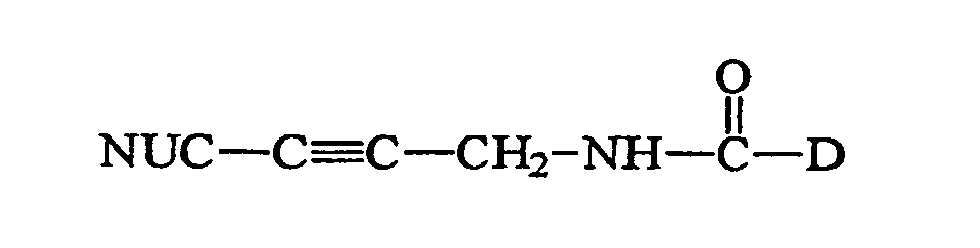
- A method of polynucleotide sequencing comprising the steps of:forming a mixture of a first, a second, a third, and a forth class of polynucleotides such that:each polynucleotide in the first class includes a 3'-terminal dideoxyadenosine and is labeled with a first dye;each polynucleotide in the second class includes a 3'-terminal dideoxycytidine and is labeled with a second dye;each polynucleotide in the third class includes a 3'-terminal dideoxyguanosine and is labeled with a third dye; andeach polynucleotide in the forth class includes a 3'-terminal dideoxythymidine and is labeled with a forth dye;wherein at least one of the first, second, third, or forth dyes is a dibenzorhodamine compound having the structure
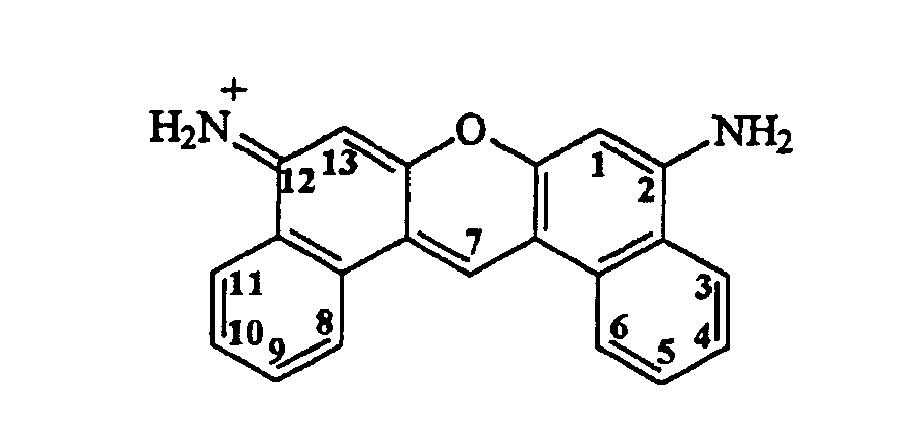 including nitrogen- and aryl-substituted forms thereof;the other of the dyes being spectrally resolvable from the dibenzorhodamine dye(s) and from each other;electrophoretically separating the polynucleotides thereby forming bands of similarly sized polynucleotides;illuminating the bands with an illumination beam capable of causing the dyes to fluoresce; andidentifying the classes of the polynucleotides in the bands by the fluorescence spectrum of the dyes.
 - A method of fragment analysis comprising:forming labeled polynucleotide fragments, the fragments being labeled with a dibenzorhodamine compound having the structure
 including nitrogen- and aryl-substituted forms thereof;subjecting the labeled polynucleotide fragments to a size-dependent separation process; anddetecting the labeled polynucleotide fragments subsequent to the separation process.
 - The method of claim 12 wherein the size-dependent separation process is electrophoresis and the labeled polynucleotide fragments are detected by fluorescence.
- An intermediate useful for the synthesis of dibenzorhodamine compounds, the intermediate having the structure

- The intermediate of claim 14 wherein R is selected from the group consisting of methyl or ethyl.
Applications Claiming Priority (2)
| Application Number | Priority Date | Filing Date | Title |
|---|---|---|---|
| US08/978,775 US5936087A (en) | 1997-11-25 | 1997-11-25 | Dibenzorhodamine dyes |
| EP98958069.1A EP1034221B1 (en) | 1997-11-25 | 1998-11-17 | Dibenzorhodamine dyes useful as fluorescent labelling agents |
Related Parent Applications (2)
| Application Number | Title | Priority Date | Filing Date |
|---|---|---|---|
| EP98958069.1 Division | 1998-11-17 | ||
| EP98958069.1A Division-Into EP1034221B1 (en) | 1997-11-25 | 1998-11-17 | Dibenzorhodamine dyes useful as fluorescent labelling agents |
Publications (1)
| Publication Number | Publication Date |
|---|---|
| EP2295503A1 true EP2295503A1 (en) | 2011-03-16 |
Family
ID=25526378
Family Applications (4)
| Application Number | Title | Priority Date | Filing Date |
|---|---|---|---|
| EP98958069.1A Expired - Lifetime EP1034221B1 (en) | 1997-11-25 | 1998-11-17 | Dibenzorhodamine dyes useful as fluorescent labelling agents |
| EP09016134A Withdrawn EP2186801A3 (en) | 1997-11-25 | 1998-11-17 | Intermediates for synthesizing dibenzorhodamine dyes |
| EP20040000878 Withdrawn EP1408090A1 (en) | 1997-11-25 | 1998-11-17 | Dibenzorhodamine dyes useful as fluorescent labelling agents |
| EP09016133A Withdrawn EP2295503A1 (en) | 1997-11-25 | 1998-11-17 | Dibenzorhodamine dyes useful as fluorescent labelling agents |
Family Applications Before (3)
| Application Number | Title | Priority Date | Filing Date |
|---|---|---|---|
| EP98958069.1A Expired - Lifetime EP1034221B1 (en) | 1997-11-25 | 1998-11-17 | Dibenzorhodamine dyes useful as fluorescent labelling agents |
| EP09016134A Withdrawn EP2186801A3 (en) | 1997-11-25 | 1998-11-17 | Intermediates for synthesizing dibenzorhodamine dyes |
| EP20040000878 Withdrawn EP1408090A1 (en) | 1997-11-25 | 1998-11-17 | Dibenzorhodamine dyes useful as fluorescent labelling agents |
Country Status (6)
| Country | Link |
|---|---|
| US (11) | US5936087A (en) |
| EP (4) | EP1034221B1 (en) |
| JP (3) | JP4038017B2 (en) |
| AU (1) | AU742571B2 (en) |
| CA (1) | CA2311476C (en) |
| WO (1) | WO1999027020A1 (en) |
Families Citing this family (147)
| Publication number | Priority date | Publication date | Assignee | Title |
|---|---|---|---|---|
| US6080852A (en) | 1996-06-27 | 2000-06-27 | The Perkin-Elmer Corporation | 4,7-dichlororhodamine dyes |
| US7550570B2 (en) | 2000-05-25 | 2009-06-23 | Applied Biosystems, Llc. | 4,7-dichlororhodamine dyes labeled polynucleotides |
| US6403311B1 (en) * | 1997-02-12 | 2002-06-11 | Us Genomics | Methods of analyzing polymers using ordered label strategies |
| WO1998035012A2 (en) * | 1997-02-12 | 1998-08-13 | Chan Eugene Y | Methods and products for analyzing polymers |
| US6583168B1 (en) * | 1997-11-25 | 2003-06-24 | Applera Corporation | Sulfonated diarylrhodamine dyes |
| US5936087A (en) * | 1997-11-25 | 1999-08-10 | The Perkin-Elmer Corporation | Dibenzorhodamine dyes |
| EP1141404A1 (en) * | 1998-12-24 | 2001-10-10 | Aclara BioSciences, Inc. | Individually addressable solid surfaces for multiplexed operations |
| ATE233795T1 (en) | 1999-04-23 | 2003-03-15 | Molecular Probes Inc | XANTHENE DYES AND THEIR APPLICATION AS LUMINESCENCE-CANCELING COMPOUNDS |
| US6248884B1 (en) | 1999-06-03 | 2001-06-19 | The Perkin-Elmer Corporation | Extended rhodamine compounds useful as fluorescent labels |
| US6372907B1 (en) * | 1999-11-03 | 2002-04-16 | Apptera Corporation | Water-soluble rhodamine dye peptide conjugates |
| US6191278B1 (en) | 1999-11-03 | 2001-02-20 | Pe Corporation | Water-soluble rhodamine dyes and conjugates thereof |
| US6436641B1 (en) * | 2000-04-17 | 2002-08-20 | Visible Genetics Inc. | Method and apparatus for DNA sequencing |
| US6465644B1 (en) * | 2000-05-02 | 2002-10-15 | Applera Corporation | Sulfonated [8,9] benzophenoxazine dyes and the use of their labelled conjugates |
| US6887664B2 (en) | 2000-06-06 | 2005-05-03 | Applera Corporation | Asynchronous primed PCR |
| US7169922B2 (en) * | 2000-08-04 | 2007-01-30 | Invitrogen Corporation | Derivatives of 1,2-dihydro-7-hydroxyquinolines containing fused rings |
| WO2002012195A1 (en) | 2000-08-04 | 2002-02-14 | Molecular Probes, Inc. | Derivatives of 1,2-dihydro-7-hydroxyquinolines containing fused rings |
| EP1337541B1 (en) | 2000-10-06 | 2007-03-07 | The Trustees of Columbia University in the City of New York | Massive parallel method for decoding DNA and RNA |
| CA2425663C (en) * | 2000-10-11 | 2009-12-29 | Applera Corporation | Fluorescent nucleobase conjugates having anionic linkers |
| WO2002044425A2 (en) * | 2000-12-01 | 2002-06-06 | Visigen Biotechnologies, Inc. | Enzymatic nucleic acid synthesis: compositions and methods for altering monomer incorporation fidelity |
| US7579463B2 (en) | 2000-12-20 | 2009-08-25 | Life Technologies Corporation | Crown ether derivatives |
| US7129346B2 (en) * | 2000-12-20 | 2006-10-31 | Molecular Probes, Inc. | Crown ether derivatives |
| US6962992B2 (en) | 2000-12-20 | 2005-11-08 | Molecullar Probes, Inc. | Crown ether derivatives |
| CA2439750A1 (en) * | 2001-03-09 | 2002-09-19 | Boston Probes, Inc. | Methods, kits and compositions pertaining to combination oligomers and libraries for their preparation |
| US6979530B2 (en) * | 2001-05-21 | 2005-12-27 | Applera Corporation | Peptide conjugates and fluorescence detection methods for intracellular caspase assay |
| US6887690B2 (en) * | 2001-06-22 | 2005-05-03 | Pe Corporation | Dye-labeled ribonucleotide triphosphates |
| US6764710B2 (en) | 2001-07-18 | 2004-07-20 | Scimed Life Systems, Inc. | Light emitting markers for use with substrates |
| US7052512B2 (en) * | 2001-07-18 | 2006-05-30 | Boston Scientific Scimed, Inc. | Fluorescent dyed lubricant for medical devices |
| US6856390B2 (en) | 2001-07-25 | 2005-02-15 | Applera Corporation | Time-delay integration in electrophoretic detection systems |
| US20050032060A1 (en) * | 2001-08-31 | 2005-02-10 | Shishir Shah | Arrays comprising pre-labeled biological molecules and methods for making and using these arrays |
| WO2003091426A1 (en) | 2001-10-12 | 2003-11-06 | Spectral Genomics, Inc. | Compilations of nucleic acids and arrays and methods of using them |
| US7439346B2 (en) * | 2001-10-12 | 2008-10-21 | Perkinelmer Las Inc. | Nucleic acids arrays and methods of use therefor |
| US20030165935A1 (en) | 2001-11-21 | 2003-09-04 | Vann Charles S. | Digital assay |
| US6686065B2 (en) | 2001-12-12 | 2004-02-03 | Canon Kabushiki Kaisha | [5]-helicene and dibenzofluorene materials for use in organic light emitting devices |
| US6916621B2 (en) * | 2002-03-27 | 2005-07-12 | Spectral Genomics, Inc. | Methods for array-based comparitive binding assays |
| JP2005523707A (en) * | 2002-04-23 | 2005-08-11 | ユー.エス. ジェノミクス, インコーポレイテッド | Compositions and methods for two-arm nucleic acid probes |
| AU2003299466A1 (en) * | 2002-05-03 | 2004-06-07 | Molecular Probes, Inc. | Compositions and methods for detection and isolation of phosphorylated molecules |
| US20040171034A1 (en) * | 2002-05-03 | 2004-09-02 | Brian Agnew | Compositions and methods for detection and isolation of phosphorylated molecules |
| US7445894B2 (en) * | 2002-05-03 | 2008-11-04 | Molecular Probes, Inc. | Compositions and methods for detection and isolation of phosphorylated molecules |
| AU2003251986A1 (en) * | 2002-07-17 | 2004-02-02 | U.S.Genomics, Inc. | Methods and compositions for analyzing polymers using chimeric tags |
| US7582260B2 (en) | 2002-07-18 | 2009-09-01 | Montana State University | Zwitterionic dyes for labeling in proteomic and other biological analyses |
| CA2493104A1 (en) * | 2002-07-18 | 2004-01-29 | Montana State University | Novel zwitterionic fluorescent dyes for labeling in proteomic and other biological analysis |
| AU2003273298B2 (en) * | 2002-09-08 | 2008-03-06 | Applera Corporation | Methods, compositions and libraries pertaining PNA dimer and PNA oligomer synthesis |
| US20050250214A1 (en) * | 2004-05-05 | 2005-11-10 | Gee Kyle R | Zinc binding compounds and their method of use |
| US8445702B2 (en) * | 2003-05-05 | 2013-05-21 | Life Technologies Corporation | Zinc binding compounds and their method of use |
| EP1627025B1 (en) * | 2003-05-09 | 2016-10-12 | Applied Biosystems, LLC | Fluorescent polymeric materials containing lipid soluble rhodamine dyes |
| US7491830B2 (en) * | 2003-05-09 | 2009-02-17 | Applied Biosystems Inc. | Phenyl xanthene dyes |
| CA2445420A1 (en) * | 2003-07-29 | 2005-01-29 | Invitrogen Corporation | Kinase and phosphatase assays |
| US7727752B2 (en) * | 2003-07-29 | 2010-06-01 | Life Technologies Corporation | Kinase and phosphatase assays |
| US7619059B2 (en) * | 2003-07-29 | 2009-11-17 | Life Technologies Corporation | Bimolecular optical probes |
| US7271265B2 (en) * | 2003-08-11 | 2007-09-18 | Invitrogen Corporation | Cyanine compounds and their application as quenching compounds |
| EP2224243A1 (en) * | 2003-09-12 | 2010-09-01 | Life Technologies Corporation | Identifying modulators of enzymatic activity |
| US20060029948A1 (en) * | 2003-09-19 | 2006-02-09 | Gary Lim | Sealing cover and dye compatibility selection |
| US7417726B2 (en) * | 2003-09-19 | 2008-08-26 | Applied Biosystems Inc. | Normalization of data using controls |
| US7570443B2 (en) | 2003-09-19 | 2009-08-04 | Applied Biosystems, Llc | Optical camera alignment |
| US7431915B2 (en) | 2003-10-31 | 2008-10-07 | The Regents Of The University Of California | Peptides whose uptake by cells is controllable |
| US20050214807A1 (en) * | 2003-11-19 | 2005-09-29 | Iain Johnson | Environmental sensitive fluorogenic compounds and their application for singlet oxygen and protein detection |
| DK1538154T3 (en) * | 2003-11-20 | 2009-03-02 | Exiqon As | Quencher compositions containing anthraquinone units |
| US7776529B2 (en) | 2003-12-05 | 2010-08-17 | Life Technologies Corporation | Methine-substituted cyanine dye compounds |
| EP1720944B1 (en) * | 2003-12-05 | 2013-07-17 | Life Technologies Corporation | Cyanine dye compounds |
| JP4127204B2 (en) * | 2003-12-17 | 2008-07-30 | セイコーエプソン株式会社 | Manufacturing method of liquid crystal display device |
| US8029765B2 (en) * | 2003-12-24 | 2011-10-04 | Masimo Laboratories, Inc. | SMMR (small molecule metabolite reporters) for use as in vivo glucose biosensors |
| US20050227309A1 (en) | 2004-01-21 | 2005-10-13 | Corry Schuyler B | Optically-detectable enzyme substrates and their method of use |
| US20050186606A1 (en) * | 2004-02-11 | 2005-08-25 | Schroeder Benjamin G. | Methods and compositions for detecting nucleic acids |
| US20050255485A1 (en) * | 2004-05-14 | 2005-11-17 | Livak Kenneth J | Detection of gene duplications |
| EP1771563A2 (en) * | 2004-05-28 | 2007-04-11 | Ambion, Inc. | METHODS AND COMPOSITIONS INVOLVING MicroRNA |
| WO2006016978A1 (en) * | 2004-06-30 | 2006-02-16 | Applera Corporation | Analog probe complexes |
| US20060024833A1 (en) | 2004-07-27 | 2006-02-02 | Molecular Probes, Inc. | Fluorescent metal ion indicators with large stokes shift |
| ES2503739T3 (en) | 2004-11-12 | 2014-10-07 | Asuragen, Inc. | Procedures and compositions involving miRNA and miRNA inhibitor molecules |
| WO2008073922A2 (en) * | 2006-12-08 | 2008-06-19 | Asuragen, Inc. | Functions and targets of let-7 micro rnas |
| US20060292586A1 (en) * | 2004-12-17 | 2006-12-28 | Schroth Gary P | ID-tag complexes, arrays, and methods of use thereof |
| US20060166238A1 (en) * | 2004-12-22 | 2006-07-27 | Ramsing Niels B | Probes, libraries and kits for analysis of mixtures of nucleic acids and methods for constructing the same |
| EP2208796B1 (en) | 2005-01-06 | 2014-06-18 | Applied Biosystems, LLC | Polypeptides having nucleic acid binding activity and compositions and methods for nucleic acid amplification |
| EP1872135A2 (en) | 2005-03-15 | 2008-01-02 | Applera Corporation | The use of antibody-surrogate antigen systems for detection of analytes |
| JP2008535518A (en) | 2005-04-14 | 2008-09-04 | アプレラ コーポレイション | 3 'modified oligonucleotides containing pseudoisocytosine nucleobase derivatives and their application as primers or probes |
| EP2312317A3 (en) | 2005-05-03 | 2011-06-08 | Life Technologies Corporation | Fluorescent detection system and dye set for use therewith |
| EP1885718B1 (en) | 2005-05-11 | 2017-03-15 | Life Technologies Corporation | Fluorescent chemical compounds having high selectivity for double stranded dna, and methods for their use |
| US20070087360A1 (en) * | 2005-06-20 | 2007-04-19 | Boyd Victoria L | Methods and compositions for detecting nucleotides |
| WO2007030521A1 (en) * | 2005-09-06 | 2007-03-15 | Invitrogen Corporation | Control of chemical modification |
| US20070059713A1 (en) | 2005-09-09 | 2007-03-15 | Lee Jun E | SSB-DNA polymerase fusion proteins |
| US7521577B2 (en) | 2006-01-12 | 2009-04-21 | Molecular Probes, Inc. | Heavy metal binding compounds and their method of use |
| WO2007106690A2 (en) | 2006-03-15 | 2007-09-20 | Siemens Healthcare Diagnostics Inc. | Degenerate nucleobase analogs |
| EP2021415B1 (en) | 2006-05-18 | 2017-03-15 | Illumina Cambridge Limited | Dye compounds and the use of their labelled conjugates |
| EP2636755A1 (en) | 2006-05-26 | 2013-09-11 | AltheaDx Incorporated | Biochemical analysis of partitioned cells |
| ES2484142T3 (en) | 2006-09-06 | 2014-08-11 | The Regents Of The University Of California | Molecular diagnosis and classification of malignant melanoma |
| AU2007299748A1 (en) * | 2006-09-19 | 2008-03-27 | Asuragen, Inc. | miR-15, miR-26, miR -31,miR -145, miR-147, miR-188, miR-215, miR-216 miR-331, mmu-miR-292-3p regulated genes and pathways as targets for therapeutic intervention |
| US20080131878A1 (en) * | 2006-12-05 | 2008-06-05 | Asuragen, Inc. | Compositions and Methods for the Detection of Small RNA |
| CN101622349A (en) * | 2006-12-08 | 2010-01-06 | 奥斯瑞根公司 | miR-20 regulated genes and pathways as targets for therapeutic intervention |
| CA2671194A1 (en) * | 2006-12-08 | 2008-06-19 | Asuragen, Inc. | Mir-20 regulated genes and pathways as targets for therapeutic intervention |
| CA2671294A1 (en) * | 2006-12-08 | 2008-06-19 | Asuragen, Inc. | Mir-21 regulated genes and pathways as targets for therapeutic intervention |
| US20090175827A1 (en) * | 2006-12-29 | 2009-07-09 | Byrom Mike W | miR-16 REGULATED GENES AND PATHWAYS AS TARGETS FOR THERAPEUTIC INTERVENTION |
| US8586743B2 (en) | 2007-01-30 | 2013-11-19 | Life Technologies Corporation | Labeling reagents and methods of their use |
| US20080274458A1 (en) * | 2007-05-01 | 2008-11-06 | Latham Gary J | Nucleic acid quantitation methods |
| US20090232893A1 (en) * | 2007-05-22 | 2009-09-17 | Bader Andreas G | miR-143 REGULATED GENES AND PATHWAYS AS TARGETS FOR THERAPEUTIC INTERVENTION |
| US8513451B2 (en) * | 2007-05-30 | 2013-08-20 | Hee Chol Kang | Fluorescent phospholipase A2 indicators |
| CA2689974A1 (en) * | 2007-06-08 | 2008-12-18 | Asuragen, Inc. | Mir-34 regulated genes and pathways as targets for therapeutic intervention |
| US8361714B2 (en) | 2007-09-14 | 2013-01-29 | Asuragen, Inc. | Micrornas differentially expressed in cervical cancer and uses thereof |
| US20090186015A1 (en) * | 2007-10-18 | 2009-07-23 | Latham Gary J | Micrornas differentially expressed in lung diseases and uses thereof |
| US20090247984A1 (en) * | 2007-10-24 | 2009-10-01 | Masimo Laboratories, Inc. | Use of microneedles for small molecule metabolite reporter delivery |
| CN101918367B (en) * | 2007-11-20 | 2016-08-24 | 西门子医疗保健诊断公司 | Acridine compounds Facile N-alkylation in ionic liquid |
| WO2009067632A1 (en) * | 2007-11-20 | 2009-05-28 | Applied Biosystems Inc. | Method of sequencing nucleic acids using elaborated nucleotide phosphorothiolate compounds |
| WO2009067628A1 (en) | 2007-11-20 | 2009-05-28 | Applied Biosystems Inc. | Reversible di-nucleotide terminator sequencing |
| US8071562B2 (en) | 2007-12-01 | 2011-12-06 | Mirna Therapeutics, Inc. | MiR-124 regulated genes and pathways as targets for therapeutic intervention |
| US20090192114A1 (en) * | 2007-12-21 | 2009-07-30 | Dmitriy Ovcharenko | miR-10 Regulated Genes and Pathways as Targets for Therapeutic Intervention |
| EP2260110B1 (en) * | 2008-02-08 | 2014-11-12 | Asuragen, INC. | miRNAs DIFFERENTIALLY EXPRESSED IN LYMPH NODES FROM CANCER PATIENTS |
| EP2257810B1 (en) | 2008-03-05 | 2013-06-05 | The Regents of the University of California | Molecular diagnosis and classification of malignant melanoma |
| EP2098520B1 (en) | 2008-03-05 | 2013-07-03 | Essilor International (Compagnie Générale D'Optique) | Photochromic dichroic naphtho-pyrans and optical articles containing them |
| US20090253780A1 (en) * | 2008-03-26 | 2009-10-08 | Fumitaka Takeshita | COMPOSITIONS AND METHODS RELATED TO miR-16 AND THERAPY OF PROSTATE CANCER |
| US20090258928A1 (en) * | 2008-04-08 | 2009-10-15 | Asuragen, Inc. | Methods and compositions for diagnosing and modulating human papillomavirus (hpv) |
| EP2285960B1 (en) | 2008-05-08 | 2015-07-08 | Asuragen, INC. | Compositions and methods related to mir-184 modulation of neovascularization or angiogenesis |
| US20100179213A1 (en) * | 2008-11-11 | 2010-07-15 | Mirna Therapeutics, Inc. | Methods and Compositions Involving miRNAs In Cancer Stem Cells |
| US20100159452A1 (en) * | 2008-12-22 | 2010-06-24 | Roche Molecular Systems, Inc. | Method For Detecting a Target Nucleic Acid in a Sample |
| EP3597657B1 (en) | 2009-05-21 | 2021-09-01 | Siemens Healthcare Diagnostics Inc. | Universal tags with non-natural nucleobases |
| EP2634266B1 (en) | 2009-05-22 | 2015-10-14 | Asuragen, INC. | miRNA biomarkers of prostate disease |
| WO2011025919A1 (en) | 2009-08-28 | 2011-03-03 | Asuragen, Inc. | Mirna biomarkers of lung disease |
| US8836387B1 (en) * | 2010-01-07 | 2014-09-16 | Marvell International Ltd. | Methods and systems for reducing jitter |
| JP6081366B2 (en) | 2010-10-29 | 2017-02-15 | アスラジェン, インコーポレイテッド | MPCR method for analyzing repeat sequences |
| EP2658998B1 (en) | 2010-12-29 | 2015-04-22 | Life Technologies Corporation | Ddao compounds as fluorescent reference standards |
| AU2012309824A1 (en) | 2011-09-12 | 2013-04-18 | Abbvie Biotherapeutics Inc. | Artificial NK cells and uses thereof |
| WO2013040251A2 (en) | 2011-09-13 | 2013-03-21 | Asurgen, Inc. | Methods and compositions involving mir-135b for distinguishing pancreatic cancer from benign pancreatic disease |
| WO2013078244A1 (en) | 2011-11-21 | 2013-05-30 | Promega Corporation | Carboxy x rhodamine analogs |
| CN104053990B (en) * | 2012-01-24 | 2015-11-25 | 株式会社岛津制作所 | The analytical approach of organic solar batteries dye material and purification process |
| WO2014093291A1 (en) | 2012-12-10 | 2014-06-19 | Advandx, Inc. | Use of probes for mass spectrometric identification of microorganisms or cells and associated conditions of interest |
| WO2014120974A1 (en) | 2013-01-30 | 2014-08-07 | Avelas Biosciences, Inc. | Selective delivery molecules and methods of use |
| CN104099803A (en) * | 2013-04-15 | 2014-10-15 | 金东纸业(江苏)股份有限公司 | Papermaking technology |
| CN105764917B (en) | 2013-09-26 | 2021-10-08 | 新加坡国立大学 | Compositions and methods utilizing lysophosphatidylcholine scaffolds |
| EP3090059B1 (en) | 2014-01-05 | 2018-06-06 | Biomirna Holdings Ltd. | Lung cancer determinations using mirna ratios |
| WO2015120382A1 (en) | 2014-02-07 | 2015-08-13 | The Johns Hopkins University | Predicting response to epigenetic drug therapy |
| CN107109474B (en) | 2014-08-19 | 2021-03-19 | 豪夫迈·罗氏有限公司 | Methods and compositions for nucleic acid detection |
| US10385380B2 (en) | 2014-10-02 | 2019-08-20 | The Regents Of The University Of California | Personalized protease assay to measure protease activity in neoplasms |
| WO2016094330A2 (en) | 2014-12-08 | 2016-06-16 | 20/20 Genesystems, Inc | Methods and machine learning systems for predicting the liklihood or risk of having cancer |
| CN107636165A (en) | 2015-01-12 | 2018-01-26 | 生命科技公司 | For nucleic acid library quality control and quantitative method, system and its composition |
| WO2016177774A1 (en) | 2015-05-04 | 2016-11-10 | Academisch Medisch Centrum | Method of quantifying mirnas using normalization |
| US11214829B2 (en) | 2015-07-23 | 2022-01-04 | Asuragen, Inc. | Methods, compositions, kits, and uses for analysis of nucleic acids comprising repeating A/T-rich segments |
| WO2018045162A1 (en) | 2016-09-01 | 2018-03-08 | Biogen Ma Inc. | Biomarkers predictive of primary progressive multiple sclerosis and uses thereof |
| EP4484952A3 (en) | 2017-08-02 | 2025-04-16 | The Regents of the University of California | Optimized peptides for targeting human nerves and their use in image guided surgery, diagnostics and therapeutic delivery |
| JP2022515153A (en) | 2018-12-20 | 2022-02-17 | ライフ テクノロジーズ コーポレーション | Asymmetric rhodamine dyes and their use in bioassays |
| WO2020132487A1 (en) | 2018-12-20 | 2020-06-25 | Life Technologies Corporation | Modified rhodamine dye and use thereof in biological assays |
| EP3719144A1 (en) | 2019-04-05 | 2020-10-07 | Fundación para la Investigación Biomédica del Hospital Universitario de la Paz (FIBHULP) | Mir-151a-3p as an universal endogenous control for exosome cargo normalization |
| WO2021013592A1 (en) | 2019-07-19 | 2021-01-28 | Fundación Para La Investigación Biomédica Del Hospital Universitario La Paz (Fibhulp) | Method for determining the response to treatment of a patient affected by non-small cell lung carcinoma (nsclc) |
| WO2021072289A1 (en) | 2019-10-10 | 2021-04-15 | Alume Biosciences, Inc. | Methods and systems using peptides for targeting and mapping human nerves in image guided surgery, diagnostics and therapeutic delivery |
| CN110724151B (en) * | 2019-11-18 | 2022-03-04 | 成都睿智化学研究有限公司 | Synthesis method of (3, 4-dihydro-2H-pyrano [2,3-b ] pyridine-6-yl) methanol |
| CN116075597A (en) | 2020-07-23 | 2023-05-05 | 生命技术公司 | Energy transfer dye conjugates for use in biological assays |
| US20230304932A1 (en) | 2020-07-23 | 2023-09-28 | Life Technologies Corporation | Compositions, systems and methods for biological analysis involving energy transfer dye conjugates and analytes comprising the same |
| WO2022120177A1 (en) | 2020-12-04 | 2022-06-09 | Alume Biosciences, Inc. | Nerve targeting peptides and methods of use |
| CN116916971A (en) | 2021-01-14 | 2023-10-20 | 阿鲁莫生物科学公司 | Methods and compositions for visualizing ureters during surgical procedures |
| CN114940669B (en) * | 2022-05-30 | 2024-04-12 | 中国科学院苏州纳米技术与纳米仿生研究所 | Single-component NIR-II region ratiometric fluorescent nanoprobe, preparation method and product |
| CN115850308B (en) * | 2022-11-07 | 2024-06-11 | 淮阴工学院 | A BODIPY near-infrared fluorescent probe containing electron donor and acceptor groups for recognizing Aβ fibers and preparation method thereof |
Citations (21)
| Publication number | Priority date | Publication date | Assignee | Title |
|---|---|---|---|---|
| US4230558A (en) | 1978-10-02 | 1980-10-28 | Coulter Electronics, Inc. | Single drop separator |
| US4415732A (en) | 1981-03-27 | 1983-11-15 | University Patents, Inc. | Phosphoramidite compounds and processes |
| US4458066A (en) | 1980-02-29 | 1984-07-03 | University Patents, Inc. | Process for preparing polynucleotides |
| US4757141A (en) | 1985-08-26 | 1988-07-12 | Applied Biosystems, Incorporated | Amino-derivatized phosphite and phosphate linking agents, phosphoramidite precursors, and useful conjugates thereof |
| US4811218A (en) | 1986-06-02 | 1989-03-07 | Applied Biosystems, Inc. | Real time scanning electrophoresis apparatus for DNA sequencing |
| US4855225A (en) | 1986-02-07 | 1989-08-08 | Applied Biosystems, Inc. | Method of detecting electrophoretically separated oligonucleotides |
| US4879012A (en) | 1987-06-24 | 1989-11-07 | Hitachi, Ltd. | Method for reutilization of electrophoresis gel |
| US5091652A (en) | 1990-01-12 | 1992-02-25 | The Regents Of The University Of California | Laser excited confocal microscope fluorescence scanner and method |
| US5118800A (en) | 1983-12-20 | 1992-06-02 | California Institute Of Technology | Oligonucleotides possessing a primary amino group in the terminal nucleotide |
| US5141813A (en) | 1989-08-28 | 1992-08-25 | Clontech Laboratories, Inc. | Multifunctional controlled pore glass reagent for solid phase oligonucleotide synthesis |
| EP0543333A1 (en) * | 1991-11-18 | 1993-05-26 | Roche Diagnostics GmbH | New pentacyclic compounds and their use as absorption or fluorescence dyestuffs |
| US5231191A (en) | 1987-12-24 | 1993-07-27 | Applied Biosystems, Inc. | Rhodamine phosphoramidite compounds |
| US5274240A (en) | 1990-01-12 | 1993-12-28 | The Regents Of The University Of California | Capillary array confocal fluorescence scanner and method |
| WO1994005688A1 (en) * | 1992-09-03 | 1994-03-17 | Applied Biosystems, Inc. | 4,7-dichlorofluorescein dyes as molecular probes |
| US5374527A (en) | 1993-01-21 | 1994-12-20 | Applied Biosystems, Inc. | High resolution DNA sequencing method using low viscosity medium |
| US5449767A (en) | 1981-04-17 | 1995-09-12 | Yale University | Modified polynucleotides and methods of preparing same |
| US5543026A (en) | 1994-02-07 | 1996-08-06 | The Perkin-Elmer Corporation | Real-time scanning fluorescence electrophoresis apparatus for the analysis of polynucleotide fragments |
| US5552028A (en) | 1993-12-17 | 1996-09-03 | The Perkin-Elmer Corporation | Polymers for separation of biomolecules by capillary electrophoresis |
| US5624800A (en) | 1992-04-03 | 1997-04-29 | The Perkin-Elmer Corporation | Method of DNA sequencing employing a mixed DNA-polymer chain probe |
| US5654419A (en) | 1994-02-01 | 1997-08-05 | The Regents Of The University Of California | Fluorescent labels and their use in separations |
| EP0805190A2 (en) * | 1996-05-03 | 1997-11-05 | Perkin-Elmer Corporation | Energy transfer dyes with enhanced fluorescence |
Family Cites Families (26)
| Publication number | Priority date | Publication date | Assignee | Title |
|---|---|---|---|---|
| US2067127A (en) * | 1937-01-05 | Condensation products of the aza | ||
| DE548819C (en) * | 1930-05-01 | 1932-04-20 | I G Farbenindustrie Akt Ges | Process for the preparation of oxynaphthocarbazoles |
| JPS523740B2 (en) * | 1973-08-16 | 1977-01-29 | ||
| US4987065A (en) * | 1983-07-05 | 1991-01-22 | Enzo Biochem, Inc. | In vivo labelling of polynucleotide sequences |
| US6054270A (en) * | 1988-05-03 | 2000-04-25 | Oxford Gene Technology Limited | Analying polynucleotide sequences |
| JPH0250069A (en) * | 1988-08-09 | 1990-02-20 | Sanyo Electric Co Ltd | Heat insulating sheet body |
| JPH0253069A (en) * | 1988-08-18 | 1990-02-22 | Canon Inc | electrophotographic photoreceptor |
| US5405975A (en) | 1993-03-29 | 1995-04-11 | Molecular Probes, Inc. | Fluorescent ion-selective diaryldiaza crown ether conjugates |
| GB9024176D0 (en) | 1990-11-07 | 1990-12-19 | Medical Res Council | Photolabile compounds,their synthesis and use as fluorophores |
| US5750409A (en) * | 1991-11-18 | 1998-05-12 | Boehringer Mannheim Gmbh | Pentacyclic compounds and their use as absorption or fluorescent dyes |
| JP3102800B2 (en) * | 1994-08-19 | 2000-10-23 | パーキン−エルマー コーポレイション | Conjugation methods for amplification and ligation |
| US5614386A (en) * | 1995-06-23 | 1997-03-25 | Baylor College Of Medicine | Alternative dye-labeled primers for automated DNA sequencing |
| US6020481A (en) | 1996-04-01 | 2000-02-01 | The Perkin-Elmer Corporation | Asymmetric benzoxanthene dyes |
| US5863727A (en) * | 1996-05-03 | 1999-01-26 | The Perkin-Elmer Corporation | Energy transfer dyes with enhanced fluorescence |
| US5847162A (en) * | 1996-06-27 | 1998-12-08 | The Perkin Elmer Corporation | 4, 7-Dichlororhodamine dyes |
| US5945526A (en) * | 1996-05-03 | 1999-08-31 | Perkin-Elmer Corporation | Energy transfer dyes with enhanced fluorescence |
| US6080852A (en) | 1996-06-27 | 2000-06-27 | The Perkin-Elmer Corporation | 4,7-dichlororhodamine dyes |
| US6130101A (en) | 1997-09-23 | 2000-10-10 | Molecular Probes, Inc. | Sulfonated xanthene derivatives |
| US6008379A (en) | 1997-10-01 | 1999-12-28 | The Perkin-Elmer Corporation | Aromatic-substituted xanthene dyes |
| US6583168B1 (en) | 1997-11-25 | 2003-06-24 | Applera Corporation | Sulfonated diarylrhodamine dyes |
| US5936087A (en) | 1997-11-25 | 1999-08-10 | The Perkin-Elmer Corporation | Dibenzorhodamine dyes |
| US6080868A (en) | 1998-01-23 | 2000-06-27 | The Perkin-Elmer Corporation | Nitro-substituted non-fluorescent asymmetric cyanine dye compounds |
| US6566059B1 (en) * | 1998-10-01 | 2003-05-20 | Variagenics, Inc. | Method for analyzing polynucleotides |
| ATE233795T1 (en) | 1999-04-23 | 2003-03-15 | Molecular Probes Inc | XANTHENE DYES AND THEIR APPLICATION AS LUMINESCENCE-CANCELING COMPOUNDS |
| DE19923168A1 (en) | 1999-05-20 | 2000-11-23 | Roche Diagnostics Gmbh | New fluorescent dyes and their use as fluorescent markers |
| US6248884B1 (en) | 1999-06-03 | 2001-06-19 | The Perkin-Elmer Corporation | Extended rhodamine compounds useful as fluorescent labels |
-
1997
- 1997-11-25 US US08/978,775 patent/US5936087A/en not_active Expired - Lifetime
-
1998
- 1998-11-17 CA CA002311476A patent/CA2311476C/en not_active Expired - Fee Related
- 1998-11-17 EP EP98958069.1A patent/EP1034221B1/en not_active Expired - Lifetime
- 1998-11-17 JP JP2000522168A patent/JP4038017B2/en not_active Expired - Fee Related
- 1998-11-17 EP EP09016134A patent/EP2186801A3/en not_active Withdrawn
- 1998-11-17 EP EP20040000878 patent/EP1408090A1/en not_active Withdrawn
- 1998-11-17 WO PCT/US1998/024626 patent/WO1999027020A1/en not_active Ceased
- 1998-11-17 EP EP09016133A patent/EP2295503A1/en not_active Withdrawn
- 1998-11-17 US US09/193,374 patent/US6051719A/en not_active Expired - Lifetime
- 1998-11-17 AU AU14182/99A patent/AU742571B2/en not_active Ceased
- 1998-11-24 US US09/199,402 patent/US6111116A/en not_active Expired - Lifetime
-
2000
- 2000-04-20 US US09/556,040 patent/US6221606B1/en not_active Expired - Lifetime
-
2001
- 2001-02-14 US US09/784,943 patent/US6326153B2/en not_active Expired - Lifetime
- 2001-10-02 US US09/969,430 patent/US6566071B2/en not_active Expired - Lifetime
-
2003
- 2003-05-20 US US10/441,950 patent/US6919445B2/en not_active Expired - Fee Related
- 2003-08-25 JP JP2003300011A patent/JP2004107331A/en not_active Withdrawn
-
2005
- 2005-07-07 US US11/177,233 patent/US20060051791A1/en not_active Abandoned
-
2006
- 2006-08-21 US US11/466,085 patent/US20070099210A1/en not_active Abandoned
-
2008
- 2008-07-08 US US12/169,624 patent/US7833756B2/en not_active Expired - Fee Related
-
2010
- 2010-02-08 JP JP2010025761A patent/JP5303486B2/en not_active Expired - Fee Related
- 2010-10-06 US US12/899,508 patent/US20110124510A1/en not_active Abandoned
Patent Citations (23)
| Publication number | Priority date | Publication date | Assignee | Title |
|---|---|---|---|---|
| US4230558A (en) | 1978-10-02 | 1980-10-28 | Coulter Electronics, Inc. | Single drop separator |
| US4458066A (en) | 1980-02-29 | 1984-07-03 | University Patents, Inc. | Process for preparing polynucleotides |
| US4415732A (en) | 1981-03-27 | 1983-11-15 | University Patents, Inc. | Phosphoramidite compounds and processes |
| US5449767A (en) | 1981-04-17 | 1995-09-12 | Yale University | Modified polynucleotides and methods of preparing same |
| US5118800A (en) | 1983-12-20 | 1992-06-02 | California Institute Of Technology | Oligonucleotides possessing a primary amino group in the terminal nucleotide |
| US4757141A (en) | 1985-08-26 | 1988-07-12 | Applied Biosystems, Incorporated | Amino-derivatized phosphite and phosphate linking agents, phosphoramidite precursors, and useful conjugates thereof |
| US4855225A (en) | 1986-02-07 | 1989-08-08 | Applied Biosystems, Inc. | Method of detecting electrophoretically separated oligonucleotides |
| US4811218A (en) | 1986-06-02 | 1989-03-07 | Applied Biosystems, Inc. | Real time scanning electrophoresis apparatus for DNA sequencing |
| US4879012A (en) | 1987-06-24 | 1989-11-07 | Hitachi, Ltd. | Method for reutilization of electrophoresis gel |
| US5231191A (en) | 1987-12-24 | 1993-07-27 | Applied Biosystems, Inc. | Rhodamine phosphoramidite compounds |
| US5401837A (en) | 1989-08-28 | 1995-03-28 | Clontech Laboratories, Inc. | Method for labeling the 3' terminus of a synthetic oligonucleotide using a unique multifunctional controlled pore glass (MF-CPG) reagent in solid phase oligonucleotide synthesis |
| US5141813A (en) | 1989-08-28 | 1992-08-25 | Clontech Laboratories, Inc. | Multifunctional controlled pore glass reagent for solid phase oligonucleotide synthesis |
| US5274240A (en) | 1990-01-12 | 1993-12-28 | The Regents Of The University Of California | Capillary array confocal fluorescence scanner and method |
| US5091652A (en) | 1990-01-12 | 1992-02-25 | The Regents Of The University Of California | Laser excited confocal microscope fluorescence scanner and method |
| EP0543333A1 (en) * | 1991-11-18 | 1993-05-26 | Roche Diagnostics GmbH | New pentacyclic compounds and their use as absorption or fluorescence dyestuffs |
| US5624800A (en) | 1992-04-03 | 1997-04-29 | The Perkin-Elmer Corporation | Method of DNA sequencing employing a mixed DNA-polymer chain probe |
| WO1994005688A1 (en) * | 1992-09-03 | 1994-03-17 | Applied Biosystems, Inc. | 4,7-dichlorofluorescein dyes as molecular probes |
| US5374527A (en) | 1993-01-21 | 1994-12-20 | Applied Biosystems, Inc. | High resolution DNA sequencing method using low viscosity medium |
| US5552028A (en) | 1993-12-17 | 1996-09-03 | The Perkin-Elmer Corporation | Polymers for separation of biomolecules by capillary electrophoresis |
| US5654419A (en) | 1994-02-01 | 1997-08-05 | The Regents Of The University Of California | Fluorescent labels and their use in separations |
| US5543026A (en) | 1994-02-07 | 1996-08-06 | The Perkin-Elmer Corporation | Real-time scanning fluorescence electrophoresis apparatus for the analysis of polynucleotide fragments |
| EP0805190A2 (en) * | 1996-05-03 | 1997-11-05 | Perkin-Elmer Corporation | Energy transfer dyes with enhanced fluorescence |
| US5800996A (en) | 1996-05-03 | 1998-09-01 | The Perkin Elmer Corporation | Energy transfer dyes with enchanced fluorescence |
Non-Patent Citations (35)
| Title |
|---|
| "ABI PRISM 377 DNA Sequencer User's Manual, Rev. A", January 1995, THE PERKIN-ELMER CORPORATION |
| "Oligonucleotides and Analogs", 1991, IRL PRESS |
| "PCR Protocols", 1990, ACADEMIC PRESS |
| "Users Manual Model 392 and 394 Polynucleotide Synthesizers", 1991, article "Applied Biosystems", pages: 6 - 1,6-22 |
| A.ROSOWSKY; E.J.MODEST, J.O.C., vol. 30, 1965, pages 1832 |
| AROSOWSKY; E.J.MODEST, J.O.C., vol. 30, 1965, pages 1832 |
| BERGSTROM ET AL., JACS, vol. 111, 1989, pages 374 - 375 |
| BUCHWALD ET AL., J. ORG., vol. 62, 1997, pages 6066 - 6068 |
| BUCHWALD, S.L. ET AL., TETRAHEDRON LETTERS, vol. 38, no. 36, 1997, pages 6367 - 6370 |
| BUCHWALD, TETRAHEDRON LETTERS, vol. 38, no. 36, 1997, pages 6359 - 6362 |
| CARUTHERS ET AL., GENETIC ENGINEERING, vol. 4, 1982, pages 1 - 17 |
| G.T.MORGAN; E.D.EVANS, J. CHEM. SOC., vol. 115, 1919, pages 1126 |
| GAIT: "Oligonucleotide Synthesis", 1990, IRL PRESS |
| GEBEYEHU ET AL., NUCLEIC ACIDS RESEARCH, vol. 15, 1987, pages 4513 - 4535 |
| GIBSON ET AL., NUCLEIC ACIDS RESEARCH, vol. 15, 1987, pages 6455 - 6467 |
| GOULD; MATTHEWS: "Gel Electrophoresis of Nucleic Acids: A Practical Approach", 1981, IRL PRESS LIMITED |
| HARALAMBIDIS ET AL., NUCLEIC ACIDS RESEARCH, vol. 15, 1987, pages 4856 - 4876 |
| HOBBS ET AL., 1. ORG. CHEM., vol. 54, pages 3420 |
| J.P.WOLFE; S.L.BUCHWALD, JOC, vol. 61, 1996, pages 1133 |
| JU ET AL., PROC. NATL. ACAD SCI. USA, vol. 92, 1995, pages 4347 - 4351 |
| K.H.BELL; L.F.MCCAFFERY, AUST. J. CHEM., vol. 46, 1993, pages 731 |
| KORNBERG; BAKER: "DNA Replication", 1992, FREEMAN |
| LEE ET AL., NUCLEIC ACIDS RESEARCH, vol. 21, 1993, pages 3761 - 3766 |
| MANIATIS ET AL.: "Chain Length Determination of Small Double- and Single-Stranded DNA Molecules by Polyacrylamide Gel Electrophoresis", BIOCHEMISTRY, vol. 14, 1975, pages 3787 - 3794 |
| MANIATIS ET AL.: "Fractionation of Low Molecular Weight DNA and RNA in Polyacrylamide Gels Containing 98% Formamide or 7 M Urea", METHODS IN ENZYMOLOGY, vol. 65, 1980, pages 299 - 305 |
| MANIATIS ET AL.: "Molecular Cloning: A Laboratory Manual", 1982, COLD SPRING HARBOR LABORATORY, pages: 179 - 185 |
| NELSON ET AL., NUCLEOSIDES AND NUCLEOTIDES, vol. 5, no. 3, 1986, pages 233 - 241 |
| NELSON, NUCLEIC ACIDS RESEARCH, vol. 20, no. 23, pages 6253 - 6259 |
| ORGEL ET AL., NUCLEIC ACIDS RESEARCH, vol. 11, no. 18, 1983, pages 6513 |
| OSTERMAN: "Methods of Protein and Nucleic Acid Research", vol. 1, 1984, SPRINGER-VERLAG |
| R HAUGLAND: "Excited States of Biopolymers", 1983, PLENUM PRESS |
| R HAUGLAND: "Molecular Probes Handbook of Fluorescent Probes and Research Chemicals", 1992, MOLECULAR PROBES, INC. |
| SCHEIT: "Nucleotide Analogs", 1980, JOHN WILEY |
| STRYER: "Biochemistry", 1981, W.H. FREEMAN AND COMPANY |
| WHEELESS ET AL.: "Flow Cytometry: Instrumentation and Data Analysis", 1985, ACADEMIC PRESS, pages: 21 - 76 |
Also Published As
| Publication number | Publication date |
|---|---|
| EP1034221B1 (en) | 2014-05-14 |
| US5936087A (en) | 1999-08-10 |
| JP4038017B2 (en) | 2008-01-23 |
| CA2311476C (en) | 2007-07-24 |
| EP2186801A2 (en) | 2010-05-19 |
| US6326153B2 (en) | 2001-12-04 |
| US6051719A (en) | 2000-04-18 |
| JP2001524493A (en) | 2001-12-04 |
| AU1418299A (en) | 1999-06-15 |
| US20020034761A1 (en) | 2002-03-21 |
| US20070099210A1 (en) | 2007-05-03 |
| US6111116A (en) | 2000-08-29 |
| WO1999027020A1 (en) | 1999-06-03 |
| CA2311476A1 (en) | 1999-06-03 |
| US20060051791A1 (en) | 2006-03-09 |
| US6919445B2 (en) | 2005-07-19 |
| AU742571B2 (en) | 2002-01-10 |
| US6221606B1 (en) | 2001-04-24 |
| US20010011139A1 (en) | 2001-08-02 |
| EP1034221A1 (en) | 2000-09-13 |
| EP2186801A3 (en) | 2011-06-29 |
| US20110124510A1 (en) | 2011-05-26 |
| JP5303486B2 (en) | 2013-10-02 |
| US20090068751A1 (en) | 2009-03-12 |
| EP1408090A1 (en) | 2004-04-14 |
| US7833756B2 (en) | 2010-11-16 |
| JP2004107331A (en) | 2004-04-08 |
| US20040072209A1 (en) | 2004-04-15 |
| JP2010159420A (en) | 2010-07-22 |
| US6566071B2 (en) | 2003-05-20 |
Similar Documents
| Publication | Publication Date | Title |
|---|---|---|
| EP1034221B1 (en) | Dibenzorhodamine dyes useful as fluorescent labelling agents | |
| US6008379A (en) | Aromatic-substituted xanthene dyes | |
| US6617445B2 (en) | Asymmetric benzoxanthene dye labelling reagents | |
| EP1212457B1 (en) | Uv excitable fluorescent energy transfer dyes |
Legal Events
| Date | Code | Title | Description |
|---|---|---|---|
| PUAI | Public reference made under article 153(3) epc to a published international application that has entered the european phase |
Free format text: ORIGINAL CODE: 0009012 |
|
| AC | Divisional application: reference to earlier application |
Ref document number: 1034221 Country of ref document: EP Kind code of ref document: P |
|
| AK | Designated contracting states |
Kind code of ref document: A1 Designated state(s): AT BE CH CY DE DK ES FI FR GB GR IE IT LI LU MC NL PT SE |
|
| RIN1 | Information on inventor provided before grant (corrected) |
Inventor name: LAM, JOE, Y. L. Inventor name: ZHEN, WEIGUO Inventor name: RADEL, PEGGY, ANN Inventor name: UPADHYA, KRISHNA, GAJANAN Inventor name: MENCHEN, STEVEN, MICHAEL Inventor name: BENSON, SCOTT, CONRAD |
|
| STAA | Information on the status of an ep patent application or granted ep patent |
Free format text: STATUS: THE APPLICATION IS DEEMED TO BE WITHDRAWN |
|
| 18D | Application deemed to be withdrawn |
Effective date: 20110917 |