EP2284192A2 - Camelidae antibodies for sublingual administration - Google Patents
Camelidae antibodies for sublingual administration Download PDFInfo
- Publication number
- EP2284192A2 EP2284192A2 EP10178263A EP10178263A EP2284192A2 EP 2284192 A2 EP2284192 A2 EP 2284192A2 EP 10178263 A EP10178263 A EP 10178263A EP 10178263 A EP10178263 A EP 10178263A EP 2284192 A2 EP2284192 A2 EP 2284192A2
- Authority
- EP
- European Patent Office
- Prior art keywords
- polypeptide construct
- single domain
- vhh
- target
- directed against
- Prior art date
- Legal status (The legal status is an assumption and is not a legal conclusion. Google has not performed a legal analysis and makes no representation as to the accuracy of the status listed.)
- Withdrawn
Links
- 241000282832 Camelidae Species 0.000 title abstract description 24
- 108090000765 processed proteins & peptides Proteins 0.000 claims abstract description 397
- 102000004196 processed proteins & peptides Human genes 0.000 claims abstract description 388
- 229920001184 polypeptide Polymers 0.000 claims abstract description 381
- 108010003723 Single-Domain Antibodies Proteins 0.000 claims description 248
- 239000000203 mixture Substances 0.000 claims description 94
- 102100027998 Macrophage metalloelastase Human genes 0.000 claims description 57
- 102100037850 Interferon gamma Human genes 0.000 claims description 22
- 108010074328 Interferon-gamma Proteins 0.000 claims description 22
- 108060008682 Tumor Necrosis Factor Proteins 0.000 claims description 18
- MZOFCQQQCNRIBI-VMXHOPILSA-N (3s)-4-[[(2s)-1-[[(2s)-1-[[(1s)-1-carboxy-2-hydroxyethyl]amino]-4-methyl-1-oxopentan-2-yl]amino]-5-(diaminomethylideneamino)-1-oxopentan-2-yl]amino]-3-[[2-[[(2s)-2,6-diaminohexanoyl]amino]acetyl]amino]-4-oxobutanoic acid Chemical compound OC[C@@H](C(O)=O)NC(=O)[C@H](CC(C)C)NC(=O)[C@H](CCCN=C(N)N)NC(=O)[C@H](CC(O)=O)NC(=O)CNC(=O)[C@@H](N)CCCCN MZOFCQQQCNRIBI-VMXHOPILSA-N 0.000 claims description 11
- 239000007921 spray Substances 0.000 claims description 6
- 239000004615 ingredient Substances 0.000 claims description 5
- 101710187853 Macrophage metalloelastase Proteins 0.000 claims 2
- 102100040247 Tumor necrosis factor Human genes 0.000 claims 2
- 102000052116 epidermal growth factor receptor activity proteins Human genes 0.000 claims 2
- 108700015053 epidermal growth factor receptor activity proteins Proteins 0.000 claims 2
- YOHYSYJDKVYCJI-UHFFFAOYSA-N n-[3-[[6-[3-(trifluoromethyl)anilino]pyrimidin-4-yl]amino]phenyl]cyclopropanecarboxamide Chemical compound FC(F)(F)C1=CC=CC(NC=2N=CN=C(NC=3C=C(NC(=O)C4CC4)C=CC=3)C=2)=C1 YOHYSYJDKVYCJI-UHFFFAOYSA-N 0.000 claims 2
- 238000000034 method Methods 0.000 abstract description 187
- 230000001225 therapeutic effect Effects 0.000 abstract description 134
- 108090000623 proteins and genes Proteins 0.000 abstract description 31
- 102000004169 proteins and genes Human genes 0.000 abstract description 22
- 210000004027 cell Anatomy 0.000 description 145
- 208000037265 diseases, disorders, signs and symptoms Diseases 0.000 description 127
- 208000035475 disorder Diseases 0.000 description 124
- 150000001875 compounds Chemical class 0.000 description 112
- 108020003175 receptors Proteins 0.000 description 100
- 102000005962 receptors Human genes 0.000 description 99
- 108060006698 EGF receptor Proteins 0.000 description 92
- 102000001301 EGF receptor Human genes 0.000 description 87
- 108091007433 antigens Proteins 0.000 description 70
- 102000036639 antigens Human genes 0.000 description 70
- 239000000427 antigen Substances 0.000 description 68
- 235000002198 Annona diversifolia Nutrition 0.000 description 65
- 230000027455 binding Effects 0.000 description 59
- 244000303258 Annona diversifolia Species 0.000 description 58
- 208000024891 symptom Diseases 0.000 description 54
- 238000011282 treatment Methods 0.000 description 44
- 210000004072 lung Anatomy 0.000 description 42
- 238000010828 elution Methods 0.000 description 37
- 239000012528 membrane Substances 0.000 description 37
- 210000001519 tissue Anatomy 0.000 description 37
- 210000004379 membrane Anatomy 0.000 description 36
- 239000008280 blood Substances 0.000 description 35
- 230000001413 cellular effect Effects 0.000 description 33
- 238000009472 formulation Methods 0.000 description 33
- 239000012634 fragment Substances 0.000 description 33
- 210000004369 blood Anatomy 0.000 description 31
- DHMQDGOQFOQNFH-UHFFFAOYSA-N Glycine Chemical group NCC(O)=O DHMQDGOQFOQNFH-UHFFFAOYSA-N 0.000 description 29
- 241000282414 Homo sapiens Species 0.000 description 29
- FAPWRFPIFSIZLT-UHFFFAOYSA-M Sodium chloride Chemical compound [Na+].[Cl-] FAPWRFPIFSIZLT-UHFFFAOYSA-M 0.000 description 28
- 239000003814 drug Substances 0.000 description 28
- 238000002649 immunization Methods 0.000 description 28
- 238000002360 preparation method Methods 0.000 description 28
- 241001465754 Metazoa Species 0.000 description 27
- 210000002345 respiratory system Anatomy 0.000 description 27
- 230000003053 immunization Effects 0.000 description 24
- 238000002965 ELISA Methods 0.000 description 23
- 206010028980 Neoplasm Diseases 0.000 description 23
- 210000004347 intestinal mucosa Anatomy 0.000 description 22
- 210000001165 lymph node Anatomy 0.000 description 22
- XLYOFNOQVPJJNP-UHFFFAOYSA-N water Substances O XLYOFNOQVPJJNP-UHFFFAOYSA-N 0.000 description 22
- 101000577881 Homo sapiens Macrophage metalloelastase Proteins 0.000 description 21
- 210000003491 skin Anatomy 0.000 description 21
- 101000600756 Homo sapiens 3-phosphoinositide-dependent protein kinase 1 Proteins 0.000 description 20
- 101001117146 Homo sapiens [Pyruvate dehydrogenase (acetyl-transferring)] kinase isozyme 1, mitochondrial Proteins 0.000 description 20
- 102100024148 [Pyruvate dehydrogenase (acetyl-transferring)] kinase isozyme 1, mitochondrial Human genes 0.000 description 20
- 239000003795 chemical substances by application Substances 0.000 description 20
- 230000000670 limiting effect Effects 0.000 description 19
- 235000018102 proteins Nutrition 0.000 description 19
- 102000018594 Tumour necrosis factor Human genes 0.000 description 18
- 108050007852 Tumour necrosis factor Proteins 0.000 description 18
- 150000001413 amino acids Chemical class 0.000 description 18
- 230000028993 immune response Effects 0.000 description 18
- 230000004054 inflammatory process Effects 0.000 description 18
- 238000002347 injection Methods 0.000 description 18
- 239000007924 injection Substances 0.000 description 18
- 239000002609 medium Substances 0.000 description 18
- 239000013642 negative control Substances 0.000 description 18
- 239000000243 solution Substances 0.000 description 18
- 229920001213 Polysorbate 20 Polymers 0.000 description 17
- 102000000852 Tumor Necrosis Factor-alpha Human genes 0.000 description 17
- 230000014509 gene expression Effects 0.000 description 17
- 239000000256 polyoxyethylene sorbitan monolaurate Substances 0.000 description 17
- 235000010486 polyoxyethylene sorbitan monolaurate Nutrition 0.000 description 17
- 239000000523 sample Substances 0.000 description 17
- 210000002966 serum Anatomy 0.000 description 17
- 108020004414 DNA Proteins 0.000 description 16
- 239000008188 pellet Substances 0.000 description 16
- 210000005105 peripheral blood lymphocyte Anatomy 0.000 description 16
- 210000002784 stomach Anatomy 0.000 description 16
- 201000011510 cancer Diseases 0.000 description 15
- 229920001223 polyethylene glycol Polymers 0.000 description 15
- 241000894006 Bacteria Species 0.000 description 14
- 102000016943 Muramidase Human genes 0.000 description 14
- 108010014251 Muramidase Proteins 0.000 description 14
- 108010062010 N-Acetylmuramoyl-L-alanine Amidase Proteins 0.000 description 14
- 208000026935 allergic disease Diseases 0.000 description 14
- 229960000723 ampicillin Drugs 0.000 description 14
- AVKUERGKIZMTKX-NJBDSQKTSA-N ampicillin Chemical compound C1([C@@H](N)C(=O)N[C@H]2[C@H]3SC([C@@H](N3C2=O)C(O)=O)(C)C)=CC=CC=C1 AVKUERGKIZMTKX-NJBDSQKTSA-N 0.000 description 14
- 210000000612 antigen-presenting cell Anatomy 0.000 description 14
- 239000004325 lysozyme Substances 0.000 description 14
- 235000010335 lysozyme Nutrition 0.000 description 14
- 229960000274 lysozyme Drugs 0.000 description 14
- 230000002265 prevention Effects 0.000 description 14
- 239000000047 product Substances 0.000 description 14
- 239000011780 sodium chloride Substances 0.000 description 14
- 101100082447 Arabidopsis thaliana PBL1 gene Proteins 0.000 description 13
- -1 Bad Proteins 0.000 description 13
- 108010022366 Carcinoembryonic Antigen Proteins 0.000 description 13
- 102100025475 Carcinoembryonic antigen-related cell adhesion molecule 5 Human genes 0.000 description 13
- 241000699670 Mus sp. Species 0.000 description 13
- 239000007788 liquid Substances 0.000 description 13
- WQZGKKKJIJFFOK-GASJEMHNSA-N Glucose Natural products OC[C@H]1OC(O)[C@H](O)[C@@H](O)[C@@H]1O WQZGKKKJIJFFOK-GASJEMHNSA-N 0.000 description 12
- PEDCQBHIVMGVHV-UHFFFAOYSA-N Glycerine Chemical compound OCC(O)CO PEDCQBHIVMGVHV-UHFFFAOYSA-N 0.000 description 12
- 206010020751 Hypersensitivity Diseases 0.000 description 12
- 239000008103 glucose Substances 0.000 description 12
- 238000004519 manufacturing process Methods 0.000 description 12
- 239000007790 solid phase Substances 0.000 description 12
- 239000000758 substrate Substances 0.000 description 12
- 108010021625 Immunoglobulin Fragments Proteins 0.000 description 11
- 102000008394 Immunoglobulin Fragments Human genes 0.000 description 11
- 230000007815 allergy Effects 0.000 description 11
- 229940024606 amino acid Drugs 0.000 description 11
- 235000001014 amino acid Nutrition 0.000 description 11
- 230000003197 catalytic effect Effects 0.000 description 11
- 230000002496 gastric effect Effects 0.000 description 11
- 210000001035 gastrointestinal tract Anatomy 0.000 description 11
- 239000000499 gel Substances 0.000 description 11
- 239000003446 ligand Substances 0.000 description 11
- 239000000463 material Substances 0.000 description 11
- 239000002245 particle Substances 0.000 description 11
- 239000000843 powder Substances 0.000 description 11
- 230000008569 process Effects 0.000 description 11
- 235000020183 skimmed milk Nutrition 0.000 description 11
- 239000013598 vector Substances 0.000 description 11
- 102100033400 4F2 cell-surface antigen heavy chain Human genes 0.000 description 10
- 101000800023 Homo sapiens 4F2 cell-surface antigen heavy chain Proteins 0.000 description 10
- ISWSIDIOOBJBQZ-UHFFFAOYSA-N Phenol Chemical compound OC1=CC=CC=C1 ISWSIDIOOBJBQZ-UHFFFAOYSA-N 0.000 description 10
- 239000005018 casein Substances 0.000 description 10
- BECPQYXYKAMYBN-UHFFFAOYSA-N casein, tech. Chemical compound NCCCCC(C(O)=O)N=C(O)C(CC(O)=O)N=C(O)C(CCC(O)=N)N=C(O)C(CC(C)C)N=C(O)C(CCC(O)=O)N=C(O)C(CC(O)=O)N=C(O)C(CCC(O)=O)N=C(O)C(C(C)O)N=C(O)C(CCC(O)=N)N=C(O)C(CCC(O)=N)N=C(O)C(CCC(O)=N)N=C(O)C(CCC(O)=O)N=C(O)C(CCC(O)=O)N=C(O)C(COP(O)(O)=O)N=C(O)C(CCC(O)=N)N=C(O)C(N)CC1=CC=CC=C1 BECPQYXYKAMYBN-UHFFFAOYSA-N 0.000 description 10
- 235000021240 caseins Nutrition 0.000 description 10
- 238000001514 detection method Methods 0.000 description 10
- 230000000694 effects Effects 0.000 description 10
- 238000011534 incubation Methods 0.000 description 10
- 210000000265 leukocyte Anatomy 0.000 description 10
- 239000012071 phase Substances 0.000 description 10
- 230000002441 reversible effect Effects 0.000 description 10
- 239000006152 selective media Substances 0.000 description 10
- 206010061218 Inflammation Diseases 0.000 description 9
- 108010000684 Matrix Metalloproteinases Proteins 0.000 description 9
- 102000002274 Matrix Metalloproteinases Human genes 0.000 description 9
- OKKJLVBELUTLKV-UHFFFAOYSA-N Methanol Chemical compound OC OKKJLVBELUTLKV-UHFFFAOYSA-N 0.000 description 9
- 210000003719 b-lymphocyte Anatomy 0.000 description 9
- 239000011230 binding agent Substances 0.000 description 9
- 238000006243 chemical reaction Methods 0.000 description 9
- 238000010367 cloning Methods 0.000 description 9
- 210000001072 colon Anatomy 0.000 description 9
- 239000006071 cream Substances 0.000 description 9
- 238000010790 dilution Methods 0.000 description 9
- 239000012895 dilution Substances 0.000 description 9
- 230000002401 inhibitory effect Effects 0.000 description 9
- 230000003993 interaction Effects 0.000 description 9
- 230000001404 mediated effect Effects 0.000 description 9
- 238000010187 selection method Methods 0.000 description 9
- 230000000699 topical effect Effects 0.000 description 9
- 229910001868 water Inorganic materials 0.000 description 9
- 101100112922 Candida albicans CDR3 gene Proteins 0.000 description 8
- HEDRZPFGACZZDS-UHFFFAOYSA-N Chloroform Chemical compound ClC(Cl)Cl HEDRZPFGACZZDS-UHFFFAOYSA-N 0.000 description 8
- 206010009944 Colon cancer Diseases 0.000 description 8
- 241000588724 Escherichia coli Species 0.000 description 8
- 101000599940 Homo sapiens Interferon gamma Proteins 0.000 description 8
- AYFVYJQAPQTCCC-GBXIJSLDSA-N L-threonine Chemical group C[C@@H](O)[C@H](N)C(O)=O AYFVYJQAPQTCCC-GBXIJSLDSA-N 0.000 description 8
- OUYCCCASQSFEME-QMMMGPOBSA-N L-tyrosine Chemical group OC(=O)[C@@H](N)CC1=CC=C(O)C=C1 OUYCCCASQSFEME-QMMMGPOBSA-N 0.000 description 8
- 241000282838 Lama Species 0.000 description 8
- 241000699666 Mus <mouse, genus> Species 0.000 description 8
- 230000004888 barrier function Effects 0.000 description 8
- 208000029742 colonic neoplasm Diseases 0.000 description 8
- 239000002299 complementary DNA Substances 0.000 description 8
- 239000000284 extract Substances 0.000 description 8
- 108020001507 fusion proteins Proteins 0.000 description 8
- 102000037865 fusion proteins Human genes 0.000 description 8
- 230000035699 permeability Effects 0.000 description 8
- 210000004881 tumor cell Anatomy 0.000 description 8
- VBEQCZHXXJYVRD-GACYYNSASA-N uroanthelone Chemical compound C([C@@H](C(=O)N[C@H](C(=O)N[C@@H](CS)C(=O)N[C@@H](CC(N)=O)C(=O)N[C@@H](CS)C(=O)N[C@H](C(=O)N[C@@H]([C@@H](C)CC)C(=O)NCC(=O)N[C@@H](CC=1C=CC(O)=CC=1)C(=O)N[C@@H](CO)C(=O)NCC(=O)N[C@@H](CC(O)=O)C(=O)N[C@@H](CCCNC(N)=N)C(=O)N[C@@H](CS)C(=O)N[C@@H](CCC(N)=O)C(=O)N[C@@H]([C@@H](C)O)C(=O)N[C@@H](CCCNC(N)=N)C(=O)N[C@@H](CC(O)=O)C(=O)N[C@@H](CC(C)C)C(=O)N[C@@H](CCCNC(N)=N)C(=O)N[C@@H](CC=1C2=CC=CC=C2NC=1)C(=O)N[C@@H](CC=1C2=CC=CC=C2NC=1)C(=O)N[C@@H](CCC(O)=O)C(=O)N[C@@H](CC(C)C)C(=O)N[C@@H](CCCNC(N)=N)C(O)=O)C(C)C)[C@@H](C)O)NC(=O)[C@H](CO)NC(=O)[C@H](CC(O)=O)NC(=O)[C@H](CC(C)C)NC(=O)[C@H](CO)NC(=O)[C@H](CCC(O)=O)NC(=O)[C@@H](NC(=O)[C@H](CC=1NC=NC=1)NC(=O)[C@H](CCSC)NC(=O)[C@H](CS)NC(=O)[C@@H](NC(=O)CNC(=O)CNC(=O)[C@H](CC(N)=O)NC(=O)[C@H](CC(C)C)NC(=O)[C@H](CS)NC(=O)[C@H](CC=1C=CC(O)=CC=1)NC(=O)CNC(=O)[C@H](CC(O)=O)NC(=O)[C@H](CC=1C=CC(O)=CC=1)NC(=O)[C@H](CO)NC(=O)[C@H](CO)NC(=O)[C@H]1N(CCC1)C(=O)[C@H](CS)NC(=O)CNC(=O)[C@H]1N(CCC1)C(=O)[C@H](CC=1C=CC(O)=CC=1)NC(=O)[C@H](CO)NC(=O)[C@@H](N)CC(N)=O)C(C)C)[C@@H](C)CC)C1=CC=C(O)C=C1 VBEQCZHXXJYVRD-GACYYNSASA-N 0.000 description 8
- 241000282836 Camelus dromedarius Species 0.000 description 7
- 102400001368 Epidermal growth factor Human genes 0.000 description 7
- 101800003838 Epidermal growth factor Proteins 0.000 description 7
- 108010010803 Gelatin Proteins 0.000 description 7
- 241000590002 Helicobacter pylori Species 0.000 description 7
- ROHFNLRQFUQHCH-YFKPBYRVSA-N L-leucine Chemical group CC(C)C[C@H](N)C(O)=O ROHFNLRQFUQHCH-YFKPBYRVSA-N 0.000 description 7
- 229940079593 drug Drugs 0.000 description 7
- 229940116977 epidermal growth factor Drugs 0.000 description 7
- 229920000159 gelatin Polymers 0.000 description 7
- 239000008273 gelatin Substances 0.000 description 7
- 235000019322 gelatine Nutrition 0.000 description 7
- 235000011852 gelatine desserts Nutrition 0.000 description 7
- 229940037467 helicobacter pylori Drugs 0.000 description 7
- 206010022000 influenza Diseases 0.000 description 7
- 238000004091 panning Methods 0.000 description 7
- 239000000546 pharmaceutical excipient Substances 0.000 description 7
- 238000000746 purification Methods 0.000 description 7
- 239000003826 tablet Substances 0.000 description 7
- 241000712461 unidentified influenza virus Species 0.000 description 7
- QTBSBXVTEAMEQO-UHFFFAOYSA-N Acetic acid Chemical compound CC(O)=O QTBSBXVTEAMEQO-UHFFFAOYSA-N 0.000 description 6
- 101100082457 Arabidopsis thaliana PBL2 gene Proteins 0.000 description 6
- 208000007882 Gastritis Diseases 0.000 description 6
- 239000004471 Glycine Substances 0.000 description 6
- 102000009438 IgE Receptors Human genes 0.000 description 6
- 108010073816 IgE Receptors Proteins 0.000 description 6
- 108060003951 Immunoglobulin Proteins 0.000 description 6
- 102000006496 Immunoglobulin Heavy Chains Human genes 0.000 description 6
- 108010019476 Immunoglobulin Heavy Chains Proteins 0.000 description 6
- DCXYFEDJOCDNAF-REOHCLBHSA-N L-asparagine Chemical group OC(=O)[C@@H](N)CC(N)=O DCXYFEDJOCDNAF-REOHCLBHSA-N 0.000 description 6
- 125000000393 L-methionino group Chemical group [H]OC(=O)[C@@]([H])(N([H])[*])C([H])([H])C(SC([H])([H])[H])([H])[H] 0.000 description 6
- COLNVLDHVKWLRT-QMMMGPOBSA-N L-phenylalanine Chemical group OC(=O)[C@@H](N)CC1=CC=CC=C1 COLNVLDHVKWLRT-QMMMGPOBSA-N 0.000 description 6
- TWRXJAOTZQYOKJ-UHFFFAOYSA-L Magnesium chloride Chemical compound [Mg+2].[Cl-].[Cl-] TWRXJAOTZQYOKJ-UHFFFAOYSA-L 0.000 description 6
- CSNNHWWHGAXBCP-UHFFFAOYSA-L Magnesium sulfate Chemical compound [Mg+2].[O-][S+2]([O-])([O-])[O-] CSNNHWWHGAXBCP-UHFFFAOYSA-L 0.000 description 6
- 241000187479 Mycobacterium tuberculosis Species 0.000 description 6
- 241000283973 Oryctolagus cuniculus Species 0.000 description 6
- 102000057297 Pepsin A Human genes 0.000 description 6
- 108090000284 Pepsin A Proteins 0.000 description 6
- 102000035195 Peptidases Human genes 0.000 description 6
- 108091005804 Peptidases Proteins 0.000 description 6
- 239000004365 Protease Substances 0.000 description 6
- 238000007792 addition Methods 0.000 description 6
- 210000001185 bone marrow Anatomy 0.000 description 6
- 239000000969 carrier Substances 0.000 description 6
- 230000015556 catabolic process Effects 0.000 description 6
- 230000001684 chronic effect Effects 0.000 description 6
- KRKNYBCHXYNGOX-UHFFFAOYSA-N citric acid Chemical compound OC(=O)CC(O)(C(O)=O)CC(O)=O KRKNYBCHXYNGOX-UHFFFAOYSA-N 0.000 description 6
- 238000012217 deletion Methods 0.000 description 6
- 230000037430 deletion Effects 0.000 description 6
- 229920003045 dextran sodium sulfate Polymers 0.000 description 6
- 239000002552 dosage form Substances 0.000 description 6
- 238000004520 electroporation Methods 0.000 description 6
- 102000018358 immunoglobulin Human genes 0.000 description 6
- 238000000338 in vitro Methods 0.000 description 6
- 230000005764 inhibitory process Effects 0.000 description 6
- 108020004707 nucleic acids Proteins 0.000 description 6
- 102000039446 nucleic acids Human genes 0.000 description 6
- 150000007523 nucleic acids Chemical class 0.000 description 6
- 239000002773 nucleotide Substances 0.000 description 6
- 125000003729 nucleotide group Chemical group 0.000 description 6
- 229940111202 pepsin Drugs 0.000 description 6
- 238000006467 substitution reaction Methods 0.000 description 6
- 108010088751 Albumins Proteins 0.000 description 5
- 102000009027 Albumins Human genes 0.000 description 5
- 102000004506 Blood Proteins Human genes 0.000 description 5
- 108010017384 Blood Proteins Proteins 0.000 description 5
- 239000002033 PVDF binder Substances 0.000 description 5
- 239000002202 Polyethylene glycol Substances 0.000 description 5
- 239000002671 adjuvant Substances 0.000 description 5
- 239000011543 agarose gel Substances 0.000 description 5
- 238000004458 analytical method Methods 0.000 description 5
- 238000010171 animal model Methods 0.000 description 5
- 238000013459 approach Methods 0.000 description 5
- 208000006673 asthma Diseases 0.000 description 5
- 230000001580 bacterial effect Effects 0.000 description 5
- 210000003651 basophil Anatomy 0.000 description 5
- 230000008901 benefit Effects 0.000 description 5
- 239000000872 buffer Substances 0.000 description 5
- 239000006196 drop Substances 0.000 description 5
- 210000003630 histaminocyte Anatomy 0.000 description 5
- 229940072221 immunoglobulins Drugs 0.000 description 5
- 230000006698 induction Effects 0.000 description 5
- 208000015181 infectious disease Diseases 0.000 description 5
- 230000000968 intestinal effect Effects 0.000 description 5
- 230000003834 intracellular effect Effects 0.000 description 5
- 244000005700 microbiome Species 0.000 description 5
- 210000003097 mucus Anatomy 0.000 description 5
- 210000000056 organ Anatomy 0.000 description 5
- 229920002981 polyvinylidene fluoride Polymers 0.000 description 5
- 239000013641 positive control Substances 0.000 description 5
- 230000002797 proteolythic effect Effects 0.000 description 5
- 239000007787 solid Substances 0.000 description 5
- 210000000952 spleen Anatomy 0.000 description 5
- 235000000346 sugar Nutrition 0.000 description 5
- 231100000167 toxic agent Toxicity 0.000 description 5
- 239000003440 toxic substance Substances 0.000 description 5
- 238000012546 transfer Methods 0.000 description 5
- YBJHBAHKTGYVGT-ZKWXMUAHSA-N (+)-Biotin Chemical compound N1C(=O)N[C@@H]2[C@H](CCCCC(=O)O)SC[C@@H]21 YBJHBAHKTGYVGT-ZKWXMUAHSA-N 0.000 description 4
- MTCFGRXMJLQNBG-REOHCLBHSA-N (2S)-2-Amino-3-hydroxypropansäure Chemical group OC[C@H](N)C(O)=O MTCFGRXMJLQNBG-REOHCLBHSA-N 0.000 description 4
- XZKIHKMTEMTJQX-UHFFFAOYSA-N 4-Nitrophenyl Phosphate Chemical compound OP(O)(=O)OC1=CC=C([N+]([O-])=O)C=C1 XZKIHKMTEMTJQX-UHFFFAOYSA-N 0.000 description 4
- 102000002260 Alkaline Phosphatase Human genes 0.000 description 4
- 108020004774 Alkaline Phosphatase Proteins 0.000 description 4
- 208000011231 Crohn disease Diseases 0.000 description 4
- 239000006144 Dulbecco’s modified Eagle's medium Substances 0.000 description 4
- NTYJJOPFIAHURM-UHFFFAOYSA-N Histamine Chemical compound NCCC1=CN=CN1 NTYJJOPFIAHURM-UHFFFAOYSA-N 0.000 description 4
- 101000611183 Homo sapiens Tumor necrosis factor Proteins 0.000 description 4
- 102100034343 Integrase Human genes 0.000 description 4
- 125000000998 L-alanino group Chemical group [H]N([*])[C@](C([H])([H])[H])([H])C(=O)O[H] 0.000 description 4
- AGPKZVBTJJNPAG-WHFBIAKZSA-N L-isoleucine Chemical group CC[C@H](C)[C@H](N)C(O)=O AGPKZVBTJJNPAG-WHFBIAKZSA-N 0.000 description 4
- 125000000174 L-prolyl group Chemical group [H]N1C([H])([H])C([H])([H])C([H])([H])[C@@]1([H])C(*)=O 0.000 description 4
- 108700018351 Major Histocompatibility Complex Proteins 0.000 description 4
- 102000005741 Metalloproteases Human genes 0.000 description 4
- 108010006035 Metalloproteases Proteins 0.000 description 4
- 241000713869 Moloney murine leukemia virus Species 0.000 description 4
- 108091034117 Oligonucleotide Proteins 0.000 description 4
- 108010092799 RNA-directed DNA polymerase Proteins 0.000 description 4
- 102000007562 Serum Albumin Human genes 0.000 description 4
- 108010071390 Serum Albumin Proteins 0.000 description 4
- JLCPHMBAVCMARE-UHFFFAOYSA-N [3-[[3-[[3-[[3-[[3-[[3-[[3-[[3-[[3-[[3-[[3-[[5-(2-amino-6-oxo-1H-purin-9-yl)-3-[[3-[[3-[[3-[[3-[[3-[[5-(2-amino-6-oxo-1H-purin-9-yl)-3-[[5-(2-amino-6-oxo-1H-purin-9-yl)-3-hydroxyoxolan-2-yl]methoxy-hydroxyphosphoryl]oxyoxolan-2-yl]methoxy-hydroxyphosphoryl]oxy-5-(5-methyl-2,4-dioxopyrimidin-1-yl)oxolan-2-yl]methoxy-hydroxyphosphoryl]oxy-5-(6-aminopurin-9-yl)oxolan-2-yl]methoxy-hydroxyphosphoryl]oxy-5-(6-aminopurin-9-yl)oxolan-2-yl]methoxy-hydroxyphosphoryl]oxy-5-(6-aminopurin-9-yl)oxolan-2-yl]methoxy-hydroxyphosphoryl]oxy-5-(6-aminopurin-9-yl)oxolan-2-yl]methoxy-hydroxyphosphoryl]oxyoxolan-2-yl]methoxy-hydroxyphosphoryl]oxy-5-(5-methyl-2,4-dioxopyrimidin-1-yl)oxolan-2-yl]methoxy-hydroxyphosphoryl]oxy-5-(4-amino-2-oxopyrimidin-1-yl)oxolan-2-yl]methoxy-hydroxyphosphoryl]oxy-5-(5-methyl-2,4-dioxopyrimidin-1-yl)oxolan-2-yl]methoxy-hydroxyphosphoryl]oxy-5-(5-methyl-2,4-dioxopyrimidin-1-yl)oxolan-2-yl]methoxy-hydroxyphosphoryl]oxy-5-(6-aminopurin-9-yl)oxolan-2-yl]methoxy-hydroxyphosphoryl]oxy-5-(6-aminopurin-9-yl)oxolan-2-yl]methoxy-hydroxyphosphoryl]oxy-5-(4-amino-2-oxopyrimidin-1-yl)oxolan-2-yl]methoxy-hydroxyphosphoryl]oxy-5-(4-amino-2-oxopyrimidin-1-yl)oxolan-2-yl]methoxy-hydroxyphosphoryl]oxy-5-(4-amino-2-oxopyrimidin-1-yl)oxolan-2-yl]methoxy-hydroxyphosphoryl]oxy-5-(6-aminopurin-9-yl)oxolan-2-yl]methoxy-hydroxyphosphoryl]oxy-5-(4-amino-2-oxopyrimidin-1-yl)oxolan-2-yl]methyl [5-(6-aminopurin-9-yl)-2-(hydroxymethyl)oxolan-3-yl] hydrogen phosphate Polymers Cc1cn(C2CC(OP(O)(=O)OCC3OC(CC3OP(O)(=O)OCC3OC(CC3O)n3cnc4c3nc(N)[nH]c4=O)n3cnc4c3nc(N)[nH]c4=O)C(COP(O)(=O)OC3CC(OC3COP(O)(=O)OC3CC(OC3COP(O)(=O)OC3CC(OC3COP(O)(=O)OC3CC(OC3COP(O)(=O)OC3CC(OC3COP(O)(=O)OC3CC(OC3COP(O)(=O)OC3CC(OC3COP(O)(=O)OC3CC(OC3COP(O)(=O)OC3CC(OC3COP(O)(=O)OC3CC(OC3COP(O)(=O)OC3CC(OC3COP(O)(=O)OC3CC(OC3COP(O)(=O)OC3CC(OC3COP(O)(=O)OC3CC(OC3COP(O)(=O)OC3CC(OC3COP(O)(=O)OC3CC(OC3COP(O)(=O)OC3CC(OC3CO)n3cnc4c(N)ncnc34)n3ccc(N)nc3=O)n3cnc4c(N)ncnc34)n3ccc(N)nc3=O)n3ccc(N)nc3=O)n3ccc(N)nc3=O)n3cnc4c(N)ncnc34)n3cnc4c(N)ncnc34)n3cc(C)c(=O)[nH]c3=O)n3cc(C)c(=O)[nH]c3=O)n3ccc(N)nc3=O)n3cc(C)c(=O)[nH]c3=O)n3cnc4c3nc(N)[nH]c4=O)n3cnc4c(N)ncnc34)n3cnc4c(N)ncnc34)n3cnc4c(N)ncnc34)n3cnc4c(N)ncnc34)O2)c(=O)[nH]c1=O JLCPHMBAVCMARE-UHFFFAOYSA-N 0.000 description 4
- 230000009471 action Effects 0.000 description 4
- 230000004913 activation Effects 0.000 description 4
- 239000004480 active ingredient Substances 0.000 description 4
- 230000009056 active transport Effects 0.000 description 4
- 238000000246 agarose gel electrophoresis Methods 0.000 description 4
- 230000000172 allergic effect Effects 0.000 description 4
- 230000000890 antigenic effect Effects 0.000 description 4
- 238000003556 assay Methods 0.000 description 4
- 208000010668 atopic eczema Diseases 0.000 description 4
- 238000001574 biopsy Methods 0.000 description 4
- 239000002775 capsule Substances 0.000 description 4
- 238000005119 centrifugation Methods 0.000 description 4
- 238000012512 characterization method Methods 0.000 description 4
- OSASVXMJTNOKOY-UHFFFAOYSA-N chlorobutanol Chemical compound CC(C)(O)C(Cl)(Cl)Cl OSASVXMJTNOKOY-UHFFFAOYSA-N 0.000 description 4
- 238000006731 degradation reaction Methods 0.000 description 4
- 239000006185 dispersion Substances 0.000 description 4
- 238000000605 extraction Methods 0.000 description 4
- 239000012997 ficoll-paque Substances 0.000 description 4
- 239000010408 film Substances 0.000 description 4
- 238000001502 gel electrophoresis Methods 0.000 description 4
- 238000001415 gene therapy Methods 0.000 description 4
- 210000003128 head Anatomy 0.000 description 4
- 208000014829 head and neck neoplasm Diseases 0.000 description 4
- 201000010284 hepatitis E Diseases 0.000 description 4
- 102000057041 human TNF Human genes 0.000 description 4
- 229930027917 kanamycin Natural products 0.000 description 4
- SBUJHOSQTJFQJX-NOAMYHISSA-N kanamycin Chemical compound O[C@@H]1[C@@H](O)[C@H](O)[C@@H](CN)O[C@@H]1O[C@H]1[C@H](O)[C@@H](O[C@@H]2[C@@H]([C@@H](N)[C@H](O)[C@@H](CO)O2)O)[C@H](N)C[C@@H]1N SBUJHOSQTJFQJX-NOAMYHISSA-N 0.000 description 4
- 229960000318 kanamycin Drugs 0.000 description 4
- 229930182823 kanamycin A Natural products 0.000 description 4
- 229920002521 macromolecule Polymers 0.000 description 4
- 210000004962 mammalian cell Anatomy 0.000 description 4
- 210000003739 neck Anatomy 0.000 description 4
- 231100000252 nontoxic Toxicity 0.000 description 4
- 230000003000 nontoxic effect Effects 0.000 description 4
- 239000008194 pharmaceutical composition Substances 0.000 description 4
- 229920000136 polysorbate Polymers 0.000 description 4
- 238000011160 research Methods 0.000 description 4
- 230000004044 response Effects 0.000 description 4
- 238000012216 screening Methods 0.000 description 4
- 230000020382 suppression by virus of host antigen processing and presentation of peptide antigen via MHC class I Effects 0.000 description 4
- 238000011287 therapeutic dose Methods 0.000 description 4
- 230000032258 transport Effects 0.000 description 4
- 238000005406 washing Methods 0.000 description 4
- JKMHFZQWWAIEOD-UHFFFAOYSA-N 2-[4-(2-hydroxyethyl)piperazin-1-yl]ethanesulfonic acid Chemical compound OCC[NH+]1CCN(CCS([O-])(=O)=O)CC1 JKMHFZQWWAIEOD-UHFFFAOYSA-N 0.000 description 3
- 208000023275 Autoimmune disease Diseases 0.000 description 3
- WVDDGKGOMKODPV-UHFFFAOYSA-N Benzyl alcohol Chemical compound OCC1=CC=CC=C1 WVDDGKGOMKODPV-UHFFFAOYSA-N 0.000 description 3
- 241000283707 Capra Species 0.000 description 3
- 102000004190 Enzymes Human genes 0.000 description 3
- 108090000790 Enzymes Proteins 0.000 description 3
- LFQSCWFLJHTTHZ-UHFFFAOYSA-N Ethanol Chemical compound CCO LFQSCWFLJHTTHZ-UHFFFAOYSA-N 0.000 description 3
- 102000010834 Extracellular Matrix Proteins Human genes 0.000 description 3
- 108010037362 Extracellular Matrix Proteins Proteins 0.000 description 3
- 101150099798 GSK1 gene Proteins 0.000 description 3
- 108010093488 His-His-His-His-His-His Proteins 0.000 description 3
- 108010001831 LDL receptors Proteins 0.000 description 3
- 102100024640 Low-density lipoprotein receptor Human genes 0.000 description 3
- 239000006142 Luria-Bertani Agar Substances 0.000 description 3
- 108030001712 Macrophage elastases Proteins 0.000 description 3
- 102100038895 Myc proto-oncogene protein Human genes 0.000 description 3
- 101710135898 Myc proto-oncogene protein Proteins 0.000 description 3
- 108091000080 Phosphotransferase Proteins 0.000 description 3
- DNIAPMSPPWPWGF-UHFFFAOYSA-N Propylene glycol Chemical compound CC(O)CO DNIAPMSPPWPWGF-UHFFFAOYSA-N 0.000 description 3
- 238000002123 RNA extraction Methods 0.000 description 3
- CZMRCDWAGMRECN-UGDNZRGBSA-N Sucrose Chemical compound O[C@H]1[C@H](O)[C@@H](CO)O[C@@]1(CO)O[C@@H]1[C@H](O)[C@@H](O)[C@H](O)[C@@H](CO)O1 CZMRCDWAGMRECN-UGDNZRGBSA-N 0.000 description 3
- 229930006000 Sucrose Natural products 0.000 description 3
- 101710150448 Transcriptional regulator Myc Proteins 0.000 description 3
- 239000007983 Tris buffer Substances 0.000 description 3
- 108060008683 Tumor Necrosis Factor Receptor Proteins 0.000 description 3
- 102100033733 Tumor necrosis factor receptor superfamily member 1B Human genes 0.000 description 3
- KZSNJWFQEVHDMF-UHFFFAOYSA-N Valine Chemical group CC(C)C(N)C(O)=O KZSNJWFQEVHDMF-UHFFFAOYSA-N 0.000 description 3
- 239000002253 acid Substances 0.000 description 3
- 239000000443 aerosol Substances 0.000 description 3
- 230000001270 agonistic effect Effects 0.000 description 3
- 201000009961 allergic asthma Diseases 0.000 description 3
- 230000003042 antagnostic effect Effects 0.000 description 3
- 239000005557 antagonist Substances 0.000 description 3
- 230000000903 blocking effect Effects 0.000 description 3
- 230000008499 blood brain barrier function Effects 0.000 description 3
- 210000001218 blood-brain barrier Anatomy 0.000 description 3
- 238000004364 calculation method Methods 0.000 description 3
- 238000003776 cleavage reaction Methods 0.000 description 3
- 206010009887 colitis Diseases 0.000 description 3
- 238000007398 colorimetric assay Methods 0.000 description 3
- 238000010276 construction Methods 0.000 description 3
- 230000001419 dependent effect Effects 0.000 description 3
- 201000010099 disease Diseases 0.000 description 3
- 239000003651 drinking water Substances 0.000 description 3
- 235000020188 drinking water Nutrition 0.000 description 3
- 239000003937 drug carrier Substances 0.000 description 3
- 230000012202 endocytosis Effects 0.000 description 3
- 230000002255 enzymatic effect Effects 0.000 description 3
- 229940088598 enzyme Drugs 0.000 description 3
- 238000012869 ethanol precipitation Methods 0.000 description 3
- 238000011156 evaluation Methods 0.000 description 3
- 210000002950 fibroblast Anatomy 0.000 description 3
- 238000011010 flushing procedure Methods 0.000 description 3
- 230000004927 fusion Effects 0.000 description 3
- 230000002068 genetic effect Effects 0.000 description 3
- 239000005090 green fluorescent protein Substances 0.000 description 3
- 239000003112 inhibitor Substances 0.000 description 3
- 230000007794 irritation Effects 0.000 description 3
- BPHPUYQFMNQIOC-NXRLNHOXSA-N isopropyl beta-D-thiogalactopyranoside Chemical compound CC(C)S[C@@H]1O[C@H](CO)[C@H](O)[C@H](O)[C@H]1O BPHPUYQFMNQIOC-NXRLNHOXSA-N 0.000 description 3
- 239000002502 liposome Substances 0.000 description 3
- 229940057995 liquid paraffin Drugs 0.000 description 3
- 229910001629 magnesium chloride Inorganic materials 0.000 description 3
- 229910052943 magnesium sulfate Inorganic materials 0.000 description 3
- 239000011159 matrix material Substances 0.000 description 3
- 235000010270 methyl p-hydroxybenzoate Nutrition 0.000 description 3
- 230000003472 neutralizing effect Effects 0.000 description 3
- 102000020233 phosphotransferase Human genes 0.000 description 3
- 230000002035 prolonged effect Effects 0.000 description 3
- 230000033300 receptor internalization Effects 0.000 description 3
- 238000011084 recovery Methods 0.000 description 3
- 238000012552 review Methods 0.000 description 3
- 150000003839 salts Chemical class 0.000 description 3
- 230000007017 scission Effects 0.000 description 3
- 238000002864 sequence alignment Methods 0.000 description 3
- 230000009919 sequestration Effects 0.000 description 3
- 230000019491 signal transduction Effects 0.000 description 3
- 241000894007 species Species 0.000 description 3
- 238000003860 storage Methods 0.000 description 3
- 239000005720 sucrose Substances 0.000 description 3
- 239000006228 supernatant Substances 0.000 description 3
- 239000004094 surface-active agent Substances 0.000 description 3
- 229940124597 therapeutic agent Drugs 0.000 description 3
- 238000011200 topical administration Methods 0.000 description 3
- 231100000331 toxic Toxicity 0.000 description 3
- 230000002588 toxic effect Effects 0.000 description 3
- LENZDBCJOHFCAS-UHFFFAOYSA-N tris Chemical compound OCC(N)(CO)CO LENZDBCJOHFCAS-UHFFFAOYSA-N 0.000 description 3
- 201000008827 tuberculosis Diseases 0.000 description 3
- 102000003298 tumor necrosis factor receptor Human genes 0.000 description 3
- OUYCCCASQSFEME-UHFFFAOYSA-N tyrosine Chemical group OC(=O)C(N)CC1=CC=C(O)C=C1 OUYCCCASQSFEME-UHFFFAOYSA-N 0.000 description 3
- 239000003981 vehicle Substances 0.000 description 3
- 230000003442 weekly effect Effects 0.000 description 3
- GUBGYTABKSRVRQ-XLOQQCSPSA-N Alpha-Lactose Chemical compound O[C@@H]1[C@@H](O)[C@@H](O)[C@@H](CO)O[C@H]1O[C@@H]1[C@@H](CO)O[C@H](O)[C@H](O)[C@H]1O GUBGYTABKSRVRQ-XLOQQCSPSA-N 0.000 description 2
- 241000167854 Bourreria succulenta Species 0.000 description 2
- 102100021935 C-C motif chemokine 26 Human genes 0.000 description 2
- 208000005623 Carcinogenesis Diseases 0.000 description 2
- 102000014914 Carrier Proteins Human genes 0.000 description 2
- 108010078791 Carrier Proteins Proteins 0.000 description 2
- 102000004039 Caspase-9 Human genes 0.000 description 2
- 108090000566 Caspase-9 Proteins 0.000 description 2
- 102000011727 Caspases Human genes 0.000 description 2
- 108010076667 Caspases Proteins 0.000 description 2
- 229920002261 Corn starch Polymers 0.000 description 2
- 108010014303 DNA-directed DNA polymerase Proteins 0.000 description 2
- 102000016928 DNA-directed DNA polymerase Human genes 0.000 description 2
- AOJJSUZBOXZQNB-TZSSRYMLSA-N Doxorubicin Chemical compound O([C@H]1C[C@@](O)(CC=2C(O)=C3C(=O)C=4C=CC=C(C=4C(=O)C3=C(O)C=21)OC)C(=O)CO)[C@H]1C[C@H](N)[C@H](O)[C@H](C)O1 AOJJSUZBOXZQNB-TZSSRYMLSA-N 0.000 description 2
- KCXVZYZYPLLWCC-UHFFFAOYSA-N EDTA Chemical compound OC(=O)CN(CC(O)=O)CCN(CC(O)=O)CC(O)=O KCXVZYZYPLLWCC-UHFFFAOYSA-N 0.000 description 2
- 206010014561 Emphysema Diseases 0.000 description 2
- LYCAIKOWRPUZTN-UHFFFAOYSA-N Ethylene glycol Chemical compound OCCO LYCAIKOWRPUZTN-UHFFFAOYSA-N 0.000 description 2
- 238000012413 Fluorescence activated cell sorting analysis Methods 0.000 description 2
- 206010016825 Flushing Diseases 0.000 description 2
- 229930091371 Fructose Natural products 0.000 description 2
- RFSUNEUAIZKAJO-ARQDHWQXSA-N Fructose Chemical compound OC[C@H]1O[C@](O)(CO)[C@@H](O)[C@@H]1O RFSUNEUAIZKAJO-ARQDHWQXSA-N 0.000 description 2
- 239000005715 Fructose Substances 0.000 description 2
- 101000897493 Homo sapiens C-C motif chemokine 26 Proteins 0.000 description 2
- 101000851181 Homo sapiens Epidermal growth factor receptor Proteins 0.000 description 2
- 108010001336 Horseradish Peroxidase Proteins 0.000 description 2
- 208000022559 Inflammatory bowel disease Diseases 0.000 description 2
- 125000000510 L-tryptophano group Chemical group [H]C1=C([H])C([H])=C2N([H])C([H])=C(C([H])([H])[C@@]([H])(C(O[H])=O)N([H])[*])C2=C1[H] 0.000 description 2
- GUBGYTABKSRVRQ-QKKXKWKRSA-N Lactose Natural products OC[C@H]1O[C@@H](O[C@H]2[C@H](O)[C@@H](O)C(O)O[C@@H]2CO)[C@H](O)[C@@H](O)[C@H]1O GUBGYTABKSRVRQ-QKKXKWKRSA-N 0.000 description 2
- 241000282852 Lama guanicoe Species 0.000 description 2
- 206010058467 Lung neoplasm malignant Diseases 0.000 description 2
- 108010076501 Matrix Metalloproteinase 12 Proteins 0.000 description 2
- 239000000020 Nitrocellulose Substances 0.000 description 2
- 208000008589 Obesity Diseases 0.000 description 2
- 208000022873 Ocular disease Diseases 0.000 description 2
- 108700020796 Oncogene Proteins 0.000 description 2
- 238000012408 PCR amplification Methods 0.000 description 2
- 229930040373 Paraformaldehyde Natural products 0.000 description 2
- 102000004160 Phosphoric Monoester Hydrolases Human genes 0.000 description 2
- 108090000608 Phosphoric Monoester Hydrolases Proteins 0.000 description 2
- 238000012300 Sequence Analysis Methods 0.000 description 2
- VYPSYNLAJGMNEJ-UHFFFAOYSA-N Silicium dioxide Chemical compound O=[Si]=O VYPSYNLAJGMNEJ-UHFFFAOYSA-N 0.000 description 2
- 208000000453 Skin Neoplasms Diseases 0.000 description 2
- 108010090804 Streptavidin Proteins 0.000 description 2
- 210000001744 T-lymphocyte Anatomy 0.000 description 2
- 206010052779 Transplant rejections Diseases 0.000 description 2
- 101710187830 Tumor necrosis factor receptor superfamily member 1B Proteins 0.000 description 2
- 241001416177 Vicugna pacos Species 0.000 description 2
- 238000010521 absorption reaction Methods 0.000 description 2
- 230000001154 acute effect Effects 0.000 description 2
- 230000003266 anti-allergic effect Effects 0.000 description 2
- 230000003110 anti-inflammatory effect Effects 0.000 description 2
- 230000000692 anti-sense effect Effects 0.000 description 2
- OHDRQQURAXLVGJ-HLVWOLMTSA-N azane;(2e)-3-ethyl-2-[(e)-(3-ethyl-6-sulfo-1,3-benzothiazol-2-ylidene)hydrazinylidene]-1,3-benzothiazole-6-sulfonic acid Chemical compound [NH4+].[NH4+].S/1C2=CC(S([O-])(=O)=O)=CC=C2N(CC)C\1=N/N=C1/SC2=CC(S([O-])(=O)=O)=CC=C2N1CC OHDRQQURAXLVGJ-HLVWOLMTSA-N 0.000 description 2
- 230000004071 biological effect Effects 0.000 description 2
- 230000008033 biological extinction Effects 0.000 description 2
- 230000033228 biological regulation Effects 0.000 description 2
- 230000015572 biosynthetic process Effects 0.000 description 2
- 229960002685 biotin Drugs 0.000 description 2
- 235000020958 biotin Nutrition 0.000 description 2
- 239000011616 biotin Substances 0.000 description 2
- 238000007413 biotinylation Methods 0.000 description 2
- 230000006287 biotinylation Effects 0.000 description 2
- 230000037396 body weight Effects 0.000 description 2
- 210000004556 brain Anatomy 0.000 description 2
- 230000036952 cancer formation Effects 0.000 description 2
- 231100000504 carcinogenesis Toxicity 0.000 description 2
- 230000030833 cell death Effects 0.000 description 2
- 230000011712 cell development Effects 0.000 description 2
- 230000032823 cell division Effects 0.000 description 2
- 230000010261 cell growth Effects 0.000 description 2
- 210000000170 cell membrane Anatomy 0.000 description 2
- 239000003153 chemical reaction reagent Substances 0.000 description 2
- 235000019693 cherries Nutrition 0.000 description 2
- 229960004926 chlorobutanol Drugs 0.000 description 2
- 239000007979 citrate buffer Substances 0.000 description 2
- 238000000576 coating method Methods 0.000 description 2
- 238000007796 conventional method Methods 0.000 description 2
- 239000008120 corn starch Substances 0.000 description 2
- 239000003246 corticosteroid Substances 0.000 description 2
- 229960001334 corticosteroids Drugs 0.000 description 2
- 230000009089 cytolysis Effects 0.000 description 2
- 210000000805 cytoplasm Anatomy 0.000 description 2
- 238000011161 development Methods 0.000 description 2
- 230000018109 developmental process Effects 0.000 description 2
- 235000014113 dietary fatty acids Nutrition 0.000 description 2
- 239000003085 diluting agent Substances 0.000 description 2
- 238000009826 distribution Methods 0.000 description 2
- 201000006549 dyspepsia Diseases 0.000 description 2
- 238000005516 engineering process Methods 0.000 description 2
- 238000002474 experimental method Methods 0.000 description 2
- 210000002744 extracellular matrix Anatomy 0.000 description 2
- 239000003889 eye drop Substances 0.000 description 2
- 229940012356 eye drops Drugs 0.000 description 2
- 239000003885 eye ointment Substances 0.000 description 2
- 239000000194 fatty acid Substances 0.000 description 2
- 229930195729 fatty acid Natural products 0.000 description 2
- 230000002349 favourable effect Effects 0.000 description 2
- 239000000834 fixative Substances 0.000 description 2
- 239000012530 fluid Substances 0.000 description 2
- 238000000799 fluorescence microscopy Methods 0.000 description 2
- 235000003599 food sweetener Nutrition 0.000 description 2
- 230000005714 functional activity Effects 0.000 description 2
- BXWNKGSJHAJOGX-UHFFFAOYSA-N hexadecan-1-ol Chemical compound CCCCCCCCCCCCCCCCO BXWNKGSJHAJOGX-UHFFFAOYSA-N 0.000 description 2
- 229960001340 histamine Drugs 0.000 description 2
- HNDVDQJCIGZPNO-UHFFFAOYSA-N histidine Natural products OC(=O)C(N)CC1=CN=CN1 HNDVDQJCIGZPNO-UHFFFAOYSA-N 0.000 description 2
- 230000002209 hydrophobic effect Effects 0.000 description 2
- 210000003405 ileum Anatomy 0.000 description 2
- 230000002163 immunogen Effects 0.000 description 2
- 108010008429 immunoglobulin-binding factors Proteins 0.000 description 2
- 238000001727 in vivo Methods 0.000 description 2
- 230000002757 inflammatory effect Effects 0.000 description 2
- 238000001802 infusion Methods 0.000 description 2
- 238000003780 insertion Methods 0.000 description 2
- 230000037431 insertion Effects 0.000 description 2
- 229960003130 interferon gamma Drugs 0.000 description 2
- 210000000936 intestine Anatomy 0.000 description 2
- 238000001990 intravenous administration Methods 0.000 description 2
- 239000008101 lactose Substances 0.000 description 2
- 150000002605 large molecules Chemical class 0.000 description 2
- 230000007774 longterm Effects 0.000 description 2
- 201000005202 lung cancer Diseases 0.000 description 2
- 208000020816 lung neoplasm Diseases 0.000 description 2
- 210000002751 lymph Anatomy 0.000 description 2
- HQKMJHAJHXVSDF-UHFFFAOYSA-L magnesium stearate Chemical compound [Mg+2].CCCCCCCCCCCCCCCCCC([O-])=O.CCCCCCCCCCCCCCCCCC([O-])=O HQKMJHAJHXVSDF-UHFFFAOYSA-L 0.000 description 2
- 230000036210 malignancy Effects 0.000 description 2
- 208000026037 malignant tumor of neck Diseases 0.000 description 2
- 239000004292 methyl p-hydroxybenzoate Substances 0.000 description 2
- LXCFILQKKLGQFO-UHFFFAOYSA-N methylparaben Chemical compound COC(=O)C1=CC=C(O)C=C1 LXCFILQKKLGQFO-UHFFFAOYSA-N 0.000 description 2
- 229960002216 methylparaben Drugs 0.000 description 2
- 230000004048 modification Effects 0.000 description 2
- 238000012986 modification Methods 0.000 description 2
- 229940097496 nasal spray Drugs 0.000 description 2
- 239000007922 nasal spray Substances 0.000 description 2
- 108010087904 neutravidin Proteins 0.000 description 2
- 229920001220 nitrocellulos Polymers 0.000 description 2
- 235000020824 obesity Nutrition 0.000 description 2
- GLDOVTGHNKAZLK-UHFFFAOYSA-N octadecan-1-ol Chemical compound CCCCCCCCCCCCCCCCCCO GLDOVTGHNKAZLK-UHFFFAOYSA-N 0.000 description 2
- 239000003921 oil Substances 0.000 description 2
- 235000019198 oils Nutrition 0.000 description 2
- 239000012188 paraffin wax Substances 0.000 description 2
- 229920002866 paraformaldehyde Polymers 0.000 description 2
- 239000008363 phosphate buffer Substances 0.000 description 2
- 230000026731 phosphorylation Effects 0.000 description 2
- 238000006366 phosphorylation reaction Methods 0.000 description 2
- 239000006187 pill Substances 0.000 description 2
- 108091033319 polynucleotide Proteins 0.000 description 2
- 239000002157 polynucleotide Substances 0.000 description 2
- 102000040430 polynucleotide Human genes 0.000 description 2
- 239000003755 preservative agent Substances 0.000 description 2
- 239000000651 prodrug Substances 0.000 description 2
- 229940002612 prodrug Drugs 0.000 description 2
- 230000035755 proliferation Effects 0.000 description 2
- 230000017854 proteolysis Effects 0.000 description 2
- 230000002685 pulmonary effect Effects 0.000 description 2
- 230000001105 regulatory effect Effects 0.000 description 2
- 108091008146 restriction endonucleases Proteins 0.000 description 2
- 238000013207 serial dilution Methods 0.000 description 2
- 201000000849 skin cancer Diseases 0.000 description 2
- 239000000779 smoke Substances 0.000 description 2
- 239000001509 sodium citrate Substances 0.000 description 2
- NLJMYIDDQXHKNR-UHFFFAOYSA-K sodium citrate Chemical compound O.O.[Na+].[Na+].[Na+].[O-]C(=O)CC(O)(CC([O-])=O)C([O-])=O NLJMYIDDQXHKNR-UHFFFAOYSA-K 0.000 description 2
- 239000002904 solvent Substances 0.000 description 2
- 238000012430 stability testing Methods 0.000 description 2
- 238000010186 staining Methods 0.000 description 2
- 229910001220 stainless steel Inorganic materials 0.000 description 2
- 239000010935 stainless steel Substances 0.000 description 2
- 238000007920 subcutaneous administration Methods 0.000 description 2
- 239000000126 substance Substances 0.000 description 2
- 239000000829 suppository Substances 0.000 description 2
- 239000003765 sweetening agent Substances 0.000 description 2
- 239000006188 syrup Substances 0.000 description 2
- 235000020357 syrup Nutrition 0.000 description 2
- 238000002560 therapeutic procedure Methods 0.000 description 2
- URAYPUMNDPQOKB-UHFFFAOYSA-N triacetin Chemical compound CC(=O)OCC(OC(C)=O)COC(C)=O URAYPUMNDPQOKB-UHFFFAOYSA-N 0.000 description 2
- 239000006213 vaginal ring Substances 0.000 description 2
- 229940044953 vaginal ring Drugs 0.000 description 2
- 235000015112 vegetable and seed oil Nutrition 0.000 description 2
- 239000008158 vegetable oil Substances 0.000 description 2
- 210000002845 virion Anatomy 0.000 description 2
- 230000003612 virological effect Effects 0.000 description 2
- 238000012800 visualization Methods 0.000 description 2
- 238000001262 western blot Methods 0.000 description 2
- HDTRYLNUVZCQOY-UHFFFAOYSA-N α-D-glucopyranosyl-α-D-glucopyranoside Natural products OC1C(O)C(O)C(CO)OC1OC1C(O)C(O)C(O)C(CO)O1 HDTRYLNUVZCQOY-UHFFFAOYSA-N 0.000 description 1
- NFGXHKASABOEEW-UHFFFAOYSA-N 1-methylethyl 11-methoxy-3,7,11-trimethyl-2,4-dodecadienoate Chemical compound COC(C)(C)CCCC(C)CC=CC(C)=CC(=O)OC(C)C NFGXHKASABOEEW-UHFFFAOYSA-N 0.000 description 1
- VZSRBBMJRBPUNF-UHFFFAOYSA-N 2-(2,3-dihydro-1H-inden-2-ylamino)-N-[3-oxo-3-(2,4,6,7-tetrahydrotriazolo[4,5-c]pyridin-5-yl)propyl]pyrimidine-5-carboxamide Chemical compound C1C(CC2=CC=CC=C12)NC1=NC=C(C=N1)C(=O)NCCC(N1CC2=C(CC1)NN=N2)=O VZSRBBMJRBPUNF-UHFFFAOYSA-N 0.000 description 1
- IEQAICDLOKRSRL-UHFFFAOYSA-N 2-[2-[2-[2-[2-[2-[2-[2-[2-[2-[2-[2-[2-[2-[2-[2-[2-[2-[2-[2-[2-[2-(2-dodecoxyethoxy)ethoxy]ethoxy]ethoxy]ethoxy]ethoxy]ethoxy]ethoxy]ethoxy]ethoxy]ethoxy]ethoxy]ethoxy]ethoxy]ethoxy]ethoxy]ethoxy]ethoxy]ethoxy]ethoxy]ethoxy]ethoxy]ethanol Chemical compound CCCCCCCCCCCCOCCOCCOCCOCCOCCOCCOCCOCCOCCOCCOCCOCCOCCOCCOCCOCCOCCOCCOCCOCCOCCOCCOCCO IEQAICDLOKRSRL-UHFFFAOYSA-N 0.000 description 1
- QKNYBSVHEMOAJP-UHFFFAOYSA-N 2-amino-2-(hydroxymethyl)propane-1,3-diol;hydron;chloride Chemical compound Cl.OCC(N)(CO)CO QKNYBSVHEMOAJP-UHFFFAOYSA-N 0.000 description 1
- 238000012232 AGPC extraction Methods 0.000 description 1
- ITZMJCSORYKOSI-AJNGGQMLSA-N APGPR Enterostatin Chemical compound C[C@H](N)C(=O)N1CCC[C@H]1C(=O)NCC(=O)N1[C@H](C(=O)N[C@@H](CCCN=C(N)N)C(O)=O)CCC1 ITZMJCSORYKOSI-AJNGGQMLSA-N 0.000 description 1
- 208000004998 Abdominal Pain Diseases 0.000 description 1
- HRPVXLWXLXDGHG-UHFFFAOYSA-N Acrylamide Chemical compound NC(=O)C=C HRPVXLWXLXDGHG-UHFFFAOYSA-N 0.000 description 1
- 206010002198 Anaphylactic reaction Diseases 0.000 description 1
- DCXYFEDJOCDNAF-UHFFFAOYSA-N Asparagine Chemical group OC(=O)C(N)CC(N)=O DCXYFEDJOCDNAF-UHFFFAOYSA-N 0.000 description 1
- 108010011485 Aspartame Proteins 0.000 description 1
- 241000416162 Astragalus gummifer Species 0.000 description 1
- 108091008875 B cell receptors Proteins 0.000 description 1
- 238000011725 BALB/c mouse Methods 0.000 description 1
- BVKZGUZCCUSVTD-UHFFFAOYSA-M Bicarbonate Chemical compound OC([O-])=O BVKZGUZCCUSVTD-UHFFFAOYSA-M 0.000 description 1
- 241000283690 Bos taurus Species 0.000 description 1
- 206010006187 Breast cancer Diseases 0.000 description 1
- 208000026310 Breast neoplasm Diseases 0.000 description 1
- 101100148606 Caenorhabditis elegans pst-1 gene Proteins 0.000 description 1
- UXVMQQNJUSDDNG-UHFFFAOYSA-L Calcium chloride Chemical compound [Cl-].[Cl-].[Ca+2] UXVMQQNJUSDDNG-UHFFFAOYSA-L 0.000 description 1
- 108090000565 Capsid Proteins Proteins 0.000 description 1
- 102000000844 Cell Surface Receptors Human genes 0.000 description 1
- 108010001857 Cell Surface Receptors Proteins 0.000 description 1
- 102100023321 Ceruloplasmin Human genes 0.000 description 1
- 208000017667 Chronic Disease Diseases 0.000 description 1
- 206010009900 Colitis ulcerative Diseases 0.000 description 1
- 229920000858 Cyclodextrin Polymers 0.000 description 1
- FBPFZTCFMRRESA-KVTDHHQDSA-N D-Mannitol Chemical compound OC[C@@H](O)[C@@H](O)[C@H](O)[C@H](O)CO FBPFZTCFMRRESA-KVTDHHQDSA-N 0.000 description 1
- 206010012468 Dermatitis herpetiformis Diseases 0.000 description 1
- 241000238740 Dermatophagoides pteronyssinus Species 0.000 description 1
- 235000019739 Dicalciumphosphate Nutrition 0.000 description 1
- 235000017274 Diospyros sandwicensis Nutrition 0.000 description 1
- 108090000204 Dipeptidase 1 Proteins 0.000 description 1
- 238000012286 ELISA Assay Methods 0.000 description 1
- 102000016942 Elastin Human genes 0.000 description 1
- 108010014258 Elastin Proteins 0.000 description 1
- 241000196324 Embryophyta Species 0.000 description 1
- 241000283074 Equus asinus Species 0.000 description 1
- 108050001049 Extracellular proteins Proteins 0.000 description 1
- 108010087819 Fc receptors Proteins 0.000 description 1
- 102000009109 Fc receptors Human genes 0.000 description 1
- 108010049003 Fibrinogen Proteins 0.000 description 1
- 102000008946 Fibrinogen Human genes 0.000 description 1
- 102000016359 Fibronectins Human genes 0.000 description 1
- 108010067306 Fibronectins Proteins 0.000 description 1
- 229920001917 Ficoll Polymers 0.000 description 1
- 241000724791 Filamentous phage Species 0.000 description 1
- 102000001267 GSK3 Human genes 0.000 description 1
- 108060006662 GSK3 Proteins 0.000 description 1
- 206010018364 Glomerulonephritis Diseases 0.000 description 1
- 102000003886 Glycoproteins Human genes 0.000 description 1
- 108090000288 Glycoproteins Proteins 0.000 description 1
- 108010043121 Green Fluorescent Proteins Proteins 0.000 description 1
- 102000004144 Green Fluorescent Proteins Human genes 0.000 description 1
- 239000007995 HEPES buffer Substances 0.000 description 1
- 206010019842 Hepatomegaly Diseases 0.000 description 1
- 241000282412 Homo Species 0.000 description 1
- 101000801232 Homo sapiens Tumor necrosis factor receptor superfamily member 1B Proteins 0.000 description 1
- 108010054477 Immunoglobulin Fab Fragments Proteins 0.000 description 1
- 102000001706 Immunoglobulin Fab Fragments Human genes 0.000 description 1
- 206010023126 Jaundice Diseases 0.000 description 1
- ONIBWKKTOPOVIA-BYPYZUCNSA-N L-Proline Chemical group OC(=O)[C@@H]1CCCN1 ONIBWKKTOPOVIA-BYPYZUCNSA-N 0.000 description 1
- QNAYBMKLOCPYGJ-REOHCLBHSA-N L-alanine Chemical group C[C@H](N)C(O)=O QNAYBMKLOCPYGJ-REOHCLBHSA-N 0.000 description 1
- FFEARJCKVFRZRR-BYPYZUCNSA-N L-methionine Chemical group CSCC[C@H](N)C(O)=O FFEARJCKVFRZRR-BYPYZUCNSA-N 0.000 description 1
- 125000000773 L-serino group Chemical group [H]OC(=O)[C@@]([H])(N([H])*)C([H])([H])O[H] 0.000 description 1
- QIVBCDIJIAJPQS-VIFPVBQESA-N L-tryptophane Chemical group C1=CC=C2C(C[C@H](N)C(O)=O)=CNC2=C1 QIVBCDIJIAJPQS-VIFPVBQESA-N 0.000 description 1
- KZSNJWFQEVHDMF-BYPYZUCNSA-N L-valine Chemical group CC(C)[C@H](N)C(O)=O KZSNJWFQEVHDMF-BYPYZUCNSA-N 0.000 description 1
- 102000007547 Laminin Human genes 0.000 description 1
- 108010085895 Laminin Proteins 0.000 description 1
- 235000010643 Leucaena leucocephala Nutrition 0.000 description 1
- 240000007472 Leucaena leucocephala Species 0.000 description 1
- ROHFNLRQFUQHCH-UHFFFAOYSA-N Leucine Chemical group CC(C)CC(N)C(O)=O ROHFNLRQFUQHCH-UHFFFAOYSA-N 0.000 description 1
- 101710158008 Lysozyme E Proteins 0.000 description 1
- 241000124008 Mammalia Species 0.000 description 1
- 229930195725 Mannitol Natural products 0.000 description 1
- 244000246386 Mentha pulegium Species 0.000 description 1
- 235000016257 Mentha pulegium Nutrition 0.000 description 1
- 235000004357 Mentha x piperita Nutrition 0.000 description 1
- 229920000168 Microcrystalline cellulose Polymers 0.000 description 1
- 241001529936 Murinae Species 0.000 description 1
- 101001044384 Mus musculus Interferon gamma Proteins 0.000 description 1
- 241000238367 Mya arenaria Species 0.000 description 1
- AFCARXCZXQIEQB-UHFFFAOYSA-N N-[3-oxo-3-(2,4,6,7-tetrahydrotriazolo[4,5-c]pyridin-5-yl)propyl]-2-[[3-(trifluoromethoxy)phenyl]methylamino]pyrimidine-5-carboxamide Chemical compound O=C(CCNC(=O)C=1C=NC(=NC=1)NCC1=CC(=CC=C1)OC(F)(F)F)N1CC2=C(CC1)NN=N2 AFCARXCZXQIEQB-UHFFFAOYSA-N 0.000 description 1
- 206010028813 Nausea Diseases 0.000 description 1
- 241000828418 Neomicrococcus lactis Species 0.000 description 1
- 208000013901 Nephropathies and tubular disease Diseases 0.000 description 1
- 108091028043 Nucleic acid sequence Proteins 0.000 description 1
- 206010061534 Oesophageal squamous cell carcinoma Diseases 0.000 description 1
- 101150093908 PDGFRB gene Proteins 0.000 description 1
- 229910019142 PO4 Inorganic materials 0.000 description 1
- 102000007079 Peptide Fragments Human genes 0.000 description 1
- 108010033276 Peptide Fragments Proteins 0.000 description 1
- 108010067902 Peptide Library Proteins 0.000 description 1
- 241000288049 Perdix perdix Species 0.000 description 1
- 239000004698 Polyethylene Substances 0.000 description 1
- ONIBWKKTOPOVIA-UHFFFAOYSA-N Proline Chemical group OC(=O)C1CCCN1 ONIBWKKTOPOVIA-UHFFFAOYSA-N 0.000 description 1
- 229940124158 Protease/peptidase inhibitor Drugs 0.000 description 1
- 201000004681 Psoriasis Diseases 0.000 description 1
- 206010037660 Pyrexia Diseases 0.000 description 1
- MUPFEKGTMRGPLJ-RMMQSMQOSA-N Raffinose Natural products O(C[C@H]1[C@@H](O)[C@H](O)[C@@H](O)[C@@H](O[C@@]2(CO)[C@H](O)[C@@H](O)[C@@H](CO)O2)O1)[C@@H]1[C@H](O)[C@@H](O)[C@@H](O)[C@@H](CO)O1 MUPFEKGTMRGPLJ-RMMQSMQOSA-N 0.000 description 1
- 101100203212 Rattus norvegicus Shh gene Proteins 0.000 description 1
- 102100030086 Receptor tyrosine-protein kinase erbB-2 Human genes 0.000 description 1
- 101710100968 Receptor tyrosine-protein kinase erbB-2 Proteins 0.000 description 1
- 102000007056 Recombinant Fusion Proteins Human genes 0.000 description 1
- 108010008281 Recombinant Fusion Proteins Proteins 0.000 description 1
- 108700008625 Reporter Genes Proteins 0.000 description 1
- 240000004808 Saccharomyces cerevisiae Species 0.000 description 1
- 206010039491 Sarcoma Diseases 0.000 description 1
- 206010070834 Sensitisation Diseases 0.000 description 1
- MTCFGRXMJLQNBG-UHFFFAOYSA-N Serine Chemical group OCC(N)C(O)=O MTCFGRXMJLQNBG-UHFFFAOYSA-N 0.000 description 1
- 229920001800 Shellac Polymers 0.000 description 1
- 208000036765 Squamous cell carcinoma of the esophagus Diseases 0.000 description 1
- 235000021355 Stearic acid Nutrition 0.000 description 1
- 244000057717 Streptococcus lactis Species 0.000 description 1
- 239000012505 Superdex™ Substances 0.000 description 1
- 230000006044 T cell activation Effects 0.000 description 1
- 230000005867 T cell response Effects 0.000 description 1
- AYFVYJQAPQTCCC-UHFFFAOYSA-N Threonine Chemical group CC(O)C(N)C(O)=O AYFVYJQAPQTCCC-UHFFFAOYSA-N 0.000 description 1
- 239000004473 Threonine Chemical group 0.000 description 1
- 102000002262 Thromboplastin Human genes 0.000 description 1
- 108010000499 Thromboplastin Proteins 0.000 description 1
- 102000009488 Thyroxine-Binding Proteins Human genes 0.000 description 1
- 108010048889 Thyroxine-Binding Proteins Proteins 0.000 description 1
- 229920001615 Tragacanth Polymers 0.000 description 1
- 102000004338 Transferrin Human genes 0.000 description 1
- 108090000901 Transferrin Proteins 0.000 description 1
- 108010033576 Transferrin Receptors Proteins 0.000 description 1
- 102100026144 Transferrin receptor protein 1 Human genes 0.000 description 1
- HDTRYLNUVZCQOY-WSWWMNSNSA-N Trehalose Natural products O[C@@H]1[C@@H](O)[C@@H](O)[C@@H](CO)O[C@@H]1O[C@@H]1[C@H](O)[C@@H](O)[C@@H](O)[C@@H](CO)O1 HDTRYLNUVZCQOY-WSWWMNSNSA-N 0.000 description 1
- 239000013504 Triton X-100 Substances 0.000 description 1
- 229920004890 Triton X-100 Polymers 0.000 description 1
- QIVBCDIJIAJPQS-UHFFFAOYSA-N Tryptophan Chemical group C1=CC=C2C(CC(N)C(O)=O)=CNC2=C1 QIVBCDIJIAJPQS-UHFFFAOYSA-N 0.000 description 1
- MUPFEKGTMRGPLJ-UHFFFAOYSA-N UNPD196149 Natural products OC1C(O)C(CO)OC1(CO)OC1C(O)C(O)C(O)C(COC2C(C(O)C(O)C(CO)O2)O)O1 MUPFEKGTMRGPLJ-UHFFFAOYSA-N 0.000 description 1
- 201000006704 Ulcerative Colitis Diseases 0.000 description 1
- 108010046334 Urease Proteins 0.000 description 1
- 206010047700 Vomiting Diseases 0.000 description 1
- 239000002250 absorbent Substances 0.000 description 1
- 230000002745 absorbent Effects 0.000 description 1
- 230000002378 acidificating effect Effects 0.000 description 1
- 208000038016 acute inflammation Diseases 0.000 description 1
- 230000006022 acute inflammation Effects 0.000 description 1
- 210000001789 adipocyte Anatomy 0.000 description 1
- 238000001042 affinity chromatography Methods 0.000 description 1
- 235000004279 alanine Nutrition 0.000 description 1
- 239000000783 alginic acid Substances 0.000 description 1
- 235000010443 alginic acid Nutrition 0.000 description 1
- 229920000615 alginic acid Polymers 0.000 description 1
- 229960001126 alginic acid Drugs 0.000 description 1
- 150000004781 alginic acids Chemical class 0.000 description 1
- 239000013566 allergen Substances 0.000 description 1
- 230000009285 allergic inflammation Effects 0.000 description 1
- 208000030961 allergic reaction Diseases 0.000 description 1
- 102000015395 alpha 1-Antitrypsin Human genes 0.000 description 1
- 108010050122 alpha 1-Antitrypsin Proteins 0.000 description 1
- 229940024142 alpha 1-antitrypsin Drugs 0.000 description 1
- HDTRYLNUVZCQOY-LIZSDCNHSA-N alpha,alpha-trehalose Chemical compound O[C@@H]1[C@@H](O)[C@H](O)[C@@H](CO)O[C@@H]1O[C@@H]1[C@H](O)[C@@H](O)[C@H](O)[C@@H](CO)O1 HDTRYLNUVZCQOY-LIZSDCNHSA-N 0.000 description 1
- PNEYBMLMFCGWSK-UHFFFAOYSA-N aluminium oxide Inorganic materials [O-2].[O-2].[O-2].[Al+3].[Al+3] PNEYBMLMFCGWSK-UHFFFAOYSA-N 0.000 description 1
- 210000001132 alveolar macrophage Anatomy 0.000 description 1
- 125000000539 amino acid group Chemical group 0.000 description 1
- 230000036783 anaphylactic response Effects 0.000 description 1
- 208000003455 anaphylaxis Diseases 0.000 description 1
- 210000004102 animal cell Anatomy 0.000 description 1
- 208000022531 anorexia Diseases 0.000 description 1
- 239000003242 anti bacterial agent Substances 0.000 description 1
- 230000000844 anti-bacterial effect Effects 0.000 description 1
- 230000001188 anti-phage Effects 0.000 description 1
- 230000000840 anti-viral effect Effects 0.000 description 1
- 229940125644 antibody drug Drugs 0.000 description 1
- 229940121375 antifungal agent Drugs 0.000 description 1
- 239000003429 antifungal agent Substances 0.000 description 1
- 239000004599 antimicrobial Substances 0.000 description 1
- 239000007864 aqueous solution Substances 0.000 description 1
- 125000000637 arginyl group Chemical group N[C@@H](CCCNC(N)=N)C(=O)* 0.000 description 1
- 229960001230 asparagine Drugs 0.000 description 1
- 235000009582 asparagine Nutrition 0.000 description 1
- IAOZJIPTCAWIRG-QWRGUYRKSA-N aspartame Chemical compound OC(=O)C[C@H](N)C(=O)N[C@H](C(=O)OC)CC1=CC=CC=C1 IAOZJIPTCAWIRG-QWRGUYRKSA-N 0.000 description 1
- 239000000605 aspartame Substances 0.000 description 1
- 235000010357 aspartame Nutrition 0.000 description 1
- 229960003438 aspartame Drugs 0.000 description 1
- 239000012131 assay buffer Substances 0.000 description 1
- 210000002469 basement membrane Anatomy 0.000 description 1
- XFILPEOLDIKJHX-QYZOEREBSA-N batimastat Chemical compound C([C@@H](C(=O)NC)NC(=O)[C@H](CC(C)C)[C@H](CSC=1SC=CC=1)C(=O)NO)C1=CC=CC=C1 XFILPEOLDIKJHX-QYZOEREBSA-N 0.000 description 1
- 229950001858 batimastat Drugs 0.000 description 1
- 235000019445 benzyl alcohol Nutrition 0.000 description 1
- 102000006635 beta-lactamase Human genes 0.000 description 1
- 210000000601 blood cell Anatomy 0.000 description 1
- 210000000424 bronchial epithelial cell Anatomy 0.000 description 1
- 239000006189 buccal tablet Substances 0.000 description 1
- 239000008366 buffered solution Substances 0.000 description 1
- 238000010804 cDNA synthesis Methods 0.000 description 1
- 239000001110 calcium chloride Substances 0.000 description 1
- 229910001628 calcium chloride Inorganic materials 0.000 description 1
- 239000001506 calcium phosphate Substances 0.000 description 1
- 244000309466 calf Species 0.000 description 1
- 238000005341 cation exchange Methods 0.000 description 1
- 239000013592 cell lysate Substances 0.000 description 1
- 230000036755 cellular response Effects 0.000 description 1
- 230000005754 cellular signaling Effects 0.000 description 1
- 235000010980 cellulose Nutrition 0.000 description 1
- 229920002678 cellulose Polymers 0.000 description 1
- 229960000541 cetyl alcohol Drugs 0.000 description 1
- 230000008859 change Effects 0.000 description 1
- 238000010382 chemical cross-linking Methods 0.000 description 1
- 239000013000 chemical inhibitor Substances 0.000 description 1
- 239000007958 cherry flavor Substances 0.000 description 1
- 238000004587 chromatography analysis Methods 0.000 description 1
- 235000019504 cigarettes Nutrition 0.000 description 1
- 239000004927 clay Substances 0.000 description 1
- 239000011248 coating agent Substances 0.000 description 1
- 238000011284 combination treatment Methods 0.000 description 1
- 230000000295 complement effect Effects 0.000 description 1
- 239000012141 concentrate Substances 0.000 description 1
- 238000004624 confocal microscopy Methods 0.000 description 1
- 238000011962 continuous elektro deionisation Methods 0.000 description 1
- 239000013078 crystal Substances 0.000 description 1
- 239000012228 culture supernatant Substances 0.000 description 1
- 238000011461 current therapy Methods 0.000 description 1
- 230000001351 cycling effect Effects 0.000 description 1
- 210000003104 cytoplasmic structure Anatomy 0.000 description 1
- 210000000172 cytosol Anatomy 0.000 description 1
- 230000001086 cytosolic effect Effects 0.000 description 1
- 238000002784 cytotoxicity assay Methods 0.000 description 1
- 231100000263 cytotoxicity test Toxicity 0.000 description 1
- 230000006378 damage Effects 0.000 description 1
- 206010061428 decreased appetite Diseases 0.000 description 1
- 239000008367 deionised water Substances 0.000 description 1
- 229910021641 deionized water Inorganic materials 0.000 description 1
- 239000003405 delayed action preparation Substances 0.000 description 1
- 230000002939 deleterious effect Effects 0.000 description 1
- 238000004925 denaturation Methods 0.000 description 1
- 230000036425 denaturation Effects 0.000 description 1
- 229960003957 dexamethasone Drugs 0.000 description 1
- UREBDLICKHMUKA-CXSFZGCWSA-N dexamethasone Chemical compound C1CC2=CC(=O)C=C[C@]2(C)[C@]2(F)[C@@H]1[C@@H]1C[C@@H](C)[C@@](C(=O)CO)(O)[C@@]1(C)C[C@@H]2O UREBDLICKHMUKA-CXSFZGCWSA-N 0.000 description 1
- NEFBYIFKOOEVPA-UHFFFAOYSA-K dicalcium phosphate Chemical compound [Ca+2].[Ca+2].[O-]P([O-])([O-])=O NEFBYIFKOOEVPA-UHFFFAOYSA-K 0.000 description 1
- 229940038472 dicalcium phosphate Drugs 0.000 description 1
- 229910000390 dicalcium phosphate Inorganic materials 0.000 description 1
- 235000005911 diet Nutrition 0.000 description 1
- 230000037213 diet Effects 0.000 description 1
- ZBCBWPMODOFKDW-UHFFFAOYSA-N diethanolamine Chemical compound OCCNCCO ZBCBWPMODOFKDW-UHFFFAOYSA-N 0.000 description 1
- 230000004069 differentiation Effects 0.000 description 1
- 230000001079 digestive effect Effects 0.000 description 1
- UGMCXQCYOVCMTB-UHFFFAOYSA-K dihydroxy(stearato)aluminium Chemical compound CCCCCCCCCCCCCCCCCC(=O)O[Al](O)O UGMCXQCYOVCMTB-UHFFFAOYSA-K 0.000 description 1
- JZZIHCLFHIXETF-UHFFFAOYSA-N dimethylsilicon Chemical compound C[Si]C JZZIHCLFHIXETF-UHFFFAOYSA-N 0.000 description 1
- 239000002612 dispersion medium Substances 0.000 description 1
- 238000010494 dissociation reaction Methods 0.000 description 1
- 230000005593 dissociations Effects 0.000 description 1
- 229960004679 doxorubicin Drugs 0.000 description 1
- 238000012377 drug delivery Methods 0.000 description 1
- 238000007876 drug discovery Methods 0.000 description 1
- 210000001198 duodenum Anatomy 0.000 description 1
- 239000000428 dust Substances 0.000 description 1
- 230000008482 dysregulation Effects 0.000 description 1
- 239000012636 effector Substances 0.000 description 1
- 229920002549 elastin Polymers 0.000 description 1
- 230000001804 emulsifying effect Effects 0.000 description 1
- 239000000839 emulsion Substances 0.000 description 1
- 210000002889 endothelial cell Anatomy 0.000 description 1
- 230000009088 enzymatic function Effects 0.000 description 1
- 210000002919 epithelial cell Anatomy 0.000 description 1
- 210000005081 epithelial layer Anatomy 0.000 description 1
- 208000007276 esophageal squamous cell carcinoma Diseases 0.000 description 1
- 150000002148 esters Chemical class 0.000 description 1
- BEFDCLMNVWHSGT-UHFFFAOYSA-N ethenylcyclopentane Chemical compound C=CC1CCCC1 BEFDCLMNVWHSGT-UHFFFAOYSA-N 0.000 description 1
- 229960001617 ethyl hydroxybenzoate Drugs 0.000 description 1
- 239000004403 ethyl p-hydroxybenzoate Substances 0.000 description 1
- 235000010228 ethyl p-hydroxybenzoate Nutrition 0.000 description 1
- NUVBSKCKDOMJSU-UHFFFAOYSA-N ethylparaben Chemical compound CCOC(=O)C1=CC=C(O)C=C1 NUVBSKCKDOMJSU-UHFFFAOYSA-N 0.000 description 1
- 230000007717 exclusion Effects 0.000 description 1
- 210000003722 extracellular fluid Anatomy 0.000 description 1
- 210000001723 extracellular space Anatomy 0.000 description 1
- 238000013213 extrapolation Methods 0.000 description 1
- 150000004665 fatty acids Chemical class 0.000 description 1
- 150000002191 fatty alcohols Chemical class 0.000 description 1
- 230000002550 fecal effect Effects 0.000 description 1
- 229940012952 fibrinogen Drugs 0.000 description 1
- 239000000796 flavoring agent Substances 0.000 description 1
- MHMNJMPURVTYEJ-UHFFFAOYSA-N fluorescein-5-isothiocyanate Chemical compound O1C(=O)C2=CC(N=C=S)=CC=C2C21C1=CC=C(O)C=C1OC1=CC(O)=CC=C21 MHMNJMPURVTYEJ-UHFFFAOYSA-N 0.000 description 1
- 235000013305 food Nutrition 0.000 description 1
- 235000013355 food flavoring agent Nutrition 0.000 description 1
- 239000012537 formulation buffer Substances 0.000 description 1
- 239000003205 fragrance Substances 0.000 description 1
- 238000004108 freeze drying Methods 0.000 description 1
- 238000002825 functional assay Methods 0.000 description 1
- 210000001156 gastric mucosa Anatomy 0.000 description 1
- 238000001641 gel filtration chromatography Methods 0.000 description 1
- 239000007903 gelatin capsule Substances 0.000 description 1
- 239000011521 glass Substances 0.000 description 1
- ZDXPYRJPNDTMRX-UHFFFAOYSA-N glutamine Chemical group OC(=O)C(N)CCC(N)=O ZDXPYRJPNDTMRX-UHFFFAOYSA-N 0.000 description 1
- 125000000404 glutamine group Chemical group N[C@@H](CCC(N)=O)C(=O)* 0.000 description 1
- 125000005908 glyceryl ester group Chemical group 0.000 description 1
- 239000001087 glyceryl triacetate Substances 0.000 description 1
- 235000013773 glyceryl triacetate Nutrition 0.000 description 1
- 150000002334 glycols Chemical class 0.000 description 1
- 230000012010 growth Effects 0.000 description 1
- 210000003494 hepatocyte Anatomy 0.000 description 1
- 235000001050 hortel pimenta Nutrition 0.000 description 1
- 102000045108 human EGFR Human genes 0.000 description 1
- 102000047338 human MMP12 Human genes 0.000 description 1
- 210000005260 human cell Anatomy 0.000 description 1
- 238000009396 hybridization Methods 0.000 description 1
- 210000004408 hybridoma Anatomy 0.000 description 1
- WGCNASOHLSPBMP-UHFFFAOYSA-N hydroxyacetaldehyde Natural products OCC=O WGCNASOHLSPBMP-UHFFFAOYSA-N 0.000 description 1
- 125000002768 hydroxyalkyl group Chemical group 0.000 description 1
- 230000001900 immune effect Effects 0.000 description 1
- 230000036737 immune function Effects 0.000 description 1
- 230000008105 immune reaction Effects 0.000 description 1
- 210000000987 immune system Anatomy 0.000 description 1
- 229940127121 immunoconjugate Drugs 0.000 description 1
- 230000002637 immunotoxin Effects 0.000 description 1
- 239000002596 immunotoxin Substances 0.000 description 1
- 229940051026 immunotoxin Drugs 0.000 description 1
- 231100000608 immunotoxin Toxicity 0.000 description 1
- 230000001976 improved effect Effects 0.000 description 1
- 238000010348 incorporation Methods 0.000 description 1
- 239000003701 inert diluent Substances 0.000 description 1
- 229960000598 infliximab Drugs 0.000 description 1
- 230000000977 initiatory effect Effects 0.000 description 1
- 239000007972 injectable composition Substances 0.000 description 1
- 229910052500 inorganic mineral Inorganic materials 0.000 description 1
- 230000031146 intracellular signal transduction Effects 0.000 description 1
- 239000002085 irritant Substances 0.000 description 1
- 231100000021 irritant Toxicity 0.000 description 1
- 238000002955 isolation Methods 0.000 description 1
- AGPKZVBTJJNPAG-UHFFFAOYSA-N isoleucine Chemical group CCC(C)C(N)C(O)=O AGPKZVBTJJNPAG-UHFFFAOYSA-N 0.000 description 1
- 229960000310 isoleucine Drugs 0.000 description 1
- 239000007951 isotonicity adjuster Substances 0.000 description 1
- 238000005304 joining Methods 0.000 description 1
- 238000012933 kinetic analysis Methods 0.000 description 1
- XMGQYMWWDOXHJM-UHFFFAOYSA-N limonene Chemical compound CC(=C)C1CCC(C)=CC1 XMGQYMWWDOXHJM-UHFFFAOYSA-N 0.000 description 1
- 235000015250 liver sausages Nutrition 0.000 description 1
- 239000006210 lotion Substances 0.000 description 1
- 239000000314 lubricant Substances 0.000 description 1
- 231100000516 lung damage Toxicity 0.000 description 1
- 210000004698 lymphocyte Anatomy 0.000 description 1
- 210000002540 macrophage Anatomy 0.000 description 1
- 239000011777 magnesium Substances 0.000 description 1
- 235000019359 magnesium stearate Nutrition 0.000 description 1
- 238000012423 maintenance Methods 0.000 description 1
- 206010025482 malaise Diseases 0.000 description 1
- 239000000594 mannitol Substances 0.000 description 1
- 235000010355 mannitol Nutrition 0.000 description 1
- 230000007246 mechanism Effects 0.000 description 1
- 229910052751 metal Inorganic materials 0.000 description 1
- 239000002184 metal Substances 0.000 description 1
- 150000002739 metals Chemical class 0.000 description 1
- 229930182817 methionine Chemical group 0.000 description 1
- 125000002496 methyl group Chemical group [H]C([H])([H])* 0.000 description 1
- OSWPMRLSEDHDFF-UHFFFAOYSA-N methyl salicylate Chemical compound COC(=O)C1=CC=CC=C1O OSWPMRLSEDHDFF-UHFFFAOYSA-N 0.000 description 1
- 239000000693 micelle Substances 0.000 description 1
- 229940016286 microcrystalline cellulose Drugs 0.000 description 1
- 235000019813 microcrystalline cellulose Nutrition 0.000 description 1
- 239000008108 microcrystalline cellulose Substances 0.000 description 1
- 239000011859 microparticle Substances 0.000 description 1
- 239000011707 mineral Substances 0.000 description 1
- 102000035118 modified proteins Human genes 0.000 description 1
- 108091005573 modified proteins Proteins 0.000 description 1
- 238000001823 molecular biology technique Methods 0.000 description 1
- 238000010369 molecular cloning Methods 0.000 description 1
- 238000009126 molecular therapy Methods 0.000 description 1
- 210000001616 monocyte Anatomy 0.000 description 1
- 238000002887 multiple sequence alignment Methods 0.000 description 1
- NFVJNJQRWPQVOA-UHFFFAOYSA-N n-[2-chloro-5-(trifluoromethyl)phenyl]-2-[3-(4-ethyl-5-ethylsulfanyl-1,2,4-triazol-3-yl)piperidin-1-yl]acetamide Chemical compound CCN1C(SCC)=NN=C1C1CN(CC(=O)NC=2C(=CC=C(C=2)C(F)(F)F)Cl)CCC1 NFVJNJQRWPQVOA-UHFFFAOYSA-N 0.000 description 1
- GOQYKNQRPGWPLP-UHFFFAOYSA-N n-heptadecyl alcohol Natural products CCCCCCCCCCCCCCCCCO GOQYKNQRPGWPLP-UHFFFAOYSA-N 0.000 description 1
- 239000002105 nanoparticle Substances 0.000 description 1
- 230000008693 nausea Effects 0.000 description 1
- 201000008383 nephritis Diseases 0.000 description 1
- 238000007857 nested PCR Methods 0.000 description 1
- 230000009871 nonspecific binding Effects 0.000 description 1
- QIQXTHQIDYTFRH-UHFFFAOYSA-N octadecanoic acid Chemical compound CCCCCCCCCCCCCCCCCC(O)=O QIQXTHQIDYTFRH-UHFFFAOYSA-N 0.000 description 1
- OQCDKBAXFALNLD-UHFFFAOYSA-N octadecanoic acid Natural products CCCCCCCC(C)CCCCCCCCC(O)=O OQCDKBAXFALNLD-UHFFFAOYSA-N 0.000 description 1
- 239000002674 ointment Substances 0.000 description 1
- 230000005868 ontogenesis Effects 0.000 description 1
- 239000007968 orange flavor Substances 0.000 description 1
- 210000003463 organelle Anatomy 0.000 description 1
- 244000045947 parasite Species 0.000 description 1
- 230000036961 partial effect Effects 0.000 description 1
- 239000006072 paste Substances 0.000 description 1
- 230000037361 pathway Effects 0.000 description 1
- 230000035515 penetration Effects 0.000 description 1
- 239000000137 peptide hydrolase inhibitor Substances 0.000 description 1
- 230000008823 permeabilization Effects 0.000 description 1
- 102000013415 peroxidase activity proteins Human genes 0.000 description 1
- 108040007629 peroxidase activity proteins Proteins 0.000 description 1
- 210000001986 peyer's patch Anatomy 0.000 description 1
- 238000002823 phage display Methods 0.000 description 1
- 229960003742 phenol Drugs 0.000 description 1
- COLNVLDHVKWLRT-UHFFFAOYSA-N phenylalanine Chemical group OC(=O)C(N)CC1=CC=CC=C1 COLNVLDHVKWLRT-UHFFFAOYSA-N 0.000 description 1
- 239000010452 phosphate Substances 0.000 description 1
- 230000000865 phosphorylative effect Effects 0.000 description 1
- DCWXELXMIBXGTH-UHFFFAOYSA-N phosphotyrosine Chemical compound OC(=O)C(N)CC1=CC=C(OP(O)(O)=O)C=C1 DCWXELXMIBXGTH-UHFFFAOYSA-N 0.000 description 1
- 239000004033 plastic Substances 0.000 description 1
- 229920003023 plastic Polymers 0.000 description 1
- 238000007747 plating Methods 0.000 description 1
- 229920000191 poly(N-vinyl pyrrolidone) Polymers 0.000 description 1
- 229920005862 polyol Polymers 0.000 description 1
- 150000003077 polyols Chemical class 0.000 description 1
- 229920001592 potato starch Polymers 0.000 description 1
- 238000001556 precipitation Methods 0.000 description 1
- 230000002335 preservative effect Effects 0.000 description 1
- 230000000750 progressive effect Effects 0.000 description 1
- 230000001737 promoting effect Effects 0.000 description 1
- 235000010232 propyl p-hydroxybenzoate Nutrition 0.000 description 1
- 230000001681 protective effect Effects 0.000 description 1
- 238000000159 protein binding assay Methods 0.000 description 1
- 108020001580 protein domains Proteins 0.000 description 1
- 238000003908 quality control method Methods 0.000 description 1
- 230000002285 radioactive effect Effects 0.000 description 1
- MUPFEKGTMRGPLJ-ZQSKZDJDSA-N raffinose Chemical compound O[C@H]1[C@H](O)[C@@H](CO)O[C@@]1(CO)O[C@@H]1[C@H](O)[C@@H](O)[C@H](O)[C@@H](CO[C@@H]2[C@@H]([C@@H](O)[C@@H](O)[C@@H](CO)O2)O)O1 MUPFEKGTMRGPLJ-ZQSKZDJDSA-N 0.000 description 1
- 230000010837 receptor-mediated endocytosis Effects 0.000 description 1
- 230000016515 regulation of signal transduction Effects 0.000 description 1
- 229940116176 remicade Drugs 0.000 description 1
- 238000007634 remodeling Methods 0.000 description 1
- 208000023504 respiratory system disease Diseases 0.000 description 1
- 239000012723 sample buffer Substances 0.000 description 1
- 238000007790 scraping Methods 0.000 description 1
- 238000004062 sedimentation Methods 0.000 description 1
- 230000035945 sensitivity Effects 0.000 description 1
- 230000008313 sensitization Effects 0.000 description 1
- 239000004208 shellac Substances 0.000 description 1
- 229940113147 shellac Drugs 0.000 description 1
- ZLGIYFNHBLSMPS-ATJNOEHPSA-N shellac Chemical compound OCCCCCC(O)C(O)CCCCCCCC(O)=O.C1C23[C@H](C(O)=O)CCC2[C@](C)(CO)[C@@H]1C(C(O)=O)=C[C@@H]3O ZLGIYFNHBLSMPS-ATJNOEHPSA-N 0.000 description 1
- 235000013874 shellac Nutrition 0.000 description 1
- 230000011664 signaling Effects 0.000 description 1
- 239000000377 silicon dioxide Substances 0.000 description 1
- 239000000344 soap Substances 0.000 description 1
- 238000002415 sodium dodecyl sulfate polyacrylamide gel electrophoresis Methods 0.000 description 1
- 239000008247 solid mixture Substances 0.000 description 1
- 239000007892 solid unit dosage form Substances 0.000 description 1
- 239000004334 sorbic acid Substances 0.000 description 1
- 235000010199 sorbic acid Nutrition 0.000 description 1
- 229940075582 sorbic acid Drugs 0.000 description 1
- 238000001694 spray drying Methods 0.000 description 1
- 206010041823 squamous cell carcinoma Diseases 0.000 description 1
- 239000008117 stearic acid Substances 0.000 description 1
- 230000001954 sterilising effect Effects 0.000 description 1
- 238000004659 sterilization and disinfection Methods 0.000 description 1
- 230000004936 stimulating effect Effects 0.000 description 1
- 150000008163 sugars Chemical class 0.000 description 1
- 230000004083 survival effect Effects 0.000 description 1
- 239000000725 suspension Substances 0.000 description 1
- 238000003786 synthesis reaction Methods 0.000 description 1
- 229920001059 synthetic polymer Polymers 0.000 description 1
- 239000000454 talc Substances 0.000 description 1
- 229910052623 talc Inorganic materials 0.000 description 1
- 239000002562 thickening agent Substances 0.000 description 1
- RTKIYNMVFMVABJ-UHFFFAOYSA-L thimerosal Chemical compound [Na+].CC[Hg]SC1=CC=CC=C1C([O-])=O RTKIYNMVFMVABJ-UHFFFAOYSA-L 0.000 description 1
- 229940033663 thimerosal Drugs 0.000 description 1
- 230000007838 tissue remodeling Effects 0.000 description 1
- 231100000419 toxicity Toxicity 0.000 description 1
- 230000001988 toxicity Effects 0.000 description 1
- 239000003053 toxin Substances 0.000 description 1
- 231100000765 toxin Toxicity 0.000 description 1
- 238000012549 training Methods 0.000 description 1
- 238000010361 transduction Methods 0.000 description 1
- 230000026683 transduction Effects 0.000 description 1
- 239000012581 transferrin Substances 0.000 description 1
- 230000009466 transformation Effects 0.000 description 1
- 229960002622 triacetin Drugs 0.000 description 1
- 230000010415 tropism Effects 0.000 description 1
- 125000000430 tryptophan group Chemical group [H]N([H])C(C(=O)O*)C([H])([H])C1=C([H])N([H])C2=C([H])C([H])=C([H])C([H])=C12 0.000 description 1
- 239000000439 tumor marker Substances 0.000 description 1
- 210000002700 urine Anatomy 0.000 description 1
- 238000002255 vaccination Methods 0.000 description 1
- 238000001291 vacuum drying Methods 0.000 description 1
- 239000004474 valine Chemical group 0.000 description 1
- 210000003556 vascular endothelial cell Anatomy 0.000 description 1
- 210000004509 vascular smooth muscle cell Anatomy 0.000 description 1
- 230000001018 virulence Effects 0.000 description 1
- 230000008673 vomiting Effects 0.000 description 1
- 235000012431 wafers Nutrition 0.000 description 1
- 239000001993 wax Substances 0.000 description 1
- 239000009637 wintergreen oil Substances 0.000 description 1
Images


Classifications
-
- C—CHEMISTRY; METALLURGY
- C07—ORGANIC CHEMISTRY
- C07K—PEPTIDES
- C07K16/00—Immunoglobulins [IGs], e.g. monoclonal or polyclonal antibodies
- C07K16/18—Immunoglobulins [IGs], e.g. monoclonal or polyclonal antibodies against material from animals or humans
- C07K16/28—Immunoglobulins [IGs], e.g. monoclonal or polyclonal antibodies against material from animals or humans against receptors, cell surface antigens or cell surface determinants
- C07K16/2863—Immunoglobulins [IGs], e.g. monoclonal or polyclonal antibodies against material from animals or humans against receptors, cell surface antigens or cell surface determinants against receptors for growth factors, growth regulators
-
- A—HUMAN NECESSITIES
- A61—MEDICAL OR VETERINARY SCIENCE; HYGIENE
- A61P—SPECIFIC THERAPEUTIC ACTIVITY OF CHEMICAL COMPOUNDS OR MEDICINAL PREPARATIONS
- A61P1/00—Drugs for disorders of the alimentary tract or the digestive system
-
- A—HUMAN NECESSITIES
- A61—MEDICAL OR VETERINARY SCIENCE; HYGIENE
- A61P—SPECIFIC THERAPEUTIC ACTIVITY OF CHEMICAL COMPOUNDS OR MEDICINAL PREPARATIONS
- A61P1/00—Drugs for disorders of the alimentary tract or the digestive system
- A61P1/04—Drugs for disorders of the alimentary tract or the digestive system for ulcers, gastritis or reflux esophagitis, e.g. antacids, inhibitors of acid secretion, mucosal protectants
-
- A—HUMAN NECESSITIES
- A61—MEDICAL OR VETERINARY SCIENCE; HYGIENE
- A61P—SPECIFIC THERAPEUTIC ACTIVITY OF CHEMICAL COMPOUNDS OR MEDICINAL PREPARATIONS
- A61P1/00—Drugs for disorders of the alimentary tract or the digestive system
- A61P1/14—Prodigestives, e.g. acids, enzymes, appetite stimulants, antidyspeptics, tonics, antiflatulents
-
- A—HUMAN NECESSITIES
- A61—MEDICAL OR VETERINARY SCIENCE; HYGIENE
- A61P—SPECIFIC THERAPEUTIC ACTIVITY OF CHEMICAL COMPOUNDS OR MEDICINAL PREPARATIONS
- A61P1/00—Drugs for disorders of the alimentary tract or the digestive system
- A61P1/16—Drugs for disorders of the alimentary tract or the digestive system for liver or gallbladder disorders, e.g. hepatoprotective agents, cholagogues, litholytics
-
- A—HUMAN NECESSITIES
- A61—MEDICAL OR VETERINARY SCIENCE; HYGIENE
- A61P—SPECIFIC THERAPEUTIC ACTIVITY OF CHEMICAL COMPOUNDS OR MEDICINAL PREPARATIONS
- A61P11/00—Drugs for disorders of the respiratory system
-
- A—HUMAN NECESSITIES
- A61—MEDICAL OR VETERINARY SCIENCE; HYGIENE
- A61P—SPECIFIC THERAPEUTIC ACTIVITY OF CHEMICAL COMPOUNDS OR MEDICINAL PREPARATIONS
- A61P11/00—Drugs for disorders of the respiratory system
- A61P11/06—Antiasthmatics
-
- A—HUMAN NECESSITIES
- A61—MEDICAL OR VETERINARY SCIENCE; HYGIENE
- A61P—SPECIFIC THERAPEUTIC ACTIVITY OF CHEMICAL COMPOUNDS OR MEDICINAL PREPARATIONS
- A61P13/00—Drugs for disorders of the urinary system
-
- A—HUMAN NECESSITIES
- A61—MEDICAL OR VETERINARY SCIENCE; HYGIENE
- A61P—SPECIFIC THERAPEUTIC ACTIVITY OF CHEMICAL COMPOUNDS OR MEDICINAL PREPARATIONS
- A61P13/00—Drugs for disorders of the urinary system
- A61P13/12—Drugs for disorders of the urinary system of the kidneys
-
- A—HUMAN NECESSITIES
- A61—MEDICAL OR VETERINARY SCIENCE; HYGIENE
- A61P—SPECIFIC THERAPEUTIC ACTIVITY OF CHEMICAL COMPOUNDS OR MEDICINAL PREPARATIONS
- A61P15/00—Drugs for genital or sexual disorders; Contraceptives
- A61P15/08—Drugs for genital or sexual disorders; Contraceptives for gonadal disorders or for enhancing fertility, e.g. inducers of ovulation or of spermatogenesis
-
- A—HUMAN NECESSITIES
- A61—MEDICAL OR VETERINARY SCIENCE; HYGIENE
- A61P—SPECIFIC THERAPEUTIC ACTIVITY OF CHEMICAL COMPOUNDS OR MEDICINAL PREPARATIONS
- A61P17/00—Drugs for dermatological disorders
- A61P17/02—Drugs for dermatological disorders for treating wounds, ulcers, burns, scars, keloids, or the like
-
- A—HUMAN NECESSITIES
- A61—MEDICAL OR VETERINARY SCIENCE; HYGIENE
- A61P—SPECIFIC THERAPEUTIC ACTIVITY OF CHEMICAL COMPOUNDS OR MEDICINAL PREPARATIONS
- A61P17/00—Drugs for dermatological disorders
- A61P17/06—Antipsoriatics
-
- A—HUMAN NECESSITIES
- A61—MEDICAL OR VETERINARY SCIENCE; HYGIENE
- A61P—SPECIFIC THERAPEUTIC ACTIVITY OF CHEMICAL COMPOUNDS OR MEDICINAL PREPARATIONS
- A61P19/00—Drugs for skeletal disorders
- A61P19/02—Drugs for skeletal disorders for joint disorders, e.g. arthritis, arthrosis
-
- A—HUMAN NECESSITIES
- A61—MEDICAL OR VETERINARY SCIENCE; HYGIENE
- A61P—SPECIFIC THERAPEUTIC ACTIVITY OF CHEMICAL COMPOUNDS OR MEDICINAL PREPARATIONS
- A61P21/00—Drugs for disorders of the muscular or neuromuscular system
- A61P21/04—Drugs for disorders of the muscular or neuromuscular system for myasthenia gravis
-
- A—HUMAN NECESSITIES
- A61—MEDICAL OR VETERINARY SCIENCE; HYGIENE
- A61P—SPECIFIC THERAPEUTIC ACTIVITY OF CHEMICAL COMPOUNDS OR MEDICINAL PREPARATIONS
- A61P25/00—Drugs for disorders of the nervous system
-
- A—HUMAN NECESSITIES
- A61—MEDICAL OR VETERINARY SCIENCE; HYGIENE
- A61P—SPECIFIC THERAPEUTIC ACTIVITY OF CHEMICAL COMPOUNDS OR MEDICINAL PREPARATIONS
- A61P25/00—Drugs for disorders of the nervous system
- A61P25/02—Drugs for disorders of the nervous system for peripheral neuropathies
-
- A—HUMAN NECESSITIES
- A61—MEDICAL OR VETERINARY SCIENCE; HYGIENE
- A61P—SPECIFIC THERAPEUTIC ACTIVITY OF CHEMICAL COMPOUNDS OR MEDICINAL PREPARATIONS
- A61P27/00—Drugs for disorders of the senses
- A61P27/02—Ophthalmic agents
-
- A—HUMAN NECESSITIES
- A61—MEDICAL OR VETERINARY SCIENCE; HYGIENE
- A61P—SPECIFIC THERAPEUTIC ACTIVITY OF CHEMICAL COMPOUNDS OR MEDICINAL PREPARATIONS
- A61P27/00—Drugs for disorders of the senses
- A61P27/16—Otologicals
-
- A—HUMAN NECESSITIES
- A61—MEDICAL OR VETERINARY SCIENCE; HYGIENE
- A61P—SPECIFIC THERAPEUTIC ACTIVITY OF CHEMICAL COMPOUNDS OR MEDICINAL PREPARATIONS
- A61P29/00—Non-central analgesic, antipyretic or antiinflammatory agents, e.g. antirheumatic agents; Non-steroidal antiinflammatory drugs [NSAID]
-
- A—HUMAN NECESSITIES
- A61—MEDICAL OR VETERINARY SCIENCE; HYGIENE
- A61P—SPECIFIC THERAPEUTIC ACTIVITY OF CHEMICAL COMPOUNDS OR MEDICINAL PREPARATIONS
- A61P3/00—Drugs for disorders of the metabolism
- A61P3/08—Drugs for disorders of the metabolism for glucose homeostasis
- A61P3/10—Drugs for disorders of the metabolism for glucose homeostasis for hyperglycaemia, e.g. antidiabetics
-
- A—HUMAN NECESSITIES
- A61—MEDICAL OR VETERINARY SCIENCE; HYGIENE
- A61P—SPECIFIC THERAPEUTIC ACTIVITY OF CHEMICAL COMPOUNDS OR MEDICINAL PREPARATIONS
- A61P31/00—Antiinfectives, i.e. antibiotics, antiseptics, chemotherapeutics
- A61P31/04—Antibacterial agents
- A61P31/06—Antibacterial agents for tuberculosis
-
- A—HUMAN NECESSITIES
- A61—MEDICAL OR VETERINARY SCIENCE; HYGIENE
- A61P—SPECIFIC THERAPEUTIC ACTIVITY OF CHEMICAL COMPOUNDS OR MEDICINAL PREPARATIONS
- A61P31/00—Antiinfectives, i.e. antibiotics, antiseptics, chemotherapeutics
- A61P31/12—Antivirals
- A61P31/14—Antivirals for RNA viruses
- A61P31/16—Antivirals for RNA viruses for influenza or rhinoviruses
-
- A—HUMAN NECESSITIES
- A61—MEDICAL OR VETERINARY SCIENCE; HYGIENE
- A61P—SPECIFIC THERAPEUTIC ACTIVITY OF CHEMICAL COMPOUNDS OR MEDICINAL PREPARATIONS
- A61P35/00—Antineoplastic agents
-
- A—HUMAN NECESSITIES
- A61—MEDICAL OR VETERINARY SCIENCE; HYGIENE
- A61P—SPECIFIC THERAPEUTIC ACTIVITY OF CHEMICAL COMPOUNDS OR MEDICINAL PREPARATIONS
- A61P37/00—Drugs for immunological or allergic disorders
-
- A—HUMAN NECESSITIES
- A61—MEDICAL OR VETERINARY SCIENCE; HYGIENE
- A61P—SPECIFIC THERAPEUTIC ACTIVITY OF CHEMICAL COMPOUNDS OR MEDICINAL PREPARATIONS
- A61P37/00—Drugs for immunological or allergic disorders
- A61P37/02—Immunomodulators
-
- A—HUMAN NECESSITIES
- A61—MEDICAL OR VETERINARY SCIENCE; HYGIENE
- A61P—SPECIFIC THERAPEUTIC ACTIVITY OF CHEMICAL COMPOUNDS OR MEDICINAL PREPARATIONS
- A61P37/00—Drugs for immunological or allergic disorders
- A61P37/02—Immunomodulators
- A61P37/06—Immunosuppressants, e.g. drugs for graft rejection
-
- A—HUMAN NECESSITIES
- A61—MEDICAL OR VETERINARY SCIENCE; HYGIENE
- A61P—SPECIFIC THERAPEUTIC ACTIVITY OF CHEMICAL COMPOUNDS OR MEDICINAL PREPARATIONS
- A61P37/00—Drugs for immunological or allergic disorders
- A61P37/08—Antiallergic agents
-
- A—HUMAN NECESSITIES
- A61—MEDICAL OR VETERINARY SCIENCE; HYGIENE
- A61P—SPECIFIC THERAPEUTIC ACTIVITY OF CHEMICAL COMPOUNDS OR MEDICINAL PREPARATIONS
- A61P43/00—Drugs for specific purposes, not provided for in groups A61P1/00-A61P41/00
-
- A—HUMAN NECESSITIES
- A61—MEDICAL OR VETERINARY SCIENCE; HYGIENE
- A61P—SPECIFIC THERAPEUTIC ACTIVITY OF CHEMICAL COMPOUNDS OR MEDICINAL PREPARATIONS
- A61P5/00—Drugs for disorders of the endocrine system
-
- A—HUMAN NECESSITIES
- A61—MEDICAL OR VETERINARY SCIENCE; HYGIENE
- A61P—SPECIFIC THERAPEUTIC ACTIVITY OF CHEMICAL COMPOUNDS OR MEDICINAL PREPARATIONS
- A61P7/00—Drugs for disorders of the blood or the extracellular fluid
-
- A—HUMAN NECESSITIES
- A61—MEDICAL OR VETERINARY SCIENCE; HYGIENE
- A61P—SPECIFIC THERAPEUTIC ACTIVITY OF CHEMICAL COMPOUNDS OR MEDICINAL PREPARATIONS
- A61P7/00—Drugs for disorders of the blood or the extracellular fluid
- A61P7/02—Antithrombotic agents; Anticoagulants; Platelet aggregation inhibitors
-
- A—HUMAN NECESSITIES
- A61—MEDICAL OR VETERINARY SCIENCE; HYGIENE
- A61P—SPECIFIC THERAPEUTIC ACTIVITY OF CHEMICAL COMPOUNDS OR MEDICINAL PREPARATIONS
- A61P7/00—Drugs for disorders of the blood or the extracellular fluid
- A61P7/06—Antianaemics
-
- A—HUMAN NECESSITIES
- A61—MEDICAL OR VETERINARY SCIENCE; HYGIENE
- A61P—SPECIFIC THERAPEUTIC ACTIVITY OF CHEMICAL COMPOUNDS OR MEDICINAL PREPARATIONS
- A61P9/00—Drugs for disorders of the cardiovascular system
- A61P9/08—Vasodilators for multiple indications
-
- A—HUMAN NECESSITIES
- A61—MEDICAL OR VETERINARY SCIENCE; HYGIENE
- A61P—SPECIFIC THERAPEUTIC ACTIVITY OF CHEMICAL COMPOUNDS OR MEDICINAL PREPARATIONS
- A61P9/00—Drugs for disorders of the cardiovascular system
- A61P9/10—Drugs for disorders of the cardiovascular system for treating ischaemic or atherosclerotic diseases, e.g. antianginal drugs, coronary vasodilators, drugs for myocardial infarction, retinopathy, cerebrovascula insufficiency, renal arteriosclerosis
-
- C—CHEMISTRY; METALLURGY
- C07—ORGANIC CHEMISTRY
- C07K—PEPTIDES
- C07K16/00—Immunoglobulins [IGs], e.g. monoclonal or polyclonal antibodies
- C07K16/18—Immunoglobulins [IGs], e.g. monoclonal or polyclonal antibodies against material from animals or humans
-
- C—CHEMISTRY; METALLURGY
- C07—ORGANIC CHEMISTRY
- C07K—PEPTIDES
- C07K16/00—Immunoglobulins [IGs], e.g. monoclonal or polyclonal antibodies
- C07K16/18—Immunoglobulins [IGs], e.g. monoclonal or polyclonal antibodies against material from animals or humans
- C07K16/24—Immunoglobulins [IGs], e.g. monoclonal or polyclonal antibodies against material from animals or humans against cytokines, lymphokines or interferons
- C07K16/241—Tumor Necrosis Factors
-
- C—CHEMISTRY; METALLURGY
- C07—ORGANIC CHEMISTRY
- C07K—PEPTIDES
- C07K16/00—Immunoglobulins [IGs], e.g. monoclonal or polyclonal antibodies
- C07K16/18—Immunoglobulins [IGs], e.g. monoclonal or polyclonal antibodies against material from animals or humans
- C07K16/24—Immunoglobulins [IGs], e.g. monoclonal or polyclonal antibodies against material from animals or humans against cytokines, lymphokines or interferons
- C07K16/249—Interferons
-
- C—CHEMISTRY; METALLURGY
- C07—ORGANIC CHEMISTRY
- C07K—PEPTIDES
- C07K16/00—Immunoglobulins [IGs], e.g. monoclonal or polyclonal antibodies
- C07K16/18—Immunoglobulins [IGs], e.g. monoclonal or polyclonal antibodies against material from animals or humans
- C07K16/28—Immunoglobulins [IGs], e.g. monoclonal or polyclonal antibodies against material from animals or humans against receptors, cell surface antigens or cell surface determinants
- C07K16/2875—Immunoglobulins [IGs], e.g. monoclonal or polyclonal antibodies against material from animals or humans against receptors, cell surface antigens or cell surface determinants against the NGF/TNF superfamily, e.g. CD70, CD95L, CD153, CD154
-
- C—CHEMISTRY; METALLURGY
- C07—ORGANIC CHEMISTRY
- C07K—PEPTIDES
- C07K16/00—Immunoglobulins [IGs], e.g. monoclonal or polyclonal antibodies
- C07K16/18—Immunoglobulins [IGs], e.g. monoclonal or polyclonal antibodies against material from animals or humans
- C07K16/36—Immunoglobulins [IGs], e.g. monoclonal or polyclonal antibodies against material from animals or humans against blood coagulation factors
-
- C—CHEMISTRY; METALLURGY
- C07—ORGANIC CHEMISTRY
- C07K—PEPTIDES
- C07K16/00—Immunoglobulins [IGs], e.g. monoclonal or polyclonal antibodies
- C07K16/40—Immunoglobulins [IGs], e.g. monoclonal or polyclonal antibodies against enzymes
-
- C—CHEMISTRY; METALLURGY
- C07—ORGANIC CHEMISTRY
- C07K—PEPTIDES
- C07K16/00—Immunoglobulins [IGs], e.g. monoclonal or polyclonal antibodies
- C07K16/42—Immunoglobulins [IGs], e.g. monoclonal or polyclonal antibodies against immunoglobulins
- C07K16/4283—Immunoglobulins [IGs], e.g. monoclonal or polyclonal antibodies against immunoglobulins against an allotypic or isotypic determinant on Ig
- C07K16/4291—Immunoglobulins [IGs], e.g. monoclonal or polyclonal antibodies against immunoglobulins against an allotypic or isotypic determinant on Ig against IgE
-
- C—CHEMISTRY; METALLURGY
- C07—ORGANIC CHEMISTRY
- C07K—PEPTIDES
- C07K16/00—Immunoglobulins [IGs], e.g. monoclonal or polyclonal antibodies
- C07K16/46—Hybrid immunoglobulins
- C07K16/468—Immunoglobulins having two or more different antigen binding sites, e.g. multifunctional antibodies
-
- A—HUMAN NECESSITIES
- A61—MEDICAL OR VETERINARY SCIENCE; HYGIENE
- A61K—PREPARATIONS FOR MEDICAL, DENTAL OR TOILETRY PURPOSES
- A61K39/00—Medicinal preparations containing antigens or antibodies
- A61K2039/505—Medicinal preparations containing antigens or antibodies comprising antibodies
-
- C—CHEMISTRY; METALLURGY
- C07—ORGANIC CHEMISTRY
- C07K—PEPTIDES
- C07K2317/00—Immunoglobulins specific features
- C07K2317/20—Immunoglobulins specific features characterized by taxonomic origin
- C07K2317/22—Immunoglobulins specific features characterized by taxonomic origin from camelids, e.g. camel, llama or dromedary
-
- C—CHEMISTRY; METALLURGY
- C07—ORGANIC CHEMISTRY
- C07K—PEPTIDES
- C07K2317/00—Immunoglobulins specific features
- C07K2317/20—Immunoglobulins specific features characterized by taxonomic origin
- C07K2317/24—Immunoglobulins specific features characterized by taxonomic origin containing regions, domains or residues from different species, e.g. chimeric, humanized or veneered
-
- C—CHEMISTRY; METALLURGY
- C07—ORGANIC CHEMISTRY
- C07K—PEPTIDES
- C07K2317/00—Immunoglobulins specific features
- C07K2317/30—Immunoglobulins specific features characterized by aspects of specificity or valency
- C07K2317/31—Immunoglobulins specific features characterized by aspects of specificity or valency multispecific
-
- C—CHEMISTRY; METALLURGY
- C07—ORGANIC CHEMISTRY
- C07K—PEPTIDES
- C07K2317/00—Immunoglobulins specific features
- C07K2317/50—Immunoglobulins specific features characterized by immunoglobulin fragments
- C07K2317/56—Immunoglobulins specific features characterized by immunoglobulin fragments variable (Fv) region, i.e. VH and/or VL
- C07K2317/565—Complementarity determining region [CDR]
-
- C—CHEMISTRY; METALLURGY
- C07—ORGANIC CHEMISTRY
- C07K—PEPTIDES
- C07K2317/00—Immunoglobulins specific features
- C07K2317/50—Immunoglobulins specific features characterized by immunoglobulin fragments
- C07K2317/56—Immunoglobulins specific features characterized by immunoglobulin fragments variable (Fv) region, i.e. VH and/or VL
- C07K2317/569—Single domain, e.g. dAb, sdAb, VHH, VNAR or nanobody®
-
- C—CHEMISTRY; METALLURGY
- C07—ORGANIC CHEMISTRY
- C07K—PEPTIDES
- C07K2317/00—Immunoglobulins specific features
- C07K2317/60—Immunoglobulins specific features characterized by non-natural combinations of immunoglobulin fragments
- C07K2317/62—Immunoglobulins specific features characterized by non-natural combinations of immunoglobulin fragments comprising only variable region components
-
- C—CHEMISTRY; METALLURGY
- C07—ORGANIC CHEMISTRY
- C07K—PEPTIDES
- C07K2317/00—Immunoglobulins specific features
- C07K2317/60—Immunoglobulins specific features characterized by non-natural combinations of immunoglobulin fragments
- C07K2317/62—Immunoglobulins specific features characterized by non-natural combinations of immunoglobulin fragments comprising only variable region components
- C07K2317/626—Diabody or triabody
-
- C—CHEMISTRY; METALLURGY
- C07—ORGANIC CHEMISTRY
- C07K—PEPTIDES
- C07K2317/00—Immunoglobulins specific features
- C07K2317/70—Immunoglobulins specific features characterized by effect upon binding to a cell or to an antigen
- C07K2317/76—Antagonist effect on antigen, e.g. neutralization or inhibition of binding
-
- C—CHEMISTRY; METALLURGY
- C07—ORGANIC CHEMISTRY
- C07K—PEPTIDES
- C07K2317/00—Immunoglobulins specific features
- C07K2317/70—Immunoglobulins specific features characterized by effect upon binding to a cell or to an antigen
- C07K2317/77—Internalization into the cell
-
- C—CHEMISTRY; METALLURGY
- C07—ORGANIC CHEMISTRY
- C07K—PEPTIDES
- C07K2319/00—Fusion polypeptide
-
- C—CHEMISTRY; METALLURGY
- C07—ORGANIC CHEMISTRY
- C07K—PEPTIDES
- C07K2319/00—Fusion polypeptide
- C07K2319/31—Fusion polypeptide fusions, other than Fc, for prolonged plasma life, e.g. albumin
Definitions
- Polypeptide therapeutics and in particular antibody-based therapeutics have significant potential as drugs because they have extraordinarily specificity to their target and a low inherent toxicity. However, they have one important drawback: these are complex, large molecules and therefore relatively unstable, and they are sensitive to breakdown by proteases. Because the degradation they undergo during passage through, for instance, the gastrointestinal tract, administration of conventional antibodies and their derived fragments or single-chain formats (e.g. scFv's) is not very effective. This means that conventional antibody drugs cannot be administered orally, sublingually, topically, nasally, vaginally, rectally or by inhalation because they are not resistant to the low pH at these sites, the action of proteases at these sites and in the blood and/or because of their large size.
- scFv's single-chain formats
- a specialised pathway is present for uptake of specific macromolecules from the extracellular fluid.
- the macromolecules that bind to specific cell-surface receptors are internalized, a process called receptor-mediated endocytosis.
- Receptor internalization is based on the principle of regulation of signal transduction by a process called sequestration, whereby bound agonistic (i.e. receptor activation) ligands are recovered from the cell surface in complex with the receptor.
- sequestration whereby bound agonistic (i.e. receptor activation) ligands are recovered from the cell surface in complex with the receptor.
- agonistic i.e. receptor activation
- Antibodies have been described that internalized upon binding to internalizing receptors.
- these antibodies are complex, large molecules and therefore relatively unstable, and they are sensitive to breakdown by proteases. Moreover, the domains of such antibodies are held together by disulphide bonds that dissociate in the reducing environment of the cytoplasm leading to a substantial loss of binding activity. Therefore, they cannot be used to target intracellular proteins.
- APCs antigen presenting cells
- MHC major histocompatibility complex
- HLA major histocompatibility complex
- IgE plays a major role in allergic disease by causing the release of histamine and other inflammatory mediator from mast cells.
- the most effective treatments of allergic diseases are directed towards a regulation of the inflammatory process with corticosteroids.
- a more direct approach without the negative effects of corticosteroids consists in regulating the allergic process at the level of the initiatior of the allergic inflammation, IgE, via an anti-IgE.
- Anti-IgE antibodies which block the binding of IgE to its receptor on basophils and which fail to bind to IgE bound to the receptor, thereby avoiding histamine release are disclosed, for example, by Rup and Kahn (supra), by Baniyash et al. (Molecular Immunology 25:705-711, 1988 ), and by Hook et al. (Federation of American Societies for Experimental Biology, 71st Annual Meeting, Abstract #6008, 1987 ).
- Antagonists of IgE in the form of receptors, anti-IgE antibodies, binding factors, or fragments thereof have been disclosed in the art.
- U.S. 4,962,035 discloses DNA encoding the alpha-subunit of the mast cell IgE receptor or an IgE binding fragment thereof.
- Hook et al. disclose monoclonal antibodies, of which one type is anti-idiotypic, a second type binds to common IgE determinants, and a third type is directed towards determinants hidden when IgE is on the basophil surface.
- U.S. 4,940,782 discloses monoclonal antibodies which react with free IgE and thereby inhibit IgE binding to mast cells, and react with IgE when it is bound to the B-cell FcE receptor, but do not bind with IgE when it is bound to the mast cell FcE receptor, nor block the binding of IgE to the B-cell receptor.
- U.S. 4,946,788 discloses a purified IgE binding factor and fragments thereof, and monoclonal antibodies which react with IgE binding factor and lymphocyte cellular receptors for IgE, and derivatives thereof.
- U.S. 5,091,313 discloses antigenic epitopes associated with the extracellular segment of the domain which anchors immunoglobulins to the B cell membrane. The epitopes recognized are present on IgE-bearing B cells but not basophils or in the secreted, soluble form of IgE, U.S. 5,252,467 discloses a method for producing antibodies specific for such antigenic epitopes. U.S. 5,231,026 discloses DNA encoding murine-human antibodies specific for such antigenic epitopes.
- U.S. 4,714,759 discloses an immunotoxin in the form of an antibody or an antibody fragment coupled to a toxin to treat allergy
- Presta et al. J. immunol. 151:2023-2632 (1993 ) disclose a humanized anti-IgE antibody that prevents the binding of free IgE to FceRI but does not bind to Fe ⁇ RI-bound IgE.
- Copending WO33/04173 discloses polypeptides which bind differentially to the high- and low-affinity IgE receptors.
- U.S. 5,428,133 discloses anti-IgE antibodies as a therapy for allergy, especially antibodies which bind to IgE on B cells, but not IgE on basophils. This publication mentions the possibility of treating asthma with such antibodies.
- U.S. 5,422,258 discloses a method for making such antibodies.
- EP0841946 discloses methods for treating allergic asthma using IgE antagonists.
- the aim of the invention is to provide a method of administering protein therapeutic molecules orally, sublingually, topically, nasally, vaginally, rectally, intraveneously, subcutaneously or by inhalation which overcomes the problems of the prior art. It is a further aim to provide said therapeutic molecules.
- Another aim of the invention is to provide a method for delivering therapeutic substances to the interior of cells via internalizing receptors without receptor activation.
- One embodiment of the present invention is a polypeptide construct comprising at least one single domain antibody directed against IgE.
- Another embodiment of the present invention is a polypeptide construct as described above wherein at least one single domain antibody is a Camelidae VHH.
- Another embodiment of the present invention is a polypeptide construct as described above wherein at least one single domain antibody corresponds to a sequence represented by any of SEQ ID NOs: 1 to 11.
- Another embodiment of the present invention is a polypeptide construct as described above, wherein the number of anti-IgE single domain antibodies is at least two.
- Another embodiment of the present invention is a polypeptide construct as described above, wherein at least one single domain antibody is a humanized Camelidae VHH.
- Another embodiment of the present invention is a polypeptide construct as described above, wherein a single domain antibody is an homologous sequence, a functional portion, or a functional portion of an homologous sequence of the full length single domain antibody.
- polypeptide construct as described above, wherein the polypeptide construct is an homologous sequence, a functional portion, or a functional portion of an homologous sequence of the full length polypeptide construct.
- Another embodiment of the present invention is a nucleic acid encoding a polypeptide construct as described above.
- Another embodiment of the present invention is a polypeptide construct as described above for treating and/or preventing and/or alleviating disorders relating to inflammatory processes.
- Another embodiment of the present invention is a use of a polypeptide construct as described above for the preparation of a medicament for treating and/or preventing and/or alleviating disorders relating to inflammatory reactions.
- Another embodiment of the present invention is a method for delivering an anti-target compound to a subject for the treatment of a disorder without being inactivated by administering thereto a polypeptide construct comprising one or more single domain antibodies directed against said target.
- Another embodiment of the present invention is a method as described above wherein said target is located in the gut system, and said a polypeptide construct is delivered orally.
- Another embodiment of the present invention is a method as described above wherein said target is located in vaginal and/or rectal tract, and said a polypeptide construct is delivered to the vaginal and/or rectal tract.
- Another embodiment of the present invention is a method as described above wherein said target is located in nose, upper respiratory tract and/or lung, and said a polypeptide construct is delivered to nose, upper respiratory tract and/or lung.
- Another embodiment of the present invention is a method as described above wherein said target is located in intestinal mucosa, and said a polypeptide construct is delivered orally.
- Another embodiment of the present invention is a method as described above wherein said target is located in the tissues beneath the tongue, and said a polypeptide construct is delivered to the tissues beneath the tongue.
- Another embodiment of the present invention is a method as described above wherein said target is located in the skin, and said a polypeptide construct is delivered topically.
- Another embodiment of the present invention is a method as described above wherein said target is in, or accessible via the blood, and said a polypeptide construct is delivered orally, to the vaginal and/or rectal tract, nasally, by inhalation though the mouth or nose, to the tissues beneath the tongue, or topically.
- Another embodiment of the present invention is a polypeptide construct comprising at least one single domain antibody directed against a target, for use in treating, preventing and/or alleviating the symptoms of disorders which are susceptible to modulation by an anti-target therapeutic compound that is able pass through the gastric environment without being inactivated.
- Another embodiment of the present invention is a polypeptide construct comprising at least one single domain antibody directed against a target for use in treating, preventing and/or alleviating the symptoms of disorders which are susceptible to modulation by an anti-target therapeutic compound that is able pass through the wall of the intestinal mucosa without being inactivated
- Another embodiment of the present invention is a polypeptide construct comprising at least one single domain antibody directed against a target for use in treating, preventing and/or alleviating the symptoms of disorders which are susceptible to modulation by an anti-target therapeutic compound that is able pass through the wall of the nose, upper respiratory tract and/or lung without being inactivated
- Another embodiment of the present invention is a polypeptide construct comprising at least one single domain antibody directed against a target for use in treating, preventing and/or alleviating the symptoms of disorders which are susceptible to modulation by an anti-target therapeutic compound that is able pass through the wall of virginal and/or rectal tract without being inactivated
- Another embodiment of the present invention is a polypeptide construct comprising at least one single domain antibody directed against a target for use in treating, preventing and/or alleviating the symptoms of disorders which are susceptible to modulation by a therapeutic compound that is able pass through the tissues beneath the tongue without being inactivated
- Another embodiment of the present invention is a polypeptide construct comprising at least one single domain antibody directed against a target for use in treating, preventing and/or alleviating the symptoms of disorders which are susceptible to modulation by a therapeutic compound that is able pass through the skin without being inactivated
- Another embodiment of the present invention is a method as described above or polypeptide construct as described above, wherein said target is TNF-alpha and the disorder is inflammation.
- Another embodiment of the present invention is a method or polypeptide as described above, wherein a single domain antibody corresponds to a sequence represented by any of SEQ ID NOs: 12 to 14.
- Another embodiment of the present invention is a method as described above or polypeptide construct as described above, wherein said target is CEA and the disorder colon cancer.
- Another embodiment of the present invention is a method as described above or polypeptide construct as described above, wherein said target is EGFR and the disorder is any of head, neck, lung and colon cancer.
- Another embodiment of the present invention is a method or polypeptide construct as described above, wherein a single domain antibody corresponds to a sequence represented by any of SEQ ID NOs: 23 to 44
- Another embodiment of the present invention is a method as described above or polypeptide construct as described above, wherein said target is antigen of Helicobacter pylori and the disorder is any of indigestion, gastritis.
- Another embodiment of the present invention is a method as described above or polypeptide construct as described above, wherein said target is antigen of Mycobacterium tuberculosis and the disorder is tuberculosis.
- Another embodiment of the present invention is a method as described above or polypeptide construct as described above, wherein said target is antigen of influenza virus and the disorder is flu.
- Another embodiment of the present invention is a method as described above or polypeptide construct as described above, wherein said target is antigen of IgE and the disorder is allergic response.
- Another embodiment of the present invention is a method or polypeptide construct as described above, wherein a single domain antibody corresponds to a sequence represented by any of SEQ ID NOs: 1 to 11
- Another embodiment of the present invention is a method as described above or polypeptide construct as described above, wherein said target is antigen of MMP and the disorder is cancer.
- Another embodiment of the present invention is a method or polypeptide construct as described above, wherein a single domain antibody corresponds to a sequence represented by any of SEQ ID NOs: 15 to 22
- Another embodiment of the present invention is a method as described above or polypeptide construct as described above, wherein said target is antigen of IFN-gamma and the disorder is any of cancer, transplant rejection, auto immune disorder.
- Another embodiment of the present invention is a method or polypeptide construct as described above, wherein a single domain antibody corresponds to a sequence represented by any of SEQ ID NOs: 45 to 70
- Another embodiment of the present invention is a method as described above or polypeptide construct as described above wherein said target is any of antigen of Helicobacter pylori, antigen of Mycobacterium tuberculosis, antigen of influenza virus.
- Another embodiment of the present invention is a polypeptide construct comprising at least one single domain antibody directed against an internalising cellular receptor, and at least one single domain antibody directed against a therapeutic target.
- Another embodiment of the present invention is a polypeptide construct comprising at least one single domain antibody directed against an internalising cellular receptor, and at least one therapeutic polypeptide or agent.
- Another embodiment of the present invention is a polypeptide construct as described above wherein said internalising cellular receptor is Epidermal Growth Factor receptor.
- Another embodiment of the present invention is a polypeptide as described above wherein a single domain antibody directed against an internalising cellular receptor corresponds to a sequence represented by SEQ ID NO: 23 to 44.
- Another embodiment of the present invention is a polypeptide construct as described above wherein said internalising cellular receptor is any of LDL receptor, FGF2r, ErbB2r, transferring receptor, PDGr, VEGr, or PsmAr.
- Another embodiment of the present invention is a polypeptide construct as described above wherein a single domain antibody directed against a therapeutic target, is directed against PDK1.
- Another embodiment of the present invention is a polypeptide construct as described above wherein a single domain antibody directed against a therapeutic target is directed against any of GSK1, Bad, caspase and Forkhead.
- Another embodiment of the present invention is a polypeptide construct as described above use in treating cancer.
- Another embodiment of the present invention is a method for delivering an anti-target therapeutic compound to the interior of a cell comprising administering to a subject a polypeptide construct as described above.
- Another embodiment of the present invention is a method for delivering an anti-target therapeutic compound to the interior of a cell without being inactivated comprising administering to a subject a polypeptide construct as described above.
- Another embodiment of the present invention is a method as described above wherein said cell is located in the gut system, and said a polypeptide construct is delivered orally.
- Another embodiment of the present invention is a method as described above wherein said cell is located in vaginal and/or rectal tract, and said a polypeptide construct is delivered to the vaginal and/or rectal tract.
- Another embodiment of the present invention is a method as described above wherein said cell is located in nose, upper respiratory tract and/or lung, and said a polypeptide construct is delivered to nose, upper respiratory tract and/or lung.
- Another embodiment of the present invention is a method as described above wherein said cell is located in intestinal mucosa, and said a polypeptide construct is delivered orally.
- Another embodiment of the present invention is a method as described above wherein said cell is located in the tissues beneath the tongue, and said a polypeptide construct is delivered to the tissues beneath the tongue.
- Another embodiment of the present invention is a method as described above wherein said cell is located in the skin, and said a polypeptide construct is delivered topically.
- Another embodiment of the present invention is a method as described above wherein said cell is in, or accessible via the blood, and said a polypeptide construct is delivered orally, to the vaginal and/or rectal tract, nasally, by inhalation though the mouth or nose, to the tissues beneath the tongue, or topically.
- Another embodiment of the present invention is a polypeptide construct as described above, or a method as described above, wherein the single domain antibodies are humanized Camelidae VHHs.
- Another embodiment of the present invention is a polypeptide construct as described above, or a method as described above, wherein said single domain antibody is an homologous sequence, a functional portion, or a functional portion of an homologous sequence of the full length single domain antibody.
- polypeptide construct as described above or a method as described above, wherein the polypeptide construct is an homologous sequence, a functional portion, or a functional portion of an homologous sequence of the full length polypeptide construct.
- Another embodiment of the present invention is a polypeptide construct as described above or a method as described above wherein said single domain antibodies are Camelidae VHHs.
- Another embodiment of the present invention is a nucleic acid capable of encoding a polypeptide construct as described above.
- compositions comprising a polypeptide construct as defined above, together with a pharmaceutical carrier.
- the present invention relates to a polypeptide construct comprising one or more single domain antibodies directed to one or more target molecule(s), each in a suitable dosage form either directly or as part of a composition containing an ingredient which facilitates delivery.
- the invention further relates to polypeptide constructs comprising one or more single domain antibodies, for administration to a subject by non-invasive methods, such as orally, sublingually, topically, nasally, vaginally, rectally or by inhalation.
- non-invasive routes of delivery unexpectly provide an effective means to conveniently deliver therapeutic compounds
- the present invention also relates to constructs comprising one or more single domain antibodies, for administration to a subject by normal invasive methods such as intravenously and subcutaneously.
- the invention further relates to a method for delivering therapeutic peptides comprises the steps of administering a polypeptide construct comprising one or more single domain antibodies orally, sublingually, topically, intravenously, subcutaneously, nasally, vaginally, rectally or by inhalation to a subject.
- the invention further relates to polypeptide constructs comprising anti-IgE single domain antibodies.
- Single domain antibodies are antibodies whose complementary determining regions are part of a single domain polypetide. Examples include, but are not limited to, heavy chain antibodies, antibodies naturally devoid of light chains, single domain antibodies derived from conventional 4-chain antibodies, engineered antibodies and single domain scaffolds other than those derived from antibodies. Single domain antibodies may be any of the art, or any future single domain antibodies. Single domain antibodies may be derived from any species including, but not limited to mouse, human, camel, liama, goat, rabbit, bovine. According to one aspect of the invention, a single domain antibody as used herein is a naturally occurring single domain antibody known as heavy chain antibody devoid of light chains. Such single domain antibodies are disclosed in WO 9404678 for example.
- variable domain derived from a heavy chain antibody naturally devoid of light chain is known herein as a VHH or nanobody to distinguish it from the conventional VH of four chain immunoglobulins.
- VHH molecule can be derived from antibodies raised in Camelidae species, for example in camel, llama, dromedary, alpaca and guanaco. Other species besides Camelidae may produce heavy chain antibodies naturally devoid of light chain; such VHHs are within the scope of the invention.
- VHHs are heavy chain variable domains derived from immunoglobulins naturally devoid of light chains such as those derived from Camelidae as described in WO 94/04678 (and referred to hereinafter as VHH domains or nanobodies).
- VHH molecules are about 10x smaller than IgG molecules. They are single polypeptides and very stable, resisting extreme pH and temperature conditions. Moreover, they are resistant to the action of proteases which is not the case for conventional antibodies. Furthermore, in vitro expression of VHHs produces high yield, properly folded functional VHHs.
- antibodies generated in Camelids will recognize epitopes other than those recognised by antibodies generated in vitro through the use of antibody libraries or via immunisation of mammals other than Camelids ( WO 9749805 ).
- anti-albumin VHH's may interact in a more efficient way with serum albumin which is known to be a carrier protein.
- serum albumin which is known to be a carrier protein.
- some of the epitopes of serum albumin may be inaccessible by bound proteins, peptides and small chemical compounds. Since VHH's are known to bind into 'unusual' or non-conventional epitopes such as cavities ( WO 97/49805 ), the affinity of such VHH's to circulating albumin may be increased.
- the present invention further relates to a polypeptide construct, wherein a single domain antibody is a VHH directed against a target, wherein the VHH belongs to a class having human-like sequences.
- the class is characterised in that the VHHs carry an amino acid from the group consisting of glycine, alanine, valine, leucine, isoleucine, proline, phenylalanine, tyrosine, tryptophan, methionine, serine, threonine, asparagine, or glutamine at position 45, such as, for example, L45 according to the Kabat numbering.
- a VHH sequence represented by SEQ ID NO: 15 which binds to MMP-12 belongs to this human-like class of VHH polypeptides.
- peptides belonging to this class show a high amino acid sequence homology to human VH framework regions and said peptides might be administered to a human directly without expectation of an unwanted immune response therefrom, and without the burden of further humanisation.
- Camelidae single domain antibodies represented by sequences 68 which binds to IFN gamma , have been described in WO030356 and contain the hydrophobic FR2 residues typically found in conventional antibodies of human origin or from other species, but compensating this loss in hydrophilicity by the charged arginine residue on position 103 that substitutes the conserved tryptophan residue present in VH from conventional antibodies.
- peptides belonging to these two classes show a high amino acid sequence homology to human VH framework regions and said peptides might be administered to a human directly without expectation of an unwanted immune response therefrom, and without the burden of further humanisation.
- VHHs as used by the invention may be of the traditional class or of the classes of human-like Camelidae antibodies. Said antibodies may be directed against whole target or a fragment thereof, or a fragment of a homologous sequence thereof.
- These polypeptides include the full length Camelidae antibodies, namely Fc and VHH domains, chimeric versions of heavy chain Camelidae antibodies with a human Fc domain.
- Targets of the invention are any which are of pharmaceutical interest. Examples are provided here of several targets, and are not intended to limit the invention thereto. Examples of targets include, TNF-alpha, IgE, IFN-gamma, MMP-12, EGFR, CEA, H. pylori, TB, influenza.
- a single domain antibody directed against a target means a single domain antibody that is capable of binding to said target with an affinity of better than 10 -6 M.
- Targets may also be fragments of said targets.
- a target is also a fragment of said target, capable of eliciting an immune response.
- a target is also a fragment of said target, capable of binding to a single domain antibody raised against the full length target.
- a fragment as used herein refers to less than 100% of the sequence (e.g., 99%, 90%, 80%, 70%, 60%, 50%, 40%, 30%, 20%, 10% etc.), but comprising 5, 6, 7, 8, 9, 10, 12, 13, 14, 15, 15, 17, 18, 19, 20, 21, 22, 23, 24, 25 or more amino acids.
- a fragment is of sufficient length such that the interaction of interest is maintained with affinity of 1 x 10 -6 M or better.
- a fragment as used herein also refers to optional insertions, deletions and substitutions of one or more amino acids which do not substantially alter the ability of the target to bind to a single domain antibody raised against the wild-type target.
- the number of amino acid insertions deletions or substitutions is preferably up to 1, 2, 3, 4, 5, 6, 7, 8, 9, 10, 11, 12, 13, 14,15,16,17,18,19,20,21,22, 23, 24, 25, 26, 27, 28, 29, 30, 31, 32, 33, 34, 35, 36, 37, 38, 39,40,41,42.43,44,45,46.47,48,49,50.51, 52,53,54,55,56,57,58,59,60.61,62.63, 64, 65, 66, 67, 68, 69 or 70 amino acids.
- One embodiment of the present invention is a polypeptide construct as disclosed herein, wherein the number of single domain antibodies directed to a target is two or more.
- Such multivalent polypeptide constructs have the advantage of unusually high functional affinity for the target, displaying much higher than expected inhibitory properties compared to their monovalent counterparts.
- Multivalent polypeptide constructs have functional affinities that are several orders of magnitude higher than polypeptide constructs which are monovalent. The inventors have found that the functional affinities of these multivalent polypeptides are much higher than those reported in the prior art for bivalent and multivalent antibodies. Surprisingly, the multivalent polypeptide constructs of the present invention linked to each other directly or via a short linker sequence show the high functional affinities expected theoretically with multivalent conventional four-chain antibodies.
- the inventors have found that such large increased functional activities can be detected preferably with antigens composed of multidomain and multimeric proteins, either in straight binding assays or in functional assays, e.g . animal model of chronic colitis.
- a multivalent anti-target polypeptide as used herein refers to a polypeptide comprising two or more anti-target polypeptide which have been covalently linked.
- the anti-target polypeptides may be identical in sequence or may be different in sequence, but are directed against the same target or antigen.
- a multivalent anti-target polypeptide may be bivalent (2 anti-target polypeptides), trivalent (3 anti-target polypeptides), tetravalent (4 anti-target polypeptides) or have a higher valency molecules.
- Example 7 An example of a multivalent polypeptide construct of the invention, comprising more than one anti-TNF-alpha VHHs is described in Example 7.
- the single domain antibodies may be joined to form any of the polypeptide constructs disclosed herein comprising more than one single domain antibody using methods known in the art or any future method. They may be joined non-covalently (e.g. using streptavidin/biotin combination, antibody/tag combination) or covalently. They may be fused by chemical crosslinking by reacting amino acid residues with an organic derivatising agent such as described by Blattler et al, Biochemistry 24,1517-1524 ; EP294703 . Alternatively, the single domain antibody may be fused genetically at the DNA level i.e. a polynucleotide construct formed which encodes the complete polypeptide construct comprising one or more anti-target single domain antibodies.
- VHH polypeptide constructs A method for producing bivalent or multivalent VHH polypeptide constructs is disclosed in PCT patent application WO 96/34103 .
- One way of joining VHH antibodies is via the genetic route by linking a VHH antibody coding sequences either directly or via a peptide linker, For example, the C-terminat end of the VHH antibody may be linked to the N-terminal end of the next single domain antibody.
- This linking mode can be extended in order to link additional single domain antibodies for the construction and production of tri-, tetra-, etc. functional constructs.
- the single domain antibodies are linked to each other via a peptide linker sequence.
- linker sequence may be a naturally occurring sequence or a non-naturally occurring sequence.
- the linker sequence is expected to be non-immunogenic in the subject to which the multivalent anti-target polypeptide is administered.
- the linker sequence may provide sufficient flexibility to the multivalent anti-target polypeptide, at the same time being resistant to proteolytic degradation.
- a non-limiting example of a liner sequences is one that can be derived from the hinge region of VHHs described in WO 96/34103 .
- VHHs may be obtained using methods known in the art such as by immunising a camel and obtaining hybridomas therefrom, or by cloning a library of single domain antibodies using molecular biology techniques known in the art and subsequent selection by using phage display.
- a polypeptide construct may be a homologous sequence of a full-length polypeptide construct.
- a polypeptide construct may be a functional portion of a full-length polypeptide construct.
- a polypeptide construct may be a homologous sequence of a full length polypeptide construct.
- a polypeptide construct may be a functional portion of a homologous sequence of a full length polypeptide construct.
- a polypeptide construct may comprise a sequence of a polypeptide construct.
- a single domain antibody used to form a polypeptide construct may be a complete single domain antibody (e.g . a VHH) or a homologous sequence thereof.
- a single domain antibody used to form the polypeptide construct may be a functional portion of a complete single domain antibody.
- a single domain antibody used to form the polypeptide construct may be a homologous sequence of a complete single domain antibody.
- a single domain antibody used to form the polypeptide construct may be a functional portion of a homologous sequence of a complete single domain antibody.
- a homologous sequence of the present invention may comprise additions, deletions or substitutions of one or more amino acids, which do not substantially alter the functional characteristics of the polypeptides of the invention.
- the number of amino acid deletions or substitutions is preferably up to 1, 2, 3, 4, 5, 6, 7, 8, 9, 10, 11, 12, 13, 14, 15, 16, 17, 18, 19, 20, 21, 22, 23, 24, 25, 26, 27, 28, 29, 30, 31, 32, 33, 34, 35, 36, 37, 38, 39, 40, 41, 42, 43, 44, 45, 46, 47, 48, 49, 50, 51, 52, 53, 54, 55, 56, 57, 58, 59, 60, 61, 62, 63, 64, 65, 66, 67, 68, 69 or 70 amino acids.
- a homologous sequence according to the present invention may be a sequence of an anti-target polypeptide modified by the addition, deletion or substitution of amino acids, said modification not substantially altering the functional characteristics compared with the unmodified polypeptide.
- a homologous sequence of the present invention may be a polypeptide which has been humanised.
- the humanisation of antibodies of the new class of VHHs would further reduce the possibility of unwanted immunological reaction in a human individual upon administration.
- a homologous sequence according to the present invention may be a sequence which exists in other Camelidae species such as, for example, camel, llama, dromedary, alpaca, guanaco etc.
- homologous sequence indicates sequence identity, it means a sequence which presents a high sequence identity (more than 70%, 75%, 80%, 85%, 90%, 95% or 98% sequence identity) with the parent sequence and is preferably characterised by similar properties of the parent sequence, namely affinity, said identity calculated using known methods.
- a homologous sequence may also be any amino acid sequence resulting from allowed substitutions at any number of positions of the parent sequence according to the formula below:
- a homologous nucleotide sequence according to the present invention may refer to nucleotide sequences of more than 50, 100, 200, 300, 400, 500, 600, 800 or 1000 nucleotides able to hybridize to the reverse-complement of the nucleotide sequence capable of encoding the patent sequence, under stringent hybridisation conditions (such as the ones described by Sambrook et al., Molecular Cloning, Laboratory Manuel, Cold Spring, Harbor Laboratory press, New York ).
- a functional portion refers to a sequence of a single domain antibody that is of sufficient size such that the interaction of interest is maintained with affinity of 1 x 10 -6 M or better.
- a functional portion comprises a partial deletion of the complete amino acid sequence and still maintains the binding site(s) and protein domain(s) necessary for the binding of and interaction with its target.
- a functional portion refers to less than 100% of the complete sequence ( e.g., 99%, 90%, 80%, 70%, 60%, 50%, 40%, 30%, 20%, 10%, 5%, 1% etc.), but comprising 5 or more amino acids or 15 or more nucleotides.
- One aspect of the present invention relates to therapeutic compounds which are suitable for alleviating the symptoms, for the treatment and prevention of allergies. Said therapeutic compounds interact with IgE, and modulate the cascade of immunological responses that is responsible for an allergic response.
- Another aspect of the present invention relates to the use of anti-IgE single domain antibodies (e.g. VHHs)in the preparation of topical ophthalmic compositions for the treatment of an ocular allergic disorder (Example 2).
- VHHs anti-IgE single domain antibodies
- Example 2 Given the ease of production and the low cost using bacterial or yeast expression systems for VHHs, for example, compared to production of conventional antibodies in mammalian cells, the economics of preparing such compositions using VHHs of the invention are much more favourable then for conventional antibodies.
- polypeptide constructs of the invention are expected to be highly efficient given their high potency, stability combined with a low molecular weigth. Therefore, applications for such indications other than topical can be envisaged with polypeptide constructs of the invention.
- One embodiment of the present invention is a polypeptide construct comprising one or more single domain antibodies directed against IgE.
- Another embodiment of the present invention is a polypeptide construct comprising one or more single domain antibodies directed against IgE, wherein a single domain antibody corresponds to a sequence represented by any of SEQ ID NOs: 1 to 11. Said sequences are derived from Camelidae VHHs.
- the present invention also relates to the finding that a polypeptide construct comprising one or more single domain antibodies directed against IgE and further comprising one or more single domain antibodies directed against one or more serum proteins of a subject, surprisingly has significantly prolonged half-life in the circulation of said subject compared with the half-life of the anti-IgE single domain antibody when not part of said construct. Furthermore, such polypeptide constructs were found to exhibit the same favourable properties of VHHs such as high stability remaining intact in mice, extreme pH resistance, high temperature stability and high target affinity.
- Another embodiment of the present invention is a polypeptide construct comprising one or more single domain antibodies directed against IgE further comprising one or more single domain antibodies directed against one or more serum proteins.
- the serum protein may be any suitable protein found in the serum of subject, or fragment thereof.
- the serum protein is serum albumin, serum immunoglobulins, thyroxine-binding protein, transferrin, or fibrinogen.
- the VHH-partner can be directed to one of the above serum proteins.
- One aspect of the invention is a polypeptide construct comprising one or more single domain antibodies directed against IgE, further comprising an anti-serum albumin single domain antibody corresponding to a sequence represented by any of SEQ IL7 NO: 71 to 84.
- polypeptide constructs of the invention are not limited to a polypeptide construct comprising anti-IgE single domain antibodies disclosed herein, but, as shown below, is applicable to any target.
- the polypeptide constructs may comprise single domain antibodies directed against more than one target, optionally with the variations described above.
- One embodiment of the present invention is a polypeptide construct comprising at least one single domain antibody directed against a target for use in treating, preventing and/or alleviating the symptoms of disorders susceptible to modulation by an anti-target therapeutic compound that is able pass through the gastric environment without being inactivated.
- formulation technology may be applied to release a maximum amount of VHHs in the right location (in the stomach, in the colon, etc.). This method of delivery is important for treating, prevent and/or alleviate the symptoms of disorder whose targets that are located in the gut system.
- An aspect of the invention is a method for treating, preventing and/or alleviating the symptoms of a disorder susceptible to modulation by a therapeutic compound that is able pass through the gastric environment without being inactivated, by orally administering to a subject a polypeptide construct comprising one or more single domain antibodies specific for antigen related to the disorder.
- Another embodiment of the present invention is a use of a polypeptide construct as disclosed herein for the prepararion of a medicament for treating, preventing and/or aleviating the symptoms of disorders susceptible to modulation by an anti-target therapeutic compound that is able pass through the gastric environment without being inactivated.
- An aspect of the invention is a method for delivering an anti-target therapeutic compound to the gut system without being inactivated, by orally administering to a subject a polypeptide construct comprising one or more single domain antibodies directed against said target.
- An aspect of the invention is a method for delivering an anti-target therapeutic compound to the bloodstream of a subject without being inactivated, by orally administering to a subject a polypeptide construct comprising one or more single domain antibodies directed against said target.
- Another embodiment of the present invention is a polypeptide construct comprising at least one single domain antibody directed against a target herein for use in treating, preventing and/or alleviating the symptoms of disorders susceptible to modulation by an anti-target therapeutic compound to the vaginal and/or rectal tract.
- a formulation according to the invention comprises a polypeptide construct as disclosed herein comprising one or more VHHs directed against one or more targets in the form of a gel, cream, suppository, film, or in the form of a sponge or as a vaginal ring that slowly releases the active ingredient over time (such formulations are described in EP 707473 , EP 684814 , US 5629001 ).
- An aspect of the invention is a method for treating, preventing and/or alleviating the symptoms of disorders susceptible to modulation by a therapeutic compound to the vaginal and/or rectal tract, by vaginally and/or rectally administering to a subject a polypeptide construct comprising one or more single domain antibodies specific for antigen related to the disorder.
- Another embodiment of the present invention is a use of a polypeptide construct as disclosed herein for the prepararion of a medicament for treating, preventing and/or aleviating the symptoms of disorders susceptible to modulation by an anti-target therapeutic compound to the vaginal and/or rectal tract without being inactivated.
- An aspect of the invention is a method for delivering an anti-target therapeutic compound to the vaginal and/or rectal tract without being inactivated, by administering to the vaginal and/or rectal tract of a subject a polypeptide construct comprising one or more single domain antibodies directed against said target.
- An aspect of the invention is a method for delivering an anti-target therapeutic compound to the bloodstream of a subject without being inactivated, by administering to the vaginal and/or rectal tract of a subject a polypeptide construct comprising one or more single domain antibodies directed against said target.
- Another embodiment of the present invention is a polypeptide construct comprising at least one single domain antibody directed against a target comprising at least one single domain antibody directed against a target, for use in treating, preventing and/or alleviating the symptoms of disorders susceptible to modulation by an anti-target therapeutic compound to the nose, upper respiratory tract and/or lung.
- a formulations according to the invention comprises a polypeptide construct as disclosed herein directed against one or more targets in the form of a nasal spray (e.g. an aerosol) or inhaler. Since the construct is small, it can reach its target much more effectively than therapeutic IgG molecules.
- An aspect of the invention is a method for treating, preventing and/or alleviating the symptoms of disorders susceptible to modulation by a therapeutic compound to the upper respiratory tract and lung, by administering to a subject a polypeptide construct as disclosed herein wherein one or more single domain antibodies are specific for an antigen related to the disorder, by inhalation through the mouth or nose.
- VHH compositions in particular dry powder dispersible VHH compositions, such as those described in US 6514496 .
- dry powder compositions comprise a plurality of discrete dry particles with an average particle size in the range of 0.4-10 ⁇ m.
- Such powders are capable of being readily dispersed in an inhalation device.
- VHH's are particularly suited for such composition as lyophilized material can be readily dissolved (in the lung subsequent to being inhaled) due to its high solubilisation capacity ( Muyfdermans, S., Reviews in Molecular Biotechnology, 74, 277-303, (2001 )).
- such lyophilized VHH formulations can be reconstituted with a diluent to generate a stable reconstituted formulation suitable for subcutaneous administration.
- anti-IgE antibody formulations (Example 1; US 6267958 , EP 841946 ) have been prepared which are usefull for treating allergic asthma.
- Another embodiment of the present invention is a use of a polypeptide construct as disclosed herein for the prepararion of a medicament for treating, preventing and/or aleviating the symptoms of disorders susceptible to modulation by an anti-target therapeutic compound to to the nose, upper respiratory tract andior lung without being inactivated.
- An aspect of the invention is a method for delivering an anti-target therapeutic compound to the nose, upper respiratory tract and lung, by administering to the nose, upper respiratory tract and/or lung of a subject a polypeptide construct comprising one or more single domain antibodies directed against said target.
- An aspect of the invention is a method for delivering an anti-target therapeutic compound to the nose, upper respiratory tract and/or lung without being inactivated, by administering to the nose, upper respiratory tract and/or lung of a subject a polypeptide construct comprising one or more single domain antibodies directed against said target.
- An aspect of the invention is a method for delivering an anti-target therapeutic compound to the bloodstream of a subject without being inactivated by administering to the nose, upper respiratory tract and/or lung of a subject a polypeptide construct comprising one or more single domain antibodies directed against said target.
- One embodiment of the present invention is a polypeptide construct comprising at least one single domain antibody directed against a target for use in treating, preventing and/or alleviating the symptoms of disorders wherein the permeability of the intestinal mucosa is increased. Because of their small size, a polypeptide construct as disclosed herein can pass through the intestinal mucosa and reach the bloodstream more efficiently in subjects suffering from disorders which cause an increase in the permeability of the intestinal mucosa, for example Crohn's disease.
- An aspect of the invention is a method for treating, preventing and/or alleviating the symptoms of disorders wherein the permeability of the intestinal mucosa is increased, by orally administering to a subject a polypeptide construct as disclosed herein comprising one or more single domain antibodiesspecific for an antigen related to the disorder.
- VHH is fused to a carrier that enhances the transfer through the intestinal wall into the bloodstream.
- this "carrier” is a second VHH which is fused to the therapeutic VHH.
- the "carrier'' VHH binds specifically to a receptor on the intestinal wall which induces an active transfer through the wall.
- Another embodiment of the present invention is a use of a polypeptide construct as disclosed herein for the prepararion of a medicament for treating, preventing and/or aleviating the symptoms of disorders susceptible to modulation by an anti-target therapeutic compound to the intestinal mucosa, wherein said disorder increases the permeability of the intestinal mucosa.
- An aspect of the invention is a method for delivering an anti-target therapeutic compound to the intestinal mucosa without being inactivated, by administering orally to a subject a polypeptide construct comprising one or more single domain antibodies directed against said target.
- An aspect of the invention is a method for delivering an anti-target therapeutic compound to the bloodstream of a subject without being inactivated, by administering orally to a subject a polypeptide construct comprising one or more single domain antibodies directed against said target.
- One embodiment of the present invention is a polypeptide construct comprising at least one single domain antibody directed against a target for use in treating, preventing and/or alleviating the symptoms of disorders susceptible to modulation by an anti-target therapeutic compound that is able pass through the tissues beneath the tongue effectively.
- a formulation of said polypeptide construct as disclosed herein, for example, a tablet, spray, drop is placed under the tongue and adsorbed through the mucus membranes into the capillary network under the tongue.
- An aspect of the invention is a method for treating, preventing and/or alleviating the symptoms of disorders susceptible to modulation by a therapeutic compound that is able pass through the tissues beneath the tongue effectively, by sublingually administering to a subject a VHH specific for an antigen related to the disorder.
- Another embodiment of the present invention is a use of a polypeptide construct as disclosed herein for the prepararion of a medicament for treating, preventing and/or aleviating the symptoms of disorders susceptible to modulation by an anti-target therapeutic compound that is able to pass through the tissues beneath the tongue.
- An aspect of the invention is a method for delivering an anti-target therapeutic compound to the tissues beneath the tongue without being inactivated, by administering orally to a subject a polypeptide construct comprising one or more single domain antibodies directed against said target.
- An aspect of the invention is a method for delivering an anti-target therapeutic compound to the bloodstream of a subject without being ineactivted, by administering orally to a subject a polypeptide construct comprising one or more single domain antibodies directed against said target.
- One embodiment of the present invention is a polypeptide construct comprising at least one single domain antibody for use in treating, preventing and/or alleviating the symptoms of disorders susceptible to modulation by an anti-target therapeutic compound that is able pass through the skin effectively.
- a formulation of said polypeptide construct for example, a cream, film, spray, drop, patch, is placed on the skin and passes through.
- An aspect of the invention is a method for treating, preventing and/or alleviating the symptoms of disorders susceptible to modulation by a therapeutic compound that is able pass through the skin effectively, by topically administering to a subject a polypeptide construct as disclosed herein comprising one or more single domain antibodies specific for an antigen related to the disorder.
- Another aspect of the invention is the use of a polypeptide construct as disclosed herein as a topical ophthalmic composition for the treatment of ocular disorder, such as allergic disorders, which method comprises the topical administration of an ophthalmic composition comprising polypeptide construct as disclosed herein, said construct comprising one or more anti-IgE VHH (Example 1, Example 2).
- Another embodiment of the present invention is a use of a polypeptide construct as disclosed herein for the preparation of a medicament for treating, preventing and/or aleviating the symptoms of disorders susceptible to modulation by an anti-target therapeutic compound that is able pass through the skin effectively.
- An aspect of the invention is a method for delivering an anti-target therapeutic compound to the skin without being inactivated, by administering topically to a subject a polypeptide construct comprising one or more single domain antibodies directed against said target.
- An aspect of the invention is a method for delivering an anti-target therapeutic compound to the bloodstream of a subject, by administering topically to a subject a polypeptide construct comprising one or more single domain antibodies directed against said target.
- a non-limiting example of a therapeutic target against which a polypeptide construct of the invention may be used is TNF, which is involved in inflammatory processes.
- TNF which is involved in inflammatory processes.
- the blocking of TNF action can have an anti-inflammatory effect, which is highly desirable in certain disease states such as, for example, Crohn's disease.
- Current therapy consists of intravenous administration of anti-TNF antibodies.
- VHHs according to the invention demonstrate VHHs according to the invention which bind TNF and moreover, block its binding to the TNF receptor.
- Oral delivery of these anti-TNF polypeptide constructs results in the delivery of such molecules in an active form in the colon at sites that are affected by the disorder. These sites are highly inflamed and contain TNF-producing cells.
- anti-TNF polypeptide constructs can neutralise the TNF locally, avoiding distribution throughout the whole body and thus limiting negative side-effects.
- Genetically modified microorganisms such as Micrococcus lactis are able to secrete antibody fragments ( US 6190662 , WO 0023471 Such modified microorganisms can be used as vehicles for local production and delivery of antibody fragments in the intestine. By using a strain which produces a TNF neutralizing antibody fragment, inflammatory bowel disorder could be treated.
- polypeptide construct comprising at least one single domain antibody specific for TNF-alpha for use in the treatment, prevention and/or alleviation of disorders relating to inflammatory processes, wherein said polypeptide construct is administered orally, sublingually, topically, intravenously, subcutaneously, nasally, vaginally, rectally or by inhalation.
- a method of treating, preventing and/or alleviating disorders relating to inflammatory processes comprising administering to a subject a polypeptide construct comprising at least one single domain antibody directed against for example TNF-alpha orally, sublingually, topically, intravenously, subcutaneously, nasally, vaginally, rectally or by inhalation.
- a polypeptide construct of the invention comprises at least one single domain antibody directed against TNF-alpha, said single domain antibody corresponding to a sequence represented by any of SEQ ID NOs: 12 to 14. Said sequences are anti-TNF-alpha Camelidae VHHs.
- therapeutic targets against which a polypeptide construct of the invention may be used are certain colon cancer specific antigens, such as, for example, CEA or EGF receptors.
- therapeutic VHHs against colon cancer antigens are linked to or provided with one more tumor destroying reagents such as for example, a chemical compound or a radioactive compound.
- a colon cancer specific antigen is epidermal growth factor receptor (EGFR) which is an essential mediator of cell division in mammalian cells and is a recognised cellular oncogene. After the binding of EGF to its receptor (EGFR), a signaling cascade is initiated resulting in cell development.
- EGFR epidermal growth factor receptor
- the EGFR is also involved in human tumorigenesis as it is overexpressed on cells associated with epithelial malignancies located in sites such as the head, neck, lung, colon.
- Another aspect of the invention is a polypeptide construct comprising at least one single domain antibody directed against EGFR for use in the treatment, prevention and/or alleviation of disorders relating to EGFR-mediated cancer, wherein said VHH is administered orally, sublingually, topically, nasally, intravenously, subcutaneously, vaginally, rectally or by inhalation (Examples 25 to 31).
- Another aspect of the invention is a method of treating, preventing and/or alleviating disorders relating to EGFR-mediated cancer, comprising administering to a subject a polypeptide construct comprising at least one single domain antibody directed against EGFR orally, sublingually, topically, intravenously, subcutaneously, nasally, vaginally, rectally or by inhalation.
- a polypeptide construct of the invention comprises at least one single domain antibody directed against EGFR, said single domain antibody corresponding to a sequence represented by any of SEQ IL NOs: 23 to 44.
- Said sequences are anti-EGRF Camelidae VHHs.
- colon cancer specific antigen is carcinoembryonic antigen (CEA), a recognized tumor marker.
- CEA carcinoembryonic antigen
- Another aspect of the invention is a polypeptide construct comprising one or more single domain antibodies specific for CEA for use in the treatment, prevention and/or alleviation of disorders relating to CEA-mediated cancer, wherein said polypeptide is administered orally, sublingually, topically, intravenously, subcutaneously, nasally, vaginally, rectally or by inhalation.
- Another aspect of the invention is a method of treating, preventing and/or alleviating disorders relating to CEA-mediated cancer, comprising administering to a subject a polypeptide construct comprising at least one single domain antibody directed against CEA, orally, sublingually, topically, intravenously, subcutaneously, nasally, vaginally, rectally or by inhalation.
- a few VHHs specific for this glycoprotein have been isolated by selection on solid-phase coated with CEA out of a dedicated library obtained after immunization of a dromedary. By using FACS analysis it appeared that only two fragments recognized the cell-bound antigen.
- One of the VHHs, that recognised the native structure has been used to construct a fusion protein with ⁇ -lactamase.
- the functionality of the purified fusion protein was tested in vitro in a prodrug converting cytotoxicity assay.
- the immunoconjugate was tested in vivo in a tumor-targeting biodistribution study.
- a non-limiting example of a therapeutic target against which a polypeptide construct of the invention may be used is Helicobacter pylori, which is a bacterium that lives in the mucus which coats the lining of the human stomach and duodenum.
- the normal human stomach has a very thin layer of mucus that coats the whole of its inside surface. This mucus has a protective role, acting as a barrier between the acid in the stomach and the sensitive stomach wall.
- H. pylori acts as an irritant to the lining of the stomach, and this causes inflammation of the stomach (gastritis).
- a polypeptide construct comprising at least one single domain antibody directed against H.
- a polypeptide construct comprising at least one single domain antibody directed against H. pylori, said construct inhibiting the adhesion of the bacteria to the stomach wall so preventing irritation of the stomach wall and gastritis.
- a polypeptide construct comprising one or more single domain antibodies directed against
- Helicobacter pylori for use in the treatment, prevention and/or alleviation of disorders relating to irritation of the stomach wall and gastritis, wherein said polypeptide construct is administered orally, sublingually, topically, intravenously, subcutaneously, nasally, vaginally, rectally or by inhalation, but preferably orally.
- Another aspect of the invention is a method of treating, preventing and/or alleviating disorders relating to irritation of the stomach wall and gastritis, comprising administering to a subject a polypeptide construct comprising one or more single domain antibodies directed against Helicobacter pylori, orally, sublingually, topically, intravenously, subcutaneously, nasally, vaginally, rectally or by inhalation, but preferably orally.
- Hepatitis E is a viral disorder transmitted via the fecal/oral route. Symptoms increase with age and include abdominal pain, anorexia, dark urine, fever, hepatomegaly, jaundice, malaise, nausea, and vomiting. The overall fatality rate is 1-3%, but 15-25% in pregnant women. Once encountered, most patients develop a neutralizing IgG response which gives life-long protection Neutralizing VHH molecules have the advantage over conventional IgG molecules because they may be administered orally. Since most infections with hepatitis E occur in North-Africa, Central-Africa, Asia and Central-America, oral administration is a significant advantage, since medical logistics are less developed in those countries.
- One aspect of the invention is one or more VHHs specific for HEV capsid protein (56kDa) for use in the treatment, prevention and/or alleviation of disorders relating hepatitis E, wherein said VHH is administered orally, sublingually, topically, intravenously, subcutaneously, nasally, vaginally, rectally or by inhalation.
- Another aspect of the invention is a method of treating, preventing and/or alleviating disorders relating to hepatitis E, comprising administering to a subject said VHH orally, sublingually, topically, intravenously, subcutaneously, nasally, vaginally, rectally or by inhalation.”
- TB or tuberculosis is a disorder caused by bacteria called Mycobacterium tuberculosis.
- the bacteria can attack any part of the body, but they usually attack the lungs.
- Influenza is a viral disorder that causes 'flu'. Influenza viruses are also present in the lung.
- One aspect of the invention is a polypeptide construct comprising at least one single domain antibody directed against Mycobacterium tuberculosis epitope for use in the treatment, prevention and/or alleviation of disorders relating TB, wherein said polypeptide construct is administered orally, sublingually, topically, intravenously, subcutaneously, nasally, vaginally, rectally or by inhalation.
- Another aspect of the invention is a method of treating, preventing and/or alleviating disorders relating to TB, comprising administering to a subject said polypeptide construct orally, sublingually, topically, intravenously, subcutaneously, nasally, vaginally, rectally or by inhalation.
- polypeptide construct comprising at least one single domain antibody directed against an influenza virus epitope for use in the treatment, prevention and/or alleviation of disorders relating flu, wherein said polypeptide construct is administered orally, sublingually, topically, intravenously, subcutaneously, nasally, vaginally, rectally or by inhalation.
- a method of treating, preventing and/or alleviating disorders relating to flu comprising administering to a subject said polypeptide construct orally, sublingually, topically, intravenously, subcutaneously, nasally, vaginally, rectally or by inhalation.
- a therapeutic target against which a polypeptide of the invention may be used is IgE in relation to allergies.
- subjects may develop an allergic response to harmless parasites (e.g. Dermatophagoides pteronyssinus, house dust mite) or substances (clumps, plastics, metals).
- IgE molecules that initiate a cascade of immunological responses.
- One aspect of the present invention is a polypeptide construct comprising at least one single domain antibody directed against IgE, said polypeptide preventing the interaction of IgE with their receptor(s) on mast cells and basophils. As such they prevent the initiation of the immunological cascade, an allergic reaction.
- Another aspect of the invention is a polypeptide construct comprising at least one single domain antibody directed against an IgE epitope for use in the treatment, prevention and/or alleviation of disorders relating to allergies, wherein said polypeptide construct is administered orally, sublingually, topically, nasally, vaginally, rectally or by inhalation.
- Another aspect of the invention is a method of treating, preventing and/or alleviating disorders relating to allergies, comprising administering to a subject said polypeptide construct orally, sublingually, topically, intravenously, subcutaneously, nasally, vaginally, rectally or by inhalation.
- a polypeptide construct of the invention comprises at least one single domain antibody directed against IgE, said single domain antibody corresponding to a sequence represented by any of SEQ ID NOs: 1 to 11. Said sequences are anti-IgE Camelidae VHHs.
- MMP-12 human macrophage elastase
- MMPs matrix metalloproteases
- These enzymes play an important role in normal and inflammatory processes contributing to tissue remodeling and destruction.
- MMP play besides proper extracellular matrix remodeling also an important role in diverse disease states such as cancer and inflammation.
- Macrophage elastase or MMP-12 has a large specificity pocket and broad substrate specificity. It plays a role in several disorders owing to excessive protein degradation of extracellular proteins (e.g. lung damage in smoke induced emphysema, Churg et al, A. 2003) or increased matrix degradation (e.g.
- MMP-12 is secreted into the extracellular space by lung alveolar macrophages and dysregulation of MMP-12 is a possible reason for degradation of the alveolar membrane leading to lung emphysema.
- Target substrates of MMP-12 include extracellular matrix proteins such as elastin, fibronectin and laminin, but also ⁇ 1-antitrypsin and tissue factor protease inhibitor.
- One aspect of the invention is a polypeptide construct comprising at least one single domain antibody directed against MMP-12 for use in the treatment, prevention and/or alleviation of disorders relating to inflammatory processes, wherein said polypeptide construct is administered orally, sublingually, topically, nasally, vaginally, rectally or by inhalation.
- Another aspect of the invention is a method of treating, preventing and/or alleviating disorders reflating to inflammatory processes, comprising administering to a subject said polypeptide construct orally, sublingually, topically, intravenously, subcutaneously, nasally, vaginally, rectally or by inhalation.
- Another aspect of this invention consists of (1) VHH's that specifically bind to a metalloproteinase and are not degraded by a metalloproteinase, (2) VHH's which inhibit the proteolytic activity of one or more metalloproteinase and (3) inhibitory VHH's which are highly specific for one MMP (e.g. MMP-12 specific antagonist), unlike none-specific chemical inhibitors (e.g. batimastat, merimastat%)
- a polypeptide construct of the invention comprises at least one single domain antibody directed against human MMP-12, said single domain antibody corresponding to a sequence represented by any of SEQ ID NOs: 15 to 22. Said sequences are anti-MMP-12 Camelidae VHH.
- IFN-gamma Another non-limiting example of a therapeutic target against which a polypeptide construct of the invention may be used is IFN-gamma, which is secreted by some T cells.
- IFN gamma stimulates natural killer (NK) cells and T helper 1 (Th1) cells, and activates macrophages and stimulates the expression of MHC molecules on the surface of cells.
- NK natural killer
- Th1 T helper 1
- IFN gamma generally serves to enhance many aspects of immune function, and is a candidate for treatment of disease states where the immune system is over-active (e.g. Crohn's disease), e.g., autoimmune disorders and organ plant rejection.
- polypeptide constructs comprising at least one single domain antibody directed against IFN-gamma for use in the treatment, prevention and/or alleviation of disorders relating to the immune response, wherein said polypeptide construct is administered orally, sublingually, topically, intravenously, subcutaneously, nasally, vaginally, rectally or by inhalation.
- Another aspect of the invention is a method of treating, preventing and/or alleviating disorders relating to the immune response, comprising administering to a subject said polypeptide construct orally, sublingually, topically, intravenously, subcutaneously, nasally, vaginally, rectally or by inhalation.
- polypeptide constructs that neutralize IFN gamma are used to treat patients with psoriasis.
- a polypeptide construct of the invention comprises at least one single domain antibody directed against IFN-gamma, said single domain antibody corresponding to a sequence represented by any of SEQ ID NOs: 45 to 70.
- Said sequences are anti-NFN-gamma Camelidae VHHs.
- the invention also relates to a method of identifying single domain antibodies (e.g. VHHs) harbouring specific sequences which facilitates the delivery or transport of the anti-target single domain antibodies across human or animal tissues (as described in US 6361938 ), including without limitation GIT epithelial layers, alveolar cells, endothelial of the blood-brain barrier, vascular smooth muscle cells, vascular endothelial cells, renal epithelial cells, M cells of the Peyers Patch, and hepatocytes.
- delivery systems could be used in conjunction with the VHH's of the invention, comprising nanoparticles, microparticle, liposomes, micelles, cyclodextrines.
- Another aspect of the present invention is a method and molecules for delivering therapeutic polypeptides and/or agents to the inside of cells.
- a further aspect of the invention is a method and molecules for delivering antigens to the inside of antigen presenting cells, and thereby eliciting a powerful immune response thereto.
- a still further aspect of the invention is to provide a method and molecules for delivery of therapeutic polypeptides and/or agents across natural barriers such as the blood-brain barrier, lung-blood barrier.
- One aspect of the invention is a polypeptide construct comprising one or more single domain antibodies directed against a target and comprising one or more single domain antibodies directed against an internalising cellular receptor, wherein said polypeptide construct internalises upon binding to said receptor.
- the targets inside cells may affect the functioning of said cell, or binding thereto may lead to a change in the phenotype of the cell itself by itself. This can be for example, cell death, effects on cell cycling or cell growth or interference with intracellular signaling pathways (see, for example, Poul MA et al, J Mol Biol, 2000, 301, 1149-1161 ).
- One embodiment of the present invention is a polypeptide construct comprising one or more single domain antibodies specific for an internalising cellular receptor, wherein said construct internalises upon binding to said receptor, wherein the polypeptide construct comprises a therapeutic polypeptide or agent which is covalently or non-covalently linked thereto.
- Said therapeutic polypeptide or agent has one or more targets which acts intracellularly. See, for example, Figure 12 .
- Said therapeutic polypeptides may harbour specific sequences which target the polypeptide to specific attachments in the cell, comprising vesicles, organelles and other cytoplasmic structures, membrane-bound structures, the nucleus.
- An internalising receptor according to the invention is a receptor displayed on the surface of a cell which upon binding to a ligand, mediates the internalisation of said ligand into the cytoplasm of the cell.
- Internalising receptors according to the invention include, but are not limited to, LDL receptors, EGFr, FGF2r, ErbB2r, transferrin receptor, PDGFr, VEGFr, PsmAr or antigen presenting cell internalising receptors.
- One embodiment of the present invention is a polypeptide construct comprising one or more single domain antibodies specific for an internalising cellular receptor as discloses herein, further comprising an antigen.
- One embodiment of the present invention is a polypeptide construct comprising one or more single domain antibodies specific for an internalising cellular receptor as disclosed herein, wherein said receptor is an internalising receptor on an antigen presenting cell (APC).
- APC antigen presenting cell
- the receptor is highly specific for APCs and not present or is present in lower amounts on other cell types.
- Another embodiment of the invention is a polypeptide construct comprising one or more anti-receptor single domain antibodies and an antigen.
- antigen uptake by APC is not determined by the passive interaction between APC and antigen, but by the "active" binding between VHH and said receptor. This not only makes the process more efficient, but also more reproducible and not dependent on the antigen structure which causes great variability in the T-cell activation from antigen to antigen.
- the complex is digested by the APC and pieces of the antigen can be exposed on the surface in association with MHC/HLA and elicit a more powerful immune response.
- Another embodiment of the present invention is a method for immunising a subject against an antigen comprising administering to a subject in need thereof a polypeptide construct comprising at least one single domain antibody directed against an antigen present on an APC, wherein said single domain antibody further comprises the antigen of interest.
- One embodiment of the present invention is a polypeptide construct comprising one or more single domain antibodies specific for an internalising cellular receptor as disclosed herein, wherein said receptor is EGFR.
- sequestration In general internalization of receptors occurs upon binding of the agonistic ligand in a proces called sequestration. In order to ensure that extracellular signals are translated into intracellular signals of appropriate magnitude and specificity, the signalling cascades are tightly regulated via the process of sequestration, whereby receptors are physically removed from the cell surface by internalization to a cytosolic compartment ( Carman, C.V. and Benovic, J.L. Current Opinion in Neurobiology 1998, 8: 335-344 ). This implies that only agonistic ligands or antibodies indeed are expected to internalize via such receptors. In terms of therapeutic use it is not a desired effect that the antibody first triggers proliferation of the tumorcells, before it can deliver a toxic payload to the interiour of the cell.
- EGF epidermal growth factor receptor
- ErBb2 receptor ErBb2 receptor
- EGFR epidermal growth factor receptor
- ErBb2 receptor ErBb2 receptor
- EGFR epidermal growth factor receptor
- a signaling cascade is initiated resulting in cell development.
- the EGFR is involved in human tumorigenesis as it is overexpressed on cells of many epithelial malignancies such as head, neck, lung, colon.
- VHH that are internalised upon binding to one of these receptors can be used to deliver molecules inside the cell.
- polypeptide construct comprising one or more single domain antibodies directed against EGFR, wherein a single domain antibody corresponds to a sequence represented by any of SEQ ID NOs: 23 to 44.
- a single domain antibody corresponds to a sequence represented by any of SEQ ID NOs: 23 to 44.
- one of the single domain antibodies did not activate the EGFR, despite the fact that it was internalized efficiently.
- Such types of antibodies are preferred for therapeutic applications, since these can deliver toxic payloads into cells without simulating its proliferation.
- polypeptide construct construct comprising one or more single domain antibodies directed against for EGFR, wherein said anti-EGFR, single domain antibody does not activate the EGFR.
- Said polypeptide construct may be used for the delivery of a therapeutic agents and/or polypeptides into a cell, as mentioned herein, without stimulating the EGFR.
- polypeptide construct construct comprising one or more single domain antibodies directed against for EGFR, wherein said anti-EGFR single domain antibody does not activate the EGFR and corresponds to a sequence represented by SEQ ID NO: 31.
- Another embodiment of the present invention is a polypeptide construct comprising at least one single domain antibody directed against an internalising cellular receptor, wherein said construct internalises upon binding to said receptor, and further comprising one or more single domain antibodies directed against an intracellular target, said single domain antibodies covalently or non-covalently linked.
- This multispecific polypeptide construct may be used in the treatment, prevention and/or alleviation of disorders, according to the target of the non-receptor specific single domain antibody.
- This target can be, for example, a kinase such as PDK1.
- PDK1 is over-expressed in breast tumor cells. It activates Akt by phosphorylating T308 in the activation loop.
- a number of downstream substrates of Akt play a direct role in promoting cell survival. These include GSK3, Bad, caspase-9 and Forkhead.
- One embodiment of the present invention is a polypeptide construct comprising a single domain antibody directed against an internalising cellular receptor, wherein said construct internalises upon binding to said receptor, and further comprising one or more single domain antibodies directed against any of PDK1, GSK1, Bad, caspase-9 and Forkhead.
- Another aspect of the invention the use of said construct for treating cancer.
- Another aspect of the invention is said construct for the preparation of a medicament for treating cancer.
- Another embodiment of the present invention is a polypeptide construct comprising at least one single domain antibody directed against an internalising cellular receptor, wherein said construct internalises upon binding to said receptor, wherein the construct further comprises a drug or a toxic compound covalently or non-covalently linked thereto.
- a toxic compound is a compound that is only active intracellularly due to reducing environment (e.g . an enzyme recombinantly modified with additional cysteins resulting in inactive enzyme, but active in reducing environment).
- Another example of a toxic compound is a one that is specifically toxic only to a particular cell-type.
- An example of a toxic compound or a drug is a compound activated by a ligand present inside the cell and leading to the phenotype of interest.
- Other examples include prodrugs, small organic molecules.
- One aspect of the invention the use of said construct in the treatment of disorder requiring administration of the same.
- Another aspect of the invention is said construct for the preparation of a medicament for the treatment of disorder requiring administration
- polypeptide construct comprising at least one single domain antibody directed against an internalising cellular receptor, wherein said construct internalises upon binding to said receptor, and wherein a filamentous phage expresses said construct on its surface.
- Said construct may be attached to the tip of the phage.
- construct-phage assembly can be used to package and deliver DNA to the cell for use as a gene therapy vector.
- the phage may carry DNA in additional to that encoding said construct, for use therapeutically.
- the phage may carry a gene encoding a therapeutic polypeptide controlled by a promoter for the expression of said gene inside the cell.
- said promoter includes, but is not limited to, the CMV promoter ( Kassner et al, Biochem Biophys Res Commun, 1999, 264: 921-928 ). Phage have distinct advantages over existing gene therapy vectors because they are simple, economical to produce at high titer, have no intrinsic tropism for mammalian cells, and are relatively simple to genetically modify and evolve ( Larocca D et al, Curr. Pharm. Biotechnol, 2002: 3: 45-57 ).
- Another embodiment of the present invention is a polypeptide construct as disclosed herein, wherein said single domain antibody is a peptide derived from a VHH specific for an internalising cellular receptor. Said VHH peptide may bind their antigen almost only through the peptide.
- Internalising VHHs may be prepared from a peptide library which is screened for internalising properties. It is an aspect of the invention that these VHH peptides can be added as a tag to therapeutic polypeptides or agents, for intracellular uptake.
- the VHH peptide may, for example, be used to transport a therapeutic VHH into a cell.
- the VHH peptide is the CDR3. In another one embodiment of the invention, the VHH peptide is any other CDR.
- Another embodiment of the present invention is a method of selecting for VHHs specific for an internalising cellular receptor, wherein said VHH internalise upon binding to said receptor, comprising panning receptor-displaying cells with a phage library (native or immune) of VHH, and selecting for internalising VHH by recovering the endocytosed phage from within the cell.
- the invention includes a selection method which uses cell lines that overexpress a receptor or cell lines transfected with a receptor gene to allow the easy selection of phage antibodies binding to the receptor. This avoids the need for protein expression and purification, speeding up significantly the generation of internalizing VHH.
- Another embodiment of the present invention is a method for delivering a therapeutic polypeptide, agent or antigen for uptake by cellular internalisation by covalently or non-covalently attaching thereto a polypeptide construct comprising at least one single domain antibody specific for an internalising cellular receptor, wherein said construct internalises upon binding to said receptor.
- VHHs according to the invention may be used to treat, prevent and/or alleviate symptoms of disorders requiring the administration of the same.
- Another embodiment of the present invention is a method for delivering a therapeutic polypeptide or agent that interacts with intracellular targets molecules comprising administering to a subject in need thereof one or more VHHs specific for an internalising cellular receptor, wherein said VHH internalise upon binding to said receptor, wherein said VHH is fused to said polypeptide or agent.
- a natural barrier includes, but is not limited to, the blood-brain, lung-blood, gut-biood, vaginal-biood, rectal-blood and nasal-blood barriers.
- a peptide construct delivered via the upper respiratory tract and lung can be used for transport of therapeutic polypeptides or agents from the lung lumen to the blood.
- the construct binds specifically to a receptor present on the mucosal surface (bronchial epithelial cells) resulting in transport, via cellular internalisation, of the therapeutic polypeptides or agents specific for bloodstream targets from the lung lumen to the blood.
- a therapeutic polypeptide or agent is linked to a polypeptide construct comprising at least one single domain antibody directed against an internalising cellular receptor present on the intestinal wall into the bloodstream. Said construct induces a transfer through the wall, via cellular internalization, of said therapeutic polypeptide or agent.
- VHH specific for an internalising cellular receptor, wherein said VHH internalises upon binding to said receptor, said VHH is covalently or non-covalently attached to a therapeutic polypeptide or agent, and said VHH crosses a natural barrier.
- Another embodiment of the present invention is a method for delivering a therapeutic polypeptide, agent or antigen for uptake at a local by covalently or non-covalently attaching it to a VHH specific for an internalising cellular receptor, wherein said VHH internalises upon binding to said receptor.
- a local area includes, but is not limited to, the brain, lung, gut, vaginal, rectal and nasal areas.
- One embodiment of the present invention is a polypeptide construct comprising at least one single domain antibody directed against a target for use in treating, preventing and/or alleviating the symptoms of disorders susceptible to modulation by an anti-target therapeutic compound that is able pass through the gastric environment without being inactivated.
- formulation technology may be applied to release a maximum amount of VHHs in the right location (in the stomach, in the colon, etc.). This method of delivery is important for treating, prevent and/or alleviate the symptoms of disorder whose targets that are located in the gut system.
- An aspect of the invention is a method for treating, preventing and/or alleviating the symptoms of a disorder susceptible to modulation by a therapeutic compound that is able pass through the gastric environment without being inactivated, by orally administering to a subject a polypeptide construct comprising one or more single domain antibodies specific for antigen related to the disorder.
- Another embodiment of the present invention is a use of a polypeptide construct as disclosed herein for the prepararion of a medicament for treating, preventing and/or alleviating the symptoms of disorders susceptible to modulation by an anti-target therapeutic compound that is able pass through the gastric environment without being inactivated.
- An aspect of the invention is a method for delivering an anti-target therapeutic compound to the gut system without being inactivated, by orally administering to a subject a polypeptide construct comprising one or more single domain antibodies directed against said target.
- An aspect of the invention is a method for delivering an anti-target therapeutic compound to the bloodstream of a subject without being inactivated, by orally administering to a subject a polypeptide construct comprising one or more single domain antibodies directed against said target.
- Another embodiment of the present invention is a polypeptide construct comprising at least one single domain antibody directed against a target for use in treating, preventing and/or alleviating the symptoms of disorders susceptible to modulation by an anti-target therapeutic compound delivered to the vaginal and/or rectal tract.
- a formulation according to the invention comprises a polypeptide construct as disclosed herein comprising one or more VHHs directed against one or more targets in the form of a gel, cream, suppository, film, or in the form of a sponge or as a vaginal ring that slowly releases the active ingredient over time (such formulations are described in EP 707473 , EP 684814 , US 5629001 ).
- An aspect of the invention is a method for treating, preventing and/or alleviating the symptoms of disorders susceptible to modulation by an anti-target therapeutic compound delivered to the vaginal and/or rectal tract, by vaginally and/or rectally administering to a subject a polypeptide construct comprising one or more single domain antibodies directed against said target.
- Another embodiment of the present invention is a use of a polypeptide construct as disclosed herein for the preparation of a medicament for treating, preventing and/or alleviating the symptoms of disorders susceptible to modulation by an anti-target therapeutic compound delivered to the vaginal and/or rectal tract without being inactivated.
- An aspect of the invention is a method for delivering an anti-target therapeutic compound to the vaginal and/or rectal tract without being inactivated, by administering to the vaginal and/or rectal tract of a subject a polypeptide construct comprising one or more single domain antibodies directed against said target.
- An aspect of the invention is a method for delivering an anti-target therapeutic compound to the bloodstream of a subject without being inactivated, by administering to the vaginal and/or rectal tract of a subject a polypeptide construct comprising one or more single domain antibodies directed against said target.
- Another embodiment of the present invention is a polypeptide construct comprising at least one single domain antibody directed against a target comprising at least one single domain antibody directed against a target, for use in treating, preventing and/or alleviating the symptoms of disorders susceptible to modulation by an anti-target therapeutic compound delivered to the nose, upper respiratory tract and/or lung.
- a formulation according to the invention comprises a polypeptide construct as disclosed herein directed against one or more targets in the form of a nasal spray (e.g. an aerosol) or inhaler. Since the construct is small, it can reach its target much more effectively than therapeutic IgG molecules.
- An aspect of the invention is a method for treating, preventing and/or alleviating the symptoms of disorders susceptible to modulation by an anti-target therapeutic delivered to the nose, upper respiratory tract and lung, by administering to a subject a polypeptide construct as disclosed herein wherein one or more single domain antibodies are specific for an antigen related to the disorder, by inhalation through the mouth or nose.
- VHH compositions in particular dry powder dispersible VHH compositions, such as those described in US 6514496 .
- dry powder compositions comprise a plurality of discrete dry particles with an average particle size in the range of 0.4-10 mm.
- Such powders are capable of being readily dispersed in an inhalation device.
- VHH are particularly suited for such composition as lyophilized material can be readily dissolved (in the lung subsequent to being inhaled) due to its high solubilisation capacity ( Muyldermans, S., Reviews in Molecular Biotechnology, 74, 277-303, (2001 )).
- such lyophilized VHH formulations can be reconstituted with a diluent to generate a stable reconstituted formulation suitable for subcutaneous administration.
- anti-IgE antibody formulations (Example 1; US 6267958 , EP 841946 ) have been prepared which are usefull for treating allergic asthma.
- Another embodiment of the present invention is a use of a polypeptide construct as disclosed herein for the preparation of a medicament for treating, preventing and/or alleviating the symptoms of disorders susceptible to modulation by an anti-target therapeutic compound delivered to the nose, upper respiratory tract and/or lung without being inactivated.
- An aspect of the invention is a method for delivering an anti-target therapeutic compound to the nose, upper respiratory tract and lung, by administering to the nose, upper respiratory tract and/or lung of a subject a polypeptide construct comprising one or more single domain antibodies directed against said target.
- An aspect of the invention is a method for delivering an anti-target therapeutic compound to the nose, upper respiratory tract and/or lung without being inactivated, by administering to the nose, upper respiratory tract and/or lung of a subject a polypeptide construct comprising one or more single domain antibodies directed against said target.
- An aspect of the invention is a method for delivering an anti-target therapeutic compound to the bloodstream of a subject without being inactivated by administering to the nose, upper respiratory tract and/or lung of a subject a polypeptide construct comprising one or more single domain antibodies directed against said target.
- One embodiment of the present invention is a polypeptide construct as disclosed herein for use in treating, preventing and/or alleviating the symptoms of disorders susceptible to modulation by an anti-target therapeutic compound delivered to the intestinal mucosa, wherein said disorder increases the permeability of the intestinal mucosa. Because of their small size, a polypeptide construct as disclosed herein can pass through the intestinal mucosa and reach the bloodstream more efficiently in subjects suffering from disorders which cause an increase in the permeability of the intestinal mucosa, for example, Crohn's disease.
- An aspect of the invention is a method for treating, preventing and/or alleviating the symptoms of disorders susceptible to modulation by an anti-target therapeutic compound delivered to the intestinal mucosa, wherein said disorder increases the permeability of the intestinal mucosa, by orally administering to a subject a polypeptide construct as disclosed herein.
- Another embodiment of the present invention is a use of a polypeptide construct as disclosed herein for the preparation of a medicament for treating, preventing and/or alleviating the symptoms of disorders susceptible to modulation by an anti-target therapeutic compound delivered to the intestinal mucosa, wherein said disorder increases the permeability of the intestinal mucosa.
- An aspect of the invention is a method for delivering an anti-target therapeutic compound to the intestinal mucosa without being inactivated, by administering orally to a subject a polypeptide construct of the invention.
- An aspect of the invention is a method for delivering an anti-target therapeutic compound to the bloodstream of a subject without being inactivated, by administering orally to a subject a polypeptide construct of the invention.
- a polypeptide construct as described herein is fused to a carrier that enhances the transfer through the intestinal wall into the bloodstream.
- this "carrier” is a VHH which is fused to said polypeptide.
- VHH binds specifically to a receptor on the intestinal wall which induces an active transfer through the wall.
- One embodiment of the present invention is a polypeptide construct comprising at least one single domain antibody directed against a target for use in treating, preventing and/or alleviating the symptoms of disorders susceptible to modulation by an anti-target therapeutic compound that is able pass through the tissues beneath the tongue effectively.
- a formulation of said polypeptide construct as disclosed herein, for example, a tablet, spray, drop is placed under the tongue and adsorbed through the mucus membranes into the capillary network under the tongue.
- An aspect of the invention is a method for treating, preventing and/or alleviating the symptoms of disorders susceptible to modulation by a therapeutic compound that is able pass through the tissues beneath the tongue effectively, by sublingually administering to a subject a VHH specific for an antigen related to the disorder.
- Another embodiment of the present invention is a use of a polypeptide construct as disclosed herein for the preparation of a medicament for treating, preventing and/or alleviating the symptoms of disorders susceptible to modulation by an anti-target therapeutic compound that is able to pass through the tissues beneath the tongue.
- An aspect of the invention is a method for delivering an anti-target therapeutic compound to the tissues beneath the tongue without being inactivated, by administering orally to a subject a polypeptide construct comprising one or more single domain antibodies directed against said target.
- An aspect of the invention is a method for delivering an anti-target therapeutic compound to the bloodstream of a subject without being inactivated, by administering orally to a subject a polypeptide construct comprising one or more single domain antibodies directed against said target.
- One embodiment of the present invention is a polypeptide construct comprising at least one single domain antibody for use in treating, preventing and/or alleviating the symptoms of disorders susceptible to modulation by an anti-target therapeutic compound that is able pass through the skin effectively.
- a formulation of said polypeptide construct for example, a cream, film, spray, drop, patch, is placed on the skin and passes through.
- An aspect of the invention is a method for treating, preventing and/or alleviating the symptoms of disorders susceptible to modulation by a therapeutic compound that is able pass through the skin effectively, by topically administering to a subject a polypeptide construct as disclosed herein comprising one or more single domain antibodies specific for an antigen related to the disorder.
- Another aspect of the invention is the use of a polypeptide construct as disclosed herein as a topical ophthalmic composition for the treatment of ocular disorder, such as allergic disorders, which method comprises the topical administration of an ophthalmic composition comprising polypeptide construct as disclosed herein, said construct comprising one or more anti-IgE VHH (Example 1, Example 2).
- Another embodiment of the present invention is a use of a polypeptide construct as disclosed herein for the preparation of a medicament for treating, preventing and/or alleviating the symptoms of disorders susceptible to modulation by an anti-target therapeutic compound that is able pass through the skin effectively.
- An aspect of the invention is a method for delivering an anti-target therapeutic compound to the skin without being inactivated, by administering topically to a subject a polypeptide construct comprising one or more single domain antibodies directed against said target.
- An aspect of the invention is a method for delivering an anti-target therapeutic compound to the bloodstream of a subject, by administering topically to a subject a polypeptide construct comprising one or more single domain antibodies directed against said target.
- Another aspect of the present invention is a method to determine which single domain antibodies (e.g. VHHs) molecules cross a natural barrier into the bloodstream upon administration using, for example, oral, nasal, lung, skin.
- the method comprises administering a naive, synthetic or immune single domain antibody phage library to a small animal such as a mouse.
- a naive, synthetic or immune single domain antibody phage library to a small animal such as a mouse.
- blood is retrieved to rescue phages that have been actively transferred to the bloodstream.
- organs can be isolated and bound phages can be stripped off.
- a non-limiting example of a receptor for active transport from the lung lumen to the bloodstream is the Fc receptor N (FcRn).
- the method of the invention thus identifies single domain antibodies which are not only actively transported to the blood, but are also able to target specific organs.
- the method may identify which VHH are transported across the gut and into the blood; across the tongue (or beneath) and into the blood; across the skin and into the blood etc.
- One aspect of the invention are the single domain antibodies obtained by using said method.
- said single domain antibody may be used as a single domain antibody in a polypeptide construct of the invention.
- Said construct, further comprising another single domain antibody, a therapeutic agent, or polypeptide carrier directed against a target accessible via or in the blood may be administered by the route most efficient for said single domain antibody.
- terapéuticaally effective amount means the amount needed to achieve the desired result or results (such as for instance modulating IFN-gamma binding: treating or preventing inflammation).
- an "effective amount” can vary for the various compounds that modulate ligand-target binding, such as for instance IFN-gamma binding used in the invention.
- One skilled in the art can readily assess the potency of the compound.
- the term "compound” refers to a polypeptide construct of the present invention, or a nucleic acid capable of encoding said polypeptide construct.
- pharmaceutically acceptable is meant a material that is not biologically or otherwise undesirable, i.e ., the material may be administered to an individual along with the compound without causing any undesirable biological effects or interacting in a deleterious manner with any of the other components of the pharmaceutical composition in which it is contained.
- polypeptide constructs of the present invention are useful for treating or preventing conditions in a subject and comprises administering a pharmaceutically effective amount of a compound or composition.
- polypeptide constructs as disclosed here in are useful for treating or preventing conditions in a subject and comprises administering a pharmaceutically effective amount of a compound combination with another, such as, for example, doxorubicin.
- the present invention is not limited to the administration of formulations comprising a single compound of the invention. It is within the scope of the invention to provide combination treatments wherein a formulation is administered to a patient in need thereof that comprises more than one compound of the invention.
- a compound useful in the present invention can be formulated as pharmaceutical compositions and administered to a mammalian host, such as a human patient or a domestic animal in a variety of forms adapted to the chosen route of administration, i.e., parenterally, intravenously, intramuscularly, subcutaneously, to the vaginal and/or rectal tract, nasally, by inhalation though the mouth or nose, to the tissues beneath the tongue, or topically.
- a mammalian host such as a human patient or a domestic animal in a variety of forms adapted to the chosen route of administration, i.e., parenterally, intravenously, intramuscularly, subcutaneously, to the vaginal and/or rectal tract, nasally, by inhalation though the mouth or nose, to the tissues beneath the tongue, or topically.
- a compound of the present invention can also be administered using gene therapy methods of delivery. See, e.g ., U.S. Patent No. 5,399,346 , which is incorporated by reference in its entirety.
- gene therapy methods of delivery See, e.g ., U.S. Patent No. 5,399,346 , which is incorporated by reference in its entirety.
- primary cells transfected with the gene for the compound of the present invention can additionally be transfected with tissue specific promoters to target specific organs, tissue, grafts, tumors, or cells.
- the present compound may be administered in combination with a pharmaceutically acceptable vehicle such as an inert diluent or an assimilable edible carrier. They may be enclosed in hard or soft shell gelatin capsules, may be compressed into tablets, or may be incorporated directly with the food of the patient's diet.
- a pharmaceutically acceptable vehicle such as an inert diluent or an assimilable edible carrier. They may be enclosed in hard or soft shell gelatin capsules, may be compressed into tablets, or may be incorporated directly with the food of the patient's diet.
- the active compound may be combined with one or more excipients and used in the form of ingestible tablets, buccal tablets, troches, capsules, elixirs, suspensions, syrups, wafers, and the like.
- Such compositions and preparations should contain at least 0.1% of active compound.
- the percentage of the compositions and preparations may, of course, be varied and may conveniently be between about 2 to about 60% of the weight of a given unit dosage form.
- the tablets, troches, pills, capsules, and the like may also contain the following: binders such as gum tragacanth, acacia, corn starch or gelatin; excipients such as dicalcium phosphate; a disintegrating agent such as corn starch, potato starch, alginic acid and the like; a lubricant such as magnesium stearate; and a sweetening agent such as sucrose, fructose, lactose or aspartame or a flavoring agent such as peppermint, oil of wintergreen, or cherry flavoring may be added.
- a liquid carrier such as a vegetable oil or a polyethylene glycol.
- any material used in preparing any unit dosage form should be pharmaceutically acceptable and substantially non-toxic in the amounts employed.
- the active compound may be incorporated into sustained-release preparations and devices.
- the active compound may also be administered intravenously or intraperitoneally by infusion or injection.
- Solutions of the active compound or its salts can be prepared in water, optionally mixed with a nontoxic surfactant.
- Dispersions can also be prepared in glycerol, liquid polyethylene glycols, triacetin, and mixtures thereof and in oils. Under ordinary conditions of storage and use, these preparations contain a preservative to prevent the growth of microorganisms.
- the pharmaceutical dosage forms suitable for injection or infusion can include sterile aqueous solutions or dispersions or sterile powders comprising the active ingredient which are adapted for the extemporaneous preparation of sterile injectable or infusible solutions or dispersions, optionally encapsulated in liposomes.
- the liquid carrier or vehicle can be a solvent or liquid dispersion medium comprising, for example, water, ethanol, a polyol (for example, glycerol, propylene glycol, liquid polyethylene glycols, and the like), vegetable oils, nontoxic glyceryl esters, and suitable mixtures thereof.
- the proper fluidity can be maintained, for example, by the formation of liposomes, by the maintenance of the required particle size in the case of dispersions or by the use of surfactants.
- the prevention of the action of microorganisms can be brought about by various antibacterial and antifungal agents, for example, parabens, chlorobutanol, phenol, sorbic acid, thimerosal, and the like. In many cases, it will be preferable to include isotonic agents, for example, sugars, buffers or sodium chloride. Prolonged absorption of the injectable compositions can be brought about by the use in the compositions of agents delaying absorption, for example, aluminum monostearate and gelatin.
- Sterile injectable solutions are prepared by incorporating the active compound in the required amount in the appropriate solvent with various of the other ingredients enumerated above, as required, followed by filter sterilization.
- the preferred methods of preparation are vacuum drying and the freeze drying techniques, which yield a powder of the active ingredient plus any additional desired ingredient present in the previously sterile-filtered solutions.
- the present compound may be applied in pure form, i.e., when they are liquids. However, it will generally be desirable to administer them to the skin as compositions or formulations, in combination with a dermatologically acceptable carrier, which may be a solid or a liquid.
- a dermatologically acceptable carrier which may be a solid or a liquid.
- Useful solid carriers include finely divided solids such as talc, clay, microcrystalline cellulose, silica, alumina and the like.
- Useful liquid carriers include water, hydroxyalkyls or glycols or water-alcohol/glycol blends, in which the present compound can be dissolved or dispersed at effective levels, optionally with the aid of non-toxic surfactants.
- Adjuvants such as fragrances and additional antimicrobial agents can be added to optimize the properties for a given use.
- the resultant liquid compositions can be applied from absorbent pads, used to impregnate bandages and other dressings, or sprayed onto the affected area using pump-type or aerosol sprayers.
- Thickeners such as synthetic polymers, fatty acids, fatty acid salts and esters, fatty alcohols, modified celluloses or modified mineral materials can also be employed with liquid carriers to form spreadable pastes, gels, ointments, soaps, and the like, for application directly to the skin of the user.
- Examples of useful dermatological compositions which can be used to deliver the compound to the skin are known to the art; for example, see Jacquet et al. (U.S. Pat. No. 4,608,392 ), Geria (U.S. Pat. No. 4,992,478 ), Smith et al. (U.S. Pat. No. 4,559,157 ) and Wortzman (U.S. Pat. No. 4,820,508 ).
- Useful dosages of the compound can be determined by comparing their in vitro activity, and in vivo activity in animal models. Methods for the extrapolation of effective dosages in mice, and other animals, to humans are known to the art; for example, see U.S. Pat. No. 4,938,949 .
- the concentration of the compound(s) in a liquid composition will be from about 0.1-25 wt-%, preferably from about 0.5-10 wt-%.
- concentration in a semi-solid or solid composition such as a gel or a powder will be about 0.1-5 wt-%, preferably about 0.5-2.5 wt-%.
- the amount of the compound, or an active salt or derivative thereof, required for use in treatment will vary not only with the particular salt selected but also with the route of administration, the nature of the condition being treated and the age and condition of the patient and will be ultimately at the discretion of the attendant physician or clinician. Also the dosage of the compound varies depending on the target cell, tumor, tissue, graft, or organ.
- the desired dose may conveniently be presented in a single dose or as divided doses administered at appropriate intervals, for example, as two, three, four or more sub-doses per day.
- the sub-dose itself may be further divided, e.g., into a number of discrete loosely spaced administrations; such as multiple inhalations from an insufflator or by application of a plurality of drops into the eye.
- An administration regimen could include long-term, daily treatment.
- long-term is meant at least two weeks and preferably, several weeks, months, or years of duration. Necessary modifications in this dosage range may be determined by one of ordinary skill in the art using only routine experimentation given the teachings herein. See Remington's Pharmaceutical Sciences (Martin, E.W., ed. 4), Mack Publishing Co., Easton, PA . The dosage can also be adjusted by the individual physician in the event of any complication.
- Example 1 VHH directed against IgE
- a first PCR the repertoire of both conventional (1.6 kb) and heavy-chain (1.3 kb) antibody gene segments were amplified using a leader specific primer (5 ⁇ -GGCTGAGCTCGGTGGTCCTGGCT-3') and the oligo d(T) primer (5'-AACTGGAAGAATTCGCGGCCGCAGGAATTTTTTTTTTTTTTTTTTTT-3').
- the resulting DNA fragments were separated by agarose gel electrophoresis and the 1.3 kb fragment encoding heavy-chain antibody segments was purified from the agarose gel.
- a second PCR was performed using a mixture of FR1 reverse primers ( WO03/054016 sequences ABL037 to ABL043) and the same oligo d(T) forward primer.
- the PCR products were digested with Sfil (introduced in the FR1 primer) and BstE II (naturally occurring in framework 4). Following gel electrophoresis, the DNA fragments of approximately 400 basepairs were purified from gel and ligated into the corresponding restriction sites of phagemid pAX004 to obtain a library of cloned VHHs after electroporation of Escherichia coli TG1, pAX004 allows the production of phage particles, expressing the individual VHHs as a fusion protein with a c-myc tag, a hexahistidine tag and the geneIII product. The percentage insert was determined in PCR using a combination of vector based primers. Results are summarized in Table 2.
- a second selection was performed using the rescued phages from the first selection using 5 ⁇ g/ ml.
- Chimaeric IgE was solid phase coated at 1 ⁇ g/ml and specific phages were eluted using buffy coat cells or lysozyme for 1 hr.
- Buffy coat cells contain cells expressing the Fc ⁇ receptor, while lysozyme is an irrelevant protein and serves as a control. The results obtained are shown in Table 4.
- Another second round selection was performed using neutravidine coated tubes and 2 nM biotinylated IgE. Specific phages were eluted using buffy coat cells or lysozyme for 1 hr. Buffy coat celis contain cells expressing the Fc ⁇ receptor, while lysozyme is an irrelevant protein and serves as a control, The results obtained are shown in Table 5.
- Anti-IgE VHH's that block binding of IgE to its high-affinity receptor are of potential therapeutic value in the treatment of allergy.
- VHH#2H11 was dialysed into formulation buffer, followed by addition of lyoprotectant at an isotonic concentration.
- Isotonic formulation was performed as follows: VHH#2H11 at 25mg/ml was formulated in 5mM histidine buffer at pH 6 with 500 moles of sugar per moie antibody. This formulation is reconstututed with BWFI (0.9% benzyl alcohol) at a volume which results in a 100 mg/ml of antibody in 20 mM histidine at pH 6 with an isotonic sugar concentration of 340 nM.
- BWFI 0.9% benzyl alcohol
- the binding activity of the anti-IgE VHH in the isotonic formulations was measured in an IgE receptor inhibition assay. It was found that binding activity was essentially unchanged following storage at 4°C for up to 3 months.
- Two llamas were immunized with 100 ⁇ g human TNF-alpha per injection according to the schedule described in Example 1.
- the libraries (short and long immunization procedure) were constructed and selected with in vitro biotinylated TNF-alpha.
- the biotinylation was carried out as described by Magni et al (Anal Biochem 2001, 298, 181-188 ).
- the functionality of the modified protein was evaluated for its ability to bind to the solid phase coated recombinant a p75 receptor.
- biotinylation In the first round of selection 400 ng and 50 ng of biotinylated TNF-aipha was captured on neutravidin (Pierce; 10 ⁇ g/ml in PBS) coated on the wells of a microtiter plate (NUNC maxisorb). Phage (1.2x10 10 TU-s) were added to the wells and incubated for two hours at room temperature.
- Periplasmic fractions were prepared, the VHH fragments purified with IMAC and used in an assay to analyze their antagonistic characteristics, i.e. preventing the interaction of TNF with its receptor.
- the VHH (1 ⁇ M and 0.3 ⁇ M) was incubated with TNF-aipha (3 and 0.7 nM) for 1.5 hours at room temperature (in 0.2% casein / PBS). 100 ⁇ l of this mixture was transferred to a well of a microtiter pate, in which the extracellular domain of the receptor was immobilized. After an incubation of one hour the plate was washed and bound TNF was detected with alkaline phosphatase conjugated streptavidin.
- VHH fragments gave antagonistic profiles similar as obtained with 3 and 0.3 ⁇ M intact mAB Remicade (infliximab; Centercor) in spite of the fact that the VHH is truly monomeric, whereas the dimeric appearance of the mAB probably favors the binding of the trimeric TNF-moiecule.
- Similar experiments showing the efficacy of the VHH were performed using the murine sarcoma cell line WEHI and a human cell line expressing the TNF receptor. The sequences obtained are shown in Table 14 SEQ ID NOs: 12 to 13.
- Example 5 Stability testing of antibody fragments specific for human TNP ⁇
- Orally administered proteins are subject to denaturation at the acidic pH of the stomach and as well to degradation by pepsin.
- TNF3E a VHH specific to human TNF ⁇ was produced as recombinant protein in E.coli and purified to homogeneity by IMAC and gelfiltration chromatography. The protein concentration after purification was determined spectrophotometrically by using the calculated molar exctinction coefficient at 280nm. Diluted solutions at 100 microgram/ml were prepared in Mcllvaine buffer ( J. Biol. Chem. 49, 1921, 183 ) at pH 2, pH3 and 4 respectively.
- Example 6 Oral administration of an anti-human TNF ⁇ specific VHH in mice
- An antibody solution containing the anti-human TNF ⁇ specific VHH#TNF3E (100microgram per mililiter in 100-fold diluted PBS) was prepared. Three mice which were first deprived from drinking water for 12 hours and subsequently allowed to freely access the antibody solution during the next two hours. Afterwards the mice were sacrificed and their stomachs were dissected. Immediately the content of the stomachs was collected by flushing the stomach with 500microliter PBS containing 1% BSA. This flushed material was subsequently used to prepare serial three-fold dilutions, starting at a 1/5 dilution from the undiluted material. One hundred microliter of these samples was transferred to individual wells of a microtiter plater coated with human TNF ⁇ .
- Example 7 Efficacy in an animal model for IBD
- Each cycle consisted of a DSS treatment interval (7 days) where DSS was provided with the drinking water at a concentration of 5 % (w/v) and a recovery interval (12 days) with no DSS present in the drinking water.
- the last recovery period was prolonged from 12 to 21 days to provide for an inflammation status rather representing a chronic than an acute inflammation at the time of the treatment.
- mice were randomly assigned to groups of 8 mice and treatment with the VHH-constructs was started.
- the treatment interval was 2 weeks.
- One week after the end of the treatment interval the animals were sacrificed, the intestine was dissected and histologically examined.
- the experimental setting is shown schematically in Figure 3 .
- mice 8 animals per group were treated daily for 14 consecutive days with bivalent VHH#3F (VHH#3F-VHH#3F; SEQ ID No. 14) by intra-gastric or intra-venous application of 100 ⁇ g bivalent VHH 3F.
- An additional group of animals was treated rectally with the bivalent VHH#3F every other day for a period of 14 days.
- a dose of 100 ⁇ g of the bivalent VHH#3F was applied at a concentration of 1 mg/ml in a buffered solution.
- the negative control groups received 100 ⁇ l of PBS under otherwise identical conditions.
- the treatment schedule is shown in Table 7.
- the body weight was determined and the colon was dissected.
- the length of the dissected colon was determined and the histology of the colon was assessed by Haematoxilin-Eosin (HE) stain (standard conditions).
- HE Haematoxilin-Eosin
- the groups treated with bivalent nanobody 3F showed a prorogued colon length as well as an improved histological score [ G. Kojouharoff et al. Clin. Exp. Immunol. 1997; 107: 353-8 ] thereby demonstrating efficacy of the treatment.
- llama 5 One llama's (llama 5) was immunized intramuscularly with recombinant human catalytic domain of MMP12 using an appropriate animal-friendly adjuvant Stimune (Cedi Diagnostics BV, The Netherlands).
- the llama received 6 injections at weekly intervals, the first two injections containing each 10 ⁇ g of MMP-12, the last four injections containing each 5 ⁇ g of MMP-12.
- lymph node biopsy LN
- PBL1 blood sample
- PBL2 blood sample
- HcAbs llama heavy chain immunoglobulins
- cDNA was prepared on 200 ⁇ g total RNA with MMLV Reverse Transcriptase (Gibco BRL) using oligo d(T) oligonucleotides (de Haard et al., 1999).
- the cDNA was purified with a phenol/chloroform extraction, followed by an ethanol precipitation and subsequently used as template to amplify the VHH repertoire.
- a first PCR the repertoire of both conventional (1.6 kb) and heavy-chain (1.3 kb) antibody gene segments were amplified using a leader specific primer (5'-GGCTGAGCTCGGTGGTCCTGGCT-3') and the oligo d(T) primer (5'-AACTGGAAGAATTCGCGGCCGCAGGAATTTTTTTTTTTTTTTTTTTT-3').
- the resulting DNA fragments were separated by agarose gel electrophoresis and the 1.3 kb fragment encoding heavy-chain antibody segments was purified from the agarose gel.
- a second PCR was performed using a mixture of FR1 reverse primers ( WO03/054016 sequences ABL037 to ABL043) and the same oligo d(T) forward primer.
- the PCR products were digested with S fi l (introduced in the FR1 primer) and BstE II (naturally occurring in framework 4). Following gel electrophoresis, the DNA fragments of approximately 400 basepairs were purified from gel and ligated into the corresponding restriction sites of phagemid pAX004 to obtain a library of cloned VHHs after electroporation of Escherichia coli TG1.
- pAX004 allows the production of phage particles, expressing the individual VHHs as a fusion protein with a c-myc tag, a hexahistidine tag and the geneIII product.
- the diversity obtained after electroporation of TG1 cells is presented in Table 8. The percentage insert was determined in PCR using a combination of vector based primers.
- Example 10 Rescue of the library and phage preparation
- the library was grown at 37°C in 10 ml 2xTY medium containing 2% glucose, and 100 ⁇ g/ml ampicillin, until the OD 600nm reached 0.5.
- M13K07 phages (10 12 ) were added and the mixture was incubated at 37°C for 2 x 30 minutes, first without shaking, then with shaking at 100 rpm. Cells were centrifuged for 5 minutes at 4,500 rpm at room temperature. The bacterial pellet was resuspended in 50 ml of 2xTY medium containing 100 ⁇ g/ml ampicillin and 25 ⁇ g/ml kanamycin, and incubated overnight at 37°C with vigorously shaking at 250 rpm.
- Phages were rescued and prepared as described above in Example 10.
- TG1 cells were infected with the eluted phages and serial dilutions were plated on selective medium. Enrichment was determined by the number of transfected TG1 colonies after selection obtained from the MMP-12 coated membrane as compared with the negative control where lysozyme was immobilized. Bacteria from MMP selections showing enrichment were scraped and used for a second round of selection.
- the bacteria were superinfected with heiperphage to produce recombinant phages to do a second selection against MMP-12 (as described in Example 9).
- MMP-12 was immobilized as above and the membrane was blocked overnight at 4°C in 5% skim milk. Phages (2.5x10 9 in 1ml) were prepared and exposed to the membranes and further selected for MMP binding as during the first round of selection.
- Log phase growing TG1 cells were infected with the eluted and pH neutralized phages and plated on selective medium. Enrichment was determined by the number of transfected TG1 colonies from the MMP-12 coated membrane as compared with the negative control (immobilized lysozyme).
- TG1 cells were infected with the eluted phages and plated on selective medium. Enrichment was determined by the number of transfected TG1 colonies after selection on the MMP-12 membrane disk as compared with the negative control (PBS). Bacteria from selections with MMP-12 were scraped and used for a second round of selection.
- the bacteria were superinfected with helperphage to produce recombinant phages to do a second selection against MMP-12 (as described in Example 9).
- MMP-12 was immobilized as above and the membrane was blocked overnight at 4°C in PBS-BSA [1mg/ml].
- Phages (2.5x10 9 in 1ml) were prepared and exposed to the membranes and further selected for MMP binding as during the first round of selection.
- Log phase growing TG1 cells were infected with the eluted and neutralized phages and plated on selective medium. Enrichment was determined by the number of transfected TG1 colonies from the MMP-12 coated membrane as compared with the negative control.
- the supernatant containing the VHH was loaded on Ni-NTA (Qiagen) and purified to homogeneity on an ⁇ kta FPLC chromatography system (Amersham Biosciences).
- VHH were eluted with 1 M NaCl in PBS and further purified on a size exclusion column (Superdex 75 HR10/30, Amersham Biosciences) equilibrated in MMP-12 assay buffer [50mM HEPES, 100mM NaCl, 0,05%Brij-35]. The yield of VHH was calculated according to the extinction coefficient and peak surface area.
- VHHs were expressed and purified as described in Example 13. Purified VHH was analyzed for the ability to inhibit human MMP-12 catalytic domain using the MMP-12 Colorimetric Assay Kit for Drug Discovery (AK-402) from BIOMOL Research Laboratories. The experimental method conditions described in the Kit were followed.
- the inhibitor supplied with the Kit (PI115-9090) was used as positive control at the recommended concentration. VHH were applied at a concentration of 7 ⁇ M.
- the assay was performed in the microtiterplate supplied with the BIOMOL Kit and MMP-12 proteolytic activity was followed in a plate reader (405nm) at 37°C.
- VHH molecule Only one VHH molecule (clone P5-29) from selections using active MMP-12 coated on nitrocellulose (Example 12) showed inhibition of human MMP-12 catalytic domain. All other MMP-12 binders (only clone P5-5 is shown), although they bind MMP-12, did not inhibit MMP-12.
- Example 16 Formulation of anti-MMP12 VHH for pulmonary delivery
- a 100% formulation of antibody was prepared by dissolving 5 mg of VHH in 1.0 ml of deionized water. The pH of the solution was 6.5. A 90% formulation of antibody was prepared by dissolving 4.5 mg of VHH in 1.0 ml of 2mM citrate buffer. A 70% formulation of antibody was prepared by dissolving 3.5 mg of VHH in 1 mg/ml of excipient in 1 ml of citrate buffer at pH 6.5.
- the various classes of excipients used were as follows: Sugar excipients: sucrose, lactose, mannitol, raffinose and trehalose. Polymeric excipients: ficoll and PVP. Protein excipients: HSA.
- Dry powders of the above formulations were produced by spray drying using a Buchi Spray Dryer.
- the particle size distribution was measure by centrifugal sedimentation.
- llama's Four llama's (llama 5, 6, 22 and 23) were immunized intramuscularly with human IFN- ⁇ (PeproTech Inc, USA, Cat Nr: 300-02) using an appropriate animai-friendiy adjuvant Stimune (Cedi Diagnostics BV, The Netherlands). Two llama's (llama 29 and 31) were immunized intramuscularly with mouse IFN- ⁇ (Protein Expression & Purification core facility, VIB-RUG, Belgium) using an appropriate animal-friendiy adjuvant Stimune (Cedi Diagnostics BV, The Netherlands).
- the llama's received 6 injections at weekly intervals, the first two injections containing each 100 ⁇ g of IFN- ⁇ , the last four injections containing each 50 ⁇ g of IFN- ⁇ .
- a blood sample (PBL1) of 150ml and a lymph node biopsy (LN) was collected from each animal and sera were prepared.
- PBL2 a lymph node biopsy
- Peripheral blood lymphocytes as the genetic source of the llama heavy chain immunoglobulins (HcAbs), were isolated from the blood sample using a Ficoll-Paque gradient (Amersham Biosciences) yielding 5x10 8 PBLs.
- the maximal diversity of antibodies is expected to be equal to the number of sampled B-lymphocytes, which is about 10 % of the number of PBLs (5x10 7 ), The fraction of heavy-chain antibodies in llama is up to 20 % of the number of B-lymphocyfes. Therefore, the maximal diversity of HcAbs in the 150 ml blood sample is calculated as 10 7 different molecules.
- Total RNA was isolated from PBLs and lymph nodes according to the method of Chomczynski and Sacchi (1987).
- cDNA was prepared on 200 ⁇ g total RNA with MMLV Reverse Transcriptase (Gibco BRL) using oligo d(T) oligonucleotides (de Haard et al., 1999).
- the cDNA was purified with a phenol/chloroform extraction, followed by an ethanol precipitation and subsequently used as template to amplify the VHH repertoire.
- a first PCR the repertoire of both conventional (1.6 kb) and heavy-chain (1.3 kb) antibody gene segments were amplified using a leader specific primer (5'-GGCTGAGCTCGGTGGTCCTGGCT-3') and the oligo d(T) primer (5'-AACTGGAAGAATTCGCGGCCGCAGGAATTTTTTTTTTTTTTTTTTTT-3').
- the resulting DNA fragments were separated by agarose gel electrophoresis and the 1.3 kb fragment encoding heavy-chain antibody segments was purified from the agarose gel.
- a second PCR was performed using a mixture of FR1 reverse primers ( WO03/05401 sequences ABL037 to ABL043) and the same oligo d(T) forward primer.
- the PCR products were digested with Sfi l (introduced in the FR1 primer) and EstE II (naturally occurring in framework 4). Following gel electrophoresis, the DNA fragments of approximately 400 basepairs were purified from gel and ligated into the corresponding restriction sites of phagemid pAX004 to obtain a library of cloned VHHs after electroporation of Escherichia coli TG1.
- pAX004 allows the production of phage particles, expressing the individual VHHs as a fusion protein with a c-myc tag, a hexahistidine tag and the geneIII product.
- the diversity obtained after electroporation of TG1 cells is presented in Table 1. The percentage insert was determined in PCR using a combination of vector based primers.
- the library was grown at 37°C in 10 ml 2xTY medium containing 2% glucose, and 100 ⁇ g/ml ampicillin, until the OD 600nm reached 0.5.
- M13KO7 phages (10 12 ) were added and the mixture was incubated at 37°C for 2 x 30 minutes, first without shaking, then with shaking at 100 rpm. Cells were centrifuged for 5 minutes at 4,500 rpm at room temperature. The bacterial pellet was resuspended in 50 ml of 2xTY medium containing 100 ⁇ g/ml ampicillin and 25 ⁇ g/ml kanamycin, and incubated overnight at 37°C with vigorously shaking at 250 rpm.
- Microtiter wells were coated with human IFN- ⁇ at different concentrations of 10-0.4 ⁇ g/well overnight at 4°C. Plates were washed 5 times with PBS/0.05%Tween-20. Wells were blocked with PBS+1% caseine for 2 hrs at room temperature. Phages were incubated for 2 hrs at room temperature. Wells were washed 20 times with PBS+0.05%Tween-20. The two final washes were performed using PBS. Specific phages were eluted using 1 to 2 ⁇ g of IFN- ⁇ R1 (R&D Systems, Cat Nr: 673-IR/CF) for 1 hr. As negative control elutions were performed using 10 ⁇ g Ovalbumine (Sigma, A2512) as irrelevant protein.
- TG1 cells were infected with the eluted phages and plated on selective medium. Enrichment was determined by the number of transfected TG1 colonies after selection using the receptor for elution as compared with negative control using ovalbumine for elution. Bacteria from selections showing enrichment were scraped and used for a second round of selection.
- the bacteria were superinfected with helperphage to produce recombinant phages as described in example 3.
- Microtiter wells were coated with IFN- ⁇ at different concentrations of 2-0.1 ⁇ g/well overnight at 4°C. Plates were washed 5 times with PBS/0.05%Tween-20. Wells were blocked with PBS+1% caseine for 2 hrs at room temperature. Phages were incubated for 2 hrs at room temperature. Wells were washed 20 times with PBS+0.05%Tween-20. The two final washes were performed using PBS.
- Log phase growing TG1 cells were infected with the eluted and neutralized phages and plated on selective medium. Enrichment was determined by the number of transfected TG1 colonies after selection using the receptor for elution as compared with negative control using ovalbumine for elution.
- Microtiter wells were coated with neutravidine at a concentration of 2 ⁇ g/ml overnight at 4°C. Plates were washed 5 times with PBS/0.05%Tween-20. Wells were blocked with PBS+1% caseine for 2 hrs at room temperature. Biotinylated human IFN- ⁇ at a concentration of 100-10 ng/well was captured overnight at 4°C. Plates were washed 5 times with PBS/0.05%Tween-20. Phages were incubated for 2 hrs at room temperature. Wells were washed with PBS+0.05%Tween-20. The two final washes were performed using PBS.
- phages were eluted using 1 to 2 ⁇ g of IFN- ⁇ R1 (R&D Systems, Cat Nr: 673-IR/CF) for 1 hr. As negative control elutions were performed using 10 ⁇ g Ovalbumine (Sigma, A2512) as irrelevant protein. Log phase growing TG1 cells were infected with the eluted phages and plated on selective medium. Enrichment was determined by the number of transfected TG1 colonies after selection using the receptor for elution as compared with negative control using ovalbumine for elution. Bacteria from selections showing enrichment were scraped and used for a second round of selection.
- Microtiter wells were coated with neutravidine at a concentration of 2 ⁇ g/ml overnight at 4°C. Plates were washed 5 times with PBS/0.05%Tween-20. Wells were blocked with PBS+1% caseine for 2 hrs at room temperature. Biotinylated human IFN- ⁇ at a concentration of 20-2.5 ng/100 ⁇ l was captured overnight at 4°C. Plates were washed 5 times with PBS/0.05%Tween-20. Phages were incubated for 2 hrs at room temperature. Wells were washed 20 times with PBS+0,05%Tween-20.
- the reagents for preparing the base cream are as follows (contents for 100 kg base cream): Dimethyl silicon oil (17 kg), Liquid paraffin (9 kg), Stearic acid (7.5 kg), Cetyl alcohol (1 kg),
- the stainless steel tank was placed into a thermostat water bath and heated to 80° C., which took approximately 10 minutes. The liquid was thoroughly mixed. Then, emulsifying and homogenizing equipment was placed into the open stainless steel tank, the mixture was stirred for 20 minutes at 3500 rpm until fully emulsified. The temperature of the thermostat water bath was cooled naturally to room temperature, until the mixture became a semi-solid cream. The mixture was being continually stirred.
- Example 24 Expression of a VHH-CDR3 fragment of anti-TNF ⁇ VHH#3E
- the CDR3 region of VHH#3E was amplified by using a sense primer located in the framework 4 region (Forward: CCCCTGGCCCCAGTAGTTATACG) and an anti-sense primer located in the framework 3 region (Reverse: TGTGCAGCAAGAGACGG).
- the PCR reactions were performed in 50 ⁇ l reaction volume using 50pmol of each primer.
- the reaction conditions for the primary PCR were 11 min at 94°C, followed by 30/60/120 sec at 94/55/72 °C for 30 cycles, and 5 min at 72°C. All reaction were performed wit 2.5 mM MgCl2 , 200 mM dNTP and 1.25U AmpliTaq God DNA Polymerase (Roche Diagnostics, Brussels, Belgium).
- the dose for immunization with membrane extracts consisted of vesicles prepared from 10 8 A431 cells. Vesicles were prepared according to Cohen and colleagues ( Cohen S, Ushiro H, Stoscheck C, Chinkers M, 1982. A native 170,000 epidermal growth factor receptor-kinase complex from shed plasma membrane vesicles. J. Biol. Chem. 257:1523-31 ). Vesicles were stored at -80°C before administration. Two extra injections of eight microgram purified EGFR (Sigma) in an emulsion with the adjuvant Stimune (CEDI Diagnostics B.V., Lelystad, The Netherlands) were administered intramuscularly to llama 025 (Table 9).
- antibody titers in serum was evaluated on mouse fibroblasts expressing human EGFR (Her-14) and compared to the parental mouse fibroblasts cell line NIH3T3 clone 2.2 (3T3), similarly performed as described above ( Figure 6 ). Again, the serum titer of antibodies binding to Her-14 was higher compared to the titer for the parental 3T3 cells, indicating that circulating serum antibodies were EGFR specific.
- cDNA was prepared on total RNA with MMLV Reverse Transcriptase (Invitrogen) using oligo d(T) oligonucleotides ( de Haard HJ, van Neer N, Reurs A, Hufton SE, Roovers RC, Henderikx P, de Bruine AP, Arends JW, Hoogenboom HR. 1999. A large non-immunized human Fab fragment phage library that permits rapid isolation and kinetic analysis of high affinity antibodies. J. Biol. Chem. 274:18218-30 ). The amounts of RNA of the distinct tissues used for cDNA synthesis is listed in Table 10. The DNA was purified with a phenol/chloroform extraction, followed by an methanol precipitation and subsequently used as template to amplify the VHH repertoire.
- the PCR products were digested with S fi l (introduced in the FR1 primer) and BstEll (naturally occurring in FR4). Following gel electrophoresis, the DNA fragment of approximately 400 basepairs was purified from gel and 330 ng of amplified VHH repertoire was ligated into the corresponding restriction sites of one microgram of phagemid pAX004 to obtain a library after electroporation of Escherichia coli TG1. pAX004 allows the production of phage particles, expressing the individual VHHs as a fusion protein with the gene product.
- Table 10 The size of the libraries obtained from the distinct tissues collected from the immunized llamas.
- the specificity of the cloned phage repertoire was evaluated on EGFR and on an irrelevant antigen (TNF ⁇ ).
- TNF ⁇ irrelevant antigen
- the library was grown at 37°C in 10 ml 2xTY medium containing 2% glucose, and 100 ⁇ g/ml ampicillin, until the OD 600nm reached 0.5.
- M13KO7 phages (10 12 ) were added and the mixture was incubated at 37°C for 2 x 30 minutes, first without shaking, then with shaking at 100 rpm. Cells were centrifuged for 5 minutes at 4,500 rpm at room temperature.
- the bacterial pellet was resuspended in 50 ml of 2xTY medium containing 100 ⁇ g/ml ampicillin and 25 ⁇ g/ml kanamycin, and incubated overnight at 37°C with vigorously shaking at 250 rpm. The overnight cultures were centrifuged for 15 minutes at 4.500 rpm at 4°C and supernatant was used to concentrate the phages. Phages were PEG precipitated (20% poly-ethylene-glycol and 1.5 M NaCl) for 30 minutes on ice and centrifuged for 20 minutes at 4,500 rpm. The pellet was resuspended in 1 ml PBS.
- Phages were again PEG precipitated for 10 minutes on ice and centrifuged for 10 minutes at 14,000 rpm and 4°C. The pellet was dissolved in 1 ml PBS.
- One ⁇ g/ml of EGFR or TNF ⁇ was immobilized in a 96 well Maxisorp plate (Nunc) and incubated overnight at 4°C. Plates were washed 5 times with PBS/0.05%Tween-20 and wells were blocked with a casein solutions (1% in PBS) and phage dilutions were added for 2 hrs at room temperature.
- Bound phages were detected using the anti-M13 gpVIII-HRP conjugated monoclonal antibody (Amersham Biosciences) and ABTS/H 2 O 2 as substrate. Plates were read at 405nm after 15 minutes incubation at room temperature. An example of a phage response from a pool of phages rescued from PBL1 libraries of animals 024 and 025 is depicted in Figure 8 .
- Example 29 Multiply selection strategies to identify EGFR specific nanobodies
- a first selection strategy was based on the fact that EGFR can be purified by affinity chromatography through ligand elution.
- Four different elution conditions, applying an excess of molecules that compete for the ligand binding site or overlapping epitope(s) were carried out (Table 11).
- unselected recombinant phages were mixed for 20 minutes at 4°C with 6 x 10 6 blood cells (mainly monocytes, T- and B-cells) or 2 x 10 7 3T3s, respectively, to deplete for recombinant phages that recognize common, non EGFR-specific epitopes.
- a second selection strategy was based on the observation that after binding of the ligand to the receptor, EGFR mediated cell signaling can be downregulated by the mechanism of receptor internalization.
- EGFR mediated cell signaling can be downregulated by the mechanism of receptor internalization.
- Poul and colleagues Poul MA, Becerril B, Nielsen UB, Morisson P, Marks JD. 2000. Selection of tumor-specific internalizing human antibodies from phage libraries. J. Mol.
- Unselected recombinant phages were added to approximately 2 x 10 7 mouse fibroblast 3T3s for 30 minutes at 4°C in ice cold binding medium (bicarbonate buffered DMEM: 10% FCS (featal calf serum); 25mM Hepes), supplemented with 2% skim milk to deplete for non-specific VHHs. Unbound phages were subsequently incubated with pre-cooled EGFR + selection cells (Her-14 or A431) in binding medium for 1.5 hours at 4°C, followed by six washes with ice-cold PBS to remove non-bound phages.
- ice cold binding medium bicarbonate buffered DMEM: 10% FCS (featal calf serum); 25mM Hepes
- Unbound phages were subsequently incubated with pre-cooled EGFR + selection cells (Her-14 or A431) in binding medium for 1.5 hours at 4°C, followed by six washes with ice-cold PBS to remove non-bound
- a phage ELISA was performed both on solid-phase coated EGFR (comparing to non-coated well) as on gelatin coated Her-14 cells (comparing to 3T3).
- nucleotide sequence was determined for a representative clone of each distinct fingerprint, resulting in 5, 8, 3, 4, 7, and 4 different sequences for conditions, 1, Ia, 2, IIIa, 3 and 4, respectively.
- Amino acid sequence alignment of these 31 binders indicated that 20 of them were unique (listed in Table 14 SEQ ID Nos 23 to 42).
- the EGFR specificity of the 20 unique clones in phage ELISA is shown in Figure 10 .
- a phage ELISA on cells with a total of 84 individual clones was performed, similarly as for the clones identified by the epitope specific elution selection procedure.
- Hinf l fingerprint analysis nucleotide sequence determination and amino acid sequence alignment to the above described panel of 20 unique binders (data not shown), 2 new anti-EGFR clones, EGFR-B11 and clone EGFR-F11, were identified (Table 14 SEQ ID NOs: 43 to 44).
- the EGFR specificity of both clones in phage ELISA on cells is shown in Figure 10 , panel A.
- Example 31 EGF receptor mediated internalization of nanobodies.
- Her-14 and 3T3 cells were grown overnight on glass cover slips, washed with binding medium (see Example 19) and cooled down to 4 °C for 20 minutes.
- Phages were prepared of nanobody EGFR-IIIa42 as described in Example 18 and approximately 10 12 recombinant virions, diluted in binding medium supplemented with 2% skim mlik, were added to the ice cold cells for 1 hour at 4 °C.
- Cells were washed once with ice cold PBS to remove non bound phages. Subsequently, the cells were shifted to 37°C for 20 minutes to allow phage internalization and again cooled down to 4°C. Cells were washed twice with PBS.
- cell surface bound phages were removed by two acid washes with stripping buffer (150 mM NaCl, 125 mM HAc) for seven minutes at room temperature. After two washes with PBS, cells were fixed with 4% paraformaldehyde in PBS for 30 minutes at room temperature, and again washed twice with PBS. Fixed cells were then permeabilized in 0.2% Triton X-100 in PBS for 5 minutes at room temperature, followed by two washes with PBS and remaining fixative was blocked with 100mM glycin in PBS for 10 minutes at room temperature.
- stripping buffer 150 mM NaCl, 125 mM HAc
- FIG. 11 shows that EGFRIIIa42 is able to internalize Her-14 (panel A) but not 3T3 cells (panel B).
- nanobody EGFR-IIIa42 is able to bind both A431 and Her-14, but not 3T3 (data not shown).
- Blots were stained for total amount of EGFR with a rabbit polyclonal antiserum to the receptor (Santa Cruz) and for phosphorylated receptor using a monoclonal anti phospho-tyrosine antibody (PY-20; Transduction Labs), followed by an appropriate in donkey developped and peroxidase conjugated secondary antibody (anti-rabbit or anti mouse).
- the detection was performed by enhanced chemoluminiscence using Western Lightning TM substrate (Perkin Elmer Life Sciences).
- anti-EGFR-IIIa42 nanobody did not activate EGFR + cells deprived from EGF, indicated by the lack of receptor Tyr kinase phosphorylation ( Fig 11 , panel C).
- the positive control in which EGF was added in two concentrations to the cells, clearly induced phosphorylation of the receptor and thus induces activation of the cells.
- 2 llamas are immunised with a cocktail of recombinant EGF receptor and with PDK1, The lamas are boosted with a cell line overexpressing the EGF receptor.
- the immunization schemes are summarised in Table 15.
- Libraries are grown at 37°C in 60 ml 2xTY medium containing 2% glucose, and 100 ⁇ g/ml ampicillin, until the OD600nm reached 0.5.
- M13KO7 phages (1012) are added and the mixture is incubated at 37°C for 2 x 30 minutes, first without shaking, then with shaking at 100 rpm.
- Cells are centrifuged for 10 minutes at 4500 rpm at room temperature.
- the bacterial pellet is resuspended in 300 ml of 2xTY medium containing 100 ⁇ g/ml ampicillin and 25 ⁇ g/ml kanamycin, and incubated overnight at 30°C with vigorously shaking at 250 rpm.
- the overnight cultures are centrifuged for 15 minutes at 10.000 rpm at 4°C.
- Phages are PEG precipitated (20% poly-ethylene-glycol and 1.5 M NaCI) and centrifuged for 30 minutes at 10.000 rpm.
- the pellet is resuspended in 20 ml PBS.
- Phages are again PEG precipitated and centrifuged for 30 minutes at 20,000 rpm and 4°C.
- the pellet is dissolved in 5 ml PBS.
- Immunotubes are coated with 2 ⁇ g/ml EGFR, 2 ⁇ g/ml PDK1 or with PBS containing 1% casein. After overnight incubation at 4°C, the tubes are blocked with PBS containing 1% casein, for 3 hours at RT. 200 ⁇ l phages of the three libraries of llama 005 and of the three libraries of llama006 are pooled and added to the immunotubes with a final volume of 2 ml in PBS for EGFR and in 50 mM Tris HCl (pH 7.4), 150 mM KCl, 1.0 mM DTT, 1 mM MgCl2 and 0,3 mg/ml BSA for PDK1.
- a microtiter plate is coated with 2 ⁇ g/ml EGFR or 2 ⁇ g/ml PDK1, overnight at 4°C. Plates are blocked for two hours at room temperature with 300 ⁇ l 1% casein in PBS. The plates are washed three times with PBS-Tween. Periplasmic extracts are prepared from single colonies and applied to the wells of the microtiter plate. Plates are washed six times with PBS-Tween, after which binding of VHH is detected by incubation with mouse anti-Histidine mAB 1/1000 in PBS for 1 hour at RT followed by anti-mouse-alkaline phosphatase conjugate 1/2000 in PBS, also for 1 hour at RT.
- PNPP p-nitrophenyl-phosphate, 2 mg/ml in 1 M diethanolamine, 1mM Mg 2 SO 4 , pH9.8 and the signals are measured after 30 minutes at 405 nm.
- Table 18 An example of the expected number of positive clones versus the number of clones tested in ELISA for each selection is presented in Table 18.
- PDK1 is coated in a microtiter plate as described above and after blocking the plates, the wells are incubated with 100 ⁇ g/ml Akt for one hour at RT. Then (without washing) 100 ⁇ l periplasmic extract is added to those wells and VHH binding is measured as described above. VHH that are not able to bind to PDK1 would be scored as inhibitors for the interaction between PDK1 and Akt.
- the expected number of inhibiting VHH versus the number of VHH tested in inhibition ELISA is summarized in Table 19.
- Example 39 Making a bispecific construct
- a bispecific construct is prepared ( Conrath et al, J Biol Chem, 2001, 276: 7346-7350 ) of EGFR-21 and 5 different strong inhibiting VHHs (PD-1, PD-7, PD-32, PD-33 and PD-72) for PDK1.
- Protein is prepared and purified to homogeneity for the 5 bispecific constructs and shown to be stable by western blot analysis.
- Example 40 Endocytosis and lysis of tumor cells
- Bispecific constructs are incubated with tumor cells (A431) overexpressing EGFR. All constructs that successfully endocytosed would be shown by confocal microscopy. One of the constructs, EGFR-21-PD-32, would be expected to able to inhibit cell growth and finally lead to cell death.
- the degree of amino acid sequence homology between anti-target single domain antibodies of the invention was calculated using the Bioedit Sequence Alignment Editor. The calculations indicate the proportion of identical residues between all of the sequences as they are aligned by ClustalW. ( Thompson, J.D., Higgins, D.G. and Gibson. T.J. (1994) CLUSTAL W: improving the sensitivity of progressive multiple sequence alignment through sequence weighting, position specific gap penalties and weight matrix choice. Nucleic Acids Research, submitted, June 1994 ).
- Table 20 indicates the fraction homology between anti-TNF-alpha VHHs of the invention.
- Table 21 indicates the percentage homology between anti-IFN-gamma VHHs of the invention.
- Example 42 Construction of a bispecific constructs containing a VHH-CDR3 fragment fused to an anti-serum albumin VHH
- F6 CRD3 Forward:CTGGCCCCAGAAGTCATACC an anti-sense primer located in the framework 3 region
- F6 CDR3 Reverse primer TGTGCATGTGCAGCAAACC
- the PCR reactions were performed in 50 ml reaction volume using 50pmol of each primer.
- the reaction conditions for the primary PCR were 11 min at 94 °C, followed by 30/60/120 sec at 94/55/72 °C for 30 cycles, and 5 min at 72°C. All reaction were performed wit 2.5 mM MgCl2 , 200 mM dNTP and 1.25U AmpliTaq God DNA Polymerase (Roche Diagnostics, Brussels, Belgium).
- Table 1 Immunization scheme as described in Examples 1 Day Llama 2 Llama 4 0 100 ⁇ g 100 ⁇ g 7 100 ⁇ g 14 50 ⁇ g 21 50 ⁇ g 100 ⁇ g 28 50 ⁇ g 35 50 ⁇ g 42 50 ⁇ g 70 50 ⁇ g
- Table 2 Presence of insert by PCR with vector specific primers as described in Examples 1 #days after last injection
- Source RNA Size of the library % insert Llama002 4 Lymph 1.3 x 10 7 89 4 PBL 1.9 x 10 7 95 10 PBL 1.1 x 10 9 70 Li ama004 4 PBL 1.7 x 10 8 96 4 Lymph 4.9 x 10 7 >95 10 PBL 2.2 x 10 6 >95
- Table 3 First selection as described in Example 1 5 ⁇ g/ ml 0.5 ⁇ g/ ml 0 ⁇ g/ ml (blanco) Llama 2 (pool PBL day4, PBLday10, lymph node day4) 1.4 10 6 2.7 10 5
Landscapes
- Health & Medical Sciences (AREA)
- Chemical & Material Sciences (AREA)
- Organic Chemistry (AREA)
- Life Sciences & Earth Sciences (AREA)
- General Health & Medical Sciences (AREA)
- Medicinal Chemistry (AREA)
- Immunology (AREA)
- General Chemical & Material Sciences (AREA)
- Public Health (AREA)
- Nuclear Medicine, Radiotherapy & Molecular Imaging (AREA)
- Chemical Kinetics & Catalysis (AREA)
- Pharmacology & Pharmacy (AREA)
- Veterinary Medicine (AREA)
- Animal Behavior & Ethology (AREA)
- Engineering & Computer Science (AREA)
- Bioinformatics & Cheminformatics (AREA)
- Molecular Biology (AREA)
- Proteomics, Peptides & Aminoacids (AREA)
- Genetics & Genomics (AREA)
- Biophysics (AREA)
- Biochemistry (AREA)
- Diabetes (AREA)
- Hematology (AREA)
- Pulmonology (AREA)
- Urology & Nephrology (AREA)
- Endocrinology (AREA)
- Virology (AREA)
- Neurology (AREA)
- Biomedical Technology (AREA)
- Physical Education & Sports Medicine (AREA)
- Cardiology (AREA)
- Neurosurgery (AREA)
- Heart & Thoracic Surgery (AREA)
- Reproductive Health (AREA)
- Communicable Diseases (AREA)
- Oncology (AREA)
- Rheumatology (AREA)
- Dermatology (AREA)
- Orthopedic Medicine & Surgery (AREA)
- Pregnancy & Childbirth (AREA)
Abstract
Description
- Polypeptide therapeutics and in particular antibody-based therapeutics have significant potential as drugs because they have exquisite specificity to their target and a low inherent toxicity. However, they have one important drawback: these are complex, large molecules and therefore relatively unstable, and they are sensitive to breakdown by proteases. Because the degradation they undergo during passage through, for instance, the gastrointestinal tract, administration of conventional antibodies and their derived fragments or single-chain formats (e.g. scFv's) is not very effective. This means that conventional antibody drugs cannot be administered orally, sublingually, topically, nasally, vaginally, rectally or by inhalation because they are not resistant to the low pH at these sites, the action of proteases at these sites and in the blood and/or because of their large size. They have to be administered by injection (intravenously, subcutaneously, etc.) to overcome some of these problems. Administration by injection is therefore the most frequently used method of administration although the method has many disadvantages, for example: (a) poor tolerance by patients, especially when treating chronic disorder; (b) a consequent risk of poor compliance with the dosage when the drug is not a 'life saver'; (c) difficulty of carrying out self-administration by the patient; (d) possible non-availability of suitable surroundings for carrying out the procedure in an aseptic manner; (e) requires specialist training in order to use a hypodermic syringe or needle correctly and safety. A method for the delivery of therapeutic polypeptides which avoids the need for injection has not only cost/time savings, but would also be more convenient and more comfortable for the subject.
- In most animal cells, a specialised pathway is present for uptake of specific macromolecules from the extracellular fluid. The macromolecules that bind to specific cell-surface receptors are internalized, a process called receptor-mediated endocytosis. Receptor internalization is based on the principle of regulation of signal transduction by a process called sequestration, whereby bound agonistic (i.e. receptor activation) ligands are recovered from the cell surface in complex with the receptor. For many applications it is necessary to deliver effector molecules across the cell membrane and into the cytosol. This can be achieved by taking advantage of such internalizing receptors. Antibodies have been described that internalized upon binding to internalizing receptors. However, they have important drawbacks: these antibodies are complex, large molecules and therefore relatively unstable, and they are sensitive to breakdown by proteases. Moreover, the domains of such antibodies are held together by disulphide bonds that dissociate in the reducing environment of the cytoplasm leading to a substantial loss of binding activity. Therefore, they cannot be used to target intracellular proteins.
- Another process that relies on internalisation is the efficient induction of an immune response. In particular, a T-cell response depends heavily on efficient presentation of certain epitopes to the T cells by antigen presenting cells (APCs). In the case of a protein antigen this means that the APC has to take up the protein, internally process it (this is cleaving it) and express certain peptide fragments on its surface in association with MHC (major histocompatibility complex) or HLA molecules. One major and critical event in this process is the efficient uptake of the protein antigen by its APC. Techniques which can enhance antigen uptake by APCs enables an immune response to be elicited against antigens which naturally elicit a weak or no immune response. Therefore, a technique which can boost an immune response against antigenic antigens, naturally weak or non-immunogenic antigens has important implications for vaccination programs.
- IgE plays a major role in allergic disease by causing the release of histamine and other inflammatory mediator from mast cells. A mainstay of treatment of allergic disease, including asthma, is allergen avoidance and treatment of symptoms. Presently, the most effective treatments of allergic diseases are directed towards a regulation of the inflammatory process with corticosteroids. A more direct approach without the negative effects of corticosteroids consists in regulating the allergic process at the level of the initiatior of the allergic inflammation, IgE, via an anti-IgE.
- The concept of using anti-IgE antibodies as a treatment for allergy has been widely disclosed in the scientific literature. A few representative examples are as follows. Baniyash and Eshhar (European Journal of Immunology 14:799-807 (1984)) demonstrated that an anti-IgE monoclonal antibody could specifically block passive cutaneous anaphylaxis reaction when injected intradermally before challenging with the antigen;
U.S. 4,714,759 discloses a product and process for treating allergy, using an antibody specific for IgE; and Rup and Kahn (International Archives Allergy and Applied Immunology, 89:387-393 (1989) discuss the prevention of the development of allergic responses with monoclonal antibodies which block mast cell-IgE sensitization. - Anti-IgE antibodies which block the binding of IgE to its receptor on basophils and which fail to bind to IgE bound to the receptor, thereby avoiding histamine release are disclosed, for example, by Rup and Kahn (supra), by Baniyash et al. (Molecular Immunology 25:705-711, 1988), and by Hook et al. (Federation of American Societies for Experimental Biology, 71st Annual Meeting, Abstract #6008, 1987).
- Antagonists of IgE in the form of receptors, anti-IgE antibodies, binding factors, or fragments thereof have been disclosed in the art. For example,
U.S. 4,962,035 discloses DNA encoding the alpha-subunit of the mast cell IgE receptor or an IgE binding fragment thereof. Hook et al. (Federation Proceedings Vol. 40, No. 3, Abstract #4177) disclose monoclonal antibodies, of which one type is anti-idiotypic, a second type binds to common IgE determinants, and a third type is directed towards determinants hidden when IgE is on the basophil surface. -
U.S. 4,940,782 discloses monoclonal antibodies which react with free IgE and thereby inhibit IgE binding to mast cells, and react with IgE when it is bound to the B-cell FcE receptor, but do not bind with IgE when it is bound to the mast cell FcE receptor, nor block the binding of IgE to the B-cell receptor. -
U.S. 4,946,788 discloses a purified IgE binding factor and fragments thereof, and monoclonal antibodies which react with IgE binding factor and lymphocyte cellular receptors for IgE, and derivatives thereof. -
U.S. 5,091,313 discloses antigenic epitopes associated with the extracellular segment of the domain which anchors immunoglobulins to the B cell membrane. The epitopes recognized are present on IgE-bearing B cells but not basophils or in the secreted, soluble form of IgE,U.S. 5,252,467 discloses a method for producing antibodies specific for such antigenic epitopes.U.S. 5,231,026 discloses DNA encoding murine-human antibodies specific for such antigenic epitopes. -
U.S. 4,714,759 discloses an immunotoxin in the form of an antibody or an antibody fragment coupled to a toxin to treat allergy, - Presta et al. (J. immunol. 151:2023-2632 (1993)) disclose a humanized anti-IgE antibody that prevents the binding of free IgE to FceRI but does not bind to Fe□RI-bound IgE. Copending
WO33/04173 -
U.S. 5,428,133 discloses anti-IgE antibodies as a therapy for allergy, especially antibodies which bind to IgE on B cells, but not IgE on basophils. This publication mentions the possibility of treating asthma with such antibodies.U.S. 5,422,258 discloses a method for making such antibodies. -
EP0841946 discloses methods for treating allergic asthma using IgE antagonists. - The aim of the invention is to provide a method of administering protein therapeutic molecules orally, sublingually, topically, nasally, vaginally, rectally, intraveneously, subcutaneously or by inhalation which overcomes the problems of the prior art. It is a further aim to provide said therapeutic molecules.
- Another aim of the invention is to provide a method for delivering therapeutic substances to the interior of cells via internalizing receptors without receptor activation.
- It is further aim of the invention to provide a therapeutic agent for the treatment of allergies.
- It is a further aim of the invention to provide therapeutic nanobodies.
- One embodiment of the present invention is a polypeptide construct comprising at least one single domain antibody directed against IgE.
- Another embodiment of the present invention is a polypeptide construct as described above wherein at least one single domain antibody is a Camelidae VHH.
- Another embodiment of the present invention is a polypeptide construct as described above wherein at least one single domain antibody corresponds to a sequence represented by any of SEQ ID NOs: 1 to 11.
- Another embodiment of the present invention is a polypeptide construct as described above, wherein the number of anti-IgE single domain antibodies is at least two.
- Another embodiment of the present invention is a polypeptide construct as described above, wherein at least one single domain antibody is a humanized Camelidae VHH.
- Another embodiment of the present invention is a polypeptide construct as described above, wherein a single domain antibody is an homologous sequence, a functional portion, or a functional portion of an homologous sequence of the full length single domain antibody.
- Another embodiment of the present invention is a polypeptide construct as described above, wherein the polypeptide construct is an homologous sequence, a functional portion, or a functional portion of an homologous sequence of the full length polypeptide construct.
- Another embodiment of the present invention is a nucleic acid encoding a polypeptide construct as described above.
- Another embodiment of the present invention is a polypeptide construct as described above for treating and/or preventing and/or alleviating disorders relating to inflammatory processes.
- Another embodiment of the present invention is a use of a polypeptide construct as described above for the preparation of a medicament for treating and/or preventing and/or alleviating disorders relating to inflammatory reactions.
- Another embodiment of the present invention is a method for delivering an anti-target compound to a subject for the treatment of a disorder without being inactivated by administering thereto a polypeptide construct comprising one or more single domain antibodies directed against said target.
- Another embodiment of the present invention is a method as described above wherein said target is located in the gut system, and said a polypeptide construct is delivered orally.
- Another embodiment of the present invention is a method as described above wherein said target is located in vaginal and/or rectal tract, and said a polypeptide construct is delivered to the vaginal and/or rectal tract.
- Another embodiment of the present invention is a method as described above wherein said target is located in nose, upper respiratory tract and/or lung, and said a polypeptide construct is delivered to nose, upper respiratory tract and/or lung.
- Another embodiment of the present invention is a method as described above wherein said target is located in intestinal mucosa, and said a polypeptide construct is delivered orally.
- Another embodiment of the present invention is a method as described above wherein said target is located in the tissues beneath the tongue, and said a polypeptide construct is delivered to the tissues beneath the tongue.
- Another embodiment of the present invention is a method as described above wherein said target is located in the skin, and said a polypeptide construct is delivered topically.
- Another embodiment of the present invention is a method as described above wherein said target is in, or accessible via the blood, and said a polypeptide construct is delivered orally, to the vaginal and/or rectal tract, nasally, by inhalation though the mouth or nose, to the tissues beneath the tongue, or topically.
- Another embodiment of the present invention is a polypeptide construct comprising at least one single domain antibody directed against a target, for use in treating, preventing and/or alleviating the symptoms of disorders which are susceptible to modulation by an anti-target therapeutic compound that is able pass through the gastric environment without being inactivated.
- Another embodiment of the present invention is a polypeptide construct comprising at least one single domain antibody directed against a target for use in treating, preventing and/or alleviating the symptoms of disorders which are susceptible to modulation by an anti-target therapeutic compound that is able pass through the wall of the intestinal mucosa without being inactivated
- Another embodiment of the present invention is a polypeptide construct comprising at least one single domain antibody directed against a target for use in treating, preventing and/or alleviating the symptoms of disorders which are susceptible to modulation by an anti-target therapeutic compound that is able pass through the wall of the nose, upper respiratory tract and/or lung without being inactivated
- Another embodiment of the present invention is a polypeptide construct comprising at least one single domain antibody directed against a target for use in treating, preventing and/or alleviating the symptoms of disorders which are susceptible to modulation by an anti-target therapeutic compound that is able pass through the wall of virginal and/or rectal tract without being inactivated
- Another embodiment of the present invention is a polypeptide construct comprising at least one single domain antibody directed against a target for use in treating, preventing and/or alleviating the symptoms of disorders which are susceptible to modulation by a therapeutic compound that is able pass through the tissues beneath the tongue without being inactivated
- Another embodiment of the present invention is a polypeptide construct comprising at least one single domain antibody directed against a target for use in treating, preventing and/or alleviating the symptoms of disorders which are susceptible to modulation by a therapeutic compound that is able pass through the skin without being inactivated
- Another embodiment of the present invention is a method as described above or polypeptide construct as described above, wherein said target is TNF-alpha and the disorder is inflammation.
- Another embodiment of the present invention is a method or polypeptide as described above, wherein a single domain antibody corresponds to a sequence represented by any of SEQ ID NOs: 12 to 14.
- Another embodiment of the present invention is a method as described above or polypeptide construct as described above, wherein said target is CEA and the disorder colon cancer.
- Another embodiment of the present invention is a method as described above or polypeptide construct as described above, wherein said target is EGFR and the disorder is any of head, neck, lung and colon cancer.
- Another embodiment of the present invention is a method or polypeptide construct as described above, wherein a single domain antibody corresponds to a sequence represented by any of SEQ ID NOs: 23 to 44
- Another embodiment of the present invention is a method as described above or polypeptide construct as described above, wherein said target is antigen of Helicobacter pylori and the disorder is any of indigestion, gastritis.
- Another embodiment of the present invention is a method as described above or polypeptide construct as described above, wherein said target is antigen of Mycobacterium tuberculosis and the disorder is tuberculosis.
- Another embodiment of the present invention is a method as described above or polypeptide construct as described above, wherein said target is antigen of influenza virus and the disorder is flu.
- Another embodiment of the present invention is a method as described above or polypeptide construct as described above, wherein said target is antigen of IgE and the disorder is allergic response.
- Another embodiment of the present invention is a method or polypeptide construct as described above, wherein a single domain antibody corresponds to a sequence represented by any of SEQ ID NOs: 1 to 11
- Another embodiment of the present invention is a method as described above or polypeptide construct as described above, wherein said target is antigen of MMP and the disorder is cancer.
- Another embodiment of the present invention is a method or polypeptide construct as described above, wherein a single domain antibody corresponds to a sequence represented by any of SEQ ID NOs: 15 to 22
- Another embodiment of the present invention is a method as described above or polypeptide construct as described above, wherein said target is antigen of IFN-gamma and the disorder is any of cancer, transplant rejection, auto immune disorder.
- Another embodiment of the present invention is a method or polypeptide construct as described above, wherein a single domain antibody corresponds to a sequence represented by any of SEQ ID NOs: 45 to 70
- Another embodiment of the present invention is a method as described above or polypeptide construct as described above wherein said target is any of antigen of Helicobacter pylori, antigen of Mycobacterium tuberculosis, antigen of influenza virus.
- Another embodiment of the present invention is a polypeptide construct comprising at least one single domain antibody directed against an internalising cellular receptor, and at least one single domain antibody directed against a therapeutic target.
- Another embodiment of the present invention is a polypeptide construct comprising at least one single domain antibody directed against an internalising cellular receptor, and at least one therapeutic polypeptide or agent.
- Another embodiment of the present invention is a polypeptide construct as described above wherein said internalising cellular receptor is Epidermal Growth Factor receptor.
- Another embodiment of the present invention is a polypeptide as described above wherein a single domain antibody directed against an internalising cellular receptor corresponds to a sequence represented by SEQ ID NO: 23 to 44.
- Another embodiment of the present invention is a polypeptide construct as described above wherein said internalising cellular receptor is any of LDL receptor, FGF2r, ErbB2r, transferring receptor, PDGr, VEGr, or PsmAr.
- Another embodiment of the present invention is a polypeptide construct as described above wherein a single domain antibody directed against a therapeutic target, is directed against PDK1.
- Another embodiment of the present invention is a polypeptide construct as described above use in treating cancer
- Another embodiment of the present invention is a polypeptide construct as described above wherein a single domain antibody directed against a therapeutic target is directed against any of GSK1, Bad, caspase and Forkhead.
- Another embodiment of the present invention is a polypeptide construct as described above use in treating cancer.
- Another embodiment of the present invention is a method for delivering an anti-target therapeutic compound to the interior of a cell comprising administering to a subject a polypeptide construct as described above.
- Another embodiment of the present invention is a method for delivering an anti-target therapeutic compound to the interior of a cell without being inactivated comprising administering to a subject a polypeptide construct as described above.
- Another embodiment of the present invention is a method as described above wherein said cell is located in the gut system, and said a polypeptide construct is delivered orally.
- Another embodiment of the present invention is a method as described above wherein said cell is located in vaginal and/or rectal tract, and said a polypeptide construct is delivered to the vaginal and/or rectal tract.
- Another embodiment of the present invention is a method as described above wherein said cell is located in nose, upper respiratory tract and/or lung, and said a polypeptide construct is delivered to nose, upper respiratory tract and/or lung.
- Another embodiment of the present invention is a method as described above wherein said cell is located in intestinal mucosa, and said a polypeptide construct is delivered orally.
- Another embodiment of the present invention is a method as described above wherein said cell is located in the tissues beneath the tongue, and said a polypeptide construct is delivered to the tissues beneath the tongue.
- Another embodiment of the present invention is a method as described above wherein said cell is located in the skin, and said a polypeptide construct is delivered topically.
- Another embodiment of the present invention is a method as described above wherein said cell is in, or accessible via the blood, and said a polypeptide construct is delivered orally, to the vaginal and/or rectal tract, nasally, by inhalation though the mouth or nose, to the tissues beneath the tongue, or topically.
- Another embodiment of the present invention is a polypeptide construct as described above, or a method as described above, wherein the single domain antibodies are humanized Camelidae VHHs.
- Another embodiment of the present invention is a polypeptide construct as described above, or a method as described above, wherein said single domain antibody is an homologous sequence, a functional portion, or a functional portion of an homologous sequence of the full length single domain antibody.
- Another embodiment of the present invention is a polypeptide construct as described above or a method as described above, wherein the polypeptide construct is an homologous sequence, a functional portion, or a functional portion of an homologous sequence of the full length polypeptide construct.
- Another embodiment of the present invention is a polypeptide construct as described above or a method as described above wherein said single domain antibodies are Camelidae VHHs.
- Another embodiment of the present invention is a nucleic acid capable of encoding a polypeptide construct as described above.
- Another embodiment of the present invention is a composition comprising a polypeptide construct as defined above, together with a pharmaceutical carrier.
- The present invention relates to a polypeptide construct comprising one or more single domain antibodies directed to one or more target molecule(s), each in a suitable dosage form either directly or as part of a composition containing an ingredient which facilitates delivery.
- The invention further relates to polypeptide constructs comprising one or more single domain antibodies, for administration to a subject by non-invasive methods, such as orally, sublingually, topically, nasally, vaginally, rectally or by inhalation. Such non-invasive routes of delivery unexpectly provide an effective means to conveniently deliver therapeutic compounds
- The present invention also relates to constructs comprising one or more single domain antibodies, for administration to a subject by normal invasive methods such as intravenously and subcutaneously.
- The invention further relates to a method for delivering therapeutic peptides comprises the steps of administering a polypeptide construct comprising one or more single domain antibodies orally, sublingually, topically, intravenously, subcutaneously, nasally, vaginally, rectally or by inhalation to a subject.
- The invention further relates to polypeptide constructs comprising anti-IgE single domain antibodies.
- Single domain antibodies are antibodies whose complementary determining regions are part of a single domain polypetide. Examples include, but are not limited to, heavy chain antibodies, antibodies naturally devoid of light chains, single domain antibodies derived from conventional 4-chain antibodies, engineered antibodies and single domain scaffolds other than those derived from antibodies. Single domain antibodies may be any of the art, or any future single domain antibodies. Single domain antibodies may be derived from any species including, but not limited to mouse, human, camel, liama, goat, rabbit, bovine. According to one aspect of the invention, a single domain antibody as used herein is a naturally occurring single domain antibody known as heavy chain antibody devoid of light chains. Such single domain antibodies are disclosed in
WO 9404678 - VHHs, according to the present invention, and as known to the skilled addressee are heavy chain variable domains derived from immunoglobulins naturally devoid of light chains such as those derived from Camelidae as described in
WO 94/04678 WO 9749805 WO 97/49805 - The present invention further relates to a polypeptide construct, wherein a single domain antibody is a VHH directed against a target, wherein the VHH belongs to a class having human-like sequences. The class is characterised in that the VHHs carry an amino acid from the group consisting of glycine, alanine, valine, leucine, isoleucine, proline, phenylalanine, tyrosine, tryptophan, methionine, serine, threonine, asparagine, or glutamine at position 45, such as, for example, L45 according to the Kabat numbering. A VHH sequence represented by SEQ ID NO: 15 which binds to MMP-12, belongs to this human-like class of VHH polypeptides. As such, peptides belonging to this class show a high amino acid sequence homology to human VH framework regions and said peptides might be administered to a human directly without expectation of an unwanted immune response therefrom, and without the burden of further humanisation.
- Another human-like class of Camelidae single domain antibodies represented by sequences 68 which binds to IFN gamma , have been described in
WO030356 - Any of the VHHs as used by the invention may be of the traditional class or of the classes of human-like Camelidae antibodies. Said antibodies may be directed against whole target or a fragment thereof, or a fragment of a homologous sequence thereof. These polypeptides include the full length Camelidae antibodies, namely Fc and VHH domains, chimeric versions of heavy chain Camelidae antibodies with a human Fc domain.
- Targets of the invention are any which are of pharmaceutical interest. Examples are provided here of several targets, and are not intended to limit the invention thereto. Examples of targets include, TNF-alpha, IgE, IFN-gamma, MMP-12, EGFR, CEA, H. pylori, TB, influenza. A single domain antibody directed against a target means a single domain antibody that is capable of binding to said target with an affinity of better than 10-6M.
- Targets may also be fragments of said targets. Thus a target is also a fragment of said target, capable of eliciting an immune response. A target is also a fragment of said target, capable of binding to a single domain antibody raised against the full length target.
- A fragment as used herein refers to less than 100% of the sequence (e.g., 99%, 90%, 80%, 70%, 60%, 50%, 40%, 30%, 20%, 10% etc.), but comprising 5, 6, 7, 8, 9, 10, 12, 13, 14, 15, 15, 17, 18, 19, 20, 21, 22, 23, 24, 25 or more amino acids. A fragment is of sufficient length such that the interaction of interest is maintained with affinity of 1 x 10⁻⁶ M or better.
- A fragment as used herein also refers to optional insertions, deletions and substitutions of one or more amino acids which do not substantially alter the ability of the target to bind to a single domain antibody raised against the wild-type target. The number of amino acid insertions deletions or substitutions is preferably up to 1, 2, 3, 4, 5, 6, 7, 8, 9, 10, 11, 12, 13, 14,15,16,17,18,19,20,21,22, 23, 24, 25, 26, 27, 28, 29, 30, 31, 32, 33, 34, 35, 36, 37, 38, 39,40,41,42.43,44,45,46.47,48,49,50.51, 52,53,54,55,56,57,58,59,60.61,62.63, 64, 65, 66, 67, 68, 69 or 70 amino acids.
- One embodiment of the present invention is a polypeptide construct as disclosed herein, wherein the number of single domain antibodies directed to a target is two or more. Such multivalent polypeptide constructs have the advantage of unusually high functional affinity for the target, displaying much higher than expected inhibitory properties compared to their monovalent counterparts.
- Multivalent polypeptide constructs have functional affinities that are several orders of magnitude higher than polypeptide constructs which are monovalent. The inventors have found that the functional affinities of these multivalent polypeptides are much higher than those reported in the prior art for bivalent and multivalent antibodies. Surprisingly, the multivalent polypeptide constructs of the present invention linked to each other directly or via a short linker sequence show the high functional affinities expected theoretically with multivalent conventional four-chain antibodies.
- The inventors have found that such large increased functional activities can be detected preferably with antigens composed of multidomain and multimeric proteins, either in straight binding assays or in functional assays, e.g. animal model of chronic colitis.
- A multivalent anti-target polypeptide as used herein refers to a polypeptide comprising two or more anti-target polypeptide which have been covalently linked. The anti-target polypeptides may be identical in sequence or may be different in sequence, but are directed against the same target or antigen. Depending on the number of anti-target polypeptides linked, a multivalent anti-target polypeptide may be bivalent (2 anti-target polypeptides), trivalent (3 anti-target polypeptides), tetravalent (4 anti-target polypeptides) or have a higher valency molecules.
- An example of a multivalent polypeptide construct of the invention, comprising more than one anti-TNF-alpha VHHs is described in Example 7.
- The single domain antibodies may be joined to form any of the polypeptide constructs disclosed herein comprising more than one single domain antibody using methods known in the art or any future method. They may be joined non-covalently (e.g. using streptavidin/biotin combination, antibody/tag combination) or covalently. They may be fused by chemical crosslinking by reacting amino acid residues with an organic derivatising agent such as described by Blattler et al, Biochemistry 24,1517-1524;
EP294703 PCT patent application WO 96/34103 - This linking mode can be extended in order to link additional single domain antibodies for the construction and production of tri-, tetra-, etc. functional constructs.
- According to one aspect of the present invention, the single domain antibodies are linked to each other via a peptide linker sequence. Such linker sequence may be a naturally occurring sequence or a non-naturally occurring sequence. The linker sequence is expected to be non-immunogenic in the subject to which the multivalent anti-target polypeptide is administered. The linker sequence may provide sufficient flexibility to the multivalent anti-target polypeptide, at the same time being resistant to proteolytic degradation. A non-limiting example of a liner sequences is one that can be derived from the hinge region of VHHs described in
WO 96/34103 - The polypeptide constructs disclosed herein may be made by the skilled artisan according to methods known in the art or any future method. For example, VHHs may be obtained using methods known in the art such as by immunising a camel and obtaining hybridomas therefrom, or by cloning a library of single domain antibodies using molecular biology techniques known in the art and subsequent selection by using phage display.
- According to an aspect of the invention a polypeptide construct may be a homologous sequence of a full-length polypeptide construct. According to another aspect of the invention, a polypeptide construct may be a functional portion of a full-length polypeptide construct. According to another aspect of the invention, a polypeptide construct may be a homologous sequence of a full length polypeptide construct. According to another aspect of the invention, a polypeptide construct may be a functional portion of a homologous sequence of a full length polypeptide construct. According to an aspect of the invention a polypeptide construct may comprise a sequence of a polypeptide construct.
- According to an aspect of the invention a single domain antibody used to form a polypeptide construct may be a complete single domain antibody (e.g. a VHH) or a homologous sequence thereof. According to another aspect of the invention, a single domain antibody used to form the polypeptide construct may be a functional portion of a complete single domain antibody. According to another aspect of the invention, a single domain antibody used to form the polypeptide construct may be a homologous sequence of a complete single domain antibody. According to another aspect of the invention, a single domain antibody used to form the polypeptide construct may be a functional portion of a homologous sequence of a complete single domain antibody.
- As used herein, a homologous sequence of the present invention may comprise additions, deletions or substitutions of one or more amino acids, which do not substantially alter the functional characteristics of the polypeptides of the invention. The number of amino acid deletions or substitutions is preferably up to 1, 2, 3, 4, 5, 6, 7, 8, 9, 10, 11, 12, 13, 14, 15, 16, 17, 18, 19, 20, 21, 22, 23, 24, 25, 26, 27, 28, 29, 30, 31, 32, 33, 34, 35, 36, 37, 38, 39, 40, 41, 42, 43, 44, 45, 46, 47, 48, 49, 50, 51, 52, 53, 54, 55, 56, 57, 58, 59, 60, 61, 62, 63, 64, 65, 66, 67, 68, 69 or 70 amino acids.
- A homologous sequence according to the present invention may be a sequence of an anti-target polypeptide modified by the addition, deletion or substitution of amino acids, said modification not substantially altering the functional characteristics compared with the unmodified polypeptide.
- A homologous sequence of the present invention may be a polypeptide which has been humanised. The humanisation of antibodies of the new class of VHHs would further reduce the possibility of unwanted immunological reaction in a human individual upon administration.
- A homologous sequence according to the present invention may be a sequence which exists in other Camelidae species such as, for example, camel, llama, dromedary, alpaca, guanaco etc.
- Where homologous sequence indicates sequence identity, it means a sequence which presents a high sequence identity (more than 70%, 75%, 80%, 85%, 90%, 95% or 98% sequence identity) with the parent sequence and is preferably characterised by similar properties of the parent sequence, namely affinity, said identity calculated using known methods.
- Alternatively, a homologous sequence may also be any amino acid sequence resulting from allowed substitutions at any number of positions of the parent sequence according to the formula below:
- Ser substituted by Ser, Thr, Gly, and Asn;
- Arg substituted by one of Arg, His, Gln, Lys, and Glu;
- Leu substituted by one of Leu, Ile, Phe, Tyr, Met, and Val;
- Pro substituted by one of Pro, Gly, Ala, and Thr;
- Thr substituted by one of Thr, Pro, Ser, Ala, Gly, His, and Gin;
- Ala substituted by one of Ala, Gly, Thr, and Pro;
- Val substituted by one of Val, Met, Tyr, Phe, Ile, and Leu;
- Gly substituted by one of Gly, Ala, Thr, Pro, and Ser;
- Ile substituted by one of Ile, Met, Tyr, Phe, Val, and Leu;
- Phe substituted by one of Phe, Trp, Met, Tyr, Ile, Val, and Leu;
- Tyr substituted by one of Tyr, Trp, Met, Phe, Ile, Val, and Leu;
- His substituted by one of His, Glu, Lys, Gin, Thr, and Arg;
- Gin substituted by one of Gin, Glu, Lys, Asn, His, Thr, and Arg;
- Asn substituted by one of Asn, Glu, Asp, Gin, and Ser;
- Lys substituted by one of Lys, Glu, Gln, His, and Arg;
- Asp substituted by one of Asp, Glu, and Asn;
- Glu substituted by one of Glu, Asp, Lys, Asn, Gin, His, and Arg;
- Met substituted by one of Met, Phe, Ile, Val, Leu, and Tyr.
- A homologous nucleotide sequence according to the present invention may refer to nucleotide sequences of more than 50, 100, 200, 300, 400, 500, 600, 800 or 1000 nucleotides able to hybridize to the reverse-complement of the nucleotide sequence capable of encoding the patent sequence, under stringent hybridisation conditions (such as the ones described by Sambrook et al., Molecular Cloning, Laboratory Manuel, Cold Spring, Harbor Laboratory press, New York).
- As used herein, a functional portion refers to a sequence of a single domain antibody that is of sufficient size such that the interaction of interest is maintained with affinity of 1 x 10⁻⁶ M or better.
- Alternatively, a functional portion comprises a partial deletion of the complete amino acid sequence and still maintains the binding site(s) and protein domain(s) necessary for the binding of and interaction with its target.
- As used herein, a functional portion refers to less than 100% of the complete sequence (e.g., 99%, 90%, 80%, 70%, 60%, 50%, 40%, 30%, 20%, 10%, 5%, 1% etc.), but comprising 5 or more amino acids or 15 or more nucleotides.
- One aspect of the present invention relates to therapeutic compounds which are suitable for alleviating the symptoms, for the treatment and prevention of allergies. Said therapeutic compounds interact with IgE, and modulate the cascade of immunological responses that is responsible for an allergic response.
- Another aspect of the present invention relates to the use of anti-IgE single domain antibodies (e.g. VHHs)in the preparation of topical ophthalmic compositions for the treatment of an ocular allergic disorder (Example 2). Given the ease of production and the low cost using bacterial or yeast expression systems for VHHs, for example, compared to production of conventional antibodies in mammalian cells, the economics of preparing such compositions using VHHs of the invention are much more favourable then for conventional antibodies.
- Ocular penetration and consequently ocular efficacy is highly unexpected with conventional antibodies and derived fragments given their large size. The polypeptide constructs of the invention however are expected to be highly efficient given their high potency, stability combined with a low molecular weigth. Therefore, applications for such indications other than topical can be envisaged with polypeptide constructs of the invention.
- One embodiment of the present invention is a polypeptide construct comprising one or more single domain antibodies directed against IgE.
- Another embodiment of the present invention is a polypeptide construct comprising one or more single domain antibodies directed against IgE, wherein a single domain antibody corresponds to a sequence represented by any of SEQ ID NOs: 1 to 11. Said sequences are derived from Camelidae VHHs.
- The present invention also relates to the finding that a polypeptide construct comprising one or more single domain antibodies directed against IgE and further comprising one or more single domain antibodies directed against one or more serum proteins of a subject, surprisingly has significantly prolonged half-life in the circulation of said subject compared with the half-life of the anti-IgE single domain antibody when not part of said construct. Furthermore, such polypeptide constructs were found to exhibit the same favourable properties of VHHs such as high stability remaining intact in mice, extreme pH resistance, high temperature stability and high target affinity.
- Another embodiment of the present invention is a polypeptide construct comprising one or more single domain antibodies directed against IgE further comprising one or more single domain antibodies directed against one or more serum proteins.
- The serum protein may be any suitable protein found in the serum of subject, or fragment thereof. In one aspect of the invention, the serum protein is serum albumin, serum immunoglobulins, thyroxine-binding protein, transferrin, or fibrinogen. Depending on the intended use such as the required half-life for effective treatment and/or compartimentalisation of the target antigen, the VHH-partner can be directed to one of the above serum proteins.
- One aspect of the invention, is a polypeptide construct comprising one or more single domain antibodies directed against IgE, further comprising an anti-serum albumin single domain antibody corresponding to a sequence represented by any of SEQ IL7 NO: 71 to 84.
- The aspect of the invention relating to the delivery of polypeptide constructs of the invention is not limited to a polypeptide construct comprising anti-IgE single domain antibodies disclosed herein, but, as shown below, is applicable to any target. The polypeptide constructs may comprise single domain antibodies directed against more than one target, optionally with the variations described above.
- One embodiment of the present invention is a polypeptide construct comprising at least one single domain antibody directed against a target for use in treating, preventing and/or alleviating the symptoms of disorders susceptible to modulation by an anti-target therapeutic compound that is able pass through the gastric environment without being inactivated.
- As known by persons skilled in the art, once in possession of said polypeptide construct, formulation technology may be applied to release a maximum amount of VHHs in the right location (in the stomach, in the colon, etc.). This method of delivery is important for treating, prevent and/or alleviate the symptoms of disorder whose targets that are located in the gut system.
- An aspect of the invention is a method for treating, preventing and/or alleviating the symptoms of a disorder susceptible to modulation by a therapeutic compound that is able pass through the gastric environment without being inactivated, by orally administering to a subject a polypeptide construct comprising one or more single domain antibodies specific for antigen related to the disorder.
- Another embodiment of the present invention is a use of a polypeptide construct as disclosed herein for the prepararion of a medicament for treating, preventing and/or aleviating the symptoms of disorders susceptible to modulation by an anti-target therapeutic compound that is able pass through the gastric environment without being inactivated.
- An aspect of the invention is a method for delivering an anti-target therapeutic compound to the gut system without being inactivated, by orally administering to a subject a polypeptide construct comprising one or more single domain antibodies directed against said target.
- An aspect of the invention is a method for delivering an anti-target therapeutic compound to the bloodstream of a subject without being inactivated, by orally administering to a subject a polypeptide construct comprising one or more single domain antibodies directed against said target.
- Another embodiment of the present invention is a polypeptide construct comprising at least one single domain antibody directed against a target herein for use in treating, preventing and/or alleviating the symptoms of disorders susceptible to modulation by an anti-target therapeutic compound to the vaginal and/or rectal tract.
- In a non-limiting example, a formulation according to the invention comprises a polypeptide construct as disclosed herein comprising one or more VHHs directed against one or more targets in the form of a gel, cream, suppository, film, or in the form of a sponge or as a vaginal ring that slowly releases the active ingredient over time (such formulations are described in
EP 707473 EP 684814 US 5629001 ). - An aspect of the invention is a method for treating, preventing and/or alleviating the symptoms of disorders susceptible to modulation by a therapeutic compound to the vaginal and/or rectal tract, by vaginally and/or rectally administering to a subject a polypeptide construct comprising one or more single domain antibodies specific for antigen related to the disorder.
- Another embodiment of the present invention is a use of a polypeptide construct as disclosed herein for the prepararion of a medicament for treating, preventing and/or aleviating the symptoms of disorders susceptible to modulation by an anti-target therapeutic compound to the vaginal and/or rectal tract without being inactivated.
- An aspect of the invention is a method for delivering an anti-target therapeutic compound to the vaginal and/or rectal tract without being inactivated, by administering to the vaginal and/or rectal tract of a subject a polypeptide construct comprising one or more single domain antibodies directed against said target.
- An aspect of the invention is a method for delivering an anti-target therapeutic compound to the bloodstream of a subject without being inactivated, by administering to the vaginal and/or rectal tract of a subject a polypeptide construct comprising one or more single domain antibodies directed against said target.
- Another embodiment of the present invention is a polypeptide construct comprising at least one single domain antibody directed against a target comprising at least one single domain antibody directed against a target, for use in treating, preventing and/or alleviating the symptoms of disorders susceptible to modulation by an anti-target therapeutic compound to the nose, upper respiratory tract and/or lung.
- In a non-limiting example, a formulations according to the invention, comprises a polypeptide construct as disclosed herein directed against one or more targets in the form of a nasal spray (e.g. an aerosol) or inhaler. Since the construct is small, it can reach its target much more effectively than therapeutic IgG molecules.
- An aspect of the invention is a method for treating, preventing and/or alleviating the symptoms of disorders susceptible to modulation by a therapeutic compound to the upper respiratory tract and lung, by administering to a subject a polypeptide construct as disclosed herein wherein one or more single domain antibodies are specific for an antigen related to the disorder, by inhalation through the mouth or nose.
- Another aspect of the invention is a dispersible VHH composition, in particular dry powder dispersible VHH compositions, such as those described in
US 6514496 . These dry powder compositions comprise a plurality of discrete dry particles with an average particle size in the range of 0.4-10 µm. Such powders are capable of being readily dispersed in an inhalation device. VHH's are particularly suited for such composition as lyophilized material can be readily dissolved (in the lung subsequent to being inhaled) due to its high solubilisation capacity ( Muyfdermans, S., Reviews in Molecular Biotechnology, 74, 277-303, (2001)). Alternatively, such lyophilized VHH formulations can be reconstituted with a diluent to generate a stable reconstituted formulation suitable for subcutaneous administration. For example, anti-IgE antibody formulations (Example 1;US 6267958 ,EP 841946 - Another embodiment of the present invention is a use of a polypeptide construct as disclosed herein for the prepararion of a medicament for treating, preventing and/or aleviating the symptoms of disorders susceptible to modulation by an anti-target therapeutic compound to to the nose, upper respiratory tract andior lung without being inactivated.
- An aspect of the invention is a method for delivering an anti-target therapeutic compound to the nose, upper respiratory tract and lung, by administering to the nose, upper respiratory tract and/or lung of a subject a polypeptide construct comprising one or more single domain antibodies directed against said target.
- An aspect of the invention is a method for delivering an anti-target therapeutic compound to the nose, upper respiratory tract and/or lung without being inactivated, by administering to the nose, upper respiratory tract and/or lung of a subject a polypeptide construct comprising one or more single domain antibodies directed against said target.
- An aspect of the invention is a method for delivering an anti-target therapeutic compound to the bloodstream of a subject without being inactivated by administering to the nose, upper respiratory tract and/or lung of a subject a polypeptide construct comprising one or more single domain antibodies directed against said target.
- One embodiment of the present invention is a polypeptide construct comprising at least one single domain antibody directed against a target for use in treating, preventing and/or alleviating the symptoms of disorders wherein the permeability of the intestinal mucosa is increased. Because of their small size, a polypeptide construct as disclosed herein can pass through the intestinal mucosa and reach the bloodstream more efficiently in subjects suffering from disorders which cause an increase in the permeability of the intestinal mucosa, for example Crohn's disease.
- An aspect of the invention is a method for treating, preventing and/or alleviating the symptoms of disorders wherein the permeability of the intestinal mucosa is increased, by orally administering to a subject a polypeptide construct as disclosed herein comprising one or more single domain antibodiesspecific for an antigen related to the disorder.
- This process can be even further enhanced by an additional aspect of the present invention - the use of active transport carriers. In this aspect of the invention, VHH is fused to a carrier that enhances the transfer through the intestinal wall into the bloodstream. In a non-limiting example, this "carrier" is a second VHH which is fused to the therapeutic VHH. Such fusion constructs made using methods known in the art. The "carrier'' VHH binds specifically to a receptor on the intestinal wall which induces an active transfer through the wall.
- Another embodiment of the present invention is a use of a polypeptide construct as disclosed herein for the prepararion of a medicament for treating, preventing and/or aleviating the symptoms of disorders susceptible to modulation by an anti-target therapeutic compound to the intestinal mucosa, wherein said disorder increases the permeability of the intestinal mucosa.
- An aspect of the invention is a method for delivering an anti-target therapeutic compound to the intestinal mucosa without being inactivated, by administering orally to a subject a polypeptide construct comprising one or more single domain antibodies directed against said target.
- An aspect of the invention is a method for delivering an anti-target therapeutic compound to the bloodstream of a subject without being inactivated, by administering orally to a subject a polypeptide construct comprising one or more single domain antibodies directed against said target.
- One embodiment of the present invention is a polypeptide construct comprising at least one single domain antibody directed against a target for use in treating, preventing and/or alleviating the symptoms of disorders susceptible to modulation by an anti-target therapeutic compound that is able pass through the tissues beneath the tongue effectively. A formulation of said polypeptide construct as disclosed herein, for example, a tablet, spray, drop is placed under the tongue and adsorbed through the mucus membranes into the capillary network under the tongue.
- An aspect of the invention is a method for treating, preventing and/or alleviating the symptoms of disorders susceptible to modulation by a therapeutic compound that is able pass through the tissues beneath the tongue effectively, by sublingually administering to a subject a VHH specific for an antigen related to the disorder.
- Another embodiment of the present invention is a use of a polypeptide construct as disclosed herein for the prepararion of a medicament for treating, preventing and/or aleviating the symptoms of disorders susceptible to modulation by an anti-target therapeutic compound that is able to pass through the tissues beneath the tongue.
- An aspect of the invention is a method for delivering an anti-target therapeutic compound to the tissues beneath the tongue without being inactivated, by administering orally to a subject a polypeptide construct comprising one or more single domain antibodies directed against said target.
- An aspect of the invention is a method for delivering an anti-target therapeutic compound to the bloodstream of a subject without being inecativated, by administering orally to a subject a polypeptide construct comprising one or more single domain antibodies directed against said target.
- One embodiment of the present invention is a polypeptide construct comprising at least one single domain antibody for use in treating, preventing and/or alleviating the symptoms of disorders susceptible to modulation by an anti-target therapeutic compound that is able pass through the skin effectively. A formulation of said polypeptide construct, for example, a cream, film, spray, drop, patch, is placed on the skin and passes through.
- An aspect of the invention is a method for treating, preventing and/or alleviating the symptoms of disorders susceptible to modulation by a therapeutic compound that is able pass through the skin effectively, by topically administering to a subject a polypeptide construct as disclosed herein comprising one or more single domain antibodies specific for an antigen related to the disorder.
- Another aspect of the invention is the use of a polypeptide construct as disclosed herein as a topical ophthalmic composition for the treatment of ocular disorder, such as allergic disorders, which method comprises the topical administration of an ophthalmic composition comprising polypeptide construct as disclosed herein, said construct comprising one or more anti-IgE VHH (Example 1, Example 2).
- Another embodiment of the present invention is a use of a polypeptide construct as disclosed herein for the preparation of a medicament for treating, preventing and/or aleviating the symptoms of disorders susceptible to modulation by an anti-target therapeutic compound that is able pass through the skin effectively.
- An aspect of the invention is a method for delivering an anti-target therapeutic compound to the skin without being inactivated, by administering topically to a subject a polypeptide construct comprising one or more single domain antibodies directed against said target.
- An aspect of the invention is a method for delivering an anti-target therapeutic compound to the bloodstream of a subject, by administering topically to a subject a polypeptide construct comprising one or more single domain antibodies directed against said target.
- A non-limiting example of a therapeutic target against which a polypeptide construct of the invention may be used is TNF, which is involved in inflammatory processes. The blocking of TNF action can have an anti-inflammatory effect, which is highly desirable in certain disease states such as, for example, Crohn's disease. Current therapy consists of intravenous administration of anti-TNF antibodies. Our Examples (Example 4) demonstrate VHHs according to the invention which bind TNF and moreover, block its binding to the TNF receptor. Oral delivery of these anti-TNF polypeptide constructs results in the delivery of such molecules in an active form in the colon at sites that are affected by the disorder. These sites are highly inflamed and contain TNF-producing cells. These anti-TNF polypeptide constructs can neutralise the TNF locally, avoiding distribution throughout the whole body and thus limiting negative side-effects. Genetically modified microorganisms such as Micrococcus lactis are able to secrete antibody fragments (
US 6190662 ,WO 0023471 - According to one aspect of the invention, a polypeptide construct of the invention comprises at least one single domain antibody directed against TNF-alpha, said single domain antibody corresponding to a sequence represented by any of SEQ ID NOs: 12 to 14. Said sequences are anti-TNF-alpha Camelidae VHHs.
- Further non-limiting examples of therapeutic targets against which a polypeptide construct of the invention may be used are certain colon cancer specific antigens, such as, for example, CEA or EGF receptors. In one aspect of the invention, therapeutic VHHs against colon cancer antigens are linked to or provided with one more tumor destroying reagents such as for example, a chemical compound or a radioactive compound.
- As stated above a colon cancer specific antigen according to the invention is epidermal growth factor receptor (EGFR) which is an essential mediator of cell division in mammalian cells and is a recognised cellular oncogene. After the binding of EGF to its receptor (EGFR), a signaling cascade is initiated resulting in cell development. The EGFR is also involved in human tumorigenesis as it is overexpressed on cells associated with epithelial malignancies located in sites such as the head, neck, lung, colon. Another aspect of the invention is a polypeptide construct comprising at least one single domain antibody directed against EGFR for use in the treatment, prevention and/or alleviation of disorders relating to EGFR-mediated cancer, wherein said VHH is administered orally, sublingually, topically, nasally, intravenously, subcutaneously, vaginally, rectally or by inhalation (Examples 25 to 31). Another aspect of the invention is a method of treating, preventing and/or alleviating disorders relating to EGFR-mediated cancer, comprising administering to a subject a polypeptide construct comprising at least one single domain antibody directed against EGFR orally, sublingually, topically, intravenously, subcutaneously, nasally, vaginally, rectally or by inhalation.
- According to one aspect of the invention, a polypeptide construct of the invention comprises at least one single domain antibody directed against EGFR, said single domain antibody corresponding to a sequence represented by any of SEQ IL NOs: 23 to 44. Said sequences are anti-EGRF Camelidae VHHs.
- As stated above another colon cancer specific antigen according to the invention is carcinoembryonic antigen (CEA), a recognized tumor marker. Another aspect of the invention is a polypeptide construct comprising one or more single domain antibodies specific for CEA for use in the treatment, prevention and/or alleviation of disorders relating to CEA-mediated cancer, wherein said polypeptide is administered orally, sublingually, topically, intravenously, subcutaneously, nasally, vaginally, rectally or by inhalation. Another aspect of the invention is a method of treating, preventing and/or alleviating disorders relating to CEA-mediated cancer, comprising administering to a subject a polypeptide construct comprising at least one single domain antibody directed against CEA, orally, sublingually, topically, intravenously, subcutaneously, nasally, vaginally, rectally or by inhalation. A few VHHs specific for this glycoprotein have been isolated by selection on solid-phase coated with CEA out of a dedicated library obtained after immunization of a dromedary. By using FACS analysis it appeared that only two fragments recognized the cell-bound antigen. One of the VHHs, that recognised the native structure, has been used to construct a fusion protein with β-lactamase. The functionality of the purified fusion protein was tested in vitro in a prodrug converting cytotoxicity assay. In addition the immunoconjugate was tested in vivo in a tumor-targeting biodistribution study.
- A non-limiting example of a therapeutic target against which a polypeptide construct of the invention may be used is Helicobacter pylori, which is a bacterium that lives in the mucus which coats the lining of the human stomach and duodenum. The normal human stomach has a very thin layer of mucus that coats the whole of its inside surface. This mucus has a protective role, acting as a barrier between the acid in the stomach and the sensitive stomach wall. H. pylori acts as an irritant to the lining of the stomach, and this causes inflammation of the stomach (gastritis). In one embodiment of the invention is a polypeptide construct comprising at least one single domain antibody directed against H. pylori, said construct and inhibits the enzymatic function of urease. Since single domain antibodies, in particular VHHs have the specific characteristic to occupy enzymatic sites, selected VHHs would inhibit the enzymatic activity and neutralize the virulence of a H. pylori infection. In another aspect of the invention is a polypeptide construct comprising at least one single domain antibody directed against H. pylori, said construct inhibiting the adhesion of the bacteria to the stomach wall so preventing irritation of the stomach wall and gastritis. One aspect of the invention is a polypeptide construct comprising one or more single domain antibodies directed against
- Helicobacter pylori for use in the treatment, prevention and/or alleviation of disorders relating to irritation of the stomach wall and gastritis, wherein said polypeptide construct is administered orally, sublingually, topically, intravenously, subcutaneously, nasally, vaginally, rectally or by inhalation, but preferably orally. Another aspect of the invention is a method of treating, preventing and/or alleviating disorders relating to irritation of the stomach wall and gastritis, comprising administering to a subject a polypeptide construct comprising one or more single domain antibodies directed against Helicobacter pylori, orally, sublingually, topically, intravenously, subcutaneously, nasally, vaginally, rectally or by inhalation, but preferably orally.
- Another non-limiting example of a therapeutic target against which the VHH of the invention may be used is Hepatitis E, which is a viral disorder transmitted via the fecal/oral route. Symptoms increase with age and include abdominal pain, anorexia, dark urine, fever, hepatomegaly, jaundice, malaise, nausea, and vomiting. The overall fatality rate is 1-3%, but 15-25% in pregnant women. Once encountered, most patients develop a neutralizing IgG response which gives life-long protection Neutralizing VHH molecules have the advantage over conventional IgG molecules because they may be administered orally. Since most infections with hepatitis E occur in North-Africa, Central-Africa, Asia and Central-America, oral administration is a significant advantage, since medical logistics are less developed in those countries. One aspect of the invention is one or more VHHs specific for HEV capsid protein (56kDa) for use in the treatment, prevention and/or alleviation of disorders relating hepatitis E, wherein said VHH is administered orally, sublingually, topically, intravenously, subcutaneously, nasally, vaginally, rectally or by inhalation. Another aspect of the invention is a method of treating, preventing and/or alleviating disorders relating to hepatitis E, comprising administering to a subject said VHH orally, sublingually, topically, intravenously, subcutaneously, nasally, vaginally, rectally or by inhalation."
- Other non-limiting examples of therapeutic targets against which a polypeptide construct of the invention may be used are micro-organisms induce respiratory disorders such as the TB bacterium and influenza virus. TB or tuberculosis, is a disorder caused by bacteria called Mycobacterium tuberculosis. The bacteria can attack any part of the body, but they usually attack the lungs. Influenza is a viral disorder that causes 'flu'. Influenza viruses are also present in the lung. One aspect of the invention is a polypeptide construct comprising at least one single domain antibody directed against Mycobacterium tuberculosis epitope for use in the treatment, prevention and/or alleviation of disorders relating TB, wherein said polypeptide construct is administered orally, sublingually, topically, intravenously, subcutaneously, nasally, vaginally, rectally or by inhalation. Another aspect of the invention is a method of treating, preventing and/or alleviating disorders relating to TB, comprising administering to a subject said polypeptide construct orally, sublingually, topically, intravenously, subcutaneously, nasally, vaginally, rectally or by inhalation. Another aspect of the invention is a polypeptide construct comprising at least one single domain antibody directed against an influenza virus epitope for use in the treatment, prevention and/or alleviation of disorders relating flu, wherein said polypeptide construct is administered orally, sublingually, topically, intravenously, subcutaneously, nasally, vaginally, rectally or by inhalation. Another aspect of the invention is a method of treating, preventing and/or alleviating disorders relating to flu, comprising administering to a subject said polypeptide construct orally, sublingually, topically, intravenously, subcutaneously, nasally, vaginally, rectally or by inhalation.
- Another non-limiting example of a therapeutic target against which a polypeptide of the invention may be used is IgE in relation to allergies. During their lifetime, subjects may develop an allergic response to harmless parasites (e.g. Dermatophagoides pteronyssinus, house dust mite) or substances (clumps, plastics, metals). This results in the induction of IgE molecules that initiate a cascade of immunological responses. One aspect of the present invention is a polypeptide construct comprising at least one single domain antibody directed against IgE, said polypeptide preventing the interaction of IgE with their receptor(s) on mast cells and basophils. As such they prevent the initiation of the immunological cascade, an allergic reaction. Since IgE molecules are present in the bloodstream, it is within the scope of the invention to fuse the VHH one or more active transport carriers in order to reach their target. Another aspect of the invention is a polypeptide construct comprising at least one single domain antibody directed against an IgE epitope for use in the treatment, prevention and/or alleviation of disorders relating to allergies, wherein said polypeptide construct is administered orally, sublingually, topically, nasally, vaginally, rectally or by inhalation. Another aspect of the invention is a method of treating, preventing and/or alleviating disorders relating to allergies, comprising administering to a subject said polypeptide construct orally, sublingually, topically, intravenously, subcutaneously, nasally, vaginally, rectally or by inhalation.
- According to one aspect of the invention, a polypeptide construct of the invention comprises at least one single domain antibody directed against IgE, said single domain antibody corresponding to a sequence represented by any of SEQ ID NOs: 1 to 11. Said sequences are anti-IgE Camelidae VHHs.
- Another non-limiting example of a therapeutic target against which a polypeptide construct of the invention may be used is human macrophage elastase (MMP-12), which is a member of the family of matrix metalloproteases (MMPs). These enzymes play an important role in normal and inflammatory processes contributing to tissue remodeling and destruction. MMP play besides proper extracellular matrix remodeling also an important role in diverse disease states such as cancer and inflammation. Macrophage elastase or MMP-12 has a large specificity pocket and broad substrate specificity. It plays a role in several disorders owing to excessive protein degradation of extracellular proteins (e.g. lung damage in smoke induced emphysema, Churg et al, A. 2003) or increased matrix degradation (e.g. higher MMP-12 enzymatic activity in obesity, Chavey et al, 2003). Other clinical indications induce coeliac disorder and dermatitis herpetiformis (Salmela et al, 2001), glomerulo nephritis (Kaneko et al, 2003), esophageal squamous cell carcinoma (Ding et al, 2002) and skin cancer (Kerkela et al, 2000).
- MMP-12 is secreted into the extracellular space by lung alveolar macrophages and dysregulation of MMP-12 is a possible reason for degradation of the alveolar membrane leading to lung emphysema. Target substrates of MMP-12 include extracellular matrix proteins such as elastin, fibronectin and laminin, but also α1-antitrypsin and tissue factor protease inhibitor. One aspect of the invention is a polypeptide construct comprising at least one single domain antibody directed against MMP-12 for use in the treatment, prevention and/or alleviation of disorders relating to inflammatory processes, wherein said polypeptide construct is administered orally, sublingually, topically, nasally, vaginally, rectally or by inhalation. Another aspect of the invention is a method of treating, preventing and/or alleviating disorders reflating to inflammatory processes, comprising administering to a subject said polypeptide construct orally, sublingually, topically, intravenously, subcutaneously, nasally, vaginally, rectally or by inhalation.
- Another aspect of this invention consists of (1) VHH's that specifically bind to a metalloproteinase and are not degraded by a metalloproteinase, (2) VHH's which inhibit the proteolytic activity of one or more metalloproteinase and (3) inhibitory VHH's which are highly specific for one MMP (e.g. MMP-12 specific antagonist), unlike none-specific chemical inhibitors ( e.g. batimastat, merimastat...)
- According to one aspect of the invention, a polypeptide construct of the invention comprises at least one single domain antibody directed against human MMP-12, said single domain antibody corresponding to a sequence represented by any of SEQ ID NOs: 15 to 22. Said sequences are anti-MMP-12 Camelidae VHH.
- Another non-limiting example of a therapeutic target against which a polypeptide construct of the invention may be used is IFN-gamma, which is secreted by some T cells. In addition to its anti-viral activity, IFN gamma stimulates natural killer (NK) cells and T helper 1 (Th1) cells, and activates macrophages and stimulates the expression of MHC molecules on the surface of cells. Hence, IFN gamma generally serves to enhance many aspects of immune function, and is a candidate for treatment of disease states where the immune system is over-active (e.g. Crohn's disease), e.g., autoimmune disorders and organ plant rejection. One aspect of the invention is a polypeptide construct comprising at least one single domain antibody directed against IFN-gamma for use in the treatment, prevention and/or alleviation of disorders relating to the immune response, wherein said polypeptide construct is administered orally, sublingually, topically, intravenously, subcutaneously, nasally, vaginally, rectally or by inhalation. Another aspect of the invention is a method of treating, preventing and/or alleviating disorders relating to the immune response, comprising administering to a subject said polypeptide construct orally, sublingually, topically, intravenously, subcutaneously, nasally, vaginally, rectally or by inhalation. In other embodiments of the present invention polypeptide constructs that neutralize IFN gamma are used to treat patients with psoriasis.
- According to one aspect of the invention, a polypeptide construct of the invention comprises at least one single domain antibody directed against IFN-gamma, said single domain antibody corresponding to a sequence represented by any of SEQ ID NOs: 45 to 70. Said sequences are anti-NFN-gamma Camelidae VHHs.
- The invention also relates to a method of identifying single domain antibodies (e.g. VHHs) harbouring specific sequences which facilitates the delivery or transport of the anti-target single domain antibodies across human or animal tissues (as described in
US 6361938 ), including without limitation GIT epithelial layers, alveolar cells, endothelial of the blood-brain barrier, vascular smooth muscle cells, vascular endothelial cells, renal epithelial cells, M cells of the Peyers Patch, and hepatocytes. Furthermore, delivery systems could be used in conjunction with the VHH's of the invention, comprising nanoparticles, microparticle, liposomes, micelles, cyclodextrines. Only small (<600 daltons) and hydrophobic (Partridge et al, Adv. Drug Delivery Reviews, 15, 5-36 (1995)) molecules can easily pass the blood-brain barrier, severely limiting the development of novel brain drugs which can be used without the use of invasive neurosurgical procedures. - Another aspect of the present invention is a method and molecules for delivering therapeutic polypeptides and/or agents to the inside of cells. A further aspect of the invention is a method and molecules for delivering antigens to the inside of antigen presenting cells, and thereby eliciting a powerful immune response thereto. A still further aspect of the invention is to provide a method and molecules for delivery of therapeutic polypeptides and/or agents across natural barriers such as the blood-brain barrier, lung-blood barrier.
- One aspect of the invention is a polypeptide construct comprising one or more single domain antibodies directed against a target and comprising one or more single domain antibodies directed against an internalising cellular receptor, wherein said polypeptide construct internalises upon binding to said receptor.
- The targets inside cells may affect the functioning of said cell, or binding thereto may lead to a change in the phenotype of the cell itself by itself. This can be for example, cell death, effects on cell cycling or cell growth or interference with intracellular signaling pathways (see, for example, Poul MA et al, J Mol Biol, 2000, 301, 1149-1161).
- One embodiment of the present invention is a polypeptide construct comprising one or more single domain antibodies specific for an internalising cellular receptor, wherein said construct internalises upon binding to said receptor, wherein the polypeptide construct comprises a therapeutic polypeptide or agent which is covalently or non-covalently linked thereto. Said therapeutic polypeptide or agent has one or more targets which acts intracellularly. See, for example,
Figure 12 . Said therapeutic polypeptides may harbour specific sequences which target the polypeptide to specific compartiments in the cell, comprising vesicles, organelles and other cytoplasmic structures, membrane-bound structures, the nucleus. - An internalising receptor according to the invention is a receptor displayed on the surface of a cell which upon binding to a ligand, mediates the internalisation of said ligand into the cytoplasm of the cell. Internalising receptors according to the invention include, but are not limited to, LDL receptors, EGFr, FGF2r, ErbB2r, transferrin receptor, PDGFr, VEGFr, PsmAr or antigen presenting cell internalising receptors.
- One embodiment of the present invention is a polypeptide construct comprising one or more single domain antibodies specific for an internalising cellular receptor as discloses herein, further comprising an antigen.
- One embodiment of the present invention is a polypeptide construct comprising one or more single domain antibodies specific for an internalising cellular receptor as disclosed herein, wherein said receptor is an internalising receptor on an antigen presenting cell (APC). Preferably the receptor is highly specific for APCs and not present or is present in lower amounts on other cell types.
- Another embodiment of the invention is a polypeptide construct comprising one or more anti-receptor single domain antibodies and an antigen. Thus by linking an antigen to a VHH directed towards an internalising receptor on an APC, antigen uptake by APC is not determined by the passive interaction between APC and antigen, but by the "active" binding between VHH and said receptor. This not only makes the process more efficient, but also more reproducible and not dependent on the antigen structure which causes great variability in the T-cell activation from antigen to antigen.
- After internalization, the complex is digested by the APC and pieces of the antigen can be exposed on the surface in association with MHC/HLA and elicit a more powerful immune response.
- Another embodiment of the present invention is a method for immunising a subject against an antigen comprising administering to a subject in need thereof a polypeptide construct comprising at least one single domain antibody directed against an antigen present on an APC, wherein said single domain antibody further comprises the antigen of interest.
- One embodiment of the present invention is a polypeptide construct comprising one or more single domain antibodies specific for an internalising cellular receptor as disclosed herein, wherein said receptor is EGFR. In general internalization of receptors occurs upon binding of the agonistic ligand in a proces called sequestration. In order to ensure that extracellular signals are translated into intracellular signals of appropriate magnitude and specificity, the signalling cascades are tightly regulated via the process of sequestration, whereby receptors are physically removed from the cell surface by internalization to a cytosolic compartment (Carman, C.V. and Benovic, J.L. Current Opinion in Neurobiology 1998, 8: 335-344). This implies that only agonistic ligands or antibodies indeed are expected to internalize via such receptors. In terms of therapeutic use it is not a desired effect that the antibody first triggers proliferation of the tumorcells, before it can deliver a toxic payload to the interiour of the cell.
- Some of internalising receptors are over-expressed on certain cells, such as the epidermal growth factor receptor (EGFR) or ErBb2 receptor on tumor cells. Epidermal growth factor (EGF) is an essential mediator of cell division in mammalian cells and is a recognized cellular oncogene and is therefore an appropriate target for anti-receptor therapy. After the binding of EGF to its receptor (EGFR), a signaling cascade is initiated resulting in cell development. The EGFR is involved in human tumorigenesis as it is overexpressed on cells of many epithelial malignancies such as head, neck, lung, colon. VHH that are internalised upon binding to one of these receptors can be used to deliver molecules inside the cell.
- One embodiment of the present invention a polypeptide construct comprising one or more single domain antibodies directed against EGFR, wherein a single domain antibody corresponds to a sequence represented by any of SEQ ID NOs: 23 to 44. Surprisingly, one of the single domain antibodies, did not activate the EGFR, despite the fact that it was internalized efficiently. Such types of antibodies are preferred for therapeutic applications, since these can deliver toxic payloads into cells without simulating its proliferation.
- Another embodiment of the present invention is a polypeptide construct construct comprising one or more single domain antibodies directed against for EGFR, wherein said anti-EGFR, single domain antibody does not activate the EGFR. Said polypeptide construct may be used for the delivery of a therapeutic agents and/or polypeptides into a cell, as mentioned herein, without stimulating the EGFR.
- Another embodiment of the present is a polypeptide construct construct comprising one or more single domain antibodies directed against for EGFR, wherein said anti-EGFR single domain antibody does not activate the EGFR and corresponds to a sequence represented by SEQ ID NO: 31.
- Another embodiment of the present invention is a polypeptide construct comprising at least one single domain antibody directed against an internalising cellular receptor, wherein said construct internalises upon binding to said receptor, and further comprising one or more single domain antibodies directed against an intracellular target, said single domain antibodies covalently or non-covalently linked. This multispecific polypeptide construct may be used in the treatment, prevention and/or alleviation of disorders, according to the target of the non-receptor specific single domain antibody. This target can be, for example, a kinase such as PDK1. PDK1 is over-expressed in breast tumor cells. It activates Akt by phosphorylating T308 in the activation loop. A number of downstream substrates of Akt play a direct role in promoting cell survival. These include GSK3, Bad, caspase-9 and Forkhead.
- One embodiment of the present invention is a polypeptide construct comprising a single domain antibody directed against an internalising cellular receptor, wherein said construct internalises upon binding to said receptor, and further comprising one or more single domain antibodies directed against any of PDK1, GSK1, Bad, caspase-9 and Forkhead. Another aspect of the invention the use of said construct for treating cancer. Another aspect of the invention is said construct for the preparation of a medicament for treating cancer.
- Another embodiment of the present invention is a polypeptide construct comprising at least one single domain antibody directed against an internalising cellular receptor, wherein said construct internalises upon binding to said receptor, wherein the construct further comprises a drug or a toxic compound covalently or non-covalently linked thereto. One example of a toxic compound is a compound that is only active intracellularly due to reducing environment (e.g. an enzyme recombinantly modified with additional cysteins resulting in inactive enzyme, but active in reducing environment). Another example of a toxic compound is a one that is specifically toxic only to a particular cell-type. An example of a toxic compound or a drug is a compound activated by a ligand present inside the cell and leading to the phenotype of interest. Other examples include prodrugs, small organic molecules. One aspect of the invention the use of said construct in the treatment of disorder requiring administration of the same. Another aspect of the invention is said construct for the preparation of a medicament for the treatment of disorder requiring administration of the same.
- Another embodiment of the present invention is a polypeptide construct comprising at least one single domain antibody directed against an internalising cellular receptor, wherein said construct internalises upon binding to said receptor, and wherein a filamentous phage expresses said construct on its surface. Said construct may be attached to the tip of the phage. In one aspect of the invention, construct-phage assembly can be used to package and deliver DNA to the cell for use as a gene therapy vector. According to the invention, the phage may carry DNA in additional to that encoding said construct, for use therapeutically. According to the invention, the phage may carry a gene encoding a therapeutic polypeptide controlled by a promoter for the expression of said gene inside the cell. An example of said promoter includes, but is not limited to, the CMV promoter (Kassner et al, Biochem Biophys Res Commun, 1999, 264: 921-928). Phage have distinct advantages over existing gene therapy vectors because they are simple, economical to produce at high titer, have no intrinsic tropism for mammalian cells, and are relatively simple to genetically modify and evolve (Larocca D et al, Curr. Pharm. Biotechnol, 2002: 3: 45-57).
- Another embodiment of the present invention is a polypeptide construct as disclosed herein, wherein said single domain antibody is a peptide derived from a VHH specific for an internalising cellular receptor. Said VHH peptide may bind their antigen almost only through the peptide. Internalising VHHs may be prepared from a peptide library which is screened for internalising properties. It is an aspect of the invention that these VHH peptides can be added as a tag to therapeutic polypeptides or agents, for intracellular uptake. The VHH peptide, may, for example, be used to transport a therapeutic VHH into a cell. In one embodiment of the invention, the VHH peptide is the CDR3. In another one embodiment of the invention, the VHH peptide is any other CDR.
- Another embodiment of the present invention is a method of selecting for VHHs specific for an internalising cellular receptor, wherein said VHH internalise upon binding to said receptor, comprising panning receptor-displaying cells with a phage library (native or immune) of VHH, and selecting for internalising VHH by recovering the endocytosed phage from within the cell. The invention includes a selection method which uses cell lines that overexpress a receptor or cell lines transfected with a receptor gene to allow the easy selection of phage antibodies binding to the receptor. This avoids the need for protein expression and purification, speeding up significantly the generation of internalizing VHH.
- Another embodiment of the present invention is a method for delivering a therapeutic polypeptide, agent or antigen for uptake by cellular internalisation by covalently or non-covalently attaching thereto a polypeptide construct comprising at least one single domain antibody specific for an internalising cellular receptor, wherein said construct internalises upon binding to said receptor.
- The VHHs according to the invention may be used to treat, prevent and/or alleviate symptoms of disorders requiring the administration of the same.
- Another embodiment of the present invention is a method for delivering a therapeutic polypeptide or agent that interacts with intracellular targets molecules comprising administering to a subject in need thereof one or more VHHs specific for an internalising cellular receptor, wherein said VHH internalise upon binding to said receptor, wherein said VHH is fused to said polypeptide or agent.
- Another embodiment of the present invention is a method for delivering a therapeutic polypeptide, agent or antigen across a natural barrier by covalently or non-covalently attaching thereto a polypeptide construct comprising at least one single domain antibody directed against an internalising cellular receptor, wherein said construct internalises upon binding to said receptor. According to the invention, a natural barrier includes, but is not limited to, the blood-brain, lung-blood, gut-biood, vaginal-biood, rectal-blood and nasal-blood barriers.
- For example, a peptide construct delivered via the upper respiratory tract and lung can be used for transport of therapeutic polypeptides or agents from the lung lumen to the blood. The construct binds specifically to a receptor present on the mucosal surface (bronchial epithelial cells) resulting in transport, via cellular internalisation, of the therapeutic polypeptides or agents specific for bloodstream targets from the lung lumen to the blood. In another example, a therapeutic polypeptide or agent is linked to a polypeptide construct comprising at least one single domain antibody directed against an internalising cellular receptor present on the intestinal wall into the bloodstream. Said construct induces a transfer through the wall, via cellular internalization, of said therapeutic polypeptide or agent.
- Another embodiment of the present invention is a VHH specific for an internalising cellular receptor, wherein said VHH internalises upon binding to said receptor, said VHH is covalently or non-covalently attached to a therapeutic polypeptide or agent, and said VHH crosses a natural barrier.
- Another embodiment of the present invention is a method for delivering a therapeutic polypeptide, agent or antigen for uptake at a local by covalently or non-covalently attaching it to a VHH specific for an internalising cellular receptor, wherein said VHH internalises upon binding to said receptor. A local area, according to the invention, includes, but is not limited to, the brain, lung, gut, vaginal, rectal and nasal areas.
- One embodiment of the present invention is a polypeptide construct comprising at least one single domain antibody directed against a target for use in treating, preventing and/or alleviating the symptoms of disorders susceptible to modulation by an anti-target therapeutic compound that is able pass through the gastric environment without being inactivated.
- As known by persons skilled in the art, once in possession of said polypeptide construct, formulation technology may be applied to release a maximum amount of VHHs in the right location (in the stomach, in the colon, etc.). This method of delivery is important for treating, prevent and/or alleviate the symptoms of disorder whose targets that are located in the gut system.
- An aspect of the invention is a method for treating, preventing and/or alleviating the symptoms of a disorder susceptible to modulation by a therapeutic compound that is able pass through the gastric environment without being inactivated, by orally administering to a subject a polypeptide construct comprising one or more single domain antibodies specific for antigen related to the disorder.
- Another embodiment of the present invention is a use of a polypeptide construct as disclosed herein for the prepararion of a medicament for treating, preventing and/or alleviating the symptoms of disorders susceptible to modulation by an anti-target therapeutic compound that is able pass through the gastric environment without being inactivated.
- An aspect of the invention is a method for delivering an anti-target therapeutic compound to the gut system without being inactivated, by orally administering to a subject a polypeptide construct comprising one or more single domain antibodies directed against said target.
- An aspect of the invention is a method for delivering an anti-target therapeutic compound to the bloodstream of a subject without being inactivated, by orally administering to a subject a polypeptide construct comprising one or more single domain antibodies directed against said target.
- Another embodiment of the present invention is a polypeptide construct comprising at least one single domain antibody directed against a target for use in treating, preventing and/or alleviating the symptoms of disorders susceptible to modulation by an anti-target therapeutic compound delivered to the vaginal and/or rectal tract.
- In a non-limiting example, a formulation according to the invention comprises a polypeptide construct as disclosed herein comprising one or more VHHs directed against one or more targets in the form of a gel, cream, suppository, film, or in the form of a sponge or as a vaginal ring that slowly releases the active ingredient over time (such formulations are described in
EP 707473 EP 684814 US 5629001 ). - An aspect of the invention is a method for treating, preventing and/or alleviating the symptoms of disorders susceptible to modulation by an anti-target therapeutic compound delivered to the vaginal and/or rectal tract, by vaginally and/or rectally administering to a subject a polypeptide construct comprising one or more single domain antibodies directed against said target.
- Another embodiment of the present invention is a use of a polypeptide construct as disclosed herein for the preparation of a medicament for treating, preventing and/or alleviating the symptoms of disorders susceptible to modulation by an anti-target therapeutic compound delivered to the vaginal and/or rectal tract without being inactivated.
- An aspect of the invention is a method for delivering an anti-target therapeutic compound to the vaginal and/or rectal tract without being inactivated, by administering to the vaginal and/or rectal tract of a subject a polypeptide construct comprising one or more single domain antibodies directed against said target.
- An aspect of the invention is a method for delivering an anti-target therapeutic compound to the bloodstream of a subject without being inactivated, by administering to the vaginal and/or rectal tract of a subject a polypeptide construct comprising one or more single domain antibodies directed against said target.
- Another embodiment of the present invention is a polypeptide construct comprising at least one single domain antibody directed against a target comprising at least one single domain antibody directed against a target, for use in treating, preventing and/or alleviating the symptoms of disorders susceptible to modulation by an anti-target therapeutic compound delivered to the nose, upper respiratory tract and/or lung.
- In a non-limiting example, a formulation according to the invention, comprises a polypeptide construct as disclosed herein directed against one or more targets in the form of a nasal spray (e.g. an aerosol) or inhaler. Since the construct is small, it can reach its target much more effectively than therapeutic IgG molecules.
- An aspect of the invention is a method for treating, preventing and/or alleviating the symptoms of disorders susceptible to modulation by an anti-target therapeutic delivered to the nose, upper respiratory tract and lung, by administering to a subject a polypeptide construct as disclosed herein wherein one or more single domain antibodies are specific for an antigen related to the disorder, by inhalation through the mouth or nose.
- Another aspect of the invention is a dispersible VHH composition, in particular dry powder dispersible VHH compositions, such as those described in
US 6514496 . These dry powder compositions comprise a plurality of discrete dry particles with an average particle size in the range of 0.4-10 mm. Such powders are capable of being readily dispersed in an inhalation device. VHH are particularly suited for such composition as lyophilized material can be readily dissolved (in the lung subsequent to being inhaled) due to its high solubilisation capacity ( Muyldermans, S., Reviews in Molecular Biotechnology, 74, 277-303, (2001)). Alternatively, such lyophilized VHH formulations can be reconstituted with a diluent to generate a stable reconstituted formulation suitable for subcutaneous administration. For example, anti-IgE antibody formulations (Example 1;US 6267958 ,EP 841946 - Another embodiment of the present invention is a use of a polypeptide construct as disclosed herein for the preparation of a medicament for treating, preventing and/or alleviating the symptoms of disorders susceptible to modulation by an anti-target therapeutic compound delivered to the nose, upper respiratory tract and/or lung without being inactivated.
- An aspect of the invention is a method for delivering an anti-target therapeutic compound to the nose, upper respiratory tract and lung, by administering to the nose, upper respiratory tract and/or lung of a subject a polypeptide construct comprising one or more single domain antibodies directed against said target.
- An aspect of the invention is a method for delivering an anti-target therapeutic compound to the nose, upper respiratory tract and/or lung without being inactivated, by administering to the nose, upper respiratory tract and/or lung of a subject a polypeptide construct comprising one or more single domain antibodies directed against said target.
- An aspect of the invention is a method for delivering an anti-target therapeutic compound to the bloodstream of a subject without being inactivated by administering to the nose, upper respiratory tract and/or lung of a subject a polypeptide construct comprising one or more single domain antibodies directed against said target.
- One embodiment of the present invention is a polypeptide construct as disclosed herein for use in treating, preventing and/or alleviating the symptoms of disorders susceptible to modulation by an anti-target therapeutic compound delivered to the intestinal mucosa, wherein said disorder increases the permeability of the intestinal mucosa. Because of their small size, a polypeptide construct as disclosed herein can pass through the intestinal mucosa and reach the bloodstream more efficiently in subjects suffering from disorders which cause an increase in the permeability of the intestinal mucosa, for example, Crohn's disease.
- An aspect of the invention is a method for treating, preventing and/or alleviating the symptoms of disorders susceptible to modulation by an anti-target therapeutic compound delivered to the intestinal mucosa, wherein said disorder increases the permeability of the intestinal mucosa, by orally administering to a subject a polypeptide construct as disclosed herein.
- Another embodiment of the present invention is a use of a polypeptide construct as disclosed herein for the preparation of a medicament for treating, preventing and/or alleviating the symptoms of disorders susceptible to modulation by an anti-target therapeutic compound delivered to the intestinal mucosa, wherein said disorder increases the permeability of the intestinal mucosa.
- An aspect of the invention is a method for delivering an anti-target therapeutic compound to the intestinal mucosa without being inactivated, by administering orally to a subject a polypeptide construct of the invention.
- An aspect of the invention is a method for delivering an anti-target therapeutic compound to the bloodstream of a subject without being inactivated, by administering orally to a subject a polypeptide construct of the invention.
- This process can be even further enhanced by an additional aspect of the present invention - the use of active transport carriers. In this aspect of the invention, a polypeptide construct as described herein is fused to a carrier that enhances the transfer through the intestinal wall into the bloodstream. In a non-limiting example, this "carrier" is a VHH which is fused to said polypeptide. Such fusion constructs made using methods known in the art. The "carrier" VHH binds specifically to a receptor on the intestinal wall which induces an active transfer through the wall.
- One embodiment of the present invention is a polypeptide construct comprising at least one single domain antibody directed against a target for use in treating, preventing and/or alleviating the symptoms of disorders susceptible to modulation by an anti-target therapeutic compound that is able pass through the tissues beneath the tongue effectively. A formulation of said polypeptide construct as disclosed herein, for example, a tablet, spray, drop is placed under the tongue and adsorbed through the mucus membranes into the capillary network under the tongue.
- An aspect of the invention is a method for treating, preventing and/or alleviating the symptoms of disorders susceptible to modulation by a therapeutic compound that is able pass through the tissues beneath the tongue effectively, by sublingually administering to a subject a VHH specific for an antigen related to the disorder.
- Another embodiment of the present invention is a use of a polypeptide construct as disclosed herein for the preparation of a medicament for treating, preventing and/or alleviating the symptoms of disorders susceptible to modulation by an anti-target therapeutic compound that is able to pass through the tissues beneath the tongue.
- An aspect of the invention is a method for delivering an anti-target therapeutic compound to the tissues beneath the tongue without being inactivated, by administering orally to a subject a polypeptide construct comprising one or more single domain antibodies directed against said target.
- An aspect of the invention is a method for delivering an anti-target therapeutic compound to the bloodstream of a subject without being inactivated, by administering orally to a subject a polypeptide construct comprising one or more single domain antibodies directed against said target.
- One embodiment of the present invention is a polypeptide construct comprising at least one single domain antibody for use in treating, preventing and/or alleviating the symptoms of disorders susceptible to modulation by an anti-target therapeutic compound that is able pass through the skin effectively. A formulation of said polypeptide construct, for example, a cream, film, spray, drop, patch, is placed on the skin and passes through.
- An aspect of the invention is a method for treating, preventing and/or alleviating the symptoms of disorders susceptible to modulation by a therapeutic compound that is able pass through the skin effectively, by topically administering to a subject a polypeptide construct as disclosed herein comprising one or more single domain antibodies specific for an antigen related to the disorder.
- Another aspect of the invention is the use of a polypeptide construct as disclosed herein as a topical ophthalmic composition for the treatment of ocular disorder, such as allergic disorders, which method comprises the topical administration of an ophthalmic composition comprising polypeptide construct as disclosed herein, said construct comprising one or more anti-IgE VHH (Example 1, Example 2).
- Another embodiment of the present invention is a use of a polypeptide construct as disclosed herein for the preparation of a medicament for treating, preventing and/or alleviating the symptoms of disorders susceptible to modulation by an anti-target therapeutic compound that is able pass through the skin effectively.
- An aspect of the invention is a method for delivering an anti-target therapeutic compound to the skin without being inactivated, by administering topically to a subject a polypeptide construct comprising one or more single domain antibodies directed against said target.
- An aspect of the invention is a method for delivering an anti-target therapeutic compound to the bloodstream of a subject, by administering topically to a subject a polypeptide construct comprising one or more single domain antibodies directed against said target.
- Another aspect of the present invention is a method to determine which single domain antibodies (e.g. VHHs) molecules cross a natural barrier into the bloodstream upon administration using, for example, oral, nasal, lung, skin. In a non-limiting example, the method comprises administering a naive, synthetic or immune single domain antibody phage library to a small animal such as a mouse. At different time points after administration, blood is retrieved to rescue phages that have been actively transferred to the bloodstream. Additionally, after administration, organs can be isolated and bound phages can be stripped off. A non-limiting example of a receptor for active transport from the lung lumen to the bloodstream is the Fc receptor N (FcRn). The method of the invention thus identifies single domain antibodies which are not only actively transported to the blood, but are also able to target specific organs. The method may identify which VHH are transported across the gut and into the blood; across the tongue (or beneath) and into the blood; across the skin and into the blood etc.
- One aspect of the invention are the single domain antibodies obtained by using said method. According to the invention, said single domain antibody may be used as a single domain antibody in a polypeptide construct of the invention. Said construct, further comprising another single domain antibody, a therapeutic agent, or polypeptide carrier directed against a target accessible via or in the blood may be administered by the route most efficient for said single domain antibody.
- In general, "therapeutically effective amount", "therapeutical#y effective dose" and "effective amount" means the amount needed to achieve the desired result or results (such as for instance modulating IFN-gamma binding: treating or preventing inflammation). One of ordinary skills in the art will recognize that the potency and, therefore, an "effective amount" can vary for the various compounds that modulate ligand-target binding, such as for instance IFN-gamma binding used in the invention. One skilled in the art can readily assess the potency of the compound.
- As used herein, the term "compound" refers to a polypeptide construct of the present invention, or a nucleic acid capable of encoding said polypeptide construct.
- By "pharmaceutically acceptable" is meant a material that is not biologically or otherwise undesirable, i.e., the material may be administered to an individual along with the compound without causing any undesirable biological effects or interacting in a deleterious manner with any of the other components of the pharmaceutical composition in which it is contained.
- The polypeptide constructs of the present invention are useful for treating or preventing conditions in a subject and comprises administering a pharmaceutically effective amount of a compound or composition.
- The polypeptide constructs as disclosed here in are useful for treating or preventing conditions in a subject and comprises administering a pharmaceutically effective amount of a compound combination with another, such as, for example, doxorubicin.
- The present invention is not limited to the administration of formulations comprising a single compound of the invention. It is within the scope of the invention to provide combination treatments wherein a formulation is administered to a patient in need thereof that comprises more than one compound of the invention.
- A compound useful in the present invention can be formulated as pharmaceutical compositions and administered to a mammalian host, such as a human patient or a domestic animal in a variety of forms adapted to the chosen route of administration, i.e., parenterally, intravenously, intramuscularly, subcutaneously, to the vaginal and/or rectal tract, nasally, by inhalation though the mouth or nose, to the tissues beneath the tongue, or topically.
- A compound of the present invention can also be administered using gene therapy methods of delivery. See, e.g.,
U.S. Patent No. 5,399,346 , which is incorporated by reference in its entirety. Using a gene therapy method of delivery, primary cells transfected with the gene for the compound of the present invention can additionally be transfected with tissue specific promoters to target specific organs, tissue, grafts, tumors, or cells. - Thus, the present compound may be administered in combination with a pharmaceutically acceptable vehicle such as an inert diluent or an assimilable edible carrier. They may be enclosed in hard or soft shell gelatin capsules, may be compressed into tablets, or may be incorporated directly with the food of the patient's diet. For oral therapeutic administration, the active compound may be combined with one or more excipients and used in the form of ingestible tablets, buccal tablets, troches, capsules, elixirs, suspensions, syrups, wafers, and the like. Such compositions and preparations should contain at least 0.1% of active compound. The percentage of the compositions and preparations may, of course, be varied and may conveniently be between about 2 to about 60% of the weight of a given unit dosage form. The amount of active compound in such therapeutically useful compositions is such that an effective dosage level will be obtained.
- The tablets, troches, pills, capsules, and the like may also contain the following: binders such as gum tragacanth, acacia, corn starch or gelatin; excipients such as dicalcium phosphate; a disintegrating agent such as corn starch, potato starch, alginic acid and the like; a lubricant such as magnesium stearate; and a sweetening agent such as sucrose, fructose, lactose or aspartame or a flavoring agent such as peppermint, oil of wintergreen, or cherry flavoring may be added. When the unit dosage form is a capsule, it may contain, in addition to materials of the above type, a liquid carrier, such as a vegetable oil or a polyethylene glycol. Various other materials may be present as coatings or to otherwise modify the physical form of the solid unit dosage form. For instance, tablets, pills, or capsules may be coated with gelatin, wax, shellac or sugar and the like. A syrup or elixir may contain the active compound, sucrose or fructose as a sweetening agent, methyl and propylparabens as preservatives, a dye and flavoring such as cherry or orange flavor. Of course, any material used in preparing any unit dosage form should be pharmaceutically acceptable and substantially non-toxic in the amounts employed. In addition, the active compound may be incorporated into sustained-release preparations and devices.
- The active compound may also be administered intravenously or intraperitoneally by infusion or injection. Solutions of the active compound or its salts can be prepared in water, optionally mixed with a nontoxic surfactant. Dispersions can also be prepared in glycerol, liquid polyethylene glycols, triacetin, and mixtures thereof and in oils. Under ordinary conditions of storage and use, these preparations contain a preservative to prevent the growth of microorganisms.
- The pharmaceutical dosage forms suitable for injection or infusion can include sterile aqueous solutions or dispersions or sterile powders comprising the active ingredient which are adapted for the extemporaneous preparation of sterile injectable or infusible solutions or dispersions, optionally encapsulated in liposomes. In all cases, the ultimate dosage form must be sterile, fluid and stable under the conditions of manufacture and storage. The liquid carrier or vehicle can be a solvent or liquid dispersion medium comprising, for example, water, ethanol, a polyol (for example, glycerol, propylene glycol, liquid polyethylene glycols, and the like), vegetable oils, nontoxic glyceryl esters, and suitable mixtures thereof. The proper fluidity can be maintained, for example, by the formation of liposomes, by the maintenance of the required particle size in the case of dispersions or by the use of surfactants. The prevention of the action of microorganisms can be brought about by various antibacterial and antifungal agents, for example, parabens, chlorobutanol, phenol, sorbic acid, thimerosal, and the like. In many cases, it will be preferable to include isotonic agents, for example, sugars, buffers or sodium chloride. Prolonged absorption of the injectable compositions can be brought about by the use in the compositions of agents delaying absorption, for example, aluminum monostearate and gelatin.
- Sterile injectable solutions are prepared by incorporating the active compound in the required amount in the appropriate solvent with various of the other ingredients enumerated above, as required, followed by filter sterilization. In the case of sterile powders for the preparation of sterile injectable solutions, the preferred methods of preparation are vacuum drying and the freeze drying techniques, which yield a powder of the active ingredient plus any additional desired ingredient present in the previously sterile-filtered solutions.
- For topical administration, the present compound may be applied in pure form, i.e., when they are liquids. However, it will generally be desirable to administer them to the skin as compositions or formulations, in combination with a dermatologically acceptable carrier, which may be a solid or a liquid.
- Useful solid carriers include finely divided solids such as talc, clay, microcrystalline cellulose, silica, alumina and the like. Useful liquid carriers include water, hydroxyalkyls or glycols or water-alcohol/glycol blends, in which the present compound can be dissolved or dispersed at effective levels, optionally with the aid of non-toxic surfactants. Adjuvants such as fragrances and additional antimicrobial agents can be added to optimize the properties for a given use. The resultant liquid compositions can be applied from absorbent pads, used to impregnate bandages and other dressings, or sprayed onto the affected area using pump-type or aerosol sprayers.
- Thickeners such as synthetic polymers, fatty acids, fatty acid salts and esters, fatty alcohols, modified celluloses or modified mineral materials can also be employed with liquid carriers to form spreadable pastes, gels, ointments, soaps, and the like, for application directly to the skin of the user.
- Examples of useful dermatological compositions which can be used to deliver the compound to the skin are known to the art; for example, see
Jacquet et al. (U.S. Pat. No. 4,608,392 ),Geria (U.S. Pat. No. 4,992,478 ),Smith et al. (U.S. Pat. No. 4,559,157 ) andWortzman (U.S. Pat. No. 4,820,508 ). - Useful dosages of the compound can be determined by comparing their in vitro activity, and in vivo activity in animal models. Methods for the extrapolation of effective dosages in mice, and other animals, to humans are known to the art; for example, see
U.S. Pat. No. 4,938,949 . - Generally, the concentration of the compound(s) in a liquid composition, such as a lotion, will be from about 0.1-25 wt-%, preferably from about 0.5-10 wt-%. The concentration in a semi-solid or solid composition such as a gel or a powder will be about 0.1-5 wt-%, preferably about 0.5-2.5 wt-%.
- The amount of the compound, or an active salt or derivative thereof, required for use in treatment will vary not only with the particular salt selected but also with the route of administration, the nature of the condition being treated and the age and condition of the patient and will be ultimately at the discretion of the attendant physician or clinician. Also the dosage of the compound varies depending on the target cell, tumor, tissue, graft, or organ.
- The desired dose may conveniently be presented in a single dose or as divided doses administered at appropriate intervals, for example, as two, three, four or more sub-doses per day. The sub-dose itself may be further divided, e.g., into a number of discrete loosely spaced administrations; such as multiple inhalations from an insufflator or by application of a plurality of drops into the eye.
- An administration regimen could include long-term, daily treatment. By "long-term" is meant at least two weeks and preferably, several weeks, months, or years of duration. Necessary modifications in this dosage range may be determined by one of ordinary skill in the art using only routine experimentation given the teachings herein. See Remington's Pharmaceutical Sciences (Martin, E.W., ed. 4), Mack Publishing Co., Easton, PA. The dosage can also be adjusted by the individual physician in the event of any complication.
-
-
Figure 1 : Schematic illustrating the regions of IgE -
Figure 2 : ELISA of reference and pepsin-treated TNF3E at pH2.2, pH3.2 and pH4.2 (100% is the signal measured at a 1/100 dilution) -
Figure 3 : Experimental setting -
Figure 4 : Capacity of VHH clones to inhibit the proteolytic activity of human catalytic domain of MMP12 -
Figure 5 : ELISA to detect A431 specific antibody titers in llama serum. -
Figure 6 : Detection of EGFR specific antibody titers in llama serum. -
Figure 7 : Detection of EGFR specific antibody titers in serum ofllama 024 and025 and ofllama -
Figure 8 : Phage response to EGFR -
Figure 9 : Amino acid alignment of 31 clones identified by the epitope specific elution selection procedure -
Figure 10 : Phage ELISA on cells (panel A) or on solid-phase immobilized EGFR (panel B) of the 20 unique EGFR specific clones identified via the epitope specific elution selection procedure -
Figure 11 : Effect of nanobody EGFR-IIIa42 on receptor internalization and signaliing. Fluorescence microscopy visualization of EGFR-IIIa42 under conditions that allow internalization, with Her-14 (panel A) or 3T3 (panel B). A Western blot that shows the effect of EGFR-IIIa42 on receptor tyrosin kinase activity is represented in panel C. -
Figure 12 : Schematic illustrating a use of VHHs directed towards internalising receptors to deliver therapeutic protein, toxic compound, drug or polynucleotide. -
- Table 1: Immunization scheme as described in Example 1
- Table 2: Presence of insert by PCR with vector specific primers as described in Example 1
- Table 3: First selection as described in Example 1
- Table 4: Second selection using the rescued phages from the first selection as described in Example 1
- Table 5: Second round selection using neutravidine coated tubes as described in Example 1
- Table 6: Number of clones that score positive for binding to both human IgE and chimeric IgE versus the number of clones tested in ELISA as described in Example 1
- Table 7: Treatment schedule
- Table 8: Overview of the libraries, their diversity and % insert derived from different llama's and tissues as described in Example 7 and 8
- Table 9: immunization schedule and tissue collections
- Table 10: Overview of constructed libraries
- Table 11: Overview of epitope specific elution selection procedure
- Table 12: Overview of 'internalization' selection procedure
- Table 13: Primer sequences
- Table 14: Sequence listing
-
- Example 1: VHH directed against IgE
- Example 2: Formulation of VHH anti-IgE
- Example 3: Anfii-IgE formulation
-
- Example 4: Selection of anti-TNF-alpha
- Example 5: Stability testing of antibody fragments specific for human TNFα
- Example 6: Oral administration of an anti-human TNFα specific VHH in mice
- Example 7: Efficacy in an animal model for IBD
-
- Example 8: immunization
- Example 9: Repertoire cloning
- Example 10: Rescue of the library and phage preparation
- Example 11: Selection of human MMP-12 specific VHH
- Example 12: Specificity of selected VHH's
- Example 13: Diversity of selected VHH's
- Example 14: Expression and purification of VHH
- Example 15: Functional characterization of selected VHH's: inhibition of MMP-12 proteolytic activity by a VHH in a colorimetric assay.
- Example 16: Formulation of anti-MMP12 VHH for pulmonary delivery
-
- Example 17: Immunization
- Example 18: Repertoire cloning
- Example 19: Rescue of the library and phage preperation
- Example 20: Selection of human-IFN gamma VHH
- Example 21: Diversity of selected VHH's
- Example 22: Expression and purification of VHH
- Example 23: Topical applications of anti-IFN gamma VHH's
-
-
Example 24: Expression of VHH-CDR3 of anti- TNF
alpha VHH# 3E -
- Example 25: Immunization
- Example 26: Evaluation of immune response
- Example 27: Cloning of the heavy-chain antibody fragment (VHH) repertoire
- Example 28: Evaluation of the cloned repertoire
- Example 29: Multiple selection strategies to identify EGFR specific nanobodies
- Example 30: Characterization of EGFR specific nanobodies
- Example 31: EGF receptor mediated internalization of nanobodies
-
- Example 32: immunisation of llamas
- Example 33: Repertoire cloning
- Example 34: Rescue of the library, phage preparation
- Example 35: Selection
- Example 36: Screening
- Example 37: Screen for internalised VHH
- Example 38: Screen for VHH inhibiting PDK1-Akt interaction
- Example 39: Making a bispecific construct
- Example 40: Endocytosis and lysis of tumor cells
- Example 41: Calculation of homologies between anti-target-single domain antibodies of the invention
- Example 42: Construction of a bispecific constructs containing a VHH-CDR3 fragment fused to an anti-serum albumin VHH
- Two llama's were immunized with human IgE, Scripps laboratories, Cat nr. 10224. The following immunization schemes were used according to Table 1.
- Different sources for RNA extraction were used:
- 150 ml immune blood, between 4 and 10 days after the last antigen injection
-
lymph node biopsy 4 days after the last antigen injection - In a first PCR, the repertoire of both conventional (1.6 kb) and heavy-chain (1.3 kb) antibody gene segments were amplified using a leader specific primer (5`-GGCTGAGCTCGGTGGTCCTGGCT-3') and the oligo d(T) primer (5'-AACTGGAAGAATTCGCGGCCGCAGGAATTTTTTTTTTTTTTTTTT-3'). The resulting DNA fragments were separated by agarose gel electrophoresis and the 1.3 kb fragment encoding heavy-chain antibody segments was purified from the agarose gel. A second PCR was performed using a mixture of FR1 reverse primers (
WO03/054016 - The PCR products were digested with Sfil (introduced in the FR1 primer) and BstEII (naturally occurring in framework 4). Following gel electrophoresis, the DNA fragments of approximately 400 basepairs were purified from gel and ligated into the corresponding restriction sites of phagemid pAX004 to obtain a library of cloned VHHs after electroporation of Escherichia coli TG1, pAX004 allows the production of phage particles, expressing the individual VHHs as a fusion protein with a c-myc tag, a hexahistidine tag and the geneIII product. The percentage insert was determined in PCR using a combination of vector based primers.
Results are summarized in Table 2. - Selections were done using chimaeric igE instead of human IgE, used for immunization, in order to select for VHH molecules directed against the constant region of IgE. The region interacting with the Fcε-receptor is located in the constant part of IgE, more in particular in the region covered by Cε2-Cε3 as shown in
Figure 1 . - A first selection was performed using the pool of PBL day4,
PBL day10 0 and lymph node day4 libraries for each of the two llama's. Chimaeric IgE was solid phase coated at 5 µg/ml and 0.5 µg/ ml and specific phages were eluted using 0.1 M glycine pH = 2.5.
The results obtained are shown in Table 3. - A second selection was performed using the rescued phages from the first selection using 5 µg/ ml. Chimaeric IgE was solid phase coated at 1 µg/ml and specific phages were eluted using buffy coat cells or lysozyme for 1 hr. Buffy coat cells contain cells expressing the Fcεreceptor, while lysozyme is an irrelevant protein and serves as a control. The results obtained are shown in Table 4.
- Another second round selection was performed using neutravidine coated tubes and 2 nM biotinylated IgE. Specific phages were eluted using buffy coat cells or lysozyme for 1 hr. Buffy coat celis contain cells expressing the Fcεreceptor, while lysozyme is an irrelevant protein and serves as a control, The results obtained are shown in Table 5.
- Individual clones obtained from the first round of selection were screened in an ELISA using solid phase coated human IgE or chimaeric IgE. The number of clones that score positive for binding to both human IgE and chimeric IgE versus the number of clones tested in ELISA are summarized in Table 6.
- Clones were picked which were positive for human and chimaeric IgE binding, amplified by PCR and digested with Hinfl. Hinfl profiles were determined on agarose gel and representative clones for different profiles were sequenced. The sequences obtained are shown in Table 14 SEQ ID NOs: 1 to 11.
- To obtain anti-allergic pharmaceutical compositions for ophthalmic topical applications, a solution of anti-IgE VHH was prepared as follows:
- eye drops containing a therapeutic dose of anti-IgE VHH dissolved in 100 ml of sterilized water containing 0.9 g sodium chloride, 0.02 g sodium citrate, 0.02 g methyl parahydroxybenzoate, 0.1 g chlorobutanol and acetic acid suitabe to obtain a pH of 6.5.
- eye ointment containing a therapeutic dose of anti-IgE VHH was prepared according to the conventional method containing 1.0 g of liquid paraffin and a suitable amount of soft paraffin to obtain a total mixture of 100 g.
- Anti-IgE VHH's that block binding of IgE to its high-affinity receptor are of potential therapeutic value in the treatment of allergy.
- Highly purified VHH#2H11 was dialysed into formulation buffer, followed by addition of lyoprotectant at an isotonic concentration. Isotonic formulation was performed as follows: VHH#2H11 at 25mg/ml was formulated in 5mM histidine buffer at pH 6 with 500 moles of sugar per moie antibody. This formulation is reconstututed with BWFI (0.9% benzyl alcohol) at a volume which results in a 100 mg/ml of antibody in 20 mM histidine at pH 6 with an isotonic sugar concentration of 340 nM. The binding activity of the anti-IgE VHH in the isotonic formulations was measured in an IgE receptor inhibition assay. It was found that binding activity was essentially unchanged following storage at 4°C for up to 3 months.
- Two llamas were immunized with 100 µg human TNF-alpha per injection according to the schedule described in Example 1. The libraries (short and long immunization procedure) were constructed and selected with in vitro biotinylated TNF-alpha. The biotinylation was carried out as described by Magni et al (Anal Biochem 2001, 298, 181-188).
- The incorporation of biotin in TNF was evaluated by SDS-PAGE analysis and detection with Extravidin-alkaline phosphatase conjugate (Sigma).
- The functionality of the modified protein was evaluated for its ability to bind to the solid phase coated recombinant a p75 receptor. {biotinylation} In the first round of selection 400 ng and 50 ng of biotinylated TNF-aipha was captured on neutravidin (Pierce; 10 µg/ml in PBS) coated on the wells of a microtiter plate (NUNC maxisorb). Phage (1.2x10¹⁰ TU-s) were added to the wells and incubated for two hours at room temperature. After washing (20 times with PBS-tween and two times with PBS) bound phage was eluted by adding an excess of receptor (extracellular domain of CD120b or p75; 10 µM) or with cells expressing the intact TNF receptor. Between 30,000 and 100.000 phage clones were eluted with TNF from the library derived from the llama immunized using the rapid scheme, while about 10% of these numbers were obtained when eluted with BSA (3 µM; negative control).
- From the other library (long immunization scheme) 10-fold high numbers were eluted with receptor and BSA, yielding the same enrichment factor (10) as observed before. New phage was prepared from the elution of 50 ng TNF (rapid immunization scheme) and 400 ng TNF (slow scheme) and used for another round of selection on 400, 50 and 10 ng of captured TNF (input: 1.2x10¹⁰ phage per well). Approx. 2.5x10⁷ phage were eluted with receptor (10 µM) from the well containing 400 ng and 50 ng of captured TNF and about 2x10⁶ from the well with 10 ng of TNF, while the negative control (elution with 10 µM of BSA) gave only 5 to 10% of those numbers. The observed numbers of eluted phage suggest that the elution with receptor is specific and that those VHH fragments should be eluted that bind to the receptor binding site of TNF.
- Individual clones were picked and grown in microtiter plate for the production of VHH in culture supernatants. ELISA screening with TNF captured on Extravidin coated plates revealed about 50% positive clones. HinFl-fingerprint analysis showed that 14 different clones were selected, which were grown and induced on 50 ml scale.
- Periplasmic fractions were prepared, the VHH fragments purified with IMAC and used in an assay to analyze their antagonistic characteristics, i.e. preventing the interaction of TNF with its receptor. For this purpose the VHH (1 µM and 0.3 µM) was incubated with TNF-aipha (3 and 0.7 nM) for 1.5 hours at room temperature (in 0.2% casein / PBS). 100 µl of this mixture was transferred to a well of a microtiter pate, in which the extracellular domain of the receptor was immobilized. After an incubation of one hour the plate was washed and bound TNF was detected with alkaline phosphatase conjugated streptavidin. Two VHH fragments gave antagonistic profiles similar as obtained with 3 and 0.3 µM intact mAB Remicade (infliximab; Centercor) in spite of the fact that the VHH is truly monomeric, whereas the dimeric appearance of the mAB probably favors the binding of the trimeric TNF-moiecule. Similar experiments showing the efficacy of the VHH were performed using the murine sarcoma cell line WEHI and a human cell line expressing the TNF receptor. The sequences obtained are shown in Table 14 SEQ ID NOs: 12 to 13.
- Orally administered proteins are subject to denaturation at the acidic pH of the stomach and as well to degradation by pepsin. We have selected conditions to study the resistance of the VHH TNF3E to pepsin which are supposed to mimick the gastric environment. TNF3E a VHH specific to human TNFα was produced as recombinant protein in E.coli and purified to homogeneity by IMAC and gelfiltration chromatography. The protein concentration after purification was determined spectrophotometrically by using the calculated molar exctinction coefficient at 280nm. Diluted solutions at 100 microgram/ml were prepared in Mcllvaine buffer (J. Biol. Chem. 49, 1921, 183) at
pH 2, pH3 and 4 respectively. These solutions were subsequently incubated for 15 minutes at 37°C, prior the addition of porcine gastric mucosa pepsin at a 1/30 w/w ratio. Sixty minutes after adding the protease a sample was collected and immediately diluted 100-fold in PBS pH7.4 containing 0.1% casein to inactivate the pepsin. Seven additional 3-fold dilutions were prepared from this sample for assessing the presence of functional antibody fragment by ELISA. Identical dilutions prepared from an aliquot collected prior the addition of the protease served as a reference. In the ELISA assay biotinylated TNFα was captured in wells of a microtiter plate coated with neutravidin. For both the pepsin-treated and reference samples similar serial dilutions of the samples were prepared and 100 microliter of those dilutions were added to the wells. After incubation for 1 hour the plates were washed. For the detection of VHH binding to of the captured TNFα a polyclonal rabbit anti-VHH antiserum (R42) and an anti-rabbit IgG alkaline phosphatase conjugate was used. After washing, the plates were developed with para nitrophenyl phosphate. The data plotted inFigure 2 shows similar curves for all of the samples exposed to digestive conditions as well as for the reference samples. This indicates that theVHH 3E essentially retains its functional activity under all of the chosen conditions. - An antibody solution containing the anti-human TNFα specific VHH#TNF3E (100microgram per mililiter in 100-fold diluted PBS) was prepared. Three mice which were first deprived from drinking water for 12 hours and subsequently allowed to freely access the antibody solution during the next two hours. Afterwards the mice were sacrificed and their stomachs were dissected. Immediately the content of the stomachs was collected by flushing the stomach with 500microliter PBS containing 1% BSA. This flushed material was subsequently used to prepare serial three-fold dilutions, starting at a 1/5 dilution from the undiluted material. One hundred microliter of these samples was transferred to individual wells of a microtiter plater coated with human TNFα. After incubation for 1 hour and following extensive washing the presence of immuno-reactive material was assessed with a polyclonal rabbit anti-VHH antiserum (R42) followed by incubation with an anti-rabbit alkaline-phosphatase conjugate.The ELISA was developed with paranitrophenyl phosphate. The ELISA signals obtained after 10 minutes clearly demonstrated the presence of functional VHH TNF3E in the gastric flushings of these mice. By comparing to the standard curve we determined the concentration of the functional antibody fragment in the gastric flushing fluid to be 1.5. 12.6 and 8.6 microgram/ml for the three mice tested.
- The efficacy of bivalent VHH constructs applied via various routes of administration was assessed in a DSS (dextran sodium sulfate) induced model of chronic colitis in BALB/c mice. This model was originally described by Okayasu et al. [Okayasu et al. Gastroenterology 1990; 98: 694-702] and modified by Kojouharoff et. al. [G. Kojouharoff et al. Clin. Exp. Immunol. 1997; 107: 353-8]. The animals were obtained from Charles River Laboratories, Germany, at an age of 11 weeks and kept in the animal facility until they reached a body weight between 21 and 22 g. Chronic colitis was induced in the animals by four DSS treatment cycles. Each cycle consisted of a DSS treatment interval (7 days) where DSS was provided with the drinking water at a concentration of 5 % (w/v) and a recovery interval (12 days) with no DSS present in the drinking water. The last recovery period was prolonged from 12 to 21 days to provide for an inflammation status rather representing a chronic than an acute inflammation at the time of the treatment. Subsequent to the last recovery interval the mice were randomly assigned to groups of 8 mice and treatment with the VHH-constructs was started. The treatment interval was 2 weeks. One week after the end of the treatment interval the animals were sacrificed, the intestine was dissected and histologically examined. The experimental setting is shown schematically in
Figure 3 . - During the VHH treatment period the mice (8 animals per group) were treated daily for 14 consecutive days with bivalent VHH#3F (VHH#3F-VHH#3F; SEQ ID No. 14) by intra-gastric or intra-venous application of 100 µg bivalent VHH 3F. An additional group of animals was treated rectally with the bivalent VHH#3F every other day for a period of 14 days. In all treatment groups a dose of 100 µg of the bivalent VHH#3F was applied at a concentration of 1 mg/ml in a buffered solution. The negative control groups received 100 µl of PBS under otherwise identical conditions. The treatment schedule is shown in Table 7.
- After the mice were sacrificed the body weight was determined and the colon was dissected. The length of the dissected colon was determined and the histology of the colon was assessed by Haematoxilin-Eosin (HE) stain (standard conditions). As compared to the negative controls (PBS treatment) the groups treated with bivalent nanobody 3F showed a prorogued colon length as well as an improved histological score [G. Kojouharoff et al. Clin. Exp. Immunol. 1997; 107: 353-8] thereby demonstrating efficacy of the treatment.
- One llama's (llama 5) was immunized intramuscularly with recombinant human catalytic domain of MMP12 using an appropriate animal-friendly adjuvant Stimune (Cedi Diagnostics BV, The Netherlands). The recombinant catalytic domain was acquired from Prof. H. Tschesche Universität Bielefeld and was supplied as a 56µg/ml solution in 5mM Tris/HCl pH=7.5, 100mM NaCl, 5mM CaCl2 (Lang, R. et al. (2001). The llama received 6 injections at weekly intervals, the first two injections containing each 10 µg of MMP-12, the last four injections containing each 5 µg of MMP-12. Four days after the last immunization a lymph node biopsy (LN) and a blood sample (PBL1) of 150ml was collected from the animal and serum was prepared. Ten days after the last immunization a second blood sample (PBL2) of 150ml was taken and serum was prepared. Peripheral blood lymphocytes (PBLs), as the genetic source of the llama heavy chain immunoglobulins (HcAbs), were isolated from the blood sample using a Ficoll-Paque gradient (Amersham Biosciences) yielding 5x10⁸ PBLs. The maximal diversity of antibodies is expected to be equal to the number of sampled B-lymphocytes, which is about 10 % of the number of PBLs (5x10⁷). The fraction of heavy-chain antibodies in llama is up to 20 % of the number of B-lymphocytes. Therefore, the maximal diversity of HcAbs in the 150 mi blood sample is calculated as 107 different molecules. Total RNA was isolated from PBLs and lymph nodes according to the method of Chomczynski and Sacchi (1987).
- cDNA was prepared on 200 µg total RNA with MMLV Reverse Transcriptase (Gibco BRL) using oligo d(T) oligonucleotides (de Haard et al., 1999). The cDNA was purified with a phenol/chloroform extraction, followed by an ethanol precipitation and subsequently used as template to amplify the VHH repertoire.
- In a first PCR, the repertoire of both conventional (1.6 kb) and heavy-chain (1.3 kb) antibody gene segments were amplified using a leader specific primer (5'-GGCTGAGCTCGGTGGTCCTGGCT-3') and the oligo d(T) primer (5'-AACTGGAAGAATTCGCGGCCGCAGGAATTTTTTTTTTTTTTTTTT-3'). The resulting DNA fragments were separated by agarose gel electrophoresis and the 1.3 kb fragment encoding heavy-chain antibody segments was purified from the agarose gel. A second PCR was performed using a mixture of FR1 reverse primers (
WO03/054016 - The PCR products were digested with Sfil (introduced in the FR1 primer) and BstEII (naturally occurring in framework 4). Following gel electrophoresis, the DNA fragments of approximately 400 basepairs were purified from gel and ligated into the corresponding restriction sites of phagemid pAX004 to obtain a library of cloned VHHs after electroporation of Escherichia coli TG1. pAX004 allows the production of phage particles, expressing the individual VHHs as a fusion protein with a c-myc tag, a hexahistidine tag and the geneIII product. The diversity obtained after electroporation of TG1 cells is presented in Table 8. The percentage insert was determined in PCR using a combination of vector based primers.
- The library was grown at 37°C in 10 ml 2xTY medium containing 2% glucose, and 100 µg/ml ampicillin, until the OD600nm reached 0.5. M13K07 phages (1012) were added and the mixture was incubated at 37°C for 2 x 30 minutes, first without shaking, then with shaking at 100 rpm. Cells were centrifuged for 5 minutes at 4,500 rpm at room temperature. The bacterial pellet was resuspended in 50 ml of 2xTY medium containing 100 µg/ml ampicillin and 25 µg/ml kanamycin, and incubated overnight at 37°C with vigorously shaking at 250 rpm. The overnight cultures were centrifuged for 15 minutes at 4,500 rpm at 4°C. Phages were PEG precipitated (20% poly-ethylene-glycol and 1.5 M NaCl) for 30 minutes on ice and centrifuged for 20 minutes at 4,500 rpm. The pellet was resuspended in 1 ml PBS. Phages were again PEG precipitated for 10 minutes on ice and centrifuged for 10 minutes at 14,000 rpm and 4°C. The pellet was dissolved in 1 ml 0.5% skimmed milk or PBS-BSA [1mg/ml] (Sigma, Cat Nr A3059).
- Phages were rescued and prepared as described above in Example 10.
- Two approaches were followed to obtain MMP-12 specific binders:
- 100ng human MMP-12 catalytic domain (diluted in 33µl PBS) was spotted on small pieces (1cm2) of PVDF (Immobilan-P, Millipore, Cat Nr IPVH 15150) following the manufacturers guidelines, resulting in an inactive MMP due to the MeOH fixation. As controls an equal amount of lysozyme (Sigma, Cat Nr L-6876) and 33µl PBS were also spotted and immobilized. The membrane pieces were blocked overnight in 5% skimmed milk at 4°C and were washed 3 times with PBS before the phage preparation was applied (4x10⁹ phages in 1ml [5% skimmed milk]). Phages and membrane pieces (in 1,5ml tubes) were incubated for 3 hrs at room temperature with rotation. Then the membranes were transferred to 15ml tubes and were washed 6 times with 10ml [PBS+0.05%Tween-20]. Phages were eluted by exposing the membranes to 500µl TEA [70µl in 5ml H2O] for 10min while rotating. The solution containing the eluted phages was removed and the pH was neutralized with 1M Tris pH=7.5.
- Log phase growing TG1 cells were infected with the eluted phages and serial dilutions were plated on selective medium. Enrichment was determined by the number of transfected TG1 colonies after selection obtained from the MMP-12 coated membrane as compared with the negative control where lysozyme was immobilized. Bacteria from MMP selections showing enrichment were scraped and used for a second round of selection.
- The bacteria were superinfected with heiperphage to produce recombinant phages to do a second selection against MMP-12 (as described in Example 9). MMP-12 was immobilized as above and the membrane was blocked overnight at 4°C in 5% skim milk. Phages (2.5x10⁹ in 1ml) were prepared and exposed to the membranes and further selected for MMP binding as during the first round of selection. Log phase growing TG1 cells were infected with the eluted and pH neutralized phages and plated on selective medium. Enrichment was determined by the number of transfected TG1 colonies from the MMP-12 coated membrane as compared with the negative control (immobilized lysozyme).
- 250ng human MMP-12 catalytic domain (Biomol Research laboratories inc, SE 138-9090) was spotted directly on a piece of Hybond-C extra (Amersham Biosciences, Cat Nr RPN 303E) following the suppliers guidelines. As control an equal volume of PBS was spotted. A 5mm diameter disk, containing the spotted area was cut out from each membrane and was transferred to a 1.5ml tube and blocked overnight at 4°C in 1ml BSA-PBS [1mg/ml]. The disks were washed three times in 15ml PBS and subsequently transferred and exposed to the 200ul phage preparation in a microtiterplate well. The phages were prepared as in Example 9 but were preincubated in BSA-PBS for 15min at room temperature. The disks were washed 5 times with PBS/0.05%Tween-20 and were blocked with PBS-BSA for 2 hrs at room temperature. Phages were eluted by exposing the membranes to 100µl TEA [70µl in 5ml H2O] for 10min while rotating. The solution containing the eluted phages was removed and the pH was neutralized with 1 M Tris pH=7.5.
- Log phase growing TG1 cells were infected with the eluted phages and plated on selective medium. Enrichment was determined by the number of transfected TG1 colonies after selection on the MMP-12 membrane disk as compared with the negative control (PBS). Bacteria from selections with MMP-12 were scraped and used for a second round of selection.
- The bacteria were superinfected with helperphage to produce recombinant phages to do a second selection against MMP-12 (as described in Example 9). MMP-12 was immobilized as above and the membrane was blocked overnight at 4°C in PBS-BSA [1mg/ml]. Phages (2.5x10⁹ in 1ml) were prepared and exposed to the membranes and further selected for MMP binding as during the first round of selection. Log phase growing TG1 cells were infected with the eluted and neutralized phages and plated on selective medium. Enrichment was determined by the number of transfected TG1 colonies from the MMP-12 coated membrane as compared with the negative control.
- Individual clones were picked, grown in 150 µl 2xTY containing 0.1% glucose and 100 µg/ml ampicillin in a microtiter plate at 37°C until OD600nm= 0.6. Then 1 mM IPTG and 5 mM MgSO4 was added and the culture was incubated 4 hours at 37°C. ELISA was performed on the periplasmic extracts (PE, preparation see Example 13) of the cells to examine specificity of the selected clones.
- To examine the clones selected using solid phase coated human MMP-12, plates were coated with human MMP-12 catalytic domain at a concentration of 1µg/ml overnight at 4°C. Plates were washed 5 times with PBS/0.05%Tween-20. Wells were blocked with 1% skimmed milk for 2 hrs at room temperature. Periplasmic extracts (100µl) were applied to the wells and incubated for 1 hour at room temperature. Plates were washed 5 times with PBS/0.05%Tween-20. Detection was performed using anti-c-myc antibody, followed by anti-mouse-HRP and ABTS/H2O2 as substrate. Plates were read at 405nm after 30 minutes incubation at room temperature.
- To examine the clones selected using membrane immobilized human MMP-12, 50ng human MMP-12 catalytic domain samples were spotted on PVDF membrane as described in the manufacturers guidelines. 50ng lysozyme was spotted as a negative control. The membranes were blocked with skimmed milk overnight at 4°C, washed 5 times with PBS and transferred to 1,5ml tubes. Periplasmic extracts (100µl) were tenfold diluted in 1% skimmed milk and 1ml was applied per membrane (2cm2) and rotated for 1 hour at room temperature. Membranes were washed 5 times with PBS/0.05%Tween-20. Detection was performed using anti-c-myc antibody, followed by anti-mouse-HRP and DAP as substrate. Membranes were incubated with substrate at room temperature until clear spots were visible. Seven clones which were found to be MMP-12 specific binders are shown in Table 14 SEQ ID NOs 15 to 21.
- in order to check for non specific binding to other MMPs a similar approach was followed in which 50ng of active catalytic domain of
MMP - Results on binders selected against PVDF membrane immobilized human MMP-12 catalytic domain are presented in Table 14 SEQ ID NOs 15 to 21.
- Results on MMP-12 inhibitors selected via Hybond membrane immobilization are presented in Table 14 SEQ ID NO 22.
- PCR was performed using M13 reverse and genIII forward primers. The clones were analyzed using Hinf1 fingerprinting and representative clones were sequenced. Sequence analysis was performed resulting in the sequences which are presented in Table 14 SEQ ID NOs 15 to 21 for lmmoblion-P selections and in Table 14 SEQ ID NO 22 for Hybond-C.
- Clones were grown in 50 ml 2xTY containing 0.1% glucose and 100 µg/ml ampicillin in a shaking flask at 37°C until OD600nm= 2. 1 mM IPTG and 5 mM MgSO4 was added and the culture was incubated for 3 more hours at 37°C. Cultures were centrifuged for 10 minutes at 4,500 rpm at 4°C. The pellet was frozen overnight at -20°C. Next, the pellet was thawed at room temperature for 40 minutes, re-suspended in 1 ml PBS/1mM EDTA/1M NaCl and shaken on ice for 1 hour. Periplasmic fraction was isolated by centrifugation for 10 minutes at 4°C at 4,500 rpm. The supernatant containing the VHH was loaded on Ni-NTA (Qiagen) and purified to homogeneity on an Äkta FPLC chromatography system (Amersham Biosciences). The VHH were eluted from the Ni-NTA using 25mM citric acid pH=4,0 and directly applied on a cation exchange column equilibrated in 25mM citric acid pH=4,0 (Source 30S in a HR5/5 column, Amersham Biosciences). The VHH were eluted with 1 M NaCl in PBS and further purified on a size exclusion column (Superdex 75 HR10/30, Amersham Biosciences) equilibrated in MMP-12 assay buffer [50mM HEPES, 100mM NaCl, 0,05%Brij-35]. The yield of VHH was calculated according to the extinction coefficient and peak surface area.
- VHHs were expressed and purified as described in Example 13. Purified VHH was analyzed for the ability to inhibit human MMP-12 catalytic domain using the MMP-12 Colorimetric Assay Kit for Drug Discovery (AK-402) from BIOMOL Research Laboratories. The experimental method conditions described in the Kit were followed.
- The inhibitor supplied with the Kit (PI115-9090) was used as positive control at the recommended concentration. VHH were applied at a concentration of 7µM. The assay was performed in the microtiterplate supplied with the BIOMOL Kit and MMP-12 proteolytic activity was followed in a plate reader (405nm) at 37°C.
- The results of one inhibitory VHH and an inactive VHH are presented in
Figure 4 together with a positive control. - Only one VHH molecule (clone P5-29) from selections using active MMP-12 coated on nitrocellulose (Example 12) showed inhibition of human MMP-12 catalytic domain. All other MMP-12 binders (only clone P5-5 is shown), although they bind MMP-12, did not inhibit MMP-12.
- A 100% formulation of antibody was prepared by dissolving 5 mg of VHH in 1.0 ml of deionized water. The pH of the solution was 6.5. A 90% formulation of antibody was prepared by dissolving 4.5 mg of VHH in 1.0 ml of 2mM citrate buffer. A 70% formulation of antibody was prepared by dissolving 3.5 mg of VHH in 1 mg/ml of excipient in 1 ml of citrate buffer at pH 6.5. The various classes of excipients used were as follows: Sugar excipients: sucrose, lactose, mannitol, raffinose and trehalose. Polymeric excipients: ficoll and PVP. Protein excipients: HSA.
- Dry powders of the above formulations were produced by spray drying using a Buchi Spray Dryer.
- The particle size distribution was measure by centrifugal sedimentation.
- Four llama's (llama 5, 6, 22 and 23) were immunized intramuscularly with human IFN-γ (PeproTech Inc, USA, Cat Nr: 300-02) using an appropriate animai-friendiy adjuvant Stimune (Cedi Diagnostics BV, The Netherlands). Two llama's (
llama 29 and 31) were immunized intramuscularly with mouse IFN-γ (Protein Expression & Purification core facility, VIB-RUG, Belgium) using an appropriate animal-friendiy adjuvant Stimune (Cedi Diagnostics BV, The Netherlands). The llama's received 6 injections at weekly intervals, the first two injections containing each 100 µg of IFN-γ, the last four injections containing each 50 µg of IFN-γ. Four days after the last immunization a blood sample (PBL1) of 150ml and a lymph node biopsy (LN) was collected from each animal and sera were prepared. Ten days after the last immunization a second blood sample (PBL2) of 150ml was taken from each animal and sera were prepared. Peripheral blood lymphocytes (PBLs), as the genetic source of the llama heavy chain immunoglobulins (HcAbs), were isolated from the blood sample using a Ficoll-Paque gradient (Amersham Biosciences) yielding 5x10⁸ PBLs. The maximal diversity of antibodies is expected to be equal to the number of sampled B-lymphocytes, which is about 10 % of the number of PBLs (5x10⁷), The fraction of heavy-chain antibodies in llama is up to 20 % of the number of B-lymphocyfes. Therefore, the maximal diversity of HcAbs in the 150 ml blood sample is calculated as 107 different molecules. Total RNA was isolated from PBLs and lymph nodes according to the method of Chomczynski and Sacchi (1987). - cDNA was prepared on 200 µg total RNA with MMLV Reverse Transcriptase (Gibco BRL) using oligo d(T) oligonucleotides (de Haard et al., 1999). The cDNA was purified with a phenol/chloroform extraction, followed by an ethanol precipitation and subsequently used as template to amplify the VHH repertoire.
- In a first PCR, the repertoire of both conventional (1.6 kb) and heavy-chain (1.3 kb) antibody gene segments were amplified using a leader specific primer (5'-GGCTGAGCTCGGTGGTCCTGGCT-3') and the oligo d(T) primer (5'-AACTGGAAGAATTCGCGGCCGCAGGAATTTTTTTTTTTTTTTTTT-3'). The resulting DNA fragments were separated by agarose gel electrophoresis and the 1.3 kb fragment encoding heavy-chain antibody segments was purified from the agarose gel. A second PCR was performed using a mixture of FR1 reverse primers (
WO03/05401 - The PCR products were digested with Sfil (introduced in the FR1 primer) and EstEII (naturally occurring in framework 4). Following gel electrophoresis, the DNA fragments of approximately 400 basepairs were purified from gel and ligated into the corresponding restriction sites of phagemid pAX004 to obtain a library of cloned VHHs after electroporation of Escherichia coli TG1. pAX004 allows the production of phage particles, expressing the individual VHHs as a fusion protein with a c-myc tag, a hexahistidine tag and the geneIII product. The diversity obtained after electroporation of TG1 cells is presented in Table 1. The percentage insert was determined in PCR using a combination of vector based primers.
- The library was grown at 37°C in 10 ml 2xTY medium containing 2% glucose, and 100 µg/ml ampicillin, until the OD600nm reached 0.5. M13KO7 phages (1012) were added and the mixture was incubated at 37°C for 2 x 30 minutes, first without shaking, then with shaking at 100 rpm. Cells were centrifuged for 5 minutes at 4,500 rpm at room temperature. The bacterial pellet was resuspended in 50 ml of 2xTY medium containing 100 µg/ml ampicillin and 25 µg/ml kanamycin, and incubated overnight at 37°C with vigorously shaking at 250 rpm. The overnight cultures were centrifuged for 15 minutes at 4,500 rpm at 4°C. Phages were PEG precipitated (20% poly-ethylene-glycol and 1.5 M NaCl) for 30 minutes on ice and centrifuged for 20 minutes at 4,500 rpm. The pellet was resuspended in 1 ml PBS. Phages were again PEG precipitated for 10 minutes on ice and centrifuged for 10 minutes at 14,000 rpm and 4°C. The pellet was dissolved in 1 ml PBS-0.1 % casein.
- Phages were rescued and prepared as described above in example 17
- Two approaches were followed to obtain IFN-γ specific binders:
- Microtiter wells were coated with human IFN-γ at different concentrations of 10-0.4 µg/well overnight at 4°C. Plates were washed 5 times with PBS/0.05%Tween-20. Wells were blocked with PBS+1% caseine for 2 hrs at room temperature. Phages were incubated for 2 hrs at room temperature. Wells were washed 20 times with PBS+0.05%Tween-20. The two final washes were performed using PBS. Specific phages were eluted using 1 to 2 µg of IFN-γ R1 (R&D Systems, Cat Nr: 673-IR/CF) for 1 hr. As negative control elutions were performed using 10 µg Ovalbumine (Sigma, A2512) as irrelevant protein. Log phase growing TG1 cells were infected with the eluted phages and plated on selective medium. Enrichment was determined by the number of transfected TG1 colonies after selection using the receptor for elution as compared with negative control using ovalbumine for elution. Bacteria from selections showing enrichment were scraped and used for a second round of selection.
- The bacteria were superinfected with helperphage to produce recombinant phages as described in example 3. Microtiter wells were coated with IFN-γ at different concentrations of 2-0.1 µg/well overnight at 4°C. Plates were washed 5 times with PBS/0.05%Tween-20. Wells were blocked with PBS+1% caseine for 2 hrs at room temperature. Phages were incubated for 2 hrs at room temperature. Wells were washed 20 times with PBS+0.05%Tween-20. The two final washes were performed using PBS. Specific phages were eluted using 1 to 2 µg of IFN-γ R1 or 10 µg Ovaibumine as irrelevant protein for 1 hr, subsequently overnight at 4°C and subsequently, phages were eluted using 0.1 M glycine pH 2.5 for 15 minutes at room temperature and neutralized with 1 M Tris-HCI pH=7.5. Log phase growing TG1 cells were infected with the eluted and neutralized phages and plated on selective medium. Enrichment was determined by the number of transfected TG1 colonies after selection using the receptor for elution as compared with negative control using ovalbumine for elution.
- Microtiter wells were coated with neutravidine at a concentration of 2 µg/ml overnight at 4°C. Plates were washed 5 times with PBS/0.05%Tween-20. Wells were blocked with PBS+1% caseine for 2 hrs at room temperature. Biotinylated human IFN-γ at a concentration of 100-10 ng/well was captured overnight at 4°C. Plates were washed 5 times with PBS/0.05%Tween-20. Phages were incubated for 2 hrs at room temperature. Wells were washed with PBS+0.05%Tween-20. The two final washes were performed using PBS. Specific phages were eluted using 1 to 2 µg of IFN-γ R1 (R&D Systems, Cat Nr: 673-IR/CF) for 1 hr. As negative control elutions were performed using 10 µg Ovalbumine (Sigma, A2512) as irrelevant protein. Log phase growing TG1 cells were infected with the eluted phages and plated on selective medium. Enrichment was determined by the number of transfected TG1 colonies after selection using the receptor for elution as compared with negative control using ovalbumine for elution. Bacteria from selections showing enrichment were scraped and used for a second round of selection.
- Bacteria were superinfected with helperphage to produce recombinant phages. Microtiter wells were coated with neutravidine at a concentration of 2 µg/ml overnight at 4°C. Plates were washed 5 times with PBS/0.05%Tween-20. Wells were blocked with PBS+1% caseine for 2 hrs at room temperature. Biotinylated human IFN-γ at a concentration of 20-2.5 ng/100 µl was captured overnight at 4°C. Plates were washed 5 times with PBS/0.05%Tween-20. Phages were incubated for 2 hrs at room temperature. Wells were washed 20 times with PBS+0,05%Tween-20. The two final washes were performed using PBS. Specific phages were eluted using 1 to 2 µg of IFN-γ R1 or 10 µg Ovalbumine as irrelevant protein for 1 hr, subsequently overnight at 4°C and subsequently, phages were eluted using 0.1 M glycine pH 2.5 for 15 minutes at room temperature and neutralized with 1M Tris-HCI pH=7.5. Log phase growing TG1 cells were infected with the eluted and neutralized phages and plated on selective medium. Enrichment was determined by the number of transfected TG1 colonies after selection using the receptor for elution as compared with negative control using ovalbumine for elution.
- PCR was performed using M13 reverse and genIII forward primers. The clones were analyzed using Hinf1 fingerprinting and representative clones were sequenced. Sequence analysis was performed resulting in the sequences presented in Table 4 for human IFN-γ ( SEQ ID No. 45-70).
- Small scale expressions were started after transformation of DNA into WK6 Escherichia coli cells.
- Clones were grown in 50 ml 2xTY containing 0.1% glucose and 100 µg/ml ampicillin in a shaking flask at 37°C until OD600nm= 2. 1 mM IPTG and 5 mM MgSO4 was added and the culture was incubated for 3 more hours at 37°C. Cultures were centrifuged for 10 minutes at 4,500 rpm at 4°C. The pellet was frozen overnight at -20°C. Next, the pellet was thawed at room temperature for 40 minutes, re-suspended in 1 ml PBS/1mM EDTA/1M NaCl and shaken on ice for 1 hour. Periplasmic fraction was isolated by centrifugation for 10 minutes at 4°C at 4,500 rpm. The supernatant containing the VHH was loaded on TALON (Clontech) and purified to homogeneity. The yield of VHH was calculated according to the extinction coefficient.
-
- 1: To obtain anti-allergic pharmaceutical compositions for ophthalmic topical applications, a solution of at least one anti-IFN gamma VHH was prepared as follows:
- eye drops containing a therapeutic dose of anti-IFN gamma VHH dissolved in 100 ml of sterilized water containing 0.9 g sodium chloride, 0.02 g sodium citrate, 0.02 g methyl parahydroxybenzoate, 0.1 g chlarobutanol and acetic acid suitabe to obtain a pH of 6.5.
- eye ointment containing a therapeutic dose of anti-IFN gamma VHH was prepared according to the conventional method containing 1.0 g of liquid paraffin and a suitable amount of soft paraffin to obtain a total mixture of 100 g.
- 2: To obtain anti-inflammatory pharmaceutical applications, topical preparations of the present invention contained at least one anti-IFN gamma VHH and a pharmaceutically acceptable carrier. They were prepared as follows:
- Preparation of Base Cream
- The reagents for preparing the base cream are as follows (contents for 100 kg base cream): Dimethyl silicon oil (17 kg), Liquid paraffin (9 kg), Stearic acid (7.5 kg), Cetyl alcohol (1 kg),
- Stearyl alcohol (3 kg), Glycerol (20 kg), Ethylparaben (0.1 kg), Peregal A-20 (0.45 kg), Softener SG (0.85 kg), 0.01 M Phosphate Buffer (pH 7.2)(41.1 kg)
- The stainless steel tank was placed into a thermostat water bath and heated to 80° C., which took approximately 10 minutes. The liquid was thoroughly mixed. Then, emulsifying and homogenizing equipment was placed into the open stainless steel tank, the mixture was stirred for 20 minutes at 3500 rpm until fully emulsified. The temperature of the thermostat water bath was cooled naturally to room temperature, until the mixture became a semi-solid cream. The mixture was being continually stirred.
- Preparation of Liquid Antibody Mixture
- The CDR3 region of
VHH# 3E was amplified by using a sense primer located in theframework 4 region (Forward: CCCCTGGCCCCAGTAGTTATACG) and an anti-sense primer located in the framework 3 region (Reverse: TGTGCAGCAAGAGACGG). - In order to clone the CDR-3 fragment in pAX10, a second round PCR amplification was performed with following primers introducing the required restriction sites:
- Reverse primer Sfi1:
GTCCTCGCAACTGCGGCCCAGCCGGCCTGTGCAGCAAGAGACGG - Forward primer Not1 :
GTCCTCGCAACTGCGCGGCCGCCCCCTGGCCCCAGTAGTTATACG - The PCR reactions were performed in 50 µl reaction volume using 50pmol of each primer. The reaction conditions for the primary PCR were 11 min at 94°C, followed by 30/60/120 sec at 94/55/72 °C for 30 cycles, and 5 min at 72°C. All reaction were performed wit 2.5 mM MgCl2 , 200 mM dNTP and 1.25U AmpliTaq God DNA Polymerase (Roche Diagnostics, Brussels, Belgium).
- After cleavage with Sfi1 and Not1 the PCR product was cloned in pAX10.
- After approval of the Ethical Committee of the Faculty of Veterinary Medicine (University Ghent, Belgium), 4 llamas (024, 025, 026 and 027) were immunized with the tumor antigen epidermal growth factor receptor (EGFR) according to all current animal welfare regulations. To generate an antibody dependent immune response (Table 9), two animals were injected with intact human vulvar squamous carcinoma cells (A431, ATCC CRL 1555), expressing EGFR on its cell surface, while A431 derived membrane extracts were administered to two other llamas (026 and 027). Each animal received seven doses of subcutaneously administered antigens at weekly intervals (Table 9). When immunizing with intact cells, each dose consisted of 108 freshly harvested A431 cells. The dose for immunization with membrane extracts consisted of vesicles prepared from 108 A431 cells. Vesicles were prepared according to Cohen and colleagues (Cohen S, Ushiro H, Stoscheck C, Chinkers M, 1982. A native 170,000 epidermal growth factor receptor-kinase complex from shed plasma membrane vesicles. J. Biol. Chem. 257:1523-31). Vesicles were stored at -80°C before administration. Two extra injections of eight microgram purified EGFR (Sigma) in an emulsion with the adjuvant Stimune (CEDI Diagnostics B.V., Lelystad, The Netherlands) were administered intramuscularly to llama 025 (Table 9).
- At
day Figure 5 ). - To verify whether the induced llama antibodies were EGFR specific, antibody titers in serum was evaluated on mouse fibroblasts expressing human EGFR (Her-14) and compared to the parental mouse fibroblasts cell line NIH3T3 clone 2.2 (3T3), similarly performed as described above (
Figure 6 ). Again, the serum titer of antibodies binding to Her-14 was higher compared to the titer for the parental 3T3 cells, indicating that circulating serum antibodies were EGFR specific. - Finally, the serum response in immunized animals was verified on solid-phase coated purified EGFR. Purified EGFR (Sigma) and the irrelevant carcino embryonic antigen (CEA, Scripps), both at 1 µg/mL were immobilized overnight at 4°C in a 96 well Maxisorp plate (Nunc). Wells were blocked with a casein solution (1% in PBS). After addition of serum dilutions, specifically bound immunoglobulins were detected using a rabbit anti-llama antiserum followed by a goat anti-rabbit alkaline phosphatase conjugate (Sigma), showing that for all animals a significant antibody dependent immune response against EGFR was induced (
Figure 7 ). - Since little is known on the immunoglobulin ontogeny of camelids, B-cell containing tissues of distinct origin and of different time points were collected for each animal (Table 9). After tissue collection, total RNA was isolated according to the procedure described by Chomczynski and Sacchi. (Chomczynski P and Sacchi N. 1987. Single-step method of RNA isolation by acid guanidinium thiocyanate-phenol-chloroform extraction. Anal Biochem 162:156-159). The procedure to clone the VHH repertoire is based on a method described in patent application
WO 03/054016 - In a first PCR, the repertoire of both conventional (1.6 kb) and heavy chain (1.3 kb) antibody gene segments were amplified using a leader specific primer (ABL002) and ABL010, an oligo d(T) primer (for a list of primers see Table 13). The resulting DNA fragments were separated by agarose gel electrophoresis. The amplified 1.3 kb fragment, encoding heavy chain antibody segments was purified from the agarose gel and used as template in a nested PCR using a mixture of FR1 primers (ABL037-ABL043) and ABL010. The PCR products were digested with Sfil (introduced in the FR1 primer) and BstEll (naturally occurring in FR4). Following gel electrophoresis, the DNA fragment of approximately 400 basepairs was purified from gel and 330 ng of amplified VHH repertoire was ligated into the corresponding restriction sites of one microgram of phagemid pAX004 to obtain a library after electroporation of Escherichia coli TG1. pAX004 allows the production of phage particles, expressing the individual VHHs as a fusion protein with the gene product. The size of the libraries obtained from the distinct tissues collected from the immunized llamas is described in Table 10. As a quality control, a colony PCR using the M13 reverse and a geneIII primer was performed on 24 randomly picked colonies of each library and the percentage of clones containing an insert of the correct size was calculated (Table 10).
- in a polyclonal phage ELISA, the specificity of the cloned phage repertoire was evaluated on EGFR and on an irrelevant antigen (TNFα). To generate recombinant virions expressing the VHH repertoire as fusion proteins with the geneIII product, the library was grown at 37°C in 10 ml 2xTY medium containing 2% glucose, and 100 µg/ml ampicillin, until the OD600nm reached 0.5. M13KO7 phages (1012) were added and the mixture was incubated at 37°C for 2 x 30 minutes, first without shaking, then with shaking at 100 rpm. Cells were centrifuged for 5 minutes at 4,500 rpm at room temperature. The bacterial pellet was resuspended in 50 ml of 2xTY medium containing 100 µg/ml ampicillin and 25 µg/ml kanamycin, and incubated overnight at 37°C with vigorously shaking at 250 rpm. The overnight cultures were centrifuged for 15 minutes at 4.500 rpm at 4°C and supernatant was used to concentrate the phages. Phages were PEG precipitated (20% poly-ethylene-glycol and 1.5 M NaCl) for 30 minutes on ice and centrifuged for 20 minutes at 4,500 rpm. The pellet was resuspended in 1 ml PBS. Phages were again PEG precipitated for 10 minutes on ice and centrifuged for 10 minutes at 14,000 rpm and 4°C. The pellet was dissolved in 1 ml PBS. One µg/ml of EGFR or TNFα was immobilized in a 96 well Maxisorp plate (Nunc) and incubated overnight at 4°C. Plates were washed 5 times with PBS/0.05%Tween-20 and wells were blocked with a casein solutions (1% in PBS) and phage dilutions were added for 2 hrs at room temperature. Bound phages were detected using the anti-M13 gpVIII-HRP conjugated monoclonal antibody (Amersham Biosciences) and ABTS/H2O2 as substrate. Plates were read at 405nm after 15 minutes incubation at room temperature. An example of a phage response from a pool of phages rescued from PBL1 libraries of
animals Figure 8 . - Libraries were rescued by growing the bacteria to logarithmic phase (OD600= 0.5), followed by infection with helper phage to obtain recombinant phages expressing the repertoire of cloned VHHs on tip of the phage as gpIII fusion protein (as described in Example 18). When selecting for EGFR specific antibodies, two distinct selection strategies have been followed.
- A first selection strategy was based on the fact that EGFR can be purified by affinity chromatography through ligand elution. Four different elution conditions, applying an excess of molecules that compete for the ligand binding site or overlapping epitope(s) were carried out (Table 11). When selection was performed on A431 or Her-14 cells, unselected recombinant phages were mixed for 20 minutes at 4°C with 6 x 10⁶ blood cells (mainly monocytes, T- and B-cells) or 2 x 10⁷ 3T3s, respectively, to deplete for recombinant phages that recognize common, non EGFR-specific epitopes. Unbound phages were then incubated with EGFR+ selection cells for 2 hours followed by 6 washes with ice-cold PBS. Phages were subsequently eluted with an excess of EGF ligand, mouse monoclonal 2e9 (Defize LH, Mooienaar WH, van der Saag PT, de Laat SW 1986. Dissociation of cellular responses to epidermal growth factor using anti-receptor monoclonal antibodies. EMBO J. 5:1187-92) or EGFR antagonistic antibodies 225 and 528 (Sato JD, Kawamoto T, Le AD, Mendelsohn J, Polikoff J, Sato GH 1983. Biological effects in vitro of monoclonal antibodies to human epidermal growth factor receptors. Mol. Biol. Med. 1:511-529). All selection steps were performed at 4°C to avoid receptor mediated phage internalization. Logarithmically grown E. coli TG1 was infected with the eluted phages and grown overnight at 37°C on selective medium 2xTY Ap100 and 2% glucose. Cells were scraped and used in a next round of panning whenever required. Two or three rounds of panning were performed to enrich for EGFR specific recombinant phages (Table 11). Whenever purified antigen was used for selection (Table 11), EGFR was immobilized at 1 µg/ml on Maxisorp microtiter plates.
- A second selection strategy was based on the observation that after binding of the ligand to the receptor, EGFR mediated cell signaling can be downregulated by the mechanism of receptor internalization. To identify recombinant phages that are able to internalize through cell surface molecules, the protocol described by Poul and colleagues (Poul MA, Becerril B, Nielsen UB, Morisson P, Marks JD. 2000. Selection of tumor-specific internalizing human antibodies from phage libraries. J. Mol. Biol, 301:1149-61.) was followed, Unselected recombinant phages were added to approximately 2 x 10⁷ mouse fibroblast 3T3s for 30 minutes at 4°C in ice cold binding medium (bicarbonate buffered DMEM: 10% FCS (featal calf serum); 25mM Hepes), supplemented with 2% skim milk to deplete for non-specific VHHs. Unbound phages were subsequently incubated with pre-cooled EGFR+ selection cells (Her-14 or A431) in binding medium for 1.5 hours at 4°C, followed by six washes with ice-cold PBS to remove non-bound phages. Cells were covered with pre-warmed binding medium and immediately transferred to 37°C for 20 minutes, to allow internalization. Subsequently, cells were cooled down to 4°C and were stripped with mild acid (500mM NaCl; 100mM glycine pH2.5) incubations during 10 minutes to remove surface bound recombinant phages. Cells were released from extracellular matrix by trypsinization. Resuspended cells were then lyzed during 4 minutes with 100mM TEA at 4°C to release internalized phages. Logarithmically grown E. coli TG1 was infected with the eluted phages and grown overnight at 37°C on selective medium (2xTY Ap100 with 2% glucose). The libraries used for a single round of selection on A431 and in parallel on Her-14 are summarized in Table 12.
- To verify EGFR specificity of individual clones after the epitope specific elution procedure of panning, a phage ELISA was performed on individual clones. 47 randomly picked clones for each selection procedure (1, 2, 3, 4, ia and IIIa; Table 11) were grown to logarithmic phase (OD600= 0.5), followed by infection with helper phage to obtain recombinant phages as described in Example 18. A phage ELISA was performed both on solid-phase coated EGFR (comparing to non-coated well) as on gelatin coated Her-14 cells (comparing to 3T3). The presence of EGFR specific VHH was verified by using approximately 109 recombinant phage particles of each clone before detection with an anti-M13 gpVIII-HRP conjugated monoclonal antibody. With clones that scored positive in phage ELISA on cells and/or on solid-phase immobilized EGFR (Table 11), a Hinfl fingerprint analysis was performed (data not shown).
- The nucleotide sequence was determined for a representative clone of each distinct fingerprint, resulting in 5, 8, 3, 4, 7, and 4 different sequences for conditions, 1, Ia, 2, IIIa, 3 and 4, respectively. Amino acid sequence alignment of these 31 binders (
Figure 9 ) indicated that 20 of them were unique (listed in Table 14 SEQ ID Nos 23 to 42). The EGFR specificity of the 20 unique clones in phage ELISA (both on cells and on solid-phase coated EGFR) is shown inFigure 10 . - For the selection according to the internalization protocol, a phage ELISA on cells with a total of 84 individual clones was performed, similarly as for the clones identified by the epitope specific elution selection procedure. After Hinfl fingerprint analysis, nucleotide sequence determination and amino acid sequence alignment to the above described panel of 20 unique binders (data not shown), 2 new anti-EGFR clones, EGFR-B11 and clone EGFR-F11, were identified (Table 14 SEQ ID NOs: 43 to 44). The EGFR specificity of both clones in phage ELISA on cells is shown in
Figure 10 , panel A. - Her-14 and 3T3 cells were grown overnight on glass cover slips, washed with binding medium (see Example 19) and cooled down to 4 °C for 20 minutes. Phages were prepared of nanobody EGFR-IIIa42 as described in Example 18 and approximately 1012 recombinant virions, diluted in binding medium supplemented with 2% skim mlik, were added to the ice cold cells for 1 hour at 4 °C. Cells were washed once with ice cold PBS to remove non bound phages. Subsequently, the cells were shifted to 37°C for 20 minutes to allow phage internalization and again cooled down to 4°C. Cells were washed twice with PBS. Following, cell surface bound phages were removed by two acid washes with stripping buffer (150 mM NaCl, 125 mM HAc) for seven minutes at room temperature. After two washes with PBS, cells were fixed with 4% paraformaldehyde in PBS for 30 minutes at room temperature, and again washed twice with PBS. Fixed cells were then permeabilized in 0.2% Triton X-100 in PBS for 5 minutes at room temperature, followed by two washes with PBS and remaining fixative was blocked with 100mM glycin in PBS for 10 minutes at room temperature. Cells were washed with PBS-0.5% (w/v) gelatin and internalized phage was visualized by staining with anti-M13 gpVIII-FITC (Amersham Biosciences) followed by an anti-mouse FITC labeled monoclonal antibody and subsequent visualization by fluorescence microscopy.
Figure 11 shows that EGFRIIIa42 is able to internalize Her-14 (panel A) but not 3T3 cells (panel B). - Subsequently, FACS analysis demonstrated that nanobody EGFR-IIIa42 is able to bind both A431 and Her-14, but not 3T3 (data not shown).
- To demonstrate the effect of EGF receptor specific nanobodies on receptor signalling, cells were seeded at 100,000 cells per well in 12-well tissue culture plates in medium (DMEM) containing 10% (v/v) serum. After 8 hours, cells were washed once with medium (DMEM) containing low (0.5% v/v) serum and serum-starved overnight in the same medium. The day of the assay, medium was refreshed with binding medium (DMEM/ 0.5% FCS / 25mM Hepes and 2% skim milk) and when appropriate, ligand or nanobody (mono- or bivalent) was added at 37°C. After 15 minutes, cells were quickly cooled down on ice and washed twice with ice-coid PBS (10mM Na-phosphate; 150mM NaCl, pH 7.4). Total cell lysates were prepared by scraping the cells off the plate in 50µl protein sample buffer. Proteins were size-separated on 6% (w/v) poly-acrylamide gels (20µl loaded per gel on two parallel gels) and blotted to PVDF membrane (Roche). Blots were stained for total amount of EGFR with a rabbit polyclonal antiserum to the receptor (Santa Cruz) and for phosphorylated receptor using a monoclonal anti phospho-tyrosine antibody (PY-20; Transduction Labs), followed by an appropriate in donkey developped and peroxidase conjugated secondary antibody (anti-rabbit or anti mouse). The detection was performed by enhanced chemoluminiscence using Western Lightning™ substrate (Perkin Elmer Life Sciences). Surprisingly, anti-EGFR-IIIa42 nanobody did not activate EGFR+ cells deprived from EGF, indicated by the lack of receptor Tyr kinase phosphorylation (
Fig 11 , panel C). The positive control, in which EGF was added in two concentrations to the cells, clearly induced phosphorylation of the receptor and thus induces activation of the cells. - 2 llamas are immunised with a cocktail of recombinant EGF receptor and with PDK1, The lamas are boosted with a cell line overexpressing the EGF receptor. The immunization schemes are summarised in Table 15.
- Different sources for RNA extraction are used:
- 150 ml immune blood, between 4 and 10 days after the last antigen injection
-
lymph node biopsy 4 days after the last antigen injection - Libraries are grown at 37°C in 60 ml 2xTY medium containing 2% glucose, and 100 µg/ml ampicillin, until the OD600nm reached 0.5. M13KO7 phages (1012) are added and the mixture is incubated at 37°C for 2 x 30 minutes, first without shaking, then with shaking at 100 rpm. Cells are centrifuged for 10 minutes at 4500 rpm at room temperature. The bacterial pellet is resuspended in 300 ml of 2xTY medium containing 100 µg/ml ampicillin and 25 µg/ml kanamycin, and incubated overnight at 30°C with vigorously shaking at 250 rpm. The overnight cultures are centrifuged for 15 minutes at 10.000 rpm at 4°C. Phages are PEG precipitated (20% poly-ethylene-glycol and 1.5 M NaCI) and centrifuged for 30 minutes at 10.000 rpm. The pellet is resuspended in 20 ml PBS. Phages are again PEG precipitated and centrifuged for 30 minutes at 20,000 rpm and 4°C. The pellet is dissolved in 5 ml PBS.
- Phages are titrated by infection of TG1 cells at OD600nm= 0.5 and plating on LB agar plates containing 100 µg/ml ampicillin and 2% glucose. The number of transformants indicates the number of phages (pfu). The phages are stored at -80°C with 15% glycerol.
- Immunotubes are coated with 2 µg/ml EGFR, 2 µg/ml PDK1 or with PBS containing 1% casein. After overnight incubation at 4°C, the tubes are blocked with PBS containing 1% casein, for 3 hours at RT. 200 µl phages of the three libraries of llama 005 and of the three libraries of llama006 are pooled and added to the immunotubes with a final volume of 2 ml in PBS for EGFR and in 50 mM Tris HCl (pH 7.4), 150 mM KCl, 1.0 mM DTT, 1 mM MgCl2 and 0,3 mg/ml BSA for PDK1.
- After 2 hours incubation at RT, the immunotubes are washed 10x with PBS-Tween and 10x with PBS. Bound phages are eluted with 2 ml 0.2 M glycin buffer pH= 2.4. Eluted phages are allowed to infect exponentially growing TG1 cells, and are then plated on LB agar plates containing 100 µg/ml ampicillin and 2% glucose. Examples of results which might be obtained from the panning are presented in Tables 16 and 17.
- A microtiter plate is coated with 2 µg/ml EGFR or 2 µg/ml PDK1, overnight at 4°C. Plates are blocked for two hours at room temperature with 300
µl 1% casein in PBS. The plates are washed three times with PBS-Tween. Periplasmic extracts are prepared from single colonies and applied to the wells of the microtiter plate. Plates are washed six times with PBS-Tween, after which binding of VHH is detected by incubation withmouse anti-Histidine mAB 1/1000 in PBS for 1 hour at RT followed by anti-mouse-alkaline phosphatase conjugate 1/2000 in PBS, also for 1 hour at RT. Staining is performed with the substrate PNPP (p-nitrophenyl-phosphate, 2 mg/ml in 1 M diethanolamine, 1mM Mg2SO4, pH9.8) and the signals are measured after 30 minutes at 405 nm. An example of the expected number of positive clones versus the number of clones tested in ELISA for each selection is presented in Table 18. - Individual clones specific for the EGFR are amplified by PCR and cloned in a phage engineered to package the green fluorescent protein reporter gene driven by the CMV promoter (Poul MA et al, J Mol Biol, 1999, 288: 203-211). Phages are prepared and incubated with tumor cells (A431) overexpressing EGFR. Phages that endergo EGFR mediated endocytosis are be measured by GFP expression. 1 VHH (EGFR-21) would be expected to show a very high expression of GFP and would be used for further analysis. In another approach internalised phage is stained with anti-phage antibodies (poly- or monoclonal) after permeabilization of cells by treatment with cold methanol as described by Larocca and colleagues (Larocco et al, Molecular Therapy, 2001, 3: 476 - 484) and by Poul and colleagues (Poul MA et al, J Mol Biol, 1999, 288: 203-211).
- PDK1 is coated in a microtiter plate as described above and after blocking the plates, the wells are incubated with 100 µg/ml Akt for one hour at RT. Then (without washing) 100 µl periplasmic extract is added to those wells and VHH binding is measured as described above. VHH that are not able to bind to PDK1 would be scored as inhibitors for the interaction between PDK1 and Akt. The expected number of inhibiting VHH versus the number of VHH tested in inhibition ELISA is summarized in Table 19.
- A bispecific construct is prepared (Conrath et al, J Biol Chem, 2001, 276: 7346-7350) of EGFR-21 and 5 different strong inhibiting VHHs (PD-1, PD-7, PD-32, PD-33 and PD-72) for PDK1. Protein is prepared and purified to homogeneity for the 5 bispecific constructs and shown to be stable by western blot analysis.
- Bispecific constructs are incubated with tumor cells (A431) overexpressing EGFR. All constructs that successfully endocytosed would be shown by confocal microscopy. One of the constructs, EGFR-21-PD-32, would be expected to able to inhibit cell growth and finally lead to cell death.
- The degree of amino acid sequence homology between anti-target single domain antibodies of the invention was calculated using the Bioedit Sequence Alignment Editor. The calculations indicate the proportion of identical residues between all of the sequences as they are aligned by ClustalW. (Thompson, J.D., Higgins, D.G. and Gibson. T.J. (1994) CLUSTAL W: improving the sensitivity of progressive multiple sequence alignment through sequence weighting, position specific gap penalties and weight matrix choice. Nucleic Acids Research, submitted, June 1994). Table 20 indicates the fraction homology between anti-TNF-alpha VHHs of the invention. Table 21 indicates the percentage homology between anti-IFN-gamma VHHs of the invention.
- A functional portion, the CDR3 region of MP2F6SR, was amplified by using a sense primer located in the
framework 4 region (F6 CRD3 Forward:CTGGCCCCAGAAGTCATACC) and an anti-sense primer located in the framework 3 region (F6 CDR3 Reverse primer:TGTGCATGTGCAGCAAACC).
In order to fuse the CDR-3 fragment with the anti-serum albumin VHH MSA-21, a second round PCR amplification was performed with following primers: - F6 CDR3 Reverse primer Sfi1:
GTCCTCGCAACTGCGGCCCAGCCGGCCTGTGCATGTGCAGCAAACC - F6 CDR3 Forward primer Not1:
GTCCTCGCAACTGCGCGGCCGCCTGGCCCCAGAAGTCATACC - The PCR reactions were performed in 50 ml reaction volume using 50pmol of each primer. The reaction conditions for the primary PCR were 11 min at 94 °C, followed by 30/60/120 sec at 94/55/72 °C for 30 cycles, and 5 min at 72°C. All reaction were performed wit 2.5 mM MgCl2 , 200 mM dNTP and 1.25U AmpliTaq God DNA Polymerase (Roche Diagnostics, Brussels, Belgium).
- After cleavage of the VHH gene of MSA clones with restriction enzymes Pst1/BstEII the digested products were cloned in pAX11 to obtain clones with a VHH at the C-terminus of the multicloning site. The clones were examined by PCR using vector based primers. From clones yielding a 650 bp product, DNA was prepared and used as acceptor vector to clone the CDR3 of MP2F6SR, after cleavage of the PCR product with restriction enzymes Sfi1/Not1 to allow N-terminal expression of CDR3 in fusion with a MSA VHH.
-
Table 1: Immunization scheme as described in Examples 1 Day Llama 2 Llama 4 0 100 µg 100 µg 7 100 µg 14 50 µg 21 50 µg 100 µg 28 50 µg 35 50 µg 42 50 µg 70 50 µg Table 2: Presence of insert by PCR with vector specific primers as described in Examples 1 #days after last injection Source RNA Size of the library % insert Llama002 4 Lymph 1.3 x 10⁷ 89 4 PBL 1.9 x 10⁷ 95 10 PBL 1.1 x 10⁹ 70 Liama004 4 PBL 1.7 x 10⁸ 96 4 Lymph 4.9 x 10⁷ >95 10 PBL 2.2 x 10⁶ >95 Table 3: First selection as described in Example 1 5 µg/ ml 0.5 µg/ ml 0 µg/ ml (blanco) Llama 2 (pool PBL day4, PBLday10, lymph node day4) 1.4 106 2.7 105 1.5 104 Enrichment compared to blanco 400 x 18 x Llama 4 (pool PBL day4, PBLday10, lymph node day4) 3.3 106 4.5 105 7.2 104 Enrichment compared to blanco 140 x 6.25 x Table 4: Second selection using the rescued phages from the first selection as described in Example 1 1 µg/ ml 1 µg/ ml 0 µg/ ml 0 µg/ ml Elution buffy coat cells Elution Lysozyme E#ution buffy coat cells Elution Lysozyme Llama 2 (selection 5 µg/ ml IgE: 400 x enrichment) 1.2 108 1.2 108 6 103 3 103 Enrichment compared to lysozyme elution No enrichment 2x Llama 4 (selection 5 µd/ ml IgE: 140 x enrichment) 1.3 106 2 107 3 103 3 103 Enrichment compared to lysozyme elution 6.5 x No enrichment Table 5: Second round selection using neutravidine coated tubes as described in Example 1 2 nM IgE 2 nM IgE 0 nM IgE 0 nM IgE Elution buffy coat cells Elution Lysozyme Elution buffy coat cells Elution Lysozyme Llama 2 (selection 5 µg/ ml IgE: 1.5 108 1.5 107 3 105 3 103 400 x enrichment) Enrichment compared to /ysozyme elution 10 x Llama 4 (selection 5 µg/ml IgE: 140 x enrichment) 3.3 107 2.2 107 3 103 6 103 Enrichment compared to lysozyme elution 1.5 x Table 6: Number of clones that score positive for binding to both human IgE and chimeric IgE versus the number of clones tested in ELISA as described in Example 1 Selection with 5 µg/ml Selection with 0.5 µd/ml Llama 002 39/47 21/47 Llama 004 45/47 46/47 Table 7: Treatment schedule Group Animals Description Schedule 1 8 negative control 1 ip daily 100 µl PBS i,p. + 2 8 negative control 2 rectal every other day 100 µl PBS rectal for 2 weeks 3 8 negative control 3 intragastric daily 100 µl PBS intragastric for 14 consecutive days 4 8 positive control 1 dexamethasone 5 µg i.p. for 7 consecutive days 5 8 positive control 2IL 10 expressing l.lactisapplied orally once per day for 14 consecutive days 6 8 bivalent VHH 3F intra-gastric daily 100 µg bivalent VHH 3F2 intragastric on 14 consecutive days 7 8 bivalent VHH 3F i.p. daily 100 µg bivalent VHH 3F i.p. for 14 consecutive days 8 8 bivalent VHH 3F rectally 100 µg bivalent VHH 3F rectally in 100 µl PBS every other day for two weeks Table 8 Overview of the libraries, their diversity and % insert derived from different llama's and tissues as described in Example 7 and 8 Animal Antigen Source Titer % Insert Llama 5 Human MMP-12 PBL time 1 2.1 108 94% Llama 5 Human MMP-12 PBL time 2 7.5 106 92% Llama 5 Human MMP-12 Lymph node 7.8 108 100% Table 9: Immunization schedule and tissue collections Day Llama 024 Llama 025 Llama 026 Llama 027 0 intact cells intact cells vesicles vesicles 7 intact cells intact cells vesicles vesicles 14 intact cells intact cells vesicles vesicles 21 intact cells intact cells vesicles vesicles 28 intact cells intact cells vesicles vesicles 35 intact cells intact cells vesicles vesicles 42 intact cells intact cells vesicles vesicles 46 150 ml blood sample (PBL1) 150 ml blood sample (PBL1) 150 ml blood sample (PBL1) lymph node 150 ml blood sample (PBL1) lymph node 47 lymph node spleen bone marrow 49 purified EGFR 150 ml blood sample (PBL2) 150 ml blood sample (PBL2) 55 purified EGFR 59 150 ml blood sample (PBL2) 60 lymph node spleen bone marrow Table 10: Overview of constructed libraries Animal Tissue RNA (µg) Size (x 108) % Insert Llama 024 PBL1 200 0.25 83 Llama 024 Lymph node ileum 40 2,3 78 Llama 024 Lymph node bow 150 0.17 100 Llama 024 Bone marrow 97 1.5 83 Llama 024 Spleen 160 0.16 95 Llama 025 PBL1 200 0.06 95 Llama 025 Lymph node (ileum + bow) 200 0.8 96 Llama 025 Bone marrow 200 0.045 88 Llama 025 Spleen 200 2 86 Llama 025 PBL2 200 0.13 83 Llama 026 PBL1 + lymph node 100 + 200 2.46 85 Llama 027 PBL1 + lymph node 100 + 200 1.08 92 Table 11: Overview of epitope specific elution selection procedure Elution condition Elution molecule Selection: antigen format ΦELISA Her-14 ΦELISA EGFR Binder families Round I Round II Round III 1 EGF A431 Her-14 - 1/47 24/47 6 Ia EGFR 5/47 23/47 8 2 2e9 A431 Her-14 - 2/47 32/47 5 IIIa EGFR 11/47 32/47 4 3 225 A431 A431 Her-14 8/47 28/47 5 EGFR 20/47 31/47 4 528 A431 A431 Her-14 16/47 10/47 5 EGFR 22/47 29/47 Table 12: Overview of 'internalization' selection procedure Library Selection cells Selected antibody fragment Pool lymph node, bone marrow, spleen and PBL1 (024+025) Her-14 A2 Pool bone marrow (024+025) A431 A4, A9, B11 Pool PBL1 (024+025) A431 F11 Tablet 13: Primer sequences Name Sequence 5' - 3' ABL002 GGCTGAGCTCGGTGGTCCTGGCT ABL010 AACTGGAAGAATTCGCGGCCGCAGGAATTTTTTTTTTTTTTTTTT ABL037 
ABL038 
ABL039 
ABL040 
ABL041 
ABL042 
ABL043 
geneIII CCACAGACAGCCCTCATAG M13 rev GGATAACAATTTCACACAGG Table 14: Sequence listing SEQ ID NO NAME SEQUENCE Anti-IgE VHH 1 VHH#2C3 
2 VHH#4G12 
3 VHH#2C1 
4 VHH#2H3 
5 VHH#2D12 
6 VHH#2G4 
7 VHH#4C5 
8 VHH#4A2 
9 VHH#2D4 
10 VHH#2B6 
11 VHH#2H11 
Anti-TNF alpha VHH 12 VHH#3E- His tag 
13 VHH#3F 
14 VHH#3F/ VHH#3F 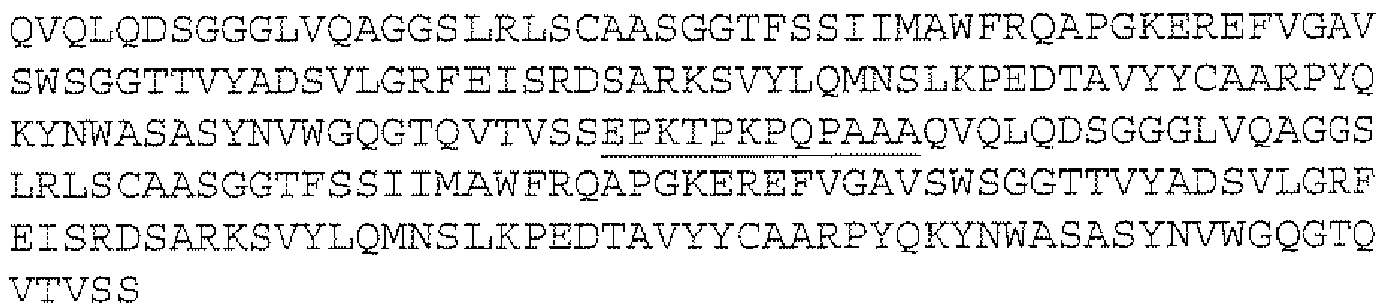
Human MMP-12 specific VHH 15 MMP-12 P1-1 
16 MMP-12 P1-3 
17 MMP-12 P1-7 
18 MMP-12 P1-26 
19 MMP-12 P1-33 
20 MMP-12 P1-41 
21 MMP-12 P1-44 
22 MMP-12 P5-29 
Anti-EGFR VHH 23 EGFR-1.4 
24 EGFR-1.9 
25 EGFR-1.33 
26 EGFR-1.34 
27 EGFR-1.38 
28 EGFR-Ia1 

29 EGFR-Ia7 
30 EGFR-Ia15 
31 EGFR- IIIa42 
32 EGFR-2.6 
33 EGFR-2.20 
34 EGFR- IIIa5 
35 EGFR-3.18 
36 EGFR-3.32 
37 EGFR-3.34 
38 EGFR-3.39 
39 EGFR-3.40 
40 EGFR-4.11 
41 EGFR-4.21 
42 EGFR-4.22 
43 EGFR-B11 
44 EGFR-F11 
Anti - human IFN gamma VHH 45 MP3D2SRA 
46 MP3A3SR 
47 MP3C5SR 
48 MP3C1SR 
49 MP3G8SR 
50 MP3D2BR 
51 MP3H6SRA 
52 MP3B4SRA 
53 MP4E4BR 
54 MP4H8SR 
55 MP2F6SR 
56 MP3D1BR 
57 MP2B5BR 
58 MP2C1BR 
59 MP4A12SR 
60 MP3F4SRA 
61 MP3D3BR 
62 MP3E5BR 
63 MP3C7SRA 
64 MP2F1BR 
65 MP2C5BR 
66 MP2C10BR 
67 MP2G5SR 
68 MP3B1SRA 
69 MP2F10SR 
70 MP3A7SRA 
Anti-mouse serum albumin VHH 71 MSA21 
72 MSAc16 
73 MSACl12 
74 MSACl10 
75 MSACl14 
76 MSAcl16 
77 MSAcl19 
78 MSAcl5 
79 MScl11 
80 MSAcl15 
81 MSAcl8 
82 MSAcl7 
83 MSAcl20 
84 MSAcl4 
Table 15: Immunisation scheme according to Example 32 Day of immunization Llama 005 EGFr Llama006 EGFr Llama005 PDK1 Llama006 PDK1 0 100 µg 40 µg 40 µg 40 µg 7 100 µg 40 µg 14 50 µg 20 µg 21 50 µg 40 µg 20 µg 40 µg 28 50 µg 20 µg 35 50 µg 20 µg 42 20 µg 20 µg 70 20 µg 20 µg Table 16: Results of panning according to Example 35 llama Source RNA Elution conditions Pfu EGFr Pfu casein Enrichment 005 Pool of the 3 libraries 0.2 M glycin, pH 2.4 1 x 10⁷ 1 x 10⁴ 1000 006 Pool of the 3 libraries 0.2 M glycin, pH 2.4 5 x 10⁶ 1 x 10⁴ 500 Table 17: Results of panning according to Example 35 Ilama Source RNA Elution conditions Pfu PDK1 Pfu casein Enrichment 005 Pool of the 3 libraries 0.2 M glycin, pH 2.4 1 x 10⁸ 1 x 10⁴ 10000 006 Pool of the 3 libraries 0.2 M glycin, pH 2.4 9 x 10⁷ 1 x 10⁴ 9000 Table 18: Number of positive clones after screening according to Example 36 target Llama005 Llama006 EGFr 26/95 38/95 PDK1 93/95 87/95 Table 19: Number of inhibiting VHH vs number of VHH tested in inhibition ELISA according to Example 38. target Llama005 Llama006 PDK1 56/93 63/87 

-
- Okayasu I, Hatakeyama S, Yamada M, Ohkusa T, Inagaki Y, Nakaya R. A novel method in the induction of reliable experimental acute and chronic ulcerative colitis in mice. Gastroenterology 1990;98:694-702.
- Kojouharoff G, Hans W, Obermeier F, Mannel DN, Andus T, Scholmerich J, Gross V, Falk W. Neutralization of tumour necrosis factor (TNF) but not of IL-1 reduces inflammation in chronic dextran sulphate sodium-induced colitis in mice. Clin Exp Immunol 1997:107:353-8.
- MMP12
- Salmela MT, Pender SL, Reunala T, MacDonald T, Saarialho-Kere U. Gut, 2001;48(4):496-502
- Parallel expression of macrophage metalloelastase (MMP-12) in duodenal and skin lesions of patients with dermatitis herpetiformis.
- Chavey C, Mari B, Monthouel MN, Bonnafous S. Anglard P, Van Obberghen E, Tartare-Deckert S. J. Biol. Chem., 2003; 278: 1188 - 11896.
- Matrix metalloproteinases are differentially expressed in adipose tissue during
- obesity and modulate adipocyte differentiation.
- Churg A, Wang RD, Tai H, Wang X, Xie C, Dai J, Shapiro SD, Wright JL. Am. J. Respir. Crit. Care Med., 2003; 167: 1083 - 1089.
- Macrophage Metalloelastase Mediates Acute Cigarette Smoke-induced Inflammation
- Via TNF-alpha Release.
- R Lang, A Kocourek, M Braun, H Tschesche, R Huber, W Bode, K Maskos J Mol Biol, Sep 2001; 312(4): 731-42.
- Substrate specificity determinants of human macrophage elastase (MMP-12) based on the 1.1 A crystal structure.
- Yoshikatsu Kaneko , Minoru Sakatsume, Yuansheng Xie, Takeshi Kuroda, Michiko Igashima , Ichiei Narita and Fumitake Gejyo The Journal of Immunology, 2003, 170: 3377-3385.
- Macrophage Metalloelastase as a Major Factor for Glomerular Injury in Anti-Glomerular Basement Membrane Nephritis
- Ding Y, Shimada Y, Gorrin-Rivas MJ, Itami A, Li Z, Hong T, Maeda M, Komoto I, Kawabe A, Kaganoi J, Imamura M. Oncology 2002;63(4):378-84.
- Clinicopathological significance of human macrophage metalloelastase expression
- in esophageal squamous cell carcinoma.
- Kerkela E, Ala-Aho R, Jeskanen L, Rechardt O, Grenman R, Shapiro SD, Kahari VM, Saarialho-Kere U. J Invest Dermatol 2000 Jun;114(6):1113-9
- Expression of human macrophage metalloelastase (MMP-12) by tumor cells in skin cancer.
-
- 1. A polypeptide construct comprising at least one single domain antibody directed against IgE.
- 2. A polypeptide construct according to
item 1 wherein at least one single domain antibody is a Camelidae VHH. - 3. A polypeptide construct according to
items - 4. A polypeptide construct according to any of
items 1 to 3, wherein the number of anti-IgE single domain antibodies is at least two. - 5. A polypeptide construct according any of
items 1 to 4, wherein at least one single domain antibody is a humanized Camelidae VHH. - 6. A polypeptide construct according to any of
items 1 to 5, wherein a single domain antibody is an homologous sequence, a functional portion, or a functional portion of an homologous sequence of the full length single domain antibody. - 7. A polypeptide construct according to any of
items 1 to 6, wherein the polypeptide construct is an homologous sequence, a functional portion, or a functional portion of an homologous sequence of the full length polypeptide construct. - 8. A nucleic acid encoding a polypeptide construct according to any of
items 1 to 7. - 9. A polypeptide construct according to any of
items 1 to 7 for treating and/or preventing and/or alleviating disorders relating to inflammatory processes. - 10. Use of a polypeptide construct according to any of
items 1 to 7 for the preparation of a medicament for treating and/or preventing and/or alleviating disorders relating to inflammatory reactions. - 11. A method for delivering an anti-target compound to a subject for the treatment of a disorder without being inactivated by administering thereto a polypeptide construct comprising one or more single domain antibodies directed against said target.
- 12. A method according to item 11 wherein said target is located in the gut system, and said a polypeptide construct is delivered orally.
- 13. A method according to item 11 wherein said target is located in vaginal and/or rectal tract, and said a polypeptide construct is delivered to the vaginal and/or rectal tract.
- 14. A method according to item 11 wherein said target is located in nose, upper respiratory tract and/or lung, and said a polypeptide construct is delivered to nose, upper respiratory tract and/or lung.
- 15. A method according to item 11 wherein said target is located in intestinal mucosa, and said a polypeptide construct is delivered orally,
- 16. A method according to item 11 wherein said target is located in the tissues beneath the tongue, and said a polypeptide construct is delivered to the tissues beneath the tongue.
- 17. A method according to item 11 wherein said target is located in the skin, and said a polypeptide construct is delivered topically.
- 18. A method according to item 11 wherein said target is in, or accessible via the blood, and said a polypeptide construct is delivered orally, to the vaginal and/or rectal tract, nasally, by inhalation though the mouth or nose, to the tissues beneath the tongue, or topically.
- 19. A polypeptide construct comprising at least one single domain antibody directed against a target, for use in treating, preventing and/or alleviating the symptoms of disorders which are susceptible to modulation by an anti-target therapeutic compound that is able pass through the gastric environment without being inactivated.
- 20. A polypeptide construct comprising at least one single domain antibody directed against a target for use in treating, preventing and/or alleviating the symptoms of disorders which are susceptible to modulation by an anti-target therapeutic compound that is able pass through the wall of the intestinal mucosa without being inactivated
- 21. A polypeptide construct comprising at least one single domain antibody directed against a target for use in treating, preventing and/or alleviating the symptoms of disorders which are susceptible to modulation by an anti-target therapeutic compound that is able pass through the wall of the nose, upper respiratory tract and/or lung without being inactivated
- 22. A polypeptide construct comprising at least one single domain antibody directed against a target for use in treating, preventing and/or alleviating the symptoms of disorders which are susceptible to modulation by an anti-target therapeutic compound that is able pass through the wall of virginal and/or rectal tract without being inactivated
- 23. A polypeptide construct comprising at least one single domain antibody directed against a target for use in treating, preventing and/or alleviating the symptoms of disorders which are susceptible to modulation by a therapeutic compound that is able pass through the tissues beneath the tongue without being inactivated
- 24. A polypeptide construct comprising at least one single domain antibody directed against a target for use in treating, preventing and/or alleviating the symptoms of disorders which are susceptible to modulation by a therapeutic compound that is able pass through the skin without being inactivated
- 25. A method according to any of items 11 to 18 or polypeptide construct according to any of item 19 to 24, wherein said target is TNF-alpha and the disorder is inflammation.
- 26. A method or polypeptide according to item 25, wherein a single domain antibody corresponds to a sequence represented by any of SEQ ID NOs: 1,2 to 14.
- 27. A method according to any of items 11 to 18 or polypeptide construct according to any of item 19 to 24, wherein said target is CEA and the disorder colon cancer.
- 28. A method according to any of items 11 to 18 or polypeptide construct according to any of item 19 to 24, wherein said target is EGFR and the disorder is any of head, neck, lung and colon cancer.
- 29. A method or polypeptide construct according to
item 28, wherein a single domain antibody corresponds to a sequence represented by any of SEQ ID NOs: 23 to 44 - 30. A method according to any of items 11 to 18 or polypeptide construct according to any of item 19 to 24, wherein said target is antigen of Helicobacter pylori and the disorder is any of indigestion, gastritis.
- 31. A method according to any of items 11 to 18 or polypeptide construct according to any of item 19 to 24, wherein said target is antigen of Mycobacterium tuberculosis and the disorder is tuberculosis.
- 32. A method according to any of items 11 to 18 or polypeptide construct according to any of item 19 to 24, wherein said target is antigen of influenza virus and the disorder is flu.
- 33. A method according to any of items 11 to 18 or polypeptide construct according to any of item 19 to 24, wherein said target is antigen of IgE and the disorder is allergic response.
- 34. A method or polypeptide construct according to item 33, wherein a single domain antibody corresponds to a sequence represented by any of SEQ ID NOs: 1 to 11
- 35. A method according to any of items 11 to 18 or polypeptide construct according to any of item 19 to 24, wherein said target is antigen of MMP and the disorder is cancer.
- 36. A method or polypeptide construct according to item 35, wherein a single domain antibody corresponds to a sequence represented by any of SEQ ID NOs: 15 to 22
- 37. A method according to any of items 11 to 18 or polypeptide construct according to any of item 19 to 24, wherein said target is antigen of IFN-gamma and the disorder is any of cancer, transplant rejection, auto immune disorder.
- 38. A method or polypeptide construct according to
item 37, wherein a single domain antibody corresponds to a sequence represented by any of SEQ ID NOs: 45 to 70 - 39. A method according to any of items 11 to 18 or polypeptide construct according to any of item 19 to 24 wherein said target is any of antigen of Helicobacter pylori, antigen of Mycobacterium tuberculosis, antigen of influenza virus.
- 40. A polypeptide construct comprising at least one single domain antibody directed against an internalising cellular receptor, and at least one single domain antibody directed against a therapeutic target.
- 41. A polypeptide construct comprising at least one single domain antibody directed against an internalising cellular receptor, and at least one therapeutic polypeptide or agent.
- 42. A polypeptide construct according to
items 40 and 41 wherein said internalising cellular receptor is Epidermal Growth Factor receptor. - 43. A polypeptide construct according to
item 42 wherein a single domain antibody directed against an internalising cellular receptor corresponds to a sequence represented by SEQ ID NO: 23 to 44. - 44. A polypeptide construct according to
items 40 and 41 wherein said internalising cellular receptor is any of LDL receptor, FGF2r, ErbB2r, transferring receptor, PDGr, VEGr, or PsmAr. - 45. A polypeptide construct according to any of
items 40 to 44 wherein a single domain antibody directed against a therapeutic target, is directed against PDK1. - 46. A polypeptide construct according to item 45 for use in treating cancer
- 47. A polypeptide construct according to any of
items 40 to 44 wherein a single domain antibody directed against a therapeutic target is directed against any of GSK1, Bad, caspase and Forkhead. - 48. A polypeptide construct according to item 47 for use in treating cancer.
- 49. Method for delivering an anti-target therapeutic compound to the interior of a cell comprising administering to a subject a polypeptide construct according to any of
items 40 to 48. - 50. Method for delivering an anti-target therapeutic compound to the interior of a cell without being inactivated comprising administering to a subject a polypeptide construct according to any of
items 40 to 49. - 51. A method according to item 50 wherein said cell is located in the gut system, and said a polypeptide construct is delivered orally.
- 52. A method according to item 50 wherein said cell is located in vaginal and/or rectal tract, and said a polypeptide construct is delivered to the vaginal and/or rectal tract.
- 53. A method according to item 50 wherein said cell is located in nose, upper respiratory tract and/or lung, and said a polypeptide construct is delivered to nose, upper respiratory tract and/or lung.
- 54. A method according to item 50 wherein said cell is located in intestinal mucosa, and said a polypeptide construct is delivered orally.
- 55. A method according to item 50 wherein said cell is located in the tissues beneath the tongue, and said a polypeptide construct is delivered to the tissues beneath the tongue.
- 56. A method according to item 50 wherein said cell is located in the skin, and said a polypeptide construct is delivered topically.
- 57. A method according to item 50 wherein said cell is in, or accessible via the blood, and said a polypeptide construct is delivered orally, to the vaginal and/or rectal tract, nasally, by inhalation though the mouth or nose, to the tissues beneath the tongue, or topical.
- 58. A polypeptide construct according to any of
items 1 to 7, 19 to 24, 40 to 48, or a method according to any of items 11 to 18, 25 to 39, 49 to 57, wherein the single domain antibodies are humanized Camelidae VHHs. - 59. A polypeptide construct according to any of
items 1 to 7, 19 to 24, 40 to 48, 58, or a method according to any of items 11 to 18, 25 to 39, 49 to 57, wherein said single domain antibody is an homologous sequence, a functional portion, or a functional portion of an homologous sequence of the full length single domain antibody. - 60. A polypeptide construct according any of
items 1 to 7, 19 to 24, 40 to 48, 58 and 59 or a method according to any of items 11 to 18, 25 to 39, 49 to 59, wherein the polypeptide construct is an homologous sequence, a functional portion, or a functional portion of an homologous sequence of the full length polypeptide construct. - 61. A polypeptide construct according to any of
items 1 to 7, 19 to 24, 40 to 48, 58 to 60 or a method according to any of items 11 to 18, 25 to 39, 49 to 60 wherein said single domain antibodies are Camelidae VHHs. - 62. A nucleic acid encoding a polypeptide construct according to any of
items 1 to 7, 19 to 24, 40 to 48, 58 to 61. - 63. A composition comprising a polypeptide construct as defined in any of the preceding items, together with a pharmaceutical carrier.


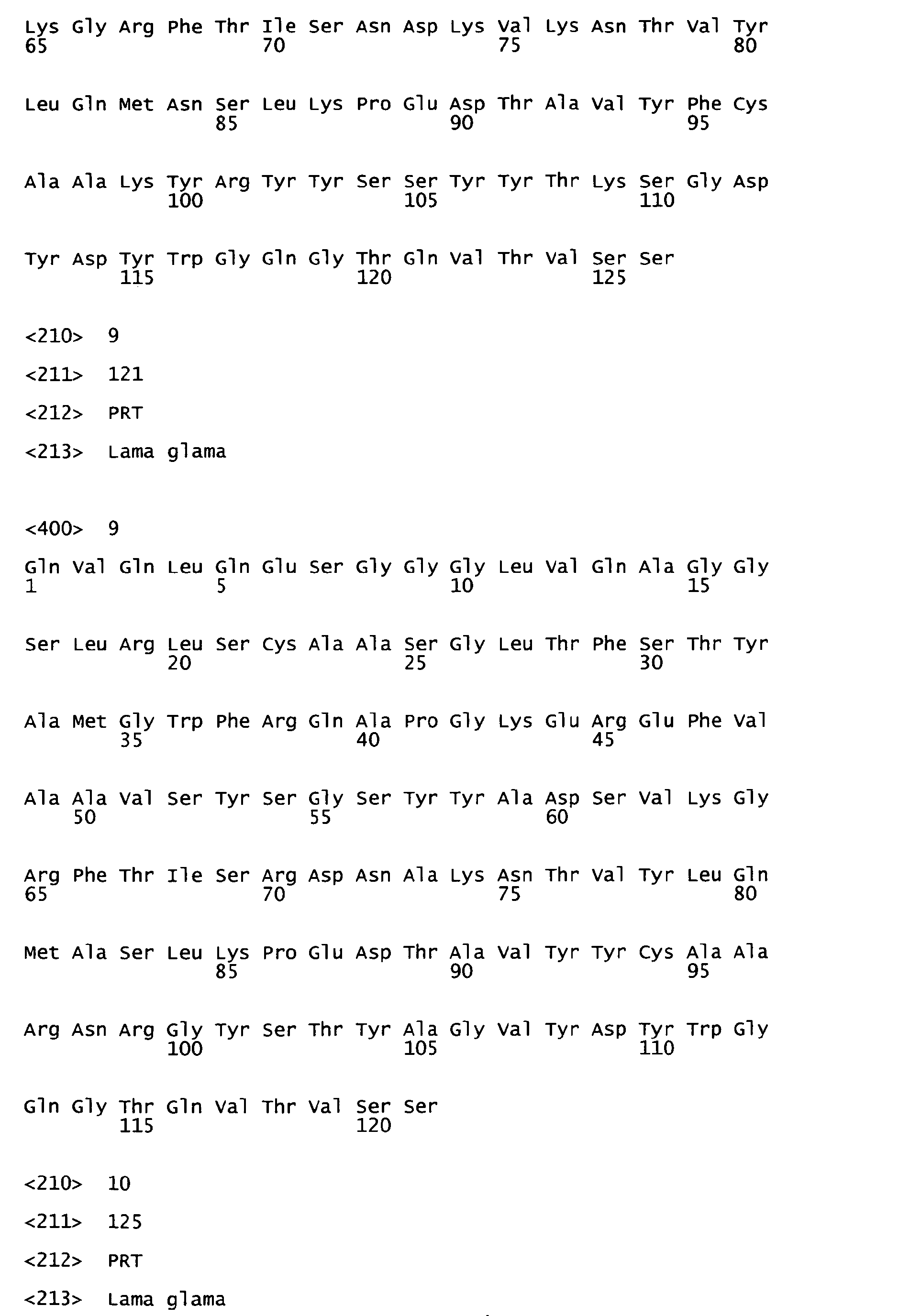


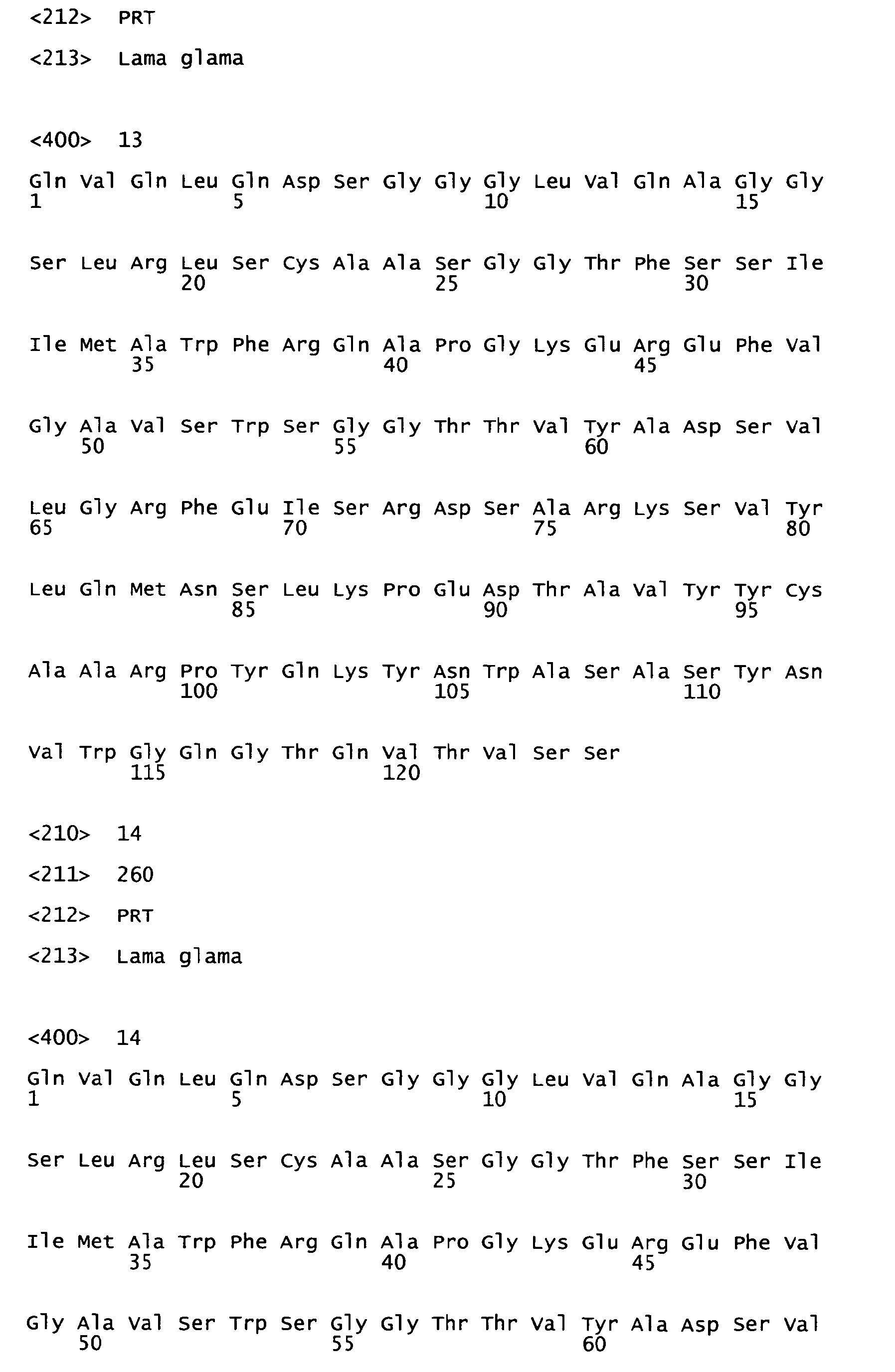
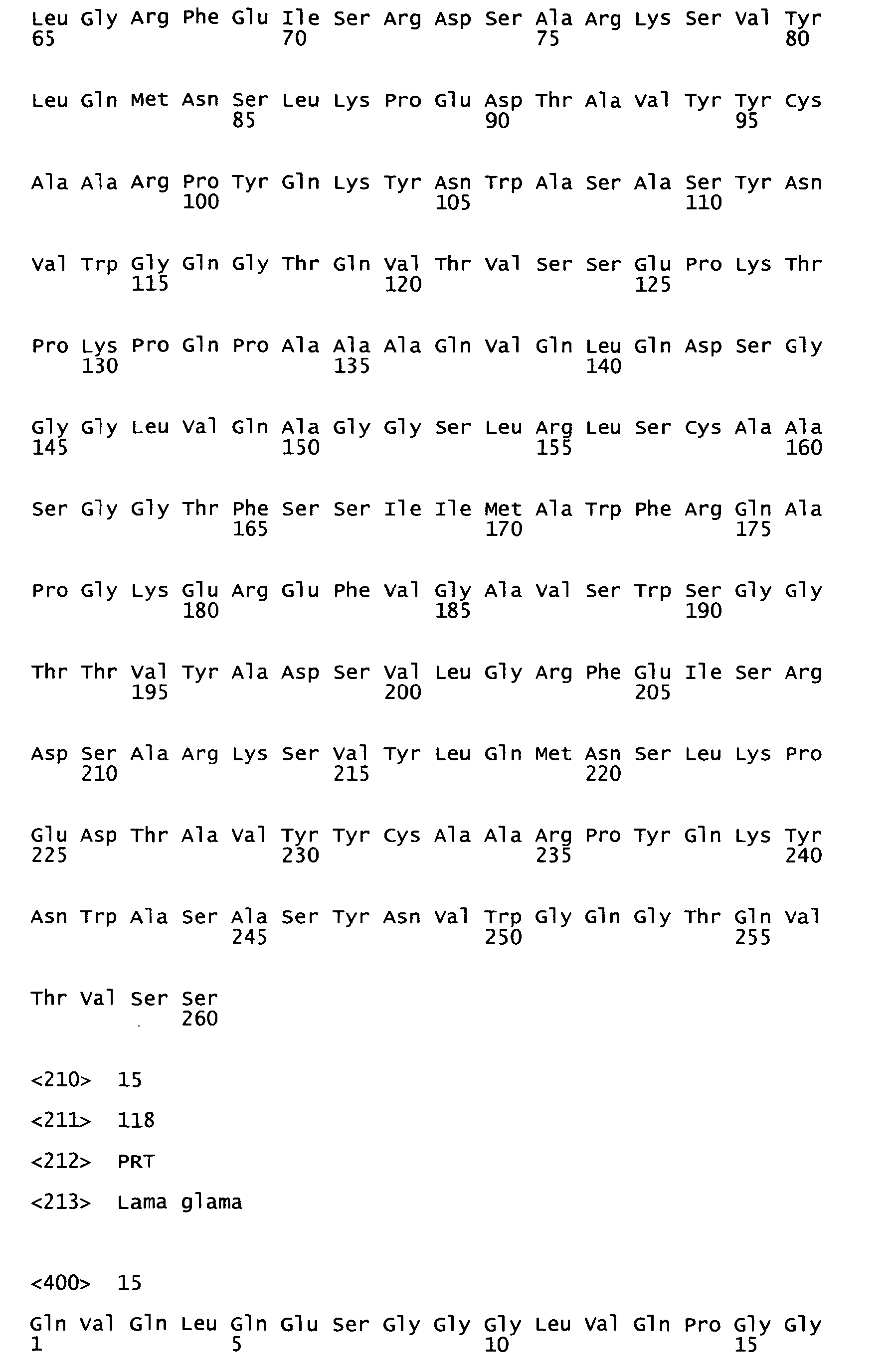

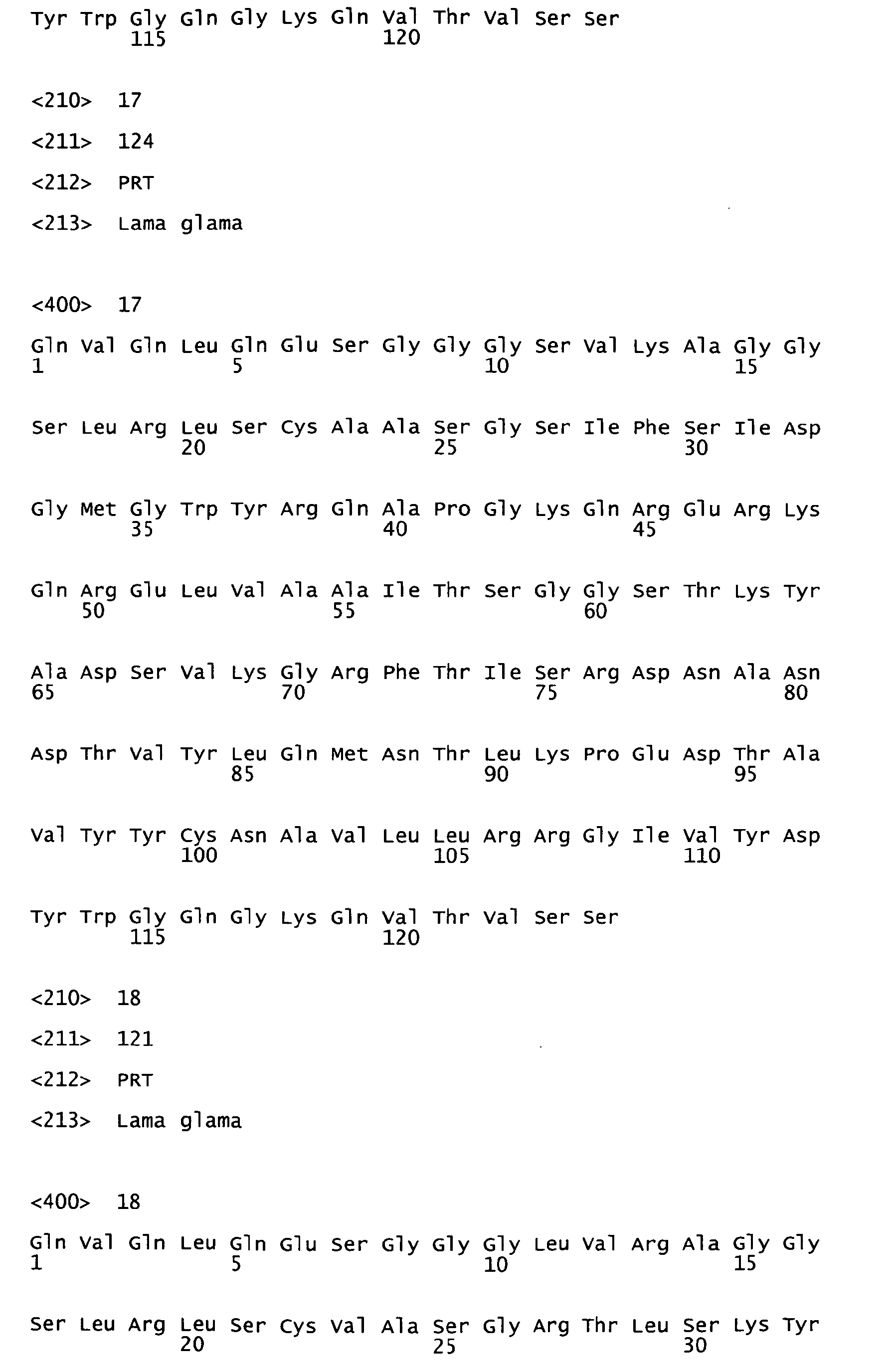


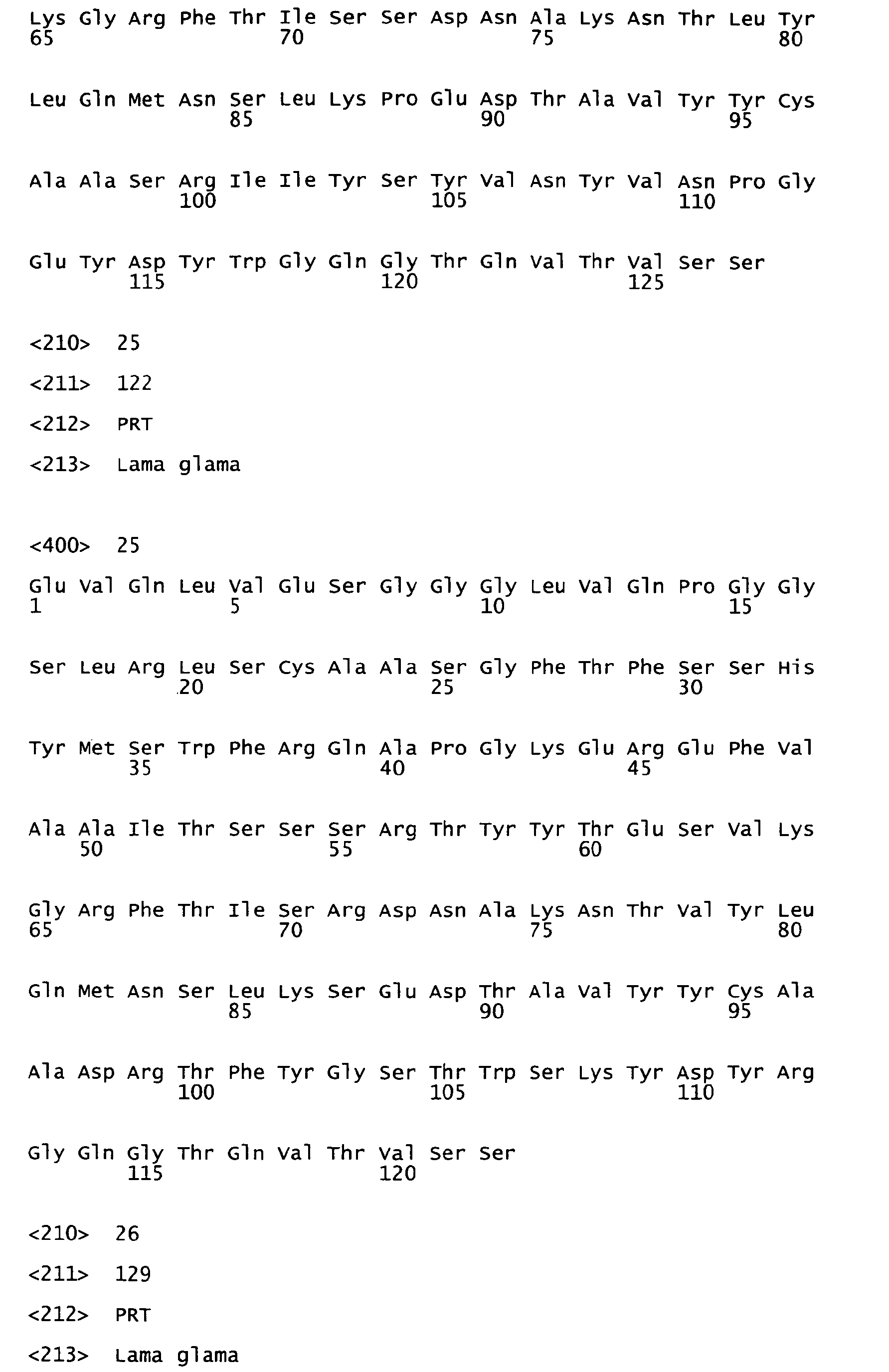

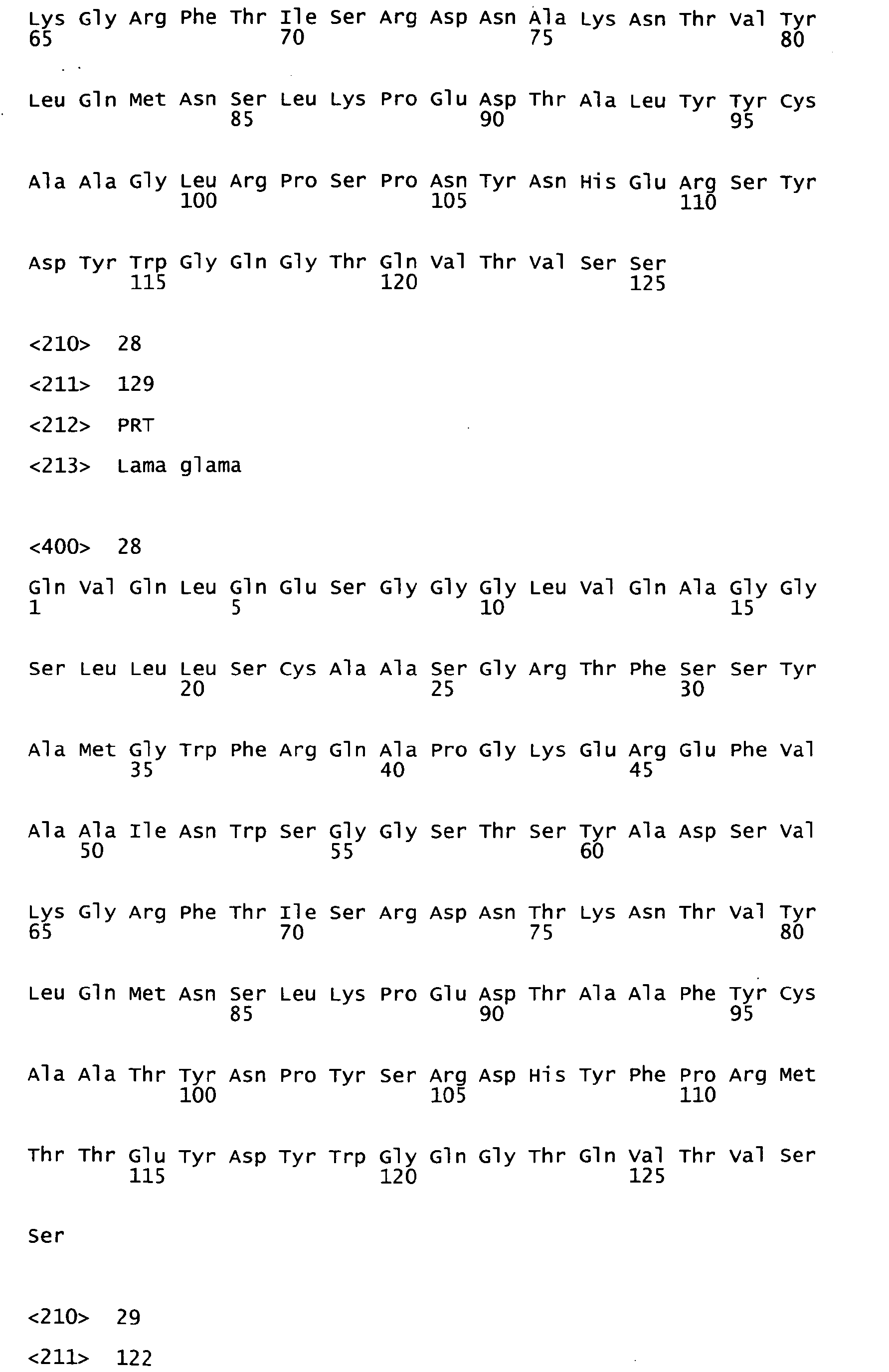


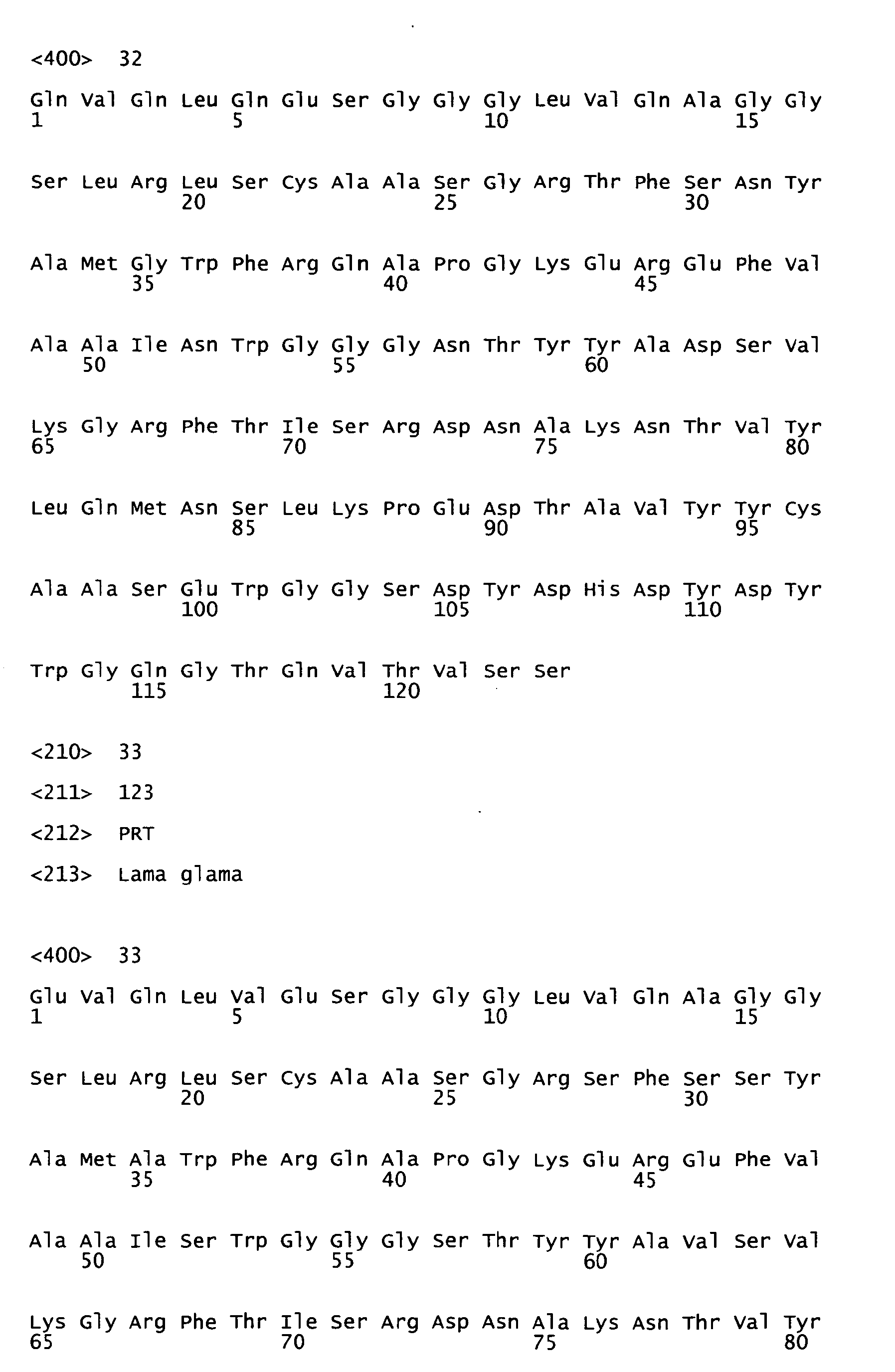


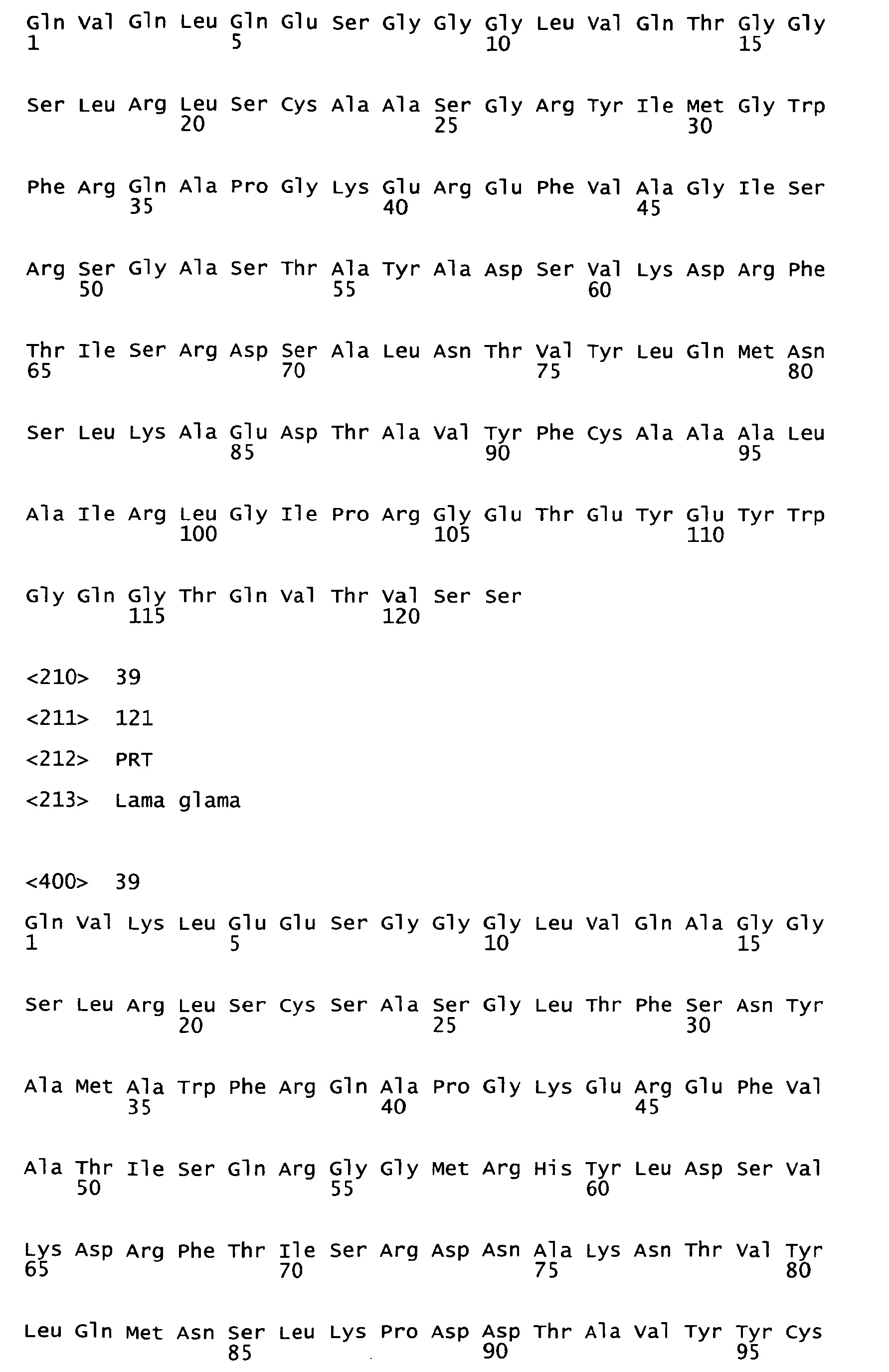
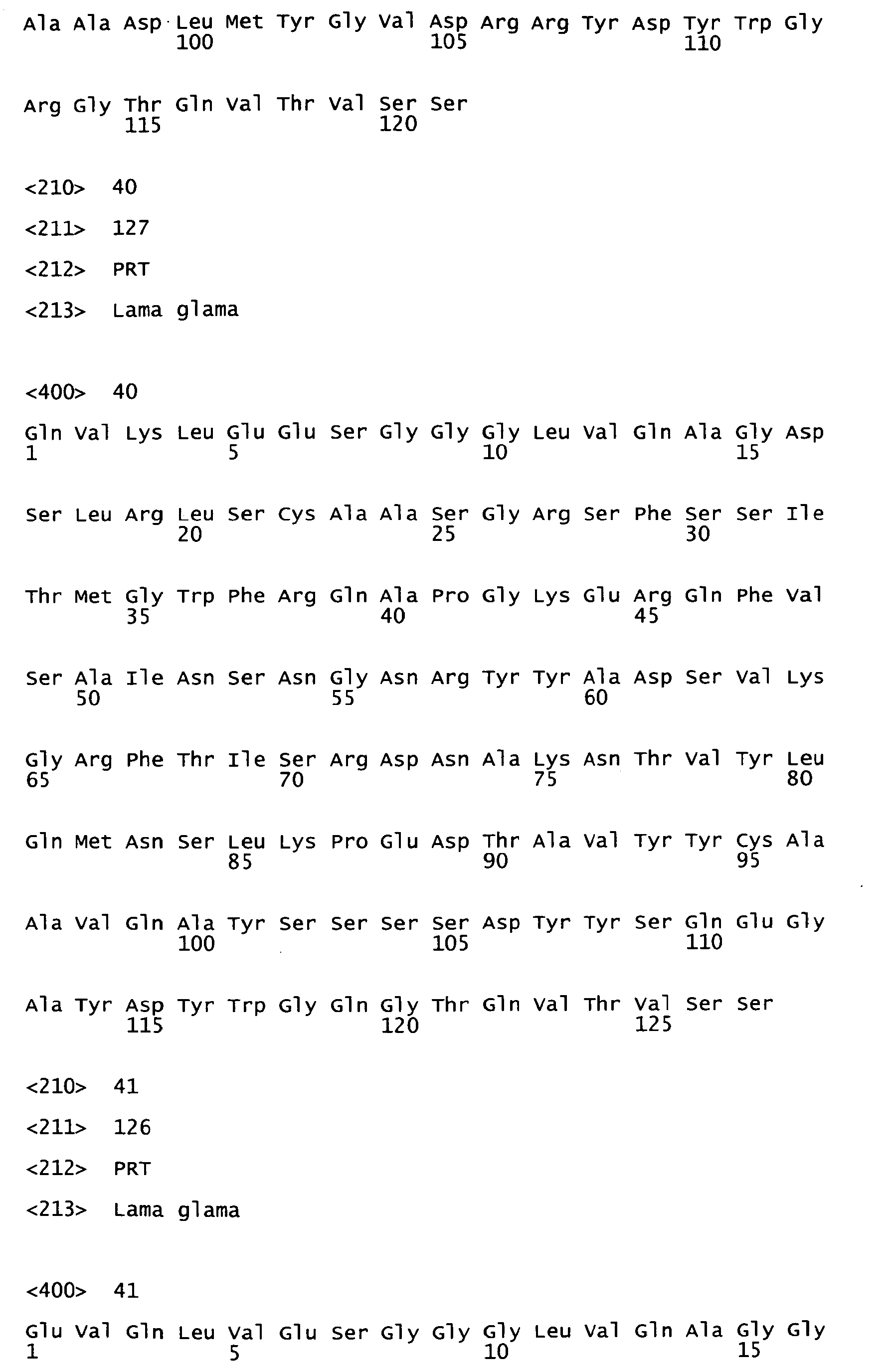


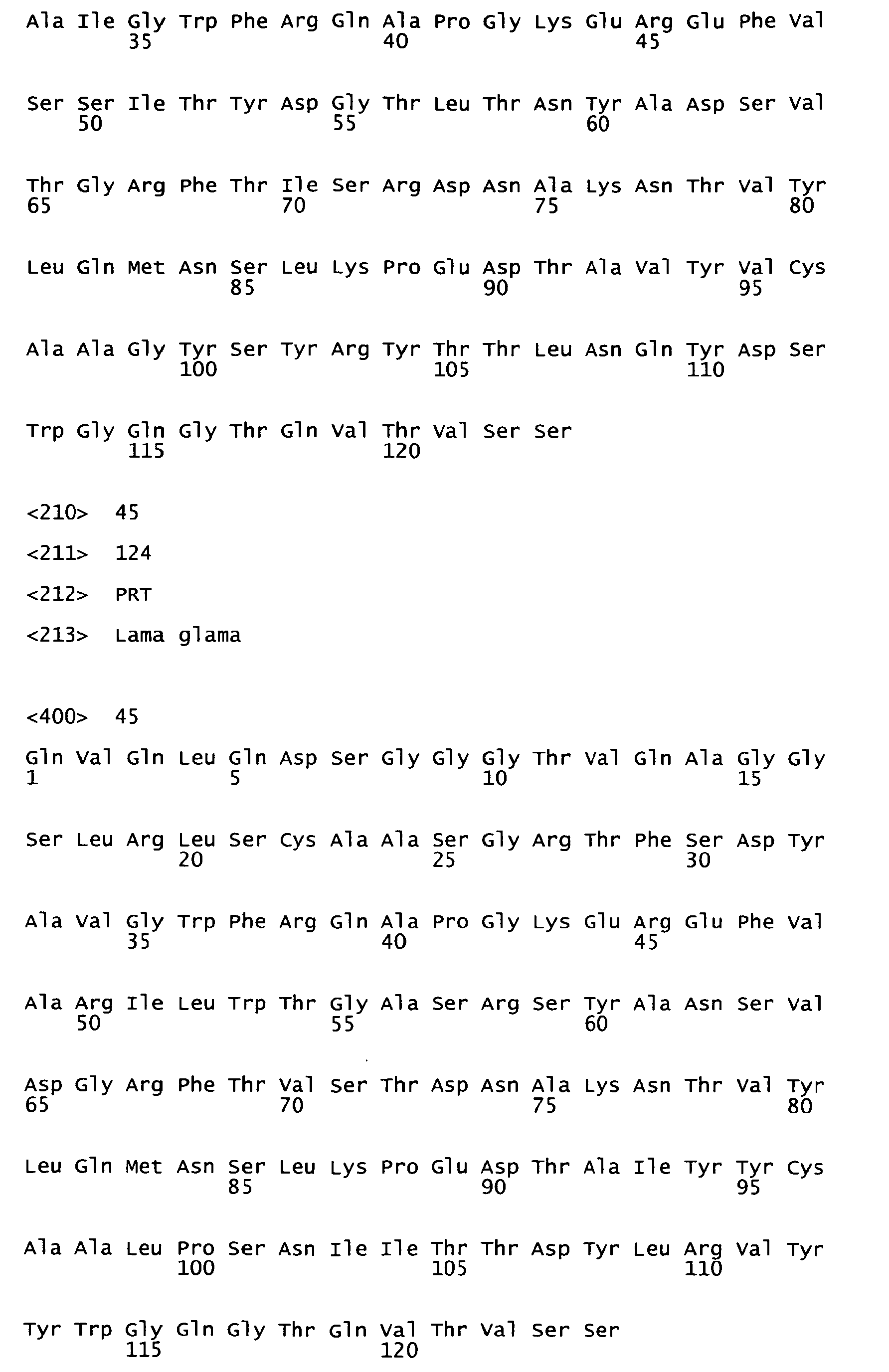


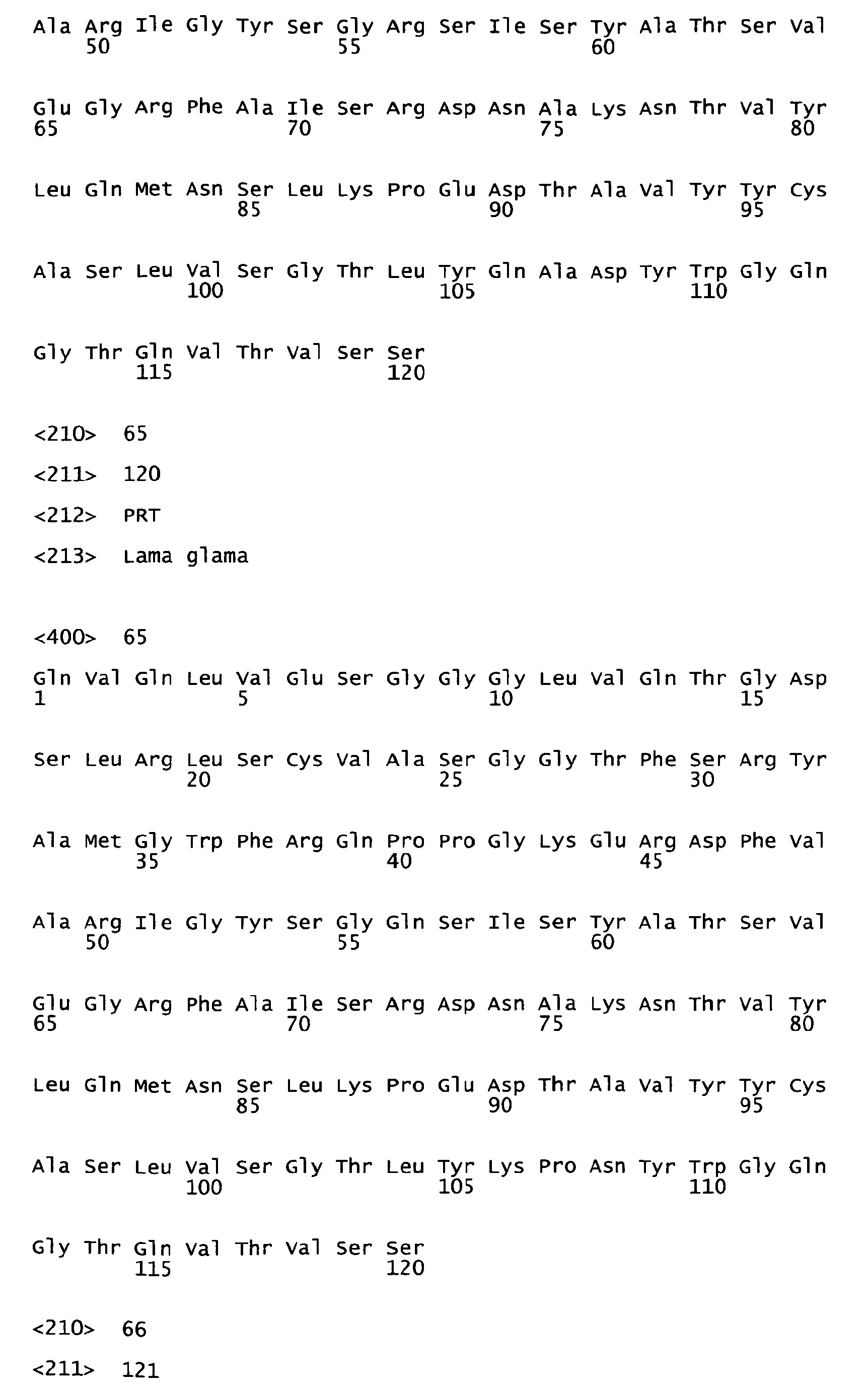


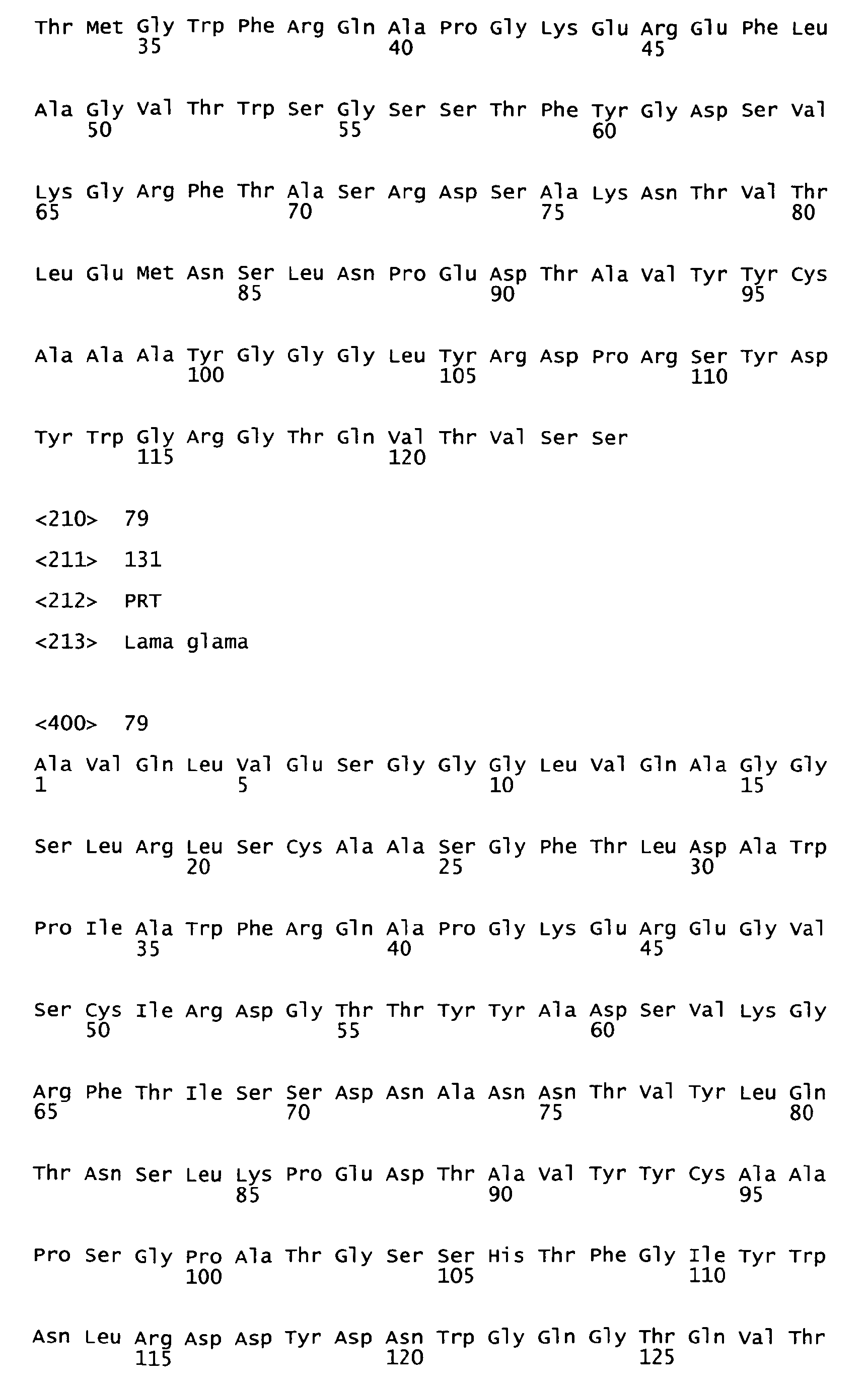


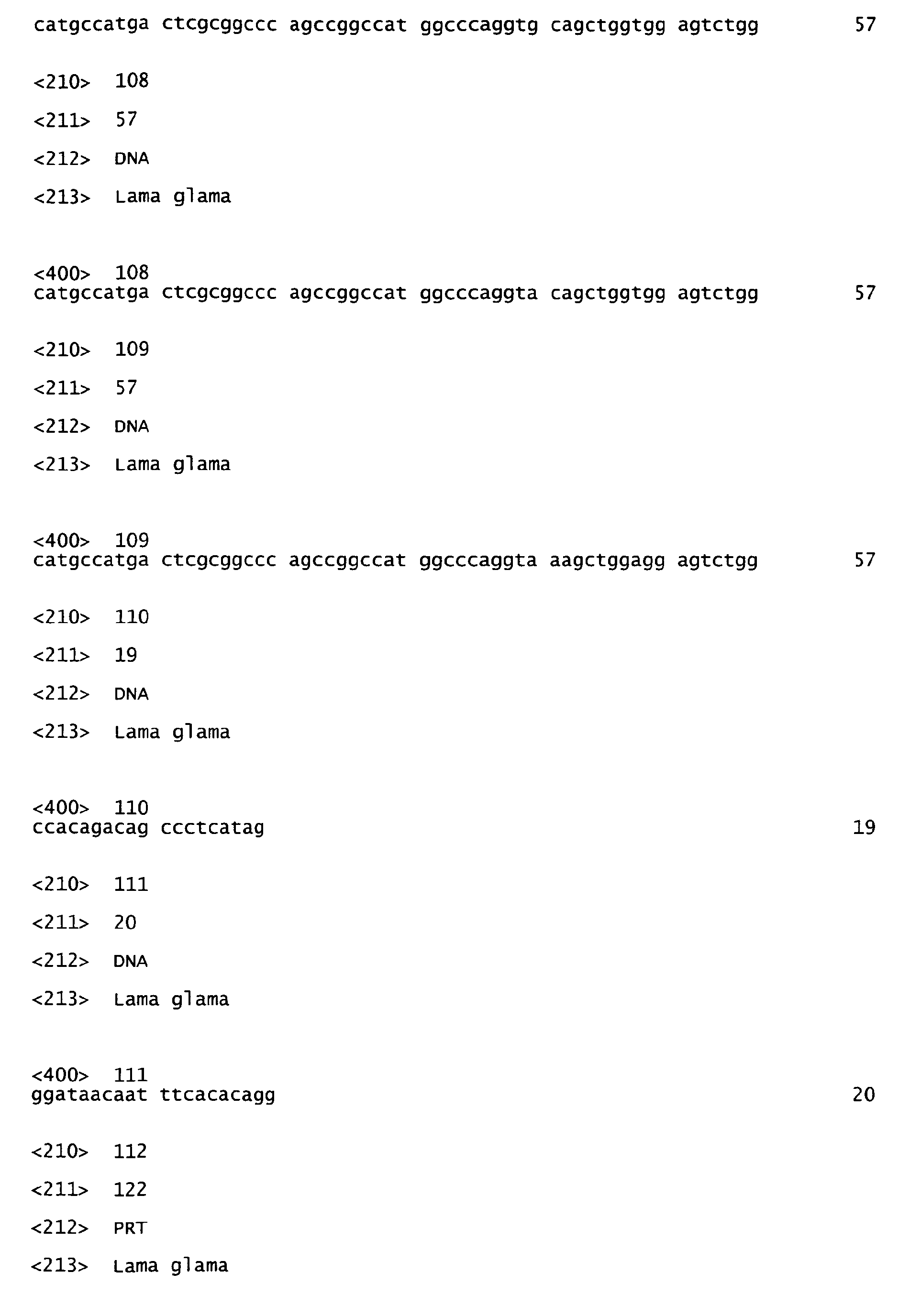

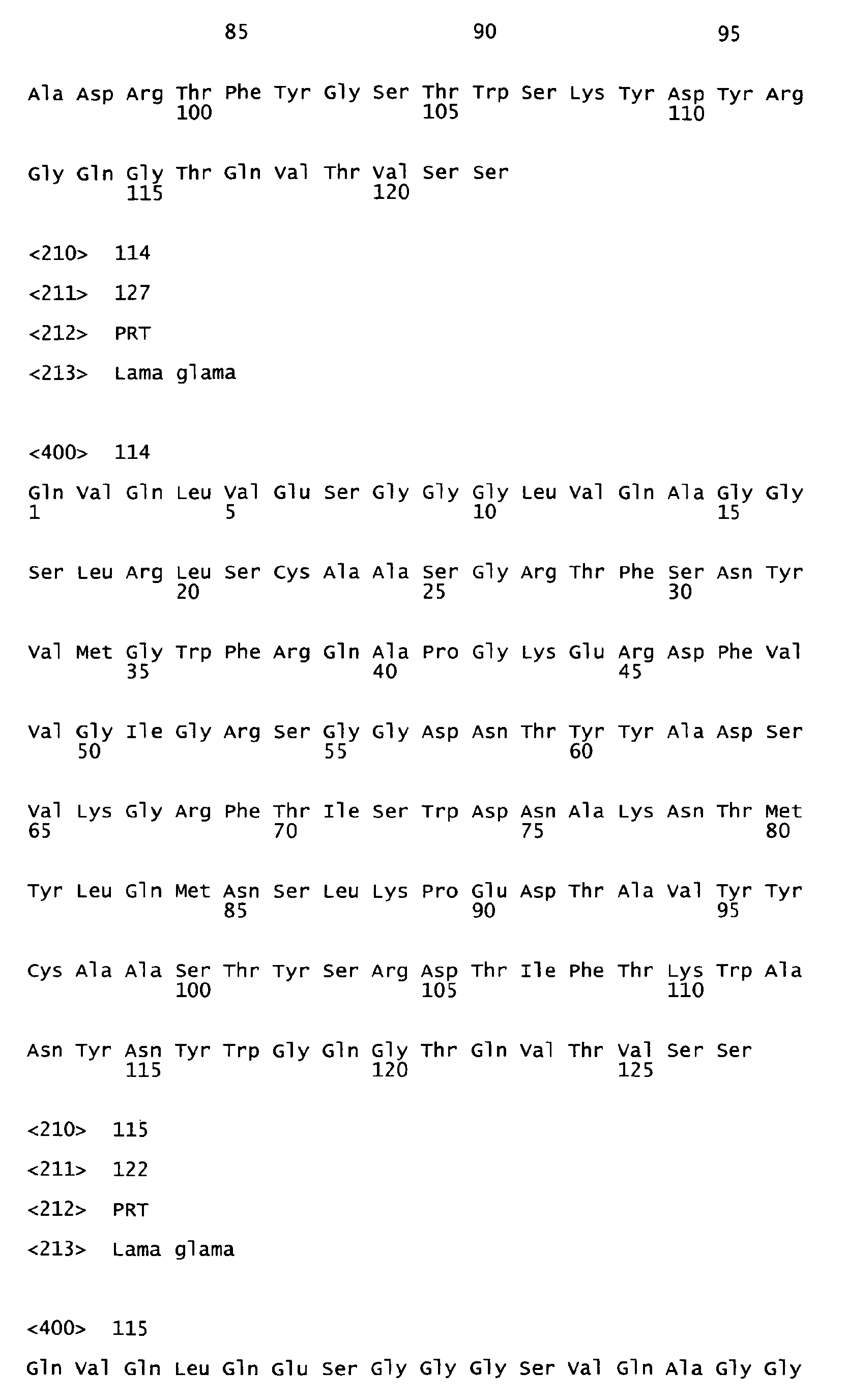


Claims (15)
- Composition for sublingual administration comprising a therapeutically effective amount of a polypeptide construct comprising one or more single domain antibodies directed to one or more target molecule(s) and a pharmaceutically acceptable ingredient.
- Composition according to claim 1, wherein said pharmaceutically acceptable ingredient facilitates delivery of said polypeptide construct to the the tissue beneath the tongue or the bloodstream.
- Composition according to any of claims 1 or 2, which is in the form of a tablet, spray or drop.
- Composition according to any of claims 1 to 3, wherein, upon sublingual administration of said composition to a subject, said polypeptide construct is delivered to the tissue beneath the tongue without being inactivated.
- Composition according to any of claims 1 to 3, wherein, upon sublingual administration of said composition to a subject, said polypeptide construct is delivered to the bloodstream without being inactivated.
- Composition according to any of claims 1 to 5, wherein the target molecule against which said polypeptide construct is used, is TNF.
- Composition according to claim 6, wherein said polypeptide construct comprises at least one single domain antibody directed against TNF-alpha and corresponding to a sequence represented by SEQ ID NOs: 12 to 14.
- Composition according to any of claim 1 to 5, wherein the polypeptide construct comprises at least one single domain antibody directed against EGFR.
- Composition according to claim 10, wherein said at least one single domain antibody directed against EGFR corresponds to a sequence represented by any of SEQ ID NOs: 23 to 44.
- Composition according to any of claims 1 to 5, wherein the polypeptide construct comprises at least one single domain antibody directed against IgE.
- Composition according to claim 14, wherein said at least one single domain antibody directed against IgE corresponds to a sequence represented by any of SEQ ID NOs: 1 to 11.
- Composition according to any of claims 1 to 5, wherein the polypeptide construct comprises at least one single domain antibody directed against MMP-12.
- Composition according to claim 17, wherein said at least one single domain antibody directed against MMP-12 corresponds to a sequence represented by any of SEQ ID NOs: 1 to 22.
- Composition according to any of claims I to 5, wherein the polypeptides construct comprises at least one single domain antibody directed against IFN-gamma.
- Composition according to claim 19, wherein said at least one single domain antibody directed against IFN-gamma corresponds to a sequence represented by any of SEQ ID NOs: 45 to 70.
Priority Applications (1)
| Application Number | Priority Date | Filing Date | Title |
|---|---|---|---|
| EP10178263A EP2284192A3 (en) | 2002-11-08 | 2003-11-07 | Camelidae antibodies for sublingual administration |
Applications Claiming Priority (7)
| Application Number | Priority Date | Filing Date | Title |
|---|---|---|---|
| US42507302P | 2002-11-08 | 2002-11-08 | |
| US42506302P | 2002-11-08 | 2002-11-08 | |
| EP03447005 | 2003-01-10 | ||
| EPPCT/EP03/06581 | 2003-06-23 | ||
| EPPCT/EP03/07313 | 2003-07-08 | ||
| EP03775004A EP1558650A2 (en) | 2002-11-08 | 2003-11-07 | Camelidae antibodies against immunoglobulin e and use thereof for the treatment of allergic disorders |
| EP10178263A EP2284192A3 (en) | 2002-11-08 | 2003-11-07 | Camelidae antibodies for sublingual administration |
Related Parent Applications (1)
| Application Number | Title | Priority Date | Filing Date |
|---|---|---|---|
| EP03775004.9 Division | 2003-11-07 |
Publications (2)
| Publication Number | Publication Date |
|---|---|
| EP2284192A2 true EP2284192A2 (en) | 2011-02-16 |
| EP2284192A3 EP2284192A3 (en) | 2011-07-20 |
Family
ID=32314976
Family Applications (8)
| Application Number | Title | Priority Date | Filing Date |
|---|---|---|---|
| EP10178263A Withdrawn EP2284192A3 (en) | 2002-11-08 | 2003-11-07 | Camelidae antibodies for sublingual administration |
| EP07014054.6A Expired - Lifetime EP1900753B1 (en) | 2002-11-08 | 2003-11-07 | Method of administering therapeutic polypeptides, and polypeptides therefor |
| EP10183400A Withdrawn EP2336179A1 (en) | 2002-11-08 | 2003-11-07 | Stabilized single domain antibodies |
| EP10178270A Withdrawn EP2301967A3 (en) | 2002-11-08 | 2003-11-07 | Single domain antibodies for nasal administration |
| EP17186411.9A Withdrawn EP3299393A1 (en) | 2002-11-08 | 2003-11-07 | Single domain antibodies directed against tumour necrosis factor-alpha and uses therefor |
| EP10182757.4A Expired - Lifetime EP2390268B1 (en) | 2002-11-08 | 2003-11-07 | Single domain antibodies directed against tumour necrosis factor-alpha and uses therefor |
| EP10178264A Withdrawn EP2258392A1 (en) | 2002-11-08 | 2003-11-07 | Method of administering therapeutic polypeptides |
| EP10183379.6A Expired - Lifetime EP2316852B1 (en) | 2002-11-08 | 2003-11-07 | Stabilized single domain antibodies |
Family Applications After (7)
| Application Number | Title | Priority Date | Filing Date |
|---|---|---|---|
| EP07014054.6A Expired - Lifetime EP1900753B1 (en) | 2002-11-08 | 2003-11-07 | Method of administering therapeutic polypeptides, and polypeptides therefor |
| EP10183400A Withdrawn EP2336179A1 (en) | 2002-11-08 | 2003-11-07 | Stabilized single domain antibodies |
| EP10178270A Withdrawn EP2301967A3 (en) | 2002-11-08 | 2003-11-07 | Single domain antibodies for nasal administration |
| EP17186411.9A Withdrawn EP3299393A1 (en) | 2002-11-08 | 2003-11-07 | Single domain antibodies directed against tumour necrosis factor-alpha and uses therefor |
| EP10182757.4A Expired - Lifetime EP2390268B1 (en) | 2002-11-08 | 2003-11-07 | Single domain antibodies directed against tumour necrosis factor-alpha and uses therefor |
| EP10178264A Withdrawn EP2258392A1 (en) | 2002-11-08 | 2003-11-07 | Method of administering therapeutic polypeptides |
| EP10183379.6A Expired - Lifetime EP2316852B1 (en) | 2002-11-08 | 2003-11-07 | Stabilized single domain antibodies |
Country Status (10)
| Country | Link |
|---|---|
| US (7) | US20060115470A1 (en) |
| EP (8) | EP2284192A3 (en) |
| JP (5) | JP2006520584A (en) |
| AU (1) | AU2010226938B2 (en) |
| CA (3) | CA2505316C (en) |
| IL (1) | IL168357A (en) |
| MX (1) | MXPA05004955A (en) |
| NZ (4) | NZ540195A (en) |
| RU (1) | RU2704232C2 (en) |
| WO (3) | WO2004041863A2 (en) |
Cited By (1)
| Publication number | Priority date | Publication date | Assignee | Title |
|---|---|---|---|---|
| US11891433B2 (en) | 2012-05-31 | 2024-02-06 | United States Of America As Represented By The Secretary Of The Air Force | Camelidae single-domain antibodies against Yersinia pestis and methods of use |
Families Citing this family (464)
| Publication number | Priority date | Publication date | Assignee | Title |
|---|---|---|---|---|
| US20060073141A1 (en) * | 2001-06-28 | 2006-04-06 | Domantis Limited | Compositions and methods for treating inflammatory disorders |
| JP2005289809A (en) | 2001-10-24 | 2005-10-20 | Vlaams Interuniversitair Inst Voor Biotechnologie Vzw (Vib Vzw) | Mutant heavy chain antibody |
| EP1600459A3 (en) | 2002-06-28 | 2005-12-07 | Domantis Limited | Ligand |
| US20060002935A1 (en) * | 2002-06-28 | 2006-01-05 | Domantis Limited | Tumor Necrosis Factor Receptor 1 antagonists and methods of use therefor |
| US9321832B2 (en) | 2002-06-28 | 2016-04-26 | Domantis Limited | Ligand |
| US9028822B2 (en) | 2002-06-28 | 2015-05-12 | Domantis Limited | Antagonists against TNFR1 and methods of use therefor |
| ATE512364T1 (en) | 2002-08-07 | 2011-06-15 | Ablynx Nv | MODULATION OF PLATELE ADHESION BASED ON THE SURFACE-EXPOSED BETA-SWITCH LOOP OF THE PLATELET GLYCOPROTEIN IB-ALPHA |
| US9453251B2 (en) | 2002-10-08 | 2016-09-27 | Pfenex Inc. | Expression of mammalian proteins in Pseudomonas fluorescens |
| US20060034833A1 (en) * | 2002-11-08 | 2006-02-16 | Els Beirnaert | Single domain antibodies directed against interferron-gamma and uses therefor |
| US9320792B2 (en) | 2002-11-08 | 2016-04-26 | Ablynx N.V. | Pulmonary administration of immunoglobulin single variable domains and constructs thereof |
| US20060034845A1 (en) * | 2002-11-08 | 2006-02-16 | Karen Silence | Single domain antibodies directed against tumor necrosis factor alpha and uses therefor |
| JP2006520584A (en) * | 2002-11-08 | 2006-09-14 | アブリンクス エン.ヴェー. | Stabilized single domain antibody |
| AU2003286004A1 (en) * | 2002-11-08 | 2004-06-07 | Ablynx N.V. | Single domain antibodies directed against interferon- gamma and uses therefor |
| US20100003253A1 (en) * | 2002-11-08 | 2010-01-07 | Ablynx N.V. | Single domain antibodies directed against epidermal growth factor receptor and uses therefor |
| ES2551682T3 (en) * | 2002-11-08 | 2015-11-23 | Ablynx N.V. | Single domain antibodies directed against tumor necrosis factor-alpha and uses for them |
| WO2004062551A2 (en) | 2003-01-10 | 2004-07-29 | Ablynx N.V. | RECOMBINANT VHH SINGLE DOMAIN ANTIBODY FROM CAMELIDAE AGAINST VON WILLEBRAND FACTOR (vWF) OR AGAINST COLLAGEN |
| AU2004220325B2 (en) | 2003-06-30 | 2011-05-12 | Domantis Limited | Polypeptides |
| DE60334645D1 (en) * | 2003-11-07 | 2010-12-02 | Ablynx Nv | CAMELIDAE HEAVY CHAIN ANTIBODIES VHHS AGAINST EPIDERMAL GROWTH FACTOR RECEPTOR (EGFR) AND ITS USE |
| JP2008500830A (en) * | 2004-06-01 | 2008-01-17 | ドマンティス リミテッド | Bispecific fusion antibodies with increased serum half-life |
| JP2008504356A (en) * | 2004-06-30 | 2008-02-14 | ドマンティス リミテッド | Compositions and methods for treating inflammatory diseases |
| CA2574953A1 (en) | 2004-07-26 | 2006-02-09 | Dow Global Technolgies Inc. | Process for improved protein expression by strain engineering |
| US7563443B2 (en) | 2004-09-17 | 2009-07-21 | Domantis Limited | Monovalent anti-CD40L antibody polypeptides and compositions thereof |
| KR20070084069A (en) | 2004-10-08 | 2007-08-24 | 도만티스 리미티드 | Single domain antibody against TENF1 and method of using the same |
| BRPI0518151A2 (en) * | 2004-10-13 | 2009-06-16 | Ablynx Nv | polypeptides against amyloid-beta, nucleic acid encoding such polypeptide, composition comprising such polypeptide, method for producing a polypeptide and use thereof |
| RU2428431C2 (en) | 2004-12-02 | 2011-09-10 | Домантис Лимитед | Fused drug constructs and conjugates |
| RU2411957C2 (en) * | 2004-12-02 | 2011-02-20 | Домантис Лимитед | Method of treating respiratory disease with application of antagonists of interleukin-i type-1 receptors |
| CA2588892A1 (en) * | 2004-12-02 | 2006-06-08 | Dormantis Limited | Anti-il-1r1 single domain antibodies and therapeutic uses |
| US20080249285A1 (en) * | 2004-12-02 | 2008-10-09 | Wilhelmus Josephus Johanna Hermans | Method For Affinity Purification |
| AU2006204459B2 (en) | 2005-01-05 | 2012-11-01 | F-Star Therapeutics Limited | Synthetic immunoglobulin domains with binding properties engineered in regions of the molecule different from the complementarity determining regions |
| PT1836500E (en) | 2005-01-14 | 2010-09-28 | Ablynx Nv | Methods and assays for distinguishing between different forms of diseases and disorders characterized by thrombocytopenia and/or by spontaneous interaction between von willebrand factor (vwf) and platelets |
| CA2601115A1 (en) * | 2005-03-18 | 2006-09-21 | Domantis Limited | Antibodies against candida antigens |
| EP3613767A1 (en) | 2005-05-18 | 2020-02-26 | Ablynx N.V. | Improved nanobodiestm against tumor cecrosis factor-alpha |
| AU2012200682B2 (en) * | 2005-05-18 | 2014-11-27 | Ablynx Nv | Improved NanobodiesTM against Tumor Necrosis Factor-alpha |
| KR101414438B1 (en) | 2005-05-20 | 2014-07-10 | 아블린쓰 엔.브이. | Single domain vhh antibodies against von willebrand factor |
| DE102005023617A1 (en) * | 2005-05-21 | 2006-11-23 | Aspre Ag | Method for mixing colors in a display |
| CA2925307C (en) * | 2005-08-30 | 2019-12-03 | Intrexon Actobiotics Nv | Novel treatment of chronic enterocolitis |
| US20090130776A1 (en) * | 2005-09-01 | 2009-05-21 | Canon Kabushiki Kaisha | Binding protein molecule |
| US20100323905A1 (en) * | 2005-09-23 | 2010-12-23 | Academisch Ziekenhuis Leiden | Vhh for the Diagnosis, Prevention and Treatment of Diseases Associated with Protein Aggregates |
| WO2007042524A2 (en) * | 2005-10-14 | 2007-04-19 | Novo Nordisk A/S | Treating diabetes using inhibitors of il-1 |
| AR056806A1 (en) | 2005-11-14 | 2007-10-24 | Amgen Inc | RANKL- PTH / PTHRP ANTIBODY CHEMICAL MOLECULES |
| JP2007172129A (en) * | 2005-12-20 | 2007-07-05 | Sony Corp | Nonvolatile memory access control device and nonvolatile memory control system |
| CA2644405A1 (en) * | 2006-03-13 | 2007-09-20 | Ablynx N.V. | Amino acid sequences directed against il-6 and polypeptides comprising the same for the treatment of diseases and disorders associated with il-6-mediated signalling |
| US20100226920A1 (en) * | 2006-03-27 | 2010-09-09 | Ablynx N.V. | Medical delivery device for therapeutic proteins based on single domain antibodies |
| WO2007112940A2 (en) * | 2006-03-31 | 2007-10-11 | Ablynx N.V. | Albumin-derived amino acid sequence, use thereof for increasing the half-life of therapeutic proteins and of other therapeutic compounds and entities, and constructs comprising the same |
| US20090286727A1 (en) * | 2006-04-14 | 2009-11-19 | Ablynx N.V. | DP-78-Like Nanobodies |
| AT503889B1 (en) | 2006-07-05 | 2011-12-15 | Star Biotechnologische Forschungs Und Entwicklungsges M B H F | MULTIVALENT IMMUNE LOBULINE |
| AT503902B1 (en) | 2006-07-05 | 2008-06-15 | F Star Biotech Forsch & Entw | METHOD FOR MANIPULATING IMMUNE LOBULINS |
| US20100113339A1 (en) * | 2006-09-08 | 2010-05-06 | Ablynx N. V. | Serum albumin binding proteins with long half-lives |
| LT3028716T (en) | 2006-10-10 | 2020-12-10 | Regenesance B.V. | Complement inhibition for improved nerve regeneration |
| CA2666511A1 (en) * | 2006-10-11 | 2008-04-17 | Ablynx N.V. | Amino acid sequences that bind to serum proteins in a manner that is essentially independent of the ph, compounds comprising the same, and uses thereof |
| US20100129354A1 (en) * | 2006-10-27 | 2010-05-27 | Ablynx N.V. | Intranasal delivery of polypeptides and proteins |
| GB0621513D0 (en) | 2006-10-30 | 2006-12-06 | Domantis Ltd | Novel polypeptides and uses thereof |
| JP2010511397A (en) * | 2006-12-05 | 2010-04-15 | アブリンクス エン.ヴェー. | Peptides that can bind to serum proteins |
| CA2672229A1 (en) * | 2006-12-14 | 2008-06-19 | Actogenix N.V. | Delivery of binding molecules to induce immunomodulation |
| EP2514767A1 (en) | 2006-12-19 | 2012-10-24 | Ablynx N.V. | Amino acid sequences directed against a metalloproteinase from the ADAM family and polypeptides comprising the same for the treatment of ADAM-related diseases and disorders |
| EP2557090A3 (en) | 2006-12-19 | 2013-05-29 | Ablynx N.V. | Amino acid sequences directed against GPCRs and polypeptides comprising the same for the treatment of GPCR-related diseases and disorders |
| US20100129437A1 (en) | 2007-03-23 | 2010-05-27 | Bbb Holding B.V. | Targeted intracellular delivery of antiviral agents |
| WO2008124858A2 (en) * | 2007-04-11 | 2008-10-23 | F-Star Biotechnologische Forschungs- Und Entwicklungsges. M.B.H. | Targeted receptor |
| US9580719B2 (en) | 2007-04-27 | 2017-02-28 | Pfenex, Inc. | Method for rapidly screening microbial hosts to identify certain strains with improved yield and/or quality in the expression of heterologous proteins |
| CN101796072B (en) | 2007-05-24 | 2014-09-24 | 埃博灵克斯股份有限公司 | Amino acid sequences against RANK-L and polypeptides comprising same for the treatment of bone diseases and disorders |
| US20100247538A1 (en) * | 2007-05-29 | 2010-09-30 | Yale University | IL-18 and Protein Kinase R Inhibition for the Treatment of COPD |
| MX2009013137A (en) | 2007-06-06 | 2010-04-30 | Domantis Ltd | Methods for selecting protease resistant polypeptides. |
| ES2975748T3 (en) | 2007-06-26 | 2024-07-12 | F Star Therapeutics Ltd | Presentation of bonding agents |
| WO2009004066A2 (en) | 2007-07-03 | 2009-01-08 | Ablynx N.V. | Providing improved immunoglobulin sequences by mutating cdr and/or fr positions |
| ES2667729T3 (en) | 2007-09-26 | 2018-05-14 | Ucb Biopharma Sprl | Fusions of antibodies with double specificity |
| GB2453589A (en) | 2007-10-12 | 2009-04-15 | King S College London | Protease inhibition |
| AU2008328781A1 (en) | 2007-11-27 | 2009-06-04 | Ablynx N.V. | Amino acid sequences directed against heterodimeric cytokines and/or their receptors and polypeptides comprising the same |
| EP2224955A4 (en) | 2007-11-27 | 2011-02-16 | Univ British Columbia | COMPOSITIONS AND METHODS FOR THE PREVENTION AND TREATMENT OF ARTHRITIS |
| JP2011506396A (en) * | 2007-12-13 | 2011-03-03 | グラクソ グループ リミテッド | Pulmonary delivery composition |
| EP2080770A1 (en) * | 2008-01-21 | 2009-07-22 | MorphoSys AG | Proteinaceous binding molecules comprising purification tags |
| US8114968B2 (en) * | 2008-03-03 | 2012-02-14 | Dyax Corp. | Metalloproteinase-12 specific monoclonal antibody |
| CA2717015A1 (en) | 2008-03-05 | 2009-09-11 | Ablynx Nv | Novel antigen binding dimer-complexes, methods of making and uses thereof |
| GB0805608D0 (en) * | 2008-03-28 | 2008-04-30 | Sec Dep For Environment Food & | Detection method |
| GB0809069D0 (en) | 2008-05-19 | 2008-06-25 | Univ Leuven Kath | Gene signatures |
| CN102056945A (en) | 2008-04-07 | 2011-05-11 | 埃博灵克斯股份有限公司 | Amino acid sequences directed against the Notch pathways and uses thereof |
| EP2268668A1 (en) | 2008-04-17 | 2011-01-05 | Ablynx N.V. | Peptides capable of binding to serum proteins and compounds, constructs and polypeptides comprising the same |
| PT2274331E (en) | 2008-05-02 | 2014-02-27 | Novartis Ag | Improved fibronectin-based binding molecules and uses thereof |
| EP2113255A1 (en) | 2008-05-02 | 2009-11-04 | f-star Biotechnologische Forschungs- und Entwicklungsges.m.b.H. | Cytotoxic immunoglobulin |
| US8444976B2 (en) | 2008-07-02 | 2013-05-21 | Argen-X B.V. | Antigen binding polypeptides |
| AR072571A1 (en) | 2008-07-18 | 2010-09-08 | Bristol Myers Squibb Co | MONOVALENT COMPOSITIONS FOR UNION TO CD28 AND USE PROCEDURES |
| HUE033438T2 (en) | 2008-09-26 | 2017-11-28 | Ucb Biopharma Sprl | Biological products |
| EP2337798A4 (en) | 2008-10-14 | 2012-10-24 | Ca Nat Research Council | BSA-SPECIFIC ANTIBODIES |
| MX2011004244A (en) * | 2008-10-21 | 2011-05-25 | Domantis Ltd | Ligands that have binding specificity for dc-sign. |
| AU2013202856B2 (en) * | 2008-10-29 | 2016-02-11 | Ablynx N.V. | Formulations of single domain antigen binding molecules |
| CA2739352C (en) | 2008-10-29 | 2021-07-13 | Wyeth Llc | Methods for purification of single domain antigen binding molecules |
| US9393304B2 (en) | 2008-10-29 | 2016-07-19 | Ablynx N.V. | Formulations of single domain antigen binding molecules |
| MX2011005874A (en) | 2008-12-05 | 2011-06-27 | Glaxo Group Ltd | Methods for selecting protease resistant polypeptides. |
| CA2746964C (en) * | 2009-01-14 | 2018-07-24 | Marie-Paule Lucienne Armanda Bouche | Pulmonary administration of immunoglobulin single variable domains and constructs thereof |
| CA2750477A1 (en) | 2009-02-19 | 2010-08-26 | Stephen Duffield | Improved anti-tnfr1 polypeptides, antibody variable domains & antagonists |
| EP2403873A1 (en) | 2009-03-05 | 2012-01-11 | Ablynx N.V. | Novel antigen binding dimer-complexes, methods of making/avoiding and uses thereof |
| US9265834B2 (en) | 2009-03-05 | 2016-02-23 | Ablynx N.V. | Stable formulations of polypeptides and uses thereof |
| KR101470690B1 (en) | 2009-04-10 | 2014-12-10 | 아블린쓰 엔.브이. | Improved amino acid sequences directed against il-6r and polypeptides comprising the same for the treatment of il-6r related diseases and disorders |
| EP3828201A1 (en) | 2009-04-30 | 2021-06-02 | Ablynx N.V. | Method for the production of domain antibodies |
| EP3205670A1 (en) | 2009-06-05 | 2017-08-16 | Ablynx N.V. | Improved amino acid sequences directed against human respiratory syncytial virus (hrsv) and polypeptides comprising the same for the prevention and/or treatment of respiratory tract infections |
| US9150640B2 (en) | 2009-07-10 | 2015-10-06 | Ablynx N.V. | Method for the production of variable domains |
| JP2012532619A (en) | 2009-07-16 | 2012-12-20 | グラクソ グループ リミテッド | Antagonists, uses and methods for partially inhibiting TNFR1 |
| CN102548466A (en) | 2009-07-28 | 2012-07-04 | 霍夫曼-拉罗奇有限公司 | Non-invasive in vivo optical imaging method |
| CA2768981A1 (en) | 2009-07-29 | 2011-02-03 | Rudolf Maria De Wildt | Ligands that bind tgf-beta receptor rii |
| US20120244158A1 (en) | 2009-09-03 | 2012-09-27 | Ablynx N.V. | Stable formulations of polypeptides and uses thereof |
| GB201005063D0 (en) | 2010-03-25 | 2010-05-12 | Ucb Pharma Sa | Biological products |
| UY32920A (en) | 2009-10-02 | 2011-04-29 | Boehringer Ingelheim Int | BISPECIFIC UNION MOLECULES FOR ANTI-ANGIOGENESIS THERAPY |
| UY32917A (en) | 2009-10-02 | 2011-04-29 | Boehringer Ingelheim Int | DLL-4 BINDING MOLECULES |
| WO2011042398A1 (en) | 2009-10-09 | 2011-04-14 | Ablynx Nv | Immunoglobulin single variable domain directed against human cxcr4 and other cell associated proteins and methods to generate them |
| ES2894364T3 (en) | 2009-10-22 | 2022-02-14 | Univ Twente | VHH for application in tissue repair, organ regeneration, organ replacement, and tissue engineering |
| CA2777312A1 (en) | 2009-10-27 | 2011-05-05 | Inusha De Silva | Stable anti-tnfr1 polypeptides, antibody variable domains & antagonists |
| WO2011051333A1 (en) | 2009-10-30 | 2011-05-05 | Novartis Ag | Universal fibronectin type iii bottom-side binding domain libraries |
| WO2011051327A2 (en) | 2009-10-30 | 2011-05-05 | Novartis Ag | Small antibody-like single chain proteins |
| WO2011064382A1 (en) | 2009-11-30 | 2011-06-03 | Ablynx N.V. | Improved amino acid sequences directed against human respiratory syncytial virus (hrsv) and polypeptides comprising the same for the prevention and/or treatment of respiratory tract infections |
| US8962807B2 (en) | 2009-12-14 | 2015-02-24 | Ablynx N.V. | Single variable domain antibodies against OX40L, constructs and therapeutic use |
| WO2011083141A2 (en) | 2010-01-08 | 2011-07-14 | Ablynx Nv | Method for generation of immunoglobulin sequences by using lipoprotein particles |
| AR079944A1 (en) | 2010-01-20 | 2012-02-29 | Boehringer Ingelheim Int | NEUTRALIZING ANTIBODY OF THE ACTIVITY OF AN ANTICOAGULANT |
| AU2011212442A1 (en) | 2010-02-05 | 2012-08-09 | Ablynx Nv | Peptides capable of binding to serum albumin and compounds, constructs and polypeptides comprising the same |
| US9120855B2 (en) | 2010-02-10 | 2015-09-01 | Novartis Ag | Biologic compounds directed against death receptor 5 |
| US20130012916A1 (en) | 2010-02-11 | 2013-01-10 | Glide Pharmaceutical Technologies Limited | Delivery of immunoglobulin variable domains and constructs thereof |
| EP3501499B1 (en) * | 2010-02-11 | 2022-09-07 | Ablynx NV | Methods and compositions for the preparation of aerosols |
| CA2788275A1 (en) | 2010-03-03 | 2011-09-09 | Boehringer Ingelheim International Gmbh | Biparatopic abeta binding polypeptides |
| WO2011117392A2 (en) | 2010-03-26 | 2011-09-29 | Universitaetsklinikum Muenster | Substitute therapy for glucocorticoids |
| WO2011117423A1 (en) | 2010-03-26 | 2011-09-29 | Ablynx N.V. | Immunoglobulin single variable domains directed against cxcr7 |
| US9556273B2 (en) | 2010-03-29 | 2017-01-31 | Vib Vzw | Anti-macrophage mannose receptor single variable domains for targeting and in vivo imaging of tumor-associated macrophages |
| US9101674B2 (en) | 2010-03-29 | 2015-08-11 | Vib Vzw | Targeting and in vivo imaging of tumor-associated macrophages |
| EP2566892B1 (en) | 2010-05-06 | 2017-12-20 | Novartis AG | Compositions and methods of use for therapeutic low density lipoprotein-related protein 6 (lrp6) antibodies |
| CN102939538A (en) | 2010-05-07 | 2013-02-20 | 霍夫曼-拉罗奇有限公司 | Diagnostic method for the detection of cells ex vivo |
| EP3546483A1 (en) | 2010-05-20 | 2019-10-02 | Ablynx N.V. | Biological materials related to her3 |
| WO2011161263A1 (en) | 2010-06-25 | 2011-12-29 | Ablynx Nv | Pharmaceutical compositions for cutaneous administration |
| JP2013536175A (en) | 2010-07-16 | 2013-09-19 | アブリンクス エン.ヴェー. | Modified single domain antigen binding molecules and uses thereof |
| SG187225A1 (en) | 2010-07-30 | 2013-02-28 | Novartis Ag | Fibronectin cradle molecules and libraries thereof |
| PL2606070T3 (en) | 2010-08-20 | 2017-06-30 | Novartis Ag | Antibodies for epidermal growth factor receptor 3 (her3) |
| US20120225081A1 (en) | 2010-09-03 | 2012-09-06 | Boehringer Ingelheim International Gmbh | Vegf-binding molecules |
| US20120244141A1 (en) | 2010-09-28 | 2012-09-27 | Boehringer Ingelheim International Gmbh | Stratification of cancer patients for susceptibility to therapy with PTK2 inhibitors |
| US11644471B2 (en) | 2010-09-30 | 2023-05-09 | Ablynx N.V. | Techniques for predicting, detecting and reducing aspecific protein interference in assays involving immunoglobulin single variable domains |
| EP2621953B1 (en) | 2010-09-30 | 2017-04-05 | Ablynx N.V. | Biological materials related to c-met |
| PL3279214T3 (en) | 2010-10-29 | 2025-03-24 | Ablynx Nv | METHOD OF PRODUCING SINGLE IMMUNOGLOBULIN VARIABLE DOMAINS |
| CU24111B1 (en) | 2010-11-08 | 2015-08-27 | Novartis Ag | POLYPEPTIDES THAT LINK TO CXCR2 |
| CA2818969C (en) | 2010-11-26 | 2020-04-14 | Molecular Partners Ag | Improved n-terminal capping modules for designed ankyrin repeat proteins |
| JP6062375B2 (en) | 2011-01-06 | 2017-01-18 | グラクソ グループ リミテッドGlaxo Group Limited | Ligand binding to TGF-beta receptor II |
| WO2012120004A1 (en) | 2011-03-07 | 2012-09-13 | F. Hoffmann-La Roche Ag | In vivo selection of therapeutically active antibodies |
| JP6100704B2 (en) | 2011-03-07 | 2017-03-22 | エフ・ホフマン−ラ・ロシュ・アクチェンゲゼルシャフト | Means and methods of in vivo testing for therapeutic antibodies |
| AU2012234282B2 (en) | 2011-03-28 | 2015-07-16 | Ablynx Nv | Method for producing solid formulations comprising immunoglobulin single variable domains |
| JP6181040B2 (en) | 2011-03-28 | 2017-08-16 | アブリンクス エン.ヴェー. | Bispecific anti-CXCR7 immunoglobulin single variable domain |
| BR112013025031A2 (en) | 2011-03-30 | 2017-08-01 | Boehringer Ingelheim Int | anticoagulant antidotes |
| AU2012237287B2 (en) | 2011-03-30 | 2016-09-08 | Ablynx Nv | Methods of treating immune disorders with single domain antibodies against TNF-alpha |
| US20130078247A1 (en) | 2011-04-01 | 2013-03-28 | Boehringer Ingelheim International Gmbh | Bispecific binding molecules binding to dii4 and ang2 |
| US9527925B2 (en) * | 2011-04-01 | 2016-12-27 | Boehringer Ingelheim International Gmbh | Bispecific binding molecules binding to VEGF and ANG2 |
| UA117218C2 (en) | 2011-05-05 | 2018-07-10 | Мерк Патент Гмбх | POLYPEPTIDE AGAINST IL-17A, IL-17F AND / OR IL17-A / F |
| US9534039B2 (en) | 2011-05-09 | 2017-01-03 | Ablynx N.V. | Method for the production of immunoglobulin single variable domains |
| WO2012163887A1 (en) | 2011-05-27 | 2012-12-06 | Ablynx Nv | Inhibition of bone resorption with rankl binding peptides |
| US9580480B2 (en) | 2011-05-31 | 2017-02-28 | Massachusetts Institute Of Technology | Cell-directed synthesis of multifunctional nanopatterns and nanomaterials |
| SG10201605048XA (en) | 2011-06-23 | 2016-07-28 | Ablynx Nv | Techniques for predicting, detecting and reducing aspecific protein interference in assays involving immunoglobulin single variable domains |
| WO2012175740A1 (en) | 2011-06-23 | 2012-12-27 | Ablynx Nv | Immunoglobulin single variable domains directed against ige |
| SI2723771T1 (en) | 2011-06-23 | 2019-12-31 | Ablynx Nv | Serum albumin binding proteins |
| AU2012311286B2 (en) | 2011-09-19 | 2018-07-26 | Kymab Limited | Antibodies, variable domains and chains tailored for human use |
| DK2747782T3 (en) | 2011-09-23 | 2018-04-23 | Ablynx Nv | Long-term inhibition of interleukin-6-mediated signal transmission |
| WO2013045916A1 (en) | 2011-09-26 | 2013-04-04 | Kymab Limited | Chimaeric surrogate light chains (slc) comprising human vpreb |
| US9346884B2 (en) | 2011-09-30 | 2016-05-24 | Ablynx N.V. | Biological materials related to c-Met |
| JP6219287B2 (en) | 2011-09-30 | 2017-10-25 | アブリンクス エン.ヴェー. | Biological substances related to c-Met |
| GB2496375A (en) | 2011-10-28 | 2013-05-15 | Kymab Ltd | A non-human assay vertebrate comprising human antibody loci and human epitope knock-in, and uses thereof |
| EP3252075A1 (en) | 2011-11-04 | 2017-12-06 | Novartis AG | Low density lipoprotein-related protein 6 (lrp6) - half life extender constructs |
| GB201122047D0 (en) | 2011-12-21 | 2012-02-01 | Kymab Ltd | Transgenic animals |
| SG11201402783YA (en) | 2011-12-05 | 2014-06-27 | Novartis Ag | Antibodies for epidermal growth factor receptor 3 (her3) |
| BR112014013568A2 (en) | 2011-12-05 | 2017-06-13 | Novartis Ag | epidermal growth factor 3 (her3) receptor antibodies directed to her3 domain ii |
| IN2014MN01562A (en) * | 2012-01-06 | 2015-05-08 | Complix Nv | |
| JP5970734B2 (en) | 2012-03-30 | 2016-08-17 | ベーリンガー インゲルハイム インターナショナル ゲゼルシャフト ミット ベシュレンクテル ハフツング | ANG2 binding molecule |
| US9328174B2 (en) | 2012-05-09 | 2016-05-03 | Novartis Ag | Chemokine receptor binding polypeptides |
| CN108524919A (en) | 2012-05-17 | 2018-09-14 | 延伸生物科学股份有限公司 | carrier for improved drug delivery |
| JP6411333B2 (en) | 2012-05-24 | 2018-10-24 | ブイアイビー ブイゼットダブリュVib Vzw | Anti-macrophage mannose receptor single variable domain for tumor-associated macrophage targeting and INVIVO imaging |
| CA2878712A1 (en) * | 2012-08-31 | 2014-03-06 | arGEN-X BV | Method for producing antibody molecules having inter-species, intra-target cross-reactivity |
| EP2895510A2 (en) * | 2012-09-13 | 2015-07-22 | Novartis AG | Single domain antibody with c-terminal modification |
| RU2530553C2 (en) * | 2012-11-07 | 2014-10-10 | Федеральное государственное бюджетное образовательное учреждение высшего профессионального образования "Московский государственный университет имени М.В. Ломоносова" (МГУ) | Recombinant single-domain antibody able to bind human tumour necrosis factor specifically and its derivatives |
| WO2014087010A1 (en) | 2012-12-07 | 2014-06-12 | Ablynx N.V. | IMPROVED POLYPEPTIDES DIRECTED AGAINST IgE |
| EP2752426A1 (en) | 2013-01-03 | 2014-07-09 | Covagen AG | Human serum albumin binding compounds and fusion proteins thereof |
| WO2014111550A1 (en) | 2013-01-17 | 2014-07-24 | Glaxosmithkline Intellectual Property Development Limited | Modified anti-serum albumin binding proteins |
| WO2014118297A1 (en) | 2013-01-30 | 2014-08-07 | Vib Vzw | Novel chimeric polypeptides for screening and drug discovery purposes |
| WO2014120916A1 (en) | 2013-02-01 | 2014-08-07 | Bristol-Myers Squibb Company | Pegylated domain antibodies monovalent for cd28 binding and methods of use |
| EP2953973B1 (en) | 2013-02-05 | 2019-07-10 | VIB vzw | Muscarinic acetylcholine receptor binding agents and uses thereof |
| EP2968587A2 (en) | 2013-03-13 | 2016-01-20 | Bristol-Myers Squibb Company | Fibronectin based scaffold domains linked to serum albumin or a moiety binding thereto |
| EP3611189A1 (en) | 2013-03-14 | 2020-02-19 | Novartis AG | Antibodies against notch 3 |
| JP6499090B2 (en) | 2013-03-15 | 2019-04-10 | ブイアイビー ブイゼットダブリュVib Vzw | Anti-macrophage mannose receptor single variable domain for use in cardiovascular disease |
| CN114732017A (en) | 2013-04-29 | 2022-07-12 | 阿格罗塞文公司 | Agrochemical compositions comprising antibodies that bind to sphingolipids |
| WO2016071438A2 (en) | 2014-11-05 | 2016-05-12 | Agrosavfe Nv | Transgenic plant comprising a polynucleotide encoding a variable domain of heavy-chain antibody |
| NL1040254C2 (en) | 2013-05-17 | 2014-11-24 | Ablynx Nv | Stable formulations of immunoglobulin single variable domains and uses thereof. |
| EP3019192A4 (en) * | 2013-07-08 | 2017-07-05 | Nanjingjinsirui Science&Technology Biology Corporation | Compositions and methods for increasing protein half-life in a serum |
| CN103454413B (en) * | 2013-09-04 | 2015-03-11 | 吉日木图 | Bactrian camel specific antibody preparation and immunodetection method |
| EP2883883A1 (en) | 2013-12-16 | 2015-06-17 | Cardio3 Biosciences S.A. | Therapeutic targets and agents useful in treating ischemia reperfusion injury |
| WO2015090229A1 (en) | 2013-12-20 | 2015-06-25 | Novartis Ag | Regulatable chimeric antigen receptor |
| WO2015142661A1 (en) | 2014-03-15 | 2015-09-24 | Novartis Ag | Regulatable chimeric antigen receptor |
| KR20250099289A (en) | 2014-05-16 | 2025-07-01 | 아블린쓰 엔.브이. | Improved immunoglobulin variable domains |
| HUE056738T2 (en) | 2014-05-16 | 2022-03-28 | Ablynx Nv | Methods for detecting and/or measuring anti-drug antibodies, in particular treatment-emergent anti-drug antibodies |
| AU2015261536B2 (en) | 2014-05-16 | 2020-05-07 | Ablynx Nv | Improved immunoglobulin variable domains |
| NL2013661B1 (en) | 2014-10-21 | 2016-10-05 | Ablynx Nv | KV1.3 Binding immunoglobulins. |
| WO2016014553A1 (en) | 2014-07-21 | 2016-01-28 | Novartis Ag | Sortase synthesized chimeric antigen receptors |
| WO2016012363A1 (en) | 2014-07-22 | 2016-01-28 | Vib Vzw | Methods to select for agents that stabilize protein complexes |
| US20180036442A1 (en) | 2014-07-29 | 2018-02-08 | Vrije Universiteit Brussel | Radio-labelled antibody fragments for use in the prognosis, diagnosis of cancer as well as for the prediction of cancer therapy response |
| EP3718574A1 (en) | 2014-07-29 | 2020-10-07 | Vrije Universiteit Brussel | Radio-labelled antibody fragments for use in the prevention and/or treatment of cancer |
| EP3660042B1 (en) | 2014-07-31 | 2023-01-11 | Novartis AG | Subset-optimized chimeric antigen receptor-containing t-cells |
| JP2017525370A (en) | 2014-08-21 | 2017-09-07 | ザ ジェネラル ホスピタル コーポレイション | Tumor necrosis factor superfamily and TNF-like ligand muteins and methods of preparing and using tumor necrosis factor superfamily and TNF-like ligand muteins |
| US9789197B2 (en) | 2014-10-22 | 2017-10-17 | Extend Biosciences, Inc. | RNAi vitamin D conjugates |
| WO2016065052A1 (en) | 2014-10-22 | 2016-04-28 | Extend Biosciences, Inc. | Insulin vitamin d conjugates |
| WO2016065042A1 (en) | 2014-10-22 | 2016-04-28 | Extend Biosciences, Inc. | Therapeutic vitamin d conjugates |
| US20170267784A1 (en) | 2014-10-23 | 2017-09-21 | Singh Molecular Medicine, Llc | Single domain antibodies directed against intracellular antigens |
| HRP20211889T1 (en) | 2014-10-23 | 2022-03-04 | Singh Molecular Medicine, Llc | Single domain antibodies directed against intracellular antigens |
| CA2971278C (en) | 2014-12-19 | 2023-09-19 | Ablynx N.V. | Cysteine linked nanobody dimers |
| CN107438620A (en) | 2015-03-31 | 2017-12-05 | 韦斯夸尔德有限公司 | Polypeptide |
| IL254589B2 (en) | 2015-03-31 | 2023-11-01 | Vhsquared Ltd | Peptide construct having a protease-cleavable linker |
| IL254577B2 (en) | 2015-03-31 | 2023-11-01 | Vhsquared Ltd | Polypeptides |
| CN114920847A (en) | 2015-05-13 | 2022-08-19 | 埃博灵克斯股份有限公司 | T cell recruitment polypeptides based on CD3 responsiveness |
| HUE071467T2 (en) | 2015-05-13 | 2025-08-28 | Ablynx Nv | T-cell recruiting polypeptides based on TCR-alpha/-beta reactivity |
| SG10201914069SA (en) | 2015-05-18 | 2020-03-30 | Tcr2 Therapeutics Inc | Compositions and methods for tcr reprogramming using fusion proteins |
| BR112017024899A2 (en) | 2015-05-21 | 2018-11-13 | Harpoon Therapeutics, Inc. | trispecific binding proteins and methods of use. |
| KR20250174696A (en) | 2015-07-17 | 2025-12-12 | 브리제 유니버시타이트 브루셀 | Radiolabeled antibody fragment for use in cancer therapy |
| GEP20217326B (en) | 2015-08-07 | 2021-11-25 | Alx Oncology Inc | Constructs having a sirp-alpha domain or variant thereof |
| EA034582B1 (en) | 2015-08-07 | 2020-02-21 | АЭлЭкс ОНКОЛОДЖИ ИНК. | Sirp-alpha variant constructs and use thereof |
| TWI746473B (en) | 2015-11-02 | 2021-11-21 | 美商辛分子醫藥有限公司 | Single domain antibodies directed against intracellular antigens |
| NO2768984T3 (en) * | 2015-11-12 | 2018-06-09 | ||
| RS62857B1 (en) | 2015-11-13 | 2022-02-28 | Ablynx Nv | Improved serum albumin-binding immunoglobulin variable domains |
| US11077187B2 (en) * | 2015-11-17 | 2021-08-03 | Oklahoma Medical Research Foundation | Epitope of optimized humanized monoclonal antibodies against activated protein C and uses thereof |
| EA038179B1 (en) | 2015-11-18 | 2021-07-20 | Мерк Шарп И Доум Корп. | Ctla4 binders |
| UA121914C2 (en) | 2015-11-18 | 2020-08-10 | Мерк Шарп І Доум Корп. | Pd1 and/or lag3 binders |
| RU2755724C2 (en) | 2015-11-18 | 2021-09-20 | Мерк Шарп И Доум Корп. | Pd1/ctla4-binding substances |
| JP7046804B2 (en) | 2015-11-18 | 2022-04-04 | アブリンクス エン.ヴェー. | Improved serum albumin binder |
| EP3380517B1 (en) | 2015-11-27 | 2021-08-04 | Ablynx NV | Polypeptides inhibiting cd40l |
| KR20180098671A (en) | 2016-01-11 | 2018-09-04 | 인히브릭스, 인크. | Multivalent and multispecific OX40-binding fusion proteins |
| CN109069627A (en) | 2016-01-14 | 2018-12-21 | 纪念斯隆-凯特琳癌症中心 | To the T cell receptor sample antibody of the derivative peptide specific of FOXP3 |
| JP7030704B2 (en) | 2016-02-05 | 2022-03-08 | オリオニス バイオサイエンシズ ビーブイ | Bispecific signaling substances and their use |
| CN109069573B (en) | 2016-03-07 | 2022-04-05 | 弗拉芒区生物技术研究所 | Single domain antibody that binds CD20 |
| WO2017182603A1 (en) | 2016-04-22 | 2017-10-26 | Université Libre de Bruxelles | A new biomarker expressed in pancreatic beta cells useful in imaging or targeting beta cells |
| WO2017182605A1 (en) | 2016-04-22 | 2017-10-26 | Université Libre de Bruxelles | A new biomarker expressed in pancreatic beta cells useful in imaging or targeting beta cells |
| AU2017259876A1 (en) | 2016-05-02 | 2018-10-25 | Ablynx Nv | Treatment of RSV infection |
| CN109563141A (en) | 2016-05-13 | 2019-04-02 | 奥里尼斯生物科学公司 | To the therapeutic targeting of cellular structures |
| EP3458478B1 (en) | 2016-05-18 | 2021-01-06 | Boehringer Ingelheim International GmbH | Anti pd-1 and anti-lag3 antibodies for cancer treatment |
| BR112018073761A2 (en) | 2016-05-20 | 2019-02-26 | Harpoon Therapeutics, Inc. | single chain variable fragment cd3 binding proteins |
| JP7101621B2 (en) | 2016-05-20 | 2022-07-15 | ハープーン セラピューティクス,インク. | Single domain serum albumin binding protein |
| US11623958B2 (en) | 2016-05-20 | 2023-04-11 | Harpoon Therapeutics, Inc. | Single chain variable fragment CD3 binding proteins |
| US20190195866A1 (en) | 2016-06-23 | 2019-06-27 | Ablynx N.V. | Improved pharmacokinetic assays for immunoglobulin single variable domains |
| WO2018007442A1 (en) | 2016-07-06 | 2018-01-11 | Ablynx N.V. | Treatment of il-6r related diseases |
| CN109715668A (en) | 2016-08-02 | 2019-05-03 | T细胞受体治疗公司 | For using fusion protein to carry out the composition and method of TCR reprogramming |
| WO2018029182A1 (en) | 2016-08-08 | 2018-02-15 | Ablynx N.V. | Il-6r single variable domain antibodies for treatment of il-6r related diseases |
| EP3512880A1 (en) | 2016-09-15 | 2019-07-24 | Ablynx NV | Immunoglobulin single variable domains directed against macrophage migration inhibitory factor |
| EP3519438A1 (en) | 2016-09-30 | 2019-08-07 | VHsquared Limited | Compositions |
| EP3848392A1 (en) | 2016-10-07 | 2021-07-14 | TCR2 Therapeutics Inc. | Compositions and methods for tcr reprogramming using fusion proteins |
| CN117700549A (en) | 2016-11-16 | 2024-03-15 | 埃博灵克斯股份有限公司 | T cell recruiting polypeptides capable of binding CD123 and TCR alpha/beta |
| CA3044593A1 (en) | 2016-11-22 | 2018-05-31 | TCR2 Therapeutics Inc. | Compositions and methods for tcr reprogramming using fusion proteins |
| KR20190087539A (en) | 2016-11-23 | 2019-07-24 | 하푼 테라퓨틱스, 인크. | PSMA-targeted triple specific proteins and methods of use |
| WO2018098354A1 (en) | 2016-11-23 | 2018-05-31 | Harpoon Therapeutics, Inc. | Prostate specific membrane antigen binding protein |
| WO2018099968A1 (en) | 2016-11-29 | 2018-06-07 | Ablynx N.V. | Treatment of infection by respiratory syncytial virus (rsv) |
| KR20230061582A (en) | 2016-12-07 | 2023-05-08 | 아블린쓰 엔.브이. | Improved serum albumin binding immunoglobulin single variable domains |
| EP3360898A1 (en) | 2017-02-14 | 2018-08-15 | Boehringer Ingelheim International GmbH | Bispecific anti-tnf-related apoptosis-inducing ligand receptor 2 and anti-cadherin 17 binding molecules for the treatment of cancer |
| CN107674122A (en) * | 2016-12-28 | 2018-02-09 | 天津天锐生物科技有限公司 | A kind of single domain antibody for identifying human serum albumins |
| SG10202108973SA (en) | 2017-01-17 | 2021-09-29 | Ablynx Nv | Improved serum albumin binders |
| CN117285623A (en) | 2017-01-17 | 2023-12-26 | 埃博灵克斯股份有限公司 | Improved serum albumin conjugate |
| GB201701404D0 (en) * | 2017-01-27 | 2017-03-15 | Micropharm Ltd | Therapies for treating inflammatory disorders |
| EP3577133A1 (en) | 2017-02-06 | 2019-12-11 | Orionis Biosciences NV | Targeted chimeric proteins and uses thereof |
| CN110573604A (en) | 2017-02-28 | 2019-12-13 | 非营利性组织佛兰芒综合大学生物技术研究所 | Tools and methods for oral protein delivery |
| EP3589662A4 (en) | 2017-02-28 | 2020-12-30 | Harpoon Therapeutics, Inc. | INDUCTIBLE MONOVALENT ANTIGBINDING PROTEIN |
| JP7165717B2 (en) | 2017-03-15 | 2022-11-04 | パンディオン・オペレーションズ・インコーポレイテッド | target immune tolerance |
| CN110709106A (en) | 2017-03-30 | 2020-01-17 | 杜克大学 | Radiolabeled biomolecules and uses thereof |
| CN110546506B (en) | 2017-03-31 | 2023-04-04 | 埃博灵克斯股份有限公司 | Improved immunogenicity assay |
| EP3612648A1 (en) | 2017-04-18 | 2020-02-26 | Université Libre de Bruxelles | Biomarkers and targets for proliferative diseases |
| EP3621990A1 (en) | 2017-05-11 | 2020-03-18 | VIB vzw | Glycosylation of variable immunoglobulin domains |
| CA3063362A1 (en) | 2017-05-12 | 2018-11-15 | Harpoon Therapeutics, Inc. | Msln targeting trispecific proteins and methods of use |
| CA3063359A1 (en) | 2017-05-12 | 2018-11-15 | Harpoon Therapeutics, Inc. | Mesothelin binding proteins |
| US10676516B2 (en) | 2017-05-24 | 2020-06-09 | Pandion Therapeutics, Inc. | Targeted immunotolerance |
| TWI811220B (en) | 2017-06-02 | 2023-08-11 | 比利時商艾伯林克斯公司 | Aggrecan binding immunoglobulins |
| KR20250005464A (en) | 2017-06-02 | 2025-01-09 | 메르크 파텐트 게엠베하 | Polypeptides binding adamts5, mmp13 and aggrecan |
| US12129308B2 (en) | 2017-06-02 | 2024-10-29 | Merck Patent Gmbh | MMP13 binding immunoglobulins |
| RS66191B1 (en) | 2017-06-02 | 2024-12-31 | Merck Patent Gmbh | Adamts binding immunoglobulins |
| GB201710973D0 (en) | 2017-07-07 | 2017-08-23 | Avacta Life Sciences Ltd | Scaffold proteins |
| IL271920B2 (en) | 2017-07-11 | 2024-03-01 | Alexion Pharma Inc | Polypeptides that bind to the C5 component or serum albumin and their fusion proteins |
| WO2019016237A1 (en) | 2017-07-19 | 2019-01-24 | Vib Vzw | Serum albumin binding agents |
| KR102425983B1 (en) | 2017-10-13 | 2022-07-29 | 하푼 테라퓨틱스, 인크. | Trispecific Proteins and Methods of Use |
| IL315737A (en) | 2017-10-13 | 2024-11-01 | Harpoon Therapeutics Inc | B cell maturation antigen binding proteins |
| US11873347B2 (en) | 2017-10-31 | 2024-01-16 | Vib Vzw | Antigen-binding chimeric proteins and methods and uses thereof |
| WO2019096874A1 (en) * | 2017-11-15 | 2019-05-23 | Novo Nordisk A/S | Factor x binders enhancing fx activation |
| US10946068B2 (en) | 2017-12-06 | 2021-03-16 | Pandion Operations, Inc. | IL-2 muteins and uses thereof |
| US10174092B1 (en) | 2017-12-06 | 2019-01-08 | Pandion Therapeutics, Inc. | IL-2 muteins |
| USRE50550E1 (en) | 2017-12-06 | 2025-08-26 | Pandion Operations, Inc. | IL-2 muteins and uses thereof |
| CN109970860A (en) * | 2017-12-27 | 2019-07-05 | 信达生物制药(苏州)有限公司 | Three chain antibodies, Its Preparation Method And Use |
| EP3743448A4 (en) | 2018-01-26 | 2021-11-03 | Orionis Biosciences, Inc. | XCR1 LINKERS AND THEIR USES |
| EP3749295A4 (en) | 2018-02-05 | 2022-04-27 | Orionis Biosciences, Inc. | Fibroblast binding agents and use thereof |
| WO2019155041A1 (en) | 2018-02-12 | 2019-08-15 | Vib Vzw | Gβγ COMPLEX ANTIBODIES AND USES THEREOF |
| EP3758742A1 (en) | 2018-03-01 | 2021-01-06 | Vrije Universiteit Brussel | Human pd-l1-binding immunoglobulins |
| US11840557B2 (en) | 2018-03-23 | 2023-12-12 | Université Libre de Bruxelles | Wnt7 variants capable of activating g-protein coupled receptor (Gpr)124/Reck/frizzled/lipoprotein receptor-related protein (LRP)-mediated Wnt signaling |
| JP2021519093A (en) | 2018-03-27 | 2021-08-10 | ユーエムシー ユトレヒト ホールディング ビー.ブイ. | Targeted thrombolysis for the treatment of microvascular thrombosis |
| CN113840832A (en) | 2018-05-14 | 2021-12-24 | 狼人治疗公司 | Activatable interleukin-2 polypeptides and methods of using the same |
| WO2019222294A1 (en) | 2018-05-14 | 2019-11-21 | Werewolf Therapeutics, Inc. | Activatable cytokine polypeptides and methods of use thereof |
| BR112020023330A2 (en) | 2018-05-14 | 2021-04-20 | Harpoon Therapeutics, Inc. | binding portion for conditional activation of immunoglobulin molecules |
| EP3569618A1 (en) | 2018-05-19 | 2019-11-20 | Boehringer Ingelheim International GmbH | Antagonizing cd73 antibody |
| JP7122672B2 (en) * | 2018-06-08 | 2022-08-22 | パナソニックIpマネジメント株式会社 | VHH antibodies |
| JP2021529516A (en) | 2018-06-18 | 2021-11-04 | アンウィタ バイオサイエンシス, インク. | Cytokine fusion protein and its use |
| CR20210076A (en) | 2018-07-20 | 2021-09-02 | Momenta Pharmaceuticals Inc | FCRN ANTIBODY COMPOSITIONS |
| JP2021530503A (en) * | 2018-07-26 | 2021-11-11 | ティーシーアール2 セラピューティクス インク. | Compositions and Methods for Reprogramming TCRs Using Target-Specific Fusion Proteins |
| US11447556B2 (en) | 2018-08-13 | 2022-09-20 | Inhibex, Inc. | OX40-binding polypeptides and uses thereof |
| JP7190675B2 (en) * | 2018-08-23 | 2022-12-16 | パナソニックIpマネジメント株式会社 | Antibody and complex that bind to norovirus, detection device and detection method using the same |
| US12195544B2 (en) | 2018-09-21 | 2025-01-14 | Harpoon Therapeutics, Inc. | EGFR binding proteins and methods of use |
| EP3856771A4 (en) | 2018-09-25 | 2022-06-29 | Harpoon Therapeutics, Inc. | Dll3 binding proteins and methods of use |
| EP3856764A4 (en) | 2018-09-27 | 2022-11-02 | Xilio Development, Inc. | MASKED CYTOKINE POLYPEPTIDES |
| EP3636657A1 (en) | 2018-10-08 | 2020-04-15 | Ablynx N.V. | Chromatography-free antibody purification method |
| WO2020097350A1 (en) | 2018-11-08 | 2020-05-14 | Orionis Biosciences, Inc. | Modulation of dendritic cell lineages |
| GB201818477D0 (en) | 2018-11-13 | 2018-12-26 | Emstopa Ltd | Tissue plasminogen activator antibodies and method of use thereof |
| WO2020114616A1 (en) * | 2018-12-07 | 2020-06-11 | Tillotts Pharma Ag | Topical treatment of immune checkpoint inhibitor induced diarrhoea, colitis or enterocolitis using antibodies and fragments thereof |
| CN112830967B (en) * | 2019-01-10 | 2022-06-24 | 瑞阳(苏州)生物科技有限公司 | Affinity chromatography purification method of anti-HSA single domain antibody and fusion protein thereof |
| WO2020221768A1 (en) | 2019-04-29 | 2020-11-05 | Confo Therapeutics N.V. | Chimeric proteins and methods to screen for compounds and ligands binding to gpcrs |
| WO2020221888A1 (en) | 2019-04-30 | 2020-11-05 | Vib Vzw | Cystic fibrosis transmembrane conductance regulator stabilizing agents |
| KR20220008866A (en) | 2019-05-14 | 2022-01-21 | 하푼 테라퓨틱스, 인크. | EpCAM binding proteins and methods of use |
| SG11202112541RA (en) | 2019-05-14 | 2021-12-30 | Werewolf Therapeutics Inc | Separation moieties and methods and use thereof |
| CN114679909A (en) | 2019-05-20 | 2022-06-28 | 潘迪恩运营公司 | MAdCAM-targeted immune tolerance |
| EP3976067A1 (en) | 2019-05-28 | 2022-04-06 | Vib Vzw | Cd8+ t-cells lacking plexins and their application in cancer treatment |
| US20220220197A1 (en) | 2019-05-28 | 2022-07-14 | Vib Vzw | Cancer Treatment by Targeting Plexins in the Immune Compartment |
| AU2020282791A1 (en) | 2019-05-31 | 2021-12-09 | ALX Oncology Inc. | Methods of treating cancer with SIRP alpha Fc fusion in combination with an immune checkpoint inhibitor |
| CA3138805A1 (en) | 2019-06-04 | 2020-12-10 | Johannes Schilling | Designed ankyrin repeat domain with improved stability |
| US20220242945A1 (en) | 2019-06-21 | 2022-08-04 | Sorriso Pharmaceuticals, Inc. | Polypeptides |
| AU2020294980A1 (en) | 2019-06-21 | 2022-02-17 | Sorriso Pharmaceuticals, Inc. | Polypeptides |
| WO2020254828A1 (en) | 2019-06-21 | 2020-12-24 | Vhsquared Limited | Compositions |
| TW202128775A (en) | 2019-10-16 | 2021-08-01 | 英商阿法克塔生命科學有限公司 | Pd-l1 inhibitor - tgfβ inhibitor bispecific drug moieties |
| US20220380456A1 (en) | 2019-10-21 | 2022-12-01 | Vib Vzw | Nanodisc-specific antigen-binding chimeric proteins |
| WO2021095031A2 (en) | 2019-11-11 | 2021-05-20 | Ibi-Ag Innovative Bio Insecticides Ltd. | Insect control nanobodies and uses thereof |
| CN112851805B (en) * | 2019-11-12 | 2025-09-09 | 四川科伦博泰生物医药股份有限公司 | Protein combined with serum albumin and application thereof |
| JP2023503258A (en) | 2019-11-14 | 2023-01-27 | ウェアウルフ セラピューティクス, インコーポレイテッド | Activatable cytokine polypeptides and methods of use thereof |
| BR112022008817A2 (en) | 2019-11-27 | 2022-07-26 | Alx Oncology Inc | COMBINED THERAPIES FOR CANCER TREATMENT |
| WO2021105438A1 (en) | 2019-11-27 | 2021-06-03 | Vib Vzw | Positive allosteric modulators of the calcium-sensing receptor |
| WO2021110816A1 (en) | 2019-12-06 | 2021-06-10 | Ablynx Nv | POLYPEPTIDES COMPRISING IMMUNOGLOBULIN SINGLE VARIABLE DOMAINS TARGETING TNFα AND IL-23 |
| MX2022006881A (en) | 2019-12-06 | 2022-07-11 | Ablynx Nv | POLYPEPTIDES COMPRISING SINGLE VARIABLE DOMAINS OF IMMUNOGLOBULIN TARGETTING TNF ALFA AND OX40L. |
| TWI861302B (en) | 2019-12-09 | 2024-11-11 | 比利時商艾伯霖克斯公司 | Polypeptides comprising immunoglobulin single variable domains targeting il-13 and tslp |
| GB201918279D0 (en) | 2019-12-12 | 2020-01-29 | Vib Vzw | Glycosylated single chain immunoglobulin domains |
| US20240027467A1 (en) | 2019-12-20 | 2024-01-25 | Vib Vzw | Nanobody Exchange Chromatography |
| WO2021140205A1 (en) | 2020-01-10 | 2021-07-15 | Confo Therapeutics N.V. | Methods for generating antibodies and antibody fragments and libraries comprising same |
| GB202001447D0 (en) * | 2020-02-03 | 2020-03-18 | Ucb Biopharma Sprl | Antibodies |
| WO2021156490A2 (en) | 2020-02-06 | 2021-08-12 | Vib Vzw | Corona virus binders |
| KR20220144841A (en) | 2020-02-21 | 2022-10-27 | 하푼 테라퓨틱스, 인크. | FLT3 Binding Proteins and Methods of Use |
| US11981715B2 (en) | 2020-02-21 | 2024-05-14 | Pandion Operations, Inc. | Tissue targeted immunotolerance with a CD39 effector |
| EP4110794A1 (en) | 2020-02-25 | 2023-01-04 | Vib Vzw | Leucine-rich repeat kinase 2 allosteric modulators |
| US11191784B2 (en) | 2020-03-11 | 2021-12-07 | The Trustees Of The University Of Pennsylvania | Methods and composition for gene delivery using an engineered viral particle |
| EP4438733A3 (en) | 2020-03-31 | 2025-04-16 | Biotalys NV | Anti-fungal polypeptides |
| CN113461824A (en) | 2020-03-31 | 2021-10-01 | 普米斯生物技术(珠海)有限公司 | Platform for constructing multispecific antibody |
| JP2023523600A (en) | 2020-04-22 | 2023-06-06 | マブウェル (シャンハイ) バイオサイエンス カンパニー リミテッド | Single variable domain antibodies and derivatives thereof targeting human programmed cell death ligand 1 (PD-L1) |
| WO2021229104A1 (en) | 2020-05-15 | 2021-11-18 | Université de Liège | Anti-cd38 single-domain antibodies in disease monitoring and treatment |
| KR20230012559A (en) | 2020-05-19 | 2023-01-26 | 베링거 인겔하임 인터내셔날 게엠베하 | Binding Molecules for Cancer Treatment |
| GB202101299D0 (en) | 2020-06-09 | 2021-03-17 | Avacta Life Sciences Ltd | Diagnostic polypetides and methods |
| WO2022003156A1 (en) | 2020-07-02 | 2022-01-06 | Oncurious Nv | Ccr8 non-blocking binders |
| IL300173A (en) | 2020-07-31 | 2023-03-01 | Biotalys NV | expression host |
| WO2022063957A1 (en) | 2020-09-24 | 2022-03-31 | Vib Vzw | Biomarker for anti-tumor therapy |
| EP4216943A1 (en) | 2020-09-24 | 2023-08-02 | Vib Vzw | Combination of p2y6 inhibitors and immune checkpoint inhibitors |
| TW202229338A (en) | 2020-09-25 | 2022-08-01 | 比利時商艾伯霖克斯公司 | Polypeptides comprising immunoglobulin single variable domains targeting il-13 and ox40l |
| AR123862A1 (en) | 2020-10-21 | 2023-01-18 | Boehringer Ingelheim Int | ANTI-VEGF AND ANTI-TRKB BISPECIFIC BINDING MOLECULES FOR THE TREATMENT OF OCULAR DISEASES |
| WO2022098745A1 (en) | 2020-11-03 | 2022-05-12 | Indi Molecular, Inc. | Compositions, delivery systems, and methods useful in tumor therapy |
| WO2022098743A1 (en) | 2020-11-03 | 2022-05-12 | Indi Molecular, Inc. | Compositions, imaging, and therapeutic methods targeting folate receptor 1 (folr1) |
| JP2023553323A (en) | 2020-11-25 | 2023-12-21 | エクシリオ デベロップメント, インコーポレイテッド | Tumor-specific cleavable linker |
| WO2022117572A2 (en) | 2020-12-02 | 2022-06-09 | Oncurious Nv | An ltbr agonist in combination therapy against cancer |
| WO2022117569A1 (en) | 2020-12-02 | 2022-06-09 | Oncurious Nv | A ccr8 antagonist antibody in combination with a lymphotoxin beta receptor agonist antibody in therapy against cancer |
| MX2023007299A (en) | 2020-12-18 | 2023-07-04 | Ablynx Nv | T cell recruiting polypeptides based on tcr alpha/beta reactivity. |
| TW202239763A (en) | 2020-12-18 | 2022-10-16 | 比利時商艾伯霖克斯公司 | Polypeptides comprising immunoglobulin single variable domains targeting il-6 and tnf-α |
| AU2021399955A1 (en) | 2020-12-18 | 2023-08-03 | Ablynx Nv | Polypeptides comprising immunoglobulin single variable domains targeting glypican-3 and t cell receptor |
| GB202020502D0 (en) | 2020-12-23 | 2021-02-03 | Vib Vzw | Antibody composistion for treatment of corona virus infection |
| CA3206124A1 (en) | 2020-12-24 | 2022-06-30 | Vib Vzw | Non-blocking human ccr8 binders |
| WO2022136650A1 (en) | 2020-12-24 | 2022-06-30 | Oncurious Nv | Murine cross-reactive human ccr8 binders |
| EP4267617A1 (en) | 2020-12-24 | 2023-11-01 | Vib Vzw | Human ccr8 binders |
| CN117794566A (en) | 2021-02-05 | 2024-03-29 | Vib研究所 | Sabei virus binding agent |
| AU2022216460A1 (en) | 2021-02-05 | 2023-09-21 | Universiteit Gent | Sarbecovirus binders |
| EP4294407A1 (en) | 2021-02-17 | 2023-12-27 | Vib Vzw | Inhibition of slc4a4 in the treatment of cancer |
| US20250263490A1 (en) | 2021-02-19 | 2025-08-21 | Vib Vzw | Cation-Independent Mannose-6-Phosphate Receptor Binders |
| WO2022199804A1 (en) | 2021-03-24 | 2022-09-29 | Vib Vzw | Nek6 inhibition to treat als and ftd |
| WO2022234003A1 (en) | 2021-05-07 | 2022-11-10 | Avacta Life Sciences Limited | Cd33 binding polypeptides with stefin a protein |
| CA3216908A1 (en) | 2021-05-13 | 2022-11-17 | ALX Oncology Inc. | Combination therapies for treating cancer |
| US20240261446A1 (en) | 2021-05-17 | 2024-08-08 | Université de Liège | Anti-cd38 single domain antibodies in disease monitoring and treatment |
| EP4355778A1 (en) | 2021-06-17 | 2024-04-24 | Boehringer Ingelheim International GmbH | Novel tri-specific binding molecules |
| US20240287501A1 (en) | 2021-06-23 | 2024-08-29 | Vib Vzw | Means and Methods for Selection of Specific Binders |
| US20240343811A1 (en) | 2021-06-29 | 2024-10-17 | Shandong Simcere Biopharmacutical Co., Ltd. | Cd16 antibody and use thereof |
| WO2023006040A1 (en) | 2021-07-30 | 2023-02-02 | 江苏先声药业有限公司 | Anti-pvrig/anti-tigit bispecific antibody and application |
| WO2023016828A2 (en) | 2021-07-30 | 2023-02-16 | Vib Vzw | Cation-independent mannose-6-phosphate receptor binders for targeted protein degradation |
| WO2023057601A1 (en) | 2021-10-06 | 2023-04-13 | Biotalys NV | Anti-fungal polypeptides |
| US20250243277A1 (en) | 2021-10-07 | 2025-07-31 | Avacta Life Sciences Limited | Pd-l1 binding affimers |
| EP4412711A1 (en) | 2021-10-07 | 2024-08-14 | Avacta Life Sciences Limited | Serum half-life extended pd-l1 binding polypeptides |
| JP2024541668A (en) | 2021-12-03 | 2024-11-08 | 山▲東▼先声生物制▲薬▼有限公司 | Anti-BCMA nanobody and its applications |
| WO2023114884A2 (en) | 2021-12-15 | 2023-06-22 | Interius Biotherapeutics, Inc. | Pseudotyped viral particles, compositions comprising the same, and uses thereof |
| EP4448574A1 (en) | 2021-12-17 | 2024-10-23 | Ablynx N.V. | Polypeptides comprising immunoglobulin single variable domains targeting tcralphabeta, cd33 and cd123 |
| US20250145705A1 (en) | 2021-12-31 | 2025-05-08 | Shandong Simcere Biopharmaceutical Co., Ltd. | Gprc5d antibody and application thereof |
| WO2023130123A2 (en) * | 2022-01-03 | 2023-07-06 | Twist Bioscience Corporation | Bispecific sars-cov-2 antibodies and methods of use |
| WO2023135198A1 (en) | 2022-01-12 | 2023-07-20 | Vib Vzw | Human ntcp binders for therapeutic use and liver-specific targeted delivery |
| EP4473108A1 (en) | 2022-02-02 | 2024-12-11 | Biotalys NV | Methods for genome editing |
| WO2023148397A1 (en) | 2022-02-07 | 2023-08-10 | Vib Vzw | Engineered stabilizing aglycosylated fc-regions |
| KR102902533B1 (en) | 2022-02-10 | 2025-12-22 | 주식회사 아피셀테라퓨틱스 | Stefin A protein variants specifically binding to CD40L, and uses thereof |
| EP4508082A1 (en) | 2022-04-13 | 2025-02-19 | Vib Vzw | An ltbr agonist in combination therapy against cancer |
| US20250289904A1 (en) | 2022-05-02 | 2025-09-18 | Umc Utrecht Holding B.V. | Single domain antibodies for the detection of plasmin-cleaved vwf |
| WO2023218243A1 (en) | 2022-05-12 | 2023-11-16 | Avacta Life Sciences Limited | Lag-3/pd-l1 binding fusion proteins |
| WO2023222825A1 (en) | 2022-05-18 | 2023-11-23 | Vib Vzw | Sarbecovirus spike s2 subunit binders |
| EP4538294A1 (en) | 2022-06-06 | 2025-04-16 | Shandong Simcere Biopharmaceutical Co., Ltd. | Multi-specific antibody targeting bcma, gprc5d and t cells and application thereof |
| AU2023290487A1 (en) | 2022-06-14 | 2025-01-30 | Ablynx Nv | Immunoglobulin single variable domains targeting t cell receptor |
| WO2024003873A1 (en) * | 2022-06-30 | 2024-01-04 | Intrexon Actobiotics Nv D/B/A Precigen Actobio | Single variable domain antibodies against tumor necrosis factor-alpha |
| US20250304677A1 (en) | 2022-07-04 | 2025-10-02 | Vib Vzw | Blood-Cerebrospinal Fluid Barrier Crossing Antibodies |
| AR129879A1 (en) | 2022-07-08 | 2024-10-09 | Novo Nordisk As | HIGHLY POTENT ISVD COMPOUNDS CAPABLE OF REPLACING FVIII(A) |
| JP2025523031A (en) | 2022-07-15 | 2025-07-17 | ベーリンガー インゲルハイム インターナショナル ゲゼルシャフト ミット ベシュレンクテル ハフツング | Binding Molecules for the Treatment of Cancer |
| CN119895039A (en) | 2022-07-25 | 2025-04-25 | 因特尔乌斯生物治疗公司 | Mutant polypeptides, compositions comprising the mutant polypeptides and uses thereof |
| AU2023313033A1 (en) | 2022-07-27 | 2025-03-13 | Ablynx Nv | Polypeptides binding to a specific epitope of the neonatal fc receptor |
| EP4594348A1 (en) | 2022-09-27 | 2025-08-06 | Vib Vzw | Antivirals against human parainfluenza virus |
| AU2023353057A1 (en) | 2022-09-30 | 2025-05-01 | Extend Biosciences, Inc. | Long-acting parathyroid hormone |
| WO2024083843A1 (en) | 2022-10-18 | 2024-04-25 | Confo Therapeutics N.V. | Amino acid sequences directed against the melanocortin 4 receptor and polypeptides comprising the same for the treatment of mc4r-related diseases and disorders |
| WO2024100093A1 (en) | 2022-11-09 | 2024-05-16 | Merck Patent Gmbh | Toll-like receptor 7 agonists as immune-stimulators to elicit the innate antitumor immunity |
| EP4619156A1 (en) | 2022-11-15 | 2025-09-24 | Imec VZW | Method and system for droplet manipulation |
| EP4634214A1 (en) | 2022-12-15 | 2025-10-22 | Aarhus Universitet | Synthetic activation of multimeric transmembrane receptors |
| US20250382652A1 (en) | 2022-12-22 | 2025-12-18 | Biotalys NV | Methods for genome editing |
| US20240415974A1 (en) | 2022-12-23 | 2024-12-19 | Ablynx N.V. | Protein-based conjugation carriers |
| WO2024141921A1 (en) * | 2022-12-26 | 2024-07-04 | National Institute Of Pharmaceutical Education And Research (Niper) | Tumour necrosis factor alpha domain antibody |
| EP4642235A1 (en) | 2022-12-29 | 2025-11-05 | Biotalys NV | Agrochemical compositions |
| WO2024141638A1 (en) | 2022-12-30 | 2024-07-04 | Biotalys NV | Self-emulsifiable concentrate |
| WO2024141645A1 (en) | 2022-12-30 | 2024-07-04 | Biotalys N.V. | Agglomerate |
| WO2024141641A2 (en) | 2022-12-30 | 2024-07-04 | Biotalys NV | Secretion signals |
| CN120529914A (en) | 2023-01-09 | 2025-08-22 | 奥德赛治疗股份有限公司 | Anti-TNFR2 antigen binding protein and its use |
| WO2024156881A1 (en) | 2023-01-27 | 2024-08-02 | Vib Vzw | CD8b-BINDING POLYPEPTIDES |
| EP4655324A1 (en) | 2023-01-27 | 2025-12-03 | Vib Vzw | Cd163-binding conjugates |
| WO2024163894A1 (en) | 2023-02-04 | 2024-08-08 | Momenta Pharmaceuticals, Inc. | Compositions and methods for treating hemolytic disease of the fetus and newborn |
| EP4662246A1 (en) | 2023-02-09 | 2025-12-17 | Seni-Preps B.V. | Immunoglobulin single variable domains that inhibit urease and use thereof |
| KR20250151445A (en) | 2023-02-17 | 2025-10-21 | 아블린쓰 엔.브이. | Polypeptide that binds to the neonatal FC receptor |
| WO2024175787A1 (en) | 2023-02-24 | 2024-08-29 | Vrije Universiteit Brussel | Anti-inflammatory pannexin 1 channel inhibitors |
| AU2024236537A1 (en) | 2023-03-14 | 2025-09-04 | Aarhus Universitet | Genetically altered nfr5 receptor kinases |
| CN121263437A (en) | 2023-03-14 | 2026-01-02 | 奥德赛治疗股份有限公司 | Anti-CD 25 antigen binding proteins and uses thereof |
| KR20250168493A (en) | 2023-03-31 | 2025-12-02 | 옥타파마 아게 | FVIII-VWF fusion protein with improved pharmacokinetics |
| FR3147278A1 (en) | 2023-03-31 | 2024-10-04 | Avacta Life Sciences Limited | TNFR2-BINDING POLYPEPTIDES AND METHODS OF USE |
| CN121013863A (en) | 2023-03-31 | 2025-11-25 | 艾菲赛尔治疗株式会社 | TNFR2-binding peptides and their usage |
| WO2024208816A1 (en) | 2023-04-03 | 2024-10-10 | Vib Vzw | Blood-brain barrier crossing antibodies |
| WO2024226410A1 (en) | 2023-04-24 | 2024-10-31 | Merck Sharp & Dohme Llc | Trop2 binders and conjugates thereof |
| WO2024231348A1 (en) | 2023-05-11 | 2024-11-14 | Vib Vzw | Slc4a4/nbce1 inhibitors |
| AR132699A1 (en) | 2023-05-17 | 2025-07-23 | Odyssey Therapeutics Inc | MODIFIED SINGLE DOMAIN ANTIBODIES |
| WO2024240162A1 (en) | 2023-05-23 | 2024-11-28 | Shanghai Allygen Biologics Co., Ltd. | Pd-l1 and trop-2 targeting conjugates comprising effector molecules and uses thereof |
| WO2024261235A1 (en) | 2023-06-22 | 2024-12-26 | Ablynx Nv | Chimeric proteins for modulating cytokine receptor activity |
| WO2024261344A1 (en) | 2023-06-23 | 2024-12-26 | Vib Vzw | Novel binders targeting the multi-drug resistant pathogen acinetobacter baumannii |
| AU2024308381A1 (en) | 2023-06-29 | 2025-11-20 | Odyssey Therapeutics, Inc. | Anti-trailr2 antigen-binding proteins and uses thereof |
| EP4483951A1 (en) | 2023-06-30 | 2025-01-01 | Université de Liège | Single-domain antibody for inhibition of neutrophil elastase activity |
| AR133188A1 (en) | 2023-07-05 | 2025-09-03 | Ablynx Nv | Improved FcRn antagonists for the treatment of IgG-related diseases and disorders |
| US12234297B2 (en) * | 2023-07-13 | 2025-02-25 | Phylaxis Bioscience, Llc | IgE binding proteins and uses thereof |
| TW202521576A (en) | 2023-07-30 | 2025-06-01 | 美商健生生物科技公司 | Molecules that bind to mutant calreticulin and uses thereof |
| TW202521562A (en) | 2023-08-11 | 2025-06-01 | 美商默沙東有限責任公司 | Monovalent interleukin 12 (il-12) heterodimeric fc proteins |
| TW202525843A (en) | 2023-09-04 | 2025-07-01 | 法商賽諾菲公司 | Polypeptides for use in the treatment of glypican-3-expressing tumours |
| TW202527982A (en) | 2023-09-11 | 2025-07-16 | 美商默門塔醫藥公司 | Pharmaceutical compositions of fcrn antibodies |
| TW202532432A (en) | 2023-09-22 | 2025-08-16 | 比利時商艾伯霖克斯公司 | Bi- and multivalent albumin binders |
| NL2036011B1 (en) | 2023-10-12 | 2025-04-30 | Synapse Res Institute | Molecules for reversing anti-coagulant activity of direct oral anticoagulants |
| TW202530265A (en) | 2023-10-13 | 2025-08-01 | 美商奧迪希治療公司 | Anti-cdh17 antigen-binding proteins and uses thereof |
| WO2025093683A1 (en) | 2023-11-03 | 2025-05-08 | Neuvasq Biotechnologies Sa | Wnt7 signaling agonists |
| WO2025099576A1 (en) | 2023-11-06 | 2025-05-15 | Momenta Pharmaceuticals, Inc. | Compositions and methods for treating rheumatoid arthritis |
| AR134267A1 (en) | 2023-11-08 | 2025-12-17 | Sanofi Sa | CD25-BASED LYSOSOMAL DEGRADER AND ITS USES |
| WO2025109518A1 (en) | 2023-11-21 | 2025-05-30 | Janssen Biotech, Inc. | Methods for treatment of myeloproliferative neoplasms |
| WO2025109176A1 (en) | 2023-11-22 | 2025-05-30 | Exevir Bio Bv | Optimized sarbecovirus spike s2 subunit binders and compositions comprising the same |
| WO2025114529A1 (en) | 2023-12-01 | 2025-06-05 | Ablynx Nv | Multispecific antibodies recognising human serum albumin, tcr and a tumor antigen recognising moiety |
| WO2025125577A1 (en) | 2023-12-14 | 2025-06-19 | Vib Vzw | Antibodies against influenza b virus |
| WO2025133390A1 (en) | 2023-12-22 | 2025-06-26 | Biotalys NV | Anti-fungal vhh antibodies |
| WO2025133166A1 (en) | 2023-12-22 | 2025-06-26 | Ablynx Nv | Protein-based carriers for site-specific amine conjugation |
| TW202543670A (en) | 2023-12-22 | 2025-11-16 | 比利時商艾伯霖克斯公司 | Protein-based conjugation carriers for intranuclear delivery |
| WO2025154056A1 (en) | 2024-01-21 | 2025-07-24 | Ibi-Ag Innovative Bio Insecticides Ltd. | Anti-insect cda nanobodies and uses thereof |
| WO2025154058A1 (en) | 2024-01-21 | 2025-07-24 | Ibi-Ag Innovative Bio Insecticides Ltd. | Anti-insect hsp70 nanobodies and uses thereof |
| WO2025163617A1 (en) | 2024-02-04 | 2025-08-07 | Momenta Pharmaceuticals, Inc. | Compositions and methods for treating sjögren's disease |
| WO2025181155A1 (en) | 2024-02-26 | 2025-09-04 | Vib Vzw | Human beta-glucocerebrosidase binders and uses thereof |
| WO2025181343A1 (en) | 2024-02-29 | 2025-09-04 | Octapharma Ag | Cystine knot domain fusion protein dimers |
| WO2025186787A1 (en) | 2024-03-08 | 2025-09-12 | Momenta Pharmaceuticals, Inc. | Compositions and methods for treating fetal and neonatal alloimmune thrombocytopenia |
| GB202403780D0 (en) | 2024-03-15 | 2024-05-01 | Avacta Life Sciences Ltd | Polypeptides and methods for detecting and quantifying small molecules |
| WO2025196308A1 (en) | 2024-03-22 | 2025-09-25 | Vib Vzw | Means and methods for displaying fc-containing proteins on cells and selection thereof |
| WO2025207946A1 (en) | 2024-03-28 | 2025-10-02 | Genzyme Corporation | Polypeptides binding to a specific epitope of the transferrin receptor 1 |
| WO2025217240A1 (en) | 2024-04-10 | 2025-10-16 | Odyssey Therapeutics, Inc. | Anti-tnfr2 antigen-binding proteins and uses thereof |
| US12459994B2 (en) | 2024-04-12 | 2025-11-04 | Paragon Therapeutics, Inc. | Albumin binding proteins and methods of use |
| WO2025219231A1 (en) | 2024-04-15 | 2025-10-23 | Vib Vzw | Computer-implemented means and methods for the de novo design of antibodies targeting a specific epitope |
| WO2025229160A1 (en) | 2024-05-01 | 2025-11-06 | Commit Biologics Aps | Engineered proteins that engage complement factor and a protein antigen, methods, and uses thereof |
| WO2025255558A2 (en) | 2024-06-07 | 2025-12-11 | Odyssey Therapeutics, Inc. | Anti-thymic stromal lymphopoietin (tslp) antigen-binding proteins and uses thereof |
| WO2025255435A2 (en) | 2024-06-07 | 2025-12-11 | Odyssey Therapeutics, Inc. | Antigen-binding proteins against serum albumin and uses thereof |
| WO2026006809A1 (en) | 2024-06-27 | 2026-01-02 | Odyssey Therapeutics, Inc. | Multispecific molecules binding tnfr2 and cd25 and uses thereof |
| WO2026006708A2 (en) | 2024-06-27 | 2026-01-02 | Odyssey Therapeutics, Inc. | Anti-cd25 antigen-binding proteins and uses thereof |
| WO2026008664A1 (en) | 2024-07-01 | 2026-01-08 | Vib Vzw | Allosteric modulators of inhibitory immune receptor complexes |
| WO2026008785A1 (en) | 2024-07-03 | 2026-01-08 | Biotalys NV | Agrochemical compositions |
Citations (31)
| Publication number | Priority date | Publication date | Assignee | Title |
|---|---|---|---|---|
| US4559157A (en) | 1983-04-21 | 1985-12-17 | Creative Products Resource Associates, Ltd. | Cosmetic applicator useful for skin moisturizing |
| US4608392A (en) | 1983-08-30 | 1986-08-26 | Societe Anonyme Dite: L'oreal | Method for producing a non greasy protective and emollient film on the skin |
| US4714759A (en) | 1985-12-02 | 1987-12-22 | Whitaker Jr Robert B | Immunotoxin therapy of allergy |
| EP0294703A2 (en) | 1987-06-10 | 1988-12-14 | Dana-Farber Cancer Institute, Inc. | Bifunctional antibody constructs and method for selectively destroying cell populations |
| US4820508A (en) | 1987-06-23 | 1989-04-11 | Neutrogena Corporation | Skin protective composition |
| US4938949A (en) | 1988-09-12 | 1990-07-03 | University Of New York | Treatment of damaged bone marrow and dosage units therefor |
| US4940782A (en) | 1987-06-08 | 1990-07-10 | G. D. Searle & Co. | Monoclonal antibodies against IgE-associated determinants, hybrid cell lines producing these antibodies, and use therefore |
| US4946788A (en) | 1985-06-11 | 1990-08-07 | Ciba-Geigy Corporation | Purified immunoglobulin-related factor, novel monoclonal antibodies, hybridoma cell lines, processes and applications |
| US4962035A (en) | 1987-12-01 | 1990-10-09 | President And Fellows Of Harvard College | DNA encoding IgE receptor alpha-subunit or fragment thereof |
| US4992478A (en) | 1988-04-04 | 1991-02-12 | Warner-Lambert Company | Antiinflammatory skin moisturizing composition and method of preparing same |
| US5091313A (en) | 1988-08-05 | 1992-02-25 | Tanox Biosystems, Inc. | Antigenic epitopes of IgE present on B cell but not basophil surface |
| WO1993004173A1 (en) | 1991-08-14 | 1993-03-04 | Genentech, Inc. | Immunoglobulin variants for specific fc epsilon receptors |
| US5231026A (en) | 1987-12-31 | 1993-07-27 | Tanox Biosystems, Inc. | DNA encoding murine-human chimeric antibodies specific for antigenic epitopes of IgE present on the extracellular segment of the membrane domain of membrane-bound IgE |
| US5252467A (en) | 1987-12-31 | 1993-10-12 | Tanox Biosystems, Inc. | Method of making antibodies to antigenic epitopes of IGE present on B cells but not basophil cell surface or secreted, soluble IGE |
| WO1994004678A1 (en) | 1992-08-21 | 1994-03-03 | Casterman Cecile | Immunoglobulins devoid of light chains |
| US5399346A (en) | 1989-06-14 | 1995-03-21 | The United States Of America As Represented By The Department Of Health And Human Services | Gene therapy |
| US5422258A (en) | 1987-12-31 | 1995-06-06 | Tanox Biosystems, Inc. | Methods for producing high affinity anti-human IgE-monoclonal antibodies which binds to IgE on IgEabearing B cells but not basophils |
| US5428133A (en) | 1987-12-31 | 1995-06-27 | Tanox Biosystems, Inc. | Chimeric anti-human IgE-monoclonal antibody which binds to secreted IgE and membrane-bound IgE expressed by IgE-expressing B cells but notto IgE bound to FC receptors on basophils |
| EP0684814A1 (en) | 1993-02-22 | 1995-12-06 | Alza Corporation | Compositions for oral delivery of active agents |
| EP0707473A1 (en) | 1993-06-03 | 1996-04-24 | Biotechnology and Biological Sciences Research Council | Oral pharmaceutical compositions comprising a protein or peptide, an antibody and polymeric beads |
| WO1996034103A1 (en) | 1995-04-25 | 1996-10-31 | Vrije Universiteit Brussel | Variable fragments of immunoglobulins - use for therapeutic or veterinary purposes |
| US5629001A (en) | 1991-06-21 | 1997-05-13 | University Of Cincinnati | Oral administration of therapeutic proteins for treatment of infectious disease |
| WO1997049805A2 (en) | 1996-06-27 | 1997-12-31 | Vlaams Interuniversitair Instituut Voor Biotechnologie Vzw | Recognition molecules interacting specifically with the active site or cleft of a target molecule |
| EP0841946A1 (en) | 1995-07-27 | 1998-05-20 | Genentech, Inc. | Methods for treatment of allergic asthma |
| WO2000023471A2 (en) | 1998-10-20 | 2000-04-27 | Vlaams Interuniversitair Instituut Voor Biotechnologie Vzw | Use of a cytokine-producing lactococcus strain to treat colitis |
| US6190662B1 (en) | 1995-09-07 | 2001-02-20 | Vlaams Interuniversitair Instituut Voor Biotechnologie (Vib) Vzw | Materials and methods relating to the attachment and display of substances on cell surfaces |
| US6267958B1 (en) | 1995-07-27 | 2001-07-31 | Genentech, Inc. | Protein formulation |
| US6361938B1 (en) | 1996-11-08 | 2002-03-26 | Elan Corporation, Plc | Peptides which enhance transport across tissues and methods of identifying and using the same |
| US6514496B1 (en) | 1995-04-14 | 2003-02-04 | Inhale Therapeutic Systems, Inc. | Dispersible antibody compositions and methods for their preparation and use |
| WO2003035694A2 (en) | 2001-10-24 | 2003-05-01 | Vlaams Interuniversitair Instituut Voor Biotechnologie Vzw | Functional heavy chain antibodies, fragments thereof, library thereof and methods of production thereof |
| WO2003054016A2 (en) | 2001-12-21 | 2003-07-03 | Vlaams Interuniversitair Instituut Voor Biotechnologie Vzw | Method for cloning of variable domain sequences |
Family Cites Families (140)
| Publication number | Priority date | Publication date | Assignee | Title |
|---|---|---|---|---|
| US460167A (en) | 1891-09-29 | Car-mover | ||
| SE307996B (en) | 1965-11-30 | 1969-01-27 | Asea Ab | |
| CU22545A1 (en) | 1994-11-18 | 1999-03-31 | Centro Inmunologia Molecular | OBTAINING A CHEMICAL AND HUMANIZED ANTIBODY AGAINST THE RECEPTOR OF THE EPIDERMAL GROWTH FACTOR FOR DIAGNOSTIC AND THERAPEUTIC USE |
| US4179337A (en) | 1973-07-20 | 1979-12-18 | Davis Frank F | Non-immunogenic polypeptides |
| US4405306A (en) * | 1981-12-08 | 1983-09-20 | Beecham Inc. | Medicated disposable douche product |
| EP0095221B1 (en) | 1982-05-26 | 1986-07-30 | Agfa-Gevaert N.V. | Apparatus for transferring xerographic images |
| GB2148299B (en) | 1983-09-01 | 1988-01-06 | Hybritech Inc | Antibody compositions of therapeutic agents having an extended serum half-life |
| US5672347A (en) | 1984-07-05 | 1997-09-30 | Genentech, Inc. | Tumor necrosis factor antagonists and their use |
| JPS62175426A (en) | 1986-01-27 | 1987-08-01 | Kazufumi Shimizu | Antibody and spraying agent containing said substance as active component |
| JP2647427B2 (en) | 1987-04-24 | 1997-08-27 | 帝人株式会社 | Detection method, monoclonal antibody, and detection kit for determining disease state of subject |
| US5091513A (en) | 1987-05-21 | 1992-02-25 | Creative Biomolecules, Inc. | Biosynthetic antibody binding sites |
| GB8725529D0 (en) | 1987-10-30 | 1987-12-02 | Delta Biotechnology Ltd | Polypeptides |
| DE122006000007I1 (en) | 1987-12-31 | 2006-04-27 | Tanox Biosystems Inc | Antigen epitopes that are exclusively on ige-bearing B lymphocytes. |
| JPH01268645A (en) | 1988-04-18 | 1989-10-26 | Teijin Ltd | Agent for suppressing schwartzman reaction |
| US5770198A (en) * | 1988-05-18 | 1998-06-23 | The Research Foundation Of The State Of New York | Platelet-specific chimeric 7E3 immunoglobulin |
| EP0366043B1 (en) | 1988-10-24 | 1994-03-30 | Otsuka Pharmaceutical Co., Ltd. | Monoclonal antibody |
| WO1990005144A1 (en) * | 1988-11-11 | 1990-05-17 | Medical Research Council | Single domain ligands, receptors comprising said ligands, methods for their production, and use of said ligands and receptors |
| US5530101A (en) | 1988-12-28 | 1996-06-25 | Protein Design Labs, Inc. | Humanized immunoglobulins |
| GB8905400D0 (en) * | 1989-03-09 | 1989-04-19 | Jonker Margreet | Medicaments |
| US5766883A (en) | 1989-04-29 | 1998-06-16 | Delta Biotechnology Limited | Polypeptides |
| US6267964B1 (en) | 1989-08-01 | 2001-07-31 | Affibody Technology Sweden Ab | Stabilized protein or peptide conjugates able to bond albumin having extended biological half-lives |
| SE509359C2 (en) | 1989-08-01 | 1999-01-18 | Cemu Bioteknik Ab | Use of stabilized protein or peptide conjugates for the preparation of a drug |
| US5644034A (en) | 1989-08-07 | 1997-07-01 | Peptide Technology Ltd. | Tumour necrosis factor binding ligands |
| US6451983B2 (en) | 1989-08-07 | 2002-09-17 | Peptech Limited | Tumor necrosis factor antibodies |
| AU640400B2 (en) | 1989-08-07 | 1993-08-26 | Peptide Technology Ltd. | Tumour necrosis factor binding ligands |
| GB8921123D0 (en) * | 1989-09-19 | 1989-11-08 | Millar Ann B | Treatment of ards |
| US5196193A (en) * | 1989-10-31 | 1993-03-23 | Ophidian Pharmaceuticals, Inc. | Antivenoms and methods for making antivenoms |
| GB8928874D0 (en) | 1989-12-21 | 1990-02-28 | Celltech Ltd | Humanised antibodies |
| US5859205A (en) | 1989-12-21 | 1999-01-12 | Celltech Limited | Humanised antibodies |
| GB9012995D0 (en) | 1990-06-11 | 1990-08-01 | Celltech Ltd | Multivalent antigen-binding proteins |
| GB9016299D0 (en) | 1990-07-25 | 1990-09-12 | Brien Caroline J O | Binding substances |
| JP2988635B2 (en) | 1990-09-18 | 1999-12-13 | 塩野義製薬株式会社 | Monoclonal antibody against human IgE |
| US5843440A (en) * | 1990-10-03 | 1998-12-01 | Redcell Canada, Inc. | Cellular and serum protein anchors for modulating pharmacokinetics |
| US5612034A (en) | 1990-10-03 | 1997-03-18 | Redcell, Inc. | Super-globuling for in vivo extended lifetimes |
| AU8869291A (en) * | 1990-10-04 | 1992-04-28 | University Of Virginia Alumni Patents Foundation, The | Primate erythrocyte bound monoclonal antibody heteropolymers |
| US5656272A (en) | 1991-03-18 | 1997-08-12 | New York University Medical Center | Methods of treating TNF-α-mediated Crohn's disease using chimeric anti-TNF antibodies |
| AU664175B2 (en) | 1991-03-21 | 1995-11-09 | Masimo Corporation | Low noise optical probe |
| WO1994004679A1 (en) | 1991-06-14 | 1994-03-03 | Genentech, Inc. | Method for making humanized antibodies |
| US5869619A (en) | 1991-12-13 | 1999-02-09 | Xoma Corporation | Modified antibody variable domains |
| CA2507749C (en) | 1991-12-13 | 2010-08-24 | Xoma Corporation | Methods and materials for preparation of modified antibody variable domains and therapeutic uses thereof |
| US6765087B1 (en) | 1992-08-21 | 2004-07-20 | Vrije Universiteit Brussel | Immunoglobulins devoid of light chains |
| EP0584421A1 (en) | 1992-08-21 | 1994-03-02 | Cécile Casterman | Immunoglobulins devoid of light chains |
| ES2121907T3 (en) | 1992-08-28 | 1998-12-16 | Bayer Ag | USE OF ANTI-TNF MONOCLONAL ANTIBODIES FOR THE TREATMENT OF BACTERIAL MENINGITIS. |
| DE69333484T2 (en) | 1992-09-24 | 2005-03-24 | Novartis Ag | Reshaped monoclonal antibodies against an immunoglobulin isotype |
| US6066718A (en) * | 1992-09-25 | 2000-05-23 | Novartis Corporation | Reshaped monoclonal antibodies against an immunoglobulin isotype |
| US5741488A (en) | 1992-10-08 | 1998-04-21 | The Kennedy Institute For Rheumatology | Treatment of rheumatoid arthritis with anti-CD4 antibodies in conjunction with anti-TNF antibodies |
| GB9221657D0 (en) | 1992-10-15 | 1992-11-25 | Scotgen Ltd | Recombinant bispecific antibodies |
| WO1994012531A1 (en) * | 1992-11-20 | 1994-06-09 | Schering Corporation | Antagonists of human gamma interferon |
| DK0672142T3 (en) | 1992-12-04 | 2001-06-18 | Medical Res Council | Multivalent and multi-specific binding proteins as well as their preparation and use |
| ATE173630T1 (en) | 1992-12-29 | 1998-12-15 | Genentech Inc | TREATMENT OF INFLAMMATORY BOWEL DISEASE WITH INTERFERON-GAMMA INHIBITORS |
| US5888511A (en) | 1993-02-26 | 1999-03-30 | Advanced Biotherapy Concepts, Inc. | Treatment of autoimmune diseases, including AIDS |
| ES2159529T5 (en) | 1993-03-05 | 2011-03-09 | Bayer Corporation | ANTI-TNF ALFA HUMAN MONOCLONAL ANTIBODIES. |
| US6838254B1 (en) * | 1993-04-29 | 2005-01-04 | Conopco, Inc. | Production of antibodies or (functionalized) fragments thereof derived from heavy chain immunoglobulins of camelidae |
| EP0698097B1 (en) | 1993-04-29 | 2001-08-16 | Unilever N.V. | Production of antibodies or (functionalized) fragments thereof derived from heavy chain immunoglobulins of camelidae |
| AU1441395A (en) | 1993-12-21 | 1995-07-10 | St. Louis University | Ocular diagnostics and therapies |
| WO1995019181A1 (en) | 1994-01-18 | 1995-07-20 | Genentech, Inc. | A METHOD OF TREATMENT OF PARASITIC INFECTION USING IgE ANTAGONISTS |
| US5747148A (en) | 1994-09-12 | 1998-05-05 | Minnesota Mining And Manufacturing Company | Ink jet printing sheet |
| ATE236993T1 (en) | 1994-11-30 | 2003-04-15 | Ajinomoto Kk | ANTITHROMBOSIS AGENTS AND MONOCLONAL ANTIBODIES DIRECTED AGAINST THE VON WILLEBRAND FACTOR |
| US6096871A (en) | 1995-04-14 | 2000-08-01 | Genentech, Inc. | Polypeptides altered to contain an epitope from the Fc region of an IgG molecule for increased half-life |
| AU2466895A (en) | 1995-04-28 | 1996-11-18 | Abgenix, Inc. | Human antibodies derived from immunized xenomice |
| US6410690B1 (en) * | 1995-06-07 | 2002-06-25 | Medarex, Inc. | Therapeutic compounds comprised of anti-Fc receptor antibodies |
| JPH11507535A (en) * | 1995-06-07 | 1999-07-06 | イムクローン システムズ インコーポレイテッド | Antibodies and antibody fragments that suppress tumor growth |
| US5637038A (en) | 1995-07-10 | 1997-06-10 | Davis; James F. | Apparatus and method for skinning poultry |
| US20040197326A1 (en) * | 1995-07-27 | 2004-10-07 | Genentech, Inc. | Method for treatment of allergic asthma |
| CA2230116A1 (en) * | 1995-09-18 | 1997-03-27 | Intracel Corporation | Neutralizing monoclonal antibodies to respiratory syncytial virus |
| US7368111B2 (en) | 1995-10-06 | 2008-05-06 | Cambridge Antibody Technology Limited | Human antibodies specific for TGFβ2 |
| US6258562B1 (en) | 1996-02-09 | 2001-07-10 | Basf Aktiengesellschaft | Human antibodies that bind human TNFα |
| US6417337B1 (en) * | 1996-10-31 | 2002-07-09 | The Dow Chemical Company | High affinity humanized anti-CEA monoclonal antibodies |
| IT1289608B1 (en) | 1997-02-05 | 1998-10-15 | Angelini Ricerche Spa | COMPOSITION FOR THERAPEUTIC OR DIAGNOSTIC USE ADMINISTRABLE VIA INTRANASAL, SUBLINGUAL OR VAGINAL |
| US5942602A (en) * | 1997-02-13 | 1999-08-24 | Schering Aktiengessellschaft | Growth factor receptor antibodies |
| AUPO561697A0 (en) | 1997-03-13 | 1997-04-10 | Crc For Cardiac Technology | Haemocompatible surfaces |
| US5994511A (en) | 1997-07-02 | 1999-11-30 | Genentech, Inc. | Anti-IgE antibodies and methods of improving polypeptides |
| DE29712318U1 (en) | 1997-07-07 | 1997-10-02 | Arnold, Günter, 24977 Langballig | Paring knife |
| WO1999009055A2 (en) * | 1997-08-18 | 1999-02-25 | Innogenetics N.V. | Interferon-gamma-binding molecules for treating septic shock, cachexia, immune diseases and skin disorders |
| AU2152299A (en) * | 1997-10-27 | 1999-05-24 | Unilever Plc | Multivalent antigen-binding proteins |
| US20020076404A1 (en) | 1998-01-29 | 2002-06-20 | Chang Tse Wen | Treating atopic dermatitis with IgE antagonists |
| EP0954978B1 (en) | 1998-03-12 | 2011-11-30 | VHsquared Limited | New products comprising inactivated yeasts or moulds provided with active antibodies |
| CZ121599A3 (en) * | 1998-04-09 | 1999-10-13 | Aventis Pharma Deutschland Gmbh | A single chain molecule binding several antigens, a method for its preparation, and a drug containing the molecule |
| US6504013B1 (en) * | 2000-02-01 | 2003-01-07 | Idexx Laboratories, Inc. | Canine allergy therapeutic recombinant chimeric anti-IgE monoclonal antibody |
| AU775483B2 (en) * | 1998-06-10 | 2004-08-05 | Promega Corporation | Antibodies to cytokines in the prevention and treatment of inflammatory bowel disease |
| ATE232298T1 (en) | 1998-07-06 | 2003-02-15 | Euroscreen Sa | BIOLUMINENCE TEST FOR AGONISTS OR ANTAGONISTS OF A CALCIUM-COUPLED RECEPTOR |
| US6149934A (en) * | 1999-04-23 | 2000-11-21 | Kimberly-Clark Worldwide, Inc. | Absorbent article having a lotionized bodyside liner |
| CA2344606A1 (en) | 1998-10-23 | 2000-05-04 | Huabing Yuan | Conformation-specific anti-von willebrand factor antibodies |
| EP1002861A1 (en) | 1998-10-26 | 2000-05-24 | Unilever Plc | Antigen-binding proteins comprising a linker which confers restricted conformational flexibility |
| GB9824632D0 (en) | 1998-11-10 | 1999-01-06 | Celltech Therapeutics Ltd | Biological compounds |
| IL127127A0 (en) | 1998-11-18 | 1999-09-22 | Peptor Ltd | Small functional units of antibody heavy chain variable regions |
| DE19852800C1 (en) | 1998-11-16 | 2000-04-13 | Univ Albert Ludwigs Freiburg | Production of antibodies to a polypeptide encoded by a known DNA sequence comprises binding of antibodies produced by DNA vaccination to immobilized recombinantly expressed polypeptide |
| JP2002531466A (en) | 1998-12-01 | 2002-09-24 | プロテイン デザイン ラブス, インコーポレイテッド | Humanized antibodies to gamma interferon |
| DK1140170T3 (en) | 1999-01-05 | 2006-10-23 | Univ Southern Australia | Antibody fragments for topical treatment of eye diseases |
| US6419934B1 (en) * | 1999-02-24 | 2002-07-16 | Edward L. Tobinick | TNF modulators for treating neurological disorders associated with viral infection |
| BR0009866A (en) | 1999-04-22 | 2002-01-08 | Unilever Nv | Viral infection inhibition method, use of a monovalent antigen binding protein, food product, pharmaceutical or cosmetic composition, monovalent antigen binding protein, nucleotide sequence, expression vector, host cell, and selection and selection methods. identification of an antigen binding protein |
| US6436401B1 (en) * | 1999-09-14 | 2002-08-20 | Milkhaus Laboratory, Inc. | Methods for alleviating symptoms associated with diabetes and diabetic neuropathy comprising administration of low levels of antibodies |
| ATE292475T1 (en) | 1999-09-16 | 2005-04-15 | Unilever Nv | DELIVERY SYSTEM FOR AN ANTI-DANDRUFF PRODUCT |
| EP1118669A3 (en) | 1999-12-17 | 2001-08-29 | Unilever Plc | Production of camelid antibodies in plants |
| AU784285B2 (en) | 1999-12-24 | 2006-03-02 | Genentech Inc. | Methods and compositions for prolonging elimination half-times of bioactive compounds |
| IL151044A0 (en) | 2000-02-10 | 2003-04-10 | Abbott Lab | Antibodies that bind human interleukin-18 and methods of making and using |
| ATE428733T1 (en) | 2000-03-14 | 2009-05-15 | Unilever Nv | VARIABLE DOMAIN OF THE HEAVY CHAIN OF AN ANTIBODY TO HUMAN NUTRITIONAL LIPASES AND THEIR USES |
| US7097840B2 (en) * | 2000-03-16 | 2006-08-29 | Genentech, Inc. | Methods of treatment using anti-ErbB antibody-maytansinoid conjugates |
| EP1284752A4 (en) | 2000-04-26 | 2004-08-18 | Elusys Therapeutics Inc | Bispecific molecules and uses thereof |
| WO2001089567A1 (en) | 2000-05-22 | 2001-11-29 | Idec Pharmaceuticals Corporation | Identification of unique binding interactions between certain antibodies and the human b7.1 and b7.2 co-stimulatory antigens |
| US7943129B2 (en) * | 2000-05-26 | 2011-05-17 | National Research Council Of Canada | Single-domain brain-targeting antibody fragments derived from llama antibodies |
| US6849259B2 (en) * | 2000-06-16 | 2005-02-01 | Symphogen A/S | Polyclonal antibody composition for treating allergy |
| US6902734B2 (en) * | 2000-08-07 | 2005-06-07 | Centocor, Inc. | Anti-IL-12 antibodies and compositions thereof |
| UA81743C2 (en) | 2000-08-07 | 2008-02-11 | Центокор, Инк. | HUMAN MONOCLONAL ANTIBODY WHICH SPECIFICALLY BINDS TUMOR NECROSIS FACTOR ALFA (TNFα), PHARMACEUTICAL MIXTURE CONTAINING THEREOF, AND METHOD FOR TREATING ARTHRITIS |
| EP2361635A3 (en) * | 2000-08-30 | 2011-09-14 | Pfizer Products Inc. | Anti IgE vaccines |
| WO2002020615A2 (en) | 2000-09-08 | 2002-03-14 | Micromet Ag | Antibody and/or chemokine constructs which bind to a chemokine receptor and their use in immunological disorders |
| US6699473B2 (en) * | 2000-10-13 | 2004-03-02 | Uab Research Foundation | Human anti-epidermal growth factor receptor single-chain antibodies |
| EP1332368A2 (en) * | 2000-11-03 | 2003-08-06 | Board of Regents, The University of Texas System | Methods for detecting the efficacy of anticancer treatments |
| US20040053340A1 (en) | 2000-12-13 | 2004-03-18 | De Haard Johannes Joseph | Protein arrays |
| GB0031448D0 (en) * | 2000-12-22 | 2001-02-07 | Leuven K U Res & Dev | Inhibition of the vWF-collagen interaction by anti-human vWF monoclonal antibody (82D6A3) results in abolition of in vivo arterial platelet thrombus formation |
| US7754208B2 (en) | 2001-01-17 | 2010-07-13 | Trubion Pharmaceuticals, Inc. | Binding domain-immunoglobulin fusion proteins |
| WO2002079781A1 (en) * | 2001-03-28 | 2002-10-10 | Heska Corporation | Methods of detecting early renal disease in animals |
| CA2442531A1 (en) * | 2001-03-29 | 2002-10-10 | Ramot University Authority For Applied Research & Industrial Development Ltd. | Peptides and antibodies to muc 1 proteins |
| US8178098B2 (en) * | 2001-04-03 | 2012-05-15 | National Jewish Health | Method to inhibit airway hyperresponsiveness using aerosolized T cell receptor antibodies |
| AU2002257132A1 (en) * | 2001-04-06 | 2002-10-21 | The Trustees Of The University Of Pennsylvania | Erbb interface peptidomimetics and methods of use thereof |
| PT1392359E (en) | 2001-05-11 | 2010-01-27 | Ludwig Inst For Cancer Res Ltd | Specific binding proteins and uses thereof |
| DE60237282D1 (en) * | 2001-06-28 | 2010-09-23 | Domantis Ltd | DOUBLE-SPECIFIC LIGAND AND ITS USE |
| US7084257B2 (en) * | 2001-10-05 | 2006-08-01 | Amgen Inc. | Fully human antibody Fab fragments with human interferon-gamma neutralizing activity |
| EP1487992A4 (en) | 2002-03-15 | 2007-10-31 | Brigham & Womens Hospital | CENTRAL AIRWAY DELIVERY FOR SYSTEMIC DRUG DELIVERY |
| US20040063912A1 (en) | 2002-03-15 | 2004-04-01 | The Brigham And Women's Hospital, Inc. | Central airway administration for systemic delivery of therapeutics |
| EP1600459A3 (en) * | 2002-06-28 | 2005-12-07 | Domantis Limited | Ligand |
| WO2004013180A2 (en) | 2002-08-01 | 2004-02-12 | Immunomedics, Inc. | Alpha-fetoprotein immu31 antibodies and fusion proteins and methods of use thereof |
| US20100003253A1 (en) * | 2002-11-08 | 2010-01-07 | Ablynx N.V. | Single domain antibodies directed against epidermal growth factor receptor and uses therefor |
| US20060034833A1 (en) * | 2002-11-08 | 2006-02-16 | Els Beirnaert | Single domain antibodies directed against interferron-gamma and uses therefor |
| JP2006520584A (en) * | 2002-11-08 | 2006-09-14 | アブリンクス エン.ヴェー. | Stabilized single domain antibody |
| AU2003286004A1 (en) | 2002-11-08 | 2004-06-07 | Ablynx N.V. | Single domain antibodies directed against interferon- gamma and uses therefor |
| ES2551682T3 (en) * | 2002-11-08 | 2015-11-23 | Ablynx N.V. | Single domain antibodies directed against tumor necrosis factor-alpha and uses for them |
| US20060034845A1 (en) | 2002-11-08 | 2006-02-16 | Karen Silence | Single domain antibodies directed against tumor necrosis factor alpha and uses therefor |
| US9320792B2 (en) | 2002-11-08 | 2016-04-26 | Ablynx N.V. | Pulmonary administration of immunoglobulin single variable domains and constructs thereof |
| AU2004220325B2 (en) * | 2003-06-30 | 2011-05-12 | Domantis Limited | Polypeptides |
| DE60334645D1 (en) * | 2003-11-07 | 2010-12-02 | Ablynx Nv | CAMELIDAE HEAVY CHAIN ANTIBODIES VHHS AGAINST EPIDERMAL GROWTH FACTOR RECEPTOR (EGFR) AND ITS USE |
| US7598350B2 (en) * | 2004-03-19 | 2009-10-06 | Imclone Llc | Human anti-epidermal growth factor receptor antibody |
| BRPI0516681A (en) | 2004-11-25 | 2008-09-16 | Unilever Nv | antibody delivery system to the gastrointestinal tract, expression vector, transformed microorganisms, antibody delivery method, heavy chain immunoglobulins and their use, food product and its method of manufacture and delivery tool |
| CA2588892A1 (en) | 2004-12-02 | 2006-06-08 | Dormantis Limited | Anti-il-1r1 single domain antibodies and therapeutic uses |
| EP3613767A1 (en) | 2005-05-18 | 2020-02-26 | Ablynx N.V. | Improved nanobodiestm against tumor cecrosis factor-alpha |
| DE102005023617A1 (en) | 2005-05-21 | 2006-11-23 | Aspre Ag | Method for mixing colors in a display |
| EP1754955B1 (en) | 2005-08-19 | 2015-05-06 | Aisin Aw Co., Ltd. | Navigation method and corresponding system for determining a travel related time |
| WO2007066109A1 (en) | 2005-12-06 | 2007-06-14 | Domantis Limited | Bispecific ligands with binding specificity to cell surface targets and methods of use therefor |
| JP2011506396A (en) | 2007-12-13 | 2011-03-03 | グラクソ グループ リミテッド | Pulmonary delivery composition |
| EP2268668A1 (en) | 2008-04-17 | 2011-01-05 | Ablynx N.V. | Peptides capable of binding to serum proteins and compounds, constructs and polypeptides comprising the same |
-
2003
- 2003-11-07 JP JP2005502086A patent/JP2006520584A/en active Pending
- 2003-11-07 US US10/534,292 patent/US20060115470A1/en not_active Abandoned
- 2003-11-07 JP JP2005502084A patent/JP2006519763A/en active Pending
- 2003-11-07 WO PCT/BE2003/000194 patent/WO2004041863A2/en not_active Ceased
- 2003-11-07 NZ NZ540195A patent/NZ540195A/en not_active IP Right Cessation
- 2003-11-07 JP JP2005502085A patent/JP2006524036A/en active Pending
- 2003-11-07 NZ NZ563471A patent/NZ563471A/en not_active IP Right Cessation
- 2003-11-07 NZ NZ540194A patent/NZ540194A/en not_active IP Right Cessation
- 2003-11-07 NZ NZ540196A patent/NZ540196A/en not_active IP Right Cessation
- 2003-11-07 EP EP10178263A patent/EP2284192A3/en not_active Withdrawn
- 2003-11-07 WO PCT/BE2003/000192 patent/WO2004041862A2/en not_active Ceased
- 2003-11-07 EP EP07014054.6A patent/EP1900753B1/en not_active Expired - Lifetime
- 2003-11-07 CA CA2505316A patent/CA2505316C/en not_active Expired - Lifetime
- 2003-11-07 EP EP10183400A patent/EP2336179A1/en not_active Withdrawn
- 2003-11-07 EP EP10178270A patent/EP2301967A3/en not_active Withdrawn
- 2003-11-07 WO PCT/BE2003/000193 patent/WO2004041865A2/en not_active Ceased
- 2003-11-07 EP EP17186411.9A patent/EP3299393A1/en not_active Withdrawn
- 2003-11-07 CA CA2505325A patent/CA2505325C/en not_active Expired - Lifetime
- 2003-11-07 EP EP10182757.4A patent/EP2390268B1/en not_active Expired - Lifetime
- 2003-11-07 EP EP10178264A patent/EP2258392A1/en not_active Withdrawn
- 2003-11-07 CA CA002505326A patent/CA2505326A1/en not_active Abandoned
- 2003-11-07 EP EP10183379.6A patent/EP2316852B1/en not_active Expired - Lifetime
- 2003-11-07 MX MXPA05004955A patent/MXPA05004955A/en active IP Right Grant
-
2005
- 2005-05-03 IL IL168357A patent/IL168357A/en active IP Right Grant
-
2009
- 2009-06-19 US US12/488,077 patent/US20100040613A1/en not_active Abandoned
- 2009-06-19 US US12/487,684 patent/US9243065B2/en not_active Expired - Lifetime
- 2009-06-19 US US12/487,895 patent/US20100003249A1/en not_active Abandoned
- 2009-06-19 US US12/487,949 patent/US20090324512A1/en not_active Abandoned
- 2009-06-19 US US12/487,712 patent/US20100003248A1/en not_active Abandoned
-
2010
- 2010-08-04 JP JP2010175199A patent/JP2011024581A/en active Pending
- 2010-10-01 AU AU2010226938A patent/AU2010226938B2/en not_active Ceased
-
2011
- 2011-04-01 US US13/078,184 patent/US20110184145A1/en not_active Abandoned
- 2011-06-17 JP JP2011134819A patent/JP2011256169A/en active Pending
-
2012
- 2012-03-05 RU RU2012108416A patent/RU2704232C2/en active
Patent Citations (31)
| Publication number | Priority date | Publication date | Assignee | Title |
|---|---|---|---|---|
| US4559157A (en) | 1983-04-21 | 1985-12-17 | Creative Products Resource Associates, Ltd. | Cosmetic applicator useful for skin moisturizing |
| US4608392A (en) | 1983-08-30 | 1986-08-26 | Societe Anonyme Dite: L'oreal | Method for producing a non greasy protective and emollient film on the skin |
| US4946788A (en) | 1985-06-11 | 1990-08-07 | Ciba-Geigy Corporation | Purified immunoglobulin-related factor, novel monoclonal antibodies, hybridoma cell lines, processes and applications |
| US4714759A (en) | 1985-12-02 | 1987-12-22 | Whitaker Jr Robert B | Immunotoxin therapy of allergy |
| US4940782A (en) | 1987-06-08 | 1990-07-10 | G. D. Searle & Co. | Monoclonal antibodies against IgE-associated determinants, hybrid cell lines producing these antibodies, and use therefore |
| EP0294703A2 (en) | 1987-06-10 | 1988-12-14 | Dana-Farber Cancer Institute, Inc. | Bifunctional antibody constructs and method for selectively destroying cell populations |
| US4820508A (en) | 1987-06-23 | 1989-04-11 | Neutrogena Corporation | Skin protective composition |
| US4962035A (en) | 1987-12-01 | 1990-10-09 | President And Fellows Of Harvard College | DNA encoding IgE receptor alpha-subunit or fragment thereof |
| US5422258A (en) | 1987-12-31 | 1995-06-06 | Tanox Biosystems, Inc. | Methods for producing high affinity anti-human IgE-monoclonal antibodies which binds to IgE on IgEabearing B cells but not basophils |
| US5231026A (en) | 1987-12-31 | 1993-07-27 | Tanox Biosystems, Inc. | DNA encoding murine-human chimeric antibodies specific for antigenic epitopes of IgE present on the extracellular segment of the membrane domain of membrane-bound IgE |
| US5252467A (en) | 1987-12-31 | 1993-10-12 | Tanox Biosystems, Inc. | Method of making antibodies to antigenic epitopes of IGE present on B cells but not basophil cell surface or secreted, soluble IGE |
| US5428133A (en) | 1987-12-31 | 1995-06-27 | Tanox Biosystems, Inc. | Chimeric anti-human IgE-monoclonal antibody which binds to secreted IgE and membrane-bound IgE expressed by IgE-expressing B cells but notto IgE bound to FC receptors on basophils |
| US4992478A (en) | 1988-04-04 | 1991-02-12 | Warner-Lambert Company | Antiinflammatory skin moisturizing composition and method of preparing same |
| US5091313A (en) | 1988-08-05 | 1992-02-25 | Tanox Biosystems, Inc. | Antigenic epitopes of IgE present on B cell but not basophil surface |
| US4938949A (en) | 1988-09-12 | 1990-07-03 | University Of New York | Treatment of damaged bone marrow and dosage units therefor |
| US5399346A (en) | 1989-06-14 | 1995-03-21 | The United States Of America As Represented By The Department Of Health And Human Services | Gene therapy |
| US5629001A (en) | 1991-06-21 | 1997-05-13 | University Of Cincinnati | Oral administration of therapeutic proteins for treatment of infectious disease |
| WO1993004173A1 (en) | 1991-08-14 | 1993-03-04 | Genentech, Inc. | Immunoglobulin variants for specific fc epsilon receptors |
| WO1994004678A1 (en) | 1992-08-21 | 1994-03-03 | Casterman Cecile | Immunoglobulins devoid of light chains |
| EP0684814A1 (en) | 1993-02-22 | 1995-12-06 | Alza Corporation | Compositions for oral delivery of active agents |
| EP0707473A1 (en) | 1993-06-03 | 1996-04-24 | Biotechnology and Biological Sciences Research Council | Oral pharmaceutical compositions comprising a protein or peptide, an antibody and polymeric beads |
| US6514496B1 (en) | 1995-04-14 | 2003-02-04 | Inhale Therapeutic Systems, Inc. | Dispersible antibody compositions and methods for their preparation and use |
| WO1996034103A1 (en) | 1995-04-25 | 1996-10-31 | Vrije Universiteit Brussel | Variable fragments of immunoglobulins - use for therapeutic or veterinary purposes |
| EP0841946A1 (en) | 1995-07-27 | 1998-05-20 | Genentech, Inc. | Methods for treatment of allergic asthma |
| US6267958B1 (en) | 1995-07-27 | 2001-07-31 | Genentech, Inc. | Protein formulation |
| US6190662B1 (en) | 1995-09-07 | 2001-02-20 | Vlaams Interuniversitair Instituut Voor Biotechnologie (Vib) Vzw | Materials and methods relating to the attachment and display of substances on cell surfaces |
| WO1997049805A2 (en) | 1996-06-27 | 1997-12-31 | Vlaams Interuniversitair Instituut Voor Biotechnologie Vzw | Recognition molecules interacting specifically with the active site or cleft of a target molecule |
| US6361938B1 (en) | 1996-11-08 | 2002-03-26 | Elan Corporation, Plc | Peptides which enhance transport across tissues and methods of identifying and using the same |
| WO2000023471A2 (en) | 1998-10-20 | 2000-04-27 | Vlaams Interuniversitair Instituut Voor Biotechnologie Vzw | Use of a cytokine-producing lactococcus strain to treat colitis |
| WO2003035694A2 (en) | 2001-10-24 | 2003-05-01 | Vlaams Interuniversitair Instituut Voor Biotechnologie Vzw | Functional heavy chain antibodies, fragments thereof, library thereof and methods of production thereof |
| WO2003054016A2 (en) | 2001-12-21 | 2003-07-03 | Vlaams Interuniversitair Instituut Voor Biotechnologie Vzw | Method for cloning of variable domain sequences |
Non-Patent Citations (39)
| Title |
|---|
| "Remington's Pharmaceutical Sciences", MACK PUBLISHING CO. |
| BANIYASH ET AL., MOLECULAR IMMUNOLOGY, vol. 25, 1988, pages 705 - 711 |
| BLATTLER, BIOCHEMISTRY, vol. 24, pages 1517 - 1524 |
| CARMAN, C.V.; BENOVIC, J.L., CURRENT OPINION IN NEUROBIOLOGY, vol. 8, 1998, pages 335 - 344 |
| CHAVEY C; MARI B; MONTHOUEL MN; BONNAFOUS S; ANGIARD P; VAN OBBERGHEN E; TARTARE-DECKERT S., J. BIOL. CHEM., vol. 278, 2003, pages 11888 - 11896 |
| CHOMCZYNSKI P; SACCHI N: "Single-step method of RNA isolation by acid guanidinium thiocyanate-phenol-chloroform extraction", ANAL BIOCHEM, vol. 162, 1987, pages 156 - 159 |
| CHURG A; WANG RD; TAI H; WANG X; XIE C; DAI J; SHAPIRO SD; WRIGHT JL., AM. J. RESPIR. CRIT. CARE MED., vol. 167, 2003, pages 1083 - 1089 |
| COHEN S; USHIRO H; STOSCHECK C; CHINKERS M: "A native 170,000 epidermal growth factor receptor-kinase complex from shed plasma membrane vesicles", J. BIOL. CHEM., vol. 257, 1982, pages 1523 - 31 |
| CONRATH ET AL., J BIOI CHEM, vol. 276, 2001, pages 7346 - 7350 |
| DE HAARD HJ; VAN NEER N; REURS A; HUFTON SE; ROOVERS RC; HENDERIKX P; DE BRUINE AP; ARENDS JW; HOOGENBOOM HR: "A large non-immunized human Fab fragment phage library that permits rapid isolation and kinetic analysis of high affinity antibodies", J. BIOI. CHEM., vol. 274, 1999, pages 18218 - 30 |
| DEFIZE LH; MOOIENAAR WH; VAN DER SAAG PT; DE LAAT SW: "Dissociation of cellular responses to epidermal growth factor using anti-receptor monoclonal antibodies", EMBO J., vol. 5, 1986, pages 1187 - 92 |
| DING Y; SHIMADA Y; GORRIN-RIVAS MJ; LTAMI A; LI Z; HONG T; MAEDA M; KOMOTO I; KAWABE A; KAGANOI J, ONCOLOGY, vol. 63, no. 4, 2002, pages 378 - 84 |
| EUROPEAN JOURNAL OF IMMUNOLOGY, vol. 14, 1984, pages 799 - 807 |
| G. KOJOUHAROFF ET AL., CLIN. EXP. IMMUNOL, vol. 107, 1997, pages 353 - 8 |
| G. KOJOUHAROFF ET AL., CLIN. EXP. IMMUNOL., vol. 107, 1997, pages 353 - 8 |
| HOOK ET AL., FEDERATION OF AMERICAN SOCIETIES FOR EXPERIMENTAL BIOLOGY, 71ST ANNUAL MEETING, 1987 |
| HOOK ET AL., FEDERATION PROCEEDINGS, vol. 40, no. 3 |
| INTERNATIONAL ARCHIVES ALLERGY AND APPLIED IMMUNOLOGY, vol. 89, 1989, pages 387 - 393 |
| J. BIOL. CHEM., vol. 49, 1921, pages 183 |
| KASSNER, BIOCHEM BIOPHYS RES COMMUN, vol. 264, 1999, pages 921 - 928 |
| KERKELA E; ALA-AHO R; JESKANEN L; RECHARDT 0; GRENMAN R; SHAPIRO SD; KAHARI VM; SAARIALHO-KERE U., J INVEST DERMATOL, vol. 114, no. 6, June 2000 (2000-06-01), pages 1113 - 9 |
| KOJOUHAROFF G; HANS W; OBERMEIER F; MANNEL DN; ANDUS T; SCHOLMERICH J; GROSS V; FALK W: "Neutralization of tumour necrosis factor (TNF) but not of IL-1 reduces inflammation in chronic dextran sulphate sodium-induced colitis in mice", CLIN EXP IMMUNOL, vol. 107, 1997, pages 353 - 8 |
| LAROCCA D, CURR. PHARM. BIOTECHNOL, vol. 3, 2002, pages 45 - 57 |
| LAROCCO ET AL., MOLECULAR THERAPY, vol. 3, 2001, pages 476 - 484 |
| MAGNI ET AL., ANAL BIOCHEM, vol. 298, 2001, pages 181 - 188 |
| MUYLDERMANS, S., REVIEWS IN MOLECULAR BIOTECHNOLOGY, vol. 74, 2001, pages 277 - 303 |
| OKAYASU ET AL., GASTROENTEROLOGY, vol. 98, 1990, pages 694 - 702 |
| OKAYASU L; HATAKEYAMA S; YAMADA M; OHKUSA T; INAGAKI Y; NAKAYA R: "A novel method in the induction of reliable experimental acute and chronic ulcerative colitis in mice", GASTROENTEROLOGY, vol. 98, 1990, pages 694 - 702 |
| PARTRIDGE, ADV. DRUG DELIVERY REVIEWS, vol. 15, 1995, pages 5 - 36 |
| POUI MA ET AL., J MOL BIOL, vol. 288, 1999, pages 203 - 211 |
| POUL MA ET AL., J MOL BIOL, vol. 288, 1999, pages 203 - 211 |
| POUL MA ET AL., J MOL BIOL, vol. 301, 2000, pages 1149 - 1161 |
| POUL MA; BECERRIL B; NIELSEN UB; MORISSON P; MARKS JD: "Selection of tumor-specific internalizing human antibodies from phage libraries", J. MOL. BIOI., vol. 301, 2000, pages 1149 - 61 |
| PRESTA ET AL., J. IMMUNOL, vol. 151, 1993, pages 2623 - 2632 |
| R LANG; A KOCOUREK; M BRAUN; H TSCHESCHE; R HUBER; W BODE; K MASKOS, J MOL BIOI, vol. 312, no. 4, September 2001 (2001-09-01), pages 731 - 42 |
| SALMELA MT; PENDER SL; REUNAIA T; MACDONALD T; SAARIALHO-KERE U., GUT, vol. 48, no. 4, 2001, pages 496 - 502 |
| SATO JD; KAWAMOTO T; LE AD; MENDELSOHN J; POLIKOFF J; SATO GH: "Biological effects in vitro of monoclonal antibodies to human epidermal growth factor receptors", MOL. BIOL. MED., vol. 1, 1983, pages 511 - 529 |
| THOMPSON, J.D.; HIGGINS, D.G.; GIBSON, T.J.: "CLUSTAL W: improving the sensitivity of progressive multiple sequence alignment through sequence weighting, position specific gap penalties and weight matrix choice", NUCLEIC ACIDS RESEARCH, SUBMITTED, June 1994 (1994-06-01) |
| YOSHIKATSU KANEKO; MINORU SAKATSUME; YUANSHENG XIE; TAKESHI KURODA; MICHIKO IGASHIMA; ICHIEI NARITA; FUMITAKE GEJYO, THE JOURNAL OF IMMUNOLOGY, vol. 170, 2003, pages 3377 - 3385 |
Cited By (5)
| Publication number | Priority date | Publication date | Assignee | Title |
|---|---|---|---|---|
| US11891433B2 (en) | 2012-05-31 | 2024-02-06 | United States Of America As Represented By The Secretary Of The Air Force | Camelidae single-domain antibodies against Yersinia pestis and methods of use |
| US11987618B2 (en) | 2012-05-31 | 2024-05-21 | The Government Of The United States Of America As Represented By The Secretary Of The Air Force | Camelidae single-domain antibodies against Yersinia pestis and methods of use |
| US12030931B2 (en) | 2012-05-31 | 2024-07-09 | United States Of America As Represented By The Secretary Of The Air Force | Camelidae single-domain antibodies against Yersinia pestis and methods of use |
| US12030932B2 (en) | 2012-05-31 | 2024-07-09 | United States Of America As Represented By The Secretary Of The Air Force | Camelidae single-domain antibodies against Yersinia pestis and methods of use |
| US12030930B2 (en) | 2012-05-31 | 2024-07-09 | United States Of America As Represented By The Secretary Of The Air Force | Camelidae single-domain antibodies against Yersinia pestis and methods of use |
Also Published As
Similar Documents
| Publication | Publication Date | Title |
|---|---|---|
| US9243065B2 (en) | Polypeptide constructs including VHH directed against EGFR for intracellular delivery | |
| AU2003283137B8 (en) | Camelidae antibodies against immunoglobulin E and use thereof for the treatment of allergic disorders | |
| US20110123529A1 (en) | Single domain antibodies directed against epidermal growth factor receptor and uses therefor | |
| US9725522B2 (en) | Pulmonary administration of immunoglobulin single variable domains and constructs thereof | |
| EP1687338B1 (en) | Camelidae single domain antibodies vhh directed against epidermal growth factor receptor and uses thereof | |
| CN114685667B (en) | Mesothelin binding molecules and uses thereof | |
| CN117126282B (en) | Antibody and application thereof in preparation of medicine for blocking combination of alpha v beta 8 and Latent TGF-beta |
Legal Events
| Date | Code | Title | Description |
|---|---|---|---|
| PUAI | Public reference made under article 153(3) epc to a published international application that has entered the european phase |
Free format text: ORIGINAL CODE: 0009012 |
|
| 17P | Request for examination filed |
Effective date: 20100922 |
|
| AC | Divisional application: reference to earlier application |
Ref document number: 1558650 Country of ref document: EP Kind code of ref document: P |
|
| AK | Designated contracting states |
Kind code of ref document: A2 Designated state(s): AT BE BG CH CY CZ DE DK EE ES FI FR GB GR HU IE IT LI LU MC NL PT RO SE SI SK TR |
|
| AX | Request for extension of the european patent |
Extension state: AL LT LV MK |
|
| REG | Reference to a national code |
Ref country code: DE Ref legal event code: R079 Free format text: PREVIOUS MAIN CLASS: C07K0016100000 Ipc: C07K0016420000 |
|
| PUAL | Search report despatched |
Free format text: ORIGINAL CODE: 0009013 |
|
| RIC1 | Information provided on ipc code assigned before grant |
Ipc: A61P 31/16 20060101ALI20110607BHEP Ipc: A61P 31/06 20060101ALI20110607BHEP Ipc: A61P 35/00 20060101ALI20110607BHEP Ipc: A61P 11/06 20060101ALI20110607BHEP Ipc: A61K 39/395 20060101ALI20110607BHEP Ipc: C12N 15/13 20060101ALI20110607BHEP Ipc: C07K 16/28 20060101ALI20110607BHEP Ipc: C07K 16/40 20060101ALI20110607BHEP Ipc: C07K 16/10 20060101ALI20110607BHEP Ipc: C07K 16/12 20060101ALI20110607BHEP Ipc: C07K 16/30 20060101ALI20110607BHEP Ipc: C07K 16/24 20060101ALI20110607BHEP Ipc: C07K 16/42 20060101AFI20110607BHEP |
|
| AK | Designated contracting states |
Kind code of ref document: A3 Designated state(s): AT BE BG CH CY CZ DE DK EE ES FI FR GB GR HU IE IT LI LU MC NL PT RO SE SI SK TR |
|
| AX | Request for extension of the european patent |
Extension state: AL LT LV MK |
|
| RAP1 | Party data changed (applicant data changed or rights of an application transferred) |
Owner name: ABLYNX N.V. |
|
| STAA | Information on the status of an ep patent application or granted ep patent |
Free format text: STATUS: THE APPLICATION IS DEEMED TO BE WITHDRAWN |
|
| 18D | Application deemed to be withdrawn |
Effective date: 20120121 |