EP2111556B1 - Container comprising a diagnostic composition and its use in the determination of coagulation characteristics of a test liquid - Google Patents
Container comprising a diagnostic composition and its use in the determination of coagulation characteristics of a test liquid Download PDFInfo
- Publication number
- EP2111556B1 EP2111556B1 EP08702342.0A EP08702342A EP2111556B1 EP 2111556 B1 EP2111556 B1 EP 2111556B1 EP 08702342 A EP08702342 A EP 08702342A EP 2111556 B1 EP2111556 B1 EP 2111556B1
- Authority
- EP
- European Patent Office
- Prior art keywords
- container
- coagulation
- diagnostic composition
- blood
- blood sample
- Prior art date
- Legal status (The legal status is an assumption and is not a legal conclusion. Google has not performed a legal analysis and makes no representation as to the accuracy of the status listed.)
- Not-in-force
Links
- 239000000203 mixture Substances 0.000 title claims description 97
- 230000015271 coagulation Effects 0.000 title claims description 38
- 238000005345 coagulation Methods 0.000 title claims description 38
- 239000007788 liquid Substances 0.000 title description 59
- 238000012360 testing method Methods 0.000 title description 55
- 210000004369 blood Anatomy 0.000 claims description 55
- 239000008280 blood Substances 0.000 claims description 55
- 238000000034 method Methods 0.000 claims description 42
- 239000012190 activator Substances 0.000 claims description 41
- 238000004458 analytical method Methods 0.000 claims description 37
- 239000003381 stabilizer Substances 0.000 claims description 24
- 102000015081 Blood Coagulation Factors Human genes 0.000 claims description 23
- 108010039209 Blood Coagulation Factors Proteins 0.000 claims description 23
- 239000003114 blood coagulation factor Substances 0.000 claims description 23
- 239000003112 inhibitor Substances 0.000 claims description 23
- 230000035602 clotting Effects 0.000 claims description 15
- 239000002607 heparin antagonist Substances 0.000 claims description 15
- 229940098704 Heparin inhibitor Drugs 0.000 claims description 14
- 239000011521 glass Substances 0.000 claims description 13
- 206010053567 Coagulopathies Diseases 0.000 claims description 10
- 239000000470 constituent Substances 0.000 claims description 10
- 239000002874 hemostatic agent Substances 0.000 claims description 10
- 229940049370 fibrinolysis inhibitor Drugs 0.000 claims description 9
- 239000004033 plastic Substances 0.000 claims description 8
- 239000012503 blood component Substances 0.000 claims description 6
- 230000020764 fibrinolysis Effects 0.000 claims description 6
- 159000000007 calcium salts Chemical class 0.000 claims description 5
- 239000000126 substance Substances 0.000 claims description 5
- 101800004937 Protein C Proteins 0.000 claims description 3
- 102000017975 Protein C Human genes 0.000 claims description 3
- 101800001700 Saposin-D Proteins 0.000 claims description 3
- 229960000856 protein c Drugs 0.000 claims description 3
- 102100026735 Coagulation factor VIII Human genes 0.000 claims description 2
- 101000911390 Homo sapiens Coagulation factor VIII Proteins 0.000 claims description 2
- 108010079356 FIIa Proteins 0.000 claims 1
- 239000003153 chemical reaction reagent Substances 0.000 description 51
- UXVMQQNJUSDDNG-UHFFFAOYSA-L Calcium chloride Chemical compound [Cl-].[Cl-].[Ca+2] UXVMQQNJUSDDNG-UHFFFAOYSA-L 0.000 description 28
- 239000001110 calcium chloride Substances 0.000 description 28
- 229910001628 calcium chloride Inorganic materials 0.000 description 28
- 238000005259 measurement Methods 0.000 description 22
- 230000004913 activation Effects 0.000 description 21
- 108010000499 Thromboplastin Proteins 0.000 description 11
- 102000002262 Thromboplastin Human genes 0.000 description 11
- 239000000306 component Substances 0.000 description 11
- 230000008569 process Effects 0.000 description 11
- HTTJABKRGRZYRN-UHFFFAOYSA-N Heparin Chemical compound OC1C(NC(=O)C)C(O)OC(COS(O)(=O)=O)C1OC1C(OS(O)(=O)=O)C(O)C(OC2C(C(OS(O)(=O)=O)C(OC3C(C(O)C(O)C(O3)C(O)=O)OS(O)(=O)=O)C(CO)O2)NS(O)(=O)=O)C(C(O)=O)O1 HTTJABKRGRZYRN-UHFFFAOYSA-N 0.000 description 10
- 229960002897 heparin Drugs 0.000 description 10
- 229920000669 heparin Polymers 0.000 description 10
- 239000000463 material Substances 0.000 description 8
- 230000037361 pathway Effects 0.000 description 8
- 238000004108 freeze drying Methods 0.000 description 7
- 230000023597 hemostasis Effects 0.000 description 7
- 150000003904 phospholipids Chemical class 0.000 description 7
- VYPSYNLAJGMNEJ-UHFFFAOYSA-N Silicium dioxide Chemical compound O=[Si]=O VYPSYNLAJGMNEJ-UHFFFAOYSA-N 0.000 description 6
- 238000011049 filling Methods 0.000 description 6
- XLYOFNOQVPJJNP-UHFFFAOYSA-N water Substances O XLYOFNOQVPJJNP-UHFFFAOYSA-N 0.000 description 6
- 108010088751 Albumins Proteins 0.000 description 5
- 102000009027 Albumins Human genes 0.000 description 5
- 208000007536 Thrombosis Diseases 0.000 description 5
- 230000008901 benefit Effects 0.000 description 5
- 229950003499 fibrin Drugs 0.000 description 5
- 210000002381 plasma Anatomy 0.000 description 5
- -1 sulfatit Chemical compound 0.000 description 5
- OYPRJOBELJOOCE-UHFFFAOYSA-N Calcium Chemical compound [Ca] OYPRJOBELJOOCE-UHFFFAOYSA-N 0.000 description 4
- KRKNYBCHXYNGOX-UHFFFAOYSA-K Citrate Chemical compound [O-]C(=O)CC(O)(CC([O-])=O)C([O-])=O KRKNYBCHXYNGOX-UHFFFAOYSA-K 0.000 description 4
- 102000009123 Fibrin Human genes 0.000 description 4
- 108010073385 Fibrin Proteins 0.000 description 4
- BWGVNKXGVNDBDI-UHFFFAOYSA-N Fibrin monomer Chemical compound CNC(=O)CNC(=O)CN BWGVNKXGVNDBDI-UHFFFAOYSA-N 0.000 description 4
- 208000032843 Hemorrhage Diseases 0.000 description 4
- 108010022901 Heparin Lyase Proteins 0.000 description 4
- 102000007327 Protamines Human genes 0.000 description 4
- 108010007568 Protamines Proteins 0.000 description 4
- 230000015572 biosynthetic process Effects 0.000 description 4
- 229910052791 calcium Inorganic materials 0.000 description 4
- 239000011575 calcium Substances 0.000 description 4
- 238000001035 drying Methods 0.000 description 4
- 230000018341 negative regulation of fibrinolysis Effects 0.000 description 4
- 230000010118 platelet activation Effects 0.000 description 4
- 229940048914 protamine Drugs 0.000 description 4
- 239000001828 Gelatine Substances 0.000 description 3
- 230000023555 blood coagulation Effects 0.000 description 3
- 235000011148 calcium chloride Nutrition 0.000 description 3
- 230000008859 change Effects 0.000 description 3
- 238000006243 chemical reaction Methods 0.000 description 3
- 238000001514 detection method Methods 0.000 description 3
- 208000037265 diseases, disorders, signs and symptoms Diseases 0.000 description 3
- 229920000159 gelatin Polymers 0.000 description 3
- 235000019322 gelatine Nutrition 0.000 description 3
- 230000003993 interaction Effects 0.000 description 3
- 239000007791 liquid phase Substances 0.000 description 3
- 230000033001 locomotion Effects 0.000 description 3
- 238000004519 manufacturing process Methods 0.000 description 3
- 239000005995 Aluminium silicate Substances 0.000 description 2
- 108010039627 Aprotinin Proteins 0.000 description 2
- AFSDNFLWKVMVRB-UHFFFAOYSA-N Ellagic acid Chemical compound OC1=C(O)C(OC2=O)=C3C4=C2C=C(O)C(O)=C4OC(=O)C3=C1 AFSDNFLWKVMVRB-UHFFFAOYSA-N 0.000 description 2
- ATJXMQHAMYVHRX-CPCISQLKSA-N Ellagic acid Natural products OC1=C(O)[C@H]2OC(=O)c3cc(O)c(O)c4OC(=O)C(=C1)[C@H]2c34 ATJXMQHAMYVHRX-CPCISQLKSA-N 0.000 description 2
- 229920002079 Ellagic acid Polymers 0.000 description 2
- 102100025306 Integrin alpha-IIb Human genes 0.000 description 2
- 101710149643 Integrin alpha-IIb Proteins 0.000 description 2
- 102000003978 Tissue Plasminogen Activator Human genes 0.000 description 2
- 108090000373 Tissue Plasminogen Activator Proteins 0.000 description 2
- 208000027418 Wounds and injury Diseases 0.000 description 2
- 230000002159 abnormal effect Effects 0.000 description 2
- 239000012042 active reagent Substances 0.000 description 2
- 235000012211 aluminium silicate Nutrition 0.000 description 2
- 239000005557 antagonist Substances 0.000 description 2
- 238000013459 approach Methods 0.000 description 2
- ZPNFWUPYTFPOJU-MPSLMFKFSA-N aprotinin Chemical compound CC[C@H](C)[C@@H]1NC(=O)[C@@H](CCCNC(N)=N)NC(=O)[C@@H](C)NC(=O)[C@H](CCCCN)NC(=O)[C@@H]2CSSC[C@H]3NC(=O)CNC(=O)CNC(=O)[C@H](Cc4ccc(O)cc4)NC(=O)[C@H](NC(=O)[C@H](Cc4ccccc4)NC(=O)[C@@H](NC(=O)[C@H](CCC(N)=O)NC(=O)[C@@H](CSSC[C@@H](NC(=O)[C@H](CC(O)=O)NC(=O)[C@@H](CCC(O)=O)NC(=O)[C@H](C)NC(=O)[C@@H](CO)NC(=O)[C@H](CCCCN)NC(=O)[C@@H](Cc4ccccc4)NC(=O)[C@H](CC(N)=O)NC(=O)[C@@H](CC(N)=O)NC(=O)[C@H](CCCNC(N)=N)NC(=O)[C@@H](CCCCN)NC(=O)[C@H](C)NC(=O)[C@H](CCCNC(N)=N)NC3=O)C(=O)N[C@H](CCSC)C(=O)N[C@@H](CCCNC(N)=N)C(=O)N[C@@H]([C@@H](C)O)C(=O)N[C@H](CSSC[C@@H](NC(=O)[C@H](Cc3ccccc3)NC(=O)[C@@H](CC(O)=O)NC(=O)[C@H]3CCCN3C(=O)[C@H](N)CCCNC(N)=N)C(=O)N[C@H](CC(C)C)C(=O)N[C@@H](CCC(O)=O)C(=O)N3CCC[C@@H]3C(=O)N3CCC[C@H]3C(=O)N[C@H](Cc3ccc(O)cc3)C(=O)N[C@H]([C@H](C)O)C(=O)NCC(=O)N3CCC[C@H]3C(=O)N2)C(=O)NCC(=O)NCC(=O)N[C@H](C)C(O)=O)NC(=O)[C@@H](CC(C)C)NC(=O)CNC(=O)[C@@H](C)NC(=O)[C@H](CCCCN)NC(=O)[C@@H](C)NC(=O)[C@H](CC(N)=O)NC(=O)[C@@H](Cc2ccc(O)cc2)NC(=O)[C@H](Cc2ccccc2)NC(=O)[C@@H](Cc2ccc(O)cc2)NC(=O)[C@H](CCCNC(N)=N)NC(=O)[C@H](NC1=O)[C@H](C)CC)[C@@H](C)O)C(C)C ZPNFWUPYTFPOJU-MPSLMFKFSA-N 0.000 description 2
- 230000000740 bleeding effect Effects 0.000 description 2
- 210000004204 blood vessel Anatomy 0.000 description 2
- 239000003795 chemical substances by application Substances 0.000 description 2
- 150000001875 compounds Chemical class 0.000 description 2
- 239000000356 contaminant Substances 0.000 description 2
- SDZRWUKZFQQKKV-JHADDHBZSA-N cytochalasin D Chemical compound C([C@H]1[C@@H]2[C@@H](C([C@@H](O)[C@H]\3[C@]2([C@@H](/C=C/[C@@](C)(O)C(=O)[C@@H](C)C/C=C/3)OC(C)=O)C(=O)N1)=C)C)C1=CC=CC=C1 SDZRWUKZFQQKKV-JHADDHBZSA-N 0.000 description 2
- 230000009089 cytolysis Effects 0.000 description 2
- 230000006378 damage Effects 0.000 description 2
- 230000001419 dependent effect Effects 0.000 description 2
- 238000011161 development Methods 0.000 description 2
- 238000002405 diagnostic procedure Methods 0.000 description 2
- 230000000694 effects Effects 0.000 description 2
- 229960002852 ellagic acid Drugs 0.000 description 2
- 235000004132 ellagic acid Nutrition 0.000 description 2
- 230000006624 extrinsic pathway Effects 0.000 description 2
- 230000000977 initiatory effect Effects 0.000 description 2
- 208000014674 injury Diseases 0.000 description 2
- 230000009545 invasion Effects 0.000 description 2
- NLYAJNPCOHFWQQ-UHFFFAOYSA-N kaolin Chemical compound O.O.O=[Al]O[Si](=O)O[Si](=O)O[Al]=O NLYAJNPCOHFWQQ-UHFFFAOYSA-N 0.000 description 2
- FAARLWTXUUQFSN-UHFFFAOYSA-N methylellagic acid Natural products O1C(=O)C2=CC(O)=C(O)C3=C2C2=C1C(OC)=C(O)C=C2C(=O)O3 FAARLWTXUUQFSN-UHFFFAOYSA-N 0.000 description 2
- 239000000106 platelet aggregation inhibitor Substances 0.000 description 2
- 108090000765 processed proteins & peptides Proteins 0.000 description 2
- 102000004196 processed proteins & peptides Human genes 0.000 description 2
- 238000012545 processing Methods 0.000 description 2
- 238000007789 sealing Methods 0.000 description 2
- 239000000377 silicon dioxide Substances 0.000 description 2
- 239000007787 solid Substances 0.000 description 2
- 230000003068 static effect Effects 0.000 description 2
- 238000010998 test method Methods 0.000 description 2
- 238000013169 thromboelastometry Methods 0.000 description 2
- 229960000187 tissue plasminogen activator Drugs 0.000 description 2
- GYDJEQRTZSCIOI-LJGSYFOKSA-N tranexamic acid Chemical compound NC[C@H]1CC[C@H](C(O)=O)CC1 GYDJEQRTZSCIOI-LJGSYFOKSA-N 0.000 description 2
- 229960000401 tranexamic acid Drugs 0.000 description 2
- 238000012546 transfer Methods 0.000 description 2
- KCXVZYZYPLLWCC-UHFFFAOYSA-N EDTA Chemical compound OC(=O)CN(CC(O)=O)CCN(CC(O)=O)CC(O)=O KCXVZYZYPLLWCC-UHFFFAOYSA-N 0.000 description 1
- 206010014523 Embolism and thrombosis Diseases 0.000 description 1
- 102000010911 Enzyme Precursors Human genes 0.000 description 1
- 108010062466 Enzyme Precursors Proteins 0.000 description 1
- 108010049003 Fibrinogen Proteins 0.000 description 1
- 102000008946 Fibrinogen Human genes 0.000 description 1
- JZNWSCPGTDBMEW-UHFFFAOYSA-N Glycerophosphorylethanolamin Natural products NCCOP(O)(=O)OCC(O)CO JZNWSCPGTDBMEW-UHFFFAOYSA-N 0.000 description 1
- 102000003886 Glycoproteins Human genes 0.000 description 1
- 108090000288 Glycoproteins Proteins 0.000 description 1
- 206010059484 Haemodilution Diseases 0.000 description 1
- 101000975003 Homo sapiens Kallistatin Proteins 0.000 description 1
- 101001077723 Homo sapiens Serine protease inhibitor Kazal-type 6 Proteins 0.000 description 1
- 108010090444 Innovin Proteins 0.000 description 1
- 229940122920 Kallikrein inhibitor Drugs 0.000 description 1
- 241000283973 Oryctolagus cuniculus Species 0.000 description 1
- 102000013566 Plasminogen Human genes 0.000 description 1
- 108010051456 Plasminogen Proteins 0.000 description 1
- 108010094028 Prothrombin Proteins 0.000 description 1
- 102100027378 Prothrombin Human genes 0.000 description 1
- 102000012479 Serine Proteases Human genes 0.000 description 1
- 108010022999 Serine Proteases Proteins 0.000 description 1
- 102100025421 Serine protease inhibitor Kazal-type 6 Human genes 0.000 description 1
- 102000003990 Urokinase-type plasminogen activator Human genes 0.000 description 1
- 108090000435 Urokinase-type plasminogen activator Proteins 0.000 description 1
- 229960000446 abciximab Drugs 0.000 description 1
- 230000009471 action Effects 0.000 description 1
- 230000003213 activating effect Effects 0.000 description 1
- 238000007605 air drying Methods 0.000 description 1
- 230000002429 anti-coagulating effect Effects 0.000 description 1
- 239000003146 anticoagulant agent Substances 0.000 description 1
- 229940127219 anticoagulant drug Drugs 0.000 description 1
- 229940030225 antihemorrhagics Drugs 0.000 description 1
- 229940127218 antiplatelet drug Drugs 0.000 description 1
- 229960004405 aprotinin Drugs 0.000 description 1
- 239000008346 aqueous phase Substances 0.000 description 1
- 210000001367 artery Anatomy 0.000 description 1
- 210000004556 brain Anatomy 0.000 description 1
- 210000004027 cell Anatomy 0.000 description 1
- 230000009918 complex formation Effects 0.000 description 1
- 230000008878 coupling Effects 0.000 description 1
- 238000010168 coupling process Methods 0.000 description 1
- 238000005859 coupling reaction Methods 0.000 description 1
- 230000003247 decreasing effect Effects 0.000 description 1
- 238000013461 design Methods 0.000 description 1
- 238000010586 diagram Methods 0.000 description 1
- 238000009792 diffusion process Methods 0.000 description 1
- 239000003085 diluting agent Substances 0.000 description 1
- 230000003292 diminished effect Effects 0.000 description 1
- 229940079593 drug Drugs 0.000 description 1
- 239000003814 drug Substances 0.000 description 1
- 210000002889 endothelial cell Anatomy 0.000 description 1
- 238000011156 evaluation Methods 0.000 description 1
- 229940012952 fibrinogen Drugs 0.000 description 1
- 239000003527 fibrinolytic agent Substances 0.000 description 1
- 230000003480 fibrinolytic effect Effects 0.000 description 1
- 230000006870 function Effects 0.000 description 1
- 238000011990 functional testing Methods 0.000 description 1
- 230000000025 haemostatic effect Effects 0.000 description 1
- 230000002439 hemostatic effect Effects 0.000 description 1
- 238000000338 in vitro Methods 0.000 description 1
- 238000011534 incubation Methods 0.000 description 1
- 230000001939 inductive effect Effects 0.000 description 1
- ZPNFWUPYTFPOJU-LPYSRVMUSA-N iniprol Chemical compound C([C@H]1C(=O)NCC(=O)NCC(=O)N[C@H]2CSSC[C@H]3C(=O)N[C@@H](CCCCN)C(=O)N[C@@H](C)C(=O)N[C@@H](CCCNC(N)=N)C(=O)N[C@H](C(N[C@H](C(=O)N[C@@H](CCCNC(N)=N)C(=O)N[C@@H](CC=4C=CC(O)=CC=4)C(=O)N[C@@H](CC=4C=CC=CC=4)C(=O)N[C@@H](CC=4C=CC(O)=CC=4)C(=O)N[C@@H](CC(N)=O)C(=O)N[C@@H](C)C(=O)N[C@@H](CCCCN)C(=O)N[C@@H](C)C(=O)NCC(=O)N[C@@H](CC(C)C)C(=O)N[C@@H](CSSC[C@H](NC(=O)[C@H](CC(O)=O)NC(=O)[C@H](CCC(O)=O)NC(=O)[C@H](C)NC(=O)[C@H](CO)NC(=O)[C@H](CCCCN)NC(=O)[C@H](CC=4C=CC=CC=4)NC(=O)[C@H](CC(N)=O)NC(=O)[C@H](CC(N)=O)NC(=O)[C@H](CCCNC(N)=N)NC(=O)[C@H](CCCCN)NC(=O)[C@H](C)NC(=O)[C@H](CCCNC(N)=N)NC2=O)C(=O)N[C@@H](CCSC)C(=O)N[C@@H](CCCNC(N)=N)C(=O)N[C@@H]([C@@H](C)O)C(=O)N[C@@H](CSSC[C@H](NC(=O)[C@H](CC=2C=CC=CC=2)NC(=O)[C@H](CC(O)=O)NC(=O)[C@H]2N(CCC2)C(=O)[C@@H](N)CCCNC(N)=N)C(=O)N[C@@H](CC(C)C)C(=O)N[C@@H](CCC(O)=O)C(=O)N2[C@@H](CCC2)C(=O)N2[C@@H](CCC2)C(=O)N[C@@H](CC=2C=CC(O)=CC=2)C(=O)N[C@@H]([C@@H](C)O)C(=O)NCC(=O)N2[C@@H](CCC2)C(=O)N3)C(=O)NCC(=O)NCC(=O)N[C@@H](C)C(O)=O)C(=O)N[C@@H](CCC(N)=O)C(=O)N[C@H](C(=O)N[C@@H](CC=2C=CC=CC=2)C(=O)N[C@H](C(=O)N1)C(C)C)[C@@H](C)O)[C@@H](C)CC)=O)[C@@H](C)CC)C1=CC=C(O)C=C1 ZPNFWUPYTFPOJU-LPYSRVMUSA-N 0.000 description 1
- 230000006623 intrinsic pathway Effects 0.000 description 1
- 238000012792 lyophilization process Methods 0.000 description 1
- 238000000691 measurement method Methods 0.000 description 1
- 238000002156 mixing Methods 0.000 description 1
- 238000012986 modification Methods 0.000 description 1
- 230000004048 modification Effects 0.000 description 1
- 238000011017 operating method Methods 0.000 description 1
- 150000008104 phosphatidylethanolamines Chemical class 0.000 description 1
- 229940012957 plasmin Drugs 0.000 description 1
- 102000004169 proteins and genes Human genes 0.000 description 1
- 108090000623 proteins and genes Proteins 0.000 description 1
- 229940039716 prothrombin Drugs 0.000 description 1
- 239000011541 reaction mixture Substances 0.000 description 1
- 229940107685 reopro Drugs 0.000 description 1
- 230000008439 repair process Effects 0.000 description 1
- 238000011160 research Methods 0.000 description 1
- 230000002441 reversible effect Effects 0.000 description 1
- 230000006641 stabilisation Effects 0.000 description 1
- 238000011105 stabilization Methods 0.000 description 1
- 238000012549 training Methods 0.000 description 1
- 229940108519 trasylol Drugs 0.000 description 1
- 229960005356 urokinase Drugs 0.000 description 1
- 210000003462 vein Anatomy 0.000 description 1
Images


Classifications
-
- G—PHYSICS
- G01—MEASURING; TESTING
- G01N—INVESTIGATING OR ANALYSING MATERIALS BY DETERMINING THEIR CHEMICAL OR PHYSICAL PROPERTIES
- G01N33/00—Investigating or analysing materials by specific methods not covered by groups G01N1/00 - G01N31/00
- G01N33/48—Biological material, e.g. blood, urine; Haemocytometers
- G01N33/50—Chemical analysis of biological material, e.g. blood, urine; Testing involving biospecific ligand binding methods; Immunological testing
- G01N33/86—Chemical analysis of biological material, e.g. blood, urine; Testing involving biospecific ligand binding methods; Immunological testing involving blood coagulating time or factors, or their receptors
-
- G—PHYSICS
- G01—MEASURING; TESTING
- G01N—INVESTIGATING OR ANALYSING MATERIALS BY DETERMINING THEIR CHEMICAL OR PHYSICAL PROPERTIES
- G01N2333/00—Assays involving biological materials from specific organisms or of a specific nature
- G01N2333/435—Assays involving biological materials from specific organisms or of a specific nature from animals; from humans
- G01N2333/745—Assays involving non-enzymic blood coagulation factors
Definitions
- the present invention is directed to a container comprising diagnostic composition for use in the viscoelastic analysis of a test liquid.
- the present invention further is directed to a method of performing a viscoelastic analysis on a test liquid, and to the use of the container in such a method.
- the coagulation of blood is a complex process during which blood forms solid clots. It is an important part of hemostasis (the cessation of blood loss from a damaged vessel) whereby a damaged blood vessel wall is covered by a blood clot to stop hemorrhage and aid repair of the damaged vessel. Disorders in coagulation can lead to increased hemorrhage and/or thrombosis and embolism.
- coagulation is initiated within 20 seconds after an injury occurs to the blood vessel damaging the endothelial cells. Platelets immediately form a haemostatic plug at the site of injury. This process is called primary haemostasis. Secondary haemostasis follows if plasma components called coagulation factors respond in a complex cascade to form fibrin strands which strengthen the platelet plug.
- the coagulation cascade of secondary hemostasis has two pathways, the Contact Activation pathway (formerly known as the Intrinsic Pathway) and the Tissue Factor pathway (formerly known as the Extrinsic pathway) that lead to fibrin formation. It was previously thought that the coagulation cascade consisted of two pathways of equal importance joined to a common pathway. It is now known that the primary pathway for the initiation of blood coagulation is the Tissue Factor pathway. The pathways are a series of reactions, in which a zymogen of a serine protease and its glycoprotein co-factor are activated to become active components that then catalyze the next reaction in the cascade. Coagulation factors are generally indicated by Roman numerals from I - XIII, with a lowercase 'a' appended to indicate the activated form.
- Fibrinolysis is the process where the fibrin clot is broken down.
- Tissue plasminogen activator (tPA) and urokinase are the agents that convert plasminogen to active plasmin, thus allowing fibrinolysis to occur.
- An accurate measurement of the ability of a patient's blood to coagulate in a timely and effective fashion is crucial to certain surgical and medical procedures. Rapid and accurate detection of abnormal coagulations is also of particular importance with respect to appropriate treatment to be given to patients suffering from clotting disorders. Often the condition of such patients makes it necessary to administer blood components, anti-coagulants, certain fibrinolytic agents, anti-platelet agents, or compounds inducing the reverse effects of said agents. In these cases, the treatment dose can be adapted to the extent of a clotting disorder previously determined.
- Measurements of blood clotting are provided by various devices, for example as disclosed in ( US 5,777,215 ), ( US 6,537,819 ), or ( US 5,777,215 ). These devices measure the mechanical properties of the clot throughout its structural development. These systems are summarized under the term “viscoelastic methods", as they continuously detect viscoelastic properties of the blood clot while its formation and lysis.
- a viscoelastic measurement provides information about several distinct parameters, for example the time between coagulation activation and clot initiation (clotting time CT), the dynamics of clot formation (clot formation time CFT), the firmness of the clot (amplitudes A5-A30 and maximum clot firmness MCF), or the extent of fibrinolysis (maximum lysis ML).
- a number of references describe instruments for measuring blood clotting characteristics based upon mechanical movements. These instruments monitor the elastic properties of blood as it is induced to clot under a low shear environment, i.e. in static blood volumes. The patterns of change in shear elasticity enable the determination of the kinetics of clot formation, as well as the strength and stability of the formed clot.
- the strength and stability of the clot provide information about the ability of the clot to perform the "work of hemostasis" (i.e., stop or prevent abnormal bleeding) and about the adequacy of blood platelet-fibrin interaction.
- the kinetics of clot formation mainly provides information about the functionality of coagulation factors. Analysis of all of this information provides results which are useful to predict bleeding, to monitor and manage thrombosis, or to monitor fibrinolysis.
- the reagents used in viscoelastic analysis consist of an initial activator (e.g., an activator of either the intrinsic or the extrinsic pathway) and optionally one or more inhibitors (e.g., fibrinolysis inhibitors, heparin inhibitors, platelet inhibitors) and/or one or more further specific factor of the coagulation cascade.
- an initial activator e.g., an activator of either the intrinsic or the extrinsic pathway
- inhibitors e.g., fibrinolysis inhibitors, heparin inhibitors, platelet inhibitors
- further specific factor of the coagulation cascade e.g., fibrinolysis inhibitors, heparin inhibitors, platelet inhibitors
- these reagents can be used either alone or in combination: For example, a measurement with only intrinsic activator in the sample can be combined with a measurement with intrinsic activator and a sufficient amount of heparin inhibitor (e.g., heparinase) in the sample to detect the presence of heparin in the test liquid; a combination of extrinsic activator and platelet inhibitor (e.g., Cytochalasin D) in the sample is applied to determine the activity of fibrinogen without platelet contribution in the test liquid.
- heparin inhibitor e.g., heparinase
- extrinsic activator and platelet inhibitor e.g., Cytochalasin D
- reagent systems on the market, which are based on a variety of reagents. Some of them are liquid, and have to be pipetted into the cup (e.g. CaCl 2 solution), some are dried into the test cup (such as heparinase) and some are provided in small vials, in a quantity intended for one test.
- a characteristic of these reagents is that still each reagent is typically provided alone, and therefore several steps are required at least for tests requiring more than one active reagent.
- Another possible strategy to simplify the handling of the reagents is to combine the different reagents necessary for one test in liquid phase in their working concentration.
- the main problem here is the interaction of the different substances while staying together for a longer period.
- Some components negatively affect the stability of each other when staying together in the liquid phase at higher concentrations; for example, CaCl 2 disturbs the stability of Tissue Factor reagent in liquid phase over the time.
- disadvantages of this solution include the need for a very precise pipetting process, as the separate reagent chambers are very small and also the problem that the reagent drops might still mix before the freeze-drying by vibrations present on the reagent filling line. Another problem is the possible air-drying of the small reagent drops during the processing under room conditions before the lyophilisation process starts. Again the problem of automatically handling the small plastic and thus very light using standard reagent-filling lines is present.
- a container comprising a diagnostic composition, which allows for a safe, reproducible and easy to use procedure for different tests in viscoelastic systems. It is a further object of the present invention to provide a container comprising a diagnostic composition which is specifically adapted to one single analysis of a blood sample and has a superior reagent stability regarding prior art compositions. It is a still further object of the present invention to provide a diagnostic method which provides reliable and reproducible results, is easy to handle and which provides a standardized system for the determination of the coagulation characteristics of a blood sample.
- the tests may be performed as follows: a defined volume of a sample (e.g., whole blood, blood plasma etc.) is added directly into a container 1 containing the diagnostic composition. After dissolving of the composition in the blood sample, the resulting mixture is pipetted from the container 1 into the measuring cup 2 of a measuring apparatus 4. The cup 2 is then put into a position such that the pin 3 is immersed into the liquid in the test cup (cp. Fig. 2 ).
- a defined volume of a sample e.g., whole blood, blood plasma etc.
- the resulting mixture is pipetted from the container 1 into the measuring cup 2 of a measuring apparatus 4.
- the cup 2 is then put into a position such that the pin 3 is immersed into the liquid in the test cup (cp. Fig. 2 ).
- the diagnostic composition i.e. reagent mixture
- the diagnostic composition may be provided in a larger volume (and thus in a lower concentration) prior to the step of lyophilization than it is present in the final measuring step.
- the final concentration in the measuring step (obtained by resolving the diagnostic composition in the test sample) then will be higher than the initial concentration present before the lyophilization step.
- the present invention provides a container comprising a diagnostic composition for use in the viscoelastic analysis of a test liquid, comprising the following constituents:
- the calcium salt preferably is CaCl 2 .
- the diagnostic composition or reaction mixture comprises constituents, which are per se known in the art.
- constituents which are per se known in the art.
- One difference to the prior art approaches is, however, that the mixture of these constituents is provided in an essentially dry form.
- Essentially dry in the context of the invention means a state, wherein the mixture is essentially free from any liquid or moisture, in particular being depleted of water. Water or any other liquid, however, may be present as residue in the mixture, but only to an extent, which does not negatively influence the stability of the overall composition. In particular, it has to be excluded that an interaction occurs between the different constituents, which negatively affects the stability. A remaining amount of liquid, preferably water, in the composition of up to 10 % by weight should be acceptable.
- the amount sufficient for performing one single viscoelastic analysis of a specified test liquid, for example a blood sample, is that amount of all constituents in mixture, which provides the required concentration of the reagents in the final analysis of the coagulation characteristics of the blood sample, i.e. in the cup 2 of a measuring apparatus 4. Therefore, it is not necessary to further portion the diagnostic composition before or after dissolving it in a liquid.
- the activator of coagulation as mentioned above preferably is an intrinsic and/or extrinsic activator.
- the extrinsic activator of coagulation in turn preferably is the Tissue Factor (TF) and is more preferably selected from lipidated TF or rTF.
- TF Tissue Factor
- the intrinsic activator of coagulation is preferably selected from celite, ellagic acid, sulfatit, kaolin, silica, RNA, or mixtures thereof.
- the diagnostic composition comprises a calcium salt such as CaCl 2 , wherein CaCl 2 is present in an amount of about 1-100 ⁇ mol/ml of test liquid.
- CaCl 2 a calcium salt such as CaCl 2
- the amount of CaCl 2 must be sufficient to ensure recalcification of the test liquid, in particular of the blood sample, if the sample was decalcified before. It turned out that the amount of from 3-30 ⁇ mol/ml is optimal to achieve this requirement.
- the exact volume of the test liquid to be collected from the patient has to be known as well as the amount of decalcifying reagent employed.
- the diagnostic composition optionally contains one ore more inhibitors, being selected, for example, from one or more of a platelet inhibitor, fibrinolysis inhibitor, or heparin inhibitor.
- the platelet inhibitor may be a cyto-skeletton inhibitor or a GPIIb/IIIa antagonist.
- the fibrinolysis inhibitor can be selected, for example, from aprotinine, tranexamic acid, or eaca; the heparin inhibitor might be selected, for example, from heparinase, protamine or protamine-related peptides; and the coagulation factor can be selected, for example, from one or more coagulation factors or activated coagulation factors preferably FXa or FVa or activated protein C or FVIIa.
- this is only a preferred selection and further inhibitors can be used if required.
- the dry mixture is a lyophilized mixture, more preferably a mixture produced by co-lyophilization of a mixture of the liquid reagents in one single lyophilizytion process.
- the diagnostic composition is produced by filling liquid components - in the required quantities to reach the intended composition - into a suitable container 1 (for example by a pipetting machine) and drying this composition in the container 1 under application of low pressure environment (about 1000 - 0.2 mbar) at suitable temperature (about +30°C to -70°C).
- the container 1 then may be closed or sealed by a close cover or the like (e.g., a lid 5) in order to avoid a loss of reagents, or an invasion of contaminants, water etc.
- the diagnostic composition may also contain one or more stabilizers, wherein the stabilizer preferably is albumin or gelatine.
- the diagnostic composition may also contain one or more phospholipids, wherein the phospholipids may be a composition of different phospholipids like phosphatidyserine, phosphatidylethanolamine and phosphatidylethanolcholine.
- the phospholipids may be a composition of different phospholipids like phosphatidyserine, phosphatidylethanolamine and phosphatidylethanolcholine.
- mixtures of phospholipids extracted from rabbit brain may be used.
- the present invention provides a container 1, comprising the diagnostic composition as defined above.
- the container 1 preferably takes the form of a vial or a cuvette.
- the container 1 is formed from a material (e.g., plastic or glass) which is not corroded or otherwise affected by the reagents to be filled in or the test liquid to be filled in.
- a material e.g., plastic or glass
- the container 1 may have cylindrical shape, but its shape does not necessarily have to be cylindrical.
- the container 1 may have a form which reduces its inner lateral profile from the upper opening to the bottom, as for example a conically shaped form as indicated in Fig. 4 or at least a partially conical form. This provides a better handling of the usually small amounts of liquid reagent mixture: In a flat bottom container, for example in a common vial with similar diameter, the used amount of liquid would hardly cover the whole bottom and might dry in an uncontrolled manner before the lyophilization process starts.
- FIG. 4A The cross-section of a basically axially symmetric container 1 of a preferred embodiment is shown in Fig. 4A .
- the present invention is not restricted thereto, and also U-shaped, rectangular shaped or the like forms may be used.
- the container 1 may be closed or sealed by a lid 5 or the like in order to avoid a loss of reagents, or an invasion of contaminants, water etc.
- the container 1 is designed in a way that it can be directly used as the measuring cup 2 of the viscoelastic measuring apparatus 4.
- a viscolelastic analysis can be performed such that a respective container 1 is provided, the test liquid is added into the container 1, and the measurement is performed directly in the container 1.
- only the blood dispension into the container has to be performed as a liquid transfer step, which can be realized by using a manual pipette, an automated pipette, an automated dispenser or any other liquid transfer equipment.
- the container 1 might be designed by combination of two materials, e.g., glass and plastic or glass and a surface covering. As indicated in Figure 4B , this combination can be realized by providing a glass container with a plastic insert forming the portion where the liquid reagent is filled in before lyophilization and where the test liquid is added to before the viscoelastic measurement.
- the part of the container made from glass does not necessarily have to clasp the entire underside of the plastic part but might be constructed according to Figure 4C .
- Figure 4B and C a further embodiment of the invention can be seen.
- the container 1 (for example a cuvette) may be incorporated in a larger structure, for example a glass article, which provides some technical advantages: at first, thus set-up may technically facilitate the step of lyphilisation, and secondly, may provide a holding for the container.
- possible coagulation activation in the test liquid by the glass surface is excluded, while the superior sealing properties of the glass material when compared to plastic material are still used.
- the similar effect of suppressing possible coagulation activation in the test liquid by the glass surface can be realized by covering the glass surface (or at least the inner portion of the glass surface) with a layer of one or more substances that are not able to activate coagulation if they are in contact with blood or blood components.
- a prior art measuring cup 2 according to US 2004/0071604 is illustrated in Fig. 3 :
- the main difference of the present invention when compared to prior art in US 2004/0071604 is provided by the co-lyphylization process of a mixture of reagents in the cup.
- This makes the division of the vessel into two or more regions - separated by bars - unnecessary, thus avoiding the resulting complications for the production process by filling in at least two different liquids into two different portions of the vessel.
- the present invention is directed to a method of performing a viscoelastic analysis on a test liquid, a blood sample, comprising the steps of:
- the test liquid preferably is a blood sample, preferably is a mammalian, more preferably a sample of human blood or blood components (e.g., whole blood or blood plasma).
- a blood sample preferably is a mammalian, more preferably a sample of human blood or blood components (e.g., whole blood or blood plasma).
- Step b) of the method of the present invention preferably takes about 1-60, more preferably 2-10 sec and most preferred is about 5 sec.
- the mixture of the diagnostic composition and the blood sample should be quickly transferred to the measuring cup 2 of the measuring apparatus 4. This is done in step d) by manually or automatically pipetting the mixture from the container 1 and by transferring it thereby to the apparatus 4, i.e. to the measuring cup 2 of the apparatus 4.
- the container 1 of the present invention is the measuring cup 2
- the measurement is performed directly in the container 1.
- step c) may be omitted.
- the apparatus 4 preferably is a device suited for viscoelastic measurements, for example devices disclosed in ( US 5,777,215 ), ( US 6,537,819 ), or ( US 5,777,215 ).
- FIG. 2 One example of that apparatus 4 is shown in Fig. 2 :
- the method of the present invention comprises such a viscoelastic analysis of a blood sample in order to determine its coagulation characteristics, wherein such a viscoelastic analysis in the broadest sense is the measurement of a relative movement of a cuvette containing a blood sample relative to a punch.
- the analysis preferably comprises the determination of the clotting time, the clot formation time, and the firmness of the clot over time including fibrinolytic effects.
- the present invention is directed to the use of a container 1 as defined above in a method for analyzing the viscoelastic behaviour of a test liquid, preferably a blood sample.
- a container 1 of one or more of the preferred embodiments Q) to U) in a method for analyzing the viscoelastic behaviour of a test liquid.
Landscapes
- Health & Medical Sciences (AREA)
- Life Sciences & Earth Sciences (AREA)
- Hematology (AREA)
- Engineering & Computer Science (AREA)
- Molecular Biology (AREA)
- Biomedical Technology (AREA)
- Chemical & Material Sciences (AREA)
- Immunology (AREA)
- Urology & Nephrology (AREA)
- Biotechnology (AREA)
- Microbiology (AREA)
- Cell Biology (AREA)
- Food Science & Technology (AREA)
- Medicinal Chemistry (AREA)
- Physics & Mathematics (AREA)
- Analytical Chemistry (AREA)
- Biochemistry (AREA)
- General Health & Medical Sciences (AREA)
- General Physics & Mathematics (AREA)
- Pathology (AREA)
- Investigating Or Analysing Biological Materials (AREA)
Description
- The present invention is directed to a container comprising diagnostic composition for use in the viscoelastic analysis of a test liquid. The present invention further is directed to a method of performing a viscoelastic analysis on a test liquid, and to the use of the container in such a method.
- The coagulation of blood is a complex process during which blood forms solid clots. It is an important part of hemostasis (the cessation of blood loss from a damaged vessel) whereby a damaged blood vessel wall is covered by a blood clot to stop hemorrhage and aid repair of the damaged vessel. Disorders in coagulation can lead to increased hemorrhage and/or thrombosis and embolism.
- In a normal individual, coagulation is initiated within 20 seconds after an injury occurs to the blood vessel damaging the endothelial cells. Platelets immediately form a haemostatic plug at the site of injury. This process is called primary haemostasis. Secondary haemostasis follows if plasma components called coagulation factors respond in a complex cascade to form fibrin strands which strengthen the platelet plug.
- The coagulation cascade of secondary hemostasis has two pathways, the Contact Activation pathway (formerly known as the Intrinsic Pathway) and the Tissue Factor pathway (formerly known as the Extrinsic pathway) that lead to fibrin formation. It was previously thought that the coagulation cascade consisted of two pathways of equal importance joined to a common pathway. It is now known that the primary pathway for the initiation of blood coagulation is the Tissue Factor pathway. The pathways are a series of reactions, in which a zymogen of a serine protease and its glycoprotein co-factor are activated to become active components that then catalyze the next reaction in the cascade. Coagulation factors are generally indicated by Roman numerals from I - XIII, with a lowercase 'a' appended to indicate the activated form.
- Fibrinolysis is the process where the fibrin clot is broken down. Tissue plasminogen activator (tPA) and urokinase are the agents that convert plasminogen to active plasmin, thus allowing fibrinolysis to occur.
- The detection of normal or decreased functionality of these coagulation components is important in order to assess patients' hemostasis disorders.
- Several methods of measuring the coagulation characteristics of blood are known. Some such devices attempt to simulate the natural flow of blood in the veins and arteries of a living subject, while other measurement techniques are performed in static blood volumes.
- An accurate measurement of the ability of a patient's blood to coagulate in a timely and effective fashion is crucial to certain surgical and medical procedures. Rapid and accurate detection of abnormal coagulations is also of particular importance with respect to appropriate treatment to be given to patients suffering from clotting disorders. Often the condition of such patients makes it necessary to administer blood components, anti-coagulants, certain fibrinolytic agents, anti-platelet agents, or compounds inducing the reverse effects of said agents. In these cases, the treatment dose can be adapted to the extent of a clotting disorder previously determined.
- Measurements of blood clotting are provided by various devices, for example as disclosed in (
US 5,777,215 ), (US 6,537,819 ), or (US 5,777,215 ). These devices measure the mechanical properties of the clot throughout its structural development. These systems are summarized under the term "viscoelastic methods", as they continuously detect viscoelastic properties of the blood clot while its formation and lysis. - A viscoelastic measurement provides information about several distinct parameters, for example the time between coagulation activation and clot initiation (clotting time CT), the dynamics of clot formation (clot formation time CFT), the firmness of the clot (amplitudes A5-A30 and maximum clot firmness MCF), or the extent of fibrinolysis (maximum lysis ML).
- A number of references describe instruments for measuring blood clotting characteristics based upon mechanical movements. These instruments monitor the elastic properties of blood as it is induced to clot under a low shear environment, i.e. in static blood volumes. The patterns of change in shear elasticity enable the determination of the kinetics of clot formation, as well as the strength and stability of the formed clot. The strength and stability of the clot provide information about the ability of the clot to perform the "work of hemostasis" (i.e., stop or prevent abnormal bleeding) and about the adequacy of blood platelet-fibrin interaction. The kinetics of clot formation mainly provides information about the functionality of coagulation factors. Analysis of all of this information provides results which are useful to predict bleeding, to monitor and manage thrombosis, or to monitor fibrinolysis.
- However, as the clotting process consists of various interlinked components, the use of specific activators and inhibitors is further applied in order to detect hemostasis disorders more specifically.
- Accordingly, the reagents used in viscoelastic analysis consist of an initial activator (e.g., an activator of either the intrinsic or the extrinsic pathway) and optionally one or more inhibitors (e.g., fibrinolysis inhibitors, heparin inhibitors, platelet inhibitors) and/or one or more further specific factor of the coagulation cascade.
- Optionally further components may be added:
- Calcium (CaCl2): The calcium is added for recalcification of the sample. Blood samples can be prevented from clotting by several different anticoagulatory substances like heparin, EDTA, citrate. Typically functional tests are done with blood anticoagulated with citrate. Citrate moderately complexes calcium of the blood sample. Calcium is necessary for the coagulation process, it is involved in complex formation and is co-factor for most of the coagulation factors (e.g., FI, FII, FV, FVII, FVIII, FIX, FX, FXI, FXIII, TF). Therefore, recalcification of the sample is necessary to ensure correct coagulation in the sample, if the sample was citrated during blood withdrawal (by using a blood tube containing citrate).
- Phospholipids: Several complexes in the coagulation cascade are phospholipid-dependent and, therefore, additional phospholipids might be added.
- Stabilizers: For the stabilization of the reagents between the time of production and the analysis (e.g. albumin, gelatine)
- Depending on the diagnostic aim, these reagents can be used either alone or in combination: For example, a measurement with only intrinsic activator in the sample can be combined with a measurement with intrinsic activator and a sufficient amount of heparin inhibitor (e.g., heparinase) in the sample to detect the presence of heparin in the test liquid; a combination of extrinsic activator and platelet inhibitor (e.g., Cytochalasin D) in the sample is applied to determine the activity of fibrinogen without platelet contribution in the test liquid.
- There is a reagent concept for viscoelastic measurements in the literature (ReoPro-modified TEG: Wenker et al.: Thrombelastography, The Internet Journal of Anesthesiology, 2000, ); Ruttmann et al.: Hemodilution Enhanced Coagulation Is Not Due to Platelet Clumping, Anesthesiology 2004; 101: A150; Recombiplastin- and ReoPro-modified TEG:http://www.transfusionguidelines.org.uk/ docs/pdfs/bbt-app-use_teg-sop-example.pdf; TF- and Trasylol-modified TEG: Tanaka et al.: Evaluation of a novel kallikrein inhibitor on hemostatic activation in vitro, Thrombosis Research, Volume 113, ) that is based on the combination of commercially available activator reagents intended for other tests, such as the prothrombin time activator Innovin or Recombiplastin®, combined with customer-made CaCl2 solution and drugs, such as ReoPro® (abciximab) and Trasylol® (aprotinin). This leads to a low standardization, many pipetting steps and many sources of error.
- There is a reagent system for viscoelastic measurements marketed by Pentapharm, which is based on standardized reagents, most of which are provided to the customer in a liquid form, which are pipetted by the user into the test cup using standardized operating procedures. This standardizes the application; however it still requires several pipetting steps for the analysis. For example, to perform a FIBTEM test together with an EXTEM control test, the pipetting of blood, CaCl2 solution, extrinsic activator and a platelet inhibitor may result in the performance of a total of 8 pipetting steps (including three times changing of the tip during one test procedure) and the need for 3 different reagents that have to be handled by the user. This provides a requirement for training consumes time and is a potential source of error.
- There are other reagent systems on the market, which are based on a variety of reagents. Some of them are liquid, and have to be pipetted into the cup (e.g. CaCl2 solution), some are dried into the test cup (such as heparinase) and some are provided in small vials, in a quantity intended for one test. A characteristic of these reagents is that still each reagent is typically provided alone, and therefore several steps are required at least for tests requiring more than one active reagent.
- Accordingly, some efforts have been done in the past to provide a simpler reagent system for viscoelastic measurements of blood or blood components:
- drying them directly into the cup which takes the volume of the sample during measurement
- compound stable liquid combinations of the reagents in the working concentration
- One shortcoming of the strategy of drying active reagents directly into the test cup is that these are typically made of plastic and are light, which makes the filling of these cups in automated reagent dispensing lines more difficult. This makes manual filling steps necessary or the development of specialized equipment, which are both costly.
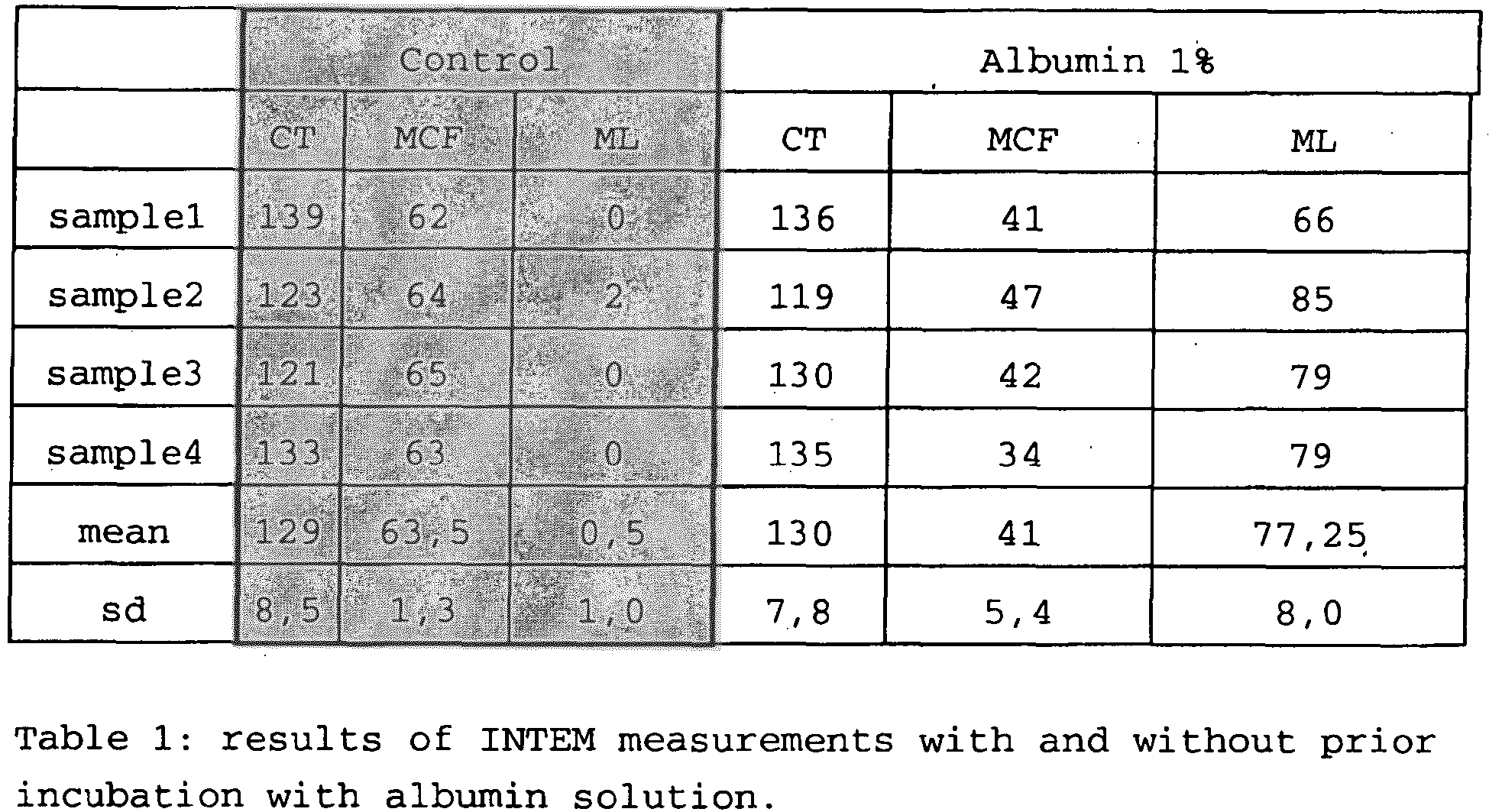
- Another shortcoming of this strategy is that the active components or stabilizers may interfere with the adhesion strength of the blood clot on the cup surfaces, which is required to perform correct measurements. For example, there has been shown diminished clot adhesion after incubation of albumin solution into the cup (Albumin is a typical stabilizer used to stabilize all kinds of proteins in reagents):
- Another possible strategy to simplify the handling of the reagents is to combine the different reagents necessary for one test in liquid phase in their working concentration. The main problem here is the interaction of the different substances while staying together for a longer period. Some components negatively affect the stability of each other when staying together in the liquid phase at higher concentrations; for example, CaCl2 disturbs the stability of Tissue Factor reagent in liquid phase over the time.
- Moreover, if these combined reagents should be provided in an amount sufficient for exactly one test, another problem would arise: In this case, the very small portion of liquid reagent might stick to parts of the reagent container or the cap and might thus not mix sufficiently with the test liquid when the analysis is performed.
- One strategy proposed to solve the named aspects was disclosed by
Kolde et al. in US patent application 20040071604 . In this application, a cup system for viscoelastic analyses is presented, in which the lower end of the cup is divided in several reagent chambers. This allows to place the reagents independently into the different chambers, without mixing them and then to freeze-dry the reagents. - However, disadvantages of this solution include the need for a very precise pipetting process, as the separate reagent chambers are very small and also the problem that the reagent drops might still mix before the freeze-drying by vibrations present on the reagent filling line. Another problem is the possible air-drying of the small reagent drops during the processing under room conditions before the lyophilisation process starts. Again the problem of automatically handling the small plastic and thus very light using standard reagent-filling lines is present.
- The most coagulation test methods in routine lab use just measure the time from adding an activator to the sample until the first initial formation of a fibrin clot can be detected (= clotting time). They stop at this point and no further measurement is done. This has the implications, that in these methods a firm adhesion of the blood to the surfaces of the measurement cell is not necessary. Accordingly, the variety of analyzers and reagents available for the assessment of clotting times with such methods does not have to handle the unique problems connected with viscoelastic measurements.
- Therefore, it is an object of the present invention to provide a container comprising a diagnostic composition, which allows for a safe, reproducible and easy to use procedure for different tests in viscoelastic systems. It is a further object of the present invention to provide a container comprising a diagnostic composition which is specifically adapted to one single analysis of a blood sample and has a superior reagent stability regarding prior art compositions. It is a still further object of the present invention to provide a diagnostic method which provides reliable and reproducible results, is easy to handle and which provides a standardized system for the determination of the coagulation characteristics of a blood sample.
- These objects are attained by the container of
claim 1, the diagnostic method of claim 8 and the use of claim 14. - Preferred embodiments are set forth in the dependent claims.
- By using the container comprising a diagnostic composition of the invention, the tests may be performed as follows: a defined volume of a sample (e.g., whole blood, blood plasma etc.) is added directly into a
container 1 containing the diagnostic composition. After dissolving of the composition in the blood sample, the resulting mixture is pipetted from thecontainer 1 into the measuringcup 2 of a measuringapparatus 4. Thecup 2 is then put into a position such that the pin 3 is immersed into the liquid in the test cup (cp.Fig. 2 ). - Therefore, the user needs only 4 pipetting steps for each test to perform (in the prior art liquid system up to 8 steps, see above) and no change of the pipette tip is necessary.
- Thus, it is clear that the present system for the determination of coagulation characteristics of a blood sample can be handled easier, thereby making the likelihood of errors smaller, which can be due to an imprecise line of action by a (potentially less experienced) operator.
- Therefrom, further advantages may arise as, for example, a higher reproducibility of the results to be achieved, and thus, a higher degree of standardization.
- Furthermore, one advantage of the present approach is that the diagnostic composition (i.e. reagent mixture) may be provided in a larger volume (and thus in a lower concentration) prior to the step of lyophilization than it is present in the final measuring step. In more detail, it is advantageous to initially provide a low concentration of the reagent mixture in order to avoid an early reaction of the reagents. The final concentration in the measuring step (obtained by resolving the diagnostic composition in the test sample) then will be higher than the initial concentration present before the lyophilization step.
- Further features and advantages of the present invention will be evident from a description of embodiments with reference to the figures.
- In the figures:
-
Figure 1 is an exemplary diagram showing a typical thromboelastometric measurement; -
Figure 2 is showing a measuringapparatus 4 for thromboelastometric analysis; -
Figure 3 is an illustration of ameasuring cup 2 of a measuringapparatus 4 of the prior art; -
Figure 4A , B, C are schematic cross-sectional views of three preferred embodiments of acontainer 1 of the present invention. - In a first aspect, the present invention provides a container comprising a diagnostic composition for use in the viscoelastic analysis of a test liquid, comprising the following constituents:
- a) at least one activator of coagulation;
- b) a calcium salt in an amount sufficient to ensure recalcification of the test liquid, and
- c) optionally one or more inhibitors and/or other coagulation components or factors;
- The calcium salt preferably is CaCl2.
- The diagnostic composition or reaction mixture comprises constituents, which are per se known in the art. One difference to the prior art approaches is, however, that the mixture of these constituents is provided in an essentially dry form.
- "Essentially" dry in the context of the invention means a state, wherein the mixture is essentially free from any liquid or moisture, in particular being depleted of water. Water or any other liquid, however, may be present as residue in the mixture, but only to an extent, which does not negatively influence the stability of the overall composition. In particular, it has to be excluded that an interaction occurs between the different constituents, which negatively affects the stability. A remaining amount of liquid, preferably water, in the composition of up to 10 % by weight should be acceptable.
- The amount sufficient for performing one single viscoelastic analysis of a specified test liquid, for example a blood sample, is that amount of all constituents in mixture, which provides the required concentration of the reagents in the final analysis of the coagulation characteristics of the blood sample, i.e. in the
cup 2 of a measuringapparatus 4. Therefore, it is not necessary to further portion the diagnostic composition before or after dissolving it in a liquid. - Further, this is achieved by dissolving the substances in the test liquid (blood sample etc.) itself, not by dissolving the constituents in an amount of liquid diluent leading to the final working concentration.
- The activator of coagulation as mentioned above preferably is an intrinsic and/or extrinsic activator.
- The extrinsic activator of coagulation in turn preferably is the Tissue Factor (TF) and is more preferably selected from lipidated TF or rTF.
- The intrinsic activator of coagulation is preferably selected from celite, ellagic acid, sulfatit, kaolin, silica, RNA, or mixtures thereof.
- As a second feature, the diagnostic composition comprises a calcium salt such as CaCl2, wherein CaCl2 is present in an amount of about 1-100 µmol/ml of test liquid. As mentioned above, the amount of CaCl2 must be sufficient to ensure recalcification of the test liquid, in particular of the blood sample, if the sample was decalcified before. It turned out that the amount of from 3-30 µmol/ml is optimal to achieve this requirement. In order to determine the required amount of CaCl2 to be contained in the diagnostic composition even more precisely, the exact volume of the test liquid to be collected from the patient has to be known as well as the amount of decalcifying reagent employed.
- The diagnostic composition optionally contains one ore more inhibitors, being selected, for example, from one or more of a platelet inhibitor, fibrinolysis inhibitor, or heparin inhibitor.
- Those inhibitors may be used and combined depending on the precise diagnostic demands, for example, the platelet inhibitor may be a cyto-skeletton inhibitor or a GPIIb/IIIa antagonist. The like, the fibrinolysis inhibitor can be selected, for example, from aprotinine, tranexamic acid, or eaca; the heparin inhibitor might be selected, for example, from heparinase, protamine or protamine-related peptides; and the coagulation factor can be selected, for example, from one or more coagulation factors or activated coagulation factors preferably FXa or FVa or activated protein C or FVIIa. However, it is noted that this is only a preferred selection and further inhibitors can be used if required.
- In a preferred embodiment, the dry mixture is a lyophilized mixture, more preferably a mixture produced by co-lyophilization of a mixture of the liquid reagents in one single lyophilizytion process. More precisely, in this preferred embodiment the diagnostic composition is produced by filling liquid components - in the required quantities to reach the intended composition - into a suitable container 1 (for example by a pipetting machine) and drying this composition in the
container 1 under application of low pressure environment (about 1000 - 0.2 mbar) at suitable temperature (about +30°C to -70°C). Thecontainer 1 then may be closed or sealed by a close cover or the like (e.g., a lid 5) in order to avoid a loss of reagents, or an invasion of contaminants, water etc. - In a preferred embodiment, the diagnostic composition may also contain one or more stabilizers, wherein the stabilizer preferably is albumin or gelatine.
- In a preferred embodiment, the diagnostic composition may also contain one or more phospholipids, wherein the phospholipids may be a composition of different phospholipids like phosphatidyserine, phosphatidylethanolamine and phosphatidylethanolcholine. For example, mixtures of phospholipids extracted from rabbit brain may be used.
- The present diagnostic composition may have the following constitution in preferred embodiments:
- extrinsic activation: Combination of extrinsic activator and stabilizer and, optionally, CaCl2
- intrinsic activation: Combination of intrinsic activator and stabilizer and, optionally, CaCl2
- extrinsic activation insensitive for heparin: Combination of extrinsic activator, heparin inhibitor and stabilizer and, optionally, CaCl2
- intrinsic activation insensitive for heparin: Combination of intrinsic activator, heparin inhibitor and stabilizer and, optionally, CaCl2
- extrinsic activation without platelet activation: Combination of extrinsic activator, platelet inhibitor and stabilizer and, optionally, CaCl2
- extrinsic activation without platelet activation, insensitive for heparin: Combination of extrinsic activator, platelet inhibitor, heparin inhibitor and stabilizer and, optionally, CaCl2
- intrinsic activation without platelet activation: Combination of intrinsic activator, platelet inhibitor and stabilizer and, optionally, CaCl2
- intrinsic activation without platelet activation, insensitive for heparin: Combination of intrinsic activator, platelet inhibitor, heparin inhibitor and stabilizer and, optionally, CaCl2
- extrinsic activation with inhibition of fibrinolysis: Combination of extrinsic activator, fibrinolysis inhibitor and stabilizer and, optionally, CaCl2
- extrinsic activation with inhibition of fibrinolysis, insensitive for heparin: Combination of extrinsic activator, fibrinolysis inhibitor, heparin inhibitor and stabilizer and, optionally, CaCl2
- intrinsic activation with inhibition of fibrinolysis: Combination of intrinsic activator, fibrinolysis inhibitor and stabilizer and, optionally, CaCl2
- intrinsic activation with inhibition of fibrinolysis, insensitive for heparin: Combination of intrinsic activator, fibrinolysis inhibitor, heparin inhibitor and stabilizer and, optionally, CaCl2
- extrinsic activation with additional coagulation factor: Combination of extrinsic activator, one additional coagulation factor and stabilizer and, optionally, CaCl2
- extrinsic activation with additional coagulation factor, insensitive for heparin: Combination of extrinsic activator, one additional coagulation factor, heparin inhibitor and stabilizer and, optionally, CaCl2
- intrinsic activation with additional coagulation factor: Combination of intrinsic activator, one additional coagulation factor and stabilizer and, optionally, CaCl2
- intrinsic activation with additional coagulation factor, insensitive for heparin: Combination of intrinsic activator, one additional coagulation factor, heparin inhibitor and stabilizer and, optionally, CaCl2
- The present invention provides a
container 1, comprising the diagnostic composition as defined above. Thecontainer 1 preferably takes the form of a vial or a cuvette. - The
container 1 is formed from a material (e.g., plastic or glass) which is not corroded or otherwise affected by the reagents to be filled in or the test liquid to be filled in. - The
container 1 may have cylindrical shape, but its shape does not necessarily have to be cylindrical. Thecontainer 1 may have a form which reduces its inner lateral profile from the upper opening to the bottom, as for example a conically shaped form as indicated inFig. 4 or at least a partially conical form. This provides a better handling of the usually small amounts of liquid reagent mixture: In a flat bottom container, for example in a common vial with similar diameter, the used amount of liquid would hardly cover the whole bottom and might dry in an uncontrolled manner before the lyophilization process starts. Using flat bottom vials with a smaller diameter would reduce this problem, but such vials might then have an opening diameter which is too narrow to be handled with standard pipetting equipment used in connection with diagnostic devices like, for example, the ROTEM thromboelastometer. (Regarding the design of the ROTEM system and how to use it, it is referred to the publication ofUS 5,777,215 ). - Furthermore, such small vials might become harder to manage for common automated processing systems and might thus increase the production costs.
- The cross-section of a basically axially
symmetric container 1 of a preferred embodiment is shown inFig. 4A . However, it should be explicitly noted that the present invention is not restricted thereto, and also U-shaped, rectangular shaped or the like forms may be used. - As mentioned above, the
container 1 may be closed or sealed by alid 5 or the like in order to avoid a loss of reagents, or an invasion of contaminants, water etc. - In a further embodiment, the
container 1 is designed in a way that it can be directly used as the measuringcup 2 of theviscoelastic measuring apparatus 4. In other words, a viscolelastic analysis can be performed such that arespective container 1 is provided, the test liquid is added into thecontainer 1, and the measurement is performed directly in thecontainer 1. In this case, only the blood dispension into the container has to be performed as a liquid transfer step, which can be realized by using a manual pipette, an automated pipette, an automated dispenser or any other liquid transfer equipment. - In this embodiment, the
container 1 might be designed by combination of two materials, e.g., glass and plastic or glass and a surface covering. As indicated inFigure 4B , this combination can be realized by providing a glass container with a plastic insert forming the portion where the liquid reagent is filled in before lyophilization and where the test liquid is added to before the viscoelastic measurement. In this context the part of the container made from glass does not necessarily have to clasp the entire underside of the plastic part but might be constructed according toFigure 4C . InFigure 4B and C , a further embodiment of the invention can be seen. The container 1 (for example a cuvette) may be incorporated in a larger structure, for example a glass article, which provides some technical advantages: at first, thus set-up may technically facilitate the step of lyphilisation, and secondly, may provide a holding for the container. - In these embodiments, possible coagulation activation in the test liquid by the glass surface is excluded, while the superior sealing properties of the glass material when compared to plastic material are still used. The similar effect of suppressing possible coagulation activation in the test liquid by the glass surface can be realized by covering the glass surface (or at least the inner portion of the glass surface) with a layer of one or more substances that are not able to activate coagulation if they are in contact with blood or blood components.
-
- A
container 1 is provided, which serves as reagent support and measuring vessel (i.e. can be regarded as a measuring cup 2) for analysis using various analytical processes, and has a region which is divided into at least two chambers (6a, 6b, 6c) by one or more bars extending from the container wall or the container base, wherein the chambers are arranged so that liquid or solid reagents may be introduced therein without them being able to be mixed by diffusion or running into one another. Thecontainer 1 is used for drying or freeze-drying by with completely or partly filled chambers and serves at the same time as a measuring vessel after re-dissolving the dried material by adding water, reagent solution, or the sample present in aqueous phase. - Hence, the main difference of the present invention when compared to prior art in
US 2004/0071604 is provided by the co-lyphylization process of a mixture of reagents in the cup. This makes the division of the vessel into two or more regions - separated by bars - unnecessary, thus avoiding the resulting complications for the production process by filling in at least two different liquids into two different portions of the vessel. - In a second aspect, the present invention is directed to a method of performing a viscoelastic analysis on a test liquid, a blood sample, comprising the steps of:
- a) providing a
container 1 as defined above; - b) adding the test liquid into said
container 1, thereby dissolving the diagnostic composition contained therein; - c) transferring the mixture of said test liquid and said diagnostic composition into a
cup 2 and put it into anapparatus 4 suitable for performing a viscolelastic analysis, or putting thecontainer 1 into anapparatus 4 suitable for performing a viscolelastic analysis; and - d) performing the viscoelastic analysis of said mixture.
- As already mentioned above, the test liquid preferably is a blood sample, preferably is a mammalian, more preferably a sample of human blood or blood components (e.g., whole blood or blood plasma).
- Step b) of the method of the present invention preferably takes about 1-60, more preferably 2-10 sec and most preferred is about 5 sec. Following that time, the mixture of the diagnostic composition and the blood sample should be quickly transferred to the measuring
cup 2 of the measuringapparatus 4. This is done in step d) by manually or automatically pipetting the mixture from thecontainer 1 and by transferring it thereby to theapparatus 4, i.e. to the measuringcup 2 of theapparatus 4. - As an alternative, if the
container 1 of the present invention is the measuringcup 2, the measurement is performed directly in thecontainer 1. In this case, step c) may be omitted. Theapparatus 4 preferably is a device suited for viscoelastic measurements, for example devices disclosed in (US 5,777,215 ), (US 6,537,819 ), or (US 5,777,215 ). - One example of that
apparatus 4 is shown inFig. 2 : - After the formation of the clot between cup 2 (cuvette) and pin 3, the clot itself is stretched by the movement of the pin 3 relative to the
cup 2. The detection of the characteristic parameters of the clot is based on the mechanical coupling ofcup 2 and pin 3 by the clot. This is only possible if the clot adheres on the surfaces of bothcup 2 and pin 3. So, a firm adhesion on the surfaces of bothcup 2 and pin 3 is essentially required for the viscoelastic analysis. - The method of the present invention comprises such a viscoelastic analysis of a blood sample in order to determine its coagulation characteristics, wherein such a viscoelastic analysis in the broadest sense is the measurement of a relative movement of a cuvette containing a blood sample relative to a punch. The analysis preferably comprises the determination of the clotting time, the clot formation time, and the firmness of the clot over time including fibrinolytic effects.
- In practice, the following steps may be performed:
- 1. a defined volume of a sample (e.g., whole blood, plasma) is added directly into a vial containing the lyophilized reagent composition; the measurement should start at a time close to the moment of adding the sample
- 2. after dissolving of the reagent mixture in the sample (5 sec.) the reagent-sample mixture is pipetted from the reagent vial into the measuring cup 2 (not necessary if the vial functions itself as measuring cup 2)
- 3. the
cup 2 is then put into a position such that the pin 3 is immersed into the liquid contained in the test cup, the measurement continues until stopped by the user - Therefore, the user needs not more than 4 pipetting steps in total for each test to perform (compared to the up to 8 steps required for a liquid reagent system) and no change of pipette tip is necessary when preparing one test. This clearly indicates the direct benefit of the present invention for the person who is performing such tests.
- In a further aspect, the present invention is directed to the use of a
container 1 as defined above in a method for analyzing the viscoelastic behaviour of a test liquid, preferably a blood sample. - Although the present invention has been described in accordance with preferred embodiments, it is obvious for a person skilled in the art that modifications are possible in all embodiments.
-
- 1
- container
- 2
- measuring cup
- 3
- pin
- 4
- measuring apparatus
- 5
- lid
- 6 a, b, c
- reagent chambers
- In the following some preferred embodiments of a diagnostic composition are described:
- A) A diagnostic composition for use in the viscoelastic analysis of a test liquid, comprising the following constituents: a) at least one activator of coagulation; b) a calcium salt, preferably CaCl2, in an amount sufficient to ensure recalcification of the test liquid; and, c) optionally one or more inhibitors and/or other coagulation components or factors; wherein the composition is present as an essentially dry mixture of all constituents and in an amount sufficient for performing one single viscoelastic analysis of a specified test liquid.
- B) The diagnostic composition of embodiment A), wherein the activator of coagulation is an intrinsic and/or extrinsic activator.
- C) The diagnostic composition of embodiment A) or B) wherein the extrinsic activator of coagulation is the Tissue Factor (TF).
- D) The diagnostic composition of embodiment C), wherein the Tissue Factor is selected from lipidated TF or rTF.
- E) The diagnostic composition of embodiment A) or B), wherein the intrinsic activator of coagulation is selected from the group consisting of celite, ellagic acid, sulfatit, kaolin, silica, RNA, or mixtures thereof.
- F) The diagnostic composition of one of embodiments A) to E), wherein the inhibitor is selected from one or more of a platelet inhibitor, fibrinolysis inhibitor, or heparin inhibitor.
- G) The diagnostic composition of embodiment F), wherein platelet inhibitor is a cytoskeletton inhibitor or a GPIIb/IIIa antagonist.
- H) The diagnostic composition of embodiment F), wherein the fibrinolysis inhibitor is selected from aprotinine, tranexamic acid, or eaca.
- J) The diagnostic composition of embodiment F), wherein the heparin inhibitor is selected from heparinase, protamine or protamine-related peptides.
- K) The diagnostic composition of one of embodiments A) to J), wherein the coagulation factor is selected from one or more coagulation factors or activated coagulation factors, preferably FXa or FVa or activated protein C or FVIIa.
- L) The diagnostic composition of one of embodiments A) to K), wherein CaCl2 is present in an amount of about 1-100 µmol/ml of the test liquid, preferably the blood sample.
- M) The diagnostic composition of one of embodiments A) to L), wherein the dry mixture is a lyophilized mixture.
- N) The diagnostic composition of embodiment M), wherein the lyophilized mixture is prepared by lyophilizing a liquid mixture of the contained components in a single process.
- O) The diagnostic composition of one of embodiments A) to N), which further comprises a stabilizer.
- P) The diagnostic composition of one of embodiments A) to O), wherein the stabilizer is albumin or gelatine.
Preferred embodiments of a container according to the invention are: - Q) A container, comprising the diagnostic composition of one or more of preferred embodiments A) to P).
- R) The container of embodiment Q), wherein the
container 1 takes the form of a vial or a cuvette. - S) The container of embodiment R), which is formed in a way that the inner lateral profile reduces from the opening to the bottom.
- T) The container of embodiment Q), R), or S), with its inner portion shaped in a manner that it can be attached to a device for performing viscoelastic measurements.
- U) The container of embodiment T) consisting of at least two different materials, where one material forming basically or at least partially the outer shape of the container enables hermetical sealing of the container by a suited cover, while the other material basically covering the portion conceiving the test liquid enables proper adhesion of blood or blood components without activating the coagulation cascade.
Some preferred variants of a method according to the invention are discussed in the following: - V) A method of performing a viscoelastic analysis on a test liquid, comprising the steps of: a) obtaining a test liquid; b) providing a
container 1 according to one of the preferred embodiments Q) to U); c) adding the test liquid into saidcontainer 1, thereby dissolving the diagnostic composition contained therein; d) optionally transferring the mixture of said test liquid and said diagnostic composition into anapparatus 4 suitable for performing a viscolelastic analysis; or putting thecontainer 1 into anapparatus 4 suitable for performing a viscolelastic analysis; and e) performing the viscoelastic analysis of said mixture. - W) The method of variant V), wherein the test liquid is a blood sample, preferably a mammalian, more preferably a human blood sample.
- X) The method of variant W), wherein the blood sample is whole blood or blood plasma.
- Y) The method of one or more of variants V) to X), wherein step c) takes about 1-60 sec., preferably about 2-10 sec., more preferably about 5 sec.
- Z) The method of one or more of variants V) to Y), wherein the mixture is transferred in step d) by manually or automatically pipetting the mixture from the
container 1 and by transferring it thereby to theapparatus 4. - Z.a) The method of one or more of variants V) to Z), wherein the mixture is transferred to the measuring
cup 2 of theapparatus 4. - Z.b) The method of one or more of variants V) to Z.a), wherein the
apparatus 4 is a thromboelastometer or a thrombelastograph. - Z.c) The method of one or more of variants V) to Z.b), wherein the analysis comprises the determination of the clotting time, the clot formation time, the firmness of the clot over time and/or fibrinolysis.
- It is a preferred to use a
container 1 of one or more of the preferred embodiments Q) to U) in a method for analyzing the viscoelastic behaviour of a test liquid. - It is specially preferred to use at least two
containers 1 of one or more of the preferred embodiments Q) to U) in a combined method for analyzing the viscoelastic behaviour of the same test liquid.
the composition is present as an essentially dry mixture of all constituents and in an amount sufficient for performing one single viscoelastic analysis of a specified test liquid.
Claims (15)
- A container (1), suitable to conceiving a defined volume of a blood sample, wherein the container contains a lyophilized diagnostic composition for use in the viscoelastic analysis of the blood sample, the lyophilized diagnostic composition comprising the following constituents:a) at least one activator of coagulation;b) a calcium salt, in an amount of 1-100 µmol/ ml of the blood sample, sufficient to ensure recalcification of the blood sample;c) optionally one or more inhibitors, wherein said one or more inhibitors are selected from the group consisting of a platelet inhibitor, a fibrinolysis inhibitor, and a heparin inhibitor; andd) optionally one or more coagulation factors or activated coagulation factors, wherein said one or more coagulation factors or activated coagulation factors are selected from the group consisting of FI, FII, FIII, FIV, FV, FVI, FVII, FVIII, FIX, FX, FXI, FXII, FXIII, FIa, FIIa, FIIIa, FIVa, FVa, FVIa, FVIIa, FVIIIa, FIXa, FXa, FXIa, FXIIa, FXIIIa, and activated protein C;
wherein the container (1) has the form which reduces its inner lateral profile from the upper opening to the bottom and wherein the container (1) is designed by either glass and plastic or glass and a surface covering, said surface covering being a layer of one or more substances that are not able to activate coagulation if they are in contact with blood or blood components. - The container according to claim 1, wherein the sample is whole blood or plasma.
- The container according to claim 1 or 2, wherein the activated coagulation factors are selected from FXa, FVa, activated protein Cor FVIIa.
- The container according to any one of claims 1 to 3 which takes the form of a vial or a cuvette.
- The container according to any one of claims 1 to 4, wherein in the lyophilized diagnostic compostion one activator of coagulation is an extrinsic activator.
- The container according to any one of claims 1 to 4, wherein in the lyophilized diagnostic composition one activator of coagulation is an intrinsic activator.
- The container according to any one of claims 1 to 6, wherein the lyophilized diagnostic composition comprises a stabilizer.
- A method of performing a viscoelastic analysis on a blood sample comprising the steps of:a) providing a container (1) according to any of claims 1 to 7;b) adding the blood sample into said container (1), thereby dissolving the diagnostic composition contained therein;c) optionally transferring the mixture of said blood sample and said diagnostic composition into an apparatus (4) suitable for performing a viscoelastic analysis; or putting the container (1) into an apparatus (4) suitable for performing a viscoelastic analysis; andd) performing the viscoelastic analysis of said mixture.
- The method according to claim 8, wherein step b) takes 1-60 sec.
- The method according to claim 8 or 9, wherein the mixture is transferred in step c) by manually or automatically pipetting the mixture from the container (1) and by transferring it thereby to the apparatus (4).
- The method according to any one of claims 8 to 10, wherein the mixture is transferred to the measuring cup (2) of the apparatus (4).
- The method according to any one of claims 8 to 11, wherein the apparatus (4) is a thromboelastometer or a thrombelastograph.
- The method according to any one of claims 8 to 12, wherein the analysis comprises the determination of the clotting time, the clot formation time, the firmness of the clot over time, and/ or fibrinolysis.
- A use of a container (1) according to any of claims 1 to 7 in a method for analyzing the viscoelastic behavior of a blood sample.
- The use according to claim 14, wherein at least two containers (1) according to any of claims 1 to 7 are used in a combined method for analyzing the viscoelastic behavior of the same blood sample.
Priority Applications (1)
| Application Number | Priority Date | Filing Date | Title |
|---|---|---|---|
| EP15177115.1A EP2952900A1 (en) | 2007-02-01 | 2008-01-31 | Diagnostic composition and its use in the determination of coagulation characteristics of a test liquid |
Applications Claiming Priority (2)
| Application Number | Priority Date | Filing Date | Title |
|---|---|---|---|
| GBGB0701821.1A GB0701821D0 (en) | 2007-02-01 | 2007-02-01 | Diagnostic composition and its use in the determination of coagulation characteristics of a test liquid |
| PCT/IB2008/000208 WO2008093216A1 (en) | 2007-02-01 | 2008-01-31 | Diagnostic composition and its use in the determination of coagulation characteristics of a test liquid |
Related Child Applications (2)
| Application Number | Title | Priority Date | Filing Date |
|---|---|---|---|
| EP15177115.1A Division-Into EP2952900A1 (en) | 2007-02-01 | 2008-01-31 | Diagnostic composition and its use in the determination of coagulation characteristics of a test liquid |
| EP15177115.1A Division EP2952900A1 (en) | 2007-02-01 | 2008-01-31 | Diagnostic composition and its use in the determination of coagulation characteristics of a test liquid |
Publications (2)
| Publication Number | Publication Date |
|---|---|
| EP2111556A1 EP2111556A1 (en) | 2009-10-28 |
| EP2111556B1 true EP2111556B1 (en) | 2015-09-02 |
Family
ID=37891022
Family Applications (2)
| Application Number | Title | Priority Date | Filing Date |
|---|---|---|---|
| EP15177115.1A Withdrawn EP2952900A1 (en) | 2007-02-01 | 2008-01-31 | Diagnostic composition and its use in the determination of coagulation characteristics of a test liquid |
| EP08702342.0A Not-in-force EP2111556B1 (en) | 2007-02-01 | 2008-01-31 | Container comprising a diagnostic composition and its use in the determination of coagulation characteristics of a test liquid |
Family Applications Before (1)
| Application Number | Title | Priority Date | Filing Date |
|---|---|---|---|
| EP15177115.1A Withdrawn EP2952900A1 (en) | 2007-02-01 | 2008-01-31 | Diagnostic composition and its use in the determination of coagulation characteristics of a test liquid |
Country Status (6)
| Country | Link |
|---|---|
| US (1) | US20100190193A1 (en) |
| EP (2) | EP2952900A1 (en) |
| JP (1) | JP2010518371A (en) |
| CN (1) | CN101578521A (en) |
| GB (1) | GB0701821D0 (en) |
| WO (1) | WO2008093216A1 (en) |
Families Citing this family (39)
| Publication number | Priority date | Publication date | Assignee | Title |
|---|---|---|---|---|
| US8448499B2 (en) | 2008-12-23 | 2013-05-28 | C A Casyso Ag | Cartridge device for a measuring system for measuring viscoelastic characteristics of a sample liquid, a corresponding measuring system, and a corresponding method |
| EP3734274B1 (en) | 2008-12-23 | 2025-04-23 | C A Casyso GmbH | System for measuring viscoelastic properties of blood |
| US8383045B2 (en) | 2009-01-16 | 2013-02-26 | C A Casyso Ag | Measuring unit for measuring characteristics of a sample liquid, in particular viscoelastic characteristics of a blood sample |
| ES2890501T3 (en) * | 2009-03-02 | 2022-01-20 | Massachusetts Inst Technology | Methods and products for in vivo enzyme profiling |
| EP2371284A1 (en) | 2010-03-24 | 2011-10-05 | C A Casyso AG | Method and apparatus for determining at least one evaluation parameter of a blood sample |
| BR112012024841A2 (en) * | 2010-03-30 | 2019-09-24 | Casyso Ag C A | '' diagnostic composition for use in the analysis of a viscoelastic test liquid, container, method of performing a viscoelastic analysis in test liquid and use of a diagnostic composition '' |
| US10147152B2 (en) | 2010-04-08 | 2018-12-04 | Hemosonics, Llc | Hemostatic parameter display |
| ES2967784T3 (en) | 2011-02-15 | 2024-05-03 | Hemosonics Llc | Characterization of blood hemostasis and oxygen transport parameters |
| CN103649751B (en) | 2011-02-15 | 2017-03-29 | 海默索尼克斯有限公司 | Devices, systems and methods for assessing hemostasis |
| CA2830235C (en) | 2011-03-15 | 2023-10-24 | Massachusetts Institute Of Technology | Multiplexed detection with isotope-coded reporters |
| US20120294767A1 (en) | 2011-05-19 | 2012-11-22 | Hemosonics Llc | Portable hemostasis analyzer |
| ES2828985T3 (en) | 2013-06-07 | 2021-05-28 | Massachusetts Inst Technology | Affinity-based detection of synthetic ligand-encoded biomarkers |
| EP2884284A1 (en) * | 2013-12-12 | 2015-06-17 | C A Casyso AG | Dry diagnostic reagent |
| WO2015171116A1 (en) * | 2014-05-05 | 2015-11-12 | Haemonetics Corporation | Methodologies and reagents for detecting fibrinolysis and hyperfibrinolysis |
| US10816559B2 (en) | 2014-09-29 | 2020-10-27 | Ca Casyso Ag | Blood testing system and method |
| US10288630B2 (en) | 2014-09-29 | 2019-05-14 | C A Casyso Gmbh | Blood testing system and method |
| US9897618B2 (en) | 2014-09-29 | 2018-02-20 | C A Casyso Gmbh | Blood testing system |
| US10175225B2 (en) | 2014-09-29 | 2019-01-08 | C A Casyso Ag | Blood testing system and method |
| US10539579B2 (en) | 2014-09-29 | 2020-01-21 | C A Casyso Gmbh | Blood testing system and method |
| CN107250375A (en) * | 2014-11-06 | 2017-10-13 | 科罗拉多州立大学董事会 | In the presence of thrombolytic agent new morbid state is identified using viscoelasticity analysis |
| USD777343S1 (en) | 2015-05-28 | 2017-01-24 | C A Casyso Ag | Body fluid cartridge device |
| US10295554B2 (en) | 2015-06-29 | 2019-05-21 | C A Casyso Gmbh | Blood testing system and method |
| WO2017000971A1 (en) | 2015-07-01 | 2017-01-05 | Leyser Lab Gmbh | Diagnostic kit for viscoelastic analysis and uses and methods thereof |
| CN105424945B (en) * | 2015-11-20 | 2018-05-18 | 重庆贝羿生物科技有限公司 | A kind of coagulation activation detection reagent and preparation method thereof and purposes |
| WO2017168897A1 (en) | 2016-03-30 | 2017-10-05 | ソニー株式会社 | Blood state analysis device, blood state analysis system, blood state analysis method, and program |
| CA3020324A1 (en) | 2016-04-08 | 2017-10-12 | Massachusetts Institute Of Technology | Methods to specifically profile protease activity at lymph nodes |
| CA3018777C (en) | 2016-04-15 | 2023-08-29 | Dynabyte Informationssysteme Gmbh | Pipette tip and uses and methods thereof |
| US11428689B2 (en) | 2016-05-05 | 2022-08-30 | Massachusetts Institute Of Technology | Methods and uses for remotely triggered protease activity measurements |
| US10473674B2 (en) | 2016-08-31 | 2019-11-12 | C A Casyso Gmbh | Controlled blood delivery to mixing chamber of a blood testing cartridge |
| WO2018187688A1 (en) | 2017-04-07 | 2018-10-11 | Massachusetts Institute Of Technology | Methods to spatially profile protease activity in tissue and sections |
| DK3612838T3 (en) | 2017-04-20 | 2024-10-21 | Hemosonics Llc | DISPOSABLE SYSTEM FOR ANALYSIS OF HEMOSTATIC FUNCTION |
| US10843185B2 (en) | 2017-07-12 | 2020-11-24 | Ca Casyso Gmbh | Autoplatelet cartridge device |
| CN107561257A (en) * | 2017-08-16 | 2018-01-09 | 北京乐普医疗科技有限责任公司 | A kind of detection method for assessing heparin class curative effect of medication and residual condition |
| CN108279313B (en) * | 2017-12-29 | 2021-03-02 | 广州万孚生物技术股份有限公司 | Reagent and test cup for rapidly detecting blood viscoelasticity |
| WO2019173332A1 (en) | 2018-03-05 | 2019-09-12 | Massachusetts Institute Of Technology | Inhalable nanosensors with volatile reporters and uses thereof |
| US12173349B2 (en) | 2018-09-25 | 2024-12-24 | Massachusetts Institute Of Technology | Lung protease nanosensors and uses thereof |
| WO2020150560A1 (en) | 2019-01-17 | 2020-07-23 | Massachusetts Institute Of Technology | Sensors for detecting and imaging of cancer metastasis |
| CN109884327A (en) * | 2019-03-27 | 2019-06-14 | 深圳优迪生物技术有限公司 | The detection of functional fiber albumen activator and its application |
| US20230243856A1 (en) * | 2022-01-31 | 2023-08-03 | Instrumentation Laboratory Company | Identifying direct oral factor xa inhibitors |
Family Cites Families (18)
| Publication number | Priority date | Publication date | Assignee | Title |
|---|---|---|---|---|
| US4529614A (en) * | 1981-12-02 | 1985-07-16 | Becton, Dickinson And Company | One step anticoagulant coating |
| US5223227A (en) * | 1989-06-19 | 1993-06-29 | Haemoscope Corporation | Disposable pin and cup with reuseable stem and collar for blood coagulation analyzer |
| JP2954239B2 (en) * | 1989-08-07 | 1999-09-27 | 清水製薬株式会社 | Simple blood coagulation test equipment for whole blood |
| JPH0638797A (en) * | 1992-07-23 | 1994-02-15 | Tokuyama Soda Co Ltd | Blood coagulation time measurement dry reagent |
| ES2131543T3 (en) * | 1993-06-30 | 1999-08-01 | Stiftung Fur Diagnostische For | MEASURING THE TIME OF ACTIVATED PARTIAL THROMBOPLASTINE (APTT) IN A SINGLE-STAGE REACTION. |
| JP2857043B2 (en) * | 1993-11-16 | 1999-02-10 | 株式会社トクヤマ | Blood clotting time measurement dry reagent |
| US5504011A (en) * | 1994-10-21 | 1996-04-02 | International Technidyne Corporation | Portable test apparatus and associated method of performing a blood coagulation test |
| JPH0961433A (en) * | 1995-08-23 | 1997-03-07 | Tokuyama Corp | Dry reagent for blood coagulation time measurement |
| AU7129598A (en) * | 1997-04-23 | 1998-11-13 | Instrumentation Laboratory S.P.A. | Recombinant rabbit tissue factor based prothrombin time reagent |
| US6010911A (en) * | 1997-04-30 | 2000-01-04 | Medtronic, Inc. | Apparatus for performing a heparin-independent high sensitivity platelet function evaluation technique |
| US6225126B1 (en) * | 1999-02-22 | 2001-05-01 | Haemoscope Corporation | Method and apparatus for measuring hemostasis |
| KR20020042622A (en) * | 1999-07-23 | 2002-06-05 | 코애귤레이션 다이어그노스틱스, 인크. | Method for measuring coagulant factor activity in whole blood |
| EP1234614A1 (en) * | 2001-02-27 | 2002-08-28 | Pentapharm Gmbh | Metering vessel subdivided by ribs for receiving reagents, its fabrication and use |
| US20030064414A1 (en) * | 2001-03-30 | 2003-04-03 | Benecky Michael J. | Rapid assessment of coagulation activity in whole blood |
| EP1367135A1 (en) * | 2002-05-29 | 2003-12-03 | Pentapharm AG | Improved method for the assessment of thrombin formation in blood or plasma |
| JP4787756B2 (en) * | 2003-05-16 | 2011-10-05 | ナショナル バイオロジカル スタンダーズ ボード | Activation mixture |
| GB0418474D0 (en) * | 2004-08-12 | 2004-09-22 | Pentapharm Ltd | Device with novel and improved surface properties |
| JP4921359B2 (en) * | 2005-04-01 | 2012-04-25 | キッセイ薬品工業株式会社 | Sensitive hematology assays and reagents |
-
2007
- 2007-02-01 GB GBGB0701821.1A patent/GB0701821D0/en not_active Ceased
-
2008
- 2008-01-31 CN CNA2008800016445A patent/CN101578521A/en active Pending
- 2008-01-31 EP EP15177115.1A patent/EP2952900A1/en not_active Withdrawn
- 2008-01-31 WO PCT/IB2008/000208 patent/WO2008093216A1/en not_active Ceased
- 2008-01-31 EP EP08702342.0A patent/EP2111556B1/en not_active Not-in-force
- 2008-01-31 JP JP2009547777A patent/JP2010518371A/en active Pending
- 2008-01-31 US US12/522,364 patent/US20100190193A1/en not_active Abandoned
Also Published As
| Publication number | Publication date |
|---|---|
| GB0701821D0 (en) | 2007-03-14 |
| EP2952900A1 (en) | 2015-12-09 |
| WO2008093216A1 (en) | 2008-08-07 |
| JP2010518371A (en) | 2010-05-27 |
| US20100190193A1 (en) | 2010-07-29 |
| EP2111556A1 (en) | 2009-10-28 |
| CN101578521A (en) | 2009-11-11 |
Similar Documents
| Publication | Publication Date | Title |
|---|---|---|
| EP2111556B1 (en) | Container comprising a diagnostic composition and its use in the determination of coagulation characteristics of a test liquid | |
| EP3002591B1 (en) | Composition for the determination of coagulation characteristics of a test liquid | |
| EP3140650B1 (en) | Methodologies and reagents for detecting fibrinolysis and hyperfibrinolysis | |
| US6902904B2 (en) | Coagulation assay reagents containing lanthanides | |
| US12084710B2 (en) | Diagnostic kit for viscoelastic analysis and uses and methods thereof | |
| US20250065321A1 (en) | Pipette tip and uses and methods thereof |
Legal Events
| Date | Code | Title | Description |
|---|---|---|---|
| PUAI | Public reference made under article 153(3) epc to a published international application that has entered the european phase |
Free format text: ORIGINAL CODE: 0009012 |
|
| 17P | Request for examination filed |
Effective date: 20090819 |
|
| AK | Designated contracting states |
Kind code of ref document: A1 Designated state(s): AT BE BG CH CY CZ DE DK EE ES FI FR GB GR HR HU IE IS IT LI LT LU LV MC MT NL NO PL PT RO SE SI SK TR |
|
| RIN1 | Information on inventor provided before grant (corrected) |
Inventor name: KESSLER, MAX Inventor name: GLAUNER, MARTIN Inventor name: CALATZIS, ANDREAS Inventor name: SCHUBERT, AXEL |
|
| 17Q | First examination report despatched |
Effective date: 20100215 |
|
| DAX | Request for extension of the european patent (deleted) | ||
| GRAP | Despatch of communication of intention to grant a patent |
Free format text: ORIGINAL CODE: EPIDOSNIGR1 |
|
| INTG | Intention to grant announced |
Effective date: 20150316 |
|
| GRAS | Grant fee paid |
Free format text: ORIGINAL CODE: EPIDOSNIGR3 |
|
| GRAA | (expected) grant |
Free format text: ORIGINAL CODE: 0009210 |
|
| AK | Designated contracting states |
Kind code of ref document: B1 Designated state(s): AT BE BG CH CY CZ DE DK EE ES FI FR GB GR HR HU IE IS IT LI LT LU LV MC MT NL NO PL PT RO SE SI SK TR |
|
| REG | Reference to a national code |
Ref country code: GB Ref legal event code: FG4D |
|
| REG | Reference to a national code |
Ref country code: AT Ref legal event code: REF Ref document number: 746955 Country of ref document: AT Kind code of ref document: T Effective date: 20150915 Ref country code: CH Ref legal event code: EP |
|
| REG | Reference to a national code |
Ref country code: IE Ref legal event code: FG4D |
|
| REG | Reference to a national code |
Ref country code: DE Ref legal event code: R096 Ref document number: 602008039910 Country of ref document: DE |
|
| REG | Reference to a national code |
Ref country code: FR Ref legal event code: PLFP Year of fee payment: 9 |
|
| PG25 | Lapsed in a contracting state [announced via postgrant information from national office to epo] |
Ref country code: NO Free format text: LAPSE BECAUSE OF FAILURE TO SUBMIT A TRANSLATION OF THE DESCRIPTION OR TO PAY THE FEE WITHIN THE PRESCRIBED TIME-LIMIT Effective date: 20151202 Ref country code: GR Free format text: LAPSE BECAUSE OF FAILURE TO SUBMIT A TRANSLATION OF THE DESCRIPTION OR TO PAY THE FEE WITHIN THE PRESCRIBED TIME-LIMIT Effective date: 20151203 Ref country code: FI Free format text: LAPSE BECAUSE OF FAILURE TO SUBMIT A TRANSLATION OF THE DESCRIPTION OR TO PAY THE FEE WITHIN THE PRESCRIBED TIME-LIMIT Effective date: 20150902 Ref country code: LV Free format text: LAPSE BECAUSE OF FAILURE TO SUBMIT A TRANSLATION OF THE DESCRIPTION OR TO PAY THE FEE WITHIN THE PRESCRIBED TIME-LIMIT Effective date: 20150902 Ref country code: LT Free format text: LAPSE BECAUSE OF FAILURE TO SUBMIT A TRANSLATION OF THE DESCRIPTION OR TO PAY THE FEE WITHIN THE PRESCRIBED TIME-LIMIT Effective date: 20150902 |
|
| REG | Reference to a national code |
Ref country code: LT Ref legal event code: MG4D Ref country code: NL Ref legal event code: MP Effective date: 20150902 |
|
| PG25 | Lapsed in a contracting state [announced via postgrant information from national office to epo] |
Ref country code: ES Free format text: LAPSE BECAUSE OF FAILURE TO SUBMIT A TRANSLATION OF THE DESCRIPTION OR TO PAY THE FEE WITHIN THE PRESCRIBED TIME-LIMIT Effective date: 20150902 Ref country code: SE Free format text: LAPSE BECAUSE OF FAILURE TO SUBMIT A TRANSLATION OF THE DESCRIPTION OR TO PAY THE FEE WITHIN THE PRESCRIBED TIME-LIMIT Effective date: 20150902 Ref country code: PL Free format text: LAPSE BECAUSE OF FAILURE TO SUBMIT A TRANSLATION OF THE DESCRIPTION OR TO PAY THE FEE WITHIN THE PRESCRIBED TIME-LIMIT Effective date: 20150902 |
|
| PG25 | Lapsed in a contracting state [announced via postgrant information from national office to epo] |
Ref country code: IT Free format text: LAPSE BECAUSE OF FAILURE TO SUBMIT A TRANSLATION OF THE DESCRIPTION OR TO PAY THE FEE WITHIN THE PRESCRIBED TIME-LIMIT Effective date: 20150902 Ref country code: NL Free format text: LAPSE BECAUSE OF FAILURE TO SUBMIT A TRANSLATION OF THE DESCRIPTION OR TO PAY THE FEE WITHIN THE PRESCRIBED TIME-LIMIT Effective date: 20150902 Ref country code: IS Free format text: LAPSE BECAUSE OF FAILURE TO SUBMIT A TRANSLATION OF THE DESCRIPTION OR TO PAY THE FEE WITHIN THE PRESCRIBED TIME-LIMIT Effective date: 20160102 Ref country code: SK Free format text: LAPSE BECAUSE OF FAILURE TO SUBMIT A TRANSLATION OF THE DESCRIPTION OR TO PAY THE FEE WITHIN THE PRESCRIBED TIME-LIMIT Effective date: 20150902 Ref country code: CZ Free format text: LAPSE BECAUSE OF FAILURE TO SUBMIT A TRANSLATION OF THE DESCRIPTION OR TO PAY THE FEE WITHIN THE PRESCRIBED TIME-LIMIT Effective date: 20150902 Ref country code: EE Free format text: LAPSE BECAUSE OF FAILURE TO SUBMIT A TRANSLATION OF THE DESCRIPTION OR TO PAY THE FEE WITHIN THE PRESCRIBED TIME-LIMIT Effective date: 20150902 |
|
| PG25 | Lapsed in a contracting state [announced via postgrant information from national office to epo] |
Ref country code: RO Free format text: LAPSE BECAUSE OF FAILURE TO SUBMIT A TRANSLATION OF THE DESCRIPTION OR TO PAY THE FEE WITHIN THE PRESCRIBED TIME-LIMIT Effective date: 20150902 Ref country code: PT Free format text: LAPSE BECAUSE OF FAILURE TO SUBMIT A TRANSLATION OF THE DESCRIPTION OR TO PAY THE FEE WITHIN THE PRESCRIBED TIME-LIMIT Effective date: 20160104 Ref country code: BE Free format text: LAPSE BECAUSE OF NON-PAYMENT OF DUE FEES Effective date: 20160131 |
|
| REG | Reference to a national code |
Ref country code: DE Ref legal event code: R097 Ref document number: 602008039910 Country of ref document: DE |
|
| PLBE | No opposition filed within time limit |
Free format text: ORIGINAL CODE: 0009261 |
|
| STAA | Information on the status of an ep patent application or granted ep patent |
Free format text: STATUS: NO OPPOSITION FILED WITHIN TIME LIMIT |
|
| 26N | No opposition filed |
Effective date: 20160603 |
|
| PG25 | Lapsed in a contracting state [announced via postgrant information from national office to epo] |
Ref country code: DK Free format text: LAPSE BECAUSE OF FAILURE TO SUBMIT A TRANSLATION OF THE DESCRIPTION OR TO PAY THE FEE WITHIN THE PRESCRIBED TIME-LIMIT Effective date: 20150902 Ref country code: LU Free format text: LAPSE BECAUSE OF FAILURE TO SUBMIT A TRANSLATION OF THE DESCRIPTION OR TO PAY THE FEE WITHIN THE PRESCRIBED TIME-LIMIT Effective date: 20160131 Ref country code: SI Free format text: LAPSE BECAUSE OF FAILURE TO SUBMIT A TRANSLATION OF THE DESCRIPTION OR TO PAY THE FEE WITHIN THE PRESCRIBED TIME-LIMIT Effective date: 20150902 |
|
| PG25 | Lapsed in a contracting state [announced via postgrant information from national office to epo] |
Ref country code: MC Free format text: LAPSE BECAUSE OF FAILURE TO SUBMIT A TRANSLATION OF THE DESCRIPTION OR TO PAY THE FEE WITHIN THE PRESCRIBED TIME-LIMIT Effective date: 20150902 |
|
| REG | Reference to a national code |
Ref country code: IE Ref legal event code: MM4A |
|
| REG | Reference to a national code |
Ref country code: FR Ref legal event code: PLFP Year of fee payment: 10 |
|
| PG25 | Lapsed in a contracting state [announced via postgrant information from national office to epo] |
Ref country code: BE Free format text: LAPSE BECAUSE OF FAILURE TO SUBMIT A TRANSLATION OF THE DESCRIPTION OR TO PAY THE FEE WITHIN THE PRESCRIBED TIME-LIMIT Effective date: 20150902 |
|
| PG25 | Lapsed in a contracting state [announced via postgrant information from national office to epo] |
Ref country code: IE Free format text: LAPSE BECAUSE OF NON-PAYMENT OF DUE FEES Effective date: 20160131 |
|
| REG | Reference to a national code |
Ref country code: AT Ref legal event code: UEP Ref document number: 746955 Country of ref document: AT Kind code of ref document: T Effective date: 20150902 |
|
| PG25 | Lapsed in a contracting state [announced via postgrant information from national office to epo] |
Ref country code: MT Free format text: LAPSE BECAUSE OF FAILURE TO SUBMIT A TRANSLATION OF THE DESCRIPTION OR TO PAY THE FEE WITHIN THE PRESCRIBED TIME-LIMIT Effective date: 20150902 |
|
| REG | Reference to a national code |
Ref country code: FR Ref legal event code: PLFP Year of fee payment: 11 |
|
| PG25 | Lapsed in a contracting state [announced via postgrant information from national office to epo] |
Ref country code: CY Free format text: LAPSE BECAUSE OF FAILURE TO SUBMIT A TRANSLATION OF THE DESCRIPTION OR TO PAY THE FEE WITHIN THE PRESCRIBED TIME-LIMIT Effective date: 20150902 Ref country code: HU Free format text: LAPSE BECAUSE OF FAILURE TO SUBMIT A TRANSLATION OF THE DESCRIPTION OR TO PAY THE FEE WITHIN THE PRESCRIBED TIME-LIMIT; INVALID AB INITIO Effective date: 20080131 |
|
| PG25 | Lapsed in a contracting state [announced via postgrant information from national office to epo] |
Ref country code: TR Free format text: LAPSE BECAUSE OF FAILURE TO SUBMIT A TRANSLATION OF THE DESCRIPTION OR TO PAY THE FEE WITHIN THE PRESCRIBED TIME-LIMIT Effective date: 20150902 Ref country code: HR Free format text: LAPSE BECAUSE OF FAILURE TO SUBMIT A TRANSLATION OF THE DESCRIPTION OR TO PAY THE FEE WITHIN THE PRESCRIBED TIME-LIMIT Effective date: 20150902 |
|
| PG25 | Lapsed in a contracting state [announced via postgrant information from national office to epo] |
Ref country code: BG Free format text: LAPSE BECAUSE OF FAILURE TO SUBMIT A TRANSLATION OF THE DESCRIPTION OR TO PAY THE FEE WITHIN THE PRESCRIBED TIME-LIMIT Effective date: 20150902 |
|
| PGFP | Annual fee paid to national office [announced via postgrant information from national office to epo] |
Ref country code: FR Payment date: 20201210 Year of fee payment: 14 |
|
| PGFP | Annual fee paid to national office [announced via postgrant information from national office to epo] |
Ref country code: CH Payment date: 20210113 Year of fee payment: 14 |
|
| PGFP | Annual fee paid to national office [announced via postgrant information from national office to epo] |
Ref country code: AT Payment date: 20201221 Year of fee payment: 14 Ref country code: GB Payment date: 20210120 Year of fee payment: 14 Ref country code: DE Payment date: 20210119 Year of fee payment: 14 |
|
| REG | Reference to a national code |
Ref country code: DE Ref legal event code: R119 Ref document number: 602008039910 Country of ref document: DE |
|
| REG | Reference to a national code |
Ref country code: CH Ref legal event code: PL |
|
| REG | Reference to a national code |
Ref country code: AT Ref legal event code: MM01 Ref document number: 746955 Country of ref document: AT Kind code of ref document: T Effective date: 20220131 |
|
| GBPC | Gb: european patent ceased through non-payment of renewal fee |
Effective date: 20220131 |
|
| PG25 | Lapsed in a contracting state [announced via postgrant information from national office to epo] |
Ref country code: GB Free format text: LAPSE BECAUSE OF NON-PAYMENT OF DUE FEES Effective date: 20220131 Ref country code: DE Free format text: LAPSE BECAUSE OF NON-PAYMENT OF DUE FEES Effective date: 20220802 Ref country code: AT Free format text: LAPSE BECAUSE OF NON-PAYMENT OF DUE FEES Effective date: 20220131 |
|
| PG25 | Lapsed in a contracting state [announced via postgrant information from national office to epo] |
Ref country code: FR Free format text: LAPSE BECAUSE OF NON-PAYMENT OF DUE FEES Effective date: 20220131 |
|
| PG25 | Lapsed in a contracting state [announced via postgrant information from national office to epo] |
Ref country code: LI Free format text: LAPSE BECAUSE OF NON-PAYMENT OF DUE FEES Effective date: 20220131 Ref country code: CH Free format text: LAPSE BECAUSE OF NON-PAYMENT OF DUE FEES Effective date: 20220131 |