EP2089402B1 - Oligomeric bis-phosphate flame retardants and compositions containing the same - Google Patents
Oligomeric bis-phosphate flame retardants and compositions containing the same Download PDFInfo
- Publication number
- EP2089402B1 EP2089402B1 EP07837596.1A EP07837596A EP2089402B1 EP 2089402 B1 EP2089402 B1 EP 2089402B1 EP 07837596 A EP07837596 A EP 07837596A EP 2089402 B1 EP2089402 B1 EP 2089402B1
- Authority
- EP
- European Patent Office
- Prior art keywords
- resin
- oligomeric
- phosphate
- bis
- abs
- Prior art date
- Legal status (The legal status is an assumption and is not a legal conclusion. Google has not performed a legal analysis and makes no representation as to the accuracy of the status listed.)
- Active
Links
Classifications
-
- C—CHEMISTRY; METALLURGY
- C07—ORGANIC CHEMISTRY
- C07F—ACYCLIC, CARBOCYCLIC OR HETEROCYCLIC COMPOUNDS CONTAINING ELEMENTS OTHER THAN CARBON, HYDROGEN, HALOGEN, OXYGEN, NITROGEN, SULFUR, SELENIUM OR TELLURIUM
- C07F9/00—Compounds containing elements of Groups 5 or 15 of the Periodic Table
- C07F9/02—Phosphorus compounds
- C07F9/06—Phosphorus compounds without P—C bonds
- C07F9/08—Esters of oxyacids of phosphorus
- C07F9/09—Esters of phosphoric acids
- C07F9/12—Esters of phosphoric acids with hydroxyaryl compounds
-
- C—CHEMISTRY; METALLURGY
- C07—ORGANIC CHEMISTRY
- C07F—ACYCLIC, CARBOCYCLIC OR HETEROCYCLIC COMPOUNDS CONTAINING ELEMENTS OTHER THAN CARBON, HYDROGEN, HALOGEN, OXYGEN, NITROGEN, SULFUR, SELENIUM OR TELLURIUM
- C07F9/00—Compounds containing elements of Groups 5 or 15 of the Periodic Table
- C07F9/02—Phosphorus compounds
- C07F9/06—Phosphorus compounds without P—C bonds
- C07F9/08—Esters of oxyacids of phosphorus
- C07F9/09—Esters of phosphoric acids
-
- C—CHEMISTRY; METALLURGY
- C08—ORGANIC MACROMOLECULAR COMPOUNDS; THEIR PREPARATION OR CHEMICAL WORKING-UP; COMPOSITIONS BASED THEREON
- C08K—Use of inorganic or non-macromolecular organic substances as compounding ingredients
- C08K5/00—Use of organic ingredients
- C08K5/49—Phosphorus-containing compounds
- C08K5/51—Phosphorus bound to oxygen
- C08K5/53—Phosphorus bound to oxygen bound to oxygen and to carbon only
- C08K5/5317—Phosphonic compounds, e.g. R—P(:O)(OR')2
- C08K5/5333—Esters of phosphonic acids
- C08K5/5357—Esters of phosphonic acids cyclic
Definitions
- the present invention relates to resin compositions.
- Oligomeric bis-phosphates which are useful as flame retardants in resin compositions such as polycarbonate (PC)/styrenic containing alloys, are typically in the form of viscous liquids and require special equipment for handling during processing, especially in cold climate locations.
- the viscous liquid phosphates are often pumped into compounding extruders after the thermoplastic polymers, i.e. resins, are melted through heat and mechanical shear.
- Specialized equipment may include heated reservoirs with heat-traced supply lines designed to keep the oligomeric bis-phosphates fluid so as not to interfere with the extrusion process. Even with the use of specialized equipment, additional steps need to be taken during processing so as to avoid this problem and other problems.
- solid phosphate ester flame retardants such as triphenyl phosphate, which is typically available in a flaked form, can be used.
- these solid phosphate ester flame retardants tend to melt prematurely in the feed zone of the extruder causing the composite premixture to "bridge" thereby interfering with the mixing operation.
- EP 0 672 717 describes a flame-retardant thermoplastic polymer composition having incorporated therein a flame retarder of the formula: wherein R 1 , R 2 , R 3 and R 4 are H or lower alkyl, Ar 1 , Ar 2 , Ar 3 and Ar 4 are unsubstituted or substituted phenyl, n is a number of 0.5 to 3,000, and each of k and m is an integer of 0 to 2 and k plus m is an integer of 0 to 2.
- the polymer composition preferably further comprises a salt of a specific triazine derivative with cyanuric acid or isocyanuric acid.
- Shaped articles made of the polymer composition are described to have good flame retardancy, mechanical properties and resistance to hydrolysis.
- US 5,952,408 describes flameproof thermoplastic resin compositions comprising a phosphate composition, and a zeolite. The addition of the zeolite component is described to provide thermoplastic resin compositions with a good combination of physical properties, including improved long-term heat stability.
- oligomeric arylphosphates of formula are mentioned, wherein R 1 , R 2 , R 3 and R 4 independently are C 6 -C 20 aryl or alkyl substituted C 6 -C 20 aryl and n is 0 to 5 and the average n of the phosphate composition is about 0.3 to 1.4, preferably about 0.3 to 0.8.
- the invention herein is directed to oligomeric bis-phosphate flame retardants having desirable physical properties and characteristics which when compounded with resins provide compositions having excellent flame retardancy and improved physical properties, as compared with previously provided flame retarded resin compositions.
- the present invention is directed to resin compositions comprising flame-retardant oligomeric phosphates or blends of oligomeric phosphates having the general formula I: wherein R 1 , R 2 , R 3 and R 4 each is phenyl and n has an average value of 1.02 and a resin.
- oligomeric phosphates within general formula I wherein n has an average value of 1.02, are in the form of free-flowing powders.
- free-flowing powder as applied to the oligomeric phosphates of formula I have average particle sizes of about 10 ⁇ m to about 80 ⁇ m.
- the present invention is directed to resin compositions comprising oligomeric phosphate flame retardants and a resin.
- the present invention is directed to oligomeric hydroquinone bis-phosphate flame retardants having the structure of formula (I) above wherein R 1 , R 2 , R 3 arid R 4 each is phenyl and n has an average value of 1.02.
- the oligomeric bis- phosphate within formula I above is hydroquinone bis-(diphenylphosphate), i.e., R 1 , R 2 , R 3 and R 4 are each phenyl.
- the oligomeric hydroquinone bis-phosphates of the present invention are prepared by reacting a diaryl halophosphate with hydroquinone in the presence of a catalyst.
- diphenylchlorophosphate DPCP
- hydroquinone bis-(diphenylphosphate) within general formula I prepared by this process will have an average n value of 1.02, such as prepared in Example 1 below.
- the hydroquinone bis-phosphate oligomers of the present invention are prepared by reacting hydroquinone with a reaction mixture comprising a diarylhalophosphate (such as diphenylchlorophosphate) and a monoaryldihalophosphate (such as monophenyl dichlorophosphate (MPCP)) in the presence of a catalyst, such as MgCl 2 .
- a diarylhalophosphate such as diphenylchlorophosphate
- MCP monoaryldihalophosphate
- hydroquinone bis-phosphate oligomers within general formula I prepared by this process will have an average n value of from about 1.1 to about 2.0 and are generally waxy-like solids, such as prepared in Example 2 below.
- high purity (99%) diphenylchlorophosphate DPCP
- hydroquinone hydroquinone
- the relatively pure dimer has a higher melting point than oligomers prepared from less pure DPCP and provides for a free-flowing powder product.
- n in formula I is calculated by firstly determining the proportions of oligomeric phosphate species (oligophosphates) in the product by high pressure liquid chromatography (HPLC) measurements. The weight average (n) value is then determined (calculated) in known manner from the proportions of the oligophosphates.
- monophosphate species e.g. triphenylphosphate
- the n values ascribed to the oligomeric bis-phosphates of the present invention were calculated omitting the monophosphate species in the calculation. However, if the monophosphate species are considered (used) in the calculation, lower n values, depending on the amount of monophosphate species present, may result.
- the present invention is directed to resin compositions comprising a flame retardant effective amount of the oligomeric flame retardants of formula I and at least one resin.
- the resins used in the compositions of the present invention are selected from a group consisting of styrenic polymers and copolymers, polyphenylene oxide (PPO), acrylonitrile butadiene styrene (ABS), polycarbonate (PC) and mixtures thereof. Specific resins used include PC/ABS mixtures, high impact polystyrene (HIPS) and PPO/HIPS. These types of resins or polymer mixtures are described for example in U.S. Patent No. Re. 36,188 , U.S. Patent Nos. 6,727,301 and 6,753,366 .
- the flame-retarded resin compositions of the present invention are typically useful, for example, in the production of domestic appliances, castings for electrical devices, bedding, furniture and automotive components.
- the amount of oligomeric phosphate flame retardant typically used in the resin compositions of the present invention generally range from about 2% to about 20%, by weight, of the total weight of the composition, preferably from about 7% to about 15%, by weight, of the total weight of the composition, with the remainder being resin.
- the flame retarded resin compositions of the present invention can also include other additives such as antioxidants, stabilizers, fillers as well as other flame retardants.
- a preferred flame retarded resin composition of the present invention comprises an effective flame retardant amount of hydroquinone bis-(diphenylphosphate) having an average value of n of about 1.02, a polycarbonate and a styrene-containing resin copolymer.
- a representative polycarbonate that can be used in the compositions of the present invention is Lexan, commercially available from General Electric Company.
- reaction Mixture wt. (g) moles diphenyl chlorophosphate 1087.8 4:0492 Hydroquinone 295.1 2.0246 magnesium chloride (MgCl 2 ) (catalyst) 3.2414 0.0340
- a reaction calorimeter with a glass reactor, chiller for the condenser, and caustic scrubber system A reaction calorimeter with a glass reactor, chiller for the condenser, and caustic scrubber system.
- Diphenyl chlorophosphate, hydroquinone and MgCl 2 were charged to the reactor under an atmosphere of N 2 .
- TR temperature of reaction
- reaction temperature approached the set point temperature (140°C)
- the HCl gas evolution was very rapid.
- the temperature was held at 140°C for about 10 hours.
- the reaction was completed and cooled to room temperature after reaching the endpoint acid number titration value of one or less.
- the temperature of the crude reaction mixture was raised slowly to about 107°C over a 30 minute period and was toluene added to the crude reaction mixture to facilitate washing of the material.
- the washing of the crude reaction mixture was performed at 85-90°C with approximately 1000 grams of a 0.4% aqueous oxalic acid solution followed by deionized water then followed by 1000 grams of a 3.5% aqueous sodium hydroxide and finished by deionized water.
- the pH of the final wash was about 7.
- Toluene/water mixture was removed from the washed product via a rotary evaporator under vacuum and at temperatures of about 95° to about 99°C and then dried in an oven at 110°C overnight to become totally molten. The next day the molten product was poured into a stainless steel pan to facilitate crystallization.
- HPLC High Pressure Liquid Chromatography
- the final product is almost 98% pure dimer of hydroquinone bis (diphenylphosphate).
- the product obtained is a free-flowing powder having an average n value of about 1.02, as determined in known manner from the proportions of individual constituent oligophosphates obtained by HPLC.
- HDP oligomeric hydroquinone bis (diphenylphosphate)
- MPCP monophenyl dichlorophosphate
- HDP oligomeric product having an average n value of about 1.15, as determined in known manner using the proportions of the individual constituent oligophosphates obtained by HPLC. Reaction Mixture* wt.
- the product was analyzed using HPLC and the results presented in the table below. Here, in contrast to Example 1, higher amounts of other oligomeric phosphate species are present.
- the hydroquinone bis (diphenylphosphate) oligomer blend obtained was a waxy-like solid having average n value of about 1.15 as determined in known manner using the proportions of the individual oligophosphates obtained by HPLC.
- PC/ABS resin compositions containing the hydroquinone-bis(diphenylphosphate) (HDP) (average n value of 1.02) free-flowing powder obtained in Example 1 were compared with PC/ABS resins containing resorcinol bis(diphenylphosphate) (Fyrolflex RDP) (average n value of 1.28), bisphenol A bis(diphenylphosphate) (Fyrolflex BDP) (average n value of 1.14) (both available from Supresta), and bis-xylenylphosphate PX200(RXP) (available from Daihachi Chemical Industry Co. Ltd.).
- HDP hydroquinone-bis(diphenylphosphate)
- UV stability, hydrolytic stability and HDT (heat deflection temperature) values were obtained and compared and the results are illustrated in Examples 3-5 below.
- Each of the resin compositions also contained 0.30% by weight, of the total weight of the resin composition, PTFE (Teflon®) as an anti-dripping agent.
- the composites were extrusion compounded and further dispersed in the injection molding process. Of these moldings, test bars were prepared and placed in the Q-UV panel test for accelerated UV exposure. The four composites were equally exposed to UV irradiation in the testing device (Q-UV Panel tester) for about 500hr. (UV light alone).
- the exposed samples were visually judged by five individuals for the degree of color degradation of each sample, giving a point value of one (best) for the composite with the least developed color and 5 (worst) to the compound with the highest color change and the results are reported in the table below.
- the UV stability of the PC/ABS composites described above were judged as follows (best to worst); neat PC/ABS; BDP and HDP; RDP ; PX200 (RXP).
- the degree of color degradation of the PC/ABS composite containing the HDP of the present invention was surprisingly better than the degree of color degradation of the PC/ABS Fyrolflex RDP and PX200 and virtually the same as the PC/ABS composite containing Fyrolflex BDP.
- Polycarbonate is susceptible to hydrolysis when exposed to high heat and humidity especially under acidic conditions, therefore flame retardants with better hydrolytic stability have less effect on de-stabilizing the polymer composite.
- Phosphate esters are sensitive to high heat and moisture and can hydrolyze to acid species and affect the stability of these composites.
- the composites tested were formulated in FR-PC/ABS to UL94/V0 flammability specifications.
- the composite pellets were each prepared with the same Fyrolflex RDP, Fyrolflex BDP and PX200 (RXP) identified above and the hydroquinone bis(diphenylphosphate) (HDP) prepared in Example 1 and placed in sealed tubes with deionized water separated by glass wool.
- the stability of the PC portion of the composites relative to the blended flame retardant was measured after exposure to an accelerated environment.
- the setup for each of the tested materials were placed in an oven preset to a temperature of 107°C for various time intervals.
- HDT heat distortion temperature
- the PC/ABS resin composite containing the HDP of present invention was found to be significantly better than both the resorcinol bis-(diphenylphosphate)(RDP) and bisphenol A bis-phosphate (BDP) analogues.
- the resorcinol bis-xylenylphosphate (PX200) analog was slightly higher when tested using the same protocol (ASTM-D648).
- the resin composite containing the HDP of the present invention demonstrates the best overall performance of all the resin composites tested.
- the resin composite containing the HDP of the present invention has the best combined UV stability, hydrolytic stability and HDT physical properties of the samples tested.
- vapor phase FR additives useful for this purpose include monophosphate esters such as, Isopropylphenyl diphenyl phosphate, t-butylated phenyl diphenyl phosphate, cresylic phosphates.
- Additional vapor phase FR additives include Brominated polycarbonate oligomers, Brominated polystyrene, Potassium diphenyl sulphone sulphonate (KSS), Phosphinate salts, Ammonium polyphosphates, Melamine cyanurate, Melamine pyrophosphate.
- triphenyl phosphate has more "plasticizing efficiency"
- the net effect of this doping shows nominal influence to other physical properties such as heat distortion temperature (slightly lowered) and impact strength (slightly improved).
- Other tested property results were considered within experimental range.
Landscapes
- Chemical & Material Sciences (AREA)
- Organic Chemistry (AREA)
- Health & Medical Sciences (AREA)
- Life Sciences & Earth Sciences (AREA)
- Biochemistry (AREA)
- General Health & Medical Sciences (AREA)
- Molecular Biology (AREA)
- Chemical Kinetics & Catalysis (AREA)
- Medicinal Chemistry (AREA)
- Polymers & Plastics (AREA)
- Compositions Of Macromolecular Compounds (AREA)
- Fireproofing Substances (AREA)
Description
- The present invention relates to resin compositions.
- Oligomeric bis-phosphates, which are useful as flame retardants in resin compositions such as polycarbonate (PC)/styrenic containing alloys, are typically in the form of viscous liquids and require special equipment for handling during processing, especially in cold climate locations. The viscous liquid phosphates are often pumped into compounding extruders after the thermoplastic polymers, i.e. resins, are melted through heat and mechanical shear. Specialized equipment may include heated reservoirs with heat-traced supply lines designed to keep the oligomeric bis-phosphates fluid so as not to interfere with the extrusion process. Even with the use of specialized equipment, additional steps need to be taken during processing so as to avoid this problem and other problems.
- Alternatively, solid phosphate ester flame retardants such as triphenyl phosphate, which is typically available in a flaked form, can be used. However, these solid phosphate ester flame retardants tend to melt prematurely in the feed zone of the extruder causing the composite premixture to "bridge" thereby interfering with the mixing operation.
- Examples of phosphate compounds used as flame retardants can be found in the literature. For instance,
EP 0 672 717 describes a flame-retardant thermoplastic polymer composition having incorporated therein a flame retarder of the formula:
US 5,952,408 describes flameproof thermoplastic resin compositions comprising a phosphate composition, and a zeolite. The addition of the zeolite component is described to provide thermoplastic resin compositions with a good combination of physical properties, including improved long-term heat stability. Among other compounds oligomeric arylphosphates of formula
- In view of the foregoing, what is needed are flame retardants for use in resin compositions that have improved physical characteristics and avoid the processing problems described above. Accordingly, the invention herein is directed to oligomeric bis-phosphate flame retardants having desirable physical properties and characteristics which when compounded with resins provide compositions having excellent flame retardancy and improved physical properties, as compared with previously provided flame retarded resin compositions.
- The present invention is directed to resin compositions comprising flame-retardant oligomeric phosphates or blends of oligomeric phosphates having the general formula I:
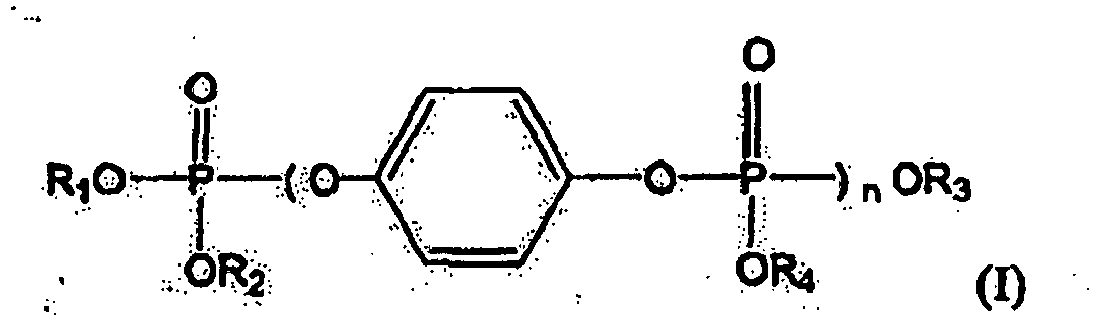
- In one aspect of the present invention, it has been surprisingly found that oligomeric phosphates within general formula I, wherein n has an average value of 1.02, are in the form of free-flowing powders. Typically, but not limited thereto, "free-flowing powder" as applied to the oligomeric phosphates of formula I have average particle sizes of about 10 µm to about 80 µm. These free-flowing powders, when compounded with resins, avoid the previously discussed handling problems as well as impart improved physical properties such as, UV stability, greater hydrolytic stability and higher heat distortion temperature (HDT) to the resin compositions as compared with previously provided oligomeric phosphate containing flame-retarded resin compositions.
- In another aspect of the invention, oligomeric phosphates within the general formula I, wherein n has an average value greater than about 1.1, while characterized as waxy-like solids, still unexpectedly impart improved UV stability, hydrolytic stability and higher HDT values to resin compositions containing the same as compared with resin compositions containing previously employed oligomeric phosphate flame retardants.
- The present invention is directed to resin compositions comprising oligomeric phosphate flame retardants and a resin. In particular, the present invention is directed to oligomeric hydroquinone bis-phosphate flame retardants having the structure of formula (I) above wherein R1, R2, R3 arid R4 each is phenyl and n has an average value of 1.02. In particular the oligomeric bis- phosphate within formula I above is hydroquinone bis-(diphenylphosphate), i.e., R1, R2, R3 and R4 are each phenyl.
- In the general, the oligomeric hydroquinone bis-phosphates of the present invention are prepared by reacting a diaryl halophosphate with hydroquinone in the presence of a catalyst. In a preferred embodiment of the invention, diphenylchlorophosphate (DPCP) is reacted with hydroquinone in the presence of MgCl2 to produce hydroquinone bis-(diphenylphosphate). In accordance with the present invention, hydroquinone bis (diphenylphosphate) within general formula I prepared by this process will have an average n value of 1.02, such as prepared in Example 1 below.
- In another embodiment, the hydroquinone bis-phosphate oligomers of the present invention are prepared by reacting hydroquinone with a reaction mixture comprising a diarylhalophosphate (such as diphenylchlorophosphate) and a monoaryldihalophosphate (such as monophenyl dichlorophosphate (MPCP)) in the presence of a catalyst, such as MgCl2. A process such as this is described in
U.S. Patent No. 5,457,221 . In accordance with the present invention, hydroquinone bis-phosphate oligomers within general formula I prepared by this process will have an average n value of from about 1.1 to about 2.0 and are generally waxy-like solids, such as prepared in Example 2 below. - In one preferred embodiment of the invention, high purity (99%) diphenylchlorophosphate (DPCP) is reacted with hydroquinone to yield essentially pure dimer, i.e. average n value of about 1.02, as illustrated by Example 1 below. The relatively pure dimer has a higher melting point than oligomers prepared from less pure DPCP and provides for a free-flowing powder product.
- Typically, the value of n in formula I is calculated by firstly determining the proportions of oligomeric phosphate species (oligophosphates) in the product by high pressure liquid chromatography (HPLC) measurements. The weight average (n) value is then determined (calculated) in known manner from the proportions of the oligophosphates. In calculating the value of n, monophosphate species, e.g. triphenylphosphate, may or may not be included in the calculation. The n values ascribed to the oligomeric bis-phosphates of the present invention were calculated omitting the monophosphate species in the calculation. However, if the monophosphate species are considered (used) in the calculation, lower n values, depending on the amount of monophosphate species present, may result.
- As indicated above, the present invention is directed to resin compositions comprising a flame retardant effective amount of the oligomeric flame retardants of formula I and at least one resin. The resins used in the compositions of the present invention are selected from a group consisting of styrenic polymers and copolymers, polyphenylene oxide (PPO), acrylonitrile butadiene styrene (ABS), polycarbonate (PC) and mixtures thereof. Specific resins used include PC/ABS mixtures, high impact polystyrene (HIPS) and PPO/HIPS. These types of resins or polymer mixtures are described for example in
U.S. Patent No. Re. 36,188 ,U.S. Patent Nos. 6,727,301 and6,753,366 . The flame-retarded resin compositions of the present invention are typically useful, for example, in the production of domestic appliances, castings for electrical devices, bedding, furniture and automotive components. - The amount of oligomeric phosphate flame retardant typically used in the resin compositions of the present invention generally range from about 2% to about 20%, by weight, of the total weight of the composition, preferably from about 7% to about 15%, by weight, of the total weight of the composition, with the remainder being resin. The flame retarded resin compositions of the present invention can also include other additives such as antioxidants, stabilizers, fillers as well as other flame retardants.
- A preferred flame retarded resin composition of the present invention comprises an effective flame retardant amount of hydroquinone bis-(diphenylphosphate) having an average value of n of about 1.02, a polycarbonate and a styrene-containing resin copolymer. A representative polycarbonate that can be used in the compositions of the present invention is Lexan, commercially available from General Electric Company.
- The following examples are used to illustrate the present invention.
- The following table identifies the reaction mixture used in the preparation of a flame-retardant oligomeric hydroquinone bis (diphenylphosphate) in accordance with the present invention.
Reaction Mixture wt. (g) moles diphenyl chlorophosphate 1087.8 4:0492 Hydroquinone 295.1 2.0246 magnesium chloride (MgCl2) (catalyst) 3.2414 0.0340 - A reaction calorimeter with a glass reactor, chiller for the condenser, and caustic scrubber system.
- Diphenyl chlorophosphate, hydroquinone and MgCl2 were charged to the reactor under an atmosphere of N2. TR (temperature of reaction) was raised slowly to 140°C over a 1 hour period.
- At approximately 104°C, hydroquinone was almost completely dissolved, HCl gas evolution began and was visible.
- As the reaction temperature approached the set point temperature (140°C), the HCl gas evolution was very rapid. The temperature was held at 140°C for about 10 hours. The reaction was completed and cooled to room temperature after reaching the endpoint acid number titration value of one or less.
- The temperature of the crude reaction mixture was raised slowly to about 107°C over a 30 minute period and was toluene added to the crude reaction mixture to facilitate washing of the material. The washing of the crude reaction mixture was performed at 85-90°C with approximately 1000 grams of a 0.4% aqueous oxalic acid solution followed by deionized water then followed by 1000 grams of a 3.5% aqueous sodium hydroxide and finished by deionized water. The pH of the final wash was about 7.
- Toluene/water mixture was removed from the washed product via a rotary evaporator under vacuum and at temperatures of about 95° to about 99°C and then dried in an oven at 110°C overnight to become totally molten. The next day the molten product was poured into a stainless steel pan to facilitate crystallization.
- An 82% yield of a fine white free-flowing powdery product was recovered and identified as hydroquinone bis (diphenylphosphate), having an average n value of about 1.02.
- The product was analyzed, using High Pressure Liquid Chromatography (HPLC), for phenol, toluene, triphenylphosphate (TPP) and oligomeric content and the results are reported as normalized area percent (Norm A%) and weight percent (wt %) in the table below. P2 to P6 refers to the number of phosphorus atoms in the oligomer.
HPLC DATA Norm A% Wt% Phenol 0.00 <0.01 Toluene 0.29 0.34 TPP 0.56 0.60 P2 97.58 97.90 P3 1.27 P4 0.24 P5 0.04 P6 0.01 - As can be seen from the data above, the final product is almost 98% pure dimer of hydroquinone bis (diphenylphosphate). The product obtained is a free-flowing powder having an average n value of about 1.02, as determined in known manner from the proportions of individual constituent oligophosphates obtained by HPLC.
- The same procedure as described in Example 1 was used for preparation of oligomeric hydroquinone bis (diphenylphosphate) (HDP) of the present invention wherein the process utilizes the addition of monophenyl dichlorophosphate (MPCP) to produce an oligomeric product (HDP) having an average n value of about 1.15, as determined in known manner using the proportions of the individual constituent oligophosphates obtained by HPLC.
Reaction Mixture* wt. (g) moles diphenyl chlorophosphate 977.60 3.638 monophenyl dichlorophosphate 49.76 0.236 Triphenylphosphate* 31.34 0.096 Hydroquinone 225.40 2.047 magnesium chloride (MgCl2) 1.6246 0.017 *The reaction mixture contained a small amount of unreactive triphenylphosphate which is present as a by-product in the production of the diphenyl chlorophosphate and monophenyl dichlorophosphate as described in U.S. Patent No. 5,457,221 . - An 87% yield of the product was recovered. The white solid recovered appeared to have a waxy-like texture and was not free-flowing. The waxy-like texture of the recovered material presumably was due to the presence of other oligomeric phosphorus species in addition to the dimer.
- The product was analyzed using HPLC and the results presented in the table below. Here, in contrast to Example 1, higher amounts of other oligomeric phosphate species are present. The hydroquinone bis (diphenylphosphate) oligomer blend obtained was a waxy-like solid having average n value of about 1.15 as determined in known manner using the proportions of the individual oligophosphates obtained by HPLC.
HPLC DATA Norm A% Wt% Phenol 0.01 0.01 Toluene 0.00 0 TPP 3.45 3.68 P2 79.41 79.20 P3 13.93 P4 2.61 P5 0.49 P6 0.10 - PC/ABS resin compositions containing the hydroquinone-bis(diphenylphosphate) (HDP) (average n value of 1.02) free-flowing powder obtained in Example 1 were compared with PC/ABS resins containing resorcinol bis(diphenylphosphate) (Fyrolflex RDP) (average n value of 1.28), bisphenol A bis(diphenylphosphate) (Fyrolflex BDP) (average n value of 1.14) (both available from Supresta), and bis-xylenylphosphate PX200(RXP) (available from Daihachi Chemical Industry Co. Ltd.). UV stability, hydrolytic stability and HDT (heat deflection temperature) values were obtained and compared and the results are illustrated in Examples 3-5 below. Each of the resin compositions also contained 0.30% by weight, of the total weight of the resin composition, PTFE (Teflon®) as an anti-dripping agent.
- PC/ABS composites containing, as flame retardants respectively, Fyrolflex RDP (n=1.28), Fyrolflex BDP (n=1.14), PX200 (RXP) (n value unavailable) and HDP (n=1.02) of the present invention (prepared in Example 1), were formulated in compositions of similar flammability (UL-94/V0, 1.6mm flammability rated). The composites were extrusion compounded and further dispersed in the injection molding process. Of these moldings, test bars were prepared and placed in the Q-UV panel test for accelerated UV exposure. The four composites were equally exposed to UV irradiation in the testing device (Q-UV Panel tester) for about 500hr. (UV light alone). The exposed samples were visually judged by five individuals for the degree of color degradation of each sample, giving a point value of one (best) for the composite with the least developed color and 5 (worst) to the compound with the highest color change and the results are reported in the table below.
UV Stability Testing of FR-PC/ABS Composites* PC/ABS (4/1) Color Stability Ratings (1-Best to 5-worst) Total Neat PC/ABS 1 1 1 1 1 5 Fyrolflex RDP 3 4 4 4 4 19 Fyrolflex BDP 2 3 2 3 3 13 PX200 5 5 5 5 5 25 HDP 4 2 3 2 2 13 * +500hr exposure - Q-UV Panel Tester - Polycarbonate is susceptible to hydrolysis when exposed to high heat and humidity especially under acidic conditions, therefore flame retardants with better hydrolytic stability have less effect on de-stabilizing the polymer composite. Phosphate esters are sensitive to high heat and moisture and can hydrolyze to acid species and affect the stability of these composites.
- In terms of hydrolytic stability, the PC/ABS resin containing the HDP having an average n value of about 1.02, as prepared in Example 1, showed unexpected improvement relative to the other flame retarded PC/ABS resin composites tested. The composites tested were formulated in FR-PC/ABS to UL94/V0 flammability specifications. The composite pellets were each prepared with the same Fyrolflex RDP, Fyrolflex BDP and PX200 (RXP) identified above and the hydroquinone bis(diphenylphosphate) (HDP) prepared in Example 1 and placed in sealed tubes with deionized water separated by glass wool. The stability of the PC portion of the composites relative to the blended flame retardant was measured after exposure to an accelerated environment. The setup for each of the tested materials were placed in an oven preset to a temperature of 107°C for various time intervals.
- It was determined that the hydrolytic stability of the PC/ABS resin composite containing the HDP of the present invention was better than the resin composites containing Fyrolflex RDP and Fyrolflex BDP and similar to the resin composite containing PX200 (RXP) at 90 hours. In particular, the hydrolytic stability of the resin containing the HDP of the present invention was better than the resins containing Fyrolflex RDP and Fyrolflex BDP. The PX200 (RXP) containing composite was more stable than the HDP containing composite in the early stages of exposure but showed similar levels of stability after ninety hours of accelerated exposure. The values shown in the table below are the average molecular weights of the polycarbonate of the composites tested measured using gas phase chromatography (GPC).
FR Additive PC Molecular Weight (avg) PC/ABS Levels 0 hrs. 30 hrs. 90 hrs. % Fyrolflex RDP 9 55000 46000 24000 Fyrolflex BDP 12.3 54000 49000 42000 PX200 (RXP) 12.3 62000 55000 49200 HDP 9 54500 53400 48900 - One of the key properties for any engineered resin is its heat distortion temperature (HDT) value. In the operation of electronic devices heat is generated in the appliance sourced from either a standard household current or remotely from batteries. If a composite has too low a HDT value for a given application, the plastic part may soften and be rendered useless for the device. Thus, phosphate compositions possessing a higher HDT are preferred over phosphate composites with lower HDT values since it often is a critical parameter in choosing the appropriate material.
- The standard for testing this parameter is ASTM-D-648. Tested under similar loads (264 psi), the HDT values were determined for resin compositions containing, as a flame retardants, Fyrolflex RDP (same as above), Fyrolflex BDP (same as above), PX200 (RXP) (same as above) and the hydroquinone bis(diphenylphosphate) prepared in Example 1. Each of the compositions was prepared with enough flame retardant to provide compositions having comparable FR performance levels. The results are reported in the table below.
Additive Heat Deflection Temperature* PC/ABS Levels °C % @ 18.2 bar (@264psi) Fyrolflex RDP 9 84.4 Fyrolflex BDP 12.3 84.6 PX200 (RXP) 12.3 93.9 HDP 9 91.9 *ASTM-D648 - As can be seen from the data above, the PC/ABS resin composite containing the HDP of present invention was found to be significantly better than both the resorcinol bis-(diphenylphosphate)(RDP) and bisphenol A bis-phosphate (BDP) analogues. The resorcinol bis-xylenylphosphate (PX200) analog was slightly higher when tested using the same protocol (ASTM-D648).
- The overall performance of the four resin composites tested in Examples 3-5 were rated and the results presented in the chart below. Each resin composite containing, as a flame retardant, respectively, Fyrolflex RDP, Fyrolflex BDP, PX200 (RXP) and the hydroquinone bis-(diphenylphosphate) prepared in Example 1, was rated using a point value of 1 to represent the resin composition having the best UV stability (Example 3), hydrolytic stability (Example 4) and HDT (Example 5) as measured in each Example. In this comparison, the higher the number, the poorer the resin composite performed as compared to the other resin composites in the same Example. The values were then added together to give a single performance number, with the lowest number indicating the resin composite with the best overall combined performance for UV stability, hydrolytic stability and HDT.
ADDITIVE UV STABILITY Example 3 HYDROLYTIC STABILITY Example 4 HDT Example 5 OVERALL PERFORMANCE Fyrolflex RDP 2 3 3* 8 Fyrolflex BDP 1* 2 3* 6 PX200 (RXP) 3 1* 1 5 HDP 1* 1* 2 4 *identical or similar performance in given test protocol. - As can be seen from the above data, the resin composite containing the HDP of the present invention demonstrates the best overall performance of all the resin composites tested. In other words, the resin composite containing the HDP of the present invention has the best combined UV stability, hydrolytic stability and HDT physical properties of the samples tested.
-
Additive UL94 Level (AFT) Composite FR-PC Composites PC-MF11/AF-098-T 5 V-0 (1.7) PC-MF23/AF-098-T 5 V1 (3.7) PC MF23/AF-098T/TPP 5.0/0.3% V-0 (0) (0) PC/MF11 = Lexan 141, GE Plastics
PC/MF23 - Calibre 200, Dow
AFT= Average Flam Time - Some polycarbonate resins were more difficult to flame retard (as tested by the UL94 protocol) possibly due to polymer branching and/or relatively high melt flow viscosity. For these resins it was found that simple doping of a vapor phase FR additive such as triphenyl phosphate could resolve these flammability issues. Other vapor phase FR additives useful for this purpose include monophosphate esters such as, Isopropylphenyl diphenyl phosphate, t-butylated phenyl diphenyl phosphate, cresylic phosphates. Additional vapor phase FR additives include Brominated polycarbonate oligomers, Brominated polystyrene, Potassium diphenyl sulphone sulphonate (KSS), Phosphinate salts, Ammonium polyphosphates, Melamine cyanurate, Melamine pyrophosphate.
-
Additive Tensile Flexural HDT Izod Level Strength Modulus Strength 18.2 bar (264 psi) Impact Composite % bar (psi) bar (psi) bar (psi) °C J/cm(ft.-lb/in) FR-PC Composites 6894 (105) 69 (103) PC-MF11/AF-098-T 5 604 (8766) 0.27 (3.95) 1 (15.0) 107.8 0.51 (0.95) PC-MP23/AF-098-T 5 615 (8923) 0.25 (3.62) 0.97(14.0) 109.5 0.42 (0.79) PC MF23/AF-098T/TPP 5.0/0.3% 626 (9091) 0.26 (3.8) 1 (15.0) 105.6 0.48 (0.9) PC/MF11 = Lexan 141, GE Plastics
PC/MF23 - Calibre 200, Dow - As triphenyl phosphate has more "plasticizing efficiency", the net effect of this doping shows nominal influence to other physical properties such as heat distortion temperature (slightly lowered) and impact strength (slightly improved). Other tested property results were considered within experimental range.
Claims (2)
- A resin composition comprising;(i) a flame retardant effective amount of a mixture of phosphates having the following general formula I:
 (ii) a resin selected from a group consisting of styrenic polymers and copolymers, polyphenylene oxide (PPO), acrylonitrile butadiene styrene (ABS), polycarbonates (PC), high impact polystyrene (HIPS) and mixtures thereof, or a resin which is PC/ABS and/or PPO/HIPS.
 - The resin composition of Claim 1 wherein said resin composition contains from 2% to 20% by weight, of the total composition, of the mixture of phosphates of formula I.
Applications Claiming Priority (2)
| Application Number | Priority Date | Filing Date | Title |
|---|---|---|---|
| US84145906P | 2006-08-31 | 2006-08-31 | |
| PCT/US2007/019172 WO2008027536A1 (en) | 2006-08-31 | 2007-08-30 | Oligomeric bis-phosphate flame retardants and compositions containing the same |
Publications (2)
| Publication Number | Publication Date |
|---|---|
| EP2089402A1 EP2089402A1 (en) | 2009-08-19 |
| EP2089402B1 true EP2089402B1 (en) | 2015-08-05 |
Family
ID=38805825
Family Applications (1)
| Application Number | Title | Priority Date | Filing Date |
|---|---|---|---|
| EP07837596.1A Active EP2089402B1 (en) | 2006-08-31 | 2007-08-30 | Oligomeric bis-phosphate flame retardants and compositions containing the same |
Country Status (7)
| Country | Link |
|---|---|
| US (1) | US8119711B2 (en) |
| EP (1) | EP2089402B1 (en) |
| JP (1) | JP5508013B2 (en) |
| KR (1) | KR101416843B1 (en) |
| CN (1) | CN101511850B (en) |
| TW (1) | TWI400246B (en) |
| WO (1) | WO2008027536A1 (en) |
Cited By (2)
| Publication number | Priority date | Publication date | Assignee | Title |
|---|---|---|---|---|
| WO2018047166A1 (en) * | 2016-09-08 | 2018-03-15 | Bromine Compounds Ltd. | Flame-retarded transparent polycarbonate compositions |
| US11111376B2 (en) | 2017-03-30 | 2021-09-07 | Bromine Compounds Ltd. | Flame-retarded styrene-containing formulations |
Families Citing this family (21)
| Publication number | Priority date | Publication date | Assignee | Title |
|---|---|---|---|---|
| CN102264747B (en) * | 2008-12-22 | 2014-09-24 | Icl-Ip美国公司 | Water miscible solvent based process for purifying bisphosphate |
| US20120123007A1 (en) * | 2009-02-26 | 2012-05-17 | Smadar Hini | Styrenic polymer composition |
| US20120121877A1 (en) * | 2009-03-09 | 2012-05-17 | Levchik Sergei V | Flame retarded polyolefin composition |
| MX2012008979A (en) | 2010-02-05 | 2012-08-23 | Basf Se | Flame retardant. |
| CN102532191B (en) * | 2010-12-22 | 2014-11-12 | 第一毛织株式会社 | Novel phosphorus compound, method for preparing the same, and flame retardant thermoplastic resin composition comprising the same |
| JP2013076057A (en) * | 2011-09-14 | 2013-04-25 | Daicel Polymer Ltd | Plasticizer and cellulose ester composition |
| KR20130046974A (en) * | 2011-10-28 | 2013-05-08 | 엘지이노텍 주식회사 | Optical member, display device having the same and method of fabricating the same |
| KR101489956B1 (en) * | 2011-12-30 | 2015-02-06 | 제일모직주식회사 | Flame retardant thermoplastic resin composition |
| JP2014009297A (en) * | 2012-06-29 | 2014-01-20 | Daicel Polymer Ltd | Plasticizer for cellulose acetate |
| JP2014177596A (en) * | 2013-03-15 | 2014-09-25 | Ricoh Co Ltd | Recycled resin composition, molding, image forming apparatus, and method for producing recycled resin composition |
| US20150099845A1 (en) * | 2013-10-07 | 2015-04-09 | Sabic Innovative Plastics Ip B.V. | Flame retardant thermoplastic compositions with improved properties |
| KR20160043610A (en) * | 2014-10-13 | 2016-04-22 | 삼성에스디아이 주식회사 | Thermoplastic resin composition with excellent transparency and mechanical properties and article comprising the same |
| CN107207841B (en) * | 2014-12-23 | 2020-01-10 | 沙特基础工业全球技术公司 | Reinforced polycarbonate composition |
| US11898304B2 (en) | 2015-06-09 | 2024-02-13 | Bromine Compounds Ltd. | Antimony free brominated flame retardant system for textiles |
| KR20190046823A (en) * | 2016-08-29 | 2019-05-07 | 아이씨엘-아이피 아메리카 아이엔씨. | Flame retardant polyamide composition |
| WO2018073819A1 (en) | 2016-10-18 | 2018-04-26 | Bromine Compounds Ltd. | Flame-retarded polyester formulations |
| JP6924825B2 (en) | 2016-10-18 | 2021-08-25 | ブローミン コンパウンズ リミテッド | Flame-retardant polyester composition |
| PL3601425T3 (en) | 2017-03-30 | 2021-09-20 | Bromine Compounds Ltd. | Flame-retarded styrene-containing compositions |
| KR102110435B1 (en) * | 2018-06-27 | 2020-06-08 | 듀라원 주식회사 | Waterproofing polyurea resin paints composition for protective explosion and earthquake-proof having flame retardant and preparation method thereof |
| JP7280133B2 (en) * | 2019-07-17 | 2023-05-23 | 旭化成株式会社 | Polyphenylene ether resin composition |
| WO2025074362A1 (en) | 2023-10-01 | 2025-04-10 | Bromine Compounds Ltd. | Flame-retarded reinforced polycarbonate compositions |
Citations (3)
| Publication number | Priority date | Publication date | Assignee | Title |
|---|---|---|---|---|
| US5219510A (en) * | 1990-09-26 | 1993-06-15 | Eastman Kodak Company | Method of manufacture of cellulose ester film |
| US5952408A (en) * | 1994-12-01 | 1999-09-14 | Cheil Industries, Inc. | Flameproof thermoplastic resin compositions |
| JP2000159980A (en) * | 1998-11-27 | 2000-06-13 | Toshiba Chem Corp | Epoxy resin composition, coil cast product and semiconductor sealing device |
Family Cites Families (19)
| Publication number | Priority date | Publication date | Assignee | Title |
|---|---|---|---|---|
| JPS5139272B2 (en) * | 1972-04-21 | 1976-10-27 | ||
| GB1405983A (en) | 1972-03-03 | 1975-09-10 | Mitsubishi Rayon Co | Fireproof polyester composition |
| CH583269A5 (en) | 1973-03-09 | 1976-12-31 | Sandoz Ag | |
| JPS63227632A (en) * | 1987-03-17 | 1988-09-21 | Daihachi Kagaku Kogyosho:Kk | Production of flame retardant |
| JP2699397B2 (en) | 1988-04-18 | 1998-01-19 | ダイアホイルヘキスト株式会社 | Composite polyester film |
| JPH06184357A (en) * | 1992-08-28 | 1994-07-05 | Asahi Chem Ind Co Ltd | Resin composition |
| US5420327A (en) * | 1992-09-14 | 1995-05-30 | Akzo Nobel N.V. | Process for forming hydrocarbyl bisphosphate compound |
| US5457221A (en) * | 1993-03-03 | 1995-10-10 | Akzo Nobel N.V. | Process for the manufacture of poly (hydrocarbylene aryl phosphate) compositions |
| JP3269218B2 (en) * | 1993-10-15 | 2002-03-25 | 東レ株式会社 | Flame retardant liquid crystal polyester composition |
| KR950032580A (en) | 1994-03-14 | 1995-12-22 | 마에다 가츠노스케 | Flame retardant polymer composition and molded article |
| JP3484802B2 (en) * | 1994-03-14 | 2004-01-06 | 東レ株式会社 | Flame retardant polymer composition and molded article |
| JPH0812868A (en) * | 1994-04-28 | 1996-01-16 | Toray Ind Inc | Thermoplastic resin composition |
| JP2814214B2 (en) * | 1995-08-10 | 1998-10-22 | 三洋化成工業株式会社 | Phosphate ester compound, flame retardant and flame retardant resin composition |
| JPH09132720A (en) * | 1995-09-06 | 1997-05-20 | Toray Ind Inc | Flame retardant resin composition |
| JP3724861B2 (en) * | 1995-10-19 | 2005-12-07 | 旭化成ケミカルズ株式会社 | Method for producing flame retardant resin composition containing polyphenylene ether |
| JP3558454B2 (en) * | 1996-06-28 | 2004-08-25 | 旭化成ケミカルズ株式会社 | Method for producing phosphate ester |
| GB2325933A (en) * | 1997-06-02 | 1998-12-09 | Samsung General Chemicals Co | Flame retardant bis-[2,4-bis(dimethylethyl)phenyl-2,6-dimethylphenyl] aryl diphosphate compounds, method for their production & resin compositions of the same |
| JP2002105335A (en) * | 2000-07-26 | 2002-04-10 | Polyplastics Co | Flame retardant resin composition |
| DE10234420A1 (en) * | 2002-07-29 | 2004-02-12 | Bayer Ag | Impact-modified polycarbonate blends |
-
2007
- 2007-08-30 EP EP07837596.1A patent/EP2089402B1/en active Active
- 2007-08-30 US US12/310,454 patent/US8119711B2/en active Active
- 2007-08-30 TW TW096132309A patent/TWI400246B/en active
- 2007-08-30 KR KR1020097006418A patent/KR101416843B1/en active Active
- 2007-08-30 WO PCT/US2007/019172 patent/WO2008027536A1/en not_active Ceased
- 2007-08-30 CN CN2007800323754A patent/CN101511850B/en active Active
- 2007-08-30 JP JP2009526738A patent/JP5508013B2/en active Active
Patent Citations (3)
| Publication number | Priority date | Publication date | Assignee | Title |
|---|---|---|---|---|
| US5219510A (en) * | 1990-09-26 | 1993-06-15 | Eastman Kodak Company | Method of manufacture of cellulose ester film |
| US5952408A (en) * | 1994-12-01 | 1999-09-14 | Cheil Industries, Inc. | Flameproof thermoplastic resin compositions |
| JP2000159980A (en) * | 1998-11-27 | 2000-06-13 | Toshiba Chem Corp | Epoxy resin composition, coil cast product and semiconductor sealing device |
Non-Patent Citations (2)
| Title |
|---|
| NANASAWA ET AL, J. APPL. POLYMER SCI., vol. 66, 1997, pages 2269 - 2277 * |
| WANG LIANG'EN ET AL: "Characterization of polyphenyl phosphate", FUZHOU DAXUE XUEBAO - FUZHOU UNIVERSITY. JOURNAL. NATURAL SCIENCE EDITION, FUZHOU DAXUE-FUZHOU UNIVERSITY, FUJIAN, CN, vol. 23, no. 1, 1 January 1995 (1995-01-01), pages 92 - 96, XP008120746, ISSN: 1000-2243 * |
Cited By (3)
| Publication number | Priority date | Publication date | Assignee | Title |
|---|---|---|---|---|
| WO2018047166A1 (en) * | 2016-09-08 | 2018-03-15 | Bromine Compounds Ltd. | Flame-retarded transparent polycarbonate compositions |
| US10934489B2 (en) | 2016-09-08 | 2021-03-02 | Bromine Compounds Ltd. | Flame-retarded transparent polycarbonate compositions |
| US11111376B2 (en) | 2017-03-30 | 2021-09-07 | Bromine Compounds Ltd. | Flame-retarded styrene-containing formulations |
Also Published As
| Publication number | Publication date |
|---|---|
| TW200831522A (en) | 2008-08-01 |
| WO2008027536A1 (en) | 2008-03-06 |
| JP2010502625A (en) | 2010-01-28 |
| KR20090045407A (en) | 2009-05-07 |
| TWI400246B (en) | 2013-07-01 |
| KR101416843B1 (en) | 2014-07-08 |
| CN101511850B (en) | 2013-04-24 |
| US20110034597A1 (en) | 2011-02-10 |
| EP2089402A1 (en) | 2009-08-19 |
| JP5508013B2 (en) | 2014-05-28 |
| US8119711B2 (en) | 2012-02-21 |
| CN101511850A (en) | 2009-08-19 |
Similar Documents
| Publication | Publication Date | Title |
|---|---|---|
| EP2089402B1 (en) | Oligomeric bis-phosphate flame retardants and compositions containing the same | |
| US8026303B2 (en) | Halogen-free flame retardant compositions, thermoplastic compositions comprising the same and methods of producing the compositions | |
| KR100455050B1 (en) | Cross-linked Phenoxyphosphazene Compound, Process for Producing the Same, Flame Retardant, Flame-Retardant Resin Composition, and Molded Flame-Retardant Resin | |
| EP0509506A2 (en) | Crystalline powders of aromatic diphosphates, their preparation and use | |
| JP5639082B2 (en) | Flame retardant thermoplastic composition, process for producing the same, and article containing the same | |
| WO2000012603A1 (en) | Powdery flame retardant | |
| EP3601436B1 (en) | Flame-retarded styrene-containing formulations | |
| EP3753998B1 (en) | Flame retardant containing aromatic phosphoric acid ester, and thermoplastic resin composition containing same | |
| US7439289B2 (en) | Benzoylresorcinol-based phosphate ester compounds as flame retardants | |
| CN110520467B (en) | Flame retardant styrene-containing polymer composition | |
| JP2911285B2 (en) | Flame retardant thermoplastic resin composition | |
| WO2012011519A1 (en) | Fire retarding agent containing cyclic amine salt, and fire-retardant resin composition | |
| JP2825466B2 (en) | Flame-retardant thermostable resin composition containing aromatic diphosphate | |
| KR20080047146A (en) | Cyclic phosphazene crosslinked by piperazine and flame retardant resin composition containing same | |
| KR20150143520A (en) | Flame-retardant agent composition and flame-retardant resin composition containing same, and molded article |
Legal Events
| Date | Code | Title | Description |
|---|---|---|---|
| PUAI | Public reference made under article 153(3) epc to a published international application that has entered the european phase |
Free format text: ORIGINAL CODE: 0009012 |
|
| 17P | Request for examination filed |
Effective date: 20090331 |
|
| AK | Designated contracting states |
Kind code of ref document: A1 Designated state(s): AT BE BG CH CY CZ DE DK EE ES FI FR GB GR HU IE IS IT LI LT LU LV MC MT NL PL PT RO SE SI SK TR |
|
| AX | Request for extension of the european patent |
Extension state: AL BA HR MK RS |
|
| 17Q | First examination report despatched |
Effective date: 20090923 |
|
| DAX | Request for extension of the european patent (deleted) | ||
| RAP1 | Party data changed (applicant data changed or rights of an application transferred) |
Owner name: ICL-IP AMERICA INC. |
|
| GRAP | Despatch of communication of intention to grant a patent |
Free format text: ORIGINAL CODE: EPIDOSNIGR1 |
|
| INTG | Intention to grant announced |
Effective date: 20150224 |
|
| GRAS | Grant fee paid |
Free format text: ORIGINAL CODE: EPIDOSNIGR3 |
|
| GRAP | Despatch of communication of intention to grant a patent |
Free format text: ORIGINAL CODE: EPIDOSNIGR1 |
|
| INTG | Intention to grant announced |
Effective date: 20150605 |
|
| GRAA | (expected) grant |
Free format text: ORIGINAL CODE: 0009210 |
|
| AK | Designated contracting states |
Kind code of ref document: B1 Designated state(s): AT BE BG CH CY CZ DE DK EE ES FI FR GB GR HU IE IS IT LI LT LU LV MC MT NL PL PT RO SE SI SK TR |
|
| REG | Reference to a national code |
Ref country code: GB Ref legal event code: FG4D |
|
| REG | Reference to a national code |
Ref country code: CH Ref legal event code: EP |
|
| REG | Reference to a national code |
Ref country code: AT Ref legal event code: REF Ref document number: 740665 Country of ref document: AT Kind code of ref document: T Effective date: 20150815 |
|
| REG | Reference to a national code |
Ref country code: IE Ref legal event code: FG4D |
|
| REG | Reference to a national code |
Ref country code: DE Ref legal event code: R096 Ref document number: 602007042473 Country of ref document: DE |
|
| REG | Reference to a national code |
Ref country code: AT Ref legal event code: MK05 Ref document number: 740665 Country of ref document: AT Kind code of ref document: T Effective date: 20150805 |
|
| REG | Reference to a national code |
Ref country code: LT Ref legal event code: MG4D |
|
| REG | Reference to a national code |
Ref country code: NL Ref legal event code: FP |
|
| PG25 | Lapsed in a contracting state [announced via postgrant information from national office to epo] |
Ref country code: GR Free format text: LAPSE BECAUSE OF FAILURE TO SUBMIT A TRANSLATION OF THE DESCRIPTION OR TO PAY THE FEE WITHIN THE PRESCRIBED TIME-LIMIT Effective date: 20151106 Ref country code: LV Free format text: LAPSE BECAUSE OF FAILURE TO SUBMIT A TRANSLATION OF THE DESCRIPTION OR TO PAY THE FEE WITHIN THE PRESCRIBED TIME-LIMIT Effective date: 20150805 Ref country code: LT Free format text: LAPSE BECAUSE OF FAILURE TO SUBMIT A TRANSLATION OF THE DESCRIPTION OR TO PAY THE FEE WITHIN THE PRESCRIBED TIME-LIMIT Effective date: 20150805 Ref country code: FI Free format text: LAPSE BECAUSE OF FAILURE TO SUBMIT A TRANSLATION OF THE DESCRIPTION OR TO PAY THE FEE WITHIN THE PRESCRIBED TIME-LIMIT Effective date: 20150805 |
|
| PG25 | Lapsed in a contracting state [announced via postgrant information from national office to epo] |
Ref country code: PT Free format text: LAPSE BECAUSE OF FAILURE TO SUBMIT A TRANSLATION OF THE DESCRIPTION OR TO PAY THE FEE WITHIN THE PRESCRIBED TIME-LIMIT Effective date: 20151207 Ref country code: PL Free format text: LAPSE BECAUSE OF FAILURE TO SUBMIT A TRANSLATION OF THE DESCRIPTION OR TO PAY THE FEE WITHIN THE PRESCRIBED TIME-LIMIT Effective date: 20150805 Ref country code: AT Free format text: LAPSE BECAUSE OF FAILURE TO SUBMIT A TRANSLATION OF THE DESCRIPTION OR TO PAY THE FEE WITHIN THE PRESCRIBED TIME-LIMIT Effective date: 20150805 Ref country code: ES Free format text: LAPSE BECAUSE OF FAILURE TO SUBMIT A TRANSLATION OF THE DESCRIPTION OR TO PAY THE FEE WITHIN THE PRESCRIBED TIME-LIMIT Effective date: 20150805 Ref country code: SE Free format text: LAPSE BECAUSE OF FAILURE TO SUBMIT A TRANSLATION OF THE DESCRIPTION OR TO PAY THE FEE WITHIN THE PRESCRIBED TIME-LIMIT Effective date: 20150805 Ref country code: IS Free format text: LAPSE BECAUSE OF FAILURE TO SUBMIT A TRANSLATION OF THE DESCRIPTION OR TO PAY THE FEE WITHIN THE PRESCRIBED TIME-LIMIT Effective date: 20151205 |
|
| REG | Reference to a national code |
Ref country code: CH Ref legal event code: PL |
|
| PG25 | Lapsed in a contracting state [announced via postgrant information from national office to epo] |
Ref country code: EE Free format text: LAPSE BECAUSE OF FAILURE TO SUBMIT A TRANSLATION OF THE DESCRIPTION OR TO PAY THE FEE WITHIN THE PRESCRIBED TIME-LIMIT Effective date: 20150805 Ref country code: CZ Free format text: LAPSE BECAUSE OF FAILURE TO SUBMIT A TRANSLATION OF THE DESCRIPTION OR TO PAY THE FEE WITHIN THE PRESCRIBED TIME-LIMIT Effective date: 20150805 Ref country code: DK Free format text: LAPSE BECAUSE OF FAILURE TO SUBMIT A TRANSLATION OF THE DESCRIPTION OR TO PAY THE FEE WITHIN THE PRESCRIBED TIME-LIMIT Effective date: 20150805 Ref country code: LI Free format text: LAPSE BECAUSE OF NON-PAYMENT OF DUE FEES Effective date: 20150831 Ref country code: CH Free format text: LAPSE BECAUSE OF NON-PAYMENT OF DUE FEES Effective date: 20150831 Ref country code: SK Free format text: LAPSE BECAUSE OF FAILURE TO SUBMIT A TRANSLATION OF THE DESCRIPTION OR TO PAY THE FEE WITHIN THE PRESCRIBED TIME-LIMIT Effective date: 20150805 |
|
| REG | Reference to a national code |
Ref country code: DE Ref legal event code: R097 Ref document number: 602007042473 Country of ref document: DE |
|
| PG25 | Lapsed in a contracting state [announced via postgrant information from national office to epo] |
Ref country code: RO Free format text: LAPSE BECAUSE OF FAILURE TO SUBMIT A TRANSLATION OF THE DESCRIPTION OR TO PAY THE FEE WITHIN THE PRESCRIBED TIME-LIMIT Effective date: 20150805 Ref country code: MC Free format text: LAPSE BECAUSE OF FAILURE TO SUBMIT A TRANSLATION OF THE DESCRIPTION OR TO PAY THE FEE WITHIN THE PRESCRIBED TIME-LIMIT Effective date: 20150805 |
|
| REG | Reference to a national code |
Ref country code: IE Ref legal event code: MM4A |
|
| PLBE | No opposition filed within time limit |
Free format text: ORIGINAL CODE: 0009261 |
|
| STAA | Information on the status of an ep patent application or granted ep patent |
Free format text: STATUS: NO OPPOSITION FILED WITHIN TIME LIMIT |
|
| 26N | No opposition filed |
Effective date: 20160509 |
|
| GBPC | Gb: european patent ceased through non-payment of renewal fee |
Effective date: 20151105 |
|
| PG25 | Lapsed in a contracting state [announced via postgrant information from national office to epo] |
Ref country code: IE Free format text: LAPSE BECAUSE OF NON-PAYMENT OF DUE FEES Effective date: 20150830 |
|
| REG | Reference to a national code |
Ref country code: FR Ref legal event code: ST Effective date: 20160722 |
|
| PG25 | Lapsed in a contracting state [announced via postgrant information from national office to epo] |
Ref country code: SI Free format text: LAPSE BECAUSE OF FAILURE TO SUBMIT A TRANSLATION OF THE DESCRIPTION OR TO PAY THE FEE WITHIN THE PRESCRIBED TIME-LIMIT Effective date: 20150805 |
|
| PG25 | Lapsed in a contracting state [announced via postgrant information from national office to epo] |
Ref country code: GB Free format text: LAPSE BECAUSE OF NON-PAYMENT OF DUE FEES Effective date: 20151105 |
|
| PG25 | Lapsed in a contracting state [announced via postgrant information from national office to epo] |
Ref country code: FR Free format text: LAPSE BECAUSE OF NON-PAYMENT OF DUE FEES Effective date: 20151005 |
|
| PG25 | Lapsed in a contracting state [announced via postgrant information from national office to epo] |
Ref country code: MT Free format text: LAPSE BECAUSE OF FAILURE TO SUBMIT A TRANSLATION OF THE DESCRIPTION OR TO PAY THE FEE WITHIN THE PRESCRIBED TIME-LIMIT Effective date: 20150805 |
|
| PG25 | Lapsed in a contracting state [announced via postgrant information from national office to epo] |
Ref country code: HU Free format text: LAPSE BECAUSE OF FAILURE TO SUBMIT A TRANSLATION OF THE DESCRIPTION OR TO PAY THE FEE WITHIN THE PRESCRIBED TIME-LIMIT; INVALID AB INITIO Effective date: 20070830 Ref country code: BG Free format text: LAPSE BECAUSE OF FAILURE TO SUBMIT A TRANSLATION OF THE DESCRIPTION OR TO PAY THE FEE WITHIN THE PRESCRIBED TIME-LIMIT Effective date: 20150805 |
|
| PG25 | Lapsed in a contracting state [announced via postgrant information from national office to epo] |
Ref country code: CY Free format text: LAPSE BECAUSE OF FAILURE TO SUBMIT A TRANSLATION OF THE DESCRIPTION OR TO PAY THE FEE WITHIN THE PRESCRIBED TIME-LIMIT Effective date: 20150805 |
|
| PG25 | Lapsed in a contracting state [announced via postgrant information from national office to epo] |
Ref country code: TR Free format text: LAPSE BECAUSE OF FAILURE TO SUBMIT A TRANSLATION OF THE DESCRIPTION OR TO PAY THE FEE WITHIN THE PRESCRIBED TIME-LIMIT Effective date: 20150805 |
|
| PG25 | Lapsed in a contracting state [announced via postgrant information from national office to epo] |
Ref country code: LU Free format text: LAPSE BECAUSE OF NON-PAYMENT OF DUE FEES Effective date: 20150830 |
|
| PGFP | Annual fee paid to national office [announced via postgrant information from national office to epo] |
Ref country code: BE Payment date: 20180827 Year of fee payment: 12 |
|
| REG | Reference to a national code |
Ref country code: BE Ref legal event code: MM Effective date: 20190831 |
|
| PG25 | Lapsed in a contracting state [announced via postgrant information from national office to epo] |
Ref country code: BE Free format text: LAPSE BECAUSE OF NON-PAYMENT OF DUE FEES Effective date: 20190831 Ref country code: IT Free format text: LAPSE BECAUSE OF NON-PAYMENT OF DUE FEES Effective date: 20190830 |
|
| PGFP | Annual fee paid to national office [announced via postgrant information from national office to epo] |
Ref country code: NL Payment date: 20250826 Year of fee payment: 19 |
|
| PGFP | Annual fee paid to national office [announced via postgrant information from national office to epo] |
Ref country code: DE Payment date: 20250827 Year of fee payment: 19 |