EP1960370B1 - Pyridiazinone derivatives for tumour treatment - Google Patents
Pyridiazinone derivatives for tumour treatment Download PDFInfo
- Publication number
- EP1960370B1 EP1960370B1 EP06806700A EP06806700A EP1960370B1 EP 1960370 B1 EP1960370 B1 EP 1960370B1 EP 06806700 A EP06806700 A EP 06806700A EP 06806700 A EP06806700 A EP 06806700A EP 1960370 B1 EP1960370 B1 EP 1960370B1
- Authority
- EP
- European Patent Office
- Prior art keywords
- ylmethyl
- phenyl
- pyridazin
- oxo
- difluorophenyl
- Prior art date
- Legal status (The legal status is an assumption and is not a legal conclusion. Google has not performed a legal analysis and makes no representation as to the accuracy of the status listed.)
- Active
Links
- SPGKYPKKLPHEHP-UHFFFAOYSA-N CN(C)CCCCOC(Nc1cc(CN(C(C=C2)=O)N=C2c2cc(F)cc(F)c2)ccc1)=O Chemical compound CN(C)CCCCOC(Nc1cc(CN(C(C=C2)=O)N=C2c2cc(F)cc(F)c2)ccc1)=O SPGKYPKKLPHEHP-UHFFFAOYSA-N 0.000 description 3
- SAUCUXJYCROSSC-UHFFFAOYSA-N O=C(Nc1cccc(CN(C(C=C2)=O)N=C2c2cc(F)cc(F)c2)c1)OCCCN1CCOCC1 Chemical compound O=C(Nc1cccc(CN(C(C=C2)=O)N=C2c2cc(F)cc(F)c2)c1)OCCCN1CCOCC1 SAUCUXJYCROSSC-UHFFFAOYSA-N 0.000 description 3
- GENFJSGIENJPQO-UHFFFAOYSA-N CCN(CC)CCCOC(Nc1cc(CN(C(C=C2)=O)N=C2c2cc(F)cc(F)c2)ccc1)=O Chemical compound CCN(CC)CCCOC(Nc1cc(CN(C(C=C2)=O)N=C2c2cc(F)cc(F)c2)ccc1)=O GENFJSGIENJPQO-UHFFFAOYSA-N 0.000 description 2
- AHBDHKWTYFZQQV-UHFFFAOYSA-N CNCCCOC(Nc1cccc(CN(C(C=C2)=O)N=C2c(cc2)cc(F)c2F)c1)=O Chemical compound CNCCCOC(Nc1cccc(CN(C(C=C2)=O)N=C2c(cc2)cc(F)c2F)c1)=O AHBDHKWTYFZQQV-UHFFFAOYSA-N 0.000 description 2
- YXTLQRWGCDDPMT-UHFFFAOYSA-N O=C(C=C1)N(Cc2cnccc2)N=C1c1cc(F)cc(F)c1 Chemical compound O=C(C=C1)N(Cc2cnccc2)N=C1c1cc(F)cc(F)c1 YXTLQRWGCDDPMT-UHFFFAOYSA-N 0.000 description 2
- 0 *C(C=C1)=NNC1=O Chemical compound *C(C=C1)=NNC1=O 0.000 description 1
- IVMYHASMYYBJEX-UHFFFAOYSA-N CCNC(Nc1cc(CN(C(C=C2)=[O-])N=C2c(cc2)ccc2F)ccc1)=O Chemical compound CCNC(Nc1cc(CN(C(C=C2)=[O-])N=C2c(cc2)ccc2F)ccc1)=O IVMYHASMYYBJEX-UHFFFAOYSA-N 0.000 description 1
- OGGFUNQQYJAVKB-UHFFFAOYSA-N CCNC(Nc1cccc(CN(C(C=C2)=O)N=C2c(cc(cc2)F)c2F)c1)O Chemical compound CCNC(Nc1cccc(CN(C(C=C2)=O)N=C2c(cc(cc2)F)c2F)c1)O OGGFUNQQYJAVKB-UHFFFAOYSA-N 0.000 description 1
- RLNVETRIXVSWHC-UHFFFAOYSA-N CCNC(Nc1cccc(CN(C(C=C2)=O)N=C2c2cc(OCCN3CCOCC3)ccc2)c1)=O Chemical compound CCNC(Nc1cccc(CN(C(C=C2)=O)N=C2c2cc(OCCN3CCOCC3)ccc2)c1)=O RLNVETRIXVSWHC-UHFFFAOYSA-N 0.000 description 1
- LKOLJCQJTDQKHN-UHFFFAOYSA-N CCOC(Nc1cc(CN(C(C=C2)=O)N=C2c(cc2)ccc2Cl)ccc1)=O Chemical compound CCOC(Nc1cc(CN(C(C=C2)=O)N=C2c(cc2)ccc2Cl)ccc1)=O LKOLJCQJTDQKHN-UHFFFAOYSA-N 0.000 description 1
- FMIOXGQTIGQDDS-UHFFFAOYSA-N CCOC(Nc1cc(CN(C(C=C2)=O)N=C2c2cc(Br)ccc2)ccc1)=O Chemical compound CCOC(Nc1cc(CN(C(C=C2)=O)N=C2c2cc(Br)ccc2)ccc1)=O FMIOXGQTIGQDDS-UHFFFAOYSA-N 0.000 description 1
- KXBQDQLYSJCYIL-UHFFFAOYSA-N CCOC(Nc1cc(CN(C(C=C2)=O)N=C2c2cc(Cl)ccc2)ccc1)=O Chemical compound CCOC(Nc1cc(CN(C(C=C2)=O)N=C2c2cc(Cl)ccc2)ccc1)=O KXBQDQLYSJCYIL-UHFFFAOYSA-N 0.000 description 1
- BGCXIYYKWUJMRR-UHFFFAOYSA-N CCOC(Nc1cc(CN(C(C=C2)=O)N=C2c2ccc[s]2)ccc1)=O Chemical compound CCOC(Nc1cc(CN(C(C=C2)=O)N=C2c2ccc[s]2)ccc1)=O BGCXIYYKWUJMRR-UHFFFAOYSA-N 0.000 description 1
- IELFGUIIJNGKGQ-UHFFFAOYSA-N CN(C)CCCCOC(Nc1cc(CN(C(C=C2)=O)N=C2c(cc2F)ccc2F)ccc1)=O Chemical compound CN(C)CCCCOC(Nc1cc(CN(C(C=C2)=O)N=C2c(cc2F)ccc2F)ccc1)=O IELFGUIIJNGKGQ-UHFFFAOYSA-N 0.000 description 1
- LGLMKUKMOKVJAX-UHFFFAOYSA-N CN(C)CCCNC(Nc1cccc(CN(C(C=C2)=O)N=C2c(cc2)cc(F)c2F)c1)=O Chemical compound CN(C)CCCNC(Nc1cccc(CN(C(C=C2)=O)N=C2c(cc2)cc(F)c2F)c1)=O LGLMKUKMOKVJAX-UHFFFAOYSA-N 0.000 description 1
- OOUKUHCNSLTONI-UHFFFAOYSA-N CN(C)CCCNC(Nc1cccc(CN(C(C=C2)=O)N=C2c2cc(F)cc(F)c2)c1)=O Chemical compound CN(C)CCCNC(Nc1cccc(CN(C(C=C2)=O)N=C2c2cc(F)cc(F)c2)c1)=O OOUKUHCNSLTONI-UHFFFAOYSA-N 0.000 description 1
- LNFLDRKZICLGMZ-UHFFFAOYSA-N CN(C)CCCNC(Oc1cc(CN(C(C=C2)=O)N=C2c2cc(F)cc(F)c2)ccc1)=O Chemical compound CN(C)CCCNC(Oc1cc(CN(C(C=C2)=O)N=C2c2cc(F)cc(F)c2)ccc1)=O LNFLDRKZICLGMZ-UHFFFAOYSA-N 0.000 description 1
- ROXMMPXMTXKYTD-UHFFFAOYSA-N CN(C)CCCOC(Nc1cc(CN(C(C=C2)=O)N=C2c2ncc[s]2)ccc1)=O Chemical compound CN(C)CCCOC(Nc1cc(CN(C(C=C2)=O)N=C2c2ncc[s]2)ccc1)=O ROXMMPXMTXKYTD-UHFFFAOYSA-N 0.000 description 1
- ZCEUCOHDBUGWBK-UHFFFAOYSA-N CN(C)CCN(c1cc(CN(C(C=C2)=O)N=C2c2cc(F)cc(F)c2)ccc1N1)C1=O Chemical compound CN(C)CCN(c1cc(CN(C(C=C2)=O)N=C2c2cc(F)cc(F)c2)ccc1N1)C1=O ZCEUCOHDBUGWBK-UHFFFAOYSA-N 0.000 description 1
- DGBOXKSBCQIZTM-UHFFFAOYSA-N CN1C(CCOC(Nc2cc(CN(C(C=C3)=O)N=C3c3cc(F)cc(F)c3)ccc2)=O)CCC1 Chemical compound CN1C(CCOC(Nc2cc(CN(C(C=C3)=O)N=C3c3cc(F)cc(F)c3)ccc2)=O)CCC1 DGBOXKSBCQIZTM-UHFFFAOYSA-N 0.000 description 1
- CSLPTCDDSQKRJS-UHFFFAOYSA-N CN1C(CNC(Nc2cc(CN(C(C=C3)=O)N=C3c(cc3)ccc3F)ccc2)=O)CCC1 Chemical compound CN1C(CNC(Nc2cc(CN(C(C=C3)=O)N=C3c(cc3)ccc3F)ccc2)=O)CCC1 CSLPTCDDSQKRJS-UHFFFAOYSA-N 0.000 description 1
- OEMCNXZJBHKQHP-UHFFFAOYSA-N CN1CC(CNC(Nc2cccc(CN(C(C=C3)=O)N=C3c(cc3)ccc3F)c2)=O)CC1 Chemical compound CN1CC(CNC(Nc2cccc(CN(C(C=C3)=O)N=C3c(cc3)ccc3F)c2)=O)CC1 OEMCNXZJBHKQHP-UHFFFAOYSA-N 0.000 description 1
- OXJZUCFPJGDGBT-UHFFFAOYSA-N CN1CCN(CCCOC(Nc2cc(CN(C(C=C3)=O)N=C3c(cc3)cc4c3OCO4)ccc2)=O)CC1 Chemical compound CN1CCN(CCCOC(Nc2cc(CN(C(C=C3)=O)N=C3c(cc3)cc4c3OCO4)ccc2)=O)CC1 OXJZUCFPJGDGBT-UHFFFAOYSA-N 0.000 description 1
- SSHIISPAWGWNLO-UHFFFAOYSA-N CNCCOC(Nc1cccc(CN(C(C=C2)=O)N=C2c2cc(F)cc(F)c2)c1)=O Chemical compound CNCCOC(Nc1cccc(CN(C(C=C2)=O)N=C2c2cc(F)cc(F)c2)c1)=O SSHIISPAWGWNLO-UHFFFAOYSA-N 0.000 description 1
- OXBOUWDCFRMNIX-UHFFFAOYSA-N COCCCOC(Nc1cccc(CN(C(C=C2)=O)N=C2c2cc(F)cc(F)c2)c1)=O Chemical compound COCCCOC(Nc1cccc(CN(C(C=C2)=O)N=C2c2cc(F)cc(F)c2)c1)=O OXBOUWDCFRMNIX-UHFFFAOYSA-N 0.000 description 1
- KYQFNTOEBZWCHU-UHFFFAOYSA-N COc1cc(CN(C(C=C2)=O)N=C2c(cc2)ccc2F)ccc1 Chemical compound COc1cc(CN(C(C=C2)=O)N=C2c(cc2)ccc2F)ccc1 KYQFNTOEBZWCHU-UHFFFAOYSA-N 0.000 description 1
- SKSIXRMDICMECN-UHFFFAOYSA-N COc1ccc(CN(C(C=C2)=O)N=C2c(cc2)ccc2F)cc1 Chemical compound COc1ccc(CN(C(C=C2)=O)N=C2c(cc2)ccc2F)cc1 SKSIXRMDICMECN-UHFFFAOYSA-N 0.000 description 1
- ZUFDMNDMORRUQZ-UHFFFAOYSA-N COc1ccc(CN(C(C=C2)=O)N=C2c2cccc(Cl)c2)cn1 Chemical compound COc1ccc(CN(C(C=C2)=O)N=C2c2cccc(Cl)c2)cn1 ZUFDMNDMORRUQZ-UHFFFAOYSA-N 0.000 description 1
- AGWXHGDNPIBTFB-UHFFFAOYSA-N N#Cc(cc(CN(C(C=C1)=O)N=C1c1cc(F)cc(F)c1)cc1)c1F Chemical compound N#Cc(cc(CN(C(C=C1)=O)N=C1c1cc(F)cc(F)c1)cc1)c1F AGWXHGDNPIBTFB-UHFFFAOYSA-N 0.000 description 1
- GUUKPGIJZYZERR-UHFFFAOYSA-N N#Cc1cc(CBr)ccc1F Chemical compound N#Cc1cc(CBr)ccc1F GUUKPGIJZYZERR-UHFFFAOYSA-N 0.000 description 1
- JVANUQKSEDQQIH-UHFFFAOYSA-N Nc1cc(CN(C(C=C2)=O)N=C2c2cc(F)cc(F)c2)ccc1 Chemical compound Nc1cc(CN(C(C=C2)=O)N=C2c2cc(F)cc(F)c2)ccc1 JVANUQKSEDQQIH-UHFFFAOYSA-N 0.000 description 1
- KMUUBLCFKBKSRG-UHFFFAOYSA-N Nc1n[nH]c2c1cc(CN(C(C=C1)=O)N=C1c1cc(F)cc(F)c1)cc2 Chemical compound Nc1n[nH]c2c1cc(CN(C(C=C1)=O)N=C1c1cc(F)cc(F)c1)cc2 KMUUBLCFKBKSRG-UHFFFAOYSA-N 0.000 description 1
- WBLKGZOYISCHHP-UHFFFAOYSA-N O=C(C=C1)N(Cc2cc3n[s]nc3cc2)N=C1c(cc1)ccc1F Chemical compound O=C(C=C1)N(Cc2cc3n[s]nc3cc2)N=C1c(cc1)ccc1F WBLKGZOYISCHHP-UHFFFAOYSA-N 0.000 description 1
- KCUAEMLOVVHEHS-UHFFFAOYSA-N O=C(C=C1)N(Cc2ccc3[nH]nnc3c2)N=C1c1cccc(F)c1 Chemical compound O=C(C=C1)N(Cc2ccc3[nH]nnc3c2)N=C1c1cccc(F)c1 KCUAEMLOVVHEHS-UHFFFAOYSA-N 0.000 description 1
- BNRHDPPUBRBCIX-UHFFFAOYSA-N O=C(C=C1)NN=C1c1cc(F)cc(F)c1 Chemical compound O=C(C=C1)NN=C1c1cc(F)cc(F)c1 BNRHDPPUBRBCIX-UHFFFAOYSA-N 0.000 description 1
- UOXIEJMHYXOSCQ-UHFFFAOYSA-N O=C(NCCCN1CCCC1)Nc1cccc(CN(C(C=C2)=O)N=C2c(cc2)cc(F)c2F)c1 Chemical compound O=C(NCCCN1CCCC1)Nc1cccc(CN(C(C=C2)=O)N=C2c(cc2)cc(F)c2F)c1 UOXIEJMHYXOSCQ-UHFFFAOYSA-N 0.000 description 1
- DBOOPWSAUDISQU-UHFFFAOYSA-N O=C(NCCCN1CCCC1)Nc1cccc(CN(C(C=C2)=O)N=C2c2cc(F)cc(F)c2)c1 Chemical compound O=C(NCCCN1CCCC1)Nc1cccc(CN(C(C=C2)=O)N=C2c2cc(F)cc(F)c2)c1 DBOOPWSAUDISQU-UHFFFAOYSA-N 0.000 description 1
- GWRSTEIUNODWCL-UHFFFAOYSA-N O=C(NCCCN1CCOCC1)Nc1cc(CN(C(C=C2)=O)N=C2c(cc2)cc(F)c2F)ccc1 Chemical compound O=C(NCCCN1CCOCC1)Nc1cc(CN(C(C=C2)=O)N=C2c(cc2)cc(F)c2F)ccc1 GWRSTEIUNODWCL-UHFFFAOYSA-N 0.000 description 1
- LPXQEPMTFYSIAN-UHFFFAOYSA-N O=C(NCCCN1CCOCC1)Nc1cc(CN(C(C=C2)=O)N=C2c(cc2)ccc2F)ccc1 Chemical compound O=C(NCCCN1CCOCC1)Nc1cc(CN(C(C=C2)=O)N=C2c(cc2)ccc2F)ccc1 LPXQEPMTFYSIAN-UHFFFAOYSA-N 0.000 description 1
- NISNQDODWFXGRP-UHFFFAOYSA-N O=C(Nc1cccc(CN(C(C=C2)=O)N=C2c(cc2)cc(F)c2F)c1)OCCCN1CCCC1 Chemical compound O=C(Nc1cccc(CN(C(C=C2)=O)N=C2c(cc2)cc(F)c2F)c1)OCCCN1CCCC1 NISNQDODWFXGRP-UHFFFAOYSA-N 0.000 description 1
- OIVZRIKXPRAISI-UHFFFAOYSA-N O=C(Nc1cccc(CN(C(C=C2)=O)N=C2c(cc2F)cc(F)c2F)c1)OCCN1CCOCC1 Chemical compound O=C(Nc1cccc(CN(C(C=C2)=O)N=C2c(cc2F)cc(F)c2F)c1)OCCN1CCOCC1 OIVZRIKXPRAISI-UHFFFAOYSA-N 0.000 description 1
- DYJPKLQSMUAXEZ-UHFFFAOYSA-N O=C(Nc1cccc(CN(C(C=C2)=O)N=C2c(ccc(F)c2)c2F)c1)OCCCN1CCOCC1 Chemical compound O=C(Nc1cccc(CN(C(C=C2)=O)N=C2c(ccc(F)c2)c2F)c1)OCCCN1CCOCC1 DYJPKLQSMUAXEZ-UHFFFAOYSA-N 0.000 description 1
- WRAHGFRNFDZFND-UHFFFAOYSA-N O=C(Nc1cccc(CN(C(C=C2)=O)N=C2c2cc(F)cc(F)c2)c1)OCCN1CCCC1 Chemical compound O=C(Nc1cccc(CN(C(C=C2)=O)N=C2c2cc(F)cc(F)c2)c1)OCCN1CCCC1 WRAHGFRNFDZFND-UHFFFAOYSA-N 0.000 description 1
- PAIXAYMMJOSTBZ-UHFFFAOYSA-N O=C(Nc1cccc(CN(C(C=C2)=O)N=C2c2cc(F)ccc2F)c1)OCCCN1CCOCC1 Chemical compound O=C(Nc1cccc(CN(C(C=C2)=O)N=C2c2cc(F)ccc2F)c1)OCCCN1CCOCC1 PAIXAYMMJOSTBZ-UHFFFAOYSA-N 0.000 description 1
- XXWUBIQWURFTKW-UHFFFAOYSA-N [O-][N+](c1cccc(CN(C(C=C2)=O)N=C2c(cc2)ccc2Cl)c1)=O Chemical compound [O-][N+](c1cccc(CN(C(C=C2)=O)N=C2c(cc2)ccc2Cl)c1)=O XXWUBIQWURFTKW-UHFFFAOYSA-N 0.000 description 1
Images

Classifications
-
- C—CHEMISTRY; METALLURGY
- C07—ORGANIC CHEMISTRY
- C07D—HETEROCYCLIC COMPOUNDS
- C07D237/00—Heterocyclic compounds containing 1,2-diazine or hydrogenated 1,2-diazine rings
- C07D237/02—Heterocyclic compounds containing 1,2-diazine or hydrogenated 1,2-diazine rings not condensed with other rings
- C07D237/06—Heterocyclic compounds containing 1,2-diazine or hydrogenated 1,2-diazine rings not condensed with other rings having three double bonds between ring members or between ring members and non-ring members
- C07D237/10—Heterocyclic compounds containing 1,2-diazine or hydrogenated 1,2-diazine rings not condensed with other rings having three double bonds between ring members or between ring members and non-ring members with hetero atoms or with carbon atoms having three bonds to hetero atoms with at the most one bond to halogen, e.g. ester or nitrile radicals, directly attached to ring carbon atoms
- C07D237/14—Oxygen atoms
-
- A—HUMAN NECESSITIES
- A61—MEDICAL OR VETERINARY SCIENCE; HYGIENE
- A61K—PREPARATIONS FOR MEDICAL, DENTAL OR TOILETRY PURPOSES
- A61K31/00—Medicinal preparations containing organic active ingredients
- A61K31/33—Heterocyclic compounds
- A61K31/395—Heterocyclic compounds having nitrogen as a ring hetero atom, e.g. guanethidine or rifamycins
- A61K31/495—Heterocyclic compounds having nitrogen as a ring hetero atom, e.g. guanethidine or rifamycins having six-membered rings with two or more nitrogen atoms as the only ring heteroatoms, e.g. piperazine or tetrazines
- A61K31/50—Pyridazines; Hydrogenated pyridazines
-
- A—HUMAN NECESSITIES
- A61—MEDICAL OR VETERINARY SCIENCE; HYGIENE
- A61P—SPECIFIC THERAPEUTIC ACTIVITY OF CHEMICAL COMPOUNDS OR MEDICINAL PREPARATIONS
- A61P35/00—Antineoplastic agents
-
- A—HUMAN NECESSITIES
- A61—MEDICAL OR VETERINARY SCIENCE; HYGIENE
- A61P—SPECIFIC THERAPEUTIC ACTIVITY OF CHEMICAL COMPOUNDS OR MEDICINAL PREPARATIONS
- A61P35/00—Antineoplastic agents
- A61P35/02—Antineoplastic agents specific for leukemia
-
- A—HUMAN NECESSITIES
- A61—MEDICAL OR VETERINARY SCIENCE; HYGIENE
- A61P—SPECIFIC THERAPEUTIC ACTIVITY OF CHEMICAL COMPOUNDS OR MEDICINAL PREPARATIONS
- A61P43/00—Drugs for specific purposes, not provided for in groups A61P1/00-A61P41/00
-
- C—CHEMISTRY; METALLURGY
- C07—ORGANIC CHEMISTRY
- C07D—HETEROCYCLIC COMPOUNDS
- C07D403/00—Heterocyclic compounds containing two or more hetero rings, having nitrogen atoms as the only ring hetero atoms, not provided for by group C07D401/00
- C07D403/02—Heterocyclic compounds containing two or more hetero rings, having nitrogen atoms as the only ring hetero atoms, not provided for by group C07D401/00 containing two hetero rings
- C07D403/04—Heterocyclic compounds containing two or more hetero rings, having nitrogen atoms as the only ring hetero atoms, not provided for by group C07D401/00 containing two hetero rings directly linked by a ring-member-to-ring-member bond
-
- C—CHEMISTRY; METALLURGY
- C07—ORGANIC CHEMISTRY
- C07D—HETEROCYCLIC COMPOUNDS
- C07D403/00—Heterocyclic compounds containing two or more hetero rings, having nitrogen atoms as the only ring hetero atoms, not provided for by group C07D401/00
- C07D403/02—Heterocyclic compounds containing two or more hetero rings, having nitrogen atoms as the only ring hetero atoms, not provided for by group C07D401/00 containing two hetero rings
- C07D403/06—Heterocyclic compounds containing two or more hetero rings, having nitrogen atoms as the only ring hetero atoms, not provided for by group C07D401/00 containing two hetero rings linked by a carbon chain containing only aliphatic carbon atoms
-
- C—CHEMISTRY; METALLURGY
- C07—ORGANIC CHEMISTRY
- C07D—HETEROCYCLIC COMPOUNDS
- C07D405/00—Heterocyclic compounds containing both one or more hetero rings having oxygen atoms as the only ring hetero atoms, and one or more rings having nitrogen as the only ring hetero atom
- C07D405/02—Heterocyclic compounds containing both one or more hetero rings having oxygen atoms as the only ring hetero atoms, and one or more rings having nitrogen as the only ring hetero atom containing two hetero rings
- C07D405/06—Heterocyclic compounds containing both one or more hetero rings having oxygen atoms as the only ring hetero atoms, and one or more rings having nitrogen as the only ring hetero atom containing two hetero rings linked by a carbon chain containing only aliphatic carbon atoms
-
- C—CHEMISTRY; METALLURGY
- C07—ORGANIC CHEMISTRY
- C07D—HETEROCYCLIC COMPOUNDS
- C07D409/00—Heterocyclic compounds containing two or more hetero rings, at least one ring having sulfur atoms as the only ring hetero atoms
- C07D409/02—Heterocyclic compounds containing two or more hetero rings, at least one ring having sulfur atoms as the only ring hetero atoms containing two hetero rings
- C07D409/04—Heterocyclic compounds containing two or more hetero rings, at least one ring having sulfur atoms as the only ring hetero atoms containing two hetero rings directly linked by a ring-member-to-ring-member bond
-
- C—CHEMISTRY; METALLURGY
- C07—ORGANIC CHEMISTRY
- C07D—HETEROCYCLIC COMPOUNDS
- C07D413/00—Heterocyclic compounds containing two or more hetero rings, at least one ring having nitrogen and oxygen atoms as the only ring hetero atoms
- C07D413/02—Heterocyclic compounds containing two or more hetero rings, at least one ring having nitrogen and oxygen atoms as the only ring hetero atoms containing two hetero rings
- C07D413/10—Heterocyclic compounds containing two or more hetero rings, at least one ring having nitrogen and oxygen atoms as the only ring hetero atoms containing two hetero rings linked by a carbon chain containing aromatic rings
-
- C—CHEMISTRY; METALLURGY
- C07—ORGANIC CHEMISTRY
- C07D—HETEROCYCLIC COMPOUNDS
- C07D417/00—Heterocyclic compounds containing two or more hetero rings, at least one ring having nitrogen and sulfur atoms as the only ring hetero atoms, not provided for by group C07D415/00
- C07D417/02—Heterocyclic compounds containing two or more hetero rings, at least one ring having nitrogen and sulfur atoms as the only ring hetero atoms, not provided for by group C07D415/00 containing two hetero rings
- C07D417/04—Heterocyclic compounds containing two or more hetero rings, at least one ring having nitrogen and sulfur atoms as the only ring hetero atoms, not provided for by group C07D415/00 containing two hetero rings directly linked by a ring-member-to-ring-member bond
-
- C—CHEMISTRY; METALLURGY
- C07—ORGANIC CHEMISTRY
- C07D—HETEROCYCLIC COMPOUNDS
- C07D417/00—Heterocyclic compounds containing two or more hetero rings, at least one ring having nitrogen and sulfur atoms as the only ring hetero atoms, not provided for by group C07D415/00
- C07D417/02—Heterocyclic compounds containing two or more hetero rings, at least one ring having nitrogen and sulfur atoms as the only ring hetero atoms, not provided for by group C07D415/00 containing two hetero rings
- C07D417/06—Heterocyclic compounds containing two or more hetero rings, at least one ring having nitrogen and sulfur atoms as the only ring hetero atoms, not provided for by group C07D415/00 containing two hetero rings linked by a carbon chain containing only aliphatic carbon atoms
Definitions
- the invention had the object of finding new compounds with valuable properties, in particular those that can be used for the production of medicaments.
- the present invention relates to compounds and to the use of compounds in which the inhibition, regulation and / or modulation of the signal transduction of kinases, in particular the tyrosine kinases and / or serine / threonine kinases, also pharmaceutical compositions containing these compounds, and the use of the compounds to treat kinase-related diseases. More particularly, the present invention relates to compounds and to the use of compounds in which the inhibition, regulation and / or modulation of Met-kinase signal transduction play a role.
- Protein phosphorylation is a process by which intracellular signals are propagated from molecule to molecule, ultimately resulting in a cellular response.
- These signal transduction cascades are highly regulated and often overlap, as evidenced by the presence of many protein kinases as well as phosphatases. Phosphorylation of proteins occurs predominantly with serine, threonine or tyrosine residues, and protein kinases were therefore determined by their specificity of the phosphorylation site, ie serine / threonine kinases and tyrosine kinases classified.
- the present invention relates to single compounds according to claim 1 of the formula I which inhibit, regulate and / or modulate Met-kinase signal transduction, compositions containing these compounds, and methods for their use in the treatment of met-kinase conditions
- Diseases and conditions such as angiogenesis, cancer, tumor development, growth and spread, arteriosclerosis, eye diseases such as age-related macular degeneration, choroidal neovascularization and diabetic retinopathy, inflammatory diseases, arthritis, thrombosis, fibrosis, glomerulonephritis, neurodegeneration, psoriasis, restenosis, wound healing, Transplant rejection, metabolic and immune system disorders, including autoimmune diseases, cirrhosis, diabetes and blood vessel diseases, as well as instability and permeability and the like in mammals.
- Solid tumors can be treated with Met kinase inhibitors.
- These solid tumors include monocytic leukemia, brain, urogenital, lymphatic, gastric, laryngeal and lung carcinomas, including lung adenocarcinoma and small cell lung carcinoma.
- the present invention is directed to methods for the regulation, modulation or inhibition of Met kinase for the prevention and / or treatment of diseases associated with unregulated or impaired Met kinase activity.
- the claimed compounds of the formula I according to claim 1 can also be used in the treatment of certain forms of cancer.
- the Compounds of formula I according to claim 1 can be used to provide additive or synergistic effects in certain existing cancer chemotherapies and / or can be used to restore the efficacy of certain existing cancer chemotherapies and radiation.
- the claimed compounds of the formula I according to claim 1 can be used for the isolation and for the investigation of the activity or expression of Met kinase. In addition, they are particularly suitable for use in diagnostic procedures for diseases associated with unregulated or disturbed met kinase activity.
- the compounds according to the invention have an in vivo antiproliferative action in a xenograft tumor model.
- the compounds of the invention are administered to a patient with a hyperproliferative disorder, e.g. To inhibit tumor growth, to reduce inflammation associated with a lymphoproliferative disorder, to inhibit graft rejection or neurological damage due to tissue repair, etc.
- the present compounds are useful for prophylactic or therapeutic purposes.
- the term "treating" is used to refer to both the prevention of disease and the treatment of pre-existing conditions.
- Prevention of proliferation is prevented by administration of the compounds of the invention prior to the development of the evident disease, e.g. To prevent tumor growth, prevent metastatic growth, reduce cardiovascular surgery-related restenosis, etc.
- the compounds are used to treat persistent diseases by stabilizing or ameliorating the clinical symptoms of the patient.
- the host or patient may be of any mammalian species, e.g. A primate species, especially humans; Rodents, including mice, rats and hamsters; Rabbits; Horses, cattle, dogs, cats, etc. Animal models are of interest for experimental studies, providing a model for the treatment of human disease.
- the susceptibility of a particular cell to treatment with the compounds of the invention can be determined by testing in vitro.
- a culture of the cell is combined with a compound of the invention at various concentrations for a period of time sufficient to allow the active agents to induce cell death or inhibit migration, usually between about one hour and one week.
- cultured cells from a biopsy sample can be used.
- the viable cells remaining after treatment are then counted.
- the dose will vary depending on the specific compound used, the specific disease, the patient status, etc.
- a therapeutic dose will be sufficient to substantially reduce the unwanted cell population in the target tissue while maintaining patient viability. Treatment is generally continued until there is a significant reduction, e.g. B. at least about 50% reduction in cell load and can be continued until essentially no more unwanted cells are detected in the body.
- suitable models or model systems have been developed by various scientists, eg cell culture models (eg Khwaja et al. EMBO, 1997, 16, 2783-93 ) and models of transgenic animals (eg White et al., Oncogene, 2001, 20, 7064-7072 ).
- cell culture models eg Khwaja et al. EMBO, 1997, 16, 2783-93
- models of transgenic animals eg White et al., Oncogene, 2001, 20, 7064-7072
- interactive connections can be used to modulate the signal (eg Stephens et al., Biochemical J., 2000, 351, 95-105 ).
- the compounds according to the invention can also be used as reagents for testing kinase-dependent signal transduction pathways in animals and / or cell culture models or in the clinical diseases mentioned in this application.
- kinase activity is a technique well known to those skilled in the art.
- Generic test systems for the determination of kinase activity with substrates eg histone (eg Alessi et al., FEBS Lett. 1996, 399, 3, pages 333-338 ) or the myelin basic protein are described in the literature (eg Campos-González, R. and Glenney, Jr., JR 1992, J. Biol. Chem. 267, page 14535 ).
- Non-radioactive ELISA assay methods use specific phospho-antibodies (Phospho-AK).
- Phospho-AK binds only the phosphorylated substrate. This bond is conjugated with a second peroxidase Anti-sheep antibodies detectable by chemiluminescence ( Ross et al., 2002, Biochem. J. ).
- the ailments of interest include, but are not limited to, the following conditions.
- the compounds of the present invention are useful in the treatment of a variety of conditions in which proliferation and / or migration of smooth muscle cells and / or inflammatory cells into the intimal layer of a vessel results in limited blood flow to that vessel, e.g. In neointimal occlusive lesions.
- Occlusive transplant vascular diseases of interest include atherosclerosis, coronary vascular disease after transplantation, vein graft stenosis, peri-anastomotic prosthetic restenosis, restenosis after angioplasty or stent placement, and the like.
- Dihydropyridazinone for the fight against cancer are in WO 03/037349 A1 described.
- pyridazines are known for the treatment of diseases of the immune system, ischemic and inflammatory diseases EP 1 043 317 A1 and EP 1 061 077 A1 ,
- EP 0 738 716 A2 and EP 0 711 759 B1 For example, other dihydropyridazinones and pyridazinones are described as fungicides and insecticides. Other pyridazinones are called cardiotonic agents in US 4,397,854 described.
- JP 57-95964 Other pyridazinones are disclosed.
- the invention also relates to the optically active forms (stereoisomers), the enantiomers, the racemates, the diastereomers and the hydrates and solvates of these compounds.
- Solvates of the compounds are understood to mean additions of inert solvent molecules to the compounds which form due to their mutual attraction. Solvates are e.g. Mono or dihydrate or alcoholates.
- the term "effective amount” means the amount of a drug or pharmaceutical agent which elicits a biological or medical response in a tissue, system, animal or human, e.g. sought or desired by a researcher or physician.
- terapéuticaally effective amount also includes the amounts effective to increase normal physiological function.
- the invention also provides the use of mixtures of the compounds of the invention, e.g. Mixtures of two diastereomers, e.g. in the ratio 1: 1, 1: 2, 1: 3, 1: 4, 1: 5, 1:10, 1: 100 or 1: 1000. These are particularly preferably mixtures of stereoisomeric compounds.
- A is alkyl, is unbranched (linear) or branched, and has 1, 2, 3, 4, 5, 6, 7, 8, 9 or 10 C atoms.
- A is preferably methyl, furthermore ethyl, propyl, isopropyl, butyl, isobutyl, sec-butyl or tert-butyl, furthermore also pentyl, 1-, 2- or 3-methylbutyl, 1,1-, 1,2- or 2,2-dimethylpropyl, 1-ethylpropyl, hexyl, 1-, 2-, 3- or 4-methylpentyl, 1,1-, 1,2-, 1,3-, 2,2-, 2,3- or 3,3-dimethylbutyl, 1- or 2-ethylbutyl, 1-ethyl-1-methylpropyl, 1-ethyl-2-methylpropyl, 1,1,2- or 1,2,2-trimethylpropyl, more preferably, for example Trifluoromethyl.
- Cyclic alkyl is preferably cyclopropyl, cyclobutyl, cyclopentyl, cyclohexyl or cycloheptyl.
- Ar 1 is , for example, phenyl, o-, m- or p-tolyl, o-, m- or p-ethylphenyl, o-, m- or p-propylphenyl, o-, m- or p-isopropylphenyl, o-, m - or p-tert-butylphenyl, o-, m- or p-hydroxyphenyl, o-, m- or p-nitrophenyl, o-, m- or p-aminophenyl, o-, m- or p- (N- Methylamino) -phenyl, o-, m- or p- (N-methylaminocarbonyl) -phenyl, o-, m- or p-acetamidophenyl, o-, m- or p-methoxyphenyl, o-,
- Ar 1 is preferably unsubstituted or mono-, di- or tri-halo by Hal, A, OR 3 , CN, CONH 2 , O [C (R 3 ) 2 ] n N (R 3 ) 2 and / or O [C (R 3 ) 2 ] n Het 1 substituted phenyl.
- Ar 2 is , for example, o-, m- or p-tolyl, o-, m- or p-ethylphenyl, o-, m- or p-propylphenyl, o-, m- or p-isopropylphenyl, o-, m- or p-tert-butylphenyl, o-, m- or p-hydroxyphenyl, o-, m- or p-nitrophenyl, o-, m- or p-aminophenyl, o-, m- or p- (N-methylamino) -phenyl, o-, m- or p- (N-methylaminocarbonyl) -phenyl, o-, m- or p-acetamidophenyl, o-, m- or p-methoxyphenyl, o-, m- or p-e
- Ar 2 is preferably one, two or three times N (R 3 ) 2, CN, COOA, COOH, OH, OA, NR 3 COA, NHCOOA, NHCON (R 3 ) 2 , NHCOO [C ( R 3 ) 2 ] n N (R 3 ) 2 , OCONH [C (R 3 ) 2 ] n N (R 3 ) 2 , NHCOO [C (R 3 ) 2 ] n OR 3 , NHCOO (CH 2 ) n O (CH 2 ) nOR 3 , NHCOO [C (R 3 ) 2 ] p Het 1 , NHCONH [C (R 3 ) 2 ] n N (R 3 ) 2 and / or NHCONH [C (R 3 ) 2 ] p Het 1 substituted phenyl.
- Ar 2 particularly preferably denotes phenyl which is in the 3-position by N (R 3 ) 2, CN, COOA, COOH, OH, OA, NR 3 COA, NHCOOA, NHCON (R 3 ) 2 , NHCOO [C (R 3 ) 2 ] n N (R 3 ) 2 , OCONH [C (R 3 ) 2 ] n N (R 3 ) 2 , NHCOO [C (R 3 ) 2 ] n OR 3 , NHCOO (CH 2 ) n O (CH 2 ) n OR 3 , NHCOO [C (R 3 ) 2 ] p Het 1 , NHCONH [C (R 3 ) 2 ] n N (R 3 ) 2 or NHCONH [C (R 3 ) 2 ] p Het 1 .
- Ar 2 is very particularly preferably phenyl, which is substituted in the 3-position simply by NHCOO [C (R 3 ) 2 ] n N (R 3 ) 2 or NHCOO [C (R 3 ) 2 ] p Het 1 , where R 3 is preferably H or methyl, Het 1 preferably morpholin-4-yl, n preferably 2, 3 or 4 and p is preferably 2 or 3 mean.
- Het and Het 2 are each independently, notwithstanding further substitutions, eg 2- or 3-furyl, 2- or 3-thienyl, 1-, 2- or 3-pyrrolyl, 1-, 2-, 4- or 5-imidazolyl , 1-, 3-, 4- or 5-pyrazolyl, 2-, 4- or 5-oxazolyl, 3-, 4- or 5-isoxazolyl, 2-, 4- or 5-thiazolyl, 3-, 4- or 5-isothiazolyl, 2-, 3- or 4-pyridyl, 2-, 4-, 5- or 6-pyrimidinyl, furthermore preferably 1,2,3-triazole-1, -4- or -5-yl, 1 , 2,4-triazole-1, -3 or 5-yl, 1- or 5-tetrazolyl, 1,2,3-oxadiazol-4 or 5-yl, 1,2,4-oxadiazole-3 - or - 5-yl, 1,3,4-thiadiazol-2 or -5-yl, 1,2,4-thiadiazol-3 or -5-yl,
- Het and Het 2 can thus be z.
- B. also mean 2,3-dihydro-2-, -3-, -4- or -5-furyl, 2,5-dihydro-2-, -3-, -4- or 5-furyl, tetrahydro-2 - or -3-furyl, 1,3-dioxolan-4-yl, tetrahydro-2 or 3-thienyl, 2,3-dihydro-1, -2, -3, -4 or -5 -pyrrolyl, 2,5-dihydro-1, -2, -3, -4 or 5-pyrrolyl, 1-, 2- or 3-pyrrolidinyl, tetrahydro-1, -2 or -4 -imidazolyl, 2,3-dihydro-1-, 2-, -3-, -4- or -5-pyrazolyl, tetrahydro-1-, -3-
- Het preferably denotes a mono- or binuclear aromatic heterocycle having 1 to 3 N, O and / or S atoms, which may be unsubstituted or mono-, di- or trisubstituted by Hal.
- Het 1 preferably denotes a monocyclic saturated or aromatic heterocycle having 1 to 2 N and / or O atoms, which may be monosubstituted or disubstituted by A.
- Het 1 particularly preferably denotes piperidin-1-yl, pyrrolidin-1-yl, morpholin-4-yl, piperazin-1-yl, 1,3-oxazolidin-3-yl, imidazolidinyl, oxazolyl, thiazolyl, thienyl, furanyl or pyridyl where the radicals can also be monosubstituted or disubstituted by A.
- Het particularly preferably denotes 2 benzimidazole, benzotriazole, pyridine, benzo [1,3] dioxole or benzo [2,1,3] thiadiazole which is unsubstituted or mono-, di- or trisubstituted by OR 3, oxy (-O -), and or (CH 2 ) p N (R 3 ) 2 , where R 3 is preferably H, methyl, ethyl, propyl or isopropyl.
- R 1 is preferably 3,5-difluorophenyl, 3,4-difluorophenyl, 2,3-difluorophenyl, 3,4,5-trifluorophenyl, 3- or 4-cyanophenyl, 3,5-dichlorophenyl, pyridyl, benzo [1,2,5] thiadiazolyl or benzo [1,3] dioxolyl.
- R 1 very particularly preferably denotes 3,5-difluorophenyl, 3,4-difluorophenyl, 2,3-difluorophenyl or 3,4,5-trifluorophenyl.
- R 3 is preferably H, methyl, ethyl, propyl or isopropyl.
- Hal is preferably F, Cl or Br, but also I, more preferably F or Cl.
- the starting compounds of formulas II and III are known in the rule. If they are new, they can be produced by methods known per se.
- the pyridazinones of the formula II used are, if not commercially available, usually after WJ Coates, A. McKillop, Synthesis, 1993, 334-342 produced.
- L is preferably Cl, Br, I or a free or a reactively modified OH group, for example an activated ester, an imidazolide or alkylsulfonyloxy having 1-6 C atoms (preferably methylsulfonyloxy or trifluoromethylsulfonyloxy) or arylsulfonyloxy having 6-10 C atoms (preferably phenyl- or p-tolylsulfonyloxy).
- the reaction is generally carried out in the presence of an acid-binding agent, preferably an organic base such as DIPEA, triethylamine, dimethylaniline, pyridine or quinoline.
- an acid-binding agent preferably an organic base such as DIPEA, triethylamine, dimethylaniline, pyridine or quinoline.
- an alkali or alkaline earth metal hydroxide, carbonate or bicarbonate or other salt of a weak acid of the alkali or alkaline earth metals preferably of potassium, sodium, calcium or cesium may be beneficial.
- the reaction time is between a few minutes and 14 days, the reaction temperature between about -30 ° and 140 °, normally between -10 ° and 90 °, in particular between about 0 ° and about 70 °.
- Suitable inert solvents are, for example, hydrocarbons such as hexane, petroleum ether, benzene, toluene or xylene; chlorinated hydrocarbons such as trichlorethylene, 1,2-dichloroethane, carbon tetrachloride, chloroform or dichloromethane; Alcohols such as methanol, ethanol, isopropanol, n-propanol, n-butanol or tert-butanol; Ethers, such as diethyl ether, diisopropyl ether, tetrahydrofuran (THF) or dioxane; Glycol ethers such as ethylene glycol monomethyl or monoethyl ether (methyl glycol or ethyl glycol), ethylene glycol dimethyl ether (diglyme); Ketones such as acetone or butanone; Amides such as acetamide, dimethylacetamide or dimethylformamide (DMF);
- a compound of the formula I into another compound of the formula I by converting one radical R 2 into another radical R 2 , for example by reacting nitro groups (for example by hydrogenation on Raney nickel or Pd carbon in an inert solvent such as methanol or ethanol) to amino groups.
- nitro groups for example by hydrogenation on Raney nickel or Pd carbon in an inert solvent such as methanol or ethanol
- acylate free amino groups in the usual manner with an acid chloride or anhydride or alkylate with an unsubstituted or substituted alkyl halide, suitably in an inert solvent such as dichloromethane or THF and / or in the presence of a base such as triethylamine or pyridine at temperatures between -60 and + 30 °.
- the compounds of formula I can be further obtained by liberating them from their functional derivatives by solvolysis, in particular hydrolysis, or by hydrogenolysis.
- Preferred starting materials for the solvolysis or hydrogenolysis are those which contain, instead of one or more free amino and / or hydroxyl groups, corresponding protected amino and / or hydroxyl groups, preferably those which, instead of an H atom, are bonded to an N atom is to carry an amino protecting group, for.
- those corresponding to Formula I but containing an NHR 'group (where R' represents an amino-protecting group, e.g., BOC or CBZ) instead of an NH 2 group.
- amino protecting group is well known and refers to groups which are capable of protecting (blocking) an amino group from chemical reactions, but which are readily removable after the desired chemical reaction has been carried out elsewhere in the molecule. Typical of such groups are in particular unsubstituted or substituted acyl, aryl, aralkoxymethyl or aralkyl groups. Moreover, because the amino protecting groups are removed after the desired reaction (or reaction sequence), their type and size is not critical; however, preference is given to those having 1-20, in particular 1-8 C atoms.
- acyl group is to be understood in the broadest sense in the context of the present process.
- acyl groups derived from aliphatic, araliphatic, aromatic or heterocyclic carboxylic acids or sulfonic acids, and in particular alkoxycarbonyl, aryloxycarbonyl and especially aralkoxycarbonyl groups.
- acyl groups are alkanoyl such as acetyl, propionyl, butyryl; Aralkanoyl such as phenylacetyl; Aroyl such as benzoyl or toluyl; Aryloxyalkanoyl such as POA; Alkoxycarbonyl such as methoxycarbonyl, ethoxycarbonyl, 2,2,2-trichloroethoxycarbonyl, BOC, 2-iodoethoxycarbonyl; Aralkyloxycarbonyl such as CBZ ("carbobenzoxy"), 4-methoxybenzyloxycarbonyl, FMOC; Arylsulfonyl such as Mtr, Pbf or Pmc.
- Preferred amino protecting groups are BOC and Mtr, furthermore CBZ, Fmoc, benzyl and acetyl.
- hydroxy protecting group is also well known and refers to groups which are suitable for protecting a hydroxy group from chemical reactions, but which are readily removable after the desired chemical reaction has been carried out at other sites on the molecule. Typical of such groups are the abovementioned unsubstituted or substituted aryl, aralkyl or acyl groups, and also alkyl groups.
- the nature and size of the hydroxy protecting groups is not critical because they are removed after the desired chemical reaction or reaction sequence; preferred are groups having 1-20, in particular 1-10 C-atoms.
- hydroxy protecting groups include tert-butoxycarbonyl, benzyl, p-nitrobenzoyl, p-toluenesulfonyl, tert-butyl and acetyl, with benzyl and tert-butyl being particularly preferred.
- the COOH groups in aspartic acid and Glutamic acid is preferably protected in the form of its tert-butyl esters (eg Asp (OBut)).
- Suitable inert solvents are preferably organic, for example carboxylic acids such as acetic acid, ethers such as tetrahydrofuran or dioxane, amides such as DMF, halogenated hydrocarbons such as dichloromethane, and also alcohols such as methanol, ethanol or isopropanol, and water. Also suitable are mixtures of the abovementioned solvents. TFA is preferably used in excess without the addition of another solvent, perchloric acid in the form of a mixture of acetic acid and 70% perchloric acid in the ratio 9: 1.
- the reaction temperatures for the cleavage are suitably between about 0 and about 50 °, preferably between 15 and 30 ° (room temperature).
- the groups BOC, OBut, Pbf, Pmc and Mtr can, for. B. preferably cleaved with TFA in dichloromethane or with about 3 to 5n HCl in dioxane at 15-30 °, the FMOC group with an about 5- to 50% solution of dimethylamine, diethylamine or piperidine in DMF at 15-30 °.
- the trityl group is used to protect the amino acids histidine, asparagine, glutamine and cysteine.
- the cleavage takes place, depending on the desired end product, with TFA / 10% thiophenol, the trityl group is split off from all the above amino acids, when using TFA / anisole or TFA / thioanisole only the trityl group of His, Asn and Gln is cleaved, whereas remains on the Cys side chain.
- the Pbf (pentamethylbenzofuranyl) group is used to protect Arg. The cleavage takes place for example with TFA in dichloromethane.
- Hydrogenolytically removable protecting groups may e.g. By cleavage with hydrogen in the presence of a catalyst (e.g., a noble metal catalyst such as palladium, conveniently on a support such as carbon).
- a catalyst e.g., a noble metal catalyst such as palladium, conveniently on a support such as carbon.
- Suitable solvents are those given above, in particular z.
- alcohols such as methanol or ethanol or amides such as DMF.
- the hydrogenolysis is usually carried out at temperatures between about 0 and 100 ° and pressures between about 1 and 200 bar, preferably at 20-30 ° and 1-10 bar. Hydrogenolysis of the CBZ group succeeds z. B. good at 5 to 10% Pd / C in methanol or with ammonium formate (instead of hydrogen) on Pd / C in methanol / DMF at 20-30 °.
- the abovementioned compounds according to the invention can be used in their final non-salt form.
- the present invention also encompasses the use of these compounds in the form of their pharmaceutically acceptable salts, which can be derived from various organic and inorganic acids and bases according to procedures known in the art.
- Pharmaceutically acceptable salt forms of the compounds of formula I according to claim 1 are for the most part prepared conventionally. If the compound of formula I according to claim 1 contains a carboxylic acid group, one of their suitable salts can be formed by reacting the compound with a suitable base to the corresponding base addition salt.
- Such bases include, for example, alkali metal hydroxides, including potassium hydroxide, sodium hydroxide and lithium hydroxide; Alkaline earth metal hydroxides such as barium hydroxide and calcium hydroxide; Alkali metal alcoholates, eg, potassium ethanolate and sodium propanolate; and various organic bases such as piperidine, diethanolamine and N-methylglutamine.
- alkali metal hydroxides including potassium hydroxide, sodium hydroxide and lithium hydroxide
- Alkaline earth metal hydroxides such as barium hydroxide and calcium hydroxide
- Alkali metal alcoholates eg, potassium ethanolate and sodium propanolate
- various organic bases such as piperidine, diethanolamine and N-methylglutamine.
- acid addition salts can be obtained thereby form, that these compounds with pharmaceutically acceptable organic and inorganic acids, for example hydrogen halides such as hydrogen chloride, hydrogen bromide or hydrogen iodide, other mineral acids and their corresponding salts such as sulfate, nitrate or phosphate and the like, and alkyl and monoarylsulfonates such as ethanesulfonate, toluenesulfonate and benzenesulfonate, and other organic acids and their corresponding salts such as acetate, trifluoroacetate, tartrate, maleate, succinate, citrate, benzoate, salicylate, ascorbate and the like.
- organic and inorganic acids for example hydrogen halides such as hydrogen chloride, hydrogen bromide or hydrogen iodide, other mineral acids and their corresponding salts such as sulfate, nitrate or phosphate and the like, and alkyl and monoarylsulfonates such as ethan
- pharmaceutically acceptable acid addition salts of the compounds of formula I according to claim 1 include the following: acetate, adipate, alginate, arginate, aspartate, benzoate, benzenesulfonate (besylate), bisulfate, bisulfite, bromide, butyrate, camphorate, camphorsulfate, caprylate, chloride Chlorobenzoate, citrate, cyclopentane propionate, digluconate, dihydrogen phosphate, dinitrobenzoate, dodecylsulfate, ethanesulfonate, fumarate, galacterate (from mucic acid), galacturonate, glucoheptanoate, gluconate, glutamate, glycerophosphate, hemisuccinate, hemisulfate, heptanoate, hexanoate, hippurate, hydrochloride, hydrobromide, hydroiodide, 2-hydroxyethane
- the base salts of the compounds according to the invention include aluminum, ammonium, calcium, copper, iron (III), iron (II), lithium, magnesium, manganese (III), manganese (II), potassium , Sodium and zinc salts, but this should not be limiting.
- Preferred among the above salts are ammonium; the alkali metal salts sodium and potassium, and the alkaline earth metal salts calcium and magnesium.
- derived from pharmaceutically acceptable organic non-toxic bases include salts of primary, secondary and tertiary amines, substituted amines, including naturally occurring substituted amines, cyclic amines and basic ion exchange resins, eg arginine, betaine, caffeine, chloroprocaine, Choline, N, N'-dibenzylethylenediamine (benzathine), dicyclohexylamine, diethanolamine, diethylamine, 2-diethylaminoethanol, 2-dimethylaminoethanol, ethanolamine, ethylenediamine, N-ethylmorpholine, N-ethylpiperidine, glucamine, glucosamine, histidine, hydrabamine, iso-propylamine, Lidocaine, lysine, meglumine, N-methyl-D-glucamine, morpholine, piperazine, piperidine, polyamine resins, procaine, purines, theobromine, triethanol
- Compounds of the present invention containing basic nitrogen-containing groups can be reacted with agents such as (C 1 -C 4 ) alkyl halides, eg, methyl, ethyl, isopropyl, and tert-butyl chloride, bromide, and iodide; Di (C 1 -C 4 ) alkyl sulfates, for example dimethyl, diethyl and diamyl sulfate; (C 10 -C 18 ) alkyl halides, for example decyl, dodecyl, lauryl, myristyl and stearyl chloride, bromide and iodide; and aryl (C 1 -C 4 ) alkyl halides, eg benzyl chloride and phenethyl bromide, quaternize. With such salts, both water- and oil-soluble compounds of the invention can be prepared.
- agents such as (C 1 -C 4 )
- Preferred pharmaceutical salts include acetate, trifluoroacetate, besylate, citrate, fumarate, gluconate, hemisuccinate, hippurate, hydrochloride, hydrobromide, isethionate, mandelate, meglumine, nitrate, oleate, phosphonate, pivalate, sodium phosphate, stearate, Sulfate, sulfosalicylate, tartrate, thiomalate, tosylate and tromethamine, which is not intended to be limiting.
- hydrochloride dihydrochloride, hydrobromide, maleate, mesylate, phosphate, sulfate and succinate.
- the acid addition salts of basic compounds of formula I according to claim 1 are prepared by contacting the free base form with a sufficient amount of the desired acid to form the salt in a conventional manner.
- the free base can be regenerated by contacting the salt form with a base and isolating the free base in a conventional manner.
- the free base forms in some sense differ from their corresponding salt forms in terms of certain physical properties such as solubility in polar solvents; however, in the context of the invention, the salts otherwise correspond to their respective free base forms.
- the pharmaceutically acceptable base addition salts of the compounds of the formula I according to claim 1 are formed with metals or amines such as alkali metals and alkaline earth metals or organic amines.
- metals are sodium, potassium, magnesium and calcium.
- Preferred organic amines are N, N'-dibenzylethylenediamine, chloroprocaine, choline, diethanolamine, ethylenediamine, N-methyl-D-glucamine and procaine.
- the base addition salts of acidic compounds of the invention are prepared by contacting the free acid form with a sufficient amount of the desired base to form the salt in a conventional manner.
- the free acid can be regenerated by contacting the salt form with an acid and isolating the free acid in a conventional manner.
- the free acid forms in some sense differ from their corresponding salt forms in terms of certain physical properties such as solubility in polar solvents; However, in the context of the invention, the salts otherwise correspond to their respective free acid forms.
- a compound according to the invention contains more than one group which can form such pharmaceutically acceptable salts, the invention also encompasses multiple salts.
- Typical multiple salt forms include, for example, bitartrate, diacetate, difumarate, dimeglumine, diphosphate, disodium and trihydrochloride, but this is not intended to be limiting.
- the term "pharmaceutically acceptable salt” in the present context means an active ingredient which contains a compound of formula I according to claim 1 in the form of one of its salts, especially if this salt form provides improved pharmacokinetic properties to the active ingredient compared to the free form of the active ingredient or any other salt form of the active ingredient which has been used previously.
- the pharmaceutically acceptable salt form of the active substance may also first impart a desired pharmacokinetic property to this active ingredient which it has not previously possessed, and may even positively influence the pharmacodynamics of this active ingredient in terms of its therapeutic efficacy in the body.
- the invention furthermore relates to medicaments containing at least one compound of the formula I according to claim 1 and / or their pharmaceutically acceptable salts, solvates and stereoisomers, including mixtures thereof in all ratios, and optionally excipients and / or adjuvants.
- compositions may be presented in the form of dosage units containing a predetermined amount of active ingredient per unit dose.
- a unit may contain, for example, 0.5 mg to 1 g, preferably 1 mg to 700 mg, more preferably 5 mg to 100 mg of a compound according to the invention, depending on the treatment Disease condition, the route of administration and the age, weight and condition of the patient, or pharmaceutical formulations may be presented in the form of dosage units containing a predetermined amount of active ingredient per unit dose.
- Preferred dosage unit formulations are those containing a daily or partial dose as indicated above or a corresponding fraction thereof of an active ingredient.
- such pharmaceutical formulations can be prepared by any of the methods well known in the pharmaceutical art.
- compositions may be administered by any suitable route, for example, oral (including buccal or sublingual), rectal, nasal, topical (including buccal, sublingual or transdermal), vaginal or parenteral (including subcutaneous, intramuscular, intravenous or intradermal). Ways, adapt.
- Such formulations can be prepared by any method known in the pharmaceutical art, for example, by bringing the active ingredient together with the carrier (s) or excipient (s).
- compositions adapted for oral administration may be administered as separate units, e.g. Capsules or tablets; Powder or granules; Solutions or suspensions in aqueous or non-aqueous liquids; edible foams or foam foods; or oil-in-water liquid emulsions or water-in-oil liquid emulsions.
- the active ingredient component in the case of oral administration in the form of a tablet or capsule, can be mixed with an oral, non-toxic and pharmaceutically acceptable inert carrier such as ethanol, glycerine, water and the like. combine. Powders are produced, by comminuting the compound to a suitable fine size and mixing it with a similarly comminuted pharmaceutical carrier such as an edible carbohydrate such as starch or mannitol. A flavor, preservative, dispersant and dye may also be present.
- an oral, non-toxic and pharmaceutically acceptable inert carrier such as ethanol, glycerine, water and the like.
- a similarly comminuted pharmaceutical carrier such as an edible carbohydrate such as starch or mannitol.
- a flavor, preservative, dispersant and dye may also be present.
- Capsules are made by preparing a powder mix as described above and filling shaped gelatin casings therewith.
- Lubricants such as e.g. fumed silica, talc, magnesium stearate, calcium stearate or polyethylene glycol in solid form can be added to the powder mixture before the filling process.
- a disintegrants or solubilizers e.g. Agar-agar, calcium carbonate or sodium carbonate may also be added to improve the availability of the drug after ingestion of the capsule.
- suitable binding, lubricating and disintegrants as well as dyes can also be incorporated into the mixture.
- suitable binders include starch, gelatin, natural sugars such as glucose or beta-lactose, corn sweeteners, natural and synthetic gums such as acacia, tragacanth or sodium alginate, carboxymethyl cellulose, polyethylene glycol, waxes, and the like.
- the lubricants used in these dosage forms include sodium oleate, sodium stearate, magnesium stearate, sodium benzoate, sodium acetate, sodium chloride, and the like.
- the disintegrating agents include, but are not limited to, starch, methyl cellulose, agar, bentonite, xanthan gum and the like.
- the tablets are formulated by, for example, preparing a powder mixture, granulating or dry pressing, adding a lubricant and a disintegrating agent and pressing the whole into tablets.
- a powder mixture is prepared by dissolving the appropriately comminuted compound with a diluent or a base as described above and optionally with a binder such as carboxymethyl cellulose, an alginate, gelatin or polyvinylpyrrolidone, a dissolution reducer such as paraffin, a resorption accelerator such as a quaternary salt and / or an absorbent such as bentonite, kaolin or dicalcium phosphate.
- a binder such as carboxymethyl cellulose, an alginate, gelatin or polyvinylpyrrolidone
- a dissolution reducer such as paraffin
- a resorption accelerator such as a quaternary salt and / or an absorbent
- bentonite kaolin or dicalcium phosphate.
- the powder mixture can be granulated by wetting it with a binder such as syrup, starch paste, Acadia slime or solutions of cellulosic or polymeric materials and pressing through a sieve.
- a binder such as syrup, starch paste, Acadia slime or solutions of cellulosic or polymeric materials and pressing through a sieve.
- the powder mixture can be run through a tabletting machine to produce non-uniformly shaped lumps which are broken up into granules.
- the granules may be greased by the addition of stearic acid, a stearate salt, talc or mineral oil to prevent sticking to the tablet molds.
- the greased mixture is then compressed into tablets.
- the compounds according to the invention can also be combined with a free-flowing inert carrier and then pressed directly into tablets without carrying out the granulation or dry-pressing steps.
- a transparent or opaque protective layer consisting of a shellac sealant, a layer of sugar or polymeric material
- Oral fluids such as solution, syrups and elixirs may be prepared in unit dosage form such that a given quantity contains a predetermined amount of the compound.
- Syrups can be prepared by dissolving the compound in an appropriate taste aqueous solution while preparing elixirs using a non-toxic alcoholic vehicle.
- Suspensions may be formulated by dispersing the compound in a non-toxic vehicle.
- Solubilizers and emulsifiers such as, for example, ethoxylated isostearyl alcohols and polyoxyethylene sorbitol ethers, preservatives, flavoring additives, such as peppermint oil or natural sweeteners or saccharin or other artificial sweeteners, etc. can also be added.
- the unit dosage formulations for oral administration may optionally be encapsulated in microcapsules.
- the formulation may also be prepared to prolong or retard the release, such as by coating or embedding particulate material in polymers, wax, and the like.
- the compounds of the formula I according to claim 1 and salts and physiologically functional solvates thereof can also be prepared in the form of liposome delivery systems, e.g. small unilamellar vesicles, large unilamellar vesicles and multilamellar vesicles.
- Liposomes can be prepared from various phospholipids, such as e.g. Cholesterol, stearylamine or phosphatidylcholines.
- the compounds of formula I according to claim 1 and the salts of physiologically functional solvates thereof may also be delivered using monoclonal antibodies as individual carriers to which the compound molecules are coupled.
- the compounds can also be coupled with soluble polymers as targeted drug carriers.
- Such polymers may include polyvinylpyrrolidone, pyran copolymer, polyhydroxypropylmethacrylamidephenol, polyhydroxyethylaspartamidephenol or polyethyleneoxidepolylysine substituted with palmitoyl radicals.
- the compounds may be coupled to a class of biodegradable polymers suitable for controlled release of a drug, eg, polylactic acid, polyepsilone-caprolactone, polyhydroxybutyric acid, polyorthoesters, polyacetals, polydihydroxypyrans, polycyanoacrylates, and crosslinked or amphipathic block copolymers of hydrogels.
- a drug eg, polylactic acid, polyepsilone-caprolactone, polyhydroxybutyric acid, polyorthoesters, polyacetals, polydihydroxypyrans, polycyanoacrylates, and crosslinked or amphipathic block copolymers of hydrogels.
- compositions adapted for transdermal administration may be presented as discrete patches for prolonged, intimate contact with the epidermis of the recipient.
- the active substance can be supplied from the plaster by means of iontophoresis, as in Pharmaceutical Research, 3 (6), 318 (1986 ) in general.
- Pharmaceutical compounds adapted for topical administration may be formulated as ointments, creams, suspensions, lotions, powders, solutions, pastes, gels, sprays, aerosols or oils.
- the formulations are preferably applied as a topical ointment or cream.
- the active ingredient can be used with either a paraffinic or water miscible cream base.
- the active ingredient can be formulated into a cream with an oil-in-water cream base or a water-in-oil base.
- the pharmaceutical formulations adapted for topical application to the eye include eye drops wherein the active ingredient is dissolved or suspended in a suitable carrier, especially an aqueous solvent.
- compositions adapted for topical application in the mouth include lozenges, troches and mouthwashes.
- compositions adapted for rectal administration may be presented in the form of suppositories or enemas.
- compositions adapted for nasal administration in which the vehicle is a solid contain a coarse Powder having a particle size, for example, in the range of 20-500 microns, which is administered in the manner in which snuff is taken, ie by rapid inhalation via the nasal passages from a container held close to the nose with the powder.
- Suitable formulations for administration as a nasal spray or nasal drops with a liquid carrier include drug solutions in water or oil.
- Fine particulate dusts or mists which may be generated by various types of pressurized dosing dispensers with aerosols, nebulizers or insufflators.
- compositions adapted for vaginal administration may be presented as pessaries, tampons, creams, gels, pastes, foams or spray formulations.
- compositions adapted for parenteral administration include aqueous and nonaqueous sterile injection solutions containing antioxidants, buffers, bacteriostats and solutes which render the formulation isotonic with the blood of the recipient to be treated; and aqueous and non-aqueous sterile suspensions which may contain suspending agents and thickeners.
- the formulations may be presented in single or multi-dose containers, such as sealed vials and vials, and stored in the freeze-dried (lyophilized) state so that only the addition of the sterile carrier liquid, eg water for injections, is required immediately before use.
- Injection solutions and suspensions prepared by formulation can be prepared from sterile powders, granules and tablets.
- formulations may include other means conventional in the art with respect to the particular type of formulation; for example, formulations suitable for oral administration may contain flavorings.
- a therapeutically effective amount of a compound of formula I according to claim 1 depends on a number of factors, including e.g. the age and weight of the animal, the exact condition of the disease requiring treatment, as well as its severity, the nature of the formulation and the route of administration, and is ultimately determined by the attending physician or veterinarian.
- an effective amount of a compound of the invention is useful for the treatment of neoplastic growth, e.g. Colon or breast carcinoma, generally in the range of 0.1 to 100 mg / kg body weight of the recipient (mammal) per day and more typically in the range of 1 to 10 mg / kg body weight per day.
- the actual amount per day would usually be between 70 and 700 mg, this amount as a single dose per day or more commonly in a number of divided doses (such as two, three, four, five or six) per Day can be given so that the total daily dose is the same.
- An effective amount of a salt or solvate or a physiologically functional derivative thereof can be determined as a proportion of the effective amount of the compound of the invention per se. It can be assumed that similar dosages are suitable for the treatment of the other, above-mentioned disease states.
- the invention further relates to medicaments containing at least one compound of the formula I according to claim 1 and / or their pharmaceutically acceptable salts, solvates and stereoisomers, including mixtures thereof in all ratios, and at least one further active pharmaceutical ingredient.
- the kit contains suitable containers, such as boxes or boxes, individual bottles, bags or ampoules.
- the set may e.g. containing separate ampoules containing in each case an effective amount of a compound of formula I according to claim 1 and / or its pharmaceutically acceptable salts, solvates and stereoisomers, including mixtures thereof in all proportions, and an effective amount of another drug substance or in lyophilized form is present.
- the present compounds are useful as pharmaceutical agents for mammals, particularly for humans, in the treatment of tyrosine kinase-related diseases.
- diseases include the proliferation of tumor cells, pathological neovascularization (or angiogenesis) that promotes solid tumor growth, neovascularization in the eye (diabetic retinopathy, age-related macular degeneration, and the like), and inflammation (psoriasis, rheumatoid arthritis, and the like).
- the present invention comprises the use of the compounds of the formula I according to claim 1 and / or their physiologically acceptable Salts and solvates for the manufacture of a medicament for the treatment or prevention of cancer.
- Preferred carcinomas for the treatment are from the group of brain carcinoma, genitourinary tract carcinoma, carcinoma of the lymphatic system, gastric carcinoma, laryngeal carcinoma and lung carcinoma.
- Another group of preferred forms of cancer are monocytic leukemia, lung adenocarcinoma, small cell lung carcinoma, pancreatic cancer, glioblastoma and breast carcinoma.
- Also included is the use of the compounds of the invention according to claim 1 and / or their physiologically acceptable salts and solvates for the manufacture of a medicament for the treatment or prevention of a disease in which angiogenesis is involved.
- angiogenesis is an eye disease such as retinal vascularization, diabetic retinopathy, age-related macular degeneration, and the like.
- eye disease such as retinal vascularization, diabetic retinopathy, age-related macular degeneration, and the like.
- the use of compounds of formula I according to claim 1 and / or their physiologically acceptable salts and solvates for the preparation of a medicament for the treatment or prevention of inflammatory diseases is also within the scope of the present invention.
- Such inflammatory diseases include, for example, rheumatoid arthritis, psoriasis, contact dermatitis, late-type hypersensitivity reaction, and the like.
- the compounds of the formula I according to claim 1 and / or their physiologically acceptable salts and solvates for the manufacture of a medicament for the treatment or prevention of a tyrosine kinase-related disease or a tyrosine kinase-related condition in a mammal, which method is given to a sick mammal, which requires such treatment, administered a therapeutically effective amount of a compound of the invention.
- the therapeutic amount depends on the particular disease and can be determined by the skilled person without great effort.
- the present invention also encompasses the use of the compounds of the formula I according to claim 1 and / or their physiologically acceptable salts and solvates for the preparation of a medicament for the treatment or prevention of retinal vascularization.
- Methods for the treatment or prevention of ocular diseases such as diabetic retinopathy and age-related macular degeneration are also part of the invention.
- the use for the treatment or prevention of inflammatory diseases such as rheumatoid arthritis, psoriasis, contact dermatitis and late-type hypersensitivity reactions, as well as the treatment or prevention of bone pathologies from the group of osteosarcoma, osteoarthritis and rickets, is also within the scope of the present invention.
- tyrosine kinase-related diseases or conditions refers to pathological conditions that are dependent on the activity of one or more tyrosine kinases.
- the tyrosine kinases are involved either directly or indirectly in the signal transduction pathways of various cell activities including proliferation, adhesion and migration as well as differentiation.
- Diseases associated with tyrosine kinase activity include proliferation of tumor cells, pathological neovascularization that promotes solid tumor growth, neovascularization in the eye (diabetic retinopathy, age-related macular degeneration, and the like), and inflammation (psoriasis, rheumatoid arthritis, and the like) ).
- the compounds of the formula I according to claim 1 can be administered to patients for the treatment of cancer, in particular rapidly growing tumors.
- a disease wherein the disease is a solid tumor.
- the solid tumor is preferably selected from the group of tumors of the lung, squamous epithelium, bladder, stomach, kidney, head and neck, esophagus, cervix, thyroid, intestine, liver, brain Prostate, genitourinary tract, lymphatic system, stomach and / or larynx.
- the solid tumor is furthermore preferably selected from the group of lung adenocarcinoma, small cell lung carcinoma, pancreatic cancer, glioblastoma, colon carcinoma and breast carcinoma.
- a tumor of the blood and immune system preferably for the treatment of a tumor selected from the group of acute myelotic leukemia, chronic myelotic leukemia, acute lymphoblastic leukemia and / or chronic lymphocytic leukemia.
- anticancer agent refers to any agent that is administered to a patient with cancer for the purpose of treating the cancer.
- the medicaments of Table 1 below are combined with the compounds of the formula I according to Claim 1.
- Table 1. alkylating agent cyclophosphamide lomustine busulfan procarbazine ifosfamide altretamine melphalan estramustine phosphate hexamethylmelamine mechlorethamine thiotepa streptozocin chlorambucil temozolomide dacarbazine semustine carmustine platinum agents cisplatin carboplatin oxaliplatin ZD-0473 (AnorMED) spiro platinum Lobaplatine (Aetema) Carboxyphthalatoplatinum Satraplatin (Johnson Tetra platinum Matthey) Ormiplatin BBR-3464 (Hoffrnann-La iproplatin Roche) SM-11355 (Sumitomo) AP-5280 (Access) Antimetabolites azacytidine Tomudex gemcitabine Trimetrexate capecitabine deoxy
- Such joint treatment can be achieved by simultaneously, sequentially or separately dosing the individual components of the treatment.
- Such combination products employ the compounds of the invention.
- the Met kinase is recombinantly human as "N-terminally 6His tagged" for the purpose of protein production in insect cells (Sf21, S. frugiperda) and subsequent affinity chromatographic purification Protein expressed in a baculovirus expression vector.
- the FlashPlate method or the filter binding test becomes the radioactive Phosphorylation of a protein or peptide as a substrate with radioactively labeled ATP ( 32 P-ATP, 33 P-ATP). In the presence of an inhibitory compound, no or a reduced radioactive signal is detectable. Further, homogenous time-resolved fluorescence resonance energy transfer (HTR-FRET) and fluorescence polarization (FP) technologies are useful as assay methods ( Sills et al., J. of Biomolecular Screening, 2002, 191-214 ).
- HTR-FRET time-resolved fluorescence resonance energy transfer
- FP fluorescence polarization
- Non-radioactive ELISA assay methods use specific phospho-antibodies (Phospho-AK).
- Phospho-AK phospho-antibody binds only the phosphorylated substrate. This binding is detectable with a second peroxidase-conjugated antibody by chemiluminescence ( Ross et al., 2002, Biochem. J. ).
- test plates used are 96-well Flashplate R microtiter plates from Perkin Elmer (Cat. No. SMP200).
- the components of the kinase reaction described below are pipetted into the assay plate.
- the Met kinase and the substrate poly Ala-Glu-Lys-Tyr, (pAGLT, 6: 2: 5: 1). are incubated with radioactively labeled 33 P-ATP in the presence and absence of test substances in a total volume of 100 .mu.l at room temperature for 3 hrs.
- the reaction is stopped with 150 ⁇ l of a 60 mM EDTA solution.
- the supernatants are filtered off with suction and the wells are washed three times with 200 ⁇ l each of 0.9% NaCl solution.
- the measurement of the bound radioactivity is carried out by means of a scintillation meter (Topcount NXT, Perkin-Elmer). As a whole, the inhibitor-free kinase reaction is used. This should be approximately in the range of 6000-9000 cpm.
- the pharmacological zero value used is staurosporine at a final concentration of 0.1 mM.
- a determination of the inhibition values (IC50) is carried out using the program RS1_MTS ().
- mice Female Balb / C mice (breeder: Charles River Wiga) were on arrival at the age of 5 weeks. They were acclimated to our keeping conditions for 7 days. Subsequently, each mouse was injected with 4 million TPR-Met / NIH3T3 cells in 100 ⁇ l PBS (without Ca ++ and Mg ++) subcutaneously in the pelvic area. After 5 days, the animals were randomized into 3 groups, so that each group of 9 Mice had a mean tumor volume of 110 ⁇ l (range: 55-165).
- the control group received 100 ⁇ l of vehicle (0.25% methylcellulose / 100 mM acetate buffer, pH 5.5), the treatment groups were dissolved 200 mg / kg "A56" or "A91" in the vehicle (volume also 100 ⁇ l / animal) by gavage daily administered. After 9 days the controls had a mean volume of 1530 ⁇ l and the experiment was terminated.
- Measurement of tumor volume The length (L) and width (B) were measured with a bifurcation and the tumor volume was calculated according to the formula LxBxB / 2.
- Housing conditions 4 or 5 animals per cage, feeding with commercial mouse food (Sniff).
- “usual workup” means adding water if necessary, adjusting to pH values between 2 and 10, if necessary, depending on the constitution of the final product, extracting with ethyl acetate or dichloromethane, separating, drying organic phase over sodium sulfate, evaporated and purified by chromatography on silica gel and / or by crystallization.
- Mass spectrometry EI (electron impact ionization) M + FAB (Fast Atom Bombardment) (M + H) + ESI (electrospray ionization) (M + H) + APCI-MS (atmospheric pressure chemical ionization - mass spectrometry) (M + H) + .
- the organic phase is separated and the aqueous phase extracted several times with dichloromethane.
- the combined organic phases are dried over sodium sulfate, evaporated and dried in vacuo.
- the residue is dissolved in 5 ml Dissolved a 0.1 N solution of hydrogen chloride in 2-propanol and the solution dripped in 50 ml of tert-butyl methyl ether.
- the crystalline residue is digested with tert-butyl methyl ether and dried in vacuo: 6- (3,5-difluorophenyl) -2- (3-hydroxybenzyl) -2 H -pyridazine-3-one as colorless crystals; ESI 315.
- the organic phase is washed with water, dried over sodium sulfate and evaporated.
- the solid residue is boiled up in tert-butyl methyl ether and filtered off with suction after cooling to room temperature.
- the residue is dried, dissolved in 5 ml of a 0.1 N solution of hydrogen chloride in 2-propanol and the solution is added dropwise to 50 ml of tert-butyl methyl ether.
- reaction mixture is filtered through sodium sulfate and the filtrate is chromatographed on a silica gel column with dichloromethane / methanol as the eluent.
- product-containing fractions are combined, evaporated and the residue dissolved in 2 ml of a 4 N solution of hydrogen chloride in dioxane and left overnight at room temperature.
- Example A Injection glasses
- a solution of 100 g of an active ingredient of the formula 1 according to claim 1 and 5 g of disodium hydrogen phosphate is adjusted to pH 6.5 in 2 1/2 distilled water with 2 N hydrochloric acid, sterile filtered, filled into injection jars, lyophilized under sterile conditions and sealed sterile. Each injection jar contains 5 mg of active ingredient.
- a mixture of 20 g of an active compound of the formula I according to claim 1 is melted with 100 g of soya lecithin and 1400 g of cocoa butter, poured into molds and allowed to cool. Each suppository contains 20 mg of active ingredient.
- a solution of 1 g of an active substance of the formula I according to claim 1, 9.38 g of NaH 2 PO 4 .2H 2 O, 28.48 g of Na 2 HPO 4 .12H 2 O and 0.1 g of benzalkonium chloride is prepared 940 ml of double distilled water. Adjust to pH 6.8, make up to 1 liter and sterilize by irradiation. This solution can be used in the form of eye drops.
- 500 mg of an active ingredient of the formula I according to claim 1 are mixed with 99.5 g of Vaseline under aseptic conditions.
- a mixture of 1 kg of active ingredient of the formula I according to claim 1, 4 kg of lactose, 1.2 kg of potato starch, 0.2 kg of talc and 0.1 kg of magnesium stearate is compressed in a conventional manner into tablets, such that each tablet 10 mg of active ingredient contains.
- Tablets are pressed analogously to Example E, which are then coated in the usual way with a coating of sucrose, potato starch, talc, tragacanth and dye.
- a solution of 1 kg of active ingredient of the formula I according to claim 1 in 60 l of bidistilled water is sterile filtered, filled into ampoules, lyophilized under sterile conditions and sealed sterile. Each vial contains 10 mg of active ingredient.
Landscapes
- Chemical & Material Sciences (AREA)
- Organic Chemistry (AREA)
- Health & Medical Sciences (AREA)
- General Health & Medical Sciences (AREA)
- Veterinary Medicine (AREA)
- Public Health (AREA)
- Medicinal Chemistry (AREA)
- Pharmacology & Pharmacy (AREA)
- Life Sciences & Earth Sciences (AREA)
- Animal Behavior & Ethology (AREA)
- Nuclear Medicine, Radiotherapy & Molecular Imaging (AREA)
- General Chemical & Material Sciences (AREA)
- Chemical Kinetics & Catalysis (AREA)
- Hematology (AREA)
- Oncology (AREA)
- Engineering & Computer Science (AREA)
- Bioinformatics & Cheminformatics (AREA)
- Epidemiology (AREA)
- Pharmaceuticals Containing Other Organic And Inorganic Compounds (AREA)
- Plural Heterocyclic Compounds (AREA)
Abstract
Description
Der Erfindung lag die Aufgabe zugrunde, neue Verbindungen mit wertvollen Eigenschaften aufzufinden, insbesondere solche, die zur Herstellung von Arzneimitteln verwendet werden können.The invention had the object of finding new compounds with valuable properties, in particular those that can be used for the production of medicaments.
Die vorliegende Erfindung betrifft Verbindungen und die Verwendung von Verbindungen, bei denen die Hemmung, Regulierung und/oder Modulation der Signaltransduktion von Kinasen, insbesondere der Tyrosinkinasen und/oder Serin/Threonin-Kinasen eine Rolle spielt, ferner pharmazeutische Zusammensetzungen, die diese Verbindungen enthalten, sowie die Verwendung der Verbindungen zur Behandlung kinasebedingter Krankheiten.
Die vorliegende Erfindung betrifft insbesondere Verbindungen und die Verwendung von Verbindungen, bei denen die Hemmung, Regulierung und/oder Modulation der Signaltransduktion von Met-Kinase eine Rolle spielt.The present invention relates to compounds and to the use of compounds in which the inhibition, regulation and / or modulation of the signal transduction of kinases, in particular the tyrosine kinases and / or serine / threonine kinases, also pharmaceutical compositions containing these compounds, and the use of the compounds to treat kinase-related diseases.
More particularly, the present invention relates to compounds and to the use of compounds in which the inhibition, regulation and / or modulation of Met-kinase signal transduction play a role.
Einer der Hauptmechanismen, durch den die Zellregulation bewirkt wird, ist durch die Transduktion der extrazellulären Signale über die Membran, die wiederum biochemische Wege in der Zelle modulieren. Protein-Phosphorylierung stellt einen Ablauf dar, über den intrazelluläre Signale von Molekül zu Molekül propagiert werden, was schließlich in einer Zellantwort resultiert. Diese Signaltransduktionskaskaden sind hoch reguliert und überlappen häufig, wie aus dem Vorliegen vieler Proteinkinasen wie auch Phosphatasen hervorgeht. Phosphorylierung von Proteinen tritt vorwiegend bei Serin-, Threonin- oder Tyrosinresten auf, und Proteinkinasen wurden deshalb nach ihrer Spezifität des Phosporylierungsortes, d. h. der Serin-/ Threonin-Kinasen und Tyrosin-Kinasen klassifiziert. Da Phosphorylierung ein derartig weit verbreiteter Prozess in Zellen ist und da Zellphänotypen größtenteils von der Aktivität dieser Wege beeinflusst werden, wird zur Zeit angenommen, dass eine Anzahl von Krankheitszuständen und/oder Erkrankungen auf entweder abweichende Aktivierung oder funktionelle Mutationen in den molekularen Komponenten von Kinasekaskaden zurückzuführen sind. Folglich wurde der Charakterisierung dieser Proteine und Verbindungen, die zur Modulation ihrer Aktivität fähig sind, erhebliche Aufmerksamkeit geschenkt (Übersichtsartikel siehe:
Die Rolle der Rezeptortyrosinkinase Met bei der menschlichen Onkogenese, sowie die Möglichkeit der Inhibierung der HGF(hepatocycte growth factor)-abhängigen Met-Aktivierung wird
Ein anderer Met-Kinase-Inhibitor zur Krebstherapie ist
Another met kinase inhibitor for cancer therapy is
Die Synthese von kleinen Verbindungen, die die Signaltransduktion der Tyrosinkinasen und/oder Serin/Threonin-Kinasen, insbesondere der Met-Kinase spezifisch hemmen, regulieren und/oder modulieren, ist daher wünschenswert und ein Ziel der vorliegenden Erfindung.The synthesis of small compounds that specifically inhibit, regulate and / or modulate the signal transduction of the tyrosine kinases and / or serine / threonine kinases, particularly the Met kinase, is therefore desirable and an object of the present invention.
Es wurde gefunden, daß die erfindungsgemäßen Verbindungen und ihre Salze bei guter Verträglichkeit sehr wertvolle pharmakologische Eigenschaften besitzen.It has been found that the compounds according to the invention and their salts possess very valuable pharmacological properties with good compatibility.
Im einzelnen betrifft die vorliegende Erfindung einzelne Verbindungen gemäß Anspruch 1 umfaßt von der Formel I, die die Signaltransduktion der Met-Kinase hemmen, regulieren und/oder modulieren, Zusammensetzungen, die diese Verbindungen enthalten, sowie Verfahren zu ihrer Verwendung zur Behandlung von Met-Kinasebedingten Krankheiten und Leiden wie Angiogenese, Krebs, Tumorentstehung, -wachstum und - verbreitung, Arteriosklerose, Augenerkrankungen, wie altersbedingte Makula-Degeneration, choroidale Neovaskularisierung und diabetische Retinopathie, Entzündungserkrankungen, Arthritis, Thrombose, Fibrose, Glomerulonephritis, Neurodegeneration, Psoriasis, Restenose, Wundheilung, Transplantatabstossung, metabolische und Erkrankungen des Immunsystems, auch Autoimmunerkrankungen, Zirrhose, Diabetes und Erkrankungen der Blutgefässe, dabei auch Instabilität und Durchlässigkeit (Permeabilität) und dergleichen bei Säugetieren.In particular, the present invention relates to single compounds according to
Feste Tumore, insbesondere schnell wachsende Tumore, können mit Met-Kinasehemmern behandelt werden. Zu diesen festen Tumoren zählen die Monozytenleukämie, Hirn-, Urogenital-, Lymphsystem-, Magen-, Kehlkopf- und Lungenkarzinom, darunter Lungenadenokarzinom und kleinzelliges Lungenkarzinom.Solid tumors, especially fast growing tumors, can be treated with Met kinase inhibitors. These solid tumors include monocytic leukemia, brain, urogenital, lymphatic, gastric, laryngeal and lung carcinomas, including lung adenocarcinoma and small cell lung carcinoma.
Die vorliegende Erfindung richtet sich auf Verfahren zur Regulation, Modulation oder Hemmung der Met-Kinase zur Vorbeugung und/oder Behandlung von Erkrankungen im Zusammenhang mit unregulierter oder gestörter Met-Kinase-Aktivität. Insbesondere lassen sich die beanspruchten Verbindungen der Formel I gemäß Anspruch 1 auch bei der Behandlung gewisser Krebsformen einsetzen. Weiterhin können die Verbindungen der Formel I gemäß Anspruch 1 verwendet werden, um bei gewissen existierenden Krebschemotherapien additive oder synergistische Effekte bereitzustellen, und/oder können dazu verwendet werden, um die Wirksamkeit gewisser existierender Krebschemotherapien und -bestrahlungen wiederherzustellen.The present invention is directed to methods for the regulation, modulation or inhibition of Met kinase for the prevention and / or treatment of diseases associated with unregulated or impaired Met kinase activity. In particular, the claimed compounds of the formula I according to
Weiterhin können die beanspruchten Verbindungen der Formel I gemäß Anspruch 1 zur Isolierung und zur Untersuchung der Aktivität oder Expression von Met-Kinase verwendet werden. Außerdem eigenen sie sich insbesondere zur Verwendung in diagnostischen Verfahren zu Erkrankungen im Zusammenhang mit unregulierter oder gestörter Met-Kinase-Aktivität.Furthermore, the claimed compounds of the formula I according to
Es kann gezeigt werden, dass die erfindungsgemäßen Verbindungen in einem Xenotransplantat-Tumor-Modell eine in vivo antiproliferative Wirkung aufweisen. Die erfindungsgemäßen Verbindungen werden an einen Patienten mit einer hyperproliferativen Erkrankung verabreicht, z. B. zur Inhibition des Tumorwachstums, zur Verminderung der mit einer lymphoproliferativen Erkrankung einhergehenden Entzündung, zur Inhibition der Transplantatabstoßung oder neurologischer Schädigung aufgrund von Gewebereparatur usw. Die vorliegenden Verbindungen sind nützlich für prophylaktische oder therapeutische Zwecke. Wie hierin verwendet, wird der Begriff "Behandeln" als Bezugnahme sowohl auf die Verhinderung von Krankheiten als auch die Behandlung vorbestehender Leiden verwendet. Die Verhinderung von Proliferation wird durch Verabreichung der erfindungsgemäßen Verbindungen vor Entwicklung der evidenten Krankheit, z. B. zur Verhinderung des Tumorwachstums, Verhinderung metastatischen Wachstums, der Herabsetzung von mit kardiovaskulärer Chirurgie einhergehenden Restenosen usw. erreicht. Als Alternative werden die Verbindungen zur Behandlung andauernder Krankheiten durch Stabilisation oder Verbesserung der klinischen Symptome des Patienten verwendet.It can be shown that the compounds according to the invention have an in vivo antiproliferative action in a xenograft tumor model. The compounds of the invention are administered to a patient with a hyperproliferative disorder, e.g. To inhibit tumor growth, to reduce inflammation associated with a lymphoproliferative disorder, to inhibit graft rejection or neurological damage due to tissue repair, etc. The present compounds are useful for prophylactic or therapeutic purposes. As used herein, the term "treating" is used to refer to both the prevention of disease and the treatment of pre-existing conditions. Prevention of proliferation is prevented by administration of the compounds of the invention prior to the development of the evident disease, e.g. To prevent tumor growth, prevent metastatic growth, reduce cardiovascular surgery-related restenosis, etc. Alternatively, the compounds are used to treat persistent diseases by stabilizing or ameliorating the clinical symptoms of the patient.
Der Wirt oder Patient kann jeglicher Säugerspezies angehören, z. B. einer Primatenspezies, besonders Menschen; Nagetieren, einschließlich Mäusen, Ratten und Hamstern; Kaninchen; Pferden, Rindern, Hunden, Katzen usw. Tiermodelle sind für experimentelle Untersuchungen von Interesse, wobei sie ein Modell zur Behandlung einer Krankheit des Menschen zur Verfügung stellen.The host or patient may be of any mammalian species, e.g. A primate species, especially humans; Rodents, including mice, rats and hamsters; Rabbits; Horses, cattle, dogs, cats, etc. Animal models are of interest for experimental studies, providing a model for the treatment of human disease.
Die Suszeptibilität einer bestimmten Zelle gegenüber der Behandlung mit den erfindungsgemäßen Verbindungen kann durch Testen in vitro bestimmt werden. Typischerweise wird eine Kultur der Zelle mit einer erfindungsgemäßen Verbindung bei verschiedenen Konzentrationen für eine Zeitdauer kombiniert, die ausreicht, um den aktiven Mitteln zu ermöglichen, Zelltod zu induzieren oder Migration zu inhibieren, gewöhnlich zwischen ungefähr einer Stunde und einer Woche. Zum Testen in vitro können kultivierte Zellen aus einer Biopsieprobe verwendet werden. Die nach der Behandlung zurückbleibenden lebensfähigen Zellen werden dann gezählt.
Die Dosis variiert abhängig von der verwendeten spezifischen Verbindung, der spezifischen Erkrankung, dem Patientenstatus usw.. Typischerweise ist eine therapeutische Dosis ausreichend, um die unerwünschte Zellpopulation im Zielgewebe erheblich zu vermindern, während die Lebensfähigkeit des Patienten aufrechterhalten wird. Die Behandlung wird im Allgemeinen fortgesetzt, bis eine erhebliche Reduktion vorliegt, z. B. mindestens ca. 50 % Verminderung der Zelllast und kann fortgesetzt werden, bis im Wesentlichen keine unerwünschten Zellen mehr im Körper nachgewiesen werden.The susceptibility of a particular cell to treatment with the compounds of the invention can be determined by testing in vitro. Typically, a culture of the cell is combined with a compound of the invention at various concentrations for a period of time sufficient to allow the active agents to induce cell death or inhibit migration, usually between about one hour and one week. For testing in vitro, cultured cells from a biopsy sample can be used. The viable cells remaining after treatment are then counted.
The dose will vary depending on the specific compound used, the specific disease, the patient status, etc. Typically, a therapeutic dose will be sufficient to substantially reduce the unwanted cell population in the target tissue while maintaining patient viability. Treatment is generally continued until there is a significant reduction, e.g. B. at least about 50% reduction in cell load and can be continued until essentially no more unwanted cells are detected in the body.
Zur Identifizierung eines Signalübertragungswegs und zum Nachweis von Wechselwirkungen zwischen verschiedenen Signalübertragungswegen wurden von verschiedenen Wissenschaftlern geeignete Modelle oder Modellsysteme entwickelt, z.B. Zellkulturmodelle (z.B.
Die Messung der Kinaseaktivität ist eine dem Fachmann wohlbekannte Technik. Generische Testsysteme zur Bestimmung der Kinaseaktivität mit Substraten, z.B. Histon (z.B.
Zur Identifikation von Kinase-Inhibitoren stehen verschiedene Assay-Systeme zur Verfügung. Beim Scintillation-Proximity-Assay (
Andere nicht radioaktive ELISA-Assay-Verfahren verwenden spezifische Phospho-Antikörper (Phospho-AK). Der Phospho-AK bindet nur das phosphorylierte Substrat. Diese Bindung ist mit einem zweiten Peroxidase-konjugierten Anti-Schaf-Antikörper durch Chemilumineszenz nachweisbar (
Es gibt viele mit einer Deregulation der Zellproliferation und des Zelltods (Apoptose) einhergehende Erkrankungen. Die Leiden von Interesse schließen die folgenden Leiden ein, sind aber nicht darauf beschränkt. Die erfindungsgemäßen Verbindungen sind nützlich bei der Behandlung einer Reihe verschiedener Leiden, bei denen Proliferation und/oder Migration glatter Muskelzellen und/oder Entzündungszellen in die Intimaschicht eines Gefäßes vorliegt, resultierend in eingeschränkter Durchblutung dieses Gefäßes, z. B. bei neointimalen okklusiven Läsionen. Zu okklusiven Transplantat-Gefäßerkrankungen von Interesse zählen Atherosklerose, koronare Gefäßerkrankung nach Transplantation, Venentransplantatstenose, peri-anastomotische Prothesenrestenose, Restenose nach Angioplastie oder Stent-Platzierung und dergleichen.There are many diseases associated with deregulation of cell proliferation and cell death (apoptosis). The ailments of interest include, but are not limited to, the following conditions. The compounds of the present invention are useful in the treatment of a variety of conditions in which proliferation and / or migration of smooth muscle cells and / or inflammatory cells into the intimal layer of a vessel results in limited blood flow to that vessel, e.g. In neointimal occlusive lesions. Occlusive transplant vascular diseases of interest include atherosclerosis, coronary vascular disease after transplantation, vein graft stenosis, peri-anastomotic prosthetic restenosis, restenosis after angioplasty or stent placement, and the like.
Andere Pyridazinonderivate mit entzündungshemmenden Eigenschaften sind in
In der
In der
In der
R. Salives et al. beschreiben andere Pyridazinone in
F. Fontaine et al. beschreiben andere Pyridazinonderivate in
Dihydropyridazinone zur Krebsbekämpfung sind in
Andere Pyridazine zur Behandlung von Krankheiten des Immunsystems, ischämischer und entzündlicher Erkrankungen kennt man aus
In
In
Die Erfindung betrifft einzelne Verbindungen gemäß Anspruch 1 umfaßt von der Formel I

- R1
- Ar1 oder Het,
- R2
- Ar2 oder Het2,
- R3
- H oder A,
- A
- unverzweigtes oder verzweigtes Alkyl mit 1-10 C-Atomen, worin 1-7 H-Atome durch F, Cl und/oder Br ersetzt sein können,
und/oder worin eine oder zwei CH2-Gruppen durch O, S, SO, SO2 und/oder CH=CH-Gruppen ersetzt sein können, oder cyclisches Alkyl mit 3-7 C-Atomen, - Ar1
- unsubstituiertes oder ein-, zwei- oder dreifach durch Hal, A, OR3, N(R3)2, SR3, NO2, CN, COOR3, CON(R3)2, NR3COA, NR3SO2A, SO2N(R3)2, S(O)mA, CO-Het1, Het1, O[C(R3)2]nN(R3), O[C(R3)2]nHet1, NHCOOA, NHCON(R3)2, NHCOO[C(R3)2]nN(R3)2, NHCOO[C(R3)2]pHet1, NHCONH[C(R3)2]nN(R3)2, NHCONH[C(R3)2]pHet1, OCONH[C(R3)2]nN(R3)2, OCONH[C(R3)2]nHet1, CHO und/oder COA substituiertes Phenyl, Naphthyl oder Biphenyl,
- Ar2
- ein-, zwei- oder dreifach durch Hal, A, OR3, N(R3)2, SR3, NO2, CN, COOR3, CON(R3)2, NR3COA, NR3SO2A, SO2N(R3)2, S(O)mA, CO-Het1, Het1, O[C(R3)2]nN(R3), O[C(R3)2]nHet1, NHCOOA, NHCON(R3)2, NHCOO[C(R3)2]nN(R3)2, NHCOO[C(R3)2]pHet1, NHCONH[C(R3)2]nN(R3)2, NHCONH[C(R3)2]pHet1, OCONH[C(R3)2]nN(R3)2, OCONH[C(R3)2]nHet1, CHO und/oder COA substituiertes Phenyl, Naphthyl oder Biphenyl,
- Het, Het2
- jeweils unabhängig voneinander einen ein-, zwei- oder dreikernigen gesättigten, ungesättigten oder aromatischen Heterocyclus
mit 1 bis 4 N-, O- und/oder S-Atomen, der unsubstituiert oder ein-, zwei- oder dreifach durch Hal, A, OR3, (CH2)pN(R3)2, SR3, NO2, CN, COOR3, CON(R3)2, O[C(R3)2]nN(R3), O[C(R3)2]nHet1, NHCOOA, NHCON(R3)2, NHCOO[C(R3)2]nN(R3)2, NHCOO(C(R3)2]nHet1, NHCONH[C(R3)2]nN(R3)2, NHCONH[C(R3)2]nHet1, OCONH[C(R3)2]nN(R3)2, OCONH[C(R3)2]nHet1, NR3COA, NR3SO2A, SO2N(R3)2, S(O)mA, CO-Het1, CHO, COA, =S, =NH, =NA, Oxy (-O-) und/oder =O (Carbonylsauerstoff) substituiert sein kann, - Het1
- einen einkernigen gesättigten oder aromatischen Heterocyclus
mit 1 bis 2 N und/oder O-Atomen, der ein- oder zweifach durch A, OA, OH, Hal und/oder =O (Carbonylsauerstoff) substituiert sein kann, - Hal
- F, Cl, Br oder I,
- m
- 0, 1
oder 2, - n
- 1, 2, 3 oder 4,
- p
- 0, 1, 2, 3 oder 4
sowie ihre pharmazeutisch verwendbaren Solvate, Salze, Tautomere und Stereoisomere, einschließlich deren Mischungen in allen Verhältnissen,The invention relates to individual compounds according to
- R 1
- Ar 1 or Het,
- R 2
- Ar 2 or Het 2 ,
- R 3
- H or A,
- A
- unbranched or branched alkyl having 1-10 C atoms, in which 1-7 H atoms may be replaced by F, Cl and / or Br,
and / or wherein one or two CH 2 groups may be replaced by O, S, SO, SO 2 and / or CH = CH groups, or cyclic alkyl with 3-7 C atoms, - Ar 1
- unsubstituted or mono-, di- or trisubstituted by Hal, A, OR 3 , N (R 3 ) 2 , SR 3 , NO 2 , CN, COOR 3 , CON (R 3 ) 2, NR 3 COA, NR 3 SO 2 A, SO 2 N (R 3 ) 2, S (O) m A, CO-Het 1 , Het 1 , O [C (R 3 ) 2 ] n N (R 3 ), O [C (R 3 ) 2 ] n Het 1 , NHCOOA, NHCON (R 3 ) 2 , NHCOO [C (R 3 ) 2 ] n N (R 3 ) 2 , NHCOO [C (R 3 ) 2 ] p Het 1 , NHCONH [C (R 3 ) 2 ] n N (R 3 ) 2 , NHCONH [C (R 3 ) 2 ] p Het 1 , OCONH [C (R 3 ) 2] n N (R 3 ) 2, OCONH [C (R 3 ) 2 ] n Het 1 , CHO and / or COA substituted phenyl, naphthyl or biphenyl,
- Ar 2
- mono-, di- or trisubstituted by Hal, A, OR 3 , N (R 3 ) 2 , SR 3 , NO 2 , CN, COOR 3 , CON (R 3 ) 2 , NR 3 COA, NR 3 SO 2 A, SO 2 N (R 3 ) 2 , S (O) m A, CO-Het 1 , Het 1 , O [C (R 3 ) 2 ] n N (R 3 ), O [C (R 3 ) 2 ] n Het 1 , NHCOOA, NHCON (R 3 ) 2, NHCOO [C (R 3 ) 2 ] n N (R 3 ) 2 , NHCOO [C (R 3 ) 2 ] p Het 1 , NHCONH [C (R 3 ) 2 ] n N (R 3 ) 2 , NHCONH [C (R 3 ) 2 ] p Het 1 , OCONH [C (R 3 ) 2 ] n N (R 3 ) 2 , OCONH [C (R 3 ) 2 ] n Het 1 , CHO and / or COA substituted phenyl, naphthyl or biphenyl,
- Het, Het 2
- each independently of one another a mono-, di- or trinuclear saturated, unsaturated or aromatic heterocycle having 1 to 4 N, O and / or S atoms, which is unsubstituted or mono-, di- or trisubstituted by Hal, A, OR 3 , (CH 2 ) p N (R 3 ) 2 , SR 3 , NO 2 , CN, COOR 3 , CON (R 3 ) 2, O [C (R 3 ) 2 ] n N (R 3 ), O [C (R 3 ) 2 ] n Het 1 , NHCOOA, NHCON (R 3 ) 2, NHCOO [C (R 3 ) 2 ] n N (R 3 ) 2 , NHCOO (C (R 3 ) 2 ] n Het 1 , NHCONH [C (R 3 ) 2 ] n N (R 3 ) 2 , NHCONH [C (R 3 ) 2 ] n Het 1 , OCONH [C (R 3 ) 2 ] n N (R 3 ) 2 , OCONH [C ( R 3 ) 2 ] n Het 1 , NR 3 COA, NR 3 SO 2 A, SO 2 N (R 3 ) 2 , S (O) m A, CO-Het 1 , CHO, COA, = S, = NH, = NA, oxy (-O -) and / or = O (carbonyl oxygen) may be substituted,
- Het 1
- a mononuclear saturated or aromatic heterocycle having 1 to 2 N and / or O atoms, the one or two times by A, OA, OH, Hal and / or = O (carbonyl oxygen) may be substituted,
- Hal
- F, Cl, Br or I,
- m
- 0, 1 or 2,
- n
- 1, 2, 3 or 4,
- p
- 0, 1, 2, 3 or 4
and their pharmaceutically usable solvates, salts, tautomers and stereoisomers, including mixtures thereof in all ratios,
Gegenstand der Erfindung sind auch die optisch aktiven Formen (Stereoisomeren), die Enantiomeren, die Racemate, die Diastereomeren sowie die Hydrate und Solvate dieser Verbindungen. Unter Solvate der Verbindungen werden Anlagerungen von inerten Lösungsmittelmolekülen an die Verbindungen verstanden, die sich aufgrund ihrer gegenseitigen Anziehungskraft ausbilden. Solvate sind z.B. Mono- oder Dihydrate oder Alkoholate.The invention also relates to the optically active forms (stereoisomers), the enantiomers, the racemates, the diastereomers and the hydrates and solvates of these compounds. Solvates of the compounds are understood to mean additions of inert solvent molecules to the compounds which form due to their mutual attraction. Solvates are e.g. Mono or dihydrate or alcoholates.
Der Ausdruck "wirksame Menge" bedeutet die Menge eines Arzneimittels oder eines pharmazeutischen Wirkstoffes, die eine biologische oder medizinische Antwort in einem Gewebe, System, Tier oder Menschen hervorruft, die z.B. von einem Forscher oder Mediziner gesucht oder erstrebt wird.The term "effective amount" means the amount of a drug or pharmaceutical agent which elicits a biological or medical response in a tissue, system, animal or human, e.g. sought or desired by a researcher or physician.
Darüberhinaus bedeutet der Ausdruck "therapeutisch wirksame Menge" eine Menge, die, verglichen zu einem entsprechenden Subjekt, das diese Menge nicht erhalten hat, folgendes zur Folge hat:
- verbesserte Heilbehandlung, Heilung, Prävention oder Beseitigung einer Krankheit, eines Krankheitsbildes, eines Krankheitszustandes, eines Leidens, einer Störung oder von Nebenwirkungen oder auch die Verminderung des Fortschreitens einer Krankheit, eines Leidens oder einer Störung.
- improved curative treatment, cure, prevention or elimination of a disease, a clinical picture, a disease state, a condition, a disorder or side effects or even a reduction in the progression of a disease, a condition or a disorder.
Die Bezeichnung "therapeutisch wirksame Menge" umfaßt auch die Mengen, die wirkungsvoll sind, die normale physiologische Funktion zu erhöhen.The term "therapeutically effective amount" also includes the amounts effective to increase normal physiological function.
Gegenstand der Erfindung ist auch die Verwendung von Mischungen der erfindungsgemäßen Verbindungen, z.B. Gemische zweier Diastereomerer z.B. im Verhältnis 1:1, 1:2, 1:3, 1:4, 1:5, 1:10, 1:100 oder 1:1000. Besonders bevorzugt handelt es sich dabei um Mischungen stereoisomerer Verbindungen.The invention also provides the use of mixtures of the compounds of the invention, e.g. Mixtures of two diastereomers, e.g. in the ratio 1: 1, 1: 2, 1: 3, 1: 4, 1: 5, 1:10, 1: 100 or 1: 1000. These are particularly preferably mixtures of stereoisomeric compounds.
Gegenstand der Erfindung sind die Verbindungen der Formel I gemäß Anspruch 1 und ihre Salze sowie ein Verfahren zur Herstellung von Verbindungen der Formel I nach Anspruch 1 sowie ihrer pharmazeutisch verwendbaren Derivate, Salze, Solvate, Tautomeren und Stereoisomeren, dadurch gekennzeichnet, daß man
- a) eine Verbindung der Formel II

Anspruch 1 angegebene Bedeutung hat,
mit einer Verbindung der Formel III
R2-CHL-R3 III,
worin R2 und R3 die inAnspruch 1 angegebenen Bedeutungen haben und
L Cl, Br, I oder eine freie oder reaktionsfähig funktionell abgewandelte OH-Gruppe bedeutet,
umsetzt,
oder - b) einen Rest R2 in einen anderen Rest R2 umwandelt, indem man eine Aminogruppe acyliert,
oder - c) daß man sie aus einem ihrer funktionellen Derivate durch Behandeln mit einem solvolysierenden oder hydrogenolysierenden Mittel in Freiheit setzt,
eine Base oder Säure der Formel I in eines ihrer Salze umwandelt.The invention relates to the compounds of the formula I according to
- a) a compound of formula II
claim 1,
with a compound of formula III
R 2 -CHL-R 3 III,
wherein R 2 and R 3 have the meanings given inclaim 1 and
L is Cl, Br, I or a free or reactive functionally modified OH group,
implements,
or - b) converting a radical R 2 into another radical R 2 by acylating an amino group,
or - c) releasing them from one of their functional derivatives by treatment with a solvolyzing or hydrogenolysing agent,
converts a base or acid of the formula I into one of its salts.
Vor- und nachstehend haben die Reste R1, R2 und R3 die bei der Formel I angegebenen Bedeutungen, sofern nicht ausdrücklich etwas anderes angegeben ist.Above and below, the radicals R 1 , R 2 and R 3 have the meanings given for the formula I, unless expressly stated otherwise.
A bedeutet Alkyl, ist unverzweigt (linear) oder verzweigt, und hat 1, 2, 3, 4, 5, 6, 7, 8, 9 oder 10 C-Atome. A bedeutet vorzugsweise Methyl, weiterhin Ethyl, Propyl, Isopropyl, Butyl, Isobutyl, sek.-Butyl oder tert.-Butyl, ferner auch Pentyl, 1-, 2- oder 3-Methylbutyl, 1,1- , 1,2- oder 2,2-Dimethylpropyl, 1-Ethylpropyl, Hexyl, 1- , 2- , 3- oder 4-Methylpentyl, 1,1- , 1,2- , 1,3- , 2,2- , 2,3- oder 3,3-Dimethylbutyl, 1- oder 2-Ethylbutyl, 1-Ethyl-1-methylpropyl, 1-Ethyl-2-methylpropyl, 1,1,2- oder 1,2,2-Trimethylpropyl, weiter bevorzugt z.B. Trifluormethyl.A is alkyl, is unbranched (linear) or branched, and has 1, 2, 3, 4, 5, 6, 7, 8, 9 or 10 C atoms. A is preferably methyl, furthermore ethyl, propyl, isopropyl, butyl, isobutyl, sec-butyl or tert-butyl, furthermore also pentyl, 1-, 2- or 3-methylbutyl, 1,1-, 1,2- or 2,2-dimethylpropyl, 1-ethylpropyl, hexyl, 1-, 2-, 3- or 4-methylpentyl, 1,1-, 1,2-, 1,3-, 2,2-, 2,3- or 3,3-dimethylbutyl, 1- or 2-ethylbutyl, 1-ethyl-1-methylpropyl, 1-ethyl-2-methylpropyl, 1,1,2- or 1,2,2-trimethylpropyl, more preferably, for example Trifluoromethyl.
A bedeutet ganz besonders bevorzugt Alkyl mit 1, 2, 3, 4, 5 oder 6 C-Atomen, vorzugsweise Methyl, Ethyl, Propyl, Isopropyl, Butyl, Isobutyl, sek.-Butyl, tert.-Butyl, Pentyl, Hexyl, Trifluormethyl, Pentafluorethyl oder 1,1,1-Trifluorethyl.A very particularly preferably denotes alkyl having 1, 2, 3, 4, 5 or 6 C atoms, preferably methyl, ethyl, propyl, isopropyl, butyl, isobutyl, sec-butyl, tert-butyl, pentyl, hexyl, trifluoromethyl , Pentafluoroethyl or 1,1,1-trifluoroethyl.
Cyclisches Alkyl (Cycloalkyl) bedeutet vorzugsweise Cyclopropyl, Cyclobutyl, Cylopentyl, Cyclohexyl oder Cycloheptyl.Cyclic alkyl (cycloalkyl) is preferably cyclopropyl, cyclobutyl, cyclopentyl, cyclohexyl or cycloheptyl.
Ar1 bedeutet z.B. Phenyl, o-, m- oder p-Tolyl, o-, m- oder p-Ethylphenyl, o-, m- oder p-Propylphenyl, o-, m- oder p-Isopropylphenyl, o-, m- oder p-tert.-Butylphenyl, o-, m- oder p-Hydroxyphenyl, o-, m- oder p-Nitrophenyl, o-, m- oder p-Aminophenyl, o-, m- oder p-(N-Methylamino)-phenyl, o-, m- oder p-(N-Methylaminocarbonyl)-phenyl, o-, m- oder p-Acetamidophenyl, o-, m- oder p-Methoxyphenyl, o-, m- oder p-Ethoxyphenyl, o-, m- oder p-Ethoxycarbonylphenyl, o-, m- oder p-(N,N-Dimethylamino)-phenyl, o-, m- oder p-(N,N-Dimethylaminocarbonyl)-phenyl, o-, m- oder p-(N-Ethylamino)-phenyl, o-, m- oder p-(N,N-Diethylamino)-phenyl, o-, m- oder p-Fluorphenyl, o-, m- oder p-Bromphenyl, o-, m- oder p- Chlorphenyl, o-, m- oder p-(Methylsulfonamido)-phenyl, o-, m- oder p-(Methylsulfonyl)-phenyl, o-, m- oder p-Methylsulfanylphenyl, o-, m- oder p-Cyanphenyl, o-, m- oder p-Carboxyphenyl, o-, m- oder p-Methoxycarbonylphenyl, o-, m- oder p-Formylphenyl, o-, m- oder p-Acetylphenyl, o-, m- oder p-Aminosulfonylphenyl, o-, m- oder p-(Morpholin-4-ylcarbonyl)-phenyl, o-, m- oder p-(Morpholin-4-ylcarbonyl)-phenyl, o-, m- oder p-(3-Oxo-morpholin-4-yl)-phenyl, o-, m- oder p-(Piperidinyl-carbonyl)-phenyl, o-, m- oder p-[2-(Morpholin-4-yl)ethoxy]-phenyl, o-, m- oder p-[3-(N,N-Diethylamino)propoxy]-phenyl, o-, m- oder p-[3-(3-Diethylaminopropyl)-ureido]-phenyl, o-, m- oder p-(3-Diethylaminopropoxy-carbonylamino)-phenyl, weiter bevorzugt 2,3-, 2,4-, 2,5-, 2,6-, 3,4-oder 3,5-Difluorphenyl, 2,3-, 2,4-, 2,5-, 2,6-, 3,4- oder 3,5-Dichlorphenyl, 2,3-, 2,4-, 2,5-, 2,6-, 3,4- oder 3,5-Dibromphenyl, 2,4- oder 2,5-Dinitrophenyl, 2,5- oder 3,4-Dimethoxyphenyl, 3-Nitro-4-chlorphenyl, 3-Amino-4-chlor-, 2-Amino-3-chlor-, 2-Amino-4-chlor-, 2-Amino-5-chlor- oder 2-Amino-6-chlorphenyl, 2-Nitro-4-N,N-dimethylamino- oder 3-Nitro-4-N,N-dimethylaminophenyl, 2,3-Diaminophenyl, 2,3,4-, 2,3,5-, 2,3,6-, 2,4,6- oder 3,4,5-Trichlorphenyl, 2,4,6-Trimethoxyphenyl, 2-Hydroxy-3,5-dichlorphenyl, p-Iodphenyl, 3,6-Dichlor-4-aminophenyl, 4-Fluor-3-chlorphenyl, 2-Fluor-4-bromphenyl, 2,5-Difluor-4-bromphenyl, 3-Brom-6-methoxyphenyl, 3-Chlor-6-methoxyphenyl, 3-Chlor-4-acetamidophenyl, 3-Fluor-4-methoxyphenyl, 3-Amino-6-methylphenyl, 3-Chlor-4-acetamidophenyl oder 2,5-Dimethyl-4-chlorphenyl.Ar 1 is , for example, phenyl, o-, m- or p-tolyl, o-, m- or p-ethylphenyl, o-, m- or p-propylphenyl, o-, m- or p-isopropylphenyl, o-, m - or p-tert-butylphenyl, o-, m- or p-hydroxyphenyl, o-, m- or p-nitrophenyl, o-, m- or p-aminophenyl, o-, m- or p- (N- Methylamino) -phenyl, o-, m- or p- (N-methylaminocarbonyl) -phenyl, o-, m- or p-acetamidophenyl, o-, m- or p-methoxyphenyl, o-, m- or p-ethoxyphenyl , o-, m- or p-ethoxycarbonylphenyl, o-, m- or p- (N, N-dimethylamino) -phenyl, o-, m- or p- (N, N-dimethylaminocarbonyl) -phenyl, o-, m- or p- (N-ethylamino) -phenyl, o-, m- or p- (N, N-diethylamino) -phenyl, o-, m- or p-fluorophenyl, o-, m- or p-bromophenyl , o-, m- or p-chlorophenyl, o-, m- or p- (methylsulfonamido) -phenyl, o-, m- or p- (methylsulfonyl) -phenyl, o-, m- or p-methylsulfanylphenyl, o -, m- or p-cyanophenyl, o-, m- or p-carboxyphenyl, o-, m- or p-methoxycarbonylphenyl, o-, m- or p-formylphenyl, o-, m- or p-acetylphenyl, o -, m- or p-Aminosulfonylp henyl, o-, m- or p- (morpholin-4-ylcarbonyl) -phenyl, o-, m- or p- (morpholin-4-ylcarbonyl) -phenyl, o-, m- or p- (3-oxo -morpholin-4-yl) -phenyl, o-, m- or p- (piperidinyl-carbonyl) -phenyl, o-, m- or p- [2- (morpholin-4-yl) -ethoxy] -phenyl, o -, m- or p- [3- (N, N-diethylamino) propoxy] -phenyl, o-, m- or p- [3- (3-diethylaminopropyl) -ureido] -phenyl, o-, m- or p- (3-diethylaminopropoxycarbonylamino) -phenyl, more preferably 2,3-, 2,4-, 2,5-, 2,6-, 3,4- or 3,5-difluorophenyl, 2,3-, 2,4-, 2,5-, 2,6-, 3,4- or 3,5-dichlorophenyl, 2,3-, 2,4-, 2,5-, 2,6-, 3,4- or 3,5-dibromophenyl, 2,4- or 2,5-dinitrophenyl, 2,5- or 3,4-dimethoxyphenyl, 3-nitro-4-chlorophenyl, 3-amino-4-chloro, 2-amino- 3-chloro, 2-amino-4-chloro, 2-amino-5-chloro or 2-amino-6-chlorophenyl, 2-nitro-4-N, N-dimethylamino or 3-nitro-4- N, N-dimethylaminophenyl, 2,3-diaminophenyl, 2,3,4-, 2,3,5-, 2,3,6-, 2,4,6- or 3,4,5-trichlorophenyl, 2, 4,6-trimethoxyphenyl, 2-hydroxy-3,5-dichlorophenyl, p-iodophenyl, 3,6-dichloro-4-aminophenyl 1, 4-fluoro-3-chlorophenyl, 2-fluoro-4-bromophenyl, 2,5-difluoro-4-bromophenyl, 3-bromo-6-methoxyphenyl, 3-chloro-6-methoxyphenyl, 3-chloro-4-acetamidophenyl, 3-fluoro-4-methoxyphenyl, 3-amino-6-methylphenyl, 3-chloro-4-acetamidophenyl or 2,5-dimethyl-4-chlorophenyl.
In einer weiteren Ausführungsform bedeutet Ar1 vorzugsweise unsubstituiertes oder ein-, zwei- oder dreifach durch Hal, A, OR3, CN, CONH2, O[C(R3)2]nN(R3)2 und/oder O[C(R3)2]nHet1 substituiertes Phenyl.In a further embodiment, Ar 1 is preferably unsubstituted or mono-, di- or tri-halo by Hal, A, OR 3 , CN, CONH 2 , O [C (R 3 ) 2 ] n N (R 3 ) 2 and / or O [C (R 3 ) 2 ] n Het 1 substituted phenyl.
Ar2 bedeutet z.B. o-, m- oder p-Tolyl, o-, m- oder p-Ethylphenyl, o-, m- oder p-Propylphenyl, o-, m- oder p-Isopropylphenyl, o-, m- oder p-tert.-Butylphenyl, o-, m- oder p-Hydroxyphenyl, o-, m- oder p-Nitrophenyl, o-, m- oder p-Aminophenyl, o-, m- oder p-(N-Methylamino)-phenyl, o-, m- oder p-(N-Methylaminocarbonyl)-phenyl, o-, m- oder p-Acetamidophenyl, o-, m- oder p-Methoxyphenyl, o-, m- oder p-Ethoxyphenyl, o-, m- oder p-Ethoxycarbonylphenyl, o-, m- oder p-(N,N-Dimethylamino)-phenyl, o-, m- oder p-(N,N-Dimethylaminocarbonyl)-phenyl, o-, m- oder p-(N-Ethylamino)-phenyl, o-, m- oder p-(N,N-Diethylamino)-phenyl, o-, m- oder p-Fluorphenyl, o-, m- oder p-Bromphenyl, o-, m- oder p- Chlorphenyl, o-, m- oder p-(Methylsulfonamido)-phenyl, o-, m- oder p-(Methylsulfonyl)-phenyl, o-, m- oder p-Methylsulfanylphenyl, o-, m- oder p-Cyanphenyl, o-, m- oder p-Carboxyphenyl, o-, m- oder p-Methoxycarbonylphenyl, o-, m- oder p-Formylphenyl, o-, m- oder p-Acetylphenyl, o-, m- oder p-Aminosulfonylphenyl, o-, m- oder p-(Morpholin-4-ylcarbonyl)-phenyl, o-, m- oder p-(Morpholin-4-ylcarbonyl)-phenyl, o-, m- oder p-(3-Oxo-morpholin-4-yl)-phenyl, o-, m- oder p-(Piperidinyl-carbonyl)-phenyl, o-, m- oder p-[2-(Morpholin-4-yl)ethoxy]-phenyl, o-, m- oder p-[3-(N,N-Diethylamino)propoxy]-phenyl, o-, m- oder p-[3-(3-Diethylaminopropyl)-ureido]-phenyl, o-, m- oder p-(3-Diethylaminopropoxy-carbonylamino)-phenyl, weiter bevorzugt 2,3-, 2,4-, 2,5-, 2,6-, 3,4-oder 3,5-Difluorphenyl, 2,3-, 2,4-, 2,5-, 2,6-, 3,4- oder 3,5-Dichlorphenyl, 2,3-, 2,4-, 2,5-, 2,6-, 3,4- oder 3,5-Dibromphenyl, 2,4- oder 2,5-Dinitrophenyl, 2,5- oder 3,4-Dimethoxyphenyl, 3-Nitro-4-chlorphenyl, 3-Amino-4-chlor-, 2-Amino-3-chlor-, 2-Amino-4-chlor-, 2-Amino-5-chlor- oder 2-Amino-6-chlorphenyl, 2-Nitro-4-N,N-dimethylamino- oder 3-Nitro-4-N,N-dimethylaminophenyl, 2,3-Diaminophenyl, 2,3,4-, 2,3,5-, 2,3,6-, 2,4,6- oder 3,4,5-Trichlorphenyl, 2,4,6-Trimethoxyphenyl, 2-Hydroxy-3,5-dichlorphenyl, p-lodphenyl, 3,6-Dichlor-4-aminophenyl, 4-Fluor-3-chlorphenyl, 2-Fluor-4-bromphenyl, 2,5-Difluor-4-bromphenyl, 3-Brom-6-methoxyphenyl, 3-Chlor-6-methoxyphenyl, 3-Chlor-4-acetamidophenyl, 3-Fluor-4-methoxyphenyl, 3-Amino-6-methylphenyl, 3-Chlor-4-acetamidophenyl oder 2,5-Dimethyl-4-chlorphenyl.Ar 2 is , for example, o-, m- or p-tolyl, o-, m- or p-ethylphenyl, o-, m- or p-propylphenyl, o-, m- or p-isopropylphenyl, o-, m- or p-tert-butylphenyl, o-, m- or p-hydroxyphenyl, o-, m- or p-nitrophenyl, o-, m- or p-aminophenyl, o-, m- or p- (N-methylamino) -phenyl, o-, m- or p- (N-methylaminocarbonyl) -phenyl, o-, m- or p-acetamidophenyl, o-, m- or p-methoxyphenyl, o-, m- or p-ethoxyphenyl, o -, m- or p-ethoxycarbonylphenyl, o-, m- or p- (N, N-dimethylamino) -phenyl, o-, m- or p- (N, N-dimethylaminocarbonyl) -phenyl, o-, m- or p- (N-ethylamino) -phenyl, o-, m- or p- (N, N-diethylamino) -phenyl, o-, m- or p-fluorophenyl, o-, m- or p-bromophenyl, o -, m- or p-chlorophenyl, o-, m- or p- (methylsulfonamido) -phenyl, o-, m- or p- (methylsulfonyl) -phenyl, o-, m- or p-methylsulfanylphenyl, o-, m- or p-cyanophenyl, o-, m- or p-carboxyphenyl, o-, m- or p-methoxycarbonylphenyl, o-, m- or p-formylphenyl, o-, m- or p-acetylphenyl, o-, m- or p-Aminosulfonylphenyl, o -, m- or p- (morpholin-4-ylcarbonyl) -phenyl, o-, m- or p- (morpholin-4-ylcarbonyl) -phenyl, o-, m- or p- (3-oxo-morpholine 4-yl) -phenyl, o-, m- or p- (piperidinyl-carbonyl) -phenyl, o-, m- or p- [2- (morpholin-4-yl) -ethoxy] -phenyl, o-, m - or p- [3- (N, N-diethylamino) propoxy] -phenyl, o-, m- or p- [3- (3-diethylaminopropyl) -ureido] -phenyl, o-, m- or p- ( 3-diethylaminopropoxycarbonylamino) -phenyl, more preferably 2,3-, 2,4-, 2,5-, 2,6-, 3,4- or 3,5-difluorophenyl, 2,3-, 2,4 -, 2,5-, 2,6-, 3,4- or 3,5-dichlorophenyl, 2,3-, 2,4-, 2,5-, 2,6-, 3,4- or 3, 5-dibromophenyl, 2,4- or 2,5-dinitrophenyl, 2,5- or 3,4-dimethoxyphenyl, 3-nitro-4-chlorophenyl, 3-amino-4-chloro, 2-amino-3-chloro , 2-amino-4-chloro, 2-amino-5-chloro or 2-amino-6-chlorophenyl, 2-nitro-4-N, N-dimethylamino or 3-nitro-4-N, N-dimethylaminophenyl, 2,3-diaminophenyl, 2,3,4-, 2,3,5-, 2,3,6 -, 2,4,6- or 3,4,5-trichlorophenyl, 2,4,6-trimethoxyphenyl, 2-hydroxy-3,5-dichlorophenyl, p-iodophenyl, 3,6-dichloro-4-aminophenyl, 4 Fluoro-3-chlorophenyl, 2-fluoro-4-bromophenyl, 2,5-difluoro-4-bromophenyl, 3-bromo-6-methoxyphenyl, 3-chloro-6-methoxyphenyl, 3-chloro-4-acetamidophenyl, 3 Fluoro-4-methoxyphenyl, 3-amino-6-methylphenyl, 3-chloro-4-acetamidophenyl or 2,5-dimethyl-4-chlorophenyl.
In einer weiteren Ausführungsform bedeutet Ar2 vorzugsweise ein-, zwei- oder dreifach durch N(R3)2, CN, COOA, COOH, OH, OA, NR3COA, NHCOOA, NHCON(R3)2, NHCOO[C(R3)2]nN(R3)2, OCONH[C(R3)2]nN(R3)2, NHCOO[C(R3)2]nOR3, NHCOO(CH2)nO(CH2)nOR3, NHCOO[C(R3)2]pHet1, NHCONH[C(R3)2]nN(R3)2 und/oder NHCONH[C(R3)2]pHet1 substituiertes Phenyl.In another embodiment, Ar 2 is preferably one, two or three times N (R 3 ) 2, CN, COOA, COOH, OH, OA, NR 3 COA, NHCOOA, NHCON (R 3 ) 2 , NHCOO [C ( R 3 ) 2 ] n N (R 3 ) 2 , OCONH [C (R 3 ) 2 ] n N (R 3 ) 2 , NHCOO [C (R 3 ) 2 ] n OR 3 , NHCOO (CH 2 ) n O (CH 2 ) nOR 3 , NHCOO [C (R 3 ) 2 ] p Het 1 , NHCONH [C (R 3 ) 2 ] n N (R 3 ) 2 and / or NHCONH [C (R 3 ) 2 ] p Het 1 substituted phenyl.
Ar2 bedeutet besonders bevorzugt Phenyl, das in 3-Stellung durch N(R3)2, CN, COOA, COOH, OH, OA, NR3COA, NHCOOA, NHCON(R3)2, NHCOO[C(R3)2]nN(R3)2, OCONH[C(R3)2]nN(R3)2, NHCOO[C(R3)2]nOR3, NHCOO(CH2)nO(CH2)nOR3, NHCOO[C(R3)2]pHet1, NHCONH[C(R3)2]nN(R3)2 oder NHCONH[C(R3)2]pHet1 substituiert ist.Ar 2 particularly preferably denotes phenyl which is in the 3-position by N (R 3 ) 2, CN, COOA, COOH, OH, OA, NR 3 COA, NHCOOA, NHCON (R 3 ) 2 , NHCOO [C (R 3 ) 2 ] n N (R 3 ) 2 , OCONH [C (R 3 ) 2 ] n N (R 3 ) 2 , NHCOO [C (R 3 ) 2 ] n OR 3 , NHCOO (CH 2 ) n O (CH 2 ) n OR 3 , NHCOO [C (R 3 ) 2 ] p Het 1 , NHCONH [C (R 3 ) 2 ] n N (R 3 ) 2 or NHCONH [C (R 3 ) 2 ] p Het 1 .
Ar2 bedeutet ganz besonders bevorzugt Phenyl, das in 3-Stellung einfach durch NHCOO[C(R3)2]nN(R3)2 oder NHCOO[C(R3)2]pHet1 substituiert ist, wobei
R3 vorzugsweise H oder Methyl,
Het1 vorzugsweise Morpholin-4-yl,
n vorzugsweise 2, 3 oder 4 und
p vorzugsweise 2 oder 3
bedeuten.Ar 2 is very particularly preferably phenyl, which is substituted in the 3-position simply by NHCOO [C (R 3 ) 2 ] n N (R 3 ) 2 or NHCOO [C (R 3 ) 2 ] p Het 1 , where
R 3 is preferably H or methyl,
Het 1 preferably morpholin-4-yl,
n preferably 2, 3 or 4 and
p is preferably 2 or 3
mean.
Het und Het2 bedeuten, jeweils unabhängig voneinander, ungeachtet weiterer Substitutionen, z.B. 2- oder 3-Furyl, 2- oder 3-Thienyl, 1-, 2- oder 3-Pyrrolyl, 1-, 2, 4- oder 5-Imidazolyl, 1-, 3-, 4- oder 5-Pyrazolyl, 2-, 4- oder 5-Oxazolyl, 3-, 4- oder 5-Isoxazolyl, 2-, 4- oder 5-Thiazolyl, 3-, 4- oder 5-Isothiazolyl, 2-, 3- oder 4-Pyridyl, 2-, 4-, 5- oder 6-Pyrimidinyl, weiterhin bevorzugt 1,2,3-Triazol-1-, -4- oder -5-yl, 1,2,4-Triazol-1-, -3- oder 5-yl, 1- oder 5-Tetrazolyl, 1,2,3-Oxadiazol-4- oder -5-yl, 1,2,4-Oxadiazol-3- oder - 5-yl, 1,3,4-Thiadiazol-2- oder -5-yl, 1,2,4-Thiadiazol-3- oder -5-yl, 1,2,3-Thiadiazol-4- oder -5-yl, 3- oder 4-Pyridazinyl, Pyrazinyl, 1-, 2-, 3-, 4-, 5-, 6- oder 7-Indolyl, 4- oder 5-Isoindolyl, Indazolyl, 1-, 2-, 4- oder 5-Benzimidazolyl, 1-, 3-, 4-, 5-, 6- oder 7-Benzopyrazolyl, 2-, 4-, 5-, 6- oder 7-Benzoxazolyl, 3-, 4-, 5-, 6- oder 7- Benzisoxazolyl, 2-, 4-, 5-, 6- oder 7-Benzothiazolyl, 2-, 4-, 5-, 6- oder 7-Benzisothiazolyl, 4-, 5-, 6- oder 7-Benz-2,1,3-oxadiazolyl, 2-, 3-, 4-, 5-, 6-, 7- oder 8-Chinolyl, 1-, 3-, 4-, 5-, 6-, 7- oder 8-Isochinolyl, 3-, 4-, 5-, 6-, 7- oder 8-Cinnolinyl, 2-, 4-, 5-, 6-, 7- oder 8-Chinazolinyl, 5- oder 6-Chinoxalinyl, 2-, 3-, 5-, 6-, 7- oder 8-2H-Benzo[1,4]oxazinyl, weiter bevorzugt 1,3-Benzodioxol-5-yl, 1,4-Benzodioxan-6-yl, 2,1,3-Benzothiadiazol-4-oder-5-yl, 2,1,3-Benzoxadiazol-5-yl oder Dibenzofuranyl.
Die heterocyclischen Reste können auch teilweise oder vollständig hydriert sein.
Ungeachtet weiterer Substitutionen können Het und Het2 also z. B. auch bedeuten 2,3-Dihydro-2-, -3-, -4- oder -5-furyl, 2,5-Dihydro-2-, -3-, -4- oder 5-furyl, Tetrahydro-2- oder -3-furyl, 1,3-Dioxolan-4-yl, Tetrahydro-2- oder - 3-thienyl, 2,3-Dihydro-1-, -2-, -3-, -4- oder -5-pyrrolyl, 2,5-Dihydro-1-, -2-, - 3-, -4- oder -5-pyrrolyl, 1-, 2- oder 3-Pyrrolidinyl, Tetrahydro-1-, -2- oder -4-imidazolyl, 2,3-Dihydro-1-, -2-, -3-, -4- oder -5-pyrazolyl, Tetrahydro-1-, -3- oder -4-pyrazolyl, 1,4-Dihydro-1-, -2-, -3- oder -4-pyridyl, 1,2,3,4-Tetrahydro-1-, -2-, -3-, -4-, -5- oder -6-pyridyl, 1-, 2-, 3- oder 4-Piperidinyl, 2-, 3- oder 4-Morpholinyl, Tetrahydro-2-, -3- oder -4-pyranyl, 1,4-Dioxanyl, 1,3-Dioxan-2-, -4- oder -5-yl, Hexahydro-1-, -3- oder -4-pyridazinyl, Hexahydro-1-, -2-, -4- oder -5-pyrimidinyl, 1-, 2- oder 3-Piperazinyl, 1,2,3,4-Tetrahydro-1-, -2-, -3-, -4-, -5-, -6-, -7- oder -8-chinolyl, 1,2,3,4-Tetrahydro-1-,-2-,-3-, -4-, -5-, -6-, -7- oder -8-isochinolyl, 2-, 3-, 5-, 6-, 7- oder 8- 3,4-Dihydro-2H-benzo[1,4]oxazinyl, weiter bevorzugt 2,3-Methylendioxyphenyl, 3,4-Methylendioxyphenyl, 2,3-Ethylendioxyphenyl, 3,4-Ethylendioxyphenyl, 3,4-(Difluormethylendioxy)phenyl, 2,3-Dihydrobenzofuran-5- oder 6-yl, 2,3-(2-Oxo-methylendioxy)-phenyl oder auch 3,4-Dihydro-2H-1,5-benzodioxepin-6- oder-7-yl, ferner bevorzugt 2,3-Dihydrobenzofuranyl, 2,3-Dihydro-2-oxo-furanyl, 3,4-Dihydro-2-oxo-1H-chinazolinyl, 2,3-Dihydro-benzoxazolyl, 2-Oxo-2,3-dihydro-benzoxazolyl, 2,3-Dihydro-benzimidazolyl, 1,3-Dihydroindol, 2-Oxo-1,3-dihydro-indol oder 2-Oxo-2,3-dihydro-benzimidazolyl.Het and Het 2 are each independently, notwithstanding further substitutions, eg 2- or 3-furyl, 2- or 3-thienyl, 1-, 2- or 3-pyrrolyl, 1-, 2-, 4- or 5-imidazolyl , 1-, 3-, 4- or 5-pyrazolyl, 2-, 4- or 5-oxazolyl, 3-, 4- or 5-isoxazolyl, 2-, 4- or 5-thiazolyl, 3-, 4- or 5-isothiazolyl, 2-, 3- or 4-pyridyl, 2-, 4-, 5- or 6-pyrimidinyl, furthermore preferably 1,2,3-triazole-1, -4- or -5-yl, 1 , 2,4-triazole-1, -3 or 5-yl, 1- or 5-tetrazolyl, 1,2,3-oxadiazol-4 or 5-yl, 1,2,4-oxadiazole-3 - or - 5-yl, 1,3,4-thiadiazol-2 or -5-yl, 1,2,4-thiadiazol-3 or -5-yl, 1,2,3-thiadiazole-4 or -5-yl, 3- or 4-pyridazinyl, pyrazinyl, 1-, 2-, 3-, 4-, 5-, 6- or 7-indolyl, 4- or 5-isoindolyl, indazolyl, 1-, 2- , 4- or 5-benzimidazolyl, 1-, 3-, 4-, 5-, 6- or 7-benzopyrazolyl, 2-, 4-, 5-, 6- or 7-benzoxazolyl, 3-, 4-, 5 -, 6- or 7- benzisoxazolyl, 2-, 4-, 5-, 6- or 7-benzothiazolyl, 2-, 4-, 5-, 6- or 7-benzisothiazolyl, 4-, 5-, 6- or 7-Benz 2.1 , 3-oxadiazolyl, 2-, 3-, 4-, 5-, 6-, 7- or 8-quinolyl, 1-, 3-, 4-, 5-, 6-, 7- or 8-isoquinolyl, 3 -, 4-, 5-, 6-, 7- or 8-cinnolinyl, 2-, 4-, 5-, 6-, 7- or 8-quinazolinyl, 5- or 6-quinoxalinyl, 2-, 3-, 5-, 6-, 7- or 8-2H-benzo [1,4] oxazinyl, more preferably 1,3-benzodioxol-5-yl, 1,4-benzodioxan-6-yl, 2,1,3-benzothiadiazole 4-or-5-yl, 2,1,3-benzoxadiazol-5-yl or dibenzofuranyl.
The heterocyclic radicals may also be partially or completely hydrogenated.
Regardless of further substitutions, Het and Het 2 can thus be z. B. also mean 2,3-dihydro-2-, -3-, -4- or -5-furyl, 2,5-dihydro-2-, -3-, -4- or 5-furyl, tetrahydro-2 - or -3-furyl, 1,3-dioxolan-4-yl, tetrahydro-2 or 3-thienyl, 2,3-dihydro-1, -2, -3, -4 or -5 -pyrrolyl, 2,5-dihydro-1, -2, -3, -4 or 5-pyrrolyl, 1-, 2- or 3-pyrrolidinyl, tetrahydro-1, -2 or -4 -imidazolyl, 2,3-dihydro-1-, 2-, -3-, -4- or -5-pyrazolyl, tetrahydro-1-, -3- or -4-pyrazolyl, 1,4-dihydro-1 -, -2-, -3- or -4-pyridyl, 1,2,3,4-tetrahydro-1-, -2-, -3-, -4-, -5- or -6-pyridyl, 1 -, 2-, 3- or 4-piperidinyl, 2-, 3- or 4-morpholinyl, tetrahydro-2-, -3- or -4-pyranyl, 1,4-dioxanyl, 1,3-dioxane-2- , -4- or -5-yl, hexahydro-1-, -3- or -4-pyridazinyl, hexahydro-1-, -2-, -4- or -5-pyrimidinyl, 1-, 2- or 3- piperazinyl, 1,2,3,4-tetrahydro-1-, -2-, -3-, -4-, -5-, -6-, -7- or -8-quinolyl, 1,2,3,4- Tetrahydro-1, -2, 3, 4, 5, 6, 7 or 8 isoquinolyl, 2, 3, 5, 6, 7 or 8 3,4-dihydro-2H-benzo [1,4] oxazinyl, more preferably 2,3-methylenedioxyphenyl, 3,4-methylenedioxyphenyl, 2,3-ethylenedioxyphenyl, 3,4-ethylenedioxyphenyl, 3,4- (difluoromethylenedioxy) phenyl, 2,3-dihydrobenzofuran-5- or 6-yl, 2,3- (2-oxomethylendioxy) -phenyl or also 3,4-dihydro-2H-1,5-benzodioxepin-6-or-7-one yl, furthermore preferably 2,3-dihydrobenzofuranyl quinazolinyl, 2,3-dihydro-2-oxo-furanyl, 3,4-dihydro-2-oxo-1 H, 2,3-dihydro-benzoxazolyl, 2-oxo-2 , 3-dihydro-benzoxazolyl, 2,3-dihydro-benzimidazolyl, 1,3-dihydroindole, 2-oxo-1,3-dihydro-indole or 2-oxo-2,3-dihydro-benzimidazolyl.
In einer weiteren Ausführungsform bedeutet Het vorzugsweise einen ein- oder zweikernigen aromatischen Heterocyclus mit 1 bis 3 N-, O- und/oder S-Atomen, der unsubstituiert oder ein-, zwei- oder dreifach durch Hal substituiert sein kann.In a further embodiment, Het preferably denotes a mono- or binuclear aromatic heterocycle having 1 to 3 N, O and / or S atoms, which may be unsubstituted or mono-, di- or trisubstituted by Hal.
Het bedeutet besonders bevorzugt Thiazolyl, Thienyl, Pyridyl, Benzo[1,2,5]thiadiazolyl oder Benzo[1,3]dioxolyl.Het more preferably represents thiazolyl, thienyl, pyridyl, benzo [1,2,5] thiadiazolyl or benzo [1,3] dioxolyl.
Het1 bedeutet vorzugsweise einen einkernigen gesättigten oder aromatischen Heterocyclus mit 1 bis 2 N und/oder O-Atomen, der ein- oder zweifach durch A substituiert sein kann. Het1 bedeutet besonders bevorzugt Piperidin-1-yl, Pyrrolidin-1-yl, Morpholin-4-yl, Piperazin-1-yl, 1,3-Oxazolidin-3-yl, Imidazolidinyl, Oxazolyl, Thiazolyl, Thienyl, Furanyl oder Pyridyl, wobei die Reste auch ein- oder zweifach durch A substituiert sein können.Het 1 preferably denotes a monocyclic saturated or aromatic heterocycle having 1 to 2 N and / or O atoms, which may be monosubstituted or disubstituted by A. Het 1 particularly preferably denotes piperidin-1-yl, pyrrolidin-1-yl, morpholin-4-yl, piperazin-1-yl, 1,3-oxazolidin-3-yl, imidazolidinyl, oxazolyl, thiazolyl, thienyl, furanyl or pyridyl where the radicals can also be monosubstituted or disubstituted by A.
Het2 bedeutet vorzugsweise einen ein-, zwei- oder dreikernigen ungesättigten oder aromatischen Heterocyclus mit 1 bis 4 N-, O- und/oder S-Atomen, der unsubstituiert oder ein-, zwei- oder dreifach durch OR3, (CH2)pN(R3)2, Oxy (-O-) und/oder =O (Carbonylsauerstoff) substituiert sein kann.Het 2 is preferably a mono-, di- or trinuclear unsaturated or aromatic heterocycle having 1 to 4 N, O and / or S atoms, which is unsubstituted or mono-, di- or tri-ary through OR 3 , (CH 2 ) p N (R 3 ) 2 , oxy (-O - ) and / or = O (carbonyl oxygen) may be substituted.
Het2 bedeutet besonders bevorzugt Benzimidazol, Benzotriazol, Pyridin, Benzo[1,3]dioxol oder Benzo[2,1,3]thiadiazol, die unsubstituiert oder ein-, zwei- oder dreifach durch OR3, Oxy (-O-) und/oder (CH2)pN(R3)2 substituiert sein können, wobei R3 vorzugsweise H, Methyl, Ethyl, Propyl oder Isopropyl bedeutet.Het particularly preferably denotes 2 benzimidazole, benzotriazole, pyridine, benzo [1,3] dioxole or benzo [2,1,3] thiadiazole which is unsubstituted or mono-, di- or trisubstituted by OR 3, oxy (-O -), and or (CH 2 ) p N (R 3 ) 2 , where R 3 is preferably H, methyl, ethyl, propyl or isopropyl.
R1 bedeutet vorzugsweise


R1 bedeutet ganz besonders bevorzugt 3,5-Difluorphenyl, 3,4-Difluorphenyl, 2,3-Difluorphenyl oder 3,4,5-Trifluorphenyl.R 1 very particularly preferably denotes 3,5-difluorophenyl, 3,4-difluorophenyl, 2,3-difluorophenyl or 3,4,5-trifluorophenyl.
R3 bedeutet vorzugsweise H, Methyl, Ethyl, Propyl oder Isopropyl.R 3 is preferably H, methyl, ethyl, propyl or isopropyl.
Hal bedeutet vorzugsweise F, Cl oder Br, aber auch I, besonders bevorzugt F oder Cl.Hal is preferably F, Cl or Br, but also I, more preferably F or Cl.
Für die gesamte Erfindung gilt, daß sämtliche Reste, die mehrfach auftreten, gleich oder verschieden sein können, d.h. unabhängig voneinander sind.
Die Verbindungen der Formel I können ein oder mehrere chirale Zentren besitzen und daher in verschiedenen stereoisomeren Formen vorkommen. Die Formel I umschließt alle diese Formen.It is true for the entire invention that all radicals which occur more than once can be the same or different, ie are independent of one another.
The compounds of the formula I can possess one or more chiral centers and therefore occur in different stereoisomeric forms. Formula I encompasses all these forms.
Die Verbindungen der Formel I gemäß Anspruch 1 und auch die Ausgangsstoffe zu ihrer Herstellung werden im übrigen nach an sich bekannten Methoden hergestellt, wie sie in der Literatur (z.B. in den Standardwerken wie Houben-Weyl, Methoden der organischen Chemie, Georg-Thieme-Verlag, Stuttgart) beschrieben sind, und zwar unter Reaktionsbedingungen, die für die genannten Umsetzungen bekannt und geeignet sind. Dabei kann man auch von an sich bekannten, hier nicht näher erwähnten Varianten Gebrauch machen.The compounds of formula I according to
Die Ausgangsverbindungen der Formeln II und III sind in der Regel bekannt. Sind sie neu, so können sie aber nach an sich bekannten Methoden hergestellt werden.
Die verwendeten Pyridazinone der Formel II werden, wenn nicht käuflich erhältlich, in der Regel nach
The pyridazinones of the formula II used are, if not commercially available, usually after
Verbindungen der Formel I gemäß Anspruch 1 können vorzugsweise erhalten werden, indem man eine Verbindung der Formel II mit einer Verbindung der Formel III umsetzt.
In den Verbindungen der Formel III bedeutet L vorzugsweise Cl, Br, I oder eine freie oder eine reaktionsfähig abgewandelte OH-Gruppe wie z.B. ein aktivierter Ester, ein Imidazolid oder Alkylsulfonyloxy mit 1-6 C-Atomen (bevorzugt Methylsulfonyloxy oder Trifluormethylsulfonyloxy) oder Arylsulfonyloxy mit 6-10 C-Atomen (bevorzugt Phenyl- oder p-Tolylsulfonyloxy).Compounds of the formula I according to
In the compounds of the formula III, L is preferably Cl, Br, I or a free or a reactively modified OH group, for example an activated ester, an imidazolide or alkylsulfonyloxy having 1-6 C atoms (preferably methylsulfonyloxy or trifluoromethylsulfonyloxy) or arylsulfonyloxy having 6-10 C atoms (preferably phenyl- or p-tolylsulfonyloxy).
Die Umsetzung erfolgt in der Regel in Gegenwart eines säurebindenden Mittels vorzugsweise einer organischen Base wie DIPEA, Triethylamin, Dimethylanilin, Pyridin oder Chinolin.
Auch der Zusatz eines Alkali- oder Erdalkalimetall-hydroxids, -carbonats oder -bicarbonats oder eines anderen Salzes einer schwachen Säure der Alkali- oder Erdalkalimetalle, vorzugsweise des Kaliums, Natriums, Calciums oder Cäsiums kann günstig sein.
Die Reaktionszeit liegt je nach den angewendeten Bedingungen zwischen einigen Minuten und 14 Tagen, die Reaktionstemperatur zwischen etwa -30° und 140°, normalerweise zwischen -10° und 90°, insbesondere zwischen etwa 0° und etwa 70°.
Als inerte Lösungsmittel eignen sich z.B. Kohlenwasserstoffe wie Hexan, Petrolether, Benzol, Toluol oder Xylol; chlorierte Kohlenwasserstoffe wie Trichlorethylen, 1,2-Dichlorethan,Tetrachlorkohlenstoff, Chloroform oder Dichlormethan; Alkohole wie Methanol, Ethanol, Isopropanol, n-Propanol, n-Butanol oder tert.-Butanol; Ether wie Diethylether, Diisopropylether, Tetrahydrofuran (THF) oder Dioxan; Glykolether wie Ethylenglykolmonomethyl- oder -monoethylether (Methylglykol oder Ethylglykol), Ethylenglykoldimethylether (Diglyme); Ketone wie Aceton oder Butanon; Amide wie Acetamid, Dimethylacetamid oder Dimethylformamid (DMF); Nitrile wie Acetonitril; Sulfoxide wie Dimethylsulfoxid (DMSO); Schwefelkohlenstoff; Carbonsäuren wie Ameisensäure oder Essigsäure; Nitroverbindungen wie Nitromethan oder Nitrobenzol; Ester wie Ethylacetat oder Gemische der genannten Lösungsmittel.
Besonders bevorzugt ist Acetonitril, Dichlormethan und/oder DMF.The reaction is generally carried out in the presence of an acid-binding agent, preferably an organic base such as DIPEA, triethylamine, dimethylaniline, pyridine or quinoline.
Also, the addition of an alkali or alkaline earth metal hydroxide, carbonate or bicarbonate or other salt of a weak acid of the alkali or alkaline earth metals, preferably of potassium, sodium, calcium or cesium may be beneficial.
Depending on the conditions used, the reaction time is between a few minutes and 14 days, the reaction temperature between about -30 ° and 140 °, normally between -10 ° and 90 °, in particular between about 0 ° and about 70 °.
Suitable inert solvents are, for example, hydrocarbons such as hexane, petroleum ether, benzene, toluene or xylene; chlorinated hydrocarbons such as trichlorethylene, 1,2-dichloroethane, carbon tetrachloride, chloroform or dichloromethane; Alcohols such as methanol, ethanol, isopropanol, n-propanol, n-butanol or tert-butanol; Ethers, such as diethyl ether, diisopropyl ether, tetrahydrofuran (THF) or dioxane; Glycol ethers such as ethylene glycol monomethyl or monoethyl ether (methyl glycol or ethyl glycol), ethylene glycol dimethyl ether (diglyme); Ketones such as acetone or butanone; Amides such as acetamide, dimethylacetamide or dimethylformamide (DMF); Nitriles such as acetonitrile; Sulfoxides such as dimethylsulfoxide (DMSO); Carbon disulphide; Carboxylic acids such as formic acid or acetic acid; Nitro compounds such as nitromethane or nitrobenzene; Esters such as ethyl acetate or mixtures of said solvents.
Particularly preferred is acetonitrile, dichloromethane and / or DMF.
Es ist ferner möglich, eine Verbindung der Formel I in eine andere Verbindung der Formel I umzuwandeln, indem man einen Rest R2 in einen anderen Rest R2 umwandelt, z.B. indem man Nitrogruppen (beispielsweise durch Hydrierung an Raney-Nickel oder Pd-Kohle in einem inerten Lösungsmittel wie Methanol oder Ethanol) zu Aminogruppen reduziert.It is also possible to convert a compound of the formula I into another compound of the formula I by converting one radical R 2 into another radical R 2 , for example by reacting nitro groups (for example by hydrogenation on Raney nickel or Pd carbon in an inert solvent such as methanol or ethanol) to amino groups.
Ferner kann man freie Aminogruppen in üblicher Weise mit einem Säurechlorid oder -anhydrid acylieren oder mit einem unsubstituierten oder substituierten Alkylhalogenid alkylieren, zweckmäßig in einem inerten Lösungsmittel wie Dichlormethan oder THF und /oder in Gegenwart einer Base wie Triethylamin oder Pyridin bei Temperaturen zwischen -60 und +30°.Further, one can acylate free amino groups in the usual manner with an acid chloride or anhydride or alkylate with an unsubstituted or substituted alkyl halide, suitably in an inert solvent such as dichloromethane or THF and / or in the presence of a base such as triethylamine or pyridine at temperatures between -60 and + 30 °.
Die Verbindungen der Formeln I können ferner erhalten werden, indem man sie aus ihren funktionellen Derivaten durch Solvolyse, insbesondere Hydrolyse, oder durch Hydrogenolyse in Freiheit setzt.The compounds of formula I can be further obtained by liberating them from their functional derivatives by solvolysis, in particular hydrolysis, or by hydrogenolysis.
Bevorzugte Ausgangsstoffe für die Solvolyse bzw. Hydrogenolyse sind solche, die anstelle einer oder mehrerer freier Amino- und/oder Hydroxygruppen entsprechende geschützte Amino- und/oder Hydroxygruppen enthalten, vorzugsweise solche, die anstelle eines H-Atoms, das mit einem N-Atom verbunden ist, eine Aminoschutzgruppe tragen, z. B. solche, die der Formel I entsprechen, aber anstelle einer NH2-Gruppe eine NHR'-Gruppe (worin R' eine Aminoschutzgruppe bedeutet, z. B. BOC oder CBZ) enthalten.Preferred starting materials for the solvolysis or hydrogenolysis are those which contain, instead of one or more free amino and / or hydroxyl groups, corresponding protected amino and / or hydroxyl groups, preferably those which, instead of an H atom, are bonded to an N atom is to carry an amino protecting group, for. For example, those corresponding to Formula I but containing an NHR 'group (where R' represents an amino-protecting group, e.g., BOC or CBZ) instead of an NH 2 group.
Ferner sind Ausgangsstoffe bevorzugt, die anstelle des H-Atoms einer Hydroxygruppe eine Hydroxyschutzgruppe tragen, z. B. solche, die der Formel I entsprechen, aber anstelle einer Hydroxyphenylgruppe eine R"O-phenylgruppe enthalten (worin R" eine Hydroxyschutzgruppe bedeutet).Furthermore, preference is given to starting materials which, instead of the H atom of a hydroxy group, carry a hydroxyl-protecting group, eg. Those which correspond to the formula I, but instead of a hydroxyphenyl group contain an R "O-phenyl group (wherein R" means a hydroxy protecting group).
Es können auch mehrere - gleiche oder verschiedene - geschützte Amino- und/oder Hydroxygruppen im Molekül des Ausgangsstoffes vorhanden sein. Falls die vorhandenen Schutzgruppen voneinander verschieden sind, können sie in vielen Fällen selektiv abgespalten werden.There may also be several - same or different - protected amino and / or hydroxy groups present in the molecule of the starting material. If the protecting groups present are different from each other, they can be selectively cleaved in many cases.
Der Ausdruck "Aminoschutzgruppe" ist allgemein bekannt und bezieht sich auf Gruppen, die geeignet sind, eine Aminogruppe vor chemischen Umsetzungen zu schützen (zu blockieren), die aber leicht entfernbar sind, nachdem die gewünschte chemische Reaktion an anderen Stellen des Moleküls durchgeführt worden ist. Typisch für solche Gruppen sind insbesondere unsubstituierte oder substituierte Acyl-, Aryl-, Aralkoxymethyl- oder Aralkylgruppen. Da die Aminoschutzgruppen nach der gewünschten Reaktion (oder Reaktionsfolge) entfernt werden, ist ihre Art und Größe im übrigen nicht kritisch; bevorzugt werden jedoch solche mit 1-20, insbesondere 1-8 C-Atomen. Der Ausdruck "Acylgruppe" ist im Zusammenhang mit dem vorliegenden Verfahren in weitestem Sinne aufzufassen. Er umschließt von aliphatischen, araliphatischen, aromatischen oder heterocyclischen Carbonsäuren oder Sulfonsäuren abgeleitete Acylgruppen sowie insbesondere Alkoxycarbonyl, Aryloxycarbonyl- und vor allem Aralkoxycarbonylgruppen. Beispiele für derartige Acylgruppen sind Alkanoyl wie Acetyl, Propionyl, Butyryl; Aralkanoyl wie Phenylacetyl; Aroyl wie Benzoyl oder Toluyl; Aryloxyalkanoyl wie POA; Alkoxycarbonyl wie Methoxycarbonyl, Ethoxycarbonyl, 2,2,2-Trichlorethoxycarbonyl, BOC, 2-lodethoxycarbonyl; Aralkyloxycarbonyl wie CBZ ("Carbobenzoxy"), 4-Methoxybenzyloxycarbonyl, FMOC; Arylsulfonyl wie Mtr, Pbf oder Pmc. Bevorzugte Aminoschutzgruppen sind BOC und Mtr, ferner CBZ, Fmoc, Benzyl und Acetyl.The term "amino protecting group" is well known and refers to groups which are capable of protecting (blocking) an amino group from chemical reactions, but which are readily removable after the desired chemical reaction has been carried out elsewhere in the molecule. Typical of such groups are in particular unsubstituted or substituted acyl, aryl, aralkoxymethyl or aralkyl groups. Moreover, because the amino protecting groups are removed after the desired reaction (or reaction sequence), their type and size is not critical; however, preference is given to those having 1-20, in particular 1-8 C atoms. The term "acyl group" is to be understood in the broadest sense in the context of the present process. It encompasses acyl groups derived from aliphatic, araliphatic, aromatic or heterocyclic carboxylic acids or sulfonic acids, and in particular alkoxycarbonyl, aryloxycarbonyl and especially aralkoxycarbonyl groups. Examples of such acyl groups are alkanoyl such as acetyl, propionyl, butyryl; Aralkanoyl such as phenylacetyl; Aroyl such as benzoyl or toluyl; Aryloxyalkanoyl such as POA; Alkoxycarbonyl such as methoxycarbonyl, ethoxycarbonyl, 2,2,2-trichloroethoxycarbonyl, BOC, 2-iodoethoxycarbonyl; Aralkyloxycarbonyl such as CBZ ("carbobenzoxy"), 4-methoxybenzyloxycarbonyl, FMOC; Arylsulfonyl such as Mtr, Pbf or Pmc. Preferred amino protecting groups are BOC and Mtr, furthermore CBZ, Fmoc, benzyl and acetyl.
Der Ausdruck "Hydroxyschutzgruppe" ist ebenfalls allgemein bekannt und bezieht sich auf Gruppen, die geeignet sind, eine Hydroxygruppe vor chemischen Umsetzungen zu schützen, die aber leicht entfernbar sind, nachdem die gewünschte chemische Reaktion an anderen Stellen des Moleküls durchgeführt worden ist. Typisch für solche Gruppen sind die oben genannten unsubstituierten oder substituierten Aryl-, Aralkyl- oder Acylgruppen, ferner auch Alkylgruppen. Die Natur und Größe der Hydroxyschutzgruppen ist nicht kritisch, da sie nach der gewünschten chemischen Reaktion oder Reaktionsfolge wieder entfernt werden; bevorzugt sind Gruppen mit 1-20, insbesondere 1-10 C-Atomen. Beispiele für Hydroxyschutzgruppen sind u.a. tert.-Butoxycarbonyl, Benzyl, p-Nitrobenzoyl, p-Toluolsulfonyl, tert.-Butyl und Acetyl, wobei Benzyl und tert.-Butyl besonders bevorzugt sind. Die COOH-Gruppen in Asparaginsäure und Glutaminsäure werden bevorzugt in Form ihrer tert.-Butylester geschützt (z. B. Asp(OBut)).The term "hydroxy protecting group" is also well known and refers to groups which are suitable for protecting a hydroxy group from chemical reactions, but which are readily removable after the desired chemical reaction has been carried out at other sites on the molecule. Typical of such groups are the abovementioned unsubstituted or substituted aryl, aralkyl or acyl groups, and also alkyl groups. The nature and size of the hydroxy protecting groups is not critical because they are removed after the desired chemical reaction or reaction sequence; preferred are groups having 1-20, in particular 1-10 C-atoms. Examples of hydroxy protecting groups include tert-butoxycarbonyl, benzyl, p-nitrobenzoyl, p-toluenesulfonyl, tert-butyl and acetyl, with benzyl and tert-butyl being particularly preferred. The COOH groups in aspartic acid and Glutamic acid is preferably protected in the form of its tert-butyl esters (eg Asp (OBut)).
Das In-Freiheit-Setzen der Verbindungen der Formel I aus ihren funktionellen Derivaten gelingt - je nach der benutzten Schutzgruppe - z. B. mit starken Säuren, zweckmäßig mit TFA oder Perchlorsäure, aber auch mit anderen starken anorganischen Säuren wie Salzsäure oder Schwefelsäure, starken organischen Carbonsäuren wie Trichloressigsäure oder Sulfonsäuren wie Benzol- oder p-Toluolsulfonsäure. Die Anwesenheit eines zusätzlichen inerten Lösungsmittels ist möglich, aber nicht immer erforderlich. Als inerte Lösungsmittel eignen sich vorzugsweise organische, beispielsweise Carbonsäuren wie Essigsäure, Ether wie Tetrahydrofuran oder Dioxan, Amide wie DMF, halogenierte Kohlenwasserstoffe wie Dichlormethan, ferner auch Alkohole wie Methanol, Ethanol oder Isopropanol, sowie Wasser. Ferner kommen Gemische der vorgenannten Lösungsmittel in Frage. TFA wird vorzugsweise im Überschuß ohne Zusatz eines weiteren Lösungsmittels verwendet, Perchlorsäure in Form eines Gemisches aus Essigsäure und 70 %iger Perchlorsäure im Verhältnis 9:1. Die Reaktionstemperaturen für die Spaltung liegen zweckmäßig zwischen etwa 0 und etwa 50°, vorzugsweise arbeitet man zwischen 15 und 30° (Raumtemperatur).The in-freedom setting of the compounds of formula I from their functional derivatives succeed - depending on the protecting group used - z. B. with strong acids, useful with TFA or perchloric acid, but also with other strong inorganic acids such as hydrochloric acid or sulfuric acid, strong organic carboxylic acids such as trichloroacetic acid or sulfonic acids such as benzene or p-toluenesulfonic acid. The presence of an additional inert solvent is possible, but not always necessary. Suitable inert solvents are preferably organic, for example carboxylic acids such as acetic acid, ethers such as tetrahydrofuran or dioxane, amides such as DMF, halogenated hydrocarbons such as dichloromethane, and also alcohols such as methanol, ethanol or isopropanol, and water. Also suitable are mixtures of the abovementioned solvents. TFA is preferably used in excess without the addition of another solvent, perchloric acid in the form of a mixture of acetic acid and 70% perchloric acid in the ratio 9: 1. The reaction temperatures for the cleavage are suitably between about 0 and about 50 °, preferably between 15 and 30 ° (room temperature).
Die Gruppen BOC, OBut, Pbf, Pmc und Mtr können z. B. bevorzugt mit TFA in Dichlormethan oder mit etwa 3 bis 5n HCl in Dioxan bei 15-30° abgespalten werden, die FMOC-Gruppe mit einer etwa 5- bis 50 %igen Lösung von Dimethylamin, Diethylamin oder Piperidin in DMF bei 15-30°.The groups BOC, OBut, Pbf, Pmc and Mtr can, for. B. preferably cleaved with TFA in dichloromethane or with about 3 to 5n HCl in dioxane at 15-30 °, the FMOC group with an about 5- to 50% solution of dimethylamine, diethylamine or piperidine in DMF at 15-30 °.
Die Tritylgruppe wird zum Schutz der Aminosäuren Histidin, Asparagin, Glutamin und Cystein eingesetzt. Die Abspaltung erfolgt, je nach gewünschtem Endprodukt, mit TFA / 10% Thiophenol, wobei die Tritylgruppe von allen genannten Aminosäuren abgespalten wird, bei Einsatz von TFA / Anisol oder TFA / Thioanisol wird nur die Tritylgruppe von His, Asn und Gln abgespalten, wogegen sie an der Cys-Seitenkette verbleibt. Die Pbf (Pentamethylbenzofuranyl)-gruppe wird zum Schutz von Arg eingesetzt. Die Abspaltung erfolgt z.B. mit TFA in Dichlormethan. Hydrogenolytisch entfernbare Schutzgruppen (z. B. CBZ oder Benzyl) können z. B. durch Behandeln mit Wasserstoff in Gegenwart eines Katalysators (z. B. eines Edelmetallkatalysators wie Palladium, zweckmäßig auf einem Träger wie Kohle) abgespalten werden. Als Lösungsmittel eignen sich dabei die oben angegebenen, insbesondere z. B. Alkohole wie Methanol oder Ethanol oder Amide wie DMF. Die Hydrogenolyse wird in der Regel bei Temperaturen zwischen etwa 0 und 100° und Drucken zwischen etwa 1 und 200 bar, bevorzugt bei 20-30° und 1-10 bar durchgeführt. Eine Hydrogenolyse der CBZ-Gruppe gelingt z. B. gut an 5 bis 10 %igem Pd/C in Methanol oder mit Ammomiumformiat (anstelle von Wasserstoff) an Pd/C in Methanol/DMF bei 20-30°.The trityl group is used to protect the amino acids histidine, asparagine, glutamine and cysteine. The cleavage takes place, depending on the desired end product, with TFA / 10% thiophenol, the trityl group is split off from all the above amino acids, when using TFA / anisole or TFA / thioanisole only the trityl group of His, Asn and Gln is cleaved, whereas remains on the Cys side chain. The Pbf (pentamethylbenzofuranyl) group is used to protect Arg. The cleavage takes place for example with TFA in dichloromethane. Hydrogenolytically removable protecting groups (eg CBZ or benzyl) may e.g. By cleavage with hydrogen in the presence of a catalyst (e.g., a noble metal catalyst such as palladium, conveniently on a support such as carbon). Suitable solvents are those given above, in particular z. For example, alcohols such as methanol or ethanol or amides such as DMF. The hydrogenolysis is usually carried out at temperatures between about 0 and 100 ° and pressures between about 1 and 200 bar, preferably at 20-30 ° and 1-10 bar. Hydrogenolysis of the CBZ group succeeds z. B. good at 5 to 10% Pd / C in methanol or with ammonium formate (instead of hydrogen) on Pd / C in methanol / DMF at 20-30 °.
Die genannten erfindungsgemäßen Verbindungen lassen sich in ihrer endgültigen Nichtsalzform verwenden. Andererseits umfaßt die vorliegende Erfindung auch die Verwendung dieser Verbindungen in Form ihrer pharmazeutisch unbedenklichen Salze, die von verschiedenen organischen und anorganischen Säuren und Basen nach fachbekannten Vorgehensweisen abgeleitet werden können. Pharmazeutisch unbedenkliche Salzformen der Verbindungen der Formel I gemäß Anspruch 1 werden größtenteils konventionell hergestellt. Sofern die Verbindung der Formel I gemäß Anspruch 1 eine Carbonsäuregruppe enthält, läßt sich eines ihrer geeigneten Salze dadurch bilden, daß man die Verbindung mit einer geeigneten Base zum entsprechenden Basenadditionssalz umsetzt. Solche Basen sind zum Beispiel Alkalimetallhydroxide, darunter Kaliumhydroxid, Natriumhydroxid und Lithiumhydroxid; Erdalkalimetallhydroxide wie Bariumhydroxid und Calciumhydroxid; Alkalimetallalkoholate, z.B. Kaliumethanolat und Natriumpropanolat; sowie verschiedene organische Basen wie Piperidin, Diethanolamin und N-Methylglutamin. Die Aluminiumsalze der Verbindungen der Formel I gemäß Anspruch 1 zählen ebenfalls dazu. Bei bestimmten Verbindungen der Formel I gemäß Anspruch 1 lassen sich Säureadditionssalze dadurch bilden, daß man diese Verbindungen mit pharmazeutisch unbedenklichen organischen und anorganischen Säuren, z.B. Halogenwasserstoffen wie Chlorwasserstoff, Bromwasserstoff oder Jodwasserstoff, anderen Mineralsäuren und ihren entsprechenden Salzen wie Sulfat, Nitrat oder Phosphat und dergleichen sowie Alkyl- und Monoarylsulfonaten wie Ethansulfonat, Toluolsulfonat und Benzolsulfonat, sowie anderen organischen Säuren und ihren entsprechenden Salzen wie Acetat, Trifluoracetat, Tartrat, Maleat, Succinat, Citrat, Benzoat, Salicylat, Ascorbat und dergleichen behandelt. Dementsprechend zählen zu pharmazeutisch unbedenklichen Säureadditionssalzen der Verbindungen der Formel I gemäß Anspruch 1 die folgenden: Acetat, Adipat, Alginat, Arginat, Aspartat, Benzoat, Benzolsulfonat (Besylat), Bisulfat, Bisulfit, Bromid, Butyrat, Kampferat, Kampfersulfonat, Caprylat, Chlorid, Chlorbenzoat, Citrat, Cyclopentanpropionat, Digluconat, Dihydrogenphosphat, Dinitrobenzoat, Dodecylsulfat, Ethansulfonat, Fumarat, Galacterat (aus Schleimsäure), Galacturonat, Glucoheptanoat, Gluconat, Glutamat, Glycerophosphat, Hemisuccinat, Hemisulfat, Heptanoat, Hexanoat, Hippurat, Hydrochlorid, Hydrobromid, Hydroiodid, 2-Hydroxyethansulfonat, Iodid, Isethionat, Isobutyrat, Lactat, Lactobionat, Malat, Maleat, Malonat, Mandelat, Metaphosphat, Methansulfonat, Methylbenzoat, Monohydrogenphosphat, 2-Naphthalinsulfonat, Nicotinat, Nitrat, Oxalat, Oleat, Pamoat, Pectinat, Persulfat, Phenylacetat, 3-Phenylpropionat, Phosphat, Phosphonat, Phthalat, was jedoch keine Einschränkung darstellt.The abovementioned compounds according to the invention can be used in their final non-salt form. On the other hand, the present invention also encompasses the use of these compounds in the form of their pharmaceutically acceptable salts, which can be derived from various organic and inorganic acids and bases according to procedures known in the art. Pharmaceutically acceptable salt forms of the compounds of formula I according to
Weiterhin zählen zu den Basensalzen der erfindungsgemäßen Verbindungen Aluminium-, Ammonium-, Calcium-, Kupfer-, Eisen(III)-, Eisen(II)-, Lithium-, Magnesium-, Mangan(III)-, Mangan(II), Kalium-, Natrium- und Zinksalze, was jedoch keine Einschränkung darstellen soll. Bevorzugt unter den oben genannten Salzen sind Ammonium; die Alkalimetallsalze Natrium und Kalium,sowie die Erdalkalimetalsalze Calcium und Magnesium. Zu Salzen der Verbindungen der Formel I gemäß Anspruch 1, die sich von pharmazeutisch unbedenklichen organischen nicht-toxischen Basen ableiten, zählen Salze primärer, sekundärer und tertiärer Amine, substituierter Amine, darunter auch natürlich vorkommender substituierter Amine, cyclischer Amine sowie basischer Ionenaustauscherharze, z.B. Arginin, Betain, Koffein, Chlorprocain, Cholin, N,N'-Dibenzylethylendiamin (Benzathin), Dicyclohexylamin, Diethanolamin, Diethylamin, 2-Diethylaminoethanol, 2-Dimethylaminoethanol, Ethanolamin, Ethylendiamin, N-Ethylmorpholin, N-Ethylpiperidin, Glucamin, Glucosamin, Histidin, Hydrabamin, Iso-propylamin, Lidocain, Lysin, Meglumin, N-Methyl-D-glucamin, Morpholin, Piperazin, Piperidin, Polyaminharze, Procain, Purine, Theobromin, Triethanolamin, Triethylamin, Trimethylamin, Tripropylamin sowie Tris-(hydroxymethyl)-methylamin (Tromethamin), was jedoch keine Einschränkung darstellen soll.Furthermore, the base salts of the compounds according to the invention include aluminum, ammonium, calcium, copper, iron (III), iron (II), lithium, magnesium, manganese (III), manganese (II), potassium , Sodium and zinc salts, but this should not be limiting. Preferred among the above salts are ammonium; the alkali metal salts sodium and potassium, and the alkaline earth metal salts calcium and magnesium. To salts of the compounds of the formula I. according to
Verbindungen der vorliegenden Erfindung, die basische stickstoffhaltige Gruppen enthalten, lassen sich mit Mitteln wie (C1-C4) Alkylhalogeniden, z.B. Methyl-, Ethyl-, Isopropyl- und tert.-Butylchlorid, -bromid und -iodid; Di(C1-C4)Alkylsulfaten, z.B. Dimethyl-, Diethyl- und Diamylsulfat; (C10-C18)Alkylhalogeniden, z.B. Decyl-, Dodecyl-, Lauryl-, Myristyl- und Stearylchlorid, -bromid und -iodid; sowie Aryl-(C1-C4)Alkylhalogeniden, z.B. Benzylchlorid und Phenethylbromid, quarternisieren. Mit solchen Salzen können sowohl wasser- als auch öllösliche erfindungsgemäße Verbindungen hergestellt werden.Compounds of the present invention containing basic nitrogen-containing groups can be reacted with agents such as (C 1 -C 4 ) alkyl halides, eg, methyl, ethyl, isopropyl, and tert-butyl chloride, bromide, and iodide; Di (C 1 -C 4 ) alkyl sulfates, for example dimethyl, diethyl and diamyl sulfate; (C 10 -C 18 ) alkyl halides, for example decyl, dodecyl, lauryl, myristyl and stearyl chloride, bromide and iodide; and aryl (C 1 -C 4 ) alkyl halides, eg benzyl chloride and phenethyl bromide, quaternize. With such salts, both water- and oil-soluble compounds of the invention can be prepared.
Zu den oben genannten pharmazeutischen Salzen, die bevorzugt sind, zählen Acetat, Trifluoracetat, Besylat, Citrat, Fumarat, Gluconat, Hemisuccinat, Hippurat, Hydrochlorid, Hydrobromid, Isethionat, Mandelat, Meglumin, Nitrat, Oleat, Phosphonat, Pivalat, Natriumphosphat, Stearat, Sulfat, Sulfosalicylat, Tartrat, Thiomalat, Tosylat und Tromethamin, was jedoch keine Einschränkung darstellen soll.Preferred pharmaceutical salts include acetate, trifluoroacetate, besylate, citrate, fumarate, gluconate, hemisuccinate, hippurate, hydrochloride, hydrobromide, isethionate, mandelate, meglumine, nitrate, oleate, phosphonate, pivalate, sodium phosphate, stearate, Sulfate, sulfosalicylate, tartrate, thiomalate, tosylate and tromethamine, which is not intended to be limiting.
Besonders bevorzugt sind Hydrochlorid, Dihydrochlorid, Hydrobromid, Maleat, Mesylat, Phosphat, Sulfat und Succinat.Particularly preferred are hydrochloride, dihydrochloride, hydrobromide, maleate, mesylate, phosphate, sulfate and succinate.
Die Säureadditionssalze basischer Verbindungen der Formel I gemäß Anspruch 1 werden dadurch hergestellt, daß man die freie Basenform mit einer ausreichenden Menge der gewünschten Säure in Kontakt bringt, wodurch man auf übliche Weise das Salz darstellt. Die freie Base läßt sich durch In-Kontakt-Bringen der Salzform mit einer Base und Isolieren der freien Base auf übliche Weise regenerieren. Die freien Basenformen unterscheiden sich in gewissem Sinn von ihren entsprechenden Salzformen in bezug auf bestimmte physikalische Eigenschaften wie Löslichkeit in polaren Lösungsmitteln; im Rahmen der Erfindung entsprechen die Salze jedoch sonst ihren jeweiligen freien Basenformen.The acid addition salts of basic compounds of formula I according to
Wie erwähnt werden die pharmazeutisch unbedenklichen Basenadditionssalze der Verbindungen der Formel I gemäß Anspruch 1 mit Metallen oder Aminen wie Alkalimetallen und Erdalkalimetallen oder organischen Aminen gebildet. Bevorzugte Metalle sind Natrium, Kalium, Magnesium und Calcium. Bevorzugte organische Amine sind N,N'-Dibenzylethylendiamin, Chlorprocain, Cholin, Diethanolamin, Ethylendiamin, N-Methyl-D-glucamin und Procain.As mentioned, the pharmaceutically acceptable base addition salts of the compounds of the formula I according to
Die Basenadditionssalze von erfindungsgemäßen sauren Verbindungen werden dadurch hergestellt, daß man die freie Säureform mit einer ausreichenden Menge der gewünschten Base in Kontakt bringt, wodurch man das Salz auf übliche Weise darstellt. Die freie Säure läßt sich durch In-Kontakt-Bringen der Salzform mit einer Säure und Isolieren der freien Säure auf übliche Weise regenerieren. Die freien Säureformen unterscheiden sich in gewissem Sinn von ihren entsprechenden Salzformen in bezug auf bestimmte physikalische Eigenschaften wie Löslichkeit in polaren Lösungsmitteln; im Rahmen der Erfindung entsprechen die Salze jedoch sonst ihren jeweiligen freien Säureformen.The base addition salts of acidic compounds of the invention are prepared by contacting the free acid form with a sufficient amount of the desired base to form the salt in a conventional manner. The free acid can be regenerated by contacting the salt form with an acid and isolating the free acid in a conventional manner. The free acid forms in some sense differ from their corresponding salt forms in terms of certain physical properties such as solubility in polar solvents; However, in the context of the invention, the salts otherwise correspond to their respective free acid forms.
Enthält eine erfindungsgemäße Verbindung mehr als eine Gruppe, die solche pharmazeutisch unbedenklichen Salze bilden kann, so umfaßt die Erfindung auch mehrfache Salze. Zu typischen mehrfachen Salzformen zählen zum Beispiel Bitartrat, Diacetat, Difumarat, Dimeglumin, Diphosphat, Dinatrium und Trihydrochlorid, was jedoch keine Einschränkung darstellen soll.If a compound according to the invention contains more than one group which can form such pharmaceutically acceptable salts, the invention also encompasses multiple salts. Typical multiple salt forms include, for example, bitartrate, diacetate, difumarate, dimeglumine, diphosphate, disodium and trihydrochloride, but this is not intended to be limiting.
Im Hinblick auf das oben Gesagte sieht man, daß unter dem Ausdruck "pharmazeutisch unbedenkliches Salz" im vorliegenden Zusammenhang ein Wirkstoff zu verstehen ist, der eine Verbindung der Formel I gemäß Anspruch 1 in der Form eines ihrer Salze enthält, insbesondere dann, wenn diese Salzform dem Wirkstoff im Vergleich zu der freien Form des Wirkstoffs oder irgendeiner anderen Salzform des Wirkstoffs, die früher verwendet wurde, verbesserte pharmakokinetische Eigenschaften verleiht. Die pharmazeutisch unbedenkliche Salzform des Wirkstoffs kann auch diesem Wirkstoff erst eine gewünschte pharmakokinetische Eigenschaft verleihen, über die er früher nicht verfügt hat, und kann sogar die Pharmakodynamik dieses Wirkstoffs in bezug auf seine therapeutische Wirksamkeit im Körper positiv beeinflussen.In view of the above, it is seen that the term "pharmaceutically acceptable salt" in the present context means an active ingredient which contains a compound of formula I according to
Gegenstand der Erfindung sind ferner Arzneimittel, enthaltend mindestens eine Verbindung der Formel I gemäß Anspruch 1 und/oder ihre pharmazeutisch verwendbaren Salze, Solvate und Stereoisomere, einschließlich deren Mischungen in allen Verhältnissen, sowie gegebenenfalls Träger- und/oder Hilfsstoffe.The invention furthermore relates to medicaments containing at least one compound of the formula I according to
Pharmazeutische Formulierungen können in Form von Dosiseinheiten, die eine vorbestimmte Menge an Wirkstoff pro Dosiseinheit enthalten, dargereicht werden. Eine solche Einheit kann beispielsweise 0,5 mg bis 1 g, vorzugsweise 1 mg bis 700 mg, besonders bevorzugt 5 mg bis 100 mg einer erfindungsgemäßen Verbindung enthalten, je nach dem behandelten Krankheitszustand, dem Verabreichungsweg und dem Alter, Gewicht und Zustand des Patienten, oder pharmazeutische Formulierungen können in Form von Dosiseinheiten, die eine vorbestimmte Menge an Wirkstoff pro Dosiseinheit enthalten, dargereicht werden. Bevorzugte Dosierungseinheitsformulierungen sind solche, die eine Tagesdosis oder Teildosis, wie oben angegeben, oder einen entsprechenden Bruchteil davon eines Wirkstoffs enthalten. Weiterhin lassen sich solche pharmazeutischen Formulierungen mit einem der im pharmazeutischen Fachgebiet allgemein bekannten Verfahren herstellen.Pharmaceutical formulations may be presented in the form of dosage units containing a predetermined amount of active ingredient per unit dose. Such a unit may contain, for example, 0.5 mg to 1 g, preferably 1 mg to 700 mg, more preferably 5 mg to 100 mg of a compound according to the invention, depending on the treatment Disease condition, the route of administration and the age, weight and condition of the patient, or pharmaceutical formulations may be presented in the form of dosage units containing a predetermined amount of active ingredient per unit dose. Preferred dosage unit formulations are those containing a daily or partial dose as indicated above or a corresponding fraction thereof of an active ingredient. Furthermore, such pharmaceutical formulations can be prepared by any of the methods well known in the pharmaceutical art.
Pharmazeutische Formulierungen lassen sich zur Verabreichung über einen beliebigen geeigneten Weg, beispielsweise auf oralem (einschließlich buccalem bzw. sublingualem), rektalem, nasalem, topischem (einschließlich buccalem, sublingualem oder transdermalem), vaginalem oder parenteralem (einschließlich subkutanem, intramuskulärem, intravenösem oder intradermalem) Wege, anpassen. Solche Formulierungen können mit allen im pharmazeutischen Fachgebiet bekannten Verfahren hergestellt werden, indem beispielsweise der Wirkstoff mit dem bzw. den Trägerstoff(en) oder Hilfsstoff(en) zusammengebracht wird.Pharmaceutical formulations may be administered by any suitable route, for example, oral (including buccal or sublingual), rectal, nasal, topical (including buccal, sublingual or transdermal), vaginal or parenteral (including subcutaneous, intramuscular, intravenous or intradermal). Ways, adapt. Such formulations can be prepared by any method known in the pharmaceutical art, for example, by bringing the active ingredient together with the carrier (s) or excipient (s).
An die orale Verabreichung angepaßte pharmazeutische Formulierungen können als separate Einheiten, wie z.B. Kapseln oder Tabletten; Pulver oder Granulate; Lösungen oder Suspensionen in wäßrigen oder nichtwäßrigen Flüssigkeiten; eßbare Schäume oder Schaumspeisen; oder Öl-in-Wasser-Flüssigemulsionen oder Wasser-in-Öl-Flüssigemulsionen dargereicht werden.Pharmaceutical formulations adapted for oral administration may be administered as separate units, e.g. Capsules or tablets; Powder or granules; Solutions or suspensions in aqueous or non-aqueous liquids; edible foams or foam foods; or oil-in-water liquid emulsions or water-in-oil liquid emulsions.
So läßt sich beispielsweise bei der oralen Verabreichung in Form einer Tablette oder Kapsel die Wirkstoffkomponente mit einem oralen, nicht-toxischen und pharmazeutisch unbedenklichen inerten Trägerstoff, wie z.B. Ethanol, Glyzerin, Wasser u.ä. kombinieren. Pulver werden hergestellt, indem die Verbindung auf eine geeignete feine Größe zerkleinert und mit einem in ähnlicher Weise zerkleinerten pharmazeutischen Trägerstoff, wie z.B. einem eßbaren Kohlenhydrat wie beispielsweise Stärke oder Mannit vermischt wird. Ein Geschmacksstoff, Konservierungsmittel, Dispersionsmittel und Farbstoff können ebenfalls vorhanden sein.Thus, for example, in the case of oral administration in the form of a tablet or capsule, the active ingredient component can be mixed with an oral, non-toxic and pharmaceutically acceptable inert carrier such as ethanol, glycerine, water and the like. combine. Powders are produced, by comminuting the compound to a suitable fine size and mixing it with a similarly comminuted pharmaceutical carrier such as an edible carbohydrate such as starch or mannitol. A flavor, preservative, dispersant and dye may also be present.
Kapseln werden hergestellt, indem ein Pulvergemisch wie oben beschrieben hergestellt und geformte Gelatinehüllen damit gefüllt werden. Gleit- und Schmiermittel wie z.B. hochdisperse Kieselsäure, Talkum, Magnesiumstearat, Kalziumstearat oder Polyethylenglykol in Festform können dem Pulvergemisch vor dem Füllvorgang zugesetzt werden. Ein Sprengmittel oder Lösungsvermittler, wie z.B. Agar-Agar, Kalziumcarbonat oder Natriumcarbonat, kann ebenfalls zugesetzt werden, um die Verfügbarkeit des Medikaments nach Einnahme der Kapsel zu verbessern.Capsules are made by preparing a powder mix as described above and filling shaped gelatin casings therewith. Lubricants such as e.g. fumed silica, talc, magnesium stearate, calcium stearate or polyethylene glycol in solid form can be added to the powder mixture before the filling process. A disintegrants or solubilizers, e.g. Agar-agar, calcium carbonate or sodium carbonate may also be added to improve the availability of the drug after ingestion of the capsule.
Außerdem können, falls gewünscht oder notwendig, geeignete Bindungs-, Schmier- und Sprengmittel sowie Farbstoffe ebenfalls in das Gemisch eingearbeitet werden. Zu den geeigneten Bindemitteln gehören Stärke, Gelatine, natürliche Zucker, wie z.B. Glukose oder Beta-Lactose, Süßstoffe aus Mais, natürliche und synthetische Gummi, wie z.B. Akazia, Traganth oder Natriumalginat, Carboxymethylzellulose, Polyethylenglykol, Wachse, u.ä. Zu den in diesen Dosierungsformen verwendeten Schmiermitteln gehören Natriumoleat, Natriumstearat, Magnesiumstearat, Natriumbenzoat, Natriumacetat, Natriumchlorid u.ä. Zu den Sprengmitteln gehören, ohne darauf beschränkt zu sein, Stärke, Methylzellulose, Agar, Bentonit, Xanthangummi u.ä. Die Tabletten werden formuliert, indem beispielsweise ein Pulvergemisch hergestellt, granuliert oder trockenverpreßt wird, ein Schmiermittel und ein Sprengmittel zugegeben werden und das Ganze zu Tabletten verpreßt wird. Ein Pulvergemisch wird hergestellt, indem die in geeigneter Weise zerkleinerte Verbindung mit einem Verdünnungsmittel oder einer Base, wie oben beschrieben, und gegebenenfalls mit einem Bindemittel, wie z.B. Carboxymethylzellulose, einem Alginat, Gelatine oder Polyvinylpyrrolidon, einem Lösungsverlangsamer, wie z.B. Paraffin, einem Resorptionsbeschleuniger, wie z.B. einem quaternären Salz und/oder einem Absorptionsmittel, wie z.B. Bentonit, Kaolin oder Dikalziumphosphat, vermischt wird. Das Pulvergemisch läßt sich granulieren, indem es mit einem Bindemittel, wie z.B. Sirup, Stärkepaste, Acadia-Schleim oder Lösungen aus Zellulose- oder Polymermaterialen benetzt und durch ein Sieb gepreßt wird. Als Alternative zur Granulierung kann man das Pulvergemisch durch eine Tablettiermaschine laufen lassen, wobei ungleichmäßig geformte Klumpen entstehen, die in Granulate aufgebrochen werden. Die Granulate können mittels Zugabe von Stearinsäure, einem Stearatsalz, Talkum oder Mineralöl gefettet werden, um ein Kleben an den Tablettengußformen zu verhindern. Das gefettete Gemisch wird dann zu Tabletten verpreßt. Die erfindungsgemäßen Verbindungen können auch mit einem freifließenden inerten Trägerstoff kombiniert und dann ohne Durchführung der Granulierungs- oder Trockenverpressungsschritte direkt zu Tabletten verpreßt werden. Eine durchsichtige oder undurchsichtige Schutzschicht, bestehend aus einer Versiegelung aus Schellack, einer Schicht aus Zucker oder Polymermaterial und einer Glanzschicht aus Wachs, kann vorhanden sein. Diesen Beschichtungen können Farbstoffe zugesetzt werden, um zwischen unterschiedlichen Dosierungseinheiten unterscheiden zu können.In addition, if desired or necessary, suitable binding, lubricating and disintegrants as well as dyes can also be incorporated into the mixture. Suitable binders include starch, gelatin, natural sugars such as glucose or beta-lactose, corn sweeteners, natural and synthetic gums such as acacia, tragacanth or sodium alginate, carboxymethyl cellulose, polyethylene glycol, waxes, and the like. The lubricants used in these dosage forms include sodium oleate, sodium stearate, magnesium stearate, sodium benzoate, sodium acetate, sodium chloride, and the like. The disintegrating agents include, but are not limited to, starch, methyl cellulose, agar, bentonite, xanthan gum and the like. The tablets are formulated by, for example, preparing a powder mixture, granulating or dry pressing, adding a lubricant and a disintegrating agent and pressing the whole into tablets. A powder mixture is prepared by dissolving the appropriately comminuted compound with a diluent or a base as described above and optionally with a binder such as carboxymethyl cellulose, an alginate, gelatin or polyvinylpyrrolidone, a dissolution reducer such as paraffin, a resorption accelerator such as a quaternary salt and / or an absorbent such as bentonite, kaolin or dicalcium phosphate. The powder mixture can be granulated by wetting it with a binder such as syrup, starch paste, Acadia slime or solutions of cellulosic or polymeric materials and pressing through a sieve. As an alternative to granulation, the powder mixture can be run through a tabletting machine to produce non-uniformly shaped lumps which are broken up into granules. The granules may be greased by the addition of stearic acid, a stearate salt, talc or mineral oil to prevent sticking to the tablet molds. The greased mixture is then compressed into tablets. The compounds according to the invention can also be combined with a free-flowing inert carrier and then pressed directly into tablets without carrying out the granulation or dry-pressing steps. A transparent or opaque protective layer consisting of a shellac sealant, a layer of sugar or polymeric material, and a glossy layer of wax may be present. Dyes can be added to these coatings in order to differentiate between different dosage units.
Orale Flüssigkeiten, wie z.B. Lösung, Sirupe und Elixiere, können in Form von Dosierungseinheiten hergestellt werden, so daß eine gegebene Quantität eine vorgegebene Menge der Verbindung enthält. Sirupe lassen sich herstellen, indem die Verbindung in einer wäßrigen Lösung mit geeignetem Geschmack gelöst wird, während Elixiere unter Verwendung eines nichttoxischen alkoholischen Vehikels hergestellt werden. Suspensionen können durch Dispersion der Verbindung in einem nicht-toxischen Vehikel formuliert werden. Lösungsvermittler und Emulgiermittel, wie z.B. ethoxylierte Isostearylalkohole und Polyoxyethylensorbitolether, Konservierungsmittel, Geschmackszusätze, wie z.B. Pfefferminzöl oder natürliche Süßstoffe oder Saccharin oder andere künstliche Süßstoffe, u.ä. können ebenfalls zugegeben werden.Oral fluids such as solution, syrups and elixirs may be prepared in unit dosage form such that a given quantity contains a predetermined amount of the compound. Syrups can be prepared by dissolving the compound in an appropriate taste aqueous solution while preparing elixirs using a non-toxic alcoholic vehicle. Suspensions may be formulated by dispersing the compound in a non-toxic vehicle. Solubilizers and emulsifiers, such as, for example, ethoxylated isostearyl alcohols and polyoxyethylene sorbitol ethers, preservatives, flavoring additives, such as peppermint oil or natural sweeteners or saccharin or other artificial sweeteners, etc. can also be added.
Die Dosierungseinheitsformulierungen für die orale Verabreichung können gegebenenfalls in Mikrokapseln eingeschlossen werden. Die Formulierung läßt sich auch so herstellen, daß die Freisetzung verlängert oder retardiert wird, wie beispielsweise durch Beschichtung oder Einbettung von partikulärem Material in Polymere, Wachs u.ä.The unit dosage formulations for oral administration may optionally be encapsulated in microcapsules. The formulation may also be prepared to prolong or retard the release, such as by coating or embedding particulate material in polymers, wax, and the like.
Die Verbindungen der Formel I gemäß Anspruch 1 sowie Salze und physiologisch funktionelle Solvate davon lassen sich auch in Form von Liposomenzuführsystemen, wie z.B. kleinen unilamellaren Vesikeln, großen unilamellaren Vesikeln und multilamellaren Vesikeln, verabreichen. Liposomen können aus verschiedenen Phospholipiden, wie z.B. Cholesterin, Stearylamin oder Phospliatidylcholinen, gebildet werden.The compounds of the formula I according to
Die Verbindungen der Formel I gemäß Anspruch 1 sowie die Salze physiologisch funktionellen Solvate davon können auch unter Verwendung monoklonaler Antikörper als individuelle Träger, an die die Verbindungsmoleküle gekoppelt werden, zugeführt werden. Die Verbindungen können auch mit löslichen Polymeren als zielgerichtete Arzneistoffträger gekoppelt werden. Solche Polymere können Polyvinylpyrrolidon, Pyran-Copolymer, Polyhydroxypropylmethacrylamidphenol, Polyhydroxyethylaspartamidphenol oder Polyethylenoxidpolylysin, substituiert mit Palmitoylresten, umfassen. Weiterhin können die Verbindungen an eine Klasse von biologisch abbaubaren Polymeren, die zur Erzielung einer kontrollierten Freisetzung eines Arzneistoffs geeignet sind, z.B. Polymilchsäure, Polyepsilon-Caprolacton, Polyhydroxybuttersäure, Polyorthoester, Polyacetale, Polydihydroxypyrane, Polycyanoacrylate und quervernetzte oder amphipatische Blockcopolymere von Hydrogelen, gekoppelt sein.The compounds of formula I according to
An die transdermale Verabreichung angepaßte pharmazeutische Formulierungen können als eigenständige Pflaster für längeren, engen Kontakt mit der Epidermis des Empfängers dargereicht werden. So kann beispielsweise der Wirkstoff aus dem Pflaster mittels lontophorese zugeführt werden, wie in
An die topische Verabreichung angepaßte pharmazeutische Verbindungen können als Salben, Cremes, Suspensionen, Lotionen, Pulver, Lösungen, Pasten, Gele, Sprays, Aerosole oder Öle formuliert sein.Pharmaceutical compounds adapted for topical administration may be formulated as ointments, creams, suspensions, lotions, powders, solutions, pastes, gels, sprays, aerosols or oils.
Für Behandlungen des Auges oder anderer äußerer Gewebe, z.B. Mund und Haut, werden die Formulierungen vorzugsweise als topische Salbe oder Creme appliziert. Bei Formulierung zu einer Salbe kann der Wirkstoff entweder mit einer paraffinischen oder einer mit Wasser mischbaren Cremebasis eingesetzt werden. Alternativ kann der Wirkstoff zu einer Creme mit einer Öl-in-Wasser-Cremebasis oder einer Wasser-in-Öl-Basis formuliert werden.For treatments of the eye or other external tissues, e.g. Mouth and skin, the formulations are preferably applied as a topical ointment or cream. When formulated into an ointment, the active ingredient can be used with either a paraffinic or water miscible cream base. Alternatively, the active ingredient can be formulated into a cream with an oil-in-water cream base or a water-in-oil base.
Zu den an die topische Applikation am Auge angepaßten pharmazeutischen Formulierungen gehören Augentropfen, wobei der Wirkstoff in einem geeigneten Träger, insbesondere einem wäßrigen Lösungsmittel, gelöst oder suspendiert ist.The pharmaceutical formulations adapted for topical application to the eye include eye drops wherein the active ingredient is dissolved or suspended in a suitable carrier, especially an aqueous solvent.
An die topische Applikation im Mund angepaßte pharmazeutische Formulierungen umfassen Lutschtabletten, Pastillen und Mundspülmittel.Pharmaceutical formulations adapted for topical application in the mouth include lozenges, troches and mouthwashes.
An die rektale Verabreichung angepaßte pharmazeutische Formulierungen können in Form von Zäpfchen oder Einläufen dargereicht werden.Pharmaceutical formulations adapted for rectal administration may be presented in the form of suppositories or enemas.
An die nasale Verabreichung angepaßte pharmazeutische Formulierungen, in denen die Trägersubstanz ein Feststoff ist, enthalten ein grobes Pulver mit einer Teilchengröße beispielsweise im Bereich von 20-500 Mikrometern, das in der Art und Weise, wie Schnupftabak aufgenommen wird, verabreicht wird, d.h. durch Schnellinhalation über die Nasenwege aus einem dicht an die Nase gehaltenen Behälter mit dem Pulver. Geeignete Formulierungen zur Verabreichung als Nasenspray oder Nasentropfen mit einer Flüssigkeit als Trägersubstanz umfassen Wirkstofflösungen in Wasser oder Öl.Pharmaceutical formulations adapted for nasal administration in which the vehicle is a solid contain a coarse Powder having a particle size, for example, in the range of 20-500 microns, which is administered in the manner in which snuff is taken, ie by rapid inhalation via the nasal passages from a container held close to the nose with the powder. Suitable formulations for administration as a nasal spray or nasal drops with a liquid carrier include drug solutions in water or oil.
An die Verabreichung durch Inhalation angepaßte pharmazeutische Formulierungen umfassen feinpartikuläre Stäube oder Nebel, die mittels verschiedener Arten von unter Druck stehenden Dosierspendern mit Aerosolen, Verneblern oder Insufflatoren erzeugt werden können.Pharmaceutical formulations adapted for administration by inhalation include fine particulate dusts or mists which may be generated by various types of pressurized dosing dispensers with aerosols, nebulizers or insufflators.
An die vaginale Verabreichung angepaßte pharmazeutische Formulierungen können als Pessare, Tampons, Cremes, Gele, Pasten, Schäume oder Sprayformulierungen dargereicht werden.Pharmaceutical formulations adapted for vaginal administration may be presented as pessaries, tampons, creams, gels, pastes, foams or spray formulations.
Zu den an die parenterale Verabreichung angepaßten pharmazeutischen Formulierungen gehören wäßrige und nichtwäßrige sterile Injektionslösungen, die Antioxidantien, Puffer, Bakteriostatika und Solute, durch die die Formulierung isotonisch mit dem Blut des zu behandelnden Empfängers gemacht wird, enthalten; sowie wäßrige und nichtwäßrige sterile Suspensionen, die Suspensionsmittel und Verdicker enthalten können. Die Formulierungen können in Einzeldosis- oder Mehrfachdosisbehältern, z.B. versiegelten Ampullen und Fläschchen, dargereicht und in gefriergetrocknetem (lyophilisiertem) Zustand gelagert werden, so daß nur die Zugabe der sterilen Trägerflüssigkeit, z.B. Wasser für Injektionszwecke, unmittelbar vor Gebrauch erforderlich ist. Rezepturmäßig hergestellte Injektionslösungen und Suspensionen können aus sterilen Pulvern, Granulaten und Tabletten hergestellt werden.Pharmaceutical formulations adapted for parenteral administration include aqueous and nonaqueous sterile injection solutions containing antioxidants, buffers, bacteriostats and solutes which render the formulation isotonic with the blood of the recipient to be treated; and aqueous and non-aqueous sterile suspensions which may contain suspending agents and thickeners. The formulations may be presented in single or multi-dose containers, such as sealed vials and vials, and stored in the freeze-dried (lyophilized) state so that only the addition of the sterile carrier liquid, eg water for injections, is required immediately before use. Injection solutions and suspensions prepared by formulation can be prepared from sterile powders, granules and tablets.
Es versteht sich, daß die Formulierungen neben den obigen besonders erwähnten Bestandteilen andere im Fachgebiet übliche Mittel mit Bezug auf die jeweilige Art der Formulierung enthalten können; so können beispielsweise für die orale Verabreichung geeignete Formulierungen Geschmacksstoffe enthalten.It will be understood that in addition to the above particularly mentioned ingredients, the formulations may include other means conventional in the art with respect to the particular type of formulation; for example, formulations suitable for oral administration may contain flavorings.
Eine therapeutisch wirksame Menge einer Verbindung der Formel I gemäß Anspruch 1 hängt von einer Reihe von Faktoren ab, einschließlich z.B. dem Alter und Gewicht des Tiers, dem exakten Krankheitszustand, der der Behandlung bedarf, sowie seines Schweregrads, der Beschaffenheit der Formulierung sowie dem Verabreichungsweg, und wird letztendlich von dem behandelnden Arzt bzw. Tierarzt festgelegt. Jedoch liegt eine wirksame Menge einer erfindungsgemäßen Verbindung für die Behandlung von neoplastischem Wachstum, z.B. Dickdarm- oder Brustkarzinom, im allgemeinen im Bereich von 0,1 bis 100 mg/kg Körpergewicht des Empfängers (Säugers) pro Tag und besonders typisch im Bereich von 1 bis 10 mg/kg Körpergewicht pro Tag. Somit läge für einen 70 kg schweren erwachsenen Säuger die tatsächliche Menge pro Tag für gewöhnlich zwischen 70 und 700 mg, wobei diese Menge als Einzeldosis pro Tag oder üblicher in einer Reihe von Teildosen (wie z.B. zwei, drei, vier, fünf oder sechs) pro Tag gegeben werden kann, so daß die Gesamttagesdosis die gleiche ist. Eine wirksame Menge eines Salzes oder Solvats oder eines physiologisch funktionellen Derivats davon kann als Anteil der wirksamen Menge der erfindungsgemäßen Verbindung per se bestimmt werden. Es läßt sich annehmen, daß ähnliche Dosierungen für die Behandlung der anderen, obenerwähnten Krankheitszustände geeignet sind.A therapeutically effective amount of a compound of formula I according to
Gegenstand der Erfindung sind ferner Arzneimittel enthaltend mindestens eine Verbindung der Formel I gemäß Anspruch 1 und/oder ihre pharmazeutisch verwendbaren Salze, Solvate und Stereoisomere, einschließlich deren Mischungen in allen Verhältnissen, und mindestens einen weiteren Arzneimittelwirkstoff.The invention further relates to medicaments containing at least one compound of the formula I according to
Gegenstand der Erfindung ist auch ein Set (Kit), bestehend aus getrennten Packungen von
- (a) einer wirksamen Menge an einer Verbindung der Formel
I gemäß Anspruch 1 und/oder ihrer pharmazeutisch verwendbaren Salze, Solvate und Stereoisomere, einschließlich deren Mischungen in allen Verhältnissen, und - (b) einer wirksamen Menge eines weiteren Arzneimittelwirkstoffs.
- (A) an effective amount of a compound of formula I according to
claim 1 and / or its pharmaceutically acceptable salts, solvates and stereoisomers, including mixtures thereof in all proportions, and - (b) an effective amount of another drug.
Das Set enthält geeignete Behälter, wie Schachteln oder Kartons, individuelle Flaschen, Beutel oder Ampullen. Das Set kann z.B. separate Ampullen enthalten, in denen jeweils eine wirksame Menge an einer Verbindung der Formel I gemäß Anspruch 1 und/oder ihrer pharmazeutisch verwendbaren Salze, Solvate und Stereoisomere, einschließlich deren Mischungen in allen Verhältnissen, und einer wirksamen Menge eines weiteren Arzneimittelwirkstoffs gelöst oder in lyophilisierter Form vorliegt.The kit contains suitable containers, such as boxes or boxes, individual bottles, bags or ampoules. The set may e.g. containing separate ampoules containing in each case an effective amount of a compound of formula I according to
Die vorliegenden Verbindungen eignen sich als pharmazeutische Wirkstoffe für Säugetiere, insbesondere für den Menschen, bei der Behandlung von tyrosinkinasebedingten Krankheiten. Zu diesen Krankheiten zählen die Proliferation von Tumorzellen, die pathologische Gefäßneubildung (oder Angiogenese), die das Wachstum fester Tumoren fördert, die Gefäßneubildung im Auge (diabetische Retinopathie, altersbedingte Makula-Degeneration und dergleichen) sowie Entzündung (Schuppenflechte, rheumatoide Arthritis und dergleichen).The present compounds are useful as pharmaceutical agents for mammals, particularly for humans, in the treatment of tyrosine kinase-related diseases. These diseases include the proliferation of tumor cells, pathological neovascularization (or angiogenesis) that promotes solid tumor growth, neovascularization in the eye (diabetic retinopathy, age-related macular degeneration, and the like), and inflammation (psoriasis, rheumatoid arthritis, and the like).
Die vorliegende Erfindung umfasst die Verwendung der Verbindungen der Formel I gemäß Anspruch 1 und/oder ihre physiologisch unbedenklichen Salze und Solvate zur Herstellung eines Arzneimittels zur Behandlung oder Vorbeugung von Krebs. Bevorzugte Karzinome für die Behandlung stammen aus der Gruppe Hirnkarzinom, Urogenitaftraktkarzinom, Karzinom des lymphatischen Systems, Magenkarzinom, Kehlkopfkarzinom und Lungenkarzinom. Eine weitere Gruppe bevorzugter Krebsformen sind Monozytenleukämie, Lungenadenokarzinom, kleinzellige Lungenkarzinome, Bauchspeicheldrüsenkrebs, Glioblastome und Brustkarzinom. Ebensfalls umfasst ist die Verwendung der erfindungsgemäßen Verbindungen nach Anspruch 1 und/oder ihre physiologisch unbedenklichen Salze und Solvate zur Herstellung eines Arzneimittels zur Behandlung oder Vorbeugung einer Krankheit, an der Angiogenese beteiligt ist.
Eine derartige Krankheit, an der Angiogenese beteiligt ist, ist eine Augenkrankheit, wie Retina-Vaskularisierung, diabetische Retinopathie, altersbedingte Makula-Degeneration und dergleichen.
Die Verwendung von Verbindungen der Formel I gemäß Anspruch 1 und/oder ihre physiologisch unbedenklichen Salze und Solvate zur Herstellung eines Arzneimittels zur Behandlung oder Vorbeugung von Entzündungskrankheiten, fällt ebenfalls unter den Umfang der vorliegenden Erfindung. Zu solchen Entzündungskrankheiten zählen zum Beispiel rheumatoide Arthritis, Schuppenflechte, Kontaktdermatitis, Spät-Typ der Überempfindlichkeitsreaktion und dergleichen.
Ebenfalls umfasst ist die Verwendung der Verbindungen der Formel I gemäß Anspruch 1 und/oder ihre physiologisch unbedenklichen Salze und Solvate zur Herstellung eines Arzneimittels zur Behandlung oder Vorbeugung einer tyrosinkinasebedingten Krankheit bzw. eines tyrosinkinasebedingten Leidens bei einem Säugetier, wobei man diesem Verfahren einem kranken Säugetier, das einer derartigen Behandlung bedarf, eine therapeutisch wirksame Menge einer erfindungsgemäßen Verbindung verabreicht. Die therapeutische Menge hängt von der jeweiligen Krankheit ab und kann vom Fachmann ohne allen großen Aufwand bestimmt werden.The present invention comprises the use of the compounds of the formula I according to
One such disease involving angiogenesis is an eye disease such as retinal vascularization, diabetic retinopathy, age-related macular degeneration, and the like.
The use of compounds of formula I according to
Also included is the use of the compounds of the formula I according to
Die vorliegende Erfindung umfasst auch die Verwendung der Verbindungen der Formel I gemäß Anspruch 1 und/oder ihre physiologisch unbedenklichen Salze und Solvate zur Herstellung eines Arzneimittels zur Behandlung oder Vorbeugung von Retina-Vaskularisierung.
Verfahren zur Behandlung oder Vorbeugung von Augenkrankheiten wie diabetischer Retinopathie und altersbedingter Makula-Degeneration sind ebenfalls ein Bestandteil der Erfindung. Die Verwendung zur Behandlung oder Vorbeugung von Entzündungskrankheiten wie rheumatoider Arthritis, Schuppenflechte, Kontaktdermatitis und Spät-Typen der Überempfindlichkeitsreaktion, sowie die Behandlung oder Vorbeugung von Knochen-Pathologien aus der Gruppe Osteosarkom, Osteoarthritis und Rachitis, fällt ebenfalls unter den Umfang der vorliegenden Erfindung.
Der Ausdruck "tyrosinkinasebedingte Krankheiten oder Leiden" bezieht sich auf pathologische Zustände, die von der Aktivität einer oder mehrerer Tyrosinkinasen abhängig sind. Die Tyrosinkinasen sind entweder direkt oder indirekt an den Signaltransduktionswegen verschiedener Zellaktivitäten, darunter Proliferation, Adhäsion und Migration sowie Differenzierung beteiligt. Zu den Krankheiten, die mit Tyrosinkinaseaktivität assoziiert sind, zählen die Proliferation von Tumorzellen, die pathologische Gefäßneubildung, die das Wachstum fester Tumore fördert, Gefäßneubildung im Auge (diabetische Retinopathie, altersbedingte Makula-Degeneration und dergleichen) sowie Entzündung (Schuppenflechte, rheumatoide Arthritis und dergleichen).The present invention also encompasses the use of the compounds of the formula I according to
Methods for the treatment or prevention of ocular diseases such as diabetic retinopathy and age-related macular degeneration are also part of the invention. The use for the treatment or prevention of inflammatory diseases such as rheumatoid arthritis, psoriasis, contact dermatitis and late-type hypersensitivity reactions, as well as the treatment or prevention of bone pathologies from the group of osteosarcoma, osteoarthritis and rickets, is also within the scope of the present invention.
The term "tyrosine kinase-related diseases or conditions" refers to pathological conditions that are dependent on the activity of one or more tyrosine kinases. The tyrosine kinases are involved either directly or indirectly in the signal transduction pathways of various cell activities including proliferation, adhesion and migration as well as differentiation. Diseases associated with tyrosine kinase activity include proliferation of tumor cells, pathological neovascularization that promotes solid tumor growth, neovascularization in the eye (diabetic retinopathy, age-related macular degeneration, and the like), and inflammation (psoriasis, rheumatoid arthritis, and the like) ).
Die Verbindungen der Formel I gemäß Anspruch 1 können an Patienten zur Behandlung von Krebs, insbesondere schnell wachsenden Tumoren, verabreicht werden.The compounds of the formula I according to
Insbesondere bevorzugt ist die Verwendung zur Behandlung einer Krankheit, wobei die Krankheit ein fester Tumor ist.Especially preferred is the use for treating a disease wherein the disease is a solid tumor.
Der feste Tumor ist vorzugsweise ausgewählt aus der Gruppe der Tumoren der Lunge, des Plattenepithel, der Blasen, des Magens, der Nieren, von Kopf und Hals, des Ösophagus, des Gebärmutterhals, der Schilddrüse, des Darm, der Leber, des Gehirns, der Prostata, des Urogenitaltrakts, des lymphatischen Systems, des Magens und/oder des Kehlkopfs.The solid tumor is preferably selected from the group of tumors of the lung, squamous epithelium, bladder, stomach, kidney, head and neck, esophagus, cervix, thyroid, intestine, liver, brain Prostate, genitourinary tract, lymphatic system, stomach and / or larynx.
Der feste Tumor ist weiterhin vorzugsweise ausgewählt aus der Gruppe Lungenadenokarzinom, kleinzellige Lungenkarzinome, Bauchspeicheldrüsenkrebs, Glioblastome, Kolonkarzinom und Brustkarzinom.The solid tumor is furthermore preferably selected from the group of lung adenocarcinoma, small cell lung carcinoma, pancreatic cancer, glioblastoma, colon carcinoma and breast carcinoma.
Weiterhin bevorzugt ist die Verwendung zur Behandlung eines Tumors des Blut- und Immunsystems, vorzugsweise zur Behandlung eines Tumors ausgewählt aus der Gruppe der akuten myelotischen Leukämie, der chronischen myelotischen Leukämie, akuten lymphatischen Leukämie und/oder chronischen lymphatischen Leukämie.Further preferred is the use for the treatment of a tumor of the blood and immune system, preferably for the treatment of a tumor selected from the group of acute myelotic leukemia, chronic myelotic leukemia, acute lymphoblastic leukemia and / or chronic lymphocytic leukemia.
Die offenbarten Verbindungen der Formel I gemäß Anspruch 1 können in Verbindung mit anderen Therapeutika, einschließlich Antikrebsmitteln, verabreicht werden. Wie hier verwendet, betrifft der Begriff "Antikrebsmittel" jedes Mittel, das einem Patienten mit Krebs zum Zweck der Behandlung des Krebses verabreicht wird.The disclosed compounds of formula I according to
Die hier definierte Antikrebsbehandlung kann als alleinige Therapie angewendet werden oder zusätzlich zu der erfindungsgemäßen Verbindung herkömmliche Operation oder Strahlungstherapie oder Chemotherapie umfassen. Eine derartige Chemotherapie kann eine oder mehrere der folgenden Kategorien von Antitumormitteln umfassen:
- (i) antiproliferative/antineoplastische/DNA schädigende Mittel und Kombinationen davon, wie in der medizinischen Onkologie verwendet, wie Alkylierungsmittel (zum Beispiel Cisplatin, Carboplatin, Cyclophosphamid, Nitrogen Mustard, Melphalan, Chlorambucil, Busulphan und Nitrosoharnstoffe); Antimetaboliten (z.B. Antifolate, wie Fluorpyrimidine, wie 5-Fluoruracil und Tegafur, Raltitrexed, Methotrexat, Cytosinarabinosid, Hydroxyharnstoff und Gemcitabin); Antitumor-Antibiotika (z.B. Anthracycline, wie Adriamycin, Bleomycin, Doxorubicin, Daunomycin, Epirubicin, Idarubicin, Mitomycin-C, Dactinomycin und Mithramycin); antimitotische Mittel (zum Beispiel Vinca-Alkaloide, wie Vincristin, Vinblastin, Vindesin und Vinorelbin, und Taxoide, wie Taxol und Taxoter); Topoisomerase-Inhibitoren (zum Beispiel Epipodophyllotoxine, wie Etoposid und Teniposid, Amsacrin, Topotecan, Irinotecan und Camptothecin) und zelldifferenzierende Mittel (zum Beispiel all-trans-Retinsäure, 13-cis-Retinsäure und Fenretinid);
- (ii) zytostatische Mittel, wie Anti-Östrogene (z.B. Tamoxifen, Toremifen, Raloxifen, Droloxifen und lodoxyfen), den Östrogenrezeptor nach unten regulierende Mittel (zum Beispiel Fulvestrant), Anti-Androgene (z.B. Bicalutamid, Flutamid, Nilutamid und Cyproteronacetat), LHRH-Antagonisten oder LHRH-Agonisten (zum Beispiel Goserelin, Leuprorelin und Buserelin), Progesterone (zum Beispiel Megestrolacetat), Aromatase-Inhibitoren (zum Beispiel Anastrozol, Letrozol, Vorazol und Exemestan) und Inhibitoren der 5α-Reduktase, wie Finasterid;
- (iii) Mittel, die die Invasion von Krebszellen hemmen (zum Beispiel Metalloproteinase-Inhibitoren, wie Marimastat und Inhibitoren der Urokinase-Plasminogenaktivator-Rezeptor-Funktion);
- (iv) Inhibitoren der Wachstumsfaktor-Funktion, zum Beispiel umfassen solche Inhibitoren Wachstumsfaktor-Antikörper, Wachstumsfaktor-Rezeptor-Antikörper (zum Beispiel den Anti-erbb2-Antikörper Trastuzumab [Herceptin™] und den Anti-erbb1-Antikörper Cetuximab [C225]), Farnesyltransferase-Inhibitoren, Tyrosinkinase-Inhibitoren und Serin / Threonin-Kinase-Inhibitoren, zum Beispiel Inhibitoren der epidermalen Wachstumsfaktor-Familie (zum Beispiel Inhibitoren der Tyrosinkinasen der EGFR-Familie, wie N-(3-Chlor-4-fluorphenyl)-7-methoxy-6-(3-morpholinopropoxy)-chinazolin-4-amin (Gefitinib, AZD1839), N-(3-Ethinylphenyl)-6,7-bis(2-methoxyethoxy)chinazolin-4-amin (Erlotinib, OSI-774) und 6-Acrylamido-N-(3-chlor-4-fluorphenyl)-7-(3-morpholinopropoxy)chinazolin-4-amin (Cl 1033)), zum Beispiel Inhibitoren der von Plättchen abstammenden Wachstumsfaktor-Familie und zum Beispiel Inhibitoren der Hepatozytenwachstumsfaktor-Familie;
- (v) antiangiogene Mittel, wie solche, die die Wirkungen des vaskulären endothelialen Wachstumsfaktors hemmen (zum Beispiel der Antikörper gegen den vaskulären Endothelzell-Wachstumsfaktor Bevacizumab [Avastin™], Verbindungen, wie die in den veröffentlichten internationalen Patentanmeldungen-
WO 97/22596 WO 97/30035 WO 97/32856 WO 98/13354 - (vi) gefäßschädigende Mittel, wie Combretastatin A4 und in den internationalen Patentanmeldungen
WO 99/02166 WO 00/40529 WO 00/41669 WO 01/92224 WO 02/04434 WO 02/08213 - (vii) Antisense-Therapien, zum Beispiel diejenigen, die gegen die vorstehend aufgelisteten Ziele gerichtet sind, wie ISIS 2503, ein anti-Ras-Antisense;
- (viii) Genetherapieansätze, einschließlich beispielsweise Ansätze zum Ersetzen von veränderten Genen, wie verändertem p53 oder verändertem BRCA1 oder BRCA2, GDEPT- (gene-directed enzyme pro-drug-Therapie-) Ansätze, die diejenigen, die Cytosindesaminase, Thymidinkinase oder ein bakterielles Nitroreduktase-Enzym verwenden, sowie Ansätze zur Erhöhung der Patiententoleranz gegenüber Chemotherapie oder Strahlungstherapie, wie Multi-Drug-Resistence-Gen-Therapie; und
- (ix) Immuntherapieansätze, einschließlich beispielsweise Ex-vivo- und In-vivo-Ansätzen zur Erhöhung der Immunogenität von Patiententumorzellen, wie Transfektion mit Cytokinen,
wie Interleukin 2, Interleukin 4 oder Granulozyten-Makrophagen-Kolonie-stimulierendem Faktor, Ansätze zur Verringerung der T-Zell-Anergie, Ansätze unter Verwendung transfizierter Immunzellen, wie mit Cytokin transfizierter dendritischer Zellen, Ansätze unter Verwendung mit Cytokin transfizierter Tumorzelllinien und Ansätze unter Verwendung anti-idiotypischer Antikörper.
- (i) antiproliferative / antineoplastic / DNA damaging agents and combinations thereof as used in medical oncology, such as alkylating agents (for example cisplatin, carboplatin, cyclophosphamide, nitrogen mustard, melphalan, chlorambucil, busulphan and nitrosoureas); Antimetabolites (eg antifolates such as fluoropyrimidines such as 5-fluorouracil and tegafur, raltitrexed, methotrexate, cytosine arabinoside, hydroxyurea and gemcitabine); Anti-tumor antibiotics (eg, anthracyclines such as adriamycin, bleomycin, doxorubicin, daunomycin, epirubicin, idarubicin, mitomycin-C, dactinomycin and mithramycin); antimitotic agents (for example, vinca alkaloids such as vincristine, vinblastine, vindesine and vinorelbine, and taxoids such as taxol and taxotere); Topoisomerase inhibitors (for example epipodophyllotoxins such as etoposide and teniposide, amsacrine, topotecan, irinotecan and camptothecin) and cell differentiating agents (for example all-trans-retinoic acid, 13-cis-retinoic acid and fenretinide);
- (ii) cytostatic agents such as anti-estrogens (eg tamoxifen, toremifene, raloxifene, droloxifene and iodoxyfen), the estrogen receptor downregulating agents (eg fulvestrant), anti-androgens (eg bicalutamide, flutamide, nilutamide and cyproterone acetate), LHRH Antagonists or LHRH agonists (for example, goserelin, leuprorelin and buserelin), progesterone (for example megestrol acetate), aromatase inhibitors (for example anastrozole, letrozole, vorazole and exemestane) and inhibitors of 5α-reductase, such as finasteride;
- (iii) agents that inhibit the invasion of cancer cells (for example, metalloproteinase inhibitors such as marimastat and inhibitors of urokinase plasminogen activator receptor function);
- (iv) inhibitors of growth factor function, for example, such inhibitors include growth factor antibodies, growth factor receptor antibodies (for example, the anti-erbb2 antibody trastuzumab [Herceptin ™] and the anti-erbb1 antibody cetuximab [C225]), Farnesyltransferase inhibitors, tyrosine kinase inhibitors, and serine / threonine kinase inhibitors, for example, epidermal growth factor family inhibitors (for example, EGFR family tyrosine kinase inhibitors, such as N- (3-chloro-4-fluorophenyl) -7- methoxy-6- (3-morpholinopropoxy) quinazolin-4-amine (gefitinib, AZD1839), N - (3-ethynylphenyl) -6,7-bis (2-methoxyethoxy) quinazolin-4-amine (Erlotinib, OSI-774) and 6-acrylamido- N- (3-chloro-4-fluorophenyl) -7- (3-morpholinopropoxy) quinazolin-4-amine (Cl 1033)), for example, platelet-derived growth factor inhibitors Family and, for example, inhibitors of the hepatocyte growth factor family;
- (v) antiangiogenic agents, such as those which inhibit the effects of the vascular endothelial growth factor (e.g., the vascular endothelial cell growth factor bevacizumab antibody [Avastin ™], compounds such as those disclosed in published international patent applications).
WO 97/22596 WO 97/30035 WO 97/32856 WO 98/13354 - (vi) vascular damaging agents such as combretastatin A4 and in international patent applications
WO 99/02166 WO 00/40529 WO 00/41669 WO 01/92224 WO 02/04434 WO 02/08213 - (vii) antisense therapies, for example, those directed against the targets listed above, such as ISIS 2503, an anti-Ras antisense;
- (viii) gene therapy approaches, including, for example, approaches to replace altered genes, such as altered p53 or altered BRCA1 or BRCA2, GDEPT (gene-directed enzyme pro-drug therapy) approaches, those that include cytosine deaminase, thymidine kinase or a bacterial nitroreductase Use enzyme as well as approaches to increase patient tolerance to chemotherapy or radiation therapy, such as multi-drug resistance gene therapy; and
- (ix) immunotherapy approaches, including, for example, ex vivo and in vivo approaches to increase the immunogenicity of patient tumor cells such as transfection with cytokines such as
interleukin 2, interleukin 4 or granulocyte-macrophage colony stimulating factor, approaches to T cell anergy reduction, approaches using transfected immune cells such as cytokine-transfected dendritic cells, approaches using cytokine transfected tumor cell lines, and anti-idiotypic antibody approaches.
Bevorzugt aber nicht ausschliesslich werden die Arzneimittel der nachstehenden Tabelle 1 mit den Verbindungen der Formel I gemäß Anspruch 1 kombiniert.
Eine derartige gemeinsame Behandlung kann mithilfe gleichzeitiger, aufeinander folgender oder getrennter Dosierung der einzelnen Komponenten der Behandlung erzielt werden. Solche Kombinationsprodukte setzen die erfindungsgemäßen Verbindungen ein.Such joint treatment can be achieved by simultaneously, sequentially or separately dosing the individual components of the treatment. Such combination products employ the compounds of the invention.
Die in den Beispielen beschriebenen Verbindungen der Formel I gemäß Anspruch 1 wurden in den unten beschriebenen Assays geprüft, und es wurde gefunden, dass sie eine kinasehemmende Wirkung aufweisen. Weitere Assays sind aus der Literatur bekannt und könnten vom Fachmann leicht durchgeführt werden (siehe z.B.
Die Met Kinase wird laut Herstellerangaben (Met, active, Upstate, Katalog-Nr. 14-526) zum Zweck der Proteinproduktion in Insektenzellen (Sf21; S. frugiperda) und der anschließenden affinitätschromatographischen Aufreinigung als "N-terminal 6His-tagged" rekombinantes humanes Protein in einem Baculovirus-Expressionsvektor exprimiert.According to the manufacturer (Met, active, Upstate, catalog No. 14-526), the Met kinase is recombinantly human as "N-terminally 6His tagged" for the purpose of protein production in insect cells (Sf21, S. frugiperda) and subsequent affinity chromatographic purification Protein expressed in a baculovirus expression vector.
Zur Messung der Kinase-Aktivität kann auf verschiedene zur Verfügung stehender Meßsysteme zurückgegriffen werden. Beim Scintillation-Proximity- (
Andere nicht radioaktive ELISA-Assay-Verfahren verwenden spezifische Phospho-Antikörper (Phospho-AK). Der Phospho-Antikörper bindet nur das phosphorylierte Substrat. Diese Bindung ist mit einem zweiten Peroxidase-konjugierten Antikörper durch Chemilumineszenz nachweisbar (
Als Testplatten dienen 96-well FlashplateR Mikrotiterplatten der Firma Perkin Elmer (Kat.-Nr. SMP200). In die Assay Platte werden die Komponenten der unten beschriebenen Kinasereaktion pipettiert. Die Met Kinase und das Substrat poly Ala-Glu-Lys-Tyr, (pAGLT, 6:2:5:1). werden mit radioaktiv markiertem 33P-ATP in An- und Abwesenheit von Testsubstanzen in einem Gesamtvolumen von 100 µl bei Raumtemperatur 3 Std. inkubiert. Die Reaktion wird mit 150 µl einer 60mM EDTA-Lösung abgestoppt. Nach Inkubation für weitere 30 min bei Raumtemperatur werden die Überstände abgesaugt und die Wells dreimal mit je 200 µl 0,9% NaCl-Lösung gewaschen. Die Messung der gebundenen Radioaktivität erfolgt mittels eines Szintillationsmessgerätes (Topcount NXT, Fa. Perkin-Elmer).
Als Vollwert wird die Inhibitor-freie Kinasereaktion verwendet. Dieser sollte ca. im Bereich von 6000-9000 cpm liegen. Als pharmakologischer Nullwert wird Staurosporin in einer Endkonzentration von 0,1 mM verwendet. Eine Bestimmung der Hemmwerte (IC50) erfolgt unter Verwendung des Programms RS1_MTS ().The test plates used are 96-well Flashplate R microtiter plates from Perkin Elmer (Cat. No. SMP200). The components of the kinase reaction described below are pipetted into the assay plate. The Met kinase and the substrate poly Ala-Glu-Lys-Tyr, (pAGLT, 6: 2: 5: 1). are incubated with radioactively labeled 33 P-ATP in the presence and absence of test substances in a total volume of 100 .mu.l at room temperature for 3 hrs. The reaction is stopped with 150 μl of a 60 mM EDTA solution. After incubation for a further 30 min at room temperature, the supernatants are filtered off with suction and the wells are washed three times with 200 μl each of 0.9% NaCl solution. The measurement of the bound radioactivity is carried out by means of a scintillation meter (Topcount NXT, Perkin-Elmer).
As a whole, the inhibitor-free kinase reaction is used. This should be approximately in the range of 6000-9000 cpm. The pharmacological zero value used is staurosporine at a final concentration of 0.1 mM. A determination of the inhibition values (IC50) is carried out using the program RS1_MTS ().
Kinase-Reaktionsbedingungen pro well:
- 30 µl Assaypuffer
- 10 µl zu testende Substanz in Assaypuffer mit 10 % DMSO
- 10 µl ATP (
Endkonzentration 1 µM kalt, 0,35 µCi 33P-ATP) - 50 µl Gemisch Met Kinase/Substrat in Assaypuffer; (10 ng Enzym/well, 50 ng pAGLT/well)
- 30 μl assay buffer
- 10 μl of substance to be tested in assay buffer with 10% DMSO
- 10 μl ATP (
final concentration 1 μM cold, 0.35 μCi 33 P-ATP) - 50 μl mixture of Met kinase / substrate in assay buffer; (10 ng enzyme / well, 50 ng pAGLT / well)
Verwendete Lösungen:
- Assay-Puffer:
- 50 mM HEPES
- 3 mM Magnesiumchlorid
- 3 µM Natrium orthovanadat
- 3 mM Mangan (II) chlorid
- 1 mM Dithiothreitol (DTT)
- pH= 7,5 (einzustellen mit Natriumhydroxid)
- Stopp-Lösung:
- 60 mM Titriplex III (EDTA)
- 33P-ATP: Perkin-Elmer;
- Met Kinase: Upstate, Kat.-Nr. 14-526,
Stock 1 µg/10 µl; spez. Aktivität 954 U/mg; - Poly-Ala-Glu-Lys-Tyr, 6:2:5:1: Sigma Kat.-Nr. P1152
- Assay buffer:
- 50mM HEPES
- 3 mM magnesium chloride
- 3 μM sodium orthovanadate
- 3 mM manganese (II) chloride
- 1 mM dithiothreitol (DTT)
- pH = 7.5 (adjust with sodium hydroxide)
- Stop solution:
- 60mM Titriplex III (EDTA)
- 33P -ATP: Perkin-Elmer;
- Met Kinase: Upstate, cat. No. 14-526,
stock 1 μg / 10 μl; spec. Activity 954 U / mg; - Poly-Ala-Glu-Lys-Tyr, 6: 2: 5: 1: Sigma Cat. P1152
Experimenteller Ablauf: Weibliche Balb/C Mäuse (Züchter: Charles River Wiga) waren bei der Ankunft im Alter von 5 Wochen. Sie wurden 7 Tage lang an unsere Haltungsbedingungen akklimatisiert. Anschließend wurden jeder Maus 4 Millionen TPR-Met / NIH3T3 - Zellen in 100 µl PBS (ohne Ca++ und Mg++) subkutan im Beckenbereich injiziert. Nach 5 Tagen wurden die Tiere in 3 Gruppen randomisiert, so dass jede Gruppe von 9 Mäusen ein mittleres Tumorvolumen von 110 µl (Spanne: 55 - 165) hatte. Der Kontrollgruppe wurden 100 µl Vehikel (0,25 % Methylzellulose / 100 mM Acetatpuffer, pH 5.5), den Behandlungsgruppen wurden 200 mg/kg "A56" bzw. "A91" gelöst im Vehikel (Volumen ebenfalls 100 µl / Tier) per Schlundsonde täglich verabreicht. Nach 9 Tagen hatten die Kontrollen ein mittleres Volumen von 1530 µl und der Versuch wurde beendet. Experimental Procedure: Female Balb / C mice (breeder: Charles River Wiga) were on arrival at the age of 5 weeks. They were acclimated to our keeping conditions for 7 days. Subsequently, each mouse was injected with 4 million TPR-Met / NIH3T3 cells in 100 μl PBS (without Ca ++ and Mg ++) subcutaneously in the pelvic area. After 5 days, the animals were randomized into 3 groups, so that each group of 9 Mice had a mean tumor volume of 110 μl (range: 55-165). The control group received 100 μl of vehicle (0.25% methylcellulose / 100 mM acetate buffer, pH 5.5), the treatment groups were dissolved 200 mg / kg "A56" or "A91" in the vehicle (volume also 100 μl / animal) by gavage daily administered. After 9 days the controls had a mean volume of 1530 μl and the experiment was terminated.
Messung des Tumorvolumens: Die Länge (L) und Breite (B) wurde mit einer Schubleere gemessen und das Tumorvolumen nach der Formel LxBxB/2 berechnet. Measurement of tumor volume: The length (L) and width (B) were measured with a bifurcation and the tumor volume was calculated according to the formula LxBxB / 2.
Haltungsbedingungen: je 4 bzw. 5 Tiere pro Käfig, Fütterung mit kommerziellem Mäusefutter (Fa. Sniff).Housing conditions: 4 or 5 animals per cage, feeding with commercial mouse food (Sniff).
Die Verbindungen "A56" und "A91" weisen eine überzeugende antitumorale Wirkung auf.The compounds "A56" and "A91" have a convincing antitumoral action.
Vor- und nachstehend sind alle Temperaturen in °C angegeben. In den nachfolgenden Beispielen bedeutet "übliche Aufarbeitung": Man gibt, falls erforderlich, Wasser hinzu, stellt, falls erforderlich, je nach Konstitution des Endprodukts auf pH-Werte zwischen 2 und 10 ein, extrahiert mit Ethylacetat oder Dichlormethan, trennt ab, trocknet die organische Phase über Natriumsulfat, dampft ein und reinigt durch Chromatographie an Kieselgel und /oder durch Kristallisation. Rf-Werte an Kieselgel; Laufmittel: Ethylacetat/Methanol 9:1.
Säule: Chromolith SpeedROD, 50 x 4.6 mm2 (Best.Nr. 1.51450.0001) von Merck
Gradient: 5.0 min, t = 0 min, A:B = 95:5, t = 4.4 min: A:B = 25:75,
t = 4.5 min bis t = 5.0 min: A:B = 0:100
Fluß: 3.00 ml/min
Laufmittel A: Wasser + 0,1 % TFA (Trifluoressigsäure),
Laufmittel B: Acetonitril + 0,08% TFA
Wellenlänge: 220 nmColumn: Chromolith SpeedROD, 50 x 4.6 mm 2 (Order No. 1.51450.0001) from Merck
Gradient: 5.0 min, t = 0 min, A: B = 95: 5, t = 4.4 min: A: B = 25:75,
t = 4.5 min to t = 5.0 min: A: B = 0: 100
Flow: 3.00 ml / min
Mobile phase A: water + 0.1% TFA (trifluoroacetic acid),
Eluent B: acetonitrile + 0.08% TFA
Wavelength: 220 nm
Die Herstellung von N-{3-[3-(4-Hydroxyphenyl)-6-oxo-6H-pyridazin-1-ylmethyl]-phenyl}-acetamid("A1") erfolgt analog nachstehendem Schema

1.1 Eine Suspension von 188 mg (1.00 mmol) 6-(4-Hydroxyphenyl)-2H-pyridazin-3-on in 2 ml Acetonitril wird mit 240 mg (1.10 mmol) Di-tert.-butyldicarbonat und 358 mg (1.10 mmol) Caesiumcarbonat versetzt und drei Stunden bei Raumtemperatur gerührt. Dann werden 184 mg (1.00 mmol) N-(3-Chlormethyl-phenyl)-acetamid zugegeben und die Suspension 3 Tage bei 70° C gerührt. Das Reaktionsgemisch wird filtriert und der Rückstand mit Acetonitril gewaschen. Das Filtrat wird mittels präparativer HPLC chromatographiert: N-{3-[3-(4-tert.-Butoxycarbonyloxyphenyl)-6-oxo-6H-pyridazin-1-ylmethyl]-phenyl}-acetamid als gelblicher Feststoff, ESI 436.1.1 A suspension of 188 mg (1.00 mmol) of 6- (4-hydroxyphenyl) -2 H -pyridazine-3-one in 2 ml of acetonitrile with 240 mg (1.10 mmol) of di-tert-butyl dicarbonate and 358 mg (1.10 mmol ) Cesium carbonate and stirred for three hours at room temperature. Then 184 mg (1.00 mmol) of N- (3-chloromethyl-phenyl) -acetamide are added and the suspension is stirred for 3 days at 70.degree. The reaction mixture is filtered and the residue washed with acetonitrile. The filtrate is chromatographed by preparative HPLC: N- {3- [3- (4-tert-butoxycarbonyloxyphenyl) -6-oxo-6 H -pyridazin-1-ylmethyl] -phenyl} -acetamide as a yellowish solid, ESI 436th
1.2 95 mg (0.22 mmol) N-{3-[3-(4-tert-Butoxycarbonyloxyphenyl)-6-oxo-6H-pyridazin-1-ylmethyl]-phenyl}-acetamid werden in 3 ml einer 4N Lösung von Chlorwasserstoff in Dioxan gelöst und 18 Stunden bei Raumtemperatur belassen. Der entstandene Niederschlag wird abgesaugt und mit tert.-Butylmethylether gewaschen und getrocknet: N-{3-[3-(4-Hydroxypheny)-6-oxo-6H-pyridazin-1-ylmethyl]-phenyl}-acetamid ("A1") als gelblicher kristalliner Feststoff; ESI 336;
1H-NMR (d6-DMSO): δ = 2.01 (s, 3H), 5,25 (s, 2H), 6.87 (d, J = 9 Hz, 2H), 7.02 (m, 2H), 7.25 (t, J = 7.5 Hz, 1H), 7.525 (bs, 1H), 7.56 (d, J = 8 Hz, 1H), 7.72 (d, J = 9 Hz, 2H), 7.99 (d, J = 10 Hz, 1H), 10.0 (s, 1H).1.2 95 mg (0:22 mmol) of N- {3- [3- (4-tert-butoxycarbonyloxyphenyl) -6-oxo-6 H -pyridazin-1-ylmethyl] -phenyl} -acetamide is dissolved in 3 ml of a 4N solution of hydrogen chloride dissolved in dioxane and left at room temperature for 18 hours. The resulting precipitate is filtered off and washed with tert-butyl methyl ether and dried: N- {3- [3- (4-hydroxyphenyl) -6-oxo-6 H -pyridazin-1-ylmethyl] -phenyl} -acetamide ( "A1 ") as a yellowish crystalline solid; ESI 336;
1 H NMR (d 6 -DMSO): δ = 2.01 (s, 3H), 5.25 (s, 2H), 6.87 (d, J = 9 Hz, 2H), 7.02 (m, 2H), 7.25 ( t, J = 7.5Hz, 1H), 7.525 (bs, 1H), 7.56 (d, J = 8Hz, 1H), 7.72 (d, J = 9Hz, 2H), 7.99 (d, J = 10Hz, 1H), 10.0 (s, 1H).

N-{3-[3-(3-Hydroxy-phenyl)-6-oxo-6H-pyridazin-1-ylmethyl]-phenyl}-acetamid ("A2"), ESI 336;

1H-NMR (d6-DMSO): δ = 1.22 (t, J = 7.3 Hz, 3H), 4.11 (q, J = 7.3 Hz, 2H), 5.27 (s, 2H), 6.97 (m, 2H), 7.02 (d, J = 9.5 Hz, 1H), 7.25 (t, J = 8 Hz, 1H), 7.32 (dd, J1 = 9 Hz, J2 = 3 Hz, 1H), 7.36 (d, J = 10 Hz, 1H), 7.41 (d, J = 8 Hz, 1H), 7.49 (bs, 1H), 7.54 (d, J = 3 Hz, 1H), 7.94 (d, J = 9.5 Hz, 1H), 9.61 (s, 1H), 10.5 (bs, 1H).N - {3- [3- (3-Hydroxy-phenyl) -6-oxo-6 H -pyridazin-1-ylmethyl] -phenyl} -acetamide ("A2"), ESI 336;
1 H NMR (d 6 -DMSO): δ = 1.22 (t, J = 7.3 Hz, 3H), 4.11 (q, J = 7.3 Hz, 2H), 5.27 (s, 2H), 6.97 (m, 2H) , 7.02 (d, J = 9.5 Hz, 1H), 7.25 (t, J = 8 Hz, 1H), 7.32 (dd, J 1 = 9 Hz, J 2 = 3 Hz, 1H), 7.36 (d, J = 10Hz, 1H), 7.41 (d, J = 8Hz, 1H), 7.49 (bs, 1H), 7.54 (d, J = 3Hz, 1H), 7.94 (d, J = 9.5Hz, 1H), 9.61 (s, 1H), 10.5 (bs, 1H).
Die Herstellung von {3-[3-(4-Chlorphenyl)-6-oxo-6H-pyridazin-1-ylmethyl]-phenyl}-carbaminsäureethylester ("A3") erfolgt analog nachstehendem Schema

Eine Lösung von 103 mg (0.50 mmol) 6-(4-Chlorphenyl)-2H-pyridazin-3-on und 107 mg (0.50 mmol) (3-Chlormethylphenyl)-carbaminsäureethylester [hergestellt aus 3-Aminobenzylalkohol durch Umsetzung mit Ethylchlorformiat / Pyridin in Dichlormethan und anschließender Umsetzung des erhaltenen (3-Hydroxymethylphenyl)-carbaminsäureethylesters mit Thionylchlorid in Dichlormethan] in 1 ml Dimethylformamid wird mit 179 mg (0.55 mmol) Caesiumcarbonat versetzt und 18 Stunden bei Raumtemperatur gerührt. Das Reaktionsgemisch wird mit Wasser versetzt, der entstandene Niederschlag abgesaugt, mit Wasser gewaschen und getrocknet. Das Rohprodukt wird aus Acetonitril umkristallisiert: {3-[3-(4-Chlorphenyl)-6-oxo-6H-pyridazin-1-ylmethyl]-phenyl}-carbaminsäure-ethylester ("A3") als farblose Kristalle; ESI 384;
1H-NMR (d6-DMSO): δ = 1.22 (t, J = 7.3 Hz, 3H), 4.10 (q, J = 7.3Hz, 2H), 5.28 (s, 2H) 6,97 (d, J = 7.8 Hz, 1H), 7.10 (d, J = 10 Hz, 1H), 7.24 (t, J = 8 Hz, 1H), 7.39 (d, J = 9 Hz, 1H), 7.47 (bs, 1H), 7.55 (d, J = 8.5 Hz, 2H), 7.93 (J = 8.5 Hz, 2H), 8.08 (d, J = 10 Hz, 1H), 9.58 (s, 1H).A solution of 103 mg (0.50 mmol) of 6- (4-chlorophenyl) -2 H -pyridazine-3-one and 107 mg (0.50 mmol) (3-chloromethylphenyl) -carbamic acid ethyl ester [prepared from 3-aminobenzyl alcohol by reaction with ethyl chloroformate / Pyridine in dichloromethane and subsequent reaction of the obtained (3-hydroxymethylphenyl) -carbaminsäureethylesters with thionyl chloride in dichloromethane] in 1 ml of dimethylformamide is treated with 179 mg (0.55 mmol) of cesium carbonate and stirred for 18 hours at room temperature. The reaction mixture is mixed with water, the resulting precipitate is filtered off with suction, washed with water and dried. The crude product is recrystallized from acetonitrile: {3- [3- (4-chlorophenyl) -6-oxo-6 H -pyridazin-1-ylmethyl] -phenyl} -carbamic acid ethyl ester ( "A3") as colorless crystals; ESI 384;
1 H NMR (d 6 -DMSO): δ = 1.22 (t, J = 7.3 Hz, 3H), 4.10 (q, J = 7.3Hz, 2H), 5.28 (s, 2H) 6.97 (d, J = 7.8 Hz, 1H), 7.10 (d, J = 10 Hz, 1H), 7.24 (t, J = 8 Hz, 1H), 7.39 (d, J = 9 Hz, 1H), 7.47 (bs, 1H), 7.55 (d, J = 8.5 Hz, 2H), 7.93 (J = 8.5 Hz, 2H), 8.08 (d, J = 10 Hz, 1H), 9.58 (s, 1H).
Analog erhält man die nachstehenden Verbindungen


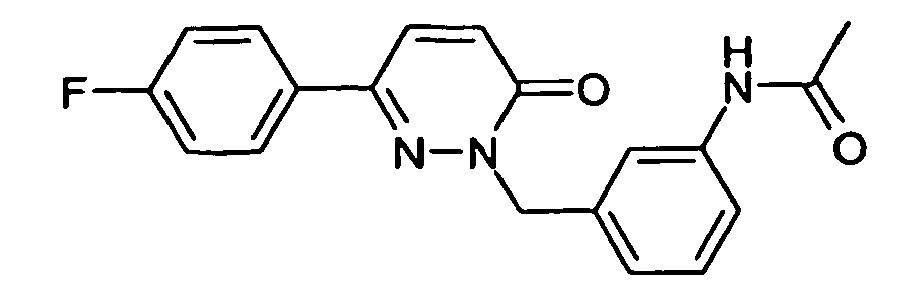


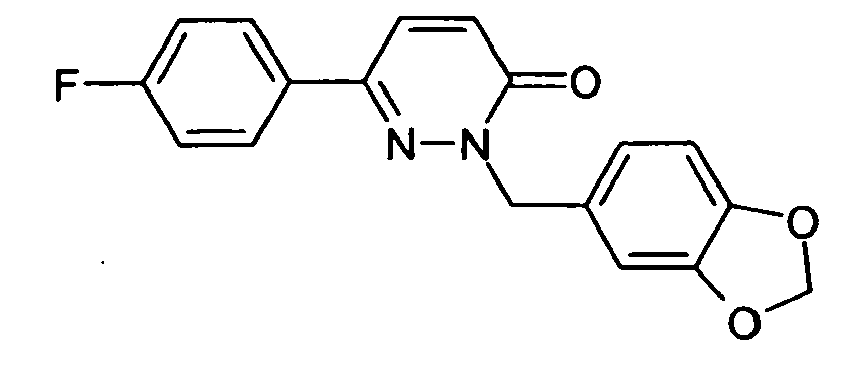


Die Herstellung von {3-[3-(4-Chlorphenyl)-6-oxo-6H-pyridazin-1-ylmethyl]-phenyl}-carbaminsäure-3-dimethylaminopropylester ("A15") erfolgt analog nachstehendem Schema

3.1 Eine Lösung von 900 mg (4.36 mmol) 6-(4-Chlorphenyl)-2H-pyridazin-3-on und 747 mg (4.36 mmol) 3-Nitrobenzylchlorid in 9 ml DMF wird mit 1.56 g (4.79 mmol) Caesiumcarbonat versetzt und die entstandene Suspension 18 Stunden bei Raumtemperatur gerührt. Das Reaktionsgemisch wird mit Wasser versetzt und dreimal mit Dichlormethan extrahiert. Die vereinigten organischen Phasen werden über Natriumsulfat getrocknet und eingedampft: 6-(4-Chlorphenyl)-2-(3-nitrobenzyl)-2H-pyridazin-3-on als bräunlicher Feststoff; ESI 342.3.1 A solution of 900 mg (4:36 mmol) of 6- (4-chlorophenyl) -2 H- pyridazin-3-one and 747 mg (4:36 mmol) of 3-nitrobenzyl chloride in 9 ml of DMF is reacted with 1.56g (4.79 mmol) of cesium carbonate and the resulting suspension is stirred for 18 hours at room temperature. The reaction mixture is mixed with water and extracted three times with dichloromethane. The combined organic phases are over sodium sulfate dried and evaporated: 6- (4-chlorophenyl) -2- (3-nitrobenzyl) -2 H- pyridazin-3-one as a tan solid; ESI 342.
3.2 Eine Lösung von 1.44 g (4.21 mmol) 6-(4-Chlorphenyl)-2-(3-nitrobenzyl)-2H-pyridazin-3-on in 25 ml Methanol wird mit 3.00 g (15.7 mmol) Zinn(II)-chlorid versetzt. Die Lösung wird drei Stunden zum Sieden erhitzt und 18 Stunden bei Raumtemperatur belassen. Das Reaktionsgemisch wird mit 18 ml 2 N Natronlauge alkalisiert und über Kieselgur abgesaugt. Der Rückstand wird mit einem Gemisch aus Dichlormethan / Methanol / Wasser aufgekocht und filtriert. Die organischen Phasen der vereinigten Filtrate werden im Vakuum eingeengt und der entstandene Niederschlag abgesaugt und im Vakuum getrocknet: 2-(3-Aminobenzyl)-6-(4-chlor-phenyl)-2H-pyridazin-3-on als hellbrauner Feststoff; ESI 312.3.2 A solution of 1.44 g (4.21 mmol) of 6- (4-chlorophenyl) -2- (3-nitrobenzyl) -2 H -pyridazine-3-one in 25 ml methanol is treated with 3:00 g (15.7 mmol) of tin (II) chloride added. The solution is boiled for three hours and left at room temperature for 18 hours. The reaction mixture is made alkaline with 18 ml of 2N sodium hydroxide solution and filtered with suction through kieselguhr. The residue is boiled with a mixture of dichloromethane / methanol / water and filtered. The organic phases of the combined filtrates are concentrated in vacuo and the resulting precipitate is filtered off with suction and dried in vacuo: 2- (3-aminobenzyl) -6- (4-chloro-phenyl) -2 H -pyridazine-3-one as a light brown solid; ESI 312.
3.3 23.0 ml (198 mmol) 3-(Dimethylamino)-1-propanol wird in einer 4 N Lösung von Chlorwasserstoff in Dioxan gelöst und im Vakuum eingedampft. Der Rückstand wird mit 200 ml Acetonitril versetzt und zur entstandenen Suspension unter externer Eiskühlung und Rühren 25.0 ml (198 mmol) Trichlormethylchlorformiat zugetropft. Das Reaktionsgemisch wird 18 Stunden bei Raumtemperatur gerührt und im Vakuum eingedampft. Der Rückstand wird in Diethylether aufgenommen, abgesaugt und der Rückstand im Vakuum getrocknet: Chlorameisensäure-(3-dimethylamino)-propylester Hydrochlorid als farbloser Feststoff.3.3 23.0 ml (198 mmol) of 3- (dimethylamino) -1-propanol are dissolved in a 4 N solution of hydrogen chloride in dioxane and evaporated in vacuo. The residue is treated with 200 ml of acetonitrile and 25.0 ml (198 mmol) of trichloromethyl chloroformate are added dropwise to the resulting suspension with external ice cooling and stirring. The reaction mixture is stirred for 18 hours at room temperature and evaporated in vacuo. The residue is taken up in diethyl ether, filtered off with suction and the residue is dried in vacuo: chloroformic acid (3-dimethylamino) propyl ester hydrochloride as a colorless solid.
3.4 Zu einer Lösung von 312 mg (1.00 mmol) 2-(3-Aminobenzyl)-6-(4-chlor-phenyl)-2H-pyridazin-3-on in 10 ml Dichlormethan werden 0.24 ml (3.0 mmol) Pyridin und 303 mg (1.50 mmol) Chlorameisensäure-(3-dimethylamino)-propylester Hydrochlorid gegeben und eine Stunde bei Raumtemperatur gerührt. Die Reaktionslösung wird 2mal mit gesättigter Natriumhydrogencarbonatlösung und 2mal mit Wasser gewaschen. Die organische Phase wird über Natriumsulfat getrocknet, eingedampft und an einer Kieselgelsäule mit Dichlormethan/Methanol als Laufmittel chromatographiert. Die Produkt enthaltenden Fraktionen werden eingedampft und der Rückstand in 20 ml einer 0.1 N Lösung von Chlorwasserstoff in 2-Propanol gelöst und im Vakuum eingedampft: {3-[3-(4-Chlorphenyl)-6-oxo-6H-pyridazin-1-ylmethyl]-phenyl}-carbaminsäure-3-dimethylamino-propylester Hydrochlorid ("A15") als gelblicher Feststoff; ESI 441; 1H-NMR (d6-DMSO): δ = 2.02 (m, 2H), 2.75 (d, J = 4.5 Hz, 6H), 3.12 (m, 2H), 4.13 (t, J = 6 Hz, 2H), 5.26 (s, 2H), 7.00 (d, J = 8 Hz, 1H), 7.11 (d, J = 9.5 Hz, 1H), 7.26 (t, J = 8 Hz, 1H), 7.41 (d, J = 8 Hz, 1H), 7.46 (s, 1H), 7.57 (d, J = 8 Hz, 2H), 7.93 (d, J = 8 Hz, 2H), 8.10 (d, J = 9.5 Hz, 1H), 9.73 (bs, 1H), 10.22 (bs, 1H).3.4 To a solution of 312 mg (1.00 mmol) of 2- (3-aminobenzyl) -6- (4-chloro-phenyl) -2 H -pyridazine-3-one in 10 ml of dichloromethane 0:24 ml (3.0 mmol) of pyridine and 303 mg (1.50 mmol) of chloroformic acid (3-dimethylamino) propyl ester hydrochloride and stirred for one hour at room temperature. The reaction solution is washed twice with saturated sodium bicarbonate solution and twice with water. The organic phase is dried over sodium sulfate, evaporated and on Chromatography of a silica gel column with dichloromethane / methanol as the eluent. The product-containing fractions are evaporated and the residue dissolved in 20 ml of a 0.1 N solution of hydrogen chloride in 2-propanol and evaporated in vacuo: {3- [3- (4-chlorophenyl) -6-oxo-6 H -pyridazine-1 -ylmethyl] -phenyl} -carbamic acid 3-dimethylamino-propyl ester hydrochloride ("A15") as a yellowish solid; ESI 441; 1 H NMR (d 6 -DMSO): δ = 2.02 (m, 2H), 2.75 (d, J = 4.5 Hz, 6H), 3.12 (m, 2H), 4.13 (t, J = 6 Hz, 2H) , 5.26 (s, 2H), 7.00 (d, J = 8 Hz, 1H), 7.11 (d, J = 9.5 Hz, 1H), 7.26 (t, J = 8 Hz, 1H), 7.41 (d, J = 8Hz, 1H), 7.46 (s, 1H), 7.57 (d, J = 8Hz, 2H), 7.93 (d, J = 8Hz, 2H), 8.10 (d, J = 9.5Hz, 1H), 9.73 (bs, 1H), 10.22 (bs, 1H).
Analog erhält man die nachstehenden Verbindungen


Die Herstellung von 1-Ethyl-3-{3-[3-(4-fluorphenyl)-6-oxo-6H-pyridazin-1-ylmethyl]-phenyl}-harnstoff ("A18") erfolgt analog nachstehendem Schema

4.1 Analog Beispiel 3 erhält man 6-(4-Fluorphenyl)-2-(3-nitrobenzyl)-2H-pyridazin-3-on als leicht bräunlicher Feststoff; ESI 326.4.1 Analogously to Example 3, 6- (4-fluorophenyl) -2- (3-nitrobenzyl) -2 H -pyridazine-3-one as a slightly brownish solid; ESI 326.
4.2 Eine Lösung von 2.48 g (7.62 mmol) 6-(4-Fluorphenyl)-2-(3-nitrobenzyl)-2H-pyridazin-3-on in 25 ml THF wird mit 1.2 g Raney-Nickel versetzt und bei Raumtemperatur und Normaldruck hydriert. Der Katalysator wird abfiltriert und das Filtrat eingedampft. Der feste Rückstand wird mit Petrolether verrührt, abgesaugt, mit Petrolether gewaschen und im Vakuum getrocknet: 2-(3-Aminobenzyl)-6-(4-fluorphenyl)-2H-pyridazin-3-on als farbloser Feststoff; ESI 296.4.2 A solution of 2.48 g (7.62 mmol) of 6- (4-fluorophenyl) -2- (3-nitrobenzyl) -2 H -pyridazine-3-one in 25 ml THF is treated with 1.2 g of Raney nickel at room temperature and Normal pressure hydrogenated. The catalyst is filtered off and the filtrate is evaporated. The solid residue is stirred with petroleum ether, filtered off with suction, washed with petroleum ether and dried in vacuo: 2- (3-aminobenzyl) -6- (4-fluorophenyl) -2 H -pyridazine-3-one as a colorless solid; ESI 296.
4.3 Zu einer Lösung von 148 mg (0.50 mmol) 2-(3-Aminobenzyl)-6-(4-fluorphenyl)-2H-pyridazin-3-on in 1 ml Dichlormethan werden 42.6 mg (0.60 mmol) Ethylisocyanat gegeben und das Reaktionsgemisch 42 Stunden bei Raumtemperatur gerührt. Der entstandene Niederschlag wird abgesaugt, mit tert-Butylmethylether gewaschen und im Vakuum getrocknet: 1-Ethyl-3-{3-[3-(4-fluorphenyl)-6-oxo-6H-pyridazin-1-ylmethyl]-phenyl}-harnstoff ("A18") als farblose verfilzte Nädelchen; ESI 367; 1H-NMR (d6-DMSO): δ = 1.03 (t, J = 7.3 Hz, 3H), 3.08 (m, 2H), 5.25 (s, 2H), 6.02 (t, J = 5.3 Hz, 1H), 6.88 (d, J = 7.5 Hz, 1H), 7.09 (d, J = 10 Hz, 1H), 7.18 (t, J = 8 Hz, 1H), 7.33 (m, 3H), 7.95 (dd, J1 = 9 Hz, J2 = 6.6 Hz, 2H), 8.44 (s, 1H).4.3 To a solution of 148 mg (0.50 mmol) of 2- (3-aminobenzyl) -6- (4-fluorophenyl) -2H-pyridazin-3-one in 1 ml of dichloromethane are added 42.6 mg (0.60 mmol) of ethyl isocyanate and the reaction mixture Stirred for 42 hours at room temperature. The precipitate formed is suction filtered, washed with tert-butyl methyl ether and dried in vacuo: 1-ethyl-3- {3- [3- (4-fluorophenyl) -6-oxo-6 H -pyridazin-1-ylmethyl] -phenyl} urea ("A18") as colorless matted nappies; ESI 367; 1 H NMR (d 6 -DMSO): δ = 1.03 (t, J = 7.3 Hz, 3H), 3.08 (m, 2H), 5.25 (s, 2H), 6.02 (t, J = 5.3 Hz, 1H) , 6.88 (d, J = 7.5 Hz, 1H), 7.09 (d, J = 10 Hz, 1H), 7.18 (t, J = 8 Hz, 1H), 7.33 (m, 3H), 7.95 (dd, J 1 = 9 Hz, J 2 = 6.6 Hz, 2H), 8.44 (s, 1H).
Analog erhält man die nachstehenden Verbindungen


Eine alternative Herstellung von "A40" erfolgt analog nachstehendem Schema

Bis auf die letzte Reaktionsstufe erfolgen die Umsetzungen analog Beispiel 3.Except for the last reaction stage, the reactions are carried out analogously to Example 3.
Eine Suspension von 156 mg (0.50 mmol) 2-(3-Aminobenzyl)-6-(3-chlorphenyl)-2H-pyridazin-3-on in 2 ml Dichlormethan wird mit 95.4 mg (0.20 mmol) Bis(trichlormethyl)-carbonat versetzt. Dann wird unter Eiskühlung 102 mg (1.00 mmol) Triethylamin zugetropft und das Reaktionsgemisch 10 Minuten bei Raumtemperatur gerührt. Dann wird 87.1 mg (0.6 mmol) 3-Morpholin-4-yl-propan-1-ol zugegeben und 5 Stunden bei Raumtemperatur gerührt. Das Reaktionsgemisch wird mit Wasser versetzt. Die organische Phase wird abgetrennt und die wässrige Phase mehrmals mit Dichlormethan extrahiert. Die vereinigten organischen Phasen werden über Natriumsulfat getrocknet, eingedampft und im Vakuum getrocknet. Der Rückstand wird in 5 ml einer 0.1 N Lösung von Chlorwasserstoff in 2-Propanol gelöst und die Lösung in 50 ml tert.-Butylmethylether eingetropft. Der entstandene Niederschlag wird abfiltriert, mit tert.-Butylmethylether gewaschen und getrocknet: {3-[3-(3-Chlorphenyl)-6-oxo-6H-pyridazin-1-ylmethyl]-phenyl}-carbaminsäure-3-morpholin-4-yl-propylester-hydrochlorid ("A40") als ockergelber Feststoff.A suspension of 156 mg (0.50 mmol) of 2- (3-aminobenzyl) -6- (3-chlorophenyl) -2 H -pyridazine-3-one in 2 ml dichloromethane is added 95.4 mg (0:20 mmol) of bis (trichloromethyl) - carbonate added. 102 mg (1.00 mmol) of triethylamine are then added dropwise with ice cooling and the reaction mixture is stirred for 10 minutes at room temperature. Then 87.1 mg (0.6 mmol) of 3-morpholin-4-yl-propan-1-ol is added and stirred for 5 hours at room temperature. The reaction mixture is mixed with water. The organic phase is separated and the aqueous phase extracted several times with dichloromethane. The combined organic phases are dried over sodium sulfate, evaporated and dried in vacuo. The residue is dissolved in 5 ml Dissolved a 0.1 N solution of hydrogen chloride in 2-propanol and the solution dripped in 50 ml of tert-butyl methyl ether. The resulting precipitate is filtered, washed with tert-butyl methyl ether and dried: {3- [3- (3-chlorophenyl) -6-oxo-6 H -pyridazin-1-ylmethyl] -phenyl} -carbamic acid 3-morpholine 4-yl propyl ester hydrochloride ("A40") as an ocher yellow solid.
Die Herstellung von 1-Ethyl-3-(3-{3-[3-(2-morpholin-4-yl-ethoxy)-phenyl]-6-oxo-6H-pyridazin-1-ylmethyl}phenyl)-harnstoff
("A43"), ESI 478,
und von 1-Ethyl-3-{3-[3-(3-hydroxy-phenyl)-6-oxo-6H-pyridazin-1-ylmethyl]-phenyl}-harnstoff ("A43a"), ESI 365,
erfolgt analog nachstehendem Schema

("A43"), ESI 478,
and of 1-ethyl-3- {3- [3- (3-hydroxy-phenyl) -6-oxo-6 H -pyridazin-1-ylmethyl] -phenyl} -urea ("A43a"), ESI 365,
is carried out analogously to the following scheme
Analog erfolgt die Herstellung von "A44"

Die Herstellung von
2-(1H-Benzimidazol-5-ylmethyl)-6-(3-fluor-phenyl)-2H-pyridazin-3-on ("A45"), ESI 321,
2-(2-Amino-1H-benzimidazol-5-ylmethyl)-6-(3-fluor-phenyl)-2H-pyridazin-3-on ("A45a") Hydrobromid, ESI 336,
und 2-(1H-Benzotriazol-5-ylmethyl)-6-(3-fluor-phenyl)-2H-pyridazin-3-on ("A46")
erfolgt analog nachstehendem Schema

2- (1 H -benzimidazole-5-ylmethyl) -6- (3-fluoro-phenyl) -2 H -pyridazine-3-one ( "A45"), ESI 321,
2- (2-amino-1 H -benzimidazol-5-ylmethyl) -6- (3-fluoro-phenyl) -2 H -pyridazin-3-one ("A45a") hydrobromide, ESI 336,
and 2- (1 H -benzotriazole-5-ylmethyl) -6- (3-fluoro-phenyl) -2 H -pyridazine-3-one ( "A46")
is carried out analogously to the following scheme
Analog erfolgt auch die Herstellung von "A21"


Analog Beispiel 2 erhält man die nachstehenden Verbindungen


Analog Beispiel 3 erhält man die nachstehenden Verbindungen


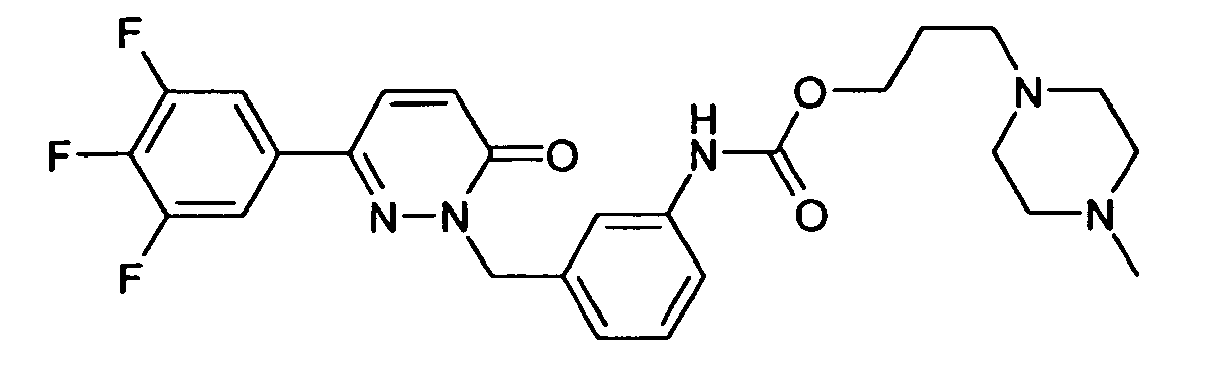

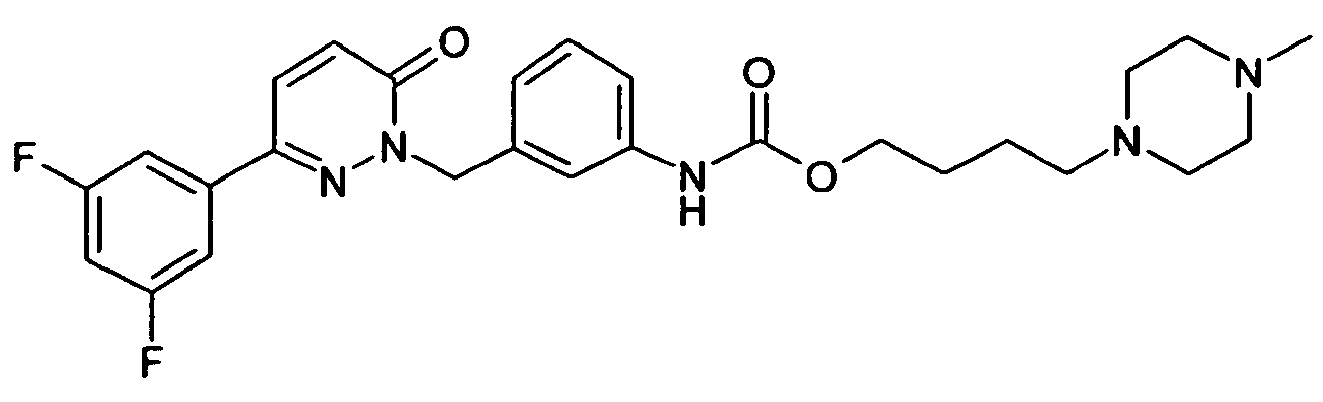


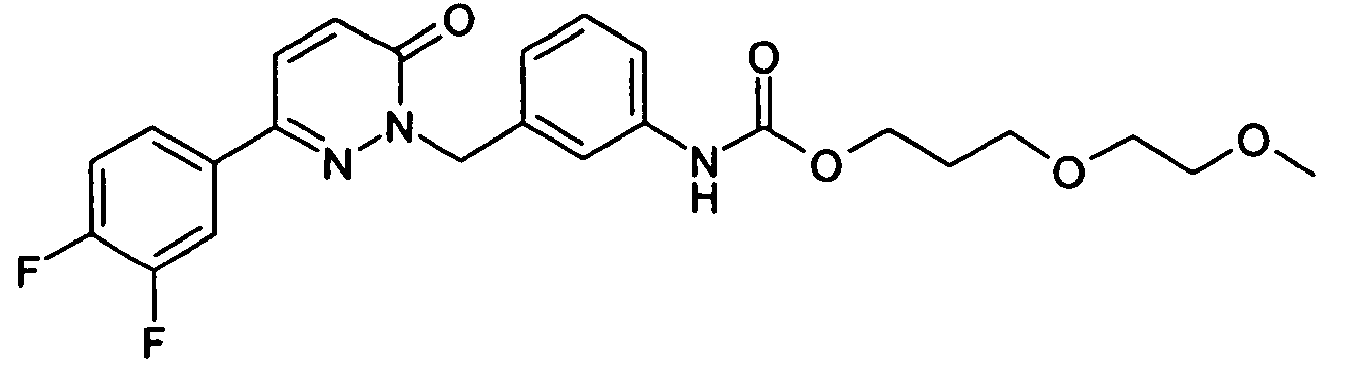


Durch Alkylierung und Hydrierung erhält man analog Beispiel 4 die nachstehenden Verbindungen

Durch Alkylierung und nachfolgender Reduktion mit SnCl2 erhält man analog Beispiel 3 die Verbindung

Die Herstellung von {3-[3-(3,5-Difluor-phenyl)-6-oxo-6H-pyridazin-1-ylmethyl]-phenyl}-carbaminsäure-2-hydroxy-ethylester ("A119"), ESI 402, erfolgt analog nachstehendem Schema

Analog erhält man {3-[3-(3,4-Difluor-phenyl)-6-oxo-6H-pyridazin-1-ylmethyl]-phenyl}-carbaminsäure-2-hydroxy-ethylester ("A120"), ESI 402.Is obtained analogously to {3- [3- (3,4-difluoro-phenyl) -6-oxo-6 H -pyridazin-1-ylmethyl] -phenyl} -carbamic acid 2-hydroxy-ethyl ester ( "A120"), ESI 402nd
Die Herstellung von 3-[3-(3,5-Difluor-phenyl)-6-oxo-6H-pyridazin-1-ylmethyl]-benzoesäure ("A121"), ESI 343, erfolgt analog nachstehendem Schema

Analog erhält man die Verbindungen


Die Herstellung der Verbindungen
2-Benzo[1,2,5]thiadiazol-5-ylmethyl-6-(3-fluor-phenyl)-2H-pyridazin-3-on ("A124"),
2-(2-Amino-1H-benzimidazol-5-ylmethyl)-6-(3-fluor-phenyl)-2H-pyridazin-3-on ("A125"),
2-(1H-Benzimidazol-5-ylmethyl)-6-(3-fluor-phenyl)-2H-pyridazin-3-on ("A126") und
5-[3-(3-Fluor-phenyl)-6-oxo-6H-pyridazin-1-ylmethyl]-1,3-dihydrobenzimidazol-2-on ("A127")
erfolgt analog nachstehendem Schema

2-Benzo [1,2,5] thiadiazol-5-ylmethyl-6- (3-fluoro-phenyl) -2 H -pyridazine-3-one ( "A124"),
2- (2-amino-1 H -benzimidazole-5-ylmethyl) -6- (3-fluoro-phenyl) -2 H -pyridazine-3-one ( "A125"),
2- (1H-benzimidazol-5-ylmethyl) -6- (3-fluoro-phenyl) -2 H -pyridazine-3-one ( "A126") and
5- [3- (3-fluoro-phenyl) -6-oxo-6 H -pyridazin-1-ylmethyl] -1,3-dihydrobenzimidazol-2-one ( "A127")
is carried out analogously to the following scheme
15.1 Eine Lösung von 872 mg (4.58 mmol) 6-(3-Fluorphenyl)-2H-pyridazin-3-on und 1.05 g (4.58 mmol) 5-(Brommethyl)-2,1,3-benzothiadiazol in 9 ml DMF wird mit 1.64 g (5.04 mmol) Caesiumcarbonat versetzt und die entstandene Suspension 18 Stunden bei Raumtemperatur gerührt. Das Reaktionsgemisch wird mit Wasser versetzt, der entstandene Niederschlag abfiltriert, mit Wasser gewaschen und getrocknet: 2-Benzo[1.2,5]thiadiazol-5-ylmethyl-6-(3-fluorphenyl)-2H-pyridazin-3-on ("A124") als farblose Kristalle; ESI 339.15.1 A solution of 872 mg (4:58 mmol) of 6- (3-fluorophenyl) -2 H- pyridazin-3-one and 1.05g (4:58 mmol) of 5- (bromomethyl) -2,1,3-benzothiadiazole in 9 ml of DMF is cesium carbonate with 1.64 g (5.04 mmol) added and the resulting suspension is stirred for 18 hours at room temperature. The reaction mixture is treated with water, the resulting precipitate was filtered off, washed with water and dried: 2-Benzo [1.2,5] thiadiazol-5-ylmethyl-6- (3-fluorophenyl) -2 H -pyridazine-3-one ( " A124 ") as colorless crystals; ESI 339.
15.2 Eine Lösung von 1.30 g (3.84 mmol) 2-Benzo[1,2,5]thiadiazol-5-ylmethyl-6-(3-fluorphenyl)-2H-pyridazin-3-on in 100 ml Methanol wird mit 2.0 g Raney-Nickel versetzt und unter 2 bar Wasserstoffatmosphäre 17 Stunden bei 45° C geschüttelt. Das Reaktionsgemisch wird filtriert und das Filtrat eingedampft: 2-(3,4-Diaminobenzyl)-6-(3-fluor-phenyl)-2H-pyridazin-3-on als brauner Feststoff; ÈSI 311.15.2 A solution of 1.30 g (3.84 mmol) 2-Benzo [1,2,5] thiadiazol-5-ylmethyl-6- (3-fluorophenyl) -2 H -pyridazine-3-one in 100 ml of methanol with 2.0 g Raney nickel and shaken under 2 bar hydrogen atmosphere for 17 hours at 45 ° C shaken. The reaction mixture is filtered and the filtrate evaporated: 2- (3,4-diaminobenzyl) -6- (3-fluoro-phenyl) -2 H -pyridazin-3-one as a brown solid; ÈSI 311.
15.3 Eine Lösung von 155 mg (0.50 mmol) 2-(3,4-Diaminobenzyl)-6-(3-fluor-phenyl)-2H-pyridazin-3-on in 1 ml Ameisensäure wird 1 h auf 80° C erhitzt. Die Reaktionslösung wird mit Dichlormethan verdünnt und dreimal mit 2 N NaOH gewaschen. Die organische Phase wird über Natriumsulfat getrocknet und eingedampft: 2-(1H-Benzimidazol-5-ylmethyl)-6-(3-fluorphenyl)-2H-pyridazin-3-on ("A126") als farbloser Schaum; ESI 321.15.3 A solution of 155 mg (0.50 mmol) 2- (3,4-Diaminobenzyl) -6- (3-fluoro-phenyl) -2 H -pyridazine-3-one in 1 ml formic acid is heated for 1 h at 80 ° C , The reaction solution is diluted with dichloromethane and washed three times with 2N NaOH. The organic phase is dried over sodium sulfate and evaporated: 2- (1 H -benzimidazole-5-ylmethyl) -6- (3-fluorophenyl) -2 H -pyridazine-3-one ( "A126") as a colorless foam; ESI 321.
15.4 Eine Lösung von 155 mg (0.50 mmol) 2-(3,4-Diaminobenzyl)-6-(3-fluor-phenyl)-2H-pyridazin-3-on in 1 ml Methanol wird mit 63.6 mg (0.60 mmol) Bromcyan versetzt und 17 Stunden bei Raumtemperatur gerührt. Das Reaktionsgemisch wird eingedampft. Der feste Rückstand wird mit tert.-Butylmethylether digeriert, filtriert und der Rückstand im Vakuum getrocknet: 2-(2-Amino-1H-benzimidazol-5-ylmethyl)-6-(3-fluorphenyl)-2H-pyridazin-3-on Hydrobromid ("A125") als ockergelber Feststoff; ESI 336.15.4 A solution of 155 mg (0.50 mmol) 2- (3,4-Diaminobenzyl) -6- (3-fluoro-phenyl) -2 H -pyridazine-3-one in 1 ml of methanol is treated with 63.6 mg (0.60 mmol) Cyanogen bromide and stirred for 17 hours at room temperature. The reaction mixture is evaporated. The solid residue is digested with tert-butyl methyl ether, filtered and the residue dried in vacuo: 2- (2-amino-1 H -benzimidazole-5-ylmethyl) -6- (3-fluorophenyl) -2H-pyridazin-3- on hydrobromide ("A125") as an ocher yellow solid; ESI 336.
15.5 Eine Lösung von 155 mg (0.50 mmol) 2-(3,4-Diaminobenzyl)-6-(3-fluor-phenyl)-2H-pyridazin-3-on in 1ml THF wird mit 89.2 mg (0.505 mmol) 1,1'-Carbonyldiimidazol versetzt und 48 Stunden bei Raumtemperatur gerührt. Das Reaktionsgemisch wird mit Wasser versetzt. Der entstandene Niederschlag wird abgesaugt, mit Wasser gewaschen und im Vakuum getrocknet: 5-[3-(3-Fluorphenyl)-6-oxo-6H-pyridazin-1-ylmethyl]-1,3-dihydrobenzimidazol-2-on ("A127") als hellbrauner Feststoff; ESI 337;
1H-NMR (d6-DMSO): δ [ppm] 5.25 (s, 2H), 6.88 (d, J = 7.5 Hz, 1H), 7.01 (m, 2H), 7.08 (d, J = 9.5 Hz, 1H), 7.30 (dt, J1 = 9 Hz, J2 = 2 Hz, 1H), 7.55 (m, 1H), 7.23 (m, 2H), 8.08 (d, J = 9.5 Hz, 1H), 10.52 (s, 1H), 10.57 (s, 1H) ppm.15.5 A solution of 155 mg (0.50 mmol) 2- (3,4-Diaminobenzyl) -6- (3-fluoro-phenyl) -2 H -pyridazine-3-one in 1 ml of THF is reacted with 89.2 mg (0.505 mmol) of 1 , 1'-carbonyldiimidazole and stirred for 48 hours at room temperature. The reaction mixture is mixed with water. The precipitate formed is suction filtered, washed with water and dried in vacuo: 5- [3- (3-fluorophenyl) -6-oxo-6 H -pyridazin-1-ylmethyl] -1,3-dihydrobenzimidazol-2-one ( " A127 ") as a light brown solid; ESI 337;
1 H NMR (d 6 -DMSO): δ [ppm] 5.25 (s, 2H), 6.88 (d, J = 7.5 Hz, 1H), 7.01 (m, 2H), 7.08 (d, J = 9.5 Hz, 1H), 7.30 (dt, J 1 = 9 Hz, J 2 = 2 Hz, 1H), 7.55 (m, 1H), 7.23 (m, 2H), 8.08 (d, J = 9.5 Hz, 1H), 10.52 ( s, 1H), 10.57 (s, 1H) ppm.
Analog der Herstellung der Verbindungen "A125" und "A126" erhält man nachstehende Verbindungen
2-(2-Amino-1H-benzimidazol-5-ylmethyl)-6-(3,5-difluorphenyl)-2H-pyridazin-3-on Hydrobromid ("A125a"), ESI 354 und
2-(1H-Benzimidazol-5-ylmethyl)-6-(3,5-difluorphenyl)-2H-pyridazin-3-on ("A126a"), ESI 339.Analogously to the preparation of the compounds "A125" and "A126", the following compounds are obtained
2- (2-amino-1 H -benzimidazole-5-ylmethyl) -6- (3,5-difluorophenyl) -2H-pyridazin-3-one hydrobromide ( "A125a"), ESI 354, and
2- (1 H -benzimidazole-5-ylmethyl) -6- (3,5-difluorophenyl) -2 H -pyridazine-3-one ( "A126a"), ESI 339th
DieHerstellung von 6-(3,5-Difluor-phenyl)-2-(3-hydroxy-benzyl)-2H-pyridazin-3-on ("A128") erfolgt analog nachstehendem Schema:
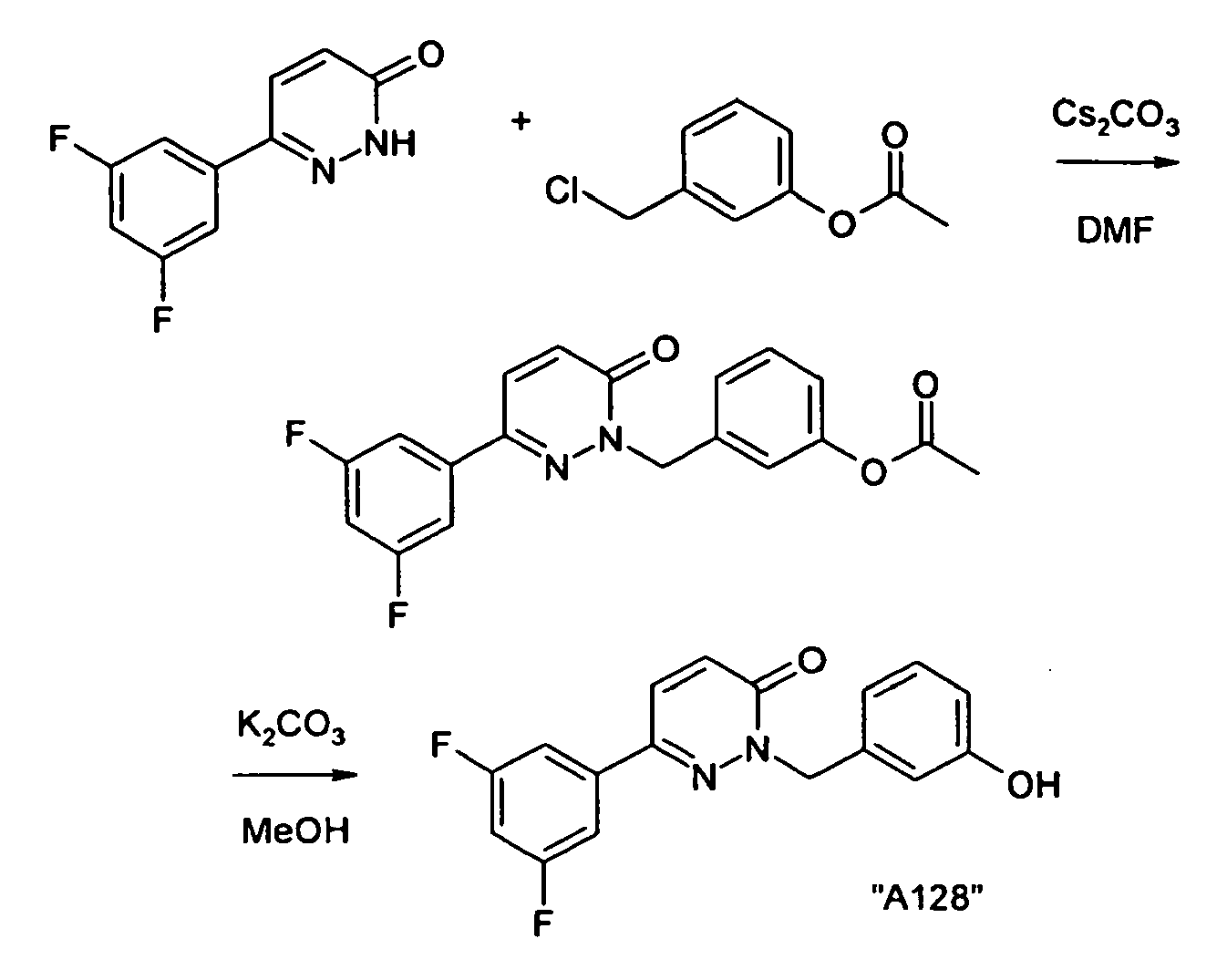
16.1 Eine Lösung von 1.04 g (5.00 mmol) 6-(3,5-Difluorphenyl)-2H-pyridazin-3-on und 923 mg (5.00 mmol) 3-Acetoxybenzylchlorid in 10 ml DMF wird mit 1.63 g (5.00 mmol) Caesiumcarbonat versetzt und die entstandene Suspension 18 Stunden bei Raumtemperatur gerührt. Das Reaktionsgemisch wird mit Wasser versetzt, der entstandene Niederschlag abfiltriert, mit Wasser gewaschen und getrocknet: Essigsäure-3-[3-(3,5-difluorphenyl)-6-oxo-6H-pyridazin-1-ylmethyl]-phenylester als leicht gelbliche Kristalle; ESI 357.16.1 A solution of 1.04g (5.00 mmol) of 6- (3,5-difluorophenyl) -2 H- pyridazin-3-one and 923 mg (5.00 mmol) 3-acetoxybenzylchloride in 10 ml of DMF with 1.63 g (5.00 mmol) Cesium carbonate is added and the resulting suspension is stirred for 18 hours at room temperature. The reaction mixture is treated with water, the filtered precipitate off, washed with water and dried: Acetic acid 3- [3- (3,5-difluorophenyl) -6-oxo-6 H -pyridazin-1-ylmethyl] -phenyl ester as a slightly yellowish crystals; ESI 357.
16.2 Eine Lösung von 1.68 g (4.73 mmol) Essigsäure-3-[3-(3,5-difluorphenyl)-6-oxo-6H-pyridazin-1-ylmethyl]-phenyl-ester in 10 ml Methanol wird mit 688 mg (4.98 mmol) Kaliumcarbonat versetzt und 18 Stunden bei Raumtemperatur gerührt. Das Reaktionsgemisch wird zwischen Dichlormethan und gesättigter wässriger Kaliumhydrogensulfat Lösung verteilt. Die organische Phase wird über Natriumsulfat getrocknet und eingedampft. Der kristalline Rückstand wird mit tert.-Butylmethylether digeriert und im Vakuum getrocknet: 6-(3,5-Difluorphenyl)-2-(3-hydroxybenzyl)-2H-pyridazin-3-on als farblose Kristalle; ESI 315.16.2 A solution of 1.68 g (4.73 mmol) of acetic acid 3- [3- (3,5-difluorophenyl) -6-oxo-6H-pyridazin-1-ylmethyl] -phenyl ester in 10 ml of methanol is 4.98 mmol) of potassium carbonate and stirred for 18 hours at room temperature. The reaction mixture is partitioned between dichloromethane and saturated aqueous potassium bisulfate solution. The organic phase is dried over sodium sulfate and evaporated. The crystalline residue is digested with tert-butyl methyl ether and dried in vacuo: 6- (3,5-difluorophenyl) -2- (3-hydroxybenzyl) -2 H -pyridazine-3-one as colorless crystals; ESI 315.
Die Herstellung von 1-{3-[3-(3,5-Difluor-phenyl)-6-oxo-6H-pyridazin-1-ylmethyl]-phenyl}-3-(3-morpholin-4-yl-propyl)-harnstoff ("A129") erfolgt analog nachstehendem Schema

Eine Suspension von 156 mg (0.50 mmol) 2-(3-Aminobenzyl)-6-(3,5-difluorphenyl)-2H-pyridazin-3-on in 3 ml Dichlormethan wird mit 111 mg (0.55 mmol) 4-Nitrophenylchlorformiat und 44 µl (0.55 mmol) Pyridin versetzt und 1 Stunde bei Raumtemperatur gerührt. Dann werden 80.1 µl (0.55 mmol) 3-Morpholinopropylamin zugegeben und das Reaktionsgemisch 18 Stunden bei Raumtemperatur gerührt. Das Reaktionsgemisch wird zwischen Dichlormethan und 2 N NaOH verteilt. Die organische Phase wird mit Wasser gewaschen, über Natriumsulfat getrocknet und eingedampft. Der feste Rückstand wird in tert.-Butylmethylether aufkgekocht und nach Abkühlen auf Raumtemperatur abgesaugt. Der Rückstand wird getrocknet, in 5 ml einer 0.1 N Lösung von Chlorwasserstoff in 2-Propanol gelöst und die Lösung in 50 ml tert.-Butylmethylether eingetropft. Der entstandene Niederschlag wird abfiltriert, mit tert-Butylmethylether gewaschen und getrocknet: 1-{3-[3-(3,5-Difluorphenyl)-6-oxo-6H-pyridazin-1-ylmethyl]-phenyl}-3-(3-morpholin-4-yl-propyl)-harnstoff Hydrochlorid ("A129") als farbloser Feststoff; ESI 484.A suspension of 156 mg (0.50 mmol) of 2- (3-aminobenzyl) -6- (3,5-difluorophenyl) -2 H -pyridazine-3-one in 3 ml of dichloromethane with 111 mg (0:55 mmol) of 4-nitrophenylchloroformate and 44 .mu.l (0.55 mmol) of pyridine and stirred for 1 hour at room temperature. Then 80.1 μl (0.55 mmol) of 3-morpholinopropylamine are added and the reaction mixture is stirred for 18 hours at room temperature. The reaction mixture is partitioned between dichloromethane and 2N NaOH. The organic phase is washed with water, dried over sodium sulfate and evaporated. The solid residue is boiled up in tert-butyl methyl ether and filtered off with suction after cooling to room temperature. The residue is dried, dissolved in 5 ml of a 0.1 N solution of hydrogen chloride in 2-propanol and the solution is added dropwise to 50 ml of tert-butyl methyl ether. The resulting precipitate is filtered, washed with tert-butyl methyl ether and dried: 1- {3- [3- (3,5-difluorophenyl) -6-oxo-6 H -pyridazin-1-ylmethyl] -phenyl} -3- ( 3-morpholin-4-yl-propyl) -urea Hydrochloride ("A129") as a colorless solid; ESI 484.
Analog erhält man die nachstehenden Verbindungen


Die Herstellung von {3-[3-(3,5-Difluor-phenyl)-6-oxo-6H-pyridazin-1-ylmethyl]-phenyl}-carbaminsäure-3-methylamino-propylester ("A142") erfolgt analog nachstehendem Schema

Eine Suspension von 316 mg (1.00 mmol) 2-(3-Aminobenzyl)-6-(3-chlorphenyl)-2H-pyridazin-3-on in 4 ml Dichlormethan wird mit 119 mg (0.40 mmol) Bis(trichlormethyl)-carbonat versetzt. Dann wird unter Eiskühlung 416 µl (3.00 mmol) Triethylamin zugetropft und das Reaktionsgemisch 10 Minuten bei Raumtemperatur gerührt. Dann wird 208 mg (1.10 mmol) 3-Hydroxypropyl)-methyl-carbaminsäure-tert.-butylester zugegeben und 18 Stunden bei Raumtemperatur gerührt. Das Reaktionsgemisch wird über Natriumsulfat filtriert und das Filtrat an einer Kieselgelsäule mit Dichlormethan/Methanol als Laufmittel chromatographiert. Die Produkt enthaltenden Fraktionen werden vereinigt, eingedampft und der Rückstand in 2 ml einer 4 N Lösung von Chlorwasserstoff in Dioxan gelöst und über Nacht bei Raumtemperatur belassen. Die entstandene Suspension wird mit tert.-Butylmethylether verdünnt, abgesaugt und der Rückstand im Vakuum getrocknet: {3-[3-(3,5-Difluorphenyl)-6-oxo-6H-pyridazin-1-ylmethyl]-phenyl}-carbaminsäure-3-methylamino-propylester Hydrochlorid ("A142") als farblose Kristalle; ESI 429.A suspension of 316 mg (1.00 mmol) of 2- (3-aminobenzyl) -6- (3-chlorophenyl) -2 H -pyridazine-3-one in 4 ml of dichloromethane with 119 mg (0.40 mmol) of bis (trichloromethyl) - carbonate added. 416 μl (3.00 mmol) of triethylamine are then added dropwise while cooling with ice and the reaction mixture is stirred for 10 minutes at room temperature. Then 208 mg (1.10 mmol) of tert-butyl 3-hydroxypropyl) -methyl-carbamate are added and the mixture is stirred at room temperature for 18 hours. The reaction mixture is filtered through sodium sulfate and the filtrate is chromatographed on a silica gel column with dichloromethane / methanol as the eluent. The product-containing fractions are combined, evaporated and the residue dissolved in 2 ml of a 4 N solution of hydrogen chloride in dioxane and left overnight at room temperature. The resulting suspension is diluted with tert-butyl methyl ether, filtered off with suction and the residue is dried in vacuo: {3- [3- (3,5-difluorophenyl) -6-oxo-6H-pyridazin-1-ylmethyl] -phenyl} -carbamic acid 3-methylamino-propyl ester hydrochloride ("A142") as colorless crystals; ESI 429.
Analog erhält man die nachstehenden Verbindungen


Die Herstellung von 6-[3-(3,5-Difluor-phenyl)-6-oxo-6H-pyridazin-1-ylmethyl]-1-(3-dimethylamino-propyl)-1,3-dihydro-benzimidazol-2-on ("A158") erfolgt analog nachstehendem Schema:
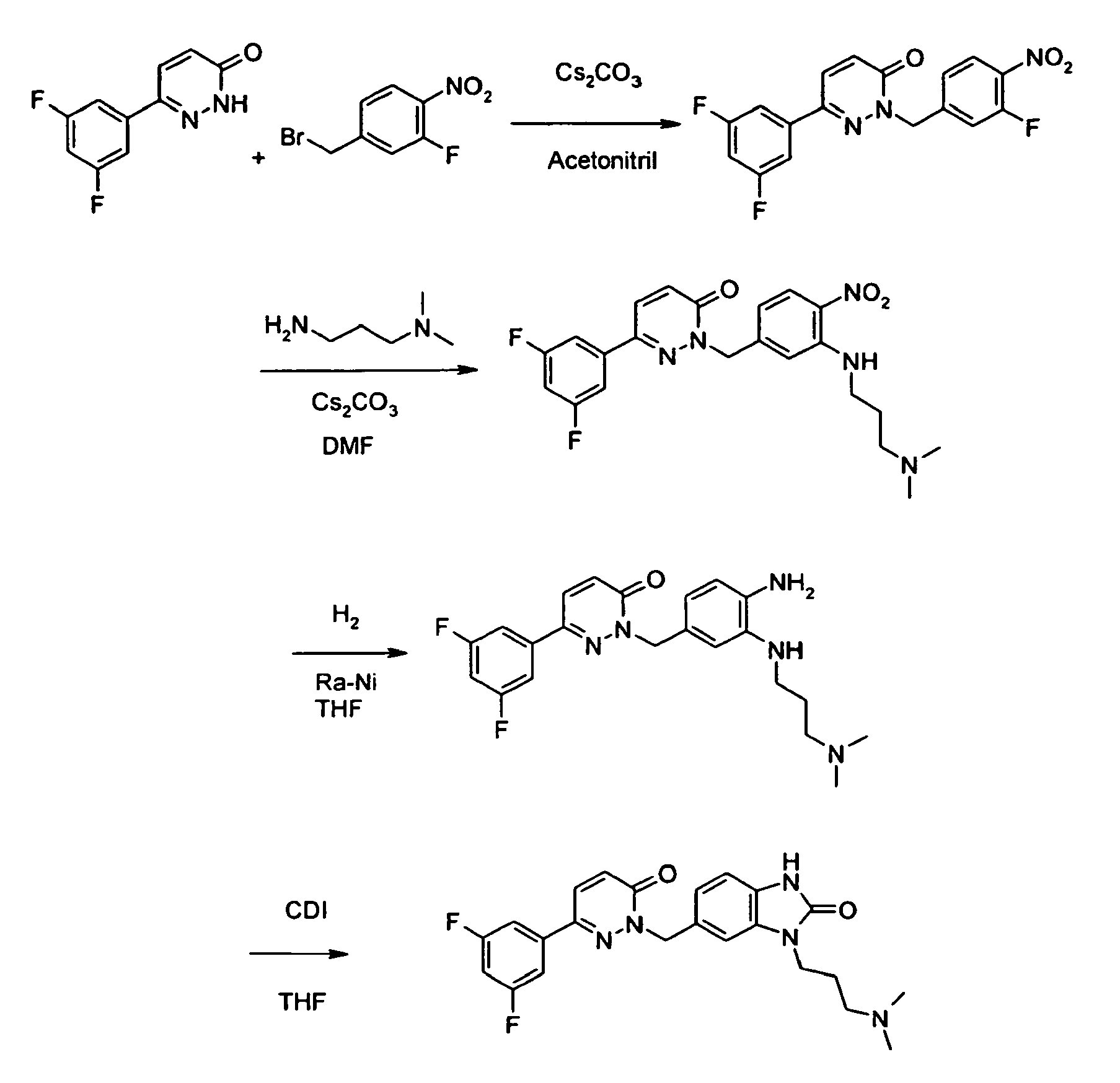
19.1 Eine Lösung von 2,08 g (10.0 mmol) 6-(3,5-Difluorphenyl)-2H-pyridazin-3-on und 2.34 g (10.0 mmol) 3-Fluor-4-nitrobenzylbromid in 20 ml Acetonitril wird mit 2.00 g (0.61 mmol) Caesiumcarbonat versetzt und die entstandene Suspension 18 Stunden bei Raumtemperatur gerührt. Das Reaktionsgemisch wird mit Wasser versetzt, der entstandene Niederschlag abfiltriert, mit Wasser gewaschen und getrocknet: 6-(3,5-Difluorphenyl)-2-(3-fluor-4-nitrobenzyl)-2H-pyridazin-3-on als farblose Kristalle; ESI 362.19.1 A solution of 2.08 g (10.0 mmol) of 6- (3,5-difluorophenyl) -2 H- pyridazin-3-one and 2:34 g (10.0 mmol) 3-fluoro-4-nitrobenzyl bromide in 20 ml acetonitrile with 2.00 g (0.61 mmol) of cesium carbonate are added and the resulting suspension is stirred for 18 hours at room temperature. The reaction mixture is treated with water, the filtered precipitate off, washed with water and dried: 6- (3,5-difluorophenyl) -2- (3-fluoro-4-nitrobenzyl) -2 H -pyridazine-3-one as colorless crystals; ESI 362.
19.2 Eine Lösung von 361 mg (1.00 mmol) 6-(3,5-Difluorphenyl)-2-(3-fluor-4-nitrobenzyl)-2H-pyridazin-3-on in 2 ml DMF wird mit 326 mg (1.00 mmol) Caesiumcarbonat und 143 mg (1.40 mmol) N,N-Dimethyltrimethylendiamin versetzt und die resultierende Suspension 3 Stunden bei Raumtemperatur gerührt. Das Reaktionsgemisch wird mit Wasser versetzt. Es bildet sich ein hochviskoser roter Niederschlag. Dieser wird abgetrennt, mehrmals mit Wasser gewaschen und im Vakuum getrocknet. Dieses Material wird mit Petrolether digeriert, wobei Kristallisation einsetzt. Der entstandene Feststoff wird abgesaugt, mit Petrolether gewaschen und im Vakuum getrocknet: 6-(3,5-Difluorphenyl)-2-[3-(3-dimethylamino-propylamino)-4-nitro-benzyl]-2H-pyridazin-3-on als gelborange Kristalle; ESI 444.19.2 A solution of 361 mg (1.00 mmol) of 6- (3,5-difluorophenyl) -2- (3-fluoro-4-nitrobenzyl) -2 H -pyridazine-3-one in 2 ml of DMF with 326 mg (1.00 mmol) of cesium carbonate and 143 mg (1.40 mmol) of N, N-dimethyltrimethylenediamine and the resulting suspension was stirred for 3 hours at room temperature. The reaction mixture is mixed with water. It forms a highly viscous red precipitate. This is separated, washed several times with water and dried in vacuo. This material is digested with petroleum ether using crystallization. The resulting solid is filtered off with suction, washed with petroleum ether and dried in vacuo: 6- (3,5-difluorophenyl) -2- [3- (3-dimethylamino-propylamino) -4-nitro-benzyl] -2 H -pyridazine-3 -one as yellow-orange crystals; ESI 444.
19.3 Eine Lösung von 360 mg (0.81 mmol) 6-(3,5-Difluorphenyl)-2-[3-(3-dimethylamino-propylamino)-4-nitro-benzyl]-2H-pyridazin-3-on in 10 ml THF wird mit 400 mg Raney-Nickel versetzt und hydriert. Das Reaktionsgemisch wird filtriert und das Filtrat eingedampft: 2-[4-Amino-3-(3-dimethylamino-propylamino)-benzyl]-6-(3,5-difluorphenyl)-2H-pyridazin-3-on als gelbes hochvisköses Öl; ESI 414.19.3 A solution of 360 mg (0.81 mmol) of 6- (3,5-difluorophenyl) -2- [3- (3-dimethylamino-propylamino) -4-nitro-benzyl] -2 H -pyridazine-3-one in 10 ml of THF is mixed with 400 mg of Raney nickel and hydrogenated. The reaction mixture is filtered and the filtrate is evaporated: 2- [4-amino-3- (3-dimethylamino-propylamino) -benzyl] -6- (3,5-difluorophenyl) -2 H -pyridazin-3-one as a yellow highly viscous Oil; ESI 414.
19.4 Eine Lösung von 330 mg (0.80 mmol) 2-[4-Amino-3-(3-dimethylamino-propylamino)-benzyl]-6-(3,5-difluorphenyl)-2H-pyridazin-3-on in 2 ml THF wird mit 142 mg (0.88 mmol) 1,1'-Carbonyldiimidazol versetzt und über Nacht bei Raumtemperatur gerührt. Das Reaktionsgemisch wird zwischen Dichlormethan und Wasser verteilt. Die organische Phase wird über Natriumsulfat getrocknet und eingedampft. Der Rückstand wird durch präparative HPLC gereinigt: 6-[3-(3,5-Difluorphenyl)-6-oxo-6H-pyridazin-1-ylmethyl]-1-(3-dimethylamino-propyl)-1,3-dihydrobenzimidazol-2-on Formiat ("A158") als farbloser Feststoff; ESI 440.19.4 A solution of 330 mg (0.80 mmol) of 2- [4-amino-3- (3-dimethylamino-propylamino) benzyl] -6- (3,5-difluorophenyl) -2 H -pyridazine-3-one in 2 ml of THF is mixed with 142 mg (0.88 mmol) of 1,1'-carbonyldiimidazole and stirred overnight at room temperature. The reaction mixture is partitioned between dichloromethane and water. The organic phase is dried over sodium sulfate and evaporated. The residue is purified by preparative HPLC: 6- [3- (3,5-difluorophenyl) -6-oxo-6 H -pyridazin-1-ylmethyl] -1- (3-dimethylamino-propyl) -1,3-dihydrobenzimidazol -2-one formate ("A158") as a colorless solid; ESI 440.
Analog werden die nachstehenden Verbindungen erhalten


Die Herstellung von 6-(3.5-Diftuor-phenyl)-2-(1H-indazol-5-ylmethyl)-2H-pyridazin-3-on ("A161") erfolgt analog nachstehendem Schema:

20.1 Eine Lösung von 104 mg (0.50 mmol) 6-(3,5-Difluorphenyl)-2H-pyridazin-3-on und 147 mg (0.50 mmol) 5-Brommethyl-1-(tetrahydropyran-2-yl)-indazol (hergestellt nach
20.2 Eine Lösung von 95 mg 6-(3,5-Difluorphenyl-2-[1-(tetrahydropyran-2-yl)-1H-indazol-5-ylmethyl]-2H-pyridazin-2-on in 2 ml Dioxan wird mit 1 ml 25%iger wässriger Salzsäure versetzt und über Nacht bei Raumtemperatur belassen. Das Reaktionsgemisch wird eingeengt, der Niederschlag wird abgesaugt und mit tert.-Butylmethylether gewaschen und im Vakuum getrocknet: 6-(3,5-Difluorphenyl)-2-(1H-indazol-5-ylmethyl)-2H-pyridazin-3-on ("A161") als farbloser Feststoff; ESI 339.20.2 A solution of 95 mg 6- (3,5-difluorophenyl-2- [1- (tetrahydropyran-2-yl) -1 H -indazole-5-ylmethyl] -2 H -pyridazine-2-one in 2 ml of
Analog erhält man die nachstehenden Verbindungen


Die Herstellung von
6-(3,5-Difluor-phenyl)-2-chinolin-6-ylmethyl-2H-pyridazin-3-on ("A51"),
6-(3,5-Difluor-phenyl)-2-(1-oxy-chinolin-6-ylmethyl)-2H-pyridazin-3-on ("A163") und
6-[3-(3,5-Difluor-phenyl)-6-oxo-6H-pyridazin-1-ylmethyl]-1H-chinolin-2-on ("A164")
erfolgt analog nachstehendem Schema:

6- (3,5-difluoro-phenyl) -2-quinolin-6-ylmethyl-2 H -pyridazine-3-one ( "A51"),
6- (3,5-difluoro-phenyl) -2- (1-oxy-quinolin-6-ylmethyl) -2 H -pyridazin-3-one ("A163") and
6- [3- (3,5-difluoro-phenyl) -6-oxo-6 H -pyridazin-1-ylmethyl] -1 H -quinolin-2-one ( "A164")
takes place analogously to the following scheme:
21.1 Zu einer Lösung von 208 mg (1.00 mmol) 6-(3,5-Difluorphenyl)-2H-pyridazin-3-on in 4 ml DMF werden nacheinander 214 mg (1.00 mmol) 6-Chlormethylchinoliniumchlorid und 489 mg (1.50 mmol) Caesiumcarbonat gegeben und die entstandene Suspension 18 Stunden bei Raumtemperatur gerührt. Das Reaktionsgemisch wird mit Wasser versetzt, der entstandene Niederschlag abgesaugt, mit Wasser gewaschen und im Vakuum getrocknet: 6-(3,5-Difluorphenyl)-2-chinolin-6-ylmethyl-2H-pyridazin-3-on ("A51") als farblose Kristalle ESI 350.21.1 To a solution of 208 mg (1.00 mmol) of 6- (3,5-difluorophenyl) -2 H- pyridazin-3-one in 4 ml of DMF are successively 214 mg (1.00 mmol) 6-Chlormethylchinoliniumchlorid and 489 mg (1:50 mmol ) Cesium carbonate and the resulting suspension is stirred for 18 hours at room temperature. The reaction mixture is treated with water, the precipitate formed is filtered off with suction, washed with water and dried in vacuo: 6- (3,5-difluorophenyl) -2-quinolin-6-ylmethyl-2 H- pyridazin-3-one ( "A51" ) as colorless crystals ESI 350.
21.2 Eine Lösung von 306 mg (0.876 mmol) 6-(3,5-Difluorphenyl)-2-chinolin-6-ylmethyl-2H-pyridazin-3-on in 4 ml 2-Methoxyethanol wird mit 542 mg Magnesium-monoperoxyphthalat-hexahydrat versetzt und die entstandene Suspension 40 Stunden bei Raumtemperatur gerührt. Das Reaktionsgemisch wird mit Wasser versetzt, der entstandene Niederschlag abgesaugt, mit Wasser gewaschen und im Vakuum getrocknet: 6-(3,5-Difluorphenyl)-2-(1-oxy-chinolin-6-ylmethyl)-2H-pyridazin-3-on ("A163") als farbloser Feststoff; ESI 366.21.2 A solution of 306 mg (0.876 mmol) of 6- (3,5-difluorophenyl) -2-quinolin-6-ylmethyl-2 H- pyridazin-3-one in 4 ml of 2-methoxyethanol is reacted with 542 mg magnesium monoperoxyphthalat- hexahydrate and stirred the resulting suspension for 40 hours at room temperature. The reaction mixture is treated with water, the precipitate formed is filtered off with suction, washed with water and dried in vacuo: 6- (3,5-difluorophenyl) -2- (1-oxy-quinolin-6-ylmethyl) -2 H- pyridazin-3 -one ("A163") as a colorless solid; ESI 366.
21.3 Eine Lösung von 91 mg (0.25 mmol) 6-(3,5-Difluorphenyl)-2-(1-oxy-chinolin-6-ylmethyl)-2H-pyridazin-3-on in 1 ml THF wird mit 75 mg (0.75 mmol) Triethylamin und 521 mg (2.48 mmol) Trifluoressigsäureanhydrid versetzt und das Reaktionsgemisch 30 Minuten bei Raumtemperatur gerührt. Das Reaktionsgemisch wird zwischen 5%iger wässriger Natriumhydrogencarbonat-Lösung und Ethylacetat verteilt. Die organische Phase wird getrocknet, über Natriumsulfat getrocknet und eingedampft. Der Rückstand wird durch präparative HPLC gereinigt: 6-[3-(3,5-Difluorphenyl)-6-oxo-6H-pyridazin-1-ylmethyl]-1H-chinolin-2-on ("A164") als farbloser Feststoff; ESI 366.21.3 A solution of 91 mg (0:25 mmol), 6- (3,5-difluorophenyl) -2- (1-oxy-quinolin-6-ylmethyl) -2 H -pyridazine-3-one in 1 ml THF with 75 mg (0.75 mmol) of triethylamine and 521 mg (2.48 mmol) of trifluoroacetic anhydride were added and the reaction mixture was stirred for 30 minutes at room temperature. The reaction mixture is partitioned between 5% aqueous sodium bicarbonate solution and ethyl acetate. The organic phase is dried, dried over sodium sulfate and evaporated. The residue is purified by preparative HPLC: 6- [3- (3,5-difluorophenyl) -6-oxo-6 H -pyridazin-1-ylmethyl] -1 H- quinolin-2-one ( "A164") as a colorless solid; ESI 366.
Die Herstellung von 2-(3-Amino-1H-indazol-5-ylmethyl)-6-(3,5-difluorphenyl)-2H-pyridazin-3-on ("A165") erfolgt analog nachstehendem Schema:

22.1 Eine Lösung von 208 mg (1.00 mmol) 6-(3,5-Difluorphenyl)-2H-pyridazin-3-on und 214 mg (1.00 mmol) 5-Brommethyl-2-fluorbenzonitril in 2 ml DMF wird mit 326 mg (1.00 mmol) Caesiumcarbonat versetzt und die entstandene Suspension 18 Stunden bei Raumtemperatur gerührt. Das Reaktionsgemisch wird mit Wasser versetzt, der entstandene Niederschlag abgesaugt, mit Wasser gewaschen und im Vakuum getrocknet. Das Rohprodukt wird an einer Kieselgelsäule mit Dichlormethan/Methanol als Laufmittel chromatographiert: 5-[3-(3,5-Difluorphenyl)-6-oxo-6H-pyridazin-1-ylmethyl]-2-fluorbenzonitril als farbloser Feststoff; ESI 342.22.1 A solution of 208 mg (1.00 mmol) of 6- (3,5-difluorophenyl) -2 H- pyridazin-3-one and 214 mg (1.00 mmol) of 5-bromomethyl-2-fluorobenzonitrile is dissolved in 2 ml DMF with 326 mg (1.00 mmol) cesium carbonate and the resulting suspension stirred for 18 hours at room temperature. The reaction mixture is mixed with water, and the resulting precipitate is filtered off with suction, washed with water and dried in vacuo. The crude product is chromatographed on a silica gel column with dichloromethane / methanol as eluent: 5- [3- (3,5-difluorophenyl) -6-oxo-6 H- pyridazin-1-ylmethyl] -2-fluorobenzonitrile as a colorless solid; ESI 342.
22.2 Eine Lösung von 239 mg (0.7 mmol) 5-[3-(3,5-Difluorphenyl)-6-oxo-6H-pyridazin-1-ylmethyl]-2-fluorbenzonitril in 2.5 ml Butanol wird mit 0.14 ml (2.8 mmol) Hydrazinhydrat versetzt und 18 Stunden bei 100° C gerührt. Das Reaktionsgemisch wird eingedampft. Der Rückstand wird in 1 ml einer 0.1 N Lösung von Chlorwasserstoff in 2-Propanol in der Hitze gelöst und auf Raumtemperatur abgekühlt. Der entstandene Niederschlag wird abgesaugt, mit tert.-Butylmethylether gewaschen und im Vakuum getrocknet: 2-(3-Amino-1H-indazol-5-ylmethyl)-6-(3,5-difluorphenyl)-2H-pyridazin-3-on Hydrochlorid ("A165") als farblose Kristalle; ESI 390.22.2 A solution of 239 mg (0.7 mmol) of 5- [3- (3,5-difluorophenyl) -6-oxo-6 H -pyridazin-1-ylmethyl] -2-fluorobenzonitrile, in 2.5 ml of butanol 0.14 ml (2.8 mmol) of hydrazine hydrate and stirred at 100 ° C for 18 hours. The reaction mixture is evaporated. The residue is dissolved in 1 ml of a 0.1 N solution of hydrogen chloride in 2-propanol in the heat and cooled to room temperature. The resulting precipitate is filtered off, washed with tert-butyl methyl ether and dried in vacuo: 2- (3-amino-1 H -indazol-5-ylmethyl) -6- (3,5-difluorophenyl) -2 H -pyridazine-3 -one hydrochloride ("A165") as colorless crystals; ESI 390.
Durch Hydrolyse von "A107" mit 2N HCl in Methanol erhält man {3-[3-(3-Carbamoyl-phenyl)-6-oxo-6H-pyridazin-1-ylmethyl]-phenyl}-carbaminsäure-3-(4-methyl-piperazin-1-yl)-propylester ("A166"), Dihydrochlorid, ESI 505

Analog Beispiel 10 erhält man die nachstehenden Verbindungen

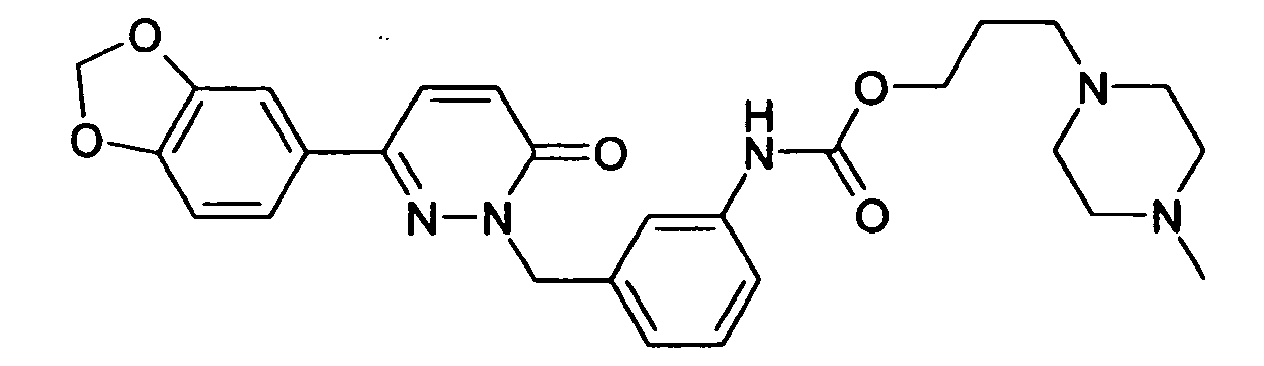
Zu einer Suspension von 160 mg "A43a", 116 mg 2-(Dimethylamino)-ethanol und 440 mg Triphenylphosphin (polymergebunden) in 4 ml Dichtormethan/THF (1:1) tropft man 270 mg Düsopropylazodicarboxylat und rührt 16 Stunden bei Raumtemperatur nach. Nach üblicher Aufarbeitung erhält man 26 mg 1-(3-{3-[3-(2-Dimethylamino-ethoxy)-phenyl]-6-oxo-6H-pyridazin-1-ylmethyl}-phenyl)-3-ethyl-harnstoff Hydrochlorid ("A43b"), ESI 436

Met-Kinase-Inhibierung (Enzym Assay) Tabelle 1
1 µM-10 µM=B
> 10 mM = CMet kinase inhibition (enzyme assay) Table 1
1 μM-10 μM = B
> 10 mM = C
Die nachfolgenden Beispiele betreffen Arzneimittel:The following examples relate to drugs:
Eine Lösung von 100 g eines Wirkstoffes der Formel 1 gemäß Anspruch 1 und 5 g Dinatriumhydrogenphosphat wird in 31 zweifach destilliertem Wasser mit 2 N Salzsäure auf pH 6,5 eingestellt, steril filtriert, in Injektionsgläser abgefüllt, unter sterilen Bedingungen lyophilisiert und steril verschlossen. Jedes Injektionsglas enthält 5 mg Wirkstoff.A solution of 100 g of an active ingredient of the
Man schmilzt ein Gemisch von 20 g eines Wirkstoffes der Formel I gemäß Anspruch 1 mit 100 g Sojalecithin und 1400 g Kakaobutter, gießt in Formen und läßt erkalten. Jedes Suppositorium enthält 20 mg Wirkstoff.A mixture of 20 g of an active compound of the formula I according to
Man bereitet eine Lösung aus 1 g eines Wirkstoffes der Formel I gemäß Anspruch 1, 9,38 g NaH2PO4·2 H2O, 28,48 g Na2HPO4 · 12 H2O und 0,1 g Benzalkoniumchlorid in 940 ml zweifach destilliertem Wasser. Man stellt auf pH 6,8 ein, füllt auf 1 l auf und sterilisiert durch Bestrahlung. Diese Lösung kann in Form von Augentropfen verwendet werden.A solution of 1 g of an active substance of the formula I according to
Man mischt 500 mg eines Wirkstoffes der Formel I gemäß Anspruch 1 mit 99,5 g Vaseline unter aseptischen Bedingungen.500 mg of an active ingredient of the formula I according to
Ein Gemisch von 1 kg Wirkstoff der Formel I gemäß Anspruch 1, 4 kg Lactose, 1,2 kg Kartoffelstärke, 0,2 kg Talk und 0,1 kg Magnesiumstearat wird in üblicher Weise zu Tabletten verpreßt, derart, daß jede Tablette 10 mg Wirkstoff enthält.A mixture of 1 kg of active ingredient of the formula I according to
Analog Beispiel E werden Tabletten gepreßt, die anschließend in üblicher Weise mit einem Überzug aus Saccharose, Kartoffelstärke, Talk, Tragant und Farbstoff überzogen werden.Tablets are pressed analogously to Example E, which are then coated in the usual way with a coating of sucrose, potato starch, talc, tragacanth and dye.
2 kg Wirkstoff der Formel I gemäß Anspruch 1 werden in üblicher Weise in Hartgelatinekapseln gefüllt, so daß jede Kapsel 20 mg des Wirkstoffs enthält.2 kg of active ingredient of the formula I according to
Eine Lösung von 1 kg Wirkstoff der Formel I gemäß Anspruch 1 in 60 l zweifach destilliertem Wasser wird steril filtriert, in Ampullen abgefüllt, unter sterilen Bedingungen lyophilisiert und steril verschlossen. Jede Ampulle enthält 10 mg Wirkstoff.A solution of 1 kg of active ingredient of the formula I according to
Claims (9)
- Compounds selected from the group
No. Structure and/or name "A1" 
"A2" 
"A3" 
"A4" 
"A5" 
"A6" 
"A7" 
"A8" 
"A9" 
"A10" 
"A11" 
"A12" 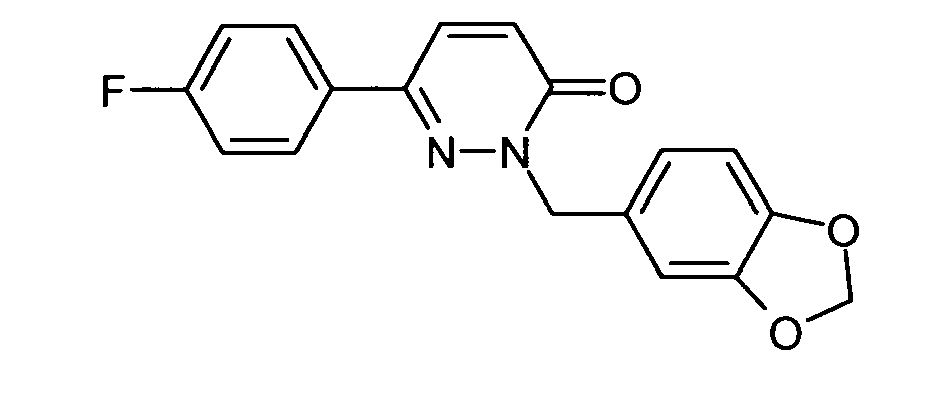
"A13" 
"A14" 
"A15" 
"A16" 
"A17" 
"A18" 
"A19" 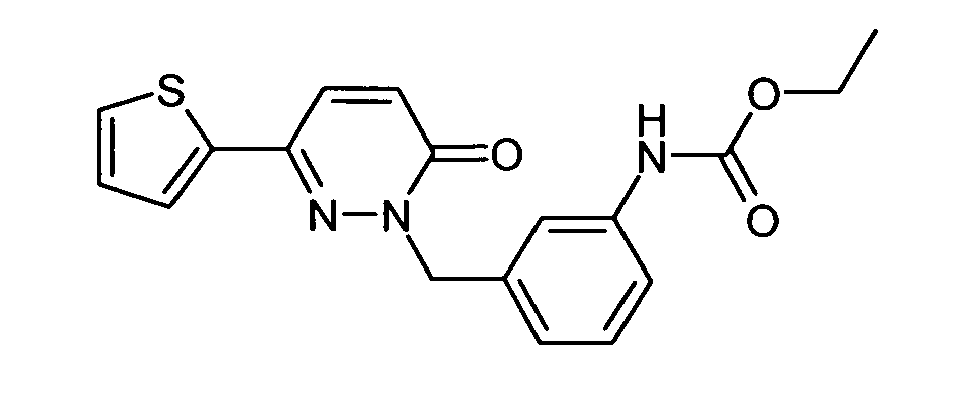
"A20" 
"A21" 
"A22" 
"A23" 
"A24" 
"A25" 
"A25a" 
"A26" 
"A27" 
"A28" 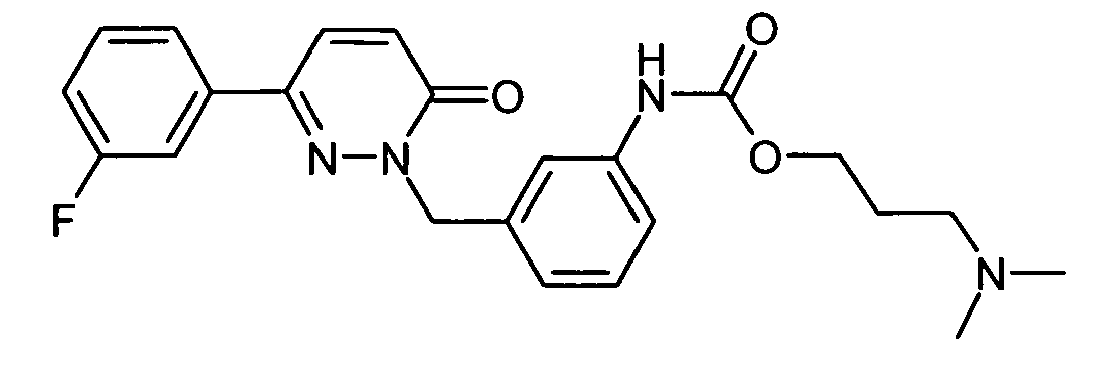
"A29" 
"A30" 
"A31" 
"A32" 
"A33" 
"A34" 
"A35" 
"A36" 
"A37" 
"A38" 
"A39" 
"A40" 
"A41" 
"A42" 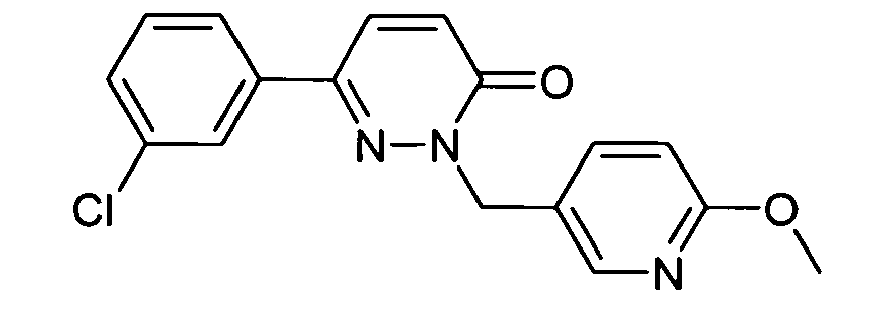
"A43" 
"A43a" 1-Ethyl-3-{3-[3-(3-hydroxyphenyl)-6-oxo-6H-pyridazin-1-yl-methyl]phenyl}urea "A43b" 1-(3-{3-[3-(2-Dimethylaminoethoxy)phenyl]-6-oxo-6H-pyri-dazin-1-ylmethyl}phenyl)-3-ethylurea, hydrochloride "A44" 
"A45" 
"A45a" 2-(2-Amino-1H-benzimidazol-5-ylmethyl)-6-(3-fluorophenyl)-2H-pyridazin-3-one "A46" 
"A47" 2-Benzo-1,2,5-thiadiazol-5-ylmethyl-6-(3-fluorophenyl)-2H-pyridazin-3-one 
"A48" 6-(3,5-Difluorophenyl)-2-pyridin-3-ylmethyl-2H-pyridazin-3-one 
"A49" 6-(3,5-Difluorophenyl)-2-(3-cyanobenzyl)-2H-pyridazin-3-one 
"A50" 6-(3,5-Difluorophenyl)-2-(3-methoxycarbonylbenzyl)-2H-pyridazin-3-one "A51" 6-(3,5-Difluorophenyl)-2-quinolin-6-ylmethyl-2H-pyridazin-3-one 
"A52" 6-(3,4-Difluorophenyl)-2-quinolin-6-ylmethyl-2H-pyridazin-3-one "A53" 6-(4-Fluorophenyl)-2-quinolin-6-ylmethyl-2H-pyridazin-3-one "A54" 6-(3,5-Difluorophenyl)-2-pyridin-4-ylmethyl-2H-pyridazin-3-one "A55" 6-(3,5-Difluorophenyl)-2-(3-acetamidobenzyl)-2H-pyridazin-3-one "A56" 3-Dimethylaminopropyl {3-[3-(3,5-difluorophenyl)-6-oxo-6H-pyridazin-1-ylmethyl]phenyl}carbamate, hydrochloride 
"A57" 3-Dimethylaminopropyl [3-(6-oxo-3-thiazol-2-yl-6H-pyridazin-1-ylmethyl)phenyl]carbamate, hydrochloride 
"A58" 3-Dimethylaminopropyl (3-{1-[3-(3,5-difluorophenyl)-6-oxo-6H-pyridazin-1-yl]ethyl}phenyl)carbamate, hydrochloride 
"A59" 3-Dimethylaminopropyl{3-[3-(3,4-difluorophenyl)-6-oxo-6H-pyridazin-1-ylmethyl]phenyl}carbamate, hydrochloride "A60" 3-Dimethylaminopropyl {3-[3-(3,4,5-trifluorophenyl)-6-oxo-6H-pyridazin-1-ylmethyl]phenyl}carbamate, hydrochloride "A61" 3-Dimethylaminopropyl {3-[3-(3-cyanophenyl)-6-oxo-6H-pyridazin-1-ylmethyl]phenyl}carbamate, hydrochloride "A62" 3-Dimethylaminopropyl {3-[3-(2,3-difluorophenyl)-6-oxo-6H-pyridazin-1-ylmethyl]phenyl}carbamate, hydrochloride "A63" 3-Dimethylaminopropyl {3-[3-(2,4-difluorophenyl)-6-oxo-6H-pyridazin-1-ylmethyl]phenyl}carbamate, hydrochloride "A64" 3-Dimethylaminopropyl {3-[3-(3,5-dichlorophenyl)-6-oxo-6H-pyridazin-1-ylmethyl]phenyl}carbamate, hydrochloride "A65" 3-Dimethylaminopropyl [3-(6-oxo-3-pyridin-3-yl-6H-pyri-dazin-1-ylmethyl)phenyl]carbamate, formate 
"A66" 3-Dimethylaminopropyl {3-[3-(4-cyanophenyl)-6-oxo-6H-pyridazin-1-ylmethyl]phenyl}carbamate, hydrochloride "A67" 3-Morpholin-4-ylpropyl {3-[3-(3,5-difluorophenyl)-6-oxo-6H-pyridazin-1-ylmethyl]phenyl}carbamate, hydrochloride 
"A68" 3-Morpholin-4-ylpropyl {3-[3-(3,4-difluorophenyl)-6-oxo-6H-pyridazin-1-ylmethyl]phenyl}carbamate, hydrochloride "A69" 3-Morpholin-4-ylpropyl {3-[3-(4-fluorophenyl)-6-oxo-6H-pyridazin-1-ylmethyl]phenyl}carbamate, hydrochloride "A70" 3-Morpholin-4-ylpropyl [3-(6-oxo-3-thiazol-2-yl-6H-pyridazin-1-ylmethyl)phenyl]carbamate, hydrochloride 
"A71" 3-Morpholin-4-ylpropyl [3-(6-oxo-3-thiophen-2-yl-6H-pyri-dazin-1-ylmethyl)phenyl]carbamate, hydrochloride 
"A72" 3-Morpholin-4-ylpropyl (3-{1-[3-(3,5-difluorophenyl)-6-oxo-6H-pyridazin-1-yl]ethyl}phenyl)carbamate, hydrochloride 
"A73" 3-Pyrrolidin-1-ylpropyl {3-[3-(3,4-difluorophenyl)-6-oxo-6H-pyridazin-1-ylmethyl]phenyl}carbamate, hydrochloride 
"A73a" 2-Pyrrolidin-1-ylethyl {3-[3-(3,4-difluorophenyl)-6-oxo-6H-pyridazin-1-ylmethyl]phenyl}carbamate, hydrochloride "A74" 3-Pyrrolidin-1-ylpropyl {3-[3-(3,5-difluorophenyl)-6-oxo-6H-pyridazin-1-ylmethyl]phenyl}carbamate, hydrochloride "A75" 3-Methoxypropyl {3-[3-(3,5-difluorophenyl)-6-oxo-6H-pyri-dazin-1-ylmethyl]phenyl}carbamate 
"A76" 3-Methoxypropyl {3-[3-(3,4-difluorophenyl)-6-oxo-6H-pyri-dazin-1-ylmethyl]phenyl}carbamate "A77" 2-Morpholin-4-ylethyl {3-[3-(3,5-difluorophenyl)-6-oxo-6H-pyridazin-1-ylmethyl]phenyl}carbamate, hydrochloride "A78" 3-Morpholin-4-ylpropyl {3-[6-oxo-3-(3,4,5-trifluorophenyl)-6H-pyridazin-1-ylmethyl]phenyl}carbamate, hydrochloride 
"A79" 3-Pyrrolidin-1-ylpropyl {3-[6-oxo-3-(3,4,5-trifluorophenyl)-6H-pyridazin-1-ylmethyl]phenyl}carbamate, hydrochloride 
"A80" 2-Dimethylaminoethyl {3-[3-(3,5-difluorophenyl)-6-oxo-6H-pyridazin-1-y]methyl]phenyl}carbamate, hydrochloride 
"A81" 2-Morpholin-4-ylethyl {3-[3-(3,4-difluorophenyl)-6-oxo-6H-pyridazin-1-ylmethyl]phenyl}carbamate, formate 
"A82" 2-Dimethylaminoethyl {3-[3-(3,4-difluorophenyl)-6-oxo-6H-pyridazin-1-ylmethyl]phenyl}carbamate, hydrochloride 
"A83" 2-Pyrrolidin-1-ylethyl {3-[3-(3,5-difluorophenyl)-6-oxo-6H-pyridazin-1-ylmethyl]phenyl}carbamate, hydrochloride 
"A84" 2-Methoxyethyl {3-[3-(3,5-difluorophenyl)-6-oxo-6H-pyri-dazin-1-ylmethyl]phenyl}carbamate 
"A85" 2-Methoxyethyl {3-[3-(3,4-difluorophenyl)-6-oxo-6H-pyri-dazin-1-ylmethyl]phenyl}carbamate "A86" 3-Morpholin-4-ylpropyl {3-[3-(2,4-difluorophenyl)-6-oxo-6H-pyridazin-1-ylmethyl]phenyl}carbamate, hydrochloride 
"A87" 3-Morpholin-4-ylpropyl {3-[3-(2,3-difluorophenyl)-6-oxo-6H-pyridazin-1-ylmethyl]phenyl}carbamate, hydrochloride "A88" 3-Morpholin-4-ylpropyl {3-[3-(3-cyanophenyl)-6-oxo-6H-pyridazin-1-ylmethyl]phenyl}carbamate, hydrochloride 
"A89" 2-Morpholin-4-ylethyl {3-[3-(3,4-difluorophenyl)-6-oxo-6H-pyridazin-1-ylmethyl]phenyl}carbamate, hydrochloride 
"A90" 3-(4-Methylpiperazin-1-yl)propyl {3-[3-(3,4-difluorophenyl)-6-oxo-6H-pyridazin-1-ylmethyl]phenyl}carbamate, dihydro-chloride 
"A91" 3-(4-Methylpiperazin-1-yl)propyl {3-[3-(3,5-difluorophenyl)-6-oxo-6H-pyridazin-1-ylmethyl]phenyl}carbamate, dihydro-chloride, hydrochloride 
"A92" 2-(4-Methylpiperazin-1-yl)ethyl {3-[3-(3,4-difluorophenyl)-6-oxo-6H-pyridazin-1-ylmethyl]phenyl}carbamate, dihydro-chloride 
"A93" 2-(4-Methylpiperazin-1-yl)ethyl {3-[3-(3,5-difluorophenyl)-6-oxo-6H-pyridazin-1-ylmethyl]phenyl}carbamate, dihydro-chloride "A94" 2-(2-Methoxyethoxy)ethyl {3-[3-(3,5-difluorophenyl)-6-oxo-6H-pyridazin-1-ylmethyl]phenyl}carbamate 
"A95" 2-Morpholin-4-ylethyl {3-[6-oxo-3-(3,4,5-trifluorophenyl)-6H-pyridazin-1-ylmethyl]phenyl}carbamate, hydrochloride 
"A96" 3-Morpholin-4-ylpropyl {3-[3-(3,5-dichlorophenyl)-6-oxo-6H-pyridazin-1-ylmethyl]phenyl}carbamate, hydrochloride 
"A97" 2-(2-Methoxyethoxy)ethyl {3-[3-(3,4-difluorophenyl)-6-oxo-6H-pyridazin-1-ylmethyl]phenyl}carbamate 
"A98" 1-Methylpiperidin-4-yl {3-[3-(3,5-difluorophenyl)-6-oxo-6H-pyridazin-1-ylmethyl]phenyl}carbamate, hydrochloride 
"A99" 1-Methylpiperidin-4-yl {3-[3-(3,4-difluorophenyl)-6-oxo-6H-pyridazin-1-ylmethyl]phenyl}carbamate, hydrochloride "A100" 2-Morpholin-4-ylethyl {3-[3-(4-cyanophenyl)-6-oxo-6H-pyri-dazin-1-ylmethyl]phenyl}carbamate, hydrochloride 
"A101" 3-(4-Methylpiperazin-1-yl)propyl {3-[6-oxo-3-(3,4,5-trifluoro-phenyl)-6H-pyridazin-1-ylmethyl]phenyl}carbamate, di-hydrochloride, hydrochloride 
"A102" 4-Dimethylaminobutyl {3-[3-(3,5-difluorophenyl)-6-oxo-6H-pyridazin-1-ylmethyl]phenyl}carbamate 
"A103" 4-(4-Methylpiperazin-1-yl)butyl {3-[3-(3,5-difluorophenyl)-6-oxo-6H-pyridazin-1-ylmethyl]phenyl}carbamate, dihydro-chloride 
"A104" 1-Methylpiperidin-4-ylmethyl {3-[3-(3,5-difluorophenyl)-6-oxo-6H-pyridazin-1-ylmethyl]phenyl}carbamate, hydrochloride 
"A105" 2-(1-Methylpyrrolidin-2-yl)ethyl {3-[3-(3,5-difluorophenyl)-6-oxo-6H-pyridazin-1-ylmethyl]phenyl}carbamate, hydrochloride 
"A106" 1-Methylpiperidin-3-ylmethyl {3-[3-(3,5-difluorophenyl)-6-oxo-6H-pyridazin-1-ylmethyl]phenyl}carbamate, hydrochloride 
"A107" 3-(4-Methylpiperazin-1-yl)propyl {3-[3-(3-cyanophenyl)-6-oxo-6H-pyridazin-1-ylmethyl]phenyl}carbamate, dihydrochloride 
"A108" 3-(2-Methoxyethoxy)propyl {3-[3-(3,5-difluorophenyl)-6-oxo-6H-pyridazin-1-ylmethyl]phenyl}carbamate 
"A109" 3-Diethylaminopropyl {3-[3-(3,5-difluorophenyl)-6-oxo-6H-pyridazin-1-ylmethyl]phenyl}carbamate, hydrochloride 
"A110" 4-Dimethylaminobutyl {3-[3-(3,5-difluorophenyl)-6-oxo-6H-pyridazin-1-ylmethyl]phenyl}carbamate, hydrochloride 
"A111" 3-(2-Methoxyethoxy)propyl {3-[3-(3,4-difluorophenyl)-6-oxo-6H-pyridazin-1-ylmethyl]phenyl}carbamate 
"A112" 4-Dimethylaminobutyl {3-[3-(3,4-difluorophenyl)-6-oxo-6H-pyridazin-1-ylmethyl]phenyl}carbamate, hydrochloride 
"A113" 2-(4-Methylpiperazin-1-yl)ethyl {3-[6-oxo-3-(3,4,5-trifluoro-phenyl)-6H-pyridazin-1-ylmethyl]phenyl}carbamate, dihydrochloride 
"A114" 2-(3-Aminobenzyl)-6-(3,5-difluorophenyl)-2H-pyridazin-3-one 
"A115" 2-(3-Aminobenzyl)-6-(3,4-difluorophenyl)-2H-pyridazin-3-one "A116" 2-(3-Aminobenzyl)-6-(3,4,5-trifluorophenyl)-2H-pyridazin-3-one "A117" 2-(3-Aminobenzyl)-6-(4-fluorophenyl)-2H-pyridazin-3-one "A118" 3-[1-(3-Aminobenzyl)-6-oxo-1,6-dihydropyridazin-3-yl]-benzonitrile 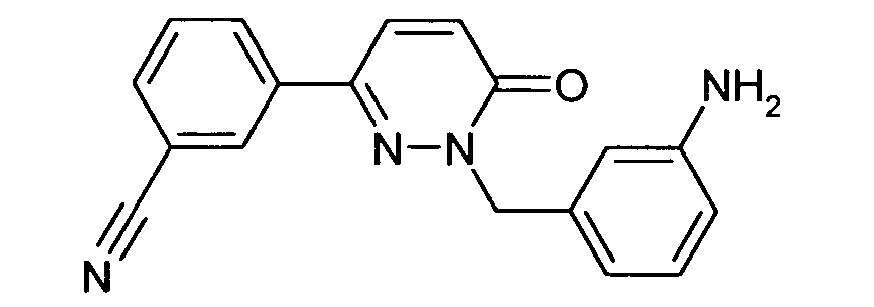
"A119" 2-Hydroxyethyl {3-[3-(3,5-difluorophenyl)-6-oxo-6H-pyri-dazin-1-ylmethyl]phenyl}carbamate "A120" 2-Hydroxyethyl {3-[3-(3,4-difluorophenyl)-6-oxo-6H-pyri-dazin-1-ylmethyl]phenyl}carbamate "A121" 3-[3-(3,5-Difluorophenyl)-6-oxo-6H-pyridazin-1-ylmethyl]-benzoic acid "A122" 6-(3,5-Difluorophenyl)-2-[3-(5-methyloxazol-2-yl)benzyl]-2H-pyridazin-3-one 
"A123" 6-(3,5-Difluorophenyl)-2-[3-(5-oxo-4,5-dihydro-1,3,4-oxadia-zol-2-yl)benzyl]-2H-pyridazin-3-one 
"A124" 2-Benzo-1,2,5-thiadiazol-5-ylmethyl-6-(3-fluorophenyl)-2H-pyridazin-3-one "A125" 2-(2-Amino-1H-benzimidazol-5-ylmethyl)-6-(3-fluorophenyl)-2H-pyridazin-3-one "A126" 2-(1H-Benzimidazol-5-ylmethyl)-6-(3-fluorophenyl)-2H-pyri-dazin-3-one "A127" 5-[3-(3-Fluorophenyl)-6-oxo-6H-pyridazin-1-ylmethyl]-1,3-dihydrobenzimidazol-2-one "A128" 6-(3,5-Difluorophenyl)-2-(3-hydroxybenzyl)-2H-pyridazin-3-one "A129" 1-{3-[3-(3,5-Difluorophenyl)-6-oxo-6H-pyridazin-1-ylmethyl]-phenyl}-3-(3-morpholin-4-ylpropyl)urea "A130" 1-{3-[3-(4-Fluorophenyl)-6-oxo-6H-pyridazin-1-ylmethyl]-phenyl}-3-(1-methylpyrrolidin-3-ylmethyl)urea, hydrochloride 
"A131" 1-{3-[3-(3,5-Difluorophenyl)-6-oxo-6H-pyridazin-1-ylmethyl]-phenyl}-3-(3-pyrrolidin-1-ylpropyl)urea, hydrochloride 
"A132" 1-{3-[3-(3,4-Difluorophenyl)-6-oxo-6H-pyridazin-1-ylmethyl]-phenyl}-3-(3-pyrrolidin-1-ylpropyl)urea, formate 
"A133" 3-[3-(3,5-Difluorophenyl)-6-oxo-6H-pyridazin-1-ylmethyl]-phenyl (3-dimethylaminopropyl)carbamate, hydrochloride 
"A134" 1-{3-[3-(3,5-Difluorophenyl)-6-oxo-6H-pyridazin-1-ylmethyl]-phenyl}-3-(3-dimethylaminopropyl)urea, hydrochloride 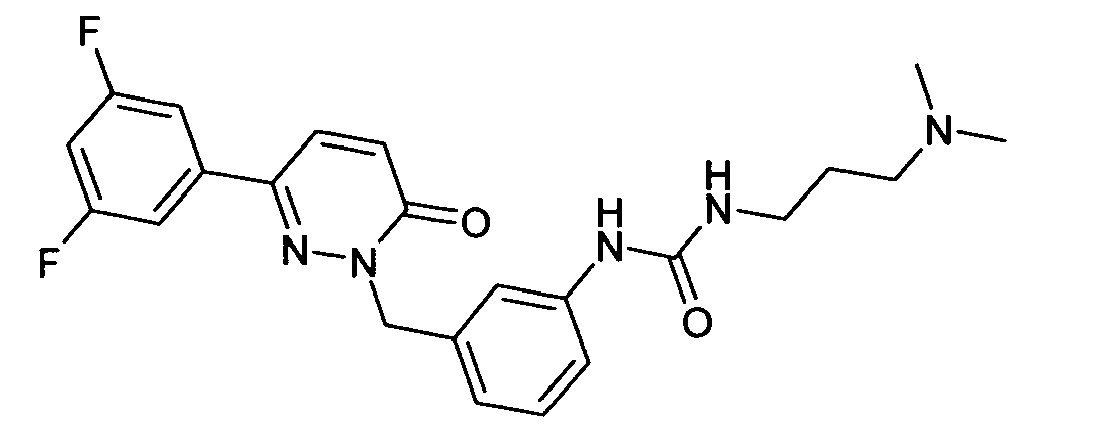
"A135" 1-{3-[3-(3,5-Difluorophenyl)-6-oxo-6H-pyridazin-1-ylmethyl]-phenyl}-3-(2-morpholin-4-ylethyl)urea, hydrochloride 
"A136" 1-{3-[3-(3,5-Difluorophenyl)-6-oxo-6H-pyridazin-1-ylmethyl]-phenyl}-3-[3-(4-methylpiperazin-1-yl)propyl]urea, hydrochloride 
"A137" 1-{3-[3-(3,4-Difluorophenyl)-6-oxo-6H-pyridazin-1-ylmethyl]-phenyl}-3-(3-dimethylaminopropyl)urea, hydrochloride 
"A138" 1-{3-[3-(3,4-Difluorophenyl)-6-oxo-6H-pyridazin-1-ylmethyl]-phenyl}-3-(3-morpholin-4-ylpropyl)urea, hydrochloride 
"A139" 1-{3-[3-(3,4-Difluorophenyl)-6-oxo-6H-pyridazin-1-ylmethyl]-phenyl}-3-(2-morpholin-4-ylethyl)urea, hydrochloride 
"A140" 1-{3-[3-(3,4-Difluorophenyl)-6-oxo-6H-pyridazin-1-ylmethyl]-phenyl}-3-[3-(4-methylpiperazin-1-yl)propyl]urea, dihydrochloride 
"A141" {3-[3-(3,5-Difluorophenyl)-6-oxo-6H-pyridazin-1-ylmethyl]-phenyl}urea 
"A142" 3-Methylaminopropyl {3-[3-(3,5-difluorophenyl)-6-oxo-6H-pyridazin-1-ylmethyl]phenyl}carbamate "A143" 2-Piperazin-1-ylethyl {3-[3-(3,5-difluorophenyl)-6-oxo-6H-pyridazin-1-ylmethyl]phenyl}carbamate, dihydrochloride 
"A144" 3-Piperazin-1-ylpropyl {3-[3-(3,4-difluorophenyl)-6-oxo-6H-pyridazin-1-ylmethyl]phenyl}carbamate, dihydrochloride 
"A145" 3-Piperazin-1-ylpropyl {3-[3-(3,5-difluorophenyl)-6-oxo-6H-pyridazin-1-ylmethyl]phenyl}carbamate, dihydrochloride "A146" 2-Piperazin-1-ylethyl {3-[3-(3,4-difluorophenyl)-6-oxo-6H-pyridazin-1-ylmethyl]phenyl}carbamate, dihydrochloride 
"A147" 3-Methylaminopropyl {3-[3-(3,4-difluorophenyl)-6-oxo-6H-pyridazin-1-ylmethyl]phenyl}carbamate, hydrochloride 
"A148" 2-Isopropylaminoethyl{3-[3-(3,4-difluorophenyl)-6-oxo-6H-pyridazin-1-ylmethyl]phenyl}carbamate, hydrochloride 
"A149" 3-Isopropylaminopropyl {3-[3-(3,4-difluorophenyl)-6-oxo-6H-pyridazin-1-ylmethyl]phenyl}carbamate, hydrochloride 
"A150" 3-Isopropylaminopropyl {3-[3-(3,5-difluorophenyl)-6-oxo-6H-pyridazin-1-ylmethyl]phenyl}carbamate, hydrochloride 
"A151" 2-Methylaminoethyl {3-[3-(3,4-difluorophenyl)-6-oxo-6H-pyridazin-1-ylmethyl]phenyl}carbamate, hydrochloride 
"A152" 2-Methylaminoethyl {3-[3-(3,5-difluorophenyl)-6-oxo-6H-pyridazin-1-ylmethyl]phenyl}carbamate, hydrochloride 
"A153" 2-Isopropylaminoethyl {3-[3-(3,5-difluorophenyl)-6-oxo-6H-pyridazin-1-ylmethyl]phenyl}carbamate, hydrochloride 
"A154" 3-Methylaminopropyl {3-[3-(4-cyanophenyl)-6-oxo-6H-pyri-dazin-1-ylmethyl]phenyl}carbamate, hydrochloride 
"A155" 4-Methylaminobutyl {3-[3-(3,5-difluorophenyl)-6-oxo-6H-pyridazin-1-ylmethyl]phenyl}carbamate, hydrochloride 
"A156" Piperidin-4-ylmethyl {3-[3-(3,5-difluorophenyl)-6-oxo-6H-pyridazin-1-ylmethyl]phenyl}carbamate, hydrochloride 
"A157" Piperidin-3-ylmethyl {3-[3-(3,5-difluorophenyl)-6-oxo-6H-pyridazin-1-ylmethyl]phenyl}carbamate, hydrochloride 
"A158" 6-[3-(3,5-Difluorophenyl)-6-oxo-6H-pyridazin-1-ylmethyl]-1-(3-dimethylaminopropyl)-1,3-dihydrobenzimidazol-2-one "A159" 6-[3-(3,5-Difluorophenyl)-6-oxo-6H-pyridazin-1-ylmethyl]-1-(2-dimethylaminoethyl)-1,3-dihydrobenzimidazol-2-one, hydrochloride 
"A160" 6-[3-(3,5-Difluorophenyl)-6-oxo-6H-pyridazin-1-ylmethyl]-1-(4-dimethylaminobutyl)-1,3-dihydrobenzimidazol-2-one, hydrochloride 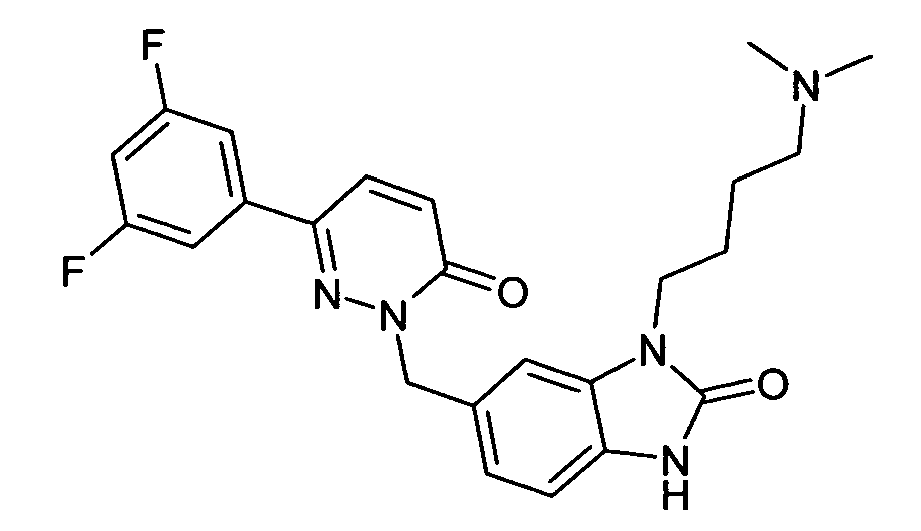
"A161" 6-(3,5-Difluorophenyl)-2-(1H-indazol-5-ylmethyl)-2H-pyri-dazin-3-one "A162" 4-[1-(1H-Indazol-5-ylmethyl)-6-oxo-1,6-dihydropyridazin-3-yl]benzonitrile 
"A163" 6-(3,5-Difluorophenyl)-2-(1-oxyquinolin-6-ylmethyl)-2H-pyri-dazin-3-one "A164" 6-[3-(3,5-Difluorophenyl)-6-oxo-6H-pyridazin-1-ylmethyl]-1H-quinolin-2-one "A165" 2-(3-Amino-1H-indazol-5-ylmethyl)-6-(3,5-difluorophenyl)-2H-pyridazin-3-one "A166" 3-(4-Methylpiperazin-1-yl)propyl {3-[3-(3-carbamoylphenyl)-6-oxo-6H-pyridazin-1-ylmethyl]phenyl}carbamate "A167" 
"A168" 
"A169" 5-[3-(3,5-Difluorophenyl)-6-oxo-6H-pyridazin-1-ylmethyl]-1,3-dihydrobenzimidazol-2-one 
- Medicaments comprising at least one compound according to Claim 1 and/or pharmaceutically usable salts, solvates, tautomers and stereoisomers thereof, including mixtures thereof in all ratios, and optionally excipients and/or adjuvants.
- Use of compounds according to Claim 1
and pharmaceutically usable salts, solvates, tautomers and stereoisomers thereof, including mixtures thereof in all ratios,
for the preparation of a medicament for the treatment of diseases, where the disease to be treated is a solid tumour or a tumour of the blood and immune system. - Use according to Claim 3, where the solid tumour originates from the group of tumours of the squamous epithelium, of the bladder, of the stomach, of the kidneys, of head and neck, of the oesophagus, of the cervix, of the thyroid, of the intestine, of the liver, of the brain, of the prostate, of the urogenital tract, of the lymphatic system, of the stomach, of the larynx and/or of the lung.
- Use according to Claim 3, where the solid tumour originates from the group monocytic leukaemia, lung adenocarcinoma, small-cell lung carcinomas, pancreatic cancer, glioblastomas and breast carcinoma.
- Use according to Claim 3, where the solid tumour originates from the group of lung adenocarcinoma, small-cell lung carcinomas, pancreatic cancer, glioblastomas, colon carcinoma and breast carcinoma.
- Use according to Claim 3, where the tumour originates from the group of acute myeloid leukaemia, chronic myeloid leukaemia, acute lymphatic leukaemia and/or chronic lymphatic leukaemia.
- Medicaments comprising at least one compound according to Claim 1, and/or pharmaceutically usable salts, solvates and stereoisomers thereof, including mixtures thereof in all ratios, and at least one further medicament active ingredient.
- Set (kit) consisting of separate packs of(a) an effective amount of a compound according to Claim 1, and/or pharmaceutically usable solvates, salts and stereoisomers thereof, including mixtures thereof in all ratios,
and(b) an effective amount of a further medicament active ingredient.
Priority Applications (3)
| Application Number | Priority Date | Filing Date | Title |
|---|---|---|---|
| SI200631187T SI1960370T1 (en) | 2005-12-05 | 2006-11-07 | Pyridiazinone derivatives for tumour treatment |
| PL06806700T PL1960370T3 (en) | 2005-12-05 | 2006-11-07 | Pyridiazinone derivatives for tumour treatment |
| CY20111101245T CY1112206T1 (en) | 2005-12-05 | 2011-12-14 | PYRIDAZINONINE PRODUCTS FOR TREATMENT TREATMENT |
Applications Claiming Priority (2)
| Application Number | Priority Date | Filing Date | Title |
|---|---|---|---|
| DE102005057924A DE102005057924A1 (en) | 2005-12-05 | 2005-12-05 | pyridazinone derivatives |
| PCT/EP2006/010668 WO2007065518A1 (en) | 2005-12-05 | 2006-11-07 | Pyridiazinone derivatives for tumour treatment |
Publications (2)
| Publication Number | Publication Date |
|---|---|
| EP1960370A1 EP1960370A1 (en) | 2008-08-27 |
| EP1960370B1 true EP1960370B1 (en) | 2011-10-05 |
Family
ID=37775213
Family Applications (1)
| Application Number | Title | Priority Date | Filing Date |
|---|---|---|---|
| EP06806700A Active EP1960370B1 (en) | 2005-12-05 | 2006-11-07 | Pyridiazinone derivatives for tumour treatment |
Country Status (27)
| Country | Link |
|---|---|
| US (1) | US8173653B2 (en) |
| EP (1) | EP1960370B1 (en) |
| JP (1) | JP5210172B2 (en) |
| KR (1) | KR101367447B1 (en) |
| CN (1) | CN101326167B (en) |
| AR (1) | AR057214A1 (en) |
| AT (1) | ATE527241T1 (en) |
| AU (1) | AU2006322364B2 (en) |
| BR (1) | BRPI0619407A2 (en) |
| CA (1) | CA2632217C (en) |
| CY (1) | CY1112206T1 (en) |
| DE (1) | DE102005057924A1 (en) |
| DK (1) | DK1960370T3 (en) |
| EA (1) | EA014667B1 (en) |
| EC (1) | ECSP088598A (en) |
| ES (1) | ES2373117T3 (en) |
| IL (1) | IL191832A (en) |
| MY (1) | MY153261A (en) |
| NZ (1) | NZ569568A (en) |
| PE (1) | PE20070832A1 (en) |
| PL (1) | PL1960370T3 (en) |
| PT (1) | PT1960370E (en) |
| SI (1) | SI1960370T1 (en) |
| TW (1) | TWI395741B (en) |
| UA (1) | UA95934C2 (en) |
| WO (1) | WO2007065518A1 (en) |
| ZA (1) | ZA200805877B (en) |
Families Citing this family (32)
| Publication number | Priority date | Publication date | Assignee | Title |
|---|---|---|---|---|
| MX2009000884A (en) | 2006-07-25 | 2009-06-05 | Cephalon Inc | Pyridizinone derivatives. |
| DE102006037478A1 (en) * | 2006-08-10 | 2008-02-14 | Merck Patent Gmbh | 2- (Heterocyclylbenzyl) -pyridazinone derivatives |
| JP5278318B2 (en) | 2006-12-14 | 2013-09-04 | アステラス製薬株式会社 | Polycyclic acid compounds useful as CRTH2 antagonists and antiallergic agents |
| WO2008121877A2 (en) * | 2007-04-02 | 2008-10-09 | Institute For Oneworld Health | Cftr inhibitor compounds and uses thereof |
| DE102007025718A1 (en) * | 2007-06-01 | 2008-12-04 | Merck Patent Gmbh | pyridazinone derivatives |
| DE102007025717A1 (en) | 2007-06-01 | 2008-12-11 | Merck Patent Gmbh | Aryl ether pyridazinone derivatives |
| DE102007026341A1 (en) | 2007-06-06 | 2008-12-11 | Merck Patent Gmbh | Benzoxazolonderivate |
| DE102007032507A1 (en) | 2007-07-12 | 2009-04-02 | Merck Patent Gmbh | pyridazinone derivatives |
| DE102007038957A1 (en) * | 2007-08-17 | 2009-02-19 | Merck Patent Gmbh | 6-thioxo-pyridazine derivatives |
| DE102007061963A1 (en) | 2007-12-21 | 2009-06-25 | Merck Patent Gmbh | pyridazinone derivatives |
| CN101538245B (en) * | 2008-03-18 | 2011-02-16 | 中国科学院上海药物研究所 | One-class pyridazinone compounds and preparation method and application thereof |
| DE102008019907A1 (en) * | 2008-04-21 | 2009-10-22 | Merck Patent Gmbh | pyridazinone derivatives |
| DE102008028905A1 (en) | 2008-06-18 | 2009-12-24 | Merck Patent Gmbh | 3- (3-pyrimidin-2-yl-benzyl) - [1,2,4] triazolo [4,3-b] pyridazine derivatives |
| DE102008037790A1 (en) | 2008-08-14 | 2010-02-18 | Merck Patent Gmbh | Bicyclic triazole derivatives |
| DK2361250T3 (en) * | 2008-12-22 | 2013-11-04 | Merck Patent Gmbh | NEW POLYMORPHE FORMS OF 6- (1-METHYL-1H-PYRAZOL-4-YL) -2- {3- [5- (2-MORPHOLIN-4-YL-ETHOXY) -PYRIMIDIN-2-YL] -BENZYL} - 2H-PYRIDAZINE-3-ON DIHYDROGEN PHOSPHATE AND PROCEDURES FOR PREPARING THEREOF |
| DE102008062826A1 (en) | 2008-12-23 | 2010-07-01 | Merck Patent Gmbh | pyridazinone derivatives |
| DE102009003954A1 (en) | 2009-01-07 | 2010-07-08 | Merck Patent Gmbh | pyridazinone derivatives |
| DE102009004061A1 (en) * | 2009-01-08 | 2010-07-15 | Merck Patent Gmbh | pyridazinone derivatives |
| JP5719781B2 (en) * | 2009-01-08 | 2015-05-20 | メルク パテント ゲゼルシャフト ミット ベシュレンクテル ハフツングMerck Patent Gesellschaft mit beschraenkter Haftung | 3- (1- {3- [5- (1-Methyl-piperidin-4-ylmethoxy) -pyrimidin-2-yl] -benzyl} -6-oxo-1,6-dihydro-pyridazin-3-yl)- A novel polymorph of benzonitrile hydrochloride and its preparation |
| CN102731409A (en) * | 2011-04-08 | 2012-10-17 | 中国科学院上海药物研究所 | Pyridazinone compound, and pharmaceutical compositions, preparation method and use thereof |
| KR101842645B1 (en) * | 2012-04-12 | 2018-03-29 | 한국화학연구원 | Novel Hydrazinone-substituted Pyrimidine Derivatives and Use Thereof |
| BR112015008279A2 (en) * | 2012-11-02 | 2017-07-04 | Merck Patent Gmbh | 6-oxo-1,6-dihydropyridazine derivative for use in the treatment of hepatocellular carcinoma (hcc) |
| SG11201602996RA (en) * | 2013-10-18 | 2016-05-30 | Celgene Quanticel Res Inc | Bromodomain inhibitors |
| CN103772352B (en) * | 2014-01-16 | 2017-01-18 | 四川百利药业有限责任公司 | Pyridazinone derivatives and preparation method and application thereof |
| NZ731770A (en) * | 2014-12-11 | 2023-05-26 | Merck Patent Gmbh | Combination of a 6-oxo-1,6-dihydro-pyridazine derivative having anti-cancer activity with a quinazoline derivative |
| AU2017348186A1 (en) * | 2016-10-26 | 2019-05-16 | Proteostasis Therapeutics, Inc | Pyridazine derivatives, compositions and methods for modulating CFTR |
| CN107334767B (en) * | 2017-06-08 | 2019-03-05 | 中国医学科学院医药生物技术研究所 | A kind of application of pyridazinone compound in oncotherapy |
| EP3679027A1 (en) | 2017-09-04 | 2020-07-15 | C4 Therapeutics, Inc. | Dihydrobenzimidazolones |
| PL3877376T3 (en) | 2018-11-06 | 2024-02-19 | Edgewise Therapeutics, Inc. | Pyridazinone compounds and uses thereof |
| CN113272014B (en) | 2018-11-06 | 2026-01-27 | 艾知怀斯治疗学公司 | Pyridazinone compounds and uses thereof |
| AU2019374812B2 (en) | 2018-11-06 | 2025-03-06 | Edgewise Therapeutics, Inc. | Pyridazinone compounds and uses thereof |
| WO2020181232A1 (en) | 2019-03-06 | 2020-09-10 | C4 Therapeutics, Inc. | Heterocyclic compounds for medical treatment |
Family Cites Families (20)
| Publication number | Priority date | Publication date | Assignee | Title |
|---|---|---|---|---|
| RO79566A2 (en) * | 1980-05-28 | 1982-08-17 | Institutul De Cercetari Chimico-Farmaceutice,Ro | SUBSTANCES OF THE CLASS OF 2- (3'-ARYL-PYRIDAZONYL-1'5-METHYL-5-ARYL- (ALCHYL) AMINO-TIADIAZOL |
| RO79562A2 (en) * | 1980-05-29 | 1982-08-17 | Institutul De Cercetari Chimico-Farmaceutice,Ro | SUBSTANCES OF CLASS 3- (3'-ARYL-PYRIDAZONYL-1'5-METHYL-4-ARYL (ALKYL) -5-MERCAPTHIO-1,2,4-TRIAZOLE AND PROCESS FOR OBTAINING |
| JPS5826802A (en) * | 1981-08-10 | 1983-02-17 | Sankyo Co Ltd | Fungicide for agriculture and gardening |
| DE3321012A1 (en) * | 1983-06-10 | 1984-12-13 | A. Nattermann & Cie GmbH, 5000 Köln | SUBSTITUTED 4,5-DIHYDRO-6- (THIEN-2-YL) -3 (2H) -PYRIDAZINONE AND 6- (THIEN-2-YL) -3 (2H) -PYRIDAZINONE AND METHOD FOR THE PRODUCTION THEREOF |
| KR100204381B1 (en) * | 1990-09-21 | 1999-06-15 | 마크 에스. 아들러 | Dihydropyridazinone, pyridazinone compounds, compositions containing them and their usage |
| EP0478195B1 (en) | 1990-09-21 | 1999-05-26 | Rohm And Haas Company | Dihydropyridazinones and pyridazinones as fungicides |
| IL115889A0 (en) * | 1994-11-14 | 1996-01-31 | Rohm & Haas | Pyridazinones and their use as fungicides |
| US6121251A (en) * | 1996-10-11 | 2000-09-19 | Rohm And Haas Company | Dihydropyridazinones and pyridazinones and their use as fungicides and insecticides |
| PT1005460E (en) * | 1997-08-22 | 2006-07-31 | Abbott Lab | BIOSSINTESE OF PROSTAGLANDINE-ENDOPEROXIDE H-SINTASE INHIBITORS |
| HUP0100059A3 (en) * | 1997-11-19 | 2002-08-28 | Kowa Co | Novel pyridazine derivatives and drugs containing the same as the active ingredient |
| US7060822B1 (en) | 1999-07-30 | 2006-06-13 | Abbott Gmbh & Co. Kg | 2-pyrazolin-5-ones |
| CN1193026C (en) | 1999-07-30 | 2005-03-16 | 艾博特股份有限两合公司 | Z-pyrazoline-5-ones |
| AUPR606401A0 (en) * | 2001-07-02 | 2001-07-26 | Fujisawa Pharmaceutical Co., Ltd. | Pyrazolopyridine compound and pharmaceutical use thereof |
| CA2462525A1 (en) | 2001-10-31 | 2003-05-08 | Merck Patent Gesellschaft Mit Beschraenkter Haftung | Type 4 phosphodiesterase inhibitors and uses thereof |
| JP2005519895A (en) * | 2002-01-18 | 2005-07-07 | ファルマシア・コーポレーション | Substituted pyridazinones as P38 inhibitors |
| US20040067955A1 (en) * | 2002-09-06 | 2004-04-08 | Fujisawa Pharmaceutical Co. Ltd. | Pyridazinone compound and pharmaceutical use thereof |
| US7314877B2 (en) * | 2003-03-07 | 2008-01-01 | Kowa Co., Ltd. | Benzofuran derivative |
| CN101410120A (en) | 2003-04-25 | 2009-04-15 | 吉里德科学公司 | Anti-inflammatory phosphonate compounds |
| KR20060028632A (en) * | 2003-04-25 | 2006-03-30 | 길리애드 사이언시즈, 인코포레이티드 | Anti-inflammatory phosphonate compounds |
| WO2006095666A1 (en) * | 2005-03-07 | 2006-09-14 | Kyorin Pharmaceutical Co., Ltd. | Pyrazolopyridine-4-yl pyridazinone derivative and addition salt thereof, and pde inhibitor comprising the derivative or salt as active ingredient |
-
2005
- 2005-12-05 DE DE102005057924A patent/DE102005057924A1/en not_active Withdrawn
-
2006
- 2006-11-07 NZ NZ569568A patent/NZ569568A/en not_active IP Right Cessation
- 2006-11-07 EP EP06806700A patent/EP1960370B1/en active Active
- 2006-11-07 AU AU2006322364A patent/AU2006322364B2/en not_active Ceased
- 2006-11-07 JP JP2008543675A patent/JP5210172B2/en not_active Expired - Fee Related
- 2006-11-07 UA UAA200808757A patent/UA95934C2/en unknown
- 2006-11-07 EA EA200801428A patent/EA014667B1/en not_active IP Right Cessation
- 2006-11-07 BR BRPI0619407-9A patent/BRPI0619407A2/en not_active Application Discontinuation
- 2006-11-07 KR KR1020087016217A patent/KR101367447B1/en not_active Expired - Fee Related
- 2006-11-07 ES ES06806700T patent/ES2373117T3/en active Active
- 2006-11-07 CN CN2006800458935A patent/CN101326167B/en not_active Expired - Fee Related
- 2006-11-07 PL PL06806700T patent/PL1960370T3/en unknown
- 2006-11-07 AT AT06806700T patent/ATE527241T1/en active
- 2006-11-07 WO PCT/EP2006/010668 patent/WO2007065518A1/en not_active Ceased
- 2006-11-07 MY MYPI20081936A patent/MY153261A/en unknown
- 2006-11-07 DK DK06806700.8T patent/DK1960370T3/en active
- 2006-11-07 CA CA2632217A patent/CA2632217C/en active Active
- 2006-11-07 SI SI200631187T patent/SI1960370T1/en unknown
- 2006-11-07 US US12/096,079 patent/US8173653B2/en not_active Expired - Fee Related
- 2006-11-07 PT PT06806700T patent/PT1960370E/en unknown
- 2006-12-01 AR ARP060105310A patent/AR057214A1/en active IP Right Grant
- 2006-12-04 TW TW095145046A patent/TWI395741B/en not_active IP Right Cessation
- 2006-12-05 PE PE2006001553A patent/PE20070832A1/en active IP Right Grant
-
2008
- 2008-05-29 IL IL191832A patent/IL191832A/en active IP Right Grant
- 2008-07-02 EC EC2008008598A patent/ECSP088598A/en unknown
- 2008-07-04 ZA ZA200805877A patent/ZA200805877B/en unknown
-
2011
- 2011-12-14 CY CY20111101245T patent/CY1112206T1/en unknown
Also Published As
Similar Documents
| Publication | Publication Date | Title |
|---|---|---|
| EP1960370B1 (en) | Pyridiazinone derivatives for tumour treatment | |
| EP2150539B1 (en) | Pyridazinone derivatives | |
| EP2049531B1 (en) | 2-(heterocyclylbenzyl)pyridazinone derivatives | |
| EP2150551B1 (en) | 2-oxo-3-benzyl-benzoxazol-2-one derivatives and related compounds as met kinase inhibitors for the treatment of tumors | |
| EP2220070B1 (en) | 2-benzylpyridazinone derivatives as met kinase inhibitors | |
| EP2152370B1 (en) | Aryl ether pyridazinone derivatives | |
| EP2285811B1 (en) | 3-(3-pyrimidin-2-yl-benzyl)-[1,2,4]-triazolo[4,3-b]pyridazine derivatives as met kinase inhibitors | |
| DE102007032507A1 (en) | pyridazinone derivatives | |
| EP2176236A1 (en) | 6-thioxo-pyridazine derivatives | |
| EP2373644B1 (en) | Pyridazinone derivatives | |
| WO2009129905A1 (en) | Pyridazinone derivatives | |
| EP1917248B1 (en) | 1-acyldihydropyrazol derivatives | |
| EP1951697B1 (en) | Substituted 5-phenyl-3,6-dihydro-2-oxo-6h-[1,3,4]thiadiazines | |
| EP2373635A1 (en) | Benzothiazolone derivative | |
| WO2010069441A1 (en) | 3-(3-pyrimidin-2-yl-benzyl)-[1,2,4]triazolo[4,3-b]pyrimidine derivatives | |
| EP2181111B1 (en) | Thiadiazinone derivatives | |
| EP2373647B1 (en) | Pyridazinone derivatives | |
| EP2300434A1 (en) | Dihydropyrazole derivatives as tyrosine kinase modulators for the treatment of tumors |
Legal Events
| Date | Code | Title | Description |
|---|---|---|---|
| PUAI | Public reference made under article 153(3) epc to a published international application that has entered the european phase |
Free format text: ORIGINAL CODE: 0009012 |
|
| 17P | Request for examination filed |
Effective date: 20080320 |
|
| AK | Designated contracting states |
Kind code of ref document: A1 Designated state(s): AT BE BG CH CY CZ DE DK EE ES FI FR GB GR HU IE IS IT LI LT LU LV MC NL PL PT RO SE SI SK TR |
|
| 17Q | First examination report despatched |
Effective date: 20090909 |
|
| GRAP | Despatch of communication of intention to grant a patent |
Free format text: ORIGINAL CODE: EPIDOSNIGR1 |
|
| GRAS | Grant fee paid |
Free format text: ORIGINAL CODE: EPIDOSNIGR3 |
|
| GRAA | (expected) grant |
Free format text: ORIGINAL CODE: 0009210 |
|
| AK | Designated contracting states |
Kind code of ref document: B1 Designated state(s): AT BE BG CH CY CZ DE DK EE ES FI FR GB GR HU IE IS IT LI LT LU LV MC NL PL PT RO SE SI SK TR |
|
| REG | Reference to a national code |
Ref country code: GB Ref legal event code: FG4D Free format text: NOT ENGLISH |
|
| REG | Reference to a national code |
Ref country code: CH Ref legal event code: EP |
|
| REG | Reference to a national code |
Ref country code: IE Ref legal event code: FG4D |
|
| REG | Reference to a national code |
Ref country code: DE Ref legal event code: R096 Ref document number: 502006010360 Country of ref document: DE Effective date: 20111201 |
|
| REG | Reference to a national code |
Ref country code: RO Ref legal event code: EPE |
|
| REG | Reference to a national code |
Ref country code: DK Ref legal event code: T3 |
|
| REG | Reference to a national code |
Ref country code: PT Ref legal event code: SC4A Free format text: AVAILABILITY OF NATIONAL TRANSLATION Effective date: 20111227 |
|
| REG | Reference to a national code |
Ref country code: NL Ref legal event code: T3 |
|
| REG | Reference to a national code |
Ref country code: SE Ref legal event code: TRGR |
|
| REG | Reference to a national code |
Ref country code: ES Ref legal event code: FG2A Ref document number: 2373117 Country of ref document: ES Kind code of ref document: T3 Effective date: 20120131 Ref country code: PL Ref legal event code: T3 |
|
| REG | Reference to a national code |
Ref country code: EE Ref legal event code: FG4A Ref document number: E006111 Country of ref document: EE Effective date: 20111208 |
|
| REG | Reference to a national code |
Ref country code: SK Ref legal event code: T3 Ref document number: E 10753 Country of ref document: SK |
|
| REG | Reference to a national code |
Ref country code: GR Ref legal event code: EP Ref document number: 20110402947 Country of ref document: GR Effective date: 20120206 |
|
| PLBE | No opposition filed within time limit |
Free format text: ORIGINAL CODE: 0009261 |
|
| STAA | Information on the status of an ep patent application or granted ep patent |
Free format text: STATUS: NO OPPOSITION FILED WITHIN TIME LIMIT |
|
| 26N | No opposition filed |
Effective date: 20120706 |
|
| REG | Reference to a national code |
Ref country code: HU Ref legal event code: AG4A Ref document number: E013943 Country of ref document: HU |
|
| REG | Reference to a national code |
Ref country code: DE Ref legal event code: R097 Ref document number: 502006010360 Country of ref document: DE Effective date: 20120706 |
|
| REG | Reference to a national code |
Ref country code: FR Ref legal event code: PLFP Year of fee payment: 10 |
|
| REG | Reference to a national code |
Ref country code: FR Ref legal event code: PLFP Year of fee payment: 11 |
|
| REG | Reference to a national code |
Ref country code: FR Ref legal event code: PLFP Year of fee payment: 12 |
|
| REG | Reference to a national code |
Ref country code: FR Ref legal event code: PLFP Year of fee payment: 13 |
|
| PGFP | Annual fee paid to national office [announced via postgrant information from national office to epo] |
Ref country code: LU Payment date: 20191024 Year of fee payment: 14 Ref country code: BE Payment date: 20190917 Year of fee payment: 14 |
|
| PGFP | Annual fee paid to national office [announced via postgrant information from national office to epo] |
Ref country code: MC Payment date: 20191028 Year of fee payment: 14 Ref country code: NL Payment date: 20191014 Year of fee payment: 14 Ref country code: LT Payment date: 20191021 Year of fee payment: 14 Ref country code: PT Payment date: 20191107 Year of fee payment: 14 Ref country code: CZ Payment date: 20191029 Year of fee payment: 14 Ref country code: CY Payment date: 20191016 Year of fee payment: 14 Ref country code: IE Payment date: 20191111 Year of fee payment: 14 Ref country code: SE Payment date: 20191111 Year of fee payment: 14 Ref country code: FI Payment date: 20191111 Year of fee payment: 14 |
|
| PGFP | Annual fee paid to national office [announced via postgrant information from national office to epo] |
Ref country code: DK Payment date: 20191112 Year of fee payment: 14 Ref country code: IS Payment date: 20191008 Year of fee payment: 14 Ref country code: LV Payment date: 20191030 Year of fee payment: 14 Ref country code: GR Payment date: 20191011 Year of fee payment: 14 |
|
| PGFP | Annual fee paid to national office [announced via postgrant information from national office to epo] |
Ref country code: TR Payment date: 20191105 Year of fee payment: 14 Ref country code: AT Payment date: 20191025 Year of fee payment: 14 |
|
| PGFP | Annual fee paid to national office [announced via postgrant information from national office to epo] |
Ref country code: EE Payment date: 20200930 Year of fee payment: 15 Ref country code: RO Payment date: 20200928 Year of fee payment: 15 Ref country code: SK Payment date: 20200929 Year of fee payment: 15 |
|
| PGFP | Annual fee paid to national office [announced via postgrant information from national office to epo] |
Ref country code: PL Payment date: 20200908 Year of fee payment: 15 Ref country code: BG Payment date: 20200916 Year of fee payment: 15 |
|
| PGFP | Annual fee paid to national office [announced via postgrant information from national office to epo] |
Ref country code: HU Payment date: 20201003 Year of fee payment: 15 |
|
| PGFP | Annual fee paid to national office [announced via postgrant information from national office to epo] |
Ref country code: SI Payment date: 20201007 Year of fee payment: 15 |
|
| REG | Reference to a national code |
Ref country code: FI Ref legal event code: MAE |
|
| REG | Reference to a national code |
Ref country code: DK Ref legal event code: EBP Effective date: 20201130 |
|
| REG | Reference to a national code |
Ref country code: SE Ref legal event code: EUG |
|
| PG25 | Lapsed in a contracting state [announced via postgrant information from national office to epo] |
Ref country code: MC Free format text: LAPSE BECAUSE OF NON-PAYMENT OF DUE FEES Effective date: 20201130 |
|
| REG | Reference to a national code |
Ref country code: NL Ref legal event code: MM Effective date: 20201201 |
|
| REG | Reference to a national code |
Ref country code: AT Ref legal event code: MM01 Ref document number: 527241 Country of ref document: AT Kind code of ref document: T Effective date: 20201107 |
|
| PG25 | Lapsed in a contracting state [announced via postgrant information from national office to epo] |
Ref country code: PT Free format text: LAPSE BECAUSE OF NON-PAYMENT OF DUE FEES Effective date: 20210510 Ref country code: CY Free format text: LAPSE BECAUSE OF NON-PAYMENT OF DUE FEES Effective date: 20201107 Ref country code: CZ Free format text: LAPSE BECAUSE OF NON-PAYMENT OF DUE FEES Effective date: 20201107 Ref country code: FI Free format text: LAPSE BECAUSE OF NON-PAYMENT OF DUE FEES Effective date: 20201107 Ref country code: GR Free format text: LAPSE BECAUSE OF NON-PAYMENT OF DUE FEES Effective date: 20210608 Ref country code: LU Free format text: LAPSE BECAUSE OF NON-PAYMENT OF DUE FEES Effective date: 20201107 |
|
| REG | Reference to a national code |
Ref country code: BE Ref legal event code: MM Effective date: 20201130 |
|
| PG25 | Lapsed in a contracting state [announced via postgrant information from national office to epo] |
Ref country code: NL Free format text: LAPSE BECAUSE OF NON-PAYMENT OF DUE FEES Effective date: 20201201 Ref country code: LV Free format text: LAPSE BECAUSE OF NON-PAYMENT OF DUE FEES Effective date: 20201107 Ref country code: AT Free format text: LAPSE BECAUSE OF NON-PAYMENT OF DUE FEES Effective date: 20201107 Ref country code: SE Free format text: LAPSE BECAUSE OF NON-PAYMENT OF DUE FEES Effective date: 20201108 |
|
| REG | Reference to a national code |
Ref country code: LT Ref legal event code: MM4D Effective date: 20201107 |
|
| PG25 | Lapsed in a contracting state [announced via postgrant information from national office to epo] |
Ref country code: LT Free format text: LAPSE BECAUSE OF NON-PAYMENT OF DUE FEES Effective date: 20201107 Ref country code: IE Free format text: LAPSE BECAUSE OF NON-PAYMENT OF DUE FEES Effective date: 20201107 |
|
| PG25 | Lapsed in a contracting state [announced via postgrant information from national office to epo] |
Ref country code: DK Free format text: LAPSE BECAUSE OF NON-PAYMENT OF DUE FEES Effective date: 20201130 |
|
| REG | Reference to a national code |
Ref country code: EE Ref legal event code: MM4A Ref document number: E006111 Country of ref document: EE Effective date: 20211130 |
|
| PG25 | Lapsed in a contracting state [announced via postgrant information from national office to epo] |
Ref country code: TR Free format text: LAPSE BECAUSE OF NON-PAYMENT OF DUE FEES Effective date: 20201107 |
|
| REG | Reference to a national code |
Ref country code: SK Ref legal event code: MM4A Ref document number: E 10753 Country of ref document: SK Effective date: 20211107 |
|
| PG25 | Lapsed in a contracting state [announced via postgrant information from national office to epo] |
Ref country code: SK Free format text: LAPSE BECAUSE OF NON-PAYMENT OF DUE FEES Effective date: 20211107 Ref country code: RO Free format text: LAPSE BECAUSE OF NON-PAYMENT OF DUE FEES Effective date: 20211107 Ref country code: HU Free format text: LAPSE BECAUSE OF NON-PAYMENT OF DUE FEES Effective date: 20211108 Ref country code: EE Free format text: LAPSE BECAUSE OF NON-PAYMENT OF DUE FEES Effective date: 20211130 Ref country code: BG Free format text: LAPSE BECAUSE OF NON-PAYMENT OF DUE FEES Effective date: 20220531 Ref country code: BE Free format text: LAPSE BECAUSE OF NON-PAYMENT OF DUE FEES Effective date: 20201130 |
|
| PG25 | Lapsed in a contracting state [announced via postgrant information from national office to epo] |
Ref country code: SI Free format text: LAPSE BECAUSE OF NON-PAYMENT OF DUE FEES Effective date: 20211108 |
|
| REG | Reference to a national code |
Ref country code: SI Ref legal event code: KO00 Effective date: 20220707 |
|
| PGFP | Annual fee paid to national office [announced via postgrant information from national office to epo] |
Ref country code: GB Payment date: 20220915 Year of fee payment: 17 |
|
| PGFP | Annual fee paid to national office [announced via postgrant information from national office to epo] |
Ref country code: FR Payment date: 20220908 Year of fee payment: 17 |
|
| PGFP | Annual fee paid to national office [announced via postgrant information from national office to epo] |
Ref country code: IT Payment date: 20221011 Year of fee payment: 17 Ref country code: ES Payment date: 20221206 Year of fee payment: 17 Ref country code: DE Payment date: 20220914 Year of fee payment: 17 |
|
| PGFP | Annual fee paid to national office [announced via postgrant information from national office to epo] |
Ref country code: CH Payment date: 20221201 Year of fee payment: 17 |
|
| PG25 | Lapsed in a contracting state [announced via postgrant information from national office to epo] |
Ref country code: PL Free format text: LAPSE BECAUSE OF NON-PAYMENT OF DUE FEES Effective date: 20211107 |
|
| REG | Reference to a national code |
Ref country code: DE Ref legal event code: R119 Ref document number: 502006010360 Country of ref document: DE |
|
| REG | Reference to a national code |
Ref country code: CH Ref legal event code: PL |
|
| PG25 | Lapsed in a contracting state [announced via postgrant information from national office to epo] |
Ref country code: CH Free format text: LAPSE BECAUSE OF NON-PAYMENT OF DUE FEES Effective date: 20231130 |
|
| GBPC | Gb: european patent ceased through non-payment of renewal fee |
Effective date: 20231107 |
|
| PG25 | Lapsed in a contracting state [announced via postgrant information from national office to epo] |
Ref country code: CH Free format text: LAPSE BECAUSE OF NON-PAYMENT OF DUE FEES Effective date: 20231130 |
|
| PG25 | Lapsed in a contracting state [announced via postgrant information from national office to epo] |
Ref country code: DE Free format text: LAPSE BECAUSE OF NON-PAYMENT OF DUE FEES Effective date: 20240601 |
|
| PG25 | Lapsed in a contracting state [announced via postgrant information from national office to epo] |
Ref country code: GB Free format text: LAPSE BECAUSE OF NON-PAYMENT OF DUE FEES Effective date: 20231107 |
|
| PG25 | Lapsed in a contracting state [announced via postgrant information from national office to epo] |
Ref country code: FR Free format text: LAPSE BECAUSE OF NON-PAYMENT OF DUE FEES Effective date: 20231130 |
|
| PG25 | Lapsed in a contracting state [announced via postgrant information from national office to epo] |
Ref country code: GB Free format text: LAPSE BECAUSE OF NON-PAYMENT OF DUE FEES Effective date: 20231107 Ref country code: FR Free format text: LAPSE BECAUSE OF NON-PAYMENT OF DUE FEES Effective date: 20231130 Ref country code: DE Free format text: LAPSE BECAUSE OF NON-PAYMENT OF DUE FEES Effective date: 20240601 |
|
| PG25 | Lapsed in a contracting state [announced via postgrant information from national office to epo] |
Ref country code: IT Free format text: LAPSE BECAUSE OF NON-PAYMENT OF DUE FEES Effective date: 20231107 |
|
| REG | Reference to a national code |
Ref country code: ES Ref legal event code: FD2A Effective date: 20241230 |
|
| PG25 | Lapsed in a contracting state [announced via postgrant information from national office to epo] |
Ref country code: IT Free format text: LAPSE BECAUSE OF NON-PAYMENT OF DUE FEES Effective date: 20231107 |
|
| PG25 | Lapsed in a contracting state [announced via postgrant information from national office to epo] |
Ref country code: ES Free format text: LAPSE BECAUSE OF NON-PAYMENT OF DUE FEES Effective date: 20231108 |
|
| PG25 | Lapsed in a contracting state [announced via postgrant information from national office to epo] |
Ref country code: ES Free format text: LAPSE BECAUSE OF NON-PAYMENT OF DUE FEES Effective date: 20231108 |
|
| PG25 | Lapsed in a contracting state [announced via postgrant information from national office to epo] |
Ref country code: IS Free format text: LAPSE BECAUSE OF NON-PAYMENT OF DUE FEES Effective date: 20210611 |