EP1690890A1 - Process for the preparation of moulded parts under increased melt rigidity - Google Patents
Process for the preparation of moulded parts under increased melt rigidity Download PDFInfo
- Publication number
- EP1690890A1 EP1690890A1 EP05112992A EP05112992A EP1690890A1 EP 1690890 A1 EP1690890 A1 EP 1690890A1 EP 05112992 A EP05112992 A EP 05112992A EP 05112992 A EP05112992 A EP 05112992A EP 1690890 A1 EP1690890 A1 EP 1690890A1
- Authority
- EP
- European Patent Office
- Prior art keywords
- polyamide
- compound
- salt
- und
- weak acid
- Prior art date
- Legal status (The legal status is an assumption and is not a legal conclusion. Google has not performed a legal analysis and makes no representation as to the accuracy of the status listed.)
- Granted
Links
Classifications
-
- C—CHEMISTRY; METALLURGY
- C08—ORGANIC MACROMOLECULAR COMPOUNDS; THEIR PREPARATION OR CHEMICAL WORKING-UP; COMPOSITIONS BASED THEREON
- C08J—WORKING-UP; GENERAL PROCESSES OF COMPOUNDING; AFTER-TREATMENT NOT COVERED BY SUBCLASSES C08B, C08C, C08F, C08G or C08H
- C08J5/00—Manufacture of articles or shaped materials containing macromolecular substances
-
- C—CHEMISTRY; METALLURGY
- C08—ORGANIC MACROMOLECULAR COMPOUNDS; THEIR PREPARATION OR CHEMICAL WORKING-UP; COMPOSITIONS BASED THEREON
- C08K—Use of inorganic or non-macromolecular organic substances as compounding ingredients
- C08K5/00—Use of organic ingredients
- C08K5/04—Oxygen-containing compounds
- C08K5/09—Carboxylic acids; Metal salts thereof; Anhydrides thereof
- C08K5/098—Metal salts of carboxylic acids
-
- B—PERFORMING OPERATIONS; TRANSPORTING
- B29—WORKING OF PLASTICS; WORKING OF SUBSTANCES IN A PLASTIC STATE IN GENERAL
- B29C—SHAPING OR JOINING OF PLASTICS; SHAPING OF MATERIAL IN A PLASTIC STATE, NOT OTHERWISE PROVIDED FOR; AFTER-TREATMENT OF THE SHAPED PRODUCTS, e.g. REPAIRING
- B29C53/00—Shaping by bending, folding, twisting, straightening or flattening; Apparatus therefor
- B29C53/36—Bending and joining, e.g. for making hollow articles
-
- C—CHEMISTRY; METALLURGY
- C08—ORGANIC MACROMOLECULAR COMPOUNDS; THEIR PREPARATION OR CHEMICAL WORKING-UP; COMPOSITIONS BASED THEREON
- C08L—COMPOSITIONS OF MACROMOLECULAR COMPOUNDS
- C08L77/00—Compositions of polyamides obtained by reactions forming a carboxylic amide link in the main chain; Compositions of derivatives of such polymers
-
- C—CHEMISTRY; METALLURGY
- C08—ORGANIC MACROMOLECULAR COMPOUNDS; THEIR PREPARATION OR CHEMICAL WORKING-UP; COMPOSITIONS BASED THEREON
- C08L—COMPOSITIONS OF MACROMOLECULAR COMPOUNDS
- C08L77/00—Compositions of polyamides obtained by reactions forming a carboxylic amide link in the main chain; Compositions of derivatives of such polymers
- C08L77/02—Polyamides derived from omega-amino carboxylic acids or from lactams thereof
-
- C—CHEMISTRY; METALLURGY
- C08—ORGANIC MACROMOLECULAR COMPOUNDS; THEIR PREPARATION OR CHEMICAL WORKING-UP; COMPOSITIONS BASED THEREON
- C08L—COMPOSITIONS OF MACROMOLECULAR COMPOUNDS
- C08L69/00—Compositions of polycarbonates; Compositions of derivatives of polycarbonates
-
- Y—GENERAL TAGGING OF NEW TECHNOLOGICAL DEVELOPMENTS; GENERAL TAGGING OF CROSS-SECTIONAL TECHNOLOGIES SPANNING OVER SEVERAL SECTIONS OF THE IPC; TECHNICAL SUBJECTS COVERED BY FORMER USPC CROSS-REFERENCE ART COLLECTIONS [XRACs] AND DIGESTS
- Y10—TECHNICAL SUBJECTS COVERED BY FORMER USPC
- Y10T—TECHNICAL SUBJECTS COVERED BY FORMER US CLASSIFICATION
- Y10T428/00—Stock material or miscellaneous articles
- Y10T428/13—Hollow or container type article [e.g., tube, vase, etc.]
- Y10T428/1352—Polymer or resin containing [i.e., natural or synthetic]
-
- Y—GENERAL TAGGING OF NEW TECHNOLOGICAL DEVELOPMENTS; GENERAL TAGGING OF CROSS-SECTIONAL TECHNOLOGIES SPANNING OVER SEVERAL SECTIONS OF THE IPC; TECHNICAL SUBJECTS COVERED BY FORMER USPC CROSS-REFERENCE ART COLLECTIONS [XRACs] AND DIGESTS
- Y10—TECHNICAL SUBJECTS COVERED BY FORMER USPC
- Y10T—TECHNICAL SUBJECTS COVERED BY FORMER US CLASSIFICATION
- Y10T428/00—Stock material or miscellaneous articles
- Y10T428/13—Hollow or container type article [e.g., tube, vase, etc.]
- Y10T428/1352—Polymer or resin containing [i.e., natural or synthetic]
- Y10T428/139—Open-ended, self-supporting conduit, cylinder, or tube-type article
Definitions
- the present invention relates to a process for the production of molded parts with an increase in melt stiffness in the processing of polyamides which contain a phosphorus-containing catalyst as a result of the preparation.
- Polyamides are macromolecules containing the grouping -CO-NH- in the main chain. They are obtained either from two different bifunctional monomer units, each of which has two identical reactive groups, eg. B. -NH 2 or -COOH, contains, or from uniform bifunctional building blocks, which each carry or form an amino and carboxyl group. Polyamides are prepared, for example, by polycondensation reactions of diamines with dicarboxylic acids or of aminocarboxylic acids or by ring-opening polymerization of lactams.
- polyamides are prepared by a two-step process for applications requiring high melt stiffness.
- a catalyst is advantageously a proton acid phosphorus-containing compound such.
- These compounds can also be used in the form of their precursors such.
- esters are used; The latter are converted under the reaction conditions by hydrolysis into the above-mentioned free acids.
- Further examples of compounds suitable as catalysts are organophosphonic acids or organophosphinic acids or their precursors.
- the presence of this catalyst causes a color improvement of the corresponding polycondensates; the polycondensation reaction is accelerated overall.
- the effects of the catalyzing compounds also extend to polyamides containing no laurolactam but other monomers.
- the precursor obtained in this way in the first reaction stage is subsequently raised by reaction of the remaining end groups to the required final value of the molecular weight, for example by solid phase postcondensation.
- the resulting high molecular weight polyamide is normally added with additives such as conductivity additives, stabilizers, plasticizers, nucleating agents, processing aids, colorants, etc .; the molding composition thus obtained is used where increased melt stiffness is required, inter alia in pipe extrusion during blow molding or thermoforming.
- additives such as conductivity additives, stabilizers, plasticizers, nucleating agents, processing aids, colorants, etc .
- the molding composition thus obtained is used where increased melt stiffness is required, inter alia in pipe extrusion during blow molding or thermoforming.
- additives such as conductivity additives, stabilizers, plasticizers, nucleating agents, processing aids, colorants, etc .
- WO 00/66650 the use of compounds having at least two carbonate units for the condensation of polyamides is described, wherein the properties can be set safely and stably and the possibility is opened to perform a multiple processing of the condensed material without causing gelation or inhomogeneities comes.
- An additive based on this principle for adjusting the molecular weight of polyamides is marketed by Brüggemann KG under the name Brüggolen M1251. Primary applications are in the field of viscosity adjustment for recyclate from PA6 or PA66, which is recycled in extrusion molding compounds.
- the additive Brüggolen M1251 is a masterbatch of a low-viscosity polycarbonate, for example Lexan 141, in an acid-terminated PA6.
- a reaction of the amino end groups contained in the material to be condensed with the polycarbonate is the cause.
- polyether amides based on lactams, aminocarboxylic acids, diamines, dicarboxylic acids and polyether diamines and / or polyether diols are suitable.
- the starting compounds preferably have molecular weights M n greater than 5000, in particular greater than 8000.
- polyamides are used whose end groups are at least partially present as amino groups. For example, at least 30%, at least 40%, at least 50%, at least 60%, at least 70%, at least 80% or at least 90% of the end groups are present as amino end groups.
- the preparation of polyamides having a higher amino terminal content using diamines or polyamines as regulators is state of the art.
- an aliphatic, cycloaliphatic or araliphatic diamine having from 4 to 44 carbon atoms is preferably used as regulator in the preparation of the polyamide.
- Suitable diamines are, for example, hexamethylenediamine, decamethylenediamine, 2,2,4- and 2,4,4-trimethylhexamethylenediamine, dodecamethylenediamine, 1,4-diaminocyclohexane, 1,4- or 1,3-dimethylaminocyclohexane, 4,4'-diaminodicyclohexylmethane, 4,4'-diamino-3,3'-dimethyldicyclohexylmethane, 4,4'- Diaminodicyclohexylpropane, isophoronediamine, metaxylylidenediamine or paraxylylidenediamine.
- At least one compound having at least two carbonate units in an amount ratio of 0.005 to 10% by weight, calculated in relation to the polyamide used, is used.
- this ratio is in the range of 0.01 to 5.0 wt .-%, particularly preferably in the range of 0.05 to 3 wt .-%.
- carbonate here means esters of carbonic acid, in particular with phenols or alcohols.
- the compound having at least two carbonate units may be low molecular weight, oligomeric or polymeric. It may consist entirely of carbonate units or it may have other units. These are preferably oligo- or polyamide, ester, ether, ether ester amide or ether amide units. Such compounds can be prepared by known oligo or polymerization or by polymer analogous reactions.
- the compound having at least two carbonate units is a polycarbonate, for example based on bisphenol A, or a block copolymer containing such a polycarbonate block.
- the metered addition of the compound used as additive with at least two carbonate units in the form of a masterbatch allows a more accurate metering of the additive, since larger amounts are used. It also turned out that the use of a masterbatch improves the quality of the extrudate.
- the masterbatch comprises as matrix material preferably the polyamide which is also condensed in the process according to the invention, or a polyamide compatible therewith, but also incompatible polyamides can undergo a partial binding to the polyamide to be condensed under the reaction conditions, which causes compatibilization.
- the polyamide used as the matrix material in the masterbatch preferably has a molecular weight M n of greater than 5000 and in particular greater than 8000.
- Preferred polyamides are those whose end groups are present predominantly as carboxylic acid groups. For example, at least 80%, at least 90% or at least 95% of the end groups are acid groups.
- the concentration of the compound having at least two carbonate units in the masterbatch is preferably 0.15 to 50 wt .-%, particularly preferably 0.2 to 25 wt .-% and particularly preferably 0.3 to 15 wt .-%.
- the preparation of such a masterbatch is carried out in the usual manner known to those skilled in the art.
- Suitable compounds having at least two carbonate units and suitable masterbatches are described in detail in WO 00/66650, to which reference is expressly made.
- the polyamide necessarily contains a proton acidic phosphorus-containing compound in the form of an active polycondensation catalyst, which can be added either in this material form or in the form of precursors which form the active catalyst under the reaction conditions, or its derivatives.
- the determination of the phosphorus content is carried out according to DIN EN ISO 11885 by means of ICP-OES (Inductively Coupled Plasma Optical Emission Spectrometry), but it is also possible for example by AAS (atomic absorption spectroscopy). It should be noted that other phosphorus-containing components may additionally be present in molding compositions, for example as stabilizers. In this case, the determination of the originating from the polycondensation phosphorus by a difference method. The sample preparation is then adjusted to the respective problem.
- the salt of a weak acid therefore presumably shows the effectiveness according to the invention because it renders harmless the phosphorus compounds present.
- the pK a value of the weak acid is 2.5 or higher, preferably 3.0 or higher and particularly preferably 3.5 or higher.
- Suitable weak acids are, for example, selected from carboxylic acids such as monocarboxylic acids, dicarboxylic acids, tricarboxylic acids, hydroxycarboxylic acids, aminocarboxylic acids, phenols, alcohols and CH-acidic compounds.
- salts of inorganic weak acids are suitable, for example, carbonates, bicarbonates, phosphates, hydrogen phosphates, hydroxides, sulfites, while suitable metals, for example, alkali metals, alkaline earth metals, metals of III. Main group or Metals of II. Subgroup may be.
- organic cations are also suitable as cation, for example ammonium ions which are completely or partially substituted by organic radicals.
- salts of weak acids which are part of macromolecular structures, for example in the form of Surlyn® ionomers (DuPont) or fully or partially saponified polyethylene wax oxidates.
- the following salts are exemplified: aluminum stearate, barium stearate, lithium stearate, magnesium stearate, potassium oleate, sodium oleate, calcium laurate, calcium montanate, sodium montanate, potassium acetate, zinc stearate, magnesium stearate, calcium hydroxide, magnesium hydroxide, sodium phenolate trihydrate, sodium methoxide, calcium carbonate, sodium carbonate, sodium hydrogencarbonate, trisodium phosphate and disodium hydrogenphosphate.
- From the salt of a weak acid preferably 0.001 to 5 wt .-%, particularly preferably 0.01 to 2.5 wt .-% and particularly preferably 0.05 to 1 wt .-% are used, each based on the polyamide.
- customary additives which are used in the production of polyamide molding compositions.
- Illustrative examples thereof include colorants, flame retardants and stabilizers, stabilizers, fillers, lubricity improvers, mold release agents, impact modifiers, plasticizers, crystallization accelerators, antistatic agents, lubricants, processing aids, and other polymers commonly compounded with polyamides.
- the salt of the weak acid can be added at any time. For example, it can be metered into the primary melt after completion of the polycondensation, for example directly into the polycondensation reactor or into the exhaust extruder. On the other hand, it can also be applied to the polyamide granules before compounding, for. B. in a hot mixer or a tumble dryer. Another possibility is to add the salt together with the additives during compounding. In all cases, the salt can be added as such or as a masterbatch.
- the compound having at least two carbonate units is added as such or as a masterbatch according to the invention only after compounding, but at the latest during processing.
- the polyamide to be condensed or the polyamide molding compound to be condensed are preferably mixed as granules with the granules of the compound having at least two carbonate units or the corresponding masterbatch.
- it is also possible to prepare a granulate mixture of the ready-compounded polyamide molding compound with the compound having at least two carbonate units or the masterbatch then transport or store it and then process it. Accordingly, of course, can be moved with powder mixtures. It is crucial that the mixture is only melted during processing. Thorough mixing of the melt during processing is recommended.
- the masterbatch can just as well be metered into the melt of the polyamide molding compound to be processed as a melt stream with the aid of a supplied extruder and then thoroughly mixed.
- the moldings produced according to the invention are preferably hollow bodies or hollow profiles, in particular with large diameters, for example gas pipes, offshore pipes, supply lines, cable ducts, filling station supply lines, ventilation pipes, air intake pipes, tank filler neck, storage tanks and fuel tanks.
- Their outer diameter is preferably at least 30 mm, more preferably at least 60 mm and particularly preferably at least 110 mm, while their wall thickness is preferably at least 1 mm, more preferably at least 3 mm, more preferably at least 6 mm and most preferably at least 10 mm.
- Such moldings can be produced for example by extrusion, coextrusion or blow molding including Saugblasformen, 3-D blow molding, Schlaucheinlege- and Schlauchmanipulations vide. These methods are state of the art.
- the wall of these hollow bodies or hollow profiles may either be single-layered and in this case consist entirely of the molding composition used in the claim, but it may also be multi-layered, wherein the molding composition used in the invention may form the outer layer, the inner layer and / or the middle layer.
- the other layer or layers consist of molding compounds based on other polymers, for example polyethylene, polypropylene, fluoropolymers, or of metal, for example steel.
- offshore pipelines are usually multi-layered; they are usually made of a steel structure which is protected against media both to the inside and the outside of the tube by polymer layers.
- the compounds indicated in Table 1 were prepared on a twin-screw extruder of the Werner & Pfleiderer ZSK 30 type.
- ⁇ rel (as a measure of molecular weight) decreases from 2.55 initially to 2.30 (Comparative Example C) by shear-chain degradation. In the process according to the invention (Example 1), no such chain degradation is observed.
Landscapes
- Chemical & Material Sciences (AREA)
- Health & Medical Sciences (AREA)
- Chemical Kinetics & Catalysis (AREA)
- Medicinal Chemistry (AREA)
- Polymers & Plastics (AREA)
- Organic Chemistry (AREA)
- Engineering & Computer Science (AREA)
- Manufacturing & Machinery (AREA)
- Materials Engineering (AREA)
- Mechanical Engineering (AREA)
- Compositions Of Macromolecular Compounds (AREA)
- Polyamides (AREA)
- Processes Of Treating Macromolecular Substances (AREA)
- Manufacture Of Macromolecular Shaped Articles (AREA)
- Processing And Handling Of Plastics And Other Materials For Molding In General (AREA)
Abstract
Ein Verfahren zur Herstellung von Formteilen unter Aufkondensierung einer Polyamidformmasse, deren Polyamidanteil herstellungsbedingt mindestens 5 ppm Phosphor in Form einer sauren Verbindung enthält, mit einer Verbindung mit mindestens zwei Carbonateinheiten, wobei
- a) der Polyamidformmasse vor der Compoundierung oder bei der Compoundierung 0,001 bis 10 Gew.-%, bezogen auf das Polyamid, eines Salzes einer schwachen Säure zugegeben wird,
- b) eine Mischung des fertigen Compounds und der Verbindung mit mindestens zwei Carbonateinheiten hergestellt wird,
- c) die Mischung gegebenenfalls gelagert und/oder transportiert wird und
- d) die Mischung anschließend zum Formteil verarbeitet wird, wobei erst in diesem Schritt die Aufkondensation erfolgt,
- a) the polyamide molding compound before compounding or in the compounding 0.001 to 10 wt .-%, based on the polyamide, of a salt of a weak acid is added,
- b) preparing a mixture of the finished compound and the compound having at least two carbonate units,
- (c) the mixture is stored and / or transported, where appropriate, and
- d) the mixture is then processed into the molded part, whereby only in this step the condensation takes place,
Description
Die vorliegende Erfmdung betrifft ein Verfahren zur Herstellung von Formteilen unter Erhöhung der Schmelzesteifigkeit bei der Verarbeitung von Polyamiden, die herstellungsbedingt einen phosphorhaltigen Katalysator enthalten.The present invention relates to a process for the production of molded parts with an increase in melt stiffness in the processing of polyamides which contain a phosphorus-containing catalyst as a result of the preparation.
Polyamide sind Makromoleküle, die in der Hauptkette die Gruppierung -CO-NH- enthalten. Man erhält sie entweder aus zwei verschiedenen bifunktionellen Monomerbausteinen, von denen jeder zwei gleiche reaktive Gruppen, z. B. -NH2 bzw. -COOH, enthält, oder aus einheitlichen bifunktionellen Bausteinen, die je eine Amino- und Carboxylgruppe tragen oder ausbilden können. Polyamide werden beispielsweise durch Polykondensationsreaktionen von Diaminen mit Dicarbonsäuren oder von Aminocarbonsäuren bzw. durch ringöffnende Polymerisation von Lactamen hergestellt.Polyamides are macromolecules containing the grouping -CO-NH- in the main chain. They are obtained either from two different bifunctional monomer units, each of which has two identical reactive groups, eg. B. -NH 2 or -COOH, contains, or from uniform bifunctional building blocks, which each carry or form an amino and carboxyl group. Polyamides are prepared, for example, by polycondensation reactions of diamines with dicarboxylic acids or of aminocarboxylic acids or by ring-opening polymerization of lactams.
In der Regel werden Polyamide für Anwendungen, die einer hohen Schmelzesteifigkeit bedürfen, nach einem zweistufigen Verfahren hergestellt. Dabei erfolgt zunächst die Herstellung eines vergleichsweise niederviskosen Präpolymers in einem Druckreaktor, wie beispielsweise im Kunststoff-Handbuch, Band 3/4 Technische Thermoplaste, Polyamide; Hrsg. Becker, Braun; Carl Hanser Verlag, 1998, beschrieben. Als Katalysator wird vorteilhafterweise eine protonensaure phosphorhaltige Verbindung wie z. B. H3PO2, H3PO3 oder H3PO4 eingesetzt. Diese Verbindungen können auch in Form ihrer Vorstufen wie z. B. Ester eingesetzt werden; letztere gehen unter den Reaktionsbedingungen durch Hydrolyse in die eben genannten freien Säuren über. Weitere Beispiele für als Katalysatoren geeignete Verbindungen sind Organophosphonsäuren oder Organophosphinsäuren oder deren Vorstufen. Neben einer verbesserten Lactamspaltung bei niedrigen Temperaturen, was in der Folge auch einen geringeren Restlactamgehalt bedeutet, wird durch die Präsenz dieses Katalysators eine Farbverbesserung der entsprechenden Polykondensate bewirkt; die Polykondensationsreaktion wird insgesamt beschleunigt. Die Wirkungen der katalysierenden Verbindungen erstrecken sich natürlich auch auf Polyamide, die kein Laurinlactam, sondern andere Monomere enthalten. Das Vorprodukt, das auf diese Weise in der ersten Reaktionsstufe erhalten wird, wird anschließend durch Reaktion der verbliebenen Endgruppen auf den erforderlichen Endwert des Molekulargewichts angehoben, beispielsweise durch Festphasennachkondensation. Dem erhaltenen hochmolekularen Polyamid werden normalerweise Additive zugegeben, wie beispielsweise Leitfähigkeitsadditive, Stabilisatoren, Weichmacher, Nukleierungsmittel, Verarbeitungshilfsmittel, Farbmittel etc.; die so erhaltene Formmasse findet dann dort Anwendung, wo eine erhöhte Schmelzesteifigkeit erforderlich ist, unter anderem in der Rohrextrusion beim Blasformen oder beim Thermoformen. Nachteilig ist allerdings, dass die Anhebung des Molekulargewichts auf das erforderliche Niveau eine lange Reaktionszeit bzw. Verweilzeit benötigt, so dass hier zusätzliche Verfahrenskosten resultieren.Typically, polyamides are prepared by a two-step process for applications requiring high melt stiffness. First, the production of a comparatively low-viscosity prepolymer in a pressure reactor, such as in the Plastics Handbook, Volume 3/4 engineering thermoplastics, polyamides; Ed. Becker, Braun; Carl Hanser Verlag, 1998. As a catalyst is advantageously a proton acid phosphorus-containing compound such. B. H 3 PO 2 , H 3 PO 3 or H 3 PO 4 used. These compounds can also be used in the form of their precursors such. As esters are used; The latter are converted under the reaction conditions by hydrolysis into the above-mentioned free acids. Further examples of compounds suitable as catalysts are organophosphonic acids or organophosphinic acids or their precursors. In addition to improved lactam cleavage at low temperatures, which consequently also means a lower residual lactam content, the presence of this catalyst causes a color improvement of the corresponding polycondensates; the polycondensation reaction is accelerated overall. Of course, the effects of the catalyzing compounds also extend to polyamides containing no laurolactam but other monomers. The precursor obtained in this way in the first reaction stage is subsequently raised by reaction of the remaining end groups to the required final value of the molecular weight, for example by solid phase postcondensation. The resulting high molecular weight polyamide is normally added with additives such as conductivity additives, stabilizers, plasticizers, nucleating agents, processing aids, colorants, etc .; the molding composition thus obtained is used where increased melt stiffness is required, inter alia in pipe extrusion during blow molding or thermoforming. However, it is disadvantageous that the increase of the molecular weight to the required level requires a long reaction time or residence time, so that additional process costs result here.
In der WO 00/66650 wird die Verwendung von Verbindungen mit mindestens zwei Carbonateinheiten zur Aufkondensierung von Polyamiden beschrieben, wobei die Eigenschaften sicher und stabil eingestellt werden können und die Möglichkeit eröffnet wird, eine Mehrfachverarbeitung des aufkondensierten Materials vorzunehmen, ohne dass es zu Gelbildung oder Inhomogenitäten kommt. Ein auf diesem Prinzip beruhendes Additiv zur Molekulargewichtseinstellung bei Polyamiden wird von der Fa. Brüggemann KG unter der Bezeichnung Brüggolen M1251 vertrieben. Primäre Anwendungen liegen im Bereich der Viskositätseinstellung für Recyclat aus PA6 oder PA66, das in Extrusionsformmassen wiederverwertet wird. Bei dem Additiv Brüggolen M1251 handelt es sich um ein Masterbatch eines niedrigviskosen Polycarbonats, beispielsweise Lexan 141, in einem säureterminierten PA6. Für den Molekulargewichtsaufbau ist eine Reaktion der im aufzukondensierenden Material enthaltenen Aminoendgruppen mit dem Polycarbonat ursächlich.In WO 00/66650 the use of compounds having at least two carbonate units for the condensation of polyamides is described, wherein the properties can be set safely and stably and the possibility is opened to perform a multiple processing of the condensed material without causing gelation or inhomogeneities comes. An additive based on this principle for adjusting the molecular weight of polyamides is marketed by Brüggemann KG under the name Brüggolen M1251. Primary applications are in the field of viscosity adjustment for recyclate from PA6 or PA66, which is recycled in extrusion molding compounds. The additive Brüggolen M1251 is a masterbatch of a low-viscosity polycarbonate, for example Lexan 141, in an acid-terminated PA6. For the molecular weight build-up, a reaction of the amino end groups contained in the material to be condensed with the polycarbonate is the cause.
Die Wirksamkeit der Methode wird in der WO 00/66650 am Beispiel der Aufkondensierung von PA6 und PA66 gezeigt, wobei die entsprechenden Polykondensate teilweise in reiner Form eingesetzt werden, teilweise aber auch Zuschlagstoffe wie z. B. Glasfasern und Montanat enthalten.The effectiveness of the method is shown in WO 00/66650 the example of the condensation of PA6 and PA66, wherein the corresponding polycondensates are partly used in pure form, but in part also additives such. As glass fibers and montanate included.
Es hat sich allerdings überraschend herausgestellt, dass die in der WO 00/66650 beschriebene Methode bei vielen Polyamiden, beispielsweise bei PA12, darauf basierenden Copolyamiden, PA11, PA612 oder alicyclischen Polyamiden nicht zu einer Molekulargewichtserhöhung führt. Eine hierfür notwendige Reaktion der Aminoendgruppen mit dem Additiv unterbleibt nachweislich. Es stellte sich daher die Aufgabe, auch für diese und ähnliche Polyamide, bei denen die Molekulargewichtserhöhung mit dem Verfahren gemäß WO 00/66650 nicht funktioniert, ein modifiziertes Verfahren zu fmden, das eine sichere und einfache Molekulargewichtserhöhung der Materialien in einem Einschrittverfahren während der Compoundierung ermöglicht.It has surprisingly been found, however, that the method described in WO 00/66650 in many polyamides, for example in PA12, based on copolyamides, PA11, PA612 or alicyclic polyamides does not lead to an increase in molecular weight. A necessary reaction of the amino end groups with the additive is undetectable. It was therefore the object, even for these and similar polyamides, in which the molecular weight increase with the method according to WO 00/66650 does not work, to find a modified method that allows a safe and easy molecular weight increase of the materials in a one-step process during compounding ,
Überraschend wurde gefunden, dass die erwähnten Probleme dann auftreten, wenn bei der Herstellung des Polyamids eine protonensaure phosphorhaltige Verbindung als Katalysator eingesetzt wird, und dass in diesem Fall die Probleme beseitigt werden, wenn die zu einer schwachen Säure korrespondierende Base in Form eines Salzes zugesetzt wird, wobei vorteilhaft ein Salz einer schwachen Säure zugegeben wird. Ein ähnliches Verfahren ist in der nicht vorveröffentlichten deutschen Patentanmeldung mit der Anmeldenummer 103 37 707.7 vom 16.08.2003, auf die hiermit ausdrücklich Bezug genommen wird, beschrieben.Surprisingly, it has been found that the problems mentioned occur when a proton-acidic phosphorus-containing compound is used as catalyst in the preparation of the polyamide, and that in this case the problems are eliminated if the base corresponding to a weak acid is added in the form of a salt , wherein advantageously a salt of a weak acid is added. A similar method is described in the German patent application with the application number 103 37 707.7 from 16.08.2003, which is hereby incorporated by reference.
Gegenstand der Erfindung ist daher ein Verfahren zur Herstellung von Formteilen unter Aufkondensierung einer Polyamidformmasse, deren Polyamidanteil herstellungsbedingt mindestens 5 ppm und insbesondere 20 bis 500 ppm Phosphor in Form einer sauren Verbindung enthält, mit einer Verbindung mit mindestens zwei Carbonateinheiten, wobei
- a) der Polyamidformmasse vor der Compoundierung oder bei der Compoundierung 0,001 bis 10 Gew.-%, bezogen auf das Polyamid, eines Salzes einer schwachen Säure zugegeben wird,
- b) eine Mischung des fertigen Compounds und der Verbindung mit mindestens zwei Carbonateinheiten hergestellt wird,
- c) die Mischung gegebenenfalls gelagert und/oder transportiert wird und
- d) die Mischung anschließend zum Formteil verarbeitet wird, wobei erst in diesem Schritt die Aufkondensation erfolgt.
- a) the polyamide molding compound before compounding or in the compounding 0.001 to 10 wt .-%, based on the polyamide, of a salt of a weak acid is added,
- b) preparing a mixture of the finished compound and the compound having at least two carbonate units,
- (c) the mixture is stored and / or transported, where appropriate, and
- d) the mixture is then processed into the molded part, wherein only in this step, the condensation takes place.
Überraschenderweise wurde festgestellt, dass bei dieser Zugabeweise während der Verarbeitung eine signifikante Erhöhung der Schmelzesteifigkeit eintritt, bei gleichzeitig moderaten Verarbeitungsdrücken und geringer Motorlast. Somit können trotz hoher Schmelzeviskosität hohe Durchsätze bei der Verarbeitung erzielt werden, woraus eine Verbesserung der Wirtschaftlichkeit des Herstellverfahrens resultiert.Surprisingly, it was found that in this way of addition during the Processing, a significant increase in melt stiffness occurs, at the same time moderate processing pressures and low engine load. Thus, despite high melt viscosity high throughputs can be achieved during processing, resulting in an improvement in the economics of the manufacturing process.
Ein im Sinne der Erfindung geeignetes Polyamid ist auf Basis von Lactamen, Aminocarbonsäuren, Diaminen bzw. Dicarbonsäuren aufgebaut. Es kann darüber hinaus verzweigend wirkende Bausteine enthalten, die beispielsweise von Tricarbonsäuren, Triaminen oder Polyethylenimin abgeleitet sind. Geeignete Typen sind, jeweils als Homopolymer oder als Copolymer, beispielsweise PA6, PA46, PA66, PA610, PA66/6, PA6/6T, PA66/6T sowie insbesondere PA612, PA1010, PA1012, PA1212, PA613, PA1014, PA11, PA12 oder ein transparentes Polyamid. Bei transparenten Polyamiden kommen beispielsweise in Frage:
- das Polyamid aus Terephthalsäure und dem Isomerengemisch aus 2.2.4- und 2.4.4-Trimethylhexamethylendiamin,
- das Polyamid aus Isophthalsäure und 1.6-Hexamethylendiamin,
- das Copolyamid aus einem Gemisch aus Terephthalsäure/Isophthalsäure und 1.6-Hexamethylendiamin,
- das Copolyamid aus Isophthalsäure, 3.3'-Dimethyl-4.4'-diaminodicyclohexylmethan und Laurinlactam oder Caprolactam,
- das (Co)Polyamid aus 1.12-Dodecandisäure, 3.3'-Dimethyl-4.4'-diaminodicyclohexylmethan und gegebenenfalls Laurinlactam oder Caprolactam,
- das Copolyamid aus Isophthalsäure, 4.4'-Diaminodicyclohexylmethan und Laurinlactam oder Caprolactam,
- das Polyamid aus 1.12-Dodecandisäure und 4.4'-Diaminodicyclohexylmethan,
- das Copolyamid aus einem Terephthalsäure/Isophthalsäure-Gemisch, 3.3'-Dimethyl-4.4'-diaminodicyclohexylmethan und Laurinlactam.
- the polyamide of terephthalic acid and the isomer mixture of 2.2.4- and 2.4.4-trimethylhexamethylenediamine,
- the polyamide of isophthalic acid and 1,6-hexamethylenediamine,
- the copolyamide from a mixture of terephthalic acid / isophthalic acid and 1,6-hexamethylenediamine,
- the copolyamide of isophthalic acid, 3,3'-dimethyl-4,4'-diaminodicyclohexylmethane and laurolactam or caprolactam,
- the (co) polyamide of 1,12-dodecanedioic acid, 3,3'-dimethyl-4,4'-diaminodicyclohexylmethane and optionally laurolactam or caprolactam,
- the copolyamide of isophthalic acid, 4,4'-diaminodicyclohexylmethane and laurolactam or caprolactam,
- the polyamide of 1,12-dodecanedioic acid and 4,4'-diaminodicyclohexylmethane,
- the copolyamide of a terephthalic acid / isophthalic acid mixture, 3,3'-dimethyl-4,4'-diaminodicyclohexylmethane and laurolactam.
Weiterhin sind Polyetheramide auf der Basis von Lactamen, Aminocarbonsäuren, Diaminen, Dicarbonsäuren und Polyetherdiaminen und/oder Polyetherdiolen geeignet.Furthermore, polyether amides based on lactams, aminocarboxylic acids, diamines, dicarboxylic acids and polyether diamines and / or polyether diols are suitable.
Bevorzugt haben die Ausgangsverbindungen Molekulargewichte Mn von größer als 5000, insbesondere von größer als 8000. Hierbei werden Polyamide eingesetzt, deren Endgruppen zumindest teilweise als Aminogruppen vorliegen. Beispielsweise liegen mindestens 30 %, mindestens 40 %, mindestens 50 %, mindestens 60 %, mindestens 70 %, mindestens 80 % oder mindestens 90 % der Endgruppen als Aminoendgruppen vor. Die Herstellung von Polyamiden mit höherem Aminoendgruppengehalt unter Verwendung von Diaminen oder Polyaminen als Regler ist Stand der Technik. Im vorliegenden Fall wird bei der Herstellung des Polyamids bevorzugt ein aliphatisches, cycloaliphatisches oder araliphatisches Diamin mit 4 bis 44 C-Atomen als Regler eingesetzt. Geeignete Diamine sind beispielsweise Hexamethylendiamin, Decamethylendiamin, 2.2.4- bzw. 2.4.4-Trimethylhexamethylendiamin, Dodecamethylendiamin, 1.4-Diaminocyclohexan, 1.4- oder 1.3-Dimethylaminocyclohexan, 4.4'-Diaminodicyclohexylmethan, 4.4'-Diamino-3.3'dimethyldicyclohexylmethan, 4.4'-Diaminodicyclohexylpropan, Isophorondiamin, Metaxylylidendiamin oder Paraxylylidendiamin.The starting compounds preferably have molecular weights M n greater than 5000, in particular greater than 8000. Here, polyamides are used whose end groups are at least partially present as amino groups. For example, at least 30%, at least 40%, at least 50%, at least 60%, at least 70%, at least 80% or at least 90% of the end groups are present as amino end groups. The preparation of polyamides having a higher amino terminal content using diamines or polyamines as regulators is state of the art. In the present case, an aliphatic, cycloaliphatic or araliphatic diamine having from 4 to 44 carbon atoms is preferably used as regulator in the preparation of the polyamide. Suitable diamines are, for example, hexamethylenediamine, decamethylenediamine, 2,2,4- and 2,4,4-trimethylhexamethylenediamine, dodecamethylenediamine, 1,4-diaminocyclohexane, 1,4- or 1,3-dimethylaminocyclohexane, 4,4'-diaminodicyclohexylmethane, 4,4'-diamino-3,3'-dimethyldicyclohexylmethane, 4,4'- Diaminodicyclohexylpropane, isophoronediamine, metaxylylidenediamine or paraxylylidenediamine.
In einer weiteren bevorzugten Ausführungsform wird bei der Herstellung des Polyamids ein Polyamin als Regler und gleichzeitig Verzweiger eingesetzt. Beispiele hierfür sind Diethylentriamin, 1.5-Diamino-3-(β-aminoethyl)pentan, Tris(2-aminoethyl)amin, N,N-Bis(2-aminoethyl)-N',N'bis[2-[bis(2-aminoethyl)amino]-ethyl]-1,2-ethandiamin, Dendrimere sowie Polyethylenimine, insbesondere verzweigte Polyethylenimine, die durch Polymerisation von Aziridinen erhältlich sind (Houben-Weyl, Methoden der Organischen Chemie, Band E20, Seiten 1482 - 1487, Georg Thieme Verlag Stuttgart, 1987) und die in der Regel folgende Aminogruppenverteilung besitzen:
- 25 bis 46 % primäre Aminogruppen,
- 30 bis 45 % sekundäre Aminogruppen und
- 16 bis 40 % tertiäre Aminogruppen.
- 25 to 46% primary amino groups,
- 30 to 45% secondary amino groups and
- 16 to 40% tertiary amino groups.
Im erfindungsgemäßen Verfahren wird mindestens eine Verbindung mit mindestens zwei Carbonateinheiten in einem Mengenverhältnis von 0,005 bis 10 Gew.-% eingesetzt, berechnet im Verhältnis zum eingesetzten Polyamid. Vorzugsweise liegt dieses Verhältnis im Bereich von 0,01 bis 5,0 Gew.-%, besonders bevorzugt im Bereich von 0,05 bis 3 Gew.-%. Der Begriff "Carbonat" bedeutet hier Ester der Kohlensäure insbesondere mit Phenolen oder Alkoholen.In the process according to the invention, at least one compound having at least two carbonate units in an amount ratio of 0.005 to 10% by weight, calculated in relation to the polyamide used, is used. Preferably, this ratio is in the range of 0.01 to 5.0 wt .-%, particularly preferably in the range of 0.05 to 3 wt .-%. The term "carbonate" here means esters of carbonic acid, in particular with phenols or alcohols.
Die Verbindung mit mindestens zwei Carbonateinheiten kann niedermolekular, oligomer oder polymer sein. Sie kann vollständig aus Carbonateinheiten bestehen oder sie kann noch weitere Einheiten aufweisen. Diese sind vorzugsweise Oligo- oder Polyamid-, -ester-, -ether-, -etheresteramid- oder ―etheramideinheiten. Solche Verbindungen können durch bekannte Oligo-oder Polymerisationsverfahren bzw. durch polymeranaloge Umsetzungen hergestellt werden.The compound having at least two carbonate units may be low molecular weight, oligomeric or polymeric. It may consist entirely of carbonate units or it may have other units. These are preferably oligo- or polyamide, ester, ether, ether ester amide or ether amide units. Such compounds can be prepared by known oligo or polymerization or by polymer analogous reactions.
In einer bevorzugten Ausführungsform handelt es sich bei der Verbindung mit mindestens zwei Carbonateinheiten um ein Polycarbonat, beispielsweise auf Basis von Bisphenol A, bzw. um ein Blockcopolymeres, das einen derartigen Polycarbonatblock enthält.In a preferred embodiment, the compound having at least two carbonate units is a polycarbonate, for example based on bisphenol A, or a block copolymer containing such a polycarbonate block.
Die Eindosierung der als Additiv verwendeten Verbindung mit mindestens zwei Carbonateinheiten in Form eines Masterbatches ermöglicht eine genauere Dosierung des Additivs, da größere Mengen verwendet werden. Es stellte sich zudem heraus, dass durch die Verwendung eines Masterbatches eine verbesserte Extrudatqualität erzielt wird. Das Masterbatch umfasst als Matrixmaterial bevorzugt das Polyamid, das auch im erfindungsgemäßen Verfahren aufkondensiert wird, oder ein damit verträgliches Polyamid, jedoch können auch unverträgliche Polyamide unter den Reaktionsbedingungen eine partielle Anbindung an das aufzukondensierende Polyamid erfahren, was eine Kompatibilisierung bewirkt. Das als Matrixmaterial im Masterbatch verwendete Polyamid hat bevorzugt ein Molekulargewicht Mn von größer als 5000 und insbesondere von größer als 8000. Hierbei sind diejenigen Polyamide bevorzugt, deren Endgruppen überwiegend als Carbonsäuregruppen vorliegen. Beispielsweise liegen mindestens 80 %, mindestens 90 % oder mindestens 95 % der Endgruppen als Säuregruppen vor.The metered addition of the compound used as additive with at least two carbonate units in the form of a masterbatch allows a more accurate metering of the additive, since larger amounts are used. It also turned out that the use of a masterbatch improves the quality of the extrudate. The masterbatch comprises as matrix material preferably the polyamide which is also condensed in the process according to the invention, or a polyamide compatible therewith, but also incompatible polyamides can undergo a partial binding to the polyamide to be condensed under the reaction conditions, which causes compatibilization. The polyamide used as the matrix material in the masterbatch preferably has a molecular weight M n of greater than 5000 and in particular greater than 8000. Preferred polyamides are those whose end groups are present predominantly as carboxylic acid groups. For example, at least 80%, at least 90% or at least 95% of the end groups are acid groups.
Die Konzentration der Verbindung mit mindestens zwei Carbonateinheiten im Masterbatch beträgt vorzugsweise 0,15 bis 50 Gew.-%, besonders bevorzugt 0,2 bis 25 Gew.-% und insbesondere bevorzugt 0,3 bis 15 Gew.-%. Die Herstellung eines solchen Masterbatches erfolgt in der üblichen, dem Fachmann bekannten Weise.The concentration of the compound having at least two carbonate units in the masterbatch is preferably 0.15 to 50 wt .-%, particularly preferably 0.2 to 25 wt .-% and particularly preferably 0.3 to 15 wt .-%. The preparation of such a masterbatch is carried out in the usual manner known to those skilled in the art.
Geeignete Verbindungen mit mindestens zwei Carbonateinheiten sowie geeignete Masterbatches sind in der WO 00/66650, auf die hier ausdrücklich Bezug genommen wird, ausführlich beschrieben.Suitable compounds having at least two carbonate units and suitable masterbatches are described in detail in WO 00/66650, to which reference is expressly made.
Bei der vorliegenden Erfindung enthält das Polyamid zwingend eine protonensaure phosphorhaltige Verbindung in Form eines aktiven Polykondensationskatalysators, der entweder in dieser stofflichen Form oder in Form von Vorstufen zugesetzt werden kann, die unter den Reaktionsbedingungen den aktiven Katalysator bilden, oder dessen Folgeprodukten. Die Bestimmung des Phosphorgehaltes erfolgt nach DIN EN ISO 11885 mittels ICP-OES (Inductively Coupled Plasma-Optical Emission Spectrometry), sie ist aber auch beispielsweise durch AAS (Atomabsorptionsspektroskopie) möglich. Zu beachten ist, dass in Formmassen zusätzlich auch andere phosphorhaltige Komponenten enthalten sein können, beispielsweise als Stabilisatoren. In diesem Fall erfolgt die Bestimmung des aus der Polykondensation stammenden Phosphors nach einer Differenzmethode. Die Probenvorbereitung wird dann auf die jeweilige Problemstellung abgestimmt.In the present invention, the polyamide necessarily contains a proton acidic phosphorus-containing compound in the form of an active polycondensation catalyst, which can be added either in this material form or in the form of precursors which form the active catalyst under the reaction conditions, or its derivatives. The determination of the phosphorus content is carried out according to DIN EN ISO 11885 by means of ICP-OES (Inductively Coupled Plasma Optical Emission Spectrometry), but it is also possible for example by AAS (atomic absorption spectroscopy). It should be noted that other phosphorus-containing components may additionally be present in molding compositions, for example as stabilizers. In this case, the determination of the originating from the polycondensation phosphorus by a difference method. The sample preparation is then adjusted to the respective problem.
Das Salz einer schwachen Säure zeigt vermutlich deshalb die erfindungsgemäße Wirk-samkeit, weil es die enthaltenen Phosphorverbindungen unschädlich macht. Dabei liegt der pKa-Wert der schwachen Säure bei 2,5 oder höher, bevorzugt bei 3,0 oder höher und besonders bevorzugt bei 3,5 oder höher. Geeignete schwache Säuren sind beispielsweise ausgewählt aus Carbonsäuren wie Monocarbonsäuren, Dicarbonsäuren, Tricarbonsäuren, Hydroxycarbonsäuren, Aminocarbonsäuren, Phenolen, Alkoholen und CH-aciden Verbindungen.The salt of a weak acid therefore presumably shows the effectiveness according to the invention because it renders harmless the phosphorus compounds present. In this case, the pK a value of the weak acid is 2.5 or higher, preferably 3.0 or higher and particularly preferably 3.5 or higher. Suitable weak acids are, for example, selected from carboxylic acids such as monocarboxylic acids, dicarboxylic acids, tricarboxylic acids, hydroxycarboxylic acids, aminocarboxylic acids, phenols, alcohols and CH-acidic compounds.
Daneben sind auch Salze anorganischer schwacher Säuren geeignet, beispielsweise Carbonate, Hydrogencarbonate, Phosphate, Hydrogenphosphate, Hydroxide, Sulfite, während geeignete Metalle beispielsweise Alkalimetalle, Erdalkalimetalle, Metalle der III. Hauptgruppe oder Metalle der II. Nebengruppe sein können. Als Kation sind prinzipiell auch organische Kationen geeignet, beispielsweise Ammoniumionen, die vollständig oder teilweise mit organischen Resten substituiert sind.In addition, salts of inorganic weak acids are suitable, for example, carbonates, bicarbonates, phosphates, hydrogen phosphates, hydroxides, sulfites, while suitable metals, for example, alkali metals, alkaline earth metals, metals of III. Main group or Metals of II. Subgroup may be. In principle, organic cations are also suitable as cation, for example ammonium ions which are completely or partially substituted by organic radicals.
Darüber hinaus sind auch Salze schwacher Säuren einsetzbar, die Teil makromolekularer Strukturen sind, beispielsweise in Form von Ionomeren vom Typ Surlyn® (DuPont) oder voll- bzw. teilverseiften Polyethylenwachsoxidaten.In addition, it is also possible to use salts of weak acids which are part of macromolecular structures, for example in the form of Surlyn® ionomers (DuPont) or fully or partially saponified polyethylene wax oxidates.
Beispielhaft seien folgende Salze aufgeführt: Aluminiumstearat, Bariumstearat, Lithiumstearat, Magnesiumstearat, Kaliumoleat, Natriumoleat, Calciumlaurat, Calciummontanat, Natriummontanat, Kaliumacetat, Zinkstearat, Magnesiumstearat, Calciumhydroxid, Magnesiumhydroxid, Natriumphenolat-Trihydrat, Natriummethanolat, Calciumcarbonat, Natriumcarbonat, Natriumhydrogencarbonat, Trinatriumphosphat und Dinatriumhydrogenphosphat.The following salts are exemplified: aluminum stearate, barium stearate, lithium stearate, magnesium stearate, potassium oleate, sodium oleate, calcium laurate, calcium montanate, sodium montanate, potassium acetate, zinc stearate, magnesium stearate, calcium hydroxide, magnesium hydroxide, sodium phenolate trihydrate, sodium methoxide, calcium carbonate, sodium carbonate, sodium hydrogencarbonate, trisodium phosphate and disodium hydrogenphosphate.
Vom Salz einer schwachen Säure werden bevorzugt 0,001 bis 5 Gew.-%, besonders bevorzugt 0,01 bis 2,5 Gew.-% und insbesondere bevorzugt 0,05 bis 1 Gew.-% eingesetzt, jeweils bezogen auf das Polyamid.From the salt of a weak acid, preferably 0.001 to 5 wt .-%, particularly preferably 0.01 to 2.5 wt .-% and particularly preferably 0.05 to 1 wt .-% are used, each based on the polyamide.
Im erfindungsgemäßen Verfahren können weiterhin die üblichen Zuschlagstoffe verwendet werden, die bei der Herstellung von Polyamidformmassen Verwendung finden. Illustrative Beispiele hierfür sind Färbemittel, Flammverzögerer und -schutzmittel, Stabilisatoren, Füllstoffe, Gleitfähigkeitsverbesserer, Formentrennmittel, Schlagzähmodifikatoren, Weichmacher, Kristallisationsbeschleuniger, Antistatika, Schmiermittel, Verarbeitungshilfsmittel sowie weitere Polymere, die mit Polyamiden üblicherweise compoundiert werden.In the process according to the invention, it is also possible to use the customary additives which are used in the production of polyamide molding compositions. Illustrative examples thereof include colorants, flame retardants and stabilizers, stabilizers, fillers, lubricity improvers, mold release agents, impact modifiers, plasticizers, crystallization accelerators, antistatic agents, lubricants, processing aids, and other polymers commonly compounded with polyamides.
Beispiele dieser Zuschlagstoffe sind wie folgt:
- Färbemittel: Titandioxid, Bleiweiß, Zinkweiß, Liptone, Antimonweiß, Ruß, Eisenoxidschwarz, Manganschwarz, Kobaltschwarz, Antimonschwarz, Bleichromat, Mennige, Zinkgelb,
- Zinkgrün, Cadmiumrot, Kobaltblau, Berliner Blau, Ultramarin, Manganviolett, Cadmiumgelb, Schweinfurter Grün, Molybdänorange und -rot, Chromorange und -rot, Eisenoxidrot, Chromoxidgrün, Strontiumgelb, Molybdänblau, Kreide, Ocker, Umbra, Grünerde, Terra di Siena gebrannt, Graphit oder lösliche organische Farbstoffe.
- Flammverzögerer und Flammschutzmittel: Antimontrioxid, Hexabromcyclododecan, Tetrachlor- oder Tetrabrombisphenol und halogenierte Phosphate, Borate, Chlorparaffine sowie roter Phosphor, ferner Stannate, Melamincyanurat und dessen Kondensationsprodukte wie Melam, Melem, Melon, Melaminverbindungen wie Melaminpyro- und polyphosphat, Ammoniumpolyphosphat, Aluminiumhydroxid, Calciumhydroxid sowie phosphororganische Verbindungen, die keine Halogene enthalten wie beispielsweise Resorcinoldiphenylphosphat oder Phosphonsäureester.
- Stabilisatoren: Metallsalze, insbesondere Kupfersalze und Molybdänsalze sowie Kupferkomplexe, Phosphite, sterisch gehinderte Phenole, sekundäre Amine, UV-Absorber und HALS-Stabilisatoren.
- Füllstoffe: Glasfasern, Glaskugeln, Mahlglasfaser, Kieselgur, Talkum, Kaolin, Tone, CaF2, Aluminiumoxide sowie Kohlefasern.
- Gleitfähigkeitsverbesserer und Schmiermittel: MoS2, Paraffine, Fettalkohole sowie Fettsäureamide.
- Formentrennmittel und Verarbeitungshilfsstoffe: Wachse (Montanate), Montansäurewachse, Montanesterwachse, Polysiloxane, Polyvinylalkohol, SiO2, Calciumsilikate sowie Perfluorpolyether.
- Weichmacher: BBSA, POBO.
- Schlagzähmodifikatoren: Polybutadien, EPM, EPDM, HDPE, Acrylatkautschuk.
- Antistatika: Ruß, Carbonfasern, Graphitfibrillen, mehrwertige Alkohole, Fettsäureester, Amine, Säureamide, quarternäre Ammoniumsalze.
- Weitere Polymere: ABS, Polypropylen.
- Colorants: titanium dioxide, lead white, zinc white, Liptone, antimony white, carbon black, iron oxide black, manganese black, cobalt black, antimony black, lead chromate, red lead, zinc yellow,
- Zinc Green, Cadmium Red, Cobalt Blue, Berlin Blue, Ultramarine, Manganese Violet, Cadmium Yellow, Schweinfurter Green, Molybdenum Orange and Red, Chrome Orange and Red, Iron Oxide Red, Chrome Oxide Green, Strontium Yellow, Molybdenum Blue, Chalk, Ocher, Umber, Green Earth, Terra di Siena Burned, Graphite or soluble organic dyes.
- Flame retardants and flame retardants: antimony trioxide, hexabromocyclododecane, tetrachloro- or tetrabromobisphenol and halogenated phosphates, borates, chloroparaffins and red phosphorus, stannates, melamine cyanurate and its condensation products such as melam, melem, melon, melamine compounds such as melamine pyrophosphate and polyphosphate, ammonium polyphosphate, aluminum hydroxide, calcium hydroxide and organophosphorus compounds which do not contain halogens, such as resorcinol diphenyl phosphate or phosphonic acid esters.
- Stabilizers: metal salts, in particular copper salts and molybdenum salts and copper complexes, phosphites, hindered phenols, secondary amines, UV absorbers and HALS stabilizers.
- Fillers: glass fibers, glass beads, ground glass fiber, diatomaceous earth, talc, kaolin, clays, CaF 2 , aluminum oxides and carbon fibers.
- Lubricity improvers and lubricants: MoS 2 , paraffins, fatty alcohols and fatty acid amides.
- Mold release agents and processing aids: waxes (montanates), montanic acid waxes, montan ester waxes, polysiloxanes, polyvinyl alcohol, SiO 2 , calcium silicates and perfluoropolyethers.
- Plasticizer: BBSA, POBO.
- Impact modifiers: polybutadiene, EPM, EPDM, HDPE, acrylate rubber.
- Antistatic agents: carbon black, carbon fibers, graphite fibrils, polyhydric alcohols, fatty acid esters, amines, acid amides, quaternary ammonium salts.
- Other polymers: ABS, polypropylene.
Diese Zuschlagstoffe können in den üblichen, dem Fachmann bekannten Mengen verwendet werden.These additives can be used in the usual amounts known to those skilled in the art.
Das Salz der schwachen Säure kann zu jedem beliebigen Zeitpunkt zugegeben werden. Es kann beispielsweise bereits nach Beendigung der Polykondensation in die Primärschmelze dosiert werden, etwa direkt in den Polykondensationsreaktor oder in den Ausfahrextruder. Es kann andererseits auch auf das Polyamidgranulat vor der Compoundierung aufgebracht werden, z. B. in einem Heißmischer oder einem Taumeltrockner. Eine andere Möglichkeit besteht darin, das Salz bei der Compoundierung zusammen mit den Zuschlagstoffen zuzugeben. In allen Fällen kann das Salz als solches oder als Masterbatch zugesetzt werden.The salt of the weak acid can be added at any time. For example, it can be metered into the primary melt after completion of the polycondensation, for example directly into the polycondensation reactor or into the exhaust extruder. On the other hand, it can also be applied to the polyamide granules before compounding, for. B. in a hot mixer or a tumble dryer. Another possibility is to add the salt together with the additives during compounding. In all cases, the salt can be added as such or as a masterbatch.
Die Verbindung mit mindestens zwei Carbonateinheiten wird als solche oder als Masterbatch erfmdungsgemäß erst nach der Compoundierung, aber spätestens während der Verarbeitung zugegeben. Bevorzugt mischt man bei der Verarbeitung das aufzukondensierende Polyamid bzw. die aufzukondensierende Polyamidformmasse als Granulat mit dem Granulat der Verbindung mit mindestens zwei Carbonateinheiten oder dem entsprechenden Masterbatch. Es kann aber auch eine Granulatmischung der fertig compoundierten Polyamidformmasse mit der Verbindung mit mindestens zwei Carbonateinheiten bzw. dem Masterbatch hergestellt, anschließend transportiert oder gelagert und danach verarbeitet werden. Entsprechend kann natürlich auch mit Pulvermischungen verfahren werden. Entscheidend ist, dass die Mischung erst bei der Verarbeitung aufgeschmolzen wird. Eine gründliche Vermischung der Schmelze bei der Verarbeitung ist empfehlenswert. Das Masterbatch kann genauso gut jedoch auch als Schmelzestrom mit Hilfe eines beigestellten Extruders in die Schmelze der zu verarbeitenden Polyamidformmasse zudosiert und dann gründlich eingemischt werden.The compound having at least two carbonate units is added as such or as a masterbatch according to the invention only after compounding, but at the latest during processing. In the processing, the polyamide to be condensed or the polyamide molding compound to be condensed are preferably mixed as granules with the granules of the compound having at least two carbonate units or the corresponding masterbatch. However, it is also possible to prepare a granulate mixture of the ready-compounded polyamide molding compound with the compound having at least two carbonate units or the masterbatch, then transport or store it and then process it. Accordingly, of course, can be moved with powder mixtures. It is crucial that the mixture is only melted during processing. Thorough mixing of the melt during processing is recommended. The masterbatch can just as well be metered into the melt of the polyamide molding compound to be processed as a melt stream with the aid of a supplied extruder and then thoroughly mixed.
Die erfindungsgemäß hergestellten Formteile sind vorzugsweise Hohlkörper oder Hohlprofile, insbesondere mit großen Durchmessern, beispielsweise Gasleitungsrohre, Offshore-Leitungen, Versorgungsleitungen, Kabelkanäle, Tankstellenversorgungsleitungen, Belüftungsleitungen, Luftansaugrohre, Tankeinfüllstutzen, Vorratsbehälter und Kraftstofftanks. Ihr Außendurchmesser beträgt vorzugsweise mindestens 30 mm, besonders bevorzugt mindestens 60 mm und insbesondere bevorzugt mindestens 110 mm, während ihre Wandstärke bevorzugt mindestens 1 mm, besonders bevorzugt mindestens 3 mm, insbesondere bevorzugt mindestens 6 mm und ganz besonders bevorzugt mindestens 10 mm beträgt. Derartige Formteile sind herstellbar beispielsweise durch Extrusion, Coextrusion oder Blasformen einschließlich Saugblasformen, 3-D-Blasformen, Schlaucheinlege- und Schlauchmanipulationsverfahren. Diese Verfahren sind Stand der Technik.The moldings produced according to the invention are preferably hollow bodies or hollow profiles, in particular with large diameters, for example gas pipes, offshore pipes, supply lines, cable ducts, filling station supply lines, ventilation pipes, air intake pipes, tank filler neck, storage tanks and fuel tanks. Their outer diameter is preferably at least 30 mm, more preferably at least 60 mm and particularly preferably at least 110 mm, while their wall thickness is preferably at least 1 mm, more preferably at least 3 mm, more preferably at least 6 mm and most preferably at least 10 mm. Such moldings can be produced for example by extrusion, coextrusion or blow molding including Saugblasformen, 3-D blow molding, Schlaucheinlege- and Schlauchmanipulationsverfahren. These methods are state of the art.
Die Wandung dieser Hohlkörper oder Hohlprofile kann hierbei entweder einschichtig sein und in diesem Fall vollständig aus der anspruchsgemäß verwendeten Formmasse bestehen, sie kann aber auch mehrschichtig sein, wobei die erfindungsgemäß verwendete Formmasse die Außenschicht, die Innenschicht und/oder die Mittelschicht bilden kann. Die andere Schicht bzw. die anderen Schichten bestehen aus Formmassen auf Basis anderer Polymerer, beispielsweise von Polyethylen, Polypropylen, Fluorpolymeren, oder aus Metall, beispielsweise Stahl. Beispielsweise sind Offshore-Leitungen meist mehrschichtig aufgebaut; sie bestehen in der Regel aus einer Stahlstruktur, die sowohl zur Innenseite als auch zur Außenseite des Rohres durch Polymerschichten gegenüber Medien geschützt ist.The wall of these hollow bodies or hollow profiles may either be single-layered and in this case consist entirely of the molding composition used in the claim, but it may also be multi-layered, wherein the molding composition used in the invention may form the outer layer, the inner layer and / or the middle layer. The other layer or layers consist of molding compounds based on other polymers, for example polyethylene, polypropylene, fluoropolymers, or of metal, for example steel. For example, offshore pipelines are usually multi-layered; they are usually made of a steel structure which is protected against media both to the inside and the outside of the tube by polymer layers.
Im Folgenden soll die Erfmdung beispielhaft erläutert werden. In den Versuchen wurden folgende Materialien eingesetzt:
- Amingeregeltes PA12
- mit 50 mäq/kg NH2-Gruppen und 9 mäq/kg COOH-Grruppen, ηrel ca. 2,15. Enthält herstellungsbedingt 54,5 ppm Phosphor.
- Säuregeregeltes PA12
- mit 8 mäq/kg NH2-Gruppen und 50 mäq/kg COOH-Grruppen, ηrel ca. 2,15. Enthält herstellungsbedingt 54,5 ppm Phosphor.
- Brüggolen® M1251,
- eine Mischung aus einem niederviskosen Polycarbonat und einem säureterminierten PA6.
- Ceasit® PC
- (Calciumstearat).
- Aming regulated PA12
- with 50 meq / kg NH 2 groups and 9 meq / kg COOH groups, η rel about 2.15. Contains production-related 54.5 ppm phosphorus.
- Acid regulated PA12
- with 8 meq / kg of NH 2 groups and 50 meq / kg of COOH groups, η rel about 2.15. Contains production-related 54.5 ppm phosphorus.
- Brüggolen® M1251,
- a mixture of a low viscosity polycarbonate and an acid terminated PA6.
- Ceasit® PC
- (Calcium stearate).
Auf einem Zweischneckenextruder vom Typ Werner & Pfleiderer ZSK 30 wurden die in der Tabelle 1 angegebenen Compounds hergestellt.The compounds indicated in Table 1 were prepared on a twin-screw extruder of the Werner & Pfleiderer ZSK 30 type.
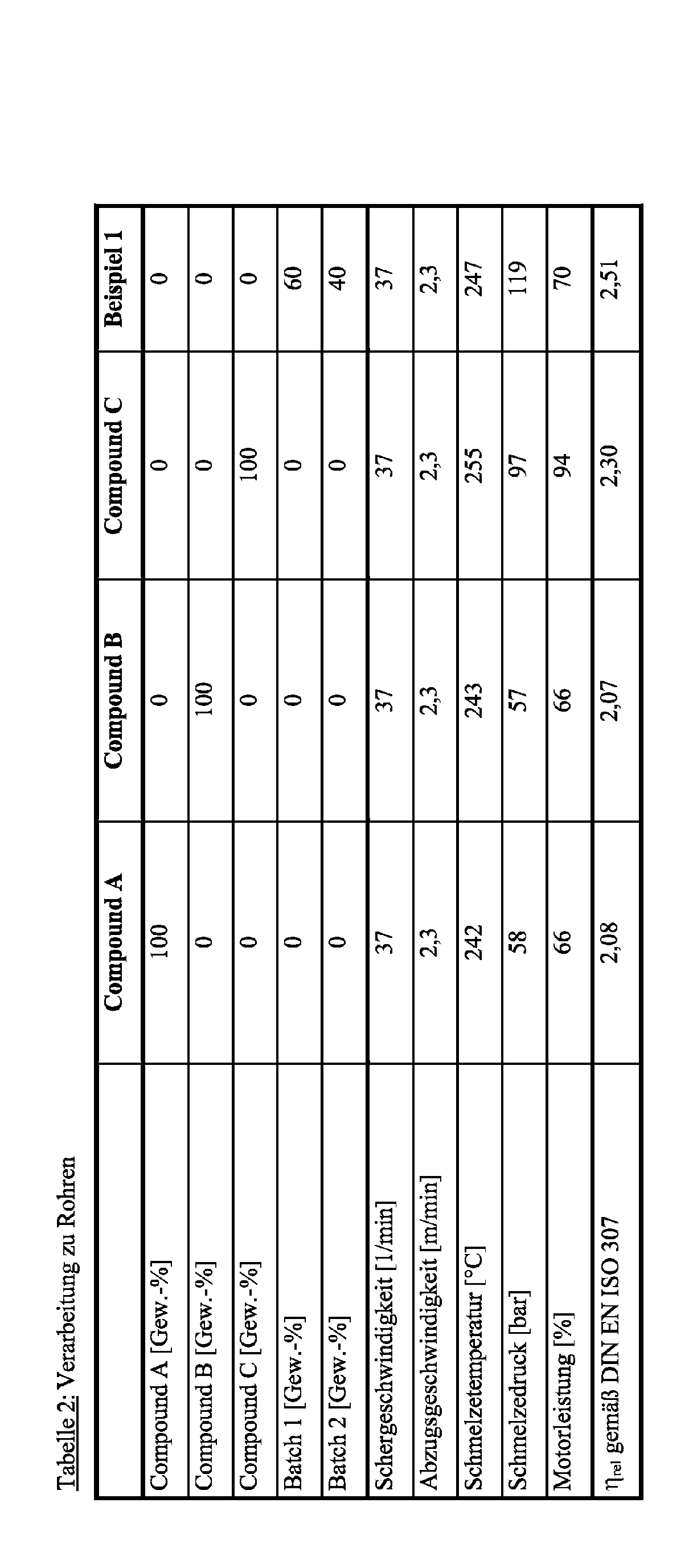
Auf einem 50er Reifenhäuser Einschneckenextruder mit Dreizonenschnecke und L = 25 D wurden die in der Tabelle 2 angegebenen Einsatzstoffe ausgehend vom Granulat bzw. einer Granulatmischung verarbeitet und als Rohre mit einer Wandstärke von 2,9 mm und einem Außendurchmesser von 32 mm extrudiert. Bei der Gegenüberstellung des Vergleichsbeispiels C und des Beispiels 1 erkennt man, dass erfindungsgemäß eine deutlich niedrigere Motorlast nötig war, um ein Formteil aus einem sehr hochmolekularen Polyamid herzustellen.On a 50 mm Reifenhäuser single-screw extruder with three-zone screw and L = 25 D, the feedstocks specified in Table 2 were processed starting from the granules or a granulate mixture and extruded as tubes with a wall thickness of 2.9 mm and an outer diameter of 32 mm. In the comparison of Comparative Example C and Example 1 it can be seen that according to the invention a significantly lower engine load was necessary to produce a molded part from a very high molecular weight polyamide.
Beim direkten Einsatz des Compound C verringert sich ηrel (als Maßstab für das Molekulargewicht) von anfangs 2,55 auf 2,30 (Vergleichsbeispiel C) durch Kettenabbau unter Scherung. Beim erfindungsgemäßen Verfahren (Beispiel 1) ist kein derartiger Kettenabbau festzustellen.

Claims (14)
dadurch gekennzeichnet,
dass der Polyamidanteil 20 bis 500 ppm Phosphor in Form einer sauren Verbindung enthält.Method according to claim 1,
characterized,
that the polyamide portion contains 20 to 500 ppm of phosphorus in the form of an acidic compound.
dadurch gekennzeichnet,
dass dem Polyamid bzw. der Polyamidformmasse 0,001 bis 5 Gew.-% eines Salzes einer schwachen Säure zugegeben wird.Method according to one of the preceding claims,
characterized,
that 0.001 to 5 wt .-% of a salt of a weak acid is added to the polyamide or the polyamide molding composition.
dadurch gekennzeichnet,
dass dem Polyamid bzw. der Polyamidformmasse 0,01 bis 2,5 Gew.-% eines Salzes einer schwachen Säure zugegeben wird.Method according to one of the preceding claims,
characterized,
from 0.01 to 2.5% by weight of a weak acid salt is added to the polyamide or the polyamide molding compound.
dadurch gekennzeichnet,
dass dem Polyamid bzw. der Polyamidformmasse 0,05 bis 1 Gew.-% eines Salzes einer schwachen Säure zugegeben wird.Method according to one of the preceding claims,
characterized,
that the polyamide or the polyamide molding composition 0.05 to 1 wt .-% of a salt of a weak acid is added.
dadurch gekennzeichnet,
dass die schwache Säure einen pKa-Wert von 2,5 oder höher besitzt.Method according to one of the preceding claims,
characterized,
that the weak acid has a pK a value of 2.5 or higher.
dadurch gekennzeichnet,
dass das Salz einer schwachen Säure ein Alkalimetallsalz, ein Erdalkalimetallsalz, das Salz eines Metalls der III. Hauptgruppe, das Salz eines Metalls der II. Nebengruppe oder ein Ammoniumsalz ist.Method according to one of the preceding claims,
characterized,
that the salt of a weak acid, an alkali metal salt, an alkaline earth metal salt, the salt of a metal of III. Main group, the salt of a metal of II. Subgroup or an ammonium salt.
dadurch gekennzeichnet,
dass das Polyamid unter Verwendung eines Diamins oder Polyamins als Regler hergestellt wurde.Method according to one of the preceding claims,
characterized,
that the polyamide was prepared using a diamine or polyamine as a regulator.
dadurch gekennzeichnet,
dass die Verbindung mit mindestens zwei Carbonateinheiten als Masterbatch eingesetzt wird.Method according to one of the preceding claims,
characterized,
that the compound is used with at least two carbonate units as a master batch.
dadurch gekennzeichnet,
dass es ein Hohlkörper oder Hohlprofil ist.Molded part according to claim 10,
characterized,
that it is a hollow body or hollow profile.
dadurch gekennzeichnet,
dass sein Außendurchmesser mindestens 30 mm und seine Wandstärke mindestens 1 mm beträgt.Molded part according to one of claims 10 and 11,
characterized,
that its outer diameter is at least 30 mm and its wall thickness is at least 1 mm.
dadurch gekennzeichnet,
dass es ein Gasleitungsrohr, eine Offshore-Leitung, eine Versorgungsleitung, ein Kabelkanal, eine Tankstellenversorgungsleitung, eine Belüftungsleitung, ein Luftansaugrohr, ein Tankeinfüllstutzen, ein Vorratsbehälter oder ein Kraftstofftank ist.Molded part according to one of claims 10 to 12,
characterized,
that it is a gas pipe, an offshore pipeline, a supply line, a cable conduit, a filling station supply line, a vent line, an air intake pipe, a tank filler neck, a storage tank or a fuel tank.
dadurch gekennzeichnet,
dass die Wandung mehrschichtig aufgebaut ist.Molding according to one of claims 10 to 13,
characterized,
that the wall is multi-layered.
Applications Claiming Priority (1)
| Application Number | Priority Date | Filing Date | Title |
|---|---|---|---|
| DE102005007034A DE102005007034A1 (en) | 2005-02-15 | 2005-02-15 | Process for the production of molded parts while increasing the melt stiffness |
Publications (2)
| Publication Number | Publication Date |
|---|---|
| EP1690890A1 true EP1690890A1 (en) | 2006-08-16 |
| EP1690890B1 EP1690890B1 (en) | 2008-02-20 |
Family
ID=36498966
Family Applications (1)
| Application Number | Title | Priority Date | Filing Date |
|---|---|---|---|
| EP05112992A Expired - Lifetime EP1690890B1 (en) | 2005-02-15 | 2005-12-27 | Process for the preparation of moulded parts under increased melt rigidity |
Country Status (9)
| Country | Link |
|---|---|
| US (1) | US8647551B2 (en) |
| EP (1) | EP1690890B1 (en) |
| JP (1) | JP4902999B2 (en) |
| KR (1) | KR101110089B1 (en) |
| CN (1) | CN1837287B (en) |
| AT (1) | ATE386771T1 (en) |
| BR (1) | BRPI0600419A (en) |
| DE (2) | DE102005007034A1 (en) |
| RU (1) | RU2396291C2 (en) |
Cited By (10)
| Publication number | Priority date | Publication date | Assignee | Title |
|---|---|---|---|---|
| DE102007040683A1 (en) | 2007-08-29 | 2009-03-05 | Evonik Degussa Gmbh | Sheathed pipe |
| DE102008001678A1 (en) | 2007-10-17 | 2009-04-23 | Evonik Degussa Gmbh | Use of a polyamide molding compound for lining pipes |
| DE102008044224A1 (en) | 2008-12-01 | 2010-06-02 | Evonik Degussa Gmbh | Use of a composition for contact with supercritical media |
| DE102008044225A1 (en) | 2008-12-01 | 2010-06-02 | Evonik Degussa Gmbh | Process for the preparation of a molding compound or a molded article with increased melt stiffness |
| DE102009001001A1 (en) | 2009-02-19 | 2010-09-02 | Evonik Degussa Gmbh | Use of a conduit for the production of a pipeline laid in the water |
| WO2011144716A1 (en) | 2010-05-20 | 2011-11-24 | Lanxess Deutschland Gmbh | Thermoplastic moulding compounds with increased melt stability |
| DE102011007104A1 (en) | 2011-04-11 | 2012-10-11 | Evonik Degussa Gmbh | Polyamide sheathed steel construction tubes for offshore structures |
| EP2610279A1 (en) | 2011-12-29 | 2013-07-03 | Evonik Degussa GmbH | Method for producing a moulded part from a polyamide moulding material with improved hydrolysis resistance |
| US8927737B2 (en) | 2011-08-09 | 2015-01-06 | Basf Se | Process for purifying ionic liquids |
| EP4454877A1 (en) | 2023-04-24 | 2024-10-30 | Evonik Operations GmbH | On- and off-shore long-chain polyamide tube with improved barrier effect |
Families Citing this family (34)
| Publication number | Priority date | Publication date | Assignee | Title |
|---|---|---|---|---|
| EP1400340B1 (en) * | 2002-09-21 | 2008-01-16 | Evonik Degussa GmbH | Method for manufacturing a three dimensional object |
| DE10330591A1 (en) * | 2002-11-28 | 2004-06-09 | Degussa Ag | Sinter powder useful in selective laser sintering to produce moldings comprises polyamide and fatty acid salt, montanic acid salt or dimer acid salt |
| DE102004001324A1 (en) * | 2003-07-25 | 2005-02-10 | Degussa Ag | Powder composition used in the layerwise buildup of three-dimensional articles comprises a polymer and an ammonium polyphosphate flame retardant |
| DE10347628A1 (en) * | 2003-10-09 | 2005-05-19 | Degussa Ag | Crosslinkable base layer for fixation inserts according to the double-point method |
| DE10347665A1 (en) * | 2003-10-09 | 2005-05-19 | Degussa Ag | Crosslinkable base layer for fixation inserts according to the double-point method |
| DE102004010162A1 (en) * | 2004-02-27 | 2005-09-15 | Degussa Ag | Polymer powder with copolymer, use in a shaping process with unfocused energy input and molding, made from this polymer powder |
| DE102004012682A1 (en) | 2004-03-16 | 2005-10-06 | Degussa Ag | Process for the production of three-dimensional objects by means of laser technology and application of an absorber by inkjet method |
| DE102004020452A1 (en) * | 2004-04-27 | 2005-12-01 | Degussa Ag | Method for producing three-dimensional objects by means of electromagnetic radiation and applying an absorber by inkjet method |
| DE102004020453A1 (en) | 2004-04-27 | 2005-11-24 | Degussa Ag | Polymer powder with polyamide, use in a molding process and molding, made from this polymer powder |
| DE102004024440B4 (en) * | 2004-05-14 | 2020-06-25 | Evonik Operations Gmbh | Polymer powder with polyamide, use in a shaping process and molded body made from this polymer powder |
| DE102004063220A1 (en) * | 2004-12-29 | 2006-07-13 | Degussa Ag | Transparent molding compounds |
| DE102005007034A1 (en) | 2005-02-15 | 2006-08-17 | Degussa Ag | Process for the production of molded parts while increasing the melt stiffness |
| DE102005033379A1 (en) * | 2005-07-16 | 2007-01-18 | Degussa Ag | Use of cyclic oligomers in a molding process and molding made by this process |
| DE102005054723A1 (en) * | 2005-11-17 | 2007-05-24 | Degussa Gmbh | Use of polyester powder in a molding process and molding made from this polyester powder |
| DE102006015791A1 (en) * | 2006-04-01 | 2007-10-04 | Degussa Gmbh | Polymer powder, process for the preparation and use of such a powder and molded articles thereof |
| DE102006038108A1 (en) * | 2006-08-14 | 2008-02-21 | Evonik Degussa Gmbh | Use of a molding of a polyamide molding compound as inliner for a pipeline |
| US7717410B2 (en) * | 2006-10-24 | 2010-05-18 | Wieslaw Julian Oledzki | Smooth non-linear springs, particularly smooth progressive rate steel springs, progressive rate vehicle suspensions and method |
| DE102007019133A1 (en) * | 2007-04-20 | 2008-10-23 | Evonik Degussa Gmbh | Composite powder, use in a molding process and molding made from this powder |
| DE102007062063A1 (en) * | 2007-12-21 | 2009-06-25 | Ems-Patent Ag | Transparent polyamide molding compound |
| EP2265673B1 (en) * | 2008-03-14 | 2019-05-08 | 3D Systems, Inc. | Powder compositions and methods of manufacturing articles therefrom |
| DE102008000755B4 (en) | 2008-03-19 | 2019-12-12 | Evonik Degussa Gmbh | Copolyamide powder and its preparation, use of copolyamide powder in a molding process and molding, made from this copolyamide powder |
| DE102008002599A1 (en) * | 2008-06-24 | 2009-12-31 | Evonik Degussa Gmbh | Component with cover layer of a PA613 molding compound |
| DE102010003909A1 (en) | 2010-04-13 | 2011-10-13 | Evonik Degussa Gmbh | Flexible tube with multilayer construction |
| DE102010003916A1 (en) | 2010-04-13 | 2011-10-13 | Evonik Degussa Gmbh | Flexible tube and method for its production |
| DE102010003920A1 (en) | 2010-04-13 | 2011-10-13 | Evonik Degussa Gmbh | Flexible tube with higher temperature resistance |
| EP2679635B1 (en) * | 2011-02-24 | 2019-08-14 | Mitsubishi Gas Chemical Company, Inc. | Masterbatch, and method of preparing polyamide resin composition using masterbatch |
| DE102011075383A1 (en) | 2011-05-06 | 2012-11-08 | Evonik Degussa Gmbh | Temperable pipeline for offshore applications |
| FR2980207B1 (en) * | 2011-09-21 | 2013-08-30 | Rhodia Operations | COMPOSITION COMPRISING POLYAMIDE 66 AND POLYAMIDE 610 |
| CH706751A1 (en) * | 2012-07-18 | 2014-01-31 | Ems Patent Ag | Polyamide molding compound, manufacturing process and molded articles produced therefrom from the polyamide molding compound and their use as lines that come into contact with exhaust gases in motor vehicles. |
| EP3296345B1 (en) | 2014-08-26 | 2021-02-24 | Evonik Operations GmbH | Hydrolytically stable polyamide blend |
| DE102016219080A1 (en) | 2016-09-30 | 2018-04-05 | Evonik Degussa Gmbh | Polyamide powder for selective sintering |
| PL3301124T3 (en) | 2016-09-30 | 2023-09-04 | Evonik Operations Gmbh | Polyamide powder for selective sintering method |
| EP3477176A1 (en) | 2017-10-25 | 2019-05-01 | Evonik Degussa GmbH | Method for manufacturing a tube clad with an inner liner |
| CN114144473B (en) * | 2019-07-11 | 2023-01-03 | 东丽株式会社 | Polyamide resin composition and molded article obtained by molding same |
Citations (2)
| Publication number | Priority date | Publication date | Assignee | Title |
|---|---|---|---|---|
| WO2000066650A2 (en) * | 1999-05-03 | 2000-11-09 | L. Brueggemann Kg Sprit- Und Chemische Fabrik | Carboxyl functional additive for condensing polyamides |
| EP1512710A2 (en) * | 2003-08-16 | 2005-03-09 | Degussa AG | Method of increasing the molecular weight of a polyamide |
Family Cites Families (52)
| Publication number | Priority date | Publication date | Assignee | Title |
|---|---|---|---|---|
| FR2258256B1 (en) * | 1974-01-18 | 1978-10-27 | Asa Sa | |
| SU876447A1 (en) * | 1978-05-15 | 1981-10-30 | За витель | Mechanism for moulding drain-pipes |
| US4568736A (en) * | 1984-09-17 | 1986-02-04 | The Standard Oil Company | Preparation of polyamide from omega-aminonitrile with oxygen containing phosphorus catalyst |
| EP0410230A3 (en) * | 1989-07-26 | 1992-02-26 | Bayer Ag | Process for preparing high molecular weight polyamides |
| US5116919A (en) * | 1990-12-05 | 1992-05-26 | E. I. Du Pont De Nemours And Company | Process for increasing the relative viscosity of polyamides with reduced thermal degradation |
| DE4137430A1 (en) * | 1991-11-14 | 1993-05-19 | Huels Chemische Werke Ag | MULTILAYER PLASTIC PIPE |
| DE4317189A1 (en) * | 1993-05-22 | 1994-11-24 | Huels Chemische Werke Ag | Molten, aliphatic dicarboxylic acids |
| ES2169767T3 (en) * | 1994-10-14 | 2002-07-16 | Ciba Sc Holding Ag | INCREASE OF MOLECULAR WEIGHT OF POLYCHONDENSED. |
| DE19510314A1 (en) * | 1995-03-22 | 1996-09-26 | Huels Chemische Werke Ag | Polyester for the bonding of textiles |
| DE19536056A1 (en) * | 1995-09-28 | 1997-04-03 | Huels Chemische Werke Ag | Liquid solutions of dicarboxylic acids |
| DE19708946A1 (en) * | 1997-03-05 | 1998-09-10 | Huels Chemische Werke Ag | Production of polyamide powder with narrow particle size distribution and low porosity |
| DE19746834A1 (en) * | 1997-10-23 | 1999-04-29 | Huels Chemische Werke Ag | Polyethylene wax as a processing aid for hot melt adhesive compositions |
| DE19808809A1 (en) * | 1998-03-03 | 1999-09-09 | Degussa | Crosslinking base layer for fixation inserts using the colon method |
| DE19854819A1 (en) * | 1998-11-27 | 2000-05-31 | Degussa | Hollow article with antistatic properties |
| DE19908640A1 (en) * | 1999-02-27 | 2000-08-31 | Degussa | Multi-layer composite |
| EP1078949A1 (en) * | 1999-08-26 | 2001-02-28 | Bayer Aktiengesellschaft | Branching of polyamides with esters of carboxylic acid |
| DE10010669A1 (en) * | 2000-03-04 | 2001-09-06 | Degussa | Process for producing an extrusion-coated metal object |
| DE10015862A1 (en) * | 2000-03-30 | 2001-10-11 | Bayer Ag | Polyamide composition and process for its manufacture |
| DE10030716A1 (en) * | 2000-06-23 | 2002-01-03 | Degussa | Low temperature impact resistant polymer alloy |
| DE10032075A1 (en) * | 2000-07-01 | 2002-01-10 | Degussa | Electrostatic coating of molded parts with thermoplastic and cross-linkable copolyamide hot melt adhesives |
| DE10050231A1 (en) * | 2000-10-11 | 2002-04-25 | Degussa | Crosslinking base layer for fixation inserts using the colon and paste process |
| DE10064338A1 (en) * | 2000-12-21 | 2002-06-27 | Degussa | Molding compound with good blow moldability |
| JP4082046B2 (en) * | 2001-04-23 | 2008-04-30 | 宇部興産株式会社 | Polyamide elastomer and method for producing the same |
| DE10161038A1 (en) * | 2001-12-12 | 2003-06-26 | Degussa | pH-regulated polyamide powder for cosmetic applications |
| DE10164408A1 (en) * | 2001-12-28 | 2003-07-17 | Degussa | Liquid or steam-carrying system with a joining zone made of a co-extruded multilayer composite |
| DE10201903A1 (en) * | 2002-01-19 | 2003-07-31 | Degussa | Molding compound based on polyether amides |
| DE10228439A1 (en) * | 2002-06-26 | 2004-01-22 | Degussa Ag | Plastic optical fiber |
| EP1400340B1 (en) * | 2002-09-21 | 2008-01-16 | Evonik Degussa GmbH | Method for manufacturing a three dimensional object |
| DE10245355A1 (en) * | 2002-09-27 | 2004-04-08 | Degussa Ag | pipe connection |
| EP1413594A2 (en) * | 2002-10-17 | 2004-04-28 | Degussa AG | Laser-sintering powder with better recycling properties, process for its preparation and use thereof. |
| DE10248406A1 (en) * | 2002-10-17 | 2004-04-29 | Degussa Ag | Laser sinter powder with titanium dioxide particles, process for its production and moldings made from this laser sinter powder |
| DE10250330A1 (en) * | 2002-10-29 | 2004-05-13 | Degussa Ag | Bending element with behavior dependent on the direction of rotation |
| DE10251790A1 (en) * | 2002-11-07 | 2004-05-19 | Degussa Ag | Composition for fluidized bed-, rotational-, electrostatic-, tribo-, or minicoating in the preparation of cosmetics and paint, comprises polyamide, polyamide derivatives, and flow aid |
| DE50302649D1 (en) * | 2002-11-28 | 2006-05-11 | Degussa | Laser sintering powder with metal soaps, process for its preparation and molded articles made from this laser-sintered powder |
| DE10330591A1 (en) * | 2002-11-28 | 2004-06-09 | Degussa Ag | Sinter powder useful in selective laser sintering to produce moldings comprises polyamide and fatty acid salt, montanic acid salt or dimer acid salt |
| DE10311437A1 (en) * | 2003-03-15 | 2004-09-23 | Degussa Ag | Laser sinter powder with PMMI, PMMA and / or PMMI-PMMA copolymers, process for its production and moldings made from this laser sinter powder |
| EP1459871B1 (en) * | 2003-03-15 | 2011-04-06 | Evonik Degussa GmbH | Method and apparatus for manufacturing three dimensional objects using microwave radiation and shaped body produced according to this method |
| DE10318321A1 (en) * | 2003-04-19 | 2004-10-28 | Degussa Ag | Process for ultrasonic welding of plastic components |
| DE10333005A1 (en) * | 2003-07-18 | 2005-02-03 | Degussa Ag | Molding composition based on polyetheramides |
| DE102004001324A1 (en) | 2003-07-25 | 2005-02-10 | Degussa Ag | Powder composition used in the layerwise buildup of three-dimensional articles comprises a polymer and an ammonium polyphosphate flame retardant |
| DE10334497A1 (en) * | 2003-07-29 | 2005-02-24 | Degussa Ag | Polymer powder with phosphonate-based flame retardant, process for its preparation and moldings, made from this polymer powder |
| DE10334496A1 (en) * | 2003-07-29 | 2005-02-24 | Degussa Ag | Laser sintering powder with a metal salt and a fatty acid derivative, process for the production thereof and moldings produced from this laser sinter powder |
| DE10347665A1 (en) * | 2003-10-09 | 2005-05-19 | Degussa Ag | Crosslinkable base layer for fixation inserts according to the double-point method |
| DE10347628A1 (en) * | 2003-10-09 | 2005-05-19 | Degussa Ag | Crosslinkable base layer for fixation inserts according to the double-point method |
| DE102004020452A1 (en) * | 2004-04-27 | 2005-12-01 | Degussa Ag | Method for producing three-dimensional objects by means of electromagnetic radiation and applying an absorber by inkjet method |
| DE102004020453A1 (en) * | 2004-04-27 | 2005-11-24 | Degussa Ag | Polymer powder with polyamide, use in a molding process and molding, made from this polymer powder |
| DE102004024440B4 (en) * | 2004-05-14 | 2020-06-25 | Evonik Operations Gmbh | Polymer powder with polyamide, use in a shaping process and molded body made from this polymer powder |
| DE102004063220A1 (en) * | 2004-12-29 | 2006-07-13 | Degussa Ag | Transparent molding compounds |
| DE102005007034A1 (en) | 2005-02-15 | 2006-08-17 | Degussa Ag | Process for the production of molded parts while increasing the melt stiffness |
| DE102006005500A1 (en) * | 2006-02-07 | 2007-08-09 | Degussa Gmbh | Use of polymer powder, prepared from a dispersion, in a molding process and molding, made from this polymer powder |
| DE102007021199B4 (en) * | 2006-07-17 | 2016-02-11 | Evonik Degussa Gmbh | Compositions of organic polymer as matrix and inorganic particles as filler, process for their preparation and their use and moldings produced therewith |
| DE102007019133A1 (en) * | 2007-04-20 | 2008-10-23 | Evonik Degussa Gmbh | Composite powder, use in a molding process and molding made from this powder |
-
2005
- 2005-02-15 DE DE102005007034A patent/DE102005007034A1/en not_active Withdrawn
- 2005-12-27 AT AT05112992T patent/ATE386771T1/en not_active IP Right Cessation
- 2005-12-27 EP EP05112992A patent/EP1690890B1/en not_active Expired - Lifetime
- 2005-12-27 DE DE502005002911T patent/DE502005002911D1/en not_active Expired - Lifetime
-
2006
- 2006-02-14 RU RU2006104307/15A patent/RU2396291C2/en not_active IP Right Cessation
- 2006-02-14 CN CN200610067344XA patent/CN1837287B/en not_active Expired - Lifetime
- 2006-02-15 US US11/354,114 patent/US8647551B2/en active Active
- 2006-02-15 JP JP2006037513A patent/JP4902999B2/en active Active
- 2006-02-15 KR KR1020060014763A patent/KR101110089B1/en not_active Expired - Fee Related
- 2006-02-15 BR BRPI0600419-9A patent/BRPI0600419A/en active IP Right Grant
Patent Citations (2)
| Publication number | Priority date | Publication date | Assignee | Title |
|---|---|---|---|---|
| WO2000066650A2 (en) * | 1999-05-03 | 2000-11-09 | L. Brueggemann Kg Sprit- Und Chemische Fabrik | Carboxyl functional additive for condensing polyamides |
| EP1512710A2 (en) * | 2003-08-16 | 2005-03-09 | Degussa AG | Method of increasing the molecular weight of a polyamide |
Cited By (17)
| Publication number | Priority date | Publication date | Assignee | Title |
|---|---|---|---|---|
| DE102007040683A1 (en) | 2007-08-29 | 2009-03-05 | Evonik Degussa Gmbh | Sheathed pipe |
| DE102008001678A1 (en) | 2007-10-17 | 2009-04-23 | Evonik Degussa Gmbh | Use of a polyamide molding compound for lining pipes |
| US8697814B2 (en) | 2008-12-01 | 2014-04-15 | Evonik Degussa Gmbh | Process for producing a molding composition or a molding with an increase in the melt stiffness |
| DE102008044224A1 (en) | 2008-12-01 | 2010-06-02 | Evonik Degussa Gmbh | Use of a composition for contact with supercritical media |
| WO2010063506A1 (en) | 2008-12-01 | 2010-06-10 | Evonik Degussa Gmbh | Use of a composition for the contact with supercritical media |
| WO2010063568A1 (en) | 2008-12-01 | 2010-06-10 | Evonik Degussa Gmbh | Method for producing a molding compound or a molded part having increased melt stiffness |
| DE102008044225A1 (en) | 2008-12-01 | 2010-06-02 | Evonik Degussa Gmbh | Process for the preparation of a molding compound or a molded article with increased melt stiffness |
| RU2535221C2 (en) * | 2008-12-01 | 2014-12-10 | Эвоник Дегусса Гмбх | Production of sand blend |
| DE102009001001A1 (en) | 2009-02-19 | 2010-09-02 | Evonik Degussa Gmbh | Use of a conduit for the production of a pipeline laid in the water |
| WO2011144716A1 (en) | 2010-05-20 | 2011-11-24 | Lanxess Deutschland Gmbh | Thermoplastic moulding compounds with increased melt stability |
| EP2511430A1 (en) | 2011-04-11 | 2012-10-17 | Evonik Degussa GmbH | Steel tubes for offshore structures |
| DE102011007104A1 (en) | 2011-04-11 | 2012-10-11 | Evonik Degussa Gmbh | Polyamide sheathed steel construction tubes for offshore structures |
| US8927737B2 (en) | 2011-08-09 | 2015-01-06 | Basf Se | Process for purifying ionic liquids |
| EP2610279A1 (en) | 2011-12-29 | 2013-07-03 | Evonik Degussa GmbH | Method for producing a moulded part from a polyamide moulding material with improved hydrolysis resistance |
| DE102011090092A1 (en) | 2011-12-29 | 2013-07-04 | Evonik Degussa Gmbh | Process for the production of a molding from a polyamide molding compound with improved hydrolysis resistance |
| EP4454877A1 (en) | 2023-04-24 | 2024-10-30 | Evonik Operations GmbH | On- and off-shore long-chain polyamide tube with improved barrier effect |
| WO2024223378A1 (en) | 2023-04-24 | 2024-10-31 | Evonik Operations Gmbh | On- and offshore long-chain polyamide tube with increased barrier effect |
Also Published As
| Publication number | Publication date |
|---|---|
| CN1837287B (en) | 2010-05-26 |
| EP1690890B1 (en) | 2008-02-20 |
| DE502005002911D1 (en) | 2008-04-03 |
| KR20060092123A (en) | 2006-08-22 |
| CN1837287A (en) | 2006-09-27 |
| US20060183869A1 (en) | 2006-08-17 |
| RU2396291C2 (en) | 2010-08-10 |
| KR101110089B1 (en) | 2012-03-08 |
| DE102005007034A1 (en) | 2006-08-17 |
| US8647551B2 (en) | 2014-02-11 |
| JP4902999B2 (en) | 2012-03-21 |
| ATE386771T1 (en) | 2008-03-15 |
| JP2006225659A (en) | 2006-08-31 |
| RU2006104307A (en) | 2007-09-20 |
| BRPI0600419A (en) | 2006-10-03 |
Similar Documents
| Publication | Publication Date | Title |
|---|---|---|
| EP1690890B1 (en) | Process for the preparation of moulded parts under increased melt rigidity | |
| EP1690889B1 (en) | Process for the preparation of moulded parts under increased melt rigidity | |
| EP1512710B1 (en) | Method of increasing the molecular weight of a polyamide | |
| EP2352784B1 (en) | Method for producing a molding compound or a molded part having increased melt stiffness | |
| EP1741540B1 (en) | Use of a polyamide moulding composition with high melt rigidity for coextruding with a polymer melting at a high temperature | |
| BRPI0600419B1 (en) | MOLDED PARTS, AND THEIR PRODUCTION PROCESSES |
Legal Events
| Date | Code | Title | Description |
|---|---|---|---|
| PUAI | Public reference made under article 153(3) epc to a published international application that has entered the european phase |
Free format text: ORIGINAL CODE: 0009012 |
|
| 17P | Request for examination filed |
Effective date: 20051227 |
|
| AK | Designated contracting states |
Kind code of ref document: A1 Designated state(s): AT BE BG CH CY CZ DE DK EE ES FI FR GB GR HU IE IS IT LI LT LU LV MC NL PL PT RO SE SI SK TR |
|
| AX | Request for extension of the european patent |
Extension state: AL BA HR MK YU |
|
| 17Q | First examination report despatched |
Effective date: 20061019 |
|
| RAP1 | Party data changed (applicant data changed or rights of an application transferred) |
Owner name: DEGUSSA GMBH |
|
| 17Q | First examination report despatched |
Effective date: 20061019 |
|
| AKX | Designation fees paid |
Designated state(s): AT BE BG CH CY CZ DE DK EE ES FI FR GB GR HU IE IS IT LI LT LU LV MC NL PL PT RO SE SI SK TR |
|
| GRAP | Despatch of communication of intention to grant a patent |
Free format text: ORIGINAL CODE: EPIDOSNIGR1 |
|
| RAP1 | Party data changed (applicant data changed or rights of an application transferred) |
Owner name: EVONIK DEGUSSA GMBH |
|
| GRAS | Grant fee paid |
Free format text: ORIGINAL CODE: EPIDOSNIGR3 |
|
| GRAA | (expected) grant |
Free format text: ORIGINAL CODE: 0009210 |
|
| AK | Designated contracting states |
Kind code of ref document: B1 Designated state(s): AT BE BG CH CY CZ DE DK EE ES FI FR GB GR HU IE IS IT LI LT LU LV MC NL PL PT RO SE SI SK TR |
|
| REG | Reference to a national code |
Ref country code: GB Ref legal event code: FG4D Free format text: NOT ENGLISH |
|
| REG | Reference to a national code |
Ref country code: CH Ref legal event code: EP |
|
| REG | Reference to a national code |
Ref country code: IE Ref legal event code: FG4D Free format text: LANGUAGE OF EP DOCUMENT: GERMAN |
|
| REF | Corresponds to: |
Ref document number: 502005002911 Country of ref document: DE Date of ref document: 20080403 Kind code of ref document: P |
|
| PG25 | Lapsed in a contracting state [announced via postgrant information from national office to epo] |
Ref country code: ES Free format text: LAPSE BECAUSE OF FAILURE TO SUBMIT A TRANSLATION OF THE DESCRIPTION OR TO PAY THE FEE WITHIN THE PRESCRIBED TIME-LIMIT Effective date: 20080531 Ref country code: FI Free format text: LAPSE BECAUSE OF FAILURE TO SUBMIT A TRANSLATION OF THE DESCRIPTION OR TO PAY THE FEE WITHIN THE PRESCRIBED TIME-LIMIT Effective date: 20080220 Ref country code: IS Free format text: LAPSE BECAUSE OF FAILURE TO SUBMIT A TRANSLATION OF THE DESCRIPTION OR TO PAY THE FEE WITHIN THE PRESCRIBED TIME-LIMIT Effective date: 20080620 |
|
| NLV1 | Nl: lapsed or annulled due to failure to fulfill the requirements of art. 29p and 29m of the patents act | ||
| RAP2 | Party data changed (patent owner data changed or rights of a patent transferred) |
Owner name: EVONIK DEGUSSA GMBH |
|
| PG25 | Lapsed in a contracting state [announced via postgrant information from national office to epo] |
Ref country code: PL Free format text: LAPSE BECAUSE OF FAILURE TO SUBMIT A TRANSLATION OF THE DESCRIPTION OR TO PAY THE FEE WITHIN THE PRESCRIBED TIME-LIMIT Effective date: 20080220 Ref country code: SI Free format text: LAPSE BECAUSE OF FAILURE TO SUBMIT A TRANSLATION OF THE DESCRIPTION OR TO PAY THE FEE WITHIN THE PRESCRIBED TIME-LIMIT Effective date: 20080220 Ref country code: LV Free format text: LAPSE BECAUSE OF FAILURE TO SUBMIT A TRANSLATION OF THE DESCRIPTION OR TO PAY THE FEE WITHIN THE PRESCRIBED TIME-LIMIT Effective date: 20080220 |
|
| REG | Reference to a national code |
Ref country code: IE Ref legal event code: FD4D |
|
| ET | Fr: translation filed | ||
| PG25 | Lapsed in a contracting state [announced via postgrant information from national office to epo] |
Ref country code: SE Free format text: LAPSE BECAUSE OF FAILURE TO SUBMIT A TRANSLATION OF THE DESCRIPTION OR TO PAY THE FEE WITHIN THE PRESCRIBED TIME-LIMIT Effective date: 20080520 Ref country code: NL Free format text: LAPSE BECAUSE OF FAILURE TO SUBMIT A TRANSLATION OF THE DESCRIPTION OR TO PAY THE FEE WITHIN THE PRESCRIBED TIME-LIMIT Effective date: 20080220 Ref country code: DK Free format text: LAPSE BECAUSE OF FAILURE TO SUBMIT A TRANSLATION OF THE DESCRIPTION OR TO PAY THE FEE WITHIN THE PRESCRIBED TIME-LIMIT Effective date: 20080220 Ref country code: SK Free format text: LAPSE BECAUSE OF FAILURE TO SUBMIT A TRANSLATION OF THE DESCRIPTION OR TO PAY THE FEE WITHIN THE PRESCRIBED TIME-LIMIT Effective date: 20080220 Ref country code: PT Free format text: LAPSE BECAUSE OF FAILURE TO SUBMIT A TRANSLATION OF THE DESCRIPTION OR TO PAY THE FEE WITHIN THE PRESCRIBED TIME-LIMIT Effective date: 20080721 Ref country code: IE Free format text: LAPSE BECAUSE OF FAILURE TO SUBMIT A TRANSLATION OF THE DESCRIPTION OR TO PAY THE FEE WITHIN THE PRESCRIBED TIME-LIMIT Effective date: 20080220 Ref country code: CZ Free format text: LAPSE BECAUSE OF FAILURE TO SUBMIT A TRANSLATION OF THE DESCRIPTION OR TO PAY THE FEE WITHIN THE PRESCRIBED TIME-LIMIT Effective date: 20080220 |
|
| PG25 | Lapsed in a contracting state [announced via postgrant information from national office to epo] |
Ref country code: RO Free format text: LAPSE BECAUSE OF FAILURE TO SUBMIT A TRANSLATION OF THE DESCRIPTION OR TO PAY THE FEE WITHIN THE PRESCRIBED TIME-LIMIT Effective date: 20080220 |
|
| PLBE | No opposition filed within time limit |
Free format text: ORIGINAL CODE: 0009261 |
|
| STAA | Information on the status of an ep patent application or granted ep patent |
Free format text: STATUS: NO OPPOSITION FILED WITHIN TIME LIMIT |
|
| 26N | No opposition filed |
Effective date: 20081121 |
|
| PG25 | Lapsed in a contracting state [announced via postgrant information from national office to epo] |
Ref country code: LT Free format text: LAPSE BECAUSE OF FAILURE TO SUBMIT A TRANSLATION OF THE DESCRIPTION OR TO PAY THE FEE WITHIN THE PRESCRIBED TIME-LIMIT Effective date: 20080220 |
|
| PG25 | Lapsed in a contracting state [announced via postgrant information from national office to epo] |
Ref country code: BG Free format text: LAPSE BECAUSE OF FAILURE TO SUBMIT A TRANSLATION OF THE DESCRIPTION OR TO PAY THE FEE WITHIN THE PRESCRIBED TIME-LIMIT Effective date: 20080520 Ref country code: EE Free format text: LAPSE BECAUSE OF FAILURE TO SUBMIT A TRANSLATION OF THE DESCRIPTION OR TO PAY THE FEE WITHIN THE PRESCRIBED TIME-LIMIT Effective date: 20080220 |
|
| BERE | Be: lapsed |
Owner name: EVONIK DEGUSSA G.M.B.H. Effective date: 20081231 |
|
| PG25 | Lapsed in a contracting state [announced via postgrant information from national office to epo] |
Ref country code: MC Free format text: LAPSE BECAUSE OF NON-PAYMENT OF DUE FEES Effective date: 20081231 Ref country code: CY Free format text: LAPSE BECAUSE OF FAILURE TO SUBMIT A TRANSLATION OF THE DESCRIPTION OR TO PAY THE FEE WITHIN THE PRESCRIBED TIME-LIMIT Effective date: 20080220 |
|
| PG25 | Lapsed in a contracting state [announced via postgrant information from national office to epo] |
Ref country code: IT Free format text: LAPSE BECAUSE OF FAILURE TO SUBMIT A TRANSLATION OF THE DESCRIPTION OR TO PAY THE FEE WITHIN THE PRESCRIBED TIME-LIMIT Effective date: 20080220 |
|
| PG25 | Lapsed in a contracting state [announced via postgrant information from national office to epo] |
Ref country code: BE Free format text: LAPSE BECAUSE OF NON-PAYMENT OF DUE FEES Effective date: 20081231 |
|
| PG25 | Lapsed in a contracting state [announced via postgrant information from national office to epo] |
Ref country code: AT Free format text: LAPSE BECAUSE OF NON-PAYMENT OF DUE FEES Effective date: 20081227 |
|
| PG25 | Lapsed in a contracting state [announced via postgrant information from national office to epo] |
Ref country code: LU Free format text: LAPSE BECAUSE OF NON-PAYMENT OF DUE FEES Effective date: 20081227 Ref country code: HU Free format text: LAPSE BECAUSE OF FAILURE TO SUBMIT A TRANSLATION OF THE DESCRIPTION OR TO PAY THE FEE WITHIN THE PRESCRIBED TIME-LIMIT Effective date: 20080821 |
|
| GBPC | Gb: european patent ceased through non-payment of renewal fee |
Effective date: 20091227 |
|
| PG25 | Lapsed in a contracting state [announced via postgrant information from national office to epo] |
Ref country code: TR Free format text: LAPSE BECAUSE OF FAILURE TO SUBMIT A TRANSLATION OF THE DESCRIPTION OR TO PAY THE FEE WITHIN THE PRESCRIBED TIME-LIMIT Effective date: 20080220 |
|
| PG25 | Lapsed in a contracting state [announced via postgrant information from national office to epo] |
Ref country code: GR Free format text: LAPSE BECAUSE OF FAILURE TO SUBMIT A TRANSLATION OF THE DESCRIPTION OR TO PAY THE FEE WITHIN THE PRESCRIBED TIME-LIMIT Effective date: 20080521 |
|
| PG25 | Lapsed in a contracting state [announced via postgrant information from national office to epo] |
Ref country code: GB Free format text: LAPSE BECAUSE OF NON-PAYMENT OF DUE FEES Effective date: 20091227 |
|
| REG | Reference to a national code |
Ref country code: FR Ref legal event code: PLFP Year of fee payment: 11 |
|
| REG | Reference to a national code |
Ref country code: FR Ref legal event code: PLFP Year of fee payment: 12 |
|
| REG | Reference to a national code |
Ref country code: FR Ref legal event code: PLFP Year of fee payment: 13 |
|
| REG | Reference to a national code |
Ref country code: DE Ref legal event code: R081 Ref document number: 502005002911 Country of ref document: DE Owner name: EVONIK OPERATIONS GMBH, DE Free format text: FORMER OWNER: EVONIK DEGUSSA GMBH, 40474 DUESSELDORF, DE |
|
| REG | Reference to a national code |
Ref country code: CH Ref legal event code: PFA Owner name: EVONIK OPERATIONS GMBH, DE Free format text: FORMER OWNER: EVONIK DEGUSSA GMBH, DE |
|
| P01 | Opt-out of the competence of the unified patent court (upc) registered |
Effective date: 20230526 |
|
| PGFP | Annual fee paid to national office [announced via postgrant information from national office to epo] |
Ref country code: DE Payment date: 20241210 Year of fee payment: 20 |
|
| PGFP | Annual fee paid to national office [announced via postgrant information from national office to epo] |
Ref country code: FR Payment date: 20241223 Year of fee payment: 20 |
|
| PGFP | Annual fee paid to national office [announced via postgrant information from national office to epo] |
Ref country code: CH Payment date: 20250101 Year of fee payment: 20 |
|
| REG | Reference to a national code |
Ref country code: DE Ref legal event code: R071 Ref document number: 502005002911 Country of ref document: DE Ref country code: CH Ref legal event code: H14 Free format text: ST27 STATUS EVENT CODE: U-0-0-H10-H14 (AS PROVIDED BY THE NATIONAL OFFICE) Effective date: 20251227 |